US12350338B2 - Biodegradable lipids for the delivery of active agents - Google Patents
Biodegradable lipids for the delivery of active agents Download PDFInfo
- Publication number
- US12350338B2 US12350338B2 US18/589,688 US202418589688A US12350338B2 US 12350338 B2 US12350338 B2 US 12350338B2 US 202418589688 A US202418589688 A US 202418589688A US 12350338 B2 US12350338 B2 US 12350338B2
- Authority
- US
- United States
- Prior art keywords
- lipid
- group
- compound
- mol
- mmol
- Prior art date
- Legal status (The legal status is an assumption and is not a legal conclusion. Google has not performed a legal analysis and makes no representation as to the accuracy of the status listed.)
- Active
Links
Classifications
-
- A—HUMAN NECESSITIES
- A61—MEDICAL OR VETERINARY SCIENCE; HYGIENE
- A61K—PREPARATIONS FOR MEDICAL, DENTAL OR TOILETRY PURPOSES
- A61K47/00—Medicinal preparations characterised by the non-active ingredients used, e.g. carriers or inert additives; Targeting or modifying agents chemically bound to the active ingredient
- A61K47/06—Organic compounds, e.g. natural or synthetic hydrocarbons, polyolefins, mineral oil, petrolatum or ozokerite
- A61K47/16—Organic compounds, e.g. natural or synthetic hydrocarbons, polyolefins, mineral oil, petrolatum or ozokerite containing nitrogen, e.g. nitro-, nitroso-, azo-compounds, nitriles, cyanates
- A61K47/18—Amines; Amides; Ureas; Quaternary ammonium compounds; Amino acids; Oligopeptides having up to five amino acids
-
- A—HUMAN NECESSITIES
- A61—MEDICAL OR VETERINARY SCIENCE; HYGIENE
- A61K—PREPARATIONS FOR MEDICAL, DENTAL OR TOILETRY PURPOSES
- A61K31/00—Medicinal preparations containing organic active ingredients
- A61K31/70—Carbohydrates; Sugars; Derivatives thereof
- A61K31/7088—Compounds having three or more nucleosides or nucleotides
-
- A—HUMAN NECESSITIES
- A61—MEDICAL OR VETERINARY SCIENCE; HYGIENE
- A61K—PREPARATIONS FOR MEDICAL, DENTAL OR TOILETRY PURPOSES
- A61K31/00—Medicinal preparations containing organic active ingredients
- A61K31/70—Carbohydrates; Sugars; Derivatives thereof
- A61K31/7088—Compounds having three or more nucleosides or nucleotides
- A61K31/7105—Natural ribonucleic acids, i.e. containing only riboses attached to adenine, guanine, cytosine or uracil and having 3'-5' phosphodiester links
-
- A—HUMAN NECESSITIES
- A61—MEDICAL OR VETERINARY SCIENCE; HYGIENE
- A61K—PREPARATIONS FOR MEDICAL, DENTAL OR TOILETRY PURPOSES
- A61K31/00—Medicinal preparations containing organic active ingredients
- A61K31/70—Carbohydrates; Sugars; Derivatives thereof
- A61K31/7088—Compounds having three or more nucleosides or nucleotides
- A61K31/713—Double-stranded nucleic acids or oligonucleotides
-
- A—HUMAN NECESSITIES
- A61—MEDICAL OR VETERINARY SCIENCE; HYGIENE
- A61K—PREPARATIONS FOR MEDICAL, DENTAL OR TOILETRY PURPOSES
- A61K9/00—Medicinal preparations characterised by special physical form
- A61K9/10—Dispersions; Emulsions
- A61K9/127—Synthetic bilayered vehicles, e.g. liposomes or liposomes with cholesterol as the only non-phosphatidyl surfactant
- A61K9/1271—Non-conventional liposomes, e.g. PEGylated liposomes or liposomes coated or grafted with polymers
- A61K9/1272—Non-conventional liposomes, e.g. PEGylated liposomes or liposomes coated or grafted with polymers comprising non-phosphatidyl surfactants as bilayer-forming substances, e.g. cationic lipids or non-phosphatidyl liposomes coated or grafted with polymers
-
- A—HUMAN NECESSITIES
- A61—MEDICAL OR VETERINARY SCIENCE; HYGIENE
- A61K—PREPARATIONS FOR MEDICAL, DENTAL OR TOILETRY PURPOSES
- A61K9/00—Medicinal preparations characterised by special physical form
- A61K9/48—Preparations in capsules, e.g. of gelatin, of chocolate
- A61K9/50—Microcapsules having a gas, liquid or semi-solid filling; Solid microparticles or pellets surrounded by a distinct coating layer, e.g. coated microspheres, coated drug crystals
- A61K9/51—Nanocapsules; Nanoparticles
- A61K9/5107—Excipients; Inactive ingredients
- A61K9/5123—Organic compounds, e.g. fats, sugars
-
- C—CHEMISTRY; METALLURGY
- C07—ORGANIC CHEMISTRY
- C07C—ACYCLIC OR CARBOCYCLIC COMPOUNDS
- C07C211/00—Compounds containing amino groups bound to a carbon skeleton
- C07C211/01—Compounds containing amino groups bound to a carbon skeleton having amino groups bound to acyclic carbon atoms
- C07C211/02—Compounds containing amino groups bound to a carbon skeleton having amino groups bound to acyclic carbon atoms of an acyclic saturated carbon skeleton
- C07C211/09—Diamines
-
- C—CHEMISTRY; METALLURGY
- C07—ORGANIC CHEMISTRY
- C07C—ACYCLIC OR CARBOCYCLIC COMPOUNDS
- C07C211/00—Compounds containing amino groups bound to a carbon skeleton
- C07C211/01—Compounds containing amino groups bound to a carbon skeleton having amino groups bound to acyclic carbon atoms
- C07C211/02—Compounds containing amino groups bound to a carbon skeleton having amino groups bound to acyclic carbon atoms of an acyclic saturated carbon skeleton
- C07C211/09—Diamines
- C07C211/10—Diaminoethanes
-
- C—CHEMISTRY; METALLURGY
- C07—ORGANIC CHEMISTRY
- C07C—ACYCLIC OR CARBOCYCLIC COMPOUNDS
- C07C211/00—Compounds containing amino groups bound to a carbon skeleton
- C07C211/01—Compounds containing amino groups bound to a carbon skeleton having amino groups bound to acyclic carbon atoms
- C07C211/02—Compounds containing amino groups bound to a carbon skeleton having amino groups bound to acyclic carbon atoms of an acyclic saturated carbon skeleton
- C07C211/09—Diamines
- C07C211/11—Diaminopropanes
-
- C—CHEMISTRY; METALLURGY
- C07—ORGANIC CHEMISTRY
- C07C—ACYCLIC OR CARBOCYCLIC COMPOUNDS
- C07C217/00—Compounds containing amino and etherified hydroxy groups bound to the same carbon skeleton
- C07C217/02—Compounds containing amino and etherified hydroxy groups bound to the same carbon skeleton having etherified hydroxy groups and amino groups bound to acyclic carbon atoms of the same carbon skeleton
- C07C217/04—Compounds containing amino and etherified hydroxy groups bound to the same carbon skeleton having etherified hydroxy groups and amino groups bound to acyclic carbon atoms of the same carbon skeleton the carbon skeleton being acyclic and saturated
- C07C217/06—Compounds containing amino and etherified hydroxy groups bound to the same carbon skeleton having etherified hydroxy groups and amino groups bound to acyclic carbon atoms of the same carbon skeleton the carbon skeleton being acyclic and saturated having only one etherified hydroxy group and one amino group bound to the carbon skeleton, which is not further substituted
- C07C217/08—Compounds containing amino and etherified hydroxy groups bound to the same carbon skeleton having etherified hydroxy groups and amino groups bound to acyclic carbon atoms of the same carbon skeleton the carbon skeleton being acyclic and saturated having only one etherified hydroxy group and one amino group bound to the carbon skeleton, which is not further substituted the oxygen atom of the etherified hydroxy group being further bound to an acyclic carbon atom
-
- C—CHEMISTRY; METALLURGY
- C07—ORGANIC CHEMISTRY
- C07C—ACYCLIC OR CARBOCYCLIC COMPOUNDS
- C07C229/00—Compounds containing amino and carboxyl groups bound to the same carbon skeleton
- C07C229/02—Compounds containing amino and carboxyl groups bound to the same carbon skeleton having amino and carboxyl groups bound to acyclic carbon atoms of the same carbon skeleton
- C07C229/04—Compounds containing amino and carboxyl groups bound to the same carbon skeleton having amino and carboxyl groups bound to acyclic carbon atoms of the same carbon skeleton the carbon skeleton being acyclic and saturated
- C07C229/06—Compounds containing amino and carboxyl groups bound to the same carbon skeleton having amino and carboxyl groups bound to acyclic carbon atoms of the same carbon skeleton the carbon skeleton being acyclic and saturated having only one amino and one carboxyl group bound to the carbon skeleton
- C07C229/10—Compounds containing amino and carboxyl groups bound to the same carbon skeleton having amino and carboxyl groups bound to acyclic carbon atoms of the same carbon skeleton the carbon skeleton being acyclic and saturated having only one amino and one carboxyl group bound to the carbon skeleton the nitrogen atom of the amino group being further bound to acyclic carbon atoms or to carbon atoms of rings other than six-membered aromatic rings
- C07C229/12—Compounds containing amino and carboxyl groups bound to the same carbon skeleton having amino and carboxyl groups bound to acyclic carbon atoms of the same carbon skeleton the carbon skeleton being acyclic and saturated having only one amino and one carboxyl group bound to the carbon skeleton the nitrogen atom of the amino group being further bound to acyclic carbon atoms or to carbon atoms of rings other than six-membered aromatic rings to carbon atoms of acyclic carbon skeletons
-
- C—CHEMISTRY; METALLURGY
- C07—ORGANIC CHEMISTRY
- C07C—ACYCLIC OR CARBOCYCLIC COMPOUNDS
- C07C235/00—Carboxylic acid amides, the carbon skeleton of the acid part being further substituted by oxygen atoms
- C07C235/02—Carboxylic acid amides, the carbon skeleton of the acid part being further substituted by oxygen atoms having carbon atoms of carboxamide groups bound to acyclic carbon atoms and singly-bound oxygen atoms bound to the same carbon skeleton
- C07C235/04—Carboxylic acid amides, the carbon skeleton of the acid part being further substituted by oxygen atoms having carbon atoms of carboxamide groups bound to acyclic carbon atoms and singly-bound oxygen atoms bound to the same carbon skeleton the carbon skeleton being acyclic and saturated
- C07C235/06—Carboxylic acid amides, the carbon skeleton of the acid part being further substituted by oxygen atoms having carbon atoms of carboxamide groups bound to acyclic carbon atoms and singly-bound oxygen atoms bound to the same carbon skeleton the carbon skeleton being acyclic and saturated having the nitrogen atoms of the carboxamide groups bound to hydrogen atoms or to acyclic carbon atoms
-
- C—CHEMISTRY; METALLURGY
- C07—ORGANIC CHEMISTRY
- C07C—ACYCLIC OR CARBOCYCLIC COMPOUNDS
- C07C251/00—Compounds containing nitrogen atoms doubly-bound to a carbon skeleton
- C07C251/32—Oximes
- C07C251/34—Oximes with oxygen atoms of oxyimino groups bound to hydrogen atoms or to carbon atoms of unsubstituted hydrocarbon radicals
- C07C251/36—Oximes with oxygen atoms of oxyimino groups bound to hydrogen atoms or to carbon atoms of unsubstituted hydrocarbon radicals with the carbon atoms of the oxyimino groups bound to hydrogen atoms or to acyclic carbon atoms
- C07C251/38—Oximes with oxygen atoms of oxyimino groups bound to hydrogen atoms or to carbon atoms of unsubstituted hydrocarbon radicals with the carbon atoms of the oxyimino groups bound to hydrogen atoms or to acyclic carbon atoms to carbon atoms of a saturated carbon skeleton
-
- C—CHEMISTRY; METALLURGY
- C07—ORGANIC CHEMISTRY
- C07C—ACYCLIC OR CARBOCYCLIC COMPOUNDS
- C07C31/00—Saturated compounds having hydroxy or O-metal groups bound to acyclic carbon atoms
- C07C31/02—Monohydroxylic acyclic alcohols
- C07C31/125—Monohydroxylic acyclic alcohols containing five to twenty-two carbon atoms
-
- C—CHEMISTRY; METALLURGY
- C07—ORGANIC CHEMISTRY
- C07C—ACYCLIC OR CARBOCYCLIC COMPOUNDS
- C07C323/00—Thiols, sulfides, hydropolysulfides or polysulfides substituted by halogen, oxygen or nitrogen atoms, or by sulfur atoms not being part of thio groups
- C07C323/10—Thiols, sulfides, hydropolysulfides or polysulfides substituted by halogen, oxygen or nitrogen atoms, or by sulfur atoms not being part of thio groups containing thio groups and singly-bound oxygen atoms bound to the same carbon skeleton
- C07C323/11—Thiols, sulfides, hydropolysulfides or polysulfides substituted by halogen, oxygen or nitrogen atoms, or by sulfur atoms not being part of thio groups containing thio groups and singly-bound oxygen atoms bound to the same carbon skeleton having the sulfur atoms of the thio groups bound to acyclic carbon atoms of the carbon skeleton
- C07C323/12—Thiols, sulfides, hydropolysulfides or polysulfides substituted by halogen, oxygen or nitrogen atoms, or by sulfur atoms not being part of thio groups containing thio groups and singly-bound oxygen atoms bound to the same carbon skeleton having the sulfur atoms of the thio groups bound to acyclic carbon atoms of the carbon skeleton the carbon skeleton being acyclic and saturated
-
- C—CHEMISTRY; METALLURGY
- C07—ORGANIC CHEMISTRY
- C07C—ACYCLIC OR CARBOCYCLIC COMPOUNDS
- C07C323/00—Thiols, sulfides, hydropolysulfides or polysulfides substituted by halogen, oxygen or nitrogen atoms, or by sulfur atoms not being part of thio groups
- C07C323/50—Thiols, sulfides, hydropolysulfides or polysulfides substituted by halogen, oxygen or nitrogen atoms, or by sulfur atoms not being part of thio groups containing thio groups and carboxyl groups bound to the same carbon skeleton
- C07C323/51—Thiols, sulfides, hydropolysulfides or polysulfides substituted by halogen, oxygen or nitrogen atoms, or by sulfur atoms not being part of thio groups containing thio groups and carboxyl groups bound to the same carbon skeleton having the sulfur atoms of the thio groups bound to acyclic carbon atoms of the carbon skeleton
- C07C323/57—Thiols, sulfides, hydropolysulfides or polysulfides substituted by halogen, oxygen or nitrogen atoms, or by sulfur atoms not being part of thio groups containing thio groups and carboxyl groups bound to the same carbon skeleton having the sulfur atoms of the thio groups bound to acyclic carbon atoms of the carbon skeleton the carbon skeleton being further substituted by nitrogen atoms, not being part of nitro or nitroso groups
- C07C323/58—Thiols, sulfides, hydropolysulfides or polysulfides substituted by halogen, oxygen or nitrogen atoms, or by sulfur atoms not being part of thio groups containing thio groups and carboxyl groups bound to the same carbon skeleton having the sulfur atoms of the thio groups bound to acyclic carbon atoms of the carbon skeleton the carbon skeleton being further substituted by nitrogen atoms, not being part of nitro or nitroso groups with amino groups bound to the carbon skeleton
-
- C—CHEMISTRY; METALLURGY
- C07—ORGANIC CHEMISTRY
- C07C—ACYCLIC OR CARBOCYCLIC COMPOUNDS
- C07C327/00—Thiocarboxylic acids
- C07C327/20—Esters of monothiocarboxylic acids
- C07C327/22—Esters of monothiocarboxylic acids having carbon atoms of esterified thiocarboxyl groups bound to hydrogen atoms or to acyclic carbon atoms
-
- C—CHEMISTRY; METALLURGY
- C07—ORGANIC CHEMISTRY
- C07C—ACYCLIC OR CARBOCYCLIC COMPOUNDS
- C07C327/00—Thiocarboxylic acids
- C07C327/20—Esters of monothiocarboxylic acids
- C07C327/28—Esters of monothiocarboxylic acids having sulfur atoms of esterified thiocarboxyl groups bound to carbon atoms of hydrocarbon radicals substituted by singly-bound oxygen atoms
-
- C—CHEMISTRY; METALLURGY
- C07—ORGANIC CHEMISTRY
- C07C—ACYCLIC OR CARBOCYCLIC COMPOUNDS
- C07C327/00—Thiocarboxylic acids
- C07C327/20—Esters of monothiocarboxylic acids
- C07C327/32—Esters of monothiocarboxylic acids having sulfur atoms of esterified thiocarboxyl groups bound to carbon atoms of hydrocarbon radicals substituted by carboxyl groups
-
- C—CHEMISTRY; METALLURGY
- C07—ORGANIC CHEMISTRY
- C07D—HETEROCYCLIC COMPOUNDS
- C07D207/00—Heterocyclic compounds containing five-membered rings not condensed with other rings, with one nitrogen atom as the only ring hetero atom
- C07D207/02—Heterocyclic compounds containing five-membered rings not condensed with other rings, with one nitrogen atom as the only ring hetero atom with only hydrogen or carbon atoms directly attached to the ring nitrogen atom
- C07D207/30—Heterocyclic compounds containing five-membered rings not condensed with other rings, with one nitrogen atom as the only ring hetero atom with only hydrogen or carbon atoms directly attached to the ring nitrogen atom having two double bonds between ring members or between ring members and non-ring members
- C07D207/32—Heterocyclic compounds containing five-membered rings not condensed with other rings, with one nitrogen atom as the only ring hetero atom with only hydrogen or carbon atoms directly attached to the ring nitrogen atom having two double bonds between ring members or between ring members and non-ring members with only hydrogen atoms, hydrocarbon or substituted hydrocarbon radicals, directly attached to ring carbon atoms
-
- C—CHEMISTRY; METALLURGY
- C07—ORGANIC CHEMISTRY
- C07D—HETEROCYCLIC COMPOUNDS
- C07D233/00—Heterocyclic compounds containing 1,3-diazole or hydrogenated 1,3-diazole rings, not condensed with other rings
- C07D233/54—Heterocyclic compounds containing 1,3-diazole or hydrogenated 1,3-diazole rings, not condensed with other rings having two double bonds between ring members or between ring members and non-ring members
-
- C—CHEMISTRY; METALLURGY
- C07—ORGANIC CHEMISTRY
- C07D—HETEROCYCLIC COMPOUNDS
- C07D295/00—Heterocyclic compounds containing polymethylene-imine rings with at least five ring members, 3-azabicyclo [3.2.2] nonane, piperazine, morpholine or thiomorpholine rings, having only hydrogen atoms directly attached to the ring carbon atoms
- C07D295/04—Heterocyclic compounds containing polymethylene-imine rings with at least five ring members, 3-azabicyclo [3.2.2] nonane, piperazine, morpholine or thiomorpholine rings, having only hydrogen atoms directly attached to the ring carbon atoms with substituted hydrocarbon radicals attached to ring nitrogen atoms
- C07D295/08—Heterocyclic compounds containing polymethylene-imine rings with at least five ring members, 3-azabicyclo [3.2.2] nonane, piperazine, morpholine or thiomorpholine rings, having only hydrogen atoms directly attached to the ring carbon atoms with substituted hydrocarbon radicals attached to ring nitrogen atoms substituted by singly bound oxygen or sulfur atoms
-
- C—CHEMISTRY; METALLURGY
- C07—ORGANIC CHEMISTRY
- C07D—HETEROCYCLIC COMPOUNDS
- C07D295/00—Heterocyclic compounds containing polymethylene-imine rings with at least five ring members, 3-azabicyclo [3.2.2] nonane, piperazine, morpholine or thiomorpholine rings, having only hydrogen atoms directly attached to the ring carbon atoms
- C07D295/04—Heterocyclic compounds containing polymethylene-imine rings with at least five ring members, 3-azabicyclo [3.2.2] nonane, piperazine, morpholine or thiomorpholine rings, having only hydrogen atoms directly attached to the ring carbon atoms with substituted hydrocarbon radicals attached to ring nitrogen atoms
- C07D295/12—Heterocyclic compounds containing polymethylene-imine rings with at least five ring members, 3-azabicyclo [3.2.2] nonane, piperazine, morpholine or thiomorpholine rings, having only hydrogen atoms directly attached to the ring carbon atoms with substituted hydrocarbon radicals attached to ring nitrogen atoms substituted by singly or doubly bound nitrogen atoms
-
- C—CHEMISTRY; METALLURGY
- C07—ORGANIC CHEMISTRY
- C07D—HETEROCYCLIC COMPOUNDS
- C07D295/00—Heterocyclic compounds containing polymethylene-imine rings with at least five ring members, 3-azabicyclo [3.2.2] nonane, piperazine, morpholine or thiomorpholine rings, having only hydrogen atoms directly attached to the ring carbon atoms
- C07D295/04—Heterocyclic compounds containing polymethylene-imine rings with at least five ring members, 3-azabicyclo [3.2.2] nonane, piperazine, morpholine or thiomorpholine rings, having only hydrogen atoms directly attached to the ring carbon atoms with substituted hydrocarbon radicals attached to ring nitrogen atoms
- C07D295/14—Heterocyclic compounds containing polymethylene-imine rings with at least five ring members, 3-azabicyclo [3.2.2] nonane, piperazine, morpholine or thiomorpholine rings, having only hydrogen atoms directly attached to the ring carbon atoms with substituted hydrocarbon radicals attached to ring nitrogen atoms substituted by carbon atoms having three bonds to hetero atoms with at the most one bond to halogen, e.g. ester or nitrile radicals
-
- C—CHEMISTRY; METALLURGY
- C07—ORGANIC CHEMISTRY
- C07D—HETEROCYCLIC COMPOUNDS
- C07D317/00—Heterocyclic compounds containing five-membered rings having two oxygen atoms as the only ring hetero atoms
- C07D317/08—Heterocyclic compounds containing five-membered rings having two oxygen atoms as the only ring hetero atoms having the hetero atoms in positions 1 and 3
- C07D317/10—Heterocyclic compounds containing five-membered rings having two oxygen atoms as the only ring hetero atoms having the hetero atoms in positions 1 and 3 not condensed with other rings
- C07D317/14—Heterocyclic compounds containing five-membered rings having two oxygen atoms as the only ring hetero atoms having the hetero atoms in positions 1 and 3 not condensed with other rings with substituted hydrocarbon radicals attached to ring carbon atoms
- C07D317/30—Radicals substituted by carbon atoms having three bonds to hetero atoms with at the most one bond to halogen, e.g. ester or nitrile radicals
-
- C—CHEMISTRY; METALLURGY
- C07—ORGANIC CHEMISTRY
- C07F—ACYCLIC, CARBOCYCLIC OR HETEROCYCLIC COMPOUNDS CONTAINING ELEMENTS OTHER THAN CARBON, HYDROGEN, HALOGEN, OXYGEN, NITROGEN, SULFUR, SELENIUM OR TELLURIUM
- C07F5/00—Compounds containing elements of Groups 3 or 13 of the Periodic Table
- C07F5/02—Boron compounds
- C07F5/022—Boron compounds without C-boron linkages
Definitions
- Therapeutic nucleic acids include, e.g., small interfering RNA (siRNA), micro RNA (miRNA), antisense oligonucleotides, ribozymes, plasmids, immune stimulating nucleic acids, antisense, antagomir, antimir, microRNA mimic, supermir, U1 adaptor, and aptamer.
- siRNA or miRNA these nucleic acids can down-regulate intracellular levels of specific proteins through a process termed RNA interference (RNAi).
- RNAi RNA interference
- the therapeutic applications of RNAi are extremely broad, since siRNA and miRNA constructs can be synthesized with any nucleotide sequence directed against a target protein. To date, siRNA constructs have shown the ability to specifically down-regulate target proteins in both in vitro and in vivo models. In addition, siRNA constructs are currently being evaluated in clinical studies.
- siRNA or miRNA constructs Two problems currently faced by siRNA or miRNA constructs are, first, their susceptibility to nuclease digestion in plasma and, second, their limited ability to gain access to the intracellular compartment where they can bind the protein RISC when administered systemically as the free siRNA or miRNA.
- Lipid nanoparticles formed from cationic lipids with other lipid components, such as cholesterol and PEG lipids, and oligonucleotides (such as siRNA and miRNA) have been used to facilitate the cellular uptake of the oligonucleotides.
- these lipid nanoparticles would provide high drug:lipid ratios, protect the nucleic acid from degradation and clearance in serum, be suitable for systemic delivery, and provide intracellular delivery of the nucleic acid.
- these lipid-nucleic acid particles should be well-tolerated and provide an adequate therapeutic index, such that patient treatment at an effective dose of the nucleic acid is not associated with significant toxicity and/or risk to the patient.
- the present invention relates to a cationic lipid and PEG lipid suitable for forming nucleic acid-lipid particles.
- Each of the cationic and PEG lipids of the present invention includes one or more biodegradable groups.
- the biodegradable groups are located in a lipidic moiety (e.g., a hydrophobic chain) of the cationic or PEG lipid.
- These cationic and PEG lipids may be incorporated into a lipid particle for delivering an active agent, such as a nucleic acid (e.g., an siRNA).
- an active agent such as a nucleic acid (e.g., an siRNA).
- the incorporation of the biodegradable group(s) into the lipid results in faster metabolism and removal of the lipid from the body following delivery of the active agent to a target area. As a result, these lipids have lower toxicity than similar lipids without the biodegradable groups.
- R 11 is a C 2 -C 8 alkyl or alkenyl
- R′R 1 R 2 N—(R) a -Q-(R) b — group can be any of the head groups described herein, including those shown in Table 1 below, and salts thereof.
- R′R 1 R 2 N—(R) a -Q-(R) b — is (CH 3 ) 2 N—(CH 2 ) 3 —C(O)O—, (CH 3 ) 2 N—(CH 2 ) 2 —NH—C(O)O—, (CH 3 ) 2 N—(CH 2 ) 2 —OC(O)—NH—, or (CH 3 ) 2 N—(CH 2 ) 3 —C(CH 3 ) ⁇ N—O—.
- R 1 and R 2 are both alkyl (e.g., methyl).
- a is 3. In another embodiment, b is 0.
- a is 3, b is 0 and R is —CH 2 —. In yet a further embodiment, a is 3, b is 0, R is —CH 2 — and Q is —C(O)O—. In another embodiment, R 1 and R 2 are methyl, a is 3, b is 0, R is —CH 2 — and Q is —C(O)O—.
- X and Y are each, independently —(CH 2 ) n — wherein n is 4 to 20, e.g., 4 to 18, 4 to 16, or 4 to 12. In one embodiment, n is 4, 5, 6, 7, 8, 9, or 10. In one exemplary embodiment, X and Y are —(CH 2 ) 6 —. In another embodiment, X and Y are —(CH 2 ) 7 —. In yet another embodiment, X and Y are —(CH 2 ) 9 —. In yet another embodiment, X and Y are —(CH 2 ) 8 —.
- M 1 and M 2 are each, independently, —OC(O)— or —C(O)O—.
- M 1 and M 2 are each —C(O)O—.
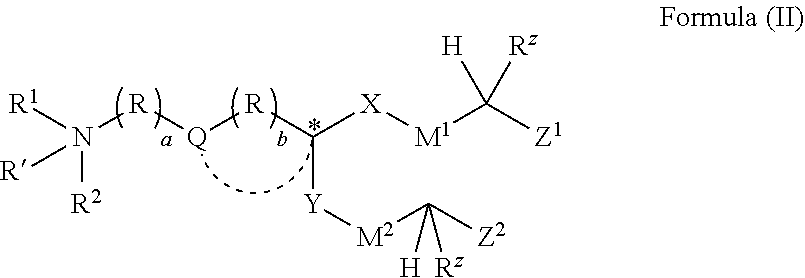
- the cationic lipid is a compound of formula (II), which has a branched alkyl at the alpha position adjacent to the biodegradable group (between the biodegradable group and the terminus of the tail, i.e., Z 1 o Z 2 )
- R 11 is a C 2 -C 8 alkyl or alkenyl
- X and Y are each, independently —(CH 2 ) n — wherein n is 4 to 20, e.g., 4 to 18, 4 to 16, or 4 to 12. In one embodiment, n is 4, 5, 6, 7, 8, 9, or 10. In one exemplary embodiment, X and Y are —(CH 2 ) 6 —. In another embodiment, X and Y are —(CH 2 ) 7 —. In yet another embodiment, X and Y are —(CH 2 ) 9 —. In yet another embodiment, X and Y are —(CH 2 ) 8 —.
- R′R 1 R 2 N—(R) a -Q-(R) b — group can be any of the head groups described herein, including those shown in Table 1 below, and salts thereof.
- R′R 1 R 2 N—(R) a -Q-(R) b — is (CH 3 ) 2 N—(CH 2 ) 3 —C(O)O—, (CH 3 ) 2 N—(CH 2 ) 2 —NH—C(O)O—, (CH 3 ) 2 N—(CH 2 ) 2 —OC(O)—NH—, or (CH 3 ) 2 N—(CH 2 ) 3 —C(CH 3 ) ⁇ N—O—.
- the cationic lipid is a compound of formula (III), which has a branching point at a position that is 2-6 carbon atoms (i.e., at the beta ( ⁇ ), gamma ( ⁇ ), delta ( ⁇ ), epsilon ( ⁇ ) or zeta position( ⁇ ) adjacent to the biodegradable group (between the biodegradable group and the terminus of the tail, i.e., Z 1 or Z 2
- L 1 and L 2 are each —CH 2 —. In another embodiment, L 1 and L 2 are each —(CH 2 ) 2 —. In one embodiment, L 1 and L 2 are each —(CH 2 ) 3 —. In yet another embodiment, L 1 and L 2 are each —(CH 2 ) 4 —. In yet another embodiment, L 1 and L 2 are each —(CH 2 ) 5 —. In yet another embodiment, L 1 and L 2 are each —CH 2 —CH ⁇ CH—. In a preferred embodiment, L 1 and L 2 are each —CH 2 — or —(CH 2 ) 2 .
- X and Y are each, independently —(CH 2 ) n wherein n is 4 to 20, e.g., 4 to 18, 4 to 16, or 4 to 12. In one embodiment, n is 4, 5, 6, 7, 8, 9, or 10. In one exemplary embodiment, X and Y are —(CH 2 ) 7 —. In another exemplary embodiment, X and Y are —(CH 2 ) 8 —. In yet another exemplary embodiment, X and Y are —(CH 2 ) 9 —.
- Z 1 and Z 2 are branched alkyl or branched alkenyl groups.
- the alkoxy substitution on Z 1 and/or Z 2 is at the beta position from the M 1 and/or M 2 group.
- X and Y are each, independently —(CH 2 ) n — wherein n is 4 to 20, e.g., 4 to 18, 4 to 16, or 4 to 12. In one embodiment, n is 4, 5, 6, 7, 8, 9, or 10. In one exemplary embodiment, X and Y are —(CH 2 ) 6 —. In another embodiment, X and Y are —(CH 2 ) 7 —. In yet another embodiment, X and Y are —(CH 2 ) 9 —. In yet another embodiment, X and Y are —(CH 2 ) 8 —.
- the terminus of R 9 and R 10 is separated from the tertiary carbon atom marked with an asterisk (*) by a chain of 18-22 carbon atoms (e.g., 18-20 carbon atoms).
- the terminus of the R 9 and/or R 10 has the formula —C(O)O—CF 3 .
- the cationic lipid is a compound of formula (VIB), which has one or more fluoro substituents on at least one tail at a position that is either alpha to a double bond or alpha to a biodegradable group:
- the pegylated primary group includes (i) a head group having a PEG moiety, and (ii) a central moiety (e.g., a central carbon atom) to which both the hydrophobic tails are directly bonded.
- Representative central moieties include, but are not limited to, a central carbon atom, a central nitrogen atom, a central carbocyclic group, a central aryl group, a central hetrocyclic group (e.g., central tetrahydrofuranyl group or central pyrrolidinyl group) and a central heteroaryl group.
- R 3 is —H, —R c , or —OR c ; and R c is —H, alkyl (e.g., C 1 -C 4 alkyl), acyl, cycloalkyl, alkenyl, alkynyl, aryl, heteroaryl, or heterocyclyl.
- lipid particle that includes a cationic lipid and/or PEG lipid of the present invention.
- the lipid particle includes a cationic lipid of the present invention (e.g., of one of formulas (I)-(VIII)).
- the lipid particle includes a PEG lipid of the present invention (e.g., of formula (IX)).
- the lipid particle includes a cationic lipid of the present invention and a PEG lipid of the present invention.
- the lipid particle includes a neutral lipid, a lipid capable of reducing aggregation, a cationic lipid, and optionally, a sterol (e.g., cholesterol).
- Suitable neutral lipids include, but are not limited to, distearoylphosphatidylcholine (DSPC), dipalmitoylphosphatidylcholine (DPPC), POPC, DOPE, and SM.
- Suitable lipids capable of reducing aggregation include, but are not limited to, a PEG lipid, such as PEG-DMA, PEG-DMG, and those of the present invention (e.g., of formula (IX)) or a combination thereof.
- the lipid particle may further include an active agent (e.g., a therapeutic agent).
- the active agent can be a nucleic acid such as a plasmid, an immunostimulatory oligonucleotide, an siRNA, an antisense oligonucleotide, a microRNA, an antagomir, an aptamer, or a ribozyme.
- the nucleic acid is a siRNA.
- the nucleic acid is a miRNA.
- the lipid particle includes a cationic lipid of the present invention, a neutral lipid and a sterol.
- the lipid particle may further include an active agent, such as a nucleic acid (e.g., an siRNA or miRNA).
- the lipid particle includes a PEG lipid of the present invention, a cationic lipid, a neutral lipid, and a sterol.
- the lipid particle may further include an active agent, such as a nucleic acid (e.g., an siRNA or miRNA).
- the lipid particles described herein may be lipid nanoparticles.
- Yet another embodiment of the invention is a pharmaceutical composition which includes a lipid particle of the present invention and a pharmaceutically acceptable carrier.
- the cationic lipid remains intact until delivery of the nucleic acid molecule after which cleavage of the hydrophobic tail occurs in vivo.
- the PEG lipid remains intact until delivery of the nucleic acid molecule after which cleavage of the hydrophobic tail occurs in vivo.
- the present invention relates to a method of delivering a nucleic acid molecule comprising administering a nucleic lipid particle comprising (i) the nucleic acid molecule and (ii) a cationic lipid and/or a PEG lipid of the present invention.
- the cationic lipid and/or a PEG lipid remains intact until delivery of the nucleic acid molecule after which cleavage of the hydrophobic tail occurs in vivo.
- the active agent can be a nucleic acid selected from a plasmid, an immunostimulatory oligonucleotide, an siRNA, an antisense oligonucleotide, a microRNA, an antagomir, an aptamer, and a ribozyme.
- the nucleic acid is a siRNA or miRNA.
- Yet another aspect is a method of treating a disease or disorder characterized by the overexpression of a polypeptide in a subject by providing to the subject a pharmaceutical composition of the present invention, wherein the active agent is a nucleic acid selected from an siRNA, a microRNA, and an antisense oligonucleotide, and wherein the siRNA, microRNA, or antisense oligonucleotide includes a polynucleotide that specifically binds to a polynucleotide that encodes the polypeptide, or a complement thereof.
- the nucleic acid is a siRNA or miRNA.
- Yet another aspect is a method of treating a disease or disorder characterized by underexpression of a polypeptide in a subject by providing to the subject a pharmaceutical composition of the present invention, wherein the active agent is a plasmid that encodes the polypeptide or a functional variant or fragment thereof.
- Yet another aspect is a method of inducing an immune response in a subject by providing to the subject a pharmaceutical composition wherein the active agent is an immunostimulatory oligonucleotide.
- composition or lipid particles described above include a nucleic acid.
- the agent when contacted with cells, can efficiently deliver nucleic acids to the cells.
- a method of delivering a nucleic acid to the interior of a cell by obtaining or forming a composition or lipid particles described above, and contacting the composition or lipid particles with a cell.
- the cationic lipid is a compound of any one of Formulas I-VIII.
- the following disclosure represents various embodiments of the compounds described above, including the compounds of Formulas I-VIII.
- b is 0.
- a is 2, 3, or 4 and b is 0.
- a is 3 and b is 0.
- a is 3, b is 0, and Q is —C(O)O—.
- the biodegradable group present in the cationic lipid is selected from an ester (e.g., —C(O)O— or —OC(O)—), disulfide (—S—S—), oxime (e.g., —C(H) ⁇ N—O— or —O—N ⁇ C(H)—), —C(O)—O—, —OC(O)—, —C(R 5 ) ⁇ N—, —N ⁇ C(R 5 )—, —C(R 5 ) ⁇ N—O—, —O—N ⁇ C(R 5 )—, —O—C(O)O—, —C(O)N(R 5 ), —N(R 5 )C(O)—, —C(S)(NR 5 )—, (NR 5 )C(S)—, —N(R 5 )C(O)N(R 5 )—, —C(O)S—, —SC
- a suitable cholesterol moiety for the cationic lipids of the present invention (including compounds of formulas I-VI) has the formula:
- the head group amine can be a cationic amine; a primary, secondary, or tertiary amine; the head group can include one amine group (monoamine), two amine groups (diamine), three amine groups (triamine), or a larger number of amine groups, as in an oligoamine or polyamine.
- the head group can include a functional group that is less strongly basic than an amine, such as, for example, an imidazole, a pyridine, or a guanidinium group.
- the head group can be zwitterionic. Other head groups are suitable as well.
- the central moiety can include functional groups such as an ether, an ester, a phosphate, a phosphonate, a phosphorothioate, a sulfonate, a disulfide, an acetal, a ketal, an imine, a hydrazone, or an oxime.
- functional groups such as an ether, an ester, a phosphate, a phosphonate, a phosphorothioate, a sulfonate, a disulfide, an acetal, a ketal, an imine, a hydrazone, or an oxime.
- Other central moieties and functional groups are suitable as well.
- a double bond e.g., a carbon-carbon double bond or carbon-nitrogen double bond
- isomerism in the configuration about the double bond (i.e. cis/trans or E/Z isomerism).
- the configuration of a double bond is illustrated in a chemical structure, it is understood that the corresponding isomer can also be present.
- the amount of isomer present can vary, depending on the relative stabilities of the isomers and the energy required to convert between the isomers. Accordingly, some double bonds are, for practical purposes, present in only a single configuration, whereas others (e.g., where the relative stabilities are similar and the energy of conversion low) may be present as inseparable equilibrium mixture of configurations.
- a double-bonded unsaturation is replaced by a cyclic unsaturation.
- the cyclic unsaturation can be a cycloaliphatic unsaturation, e.g., a cyclopropyl, cyclobutyl, cyclopentyl, cyclohexyl, cycloheptyl, or cyclooctyl group.
- the cyclic group can be a polycyclic group, e.g., a bicyclic group or tricyclic group. A bicyclic group can be bridged, fused, or have a spiro structure.
- a double bond moiety can be replaced by a cyclopropyl moiety, e.g.,
- the cationic lipid includes one or more biodegradable groups.
- the biodegradable group(s) include one or more bonds that may undergo bond breaking reactions in a biological environment, e.g., in an organism, organ, tissue, cell, or organelle.
- Functional groups that contain a biodegradable bond include, for example, esters, dithiols, and oximes.
- Biodegradation can be a factor that influences the clearance of the compound from the body when administered to a subject. Biodegredation can be measured in a cell based assay, where a formulation including a cationic lipid is exposed to cells, and samples are taken at various time points.
- the lipid fractions can be extracted from the cells and separated and analyzed by LC-MS. From the LC-MS data, rates of biodegradation (e.g., as t 1/2 values) can be measured.
- One modification that can influence the rate of hydrolysis, and thereby influence the rate of biodegradation and clearance from a subject's body, is to make the leaving group of the hydrolysis reaction have a secondary, rather than primary, alcohol.
- Compound 1 shown above may be metabolized as shown in the scheme below:
- a cationic lipid of any of the embodiments described herein has an in vivo half life (t 1/2 ) (e.g., in the liver, spleen or plasma) of less than about 3 hours, such as less than about 2.5 hours, less than about 2 hours, less than about 1.5 hours, less than about 1 hour, less than about 0.5 hour or less than about 0.25 hours.
- the cationic lipid preferably remains intact, or has a half-life sufficient to form a stable lipid nanoparticle which effectively delivers the desired active pharmaceutical ingredient (e.g., a nucleic acid) to its target but thereafter rapidly degrades to minimize any side effects to the subject.
- the cationic lipid preferably has a t 1/2 in the spleen of from about 1 to about 7 hours.
- a cationic lipid of any of the embodiments described herein containing a biodegradable group or groups has an in vivo half life (t 1/2 ) (e.g., in the liver, spleen or plasma) of less than about 10% (e.g., less than about 7.5%, less than about 5%, less than about 2.5%) of that for the same cationic lipid without the biodegrable group or groups.
- t 1/2 in vivo half life
- Some cationic lipids can be conveniently represented as a hydrophobic group combined via a central moiety (such as a carbon atom) with a headgroup.
- a central moiety such as a carbon atom
- the present invention includes compounds composed of any combination of the head and hydrophobic groups listed below (in combination with a central moiety (such as a central carbon atom).
- head groups include those depicted in Table 1A:
- Suitable primary groups include, but are not limited to, those that are a combination of a head group from table 1A with a central carbon atom.
- Other suitable primary groups include those in table 1B below:
- tail groups includes those of the formula —R 12 -M 1 -R 13 where R 12 is a C 4 -C 14 alkyl or C 4 -C 14 alkenyl, M 1 is a biodegradable group as defined above, and R 13 is a branched alkyl or alkenyl (e.g., a C 10 -C 20 alkyl or C 10 -C 20 alkenyl), such that (i) the chain length of —R 12 -M 1 -R 13 is at most 21 atoms (i.e., the total length of the tail from the first carbon after the tertiary carbon (marked with an asterisk) to a terminus of the tail is at most 21), and (ii) the group —R 2 -M 1 -R 13 has at least 20 carbon atoms (e.g., at least 21 or 22 carbon atoms).
- R 12 is a C 4 -C 14 alkyl or C 4 -C 14 alkenyl
- M 1 is
- the chain length of —R 12 -M-R 13 is at most 21 (e.g., at most 20).
- the chain length can be from about 17 to about 24 or from about 18 to about 20.
- the total carbon atom content of each tail is from about 17 to about 26.
- the total carbon atom content can be from about 19 to about 26 or from about 21 to about 26.
- the tail has the formula:
- R 13 is an alkyl or alkenyl group having from about 13 to about 17 carbon atoms, and the total carbon length of the tail from the first carbon (the leftmost carbon atom above) to a terminus of the tail is at most 20.
- the tail has from about 22 to about 26 carbon atoms.
- the maximum length of R 13 from its attachment point to the ester group of the compound is 12 carbon atoms (e.g., the maximum length can be 11 carbon atoms).
- the branch in the alkyl or alkenyl group is at the 6-position or later from the point of attachment of R 3 to the ester group.
- Suitable R 13 groups include, but are not limited to
- the cationic lipid can be any suitable cationic lipid.
- the cationic lipid can be any suitable cationic lipid.
- R 13 is selected from the groups mentioned above.
- Another example is a tail of the formula
- R 13 is selected from the groups above.
- the cationic lipid having a dihydroitronellol group can be any organic compound having a dihydroitronellol group.
- the cationic lipid having a dihydroitronellol group can be any organic compound having a dihydroitronellol group.
- R 13 group in the tails above is a lavandulol group or a homolog of it as shown below:
- the cationic lipid can be:
- headgrops Various headgrops, linker moieties, and hydrophobic chains I and II are listed below.
- the present invention includes compounds composed of any combination of the head, linker, hydrophobic chain I, and hydrophobic chain II groups listed below.
- the lipid particles and compositions described herein may also include one or more neutral lipids.
- Neutral lipids when present, can be any of a number of lipid species which exist either in an uncharged or neutral zwitterionic form at physiological pH.
- Such lipids include, for example, diacylphosphatidylcholine, diacylphosphatidylethanolamine, ceramide, sphingomyelin, dihydrosphingomyelin, cephalin, and cerebrosides.
- the neutral lipid component is a lipid having two acyl groups (e.g., diacylphosphatidylcholine and diacylphosphatidylethanolamine).
- the neutral lipid contains saturated fatty acids with carbon chain lengths in the range of C 10 to C 20 .
- the neutral lipid includes mono or diunsaturated fatty acids with carbon chain lengths in the range of C 10 to C 20 .
- Suitable neutral lipids include, but are not limited to, DSPC, DPPC, POPC, DOPE, DSPC, and SM.
- the lipid particles and compositions described herein may also include one or more lipids capable of reducing aggregation.
- lipids that reduce aggregation of particles during formation include polyethylene glycol (PEG)-modified lipids (PEG lipids, such as PEG-DMG and PEG-DMA), monosialoganglioside Gml, and polyamide oligomers (“PAO”) such as (described in U.S. Pat. No. 6,320,017, which is incorporated by reference in its entirety).
- Suitable PEG lipids include, but are not limited to, PEG-modified phosphatidylethanolamine and phosphatidic acid, PEG-ceramide conjugates (e.g., PEG-CerC14 or PEG-CerC20) (such as those described in U.S. Pat. No. 5,820,873, incorporated herein by reference), PEG-modified dialkylamines and PEG-modified 1,2-diacyloxypropan-3-amines, PEG-modified diacylglycerols and dialkylglycerols, mPEG (mw2000)-diastearoylphosphatidylethanolamine (PEG-DSPE).
- PEG-ceramide conjugates e.g., PEG-CerC14 or PEG-CerC20
- PEG-modified dialkylamines and PEG-modified 1,2-diacyloxypropan-3-amines PEG-modified diacylglycerols and dialkylgly
- the lipid particles and compositions may include a sterol, such as cholesterol.
- the resulting lipid particles can have a total molar ratio of (mol % cationic lipid/DSPC/Chol/PEG-DMG or PEG-DMA/fusion-promoting peptide) 20/5/20/5/50.
- the neutral lipid, DSPC, in these compositions is replaced with POPC, DPPC, DOPE or SM.
- the lipid particles or compositions contain the antioxidant EDTA (or a salt thereof), the antioxidant citrate (or a salt thereof), or EDTA (or a salt thereof) in combination with one or more (e.g., a mixture of) primary and/or secondary antioxidants such as ⁇ -tocopherol (or a salt thereof) and/or ascorbyl palmitate (or a salt thereof).
- one or more e.g., a mixture of
- primary and/or secondary antioxidants such as ⁇ -tocopherol (or a salt thereof) and/or ascorbyl palmitate (or a salt thereof).
- the antioxidant is present in an amount sufficient to prevent, inhibit, or reduce the degradation of the cationic lipid present in the lipid particle.
- the antioxidant may be present at a concentration of at least about or about 0.1 mM, 0.5 mM, 1 mM, 10 mM, 100 mM, 500 mM, 1 M, 2 M, or 5M, or from about 0.1 mM to about 1 M, from about 0.1 mM to about 500 mM, from about 0.1 mM to about 250 mM, or from about 0.1 mM to about 100 mM.
- lipid particles and compositions described herein can further include an apolipoprotein.
- apolipoprotein or “lipoprotein” refers to apolipoproteins known to those of skill in the art and variants and fragments thereof and to apolipoprotein agonists, analogues or fragments thereof described below.
- the active agent is a nucleic acid, such as a siRNA.
- the active agent can be a nucleic acid encoded with a product of interest, including but not limited to, RNA, antisense oligonucleotide, an antagomir, a DNA, a plasmid, a ribosomal RNA (rRNA), a micro RNA (miRNA) (e.g., a miRNA which is single stranded and 17-25 nucleotides in length), transfer RNA (tRNA), a small interfering RNA (siRNA), small nuclear RNA (snRNA), antigens, fragments thereof, proteins, peptides, vaccines and small molecules or mixtures thereof.
- RNA antisense oligonucleotide
- an antagomir e.g., a DNA, a plasmid, a ribosomal RNA (rRNA), a micro RNA (miRNA) (e.g., a mi
- the nucleic acid is an oligonucleotide (e.g., 15-50 nucleotides in length (or 15-30 or 20-30 nucleotides in length)).
- An siRNA can have, for instance, a duplex region that is 16-30 nucleotides long.
- the nucleic acid is an immunostimulatory oligonucleotide, decoy oligonucleotide, supermir, miRNA mimic, or miRNA inhibitor.
- a supermir refers to a single stranded, double stranded or partially double stranded oligomer or polymer of ribonucleic acid (RNA) or deoxyribonucleic acid (DNA) or both or modifications thereof, which has a nucleotide sequence that is substantially identical to an miRNA and that is antisense with respect to its target.
- miRNA mimics represent a class of molecules that can be used to imitate the gene silencing ability of one or more miRNAs.
- the term “microRNA mimic” refers to synthetic non-coding RNAs (i.e. the miRNA is not obtained by purification from a source of the endogenous miRNA) that are capable of entering the RNAi pathway and regulating gene expression.
- the nucleic acid that is present in a lipid-nucleic acid particle can be in any form.
- the nucleic acid can, for example, be single-stranded DNA or RNA, or double-stranded DNA or RNA, or DNA-RNA hybrids.
- double-stranded RNA include siRNA.
- Single-stranded nucleic acids include, e.g., antisense oligonucleotides, ribozymes, microRNA, and triplex-forming oligonucleotides.
- the lipid particles of the present invention can also deliver nucleic acids which are conjugated to one or more ligands.
- the lipid particles may be formulated as a pharmaceutical composition, e.g., which further comprises a pharmaceutically acceptable diluent, excipient, or carrier, such as physiological saline or phosphate buffer.
- a pharmaceutically acceptable diluent, excipient, or carrier such as physiological saline or phosphate buffer.
- the resulting pharmaceutical preparations may be sterilized by conventional, well known sterilization techniques.
- the aqueous solutions can then be packaged for use or filtered under aseptic conditions and lyophilized, the lyophilized preparation being combined with a sterile aqueous solution prior to administration.
- the compositions may contain pharmaceutically acceptable auxiliary substances as required to approximate physiological conditions, such as pH adjusting and buffering agents, and tonicity adjusting agents, for example, sodium acetate, sodium lactate, sodium chloride, potassium chloride, and calcium chloride.
- the lipidic suspension may include lipid-protective agents which protect lipids against free-radical and lipid-peroxidative damages on storage. Lipophilic free-radical quenchers, such as ⁇ -tocopherol and water-soluble iron-specific chelators, such as ferrioxamine, are suitable.
- the concentration of lipid particle or lipid-nucleic acid particle in the pharmaceutical formulations can vary, for example, from less than about 0.01%, to at or at least about 0.05-5% to as much as 10 to 30% by weight.
- a solution of one or more lipids in one embodiment, a solution of one or more lipids (including a cationic lipid of any of the embodiments described herein) in an organic solution (e.g., ethanol) is prepared.
- a solution of one or more active (therapeutic) agents such as, for example an siRNA molecule or a 1:1 molar mixture of two siRNA molecules
- an aqueous buffered (e.g., citrate buffer) solution is prepared.
- the two solutions are mixed and diluted to form a colloidal suspension of siRNA lipid particles.
- the siRNA lipid particles have an average particle size of about 80-90 nm.
- the dispersion may be filtered through 0.45/2 micron filters, concentrated and diafiltered by tangential flow filtration.
- a subject or patient in whom administration of the complex is an effective therapeutic regimen for a disease or disorder is preferably a human, but can be any animal, including a laboratory animal in the context of a clinical trial or screening or activity experiment.
- the methods, compounds and compositions of the present invention are particularly suited to administration to any animal, particularly a mammal, and including, but by no means limited to, humans, domestic animals, such as feline or canine subjects, farm animals, such as but not limited to bovine, equine, caprine, ovine, and porcine subjects, wild animals (whether in the wild or in a zoological garden), research animals, such as mice, rats, rabbits, goats, sheep, pigs, dogs, and cats, avian species, such as chickens, turkeys, and songbirds, i.e., for veterinary medical use.
- biodegradable cationic lipid refers to a cationic lipid having one or more biodegradable groups located in the mid- or distal section of a lipidic moiety (e.g., a hydrophobic chain) of the cationic lipid.
- a lipidic moiety e.g., a hydrophobic chain
- biodegradable groups are —OC(O)—, —C(O)O—, —SC(O)—, —C(O)S—, —OC(S)—, —C(S)O—, —S—S—, —C(R 5 ) ⁇ N—, —N ⁇ C(R 5 )—, —C(R 5 ) ⁇ N—O—, —O—N ⁇ C(R 5 )—, —C(O)(NR 5 )—, —N(R 5 )C(O)—, —C(S)(NR 5 )—, —N(R 5 )C(O)—, —N(R 5 )C(O)N(R 5 )—, —OC(O)O—, —OSi(R 5 ) 2 O—, —C(O)(CR 3 R 4 )C(O)O—, or —OC(O)(CR 3 R 4 )C(O)C(O)
- an “aliphatic” group is a non-aromatic group in which carbon atoms are linked into chains, and is either saturated or unsaturated.
- alkyl and alkylene refer to a straight or branched chain saturated hydrocarbon moiety.
- the alkyl group is a straight chain saturated hydrocarbon.
- the “alkyl” or “alkylene” group contains from 1 to 24 carbon atoms.
- Representative saturated straight chain alkyl groups include methyl, ethyl, n-propyl, n-butyl, n-pentyl, and n-hexyl.
- Representative saturated branched alkyl groups include isopropyl, sec-butyl, isobutyl, tert-butyl, and isopentyl.
- alkenyl refers to a straight or branched chain hydrocarbon moiety having one or more carbon-carbon double bonds. In one embodiment, the alkenyl group contains 1, 2, or 3 double bonds and is otherwise saturated. Unless otherwise specified, the “alkenyl” group contains from 2 to 24 carbon atoms. Alkenyl groups include both cis and trans isomers. Representative straight chain and branched alkenyl groups include ethylenyl, propylenyl, 1-butenyl, 2-butenyl, isobutylenyl, 1-pentenyl, 2-pentenyl, 3-methyl-1-butenyl, 2-methyl-2-butenyl, and 2,3-dimethyl-2-butenyl.
- alkynyl refers to a straight or branched chain hydrocarbon moiety having one or more carbon-carbon triple bonds. Unless otherwise specified, the “alkynyl” group contains from 2 to 24 carbon atoms. Representative straight chain and branched alkynyl groups include acetylenyl, propynyl, 1-butynyl, 2-butynyl, 1-pentynyl, 2-pentynyl, and 3-methyl-1-butynyl.
- branched alkyl refers to an alkyl, alkenyl, or alkynyl group in which one carbon atom in the group (1) is bound to at least three other carbon atoms and (2) is not a ring atom of a cyclic group.
- a spirocyclic group in an alkyl, alkenyl, or alkynyl group is not considered a point of branching.
- acyl refers to a carbonyl group substituted with hydrogen, alkyl, partially saturated or fully saturated cycloalkyl, partially saturated or fully saturated heterocycle, aryl, or heteroaryl.
- acyl groups include groups such as (C 1 -C 20 )alkanoyl (e.g., formyl, acetyl, propionyl, butyryl, valeryl, caproyl, and t-butylacetyl), (C 3 -C 20 )cycloalkylcarbonyl (e.g., cyclopropylcarbonyl, cyclobutylcarbonyl, cyclopentylcarbonyl, and cyclohexylcarbonyl), heterocyclic carbonyl (e.g., pyrrolidinylcarbonyl, pyrrolid-2-one-5-carbonyl, piperidinylcarbonyl, piperazinylcarbonyl, and tetrahydrofur
- aryl refers to an aromatic monocyclic, bicyclic, or tricyclic hydrocarbon ring system. Unless otherwise specified, the “aryl” group contains from 6 to 14 carbon atoms. Examples of aryl moieties include, but are not limited to, phenyl, naphthyl, anthracenyl, and pyrenyl.
- heterocycle refers to a non-aromatic 5- to 8-membered monocyclic, or 7- to 12-membered bicyclic, or 11- to 14-membered tricyclic ring system which is either saturated or unsaturated, and which contains from 1 to 3 heteroatoms if monocyclic, 1-6 heteroatoms if bicyclic, or 1-9 heteroatoms if tricyclic, independently selected from nitrogen, oxygen and sulfur, and wherein the nitrogen and sulfur heteroatoms may be optionally oxidized, and the nitrogen heteroatom may be optionally quaternized.
- the heterocycle may be a cycloalkoxy group.
- heterocycle may be attached to the rest of the molecule via any heteroatom or carbon atom in the heterocycle.
- Heterocycles include, but are not limited to, morpholinyl, pyrrolidinonyl, pyrrolidinyl, piperidinyl, piperizynyl, hydantoinyl, valerolactamyl, oxiranyl, oxetanyl, tetrahydrofuranyl, tetrahydropyranyl, tetrahydropyridinyl, tetrahydroprimidinyl, tetrahydrothiophenyl, tetrahydrothiopyranyl, tetrahydropyrimidinyl, tetrahydrothiophenyl, and tetrahydrothiopyranyl.
- heteroaryl refers to an aromatic 5-8 membered monocyclic, 7-12 membered bicyclic, or 11-14 membered tricyclic ring system having 1-3 heteroatoms if monocyclic, 1-6 heteroatoms if bicyclic, or 1-9 heteroatoms if tricyclic, where the heteroatoms are selected from O, N, or S (e.g., carbon atoms and 1-3, 1-6, or 1-9 heteroatoms of N, O, or S if monocyclic, bicyclic, or tricyclic, respectively).
- the heteroaryl groups herein described may also contain fused rings that share a common carbon-carbon bond.
- substituted refers to the replacement of one or more hydrogen radicals in a given structure with the radical of a specified substituent including, but not limited to: halo, alkyl, alkenyl, alkynyl, aryl, heterocyclyl, thiol, alkylthio, oxo, thioxy, arylthio, alkylthioalkyl, arylthioalkyl, alkylsulfonyl, alkylsulfonylalkyl, arylsulfonylalkyl, alkoxy, aryloxy, aralkoxy, aminocarbonyl, alkylaminocarbonyl, arylaminocarbonyl, alkoxycarbonyl, aryloxycarbonyl, haloalkyl, amino, trifluoromethyl, cyano, nitro, alkylamino, arylamino, alkylaminoalkyl, arylamin
- halogen refers to fluoro, chloro, bromo and iodo.
- protecting groups are any group that reduces or eliminates unwanted reactivity of a functional group.
- a protecting group can be added to a functional group to mask its reactivity during certain reactions and then removed to reveal the original functional group.
- an “alcohol protecting group” is used.
- An “alcohol protecting group” is any group which decreases or eliminates unwanted reactivity of an alcohol functional group.
- Protecting groups can be added and removed using techniques well known in the art.
- the compounds may be prepared by at least one of the techniques described herein or known organic synthesis techniques.
- the di-aldehyde 4 can be synthesized as shown in Scheme 3, using 1-bromo-9-decene.
- Di-aldehyde containing a head group 27 can be useful for the synthesis of terminal ester-substituted lipids using, e.g., a Wittig reaction. Ozonolysis can afford di-aldehyde 4 and 27.
- Compound 30 Compound 29 (133 g, 0.5635 mol) was dissolved in 1.5 L of DCM, CBr 4 (280.35 g, 0.8456 mol) was added into this stirring solution and the reaction mixture was cooled to 0° C. under an inert atmosphere. PPh 3 (251.03 g, 0.9571 mol) was then added in portions keeping the temperature below 20° C. After complete addition, the reaction mixture was stirred for 3 hours at room temperature. After completion of the reaction, the solid (PPh 3 O) that precipitated from the reaction mixture was removed by filtration, and the filtrate was diluted with crushed ice ( ⁇ 1.5 kg) and extracted with DCM (3 ⁇ 750 mL).
- the organic layer was taken in 5 litre beaker, diluted with 500 mL of methanol and cooled to 0° C. To this solution, an excess of NaBH 4 ( ⁇ 5 eq) was added in portions to ensure hydrolysis of the formate ester which was not cleaved by addition of HCl. The resulting solution was stirred for an hour and then volatilites were removed under vacuum. The residue was taken in water (1 L) and acidified by 10% HCl solution (pH 4). The product was then extracted with ethyl acetate (3 ⁇ 1 L). the organic phase was then dried and concentrated on rotary evaporator to afford the desired compound 31 (57 g, 24%) as solid.
- Compound 32 Compound 31 (56 g, 0.1196 mol) was dissolved in 700 mL dry THF and cooled to 0° C. TBSCl (36.06 g, 0.2396 mol) was added slowly followed by the addition of imidazole (32.55 g, 0.4786 mol) under an inert atmosphere. The reaction was then stirred at room temperature for 18 hours. Upon completion, the reaction was quenched with ice ( ⁇ 1 kg) and extracted with ethyl acetate (3 ⁇ 500 mL).
- Compound 33 Compound 32 (60 g, 0.1030 mol) was dissolved in 500 mL ethyl acetate and degassed with N 2 for 20 minutes. (10 wt %) Pd on carbon (12 g) was added and the reaction was stirred under an atmosphere of hydrogen for 18 hours. After completion, the mixture was filtered through a bed of celite and washed with ethyl acetate. The filtrate was evaporated under vacuum to afford compound 33 (19 g, 46%) that was pure enough to use in the next synthetic sequence.
- Compound 34 Compound 33 (8.2 g, 0.0199 mol) was dissolved in 100 mL dry DCM and cooled to 0° C. TEA (22.14 mL, 0.1592 mol) was added under an inert atmosphere. After stirring the mixture for 5 minutes, mesyl chloride (4.6 mL, 0.059 mol) was added drop wise and the reaction was stirred further for 3 hours. After completion of the reaction, the mixture was quenched with ice ( ⁇ 200 g) and extracted with DCM (3 ⁇ 75 mL).
- reaction progress was monitored by 1 H NMR. After completion, the reaction mixture was cooled to 0° C. and quenched by careful addition of saturated NH 4 Cl solution (50 mL) followed by water (200 mL). The aqueous phase was extracted with hexane (3 ⁇ 250 mL). The organic layer was dried and solvent removed under vacuum to afford compound 36 (5 g, 94%), which was used without further purification.
- Compound 39 Compound 37 (2.5 g, 0.00598 mol) was dissolved in 25 mL dry THF and cooled to ⁇ 40° C. n-BuLi (1.4 M in hexane 12.9 mL, 0.01794 mol) was added slowly, followed, after a 10 minute interval, by slow addition of HMPA (25 mL). The resulting mixture was maintained for 30 minutes ⁇ 40° C. under a nitrogen atmosphere. A solution of compound 38 (3.5 g, 1.01196 mol) in 25 mL dry THF was then added drop wise to the cooled reaction mixture. The resulting mixture was warmed to room temperature over 2 hours, then stirred at room temperature for 18 hours.
- Compound 8 can be synthesized as shown in Scheme 6. Either bromides of compound 58, 60, or 62 can be reacted with ethyl formate to generate terminal-functionalized di-olefin chain. Compound 8 can then be prepared from the diolefin chain compounds using standard chemical reactions.
- chain length and linker length as well as alkyl groups in ester functionality and substituents on nitrogen atom can be derivatized.
- Di((Z)-non-2-en-1-yl) 9-hydroxyheptadecanedioate (247) The silyl protected diester 246 (0.3 g, 0.44 mmol) was dissolved in 1 M solution of TBAF in THF (6 mL) and the solution was kept at 40° C. for two days. The reaction mixture was diluted with water (60 mL) and extracted with ether (2 ⁇ 50 mL). The combined organic layers were concentrated and the thus obtained crude product was purified by column to isolate the pure product (0.097 g, 39%).
- the following shorter route was used for the synthesis of analogs of Compound 1 of the present invention
- the commercial 9-bromonon-1-ene 248 was treated with magnesium to form the corresponding Grignard reagent which was reacted with ethylformate to give the corresponding adduct 249 which on treatment with bromobutyryl chloride to provide the bromoester 250.
- the bromoester 250 on treatment with RuO 4 provided the diacid 251.
- the bromodiacid 251 on treatment with dimethylamine provided the amino diacid 252.
- the diacid 252 on treatment with oxalyl chloride in the presence of DMF provided the diacid chlorides 253.
- the lipids 254a-n were synthesized by treating the acid Chloride 253 with respective alcohols.
- the cationic lipids described herein are used to formulate liposomes containing the AD-1661 duplex (shown in the table below) using an in-line mixing method as described in International Publication No. WO 2010/088537, which is incorporated by reference in its entirety.
- the lipid nanoparticles had the formulation shown in the table below.
- lipid Cationic lipid 50% Distearoylphosphatidylcholine (DSPC) 10% Cholesterol 38.5% 1-(monomethoxy-polyethyleneglycol)- 1.5% 2,3-dimyristoylglycerol (PEG-DMG) (with an average PEG molecular weight of 2000) siRNA (AD-1661) —
- the siRNA AD-1661 duplex has the sequence shown below.
- Nf is a 2′F modified nucleobase
- dT is deoxythymidine
- s is phosphothioate
- the lipid nanoparticles was prepared as follows. Cationic lipid, DSPC, cholesterol, and PEG-DMG in the ratio recited in the table above were solubilized in ethanol at a total lipid concentration of 25 mg/mL.
- Lipid nanoparticles containing the cationic lipids listed in the table in Example 36 were prepared as described above.
- FVII Factor VII
- hepatocytes a prominent protein in the coagulation cascade
- FVII levels in plasma can be determined by a simple, plate-based colorimetric assay.
- FVII represents a convenient model for determining siRNA-mediated downregulation of hepatocyte-derived proteins.
- Test formulations of the lipid nanoparticles prepared in Example 35 were initially assessed for their FVII knockdown in female 7-9 week old, 15-25 g, female C57B1/6 mice at 0.1, 0.3, 1.0 and 5.0 mg/kg with 3 mice per treatment group. All studies included animals receiving either phosphate-buffered saline (PBS, control group) or a benchmark formulation. Formulations were diluted to the appropriate concentration in PBS immediately prior to testing. Mice were weighed and the appropriate dosing volumes calculated (10 ⁇ l/g body weight). Test and benchmark formulations as well as PBS (for control animals) were administered intravenously via the lateral tail vein.
- PBS phosphate-buffered saline
- Factor VII levels were assessed using a chromogenic assay (Biophen FVII kit, Hyphen BioMed) according to the manufacturer's instructions and absorbance was measured in a microplate reader equipped with a 405 nm wavelength filter. Plasma FVII levels were quantified and ED 50 values (dose resulting in a 50% reduction in plasma FVII levels compared to control animals) were calculated using a standard curve generated from a pooled sample of serum from control animals. Those formulations of interest showing high levels of FVII knockdown (ED 50 ⁇ 0.1 mg/kg) were re-tested in independent studies at a lower dose range to confirm potency and establish ED 50 levels.
- the HPLC retention time for each biodegradable cationic lipid was measured in lipid nanoparticles prepared from them.
- the lipid nanoparticles were prepared as described in Example 35 using AD-1661 as the payload.
- the retention times are reported in the table below relative to the retention time for cholesterol.
- HPLC buffer used was a mixture of two solutions (Solution #1 and Solution #2).
- the size of the lipid nanoparticles was measured before and after undergoing dialysis overnight. In general, greater changes in lipid nanoparticle size are indicative of lesser stability.
- Dynamic laser light scattering was used to determine the lipid nanoparticle size (expressed as the intensity weighted diameter) with a Zetasizer (Malvern Instruments, Inc. of Westborough, MA). All measurements were made at 532 nm wavelength at the scattering angle of 173° using normal resolution mode as the analysis model.
Landscapes
- Chemical & Material Sciences (AREA)
- Organic Chemistry (AREA)
- Health & Medical Sciences (AREA)
- Life Sciences & Earth Sciences (AREA)
- Pharmacology & Pharmacy (AREA)
- Medicinal Chemistry (AREA)
- Epidemiology (AREA)
- Animal Behavior & Ethology (AREA)
- General Health & Medical Sciences (AREA)
- Public Health (AREA)
- Veterinary Medicine (AREA)
- Molecular Biology (AREA)
- Engineering & Computer Science (AREA)
- Biochemistry (AREA)
- Bioinformatics & Cheminformatics (AREA)
- Proteomics, Peptides & Aminoacids (AREA)
- Chemical Kinetics & Catalysis (AREA)
- Oil, Petroleum & Natural Gas (AREA)
- General Chemical & Material Sciences (AREA)
- Nanotechnology (AREA)
- Optics & Photonics (AREA)
- Biophysics (AREA)
- Physics & Mathematics (AREA)
- Biomedical Technology (AREA)
- Dispersion Chemistry (AREA)
- Medicinal Preparation (AREA)
- Organic Low-Molecular-Weight Compounds And Preparation Thereof (AREA)
- Pharmaceuticals Containing Other Organic And Inorganic Compounds (AREA)
- Medicines That Contain Protein Lipid Enzymes And Other Medicines (AREA)
- Acyclic And Carbocyclic Compounds In Medicinal Compositions (AREA)
Abstract
Description

or a salt thereof (e.g., a pharmaceutically acceptable salt thereof), wherein
-
- R′ is absent, hydrogen, or alkyl (e.g., C1-C4 alkyl);
- with respect to R1 and R2,
- (i) R1 and R2 are each, independently, optionally substituted alkyl, alkenyl, alkynyl, cycloalkylalkyl, heterocycle, or R10;
- (ii) R1 and R2, together with the nitrogen atom to which they are attached, form an optionally substituted heterocylic ring; or
- (iii) one of R1 and R2 is optionally substituted alkyl, alkenyl, alkynyl, cycloalkyl, cycloalkylalkyl, or heterocycle, and the other forms a 4-10 member heterocyclic ring or heteroaryl (e.g., a 6-member ring) with (a) the adjacent nitrogen atom and (b) the (R)a group adjacent to the nitrogen atom;
- each occurrence of R is, independently, —(CR3R4)—;
- each occurrence of R3 and R4 are, independently H, halogen, OH, alkyl, alkoxy, —NH2, R10, alkylamino, or dialkylamino (in one preferred embodiment, each occurrence of R3 and R4 are, independently H or C1-C4 alkyl);
- each occurrence of R10 is independently selected from PEG and polymers based on poly(oxazoline), poly(ethylene oxide), poly(vinyl alcohol), poly(glycerol), poly(N-vinylpyrrolidone), poly[N-(2-hydroxypropyl)methacrylamide] and poly(amino acid)s, wherein (i) the PEG or polymer is linear or branched, (ii) the PEG or polymer is polymerized by n subunits, (iii) n is a number-averaged degree of polymerization between 10 and 200 units, and (iv) wherein the compound of formula has at most two R10 groups (preferably at most one R10 group);
- the dashed line to Q is absent or a bond;
- when the dashed line to Q is absent then Q is absent or is —O—, —NH—, —S—, —C(O)—, —C(O)O—, —OC(O)—, —C(O)N(R4)—, —N(R5)C(O)—, —S—S—, —OC(O)O—, —O—N═C(R5)—, —C(R5)═N—O—, —OC(O)N(R5)—, —N(R5)C(O)N(R5)—, —N(R5)C(O)O—, —C(O)S—, —C(S)O— or —C(R5)═N—O—C(O)—; or
- when the dashed line to Q is a bond then (i) b is 0 and (ii) Q and the tertiary carbon adjacent to it (C*) form a substituted or unsubstituted, mono- or bi-cyclic heterocyclic group having from 5 to 10 ring atoms (e.g., the heteroatoms in the heterocyclic group are selected from O and S, preferably O);
- each occurrence of R5 is, independently, H or alkyl (e.g. C1-C4 alkyl);
- X and Y are each, independently, alkylene or alkenylene (e.g., C4 to C20 alkylene or C4 to C20 alkenylene);
- M1 and M2 are each, independently, a biodegradable group (e.g., —OC(O)—, —C(O)O—, —SC(O)—, —C(O)S—, —OC(S)—, —C(S)O—, —S—S—, —C(R5)═N—, —N═C(R5)—, —C(R5)═N—O—, —O—N═C(R5)—, —C(O)(NR5)—, —N(R5)C(O)—, —C(S)(NR5)—, —N(R5)C(O)—, —N(R5)C(O)N(R5)—, —OC(O)O—, —OSi(R5)2O—, —C(O)(CR3R4)C(O)O—, —OC(O)(CR3R4)C(O)—, or

(wherein R11 is a C2-C8 alkyl or alkenyl));
-
- each occurrence of Rz is, independently, C1-C8 alkyl (e.g., methyl, ethyl, isopropyl, n-butyl, n-pentyl, or n-hexyl);
- a is 1, 2, 3, 4, 5 or 6;
- b is 0, 1, 2, or 3; and
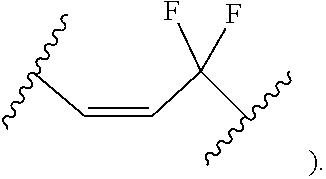
- Z1 and Z2 are each, independently, C8-C14 alkyl or C8-C14 alkenyl, wherein the alkenyl group may optionally be substituted with one or two fluorine atoms at the alpha position to a double bond which is between the double bond and the terminus of Z1 or Z2 (e.g.,

or a salt thereof (e.g., a pharmaceutically acceptable salt thereof), wherein
-
- R′ is absent, hydrogen, or alkyl (e.g., C1-C4 alkyl);
- with respect to R1 and R2,
- (i) R1 and R2 are each, independently, optionally substituted alkyl, alkenyl, alkynyl, cycloalkylalkyl, heterocycle, or R10;
- (ii) R1 and R2, together with the nitrogen atom to which they are attached, form an optionally substituted heterocylic ring; or
- (iii) one of R1 and R2 is optionally substituted alkyl, alkenyl, alkynyl, cycloalkyl, cycloalkylalkyl, or heterocycle, and the other forms a 4-10 member heterocyclic ring or heteroaryl (e.g., a 6-member ring) with (a) the adjacent nitrogen atom and (b) the (R)a group adjacent to the nitrogen atom;
- each occurrence of R is, independently, —(CR3R4)—;
- each occurrence of R3 and R4 are, independently H, halogen, OH, alkyl, alkoxy, —NH2, R10, alkylamino, or dialkylamino (in one preferred embodiment, each occurrence of R3 and R4 are, independently H or C1-C4 alkyl);
- each occurrence of R10 is independently selected from PEG and polymers based on poly(oxazoline), poly(ethylene oxide), poly(vinyl alcohol), poly(glycerol), poly(N-vinylpyrrolidone), poly[N-(2-hydroxypropyl)methacrylamide] and poly(amino acid)s, wherein (i) the PEG or polymer is linear or branched, (ii) the PEG or polymer is polymerized by n subunits, (iii) n is a number-averaged degree of polymerization between 10 and 200 units, and (iv) wherein the compound of formula has at most two R10 groups (preferably at most one R10 group);
- the dashed line to Q is absent or a bond;
- when the dashed line to Q is absent then Q is absent or is —O—, —NH—, —S—, —C(O)—, —C(O)O—, —OC(O)—, —C(O)N(R4)—, —N(R5)C(O)—, —S—S—, —OC(O)O—, —O—N═C(R5)—, —C(R5)═N—O—, —OC(O)N(R5)—, —N(R5)C(O)N(R5)—, —N(R5)C(O)O—, —C(O)S—, —C(S)O— or —C(R5)═N—O—C(O)—; or
- when the dashed line to Q is a bond then (i) b is 0 and (ii) Q and the tertiary carbon adjacent to it (C*) form a substituted or unsubstituted, mono- or bi-cyclic heterocyclic group having from 5 to 10 ring atoms (e.g., the heteroatoms in the heterocyclic group are selected from O and S, preferably O);
- each occurrence of R5 is, independently, H or alkyl;
- X and Y are each, independently, alkylene (e.g., C6-C8 alkylene) or alkenylene, wherein the alkylene or alkenylene group is optionally substituted with one or two fluorine atoms at the alpha position to the M1 or M2 group (e.g.,

-
- M1 and M2 are each, independently, a biodegradable group (e.g., —OC(O)—, —C(O)O—, —SC(O)—, —C(O)S—, —OC(S)—, —C(S)O—, —S—S—, —C(R5)═N—, —N═C(R5)—, —C(R5)═N—O—, —O—N═C(R5)—, —C(O)(NR5)—, —N(R5)C(O)—, —C(S)(NR5)—, —N(R5)C(O)—, —N(R5)C(O)N(R5)—, —OC(O)O—, —OSi(R5)2O—, —C(O)(CR3R4)C(O)O—, —OC(O)(CR3R4)C(O)—, or

(wherein R11 is a C2-C8 alkyl or alkenyl));
-
- each occurrence of Rz is, independently, C1-C8 alkyl (e.g., methyl, ethyl, isopropyl);
- a is 1, 2, 3, 4, 5 or 6;
- b is 0, 1, 2, or 3; and
- Z1 and Z2 are each, independently, C8-C14 alkyl or C8-C14 alkenyl, wherein (i) the alkenyl group may optionally be substituted with one or two fluorine atoms at the alpha position to a double bond which is between the double bond and the terminus of Z1 or Z2 (e.g.,

and (ii) the terminus of at least one of Z1 and Z2 is separated from the group M1 or M2 by at least 8 carbon atoms.

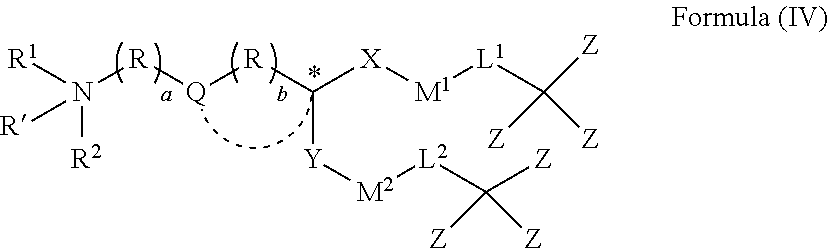
or a salt thereof (e.g., a pharmaceutically acceptable salt thereof), wherein
-
- R′, R1, R2, R, R3, R4, R10, Q, R5, M1, M2, Rz, a, and b are defined as in formula (I);
- L1 and L2 are each, independently, C1-C5 alkylene or C2-C5 alkenylene;
- X and Y are each, independently, alkylene (e.g., C4 to C20 alkylene or C6-C8 alkylene) or alkenylene (e.g., C4 to C20 alkenylene); and
- Z1 and Z2 are each, independently, C8-C14 alkyl or C8-C14 alkenyl, wherein the alkenyl group may optionally be substituted with one or two fluorine atoms at the alpha position to a double bond which is between the double bond and the terminus of Z1 or Z2 (e.g.,

and with the proviso that the terminus of at least one of Z1 and Z2 is separated from the group M1 or M2 by at least 8 carbon atoms.

or a salt thereof (e.g., a pharmaceutically acceptable salt thereof), wherein
-
- R′, R1, R2, R, R3, R4, R10, Q, R5, M1, M2, a, and b are defined as in formula (I);
- each Rz is, independently, C1-C8 alkyl (e.g., C3-C6 alkyl or C2-C3 alkyl);
- L1 and L2 are each, independently, C1-C5 alkylene (e.g., C2-C3 alkylene) or C2-C5 alkenylene;
- X and Y are each, independently, alkylene (e.g., C4 to C20 alkylene or C7-C9 alkylene) or alkenylene (e.g., C4 to C20 alkenylene or C7-C9 alkenylene); and
- Z1 and Z2 are each, independently, C1-C8 alkyl (e.g., C1-C6 alkyl, such as C1, C3 or C5 alkyl) or C2-C8 alkenyl (such as C2-C6 alkenyl);
- wherein said cationic lipid is not one selected from:


or a salt thereof (e.g., a pharmaceutically acceptable salt thereof), wherein
-
- R′, R1, R2, R, R3, R4, R10, Q, R5, M1, M2, Rz, a, and b are defined as in formula (I);
- L1 and L2 and are each, independently, C1-C5alkylene or C2-C5 alkenylene;
- X and Y are each, independently, alkylene or alkenylene (e.g., C12-C20 alkylene or C12-C20 alkenylene); and
- each occurrence of Z is independently C1-C4 alkyl (preferably, methyl).

or a salt thereof (e.g., a pharmaceutically acceptable salt thereof), wherein
-
- R′, R1, R2, R, R3, R4, R10, Q, R5, M1, M2, a, and b are defined as in formula (I); X and Y are each, independently, alkylene (e.g., C6-C8 alkylene) or alkenylene, wherein the alkylene or alkenylene group is optionally substituted with one or two fluorine atoms at the alpha position to the M1 or M2 group (e.g.,

-
- Z1 and Z2 are each, independently, C8-C14 alkyl or C8-C14 alkenyl, wherein (i) the C8-C14 alkyl or C8-C14 alkenyl of at least one of Z1 and Z2 is substituted by one or more alkoxy (e.g., a C1-C4 alkoxy such as —OCH3) or thioalkoxy (e.g., a C1-C4 thioalkoxy such as —SCH3) groups, and (ii) the alkenyl group may optionally be substituted with one or two fluorine atoms at the alpha position to a double bond which is between the double bond and the terminus of Z1 or Z2 (e.g.,

or a salt thereof (e.g., a pharmaceutically acceptable salt thereof), wherein
-
- R1, R2, R, a, and b are as defined with respect to formula (I);
- Q is absent or is —O—, —NH—, —S—, —C(O)—, —C(O)O—, —OC(O)—, —C(O)N(R4)—, —N(R5)C(O)—, —S—S—, —OC(O)O—, —O—N═C(R5)—, —C(R5)═N—O—, —OC(O)N(R5)—, —N(R5)C(O)N(R5)—, —N(R5)C(O)O—, —C(O)S—, —C(S)O— or —C(R5)═N—O—C(O)—;
- R′ is absent, hydrogen, or alkyl (e.g., C1-C4 alkyl); and
- each of R9 and R10 are independently C12-C24 alkyl (e.g., C12-C20 alkyl), C12-C24 alkenyl (e.g., C12-C20 alkenyl), or C12-C24 alkoxy (e.g., C12-C20 alkoxy) (a) having one or more biodegradable groups and (b) optionally substituted with one or more fluorine atoms at a position which is (i) alpha to a biodegradable group and between the biodegradable group and the tertiary carbon atom marked with an asterisk (*), or (ii) alpha to a carbon-carbon double bond and between the double bond and the terminus of the R9 or R10 group; each biodegradable group independently interrupts the C12-C24 alkyl, alkenyl, or alkoxy group or is substituted at the terminus of the C12-C24 alkyl, alkenyl, or alkoxy group, wherein
- (i) at least one of R9 and R10 contains a fluoro group;
- (ii) the compound does not contain the following moiety:
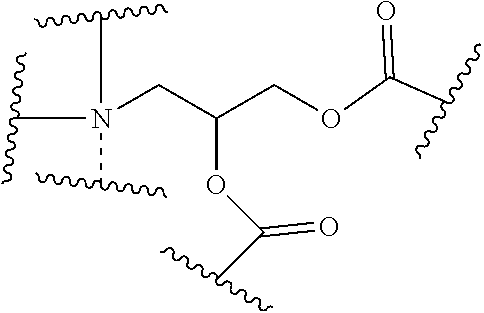
wherein

-
- (iii) the terminus of R9 and R10 is separated from the tertiary carbon atom marked with an asterisk (*) by a chain of 8 or more atoms (e.g., 12 or 14 or more atoms).

or a salt thereof (e.g., a pharmaceutically acceptable salt thereof), wherein
-
- R′, R1, R2, R, R3, R4, R10, Q, R5, M1, M2, a, and b are defined as in formula (I); X and Y are each, independently, alkylene (e.g., C6-C8 alkylene) or alkenylene, wherein the alkylene or alkenylene group is optionally substituted with one or two fluorine atoms at the alpha position to the M1 or M2 group (e.g.,

and
-
- Z1 and Z2 are each, independently, C8-C14 alkyl or C8-C14 alkenyl, wherein said C8-C14 alkenyl is optionally substituted by one or more fluorine atoms at a position that is alpha to a double bond (e.g.,

-
- wherein at least one of X, Y, Z1, and Z2 contains a fluorine atom.


or a salt thereof (e.g., a pharmaceutically acceptable salt thereof), wherein
-
- R′, R1, R2, R, R3, R4, R10, Q, R5, a, and b are defined as in formula (I);
- X and Y are each, independently, alkylene (e.g., C6-C8 alkylene) or alkenylene, wherein the alkylene or alkenylene group is optionally substituted with one or two fluorine atoms at the alpha position to the M1 or M2 group (e.g.,

-
- M1 and M2 are each, independently, a biodegradable group (e.g., —OC(O)—, —C(O)O—, —SC(O)—, —C(O)S—, —OC(S)—, —C(S)O—, —S—S—, —C(R5)═N—, —N═C(R5)—, —C(R5)═N—O—, —O—N═C(R5)—, —C(O)(NR5)—, —N(R5)C(O)—, —C(S)(NR5)—, —N(R5)C(O)—, —N(R5)C(O)N(R5)—, —OC(O)O—, —OSi(R5)2O—, —C(O)(CR3R4)C(O)O—, —OC(O)(CR3R4)C(O)—, or

(wherein R11 is a C4-C10 alkyl or C4-C10 alkenyl));
-
- with the proviso that at least one of M1 and M2 is

and
-
- Z1 and Z2 are each, independently, C4-C14 alkyl or C4-C14 alkenyl, wherein the alkenyl group may optionally be substituted with one or two fluorine atoms at the alpha position to a double bond which is between the double bond and the terminus of Z1 or Z2 (e.g.,


-
- (i) a central carbon atom,
- (ii) a nitrogen containing head group directly bound to the central carbon atom, and
- (iii) two hydrophobic tails directly bound to the central carbon atom, wherein each hydrophobic tail is of the formula —Re-M-Rf where Re is a C4-C14 alkyl or alkenyl, M is a biodegradable group, and Rf is a branched alkyl or alkenyl (e.g., a C10-C20 alkyl or C10-C20 alkenyl), such that (i) the chain length of —Re-M-Rf is at most 20 atoms (i.e. the total length of the tail from the first carbon atom after the central carbon atom to a terminus of the tail is at most 20), and (ii) the group —Re-M-Rf has at least 20 carbon atoms (e.g., at least 21 atoms). Optionally, the alkyl or alkenyl group in Re may be substituted with one or two fluorine atoms at the alpha position to the M1 or M2 group (e.g.,

Also, optionally, the alkenyl group in Rf may be substituted with one or two fluorine atoms at the alpha position to a double bond which is between the double bond and the terminus of Rf (e.g.,


or a salt thereof (e.g., a pharmaceutically acceptable salt thereof), wherein
-
- G is branched or unbranched C3-C15 alkyl, alkenyl or alkynyl (e.g., a n-C8 alkyl n-C9 alkyl, or n-C10 alkyl);
- R12 is a branched or unbranched alkylene or alkenylene (e.g., C6-C20 alkylene or C6-C20 alkenylene such as C12-C20 alkylene or C12-C20 alkenylene);
- M1 is a biodegradable group (e.g., —OC(O)—, —C(O)O—, —SC(O)—, —C(O)S—, —OC(S)—, —C(S)O—, —S—S—, —C(R5)═N—, —N═C(R5)—, —C(R5)═N—O—, —O—N═C(R5)—, —C(O)(NR5)—, —N(R5)C(O)—, —C(S)(NR5)—, —N(R5)C(O)—, —N(R5)C(O)N(R5)—, —OC(O)O—, —OSi(R5)2O—, —C(O)(CR3R4)C(O)O—, —OC(O)(CR3R4)C(O)—, or

(wherein R11 is a C2-C8 alkyl or alkenyl));
-
- R3 and R4 are defined as in formula (I);
- each occurrence of R5 is, independently, H or alkyl (e.g., C1-C4 alkyl);
- R13 is branched or unbranched C3-C15 alkyl, alkenyl or alkynyl;

comprises a protonatable group having a pKa of from about 4 to about 13, more preferably from about 5 to about 8 (e.g. from about 5 to about 7, or from about 5 to about 6.5, or from about 5.5 to about 6.5, or from about 6 to about 6.5).

include, but are not limited to,


where n is 0-6.

wherein w is 0, 1, 2, or 3; and x and y are each independently 1, 2, 3, 4, 5, 6, or 7.


In yet another embodiment, the biodegradable cationic lipid is not one selected from those disclosed in International Publication No. WO 2011/153493 and U.S. Patent Publication No. 2012/0027803, both of which are hereby incorporated by reference.

In another embodiment, the biodegradable cationic lipid is not one selected from those disclosed in International Publication No. WO 2011/153493 and U.S. Patent Publication No. 2012/0027803, both of which are hereby incorporated by reference. The incorporation of the biodegradable group(s) into the cationic lipid results in faster metabolism and removal of the cationic lipid from the body following delivery of the active pharmaceutical ingredient to a target area. In a preferred embodiment, the cationic lipid includes a branched alkyl or branched alkenyl group in its biodegradable group(s). In another preferred embodiment, the cationic lipid has a logP of at least 10.2 or 10.3. In yet another preferred embodiment, the cationic lipid has a tlipid−tchol, of at least 1.75, 2.0, or 2.25. The cationic lipid preferably has a pKa of from about 4 to about 7 (such as 6.0 to 6.5).
-
- (i) a pKa of from about 4 to about 7 (such as 6.0 to 6.5);
- (ii) in at least one hydrophobic tail (and preferably all hydrophobic tails), the biodegradable group is separated from the terminus of the hydrophobic tail by from about 6 to about 12 carbon atoms (for instance, 6 to 8 carbon atoms or 8 to 12 carbon atoms),
- (iii) for at least one hydrophobic tail (and preferably all hydrophobic tails), the chain length from the linker group to the terminus of the hydrophobic tail is at most 21 (e.g., at most 20, or from about 17 to about 21, from about 18 to about 20, or from about 16 to about 18) (The atom(s) in the linker group are not counted when calculating the chain length.);
- (iv) for at least one hydrophobic tail (and preferably all hydrophobic tails), the total number of carbon atoms in the hydrophobic tail is from about 17 to about 26 (such as from about 19 to about 26, or from about 21 to about 26);
- (v) for at least one hydrophobic tail (and preferably all hydrophobic tails), the number of carbon atoms between the linker group and the biodegradable group ranges from about 5 to about 10 (for example, 6 to 10, or 7 to 9);
- (vi) for at least one hydrophobic tail (and preferably all hydrophobic tails), the total number of carbon atoms between the linker group and the terminus of the hydrophobic tail is from about 15 to about 20 (such as from 16 to 20, 16 to 18, or 18 to 20);
- (vii) for at least one hydrophobic tail (and preferably all hydrophobic tails), the total number of carbon atoms between the biodegradable group and the terminus of the hydrophobic tail is from about 12 to about 18 (such as from 13 to 25);
- (viii) for at least one hydrophobic tail (and preferably all hydrophobic tails), the terminal hydrophobic chain in the hydrophobic tail is a branched alkyl or alkenyl group, for example, where the branching occurs at the α, β, γ, or δ position on the hydrophobic chain relative to the biodegradable group;
- (ix) when formulated as a lipid nanoparticle (such as in Example 35), the cationic lipid has an in vivo half life (t1/2) in the liver of less than about 3 hours, such as less than about 2.5 hours, less than about 2 hours, less than about 1.5 hours, less than about 1 hour, less than about 0.5 hour or less than about 0.25 hours;
- (x) when formulated as a lipid nanoparticle (such as in Example 35), the cationic lipid is eliminated from the liver in mice with a greater than 10-fold reduction in lipid levels relative to Cmax within the first 24 hours post-dose;
- (xi) when formulated as a lipid nanoparticle (such as in Example 35), the cationic lipid is eliminated from the spleen in mice with an equal or greater than 10-fold reduction in lipid levels relative to Cmax within the first 168 hours post-dose; and
- (xii) when formulated as a lipid nanoparticle (such as in Example 35), the cationic lipid is eliminated from plasma with a terminal plasma half-life (t1/2β) in rodents and non-human primates of 48 hours or shorter.
-
- (a) designing a cationic lipid having a logP value of at least 10.1 and/or a tlipid−tchol, of at least 1.4, and optionally also having one, two, three, four, or more properties from the list above (i.e., properties (i)-(xii)); and
- (b) synthesizing the cationic lipid of step (a). The cationic lipid in step (a) may comprises (a) a head group (preferably a nitrogen containing head group, such as the head groups described herein), (b) at least two hydrophobic tails, each of the formula -(hydrophobic chain)-(biodegradable group)-(hydrophobic chain), and (c) a linker group (for instance, a single central carbon atom) which is bound to the head group and the hydrophobic tails. Step (a) may comprise:
- (a)(i) preparing one or more cationic lipids having a logP value of at least 10.1 and/or a tlipid−tchol, of at least 1.4, and optionally also having one, two, three, four, or more properties from the list above (i.e., properties (i)-(xii);
- (a)(ii) screening the cationic lipids to determine their efficacy and/or toxicity in lipid nanoparticles; and
- (a)(iii) selecting a cationic lipid for synthesis.
-
- (a) selecting a cationic lipid having a logP value of at least 10.1 and/or a tlipid−tchol, of at least 1.4, and optionally also having one, two, three, four, or more properties from the list above (i.e., properties (i)-(xii)); and
- (b) optionally,
- (i) preparing one or more cationic lipids having a logP value of at least 10.1 and/or a tlipid−tchol, of at least 1.4, and optionally also having one, two, three, four, or more properties from the list above (i.e., properties (i)-(xii);
- (ii) screening the cationic lipids to determine their efficacy and/or toxicity in lipid nanoparticles; and
- (iii) optionally, selecting a cationic lipid for further development or use.

wherein
-
- G1 is branched or unbranched C3-C15 alkyl, alkenyl or alkynyl (e.g., a n-C8 alkyl n-C9 alkyl, or n-C10 alkyl); or G1 is —R12-M1-R13;
- R12 is a branched or unbranched alkylene or alkenylene (e.g., C6-C20 alkylene or C6-C20 alkenylene such as C12-C20 alkylene or C12-C20 alkenylene);
- M1 is a biodegradable group (e.g., —OC(O)—, —C(O)O—, —SC(O)—, —C(O)S—, —OC(S)—, —C(S)O—, —S—S—, —C(R5)═N—, —N═C(R5)—, —C(R5)═N—O—, —O—N═C(R5)—, —C(O)(NR5)—, —N(R5)C(O)—, —C(S)(NR5)—, —N(R5)C(O)—, —N(R5)C(O)N(R5)—, —OC(O)O—, —OSi(R5)2O—, —C(O)(CR3R4)C(O)O—, —OC(O)(CR3R4)C(O)—, or

(wherein R11 is a C2-C8 alkyl or alkenyl));
-
- R3 and R4 are defined as in formula (I);
- each occurrence of R5 is, independently, H or alkyl (e.g., C1-C4 alkyl);
- R13 is branched or unbranched C3-C15 alkyl, alkenyl or alkynyl;

comprises a PEG moiety, such as

moiety wherein b is an integer from 10 to 1,000 (e.g., 5-100, 10-60, 15-50, or 20-45); R3 is —H, —Rc, or —ORc; and Rc is —H, alkyl, acyl, cycloalkyl, alkenyl, alkynyl, aryl, heteroaryl, or heterocyclyl.

include, but are not limited to,

where b is 10-100 (e.g., 20-50 or 40-50)
-
- (i) a pegylated primary group including a head group which includes a PEG moiety (e.g., having from 10 to 1000 repeating units such as ethoxy units)), and
- (iii) one or more hydrophobic tails (preferably, two hydrophobic tails) directly bound to the pegylated primary group, wherein at least one hydrophobic tail is of the formula —Re-M-Rf where Re is a C4-C14 alkyl or alkenyl, M is a biodegradable group, and Rf is a branched alkyl or alkenyl (e.g., a C10-C20 alkyl or C10-C20 alkenyl), such that (i) the chain length of —Re-M-Rf is at most 20 atoms (i.e. the total length of the tail from the first carbon atom after the central carbon atom to a terminus of the tail is at most 20), and (ii) the group —Re-M-Rf has at least 20 carbon atoms (e.g., at least 21 atoms). Optionally, the alkyl or alkenyl group in Re may be substituted with one or two fluorine atoms at the alpha position to the M1 or M2 group (e.g.,

Also, optionally, the alkenyl group in Rf may be substituted with one or two fluorine atoms at the alpha position to a double bond which is between the double bond and the terminus of Rf(e.g.,

In one embodiment, the pegylated primary group includes (i) a head group having a PEG moiety, and (ii) a central moiety (e.g., a central carbon atom) to which the hydrophobic tails are directly bound. The PEG moiety may have 5-100, 10-60, 15-50, or 20-45 repeating units. For example, the PEG moiety may have the formula

moiety wherein b is an integer from 10 to 1,000 (e.g., 5-100, 10-60, 15-50, or 20-45); R3 is —H, —Rc, or —ORc; and Rc is —H, alkyl (e.g., C1-C4 alkyl), acyl, cycloalkyl, alkenyl, alkynyl, aryl, heteroaryl, or heterocyclyl.
-
- —OC(O)—, —C(O)O—, —SC(O)—, —C(O)S—, —OC(S)—, —C(S)O—, —S—S—, —C(R5)═N—, —N═C(R5)—, —C(R5)═N—O—, —O—N═C(R5)—, —C(O)(NR5)—, —N(R5)C(O)—, —C(S)(NR5)—, —N(R5)C(O)—, —N(R5)C(O)N(R5)—, —OC(O)O—, —OSi(R5)2O—, —C(O)(CR3R4)C(O)O—, —OC(O)(CR3R4)C(O)—, or

(wherein R11 is a C2-C8 alkyl or alkenyl).
-
- —OC(O)—, —C(O)—O—, —C(R5)═N—, —N═C(R5)—, —C(R5)═N—O—, —O—N═C(R5)—, —O—C(O)O—, —C(O)N(R5)—, —N(R5)C(O)—, —C(O)S—, —SC(O)—, —C(S)O—, —OC(S)—, —OSi(R5)2O—, —C(O)(CR3R4)C(O)O—, or —OC(O)(CR3R4)C(O)—.
-
- —C(O)—O—, —OC(O)—, —C(R5)═N—, —C(R5)═N—O—, —O—C(O)O—, —C(O)N(R5)—, —C(O)S—, —C(S)O—, —OSi(R5)2O—, —C(O)(CR3R4)C(O)O—, or —OC(O)(CR3R4)C(O)—.

(e.g., R1 is one of the two aforementioned groups and R2 is hydrogen).

where n is 1 to 4 (e.g., n is 2).

where n is 1 to 4 (e.g., n is 2), and R1, R2, R, a, and b are as defined with respect to formula (I). In one embodiment, a is 3.
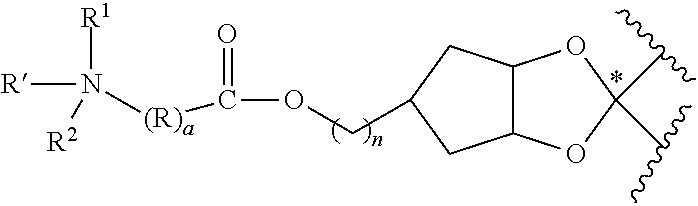
where n is 1 to 4 (e.g., n is 2), and R1, R2, R, a, and b are as defined with respect to formula (I). In one embodiment, a is 0. For example, the group can be:


can be replaced by


includes an ester linkage in each aliphatic chain, which can undergo hydrolysis in a biological environment, for example, when exposed to, e.g., a lipase or an esterase. The structure of the compound, of course, influences the rate at which the compound undergoes biodegradation. Thus, a compound where the methyl substituent is on the other side of the biodegradable group such as

would be expected to exhibit a different rate of biodegradation. Greater effects on that rate would be expected from changes in the structure of the compound at the site of hydrolysis. One modification that can influence the rate of hydrolysis, and thereby influence the rate of biodegradation and clearance from a subject's body, is to make the leaving group of the hydrolysis reaction have a secondary, rather than primary, alcohol.


can be thought of as a combination of a headgroup, a central moiety, and two hydrophobic groups as follows:

| TABLE 1A |
 |
 |
 |
 |
 |
 |
 |
 |
 |
 |
 |
 |
 |
 |
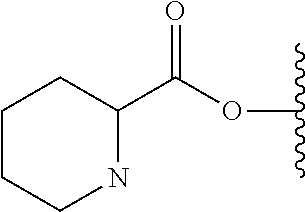 |
 |
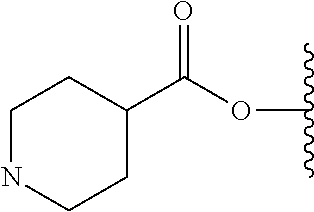 |
 |
 |
 |
 |
 |
 |
 |
 |
 |
 |
 |
 |
 |
 |
 |
 |
 |
 |
 |
 |
 |
 |
 |
 |
 |
 |
 |
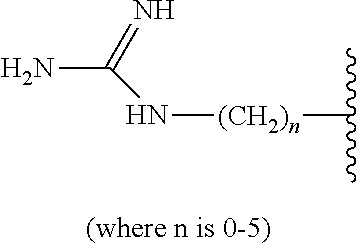 |
 |
 |
 |
 |
| TABLE 1B |
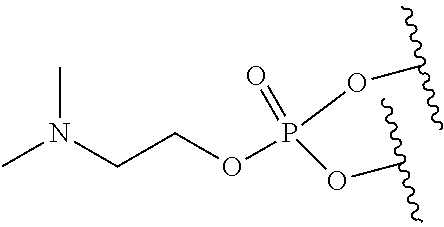 |
 |
 |
 |
 |
 |
 |
 |
| TABLE 1C |
 |
 |
 |
 |
 |
 |
 |
 |
 |
 |
 |
 |
 |
 |
 |
 |
 |
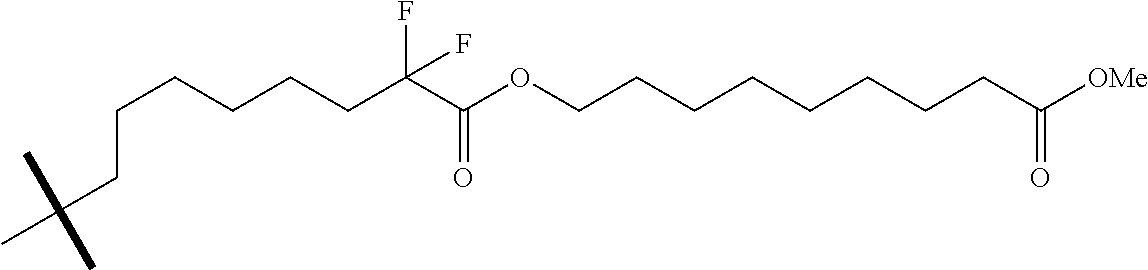 |
 |
 |
 |
 |
 |
 |
 |
 |
 |
 |
 |
 |
 |
 |
 |
 |
 |
 |
 |
 |
 |
 |
 |
 |
 |
 |
 |
 |
 |
 |
 |
 |
 |
 |
 |
 |
 |
 |
 |
 |

where R13 is an alkyl or alkenyl group having from about 13 to about 17 carbon atoms, and the total carbon length of the tail from the first carbon (the leftmost carbon atom above) to a terminus of the tail is at most 20. Preferably, the tail has from about 22 to about 26 carbon atoms. In one embodiment, the maximum length of R13 from its attachment point to the ester group of the compound is 12 carbon atoms (e.g., the maximum length can be 11 carbon atoms). In one preferred embodiment, the branch in the alkyl or alkenyl group is at the 6-position or later from the point of attachment of R3 to the ester group. Suitable R13 groups include, but are not limited to


For example, the cationic lipid can be

or a salt thereof (e.g., a pharmaceutically acceptable salt thereof), where R13 is selected from the groups mentioned above.

where R13 is an alkyl or alkenyl group having from about 13 to about 15 carbon atoms, and the total carbon length of the tail from the first carbon (i.e., the leftmost carbon atom, which is attached to a tertiary carbon) to a terminus of the tail is at most 20. Preferably, the tail has from about 24 to about 26 carbon atoms. In one embodiment, the maximum length of R13 from its attachment point to the ester group of the compound is 10 carbon atoms (e.g., the maximum length can be 9 carbon atoms). In one preferred embodiment, the branch in the alkyl or alkenyl group is at the 8-position or later from the point of attachment of R3 to the ester group. Suitable R3 groups include, but are not limited to

For example, the cationic lipid can be

or a salt thereof (e.g., a pharmaceutically acceptable salt thereof), where R13 is selected from the groups above.

For example, the cationic lipid having a dihydroitronellol group can be
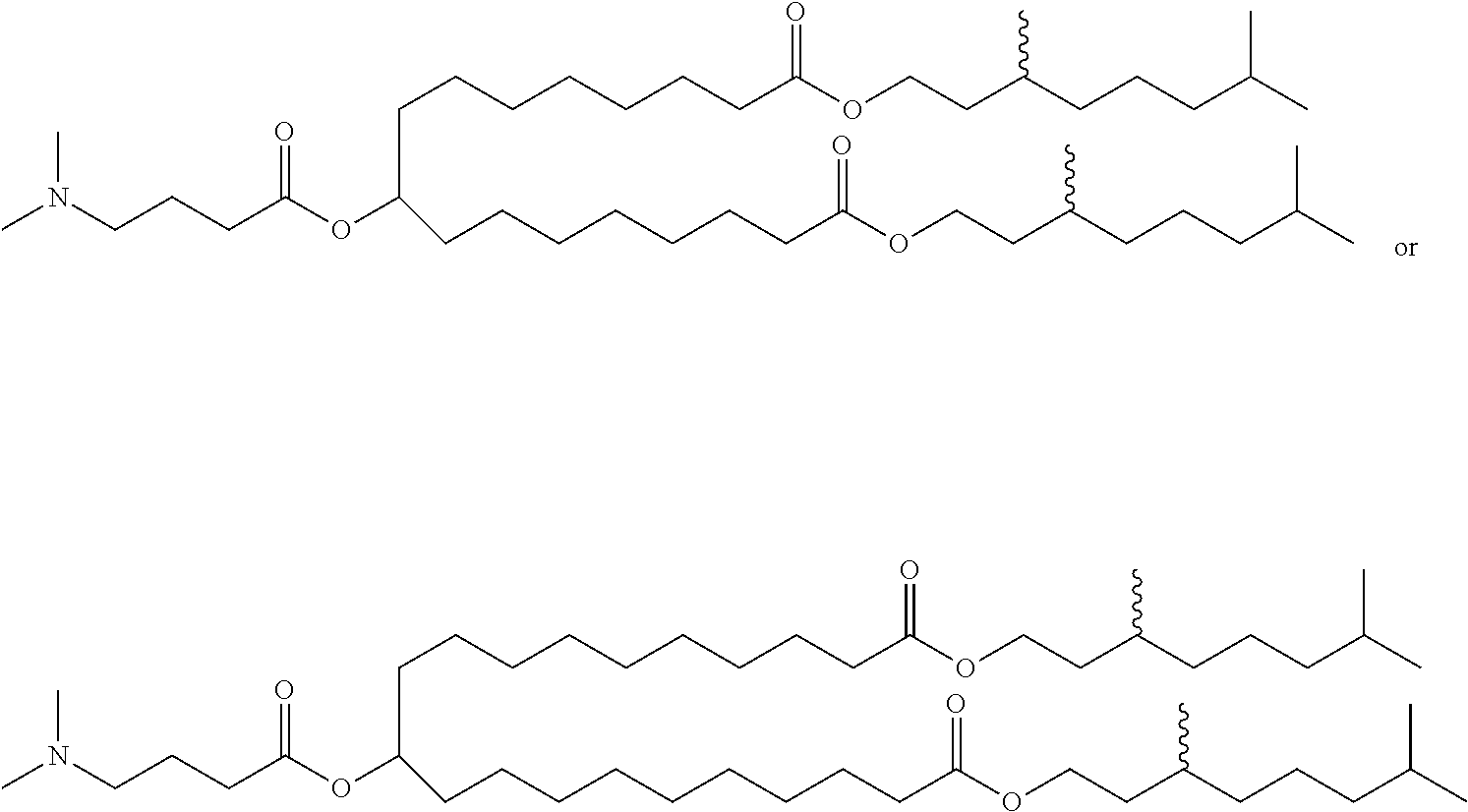
or a salt thereof.


For instance, the cationic lipid can be:
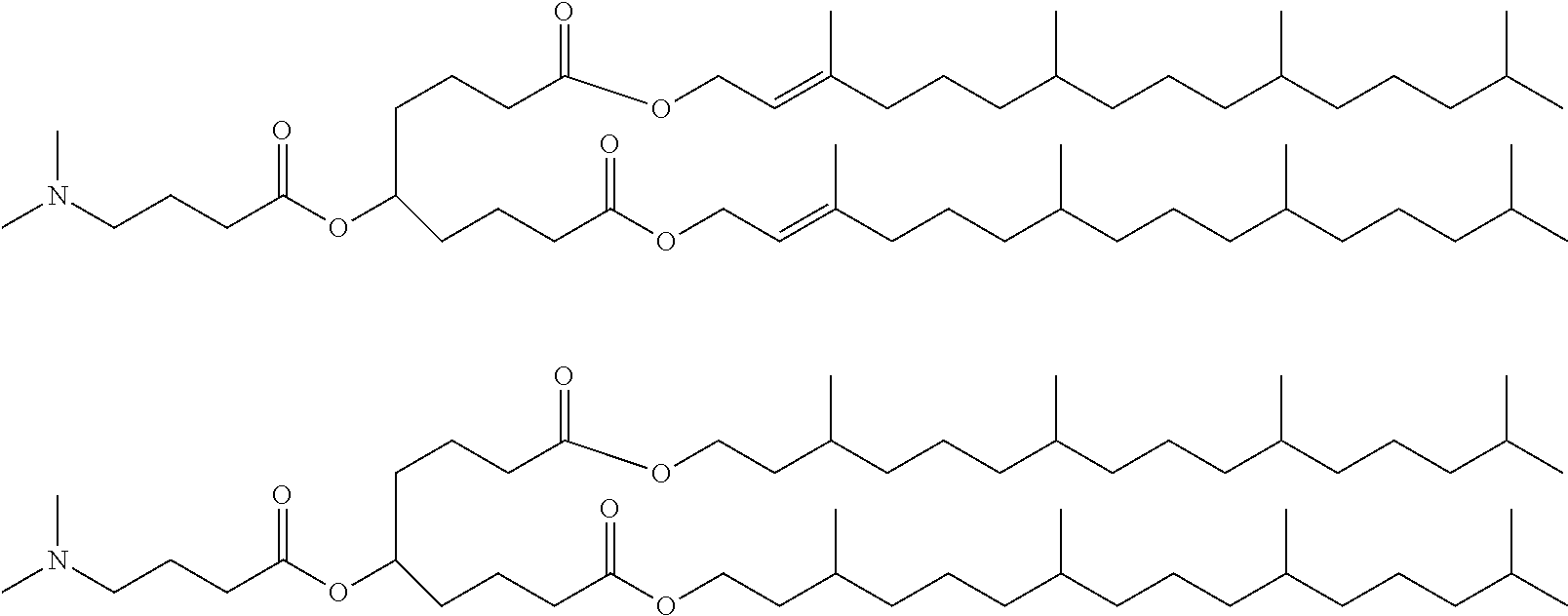

can also be thought of as a combination of a headgroup, a linker moiety, and two parts of the hydrophobic chains as follows:

| TABLE 2A |
| Representative headgroups |
 |
 |
 |
 |
 |
 |
 |
 |
 |
 |
 |
 |
 |
 |
 |
 |
 |
 |
 |
 |
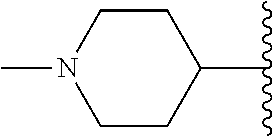 |
 |
 |
 |
 |
 |
 |
 |
 |
 |
 |
 |
 |
 |
 |
 |
 |
 |
 |
 |
 |
 |
 |
 |
 |
 |
 |
 |
 |
 |
 |
 |
 |
 |
 |
 |
 |
 |
 |
 |
| TABLE 2B |
| Representative linker groups |
 |
 |
 |
 |
 |
 |
 |
 |
 |
 |
 |
 |
 |
 |
 |
 |
 |
 |
 |
 |
 |
 |
 |
 |
 |
 |
| TABLE 2C |
| Representative hydrophobic chain I and/or Ia, and combination thereof |
 |
 |
 |
 |
 |
 |
 |
 |
 |
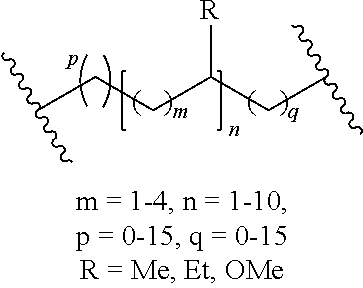 |
| TABLE 2D |
| Representative biodegradable moieties I and/or Ia |
| and combinations thereof |
 |
 |
 |
 |
 |
 |
 |
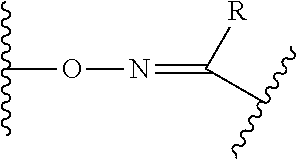 |
 |
 |
 |
 |
 |
 |
 |
 |
 |
 |
 |
| TABLE 2E |
| Representative hydrophobic chain II and/or IIa and combinations thereof |
 |
 |
 |
 |
 |
 |
 |
 |
 |
 |
 |
 |
 |
 |
 |


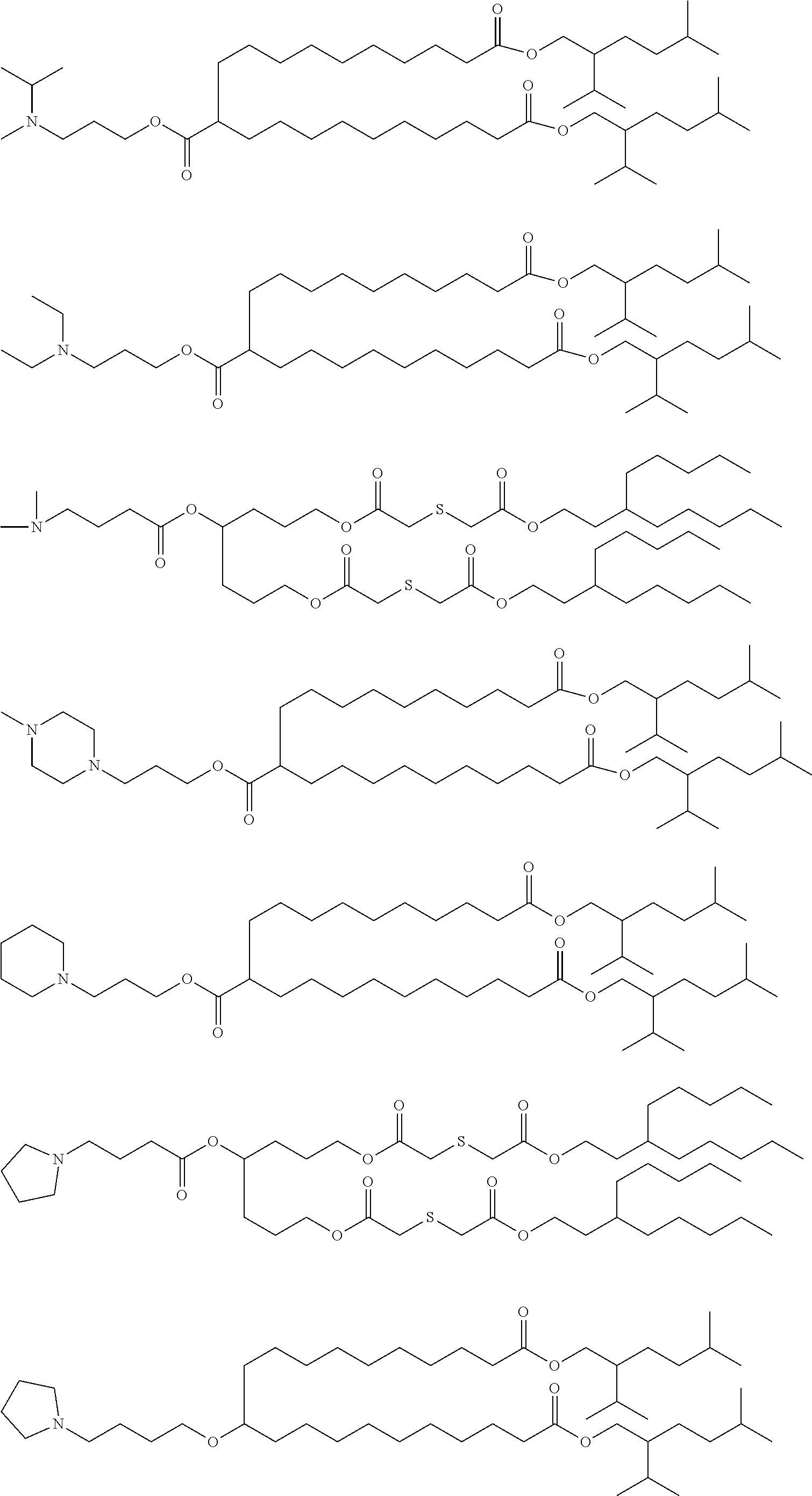


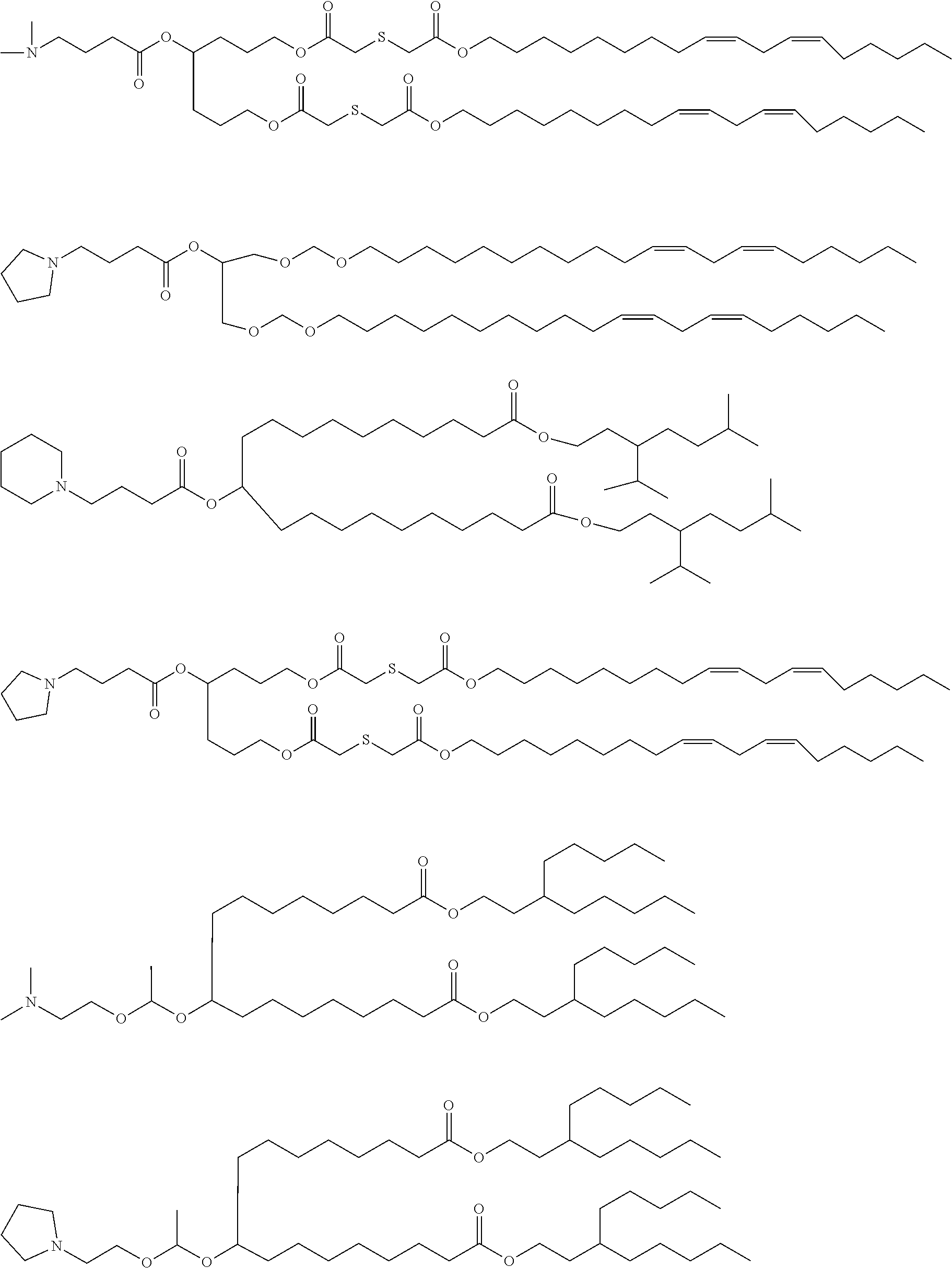


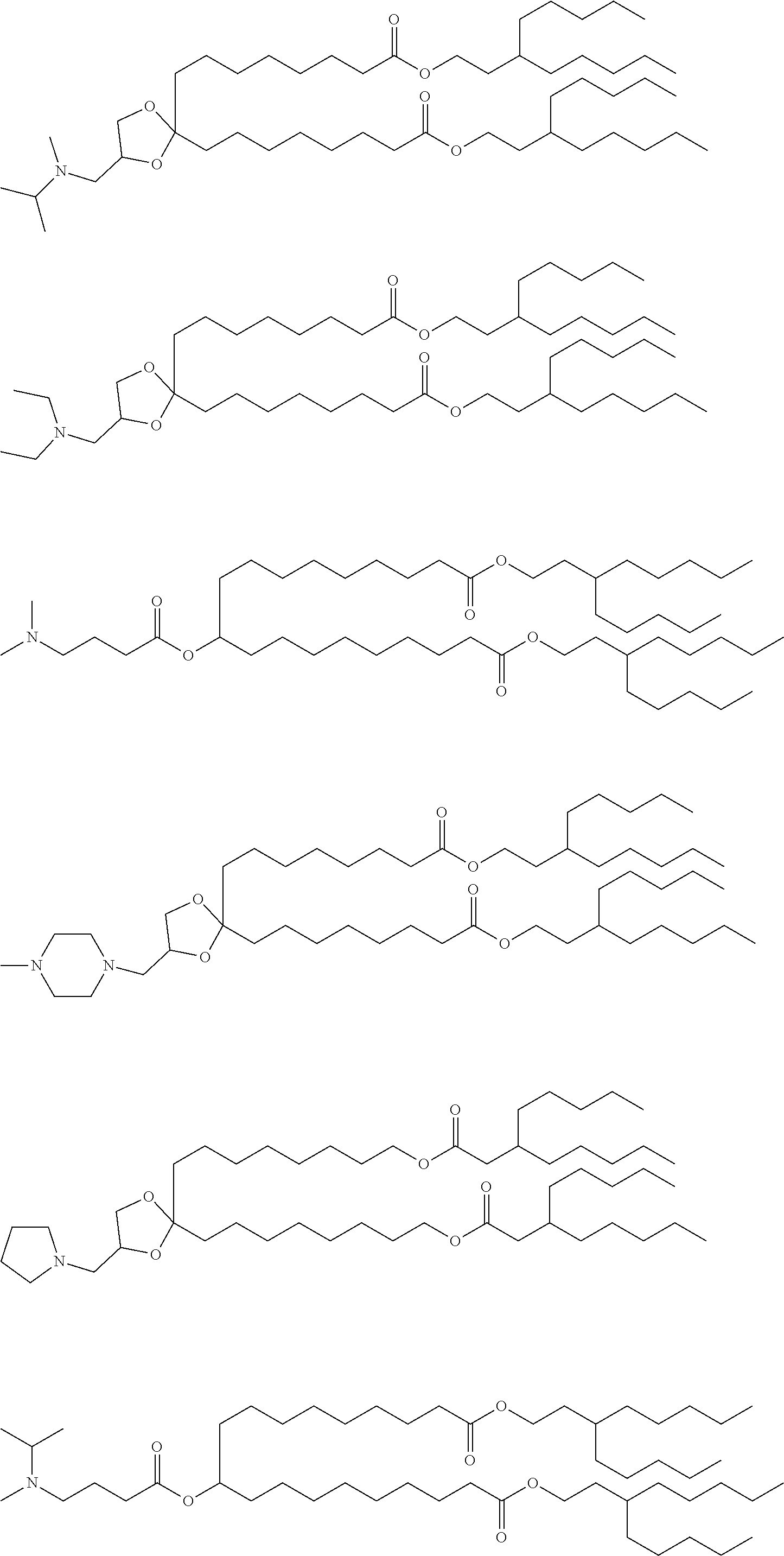


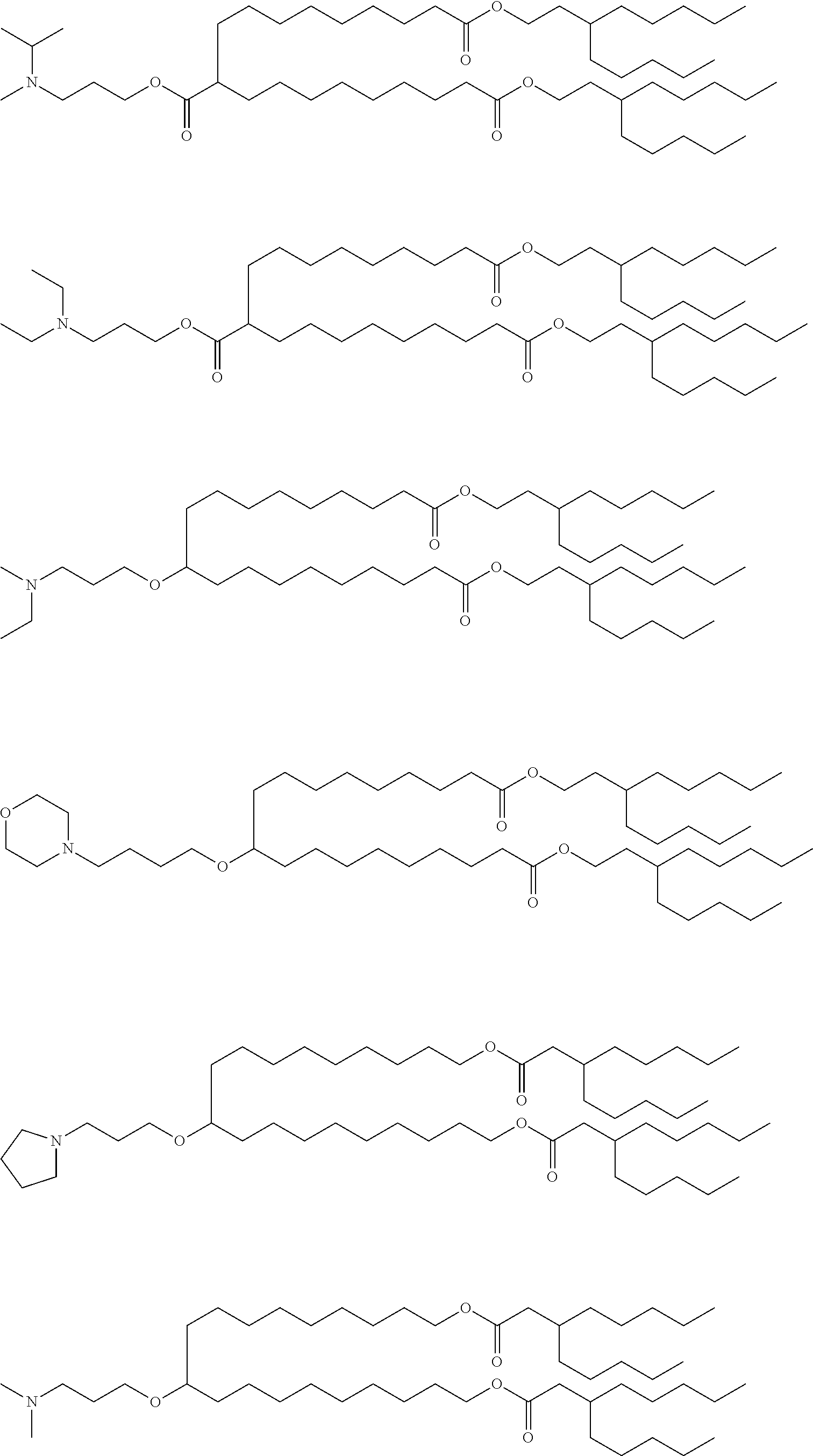


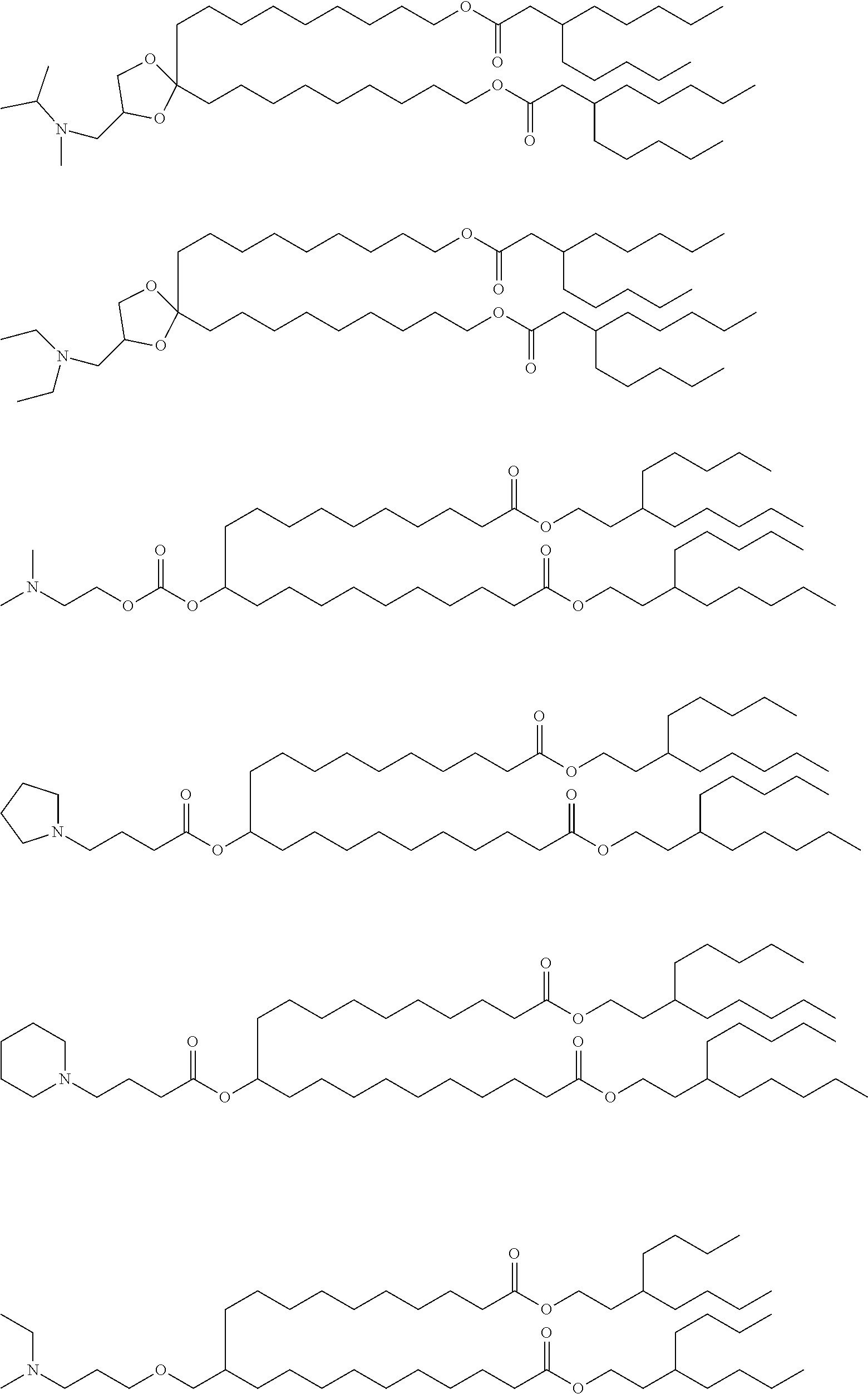


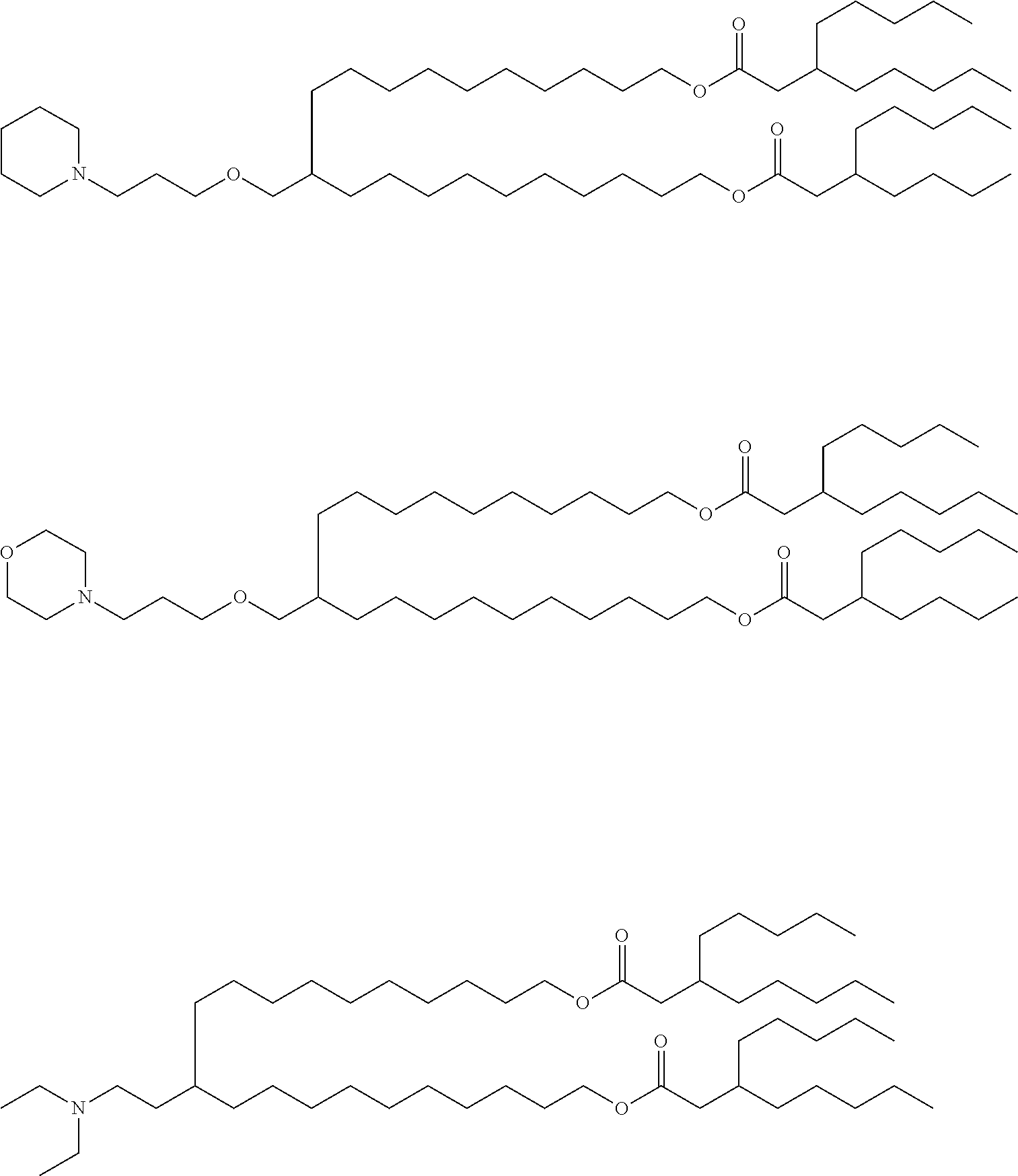


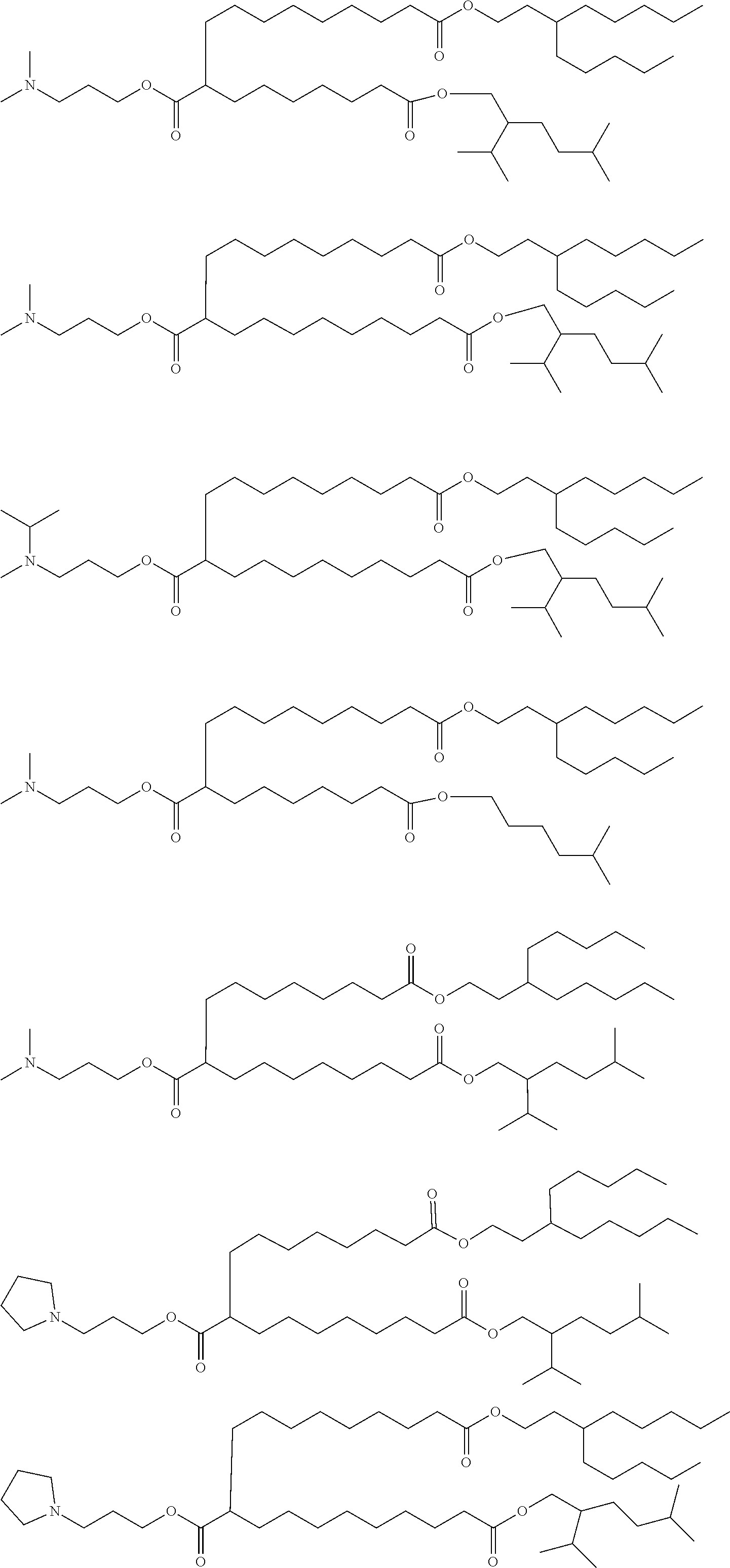


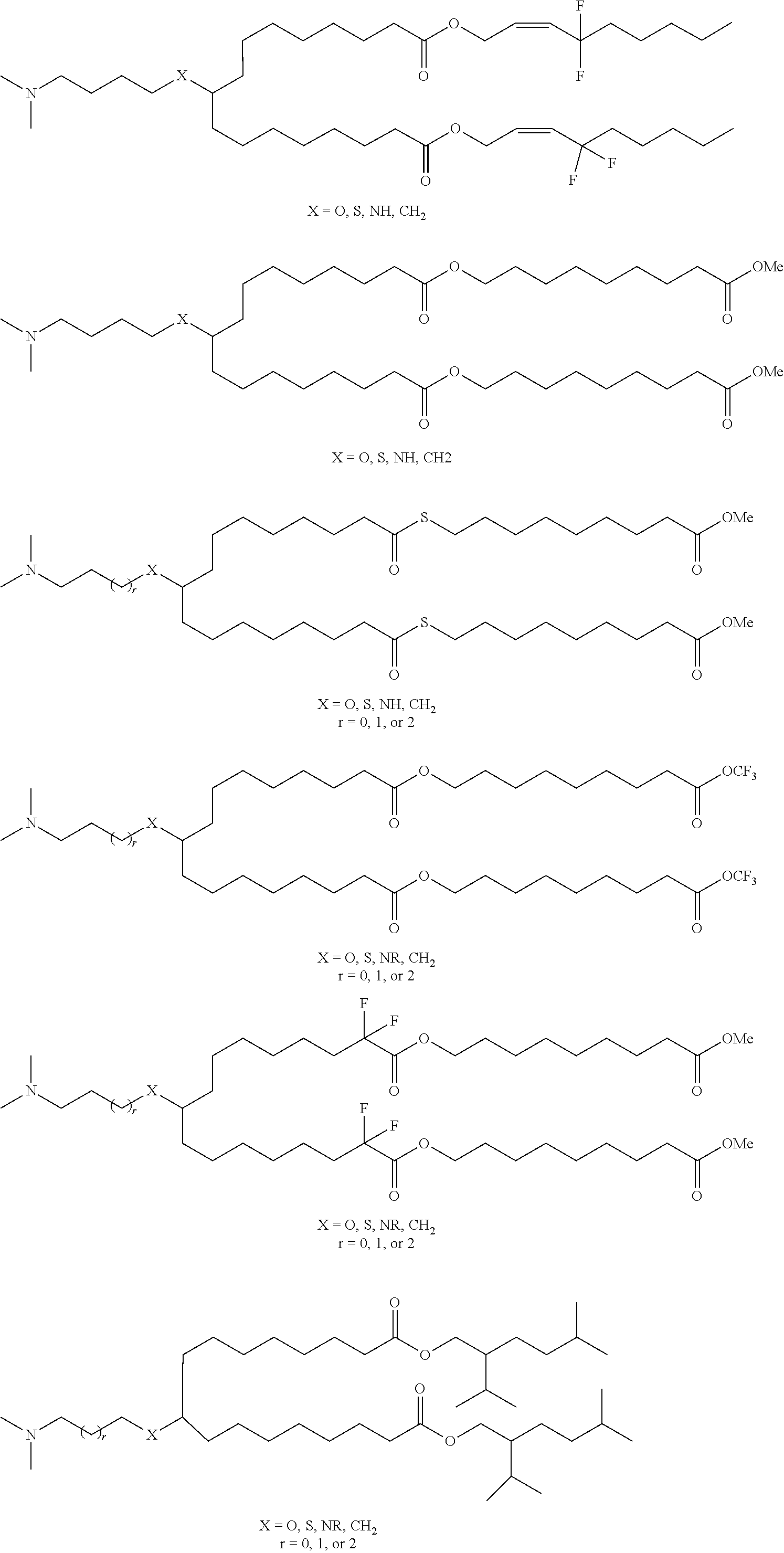


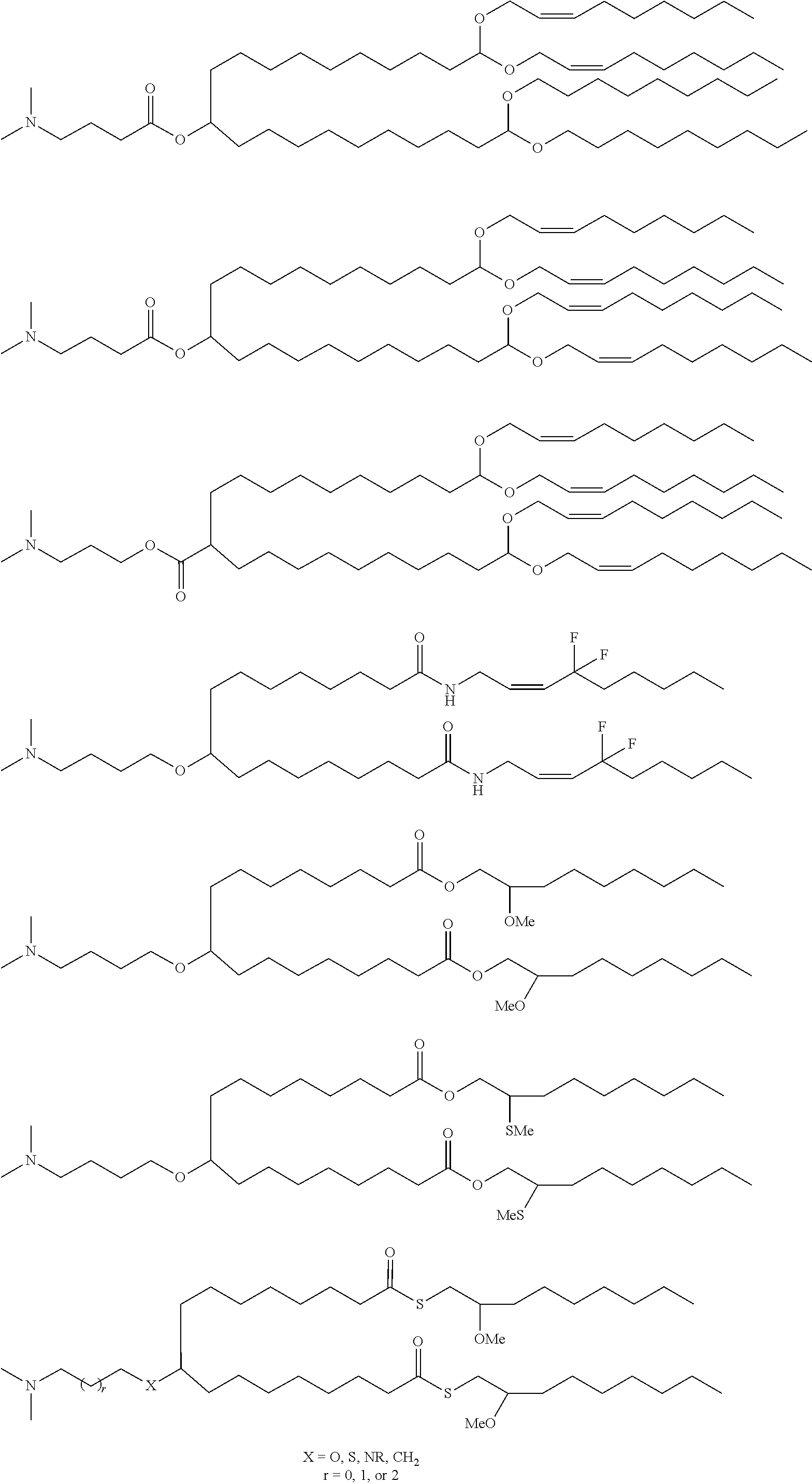


(where X can be, for example, —C(O)O—), the head can have one methylene unit between the X group (or other functional group) and nitrogen atom. For example, the head can be:

| TABLE 3 |
 |
 |
 |
 |
 |
 |
 |
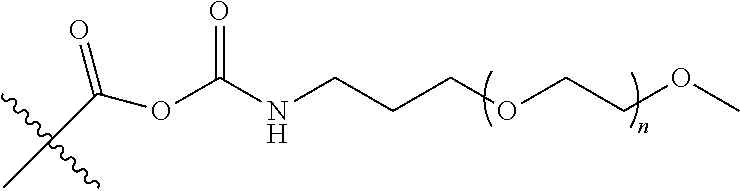 |

wherein
-
- n is an integer from 10 to 100 (e.g. 20-50 or 40-50);
- s, s′, t and t′ are independently 0, 1, 2, 3, 4, 5, 6 or 7; and m is 1, 2, 3, 4, 5, or 6.


The Other Lipid Components
-
- DSPC: distearoylphosphatidylcholine; DPPC: 1,2-Dipalmitoyl-sn-glycero-3-phosphocholine; POPC: 1-palmitoyl-2-oleoyl-sn-phosphatidylcholine; DOPE: 1,2-dileoyl-sn-3-phosphoethanolamine; PEG-DMG generally refers to 1,2-dimyristoyl-sn-glycerol-methoxy polyethylene glycol (e.g., PEG 2000); TBDPSCl: tert-Butylchlorodiphenylsilane; DMAP: dimethylaminopyridine; HMPA: hexamethylphosphoramide; EDC: 1-ethyl-3-(3-dimethylaminopropyl) carbodiimide; DIPEA: diisopropylethylamine; DCM: dichloromethane; TEA: triethylamine; TBAF: tetrabutylammonium fluoride


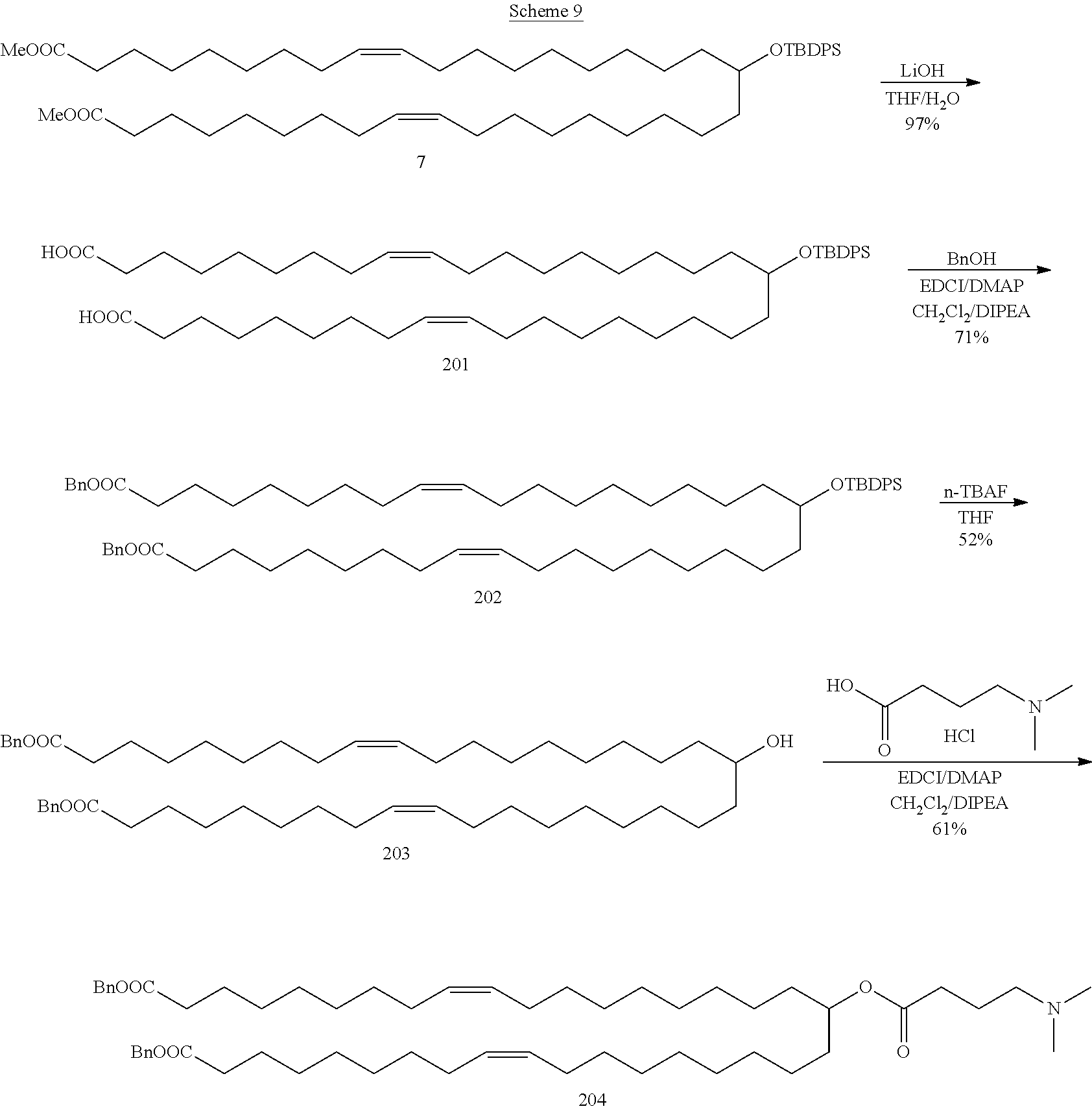


| No | Starting Alcohol (ROH) | Product |
| 254a |
 |
 |
| 254aS |
 |
 |
| 254aF |
 |
 |
| 254b |
 |
 |
| 254bS |
 |
 |
| 254bF |
 |
 |
| 254bF2 |
 |
 |
| 254c |
 |
 |
| 254cS |
 |
 |
| 254cF |
 |
 |
| 254d |
 |
 |
| 254ds |
 |
 |
| 254e |
 |
 |
| 254es |
 |
 |
| 254eF |
 |
 |
| 254f |
 |
 |
| 254fs |
 |
 |
| 254fF |
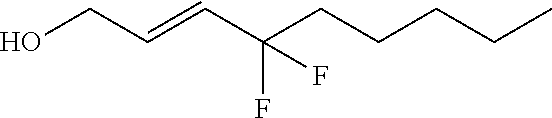 |
 |
| 254g |
 |
 |
| 254gs |
 |
 |
| 254h |
 |
 |
| 254hs |
 |
 |
| 254hF |
 |
 |
| 254i |
 |
 |
| 254is |
 |
 |
| 254iF |
 |
 |
| 254j |
 |
 |
| 254js |
 |
 |
| 254jF |
 |
 |
| 254k |
 |
 |
| 254ks |
 |
 |
| 254kS |
 |
 |
| 254l |
 |
 |
| 254lF |
 |
 |
| 254m |
 |
 |
| 254ms |
 |
 |
| 254ns |
 |
 |
| 254os |
 |
 |


| Mole Percentage | |
| (Based on 100% of the lipid | |
| Component | components in the LNP) |
| Cationic lipid | 50% |
| Distearoylphosphatidylcholine (DSPC) | 10% |
| Cholesterol | 38.5% |
| 1-(monomethoxy-polyethyleneglycol)- | 1.5% |
| 2,3-dimyristoylglycerol (PEG-DMG) | |
| (with an average PEG molecular | |
| weight of 2000) | |
| siRNA (AD-1661) | — |
| SEQ | |||
| Duplex | Sequence 5′-3′ | ID NO: | Target |
| AD-1661 | GGAfUfCAfUfCfUfCAAGfUfCfUfUA | 1 | FVII |
| fCdTsdT | |||
| GfUAAGAfCfUfUGAGAfUGAfUfCfCd | 2 | ||
| TsdT | |||
| ED50 | Cationic Lipid |
| ** |
 |
| ** |
 |
| ** |
 |
| ** |
 |
| ** |
 |
| ** |
 |
| ** |
 |
| ** |
 |
| * |
 |
| ** | |
| * | |
| ** | |
| ** | |
| ** |
 |
| ** |
 |
| ** |
 |
| ** |
 |
| ** |
 |
| ** |
 |
| ** |
 |
| ** |
 |
| ** |
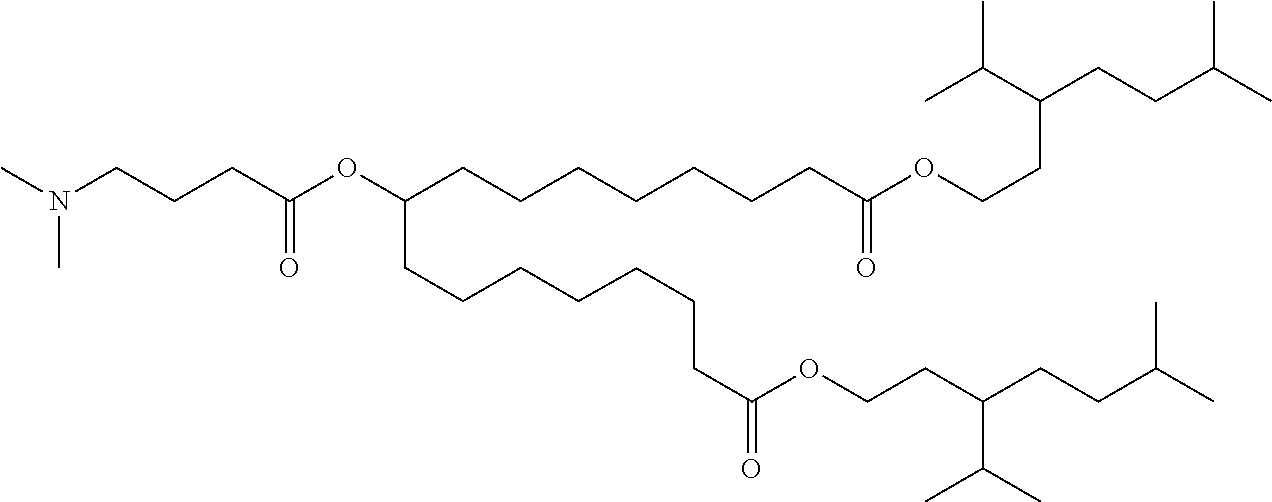 |
| ** |
 |
| ** |
 |
| ** |
 |
| ** |
 |
-
- Solution #1: 80% methanol/20% 10 mM NH4HCO3
- Solution #2: 80% methanol/20% isopropanol
| Time (min) | Solution #1 (vol %) | Solution #2 (vol %) |
| 0 | 70 | 30 |
| 4 | 10 | 90 |
| 6 | 10 | 90 |
| 6.1 | 70 | 30 |
| 8 | 70 | 30 |
| LNPs | |||
| Cationic Lipid | Size | ||
| t(lipid) - | (nm) | ||
| logP | t(chol) | change | |
| 9.647 | −1.4 | 170 -> | |
| 260 | |||
 |
9.972 | 0.848 | 73 -> 77 |
 |
10.093 | 1.44 | 60 -> 67 |
 |
10.201 | 1.751 | 59 -> 60 |
 |
10.259 | 2.106 | |
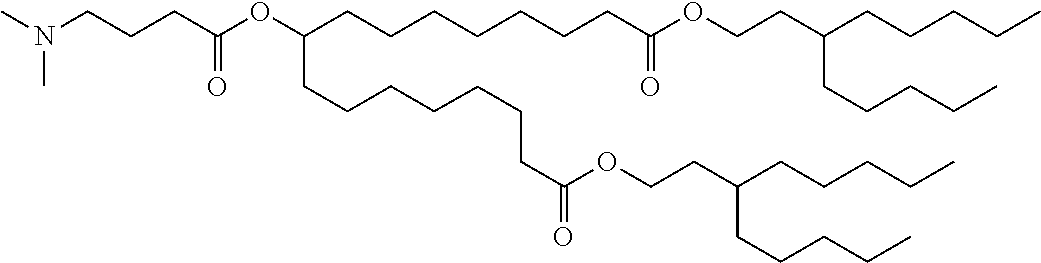 |
10.313 | 2.365 | 56 -> 56 |
 |
10.315 | 2.219 | 68 -> 67 |
 |
10.416 | 2.707 | |
 |
10.495 | 3.178 | |
Claims (14)

Priority Applications (1)
| Application Number | Priority Date | Filing Date | Title |
|---|---|---|---|
| US18/589,688 US12350338B2 (en) | 2011-12-07 | 2024-02-28 | Biodegradable lipids for the delivery of active agents |
Applications Claiming Priority (9)
| Application Number | Priority Date | Filing Date | Title |
|---|---|---|---|
| US201161568133P | 2011-12-07 | 2011-12-07 | |
| US201261623274P | 2012-04-12 | 2012-04-12 | |
| US13/708,383 US9061063B2 (en) | 2011-12-07 | 2012-12-07 | Biodegradable lipids for the delivery of active agents |
| US14/677,801 US10369226B2 (en) | 2011-12-07 | 2015-04-02 | Biodegradable lipids for the delivery of active agents |
| US16/520,183 US11071784B2 (en) | 2011-12-07 | 2019-07-23 | Biodegradable lipids for the delivery of active agents |
| US17/302,311 US11246933B1 (en) | 2011-12-07 | 2021-04-29 | Biodegradable lipids for the delivery of active agents |
| US17/644,914 US11679158B2 (en) | 2011-12-07 | 2021-12-17 | Biodegradable lipids for the delivery of active agents |
| US18/304,097 US20230256098A1 (en) | 2011-12-07 | 2023-04-20 | Biodegradable lipids for the delivery of active agents |
| US18/589,688 US12350338B2 (en) | 2011-12-07 | 2024-02-28 | Biodegradable lipids for the delivery of active agents |
Related Parent Applications (1)
| Application Number | Title | Priority Date | Filing Date |
|---|---|---|---|
| US18/304,097 Continuation US20230256098A1 (en) | 2011-12-07 | 2023-04-20 | Biodegradable lipids for the delivery of active agents |
Publications (2)
| Publication Number | Publication Date |
|---|---|
| US20240269289A1 US20240269289A1 (en) | 2024-08-15 |
| US12350338B2 true US12350338B2 (en) | 2025-07-08 |
Family
ID=47470195
Family Applications (18)
| Application Number | Title | Priority Date | Filing Date |
|---|---|---|---|
| US13/708,383 Active US9061063B2 (en) | 2011-12-07 | 2012-12-07 | Biodegradable lipids for the delivery of active agents |
| US14/677,801 Active US10369226B2 (en) | 2011-12-07 | 2015-04-02 | Biodegradable lipids for the delivery of active agents |
| US16/520,183 Active US11071784B2 (en) | 2011-12-07 | 2019-07-23 | Biodegradable lipids for the delivery of active agents |
| US17/302,310 Abandoned US20220347302A1 (en) | 2011-12-07 | 2021-04-29 | Biodegradable lipids for the delivery of active agents |
| US17/302,311 Active US11246933B1 (en) | 2011-12-07 | 2021-04-29 | Biodegradable lipids for the delivery of active agents |
| US17/644,907 Active US11382979B2 (en) | 2011-12-07 | 2021-12-17 | Biodegradable lipids for the delivery of active agents |
| US17/644,914 Active US11679158B2 (en) | 2011-12-07 | 2021-12-17 | Biodegradable lipids for the delivery of active agents |
| US17/573,878 Active US11400158B2 (en) | 2011-12-07 | 2022-01-12 | Biodegradable lipids for the delivery of active agents |
| US17/651,029 Active US11590229B2 (en) | 2011-12-07 | 2022-02-14 | Biodegradable lipids for the delivery of active agents |
| US17/651,023 Active US11633480B2 (en) | 2011-12-07 | 2022-02-14 | Biodegradable lipids for the delivery of active agents |
| US17/651,017 Active US11633479B2 (en) | 2011-12-07 | 2022-02-14 | Biodegradable lipids for the delivery of active agents |
| US17/651,038 Active US11612657B2 (en) | 2011-12-07 | 2022-02-14 | Biodegradable lipids for the delivery of active agents |
| US18/304,097 Pending US20230256098A1 (en) | 2011-12-07 | 2023-04-20 | Biodegradable lipids for the delivery of active agents |
| US18/541,755 Pending US20240398956A1 (en) | 2011-12-07 | 2023-12-15 | Biodegradable lipids for the delivery of active agents |
| US18/589,688 Active US12350338B2 (en) | 2011-12-07 | 2024-02-28 | Biodegradable lipids for the delivery of active agents |
| US18/589,636 Active US12239709B2 (en) | 2011-12-07 | 2024-02-28 | Biodegradable lipids for the delivery of active agents |
| US18/594,194 Active US12364762B2 (en) | 2011-12-07 | 2024-03-04 | Biodegradable lipids for the delivery of active agents |
| US18/594,172 Active US12343398B2 (en) | 2011-12-07 | 2024-03-04 | Biodegradable lipids for the delivery of active agents |
Family Applications Before (14)
| Application Number | Title | Priority Date | Filing Date |
|---|---|---|---|
| US13/708,383 Active US9061063B2 (en) | 2011-12-07 | 2012-12-07 | Biodegradable lipids for the delivery of active agents |
| US14/677,801 Active US10369226B2 (en) | 2011-12-07 | 2015-04-02 | Biodegradable lipids for the delivery of active agents |
| US16/520,183 Active US11071784B2 (en) | 2011-12-07 | 2019-07-23 | Biodegradable lipids for the delivery of active agents |
| US17/302,310 Abandoned US20220347302A1 (en) | 2011-12-07 | 2021-04-29 | Biodegradable lipids for the delivery of active agents |
| US17/302,311 Active US11246933B1 (en) | 2011-12-07 | 2021-04-29 | Biodegradable lipids for the delivery of active agents |
| US17/644,907 Active US11382979B2 (en) | 2011-12-07 | 2021-12-17 | Biodegradable lipids for the delivery of active agents |
| US17/644,914 Active US11679158B2 (en) | 2011-12-07 | 2021-12-17 | Biodegradable lipids for the delivery of active agents |
| US17/573,878 Active US11400158B2 (en) | 2011-12-07 | 2022-01-12 | Biodegradable lipids for the delivery of active agents |
| US17/651,029 Active US11590229B2 (en) | 2011-12-07 | 2022-02-14 | Biodegradable lipids for the delivery of active agents |
| US17/651,023 Active US11633480B2 (en) | 2011-12-07 | 2022-02-14 | Biodegradable lipids for the delivery of active agents |
| US17/651,017 Active US11633479B2 (en) | 2011-12-07 | 2022-02-14 | Biodegradable lipids for the delivery of active agents |
| US17/651,038 Active US11612657B2 (en) | 2011-12-07 | 2022-02-14 | Biodegradable lipids for the delivery of active agents |
| US18/304,097 Pending US20230256098A1 (en) | 2011-12-07 | 2023-04-20 | Biodegradable lipids for the delivery of active agents |
| US18/541,755 Pending US20240398956A1 (en) | 2011-12-07 | 2023-12-15 | Biodegradable lipids for the delivery of active agents |
Family Applications After (3)
| Application Number | Title | Priority Date | Filing Date |
|---|---|---|---|
| US18/589,636 Active US12239709B2 (en) | 2011-12-07 | 2024-02-28 | Biodegradable lipids for the delivery of active agents |
| US18/594,194 Active US12364762B2 (en) | 2011-12-07 | 2024-03-04 | Biodegradable lipids for the delivery of active agents |
| US18/594,172 Active US12343398B2 (en) | 2011-12-07 | 2024-03-04 | Biodegradable lipids for the delivery of active agents |
Country Status (12)
| Country | Link |
|---|---|
| US (18) | US9061063B2 (en) |
| EP (3) | EP2788006B1 (en) |
| JP (2) | JP6305344B2 (en) |
| AU (2) | AU2012347637B2 (en) |
| CA (2) | CA2856742A1 (en) |
| CY (1) | CY20222200002T2 (en) |
| DE (1) | DE21212055T1 (en) |
| DK (1) | DK3988537T1 (en) |
| ES (1) | ES2921724T1 (en) |
| HK (1) | HK1200089A1 (en) |
| HU (1) | HUE21212055T1 (en) |
| WO (1) | WO2013086354A1 (en) |
Families Citing this family (425)
| Publication number | Priority date | Publication date | Assignee | Title |
|---|---|---|---|---|
| ES3053320T3 (en) * | 2010-06-03 | 2026-01-21 | Alnylam Pharmaceuticals Inc | Biodegradable lipids for the delivery of active agents |
| EP2600901B1 (en) | 2010-08-06 | 2019-03-27 | ModernaTX, Inc. | A pharmaceutical formulation comprising engineered nucleic acids and medical use thereof |
| CN104531812A (en) | 2010-10-01 | 2015-04-22 | 现代治疗公司 | Engineered nucleic acids and methods of use thereof |
| US8710200B2 (en) | 2011-03-31 | 2014-04-29 | Moderna Therapeutics, Inc. | Engineered nucleic acids encoding a modified erythropoietin and their expression |
| US9464124B2 (en) | 2011-09-12 | 2016-10-11 | Moderna Therapeutics, Inc. | Engineered nucleic acids and methods of use thereof |
| BR112014007852B1 (en) | 2011-10-03 | 2021-11-03 | Moderna Therapeutics, Inc | MODIFIED ISOLATED POLYNUCLEOTIDE AND PHARMACEUTICAL COMPOSITION |
| ES2921724T1 (en) | 2011-12-07 | 2022-08-31 | Alnylam Pharmaceuticals Inc | Biodegradable lipids for the administration of active agents |
| JP6305343B2 (en) * | 2011-12-07 | 2018-04-04 | アルニラム・ファーマシューティカルズ・インコーポレーテッド | Branched alkyl and cycloalkyl terminated biodegradable lipids for the delivery of active agents |
| PL2791160T3 (en) | 2011-12-16 | 2022-06-20 | Modernatx, Inc. | Modified mrna compositions |
| BR112014024131A2 (en) | 2012-03-29 | 2017-07-25 | Shire Human Genetic Therapies | ionizable cationic lipids |
| US10501512B2 (en) | 2012-04-02 | 2019-12-10 | Modernatx, Inc. | Modified polynucleotides |
| US9283287B2 (en) | 2012-04-02 | 2016-03-15 | Moderna Therapeutics, Inc. | Modified polynucleotides for the production of nuclear proteins |
| HK1206779A1 (en) | 2012-04-02 | 2016-01-15 | Modernatx, Inc. | Modified polynucleotides for the production of nuclear proteins |
| US9572897B2 (en) | 2012-04-02 | 2017-02-21 | Modernatx, Inc. | Modified polynucleotides for the production of cytoplasmic and cytoskeletal proteins |
| WO2013158579A1 (en) * | 2012-04-19 | 2013-10-24 | Merck Sharp & Dohme Corp. | Novel diester and triester based low molecular weight, biodegradable cationic lipids for oligonucleotide delivery |
| DK2922554T3 (en) | 2012-11-26 | 2022-05-23 | Modernatx Inc | Terminalt modificeret rna |
| WO2014089239A1 (en) * | 2012-12-07 | 2014-06-12 | Alnylam Pharmaceuticals, Inc. | Improved nucleic acid lipid particle formulations |
| EP2971010B1 (en) | 2013-03-14 | 2020-06-10 | ModernaTX, Inc. | Formulation and delivery of modified nucleoside, nucleotide, and nucleic acid compositions |
| US8980864B2 (en) | 2013-03-15 | 2015-03-17 | Moderna Therapeutics, Inc. | Compositions and methods of altering cholesterol levels |
| PT3019619T (en) * | 2013-07-11 | 2021-11-11 | Modernatx Inc | COMPOSITIONS COMPRISING SYNTHETIC POLYNUCLEOTIDES ENCODING SYNTHETIC CRISPR AND SGARN-RELATED PROTEINS AND METHODS OF USE |
| US20160194625A1 (en) | 2013-09-03 | 2016-07-07 | Moderna Therapeutics, Inc. | Chimeric polynucleotides |
| EP3041938A1 (en) | 2013-09-03 | 2016-07-13 | Moderna Therapeutics, Inc. | Circular polynucleotides |
| CA2921161A1 (en) | 2013-09-24 | 2015-04-02 | Alnylam Pharmaceuticals, Inc. | Compositions and methods for the manufacture of lipid nanoparticles |
| US10023626B2 (en) | 2013-09-30 | 2018-07-17 | Modernatx, Inc. | Polynucleotides encoding immune modulating polypeptides |
| WO2015051214A1 (en) | 2013-10-03 | 2015-04-09 | Moderna Therapeutics, Inc. | Polynucleotides encoding low density lipoprotein receptor |
| EP3594348B1 (en) | 2013-11-22 | 2021-09-08 | MiNA Therapeutics Limited | C/ebp alpha short activating rna compositions and methods of use |
| PL3083556T3 (en) | 2013-12-19 | 2020-06-29 | Novartis Ag | Lipids and lipid compositions for the delivery of active agents |
| WO2015095346A1 (en) * | 2013-12-19 | 2015-06-25 | Novartis Ag | Lipids and lipid compositions for the delivery of active agents |
| EP3160938B1 (en) | 2014-06-25 | 2020-09-16 | Acuitas Therapeutics Inc. | Novel lipids and lipid nanoparticle formulations for delivery of nucleic acids |
| AU2015289583A1 (en) | 2014-07-16 | 2017-02-02 | Modernatx, Inc. | Chimeric polynucleotides |
| US10342761B2 (en) | 2014-07-16 | 2019-07-09 | Novartis Ag | Method of encapsulating a nucleic acid in a lipid nanoparticle host |
| US11406742B2 (en) | 2014-07-18 | 2022-08-09 | M.A. Med Alliance SA | Coating for intraluminal expandable catheter providing contact transfer of drug micro-reservoirs |
| US9492594B2 (en) | 2014-07-18 | 2016-11-15 | M.A. Med Alliance SA | Coating for intraluminal expandable catheter providing contact transfer of drug micro-reservoirs |
| WO2016014846A1 (en) | 2014-07-23 | 2016-01-28 | Moderna Therapeutics, Inc. | Modified polynucleotides for the production of intrabodies |
| SG11201700828PA (en) * | 2014-08-07 | 2017-03-30 | Takeda Pharmaceuticals Co | Cationic lipid |
| ES2969956T3 (en) * | 2014-09-05 | 2024-05-23 | Novartis Ag | Lipids and lipid compositions for the delivery of active agents |
| AU2015364508A1 (en) | 2014-12-18 | 2017-07-06 | Alnylam Pharmaceuticals, Inc. | ReversirTM compounds |
| US10081598B2 (en) | 2014-12-26 | 2018-09-25 | Eisai R&D Management Co., Ltd. | Cationic lipid |
| CA2980721C (en) | 2015-03-24 | 2023-10-24 | Kyowa Hakko Kirin Co., Ltd. | Nucleic acid-containing lipid nanoparticles |
| AU2016285852B2 (en) | 2015-06-29 | 2020-12-17 | Acuitas Therapeutics Inc. | Lipids and lipid nanoparticle formulations for delivery of nucleic acids |
| ES2969082T3 (en) | 2015-09-17 | 2024-05-16 | Modernatx Inc | Compounds and compositions for intracellular administration of therapeutic agents |
| MA46316A (en) | 2015-10-22 | 2021-03-24 | Modernatx Inc | HUMAN CYTOMEGALOVIRUS VACCINE |
| FI3368507T3 (en) | 2015-10-28 | 2023-03-21 | Acuitas Therapeutics Inc | New lipids and lipid nanoparticle preparations for delivery of nucleic acids |
| LT3386484T (en) | 2015-12-10 | 2022-06-10 | Modernatx, Inc. | Compositions and methods for delivery of therapeutic agents |
| US10799463B2 (en) | 2015-12-22 | 2020-10-13 | Modernatx, Inc. | Compounds and compositions for intracellular delivery of agents |
| SI3394093T1 (en) | 2015-12-23 | 2022-05-31 | Modernatx, Inc. | Methods of using ox40 ligand encoding polynucleotides |
| WO2017117528A1 (en) * | 2015-12-30 | 2017-07-06 | Acuitas Therapeutics, Inc. | Lipids and lipid nanoparticle formulations for delivery of nucleic acids |
| US20190241658A1 (en) | 2016-01-10 | 2019-08-08 | Modernatx, Inc. | Therapeutic mRNAs encoding anti CTLA-4 antibodies |
| WO2017201332A1 (en) | 2016-05-18 | 2017-11-23 | Modernatx, Inc. | Polynucleotides encoding acyl-coa dehydrogenase, very long-chain for the treatment of very long-chain acyl-coa dehydrogenase deficiency |
| WO2017201342A1 (en) | 2016-05-18 | 2017-11-23 | Modernatx, Inc. | Polynucleotides encoding jagged1 for the treatment of alagille syndrome |
| EP3476832B1 (en) | 2016-06-24 | 2023-04-19 | Eisai R&D Management Co., Ltd. | Cationic lipid |
| US12491261B2 (en) | 2016-10-26 | 2025-12-09 | Acuitas Therapeutics, Inc. | Lipid nanoparticle formulations |
| EP3532103B1 (en) | 2016-10-26 | 2025-12-03 | Acuitas Therapeutics, Inc. | Lipid nanoparticle formulations |
| CA3042015A1 (en) | 2016-10-26 | 2018-05-03 | Modernatx, Inc. | Messenger ribonucleic acids for enhancing immune responses and methods of use thereof |
| US11583504B2 (en) | 2016-11-08 | 2023-02-21 | Modernatx, Inc. | Stabilized formulations of lipid nanoparticles |
| SG11201906969PA (en) | 2017-02-01 | 2019-08-27 | Modernatx Inc | Immunomodulatory therapeutic mrna compositions encoding activating oncogene mutation peptides |
| MX2019011004A (en) | 2017-03-15 | 2020-08-10 | Modernatx Inc | Compounds and compositions for intracellular delivery of therapeutic agents. |
| CA3055653A1 (en) | 2017-03-15 | 2018-09-20 | Modernatx, Inc. | Lipid nanoparticle formulation |
| DK3596042T3 (en) | 2017-03-15 | 2022-04-11 | Modernatx Inc | CRYSTAL FORMS OF AMINOLIPIDS |
| US11338045B2 (en) | 2017-03-17 | 2022-05-24 | Newcastle University | Adeno-associated virus vector delivery of a fragment of micro-dystrophin to treat muscular dystrophy |
| US11905525B2 (en) | 2017-04-05 | 2024-02-20 | Modernatx, Inc. | Reduction of elimination of immune responses to non-intravenous, e.g., subcutaneously administered therapeutic proteins |
| WO2018191719A1 (en) | 2017-04-13 | 2018-10-18 | Acuitas Therapeutics, Inc. | Lipid delivery of therapeutic agents to adipose tissue |
| US11357856B2 (en) | 2017-04-13 | 2022-06-14 | Acuitas Therapeutics, Inc. | Lipids for delivery of active agents |
| IL301115A (en) | 2017-04-28 | 2023-05-01 | Acuitas Therapeutics Inc | New lipid carbonyl and lipid nanoparticle formulations for delivery of nucleic acids |
| US11421011B2 (en) | 2017-05-18 | 2022-08-23 | Modernatx, Inc. | Polynucleotides encoding tethered interleukin-12 (IL12) polypeptides and uses thereof |
| WO2018213789A1 (en) | 2017-05-18 | 2018-11-22 | Modernatx, Inc. | Modified messenger rna comprising functional rna elements |
| US12077501B2 (en) | 2017-06-14 | 2024-09-03 | Modernatx, Inc. | Compounds and compositions for intracellular delivery of agents |
| US20200268666A1 (en) | 2017-06-14 | 2020-08-27 | Modernatx, Inc. | Polynucleotides encoding coagulation factor viii |
| MA49421A (en) | 2017-06-15 | 2020-04-22 | Modernatx Inc | RNA FORMULATIONS |
| CA3073020A1 (en) | 2017-08-16 | 2019-02-21 | Acuitas Therapeutics, Inc. | Lipids for use in lipid nanoparticle formulations |
| US11542225B2 (en) | 2017-08-17 | 2023-01-03 | Acuitas Therapeutics, Inc. | Lipids for use in lipid nanoparticle formulations |
| WO2019036030A1 (en) | 2017-08-17 | 2019-02-21 | Acuitas Therapeutics, Inc. | Lipids for use in lipid nanoparticle formulations |
| WO2019036000A1 (en) | 2017-08-17 | 2019-02-21 | Acuitas Therapeutics, Inc. | Lipids for use in lipid nanoparticle formulations |
| EP3668522B1 (en) | 2017-08-18 | 2024-09-11 | ModernaTX, Inc. | Efficacious mrna vaccines |
| WO2019046809A1 (en) | 2017-08-31 | 2019-03-07 | Modernatx, Inc. | Methods of making lipid nanoparticles |
| CA3075219A1 (en) | 2017-09-08 | 2019-03-14 | Mina Therapeutics Limited | Hnf4a sarna compositions and methods of use |
| EP3679140B1 (en) | 2017-09-08 | 2022-11-16 | MiNA Therapeutics Limited | Stabilized cebpa sarna compositions and methods of use |
| JP6826014B2 (en) * | 2017-09-13 | 2021-02-03 | 株式会社東芝 | Compositions and kits containing biodegradable compounds, lipid particles, lipid particles |
| WO2019089828A1 (en) | 2017-10-31 | 2019-05-09 | Acuitas Therapeutics, Inc. | Lamellar lipid nanoparticles |
| US11939601B2 (en) | 2017-11-22 | 2024-03-26 | Modernatx, Inc. | Polynucleotides encoding phenylalanine hydroxylase for the treatment of phenylketonuria |
| JP7423522B2 (en) | 2017-11-22 | 2024-01-29 | モダーナティエックス・インコーポレイテッド | Polynucleotide encoding ornithine transcarbamylase for the treatment of urea cycle disorders |
| EP3714045A1 (en) | 2017-11-22 | 2020-09-30 | Modernatx, Inc. | Polynucleotides encoding propionyl-coa carboxylase alpha and beta subunits for the treatment of propionic acidemia |
| WO2019131580A1 (en) | 2017-12-27 | 2019-07-04 | エーザイ・アール・アンド・ディー・マネジメント株式会社 | Cationic lipid |
| MA51523A (en) | 2018-01-05 | 2020-11-11 | Modernatx Inc | POLYNUCLEOTIDES CODING ANTI-BODY ANTI-CHIKUNGUNYA VIRUS |
| US20210163928A1 (en) | 2018-04-11 | 2021-06-03 | Modernatx, Inc. | Messenger rna comprising functional rna elements |
| EP4242307A3 (en) | 2018-04-12 | 2023-12-27 | MiNA Therapeutics Limited | Sirt1-sarna compositions and methods of use |
| EP3796893A1 (en) | 2018-05-23 | 2021-03-31 | Modernatx, Inc. | Delivery of dna |
| EP3802487A1 (en) * | 2018-05-24 | 2021-04-14 | Translate Bio, Inc. | Thioester cationic lipids |
| DK3807413T3 (en) | 2018-06-18 | 2025-08-25 | Res Inst Nationwide Childrens Hospital | ADENO-ASSOCIATED VIRUS VECTOR DELIVERY OF MUSCLE-SPECIFIC MICRODYSTROPHIN FOR THE TREATMENT OF MUSCULAR DYSTROPHY |
| US11827877B2 (en) | 2018-06-28 | 2023-11-28 | Crispr Therapeutics Ag | Compositions and methods for genomic editing by insertion of donor polynucleotides |
| US20220184185A1 (en) | 2018-07-25 | 2022-06-16 | Modernatx, Inc. | Mrna based enzyme replacement therapy combined with a pharmacological chaperone for the treatment of lysosomal storage disorders |
| JP2021534101A (en) | 2018-08-09 | 2021-12-09 | ヴェルソー セラピューティクス, インコーポレイテッド | Oligonucleotide compositions for targeting CCR2 and CSF1R and their use |
| JP6997862B2 (en) * | 2018-08-21 | 2022-02-10 | 株式会社東芝 | Compositions and kits containing biodegradable compounds, lipid particles, lipid particles |
| WO2020047201A1 (en) | 2018-09-02 | 2020-03-05 | Modernatx, Inc. | Polynucleotides encoding very long-chain acyl-coa dehydrogenase for the treatment of very long-chain acyl-coa dehydrogenase deficiency |
| MX2021003015A (en) | 2018-09-13 | 2021-07-15 | Modernatx Inc | Polynucleotides encoding glucose-6-phosphatase for the treatment of glycogen storage disease. |
| MA53608A (en) | 2018-09-13 | 2021-07-21 | Modernatx Inc | POLYNUCLEOTIDES ENCODED FOR THE E1-ALPHA, E1-BETA AND E2 SUBUNITS OF THE BRANCHED-CHAIN ALPHA-KETOACID DEHYDROGENASE COMPLEX FOR THE TREATMENT OF LEUCINOSIS |
| EP3850102A1 (en) | 2018-09-14 | 2021-07-21 | ModernaTX, Inc. | Polynucleotides encoding uridine diphosphate glycosyltransferase 1 family, polypeptide a1 for the treatment of crigler-najjar syndrome |
| JP7640452B2 (en) | 2018-09-19 | 2025-03-05 | モデルナティエックス インコーポレイテッド | Highly pure PEGylated lipids and their uses |
| EP3853202A1 (en) | 2018-09-19 | 2021-07-28 | ModernaTX, Inc. | Compounds and compositions for intracellular delivery of therapeutic agents |
| CA3113025A1 (en) | 2018-09-19 | 2020-03-26 | Modernatx, Inc. | Peg lipids and uses thereof |
| CA3113651A1 (en) | 2018-09-20 | 2020-03-26 | Modernatx, Inc. | Preparation of lipid nanoparticles and methods of administration thereof |
| IL322436A (en) | 2018-09-21 | 2025-09-01 | Acuitas Therapeutics Inc | Systems and methods for manufacturing lipid nanoparticles and liposomes |
| US20220152225A1 (en) | 2018-09-27 | 2022-05-19 | Modernatx, Inc. | Polynucleotides encoding arginase 1 for the treatment of arginase deficiency |
| KR102900877B1 (en) * | 2018-10-01 | 2025-12-17 | 알닐람 파마슈티칼스 인코포레이티드 | Biodegradable lipids for delivery of active agents |
| TW202028170A (en) * | 2018-10-02 | 2020-08-01 | 美商英特利亞醫療公司 | Ionizable amine lipids |
| US20220001026A1 (en) | 2018-11-08 | 2022-01-06 | Modernatx, Inc. | Use of mrna encoding ox40l to treat cancer in human patients |
| US20220040281A1 (en) | 2018-12-21 | 2022-02-10 | Curevac Ag | Rna for malaria vaccines |
| CN113474328B (en) | 2019-01-11 | 2025-07-11 | 爱康泰生治疗公司 | Lipids for lipid nanoparticle delivery of active agents |
| EP4491229A3 (en) | 2019-02-08 | 2025-05-14 | CureVac SE | Coding rna administered into the suprachoroidal space in the treatment of ophtalmic diseases |
| US20220211740A1 (en) | 2019-04-12 | 2022-07-07 | Mina Therapeutics Limited | Sirt1-sarna compositions and methods of use |
| KR20250152113A (en) * | 2019-04-25 | 2025-10-22 | 인텔리아 테라퓨틱스, 인크. | Ionizable amine lipids and lipid nanoparticles |
| EP3965806A1 (en) | 2019-05-08 | 2022-03-16 | Modernatx, Inc. | Polynucleotides encoding methylmalonyl-coa mutase for the treatment of methylmalonic acidemia |
| US20220226438A1 (en) | 2019-05-08 | 2022-07-21 | Astrazeneca Ab | Compositions for skin and wounds and methods of use thereof |
| EP3986452A1 (en) | 2019-06-18 | 2022-04-27 | CureVac AG | Rotavirus mrna vaccine |
| MA56539A (en) | 2019-06-24 | 2022-04-27 | Modernatx Inc | ENDONUCLEASE RESISTANT MESSENGER RNA AND USES THEREOF |
| MA56517A (en) | 2019-06-24 | 2022-04-27 | Modernatx Inc | MESSENGER RNA COMPRISING FUNCTIONAL RNA ELEMENTS AND THEIR USES |
| CA3147875A1 (en) | 2019-07-19 | 2021-01-28 | Flagship Pioneering Innovations Vi, Llc | Recombinase compositions and methods of use |
| JP7769325B2 (en) | 2019-07-23 | 2025-11-13 | 株式会社東芝 | Method for producing CAR-T cells, nucleic acid transfer carrier and kit |
| KR20220047319A (en) | 2019-08-14 | 2022-04-15 | 큐어백 아게 | RNA Combinations and Compositions with Reduced Immunostimulatory Properties |
| GEP20257820B (en) | 2019-08-14 | 2025-11-10 | Acuitas Therapeutics Inc | Improved lipid nanoparticles for delivery of nucleic acids |
| JP7638972B2 (en) | 2019-09-19 | 2025-03-04 | モデルナティエックス インコーポレイテッド | Branched tail lipid compounds and compositions for intracellular delivery of therapeutic agents - Patents.com |
| WO2021061815A1 (en) | 2019-09-23 | 2021-04-01 | Omega Therapeutics, Inc. | COMPOSITIONS AND METHODS FOR MODULATING HEPATOCYTE NUCLEAR FACTOR 4-ALPHA (HNF4α) GENE EXPRESSION |
| JP2022548320A (en) | 2019-09-23 | 2022-11-17 | オメガ セラピューティクス, インコーポレイテッド | Compositions and methods for modulating apolipoprotein B (APOB) gene expression |
| EP4103542A4 (en) | 2020-01-09 | 2024-02-14 | Guide Therapeutics, LLC | Nanomaterials |
| AU2021216658A1 (en) | 2020-02-04 | 2022-06-23 | CureVac SE | Coronavirus vaccine |
| WO2021178725A1 (en) | 2020-03-04 | 2021-09-10 | Verve Therapeutics, Inc. | Compositions and methods for targeted rna delivery |
| CN116096886A (en) | 2020-03-11 | 2023-05-09 | 欧米茄治疗公司 | Compositions and methods for modulating fork-box P3 (FOXP 3) gene expression |
| US20230134550A1 (en) | 2020-03-24 | 2023-05-04 | Generation Bio Co. | Non-viral dna vectors and uses thereof for expressing gaucher therapeutics |
| CA3172572A1 (en) | 2020-03-24 | 2021-09-30 | Generation Bio Co. | Non-viral dna vectors and uses thereof for expressing factor ix therapeutics |
| EP4126947A1 (en) | 2020-03-30 | 2023-02-08 | BioNTech SE | Rna compositions targeting claudin-18.2 |
| WO2021216572A1 (en) | 2020-04-20 | 2021-10-28 | Massachusetts Institute Of Technology | Lipid compositions for delivery of sting agonist compounds and uses thereof |
| WO2021229502A1 (en) | 2020-05-15 | 2021-11-18 | Crispr Therapeutics Ag | Messenger rna encoding cas9 for use in genome-editing systems |
| MX2022014607A (en) | 2020-05-20 | 2023-03-15 | Flagship Pioneering Innovations Vi Llc | Immunogenic compositions and uses thereof. |
| IL298362A (en) | 2020-05-20 | 2023-01-01 | Flagship Pioneering Innovations Vi Llc | Corona virus antigen compositions and their uses |
| BR112022024248A2 (en) | 2020-05-29 | 2023-10-10 | CureVac SE | NUCLEIC ACID-BASED COMBINATION VACCINES |
| AU2021278984A1 (en) | 2020-05-29 | 2022-11-17 | Flagship Pioneering Innovations Vi, Llc | Trem compositions and methods relating thereto |
| WO2021243301A2 (en) | 2020-05-29 | 2021-12-02 | Flagship Pioneering Innovations Vi, Llc. | Trem compositions and methods relating thereto |
| JP2023527875A (en) | 2020-06-01 | 2023-06-30 | モダーナティエックス・インコーポレイテッド | Phenylalanine hydroxylase variants and uses thereof |
| US20230272378A1 (en) | 2020-06-12 | 2023-08-31 | University Of Rochester | ENCODING AND EXPRESSION OF ACE-tRNAs |
| IL299094A (en) | 2020-06-15 | 2023-02-01 | Res Inst Nationwide Childrens Hospital | Adeno-associated virus vector delivery for muscular dystrophies |
| WO2025056938A1 (en) | 2023-09-11 | 2025-03-20 | BioNTech SE | Rna compositions for delivery of incretin agents |
| EP4182297B1 (en) | 2020-07-16 | 2025-09-03 | Acuitas Therapeutics, Inc. | Cationic lipids for use in lipid nanoparticles |
| US20230272432A1 (en) | 2020-07-27 | 2023-08-31 | Anjarium Biosciences Ag | Compositions of dna molecules, methods of making therefor, and methods of use thereof |
| US20230272052A1 (en) | 2020-07-31 | 2023-08-31 | CureVac SE | Nucleic acid encoded antibody mixtures |
| AU2021320426A1 (en) | 2020-08-06 | 2023-03-23 | Modernatx, Inc. | Compositions for the delivery of payload molecules to airway epithelium |
| CA3170743A1 (en) | 2020-08-31 | 2022-03-03 | Susanne RAUCH | Multivalent nucleic acid based coronavirus vaccines |
| TW202218669A (en) | 2020-09-03 | 2022-05-16 | 美商旗艦先鋒創新有限責任公司 | Immunogenic compositions and uses thereof |
| IL302625A (en) | 2020-11-13 | 2023-07-01 | Modernatx Inc | Cystic fibrosis-encoding polynucleotides transmembrane conductance regulator for the treatment of cystic fibrosis |
| MX2023006056A (en) | 2020-11-25 | 2023-06-06 | Akagera Medicines Inc | Lipid nanoparticles for delivery of nucleic acids, and related methods of use. |
| EP4255888A4 (en) * | 2020-12-02 | 2024-12-04 | Merck Sharp & Dohme LLC | LIPID NANOPARTICLE COMPOSITIONS CONTAINING CATIONIC MONOESTER LIPIDS |
| GB2603454A (en) | 2020-12-09 | 2022-08-10 | Ucl Business Ltd | Novel therapeutics for the treatment of neurodegenerative disorders |
| WO2022135993A2 (en) | 2020-12-22 | 2022-06-30 | Curevac Ag | Pharmaceutical composition comprising lipid-based carriers encapsulating rna for multidose administration |
| WO2022137133A1 (en) | 2020-12-22 | 2022-06-30 | Curevac Ag | Rna vaccine against sars-cov-2 variants |
| US20240175020A1 (en) | 2020-12-23 | 2024-05-30 | Flagship Pioneering Innovations Vi, Llc | Compositions of modified trems and uses thereof |
| CN116847853A (en) | 2021-01-20 | 2023-10-03 | 比姆医疗股份有限公司 | Nanomaterials including biodegradable features |
| CA3170747A1 (en) | 2021-01-27 | 2022-08-04 | Moritz THRAN | Method of reducing the immunostimulatory properties of in vitro transcribed rna |
| US11524023B2 (en) | 2021-02-19 | 2022-12-13 | Modernatx, Inc. | Lipid nanoparticle compositions and methods of formulating the same |
| MX2023011243A (en) | 2021-03-23 | 2023-12-14 | Recode Therapeutics Inc | COMPOSITIONS OF POLINUCLEOTIDES, RELATED FORMULATIONS AND METHODS OF USE THEREOF. |
| WO2022204380A1 (en) | 2021-03-24 | 2022-09-29 | Modernatx, Inc. | Lipid nanoparticles containing polynucleotides encoding propionyl-coa carboxylase alpha and beta subunits and uses thereof |
| WO2022204369A1 (en) | 2021-03-24 | 2022-09-29 | Modernatx, Inc. | Polynucleotides encoding methylmalonyl-coa mutase for the treatment of methylmalonic acidemia |
| US20240207444A1 (en) | 2021-03-24 | 2024-06-27 | Modernatx, Inc. | Lipid nanoparticles containing polynucleotides encoding phenylalanine hydroxylase and uses thereof |
| JP2024512026A (en) | 2021-03-24 | 2024-03-18 | モデルナティエックス インコーポレイテッド | Lipid nanoparticles and polynucleotide encoding ornithine transcarbamylase for the treatment of ornithine transcarbamylase deficiency |
| WO2022204371A1 (en) | 2021-03-24 | 2022-09-29 | Modernatx, Inc. | Lipid nanoparticles containing polynucleotides encoding glucose-6-phosphatase and uses thereof |
| MX2023011400A (en) | 2021-03-26 | 2023-10-09 | Glaxosmithkline Biologicals Sa | Immunogenic compositions. |
| AU2022246144A1 (en) | 2021-03-26 | 2023-09-21 | Mina Therapeutics Limited | Tmem173 sarna compositions and methods of use |
| JP2024512669A (en) | 2021-03-31 | 2024-03-19 | フラグシップ パイオニアリング イノベーションズ ブイ,インコーポレーテッド | Tanotransmission polypeptides and their use in the treatment of cancer |
| CA3171429A1 (en) | 2021-03-31 | 2022-09-30 | Alexander SCHWENGER | Syringes containing pharmaceutical compositions comprising rna |
| US20240229109A1 (en) | 2021-04-01 | 2024-07-11 | Modernatx, Inc. | Methods for identification and ratio determination of rna species in multivalent rna compositions |
| WO2022215036A1 (en) | 2021-04-08 | 2022-10-13 | Vaxthera Sas | Coronavirus vaccine comprising a mosaic protein |
| JP7796311B2 (en) | 2021-04-09 | 2026-01-09 | 相互薬工株式会社 | Lipids and Compositions |
| US20240358852A1 (en) | 2021-04-20 | 2024-10-31 | Anjarium Biosciences Ag | Compositions of dna molecules encoding amylo-alpha-1, 6-glucosidase, 4-alpha-glucanotransferase, methods of making thereof, and methods of use thereof |
| JP2024515788A (en) | 2021-04-27 | 2024-04-10 | ジェネレーション バイオ カンパニー | Non-viral DNA vectors expressing therapeutic antibodies and uses thereof |
| US20240216535A1 (en) | 2021-04-27 | 2024-07-04 | Generation Bio Co. | Non-viral dna vectors expressing anti-coronavirus antibodies and uses thereof |
| CA3171589A1 (en) | 2021-05-03 | 2022-11-03 | Moritz THRAN | Improved nucleic acid sequence for cell type specific expression |
| KR20240008872A (en) * | 2021-05-06 | 2024-01-19 | 아크투루스 쎄라퓨틱스, 인크. | Ionizable Cationic Lipids for RNA Delivery |
| EP4337177A1 (en) | 2021-05-11 | 2024-03-20 | Modernatx, Inc. | Non-viral delivery of dna for prolonged polypeptide expression in vivo |
| US20240269248A1 (en) | 2021-05-19 | 2024-08-15 | Modernatx, Inc. | Polynucleotides encoding methylmalonyl-coa mutase for the treatment of methylmalonic acidemia |
| US20240384277A1 (en) | 2021-06-15 | 2024-11-21 | Modernatx, Inc. | Engineered polynucleotides for cell-type or microenvironment-specific expression |
| WO2022271776A1 (en) | 2021-06-22 | 2022-12-29 | Modernatx, Inc. | Polynucleotides encoding uridine diphosphate glycosyltransferase 1 family, polypeptide a1 for the treatment of crigler-najjar syndrome |
| WO2023283359A2 (en) | 2021-07-07 | 2023-01-12 | Omega Therapeutics, Inc. | Compositions and methods for modulating secreted frizzled receptor protein 1 (sfrp1) gene expression |
| US20240316165A1 (en) | 2021-07-12 | 2024-09-26 | Modernatx, Inc. | Polynucleotides encoding propionyl-coa carboxylase alpha and beta subunits for the treatment of propionic acidemia |
| AU2022316139A1 (en) | 2021-07-23 | 2024-01-18 | Alnylam Pharmaceuticals, Inc. | Beta-catenin (ctnnb1) irna compositions and methods of use thereof |
| WO2023009547A1 (en) | 2021-07-26 | 2023-02-02 | Flagship Pioneering Innovations Vi, Llc | Trem compositions and uses thereof |
| US20250090684A1 (en) | 2021-07-27 | 2025-03-20 | Modernatx, Inc. | Polynucleotides encoding glucose-6-phosphatase for the treatment of glycogen storage disease type 1a (gsd1a) |
| EP4381084A1 (en) | 2021-08-04 | 2024-06-12 | Modernatx, Inc. | Mrnas encoding chimeric metabolic reprogramming polypeptides and uses thereof |
| WO2023023055A1 (en) | 2021-08-16 | 2023-02-23 | Renagade Therapeutics Management Inc. | Compositions and methods for optimizing tropism of delivery systems for rna |
| US20240398933A1 (en) | 2021-09-03 | 2024-12-05 | CureVac SE | Novel lipid nanoparticles for delivery of nucleic acids comprising phosphatidylserine |
| CA3229889A1 (en) | 2021-09-03 | 2023-03-09 | Glaxosmithkline Biologicals Sa | Substitution of nucleotide bases in self-amplifying messenger ribonucleic acids |
| CA3230031A1 (en) | 2021-09-03 | 2023-03-09 | Patrick Baumhof | Novel lipid nanoparticles for delivery of nucleic acids |
| JP2024533865A (en) | 2021-09-14 | 2024-09-12 | レナゲード セラピューティクス マネージメント インコーポレイテッド | Cyclic lipids and methods of use thereof |
| WO2023044343A1 (en) | 2021-09-14 | 2023-03-23 | Renagade Therapeutics Management Inc. | Acyclic lipids and methods of use thereof |
| EP4271818B1 (en) | 2021-09-17 | 2024-07-31 | Flagship Pioneering Innovations VI, LLC | Compositions and methods for producing circular polyribonucleotides |
| AU2022358609A1 (en) * | 2021-09-28 | 2024-05-02 | Seqirus Inc. | Ionizable cationic compound |
| US20250017867A1 (en) | 2021-10-01 | 2025-01-16 | Modernatx, Inc. | Polynucleotides encoding relaxin for the treatment of fibrosis and/or cardiovascular disease |
| AU2022370530A1 (en) | 2021-10-18 | 2024-05-02 | Flagship Pioneering Innovations Vi, Llc | Compositions and methods for purifying polyribonucleotides |
| US20250027108A1 (en) | 2021-10-29 | 2025-01-23 | CureVac SE | Improved circular rna for expressing therapeutic proteins |
| JP2024540170A (en) | 2021-11-01 | 2024-10-31 | モデルナティエックス インコーポレイテッド | Polynucleotides encoding integrin beta-6 and methods of use thereof |
| IL312452A (en) | 2021-11-01 | 2024-06-01 | Tome Biosciences Inc | Single construct platform for simultaneous delivery of gene editing machinery and nucleic acid cargo |
| CA3237482A1 (en) | 2021-11-03 | 2023-05-11 | The J. David Gladstone Institutes, A Testamentary Trust Established Under The Will Of J. David Gladstone | Precise genome editing using retrons |
| AU2022383068A1 (en) | 2021-11-08 | 2024-05-02 | Orna Therapeutics, Inc. | Lipid nanoparticle compositions for delivering circular polynucleotides |
| WO2023086465A1 (en) | 2021-11-12 | 2023-05-19 | Modernatx, Inc. | Compositions for the delivery of payload molecules to airway epithelium |
| CA3238292A1 (en) | 2021-11-16 | 2023-05-25 | Alessandra Bartolozzi | Novel ionizable lipids and lipid nanoparticles and methods of using the same |
| KR20240108475A (en) | 2021-11-18 | 2024-07-09 | 아스트라제네카 아베 | Novel lipids for delivery of nucleic acid segments |
| MX2024006134A (en) | 2021-11-22 | 2024-07-29 | Sail Biomedicines Inc | NOVEL IONIZABLE LIPIDS AND LIPID NANOPARTICLES AND METHODS OF USING THE SAME. |
| EP4436598A2 (en) | 2021-11-24 | 2024-10-02 | Flagship Pioneering Innovations VI, LLC | Immunogenic compositions and their uses |
| IL313004A (en) | 2021-11-24 | 2024-07-01 | Flagship Pioneering Innovations Vi Llc | Immunogen compositions of the corona virus and their uses |
| AU2022397292A1 (en) | 2021-11-24 | 2024-05-30 | Flagship Pioneering Innovations Vi, Llc | Varicella-zoster virus immunogen compositions and their uses |
| WO2023099884A1 (en) | 2021-12-01 | 2023-06-08 | Mina Therapeutics Limited | Pax6 sarna compositions and methods of use |
| GB202117758D0 (en) | 2021-12-09 | 2022-01-26 | Ucl Business Ltd | Therapeutics for the treatment of neurodegenerative disorders |
| WO2023114943A2 (en) | 2021-12-16 | 2023-06-22 | Acuitas Therapeutics, Inc. | Lipids for use in lipid nanoparticle formulations |
| WO2023115013A1 (en) | 2021-12-17 | 2023-06-22 | Flagship Pioneering Innovations Vi, Llc | Methods for enrichment of circular rna under denaturing conditions |
| WO2023121975A1 (en) * | 2021-12-20 | 2023-06-29 | Beam Therapeutics Inc. | Ionizable amine lipids and lipid nanoparticles |
| WO2023122764A1 (en) | 2021-12-22 | 2023-06-29 | Tome Biosciences, Inc. | Co-delivery of a gene editor construct and a donor template |
| EP4453201A1 (en) | 2021-12-22 | 2024-10-30 | Flagship Pioneering Innovations VI, LLC | Compositions and methods for purifying polyribonucleotides |
| CA3243054A1 (en) | 2021-12-23 | 2025-04-08 | Renagade Therapeutics Management Inc. | Constrained lipids and methods of use thereof |
| JP2025500358A (en) | 2021-12-23 | 2025-01-09 | フラッグシップ パイオニアリング イノベーションズ シックス,エルエルシー | Circular polyribonucleotides encoding antifusogenic polypeptides |
| JP2025504404A (en) | 2022-01-14 | 2025-02-12 | アンジャリウム バイオサイエンシズ エージー | Compositions of DNA molecules encoding factor VIII, methods of making same, and methods of use thereof - Patents.com |
| WO2023141602A2 (en) | 2022-01-21 | 2023-07-27 | Renagade Therapeutics Management Inc. | Engineered retrons and methods of use |
| US20250345416A1 (en) | 2022-01-27 | 2025-11-13 | BioNTech SE | Pharmaceutical compositions for delivery of herpes simplex virus antigens and related methods |
| EP4469091A1 (en) | 2022-01-28 | 2024-12-04 | CureVac SE | Nucleic acid encoded transcription factor inhibitors |
| US20250134919A1 (en) | 2022-02-07 | 2025-05-01 | University Of Rochester | OPTIMIZED SEQUENCES FOR ENHANCED tRNA EXPRESSION OR/AND NONSENSE MUTATION SUPPRESSION |
| US20250235531A1 (en) | 2022-02-09 | 2025-07-24 | Modernatx, Inc. | Mucosal administration methods and formulations |
| TW202345864A (en) | 2022-02-18 | 2023-12-01 | 美商現代公司 | Mrnas encoding checkpoint cancer vaccines and uses thereof |
| JP2025508467A (en) | 2022-02-24 | 2025-03-26 | アイオー バイオテック エーピーエス | Nucleotide Delivery for Cancer Therapy |
| WO2023170435A1 (en) | 2022-03-07 | 2023-09-14 | Mina Therapeutics Limited | Il10 sarna compositions and methods of use |
| CA3245737A1 (en) | 2022-03-14 | 2023-09-21 | Generation Bio Co. | Heterologous prime boost vaccine compositions and methods of use |
| WO2023177904A1 (en) | 2022-03-18 | 2023-09-21 | Modernatx, Inc. | Sterile filtration of lipid nanoparticles and filtration analysis thereof for biological applications |
| CN116354836A (en) * | 2022-03-25 | 2023-06-30 | 深圳市新合生物医疗科技有限公司 | Cationic lipid compound, preparation method and application thereof, and mRNA delivery system |
| KR20240166554A (en) | 2022-03-25 | 2024-11-26 | 세일 바이오메디슨스, 인크. | Novel ionizable lipids and lipid nanoparticles, and methods of using the same |
| WO2023183909A2 (en) | 2022-03-25 | 2023-09-28 | Modernatx, Inc. | Polynucleotides encoding fanconi anemia, complementation group proteins for the treatment of fanconi anemia |
| WO2023196399A1 (en) | 2022-04-06 | 2023-10-12 | Modernatx, Inc. | Lipid nanoparticles and polynucleotides encoding argininosuccinate lyase for the treatment of argininosuccinic aciduria |
| CA3255619A1 (en) | 2022-04-07 | 2023-10-12 | Renagade Therapeutics Management Inc. | Cyclic lipids and lipid nanoparticles (lnp) for the delivery of nucleic acids or peptides for use in vaccinating against infectious agents |
| WO2023196634A2 (en) | 2022-04-08 | 2023-10-12 | Flagship Pioneering Innovations Vii, Llc | Vaccines and related methods |
| EP4508242A1 (en) | 2022-04-11 | 2025-02-19 | ModernaTX, Inc. | Detection of mrna purity in a mixture |
| WO2023205744A1 (en) | 2022-04-20 | 2023-10-26 | Tome Biosciences, Inc. | Programmable gene insertion compositions |
| EP4332087A1 (en) | 2022-04-29 | 2024-03-06 | Beijing Jitai Pharmaceutical Technology Co., Ltd. | Lipid nanoparticles |
| CN115850104B (en) * | 2022-04-29 | 2023-07-18 | 北京剂泰医药科技有限公司 | ionizable lipid compounds |
| CN116969851A (en) | 2022-04-29 | 2023-10-31 | 北京剂泰医药科技有限公司 | Ionizable lipid compounds |
| CN117243922A (en) * | 2022-04-29 | 2023-12-19 | 北京剂泰医药科技有限公司 | lipid nanoparticles |
| WO2023215831A1 (en) | 2022-05-04 | 2023-11-09 | Tome Biosciences, Inc. | Guide rna compositions for programmable gene insertion |
| WO2023215498A2 (en) | 2022-05-05 | 2023-11-09 | Modernatx, Inc. | Compositions and methods for cd28 antagonism |
| WO2023220083A1 (en) | 2022-05-09 | 2023-11-16 | Flagship Pioneering Innovations Vi, Llc | Trem compositions and methods of use for treating proliferative disorders |
| JP2025516674A (en) | 2022-05-13 | 2025-05-30 | ビオンテック エスエー | RNA compositions targeting HIV |
| EP4522753A2 (en) | 2022-05-13 | 2025-03-19 | Flagship Pioneering Innovations VII, LLC | Double stranded dna compositions and related methods |
| WO2023225524A1 (en) | 2022-05-17 | 2023-11-23 | Modernatx, Inc. | Preparation of highly concentrated mrna |
| WO2023225670A2 (en) | 2022-05-20 | 2023-11-23 | Tome Biosciences, Inc. | Ex vivo programmable gene insertion |
| KR20250031230A (en) | 2022-05-25 | 2025-03-06 | 아카제라 메디신즈, 인크. | Lipid nanoparticles for nucleic acid delivery and methods of using the same |
| JP2025517508A (en) | 2022-05-25 | 2025-06-05 | キュアバック エスイー | Nucleic Acid-Based Vaccines |
| KR20250021330A (en) | 2022-05-25 | 2025-02-12 | 비온테크 에스이 | RNA compositions for delivering monkeypox antigens and related methods |
| JP2025518221A (en) | 2022-05-30 | 2025-06-12 | ビオンテック・ソシエタス・エウロパエア | Complexes for delivery of nucleic acids |
| US20250352666A1 (en) | 2022-06-07 | 2025-11-20 | Generation Bio Co. | Lipid nanoparticle compositions and uses thereof |
| EP4539876A2 (en) | 2022-06-18 | 2025-04-23 | GlaxoSmithKline Biologicals S.A. | Recombinant rna molecules comprising untranslated regions or segments encoding spike protein from the omicron strain of severe acute respiratory coronavirus-2 |
| EP4540288A1 (en) | 2022-06-20 | 2025-04-23 | CRISPR Therapeutics AG | Cd117-targeting nanoparticles for use in drug delivery |
| EP4544043A1 (en) | 2022-06-22 | 2025-04-30 | Flagship Pioneering Innovations VI, LLC | Compositions of modified trems and uses thereof |
| EP4544074A1 (en) | 2022-06-24 | 2025-04-30 | ModernaTX, Inc. | Methods of producing rna |
| CN114874106B (en) * | 2022-07-11 | 2023-04-14 | 中山大学附属第七医院(深圳) | Amino lipid and preparation method and application thereof |
| WO2024020346A2 (en) | 2022-07-18 | 2024-01-25 | Renagade Therapeutics Management Inc. | Gene editing components, systems, and methods of use |
| AU2023311822A1 (en) | 2022-07-20 | 2025-01-09 | Beam Therapeutics Inc. | Nanomaterials comprising triols |
| WO2024026254A1 (en) | 2022-07-26 | 2024-02-01 | Modernatx, Inc. | Engineered polynucleotides for temporal control of expression |
| WO2024026308A2 (en) | 2022-07-29 | 2024-02-01 | Massachusetts Institute Of Technology | COMPOSITIONS AND METHODS FOR INHIBITING EXPRESSION OF THE SIGNAL REGULATORY PROTEIN ALPHA (SIRPα) GENE |
| IL318711A (en) | 2022-08-01 | 2025-03-01 | Flagship Pioneering Innovations Vii Llc | Immunomodulatory proteins and related methods |
| EP4565572A1 (en) * | 2022-08-05 | 2025-06-11 | Life Technologies Corporation | Lipids for nucleic acid delivery |
| EP4569112A1 (en) | 2022-08-12 | 2025-06-18 | Remix Therapeutics Inc. | Methods and compositions for modulating splicing at alternative splice sites |
| EP4572772A1 (en) | 2022-08-17 | 2025-06-25 | Capstan Therapeutics, Inc. | Conditioning for in vivo immune cell engineering |
| WO2024040222A1 (en) | 2022-08-19 | 2024-02-22 | Generation Bio Co. | Cleavable closed-ended dna (cedna) and methods of use thereof |
| EP4577519A1 (en) | 2022-08-23 | 2025-07-02 | ModernaTX, Inc. | Methods for purification of ionizable lipids |
| WO2024044723A1 (en) | 2022-08-25 | 2024-02-29 | Renagade Therapeutics Management Inc. | Engineered retrons and methods of use |
| EP4581012A2 (en) | 2022-08-31 | 2025-07-09 | Sail Biomedicines, Inc. | Novel ionizable lipids and lipid nanoparticles and methods of using the same |
| EP4342460A1 (en) | 2022-09-21 | 2024-03-27 | NovoArc GmbH | Lipid nanoparticle with nucleic acid cargo |
| WO2024063788A1 (en) | 2022-09-23 | 2024-03-28 | BioNTech SE | Compositions for delivery of malaria antigens and related methods |
| JP2025533541A (en) | 2022-09-23 | 2025-10-07 | ビオンテック・ソシエタス・エウロパエア | Compositions and related methods for delivery of liver stage antigens |
| WO2024063789A1 (en) | 2022-09-23 | 2024-03-28 | BioNTech SE | Compositions for delivery of malaria antigens and related methods |
| AU2023347390A1 (en) | 2022-09-23 | 2025-04-10 | BioNTech SE | Compositions for delivery of plasmodium csp antigens and related methods |
| AU2023347320A1 (en) | 2022-09-23 | 2025-04-10 | Nchroma Bio, Inc. | Compositions and methods for epigenetic regulation of hbv gene expression |
| AU2023353931A1 (en) | 2022-09-26 | 2025-03-20 | Glaxosmithkline Biologicals Sa | Influenza virus vaccines |
| CN117800859A (en) * | 2022-09-26 | 2024-04-02 | 苏州科锐迈德生物医药科技有限公司 | Lipid compound with glutaric acid skeleton, lipid carrier based on lipid compound, nucleic acid lipid nanoparticle composition and pharmaceutical preparation |
| WO2024077191A1 (en) | 2022-10-05 | 2024-04-11 | Flagship Pioneering Innovations V, Inc. | Nucleic acid molecules encoding trif and additionalpolypeptides and their use in treating cancer |
| WO2024074211A1 (en) | 2022-10-06 | 2024-04-11 | BioNTech SE | Rna compositions targeting claudin-18.2 |
| WO2024074634A1 (en) | 2022-10-06 | 2024-04-11 | BioNTech SE | Rna compositions targeting claudin-18.2 |
| DE202023106198U1 (en) | 2022-10-28 | 2024-03-21 | CureVac SE | Nucleic acid-based vaccine |
| CN120513299A (en) | 2022-10-31 | 2025-08-19 | 旗舰创业创新第六有限责任公司 | Compositions and methods for purifying polyribonucleotides |
| WO2024097639A1 (en) | 2022-10-31 | 2024-05-10 | Modernatx, Inc. | Hsa-binding antibodies and binding proteins and uses thereof |
| WO2024102730A1 (en) | 2022-11-08 | 2024-05-16 | Orna Therapeutics, Inc. | Lipids and nanoparticle compositions for delivering polynucleotides |
| CN120435298A (en) | 2022-11-08 | 2025-08-05 | 旗舰创业创新第六有限责任公司 | Compositions and methods for producing cyclic polyribonucleotides |
| WO2024102677A1 (en) | 2022-11-08 | 2024-05-16 | Orna Therapeutics, Inc. | Circular rna compositions |
| WO2024102762A1 (en) | 2022-11-08 | 2024-05-16 | Orna Therapeutics, Inc. | Lipids and lipid nanoparticle compositions for delivering polynucleotides |
| WO2024119103A1 (en) | 2022-12-01 | 2024-06-06 | Generation Bio Co. | Lipid nanoparticles comprising nucleic acids and lipid-anchored polymers |
| WO2024118866A1 (en) | 2022-12-01 | 2024-06-06 | Modernatx, Inc. | Gpc3-specific antibodies, binding domains, and related proteins and uses thereof |
| IL320873A (en) | 2022-12-01 | 2025-07-01 | Generation Bio Co | Novel polyglycerol-conjugated lipids and lipid nanoparticle compositions comprising the same |
| EP4626444A2 (en) | 2022-12-01 | 2025-10-08 | Generation Bio Co. | Lipid nanoparticles comprising nucleic acids, ionizable lipids, sterols, lipid anchored polymers and helper lipids, their uses |
| CN120615013A (en) | 2022-12-01 | 2025-09-09 | 世代生物公司 | Stealth lipid nanoparticle compositions for cell targeting |
| CN120693181A (en) | 2022-12-08 | 2025-09-23 | 瑞科德治疗公司 | Lipid nanoparticle compositions and uses thereof |
| TW202440929A (en) | 2022-12-14 | 2024-10-16 | 加拿大商普羅維登斯治療控股公司 | Compositions and methods for infectious diseases |
| EP4385523A1 (en) | 2022-12-14 | 2024-06-19 | Beijing Jitai Pharmaceutical Technology Co., Ltd. | Lipid-based topical injection formulations |
| TW202430215A (en) | 2022-12-14 | 2024-08-01 | 美商旗艦先鋒創新有限責任(Vii)公司 | Compositions and methods for delivery of therapeutic agents to bone |
| WO2024130158A1 (en) | 2022-12-16 | 2024-06-20 | Modernatx, Inc. | Lipid nanoparticles and polynucleotides encoding extended serum half-life interleukin-22 for the treatment of metabolic disease |
| EP4637812A1 (en) | 2022-12-19 | 2025-10-29 | GlaxoSmithKline Biologicals S.A. | Hepatitis b compositions |
| WO2024131832A1 (en) * | 2022-12-20 | 2024-06-27 | 北京剂泰医药科技有限公司 | Ionizable lipid compound |
| CN121263401A (en) | 2022-12-22 | 2026-01-02 | 内诺维什疗法股份有限公司 | Sulfur-containing ionizable lipids for delivering nucleic acids and other therapeutic agents |
| WO2024134199A1 (en) | 2022-12-22 | 2024-06-27 | Mina Therapeutics Limited | Chemically modified sarna compositions and methods of use |
| WO2024138194A1 (en) | 2022-12-22 | 2024-06-27 | Tome Biosciences, Inc. | Platforms, compositions, and methods for in vivo programmable gene insertion |
| WO2024141955A1 (en) | 2022-12-28 | 2024-07-04 | BioNTech SE | Rna compositions targeting hiv |
| WO2024151687A1 (en) | 2023-01-09 | 2024-07-18 | Flagship Pioneering Innovations V, Inc. | Genetic switches and their use in treating cancer |
| US20240238473A1 (en) | 2023-01-09 | 2024-07-18 | Beth Israel Deaconess Medical Center, Inc. | Recombinant nucleic acid molecules and their use in wound healing |
| US20240252520A1 (en) | 2023-01-09 | 2024-08-01 | Beth Israel Deaconess Medical Center, Inc. | Therapeutic agents and their use for treating chronic wounds |
| EP4648794A2 (en) | 2023-01-09 | 2025-11-19 | Flagship Pioneering Innovations VII, LLC | Vaccines and related methods |
| EP4648793A1 (en) | 2023-01-11 | 2025-11-19 | ModernaTX, Inc. | Personalized cancer vaccines |
| WO2024151877A2 (en) | 2023-01-11 | 2024-07-18 | Engage Biologics Inc. | Non-viral expression systems and methods of use thereof |
| CN120641396A (en) * | 2023-01-29 | 2025-09-12 | 正基基因科技有限公司 | Cationic lipids and lipid nanoparticles |
| EP4658239A1 (en) | 2023-02-03 | 2025-12-10 | GlaxoSmithKline Biologicals S.A. | Rna formulation |
| TW202438515A (en) | 2023-02-06 | 2024-10-01 | 美商旗艦先鋒創新有限責任(Vii)公司 | Immunomodulatory compositions and related methods |
| EP4662196A1 (en) * | 2023-02-09 | 2025-12-17 | Seqirus Inc. | Ionizable cationic compound |
| CN120813691A (en) | 2023-02-09 | 2025-10-17 | 阿尔尼拉姆医药品有限公司 | REVERSIR molecules and methods of use thereof |
| IL322468A (en) | 2023-02-13 | 2025-09-01 | Flagship Pioneering Innovations Vii Llc | Cleavable linker-containing ionizable lipids and lipid carriers for therapeutic compositions |
| GB202302092D0 (en) | 2023-02-14 | 2023-03-29 | Glaxosmithkline Biologicals Sa | Analytical method |
| KR20250153220A (en) | 2023-02-17 | 2025-10-24 | 플래그쉽 파이어니어링 이노베이션스 Vii, 엘엘씨 | DNA composition containing a modified cytosine |
| WO2024173828A1 (en) | 2023-02-17 | 2024-08-22 | Flagship Pioneering Innovations Vii, Llc | Dna compositions comprising modified uracil |
| WO2024182301A2 (en) | 2023-02-27 | 2024-09-06 | Modernatx, Inc. | Lipid nanoparticles and polynucleotides encoding galactose-1-phosphate uridylyltransferase (galt) for the treatment of galactosemia |
| DE112024001143T5 (en) | 2023-03-08 | 2025-12-18 | CureVac SE | NEW LIPID NANOPARTICLE FORMULAS FOR NUCLEAN ACID RELEASE |
| CN121358494A (en) | 2023-03-15 | 2026-01-16 | 旗舰创业创新第六有限责任公司 | Immunogenic compositions and their uses |
| AU2024235803A1 (en) | 2023-03-15 | 2025-09-25 | Flagship Pioneering Innovations Vi, Llc | Compositions comprising polyribonucleotides and uses thereof |
| EP4680287A1 (en) | 2023-03-15 | 2026-01-21 | Renagade Therapeutics Management Inc. | Delivery of gene editing systems and methods of use thereof |
| EP4680595A2 (en) | 2023-03-15 | 2026-01-21 | Renagade Therapeutics Management Inc. | Lipid nanoparticles comprising coding rna molecules for use in gene editing and as vaccines and therapeutic agents |
| WO2024197033A1 (en) | 2023-03-21 | 2024-09-26 | Modernatx, Inc. | Polynucleotides encoding relaxin for the treatment of heart failure |
| WO2024206126A1 (en) | 2023-03-27 | 2024-10-03 | Modernatx, Inc. | Cd16-binding antibodies and uses thereof |
| WO2024206329A1 (en) | 2023-03-27 | 2024-10-03 | Modernatx, Inc. | Nucleic acid molecules encoding bi-specific secreted engagers and uses thereof |
| WO2024205657A2 (en) | 2023-03-29 | 2024-10-03 | Orna Therapeutics, Inc. | Lipids and lipid nanoparticle compositions for delivering polynucleotides |
| WO2024206835A1 (en) | 2023-03-30 | 2024-10-03 | Modernatx, Inc. | Circular mrna and production thereof |
| CN121219411A (en) | 2023-04-12 | 2025-12-26 | 旗舰先锋创新Vi有限责任公司 | TREM used for the correction of missense mutations |
| WO2024216191A1 (en) | 2023-04-12 | 2024-10-17 | Flagship Pioneering Innovations Vi, Llc | Modified trems, compositions, and related methods thereof |
| WO2024220746A2 (en) | 2023-04-21 | 2024-10-24 | Flagship Pioneering Innovations Vii, Llc | Rnai agents targeting fatty acid synthase and related methods |
| WO2024223728A1 (en) | 2023-04-27 | 2024-10-31 | Glaxosmithkline Biologicals Sa | Influenza virus vaccines |
| WO2024223724A1 (en) | 2023-04-27 | 2024-10-31 | Glaxosmithkline Biologicals Sa | Influenza virus vaccines |
| WO2024229309A2 (en) | 2023-05-03 | 2024-11-07 | Manifold Biotechnologies, Inc. | Methodsand compositions for high-throughput protein delivery, screening, and detection |
| WO2024228150A1 (en) | 2023-05-03 | 2024-11-07 | BioNTech SE | Optimized csp variants and related methods |
| WO2024228044A1 (en) | 2023-05-03 | 2024-11-07 | BioNTech SE | Optimized csp variants and related methods |
| AU2024265267A1 (en) | 2023-05-03 | 2025-11-20 | Modernatx, Inc. | Polynucleotides encoding cystic fibrosis transmembrane conductance regulator for the treatment of cystic fibrosis |
| WO2024233308A2 (en) | 2023-05-05 | 2024-11-14 | Orna Therapeutics, Inc. | Circular rna compositions and methods |
| WO2024234006A1 (en) | 2023-05-11 | 2024-11-14 | Tome Biosciences, Inc. | Systems, compositions, and methods for targeting liver sinusodial endothelial cells (lsecs) |
| WO2024230934A1 (en) | 2023-05-11 | 2024-11-14 | CureVac SE | Therapeutic nucleic acid for the treatment of ophthalmic diseases |
| AU2024270764A1 (en) | 2023-05-15 | 2025-12-04 | Nchroma Bio, Inc. | Compositions and methods for epigenetic regulation of hbv gene expression |
| WO2024238700A1 (en) | 2023-05-15 | 2024-11-21 | Chroma Medicine, Inc. | Compositions and methods for epigenetic regulation of hbv gene expression |
| WO2024243438A2 (en) | 2023-05-23 | 2024-11-28 | Omega Therapeutics, Inc. | Compositions and methods for reducing cxcl9, cxcl10, and cxcl11 gene expression |
| US12311033B2 (en) | 2023-05-31 | 2025-05-27 | Capstan Therapeutics, Inc. | Lipid nanoparticle formulations and compositions |
| WO2024258829A1 (en) | 2023-06-12 | 2024-12-19 | Flagship Pioneering Innovations Vii, Llc | Sars-cov-2 vaccine compositions and related methods |
| CN119143620A (en) | 2023-06-16 | 2024-12-17 | 北京剂泰医药科技有限公司 | Quick metabolism lipid compounds of (2) |
| WO2025006799A1 (en) | 2023-06-27 | 2025-01-02 | Capstan Therapeutics, Inc. | Extracorporeal and ex vivo engineering of select cell populations from peripheral blood |
| WO2025006684A1 (en) | 2023-06-28 | 2025-01-02 | Flagship Pioneering Innovations Vi, Llc | Circular polyribonucleotides encoding antifusogenic polypeptides |
| WO2025007148A1 (en) | 2023-06-30 | 2025-01-02 | Orna Therapeutics, Inc. | Polymer lipid nanoparticle compositions for delivering circular polynucleotides |
| WO2025011529A2 (en) | 2023-07-07 | 2025-01-16 | Shanghai Circode Biomed Co., Ltd. | Circular rna vaccines for seasonal flu and methods of uses |
| WO2025024324A1 (en) | 2023-07-21 | 2025-01-30 | BioNTech SE | Compositions for delivery of plasmodium antigens and related methods |
| WO2025024335A2 (en) | 2023-07-21 | 2025-01-30 | BioNTech SE | Compositions for delivery of plasmodium antigens and related methods |
| AU2024299365A1 (en) | 2023-07-24 | 2026-01-08 | BioNTech SE | Compositions for delivery of plasmodium antigens and related methods |
| WO2025024486A2 (en) | 2023-07-25 | 2025-01-30 | Flagship Pioneering Innovations Vii, Llc | Cas endonucleases and related methods |
| WO2025027089A1 (en) | 2023-08-01 | 2025-02-06 | BioNTech SE | Ionizable thiolipids and uses thereof |
| WO2025026545A1 (en) | 2023-08-01 | 2025-02-06 | BioNTech SE | Ionizable thioplipids and uses thereof |
| WO2025027576A2 (en) | 2023-08-03 | 2025-02-06 | BioNTech SE | Rna compositions targeting hiv |
| WO2025030154A1 (en) | 2023-08-03 | 2025-02-06 | The Trustees Of The University Of Pennsylvania | Pharmaceutical compositions for delivery of herpes simplex virus glycoprotein b antigens and related methods |
| WO2025027579A2 (en) | 2023-08-03 | 2025-02-06 | BioNTech SE | Rna compositions targeting hiv |
| WO2025030097A2 (en) | 2023-08-03 | 2025-02-06 | BioNTech SE | Pharmaceutical compositions for delivery of herpes simplex virus antigens and related methods |
| WO2025034422A1 (en) | 2023-08-04 | 2025-02-13 | Alnylam Pharmaceuticals, Inc. | Methods and compositions for treating ctnnb1-associated disorders |
| CN117088820B (en) * | 2023-08-18 | 2025-11-28 | 苏州信使生物科技有限公司 | Novel cationic LNP delivery system and preparation method |
| WO2025042786A1 (en) | 2023-08-18 | 2025-02-27 | Flagship Pioneering Innovations Vi, Llc | Compositions comprising circular polyribonucleotides and uses thereof |
| WO2025042806A2 (en) | 2023-08-21 | 2025-02-27 | Modernatx, Inc. | C-met binding antibodies, nucleic acids encoding same, and methods of use |
| WO2025045142A1 (en) | 2023-08-29 | 2025-03-06 | Shanghai Circode Biomed Co., Ltd. | Circular rna encoding vegf polypeptides, formulations, and methods of uses |
| WO2025049690A1 (en) | 2023-08-29 | 2025-03-06 | Orna Therapeutics, Inc. | Circular polyethylene glycol lipids |
| WO2025049959A2 (en) | 2023-09-01 | 2025-03-06 | Renagade Therapeutics Management Inc. | Gene editing systems, compositions, and methods for treatment of vexas syndrome |
| WO2025050069A1 (en) | 2023-09-01 | 2025-03-06 | Tome Biosciences, Inc. | Programmable gene insertion using engineered integration enzymes |
| WO2025046121A1 (en) | 2023-09-01 | 2025-03-06 | Novoarc Gmbh | Lipid nanoparticle with nucleic acid cargo and ionizable lipid |
| EP4520345A1 (en) | 2023-09-06 | 2025-03-12 | Myneo Nv | Product |
| WO2025054236A2 (en) | 2023-09-06 | 2025-03-13 | Flagship Pioneering Innovations Vii, Llc | Sars-cov-2 vaccine compositions and related methods |
| WO2025052180A2 (en) | 2023-09-07 | 2025-03-13 | Axelyf ehf. | Lipids and lipid nanoparticles |
| WO2025054556A1 (en) | 2023-09-07 | 2025-03-13 | BioNTech SE | Rna compositions for delivery of mpox antigens and related methods |
| TW202540154A (en) | 2023-09-11 | 2025-10-16 | 德商拜恩技術股份公司 | Rna compositions for delivery of incretin agents |
| WO2025059290A1 (en) | 2023-09-14 | 2025-03-20 | Modernatx, Inc. | Polynucleotides encoding phenylalanine hydroxylase for the treatment of phenylketonuria |
| WO2025064475A2 (en) | 2023-09-18 | 2025-03-27 | Flagship Pioneering Innovations Vii, Llc | Ionizable lipidoid compositions and therapeutic uses thereof |
| WO2025064850A1 (en) | 2023-09-22 | 2025-03-27 | BioNTech SE | Rna constructs with n-terminal degrons to enhance an immune response |
| WO2025072331A1 (en) | 2023-09-26 | 2025-04-03 | Flagship Pioneering Innovations Vii, Llc | Cas nucleases and related methods |
| WO2025072482A1 (en) | 2023-09-27 | 2025-04-03 | Modernatx, Inc. | Immunoglobulin a protease polypeptides, polynucleotides, and uses thereof |
| WO2025081042A1 (en) | 2023-10-12 | 2025-04-17 | Renagade Therapeutics Management Inc. | Nickase-retron template-based precision editing system and methods of use |
| WO2025077836A1 (en) * | 2023-10-13 | 2025-04-17 | Beigene Switzerland Gmbh | Ionizable lipids and lipid nanoparticles for rna delivery |
| WO2025096807A2 (en) | 2023-10-31 | 2025-05-08 | Flagship Pioneering Innovations Vii, Llc | Novel therapeutic dna forms |
| WO2025101501A1 (en) | 2023-11-07 | 2025-05-15 | Orna Therapeutics, Inc. | Circular rna compositions |
| WO2025101685A1 (en) | 2023-11-09 | 2025-05-15 | University Of Rochester | Suppression of nonsense mutations using anticodon engineered (ace)-trnas |
| US20250162981A1 (en) | 2023-11-14 | 2025-05-22 | Flagship Pioneering Innovations Vii, Llc | Ionizable lipidoid compositions and therapeutic uses thereof |
| WO2025106754A1 (en) | 2023-11-15 | 2025-05-22 | BioNTech SE | Coronavirus vaccine |
| WO2025111297A1 (en) | 2023-11-21 | 2025-05-30 | Modernatx, Inc. | Polynucleotides encoding cystic fibrosis transmembrane conductance regulator for the treatment of cystic fibrosis |
| TW202523695A (en) | 2023-11-22 | 2025-06-16 | 美商旗艦先鋒創新有限責任(Vii)公司 | Methods and compositions for treating non-alcoholic fatty liver disease |
| WO2025117877A2 (en) | 2023-12-01 | 2025-06-05 | Flagship Pioneering Innovations Vii, Llc | Cas nucleases and related methods |
| US12364773B2 (en) | 2023-12-01 | 2025-07-22 | Recode Therapeutics, Inc. | Lipid nanoparticle compositions and uses thereof |
| CN119143714B (en) * | 2023-12-11 | 2025-06-10 | 仁景(苏州)生物科技有限公司 | Lipid compounds and lipid nanoparticles for delivery |
| WO2025128871A2 (en) | 2023-12-13 | 2025-06-19 | Renagade Therapeutics Management Inc. | Lipid nanoparticles comprising coding rna molecules for use in gene editing and as vaccines and therapeutic agents |
| WO2025124711A1 (en) | 2023-12-13 | 2025-06-19 | BioNTech SE | Glycolipid compositions |
| WO2025129201A1 (en) | 2023-12-15 | 2025-06-19 | Capstan Therapeutics, Inc. | Humanized anti-cd8 antibodies and uses thereof |
| WO2025134066A1 (en) | 2023-12-21 | 2025-06-26 | Biontech Delivery Technologies Gmbh | Ionizable lipids |
| WO2025133105A1 (en) | 2023-12-21 | 2025-06-26 | Biontech Delivery Technologies Gmbh | Compositions and methods |
| WO2025132839A1 (en) | 2023-12-21 | 2025-06-26 | Glaxosmithkline Biologicals Sa | Influenza virus vaccines |
| TW202525287A (en) | 2023-12-21 | 2025-07-01 | 德商拜恩技術運輸科技有限責任公司 | Ionizable lipids |
| WO2025137646A1 (en) | 2023-12-22 | 2025-06-26 | Recode Therapeutics, Inc. | Gene editing methods and compositions for treating cystic fibrosis |
| WO2025144938A1 (en) | 2023-12-26 | 2025-07-03 | Emmune, Inc. | Systems for nucleic acid transfer |
| WO2025149492A1 (en) | 2024-01-08 | 2025-07-17 | BioNTech SE | Rna encoding an immune inhibitory il-1 family member |
| WO2025155753A2 (en) | 2024-01-17 | 2025-07-24 | Renagade Therapeutics Management Inc. | Improved gene editing system, guides, and methods |
| WO2025160334A1 (en) | 2024-01-26 | 2025-07-31 | Flagship Pioneering Innovations Vii, Llc | Immunoreceptor inhibitory proteins and related methods |
| WO2025166238A1 (en) | 2024-01-31 | 2025-08-07 | Orna Therapeutics, Inc. | Fast-shedding polyethylene glycol lipids |
| WO2025171182A1 (en) | 2024-02-08 | 2025-08-14 | Iovance Biotherapeutics, Inc. | Treatment of cancer patients with tumor infiltrating lymphocyte therapies in combination with cancer vaccine |
| WO2025174765A1 (en) | 2024-02-12 | 2025-08-21 | Renagade Therapeutics Management Inc. | Lipid nanoparticles comprising coding rna molecules for use in gene editing and as vaccines and therapeutic agents |
| TW202543583A (en) | 2024-03-01 | 2025-11-16 | 加拿大商阿奎特斯醫療公司 | Materials and methods for encapsulating therapeutics in lipid nanoparticles |
| WO2025194019A1 (en) | 2024-03-14 | 2025-09-18 | Flagship Pioneering Innovations Vii, Llc | Methods for treating liver fibrosis and non-alcoholic fatty liver disease |
| WO2025202937A1 (en) | 2024-03-26 | 2025-10-02 | BioNTech SE | Cancer vaccines |
| GB202404607D0 (en) | 2024-03-29 | 2024-05-15 | Glaxosmithkline Biologicals Sa | RNA formulation |
| WO2025213131A1 (en) | 2024-04-05 | 2025-10-09 | BioNTech SE | Rna compositions for delivery of orthopox antigens and related methods |
| WO2025217275A2 (en) | 2024-04-10 | 2025-10-16 | Flagship Pioneering Innovations Vii, Llc | Immune cell targeted compositions and related methods |
| EP4677108A1 (en) | 2024-04-22 | 2026-01-14 | Basecamp Research Ltd | Method and compositions for detecting off-target editing |
| WO2025224182A2 (en) | 2024-04-23 | 2025-10-30 | Basecamp Research Ltd | Single construct platform for simultaneous delivery of gene editing machinery and nucleic acid cargo |
| WO2025229572A1 (en) | 2024-05-01 | 2025-11-06 | Glaxosmithkline Biologicals Sa | Epstein-barr virus antigen-encoding messenger ribonucleic acid and antigen protein vaccines |
| US20250353881A1 (en) | 2024-05-16 | 2025-11-20 | Flagship Pioneering Innovations Vii, Llc | Immunoreceptor inhibitory proteins and related methods |
| WO2025245188A2 (en) | 2024-05-21 | 2025-11-27 | Flagship Pioneering Innovations Vii, Llc | Methods of treating liver steatosis and non-alcoholic fatty liver disease |
| WO2025245111A1 (en) | 2024-05-22 | 2025-11-27 | Flagship Pioneering Innovations Vii, Llc | Immunoreceptor targeting proteins and related methods |
| WO2025255199A1 (en) | 2024-06-05 | 2025-12-11 | Modernatx, Inc. | Argininosuccinate synthase 1 and argininosuccinate lyase polypeptides and polynucleotides and uses thereof |
| WO2025262460A1 (en) | 2024-06-21 | 2025-12-26 | BioNTech SE | Lipid compositions for nucleic acid delivery |
| US20260000702A1 (en) | 2024-06-26 | 2026-01-01 | Flagship Pioneering Innovations Vii, Llc | Therapeutic circular dna forms |
| WO2026003582A2 (en) | 2024-06-27 | 2026-01-02 | Axelyf ehf. | Lipids and lipid nanoparticles |
| WO2026015882A1 (en) | 2024-07-12 | 2026-01-15 | BioNTech SE | Hsv antigen fragments and related methods |
| WO2026018213A1 (en) | 2024-07-18 | 2026-01-22 | Vaxthera Sas | A broadly protective mosaic vaccine against highly pathogenic avian influenza viruses |
| WO2026020171A2 (en) | 2024-07-19 | 2026-01-22 | Aera Therapeutics, Inc. | Chimeric antigen receptor constructs |
Citations (163)
| Publication number | Priority date | Publication date | Assignee | Title |
|---|---|---|---|---|
| US2466678A (en) | 1947-06-26 | 1949-04-12 | Rohm & Haas | Acylated suberates and azelates |
| US2856420A (en) | 1955-12-15 | 1958-10-14 | Minnesota Mining & Mfg | Perfluoro- and perfluorochlorocarboxylic acid esters of amino alcohols |
| US3340299A (en) | 1964-03-27 | 1967-09-05 | Air Reduction | Tetrasubstituted ethylene diamines |
| GB1277947A (en) | 1968-08-22 | 1972-06-14 | Armour Ind Chem Co | Compositions and method for controlling insect pests |
| US3729564A (en) | 1970-12-16 | 1973-04-24 | Pfizer | N-secondary alkyl alkanediamines and derivatives thereof as anti-inflammatory agents |
| US3872171A (en) | 1971-05-24 | 1975-03-18 | Pfizer | Polyamines as antiviral agents in animals |
| US3931430A (en) | 1972-11-11 | 1976-01-06 | Kanzaki Paper Mfg. Co. Ltd. | Method of desensitizing a pressure sensitive recording sheet and the product thereof |
| US4121898A (en) | 1976-07-27 | 1978-10-24 | Bayer Aktiengesellschaft | Process for dyeing synthetic polyamide fibre materials |
| DE3402146A1 (en) | 1984-01-23 | 1985-07-25 | Henkel KGaA, 4000 Düsseldorf | Novel quaternary ammonium compounds, their preparation and use as textile softeners |
| US4694084A (en) | 1984-03-15 | 1987-09-15 | Hoffmann-La Roche Inc. | Glycerol ether phosphatides |
| CA2081119A1 (en) | 1990-04-27 | 1991-10-28 | Hansjorg Eibl | Liposomes with an excess positive charge |
| WO1991016024A1 (en) | 1990-04-19 | 1991-10-31 | Vical, Inc. | Cationic lipids for intracellular delivery of biologically active molecules |
| US5155260A (en) | 1990-05-11 | 1992-10-13 | Egis Gyogyszergyar | Process for the preparation of 2,2-dimethyl-5-(2,5-dimethyl-phenoxy)-pentanoic acid, intermediates for preparing this compound and process for preparing the intermediates |
| JPH05286824A (en) | 1992-04-08 | 1993-11-02 | Kanegafuchi Chem Ind Co Ltd | Liposomal cosmetics |
| WO1995028146A1 (en) | 1994-04-15 | 1995-10-26 | Hemagen/Pfc | Fluorochemical emulsions containing 1,3-dialkylglycerophosphoryl choline surfactants and methods of use |
| EP0685234A1 (en) | 1993-02-19 | 1995-12-06 | Nippon Shinyaku Company, Limited | Drug composition containing nucleic acid copolymer |
| WO1995034531A1 (en) | 1994-06-15 | 1995-12-21 | Henkel Kommanditgesellschaft Auf Aktien | Pseudoceramides and their use for preparing skin-care products |
| JPH09110814A (en) | 1995-10-16 | 1997-04-28 | Kao Corp | New quaternary ammonium salt and its production, and hair cosmetic containing the same |
| WO1997030024A2 (en) | 1996-02-13 | 1997-08-21 | Andrej Sourovoi | Lipids and their use, for example, in liposomes |
| JPH09278726A (en) | 1996-04-11 | 1997-10-28 | Takeshi Imanishi | New liposome |
| JPH09301936A (en) | 1996-05-09 | 1997-11-25 | Kao Corp | Novel quaternary ammonium salt, method for producing the same, soft finish containing the same, and hair cosmetic |
| US5705385A (en) | 1995-06-07 | 1998-01-06 | Inex Pharmaceuticals Corporation | Lipid-nucleic acid particles prepared via a hydrophobic lipid-nucleic acid complex intermediate and use for gene transfer |
| WO1998016599A1 (en) | 1996-10-11 | 1998-04-23 | Infineum Holdings Bv | Fuel compositions |
| WO1998017757A2 (en) | 1996-10-21 | 1998-04-30 | The Procter & Gamble Company | High usage of fabric softener compositions for improved benefits |
| US5807861A (en) | 1994-03-24 | 1998-09-15 | Cell Therapeutics, Inc. | Amine substituted xanthinyl compounds |
| US5820873A (en) | 1994-09-30 | 1998-10-13 | The University Of British Columbia | Polyethylene glycol modified ceramide lipids and liposome uses thereof |
| US5919743A (en) | 1998-12-28 | 1999-07-06 | Petroferm Inc. | Guerbet branched quaternary compounds in personal care applications |
| WO1999033493A1 (en) | 1997-12-23 | 1999-07-08 | Inex Pharmaceuticals Corporation | Polyamide oligomers |
| US5965542A (en) | 1997-03-18 | 1999-10-12 | Inex Pharmaceuticals Corp. | Use of temperature to control the size of cationic liposome/plasmid DNA complexes |
| US5976567A (en) | 1995-06-07 | 1999-11-02 | Inex Pharmaceuticals Corp. | Lipid-nucleic acid particles prepared via a hydrophobic lipid-nucleic acid complex intermediate and use for gene transfer |
| US5981501A (en) | 1995-06-07 | 1999-11-09 | Inex Pharmaceuticals Corp. | Methods for encapsulating plasmids in lipid bilayers |
| US5994517A (en) | 1995-11-22 | 1999-11-30 | Paul O. P. Ts'o | Ligands to enhance cellular uptake of biomolecules |
| US6013813A (en) | 1998-06-17 | 2000-01-11 | Hansotech Inc | Guerbet based sorbitan esters |
| WO2000003683A2 (en) | 1998-07-20 | 2000-01-27 | Inex Pharmaceuticals Corporation | Liposomal encapsulated nucleic acid-complexes |
| US6077509A (en) | 1990-03-30 | 2000-06-20 | Autoimmune, Inc. | Peptide fragments of myelin basic protein |
| US6107286A (en) | 1994-12-05 | 2000-08-22 | Rhone-Poulenc Rorer S.A. | Lipopolyamines as transfection agents and pharamaceutical uses thereof |
| WO2001007548A1 (en) | 1999-07-26 | 2001-02-01 | The Procter & Gamble Company | Cationic charge boosting systems |
| WO2001048233A1 (en) | 1999-12-23 | 2001-07-05 | Mitsubishi Pharma Corporation | Viral core protein-cationic lipid-nucleic acid-delivery complexes |
| US6287591B1 (en) | 1997-05-14 | 2001-09-11 | Inex Pharmaceuticals Corp. | Charged therapeutic agents encapsulated in lipid particles containing four lipid components |
| US6300321B1 (en) | 1997-05-28 | 2001-10-09 | Aventis Pharma S.A. | Compounds, preparation and use for transferring nucleic acids into cells |
| US6320017B1 (en) | 1997-12-23 | 2001-11-20 | Inex Pharmaceuticals Corp. | Polyamide oligomers |
| US6333433B1 (en) | 1998-11-09 | 2001-12-25 | Council Of Scientific Industrial Research | Process for synthesis of novel cationic amphiphiles containing N-hydroxyalkl group for intracellular delivery of biologically active molecules |
| US6410328B1 (en) | 1998-02-03 | 2002-06-25 | Protiva Biotherapeutics Inc. | Sensitizing cells to compounds using lipid-mediated gene and compound delivery |
| WO2002072068A2 (en) | 2001-03-12 | 2002-09-19 | Cancer Research Technology Limited | Lipids, lipid compositions, liposomes, and lipoplexes |
| US20030031704A1 (en) | 1999-04-23 | 2003-02-13 | Alza Corporation | Liposome composition for delivery of nucleic acid |
| US6586410B1 (en) | 1995-06-07 | 2003-07-01 | Inex Pharmaceuticals Corporation | Lipid-nucleic acid particles prepared via a hydrophobic lipid-nucleic acid complex intermediate and use for gene transfer |
| US6620794B1 (en) | 2002-07-08 | 2003-09-16 | Colonial Chemical Inc. | Guerbet functionalized phospholipids |
| US20030187114A1 (en) | 2000-07-05 | 2003-10-02 | Boris Breitscheidel | Method for producing blends of phthalic acid diesters, decanols and tridecanols |
| US20040032037A1 (en) | 2000-11-03 | 2004-02-19 | Hermann Katinger | Method and device for producing lipid vesicles |
| US6734171B1 (en) | 1997-10-10 | 2004-05-11 | Inex Pharmaceuticals Corp. | Methods for encapsulating nucleic acids in lipid bilayers |
| US20040142025A1 (en) | 2002-06-28 | 2004-07-22 | Protiva Biotherapeutics Ltd. | Liposomal apparatus and manufacturing methods |
| US20040142474A1 (en) | 2000-09-14 | 2004-07-22 | Expression Genetics, Inc. | Novel cationic lipopolymer as a biocompatible gene delivery agent |
| US20040241855A1 (en) | 1999-04-20 | 2004-12-02 | The University Of British Columbia | Cationic peg-lipids and methods of use |
| US20050064595A1 (en) | 2003-07-16 | 2005-03-24 | Protiva Biotherapeutics, Inc. | Lipid encapsulated interfering RNA |
| US20050234270A1 (en) | 2002-05-10 | 2005-10-20 | Oxeno Olefinchemie Gmbh | Method for producing c13-alcohol mixtures |
| WO2005120461A2 (en) | 2004-05-17 | 2005-12-22 | Inex Pharmaceuticals Corporation | Liposomal formulations comprising dihydrosphingomyelin and methods of use thereof |
| US6986902B1 (en) | 1998-04-28 | 2006-01-17 | Inex Pharmaceuticals Corporation | Polyanionic polymers which enhance fusogenicity |
| US20060051405A1 (en) | 2004-07-19 | 2006-03-09 | Protiva Biotherapeutics, Inc. | Compositions for the delivery of therapeutic agents and uses thereof |
| US20060083780A1 (en) | 2004-06-07 | 2006-04-20 | Protiva Biotherapeutics, Inc. | Cationic lipids and methods of use |
| US20060100177A1 (en) | 2002-04-12 | 2006-05-11 | Norihito Nishimura | Stabilized ascorbic acid derivatives |
| WO2006052767A2 (en) | 2004-11-05 | 2006-05-18 | Inex Pharmaceuticals Corporation | Compositions and methods for stabilizing liposomal camptothecin formulations |
| WO2006138380A2 (en) | 2005-06-15 | 2006-12-28 | Massachusetts Institute Of Technology | Amine-containing lipids and uses thereof |
| US20070042031A1 (en) | 2005-07-27 | 2007-02-22 | Protiva Biotherapeutics, Inc. | Systems and methods for manufacturing liposomes |
| WO2007073489A2 (en) | 2005-12-22 | 2007-06-28 | Trustees Of Boston University | Molecules for gene delivery and gene therapy, and methods of use thereof |
| JP2007230789A (en) | 2006-02-27 | 2007-09-13 | Fujifilm Corp | Method for producing inorganic oxide fine particles, inorganic oxide fine particles obtained thereby, and composition and optical film using the same |
| WO2008001505A1 (en) | 2006-06-30 | 2008-01-03 | Hokkaido System Science Co., Ltd. | Composition for nucleic-acid introduction |
| WO2008042973A2 (en) | 2006-10-03 | 2008-04-10 | Alnylam Pharmaceuticals, Inc. | Lipid containing formulations |
| FR2909378A1 (en) | 2006-12-05 | 2008-06-06 | Biochimie Appliquee Sa Soc | CERAMIDES OR PESUDO-CERAMIDES FOURERNISES AND COSMETIC COMPOSITIONS CONTAINING SAME |
| WO2008078102A2 (en) | 2006-12-22 | 2008-07-03 | Imuthes Limited | Lipids and their use as non-viral delivery vehicle |
| US7470781B2 (en) | 1997-02-10 | 2008-12-30 | Aventis Pharma S.A. | Formulation of stabilized cationic transfection agent(s)/nucleic acid particles |
| US7514099B2 (en) | 2005-02-14 | 2009-04-07 | Sirna Therapeutics, Inc. | Lipid nanoparticle based compositions and methods for the delivery of biologically active molecules |
| US7553830B2 (en) | 1997-07-23 | 2009-06-30 | Sirna Therapeutics, Inc. | Compositions for the delivery of negatively charged molecules |
| WO2009086228A1 (en) | 2007-12-21 | 2009-07-09 | E. I. Du Pont De Nemours And Company | Flat plate encapsulation assembly for electronic devices |
| WO2009086558A1 (en) | 2008-01-02 | 2009-07-09 | Tekmira Pharmaceuticals Corporation | Improved compositions and methods for the delivery of nucleic acids |
| WO2009088891A1 (en) | 2008-01-02 | 2009-07-16 | Alnylam Pharmaceuticals, Inc. | Screening method for selected amino lipid-containing compositions |
| WO2009088892A1 (en) | 2008-01-02 | 2009-07-16 | Alnylam Pharmaceuticals, Inc. | Liver screening method |
| US20090247608A1 (en) | 2007-12-04 | 2009-10-01 | Alnylam Pharmaceuticals, Inc. | Targeting Lipids |
| WO2009129385A1 (en) | 2008-04-16 | 2009-10-22 | Abbott Laboratories | Cationic lipids and uses thereof |
| WO2009127060A1 (en) | 2008-04-15 | 2009-10-22 | Protiva Biotherapeutics, Inc. | Novel lipid formulations for nucleic acid delivery |
| WO2009129395A1 (en) | 2008-04-16 | 2009-10-22 | Abbott Laboratories | Cationic lipids and uses thereof |
| WO2009132131A1 (en) | 2008-04-22 | 2009-10-29 | Alnylam Pharmaceuticals, Inc. | Amino lipid based improved lipid formulation |
| US20100010066A1 (en) | 2008-01-31 | 2010-01-14 | Kevin Fitzgerald | Optimized Methods For Delivery Of DSRNA Targeting The PCSK9 Gene |
| US20100035974A1 (en) | 2006-10-04 | 2010-02-11 | Centre National De La Recherche Scientifique (Cnrs | Compositions comprising a sirna and lipidic 4,5-disubstituted 2-deoxystreptamine ring aminoglycoside derivatives and uses thereof |
| WO2010030739A1 (en) | 2008-09-10 | 2010-03-18 | Abbott Laboratories | Polyethylene glycol lipid conjugates and uses thereof |
| US20100076055A1 (en) | 2008-04-16 | 2010-03-25 | Abbott Laboratories | Cationic Lipids and Uses Thereof |
| WO2010042877A1 (en) | 2008-10-09 | 2010-04-15 | Tekmira Pharmaceuticals Corporation | Improved amino lipids and methods for the delivery of nucleic acids |
| WO2010048536A2 (en) | 2008-10-23 | 2010-04-29 | Alnylam Pharmaceuticals, Inc. | Processes for preparing lipids |
| WO2010048228A2 (en) | 2008-10-20 | 2010-04-29 | Alnylam Pharmaceuticals, Inc. | Compositions and methods for inhibiting expression of transthyretin |
| WO2010054406A1 (en) | 2008-11-10 | 2010-05-14 | Alnylam Pharmaceuticals, Inc. | Novel lipids and compositions for the delivery of therapeutics |
| WO2010054384A1 (en) | 2008-11-10 | 2010-05-14 | Alnylam Pharmaceuticals, Inc. | Lipids and compositions for the delivery of therapeutics |
| WO2010057160A1 (en) | 2008-11-17 | 2010-05-20 | Enzon Pharmaceuticals, Inc. | Releasable fusogenic lipids for nucleic acids delivery systems |
| WO2010057150A1 (en) | 2008-11-17 | 2010-05-20 | Enzon Pharmaceuticals, Inc. | Releasable polymeric lipids for nucleic acids delivery systems |
| WO2010088537A2 (en) | 2009-01-29 | 2010-08-05 | Alnylam Pharmaceuticals, Inc. | Improved lipid formulation |
| US7799565B2 (en) | 2004-06-07 | 2010-09-21 | Protiva Biotherapeutics, Inc. | Lipid encapsulated interfering RNA |
| US7803397B2 (en) | 2003-09-15 | 2010-09-28 | Protiva Biotherapeutics, Inc. | Polyethyleneglycol-modified lipid compounds and uses thereof |
| WO2010129687A1 (en) | 2009-05-05 | 2010-11-11 | Alnylam Pharmaceuticals, Inc | Methods of delivering oligonucleotides to immune cells |
| WO2010129709A1 (en) | 2009-05-05 | 2010-11-11 | Alnylam Pharmaceuticals, Inc. | Lipid compositions |
| US20100305198A1 (en) | 2007-10-19 | 2010-12-02 | The University Court Of The University Of Edinburg | Cationic lipids |
| WO2010144740A1 (en) | 2009-06-10 | 2010-12-16 | Alnylam Pharmaceuticals, Inc. | Improved lipid formulation |
| WO2011000106A1 (en) | 2009-07-01 | 2011-01-06 | Protiva Biotherapeutics, Inc. | Improved cationic lipids and methods for the delivery of therapeutic agents |
| WO2011000107A1 (en) | 2009-07-01 | 2011-01-06 | Protiva Biotherapeutics, Inc. | Novel lipid formulations for delivery of therapeutic agents to solid tumors |
| WO2011022460A1 (en) | 2009-08-20 | 2011-02-24 | Merck Sharp & Dohme Corp. | Novel cationic lipids with various head groups for oligonucleotide delivery |
| WO2011036557A1 (en) | 2009-09-22 | 2011-03-31 | The University Of British Columbia | Compositions and methods for enhancing cellular uptake and intracellular delivery of lipid particles |
| JP4681425B2 (en) | 2005-11-15 | 2011-05-11 | 花王株式会社 | Hair elasticity improving agent |
| WO2011056682A1 (en) | 2009-10-27 | 2011-05-12 | The University Of British Columbia | Reverse head group lipids, lipid particle compositions comprising reverse headgroup lipids, and methods for the delivery of nucleic acids |
| WO2011066651A1 (en) | 2009-12-01 | 2011-06-09 | Protiva Biotherapeutics, Inc. | Snalp formulations containing antioxidants |
| WO2011071860A2 (en) | 2009-12-07 | 2011-06-16 | Alnylam Pharmaceuticals, Inc. | Compositions for nucleic acid delivery |
| WO2011075656A1 (en) | 2009-12-18 | 2011-06-23 | The University Of British Columbia | Methods and compositions for delivery of nucleic acids |
| WO2011090965A1 (en) | 2010-01-22 | 2011-07-28 | Merck Sharp & Dohme Corp. | Novel cationic lipids for oligonucleotide delivery |
| US20110200582A1 (en) | 2009-12-23 | 2011-08-18 | Novartis Ag | Lipids, lipid compositions, and methods of using them |
| WO2011127255A1 (en) | 2010-04-08 | 2011-10-13 | Merck Sharp & Dohme Corp. | Preparation of lipid nanoparticles |
| WO2011136369A1 (en) | 2010-04-28 | 2011-11-03 | 協和発酵キリン株式会社 | Cationic lipid |
| WO2011136368A1 (en) | 2010-04-28 | 2011-11-03 | 協和発酵キリン株式会社 | Cationic lipid |
| WO2011143230A1 (en) | 2010-05-10 | 2011-11-17 | Alnylam Pharmaceuticals | Methods and compositions for delivery of active agents |
| WO2011141703A1 (en) | 2010-05-12 | 2011-11-17 | Protiva Biotherapeutics Inc. | Compositions and methods for silencing apolipoprotein b |
| WO2011141704A1 (en) | 2010-05-12 | 2011-11-17 | Protiva Biotherapeutics, Inc | Novel cyclic cationic lipids and methods of use |
| WO2011141705A1 (en) | 2010-05-12 | 2011-11-17 | Protiva Biotherapeutics, Inc. | Novel cationic lipids and methods of use thereof |
| WO2011140627A1 (en) | 2009-11-04 | 2011-11-17 | The University Of British Columbia | Nucleic acid-containing lipid particles and related methods |
| WO2011149733A2 (en) | 2010-05-24 | 2011-12-01 | Merck Sharp & Dohme Corp. | Novel amino alcohol cationic lipids for oligonucleotide delivery |
| WO2011153493A2 (en) | 2010-06-03 | 2011-12-08 | Alnylam Pharmaceuticals, Inc. | Biodegradable lipids for the delivery of active agents |
| US20110300205A1 (en) | 2009-07-06 | 2011-12-08 | Novartis Ag | Self replicating rna molecules and uses thereof |
| WO2011153120A1 (en) | 2010-06-04 | 2011-12-08 | Merck Sharp & Dohme Corp. | Novel low molecular weight cationic lipids for oligonucleotide delivery |
| WO2012000104A1 (en) | 2010-06-30 | 2012-01-05 | Protiva Biotherapeutics, Inc. | Non-liposomal systems for nucleic acid delivery |
| US20120017411A1 (en) | 2010-07-23 | 2012-01-26 | Groszkiewicz Paul David | Rail vehicle assembly system and method |
| WO2012019630A1 (en) | 2010-08-13 | 2012-02-16 | Curevac Gmbh | Nucleic acid comprising or coding for a histone stem-loop and a poly(a) sequence or a polyadenylation signal for increasing the expression of an encoded protein |
| WO2012040184A2 (en) | 2010-09-20 | 2012-03-29 | Merck Sharp & Dohme Corp. | Novel low molecular weight cationic lipids for oligonucleotide delivery |
| WO2012044638A1 (en) | 2010-09-30 | 2012-04-05 | Merck Sharp & Dohme Corp. | Low molecular weight cationic lipids for oligonucleotide delivery |
| WO2012054365A2 (en) | 2010-10-21 | 2012-04-26 | Merck Sharp & Dohme Corp. | Novel low molecular weight cationic lipids for oligonucleotide delivery |
| WO2012061259A2 (en) | 2010-11-05 | 2012-05-10 | Merck Sharp & Dohme Corp. | Novel low molecular weight cyclic amine containing cationic lipids for oligonucleotide delivery |
| WO2012068176A1 (en) | 2010-11-15 | 2012-05-24 | Life Technologies Corporation | Amine-containing transfection reagents and methods for making and using same |
| WO2012099755A1 (en) | 2011-01-11 | 2012-07-26 | Alnylam Pharmaceuticals, Inc. | Pegylated lipids and their use for drug delivery |
| US20120244207A1 (en) | 2009-06-15 | 2012-09-27 | Alnylam Pharmaceuticals, Inc. | Methods For Increasing Efficacy of Lipid Formulated siRNA |
| US20120251618A1 (en) | 2011-03-31 | 2012-10-04 | modeRNA Therapeutics | Delivery and formulation of engineered nucleic acids |
| US20120295832A1 (en) | 2011-05-17 | 2012-11-22 | Arrowhead Research Corporation | Novel Lipids and Compositions for Intracellular Delivery of Biologically Active Compounds |
| WO2012162210A1 (en) | 2011-05-26 | 2012-11-29 | Merck Sharp & Dohme Corp. | Ring constrained cationic lipids for oligonucleotide delivery |
| WO2013016058A1 (en) | 2011-07-22 | 2013-01-31 | Merck Sharp & Dohme Corp. | Novel bis-nitrogen containing cationic lipids for oligonucleotide delivery |
| WO2013014073A1 (en) | 2011-07-22 | 2013-01-31 | Universite De Strasbourg | Phospholipid-detergent conjugates and uses thereof |
| WO2013059496A1 (en) | 2011-10-18 | 2013-04-25 | Dicerna Pharmaceuticals, Inc. | Amine cationic lipids and uses thereof |
| WO2013086373A1 (en) | 2011-12-07 | 2013-06-13 | Alnylam Pharmaceuticals, Inc. | Lipids for the delivery of active agents |
| WO2013086322A1 (en) | 2011-12-07 | 2013-06-13 | Alnylam Pharmaceuticals, Inc. | Branched alkyl and cycloalkyl terminated biodegradable lipids for the delivery of active agents |
| WO2013086354A1 (en) | 2011-12-07 | 2013-06-13 | Alnylam Pharmaceuticals, Inc. | Biodegradable lipids for the delivery of active agents |
| US8466122B2 (en) | 2010-09-17 | 2013-06-18 | Protiva Biotherapeutics, Inc. | Trialkyl cationic lipids and methods of use thereof |
| WO2013116126A1 (en) | 2012-02-01 | 2013-08-08 | Merck Sharp & Dohme Corp. | Novel low molecular weight, biodegradable cationic lipids for oligonucleotide delivery |
| WO2013148541A1 (en) | 2012-03-27 | 2013-10-03 | Merck Sharp & Dohme Corp. | DIETHER BASED BIODEGRADABLE CATIONIC LIPIDS FOR siRNA DELIVERY |
| WO2013143555A1 (en) | 2012-03-26 | 2013-10-03 | Biontech Ag | Rna formulation for immunotherapy |
| US20130261172A1 (en) | 2005-08-23 | 2013-10-03 | The Trustees Of The University Of Pennsylvania | RNA Containing Modified Nucleosides and Methods of Use Thereof |
| US20130280305A1 (en) | 2011-11-02 | 2013-10-24 | Kyowa Hakko Kirin Co., Ltd. | Cationic lipid |
| JP5331118B2 (en) | 2007-09-26 | 2013-10-30 | エイジーエイ メディカル コーポレイション | Braided vascular device without end clamp |
| US8575123B2 (en) | 2008-04-11 | 2013-11-05 | Tekmira Pharmaceuticals Corporation | Site-specific delivery of nucleic acids by combining targeting ligands with endosomolytic components |
| US20130323269A1 (en) | 2010-07-30 | 2013-12-05 | Muthiah Manoharan | Methods and compositions for delivery of active agents |
| WO2014008334A1 (en) | 2012-07-06 | 2014-01-09 | Alnylam Pharmaceuticals, Inc. | Stable non-aggregating nucleic acid lipid particle formulations |
| WO2014007398A1 (en) | 2012-07-06 | 2014-01-09 | 協和発酵キリン株式会社 | Cationic lipid |
| WO2014028487A1 (en) | 2012-08-13 | 2014-02-20 | Massachusetts Institute Of Technology | Amine-containing lipidoids and uses thereof |
| US20140134260A1 (en) | 2009-07-01 | 2014-05-15 | Protiva Biotherapeutics, Inc. | Cationic lipids and methods for the delivery of therapeutic agents |
| WO2014089239A1 (en) | 2012-12-07 | 2014-06-12 | Alnylam Pharmaceuticals, Inc. | Improved nucleic acid lipid particle formulations |
| US8754062B2 (en) | 2011-12-16 | 2014-06-17 | Moderna Therapeutics, Inc. | DLIN-KC2-DMA lipid nanoparticle delivery of modified polynucleotides |
| WO2014179761A1 (en) | 2013-05-03 | 2014-11-06 | Medtronic Inc. | Medical devices for implanting in a valve and associated methods |
| WO2015174260A1 (en) | 2014-05-15 | 2015-11-19 | 株式会社ブリヂストン | Engine apparatus support structure, and engine apparatus installation method |
| WO2015174261A1 (en) | 2014-05-14 | 2015-11-19 | 住友電装株式会社 | Battery terminal |
| WO2016009657A1 (en) | 2014-07-18 | 2016-01-21 | 三井金属アクト株式会社 | Vehicle door latch device |
| WO2016009637A1 (en) | 2014-07-17 | 2016-01-21 | パナソニックIpマネジメント株式会社 | Recognition data generation device, image recognition device, and recognition data generation method |
| WO2016095924A1 (en) | 2014-12-16 | 2016-06-23 | Glycom A/S | Separation of 2'-fl from a fermentation broth |
| US11400015B2 (en) | 2016-06-29 | 2022-08-02 | Fresenius Medical Care Deutschland Gmbh | Kit comprising at least two bags |
Family Cites Families (4)
| Publication number | Priority date | Publication date | Assignee | Title |
|---|---|---|---|---|
| ZA851774B (en) * | 1984-03-15 | 1986-10-29 | Hoffmann La Roche | Glycerol ether phosphatides |
| JP2588339B2 (en) | 1992-06-02 | 1997-03-05 | 花王株式会社 | Novel diamino diester and method for producing the same |
| US5756785A (en) | 1997-03-21 | 1998-05-26 | Lambent Technologies, Inc. | Guerbet betaines |
| WO2001057064A2 (en) | 2000-02-07 | 2001-08-09 | Roche Diagnostics Corporation | Cationic amphiphiles for use in nucleic acid transfection |
-
2012
- 2012-12-07 ES ES21212055T patent/ES2921724T1/en active Pending
- 2012-12-07 AU AU2012347637A patent/AU2012347637B2/en active Active
- 2012-12-07 EP EP12809020.6A patent/EP2788006B1/en active Active
- 2012-12-07 CA CA2856742A patent/CA2856742A1/en active Pending
- 2012-12-07 EP EP21212055.4A patent/EP3988537A1/en not_active Withdrawn
- 2012-12-07 JP JP2014546124A patent/JP6305344B2/en active Active
- 2012-12-07 US US13/708,383 patent/US9061063B2/en active Active
- 2012-12-07 HK HK15100489.1A patent/HK1200089A1/en unknown
- 2012-12-07 WO PCT/US2012/068491 patent/WO2013086354A1/en not_active Ceased
- 2012-12-07 DK DK21212055.4T patent/DK3988537T1/en unknown
- 2012-12-07 HU HUE21212055A patent/HUE21212055T1/en unknown
- 2012-12-07 EP EP25218124.3A patent/EP4674856A2/en active Pending
- 2012-12-07 DE DE21212055.4T patent/DE21212055T1/en active Pending
- 2012-12-07 CA CA3165769A patent/CA3165769A1/en active Pending
-
2015
- 2015-04-02 US US14/677,801 patent/US10369226B2/en active Active
-
2017
- 2017-12-13 AU AU2017276242A patent/AU2017276242A1/en not_active Abandoned
-
2018
- 2018-03-06 JP JP2018039568A patent/JP6602907B2/en active Active
-
2019
- 2019-07-23 US US16/520,183 patent/US11071784B2/en active Active
-
2021
- 2021-04-29 US US17/302,310 patent/US20220347302A1/en not_active Abandoned
- 2021-04-29 US US17/302,311 patent/US11246933B1/en active Active
- 2021-12-17 US US17/644,907 patent/US11382979B2/en active Active
- 2021-12-17 US US17/644,914 patent/US11679158B2/en active Active
-
2022
- 2022-01-12 US US17/573,878 patent/US11400158B2/en active Active
- 2022-02-14 US US17/651,029 patent/US11590229B2/en active Active
- 2022-02-14 US US17/651,023 patent/US11633480B2/en active Active
- 2022-02-14 US US17/651,017 patent/US11633479B2/en active Active
- 2022-02-14 US US17/651,038 patent/US11612657B2/en active Active
- 2022-06-14 CY CY20222200002T patent/CY20222200002T2/en unknown
-
2023
- 2023-04-20 US US18/304,097 patent/US20230256098A1/en active Pending
- 2023-12-15 US US18/541,755 patent/US20240398956A1/en active Pending
-
2024
- 2024-02-28 US US18/589,688 patent/US12350338B2/en active Active
- 2024-02-28 US US18/589,636 patent/US12239709B2/en active Active
- 2024-03-04 US US18/594,194 patent/US12364762B2/en active Active
- 2024-03-04 US US18/594,172 patent/US12343398B2/en active Active
Patent Citations (262)
| Publication number | Priority date | Publication date | Assignee | Title |
|---|---|---|---|---|
| US6503945B2 (en) | 1909-11-09 | 2003-01-07 | Council Of Scientific & Industrial Research | Cationic amphiphiles containing N-hydroxyalkyl group for intracellular delivery of biologically active molecules |
| US2466678A (en) | 1947-06-26 | 1949-04-12 | Rohm & Haas | Acylated suberates and azelates |
| US2856420A (en) | 1955-12-15 | 1958-10-14 | Minnesota Mining & Mfg | Perfluoro- and perfluorochlorocarboxylic acid esters of amino alcohols |
| US3340299A (en) | 1964-03-27 | 1967-09-05 | Air Reduction | Tetrasubstituted ethylene diamines |
| GB1277947A (en) | 1968-08-22 | 1972-06-14 | Armour Ind Chem Co | Compositions and method for controlling insect pests |
| US3729564A (en) | 1970-12-16 | 1973-04-24 | Pfizer | N-secondary alkyl alkanediamines and derivatives thereof as anti-inflammatory agents |
| US3872171A (en) | 1971-05-24 | 1975-03-18 | Pfizer | Polyamines as antiviral agents in animals |
| US3931430A (en) | 1972-11-11 | 1976-01-06 | Kanzaki Paper Mfg. Co. Ltd. | Method of desensitizing a pressure sensitive recording sheet and the product thereof |
| US4121898A (en) | 1976-07-27 | 1978-10-24 | Bayer Aktiengesellschaft | Process for dyeing synthetic polyamide fibre materials |
| DE3402146A1 (en) | 1984-01-23 | 1985-07-25 | Henkel KGaA, 4000 Düsseldorf | Novel quaternary ammonium compounds, their preparation and use as textile softeners |
| US4694084A (en) | 1984-03-15 | 1987-09-15 | Hoffmann-La Roche Inc. | Glycerol ether phosphatides |
| US6077509A (en) | 1990-03-30 | 2000-06-20 | Autoimmune, Inc. | Peptide fragments of myelin basic protein |
| WO1991016024A1 (en) | 1990-04-19 | 1991-10-31 | Vical, Inc. | Cationic lipids for intracellular delivery of biologically active molecules |
| CA2081119A1 (en) | 1990-04-27 | 1991-10-28 | Hansjorg Eibl | Liposomes with an excess positive charge |
| US5155260A (en) | 1990-05-11 | 1992-10-13 | Egis Gyogyszergyar | Process for the preparation of 2,2-dimethyl-5-(2,5-dimethyl-phenoxy)-pentanoic acid, intermediates for preparing this compound and process for preparing the intermediates |
| JPH05286824A (en) | 1992-04-08 | 1993-11-02 | Kanegafuchi Chem Ind Co Ltd | Liposomal cosmetics |
| EP0685234A1 (en) | 1993-02-19 | 1995-12-06 | Nippon Shinyaku Company, Limited | Drug composition containing nucleic acid copolymer |
| EP0685457A1 (en) | 1993-02-19 | 1995-12-06 | Nippon Shinyaku Company, Limited | Glycerol derivative, device and pharmaceutical composition |
| US5807861A (en) | 1994-03-24 | 1998-09-15 | Cell Therapeutics, Inc. | Amine substituted xanthinyl compounds |
| WO1995028146A1 (en) | 1994-04-15 | 1995-10-26 | Hemagen/Pfc | Fluorochemical emulsions containing 1,3-dialkylglycerophosphoryl choline surfactants and methods of use |
| WO1995034531A1 (en) | 1994-06-15 | 1995-12-21 | Henkel Kommanditgesellschaft Auf Aktien | Pseudoceramides and their use for preparing skin-care products |
| US5820873A (en) | 1994-09-30 | 1998-10-13 | The University Of British Columbia | Polyethylene glycol modified ceramide lipids and liposome uses thereof |
| US6107286A (en) | 1994-12-05 | 2000-08-22 | Rhone-Poulenc Rorer S.A. | Lipopolyamines as transfection agents and pharamaceutical uses thereof |
| US6815432B2 (en) | 1995-06-07 | 2004-11-09 | Inex Pharmaceuticals Corp. | Methods for encapsulating plasmids in lipid bilayers |
| US6858224B2 (en) | 1995-06-07 | 2005-02-22 | Inex Pharmaceuticals Corporation | Method of preventing aggregation of a lipid:nucleic acid complex |
| US5705385A (en) | 1995-06-07 | 1998-01-06 | Inex Pharmaceuticals Corporation | Lipid-nucleic acid particles prepared via a hydrophobic lipid-nucleic acid complex intermediate and use for gene transfer |
| US6586410B1 (en) | 1995-06-07 | 2003-07-01 | Inex Pharmaceuticals Corporation | Lipid-nucleic acid particles prepared via a hydrophobic lipid-nucleic acid complex intermediate and use for gene transfer |
| US6534484B1 (en) | 1995-06-07 | 2003-03-18 | Inex Pharmaceuticals Corp. | Methods for encapsulating plasmids in lipid bilayers |
| US5976567A (en) | 1995-06-07 | 1999-11-02 | Inex Pharmaceuticals Corp. | Lipid-nucleic acid particles prepared via a hydrophobic lipid-nucleic acid complex intermediate and use for gene transfer |
| US5981501A (en) | 1995-06-07 | 1999-11-09 | Inex Pharmaceuticals Corp. | Methods for encapsulating plasmids in lipid bilayers |
| JPH09110814A (en) | 1995-10-16 | 1997-04-28 | Kao Corp | New quaternary ammonium salt and its production, and hair cosmetic containing the same |
| US5994517A (en) | 1995-11-22 | 1999-11-30 | Paul O. P. Ts'o | Ligands to enhance cellular uptake of biomolecules |
| WO1997030024A2 (en) | 1996-02-13 | 1997-08-21 | Andrej Sourovoi | Lipids and their use, for example, in liposomes |
| US6458381B1 (en) | 1996-02-13 | 2002-10-01 | Andrej Sourovoi | Lipids and their use, for example, in liposomes |
| JPH09278726A (en) | 1996-04-11 | 1997-10-28 | Takeshi Imanishi | New liposome |
| JPH09301936A (en) | 1996-05-09 | 1997-11-25 | Kao Corp | Novel quaternary ammonium salt, method for producing the same, soft finish containing the same, and hair cosmetic |
| WO1998016599A1 (en) | 1996-10-11 | 1998-04-23 | Infineum Holdings Bv | Fuel compositions |
| WO1998017757A2 (en) | 1996-10-21 | 1998-04-30 | The Procter & Gamble Company | High usage of fabric softener compositions for improved benefits |
| US7470781B2 (en) | 1997-02-10 | 2008-12-30 | Aventis Pharma S.A. | Formulation of stabilized cationic transfection agent(s)/nucleic acid particles |
| US5965542A (en) | 1997-03-18 | 1999-10-12 | Inex Pharmaceuticals Corp. | Use of temperature to control the size of cationic liposome/plasmid DNA complexes |
| US6287591B1 (en) | 1997-05-14 | 2001-09-11 | Inex Pharmaceuticals Corp. | Charged therapeutic agents encapsulated in lipid particles containing four lipid components |
| US7341738B2 (en) | 1997-05-14 | 2008-03-11 | The University Of British Columbia | Lipid-encapsulated polyanionic nucleic acid |
| US6858225B2 (en) | 1997-05-14 | 2005-02-22 | Inex Pharmaceuticals Corporation | Lipid-encapsulated polyanionic nucleic acid |
| US6300321B1 (en) | 1997-05-28 | 2001-10-09 | Aventis Pharma S.A. | Compounds, preparation and use for transferring nucleic acids into cells |
| US7553830B2 (en) | 1997-07-23 | 2009-06-30 | Sirna Therapeutics, Inc. | Compositions for the delivery of negatively charged molecules |
| US6734171B1 (en) | 1997-10-10 | 2004-05-11 | Inex Pharmaceuticals Corp. | Methods for encapsulating nucleic acids in lipid bilayers |
| US6320017B1 (en) | 1997-12-23 | 2001-11-20 | Inex Pharmaceuticals Corp. | Polyamide oligomers |
| WO1999033493A1 (en) | 1997-12-23 | 1999-07-08 | Inex Pharmaceuticals Corporation | Polyamide oligomers |
| US6410328B1 (en) | 1998-02-03 | 2002-06-25 | Protiva Biotherapeutics Inc. | Sensitizing cells to compounds using lipid-mediated gene and compound delivery |
| US6986902B1 (en) | 1998-04-28 | 2006-01-17 | Inex Pharmaceuticals Corporation | Polyanionic polymers which enhance fusogenicity |
| US6013813A (en) | 1998-06-17 | 2000-01-11 | Hansotech Inc | Guerbet based sorbitan esters |
| WO2000003683A2 (en) | 1998-07-20 | 2000-01-27 | Inex Pharmaceuticals Corporation | Liposomal encapsulated nucleic acid-complexes |
| US6333433B1 (en) | 1998-11-09 | 2001-12-25 | Council Of Scientific Industrial Research | Process for synthesis of novel cationic amphiphiles containing N-hydroxyalkl group for intracellular delivery of biologically active molecules |
| US6541649B2 (en) | 1998-11-09 | 2003-04-01 | Council Of Scientific & Industrial Research | Process for synthesis of novel cationic amphiphiles containing N-hydroxyalkyl group for intracellular delivery of biologically active molecules |
| US6346516B1 (en) | 1998-11-09 | 2002-02-12 | Council Of Scientific & Industrial Research | Cationic amphiphiles containing N-hydroxyalkyl group for intracellular delivery of biologically active molecules |
| US5919743A (en) | 1998-12-28 | 1999-07-06 | Petroferm Inc. | Guerbet branched quaternary compounds in personal care applications |
| US20040241855A1 (en) | 1999-04-20 | 2004-12-02 | The University Of British Columbia | Cationic peg-lipids and methods of use |
| US20030031704A1 (en) | 1999-04-23 | 2003-02-13 | Alza Corporation | Liposome composition for delivery of nucleic acid |
| US7112337B2 (en) | 1999-04-23 | 2006-09-26 | Alza Corporation | Liposome composition for delivery of nucleic acid |
| WO2001007548A1 (en) | 1999-07-26 | 2001-02-01 | The Procter & Gamble Company | Cationic charge boosting systems |
| US20030153081A1 (en) | 1999-12-23 | 2003-08-14 | Toshiaki Tagawa | Viral core protein-cationic lipid-nucleic acid-delivery complexes |
| US20090209037A1 (en) | 1999-12-23 | 2009-08-20 | Toshiaki Tagawa | Viral core protein-cationic lipid-nucleic acid-delivery complexes |
| WO2001048233A1 (en) | 1999-12-23 | 2001-07-05 | Mitsubishi Pharma Corporation | Viral core protein-cationic lipid-nucleic acid-delivery complexes |
| US20030187114A1 (en) | 2000-07-05 | 2003-10-02 | Boris Breitscheidel | Method for producing blends of phthalic acid diesters, decanols and tridecanols |
| US20040142474A1 (en) | 2000-09-14 | 2004-07-22 | Expression Genetics, Inc. | Novel cationic lipopolymer as a biocompatible gene delivery agent |
| US20040032037A1 (en) | 2000-11-03 | 2004-02-19 | Hermann Katinger | Method and device for producing lipid vesicles |
| WO2002072068A2 (en) | 2001-03-12 | 2002-09-19 | Cancer Research Technology Limited | Lipids, lipid compositions, liposomes, and lipoplexes |
| WO2003053409A1 (en) | 2001-12-12 | 2003-07-03 | Alza Corporation | Liposome composition for delivery of nucleic acid |
| US20060100177A1 (en) | 2002-04-12 | 2006-05-11 | Norihito Nishimura | Stabilized ascorbic acid derivatives |
| US20050234270A1 (en) | 2002-05-10 | 2005-10-20 | Oxeno Olefinchemie Gmbh | Method for producing c13-alcohol mixtures |
| US20140294937A1 (en) | 2002-06-28 | 2014-10-02 | Protiva Biotherapeutics, Inc. | Lipid compositions for nucleic acid delivery |
| US7901708B2 (en) | 2002-06-28 | 2011-03-08 | Protiva Biotherapeutics, Inc. | Liposomal apparatus and manufacturing methods |
| US20040142025A1 (en) | 2002-06-28 | 2004-07-22 | Protiva Biotherapeutics Ltd. | Liposomal apparatus and manufacturing methods |
| US8329070B2 (en) | 2002-06-28 | 2012-12-11 | Protiva Biotherapeutics, Inc. | Liposomal apparatus and manufacturing method |
| US20140044772A1 (en) | 2002-06-28 | 2014-02-13 | Protiva Biotherapeutics, Inc. | Liposomal apparatus and manufacturing methods |
| US6620794B1 (en) | 2002-07-08 | 2003-09-16 | Colonial Chemical Inc. | Guerbet functionalized phospholipids |
| US7982027B2 (en) | 2003-07-16 | 2011-07-19 | Protiva Biotherapeutics, Inc. | Lipid encapsulated interfering RNA |
| US20050064595A1 (en) | 2003-07-16 | 2005-03-24 | Protiva Biotherapeutics, Inc. | Lipid encapsulated interfering RNA |
| US20120058188A1 (en) | 2003-07-16 | 2012-03-08 | Protiva Biotherapeutics, Inc. | Lipid encapsulated interfering rna |
| US7803397B2 (en) | 2003-09-15 | 2010-09-28 | Protiva Biotherapeutics, Inc. | Polyethyleneglycol-modified lipid compounds and uses thereof |
| US20110091525A1 (en) | 2003-09-15 | 2011-04-21 | Protiva Biotherapeutics, Inc. | Polyethyleneglycol-modified lipid compounds and uses thereof |
| WO2005060934A1 (en) | 2003-11-19 | 2005-07-07 | Expression Genetics, Inc. | A novel cationic lipopolymer as a biocompatible gene delivery agent |
| US7811602B2 (en) | 2004-05-17 | 2010-10-12 | Tekmira Pharmaceuticals Corporation | Liposomal formulations comprising dihydrosphingomyelin and methods of use thereof |
| WO2005120461A2 (en) | 2004-05-17 | 2005-12-22 | Inex Pharmaceuticals Corporation | Liposomal formulations comprising dihydrosphingomyelin and methods of use thereof |
| US20060083780A1 (en) | 2004-06-07 | 2006-04-20 | Protiva Biotherapeutics, Inc. | Cationic lipids and methods of use |
| US7799565B2 (en) | 2004-06-07 | 2010-09-21 | Protiva Biotherapeutics, Inc. | Lipid encapsulated interfering RNA |
| US7745651B2 (en) | 2004-06-07 | 2010-06-29 | Protiva Biotherapeutics, Inc. | Cationic lipids and methods of use |
| US20110262527A1 (en) | 2004-06-07 | 2011-10-27 | Protiva Biotherapeutics, Inc. | Cationic lipids and methods of use |
| US20060051405A1 (en) | 2004-07-19 | 2006-03-09 | Protiva Biotherapeutics, Inc. | Compositions for the delivery of therapeutic agents and uses thereof |
| WO2006052767A2 (en) | 2004-11-05 | 2006-05-18 | Inex Pharmaceuticals Corporation | Compositions and methods for stabilizing liposomal camptothecin formulations |
| US7514099B2 (en) | 2005-02-14 | 2009-04-07 | Sirna Therapeutics, Inc. | Lipid nanoparticle based compositions and methods for the delivery of biologically active molecules |
| WO2006138380A2 (en) | 2005-06-15 | 2006-12-28 | Massachusetts Institute Of Technology | Amine-containing lipids and uses thereof |
| US9006487B2 (en) | 2005-06-15 | 2015-04-14 | Massachusetts Institute Of Technology | Amine-containing lipids and uses thereof |
| US20110009641A1 (en) | 2005-06-15 | 2011-01-13 | Anderson Daniel G | Amine-containing lipids and uses thereof |
| US20160009657A1 (en) | 2005-06-15 | 2016-01-14 | Massachusetts Institute Of Technology | Amine-containing lipids and uses thereof |
| US20070042031A1 (en) | 2005-07-27 | 2007-02-22 | Protiva Biotherapeutics, Inc. | Systems and methods for manufacturing liposomes |
| US20130261172A1 (en) | 2005-08-23 | 2013-10-03 | The Trustees Of The University Of Pennsylvania | RNA Containing Modified Nucleosides and Methods of Use Thereof |
| JP4681425B2 (en) | 2005-11-15 | 2011-05-11 | 花王株式会社 | Hair elasticity improving agent |
| WO2007073489A2 (en) | 2005-12-22 | 2007-06-28 | Trustees Of Boston University | Molecules for gene delivery and gene therapy, and methods of use thereof |
| JP2007230789A (en) | 2006-02-27 | 2007-09-13 | Fujifilm Corp | Method for producing inorganic oxide fine particles, inorganic oxide fine particles obtained thereby, and composition and optical film using the same |
| WO2008001505A1 (en) | 2006-06-30 | 2008-01-03 | Hokkaido System Science Co., Ltd. | Composition for nucleic-acid introduction |
| US8642076B2 (en) | 2006-10-03 | 2014-02-04 | Tekmira Pharmaceuticals Corporation | Lipid containing formulations |
| US20140121393A1 (en) | 2006-10-03 | 2014-05-01 | Tekmira Pharmaceuticals Corporation | Lipid containing formulations |
| US8034376B2 (en) | 2006-10-03 | 2011-10-11 | Alnylam Pharamaceticals, Inc. | Lipid containing formulations |
| WO2008042973A2 (en) | 2006-10-03 | 2008-04-10 | Alnylam Pharmaceuticals, Inc. | Lipid containing formulations |
| US20120046478A1 (en) | 2006-10-03 | 2012-02-23 | Alnylam Pharmaceuticals, Inc. | Lipid containing formulations |
| US20090023673A1 (en) | 2006-10-03 | 2009-01-22 | Muthiah Manoharan | Lipid containing formulations |
| US20100035974A1 (en) | 2006-10-04 | 2010-02-11 | Centre National De La Recherche Scientifique (Cnrs | Compositions comprising a sirna and lipidic 4,5-disubstituted 2-deoxystreptamine ring aminoglycoside derivatives and uses thereof |
| FR2909378A1 (en) | 2006-12-05 | 2008-06-06 | Biochimie Appliquee Sa Soc | CERAMIDES OR PESUDO-CERAMIDES FOURERNISES AND COSMETIC COMPOSITIONS CONTAINING SAME |
| WO2008078102A2 (en) | 2006-12-22 | 2008-07-03 | Imuthes Limited | Lipids and their use as non-viral delivery vehicle |
| JP5331118B2 (en) | 2007-09-26 | 2013-10-30 | エイジーエイ メディカル コーポレイション | Braided vascular device without end clamp |
| US20100305198A1 (en) | 2007-10-19 | 2010-12-02 | The University Court Of The University Of Edinburg | Cationic lipids |
| US20140179761A1 (en) | 2007-12-04 | 2014-06-26 | Tekmira Pharmaceuticals Corporation | Targeting lipids |
| US20090247608A1 (en) | 2007-12-04 | 2009-10-01 | Alnylam Pharmaceuticals, Inc. | Targeting Lipids |
| WO2009086228A1 (en) | 2007-12-21 | 2009-07-09 | E. I. Du Pont De Nemours And Company | Flat plate encapsulation assembly for electronic devices |
| US20110117125A1 (en) | 2008-01-02 | 2011-05-19 | Tekmira Pharmaceuticals Corporation | Compositions and methods for the delivery of nucleic acids |
| WO2009088891A1 (en) | 2008-01-02 | 2009-07-16 | Alnylam Pharmaceuticals, Inc. | Screening method for selected amino lipid-containing compositions |
| US20120225434A1 (en) | 2008-01-02 | 2012-09-06 | Alnylam Pharmaceuticals, Inc. | Screening method for selected amino lipid-containing compositions |
| US20110045473A1 (en) | 2008-01-02 | 2011-02-24 | De Fougerolles Antonin | Liver screening method |
| WO2009086558A1 (en) | 2008-01-02 | 2009-07-09 | Tekmira Pharmaceuticals Corporation | Improved compositions and methods for the delivery of nucleic acids |
| US20110097720A1 (en) | 2008-01-02 | 2011-04-28 | Alnylam Pharmaceuticals, Inc. | Screening method for selected amino lipid-containing compositions |
| WO2009088892A1 (en) | 2008-01-02 | 2009-07-16 | Alnylam Pharmaceuticals, Inc. | Liver screening method |
| US20140295449A1 (en) | 2008-01-02 | 2014-10-02 | Tekmira Pharmaceuticals, Inc. | Screening method for selected amino lipid-containing compositions |
| US20100010066A1 (en) | 2008-01-31 | 2010-01-14 | Kevin Fitzgerald | Optimized Methods For Delivery Of DSRNA Targeting The PCSK9 Gene |
| US20140256785A1 (en) | 2008-04-11 | 2014-09-11 | Tekmira Pharmaceuticals Corporation | Site specific delivery of nucleic acids by combining targeting ligands with endosomolytic components |
| US8575123B2 (en) | 2008-04-11 | 2013-11-05 | Tekmira Pharmaceuticals Corporation | Site-specific delivery of nucleic acids by combining targeting ligands with endosomolytic components |
| US20100130588A1 (en) | 2008-04-15 | 2010-05-27 | Protiva Biotherapeutics, Inc. | Novel lipid formulations for nucleic acid delivery |
| US8822668B2 (en) | 2008-04-15 | 2014-09-02 | Protiva Biotherapeutics, Inc. | Lipid formulations for nucleic acid delivery |
| WO2009127060A1 (en) | 2008-04-15 | 2009-10-22 | Protiva Biotherapeutics, Inc. | Novel lipid formulations for nucleic acid delivery |
| US8058069B2 (en) | 2008-04-15 | 2011-11-15 | Protiva Biotherapeutics, Inc. | Lipid formulations for nucleic acid delivery |
| US20100076055A1 (en) | 2008-04-16 | 2010-03-25 | Abbott Laboratories | Cationic Lipids and Uses Thereof |
| WO2009129385A1 (en) | 2008-04-16 | 2009-10-22 | Abbott Laboratories | Cationic lipids and uses thereof |
| WO2009129395A1 (en) | 2008-04-16 | 2009-10-22 | Abbott Laboratories | Cationic lipids and uses thereof |
| WO2009132131A1 (en) | 2008-04-22 | 2009-10-29 | Alnylam Pharmaceuticals, Inc. | Amino lipid based improved lipid formulation |
| WO2010030739A1 (en) | 2008-09-10 | 2010-03-18 | Abbott Laboratories | Polyethylene glycol lipid conjugates and uses thereof |
| US9139554B2 (en) | 2008-10-09 | 2015-09-22 | Tekmira Pharmaceuticals Corporation | Amino lipids and methods for the delivery of nucleic acids |
| US20160095924A1 (en) | 2008-10-09 | 2016-04-07 | The University Of British Columbia | Amino lipids and methods for the delivery of nucleic acids |
| US20110256175A1 (en) | 2008-10-09 | 2011-10-20 | The University Of British Columbia | Amino lipids and methods for the delivery of nucleic acids |
| WO2010042877A1 (en) | 2008-10-09 | 2010-04-15 | Tekmira Pharmaceuticals Corporation | Improved amino lipids and methods for the delivery of nucleic acids |
| WO2010048228A2 (en) | 2008-10-20 | 2010-04-29 | Alnylam Pharmaceuticals, Inc. | Compositions and methods for inhibiting expression of transthyretin |
| WO2010048536A2 (en) | 2008-10-23 | 2010-04-29 | Alnylam Pharmaceuticals, Inc. | Processes for preparing lipids |
| US8722082B2 (en) | 2008-11-10 | 2014-05-13 | Tekmira Pharmaceuticals Corporation | Lipids and compositions for the delivery of therapeutics |
| WO2010054384A1 (en) | 2008-11-10 | 2010-05-14 | Alnylam Pharmaceuticals, Inc. | Lipids and compositions for the delivery of therapeutics |
| WO2010054406A1 (en) | 2008-11-10 | 2010-05-14 | Alnylam Pharmaceuticals, Inc. | Novel lipids and compositions for the delivery of therapeutics |
| WO2010054401A1 (en) | 2008-11-10 | 2010-05-14 | Alnylam Pharmaceuticals, Inc. | Novel lipids and compositions for the delivery of therapeutics |
| WO2010054405A1 (en) | 2008-11-10 | 2010-05-14 | Alnylam Pharmaceuticals, Inc. | Novel lipids and compositions for the delivery of therapeutics |
| US20120095075A1 (en) | 2008-11-10 | 2012-04-19 | Alnylam Pharmaceuticals, Inc. | Novel lipids and compositions for the delivery of therapeutics |
| US20120058144A1 (en) | 2008-11-10 | 2012-03-08 | Alnylam Pharmaceuticals, Inc. | Lipids and compositions for the delivery of therapeutics |
| US20120027796A1 (en) | 2008-11-10 | 2012-02-02 | Alnylam Pharmaceuticals, Inc. | Novel lipids and compositions for the delivery of therapeutics |
| US20110311583A1 (en) | 2008-11-10 | 2011-12-22 | Alnylam Pharmaceuticals, Inc. | Novel lipids and compositions for the delivery of therapeutics |
| US20110311582A1 (en) | 2008-11-10 | 2011-12-22 | Muthiah Manoharan | Novel lipids and compositions for the delivery of therapeutics |
| WO2010057150A1 (en) | 2008-11-17 | 2010-05-20 | Enzon Pharmaceuticals, Inc. | Releasable polymeric lipids for nucleic acids delivery systems |
| WO2010057160A1 (en) | 2008-11-17 | 2010-05-20 | Enzon Pharmaceuticals, Inc. | Releasable fusogenic lipids for nucleic acids delivery systems |
| US20110305770A1 (en) | 2008-11-17 | 2011-12-15 | Enzon Pharmaceuticals, Inc. | Releasable polymeric lipids for nucleic acids delivery system |
| WO2010088537A2 (en) | 2009-01-29 | 2010-08-05 | Alnylam Pharmaceuticals, Inc. | Improved lipid formulation |
| US20120101148A1 (en) | 2009-01-29 | 2012-04-26 | Alnylam Pharmaceuticals, Inc. | lipid formulation |
| WO2010129709A1 (en) | 2009-05-05 | 2010-11-11 | Alnylam Pharmaceuticals, Inc. | Lipid compositions |
| WO2010129687A1 (en) | 2009-05-05 | 2010-11-11 | Alnylam Pharmaceuticals, Inc | Methods of delivering oligonucleotides to immune cells |
| US20120128760A1 (en) | 2009-05-05 | 2012-05-24 | Alnylam Pharmaceuticals, Inc. | Lipid compositions |
| US20100285112A1 (en) | 2009-05-05 | 2010-11-11 | Tatiana Novobrantseva | Methods of delivering oligonucleotides to immune cells |
| WO2010144740A1 (en) | 2009-06-10 | 2010-12-16 | Alnylam Pharmaceuticals, Inc. | Improved lipid formulation |
| US9394234B2 (en) | 2009-06-10 | 2016-07-19 | Arbutus Biopharma Corporation | Lipid formulations |
| US20120183602A1 (en) | 2009-06-10 | 2012-07-19 | Alnylam Pharmaceuticals, Inc. | Lipid formulation |
| US8802644B2 (en) | 2009-06-10 | 2014-08-12 | Tekmira Pharmaceuticals Corporation | Lipid formulation |
| US8158601B2 (en) | 2009-06-10 | 2012-04-17 | Alnylam Pharmaceuticals, Inc. | Lipid formulation |
| US20100324120A1 (en) | 2009-06-10 | 2010-12-23 | Jianxin Chen | Lipid formulation |
| US20120244207A1 (en) | 2009-06-15 | 2012-09-27 | Alnylam Pharmaceuticals, Inc. | Methods For Increasing Efficacy of Lipid Formulated siRNA |
| US20140134260A1 (en) | 2009-07-01 | 2014-05-15 | Protiva Biotherapeutics, Inc. | Cationic lipids and methods for the delivery of therapeutic agents |
| US20130122104A1 (en) | 2009-07-01 | 2013-05-16 | Protiva Biotherapeutics, Inc. | Novel lipid formulations for delivery of therapeutic agents to solid tumors |
| US8283333B2 (en) | 2009-07-01 | 2012-10-09 | Protiva Biotherapeutics, Inc. | Lipid formulations for nucleic acid delivery |
| WO2011000107A1 (en) | 2009-07-01 | 2011-01-06 | Protiva Biotherapeutics, Inc. | Novel lipid formulations for delivery of therapeutic agents to solid tumors |
| US8569256B2 (en) | 2009-07-01 | 2013-10-29 | Protiva Biotherapeutics, Inc. | Cationic lipids and methods for the delivery of therapeutic agents |
| WO2011000106A1 (en) | 2009-07-01 | 2011-01-06 | Protiva Biotherapeutics, Inc. | Improved cationic lipids and methods for the delivery of therapeutic agents |
| US20110300205A1 (en) | 2009-07-06 | 2011-12-08 | Novartis Ag | Self replicating rna molecules and uses thereof |
| WO2011022460A1 (en) | 2009-08-20 | 2011-02-24 | Merck Sharp & Dohme Corp. | Novel cationic lipids with various head groups for oligonucleotide delivery |
| WO2011036557A1 (en) | 2009-09-22 | 2011-03-31 | The University Of British Columbia | Compositions and methods for enhancing cellular uptake and intracellular delivery of lipid particles |
| US20120264810A1 (en) | 2009-09-22 | 2012-10-18 | The University Of British Columbia | Compositions and methods for enhancing cellular uptake and intracellular delivery of lipid particles |
| WO2011056682A1 (en) | 2009-10-27 | 2011-05-12 | The University Of British Columbia | Reverse head group lipids, lipid particle compositions comprising reverse headgroup lipids, and methods for the delivery of nucleic acids |
| WO2011140627A1 (en) | 2009-11-04 | 2011-11-17 | The University Of British Columbia | Nucleic acid-containing lipid particles and related methods |
| US20130022649A1 (en) | 2009-12-01 | 2013-01-24 | Protiva Biotherapeutics, Inc. | Snalp formulations containing antioxidants |
| WO2011066651A1 (en) | 2009-12-01 | 2011-06-09 | Protiva Biotherapeutics, Inc. | Snalp formulations containing antioxidants |
| WO2011071860A2 (en) | 2009-12-07 | 2011-06-16 | Alnylam Pharmaceuticals, Inc. | Compositions for nucleic acid delivery |
| US20130338210A1 (en) | 2009-12-07 | 2013-12-19 | Alnylam Pharmaceuticals, Inc. | Compositions for nucleic acid delivery |
| WO2011075656A1 (en) | 2009-12-18 | 2011-06-23 | The University Of British Columbia | Methods and compositions for delivery of nucleic acids |
| US20130017223A1 (en) | 2009-12-18 | 2013-01-17 | The University Of British Columbia | Methods and compositions for delivery of nucleic acids |
| US20110200582A1 (en) | 2009-12-23 | 2011-08-18 | Novartis Ag | Lipids, lipid compositions, and methods of using them |
| WO2011090965A1 (en) | 2010-01-22 | 2011-07-28 | Merck Sharp & Dohme Corp. | Novel cationic lipids for oligonucleotide delivery |
| WO2011127255A1 (en) | 2010-04-08 | 2011-10-13 | Merck Sharp & Dohme Corp. | Preparation of lipid nanoparticles |
| WO2011136368A1 (en) | 2010-04-28 | 2011-11-03 | 協和発酵キリン株式会社 | Cationic lipid |
| AU2011245987A1 (en) | 2010-04-28 | 2012-12-20 | Kyowa Hakko Kirin Co., Ltd | Cationic lipid |
| WO2011136369A1 (en) | 2010-04-28 | 2011-11-03 | 協和発酵キリン株式会社 | Cationic lipid |
| US20150343062A1 (en) | 2010-04-28 | 2015-12-03 | Kyowa Hakko Kirin Co., Ltd. | Cationic lipid |
| US20130108685A1 (en) | 2010-04-28 | 2013-05-02 | Takeshi Kuboyama | Cationic lipid |
| US20130129811A1 (en) | 2010-04-28 | 2013-05-23 | Takeshi Kuboyama | Cationic lipid |
| WO2011143230A1 (en) | 2010-05-10 | 2011-11-17 | Alnylam Pharmaceuticals | Methods and compositions for delivery of active agents |
| US20130123338A1 (en) | 2010-05-12 | 2013-05-16 | Protiva Biotherapeutics, Inc. | Novel cationic lipids and methods of use thereof |
| WO2011141703A1 (en) | 2010-05-12 | 2011-11-17 | Protiva Biotherapeutics Inc. | Compositions and methods for silencing apolipoprotein b |
| WO2011141704A1 (en) | 2010-05-12 | 2011-11-17 | Protiva Biotherapeutics, Inc | Novel cyclic cationic lipids and methods of use |
| WO2011141705A1 (en) | 2010-05-12 | 2011-11-17 | Protiva Biotherapeutics, Inc. | Novel cationic lipids and methods of use thereof |
| WO2011149733A2 (en) | 2010-05-24 | 2011-12-01 | Merck Sharp & Dohme Corp. | Novel amino alcohol cationic lipids for oligonucleotide delivery |
| US20140323548A1 (en) | 2010-05-24 | 2014-10-30 | Sirna Therapeutics, Inc. | Novel amino alcohol cationic lipids for oligonucleotide delivery |
| WO2011153493A2 (en) | 2010-06-03 | 2011-12-08 | Alnylam Pharmaceuticals, Inc. | Biodegradable lipids for the delivery of active agents |
| US9682922B2 (en) | 2010-06-03 | 2017-06-20 | Alnylam Pharmaceuticals, Inc. | Biodegradable lipids for the delivery of active agents |
| US9012498B2 (en) | 2010-06-03 | 2015-04-21 | Alnylam Pharmaceuticals, Inc. | Biodegradable lipids for the delivery of active agents |
| US20120027803A1 (en) | 2010-06-03 | 2012-02-02 | Alnylam Pharmaceuticals, Inc. | Biodegradable lipids for the delivery of active agents |
| US20160009637A1 (en) | 2010-06-03 | 2016-01-14 | Alnylam Pharmaceuticals, Inc. | Biodegradable lipids for the delivery of active agents |
| WO2011153120A1 (en) | 2010-06-04 | 2011-12-08 | Merck Sharp & Dohme Corp. | Novel low molecular weight cationic lipids for oligonucleotide delivery |
| WO2012000104A1 (en) | 2010-06-30 | 2012-01-05 | Protiva Biotherapeutics, Inc. | Non-liposomal systems for nucleic acid delivery |
| US20120017411A1 (en) | 2010-07-23 | 2012-01-26 | Groszkiewicz Paul David | Rail vehicle assembly system and method |
| US20130323269A1 (en) | 2010-07-30 | 2013-12-05 | Muthiah Manoharan | Methods and compositions for delivery of active agents |
| WO2012019630A1 (en) | 2010-08-13 | 2012-02-16 | Curevac Gmbh | Nucleic acid comprising or coding for a histone stem-loop and a poly(a) sequence or a polyadenylation signal for increasing the expression of an encoded protein |
| US8466122B2 (en) | 2010-09-17 | 2013-06-18 | Protiva Biotherapeutics, Inc. | Trialkyl cationic lipids and methods of use thereof |
| WO2012040184A2 (en) | 2010-09-20 | 2012-03-29 | Merck Sharp & Dohme Corp. | Novel low molecular weight cationic lipids for oligonucleotide delivery |
| WO2012044638A1 (en) | 2010-09-30 | 2012-04-05 | Merck Sharp & Dohme Corp. | Low molecular weight cationic lipids for oligonucleotide delivery |
| US9029590B2 (en) | 2010-10-21 | 2015-05-12 | Sirna Therapeutics, Inc. | Low molecular weight cationic lipids for oligonucleotide delivery |
| US20150284317A1 (en) | 2010-10-21 | 2015-10-08 | Sirna Therapeutics, Inc. | Novel low molecular weight cationic lipids for oligonucleotide delivery |
| WO2012054365A2 (en) | 2010-10-21 | 2012-04-26 | Merck Sharp & Dohme Corp. | Novel low molecular weight cationic lipids for oligonucleotide delivery |
| US20130274504A1 (en) | 2010-10-21 | 2013-10-17 | Steven L. Colletti | Novel Low Molecular Weight Cationic Lipids For Oligonucleotide Delivery |
| WO2012061259A2 (en) | 2010-11-05 | 2012-05-10 | Merck Sharp & Dohme Corp. | Novel low molecular weight cyclic amine containing cationic lipids for oligonucleotide delivery |
| US20150174260A1 (en) | 2010-11-15 | 2015-06-25 | Life Technologies Corporation | Amine-containing transfection reagents and methods for making and using same |
| WO2012068176A1 (en) | 2010-11-15 | 2012-05-24 | Life Technologies Corporation | Amine-containing transfection reagents and methods for making and using same |
| US20120136073A1 (en) | 2010-11-15 | 2012-05-31 | Life Technologies Corporation | Amine-Containing Transfection Reagents and methods for making and using same |
| WO2012099755A1 (en) | 2011-01-11 | 2012-07-26 | Alnylam Pharmaceuticals, Inc. | Pegylated lipids and their use for drug delivery |
| US20120251618A1 (en) | 2011-03-31 | 2012-10-04 | modeRNA Therapeutics | Delivery and formulation of engineered nucleic acids |
| US8691750B2 (en) | 2011-05-17 | 2014-04-08 | Axolabs Gmbh | Lipids and compositions for intracellular delivery of biologically active compounds |
| US20120295832A1 (en) | 2011-05-17 | 2012-11-22 | Arrowhead Research Corporation | Novel Lipids and Compositions for Intracellular Delivery of Biologically Active Compounds |
| WO2012162210A1 (en) | 2011-05-26 | 2012-11-29 | Merck Sharp & Dohme Corp. | Ring constrained cationic lipids for oligonucleotide delivery |
| WO2013016058A1 (en) | 2011-07-22 | 2013-01-31 | Merck Sharp & Dohme Corp. | Novel bis-nitrogen containing cationic lipids for oligonucleotide delivery |
| WO2013014073A1 (en) | 2011-07-22 | 2013-01-31 | Universite De Strasbourg | Phospholipid-detergent conjugates and uses thereof |
| WO2013059496A1 (en) | 2011-10-18 | 2013-04-25 | Dicerna Pharmaceuticals, Inc. | Amine cationic lipids and uses thereof |
| US20130280305A1 (en) | 2011-11-02 | 2013-10-24 | Kyowa Hakko Kirin Co., Ltd. | Cationic lipid |
| US9061063B2 (en) | 2011-12-07 | 2015-06-23 | Alnylam Pharmaceuticals, Inc. | Biodegradable lipids for the delivery of active agents |
| WO2013086373A1 (en) | 2011-12-07 | 2013-06-13 | Alnylam Pharmaceuticals, Inc. | Lipids for the delivery of active agents |
| US11633479B2 (en) * | 2011-12-07 | 2023-04-25 | Alnylam Pharmaceuticals, Inc. | Biodegradable lipids for the delivery of active agents |
| US11633480B2 (en) * | 2011-12-07 | 2023-04-25 | Alnylam Pharmaceuticals, Inc. | Biodegradable lipids for the delivery of active agents |
| US11679158B2 (en) * | 2011-12-07 | 2023-06-20 | Alnylam Pharmaceuticals, Inc. | Biodegradable lipids for the delivery of active agents |
| US11612657B2 (en) * | 2011-12-07 | 2023-03-28 | Alnylam Pharmaceuticals, Inc. | Biodegradable lipids for the delivery of active agents |
| US11590229B2 (en) * | 2011-12-07 | 2023-02-28 | Alnylam Pharmaceuticals, Inc. | Biodegradable lipids for the delivery of active agents |
| WO2013086354A1 (en) | 2011-12-07 | 2013-06-13 | Alnylam Pharmaceuticals, Inc. | Biodegradable lipids for the delivery of active agents |
| US11382979B2 (en) * | 2011-12-07 | 2022-07-12 | Alnylam Pharmaceuticals, Inc. | Biodegradable lipids for the delivery of active agents |
| US11246933B1 (en) | 2011-12-07 | 2022-02-15 | Alnylam Pharmaceuticals, Inc. | Biodegradable lipids for the delivery of active agents |
| US10369226B2 (en) | 2011-12-07 | 2019-08-06 | Alnylam Pharmaceuticals, Inc. | Biodegradable lipids for the delivery of active agents |
| US20140308304A1 (en) | 2011-12-07 | 2014-10-16 | Alnylam Pharmaceuticals, Inc. | Lipids for the delivery of active agents |
| WO2013086322A1 (en) | 2011-12-07 | 2013-06-13 | Alnylam Pharmaceuticals, Inc. | Branched alkyl and cycloalkyl terminated biodegradable lipids for the delivery of active agents |
| US9463247B2 (en) | 2011-12-07 | 2016-10-11 | Alnylam Pharmaceuticals, Inc. | Branched alkyl and cycloalkyl terminated biodegradable lipids for the delivery of active agents |
| US8754062B2 (en) | 2011-12-16 | 2014-06-17 | Moderna Therapeutics, Inc. | DLIN-KC2-DMA lipid nanoparticle delivery of modified polynucleotides |
| WO2013116126A1 (en) | 2012-02-01 | 2013-08-08 | Merck Sharp & Dohme Corp. | Novel low molecular weight, biodegradable cationic lipids for oligonucleotide delivery |
| WO2013143555A1 (en) | 2012-03-26 | 2013-10-03 | Biontech Ag | Rna formulation for immunotherapy |
| US9604908B2 (en) | 2012-03-27 | 2017-03-28 | Sima Therapeutics, Inc. | Diether based biodegradable cationic lipids for siRNA delivery |
| WO2013148541A1 (en) | 2012-03-27 | 2013-10-03 | Merck Sharp & Dohme Corp. | DIETHER BASED BIODEGRADABLE CATIONIC LIPIDS FOR siRNA DELIVERY |
| US20150174261A1 (en) | 2012-07-06 | 2015-06-25 | Kyowa Hakko Kirin Co., Ltd. | Cationic lipid |
| WO2014008334A1 (en) | 2012-07-06 | 2014-01-09 | Alnylam Pharmaceuticals, Inc. | Stable non-aggregating nucleic acid lipid particle formulations |
| WO2014007398A1 (en) | 2012-07-06 | 2014-01-09 | 協和発酵キリン株式会社 | Cationic lipid |
| WO2014028487A1 (en) | 2012-08-13 | 2014-02-20 | Massachusetts Institute Of Technology | Amine-containing lipidoids and uses thereof |
| WO2014089239A1 (en) | 2012-12-07 | 2014-06-12 | Alnylam Pharmaceuticals, Inc. | Improved nucleic acid lipid particle formulations |
| WO2014179761A1 (en) | 2013-05-03 | 2014-11-06 | Medtronic Inc. | Medical devices for implanting in a valve and associated methods |
| WO2015174261A1 (en) | 2014-05-14 | 2015-11-19 | 住友電装株式会社 | Battery terminal |
| WO2015174260A1 (en) | 2014-05-15 | 2015-11-19 | 株式会社ブリヂストン | Engine apparatus support structure, and engine apparatus installation method |
| WO2016009637A1 (en) | 2014-07-17 | 2016-01-21 | パナソニックIpマネジメント株式会社 | Recognition data generation device, image recognition device, and recognition data generation method |
| WO2016009657A1 (en) | 2014-07-18 | 2016-01-21 | 三井金属アクト株式会社 | Vehicle door latch device |
| WO2016095924A1 (en) | 2014-12-16 | 2016-06-23 | Glycom A/S | Separation of 2'-fl from a fermentation broth |
| US11400015B2 (en) | 2016-06-29 | 2022-08-02 | Fresenius Medical Care Deutschland Gmbh | Kit comprising at least two bags |
Non-Patent Citations (132)
| Title |
|---|
| Aberle et al. A Novel Tetracster Construct That Reduces Cationic Lipid-Associated Cytotoxicity Implications for the Onset of Cytotoxicity Biochemistry, 1998, 6533-6540. |
| Akinc et al. A combinatorial library of lipid-like materials for delivery of RNAi therapeutics Nature Biotechnology 2008, 26(5), 561-569. |
| Akinc et al. Development of lipidoid-siRNA formulations for systemic delivery to the liver Mol Ther., May 17, 2009, 17(5):872-9. doi: 10.1038/mt.2009.36. Epub Mar. 3, 2009. |
| Akinc et al. Targeted Delivery of RNAi Therapeutics With Endogenous and Exogenous Ligand Based Mechanisms 18 Molecular Therapy 1357-1364, May 11, 2010. |
| Alexidis et al. Novel 1,4 Substituted Piperidine Derivatives. Synthesis and Correlation of Antioxidant Activity with Structure and Lipophilicity J. Pharm. Pharmacol. 47:131-137, 1995. |
| Alnylam Pharmaceuticals, Inc., Plaintiff, v. Moderna, Inc., Modernatx, Inc., and Moderna US, Inc., Defendants Defendants' Invalidity Contentions Regarding U.S. Patent Nos. 11,246,933 AND 11,382,979 Exhibit A (247 pages). |
| Alnylam Pharmaceuticals, Inc., Plaintiff, v. Moderna, Inc., Modernatx, Inc., and Moderna US, Inc., Defendants Defendants' Invalidity Contentions Regarding U.S. Patent Nos. 11,246,933 and 11,382,979 Exhibit B (611 pages). |
| Alnylam Pharmaceuticals, Inc., Plaintiff, v. Moderna, Inc., Modernatx, Inc., and Moderna US, Inc., Defendants Moderna's Invalidity Contentions and Document Production Accompanying Invalidity Contentions (994 pages). |
| Alnylam Piiarmaceuticals, Inc., Plaintiff, v. Moderna, Inc., Modernatx, Inc., and Moderna US, Inc., Defendants Defendants' Invalidity Contentions Regarding U.S. Patent Nos. 11,246,933 and 11,382,979 (490 pages). |
| Arpicco et al. Synthesis, Characterization and Transfection Activity of New Saturated and Unsaturated Cationic Lipids Il Farmaco 59:769-878 (2004). |
| Banerjee et al. Novel Series of Non-Glycerol-Based Cationic Transfection Lipids for Use in Liposomal Gene Delivery J. Med. Chem. 1999, 42(21), 4292-4299. |
| Barani et al. A Review on Applications of Liposomes in Textile Processing 18(3) Journal of Liposome Res. 249-262 (Dec. 16, 2008). |
| Basha et al. Influence of cationic lipid composition on gene silencing properties of lipid nanoparticle formulations of siRNA in antigen-presenting cells. Mol Ther . Dec. 2011;19(12):2186-200. |
| Bhattacharya et al. Advances in gene delivery through molecular design of cationic lipids Chem Commun (Camb) Aug. 21, 2009 (31):4632-56. Epub Jul. 3, 2009. |
| Braun et al. Structure/function relationships of polyamidoamine/DNA dendrimers as gene delivery vehicles J Pharm Sci. Feb. 2005 94(2):423-36. |
| Cattanacii et al. Studies in the Indole Series. Part IV. Tetrahydro-1II-pyrido[4,3-b]-indoles as Serotonin Antagonists J. Chem. Soc. Perkin 1. 10:1235-1243, 1968. |
| Chen et al. Novel cationic lipid that delivers siRNA and enhances therapeutic effect in lung cancer cells Mol Pharm., May-Jun. 2009, 6(3):696-705. |
| Chesnoy et al. Structure and Function of Lipid-DNA Complexes For Gene Delivery Annu. Rev. Biophys. Biomol. Struct., 2009, 29:27-47. |
| Choudhary et al. An Evaluation of Peptide-Bond Isoteres 12 ChemBioChem 1801-1807 (2011). |
| Claim Construction Order, Civil Action No. 22-cv-335-CFC, Aug. 21, 2023. |
| Coderch et al. Application of Liposomes in Textile Dyeing 1 Recent Res. Devel. In Oil Chem. 17-29 (1997). |
| Complaint for Declaratory Judgment of Co-inventorship, Acuitas Therapeutics Inc et al. v. Alnylam Pharmaceuticals, Inc., Case No. 1:24-cv-00816, D. Del. Jul. 12, 2024. |
| Cook et al. Synthesis and Characterization of cis-Dioxomolybdenum(IV) Complexes with Sterically Bulky Tripodal Tetradentate Ligands Inorganica Chimica Acta 144:81-87, 1988. |
| Crawford et al. Analysis of lipid nanoparticles by Cryo-EM for characterizing siRNA delivery vehicles Int J Pharm. Jan. 17, 2011 403(1-2):237-44. doi: 10.1016/j.ijpharm.2010.10.025. Epub Oct. 23, 2010. |
| Debal et al. Synthesis 6, 391-93 (1976). |
| Defendants' Invalidity Contentions Regarding U.S. Patent Nos. 11,246,933 AND 11,382,979, Alnylam Piiarmaceuticals, Inc. v. Pfizer Inc et al., Civil Action No. 22-336, Dec. 19, 2022 (999 pages). |
| Exhibit A to Defendants' Invalidity Contentions Regarding U.S. Patent Nos. 11,246,933 AND 11,382,979, Alnylam Pharmaceuticals, Inc. v. Pfizer Inc et al., Civil Action No. 22-336, Dec. 19, 2022 (247 pages). |
| Exhibit B to Defendants' Invalidity Contentions Regarding U.S. Patent Nos. 11,246,933 and 11,382,979, Alnylam Pharmaceuticals, Inc. v. Pfizer Inc et al., Civil Action No. 22-336, Dec. 19, 2022 (611 pages). |
| Farhood, et al., Effect of Cationic Cholesterol. Derivatives on Gene Transer and Protein Kinase C Activity, Biochimica et Biophysica Acta 1992, 1111:239-246. |
| Felgner, et al., Lipofection: A highly efficient, lipid-mediated DNA-transfection procedure 84 Proc. Natl. Acad. Sci. U.S.A. 7413-7417 (1987). |
| Ferrari, et al., Synergy between cationic lipid and co-lipid determines the macroscopic structure and transfection activity of lipoplexes 30(8) Nucleic Acids Res. 1808-1816 (2002). |
| Flocii, et al., Cation Substitution in Cationic Phosphonolipids: A New Concept To Improve Transfection Activity and Decrease Cellular Toxicity 43 J. Med Chem., 4617-4628 (2000). |
| Frisch et al., A New Triantennary Galactose-Targeted PEGylated Gene Carrier, Characterization of Its Complex with DNA, and Transfection of Hepatoma Cells, Bioconjugate Chem. 15:754-764, 2004. |
| Gjetting et al. In vitro and in vivo effects of polyethylene glycol (PEG)-modified lipid in DOTAP/cholesterol-mediated gene transfection Int J Nanomedicine Aug. 9, 2010 5:371-83. |
| Hafez et al., On the mechanism whereby cationic lipids promote intracellular delivery of polynucleic acids, Gene Therapy 8:1188-1196, 2001. |
| Hashim, et al., Nature-like synthetic alkyl branched-chain glycolipids: a review on chemical structures and self-assembly properties 39(1) Liquid Crystals, 1-17 (2012). |
| Herringson, et al., Convenient Targeting of Stealth siRNA-Lipoplexes to Cells with Chelator Lipid-Anchored Molecules 139 J. Controlled Release 229-238 (2009). |
| Heyes, et al., Cationic lipid saturation influences intracellular delivery of encapsulated nucleic acids 107 Journal of Controlled Release 276-287 (2005). |
| Huang, et al., Asymmetric 1-alkyl-2-acyl Phsophatdyl Choline: A Helper Lipid for Enhanced Non-Viral Gene Delivery 427 International Journal of Pharmaceutics 64-70 (2012) (available online Jun. 21, 2011). |
| Ilies et al. Cationic lipids in gene delivery: principles, vector design and therapeutically applications Dec. 2002. |
| Ilies, et al., Cationic lipids in gene delivery: principles, vector design and therapeutically applications 8 Current Pharmaceutical Design, 2441-2473 (2002). |
| International Search Report issued in PCT/US2012/068491 on Apr. 5, 2013. |
| Jayaraman et al., Maximizing the Potency of siRNA Lipid Nanoparticles for Hepatic Gene Silencing In Vivo, Angew. Chem. Int. Ed. 51:8529-8533, 2012. |
| Jeffs et al. A scalable, extrusion-free method for efficient liposomal encapsulation of plasmid DNA Pharm Res. Mar. 22, 2005(3):362-72. |
| Jenkins, et al., Peptide Bond Isoteteres: Ester or (E)-Alkene in the Backbone of the Collagen Triple Helix 7(13) Organic Letters 2619-2622 (2005). |
| Koh et al., Delivery of antisense oligodeoxyribonucleotide lipopolyplex nanoparticles assembled by microfluidic hydrodynamic focusing, Journal of Controlled Release 141(1):62-69, 2010. |
| Koltover, et al., An Inverted Hexagonal Phase of Cationic Liposome-DNA Complexes Related to DNA Release and Delivery 281 Science 78-81 (1998). |
| Kosswig, Surfactants Ullmann's Encyclopedia of Industrial Chemistry, Wiley-VCII Verlag GmbII & Co. KGaA, 2012, p. 431-505. |
| Koynova et al., An Intracellular Lamellar-Nonlamellar Phase Transition Rationalizes the Superior Performance of Cationic Lipid Transfection Agents 103 PNAS 14373-14378 (2006). |
| Kumar et al., Single histidine residue in head-group region is sufficient to impart remarkable gene transfection properties to cationic lipids: evidence for histidine-mediated membrane fusion at acidic pH Gene Ther., Aug. 2003, 10(15):1206-15. |
| Kunitake, Toyoki , et al., "DSC Studies of the Phase Transition Behavior of Synthetic Bilayer Membranes, Part I. Bilayer Membranes of Double-chain Amphiphiles", Memoirs of the Faculty of Engineering, Kyushu University, 1986, 46:2, 23 pages. |
| Labas et al., Nature as a source of inspiration for cationic lipid synthesis Genetica, Feb. 2010, 138(2):153-68. Epub Sep. 11, 2009. |
| Lee et al., Lipid nanoparticle siRNA systems for silencing the androgen receptor in human prostate cancer in vivo Int. J. Cancer: 131, E781-E790 (2012). |
| Leventis, et al., Interactions of Mammalian Cells with Lipid Dispersions Containing Novel Metabolizable Cationic Amphiphiles, Biochimica et Biophysica Acta (1990) 1023:124-132. |
| Lin P.J.C., et al., Influence of cationic lipid composition on uptake and intracellular processing of lipid nanoparticle formulations of siRNA. Nanomedicine: NBM 2013;9:233-246. |
| Love et al. Lipid-like materials for low-dose, in vivo gene silencing Proc Natl Acad Sci U S A. Feb. 2, 2010;107(5):1864-9. Epub Jan. 11, 2010. Erratum in: Proc Natl Acad Sci U S A. May 25, 2010;107(21):9915. |
| Lv, et al., Toxicity of Cationic Lipids and Cationic Polymers in Gene Delivery, Journal of Controlled Release, 2006, 114:100-109. |
| Ma, et al., Cationic Lipids Enhance siRNA-Mediated Interferon Response in Mice 330 Biochemical and Biophysical Res. Communs. 775-759 (Mar. 17, 2005). |
| Ma, et al., Lipoplex morphologies and their influences on transfection efficiency in gene delivery 123 Journal of Controlled Release 184-194 (2007). |
| Mahidhar et al. Distance of Hydroxyl Functionality from the Quaternized Center Influence DNA Binding and in Vitro Gene Delivery Efficacies of Cationic Lipids with Hydroxyalkyl Headgroups, J. Med. Chem. 2004, 47(23), 5721-5728. |
| Maier, et al., Biodegradable lipids enabling rapidly eliminated lipid nanoparticles for systemic delivery of RNAi therapeutics, 21(8) Molecular Therapy 1570-1578 (2013). |
| Manoharan et al. Oligonucleotide conjugates as potential antisense drugs with improved uptake, biodistribution, targeted delivery, and mechanism of action Antisense Nucleic Acid Drug Dev. Apr. 2002; 12(2): 103-28. |
| Manoharan et al. RNA interference and chemically modified small interfering RNAs Curr Opin Chem Biol. Dec. 2004;8(6):570-9. |
| Martin et al. The design of cationic lipids for gene delivery Curr Pharm Des. 2005;11(3):375-94. |
| Masotti, et al., Comparison of Different Commercially Available Cationic Liposome-DNA Lipoplexes: Parameters Influencing Toxicity and Transfection Efficiency 68 Colloids and Surfaces B: Biointerfaces 136-144 (2009). |
| Maurer, et al., Spontaneous Entrapment of Polynucleotides upon Electrostatic Interaction with Ethanol-Destabilized Cationic Liposomes 80 Biophysical J. 2310-2326 (2001). |
| Medvedeva et al. Novel Cholesterol-Based Cationic Lipids for Gene Delivery Oct. 13, 2009. |
| Medvedeva, et al., Novel Cholesterol-Based Cationic Lipids for Gene Delivery 52 Journal of Medicinal Chemistry, 6558-6568 (2009). |
| Memorandum Opinion, Civil Action No. 22-336-CFC, D. Del., Aug. 12, 2024. |
| Memorandum Opinion, Civil Action No. 22-336-CFC, D. Del., Aug. 9, 2024. |
| Memorandum Order, Civil Action No. 22-336-CFC, D. Del., Sep. 9, 2024. |
| Mishra, et al., Ester Quats: The Novel Class of Cationic Fabric Softness 56(6) J. Oleo Sci. 269-276 (2007). |
| Moderna's Invalidity Contentions and Document Production Accompanying Invalidity Contentions, Alnylam Pharmaceuticals, Inc. v. Moderna, Inc et al., Civil Action No. 22-cv-335, Dec. 16, 2022 (includes Exbhit 1) (490 pages). |
| Montier, et al., Progress in cationic lipid-mediated gene transfection: a series of bio-inspired lipids as an example 8 Current Gene Therapy 296-312 (2008). |
| Morrison & Boyd, Organic Chemistry—Functional Derivatives of Carboxylic Acids Edition Allyn and Bacon Inc., Chapter 24, p. 857-865 (1987). |
| Mukherjee et al. Common co-lipids, in synergy, impart high gene transfer properties to transfection-incompetent cationic lipids FEBS Lett. Feb. 14, 2005;579(5): 1291-300. doi: 10.1016/j.febslet.2004.11.116. Epub Jan. 26, 2005. |
| Mukherjee et al. Covalent Grafting of Common Trihydroxymethylaminomethane in the Headgroup Region Imparts High Serum Compatibility and Mouse Lung Transfection Property to Cationic Amphiphile, J. Med. Chem. 2008. 51(6), 1967-1971. |
| Nguyen et al., Lipid-derived nanoparticles for immunostimulatory RNA adjuvant delivery, Proc. Natl. Acad. Sci, 2012, 109(14), E797-E803. |
| Nguyen, et al., Complex Formation with Plasmid DNA Increases the Cytotoxicity of Cationic Liposomes 30(4) Biol. Pharm. Bull. 751-757 (2007). |
| Niculescu-Duvaz, et al., Structure-Activity Relationship in Cationic Lipid Mediated Gene Transfection 10 Current Med. Chem. 1233-1261 (2003). |
| Novobrantseva et al., Systemic RNAi-mediated Gene Silencing in Nonhuman Primate and Rodent Myeloid Cells, Molecular Therapy—Nucleic Acids 1(e4), 2012. |
| Nuhn et al., Synthesis, calorimetry, and X-ray diffraction of lecithins containing branched fatty acid chains, Chemistry and Physics of Lipids, 1986, 39, 221-236. |
| Obata, et al., Plasmid DNA-Encapsulating Liposomes: Effect of a Spacer between Cationic Head Group and Hydrophobic Moieties of the Lipids on Gene Expression Efficiency 1788 Biochimica et Biophysica Acta 1148-1158 (2009). |
| Obika et al., Symmetrical cationic triglycerides: an efficient synthesis and application to gene transfer, Bioorganic & Medicinal Chemistry, 2001, 9(2), 245-254. |
| Oral Order, Civil Action No. 22-cv-336, D. Del., Jul. 31, 2024. |
| Order in Civil Action No. 22-335-CFC, D. Del., Aug. 9, 2023. |
| Order, Civil Action No. 22-336-CFC, Aug. 9, 2024. |
| Order, Civil Action No. 22-336-CFC, D. Del., Aug. 12, 2024. |
| Order, Civil Action No. 23-580-CFC, D. Del., Sep. 10, 2024. |
| Ouyang, et al., Controlled Template-Assisted Assembly of Plasmid DNA into Nanometric Particles with High DNA Concentration 11 Bioconjugate Chem. 104-112 (2000). |
| Patani, et al., Bioisosterism: A Rational Approach in Drug Design 96 Chem. Rev. 3147-3176 (1996). |
| Patent Application No. D 6881. |
| Pinnaduwage, et al., Use of a quaternary ammonium detergent in liposome mediated DNA transfection of mouse L-cells 985 Biochimica et Biophysica Acta 33-37 (1989). |
| Prata, et al., A New Helper Phospholipid for Gene Delivery 13 Chem Comm. 1566-1568 (2008). |
| Rajesh et al., Dramatic Influence of the Orientation of Linker between Hydrophilic and Hydrophobic Lipid Moiety in Liposomal Gene Delivery, J. Am. Chem. Soc. 2007, 129, 11408-11420. |
| Revised Memorandum Opinion, Civil Action No. 22-336-CFC, D. Del., Sep. 9, 2024. |
| Sato, et al., A pH-Sensitive Cationic Lipid Facilitates the Delivery of Liposomal siRNA and Gene Silencing Acitivity in Vitro and In Vivo 163 J. of Controlled Release 267-276 (2012). |
| Scarzello, et al., Polymorphism of Pyridinium Amphiphiles for Gene Delivery: Influence of Ionic Strength, Helper Lipid Content and Plasmid DNA Complexation 88 Biophysical Journal, 2104-2113 (2005). |
| Schar et al., Long Chain Linear Fatty Alcohols from Ziegler—Synthesis, their Mixtures, Derivatives and Use, IP.com Prior Art Database Technical Disclosure, Jan. 17, 2011. |
| Semple et al., Interactions of liposomes and lipid-based carrier systems with blood proteins: Relation to clearance behaviour in vivo, Advanced Drug Delivery Reviews 32:3-17, 1998. |
| Semple et al., Rational design of cationic lipids for siRNA delivery, Nature Biotechnology vol. 28, pp. 172-176 (2010). |
| Semple, et al., Efficient Encapsulation of Antisense Oligonucleotides in Lipid Vesicles Using Ionizable Aminolipids: Formation of Novel Small Multilamellar Vesicle Structures 1510 Biochimica et Biophysica Acta 152-166 (2001). |
| Sheikh et al., In vitro lipofection with novel series of symmetric 1,3-dialkoylamidopropane-based cationic surfactants containing single primary and tertiary amine polar head groups, Chemistry and Physics of Lipids, 2003, 124(1), p. 49-61. |
| Simberg, et al., DOTAP (and other cationic lipids): chemistry, biophysics, and transfection 21(4) Critical Reviews in Therapeutic Drug Carrier-Systems 257-317 (2004). |
| Simões S et al. Cationic liposomes for gene delivery. Expert Opin Drug Deliv. Mar. 2005;2(2):237-54. doi: 10.1517/17425247.2.2.237. PMID: 16296751. |
| Smisterova et al., Molecular shape of the cationic lipid controls the structure of cationic lipid/dioleylphosphatidylethanolamine-DNA complexes and the efficiency of gene delivery J Biol Chem. Dec. 14, 2001;276(50):47615-22Epub Oct. 2, 2001. |
| Sparks et al. 838. Flexible Cationic Lipids for siRNA Delivery Mol Ther. May 1, 2011;19(Supplement 1:S320). 1 page. |
| Spelios et al., Effect of spacer attachment sites and pH-sensitive headgroup expansion on cationic lipid-mediated gene delivery of three novel myristoyl derivatives. Biophysical Chemistry 2007, 129 (2-3) 137-147. |
| Srinivas et al. Cationic Amphiphile with Shikimic Acid Headgroup Shows More Systemic Promise Than Its Mannosyl Analogue as DNA Vaccine Carrier in Dendritic Cell Based Genetic Immunization, J. Med. Chem. 2010, 53(3), 1387-1391. |
| Stanton et al., Medicinal chemistry of siRNA delivery J Med Chem. Nov. 25, 2010;53(22):7887-901. Epub Aug. 31, 2010. |
| Tadros, Applied Surfactants: Principles and Applications WILEY-VCH Verlag GmbH & Co. KGA, Weinheim (2005) ISBN: 3-527-30629-3, 1-17. |
| Tamaddon, et al., Modeling Cytoplasmic Release of Encapsulated Oligonucleotides from Cationic Liposomes 336 Pharmaceutical Nanotechnology 174-182 (2007). |
| Tang F, Hughes JA. Synthesis of a single-tailed cationic lipid and investigation of its transfection. J Control Release. Dec. 6, 1999;62(3):345-58. |
| Tranchant, et al., Physiochemical Optimisation of Plasmid Delivery by Cationic Lipid 6 J. Gene. Med. S24-S35 (2004). |
| Tristam-Nagle, et al., Structure and Water Permeability of Fully Hydrated DiphytanolPC 163 Chemistry and Physics of Lipids 630-637 (2010) (available online May 4, 2010). |
| Tros De Ilarduya, et al., Gene Delivery by Lipoplexes and Polyplexes 40 European J. Pharmaceutical Sciences 159-170 (2010) (available online Mar. 30, 2010). |
| Wasunga, et al., Cationic lipids, lipoplexes and intracellular delivery of genes 166 J. of Controlled Release, 255-264 (2006). |
| Whitehead et al. Synergistic silencing: combinations of lipid-like materials for efficacious siRNA delivery, Mol Ther., 2011, 19(9), 1688-94. |
| Wilson et al., Targeted Delivery of Oligodeoxynucleotides to Mouse Lung Endothelial Cells in Vitro and in Vivo 12 Molecular Therapy 510-518 (2005). |
| Wilson et al., The combination of stabilized plasmid lipid particles and lipid nanoparticle encapsulated CpG containing oligodeoxynucleotides as a systemic genetic vaccine, J Gene Med 11:14-25, 2009. |
| Xu et al., Mechanism of DNA Release from Cationic Lipsome/DNA Complexes Used in Cell Transfection 35 Biochemistry 5616-5623 (1996). |
| Yamada et al. CAS:120:27761, 1994. (151923-87-4). |
| Zhang et al. Macropinocytosis is the major pathway responsible for DNA transfection in CHO cells by a charge-reversal amphiphile Mol Pharm. Jun. 6, 2011;8(3):758-66. doi: 10.1021/mp100366h. Epub Mar. 30, 2011. |
| Zhang et al. Self-assembling DNA-lipid particles for gene transfer Pharm Res. Feb. 1997; 14(2):190-6. |
| Zhang et al. Synthesis, characterization, and in vitro transfection activity of charge-reversal amphiphiles for DNA delivery Bioconjug Chem. Apr. 20, 2011;22(4):690-9. doi: 10.1021/bc1004526. Epub Apr. 1, 2011. |
| Zhang, et al., Functional Lipids and Lipoplexes for Improved Gene Delivery 94(1) Biochimic 42-58 (May 20, 2011). |
| Zhi, et al., Transfection Efficiency of Cationic Lipids with Different Hydrophobic Domains in Gene Delivery 21 Bioconjugate Chem. 563-577 (2010). |
| Zhou, et al., Efficient Intracellular Delivery of Oligonucleotides Formulated in Folate Receptor-Targeted Lipid Vesicles, 13 Bioconjugate Chemistry 1220-1225 (2002). |
| Zhu et al. Structural and formulation factors influencing pyridinium lipid-based gene transfer Dec. 3, 2008. |
| Zhu et al. Systemic gene expression after intravenous DNA delivery into adult mice Science. Jul. 9, 1993;261(5118):209-11. |
| Zhu, L, et al., Mahato RI. Structural and formulation factors influencing pyridinium lipid-based gene transfer. Bioconjug Chem. Dec. 2008;19(12):2499-512. doi: 10.1021/bc8004039. PMID: 19053309; PMCID: PMC2681295. |
| Zuhorn, et al., Nonbilayer phase of lipoplex-membrane mixture determines endosomal escape of genetic cargo and transfection efficiency 11 Molecular Therapy 801-810, 2005. |
Also Published As
Similar Documents
| Publication | Publication Date | Title |
|---|---|---|
| US12350338B2 (en) | Biodegradable lipids for the delivery of active agents | |
| US9463247B2 (en) | Branched alkyl and cycloalkyl terminated biodegradable lipids for the delivery of active agents | |
| EP4218722B1 (en) | Biodegradable lipids for the delivery of active agents | |
| HK40073929A (en) | Biodegradable lipids for the delivery of active agents |
Legal Events
| Date | Code | Title | Description |
|---|---|---|---|
| AS | Assignment |
Owner name: ALNYLAM PHARMACEUTICALS, INC., MASSACHUSETTS Free format text: ASSIGNMENT OF ASSIGNORS INTEREST;ASSIGNOR:BAILLIE, THOMAS A;REEL/FRAME:066591/0773 Effective date: 20231108 Owner name: ALNYLAM PHARMACEUTICALS, INC., MASSACHUSETTS Free format text: ASSIGNMENT OF ASSIGNORS INTEREST;ASSIGNOR:NAIR, JAYAPRAKASH K.;REEL/FRAME:066591/0721 Effective date: 20231107 Owner name: ALNYLAM PHARMACEUTICALS, INC., MASSACHUSETTS Free format text: ASSIGNMENT OF ASSIGNORS INTEREST;ASSIGNORS:MAIER, MARTIN;JAYARAMAN, MUTHUSAMY;AKINC, AKIN;AND OTHERS;SIGNING DATES FROM 20130130 TO 20130222;REEL/FRAME:066591/0641 |
|
| FEPP | Fee payment procedure |
Free format text: ENTITY STATUS SET TO UNDISCOUNTED (ORIGINAL EVENT CODE: BIG.); ENTITY STATUS OF PATENT OWNER: LARGE ENTITY |
|
| STPP | Information on status: patent application and granting procedure in general |
Free format text: SPECIAL NEW |
|
| STPP | Information on status: patent application and granting procedure in general |
Free format text: NON FINAL ACTION MAILED |
|
| STPP | Information on status: patent application and granting procedure in general |
Free format text: RESPONSE TO NON-FINAL OFFICE ACTION ENTERED AND FORWARDED TO EXAMINER |
|
| STPP | Information on status: patent application and granting procedure in general |
Free format text: NON FINAL ACTION MAILED |
|
| STPP | Information on status: patent application and granting procedure in general |
Free format text: RESPONSE TO NON-FINAL OFFICE ACTION ENTERED AND FORWARDED TO EXAMINER |
|
| STPP | Information on status: patent application and granting procedure in general |
Free format text: NOTICE OF ALLOWANCE MAILED -- APPLICATION RECEIVED IN OFFICE OF PUBLICATIONS |
|
| STCF | Information on status: patent grant |
Free format text: PATENTED CASE |