JP2025518221A - Complexes for delivery of nucleic acids - Google Patents
Complexes for delivery of nucleic acids Download PDFInfo
- Publication number
- JP2025518221A JP2025518221A JP2024570680A JP2024570680A JP2025518221A JP 2025518221 A JP2025518221 A JP 2025518221A JP 2024570680 A JP2024570680 A JP 2024570680A JP 2024570680 A JP2024570680 A JP 2024570680A JP 2025518221 A JP2025518221 A JP 2025518221A
- Authority
- JP
- Japan
- Prior art keywords
- nucleic acid
- lipid
- acid particle
- alkylene
- group
- Prior art date
- Legal status (The legal status is an assumption and is not a legal conclusion. Google has not performed a legal analysis and makes no representation as to the accuracy of the status listed.)
- Pending
Links
Images


Classifications
-
- A—HUMAN NECESSITIES
- A61—MEDICAL OR VETERINARY SCIENCE; HYGIENE
- A61K—PREPARATIONS FOR MEDICAL, DENTAL OR TOILETRY PURPOSES
- A61K9/00—Medicinal preparations characterised by special physical form
- A61K9/48—Preparations in capsules, e.g. of gelatin, of chocolate
- A61K9/50—Microcapsules having a gas, liquid or semi-solid filling; Solid microparticles or pellets surrounded by a distinct coating layer, e.g. coated microspheres, coated drug crystals
- A61K9/51—Nanocapsules; Nanoparticles
- A61K9/5107—Excipients; Inactive ingredients
- A61K9/5123—Organic compounds, e.g. fats, sugars
-
- A—HUMAN NECESSITIES
- A61—MEDICAL OR VETERINARY SCIENCE; HYGIENE
- A61K—PREPARATIONS FOR MEDICAL, DENTAL OR TOILETRY PURPOSES
- A61K48/00—Medicinal preparations containing genetic material which is inserted into cells of the living body to treat genetic diseases; Gene therapy
- A61K48/0008—Medicinal preparations containing genetic material which is inserted into cells of the living body to treat genetic diseases; Gene therapy characterised by an aspect of the 'non-active' part of the composition delivered, e.g. wherein such 'non-active' part is not delivered simultaneously with the 'active' part of the composition
- A61K48/0025—Medicinal preparations containing genetic material which is inserted into cells of the living body to treat genetic diseases; Gene therapy characterised by an aspect of the 'non-active' part of the composition delivered, e.g. wherein such 'non-active' part is not delivered simultaneously with the 'active' part of the composition wherein the non-active part clearly interacts with the delivered nucleic acid
- A61K48/0041—Medicinal preparations containing genetic material which is inserted into cells of the living body to treat genetic diseases; Gene therapy characterised by an aspect of the 'non-active' part of the composition delivered, e.g. wherein such 'non-active' part is not delivered simultaneously with the 'active' part of the composition wherein the non-active part clearly interacts with the delivered nucleic acid the non-active part being polymeric
-
- A—HUMAN NECESSITIES
- A61—MEDICAL OR VETERINARY SCIENCE; HYGIENE
- A61K—PREPARATIONS FOR MEDICAL, DENTAL OR TOILETRY PURPOSES
- A61K31/00—Medicinal preparations containing organic active ingredients
- A61K31/16—Amides, e.g. hydroxamic acids
- A61K31/18—Sulfonamides
-
- A—HUMAN NECESSITIES
- A61—MEDICAL OR VETERINARY SCIENCE; HYGIENE
- A61K—PREPARATIONS FOR MEDICAL, DENTAL OR TOILETRY PURPOSES
- A61K31/00—Medicinal preparations containing organic active ingredients
- A61K31/56—Compounds containing cyclopenta[a]hydrophenanthrene ring systems; Derivatives thereof, e.g. steroids
- A61K31/57—Compounds containing cyclopenta[a]hydrophenanthrene ring systems; Derivatives thereof, e.g. steroids substituted in position 17 beta by a chain of two carbon atoms, e.g. pregnane or progesterone
- A61K31/573—Compounds containing cyclopenta[a]hydrophenanthrene ring systems; Derivatives thereof, e.g. steroids substituted in position 17 beta by a chain of two carbon atoms, e.g. pregnane or progesterone substituted in position 21, e.g. cortisone, dexamethasone, prednisone or aldosterone
-
- A—HUMAN NECESSITIES
- A61—MEDICAL OR VETERINARY SCIENCE; HYGIENE
- A61K—PREPARATIONS FOR MEDICAL, DENTAL OR TOILETRY PURPOSES
- A61K31/00—Medicinal preparations containing organic active ingredients
- A61K31/70—Carbohydrates; Sugars; Derivatives thereof
- A61K31/7088—Compounds having three or more nucleosides or nucleotides
- A61K31/7105—Natural ribonucleic acids, i.e. containing only riboses attached to adenine, guanine, cytosine or uracil and having 3'-5' phosphodiester links
-
- A—HUMAN NECESSITIES
- A61—MEDICAL OR VETERINARY SCIENCE; HYGIENE
- A61K—PREPARATIONS FOR MEDICAL, DENTAL OR TOILETRY PURPOSES
- A61K45/00—Medicinal preparations containing active ingredients not provided for in groups A61K31/00 - A61K41/00
- A61K45/06—Mixtures of active ingredients without chemical characterisation, e.g. antiphlogistics and cardiaca
-
- A—HUMAN NECESSITIES
- A61—MEDICAL OR VETERINARY SCIENCE; HYGIENE
- A61K—PREPARATIONS FOR MEDICAL, DENTAL OR TOILETRY PURPOSES
- A61K48/00—Medicinal preparations containing genetic material which is inserted into cells of the living body to treat genetic diseases; Gene therapy
- A61K48/005—Medicinal preparations containing genetic material which is inserted into cells of the living body to treat genetic diseases; Gene therapy characterised by an aspect of the 'active' part of the composition delivered, i.e. the nucleic acid delivered
- A61K48/0058—Nucleic acids adapted for tissue specific expression, e.g. having tissue specific promoters as part of a contruct
Landscapes
- Health & Medical Sciences (AREA)
- Life Sciences & Earth Sciences (AREA)
- Chemical & Material Sciences (AREA)
- Veterinary Medicine (AREA)
- Animal Behavior & Ethology (AREA)
- Public Health (AREA)
- General Health & Medical Sciences (AREA)
- Epidemiology (AREA)
- Medicinal Chemistry (AREA)
- Pharmacology & Pharmacy (AREA)
- Engineering & Computer Science (AREA)
- Biochemistry (AREA)
- Molecular Biology (AREA)
- Genetics & Genomics (AREA)
- Biotechnology (AREA)
- Biomedical Technology (AREA)
- Bioinformatics & Cheminformatics (AREA)
- Physics & Mathematics (AREA)
- Nanotechnology (AREA)
- Optics & Photonics (AREA)
- Pharmaceuticals Containing Other Organic And Inorganic Compounds (AREA)
- Medicines That Contain Protein Lipid Enzymes And Other Medicines (AREA)
- Medicinal Preparation (AREA)
Abstract
本開示は、免疫調節剤、RNA、及びカチオン性脂質またはカチオン性ポリマーを含む核酸粒子を提供し、本明細書に記載される核酸粒子は、以前の製剤に関連する炎症応答を減少させ、及び/またはタンパク質もしくは抗原発現を増加させる。 The present disclosure provides nucleic acid particles comprising an immunomodulatory agent, RNA, and a cationic lipid or cationic polymer, the nucleic acid particles described herein reducing inflammatory responses associated with previous formulations and/or increasing protein or antigen expression.
Description
関連出願の相互参照
本出願は、2022年5月30日に出願されたPCT出願第PCT/EP22/64542号に対する優先権を主張し、その全体が参照により組み込まれる。
CROSS-REFERENCE TO RELATED APPLICATIONS This application claims priority to PCT Application No. PCT/EP22/64542, filed May 30, 2022, which is incorporated by reference in its entirety.
核酸粒子は、核酸療法を患者に送達するのに有用な複合体である。一般に、核酸粒子は、脂質(例えば、脂質ナノ粒子(LNP)、リポソーム、及びリポプレックス)、及び/またはカチオン性ポリマー(例えば、ポリプレックス)、及び核酸、例えば、リボ核酸(RNA)を含む。 Nucleic acid particles are complexes useful for delivering nucleic acid therapeutics to patients. Generally, nucleic acid particles include lipids (e.g., lipid nanoparticles (LNPs), liposomes, and lipoplexes) and/or cationic polymers (e.g., polyplexes) and a nucleic acid, e.g., ribonucleic acid (RNA).
核酸療法は、患者に投与されるとき、特定の課題に直面する。有効であるためには、核酸分子は、標的組織に到達し、目的の特定のタンパク質を産生する必要がある。しかしながら、核酸は不安定であり得、投与後の分解を受けやすく、単独では、標的組織に入る能力が限られている。したがって、核酸を封入し、患者及び患者内の目的の標的への送達を容易にする核酸粒子送達技術が必要である。特に、脂質(例えば、脂質ナノ粒子(LNP)、リポソーム、及びリポプレックス)を含む核酸粒子、ならびにポリマー(例えば、ポリプレックス)を含むそれらは、目的の標的への核酸の送達を容易にするビヒクルとして明らかになっている。 Nucleic acid therapeutics face certain challenges when administered to patients. To be effective, nucleic acid molecules must reach target tissues and produce the specific protein of interest. However, nucleic acids can be unstable, susceptible to degradation after administration, and alone have limited ability to enter target tissues. Thus, there is a need for nucleic acid particle delivery technologies that encapsulate nucleic acids and facilitate their delivery to the patient and to the intended target within the patient. In particular, nucleic acid particles comprising lipids (e.g., lipid nanoparticles (LNPs), liposomes, and lipoplexes), as well as those comprising polymers (e.g., polyplexes), have emerged as vehicles that facilitate the delivery of nucleic acids to the intended target.
カチオン性脂質及び/またはカチオン性ポリマーを含む粒子は、核酸カーゴの安全な移行手段を提供するために異なる成分の相互作用に頼ることができる慎重に構築されたビヒクルである。脂質ナノ粒子(LNP)は、例えば、LNPが適切な時間及び場所でカーゴを放出することができることを確実にするために、粒子を安定化するカチオン性脂質及び特定のヘルパー化合物を含む。LNPを含む脂質を含むものなどの特定の粒子は、核酸療法の送達に安全かつ有効であると広く考えられており、実際には世界的に市販製品に使用されているが、依然として投与後に免疫系による炎症反応を引き起こす可能性がある。例えば、LNPの皮内及び筋肉内投与が、「白血球浸潤、異なる炎症経路の活性化、ならびに炎症性サイトカイン及びケモカインの多様なプールの分泌を特徴とする炎症」を誘発することが注目されている。Ndeupen,et al.,iScience,24,103479(Dec.17,2021)。これらの応答は、疼痛、腫脹、発熱などとして特徴付けることができる。 Particles containing cationic lipids and/or cationic polymers are carefully constructed vehicles that can rely on the interaction of different components to provide a safe means of transfer of nucleic acid cargo. Lipid nanoparticles (LNPs), for example, contain cationic lipids and certain helper compounds that stabilize the particles to ensure that the LNPs can release the cargo at the appropriate time and place. Although certain particles, such as those containing lipids, including LNPs, are widely considered safe and effective for delivery of nucleic acid therapeutics and are actually used in commercial products worldwide, they can still cause an inflammatory response by the immune system after administration. For example, it has been noted that intradermal and intramuscular administration of LNPs induces "inflammation characterized by leukocyte infiltration, activation of different inflammatory pathways, and secretion of a diverse pool of inflammatory cytokines and chemokines." Ndeupen, et al., iScience, 24, 103479 (Dec. 17, 2021). These responses can be characterized as pain, swelling, fever, etc.
本開示は、脂質系粒子(例えば、LNP、リポプレックス、及びリポソーム)、ならびにポリマー系粒子(例えば、ポリプレックス)などの核酸粒子の一部としての特定の薬剤の封入が、投与時の炎症応答を減少させ、さらに、いくつかの実施形態では、翻訳を増加させることができるという洞察を包含する。理論によって拘束されることを望むものではないが、提供される核酸粒子は、核酸を標的に送達するための安定性を保持するだけでなく、さらに、患者における炎症応答を低減し、それによって疼痛、発熱などの特定の副作用を回避すると仮定される。本明細書に記載される核酸粒子は、これらの薬剤を粒子のそれ自体の構造に組み込む。さらに、本明細書に記載される核酸粒子は、驚くべきことに、当該粒子によって送達される核酸によってコードされるタンパク質または抗原の改善された発現も示す。 The present disclosure encompasses the insight that the inclusion of certain agents as part of nucleic acid particles, such as lipid-based particles (e.g., LNPs, lipoplexes, and liposomes) and polymer-based particles (e.g., polyplexes), can reduce inflammatory responses upon administration and, in some embodiments, increase translation. Without wishing to be bound by theory, it is hypothesized that the nucleic acid particles provided not only retain stability for delivering nucleic acids to targets, but also reduce inflammatory responses in patients, thereby avoiding certain side effects such as pain, fever, etc. The nucleic acid particles described herein incorporate these agents into the particle's own structure. Moreover, the nucleic acid particles described herein surprisingly also exhibit improved expression of proteins or antigens encoded by the nucleic acids delivered by the particles.
当該副作用を低減するための他の試みは、例えば、特定のステロイド性構造特徴を組み込むためのカチオン性脂質の修飾を含む、ナノ粒子の特定の構成要素の修飾に焦点を当てている。対照的に、本開示は、免疫調節性化合物、例えば、TLR阻害剤及び/またはインフラマソーム阻害剤を、別個の薬剤として粒子の構造に直接組み込む。 Other attempts to reduce such side effects have focused on the modification of specific components of the nanoparticles, including, for example, the modification of cationic lipids to incorporate specific steroidal structural features. In contrast, the present disclosure incorporates immunomodulatory compounds, such as TLR inhibitors and/or inflammasome inhibitors, directly into the structure of the particles as separate drugs.
さらに、他にも、核酸(例えば、RNA)を含む製剤の投与時に炎症を軽減するためにデキサメタゾンを使用しようと試みている。例えば、Chen,et al.,J.of Controlled Release,286:46-54(2018)、Zhang,et al.,J.Biomed.Mater.Res.2022;1-8;I.Vlatkovic,Biomedicines,9:520(2021))を参照されたい。出願人は、核酸粒子の投与時の炎症応答の問題を解決する代替薬剤を発見した。 Additionally, others have attempted to use dexamethasone to reduce inflammation upon administration of formulations containing nucleic acids (e.g., RNA). See, e.g., Chen, et al., J. of Controlled Release, 286:46-54 (2018); Zhang, et al., J. Biomed. Mater. Res. 2022;1-8; I. Vlatkovic, Biomedics, 9:520 (2021). Applicant has discovered an alternative agent that solves the problem of inflammatory responses upon administration of nucleic acid particles.
いくつかの実施形態では、本開示は、RNA、免疫調節剤、及びカチオン性脂質またはカチオン性ポリマーを含む、核酸粒子を提供する。いくつかの実施形態では、免疫調節剤は、デキサメタゾンではない。 In some embodiments, the present disclosure provides a nucleic acid particle comprising RNA, an immunomodulatory agent, and a cationic lipid or cationic polymer. In some embodiments, the immunomodulatory agent is not dexamethasone.
いくつかの実施形態では、核酸粒子は、免疫調節剤、カチオン性脂質、及びRNAを含む。いくつかの実施形態では、核酸粒子は、脂質ナノ粒子の形態である。いくつかの実施形態では、脂質ナノ粒子は、ヘルパー脂質及びポリマー抱合型脂質のうちの1つ以上をさらに含む。 In some embodiments, the nucleic acid particle comprises an immunomodulatory agent, a cationic lipid, and RNA. In some embodiments, the nucleic acid particle is in the form of a lipid nanoparticle. In some embodiments, the lipid nanoparticle further comprises one or more of a helper lipid and a polymer-conjugated lipid.
いくつかの実施形態では、核酸粒子は、免疫調節剤、カチオン性ポリマー、及びRNAを含む。 In some embodiments, the nucleic acid particle comprises an immunomodulatory agent, a cationic polymer, and RNA.
いくつかの実施形態では、本開示は、対象の標的においてRNAの発現を増加する、または増加を引き起こす方法であって、本明細書に記載の核酸粒子を対象に投与することを含む、方法を提供する。 In some embodiments, the present disclosure provides a method of increasing or causing an increase in expression of RNA in a target of a subject, the method comprising administering to the subject a nucleic acid particle described herein.
いくつかの実施形態では、本開示は、対象において疾患、障害、または状態を治療する方法であって、本明細書に記載の核酸粒子を対象に投与することを含む、方法を提供する。 In some embodiments, the present disclosure provides a method of treating a disease, disorder, or condition in a subject, comprising administering to the subject a nucleic acid particle described herein.
いくつかの実施形態では、本開示は、医薬として使用するための本明細書に記載の核酸粒子を提供する。 In some embodiments, the present disclosure provides a nucleic acid particle as described herein for use as a medicament.
いくつかの実施形態では、本開示は、疾患もしくは障害の治療及び/または予防に使用するための本明細書に記載の核酸粒子を提供し、疾患または障害が、感染症、がん、遺伝性障害、自己免疫疾患、または希少疾患である。 In some embodiments, the present disclosure provides a nucleic acid particle as described herein for use in treating and/or preventing a disease or disorder, wherein the disease or disorder is an infectious disease, cancer, a genetic disorder, an autoimmune disease, or a rare disease.
本開示は、とりわけ、核酸、例えば、RNAの送達に有用な核酸粒子(例えば、脂質ナノ粒子(LNP)などのカチオン性脂質系粒子、リポソーム、リポレックス、及びポリプレックスなどのカチオン性ポリマー系粒子)、ならびにその使用を提供する。本開示はまた、とりわけ、炎症応答、または投与後に疼痛、発熱、及び他の有害反応を引き起こし得るサイトカインもしくはインターロイキンのレベルの増加を含む、以前に知られている核酸粒子に関連する問題を回避する複合体を提供する。本明細書に記載されるように、本開示は、RNA、免疫調節剤、及びカチオン性脂質またはカチオン性ポリマーを含む核酸粒子(及び組成物、例えば、当該核酸粒子を含む薬学的組成物)を提供する。いくつかの実施形態では、本明細書に記載される核酸粒子は、様々な疾患の治療に有用である。いくつかの実施形態では、そのような核酸粒子は、全身、静脈内、または鼻腔内手段を介して投与することができる。 The present disclosure provides, inter alia, nucleic acid particles (e.g., cationic lipid-based particles such as lipid nanoparticles (LNPs), cationic polymer-based particles such as liposomes, liporexes, and polyplexes) useful for delivery of nucleic acids, e.g., RNA, and uses thereof. The present disclosure also provides complexes that avoid problems associated with previously known nucleic acid particles, including, inter alia, inflammatory responses, or increased levels of cytokines or interleukins that can cause pain, fever, and other adverse reactions after administration. As described herein, the present disclosure provides nucleic acid particles (and compositions, e.g., pharmaceutical compositions comprising said nucleic acid particles) comprising RNA, an immunomodulatory agent, and a cationic lipid or cationic polymer. In some embodiments, the nucleic acid particles described herein are useful for the treatment of various diseases. In some embodiments, such nucleic acid particles can be administered via systemic, intravenous, or intranasal means.
定義
本開示の化合物は、概して先に記載されたものを含み、本明細書に開示されたクラス、サブクラス、及び種によってさらに例示される。本明細書中使用される場合、別途記載がない限り、以下の定義を適用するものとする。本開示の目的では、化学元素は、元素周期表、CASバージョン、Handbook of Chemistry and Physics、第75版によって同定した。さらに、有機化学の一般原則は、「Organic Chemistry」、Thomas Sorrell,University Science Books,Sausalito:1999、ならびに「March’s Advanced Organic Chemistry」,第5版:Smith,M.B.and March,J.,John Wiley & Sons,New York:2001に記載されており、その全内容が参照により本明細書に組み込まれる。
DEFINITIONS Compounds of the present disclosure include those generally described above and are further exemplified by the classes, subclasses, and species disclosed herein. As used herein, the following definitions shall apply unless otherwise stated. For purposes of this disclosure, chemical elements are identified according to the Periodic Table of the Elements, CAS version, Handbook of Chemistry and Physics, 75th Edition. Additionally, the general principles of organic chemistry may be learned from "Organic Chemistry", Thomas Sorrell, University Science Books, Sausalito: 1999, as well as "March's Advanced Organic Chemistry", 5th Edition: Smith, M. B. and March, J. , John Wiley & Sons, New York: 2001, the entire contents of which are incorporated herein by reference.
別途記載しない限り、本明細書に示す構造は、構造の全ての立体異性体(例えば、エナンチオマーまたはジアステレオマー)形態、ならびに構造の全ての幾何異性体形態または立体配座異性体形態を含むことを意図する。例えば、各立体中心のR及びS構成は、本開示の一部として企図される。それゆえ、提供化合物の単一の立体化学異性体、ならびにエナンチオマー、ジアステレオマー、及び幾何(または立体配座)混合物は、本開示の範囲内である。特に明記されない限り、提供される化合物の全ての互変異性形態は、本開示の範囲内である。 Unless otherwise indicated, structures depicted herein are intended to include all stereoisomeric (e.g., enantiomeric or diastereomeric) forms of the structure, as well as all geometric or conformational isomeric forms of the structure. For example, R and S configurations of each stereocenter are contemplated as part of the disclosure. Thus, single stereochemical isomers as well as enantiomeric, diastereomeric, and geometric (or conformational) mixtures of the provided compounds are within the scope of the disclosure. Unless otherwise indicated, all tautomeric forms of the provided compounds are within the scope of the disclosure.
特に明記されない限り、本明細書に示される構造は、1つ以上の同位体濃縮原子の存在下でのみ異なる化合物を含むことを意味する。例えば、重水素または三重水素による水素の置換、または13Cまたは14C富化炭素による炭素の置換を含む、本構造を有する化合物は、本開示の範囲内である。 Unless otherwise stated, structures depicted herein are meant to include compounds which differ only in the presence of one or more isotopically enriched atoms. For example, compounds having the present structures including the replacement of a hydrogen with a deuterium or tritium, or the replacement of a carbon with a C- or C -enriched carbon are within the scope of the disclosure.
約またはおよそ:本明細書で使用される場合、「およそ」または「約」という用語は、1つ以上の目的の値に適用される場合、記載された基準値に類似する値を指す。概して、文脈に精通している当業者は、その文脈において「約」または「およそ」によって包含される関連する差異の度合いを十分に理解するであろう。例えば、いくつかの実施形態では、「およそ」または「約」という用語は、基準値の25%、20%、19%、18%、17%、16%、15%、14%、13%、12%、11%、10%、9%、8%、7%、6%、5%、4%、3%、2%、1%、またはそれ未満以内(すなわち、±)の値の範囲を包含し得る。 About or Approximately: As used herein, the term "about" or "approximately" when applied to one or more values of interest refers to a value similar to a stated reference value. Generally, a person of ordinary skill in the art familiar with the context will fully appreciate the relevant degree of difference encompassed by "about" or "approximately" in that context. For example, in some embodiments, the term "about" or "approximately" may encompass a range of values within (i.e., ±) 25%, 20%, 19%, 18%, 17%, 16%, 15%, 14%, 13%, 12%, 11%, 10%, 9%, 8%, 7%, 6%, 5%, 4%, 3%, 2%, 1%, or less of the reference value.
投与すること:本明細書で使用する場合、「投与すること」または「投与」という用語は、典型的には、組成物であるか、またはそれに含まれる薬剤の標的部位または処置される部位への送達を達成するための対象への組成物(例えば、薬学的組成物)の投与を指す。当業者は、適切な状況下で、対象、例えばヒトへの投与に利用できる様々な経路を認識されよう。例えば、いくつかの実施形態では、投与は、眼、経口、非経口、局所などであり得る。いくつかの特定の実施形態では、投与は、気管支(例えば、気管支滴注による)、頬側、経皮的(例えば、皮膚局所、皮内、皮間(interdermal)、経皮などのうちの1つ以上であるか、またはそれを含み得る)、経腸、動脈内、皮内、胃内、髄内、筋肉内、鼻腔内、腹腔内、くも膜下腔内、静脈内、心室内、特定臓器内(例えば、肝臓内)、粘膜、経鼻、経口、直腸、皮下、舌下、局所、気管(例えば、気管内滴注による)、経膣、硝子体などであり得る。いくつかの実施形態では、投与は、非経口であり得る。いくつかの実施形態では、投与は、経口であり得る。いくつかの特定の実施形態では、投与は、静脈内であり得る。いくつかの特定の実施形態では、投与は、皮下であり得る。いくつかの実施形態では、投与は、単回用量のみを伴い得る。いくつかの実施形態では、投与は、一定数の用量の適用を伴い得る。いくつかの実施形態では、投与は、断続的(例えば、時間的に分離された複数の用量)及び/または周期的(例えば、共通の期間によって分離された個々の用量)投与である投与を伴い得る。いくつかの実施形態では、投与は、少なくとも選択された期間の連続投与(例えば、灌流)を伴い得る。いくつかの実施形態では、投与は、プライムアンドブーストプロトコルを含み得る。プライムアンドブーストプロトコルは、第1の用量の薬学的組成物(例えば、免疫原性組成物、例えば、ワクチン)の投与、続いて、一定の時間の間隔の後、第2のまたは後続の用量の薬学的組成物(例えば、免疫原性組成物、例えば、ワクチン)の投与を含むことができる。免疫原性組成物の場合、プライムアンドブーストプロトコルは、患者における免疫応答の増加をもたらし得る。 Administering: As used herein, the term "administering" or "administration" typically refers to administration of a composition (e.g., a pharmaceutical composition) to a subject to achieve delivery of the composition or agent contained therein to a target site or site to be treated. Those skilled in the art will recognize the various routes available for administration to a subject, e.g., a human, under appropriate circumstances. For example, in some embodiments, administration may be ocular, oral, parenteral, topical, etc. In some particular embodiments, administration may be bronchial (e.g., by bronchial instillation), buccal, transdermal (e.g., may be or include one or more of topical skin, intradermal, interdermal, transdermal, etc.), enteral, intraarterial, intradermal, intragastric, intramedullary, intramuscular, intranasal, intraperitoneal, intrathecal, intravenous, intraventricular, intraspecific organ (e.g., intrahepatic), mucosal, nasal, oral, rectal, subcutaneous, sublingual, topical, tracheal (e.g., by intratracheal instillation), vaginal, vitreous, etc. In some embodiments, administration may be parenteral. In some embodiments, administration may be oral. In some particular embodiments, administration may be intravenous. In some particular embodiments, administration may be subcutaneous. In some embodiments, administration may involve only a single dose. In some embodiments, administration may involve application of a fixed number of doses. In some embodiments, administration may involve administration that is intermittent (e.g., multiple doses separated in time) and/or periodic (e.g., individual doses separated by a common period of time) administration. In some embodiments, administration may involve continuous administration (e.g., perfusion) for at least a selected period of time. In some embodiments, administration may include a prime and boost protocol. A prime and boost protocol may include administration of a first dose of a pharmaceutical composition (e.g., an immunogenic composition, e.g., a vaccine), followed after a fixed interval of time by administration of a second or subsequent dose of a pharmaceutical composition (e.g., an immunogenic composition, e.g., a vaccine). In the case of an immunogenic composition, a prime and boost protocol may result in an increased immune response in the patient.
アゴニスト:本明細書で使用される場合、「アゴニスト」という用語は、概して、その存在またはレベルが、薬剤の非存在下で観察されたものと比較して(または異なるレベルの薬剤と比較して)、標的のレベルまたは活性の上昇と相関する薬剤を指す。いくつかの実施形態では、アゴニストは、その存在またはレベルが、特定の基準レベルまたは活性(例えば、既知のアゴニスト、例えば、陽性対照の存在などの適切な基準条件下で観察されるもの)に匹敵するか、またはそれよりも大きい標的レベルまたは活性と相関するものである。いくつかの実施形態では、アゴニストは、その影響を直接的に標的に及ぼす(例えば、直接的に相互作用する)という点で、直接的なアゴニストであってもよく、いくつかの実施形態では、アゴニストは、その影響を間接的に(例えば、標的の調節因子、またはいくつかの他の構成要素もしくは実体に作用する、例えば、相互作用することによって及ぼすという点で、間接的なアゴニストであってもよい。 Agonist: As used herein, the term "agonist" generally refers to an agent whose presence or level correlates with an increase in the level or activity of a target compared to that observed in the absence of the agent (or compared to a different level of the agent). In some embodiments, an agonist is one whose presence or level correlates with a target level or activity that is comparable to or greater than a particular reference level or activity (e.g., that observed under appropriate reference conditions, such as the presence of a known agonist, e.g., a positive control). In some embodiments, an agonist may be a direct agonist, in that it exerts its effect directly on the target (e.g., interacts directly with it), and in some embodiments, an agonist may be an indirect agonist, in that it exerts its effect indirectly (e.g., by acting on, e.g., interacting with, a regulator of the target, or some other component or entity).
脂肪族:「脂肪族」という用語は、完全に飽和している、もしくは1個以上の不飽和単位を含む、直鎖(すなわち、非分岐状)もしくは分岐状、置換もしくは非置換の炭化水素鎖か、または完全に飽和している、もしくは1個以上の不飽和単位を含むが、芳香族ではなく(本明細書では「環状脂肪族」とも呼ばれる)、分子の残部との単一点または複数点の結合を有する、単環式炭化水素もしくは二環式炭化水素を意味する。特に明記されない限り、脂肪族基は、1~12個の脂肪族炭素原子を含む。いくつかの実施形態では、脂肪族基は、1~6個の脂肪族炭素原子(例えば、C1-6)を含む。いくつかの実施形態では、脂肪族基は、1~5個の脂肪族炭素原子(例えば、C1-5)を含む。他の実施形態では、脂肪族基は、1~4個の脂肪族炭素原子(例えば、C1-4)を含む。さらに他の実施形態では、脂肪族基は、1~3個の脂肪族炭素原子(例えば、C1-3)を含み、さらに他の実施形態では、脂肪族基は、1~2個の脂肪族炭素原子(例えば、C1-2)を含む。好適な脂肪族基としては、直鎖または分岐状、置換または非置換アルキル、アルケニル、またはアルキニル基、及びそれらのハイブリッドが挙げられるが、これらに限定されない。好ましい脂肪族基は、C1-6アルキルである。 Aliphatic: The term "aliphatic" means a straight-chain (i.e., unbranched) or branched, substituted or unsubstituted hydrocarbon chain that is fully saturated or contains one or more units of unsaturation, or a monocyclic or bicyclic hydrocarbon that is fully saturated or contains one or more units of unsaturation, but is not aromatic (also referred to herein as "cycloaliphatic"), and has a single or multiple points of attachment to the remainder of the molecule. Unless otherwise specified, an aliphatic group contains 1-12 aliphatic carbon atoms. In some embodiments, an aliphatic group contains 1-6 aliphatic carbon atoms (e.g., C 1-6 ). In some embodiments, an aliphatic group contains 1-5 aliphatic carbon atoms (e.g., C 1-5 ). In other embodiments, an aliphatic group contains 1-4 aliphatic carbon atoms (e.g., C 1-4 ). In yet other embodiments, aliphatic groups contain 1-3 aliphatic carbon atoms (e.g., C 1-3 ), and in yet other embodiments, aliphatic groups contain 1-2 aliphatic carbon atoms (e.g., C 1-2 ). Suitable aliphatic groups include, but are not limited to, linear or branched, substituted or unsubstituted alkyl, alkenyl, or alkynyl groups, and hybrids thereof. Preferred aliphatic groups are C 1-6 alkyl.
アルキル:単独で、またはより大きな部分の一部として使用される「アルキル」という用語は、1~12、1~10、1~8、1~6、1~4、1~3、または1~2個の炭素原子(特に明記されない限り)を有する(例えば、C1-12、C1-10、C1-8、C1-6、C1-4、C1-3、またはC1-2)、飽和の、任意に置換される直鎖または分岐鎖炭化水素基を意味する。例示的なアルキル基としては、メチル、エチル、プロピル、ブチル、ペンチル、ヘキシル、及びヘプチルが挙げられる。 Alkyl: The term "alkyl" used alone or as part of a larger moiety, means a saturated, optionally substituted, straight or branched chain hydrocarbon group having 1 to 12, 1 to 10, 1 to 8, 1 to 6, 1 to 4, 1 to 3, or 1 to 2 carbon atoms (unless otherwise specified) (e.g., C 1-12 , C 1-10 , C 1-8 , C 1-6 , C 1-4 , C 1-3 , or C 1-2 ). Exemplary alkyl groups include methyl, ethyl, propyl, butyl, pentyl, hexyl, and heptyl.
アルキレン:「アルキレン」という用語は、二価アルキル基を指す。いくつかの実施形態では、「アルキレン」は、二価直鎖または分岐状アルキル基である。いくつかの実施形態では、「アルキレン鎖」は、ポリメチレン基、すなわち、-(CH2)n-であり、nは、正の整数、例えば、1~6、1~4、1~3、1~2、または2~3である。任意に置換されるアルキレン鎖は、1個以上のメチレン水素原子が任意に置換基で置換されるポリメチレン基である。好適な置換基としては、置換脂肪族基について以下に記載されるものが含まれ、本明細書の明細書に記載されるものも含まれる。アルキレン基の2個の置換基が一緒になって、環系を形成し得ることが理解されるであろう。特定の実施形態では、2個の置換基が一緒になって、3~7員環を形成し得る。置換基は、同じまたは異なる原子上にあり得る。本明細書の特定の基に付加される場合、接尾辞「-エン(-ene)」または「-エニル(-enyl)」は、当該基の二官能性部分を指すことを意図する。例えば、「-エン」または「-エニル」は、「シクロプロピル」に付加される場合、「シクロプロピレン」または「シクロプロピレニル(cyclopropylenyl)」となり、二官能性シクロプロピル基、例えば、

アルケニル:単独で、またはより大きな部分の一部として使用される「アルケニル」という用語は、少なくとも1個の二重結合を有し、2~12、2~10、2~8、2~6、2~4、または2~3個の炭素原子(特に明記されない限り)を有する(例えば、C2-12、C2-10、C2-8、C2-6、C2-4、またはC2-3)、任意に置換される直鎖または分岐鎖または環状炭化水素基を意味する。例示的なアルケニル基としては、エテニル、プロペニル、ブテニル、ペンテニル、ヘキセニル、及びヘプテニルが挙げられる。「シクロアルケニル」という用語は、少なくとも1個の炭素-炭素二重結合を含み、約3~約10個の炭素原子を有する、任意に置換される非芳香族単環式または複環式環系を意味する。例示的な単環式シクロアルケニル環としては、シクロペンテニル、シクロヘキセニル、及びシクロヘプテニルが挙げられる。 Alkenyl: The term "alkenyl" used alone or as part of a larger moiety means an optionally substituted straight or branched chain or cyclic hydrocarbon group having at least one double bond and having 2 to 12, 2 to 10, 2 to 8, 2 to 6, 2 to 4, or 2 to 3 carbon atoms (unless otherwise specified) (e.g., C 2-12 , C 2-10 , C 2-8 , C 2-6 , C 2-4 , or C 2-3 ). Exemplary alkenyl groups include ethenyl, propenyl, butenyl, pentenyl, hexenyl, and heptenyl. The term "cycloalkenyl" means an optionally substituted non-aromatic monocyclic or multicyclic ring system containing at least one carbon-carbon double bond and having from about 3 to about 10 carbon atoms. Exemplary monocyclic cycloalkenyl rings include cyclopentenyl, cyclohexenyl, and cycloheptenyl.
アルキニル:単独で、またはより大きな部分の一部として使用される「アルキニル」という用語は、少なくとも1個の三重結合を有し、2~12、2~10、2~8、2~6、2~4、または2~3個の炭素原子(特に明記されない限り)を有する(例えば、C2-12、C2-10、C2-8、C2-6、C2-4、またはC2-3)、任意に置換される直鎖または分岐鎖炭化水素基を意味する。例示的なアルキニル基としては、エチニル、プロピニル、ブチニル、ペンチニル、ヘキシニル、及びへプチニルが挙げられる。 Alkynyl: The term "alkynyl" used alone or as part of a larger moiety means an optionally substituted straight or branched chain hydrocarbon group having at least one triple bond and having 2 to 12, 2 to 10, 2 to 8, 2 to 6, 2 to 4, or 2 to 3 carbon atoms (unless otherwise specified) (e.g., C 2-12 , C 2-10 , C 2-8 , C 2-6 , C 2-4 , or C 2-3 ). Exemplary alkynyl groups include ethynyl, propynyl, butynyl, pentynyl, hexynyl, and heptynyl.
アンタゴニスト:当業者に理解されるように、「アンタゴニスト」という用語は、概して、その存在またはレベルが、薬剤の非存在下で観察されたものと比較して(または異なるレベルの薬剤と比較して)、標的のレベルまたは活性の減少と相関する薬剤を指す。いくつかの実施形態では、アンタゴニストは、その存在またはレベルが、特定の基準レベルまたは活性(例えば、既知のアンタゴニスト、例えば、陽性対照の存在などの適切な基準条件下で観察されるもの)に匹敵するか、またはそれよりも小さい標的レベルまたは活性と相関するものである。いくつかの実施形態では、アンタゴニストは、その影響を直接的に標的に及ぼす(例えば、直接的に相互作用する)という点で、直接的なアンタゴニストであってもよく、いくつかの実施形態では、アンタゴニストは、その影響を間接的に(例えば、標的の調節因子、またはいくつかの他の構成要素もしくは実体に作用する、例えば、相互作用することによって及ぼすという点で、間接的なアンタゴニストであってもよい。 Antagonist: As will be appreciated by those of skill in the art, the term "antagonist" generally refers to an agent whose presence or level correlates with a decrease in the level or activity of a target, compared to that observed in the absence of the agent (or compared to a different level of the agent). In some embodiments, an antagonist is one whose presence or level correlates with a target level or activity that is comparable to or less than a particular reference level or activity (e.g., that observed under appropriate reference conditions, such as the presence of a known antagonist, e.g., a positive control). In some embodiments, an antagonist may be a direct antagonist, in that it exerts its effect directly on the target (e.g., interacts directly with it), and in some embodiments, an antagonist may be an indirect antagonist, in that it exerts its effect indirectly (e.g., by acting on, e.g., interacting with, a regulator of the target, or some other component or entity).
アリール:「アリール」という用語は、合計6~14個の環員を有する(例えば、C6-C14)、単環式環系及び二環式環系で、系内の少なくとも1個の環が芳香族であり、系内の各環が3~7個の環員を含む環系を意味する。いくつかの実施形態では、「アリール」基は、合計6~12個の環員(例えば、C6-C12)を含む。「アリール」という用語は、「アリール環」という用語と同義に使用され得る。特定の実施形態では、「アリール」は、フェニル、ビフェニル、ナフチル、アントラシルなどを含み、1個以上の置換基を有し得る、芳香族環系を指す。特に明記されない限り、「アリール」基は炭化水素である。いくつかの実施形態では、「アリール」環系は、非芳香族環(例えば、シクロアルキル)と縮合した芳香族環(例えば、フェニル)である。縮合されたアリール環の例としては、

生物学的試料:本明細書で使用される場合、「生物学的試料」という用語は、典型的には、本明細書に記載される目的の生物学的源(例えば、組織または生物または細胞培養物)から得られた、またはそれに由来する試料を意味する。いくつかの実施形態では、目的の供給源は、動物またはヒトのような生物を含む。いくつかの実施形態では、生物学的試料は、生物学的組織もしくは流体であるか、またはそれを含む。いくつかの実施形態では、生物学的試料は、骨髄、血液、血液細胞、腹水(ascites)、組織または細針生検試料、細胞含有体液、浮遊核酸、喀痰、唾液、尿、脳脊髄液、腹水(peritoneal fluid)、胸水、糞便、リンパ、婦人科体液、皮膚スワブ、膣スワブ、口腔スワブ、鼻腔スワブ、乳管洗浄液または気管支肺胞洗浄液のような洗液もしくは洗浄液、吸引液、擦過物、骨髄標本、組織生検標本、手術標本、糞便、他の体液、分泌物、及び/または排泄物、及び/またはそこからの細胞などであり得るか、またはこれらを含むことができる。いくつかの実施形態では、生物学的試料は、個体から得られた細胞であるか、またはそれを含む。いくつかの実施形態では、得られた細胞は、試料が得られた個体からの細胞であるか、またはそれを含む。いくつかの実施形態では、試料は、任意の適切な手段によって目的の供給源から直接得られる「一次試料」である。例えば、いくつかの実施形態では、一次生物学的試料は、生検(例えば、細針吸引または組織生検)、手術、体液(例えば、血液、リンパ、糞便など)の採取などからなる群から選択される方法によって得られる。いくつかの実施形態では、文脈から明らかになるように、「試料」という用語は、一次試料の加工によって(例えば、1つ以上の成分を除去すること及び/または1つ以上の作用因子を加えることによって)得られる調製物を意味する。例えば、半透膜を使用する濾過。かかる「加工試料」は、例えば、試料から抽出された、またはmRNAの増幅もしくは逆転写、特定の成分の単離及び/または精製などのような技術に一次試料を供することによって得られた、核酸またはタンパク質を含み得る。 Biological Sample: As used herein, the term "biological sample" typically refers to a sample obtained or derived from a biological source of interest (e.g., a tissue or organism or cell culture) as described herein. In some embodiments, the source of interest includes an organism such as an animal or a human. In some embodiments, the biological sample is or includes a biological tissue or fluid. In some embodiments, the biological sample may be or include bone marrow, blood, blood cells, ascites, tissue or fine needle biopsy samples, cell-containing bodily fluids, suspended nucleic acids, sputum, saliva, urine, cerebrospinal fluid, peritoneal fluid, pleural fluid, feces, lymph, gynecological fluids, skin swabs, vaginal swabs, oral swabs, nasal swabs, washings or lavages such as ductal lavage or bronchoalveolar lavage, aspirates, scrapings, bone marrow specimens, tissue biopsy specimens, surgical specimens, feces, other bodily fluids, secretions, and/or excretions, and/or cells therefrom, etc. In some embodiments, the biological sample is or includes cells obtained from an individual. In some embodiments, the obtained cells are or include cells from the individual from whom the sample was obtained. In some embodiments, the sample is a "primary sample" obtained directly from the source of interest by any suitable means. For example, in some embodiments, the primary biological sample is obtained by a method selected from the group consisting of biopsy (e.g., fine needle aspiration or tissue biopsy), surgery, collection of bodily fluids (e.g., blood, lymph, feces, etc.), and the like. In some embodiments, as will be clear from the context, the term "sample" refers to a preparation obtained by processing the primary sample (e.g., by removing one or more components and/or adding one or more agents), e.g., filtration using a semi-permeable membrane. Such a "processed sample" may include, for example, nucleic acids or proteins extracted from the sample or obtained by subjecting the primary sample to techniques such as amplification or reverse transcription of mRNA, isolation and/or purification of specific components, and the like.
担体:本明細書で使用される場合、「担体」という用語は、組成物を投与する際に用いられる希釈剤、アジュバント、賦形剤、またはビヒクルを意味する。いくつかの例示的な実施形態において、担体は、例えば、水、ならびに、例えば、ピーナッツ油、ダイズ油、鉱油、ゴマ油などの石油、動物、植物、もしくは合成由来の油を含む油などの無菌液体を含み得る。いくつかの実施形態では、担体は、1つ以上の固体成分であるか、またはそれを含む。 Carrier: As used herein, the term "carrier" refers to a diluent, adjuvant, excipient, or vehicle used in administering a composition. In some exemplary embodiments, a carrier can include sterile liquids, such as, for example, water and oils, including those of petroleum, animal, vegetable, or synthetic origin, such as, for example, peanut oil, soybean oil, mineral oil, sesame oil, etc. In some embodiments, a carrier is or includes one or more solid ingredients.
併用療法:本明細書で使用される場合、「併用療法」という用語は、対象が2つ以上の治療レジメン(例えば、2つ以上の治療剤またはモダリティ)に同時に曝露される状況を指す。いくつかの実施形態では、2つ以上のレジメンは、同時に投与されてもよい。いくつかの実施形態では、これらのレジメンは、順次投与されてもよい(例えば、第1のレジメンの全ての「用量」が、第2のレジメンの任意の用量の投与前に投与される)。いくつかの実施形態では、これらの薬剤は、重複する投薬レジメンで投与される。いくつかの実施形態では、併用療法の「投与」は、他の薬剤(複数可)またはモダリティ(複数可)を受けている対象に、組み合わせで、1つ以上の薬剤またはモダリティを投与することを含み得る。明確にするために記すと、併用療法は、個々の薬剤が単一の組成物で一緒に(または、さらには必ず同時に)投与されることを必要としないが、いくつかの実施形態では、2つ以上の薬剤またはそれらの活性部分が、複合組成物または、さらには複合化合物において(例えば、単一の化学的複合体または共有結合体の一部として)一緒に投与されてもよい。 Combination Therapy: As used herein, the term "combination therapy" refers to a situation in which a subject is exposed to two or more therapeutic regimens (e.g., two or more therapeutic agents or modalities) simultaneously. In some embodiments, the two or more regimens may be administered simultaneously. In some embodiments, the regimens may be administered sequentially (e.g., all "doses" of a first regimen are administered before administration of any dose of a second regimen). In some embodiments, the agents are administered in overlapping dosing regimens. In some embodiments, "administration" of a combination therapy may include administering one or more agents or modalities in combination to a subject receiving the other agent(s) or modality(s). For clarity, combination therapy does not require that the individual agents be administered together in a single composition (or even necessarily simultaneously), although in some embodiments, two or more agents or their active portions may be administered together in a combined composition or even a combined compound (e.g., as part of a single chemical complex or covalent conjugate).
比較可能:本明細書で使用する場合、「比較可能」という用語は、2つ以上の薬剤、物質、状況、条件のセットなどであって、互いに同一でなくてもよいが、観察される差または類似性に基づいて結論が合理的に導かれ得ることを当業者が理解する、それらの間の比較を可能にするほど十分に類似する、当該2つ以上の薬剤、物質、状況、条件のセットなどを指す。いくつかの実施形態では、条件、状況、個体、または集団の比較可能なセットは、複数の実質的に同一の特徴及び1つまたは少数の様々な特性を特徴とする。当業者は、文脈における任意の所与の状況で、2つ以上のかかる薬剤、物質、状況、条件のセットなどが比較可能とみなされるために、どの程度の同一性が必要とされるかを理解するであろう。例えば、当業者は、一連の状況、個体、または集団は、異なる一連の状況、個体、または集団の下で、またはそれらを用いて得られた結果または観察された現象の違いが、変動するそれらの特徴の変動によって引き起こされるか、または特徴の変動を示す合理的な結論を保証するのに十分な数及び種類の実質的に同一の特徴によって特徴付けられる場合、互いに比較可能であることを理解するであろう。 Comparable: As used herein, the term "comparable" refers to two or more agents, substances, situations, sets of conditions, etc. that may not be identical to each other, but are sufficiently similar to allow a comparison between them that one of skill in the art would understand that a conclusion can be reasonably drawn based on the observed differences or similarities. In some embodiments, a comparable set of conditions, situations, individuals, or populations is characterized by a number of substantially identical characteristics and one or a few different characteristics. A person of skill in the art will understand what degree of identity is required for two or more such agents, substances, situations, sets of conditions, etc. to be considered comparable in any given situation in context. For example, a person of skill in the art will understand that a set of situations, individuals, or populations is comparable to each other if it is characterized by a sufficient number and type of substantially identical characteristics to warrant a reasonable conclusion that the differences in the results obtained or the phenomena observed under or with the different sets of situations, individuals, or populations are caused by or indicate the variation in those characteristics that vary.
組成物:当業者は、「組成物」という用語が、1つ以上の定められた成分を含む別個の物理的実体を指すために使用され得ることを理解するであろう。一般に、別段の定めがない限り、組成物は、任意の形態、例えば、気体、ゲル、液体、固体などのものであり得る。 Composition: One of skill in the art will understand that the term "composition" may be used to refer to a separate physical entity that includes one or more defined components. In general, unless otherwise specified, a composition may be in any form, e.g., gas, gel, liquid, solid, etc.
環状脂肪族:本明細書で使用される場合、「環状脂肪族」という用語は、完全に飽和しているか、または1個以上の不飽和単位を含むが、芳香族ではなく、分子の残部との単一点または複数点の結合を有する、単環式C3-8炭化水素または二環式C6-10炭化水素を指す。 Cycloaliphatic: As used herein, the term "cycloaliphatic" refers to a monocyclic C3-8 or bicyclic C6-10 hydrocarbon that is fully saturated or contains one or more units of unsaturation, but is not aromatic and has single or multiple points of attachment to the rest of the molecule .
シクロアルキル:本明細書で使用される場合、「シクロアルキル」という用語は、約3~約10個の環炭素原子の任意に置換される飽和環単環式または多環式系を指す。例示的な単環式シクロアルキル環としては、シクロプロピル、シクロブチル、シクロペンチル、シクロヘキシル、及びシクロヘプチルが挙げられる。 Cycloalkyl: As used herein, the term "cycloalkyl" refers to an optionally substituted saturated monocyclic or polycyclic ring system of about 3 to about 10 ring carbon atoms. Exemplary monocyclic cycloalkyl rings include cyclopropyl, cyclobutyl, cyclopentyl, cyclohexyl, and cycloheptyl.
剤形または単位剤形:当業者であれば、「剤形」という用語が、対象に投与するための活性剤(例えば、治療剤または診断剤)の物理的に別個の単位を指すために使用され得ることを理解するであろう。典型的には、かかる単位の各々が既定量の活性作用物質を含む。いくつかの実施形態では、かかる量は、関連性のある集団に投与した場合に所望のまたは有益な結果と相関することが確定している投薬レジメン(すなわち、治療的投薬レジメン)に従って投与するのに適切な単位投与量(またはその全部)である。 Dosage Form or Unit Dosage Form: Those of skill in the art will appreciate that the term "dosage form" may be used to refer to a physically discrete unit of an active agent (e.g., a therapeutic or diagnostic agent) for administration to a subject. Typically, each such unit contains a predetermined amount of the active agent. In some embodiments, such amount is a unit dosage (or all of it) appropriate for administration according to a dosing regimen (i.e., a therapeutic dosing regimen) that has been determined to correlate with a desired or beneficial outcome when administered to a relevant population.
投薬レジメンまたは治療レジメン:当業者であれば、「投薬レジメン」及び「治療レジメン」という用語は、典型的には、期間別に個別に対象に投与される一組の単位用量(典型的には1つを超える)を指すために使用され得ることを理解するであろう。いくつかの実施形態では、所与の治療剤には、1つ以上の用量を含み得る、推奨される投薬レジメンがある。いくつかの実施形態では、投薬レジメンは、それぞれの用量が他の用量と時間的に間隔がある複数の用量を含む。いくつかの実施形態では、個々の用量は、等間隔の期間で互いに分けられている。いくつかの実施形態では、投薬レジメンは、複数の用量、及び2つの異なる期間で分けられた個々の用量を含む。いくつかの実施形態では、投薬レジメン内の全ての用量は、同じ単位用量のものである。いくつかの実施形態では、投薬レジメン内の異なる用量は、異なる量のものである。いくつかの実施形態では、投薬レジメンは、第1の投薬量での第1の投薬と、それに続く第1の投薬量とは異なる第2の投薬量での1回以上の追加の投薬とを含む。いくつかの実施形態では、投薬レジメンは、第1の投薬量での第1の投薬と、それに続く第1の投薬量と同じ第2の投薬量での1回以上の追加の投薬とを含む。いくつかの実施形態では、投薬レジメンは、関連のある集団内で投与した場合に所望のまたは有益な結果と相関する(すなわち、治療的投薬レジメンである)。 Dosing regimen or treatment regimen: Those skilled in the art will appreciate that the terms "dosing regimen" and "treatment regimen" may be used to refer to a set of unit doses (typically more than one) typically administered to a subject separately over time periods. In some embodiments, a given therapeutic agent has a recommended dosing regimen that may include one or more doses. In some embodiments, the dosing regimen includes multiple doses, each of which is spaced in time from the other doses. In some embodiments, the individual doses are separated from each other by equally spaced periods of time. In some embodiments, the dosing regimen includes multiple doses, and the individual doses are separated by two different periods of time. In some embodiments, all doses within a dosing regimen are of the same unit dose. In some embodiments, the different doses within a dosing regimen are of different amounts. In some embodiments, the dosing regimen includes a first dosing at a first dosage amount, followed by one or more additional doses at a second dosage amount that is different from the first dosage amount. In some embodiments, the dosing regimen includes a first dosing at a first dosage amount, followed by one or more additional dosings at a second dosage amount that is the same as the first dosage amount. In some embodiments, the dosing regimen correlates with a desired or beneficial outcome when administered in a relevant population (i.e., is a therapeutic dosing regimen).
賦形剤:本明細書で使用される場合、「賦形剤」という用語は、例えば、所望の粘稠度または安定化効果をもたらすため、またはそれに寄与するために、薬学的組成物に含まれ得る非治療剤を意味する。好適な薬学的賦形剤としては、例えば、デンプン、グルコース、ラクトース、ショ糖、ゼラチン、麦芽、コメ、小麦粉、チョーク、シリカゲル、ステアリン酸ナトリウム、モノステアリン酸グリセロール、タルク、塩化ナトリウム、乾燥脱脂乳、グリセロール、プロピレン、グリコール、水、エタノールなどが挙げられる。 Excipient: As used herein, the term "excipient" refers to a non-therapeutic agent that may be included in a pharmaceutical composition to, for example, provide or contribute to a desired consistency or stabilizing effect. Suitable pharmaceutical excipients include, for example, starch, glucose, lactose, sucrose, gelatin, malt, rice, flour, chalk, silica gel, sodium stearate, glycerol monostearate, talc, sodium chloride, dried skim milk, glycerol, propylene, glycol, water, ethanol, and the like.
ヘテロ脂肪族:本明細書で使用される「ヘテロ脂肪族」または「ヘテロ脂肪族基」という用語は、直鎖(すなわち、非分岐状)、分岐状、または環状(「複素環式」)であり得、完全に飽和され得るか、または1つ以上の不飽和単位を含有し得るが、芳香族ではない、炭素原子に加えて、1~5個のヘテロ原子を有する任意に置換される炭化水素部分を示す。「ヘテロ原子」という用語は、窒素、酸素、または硫黄を意味し、あらゆる酸化型の窒素または硫黄、及びあらゆる四級化型の塩基性窒素を含む。「窒素」という用語はまた、置換窒素を含む。特に明記されない限り、ヘテロ脂肪族基は、1~10個の炭素原子を含み、1~3個の炭素原子は、任意にかつ独立して、酸素、窒素、及び硫黄から選択されるヘテロ原子で置換される。いくつかの実施形態では、ヘテロ脂肪族基は、1~4個の炭素原子を含み、1~2個の炭素原子は、任意にかつ独立して、酸素、窒素、及び硫黄から選択されるヘテロ原子で置換される。さらに他の実施形態では、ヘテロ脂肪族基は、1~3個の炭素原子を含み、1個の炭素原子は、任意にかつ独立して、酸素、窒素、及び硫黄から選択されるヘテロ原子で置換される。好適なヘテロ脂肪族基としては、直鎖または分岐状ヘテロアルキル基、ヘテロアルケニル基、及びヘテロアルキニル基が挙げられるが、これらに限定されない。例えば、1~10個の原子のヘテロ脂肪族基は、-O-CH3、-CH2-O-CH3、-O-CH2-CH2-O-CH2-CH2-O-CH3などの例示的な基を含む。 Heteroaliphatic: As used herein, the term "heteroaliphatic" or "heteroaliphatic group" refers to an optionally substituted hydrocarbon moiety having, in addition to carbon atoms, 1 to 5 heteroatoms, which may be straight-chained (i.e., unbranched), branched, or cyclic ("heterocyclic"), and may be fully saturated or may contain one or more units of unsaturation, but is not aromatic. The term "heteroatom" means nitrogen, oxygen, or sulfur, and includes any oxidized form of nitrogen or sulfur, and any quaternized form of basic nitrogen. The term "nitrogen" also includes substituted nitrogen. Unless otherwise specified, heteroaliphatic groups contain 1 to 10 carbon atoms, with 1 to 3 carbon atoms being optionally and independently replaced with a heteroatom selected from oxygen, nitrogen, and sulfur. In some embodiments, heteroaliphatic groups contain 1 to 4 carbon atoms, with 1 to 2 carbon atoms being optionally and independently replaced with a heteroatom selected from oxygen, nitrogen, and sulfur. In yet other embodiments, heteroaliphatic groups contain 1-3 carbon atoms, where one carbon atom is optionally and independently replaced with a heteroatom selected from oxygen, nitrogen, and sulfur. Suitable heteroaliphatic groups include, but are not limited to, linear or branched heteroalkyl groups, heteroalkenyl groups, and heteroalkynyl groups. For example, heteroaliphatic groups of 1-10 atoms include exemplary groups such as -O- CH3 , -CH2-O- CH3 , -O- CH2 - CH2 -O- CH2 - CH2 - O - CH3 .
ヘテロアリール:「ヘテロアリール」及び「ヘテロアラル-」という用語は、単独でまたはより大きな部分の一部として使用され、例えば、「ヘテロアラルキル」または「ヘテロアラルコキシ」は、5~10個の環原子を有し、環状配列中で共有される6、10、または14個のπ電子を有し、炭素原子に加えて1~5個のヘテロ原子を有する、単環式または二環式環基(例えば、5~6員単環式ヘテロアリールまたは9~10員二環式ヘテロアリール)を指す。ヘテロアリール基としては、限定されないが、チエニル、フラニル、ピロリル、イミダゾリル、ピラゾリル、トリアゾリル、テトラゾリル、オキサゾリル、イソオキサゾリル、オキサジアゾリル、チアゾリル、イソチアゾリル、チアジアゾリル、ピリジル、ピリダジニル、ピリミジニル、ピラジニル、インドリジニル、プリニル、ナフチリジニル、プテリジニル、イミダゾ[1,2-a]ピリミジニル、イミダゾ[1,2-a]ピリジル、イミダゾ[4,5-b]ピリジル、イミダゾ[4,5-c]ピリジル、ピロロピリジル、ピロロピラジニル、チエノピリミジニル、トリアゾロピリジル、及びベンゾイソオキサゾリルが挙げられる。本明細書で使用される「ヘテロアリール」及び「ヘテロアラ-」という用語には、ヘテロ芳香族環が1つ以上のアリール、環状脂肪族、またはヘテロシクリル環と縮合し、ラジカルまたは結合点がヘテロ芳香族環(すなわち、1~3個のヘテロ原子を有する二環式ヘテロアリール環)上にある基も含まれる。非限定的な例としては、インドリル、イソインドリル、ベンゾチエニル、ベンゾフラニル、ジベンゾフラニル、インダゾリル、ベンズイミダゾリル、ベンゾトリアゾリル、ベンゾチアゾリル、ベンゾチアジアゾリル、ベンゾオキサゾリル、キノリル、イソキノリル、シンノリニル、フタラジニル、キナゾリニル、キノキサリニル、4H-キノリジニル、カルバゾリル、アクリジニル、フェナジニル、フェノチアジニル、フェノキサジニル、テトラヒドロキノリニル、テトラヒドロイソキノリニル、ピリド[2,3-b]-1,4-オキサジン-3(4H)-オン、4H-チエノ[3,2-b]ピロール、及びベンゾイソオキサゾリルが挙げられる。「ヘテロアリール」という用語は、「ヘテロアリール環」、「ヘテロアリール基」、または「ヘテロ芳香族」という用語と互換的に使用することができ、これらの用語のいずれも、任意に置換される環を含む。 Heteroaryl: The terms "heteroaryl" and "heteroaral-" used alone or as part of a larger moiety, for example, "heteroaralkyl" or "heteroaralkoxy" refers to a monocyclic or bicyclic ring group having 5-10 ring atoms, having 6, 10, or 14 pi electrons shared in the cyclic arrangement, and having 1-5 heteroatoms in addition to the carbon atoms (e.g., a 5- to 6-membered monocyclic heteroaryl or a 9- to 10-membered bicyclic heteroaryl). Heteroaryl groups include, but are not limited to, thienyl, furanyl, pyrrolyl, imidazolyl, pyrazolyl, triazolyl, tetrazolyl, oxazolyl, isoxazolyl, oxadiazolyl, thiazolyl, isothiazolyl, thiadiazolyl, pyridyl, pyridazinyl, pyrimidinyl, pyrazinyl, indolizinyl, purinyl, naphthyridinyl, pteridinyl, imidazo[1,2-a]pyrimidinyl, imidazo[1,2-a]pyridyl, imidazo[4,5-b]pyridyl, imidazo[4,5-c]pyridyl, pyrrolopyridyl, pyrrolopyrazinyl, thienopyrimidinyl, triazolopyridyl, and benzisoxazolyl. As used herein, the terms "heteroaryl" and "heteroara-" also include groups in which a heteroaromatic ring is fused to one or more aryl, cycloaliphatic, or heterocyclyl rings, where the radical or point of attachment is on the heteroaromatic ring (i.e., a bicyclic heteroaryl ring having 1 to 3 heteroatoms). Non-limiting examples include indolyl, isoindolyl, benzothienyl, benzofuranyl, dibenzofuranyl, indazolyl, benzimidazolyl, benzotriazolyl, benzothiazolyl, benzothiadiazolyl, benzoxazolyl, quinolyl, isoquinolyl, cinnolinyl, phthalazinyl, quinazolinyl, quinoxalinyl, 4H-quinolizinyl, carbazolyl, acridinyl, phenazinyl, phenothiazinyl, phenoxazinyl, tetrahydroquinolinyl, tetrahydroisoquinolinyl, pyrido[2,3-b]-1,4-oxazin-3(4H)-one, 4H-thieno[3,2-b]pyrrole, and benzoisoxazolyl. The term "heteroaryl" can be used interchangeably with the terms "heteroaryl ring," "heteroaryl group," or "heteroaromatic," any of which includes rings that are optionally substituted.
ヘテロ原子:本明細書で使用される「ヘテロ原子」という用語は、窒素、酸素、または硫黄を意味し、あらゆる酸化型の窒素または硫黄、及びあらゆる四級化型の塩基性窒素を含む。 Heteroatom: As used herein, the term "heteroatom" means nitrogen, oxygen, or sulfur, and includes any oxidized form of nitrogen or sulfur, and any quaternized form of a basic nitrogen.
複素環:本明細書で使用される場合、「複素環」、「ヘテロシクリル」、「複素環式ラジカル」、及び「複素環式環」という用語は互換的に使用され、飽和または部分的に不飽和のいずれかであり、炭素原子に加えて、1個以上、好ましくは1~4個の上に定義したヘテロ原子を有する、安定的3~8員単環式、6~10員二環式、または10~16員多環式複素環部分を指す。複素環の環原子に関して使用される場合、「窒素」という用語は、置換された窒素を含む。一例として、酸素、硫黄または窒素から選択される0~3個のヘテロ原子を有する飽和または部分的に不飽和の環では、窒素は、N(3,4-ジヒドロ-2H-ピロリルのように)、NH(ピロリジニルのように)、またはNR+(N-置換ピロリジニルのように)であり得る。複素環式環は、安定構造をもたらすように任意のヘテロ原子または炭素原子でそのペンダント基に結合していてよく、環原子のうちのいずれも、場合により置換されていてよい。そのような飽和または部分的に不飽和の複素環式ラジカルの例としては、限定されないが、アゼチジニル、オキセタニル、テトラヒドロフラニル、テトラヒドロチエニル、ピロリジニル、ピペリジニル、デカヒドロキノリニル、オキサゾリジニル、ピペラジニル、ジオキサニル、ジオキソラニル、ジアゼピニル、オキサゼピニル、チアゼピニル、モルホリニル、及びチアモルホリニルが挙げられる。ヘテロシクリル基は、単環式、二環式、三環式、または多環式、好ましくは単環式、二環式、または三環式、より好ましくは単環式または二環式であり得る。二環式複素環式環には、複素環式環が1個以上のアリール環に縮合した基も含まれる。例示的な二環式複素環式基としては、インドリニル、イソインドリニル、ベンゾジオキソリル、1,3-ジヒドロイソベンゾフラニル、2,3-ジヒドロベンゾフラニル、及びテトラヒドロキノリニルが挙げられる。二環式複素環式環は、スピロ環式環系(例えば、炭素原子に加えて、上で定義した1個以上のヘテロ原子(例えば、1、2、3、または4個のヘテロ原子)を有する、7~11員スピロ環式縮合複素環式環)であり得る。二環式複素環式環はまた、架橋環系(例えば、1、2、または3個の架橋原子を有する7~11員架橋複素環式環)であり得る。 Heterocycle: As used herein, the terms "heterocycle", "heterocyclyl", "heterocyclic radical", and "heterocyclic ring" are used interchangeably and refer to a stable 3-8 membered monocyclic, 6-10 membered bicyclic, or 10-16 membered polycyclic heterocyclic moiety that is either saturated or partially unsaturated and has, in addition to carbon atoms, one or more, preferably one to four, heteroatoms as defined above. When used in reference to a ring atom of a heterocycle, the term "nitrogen" includes substituted nitrogen. As an example, in a saturated or partially unsaturated ring having 0-3 heteroatoms selected from oxygen, sulfur, or nitrogen, the nitrogen can be N (as in 3,4-dihydro-2H-pyrrolyl), NH (as in pyrrolidinyl), or NR + (as in N-substituted pyrrolidinyl). A heterocyclic ring may be attached to its pendant group at any heteroatom or carbon atom that results in a stable structure, and any of the ring atoms may be optionally substituted. Examples of such saturated or partially unsaturated heterocyclic radicals include, but are not limited to, azetidinyl, oxetanyl, tetrahydrofuranyl, tetrahydrothienyl, pyrrolidinyl, piperidinyl, decahydroquinolinyl, oxazolidinyl, piperazinyl, dioxanyl, dioxolanyl, diazepinyl, oxazepinyl, thiazepinyl, morpholinyl, and thiamorpholinyl. Heterocyclyl groups can be monocyclic, bicyclic, tricyclic, or polycyclic, preferably monocyclic, bicyclic, or tricyclic, more preferably monocyclic or bicyclic. Bicyclic heterocyclic rings also include groups in which a heterocyclic ring is fused to one or more aryl rings. Exemplary bicyclic heterocyclic groups include indolinyl, isoindolinyl, benzodioxolyl, 1,3-dihydroisobenzofuranyl, 2,3-dihydrobenzofuranyl, and tetrahydroquinolinyl. Bicyclic heterocyclic rings can be spirocyclic ring systems (e.g., 7-11 membered spirocyclic fused heterocyclic rings having, in addition to carbon atoms, one or more heteroatoms as defined above (e.g., 1, 2, 3, or 4 heteroatoms). Bicyclic heterocyclic rings can also be bridged ring systems (e.g., 7-11 membered bridged heterocyclic rings having 1, 2, or 3 bridging atoms).
脂質:本明細書で使用される「脂質」という用語は、1つ以上の疎水性部分または基、及び任意に1つ以上の親水性部分または基も含む分子を指す。疎水性部分及び親水性部分を含む分子もまた、両親媒性物質として頻繁に示される。脂質は通常、水に溶けにくい。水性環境において、両親媒性の性質により、分子は組織化された構造及び異なる相に自己組織化することができる。それらは、水性環境中の小胞、多層/単層リポソーム、または膜に存在するため、これらの相のうちの1つは、脂質二重層からなる。疎水性は、長鎖飽和及び不飽和脂肪族炭化水素基、ならびに1つ以上の芳香族基、脂環式基、または複素環式基によって置換されたかかる基を含むが、これらに限定されない無極性基を含むことによって付与することができる。いくつかの実施形態では、親水性基は、極性及び/または荷電基を含み得、炭水化物、リン酸塩、カルボン酸、硫酸塩、アミノ、スルフヒドリル、ニトロ、ヒドロキシル、及び他の同様の基を含み得る。 Lipid: As used herein, the term "lipid" refers to a molecule that contains one or more hydrophobic moieties or groups and, optionally, one or more hydrophilic moieties or groups. Molecules that contain hydrophobic and hydrophilic moieties are also frequently referred to as amphiphiles. Lipids are usually poorly soluble in water. In an aqueous environment, the amphiphilic nature allows the molecules to self-assemble into organized structures and different phases. One of these phases consists of a lipid bilayer as they exist in vesicles, multilamellar/unilamellar liposomes, or membranes in an aqueous environment. Hydrophobicity can be imparted by the inclusion of nonpolar groups, including, but not limited to, long chain saturated and unsaturated aliphatic hydrocarbon groups, and such groups substituted by one or more aromatic, alicyclic, or heterocyclic groups. In some embodiments, the hydrophilic groups can include polar and/or charged groups and can include carbohydrate, phosphate, carboxylate, sulfate, amino, sulfhydryl, nitro, hydroxyl, and other similar groups.
調節剤:本明細書で使用される「調節剤」という用語は、別の分子(例えば、タンパク質)の活性を変化させることができる化合物(例えば、低分子)を指す。例えば、いくつかの実施形態では、調節剤は、その調節剤の非存在下での活性の大きさと比較して、標的の特定の分子の活性の大きさの増大または減少を引き起こし得る。例えば、調節剤は、それらの用語が本明細書で定義されるように、特定の標的のアゴニストまたはアンタゴニストであり得る。例えば、いくつかの実施形態では、調節剤は、アゴニストである。いくつかの実施形態では、調節剤は、アンタゴニストである。 Modulator: As used herein, the term "modulator" refers to a compound (e.g., a small molecule) that can alter the activity of another molecule (e.g., a protein). For example, in some embodiments, a modulator can cause an increase or decrease in the magnitude of activity of a particular molecule of a target compared to the magnitude of activity in the absence of the modulator. For example, a modulator can be an agonist or antagonist of a particular target, as those terms are defined herein. For example, in some embodiments, a modulator is an agonist. In some embodiments, a modulator is an antagonist.
経口:本明細書で使用される「経口投与」及び「経口投与される」という語句は、当該技術分野で理解されている意味を有し、化合物または組成物の口による投与を意味する。 Oral: As used herein, the phrases "oral administration" and "administered orally" have their art-understood meanings and refer to administration of a compound or composition by mouth.
非経口:本明細書で使用される「非経口投与」及び「非経口投与される」という用語は、当該技術分野で理解されている意味を有し、通常は注射による経腸及び局所的投与以外の投与様式を意味し、限定するものではないが、静脈内、筋肉内、動脈内、髄腔内、嚢内、眼窩内、心臓内、皮内、腹腔内、経気管、皮下、表皮下、関節内、被膜下、くも膜下、脊髄内、及び胸骨内の注射及び注入を含む。 Parenteral: As used herein, the terms "parenteral administration" and "administered parenterally" have their art-understood meanings and refer to modes of administration other than enteral and topical administration, usually by injection, including, but not limited to, intravenous, intramuscular, intraarterial, intrathecal, intracapsular, intraorbital, intracardiac, intradermal, intraperitoneal, transtracheal, subcutaneous, subcuticular, intraarticular, subcapsular, subarachnoid, intraspinal, and intrasternal injection and infusion.
部分的に不飽和:本明細書で使用される場合、「部分的に不飽和」という用語は、環原子間に少なくとも1つの二重または三重結合を含む環部分を指す。「部分的に不飽和」という用語は、複数の不飽和部位を有する環を包含することが意図されるが、本明細書で定義される芳香族(例えば、アリールまたはヘテロアリール)部分を含むことは意図されない。 Partially unsaturated: As used herein, the term "partially unsaturated" refers to a ring moiety that contains at least one double or triple bond between ring atoms. The term "partially unsaturated" is intended to encompass rings having multiple sites of unsaturation, but is not intended to include aromatic (e.g., aryl or heteroaryl) moieties as defined herein.
患者または対象:本明細書で使用される場合、「患者」または「対象」という用語は、提供される組成物が、例えば、実験、診断、予防、美容、及び/または治療の目的で投与されるまたは投与され得る任意の生物を意味する。典型的な患者または対象は、動物(例えば、マウス、ラット、ウサギ、非ヒト霊長類、及び/またはヒトなどの哺乳動物)を含む。いくつかの実施形態では、患者は、ヒトである。いくつかの実施形態では、患者または対象は、1つ以上の障害または状態を患っているか、またはその障害または状態になりやすい。いくつかの実施形態では、患者または対象は、障害または状態の1つ以上の症状を示す。いくつかの実施形態では、患者または対象は、1つ以上の障害または状態と診断されている。いくつかの実施形態では、患者または対象は、疾患、障害、または状態を診断する及び/または治療するために特定の療法を受けている、または受けたことがある。 Patient or Subject: As used herein, the term "patient" or "subject" refers to any organism to which a provided composition is or can be administered, e.g., for experimental, diagnostic, prophylactic, cosmetic, and/or therapeutic purposes. Exemplary patients or subjects include animals (e.g., mammals such as mice, rats, rabbits, non-human primates, and/or humans). In some embodiments, the patient is a human. In some embodiments, the patient or subject suffers from or is susceptible to one or more disorders or conditions. In some embodiments, the patient or subject exhibits one or more symptoms of a disorder or condition. In some embodiments, the patient or subject has been diagnosed with one or more disorders or conditions. In some embodiments, the patient or subject is undergoing or has undergone a particular therapy to diagnose and/or treat a disease, disorder, or condition.
薬学的組成物:本明細書で使用される場合、「薬学的組成物」という用語は、1つ以上の薬学的に許容される担体とともに製剤化された活性作用因子を指す。いくつかの実施形態では、活性作用物質は、関連性のある集団に投与した場合に既定の治療効果を達成する統計的に有意な確率を示す治療レジメンまたは投薬レジメンにおける投与に適切な単位用量で存在する。いくつかの実施形態では、薬学的組成物は、経口投与、例えば、ドレンチ(水性または非水性の溶液または懸濁液)、錠剤、例えば、口腔、舌下、及び全身吸収を標的とするもの、ボーラス、粉末、顆粒、舌に適用するためのペースト;例えば、無菌溶液もしくは懸濁液、または持続放出製剤としての、例えば、皮下、筋肉内、静脈内、もしくは硬膜外注射による非経口投与;皮膚、肺、もしくは口腔に適用される、例えば、クリーム、軟膏、または制御放出パッチもしくはスプレーとしての局所適用;例えば、ペッサリー、クリーム、もしくはフォームとして膣内もしくは直腸内;舌下;眼;経皮;または鼻、肺、及び他の粘膜表面に適合するものを含む、固体または液体の形態での投与のために特別に製剤化され得る。 Pharmaceutical Composition: As used herein, the term "pharmaceutical composition" refers to an active agent formulated with one or more pharma- ceutically acceptable carriers. In some embodiments, the active agent is present in a unit dose suitable for administration in a treatment or dosing regimen that exhibits a statistically significant probability of achieving a predefined therapeutic effect when administered to a relevant population. In some embodiments, the pharmaceutical composition may be specially formulated for administration in solid or liquid form, including oral administration, e.g., drenches (aqueous or non-aqueous solutions or suspensions), tablets, e.g., buccal, sublingual, and those targeted for systemic absorption, boluses, powders, granules, pastes for application to the tongue; parenteral administration, e.g., by subcutaneous, intramuscular, intravenous, or epidural injection, e.g., as a sterile solution or suspension, or sustained release formulation; topical application, e.g., as a cream, ointment, or controlled release patch or spray applied to the skin, lungs, or buccal cavity; vaginally or rectally, e.g., as a pessary, cream, or foam; sublingually; ophthalmically; transdermally; or compatible with nasal, pulmonary, and other mucosal surfaces.
薬学的に許容される:本明細書で使用される場合、「薬学的に許容される」という語句は、適切な医学的判断の範囲内で、過度の毒性、刺激、アレルギー応答、または他の問題もしくは合併症を生じずに、ヒト及び動物の組織と接触させて使用するのに好適な、合理的な利益/リスク比に見合う、化合物、材料、組成物、及び/または剤形を意味する。 Pharmaceutically acceptable: As used herein, the phrase "pharmacologically acceptable" means compounds, materials, compositions, and/or dosage forms that, within the scope of sound medical judgment, are suitable for use in contact with the tissues of human beings and animals without undue toxicity, irritation, allergic response, or other problem or complication, commensurate with a reasonable benefit/risk ratio.
薬学的に許容される塩:本明細書で使用される場合、「薬学的に許容される塩」という用語は、薬学的状況で使用するのに適切な化合物の塩、すなわち、適切な医学的判断の範囲内で、過度の毒性、刺激、アレルギー応答などを生じずに、ヒト及び下等動物の組織と接触させて使用するのに好適な、合理的な利益/リスク比に見合う、塩を意味する。薬学的に許容される塩は、当技術分野で周知である。例えば、S.M.Bergeらは、J.Pharmaceutical Sciences,66:1-19(1977)に薬学的に許容される塩を詳細に記載している。 Pharmaceutically acceptable salts: As used herein, the term "pharmaceutical acceptable salts" means salts of compounds that are suitable for use in a pharmaceutical context, i.e., salts that, within the scope of sound medical judgment, are suitable for use in contact with the tissues of humans and lower animals without undue toxicity, irritation, allergic response, and the like, commensurate with a reasonable benefit/risk ratio. Pharmaceutically acceptable salts are well known in the art. For example, S. M. Berge et al. describe pharmaceutical acceptable salts in detail in J. Pharmaceutical Sciences, 66:1-19 (1977).
ポリペプチド:本明細書で使用される「ポリペプチド」という用語は、典型的には、少なくとも3個以上のアミノ酸のポリマーという当該技術分野で認識されている意味を有する。当業者は、「ポリペプチド」という用語が、本明細書に記載の完全な配列を有するポリペプチドだけでなく、かかる完全なポリペプチドの機能的、生物学的に活性な、または特徴的な断片、部分、もしくはドメイン(例えば、少なくとも1つの活性を保持する断片、部分、またはドメイン)を表すポリペプチドを包含するように十分に一般的であることが意図されていることを理解するであろう。いくつかの実施形態では、ポリペプチドは、L-アミノ酸、D-アミノ酸、またはその両方を含み得、及び/または当該技術分野で知られている様々なアミノ酸修飾または類似体のいずれかを含み得る。有用な修飾としては、例えば、末端アセチル化、アミド化、メチル化などが挙げられる。いくつかの実施形態では、ポリペプチドは、天然アミノ酸、非天然アミノ酸、合成アミノ酸、及びそれらの組み合わせを含み得る(例えば、ペプチド模倣物であり得るか、またはそれを含み得る)。 Polypeptide: As used herein, the term "polypeptide" typically has its art-recognized meaning of a polymer of at least three or more amino acids. Those of skill in the art will understand that the term "polypeptide" is intended to be general enough to encompass not only polypeptides having the complete sequences described herein, but also polypeptides that represent functional, biologically active, or characteristic fragments, portions, or domains of such complete polypeptides (e.g., fragments, portions, or domains that retain at least one activity). In some embodiments, a polypeptide may include L-amino acids, D-amino acids, or both, and/or may include any of a variety of amino acid modifications or analogs known in the art. Useful modifications include, for example, terminal acetylation, amidation, methylation, and the like. In some embodiments, a polypeptide may include (e.g., may be or may include) natural amino acids, unnatural amino acids, synthetic amino acids, and combinations thereof.
ポリマー:本明細書で使用される場合、「ポリマー」という用語は、1つ以上のモノマーの繰り返し単位を含む1つ以上の分子を含む組成物を指す。本明細書で使用される場合、「ポリマー」及び「ポリマー組成物」は、互換的に使用され、特に明記されない限り、ポリマー分子の組成物を指す。当業者は、ポリマー組成物が異なる長さの分子を有する(例えば、様々な量のモノマーを含む)ポリマー分子を含むことを理解するであろう。本明細書に記載されるポリマー組成物は、数平均分子量(Mn)、重量平均分子量(Mw)、及び/または多分散性指数(PDI)のうちの1つ以上を特徴とする。本明細書に記載されるポリマーはまた、ポリマー中のモノマー単位の数を指す重合度(DP)を特徴とし得る。本明細書に記載されるポリマーは、ホモポリマー、ヘテロポリマー、またはブロックコポリマーであり得る。本明細書で使用される場合、「ホモポリマー」は、ポリマー鎖全体にわたって繰り返される単一のタイプのモノマー、例えば、-A-A-A-A-を有するポリマーを指す。本明細書で使用される場合、「ヘテロポリマー」は、ポリマー鎖全体に存在する1つを超えるタイプ(例えば、2つ以上)のモノマー、例えば、-A-B-A-B-A-を有するポリマーを指す。本明細書で使用される場合、「ブロック-コポリマー」は、重合されたモノマー、例えば-A-A-A-A-B-B-B-B-(ジブロックポリマー)または-A-A-A-A-B-B-B-B-A-A-A-(トリブロックポリマー)のブロックの配置を有するポリマーを指す。本明細書に記載されるポリマーは、直鎖または分岐状であり得る。 Polymer: As used herein, the term "polymer" refers to a composition comprising one or more molecules that contain repeat units of one or more monomers. As used herein, "polymer" and "polymer composition" are used interchangeably and refer to a composition of polymer molecules unless otherwise specified. One of ordinary skill in the art will understand that a polymer composition includes polymer molecules having molecules of different lengths (e.g., containing various amounts of monomers). The polymer compositions described herein are characterized by one or more of a number average molecular weight (M n ), a weight average molecular weight (M w ), and/or a polydispersity index (PDI). The polymers described herein may also be characterized by a degree of polymerization (DP), which refers to the number of monomer units in the polymer. The polymers described herein may be homopolymers, heteropolymers, or block copolymers. As used herein, a "homopolymer" refers to a polymer having a single type of monomer repeated throughout the polymer chain, e.g., -A-A-A-A-. As used herein, a "heteropolymer" refers to a polymer having more than one type (e.g., two or more) of monomer present throughout the polymer chain, e.g., -A-B-A-B-A-. As used herein, a "block-copolymer" refers to a polymer having a block arrangement of polymerized monomers, e.g., -A-A-A-B-B-B-B- (diblock polymer) or -A-A-A-B-B-B-B-A-A-A- (triblock polymer). The polymers described herein can be linear or branched.
防止または予防:本明細書で使用される場合、「防止」または「予防」という用語は、疾患、障害、及び/または状態の発生と関連して使用される場合、疾患、障害、及び/または状態が生じるリスクの低減、及び/または疾患、障害、もしくは状態の1以上の特徴もしくは症状の発生遅延を意味する。予防は、疾患、障害、または状態の発生が所定の期間にわたって遅延されたとき、完了とみなされ得る。 Prevent or Prophylaxis: As used herein, the terms "prevent" or "prophylaxis," when used in connection with the onset of a disease, disorder, and/or condition, refer to reducing the risk of the disease, disorder, and/or condition occurring and/or delaying the onset of one or more characteristics or symptoms of the disease, disorder, or condition. Prevention may be considered complete when the onset of the disease, disorder, or condition has been delayed for a predetermined period of time.
リボヌクレオチド:本明細書で使用される場合、「リボヌクレオチド」という用語は、非修飾リボヌクレオチド及び修飾リボヌクレオチドを包含する。例えば、非修飾リボヌクレオチドには、プリン塩基アデニン(A)及びグアニン(G)、ならびにピリミジン塩基シトシン(C)及びウラシル(U)が含まれる。修飾リボヌクレオチドは、例えば、(a)末端修飾、例えば、5’末端修飾(例えば、リン酸化、脱リン酸化、コンジュゲーション、反転結合など)、3’末端修飾(例えば、コンジュゲーション、反転結合など)、(b)塩基修飾、例えば、修飾塩基、安定化塩基、不安定化塩基、またはパートナーの拡大されたレパートリーと塩基対を有する塩基、または共役塩基への置換、(c)糖修飾(例えば、2’位または4’位における)または糖の置換、ならびに(d)ホスホジエステル結合の修飾または置換を含む、ヌクレオシド間結合修飾を含むが、これらに限定されない、1つ以上の修飾を含み得る。「リボヌクレオチド」という用語は、修飾及び非修飾リボヌクレオチドトリホスフェートを含むリボヌクレオチドトリホスフェートも包含する。 Ribonucleotide: As used herein, the term "ribonucleotide" encompasses unmodified and modified ribonucleotides. For example, unmodified ribonucleotides include the purine bases adenine (A) and guanine (G), and the pyrimidine bases cytosine (C) and uracil (U). Modified ribonucleotides may include one or more modifications, including, but not limited to, (a) terminal modifications, such as 5'-terminal modifications (e.g., phosphorylation, dephosphorylation, conjugation, inverted linkage, etc.), 3'-terminal modifications (e.g., conjugation, inverted linkage, etc.), (b) base modifications, such as substitutions for modified bases, stabilized bases, destabilized bases, or bases that have an expanded repertoire of partners or conjugate bases, (c) sugar modifications (e.g., at the 2' or 4' position) or sugar substitutions, and (d) internucleoside bond modifications, including modifications or substitutions of phosphodiester bonds. The term "ribonucleotide" also encompasses ribonucleotide triphosphates, including modified and unmodified ribonucleotide triphosphates.
リボ核酸(RNA):本明細書で使用される場合、「RNA」という用語は、リボヌクレオチドのポリマーを指す。いくつかの実施形態では、RNAは、一本鎖である。いくつかの実施形態では、RNAは、二本鎖である。いくつかの実施形態では、RNAは、一本鎖部分及び二本鎖部分の両方を含む。いくつかの実施形態では、RNAは、上記の「核酸/ポリヌクレオチド」の定義に記載の骨格構造を含むことができる。RNAは、制御性RNA(例えば、siRNA、microRNAなど)、またはメッセンジャーRNA(mRNA)であり得る。いくつかの実施形態では、RNAは、mRNAである。いくつかの実施形態では、RNAは、mRNAであり、RNAは、典型的には、その3’末端にポリ(A)領域を含む。いくつかの実施形態では、RNAは、mRNAであり、RNAは、典型的には、例えば、翻訳を開始するためにmRNAを認識してリボソームに結合させるための当該技術分野で認識されているキャップ構造をその5’末端に含む。いくつかの実施形態では、RNAは、合成RNAである。合成RNAとしては、インビトロで(例えば、酵素合成法及び/または化学合成法によって)合成されるRNAが挙げられる。本明細書で使用される場合、「単分子RNA」とも称される「モノマーRNA」は、RNAの凝集体、二量体、三量体、またはオリゴマーではない個々のRNA分子を指す。 Ribonucleic acid (RNA): As used herein, the term "RNA" refers to a polymer of ribonucleotides. In some embodiments, the RNA is single stranded. In some embodiments, the RNA is double stranded. In some embodiments, the RNA includes both single stranded and double stranded portions. In some embodiments, the RNA can include a backbone structure as described above in the definition of "nucleic acid/polynucleotide." The RNA can be a regulatory RNA (e.g., siRNA, microRNA, etc.) or a messenger RNA (mRNA). In some embodiments, the RNA is an mRNA. In some embodiments, the RNA is an mRNA, and the RNA typically includes a poly(A) region at its 3' end. In some embodiments, the RNA is an mRNA, and the RNA typically includes an art-recognized cap structure at its 5' end for, for example, recognition and binding of the mRNA to ribosomes to initiate translation. In some embodiments, the RNA is a synthetic RNA. Synthetic RNA includes RNA that is synthesized in vitro (e.g., by enzymatic synthesis and/or chemical synthesis). As used herein, "monomer RNA," also referred to as "unimolecular RNA," refers to an individual RNA molecule that is not an RNA aggregate, dimer, trimer, or oligomer.
試料:本明細書で使用される場合、「試料」という用語は、典型的には、目的の供給源から得られるか、またはそれに由来する材料のアリコートを指す。いくつかの実施形態では、目的の供給源は、生物学的または環境的供給源である。いくつかの実施形態では、目的の供給源は、微生物、植物、もしくは動物(例えば、ヒト)などの細胞、組織、または生物体であり得るか、あるいはこれらを含み得る。いくつかの実施形態では、目的の供給源は、生体組織または流体であるか、またはそれらを含む。いくつかの実施形態では、目的の供給源は、生産工程で生成された調製物であるか、またはそれを含み得る。いくつかの実施形態では、試料は、任意の適切な手段によって目的の供給源から直接得られる「一次試料」である。いくつかの実施形態では、文脈から明らかになるように、「試料」という用語は、一次試料の加工によって(例えば、1つ以上の成分を除去すること及び/または1つ以上の作用因子を加えることによって)得られる調製物を意味する。 Sample: As used herein, the term "sample" typically refers to an aliquot of material obtained or derived from a source of interest. In some embodiments, the source of interest is a biological or environmental source. In some embodiments, the source of interest may be or include a cell, tissue, or organism, such as a microorganism, a plant, or an animal (e.g., human). In some embodiments, the source of interest is or includes a biological tissue or fluid. In some embodiments, the source of interest may be or include a preparation generated in a production process. In some embodiments, the sample is a "primary sample" obtained directly from the source of interest by any suitable means. In some embodiments, as will be clear from the context, the term "sample" refers to a preparation obtained by processing (e.g., by removing one or more components and/or adding one or more agents) of a primary sample.
置換されるまたは任意に置換される:本明細書に記載される場合、本発明の化合物は、「任意に置換される」部分を含み得る。一般に、「置換」という用語は、「任意に」という用語が先行するか否かにかかわらず、指定部分の1個以上の水素が好適な置換基で置換されることを意味する。「置換」は、構造から明示的または暗黙的のいずれかである1個以上の水素に適用される(例えば、


「任意に置換される」基の置換可能な炭素原子上の好適な一価の置換基は、独立して、ハロゲン、-(CH2)0-4R°、-(CH2)0-4OR°、-O(CH2)0-4R°、-O-(CH2)0-4C(O)OR°、-(CH2)0-4CH(OR°)2、-(CH2)0-4SR°、R°で置換され得る-(CH2)0-4Ph、R°で置換され得る-(CH2)0-4O(CH2)0-1Ph、R°で置換され得る-CH=CHPh、R°で置換され得る-(CH2)0-4O(CH2)0-1-ピリジル、-NO2、-CN、-N3、(CH2)0-4N(R°)2、-(CH2)0-4N(R°)C(O)R°、-N(R°)C(S)R°、-(CH2)0-4N(R°)C(O)NR°2、N(R°)C(S)NR°2、-(CH2)0-4N(R°)C(O)OR°、-N(R°)N(R°)C(O)R°、N(R°)N(R°)C(O)NR°2、N(R°)N(R°)C(O)OR°、-(CH2)0-4C(O)R°、C(S)R°、-(CH2)0-4C(O)OR°、-(CH2)0-4C(O)SR°、(CH2)0-4C(O)OSiR°3、-(CH2)0-4OC(O)R°、-OC(O)(CH2)0-4SR°、-(CH2)0-4SC(O)R°、-(CH2)0-4C(O)NR°2、-C(S)NR°2、-C(S)SR°、-SC(S)SR°、(CH2)0-4OC(O)NR°2、C(O)N(OR°)R°、-C(O)C(O)R°、-C(O)CH2C(O)R°、-C(NOR°)R°、(CH2)0-4SSR°、-(CH2)0-4S(O)2R°、-(CH2)0-4S(O)2OR°、-(CH2)0-4OS(O)2R°、-S(O)2NR°2、(CH2)0-4S(O)R°、N(R°)S(O)2NR°2、-N(R°)S(O)2R°、-N(OR°)R°、-C(NH)NR°2、-P(O)2R°、P(O)R°2、OP(O)R°2、-OP(O)(OR°)2、SiR°3、-(C1-4直鎖もしくは分岐アルキレン)O-N(R°)2、または-(C1-4直鎖もしくは分岐アルキレン)C(O)O-N(R°)2であり、各R°は、以下に定義されるように置換され得、独立して、水素、C1-6脂肪族、-CH2Ph、-O(CH2)0-1Ph、-CH2-(5~6員ヘテロアリール環)、または独立して、窒素、酸素、もしくは硫黄から選択される0~4個のヘテロ原子を有する3~6員飽和、部分的に不飽和、またはアリール環、あるいは上記の定義にかかわらず、2個の独立したR°の出現は、それらの介在する原子(複数可)と一緒になって、独立して、窒素、酸素、もしくは硫黄から選択される0~4個のヘテロ原子を有する3~12員の飽和、部分的に不飽和、またはアリール単環もしくは二環を形成し、これらは以下に定義されるように置換され得る。 Suitable monovalent substituents on a substitutable carbon atom of an "optionally substituted" group are independently halogen, -(CH 2 ) 0-4 R°, -(CH 2 ) 0-4 OR°, -O(CH 2 ) 0-4 R°, -O-(CH 2 ) 0-4 C(O)OR°, -(CH 2 ) 0-4 CH(OR° ) 2 , -(CH 2 ) 0-4 SR°, -(CH 2 ) 0-4 Ph which may be substituted with R°, -(CH 2 ) 0-4 O(CH 2 ) 0-1 Ph which may be substituted with R °, -CH=CHPh which may be substituted with R°, -(CH 2 ) 0-4 O(CH 2 ) 0-1 -pyridyl, -NO 2 , -CN, -N 3 , (CH 2 ) 0-4 N(R°) 2 , -(CH 2 ) 0-4 N(R°)C(O)R°, -N(R°)C(S)R°, -(CH 2 ) 0-4 N(R°)C(O)NR° 2 , N(R°)C(S)NR° 2 , -(CH 2 ) 0-4 N(R°)C(O)OR°, -N(R°)N(R°)C(O)R°, N(R°)N(R°)C(O)NR° 2 , N(R°)N(R°)C(O)OR°, -(CH 2 ) 0-4 C(O)R°, C(S)R°, -(CH 2 ) 0-4 C(O)OR°, -(CH 2 ) 0-4 C(O)SR°, (CH 2 ) 0-4 C(O)OSiR° 3 , -(CH 2 ) 0-4 OC(O)R°, -OC(O)(CH 2 ) 0-4 SR°, -(CH 2 ) 0-4 SC(O)R°, -(CH 2 ) 0-4 C(O)NR° 2 , -C(S)NR° 2 , -C(S)SR°, -SC(S)SR°, (CH 2 ) 0-4 OC(O)NR° 2 , C(O)N(OR°)R°, -C(O)C(O)R°, -C(O)CH 2 C(O)R°, -C(NOR°)R°, (CH 2 ) 0-4 SSR°, -(CH 2 ) 0-4 S(O) 2 R°, -(CH 2 ) 0-4 S(O) 2 OR°, -(CH 2 ) 0-4 OS(O) 2 R°, -S(O) 2 NR° 2 , (CH 2 ) 0-4 S(O)R°, N(R°)S(O) 2 NR° 2 , -N(R°)S(O) 2 R°, -N(OR°)R°, -C(NH)NR° 2 , -P(O) 2 R°, P(O)R° 2 , OP(O)R° 2 , -OP(O)(OR°) 2 , SiR° 3 , -(C 1-4 straight or branched alkylene)O-N(R°) 2 , or -(C 1-4 straight chain or branched alkylene)C(O)O-N(R°) 2 , where each R° may be substituted as defined below and is independently hydrogen, C1-6 aliphatic, -CH 2 Ph, -O(CH 2 ) 0-1 Ph, -CH 2 - (5-6 membered heteroaryl ring), or a 3-6 membered saturated, partially unsaturated, or aryl ring having 0-4 heteroatoms independently selected from nitrogen, oxygen, or sulfur; or, notwithstanding the above definition, two independent occurrences of R° taken together with their intervening atom(s) form a 3-12 membered saturated, partially unsaturated, or aryl mono- or bicyclic ring having 0-4 heteroatoms independently selected from nitrogen, oxygen, or sulfur, which may be substituted as defined below.
R°(またはR°の2個の独立した出現とそれらの介在する原子とが一緒になって形成される環)上の好適な一価の置換基は、独立して、ハロゲン、-(CH2)0-2R●、-(ハロR●)、-(CH2)0-2OH、-(CH2)0-2OR●、-(CH2)0-2CH(OR●)2、O(ハロR●)、-CN、-N3、-(CH2)0-2C(O)R●、-(CH2)0-2C(O)OH、-(CH2)0-2C(O)OR●、-(CH2)0-2SR●、-(CH2)0-2SH、-(CH2)0-2NH2、-(CH2)0-2NHR●、-(CH2)0-2NR● 2、-NO2、-SiR● 3、-OSiR● 3、C(O)SR●、-(C1-4直鎖もしくは分岐アルキレン)C(O)OR●、または-SSR●であり、各R●は、非置換であるか、または「ハロ」が先行する場合は1個以上のハロゲンのみで置換され、独立して、C1-4脂肪族、-CH2Ph、-O(CH2)0-1Ph、または独立して、窒素、酸素、または硫黄から選択される0~4個のヘテロ原子を有する3~6員の飽和、部分に不飽和、またはアリール環から選択される。R°の飽和炭素原子上の好適な二価置換基は、=O及び=Sを含む。 Suitable monovalent substituents on R° (or the ring formed by two independent occurrences of R° taken together with their intervening atoms) are independently halogen, -(CH 2 ) 0-2 R ● , -(haloR ● ), -(CH 2 ) 0-2 OH, -(CH 2 ) 0-2 OR ● , -(CH 2 ) 0-2 CH (OR ● ) 2 , O(haloR ● ), -CN, -N 3 , -(CH 2 ) 0-2 C(O) R ● , -(CH 2 ) 0-2 C(O)OH, -(CH 2 ) 0-2 C(O)OR ● , -(CH 2 ) 0-2 SR ● , -(CH 2 ) 0-2 SH, -(CH 2 ) 0-2 NH 2 , -(CH 2 ) 0-2NHR ● , -( CH2 ) 0-2NR ● 2 , -NO2 , -SiR ● 3 , -OSiR ● 3 , C(O)SR ● , -( C1-4 straight chain or branched alkylene)C(O)OR ● , or -SSR ● , where each R ● is unsubstituted or, if preceded by "halo", substituted only with one or more halogens and is independently selected from C1-4 aliphatic, -CH2Ph , -O( CH2 ) 0-1Ph , or a 3-6 membered saturated, partially unsaturated, or aryl ring having 0-4 heteroatoms independently selected from nitrogen, oxygen, or sulfur. Suitable divalent substituents on a saturated carbon atom of R° include =O and =S.
「任意に置換される」基の飽和炭素原子上の好適な二価置換基としては、=O(“オキソ”)、=S、=NNR* 2、=NNHC(O)R*、=NNHC(O)OR*、=NNHS(O)2R*、=NR*、=NOR*、-O(C(R* 2))2-3O-、または-S(C(R* 2))2-3S-が挙げられ、R*の各独立した出現は、水素、以下に定義されるように置換され得るC1-6脂肪族、または独立して、窒素、酸素、もしくは硫黄から選択される0~4個のヘテロ原子を有する、非置換5~6員飽和、部分的に不飽和、またはアリール環から選択される。「任意に置換される」基の隣接する置換可能な炭素と結合する好適な二価置換基としては、-O(CR* 2)2-3O-が挙げられ、R*の各独立した出現は、水素、以下に定義されるように置換され得るC1-6脂肪族、または独立して、窒素、酸素、もしくは硫黄から選択される0~4個のヘテロ原子を有する、非置換5~6員飽和、部分的に不飽和、またはアリール環から選択される。 Suitable divalent substituents on a saturated carbon atom of an "optionally substituted" group include ═O ("oxo"), ═S, ═NNR * , ═NNHC (O)R*, ═NNHC(O)OR*, ═NNHS(O)R* , ═NR * , ═NOR * , -O(C(R * ) ) 2-3O- , or -S(C(R * ) ) 2-3S- , where each independent occurrence of R * is selected from hydrogen, a C1-6 aliphatic which may be substituted as defined below, or an unsubstituted 5-6 membered saturated, partially unsaturated, or aryl ring having 0-4 heteroatoms independently selected from nitrogen, oxygen, or sulfur. Suitable divalent substituents attached to adjacent substitutable carbons of an "optionally substituted" group include -O(CR * 2 ) 2-3O- , where each independent occurrence of R * is selected from hydrogen, a C1-6 aliphatic which may be substituted as defined below, or an unsubstituted 5-6 membered saturated, partially unsaturated, or aryl ring having 0-4 heteroatoms independently selected from nitrogen, oxygen, or sulfur.
R*の脂肪族基上の好適な置換基としては、ハロゲン、-R●、(ハロR●)、OH、-OR●、-O(ハロR●)、-CN、-C(O)OH、-C(O)OR●、-NH2、-NHR●、-NR● 2、または-NO2が挙げられ、各R●は、非置換であるか、または「ハロ」が先行する場合は1個以上のハロゲンのみで置換され、独立して、C1-4脂肪族、-CH2Ph、-O(CH2)0-1Ph、または独立して、窒素、酸素、もしくは硫黄から選択される0~4個のヘテロ原子を有する3~6員の飽和、部分的に不飽和、またはアリール環である。 Suitable substituents on the aliphatic group of R * include halogen, -R ● , (haloR ● ), OH, -OR ● , -O(haloR ● ), -CN, -C(O)OH, -C(O)OR ● , -NH2 , -NHR ● , -NR ● 2 , or -NO2 , where each R ● is unsubstituted or, when preceded by "halo", substituted only with one or more halogens, and is independently a C1-4 aliphatic, -CH2Ph , -O( CH2 ) 0-1Ph , or a 3-6 membered saturated, partially unsaturated, or aryl ring having 0-4 heteroatoms independently selected from nitrogen, oxygen, or sulfur.
「任意に置換される」基の置換可能な窒素上の好適な置換基としては、-R†、-NR† 2、-C(O)R†、-C(O)OR†、-C(O)C(O)R†、-C(O)CH2C(O)R†、S(O)2R†、S(O)2NR† 2、-C(S)NR† 2、-C(NH)NR† 2、または-N(R†)S(O)2R†が挙げられ、各R†は、独立して、水素、以下で定義されるように置換され得るC1-6脂肪族、非置換-OPh、または独立して、窒素、酸素、もしくは硫黄から選択される0~4個のヘテロ原子を有する非置換3~6員の飽和、部分的に不飽和、またはアリール環、あるいは上記の定義にかかわらず、R†の2個の独立した出現が、それらの介在する原子(複数可)と一緒になって、独立して、窒素、酸素、もしくは硫黄から選択される0~4個のヘテロ原子を有する非置換3~12員の飽和、部分的に不飽和、または単環もしくは二環を形成する。 Suitable substituents on a substitutable nitrogen of an "optionally substituted" group include -R † , -NR † 2 , -C(O)R † , -C(O)OR † , -C(O)C(O)R † , -C(O) CH2C (O)R † , S(O) 2R † , S(O) 2NR † 2 , -C(S)NR † 2 , -C(NH)NR † 2 , or -N(R † )S(O) 2R † , where each R † is independently hydrogen, a C 1-6 aliphatic which may be substituted as defined below, an unsubstituted -OPh, or an unsubstituted 3-6 membered saturated, partially unsaturated, or aryl ring having 0-4 heteroatoms independently selected from nitrogen, oxygen, or sulfur, or, regardless of the above definition, R Two independent occurrences of † taken together with their intervening atom(s) form an unsubstituted 3-12 membered saturated, partially unsaturated, or mono- or bicyclic ring having 0-4 heteroatoms independently selected from nitrogen, oxygen, or sulfur.
R†の脂肪族基上の好適な置換基は、独立して、ハロゲン、-R●、(ハロR●)、-OH、-OR●、-O(ハロR●)、-CN、-C(O)OH、-C(O)OR●、-NH2、-NHR●、-NR● 2、またはNO2であり、各R●は、非置換であるか、または「ハロ」が先行する場合は1個以上のハロゲンのみで置換され、独立して、C1-4脂肪族、-CH2Ph、-O(CH2)0-1Ph、または独立して、窒素、酸素、もしくは硫黄から選択される0~4個のヘテロ原子を有する3~6員の飽和、部分的に不飽和、またはアリール環である。 Suitable substituents on the aliphatic group of R † are independently halogen, -R ● , (haloR ● ), -OH, -OR ● , -O(haloR ● ), -CN, -C(O)OH, -C(O)OR ● , -NH 2 , -NHR ● , -NR ● 2 , or NO 2 , where each R ● is unsubstituted or, when preceded by "halo", substituted only with one or more halogens, and independently a C 1-4 aliphatic, -CH 2 Ph, -O(CH 2 ) 0-1 Ph, or a 3-6 membered saturated, partially unsaturated, or aryl ring having 0-4 heteroatoms independently selected from nitrogen, oxygen, or sulfur.
低分子:本明細書で使用される場合、「低分子」という用語は、低分子量の有機化合物及び/または無機化合物を意味する。概して、「低分子」は、約5キロダルトン(kD)未満のサイズである分子である。いくつかの実施形態では、低分子は、約4kD、3kD、約2kD、または約1kD未満である。いくつかの実施形態では、低分子は、約800ダルトン(D)、約600D、約500D、約400D、約300D、約200D、または約100D未満である。いくつかの実施形態では、低分子は、約2000g/mol未満、約1500g/mol未満、約1000g/mol未満、約800g/mol未満、または約500g/mol未満である。いくつかの実施形態では、低分子は、ポリマーではない。 Small molecule: As used herein, the term "small molecule" refers to a low molecular weight organic and/or inorganic compound. Generally, a "small molecule" is a molecule that is less than about 5 kilodaltons (kD) in size. In some embodiments, a small molecule is less than about 4 kD, 3 kD, 2 kD, or 1 kD. In some embodiments, a small molecule is less than about 800 Daltons (D), about 600 D, about 500 D, about 400 D, about 300 D, about 200 D, or about 100 D. In some embodiments, a small molecule is less than about 2000 g/mol, less than about 1500 g/mol, less than about 1000 g/mol, less than about 800 g/mol, or less than about 500 g/mol. In some embodiments, a small molecule is not a polymer.
いくつかの実施形態では、低分子は、ポリマー部分を含まない。いくつかの実施形態では、低分子は、タンパク質もしくはポリペプチドではない、及び/またはそれを含まない(例えば、オリゴペプチドまたはペプチドではない)。いくつかの実施形態では、低分子は、ポリヌクレオチドではない、及び/またはそれを含まない(例えば、オリゴヌクレオチドではない)。いくつかの実施形態では、低分子は、多糖類ではない、及び/またはそれを含まない。例えば、いくつかの実施形態では、低分子は、糖タンパク質、プロテオグリカン、糖脂質などではない)。いくつかの実施形態では、低分子は、脂質ではない。 In some embodiments, a small molecule does not include a polymer moiety. In some embodiments, a small molecule is not and/or does not include a protein or polypeptide (e.g., is not an oligopeptide or peptide). In some embodiments, a small molecule is not and/or does not include a polynucleotide (e.g., is not an oligonucleotide). In some embodiments, a small molecule is not and/or does not include a polysaccharide. For example, in some embodiments, a small molecule is not a glycoprotein, proteoglycan, glycolipid, etc.). In some embodiments, a small molecule is not a lipid.
いくつかの実施形態では、低分子は、調節剤(例えば、阻害剤または活性化剤)である。いくつかの実施形態では、低分子は、生物学的に活性である。いくつかの実施形態では、低分子は検出可能である(例えば、少なくとも1つの検出可能な部分を含む)。いくつかの実施形態では、低分子は、治療剤である。 In some embodiments, the small molecule is a modulator (e.g., an inhibitor or activator). In some embodiments, the small molecule is biologically active. In some embodiments, the small molecule is detectable (e.g., comprises at least one detectable moiety). In some embodiments, the small molecule is a therapeutic agent.
当業者は、本開示を読むことで、本明細書に記載の特定の低分子化合物が、例えば、結晶形態(例えば、多形体、溶媒和物など)、塩形態、保護形態、プロドラッグ形態、エステル形態、異性体形態(例えば、光学的及び/または構造的異性体)、同位体形態などの様々な形態のいずれかで提供及び/または利用され得ることを理解するであろう。 One of skill in the art will understand upon reading this disclosure that certain small molecule compounds described herein may be provided and/or utilized in any of a variety of forms, including, for example, crystalline forms (e.g., polymorphs, solvates, etc.), salt forms, protected forms, prodrug forms, ester forms, isomeric forms (e.g., optical and/or structural isomers), isotopic forms, etc.
当業者は、特定の低分子化合物が、1つ以上の立体異性体形態で存在し得る構造を有することを理解するであろう。いくつかの実施形態では、そのような低分子は、本開示に従って、個々のエナンチオマー、ジアステレオマー、もしくは幾何異性体の形態で利用され得るか、あるいは立体異性体の混合物の形態であり得、いくつかの実施形態では、そのような低分子は、本開示に従ってラセミ混合物の形態で利用され得る。 Those of skill in the art will appreciate that certain small molecule compounds have structures that can exist in one or more stereoisomeric forms. In some embodiments, such small molecules may be utilized in accordance with the present disclosure in the form of individual enantiomers, diastereomers, or geometric isomers, or may be in the form of a mixture of stereoisomers, and in some embodiments, such small molecules may be utilized in accordance with the present disclosure in the form of a racemic mixture.
当業者は、特定の低分子化合物が、1つ以上の互変異性形態で存在し得る構造を有することを理解するであろう。いくつかの実施形態では、そのような低分子は、本開示に従って、個々の互変異性体の形態で、または互変異性体間で相互変換する形態で利用され得る。 One of ordinary skill in the art will appreciate that certain small molecule compounds have structures that can exist in one or more tautomeric forms. In some embodiments, such small molecules may be utilized in accordance with the present disclosure in the form of individual tautomers or in forms that interconvert between tautomers.
当業者は、特定の低分子化合物が、同位体置換を可能にする構造(例えば、Hの場合は2Hまたは3H、12Cの場合は11C、13C、または14C、14Nの場合は13Nまたは15N、16Oの場合は17Oまたは18O、35Clまたは37Clの場合は36Cl、19Fの場合は18F、127Iの場合は131Iなど)を有することを理解するであろう。いくつかの実施形態では、そのような低分子は、本開示に従って、1つ以上の同位体修飾された形態、またはそれらの混合物で利用され得る。 Those of skill in the art will appreciate that certain small molecule compounds have structures that allow for isotopic substitution (e.g., 2H or 3H for H, 11C , 13C , or 14C for 12C , 13N or 15N for 14N , 17O or 18O for 16O , 36Cl for 35Cl or 37Cl , 18F for 19F , 131I for 127I , etc.). In some embodiments, such small molecules may be utilized in accordance with the present disclosure in one or more isotopically modified forms, or mixtures thereof.
いくつかの実施形態では、特定の低分子化合物への言及は、その化合物の特定の形態に関連し得る。いくつかの実施形態では、特定の低分子化合物は、塩の形態で(例えば、化合物に応じて、酸付加または塩基付加塩の形態で)提供及び/または利用され得、いくつかのかかる実施形態では、塩の形態は、薬学的に許容される塩の形態であり得る。 In some embodiments, a reference to a particular small molecule compound may relate to a particular form of that compound. In some embodiments, a particular small molecule compound may be provided and/or utilized in the form of a salt (e.g., an acid addition or base addition salt form, depending on the compound), and in some such embodiments, the salt form may be a pharma- ceutically acceptable salt form.
いくつかの実施形態では、低分子化合物が天然に存在するか、または天然に見出される化合物である場合、その化合物は、本開示に従って、それが天然に存在するか、または天然に見出されるものとは異なる形態で提供及び/または利用され得る。当業者であれば、いくつかの実施形態では、対象となる参照調製物(例えば、生物学的または環境的源などの目的の源からの一次試料)中に存在する化合物もしくは形態の絶対量もしくは相対量とは異なる(例えば、化合物の別の形態を含む調製物の別の成分に関して)、絶対量もしくは相対量の化合物、またはその特定の形態を含む特定の低分子化合物の調製物が、参照調製物または供給源中に存在する化合物とは異なることを理解するであろう。したがって、いくつかの実施形態では、例えば、低分子化合物の単一の立体異性体の調製物は、化合物のラセミ混合物とは異なる形態であると考えられ得、低分子化合物の特定の塩は、化合物の別の塩形態とは異なる形態であると考えられ得、二重結合の1つの立体異性体((Z)または(E))を含む化合物の形態のみを含む調製物は、二重結合の他の立体異性体((E)または(Z))を含有する化合物の形態とは異なる形態であると考えられ得、1個以上の原子が参照調製物に存在するものとは異なる同位体である調製物は、異なる形態であると考えられ得る。 In some embodiments, where a small molecule compound is a naturally occurring or naturally found compound, the compound may be provided and/or utilized in accordance with the present disclosure in a form that is different from that in which it is naturally occurring or found in nature. One of skill in the art will appreciate that in some embodiments, the absolute or relative amount of a compound or a preparation of a particular small molecule compound containing that particular form will differ from the compound present in the reference preparation or source (e.g., with respect to another component of the preparation that contains another form of the compound) from the absolute or relative amount of the compound or form present in a reference preparation of interest (e.g., a primary sample from a source of interest, such as a biological or environmental source). Thus, in some embodiments, for example, a preparation of a single stereoisomer of a small molecule compound may be considered to be a different form from a racemic mixture of the compound, a particular salt of a small molecule compound may be considered to be a different form from another salt form of the compound, a preparation that contains only a form of the compound that includes one stereoisomer of a double bond ((Z) or (E)) may be considered to be a different form from a form of the compound that contains the other stereoisomer of the double bond ((E) or (Z)), and a preparation in which one or more atoms are isotopes different than those present in a reference preparation may be considered to be a different form.
当業者は、低分子構造において、本明細書で使用される場合、記号


治療剤:本明細書で使用される場合、「治療剤」という用語は、概して、生物に投与されると所望の薬理学的効果を誘発するあらゆる作用因子を意味する。いくつかの実施形態では、薬剤は、適切な集団において統計的に有意な効果を示す場合、治療剤であるとみなされる。いくつかの実施形態では、適切な集団は、モデル生物の集団であり得る。いくつかの実施形態では、適切な集団は、ある特定の年齢群、性別、遺伝的バックグラウンド、既存の臨床状態などの様々な基準によって定義され得る。いくつかの実施形態では、治療用作用因子は、疾患、障害、及び/または病態の1つ以上の症状または特徴を緩和する、改善する、軽減する、阻害する、防止する、発生を遅延させる、重症度を低下させる、及び/または発生率を低下させるために使用され得る物質である。いくつかの実施形態では、「治療剤」は、ヒトへの投与のために市販され得る前に、政府機関によって承認されているか、または承認される必要がある薬剤である。いくつかの実施形態では、「治療剤」は、ヒトへの投与のために医学的処方が必要とされる作用因子である。 Therapeutic Agent: As used herein, the term "therapeutic agent" generally refers to any agent that induces a desired pharmacological effect when administered to an organism. In some embodiments, an agent is considered to be a therapeutic agent if it exhibits a statistically significant effect in an appropriate population. In some embodiments, the appropriate population may be a population of model organisms. In some embodiments, the appropriate population may be defined by various criteria, such as a certain age group, sex, genetic background, pre-existing clinical conditions, etc. In some embodiments, a therapeutic agent is a substance that can be used to alleviate, ameliorate, reduce, inhibit, prevent, delay the onset, reduce the severity, and/or reduce the incidence of one or more symptoms or characteristics of a disease, disorder, and/or condition. In some embodiments, a "therapeutic agent" is a drug that has been approved or needs to be approved by a government agency before it can be commercially marketed for administration to humans. In some embodiments, a "therapeutic agent" is an agent that requires a medical prescription for administration to humans.
治療する:本明細書で使用される場合、「治療する」、「治療」、または「治療すること」という用語は、疾患、障害、及び/または状態の1つ以上の症状または特徴を部分的または完全に緩和する、改善する、軽減する、抑制する、防止する、発生を遅延させる、重症度を低減させる、及び/または発生率を低減させるために使用される任意の方法を意味する。治療は、疾患、障害、及び/または状態の徴候を呈さない対象に施行されてもよい。いくつかの実施形態では、治療は、例えば、疾患、障害、及び/または状態に関連する状態を生じるリスクを減少させる目的で、疾患、障害、及び/または状態の初期徴候のみを呈する対象に施行されてもよい。 Treat: As used herein, the terms "treat," "treatment," or "treating" refer to any method used to partially or completely alleviate, ameliorate, relieve, inhibit, prevent, delay onset, reduce severity, and/or reduce incidence of one or more symptoms or characteristics of a disease, disorder, and/or condition. Treatment may be administered to subjects who do not exhibit signs of the disease, disorder, and/or condition. In some embodiments, treatment may be administered to subjects who exhibit only early signs of a disease, disorder, and/or condition, for example, to reduce the risk of developing a condition associated with the disease, disorder, and/or condition.
核酸送達のための複合体
本開示は、核酸粒子(当該核酸粒子を含む組成物を含む)を提供し、核酸粒子は、核酸(例えば、RNA)、免疫調節剤、及びカチオン性脂質またはカチオン性ポリマーを含む。本開示は、とりわけ、免疫調節剤などの特定の薬剤を本明細書に記載の核酸粒子に付加することができ、以前の粒子で見られた炎症応答の減少を引き起こすという驚くべき洞察を包含する。さらに、本明細書に記載される核酸粒子は、驚くべきことに、当該粒子によって送達される核酸によってコードされるタンパク質または抗原の改善された発現も示す。
Complexes for Nucleic Acid Delivery The present disclosure provides nucleic acid particles (including compositions comprising the nucleic acid particles), which comprise a nucleic acid (e.g., RNA), an immunomodulatory agent, and a cationic lipid or cationic polymer. The present disclosure encompasses, inter alia, the surprising insight that certain agents, such as immunomodulatory agents, can be added to the nucleic acid particles described herein, causing a reduction in the inflammatory response seen with previous particles. Furthermore, the nucleic acid particles described herein also surprisingly exhibit improved expression of proteins or antigens encoded by the nucleic acid delivered by the particles.
「核酸粒子」(例えば、リボ核酸粒子)は、核酸を包含するか、または含有する粒子を指し、複数の核酸粒子を含む組成物(例えば、薬学的組成物)の一部として、核酸を目的の標的部位(例えば、細胞、組織、器官など)に送達するために使用される。本明細書に記載されるように、核酸粒子(例えば、リボ核酸粒子)は、i)少なくとも1つのカチオン性脂質もしくはカチオン性イオン化可能脂質または脂質様材料、ii)少なくとも1つのカチオン性ポリマー、例えば、ポリエチレンイミン、プロタミン、またはそれらの混合物(すなわち、i)及びii)の混合物)、及びiii)核酸から形成され得る。核酸粒子(例えば、リボ核酸粒子)には、脂質ナノ粒子(LNP)、リポプレックス、リポソーム、及びポリプレックスが含まれる。いくつかの実施形態では、本明細書に記載される核酸粒子は、オリゴ糖を含まない。 "Nucleic acid particle" (e.g., ribonucleic acid particle) refers to a particle that includes or contains a nucleic acid and is used to deliver the nucleic acid to a target site of interest (e.g., a cell, tissue, organ, etc.) as part of a composition (e.g., a pharmaceutical composition) that includes a plurality of nucleic acid particles. As described herein, a nucleic acid particle (e.g., ribonucleic acid particle) can be formed from i) at least one cationic lipid or cationic ionizable lipid or lipid-like material, ii) at least one cationic polymer, e.g., polyethyleneimine, protamine, or a mixture thereof (i.e., a mixture of i) and ii), and iii) a nucleic acid. Nucleic acid particles (e.g., ribonucleic acid particles) include lipid nanoparticles (LNPs), lipoplexes, liposomes, and polyplexes. In some embodiments, the nucleic acid particles described herein do not include oligosaccharides.
いくつかの実施形態では、本明細書に記載される核酸送達のための粒子は、i)核酸、(ii)少なくとも1つのカチオン性脂質またはカチオン性イオン化可能脂質、及び(iii)免疫調節剤を含む、脂質ナノ粒子である。いくつかの実施形態では、核酸送達のための粒子は、(i)核酸(例えば、DNAまたはRNA、例えば、mRNA)、(ii)本明細書に開示される少なくとも1つのカチオン性脂質またはカチオン性イオン化可能脂質、(iii)免疫調節剤、及び(iv)本明細書に記載される少なくとも1つの追加の脂質(例えば、ステロイド、ヘルパー脂質(「中性脂質」とも称される)、ポリマー抱合型脂質、またはそれらの組み合わせ)を含む。 In some embodiments, the particles for nucleic acid delivery described herein are lipid nanoparticles comprising i) a nucleic acid, (ii) at least one cationic lipid or cationic ionizable lipid, and (iii) an immunomodulatory agent. In some embodiments, the particles for nucleic acid delivery comprise (i) a nucleic acid (e.g., DNA or RNA, e.g., mRNA), (ii) at least one cationic lipid or cationic ionizable lipid disclosed herein, (iii) an immunomodulatory agent, and (iv) at least one additional lipid described herein (e.g., a steroid, a helper lipid (also referred to as a "neutral lipid"), a polymer-conjugated lipid, or a combination thereof).
カチオン性ポリマー及びカチオン性脂質などの正に電荷した分子と負に電荷した核酸との間の静電相互作用は、粒子形成に関与する。これにより、核酸粒子の複合体化及び自発的な形成が生じる。 Electrostatic interactions between positively charged molecules, such as cationic polymers and cationic lipids, and negatively charged nucleic acids are involved in particle formation. This results in complexation and spontaneous formation of nucleic acid particles.
いかなる理論によっても拘束されることを意図するものではないが、カチオン性脂質もしくはカチオン性イオン化可能脂質または脂質様材料、及び/またはカチオン性ポリマーが核酸と複合して凝集体を形成し、この凝集によってコロイド状に安定した粒子が得られると考えられている。いくつかの実施形態では、粒子は、両親媒性脂質、特に、カチオン性またはカチオン性イオン化可能両親媒性脂質、及び本明細書に記載されるような核酸(例えば、DNAまたはRNA、例えば、mRNA)を含む。いくつかの実施形態では、粒子は、カチオン性/カチオン性イオン化可能脂質(例えば、本明細書に記載される式のカチオン性イオン化可能脂質)、ならびに少なくとも1つの追加の脂質、例えば、中性脂質(例えば、リン脂質)、免疫調節剤、ポリマー抱合型脂質、任意にステロイド(例えば、コレステロール)、及びそれらの組み合わせを含むか、またはそれらからなる。いくつかの実施形態では、粒子は、カチオン性ポリマー及び核酸を含む。 Without intending to be bound by any theory, it is believed that cationic lipids or cationic ionizable lipids or lipid-like materials and/or cationic polymers complex with nucleic acids to form aggregates that result in colloidally stable particles. In some embodiments, the particles comprise amphipathic lipids, particularly cationic or cationic ionizable amphipathic lipids, and nucleic acids as described herein (e.g., DNA or RNA, e.g., mRNA). In some embodiments, the particles comprise or consist of cationic/cationic ionizable lipids (e.g., cationic ionizable lipids of the formulas described herein), as well as at least one additional lipid, such as a neutral lipid (e.g., phospholipid), an immunomodulatory agent, a polymer-conjugated lipid, optionally a steroid (e.g., cholesterol), and combinations thereof. In some embodiments, the particles comprise cationic polymers and nucleic acids.
いくつかの実施形態では、核酸粒子(例えば、リボ核酸粒子)は、1つを超える種類の核酸分子を含み、核酸分子の分子パラメータは、例えば、モル質量または分子構造、キャッピング、コード領域、または他の特徴などの基本的な構造要素に関して、互いに類似していても異なっていてもよい。 In some embodiments, a nucleic acid particle (e.g., a ribonucleic acid particle) comprises more than one type of nucleic acid molecule, and the molecular parameters of the nucleic acid molecules may be similar or different from each other, for example, with respect to molar mass or basic structural elements such as molecular structure, capping, coding regions, or other features.
いくつかの実施形態では、本明細書に記載される核酸粒子は、ナノ粒子である。本開示で使用される場合、「ナノ粒子」は、非経口投与に好適な平均直径を有し、1000nm未満の直径である粒子を指す。いくつかの実施形態では、ナノ粒子を含む組成物は、約30nm~約150nm、約40nm~約150nm、約50nm~約150nm、約60nm~約130nm、約70nm~約110nm、約70nm~約100nm、約70~約90nm、または約70nm~約80nmの平均ナノ粒子サイズ(例えば、平均直径)を有し得る。いくつかの実施形態では、ナノ粒子を含む組成物は、約50nm~約100nmの平均ナノ粒子サイズ(例えば、平均直径)を有し得る。いくつかの実施形態では、ナノ粒子を含む組成物は、約50nm~約150nmの平均ナノ粒子サイズ(例えば、平均直径)を有し得る。いくつかの実施形態では、ナノ粒子を含む組成物は、約60nm~約120nmの平均ナノ粒子サイズ(例えば、平均直径)を有し得る。いくつかの実施形態では、ナノ粒子を含む組成物は、約30nm、35nm、40nm、45nm、50nm、55nm、60nm、65nm、70nm、75nm、80nm、85nm、90nm、95nm、100nm、105nm、110nm、115nm、120nm、125nm、130nm、135nm、140nm、145nm、または150nmの平均ナノ粒子サイズ(例えば、平均直径)を有し得る。 In some embodiments, the nucleic acid particles described herein are nanoparticles. As used in this disclosure, "nanoparticles" refers to particles that have an average diameter suitable for parenteral administration and are less than 1000 nm in diameter. In some embodiments, a composition comprising nanoparticles can have an average nanoparticle size (e.g., average diameter) of about 30 nm to about 150 nm, about 40 nm to about 150 nm, about 50 nm to about 150 nm, about 60 nm to about 130 nm, about 70 nm to about 110 nm, about 70 nm to about 100 nm, about 70 to about 90 nm, or about 70 nm to about 80 nm. In some embodiments, a composition comprising nanoparticles can have an average nanoparticle size (e.g., average diameter) of about 50 nm to about 100 nm. In some embodiments, a composition comprising nanoparticles can have an average nanoparticle size (e.g., average diameter) of about 50 nm to about 150 nm. In some embodiments, a composition comprising nanoparticles can have an average nanoparticle size (e.g., average diameter) of about 60 nm to about 120 nm. In some embodiments, compositions including nanoparticles can have an average nanoparticle size (e.g., average diameter) of about 30 nm, 35 nm, 40 nm, 45 nm, 50 nm, 55 nm, 60 nm, 65 nm, 70 nm, 75 nm, 80 nm, 85 nm, 90 nm, 95 nm, 100 nm, 105 nm, 110 nm, 115 nm, 120 nm, 125 nm, 130 nm, 135 nm, 140 nm, 145 nm, or 150 nm.
本明細書に記載される核酸粒子(例えば、リボ核酸粒子)を含む組成物は、約0.5未満、約0.4未満、約0.3未満、または約0.2以下の当該ナノ粒子の多分散性指数を示し得る。一例として、本明細書に記載される核酸粒子(例えば、リボ核酸粒子)を含む組成物は、約0.1~約0.3または約0.2~約0.3の範囲内の多分散性指数を示し得る。 Compositions containing nucleic acid particles (e.g., ribonucleic acid particles) described herein may exhibit a polydispersity index of the nanoparticles of less than about 0.5, less than about 0.4, less than about 0.3, or less than about 0.2. By way of example, compositions containing nucleic acid particles (e.g., ribonucleic acid particles) described herein may exhibit a polydispersity index in the range of about 0.1 to about 0.3 or about 0.2 to about 0.3.
本明細書に記載される核酸粒子(例えば、リボ核酸粒子)は、カチオン性ポリマー中のカチオン性(窒素)基(N/P中の「N」)とRNA中のアニオン性(リン酸)基(N/P中の「P」)とのモル比である「N/P比」を特徴とし得る。カチオン性基は、カチオン性形態(例えば、N+)である基、またはカチオン性になるようにイオン化可能である基のいずれかであることが理解される。N/P比(例えば、約5のN/P比)における単一の数の使用は、その数が1を超えることを指すように意図され、例えば、約4のN/P比は、約4:1を意味するように意図される。いくつかの実施形態では、本明細書に記載される核酸粒子(例えば、リボ核酸粒子)は、4以上のN/P比を有する。いくつかの実施形態では、本明細書に記載される核酸粒子(例えば、リボ核酸粒子)は、約4~約12であるN/P比を有する。いくつかの実施形態では、本明細書に記載される核酸粒子(例えば、リボ核酸粒子)は、約4、5、6、7、8、9、10、11、または12であるN/P比を有する。いくつかの実施形態では、本明細書に記載される核酸粒子(例えば、リボ核酸粒子)のN/P比は、約6である。 Nucleic acid particles (e.g., ribonucleic acid particles) described herein may be characterized by an "N/P ratio," which is the molar ratio of cationic (nitrogen) groups in the cationic polymer (the "N" in N/P) to anionic (phosphate) groups in the RNA (the "P" in N/P). A cationic group is understood to be either a group that is in cationic form (e.g., N + ) or a group that is ionizable to become cationic. The use of a single number in an N/P ratio (e.g., an N/P ratio of about 5) is intended to refer to the number being greater than 1, for example, an N/P ratio of about 4 is intended to mean about 4:1. In some embodiments, nucleic acid particles (e.g., ribonucleic acid particles) described herein have an N/P ratio of 4 or greater. In some embodiments, nucleic acid particles (e.g., ribonucleic acid particles) described herein have an N/P ratio that is from about 4 to about 12. In some embodiments, a nucleic acid particle (e.g., ribonucleic acid particle) described herein has an N/P ratio that is about 4, 5, 6, 7, 8, 9, 10, 11, or 12. In some embodiments, the N/P ratio of a nucleic acid particle (e.g., ribonucleic acid particle) described herein is about 6.
本明細書に記載される核酸粒子(例えば、リボ核酸粒子)は、少なくとも1つのカチオン性脂質もしくはカチオン性イオン化可能脂質または脂質様材料、及び/または少なくとも1つのカチオン性ポリマーからコロイドを得ること、ならびにコロイドを核酸と混合して核酸粒子を得ることを含み得る幅広い方法を使用して調製され得る。本明細書で使用される場合、「イオン化可能」脂質、例えば、「カチオン性イオン化可能」脂質または「イオン化可能」ポリマー、例えば、「カチオン性イオン化可能」ポリマーは、いくつかの実施形態では、生理学的pHで中性であり得るが、中性pHでカチオン性になることができる(すなわち、正に電荷になる)脂質またはポリマーである。 The nucleic acid particles (e.g., ribonucleic acid particles) described herein can be prepared using a wide variety of methods, which can include obtaining a colloid from at least one cationic lipid or cationic ionizable lipid or lipid-like material, and/or at least one cationic polymer, and mixing the colloid with a nucleic acid to obtain a nucleic acid particle. As used herein, an "ionizable" lipid, e.g., a "cationic ionizable" lipid, or an "ionizable" polymer, e.g., a "cationic ionizable" polymer, is a lipid or polymer that, in some embodiments, can be neutral at physiological pH, but can become cationic (i.e., positively charged) at neutral pH.
「平均直径(average diameter)」または「平均直径(mean diameter)」という用語は、いわゆる累積アルゴリズムを使用するデータ分析を用いて動的レーザー光分散(DLS)によって測定される粒子の平均流体力学的直径を指し、これは、結果として、長さの次元を有するいわゆるZ平均、及び無次元である多分散指数(PDI)を提供する(Koppel,D.,J.Chem.Phys.57,1972,pp 4814-4820,ISO 13321)。ここで、粒子の「平均直径(average diameter)」、「平均直径(mean diameter)」、「直径」、または「サイズ」は、Z平均のこの値と同義で使用される。 The term "average diameter" or "mean diameter" refers to the average hydrodynamic diameter of particles measured by dynamic laser light scattering (DLS) with data analysis using a so-called cumulative algorithm, which results in the so-called Z-average, which has the dimension of length, and the polydispersity index (PDI), which is dimensionless (Koppel, D., J. Chem. Phys. 57, 1972, pp 4814-4820, ISO 13321). Herein, the terms "average diameter", "mean diameter", "diameter", or "size" of particles are used synonymously with this value of the Z-average.
「多分散性指数」は、好ましくは「平均直径」の定義で述べたように、いわゆる累積分析による動的光散乱測定に基づいて算出される。特定の前提条件下で、それは、リボ核酸ナノ粒子(例えば、リボ核酸ナノ粒子)の全体のサイズ分布の尺度としてとることができる。 The "polydispersity index" is preferably calculated based on dynamic light scattering measurements by so-called cumulative analysis, as mentioned in the definition of "average diameter". Under certain prerequisites, it can be taken as a measure of the overall size distribution of ribonucleic acid nanoparticles (e.g. ribonucleic acid nanoparticles).
異なる種類の核酸粒子は、微粒子形態での核酸の送達に好適であることが以前に記載されている(例えば、Kaczmarek,J.C.et al.,2017,Genome Medicine 9,60)。非ウイルス核酸送達ビヒクルについて、核酸のナノ粒子封入は、核酸を分解から物理的に保護し、特定の化学物質に応じて、細胞取り込み及びエンドソーム逃避を支援することができる。 Different types of nucleic acid particles have been previously described as suitable for delivery of nucleic acids in particulate form (e.g., Kaczmarek, J.C. et al., 2017, Genome Medicine 9, 60). For non-viral nucleic acid delivery vehicles, nanoparticle encapsulation of nucleic acids can physically protect the nucleic acid from degradation and, depending on the specific chemistry, aid in cellular uptake and endosomal escape.
本開示は、核酸、少なくとも1つのカチオン性脂質もしくはカチオン性にイオン化可能な脂質または脂質様材料、及び/または核酸と会合して核酸粒子(例えば、リボ核酸粒子、例えば、リボ核酸ナノ粒子)を形成する少なくとも1つのカチオン性ポリマーを含む粒子、ならびにそのような粒子を含む組成物について記載する。核酸粒子(例えば、リボ核酸粒子、例えば、リボ核酸ナノ粒子)は、粒子に対する非共有相互作用によって異なる形態で複合化される核酸を含み得る。いくつかの実施形態では、本明細書に記載される粒子は、ウイルス粒子ではなく、特に、それらは感染性ウイルス粒子ではない、すなわち、それらは細胞にウイルス感染することができない。 The present disclosure describes particles comprising a nucleic acid, at least one cationic lipid or cationic ionizable lipid or lipid-like material, and/or at least one cationic polymer that associates with the nucleic acid to form a nucleic acid particle (e.g., a ribonucleic acid particle, e.g., a ribonucleic acid nanoparticle), as well as compositions comprising such particles. The nucleic acid particle (e.g., a ribonucleic acid particle, e.g., a ribonucleic acid nanoparticle) may comprise nucleic acid complexed in different forms by non-covalent interactions to the particle. In some embodiments, the particles described herein are not viral particles, and in particular, they are not infectious viral particles, i.e., they are not capable of viral infection of cells.
本明細書に記載されるいくつかの実施形態は、1つを超える、例えば、2、3、4、5、6、またはさらにそれ以上の核酸種が関与する組成物、方法及び使用に関する。 Some embodiments described herein relate to compositions, methods and uses involving more than one nucleic acid species, e.g., two, three, four, five, six or even more.
核酸粒子(例えば、リボ核酸粒子、例えば、リボ核酸ナノ粒子)組成物において、各核酸種が個々の核酸粒子(例えば、リボ核酸粒子、例えば、リボ核酸ナノ粒子)製剤として別個に製剤化されることが可能である。その場合、各個々の核酸粒子(例えば、リボ核酸粒子、例えば、リボ核酸ナノ粒子)製剤は、1つの核酸種を含むであろう。個々の核酸粒子(例えば、リボ核酸粒子、例えば、リボ核酸ナノ粒子)製剤は、別個の実体として、例えば、別個の容器内に存在し得る。そのような製剤は、各核酸種を別々に(典型的にはそれぞれ核酸含有溶液の形態で)粒子形成剤と一緒に提供することにより、粒子の形成を可能にすることによって得られる。それぞれの粒子には、粒子が形成されるときに提供される特定の核酸種のみが含まれるであろう(個々の粒子製剤)。 In a nucleic acid particle (e.g., ribonucleic acid particle, e.g., ribonucleic acid nanoparticle) composition, it is possible for each nucleic acid species to be formulated separately as an individual nucleic acid particle (e.g., ribonucleic acid particle, e.g., ribonucleic acid nanoparticle) formulation. In that case, each individual nucleic acid particle (e.g., ribonucleic acid particle, e.g., ribonucleic acid nanoparticle) formulation will contain one nucleic acid species. The individual nucleic acid particle (e.g., ribonucleic acid particle, e.g., ribonucleic acid nanoparticle) formulations may be present as separate entities, e.g., in separate containers. Such formulations are obtained by providing each nucleic acid species separately (typically each in the form of a nucleic acid-containing solution) together with a particle-forming agent, thereby allowing the formation of particles. Each particle will contain only the particular nucleic acid species provided when the particle is formed (individual particle formulation).
いくつかの実施形態では、組成物、例えば、薬学的組成物は、1つを超える個々の核酸粒子(例えば、リボ核酸粒子、例えば、リボ核酸ナノ粒子)製剤を含む。それぞれの薬学的組成物は、「混合粒子製剤」と称される。本発明による混合粒子製剤は、上述されるように、個々の核酸粒子(例えば、リボ核酸粒子、例えば、リボ核酸ナノ粒子)製剤を別個に形成し、続いて個々の核酸粒子(例えば、リボ核酸粒子、例えば、リボ核酸ナノ粒子)製剤を混合するステップによって得られる。混合するステップによって、核酸含有粒子の混合集団を含む製剤が入手可能である。個々の核酸粒子(例えば、リボ核酸粒子、例えば、リボ核酸ナノ粒子)集団は、個々の核酸粒子(例えば、リボ核酸粒子、例えば、リボ核酸ナノ粒子)製剤の混合集団を含む、1つの容器内で一緒であってもよい。 In some embodiments, a composition, e.g., a pharmaceutical composition, comprises more than one individual nucleic acid particle (e.g., ribonucleic acid particle, e.g., ribonucleic acid nanoparticle) formulation. Each pharmaceutical composition is referred to as a "mixed particle formulation." A mixed particle formulation according to the invention is obtained by forming the individual nucleic acid particle (e.g., ribonucleic acid particle, e.g., ribonucleic acid nanoparticle) formulations separately, as described above, and then mixing the individual nucleic acid particle (e.g., ribonucleic acid particle, e.g., ribonucleic acid nanoparticle) formulations. By the mixing step, a formulation comprising a mixed population of nucleic acid-containing particles is obtained. The individual nucleic acid particle (e.g., ribonucleic acid particle, e.g., ribonucleic acid nanoparticle) populations may be together in one container, comprising a mixed population of individual nucleic acid particle (e.g., ribonucleic acid particle, e.g., ribonucleic acid nanoparticle) formulations.
代替的に、様々な核酸種が、「組み合わせ粒子製剤」として一緒に製剤化されるということが可能である。そのような製剤は、様々な核酸種の混合製剤(典型的には混合溶液)を粒子形成剤と一緒に提供することにより、粒子の形成を可能にすることによって得られる。「混合粒子製剤」とは対照的に、「組み合わせ粒子製剤」は、典型的には1つを超える核酸種を含む粒子を含むであろう。組み合わせ微粒子組成物において、様々な核酸種が典型的に、単一の粒子内に一緒に存在する。 Alternatively, it is possible that the various nucleic acid species are formulated together as a "combined particle formulation". Such a formulation is obtained by providing a mixed formulation (typically a mixed solution) of the various nucleic acid species together with a particle forming agent, thereby allowing the formation of particles. In contrast to a "mixed particle formulation", a "combined particle formulation" will typically comprise particles that contain more than one nucleic acid species. In a combined microparticle composition, the various nucleic acid species are typically present together within a single particle.
特定の実施形態では、核酸は、提供される核酸粒子(例えば、リボ核酸粒子、例えば、脂質ナノ粒子、リポソーム、ポリプレックス)中に存在する場合、ヌクレアーゼによる分解に対して水溶液中で耐性である。 In certain embodiments, the nucleic acid, when present in a provided nucleic acid particle (e.g., a ribonucleic acid particle, e.g., a lipid nanoparticle, liposome, polyplex), is resistant in aqueous solution to degradation by nucleases.
脂質ナノ粒子
いくつかの実施形態では、核酸粒子(例えば、リボ核酸粒子)は、脂質ナノ粒子である。いくつかの実施形態では、脂質ナノ粒子は、1つ以上のカチオン性脂質(例えば、本明細書に記載されるもの)、核酸(例えば、RNA)、及び免疫調節剤を含む、カチオン性脂質ナノ粒子である。いくつかの実施形態では、カチオン性脂質ナノ粒子は、少なくとも1つのカチオン性脂質、免疫調節剤、少なくとも1つのポリマー共役型脂質、及び少なくとも1つのヘルパー脂質を含み得る。脂質ナノ粒子(LNP)は、目的の組織への核酸カーゴの送達に有用であることが証明されている。LNPは、例えば、COVID-19の治療のための特定の市販ワクチンで使用される。しかしながら、一部のLNP製剤は、サイトカイン及びインターロイキンの増加などの体内の炎症応答を引き起こす。この炎症応答は、疼痛、腫脹、発熱などに関連する。しかしながら、本開示のLNPは、以前の製剤に関連する同じ欠陥に罹患していない。
Lipid Nanoparticles In some embodiments, the nucleic acid particle (e.g., ribonucleic acid particle) is a lipid nanoparticle. In some embodiments, the lipid nanoparticle is a cationic lipid nanoparticle comprising one or more cationic lipids (e.g., those described herein), a nucleic acid (e.g., RNA), and an immunomodulatory agent. In some embodiments, the cationic lipid nanoparticle may comprise at least one cationic lipid, an immunomodulatory agent, at least one polymer-conjugated lipid, and at least one helper lipid. Lipid nanoparticles (LNPs) have proven useful for delivery of nucleic acid cargo to tissues of interest. LNPs are used, for example, in certain commercial vaccines for the treatment of COVID-19. However, some LNP formulations cause an inflammatory response in the body, such as an increase in cytokines and interleukins. This inflammatory response is associated with pain, swelling, fever, etc. However, the LNPs of the present disclosure do not suffer from the same deficiencies associated with previous formulations.
本開示のLNPは、i)カチオン性脂質、ii)ヘルパー脂質、iii)ポリマー抱合型脂質(例えば、ポリエチレングリコール結合脂質「PEG脂質」)、及びiv)免疫調節剤を含む。いくつかの実施形態では、本明細書に記載されるLNPは、本明細書に記載される追加の添加剤をさらに含むことができる。本開示のLNPは、様々な状況下で有用であり得る。例えば、本明細書に記載される核酸(例えば、RNA)を含むLNPは、当該核酸を対象の細胞に送達するのに有用である。いくつかの実施形態では、本明細書に記載される核酸(例えば、RNA)を含むLNPは、対象におけるタンパク質の発現の増加を引き起こすのに有用である。いくつかの実施形態では、本明細書に記載される核酸(例えば、RNA)を含むLNPは、対象におけるタンパク質の発現によって誘導される薬理学的効果を引き起こすのに有用である。本明細書に記載される脂質ナノ粒子は、脂質ナノ粒子中の成分のモルパーセンテージ(mol%)を特徴とする。脂質ナノ粒子の脂質成分に関して使用されるmol%は、脂質ナノ粒子中の他の脂質成分の合計に対するものである。 The LNPs of the present disclosure include i) a cationic lipid, ii) a helper lipid, iii) a polymer-conjugated lipid (e.g., polyethylene glycol-linked lipid "PEG lipid"), and iv) an immunomodulator. In some embodiments, the LNPs described herein can further include additional additives as described herein. The LNPs of the present disclosure can be useful in a variety of contexts. For example, LNPs comprising a nucleic acid (e.g., RNA) as described herein are useful for delivering the nucleic acid to cells of a subject. In some embodiments, LNPs comprising a nucleic acid (e.g., RNA) as described herein are useful for causing an increase in expression of a protein in a subject. In some embodiments, LNPs comprising a nucleic acid (e.g., RNA) as described herein are useful for causing a pharmacological effect induced by expression of a protein in a subject. The lipid nanoparticles described herein are characterized by the molar percentage (mol %) of the components in the lipid nanoparticle. The mol % used with respect to the lipid components of the lipid nanoparticle is relative to the sum of the other lipid components in the lipid nanoparticle.
カチオン性脂質
本明細書に記載されるように、本開示のLNPは、カチオン性脂質を含む。本明細書に記載されるカチオン性脂質は、カチオン性脂質が、正に電荷しているか、または特定の生理学的条件、例えば、約7.4以下のpHにさらされたときに正に電荷されるようにイオン化可能であり、脂質凝集を促進することができる脂質である。いくつかの実施形態では、カチオン性脂質は、正電荷を有するか、または正電荷を有することが可能である(すなわち、イオン化可能である)1つ以上のアミン基を含む脂質である。
Cationic lipid As described herein, the LNPs of the present disclosure comprise cationic lipid. The cationic lipid described herein is a lipid that is positively charged or can be ionized to be positively charged when exposed to certain physiological conditions, such as a pH of about 7.4 or less, and can promote lipid aggregation. In some embodiments, the cationic lipid is a lipid that contains one or more amine groups that are positively charged or can be positively charged (i.e., can be ionized).
いくつかの実施形態では、カチオン性脂質は、1,2-ジミリストイル-sn-グリセロ-3-エチルホスホコリ(DMEPC);2-ジミリストイル-3-トリメチルアンモニウムプロパン(DMTAP);ジオレイルエーテルホスファチジルコリン(DOEPC);N,N-ジオレイル-N,N-ジメチルアンモニウムクロリド(DODAC);N-(2,3-ジオレイルオキシ)プロピル)-N,N,N-トリメチルアンモニウムクロリド(DOTMA);N,N-ジステアリル-N,N-ジメチルアンモニウムブロミド(DDAB);N-(2,3ジオレオイルオキシ)プロピル)-N,N,N-トリメチルアンモニウムクロリド(DOTAP);3-(N-(N′,N′ジメチルアミノエタン)-カルバモイル)コレステロール(DC-Chol)、N-(1-(2,3-ジオレオイルオキシ)プロピル)N-2-(スペルミンカルボキサミド)エチル)-N,N-ジメチルアンモニウムトリフルオロアセテート(DOSPA)、ジオクタデシルアミドグリシルカルボキシスペルミン(DOGS)、1,2-ジオレオイル-3-ジメチルアンモニウムプロパン(DODAP)、N,N-ジメチル-2,3-ジオレオイルオキシ)プロピルアミン(DODMA)、及びN-(1,2-ジミリスチルオキシプロパ-3-イル)-N,N-ジメチル-N-ヒドロキシエチルアンモニウムブロミド(DMRIE)から選択される。 In some embodiments, the cationic lipid is selected from the group consisting of 1,2-dimyristoyl-sn-glycero-3-ethylphosphocholine (DMEPC); 2-dimyristoyl-3-trimethylammonium propane (DMTAP); dioleyl ether phosphatidylcholine (DOEPC); N,N-dioleyl-N,N-dimethylammonium chloride (DODAC); N-(2,3-dioleyloxy)propyl)-N,N,N-trimethylammonium chloride (DOTMA); N,N-distearyl-N,N-dimethylammonium bromide (DDAB); N-(2,3 dioleoyloxy)propyl)-N,N,N-trimethylammonium chloride (DOTAP); 3-(N -(N',N'dimethylaminoethane)-carbamoyl)cholesterol (DC-Chol), N-(1-(2,3-dioleoyloxy)propyl)N-2-(sperminecarboxamido)ethyl)-N,N-dimethylammonium trifluoroacetate (DOSPA), dioctadecylamidoglycylcarboxyspermine (DOGS), 1,2-dioleoyl-3-dimethylammonium propane (DODAP), N,N-dimethyl-2,3-dioleoyloxy)propylamine (DODMA), and N-(1,2-dimyristyloxyprop-3-yl)-N,N-dimethyl-N-hydroxyethylammonium bromide (DMRIE).
いくつかの実施形態では、カチオン性脂質は、WO2012/016184に提供されるものであり、これは参照によりその全体が本明細書に組み込まれる。例えば、いくつかの実施形態では、カチオン性脂質は、1,2-ジリノレイオキシ-3-(ジメチルアミノ)アセトキシプロパン(DLin-DAC)、1,2-ジリノレイオキシ-3-モルフォリノプロパン(DLin-MA)、1,2-ジリノレオイル-3-ジメチルアミノプロパン(DLinDAP)、1,2-ジリノレイルチオ-3-ジメチルアミノプロパン(DLin-S-DMA)、1-リノレオイル-2-リノレイルオキシ-3-ジメチルアミノプロパン(DLin-2-DMAP)、1,2-ジリノレイルオキシ-3-トリメチルアミノプロパン塩化物塩(DLin-TMA.Cl)、1,2-ジリノレオイル-3-トリメチルアミノプロパン塩化物塩(DLin-TAP.Cl)、1,2-ジリノレイルオキシ-3-(N-メチルピペラジノ)プロパン(DLin-MPZ)、3-(N,Nジリノレイルアミノ)-1,2-プロパンジオール(DLinAP)、3-(N,N-ジオレイルアミノ)-1,2-プロパンジオール(DOAP)、1,2-ジリノレイルオキソ-3-(2-N,N-ジメチルアミノ)エトキシプロパン(DLin-EG-DMA)、及び2,2-ジリノレイル-4-ジメチルアミノメチル-[1,3]-ジオキソラン(DLin-K-DMA)から選択される。 In some embodiments, the cationic lipid is one provided in WO 2012/016184, which is incorporated herein by reference in its entirety. For example, in some embodiments, the cationic lipid is 1,2-dilinoleyloxy-3-(dimethylamino)acetoxypropane (DLin-DAC), 1,2-dilinoleyloxy-3-morpholinopropane (DLin-MA), 1,2-dilinoleoyl-3-dimethylaminopropane (DLinDAP), 1,2-dilinoleylthio-3-dimethylaminopropane (DLin-S-DMA), 1-linoleoyl-2-linoleyloxy-3-dimethylaminopropane (DLin-2-DMAP), 1,2-dilinoleyloxy-3-trimethylaminopropane chloride salt (DLin-TMA.Cl), Selected from 1,2-dilinoleoyl-3-trimethylaminopropane chloride salt (DLin-TAP.Cl), 1,2-dilinoleyloxy-3-(N-methylpiperazino)propane (DLin-MPZ), 3-(N,N-dilinoleylamino)-1,2-propanediol (DLinAP), 3-(N,N-dioleylamino)-1,2-propanediol (DOAP), 1,2-dilinoleyloxo-3-(2-N,N-dimethylamino)ethoxypropane (DLin-EG-DMA), and 2,2-dilinoleyl-4-dimethylaminomethyl-[1,3]-dioxolane (DLin-K-DMA).
いくつかの実施形態では、カチオン性脂質は、N,N-ジメチル-2,3-ジオレイルオキシプロピルアミン(DODMA)、1,2-ジ-O-オクタデセニル-3-トリメチルアンモニウムプロパン(DOTMA)、3-(N-(N′,N′-ジメチルアミノエタン)-カルバモイル)コレステロール(DC-Chol)、ジメチルジオクタデシルアンモニウム(DDAB);1,2-ジオレオイル-3-トリメチルアンモニウムプロパン(DOTAP);1,2-ジオレオイル-3-ジメチルアンモニウム-プロパン(DODAP);1,2-アシルオキシ-3-ジメチルアンモニウムプロパン;1,2-ジアルコキシ-3-ジメチルアンモニウムプロパン;オクタデシルジメチルアンモニウムクロリド(DODAC)、1,2-ジステアリルオキシ-N,N-ジメチル-3-アミノプロパン(DSDMA)、2,3-ジ(テトラデコキシ)プロピル-(2-ヒドロキシエチル)-ジメチルアザニウム(DMRIE)、1,2-ジミリストイル-sn-グリセロ-3-エチルホスホコリン(DMEPC)、l,2-ジミリストイル-3-トリメチルアンモニウムプロパン(DMTAP)、1,2-ジオレイルオキシプロピル-3-ジメチル-ヒドロキシエチルアンモニウムブロミド(DORIE)、及び2,3-ジオレオイルオキシ-N-[2(スペルミンカルボキサミド)エチル]-N,N-ジメチル-l-プロパンアミウムトリフルオロアセテート(DOSPA)、1,2-ジリノレイルオキシ-N,N-ジメチルアミノプロパン(DLinDMA)、1,2-ジリノレニルオキシ-N,N-ジメチルアミノプロパン(DLenDMA)、ジオクタデシルアミドグリシルスペルミン(DOGS)、3-ジメチルアミノ-2-(コレスト-5-エン-3-ベータ-オキシブタン-4-オキシ)-1-(シス,シス-9,12-オク-タデカジエノキシ)プロパン(CLinDMA)、2-[5′-(コレスト-5-エン-3-ベータ-オキシ)-3′-オキサペントキシ)-3-ジメチル-1-(シス,シス-9′,12′-オクタデカジエノキシ)プロパン(CpLinDMA)、N,N-ジメチル-3,4-ジオレイルオキシベンジルアミン(DMOBA)、1,2-N,N′-ジオレイルカルバミル-3-ジメチルアミノプロパン(DOcarbDAP)、2,3-ジリノレオイルオキシ-N,N-ジメチルプロピルアミン(DLinDAP)、1,2-N,N′-ジリノレイルカルバミル-3-ジメチルアミノプロパン(DLincarbDAP)、1,2-ジリノレオイルカルバミル-3-ジメチルアミノプロパン(DLinCDAP)、2,2-ジリノレイル-4-ジメチルアミノメチル-[1,3]-ジオキソラン(DLin-K-DMA)、2,2-ジリノレイル-4-ジメチルアミノエチル-[1,3]-ジオキソラン(DLin-K-XTC2-DMA)、2,2-ジリノレイル-4-(2-ジメチルアミノエチル)-[1,3]-ジオキソラン(DLin-KC2-DMA)、ヘプタトリアコンタ-6,9,28,31-テトラエン-19-イル-4-(ジメチルアミノ)ブタノエート(DLin-MC3-DMA)、N-(2-ヒドロキシエチル)-N,N-ジメチル-2,3-ビス(テトラデシルオキシ)-1-プロパンアミニウムブロミド(DMRIE)、(±)-N-(3-アミノプロピル)-N,N-ジメチル-2,3-ビス(シス-9-テトラデセニルオキシ)-1-プロパンアミニウムブロミド(GAP-DMORIE)、(±)-N-(3-アミノプロピル)-N,N-ジメチル-2,3-ビス(ドデシルオキシ)-1-プロパンアミニウムブロミド(GAP-DLRIE)、(±)-N-(3-アミノプロピル)-N,N-ジメチル-2,3-ビス(テトラデシルオキシ)-1-プロパンアミニウムブロミド(GAP-DMRIE)、N-(2-アミノエチル)-N,N-ジメチル-2,3-ビス(テトラデシルオキシ)-1-プロパンアミニウムブロミド(βAE-DMRIE)、N-(4-カルボキシベンジル)-N,N-ジメチル-2,3-ビス(オレオイルオキシ)プロパン-1-アミニウム(DOBAQ)、2-({8-[(3β)-コレスト-5-エン-3-イルオキシ]オクチル}オキシ)-N,N-ジメチル-3-[(9Z,12Z)-オクタデカ-9,12-ジエン-1-イルオキシ]プロパン-1-アミン(オクチル-CLinDMA)、1,2-ジミリストイル-3-ジメチルアンモニウム-プロパン(DMDAP)、1,2-ジパルミトイル-3-ジメチルアンモニウム-プロパン(DPDAP)、N1-[2-((1S)-1-[(3-アミノ-プロピル)アミノ]-4-[ジ(3-アミノプロピル)アミノ]ブチルカルボキサミド)エチル]-3,4-ジ[オレイルオキシ]ベンズアミド(MVL5)、1,2-ジオレオイル-sn-グリセロ-3-エチルホスホコリン(DOEPC)、2,3-ビス(ドデシルオキシ)-N-(2-ヒドロキシエチル)-N,N-ジメチルプロパン-1-アンモニウムブロミド(DLRIE)、N-(2-アミノエチル)-N,N-ジメチル-2,3-ビス(テトラデシルオキシ)プロパン-1-アミニウムブロミド(DMORIE)、ジ((Z)-ノン-2-エン-1-イル)8,8’-((((2(ジメチルアミノ)エチル)チオ)カルボニル)アザンジイル)ジオクタノエート(ATX)、N,N-ジメチル-2,3-ビス(ドデシルオキシ)プロパン-1-アミン(DLDMA)、N,N-ジメチル-2,3-ビス(テトラデシルオキシ)プロパン-1-アミン(DMDMA)、ジ((Z)-ノン-2-エン-1-イル)-9-((4-(ジメチルアミノブタノイル)-オキシ)ヘプタデカンジオエート(L319)、N-ドデシル-3-((2-ドデシルカルバモイル-エチル)-{2-[(2-ドデシルカルバモイル-エチル)-2-{(2-ドデシルカルバモイル-エチル)-[2-(2-ドデシルカルバモイル-エチルアミノ)-エチル]-アミノ}-エチル-アミノ)プロピオンアミド(リピドイド98N12-5)、1-[2-[ビス(2-ヒドロキシドデシル)アミノ]エチル-[2-[4-[2-[ビス(2 ヒドロキシドデシル)アミノ]エチル]ピペラジン-1-イル]エチル]アミノ]ドデカン-2-オール(リピドイドC12-200)、及び以下の構造(XV-1)~(XV-6):

いくつかの実施形態では、カチオン性脂質は、WO2021/026358、WO2020/219941、WO2017/075531、WO2016/118725、WO2016/118724、WO2016/176330、WO2017/049245、米国特許第9,670,152号に提供されるものであり、これらの各々は参照によりその全体が本明細書に組み込まれる。 In some embodiments, the cationic lipids are those provided in WO2021/026358, WO2020/219941, WO2017/075531, WO2016/118725, WO2016/118724, WO2016/176330, WO2017/049245, U.S. Patent No. 9,670,152, each of which is incorporated herein by reference in its entirety.
いくつかの実施形態では、カチオン性脂質は、式Iの化合物:

L1またはL2のうちの一方は、-OC(O)-、-C(O)O-、-C(O)-、-O-、-S(O)x-、-S-S-、-C(O)S-、SC(O)-、-NRaC(O)-、-C(O)NRa-、-NRaC(O)NRa-、-OC(O)NRa-、または-NRaC(O)O-でありL1またはL2のうちの他方は、-OC(O)-、-C(O)O-、-C(O)-、-O-、-S(O)x-、-S-S、-C(O)S-、SC(O)-、-NRaC(O)-、-C(O)NRa-、-NRaC(O)NRa-、-OC(O)NRa-、-NRaC(O)O-、または直接結合であり、
G1及びG2は、各々独立して、非置換C1-C12アルキレンまたはC1-C12アルケニレンであり、
G3は、C1-C24アルキレン、C1-C24アルケニレン、C3-C8シクロアルキレン、C3-C8シクロアルケニレンであり、
Raは、HまたはC1-C12アルキルであり、
R1及びR2は、各々独立して、C6-C24アルキルまたはC6-C24アルケニルであり、
R3は、H、OR5、CN、-C(O)OR4、-OC(O)R4、または-R5C(O)R4であり、
R4は、C1-C12アルキルであり、
R5は、HまたはC1-C6アルキルであり、
xは、0、1、または2である。
In some embodiments, the cationic lipid is a compound of formula I:
One of L 1 or L 2 is -OC(O)-, -C(O)O-, -C(O)-, -O-, -S(O) x -, -S-S-, -C(O)S-, SC(O)-, -NR a C(O)-, -C (O)NR a -, -NR a C(O)NR a -, -OC(O)NR a -, or -NR a C(O)O-; and the other of L 1 or L 2 is -OC(O)-, -C(O)O-, -C(O)-, -O-, -S(O) x -, -S-S, -C(O)S-, SC(O)-, -NR a C(O)-, -C(O)NR a -, -NR a C(O)NR a -, -OC(O)NR a -, -NR a C(O)O-, or a direct bond;
G 1 and G 2 are each independently an unsubstituted C 1 -C 12 alkylene or C 1 -C 12 alkenylene;
G3 is C1 - C24 alkylene, C1 - C24 alkenylene, C3 - C8 cycloalkylene, C3 - C8 cycloalkenylene;
R a is H or C 1 -C 12 alkyl;
R 1 and R 2 are each independently a C 6 -C 24 alkyl or a C 6 -C 24 alkenyl;
R3 is H, OR5 , CN, -C(O) OR4 , -OC(O) R4 , or -R5C (O) R4 ;
R4 is C1 - C12 alkyl;
R5 is H or C1 - C6 alkyl;
x is 0, 1, or 2.
いくつかの実施形態では、L1またはL2のうちの1つは、-OC(O)-または-C(O)O-である。いくつかの実施形態では、L1及びL2の各々は、-OC(O)-または-C(O)O-である。 In some embodiments, one of L 1 or L 2 is -OC(O)- or -C(O)O-. In some embodiments, each of L 1 and L 2 is -OC(O)- or -C(O)O-.
いくつかの実施形態では、G1は、C1-C12アルキレンである。いくつかの実施形態では、G2は、C1-C12アルキレンである。いくつかの実施形態では、G1及びG2は、各々独立して、C1-C12アルキレンである。いくつかの実施形態では、G1及びG2は、各々独立して、C5-C12アルキレンである。
In some embodiments, G 1 is a C 1 -C 12 alkylene. In some embodiments, G 2 is a C 1 -
いくつかの実施形態では、G3は、C1-C24アルキレンである。いくつかの実施形態では、G3は、C1-C6アルキレンである。 In some embodiments, G 3 is C 1 -C 24 alkylene. In some embodiments, G 3 is C 1 -C 6 alkylene.
いくつかの実施形態では、R1及びR2は、各々独立して、
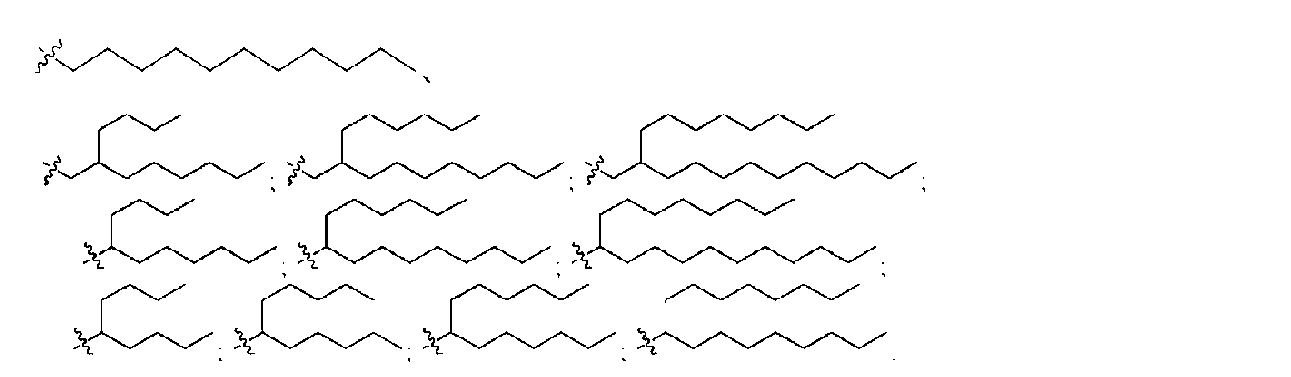
いくつかの実施形態では、R3は、OHである。 In some embodiments, R3 is OH.
いくつかの実施形態では、L1及びL2の各々は、-OC(O)-であり、G1及びG2は、各々独立して、C5-C12アルキレンであり、G3は、C1-C6アルキレンであり、R3は、OHであり、R1及びR2は、各々独立して、
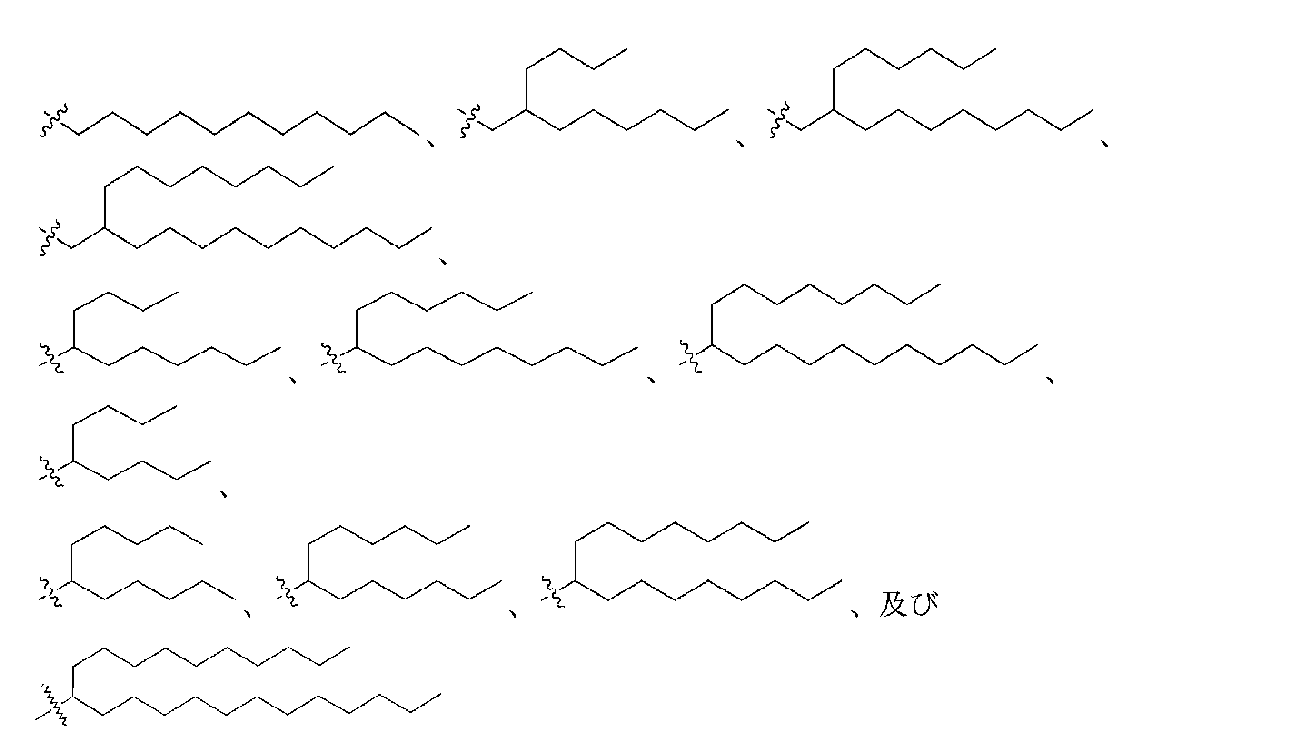
いくつかの実施形態では、カチオン性脂質は、式IaもしくはIbの化合物:

いくつかの実施形態では、本開示に従って有用であり得るカチオン性脂質は、少なくとも2個の飽和アルキル鎖にエステル結合を介して連結された滴定可能な三級アミノ頭部基を含むアミノ脂質であり、このエステル結合は、腎経路を介した迅速な分解及び/または排泄を促進するために容易に加水分解され得る。いくつかの実施形態では、そのようなアミノ脂質は、約6.0~6.5の見かけ上のpKaを有し(例えば、およそ6.25の見かけ上のpKaの一実施形態では)、酸性pH(例えば、pH5)で本質的に完全に正に電荷した分子をもたらす。いくつかの実施形態では、そのようなアミノ脂質は、LNPに組み込まれると、RNA(複数可)の粒子形成、細胞取り込み、融合性、及び/またはエンドソーム放出を調節する明確な物理化学的特性を付与することができる。いくつかの実施形態では、pH4.0でそのようなアミノ脂質を含む脂質混合物へのRNA水溶液の導入は、負に電荷したRNA骨格と正に電荷したカチオン性脂質との間の静電相互作用をもたらし得る。いずれかの特定の理論に拘束されることを望むものではないが、そのような静電相互作用は、RNA原体の効率的な封入化と同時に粒子形成をもたらす。RNA封入化後、得られたLNPを取り囲む培地のpHをより中性のpH(例えば、pH7.4)に調整すると、LNPの表面電荷の中和をもたらす。他の全ての変数が一定に保たれる場合、そのような電荷中性粒子は、網内系によって迅速に除去される電荷粒子と比較して、インビボ循環寿命が長く、肝細胞への送達が良好であることを示す。エンドソームに取り込まれると、エンドソームの低いpHは、そのようなアミノ脂質を含むLNPが融合性となり、標的細胞の細胞質内へのRNAの放出を可能にする。 In some embodiments, cationic lipids that may be useful according to the present disclosure are amino lipids that contain a titratable tertiary amino head group linked via ester bonds to at least two saturated alkyl chains, which ester bonds can be easily hydrolyzed to facilitate rapid degradation and/or excretion via the renal pathway. In some embodiments, such amino lipids have an apparent pK a of about 6.0-6.5 (e.g., in one embodiment with an apparent pK a of approximately 6.25), resulting in an essentially entirely positively charged molecule at acidic pH (e.g., pH 5). In some embodiments, such amino lipids, when incorporated into LNPs, can impart distinct physicochemical properties that modulate particle formation, cellular uptake, fusogenicity, and/or endosomal release of the RNA(s). In some embodiments, introduction of an aqueous RNA solution to a lipid mixture containing such amino lipids at pH 4.0 can result in electrostatic interactions between the negatively charged RNA backbone and the positively charged cationic lipid. Without wishing to be bound by any particular theory, such electrostatic interactions result in efficient encapsulation of the RNA bulk substance while simultaneously forming particles. After RNA encapsulation, the pH of the medium surrounding the resulting LNPs is adjusted to a more neutral pH (e.g., pH 7.4), resulting in neutralization of the surface charge of the LNPs. When all other variables are held constant, such charge-neutral particles show longer in vivo circulation lifetimes and better delivery to hepatocytes than charged particles that are rapidly removed by the reticuloendothelial system. When taken up into endosomes, the low pH of the endosomes makes such amino lipid-containing LNPs fusogenic, allowing the release of RNA into the cytoplasm of target cells.
本明細書に記載されるように、LNPは、少なくとも1つのカチオン性脂質を含む。いくつかの実施形態では、カチオン性脂質は、表1から選択されるか、
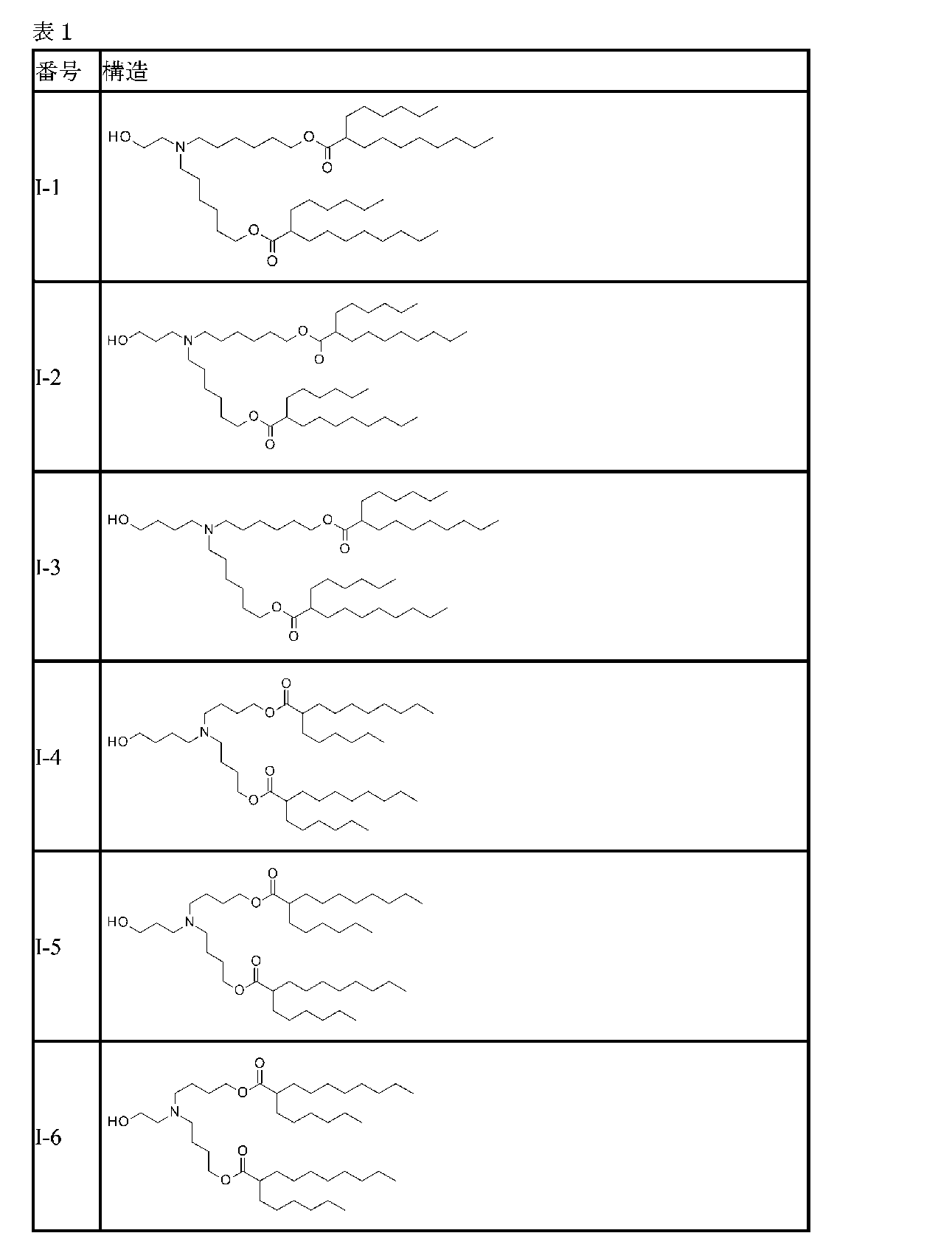


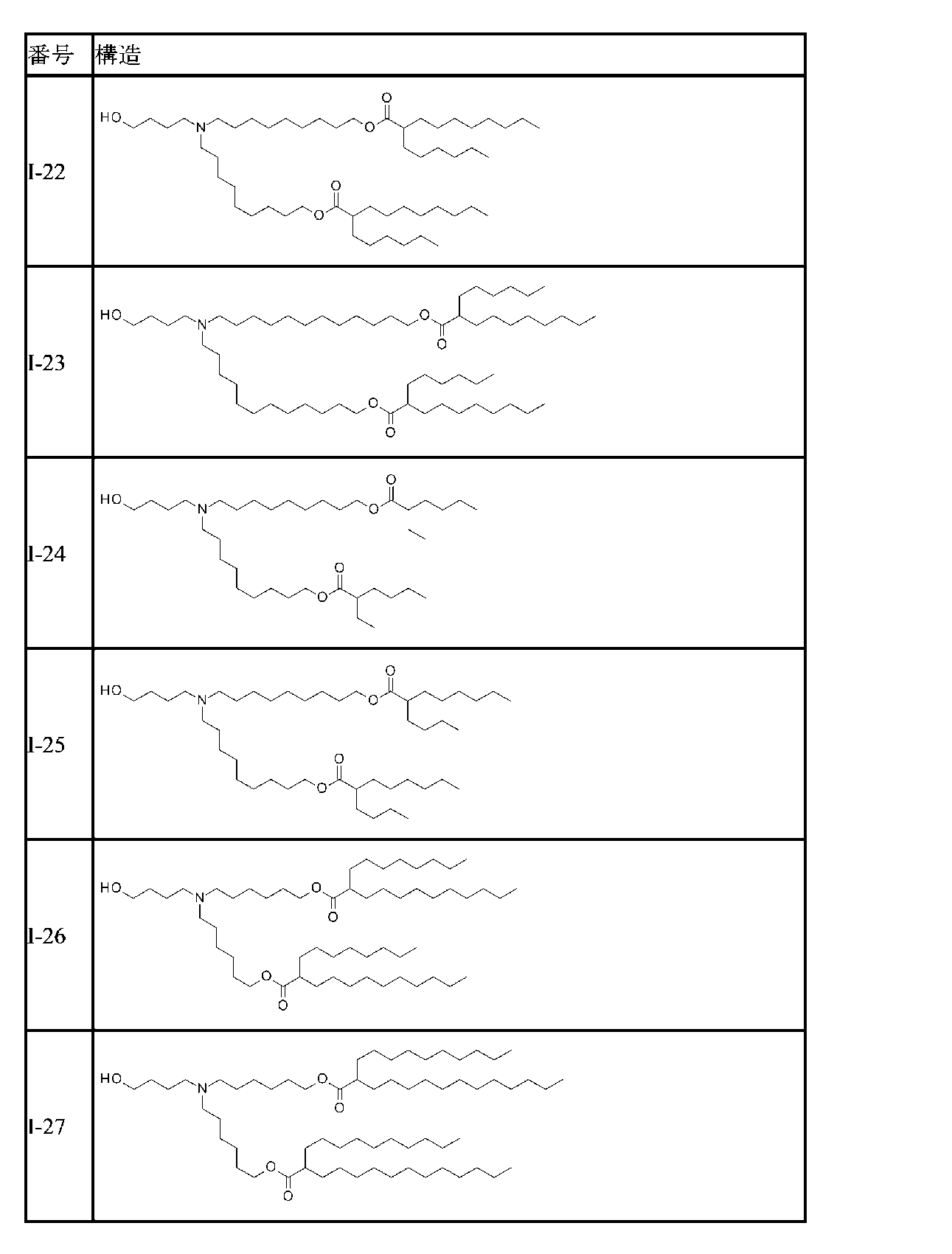


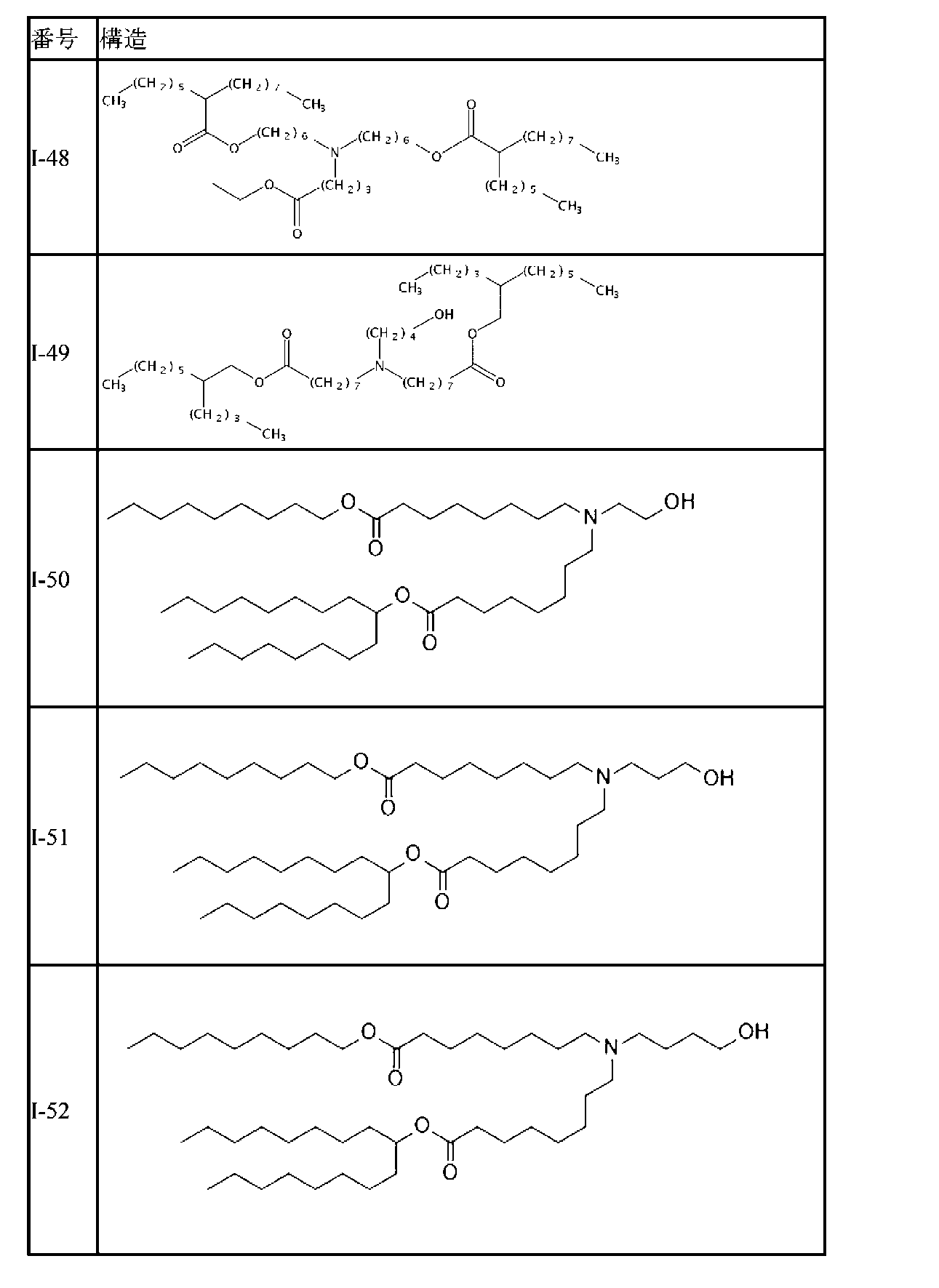

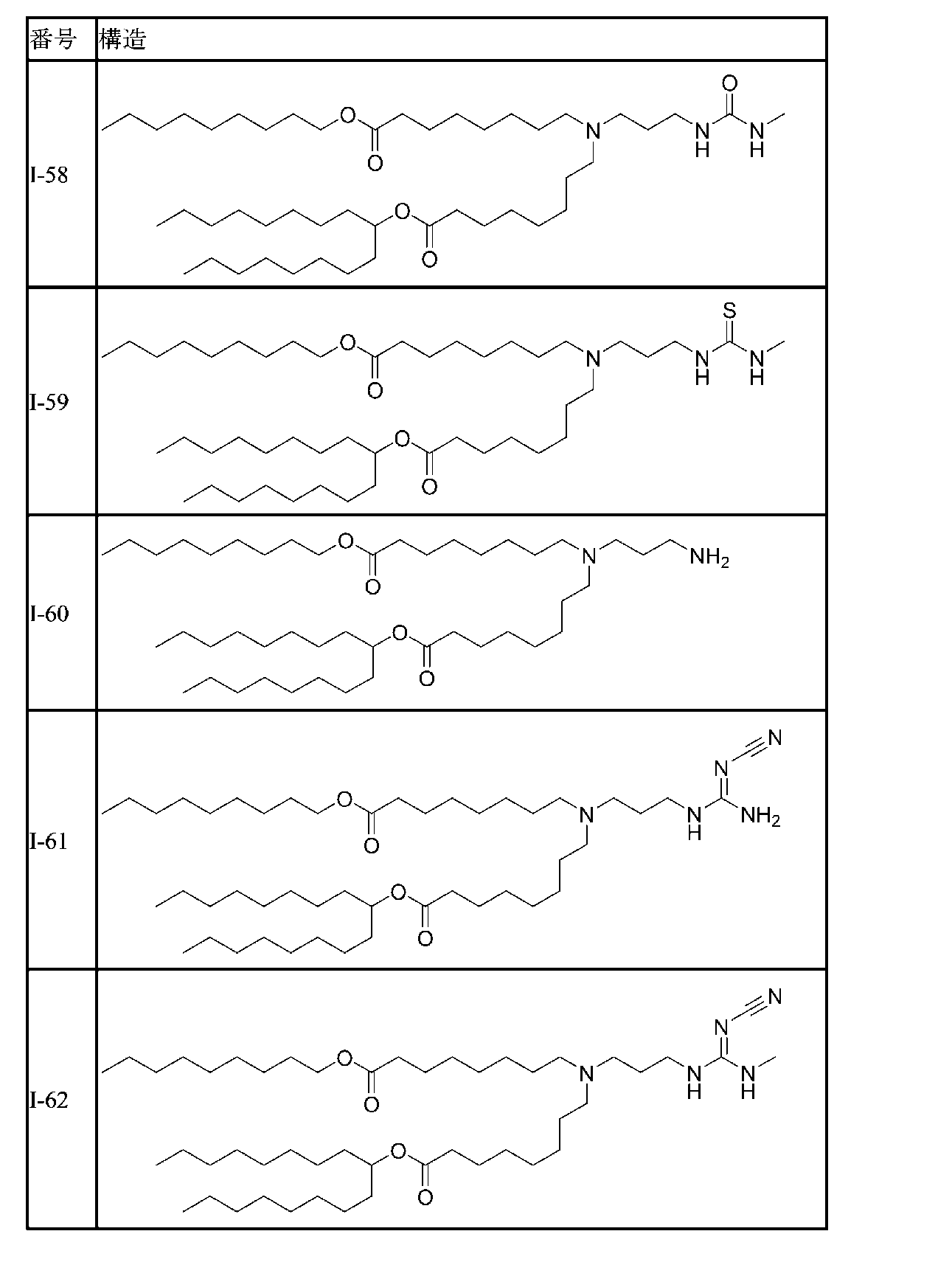


いくつかの実施形態では、カチオン性脂質は、表2から選択されるか、


いくつかの実施形態では、カチオン性脂質は、表1及び/または2から選択される。 In some embodiments, the cationic lipid is selected from Tables 1 and/or 2.
いくつかの実施形態では、カチオン性脂質は、DODMA、HY-501、ALC-0315、ALC366、及びSM-102から選択される。いくつかの実施形態では、カチオン性脂質は、ALC-0315及びALC366から選択される。いくつかの実施形態では、カチオン性脂質は、ALC-0315である。いくつかの実施形態では、カチオン性脂質は、ALC366である。いくつかの実施形態では、カチオン性脂質は、SM-102である。いくつかの実施形態では、カチオン性脂質は、DODMAである。いくつかの実施形態では、カチオン性脂質は、HY-501である。 In some embodiments, the cationic lipid is selected from DODMA, HY-501, ALC-0315, ALC366, and SM-102. In some embodiments, the cationic lipid is selected from ALC-0315 and ALC366. In some embodiments, the cationic lipid is ALC-0315. In some embodiments, the cationic lipid is ALC366. In some embodiments, the cationic lipid is SM-102. In some embodiments, the cationic lipid is DODMA. In some embodiments, the cationic lipid is HY-501.
いくつかの実施形態では、本開示のLNPは、LNP中の総脂質に対して約30~約70mol%のカチオン性脂質を含む。いくつかの実施形態では、LNPは、約35~約65mol%のカチオン性脂質を含む。いくつかの実施形態では、LNPは、約40~約60mol%のカチオン性脂質を含む。いくつかの実施形態では、LNPは、約41~約49mol%のカチオン性脂質を含む。いくつかの実施形態では、LNPは、約48mol%のカチオン性脂質を含む。いくつかの実施形態では、LNPは、約50mol%のカチオン性脂質を含む。 In some embodiments, the LNPs of the present disclosure comprise about 30 to about 70 mol% cationic lipid relative to the total lipid in the LNP. In some embodiments, the LNPs comprise about 35 to about 65 mol% cationic lipid. In some embodiments, the LNPs comprise about 40 to about 60 mol% cationic lipid. In some embodiments, the LNPs comprise about 41 to about 49 mol% cationic lipid. In some embodiments, the LNPs comprise about 48 mol% cationic lipid. In some embodiments, the LNPs comprise about 50 mol% cationic lipid.
いくつかの実施形態では、カチオン性イオン化可能脂質は、式(X)の構造

L10及びL20のうちの一方は、-O(C=O)-、-(C=O)O-、-C(=O)-、-O-、-S(O)x’-、-S-S-、-C(=O)S-、SC(=O)-、-NRa’C(=O)-、-C(=O)NRa’-、NRa’C(=O)NRa’-、-OC(=O)NRa’-、または-NRa’C(=O)O-であり、L10及びL20のうちの他方は、-O(C=O)-、-(C=O)O-、-C(=O)-、-O-、-S(O)x-、-S-S-、-C(=O)S-、SC(=O)-、-NRa’C(=O)-、-C(=O)NRa’-、NRa’C(=O)NRa’-、-OC(=O)NRa’-、もしくは-NRa’C(=O)O-、または直接結合であり、
G1’及びG2’は、各々独立して、非置換C1-C12アルキレンまたはC2-12アルケニレンであり、
G3’は、C1-24アルキレン、C2-24アルケニレン、C3-8シクロアルキレン、またはC3-8シクロアルケニレンであり、
Ra’は、HまたはC1-12アルキルであり、
R35及びR36は、各々独立して、C6-24アルキルまたはC6-24アルケニルであり、
R37は、H、OR50、CN、-C(=O)OR40、-OC(=O)R40、または-NR50C(=O)R40であり、
R40は、C1-12アルキルであり、
R50は、HまたはC1-6アルキルであり、
x’は、0、1、または2である。
In some embodiments, the cationic ionizable lipid has the structure of formula (X):
One of L 10 and L 20 is -O(C=O)-, -(C=O)O-, -C(=O)-, -O-, -S(O) x' -, -S-S-, -C(=O)S-, SC(=O)-, -NR a' C(=O)-, -C(=O)NR a' -, NR a' C(=O)NR a' -, -OC(=O)NR a' -, or -NR a' C(=O)O-, and the other of L 10 and L 20 is -O(C=O)-, -(C=O)O-, -C(=O)-, -O-, -S(O)x-, -S-S-, -C(=O)S-, SC(=O)-, -NR a' -C(=O)-, -C(=O)NR a' -, NR a' C(=O)NR a'- , -OC(=O)NR a' -, or -NR a' C(=O)O-, or a direct bond;
G 1' and G 2' are each independently unsubstituted C 1 -C 12 alkylene or C 2-12 alkenylene;
G 3' is a C 1-24 alkylene, a C 2-24 alkenylene, a C 3-8 cycloalkylene, or a C 3-8 cycloalkenylene;
R a' is H or C 1-12 alkyl;
R 35 and R 36 are each independently a C 6-24 alkyl or C 6-24 alkenyl;
R 37 is H, OR 50 , CN, -C(=O)OR 40 , -OC(=O)R 40 , or -NR 50 C(=O)R 40 ;
R 40 is C 1-12 alkyl;
R 50 is H or C 1-6 alkyl;
x′ is 0, 1, or 2.
式(X)の前述の実施形態のうちのいくつかでは、脂質は、以下の構造(XA)または(XB):

式中、R35、L10、G1’、G2’、L20、R36、R37、及びR60は、単独で及び組み合わせの両方で、本明細書のクラス及びサブクラスに記載される通りであり、
Aは、3~8員シクロアルキルまたはシクロアルキレン基であり、
R60は、各出現において、独立して、H、OH、またはC1-C24アルキルであり、
n1’は、1~15の範囲の整数である。
In some of the foregoing embodiments of formula (X), the lipid has the following structure (XA) or (XB):
wherein R 35 , L 10 , G 1′ , G 2′ , L 20 , R 36 , R 37 and R 60 , both alone and in combination, are as described in the classes and subclasses herein;
A is a 3- to 8-membered cycloalkyl or cycloalkylene group;
R 60 , at each occurrence, is independently H, OH, or C 1 -C 24 alkyl;
n 1′ is an integer ranging from 1 to 15.
式(X)の前述の実施形態のうちのいくつかでは、脂質は、構造(XA)を有し、他の実施形態では、脂質は、構造(XB)を有する。 In some of the foregoing embodiments of formula (X), the lipid has the structure (XA), and in other embodiments, the lipid has the structure (XB).
式(X)の他の実施形態では、脂質は、以下の構造(XC)または(XD):

式中、R35、L10、G1’、G2’、L20、R36、R37、及びR60は、単独で及び組み合わせの両方で、本明細書のクラス及びサブクラスに記載される通りであり、y’及びz’は、各々独立して、1~12の範囲の整数である。
In other embodiments of formula (X), the lipid has the following structure (XC) or (XD):
wherein R 35 , L 10 , G 1' , G 2' , L 20 , R 36 , R 37 , and R 60 , both alone and in combination, are as described in the classes and subclasses herein; and y' and z' are each independently an integer in the range of 1 to 12.
式(X)の前述の実施形態のうちのいずれかでは、L10及びL20のうちの1つは、-O(C=O)-である。例えば、いくつかの実施形態では、L10及びL20の各々は、-O(C=O)-である。前述のうちのいずれかのいくつかの異なる実施形態では、L10及びL20は、各々独立して、-(C=O)O-または-O(C=O)-である。例えば、いくつかの実施形態では、L10及びL20の各々は、-(C=O)O-である。 In any of the foregoing embodiments of Formula (X), one of L 10 and L 20 is -O(C=O)-. For example, in some embodiments, each of L 10 and L 20 is -O(C=O)-. In several different embodiments of any of the foregoing, L 10 and L 20 are each independently -(C=O)O- or -O(C=O)-. For example, in some embodiments, each of L 10 and L 20 is -(C=O)O-.
式(X)のいくつかの実施形態では、脂質は、以下の構造(XE)または(XF):

式中、R35、R36、R37、G1’、G2’、及びG3’は、単独で及び組み合わせの両方で、本明細書のクラス及びサブクラスで定義される通りである。
In some embodiments of formula (X), the lipid has the following structure (XE) or (XF):
wherein R 35 , R 36 , R 37 , G 1′ , G 2′ and G 3′ , both alone and in combination, are as defined in the classes and subclasses herein.
式(X)の前述の実施形態のうちのいくつかでは、脂質は、以下の構造(XG)、(XH)、(XJ)、または(XK):

式中、R35、R36、R37、R60、y’、z’、n1’、及びAは、単独で及び組み合わせの両方で、本明細書のクラス及びサブクラスで定義される通りである。
In some of the foregoing embodiments of formula (X), the lipid has the following structure (XG), (XH), (XJ), or (XK):
wherein R 35 , R 36 , R 37 , R 60 , y′, z′, n 1′ and A, both alone and in combination, are as defined in the classes and subclasses herein.
式(X)の前述の実施形態のうちのいくつかでは、n1’は、2~12、例えば、2~8または2~4の範囲の整数である。例えば、いくつかの実施形態では、n1’は、3、4、5、または6である。いくつかの実施形態では、n1’は、3である。いくつかの実施形態では、n1’は、4である。いくつかの実施形態では、n1’は、5である。いくつかの実施形態では、n1’は、6である。 In some of the foregoing embodiments of formula (X), n 1 ' is an integer ranging from 2 to 12, e.g., from 2 to 8 or from 2 to 4. For example, in some embodiments, n 1 ' is 3, 4, 5, or 6. In some embodiments, n 1 ' is 3. In some embodiments, n 1 ' is 4. In some embodiments, n 1 ' is 5. In some embodiments, n 1 ' is 6.
式(X)の前述の実施形態のうちのいくつかの他の実施形態では、y’及びz’は、各々独立して、2~10の範囲の整数である。例えば、いくつかの実施形態では、y’及びz’は、各々独立して、4~9または4~6の範囲の整数である。 In some other of the foregoing embodiments of formula (X), y' and z' are each independently an integer in the range of 2 to 10. For example, in some embodiments, y' and z' are each independently an integer in the range of 4 to 9 or 4 to 6.
式(X)の前述の実施形態のうちのいくつかでは、R60は、Hである。前述の実施形態のうちの他の実施形態では、R60は、C1-C24アルキルである。他の実施形態では、R60は、OHである。 In some of the foregoing embodiments of formula (X), R 60 is H. In other of the foregoing embodiments, R 60 is C 1 -C 24 alkyl. In other embodiments, R 60 is OH.
式(X)のいくつかの実施形態では、G3’は、非置換である。他の実施形態では、G3’は、置換されている。様々な異なる実施形態では、G3’は、直鎖C1-C24アルキレンまたは直鎖C2-C24アルケニレンである。 In some embodiments of formula (X), G 3' is unsubstituted. In other embodiments, G 3' is substituted. In various different embodiments, G 3' is a straight chain C 1 -C 24 alkylene or a straight chain C 2 -C 24 alkenylene.
式(X)のいくつかの他の前述の実施形態では、R35もしくはR36、または両方は、C6-C24アルケニルである。例えば、いくつかの実施形態では、R35及びR36は、各々独立して、以下の構造:

式中、
R7a及びR7bは、各出現において、独立して、HまたはC1-C12アルキルであり、
aは、2~12の整数であり、
R7a、R7b、及びaは、各々、R35及びR36が各々独立して、6~20個の炭素原子を含むように選択される。例えば、いくつかの実施形態では、aは、5~9または8~12の範囲の整数である。
In some other foregoing embodiments of formula (X), R 35 or R 36 , or both, are C 6 -C 24 alkenyl. For example, in some embodiments, R 35 and R 36 each independently have the following structure:
During the ceremony,
R 7a and R 7b , at each occurrence, are independently H or C 1 -C 12 alkyl;
a is an integer from 2 to 12,
R 7a , R 7b , and a are each selected such that R 35 and R 36 each independently contain 6 to 20 carbon atoms. For example, in some embodiments, a is an integer ranging from 5 to 9 or 8 to 12.
式(X)の前述の実施形態のうちのいくつかでは、R7aの少なくとも1つの出現は、Hである。例えば、いくつかの実施形態では、R7aは、各出現においてHである。前述の他の異なる実施形態では、R7bの少なくとも1つの出現は、C1-C8アルキルである。例えば、いくつかの実施形態では、C1-C8アルキルは、メチル、エチル、n-プロピル、イソ-プロピル、n-ブチル、イソ-ブチル、tert-ブチル、n-ヘキシル、またはn-オクチルである。 In some of the foregoing embodiments of Formula (X), at least one occurrence of R 7a is H. For example, in some embodiments, R 7a is H at each occurrence. In other different embodiments of the foregoing, at least one occurrence of R 7b is C 1 -C 8 alkyl. For example, in some embodiments, C 1 -C 8 alkyl is methyl, ethyl, n-propyl, iso-propyl, n-butyl, iso-butyl, tert-butyl, n-hexyl, or n-octyl.
式(X)の異なる実施形態では、R35もしくはR36、または両方は、以下の構造:
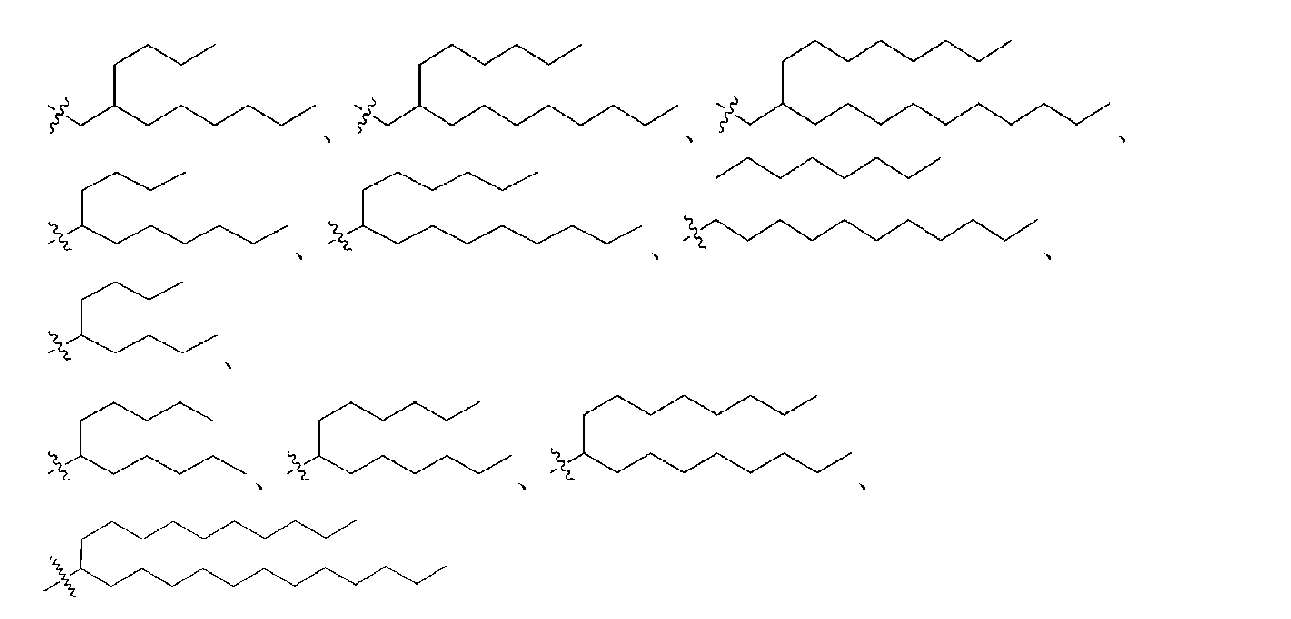
式(X)の前述の実施形態のうちのいくつかでは、R37は、OH、CN、-C(=O)OR40、-OC(=O)R40、または-NHC(=O)R40である。いくつかの実施形態では、R40は、メチルまたはエチルである。 In some of the foregoing embodiments of Formula (X), R 37 is OH, CN, -C(=O)OR 40 , -OC(=O)R 40 , or -NHC(=O)R 40. In some embodiments, R 40 is methyl or ethyl.
様々な異なる実施形態では、式(X)のカチオン性脂質は、以下に示される構造のうちの1つを有する。


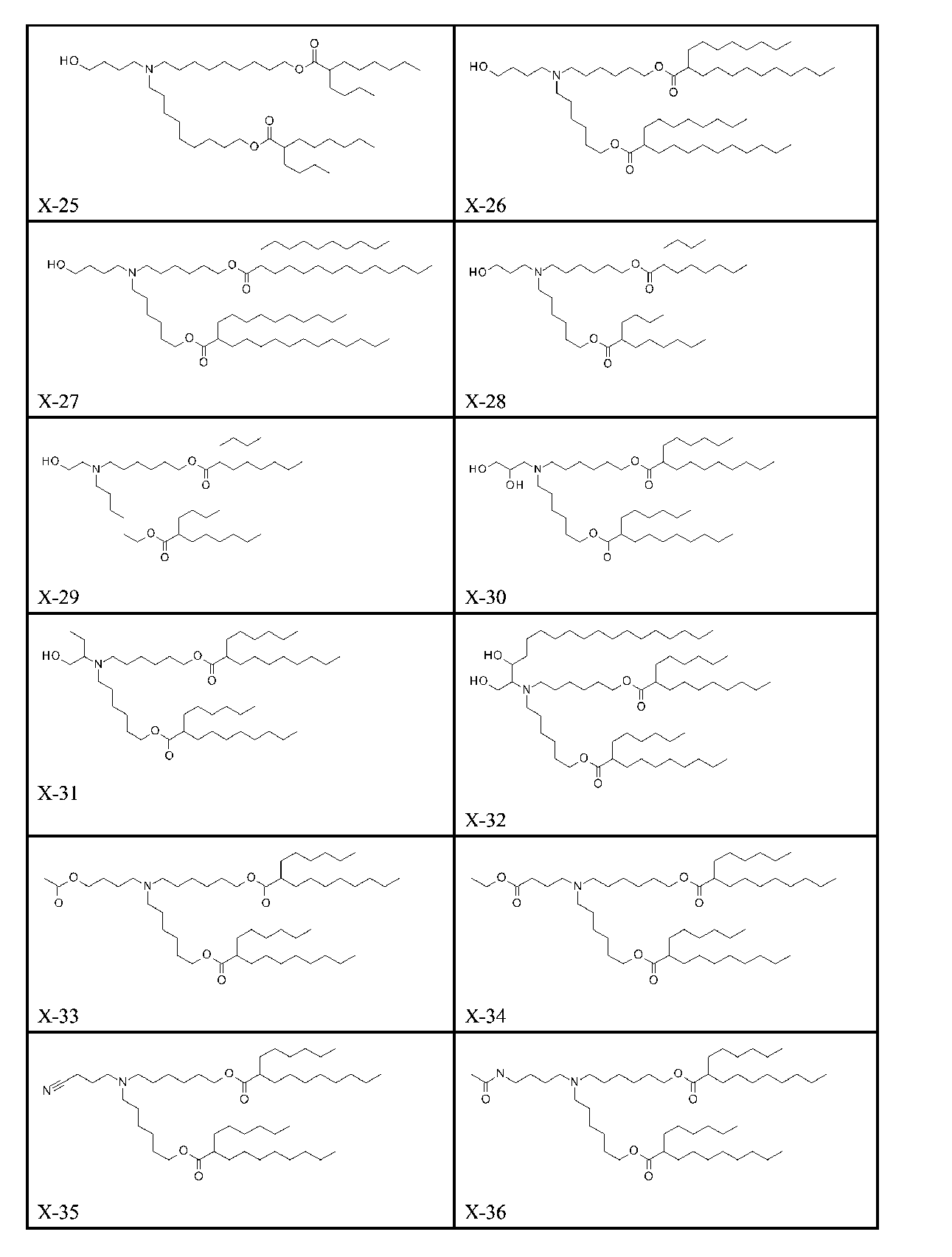


様々な異なる実施形態では、カチオン性イオン化可能脂質は、以下の表に示される構造のうちの1つを有する。

いくつかの実施形態では、カチオン性イオン化可能脂質は、式(XI)の構造:

式中、
R1”及びR2””の各々は、独立して、R5”または-G1”-L1”-R6”であり、R1”及びR2”のうちの少なくとも1つは、-G1”-L1”-R6”であり、
R3”及びR4”の各々は、独立して、C1-6アルキル、C2-6アルケニル、アリール、及びC3-10シクロアルキルからなる群から選択され、
R5”及びR6”の各々は、独立して、少なくとも10個の炭素原子を有する非環状ヒドロカルビル基であり、
G1”及びG2”の各々は、独立して、非置換C1-12アルキレンまたはC2-12アルケニレンであり、
L1”及びL2”の各々は、独立して、-O(C=O)-、-(C=O)O-、-C(=O)-、-O-、-S(O)x”-、-S-S-、-C(=O)S-、-SC(=O)-、-NRa”C(=O)-、-C(=O)NRa”-、-NRa”C(=O)NRa”-、-OC(=O)NRa”-、及び-NRa”C(=O)O-からなる群から選択され、
Ra”は、HまたはC1-12アルキルであり、
m”は、0、1、2、3、または4であり、
x”は、0、1、または2である。
In some embodiments, the cationic ionizable lipid has the structure of formula (XI):
During the ceremony,
each of R1 " and R2 "" is independently R5 " or -G1" -L1" -R6" , and at least one of R1 " and R2 " is -G1 " -L1 " -R6 " ,
Each of R 3″ and R 4″ is independently selected from the group consisting of C 1-6 alkyl, C 2-6 alkenyl, aryl, and C 3-10 cycloalkyl;
Each of R5 ″ and R6 ″ is independently an acyclic hydrocarbyl group having at least 10 carbon atoms;
each of G1 " and G2" is independently unsubstituted C1-12 alkylene or C2-12 alkenylene;
each of L1 " and L2 " is independently selected from the group consisting of -O(C=O)-, -(C=O)O-, -C(=O)-, -O-, -S(O) x" -, -S-S-, -C(=O)S-, -SC(=O)-, -NRa " C(=O)-, -C(=O) NRa " -, -NRa"C(=O)NRa "- , -OC(=O)NRa " -, and -NRa " C(=O)O-;
R a″ is H or C 1-12 alkyl;
m″ is 0, 1, 2, 3, or 4;
x″ is 0, 1, or 2.
式(XI)の前述の実施形態のうちのいくつかでは、G1”は、独立して、非置換C1-C12アルキレンまたは非置換C2-12アルケニレン、例えば、非置換、直鎖C1-12アルキレンまたは非置換、直鎖C2-12アルケニレンである。いくつかの実施形態では、各G1”は、独立して、非置換C6-12アルキレンまたは非置換C6-12アルケニレン、例えば、非置換、直鎖C6-12アルキレンまたは非置換、直鎖C6-12アルケニレンである。いくつかの実施形態では、各G1”は、独立して、非置換C8-12アルキレンまたは非置換C8-12アルケニレン、例えば、非置換、直鎖C8-12アルキレンまたは非置換、直鎖C8-12アルケニレンである。いくつかの実施形態では、各G1”は、独立して、非置換C6-10アルキレンまたは非置換C6-10アルケニレン、例えば、非置換、直鎖C6-10アルキレンまたは非置換、直鎖C6-10アルケニレンである。いくつかの実施形態では、各G1”は、独立して、8、9、または10個の炭素原子を有する非置換アルキレン、例えば、8、9、または10個の炭素原子を有する非置換、直鎖アルキレンである。いくつかの実施形態では、R1”及びR2”は、両方とも独立して、-G1”-L1”-R6”であり、R1”についてのG1”は、R2”についてのG1”とは異なり得る。これらの実施形態のいくつかでは、例えば、R1”についてのG1”は、非置換、直鎖C1-12アルキレンであり、R2”についてのG1”は、非置換、直鎖C2-12アルケニレンであるか、またはR1”についてのG1”は、非置換、直鎖C1-12アルキレン基であり、R2”についてのG1”は、異なる非置換、直鎖C1-12アルキレン基である。いくつかの実施形態では、R1”及びR2”は、両方とも独立して、-G1”-L1”-R6”であり、R1”についてのG1”は、R2”についてのG1”と同一であり得る。これらの実施形態のいくつかでは、例えば、各G1”は、同じ非置換、直鎖C8-12アルキレン、例えば、非置換、直鎖C8-10アルキレンであるか、または各G1”は、同じ非置換、直鎖C6-12アルケニレンである。
In some of the foregoing embodiments of formula (XI), G 1" is independently unsubstituted C 1 -C 12 alkylene or unsubstituted C 2-12 alkenylene, such as unsubstituted, straight-chain C 1-12 alkylene or unsubstituted, straight-chain C 2-12 alkenylene. In some embodiments, each G 1" is independently unsubstituted C 6-12 alkylene or unsubstituted C 6-12 alkenylene, such as unsubstituted, straight - chain C 6-12 alkylene or unsubstituted, straight-chain C 6-12 alkenylene. In some embodiments, each G 1" is independently unsubstituted C 8-12 alkylene or unsubstituted C 8-12 alkenylene, such as unsubstituted, straight chain C 8-12 alkylene or unsubstituted, straight chain C 8-12 alkenylene. In some embodiments, each G 1" is independently unsubstituted C 6-10 alkylene or unsubstituted C 6-10 alkenylene, such as unsubstituted, straight chain C 6-10 alkylene or unsubstituted, straight chain C 6-10 alkenylene . In some embodiments, each G 1" is independently an unsubstituted alkylene having 8, 9, or 10 carbon atoms, e.g., an unsubstituted, straight chain alkylene having 8, 9, or 10 carbon atoms. In some embodiments, R 1" and R 2" are both independently -G 1" -L 1" -R 6" , and G 1" for R 1" can be different from
式(XI)の前述の実施形態のうちのいくつかでは、各L1”は、独立して、-O(C=O)-、-(C=O)O-、-C(=O)S-、-SC(=O)-、-NRa”C(=O)-、及び-C(=O)NRa”-からなる群から選択される。いくつかの実施形態では、L1”のRa”は、HまたはC1-12アルキルである。いくつかの実施形態では、L1”のRa”は、HまたはC1-6アルキル、例えば、HまたはC1-3アルキルである。いくつかの実施形態では、L1”のRa”は、H、メチル、またはエチルである。いくつかの実施形態では、各L1”は、独立して、-O(C=O)-、-(C=O)O-、-C(=O)S-、及び-SC(=O)-からなる群から選択される。いくつかの実施形態では、各L1”は、独立して、-O(C=O)-または-(C=O)O-である。いくつかの実施形態では、R1”及びR2”は、両方とも独立して、-G1”-L1”-R6”であり、R1”についてのL1”は、R2”についてのL1”とは異なり得る。これらの実施形態のうちのいくつかでは、例えば、R1”についてのL1”は、-O(C=O)-、-(C=O)O-、-C(=O)S-、-SC(=O)-、-NRa”C(=O)-、及び-C(=O)NRa”-からなる群から選択される1つの部分であり(例えば、R1”についてのL1”は、-O(C=O)-である)、R2”についてのL1”は、-O(C=O)-、-(C=O)O-、-C(=O)S-、-SC(=O)-、-NRa”C(=O)-、及び-C(=O)NRa”-からなる群から選択される異なる部分である(例えば、R2”についてのL1”は、-(C=O)O-である)。いくつかの実施形態では、R1”及びR2”は、両方とも独立して、-G1”-L1”-R6”であり、R1”についてのL1”は、R2”についてのL1”と同一であり得る。これらの実施形態のうちのいくつかでは、例えば、各L1”は、-O(C=O)、-(C=O)O-、-C(=O)S-、-SC(=O)-、-NRa”C(=O)-、及び-C(=O)NRa”-からなる群から選択される同じ部分であり、例えば、各L1”は、-O(C=O)-であるか、または各L1”は、-(C=O)O-である。 In certain of the foregoing embodiments of formula (XI), each L 1" is independently selected from the group consisting of -O(C=O)-, -(C=O)O-, -C(=O)S-, -SC(=O)-, -NR a" C(=O)-, and -C(=O)NR a" -. In some embodiments, R a" of L 1" is H or C 1-12 alkyl. In some embodiments, R a" of L 1" is H or C 1-6 alkyl, e.g., H or C 1-3 alkyl. In some embodiments, R a" of L 1" is H, methyl, or ethyl. In some embodiments, each L 1" is independently selected from the group consisting of -O(C=O)-, -(C=O)O-, -C(=O)S-, and -SC(=O)-. In some embodiments, each L 1" is independently -O(C=O)- or -(C=O)O-. In some embodiments, R 1" and R 2" are both independently -G 1" -L 1" -R 6" , and L 1" for R 1 " can be different from L 1" for R 2" . In some of these embodiments, for example, L 1" for R 1" is one moiety selected from the group consisting of -O(C=O)-, -(C=O)O-, -C(=O)S-, -SC(=O)-, -NR a" C(=O)-, and -C(=O)NR a" - (e.g., L 1" for R 1" is -O(C=O)-), and L 1" for R 2" is a different moiety selected from the group consisting of -O(C=O)-, -(C=O)O-, -C(=O)S-, -SC(=O)-, -NR a" C(=O)-, and -C(=O)NR a" - (e.g., L 1" for R 2" is -(C=O)O-). In some embodiments, R 1" and R 2" are both independently -G 1" -L 1" -R 6" , and L 1" for R 1" can be the same as L 1" for R 2" . In some of these embodiments, for example, each L 1" is the same moiety selected from the group consisting of -O(C=O), -(C=O)O-, -C(=O)S-, -SC(=O)-, -NR a" C(=O)-, and -C(=O)NR a"- , e.g., each L 1" is -O(C=O)-, or each L 1" is -(C=O)O-.
式(XI)の前述の実施形態のうちのいくつかでは、各R6”は、独立して、少なくとも10個の炭素原子を有する非環状ヒドロカルビル基、例えば、少なくとも10個の炭素原子を有する直鎖ヒドロカルビル基である。いくつかの実施形態では、各R6”は、独立して、最大で30個の炭素原子、例えば、最大で28個、最大で26個、最大で24個、最大で22個、または最大で20個の炭素原子を有する。いくつかの実施形態では、各R6”は、独立して、10~30個の炭素原子(例えば、10~28、10~26、10~24、10~22、または10~20個の炭素原子)を有する非環状ヒドロカルビル基、例えば、10~30個の炭素原子(例えば、10~28、10~26、10~24、10~22、または10~20個の炭素原子)を有する直鎖ヒドロカルビル基である。いくつかの実施形態では、各R6”は、R6”の内部炭素原子を介してL1”と結合する。いくつかの実施形態では、各R6”は、独立して、最大で30個の炭素原子(例えば、最大で28、最大で26、最大で24、最大で22、または最大で20個の炭素原子)を有し、各R6”は、R6”の内部炭素原子を介してL1”と結合する。いくつかの実施形態では、各R6”は、独立して、少なくとも10個の炭素原子を有する非環状ヒドロカルビル基、例えば、少なくとも10個の炭素原子を有する直鎖ヒドロカルビル基であり、各R6”は、R6”の内部炭素原子を介してL1”と結合する。いくつかの実施形態では、各R6”は、独立して、10~30個の炭素原子(例えば、10~28、10~26、10~24、10~22、または10~20個の炭素原子)を有する非環状ヒドロカルビル基、例えば、10~30個の炭素原子(例えば、10~28、10~26、10~24、10~22、または10~20個の炭素原子)を有する直鎖ヒドロカルビル基であり、各R6”は、R6”の内部炭素原子を介してL1”と結合する。いくつかの実施形態では、R6”のヒドロカルビル基は、アルキルまたはアルケニル基、例えば、C10-30アルキルまたはアルケニル基である。したがって、いくつかの実施形態では、各R6”は、独立して、少なくとも10個の炭素原子を有する非環状アルキル基、または少なくとも10個の炭素原子を有する非環状アルケニル基、例えば、少なくとも10個の炭素原子を有する直鎖アルキル基、または少なくとも10個の炭素原子を有する直鎖アルケニル基である。いくつかの実施形態では、各R6”は、独立して、10~30個の炭素原子(例えば、10~28、10~26、10~24、10~22、または10~20個の炭素原子)を有する非環状アルキル基、または10~30個の炭素原子(例えば、10~28、10~26、10~24、10~22、または10~20個の炭素原子)を有する非環状アルケニル基、例えば、10~30個の炭素原子(例えば、10~28、10~26、10~24、10~22、または10~20個の炭素原子)を有する直鎖アルキル基、または10~30個の炭素原子(例えば、10~28、10~26、10~24、10~22、または10~20個の炭素原子)を有する直鎖アルケニル基である。いくつかの実施形態では、各R6”は、独立して、11~19個の炭素原子(例えば、11、13、15、17、または17個の炭素原子)を有する非環状アルキル基、例えば、11~19個の炭素原子(例えば、11、13、15、17、または17個の炭素原子)を有する直鎖アルキル基である。いくつかの実施形態では、各R6”は、独立して、10~30個の炭素原子(例えば、10~28、10~26、10~24、10~22、または10~20個の炭素原子)を有する非環状アルキル基、または10~30個の炭素原子(例えば、10~28、10~26、10~24、10~22、または10~20個の炭素原子)を有する非環状アルケニル基、例えば、10~30個の炭素原子(例えば、10~28、10~26、10~24、10~22、または10~20個の炭素原子)を有する直鎖アルキル基、または10~30個の炭素原子(例えば、10~28、10~26、10~24、10~22、または10~20個の炭素原子)を有する直鎖アルケニル基であり、各R6”は、R6”の内部炭素原子を介してL1”と結合する。いくつかの実施形態では、各R6”は、独立して、11~19個の炭素原子(例えば、11、13、15、17、または17個の炭素原子)を有する非環状アルキル基、例えば、11~19個の炭素原子(例えば、11、13、15、17、または17個の炭素原子)を有する直鎖アルキル基であり、各R6”は、R6”の内部炭素原子を介してL1”と結合する。「内部炭素原子」という表現は、R6”がL1”と結合するR6”の炭素原子が、R6”の少なくとも2個の他の炭素原子と直接結合することを意味する。例えば、以下のC11アルキル基について、位置2、3、4、5、及び7のうちのいずれか1個の各炭素原子は、本開示による「内部炭素原子」として適格であるが、位置1、6、8、9、10、及び11の炭素原子は適格ではない。

したがって、R6”の内部炭素を介してL1”と結合したC11アルキル基であるR6”は、以下の基:
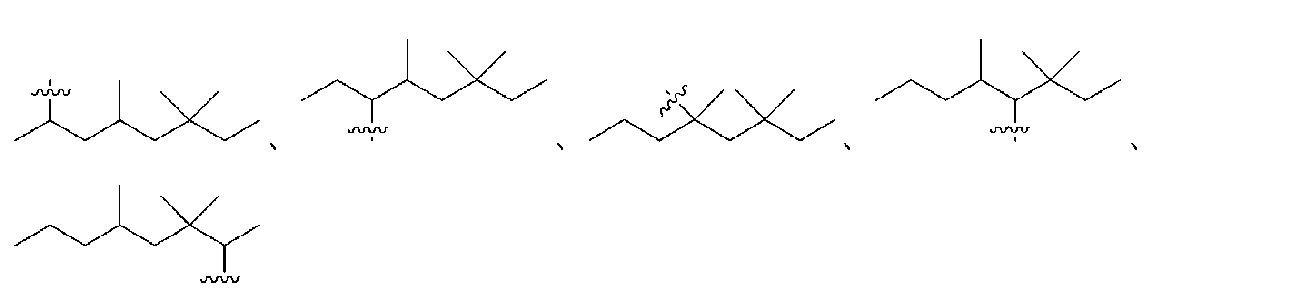
式中、


式中、




During the ceremony,
During the ceremony,
式(XI)の前述の実施形態のうちのいくつかでは、R5”は、少なくとも10個の炭素原子を有する非環状ヒドロカルビル基、例えば、少なくとも10個の炭素原子を有する直鎖ヒドロカルビル基である。いくつかの実施形態では、R5”は、少なくとも12個の炭素原子、例えば、少なくとも14、少なくとも16、または少なくとも18個の炭素原子を有する非環状ヒドロカルビル基、例えば、少なくとも12、少なくとも14、少なくとも16、または少なくとも18個の炭素原子を有する直鎖ヒドロカルビル基である。いくつかの実施形態では、R5”は、最大で30個の炭素原子、例えば、最大で28個、最大で26個、最大で24個、最大で22個、または最大で20個の炭素原子を有する。いくつかの実施形態では、R5”は、非環状ヒドロカルビル基、例えば、直鎖ヒドロカルビル基であり、各ヒドロカルビル基は、10~30個の炭素原子(例えば、10~28、10~26、10~24、10~22、10~20個の炭素原子、または12~30、12~28、12~26、12~24、12~22、12~20個の炭素原子、または14~30、14~28、14~26、14~24、14~22、14~20個の炭素原子、または16~30、16~28、16~26、16~24、16~22、16~20個の炭素原子、または18~30、18~28、18~26、18~24、18~22、もしくは18~20個の炭素原子)を有する。いくつかの実施形態では、R5”のヒドロカルビル基は、アルキルまたはアルケニル基、例えば、C10-30アルキルまたはアルケニル基である。したがって、いくつかの実施形態では、R5”は、少なくとも10個の炭素原子(例えば、少なくとも12、少なくとも14、少なくとも16、または少なくとも18個の炭素原子)を有する非環状アルキル基、または少なくとも10個の炭素原子(少なくとも12、少なくとも14、少なくとも16、または少なくとも18個の炭素原子)を有する非環状アルケニル基、例えば、少なくとも10個の炭素原子(少なくとも12、少なくとも14、少なくとも16、または少なくとも18個の炭素原子)を有する直鎖アルキル基、または少なくとも10個の炭素原子(少なくとも12、少なくとも14、少なくとも16、または少なくとも18個の炭素原子)を有する直鎖アルケニル基である。いくつかの実施形態では、R5”は、非環状アルキル基または非環状アルケニル基、例えば、直鎖アルキル基または直鎖アルケニル基であり、アルキル基及びアルケニル基の各々は、独立して、10~30個の炭素原子(例えば、10~28、10~26、10~24、10~22、10~20個の炭素原子、または12~30、12~28、12~26、12~24、12~22、12~20個の炭素原子、または14~30、14~28、14~26、14~24、14~22、14~20個の炭素原子、または16~30、16~28、16~26、16~24、16~22、16~20個の炭素原子、または18~30、18~28、18~26、18~24、18~22、もしくは18~20個の炭素原子)を有する。いくつかの実施形態では、アルケニル基は、少なくとも2個の炭素-炭素二重結合、例えば、2個または3個の炭素-炭素二重結合、例えば、2個の炭素-炭素二重結合を有する。いくつかの実施形態では、アルケニル基は、シス配置で、少なくとも1個の炭素-炭素二重結合、例えば、シス配置で、1、2、または3個、例えば、2個の炭素-炭素二重結合を有する。したがって、R5”は、非環状アルキル基または非環状アルケニル基、例えば、直鎖アルキル基または直鎖アルケニル基であり、アルキル基及びアルケニル基の各々は、独立して、10~30個の炭素原子(例えば、10~28、10~26、10~24、10~22、10~20個の炭素原子、または12~30、12~28、12~26、12~24、12~22、12~20個の炭素原子、または14~30、14~28、14~26、14~24、14~22、14~20個の炭素原子、または16~30、16~28、16~26、16~24、16~22、16~20個の炭素原子、または18~30、18~28、18~26、18~24、18~22、もしくは18~20個の炭素原子)を有し、アルケニル基は、少なくとも2個の炭素-炭素二重結合、例えば、2個または3個の炭素二重結合を有する。いくつかの実施形態では、R5”は、非環状アルキル基または非環状アルケニル基、例えば、直鎖アルキル基または直鎖アルケニル基であり、アルキル基及びアルケニル基の各々は、独立して、10~30個の炭素原子(例えば、10~28、10~26、10~24、10~22、10~20個の炭素原子、または12~30、12~28、12~26、12~24、12~22、12~20個の炭素原子、または14~30、14~28、14~26、14~24、14~22、14~20個の炭素原子、または16~30、16~28、16~26、16~24、16~22、16~20個の炭素原子、または18~30、18~28、18~26、18~24、18~22、もしくは18~20個の炭素原子)を有し、アルケニル基は、シス配置で、少なくとも1個の炭素-炭素二重結合、例えば、1、2、または3個の炭素-炭素二重結合を有する。いくつかの実施形態では、R5”は、以下の構造:

式中、

During the ceremony,
式(XI)の前述の実施形態のうちのいくつかでは、L2”は、-O(C=O)-、-(C=O)O-、-C(=O)-、-S-S-、-C(=O)S-、-SC(=O)-、-NRa”C(=O)-、-C(=O)NRa”-、-NRa”C(=O)NRa”、-OC(=O)NRa”-、及び-NRa”C(=O)O-からなる群から選択される。いくつかの実施形態では、L2”は、-O(C=O)-、-(C=O)O-、-C(=O)-、-C(=O)S-、-SC(=O)-、-NRa”C(=O)-、及び-C(=O)NRa”-からなる群から選択される。いくつかの実施形態では、L2”のRa”は、HまたはC1-12アルキルである。いくつかの実施形態では、L2”のRa”は、HまたはC1-6アルキル、例えば、HまたはC1-3アルキルである。いくつかの実施形態では、L2”のRa”は、H、メチル、またはエチルである。いくつかの実施形態では、L2”は、-O(C=O)-、-(C=O)O-、-C(=O)S-、及び-SC(=O)からなる群から選択される。いくつかの実施形態では、L2”は、-O(C=O)-または-(C=O)O-である。 In certain of the foregoing embodiments of formula (XI), L 2" is selected from the group consisting of -O(C=O)-, -(C=O)O-, -C(=O)-, -S-S-, -C(=O)S-, -SC(=O)-, -NR a" C(=O)-, -C(=O)NR a" -, -NR a" C(=O)NR a "-, -OC(=O)NR a" -, and -NR a" C(=O)O-. In some embodiments, L 2" is selected from the group consisting of -O(C=O)-, -(C=O)O-, -C(=O)-, -C(=O)S-, -SC(=O)-, -NR a" C(=O)-, and -C(=O)NR a" -. In some embodiments, R a" of L 2" is H or C 1-12 alkyl. In some embodiments, R a" of L 2" is H or C 1-6 alkyl, for example, H or C 1-3 alkyl. In some embodiments, R a" of L 2" is H, methyl, or ethyl. In some embodiments, L 2" is selected from the group consisting of -O(C=O)-, -(C=O)O-, -C(=O)S-, and -SC(=O). In some embodiments, L 2" is -O(C=O)- or -(C=O)O-.
式(XI)の前述の実施形態のうちのいくつかでは、G2”は、非置換C1-12アルキレンまたは非置換C2-12アルケニレン、例えば、非置換、直鎖C1-12アルキレンまたは非置換、直鎖C2-12アルケニレンである。いくつかの実施形態では、G2”は、非置換C2-10アルキレンまたは非置換C2-10アルケニレン、例えば、非置換、直鎖C2-10アルキレンまたは非置換、直鎖C2-10アルケニレンである。いくつかの実施形態では、G2”は、非置換C2-6アルキレンまたは非置換C2-6アルケニレン、例えば、非置換、直鎖C2-6アルキレンまたは非置換、直鎖C2-6アルケニレンである。いくつかの実施形態では、G2”は、非置換C2-4アルキレンまたは非置換C2-4アルケニレン、例えば、非置換、直鎖C2-4アルキレンまたは非置換、直鎖C2-4アルケニレンである。いくつかの実施形態では、G2”は、エチレンまたはトリメチレンである。 In some of the foregoing embodiments of formula (XI), G 2" is unsubstituted C 1-12 alkylene or unsubstituted C 2-12 alkenylene, for example, unsubstituted, straight-chain C 1-12 alkylene or unsubstituted, straight-chain C 2-12 alkenylene. In some embodiments, G 2" is unsubstituted C 2-10 alkylene or unsubstituted C 2-10 alkenylene, for example, unsubstituted, straight-chain C 2-10 alkylene or unsubstituted, straight-chain C 2-10 alkenylene. In some embodiments, G 2" is unsubstituted C 2-6 alkylene or unsubstituted C 2-6 alkenylene, for example, unsubstituted, straight chain C 2-6 alkylene or unsubstituted, straight chain C 2-6 alkenylene. In some embodiments, G 2" is unsubstituted C 2-4 alkylene or unsubstituted C 2-4 alkenylene, for example, unsubstituted, straight chain C 2-4 alkylene or unsubstituted, straight chain C 2-4 alkenylene. In some embodiments, G 2" is ethylene or trimethylene.
式(XI)の前述の実施形態のうちのいくつかでは、R3”及びR4”の各々は、独立して、C1-6アルキルまたはC2-6アルケニルである。いくつかの実施形態では、R3”及びR4”の各々は、独立して、C1-4アルキルまたはC2-4アルケニルである。いくつかの実施形態では、R3”及びR4”の各々は、独立して、C1-3アルキルである。いくつかの実施形態では、R3”及びR4”の各々は、独立して、メチルまたはエチルである。いくつかの実施形態では、R3”及びR4”の各々は、メチルである。 In some of the foregoing embodiments of formula (XI), each of R 3" and R 4" is independently C 1-6 alkyl or C 2-6 alkenyl. In some embodiments, each of R 3" and R 4" is independently C 1-4 alkyl or C 2-4 alkenyl. In some embodiments, each of R 3" and R 4" is independently C 1-3 alkyl. In some embodiments, each of R 3" and R 4" is independently methyl or ethyl. In some embodiments, each of R 3" and R 4" is methyl.
式(XI)の前述の実施形態のうちのいくつかでは、m”は、0、1、2、または3である。いくつかの実施形態では、m”は、0または2である。いくつかの実施形態では、m”は、0である。いくつかの実施形態では、m”は、2である。 In some of the foregoing embodiments of formula (XI), m" is 0, 1, 2, or 3. In some embodiments, m" is 0 or 2. In some embodiments, m" is 0. In some embodiments, m" is 2.
式(XI)の前述の実施形態のうちのいくつかでは、カチオン性イオン化可能脂質は、式(XIIa)または(XIIb)の構造を有し、

R3”及びR4”の各々は、独立して、C1-C6アルキルまたはC2-6アルケニルであり、
R5”は、少なくとも14個の炭素原子(例えば、少なくとも16個の炭素原子)を有する直鎖ヒドロカルビル基であり、ヒドロカルビル基は、好ましくは、少なくとも2個の炭素-炭素二重結合を有し、
各R6”は、独立して、少なくとも10個の炭素原子を有する直鎖ヒドロカルビル基(例えば、直鎖アルキル基)であり、及び/または各R6”は、R6”の内部炭素原子を介してL1”と結合し、好ましくは、各R6”は、独立して、少なくとも10個の炭素原子を有する直鎖ヒドロカルビル基(例えば、直鎖アルキル基)であり、各R6”は、R6”の内部炭素原子を介してL1”と結合し、
各G1”は、独立して、非置換、直鎖C4-12アルキレンまたはC4-12アルケニレン、例えば、非置換、直鎖C6-12アルキレンまたはC6-12アルケニレン、例えば、非置換、直鎖C8-12アルキレンまたは非置換、直鎖C8-12アルケニレンであり、
G2”は、非置換C2-C10アルキレンまたはC2-10アルケニレン、好ましくは、非置換C2-C6アルキレンまたはC2-6アルケニレンであり、
L1”及びL2”の各々は、独立して、-O(C=O)-または-(C=O)O-であり、
m”は、0、1、2、または3、好ましくは、0または2である。
In some of the foregoing embodiments of formula (XI), the cationic ionizable lipid has the structure of formula (XIIa) or (XIIb):
Each of R 3″ and R 4″ is independently C 1 -C 6 alkyl or C 2-6 alkenyl;
R5 ″ is a linear hydrocarbyl group having at least 14 carbon atoms (e.g., at least 16 carbon atoms), the hydrocarbyl group preferably having at least two carbon-carbon double bonds;
Each R 6 ″ is independently a linear hydrocarbyl group (e.g., a linear alkyl group) having at least 10 carbon atoms, and/or each R 6 ″ is bonded to L 1 ″ through an internal carbon atom of R 6 ″ ; preferably, each R 6 ″ is independently a linear hydrocarbyl group (e.g., a linear alkyl group) having at least 10 carbon atoms, and each R 6 ″ is bonded to L 1 ″ through an internal carbon atom of R 6 ″ ;
each G1 " is independently an unsubstituted, straight-chain C4-12 alkylene or C4-12 alkenylene, for example, an unsubstituted, straight-chain C6-12 alkylene or C6-12 alkenylene, for example, an unsubstituted, straight-chain C8-12 alkylene or an unsubstituted, straight-chain C8-12 alkenylene;
G 2″ is unsubstituted C 2 -C 10 alkylene or C 2-10 alkenylene, preferably unsubstituted C 2 -C 6 alkylene or C 2-6 alkenylene;
each of L 1″ and L 2″ is independently —O(C═O)— or —(C═O)O—;
m″ is 0, 1, 2, or 3, preferably 0 or 2.
式(XIIa)の前述の実施形態のうちのいくつかでは、R5”は、最大で30個の炭素原子、例えば、最大で28個、最大で26個、最大で24個、最大で22個、または最大で20個の炭素原子を有する。式(XIIa)のいくつかの実施形態では、R5”は、14~30個の炭素原子(例えば、14~28、14~26、14~24、14~22、14~20個の炭素原子、または16~30、16~28、16~26、16~24、16~22、16~20個の炭素原子、または18~30、18~28、18~26、18~24、18~22、もしくは18~20個の炭素原子)を有する直鎖ヒドロカルビル基である。式(XIIa)のいくつかの実施形態では、R5”は、14~30個の炭素原子(例えば、14~28、14~26、14~24、14~22、14~20個の炭素原子、または16~30、16~28、16~26、16~24、16~22、16~20個の炭素原子、または18~30、18~28、18~26、18~24、18~22、もしくは18~20個の炭素原子)を有する直鎖アルキルまたはアルケニル基である。式(XIIa)のいくつかの実施形態では、アルケニル基は、少なくとも2個の炭素-炭素二重結合、例えば、2個または3個の炭素-炭素二重結合、例えば、2個の炭素-炭素二重結合を有する。いくつかの実施形態では、アルケニル基は、シス配置で、少なくとも1個の炭素-炭素二重結合、例えば、シス配置で、1、2、または3個、例えば、2個の炭素-炭素二重結合を有する。したがって、式(XIIa)のいくつかの実施形態では、R5”は、直鎖アルキル基または直鎖アルケニル基であり、アルキル基及びアルケニル基の各々は、独立して、14~30個の炭素原子(例えば、14~28、14~26、14~24、14~22、14~20個の炭素原子、または16~30、16~28、16~26、16~24、16~22、16~20個の炭素原子、または18~30、18~28、18~26、18~24、18~22、もしくは18~20個の炭素原子)を有し、アルケニル基は、少なくとも2個の炭素-炭素二重結合、例えば、2個または3個の炭素二重結合を有する。式(XIIa)のいくつかの実施形態では、R5”は、直鎖アルキル基または直鎖アルケニル基であり、アルキル基及びアルケニル基の各々は、独立して、14~30個の炭素原子(例えば、14~28、14~26、14~24、14~22、14~20個の炭素原子、または16~30、16~28、16~26、16~24、16~22、16~20個の炭素原子、または18~30、18~28、18~26、18~24、18~22、もしくは18~20個の炭素原子)を有し、アルケニル基は、シス配置で、少なくとも1個の炭素-炭素二重結合、例えば、1、2、または3個の炭素-炭素二重結合を有する。式(XIIa)のいくつかの実施形態では、R5”は、直鎖アルキル基または直鎖アルケニル基であり、アルキル基及びアルケニル基の各々は、独立して、14~30個の炭素原子(例えば、14~28、14~26、14~24、14~22、14~20個の炭素原子、または16~30、16~28、16~26、16~24、16~22、16~20個の炭素原子、または18~30、18~28、18~26、18~24、18~22、もしくは18~20個の炭素原子)を有し、アルケニル基は、2個または3個の炭素-炭素二重結合を有し、少なくとも1個の炭素-炭素二重結合、例えば1、2、または3個の炭素-炭素二重結合は、シス配置である。式(XIIa)のいくつかの実施形態では、R5”は、以下の構造:

式中、

During the ceremony,
式(XIIb)の前述の実施形態のうちのいくつかでは、各R6”は、独立して、最大で30個の炭素原子、例えば、最大で28個、最大で26個、最大で24個、最大で22個、または最大で20個の炭素原子を有する。式(XIIb)のいくつかの実施形態では、各R6”は、独立して、10~30個の炭素原子(例えば、10~28、10~26、10~24、10~22、または10~20個の炭素原子、または11~19個の炭素原子、例えば、11、13、15、17、または17個の炭素原子)を有する直鎖ヒドロカルビル基(例えば、直鎖アルキル基)である。式(XIIb)のいくつかの実施形態では、各R6”は、独立して、10~30個の炭素原子(例えば、10~28、10~26、10~24、10~22、または10~20個の炭素原子、または11~19個の炭素原子、例えば、11、13、15、17、または17個の炭素原子)を有する直鎖ヒドロカルビル基(例えば、直鎖アルキル基)であり、各R6”は、R6”の内部炭素原子を介してL1”と結合する。式(XIIb)のいくつかの実施形態では、各R6”は、独立して、
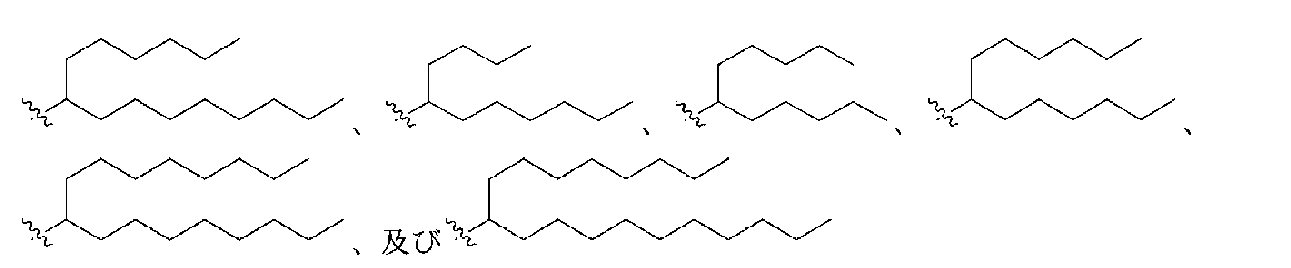

式(XI)の前述の実施形態のうちのいくつかでは、カチオン性イオン化可能脂質は、式(XIIIa)または(XIIIb)の構造を有し、

R3”及びR4”の各々は、独立して、C1-4アルキルまたはC2-4アルケニル、より好ましくは、C1-3アルキル、例えば、メチルまたはエチルであり、
R5”は、少なくとも16個の炭素原子を有する直鎖アルキルまたはアルケニル基であり、アルケニル基は、好ましくは、少なくとも2個の炭素-炭素二重結合を有し、
各R6”は、独立して、少なくとも10個の炭素原子を有する直鎖ヒドロカルビル基であり、R6”は、R6”の内部炭素原子を介してL1”と結合し、
各G1”は、独立して、非置換、直鎖C6-12アルキレンまたは非置換、直鎖C6-12アルケニレン、例えば、非置換、直鎖C8-12アルキレンまたは非置換、直鎖C8-12アルケニレン、例えば、非置換、直鎖C8-10アルキレンまたは非置換、直鎖C8-10アルケニレン、例えば、非置換、直鎖C8アルキレンであり、
G2”は、非置換C2-6アルキレンまたはC2-6アルケニレン、好ましくは、非置換C2-4アルキレンまたはC2-4アルケニレン、例えば、エチレンまたはトリメチレンであり、
L1”及びL2”の各々は、独立して、-O(C=O)-または-(C=O)O-であり、
M”は、0、1、2、または3、好ましくは、0または2である。
In some of the foregoing embodiments of formula (XI), the cationic ionizable lipid has the structure of formula (XIIIa) or (XIIIb):
Each of R 3″ and R 4″ is independently C 1-4 alkyl or C 2-4 alkenyl, more preferably C 1-3 alkyl, for example, methyl or ethyl;
R5 ″ is a linear alkyl or alkenyl group having at least 16 carbon atoms, the alkenyl group preferably having at least two carbon-carbon double bonds;
each R6 " is independently a linear hydrocarbyl group having at least 10 carbon atoms, R6 " is bonded to L1 " through an internal carbon atom of R6 " ,
each G1 " is independently unsubstituted, linear C6-12 alkylene or unsubstituted, linear C6-12 alkenylene, for example, unsubstituted, linear C8-12 alkylene or unsubstituted, linear C8-12 alkenylene, for example, unsubstituted, linear C8-10 alkylene or unsubstituted, linear C8-10 alkenylene, for example, unsubstituted , linear C8 alkylene;
G 2″ is unsubstituted C 2-6 alkylene or C 2-6 alkenylene, preferably unsubstituted C 2-4 alkylene or C 2-4 alkenylene, for example ethylene or trimethylene;
each of L 1″ and L 2″ is independently —O(C═O)— or —(C═O)O—;
M″ is 0, 1, 2, or 3, preferably 0 or 2.
式(XIIIa)の前述の実施形態のうちのいくつかでは、R5”は、最大で30個の炭素原子、例えば、最大で28個、最大で26個、最大で24個、最大で22個、または最大で20個の炭素原子を有する。式(XIIIa)のいくつかの実施形態では、R5”は、16~30個の炭素原子(例えば、16~28、16~26、16~24、16~22、16~20個の炭素原子、または18~30、18~28、18~26、18~24、18~22、もしくは18~20個の炭素原子)を有する直鎖アルキルまたはアルケニル基である。式(XIIIa)のいくつかの実施形態では、アルケニル基は、少なくとも2個の炭素-炭素二重結合、例えば、2個または3個の炭素-炭素二重結合、例えば、2個の炭素-炭素二重結合を有する。いくつかの実施形態では、アルケニル基は、シス配置で、少なくとも1個の炭素-炭素二重結合、例えば、シス配置で、1、2、または3個、例えば、2個の炭素-炭素二重結合を有する。したがって、式(XIIIa)のいくつかの実施形態では、R5”は、直鎖アルキル基または直鎖アルケニル基であり、アルキル基及びアルケニル基の各々は、独立して、16~30個の炭素原子(例えば、16~28、16~26、16~24、16~22、16~20個の炭素原子、または18~30、18~28、18~26、18~24、18~22、もしくは18~20個の炭素原子)を有し、アルケニル基は、少なくとも2個の炭素-炭素二重結合、例えば、2個または3個の炭素二重結合を有する。式(XIIIa)のいくつかの実施形態では、R5”は、直鎖アルキル基または直鎖アルケニル基であり、アルキル基及びアルケニル基の各々は、独立して、16~30個の炭素原子(例えば、16~28、16~26、16~24、16~22、16~20個の炭素原子、または18~30、18~28、18~26、18~24、18~22、もしくは18~20個の炭素原子)を有し、アルケニル基は、シス配置で、少なくとも1個の炭素-炭素二重結合、例えば、1、2、または3個の炭素-炭素二重結合を有する。式(XIIIa)のいくつかの実施形態では、R5”は、直鎖アルキル基または直鎖アルケニル基であり、アルキル基及びアルケニル基の各々は、独立して、16~30個の炭素原子(例えば、16~28、16~26、16~24、16~22、16~20個の炭素原子、または18~30、18~28、18~26、18~24、18~22、もしくは18~20個の炭素原子)を有し、アルケニル基は、2個または3個の炭素-炭素二重結合を有し、少なくとも1個の炭素-炭素二重結合、例えば1、2、または3個の炭素-炭素二重結合は、シス配置である。式(XIIIa)のいくつかの実施形態では、R5”は、以下の構造:

式中、

During the ceremony,
式(XIIIb)の前述の実施形態のうちのいくつかでは、各R6”は、独立して、最大で30個の炭素原子、例えば、最大で28個、最大で26個、最大で24個、最大で22個、または最大で20個の炭素原子を有する。式(XIIIb)のいくつかの実施形態では、各R6”は、独立して、10~30個の炭素原子(例えば、10~28、10~26、10~24、10~22、または10~20個の炭素原子、または11~19個の炭素原子、例えば、11、13、15、17、または17個の炭素原子)を有する直鎖ヒドロカルビル基(例えば、直鎖アルキル基)であり、各R6”は、R6”の内部炭素原子を介してL1”と結合する。式(XIIIb)のいくつかの実施形態では、各R6”は、R6”の内部炭素原子を介しL1”と結合し、独立して、
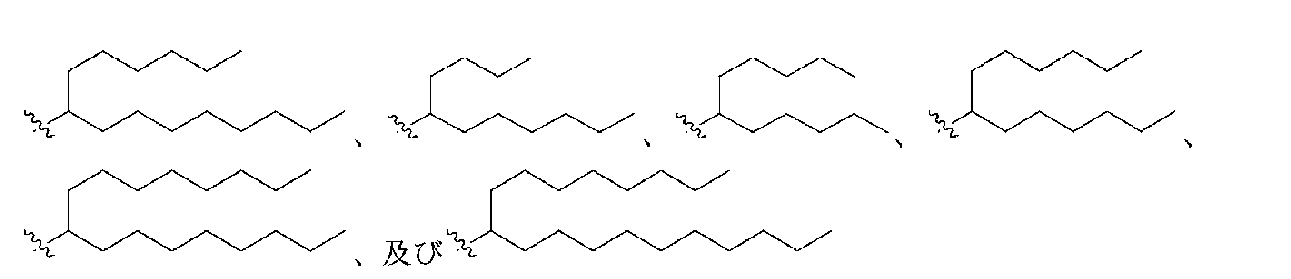
式中、

During the ceremony,
式(XI)の前述の実施形態のうちのいくつかでは、カチオン性イオン化可能脂質は、以下の式(XIV-1)、(XIV-2)、及び(XIV-3):
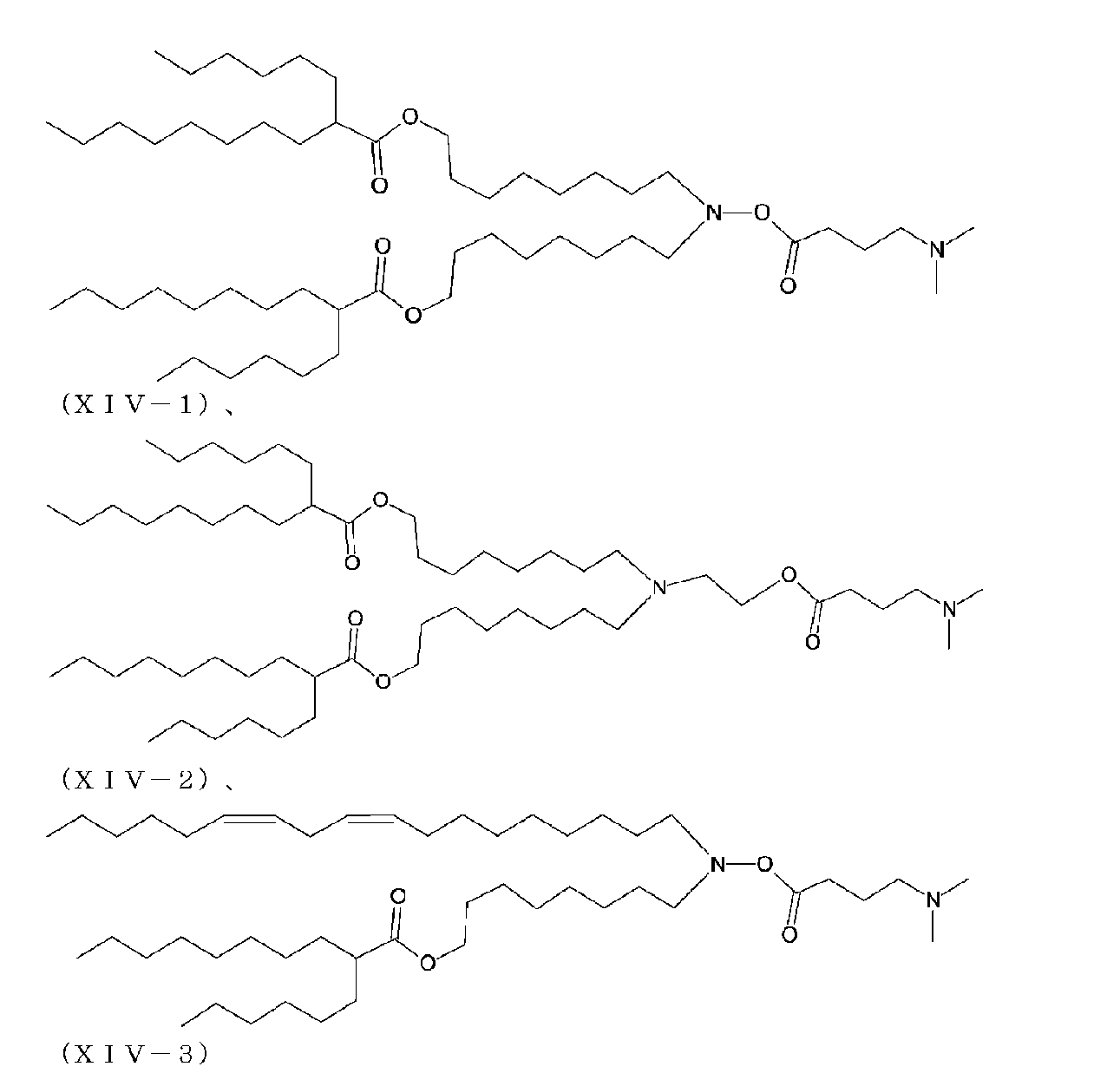
いくつかの実施形態では、カチオン性イオン化可能脂質は、(6Z,16Z)-12-((Z)-デカ-4-エン-1-イル)ドコサ-6,16-ジエン-11-イル5-(ジメチルアミノ)ペンタノエート(3D-P-DMA)である。3D-P-DMAの構造は、以下のように表され得る:

様々な異なる実施形態では、カチオン性イオン化可能脂質は、N,N-ジメチル-2,3-ジオレイルオキシプロピルアミン(DODMA)、1,2-ジオレオイル-3-ジメチルアンモニウム-プロパン(DODAP)、ヘプタトリアコンタ-6,9,28,31-テトラエン-19-イル-4-(ジメチルアミノ)ブタノエート(DLin-MC3-DMA)、及び4-((ジ((9Z,12Z)-オクタデカ-9,12-ジエン-1-イル)アミノ)オキシ)-N,N-ジメチル-4-オキソブタン-1-アミン(DPL-14)からなる群から選択される。 In various different embodiments, the cationic ionizable lipid is selected from the group consisting of N,N-dimethyl-2,3-dioleyloxypropylamine (DODMA), 1,2-dioleoyl-3-dimethylammonium-propane (DODAP), heptatriaconta-6,9,28,31-tetraen-19-yl-4-(dimethylamino)butanoate (DLin-MC3-DMA), and 4-((di((9Z,12Z)-octadeca-9,12-dien-1-yl)amino)oxy)-N,N-dimethyl-4-oxobutan-1-amine (DPL-14).
カチオン性イオン化脂質のさらなる例としては、3-(N-(N′,N′-ジメチルアミノエタン)-カルバモイル)コレステロール(DC-Chol)、1,2-ジオレオイル-3-ジメチルアンモニウム-プロパン(DODAP);1,2-ジアシルオキシ-3-ジメチルアンモニウムプロパン;1,2-ジアルコキシ-3-ジメチルアンモニウムプロパン、1,2-ジステアリルオキシ-N,N-ジメチル-3-アミノプロパン(DSDMA)、1,2-ジリノレイルオキシ-N,N-ジメチルアミノプロパン(DLinDMA)、1,2-ジリノレニルオキシ-N,N-ジメチルアミノプロパン(DLenDMA)、ジオクタデシルアミドグリシルスペルミン(DOGS)、3-ジメチルアミノ-2-(コレスト-5-エン-3-ベータ-オキシブタン-4-オキシ)-1-(シス,シス-9,12-オク-タデカジエノキシ)プロパン(CLinDMA)、2-[5′-(コレスト-5-エン-3-ベータ-オキシ)-3′-オキサペントキシ)-3-ジメチル-1-(シス,シス-9′,12′-オクタデカジエノキシ)プロパン(CpLinDMA)、N,N-ジメチル-3,4-ジオレイルオキシベンジルアミン(DMOBA)、1,2-N,N′-ジオレイルカルバミル-3-ジメチルアミノプロパン(DOcarbDAP)、2,3-ジリノレオイルオキシ-N,N-ジメチルプロピルアミン(DLinDAP)、1,2-N,N′-ジリノレイルカルバミル-3-ジメチルアミノプロパン(DLincarbDAP)、1,2-ジリノレオイルカルバミル-3-ジメチルアミノプロパン(DLinCDAP)、2,2-ジリノレイル-4-ジメチルアミノメチル-[1,3]-ジオキソラン(DLin-K-DMA)、2,2-ジリノレイル-4-ジメチルアミノエチル-[1,3]-ジオキソラン(DLin-K-XTC2-DMA)、2,2-ジリノレイル-4-(2-ジメチルアミノエチル)-[1,3]-ジオキソラン(DLin-KC2-DMA)、ヘプタトリアコンタ-6,9,28,31-テトラエン-19-イル-4-(ジメチルアミノ)ブタノエート(DLin-MC3-DMA)、2-({8-[(3β)-コレスト-5-エン-3-イルオキシ]オクチル}オキシ)-N,N-ジメチル-3-[(9Z,12Z)-オクタデカ-9,12-ジエン-1-イルオキシ]プロパン-1-アミン(Octyl-CLinDMA)、1,2-ジミリストイル-3-ジメチルアンモニウム-プロパン(DMDAP)、1,2-ジパルミトイル-3-ジメチルアンモニウム-プロパン(DPDAP)、N1-[2-((1S)-1-[(3-アミノプロピル)アミノ]-4-[ジ(3-アミノ-プロピル)アミノ]ブチルカルボキサミド)エチル]-3,4-ジ[オレイルオキシ]ベンズアミド(MVL5)、ジ((Z)-ノン-2-エン-1-イル)8,8’-((((2(ジメチルアミノ)エチル)チオ)カルボニル)アザンジイル)ジオクタノエート(ATX)、N,N-ジメチル-2,3-ビス(ドデシルオキシ)プロパン-1-アミン(DLDMA)、N,N-ジメチル-2,3-ビス(テトラデシルオキシ)プロパン-1-アミン(DMDMA)、ジ((Z)-ノン-2-エン-1-イル)-9-((4-(ジメチルアミノブタノイル)オキシ)ヘプタデカンジオエート(L319)、N-ドデシル-3-((2-ドデシルカルバモイル-エチル)-{2-[(2-ドデシルカルバモイル-エチル)-2-{(2-ドデシルカルバモイル-エチル)-[2-(2-ドデシルカルバモイル-エチルアミノ)-エチル]-アミノ}-エチルアミノ)プロピオンアミド(リピドイド 98N12-5)、1-[2-[ビス(2-ヒドロキシドデシル)アミノ]エチル-[2-[4-[2-[ビス(2 ヒドロキシドデシル)アミノ]エチル]ピペラジン-1-イル]エチル]アミノ]ドデカン-2-オール(リピドイドC12-200)が挙げられるが、これらに限定されない。 Further examples of cationic ionizable lipids include 3-(N-(N',N'-dimethylaminoethane)-carbamoyl)cholesterol (DC-Chol), 1,2-dioleoyl-3-dimethylammonium-propane (DODAP); 1,2-diacyloxy-3-dimethylammonium propane; 1,2-dialkoxy-3-dimethylammonium propane, 1,2-distearyloxy-N,N-dimethyl-3-aminopropane (DSDMA), 1,2-dilinoleyloxy-N,N-dimethylaminopropane (DLinDMA), 1,2-dilinolenyloxy-N,N-dimethylaminopropane (DLenDMA), dioctadecylamidoglycylspermine (DOGS), 3-dimethylamino-2-(cholest-5-ene-3-beta-oxybutane-4-oxy)-1-(cis,cis-9,12-octadecadienoxy)propane (CLinDMA), DMA), 2-[5'-(cholest-5-en-3-beta-oxy)-3'-oxapentoxy)-3-dimethyl-1-(cis,cis-9',12'-octadecadienoxy)propane (CpLinDMA), N,N-dimethyl-3,4-dioleyloxybenzylamine (DMOBA), 1,2-N,N'-dioleylcarbamyl-3-dimethylaminopropane (DOcarbDAP), 2,3-dilinoleoyloxy-N ,N-dimethylpropylamine (DLinDAP), 1,2-N,N'-dilinoleylcarbamyl-3-dimethylaminopropane (DLincarbDAP), 1,2-dilinoleoylcarbamyl-3-dimethylaminopropane (DLinCDAP), 2,2-dilinoleyl-4-dimethylaminomethyl-[1,3]-dioxolane (DLin-K-DMA), 2,2-dilinoleyl-4-dimethylaminoethyl-[1,3]-dioxolane (DLin-K-DMA), Oxolane (DLin-K-XTC2-DMA), 2,2-dilinoleyl-4-(2-dimethylaminoethyl)-[1,3]-dioxolane (DLin-KC2-DMA), heptatriaconta-6,9,28,31-tetraen-19-yl-4-(dimethylamino)butanoate (DLin-MC3-DMA), 2-({8-[(3β)-cholest-5-en-3-yloxy]octyl}oxy)-N,N-dimethyl-3 -[(9Z,12Z)-Octadeca-9,12-dien-1-yloxy]propan-1-amine (Octyl-CLinDMA), 1,2-dimyristoyl-3-dimethylammonium-propane (DMDAP), 1,2-dipalmitoyl-3-dimethylammonium-propane (DPDAP), N1-[2-((1S)-1-[(3-aminopropyl)amino]-4-[di(3-aminopropyl)amino]butylcarboxamide] di((Z)-non-2-en-1-yl)8,8'-((((2(dimethylamino)ethyl)thio)carbonyl)azanediyl)dioctanoate (ATX), N,N-dimethyl-2,3-bis(dodecyloxy)propan-1-amine (DLDMA), N,N-dimethyl-2,3-bis(tetradecyloxy)propan-1-amine (DMDMA). , di((Z)-non-2-en-1-yl)-9-((4-(dimethylaminobutanoyl)oxy)heptadecanedioate (L319), N-dodecyl-3-((2-dodecylcarbamoyl-ethyl)-{2-[(2-dodecylcarbamoyl-ethyl)-2-{(2-dodecylcarbamoyl-ethyl)-[2-(2-dodecylcarbamoyl-ethylamino)-ethyl]-amino}-ethylamino)propionamide (Lipidoid 98N12-5), 1-[2-[bis(2-hydroxydodecyl)amino]ethyl-[2-[4-[2-[bis(2 hydroxydodecyl)amino]ethyl]piperazin-1-yl]ethyl]amino]dodecan-2-ol (Lipidoid C12-200), but are not limited thereto.
特定の実施形態では、カチオン性イオン化可能脂質は、X-3であるか、またはそれを含む。 In certain embodiments, the cationic ionizable lipid is or includes X-3.
特定の実施形態では、カチオン性イオン化可能脂質は、X-45であるか、またはそれを含む。 In certain embodiments, the cationic ionizable lipid is or includes X-45.
いくつかの実施形態では、本明細書で使用するためのカチオン性脂質は、DPL-14であるか、またはそれを含む。本明細書で使用される場合、「DPL-14」は、以下の一般式:

いくつかの実施形態では、本明細書で使用するためのカチオン性脂質は、EA-2であるか、またはそれを含む。本明細書で使用される場合、「EA-2」は、以下の一般式:

本明細書に開示されるカチオン性脂質またはカチオン性イオン化可能脂質への任意の言及はまた、その塩(特に薬学的に許容される塩)、互変異性体、立体異性体、溶媒和物(例えば、水和物)、及び同位体的に標識された形態も含むことを理解されたい。 Any reference to a cationic lipid or cationic ionizable lipid disclosed herein should be understood to also include salts (particularly pharma- ceutically acceptable salts), tautomers, stereoisomers, solvates (e.g., hydrates), and isotopically labeled forms thereof.
いくつかの実施形態では、カチオン性/カチオン性イオン化可能脂質は、組成物/粒子中に存在する総脂質の約10mol%~約100mol%、約20mol%~約100mol%、約30mol%~約100mol%、約40mol%~約100mol%、または約50mol%~約100mol%で含まれ得る。いくつかの実施形態では、カチオン性/カチオン性イオン化可能脂質は、組成物/粒子中に存在する総脂質の約40mol%~約75mol%、好ましくは、約40mol%~約70mol%、より好ましくは、約45mol%~約65mol%で含まれる。 In some embodiments, the cationic/cationic ionizable lipid may comprise about 10 mol% to about 100 mol%, about 20 mol% to about 100 mol%, about 30 mol% to about 100 mol%, about 40 mol% to about 100 mol%, or about 50 mol% to about 100 mol% of the total lipid present in the composition/particle. In some embodiments, the cationic/cationic ionizable lipid comprises about 40 mol% to about 75 mol%, preferably about 40 mol% to about 70 mol%, and more preferably about 45 mol% to about 65 mol% of the total lipid present in the composition/particle.
いくつかの実施形態では、本明細書に記載される核酸組成物(特に、DNAまたはRNA組成物)は、カチオン性脂質またはカチオン性イオン化可能脂質及び1つ以上の追加の脂質を含み、カチオン性脂質またはカチオン性イオン化可能脂質は、組成物中に存在する総脂質の約10mol%~約80mol%、約20mol%~約75mol%、約20mol%~約70mol%、約20mol%~約60mol%、約25mol%~約55mol%、約30mol%~約50mol%、約35mol%~約45mol%、または約40mol%~約55mol%で含まれる。 In some embodiments, the nucleic acid compositions (particularly DNA or RNA compositions) described herein comprise a cationic lipid or cationic ionizable lipid and one or more additional lipids, wherein the cationic lipid or cationic ionizable lipid comprises about 10 mol% to about 80 mol%, about 20 mol% to about 75 mol%, about 20 mol% to about 70 mol%, about 20 mol% to about 60 mol%, about 25 mol% to about 55 mol%, about 30 mol% to about 50 mol%, about 35 mol% to about 45 mol%, or about 40 mol% to about 55 mol% of the total lipid present in the composition.
本明細書に記載される核酸(例えば、DNAまたはRNA)組成物(特に、mRNA組成物)のいくつかの実施形態では、(i)核酸、及び(ii)カチオン性脂質またはカチオン性イオン化可能脂質の少なくとも一部が粒子(例えば、LNP)を形成し、カチオン性脂質またはカチオン性イオン化可能脂質は、粒子中に存在する総脂質の約10mol%~約80mol%、約20mol%~約75mol%、約20mol%~約70mol%、約20mol%~約60mol%、約25mol%~約55mol%、約30mol%~約50mol%、約35mol%~約45mol%、または約40mol%~約55mol%で含まれ得る。 In some embodiments of the nucleic acid (e.g., DNA or RNA) compositions (particularly mRNA compositions) described herein, (i) the nucleic acid and (ii) at least a portion of the cationic lipid or cationic ionizable lipid form a particle (e.g., LNP), and the cationic lipid or cationic ionizable lipid may comprise about 10 mol% to about 80 mol%, about 20 mol% to about 75 mol%, about 20 mol% to about 70 mol%, about 20 mol% to about 60 mol%, about 25 mol% to about 55 mol%, about 30 mol% to about 50 mol%, about 35 mol% to about 45 mol%, or about 40 mol% to about 55 mol% of the total lipid present in the particle.
ヘルパー脂質
本明細書に記載されているように、本開示のLNPは、ヘルパー脂質を含む。いくつかの実施形態では、ヘルパー脂質は、リン脂質である。いくつかの実施形態では、ヘルパー脂質は、1,2-ジステアロイル-sn-グリセロ-3-ホスホコリン(DSPC)、1,2-ジパルミトイル-sn-グリセロ-3-ホスホコリン(DPPC)、1,2-ジミリストイル-sn-グリセロ-3-ホスホコリン(DMPC)、1-パルミトイル-2-オレオイル-sn-グリセロ-3-ホスホコリン(POPC)、1,2-ジオレオイル-sn-グリセロ-3-ホスホコリン(DOPC)、ホスファチジルエタノールアミン、例えば、1,2-ジオレオイル-sn-グリセロ-3-ホスホエタノールアミン(DOPE)、スフィンゴミエリン(SM)、1,2-ジアシルグリセリル-3-O-4’-(N,N,N-トリメチル)-ホモセリン(DGTS)、セラミド、コレステロール、ステロイド、例えば、ステロール、及びそれらの誘導体であるか、またはそれらを含む。
Helper Lipids As described herein, the LNPs of the present disclosure comprise a helper lipid. In some embodiments, the helper lipid is a phospholipid. In some embodiments, the helper lipid is or comprises 1,2-distearoyl-sn-glycero-3-phosphocholine (DSPC), 1,2-dipalmitoyl-sn-glycero-3-phosphocholine (DPPC), 1,2-dimyristoyl-sn-glycero-3-phosphocholine (DMPC), 1-palmitoyl-2-oleoyl-sn-glycero-3-phosphocholine (POPC), 1,2-dioleoyl-sn-glycero-3-phosphocholine (DOPC), phosphatidylethanolamines such as 1,2-dioleoyl-sn-glycero-3-phosphoethanolamine (DOPE), sphingomyelin (SM), 1,2-diacylglyceryl-3-O-4'-(N,N,N-trimethyl)-homoserine (DGTS), ceramide, cholesterol, steroids such as sterols, and derivatives thereof.
いくつかの実施形態では、ヘルパー脂質は、ホスファチジルコリン、ホスファチジルエタノールアミン、ホスファチジルグリセロール、ホスファチジン酸、ホスファチジルセリン、もしくはスフィンゴミエリンであるか、またはそれを含む。いくつかの実施形態では、ヘルパー脂質は、ジアシルホスファチジルコリン、例えば、ジステアロイルホスファチジルコリン(DSPC)、ジオレオイルホスファチジルコリン(DOPC)、ジミリストイルホスファチジルコリン(DMPC)、ジペンタデカノイルホスファチジルコリン、ジラウロイルホスファチジルコリン、ジパルミトイルホスファチジルコリン(DPPC)、ジアラキドイルホスファチジルコリン(DAPC)、ジベヘノイルホスファチジルコリン(DBPC)、ジトリコサノイルホスファチジルコリン(DTPC)、ジリグノセロイルファチジルコリン(DLPC)、パルミトイルオレオイル-ホスファチジルコリン(POPC)、1,2-ジ-O-オクタデセニル-sn-グリセロ-3-ホスホコリン(18:0ジエーテルPC)、1-オレオイル-2-コレステリルヘミスクシノイル-sn-グリセロ-3-ホスホコリン(OChemsPC)、1-ヘキサデシル-sn-グリセロ-3-ホスホコリン(C16 Lyso PC)、及び例えば、ジアシルホスファチジルエタノールアミン、例えば、ジオレオイルホスファチジルエタノールアミン(DOPE)、ジステアロイル-ホスファチジルエタノールアミン(DSPE)、ジパルミトイル-ホスファチジルエタノールアミン(DPPE)、ジミリストイル-ホスファチジルエタノールアミン(DMPE)、ジラウロイル-ホスファチジルエタノールアミン(DLPE)、ジフィタノイル-ホスファチジルエタノールアミン(DPyPE)を含む、ホスファチジルエタノールアミン、1,2-ジ-(9Z-オクタデセノイル)-sn-グリセロ-3-ホスホコリン(DOPG)、1,2-ジパルミトイル-sn-グリセロ-3-ホスホ-(1′-rac-グリセロール)(DPPG)、1-パルミトイル-2-オレオイル-sn-グリセロ-3-ホスホエタノールアミン(POPE)、N-パルミトイル-D-エリスロ-スフィンゴシルホスホリルコリン(SM)であるか、またはそれを含む。いくつかの実施形態では、ヘルパー脂質は、DSPC、DOPC、DMPC、DPPC、POPC、DOPE、DOPG、DPPG、POPE、DPPE、DMPE、DSPE、及びSMからなる群から選択される。いくつかの実施形態では、中性脂質は、DSPC、DPPC、DMPC、DOPC、POPC、DOPE、及びSMからなる群から選択される。いくつかの実施形態では、中性脂質は、DSPCである。 In some embodiments, the helper lipid is or comprises a phosphatidylcholine, a phosphatidylethanolamine, a phosphatidylglycerol, a phosphatidic acid, a phosphatidylserine, or a sphingomyelin. In some embodiments, the helper lipid is a diacylphosphatidylcholine, such as distearoylphosphatidylcholine (DSPC), dioleoylphosphatidylcholine (DOPC), dimyristoylphosphatidylcholine (DMPC), dipentadecanoylphosphatidylcholine, dilauroylphosphatidylcholine, dipalmitoylphosphatidylcholine (DPPC), diarachidoylphosphatidylcholine (DAPC), dibehenoylphosphatidylcholine. (DBPC), ditricosanoyl phosphatidylcholine (DTPC), dilignoceroyl phosphatidylcholine (DLPC), palmitoyloleoyl-phosphatidylcholine (POPC), 1,2-di-O-octadecenyl-sn-glycero-3-phosphocholine (18:0 diether PC), 1-oleoyl-2-cholesterylhemisuccinoyl-sn-glycero-3-phosphocholine (OChemsPC), 1-hexadecyl-sn-glycero-3-phosphocholine (C16 Lyso PC), and for example, diacylphosphatidylethanolamines, such as dioleoylphosphatidylethanolamine (DOPE), distearoyl-phosphatidylethanolamine (DSPE), dipalmitoyl-phosphatidylethanolamine (DPPE), dimyristoyl-phosphatidylethanolamine (DMPE), dilauroyl-phosphatidylethanolamine (DLPE), diphytanoyl-phosphatidylethanolamine (DPy 1,2-di-(9Z-octadecenoyl)-sn-glycero-3-phosphocholine (DOPG), 1,2-dipalmitoyl-sn-glycero-3-phospho-(1'-rac-glycerol) (DPPG), 1-palmitoyl-2-oleoyl-sn-glycero-3-phosphoethanolamine (POPE), N-palmitoyl-D-erythro-sphingosylphosphorylcholine (SM), including phosphatidylethanolamine (POPE), 1,2-di-(9Z-octadecenoyl)-sn-glycero-3-phosphocholine (DOPG), 1,2-dipalmitoyl-sn-glycero-3-phospho-(1'-rac-glycerol) (DPPG), 1-palmitoyl-2-oleoyl-sn-glycero-3-phosphoethanolamine (POPE), N-palmitoyl-D-erythro-sphingosylphosphorylcholine (SM). In some embodiments, the helper lipid is selected from the group consisting of DSPC, DOPC, DMPC, DPPC, POPC, DOPE, DOPG, DPPG, POPE, DPPE, DMPE, DSPE, and SM. In some embodiments, the neutral lipid is selected from the group consisting of DSPC, DPPC, DMPC, DOPC, POPC, DOPE, and SM. In some embodiments, the neutral lipid is DSPC.
ヘルパー脂質は、合成、または天然由来であり得る。脂質ナノ粒子での使用に好適な他のヘルパー脂質は、WO2021/026358、WO2017/075531、及びWO2018/081480に記載されており、それらの各々の内容全体が、参照によりそれらの全体が本明細書に組み込まれる。 Helper lipids can be synthetic or naturally derived. Other helper lipids suitable for use in lipid nanoparticles are described in WO2021/026358, WO2017/075531, and WO2018/081480, the entire contents of each of which are incorporated herein by reference in their entirety.
いくつかの実施形態では、脂質ナノ粒子は、約5~約15mol%のリン脂質を含む。いくつかの実施形態では、脂質ナノ粒子は、約8~約12mol%のリン脂質を含む。いくつかの実施形態では、脂質ナノ粒子は、約10mol%のリン脂質を含む。いくつかの実施形態では、脂質ナノ粒子は、約5~約15mol%のDSPCを含む。いくつかの実施形態では、脂質ナノ粒子は、約8~約12mol%のDSPCを含む。いくつかの実施形態では、脂質ナノ粒子は、約10mol%のDSPCを含む。 In some embodiments, the lipid nanoparticles comprise about 5 to about 15 mol% phospholipids. In some embodiments, the lipid nanoparticles comprise about 8 to about 12 mol% phospholipids. In some embodiments, the lipid nanoparticles comprise about 10 mol% phospholipids. In some embodiments, the lipid nanoparticles comprise about 5 to about 15 mol% DSPC. In some embodiments, the lipid nanoparticles comprise about 8 to about 12 mol% DSPC. In some embodiments, the lipid nanoparticles comprise about 10 mol% DSPC.
ポリマー抱合型脂質
本明細書に記載されるように、本開示のLNPは、ポリマー抱合型脂質を含む。いくつかの実施形態では、ポリマー抱合型脂質は、ポリエチレングリコール(PEG脂質)と抱合された脂質である。いくつかの実施形態では、PEG脂質は、ペグ化ジアシルグリセロール(PEG-DAG)、例えば、l-(モノメトキシ-ポリエチレングリコール)-2,3-ジミリストイルグリセロール(PEG-DMG)(例えば、1,2-ジミリストイル-rac-グリセロ-3-メトキシポリエチレングリコール-2000(PEG2000-DMG))、ペグ化ホスファチジルエタノールアミン(PEG-PE)、PEGサクシネートジアシルグリセロール(PEG-S-DAG)、例えば、4-O-(2’,3’-ジ(テトラデカノイルオキシ)プロピル-1-O-(ω-メトキシ(ポリエトキシ)エチル)ブタンジオエート(PEG-S-DMG)、1,2-ジステアロイル-sn-グリセロ-3-ホスホエタノールアミン-N-[アミノ(ポリエチレングリコール)-2000](DSPE-PEG2000アミン)、ペグ化セラミド(PEG-cer)、またはPEGジアルコキシプロピルカルバメート、例えば、ω-メトキシ(ポリエトキシ)エチル-N-(2,3-ジ(テトラデカノキシ)プロピル)カルバメート、及び2,3-ジ(テトラデカノキシ)プロピル1-Ν-(ωメトキシ(ポリエトキシ)エチル)カルバメートから選択される。
Polymer-Conjugated Lipids As described herein, the LNPs of the present disclosure comprise a polymer-conjugated lipid. In some embodiments, the polymer-conjugated lipid is a lipid conjugated with polyethylene glycol (PEG lipid). In some embodiments, the PEG lipid is a pegylated diacylglycerol (PEG-DAG), such as 1-(monomethoxy-polyethylene glycol)-2,3-dimyristoyl glycerol (PEG-DMG) (e.g., 1,2-dimyristoyl-rac-glycero-3-methoxypolyethylene glycol-2000 (PEG2000-DMG)), pegylated phosphatidylethanolamine (PEG-PE), PEG succinate diacylglycerol (PEG-S-DAG), such as 4-O-(2',3'-di(tetradecanoyloxy)propyl-1-O-(ω-methionyloxy)propyl-1-O-(PEG-DMG) (e.g., 1,2-dimyristoyl-rac-glycero-3-methoxypolyethylene glycol-2000 (PEG2000-DMG)), PEG-succinate ...PEG-DMG) (e.g., 1,2-dimyristoyl-rac-glycero-3-methoxypolyethylene glycol-2000 (PEG2000-DMG)), PEG-succinate diacylglycer PEG-1,1-dimethyl-2,3-di(tetradecanoyl)propyl)carbamate, 1,2-di(tetradecanoyl)propyl-N-(2,3-di(tetradecanoyl)propyl)butanedioate (PEG-S-DMG), 1,2-distearoyl-sn-glycero-3-phosphoethanolamine-N-[amino(polyethylene glycol)-2000] (DSPE-PEG2000 amine), pegylated ceramide (PEG-cer), or PEG dialkoxypropyl carbamates, such as ω-methoxy(polyethoxy)ethyl-N-(2,3-di(tetradecanoyl)propyl)carbamate, and 2,3-di(tetradecanoyl)propyl 1-N-(ω-methoxy(polyethoxy)ethyl)carbamate.
いくつかの実施形態では、PEG脂質は、PEG2000-DMG:

いくつかの実施形態では、PEG脂質は、DMG-PEGである。 In some embodiments, the PEG lipid is DMG-PEG.
いくつかの実施形態では、PEG脂質は、WO2021/026358、WO2017/075531、またはWO2018/081480に提供されており、これらの各々は参照によりその全体が組み込まれる。 In some embodiments, PEG lipids are provided in WO2021/026358, WO2017/075531, or WO2018/081480, each of which is incorporated by reference in its entirety.
いくつかの実施形態では、PEG脂質は、式IIの化合物:

本明細書に記載されるように、R8及びR9は、各々独立して、C10-C30脂肪族であり、1個以上のエステル結合によって任意に妨げられる。いくつかの実施形態では、R8及びR9は、各々独立して、C10-C30脂肪族である。いくつかの実施形態では、R8及びR9は、各々独立して、C12-C16脂肪族から選択される。いくつかの実施形態では、R8及びR9は、各々独立して、C12-C16アルキルから選択される。いくつかの実施形態では、R8及びR9は、各々独立して、直鎖C12-C16アルキルから選択される。いくつかの実施形態では、wは、40~50の整数である。いくつかの実施形態では、wは、45~47である。いくつかの実施形態では、wは、45である。 As described herein, R 8 and R 9 are each independently C 10 -C 30 aliphatic, optionally interrupted by one or more ester linkages. In some embodiments, R 8 and R 9 are each independently C 10 -C 30 aliphatic. In some embodiments, R 8 and R 9 are each independently selected from C 12 -C 16 aliphatic. In some embodiments, R 8 and R 9 are each independently selected from C 12 -C 16 alkyl. In some embodiments, R 8 and R 9 are each independently selected from linear C 12 -C 16 alkyl. In some embodiments, w is an integer from 40 to 50. In some embodiments, w is 45 to 47. In some embodiments, w is 45.
いくつかの実施形態では、式IIの化合物は、2-[(ポリエチレングリコール)-2000]-N,N-ジテトラデシルアセトアミド(ALC-0159)である。いくつかの実施形態では、式IIの化合物は、

いくつかの実施形態では、PEG脂質は、以下の構造:

式中、nは、30~60の範囲、例えば、約50の平均値を有する。一実施形態では、PEG-抱合型脂質(ペグ化脂質)は、PEG2000-C-DMAであり、好ましくは、3-N-[(ω-メトキシポリ(エチレングリコール)2000)カルバモイル]-1,2-ジミリスチルオキシ-プロピルアミン(MPEG-(2kDa)-C-DMA)またはメトキシ-ポリエチレングリコール-2,3-ビス(テトラデシルオキシ)プロピルカルバメート(2000)を指す。
In some embodiments, the PEG lipid has the following structure:
wherein n has a range of 30 to 60, e.g., an average value of about 50. In one embodiment, the PEG-conjugated lipid (PEGylated lipid) is PEG 2000 -C-DMA, preferably referring to 3-N-[(ω-methoxypoly(ethylene glycol)2000)carbamoyl]-1,2-dimyristyloxy-propylamine (MPEG-(2kDa)-C-DMA) or methoxy-polyethylene glycol-2,3-bis(tetradecyloxy)propylcarbamate (2000).
いくつかの実施形態では、PEG脂質は、PEG-DAG、PEG-PE、PEG-S-DAG、PEG2000-DMG、PEG-S-DMG、PEG-cer、PEGジアルキオキシプロピルカルバメート(例えば、ω-メトキシ(ポリエトキシ)エチル-N-(2,3-ジ(テトラデカノキシ)プロピル)カルバメートまたは2,3-ジ(テトラデカノキシ)プロピル-N-(ωメトキシ(ポリエトキシ)エチル)カルバメート)、ALC-0159、及びそれらの組み合わせから選択される。いくつかの実施形態では、PEG脂質は、ALC-0159またはPEG2000-DMGである。いくつかの実施形態では、PEG脂質は、ALC-0159である。いくつかの実施形態では、PEG脂質は、PEG2000-DMGである。いくつかの実施形態では、PEG脂質は、PEG-DAGである。いくつかの実施形態では、PEG脂質は、PEG-PEである。いくつかの実施形態では、PEG脂質は、PEG-S-DAGである。いくつかの実施形態では、PEG脂質は、PEG-cerである。いくつかの実施形態では、PEG脂質は、PEGジアルキオキシプロピルカルバメートである。 In some embodiments, the PEG lipid is selected from PEG-DAG, PEG-PE, PEG-S-DAG, PEG2000-DMG, PEG-S-DMG, PEG-cer, PEG dialkoxypropyl carbamate (e.g., ω-methoxy(polyethoxy)ethyl-N-(2,3-di(tetradecanoxy)propyl)carbamate or 2,3-di(tetradecanoxy)propyl-N-(ω-methoxy(polyethoxy)ethyl)carbamate), ALC-0159, and combinations thereof. In some embodiments, the PEG lipid is ALC-0159 or PEG2000-DMG. In some embodiments, the PEG lipid is ALC-0159. In some embodiments, the PEG lipid is PEG2000-DMG. In some embodiments, the PEG lipid is PEG-DAG. In some embodiments, the PEG lipid is PEG-PE. In some embodiments, the PEG lipid is PEG-S-DAG. In some embodiments, the PEG lipid is PEG-cer. In some embodiments, the PEG lipid is PEG dialkyoxypropyl carbamate.
いくつかの実施形態では、PEG脂質の一部であるPEG基は、1個以上のPEG脂質分子を含む組成物において、平均して、約2000g/molの数平均分子量(Mn)を有する。 In some embodiments, the PEG groups that are part of a PEG lipid have, on average, a number average molecular weight (M n ) of about 2000 g/mol in a composition comprising one or more PEG lipid molecules.
いくつかの実施形態では、ポリマー抱合型脂質は、ポリサルコシン抱合型脂質であり、本明細書では、サルコシン化脂質またはpSar脂質とも称される。「サルコシン化脂質」という用語は、脂質部分及びポリサルコシン(ポリ(N-メチルグリシン)部分の両方を含む分子を指す。 In some embodiments, the polymer-conjugated lipid is a polysarcosine-conjugated lipid, also referred to herein as a sarcosinated lipid or pSar lipid. The term "sarcosinated lipid" refers to a molecule that contains both a lipid portion and a polysarcosine (poly(N-methylglycine)) portion.
いくつかの実施形態では、ポリマー抱合型脂質は、ポリオキサゾリン(POX)抱合型脂質及び/またはポリオキサジン(POZ)抱合型脂質であり、本明細書ではPOX及び/またはPOZポリマー及び1個以上の疎水性鎖の抱合体、またはオキサゾリン化脂質及び/もしくはオキサジン化脂質、またはPOX脂質及び/もしくはPOZ脂質とも称される。「オキサゾリン化脂質」または「POX脂質」という用語は、脂質部分及びポリオキサゾリン部分の両方を含む分子を指す。「オキサジン化脂質」または「POZ脂質」という用語は、脂質部分及びポリオキサジン部分の両方を含む分子を指す。「オキサゾリン化/オキサジン化脂質」または「POX/POZ脂質」または「POXZ脂質」という用語は、ポリオキサゾリン及びポリオキサジンの脂質部分及びコポリマーの一部の両方を含む分子を指す。 In some embodiments, the polymer-conjugated lipid is a polyoxazoline (POX)-conjugated lipid and/or a polyoxazine (POZ)-conjugated lipid, also referred to herein as a conjugate of a POX and/or POZ polymer and one or more hydrophobic chains, or an oxazolinated lipid and/or an oxazinated lipid, or a POX lipid and/or a POZ lipid. The term "oxazolinated lipid" or "POX lipid" refers to a molecule that includes both a lipid portion and a polyoxazinated portion. The term "oxazolinated lipid" or "POZ lipid" refers to a molecule that includes both a lipid portion and a polyoxazine portion. The term "oxazolinated/oxazinated lipid" or "POX/POZ lipid" or "POXZ lipid" refers to a molecule that includes both a lipid portion and a copolymer portion of polyoxazoline and polyoxazine.
いくつかの実施形態では、本明細書に記載されるLNPは、サルコシン化脂質を含み得る。いくつかの実施形態では、本明細書に記載される核酸組成物(例えば、DNA組成物またはRNA組成物、特に、mRNA組成物)は、サルコシン化脂質を含み、ペグ化脂質を実質的に含まない(またはペグ化脂質を含まない)。 In some embodiments, the LNPs described herein may include sarcosinated lipids. In some embodiments, the nucleic acid compositions (e.g., DNA compositions or RNA compositions, particularly mRNA compositions) described herein include sarcosinated lipids and are substantially free of pegylated lipids (or are free of pegylated lipids).
いくつかの実施形態では、本明細書に記載される核酸組成物(例えば、DNAまたはRNA組成物、特に、mRNA組成物)は、本明細書に記載されるカチオン性/カチオン性イオン化可能脂質、及びサルコシン化脂質(pSAR抱合型脂質)を含む。いくつかの実施形態では、本明細書に記載される核酸組成物(例えば、DNAまたはRNA組成物、特に、mRNA組成物)は、中性脂質(例えば、リン脂質、コレステロールまたはその誘導体)、または中性脂質の組み合わせ(例えば、リン脂質、及びコレステロールまたはその誘導体)をさらに含み得る。いくつかの実施形態では、本明細書に記載される核酸組成物(例えば、DNAまたはRNA組成物、特に、mRNA組成物)は、本明細書に記載されるカチオン性/カチオン性イオン化可能脂質、サルコシン化脂質、中性脂質(例えば、リン脂質)、及びコレステロールまたはその誘導体を含む。いくつかの実施形態では、リン脂質は、DSPCである。いくつかの実施形態では、カチオン性/カチオン性イオン化可能脂質は、式(X)のカチオン性イオン化可能脂質(例えば、式(X-3)または(X-45)のカチオン性イオン化可能脂質)である。いくつかの実施形態では、カチオン性/カチオン性イオン化可能脂質は、式(XI)のカチオン性イオン化可能脂質(例えば、式(XIV-1)、(XIV-2)、または(XIV-3)のカチオン性イオン化可能脂質)である。いくつかの実施形態では、カチオン性/カチオン性イオン化可能脂質は、DPL14、EA-2、または3D-P-DMAである。 In some embodiments, the nucleic acid compositions described herein (e.g., DNA or RNA compositions, particularly mRNA compositions) comprise a cationic/cationic ionizable lipid described herein and a sarcosinated lipid (pSAR-conjugated lipid). In some embodiments, the nucleic acid compositions described herein (e.g., DNA or RNA compositions, particularly mRNA compositions) may further comprise a neutral lipid (e.g., a phospholipid, cholesterol or a derivative thereof), or a combination of neutral lipids (e.g., a phospholipid and cholesterol or a derivative thereof). In some embodiments, the nucleic acid compositions described herein (e.g., DNA or RNA compositions, particularly mRNA compositions) comprise a cationic/cationic ionizable lipid described herein, a sarcosinated lipid, a neutral lipid (e.g., a phospholipid), and cholesterol or a derivative thereof. In some embodiments, the phospholipid is DSPC. In some embodiments, the cationic/cationic ionizable lipid is a cationic ionizable lipid of formula (X) (e.g., a cationic ionizable lipid of formula (X-3) or (X-45)). In some embodiments, the cationic/cationic ionizable lipid is a cationic ionizable lipid of formula (XI) (e.g., a cationic ionizable lipid of formula (XIV-1), (XIV-2), or (XIV-3)). In some embodiments, the cationic/cationic ionizable lipid is DPL14, EA-2, or 3D-P-DMA.
サルコシン化脂質を含む、本明細書に記載される核酸組成物(例えば、DNAまたはRNA組成物、特に、mRNA組成物)のいくつかの実施形態では、当該組成物は、ペグ化脂質を実質的に含まない(またはペグ化脂質を含まない)。 In some embodiments of the nucleic acid compositions (e.g., DNA or RNA compositions, particularly mRNA compositions) described herein that include sarcosinated lipids, the compositions are substantially free of pegylated lipids (or free of pegylated lipids).
いくつかの実施形態では、サルコシン化脂質は、2~200個のサルコシン単位、例えば、5~100個のサルコシン単位、10~50個のサルコシン単位、15~40個のサルコシン単位、例えば、約23個のサルコシン単位を含む。 In some embodiments, the sarcosinated lipid comprises 2-200 sarcosine units, e.g., 5-100 sarcosine units, 10-50 sarcosine units, 15-40 sarcosine units, e.g., about 23 sarcosine units.
いくつかの実施形態では、サルコシン化脂質は、以下の一般式(XVII)の構造:

式中、sは、サルコシン単位の数である。
In some embodiments, the sarcosinated lipid has the structure of the following general formula (XVII):
where s is the number of sarcosine units.
いくつかの実施形態では、サルコシン化脂質は、以下の一般式(XVIII)の構造:

式中、R21及びR22のうちの一方は、疎水性基を含み、他方は、H、親水性基、または任意に標的化部分を含む官能基であり、xは、サルコシン単位の数である。
In some embodiments, the sarcosinated lipid has the structure of the following general formula (XVIII):
where one of R 21 and R 22 comprises a hydrophobic group and the other is H, a hydrophilic group, or a functional group optionally comprising a targeting moiety, and x is the number of sarcosine units.
式(XVIII)のいくつかの実施形態では、R21は、H、親水性基、または任意に標的部分を含む官能基であり、R22は、各々が少なくとも12個の炭素原子、例えば、少なくとも14個の炭素原子を有する1もしくは2個の直鎖アルキルまたはアルケニル基を含む。いくつかの実施形態では、直鎖アルキル基及びアルケニル基の各々は、最大30個の炭素原子、例えば、最大28個、最大26個、最大24個、最大22個、最大20個、または最大18個の炭素原子を有する。いくつかの実施形態では、R22は、各々が12~30個の炭素原子(例えば、12~28個の炭素原子、12~26個の炭素原子、12~24個の炭素原子、12~22個の炭素原子、12~20個の炭素原子、または12~18個の炭素原子)を有する1もしくは2個の直鎖アルキルまたはアルケニル基を含む。 In some embodiments of formula (XVIII), R 21 is H, a hydrophilic group, or a functional group optionally comprising a targeting moiety, and R 22 includes one or two linear alkyl or alkenyl groups, each having at least 12 carbon atoms, e.g., at least 14 carbon atoms. In some embodiments, the linear alkyl and alkenyl groups each have up to 30 carbon atoms, e.g., up to 28, up to 26, up to 24, up to 22, up to 20, or up to 18 carbon atoms. In some embodiments, R 22 includes one or two linear alkyl or alkenyl groups, each having 12-30 carbon atoms (e.g., 12-28 carbon atoms, 12-26 carbon atoms, 12-24 carbon atoms, 12-22 carbon atoms, 12-20 carbon atoms, or 12-18 carbon atoms).
いくつかの実施形態では、サルコシン化脂質は、以下の一般式(IXX)の構造:

式中、Rは、H、親水性基、または任意に標的化部分を含む官能基であり、sは、サルコシン単位の数である。
In some embodiments, the sarcosinated lipid has the structure of the following general formula (IXX):
where R is H, a hydrophilic group, or a functional group optionally including a targeting moiety, and s is the number of sarcosine units.
いくつかの実施形態では、サルコシン化脂質は、以下の式(IXX-1):

式中、s1は、23である。式(IXX-1)のサルコシン化脂質は、本明細書では「C14pSar23」とも称される。
In some embodiments, the sarcosinated lipid has the following formula (IXX-1):
wherein s1 is 23. The sarcosinated lipid of formula (IX-1) is also referred to herein as "C14pSar23."
いくつかの実施形態では、本明細書のLNPは、オキサゾリン化脂質及び/またはオキサジン化脂質を含み得る。いくつかの実施形態では、本明細書に記載される核酸組成物(例えば、DNAまたはRNA組成物、特に、mRNA組成物)は、オキサゾリン化脂質及び/またはオキサジン化脂質を含み、ペグ化脂質を実質的に含まない(またはペグ化脂質を含まない)。 In some embodiments, the LNPs herein may include oxazolinated lipids and/or oxazinated lipids. In some embodiments, the nucleic acid compositions (e.g., DNA or RNA compositions, particularly mRNA compositions) described herein include oxazolinated lipids and/or oxazinated lipids, and are substantially free of pegylated lipids (or free of pegylated lipids).
いくつかの実施形態では、本明細書に記載される核酸組成物(例えば、DNAまたはRNA組成物、特に、mRNA組成物)は、本明細書に記載されるカチオン性/カチオン性イオン化可能脂質、及びオキサゾリン化脂質及び/またはオキサジン化脂質(POX脂質及び/またはPOZ抱合型脂質)を含む。いくつかの実施形態では、本明細書に記載される核酸組成物(例えば、DNAまたはRNA組成物、特に、mRNA組成物)は、中性脂質(例えば、リン脂質、コレステロールまたはその誘導体)、または中性脂質の組み合わせ(例えば、リン脂質、及びコレステロールまたはその誘導体)をさらに含み得る。いくつかの実施形態では、本明細書に記載される核酸組成物(例えば、DNAまたはRNA組成物、特に、mRNA組成物)は、本明細書に記載されるカチオン性/カチオン性イオン化可能脂質、オキサゾリン化脂質及び/またはオキサジン化脂質、中性脂質(例えば、リン脂質)、及びコレステロールまたはその誘導体を含む。いくつかの実施形態では、リン脂質は、DSPCである。いくつかの実施形態では、カチオン性/カチオン性イオン化可能脂質は、式(X)のカチオン性イオン化可能脂質(例えば、式(X-3)または(X-45)のカチオン性イオン化可能脂質)である。いくつかの実施形態では、カチオン性/カチオン性イオン化可能脂質は、式(XI)のカチオン性イオン化可能脂質(例えば、式(XIV-1)、(XIV-2)、または(XIV-3)のカチオン性イオン化可能脂質)である。いくつかの実施形態では、カチオン性/カチオン性イオン化可能脂質は、DPL14、EA-2、または3D-P-DMAである。オキサゾリン化及び/またはオキサジン化脂質を含む、本明細書に記載される核酸組成物(例えば、DNAまたはRNA組成物、特に、mRNA組成物)のいくつかの実施形態では、当該組成物は、ペグ化脂質を実質的に含まない(またはペグ化脂質を含まない)。 In some embodiments, the nucleic acid compositions described herein (e.g., DNA or RNA compositions, particularly mRNA compositions) comprise a cationic/cationic ionizable lipid as described herein, and an oxazolinated lipid and/or an oxazinated lipid (POX lipid and/or POZ-conjugated lipid). In some embodiments, the nucleic acid compositions described herein (e.g., DNA or RNA compositions, particularly mRNA compositions) may further comprise a neutral lipid (e.g., a phospholipid, cholesterol or a derivative thereof), or a combination of neutral lipids (e.g., a phospholipid and cholesterol or a derivative thereof). In some embodiments, the nucleic acid compositions described herein (e.g., DNA or RNA compositions, particularly mRNA compositions) comprise a cationic/cationic ionizable lipid as described herein, an oxazolinated lipid and/or an oxazinated lipid, a neutral lipid (e.g., a phospholipid), and cholesterol or a derivative thereof. In some embodiments, the phospholipid is DSPC. In some embodiments, the cationic/cationic ionizable lipid is a cationic ionizable lipid of formula (X) (e.g., a cationic ionizable lipid of formula (X-3) or (X-45)). In some embodiments, the cationic/cationic ionizable lipid is a cationic ionizable lipid of formula (XI) (e.g., a cationic ionizable lipid of formula (XIV-1), (XIV-2), or (XIV-3)). In some embodiments, the cationic/cationic ionizable lipid is DPL14, EA-2, or 3D-P-DMA. In some embodiments of the nucleic acid compositions (e.g., DNA or RNA compositions, particularly mRNA compositions) described herein that include oxazolinated and/or oxazinated lipids, the compositions are substantially free of pegylated lipids (or free of pegylated lipids).
いくつかの実施形態では、オキサゾリン化及び/またはオキサジン化脂質(すなわち、(i)POX及び/またはPOZポリマーと、(ii)1個以上の疎水性鎖を含む抱合体)において、構成要素(i)及び(ii)は、少なくとも1個の機能的部分を含むリンカーを介して互いに連結される。いくつかの実施形態では、当該リンカーは、少なくとも1個の一価官能性部分で置換されるアルキレン部分を含む。いくつかの実施形態では、当該リンカーは、アルキレン基及び二価官能性部分を含み、二価官能性部分は、アルキレン基を1個以上の疎水性鎖と連結し、アルキレン基は、POX及び/またはPOZポリマーと結合する。いくつかの実施形態では、当該リンカーは、アルキレン基及び二価官能性部分を含み、二価官能性部分は、アルキレン基を1個以上の疎水性鎖と連結し、アルキレン基は、少なくとも1個の一価官能性部分で置換され、アルキレン基は、POX及び/またはPOZポリマーと結合する。 In some embodiments, in the oxazolinated and/or oxazinated lipid (i.e., a conjugate comprising (i) a POX and/or POZ polymer and (ii) one or more hydrophobic chains), components (i) and (ii) are linked to each other via a linker comprising at least one functional moiety. In some embodiments, the linker comprises an alkylene moiety substituted with at least one monovalent functional moiety. In some embodiments, the linker comprises an alkylene group and a divalent functional moiety, the divalent functional moiety connecting the alkylene group to one or more hydrophobic chains, the alkylene group being attached to the POX and/or POZ polymer. In some embodiments, the linker comprises an alkylene group and a divalent functional moiety, the divalent functional moiety connecting the alkylene group to one or more hydrophobic chains, the alkylene group being substituted with at least one monovalent functional moiety, the alkylene group being attached to the POX and/or POZ polymer.
オキサゾリン化及び/またはオキサジン化脂質のいくつかの実施形態では、各一価官能性部分は、独立して、ヒドロキシ、エーテル、ハロゲン、シアノ、アジド、ニトロ、アミノ、アンモニウム、エステル、カルボキシル、チオール(スルファニル)、ジスルファニル、スルフィド、ジスルフィド、スルホキシド、スルホン、サルファイト、スルフェート、ホスフェート、スルフィンアミド、スルホンアミド、スルファメート、ジセレニド、亜硫酸ジアミド、硫酸ジアミド、ウレア、チオウレア、カルボニル、チオカルボニル、オルトエステル、チオエート、ジチオエート、イミデート、イミノ、イミドチオエート、チオニルアミド、カーボネート、カルボノチオエート、カルボノジチオエート、カルボノトリチオエート、グアニジノ(イミダミド)、カルバミミデート、カルボイミデート、カルバメート、カルバモジチオエート、カルボノジチオイミデート、カルバミミドチオエート、カルバモチオエート、カルボイミドチオエート、アシルヒドラゾン、ヒドラジン、オキシム、アセタール、ヘミアセタール、ケタール、ヘミケタール、イミド、及びアミド部分から選択される。 In some embodiments of the oxazolinated and/or oxazinated lipids, each monovalent functional moiety is independently selected from the group consisting of hydroxy, ether, halogen, cyano, azido, nitro, amino, ammonium, ester, carboxyl, thiol (sulfanyl), disulfanyl, sulfide, disulfide, sulfoxide, sulfone, sulfite, sulfate, phosphate, sulfinamide, sulfonamide, sulfamate, diselenide, sulfite diamide, sulfate diamide, urea, thiourea, carbonyl, thiocarbonyl, orthoester. The aryl, thioate, dithioate, imidate, imino, imidothioate, thionylamide, carbonate, carbonothioate, carbonodithioate, carbonotrithioate, guanidino (imidamide), carbamimidate, carboimidate, carbamate, carbamodithioate, carbonodithioimidate, carbamimidothioate, carbamothioate, carboimidothioate, acylhydrazone, hydrazine, oxime, acetal, hemiacetal, ketal, hemiketal, imide, and amide moieties.
オキサゾリン化及び/またはオキサジン化脂質のいくつかの実施形態では、各二価官能性部分は、独立して、エーテル、アミノ、エステル、スルフィド、ジスルフィド、スルホキシド、スルホン、サルファイト、スルフェート、ホスフェート、スルフィンアミド、スルホンアミド、スルファメート、ジセレニド、亜硫酸ジアミド、硫酸ジアミド、ウレア、チオウレア、カルボニル、チオカルボニル、オルトエステル、チオエート、ジチオエート、イミデート、イミノ、イミドチオエート、チオニルアミド、カーボネート、カルボノチオエート、カルボノジチオエート、カルボノトリチオエート、グアニジノ(イミダミド)、カルバミミデート、カルボイミデート、カルバメート、カルバモジチオエート、カルボノジチオイミデート、カルバミミドチオエート、カルバモチオエート、カルボイミドチオエート、アシルヒドラゾン、ヒドラジン、オキシム、アセタール、ヘミアセタール、ケタール、ヘミケタール、イミン、イミド、及びアミド部分から選択される。 In some embodiments of the oxazolinated and/or oxazinated lipid, each difunctional moiety is independently selected from the group consisting of ether, amino, ester, sulfide, disulfide, sulfoxide, sulfone, sulfite, sulfate, phosphate, sulfinamide, sulfonamide, sulfamate, diselenide, sulfite diamide, sulfate diamide, urea, thiourea, carbonyl, thiocarbonyl, orthoester, thioate, dithioate, imidate, imino, imidothioate, thio ... ester, thionylamide, carbonate, carbonothioate, carbonodithioate, carbonotrithioate, guanidino(imidamide), carbamimidate, carboimidate, carbamate, carbamodithioate, carbonodithioimidate, carbamimidothioate, carbamothioate, carboimidothioate, acylhydrazone, hydrazine, oxime, acetal, hemiacetal, ketal, hemiketal, imine, imide, and amide moieties.
いくつかの実施形態では、オキサゾリン化及び/またはオキサジン化脂質は、以下の構造(特に、1個以上の疎水性鎖が、例えば、本明細書の式(XXI)に示されるように、POX及び/またはPOZポリマーのN末端(すなわち、末端N原子)と結合する場合):
(疎水性鎖)1-2-(少なくとも1個の一価官能性部分で置換されるアルキレン部分)-(POX及び/またはPOZポリマー)、
[(疎水性鎖)-(二価官能性部分)]1-2-(アルキレン部分)-(POX及び/またはPOZポリマー)のうちの1つを含む。
In some embodiments, the oxazolinated and/or oxazinated lipid has the following structure (particularly when one or more hydrophobic chains are attached to the N-terminus (i.e., the terminal N atom) of the POX and/or POZ polymer, for example, as shown in formula (XXI) herein):
(hydrophobic chain) 1-2 -(alkylene moiety substituted with at least one monovalent functional moiety)-(POX and/or POZ polymer);
It comprises one of the following: [(hydrophobic chain)-(difunctional moiety)] 1-2 -(alkylene moiety)-(POX and/or POZ polymer).
いくつかの実施形態では、オキサゾリン化及び/またはオキサジン化脂質は、以下の式(特に、1個以上の疎水性鎖が、例えば、本明細書の式(XXI)に示されるように、POX及び/またはPOZポリマーのN末端(すなわち、末端N原子)と結合する場合):
(疎水性鎖)1-2-(少なくとも1個の一価官能性部分で置換されるアルキレン部分)-(POX及び/またはPOZポリマー)-(末端基)、
[(疎水性鎖)-(二価官能性部分)]1-2-(アルキレン部分)-(POX及び/またはPOZポリマー)-(末端基)のうちの1つを有する。
In some embodiments, the oxazolinated and/or oxazinated lipid has the following formula (particularly when one or more hydrophobic chains are attached to the N-terminus (i.e., the terminal N atom) of the POX and/or POZ polymer, for example, as shown in formula (XXI) herein):
(hydrophobic chain) 1-2 -(alkylene moiety substituted with at least one monovalent functional moiety)-(POX and/or POZ polymer)-(end group);
It has one of the following: [(hydrophobic chain)-(difunctional moiety)] 1-2 -(alkylene moiety)-(POX and/or POZ polymer)-(end group).
オキサゾリン化及び/またはオキサジン化脂質のいくつかの実施形態では、少なくとも1個の一価官能性部分で置換されるアルキレン部分は、1個以上(例えば、1個~アルキレン部分と結合した水素原子の最大数まで、例えば、1、2、3、4、5、または6個、例えば、1~5、1~4、または1~3、または1もしくは2個)の独立して選択される一価官能性部分で置換される。 In some embodiments of the oxazolinated and/or oxazinated lipids, the alkylene moiety substituted with at least one monovalent functional moiety is substituted with one or more (e.g., from 1 up to the maximum number of hydrogen atoms attached to the alkylene moiety, e.g., 1, 2, 3, 4, 5, or 6, e.g., 1-5, 1-4, or 1-3, or 1 or 2) independently selected monovalent functional moieties.
オキサゾリン化及び/またはオキサジン化脂質のいくつかの実施形態では、アルキレン部分は、C1-6-アルキレン、例えば、C1-3-アルキレン、例えば、メチレン、エチレン、またはトリメチレンである。 In some embodiments of the oxazolinated and/or oxazinated lipid, the alkylene moiety is C 1-6 -alkylene, such as C 1-3 -alkylene, for example, methylene, ethylene, or trimethylene.
いくつかの実施形態では(特に、1個以上の疎水性鎖が、例えば、本明細書の式(XXI’)に示されるように、POX及び/またはPOZポリマーのC末端(すなわち、末端C原子)と結合するもの)、リンカーは、少なくとも1個の二官能性部分を含み、それを介して1個以上の疎水性鎖がPOX及び/またはPOZポリマーと結合する。いくつかの実施形態では、リンカーは、アルキレン部分(例えば、C1-6アルキレン部分、例えば、C1-3アルキレン部分)、シクロアルキレン部分(好ましくは、C3-8-シクロアルキレン、例えば、C3-6-シクロアルキレン部分)、またはシクロアルケニレン部分(好ましくは、C3-8-シクロアルケニレン、例えば、C3-6-シクロアルケニレン部分)をさらに含み得、これらの各々は、二官能性部分をPOX及び/またはPOZポリマーと(POX及び/またはPOZポリマーの末端と直接的に、または好ましくは、さらなる二官能性部分を介してのいずれか)接続する。例えば、1個の疎水性鎖は、1個の二官能性部分を介して(直接的に、またはアルキレン、シクロアルキレン、もしくはシクロアルケニレン部分を介して、または別の二官能性部分を有するアルキレン、シクロアルキレン、もしくはシクロアルケニレン部分を介してのいずれか)POX及び/またはPOZポリマーの末端と結合し得るか、あるいは2個の疎水性鎖は、2個の二官能性部分を介してPOX及び/またはPOZポリマーの末端と結合し得るか(これは、好ましくは、アルキレン、シクロアルキレン、もしくはシクロアルケニレン部分と結合するか、または別の二官能性部分を有するアルキレン、シクロアルキレン、もしくはシクロアルケニレン部分と結合する)、あるいは2個の疎水性鎖は、同じ二官能性部分を介してPOX及び/またはPOZポリマーの末端と結合し得る(これは、三官能性部分であり、POX及び/またはPOZポリマーの末端と直接的に、またはアルキレン、シクロアルキレン、もしくはシクロアルケニレン部分を介して、または別の二官能性部分を有するアルキレン、シクロアルキレン、もしくはシクロアルケニレン部分とのいずれかで結合し得る)。いくつかの実施形態では、各二価官能性部分は、独立して、エーテル、アミノ、エステル、スルフィド、ジスルフィド、スルホキシド、スルホン、サルファイト、スルフェート、ホスフェート、スルフィンアミド、スルホンアミド、スルファメート、ジセレニド、亜硫酸ジアミド、硫酸ジアミド、ウレア、チオウレア、カルボニル、チオカルボニル、オルトエステル、チオエート、ジチオエート、イミデート、イミノ、イミドチオエート、チオニルアミド、カーボネート、カルボノチオエート、カルボノジチオエート、カルボノトリチオエート、グアニジノ(イミダミド)、カルバミミデート、カルボイミデート、カルバメート、カルバモジチオエート、カルボノジチオイミデート、カルバミミドチオエート、カルバモチオエート、カルボイミドチオエート、アシルヒドラゾン、ヒドラジン、オキシム、アセタール、ヘミアセタール、ケタール、ヘミケタール、イミン、イミド、及びアミド部位から選択される。 In some embodiments (particularly those in which one or more hydrophobic chains are attached to the C-terminus (i.e., terminal C atom) of the POX and/or POZ polymer, e.g., as shown in formula (XXI') herein), the linker comprises at least one bifunctional moiety through which the one or more hydrophobic chains are attached to the POX and/or POZ polymer. In some embodiments, the linker may further comprise an alkylene moiety (e.g., a C 1-6 alkylene moiety, e.g., a C 1-3 alkylene moiety), a cycloalkylene moiety (preferably a C 3-8 -cycloalkylene, e.g., a C 3-6 -cycloalkylene moiety), or a cycloalkenylene moiety (preferably a C 3-8 -cycloalkenylene, e.g., a C 3-6 -cycloalkenylene moiety), each of which connects a bifunctional moiety to the POX and/or POZ polymer (either directly to the termini of the POX and/or POZ polymer or, preferably, via an additional bifunctional moiety). For example, one hydrophobic chain may be attached to the termini of the POX and/or POZ polymers through one bifunctional moiety (either directly, or through an alkylene, cycloalkylene, or cycloalkenylene moiety, or through an alkylene, cycloalkylene, or cycloalkenylene moiety bearing another bifunctional moiety), or two hydrophobic chains may be attached to the termini of the POX and/or POZ polymers through two bifunctional moieties (which are preferably alkylene, cycloalkylene, or cycloalkenylene moieties). or to an alkylene, cycloalkylene, or cycloalkenylene moiety having another difunctional moiety), or the two hydrophobic chains may be attached to the termini of the POX and/or POZ polymers through the same difunctional moiety (which is a trifunctional moiety and may be attached either directly to the termini of the POX and/or POZ polymers or through an alkylene, cycloalkylene, or cycloalkenylene moiety or to an alkylene, cycloalkylene, or cycloalkenylene moiety having another difunctional moiety). In some embodiments, each divalent functional moiety is independently selected from the group consisting of ether, amino, ester, sulfide, disulfide, sulfoxide, sulfone, sulfite, sulfate, phosphate, sulfinamide, sulfonamide, sulfamate, diselenide, sulfite diamide, sulfate diamide, urea, thiourea, carbonyl, thiocarbonyl, orthoester, thioate, dithioate, imidate, imino, imidothioate, thionylamide, Selected from carbonate, carbonothioate, carbonodithioate, carbonotrithioate, guanidino(imidamide), carbamimidate, carboimidate, carbamate, carbamodithioate, carbonodithioimidate, carbamimidothioate, carbamothioate, carboimidothioate, acylhydrazone, hydrazine, oxime, acetal, hemiacetal, ketal, hemiketal, imine, imide, and amide moieties.
オキサゾリン化及び/またはオキサジン化脂質のいくつかの実施形態では、シクロアルキレン部分は、C3-8-シクロアルキレン、例えば、C3-6-シクロアルキレン、例えばシクロプロピレン、シクロブチレン、シクロペンチレン、シクロヘキシレンであり、シクロアルキレン部分は、1個以上(例えば、1、2、3、または4個)の置換基(例えば、独立して、OH、=O、-SH、ハロゲン、-CN、-N3、及びC1-3-アルキルからなる群から選択される)で任意に置換される。 In some embodiments of the oxazolinated and/or oxazinated lipid, the cycloalkylene moiety is C 3-8 -cycloalkylene, e.g., C 3-6 -cycloalkylene, e.g., cyclopropylene, cyclobutylene, cyclopentylene, cyclohexylene, which is optionally substituted with one or more (e.g., 1, 2, 3, or 4) substituents (e.g., independently selected from the group consisting of OH, ═O, —SH, halogen, —CN, —N 3 , and C 1-3 -alkyl).
オキサゾリン化及び/またはオキサジン化脂質のいくつかの実施形態では、シクロアルケニレン部分は、C3-8-シクロアルケニレン、例えば、C3-6-シクロアルケニレン、例えば、シクロプロペニレン、シクロブテニレン、シクロペンテニレン、シクロヘキセニレンであり、シクロアルケニレン部分は、1個以上(例えば、1、2、3、または4個)の置換基(例えば、独立して、OH、=O、-SH、ハロゲン、-CN、-N3、及びC1-3-アルキルからなる群から選択される)で任意に置換される。 In some embodiments of the oxazolinated and/or oxazinated lipid, the cycloalkenylene moiety is C 3-8 -cycloalkenylene, e.g., C 3-6 -cycloalkenylene, e.g., cyclopropenylene, cyclobutenylene, cyclopentenylene, cyclohexenylene, where the cycloalkenylene moiety is optionally substituted with one or more (e.g., 1, 2, 3, or 4) substituents (e.g., independently selected from the group consisting of OH, ═O, —SH, halogen, —CN, —N 3 , and C 1-3 -alkyl).
オキサゾリン化及び/またはオキサジン化脂質のいくつかの実施形態では、アルキレン部分はC1-6-アルキレン、例えば、C1-3-アルキレン、例えば、メチレン、エチレン、もしくはトリメチレン、またはC2-3アルキレンである。 In some embodiments of the oxazolinated and/or oxazinated lipids, the alkylene moiety is C 1-6 -alkylene, for example, C 1-3 -alkylene, for example, methylene, ethylene, or trimethylene, or C 2-3 alkylene.
いくつかの実施形態では(特に、1個以上の疎水性鎖が、例えば、以下の本明細書の式(XXI’)に示されるように、POX及び/またはPOZポリマーのC末端(すなわち、末端C原子)と結合するもの)、オキサゾリン化及び/またはオキサジン化脂質は、以下の構造:
(疎水性鎖)-(二価官能性部分)-(POX及び/またはPOZポリマー)
[(疎水性鎖)-(二価官能性部分)]1-2-(アルキレン部分)-(二価官能性部分)-(POX及び/またはPOZポリマー)
(疎水性鎖)-(二価官能性部分)-(シクロアルキレン部分)-(二価官能性部分)-(POX及び/またはPOZポリマー)
(疎水性鎖)-(二価官能性部分)-(シクロアルケニレン部分)-(二価官能性部分)-(POX及び/またはPOZポリマー)
(疎水性鎖)-(二価官能性部分)-(アルキレン部分)-(POX及び/またはPOZポリマー)
[(疎水性鎖)2-(三価官能性部位)]-(アルキレン部位)-(二価官能性部分)-(POX及び/またはPOZポリマー)のうちの1つを含む(及び一般式(XXI’)を有し得る)。
In some embodiments (particularly those in which one or more hydrophobic chains are attached to the C-terminus (i.e., the terminal C atom) of the POX and/or POZ polymer, e.g., as shown in formula (XXI′) herein below), the oxazolinated and/or oxazinated lipid has the following structure:
(hydrophobic chain)-(difunctional moiety)-(POX and/or POZ polymer)
[(hydrophobic chain)-(difunctional moiety)] 1-2 -(alkylene moiety)-(difunctional moiety)-(POX and/or POZ polymer)
(hydrophobic chain)-(difunctional moiety)-(cycloalkylene moiety)-(difunctional moiety)-(POX and/or POZ polymer)
(hydrophobic chain)-(difunctional moiety)-(cycloalkenylene moiety)-(difunctional moiety)-(POX and/or POZ polymer)
(hydrophobic chain)-(difunctional moiety)-(alkylene moiety)-(POX and/or POZ polymer)
[(hydrophobic chain) 2 -(trifunctional moiety)]-(alkylene moiety)-(difunctional moiety)-(POX and/or POZ polymer) (and may have the general formula (XXI')).
いくつかの実施形態では(特に、1個以上の疎水性鎖が、例えば、以下の本明細書の式(XXI’)に示されるように、POX及び/またはPOZポリマーのC末端(すなわち、末端C原子)と結合するもの)、オキサゾリン化及び/またはオキサジン化脂質は、以下の式:
(疎水性鎖)-(二価官能性部分)-(POX及び/またはPOZポリマー)-(末端基)
[(疎水性鎖)-(二価官能性部分)]1-2-(アルキレン部分)-(二価官能性部分)-(POX及び/またはPOZポリマー)-(末端基)
(疎水性鎖)-(二価官能性部分)-(シクロアルキレン部分)-(二価官能性部分)-(POX及び/またはPOZポリマー)-(末端基)
(疎水性鎖)-(二価官能性部分)-(シクロアルケニレン部分)-(二価官能性部分)-(POX及び/またはPOZポリマー)-(末端基)
(疎水性鎖)-(二価官能性部分)-(アルキレン部分)-(POX及び/またはPOZポリマー)-(末端基)
[(疎水性鎖)2-(三価官能性部位)]-(アルキレン部位)-(二価官能性部分)-(POX及び/またはPOZポリマー)-(末端基)のうちの1つを有する(及び一般式(XXI’)に該当し得る)。
In some embodiments (particularly those in which one or more hydrophobic chains are attached to the C-terminus (i.e., the terminal C atom) of the POX and/or POZ polymer, e.g., as shown in formula (XXI′) herein below), the oxazolinated and/or oxazinated lipid has the following formula:
(hydrophobic chain)-(difunctional moiety)-(POX and/or POZ polymer)-(end group)
[(hydrophobic chain)-(difunctional moiety)] 1-2 -(alkylene moiety)-(difunctional moiety)-(POX and/or POZ polymer)-(end group)
(hydrophobic chain)-(difunctional moiety)-(cycloalkylene moiety)-(difunctional moiety)-(POX and/or POZ polymer)-(end group)
(hydrophobic chain)-(difunctional moiety)-(cycloalkenylene moiety)-(difunctional moiety)-(POX and/or POZ polymer)-(end group)
(hydrophobic chain)-(difunctional moiety)-(alkylene moiety)-(POX and/or POZ polymer)-(end group)
[(hydrophobic chain) 2 -(trifunctional moiety)]-(alkylene moiety)-(difunctional moiety)-(POX and/or POZ polymer)-(end group) (and may correspond to general formula (XXI')).
POX及び/またはPOZポリマーは、中性末端基(例えば、H、アルキル、アルコキシ、エステル、またはアミド末端基)または官能化末端基(例えば、ヒドロキシ、チオール、シアノ、アジド、またはアミノ末端基)を含み得る。核酸-脂質粒子の場合、POX及び/またはPOZポリマーは、1個以上の疎水性鎖と抱合され、好ましくは共有結合する。 The POX and/or POZ polymers may contain neutral end groups (e.g., H, alkyl, alkoxy, ester, or amide end groups) or functionalized end groups (e.g., hydroxy, thiol, cyano, azide, or amino end groups). In the case of nucleic acid-lipid particles, the POX and/or POZ polymers are conjugated, preferably covalently bonded, to one or more hydrophobic chains.
オキサゾリン化及び/またはオキサジン化脂質の特定の実施形態では、POX及び/またはPOZポリマーの末端基は、例えば、正電荷または負電荷などの特定の特性を付与する1個以上の分子部分、または粒子を特定の細胞型、細胞の収集物、または組織に向けるであろう標的化剤で官能化され得る。 In certain embodiments of oxazolinated and/or oxazinated lipids, the end groups of the POX and/or POZ polymers may be functionalized with one or more molecular moieties that impart specific properties, such as, for example, a positive or negative charge, or a targeting agent that would direct the particle to a particular cell type, collection of cells, or tissue.
様々な好適な標的化剤は、当該技術分野で既知である。標的化剤の非限定的な例としては、ペプチド、タンパク質、酵素、核酸、脂肪酸、ホルモン、抗体、炭水化物、単糖、オリゴ糖、または多糖、ペプチドグリカン、グリコペプチドなどが挙げられる。いくつかの実施形態では、標的化剤は、標的化対、例えば、以下の対を含む:抗原-当該抗原と特異的な抗体;アビジン-ストレプトアビジン;フォレート-フォレート受容体;トランスフェリン-トランスフェリン受容体;アプタマー-そのアプタマーが特異的である分子(例えば、ペガプタニブ-VEGF受容体);アルギニン-グリシン-アスパラギン酸(RGD)ペプチド-αvβ3インテグリン;アスパラギン-グリシン-アルギニン(NGR)ペプチド-アミノペプチダーゼN;ガラクトース-アシアログリコ-タンパク質受容体。例えば、標的細胞の表面上の抗原と結合するいくつかの異なる物質のいずれかを用いることができる。標的細胞表面抗原に対する抗体は、概して、標的に必要な特異性を示すであろう。抗体に加えて、好適な免疫反応性断片、例えば、Fab、Fab′、F(ab′)2、もしくはscFv断片、または単一ドメイン抗体(例えば、ラクダ類VHH断片)も用いることができる。標的化機構の形成に使用するのに好適な多くの抗体断片は、当該技術分野で既に利用可能である。同様に、標的細胞の表面上の任意の受容体に対するリガンドが、標的化剤として好適に用いることができる。これらは、所望の標的細胞の表面に見出される細胞表面受容体、タンパク質、または糖タンパク質と特異的に結合する、天然もしくは合成の任意の低分子または生体分子を含む。 A variety of suitable targeting agents are known in the art. Non-limiting examples of targeting agents include peptides, proteins, enzymes, nucleic acids, fatty acids, hormones, antibodies, carbohydrates, mono-, oligo- or polysaccharides, peptidoglycans, glycopeptides, and the like. In some embodiments, the targeting agent comprises a targeting pair, such as the following pairs: antigen-antibody specific for the antigen; avidin-streptavidin; folate-folate receptor; transferrin-transferrin receptor; aptamer-molecule for which the aptamer is specific (e.g., pegaptanib-VEGF receptor); arginine-glycine-aspartic acid (RGD) peptide-α v β 3 integrin; asparagine-glycine-arginine (NGR) peptide-aminopeptidase N; galactose-asialoglyco-protein receptor. For example, any of a number of different substances that bind to antigens on the surface of target cells can be used. An antibody against a target cell surface antigen will generally exhibit the required specificity for targeting. In addition to antibodies, suitable immunoreactive fragments, such as Fab, Fab', F(ab')2, or scFv fragments, or single domain antibodies (e.g. camelid VHH fragments) can also be used. Many antibody fragments suitable for use in forming targeting mechanisms are already available in the art. Similarly, ligands for any receptor on the surface of target cells can be suitably used as targeting agents. These include any small molecule or biomolecule, natural or synthetic, that specifically binds to a cell surface receptor, protein, or glycoprotein found on the surface of the desired target cell.
オキサゾリン化及び/またはオキサジン化脂質の特定の実施形態では、POX及び/またはPOZポリマーは、2~200、2~190、2~180、2~170、2~160、2~150、2~140、2~130、2~120、2~110、2~100、2~90、2~80、2~70、5~200、5~190、5~180、5~170、5~160、5~150、5~140、5~130、5~120、5~110、5~100、5~90、5~80、5~70、10~200、10~190、10~180、10~170、10~160、10~150、10~140、10~130、10~120、10~110、10~100、10~90、10~80、または10~70個のPOX及び/またはPOZ繰り返し単位を含む。 In certain embodiments of the oxazolinated and/or oxazinated lipids, the POX and/or POZ polymers are 2-200, 2-190, 2-180, 2-170, 2-160, 2-150, 2-140, 2-130, 2-120, 2-110, 2-100, 2-90, 2-80, 2-70, 5-200, 5-190, 5-180, 5-170, 5-160, 5-150 , 5-140, 5-130, 5-120, 5-110, 5-100, 5-90, 5-80, 5-70, 10-200, 10-190, 10-180, 10-170, 10-160, 10-150, 10-140, 10-130, 10-120, 10-110, 10-100, 10-90, 10-80, or 10-70 POX and/or POZ repeat units.
いくつかの実施形態では、オキサゾリン化及び/またはオキサジン化脂質中のPOX及び/またはPOZポリマーは、以下の一般式(XX):

式中、aは、1~2の間の整数であり、R11は、アルキル、特に、C1-3アルキル、例えば、メチル、エチル、イソプロピル、またはn-プロピルであり、独立して、各繰り返し単位に対して選択され、mは、POX及び/またはPOZ繰り返し単位の数を指す。
In some embodiments, the POX and/or POZ polymer in the oxazolinated and/or oxazinated lipid has the following general formula (XX):
wherein a is an integer between 1 and 2, R 11 is alkyl, particularly C 1-3 alkyl, such as methyl, ethyl, isopropyl, or n-propyl, independently selected for each repeat unit, and m refers to the number of POX and/or POZ repeat units.
オキサゾリン化及び/またはオキサジン化脂質のいくつかの実施形態では、POX及び/またはPOZポリマーは、POXのポリマーであり、以下の一般式(XXa):

オキサゾリン化及び/またはオキサジン化脂質のいくつかの実施形態では、POX及び/またはPOZポリマーは、POZのポリマーであり、以下の一般式(XXb):

式(XX)、(XXa)、及び(XXb)の上記の実施形態のいずれかでは、m(すなわち、ポリマー中の式(XXa)または式(XXb)の繰り返し単位の数)は、好ましくは、2~190、例えば、2~180、2~170、2~160、2~150、2~140、2~130、2~120、2~110、2~100、2~90、2~80、2~70、5~200、5~190、5~180、5~170、5~160、5~150、5~140、5~130、5~120、5~110、5~100、5~90、5~80、5~70、10~200、10~190、10~180、10~170、10~160、10~150、10~140、10~130、10~120、10~110、10~100、10~90、10~80、または10~70である。式(XX)、(XXa)、及び(XXb)の上記の実施形態のうちのいずれかの特定の実施形態では、mは、2~180、例えば、4~160、6~140、8~120、または10~100、例えば、20~80、30~70、または40~50である。 In any of the above embodiments of formula (XX), (XXa), and (XXb), m (i.e., the number of repeat units of formula (XXa) or formula (XXb) in the polymer) is preferably from 2 to 190, e.g., from 2 to 180, from 2 to 170, from 2 to 160, from 2 to 150, from 2 to 140, from 2 to 130, from 2 to 120, from 2 to 110, from 2 to 100, from 2 to 90, from 2 to 80, from 2 to 70, from 5 to 200, from 5 to 190 , 5 to 180, 5 to 170, 5 to 160, 5 to 150, 5 to 140, 5 to 130, 5 to 120, 5 to 110, 5 to 100, 5 to 90, 5 to 80, 5 to 70, 10 to 200, 10 to 190, 10 to 180, 10 to 170, 10 to 160, 10 to 150, 10 to 140, 10 to 130, 10 to 120, 10 to 110, 10 to 100, 10 to 90, 10 to 80, or 10 to 70. In certain embodiments of any of the above embodiments of formulas (XX), (XXa), and (XXb), m is 2 to 180, e.g., 4 to 160, 6 to 140, 8 to 120, or 10 to 100, e.g., 20 to 80, 30 to 70, or 40 to 50.
オキサゾリン化及び/またはオキサジン化脂質のいくつかの実施形態では、POX及び/またはPOZポリマーは、以下の一般式(XXa)及び(XXb):
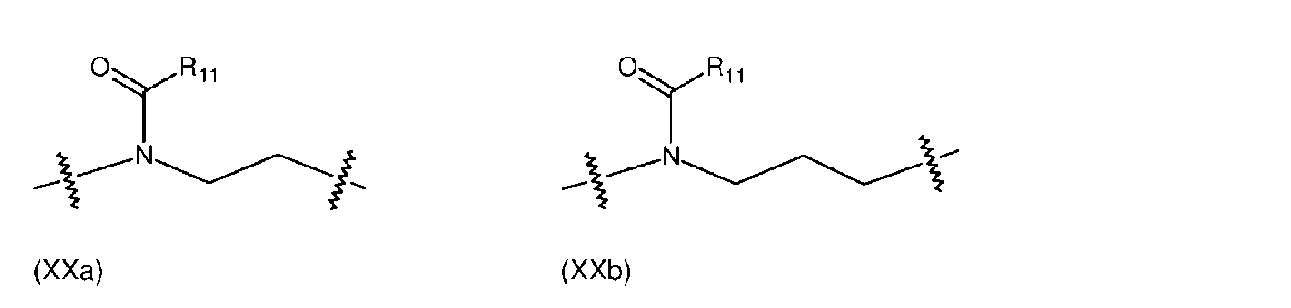
式中、コポリマー中の式(XXa)の繰り返し単位の数は、1~199であり、コポリマー中の式(XXb)の繰り返し単位の数は、1~199であり、コポリマー中の式(XXa)の繰り返し単位の数及び式(XXb)の繰り返し単位の数の合計は、2~200である。
In some embodiments of the oxazolinated and/or oxazinated lipids, the POX and/or POZ polymers have the following general formulas (XXa) and (XXb):
wherein the number of repeat units of formula (XXa) in the copolymer is 1 to 199, the number of repeat units of formula (XXb) in the copolymer is 1 to 199, and the sum of the number of repeat units of formula (XXa) and the number of repeat units of formula (XXb) in the copolymer is 2 to 200.
オキサゾリン化及び/またはオキサジン化脂質のいくつかの実施形態では、コポリマー中の式(XXa)の繰り返し単位の数は、1~179、例えば、1~159、1~139、1~119、または1~99であり、コポリマー中の式(XXb)の繰り返し単位の数は、1~179、例えば、1~159、1~139、1~119、または1~99であり、コポリマー中の式(XXa)の繰り返し単位の数及び式(XXb)の繰り返し単位の数の合計は、2~180、例えば、4~160、6~140、8~120、または10~100、例えば、20~80、30~70、または40~50である。 In some embodiments of the oxazolinated and/or oxazinated lipid, the number of repeat units of formula (XXa) in the copolymer is 1 to 179, e.g., 1 to 159, 1 to 139, 1 to 119, or 1 to 99, the number of repeat units of formula (XXb) in the copolymer is 1 to 179, e.g., 1 to 159, 1 to 139, 1 to 119, or 1 to 99, and the sum of the number of repeat units of formula (XXa) and the number of repeat units of formula (XXb) in the copolymer is 2 to 180, e.g., 4 to 160, 6 to 140, 8 to 120, or 10 to 100, e.g., 20 to 80, 30 to 70, or 40 to 50.
式(XX)、(XXa)、及び(XXb)の上記の実施形態のうちのいくつかでは、各出現(すなわち、各繰り返し単位において)でのR11は、同じアルキル基であり得る(例えば、R11は、各繰り返し単位においてメチルであり得る)。式(XX)、(XXa)、及び(XXb)のいくつかの代替的な実施形態では、少なくとも1個の繰り返し単位におけるR11は、別の繰り返し単位におけるR11とは異なる(例えば、少なくとも1個の繰り返し単位について、R11は、1個の特定のアルキル(例えば、エチル)であり、少なくとも1個の異なる繰り返し単位について、R11は、異なる特定のアルキル(例えば、メチル)である)。例えば、各R11は、2個の異なるアルキル基(例えば、メチル及びエチル)から選択され得、全てのR11が同じアルキルであるとは限らない。 In some of the above embodiments of formula (XX), (XXa), and (XXb), R 11 at each occurrence (i.e., in each repeat unit) can be the same alkyl group (e.g., R 11 can be methyl in each repeat unit). In some alternative embodiments of formula (XX), (XXa), and (XXb), R 11 in at least one repeat unit is different from R 11 in another repeat unit (e.g., for at least one repeat unit, R 11 is one specific alkyl (e.g., ethyl), and for at least one different repeat unit, R 11 is a different specific alkyl (e.g., methyl). For example, each R 11 can be selected from two different alkyl groups (e.g., methyl and ethyl), and not all R 11 are the same alkyl.
式(XX)、(XXa)、及び(XXb)の上記の実施形態のうちのいずれかでは、R11は、好ましくは、メチルまたはエチル、より好ましくは、メチルである。したがって、式(XX)、(XXa)、及び(XXb)のいくつかの実施形態では、各R11は、メチルであるか、または各R11は、エチルである。式(XX)、(XXa)、及び(XXb)のいくつかの代替的な実施形態では、R11は、独立して、各繰り返し単位についてメチル及びエチルから選択され、少なくとも1個の繰り返し単位において、R11は、メチルであり、少なくとも1個の繰り返し単位においてR11は、エチルである。 In any of the above embodiments of formula (XX), (XXa), and (XXb), R 11 is preferably methyl or ethyl, more preferably methyl. Thus, in some embodiments of formula (XX), (XXa), and (XXb), each R 11 is methyl, or each R 11 is ethyl. In some alternative embodiments of formula (XX), (XXa), and (XXb), R 11 is independently selected from methyl and ethyl for each repeat unit, and in at least one repeat unit, R 11 is methyl and in at least one repeat unit, R 11 is ethyl.
いくつかの実施形態では、オキサゾリン化及び/またはオキサジン化脂質は、以下の一般式(XXI)または(XXI’):

式中、
aは、1~2の整数であり、
R11は、アルキル、特に、C1-3アルキル、例えば、メチル、エチル、イソプロピル、またはn-プロピルであり、独立して、各繰り返し単位に対して選択され、
mは、2~200であり、
R12は、R14または-L11(R14)pであり、各R14は、独立して、ヒドロカルビル基であり、L11は、リンカーであり、pは、1または2であり、
R13は、H、C1-6アルキル、C2-6アルキニル、-OR20、-SR20、ハロゲン、-CN、-N3、-OC(O)R21、-C(O)R21、-NR22R23、-COOH、-C(O)NR22R23、-NR22C(O)R21、糖、アミノ酸、ペプチド、及び標的化対のメンバーからなる群から選択され、C1-6アルキル基は、独立して、-OH、SH、ハロゲン、-CN、-N3、C2-6アルキニル、-COOH、-NR22R23、-C(O)NR22R23、-NR22C(O)R21、糖、アミノ酸、ペプチド、及び標的化対のメンバーからなる群から選択される1個以上の置換基で任意に置換され、R20は、H、C1-3アルキル及び3~6員ヘテロシクリルからなる群から選択され、C1-3アルキル及び3~6員ヘテロシクリル基の各々は、独立して、-OH、SH、ハロゲン、-CN、-N3、C2-6アルキニル、-COOH、-NR22R23、糖、アミノ酸、ペプチド、及び標的対のメンバーからなる群から選択される1個以上の置換基で任意に置換され、R21は、C1-6アルキル及び3~6員ヘテロシクリルからなる群から選択され、C1-6アルキル及び3~6員ヘテロシクリル基の各々は、独立して、-OH、SH、ハロゲン、-CN、-N3、C2-6アルキニル、-COOH、-NR22R23、糖、アミノ酸、ペプチド、及び標的対のメンバーからなる群から選択される1個以上の置換基で任意に置換され、R22及びR23の各々は、独立して、H、アルキル、アルケニル、アルキニル、シクロアルキル、アリール、ヘテロアリール、及びヘテロシクリルからなる群から選択されるか、またはR22及びR23は、それらが結合する窒素原子と一緒になってヘテロシクリル基を形成し、アルキル、アルケニル、アルキニル、シクロアルキル、アリール、ヘテロアリール、及びヘテロシクリル基の各々は、独立して、-OH、SH、ハロゲン、-CN、-N3、C2-6アルキニル、-COOH、-NH2、-NH(C1-3アルキル)、-N(C1-3アルキル)2、糖、アミノ酸、ペプチド、及び標的化対のメンバーからなる群から選択される1個以上の置換基で任意に置換される。式(XXI)では、R12は、POX及び/またはPOZポリマーのN末端(すなわち、末端N原子)と結合し、R13は、POX及び/またはPOZポリマーのC末端(すなわち、末端C原子)と結合するが、式(XXI’)では、R12は、POX及び/またはPOZポリマーのC末端(すなわち、末端C原子)と結合し、R13は、POX及び/またはPOZポリマーのN末端(すなわち、末端N原子)と結合する。
In some embodiments, the oxazolinated and/or oxazinated lipid has the following general formula (XXI) or (XXI′):
During the ceremony,
a is an integer from 1 to 2,
R 11 is alkyl, particularly C 1-3 alkyl, e.g., methyl, ethyl, isopropyl, or n-propyl, independently selected for each repeat unit;
m is 2 to 200;
R 12 is R 14 or -L 11 (R 14 ) p , where each R 14 is independently a hydrocarbyl group, L 11 is a linker, and p is 1 or 2;
R 13 is selected from the group consisting of H, C 1-6 alkyl, C 2-6 alkynyl, -OR 20 , -SR 20 , halogen, -CN, -N 3 , -OC(O)R 21 , -C(O)R 21 , -NR 22 R 23 , -COOH, -C(O)NR 22 R 23 , -NR 22 C(O)R 21 , a sugar, an amino acid, a peptide, and a member of a targeting pair, and the C 1-6 alkyl group is independently selected from -OH, SH, halogen, -CN, -N 3 , C 2-6 alkynyl, -COOH, -NR 22 R 23 , -C(O)NR 22 R 23 , -NR 22 C(O)R 21 R 20 is optionally substituted with one or more substituents selected from the group consisting of H, C 1-3 alkyl, and 3- to 6-membered heterocyclyl, and each of the C 1-3 alkyl and 3- to 6-membered heterocyclyl groups is independently selected from the group consisting of -OH, SH, halogen, -CN, -N 3 , C 2-6 alkynyl, -COOH, -NR 22 R 23 , a sugar, an amino acid, a peptide, and a member of a targeting pair, and R 21 is selected from the group consisting of C 1-6 alkyl and 3- to 6-membered heterocyclyl, and each of the C 1-6 alkyl and 3- to 6-membered heterocyclyl groups is independently selected from the group consisting of -OH, SH, halogen, -CN, -N 3 , C 2-6 alkynyl, -COOH, -NR 22 R 23 , a sugar, an amino acid, a peptide, and a member of a targeting pair, and each of R 22 and R 23 is independently selected from the group consisting of H, alkyl, alkenyl, alkynyl, cycloalkyl, aryl, heteroaryl, and heterocyclyl, or R 22 and R 23 together with the nitrogen atom to which they are attached form a heterocyclyl group, and each of the alkyl, alkenyl, alkynyl, cycloalkyl, aryl, heteroaryl, and heterocyclyl groups is independently substituted with one or more substituents selected from the group consisting of -OH, SH, halogen, -CN, -N 3 , C 2-6 alkynyl, -COOH, -NH 2 , -NH(C 1-3 alkyl), -N(C 1-3 alkyl) 2 , a sugar, an amino acid, a peptide, and a member of a targeting pair. In formula (XXI), R 12 is bonded to the N-terminus (i.e., the terminal N atom) of the POX and/or POZ polymer and R 13 is bonded to the C-terminus (i.e., the terminal C atom) of the POX and/or POZ polymer, whereas in formula (XXI'), R 12 is bonded to the C-terminus (i.e., the terminal C atom) of the POX and/or POZ polymer and R 13 is bonded to the N-terminus (i.e., the terminal N atom) of the POX and/or POZ polymer.
いくつかの実施形態(特に、式(XXI)及び(XXI’)のオキサゾリン化及び/またはオキサジン化脂質)では、標的化対は、以下の対から選択される:抗原-当該抗原と特異的な抗体;アビジン-ストレプトアビジン;フォレート-フォレート受容体;トランスフェリン-トランスフェリン受容体;アプタマー-そのアプタマーが特異的である分子;アルギニン-グリシン-アスパラギン酸(RGD)ペプチド-αvβ3インテグリン;アスパラギン-グリシン-アルギニン(NGR)ペプチド-アミノペプチダーゼN;ガラクトース-アシアログリコ-タンパク質受容体。したがって、いくつかの実施形態では、標的化対のメンバーは、抗原、抗体、アビジン、ストレプトアビジン、フォレート、トランスフェリン、アプタマー、RGDペプチド、NGRペプチド、及びガラクトースのうちの1つを含む。 In some embodiments (particularly for the oxazolinated and/or oxazidinated lipids of formula (XXI) and (XXI')), the targeting pair is selected from the following pairs: antigen - an antibody specific for the antigen; avidin - streptavidin; folate - folate receptor; transferrin - transferrin receptor; aptamer - the molecule for which the aptamer is specific; arginine-glycine-aspartic acid (RGD) peptide - α v β 3 integrin; asparagine-glycine-arginine (NGR) peptide - aminopeptidase N; galactose - asialoglyco-protein receptor. Thus, in some embodiments, the members of the targeting pair include one of an antigen, an antibody, avidin, streptavidin, folate, transferrin, an aptamer, RGD peptide, NGR peptide, and galactose.
式(XXI)のいくつかの実施形態では、aは、1であり、すなわち、オキサゾリン化及び/またはオキサジン化脂質は、以下の一般式(XXIa)または(XXIa’):
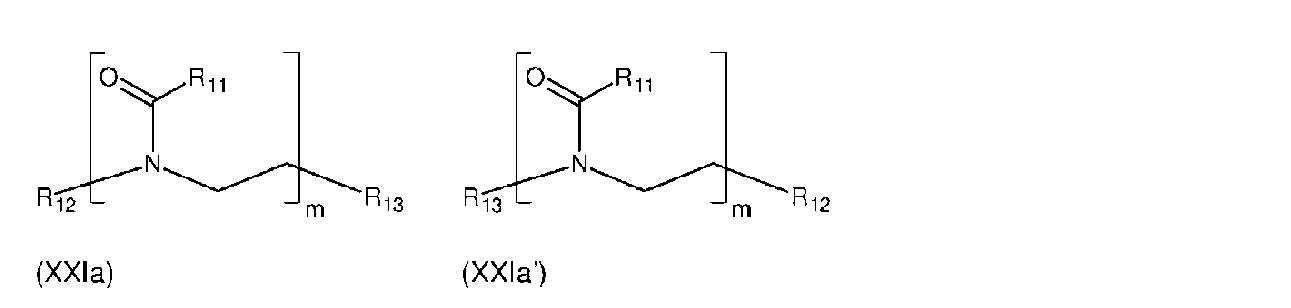
式(XXI)のいくつかの実施形態では、aは、2であり、すなわち、オキサゾリン化及び/またはオキサジン化脂質は、以下の一般式(XXIb)または(XXIb’):

式(XXIa)、(XXIa’)、(XXIb)、及び(XXIb’)の上記の実施形態のうちのいずれかでは、R11、R12、R13、及びmは、式(XXI)/(XXI’)で定義される通りである。 In any of the above embodiments of formulas (XXIa), (XXIa'), (XXIb) and (XXIb'), R 11 , R 12 , R 13 and m are as defined in formula (XXI)/(XXI').
式(XXI)、(XXI’)、(XXIa)、(XXIa’)、(XXIb)、及び(XXIb’)の上記の実施形態のうちのいくつかでは、各出現(すなわち、各繰り返し単位において)でのR11は、同じアルキル基であり得る(例えば、R11は、各繰り返し単位においてメチルであり得る)。式(XXI)、(XXI’)、(XXIa)、(XXIa’)、(XXIb)、及び(XXIb’)のいくつかの代替的な実施形態では、少なくとも1個の繰り返し単位におけるR11は、別の繰り返し単位におけるR11とは異なる(例えば、少なくとも1個の繰り返し単位について、R11は、1個の特定のアルキル(例えば、エチル)であり、少なくとも1個の異なる繰り返し単位について、R11は、異なる特定のアルキル(例えば、メチル)である)。例えば、各R11は、2個の異なるアルキル基(例えば、メチル及びエチル)から選択され得、全てのR11が同じアルキルであるとは限らない。 In some of the above embodiments of formula (XXI), (XXI'), (XXIa), (XXIa'), (XXIb), and (XXIb'), R 11 at each occurrence (i.e., in each repeat unit) can be the same alkyl group (e.g., R 11 can be methyl in each repeat unit). In some alternative embodiments of formula (XXI), (XXI'), (XXIa), (XXIa'), (XXIb), and (XXIb'), R 11 in at least one repeat unit is different from R 11 in another repeat unit (e.g., for at least one repeat unit, R 11 is one specific alkyl (e.g., ethyl), and for at least one different repeat unit, R 11 is a different specific alkyl (e.g., methyl). For example, each R 11 can be selected from two different alkyl groups (e.g., methyl and ethyl), and not all R 11 are the same alkyl.
式(XXI)、(XXI’)、(XXIa)、(XXIa’)、(XXIb)、及び(XXIb’)の上記の実施形態のうちのいずれかでは、R11は、好ましくは、メチルまたはエチル、より好ましくは、メチルである。したがって、式(XXI)、(XXI’)、(XXIa)、(XXIa’)、(XXIb)、及び(XXIb’)のいくつかの実施形態では、各R11は、メチルであるか、または各R11は、エチルである。式(XXI)、(XXI’)、(XXIa)、(XXIa’)、(XXIb)、及び(XXIb’)のいくつかの代替的な実施形態では、R11は、独立して、各繰り返し単位についてメチル及びエチルから選択され、少なくとも1個の繰り返し単位において、R11は、メチルであり、少なくとも1個の繰り返し単位においてR11は、エチルである。 In any of the above embodiments of formula (XXI), (XXI'), (XXIa), (XXIa'), (XXIb), and (XXIb'), R 11 is preferably methyl or ethyl, more preferably methyl. Thus, in some embodiments of formula (XXI), (XXI'), (XXIa), (XXIa'), (XXIb), and (XXIb'), each R 11 is methyl, or each R 11 is ethyl. In some alternative embodiments of formula (XXI), (XXI'), (XXIa), (XXIa'), (XXIb), and (XXIb'), R 11 is independently selected from methyl and ethyl for each repeat unit, and in at least one repeat unit, R 11 is methyl and in at least one repeat unit, R 11 is ethyl.
式(XXI)、(XXI’)、(XXIa)、(XXIa’)、(XXIb)、及び(XXIb’)の上記の実施形態のうちのいずれかでは、mは、好ましくは、好ましくは、2~190、例えば、2~180、2~170、2~160、2~150、2~140、2~130、2~120、2~110、2~100、2~90、2~80、2~70、5~200、5~190、5~180、5~170、5~160、5~150、5~140、5~130、5~120、5~110、5~100、5~90、5~80、5~70、10~200、10~190、10~180、10~170、10~160、10~150、10~140、10~130、10~120、10~110、10~100、10~90、10~80、または10~70である。式(XXI)、(XXI’)、(XXIa)、(XXIa’)、(XXIb)、及び(XXIb’)の特定の実施形態では、mは、2~180、例えば、4~160、6~140、8~120、または10~100、例えば、20~80、30~70、または40~50である。 In any of the above embodiments of formulas (XXI), (XXI'), (XXIa), (XXIa'), (XXIb), and (XXIb'), m is preferably from 2 to 190, e.g., from 2 to 180, from 2 to 170, from 2 to 160, from 2 to 150, from 2 to 140, from 2 to 130, from 2 to 120, from 2 to 110, from 2 to 100, from 2 to 90, from 2 to 80, from 2 to 70, from 5 to 200, from 5 to 190, 5 to 180, 5 to 170, 5 to 160, 5 to 150, 5 to 140, 5 to 130, 5 to 120, 5 to 110, 5 to 100, 5 to 90, 5 to 80, 5 to 70, 10 to 200, 10 to 190, 10 to 180, 10 to 170, 10 to 160, 10 to 150, 10 to 140, 10 to 130, 10 to 120, 10 to 110, 10 to 100, 10 to 90, 10 to 80, or 10 to 70. In certain embodiments of formulas (XXI), (XXI'), (XXIa), (XXIa'), (XXIb), and (XXIb'), m is 2 to 180, e.g., 4 to 160, 6 to 140, 8 to 120, or 10 to 100, e.g., 20 to 80, 30 to 70, or 40 to 50.
式(XXI)、(XXI’)、(XXIIa)、(XXIa’)、(XXIb)、及び(XXIb’)のいくつかの実施形態では、L11は、少なくとも1個の官能性部分、例えば、少なくとも1個の一価官能性部分で置換されるアルキレン部分、及び/またはアルキレン基がR14と結合する末端で二価官能性部分と結合するアルキレン部分を含み、好ましくは、各一価官能性部分は、独立して、ヒドロキシ、エーテル、ハロゲン、シアノ、アジド、ニトロ、アミノ、アンモニウム、エステル、カルボキシル、チオール(スルファニル)、ジスルファニル、スルフィド、ジスルフィド、スルホキシド、スルホン、サルファイト、スルフェート、ホスフェート、スルフィンアミド、スルホンアミド、スルファメート、ジセレニド、亜硫酸ジアミド、硫酸ジアミド、ウレア、チオウレア、カルボニル、チオカルボニル、オルトエステル、チオエート、ジチオエート、イミノ、イミドチオエート、チオニルアミド、カーボネート、カルボノチオエート、カルボノジチオエート、カルボノトリチオエート、グアニジノ(イミダミド)、カルバミミデート、カルボニミデート、カルバメート、カルバモジチオエート、カルボノジチオイミデート、カルバミミドチオエート、カルバモチオエート、カルボニミドチオエート、アシルヒドラゾン、ヒドラジン、オキシム、アセタール、ヘミアセタール、ケタール、ヘミケタール、イミド、及びアミドから選択され、ならびに/または各二価官能性部分は、独立して、エーテル、アミノ、エステル、スルフィド、ジスルフィド、スルホキシド、スルホン、サルファイト、スルフェート、ホスフェート、スルフィンアミド、スルホンアミド、スルファメート、ジセレニド、亜硫酸ジアミド、硫酸ジアミド、ウレア、チオウレア、カルボニル、チオカルボニル、オルトエステル、チオエート、ジチオエート、イミデート、イミノ、イミドチオエート、チオニルアミド、カーボネート、カルボノチオエート、カルボノジチオエート、カルボノトリチオエート、グアニジノ(イミダミド)、カルバミミデート、カルボイミデート、カルバメート、カルバモジチオエート、カルボノジチオイミデート、カルバミミドチオエート、カルバモチオエート、カルボイミドチオエート、アシルヒドラゾン、ヒドラジン、オキシム、アセタール、ヘミアセタール、ケタール、ヘミケタール、イミン、イミド、及びアミドから選択される。 In some embodiments of formula (XXI), (XXI'), (XXIIa), (XXIa'), (XXIb), and (XXIb'), L 11 comprises at least one functional moiety, e.g., an alkylene moiety substituted with at least one monovalent functional moiety, and/or an alkylene moiety bonded to a divalent functional moiety at the end where the alkylene group is bonded to R 14 , preferably each monovalent functional moiety is independently selected from hydroxy, ether, halogen, cyano, azido, nitro, amino, ammonium, ester, carboxyl, thiol (sulfanyl), disulfanyl, sulfide, disulfide, sulfoxide, sulfone, sulfite, sulfate, phosphate, sulfinamide, sulfonamide, sulfamate, diselenide, sulfite diamide, sulfate diamide, urea, , thiourea, carbonyl, thiocarbonyl, orthoester, thioate, dithioate, imino, imidothioate, thionylamide, carbonate, carbonothioate, carbonodithioate, carbonotrithioate, guanidino (imidamide), carbamimidate, carbonimidate, carbamate, carbamodithioate, carbonodithioimidate, carbamimidothioate, carbamothioate, carbonimidothioate, acylhydrazone, hydrazine, oxime, aceta and/or each divalent functional moiety is independently selected from ether, amino, ester, sulfide, disulfide, sulfoxide, sulfone, sulfite, sulfate, phosphate, sulfinamide, sulfonamide, sulfamate, diselenide, sulfurous acid diamide, sulfurous acid diamide, urea, thiourea, carbonyl, thiocarbonyl, orthoester, thioate, dithioate, imidate, imide, amide, amine ... In some embodiments, the thiol group is selected from the group consisting of thiol, imidothioate, thionylamide, carbonate, carbonothioate, carbonodithioate, carbonotrithioate, guanidino(imidamide), carbamimidate, carboimidate, carbamate, carbamodithioate, carbonodithioimidate, carbamimidothioate, carbamothioate, carboimidothioate, acylhydrazone, hydrazine, oxime, acetal, hemiacetal, ketal, hemiketal, imine, imide, and amide.
式(XXI)、(XXI’)、(XXIa)、(XXIa’)、(XXIb)、及び(XXIb’)のいくつかの実施形態では、L11は、上記で指定されるような少なくとも1個の一価官能性部分で置換されるアルキレン部分を含む。したがって、いくつかの実施形態では、オキサゾリン化及び/またはオキサジン化脂質は、以下の構造(特に、1個以上の疎水性鎖が、例えば、式(XXI)に示されるように、POX及び/またはPOZポリマーのN末端(すなわち、末端N原子)と結合する場合):
(疎水性鎖)1-2-(少なくとも1個の一価官能性部分で置換されるアルキレン部分)-(POX及び/またはPOZポリマー)を含み得、
式中、「疎水性鎖」は、R14を表し、「少なくとも1個の一価官能性部分で置換されるアルキレン部分」は、L11を表し、「POX及び/またはPOZポリマー」は、式(XX)において指定されるポリマーを表す。
In some embodiments of formula (XXI), (XXI'), (XXIa), (XXIa'), (XXIb), and (XXIb'), L 11 comprises an alkylene moiety substituted with at least one monovalent functional moiety as specified above. Thus, in some embodiments, the oxazolinated and/or oxazinated lipid has the following structure (particularly when one or more hydrophobic chains are attached to the N-terminus (i.e., the terminal N atom) of the POX and/or POZ polymer, for example, as shown in formula (XXI):
(hydrophobic chain) 1-2 may comprise -(alkylene moiety substituted with at least one monovalent functional moiety)-(POX and/or POZ polymer);
wherein "hydrophobic chain" represents R 14 , "alkylene moiety substituted with at least one monovalent functional moiety" represents L 11 , and "POX and/or POZ polymer" represents the polymers designated in formula (XX).
いくつかの実施形態では、オキサゾリン化及び/またはオキサジン化脂質は、以下の式(XXIc)(特に、1個以上の疎水性鎖が、例えば、式(XXI)に示されるように、POX及び/またはPOZポリマーのN末端(すなわち、末端N原子)と結合する場合):
(疎水性鎖)1-2-(少なくとも1個の一価官能性部分で置換されるアルキレン部分)-(POX及び/またはPOZポリマー)-R13を有する。
In some embodiments, the oxazolinated and/or oxazinated lipid has the following formula (XXIc) (particularly when one or more hydrophobic chains are attached to the N-terminus (i.e., the terminal N atom) of the POX and/or POZ polymer, e.g., as shown in formula (XXI):
(Hydrophobic chain) 1-2 has -(alkylene moiety substituted with at least one monovalent functional moiety)-(POX and/or POZ polymer)-R 13 .
いくつかの実施形態では(特に、式(XXIc)のオキサゾリン化及び/またはオキサジン化脂質の)、少なくとも1個の一価官能性部分は、本明細書で指定される一価官能性部分のうちのいずれか1つであり得、例えば、ヒドロキシ、エーテル、ハロゲン、シアノ、アジド、ニトロ、アミノ、アンモニウム、エステル、カルボキシル、チオール(スルファニル)、ジスルファニル、スルフィド、ジスルフィド、スルホキシド、スルホン、サルファイト、スルフェート、ホスフェート、スルフィンアミド、スルホンアミド、スルファメート、ジセレニド、亜硫酸ジアミド、硫酸ジアミド、ウレア、チオウレア、カルボニル、チオカルボニル、オルトエステル、チオエート、ジチオエート、イミノ、イミドチオエート、チオニルアミド、カーボネート、カルボノチオエート、カルボノジチオエート、カルボノトリチオエート、グアニジノ(イミダミド)、カルバミミデート、カルボニミデート、カルバメート、カルバモジチオエート、カルボノジチオイミデート、カルバミミドチオエート、カルバモチオエート、カルボニミドチオエート、アシルヒドラゾン、ヒドラジン、オキシム、アセタール、ヘミアセタール、ケタール、ヘミケタール、イミド、及びアミドからなる群から選択される。 In some embodiments (particularly of the oxazolinated and/or oxazinated lipid of formula (XXIc)), at least one monovalent functional moiety can be any one of the monovalent functional moieties specified herein, such as, for example, hydroxy, ether, halogen, cyano, azido, nitro, amino, ammonium, ester, carboxyl, thiol (sulfanyl), disulfanyl, sulfide, disulfide, sulfoxide, sulfone, sulfite, sulfate, phosphate, sulfinamide, sulfonamide, sulfamate, diselenide, sulfite diamide, sulfate diamide, urea, , thiourea, carbonyl, thiocarbonyl, orthoester, thioate, dithioate, imino, imidothioate, thionylamide, carbonate, carbonothioate, carbonodithioate, carbonotrithioate, guanidino (imidamide), carbamimidate, carbonimidate, carbamate, carbamodithioate, carbonodithioimidate, carbamimidothioate, carbamothioate, carbonimidothioate, acylhydrazone, hydrazine, oxime, acetal, hemiacetal, ketal, hemiketal, imide, and amide.
いくつかの実施形態では(特に、式(XXIc)のオキサゾリン化及び/またはオキサジン化脂質の)、少なくとも1個の一価官能性部分で置換されるアルキレン部分は、C1-6アルキレン、例えば、C1-3アルキレン、例えば、メチレン、エチレン、またはトリメチレンである。 In some embodiments (particularly of the oxazolinated and/or oxazinylated lipid of formula (XXIc)), the alkylene moiety substituted with at least one monovalent functional moiety is a C 1-6 alkylene, e.g., a C 1-3 alkylene, e.g., methylene, ethylene, or trimethylene.
いくつかの実施形態(特に、式(XXIc)のオキサゾリン化及び/またはオキサジン化脂質の)では、少なくとも1個の一価官能性部分で置換されるアルキレン部分は、1個以上(例えば、1個~アルキレン部分と結合した水素原子の最大数まで、例えば、1、2、3、4、5、または6個、例えば、1~5、1~4、または1~3、または1もしくは2個)の独立して選択される一価官能性部分で置換される。 In some embodiments (particularly of the oxazolinated and/or oxazinated lipids of formula (XXIc)), the alkylene moiety substituted with at least one monovalent functional moiety is substituted with one or more (e.g., from 1 up to the maximum number of hydrogen atoms attached to the alkylene moiety, e.g., 1, 2, 3, 4, 5, or 6, e.g., 1-5, 1-4, or 1-3, or 1 or 2) independently selected monovalent functional moieties.
いくつかの実施形態(特に、式(XXIc)のオキサゾリン化及び/またはオキサジン化脂質の)では、少なくとも1個の一価官能性部分で置換されるアルキレン部分は、C1-6-アルキレン、例えば、C1-3-アルキレン、例えば、メチレン、エチレン、またはトリメチレンであり、1個以上(例えば、1個~アルキレン部分と結合した水素原子の最大数まで、例えば、1、2、3、4、5、または6個、例えば、1~5、1~4、または1~3、または1もしくは2個)の独立して選択される一価官能性部分で置換される。 In some embodiments (particularly of the oxazolinated and/or oxazinated lipids of formula (XXIc)), the alkylene moiety that is substituted with at least one monovalent functional moiety is C 1-6 -alkylene, e.g., C 1-3 -alkylene, e.g., methylene, ethylene, or trimethylene, and is substituted with one or more (e.g., from 1 up to the maximum number of hydrogen atoms attached to the alkylene moiety, e.g., 1, 2, 3, 4, 5, or 6, e.g., 1-5, 1-4, or 1-3, or 1 or 2) independently selected monovalent functional moieties.
式(XXI)、(XXI’)、(XXIa)、(XXIa’)、(XXIb)、及び(XXIb’)のいくつかの実施形態では、L11は、アルキレン基がR14と結合する末端で、上記で指定されるような二価官能性部分と結合するアルキレン部分を含む。したがって、いくつかの実施形態では、オキサゾリン化及び/またはオキサジン化脂質は、以下の構造(特に、1個以上の疎水性鎖が、例えば、式(XXI)に示されるように、POX及び/またはPOZポリマーのN末端(すなわち、末端N原子)と結合する場合):
[(疎水性鎖)-(二価官能性部分)]1-2-(アルキレン部分)-(POX及び/またはPOZポリマー)を含み得、
式中、「疎水性鎖」は、R14を表し、「-(二価官能性部分)]1-2-(アルキレン部分)」は、L11を表し、「POX及び/またはPOZポリマー」は、式(XX)において指定されるポリマーを表す。
In some embodiments of formula (XXI), (XXI'), (XXIa), (XXIa'), (XXIb), and (XXIb'), L 11 comprises an alkylene moiety attached to a difunctional moiety, as specified above, at the terminus where the alkylene group is attached to R 14. Thus, in some embodiments, the oxazolinated and/or oxazinated lipid has the following structure (particularly when one or more hydrophobic chains are attached to the N-terminus (i.e., the terminal N atom) of the POX and/or POZ polymer, for example, as shown in formula (XXI):
[(hydrophobic chain)-(difunctional moiety)] 1-2 -(alkylene moiety)-(POX and/or POZ polymers),
wherein "hydrophobic chain" represents R 14 , "-(difunctional moiety)] 1-2 -(alkylene moiety)" represents L 11 , and "POX and/or POZ polymer" represents the polymers designated in formula (XX).
いくつかの実施形態では、オキサゾリン化及び/またはオキサジン化脂質は、以下の式(XXId)(特に、1個以上の疎水性鎖が、例えば、式(XXI)に示されるように、POX及び/またはPOZポリマーのN末端(すなわち、末端N原子)と結合する場合):
[(疎水性鎖)-(二価官能性部分)]1-2-(アルキレン部分)-(POX及び/またはPOZポリマー)-R13を有する。
In some embodiments, the oxazolinated and/or oxazinated lipid has the following formula (XXId) (particularly when one or more hydrophobic chains are attached to the N-terminus (i.e., the terminal N atom) of the POX and/or POZ polymer, for example, as shown in formula (XXI):
It has a structure of [(hydrophobic chain)-(difunctional moiety)] 1-2 -(alkylene moiety)-(POX and/or POZ polymer)-R 13 .
いくつかの実施形態では(特に、式(XXId)のオキサゾリン化及び/またはオキサジン化脂質の)、二価官能性部分は、本明細書で指定される二価官能性部分のうちのいずれか1つであり得、例えば、エーテル、アミノ、エステル、スルフィド、ジスルフィド、スルホキシド、スルホン、サルファイト、スルフェート、ホスフェート、スルフィンアミド、スルホンアミド、スルファメート、ジセレニド、亜硫酸ジアミド、硫酸ジアミド、ウレア、チオウレア、カルボニル、チオカルボニル、オルトエステル、チオエート、ジチオエート、イミデート、イミノ、イミドチオエート、チオニルアミド、カーボネート、カルボノチオエート、カルボノジチオエート、カルボノトリチオエート、グアニジノ(イミダミド)、カルバミミデート、カルボイミデート、カルバメート、カルバモジチオエート、カルボノジチオイミデート、カルバミミドチオエート、カルバモチオエート、カルボイミドチオエート、アシルヒドラゾン、ヒドラジン、オキシム、アセタール、ヘミアセタール、ケタール、ヘミケタール、イミン、イミド、及びアミドからなる群から選択される。いくつかの実施形態では、リンカーは、エステル、スルフィド、ジスルフィド、スルホン、オルトエステル、アシルヒドラゾン、ヒドラジン、オキシム、アセタール、ケタール、アミノ、及びアミド部分からなる群から選択される少なくとも1個の二価官能性部分を含む。いくつかの好ましい実施形態では、リンカーは、エステル、スルフィド、スルホン、アミノ、及びアミド部分からなる群から選択される少なくとも1個の二価官能性部分を含む。 In some embodiments (particularly of the oxazolinated and/or oxazinated lipid of formula (XXId)), the divalent functional moiety may be any one of the divalent functional moieties specified herein, such as, for example, ether, amino, ester, sulfide, disulfide, sulfoxide, sulfone, sulfite, sulfate, phosphate, sulfinamide, sulfonamide, sulfamate, diselenide, sulfite diamide, sulfate diamide, urea, thiourea, carbonyl, thiocarbonyl, orthoester, thioate, dithio The linker is selected from the group consisting of ester, imidate, imino, imidothioate, thionylamide, carbonate, carbonothioate, carbonodithioate, carbonotrithioate, guanidino (imidamide), carbamimidate, carboimidate, carbamate, carbamodithioate, carbonodithioimidate, carbamimidothioate, carbamothioate, carboimidothioate, acylhydrazone, hydrazine, oxime, acetal, hemiacetal, ketal, hemiketal, imine, imide, and amide. In some embodiments, the linker comprises at least one divalent functional moiety selected from the group consisting of ester, sulfide, disulfide, sulfone, orthoester, acylhydrazone, hydrazine, oxime, acetal, ketal, amino, and amide moieties. In some preferred embodiments, the linker comprises at least one difunctional moiety selected from the group consisting of ester, sulfide, sulfone, amino, and amide moieties.
いくつかの実施形態では(特に、式(XXId)のオキサゾリン化及び/またはオキサジン化脂質の)、アルキレン部分は、C1-6-アルキレン、例えば、C1-3-アルキレン、例えば、メチレン、エチレン、またはトリメチレンである。 In some embodiments (particularly of the oxazolinated and/or oxazinated lipids of formula (XXId)), the alkylene moiety is C 1-6 -alkylene, such as C 1-3 -alkylene, for example methylene, ethylene, or trimethylene.
式(XXI)、(XXI’)、(XXIa)、(XXIa’)、(XXIb)、(XXIb’)、(XXIc)、及び(XXId)のいくつかの実施形態では(特に、1個以上の疎水性鎖が、例えば、式(XXI)に示されるように、POX及び/またはPOZポリマーのN末端(すなわち、末端N原子)と結合するもの)、L11は、少なくとも1個のエステル、スルフィド、ジスルフィド、スルホン、オルトエステル、アシルヒドラゾン、ヒドラジン、オキシム、アセタール、ケタール、またはアミド部分を含む。特定の実施形態では、L11は、[*-NHC(O)]p(C1-6-アルキレン)、[*-C(O)NH]p(C1-6-アルキレン)-、[*-C(O)O]p(C1-6-アルキレン)-、[*-OC(O)]p-(C1-6-アルキレン)-、[*-S]p(C1-6-アルキレン)-、[*-SS]p(C1-6-アルキレン)-、[*-S(O)2]p(C1-6-アルキレン)-、[(*-O)rC(OR25)3-r](C1-6-アルキレン)-、[*-C(OR25)2O]p(C1-6-アルキレン)-、[*-C(R25)(=N-N(R26)C(O)-)]p(C1-6-アルキレン)-、[*-C(O)(N(R26)-N=)C(R25)-]p(C1-6-アルキレン)-、[*=C(=N-N(R26)C(O)(R25))]p(C1-6-アルキレン)-、[*N(R26)N(R26)]p(C1-6-アルキレン)-、[*=C(=N(OH))]p(C1-6-アルキレン)-、及び[*-OC(R25)(R26)O]p(C1-6-アルキレン)-からなる群から選択され、*は、R14との結合点を表し、pは、1または2であり、C1-6-アルキレンは、二価(pが1である場合)または三価(pが2である場合)のいずれかであり、R25は、C1-6アルキル、アリール、及びアリール-(C1-6アルキル)からなる群から選択され、R26は、H、C1-6アルキル、アリール、及びアリール(C1-6アルキル)からなる群から選択され、rは、1~2の整数である。例えば、L11は、[*-NHC(O)]p(C1-3-アルキレン)-、[*-C(O)NH]p(C1-3-アルキレン)-、[*-C(O)O]p(C1-3-アルキレン)-、[*-OC(O)]p(C1-3-アルキレン)-、[*-S]p(C1-3-アルキレン)-、[*-SS]p(C1-3-アルキレン)-、[*-S(O)2]p(C1-3-アルキレン)-、[(*-O)rC(OR25)3-r](C1-3-アルキレン)-、[*-C(OR25)2O]p(C1-3-アルキレン)-、[*-C(R25)(=N-N(R26)C(O)-)]p(C1-3-アルキレン)-、[*-C(O)(N(R26)-N=)C(R25)-]p(C1-3-アルキレン)-、[*=C(=N-N(R26)C(O)(R25))]p(C1-3-アルキレン)-、[*N(R26)N(R26)]p(C1-3-アルキレン)-、[*=C(=N(OH))]p(C1-3-アルキレン)-、及び[*-OC(R25)(R26)O]p(C1-3-アルキレン)-からなる群から選択され得、*は、R14との結合点を表し、pは、1または2であり、C1-3-アルキレンは、二価(pが1である場合)または三価(pが2である場合)のいずれかであり、R25は、C1-6アルキル、アリール、及びアリール(C1-6アルキル)からなる群から選択され、R26は、H、C1-6アルキル、アリール、及びアリール(C1-6アルキル)からなる群から選択され、rは、1~2の整数である。 In some embodiments of formula (XXI), (XXI'), (XXIa), (XXIa'), (XXIb), (XXIb'), (XXIc), and (XXId) (particularly those in which one or more hydrophobic chains are attached to the N-terminus (i.e., the terminal N atom) of the POX and/or POZ polymer, e.g., as shown in formula (XXI)), L 11 includes at least one ester, sulfide, disulfide, sulfone, orthoester, acylhydrazone, hydrazine, oxime, acetal, ketal, or amide moiety. In certain embodiments, L 11 is [*-NHC(O)] p (C 1-6 -alkylene), [*-C(O)NH] p (C 1-6 -alkylene)-, [*-C(O)O] p (C 1-6 -alkylene)-, [*-OC(O)] p -(C 1-6 -alkylene)-, [*-S] p (C 1-6 -alkylene)-, [*-SS] p (C 1-6 -alkylene)-, [*-S(O) 2 ] p (C 1-6 -alkylene)-, [(*-O) r C(OR 25 ) 3-r ] (C 1-6 -alkylene)-, [*-C(OR 25 ) 2 O] p (C 1-6 -alkylene)-, [*-C(R 25 )(=N-N(R 26 )C(O)-)] p (C 1-6 -alkylene)-, [*-C(O)(N(R 26 )-N=)C(R 25 )-] p (C 1-6 -alkylene)-, [*=C(=N-N(R 26 )C(O)(R 25 ))] p (C 1-6 -alkylene)-, [*N(R 26 )N(R 26 )] p (C 1-6 -alkylene)-, [*=C(=N(OH))] p (C 1-6 -alkylene)-, and [*-OC(R 25 )(R 26 )O] p (C 1-6 -alkylene)-, * represents the point of attachment to R 14 , p is 1 or 2, C 1-6 -alkylene is either divalent (when p is 1) or trivalent (when p is 2), R 25 is selected from the group consisting of C 1-6 alkyl, aryl, and aryl-(C 1-6 alkyl), R 26 is selected from the group consisting of H, C 1-6 alkyl, aryl, and aryl(C 1-6 alkyl), and r is an integer from 1 to 2. For example, L 11 is [*-NHC(O)] p (C 1-3 -alkylene)-, [*-C(O)NH] p (C 1-3 -alkylene)-, [*-C(O)O] p (C 1-3 -alkylene)-, [*-OC(O)] p (C 1-3 -alkylene)-, [*-S] p (C 1-3 -alkylene)-, [*-SS] p (C 1-3 -alkylene)-, [*-S(O) 2 ] p (C 1-3 -alkylene)-, [(*-O) r C(OR 25 ) 3-r ] (C 1-3 -alkylene)-, [*-C(OR 25 ) 2 O] p (C 1-3 -alkylene)-, [*-C(R 25 )(=N-N(R 26 )C(O)-)] p (C 1-3 -alkylene)-, [*-C(O)(N(R 26 )-N=)C(R 25 )-] p (C 1-3 -alkylene)-, [*=C(=N-N(R 26 )C(O)(R 25 ))] p (C 1-3 -alkylene)-, [*N(R 26 )N(R 26 )] p (C 1-3 -alkylene)-, [*=C(=N(OH))] p (C 1-3 -alkylene)-, and [*-OC(R 25 )(R 26 )O] p (C 1-3 -alkylene)-, * represents the point of attachment to R 14 , p is 1 or 2, C 1-3 -alkylene is either divalent (when p is 1) or trivalent (when p is 2), R 25 is selected from the group consisting of C 1-6 alkyl, aryl, and aryl(C 1-6 alkyl), R 26 is selected from the group consisting of H, C 1-6 alkyl, aryl, and aryl(C 1-6 alkyl), and r is an integer from 1 to 2.
いくつかの実施形態では、R25は、C1-3アルキル、フェニル、及びフェニル(C1-3アルキル)からなる群から、例えば、メチル、エチル、フェニル、ベンジル、及びフェニルエチルからなる群から選択される。 In some embodiments, R 25 is selected from the group consisting of C 1-3 alkyl, phenyl, and phenyl(C 1-3 alkyl), for example, from the group consisting of methyl, ethyl, phenyl, benzyl, and phenylethyl.
いくつかの実施形態では、R26は、H、C1-3アルキル、フェニル、及びフェニル(C13アルキル)からなる群から、例えば、H、メチル、エチル、フェニル、ベンジル、及びフェニルエチルからなる群から選択される。 In some embodiments, R 26 is selected from the group consisting of H, C 1-3 alkyl, phenyl, and phenyl(C 13 alkyl), for example, from the group consisting of H, methyl, ethyl, phenyl, benzyl, and phenylethyl.
式(XXI)、(XXI’)、(XXIa)、(XXIa’)、(XXIb)、(XXIb’)、(XXIc)、及び(XXId)のいくつかの実施形態では(特に、1個以上の疎水性鎖が、例えば、式(XXI)に示されるように、POX及び/またはPOZポリマーのN末端(すなわち、末端N原子)と結合するもの)、L11は、[*-NHC(O)]p(C1-6-アルキレン)-、[*-C(O)NH]p(C1-6-アルキレン)-、[*-C(O)O]p(C1-6-アルキレン)-、[*-OC(O)]p(C1-6-アルキレン)-、[*-S]p(C1-6-アルキレン)-、及び[*-S(O)2]p(C1-6-アルキレン)-からなる群から、好ましくは、[*-NHC(O)]p(C1-6-アルキレン)-、[*-C(O)O]p(C1-6-アルキレン)-、[*-OC(O)]p(C1-6-アルキレン)-、[*-S]p(C1-6-アルキレン)-、及び[*-S(O)2]p(C1-6-アルキレン)-からなる群から、より好ましくは、[*-NHC(O)]p(C1-6-アルキレン)-、及び[*-C(O)O]p(C1-6-アルキレン)-からなる群から選択され、*は、R14との結合点を表し、pは、1または2であり、C1-6-アルキレンは、二価(pが1である場合)または三価(pが2である場合)のいずれかである。 In some embodiments of formula (XXI), (XXI'), (XXIa), (XXIa'), (XXIb), (XXIb'), (XXIc), and (XXId) (particularly those in which one or more hydrophobic chains are attached to the N-terminus (i.e., the terminal N atom) of the POX and/or POZ polymer, e.g., as shown in formula (XXI)), L 11 is selected from the group consisting of [*-NHC(O)] p (C 1-6 -alkylene)-, [*-C(O)NH] p (C 1-6 -alkylene)-, [*-C(O)O] p (C 1-6 -alkylene)-, [*-OC(O)] p (C 1-6 -alkylene)-, [*-S] p (C 1-6 -alkylene)-, and [*-S(O) 2 ] p (C 1-6 -alkylene)-. (C 1-6 -alkylene)-, preferably from the group consisting of [*-NHC(O)] p (C 1-6 -alkylene)-, [*-C(O)O] p (C 1-6 -alkylene)-, [*-OC(O)] p (C 1-6 -alkylene)-, [*-S] p (C 1-6 -alkylene)- and [*-S(O) 2 ] p (C 1-6 -alkylene)-, more preferably from the group consisting of [*-NHC(O)] p (C 1-6 -alkylene)- and [*-C(O)O] p (C 1-6 -alkylene )-, * represents the point of attachment to R 14 , p is 1 or 2, -Alkylene is either divalent (when p is 1) or trivalent (when p is 2).
式(XXI)、(XXI’)、(XXIa)、(XXIa’)、(XXIb)、(XXIb’)、(XXIc)、及び(XXId)のいくつかの実施形態では(特に、1個以上の疎水性鎖が、例えば、式(XXI)に示されるように、POX及び/またはPOZポリマーのN末端(すなわち、末端N原子)と結合するもの)、L11は、[*-NHC(O)]p(C1-3-アルキレン)-、[*-C(O)NH]p(C1-3-アルキレン)-、[*-C(O)O]p(C1-3-アルキレン)-、[*-OC(O)]p-(C1-3-アルキレン)-、[*-S]p(C1-3-アルキレン)-、及び[*-S(O)2]p(C1-3-アルキレン)-からなる群から、好ましくは、[*-NHC(O)]p(C1-3-アルキレン)-、[*-C(O)O]p(C1-3-アルキレン)-、[*-OC(O)]p(C1-3-アルキレン)-、[*-S]p(C1-3-アルキレン)-、及び[*-S(O)2]p(C1-3-アルキレン)-からなる群から、より好ましくは、[*-NHC(O)]p(C1-3-アルキレン)-、及び[*-C(O)O]p(C1-3-アルキレン)-からなる群から選択され、*は、R14との結合点を表し、pは、1または2であり、C1-3-アルキレンは、二価(pが1である場合)または三価(pが2である場合)のいずれかである。 In some embodiments of formula (XXI), (XXI'), (XXIa), (XXIa'), (XXIb), (XXIb'), (XXIc), and (XXId) (particularly those in which one or more hydrophobic chains are attached to the N-terminus (i.e., the terminal N atom) of the POX and/or POZ polymer, e.g., as shown in formula (XXI)), L 11 is selected from the group consisting of [*-NHC(O)] p (C 1-3 -alkylene)-, [*-C(O)NH] p (C 1-3 -alkylene)-, [*-C(O)O] p (C 1-3 -alkylene)-, [*-OC(O)] p -(C 1-3 -alkylene)-, [*-S] p (C 1-3 -alkylene)-, and [*-S(O) 2 ] p (C 1-3 -alkylene)-, preferably from the group consisting of [*-NHC(O)] p (C 1-3 -alkylene)-, [*-C(O)O] p (C 1-3 -alkylene)-, [*-OC(O)] p (C 1-3 -alkylene)-, [*-S] p (C 1-3 -alkylene)- and [*-S(O) 2 ] p (C 1-3 -alkylene)-, more preferably from the group consisting of [*-NHC(O)] p (C 1-3 -alkylene)- and [*-C(O)O] p (C 1-3 -alkylene )-, * represents the point of attachment to R 14 , p is 1 or 2, -Alkylene is either divalent (when p is 1) or trivalent (when p is 2).
式(XXI)、(XXI’)、(XXIa)、(XXIa’)、(XXIb)、(XXIb’)、(XXIc)、及び(XXId)のいくつかの実施形態では(特に、1個以上の疎水性鎖が、例えば、式(XXI)に示されるように、POX及び/またはPOZポリマーのN末端(すなわち、末端N原子)と結合するもの)、L11は、*-NHC(O)-(CH2)-、*-NHC(O)-(CH2)2-、*-C(O)NH-(CH2)-、*-C(O)NH-(CH2)2-、-(CH2)-CH(OC(O)-*)-(CH2OC(O)-*)、-(CH2)-CH(S-*)2、-(CH2)-CH(S-*)-CH2(S-*)、*-S-(CH2)3-、*-S(O)2-(CH2)3-、及び*-OC(O)-(CH2)-からなる群から選択され、*は、R14との結合点を表す。したがって、R12は、R14、-L11R14、-(CH2)-CH(OC(O)R14)(CH2OC(O)R14)、-(CH2)-CH(SR14)2、及び-(CH2)-CH(SR14)-CH2(SR14)からなる群から選択され得、L11は、*-NHC(O)-(CH2)-、*-NHC(O)-(CH2)2-、*-C(O)NH-(CH2)-、*-C(O)NH-(CH2)2-、*-S-(CH2)3-、*-S(O)2-(CH2)3-、及び*-OC(O)-(CH2)-からなる群から選択され、好ましくは、L11は、*-NHC(O)-(CH2)-または*-NHC(O)-(CH2)2-であり、*は、R14との結合点を表す。 In some embodiments of formula (XXI), (XXI'), (XXIa), (XXIa'), (XXIb), (XXIb'), (XXIc), and (XXId) (particularly those in which one or more hydrophobic chains are attached to the N-terminus (i.e., the terminal N atom) of the POX and/or POZ polymer, e.g., as shown in formula (XXI)), L 11 can be selected from *-NHC(O)-(CH 2 )-, *-NHC(O)-(CH 2 ) 2 -, *-C(O)NH-(CH 2 )-, *-C(O)NH-(CH 2 ) 2 -, -(CH 2 )-CH(OC(O)-*)-(CH 2 OC(O)-*), -(CH 2 )-CH(S-*), -(CH 2 )-CH( O) - ... )-CH(S-*)-CH 2 (S-*), *-S-(CH 2 ) 3 -, *-S(O) 2 -(CH 2 ) 3 -, and *-OC(O)-(CH 2 )-, where * represents the point of attachment to R 14 . Thus, R 12 may be selected from the group consisting of R 14 , -L 11 R 14 , -(CH 2 )-CH(OC(O)R 14 )(CH 2 OC(O)R 14 ), -(CH 2 )-CH(SR 14 ) 2 , and -(CH 2 )-CH(SR 14 )-CH 2 (SR 14 ), L 11 being *-NHC(O)-(CH 2 )-, *-NHC(O)-(CH 2 ) 2 -, *-C(O)NH-(CH 2 )-, *-C(O)NH-(CH 2 ) 2 -, *-S-(CH 2 ) 3 -, *-S(O) 2 -(CH 2 ) 3 . -, and *-OC(O)-(CH 2 )-, preferably L 11 is *-NHC(O)-(CH 2 )- or *-NHC(O)-(CH 2 ) 2 -, where * represents the point of attachment to R 14 .
式(XXI)、(XXIa)、及び(XXIb)のいくつかの実施形態では、R12は、-L11(R14)pであり、すなわち、POX及び/またはPOZポリマーは、リンカーL11を介して1個以上の疎水性鎖(すなわち、R14)と結合する。 In some embodiments of formula (XXI), (XXIa), and (XXIb), R 12 is -L 11 (R 14 ) p , i.e., the POX and/or POZ polymer is attached to one or more hydrophobic chains (i.e., R 14 ) via the linker L 11 .
式(XXI’)、(XXIa’)、及び(XXIb’)のいくつかの実施形態では、リンカーは少なくとも1個の二官能性部分を含み、それを介して1個以上の疎水性鎖(R14)がPOX及び/またはPOZポリマーのC末端と結合する。いくつかの実施形態では、リンカーは、アルキレン部分(例えば、C1-6アルキレン部分、例えば、C1-3アルキレン部分)、シクロアルキレン部分(好ましくは、C3-8-シクロアルキレン、例えば、C3-6-シクロアルキレン部分)、またはシクロアルケニレン部分(好ましくは、C3-8-シクロアルケニレン、例えば、C3-6-シクロアルケニレン部分)をさらに含み得、これらの各々は、二官能性部分をC末端POX及び/またはPOZポリマーと(C末端と直接的に、または好ましくは、さらなる二官能性部分を介してのいずれか)接続する。例えば、1個の疎水性鎖(R14)は、1個の二官能性部分を介して(直接的に、またはアルキレン、シクロアルキレン、もしくはシクロアルケニレン部分を介して、または別の二官能性部分を有するアルキレン、シクロアルキレン、もしくはシクロアルケニレン部分を介してのいずれか)POX及び/またはPOZポリマーのC末端と結合し得るか、あるいは2個の疎水性鎖(R14)は、2個の二官能性部分を介してPOX及び/またはPOZポリマーのC末端と結合し得るか(これは、好ましくは、アルキレン、シクロアルキレン、もしくはシクロアルケニレン部分と結合するか、または別の二官能性部分を有するアルキレン、シクロアルキレン、もしくはシクロアルケニレン部分と結合する)、あるいは2個の疎水性鎖(R14)は、同じ二官能性部分を介してPOX及び/またはPOZポリマーのC末端と結合し得る(これは、三官能性部分であり、POX及び/またはPOZポリマーのC末端と直接的に、またはアルキレン、シクロアルキレン、もしくはシクロアルケニレン部分を介して、または別の二官能性部分を有するアルキレン、シクロアルキレン、もしくはシクロアルケニレン部分とのいずれかで結合し得る)。いくつかの実施形態では、各二価官能性部分は、独立して、エーテル、アミノ、エステル、スルフィド、ジスルフィド、スルホキシド、スルホン、サルファイト、スルフェート、ホスフェート、スルフィンアミド、スルホンアミド、スルファメート、ジセレニド、亜硫酸ジアミド、硫酸ジアミド、ウレア、チオウレア、カルボニル、チオカルボニル、オルトエステル、チオエート、ジチオエート、イミデート、イミノ、イミドチオエート、チオニルアミド、カーボネート、カルボノチオエート、カルボノジチオエート、カルボノトリチオエート、グアニジノ(イミダミド)、カルバミミデート、カルボイミデート、カルバメート、カルバモジチオエート、カルボノジチオイミデート、カルバミミドチオエート、カルバモチオエート、カルボイミドチオエート、アシルヒドラゾン、ヒドラジン、オキシム、アセタール、ヘミアセタール、ケタール、ヘミケタール、イミン、イミド、及びアミド部位から選択される。式(XXI’)、(XXIa’)、及び(XXIb’)のいくつかの好ましい実施形態では、リンカーは、アミド、スルフィド、スルホン、及びアミノ部分からなる群から選択される少なくとも1個の二価官能性部分を含む。 In some embodiments of formula (XXI'), (XXIa'), and (XXIb'), the linker comprises at least one bifunctional moiety through which one or more hydrophobic chains (R 14 ) are attached to the C-terminus of the POX and/or POZ polymer. In some embodiments, the linker may further comprise an alkylene moiety (e.g., a C 1-6 alkylene moiety, e.g., a C 1-3 alkylene moiety), a cycloalkylene moiety (preferably, a C 3-8 -cycloalkylene, e.g., a C 3-6 -cycloalkylene moiety), or a cycloalkenylene moiety (preferably, a C 3-8 -cycloalkenylene, e.g., a C 3-6 -cycloalkenylene moiety), each of which connects the bifunctional moiety to the C-terminal POX and/or POZ polymer (either directly to the C-terminus or, preferably, via an additional bifunctional moiety). For example, one hydrophobic chain (R 14 ) may be attached to the C-terminus of the POX and/or POZ polymer through one bifunctional moiety (either directly, or through an alkylene, cycloalkylene, or cycloalkenylene moiety, or through an alkylene, cycloalkylene, or cycloalkenylene moiety having another bifunctional moiety), or two hydrophobic chains (R 14 ) may be attached to the C-terminus of the POX and/or POZ polymer through two bifunctional moieties (which are preferably attached to an alkylene, cycloalkylene, or cycloalkenylene moiety, or to an alkylene, cycloalkylene, or cycloalkenylene moiety having another bifunctional moiety), or two hydrophobic chains (R 14 ) may be attached to the C-terminus of the POX and/or POZ polymer through the same difunctional moiety (which is a trifunctional moiety and may be attached either directly to the C-terminus of the POX and/or POZ polymer, or through an alkylene, cycloalkylene, or cycloalkenylene moiety, or to an alkylene, cycloalkylene, or cycloalkenylene moiety bearing another difunctional moiety). In some embodiments, each difunctional moiety is independently an ether, amino, ester, sulfide, disulfide, sulfoxide, sulfone, sulfite, sulfate, phosphate, sulfinamide, sulfonamide, sulfamate, diselenide, sulfurous acid diamide, sulfurous acid diamide, urea, thiourea, carbonyl, thiocarbonyl, orthoester, thioate, dithioate, imidate, imino, imidothioate, thionylamide, The linker is selected from carbonate, carbonothioate, carbonodithioate, carbonotrithioate, guanidino(imidamide), carbamimidate, carboimidate, carbamate, carbamodithioate, carbonodithioimidate, carbamimidothioate, carbamothioate, carboimidothioate, acylhydrazone, hydrazine, oxime, acetal, hemiacetal, ketal, hemiketal, imine, imide, and amide moieties. In some preferred embodiments of formulas (XXI'), (XXIa'), and (XXIb'), the linker comprises at least one divalent functional moiety selected from the group consisting of amide, sulfide, sulfone, and amino moieties.
式(XXI’)、(XXIa’)、及び(XXIb’)のいくつかの実施形態では、シクロアルキレン部分は、C3-8-シクロアルキレン、例えば、C3-6-シクロアルキレン、例えば、シクロプロピレン、シクロブチレン、シクロペンチレン、シクロヘキシレンであり、シクロアルキレン部分は、任意に置換され、例えば、-OH、=O、-SH、ハロゲン、-CN、-N3、及びC1-3-アルキルからなる群から選択される1個以上(例えば、1、2、3、または4個)の置換基で任意に置換される。 In some embodiments of formula (XXI'), (XXIa'), and (XXIb'), the cycloalkylene moiety is C 3-8 -cycloalkylene, e.g., C 3-6 -cycloalkylene, e.g., cyclopropylene, cyclobutylene, cyclopentylene, cyclohexylene, which cycloalkylene moiety is optionally substituted, e.g., with one or more (e.g., 1, 2, 3, or 4) substituents selected from the group consisting of -OH, ═O, -SH, halogen, -CN, -N 3 , and C 1-3 -alkyl.
式(XXI’)、(XXIa’)、及び(XXIb’)のいくつかの実施形態では、シクロアルケニレン部分は、C3-8-シクロアルケニレン、例えば、C3-6-シクロアルケニレン、例えば、シクロプロペニレン、シクロブテニレン、シクロペンテニレン、シクロヘキセニレンであり、シクロアルケニレン部分は、任意に置換され、例えば、1個以上(例えば、1、2、3、または4個)の置換基(例えば、独立して、-OH、=O、-SH、ハロゲン、-CN、-N3、及びC1-3-アルキルからなる群から選択される)で任意に置換される。 In some embodiments of formula (XXI'), (XXIa'), and (XXIb'), the cycloalkenylene moiety is C 3-8 -cycloalkenylene, e.g., C 3-6 -cycloalkenylene, e.g., cyclopropenylene, cyclobutenylene, cyclopentenylene, cyclohexenylene, where the cycloalkenylene moiety is optionally substituted, e.g., with one or more (e.g., 1, 2, 3, or 4) substituents (e.g., independently selected from the group consisting of -OH, ═O, -SH, halogen, -CN, -N 3 , and C 1-3 -alkyl).
式(XXI’)、(XXIa’)、及び(XXIb’)のいくつかの実施形態では、アルキレン部分は、C1-6-アルキレン、例えば、C1-3-アルキレン、例えば、メチレン、エチレン、もしくはトリメチレン、またはC2-3アルキレンである。 In some embodiments of formulae (XXI'), (XXIa'), and (XXIb'), the alkylene moiety is C 1-6 -alkylene, for example, C 1-3 -alkylene, for example, methylene, ethylene, or trimethylene, or C 2-3 alkylene.
式(XXI’)、(XXIa’)、及び(XXIb’)のいくつかの実施形態では、オキサゾリン化及び/またはオキサジン化脂質は、以下の構造:
(疎水性鎖)-(二価官能性部分)-(POX及び/またはPOZポリマー)
[(疎水性鎖)-(二価官能性部分)]1-2-(アルキレン部分)-(二価官能性部分)-(POX及び/またはPOZポリマー)
(疎水性鎖)-(二価官能性部分)-(シクロアルキレン部分)-(二価官能性部分)-(POX及び/またはPOZポリマー)
(疎水性鎖)-(二価官能性部分)-(シクロアルケニレン部分)-(二価官能性部分)-(POX及び/またはPOZポリマー)
(疎水性鎖)-(二価官能性部分)-(アルキレン部分)-(POX及び/またはPOZポリマー)
[(疎水性鎖)2-(三価官能性部位)]-(アルキレン部位)-(二価官能性部分)-(POX及び/またはPOZポリマー)のうちの1つを含む。
In some embodiments of formula (XXI'), (XXIa'), and (XXIb'), the oxazolinated and/or oxazinated lipid has the following structure:
(hydrophobic chain)-(difunctional moiety)-(POX and/or POZ polymer)
[(hydrophobic chain)-(difunctional moiety)] 1-2 -(alkylene moiety)-(difunctional moiety)-(POX and/or POZ polymer)
(hydrophobic chain)-(difunctional moiety)-(cycloalkylene moiety)-(difunctional moiety)-(POX and/or POZ polymer)
(hydrophobic chain)-(difunctional moiety)-(cycloalkenylene moiety)-(difunctional moiety)-(POX and/or POZ polymer)
(hydrophobic chain)-(difunctional moiety)-(alkylene moiety)-(POX and/or POZ polymer)
The hydrophobic chain comprises one of the following: [(hydrophobic chain) 2 -(trifunctional moiety)]-(alkylene moiety)-(difunctional moiety)-(POX and/or POZ polymer).
式(XXI’)、(XXIa’)、及び(XXIb’)のいくつかの実施形態では、オキサゾリン化及び/またはオキサジン化脂質は、以下の式(XXIe’)~(XXIj’):
(疎水性鎖)-(二価官能性部分)-(POX及び/またはPOZポリマー)-R13(XXIe’)
[(疎水性鎖)-(二価官能性部分)]1-2-(アルキレン部分)-(二価官能性部分)-(POX及び/またはPOZポリマー)-R13(XXIf’)
(疎水性鎖)-(二価官能性部分)-(シクロアルキレン部分)-(二価官能性部分)-(POX及び/またはPOZポリマー)-R13(XXIg’)
(疎水性鎖)-(二価官能性部分)-(シクロアルケニレン部分)-(二価官能性部分)-(POX及び/またはPOZポリマー)-R13(XXIh’)
(疎水性鎖)-(二価官能性部分)-(アルキレン部分)-(POX及び/またはPOZポリマー)-R13(XXIi’)
[(疎水性鎖)2-(三価官能性部位)]-(アルキレン部位)-(二価官能性部分)-(POX及び/またはPOZポリマー)-R13(XXIj’)のうちの1つを有する。
In some embodiments of formula (XXI'), (XXIa'), and (XXIb'), the oxazolinated and/or oxazinated lipid has the following formula (XXIe')-(XXIj'):
(hydrophobic chain)-(difunctional moiety)-(POX and/or POZ polymer)-R 13 (XXIe′)
[(hydrophobic chain)-(difunctional moiety)] 1-2 -(alkylene moiety)-(difunctional moiety)-(POX and/or POZ polymer)-R 13 (XXIf′)
(hydrophobic chain)-(difunctional moiety)-(cycloalkylene moiety)-(difunctional moiety)-(POX and/or POZ polymer)-R 13 (XXIg′)
(hydrophobic chain)-(difunctional moiety)-(cycloalkenylene moiety)-(difunctional moiety)-(POX and/or POZ polymer)-R 13 (XXIh′)
(hydrophobic chain)-(difunctional moiety)-(alkylene moiety)-(POX and/or POZ polymer)-R 13 (XXIi′)
[(hydrophobic chain) 2 -(trifunctional moiety)]-(alkylene moiety)-(difunctional moiety)-(POX and/or POZ polymer)-R 13 (XXIj′).
式(XXI’)、(XXIa’)、(XXIb’)、(XXIe’)、(XXIf’)、(XXIg’)、(XXIh’)、(XXIi’)、及び(XXIj’)のいくつかの実施形態では、L11は、[*-Z]p(C1-6-アルキレン)-Z-、*-Z-(C3-8-シクロアルキレン)-Z-、*-Z-(C3-8-シクロアルケニレン)-Z-、(*=N)(C1-6-アルキレン)-Z-、*-Z-(C1-6-アルキレン)-、及び*-Z-からなる群から選択され、*は、R14との結合点を表し、pは、1または2であり、C1-3-アルキレンは、二価(pが1である場合)または三価(pが2である場合)のいずれかであり、C3-8-シクロアルキレン基及びC3-8-シクロアルケニレン基の各々は、独立して、-OH、=O、-SH、ハロゲン、-CN、-N3、及びC1-3-アルキルからなる群から選択される1個以上(例えば、1、2、3、または4個)の置換基で任意に置換され、各Zは、独立して、-OP(O)2O(C1-3-アルキレン)NH-、-NH(C1-3-アルキレン)OP(O)2O-、-C(O)NH-、-NHC(O)-、-OC(O)NH-、-NHC(O)O-、-O-、-C(O)O-、-OC(O)-、-S-、-S(O)2-、及び-NR22-からなる群から選択され、R22は、H、アルキル、アルケニル、アルキニル、シクロアルキル、アリール、ヘテロアリール、及びヘテロシクリルからなる群から選択される。例えば、リンカーは、[*-C(O)O]p(C1-6-アルキレン)-Z-、(*-NH)(C1-6-アルキレン)-Z-、(*=N)(C1-6-アルキレン)-Z-、(*-NH)C(O)(C1-6-アルキレン)-Z-、(*-C(O)NH(C1-6-アルキレン)-Z-、(*-NH)C(O)(C1-6-アルキレン)-、(*-C(O)NH(C1-6-アルキレン)-、(*-NH)C(O)-、*-C(O)NH-、*-Z-(C3-8-シクロアルケニレン)-Z-、-S-、及び-S(O)2-からなる群から選択され、*は、R14との結合点を表し、pは、1または2であり、C1-6-アルキレンは、二価(pが1である場合)または三価(pが2である場合)のいずれかであり、C3-8-シクロアルケニレン基は、独立して、-OH、=O、-SH、ハロゲン、-CN、-N3、及びC1-3-アルキルからなる群から選択される1個以上(例えば、1、2、3、または4個)の置換基で任意に置換され、Zは、-OP(O)2O(C1-3-アルキレン)NH-、-NH(C1-3-アルキレン)OP(O)2O-、-OC(O)NH-、-NHC(O)O-、-O-、-S-、及び-NH-からなる群から選択される。 In some embodiments of formula (XXI'), (XXIa'), (XXIb'), (XXIe'), (XXIf'), (XXIg'), (XXIh'), (XXIi'), and (XXIj'), L 11 is selected from the group consisting of [*-Z] p (C 1-6 -alkylene)-Z-, *-Z-(C 3-8 -cycloalkylene)-Z-, *-Z-(C 3-8 -cycloalkenylene)-Z-, (*═N)(C 1-6 -alkylene)-Z-, *-Z-(C 1-6 -alkylene)-, and *-Z-, * representing the point of attachment to R 14 , p is 1 or 2, C 1-3 -alkylene is either divalent (when p is 1) or trivalent (when p is 2), C each of the C 3-8 -cycloalkylene and C 3-8 -cycloalkenylene groups is optionally substituted with one or more (e.g., 1, 2, 3, or 4) substituents independently selected from the group consisting of -OH, ═O, -SH, halogen, -CN, -N 3 , and C 1-3 -alkyl; each Z is independently selected from the group consisting of -OP(O) 2 O(C 1-3 -alkylene)NH-, -NH(C 1-3 -alkylene)OP(O) 2 O-, -C(O)NH-, -NHC(O)-, -OC(O)NH-, -NHC(O)O-, -O-, -C(O)O-, -OC(O)-, -S-, -S(O) 2 -, and -NR 22 -; 22 is selected from the group consisting of H, alkyl, alkenyl, alkynyl, cycloalkyl, aryl, heteroaryl, and heterocyclyl. For example, the linker is selected from the group consisting of [*-C(O)O] p (Ci -6 -alkylene)-Z-, (*-NH)(Ci -6 - alkylene)-Z-, (*=N)(Ci- 6 -alkylene)-Z-, (*-NH)C(O)(Ci- 6 -alkylene)-Z-, (*-C(O)NH(Ci-6-alkylene)-Z-, (*-NH)C(O)(Ci -6 -alkylene)-, (*-C(O)NH(Ci- 6 -alkylene)-, (*-NH)C(O)-, *-C(O)NH-, *-Z-( C3-8 -cycloalkenylene)-Z-, -S-, and -S(O) 2- , wherein * is R 14 , p is 1 or 2, the C 1-6 -alkylene is either divalent (when p is 1) or trivalent (when p is 2), the C 3-8 -cycloalkenylene group is optionally substituted with one or more (e.g., 1, 2, 3, or 4) substituents independently selected from the group consisting of -OH, ═O, -SH, halogen, -CN, -N 3 , and C 1-3 -alkyl, and Z is selected from the group consisting of -OP(O) 2 O(C 1-3 -alkylene)NH-, -NH(C 1-3 -alkylene)OP(O) 2 O-, -OC(O)NH-, -NHC(O)O-, -O-, -S-, and -NH-.
式(XXI’)、(XXIa’)、(XXIb’)、(XXIe’)、(XXIf’)、(XXIg’)、(XXIh’)、(XXIi’)、及び(XXIj’)のいくつかの実施形態では、L11は、[*-Z]p(C1-3-アルキレン)-Z-、*-Z-(C3-6-シクロアルキレン)-Z-、*-Z-(C3-6-シクロアルケニレン)-Z-、(*=N)(C1-3-アルキレン)-Z-、*-Z(C1-3-アルキレン)-、及び*-Z-からなる群から選択され、*は、R14との結合点を表し、pは、1または2であり、C1-3-アルキレンは、二価(pが1である場合)または三価(pが2である場合)のいずれかであり、C3-6-シクロアルキレン基及びC3-6-シクロアルケニレン基の各々は、独立して、-OH、=O、-SH、ハロゲン、-CN、-N3、及びC1-3-アルキルからなる群から選択される1個以上(例えば、1、2、3、または4個)の置換基で任意に置換され、各Zは、独立して、-OP(O)2O(CH2)2NH-、-NH(CH2)2OP(O)2O-、-C(O)NH-、-NHC(O)-、-OC(O)NH-、-NHC(O)O-、-O-、-C(O)O-、-OC(O)-、-S-、-S(O)2-、-N(C1-3-アルキル)-、及び-NH-からなる群から選択される。例えば、リンカーは、[*-C(O)O]p(C1-3-アルキレン)-Z-、(*-NH)(C1-3-アルキレン)-Z-、(*=N)(C1-3-アルキレン)-Z-、(*-NH)C(O)(C1-3-アルキレン)-Z-、(*-C(O)NH(C1-3-アルキレン)-Z-、(*-NH)C(O)(C1-3-アルキレン)-、(*-C(O)NH(C1-3-アルキレン)-、(*-NH)C(O)-、*-C(O)NH-、*-Z-(C3-6-シクロアルケニレン)-Z-、-S-、及び-S(O)2-からなる群から選択され、*は、R14との結合点を表し、pは、1または2であり、C1-3-アルキレンは、二価(pが1である場合)または三価(pが2である場合)のいずれかであり、C3-6-シクロアルケニレン基は、独立して、-OH、=O、-SH、ハロゲン、-CN、-N3、及びC1-3-アルキルからなる群から選択される1個以上(例えば、1、2、3、または4個)の置換基で任意に置換され、Zは、-OP(O)2O(C1-2-アルキレン)NH-、-NH(C1-2-アルキレン)OP(O)2O-、-OC(O)NH-、-NHC(O)O-、-O-、-S-、及び-NH-からなる群から選択される。 In some embodiments of formula (XXI'), (XXIa'), (XXIb'), (XXIe'), (XXIf'), (XXIg'), (XXIh'), (XXIi'), and (XXIj'), L 11 is selected from the group consisting of [*-Z] p (C 1-3 -alkylene)-Z-, *-Z-(C 3-6 -cycloalkylene)-Z-, *-Z-(C 3-6 -cycloalkenylene)-Z-, (*═N)(C 1-3 -alkylene)-Z-, *-Z(C 1-3 -alkylene)-, and *-Z-, * representing the point of attachment to R 14 , p is 1 or 2, C 1-3 -alkylene is either divalent (when p is 1) or trivalent (when p is 2), C Each of the C 3-6 -cycloalkylene and C 3-6 -cycloalkenylene groups is optionally substituted with one or more (e.g., 1, 2, 3, or 4) substituents independently selected from the group consisting of -OH, ═O, -SH, halogen, -CN, -N 3 , and C 1-3 -alkyl; and each Z is independently selected from the group consisting of -OP(O) 2 O(CH 2 ) 2 NH-, -NH(CH 2 ) 2 OP(O) 2 O-, -C(O)NH-, -NHC(O)-, -OC(O)NH-, -NHC(O)O-, -O-, -C(O)O-, -OC(O)-, -S-, -S(O) 2 -, -N(C 1-3 -alkyl)-, and -NH-. For example, the linker is selected from the group consisting of [*-C(O)O] p (Ci -3 -alkylene)-Z-, (*-NH)(Ci -3 - alkylene)-Z-, (*=N)(Ci- 3 -alkylene)-Z-, (*-NH)C(O)(Ci- 3 -alkylene)-Z-, (*-C(O)NH(Ci-3-alkylene)-Z-, (*-NH)C(O)(Ci- 3 -alkylene)-, (*-C(O)NH(Ci- 3 -alkylene)-, (*-NH)C(O)-, *-C(O)NH-, *-Z-( C3-6 -cycloalkenylene)-Z-, -S-, and -S(O) 2- , wherein * is R 14 , p is 1 or 2, the C 1-3 -alkylene is either divalent (when p is 1) or trivalent (when p is 2), the C 3-6 -cycloalkenylene group is optionally substituted with one or more (e.g., 1, 2, 3, or 4) substituents independently selected from the group consisting of -OH, ═O, -SH, halogen, -CN, -N 3 , and C 1-3 -alkyl, and Z is selected from the group consisting of -OP(O) 2 O(C 1-2 -alkylene)NH-, -NH(C 1-2 -alkylene)OP(O) 2 O-, -OC(O)NH-, -NHC(O)O-, -O-, -S-, and -NH-.
式(XXI’)、(XXIa’)、(XXIb’)、(XXIe’)、(XXIf’)、(XXIg’)、(XXIh’)、(XXIi’)、及び(XXIj’)のいくつかの実施形態では、L11は、[*-Z]p(C1-3-アルキレン)-Z-、*-Z-(C3-6-シクロアルキレン)-Z-、*-Z-(C3-6-シクロアルケニレン)-Z-、(*=N)(C1-3-アルキレン)-Z-、*-Z(C1-3-アルキレン)-、及び*-Z-からなる群から選択され、*は、R14との結合を表し、pは、1または2であり、C1-3-アルキレンは、二価(pが1である場合)または三価(pが2である場合)のいずれかであり、C3-6-シクロアルキレン基及びC3-6-シクロアルケニレン基の各々は、独立して、-OH、=O、-SH、ハロゲン、-CN、-N3、及びC1-3-アルキルからなる群から選択される1個以上(例えば、1、2、3、または4個)の置換基で任意に置換され、各Zは、独立して、-OP(O)2O(CH2)2NH-、-NH(CH2)2OP(O)2O-、-C(O)NH-、-NHC(O)-、-OC(O)NH-、-NHC(O)O-、-O-、-C(O)O-、-OC(O)-、-S-、-S(O)2-、-N(C1-3-アルキル)-、及び-NH-からなる群から選択される。例えば、リンカーは、[*-C(O)O]p(C1-3-アルキレン)-Z-、(*-NH)(C1-3-アルキレン)-Z-、(*=N)(C1-3-アルキレン)-Z-、(*-NH)C(O)(C1-3-アルキレン)-Z-、(*-C(O)NH(C1-3-アルキレン)-Z-、(*-NH)C(O)(C1-3-アルキレン)-、(*-C(O)NH(C1-3-アルキレン)-、(*-NH)C(O)-、*-C(O)NH-、*-Z-(C3-6-シクロアルケニレン)-Z-、-S-、及び-S(O)2-からなる群から選択され、*は、R14との結合点を表し、pは、1または2であり、C1-3-アルキレンは、二価(pが1である場合)または三価(pが2である場合)のいずれかであり、C3-6-シクロアルケニレン基は、独立して、-OH、=O、-SH、ハロゲン、-CN、-N3、及びC1-3-アルキルからなる群から選択される1個以上(例えば、1、2、3、または4個)の置換基で任意に置換され、Zは、-OP(O)2O(CH2)2NH-、-NH(CH2)2OP(O)2O-、-OC(O)NH-、-NHC(O)O-、-O-、-S-、及び-NH-からなる群から選択される。 In some embodiments of formula (XXI'), (XXIa'), (XXIb'), (XXIe'), (XXIf'), (XXIg'), (XXIh'), (XXIi'), and (XXIj'), L 11 is selected from the group consisting of [*-Z] p (C 1-3 -alkylene)-Z-, *-Z-(C 3-6 -cycloalkylene)-Z-, *-Z-(C 3-6 -cycloalkenylene)-Z-, (*═N)(C 1-3 -alkylene)-Z-, *-Z(C 1-3 -alkylene)-, and *-Z-, * representing a bond to R 14 , p is 1 or 2, C 1-3 -alkylene is either divalent (when p is 1) or trivalent (when p is 2), C Each of the C 3-6 -cycloalkylene and C 3-6 -cycloalkenylene groups is optionally substituted with one or more (e.g., 1, 2, 3, or 4) substituents independently selected from the group consisting of -OH, ═O, -SH, halogen, -CN, -N 3 , and C 1-3 -alkyl; and each Z is independently selected from the group consisting of -OP(O) 2 O(CH 2 ) 2 NH-, -NH(CH 2 ) 2 OP(O) 2 O-, -C(O)NH-, -NHC(O)-, -OC(O)NH-, -NHC(O)O-, -O-, -C(O)O-, -OC(O)-, -S-, -S(O) 2 -, -N(C 1-3 -alkyl)-, and -NH-. For example, the linker is selected from the group consisting of [*-C(O)O] p (Ci -3 -alkylene)-Z-, (*-NH)(Ci -3 - alkylene)-Z-, (*=N)(Ci- 3 -alkylene)-Z-, (*-NH)C(O)(Ci- 3 -alkylene)-Z-, (*-C(O)NH(Ci-3-alkylene)-Z-, (*-NH)C(O)(Ci- 3 -alkylene)-, (*-C(O)NH(Ci- 3 -alkylene)-, (*-NH)C(O)-, *-C(O)NH-, *-Z-( C3-6 -cycloalkenylene)-Z-, -S-, and -S(O) 2- , wherein * is R 14 , p is 1 or 2, the C 1-3 -alkylene is either divalent (when p is 1) or trivalent (when p is 2), the C 3-6 -cycloalkenylene group is optionally substituted with one or more (e.g., 1, 2, 3, or 4) substituents independently selected from the group consisting of -OH, ═O, -SH, halogen, -CN, -N 3 , and C 1-3 -alkyl, and Z is selected from the group consisting of -OP(O) 2 O(CH 2 ) 2 NH-, -NH(CH 2 ) 2 OP(O) 2 O-, -OC(O)NH-, -NHC(O)O-, -O-, -S-, and -NH-.
式(XXI’)、(XXIa’)、(XXIb’)、(XXIe’)、(XXIf’)、(XXIg’)、(XXIh’)、(XXIi’)、及び(XXIj’)のいくつかの実施形態では、L11は、(*-C(O)O)(CH(OC(O)-*))(CH2)-Z-、(*=N)(C1-3-アルキレン)-NHC(O)-、(*-Z)(C1-3-アルキレン)-Z-、*-Z-(C3-6-シクロアルケニレン)-Z-、及び*-Z-からなる群から選択され、*は、R14との結合点を表し、C3-6-シクロアルケニレン基は、独立して、-OH、=O、-SH、ハロゲン、-CN、-N3、及びC1-3-アルキルからなる群から選択される1個以上(例えば、1、2、3、または4個)の置換基で任意に置換され、各Zは、独立して、-OP(O)2O(CH2)2NH-、-NH(CH2)2OP(O)2O-、-C(O)NH-、-NHC(O)-、-OC(O)NH-、-NHC(O)O-、-O-、-C(O)O-、-OC(O)-、-S-、-S(O)2-、及び-NH-からなる群から選択される。例えば、リンカーは、(*-C(O)O)(CH(OC(O)-*))(CH2)-Z-、(*=N)(C1-3-アルキレン)-NHC(O)-、(*-NH)(C1-3-アルキレン)-NHC(O)-、*-C(O)NH-、(*-NH)C(O)-、*-Z-(C3-6-シクロアルケニレン)-Z-、-S-、及び-S(O)2-からなる群から選択され、*は、R14との結合点を表し、C3-6-シクロアルケニレン基は、独立して、-OH、=O、-SH、ハロゲン、-CN、-N3、及びC1-3-アルキルからなる群から選択される1個以上(例えば、1、2、3、または4個)の置換基で任意に置換され、Zは、-OP(O)2O(CH2)2NH-、-NH(CH2)2OP(O)2O-、-OC(O)NH-、-NHC(O)O-、-O-、-S-、及び-NH-からなる群から選択される。 In some embodiments of formula (XXI'), (XXIa'), (XXIb'), (XXIe'), (XXIf'), (XXIg'), (XXIh'), (XXIi'), and (XXIj'), L 11 is selected from the group consisting of (*-C(O)O)(CH(OC(O)-*))(CH 2 )-Z-, (*═N)(C 1-3 -alkylene)-NHC(O)-, (*-Z)(C 1-3 -alkylene)-Z-, *-Z-(C 3-6 -cycloalkenylene)-Z-, and *-Z-, where * represents the point of attachment to R 14 , and the C 3-6 -cycloalkenylene group is independently selected from -OH, ═O, -SH, halogen, -CN, -N 3 , and C 1-3 -alkyl, and each Z is independently selected from the group consisting of: -OP(O) 2 O(CH 2 ) 2 NH-, -NH(CH 2 ) 2 OP(O) 2 O- , -C(O)NH-, -NHC(O ) -, -OC(O)NH-, -NHC(O)O-, -O-, -C(O)O-, -OC(O)-, -S-, -S(O) 2 -, and -NH-. For example, the linker is selected from the group consisting of (*-C(O)O)(CH(OC(O)-*))(CH 2 )-Z-, (*═N)(C 1-3 -alkylene)-NHC(O)-, (*-NH)(C 1-3 -alkylene)-NHC(O)-, *-C(O)NH-, (*-NH)C(O)-, *-Z-(C 3-6 -cycloalkenylene)-Z-, -S-, and -S(O) 2 -, where * represents the point of attachment to R 14 , and the C 3-6 -cycloalkenylene group is independently selected from -OH, ═O, -SH, halogen, -CN, -N 3 , and C 1-3 -alkyl, and Z is selected from the group consisting of -OP(O) 2O (CH2)2NH-, -NH( CH2 )2OP(O) 2O- , -OC ( O )NH-, -NHC (O)O-, -O-, -S-, and -NH-.
式(XXI’)、(XXIa’)、(XXIb’)、(XXIe’)、(XXIf’)、(XXIg’)、(XXIh’)、(XXIi’)、及び(XXIj’)のいくつかの実施形態では、R12は、(R14C(O)O)(CH(OC(O)R14))(CH2)-Z-、(R14)2N(C1-3-アルキレン)-NHC(O)-、R14Z(C1-3-アルキレン)-Z-、R14Z-(C3-6-シクロアルケニレン)-Z-、及びR14Z-からなる群から選択され、C3-6-シクロアルケニレン基は、独立して、-OH、=O、-SH、ハロゲン、-CN、-N3、及びC1-3-アルキルからなる群から選択される1個以上(例えば、1、2、3、または4個)の置換基で任意に置換され、各Zは、独立して、-OP(O)2O(CH2)2NH-、-NH(CH2)2OP(O)2O-、-C(O)NH-、-NHC(O)-、-OC(O)NH-、-NHC(O)O-、-O-、-C(O)O-、-OC(O)-、-S-、-S(O)2-、及び-NH-からなる群から選択される。例えば、リンカーは、(R14C(O)O)(CH(OC(O)R14))(CH2)-Z-、(R14)2N(C1-3-アルキレン)-NHC(O)-、R14NH(C1-3-アルキレン)-NHC(O)-、R14C(O)NH-、(R14NH)C(O)-、R14Z-(C3-6-シクロアルケニレン)-Z-、R14S-、及びR14S(O)2-からなる群から選択され得、C3-6-シクロアルケニレン基は、独立して、-OH、=O、-SH、ハロゲン、-CN、-N3、及びC1-3-アルキルからなる群から選択される1個以上(例えば、1、2、3、または4個)の置換基で任意に置換され、Zは、-OP(O)2O(CH2)2NH-、-NH(CH2)2OP(O)2O-、-OC(O)NH、-NHC(O)O-、-O-、-S-、-S(O)2-、及び-NH-からなる群から選択される。 In some embodiments of formula (XXI'), (XXIa'), (XXIb'), (XXIe'), (XXIf'), (XXIg'), (XXIh'), (XXIi'), and (XXIj'), R 12 is selected from the group consisting of (R 14 C(O)O)(CH(OC(O)R 14 ))(CH 2 )-Z-, (R 14 ) 2 N(C 1-3 -alkylene)-NHC(O)-, R 14 Z(C 1-3 -alkylene)-Z-, R 14 Z-(C 3-6 -cycloalkenylene)-Z-, and R 14 Z-, wherein the C 3-6 -cycloalkenylene group is independently selected from -OH, ═O, -SH, halogen, -CN, -N 3 and C 1-3 -alkyl, and each Z is independently selected from the group consisting of : -OP(O) 2 O(CH 2 ) 2 NH-, -NH(CH 2 ) 2 OP(O) 2 O-, -C( O )NH-, -NHC(O)-, -OC(O)NH-, -NHC(O)O-, -O-, -C(O)O-, -OC(O)-, -S-, -S(O) 2 -, and -NH-. For example, the linker may be selected from the group consisting of ( R14C (O)O)(CH(OC(O) R14 ))( CH2 )-Z-, ( R14 ) 2N ( C1-3 -alkylene)-NHC(O)-, R14NH ( C1-3 -alkylene)-NHC(O)-, R14C (O)NH-, ( R14NH )C(O)-, R14Z- ( C3-6 -cycloalkenylene)-Z-, R14S- , and R14S (O) 2- , wherein the C3-6 -cycloalkenylene group is independently -OH, ═O, -SH, halogen, -CN, -N3 , and C1-3 -alkyl, and Z is selected from the group consisting of -OP(O) 2O (CH2)2NH-, -NH( CH2 )2OP(O) 2O- , -OC( O )NH, -NHC (O)O-, -O- , -S-, -S(O) 2- , and -NH-.
式(XXI’)、(XXIa’)、(XXIb’)、(XXIe’)、(XXIf’)、(XXIg’)、(XXIh’)、(XXIi’)、及び(XXIj’)のいくつかの実施形態では、R12は、-L11(R14)pであり、すなわち、POX及び/またはPOZポリマーは、リンカーL11を介して1個以上の疎水性鎖(すなわち、R14)と結合する。 In some embodiments of formula (XXI'), (XXIa'), (XXIb'), (XXIe'), (XXIf'), (XXIg'), (XXIh'), (XXIi'), and (XXIj'), R 12 is -L 11 (R 14 ) p , i.e., the POX and/or POZ polymer is attached to one or more hydrophobic chains (i.e., R 14 ) via the linker L 11 .
式(XXI)、(XXI’)、(XXIa)、(XXIa’)、(XXIb)、(XXIb’)、(XXIc)、(XXId)、(XXIe’)、(XXIf’)、(XXIg’)、(XXIh’)、(XXIi’)、及び(XXIj’)の上記の実施形態のうちのいずれかでは、各R14は、好ましくは、独立して、非環状であり、より好ましくは直鎖ヒドロカルビル基である。例えば、各R14は、独立して、少なくとも8個の炭素原子、例えば、少なくとも10個の炭素原子、好ましくは最大30個の炭素原子、例えば、最大28、26、24、22、もしくは20個の炭素原子、または最大16個の炭素原子、例えば、最大15、14、13、12、11、または10個の炭素原子を有するヒドロカルビル基である。いくつかの実施形態では、各R14は、10~16個の炭素原子、例えば、10~15個または10~14個の炭素原子を有するヒドロカルビル基である。いくつかの実施形態では、各R14は、10~16個の炭素原子、例えば、10~15個または10~14個の炭素原子を有する直鎖ヒドロカルビル基である。 In any of the above embodiments of formulae (XXI), (XXI'), (XXIa), (XXIa'), (XXIb), (XXIb'), (XXIc), (XXId), (XXIe'), (XXIf'), (XXIg'), (XXIh'), (XXIi'), and (XXIj'), each R 14 is preferably independently acyclic, more preferably a linear hydrocarbyl group. For example, each R 14 is independently a hydrocarbyl group having at least 8 carbon atoms, e.g., at least 10 carbon atoms, preferably up to 30 carbon atoms, e.g., up to 28, 26, 24, 22, or 20 carbon atoms, or up to 16 carbon atoms, e.g., up to 15, 14, 13, 12, 11, or 10 carbon atoms. In some embodiments, each R 14 is a hydrocarbyl group having 10 to 16 carbon atoms, e.g., 10 to 15 or 10 to 14 carbon atoms. In some embodiments, each R 14 is a straight chain hydrocarbyl group having 10 to 16 carbon atoms, e.g., 10 to 15 or 10 to 14 carbon atoms.
式(XXI’)、(XXIa’)、(XXIb’)、(XXIe’)、(XXIf’)、(XXIg’)、(XXIh’)、(XXIi’)、及び(XXIj’)の上記の実施形態のうちのいずれかでは、各R14は、好ましくは、10~18個の炭素原子を有するヒドロカルビル基、例えば、10~18個の炭素原子を有する直鎖アルキル基、または10~18個の炭素原子を有する直鎖アルケニル基であり得る。例えば、直鎖アルキル基は、10、11、12、13、14、15、16、17、もしくは18個の炭素原子を有し得、ならびに/または直鎖アルケニル基は、10、11、12、13、14、15、16、17、もしくは18個の炭素原子及び1、2、または3個の炭素-炭素二重結合を有し得る。 In any of the above embodiments of formulae (XXI'), (XXIa'), (XXIb'), (XXIe'), (XXIf'), (XXIg'), (XXIh'), (XXIi'), and (XXIj'), each R 14 may preferably be a hydrocarbyl group having 10 to 18 carbon atoms, such as a linear alkyl group having 10 to 18 carbon atoms, or a linear alkenyl group having 10 to 18 carbon atoms. For example, a linear alkyl group may have 10, 11, 12, 13, 14, 15, 16, 17, or 18 carbon atoms, and/or a linear alkenyl group may have 10, 11, 12, 13, 14, 15, 16, 17, or 18 carbon atoms and 1, 2, or 3 carbon-carbon double bonds.
式(XXI)、(XXI’)、(XXIa)、(XXIa’)、(XXIb)、(XXIb’)、(XXIc)、(XXId)、(XXIe’)、(XXIf’)、(XXIg’)、(XXIh’)、(XXIi’)、及び(XXIj’)の上記の実施形態のうちのいずれかでは、R13は、好ましくは、H、C1-3アルキル、-OR20、-N3、C2-6アルキニル、-OC(O)R21、-C(O)R21、-NR22R23、-COOH、-C(O)NR22R23、-NR22C(O)R21、及び標的化対のメンバーからなる群から選択され、C1-3アルキル基は、独立して、-OH、SH、ハロゲン、-CN、-N3、C2-6アルキニル、-COOH、-NR22R23、-C(O)NR22R23、-NR22C(O)R21、及び標的化対のメンバーからなる群から選択される1個以上の置換基で任意に置換され、R20は、H、C1-3アルキル及び3~6員ヘテロシクリルからなる群から選択され、C1-3アルキル及び3~6員ヘテロシクリル基の各々は、独立して、-OH、SH、ハロゲン、-CN、-N3、C2-6アルキニル、-COOH、-NR22R23、及び標的対のメンバーからなる群から選択される1個以上の置換基で任意に置換され、R21は、C1-3アルキル及び3~6員ヘテロシクリルからなる群から選択され、C1-6アルキル及び3~6員ヘテロシクリル基の各々は、独立して、-OH、SH、ハロゲン、-CN、-N3、C2-6アルキニル、-COOH、-NR22R23、及び標的対のメンバーからなる群から選択される1個以上の置換基で任意に置換され、R22及びR23の各々は、独立して、H、C1-6アルキル、C2-6アルケニル、及びC2-6アルキニルからなる群から選択されるか、またはR22及びR23は、それらが結合する窒素原子と一緒になってヘテロシクリル基を形成し、C1-6アルキル、C2-6アルケニル、及びC2-6アルキニル基の各々は、独立して、-OH、SH、ハロゲン、-CN、-N3、C2-6アルキニル、-COOH、-NH2、-NH(C1-3アルキル)、-N(C1-3アルキル)2、及び標的化対のメンバーからなる群から選択される1個以上の置換基で任意に置換される。 In any of the above embodiments of formula (XXI), (XXI'), (XXIa), (XXIa'), (XXIb), (XXIb'), (XXIc), (XXId), (XXIe'), (XXIf'), (XXIg'), (XXIh'), (XXIi'), and (XXIj'), R 13 is preferably selected from the group consisting of H, C 1-3 alkyl, -OR 20 , -N 3 , C 2-6 alkynyl, -OC(O)R 21 , -C(O)R 21 , -NR 22 R 23 , -COOH, -C(O)NR 22 R 23 , -NR 22 C(O)R 21 , and a member of a targeting pair, and C The 1-3 alkyl groups are optionally substituted with one or more substituents independently selected from the group consisting of -OH, SH, halogen, -CN, -N 3 , C 2-6 alkynyl, -COOH, -NR 22 R 23 , -C(O)NR 22 R 23 , -NR 22 C(O)R 21 , and members of a targeting pair; R 20 is selected from the group consisting of H, C 1-3 alkyl, and 3- to 6-membered heterocyclyl; each of the C 1-3 alkyl and 3- to 6-membered heterocyclyl groups is optionally substituted with one or more substituents independently selected from the group consisting of -OH, SH, halogen, -CN, -N 3 , C 2-6 alkynyl, -COOH, -NR 22 R 23 , and members of a targeting pair; and R 21 is selected from the group consisting of H, C 1-3 alkyl, and 3- to 6-membered heterocyclyl. each of the C 1-3 alkyl and 3-6 membered heterocyclyl groups is independently optionally substituted with one or more substituents selected from the group consisting of -OH, SH, halogen, -CN, -N 3 , C 2-6 alkynyl, -COOH, -NR 22 R 23 , and members of a target pair; each of R 22 and R 23 is independently selected from the group consisting of H, C 1-6 alkyl, C 2-6 alkenyl, and C 2-6 alkynyl, or R 22 and R 23 together with the nitrogen atom to which they are attached form a heterocyclyl group; each of the C 1-6 alkyl, C 2-6 alkenyl, and C 2-6 alkynyl groups is independently selected from the group consisting of -OH, SH, halogen, -CN, -N 3 , C It is optionally substituted with one or more substituents selected from the group consisting of 2-6 alkynyl, -COOH, -NH 2 , -NH(C 1-3 alkyl), -N(C 1-3 alkyl) 2 , and members of a targeting pair.
式(XXI)、(XXI’)、(XXIa)、(XXIa’)、(XXIb)、(XXIb’)、(XXIc)、(XXId)、(XXIe’)、(XXIf’)、(XXIg’)、(XXIh’)、(XXIi’)、及び(XXIj’)の上記の実施形態のうちのいずれかでは、R13は、好ましくは、H、C1-3アルキル、-OR20、-N3、C2-6アルキニル、-OC(O)R21、-C(O)R21、-NR22R23、-COOH、-C(O)NR22R23、-NR22C(O)R21、及び標的化対のメンバーからなる群から選択され、C1-3アルキル基は、独立して、-OH、-N3、C2-6アルキニル、-COOH、-NH2、-NHCH3、-N(CH3)2、-C(O)NR22R23、-NR22C(O)R21、及び標的化対のメンバーからなる群から選択される1個以上の置換基で任意に置換され、R20は、H及びC1-3アルキルからなる群から選択され、R21は、-OH、SH、ハロゲン、-CN、-N3、C2-6アルキニル、-COOH、-NR22R23、及び標的化対のメンバーからなる群から選択される1個以上の置換基で任意に置換されるC1-3アルキルであり、R22及びR23の各々は、独立して、H、C1-3アルキル、C2-3アルケニル、及びC2-3アルキニルからなる群から選択され、C1-3アルキル、C2-3アルケニル、及びC2-3アルキニル基の各々は、独立して、-OH、SH、ハロゲン、-CN、-N3、C2-6アルキニル、-COOH、-NH2、-NH(C1-3アルキル)、-N(C1-3アルキル)2、及び標的化対のメンバーからなる群から選択される1個以上(例えば、1、2、3、または4個)の置換基で任意に置換されるか、またはR22及びR23は、それらが結合する窒素原子と一緒になって、5員または6員ヘテロシクリル基を形成し得る。 In any of the above embodiments of formula (XXI), (XXI'), (XXIa), (XXIa'), (XXIb), (XXIb'), (XXIc), (XXId), (XXIe'), (XXIf'), (XXIg'), (XXIh'), (XXIi'), and (XXIj'), R 13 is preferably selected from the group consisting of H, C 1-3 alkyl, -OR 20 , -N 3 , C 2-6 alkynyl, -OC(O)R 21 , -C(O)R 21 , -NR 22 R 23 , -COOH, -C(O)NR 22 R 23 , -NR 22 C(O)R 21 , and members of a targeting pair, wherein the C 1-3 alkyl group is independently selected from -OH, -N 3 , C 2-6 alkynyl, -COOH, -NH 2 , -NHCH 3 , -N(CH 3 ) 2 , -C(O)NR 22 R 23 , -NR 22 C(O)R 21 , and members of a targeting pair; R 20 is selected from the group consisting of H and C 1-3 alkyl; R 21 is C 1-3 alkyl optionally substituted with one or more substituents selected from the group consisting of -OH, SH, halogen, -CN, -N 3 , C 2-6 alkynyl, -COOH, -NR 22 R 23 , and members of a targeting pair; each of R 22 and R 23 is independently selected from the group consisting of H, C 1-3 alkyl, C 2-3 alkenyl, and C 2-3 alkynyl; C Each of the 1-3 alkyl, C 2-3 alkenyl, and C 2-3 alkynyl groups is independently optionally substituted with one or more (e.g., 1, 2, 3, or 4) substituents selected from the group consisting of -OH, SH, halogen, -CN, -N 3 , C 2-6 alkynyl, -COOH, -NH 2 , -NH(C 1-3 alkyl), -N(C 1-3 alkyl) 2 , and members of a targeting pair, or R 22 and R 23 together with the nitrogen atom to which they are attached may form a 5- or 6-membered heterocyclyl group.
式(XXI)、(XXI’)、(XXIa)、(XXIa’)、(XXIb)、(XXIb’)、(XXIc)、(XXId)、(XXIe’)、(XXIf’)、(XXIg’)、(XXIh’)、(XXIi’)、及び(XXIj’)の上記の実施形態のうちのいずれかでは、R13は、好ましくは、H、C1-3アルキル、-OH、-N3、C2-6アルキニル、-COOH、-NH2、-NHCH3、-N(CH3)2、-NH(CH2CH3)、-NHC(O)(CH2)2COOH、-N(CH2CH3)C(O)(CH2)2COOH、-N(CH2CH3)C(O)CH3、-C(O)NH2、-C(O)NHCH3、-OC(O)(CH2)2COOH、及び標的化対のメンバーからなる群から選択され、C1-3アルキル基は、独立して、-OH、-N3、C2-6アルキニル、-COOH、-NH2、-NHCH3、-N(CH3)2、-C(O)NH2、-C(O)NHCH3、-C(O)NH(CH2)2NH2、及び標的化対のメンバーからなる群から選択される1個以上(例えば、1または2個)の置換基で任意に置換される。 In any of the above embodiments of formula (XXI), (XXI'), (XXIa), (XXIa'), (XXIb), (XXIb'), (XXIc), (XXId), (XXIe'), (XXIf'), (XXIg'), (XXIh'), (XXIi'), and (XXIj'), R 13 is preferably H, C 1-3 alkyl, -OH, -N 3 , C 2-6 alkynyl, -COOH, -NH 2 , -NHCH 3 , -N(CH 3 ) 2 , -NH(CH 2 CH 3 ), -NHC(O)(CH 2 ) 2 COOH, -N(CH 2 CH 3 )C(O)(CH 2 ) 2 COOH, -N(CH 2 CH 3 )C(O)CH 3 , -C(O)NH 2 , -C(O)NHCH 3 , -OC(O)(CH 2 ) 2 COOH, and members of a targeting pair, and the C 1-3 alkyl group is optionally substituted with one or more (e.g., 1 or 2) substituents independently selected from the group consisting of -OH, -N 3 , C 2-6 alkynyl, -COOH , -NH 2 , -NHCH 3 , -N(CH 3 ) 2 , -C(O)NH 2 , -C(O)NHCH 3 , -C(O)NH(CH 2 ) 2 NH 2 , and members of a targeting pair.
式(XXI)、(XXIa)、(XXIb)、(XXIc)、及び(XXId)のいくつかの実施形態では、R13は、H、-OH、-N3、C2-6アルキニル、-COOH、-NH2、-NHCH3、-N(CH3)2、-NHC(O)(CH2)2COOH、-N(CH2CH3)C(O)(CH2)2COOH、-N(CH2CH3)C(O)CH3、-NH(CH2CH3)、-C(O)NH2、-C(O)NHCH3、-OC(O)(CH2)2COOH、及び標的化対のメンバーからなる群から選択される。式(XXI)、(XXIa)、(XXIb)、(XXIc)、及び(XXId)のいくつかの実施形態では、R13は、-OH、-N3、C2-6アルキニル、-COOH、-NH2、-NHCH3、-N(CH3)2、-NHC(O)(CH2)2COOH、-N(CH2CH3)C(O)(CH2)2COOH、-N(CH2CH3)C(O)CH3、-NH(CH2CH3)、-C(O)NH2、-C(O)NHCH3、-OC(O)(CH2)2COOH、及び標的化対のメンバーからなる群から選択される。式(XXI)、(XXIa)、(XXIb)、(XXIc)、及び(XXId)のいくつかの実施形態では、R13は、-OH、-N3、C2-6アルキニル、-COOH、-NH2、-NHCH3、-N(CH3)2、-NHC(O)(CH2)2COOH、-N(CH2CH3)C(O)(CH2)2COOH、-N(CH2CH3)C(O)CH3、-NH(CH2CH3)、-OC(O)(CH2)2COOH、及び標的化対のメンバーからなる群から選択される。式(XXI)、(XXIa)、(XXIb)、(XXIc)、及び(XXId)のいくつかの実施形態では、R13は、-OH、-N3、-NH2、-NHC(O)(CH2)2COOH、-N(CH2CH3)C(O)(CH2)2COOH、-N(CH2CH3)C(O)CH3、-NH(CH2CH3)、及び-OC(O)(CH2)2COOHからなる群から選択される。
In some embodiments of formulas (XXI), (XXIa), (XXIb), (XXIc), and (XXId), R 13 is selected from the group consisting of H, -OH, -N 3 , C 2-6 alkynyl, -COOH, -NH 2 , -NHCH 3 , -N(CH 3 ) 2 , -NHC(O)(CH 2 ) 2 COOH, -N(CH 2 CH 3 )C(O)(CH 2 ) 2 COOH, -N(CH 2 CH 3 )C(O)CH 3 , -NH(CH 2 CH 3 ) , -C(O)NH 2 , -C(O)
式(XXI’)、(XXIa’)、(XXIb’)、(XXIe’)、(XXIf’)、(XXIg’)、(XXIh’)、(XXIi’)、及び(XXIj’)のいくつかの実施形態では、R13は、独立して、-OH、-N3、C2-6アルキニル、-COOH、-NH2、-NHCH3、-N(CH3)2、-C(O)NH2、-C(O)NHCH3、-C(O)NH(CH2)2NH2、及び標的化対のメンバーからなる群から選択される1または2個の置換基で任意に置換されるC1-3アルキルである。式(XXI’)、(XXIa’)、(XXIb’)、(XXIe’)、(XXIf’)、(XXIg’)、(XXIh’)、(XXIi’)、及び(XXIj’)のいくつかの実施形態では、R13は、-COOH、及び-C(O)NH(CH2)2NH2からなる群から選択される1個の置換基で任意に置換されるC1-3アルキルである。
In some embodiments of formula (XXI'), (XXIa'), (XXIb'), (XXIe'), (XXIf'), (XXIg'), (XXIh'), (XXIi'), and (XXIj'), R 13 is independently a C 1-3 alkyl optionally substituted with 1 or 2 substituents selected from the group consisting of -OH, -N 3 , C 2-6 alkynyl, -COOH, -NH 2 , -NHCH 3 , -N(CH 3 ) 2 , -C(O)NH 2 , -C(O)NHCH 3 , -C( O )NH ( CH 2 ) 2
特定の実施形態では、オキサゾリン化及び/またはオキサジン化脂質は、以下の一般式(XXII)または(XXII’):

式中、
aは、1~2の整数であり、
R11は、メチルまたはエチルであり、独立して、各繰り返し単位に対して選択され、
mは、10~100(好ましくは、20~80、30~70、または40~50)であり、
式(XXII)について、R12は、-L11R14、-(CH2)-CH(OC(O)R14)(CH2OC(O)R14)、-(CH2)-CH(SR14)2、及び-(CH2)-CH(SR14)-CH2(SR14)からなる群から選択され、各R14は、独立して少なくとも10個の炭素原子(好ましくは10~16個の炭素原子)を有する直鎖ヒドロカルビル基であり、L11は、*-NHC(O)-(CH2)-、*-NHC(O)-(CH2)2-、*-C(O)NH-(CH2)-、*-C(O)NH-(CH2)2-、*-S-(CH2)3-、*-S(O)2-(CH2)3-、及び*-OC(O)-(CH2)-からなる群から選択され(好ましくは、L11は、*-NHC(O)-(CH2)-、*-NHC(O)-(CH2)2-、*-C(O)NH-(CH2)-、及び*-C(O)NH-(CH2)2-、例えば、*-NHC(O)-(CH2)-または*-NHC(O)-(CH2)2-からなる群から選択される)、*は、R14との結合点を表し、または式(XXII’)について、R12は、(R14C(O)O)(CH(OC(O)R14))(CH2)-Z-、(R14)2N(C1-3-アルキレン)-Z-、R14Z(C1-3-アルキレン)-Z-、R14Z-(C3-6-シクロアルケニレン)-Z-、及びR14Z-からなる群から選択され、C3-6-シクロアルケニレン基は、独立して、-OH、=O、-SH、ハロゲン、-CN、-N3、及びC1-3-アルキルからなる群から選択される1個以上(例えば、1、2、3、または4個)の置換基で任意に置換され、各Zは、独立して、-OP(O)2O(CH2)2NH-、-NH(CH2)2OP(O)2O-、-C(O)NH-、-NHC(O)-、-OC(O)NH-、-NHC(O)O-、-O、-C(O)O-、-OC(O)-、-S-、-S(O)2-、及び-NH-からなる群から選択され、
R13は、H、C1-3アルキル、-OH、-N3、C2-6アルキニル、-COOH、-NH2、-NHCH3、-N(CH3)2、-NH(CH2CH3)、-NHC(O)(CH2)2COOH、-N(CH2CH3)C(O)(CH2)2COOH、-N(CH2CH3)C(O)CH3、-C(O)NH2、-C(O)NHCH3、-OC(O)(CH2)2COOH、及び標的化対のメンバーからなる群から選択され、C1-3アルキル基は、独立して、-OH、-N3、C2-6アルキニル、-COOH、-NH2、-NHCH3、-N(CH3)2、-C(O)NH2、-C(O)NHCH3、-C(O)NH(CH2)2NH2、及び標的化対のメンバーからなる群から選択される1個以上(例えば、1または2個)の置換基で任意に置換される。
In certain embodiments, the oxazolinated and/or oxazinated lipid has the following general formula (XXII) or (XXII′):
During the ceremony,
a is an integer from 1 to 2,
R 11 is methyl or ethyl, independently selected for each repeat unit;
m is 10 to 100 (preferably 20 to 80, 30 to 70, or 40 to 50);
For formula (XXII), R 12 is selected from the group consisting of -L 11 R 14 , -(CH 2 )-CH(OC(O)R 14 )(CH 2 OC(O)R 14 ), -(CH 2 )-CH(SR 14 ) 2 , and -(CH 2 )-CH(SR 14 )-CH 2 (SR 14 ), each R 14 is independently a linear hydrocarbyl group having at least 10 carbon atoms (preferably 10 to 16 carbon atoms), L 11 is selected from the group consisting of *-NHC(O)-(CH 2 )-, *-NHC(O)-(CH 2 ) 2 -, *-C(O)NH-(CH 2 )-, *-C(O)NH-(CH 2 ) 2 -, *-S-(CH 2 )-, *-NHC(O)-(CH 2 )-, *-C(O)NH-(CH 2 )-, *-C(O)NH-(CH 2 ) - , *-S-(CH 2 )-, *-N ... 3- , *-S(O) 2- ( CH2 ) 3- , and *-OC(O)-( CH2 )- (preferably L11 is selected from the group consisting of *-NHC(O)-( CH2 )-, *-NHC(O)-( CH2 ) 2- , *-C(O)NH-( CH2 )-, and *-C(O)NH-( CH2 ) 2- , e.g., *-NHC(O)-( CH2 )- or *-NHC(O)-( CH2 ) 2- ), * represents the point of attachment to R14 ; or for formula (XXII'), R12 is selected from the group consisting of ( R14C (O)O)(CH(OC(O) R14 ))( CH2 )-Z-, ( R14 R 14 Z(C 1-3 -alkylene)-Z-, R 14 Z-(C 3-6 -cycloalkenylene)-Z-, and R 14 Z- , where the C 3-6 -cycloalkenylene group is optionally substituted with one or more (e.g., 1, 2, 3, or 4) substituents independently selected from the group consisting of -OH, ═O, -SH, halogen, -CN, -N 3 , and C 1-3 -alkyl, and each Z is independently selected from the group consisting of -OP(O) 2 O(CH 2 ) 2 NH-, -NH(CH 2 ) 2 OP(O) 2 is selected from the group consisting of O-, -C(O)NH-, -NHC(O)-, -OC(O)NH-, -NHC(O)O-, -O, -C(O)O-, -OC(O)-, -S-, -S(O) 2 -, and -NH-;
R 13 is selected from the group consisting of H, C 1-3 alkyl, -OH, -N 3 , C 2-6 alkynyl, -COOH, -NH 2 , -NHCH 3 , -N(CH 3 ) 2 , -NH(CH 2 CH 3 ), -NHC(O)(CH 2 ) 2 COOH, -N(CH 2 CH 3 )C(O)(CH 2 ) 2 COOH, -N(CH 2 CH 3 )C(O)CH 3 , -C(O)NH 2 , -C(O)NHCH 3 , -OC(O)(CH 2 ) 2 COOH, and members of a targeting pair, wherein the C 1-3 alkyl group is independently -OH, -N 3 , C 2-6 alkynyl, -COOH, -NH 2 , -NHCH 3 , -N(CH 3 ) 2 , -C(O)NH 2 , -C(O)NHCH 3 , -C(O)NH(CH 2 ) 2 NH 2 , and optionally substituted with one or more (e.g., 1 or 2) substituents selected from the group consisting of: -N(CH 3 ) 2 , -C(O)
式(XXII)または(XXII’)のいくつかの実施形態では、aは、1であり、すなわち、オキサゾリン化及び/またはオキサジン化脂質は、以下の一般式(XXIIa)または(XXIIa’):

式(XXII)または(XXII’)のいくつかの実施形態では、aは、2であり、すなわち、オキサゾリン化及び/またはオキサジン化脂質は、以下の一般式(XXIIb)または(XXIIb’):

式(XXIIa)、(XXIIa’)、(XXIIb)、及び(XXIIb’)の上記の実施形態のうちのいずれかでは、R11、R12、R13、及びmは、式(XXII)/(XXII’)で定義される通りである。 In any of the above embodiments of formulas (XXIIa), (XXIIa'), (XXIIb) and (XXIIb'), R 11 , R 12 , R 13 and m are as defined in formula (XXII)/(XXII').
式(XXII)、(XXII’)、(XXIIa)、(XXIIa’)、(XXIIb)、及び(XXIIb’)のいくつかの実施形態では、各R11は、メチルであるか、または各R11は、エチルである。式(XXII)、(XXII’)、(XXIIa)、(XXIIa’)、(XXIIb)、及び(XXIIb’)のいくつかの代替的な実施形態では、R11は、独立して、各繰り返し単位についてメチル及びエチルから選択され、少なくとも1個の繰り返し単位において、R11は、メチルであり、少なくとも1個の繰り返し単位においてR11は、エチルである。 In some embodiments of Formula (XXII), (XXII'), (XXIIa), (XXIIa'), (XXIIb), and (XXIIb'), each R 11 is methyl or each R 11 is ethyl. In some alternative embodiments of Formula (XXII), (XXII'), (XXIIa), (XXIIa'), (XXIIb), and (XXIIb'), R 11 is independently selected from methyl and ethyl for each repeat unit, and in at least one repeat unit, R 11 is methyl and in at least one repeat unit, R 11 is ethyl.
式(XXII)、(XXIIa)、及び(XXIIb)のいくつかの実施形態では、R12は、R14-NHC(O)-(CH2)-、R14-NHC(O)-(CH2)2-、-(CH2)-CH(OC(O)R14)(CH2OC(O)R14)、-(CH2)-CH(SR14)-CH2(SR14)、R14S-(CH2)3-、R14S(O)2-(CH2)3-、及びR14-OC(O)-(CH2)-からなる群から選択され、ならびに/またはR13は、-OH、-N3、C2-6アルキニル、-COOH、-NH2、-NHCH3、-N(CH3)2、-NHC(O)(CH2)2COOH、-N(CH2CH3)C(O)(CH2)2COOH、-N(CH2CH3)C(O)CH3、-NH(CH2CH3)、-OC(O)(CH2)2COOH、及び標的対のメンバーからなる群から選択される(例えば、R13は、-OH、-N3、-NH2、-NHC(O)(CH2)2COOH、-N(CH2CH3)C(O)(CH2)2COOH、-N(CH2CH3)C(O)CH3、-NH(CH2CH3)、及び-OC(O)(CH2)2COOHからなる群から選択される)。 In some embodiments of formula (XXII), (XXIIa), and (XXIIb), R 12 is selected from the group consisting of R 14 -NHC(O)-(CH 2 )-, R 14 -NHC(O)-(CH 2 ) 2 -, -(CH 2 )-CH(OC(O)R 14 )(CH 2 OC(O)R 14 ), -(CH 2 )-CH(SR 14 )-CH 2 (SR 14 ), R 14 S-(CH 2 ) 3 -, R 14 S(O) 2 -(CH 2 ) 3 -, and R 14 -OC(O)-(CH 2 )-; and/or R 13 is -OH, -N 3 , C 2-6 alkynyl, -COOH, -NH 2 , -NHCH 3 , -N(CH 3 ) 2 , -NHC(O)(CH 2 ) 2 COOH, -N(CH 2 CH 3 )C(O)(CH 2 ) 2 COOH, -N(CH 2 CH 3 )C(O)CH 3 , -NH(CH 2 CH 3 ), -OC(O)(CH 2 ) 2 COOH, and members of a target pair (e.g., R 13 is selected from the group consisting of -OH, -N 3 , -NH 2 , -NHC(O)(CH 2 ) 2 COOH, -N(CH 2 CH 3 )C(O)(CH 2 ) 2 COOH, -N(CH 2 CH 3 )C(O)CH 3 , -NH(CH 2 CH 3 ), and -OC(O)(CH 2 ) 2COOH ).
式(XXII’)、(XXIIa’)、及び(XXIIb’)のいくつかの実施形態では、R12は、R14C(O)NH-、R14S-、R14S(O)2-、及びR14NH-(3,4-ジオキソシクロブタ-1-エン-1,2-ジイル)-NHからなる群から選択され、ならびに/またはR13は、独立して、-OH、-N3、C2-6アルキニル、-COOH、-NH2、-NHCH3、-N(CH3)2、-C(O)NH2、-C(O)NHCH3、-C(O)NH(CH2)2NH2、及び標的化対のメンバーからなる群から選択される1または2個の置換基で任意に置換されるC1-3アルキルである(例えば、R13は、-COOH、及び-C(O)NH(CH2)2NH2からなる群から選択される1個の置換基で任意に置換されるC1-3アルキルである)。
In some embodiments of formula (XXII'), (XXIIa'), and (XXIIb'), R 12 is selected from the group consisting of R 14 C(O)NH-, R 14 S-, R 14 S(O) 2 -, and R 14 NH-(3,4-dioxocyclobut-1-ene-1,2-diyl)-NH; and/or R 13 is C 1-3 alkyl optionally substituted with 1 or 2 substituents independently selected from the group consisting of -OH, -N 3 , C 2-6 alkynyl, -COOH, -NH 2 , -NHCH 3 , -N(CH 3 ) 2 , -C(O)NH 2 , -C(O)NHCH 3 , -C(O)NH( CH 2 ) 2
いくつかの実施形態では、オキサゾリン化及び/またはオキサジン化脂質は、以下の一般式(XXIII):
R15-POXZ-R16を有し、
式中、
R15は、R17または-L12(R17)qであり、各R17は、独立して、ヒドロカルビル基であり、L12は、リンカーであり、qは、1または2であり、
POXZは、以下の一般式(XXa)及び(XXb):

式中、R11の各々は、独立して、アルキル、特に、C1-3アルキル、例えば、メチル、エチル、イソプロピル、またはn-プロピルであり、独立して、各繰り返し単位に対して選択され、コポリマー中の式(XXa)の繰り返し単位の数は、1~199であり、コポリマー中の式(XXb)の繰り返し単位の数は、1~199であり、コポリマー中の式(XXa)の繰り返し単位の数及び式(XXb)の繰り返し単位の数の合計は、2~200であり、式(XXa)及び(XXb)の繰り返し単位は、ランダム、周期的、交互、またはブロックワイズ方式で配置され、
R16は、H、C1-6アルキル、C2-6アルキニル、-OR20、-SR20、ハロゲン、-CN、-N3、-OC(O)R21、-C(O)R21、-NR22R23、-COOH、-C(O)NR22R23、-NR22C(O)R21、糖、アミノ酸、ペプチド、及び標的化対のメンバーからなる群から選択され、C1-6アルキル基は、独立して、-OH、SH、ハロゲン、-CN、-N3、C2-6アルキニル、-COOH、-NR22R23、-C(O)NR22R23、-NR22C(O)R21、糖、アミノ酸、ペプチド、及び標的化対のメンバーからなる群から選択される1個以上の置換基で任意に置換され、R20は、H、C1-3アルキル及び3~6員ヘテロシクリルからなる群から選択され、C1-3アルキル及び3~6員ヘテロシクリル基の各々は、独立して、-OH、SH、ハロゲン、-CN、-N3、C2-6アルキニル、-COOH、-NR22R23、糖、アミノ酸、ペプチド、及び標的対のメンバーからなる群から選択される1個以上の置換基で任意に置換され、R21は、C1-6アルキル及び3~6員ヘテロシクリルからなる群から選択され、C1-6アルキル及び3~6員ヘテロシクリル基の各々は、独立して、-OH、SH、ハロゲン、-CN、-N3、C2-6アルキニル、-COOH、-NR22R23、糖、アミノ酸、ペプチド、及び標的対のメンバーからなる群から選択される1個以上の置換基で任意に置換され、R22及びR23の各々は、独立して、H、アルキル、アルケニル、アルキニル、シクロアルキル、アリール、ヘテロアリール、及びヘテロシクリルからなる群から選択されるか、またはR22及びR23は、それらが結合する窒素原子と一緒になってヘテロシクリル基を形成し、アルキル、アルケニル、アルキニル、シクロアルキル、アリール、ヘテロアリール、及びヘテロシクリル基の各々は、独立して、-OH、SH、ハロゲン、-CN、-N3、C2-6アルキニル、-COOH、-NH2、-NH(C1-3アルキル)、-N(C1-3アルキル)2、糖、アミノ酸、ペプチド、及び標的化対のメンバーからなる群から選択される1個以上の置換基で任意に置換される。
In some embodiments, the oxazolinated and/or oxazinated lipid has the following general formula (XXIII):
R 15 -POXZ-R 16 ;
During the ceremony,
R 15 is R 17 or -L 12 (R 17 ) q , where each R 17 is independently a hydrocarbyl group, L 12 is a linker, and q is 1 or 2;
POXZ has the following general formulas (XXa) and (XXb):
wherein each R 11 is independently alkyl, in particular C 1-3 alkyl, e.g., methyl, ethyl, isopropyl, or n-propyl, and is independently selected for each repeat unit; the number of repeat units of formula (XXa) in the copolymer is 1 to 199; the number of repeat units of formula (XXb) in the copolymer is 1 to 199; the sum of the number of repeat units of formula (XXa) and the number of repeat units of formula (XXb) in the copolymer is 2 to 200; and the repeat units of formula (XXa) and (XXb) are arranged in a random, periodic, alternating, or block-wise manner;
R 16 is selected from the group consisting of H, C 1-6 alkyl, C 2-6 alkynyl, -OR 20 , -SR 20 , halogen, -CN, -N 3 , -OC(O)R 21 , -C(O)R 21 , -NR 22 R 23 , -COOH, -C(O)NR 22 R 23 , -NR 22 C(O)R 21 , a sugar, an amino acid, a peptide, and a member of a targeting pair, and the C 1-6 alkyl group is independently selected from -OH, SH, halogen, -CN, -N 3 , C 2-6 alkynyl, -COOH, -NR 22 R 23 , -C(O)NR 22 R 23 , -NR 22 C(O)R 21 R 20 is optionally substituted with one or more substituents selected from the group consisting of H, C 1-3 alkyl, and 3- to 6-membered heterocyclyl, and each of the C 1-3 alkyl and 3- to 6-membered heterocyclyl groups is independently selected from the group consisting of -OH, SH, halogen, -CN, -N 3 , C 2-6 alkynyl, -COOH, -NR 22 R 23 , a sugar, an amino acid, a peptide, and a member of a targeting pair, and R 21 is selected from the group consisting of C 1-6 alkyl and 3- to 6-membered heterocyclyl, and each of the C 1-6 alkyl and 3- to 6-membered heterocyclyl groups is independently selected from the group consisting of -OH, SH, halogen, -CN, -N 3 , C 2-6 alkynyl, -COOH, -NR 22 R 23 , a sugar, an amino acid, a peptide, and a member of a targeting pair, and each of R 22 and R 23 is independently selected from the group consisting of H, alkyl, alkenyl, alkynyl, cycloalkyl, aryl, heteroaryl, and heterocyclyl, or R 22 and R 23 together with the nitrogen atom to which they are attached form a heterocyclyl group, and each of the alkyl, alkenyl, alkynyl, cycloalkyl, aryl, heteroaryl, and heterocyclyl groups is independently substituted with one or more substituents selected from the group consisting of -OH, SH, halogen, -CN, -N 3 , C 2-6 alkynyl, -COOH, -NH 2 , -NH(C 1-3 alkyl), -N(C 1-3 alkyl) 2 , a sugar, an amino acid, a peptide, and a member of a targeting pair.
式(XXIII)のいくつかの実施形態では、標的化対は、以下の対から選択される:抗原-当該抗原と特異的な抗体;アビジン-ストレプトアビジン;フォレート-フォレート受容体;トランスフェリン-トランスフェリン受容体;アプタマー-そのアプタマーが特異的である分子;アルギニン-グリシン-アスパラギン酸(RGD)ペプチド-αvβ3インテグリン;アスパラギン-グリシン-アルギニン(NGR)ペプチド-アミノペプチダーゼN;ガラクトース-アシアログリコ-タンパク質受容体。したがって、式(XXIII)のいくつかの実施形態では、標的化対のメンバーは、抗原、抗体、アビジン、ストレプトアビジン、フォレート、トランスフェリン、アプタマー、RGDペプチド、NGRペプチド、及びガラクトースのうちの1つを含む。 In some embodiments of Formula (XXIII), the targeting pair is selected from the following pairs: antigen-antibody specific for the antigen; avidin-streptavidin; folate-folate receptor; transferrin-transferrin receptor; aptamer-molecule for which the aptamer is specific; arginine-glycine-aspartic acid (RGD) peptide-α v β 3 integrin; asparagine-glycine-arginine (NGR) peptide-aminopeptidase N; galactose-asialoglyco-protein receptor. Thus, in some embodiments of Formula (XXIII), the members of the targeting pair include one of an antigen, an antibody, avidin, streptavidin, folate, transferrin, an aptamer, RGD peptide, NGR peptide, and galactose.
式(XXIII)の上記の実施形態のうちのいくつかでは、各出現(すなわち、各繰り返し単位において)でのR11は、同じアルキル基であり得る(例えば、R11は、各繰り返し単位においてメチルであり得る)。式(XXIII)のいくつかの代替的な実施形態では、少なくとも1個の繰り返し単位におけるR11は、別の繰り返し単位におけるR11とは異なる(例えば、少なくとも1個の繰り返し単位について、R11は、1個の特定のアルキル(例えば、エチル)であり、少なくとも1個の異なる繰り返し単位について、R11は、異なる特定のアルキル(例えば、メチル)である)。例えば、各R11は、2個の異なるアルキル基(例えば、メチル及びエチル)から選択され得、全てのR1が同じアルキルであるとは限らない。 In some of the above embodiments of formula (XXIII), R 11 at each occurrence (i.e., in each repeat unit) can be the same alkyl group (e.g., R 11 can be methyl in each repeat unit). In some alternative embodiments of formula (XXIII), R 11 in at least one repeat unit is different from R 11 in another repeat unit (e.g., for at least one repeat unit, R 11 is one specific alkyl (e.g., ethyl) and for at least one different repeat unit, R 11 is a different specific alkyl (e.g., methyl). For example, each R 11 can be selected from two different alkyl groups (e.g., methyl and ethyl), and not all R 1 are the same alkyl.
式(XXIII)のいくつかの実施形態では、R11の各々は、独立して、メチルまたはエチル、好ましくは、メチルである。したがって、式(XXIII)のいくつかの実施形態では、各R11は、メチルであるか、または各R11は、エチルである。式(XXIII)のいくつかの代替的な実施形態では、R11は、独立して、各繰り返し単位についてメチル及びエチルから選択され、少なくとも1個の繰り返し単位において、R11は、メチルであり、少なくとも1個の繰り返し単位においてR11は、エチルである。 In some embodiments of formula (XXIII), each R 11 is independently methyl or ethyl, preferably methyl. Thus, in some embodiments of formula (XXIII), each R 11 is methyl or each R 11 is ethyl. In some alternative embodiments of formula (XXIII), R 11 is independently selected from methyl and ethyl for each repeat unit, and in at least one repeat unit, R 11 is methyl and in at least one repeat unit, R 11 is ethyl.
式(XXIII)のいくつかの実施形態では、コポリマー中の式(XXa)の繰り返し単位の数及び式(XXb)の繰り返し単位の数の合計は、好ましくは、2~190、例えば、2~180、2~170、2~160、2~150、2~140、2~130、2~120、2~110、2~100、2~90、2~80、2~70、4~200、4~190、4~180、4~170、4~160、4~150、4~140、4~130、4~120、4~110、4~100、4~90、4~80、4~70、10~200、10~190、10~180、10~170、10~160、10~150、10~140、10~130、10~120、10~110、10~100、10~90、10~80、または10~70である。式(XXIII)の特定の実施形態では、コポリマー中の式(XXa)の繰り返し単位の数及び式(XXb)の繰り返し単位の数の合計は、2~180、例えば、4~160、6~140、8~120、または10~100、例えば、20~80、30~70、または40~50である。 In some embodiments of formula (XXIII), the sum of the number of repeat units of formula (XXa) and the number of repeat units of formula (XXb) in the copolymer is preferably from 2 to 190, e.g., from 2 to 180, from 2 to 170, from 2 to 160, from 2 to 150, from 2 to 140, from 2 to 130, from 2 to 120, from 2 to 110, from 2 to 100, from 2 to 90, from 2 to 80, from 2 to 70, from 4 to 200, from 4 to 190, from 4 to 18 0, 4 to 170, 4 to 160, 4 to 150, 4 to 140, 4 to 130, 4 to 120, 4 to 110, 4 to 100, 4 to 90, 4 to 80, 4 to 70, 10 to 200, 10 to 190, 10 to 180, 10 to 170, 10 to 160, 10 to 150, 10 to 140, 10 to 130, 10 to 120, 10 to 110, 10 to 100, 10 to 90, 10 to 80, or 10 to 70. In certain embodiments of formula (XXIII), the sum of the number of repeat units of formula (XXa) and the number of repeat units of formula (XXb) in the copolymer is from 2 to 180, e.g., from 4 to 160, from 6 to 140, from 8 to 120, or from 10 to 100, e.g., from 20 to 80, from 30 to 70, or from 40 to 50.
したがって、式(XXIII)のいくつかの実施形態では、コポリマー中の式(XXa)の繰り返し単位の数は、1~179、例えば、1~159、1~139、1~119、または1~99であり、コポリマー中の式(XXb)の繰り返し単位の数は、1~179、例えば、1~159、1~139、1~119、または1~99であり、コポリマー中の式(XXa)の繰り返し単位の数及び式(XXb)の繰り返し単位の数の合計は、2~180、例えば、4~160、6~140、8~120、または10~100である。 Thus, in some embodiments of formula (XXIII), the number of repeat units of formula (XXa) in the copolymer is 1 to 179, e.g., 1 to 159, 1 to 139, 1 to 119, or 1 to 99, the number of repeat units of formula (XXb) in the copolymer is 1 to 179, e.g., 1 to 159, 1 to 139, 1 to 119, or 1 to 99, and the sum of the number of repeat units of formula (XXa) and the number of repeat units of formula (XXb) in the copolymer is 2 to 180, e.g., 4 to 160, 6 to 140, 8 to 120, or 10 to 100.
式(XXIII)のいくつかの実施形態では、L12は、少なくとも1個の官能性部分、例えば、少なくとも1個の一価官能性部分で置換されるアルキレン部分、及び/またはアルキレン基がR17と結合する末端で二価官能性部分と結合するアルキレン部分を含み、好ましくは、各一価官能性部分は、独立して、ヒドロキシ、エーテル、ハロゲン、シアノ、アジド、ニトロ、アミノ、アンモニウム、エステル、カルボキシル、チオール(スルファニル)、ジスルファニル、スルフィド、ジスルフィド、スルホキシド、スルホン、サルファイト、スルフェート、ホスフェート、スルフィンアミド、スルホンアミド、スルファメート、ジセレニド、亜硫酸ジアミド、硫酸ジアミド、ウレア、チオウレア、カルボニル、チオカルボニル、オルトエステル、チオエート、ジチオエート、イミノ、イミドチオエート、チオニルアミド、カーボネート、カルボノチオエート、カルボノジチオエート、カルボノトリチオエート、グアニジノ(イミダミド)、カルバミミデート、カルボニミデート、カルバメート、カルバモジチオエート、カルボノジチオイミデート、カルバミミドチオエート、カルバモチオエート、カルボニミドチオエート、アシルヒドラゾン、ヒドラジン、オキシム、アセタール、ヘミアセタール、ケタール、ヘミケタール、イミド、及びアミドから選択され、ならびに/または各二価官能性部分は、独立して、エーテル、アミノ、エステル、スルフィド、ジスルフィド、スルホキシド、スルホン、サルファイト、スルフェート、ホスフェート、スルフィンアミド、スルホンアミド、スルファメート、ジセレニド、亜硫酸ジアミド、硫酸ジアミド、ウレア、チオウレア、カルボニル、チオカルボニル、オルトエステル、チオエート、ジチオエート、イミデート、イミノ、イミドチオエート、チオニルアミド、カーボネート、カルボノチオエート、カルボノジチオエート、カルボノトリチオエート、グアニジノ(イミダミド)、カルバミミデート、カルボイミデート、カルバメート、カルバモジチオエート、カルボノジチオイミデート、カルバミミドチオエート、カルバモチオエート、カルボイミドチオエート、アシルヒドラゾン、ヒドラジン、オキシム、アセタール、ヘミアセタール、ケタール、ヘミケタール、イミド、及びアミドから選択される。 In some embodiments of formula (XXIII), L 12 comprises at least one functional moiety, e.g., an alkylene moiety substituted with at least one monovalent functional moiety, and/or an alkylene moiety bonded to a divalent functional moiety at the end where the alkylene group is bonded to R 17 , preferably each monovalent functional moiety is independently selected from the group consisting of hydroxy, ether, halogen, cyano, azido, nitro, amino, ammonium, ester, carboxyl, thiol (sulfanyl), disulfanyl, sulfide, disulfide, sulfoxide, sulfone, sulfite, sulfate, phosphate, sulfinamide, sulfonamide, sulfamate, diselenide, sulfite diamide, sulfate diamide, urea, aryl ... A, thiourea, carbonyl, thiocarbonyl, orthoester, thioate, dithioate, imino, imidothioate, thionylamide, carbonate, carbonothioate, carbonodithioate, carbonotrithioate, guanidino (imidamide), carbamimidate, carbonimidate, carbamate, carbamodithioate, carbonodithioimidate, carbamimidothioate, carbamothioate, carbonimidothioate, acylhydrazone, hydrazine, oxime, A and/or each difunctional moiety is independently selected from ether, amino, ester, sulfide, disulfide, sulfoxide, sulfone, sulfite, sulfate, phosphate, sulfinamide, sulfonamide, sulfamate, diselenide, sulfurous acid diamide, sulfurous acid diamide, urea, thiourea, carbonyl, thiocarbonyl, orthoester, thioate, dithioate, imidate, , imino, imidothioate, thionylamide, carbonate, carbonothioate, carbonodithioate, carbonotrithioate, guanidino (imidamide), carbamimidate, carboimidate, carbamate, carbamodithioate, carbonodithioimidate, carbamimidothioate, carbamothioate, carboimidothioate, acylhydrazone, hydrazine, oxime, acetal, hemiacetal, ketal, hemiketal, imide, and amide.
式(XXIII)のいくつかの実施形態では、R15は、POXZコポリマーのN末端(すなわち、末端N原子)と結合し、R16は、POXZコポリマーのC末端(すなわち、末端C原子)と結合する。式(XXIII)のいくつかの代替的な実施形態では、R15は、POXZコポリマーのC末端(すなわち、末端C原子)と結合し、R16は、POXZコポリマーのN末端(すなわち、末端N原子)と結合する。式(XXIII)の後者の代替的な実施形態(すなわち、R15は、POXZコポリマーのC末端(すなわち、末端C原子)と結合し、R16は、POXZコポリマーのN末端(すなわち、末端N原子)と結合する)は、本明細書では式(XXIII’)として示される。 In some embodiments of formula (XXIII), R 15 is attached to the N-terminus (i.e., the terminal N atom) of the POXZ copolymer and R 16 is attached to the C-terminus (i.e., the terminal C atom) of the POXZ copolymer. In some alternative embodiments of formula (XXIII), R 15 is attached to the C-terminus (i.e., the terminal C atom) of the POXZ copolymer and R 16 is attached to the N-terminus (i.e., the terminal N atom) of the POXZ copolymer. The latter alternative embodiment of formula (XXIII) (i.e., R 15 is attached to the C-terminus (i.e., the terminal C atom) of the POXZ copolymer and R 16 is attached to the N-terminus (i.e., the terminal N atom) of the POXZ copolymer) is referred to herein as formula (XXIII').
式(XXIII)のいくつかの実施形態では、L12は、上記で指定されるような少なくとも1個の一価官能性部分で置換されるアルキレン部分を含む。したがって、いくつかの実施形態では、オキサゾリン化及び/またはオキサジン化脂質は、以下の構造(任意に、R16は、POXZコポリマーの末端C原子と結合する):
(疎水性鎖)1-2-(少なくとも1個の一価官能性部分で置換されるアルキレン部分)-(POXZコポリマー)を含み得、
式中、「疎水性鎖」はR17を表し、「少なくとも1個の一価官能性部分で置換されるアルキレン部分」は、L12を表し、「POXZコポリマー」は、式(XXIII)において指定されるコポリマーを表す。
In some embodiments of formula (XXIII), L 12 comprises an alkylene moiety substituted with at least one monovalent functional moiety as specified above. Thus, in some embodiments, the oxazolinated and/or oxazinated lipid has the following structure (optionally, R 16 is attached to the terminal C atom of the POXZ copolymer):
(hydrophobic chain) 1-2 -(alkylene moiety substituted with at least one monovalent functional moiety)-(POXZ copolymer);
wherein "hydrophobic chain" represents R 17 , "alkylene moiety substituted with at least one monovalent functional moiety" represents L 12 , and "POXZ copolymer" represents the copolymer designated in formula (XXIII).
いくつかの実施形態では、オキサゾリン化及び/またはオキサジン化脂質は、以下の式(XXIIIa)(任意に、R16は、POXZコポリマーの末端C原子と結合する):
(疎水性鎖)1-2-(少なくとも1個の一価官能性部分で置換されるアルキレン部分)-(POXZコポリマー)-R16を有する
In some embodiments, the oxazolinated and/or oxazinated lipid has the following formula (XXIIIa) (optionally, R 16 is attached to the terminal C atom of the POXZ copolymer):
(hydrophobic chain) 1-2 -(alkylene moiety substituted with at least one monovalent functional moiety)-(POXZ copolymer)-R 16
式(XXIII)及び(XXIIIa)のいくつかの実施形態では、少なくとも1個の一価官能性部分は、本明細書で指定される一価官能性部分のうちのいずれか1つであり得、例えば、ヒドロキシ、エーテル、ハロゲン、シアノ、アジド、ニトロ、アミノ、アンモニウム、エステル、カルボキシル、チオール(スルファニル)、ジスルファニル、スルフィド、ジスルフィド、スルホキシド、スルホン、サルファイト、スルフェート、ホスフェート、スルフィンアミド、スルホンアミド、スルファメート、ジセレニド、亜硫酸ジアミド、硫酸ジアミド、ウレア、チオウレア、カルボニル、チオカルボニル、オルトエステル、チオエート、ジチオエート、イミノ、イミドチオエート、チオニルアミド、カーボネート、カルボノチオエート、カルボノジチオエート、カルボノトリチオエート、グアニジノ(イミダミド)、カルバミミデート、カルボニミデート、カルバメート、カルバモジチオエート、カルボノジチオイミデート、カルバミミドチオエート、カルバモチオエート、カルボニミドチオエート、アシルヒドラゾン、ヒドラジン、オキシム、アセタール、ヘミアセタール、ケタール、ヘミケタール、イミド、及びアミドからなる群から選択される。 In some embodiments of formula (XXIII) and (XXIIIa), at least one monovalent functional moiety can be any one of the monovalent functional moieties specified herein, such as, for example, hydroxy, ether, halogen, cyano, azide, nitro, amino, ammonium, ester, carboxyl, thiol (sulfanyl), disulfanyl, sulfide, disulfide, sulfoxide, sulfone, sulfite, sulfate, phosphate, sulfinamide, sulfonamide, sulfamate, diselenide, sulfurous acid diamide, sulfurous acid diamide, urea, thiourea, cation ... The aryl group is selected from the group consisting of carbonyl, thiocarbonyl, orthoester, thioate, dithioate, imino, imidothioate, thionylamide, carbonate, carbonothioate, carbonodithioate, carbonotrithioate, guanidino (imidamide), carbamimidate, carbonimidate, carbamate, carbamodithioate, carbonodithioimidate, carbamimidothioate, carbamothioate, carbonimidothioate, acylhydrazone, hydrazine, oxime, acetal, hemiacetal, ketal, hemiketal, imide, and amide.
式(XXIII)及び(XXIIIa)のいくつかの実施形態では、少なくとも1個の一価官能性部分で置換されるアルキレン部分は、C1-6アルキレン、例えば、C1-3アルキレン、例えば、メチレン、エチレン、またはトリメチレンである。 In some embodiments of Formulas (XXIII) and (XXIIIa), the alkylene moiety substituted with at least one monovalent functional moiety is a C 1-6 alkylene, for example, a C 1-3 alkylene, such as methylene, ethylene, or trimethylene.
式(XXIII)及び(XXIIIa)のいくつかの実施形態では、少なくとも1個の一価官能性部分で置換されるアルキレン部分は、1個以上(例えば、1個~アルキレン部分と結合した水素原子の最大数まで、例えば、1、2、3、4、5、または6個、例えば、1~5、1~4、または1~3、または1もしくは2個)の独立して選択される一価官能性部分で置換される。 In some embodiments of formulas (XXIII) and (XXIIIa), the alkylene moiety substituted with at least one monovalent functional moiety is substituted with one or more (e.g., from 1 up to the maximum number of hydrogen atoms bonded to the alkylene moiety, e.g., 1, 2, 3, 4, 5, or 6, e.g., 1-5, 1-4, or 1-3, or 1 or 2) independently selected monovalent functional moieties.
いくつかの実施形態では、少なくとも1個の一価官能性部分で置換されるアルキレン部分は、C1-6-アルキレン、例えば、C1-3-アルキレン、例えば、メチレン、エチレン、またはトリメチレンであり、1個以上(例えば、1個~アルキレン部分と結合した水素原子の最大数まで、例えば、1、2、3、4、5、または6個、例えば、1~5、1~4、または1~3、または1もしくは2個)の独立して選択される一価官能性部分で置換される。 In some embodiments, the alkylene moiety substituted with at least one monovalent functional moiety is C1-6 -alkylene, e.g., C1-3 -alkylene, e.g., methylene, ethylene, or trimethylene, substituted with one or more (e.g., from 1 up to the maximum number of hydrogen atoms attached to the alkylene moiety, e.g., 1, 2, 3, 4, 5, or 6, e.g., 1-5, 1-4, or 1-3, or 1 or 2) independently selected monovalent functional moieties.
式(XXIII)のいくつかの実施形態では(特に、R16がPOXZコポリマーの末端C原子と結合するもの)、L12は、アルキレン基がR17と結合する末端で、上記で指定されるような二価官能性部分と結合するアルキレン部分を含む。したがって、いくつかの実施形態では(特に、R16がPOXZコポリマーの末端C原子と結合するもの)、オキサゾリン化及び/またはオキサジン化脂質は、以下の構造:
[(疎水性鎖)-(二価官能性部分)]1-2-(アルキレン部分)-(POXZコポリマー)を含み得、
式中、「疎水性鎖」は、R17を表し、「-(二価官能性部分)]1-2-(アルキレン部位)」は、L12を表し、「POXZコポリマー」は、式(XXIII)において指定されるコポリマーを表す。
In some embodiments of formula (XXIII), particularly those in which R 16 is attached to the terminal C atom of the POXZ copolymer, L 12 comprises an alkylene moiety attached to a difunctional moiety as specified above at the end of which alkylene group is attached to R 17. Thus, in some embodiments, particularly those in which R 16 is attached to the terminal C atom of the POXZ copolymer, the oxazolinated and/or oxazinated lipid has the following structure:
[(hydrophobic chain)-(difunctional moiety)] 1-2 -(alkylene moiety)-(POXZ copolymer),
wherein "hydrophobic chain" represents R 17 , "-(difunctional moiety)] 1-2 -(alkylene moiety)" represents L 12 , and "POXZ copolymer" represents the copolymer designated in formula (XXIII).
いくつかの実施形態では(特に、R16がPOXZコポリマーの末端C原子と結合するもの)、オキサゾリン化及び/またはオキサジン化脂質は、以下の式(XXIIIb):
[(疎水性鎖)-(二価官能性部分)]1-2-(アルキレン部分)-(POXZコポリマー)-R16を有する。
In some embodiments (particularly those in which R 16 is attached to a terminal C atom of the POXZ copolymer), the oxazolinated and/or oxazinated lipid has the following formula (XXIIIb):
It has a structure of [(hydrophobic chain)-(difunctional moiety)] 1-2 -(alkylene moiety)-(POXZ copolymer)-R 16 .
式(XXIII)及び(XXIIIb)のいくつかの実施形態では、二価官能性部分は、本明細書で指定される二価官能性部分のうちのいずれか1つであり得、例えば、エーテル、アミノ、エステル、スルフィド、ジスルフィド、スルホキシド、スルホン、サルファイト、スルフェート、ホスフェート、スルフィンアミド、スルホンアミド、スルファメート、ジセレニド、亜硫酸ジアミド、硫酸ジアミド、ウレア、チオウレア、カルボニル、チオカルボニル、オルトエステル、チオエート、ジチオエート、イミデート、イミノ、イミドチオエート、チオニルアミド、カーボネート、カルボノチオエート、カルボノジチオエート、カルボノトリチオエート、グアニジノ(イミダミド)、カルバミミデート、カルボイミデート、カルバメート、カルバモジチオエート、カルボノジチオイミデート、カルバミミドチオエート、カルバモチオエート、カルボイミドチオエート、アシルヒドラゾン、ヒドラジン、オキシム、アセタール、ヘミアセタール、ケタール、ヘミケタール、イミン、イミド、及びアミドからなる群から選択される。 In some embodiments of formula (XXIII) and (XXIIIb), the divalent functional moiety can be any one of the divalent functional moieties specified herein, such as, for example, ether, amino, ester, sulfide, disulfide, sulfoxide, sulfone, sulfite, sulfate, phosphate, sulfinamide, sulfonamide, sulfamate, diselenide, sulfurous acid diamide, sulfurous acid diamide, urea, thiourea, carbonyl, thiocarbonyl, orthoester, thioate, dithioate, imide, is selected from the group consisting of thioate, imino, imidothioate, thionylamide, carbonate, carbonothioate, carbonodithioate, carbonotrithioate, guanidino (imidamide), carbamimidate, carboimidate, carbamate, carbamodithioate, carbonodithioimidate, carbamimidothioate, carbamothioate, carboimidothioate, acylhydrazone, hydrazine, oxime, acetal, hemiacetal, ketal, hemiketal, imine, imide, and amide.
式(XXIII)及び(XXIIIb)のいくつかの実施形態では、アルキレン部分は、C1-6アルキレン、例えば、C1-3アルキレン、例えば、メチレン、エチレン、またはトリメチレンである。 In some embodiments of Formulas (XXIII) and (XXIIIb), the alkylene moiety is C 1-6 alkylene, for example, C 1-3 alkylene, for example, methylene, ethylene, or trimethylene.
式(XXIII)のいくつかの実施形態では、R16は、POXZコポリマーの末端N原子と結合し(すなわち、式(XXIII’)の実施形態では)、L12は、少なくとも1個の二官能性部分を含み、それを介して1個以上の疎水性鎖(R17)がPOXZコポリマーと結合する。いくつかの実施形態では、L12は、アルキレン部分(例えば、C1-6アルキレン部分、例えば、C1-3アルキレン部分)、シクロアルキレン部分(好ましくは、C3-8-シクロアルキレン、例えば、C3-6-シクロアルキレン部分)、またはシクロアルケニレン部分(好ましくは、C3-8-シクロアルケニレン、例えば、C3-6-シクロアルケニレン部分)をさらに含み得、これらの各々は、二官能性部分をPOXZコポリマーと(POXZコポリマーの末端と直接的に、または好ましくは、さらなる二官能性部分を介して)接続する。例えば、1個の疎水性鎖は、1個の二官能性部分を介して(直接的に、またはアルキレン、シクロアルキレン、もしくはシクロアルケニレン部分を介して、または別の二官能性部分を有するアルキレン、シクロアルキレン、もしくはシクロアルケニレン部分を介してのいずれか)POXZコポリマーの末端と結合し得るか、あるいは2個の疎水性鎖は、2個の二官能性部分を介してPOXZコポリマーの末端と結合し得るか(これは、好ましくは、アルキレン、シクロアルキレン、もしくはシクロアルケニレン部分と結合するか、または別の二官能性部分を有するアルキレン、シクロアルキレン、もしくはシクロアルケニレン部分と結合する)、あるいは2個の疎水性鎖は、同じ二官能性部分を介してPOXZコポリマーの末端と結合し得る(これは、三官能性部分であり、POXZコポリマーの末端と直接的に、またはアルキレン、シクロアルキレン、もしくはシクロアルケニレン部分を介して、または別の二官能性部分を有するアルキレン、シクロアルキレン、もしくはシクロアルケニレン部分とのいずれかで結合し得る)。いくつかの実施形態では、各二価官能性部分は、独立して、エーテル、アミノ、エステル、スルフィド、ジスルフィド、スルホキシド、スルホン、サルファイト、スルフェート、ホスフェート、スルフィンアミド、スルホンアミド、スルファメート、ジセレニド、亜硫酸ジアミド、硫酸ジアミド、ウレア、チオウレア、カルボニル、チオカルボニル、オルトエステル、チオエート、ジチオエート、イミデート、イミノ、イミドチオエート、チオニルアミド、カーボネート、カルボノチオエート、カルボノジチオエート、カルボノトリチオエート、グアニジノ(イミダミド)、カルバミミデート、カルボイミデート、カルバメート、カルバモジチオエート、カルボノジチオイミデート、カルバミミドチオエート、カルバモチオエート、カルボイミドチオエート、アシルヒドラゾン、ヒドラジン、オキシム、アセタール、ヘミアセタール、ケタール、ヘミケタール、イミン、イミド、及びアミド部位から選択される。 In some embodiments of formula (XXIII), R 16 is attached to a terminal N atom of the POXZ copolymer (i.e., in embodiments of formula (XXIII')), and L 12 comprises at least one difunctional moiety through which one or more hydrophobic chains (R 17 ) are attached to the POXZ copolymer. In some embodiments, L 12 may further comprise an alkylene moiety (e.g., a C 1-6 alkylene moiety, e.g., a C 1-3 alkylene moiety), a cycloalkylene moiety (preferably a C 3-8 -cycloalkylene, e.g., a C 3-6 -cycloalkylene moiety), or a cycloalkenylene moiety (preferably a C 3-8 -cycloalkenylene, e.g., a C 3-6 -cycloalkenylene moiety), each of which connects a difunctional moiety to the POXZ copolymer (either directly to a terminus of the POXZ copolymer or, preferably, via an additional difunctional moiety). For example, one hydrophobic chain may be attached to the terminus of the POXZ copolymer through one difunctional moiety (either directly, or through an alkylene, cycloalkylene, or cycloalkenylene moiety, or through an alkylene, cycloalkylene, or cycloalkenylene moiety bearing another difunctional moiety), or two hydrophobic chains may be attached to the terminus of the POXZ copolymer through two difunctional moieties (which are preferably alkylene, cycloalkylene, or cycloalkenylene moieties). or to an alkylene, cycloalkylene, or cycloalkenylene moiety having another difunctional moiety), or the two hydrophobic chains may be attached to the termini of the POXZ copolymer through the same difunctional moiety (which is a trifunctional moiety and may be attached either directly to the termini of the POXZ copolymer or through an alkylene, cycloalkylene, or cycloalkenylene moiety, or to an alkylene, cycloalkylene, or cycloalkenylene moiety having another difunctional moiety). In some embodiments, each divalent functional moiety is independently selected from the group consisting of ether, amino, ester, sulfide, disulfide, sulfoxide, sulfone, sulfite, sulfate, phosphate, sulfinamide, sulfonamide, sulfamate, diselenide, sulfite diamide, sulfate diamide, urea, thiourea, carbonyl, thiocarbonyl, orthoester, thioate, dithioate, imidate, imino, imidothioate, thionylamide, Selected from carbonate, carbonothioate, carbonodithioate, carbonotrithioate, guanidino(imidamide), carbamimidate, carboimidate, carbamate, carbamodithioate, carbonodithioimidate, carbamimidothioate, carbamothioate, carboimidothioate, acylhydrazone, hydrazine, oxime, acetal, hemiacetal, ketal, hemiketal, imine, imide, and amide moieties.
式(XXIII’)のいくつかの実施形態では、シクロアルキレン部分は、C3-8-シクロアルキレン、例えば、C3-6-シクロアルキレン、例えばシクロプロピレン、シクロブチレン、シクロペンチレン、シクロヘキシレンであり、シクロアルキレン部分は、1個以上(例えば、1、2、3、または4個)の置換基(例えば、独立して、-OH、=O、-SH、ハロゲン、-CN、-N3、及びC1-3-アルキルからなる群から選択される)で任意に置換される。 In some embodiments of formula (XXIII'), the cycloalkylene moiety is C 3-8 -cycloalkylene, e.g., C 3-6 -cycloalkylene, such as cyclopropylene, cyclobutylene, cyclopentylene, cyclohexylene, which is optionally substituted with one or more (e.g., 1, 2, 3, or 4) substituents (e.g., independently selected from the group consisting of -OH, ═O, -SH, halogen, -CN, -N 3 , and C 1-3 -alkyl).
式(XXIII’)のいくつかの実施形態では、シクロアルケニレン部分は、C3-8-シクロアルケニレン、例えば、C3-6-シクロアルケニレン、例えば、シクロプロペニレン、シクロブテニレン、シクロペンテニレン、シクロヘキセニレンであり、シクロアルケニレン部分は、1個以上(例えば、1、2、3、または4個)の置換基(例えば、独立して、-OH、=O、-SH、ハロゲン、-CN、-N3、及びC1-3-アルキルからなる群から選択される)で任意に置換される。 In some embodiments of Formula (XXIII'), the cycloalkenylene moiety is C 3-8 -cycloalkenylene, e.g., C 3-6 -cycloalkenylene, e.g., cyclopropenylene, cyclobutenylene, cyclopentenylene, cyclohexenylene, where the cycloalkenylene moiety is optionally substituted with one or more (e.g., 1, 2, 3, or 4) substituents (e.g., independently selected from the group consisting of -OH, ═O, -SH, halogen, -CN, -N 3 , and C 1-3 -alkyl).
式(XXIII’)のいくつかの実施形態では、アルキレン部分はC1-6-アルキレン、例えば、C1-3-アルキレン、例えば、メチレン、エチレン、もしくはトリメチレン、またはC2-3アルキレンである。 In some embodiments of formula (XXIII'), the alkylene moiety is C 1-6 -alkylene, for example, C 1-3 -alkylene, for example, methylene, ethylene, or trimethylene, or C 2-3 alkylene.
式(XXIII’)のいくつかの実施形態では、オキサゾリン化及び/またはオキサジン化脂質は、以下の構造:
(疎水性鎖)-(二価官能性部分)-(POX及び/またはPOZポリマー)
[(疎水性鎖)-(二価官能性部分)]1-2-(アルキレン部分)-(二価官能性部分)-(POX及び/またはPOZポリマー)
(疎水性鎖)-(二価官能性部分)-(シクロアルキレン部分)-(二価官能性部分)-(POX及び/またはPOZポリマー)
(疎水性鎖)-(二価官能性部分)-(シクロアルケニレン部分)-(二価官能性部分)-(POX及び/またはPOZポリマー)
(疎水性鎖)-(二価官能性部分)-(アルキレン部分)-(POX及び/またはPOZポリマー)
[(疎水性鎖)2-(三価官能性部位)]-(アルキレン部位)-(二価官能性部分)-(POX及び/またはPOZポリマー)のうちの1つを含む。
In some embodiments of formula (XXIII′), the oxazolinated and/or oxazinated lipid has the following structure:
(hydrophobic chain)-(difunctional moiety)-(POX and/or POZ polymer)
[(hydrophobic chain)-(difunctional moiety)] 1-2 -(alkylene moiety)-(difunctional moiety)-(POX and/or POZ polymer)
(hydrophobic chain)-(difunctional moiety)-(cycloalkylene moiety)-(difunctional moiety)-(POX and/or POZ polymer)
(hydrophobic chain)-(difunctional moiety)-(cycloalkenylene moiety)-(difunctional moiety)-(POX and/or POZ polymer)
(hydrophobic chain)-(difunctional moiety)-(alkylene moiety)-(POX and/or POZ polymer)
The hydrophobic chain comprises one of the following: [(hydrophobic chain) 2 -(trifunctional moiety)]-(alkylene moiety)-(difunctional moiety)-(POX and/or POZ polymer).
式((XXIII’)のいくつかの実施形態では、オキサゾリン化及び/またはオキサジン化脂質は、以下の式(XXIIIc’)~(XXIIIh’):
(疎水性鎖)-(二価官能性部分)-(POXZコポリマー)-R16(XXIIIc’)
[(疎水性鎖)-(二価官能性部分)]1-2-(アルキレン部分)-(二価官能性部分)-(POXZコポリマー)-R16(XXIIId’)
(疎水性鎖)-(二価官能性部分)-(シクロアルキレン部分)-(二価官能性部分)-(POXZコポリマー)-R16(XXIIIe’)
(疎水性鎖)-(二価官能性部分)-(シクロアルケニレン部分)-(二価官能性部分)-(POXZコポリマー)-R16(XXIIIf’)
(疎水性鎖)-(二価官能性部分)-(アルキレン部分)-(POXZコポリマー)-R16(XXIIIg’)
[(疎水性鎖)2-(三価官能性部分)]-(アルキレン部位)-(二価官能性部分)-(POXZコポリマー)-R16(XXIIIh’)のうちの1つを有する。
In some embodiments of formula (XXIII′), the oxazolinated and/or oxazinated lipid has the following formula (XXIIIc′)-(XXIIIh′):
(hydrophobic chain)-(difunctional moiety)-(POXZ copolymer)-R 16 (XXIIIc′)
[(hydrophobic chain)-(difunctional moiety)] 1-2 -(alkylene moiety)-(difunctional moiety)-(POXZ copolymer)-R 16 (XXIIId′)
(hydrophobic chain)-(difunctional moiety)-(cycloalkylene moiety)-(difunctional moiety)-(POXZ copolymer)-R 16 (XXIIIe′)
(hydrophobic chain)-(difunctional moiety)-(cycloalkenylene moiety)-(difunctional moiety)-(POXZ copolymer)-R 16 (XXIIIf′)
(hydrophobic chain)-(difunctional moiety)-(alkylene moiety)-(POXZ copolymer)-R 16 (XXIIIg′)
[(hydrophobic chain) 2 -(trifunctional moiety)]-(alkylene moiety)-(difunctional moiety)-(POXZ copolymer)-R 16 (XXIIIh′).
式(XXIII)、(XXIIIa)、及び(XXIIIb)のいくつかの実施形態では、L12は、少なくとも1個のエステル、スルフィド、ジスルフィド、スルホン、オルトエステル、アシルヒドラゾン、ヒドラジン、オキシム、アセタール、ケタール、またはアミド部分を含む。いくつかの実施形態では、L12は、[*-NHC(O)]q(C1-6-アルキレン)-、[*-C(O)NH]q(C1-6-アルキレン)-、[*-C(O)O]q(C1-6-アルキレン)-、[*-OC(O)]q(C1-6-アルキレン)-、[*-S]q(C1-6-アルキレン)-、[*-SS]q(C1-6-アルキレン)-、[*-S(O)2]p(C1-6-アルキレン)-、[(*-O)sC(OR25)3-s](C1-6-アルキレン)-、[*-C(OR25)2O]q(C1-6-アルキレン)-、[*-C(R25)(=N-N(R26)C(O)-)]q(C1-3-アルキレン)-、[*-C(O)(N(R26)-N=)C(R25)-]q(C1-3-アルキレン)-、[*=C(=N-N(R26)C(O)(R25))]q(C1-3-アルキレン)-、[*N(R26)N(R26)]q-(C1-6-アルキレン)-、[*=C(=N(OH))]q(C1-6-アルキレン)-、及び[*-OC(R25)(R26)O]q(C1-6-アルキレン)-からなる群から選択され、*は、R17との結合点を表し、qは、1または2であり、C1-6-アルキレンは、二価(qが1である場合)または三価(qが2である場合)のいずれかであり、R25は、C1-6アルキル、アリール、及びアリール(C1-6アルキル)からなる群から選択され、R26は、H、C1-6アルキル、アリール、及びアリール(C1-6アルキル)からなる群から選択され、sは、1~2の整数である。例えば、L12は、[*-NHC(O)]q(C1-3-アルキレン)-、[*-C(O)NH]q(C1-3-アルキレン)-、[*-C(O)O]q(C1-3-アルキレン)-、[*-OC(O)]q(C1-3-アルキレン)-、[*-S]q(C1-3-アルキレン)-、[*-SS]q(C1-3-アルキレン)-、[*-S(O)2]p(C1-3-アルキレン)-、[(*-O)sC(OR25)3-s](C1-3-アルキレン)-、[*-C(OR25)2O]q(C1-3-アルキレン)-、[*-C(R25)(=N-N(R26)C(O)-)]q(C1-3-アルキレン)-、[*-C(O)(N(R26)-N=)C(R25)-]q(C1-3-アルキレン)-、[*=C(=N-N(R26)C(O)(R25))]q(C1-3-アルキレン)-、[*N(R26)N(R26)]q(C1-3-アルキレン)-、[*=C(=N(OH))]q(C1-3-アルキレン)-、及び[*-OC(R25)(R26)O]q(C1-3-アルキレン)-からなる群から選択され得、*は、R17との結合点を表し、qは、1または2であり、C1-3-アルキレンは、二価(qが1である場合)または三価(qが2である場合)のいずれかであり、R25は、C1-6アルキル、アリール、及びアリール(C1-6アルキル)からなる群から選択され、R26は、H、C1-6アルキル、アリール、及びアリール(C1-6アルキル)からなる群から選択され、sは、1~2の整数である。 In some embodiments of Formula (XXIII), (XXIIIa), and (XXIIIb), L 12 includes at least one ester, sulfide, disulfide, sulfone, orthoester, acylhydrazone, hydrazine, oxime, acetal, ketal, or amide moiety. In some embodiments L 12 is [*-NHC(O)] q (C 1-6 -alkylene)-, [*-C(O)NH] q (C 1-6 -alkylene)-, [*-C(O)O] q (C 1-6 -alkylene)-, [*-OC(O)] q ( C 1-6 -alkylene )-, [*-S] q (C 1-6 -alkylene)-, [*-SS] q (C 1-6 -alkylene)-, [*-S(O) 2 ] p (C 1-6 -alkylene)-, [(*-O) s C(OR 25 ) 3-s ] (C 1-6 -alkylene)-, [*-C(OR 25 ) 2 O] q (C 1-6 -alkylene)-, [*-C(R 25 )(=N-N(R 26 )C(O)-)] q (C 1-3 -alkylene)-, [*-C(O)(N(R 26 )-N=)C(R 25 )-] q (C 1-3 -alkylene)-, [*=C(=N-N(R 26 )C(O)(R 25 ))] q (C 1-3 -alkylene)-, [*N(R 26 )N(R 26 )] q -(C 1-6 -alkylene)-, [*=C(=N(OH))] q (C 1-6 -alkylene)-, and [*-OC(R 25 )(R 26 )O] q (C 1-6 -alkylene)-, * represents the point of attachment to R 17 , q is 1 or 2, C 1-6 -alkylene is either divalent (when q is 1) or trivalent (when q is 2), R 25 is selected from the group consisting of C 1-6 alkyl, aryl, and aryl(C 1-6 alkyl), R 26 is selected from the group consisting of H, C 1-6 alkyl, aryl, and aryl(C 1-6 alkyl), and s is an integer from 1 to 2. For example, L 12 is [*-NHC(O)] q ( C1-3 -alkylene)-, [*-C(O)NH] q ( C1-3 -alkylene)-, [*-C(O)O] q ( C1-3 -alkylene)-, [*-OC(O)] q ( C1-3 -alkylene)-, [*-S] q ( C1-3 -alkylene)-, [*-SS] q ( C1-3 -alkylene)-, [*-S(O) 2 ]p( C1-3 -alkylene)-, [(*-O) sC ( OR25 ) 3-s ]( C1-3 -alkylene)-, [*-C( OR25 ) 2O ] q ( C1-3 -alkylene)-, [*-C(R 25 )(=N-N(R 26 )C(O)-)] q (C 1-3 -alkylene)-, [*-C(O)(N(R 26 )-N=)C(R 25 )-] q (C 1-3 -alkylene)-, [*=C(=N-N(R 26 )C(O)(R 25 ))] q (C 1-3 -alkylene)-, [*N(R 26 )N(R 26 )] q (C 1-3 -alkylene)-, [*=C(=N(OH))] q (C 1-3 -alkylene)-, and [*-OC(R 25 )(R 26 )O] q (C 1-3 -alkylene)-, * represents the point of attachment to R 17 , q is 1 or 2, C 1-3 -alkylene is either divalent (when q is 1) or trivalent (when q is 2), R 25 is selected from the group consisting of C 1-6 alkyl, aryl, and aryl(C 1-6 alkyl), R 26 is selected from the group consisting of H, C 1-6 alkyl, aryl, and aryl(C 1-6 alkyl), and s is an integer from 1 to 2.
式(XXIII)、(XXIIIa)、及び(XXIIIb)のいくつかの実施形態では、R25は、C1-3アルキル、フェニル、及びフェニル(C1-3アルキル)からなる群から、例えば、メチル、エチル、フェニル、ベンジル、及びフェニルエチルからなる群から選択される。 In some embodiments of formula (XXIII), (XXIIIa), and (XXIIIb), R 25 is selected from the group consisting of C 1-3 alkyl, phenyl, and phenyl(C 1-3 alkyl), for example, from the group consisting of methyl, ethyl, phenyl, benzyl, and phenylethyl.
式(XXIII)、(XXIIIa)、及び(XXIIIb)のいくつかの実施形態では、R26は、H、C1-3アルキル、フェニル、及びフェニル(C13アルキル)からなる群から、例えば、H、メチル、エチル、フェニル、ベンジル、及びフェニルエチルからなる群から選択される。 In some embodiments of formula (XXIII), (XXIIIa), and (XXIIIb), R 26 is selected from the group consisting of H, C 1-3 alkyl, phenyl, and phenyl(C 13 alkyl), for example, from the group consisting of H, methyl, ethyl, phenyl, benzyl, and phenylethyl.
式(XXIII)、(XXIIIa)、及び(XXIIIb)のいくつかの実施形態では、L12は、[*-NHC(O)]q(C1-6-アルキレン)-、[*-C(O)NH]q(C1-6-アルキレン)-、[*-C(O)O]q(C1-6-アルキレン)-、[*-OC(O)]q(C1-6-アルキレン)-、[*-S]q(C1-6-アルキレン)-、及び[*-S(O)2]p(C1-6-アルキレン)-からなる群から、好ましくは、[*-NHC(O)]qC1-6-アルキレン)-、[*-C(O)O]q(C1-6-アルキレン)-、[*-OC(O)]q(C1-6-アルキレン)-、[*-S]q(C1-6-アルキレン)-、及び[*-S(O)2]p(C1-6-アルキレン)-からなる群から、より好ましくは、[*-NHC(O)]q(C1-6-アルキレン)-、及び[*-C(O)O]q(C1-6-アルキレン)-からなる群から選択され、*は、R17との結合点を表し、qは、1または2であり、C1-6-アルキレンは、二価(qが1である場合)または三価(qが2である場合)のいずれかである。 In some embodiments of formula (XXIII), (XXIIIa) and (XXIIIb), L 12 is selected from the group consisting of [*-NHC(O)] q (C 1-6 -alkylene)-, [*-C(O)NH] q (C 1-6 -alkylene)-, [*-C(O)O] q (C 1-6 -alkylene)-, [*-OC(O)] q (C 1-6 -alkylene)-, [*-S] q (C 1-6 -alkylene)- and [*-S(O) 2 ] p (C 1-6 -alkylene)-, preferably [*-NHC(O)] q C 1-6 -alkylene)-, [*-C(O)O] q (C 1-6 Preferably, the alkylene is selected from the group consisting of [*-OC(O)] q (C 1-6 -alkylene)-, [*-S] q (C 1-6 -alkylene )-, and [*-S(O) 2 ] p (C 1-6 -alkylene)-, more preferably from the group consisting of [*-NHC(O)] q (C 1-6 -alkylene)- and [*-C(O)O] q (C 1-6 -alkylene)-, * represents the point of attachment to R 17 , q is 1 or 2, and C 1-6 -alkylene is either divalent (when q is 1) or trivalent (when q is 2).
式(XXIII)、(XXIIIa)、及び(XXIIIb)のいくつかの実施形態では、L12は、[*-NHC(O)]q(C1-3-アルキレン)-、[*-C(O)NH]q(C1-3-アルキレン)-、[*-C(O)O]q(C1-3-アルキレン)-、[*-OC(O)]q(C1-3-アルキレン)-、[*-S]q(C1-3-アルキレン)-、及び[*-S(O)2]p(C1-3-アルキレン)-からなる群から、好ましくは、[*-NHC(O)]q(C1-3-アルキレン)-、[*-C(O)O]qC1-3-アルキレン)-、[*-OC(O)]q(C1-3-アルキレン)-、[*-S]q(C1-3-アルキレン)-、及び[*-S(O)2]p(C1-3-アルキレン)-からなる群から、より好ましくは、[*-NHC(O)]q(C1-3-アルキレン)-、及び[*-C(O)O]q(C1-3-アルキレン)-からなる群から選択され、*は、R17との結合点を表し、qは、1または2であり、C1-3-アルキレンは、二価(qが1である場合)または三価(qが2である場合)のいずれかである。 In some embodiments of formula (XXIII), (XXIIIa) and (XXIIIb), L 12 is selected from the group consisting of [*-NHC(O)] q (C 1-3 -alkylene)-, [*-C(O)NH] q (C 1-3 -alkylene)-, [*-C(O)O] q (C 1-3 -alkylene)-, [*-OC(O)] q (C 1-3 -alkylene)-, [*-S] q (C 1-3 -alkylene)- and [*-S(O) 2 ] p (C 1-3 -alkylene)-, preferably [*-NHC(O)] q (C 1-3 -alkylene)-, [*-C(O)O] q C 1-3 more preferably from the group consisting of [*-NHC(O)] q (C 1-3 -alkylene)- and [*-C(O) O ] q (C 1-3 -alkylene)-, where * represents the point of attachment to R 17 , q is 1 or 2 and C 1-3 -alkylene is either divalent (when q is 1) or trivalent (when q is 2).
式(XXIII)、(XXIIIa)、及び(XXIIIb)のいくつかの実施形態ではL12は、*-NHC(O)-(CH2)-、*-NHC(O)-(CH2)2-、*-C(O)NH-(CH2)-、*-C(O)NH-(CH2)2-、-(CH2)-CH(OC(O)-*)(CH2OC(O)-*)、-(CH2)-CH(S-*)2、-(CH2)-CH(S-*)-CH2(S-*)、*-S-(CH2)3-、*-S(O)2-(CH2)3-、及び*-OC(O)-(CH2)-からなる群から選択され、*は、R17との結合点を表す。したがって、R15は、R17、-L12R17、-(CH2)-CH(OC(O)R17)(CH2OC(O)R17)、-(CH2)-CH(SR17)2、及び-(CH2)-CH(SR17)-CH2(SR17)からなる群から選択され得、L12は、*-NHC(O)-(CH2)-、*-NHC(O)-(CH2)2-、*-C(O)NH-(CH2)-、*-C(O)NH-(CH2)2-、*-S-(CH2)3-、*-S(O)2-(CH2)3-、及び*-OC(O)-(CH2)-からなる群から選択され、好ましくは、L12は、*-NHC(O)-(CH2)-、*-NHC(O)-(CH2)2-、*-C(O)NH-(CH2)-、及び*-C(O)NH-(CH2)2-、例えば、*-NHC(O)-(CH2)-、または*-NHC(O)-(CH2)2-からなる群から選択され、*は、R17との結合点を表す。 In some embodiments of formula (XXIII), (XXIIIa), and (XXIIIb), L 12 is selected from the group consisting of *-NHC(O)-(CH 2 )-, *-NHC(O)-(CH 2 ) 2 -, *-C(O)NH-(CH 2 )-, *-C(O)NH-(CH 2 ) 2 -, -(CH 2 )-CH(OC(O)-*)(CH 2 OC(O)-*), -(CH 2 )-CH(S-*) 2 , -(CH 2 )-CH(S-*)-CH 2 (S-*), *-S-(CH 2 ) 3 -, *-S(O) 2 -(CH 2 ) 3 -, and *-OC(O)-(CH 2 )-, wherein * is R represents the point of attachment to 17. Thus, R 15 may be selected from the group consisting of R 17 , -L 12 R 17 , -(CH 2 )-CH(OC(O)R 17 )(CH 2 OC(O)R 17 ), -(CH 2 )-CH(SR 17 ) 2 , and -(CH 2 )-CH(SR 17 )-CH 2 (SR 17 ), with L 12 being *-NHC(O)-(CH 2 )-, *-NHC(O)-(CH 2 ) 2 -, *-C(O)NH-(CH 2 )-, *-C(O)NH-(CH 2 ) 2 -, *-S-(CH 2 ) 3 -, *-S(O) 2 -(CH 2 ) 3 . -, and *-OC(O)-(CH 2 )-, preferably L 12 is selected from the group consisting of *-NHC(O)-(CH 2 )-, *-NHC(O)-(CH 2 ) 2 -, *-C(O)NH-(CH 2 )-, and *-C(O)NH-(CH 2 ) 2 -, e.g. *-NHC(O)-(CH 2 )-, or *-NHC(O)-(CH 2 ) 2 -, where * represents the point of attachment to R 17 .
式(XXIII)、(XXIIIa)、及び(XXIIIb)のいくつかの実施形態では、R15は、-L12(R15)qであり、すなわち、POXZコポリマーは、リンカーL12を介して1個以上の疎水性鎖(すなわち、R17)と結合する。 In some embodiments of formula (XXIII), (XXIIIa), and (XXIIIb), R 15 is -L 12 (R 15 ) q , that is, the POXZ copolymer is attached to one or more hydrophobic chains (ie, R 17 ) via the linker L 12 .
式(XXIII’)、(XXIIIc’)、(XXIIId’)、(XXIIIe’)、(XXIIIf’)、(XXIIIg’)、及び(XXIIIh’)のいくつかの実施形態では、L12は、[*-Z1]q(C1-6-アルキレン)-Z1-、*-Z1-(C3-8-シクロアルキレン)-Z1-、*-Z1-(C3-8-シクロアルケニレン)-Z1-、(*=N)(C1-6-アルキレン)-Z1-、*-Z1(C1-6-アルキレン)-、及び*-Z1-からなる群から選択され、*は、R17との結合点を表し、qは、1または2であり、C1-6-アルキレンは、二価(qが1である場合)または三価(qが2である場合)のいずれかであり、C3-8-シクロアルキレン基及びC3-8-シクロアルケニレン基の各々は、独立して、-OH、=O、-SH、ハロゲン、-CN、-N3、及びC1-3-アルキルからなる群から選択される1個以上(例えば、1、2、3、または4個)の置換基で任意に置換され、各Z1は、独立して、-OP(O)2O(C1-3-アルキレン)NH-、-NH(C1-3-アルキレン)OP(O)2O-、-C(O)NH-、-NHC(O)-、-OC(O)NH-、-NHC(O)O-、-O-、-C(O)O-、-OC(O)-、-S-、-S(O)2-、及び-NR22からなる群から選択される。例えば、L12は、[*-C(O)O]q(C1-6-アルキレン)-Z1-、(*-NH)(C1-6-アルキレン)-Z1-、(*=N)(C1-6-アルキレン)-Z1-、(*-NH)C(O)(C1-6-アルキレン)-Z1-、(*-C(O)NH(C1-6-アルキレン)-Z1-、(*-NH)C(O)(C1-6-アルキレン)-、(*-C(O)NH(C1-6-アルキレン)-、*-Z1-(C3-8-シクロアルケニレン)-Z1-、*-S-、*-S(O)2-、(*-NH)C(O)-、及び*-C(O)NH-からなる群から選択され得、*は、R17との結合点を表し、qは、1または2であり、C1-6-アルキレンは、二価(qが1である場合)または三価(qが2である場合)のいずれかであり、Z1は、-OP(O)2O(C1-3-アルキレン)NH-、-NH(C1-3-アルキレン)OP(O)2O-、-OC(O)NH-、-NHC(O)O-、-O-、-S-、及び-NH-からなる群から選択される。 In some embodiments of formula (XXIII'), (XXIIIc'), (XXIIId'), (XXIIIe'), (XXIIIf'), (XXIIIg'), and (XXIIIh'), L 12 is selected from the group consisting of [*-Z 1 ] q (C 1-6 -alkylene)-Z 1 -, *-Z 1 -(C 3-8 -cycloalkylene)-Z 1 -, *-Z 1 -(C 3-8 -cycloalkenylene)-Z 1 -, (*═N)(C 1-6 -alkylene)-Z 1 -, *-Z 1 (C 1-6 -alkylene)-, and *-Z 1 -, wherein * represents the point of attachment to R 17 , q is 1 or 2, and C 1-6 -alkylene is either divalent (when q is 1) or trivalent (when q is 2); each of the C 3-8 -cycloalkylene and C 3-8 -cycloalkenylene groups is independently optionally substituted with one or more (e.g., 1, 2, 3, or 4) substituents selected from the group consisting of -OH, ═O, -SH, halogen, -CN, -N 3 , and C 1-3 -alkyl; and each Z 1 is independently selected from -OP(O) 2 O(C 1-3 -alkylene)NH-, -NH(C 1-3 -alkylene)OP(O) 2 It is selected from the group consisting of O-, -C(O)NH-, -NHC(O)-, -OC(O)NH-, -NHC(O)O-, -O-, -C(O)O-, -OC(O)-, -S-, -S(O) 2 -, and -NR 22 . For example, L 12 is [*-C(O)O] q (C 1-6 -alkylene)-Z 1 -, (*-NH)(C 1-6 -alkylene)-Z 1 -, (*=N)(C 1-6 -alkylene)-Z 1 -, (*-NH)C(O)(C 1-6 -alkylene)-Z 1 -, (*-C(O)NH(C 1-6 -alkylene)-Z 1 -, (*-NH)C(O)(C 1-6 -alkylene)-, (*-C(O)NH(C 1-6 -alkylene)-, *-Z 1 -(C 3-8 -cycloalkenylene)-Z 1 -, *-S-, *-S(O) 2 -, (*-NH)C(O)-, and *-C(O)NH-, where * represents the point of attachment to R 17 , q is 1 or 2, C 1-6 -alkylene is either divalent (when q is 1) or trivalent (when q is 2), and Z 1 is selected from the group consisting of -OP(O) 2 O(C 1-3 -alkylene)NH-, -NH(C 1-3 -alkylene)OP(O) 2 O-, -OC(O)NH-, -NHC(O)O-, -O-, -S-, and -NH-.
式(XXIII’)、(XXIIIc’)、(XXIIId’)、(XXIIIe’)、(XXIIIf’)、(XXIIIg’)、及び(XXIIIh’)のいくつかの実施形態では、L12は、[*-Z1]q(C1-3-アルキレン)-Z1-、*-Z1-(C3-6-シクロアルキレン)-Z1-、*-Z1-(C3-6-シクロアルケニレン)-Z1-、(*=N)(C1-3-アルキレン)-Z1-、*-Z1(C1-3-アルキレン)-、及び*-Z1-からなる群から選択され、*は、R17との結合点を表し、qは、1または2であり、C1-3-アルキレンは、二価(qが1である場合)または三価(qが2である場合)のいずれかであり、C3-6-シクロアルキレン基及びC3-6-シクロアルケニレン基の各々は、独立して、-OH、=O、-SH、ハロゲン、-CN、-N3、及びC1-3-アルキルからなる群から選択される1個以上(例えば、1、2、3、または4個)の置換基で任意に置換され、各Z1は、独立して、-OP(O)2O(C1-2-アルキレン)NH-、-NH(C1-2-アルキレン)OP(O)2O-、-C(O)NH-、-NHC(O)-、-OC(O)NH-、-NHC(O)O-、-O-、-C(O)O-、-OC(O)-、-S-、-S(O)2-、及び-NR22からなる群から選択される。例えば、L12は、[*-C(O)O]q(C1-3-アルキレン)-Z1-、(*-NH)(C1-3-アルキレン)-Z1-、(*=N)(C1-3-アルキレン)-Z1-、(*-NH)C(O)(C1-3-アルキレン)-Z1-、(*-C(O)NH(C1-3-アルキレン)-Z1-、(*-NH)C(O)(C1-3-アルキレン)-、(*-C(O)NH(C1-3-アルキレン)-、*-Z1-(C3-6-シクロアルケニレン)-Z1-、*-S-、*-S(O)2-、(*-NH)C(O)-、及び*-C(O)NH-からなる群から選択され得、*は、R17との結合点を表し、qは、1または2であり、C1-3-アルキレンは、二価(qが1である場合)または三価(qが2である場合)のいずれかであり、Z1は、-OP(O)2O(C1-2-アルキレン)NH-、-NH(C1-2-アルキレン)OP(O)2O-、-OC(O)NH-、-NHC(O)O-、-O-、-S-、及び-NH-からなる群から選択される。 In some embodiments of formula (XXIII'), (XXIIIc'), (XXIIId'), (XXIIIe'), (XXIIIf'), (XXIIIg'), and (XXIIIh'), L 12 is selected from the group consisting of [*-Z 1 ] q (C 1-3 -alkylene)-Z 1 -, *-Z 1 -(C 3-6 -cycloalkylene)-Z 1 -, *-Z 1 -(C 3-6 -cycloalkenylene)-Z 1 -, (*═N)(C 1-3 -alkylene)-Z 1 -, *-Z 1 (C 1-3 -alkylene)-, and *-Z 1 -, wherein * represents the point of attachment to R 17, q is 1 or 2, and L 12 is selected from the group consisting of [*-Z 1 ] q (C 1-3 -alkylene)-Z 1 -, *-Z 1 - (C 3-6 -cycloalkylene)-Z 1 -, *-Z 1 -(C 3-6 -cycloalkenylene)-Z 1 -, (*═N) (C 1-3 -alkylene)-Z 1 -, *-Z 1 (C 1-3 -alkylene)-, and *-Z 1 -, -alkylene is either divalent (when q is 1) or trivalent (when q is 2); each of the C 3-6 -cycloalkylene and C 3-6 -cycloalkenylene groups is optionally substituted with one or more (e.g., 1, 2, 3, or 4) substituents independently selected from the group consisting of -OH, ═O, -SH, halogen, -CN, -N 3 , and C 1-3 -alkyl; and each Z 1 is independently selected from -OP(O) 2 O(C 1-2 -alkylene)NH-, -NH(C 1-2 -alkylene)OP(O) 2 It is selected from the group consisting of O-, -C(O)NH-, -NHC(O)-, -OC(O)NH-, -NHC(O)O-, -O-, -C(O)O-, -OC(O)-, -S-, -S(O) 2 -, and -NR 22 . For example, L 12 is [*-C(O)O] q (C 1-3 -alkylene)-Z 1 -, (*-NH)(C 1-3 -alkylene)-Z 1 -, (*=N)(C 1-3 -alkylene)-Z 1 -, (*-NH)C(O)(C 1-3 -alkylene)-Z 1 -, (*-C(O)NH(C 1-3 -alkylene)-Z 1 -, (*-NH)C(O)(C 1-3 -alkylene)-, (*-C(O)NH(C 1-3 -alkylene)-, *-Z 1 -(C 3-6 -cycloalkenylene)-Z 1 -, *-S-, *-S(O) 2 -, (*-NH)C(O)-, and *-C(O)NH-, where * represents the point of attachment to R 17 , q is 1 or 2, C 1-3 -alkylene is either divalent (when q is 1) or trivalent (when q is 2), and Z 1 is selected from the group consisting of -OP(O) 2 O(C 1-2 -alkylene)NH-, -NH(C 1-2 -alkylene)OP(O) 2 O-, -OC(O)NH-, -NHC(O)O-, -O-, -S-, and -NH-.
式(XXIII’)、(XXIIIc’)、(XXIIId’)、(XXIIIe’)、(XXIIIf’)、(XXIIIg’)、及び(XXIIIh’)のいくつかの実施形態では、L12は、[*-Z1]q(C1-3-アルキレン)-Z1-、*-Z1-(C3-6-シクロアルキレン)-Z1-、*-Z1-(C3-6-シクロアルケニレン)-Z1-、(*=N)(C1-3-アルキレン)-Z1-、*-Z1(C1-3-アルキレン)-、及び*-Z1-からなる群から選択され、*は、R17との結合点を表し、pは、1または2であり、C1-3-アルキレンは、二価(qが1である場合)または三価(qが2である場合)のいずれかであり、C3-6-シクロアルキレン基及びC3-6-シクロアルケニレン基の各々は、独立して、-OH、=O、-SH、ハロゲン、-CN、-N3、及びC1-3-アルキルからなる群から選択される1個以上(例えば、1、2、3、または4個)の置換基で任意に置換され、各Z1は、独立して、-OP(O)2O(CH2)2NH-、-NH(CH2)2OP(O)2O-、-C(O)NH-、-NHC(O)-、-OC(O)NH-、-NHC(O)O-、-O-、-C(O)O-、-OC(O)-、-S-、-S(O)2-、-N(C1-3-アルキル)-、及び-NH-からなる群から選択される。例えば、L12は、[*-C(O)O]q(C1-3-アルキレン)-Z1-、(*-NH)(C1-3-アルキレン)-Z1-、(*=N)(C1-3-アルキレン)-Z1-、(*-NH)C(O)(C1-3-アルキレン)-Z1-、(*-C(O)NH(C1-3-アルキレン)-Z1-、(*-NH)C(O)(C1-3-アルキレン)-、(*-C(O)NH(C1-3-アルキレン)-、*-Z1-(C3-6-シクロアルケニレン)-Z1-、*-S-、*-S(O)2-、(*-NH)C(O)-、及び*-C(O)NH-からなる群から選択され得、*は、R17との結合点を表し、pは、1または2であり、C1-3-アルキレンは、二価(qが1である場合)または三価(qが2である場合)のいずれかであり、Z1は、-OP(O)2O(CH2)2NH-、-NH(CH2)2OP(O)2O-、-OC(O)NH-、-NHC(O)O-、-O-、-S-、及び-NH-からなる群から選択される。 In some embodiments of formula (XXIII'), (XXIIIc'), (XXIIId'), (XXIIIe'), (XXIIIf'), (XXIIIg'), and (XXIIIh'), L 12 is selected from the group consisting of [*-Z 1 ] q (C 1-3 -alkylene)-Z 1 -, *-Z 1 -(C 3-6 -cycloalkylene)-Z 1 -, *-Z 1 -(C 3-6 -cycloalkenylene)-Z 1 -, (*═N)(C 1-3 -alkylene)-Z 1 -, *-Z 1 (C 1-3 -alkylene)-, and *-Z 1 -, * representing the point of attachment to R 17 , p is 1 or 2, and C 1-3 -Alkylene is either divalent (when q is 1) or trivalent (when q is 2); each of the C 3-6 -cycloalkylene and C 3-6 -cycloalkenylene groups is optionally substituted with one or more (e.g., 1, 2, 3, or 4) substituents independently selected from the group consisting of -OH, ═O, -SH, halogen, -CN, -N 3 , and C 1-3 -alkyl; and each Z 1 is independently selected from -OP(O) 2 O(CH 2 ) 2 NH-, -NH(CH 2 ) 2 OP(O) 2 O-, -C(O)NH-, -NHC(O)-, -OC(O)NH-, -NHC(O)O-, -O-, -C(O)O-, -OC(O)-, -S-, -S(O) 2 It is selected from the group consisting of -, -N(C 1-3 -alkyl)-, and -NH-. For example, L 12 is [*-C(O)O] q (C 1-3 -alkylene)-Z 1 -, (*-NH)(C 1-3 -alkylene)-Z 1 -, (*=N)(C 1-3 -alkylene)-Z 1 -, (*-NH)C(O)(C 1-3 -alkylene)-Z 1 -, (*-C(O)NH(C 1-3 -alkylene)-Z 1 -, (*-NH)C(O)(C 1-3 -alkylene)-, (*-C(O)NH(C 1-3 -alkylene)-, *-Z 1 -(C 3-6 -cycloalkenylene)-Z 1 -, *-S-, *-S(O) 2 -, (*-NH)C(O)-, and *-C(O)NH-, where * represents the point of attachment to R 17 , p is 1 or 2, C 1-3 -alkylene is either divalent (when q is 1) or trivalent (when q is 2), and Z 1 is selected from the group consisting of -OP(O) 2 O(CH 2 ) 2 NH-, -NH(CH 2 ) 2 OP(O) 2 O-, -OC(O)NH-, -NHC(O)O-, -O-, -S-, and -NH-.
式(XXIII’)、(XXIIIc’)、(XXIIId’)、(XXIIIe’)、(XXIIIf’)、(XXIIIg’)、及び(XXIIIh’)のいくつかの実施形態では、L12は、(*-C(O)O)(CH(OC(O)-*))(CH2)-Z1-、(*=N)(C1-3-アルキレン)-NHC(O)-、(*-Z1(C1-3-アルキレン)-Z1-、*-Z1-(C3-6-シクロアルケニレン)-Z1-、及び*-Z1-からなる群から選択され、*は、R17との結合点を表し、C3-6-シクロアルケニレン基は、独立して、-OH、=O、-SH、ハロゲン、-CN、-N3、及びC1-3-アルキルからなる群から選択される1個以上(例えば、1、2、3、または4個)の置換基で任意に置換され、各Z1は、独立して、-OP(O)2O(CH2)2-NH-、-NH(CH2)2OP(O)2O-、-C(O)NH-、-NHC(O)-、-OC(O)NH-、-NHC(O)O-、-O-、-C(O)O-、-OC(O)-、-S-、-S(O)2-、及び-NH-からなる群から選択される。例えば、L12は、(*-C(O)O)(CH(OC(O)-*))(CH2)-Z1-、(*=N)(C1-3-アルキレン)-NHC(O)-、(*-NH)(C1-3-アルキレン)-NHC(O)-、*-Z1-(C3-6-シクロアルケニレン)-Z1-、*-S-、*-S(O)2-、及び*-C(O)NH-からなる群から選択され得、*は、R17との結合点を表し、Z1は、-OP(O)2O(CH2)2NH-、-NH(CH2)2OP(O)2-O-、-OC(O)NH-、-NHC(O)O-、-O-、-S-、及び-NH-からなる群から選択される。したがって、式(XXIII’)、(XXIIIc’)、(XXIIId’)、(XXIIIe’)、(XXIIIf’)、(XXIIIg’)、及び(XXIIIh’)のいくつかの実施形態では、R15は、(R17C(O)O)(CH(OC(O)R17))(CH2)-Z1-、(R17)2N(C1-3-アルキレン)-Z1-、R17Z1(C1-3-アルキレン)-Z1-、R17Z1-(C3-6-シクロアルケニレン)-Z1-、及びR17Z1-からなる群から選択され、C3-6-シクロアルケニレン基は、独立して、-OH、=O、-SH、ハロゲン、-CN、-N3、及びC1-3-アルキルからなる群から選択される1個以上(例えば、1、2、3、または4個)の置換基で任意に置換され、各Z1は、独立して、-OP(O)2O(CH2)2NH-、-NH(CH2)2OP(O)2O-、-C(O)NH-、-NHC(O)-、-OC(O)NH-、-NHC(O)O-、-O-、-C(O)O-、-OC(O)-、-S-、-S(O)2-、及び-NH-からなる群から選択される。例えば、R15は、(R17C(O)O)(CH(OC(O)R17))(CH2)-Z1-、(R17)2N(C1-3-アルキレン)-NHC(O)-、R17NH(C1-3-アルキレン)NHC(O)-、R17Z1-(C3-6-シクロアルケニレン)-Z1-、R17S-、R17S(O)2-、及びR17C(O)NH-からなる群から選択され得、Z1は、-OP(O)2O(CH2)2NH-、-NH(CH2)2OP(O)2O-、-C(O)NH-、-NHC(O)-、-OC(O)NH-、-NHC(O)O-、-O-、-C(O)O-、-OC(O)-、-S-、-S(O)2-、及び-NH-からなる群から選択される。 In some embodiments of formula (XXIII'), (XXIIIc'), (XXIIId'), (XXIIIe'), (XXIIIf'), (XXIIIg'), and (XXIIIh'), L 12 is selected from the group consisting of (*-C(O)O)(CH(OC(O)-*))(CH 2 )-Z 1 -, (*═N)(C 1-3 -alkylene)-NHC(O)-, (*-Z 1 (C 1-3 -alkylene)-Z 1 -, *-Z 1 -(C 3-6 -cycloalkenylene)-Z 1 -, and *-Z 1 -, where * represents the point of attachment to R 17 and the C 3-6 -cycloalkenylene group is independently selected from -OH, ═O, -SH, halogen, -CN, -N and C 1-3 -alkyl, and each Z 1 is independently selected from the group consisting of -OP(O) 2 O (CH 2 ) 2 -NH-, -NH(CH 2 ) 2 OP(O) 2 O-, -C(O)NH-, -NHC(O)-, -OC( O )NH-, -NHC(O ) O-, -O-, -C(O)O-, -OC(O)-, -S-, -S(O) 2 -, and -NH-. For example, L 12 is (*-C(O)O)(CH(OC(O)-*))(CH 2 )-Z 1 -, (*=N)(C 1-3 and *-Z 1 -(C 3-6 -cycloalkenylene)-Z 1 -, *-S-, *-S(O) 2 -, and *-C(O)NH-, * representing the point of attachment to R 17 , and Z 1 may be selected from the group consisting of -OP(O) 2 O(CH 2 ) 2 NH- , -NH (CH 2 ) 2 OP(O) 2 and R 15 is selected from the group consisting of -O-, -OC(O)NH-, -NHC(O)O-, -O-, -S-, and -NH-. Thus, in some embodiments of formula (XXIII'), (XXIIIc'), (XXIIId'), (XXIIIe'), (XXIIIf'), (XXIIIg'), and (XXIIIh'), R 15 is selected from the group consisting of (R 17 C(O)O)(CH(OC(O)R 17 ))(CH 2 )-Z 1 -, (R 17 ) 2 N(C 1-3 -alkylene)-Z 1 -, R 17 Z 1 (C 1-3 -alkylene)-Z 1 -, R 17 Z 1 -(C 3-6 -cycloalkenylene)-Z 1 -, and R 17 Z 1 - is selected from the group consisting of C 3-6 -cycloalkenylene group, which is optionally substituted with one or more (e.g., 1, 2, 3, or 4) substituents independently selected from the group consisting of -OH, ═O, -SH, halogen, -CN, -N 3 , and C 1-3 -alkyl, and each Z 1 is independently selected from the group consisting of -OP(O) 2 O(CH 2 ) 2 NH-, -NH(CH 2 ) 2 OP(O) 2 O-, -C(O)NH-, -NHC(O)-, -OC(O)NH-, -NHC(O)O-, -O-, -C(O)O-, -OC(O)-, -S-, -S(O) 2 -, and -NH-. For example, R 15 is (R 17 and R 17 C(O)O)(CH(OC(O)R 17 ))(CH 2 )-Z 1 -, (R 17 ) 2 N(C 1-3 -alkylene)-NHC(O)-, R 17 NH(C 1-3 -alkylene)NHC(O)-, R 17 Z 1 -(C 3-6 -cycloalkenylene)-Z 1 -, R 17 S-, R 17 S(O) 2 -, and R 17 C(O)NH-, Z 1 being selected from the group consisting of -OP(O) 2 O(CH 2 ) 2 NH-, -NH(CH 2 ) 2 OP(O) 2 It is selected from the group consisting of O-, -C(O)NH-, -NHC(O)-, -OC(O)NH-, -NHC(O)O-, -O-, -C(O)O-, -OC(O)-, -S-, -S(O) 2 -, and -NH-.
式(XXIII’)、(XXIIIc’)、(XXIIId’)、(XXIIIe’)、(XXIIIf’)、(XXIIIg’)、及び(XXIIIh’)のいくつかの実施形態では、R15は、-L12(R15)qであり、すなわち、POXZコポリマーは、リンカーL12を介して1個以上の疎水性鎖(すなわち、R17)と結合する。 In some embodiments of formula (XXIII'), (XXIIIc'), (XXIIId'), (XXIIIe'), (XXIIIf'), (XXIIIg'), and (XXIIIh'), R 15 is -L 12 (R 15 ) q , i.e., the POXZ copolymer is attached to one or more hydrophobic chains (i.e., R 17 ) via the linker L 12 .
式(XXIII)、(XXIIIa)、(XXIIIb)、(XXIII’)、(XXIIIc’)、(XXIIId’)、(XXIIIe’)、(XXIIIf’)、(XXIIIg’)、及び(XXIIIh’)の上記の実施形態のうちのいずれかでは、R17は、好ましくは、独立して、非環状であり、好ましくは直鎖ヒドロカルビル基である。例えば、各R17は、好ましくは、独立して、少なくとも8個の炭素原子、例えば、少なくとも10個の炭素原子、好ましくは最大30個の炭素原子、例えば、最大28、26、24、22、もしくは20個の炭素原子、または最大16個の炭素原子、例えば、最大15、14、13、12、11、または10個の炭素原子を有するヒドロカルビル基である。いくつかの実施形態では、各R17は、10~16個の炭素原子、例えば、10~15個または10~14個の炭素原子を有するヒドロカルビル基である。いくつかの実施形態では、各R17は、10~16個の炭素原子、例えば、10~15個または10~14個の炭素原子を有する直鎖ヒドロカルビル基である。 In any of the above embodiments of formulae (XXIII), (XXIIIa), (XXIIIb), (XXIII'), (XXIIIc'), (XXIIId'), (XXIIIe'), (XXIIIf'), (XXIIIg'), and (XXIIIh'), R 17 is preferably independently acyclic, preferably a straight chain hydrocarbyl group. For example, each R 17 is preferably independently a hydrocarbyl group having at least 8 carbon atoms, e.g., at least 10 carbon atoms, preferably up to 30 carbon atoms, e.g., up to 28, 26, 24, 22, or 20 carbon atoms, or up to 16 carbon atoms, e.g., up to 15, 14, 13, 12, 11, or 10 carbon atoms. In some embodiments, each R 17 is a hydrocarbyl group having 10 to 16 carbon atoms, e.g., 10 to 15 or 10 to 14 carbon atoms. In some embodiments, each R 17 is a straight chain hydrocarbyl group having 10 to 16 carbon atoms, for example, 10 to 15 or 10 to 14 carbon atoms.
式(XXIII’)、(XXIIIc’)、(XXIIId’)、(XXIIIe’)、(XXIIIf’)、(XXIIIg’)、及び(XXIIIh’)の上記の実施形態のうちのいずれかでは、各R17は、好ましくは、10~18個の炭素原子を有するヒドロカルビル基、例えば、10~18個の炭素原子を有する直鎖アルキル基、または10~18個の炭素原子を有する直鎖アルケニル基であり得る。例えば、直鎖アルケニル基は、10、11、12、13、14、15、16、17、または18個の炭素原子、及び1、2、または3個の炭素-炭素二重結合を有し得る。 In any of the above embodiments of formulas (XXIII'), (XXIIIc'), (XXIIId'), (XXIIIe'), (XXIIIf'), (XXIIIg'), and (XXIIIh'), each R 17 can preferably be a hydrocarbyl group having 10 to 18 carbon atoms, such as a straight chain alkyl group having 10 to 18 carbon atoms, or a straight chain alkenyl group having 10 to 18 carbon atoms. For example, the straight chain alkenyl group can have 10, 11, 12, 13, 14, 15, 16, 17, or 18 carbon atoms and 1, 2, or 3 carbon-carbon double bonds.
式(XXIII)、(XXIIIa)、(XXIIIb)、(XXIII’)、(XXIIIc’)、(XXIIId’)、(XXIIIe’)、(XXIIIf’)、(XXIIIg’)、及び(XXIIIh’)の上記の実施形態のうちのいずれかでは、R16は、好ましくは、H、C1-3アルキル、-OR20、-N3、C2-6アルキニル、-OC(O)R21、-C(O)R21、-NR22R23、-COOH、-C(O)NR22R23、-NR22C(O)R21、及び標的化対のメンバーからなる群から選択され、C1-3アルキル基は、独立して、-OH、SH、ハロゲン、-CN、-N3、C2-6アルキニル、-COOH、-NR22R23、-C(O)NR22R23、-NR22C(O)R21、及び標的化対のメンバーからなる群から選択される1個以上の置換基で任意に置換され、R20は、H、C1-3アルキル及び3~6員ヘテロシクリルからなる群から選択され、C1-3アルキル及び3~6員ヘテロシクリル基の各々は、独立して、-OH、SH、ハロゲン、-CN、-N3、-COOH、-NR22R23、及び標的対のメンバーからなる群から選択される1個以上の置換基で任意に置換され、R21は、C1-3アルキル及び3~6員ヘテロシクリルからなる群から選択され、C1-6アルキル及び3~6員ヘテロシクリル基の各々は、独立して、-OH、SH、ハロゲン、-CN、-N3、C2-6アルキニル、-COOH、-NR22R23、及び標的対のメンバーからなる群から選択される1個以上の置換基で任意に置換され、R22及びR23の各々は、独立して、H、C1-6アルキル、C2-6アルケニル、及びC2-6アルキニルからなる群から選択されるか、またはR22及びR23は、それらが結合する窒素原子と一緒になってヘテロシクリル基を形成し、C1-6アルキル、C2-6アルケニル、及びC2-6アルキニル基の各々は、独立して、-OH、SH、ハロゲン、-CN、-N3、C2-6アルキニル、-COOH、-NH2、-NH(C1-3アルキル)、-N(C1-3アルキル)2、及び標的化対のメンバーからなる群から選択される1個以上の置換基で任意に置換される。 In any of the above embodiments of formula (XXIII), (XXIIIa), (XXIIIb), (XXIII'), (XXIIIc'), (XXIIId'), (XXIIIe'), (XXIIIf'), (XXIIIg'), and (XXIIIh'), R 16 is preferably selected from the group consisting of H, C 1-3 alkyl, -OR 20 , -N 3 , C 2-6 alkynyl, -OC(O)R 21 , -C(O)R 21 , -NR 22 R 23 , -COOH, -C(O)NR 22 R 23 , -NR 22 C(O)R 21 , and members of a targeting pair, wherein the C 1-3 alkyl group is independently selected from -OH, SH, halogen, -CN, -N 3 , C R 20 is optionally substituted with one or more substituents selected from the group consisting of H, C 1-3 alkyl , and 3- to 6 -membered heterocyclyl, each of the C 1-3 alkyl and 3- to 6-membered heterocyclyl groups being independently substituted with one or more substituents selected from the group consisting of -OH, SH, halogen, -CN, -N 3 , -COOH, -NR 22 R 23 , and members of a targeting pair, and R 21 is selected from the group consisting of C 1-3 alkyl and 3- to 6-membered heterocyclyl, Each of the 1-6 alkyl and 3- to 6-membered heterocyclyl groups is independently substituted with one or more substituents selected from the group consisting of -OH, SH, halogen, -CN, -N 3 , C 2-6 alkynyl, -COOH, -NR 22 R 23 , and members of a target pair, each of R 22 and R 23 is independently selected from the group consisting of H, C 1-6 alkyl, C 2-6 alkenyl, and C 2-6 alkynyl, or R 22 and R 23 together with the nitrogen atom to which they are attached form a heterocyclyl group, each of the C 1-6 alkyl, C 2-6 alkenyl, and C 2-6 alkynyl groups is independently selected from the group consisting of -OH, SH, halogen, -CN, -N 3 , C 2-6 alkynyl, -COOH, -NH 2 , -NH(C 1-3 alkyl), -N(C 1-3 alkyl) 2 , and members of a targeting pair.
式(XXIII)、(XXIIIa)、(XXIIIb)、(XXIII’)、(XXIIIc’)、(XXIIId’)、(XXIIIe’)、(XXIIIf’)、(XXIIIg’)、及び(XXIIIh’)の上記の実施形態のうちのいずれかでは、R16は、好ましくは、H、C1-3アルキル、-OR20、-N3、C2-6アルキニル、-OC(O)R21、-C(O)R21、-NR22R23、-COOH、-C(O)NR22R23、-NR22C(O)R21、及び標的化対のメンバーからなる群から選択され、C1-3アルキル基は、独立して、-OH、-N3、C2-6アルキニル、-COOH、-NH2、-NHCH3、-N(CH3)2、-C(O)NR22R23、-NR22C(O)R21、及び標的化対のメンバーからなる群から選択される1個以上の置換基で任意に置換され、R20は、H及びC1-3アルキルからなる群から選択され、R21は、-OH、SH、ハロゲン、-CN、-N3、C2-6アルキニル、-COOH、-NR22R23、及び標的化対のメンバーからなる群から選択される1個以上の置換基で任意に置換されるC1-3アルキルであり、R22及びR23の各々は、独立して、H、C1-3アルキル、C2-3アルケニル、及びC2-3アルキニルからなる群から選択され、C1-3アルキル、C2-3アルケニル、及びC2-3アルキニル基の各々は、独立して、-OH、SH、ハロゲン、-CN、-N3、C2-6アルキニル、-COOH、-NH2、-NH(C13アルキル)、-N(C1-3アルキル)2、及び標的化対のメンバーからなる群から選択される1個以上の置換基で任意に置換されるか、またはR22及びR23は、それらが結合する窒素原子と一緒になって、5員または6員ヘテロシクリル基を形成し得る。 In any of the above embodiments of formula (XXIII), (XXIIIa), (XXIIIb), (XXIII'), (XXIIIc'), (XXIIId'), (XXIIIe'), (XXIIIf'), (XXIIIg'), and (XXIIIh'), R 16 is preferably selected from the group consisting of H, C 1-3 alkyl, -OR 20 , -N 3 , C 2-6 alkynyl, -OC(O)R 21 , -C(O)R 21 , -NR 22 R 23 , -COOH, -C(O)NR 22 R 23 , -NR 22 C(O)R 21 , and members of a targeting pair, wherein the C 1-3 alkyl group is independently selected from -OH, -N 3 , C 2-6 alkynyl, -COOH, -NH R 20 is selected from the group consisting of H and C 1-3 alkyl , R 21 is C 1-3 alkyl optionally substituted with one or more substituents selected from the group consisting of -OH , SH, halogen, -CN, -N 3 , C 2-6 alkynyl, -COOH, -NR 22 R 23 and members of a targeting pair, each of R 22 and R 23 is independently selected from the group consisting of H, C 1-3 alkyl, C 2-3 alkenyl, and C 2-3 alkynyl, and C 1-3 alkyl , C 2-3 alkenyl , and C Each of the 2-3 alkynyl groups is independently optionally substituted with one or more substituents selected from the group consisting of -OH, SH, halogen, -CN, -N 3 , C 2-6 alkynyl, -COOH, -NH 2 , -NH(C 13 alkyl), -N(C 1-3 alkyl) 2 , and members of a targeting pair, or R 22 and R 23 together with the nitrogen atom to which they are attached may form a 5- or 6-membered heterocyclyl group.
式(XXIII)、(XXIIIa)、(XXIIIb)、(XXIII’)、(XXIIIc’)、(XXIIId’)、(XXIIIe’)、(XXIIIf’)、(XXIIIg’)、及び(XXIIIh’)の上記の実施形態のうちのいずれかでは、R16は、好ましくは、H、C1-3アルキル、-OH、-N3、C2-6アルキニル、-COOH、-NH2、-NHCH3、-N(CH3)2、-NH(CH2CH3)、-NHC(O)(CH2)2COOH、-N(CH2CH3)C(O)(CH2)2COOH、-N(CH2CH3)C(O)CH3、-C(O)NH2、-C(O)NHCH3、及び標的化対のメンバーからなる群から選択され、C1-3アルキル基は、独立して、-OH、-N3、C2-6アルキニル、-COOH、-NH2、-NHCH3、-N(CH3)2、-C(O)NH2、-C(O)NHCH3、-C(O)NH(CH2)2NH2、及び標的化対のメンバーからなる群から選択される1個以上(例えば、1または2個)の置換基で任意に置換される。
In any of the above embodiments of formula (XXIII), (XXIIIa), (XXIIIb), (XXIII'), (XXIIIc'), (XXIIId'), (XXIIIe'), (XXIIIf'), (XXIIIg'), and (XXIIIh'), R 16 is preferably H, C 1-3 alkyl, -OH, -N 3 , C 2-6 alkynyl, -COOH, -NH 2 , -NHCH 3 , -N(CH 3 ) 2 , -NH(CH 2 CH 3 ), -NHC(O)(CH 2 ) 2 COOH, -N(CH 2 CH 3 )C(O)(CH 2 ) 2 COOH, -N(CH 2 CH 3 )C(O)CH 3 , -C(O)NH 2 , -C(O)NHCH 3 , and members of a targeting pair, and the C 1-3 alkyl group is optionally substituted with one or more (e.g., 1 or 2) substituents independently selected from the group consisting of -OH, -N 3 , C 2-6 alkynyl, -COOH, -NH 2 , -NHCH 3 , -N(CH 3 ) 2 , -C(O ) NH 2 , -C(O)NHCH 3 , -C(O)NH(CH 2 ) 2
式(XXIII)、(XXIIIa)、及び(XXIIIb)のいくつかの実施形態では、R16は、H、-OH、-N3、C2-6アルキニル、-COOH、-NH2、-NHCH3、-N(CH3)2、-NHC(O)(CH2)2COOH、-N(CH2CH3)C(O)(CH2)2COOH、-N(CH2CH3)C(O)CH3、-NH(CH2CH3)、-C(O)NH2、-C(O)NHCH3、-OC(O)(CH2)2COOH、及び標的化対のメンバーからなる群から選択される。式(XXIII)、(XXIIIa)、及び(XXIIIb)のいくつかの実施形態では、R16は、-OH、-N3、C2-6アルキニル、-COOH、-NH2、-NHCH3、-N(CH3)2、-NHC(O)(CH2)2COOH、-N(CH2CH3)C(O)(CH2)2COOH、-N(CH2CH3)C(O)CH3、-NH(CH2CH3)、-C(O)NH2、-C(O)NHCH3、-OC(O)(CH2)2COOH、及び標的化対のメンバーからなる群から選択される。式(XXIII)、(XXIIIa)、及び(XXIIIb)のいくつかの実施形態では、R16は、-OH、-N3、C2-6アルキニル、-COOH、-NH2、-NHCH3、-N(CH3)2、-NHC(O)(CH2)2COOH、-N(CH2CH3)C(O)(CH2)2COOH、-N(CH2CH3)C(O)CH3、-NH(CH2CH3)、-OC(O)(CH2)2COOH、及び標的化対のメンバーからなる群から選択される。式(XXIII)、(XXIIIa)、及び(XXIIIb)のいくつかの実施形態では、R16は、-OH、-N3、-NH2、-NHC(O)(CH2)2COOH、-N(CH2CH3)C(O)(CH2)2COOH、-N(CH2CH3)C(O)CH3、-NH(CH2CH3)、及び-OC(O)(CH2)2COOHからなる群から選択される。 In some embodiments of formulas (XXIII), (XXIIIa), and (XXIIIb), R 16 is selected from the group consisting of H, -OH, -N 3 , C 2-6 alkynyl, -COOH, -NH 2 , -NHCH 3 , -N(CH 3 ) 2 , -NHC(O)(CH 2 ) 2 COOH, -N(CH 2 CH 3 )C(O)(CH 2 ) 2 COOH, -N(CH 2 CH 3 )C(O)CH 3 , -NH(CH 2 CH 3 ), -C(O)NH 2 , -C(O)NHCH 3 , -OC(O)(CH 2 ) 2 COOH, and members of a targeting pair. In some embodiments of formulas (XXIII), (XXIIIa), and (XXIIIb), R 16 is selected from the group consisting of -OH, -N 3 , C 2-6 alkynyl, -COOH, -NH 2 , -NHCH 3 , -N(CH 3 ) 2 , -NHC(O)(CH 2 ) 2 COOH, -N(CH 2 CH 3 )C(O)(CH 2 ) 2 COOH, -N(CH 2 CH 3 )C(O)CH 3 , -NH(CH 2 CH 3 ), -C(O)NH 2 , -C(O)NHCH 3 , -OC(O)(CH 2 ) 2 COOH, and members of a targeting pair. In some embodiments of formulas (XXIII), (XXIIIa), and (XXIIIb), R 16 is selected from the group consisting of -OH, -N 3 , C 2-6 alkynyl, -COOH, -NH 2 , -NHCH 3 , -N(CH 3 ) 2 , -NHC(O)(CH 2 ) 2 COOH, -N(CH 2 CH 3 )C(O)(CH 2 ) 2 COOH, -N(CH 2 CH 3 )C(O)CH 3 , -NH(CH 2 CH 3 ), -OC(O)(CH 2 ) 2 COOH, and members of a targeting pair. In some embodiments of formulas (XXIII), (XXIIIa), and (XXIIIb), R 16 is selected from the group consisting of -OH, -N 3 , -NH 2 , -NHC(O)(CH 2 ) 2 COOH, -N(CH 2 CH 3 )C(O)(CH 2 ) 2 COOH, -N(CH 2 CH 3 )C(O)CH 3 , -NH(CH 2 CH 3 ), and -OC(O)(CH 2 ) 2 COOH.
式(XXIII’)、(XXIIIc’)、(XXIIId’)、(XXIIIe’)、(XXIIIf’)、(XXIIIg’)、及び(XXIIIh’)のいくつかの実施形態では、R16は、独立して、-OH、-N3、C2-6アルキニル、-COOH、-NH2、-NHCH3、-N(CH3)2、-C(O)NH2、-C(O)NHCH3、-C(O)NH(CH2)2NH2、及び標的化対のメンバーからなる群から選択される1または2個の置換基で任意に置換されるC1-3アルキルである。式(XXIII’)、(XXIIIc’)、(XXIIId’)、(XXIIIe’)、(XXIIIf’)、(XXIIIg’)、及び(XXIIIh’)のいくつかの実施形態では、R16は、-COOH、及び-C(O)NH(CH2)2NH2からなる群から選択される1個の置換基で任意に置換されるC1-3アルキルである。 In some embodiments of formula (XXIII'), (XXIIIc'), (XXIIId'), (XXIIIe'), (XXIIIf'), (XXIIIg'), and (XXIIIh'), R 16 is independently a C 1-3 alkyl optionally substituted with 1 or 2 substituents selected from the group consisting of -OH, -N 3 , C 2-6 alkynyl, -COOH, -NH 2 , -NHCH 3 , -N(CH 3 ) 2 , -C(O)NH 2 , -C(O)NHCH 3 , -C(O)NH(CH 2 ) 2 NH 2 , and members of a targeting pair. In some embodiments of formula (XXIII'), (XXIIIc'), (XXIIId'), (XXIIIe'), (XXIIIf'), (XXIIIg'), and (XXIIIh'), R 16 is a C 1-3 alkyl optionally substituted with 1 substituent selected from the group consisting of -COOH, and -C(O)NH(CH 2 ) 2 NH 2 .
特定の実施形態では、オキサゾリン化及び/またはオキサジン化脂質は、以下の一般式(XXIV):
R15-POXZ-R16を有し、
式中、
R15は、POXZコポリマーのN末端と結合した場合、-L12R17、-(CH2)-CH(OC(O)R17)(CH2OC(O)R17)、-(CH2)-CH(SR17)2、及び-(CH2)-CH(SR17)-CH2(SR17)からなる群から選択され、各R17は、独立して、少なくとも10個の炭素原子(好ましくは10~15個の炭素原子)を有する直鎖ヒドロカルビル基であり、L12は、*-NHC(O)-(CH2)-、*-NHC(O)-(CH2)2-、*-C(O)NH-(CH2)-、*-C(O)NH-(CH2)2-、*-S-(CH2)3-、*-S(O)2-(CH2)3-、及び*-OC(O)-(CH2)-からなる群から選択され(好ましくは、L12は、*-NHC(O)-(CH2)-、*-NHC(O)-(CH2)2-、*-C(O)NH-(CH2)-、及び*-C(O)NH-(CH2)2-、例えば、*-NHC(O)-(CH2)-または*-NHC(O)-(CH2)2-からなる群から選択される)、*は、R17との結合点を表し、またはR15は、POXZコポリマーのC末端と結合した場合、(R17C(O)O)(CH(OC(O)R17))(CH2)-Z1-、(R17)2N(C1-3-アルキレン)-Z1-、R17Z1(C1-3-アルキレン)-Z1-、R17Z1-(C3-6-シクロアルケニレン)-Z1-、及びR17Z1-からなる群から選択され、C3-6シクロアルケニレン基は、独立して、-OH、=O、-SH、ハロゲン、-CN、-N3、及びC1-3-アルキルからなる群から選択される1個以上(例えば、1、2、3、または4個)の置換基で任意に置換され、各Z1は、独立して、-OP(O)2O(CH2)2NH-、-NH(CH2)2OP(O)2O-、-C(O)NH-、-NHC(O)-、-OC(O)NH-、-NHC(O)O-、-O-、-C(O)O-、-OC(O)-、-S-、-S(O)2-、及び-NH-からなる群から選択され、
POXZは、以下の一般式(XXa)及び(XXb):

式中、R11の各々は、独立して、メチルまたはエチルであり、独立して、各繰り返し単位に対して選択され、コポリマー中の式(XXa)の繰り返し単位の数は、1~99(好ましくは、1~79、1~69、または1~49)であり、コポリマー中の式(XXb)の繰り返し単位の数は、1~99(好ましくは、1~79、1~69、または1~49)であり、コポリマー中の式(XXa)の繰り返し単位の数及び式(XXb)の繰り返し単位の数の合計は、10~100(好ましくは、20~80、30~70、または40~50)であり、式(XXa)及び(XXb)の繰り返し単位は、ランダム、周期的、交互またはブロックワイズ方式で配置され、
R16は、H、C1-3アルキル、-OH、-N3、C2-6アルキニル、-COOH、-NH2、-NHCH3、-N(CH3)2、-NH(CH2CH3)、-NHC(O)(CH2)2COOH、-N(CH2CH3)C(O)(CH2)2COOH、-N(CH2CH3)C(O)CH3、-C(O)NH2、-C(O)NHCH3、-OC(O)(CH2)2COOH、及び標的化対のメンバーからなる群から選択され、C1-3アルキル基は、独立して、-OH、-N3、C2-6アルキニル、-COOH、-NH2、-NHCH3、-N(CH3)2、-C(O)NH2、-C(O)NHCH3、-C(O)NH(CH2)2NH2、及び標的化対のメンバーからなる群から選択される1個以上(例えば、1または2個)の置換基で任意に置換される。
In certain embodiments, the oxazolinated and/or oxazinated lipid has the following general formula (XXIV):
R 15 -POXZ-R 16 ;
During the ceremony,
R 15 , when attached to the N-terminus of the POXZ copolymer, is selected from the group consisting of -L 12 R 17 , -(CH 2 )-CH(OC(O)R 17 )(CH 2 OC(O)R 17 ), -(CH 2 )-CH(SR 17 ) 2 , and -(CH 2 )-CH(SR 17 )-CH 2 (SR 17 ), where each R 17 is independently a straight chain hydrocarbyl group having at least 10 carbon atoms (preferably 10 to 15 carbon atoms), and L 12 is selected from the group consisting of *-NHC(O)-(CH 2 )-, *-NHC(O)-(CH 2 ) 2 -, *-C(O)NH-(CH 2 )-, *-C(O)NH-(CH 2 ) 2 . -, *-S-(CH 2 ) 3 -, *-S(O) 2 -(CH 2 ) 3 -, and *-OC(O)-(CH 2 )- (preferably L 12 is selected from the group consisting of *-NHC(O)-(CH 2 )-, *-NHC(O)-(CH 2 ) 2 -, *-C(O)NH-(CH 2 )-, and *-C(O)NH-(CH 2 ) 2 -, e.g., *-NHC(O)-(CH 2 )- or *-NHC(O)-(CH 2 ) 2 -), * represents the point of attachment to R 17 , or R 15 , when attached to the C-terminus of the POXZ copolymer, is (R 17 C(O)O)(CH(OC(O)R 17 ))(CH 2 )-Z 1 -, (R 17 ) 2 N(C 1-3 -alkylene)-Z 1 -, R 17 Z 1 (C 1-3 -alkylene)-Z 1 -, R 17 Z 1 -(C 3-6 -cycloalkenylene)-Z 1 -, and R 17 Z 1 -, wherein the C 3-6 cycloalkenylene group is optionally substituted with one or more (e.g., 1, 2, 3, or 4) substituents independently selected from the group consisting of -OH, ═O, -SH, halogen, -CN, -N 3 , and C 1-3 -alkyl, and each Z 1 is independently selected from the group consisting of -OP(O) 2 O(CH 2 ) 2 NH-, -NH(CH 2 ) 2 OP(O) 2O- , -C(O)NH-, -NHC(O)-, -OC(O)NH-, -NHC(O)O-, -O-, -C(O)O-, -OC(O)-, -S-, -S(O) 2 -, and -NH-;
POXZ has the following general formulas (XXa) and (XXb):
wherein each R 11 is independently methyl or ethyl and is independently selected for each repeat unit; the number of repeat units of formula (XXa) in the copolymer is 1 to 99 (preferably 1 to 79, 1 to 69, or 1 to 49); the number of repeat units of formula (XXb) in the copolymer is 1 to 99 (preferably 1 to 79, 1 to 69, or 1 to 49); the sum of the number of repeat units of formula (XXa) and the number of repeat units of formula (XXb) in the copolymer is 10 to 100 (preferably 20 to 80, 30 to 70, or 40 to 50); and the repeat units of formula (XXa) and (XXb) are arranged in a random, periodic, alternating or block-wise manner;
R 16 is selected from the group consisting of H, C 1-3 alkyl, -OH, -N 3 , C 2-6 alkynyl, -COOH, -NH 2 , -NHCH 3 , -N(CH 3 ) 2 , -NH(CH 2 CH 3 ), -NHC(O)(CH 2 ) 2 COOH, -N(CH 2 CH 3 )C(O)(CH 2 ) 2 COOH, -N(CH 2 CH 3 )C(O)CH 3 , -C(O)NH 2 , -C(O)NHCH 3 , -OC(O)(CH 2 ) 2 COOH, and members of a targeting pair, wherein the C 1-3 alkyl group is independently -OH, -N 3 , C 2-6 alkynyl, -COOH, -NH 2 , -NHCH 3 . , -N(CH 3 ) 2 , -C(O)NH 2 , -C(O)NHCH 3 , -C(O)NH(CH 2 ) 2 NH 2 , and optionally substituted with one or more (e.g., 1 or 2) substituents selected from the group consisting of: -N(CH 3 ) 2 , -C(O)
式(XXIV)のこれらの実施形態では、R15は、POXZコポリマーのC末端(すなわち、末端C原子)と結合し、R16は、POXZコポリマーのN末端(すなわち、末端N原子)と結合し)、本明細書では式(XXIV’)として示される。 In these embodiments of formula (XXIV), R 15 is attached to the C-terminus (i.e., the terminal C atom) of the POXZ copolymer and R 16 is attached to the N-terminus (i.e., the terminal N atom) of the POXZ copolymer), designated herein as formula (XXIV').
式(XXIV)または(XXIV’)のいくつかの実施形態では、各R11は、メチルであるか、または各R11は、エチルである。式(XXIV)または(XXIV’)のいくつかの代替的な実施形態では、R11は、独立して、各繰り返し単位についてメチル及びエチルから選択され、少なくとも1個の繰り返し単位において、R11は、メチルであり、少なくとも1個の繰り返し単位においてR11は、エチルである。 In some embodiments of Formula (XXIV) or (XXIV'), each R 11 is methyl or each R 11 is ethyl. In some alternative embodiments of Formula (XXIV) or (XXIV'), R 11 is independently selected from methyl and ethyl for each repeat unit, and in at least one repeat unit, R 11 is methyl and in at least one repeat unit, R 11 is ethyl.
式(XXIV)のいくつかの実施形態では、R15は、POXZコポリマーのN末端と結合し、R15は、R17-NHC(O)-(CH2)-、R17-NHC(O)-(CH2)2-、-(CH2)-CH(OC(O)R17)(CH2OC(O)R17)、-(CH2)-CH(SR17)-CH2(SR17)、R17S-(CH2)3-、R17S(O)2-(CH2)3-、及びR17-OC(O)-(CH2)-からなる群から選択され、ならびに/またはR16は、-OH、-N3、C2-6アルキニル、-COOH、-NH2、-NHCH3、-N(CH3)2、-NHC(O)(CH2)2COOH、-N(CH2CH3)C(O)(CH2)2COOH、-N(CH2CH3)C(O)CH3、-NH(CH2CH3)、-OC(O)(CH2)2COOH、及び標的化対のメンバーからなる群から選択される(例えば、R16は、-OH、-N3、-NH2、-NHC(O)(CH2)2COOH、-N(CH2CH3)C(O)(CH2)2COOH、-N(CH2CH3)C(O)CH3、-NH(CH2CH3)、及び-OC(O)(CH2)2COOHからなる群から選択される)。 In some embodiments of formula (XXIV), R 15 is attached to the N-terminus of the POXZ copolymer and R 15 is selected from the group consisting of R 17 -NHC(O)-(CH 2 )-, R 17 -NHC(O)-(CH 2 ) 2 -, -(CH 2 )-CH(OC(O)R 17 )(CH 2 OC(O)R 17 ), -(CH 2 )-CH(SR 17 )-CH 2 (SR 17 ), R 17 S-(CH 2 ) 3 -, R 17 S(O) 2 -(CH 2 ) 3 -, and R 17 -OC(O)-(CH 2 )-; and/or R 16 is selected from the group consisting of -OH, -N 3 , C 3 , -CH 2 ... and a member of a targeting pair (e.g., R 16 is selected from the group consisting of -OH, -N 3 , -NH 2 , -NHCH 3 , -N(CH 3 ) 2 , -NHC(O)(CH 2 ) 2 COOH, -N(CH 2 CH 3 )C(O)(CH 2 ) 2 COOH, -N(CH 2 CH 3 )C(O)CH 3 , -NH(CH 2 CH 3 ), -OC(O)(CH 2 ) 2 COOH, and a member of a targeting pair (e.g., R 16 is selected from the group consisting of -OH, -N 3 , -NH 2 , -NHC(O)(CH 2 ) 2 COOH, -N(CH 2 CH 3 )C(O)(CH 2 ) 2 COOH, -N(CH 2 CH 3 )C(O)CH 3 , -NH(CH 2 CH 3 ), and —OC(O)(CH 2 ) 2 COOH).
式(XXIV’)のいくつかの実施形態では(すなわち、R15は、POXZコポリマーのC末端と結合する)、R15は、R17C(O)NH-、R17S-、R17S(O)2-、及びR17NH-(3,4-ジオキソシクロブタ-1-エン-1,2-ジイル)-NHからなる群から選択され、ならびに/またはR16は、独立して、-OH、-N3、C2-6アルキニル、-COOH、-NH2、-NHCH3、-N(CH3)2、-C(O)NH2、-C(O)NHCH3、-C(O)NH(CH2)2NH2、及び標的化対のメンバーからなる群から選択される1または2個の置換基で任意に置換されるC1-3アルキルである(例えば、R16は、-COOH、及び-C(O)NH(CH2)2NH2からなる群から選択される1個の置換基で任意に置換されるC1-3アルキルである)。
In some embodiments of formula (XXIV') (i.e., R 15 is attached to the C-terminus of the POXZ copolymer), R 15 is selected from the group consisting of R 17 C(O)NH-, R 17 S-, R 17 S(O) 2 -, and R 17 NH-(3,4-dioxocyclobut-1-ene-1,2-diyl)-NH; and/or R 16 is independently selected from the group consisting of -OH, -N 3 , C 2-6 alkynyl, -COOH, -NH 2 , -NHCH 3 , -N(CH 3 ) 2 , -C(O)NH 2 , -C(O)NHCH 3 , -C(O)NH( CH 2 ) 2
いくつかの実施形態では、オキサゾリン化及び/またはオキサジン化脂質は、以下の式(XXV)、(XXV’)、(XXVI)、または(XXVI’):
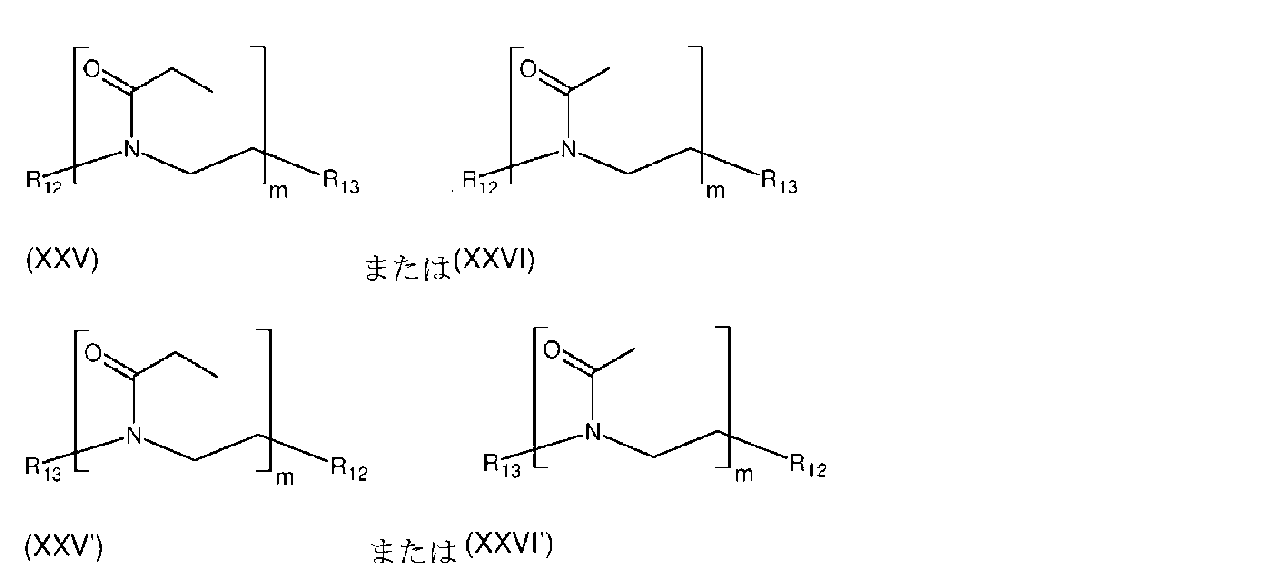
式中、R12、R13、及びmは、特に、式(XXI)、(XXI’)、(XXIa)、(XXIa’)、(XXIc)、(XXId)、(XXIe’)、(XXIf’)、(XXIg’)、(XXIh’)、(XXIi’)、(XXIj’)、(XXII)、(XXII’)、(XXIIa)、及び(XXIIa’)のうちのいずれかに関して、上記で指定された通りである。
In some embodiments, the oxazolinated and/or oxazinated lipid has the following formula (XXV), (XXV'), (XXVI), or (XXVI'):
wherein R 12 , R 13 and m are as specified above, particularly with respect to any of formulae (XXI), (XXI'), (XXIa), (XXIa'), (XXIc), (XXId), (XXIe'), (XXIf'), (XXIg'), (XXIh'), (XXIi'), (XXIj'), (XXII), (XXII'), (XXIIa) and (XXIIa').
式(XXV)、(XXV’)、(XXVI)、及び(XXVI’)の上記の実施形態のうちのいずれかでは、mは、好ましくは、10~100、例えば、20~80、30~70、または40~50、例えば、20~25、または45~50である。 In any of the above embodiments of formulas (XXV), (XXV'), (XXVI), and (XXVI'), m is preferably from 10 to 100, e.g., from 20 to 80, from 30 to 70, or from 40 to 50, e.g., from 20 to 25, or from 45 to 50.
いくつかの実施形態では、オキサゾリン化及び/またはオキサジン化脂質は、以下の式(XXVa)、(XXVa’)、(XXVIa)、または(XXVIa’):
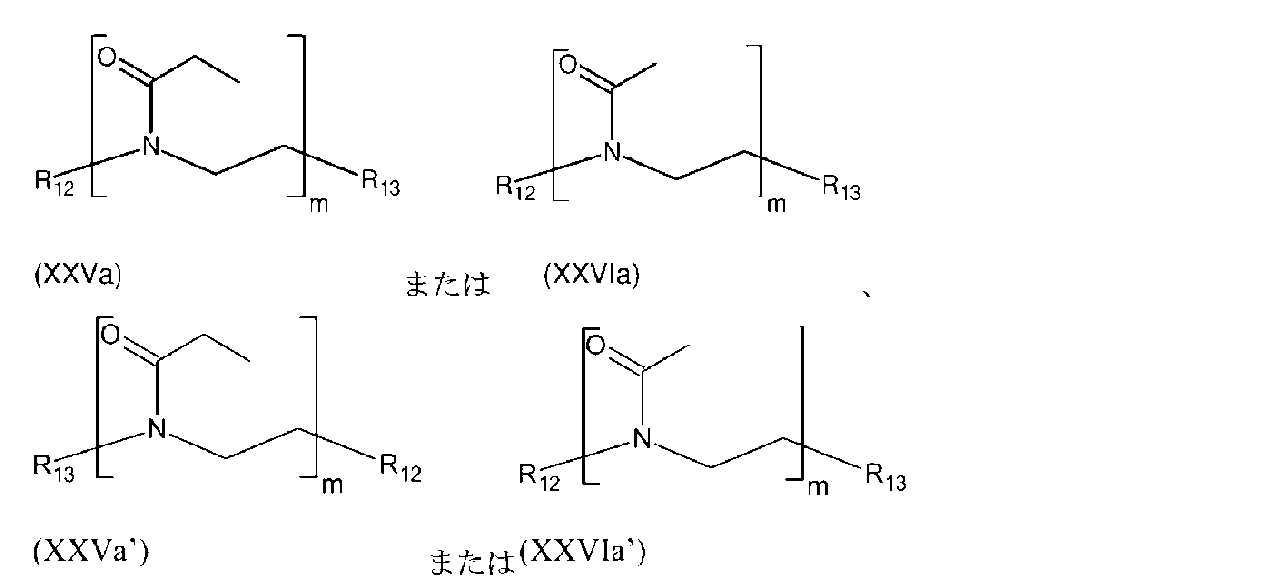
式中、mは、20~25または45~50のいずれかであり、R12及びR13は、特に、式(XXI)、(XXI’)、(XXIa)、(XXIa’)、(XXIc)、(XXId)、(XXIe’)、(XXIf’)、(XXIg’)、(XXIh’)、(XXIi’)、(XXIj’)、(XXII)、(XXII’)、(XXIIa)、及び(XXIIa’)のうちのいずれかに関して、上記で指定された通りである。
In some embodiments, the oxazolinated and/or oxazinated lipid has the following formula (XXVa), (XXVa'), (XXVIa), or (XXVIa'):
wherein m is either 20 to 25 or 45 to 50, and R 12 and R 13 are as specified above, particularly with respect to any of formulae (XXI), (XXI'), (XXIa), (XXIa'), (XXIc), (XXId), (XXIe'), (XXIf'), (XXIg'), (XXIh'), (XXIi'), (XXIj'), (XXII), (XXII'), (XXIIa), and (XXIIa').
式(XXV)、(XXVa)、(XXVI)、及び(XXVIa)の上記の実施形態のうちのいずれかでは、R12は、好ましくは、-L11R14、-(CH2)-CH(OC(O)R14)(CH2OC(O)R14)、-(CH2)-CH(SR14)2、及び-(CH2)-CH(SR14)-CH2(SR14)からなる群から選択され、各R14は、独立して、少なくとも10個の炭素原子(好ましくは、最大30個の炭素原子、例えば、最大24個の炭素原子、例えば、10~16個の炭素原子、例えば、10~14個の炭素原子を有する)を有する直鎖ヒドロカルビル基であり、L11は、*-NHC(O)-(CH2)-、*-NHC(O)-(CH2)2-、*-C(O)NH-(CH2)-、*-C(O)NH-(CH2)2-、*-S-(CH2)3-、*-S(O)2-(CH2)3-、及び*-OC(O)-(CH2)-からなる群から選択され(好ましくは、L11は、*-NHC(O)-(CH2)-、*-NHC(O)-(CH2)2-、*-C(O)NH-(CH2)-、及び*-C(O)NH-(CH2)2-、例えば、*-NHC(O)-(CH2)-、または*-NHC(O)-(CH2)2-からなる群から選択される)、式中、*は、R14との結合点を表す。したがって、式(XXV)、(XXVa)、(XXVI)、及び(XXVIa)の上記の実施形態のうちのいずれかでは、R12は、R14-NHC(O)-(CH2)-、R14-NHC(O)-(CH2)2-、-(CH2)-CH(OC(O)R14)(CH2OC(O)R14)、-(CH2)-CH(SR14)-CH2(SR14)、R14S-(CH2)3-、R14S(O)2-(CH2)3-、及びR14-OC(O)-(CH2)-からなる群から選択され得る。 In any of the above embodiments of formulae (XXV), (XXVa), (XXVI), and (XXVIa), R 12 is preferably selected from the group consisting of -L 11 R 14 , -(CH 2 )-CH(OC(O)R 14 )(CH 2 OC(O)R 14 ), -(CH 2 )-CH(SR 14 ) 2 , and -(CH 2 )-CH(SR 14 )-CH 2 (SR 14 ), each R 14 independently being a linear hydrocarbyl group having at least 10 carbon atoms (preferably having up to 30 carbon atoms, e.g., up to 24 carbon atoms, e.g., having from 10 to 16 carbon atoms, e.g., having from 10 to 14 carbon atoms); L 11 is selected from the group consisting of *-NHC(O)-(CH 2 )-, *-NHC(O)-(CH 2 ) 2- , *-C(O)NH-( CH2 )-, *-C(O)NH-( CH2 ) 2- , *-S-( CH2 ) 3- , *-S(O) 2- ( CH2 ) 3- , and *-OC(O)-( CH2 )- (preferably L11 is selected from the group consisting of *-NHC(O)-( CH2 )-, *-NHC(O)-( CH2 ) 2- , *-C(O)NH-( CH2 )-, and *-C(O)NH-( CH2 ) 2- , e.g., *-NHC(O)-(CH2)-, or * -NHC (O)-( CH2 ) 2- ), where * represents the point of attachment to R14 . Thus, in any of the above embodiments of formulas (XXV), (XXVa), (XXVI), and (XXVIa), R 12 may be selected from the group consisting of R 14 -NHC(O)-(CH 2 )-, R 14 -NHC(O)-(CH 2 ) 2 -, -(CH 2 )-CH(OC(O)R 14 )(CH 2 OC(O)R 14 ), -(CH 2 )-CH(SR 14 )-CH 2 (SR 14 ), R 14 S-(CH 2 ) 3 -, R 14 S(O) 2 -(CH 2 ) 3 -, and R 14 -OC(O)-(CH 2 )-.
式(XXV’)、(XXVa’)、(XXVI’)、及び(XXVIa’)の上記の実施形態のうちのいずれかでは、R12は、好ましくは、(R14C(O)O)(CH(OC(O)R14))(CH2)-Z-、(R14)2N(C1-3-アルキレン)-Z-、R14Z(C1-3-アルキレン)-Z-、R14Z-(C3-6-シクロアルケニレン)-Z-、及びR14Z-からなる群から選択され、各R14は、独立して、少なくとも10個の炭素原子(好ましくは、最大30個の炭素原子、例えば、最大24個の炭素原子、例えば、10~16個の炭素原子、例えば、10~14個の炭素原子を有する)を有する直鎖ヒドロカルビル基であり、C3-6-シクロアルケニレン基は、独立して、-OH、=O、-SH、ハロゲン、-CN、-N3、及びC1-3-アルキルからなる群から選択される1個以上(例えば、1、2、3、または4個)の置換基で任意に置換され、各Zは、独立して、-OP(O)2O(CH2)2NH-、-NH(CH2)2OP(O)2O-、-C(O)NH-、-NHC(O)-、-OC(O)NH-、-NHC(O)O-、-O-、-C(O)O-、-OC(O)-、-S-、-S(O)2-、及び-NH-からなる群から選択される。したがって、式(XXV’)、(XXVa’)、(XXVI’)、及び(XXVIa’)の上記の実施形態のうちのいずれかでは、R12は、R14C(O)NH-、R14S-、R14S(O)2-、及びR14NH-(3,4-ジオキソシクロブタ-1-エン-1,2-ジイル)-NH-からなる群から選択され得る。 In any of the above embodiments of formulae (XXV'), (XXVa'), (XXVI') and (XXVIa'), R 12 is preferably selected from the group consisting of (R 14 C(O)O)(CH(OC(O)R 14 ))(CH 2 )-Z-, (R 14 ) 2 N(C 1-3 -alkylene)-Z-, R 14 Z(C 1-3 -alkylene)-Z-, R 14 Z-(C 3-6 -cycloalkenylene)-Z- and R 14 Z-, each R 14 independently being a linear hydrocarbyl group having at least 10 carbon atoms (preferably up to 30 carbon atoms, for example up to 24 carbon atoms, for example having from 10 to 16 carbon atoms, for example having from 10 to 14 carbon atoms) and -Cycloalkenylene groups are optionally substituted with one or more (e.g., 1, 2, 3, or 4) substituents independently selected from the group consisting of -OH, ═O, -SH, halogen, -CN, -N 3 , and C 1-3 -alkyl, and each Z is independently selected from the group consisting of -OP(O) 2 O(CH 2 ) 2 NH-, -NH(CH 2 ) 2 OP(O) 2 O-, -C(O)NH-, -NHC(O)-, -OC(O)NH-, -NHC(O)O-, -O-, -C(O)O-, -OC(O)-, -S-, -S(O) 2 -, and -NH-. Thus, in any of the above embodiments of formulas (XXV'), (XXVa'), (XXVI'), and (XXVIa'), R 12 may be selected from the group consisting of R 14 C(O)NH-, R 14 S-, R 14 S(O) 2 -, and R 14 NH-(3,4-dioxocyclobut-1-ene-1,2-diyl)-NH-.
式(XXV)、(XXV’)、(XXVa)、(XXVa’)、(XXVI)、(XXVI’)、(XXVIa)、及び(XXVIa’)の上記の実施形態のうちのいずれかでは、R13は、好ましくは、H、C1-3アルキル、-OH、-N3、C2-6アルキニル、-COOH、-NH2、-NHCH3、-N(CH3)2、-NH(CH2CH3)、-NHC(O)(CH2)2COOH、-N(CH2CH3)C(O)(CH2)2COOH、-N(CH2CH3)C(O)CH3、-C(O)NH2、-C(O)NHCH3、-OC(O)(CH2)2COOH、及び標的化対のメンバーからなる群から選択され、C1-3アルキル基は、独立して、-OH、-N3、C2-6アルキニル、-COOH、-NH2、-NHCH3、-N(CH3)2、-C(O)NH2、-C(O)NHCH3、-C(O)NH(CH2)2NH2、及び標的化対のメンバーからなる群から選択される1個以上(例えば、1または2個)の置換基で任意に置換される。
In any of the above embodiments of formulae (XXV), (XXV'), (XXVa), (XXVa'), (XXVI), (XXVI'), (XXVIa) and (XXVIa'), R 13 is preferably H, C 1-3 alkyl, -OH, -N 3 , C 2-6 alkynyl, -COOH, -NH 2 , -NHCH 3 , -N(CH 3 ) 2 , -NH(CH 2 CH 3 ), -NHC(O)(CH 2 ) 2 COOH, -N(CH 2 CH 3 )C(O)(CH 2 ) 2 COOH, -N(CH 2 CH 3 )C(O)CH 3 , -C(O)NH 2 , -C(O)NHCH 3 , -OC(O)(CH 2 ) 2 and members of a targeting pair, and the C 1-3 alkyl group is optionally substituted with one or more ( e.g., 1 or 2) substituents independently selected from the group consisting of -OH, -N 3 , C 2-6 alkynyl, -COOH, -NH 2 , -NHCH 3 , -N(CH 3 ) 2 , -C(O)NH 2 , -C(O)NHCH 3 , -C(O)NH(CH 2 ) 2
式(XXV)、(XXVa)、(XXVI)、及び(XXVIa)の上記の実施形態のうちのいずれかでは、R13は、好ましくは、-OH、-N3、C2-6アルキニル、-COOH、-NH2、-NHCH3、-N(CH3)2、-NHC(O)(CH2)2COOH、-N(CH2CH3)C(O)(CH2)2COOH、-N(CH2CH3)C(O)CH3、-NH(CH2CH3)、-OC(O)(CH2)2COOH、及び標的化対のメンバーからなる群から、例えば、-OH、-N3、-NH2、-NHC(O)(CH2)2COOH、-N(CH2CH3)C(O)(CH2)2COOH、-N(CH2CH3)C(O)CH3、-NH(CH2CH3)、及び-OC(O)(CH2)2COOHからなる群から選択される。 In any of the above embodiments of formulae (XXV), (XXVa), (XXVI), and (XXVIa), R 13 is preferably selected from the group consisting of -OH, -N 3 , C 2-6 alkynyl, -COOH, -NH 2 , -NHCH 3 , -N(CH 3 ) 2 , -NHC(O)(CH 2 ) 2 COOH, -N(CH 2 CH 3 )C(O)(CH 2 ) 2 COOH, -N(CH 2 CH 3 )C(O)CH 3 , -NH(CH 2 CH 3 ), -OC(O)(CH 2 ) 2 COOH, and members of a targeting pair, e.g., -OH, -N 3 , -NH 2 , -NHC(O)(CH 2 ) 2 COOH, -N(CH 2 CH 3 )C(O)(CH 2 ) 2 COOH, -N(CH 2 CH 3 )C(O)CH 3 , -NH(CH 2 CH 3 ), and -OC(O)(CH 2 ) 2 COOH.
式(XXV’)、(XXVa’)、(XXVI’)、及び(XXVIa’)の上記の実施形態のうちのいずれかでは、R13は、好ましくは、独立して、-OH、-N3、C2-6アルキニル、-COOH、-NH2、-NHCH3、-N(CH3)2、-C(O)NH2、-C(O)NHCH3、-C(O)NH(CH2)2NH2、及び標的化対のメンバーからなる群から選択される1または2個の置換基で任意に置換されるC1-3アルキルであり、より好ましくは、R13は、-COOH、及び-C(O)NH(CH2)2NH2からなる群から選択される1個の置換基で任意に置換されるC1-3アルキルである。
In any of the above embodiments of formulae (XXV'), (XXVa'), (XXVI') and (XXVIa'), R 13 is preferably a C 1-3 alkyl optionally substituted with one or two substituents independently selected from the group consisting of -OH, -N 3 , C 2-6 alkynyl, -COOH, -NH 2 , -NHCH 3 , -N(CH 3 ) 2 , -C(O) NH 2 , -C(O)NHCH 3 , -C(O)NH(CH 2 ) 2
式(XXV)、(XXVa)、(XXVI)、及び(XXVIa)の上記の実施形態のうちのいずれかでは、好ましくは、
R12は、-L11R14、-(CH2)-CH(OC(O)R14)(CH2OC(O)R14)、-(CH2)-CH(SR14)2、及び-(CH2)-CH(SR14)-CH2(SR14)からなる群から選択され、各R14は、独立して、少なくとも10個の炭素原子(好ましくは、最大30個の炭素原子、例えば、最大24個の炭素原子、または最大16個の炭素原子、例えば、15、14、13、12、11、または10個の炭素原子、例えば、10~16個の炭素原子、例えば、10~15または10~14個の炭素原子を有する)を有する直鎖ヒドロカルビル基であり、L11は、*-NHC(O)-(CH2)-、*-NHC(O)-(CH2)2-、*-C(O)NH-(CH2)-、*-C(O)NH-(CH2)2-、*-S-(CH2)3-、*-S(O)2-(CH2)3-、及び*-OC(O)-(CH2)-からなる群から選択され(好ましくは、L11は、*-NHC(O)-(CH2)-、*-NHC(O)-(CH2)2-、*-C(O)NH-(CH2)-、及び*-C(O)NH-(CH2)2-、例えば、*-NHC(O)-(CH2)-、または*-NHC(O)-(CH2)2-からなる群から選択される)、式中、*は、R14との結合点を表し、
R13は、-OH、-N3、C2-6アルキニル、-COOH、-NH2、-NHCH3、-N(CH3)2、-NHC(O)(CH2)2COOH、-N(CH2CH3)C(O)(CH2)2COOH、-N(CH2CH3)C(O)CH3、-NH(CH2CH3)、-OC(O)(CH2)2COOH、及び標的化対のメンバーからなる群から、例えば、-OH、-N3、-NH2、-NHC(O)(CH2)2COOH、-N(CH2CH3)C(O)(CH2)2COOH、-N(CH2CH3)C(O)CH3、-NH(CH2CH3)、及び-OC(O)(CH2)2COOHからなる群から選択される。
In any of the above embodiments of formula (XXV), (XXVa), (XXVI) and (XXVIa), preferably
R 12 is selected from the group consisting of -L 11 R 14 , -(CH 2 )-CH(OC(O)R 14 )(CH 2 OC(O)R 14 ), -(CH 2 )-CH(SR 14 ) 2 , and -(CH 2 )-CH(SR 14 )-CH 2 (SR 14 ), each R 14 independently being a straight chain hydrocarbyl group having at least 10 carbon atoms (preferably having up to 30 carbon atoms, e.g., up to 24 carbon atoms, or up to 16 carbon atoms, e.g., 15, 14, 13, 12, 11, or 10 carbon atoms, e.g., 10 to 16 carbon atoms, e.g., 10 to 15 or 10 to 14 carbon atoms); L 11 is selected from the group consisting of *-NHC(O)-(CH 2 )-, *-NHC(O)-(CH 2 ) 2- , *-C(O)NH-( CH2 )-, *-C(O)NH-( CH2 ) 2- , *-S-( CH2 ) 3- , *-S(O) 2- ( CH2 ) 3- , and *-OC(O)-( CH2 )- (preferably L11 is selected from the group consisting of *-NHC(O)-( CH2 )-, *-NHC(O)-( CH2 ) 2- , *-C(O)NH-( CH2 )-, and *-C(O)NH-( CH2 ) 2- , e.g., *-NHC(O)-(CH2)-, or * -NHC (O)-( CH2 ) 2- ), where * is R represents the point of attachment to 14 ,
R 13 is selected from the group consisting of -OH, -N 3 , C 2-6 alkynyl, -COOH, -NH 2 , -NHCH 3 , -N(CH 3 ) 2 , -NHC(O)(CH 2 ) 2 COOH, -N(CH 2 CH 3 )C(O)(CH 2 ) 2 COOH, -N(CH 2 CH 3 )C(O)CH 3 , -NH(CH 2 CH 3 ), -OC(O)(CH 2 ) 2 COOH, and members of a targeting pair, e.g., -OH, -N 3 , -NH 2 , -NHC(O)(CH 2 ) 2 COOH, -N(CH 2 CH 3 )C(O)(CH 2 ) 2 COOH, -N(CH 2 CH 3 )C(O)CH 3 , -NH(CH 2 CH 3 ), and -OC(O)(CH 2 ) 2 COOH.
式(XXV’)、(XXVa’)、(XXVI’)、及び(XXVIa’)の上記の実施形態のうちのいずれかでは、好ましくは、
R12は、(R14C(O)O)(CH(OC(O)R14))(CH2)-Z-、(R14)2N(C1-3-アルキレン)-Z-、R14Z(C1-3-アルキレン)-Z-、R14Z-(C3-6-シクロアルケニレン)-Z-、及びR14Z-からなる群から選択され、各R14は、独立して、少なくとも10個の炭素原子(好ましくは、最大30個の炭素原子、例えば、最大24個の炭素原子、例えば、10~16個の炭素原子、例えば、10~14個の炭素原子を有する)を有する直鎖ヒドロカルビル基であり、C3-6-シクロアルケニレン基は、独立して、-OH、=O、-SH、ハロゲン、-CN、-N3、及びC1-3-アルキルからなる群から選択される1個以上(例えば、1、2、3、または4個)の置換基で任意に置換され、各Zは、独立して、-OP(O)2O(CH2)2NH-、-NH(CH2)2OP(O)2O-、-C(O)NH-、-NHC(O)-、-OC(O)NH-、-NHC(O)O-、-O-、-C(O)O-、-OC(O)-、-S-、-S(O)2-、及び-NH-からなる群から選択され、
R13は、独立して、-OH、-N3、C2-6アルキニル、-COOH、-NH2、-NHCH3、-N(CH3)2、-C(O)NH2、-C(O)NHCH3、-C(O)NH(CH2)2NH2、及び標的化対のメンバーからなる群から選択される1または2個の置換基で任意に置換されるC1-3アルキルであり、好ましくは、R13は、-COOH、及び-C(O)NH(CH2)2NH2からなる群から選択される1個の置換基で任意に置換されるC1-3アルキルである。
In any of the above embodiments of formula (XXV'), (XXVa'), (XXVI') and (XXVIa'), preferably:
R 12 is selected from the group consisting of (R 14 C(O)O)(CH(OC(O)R 14 ))(CH 2 )-Z-, (R 14 ) 2 N(C 1-3 -alkylene)-Z-, R 14 Z(C 1-3 -alkylene)-Z-, R 14 Z-(C 3-6 -cycloalkenylene)-Z-, and R 14 Z-, each R 14 is independently a straight chain hydrocarbyl group having at least 10 carbon atoms (preferably up to 30 carbon atoms, for example up to 24 carbon atoms, for example having 10 to 16 carbon atoms, for example having 10 to 14 carbon atoms), and the C 3-6 -cycloalkenylene group is independently selected from -OH, ═O, -SH, halogen, -CN, -N 3 , and C 1-3 -alkyl, and each Z is independently selected from the group consisting of: -OP(O) 2O (CH2)2NH-, -NH( CH2 ) 2OP (O) 2O- , -C ( O )NH-, -NHC(O)-, -OC(O)NH-, -NHC(O)O-, -O-, -C(O)O-, -OC(O)-, -S-, -S(O) 2- , and -NH-;
R 13 is independently a C 1-3 alkyl optionally substituted with one or two substituents selected from the group consisting of -OH, -N 3 , C 2-6 alkynyl, -COOH, -NH 2 , -NHCH 3 , -N(CH 3 ) 2 , -C(O)NH 2 , -C(O)NHCH 3 , -C(O)NH(CH 2 ) 2 NH 2 , and members of a targeting pair, preferably R 13 is a C 1-3 alkyl optionally substituted with one substituent selected from the group consisting of -COOH, and -C(O)NH(CH 2 ) 2 NH 2 .
いくつかの実施形態では、オキサゾリン化及び/またはオキサジン化脂質は、以下の式(XXVII)、(XXVII’)、(XXVIII)、または(XXVIII’):
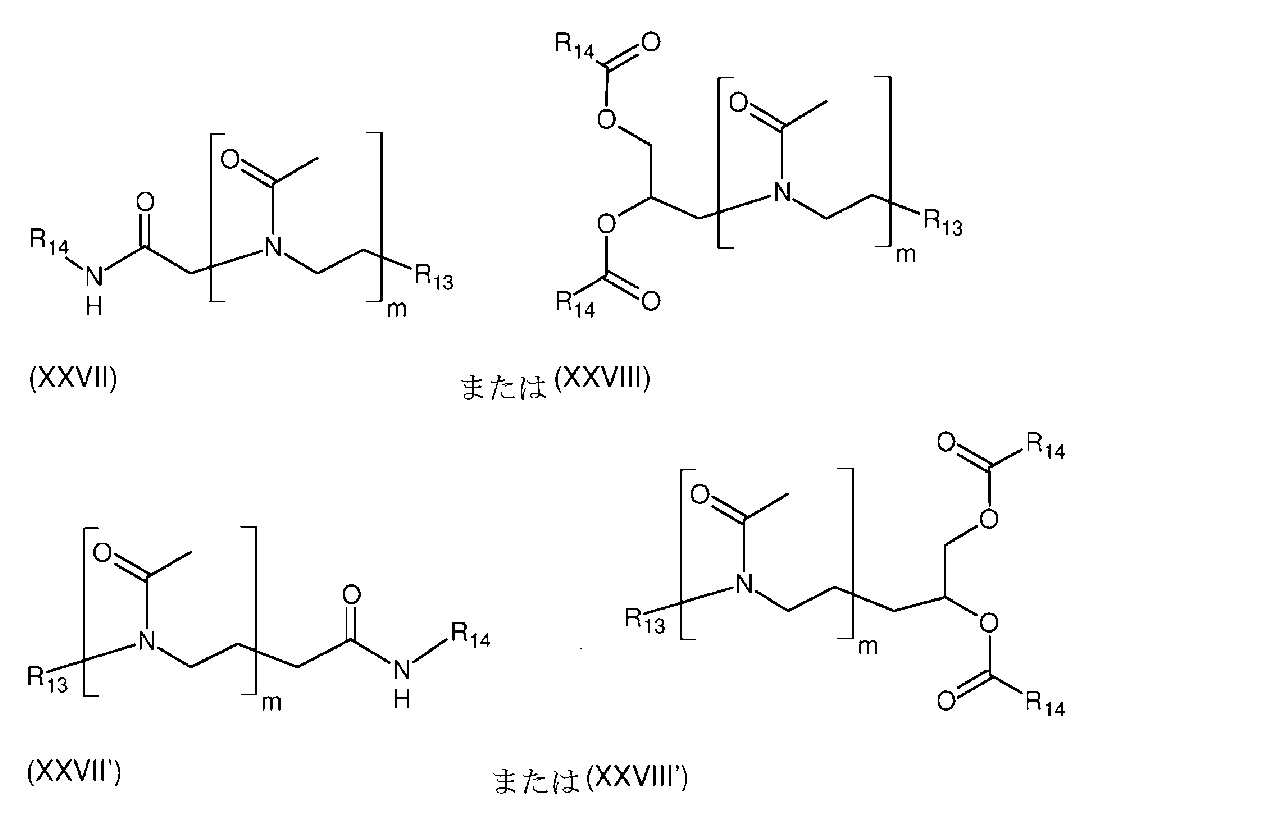
式中、R13、R14、及びmは、特に、式(XXI)、(XXI’)、(XXIa)、(XXIa’)、(XXII)、(XXII’)、(XXIIa)、及び(XXIIa’)のうちのいずれかに関して、上記で指定された通りである。式(XXVII)または(XXVII’)のいくつかの実施形態では、R14は、少なくとも10個の炭素~最大16個の炭素原子、例えば、最大15、14、13、12、11、または10個の炭素原子を有する、例えば、10~16個の炭素原子、例えば、10~15または10~14個の炭素原子を有する直鎖ヒドロカルビル基である。式(XXVIII)または(XXVIII’)のいくつかの実施形態では、R14は、独立して、少なくとも10個の炭素~最大30個の炭素原子、例えば、最大24、22、または20個の炭素原子を有する、例えば、10~16個の炭素原子、例えば、10~15または10~14個の炭素原子を有する直鎖ヒドロカルビル基である。
In some embodiments, the oxazolinated and/or oxazinated lipid has the following formula (XXVII), (XXVII'), (XXVIII), or (XXVIII'):
wherein R 13 , R 14 and m are as specified above, particularly with respect to any of formulae (XXI), (XXI'), (XXIa), (XXIa'), (XXII), (XXII'), (XXIIa) and (XXIIa'). In some embodiments of formula (XXVII) or (XXVII'), R 14 is a straight chain hydrocarbyl group having at least 10 carbons up to 16 carbon atoms, for example up to 15, 14, 13, 12, 11, or 10 carbon atoms, for example, 10 to 16 carbon atoms, for example, 10 to 15 or 10 to 14 carbon atoms. In some embodiments of formula (XXVIII) or (XXVIII'), R 14 is independently a straight chain hydrocarbyl group having at least 10 carbons up to 30 carbon atoms, e.g., up to 24, 22, or 20 carbon atoms, for example, 10 to 16 carbon atoms, e.g., 10 to 15 or 10 to 14 carbon atoms.
式(XXVII)、(XXVII’)、(XXVIII)、または(XXVIII’)の上記の実施形態のうちのいずれかでは、mは、好ましくは、10~100、例えば、20~80、30~70、または40~50、例えば、20~25、または45~50である。 In any of the above embodiments of formula (XXVII), (XXVII'), (XXVIII), or (XXVIII'), m is preferably from 10 to 100, e.g., from 20 to 80, from 30 to 70, or from 40 to 50, e.g., from 20 to 25, or from 45 to 50.
いくつかの実施形態では、オキサゾリン化及び/またはオキサジン化脂質は、以下の式(XXVIIa)または(XXVIIIa):

式中、R13、R14、及びmは、特に、式(XXI)、(XXI’)、(XXIa)、(XXIa’)、(XXII)、(XXII’)、(XXIIa)、及び(XXIIa’)のうちのいずれかに関して、上記で指定された通りである。
In some embodiments, the oxazolinated and/or oxazinated lipid has the following formula (XXVIIa) or (XXVIIIa):
wherein R 13 , R 14 and m are as specified above, particularly with respect to any of formulae (XXI), (XXI'), (XXIa), (XXIa'), (XXII), (XXII'), (XXIIa) and (XXIIa').
式(XXVII)、(XXVII’)、(XXVIIa)、(XXVIII)、(XXVIII’)、及び(XXVIIIa)の上記の実施形態のうちのいずれかでは、各R14は、好ましくは、独立して、少なくとも10個の炭素原子(好ましくは、最大30個の炭素原子、例えば、最大24個の炭素原子、例えば、10~16個の炭素原子を有する)を有する直鎖ヒドロカルビル基である。式(XXVII)、(XXVII’)、及び(XXVIIa)のいくつかの実施形態では、R14は、少なくとも10個の炭素~最大16個の炭素原子、例えば、最大15、14、13、12、11、または10個の炭素原子を有する、例えば、10~16個の炭素原子、例えば、10~15または10~14個の炭素原子を有する直鎖ヒドロカルビル基である。式(XXVIII)、(XXVIII’)、及び(XXVIIIa)のいくつかの実施形態では、R14は、独立して、少なくとも10個の炭素~最大30個の炭素原子、例えば、最大24、22、または20個の炭素原子を有する、例えば、10~16個の炭素原子、例えば、10~15または10~14個の炭素原子を有する直鎖ヒドロカルビル基である。 In any of the above embodiments of formulae (XXVII), (XXVII'), (XXVIIa), (XXVIII), (XXVIII'), and (XXVIIIa), each R 14 is preferably independently a straight chain hydrocarbyl group having at least 10 carbon atoms (preferably up to 30 carbon atoms, such as up to 24 carbon atoms, for example, having 10 to 16 carbon atoms). In some embodiments of formulae (XXVII), (XXVII'), and (XXVIIa), R 14 is a straight chain hydrocarbyl group having at least 10 carbons and up to 16 carbon atoms, for example up to 15, 14, 13, 12, 11, or 10 carbon atoms, for example, 10 to 16 carbon atoms, for example, 10 to 15 or 10 to 14 carbon atoms. In some embodiments of formula (XXVIII), (XXVIII'), and (XXVIIIa), R 14 is independently a straight chain hydrocarbyl group having at least 10 carbons up to 30 carbon atoms, e.g., up to 24, 22, or 20 carbon atoms, for example, 10 to 16 carbon atoms, e.g., 10 to 15 or 10 to 14 carbon atoms.
式(XXVII)、(XXVII’)、(XXVIIa)、(XXVIII)、(XXVIII’)、及び(XXVIIIa)の上記の実施形態のうちのいずれかでは、R13は、好ましくは、H、C1-3アルキル、-OH、-N3、C2-6アルキニル、-COOH、-NH2、-NHCH3、-N(CH3)2、-NH(CH2CH3)、-NHC(O)(CH2)2COOH、-N(CH2CH3)C(O)(CH2)2COOH、-N(CH2CH3)C(O)CH3、-C(O)NH2、-C(O)NHCH3、-OC(O)(CH2)2COOH、及び標的化対のメンバーからなる群から選択され、C1-3アルキル基は、独立して、-OH、-N3、C2-6アルキニル、-COOH、-NH2、-NHCH3、-N(CH3)2、-C(O)NH2、-C(O)NHCH3、-C(O)NH(CH2)2NH2、及び標的化対のメンバーからなる群から選択される1個以上(例えば、1または2個)の置換基で任意に置換される。
In any of the above embodiments of formulae (XXVII), (XXVII'), (XXVIIa), (XXVIII), (XXVIII') and (XXVIIIa), R 13 is preferably H, C 1-3 alkyl, -OH, -N 3 , C 2-6 alkynyl, -COOH, -NH 2 , -NHCH 3 , -N(CH 3 ) 2 , -NH(CH 2 CH 3 ), -NHC(O)(CH 2 ) 2 COOH, -N(CH 2 CH 3 )C(O)(CH 2 ) 2 COOH, -N(CH 2 CH 3 )C(O)CH 3 , -C(O)NH 2 , -C(O)NHCH 3 , -OC(O)(CH 2 ) 2 and members of a targeting pair, and the C 1-3 alkyl group is optionally substituted with one or more ( e.g., 1 or 2) substituents independently selected from the group consisting of -OH, -N 3 , C 2-6 alkynyl, -COOH, -NH 2 , -NHCH 3 , -N(CH 3 ) 2 , -C(O)NH 2 , -C(O)NHCH 3 , -C(O)NH(CH 2 ) 2
式(XXVII)、(XXVII’)、(XXVIIa)、(XXVIII)、(XXVIII’)、及び(XXVIIIa)の上記の実施形態のうちのいずれかでは、好ましくは、
各R14は、独立して、少なくとも10個の炭素原子(好ましくは、最大30個の炭素原子、例えば、最大24個の炭素原子、例えば、10~16個の炭素原子、例えば、10~14個の炭素原子を有する)を有する直鎖状のヒドロカルビル基であり、
R13は、H、C1-3アルキル、-OH、-N3、C2-6アルキニル、-COOH、-NH2、-NHCH3、-N(CH3)2、-NH(CH2CH3)、-NHC(O)(CH2)2COOH、-N(CH2CH3)C(O)(CH2)2COOH、-N(CH2CH3)C(O)CH3、-C(O)NH2、-C(O)NHCH3、-OC(O)(CH2)2COOH、及び標的化対のメンバーからなる群から選択され、C1-3アルキル基は、独立して、-OH、-N3、C2-6アルキニル、-COOH、-NH2、-NHCH3、-N(CH3)2、-C(O)NH2、-C(O)NHCH3、-C(O)NH(CH2)2NH2、及び標的化対のメンバーからなる群から選択される1個以上(例えば、1または2個)の置換基で任意に置換される。
In any of the above embodiments of formula (XXVII), (XXVII′), (XXVIIa), (XXVIII), (XXVIII′), and (XXVIIIa), preferably:
each R 14 is independently a linear hydrocarbyl group having at least 10 carbon atoms (preferably having up to 30 carbon atoms, e.g., up to 24 carbon atoms, e.g., from 10 to 16 carbon atoms, e.g., from 10 to 14 carbon atoms);
R 13 is selected from the group consisting of H, C 1-3 alkyl, -OH, -N 3 , C 2-6 alkynyl, -COOH, -NH 2 , -NHCH 3 , -N(CH 3 ) 2 , -NH(CH 2 CH 3 ), -NHC(O)(CH 2 ) 2 COOH, -N(CH 2 CH 3 )C(O)(CH 2 ) 2 COOH, -N(CH 2 CH 3 )C(O)CH 3 , -C(O)NH 2 , -C(O)NHCH 3 , -OC(O)(CH 2 ) 2 COOH, and members of a targeting pair, wherein the C 1-3 alkyl group is independently -OH, -N 3 , C 2-6 alkynyl, -COOH, -NH 2 , -NHCH 3 , -N(CH 3 ) 2 , -C(O)NH 2 , -C(O)NHCH 3 , -C(O)NH(CH 2 ) 2 NH 2 , and optionally substituted with one or more (e.g., 1 or 2) substituents selected from the group consisting of: -N(CH 3 ) 2 , -C(O)
この箇所では、式(XXVII’)及び(XXVIII’)について、好ましくは、R13は、-OH、-N3、C2-6アルキニル、-COOH、-NH2、-NHCH3、-N(CH3)2、-C(O)NH2、-C(O)NHCH3、-C(O)NH(CH2)2NH2、及び標的化対のメンバーからなる群から選択される1または2個の置換基で任意に置換されるC1-3アルキルであり、より好ましくは、R13は、-COOH、及び-C(O)NH(CH2)2NH2からなる群から選択される1個の置換基で任意に置換されるC1-3アルキルである。 In this regard, for formulae (XXVII') and (XXVIII'), preferably R 13 is a C 1-3 alkyl optionally substituted with one or two substituents selected from the group consisting of -OH, -N 3 , C 2-6 alkynyl, -COOH, -NH 2 , -NHCH 3 , -N(CH 3 ) 2 , -C(O)NH 2 , -C(O)NHCH 3 , -C(O)NH(CH 2 ) 2 NH 2 , and members of a targeting pair, and more preferably R 13 is a C 1-3 alkyl optionally substituted with one substituent selected from the group consisting of -COOH, and -C( O )NH(CH 2 ) 2 NH 2 .
式(XXVII)、(XXVII’)、及び(XXVIIa)の上記の実施形態のうちのいずれかでは、好ましくは、
各R14は、独立して、少なくとも10個の炭素原子(好ましくは、最大16個の炭素原子、例えば、最大15、14、13、12、11、または10個の炭素原子、例えば、10~16個の炭素原子、例えば、10~15または10~14個の炭素原子を有する)を有する直鎖状のヒドロカルビル基であり、
R13は、H、C1-3アルキル、-OH、-N3、C2-6アルキニル、-COOH、-NH2、-NHCH3、-N(CH3)2、-NH(CH2CH3)、-NHC(O)(CH2)2COOH、-N(CH2CH3)C(O)(CH2)2COOH、-N(CH2CH3)C(O)CH3、-C(O)NH2、-C(O)NHCH3、-OC(O)(CH2)2COOH、及び標的化対のメンバーからなる群から選択され、C1-3アルキル基は、独立して、-OH、-N3、C2-6アルキニル、-COOH、-NH2、-NHCH3、-N(CH3)2、-C(O)NH2、-C(O)NHCH3、-C(O)NH(CH2)2NH2、及び標的化対のメンバーからなる群から選択される1個以上(例えば、1または2個)の置換基で任意に置換される。
In any of the above embodiments of formula (XXVII), (XXVII′) and (XXVIIa), preferably
each R 14 is independently a linear hydrocarbyl group having at least 10 carbon atoms (preferably up to 16 carbon atoms, e.g., up to 15, 14, 13, 12, 11, or 10 carbon atoms, e.g., 10 to 16 carbon atoms, e.g., 10 to 15 or 10 to 14 carbon atoms);
R 13 is selected from the group consisting of H, C 1-3 alkyl, -OH, -N 3 , C 2-6 alkynyl, -COOH, -NH 2 , -NHCH 3 , -N(CH 3 ) 2 , -NH(CH 2 CH 3 ), -NHC(O)(CH 2 ) 2 COOH, -N(CH 2 CH 3 )C(O)(CH 2 ) 2 COOH, -N(CH 2 CH 3 )C(O)CH 3 , -C(O)NH 2 , -C(O)NHCH 3 , -OC(O)(CH 2 ) 2 COOH, and members of a targeting pair, wherein the C 1-3 alkyl group is independently -OH, -N 3 , C 2-6 alkynyl, -COOH, -NH 2 , -NHCH 3 , -N(CH 3 ) 2 , -C(O)NH 2 , -C(O)NHCH 3 , -C(O)NH(CH 2 ) 2 NH 2 , and optionally substituted with one or more (e.g., 1 or 2) substituents selected from the group consisting of: -N(CH 3 ) 2 , -C(O)
この箇所では、式(XXVII’)について、好ましくは、R13は、-OH、-N3、C2-6アルキニル、-COOH、-NH2、-NHCH3、-N(CH3)2、-C(O)NH2、-C(O)NHCH3、-C(O)NH(CH2)2NH2、及び標的化対のメンバーからなる群から選択される1または2個の置換基で任意に置換されるC1-3アルキルであり、より好ましくは、R13は、-COOH、及び-C(O)NH(CH2)2NH2からなる群から選択される1個の置換基で任意に置換されるC1-3アルキルである。 In this regard, for formula (XXVII'), preferably, R 13 is a C 1-3 alkyl optionally substituted with one or two substituents selected from the group consisting of -OH, -N 3 , C 2-6 alkynyl, -COOH, -NH 2 , -NHCH 3 , -N(CH 3 ) 2 , -C(O)NH 2 , -C(O)NHCH 3 , -C(O)NH(CH 2 ) 2 NH 2 , and members of a targeting pair, and more preferably, R 13 is a C 1-3 alkyl optionally substituted with one substituent selected from the group consisting of -COOH, and -C(O)NH(CH 2 ) 2 NH 2 .
式(XXVIII)、(XXVIII’)、及び(XXVIIIa)の上記の実施形態のうちのいずれかでは、好ましくは、
各R14は、独立して、少なくとも10個の炭素原子(好ましくは、最大30個の炭素原子、例えば、最大24個の炭素原子、例えば、10~15個の炭素原子を有する)を有する直鎖ヒドロカルビル基であり、
R13は、H、C1-3アルキル、-OH、-N3、C2-6アルキニル、-COOH、-NH2、-NHCH3、-N(CH3)2、-NH(CH2CH3)、-NHC(O)(CH2)2COOH、-N(CH2CH3)C(O)(CH2)2COOH、-N(CH2CH3)C(O)CH3、-C(O)NH2、-C(O)NHCH3、-OC(O)(CH2)2COOH、及び標的化対のメンバーからなる群から選択され、C1-3アルキル基は、独立して、-OH、-N3、C2-6アルキニル、-COOH、-NH2、-NHCH3、-N(CH3)2、-C(O)NH2、-C(O)NHCH3、-C(O)NH(CH2)2NH2、及び標的化対のメンバーからなる群から選択される1個以上(例えば、1または2個)の置換基で任意に置換される。
In any of the above embodiments of formula (XXVIII), (XXVIII′) and (XXVIIIa), preferably:
each R 14 is independently a linear hydrocarbyl group having at least 10 carbon atoms (preferably having up to 30 carbon atoms, e.g., up to 24 carbon atoms, e.g., 10 to 15 carbon atoms);
R 13 is selected from the group consisting of H, C 1-3 alkyl, -OH, -N 3 , C 2-6 alkynyl, -COOH, -NH 2 , -NHCH 3 , -N(CH 3 ) 2 , -NH(CH 2 CH 3 ), -NHC(O)(CH 2 ) 2 COOH, -N(CH 2 CH 3 )C(O)(CH 2 ) 2 COOH, -N(CH 2 CH 3 )C(O)CH 3 , -C(O)NH 2 , -C(O)NHCH 3 , -OC(O)(CH 2 ) 2 COOH, and members of a targeting pair, wherein the C 1-3 alkyl group is independently -OH, -N 3 , C 2-6 alkynyl, -COOH, -NH 2 , -NHCH 3 , -N(CH 3 ) 2 , -C(O)NH 2 , -C(O)NHCH 3 , -C(O)NH(CH 2 ) 2 NH 2 , and optionally substituted with one or more (e.g., 1 or 2) substituents selected from the group consisting of: -N(CH 3 ) 2 , -C(O)
この箇所では、式(XXVIII’)について、好ましくは、R13は、-OH、-N3、C2-6アルキニル、-COOH、-NH2、-NHCH3、-N(CH3)2、-C(O)NH2、-C(O)NHCH3、-C(O)NH(CH2)2NH2、及び標的化対のメンバーからなる群から選択される1または2個の置換基で任意に置換されるC1-3アルキルであり、より好ましくは、R13は、-COOH、及び-C(O)NH(CH2)2NH2からなる群から選択される1個の置換基で任意に置換されるC1-3アルキルである。 In this regard, for formula (XXVIII'), preferably, R 13 is a C 1-3 alkyl optionally substituted with one or two substituents selected from the group consisting of -OH, -N 3 , C 2-6 alkynyl, -COOH, -NH 2 , -NHCH 3 , -N(CH 3 ) 2 , -C(O)NH 2 , -C(O)NHCH 3 , -C(O)NH(CH 2 ) 2 NH 2 , and members of a targeting pair, and more preferably, R 13 is a C 1-3 alkyl optionally substituted with one substituent selected from the group consisting of -COOH, and -C(O)NH(CH 2 ) 2 NH 2 .
オキサゾリン化及び/またはオキサジン化脂質の特定の例は、以下の化合物(XXI-1)~(XXI-34)及び(XXI’-35)~(XXI’-48):

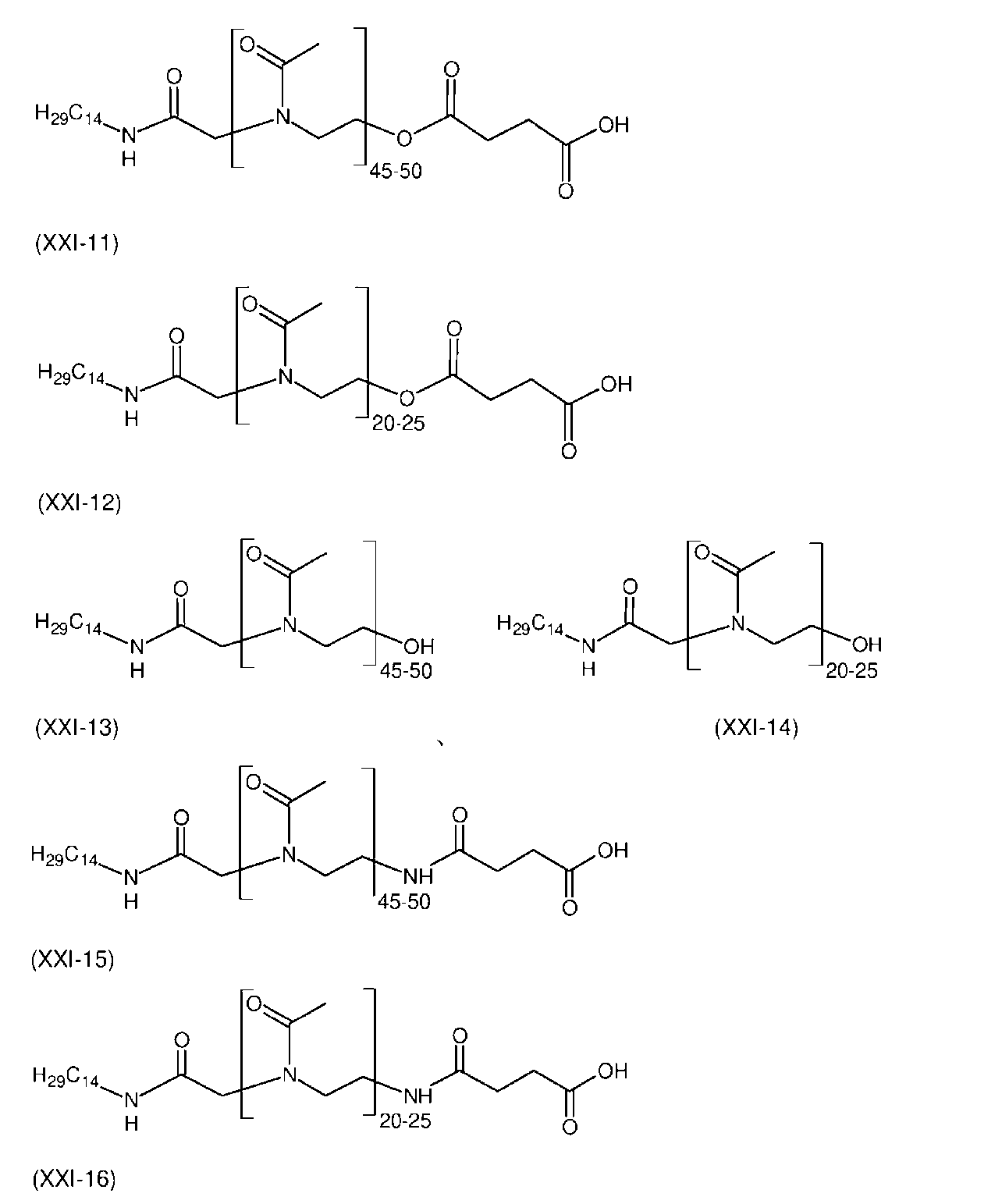


いくつかの実施形態では、オキサゾリン化及び/またはオキサジン化脂質は、式(XXIa)、(XXIa’)、(XXIb)、(XXIb’)、(XXIc)、(XXId)、(XXIe’)、(XXIf’)、(XXIg’)、(XXIh’)、(XXIi’)、(XXIj’)、(XXII)、(XXII’)、(XXIIa)、(XXIIa’)、(XXIIb)、(XXIIb’)、(XXIII)、(XXIII’)、(XXIIIa)、(XXIIIb)、(XXIIIc’)、(XXIIId’)、(XXIIIe’)、(XXIIIf’)、(XXIIIg’)、(XXIIIh’)、(XXIV)、(XXIV’)、(XXV)、(XXV’)、(XXVa)、(XXVa’)、(XXVI)、(XXVI’)、(XXVIa)、(XXVIa’)、(XXVII)、(XXVII’)、(XXVIIa)、(XXVIII)、(XXVIII’)、(XXVIIIa)、(XXI-1)、(XXI-2)、(XXI-3)、(XXI-4)、(XXI-5)、(XXI-6)、(XXI-7)、(XXI-8)、(XXI-9)、(XXI-10)、(XXI-11)、(XXI-12)、(XXI-13)、(XXI-14)、(XXI-15)、(XXI-16)、(XXI-17)、(XXI-18)、(XXI-19)、(XXI-20)、(XXI-21)、(XXI-22)、(XXI-23)、(XXI-24)、(XXI-25)、(XXI-26)、(XXI-27)、(XXI-28)、(XXI-29)、(XXI-30)、(XXI-31)、(XXI-32)、(XXI-33)、(XXI-34)、(XXI’-35)、(XXI’-36)、(XXI’-37)、(XXI’-38)、(XXI’-39)、(XXI’-40)、(XXI’-41)、(XXI’-42)、(XXI’-43)、(XXI’-44)、(XXI’-45)、(XXI’-46)、(XXI’-47)、及び(XXI’-48)のうちのいずれか1つから選択される。 In some embodiments, the oxazolinated and/or oxazinated lipid has the formula (XXIa), (XXIa'), (XXIb), (XXIb'), (XXIc), (XXId), (XXIe'), (XXIf'), (XXIg'), (XXIh'), (XXIi'), (XXIj'), (XXII), (XXII'), (XXIIa), (XXIIa'), (XXIIb), (XXIIb'), (XXIII), (XXIII'), (XXIIIa), (XXIIIb), (XXIIIi'), (XXIIIj'), (XXII), (XXII'), (XXII'), (XXII'), (XXII'), (XXII'), (XXII'), (XXII'), (XXIII ... XIIIc'), (XXIIId'), (XXIIIe'), (XXIIIf'), (XXIIIg'), (XXIIIh'), (XXIV), (XXIV'), (XXV), (XXV'), (XXVa), (XXVa'), (XXVI) , (XXVI'), (XXVIa), (XXVIa'), (XXVII), (XXVII'), (XXVIIa), (XXVIII), (XXVIII'), (XXVIIIa), (XXI-1), (XXI-2), (XXI-3), (XX I-4), (XXI-5), (XXI-6), (XXI-7), (XXI-8), (XXI-9), (XXI-10), (XXI-11), (XXI-12), (XXI-13), (XXI-14), (XXI-15), (XXI-16) , (XXI-17), (XXI-18), (XXI-19), (XXI-20), (XXI-21), (XXI-22), (XXI-23), (XXI-24), (XXI-25), (XXI-26), (XXI-27), (XXI-28 ), (XXI-29), (XXI-30), (XXI-31), (XXI-32), (XXI-33), (XXI-34), (XXI'-35), (XXI'-36), (XXI'-37), (XXI'-38), (XXI'-39), (XXI'-40), (XXI'-41), (XXI'-42), (XXI'-43), (XXI'-44), (XXI'-45), (XXI'-46), (XXI'-47), and (XXI'-48).
いくつかの実施形態では、本明細書に記載される核酸組成物(例えば、DNAまたはRNA組成物、特に、mRNA組成物)は、本明細書に記載されるカチオン性/カチオン性イオン化可能脂質(例えば、式(I)、(X)、または(XI)のカチオン性イオン化可能脂質)、本明細書に記載されるオキサゾリン化及び/またはオキサジン化脂質、本明細書に記載されるリン脂質、ならびにコレステロールを含み得、本明細書に記載されるオキサゾリン化及び/またはオキサジン化脂質は、好ましくは、式(XXIa)、(XXIa’)、(XXIb)、(XXIb’)、(XXIc)、(XXId)、(XXIe’)、(XXIf’)、(XXIg’)、(XXIh’)、(XXIi’)、(XXIj’)、(XXII)、(XXII’)、(XXIIa)、(XXIIa’)、(XXIIb)、(XXIIb’)、(XXIII)、(XXIII’)、(XXIIIa)、(XXIIIb)、(XXIIIc’)、(XXIIId’)、(XXIIIe’)、(XXIIIf’)、(XXIIIg’)、(XXIIIh’)、(XXIV)、(XXIV’)、(XXV)、(XXV’)、(XXVa)、(XXVa’)、(XXVI)、(XXVI’)、(XXVIa)、(XXVIa’)、(XXVII)、(XXVII’)、(XXVIIa)、(XXVIII)、(XXVIII’)、(XXVIIIa)、(XXI-1)、(XXI-2)、(XXI-3)、(XXI-4)、(XXI-5)、(XXI-6)、(XXI-7)、(XXI-8)、(XXI-9)、(XXI-10)、(XXI-11)、(XXI-12)、(XXI-13)、(XXI-14)、(XXI-15)、(XXI-16)、(XXI-17)、(XXI-18)、(XXI-19)、(XXI-20)、(XXI-21)、(XXI-22)、(XXI-23)、(XXI-24)、(XXI-25)、(XXI-26)、(XXI-27)、(XXI-28)、(XXI-29)、(XXI-30)、(XXI-31)、(XXI-32)、(XXI-33)、(XXI-34)、(XXI’-35)、(XXI’-36)、(XXI’-37)、(XXI’-38)、(XXI’-39)、(XXI’-40)、(XXI’-41)、(XXI’-42)、(XXI’-43)、(XXI’-44)、(XXI’-45)、(XXI’-46)、(XXI’-47)、及び(XXI’-48)のうちのいずれか1つであるか、またはそれを含む。 In some embodiments, the nucleic acid compositions described herein (e.g., DNA or RNA compositions, particularly mRNA compositions) may comprise a cationic/cationic ionizable lipid described herein (e.g., a cationic ionizable lipid of formula (I), (X), or (XI)), an oxazolinated and/or oxazinated lipid described herein, a phospholipid described herein, and cholesterol, and the oxazolinated and/or oxazinated lipid described herein is preferably of formula (XXIa), (XXIa'), (XXIb), (XXIb'), (XXIc) , (XXId), (XXIe'), (XXIf'), (XXIg'), (XXIh'), (XXIi'), (XXIj'), (XXII), (XX II'), (XXIIa), (XXIIa'), (XXIIb), (XXIIb'), (XXIII), (XXIII'), (XXIIIa), ( XXIIIb), (XXIIIc'), (XXIIId'), (XXIIIe'), (XXIIIf'), (XXIIIg'), (XXIIIh' ), (XXIV), (XXIV'), (XXV), (XXV'), (XXVa), (XXVa'), (XXVI), (XXVI'), (XXVIa ), (XXVIa'), (XXVII), (XXVII'), (XXVIIa), (XXVIII), (XXVIII'), (XXVIIIa), (XXI-1), (XXI-2), (XXI-3), (XXI-4), (XXI-5), (XXI-6), (XXI-7), (XXI-8), (X XI-9), (XXI-10), (XXI-11), (XXI-12), (XXI-13), (XXI-14), (XXI-15), (XXI-1 6), (XXI-17), (XXI-18), (XXI-19), (XXI-20), (XXI-21), (XXI-22), (XXI-23), It is or includes one of (XXI-24), (XXI-25), (XXI-26), (XXI-27), (XXI-28), (XXI-29), (XXI-30), (XXI-31), (XXI-32), (XXI-33), (XXI-34), (XXI'-35), (XXI'-36), (XXI'-37), (XXI'-38), (XXI'-39), (XXI'-40), (XXI'-41), (XXI'-42), (XXI'-43), (XXI'-44), (XXI'-45), (XXI'-46), (XXI'-47), and (XXI'-48).
いくつかの実施形態では、オキサゾリン化及び/またはオキサジン化脂質は、本明細書に記載される核酸組成物(例えば、DNAまたはRNA組成物、特に、mRNA組成物)中に存在する総脂質の、約0.1mol%~約10mol%、例えば、約0.2mol%~約9mol%、約0.5mol%~約8mol%、約1mol%~約7.5mol%、約1.5mol%~約7mol%、約2mol%~約6.5mol%、約2.5mol%~約6mol%、または約3mol%~約5mol%で含まれる。 In some embodiments, the oxazolinated and/or oxazinated lipids comprise from about 0.1 mol% to about 10 mol%, e.g., from about 0.2 mol% to about 9 mol%, from about 0.5 mol% to about 8 mol%, from about 1 mol% to about 7.5 mol%, from about 1.5 mol% to about 7 mol%, from about 2 mol% to about 6.5 mol%, from about 2.5 mol% to about 6 mol%, or from about 3 mol% to about 5 mol% of the total lipids present in the nucleic acid compositions (e.g., DNA or RNA compositions, particularly mRNA compositions) described herein.
いくつかの実施形態では、(i)核酸(例えば、DNAまたはRNA、特に、mRNA)、(ii)カチオン性/カチオン性イオン化可能脂質、及び(iii)オキサゾリン化及び/またはオキサジン化脂質の少なくとも一部が粒子(例えば、LNPなどのナノ粒子)を形成する場合、オキサゾリン化及び/またはオキサジン化脂質は、粒子中に存在する総脂質の、約0.1mol%~約10mol%、例えば、約0.2mol%~約9mol%、約0.5mol%~約8mol%、約1mol%~約7.5mol%、約1.5mol%~約7mol%、約2mol%~約6.5mol%、約2.5mol%~約6mol%、または約3mol%~約5mol%で含まれ得る。 In some embodiments, when at least a portion of (i) the nucleic acid (e.g., DNA or RNA, particularly mRNA), (ii) the cationic/cationic ionizable lipid, and (iii) the oxazolinated and/or oxazinated lipid form a particle (e.g., a nanoparticle such as an LNP), the oxazolinated and/or oxazinated lipid may comprise from about 0.1 mol% to about 10 mol%, e.g., from about 0.2 mol% to about 9 mol%, from about 0.5 mol% to about 8 mol%, from about 1 mol% to about 7.5 mol%, from about 1.5 mol% to about 7 mol%, from about 2 mol% to about 6.5 mol%, from about 2.5 mol% to about 6 mol%, or from about 3 mol% to about 5 mol% of the total lipid present in the particle.
いくつかの実施形態では、本明細書に記載される核酸組成物(例えば、DNAまたはRNA組成物、特に、mRNA組成物)は、本明細書に記載されるカチオン性/カチオン性イオン化可能脂質(例えば、式(X)または(XI)のカチオン性イオン化可能脂質)、本明細書に記載されるオキサゾリン化及び/またはオキサジン化脂質、リン脂質、及びコレステロールを含み得、カチオン性/カチオン性イオン化可能脂質は、組成物中に存在する総脂質の約40mol%~約50mol%で含まれ、オキサゾリン化及び/またはオキサジン化脂質は、組成物中に存在する総脂質の約0.5mol%~約10mol%(例えば、約2mol~約5mol%)で含まれ、リン脂質は、組成物中に存在する総脂質の約5mol%~約15mol%で含まれ、コレステロールは、組成物中に存在する総脂質の約30mol%~約50mol%で含まれる。いくつかの実施形態では、オキサゾリン化及び/またはオキサジン化脂質は、式(XXIa)、(XXIa’)、(XXIb)、(XXIb’)、(XXIc)、(XXId)、(XXIe’)、(XXIf’)、(XXIg’)、(XXIh’)、(XXIi’)、(XXIj’)、(XXII)、(XXII’)、(XXIIa)、(XXIIa’)、(XXIIb)、(XXIIb’)、(XXIII)、(XXIII’)、(XXIIIa)、(XXIIIb)、(XXIIIc’)、(XXIIId’)、(XXIIIe’)、(XXIIIf’)、(XXIIIg’)、(XXIIIh’)、(XXIV)、(XXIV’)、(XXV)、(XXV’)、(XXVa)、(XXVa’)、(XXVI)、(XXVI’)、(XXVIa)、(XXVIa’)、(XXVII)、(XXVII’)、(XXVIIa)、(XXVIII)、(XXVIII’)、(XXVIIIa)、(XXI-1)、(XXI-2)、(XXI-3)、(XXI-4)、(XXI-5)、(XXI-6)、(XXI-7)、(XXI-8)、(XXI-9)、(XXI-10)、(XXI-11)、(XXI-12)、(XXI-13)、(XXI-14)、(XXI-15)、(XXI-16)、(XXI-17)、(XXI-18)、(XXI-19)、(XXI-20)、(XXI-21)、(XXI-22)、(XXI-23)、(XXI-24)、(XXI-25)、(XXI-26)、(XXI-27)、(XXI-28)、(XXI-29)、(XXI-30)、(XXI-31)、(XXI-32)、(XXI-33)、(XXI-34)、(XXI’-35)、(XXI’-36)、(XXI’-37)、(XXI’-38)、(XXI’-39)、(XXI’-40)、(XXI’-41)、(XXI’-42)、(XXI’-43)、(XXI’-44)、(XXI’-45)、(XXI’-46)、(XXI’-47)、及び(XXI’-48)のうちのいずれか1つを有する。 In some embodiments, the nucleic acid compositions (e.g., DNA or RNA compositions, particularly mRNA compositions) described herein may include a cationic/cationic ionizable lipid (e.g., a cationic ionizable lipid of formula (X) or (XI)) described herein, an oxazolinated and/or oxazinated lipid, a phospholipid, and cholesterol, wherein the cationic/cationic ionizable lipid is present in an amount of about 40 mol% to about 50 mol% of the total lipid present in the composition, the oxazolinated and/or oxazinated lipid is present in an amount of about 0.5 mol% to about 10 mol% (e.g., about 2 mol% to about 5 mol%) of the total lipid present in the composition, the phospholipid is present in an amount of about 5 mol% to about 15 mol% of the total lipid present in the composition, and the cholesterol is present in an amount of about 30 mol% to about 50 mol% of the total lipid present in the composition. In some embodiments, the oxazolinated and/or oxazinated lipid is represented by the formula (XXIa), (XXIa'), (XXIb), (XXIb'), (XXIc), (XXId), (XXIe'), (XXIf'), (XXIg'), (XXIh'), (XXIi'), (XXIj'), (XXII), (XXII'), (XXIIa), (XXIIa'), (XXIIb), (XXIIb'), (XXIII), (XXIII'), (XXIIIa), (XXIIIb), (XXIIIc), (XXIIId), (XXIe'), (XXIf'), (XXIg'), (XXIh'), (XXIi'), (XXIj'), (XXII), (XXII'), (XXIIa), (XXIIa'), (XXIIb), (XXIIb'), (XXIII), (XXIII'), (XXIIIa), (XXIIIb), (XXIIIc), (XXIIId), (XXIII ...If'), (XXIf'), (XXIf'), (XXIf'), (XXIf'), (XXIf'), (XXIf'), (XXIf'), (XXIf'), (XXIf'), (XXIf'), (XXIf'), (XXIf'), (XXIf'), (XXIf'), (XXIf'), (XXIf'), (XXIf'), (XXIf'), (XXIf'), (XXIf'), (XXIf'), (XXIf'), (XXIf'), (XXIf'), (XXIf'), (XXIf'), (XXIf'), (XXIf'), (XXIf'), (XXIf'), (XXIf' XXIIIc'), (XXIIId'), (XXIIIe'), (XXIIIf'), (XXIIIg'), (XXIIIh'), (XXIV), (XXIV'), (XXV), (XXV'), (XXVa), (XXVa'), (XXVI ), (XXVI'), (XXVIa), (XXVIa'), (XXVII), (XXVII'), (XXVIIa), (XXVIII), (XXVIII'), (XXVIIIa), (XXI-1), (XXI-2), (XXI-3), ( XXI-4), (XXI-5), (XXI-6), (XXI-7), (XXI-8), (XXI-9), (XXI-10), (XXI-11), (XXI-12), (XXI-13), (XXI-14), (XXI-15), (XXI-1 6), (XXI-17), (XXI-18), (XXI-19), (XXI-20), (XXI-21), (XXI-22), (XXI-23), (XXI-24), (XXI-25), (XXI-26), (XXI-27), (XXI- 28), (XXI-29), (XXI-30), (XXI-31), (XXI-32), (XXI-33), (XXI-34), (XXI'-35), (XXI'-36), (XXI'-37), (XXI'-38), (XXI'-39) , (XXI'-40), (XXI'-41), (XXI'-42), (XXI'-43), (XXI'-44), (XXI'-45), (XXI'-46), (XXI'-47), and (XXI'-48).
いくつかの実施形態では、ポリマー抱合型脂質は、LNP中の総脂質に対して約0.5~約5mol%である。いくつかの実施形態では、LNPは、約1.0~約2.5mol%のポリマー抱合型脂質を含む。いくつかの実施形態では、LNPは、約1.5~約2.0mol%のポリマー抱合型脂質を含む。いくつかの実施形態では、LNPは、約1.5~約1.8mol%のポリマー抱合型脂質を含む。 In some embodiments, the polymer-conjugated lipid is about 0.5 to about 5 mol% of the total lipid in the LNP. In some embodiments, the LNP comprises about 1.0 to about 2.5 mol% polymer-conjugated lipid. In some embodiments, the LNP comprises about 1.5 to about 2.0 mol% polymer-conjugated lipid. In some embodiments, the LNP comprises about 1.5 to about 1.8 mol% polymer-conjugated lipid.
いくつかの実施形態では、総カチオン性脂質の総ポリマー抱合型脂質(例えば、PEG抱合型脂質)に対するモル比は、約100:1~約20:1である。いくつかの実施形態では、総カチオン性脂質の総ポリマー抱合型脂質(例えば、PEG抱合型脂質)に対するモル比は、約50:1~約20:1である。いくつかの実施形態では、総カチオン性脂質の総ポリマー抱合型脂質(例えば、PEG抱合型脂質)に対するモル比は、約40:1~約20:1である。いくつかの実施形態では、総カチオン性脂質の総ポリマー抱合型脂質(例えば、PEG抱合型脂質)に対するモル比は、約35:1~約25:1である。 In some embodiments, the molar ratio of total cationic lipids to total polymer-conjugated lipids (e.g., PEG-conjugated lipids) is about 100:1 to about 20:1. In some embodiments, the molar ratio of total cationic lipids to total polymer-conjugated lipids (e.g., PEG-conjugated lipids) is about 50:1 to about 20:1. In some embodiments, the molar ratio of total cationic lipids to total polymer-conjugated lipids (e.g., PEG-conjugated lipids) is about 40:1 to about 20:1. In some embodiments, the molar ratio of total cationic lipids to total polymer-conjugated lipids (e.g., PEG-conjugated lipids) is about 35:1 to about 25:1.
免疫調節剤
本明細書に記載されるように、脂質ナノ粒子は、免疫調節剤を含む。いくつかの実施形態では、免疫調節剤は、免疫抑制剤である。いくつかの実施形態では、免疫調節剤は、免疫刺激剤である。いくつかの実施形態では、免疫調節剤は、toll様受容体(例えば、TLR1、TLR2、TLR3、TLR4、TLR5、TLR6、TLR7、TLR8、TLR9、TLR10)もしくはパターン認識受容体(PRR)のアゴニストまたはアンタゴニストである作用因子(例えば、低分子)である。いくつかの実施形態では、免疫調節剤は、sp2-イミノ糖糖脂質である。いくつかの実施形態では、免疫調節剤は、NF-κβの低分子下流阻害剤である。いくつかの実施形態では、免疫調節剤は、sp2-イミノ糖糖脂質である。いくつかの実施形態では、免疫調節剤は、インフラマソーム阻害剤である。
Immunomodulatory Agents As described herein, the lipid nanoparticles comprise an immunomodulatory agent. In some embodiments, the immunomodulatory agent is an immunosuppressant. In some embodiments, the immunomodulatory agent is an immunostimulatory agent. In some embodiments, the immunomodulatory agent is an agent (e.g., a small molecule) that is an agonist or antagonist of a toll-like receptor (e.g., TLR1, TLR2, TLR3, TLR4, TLR5, TLR6, TLR7, TLR8, TLR9, TLR10) or a pattern recognition receptor (PRR). In some embodiments, the immunomodulatory agent is an sp 2 -iminoglycosylcolipid. In some embodiments, the immunomodulatory agent is a small molecule downstream inhibitor of NF-κβ. In some embodiments, the immunomodulatory agent is an sp 2 -iminoglycosylcolipid. In some embodiments, the immunomodulatory agent is an inflammasome inhibitor.
いくつかの実施形態では、本明細書に記載される脂質ナノ粒子は、デキサメタゾンまたはデキサメタゾンプロドラッグ(例えば、生分解性リンカーと抱合されたデキサメタゾン)を含まない。 In some embodiments, the lipid nanoparticles described herein do not contain dexamethasone or a dexamethasone prodrug (e.g., dexamethasone conjugated to a biodegradable linker).
いくつかの実施形態では、免疫調節剤は、TLR阻害剤である。いくつかの実施形態では、TLR阻害剤は、TLR2、TLR4、及び/またはTLR6の阻害剤である。いくつかの実施形態では、TLR阻害剤は、TLR2の阻害剤である。いくつかの実施形態では、免疫調節剤は、TLR4の阻害剤である。いくつかの実施形態では、免疫調節剤は、TLR6の阻害剤である。いくつかの実施形態では、TLR4の阻害剤は、TAK-242:

いくつかの実施形態では、免疫調節剤は、テルペノイドである。いくつかの実施形態では、テルペノイドは、トリテルペンである。いくつかの実施形態では、免疫調節剤は、トリテルペノイドである。いくつかの実施形態では、トリテルペノイドは、アミリン、ベツリン酸、オレアノール酸、ステロール、スクアレン、もしくはウルソール酸の合成または天然誘導体である。 In some embodiments, the immunomodulatory agent is a terpenoid. In some embodiments, the terpenoid is a triterpene. In some embodiments, the immunomodulatory agent is a triterpenoid. In some embodiments, the triterpenoid is a synthetic or natural derivative of amylin, betulinic acid, oleanolic acid, sterol, squalene, or ursolic acid.
いくつかの実施形態では、免疫調節剤は、コルチコステロイドである。いくつかの実施形態では、コルチコステロイドは、グルココルチコイドである。いくつかの実施形態では、グルココルチコイドは、デキサメタゾン、プレドニゾロン、フルチカゾンプロピオネート、ブデソニド、またはそれらの薬学的に許容される塩から選択される。いくつかの実施形態では、グルココルチコイドは、デキサメタゾン、またはその薬学的に許容される塩である。いくつかの実施形態では、グルココルチコイドは、プレドニゾロン、またはその薬学的に許容される塩である。いくつかの実施形態では、グルココルチコイドは、フルチカゾン、またはその薬学的に許容される塩である。いくつかの実施形態では、グルココルチコイドは、プロピオネート、またはその薬学的に許容される塩である。いくつかの実施形態では、グルココルチコイドは、ブデソニド、またはその薬学的に許容される塩である。 In some embodiments, the immunomodulatory agent is a corticosteroid. In some embodiments, the corticosteroid is a glucocorticoid. In some embodiments, the glucocorticoid is selected from dexamethasone, prednisolone, fluticasone propionate, budesonide, or a pharmaceutically acceptable salt thereof. In some embodiments, the glucocorticoid is dexamethasone, or a pharmaceutically acceptable salt thereof. In some embodiments, the glucocorticoid is prednisolone, or a pharmaceutically acceptable salt thereof. In some embodiments, the glucocorticoid is fluticasone, or a pharmaceutically acceptable salt thereof. In some embodiments, the glucocorticoid is a propionate, or a pharmaceutically acceptable salt thereof. In some embodiments, the glucocorticoid is budesonide, or a pharmaceutically acceptable salt thereof.
いくつかの実施形態では、免疫調節剤は、インフラマソーム阻害剤である。いくつかの実施形態では、インフラマソーム阻害剤は、NLRP3インフラマソーム阻害剤、AIM2インフラマソーム阻害剤、カスパーゼ-1阻害剤、または汎カサーゼ阻害剤である。いくつかの実施形態では、インフラマソーム阻害剤は、グリブリド(すなわち、グリベンクラミド)、5-クロロ-2-メトキシ-N-[2-(4-スルファモイルフェニル)-エチル]-ベンズアミド(すなわち、16673-34-0)、JC124、FC11A-2、パルテノライド、VX-740、VX-765、BAY 11-7082、BHB、MCC950、MNS、CY-09、トラニラスト、OLT1177、及びオリドニンから選択される。いくつかの実施形態では、インフラマソーム阻害剤は、グリブリド(すなわち、グリベンクラミド)である。
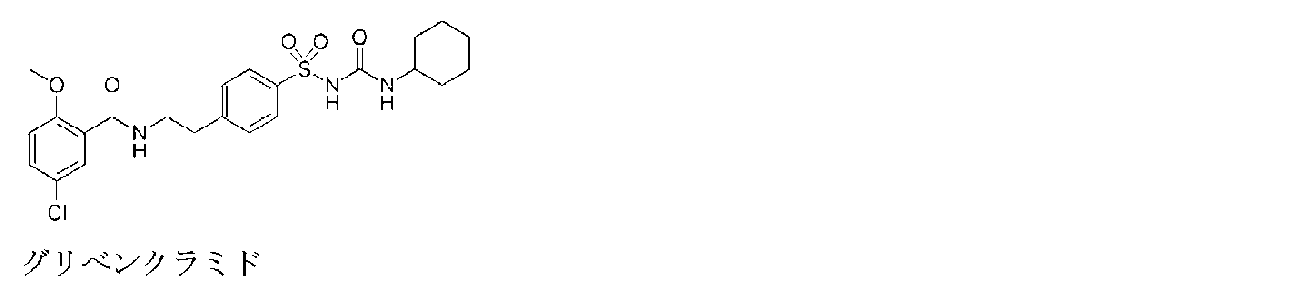
いくつかの実施形態では、インフラマソーム阻害剤は、5-クロロ-2-メトキシ-N-[2-(4-スルファモイルフェニル)-エチル]-ベンズアミド(すなわち、16673-34-0)である。

いくつかの実施形態では、インフラマソーム阻害剤は、JC124である。
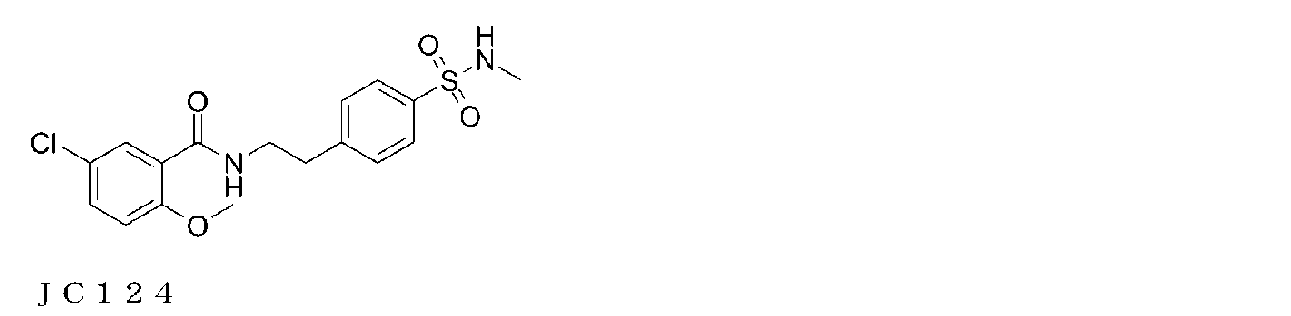
いくつかの実施形態では、インフラマソーム阻害剤は、FC11A-2である。

いくつかの実施形態では、インフラマソーム阻害剤は、パルテノライドである。

いくつかの実施形態では、インフラマソーム阻害剤は、VX-740である。

いくつかの実施形態では、インフラマソーム阻害剤は、VX-765である。
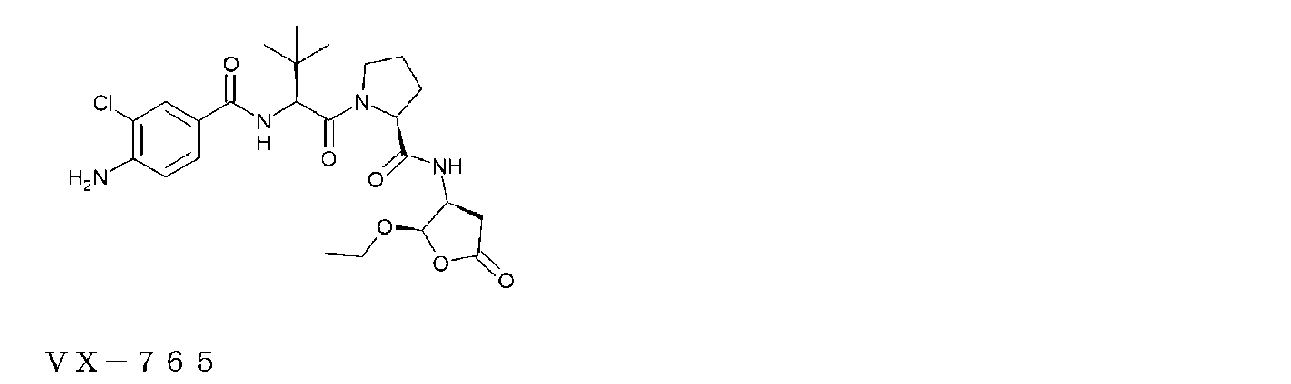
いくつかの実施形態では、インフラマソーム阻害剤は、BAY 11-7082である。

いくつかの実施形態では、インフラマソーム阻害剤は、ベータヒドロキシブチレート(BHB)である。 In some embodiments, the inflammasome inhibitor is beta-hydroxybutyrate (BHB).
いくつかの実施形態では、インフラマソーム阻害剤は、MCC950である。

いくつかの実施形態では、インフラマソーム阻害剤は、3,4-メチレンジオキシ-β-ニトロスチレン(MNS)である。 In some embodiments, the inflammasome inhibitor is 3,4-methylenedioxy-β-nitrostyrene (MNS).
いくつかの実施形態では、インフラマソーム阻害剤は、CY-09である。

いくつかの実施形態では、インフラマソーム阻害剤は、トラニラストである。

いくつかの実施形態では、インフラマソーム阻害剤は、OLT1177である。
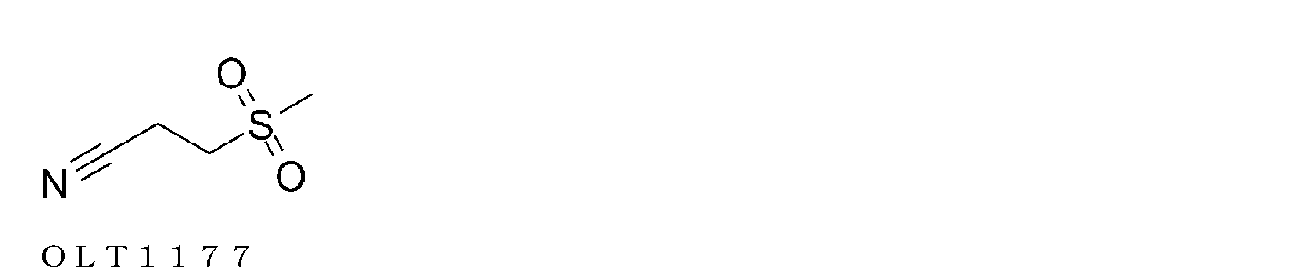
いくつかの実施形態では、インフラマソーム阻害剤は、オリドニンである。

いくつかの実施形態では、本明細書に記載される脂質ナノ粒子は、1つを超える免疫調節剤を含む。いくつかの実施形態では、脂質ナノ粒子は、免疫調節剤及び1つ以上の追加の免疫調節剤を含む。いくつかの実施形態では、脂質ナノ粒子は、テルペノイド(例えば、コルチコステロイド、グルココルチコイド、例えば、デキサメタゾン、プレドニゾロン、フルチカゾンプロピオネート、もしくはブデソニド、またはインフラマソーム阻害剤)、及び1つ以上の追加の免疫調節剤(例えば、コルチコステロイド、またはグルコココルチコイド、例えば、デキサメタゾン、プレドニゾロン、フルチカゾンプロピオネート、もしくはブデソニドのうちの別のもの、あるいは本明細書に記載される、TLRもしくはPRRアゴニストまたはアンタゴニスト、あるいはインフラマソーム阻害剤)を含む。いくつかの実施形態では、脂質ナノ粒子は、テルペノイド(本明細書に記載される任意のサブクラスを含む)である免疫調節剤、及びTLRもしくはPRRの低分子アゴニストまたはアンタゴニスト(例えば、TAK-242などの本明細書に記載の任意のサブクラスを含む)を含む。 In some embodiments, the lipid nanoparticles described herein include more than one immunomodulatory agent. In some embodiments, the lipid nanoparticles include an immunomodulatory agent and one or more additional immunomodulatory agents. In some embodiments, the lipid nanoparticles include a terpenoid (e.g., a corticosteroid, a glucocorticoid, e.g., dexamethasone, prednisolone, fluticasone propionate, or budesonide, or an inflammasome inhibitor), and one or more additional immunomodulatory agents (e.g., another of a corticosteroid or a glucocorticoid, e.g., dexamethasone, prednisolone, fluticasone propionate, or budesonide, or a TLR or PRR agonist or antagonist described herein, or an inflammasome inhibitor). In some embodiments, the lipid nanoparticles comprise an immunomodulatory agent that is a terpenoid (including any of the subclasses described herein) and a small molecule agonist or antagonist of a TLR or PRR (including any of the subclasses described herein, such as, for example, TAK-242).
いくつかの実施形態では、本明細書に記載される脂質ナノ粒子は、カチオン性脂質及び免疫調節剤を含み、免疫調節剤は、TLR阻害剤である。いくつかの実施形態では、脂質ナノ粒子は、カチオン性脂質及び免疫調節剤を含み、免疫形成剤は、インフラマソーム阻害剤である。いくつかの実施形態では、脂質ナノ粒子は、カチオン性脂質、RNA、及びTAK-242、MCC950、及びBAY 11-7082から選択される免疫調節剤を含む。いくつかの実施形態では、脂質ナノ粒子は、カチオン性脂質、RNA、及びTAK-242を含む。いくつかの実施形態では、脂質ナノ粒子は、カチオン性脂質、RNA、及びMCC950を含む。いくつかの実施形態では、脂質ナノ粒子は、カチオン性脂質、RNA、及びBAY 11-7082を含む。 In some embodiments, the lipid nanoparticles described herein comprise a cationic lipid and an immunomodulatory agent, and the immunomodulatory agent is a TLR inhibitor. In some embodiments, the lipid nanoparticles comprise a cationic lipid and an immunomodulatory agent, and the immunogenic agent is an inflammasome inhibitor. In some embodiments, the lipid nanoparticles comprise a cationic lipid, RNA, and an immunomodulatory agent selected from TAK-242, MCC950, and BAY 11-7082. In some embodiments, the lipid nanoparticles comprise a cationic lipid, RNA, and TAK-242. In some embodiments, the lipid nanoparticles comprise a cationic lipid, RNA, and MCC950. In some embodiments, the lipid nanoparticles comprise a cationic lipid, RNA, and BAY 11-7082.
いくつかの実施形態では、脂質ナノ粒子は、約0.1~約50mol%の免疫調節剤(脂質及び免疫調節剤の総量に対して)を含む。いくつかの実施形態では、脂質ナノ粒子は、約1~約50mol%の免疫調節剤(脂質及び免疫調節剤の総量に対して)を含む。いくつかの実施形態では、脂質ナノ粒子は、約30~約50mol%の免疫調節剤(脂質及び免疫調節剤の総量に対して)を含む。いくつかの実施形態では、脂質ナノ粒子は、約30~約50mol%の免疫調節剤(脂質及び免疫調節剤の総量に対して)を含む。いくつかの実施形態では、脂質ナノ粒子は、約30~約35mol%の免疫調節剤(脂質及び免疫調節剤の総量に対して)を含む。いくつかの実施形態では、脂質ナノ粒子は、約35~約45mol%の免疫調節剤(脂質及び免疫調節剤の総量に対して)を含む。いくつかの実施形態では、脂質ナノ粒子は、約40~約50mol%の免疫調節剤(脂質及び免疫調節剤の総量に対して)を含む。いくつかの実施形態では、脂質ナノ粒子は、約30、31、32、33、34、35、36、37、38、39、40、41、42、43、44、45、46、47、48、49、または50mol%の免疫調節剤(脂質及び免疫調節剤の総量に対して)を含む。 In some embodiments, the lipid nanoparticles comprise about 0.1 to about 50 mol% of the immunomodulator (based on the total amount of lipid and immunomodulator). In some embodiments, the lipid nanoparticles comprise about 1 to about 50 mol% of the immunomodulator (based on the total amount of lipid and immunomodulator). In some embodiments, the lipid nanoparticles comprise about 30 to about 50 mol% of the immunomodulator (based on the total amount of lipid and immunomodulator). In some embodiments, the lipid nanoparticles comprise about 30 to about 50 mol% of the immunomodulator (based on the total amount of lipid and immunomodulator). In some embodiments, the lipid nanoparticles comprise about 30 to about 35 mol% of the immunomodulator (based on the total amount of lipid and immunomodulator). In some embodiments, the lipid nanoparticles comprise about 35 to about 45 mol% of the immunomodulator (based on the total amount of lipid and immunomodulator). In some embodiments, the lipid nanoparticles comprise about 40 to about 50 mol% of the immunomodulator (based on the total amount of lipid and immunomodulator). In some embodiments, the lipid nanoparticles comprise about 30, 31, 32, 33, 34, 35, 36, 37, 38, 39, 40, 41, 42, 43, 44, 45, 46, 47, 48, 49, or 50 mol% of the immunomodulatory agent (based on the total amount of lipid and immunomodulatory agent).
いくつかの実施形態では、核酸粒子は、i)約30~約50mol%のカチオン性脂質と、ii)約1~約5mol%のポリマー抱合型脂質と、iii)約5~約15mol%のヘルパー脂質と、iv)免疫調節剤と、を含む。いくつかの実施形態では、核酸粒子は、i)約30~約50mol%のALC-0315と、ii)約1~約5mol%のALC-0159と、iii)約5~約15mol%のDSPCと、iv)免疫調節剤と、を含む。いくつかの実施形態では、核酸粒子は、i)約30~約50mol%のALC366と、ii)約1~約5mol%のALC-0159と、iii)約5~約15mol%のDSPCと、iv)免疫調節剤と、を含む。 In some embodiments, the nucleic acid particles include i) about 30 to about 50 mol% cationic lipid, ii) about 1 to about 5 mol% polymer-conjugated lipid, iii) about 5 to about 15 mol% helper lipid, and iv) an immunomodulator. In some embodiments, the nucleic acid particles include i) about 30 to about 50 mol% ALC-0315, ii) about 1 to about 5 mol% ALC-0159, iii) about 5 to about 15 mol% DSPC, and iv) an immunomodulator. In some embodiments, the nucleic acid particles include i) about 30 to about 50 mol% ALC366, ii) about 1 to about 5 mol% ALC-0159, iii) about 5 to about 15 mol% DSPC, and iv) an immunomodulator.
いくつかの実施形態では、核酸粒子は、i)約47.5mol%のALC-0315と、ii)約1.8mol%のALC-0159と、iii)約10mol%のDSPCと、を含む。いくつかの実施形態では、核酸粒子は、i)約47.5mol%のALC366と、ii)約1.8mol%のALC-0159と、iii)約10mol%のDSPCと、を含む。 In some embodiments, the nucleic acid particles include i) about 47.5 mol% ALC-0315, ii) about 1.8 mol% ALC-0159, and iii) about 10 mol% DSPC. In some embodiments, the nucleic acid particles include i) about 47.5 mol% ALC366, ii) about 1.8 mol% ALC-0159, and iii) about 10 mol% DSPC.
いくつかの実施形態では、核酸粒子は、i)約30~約50mol%のSM-102と、ii)約1~約5mol%のPEG2000-DMGと、iii)約5~約15mol%のDSPCと、iv)免疫調節剤と、を含む。いくつかの実施形態では、核酸粒子は、i)約50mol%のSM-102と、ii)約1.5mol%のPEG2000-DMGと、iii)約10mol%のDSPCと、iv)免疫調節剤と、を含む。いくつかの実施形態では、免疫調節剤は、TAK-242、MCC950、またはBAY11-7082である。いくつかの実施形態では、核酸粒子は、i)約50mol%のSM-102と、ii)約1.5mol%のPEG2000-DMGと、iii)約10mol%のDSPCと、iv)TAK-242と、を含む。いくつかの実施形態では、核酸粒子は、i)約50mol%のSM-102と、ii)約1.5mol%のPEG2000-DMGと、iii)約10mol%のDSPCと、iv)MCC950と、を含む。いくつかの実施形態では、核酸粒子は、i)約50mol%のSM-102と、ii)約1.5mol%のPEG2000-DMGと、iii)約10mol%のDSPCと、iv)BAY 11-7082と、を含む。 In some embodiments, the nucleic acid particles comprise i) about 30 to about 50 mol% SM-102, ii) about 1 to about 5 mol% PEG2000-DMG, iii) about 5 to about 15 mol% DSPC, and iv) an immunomodulatory agent. In some embodiments, the nucleic acid particles comprise i) about 50 mol% SM-102, ii) about 1.5 mol% PEG2000-DMG, iii) about 10 mol% DSPC, and iv) an immunomodulatory agent. In some embodiments, the immunomodulatory agent is TAK-242, MCC950, or BAY11-7082. In some embodiments, the nucleic acid particles include i) about 50 mol% SM-102, ii) about 1.5 mol% PEG2000-DMG, iii) about 10 mol% DSPC, and iv) TAK-242. In some embodiments, the nucleic acid particles include i) about 50 mol% SM-102, ii) about 1.5 mol% PEG2000-DMG, iii) about 10 mol% DSPC, and iv) MCC950. In some embodiments, the nucleic acid particles include i) about 50 mol% SM-102, ii) about 1.5 mol% PEG2000-DMG, iii) about 10 mol% DSPC, and iv) BAY 11-7082.
テルペノイド
本明細書に記載されるように、いくつかの実施形態では、核酸粒子は、テルペノイドをさらに含む。いくつかの実施形態では、テルペノイドは、トリテルペンである。いくつかの実施形態では、テルペノイドは、ステロイドである。いくつかの実施形態では、ステロイドは、ステロールである。いくつかの実施形態では、ステロールは、β-シトステロール、スチグマステロール、コレステロール、コレカルシフェロール、エルゴカルシフェロール、カルシポトリオール、ボツリン、ルペオール、ウルソール酸、オレアノール酸、シクロアルテノール、ラノステロール、またはα-トコフェロールである。いくつかの実施形態では、ステロールは、β-シトステロールである。いくつかの実施形態では、ステロールは、スチグマステロールである。いくつかの実施形態では、ステロールは、コレステロールである。いくつかの実施形態では、ステロールは、コレカルシフェロールである。いくつかの実施形態では、ステロールは、エルゴカルシフェロールである。いくつかの実施形態では、ステロールは、カルシポトリオールである。いくつかの実施形態では、ステロールは、ボツリンである。いくつかの実施形態では、ステロールは、ルペオールである。いくつかの実施形態では、ステロールは、ウルソール酸である。いくつかの実施形態では、ステロールは、オレアノール酸である。いくつかの実施形態では、ステロールは、シクロアルテノールである。いくつかの実施形態では、ステロールは、ラノステロールである。いくつかの実施形態では、ステロールは、α-トコフェロールである。
Terpenoids As described herein, in some embodiments, the nucleic acid particles further comprise a terpenoid. In some embodiments, the terpenoid is a triterpene. In some embodiments, the terpenoid is a steroid. In some embodiments, the steroid is a sterol. In some embodiments, the sterol is β-sitosterol, stigmasterol, cholesterol, cholecalciferol, ergocalciferol, calcipotriol, botulin, lupeol, ursolic acid, oleanolic acid, cycloartenol, lanosterol, or α-tocopherol. In some embodiments, the sterol is β-sitosterol. In some embodiments, the sterol is stigmasterol. In some embodiments, the sterol is cholesterol. In some embodiments, the sterol is cholecalciferol. In some embodiments, the sterol is ergocalciferol. In some embodiments, the sterol is calcipotriol. In some embodiments, the sterol is botulin. In some embodiments, the sterol is lupeol. In some embodiments, the sterol is ursolic acid. In some embodiments, the sterol is oleanolic acid. In some embodiments, the sterol is cycloartenol. In some embodiments, the sterol is lanosterol. In some embodiments, the sterol is α-tocopherol.
いくつかの実施形態では、脂質ナノ粒子は、約30~約50mol%のステロイドを含む。いくつかの実施形態では、脂質ナノ粒子は、約35~約45mol%のステロイドを含む。いくつかの実施形態では、脂質ナノ粒子は、約38~約40mol%のステロイドを含む。いくつかの実施形態では、脂質ナノ粒子は、約38.5mol%のステロイドを含む。いくつかの実施形態では、脂質ナノ粒子は、約40mol%のステロイドを含む。 In some embodiments, the lipid nanoparticles comprise about 30 to about 50 mol% steroid. In some embodiments, the lipid nanoparticles comprise about 35 to about 45 mol% steroid. In some embodiments, the lipid nanoparticles comprise about 38 to about 40 mol% steroid. In some embodiments, the lipid nanoparticles comprise about 38.5 mol% steroid. In some embodiments, the lipid nanoparticles comprise about 40 mol% steroid.
いくつかの実施形態では、脂質ナノ粒子は、約30~約50mol%のコレステロールを含む。いくつかの実施形態では、脂質ナノ粒子は、約35~約45mol%のコレステロールを含む。いくつかの実施形態では、脂質ナノ粒子は、約38~約41mol%のコレステロールを含む。いくつかの実施形態では、脂質ナノ粒子は、約38.5mol%のコレステロールを含む。いくつかの実施形態では、脂質ナノ粒子は、約40.7mol%のコレステロールを含む。 In some embodiments, the lipid nanoparticles comprise about 30 to about 50 mol% cholesterol. In some embodiments, the lipid nanoparticles comprise about 35 to about 45 mol% cholesterol. In some embodiments, the lipid nanoparticles comprise about 38 to about 41 mol% cholesterol. In some embodiments, the lipid nanoparticles comprise about 38.5 mol% cholesterol. In some embodiments, the lipid nanoparticles comprise about 40.7 mol% cholesterol.
脂質ナノ粒子を作製するための方法
核酸を含む脂質及び脂質ナノ粒子、ならびにそれらの調製方法は、例えば、米国特許第8,569,256号、同第5,965,542号、ならびに米国特許公開第2016/0199485号、同第2016/0009637号、同第2015/0273068号、同第2015/0265708号、同第2015/0203446号、同第2015/0005363号、同第2014/0308304号、同第2014/0200257号、同第2013/086373号、同第2013/0338210号、同第2013/0323269号、同第2013/0245107号、同第2013/0195920号、同第2013/0123338号、同第2013/0022649号、同第2013/0017223号、同第2012/0295832号、同第2012/0183581号、同第2012/0172411号、同第2012/0027803号、同第2012/0058188号、同第2011/0311583号、同第2011/0311582号、同第2011/0262527号、同第2011/0216622号、同第2011/0117125号、同第2011/0091525号、同第2011/0076335号、同第2011/0060032号、同第2010/0130588号、同第2007/0042031号、同第2006/0240093号、同第2006/0083780号、同第2006/0008910号、同第2005/0175682号、同第2005/017054号、同第2005/0118253号、同第2005/0064595号、同第2004/0142025号、同第2007/0042031号、同第1999/009076、ならびにPCT公開第WO99/39741号、同第WO2018/081480号、同第WO2017/004143号、同第WO2017/075531号、同第WO2015/199952号、同第WO2014/008334号、同第WO2013/086373号、同第WO2013/086322号、同第WO2013/016058号、同第WO2013/086373号、同第W02011/141705号、同第WO2001/07548号に記載されているものなどを含む、当該技術分野で既知であり、それらの完全な開示は、本明細書に記載される目的のために、参照によりそれら全体が本明細書に組み込まれる。
Methods for Making Lipid Nanoparticles Lipids and lipid nanoparticles containing nucleic acids, and methods for their preparation, are described in, e.g., U.S. Pat. Nos. 8,569,256, 5,965,542, and U.S. Patent Publication Nos. 2016/0199485, 2016/0009637, 2015/0273068, 2015/0265708, 2015/0203446, 2015/0005363, 2014/0308304, 2014/0200257, 2013/086373, 2013/0338210, 2013/0323269, 2013/0323270, 2013/0323280, 2013/0323290, 2013/0323291, 2013/0323292, 2013/0323294, and 2013/0323296. No. 3/0245107, No. 2013/0195920, No. 2013/0123338, No. 2013/0022649, No. 20 13/0017223, 2012/0295832, 2012/0183581, 2012/0172411, 2 012/0027803, 2012/0058188, 2011/0311583, 2011/0311582, 2011/0262527, 2011/0216622, 2011/0117125, 2011/0091525, 2011/0091525, 2011/0076335, 2011/0060032, 2010/0130588, 2007/0042031, No. 2006/0240093, No. 2006/0083780, No. 2006/0008910, No. 2005/0175682, Nos. 2005/017054, 2005/0118253, 2005/0064595, 2004/0142025, 2007/0042031, and 1999/009076, as well as PCT Publication Nos. WO 99/39741 and WO 2018/081. 480, WO2017/004143, WO2017/075531, WO2015/199952, WO2014/008334, WO2013/086373, WO2013/086322, WO2013/016058, WO2013/086373, WO2011/141705, WO2001/07548, the complete disclosures of which are incorporated herein by reference in their entireties for the purposes described herein.
例えば、いくつかの実施形態では、カチオン性脂質、ヘルパー脂質、及び免疫調節剤は、所定の重量またはモル比/パーセンテージ(例えば、本明細書に記載されるもの)でエタノール中に可溶化される。いくつかの実施形態では、脂質ナノ粒子(LNP)は、およそ10:1~30:1の総脂質対RNA重量比で調製される。いくつかの実施形態では、かかるRNAは、酢酸緩衝液中で0.2mg/mLに希釈され得る。 For example, in some embodiments, cationic lipids, helper lipids, and immunomodulatory agents are solubilized in ethanol at a predetermined weight or molar ratio/percentage (e.g., as described herein). In some embodiments, lipid nanoparticles (LNPs) are prepared at a total lipid to RNA weight ratio of approximately 10:1 to 30:1. In some embodiments, such RNA can be diluted to 0.2 mg/mL in acetate buffer.
いくつかの実施形態では、エタノール注入技法を使用して、RNAを含むコロイド状脂質分散体は、以下のように形成され得る:脂質、例えば、カチオン性脂質、ヘルパー脂質、免疫調節剤、及びポリマー抱合型脂質を含むエタノール溶液が、RNAを含む水溶液(例えば、本明細書に記載されるもの)に注入される。 In some embodiments, using the ethanol injection technique, a colloidal lipid dispersion containing RNA can be formed as follows: an ethanol solution containing lipids, e.g., cationic lipids, helper lipids, immunomodulatory agents, and polymer-conjugated lipids, is injected into an aqueous solution containing RNA (e.g., as described herein).
いくつかの実施形態では、脂質及びRNA溶液は、各溶液(例えば、カチオン性脂質、ヘルパー脂質、免疫調節剤、及び任意の他の添加剤を含む脂質溶液)を、例えば、ピストンポンプを使用して、制御された流量で混合ユニットにポンピングすることによって、室温で混合することができる。いくつかの実施形態では、混合ユニットへの脂質溶液及びRNA溶液の流量は、1:3の比で維持される。混合すると、エタノール脂質溶液が水性RNAで希釈され、核酸-脂質粒子が形成される。脂質溶解度は減少し、正電荷を有するカチオン性脂質は負に電荷したRNAと相互作用する。 In some embodiments, the lipid and RNA solutions can be mixed at room temperature by pumping each solution (e.g., lipid solution containing cationic lipids, helper lipids, immunomodulators, and any other additives) into a mixing unit at a controlled flow rate, for example, using a piston pump. In some embodiments, the flow rates of lipid and RNA solutions into the mixing unit are maintained at a 1:3 ratio. Upon mixing, the ethanolic lipid solution is diluted with the aqueous RNA, forming nucleic acid-lipid particles. Lipid solubility is reduced and the positively charged cationic lipids interact with the negatively charged RNA.
いくつかの実施形態では、RNA封入化脂質ナノ粒子を含む溶液は、濃度調整、緩衝液交換、製剤、及び/または濾過のうちの1つ以上によって処理され得る。 In some embodiments, the solution containing the RNA-encapsulated lipid nanoparticles may be processed by one or more of concentration adjustment, buffer exchange, formulation, and/or filtration.
ポリマー系粒子
いくつかの実施形態では、本明細書に記載される核酸粒子は、カチオン性ポリマー、RNA、及び免疫調節剤を含む。RNA送達に好適である核酸粒子の例は、PCT出願公開第WO2021/001417号に記載されており、参照によりその全体が本明細書に組み込まれる。概して上述されるように、本明細書に記載される複合体は、カチオン性ポリマーを含む。いくつかの実施形態では、カチオン性ポリマーは、ポリアチオン性ポリマー、例えば、1個以上のカチオン性またはイオン化可能基を有するポリマーである。本明細書に記載されるように、「カチオン性」基は、正味の正電荷を有する基である。本明細書で使用される場合、「イオン化可能」基は、特定のpHで中性電荷を有し得るが、異なるpHで電荷(例えば、カチオン性)になり得る基である。例えば、いくつかの実施形態では、イオン化可能基は、生理学的pH(例えば、約7.4のpH)でカチオン性(すなわち、正に電荷)になる。したがって、カチオン性ポリマーへの言及は、中性形態及び荷電(すなわち、イオン性)形態の両方を指すことが理解される。当業者はまた、本明細書に記載のカチオン性基が、カチオン性基及び1つ以上の好適な対イオンを含む塩(例えば、薬学的に許容される塩)としても存在し得ることを理解するであろう。例えば、いくつかの実施形態では、本明細書に記載のカチオン基は、塩化アンモニウムを含む。好適な対イオンとしては、ハロゲン(例えば、Br-、Cl-、I-、F-)、アセテート(例えば、C(O)O-)などが挙げられる。追加の例については、本明細書に記載の薬学的に許容される塩の定義を参照されたい。
Polymer-Based Particles In some embodiments, the nucleic acid particles described herein comprise a cationic polymer, RNA, and an immunomodulatory agent. Examples of nucleic acid particles suitable for RNA delivery are described in PCT Publication No. WO2021/001417, which is incorporated herein by reference in its entirety. As generally described above, the complexes described herein comprise a cationic polymer. In some embodiments, the cationic polymer is a polyathioic polymer, e.g., a polymer having one or more cationic or ionizable groups. As described herein, a "cationic" group is a group that has a net positive charge. As used herein, an "ionizable" group is a group that may have a neutral charge at a particular pH, but may become charged (e.g., cationic) at a different pH. For example, in some embodiments, the ionizable group becomes cationic (i.e., positively charged) at physiological pH (e.g., a pH of about 7.4). Thus, it is understood that reference to a cationic polymer refers to both the neutral and charged (i.e., ionic) forms. One of ordinary skill in the art will also understand that the cationic groups described herein can also exist as salts (e.g., pharma- ceutically acceptable salts) comprising the cationic group and one or more suitable counterions. For example, in some embodiments, the cationic groups described herein comprise ammonium chloride. Suitable counterions include halogens (e.g., Br - , Cl - , I - , F - ), acetates (e.g., C(O)O - ), and the like. For additional examples, see the definition of pharma- ceutically acceptable salts described herein.
いくつかの実施形態では、1個以上のカチオン性またはイオン化可能基は、窒素原子を含む。本明細書に記載される複合体の調製に有用なカチオン性ポリマーは、ホモポリマーヘテロポリマー、またはブロックコポリマーであり得る。 In some embodiments, one or more cationic or ionizable groups include a nitrogen atom. Cationic polymers useful for preparing the complexes described herein can be homopolymers, heteropolymers, or block copolymers.
いくつかの実施形態では、カチオン性ポリマーは、ポリ(エチレンイミン)、ポリ(プロピレンイミン)、ポリブレン、ポリアリルアミン、ポリビニルアミン、ポリアミドアミン、ポリ-L-リジン、ポリ-L-アルギニン、ポリ-L-ヒスチジン、及びポリ(2-アミノエチルメタクリレート)、またはそれらの薬学的に許容される塩である。 In some embodiments, the cationic polymer is poly(ethyleneimine), poly(propyleneimine), polybrene, polyallylamine, polyvinylamine, polyamidoamine, poly-L-lysine, poly-L-arginine, poly-L-histidine, and poly(2-aminoethyl methacrylate), or a pharma- ceutically acceptable salt thereof.
いくつかの実施形態では、カチオン性ポリマーは、ホモポリマーである。いくつかの実施形態では、カチオン性ポリマーは、ポリ(エチレンイミン)、ポリ(プロピレンイミン)、ポリブレン、ポリアリルアミン、ポリビニルアミン、ポリアミドアミン、ポリ-L-リジン、ポリ-L-アルギニン、ポリ-L-ヒスチジン、及びポリ(2-アミノエチルメタクリレート)から選択されるホモポリマー、またはそれらの薬学的に許容される塩である。 In some embodiments, the cationic polymer is a homopolymer. In some embodiments, the cationic polymer is a homopolymer selected from poly(ethyleneimine), poly(propyleneimine), polybrene, polyallylamine, polyvinylamine, polyamidoamine, poly-L-lysine, poly-L-arginine, poly-L-histidine, and poly(2-aminoethyl methacrylate), or a pharma- ceutically acceptable salt thereof.
本明細書に記載されるカチオン性ポリマーは、直鎖または分岐状であり得ることが理解される。いくつかの実施形態では、カチオン性ポリマーは、直鎖である。いくつかの実施形態では、カチオン性ポリマーは、ポリ(エチレンイミン)、ポリ(プロピレンイミン)、ポリブレン、ポリアリルアミン、ポリビニルアミン、ポリアミドアミン、ポリ-L-リジン、ポリ-L-アルギニン、ポリ-L-ヒスチジン、及びポリ(2-アミノエチルメタクリレート)から選択される直鎖状ポリマー、またはそれらの薬学的に許容される塩である。いくつかの実施形態では、カチオン性ポリマーは、ポリ(エチレンイミン)、ポリ(プロピレンイミン)、ポリブレン、ポリアリルアミン、ポリビニルアミン、ポリアミドアミン、ポリ-L-リジン、ポリ-L-アルギニン、ポリ-L-ヒスチジン、及びポリ(2-アミノエチルメタクリレート)から選択される分岐状ポリマー、またはそれらの薬学的に許容される塩である。いくつかの実施形態では、カチオン性ポリマーは、直鎖ポリ(エチレンイミン)、ポリ(プロピレンイミン)、ポリブレン、ポリアリルアミン、ポリビニルアミン、ポリアミドアミン、ポリ-L-リジン、ポリ-L-アルギニン、ポリ-L-ヒスチジン、及びポリ(2-アミノエチルメタクリレート)、またはそれらの薬学的に許容される塩である。 It is understood that the cationic polymers described herein can be linear or branched. In some embodiments, the cationic polymer is linear. In some embodiments, the cationic polymer is a linear polymer selected from poly(ethyleneimine), poly(propyleneimine), polybrene, polyallylamine, polyvinylamine, polyamidoamine, poly-L-lysine, poly-L-arginine, poly-L-histidine, and poly(2-aminoethyl methacrylate), or a pharma- ceutically acceptable salt thereof. In some embodiments, the cationic polymer is a branched polymer selected from poly(ethyleneimine), poly(propyleneimine), polybrene, polyallylamine, polyvinylamine, polyamidoamine, poly-L-lysine, poly-L-arginine, poly-L-histidine, and poly(2-aminoethyl methacrylate), or a pharma-ceutically acceptable salt thereof. In some embodiments, the cationic polymer is linear poly(ethyleneimine), poly(propyleneimine), polybrene, polyallylamine, polyvinylamine, polyamidoamine, poly-L-lysine, poly-L-arginine, poly-L-histidine, and poly(2-aminoethyl methacrylate), or a pharma- ceutically acceptable salt thereof.
いくつかの実施形態では、カチオン性ポリマーは、ポリ(エチレニミン)である。いくつかの実施形態では、カチオン性ポリマーは、ポリ(プロピレンイミン)である。いくつかの実施形態では、カチオン性ポリマーは、ポリブレンである。いくつかの実施形態では、カチオン性ポリマーは、ポリアリルアミンである。いくつかの実施形態では、カチオン性ポリマーは、ポリビニルアミンである。いくつかの実施形態では、カチオン性ポリマーは、ポリアミドアミンである。いくつかの実施形態では、カチオン性ポリマーは、ポリ-L-リジンである。いくつかの実施形態では、カチオン性ポリマーは、ポリ-L-アルギニンである。いくつかの実施形態では、カチオン性ポリマーは、ポリ-L-ヒスチジンである。いくつかの実施形態では、カチオン性ポリマーは、ポリ(2-アミノエチルメタクリレート)である。 In some embodiments, the cationic polymer is poly(ethyleneimine). In some embodiments, the cationic polymer is poly(propyleneimine). In some embodiments, the cationic polymer is polybrene. In some embodiments, the cationic polymer is polyallylamine. In some embodiments, the cationic polymer is polyvinylamine. In some embodiments, the cationic polymer is polyamidoamine. In some embodiments, the cationic polymer is poly-L-lysine. In some embodiments, the cationic polymer is poly-L-arginine. In some embodiments, the cationic polymer is poly-L-histidine. In some embodiments, the cationic polymer is poly(2-aminoethyl methacrylate).
いくつかの実施形態では、カチオン性ポリマーは、ポリ(エチレンイミン)、ポリ(プロピレンイミン)、ポリブレン、ポリアリルアミン、ポリビニルアミン、ポリアミドアミン、ポリ-L-リジン、ポリ-L-アルギニン、ポリ-L-ヒスチジン、及びポリ(2-アミノエチルメタクリレート)のうちの1つ以上のコポリマー、またはそれらの薬学的に許容される塩を含むヘテロポリマーである。いくつかの実施形態では、カチオン性ポリマーは、ポリ(エチレンイミン)及びポリ(プロピレンイミン)を含むヘテロポリマーである。いくつかの実施形態では、カチオン性ポリマーは、ポリ(エチレンイミン)、ポリ(プロピレンイミン)、ポリブレン、ポリアリルアミン、ポリビニルアミン、ポリアミドアミン、ポリ-L-リジン、ポリ-L-アルギニン、ポリ-L-ヒスチジン、及びポリ(2-アミノエチルメタクリレート)のうちの1つ以上のコポリマー、またはそれらの薬学的に許容される塩を含む直鎖ヘテロポリマーである。いくつかの実施形態では、カチオン性ポリマーは、ポリ(エチレンイミン)及びポリ(プロピレンイミン)を含むヘテロポリマーである。 In some embodiments, the cationic polymer is a heteropolymer comprising one or more copolymers of poly(ethyleneimine), poly(propyleneimine), polybrene, polyallylamine, polyvinylamine, polyamidoamine, poly-L-lysine, poly-L-arginine, poly-L-histidine, and poly(2-aminoethyl methacrylate), or a pharma- ceutically acceptable salt thereof. In some embodiments, the cationic polymer is a heteropolymer comprising poly(ethyleneimine) and poly(propyleneimine). In some embodiments, the cationic polymer is a linear heteropolymer comprising one or more copolymers of poly(ethyleneimine), poly(propyleneimine), polybrene, polyallylamine, polyvinylamine, polyamidoamine, poly-L-lysine, poly-L-arginine, poly-L-histidine, and poly(2-aminoethyl methacrylate), or a pharma- ceutically acceptable salt thereof. In some embodiments, the cationic polymer is a heteropolymer comprising poly(ethyleneimine) and poly(propyleneimine).
いくつかの実施形態では、カチオン性ポリマーは、ポリ(エチレンイミン)、ポリ(プロピレンイミン)、ポリブレン、ポリアリルアミン、ポリビニルアミン、ポリアミドアミン、ポリ-L-リジン、ポリ-L-アルギニン、ポリ-L-ヒスチジン、及びポリ(2-アミノエチルメタクリレート)から選択されるポリマーのブロック、またはそれらの薬学的に許容される塩を含むブロックコポリマーである。いくつかの実施形態では、カチオン性ポリマーは、ポリ(エチレンイミン)及びポリ(プロピレンイミン)(すなわち、ポリ(エチレンイミン)-ブロック-ポリ(プロピレンイミン))のブロック-コポリマーである。いくつかの実施形態では、カチオン性ポリマーは、ポリ(エチレンイミン)、ポリ(プロピレンイミン)、ポリブレン、ポリアリルアミン、ポリビニルアミン、ポリアミドアミン、ポリ-L-リジン、ポリ-L-アルギニン、ポリ-L-ヒスチジン、及びポリ(2-アミノエチルメタクリレート)から選択されるポリマーのブロックを含む直鎖ブロック-コポリマーである。いくつかの実施形態では、カチオン性ポリマーは、ポリ(エチレンイミン)及びポリ(プロピレンイミン)(すなわち、ポリ(エチレンイミン)-ブロック-ポリ(プロピレンイミン))の直鎖ブロック-コポリマーである。 In some embodiments, the cationic polymer is a block copolymer comprising blocks of polymers selected from poly(ethyleneimine), poly(propyleneimine), polybrene, polyallylamine, polyvinylamine, polyamidoamine, poly-L-lysine, poly-L-arginine, poly-L-histidine, and poly(2-aminoethyl methacrylate), or a pharma- ceutically acceptable salt thereof. In some embodiments, the cationic polymer is a block copolymer of poly(ethyleneimine) and poly(propyleneimine) (i.e., poly(ethyleneimine)-block-poly(propyleneimine)). In some embodiments, the cationic polymer is a linear block copolymer comprising blocks of polymers selected from poly(ethyleneimine), poly(propyleneimine), polybrene, polyallylamine, polyvinylamine, polyamidoamine, poly-L-lysine, poly-L-arginine, poly-L-histidine, and poly(2-aminoethyl methacrylate). In some embodiments, the cationic polymer is a linear block-copolymer of poly(ethyleneimine) and poly(propyleneimine) (i.e., poly(ethyleneimine)-block-poly(propyleneimine)).
いくつかの実施形態では、カチオン性ポリマーは、250~2000個の繰り返しモノマー単位を有する。いくつかの実施形態では、カチオン性ポリマーは、500~2000個の繰り返しモノマー単位を有する。いくつかの実施形態では、カチオン性ポリマーは、1000~2000個の繰り返しモノマー単位を有する。いくつかの実施形態では、カチオン性ポリマーは、1500~2000個の繰り返しモノマー単位を有する。いくつかの実施形態では、カチオン性ポリマーは、約250、約300、約350、約400、約500、約600、約700、約800、約900、約1000、約1100、約1200、約1300、約1400、約1500、約1600、約1700、約1800、約1900、または約2000個のモノマー単位を含む。 In some embodiments, the cationic polymer has 250-2000 repeating monomer units. In some embodiments, the cationic polymer has 500-2000 repeating monomer units. In some embodiments, the cationic polymer has 1000-2000 repeating monomer units. In some embodiments, the cationic polymer has 1500-2000 repeating monomer units. In some embodiments, the cationic polymer comprises about 250, about 300, about 350, about 400, about 500, about 600, about 700, about 800, about 900, about 1000, about 1100, about 1200, about 1300, about 1400, about 1500, about 1600, about 1700, about 1800, about 1900, or about 2000 monomer units.
いくつかの実施形態では、カチオン性ポリマーは、式I及び/もしくはIIのブロックを含むポリマーまたはコポリマー、

R1は、H、-C(O)-、任意に置換されるC1-C6脂肪族、任意に置換されるC1-C6脂肪族、またはGであり、
各R2は、独立して、H、任意に置換されるC1-C6脂肪族、またはGであり、
X1及びX3は、各々独立して、C1-C6脂肪族であり、
X2は、結合または任意に置換されるC1-C6脂肪族であり、
mは、2~2000の整数であり、
nは、2~2000の整数であり、
各Gは、独立して、

R1’は、H、-C(O)-、任意に置換されるC1-C6脂肪族、任意に置換されるC1-C6脂肪族、またはG’であり、
各R2’は、独立して、H、任意に置換されるC1-C6脂肪族、またはG’であり、
X1’及びX3’は、各々独立して、任意に置換されるC1-C6脂肪族であり、
X2’は、結合または任意に置換されるC1-C6脂肪族であり、
n’は、2~2000の整数であり、
m’は、2~2000の整数であり、
各G’は、独立して、

R1’’は、H、-C(O)-、任意に置換されるC1-C6脂肪族、または任意に置換されるC1-C6脂肪族であり、
各R2’’は、独立して、HまたはC1-C6脂肪族であり、
X1’’及びX3’’は、各々独立して、任意に置換されるC1-C6脂肪族であり、
X2’’は、結合または任意に置換されるC1-C6脂肪族であり、
n’’は、2~2000の整数であり、
m’’は、2~2000の整数である。
In some embodiments, the cationic polymer is a polymer or copolymer comprising blocks of formula I and/or II:
R 1 is H, —C(O)—, optionally substituted C 1 -C 6 aliphatic, optionally substituted C 1 -C 6 aliphatic, or G;
each R2 is independently H, an optionally substituted C1 - C6 aliphatic, or G;
X1 and X3 are each independently a C1 - C6 aliphatic;
X2 is a bond or an optionally substituted C1 - C6 aliphatic;
m is an integer from 2 to 2000;
n is an integer from 2 to 2000,
Each G is independently
R 1' is H, -C(O)-, optionally substituted C 1 -C 6 aliphatic, optionally substituted C 1 -C 6 aliphatic, or G';
each R 2' is independently H, an optionally substituted C 1 -C 6 aliphatic, or G';
X 1 ' and X 3 ' are each independently an optionally substituted C 1 -C 6 aliphatic;
X2 ' is a bond or an optionally substituted C1 - C6 aliphatic;
n' is an integer from 2 to 2000,
m' is an integer from 2 to 2000,
Each G' is independently
R 1″ is H, —C(O)—, optionally substituted C 1 -C 6 aliphatic, or optionally substituted C 1 -C 6 aliphatic;
each R2 ″ is independently H or C1 - C6 aliphatic;
X1 ″ and X3 ″ are each independently an optionally substituted C1 - C6 aliphatic;
X2 ″ is a bond or an optionally substituted C 1 -C 6 aliphatic;
n″ is an integer from 2 to 2000;
m'' is an integer from 2 to 2000.
いくつかの実施形態では、カチオン性ポリマーは、約600ダルトン(Da)~約400,000Daの数平均分子量(Mn)を有する、本明細書に記載されるポリマーである。いくつかの実施形態では、カチオン性ポリマーは、約1,000Da~約300,000DaのMnを有する。いくつかの実施形態では、カチオン性ポリマーは、約10,000~約250,000DaのMnを有する。いくつかの実施形態では、カチオン性ポリマーは、約10,000~約120,000DaのMnを有する。いくつかの実施形態では、カチオン性ポリマーは、約20,000~約120,000DaのMnを有する。 In some embodiments, the cationic polymer is a polymer described herein having a number average molecular weight (M n ) of about 600 Daltons (Da) to about 400,000 Da. In some embodiments, the cationic polymer has a M n of about 1,000 Da to about 300,000 Da. In some embodiments, the cationic polymer has a M n of about 10,000 to about 250,000 Da. In some embodiments, the cationic polymer has a M n of about 10,000 to about 120,000 Da. In some embodiments, the cationic polymer has a M n of about 20,000 to about 120,000 Da.
いくつかの実施形態では、本明細書に記載される核酸粒子は、カチオン性ポリマー、RNA、免疫調節剤、及び任意に二次ポリマーを含む。いくつかの実施形態では、核酸粒子は、カチオン性ポリマー、RNA、二次ポリマー、及び免疫調節剤を含む。いくつかの実施形態では、二次ポリマーは、ポリサルコシンである。 In some embodiments, the nucleic acid particles described herein comprise a cationic polymer, RNA, an immunomodulatory agent, and optionally a secondary polymer. In some embodiments, the nucleic acid particles comprise a cationic polymer, RNA, a secondary polymer, and an immunomodulatory agent. In some embodiments, the secondary polymer is polysarcosine.
本明細書に記載されるように、本明細書に記載される核酸粒子は、カチオン性ポリマー、RNA、任意に二次ポリマー、及び免疫調節剤を含む。いくつかの実施形態では、免疫調節剤は、免疫抑制剤である。いくつかの実施形態では、免疫調節剤は、免疫刺激剤である。いくつかの実施形態では、免疫調節剤は、toll様受容体(例えば、TLR1、TLR2、TLR3、TLR4、TLR5、TLR6、TLR7、TLR8、TLR9、TLR10)もしくはパターン認識受容体(PRR)のアゴニストまたはアンタゴニストである作用因子(例えば、低分子)である。いくつかの実施形態では、免疫調節剤は、sp2-イミノ糖糖脂質である。いくつかの実施形態では、免疫調節剤は、NF-κβの低分子下流阻害剤である。いくつかの実施形態では、免疫調節剤は、sp2-イミノ糖糖脂質である。いくつかの実施形態では、免疫調節剤は、インフラマソーム阻害剤である。 As described herein, the nucleic acid particles described herein comprise a cationic polymer, RNA, optionally a second polymer, and an immunomodulatory agent. In some embodiments, the immunomodulatory agent is an immunosuppressant. In some embodiments, the immunomodulatory agent is an immunostimulatory agent. In some embodiments, the immunomodulatory agent is an agent (e.g., a small molecule) that is an agonist or antagonist of a toll-like receptor (e.g., TLR1, TLR2, TLR3, TLR4, TLR5, TLR6, TLR7, TLR8, TLR9, TLR10) or a pattern recognition receptor (PRR). In some embodiments, the immunomodulatory agent is an sp 2 -iminoglycosylcolipid. In some embodiments, the immunomodulatory agent is a small molecule downstream inhibitor of NF-κβ. In some embodiments, the immunomodulatory agent is an sp 2 -iminoglycosylcolipid. In some embodiments, the immunomodulatory agent is an inflammasome inhibitor.
いくつかの実施形態では、本明細書に記載される核酸粒子は、デキサメタゾンを含まない。 In some embodiments, the nucleic acid particles described herein do not include dexamethasone.
いくつかの実施形態では、免疫調節剤は、TLR阻害剤である。いくつかの実施形態では、TLR阻害剤は、TLR2、TLR4、及び/またはTLR6の阻害剤である。いくつかの実施形態では、TLR阻害剤は、TLR2の阻害剤である。いくつかの実施形態では、免疫調節剤は、TLR4の阻害剤である。いくつかの実施形態では、免疫調節剤は、TLR6の阻害剤である。いくつかの実施形態では、TLR4の阻害剤は、TAK-242:

いくつかの実施形態では、免疫調節剤は、テルペノイドである。いくつかの実施形態では、テルペノイドは、トリテルペンである。いくつかの実施形態では、免疫調節剤は、トリテルペノイドである。いくつかの実施形態では、トリテルペノイドは、アミリン、ベツリン酸、オレアノール酸、ステロール、スクアレン、もしくはウルソール酸の合成または天然誘導体である。 In some embodiments, the immunomodulatory agent is a terpenoid. In some embodiments, the terpenoid is a triterpene. In some embodiments, the immunomodulatory agent is a triterpenoid. In some embodiments, the triterpenoid is a synthetic or natural derivative of amylin, betulinic acid, oleanolic acid, sterol, squalene, or ursolic acid.
いくつかの実施形態では、免疫調節剤は、コルチコステロイドである。いくつかの実施形態では、コルチコステロイドは、グルココルチコイドである。いくつかの実施形態では、グルココルチコイドは、デキサメタゾン、プレドニゾロン、フルチカゾンプロピオネート、ブデソニド、またはそれらの薬学的に許容される塩から選択される。いくつかの実施形態では、グルココルチコイドは、デキサメタゾン、またはその薬学的に許容される塩である。いくつかの実施形態では、グルココルチコイドは、プレドニゾロン、またはその薬学的に許容される塩である。いくつかの実施形態では、グルココルチコイドは、フルチカゾン、またはその薬学的に許容される塩である。いくつかの実施形態では、グルココルチコイドは、プロピオネート、またはその薬学的に許容される塩である。いくつかの実施形態では、グルココルチコイドは、ブデソニド、またはその薬学的に許容される塩である。 In some embodiments, the immunomodulatory agent is a corticosteroid. In some embodiments, the corticosteroid is a glucocorticoid. In some embodiments, the glucocorticoid is selected from dexamethasone, prednisolone, fluticasone propionate, budesonide, or a pharmaceutically acceptable salt thereof. In some embodiments, the glucocorticoid is dexamethasone, or a pharmaceutically acceptable salt thereof. In some embodiments, the glucocorticoid is prednisolone, or a pharmaceutically acceptable salt thereof. In some embodiments, the glucocorticoid is fluticasone, or a pharmaceutically acceptable salt thereof. In some embodiments, the glucocorticoid is a propionate, or a pharmaceutically acceptable salt thereof. In some embodiments, the glucocorticoid is budesonide, or a pharmaceutically acceptable salt thereof.
いくつかの実施形態では、免疫調節剤は、インフラマソーム阻害剤である。いくつかの実施形態では、インフラマソーム阻害剤は、NLRP3インフラマソーム阻害剤、AIM2インフラマソーム阻害剤、カスパーゼ-1阻害剤、または汎カサーゼ阻害剤である。いくつかの実施形態では、インフラマソーム阻害剤は、グリブリド(すなわち、グリベンクラミド)、5-クロロ-2-メトキシ-N-[2-(4-スルファモイルフェニル)-エチル]-ベンズアミド(すなわち、16673-34-0)、JC124、FC11A-2、パルテノライド、VX-740、VX-765、Bay 11-7082、BHB、MCC950、MNS、CY-09、トラニラスト、OLT1177、及びオリドニンから選択される。いくつかの実施形態では、インフラマソーム阻害剤は、グリブリド(すなわち、グリベンクラミド)である。
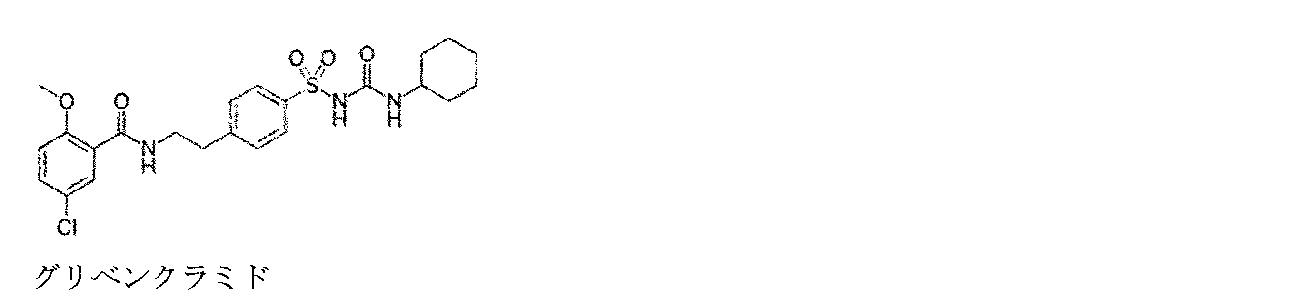
いくつかの実施形態では、インフラマソーム阻害剤は、5-クロロ-2-メトキシ-N-[2-(4-スルファモイルフェニル)-エチル]-ベンズアミド(すなわち、16673-34-0)である。

いくつかの実施形態では、インフラマソーム阻害剤は、JC124である。

いくつかの実施形態では、インフラマソーム阻害剤は、FC11A-2である。

いくつかの実施形態では、インフラマソーム阻害剤は、パルテノライドである。

いくつかの実施形態では、インフラマソーム阻害剤は、VX-740である。
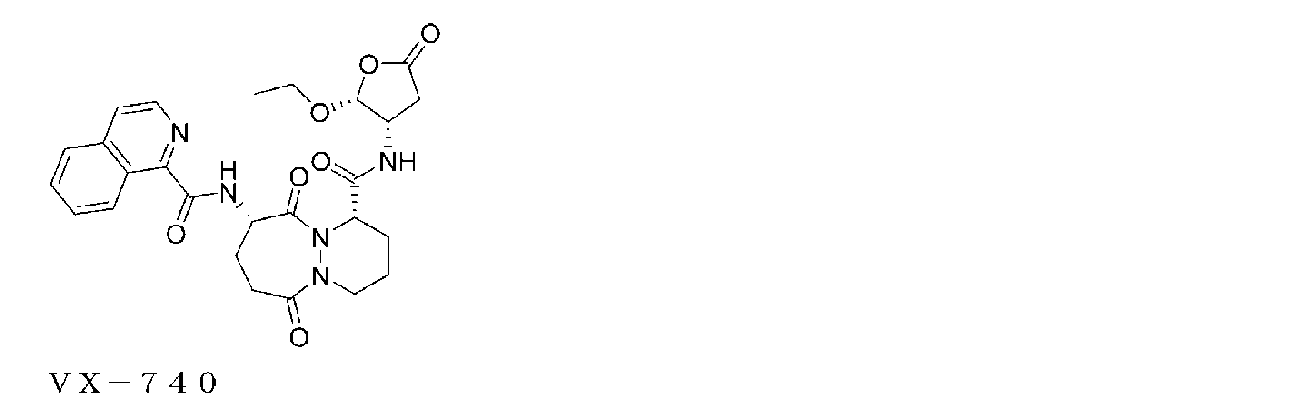
いくつかの実施形態では、インフラマソーム阻害剤は、VX-765である。

いくつかの実施形態では、インフラマソーム阻害剤は、BAY 11-7082である。

いくつかの実施形態では、インフラマソーム阻害剤は、ベータヒドロキシブチレート(BHB)である。 In some embodiments, the inflammasome inhibitor is beta-hydroxybutyrate (BHB).
いくつかの実施形態では、インフラマソーム阻害剤は、MCC950である。

いくつかの実施形態では、インフラマソーム阻害剤は、3,4-メチレンジオキシ-β-ニトロスチレン(MNS)である。 In some embodiments, the inflammasome inhibitor is 3,4-methylenedioxy-β-nitrostyrene (MNS).
いくつかの実施形態では、インフラマソーム阻害剤は、CY-09である。

いくつかの実施形態では、インフラマソーム阻害剤は、トラニラストである。

いくつかの実施形態では、インフラマソーム阻害剤は、OLT1177である。

いくつかの実施形態では、インフラマソーム阻害剤は、オリドニンである。

いくつかの実施形態では、核酸粒子は、カチオン性ポリマー、RNA、及び免疫調節剤を含み、免疫調節剤は、TLR阻害剤である。いくつかの実施形態では、核酸粒子は、カチオン性ポリマー、RNA、及び免疫調節剤を含み、免疫調節剤は、インフラマソーム阻害剤である。 In some embodiments, the nucleic acid particle comprises a cationic polymer, RNA, and an immunomodulatory agent, the immunomodulatory agent being a TLR inhibitor. In some embodiments, the nucleic acid particle comprises a cationic polymer, RNA, and an immunomodulatory agent, the immunomodulatory agent being an inflammasome inhibitor.
いくつかの実施形態では、本明細書に記載されるカチオン性ポリマー、RNA、二次ポリマー、免疫調節剤、及び任意に二次ポリマーを含む核酸粒子は、2つ以上の免疫調節剤を含む。いくつかの実施形態では、核酸粒子は、カチオン性ポリマー、RNA、免疫調節剤、任意に二次ポリマー、及び1つ以上の追加の免疫調節剤を含む。いくつかの実施形態では、核酸粒子は、カチオン性ポリマー、RNA、テルペノイド(例えば、コルチコステロイド、グルココルチコイド、例えば、デキサメタゾン、プレドニゾロン、フルチカゾンプロピオネート、もしくはブデソニド、またはインフラマソーム阻害剤)、及び1つ以上の追加の免疫調節剤(例えば、コルチコステロイド、またはグルコココルチコイド、例えば、デキサメタゾン、プレドニゾロン、フルチカゾンプロピオネート、もしくはブデソニドのうちの別のもの、あるいは本明細書に記載される、TLRもしくはPRRアゴニストまたはアンタゴニスト、あるいはインフラマソーム阻害剤)、ならびに任意に二次ポリマーを含む。いくつかの実施形態では、核酸粒子は、カチオン性ポリマー、RNA、及びテルペノイド(本明細書に記載される任意のサブクラスを含む)である免疫調節剤、及びTLRもしくはPRRの低分子アゴニストまたはアンタゴニスト(例えば、TAK-242などの本明細書に記載される任意のサブクラスを含む)、及び任意に二次ポリマーを含む。いくつかの実施形態では、核酸粒子は、カチオン性ポリマー、RNA、及びNLRP3インフラマソーム阻害剤である免疫調節剤、及び任意に二次ポリマーを含む。いくつかの実施形態では、核酸粒子は、カチオン性ポリマー、RNA、及びMCC850またはBAY 11-7082である免疫調節剤、及び任意に二次ポリマーを含む。いくつかの実施形態では、核酸粒子は、カチオン性ポリマー、RNA、及びNLRP3インフラマソーム阻害剤である免疫調節剤、及び任意に二次ポリマーを含む。いくつかの実施形態では、核酸粒子は、カチオン性ポリマー、RNA、及びMCC850である免疫調節剤、及び任意に二次ポリマーを含む。いくつかの実施形態では、核酸粒子は、カチオン性ポリマー、RNA、及びNLRP3インフラマソーム阻害剤である免疫調節剤、及び任意に二次ポリマーを含む。いくつかの実施形態では、核酸粒子は、カチオン性ポリマー、RNA、及びBAY 11-7082である免疫調節剤、及び任意に二次ポリマーを含む。 In some embodiments, the nucleic acid particles comprising a cationic polymer, RNA, a secondary polymer, an immunomodulatory agent, and optionally a secondary polymer described herein, comprise two or more immunomodulatory agents. In some embodiments, the nucleic acid particles comprise a cationic polymer, RNA, an immunomodulatory agent, optionally a secondary polymer, and one or more additional immunomodulatory agents. In some embodiments, the nucleic acid particles comprise a cationic polymer, RNA, a terpenoid (e.g., a corticosteroid, a glucocorticoid, e.g., dexamethasone, prednisolone, fluticasone propionate, or budesonide, or an inflammasome inhibitor), and one or more additional immunomodulatory agents (e.g., another of a corticosteroid, or a glucocorticoid, e.g., dexamethasone, prednisolone, fluticasone propionate, or budesonide, or a TLR or PRR agonist or antagonist, or an inflammasome inhibitor, described herein), and optionally a secondary polymer. In some embodiments, the nucleic acid particles comprise a cationic polymer, RNA, and an immunomodulatory agent that is a terpenoid (including any subclasses described herein), and a small molecule agonist or antagonist of a TLR or PRR (including any subclasses described herein, such as, for example, TAK-242), and optionally a second polymer. In some embodiments, the nucleic acid particles comprise a cationic polymer, RNA, and an immunomodulatory agent that is an NLRP3 inflammasome inhibitor, and optionally a second polymer. In some embodiments, the nucleic acid particles comprise a cationic polymer, RNA, and an immunomodulatory agent that is MCC850 or BAY 11-7082, and optionally a second polymer. In some embodiments, the nucleic acid particles comprise a cationic polymer, RNA, and an immunomodulatory agent that is an NLRP3 inflammasome inhibitor, and optionally a second polymer. In some embodiments, the nucleic acid particles comprise a cationic polymer, RNA, and an immunomodulatory agent that is MCC850, and optionally a second polymer. In some embodiments, the nucleic acid particles comprise a cationic polymer, RNA, and an immunomodulatory agent that is an NLRP3 inflammasome inhibitor, and optionally a second polymer. In some embodiments, the nucleic acid particles comprise a cationic polymer, RNA, and an immunomodulatory agent that is BAY 11-7082, and optionally a second polymer.
いくつかの実施形態では、二次ポリマーは、ポリサルコシンポリマーである。いくつかの実施形態では、ポリサルコシンは、2~200個のサルコシン単位、例えば、5~100個のサルコシン単位、10~50個のサルコシン単位、15~40個のサルコシン単位、例えば、約23個のサルコシン単位を含む。いくつかの実施形態では、二次ポリマーは、ポリグルタメート/ポリサルコシンポリマーである。いくつかの実施形態では、二次ポリマーは、約1:99~約99:1であるグルタメート単位:サルコシン単位のモル比を含むポリグルタメート/ポリサルコシンポリマーである。いくつかの実施形態では、二次ポリマーは、約25:75~約75:25であるグルタメート単位:サルコシン単位のモル比を含むポリグルタメート/ポリサルコシンポリマーである。いくつかの実施形態では、二次ポリマーは、約50:50であるグルタメート単位:サルコシン単位のモル比を含むポリグルタメート/ポリサルコシンポリマーである。 In some embodiments, the secondary polymer is a polysarcosine polymer. In some embodiments, the polysarcosine comprises 2-200 sarcosine units, e.g., 5-100 sarcosine units, 10-50 sarcosine units, 15-40 sarcosine units, e.g., about 23 sarcosine units. In some embodiments, the secondary polymer is a polyglutamate/polysarcosine polymer. In some embodiments, the secondary polymer is a polyglutamate/polysarcosine polymer comprising a molar ratio of glutamate units:sarcosine units that is about 1:99 to about 99:1. In some embodiments, the secondary polymer is a polyglutamate/polysarcosine polymer comprising a molar ratio of glutamate units:sarcosine units that is about 25:75 to about 75:25. In some embodiments, the secondary polymer is a polyglutamate/polysarcosine polymer comprising a molar ratio of glutamate units:sarcosine units that is about 50:50.
いくつかの実施形態では、ポリサルコシンポリマーは、以下の一般式(XVII)の構造:

式中、sは、サルコシン単位の数である。
In some embodiments, the polysarcosine polymer has the structure of the following general formula (XVII):
where s is the number of sarcosine units.
いくつかの実施形態では、ポリサルコシンポリマーは、以下の一般式(XVIII)の構造:

式中、R21及びR22のうちの一方は、疎水性基を含み、他方は、H、親水性基、または任意に標的化部分を含む官能基であり、xは、サルコシン単位の数である。
In some embodiments, the polysarcosine polymer has the structure of the following general formula (XVIII):
where one of R 21 and R 22 comprises a hydrophobic group and the other is H, a hydrophilic group, or a functional group optionally comprising a targeting moiety, and x is the number of sarcosine units.
式(XVIII)のいくつかの実施形態では、R21は、H、親水性基、または任意に標的部分を含む官能基であり、R22は、各々が少なくとも12個の炭素原子、例えば、少なくとも14個の炭素原子を有する1もしくは2個の直鎖アルキルまたはアルケニル基を含む。いくつかの実施形態では、直鎖アルキル基及びアルケニル基の各々は、最大30個の炭素原子、例えば、最大28個、最大26個、最大24個、最大22個、最大20個、または最大18個の炭素原子を有する。いくつかの実施形態では、R22は、各々が12~30個の炭素原子(例えば、12~28個の炭素原子、12~26個の炭素原子、12~24個の炭素原子、12~22個の炭素原子、12~20個の炭素原子、または12~18個の炭素原子)を有する1もしくは2個の直鎖アルキルまたはアルケニル基を含む。 In some embodiments of formula (XVIII), R 21 is H, a hydrophilic group, or a functional group optionally comprising a targeting moiety, and R 22 includes one or two linear alkyl or alkenyl groups, each having at least 12 carbon atoms, e.g., at least 14 carbon atoms. In some embodiments, the linear alkyl and alkenyl groups each have up to 30 carbon atoms, e.g., up to 28, up to 26, up to 24, up to 22, up to 20, or up to 18 carbon atoms. In some embodiments, R 22 includes one or two linear alkyl or alkenyl groups, each having 12-30 carbon atoms (e.g., 12-28 carbon atoms, 12-26 carbon atoms, 12-24 carbon atoms, 12-22 carbon atoms, 12-20 carbon atoms, or 12-18 carbon atoms).
いくつかの実施形態では、ポリサルコシンポリマーは、以下の一般式(IXX)の構造:

式中、Rは、H、親水性基、または任意に標的化部分を含む官能基であり、sは、サルコシン単位の数である。
In some embodiments, the polysarcosine polymer has the structure of the following general formula (IX):
where R is H, a hydrophilic group, or a functional group optionally including a targeting moiety, and s is the number of sarcosine units.
いくつかの実施形態では、ポリサルコシンポリマーは、以下の式(IXX-1)の構造:

式中、s1は、23である。式(IXX-1)のポリアルコシンポリマーは、本明細書では「C14pSar23」とも称される。
In some embodiments, the polysarcosine polymer has the structure of formula (IX-1):
wherein s1 is 23. The polyalkosine polymer of formula (IXX-1) is also referred to herein as "C14pSar23."
本明細書に記載されるように、いくつかの実施形態では、提供される化合物は、塩の形態(例えば、薬学的に許容される塩)として提供及び/または利用される。本明細書で提供される化合物への言及は、他に別段の指示がない限り、その塩への言及を含むと理解される。 As described herein, in some embodiments, provided compounds are provided and/or utilized in the form of a salt (e.g., a pharma- ceutically acceptable salt). Reference to a compound provided herein is understood to include reference to a salt thereof, unless otherwise indicated.
カーゴ
いくつかの実施形態では、本明細書に記載される複合体は、カーゴをさらに含む。いくつかの実施形態では、カーゴは、治療剤、例えば、低分子、ペプチド、核酸、またはそれらの組み合わせである。いくつかの実施形態では、カーゴは、低分子である。いくつかの実施形態では、カーゴは、ペプチドである。いくつかの実施形態では、カーゴは、核酸である。
Cargo In some embodiments, the complexes described herein further comprise a cargo. In some embodiments, the cargo is a therapeutic agent, such as a small molecule, a peptide, a nucleic acid, or a combination thereof. In some embodiments, the cargo is a small molecule. In some embodiments, the cargo is a peptide. In some embodiments, the cargo is a nucleic acid.
核酸
本明細書に記載される核酸粒子は、1つ以上の核酸を含む。いくつかの実施形態では、核酸は、RNAである。
Nucleic Acids The nucleic acid particles described herein comprise one or more nucleic acids. In some embodiments, the nucleic acid is RNA.
いくつかの実施形態では、本明細書に記載される技術に適応可能なRNAは、一本鎖RNAである。いくつかの実施形態では、本明細書に開示されるRNAは、直鎖RNAである。いくつかの実施形態では、一本鎖RNAは、そのヌクレオチド配列がオープンリーディングフレーム(またはその相補鎖)を含まないという点で非コードRNAである。いくつかの実施形態では、一本鎖RNAは、本開示のポリペプチドまたは複数のポリペプチド(例えば、エピトープ)をコードする(またはコードする配列の相補鎖である)ヌクレオチド配列を有する。 In some embodiments, the RNA adaptable to the techniques described herein is single-stranded RNA. In some embodiments, the RNA disclosed herein is linear RNA. In some embodiments, the single-stranded RNA is non-coding RNA in that its nucleotide sequence does not contain an open reading frame (or its complementary strand). In some embodiments, the single-stranded RNA has a nucleotide sequence that encodes (or is complementary to a sequence that encodes) a polypeptide or polypeptides (e.g., an epitope) of the present disclosure.
いくつかの実施形態では、RNAは、siRNA、及びmiRNA、または他の非コードRNAであるか、またはそれらを含む。 In some embodiments, the RNA is or includes siRNA, miRNA, or other non-coding RNA.
多くの実施形態では、関連するRNAは、少なくとも1つのオープンリーディングフレーム(ORF)を含み(例えば、mRNAである)、いくつかの実施形態では、関連するRNAは、単一のORFを含み、いくつかの実施形態では、関連するRNAは、1つを超えるORFを含む。 In many embodiments, the related RNA comprises at least one open reading frame (ORF) (e.g., is an mRNA), in some embodiments, the related RNA comprises a single ORF, and in some embodiments, the related RNA comprises more than one ORF.
いくつかの実施形態では、RNAは、例えば、目的のポリペプチドをコードする、または複数の目的のポリペプチドをコードするORFを含む。いくつかの実施形態では、本明細書に提供される技術に従って産生されるRNAは、複数のORF(例えば、複数のポリペプチドをコードする)を含む。いくつかの実施形態では、本明細書の技術に従って産生されるRNAは、複数のポリペプチドをコードする単一のORFを含む。いくつかのそのような実施形態では、ポリペプチドは、その抗原またはエピトープ(例えば、関連する抗原)であるか、またはそれを含む。 In some embodiments, the RNA includes, for example, an ORF that encodes a polypeptide of interest or encodes multiple polypeptides of interest. In some embodiments, the RNA produced in accordance with the techniques provided herein includes multiple ORFs (e.g., encoding multiple polypeptides). In some embodiments, the RNA produced in accordance with the techniques provided herein includes a single ORF that encodes multiple polypeptides. In some such embodiments, the polypeptide is or includes an antigen or epitope (e.g., an associated antigen) thereof.
いくつかの実施形態では、本開示に従って使用するためのORFは、例えば、内因性シグナル配列または異種シグナル配列などの哺乳動物細胞において機能するシグナル配列を含むポリペプチドをコードする。いくつかの実施形態では、シグナル配列は、コードされたポリペプチドの分泌を指示し、いくつかの実施形態では、シグナル配列は、規定された細胞区画、好ましくは細胞表面、小胞体(ER)またはエンドソーム-リソソーム区画へのコードされたポリペプチドの輸送を指示する。 In some embodiments, an ORF for use in accordance with the present disclosure encodes a polypeptide that includes a signal sequence that functions in a mammalian cell, e.g., an endogenous signal sequence or a heterologous signal sequence. In some embodiments, the signal sequence directs secretion of the encoded polypeptide, and in some embodiments, the signal sequence directs transport of the encoded polypeptide to a defined cellular compartment, preferably the cell surface, the endoplasmic reticulum (ER), or an endosomal-lysosomal compartment.
いくつかの実施形態では、ORFは、多量体化要素(例えば、固有または異種多量体化要素)を含むポリペプチドをコードする。いくつかの実施形態では、表面ポリペプチドをコードするORF(例えば、表面局在化を指示するシグナル配列を含む)は、多量体化要素を含む。 In some embodiments, the ORF encodes a polypeptide that includes a multimerization element (e.g., a unique or heterologous multimerization element). In some embodiments, the ORF that encodes a surface polypeptide (e.g., includes a signal sequence that directs surface localization) includes a multimerization element.
いくつかの実施形態では、ORFは、膜貫通要素またはドメインを含むポリペプチドをコードする。 In some embodiments, the ORF encodes a polypeptide that includes a transmembrane element or domain.
いくつかの実施形態では、ORFは、特定の宿主、例えば、哺乳類宿主、例えば、ヒトの細胞における発現のためにコドン最適化される。 In some embodiments, the ORF is codon-optimized for expression in a particular host, e.g., a mammalian host, e.g., a human cell.
いくつかの実施形態では、RNAは、非修飾ウリジン残基を含み、非修飾ウリジン残基のみを含むRNAは、「uRNA」と称され得る。いくつかの実施形態では、RNAは、1つ以上の修飾されたウリジン残基を含み、いくつかの実施形態では、そのようなRNA(例えば、完全に修飾されたウリジン残基を含むRNA)は、「modRNA」と称される。いくつかの実施形態では、RNAは、自己増幅RNA(saRNA)であり得る。いくつかの実施形態では、RNAは、トランス増幅RNA(taRNA)であり得る(例えば、WO2017/162461を参照されたい)。いくつかの実施形態では、RNAは、共有結合閉鎖型連続ループ(circRNA)を形成する共有結合閉鎖型RNA分子であり得る。 In some embodiments, the RNA comprises unmodified uridine residues, and RNA comprising only unmodified uridine residues may be referred to as "uRNA." In some embodiments, the RNA comprises one or more modified uridine residues, and in some embodiments, such RNA (e.g., RNA comprising fully modified uridine residues) may be referred to as "modRNA." In some embodiments, the RNA may be a self-amplifying RNA (saRNA). In some embodiments, the RNA may be a trans-amplifying RNA (taRNA) (see, e.g., WO 2017/162461). In some embodiments, the RNA may be a covalently closed RNA molecule that forms a covalently closed continuous loop (circRNA).
いくつかの実施形態では、関連するRNAは、ポリペプチドをコードする部分または複数のポリペプチドをコードする部分を含む。いくつかの特定の実施形態では、そのような部分または複数の部分は、生物学的に活性なポリペプチドもしくはその一部(例えば、酵素もしくはサイトカイン、または置換タンパク質もしくは抗体もしくはその一部などの治療用タンパク質)であるか、またはそれを含むポリペプチドもしくは複数のポリペプチドをコードし得る。いくつかの特定の実施形態では、そのような1つ以上の部分は、抗原(またはそのエピトープ)、サイトカイン、酵素などであるか、またはそれらを含む1つ以上のポリペプチドをコードし得る。いくつかの実施形態では、コードされたポリペプチドまたはポリペプチドは、腫瘍に関連する1つ以上の新抗原または新エピトープであってもよく、またはそれらを含んでもよい。いくつかの実施形態では、コードされたポリペプチドまたはポリペプチドは、感染作用因子(例えば、細菌、真菌、ウイルスなど)の1つ以上の抗原(またはそのエピトープ)であってもよく、またはそれらを含んでもよい。ある特定の実施形態では、コードされたポリペプチドは、野生型ポリペプチドのバリアントであり得る。 In some embodiments, the relevant RNA comprises a portion that encodes a polypeptide or a portion that encodes multiple polypeptides. In some particular embodiments, such a portion or portions may encode a polypeptide or polypeptides that are or include a biologically active polypeptide or portion thereof (e.g., a therapeutic protein such as an enzyme or cytokine, or a replacement protein or antibody or portion thereof). In some particular embodiments, such one or more portions may encode one or more polypeptides that are or include an antigen (or epitope thereof), cytokine, enzyme, etc. In some embodiments, the encoded polypeptide or polypeptides may be or include one or more neo-antigens or neo-epitopes associated with a tumor. In some embodiments, the encoded polypeptide or polypeptides may be or include one or more antigens (or epitopes thereof) of an infectious agent (e.g., bacteria, fungi, viruses, etc.). In certain embodiments, the encoded polypeptide may be a variant of a wild-type polypeptide.
いくつかの実施形態では、一本鎖RNA(例えば、mRNA)は、分泌シグナルをコードする領域(例えば、コードされた1つ以上の標的エンティティが細胞による翻訳時に分泌されることを可能にする分泌シグナルをコードする領域)を含み得る。いくつかの実施形態では、そのような分泌シグナルをコードする領域は、非ヒト分泌シグナルであり得るか、またはそれを含み得る。いくつかの実施形態では、そのような分泌シグナルをコードする領域は、ヒト分泌シグナルであり得るか、またはそれを含み得る。 In some embodiments, the single-stranded RNA (e.g., mRNA) may include a region encoding a secretion signal (e.g., a region encoding a secretion signal that allows one or more encoded target entities to be secreted upon translation by a cell). In some embodiments, such a region encoding a secretion signal may be or may include a non-human secretion signal. In some embodiments, such a region encoding a secretion signal may be or may include a human secretion signal.
いくつかの実施形態では、一本鎖RNA(例えば、mRNA)は、(例えば、RNAの安定性及び/または翻訳効率を向上させるために)少なくとも1つの非コード要素を含み得る。非コード要素の例としては、3’非翻訳領域(UTR)、5’UTR、キャップ構造(例えば、いくつかの実施形態では、酵素的に付加されたキャップ、いくつかの実施形態では、共転写キャップ)、ポリアデニン(ポリA)テイル(例えば、いくつかの実施形態では、100個以上のA残基であるか、またはそれを含み得、及び/またはいくつかの実施形態では、1つ以上の「中断」[すなわち、非A]配列要素を含み得る)、及びこれらの任意の組み合わせが挙げられるが、これらに限定されない。そのような非コード要素の例示的な実施形態は、例えば、WO2011015347、WO2017053297、US10519189、US10494399、WO2007024708、WO2007036366、WO2017060314、WO2016005324、WO2005038030、WO2017036889、WO2017162266、及びWO2017162461に見出すことができ、これらの各々は、その全体が参照することによって本明細書に組み込まれる。 In some embodiments, a single-stranded RNA (e.g., an mRNA) may include at least one non-coding element (e.g., to improve RNA stability and/or translation efficiency). Examples of non-coding elements include, but are not limited to, a 3' untranslated region (UTR), a 5' UTR, a cap structure (e.g., in some embodiments, an enzymatically added cap, in some embodiments, a co-transcriptional cap), a polyadenine (polyA) tail (e.g., in some embodiments, may be or include 100 or more A residues, and/or in some embodiments may include one or more "interrupt" [i.e., non-A] sequence elements), and any combination thereof. Exemplary embodiments of such non-coding elements can be found, for example, in WO2011015347, WO2017053297, US10519189, US10494399, WO2007024708, WO2007036366, WO2017060314, WO2016005324, WO2005038030, WO2017036889, WO2017162266, and WO2017162461, each of which is incorporated herein by reference in its entirety.
RNA薬学的組成物(例えば、免疫原性組成物またはワクチン)に有用な少なくとも4つの形式、すなわち、mRNA(uRNA)、ヌクレオシド修飾mRNA(modRNA)、自己増幅mRNA(saRNA)、及びトランス増幅RNAを含む非修飾ウリジンが開発されている。 At least four formats have been developed that are useful in RNA pharmaceutical compositions (e.g., immunogenic compositions or vaccines): unmodified uridine containing mRNA (uRNA), nucleoside-modified mRNA (modRNA), self-amplifying mRNA (saRNA), and trans-amplifying RNA.
非修飾ウリジンプラットフォームの特徴は、例えば、固有のアジュバント効果、良好な忍容性及び安全性、ならびに強力な抗体及びT細胞応答のうちの1つ以上を含み得る。 Characteristics of the unmodified uridine platform may include, for example, one or more of inherent adjuvant effect, good tolerability and safety, and potent antibody and T cell responses.
修飾されたウリジン(例えば、シュードウリジン)プラットフォームの特徴は、低減されたアジュバント効果、鈍化された免疫自然免疫センサ活性化能力、したがっての増加した抗原発現、良好な忍容性及び安全性、ならびに強い抗体及びCD4-T細胞応答を含み得る。本明細書に記載のように、本開示は、そのような強力な抗体及びCD4 T細胞応答が、ワクチン接種に特に有用であり得るという洞察を提供する。 Characteristics of the modified uridine (e.g., pseudouridine) platform may include reduced adjuvant effects, blunted immune innate immune sensor activation capability and thus increased antigen expression, good tolerability and safety, and strong antibody and CD4 T cell responses. As described herein, the present disclosure provides insight that such strong antibody and CD4 T cell responses may be particularly useful for vaccination.
自己増幅プラットフォームの特徴は、例えば、ポリペプチド(例えば、タンパク質)発現の長期間、良好な忍容性及び安全性、非常に低いワクチン用量での有効性の高い可能性を含み得る。 Characteristics of a self-amplifying platform may include, for example, long periods of polypeptide (e.g., protein) expression, good tolerability and safety, and high potential for efficacy at very low vaccine doses.
いくつかの実施形態では、自己増幅プラットフォーム(例えば、RNA)は、2つの核酸分子を含み、1つの核酸分子は、レプリカーゼ(例えば、ウイルスレプリカーゼ)をコードし、もう1つの核酸分子は、トランス(トランス複製系)の当該レプリカーゼによって複製可能である(例えば、レプリコン)。いくつかの実施形態では、自己増幅プラットフォーム(例えば、RNA)は、複数の核酸分子を含み、当該核酸は、複数のレプリカーゼ及び/またはレプリカをコードする。 In some embodiments, the self-amplifying platform (e.g., RNA) comprises two nucleic acid molecules, one encoding a replicase (e.g., a viral replicase) and another nucleic acid molecule capable of being replicated by the replicase in trans (a trans-replication system) (e.g., a replicon). In some embodiments, the self-amplifying platform (e.g., RNA) comprises multiple nucleic acid molecules, the nucleic acid encoding multiple replicases and/or replicas.
いくつかの実施形態では、トランス複製系は、単一の宿主細胞内に核酸分子の両方の存在を含む。 In some embodiments, the trans-replication system involves the presence of both nucleic acid molecules within a single host cell.
いくつかのそのような実施形態では、レプリカーゼ(例えば、ウイルスレプリカーゼ)をコードする核酸は、標的細胞及び/または標的生物において自己複製することができない。いくつかのそのような実施形態では、レプリカーゼ(例えば、ウイルスレプリカーゼ)をコードする核酸は、(+)鎖テンプレートに基づく(-)鎖合成及び/または(-)鎖テンプレートに基づく(+)鎖合成に重要な少なくとも1つの保存配列要素を欠く。 In some such embodiments, the nucleic acid encoding the replicase (e.g., a viral replicase) is unable to autonomously replicate in a target cell and/or target organism. In some such embodiments, the nucleic acid encoding the replicase (e.g., a viral replicase) lacks at least one conserved sequence element important for (-) strand synthesis from a (+) strand template and/or (+) strand synthesis from a (-) strand template.
いくつかの実施形態では、自己増幅RNAは、5’-キャップを含み、いくつかのトランス複製システムでは、レプリカーゼをコードする少なくともRNAは、キャップされる。いかなる1つの理論に拘束されることを望むものではないが、5’-キャップが、トランスにおける目的の遺伝子の高レベル発現に重要であり得ることが見出されている。 In some embodiments, the self-amplifying RNA includes a 5'-cap, and in some trans-replication systems, at least the RNA encoding the replicase is capped. Without wishing to be bound by any one theory, it has been found that the 5'-cap can be important for high-level expression of the gene of interest in trans.
いくつかの実施形態では、自己増幅プラットフォームは、ウイルス粒子の増殖を必要としない(例えば、望ましくないウイルス粒子形成と関連付けられない)。いくつかの実施形態では、自己増幅プラットフォームは、ウイルス粒子を形成することができない。 In some embodiments, the self-amplifying platform does not require viral particle propagation (e.g., is not associated with undesired viral particle formation). In some embodiments, the self-amplifying platform is incapable of forming viral particles.
いくつかの実施形態では、RNAは、内部リボソーム進入部位(IRES)要素を含み得る。いくつかの実施形態では、RNAは、IRES部位を含まず、特に、いくつかの実施形態では、saRNAは、IRES部位を含まない。いくつかのそのような実施形態では、目的の遺伝子及び/またはレプリカーゼの翻訳は、IRES要素によって駆動されない。いくつかの実施形態では、IRES要素は、5’-キャップによって置換される。いくつかのそのような実施形態では、5’-キャップによる置換は、RNAによってコードされるポリペプチドの配列に影響を与えない。 In some embodiments, the RNA may include an internal ribosome entry site (IRES) element. In some embodiments, the RNA does not include an IRES site, and in particular, in some embodiments, the saRNA does not include an IRES site. In some such embodiments, translation of the gene of interest and/or replicase is not driven by an IRES element. In some embodiments, the IRES element is replaced by a 5'-cap. In some such embodiments, the replacement by a 5'-cap does not affect the sequence of the polypeptide encoded by the RNA.
いくつかの実施形態では、本明細書に記載される核酸粒子は、modRNA、circRNA、saRNA、taRNA、またはuRNAを含む。いくつかの実施形態では、核酸粒子は、modRNAを含む。いくつかの実施形態では、核酸粒子は、saRNAを含む。いくつかの実施形態では、核酸粒子は、taRNAを含む。いくつかの実施形態では、核酸粒子は、uRNAを含む。 In some embodiments, the nucleic acid particles described herein comprise modRNA, circRNA, saRNA, taRNA, or uRNA. In some embodiments, the nucleic acid particles comprise modRNA. In some embodiments, the nucleic acid particles comprise saRNA. In some embodiments, the nucleic acid particles comprise taRNA. In some embodiments, the nucleic acid particles comprise uRNA.
いくつかの実施形態では、核酸粒子は、modRNA、circRNA、saRNA、taRNA、及びuRNAから選択される2つ以上のRNAを含む。 In some embodiments, the nucleic acid particle comprises two or more RNAs selected from modRNA, circRNA, saRNA, taRNA, and uRNA.
使用方法
本明細書に記載される核酸粒子(及び当該核酸粒子を含む組成物)は、本明細書に記載される疾患、障害、及び状態の対象における治療ならびに予防に有用である。いくつかの実施形態では、本開示は、本明細書に記載される核酸粒子を含む組成物を対象に投与することを含む、対象において疾患、障害、または状態を治療する方法を提供する。いくつかの実施形態では、疾患、障害、または状態は、感染性疾患、がん、自己免疫疾患、または希少疾患である。
Methods of Use The nucleic acid particles described herein (and compositions comprising the nucleic acid particles) are useful for the treatment and prevention in a subject of the diseases, disorders, and conditions described herein. In some embodiments, the present disclosure provides a method of treating a disease, disorder, or condition in a subject comprising administering to the subject a composition comprising a nucleic acid particle described herein. In some embodiments, the disease, disorder, or condition is an infectious disease, cancer, an autoimmune disease, or a rare disease.
いくつかの実施形態では、本開示は、医薬として使用するための本明細書に記載の核酸粒子を提供する。 In some embodiments, the present disclosure provides a nucleic acid particle as described herein for use as a medicament.
いくつかの実施形態では、本開示は、疾患もしくは障害の治療及び/または予防に使用するための本明細書に記載の核酸粒子を提供し、疾患または障害が、感染症、がん、遺伝性障害、自己免疫疾患、または希少疾患である。 In some embodiments, the present disclosure provides a nucleic acid particle as described herein for use in treating and/or preventing a disease or disorder, wherein the disease or disorder is an infectious disease, cancer, a genetic disorder, an autoimmune disease, or a rare disease.
いくつかの実施形態では、感染性疾患は、ウイルス性病原体によって引き起こされるか、またはそれと関連する。いくつかの実施形態では、ウイルス病原体は、ポックスウイルス科、ラブドウイルス科、フィロウイルス科、パラミクソウイルス科、ヘパドナウイルス科、コロナウイルス科、カリシウイルス科、ピコルナウイルス科、レオウイルス科、レトロウイルス科、及びオルトミクソウイルス科から選択されるファミリーのものである。いくつかの実施形態では、感染症は、SARS-CoV-2、インフルエンザ、クリミア-コンゴ出血熱(CCHF)、エボラウイルス、ラッサウイルス、マールブルグウイルス、HIV、ニパウイルス、及びMERS-CoVから選択されるウイルスによって引き起こされるか、またはそれと関連する。 In some embodiments, the infectious disease is caused by or associated with a viral pathogen. In some embodiments, the viral pathogen is of a family selected from Poxviridae, Rhabdoviridae, Filoviridae, Paramyxoviridae, Hepadnaviridae, Coronaviridae, Caliciviridae, Picornaviridae, Reoviridae, Retroviridae, and Orthomyxoviridae. In some embodiments, the infectious disease is caused by or associated with a virus selected from SARS-CoV-2, influenza, Crimean-Congo hemorrhagic fever (CCHF), Ebola virus, Lassa virus, Marburg virus, HIV, Nipah virus, and MERS-CoV.
いくつかの実施形態では、感染性疾患は、細菌性病原体によって引き起こされるか、またはそれと関連する。いくつかの実施形態では、細菌病原体は、Actinomyces israelii、bacillus antracis、Bacteroides fragilis、Bordetella pertussis、Borrelia burgdorferi、Borrelia garinii、Borrelia afzelii、Borrelia recurrentis、Brucella abortus、Brucella canis、Brucella melitensis、Brucella suis、Campolobacter jejuni、Chlamydia pneumoniae、Chlamydia trachomatis、Chlamydophila psittaci、Clostridium botulinum、Clostridium difficile、Clostridium perfringens、Clostridium tetani、Corynebacterium idphteriae、Ehrlichia canis、Ehrlichia chaffeensis、Enterococcus faecalis、Enterococcus faecium、Escherichia coli、Francisella tularensis、Haemophilus influenzae、Helicobacter pylori、Klebsiella pneumoniae、Legionella pneumophila、Leptospira、Listeria monocytogenes、Mycobacterium leprae、Mycobacterium tuberculosis、Mycoplasma pneumoniae、Neisseria gonorrhoeae、Neisseria meningitidis、Pseudomonas aeruginosa、Nocardia asteroids、Rickettsia ricektssii、Salmonella typhi、Salmonella typhimurium、Shigella sonnei、Shigella dysenteriae、Staphylococcus aureus、Staphylococcus epidermidis、Staphylococcus saprophyticus、Streptococcus agalactiae、Streptococcus pneumoniae、Streptococcus pyogenes、Streptococcus viridans、Treponema pallidum、Vibrio cholerae、及びYersinia pestisから選択される種のものである。 In some embodiments, the infectious disease is caused by or associated with a bacterial pathogen. In some embodiments, the bacterial pathogen is selected from the group consisting of Actinomyces israelii, Bacillus antracis, Bacteroides fragilis, Bordetella pertussis, Borrelia burgdorferi, Borrelia garinii, Borrelia afzelii, Borrelia recurrentis, Brucella abortus, Brucella canis, Brucella melitensis, Brucella suis, Campolobacter jejuni, Chlamydia pneumoniae, Chlamydia trachomatis, Chlamydophila psittaci, Clostridium botulinum, Clostridium difficile, Clostridium perfringens, Clostridium tetani, Corynebacterium idphteriae, Ehrlichia canis, Ehrlichia chaffeensis, Enterococcus faecalis, Enterococcus faecium, Escherichia coli, Francisella tularensis, Haemophilus influenzae, Helicobacter pylori, Klebsiella pneumoniae, Legionella pneumophila, Leptospira, Listeria monocytogenes, Mycobacterium leprae, Mycobacterium tuberculosis, Mycoplasma pneumoniae, Neisseria gonorrhoeae, Neisseria meningitidis, Pseudomonas aeruginosa, Nocardia asteroids, Rickettsia ricektssii, Salmonella typhi, Salmonella typhimurium, Shigella sonnei, Shigella dysenteriae, Staphylococcus aureus, Staphylococcus epidermidis, Staphylococcus saprophyticus, Streptococcus agalactiae, Streptococcus pneumoniae, Streptococcus pyogenes, Streptococcus viridans, Treponema pallidum, Vibrio cholerae, and Yersinia pestis.
いくつかの実施形態では、感染性疾患は、寄生虫によって引き起こされるか、またはそれと関連する。いくつかの実施形態では、寄生虫は、Plasmodium、Leishmania、Cryptosporidium、Entamoeba、Trypanosomas、Schistosomes、Ascaris、Echinococcus、及びTaeniidaeから選択されるファミリーのものである。 In some embodiments, the infectious disease is caused by or associated with a parasite. In some embodiments, the parasite is of a family selected from Plasmodium, Leishmania, Cryptosporidium, Entamoeba, Trypanosomas, Schistosomes, Ascaris, Echinococcus, and Taeniidae.
いくつかの実施形態では、疾患、障害、または状態は、がんである。いくつかの実施形態では、がんは、膀胱癌、乳癌、結腸直腸癌、腎臓癌、肺癌、リンパ腫、黒色腫、口腔/中咽頭癌、膵臓癌、前立腺癌、甲状腺癌、及び子宮癌から選択される。 In some embodiments, the disease, disorder, or condition is cancer. In some embodiments, the cancer is selected from bladder cancer, breast cancer, colorectal cancer, renal cancer, lung cancer, lymphoma, melanoma, oral/oropharyngeal cancer, pancreatic cancer, prostate cancer, thyroid cancer, and uterine cancer.
いくつかの実施形態では、疾患、障害、または状態は、遺伝的障害である。いくつかの実施形態では、遺伝子障害は、機能獲得変異または機能喪失変異と関連する。 In some embodiments, the disease, disorder, or condition is a genetic disorder. In some embodiments, the genetic disorder is associated with a gain-of-function or loss-of-function mutation.
いくつかの実施形態では、疾患、障害、または状態は、自己免疫疾患である。いくつかの実施形態では、自己免疫疾患は、アジソン病、セリアック病、関節リウマチ、狼瘡、炎症性腸疾患、皮膚筋炎、多発性硬化症、糖尿病、ギランバレー症候群、慢性炎症性脱髄性多発神経障害、乾癬、悪性貧血、バセドウ病、橋本甲状腺炎、重症筋無力症、シェーグレン症候群血管炎から選択される。 In some embodiments, the disease, disorder, or condition is an autoimmune disease. In some embodiments, the autoimmune disease is selected from Addison's disease, celiac disease, rheumatoid arthritis, lupus, inflammatory bowel disease, dermatomyositis, multiple sclerosis, diabetes, Guillain-Barre syndrome, chronic inflammatory demyelinating polyneuropathy, psoriasis, pernicious anemia, Graves' disease, Hashimoto's thyroiditis, myasthenia gravis, and Sjogren's syndrome vasculitis.
いくつかの実施形態では、疾患、障害、または状態は、希少疾患である。本明細書に記載されるように、希少疾患は、罹患率が非常に低く(例えば、1/2000人未満)、それらに対処するために特別な組み合わせの努力が必要とされる、生命を脅かすまたは慢性的に衰弱させる疾患を指す。 In some embodiments, the disease, disorder, or condition is a rare disease. As described herein, a rare disease refers to a life-threatening or chronically debilitating disease that has a very low incidence (e.g., less than 1/2000 people) and requires a special combination of efforts to address them.
いくつかの実施形態では、希少疾患は、遺伝性血管性浮腫、血友病B、遺伝性トランスサイレチンアミロイドーシス、トランスサイレチン関連遺伝性アミロイドーシス、家族性アミロイドポリニューロパチー、オルニチントランスカルバミラーゼ欠損症、フェニルケトン尿症、原発性高シュウ酸尿症1型、ウィルソン病、ガラクトース血症、メチルマロン酸血症、グリコーゲン貯蔵病、デュシェンヌ型筋ジストロフィー、脊髄性筋萎縮症、嚢胞性線維症、血友病A、筋強直性ジストロフィー1型、アルファ-1アンチトリプシン欠乏症、ハンチントン病、脊髄小脳失調症、ミトコンドリア神経胃腸性脳筋症、シャルコー・マリー・トゥース病、シュタルガルト病、レーバー先天性黒内障、アッシャー症候群、ヘテロ接合性またはホモ接合性家族性高コレステロール血症、ゴーシェ病、ファブリー病、プロピオン酸血症、アルギニノコハク酸尿症、メープルシロップ尿症、シトルリン血症I型から選択される。
In some embodiments, the rare disease is hereditary angioedema, hemophilia B, hereditary transthyretin amyloidosis, transthyretin-related hereditary amyloidosis, familial amyloid polyneuropathy, ornithine transcarbamylase deficiency, phenylketonuria,
いくつかの実施形態では、本開示は、体内の特定のシステムを選択的に標的とすることができる複合体を提供する。本明細書で使用される場合、特定の系を「標的とする」することへの言及は、所望の系における複合体中のカーゴに由来するRNAの発現の増加を引き起こすことを指す。例えば、いくつかの実施形態では、本明細書に記載の複合体は、肺、肝臓、脾臓、心臓、脳、リンパ節、膀胱、腎臓、及び膵臓を選択的に標的とすることができる。本明細書に記載されるように、複合体は、単一の標的が、投与後の他の臓器での発現よりも65%以上の量でmRNAを発現する場合に(例えば、体全体のmRNAの65%以上が単一の臓器から発現され、残りの35%が1つ以上の異なる臓器間に分布する)、臓器を「選択的に標的とする」。いくつかの実施形態では、本明細書に記載の複合体は、肺を選択的に標的とする。いくつかの実施形態では、本明細書に記載の複合体は、肝臓を選択的に標的とする。いくつかの実施形態では、本明細書に記載の複合体は、脾臓を選択的に標的とする。いくつかの実施形態では、本明細書に記載の複合体は、心臓を選択的に標的とする。 In some embodiments, the present disclosure provides conjugates that can selectively target specific systems in the body. As used herein, reference to "targeting" a specific system refers to causing increased expression of RNA derived from the cargo in the conjugate in the desired system. For example, in some embodiments, the conjugates described herein can selectively target the lung, liver, spleen, heart, brain, lymph nodes, bladder, kidney, and pancreas. As described herein, a conjugate "selectively targets" an organ when a single target expresses mRNA at 65% or more than expression in other organs following administration (e.g., 65% or more of the mRNA in the entire body is expressed from a single organ, with the remaining 35% distributed among one or more different organs). In some embodiments, the conjugates described herein selectively target the lung. In some embodiments, the conjugates described herein selectively target the liver. In some embodiments, the conjugates described herein selectively target the spleen. In some embodiments, the conjugates described herein selectively target the heart.
いくつかの実施形態では、本開示は、本明細書に記載される複合体を対象に投与することを含む、対象の標的においてRNAの発現を増加する、または増加を引き起こす方法を提供する。いくつかの実施形態では、標的は、肺、肝臓、脾臓、心臓、脳、リンパ節、膀胱、腎臓、及び膵臓から選択される。 In some embodiments, the disclosure provides a method of increasing or causing an increase in expression of RNA in a target of a subject, comprising administering to the subject a complex described herein. In some embodiments, the target is selected from lung, liver, spleen, heart, brain, lymph node, bladder, kidney, and pancreas.
送達方法
本開示は、とりわけ、対象に投与される核酸粒子(例えば、本明細書で言及される薬学的組成物または薬学的製剤中の)を提供する。例えば、いくつかの実施形態では、本明細書に記載される核酸粒子を含む組成物は、単剤療法として投与される。いくつかの実施形態では、本明細書に記載される核酸粒子を含む組成物は、併用療法の一部として投与される。いくつかの実施形態では、本明細書に記載の薬学的組成物中の総RNAの濃度(例えば、1つ以上のRNA分子の全ての総濃度)は、約0.01mg/mL~約0.5mg/mL、または約0.05mg/mL~約0.1mg/mLである。
Delivery Methods The present disclosure provides, inter alia, nucleic acid particles (e.g., in a pharmaceutical composition or pharmaceutical formulation referred to herein) administered to a subject. For example, in some embodiments, a composition comprising a nucleic acid particle described herein is administered as a monotherapy. In some embodiments, a composition comprising a nucleic acid particle described herein is administered as part of a combination therapy. In some embodiments, the concentration of total RNA (e.g., the total concentration of all of the one or more RNA molecules) in a pharmaceutical composition described herein is from about 0.01 mg/mL to about 0.5 mg/mL, or from about 0.05 mg/mL to about 0.1 mg/mL.
薬学的組成物は、本明細書で使用される場合、所望の特定の剤形に好適な任意の及び全ての溶媒、分散媒体、希釈剤、または他の液体ビヒクル、分散または懸濁助剤、表面活性剤、等張剤、増粘剤または乳化剤、防腐剤、固体結合剤、潤滑剤などを含む、薬学的に許容される賦形剤をさらに含み得る。Remington’s The Science and Practice of Pharmacy,21st Edition,A.R.Gennaro(Lippincott,Williams & Wilkins,Baltimore,MD,2006;その全体が参照として本明細書に組み込まれる)は、薬学的組成物を製剤化する際に使用される様々な賦形剤及びその調製のための既知の技術を開示している。任意の従来の賦形剤媒体が、任意の望ましくない生物学的作用をもたらす、ないしは別の方法で薬学的組成物の任意の他の成分(複数可)と有害な様式で相互作用することなどにより、物質またはその誘導体と不適合である場合を除き、その使用は、本開示の範囲内であると想定される。 Pharmaceutical compositions, as used herein, may further comprise pharma- ceutically acceptable excipients, including any and all solvents, dispersion media, diluents, or other liquid vehicles, dispersing or suspending aids, surface active agents, isotonicity agents, thickening or emulsifying agents, preservatives, solid binders, lubricants, and the like, suitable for the particular dosage form desired. Remington's The Science and Practice of Pharmacy, 21st Edition, A. R. Gennaro (Lippincott, Williams & Wilkins, Baltimore, MD, 2006; incorporated herein by reference in its entirety) discloses various excipients used in formulating pharmaceutical compositions and known techniques for their preparation. Except insofar as any conventional excipient medium is incompatible with the substance or its derivatives, such as by imparting any undesirable biological effect or otherwise interacting in a deleterious manner with any other component(s) of the pharmaceutical composition, its use is contemplated within the scope of this disclosure.
いくつかの実施形態では、賦形剤は、ヒトにおける使用及び獣医学的使用のために承認されている。いくつかの実施形態では、賦形剤は、米国食品医薬品局によって承認される。いくつかの実施形態では、賦形剤は、医薬品グレードである。いくつかの実施形態では、賦形剤は、米国薬局方(USP)、欧州薬局方(EP)、英国薬局方、及び/または国際薬局方の基準を満たす。 In some embodiments, the excipients are approved for human and veterinary use. In some embodiments, the excipients are approved by the U.S. Food and Drug Administration. In some embodiments, the excipients are pharmaceutical grade. In some embodiments, the excipients meet the standards of the United States Pharmacopoeia (USP), the European Pharmacopoeia (EP), the British Pharmacopoeia, and/or the International Pharmacopoeia.
薬学的組成物の製造に使用される薬学的に許容される賦形剤としては、不活性希釈剤、分散剤及び/または造粒剤、表面活性剤及び/または乳化剤、崩壊剤、結合剤、防腐剤、緩衝剤、潤滑剤、及び/または油が挙げられるが、これらに限定されない。そのような賦形剤は、任意に、薬学的製剤に含まれ得る。配合者の判断に従って、カカオバター及び坐剤ワックス、着色剤、コーティング剤、甘味料、調味料、及び/または香料剤などの賦形剤を組成物に存在させることができる。 Pharmaceutically acceptable excipients used in the manufacture of pharmaceutical compositions include, but are not limited to, inert diluents, dispersing and/or granulating agents, surface active agents and/or emulsifying agents, disintegrating agents, binders, preservatives, buffers, lubricants, and/or oils. Such excipients may optionally be included in the pharmaceutical preparation. Excipients such as cocoa butter and suppository waxes, coloring agents, coating agents, sweetening agents, flavoring agents, and/or perfuming agents may be present in the composition according to the judgment of the formulator.
医薬品の製剤及び/または製造における一般的な考慮事項は、例えば、Remington:The Science and Practice of Pharmacy 21st ed.,Lippincott Williams & Wilkins,2005に見出すことができる(参照によりその全体が本明細書に組み込まれる)。 General considerations in the formulation and/or manufacture of pharmaceutical products can be found, for example, in Remington: The Science and Practice of Pharmacy 21st ed., Lippincott Williams & Wilkins, 2005 (incorporated herein by reference in its entirety).
いくつかの実施形態では、本明細書で提供される薬学的組成物は、Remington:The Science and Practice of Pharmacy 21st ed.,Lippincott Williams & Wilkins,2005(参照によりその全体が本明細書に組み込まれる)に開示されているような従来の技術に従って、1つ以上の薬学的に許容される担体または希釈剤、ならびに他の任意の既知のアジュバント及び賦形剤を用いて製剤化され得る。 In some embodiments, the pharmaceutical compositions provided herein may be formulated with one or more pharma- ceutically acceptable carriers or diluents, as well as any other known adjuvants and excipients, according to conventional techniques, such as those disclosed in Remington: The Science and Practice of Pharmacy 21st ed., Lippincott Williams & Wilkins, 2005, which is incorporated herein by reference in its entirety.
本明細書に記載の薬学的複合体及び組成物は、当該技術分野で既知の適切な方法によって投与することができる。当業者によって理解されるように、投与経路及び/または投与様式は、例えば、本明細書に記載の薬学的組成物の安定性及び/または薬物動態及び/または薬力学を含むが、これらに限定されない、いくつかの要因に依存し得る。 The pharmaceutical conjugates and compositions described herein can be administered by any suitable method known in the art. As will be appreciated by one of skill in the art, the route and/or mode of administration may depend on several factors, including, but not limited to, the stability and/or pharmacokinetics and/or pharmacodynamics of the pharmaceutical compositions described herein.
いくつかの実施形態では、本明細書に記載される薬学的組成物は、非経口投与のために製剤化され、これは、典型的に、注射による経腸及び局所投与以外の投与様式を含み、静脈内、筋肉内、動脈内、髄腔内、嚢内、眼窩内、心臓内、皮内、腹腔内、経気管、皮下、表皮下、関節内、嚢下、くも膜下、脊髄内、硬膜外、及び胸骨内の注射ならびに注入を含むが、これらに限定されない。 In some embodiments, the pharmaceutical compositions described herein are formulated for parenteral administration, which typically includes modes of administration other than enteral and topical administration by injection, including, but not limited to, intravenous, intramuscular, intraarterial, intrathecal, intracapsular, intraorbital, intracardiac, intradermal, intraperitoneal, transtracheal, subcutaneous, subcuticular, intraarticular, subcapsular, subarachnoid, intraspinal, epidural, and intrasternal injection and infusion.
いくつかの実施形態では、本明細書に記載される薬学的組成物は、静脈内投与用に製剤化される。いくつかの実施形態では、静脈内投与に有用であり得る薬学的に許容される担体としては、滅菌水溶液または分散液、及び滅菌注射用溶液または分散液を調製するための滅菌粉末が挙げられる。 In some embodiments, the pharmaceutical compositions described herein are formulated for intravenous administration. In some embodiments, pharma- ceutically acceptable carriers that may be useful for intravenous administration include sterile aqueous solutions or dispersions and sterile powders for preparing sterile injectable solutions or dispersions.
いくつかの実施形態では、本明細書に記載される核酸粒子を含む薬学的組成物は、筋肉内、皮下、皮内、または静脈内投与される。いくつかの実施形態では、本明細書に記載される核酸粒子を含む薬学的組成物は、皮下(s.c)投与用に製剤化される。いくつかの実施形態では、本明細書に記載の核酸粒子を含む薬学的組成物は、筋肉内(i.m)投与用に製剤化される。いくつかの実施形態では、本明細書に記載の核酸粒子を含む薬学的組成物は、静脈内(i.v.)投与用に製剤化される。 In some embodiments, pharmaceutical compositions comprising the nucleic acid particles described herein are administered intramuscularly, subcutaneously, intradermally, or intravenously. In some embodiments, pharmaceutical compositions comprising the nucleic acid particles described herein are formulated for subcutaneous (s.c) administration. In some embodiments, pharmaceutical compositions comprising the nucleic acid particles described herein are formulated for intramuscular (i.m) administration. In some embodiments, pharmaceutical compositions comprising the nucleic acid particles described herein are formulated for intravenous (i.v.) administration.
治療用組成物は、典型的に、製造及び保管条件下で、滅菌性及び安定でなければならない。組成物は、溶液、分散液、粉末(例えば、凍結乾燥粉末)、マイクロエマルジョン、脂質ナノ粒子、または高薬物濃度に好適な他の規則構造として製剤化することができる。担体は、例えば、水、エタノール、ポリオール(例えば、グリセロール、プロピレングリコール、及び液体ポリエチレングリコールなど)、及びそれらの好適な混合物を含む溶媒または分散媒であり得る。適切な流動性は、例えば、レシチンなどのコーティングの使用によって、分散の場合には必要とされる粒径の維持によって、及び界面活性剤の使用によって、維持することができる。多くの場合、組成物中に等張剤、例えば、糖、マンニトール、ソルビトール、または塩化ナトリウムなどのポリアルコールを含むことが好ましい。いくつかの実施形態では、注射可能な組成物の持続的な吸収は、吸収を遅延させる薬剤、例えば、モノステアリン酸塩及びゼラチンを含むことによってもたらされ得る。 Therapeutic compositions must typically be sterile and stable under the conditions of manufacture and storage. The compositions can be formulated as solutions, dispersions, powders (e.g., lyophilized powders), microemulsions, lipid nanoparticles, or other ordered structures suitable for high drug concentration. The carrier can be a solvent or dispersion medium containing, for example, water, ethanol, polyol (e.g., glycerol, propylene glycol, liquid polyethylene glycol, and the like), and suitable mixtures thereof. Proper fluidity can be maintained, for example, by the use of a coating such as lecithin, by the maintenance of the required particle size in the case of dispersions, and by the use of surfactants. In many cases, it is preferable to include an isotonic agent in the composition, for example, sugar, mannitol, sorbitol, or a polyalcohol such as sodium chloride. In some embodiments, prolonged absorption of the injectable composition can be brought about by including an agent that delays absorption, for example, monostearate salts and gelatin.
滅菌注射液は、必要な量の活性化合物を、必要に応じて、上に列挙された成分のうちの1つまたはその組み合わせを有する適切な溶媒中に組み込み、続いて精密濾過滅菌することによって調製することができる。 Sterile injectable solutions can be prepared by incorporating the active compound in the required amount in an appropriate solvent with one or a combination of ingredients enumerated above, as required, followed by microfiltration sterilization.
いくつかの実施形態では、分散体は、活性化合物を、塩基性分散媒及び上で列挙されたものからの必要とされる他の成分を含有する滅菌ビヒクル中に組み込むことによって調製される。滅菌注射液の調製のための滅菌粉末の場合、好ましい調製方法は、活性成分に、その事前に滅菌濾過された溶液からの任意の追加的な所望の成分を添加した粉末をもたらす真空乾燥及びフリーズドライ(凍結乾燥)である。 In some embodiments, dispersions are prepared by incorporating the active compound into a sterile vehicle containing a basic dispersion medium and the required other ingredients from those enumerated above. In the case of sterile powders for the preparation of sterile injectable solutions, the preferred methods of preparation are vacuum drying and freeze-drying (lyophilization) which yield a powder of the active ingredient plus any additional desired ingredients from a previously sterile-filtered solution thereof.
本明細書に記載される薬学的組成物で用いることができる好適な水性及び非水性担体の例としては、水、エタノール、ポリオール(グリセロール、プロピレングリコール、ポリエチレングリコールなど)、及びそれらの好適な混合物、オリーブオイルなどの植物油、及びオレイン酸エチルなどの注射可能な有機エステルが挙げられる。適正な流動性は、例えば、レシチンなどのコーティング材の使用によって、分散の場合には要求される粒径の維持によって、及び界面活性剤の使用によって維持することができる。 Examples of suitable aqueous and non-aqueous carriers that may be used in the pharmaceutical compositions described herein include water, ethanol, polyols (such as glycerol, propylene glycol, polyethylene glycol, and the like), and suitable mixtures thereof, vegetable oils such as olive oil, and injectable organic esters such as ethyl oleate. Proper fluidity can be maintained, for example, by the use of coating materials such as lecithin, by the maintenance of the required particle size in the case of dispersions, and by the use of surfactants.
これらの組成物はまた、防腐剤、湿潤剤、乳化剤、及び分散剤などのアジュバントも含有し得る。微生物の存在の予防は、滅菌手順によって、ならびに例えば、パラベン、クロロブタノール、フェノール、ソルビン酸などの種々の抗菌剤及び抗真菌剤の包含によっての両方で確実にされ得る。糖、塩化ナトリウムなどの等張剤を本明細書に記載の薬学的組成物に含めることも望ましい場合がある。さらに、注射可能な医薬形態の持続的吸収は、モノステアリン酸アルミニウム及びゼラチンなどの吸収を遅らせる薬剤の含有によってもたらすことができる。 These compositions may also contain adjuvants such as preservatives, wetting agents, emulsifying agents, and dispersing agents. Prevention of the presence of microorganisms can be ensured both by sterilization procedures and by the inclusion of various antibacterial and antifungal agents, for example, parabens, chlorobutanol, phenol, sorbic acid, and the like. It may also be desirable to include isotonic agents, such as sugars, sodium chloride, and the like, in the pharmaceutical compositions described herein. In addition, prolonged absorption of the injectable pharmaceutical form can be brought about by the inclusion of agents which delay absorption, such as aluminum monostearate and gelatin.
本明細書に記載される薬学的組成物の製剤は、薬理学の分野で既知の、または今後開発される任意の方法によって調製され得る。概して、そのような調製方法は、活性成分(複数可)を希釈剤もしくは別の賦形剤及び/または1つ以上の他の補助成分と会合させ、次いで、必要及び/または所望の場合、製品を所望の単回もしくは複数回投与単位に成形及び/または包装するステップを含む。 The formulations of the pharmaceutical compositions described herein may be prepared by any method known or hereafter developed in the art of pharmacology. Generally, such preparation methods include the steps of bringing into association the active ingredient(s) with a diluent or other excipient and/or one or more other accessory ingredients, and then, if necessary and/or desired, shaping and/or packaging the product into the desired single or multiple dosage unit.
本開示による薬学的組成物は、一括して、単一の単位用量として、及び/または複数の単一の単位用量として、調製、包装、及び/または販売され得る。本明細書で使用される場合、「単位用量」は、本明細書に記載されるシステム及び/または方法を使用して産生される所定量の少なくとも1つのRNA産物を含む薬学的組成物の別個の量である。 Pharmaceutical compositions according to the present disclosure may be prepared, packaged, and/or sold in bulk, as a single unit dose, and/or as a plurality of single unit doses. As used herein, a "unit dose" is a discrete amount of a pharmaceutical composition that includes a predetermined amount of at least one RNA product produced using the systems and/or methods described herein.
いくつかの実施形態では、本明細書に記載される薬学的組成物に含まれ得る活性剤は、本明細書に記載される併用療法で投与される治療剤であるか、またはそれを含む。本明細書に記載の薬学的組成物は、併用療法、すなわち、他の薬剤と併せて投与することができる。いくつかの実施形態では、そのような治療剤は、制御性T細胞の枯渇または機能的不活性化をもたらす薬剤を含み得る。例えば、いくつかの実施形態では、併用療法は、提供される薬学的組成物と少なくとも1つの免疫チェックポイント阻害剤を含むことができる。 In some embodiments, an active agent that may be included in the pharmaceutical compositions described herein is or includes a therapeutic agent administered in a combination therapy described herein. The pharmaceutical compositions described herein may be administered in combination therapy, i.e., in conjunction with other agents. In some embodiments, such a therapeutic agent may include an agent that results in depletion or functional inactivation of regulatory T cells. For example, in some embodiments, a combination therapy may include a provided pharmaceutical composition and at least one immune checkpoint inhibitor.
いくつかの実施形態では、本明細書に記載される薬学的組成物は、放射線療法及び/または自己末梢幹細胞もしくは骨髄移植と併せて投与され得る。 In some embodiments, the pharmaceutical compositions described herein may be administered in conjunction with radiation therapy and/or autologous peripheral stem cell or bone marrow transplantation.
いくつかの実施形態では、本明細書に記載される薬学的組成物は、長期保存を可能にするために凍結され得る。 In some embodiments, the pharmaceutical compositions described herein can be frozen to allow for long-term storage.
本明細書に提供される薬学的組成物の説明は、主に、ヒトへの投与に好適である薬学的組成物を対象とするが、そのような組成物は、一般に、あらゆる種類の動物への投与に好適であることが当業者によって理解されるであろう。ヒトへの投与に好適な薬学的組成物を様々な動物への投与に好適なものにするための修飾はよく理解されており、通常の熟練した獣医薬理学者は、たとえ行うにしても、通常の実験を行うだけで、そのような修飾を設計及び/または実行することができる。 Although the description of pharmaceutical compositions provided herein is directed primarily to pharmaceutical compositions that are suitable for administration to humans, it will be understood by those skilled in the art that such compositions are generally suitable for administration to animals of all kinds. Modifications of pharmaceutical compositions suitable for administration to humans to make them suitable for administration to a variety of animals are well understood, and an ordinarily skilled veterinary pharmacologist can design and/or implement such modifications with no more than routine experimentation, if any.
例示的な実施形態
本開示は、以下の非限定的な付番された実施形態を提供する。
実施形態1.RNA、免疫調節剤、及びカチオン性脂質またはカチオン性ポリマーを含む、核酸粒子。
実施形態2.前記免疫調節剤が、デキサメタゾンまたはデキサメタゾンプロドラッグではない、実施形態1に記載の核酸粒子。
実施形態3.前記免疫調節剤が、前記核酸粒子中の脂質またはポリマー及び免疫調節剤の総量の約0.001~約50mol%である、実施形態1または2に記載の核酸粒子。
実施形態4.前記免疫調節剤が、前記核酸粒子中の脂質またはポリマー及び免疫調節剤の総量の約0.01~約0.9mol%である、実施形態1~3のいずれか1つに記載の核酸粒子。
実施形態5.前記免疫調節剤が、TLRもしくはPRR受容体の低分子アゴニストまたはアンタゴニストである、実施形態1~4のいずれか1つに記載の核酸粒子。
実施形態6.前記免疫調節剤が、NF-κβの低分子下流阻害剤である、実施形態1~4のいずれか1つに記載の核酸粒子。
実施形態7.前記免疫調節剤が、sp2-イミノ糖糖脂質である、実施形態1~4のいずれか1つに記載の核酸粒子。
実施形態8.前記免疫調節剤が、TLR阻害剤である、実施形態1~4のいずれか1つに記載の核酸粒子。
実施形態9.前記TLR阻害剤が、TLR2、TLR4、及び/またはTLR6の阻害剤である、実施形態8に記載の核酸粒子。
実施形態10.前記TLR阻害剤が、TLR4の阻害剤である、実施形態9に記載の核酸粒子。
実施形態11.前記TLR4の阻害剤が、TAK-242である、実施形態10に記載の核酸粒子。
実施形態12.前記免疫調節剤が、テルペノイドである、実施形態1~4のいずれか1つに記載の核酸粒子。
実施形態13.前記テルペノイドが、トリテルペンである、実施形態12に記載の核酸粒子。
実施形態14.前記トリテルペンが、アミリン、ベツリン酸、オレアノール酸、ステロール、スクアレン、もしくはウルソール酸の合成または天然誘導体である、実施形態13に記載の核酸粒子。
実施形態15.前記免疫調節剤が、ステロールである、実施形態14に記載の核酸粒子。
実施形態16.前記ステロールが、コルチコステロイドである、実施形態15に記載の核酸粒子。
実施形態17.前記コルチコステロイドが、グルココルチコイドである、実施形態16に記載の核酸粒子。
実施形態18.前記グルココルチコイドが、プレドニゾロン、フルチカゾンプロピオネート、ブデソニド、またはそれらの薬学的に許容される塩である、実施形態17に記載の核酸粒子。
実施形態19.前記免疫調節剤が、インフラマソーム阻害剤である、実施形態1~4のいずれか1つに記載の核酸粒子。
実施形態20.前記インフラマソーム阻害剤が、NLRP3インフラマソーム阻害剤、AIM2インフラマソーム阻害剤、カスパーゼ-1阻害剤、または汎カサーゼ阻害剤である、実施形態19に記載の核酸粒子。
実施形態21.前記インフラマソーム阻害剤が、グリブリド(例えば、グリベンクラミド)、5-クロロ-2-メトキシ-N-[2-(4-スルファモイルフェニル)-エチル]-ベンズアミド(例えば、16673-34-0)、JC124、FC11A-2、パルテノライド、VX-740、VX-765、BAY 11-7082、BHB、MCC950、MNS、CY-09、トラニラスト、OLT1177、及びオリドニンから選択される、実施形態20に記載の核酸粒子。
実施形態22.前記インフラマソーム阻害剤が、MCC950またはBAY 11-7082である、実施形態20または21に記載の核酸粒子。
実施形態23.脂質ナノ粒子が、1つ以上の追加の免疫調節剤をさらに含む、実施形態1~22のいずれか1つに記載の核酸粒子。
実施形態24.前記1つ以上の追加の免疫調節剤が、TLRもしくはPRR受容体の低分子アゴニストまたはアンタゴニストであるか、あるいはそれを含む、実施形態23に記載の核酸粒子。
実施形態25.前記1つ以上の追加の免疫調節剤が、インフラマソーム阻害剤であるか、またはそれを含む、実施形態23に記載の核酸粒子。
実施形態26.前記核酸粒子が、前記免疫調節剤、カチオン性脂質、及びRNAを含む、実施形態1~25のいずれか1つに記載の核酸粒子。
実施形態27.前記核酸粒子が、脂質ナノ粒子の形態である、実施形態26に記載の核酸粒子。
実施形態28.前記カチオン性脂質が、生理学的pH(例えば、約7.4)でカチオン性またはイオン化可能である1つ以上の窒素原子を含む脂質である、実施形態1~27のいずれか1つに記載の核酸粒子。
実施形態29.前記カチオン性脂質が、表1及び/または表2から選択される、実施形態1~28のいずれか1つに記載の核酸粒子。
実施形態30.前記カチオン性脂質が、ALC-0315、SM-102、ALC366、DODMA、またはHY-501である、実施形態29に記載の核酸粒子。
実施形態31.前記カチオン性脂質が、前記脂質ナノ粒子中の脂質及び免疫調節剤の総量の約30~約50mol%である、実施形態27~30のいずれか1つに記載の核酸粒子。
実施形態32.ヘルパー脂質をさらに含む、実施形態27~31のいずれか1つに記載の核酸粒子。
実施形態33.ヘルパー脂質が、リン脂質である、実施形態32に記載の核酸粒子。
実施形態34.前記ヘルパー脂質が、ホスファチジルコリン、ホスファチジルエタノールアミン、ホスファチジルグリセロール、ホスファチジン酸、ホスファチジルセリン、及びスフィンゴミエリンから選択され、より好ましくは、ジステアロイルホスファチジルコリン(DSPC)、ジオレオイルホスファチジルコリン(DOPC)、ジミリストイルホスファチジルコリン(DMPC)、ジペンタデカノイルホスファチジルコリン、ジラウロイルホスファチジルコリン、ジパルミトイルホスファチジルコリン(DPPC)、ジアラキドイルホスファチジルコリン(DAPC)、ジベヘノイルホスファチジルコリン(DBPC)、ジトリコサノイルホスファチジルコリン(DTPC)、ジリグノセロイルファチジルコリン(DLPC)、パルミトイルオレオイルホスファチジルコリン(POPC)、1,2-ジ-O-オクタデセニル-sn-グリセロ-3-ホスホコリン(18:0ジエーテルPC)、1-オレオイル-2-コレステリルヘミスクシノイル-sn-グリセロ-3-ホスホコリン(OChemsPC)、1-ヘキサデシル-sn-グリセロ-3-ホスホコリン(C16 Lyso PC)、ジオレオイルホスファチジルエタノールアミン(DOPE)、ジステアロイル-ホスファチジルエタノールアミン(DSPE)、ジパルミトイル-ホスファチジルエタノールアミン(DPPE)、ジミリストイル-ホスファチジルエタノールアミン(DMPE)、ジラウロイル-ホスファチジルエタノールアミン(DLPE)、ジフィタノイル-ホスファチジルエタノールアミン(DPyPE)、及びそれらの組み合わせから選択される、実施形態33に記載の核酸粒子。
実施形態35.前記ヘルパー脂質が、DSPCである、実施形態34に記載の核酸粒子。
実施形態36.前記脂質ナノ粒子が、脂質及び免疫調節剤の総量に対して約5~約15mol%の前記ヘルパー脂質を含む、実施形態32~34のいずれか1つに記載の核酸粒子。
実施形態37.ポリマー抱合型脂質をさらに含む、実施形態27~36のいずれか1つに記載の核酸粒子。
実施形態38.前記ポリマー抱合型脂質が、PEG-DAG、PEG-PE、PEG-S-DAG、PEG2000-DMG、PEG-cer、PEGジアルキオキシプロピルカルバメート、ALC-0159、及びそれらの組み合わせから選択されるPEG脂質である、実施形態37に記載の核酸粒子。
実施形態39.前記PEG脂質が、ALC-0159またはPEG2000-DMGである、実施形態38に記載の核酸粒子。
実施形態40.前記PEG脂質が、ALC-0159である、実施形態39に記載の核酸粒子。
実施形態41.記PEG脂質が、PEG2000-DMGである、実施形態39に記載の核酸粒子。
実施形態42.前記脂質ナノ粒子が、脂質及び免疫調節剤の総量に対して約1~約5mol%の前記PEG脂質を含む、実施形態38~41のいずれか1つに記載の核酸粒子。
実施形態43.前記カチオン性脂質が、ALC-0315であり、前記脂質ナノ粒子が、DSPCであるヘルパー脂質、及びALC-0159であるPEG脂質をさらに含む、実施形態27に記載の核酸粒子。
実施形態44.前記カチオン性脂質が、SM-102であり、前記脂質ナノ粒子が、DSPCであるヘルパー脂質、及びPEG2000-DMGであるPEG脂質をさらに含む、実施形態27に記載の核酸粒子。
実施形態45.前記カチオン性脂質が、HY-501であり、前記脂質ナノ粒子が、DSPCであるヘルパー脂質をさらに含む、実施形態27に記載の核酸粒子。
実施形態46.追加のテルペノイドをさらに含む、実施形態27~44のいずれか1つに記載の核酸粒子。
実施形態47.前記追加のテルペノイドが、トリテルペンである、実施形態46に記載の核酸粒子。
実施形態48.前記トリテルペンが、ステロールである、実施形態47に記載の核酸粒子。
実施形態49.前記ステロールが、β-シトステロール、スチグマステロール、コレステロール、コレカルシフェロール、エルゴカルシフェロール、カルシポトリオール、ボツリン、ルペオール、ウルソール酸、オレアノール酸、シクロアルテノール、ラノステロール、またはα-トコフェロールから選択される、実施形態48に記載の核酸粒子。
実施形態50.前記脂質ナノ粒子が、ポリソルベート、ポロキサマー、ならびに/もしくはポリアルキレングリコール(例えば、ポリエチレングリコール)、ポリ(2-オキサゾリン)、ポリ(2-オキサジン)、ポリサルコシン、ポリビニルピロリドン、及びポリ[N-(2-ヒドロキシプロピル)メタクリルアミドから選択される両親媒性部分を含む化合物であるか、またはそれらを含む、界面活性剤をさらに含み、前記両親媒性部分が、1個以上のC12-C20脂肪族基と結合する、実施形態27~49のいずれか1つに記載の核酸粒子。
実施形態51.前記界面活性剤が、ポリソルベート20、ポリソルベート40、ポリソルベート60、ポリソルベート80、及びそれらの組み合わせから選択されるポリソルベートであるか、またはそれらを含む、実施形態50に記載の核酸粒子。
実施形態52.前記脂質ナノ粒子が、
i)約30~約50mol%のカチオン性脂質と、
ii)約1~約5mol%のPEG脂質と、
iii)約5~約15mol%のヘルパー脂質と、を含む、実施形態27に記載の核酸粒子。
実施形態53.前記脂質ナノ粒子が、
i)約30~約50mol%のALC-0315と、
ii)約1~約5%mol%のALC-0159と、
iii)約5~約15%mol%のDSPCと、を含む、実施形態52に記載の核酸粒子。
実施形態54.前記脂質ナノ粒子が、
i)約47.5mol%のALC-0315と、
ii)約1.8mol%のALC-0159と、
iii)約10mol%のDSPCと、を含む、実施形態53に記載の核酸粒子。
実施形態55.前記脂質ナノ粒子が、
i)約30~約50mol%のSM-102と、
ii)約1~約5mol%のPEG2000-DMGと、
iii)約5~約15mol%のDSPCと、を含む、実施形態27に記載の核酸粒子。
実施形態56.前記脂質ナノ粒子が、
i)約50mol%のSM-102と、
ii)約1.5mol%のPEG2000-DMGと、
iii)約10mol%のDSPCと、を含む、実施形態55に記載の核酸粒子。
実施形態57.前記脂質ナノ粒子が、約4:1~約12:1であるN/P比を特徴とする、実施形態27~56のいずれか1つに記載の核酸粒子。
実施形態58.前記脂質ナノ粒子が、約6:1であるN/P比を特徴とする、実施形態57に記載の核酸粒子。
実施形態59.前記脂質ナノ粒子が、約50nm~約150nmの直径を有する、実施形態27~58のいずれか1つに記載の核酸粒子。
実施形態60.前記核酸粒子が、前記免疫調節剤、前記カチオン性ポリマー、及びRNAを含む、実施形態1~25のいずれかに記載の核酸粒子。
実施形態61.前記カチオン性ポリマーが、ポリ(エチレンイミン)またはポリ(プロピレンイミン)である、実施形態60に記載の核酸粒子。
実施形態62.前記核酸粒子が、二次ポリマーをさらに含む、実施形態60または61に記載の核酸粒子。
実施形態63.前記二次ポリマーが、ポリサルコシンである、実施形態62に記載の核酸粒子。
実施形態64.前記RNAが、mRNAである、実施形態1~63のいずれか1つに記載の核酸粒子。
実施形態65.前記RNAが、modRNA、circRNA、saRNA、taRNA、またはuRNAである、実施形態64に記載の核酸粒子。
実施形態66.対象の標的においてRNAの発現を増加する、または増加を引き起こす方法であって、実施形態1~65のいずれか1つに記載の核酸粒子を前記対象に投与することを含む、前記方法。
実施形態67.前記標的が、肺、肝臓、脾臓、心臓、脳、リンパ節、膀胱、腎臓、及び膵臓から選択される、実施形態66に記載の方法。
実施形態68.対象において疾患、障害、または状態を治療する方法であって、実施形態1~65のいずれか1つに記載の核酸粒子を前記対象に投与することを含む、前記方法。
実施形態69.前記疾患、障害、または状態が、感染症、がん、遺伝的障害、自己免疫疾患、または希少疾患である、実施形態68に記載の方法。
実施形態70.前記核酸粒子が、非経口的にまたは鼻腔内に投与される、実施形態66~69のいずれか1つに記載の方法。
実施形態71.前記核酸粒子が、筋肉内に、皮下に、皮内に、または静脈内に投与される、実施形態70に記載の方法。
実施形態72.医薬として使用するための、実施形態1~65のいずれか1つに記載の核酸粒子。
実施形態73.前記疾患もしくは障害の治療及び/または予防に使用するためのものであり、前記疾患または障害が、感染症、がん、遺伝性障害、自己免疫疾患、または希少疾患である、実施形態1~65のいずれか1つに記載の核酸粒子。
Exemplary Embodiments The present disclosure provides the following non-limiting numbered embodiments.
Embodiment 8. The nucleic acid particle of any one of embodiments 1-4, wherein the immunomodulatory agent is a TLR inhibitor.
Embodiment 9. The nucleic acid particle of embodiment 8, wherein the TLR inhibitor is an inhibitor of TLR2, TLR4, and/or TLR6.
Embodiment 11. The nucleic acid particle of
Embodiment 15 The nucleic acid particle of
Embodiment 17 The nucleic acid particle of
Embodiment 19. The nucleic acid particle of any one of embodiments 1-4, wherein the immunomodulatory agent is an inflammasome inhibitor.
Embodiment 24. The nucleic acid particle of
Embodiment 25. The nucleic acid particle of
Embodiment 26. The nucleic acid particle of any one of
Embodiment 27 The nucleic acid particle of embodiment 26, wherein the nucleic acid particle is in the form of a lipid nanoparticle.
Embodiment 28. The nucleic acid particle of any one of
Embodiment 29. The nucleic acid particle of any one of
Embodiment 30. The nucleic acid particle of embodiment 29, wherein the cationic lipid is ALC-0315, SM-102, ALC366, DODMA, or HY-501.
Embodiment 31. The nucleic acid particle of any one of embodiments 27-30, wherein the cationic lipid is about 30 to about 50 mol % of the total amount of lipid and immunomodulatory agent in the lipid nanoparticle.
Embodiment 32. The nucleic acid particle of any one of embodiments 27 to 31, further comprising a helper lipid.
Embodiment 33 The nucleic acid particle of embodiment 32, wherein the helper lipid is a phospholipid.
Embodiment 34. The helper lipid is selected from phosphatidylcholine, phosphatidylethanolamine, phosphatidylglycerol, phosphatidic acid, phosphatidylserine, and sphingomyelin, more preferably distearoylphosphatidylcholine (DSPC), dioleoylphosphatidylcholine (DOPC), dimyristoylphosphatidylcholine (DMPC), dipentadecanoylphosphatidylcholine, dilauroylphosphatidylcholine, dipalmitoylphosphatidylcholine (DPPC), diarachidoylphosphatidylcholine (DPC), ... phosphatidylcholine (DAPC), dibehenoyl phosphatidylcholine (DBPC), ditricosanoyl phosphatidylcholine (DTPC), dilignoceroyl phosphatidylcholine (DLPC), palmitoyloleoyl phosphatidylcholine (POPC), 1,2-di-O-octadecenyl-sn-glycero-3-phosphocholine (18:0 diether PC), 1-oleoyl-2-cholesterylhemisuccinoyl-sn-glycero-3-phosphocholine (OChemsPC), 1-hexadecyl-sn-glycero-3-phosphocholine (C16 34. The nucleic acid particle of embodiment 33, wherein the nucleic acid particle is selected from the group consisting of phosphatidylethanolamine (PPE), dioleoylphosphatidylethanolamine (DOPE), distearoyl-phosphatidylethanolamine (DSPE), dipalmitoyl-phosphatidylethanolamine (DPPE), dimyristoyl-phosphatidylethanolamine (DMPE), dilauroyl-phosphatidylethanolamine (DLPE), diphytanoyl-phosphatidylethanolamine (DPyPE), and combinations thereof.
Embodiment 35 The nucleic acid particle of embodiment 34, wherein the helper lipid is DSPC.
Embodiment 36. The nucleic acid particle according to any one of embodiments 32 to 34, wherein the lipid nanoparticle comprises about 5 to about 15 mol % of the helper lipid relative to the total amount of lipid and immunomodulatory agent.
Embodiment 37. The nucleic acid particle of any one of embodiments 27 to 36, further comprising a polymer-conjugated lipid.
Embodiment 38. The nucleic acid particle of embodiment 37, wherein the polymer-conjugated lipid is a PEG lipid selected from PEG-DAG, PEG-PE, PEG-S-DAG, PEG2000-DMG, PEG-cer, PEG dialkyoxypropylcarbamate, ALC-0159, and combinations thereof.
Embodiment 39. The nucleic acid particle of embodiment 38, wherein the PEG lipid is ALC-0159 or PEG2000-DMG.
Embodiment 41. The nucleic acid particle of embodiment 39, wherein the PEG lipid is PEG2000-DMG.
Embodiment 42. The nucleic acid particle of any one of embodiments 38 to 41, wherein the lipid nanoparticle comprises about 1 to about 5 mol % of the PEG lipid relative to the total amount of lipid and immunomodulatory agent.
Embodiment 43. The nucleic acid particle of embodiment 27, wherein the cationic lipid is ALC-0315 and the lipid nanoparticle further comprises a helper lipid that is DSPC, and a PEG lipid that is ALC-0159.
Embodiment 44. The nucleic acid particle of embodiment 27, wherein the cationic lipid is SM-102, and the lipid nanoparticle further comprises a helper lipid, which is DSPC, and a PEG lipid, which is PEG2000-DMG.
Embodiment 46. The nucleic acid particle of any one of embodiments 27-44, further comprising an additional terpenoid.
Embodiment 47 The nucleic acid particle of embodiment 46, wherein the additional terpenoid is a triterpene.
Embodiment 48 The nucleic acid particle of embodiment 47, wherein the triterpene is a sterol.
Embodiment 49. The nucleic acid particle of embodiment 48, wherein the sterol is selected from β-sitosterol, stigmasterol, cholesterol, cholecalciferol, ergocalciferol, calcipotriol, botulin, lupeol, ursolic acid, oleanolic acid, cycloartenol, lanosterol, or α-tocopherol.
Embodiment 51. The nucleic acid particle of
Embodiment 52. The lipid nanoparticles are
i) about 30 to about 50 mol % of a cationic lipid;
ii) about 1 to about 5 mol % PEG lipid;
iii) about 5 to about 15 mol % of a helper lipid.
Embodiment 53. The lipid nanoparticles are
i) about 30 to about 50 mol % of ALC-0315;
ii) about 1 to about 5% mol % of ALC-0159; and
iii) about 5 to about 15% mol % DSPC.
Embodiment 54. The lipid nanoparticles are
i) about 47.5 mol % ALC-0315;
ii) about 1.8 mol % ALC-0159; and
iii) about 10 mol % DSPC.
Embodiment 55. The lipid nanoparticles are
i) about 30 to about 50 mol % SM-102;
ii) about 1 to about 5 mol % of PEG2000-DMG;
iii) about 5 to about 15 mol % DSPC.
Embodiment 56. The lipid nanoparticles are
i) about 50 mol % SM-102;
ii) about 1.5 mol % PEG2000-DMG;
iii) about 10 mol % DSPC.
Embodiment 57. The nucleic acid particle of any one of embodiments 27 to 56, wherein the lipid nanoparticle is characterized by an N/P ratio of about 4:1 to about 12:1.
Embodiment 58. The nucleic acid particle of embodiment 57, wherein the lipid nanoparticle is characterized by an N/P ratio of about 6:1.
Embodiment 59. The nucleic acid particle of any one of embodiments 27 to 58, wherein the lipid nanoparticle has a diameter of about 50 nm to about 150 nm.
Embodiment 60. The nucleic acid particle of any of embodiments 1-25, wherein the nucleic acid particle comprises the immunomodulatory agent, the cationic polymer, and RNA.
Embodiment 61. The nucleic acid particle of embodiment 60, wherein the cationic polymer is poly(ethyleneimine) or poly(propyleneimine).
Embodiment 62 The nucleic acid particle of embodiment 60 or 61, wherein the nucleic acid particle further comprises a secondary polymer.
Embodiment 63 The nucleic acid particle of embodiment 62, wherein the secondary polymer is polysarcosine.
Embodiment 64. The nucleic acid particle of any one of
Embodiment 65. The nucleic acid particle of embodiment 64, wherein the RNA is modRNA, circRNA, saRNA, taRNA, or uRNA.
Embodiment 66. A method of increasing or causing an increase in expression of RNA in a target in a subject, comprising administering to said subject a nucleic acid particle according to any one of
Embodiment 67. The method of embodiment 66, wherein the target is selected from lung, liver, spleen, heart, brain, lymph nodes, bladder, kidney, and pancreas.
Embodiment 68. A method of treating a disease, disorder, or condition in a subject, comprising administering to the subject a nucleic acid particle according to any one of
Embodiment 69. The method of embodiment 68, wherein the disease, disorder, or condition is an infectious disease, cancer, a genetic disorder, an autoimmune disease, or a rare disease.
Embodiment 70 The method of any one of embodiments 66-69, wherein the nucleic acid particles are administered parenterally or intranasally.
Embodiment 71 The method of embodiment 70, wherein the nucleic acid particles are administered intramuscularly, subcutaneously, intradermally, or intravenously.
Embodiment 72. A nucleic acid particle according to any one of
Embodiment 73. The nucleic acid particle according to any one of
以下の実施例に記載されるように、特定の例示的な実施形態では、組成物は、以下の一般的な手順に従って調製される。一般的な方法は、本開示の特定の組成物の合成を示すが、以下の一般的な方法及び当業者に既知の他の方法は、本明細書に記載されるように、これらの組成物の各々の全ての組成物ならびにサブクラス及び種に適用され得ることが理解されるであろう。

分析方法
サイズ決定
動的光分散(DLS)によって粒子サイズを、DynaPro Plate Reader II(Wyatt,Dernbach,Germany)を使用して決定した。測定は、1×PBS(pH7.4)中で0.005mg/mL(RNA濃度)に希釈したLNP試料を用いて96ウェルプレートで行い、23℃で少なくともディプリケイトで測定した。屈折率1.33、分散剤粘度1.019、及び10回の取得を測定の設定として使用した。多分散性指数(PDI)として表される平均サイズ及びサイズ分布を、Dynamics software 7.8.1.3(Wyatt Technology,Santa Barbara,CA,USA)を使用して得た。
Analytical Methods Size Determination Particle size was determined by dynamic light scattering (DLS) using a DynaPro Plate Reader II (Wyatt, Dernbach, Germany). Measurements were performed in 96-well plates with LNP samples diluted to 0.005 mg/mL (RNA concentration) in 1×PBS (pH 7.4) and measured at least in duplicate at 23° C. A refractive index of 1.33, a dispersant viscosity of 1.019, and 10 acquisitions were used as the measurement settings. The average size and size distribution, expressed as the polydispersity index (PDI), were obtained using Dynamics software 7.8.1.3 (Wyatt Technology, Santa Barbara, CA, USA).
ゼータ電位決定
粒子の表面電荷は、Nicomp(登録商標)380 DLS/ZLS System(Anasysta e.k.,Muelheim,Germany)を使用した光子相関分光法によって評価した。LNPを、単回使用のプラスチックキュベット中で0.1×PBS(pH7.4)を使用して0.002mg/mL(RNA濃度)に希釈した。測定を23℃で180秒間、4V/cmの電界強度で行った。
Zeta potential determination The surface charge of the particles was assessed by photon correlation spectroscopy using a Nicomp® 380 DLS/ZLS System (Anasysta e.k., Mülheim, Germany). LNPs were diluted to 0.002 mg/mL (RNA concentration) using 0.1×PBS (pH 7.4) in a single-use plastic cuvette. Measurements were performed at 23° C. for 180 s at a field strength of 4 V/cm.
封入効率及びRNA含有量の決定
LNP中のmRNAの封入効率を、Invitrogen(商標)Quant-iT RiboGreenアッセイ(Fisher Scientific GmbH,Schwerte,Germany)を使用して定量化した。0.05mg/mL(RNA濃度)の試料を、1× Tris-HCl-EDTA緩衝液(TE緩衝液20×、Thermo Fisher Scientific,Waltham,MA,USA)中で100倍希釈して、RNAの入手可能性及び/または遊離RNAを決定し、0.5% Triton X-100(Merck Chemicals GmbH/Millipore,Darmstadt,Germany)を含有する1×TE緩衝液中で希釈して、LNP中の総RNAを決定した。蛍光の任意の変動を考慮するために、RNA標準(0.1~1.5μg/mL)もまた、1×TE緩衝液及び0.5%Triton X-100中で調製した。試料を黒い96ウェルプレートにロードし、RiboGreen試薬を全ての試料及び標準に添加した。蛍光シグナルを、485nmの励起及び528nmの放出で、マイクロプレートリーダ(Tecan Infinite F200PRO、Maennedorf,Switzerland)を使用して、暗所で5分間インキュベートした後に測定した。
Determination of Encapsulation Efficiency and RNA Content Encapsulation efficiency of mRNA in LNPs was quantified using the Invitrogen™ Quant-iT RiboGreen assay (Fisher Scientific GmbH, Schwerte, Germany). Samples at 0.05 mg/mL (RNA concentration) were diluted 100-fold in 1× Tris-HCl-EDTA buffer (
RNA完全性
封入化されたmRNAの完全性を、並列キャピラリー電気泳動装置(Agilent,California,USA)であるFragment Analyzerデバイス(FA)を通して測定した。10ulのLNP(0.05mg/mLのRNA濃度)の試料を、20ulの30%EtOH中の20%Tritonと混合した。混合した試料を、30℃で20分間、600rpmでインキュベートした。次に、2ulの試料を、18ulのHigh Sensitivity RNA Kit(Agilent,California,USA)と混合し、96ウェルプレートに配置した。試料を、70℃で2分間インキュベートすることによって変性させた。プレートを氷上で5分間冷却し、次いでFAデバイス上に導入した。ネイキッドmRNAを対照として測定した。RNA完全性は、ネイキッドmRNAに対して正規化された値(%)で報告される。
RNA Integrity The integrity of the encapsulated mRNA was measured through a parallel capillary electrophoresis device (Agilent, California, USA), the Fragment Analyzer device (FA). 10 ul of LNP (RNA concentration of 0.05 mg/mL) sample was mixed with 20 ul of 20% Triton in 30% EtOH. The mixed sample was incubated at 30°C for 20 minutes at 600 rpm. Then, 2 ul of the sample was mixed with 18 ul of High Sensitivity RNA Kit (Agilent, California, USA) and placed in a 96-well plate. The sample was denatured by incubating at 70°C for 2 minutes. The plate was cooled on ice for 5 minutes and then introduced onto the FA device. Naked mRNA was measured as a control. RNA integrity is reported as % normalized to naked mRNA.
実施例1-TLR/PRR阻害剤を含むLNP
本実施例では、異なるTLR及び/またはPRR阻害剤の影響をベンチマークのために試験した。当該ベンチマークLNPは、カチオン性脂質(例えば、表1または表2からのカチオン性脂質)、コレステロール、DSPC、及びPEG-DMGを47.5:40.5:10:2のモル比で含む。TLR/PRR阻害剤の各々は、TLR、RLR、CDS&STING、CLR、及びAhRのうちの1つ以上を阻害し得る。異なるTLR/PRR阻害剤は、LNPの製造に必要なエタノール中の脂質混合物中にそれぞれの阻害剤を含むことによって、ベンチマークLNPで個別に試験した。LNPは、本開示に参照されるように、当業者に即知の方法に従って調製した。
Example 1 - LNPs containing TLR/PRR inhibitors
In this example, the effect of different TLR and/or PRR inhibitors was tested for the benchmark. The benchmark LNPs comprise cationic lipid (e.g., a cationic lipid from Table 1 or Table 2), cholesterol, DSPC, and PEG-DMG in a molar ratio of 47.5:40.5:10:2. Each of the TLR/PRR inhibitors may inhibit one or more of TLR, RLR, CDS&STING, CLR, and AhR. Different TLR/PRR inhibitors were tested individually with the benchmark LNPs by including the respective inhibitor in the lipid mixture in ethanol required for the production of the LNPs. The LNPs were prepared according to methods known to those skilled in the art, as referenced in this disclosure.
TLR/PRR阻害剤の濃度を、カチオン性脂質に対するモル比として計算した。カチオン性脂質の阻害剤に対する好適なモル比は、1:1~1:0.01である。本実施例のLNPは、当業者に即知であり、本明細書で参照されている標準的なLNP産生方法に従って、hepes緩衝化スクロース(HBS、hepes 10mM、10%w/vスクロース)中で産生した。簡潔には、LNPは、クエン酸緩衝液(pH4.5)中のmodRNAと3:1の比で混合したエタノール中の脂質混合物(任意にTLR/PRR阻害剤を含む)の混合比で、及び12mL/分の速度で産生した。次いで、LNPを3時間透析した後、HBSへの最終的な交換を行った。 The concentration of TLR/PRR inhibitor was calculated as a molar ratio to cationic lipid. A suitable molar ratio of cationic lipid to inhibitor is 1:1 to 1:0.01. The LNPs of this example were produced in hepes-buffered sucrose (HBS, hepes 10 mM, 10% w/v sucrose) according to standard LNP production methods known to those of skill in the art and referenced herein. Briefly, LNPs were produced in a mixture of lipid mixture (optionally containing TLR/PRR inhibitor) in ethanol mixed in a 3:1 ratio with modRNA in citrate buffer (pH 4.5) and at a rate of 12 mL/min. The LNPs were then dialyzed for 3 hours before a final exchange into HBS.
IL-6、TNF-α、IL1-β、IFN-γ、MIP1-、IP-10、及びMCP-1分泌を、ウェル当たり0.01~3μgのLNP-mRNAの用量で0.5e5個のヒトPMBCのトランスフェクションの24時間後に測定した。当該細胞は、MSD V-Plexキット標準プロトコルを使用して上清中で評価されるであろう。初代ヒト肝細胞に、ウェル当たり0.01~1μgのLNP-mRNA(合計体積70μl)で変動し得る用量のmodRNAでトランスフェクトし、最大7日間の過程にわたってルシフェラーゼ発現を評価した。LNP流体力学的直径を動的光散乱で評価し、RNAのUV/Vis吸収によってRNA濃度を測定した。 IL-6, TNF-α, IL1-β, IFN-γ, MIP1-, IP-10, and MCP-1 secretion were measured 24 hours after transfection of 0.5e 5 human PMBCs at doses of 0.01-3 μg LNP-mRNA per well. The cells will be evaluated in the supernatant using the MSD V-Plex kit standard protocol. Primary human hepatocytes were transfected with modRNA at doses that varied from 0.01-1 μg LNP-mRNA per well (total volume 70 μl) and luciferase expression was evaluated over the course of up to 7 days. LNP hydrodynamic diameter was assessed by dynamic light scattering and RNA concentration was measured by UV/Vis absorption of RNA.
インビボ試験を、阻害剤を伴う/伴わないLNP-mRNAの静脈内(i.v.)への単回及び反復的な4週間毎の注入を使用してマウスで実施した。サイトカイン/ケモカイン発現(IL-6、TNFa、MCP-1、及びMIP1b)を、単回注入の6時間後または各反復注入の6時間後に血清中で評価した。定量的ウェスタンブロット(Jess)及びOTC酵素活性(比色アッセイ)を使用して、肝臓におけるOTC mRNA発現を、単回注入後1日目、3日目及び7日目、ならびに4回目の反復注入後7日目に評価した。単回注入及び反復注入の両方に適用される用量範囲には、マウス当たり5μg、10μg、20μg、及び60μgのLNP-mRNAの用量が含まれる。
In vivo studies were performed in mice using single and repeated 4-weekly intravenous (i.v.) injections of LNP-mRNA with/without inhibitors. Cytokine/chemokine expression (IL-6, TNFa, MCP-1, and MIP1b) was evaluated in
実施例2-TLR/PRR阻害剤またはテルペノイド及びコレステロールを含むLNP
本実施例では、免疫調節剤としての異なるTLR/PRR阻害剤またはテルペノイドの影響を、実施例のLNPにおけるコレステロール画分の段階的な置換によって試験した。例示的なLNPは、カチオン性脂質(例えば、表1または表2のカチオン性脂質)、コレステロール、DSPC、及びPEG-DMGを47.5:40.5:10:2のモル比で含む。免疫調節剤の各々は、TLR、RLR、CDS&STING、CLR、AhR、NLRP3/AIM2センサ、JAK1/JAK2、TBK1/IKKε、PI3K、IκB-α、MAPK、またはMEK1/MEK2のうちの1つ以上を調節(活性化または阻害)し得る。異なる免疫調節剤を、LNPを製造するときに、エタノール中の脂質混合物中のそれぞれの免疫調節剤でコレステロールを置き換えることによって、例示的なLNPで個別に試験した。免疫調節剤の濃度を、コレステロール画分から計算し、当該濃度は、総モル画分のパーセントとして表される。濃度は、47.5:40.4:10:2:0.1~47.5:0:10:2:40.5(カチオン性脂質:コレステロール:DSPC:PEG-DMG:免疫調節剤)の範囲内のいずれかであり得る。
Example 2 - LNPs containing TLR/PRR inhibitors or terpenoids and cholesterol
In this example, the impact of different TLR/PRR inhibitors or terpenoids as immunomodulatory agents was tested by stepwise replacement of the cholesterol fraction in the example LNPs. The exemplary LNPs comprise cationic lipid (e.g., cationic lipids of Table 1 or Table 2), cholesterol, DSPC, and PEG-DMG in a molar ratio of 47.5:40.5:10:2. Each of the immunomodulatory agents may modulate (activate or inhibit) one or more of TLR, RLR, CDS&STING, CLR, AhR, NLRP3/AIM2 sensor, JAK1/JAK2, TBK1/IKKε, PI3K, IκB-α, MAPK, or MEK1/MEK2. Different immunomodulatory agents were tested individually in the exemplary LNPs by replacing cholesterol with the respective immunomodulatory agent in the lipid mixture in ethanol when producing the LNPs. The concentration of the immunomodulatory agent was calculated from the cholesterol fraction and is expressed as a percent of the total molar fraction and can be anywhere within the range of 47.5:40.4:10:2:0.1 to 47.5:0:10:2:40.5 (cationic lipid:cholesterol:DSPC:PEG-DMG:immunomodulatory agent).
LNP製剤は、文献に広く記載されている標準的なLNP産生方法に従って、hepes緩衝化スクロース(HBS、hepes 10mM、10%w/vスクロース)中で産生した。簡潔には、LNPは、クエン酸緩衝液(pH4.5)中のmodRNAと3:1の比で混合したエタノール中の脂質混合物(任意に免疫調節剤を含む)の混合比で、及び12mL/分の速度で産生した。次いで、LNPを3時間透析した後、HBSへの最終的な交換を行った。 LNP formulations were produced in hepes-buffered sucrose (HBS, hepes 10 mM, 10% w/v sucrose) following standard LNP production methods widely described in the literature. Briefly, LNPs were produced in a mixture of lipid mixture (optionally containing immunomodulators) in ethanol mixed at a ratio of 3:1 with modRNA in citrate buffer (pH 4.5) and at a rate of 12 mL/min. LNPs were then dialyzed for 3 hours before a final exchange into HBS.
IL-6、TNF-α、IL1-β、IFN-γ、MIP1-、IP-10、及びMCP-1分泌を、0.5e5個のヒトPMBCのトランスフェクションの24時間後に測定した。当該細胞は、MSDキット標準プロトコルを使用して上清中で評価されるであろう。初代ヒト肝細胞に、ウェル当たり0.01~1μg(合計体積70μl)で変動し得る用量のmodRNAでトランスフェクトし、最大7日間の過程にわたってルシフェラーゼ発現を評価した。LNP流体力学的直径を動的光散乱で評価し、RNAのUV/Vis吸収によってRNA濃度を測定した。 IL-6, TNF-α, IL1-β, IFN-γ, MIP1-, IP-10, and MCP-1 secretion were measured 24 hours after transfection of 0.5e 5 human PMBCs. The cells will be assessed in the supernatant using the MSD kit standard protocol. Primary human hepatocytes were transfected with doses of modRNA that could vary from 0.01 to 1 μg per well (total volume 70 μl) and luciferase expression was assessed over the course of up to 7 days. LNP hydrodynamic diameter was assessed by dynamic light scattering and RNA concentration was measured by UV/Vis absorption of RNA.
インビボ試験を、阻害剤を伴う/伴わないLNP-mRNAのi.v.への単回及び反復的な4週間毎の注入を使用してマウスで実施した。サイトカイン/ケモカイン発現(IL-6、TNFa、MCP-1、及びMIP1b)を、単回注入の6時間後または各反復注入の6時間後に血清中で評価した。定量的ウェスタンブロット(Jess)及びOTC酵素活性(比色アッセイ)を使用して、肝臓におけるOTC mRNA発現を、単回注入後1日目、3日目及び7日目、ならびに4回目の反復注入後7日目に評価した。単回注入及び反復注入の両方に適用される用量範囲には、マウス当たり5μg、10μg、20μg、及び60μgのLNP-mRNAの用量が含まれる。
In vivo studies were performed in mice using single and repeated 4-weekly injections of LNP-mRNA i.v. with/without inhibitors. Cytokine/chemokine expression (IL-6, TNFa, MCP-1, and MIP1b) was evaluated in
実施例3-粒子を調製する方法
本実施例では、免疫調節剤を伴う及び伴わない、脂質ナノ粒子(LNP)及びポリプレックス粒子を調製する方法について説明する。精製したRNAを、イオン化可能カチオン性脂質またはイオン化可能カチオン性ポリマーのエタノール性脂質混合物を使用して脂質ナノ粒子またはポリプレックス粒子に製剤化し、透析濾過を介して水性緩衝系に移して、脂質ナノ粒子組成物またはポリプレックス粒子組成物を得た。免疫調節剤を含む粒子を調製するために、免疫調節剤をDMSO中に溶解して50mMとし、次いで無菌条件下で上述の粒子と混合して、0.5mol%粒子(すなわち、免疫調節剤を伴わない粒子)とするか、または免疫調節剤を含む粒子の濃度を、MES緩衝化グルコース緩衝液を使用して、0.15~0.20mg/mlの最終RNA濃度に希釈した。最終的な免疫調節剤濃度は、約0.99(μmol/mlの粒子)であった。RNA完全性は、約100~約110%の範囲であった。
Example 3 - Methods of Preparing Particles This example describes methods of preparing lipid nanoparticles (LNPs) and polyplex particles with and without immunomodulatory agents. Purified RNA was formulated into lipid nanoparticles or polyplex particles using an ethanolic lipid mixture of ionizable cationic lipids or ionizable cationic polymers and transferred to an aqueous buffer system via diafiltration to obtain lipid nanoparticle or polyplex particle compositions. To prepare particles containing immunomodulatory agents, the immunomodulatory agent was dissolved in DMSO to 50 mM and then mixed with the above particles under sterile conditions to 0.5 mol % particles (i.e., particles without immunomodulatory agent) or the concentration of particles containing immunomodulatory agents was diluted to a final RNA concentration of 0.15-0.20 mg/ml using MES buffered glucose buffer. The final immunomodulatory agent concentration was about 0.99 (μmol/ml particles). RNA integrity ranged from about 100 to about 110%.
以下の表の製剤は、表3に記載される粒子に組み込まれた修飾ルシフェラーゼRNAを含む:

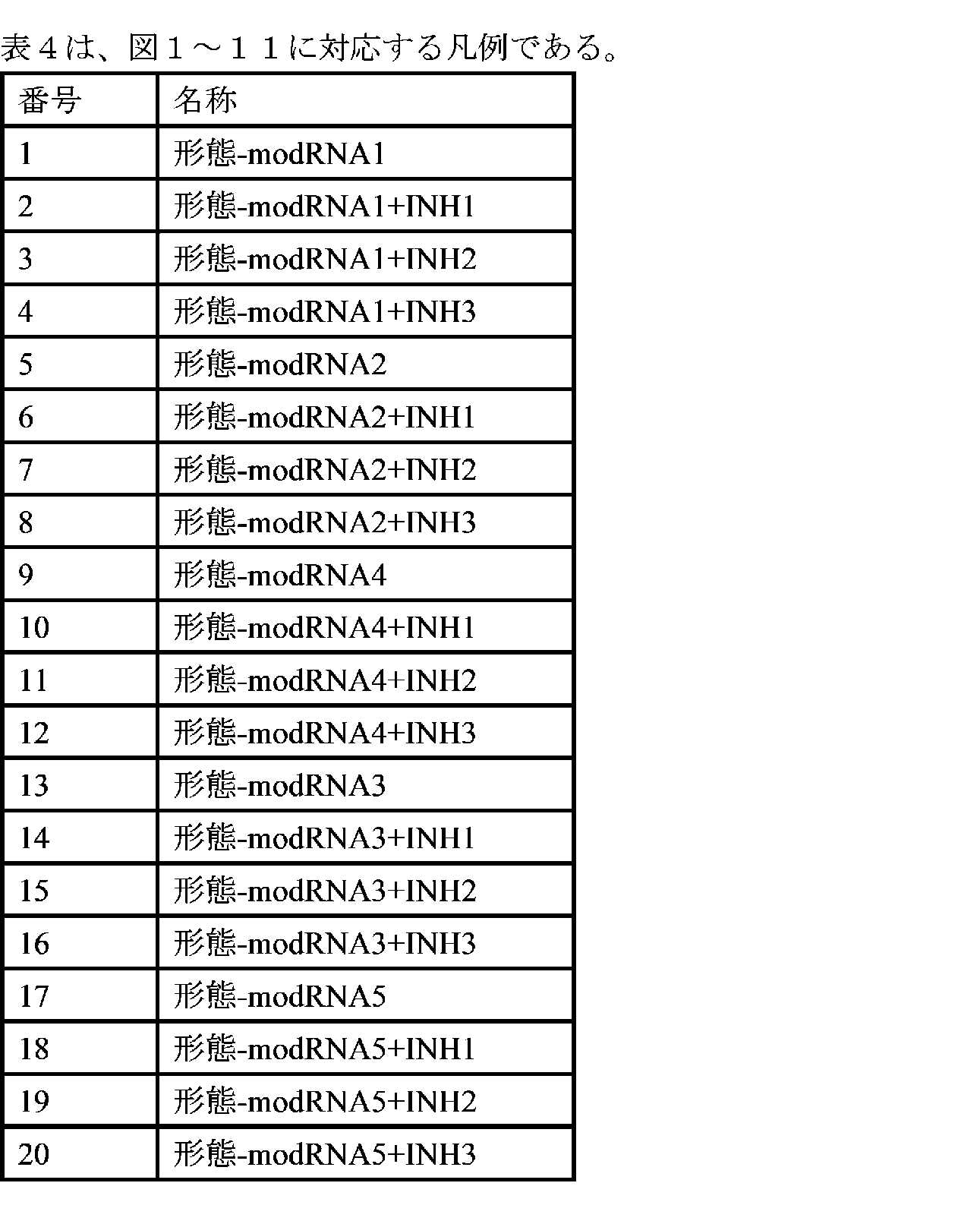
実施例4-hPBMCにおけるサイトカイン及びケモカインプロファイル
本実施例で使用した粒子を、実施例3に従って調製した。健康な個体からのヒト軟膜をJohannes Gutenberg大学、Mainzの医学部から得て、Ficoll-Paque(商標)PLUS(Cytiva,Marlborough,MA,USA)密度勾配によって末梢血単核細胞(PBMC)を単離するために使用した。mRNAトランスフェクションのために、凍結保存されたPBMCを解凍し、1%の非必須アミノ酸(NEAA)、1%のピルビン酸ナトリウム、及び10%のウシ胎児血清(Merck,Germany)を補充した180μLのRPMI中で、ウェル当たり5×10⁵個の細胞の密度で96ウェルプレートに播種した。表3及び4に報告されている粒子を0.01;0.04;0.1;0.3;1及び3μg/ウェルでトランスフェクションするまで、細胞を5% CO2で37℃に維持して、細胞に添加したトランスフェクション混合物の20μlの最終体積を得て、ウェル当たり200μLの総体積を得た。複合体化されたRNAを、トリプリケイトで各ウェルに添加し、トランスフェクションから24時間後に、サイトカイン及びケモカイン分泌プロファイルの測定のために、上清を収集した。
Example 4 - Cytokine and chemokine profiles in hPBMCs The particles used in this example were prepared according to Example 3. Human buffy coats from healthy individuals were obtained from the Faculty of Medicine at Johannes Gutenberg University, Mainz, and used to isolate peripheral blood mononuclear cells (PBMCs) by Ficoll-Paque™ PLUS (Cytiva, Marlborough, MA, USA) density gradient. For mRNA transfection, cryopreserved PBMCs were thawed and seeded in 96-well plates at a density of 5 x 10⁵ cells per well in 180 μL RPMI supplemented with 1% non-essential amino acids (NEAA), 1% sodium pyruvate, and 10% fetal bovine serum (Merck, Germany). Cells were maintained at 37°C with 5% CO2 until transfection with 0.01; 0.04; 0.1; 0.3; 1 and 3 μg/well of particles reported in Tables 3 and 4 , resulting in a final volume of 20 μl of transfection mixture added to cells, giving a total volume of 200 μL per well. Complexed RNA was added to each well in triplicate and supernatants were collected 24 hours post-transfection for measurement of cytokine and chemokine secretion profiles.
選択したサイトカイン及びケモカインの産生を決定するために、LNP-RNAでトランスフェクトしたヒトPBMCからの上清を、製造元の指示に従って、Meso Scale Discovery V-PLEX Custom Human Biomarkers Proinflammatory及びChemokine Panel(Meso Scale Diagnostics-MSD,Rockville,MD,USA)を使用してサイトカイン/ケモカインプロファイル分析に供した。各実験で、1:5=上清:MSD希釈液の試料希釈液を使用した。TNF-α(腫瘍壊死因子アルファ)、IFN-γ(インターフェロンガンマ)、IL-6(インターロイキン6)、IL-1β(インターロイキン1ベータ)、MIP-1β(マクロファージ炎症性タンパク質1ベータ)、MCP-1(単球走化性タンパク質-1)、及びIP-10(インターフェロンガンマ誘導性タンパク質10)のレベルを、mRNAトランスフェクションから24時間後に定量化した。細胞の生存率を決定するために、製造元の推奨に従って、RocheのCell Proliferation Kit II(XTT)を使用した。すなわち、サイトカイン定量のために上清を収集した後、50μlの培地及び50μlのXTT標識化混合物を細胞に添加し、37℃及び5%CO2で24時間インキュベートした。比色アッセイを、TecanまたはCLARIOstarリーダを使用して、550~670nmで測定した。
To determine the production of selected cytokines and chemokines, supernatants from human PBMCs transfected with LNP-RNA were subjected to cytokine/chemokine profile analysis using the Meso Scale Discovery V-PLEX Custom Human Biomarkers Proinflammatories and Chemokine Panel (Meso Scale Diagnostics-MSD, Rockville, MD, USA) according to the manufacturer's instructions. A sample diluent of 1:5 = supernatant:MSD diluent was used in each experiment. The levels of TNF-α (tumor necrosis factor alpha), IFN-γ (interferon gamma), IL-6 (interleukin 6), IL-1β (
図1は、5×10⁵個の生細胞当たり3μgまたは0.3μgの製剤化modRNAのトランスフェクション後の本明細書に記載される製剤1~16のヒトPBMC(hPBMC)におけるサイトカインプロファイル濃度を示すヒートマップである。 FIG. 1 is a heat map showing cytokine profile concentrations in human PBMCs (hPBMCs) for formulations 1-16 described herein following transfection of 3 μg or 0.3 μg of formulated modRNA per 5×10 5 viable cells.
図3は、製剤1~4の様々な濃度(0.01~3μg/ウェル)にわたるサイトカインプロファイル、及び製剤1~4のXTTアッセイからの結果を提供する一連のプロットである。 Figure 3 is a series of plots providing the cytokine profile across various concentrations (0.01-3 μg/well) of formulations 1-4, as well as results from an XTT assay of formulations 1-4.
図5は、製剤5~8の様々な濃度(0.01~3μg/ウェル)にわたるサイトカインプロファイル、及び製剤5~8のXTTアッセイからの結果を提供する一連のプロットである。 Figure 5 is a series of plots providing the cytokine profile across various concentrations (0.01-3 μg/well) of formulations 5-8, as well as results from an XTT assay of formulations 5-8.
図7は、製剤13~16の様々な濃度(0.01~3μg/ウェル)にわたるサイトカインプロファイル、及び製剤13~16のXTTアッセイからの結果を提供する一連のプロットである。 Figure 7 is a series of plots providing the cytokine profile across various concentrations (0.01-3 μg/well) of formulations 13-16, as well as results from an XTT assay of formulations 13-16.
図9は、製剤9~12の様々な濃度(0.01~3μg/ウェル)にわたるサイトカインプロファイル、及び製剤9~12のXTTアッセイからの結果を提供する一連のプロットである。 Figure 9 is a series of plots providing the cytokine profile across various concentrations (0.01-3 μg/well) of formulations 9-12, as well as results from an XTT assay of formulations 9-12.
図10は、製剤17~20の様々な濃度(0.01~3μg/ウェル)にわたるサイトカインプロファイル、及び製剤17~20のXTTアッセイからの結果を提供する一連のプロットである。 Figure 10 is a series of plots providing the cytokine profile across various concentrations (0.01-3 μg/well) of formulations 17-20, as well as results from an XTT assay of formulations 17-20.
実施例5-初代ヒト肝細胞の培養及びトランスフェクション
本実施例は、表3に報告されている粒子の翻訳を評価し、初代ヒト肝細胞を使用したインビトロトランスフェクション実験を行った。男性ヒト凍結可溶性肝細胞を、製造元の指示に従って培養した。細胞を液体窒素中に保存し、解凍後、Torpedo(商標)抗生物質混合物を含有する5mLのInVitroGRO(商標)CP培地に移した。総細胞数を、CASY細胞カウンタを使用して決定した。ウェル当たり25,000個の細胞を、96ウェルコラーゲンIマルチウェルマイクロプレートに播種し、37℃及び5%CO2で2~4時間の増殖後、培地を破棄し、Torpedo(商標)抗生物質混合物を含む新鮮なInVitroGRO(商標)CP培地と置き換えた。
Example 5 - Culture and transfection of primary human hepatocytes This example evaluated the translation of the particles reported in Table 3 and performed in vitro transfection experiments using primary human hepatocytes. Male human frozen soluble hepatocytes were cultured according to the manufacturer's instructions. Cells were stored in liquid nitrogen and, after thawing, transferred to 5 mL of InVitroGRO™ CP medium containing Torpedo™ antibiotic mixture. Total cell number was determined using a CASY cell counter. 25,000 cells per well were seeded in 96-well collagen I multiwell microplates and after 2-4 hours of growth at 37°C and 5% CO2 , the medium was discarded and replaced with fresh InVitroGRO™ CP medium containing Torpedo™ antibiotic mixture.
用量範囲:0.01;0.04;0.1;0.3及び1μg/ウェルの表3の粒子を、リン酸緩衝生理食塩水(PBS)中で粒子を希釈し、ウェル当たり70μLの体積で、Torpedo(商標)抗生物質混合物を含むInVitroGRO HI培地中に再懸濁させることによって調製した。初代ヒト肝細胞を24時間培養し、培地を破棄し、細胞を粒子と培地の調製混合物を使用して、トリプリケイトでトランスフェクトした。用量反応実験では、1日目、2日目、または3日目、及び7日目を含む経時投与を行った。4日を超える実験において、4日目に、Torpedo(商標)抗生物質混合物を含む20μLの新鮮なInVitroGRO HI培地を細胞に供給した。選択された時点で、培地を破棄し、細胞を100μL/ウェルのルシフェラーゼアッセイシステム-カタログ番号E1501、Promegaの溶解緩衝液中で溶解した。試料を溶解緩衝液中で1:2より希釈し、製造元の指示に従ってLUC基質で調製した。蛍ルシフェラーゼ活性の検出のためにTecan Infinite 200 Pro(Tecan Trading AG,Maennedorf,Switzerland)を使用するか、またはCLARIOstarリーダを使用して、光子ルミネセンス発光を測定した。
Dose ranges of 0.01; 0.04; 0.1; 0.3 and 1 μg/well of particles in Table 3 were prepared by diluting particles in phosphate buffered saline (PBS) and resuspending in InVitroGRO HI medium with Torpedo™ antibiotic mixture in a volume of 70 μL per well. Primary human hepatocytes were cultured for 24 hours, the medium was discarded and cells were transfected in triplicate with the prepared mixture of particles and medium. In dose-response experiments, a time course was performed including
図2は、2.5×10⁴個の細胞当たりの0.1μgの製剤化modRNAのトランスフェクション後の肝細胞におけるルシフェラーゼ活性を示すヒートマップである。 FIG. 2 is a heat map showing luciferase activity in hepatocytes following transfection of 0.1 μg of formulated modRNA per 2.5×10 4 cells.
図4は、提供される製剤1~4の1日目、2日目、及び7日目のルシフェラーゼ活性(RLUとして測定)を示す一連のプロットである。
Figure 4 is a series of plots showing luciferase activity (measured as RLU) on
図6は、提供される製剤5~8の1日目、2日目、及び7日目のルシフェラーゼ活性(RLUとして測定)を示す一連のプロットである。
Figure 6 is a series of plots showing luciferase activity (measured as RLU) on
図8は、提供される製剤13~16の1日目、2日目、及び7日目のルシフェラーゼ活性(RLUとして測定)を示す一連のプロットである。
Figure 8 is a series of plots showing luciferase activity (measured as RLU) on
図11は、提供される製剤17~20の1日目、3日目、及び7日目のルシフェラーゼ活性(RLUとして測定)を示す一連のプロットである。
Figure 11 is a series of plots showing luciferase activity (measured as RLU) on
上述の本開示の実施形態は、単なる例示であることを意図しており、多数の変形及び修正は、当業者には明らかであろう。そのような全ての変形例及び修正は、任意の添付の特許請求の範囲で定義される本発明の範囲内にあることが意図される。 The embodiments of the present disclosure described above are intended to be merely illustrative, and numerous variations and modifications will be apparent to those skilled in the art. All such variations and modifications are intended to be within the scope of the present invention as defined in any accompanying claims.
Claims (73)
i)約30~約50mol%のカチオン性脂質と、
ii)約1~約5mol%のPEG脂質と、
iii)約5~約15mol%のヘルパー脂質と、を含む、請求項27に記載の核酸粒子。 The lipid nanoparticles are
i) about 30 to about 50 mol % of a cationic lipid;
ii) about 1 to about 5 mol % PEG lipid;
iii) about 5 to about 15 mol % of a helper lipid.
i)約30~約50mol%のALC-0315と、
ii)約1~約5%mol%のALC-0159と、
iii)約5~約15%mol%のDSPCと、を含む、請求項52に記載の核酸粒子。 The lipid nanoparticles are
i) about 30 to about 50 mol % of ALC-0315;
ii) about 1 to about 5% mol % of ALC-0159; and
iii) about 5 to about 15% mol% DSPC. The nucleic acid particle of claim 52.
i)約47.5mol%のALC-0315と、
ii)約1.8mol%のALC-0159と、
iii)約10mol%のDSPCと、を含む、請求項53に記載の核酸粒子。 The lipid nanoparticles are
i) about 47.5 mol % ALC-0315;
ii) about 1.8 mol % of ALC-0159;
iii) about 10 mol% DSPC. The nucleic acid particle of claim 53.
i)約30~約50mol%のSM-102と、
ii)約1~約5mol%のPEG2000-DMGと、
iii)約5~約15mol%のDSPCと、を含む、請求項27に記載の核酸粒子。 The lipid nanoparticles are
i) about 30 to about 50 mol % SM-102;
ii) about 1 to about 5 mol % of PEG2000-DMG;
iii) about 5 to about 15 mol% DSPC. The nucleic acid particle of claim 27.
i)約50mol%のSM-102と、
ii)約1.5mol%のPEG2000-DMGと、
iii)約10mol%のDSPCと、を含む、請求項55に記載の核酸粒子。 The lipid nanoparticles are
i) about 50 mol % SM-102;
ii) about 1.5 mol % PEG2000-DMG;
iii) about 10 mol% DSPC. The nucleic acid particle of claim 55.
Applications Claiming Priority (3)
| Application Number | Priority Date | Filing Date | Title |
|---|---|---|---|
| EPPCT/EP2022/064542 | 2022-05-30 | ||
| EP2022064542 | 2022-05-30 | ||
| PCT/EP2023/064341 WO2023232747A1 (en) | 2022-05-30 | 2023-05-29 | Complexes for delivery of nucleic acids |
Publications (1)
| Publication Number | Publication Date |
|---|---|
| JP2025518221A true JP2025518221A (en) | 2025-06-12 |
Family
ID=82156436
Family Applications (1)
| Application Number | Title | Priority Date | Filing Date |
|---|---|---|---|
| JP2024570680A Pending JP2025518221A (en) | 2022-05-30 | 2023-05-29 | Complexes for delivery of nucleic acids |
Country Status (5)
| Country | Link |
|---|---|
| US (1) | US20250375534A1 (en) |
| EP (1) | EP4518845A1 (en) |
| JP (1) | JP2025518221A (en) |
| CN (1) | CN119562807A (en) |
| WO (1) | WO2023232747A1 (en) |
Families Citing this family (1)
| Publication number | Priority date | Publication date | Assignee | Title |
|---|---|---|---|---|
| CN119874554B (en) * | 2024-02-02 | 2025-08-19 | 仁景(苏州)生物科技有限公司 | Lipid compounds and lipid nanoparticles for delivery |
Family Cites Families (60)
| Publication number | Priority date | Publication date | Assignee | Title |
|---|---|---|---|---|
| US5965542A (en) | 1997-03-18 | 1999-10-12 | Inex Pharmaceuticals Corp. | Use of temperature to control the size of cationic liposome/plasmid DNA complexes |
| AU749881B2 (en) | 1998-02-03 | 2002-07-04 | Inex Pharmaceuticals Corporation | Systemic delivery of serum stable plasmid lipid particles for cancer therapy |
| US6410328B1 (en) | 1998-02-03 | 2002-06-25 | Protiva Biotherapeutics Inc. | Sensitizing cells to compounds using lipid-mediated gene and compound delivery |
| US6211140B1 (en) | 1999-07-26 | 2001-04-03 | The Procter & Gamble Company | Cationic charge boosting systems |
| EP2338478B1 (en) | 2002-06-28 | 2014-07-23 | Protiva Biotherapeutics Inc. | Method for producing liposomes |
| CN101291653B (en) | 2003-07-16 | 2012-06-27 | 普洛体维生物治疗公司 | lipid-encapsulated interfering RNA |
| US6927663B2 (en) | 2003-07-23 | 2005-08-09 | Cardiac Pacemakers, Inc. | Flyback transformer wire attach method to printed circuit board |
| US7803397B2 (en) | 2003-09-15 | 2010-09-28 | Protiva Biotherapeutics, Inc. | Polyethyleneglycol-modified lipid compounds and uses thereof |
| DE10347710B4 (en) | 2003-10-14 | 2006-03-30 | Johannes-Gutenberg-Universität Mainz | Recombinant vaccines and their use |
| EP1766035B1 (en) | 2004-06-07 | 2011-12-07 | Protiva Biotherapeutics Inc. | Lipid encapsulated interfering rna |
| WO2005120152A2 (en) | 2004-06-07 | 2005-12-22 | Protiva Biotherapeutics, Inc. | Cationic lipids and methods of use |
| US9005654B2 (en) | 2005-07-27 | 2015-04-14 | Protiva Biotherapeutics, Inc. | Systems and methods for manufacturing liposomes |
| EP4174179B1 (en) | 2005-08-23 | 2025-05-07 | The Trustees of the University of Pennsylvania | Rna containing modified nucleosides and methods of use thereof |
| DE102005046490A1 (en) | 2005-09-28 | 2007-03-29 | Johannes-Gutenberg-Universität Mainz | New nucleic acid molecule comprising promoter, a transcriptable nucleic acid sequence, a first and second nucleic acid sequence for producing modified RNA with transcriptional stability and translational efficiency |
| EP3100718B1 (en) | 2008-01-02 | 2019-11-27 | Arbutus Biopharma Corporation | Improved compositions and methods for the delivery of nucleic acids |
| AU2009238175C1 (en) | 2008-04-15 | 2023-11-30 | Arbutus Biopharma Corporation | Novel lipid formulations for nucleic acid delivery |
| CN111909020A (en) | 2008-11-10 | 2020-11-10 | 阿布特斯生物制药公司 | Lipids and compositions for delivery of therapeutic agents |
| EP2449114B9 (en) | 2009-07-01 | 2017-04-19 | Protiva Biotherapeutics Inc. | Novel lipid formulations for delivery of therapeutic agents to solid tumors |
| WO2011000106A1 (en) | 2009-07-01 | 2011-01-06 | Protiva Biotherapeutics, Inc. | Improved cationic lipids and methods for the delivery of therapeutic agents |
| EP2281579A1 (en) | 2009-08-05 | 2011-02-09 | BioNTech AG | Vaccine composition comprising 5'-Cap modified RNA |
| EP2506879A4 (en) | 2009-12-01 | 2014-03-19 | Protiva Biotherapeutics Inc | Snalp formulations containing antioxidants |
| AU2010328336B2 (en) | 2009-12-07 | 2017-03-02 | Arbutus Biopharma Corporation | Compositions for nucleic acid delivery |
| WO2011075656A1 (en) | 2009-12-18 | 2011-06-23 | The University Of British Columbia | Methods and compositions for delivery of nucleic acids |
| WO2011141705A1 (en) | 2010-05-12 | 2011-11-17 | Protiva Biotherapeutics, Inc. | Novel cationic lipids and methods of use thereof |
| ES3053320T3 (en) | 2010-06-03 | 2026-01-21 | Alnylam Pharmaceuticals Inc | Biodegradable lipids for the delivery of active agents |
| WO2012016184A2 (en) | 2010-07-30 | 2012-02-02 | Alnylam Pharmaceuticals, Inc. | Methods and compositions for delivery of active agents |
| US8466122B2 (en) | 2010-09-17 | 2013-06-18 | Protiva Biotherapeutics, Inc. | Trialkyl cationic lipids and methods of use thereof |
| EP3202760B1 (en) | 2011-01-11 | 2019-08-21 | Alnylam Pharmaceuticals, Inc. | Pegylated lipids and their use for drug delivery |
| US8691750B2 (en) | 2011-05-17 | 2014-04-08 | Axolabs Gmbh | Lipids and compositions for intracellular delivery of biologically active compounds |
| WO2013016058A1 (en) | 2011-07-22 | 2013-01-31 | Merck Sharp & Dohme Corp. | Novel bis-nitrogen containing cationic lipids for oligonucleotide delivery |
| JP6250543B2 (en) | 2011-09-27 | 2017-12-20 | アルニラム・ファーマシューティカルズ・インコーポレーテッド | Dialiphatic substituted PEGylated lipids |
| US8762704B2 (en) | 2011-09-29 | 2014-06-24 | Apple Inc. | Customized content for electronic devices |
| ES2921724T1 (en) | 2011-12-07 | 2022-08-31 | Alnylam Pharmaceuticals Inc | Biodegradable lipids for the administration of active agents |
| JP6305343B2 (en) | 2011-12-07 | 2018-04-04 | アルニラム・ファーマシューティカルズ・インコーポレーテッド | Branched alkyl and cycloalkyl terminated biodegradable lipids for the delivery of active agents |
| WO2013086373A1 (en) | 2011-12-07 | 2013-06-13 | Alnylam Pharmaceuticals, Inc. | Lipids for the delivery of active agents |
| PL2791160T3 (en) | 2011-12-16 | 2022-06-20 | Modernatx, Inc. | Modified mrna compositions |
| US9415109B2 (en) | 2012-07-06 | 2016-08-16 | Alnylam Pharmaceuticals, Inc. | Stable non-aggregating nucleic acid lipid particle formulations |
| KR101890951B1 (en) | 2012-12-20 | 2018-08-22 | 에스케이이노베이션 주식회사 | Integrated Drying Gasification Process for Co-producing Synthesis Gas and High Quality of Coals |
| CN105873902B (en) | 2013-11-18 | 2019-03-08 | 阿克丘勒斯治疗公司 | Ionizable cationic lipids for RNA delivery |
| EP3160938B1 (en) | 2014-06-25 | 2020-09-16 | Acuitas Therapeutics Inc. | Novel lipids and lipid nanoparticle formulations for delivery of nucleic acids |
| WO2016005004A1 (en) | 2014-07-11 | 2016-01-14 | Biontech Rna Pharmaceuticals Gmbh | Stabilization of poly(a) sequence encoding dna sequences |
| EP3247363A4 (en) | 2015-01-21 | 2018-10-03 | Moderna Therapeutics, Inc. | Lipid nanoparticle compositions |
| WO2016118725A1 (en) | 2015-01-23 | 2016-07-28 | Moderna Therapeutics, Inc. | Lipid nanoparticle compositions |
| WO2016176330A1 (en) | 2015-04-27 | 2016-11-03 | The Trustees Of The University Of Pennsylvania | Nucleoside-modified rna for inducing an adaptive immune response |
| AU2016285852B2 (en) | 2015-06-29 | 2020-12-17 | Acuitas Therapeutics Inc. | Lipids and lipid nanoparticle formulations for delivery of nucleic acids |
| US10808242B2 (en) | 2015-08-28 | 2020-10-20 | Biontech Rna Pharmaceuticals Gmbh | Method for reducing immunogenicity of RNA |
| ES2969082T3 (en) | 2015-09-17 | 2024-05-16 | Modernatx Inc | Compounds and compositions for intracellular administration of therapeutic agents |
| LT4104687T (en) | 2015-09-21 | 2024-02-26 | Trilink Biotechnologies, Llc | Compositions and methods for synthesizing 5 -capped rnas |
| WO2017059902A1 (en) | 2015-10-07 | 2017-04-13 | Biontech Rna Pharmaceuticals Gmbh | 3' utr sequences for stabilization of rna |
| FI3368507T3 (en) | 2015-10-28 | 2023-03-21 | Acuitas Therapeutics Inc | New lipids and lipid nanoparticle preparations for delivery of nucleic acids |
| WO2017162265A1 (en) | 2016-03-21 | 2017-09-28 | Biontech Rna Pharmaceuticals Gmbh | Trans-replicating rna |
| WO2017162266A1 (en) | 2016-03-21 | 2017-09-28 | Biontech Rna Pharmaceuticals Gmbh | Rna replicon for versatile and efficient gene expression |
| EP3468537A1 (en) * | 2016-06-14 | 2019-04-17 | Modernatx, Inc. | Stabilized formulations of lipid nanoparticles |
| EP3532103B1 (en) | 2016-10-26 | 2025-12-03 | Acuitas Therapeutics, Inc. | Lipid nanoparticle formulations |
| WO2020219941A1 (en) | 2019-04-26 | 2020-10-29 | Genevant Sciences Gmbh | Lipid nanoparticles |
| WO2021001023A1 (en) | 2019-07-02 | 2021-01-07 | Biontech Rna Pharmaceuticals Gmbh | Rna formulations suitable for therapy |
| EP4009955A1 (en) | 2019-08-07 | 2022-06-15 | ModernaTX, Inc. | Compositions and methods for enhanced delivery of agents |
| US12458604B2 (en) * | 2020-10-14 | 2025-11-04 | The Trustees Of The University Of Pennsylvania | Methods of lipid nanoparticle manufacture and compositions derived therefrom |
| MX2023006056A (en) * | 2020-11-25 | 2023-06-06 | Akagera Medicines Inc | Lipid nanoparticles for delivery of nucleic acids, and related methods of use. |
| CN114306279A (en) * | 2021-12-30 | 2022-04-12 | 复旦大学 | Lipid nanoparticle system based on corosolic acid or its analogs, preparation method and application thereof |
-
2023
- 2023-05-29 JP JP2024570680A patent/JP2025518221A/en active Pending
- 2023-05-29 EP EP23731130.3A patent/EP4518845A1/en active Pending
- 2023-05-29 WO PCT/EP2023/064341 patent/WO2023232747A1/en not_active Ceased
- 2023-05-29 US US18/869,559 patent/US20250375534A1/en active Pending
- 2023-05-29 CN CN202380054236.0A patent/CN119562807A/en active Pending
Also Published As
| Publication number | Publication date |
|---|---|
| CN119562807A (en) | 2025-03-04 |
| WO2023232747A1 (en) | 2023-12-07 |
| EP4518845A1 (en) | 2025-03-12 |
| US20250375534A1 (en) | 2025-12-11 |
Similar Documents
| Publication | Publication Date | Title |
|---|---|---|
| JP7463006B2 (en) | Cationic lipids containing steroidal moieties | |
| JP7441802B2 (en) | vitamin cationic lipid | |
| JP7483294B2 (en) | 2,5-dioxopiperazine lipids containing intercalation ester, thioester, disulfide and anhydride moieties | |
| EP2430168B1 (en) | Compositions comprising cationic amphiphiles and colipids for delivering therapeutics molecules | |
| US20230357133A1 (en) | Nanomaterials comprising carbonates | |
| EP3695850B1 (en) | Pharmaceutical compositions comprising a negatively charged drug and a cationic lipid | |
| TWI594767B (en) | Lipid nano particles comprising cationic lipid for drug delivery system | |
| US20240166593A1 (en) | Lipids suitable for nucleic acid delivery | |
| US20240335541A1 (en) | Nanomaterials comprising diamines | |
| US20240358841A1 (en) | Nanomaterials comprising tetravalent lipid compounds | |
| US10196637B2 (en) | Retinoid-lipid drug carrier | |
| JP2025518221A (en) | Complexes for delivery of nucleic acids | |
| CN120202025A (en) | Compositions for enhancing nucleic acid delivery | |
| JP6774965B2 (en) | Compounds as cationic lipids | |
| KR20240159310A (en) | Lipid nanoparticle compositions using novel ionizable lipids | |
| RU2844549C1 (en) | Lipid particles for delivering nucleic acids to mammalian cells and use thereof | |
| RU2836309C1 (en) | Cationic lipid for delivery of nucleic acids into mammalian cells, method for production thereof and use thereof | |
| JP7043411B2 (en) | Compounds as cationic lipids | |
| KR102917928B1 (en) | Novel ionizable lipid and lipid nanoparticle composition using thereof | |
| WO2025124711A1 (en) | Glycolipid compositions | |
| JP2025539101A (en) | Polyoxyalkylene-1,2-dimyristoyl-glycerol compounds, wherein the polyoxyalkylene is poly(ethylene oxide) having C1-C3-alkyloxymethyl side chains. | |
| JP2025539100A (en) | Polyoxyalkylene-N,N-ditetradecylacetamide compounds, wherein the polyoxyalkylene is poly(ethylene oxide) having C1-C3-alkyloxymethyl side chains. | |
| JP2025539099A (en) | Lipids conjugated with poly(ethylene oxide) having C1-C3-alkyloxymethyl side chains | |
| TW202525287A (en) | Ionizable lipids | |
| JP2026503991A (en) | Lipid nanoparticle formulations containing ionized lipids with branched structures and uses thereof |