CN116096886A - Compositions and methods for modulating fork-box P3 (FOXP 3) gene expression - Google Patents
Compositions and methods for modulating fork-box P3 (FOXP 3) gene expression Download PDFInfo
- Publication number
- CN116096886A CN116096886A CN202180034263.2A CN202180034263A CN116096886A CN 116096886 A CN116096886 A CN 116096886A CN 202180034263 A CN202180034263 A CN 202180034263A CN 116096886 A CN116096886 A CN 116096886A
- Authority
- CN
- China
- Prior art keywords
- site
- foxp3
- specific
- breaker
- sequence
- Prior art date
- Legal status (The legal status is an assumption and is not a legal conclusion. Google has not performed a legal analysis and makes no representation as to the accuracy of the status listed.)
- Pending
Links
Images


Classifications
-
- C—CHEMISTRY; METALLURGY
- C12—BIOCHEMISTRY; BEER; SPIRITS; WINE; VINEGAR; MICROBIOLOGY; ENZYMOLOGY; MUTATION OR GENETIC ENGINEERING
- C12N—MICROORGANISMS OR ENZYMES; COMPOSITIONS THEREOF; PROPAGATING, PRESERVING, OR MAINTAINING MICROORGANISMS; MUTATION OR GENETIC ENGINEERING; CULTURE MEDIA
- C12N15/00—Mutation or genetic engineering; DNA or RNA concerning genetic engineering, vectors, e.g. plasmids, or their isolation, preparation or purification; Use of hosts therefor
- C12N15/09—Recombinant DNA-technology
- C12N15/11—DNA or RNA fragments; Modified forms thereof; Non-coding nucleic acids having a biological activity
- C12N15/113—Non-coding nucleic acids modulating the expression of genes, e.g. antisense oligonucleotides; Antisense DNA or RNA; Triplex- forming oligonucleotides; Catalytic nucleic acids, e.g. ribozymes; Nucleic acids used in co-suppression or gene silencing
-
- C—CHEMISTRY; METALLURGY
- C12—BIOCHEMISTRY; BEER; SPIRITS; WINE; VINEGAR; MICROBIOLOGY; ENZYMOLOGY; MUTATION OR GENETIC ENGINEERING
- C12N—MICROORGANISMS OR ENZYMES; COMPOSITIONS THEREOF; PROPAGATING, PRESERVING, OR MAINTAINING MICROORGANISMS; MUTATION OR GENETIC ENGINEERING; CULTURE MEDIA
- C12N15/00—Mutation or genetic engineering; DNA or RNA concerning genetic engineering, vectors, e.g. plasmids, or their isolation, preparation or purification; Use of hosts therefor
- C12N15/09—Recombinant DNA-technology
- C12N15/87—Introduction of foreign genetic material using processes not otherwise provided for, e.g. co-transformation
- C12N15/90—Stable introduction of foreign DNA into chromosome
- C12N15/902—Stable introduction of foreign DNA into chromosome using homologous recombination
- C12N15/907—Stable introduction of foreign DNA into chromosome using homologous recombination in mammalian cells
-
- A—HUMAN NECESSITIES
- A61—MEDICAL OR VETERINARY SCIENCE; HYGIENE
- A61K—PREPARATIONS FOR MEDICAL, DENTAL OR TOILETRY PURPOSES
- A61K45/00—Medicinal preparations containing active ingredients not provided for in groups A61K31/00 - A61K41/00
- A61K45/06—Mixtures of active ingredients without chemical characterisation, e.g. antiphlogistics and cardiaca
-
- A—HUMAN NECESSITIES
- A61—MEDICAL OR VETERINARY SCIENCE; HYGIENE
- A61P—SPECIFIC THERAPEUTIC ACTIVITY OF CHEMICAL COMPOUNDS OR MEDICINAL PREPARATIONS
- A61P37/00—Drugs for immunological or allergic disorders
- A61P37/02—Immunomodulators
- A61P37/06—Immunosuppressants, e.g. drugs for graft rejection
-
- C—CHEMISTRY; METALLURGY
- C12—BIOCHEMISTRY; BEER; SPIRITS; WINE; VINEGAR; MICROBIOLOGY; ENZYMOLOGY; MUTATION OR GENETIC ENGINEERING
- C12N—MICROORGANISMS OR ENZYMES; COMPOSITIONS THEREOF; PROPAGATING, PRESERVING, OR MAINTAINING MICROORGANISMS; MUTATION OR GENETIC ENGINEERING; CULTURE MEDIA
- C12N15/00—Mutation or genetic engineering; DNA or RNA concerning genetic engineering, vectors, e.g. plasmids, or their isolation, preparation or purification; Use of hosts therefor
- C12N15/09—Recombinant DNA-technology
- C12N15/11—DNA or RNA fragments; Modified forms thereof; Non-coding nucleic acids having a biological activity
-
- C—CHEMISTRY; METALLURGY
- C12—BIOCHEMISTRY; BEER; SPIRITS; WINE; VINEGAR; MICROBIOLOGY; ENZYMOLOGY; MUTATION OR GENETIC ENGINEERING
- C12N—MICROORGANISMS OR ENZYMES; COMPOSITIONS THEREOF; PROPAGATING, PRESERVING, OR MAINTAINING MICROORGANISMS; MUTATION OR GENETIC ENGINEERING; CULTURE MEDIA
- C12N15/00—Mutation or genetic engineering; DNA or RNA concerning genetic engineering, vectors, e.g. plasmids, or their isolation, preparation or purification; Use of hosts therefor
- C12N15/09—Recombinant DNA-technology
- C12N15/11—DNA or RNA fragments; Modified forms thereof; Non-coding nucleic acids having a biological activity
- C12N15/62—DNA sequences coding for fusion proteins
-
- C—CHEMISTRY; METALLURGY
- C12—BIOCHEMISTRY; BEER; SPIRITS; WINE; VINEGAR; MICROBIOLOGY; ENZYMOLOGY; MUTATION OR GENETIC ENGINEERING
- C12N—MICROORGANISMS OR ENZYMES; COMPOSITIONS THEREOF; PROPAGATING, PRESERVING, OR MAINTAINING MICROORGANISMS; MUTATION OR GENETIC ENGINEERING; CULTURE MEDIA
- C12N15/00—Mutation or genetic engineering; DNA or RNA concerning genetic engineering, vectors, e.g. plasmids, or their isolation, preparation or purification; Use of hosts therefor
- C12N15/09—Recombinant DNA-technology
- C12N15/63—Introduction of foreign genetic material using vectors; Vectors; Use of hosts therefor; Regulation of expression
-
- C—CHEMISTRY; METALLURGY
- C12—BIOCHEMISTRY; BEER; SPIRITS; WINE; VINEGAR; MICROBIOLOGY; ENZYMOLOGY; MUTATION OR GENETIC ENGINEERING
- C12N—MICROORGANISMS OR ENZYMES; COMPOSITIONS THEREOF; PROPAGATING, PRESERVING, OR MAINTAINING MICROORGANISMS; MUTATION OR GENETIC ENGINEERING; CULTURE MEDIA
- C12N15/00—Mutation or genetic engineering; DNA or RNA concerning genetic engineering, vectors, e.g. plasmids, or their isolation, preparation or purification; Use of hosts therefor
- C12N15/09—Recombinant DNA-technology
- C12N15/63—Introduction of foreign genetic material using vectors; Vectors; Use of hosts therefor; Regulation of expression
- C12N15/79—Vectors or expression systems specially adapted for eukaryotic hosts
- C12N15/85—Vectors or expression systems specially adapted for eukaryotic hosts for animal cells
- C12N15/86—Viral vectors
-
- C—CHEMISTRY; METALLURGY
- C12—BIOCHEMISTRY; BEER; SPIRITS; WINE; VINEGAR; MICROBIOLOGY; ENZYMOLOGY; MUTATION OR GENETIC ENGINEERING
- C12N—MICROORGANISMS OR ENZYMES; COMPOSITIONS THEREOF; PROPAGATING, PRESERVING, OR MAINTAINING MICROORGANISMS; MUTATION OR GENETIC ENGINEERING; CULTURE MEDIA
- C12N9/00—Enzymes; Proenzymes; Compositions thereof; Processes for preparing, activating, inhibiting, separating or purifying enzymes
- C12N9/14—Hydrolases (3)
- C12N9/16—Hydrolases (3) acting on ester bonds (3.1)
- C12N9/22—Ribonucleases [RNase]; Deoxyribonucleases [DNase]
-
- C—CHEMISTRY; METALLURGY
- C07—ORGANIC CHEMISTRY
- C07K—PEPTIDES
- C07K2319/00—Fusion polypeptide
- C07K2319/80—Fusion polypeptide containing a DNA binding domain, e.g. Lacl or Tet-repressor
- C07K2319/81—Fusion polypeptide containing a DNA binding domain, e.g. Lacl or Tet-repressor containing a Zn-finger domain for DNA binding
-
- C—CHEMISTRY; METALLURGY
- C12—BIOCHEMISTRY; BEER; SPIRITS; WINE; VINEGAR; MICROBIOLOGY; ENZYMOLOGY; MUTATION OR GENETIC ENGINEERING
- C12N—MICROORGANISMS OR ENZYMES; COMPOSITIONS THEREOF; PROPAGATING, PRESERVING, OR MAINTAINING MICROORGANISMS; MUTATION OR GENETIC ENGINEERING; CULTURE MEDIA
- C12N2310/00—Structure or type of the nucleic acid
- C12N2310/10—Type of nucleic acid
- C12N2310/20—Type of nucleic acid involving clustered regularly interspaced short palindromic repeats [CRISPR]
-
- C—CHEMISTRY; METALLURGY
- C12—BIOCHEMISTRY; BEER; SPIRITS; WINE; VINEGAR; MICROBIOLOGY; ENZYMOLOGY; MUTATION OR GENETIC ENGINEERING
- C12N—MICROORGANISMS OR ENZYMES; COMPOSITIONS THEREOF; PROPAGATING, PRESERVING, OR MAINTAINING MICROORGANISMS; MUTATION OR GENETIC ENGINEERING; CULTURE MEDIA
- C12N2750/00—MICROORGANISMS OR ENZYMES; COMPOSITIONS THEREOF; PROPAGATING, PRESERVING, OR MAINTAINING MICROORGANISMS; MUTATION OR GENETIC ENGINEERING; CULTURE MEDIA ssDNA viruses
- C12N2750/00011—Details
- C12N2750/14011—Parvoviridae
- C12N2750/14111—Dependovirus, e.g. adenoassociated viruses
- C12N2750/14141—Use of virus, viral particle or viral elements as a vector
- C12N2750/14143—Use of virus, viral particle or viral elements as a vector viral genome or elements thereof as genetic vector
-
- C—CHEMISTRY; METALLURGY
- C12—BIOCHEMISTRY; BEER; SPIRITS; WINE; VINEGAR; MICROBIOLOGY; ENZYMOLOGY; MUTATION OR GENETIC ENGINEERING
- C12N—MICROORGANISMS OR ENZYMES; COMPOSITIONS THEREOF; PROPAGATING, PRESERVING, OR MAINTAINING MICROORGANISMS; MUTATION OR GENETIC ENGINEERING; CULTURE MEDIA
- C12N2800/00—Nucleic acids vectors
- C12N2800/80—Vectors containing sites for inducing double-stranded breaks, e.g. meganuclease restriction sites
-
- C—CHEMISTRY; METALLURGY
- C12—BIOCHEMISTRY; BEER; SPIRITS; WINE; VINEGAR; MICROBIOLOGY; ENZYMOLOGY; MUTATION OR GENETIC ENGINEERING
- C12N—MICROORGANISMS OR ENZYMES; COMPOSITIONS THEREOF; PROPAGATING, PRESERVING, OR MAINTAINING MICROORGANISMS; MUTATION OR GENETIC ENGINEERING; CULTURE MEDIA
- C12N2830/00—Vector systems having a special element relevant for transcription
- C12N2830/001—Vector systems having a special element relevant for transcription controllable enhancer/promoter combination
Landscapes
- Health & Medical Sciences (AREA)
- Life Sciences & Earth Sciences (AREA)
- Genetics & Genomics (AREA)
- Engineering & Computer Science (AREA)
- Chemical & Material Sciences (AREA)
- Bioinformatics & Cheminformatics (AREA)
- Biomedical Technology (AREA)
- Organic Chemistry (AREA)
- Wood Science & Technology (AREA)
- Zoology (AREA)
- General Engineering & Computer Science (AREA)
- Biotechnology (AREA)
- Molecular Biology (AREA)
- General Health & Medical Sciences (AREA)
- Biochemistry (AREA)
- Microbiology (AREA)
- Physics & Mathematics (AREA)
- Biophysics (AREA)
- Plant Pathology (AREA)
- Medicinal Chemistry (AREA)
- Immunology (AREA)
- Public Health (AREA)
- Pharmacology & Pharmacy (AREA)
- Veterinary Medicine (AREA)
- Animal Behavior & Ethology (AREA)
- Cell Biology (AREA)
- Epidemiology (AREA)
- Nuclear Medicine, Radiotherapy & Molecular Imaging (AREA)
- Chemical Kinetics & Catalysis (AREA)
- Transplantation (AREA)
- Virology (AREA)
- Mycology (AREA)
- General Chemical & Material Sciences (AREA)
- Medicines That Contain Protein Lipid Enzymes And Other Medicines (AREA)
- Pharmaceuticals Containing Other Organic And Inorganic Compounds (AREA)
- Peptides Or Proteins (AREA)
- Micro-Organisms Or Cultivation Processes Thereof (AREA)
- Medicines Containing Material From Animals Or Micro-Organisms (AREA)
- Ink Jet (AREA)
- Particle Formation And Scattering Control In Inkjet Printers (AREA)
Abstract
本发明提供用于通过靶向FOXP3表达控制区来调节叉头框P3(FOXP3)基因的表达(例如,增加或降低表达)的试剂和组合物,以及其用于治疗FOXP3相关病症(例如自身免疫性疾病,如IPEX综合征)的使用方法。The present invention provides reagents and compositions for modulating the expression (e.g., increasing or decreasing expression) of the forkhead box P3 (FOXP3) gene by targeting the FOXP3 expression control region, and its use in the treatment of FOXP3-associated disorders (e.g., autoimmune diseases, such as IPEX syndrome).
Description
相关申请Related Applications
本申请要求于2020年3月11日提交的美国临时申请号62/988,044的优先权权益,其全部内容通过引用并入本文。This application claims the benefit of priority to U.S. Provisional Application No. 62/988,044, filed on March 11, 2020, the entire contents of which are incorporated herein by reference.
序列表Sequence Listing
本申请包含已以ASCII格式电子提交并通过引用全文并入本文的序列表。所述ASCII副本创建于2021年3月10日,其被命名为131717-00420_SL.txt,且其大小为1,166,669字节。This application contains a sequence listing that has been submitted electronically in ASCII format and is incorporated herein by reference in its entirety. The ASCII copy was created on March 10, 2021, is named 131717-00420_SL.txt, and is 1,166,669 bytes in size.
背景技术Background Art
健康的免疫系统保护身体以抵抗疾病和感染。但是如果免疫系统出现故障,它会错误地攻击健康的细胞、组织和器官。这些以自身免疫性疾病或病症为特征的攻击可以影响身体的任何部分,削弱身体功能,甚至危及生命。一些较常见的自身免疫性疾病包括IPEX综合征(IPEX)、1型糖尿病、多发性硬化、系统性红斑狼疮(SLE)和类风湿性关节炎(RA)。A healthy immune system protects the body against disease and infection. But if the immune system malfunctions, it can mistakenly attack healthy cells, tissues, and organs. These attacks, characterized by autoimmune diseases or conditions, can affect any part of the body, impair body function, or even be life-threatening. Some of the more common autoimmune diseases include IPEX syndrome (IPEX),
总的来说,这些疾病影响美国超过2400万人(参见,Progress in AutoimmuneDiseases Research,https://www.niaid.nih.gov/sites/de fault/files/adccfinal.pdf)。另有八百万人具有指示一个人可能患自身免疫性疾病的机会的自身抗体、血液分子。自身免疫性疾病正变得越来越普遍。Collectively, these diseases affect more than 24 million people in the United States (see, Progress in Autoimmune Diseases Research, https://www.niaid.nih.gov/sites/default/files/adccfinal.pdf). Another eight million people have autoantibodies, blood molecules that indicate a person's chance of developing an autoimmune disease. Autoimmune diseases are becoming increasingly common.
治疗取决于疾病,但在大多数情况下,一个重要的目标是减轻炎症。皮质类固醇或其他降低免疫反应的药物通常是处方药。Treatment depends on the disease, but in most cases an important goal is to reduce inflammation. Corticosteroids or other drugs that reduce the immune response are usually prescribed.
调节性T细胞(Treg)是起到抑制免疫反应的作用的特定T细胞亚群,从而维持体内平衡和自身耐受性。研究表明,Treg能够抑制T细胞增殖和细胞因子产生,并且在预防或治疗自身免疫性疾病中起重要作用。叉头框(Forkhead box)P3(FOXP3)是控制天然T细胞分化成调节性T细胞(Treg)的主要转录因子,并且已经显示出FOXP3的强制过表达赋予T细胞以Treg表型。Regulatory T cells (Tregs) are specific T cell subsets that function to suppress immune responses, thereby maintaining homeostasis and self-tolerance. Studies have shown that Tregs are able to suppress T cell proliferation and cytokine production, and play an important role in preventing or treating autoimmune diseases. Forkhead box P3 (FOXP3) is the main transcription factor that controls the differentiation of naive T cells into regulatory T cells (Tregs), and forced overexpression of FOXP3 has been shown to confer a Treg phenotype on T cells.
Treg的体外产生已经是靶向自身免疫性病症的离体疗法领域内的一项重要工作。但是,许多产生Treg的策略既不能引起导致Treg的基因的持续表达,也不产生具有抑制表型的Treg。The in vitro generation of Tregs has been an important work in the field of ex vivo therapeutics targeting autoimmune disorders. However, many strategies for generating Tregs fail to induce sustained expression of genes that lead to Tregs, nor to generate Tregs with a suppressive phenotype.
因此,本领域需要治疗自身免疫性疾病如IPEX综合征的组合物和方法。Therefore, there is a need in the art for compositions and methods for treating autoimmune diseases such as IPEX syndrome.
发明内容Summary of the invention
本发明提供用于通过靶向FOXP3表达控制区来调节叉头框P3(FOXP3)基因的表达(例如,增加或降低表达)的试剂和组合物。FOXP3基因可以存在于细胞,例如哺乳动物细胞,如哺乳动物体细胞(例如人或小鼠体细胞,例如天然T细胞)中。本发明还提供使用本发明的试剂和组合物调节将受益于调节FOXP3基因的表达的受试者(例如患有或易患FOXP3相关疾病的受试者)体内FOXP3基因的表达或治疗所述受试者的方法。The present invention provides reagents and compositions for regulating the expression (e.g., increasing or decreasing expression) of a forkhead box P3 (FOXP3) gene by targeting a FOXP3 expression control region. The FOXP3 gene can be present in a cell, such as a mammalian cell, such as a mammalian somatic cell (e.g., a human or mouse somatic cell, such as a natural T cell). The present invention also provides methods for regulating the expression of a FOXP3 gene in a subject (e.g., a subject suffering from or susceptible to a FOXP3-related disease) that will benefit from regulating the expression of the FOXP3 gene using the reagents and compositions of the present invention or treating the subject.
因此,在一个方面,本发明提供位点特异性叉头框P3(FOXP3)破坏剂,其包含靶向FOXP3表达控制区的位点特异性FOXP3靶向部分。Thus, in one aspect, the present invention provides a site-specific forkhead box P3 (FOXP3) disrupting agent comprising a site-specific FOXP3 targeting moiety that targets a FOXP3 expression control region.
在一个实施方案中,位点特异性FOXP3靶向部分包含聚合物分子。聚合物分子可以包括聚酰胺、多核苷酸、编码特异性结合FOXP3表达控制区的DNA结合域或其片段的多核苷酸、或肽核酸(PNA)。In one embodiment, the site-specific FOXP3 targeting moiety comprises a polymer molecule. The polymer molecule may include polyamide, polynucleotide, polynucleotide encoding a DNA binding domain or a fragment thereof that specifically binds to a FOXP3 expression control region, or peptide nucleic acid (PNA).
在另一个实施方案中,表达控制区包含FOXP3转录起始位点(TSS)上游的区域。In another embodiment, the expression control region comprises a region upstream of the FOXP3 transcription start site (TSS).
在一些实施方案中,表达控制区包含在含有第一和第二FOXP3相关锚定序列的锚定序列介导的结合体(conjunction)内的一个或多个FOXP3相关锚定序列。In some embodiments, the expression control region comprises one or more FOXP3-associated anchor sequences within an anchor sequence-mediated conjunction with a first and a second FOXP3-associated anchor sequence.
在另一个实施方案中,FOXP3相关锚定序列包含CCCTC结合因子(CTCF)结合基序。In another embodiment, the FOXP3-associated anchor sequence comprises a CCCTC binding factor (CTCF) binding motif.
在另一个实施方案中,FOXP3相关锚定序列介导的结合体包含所述结合体内部的一个或多个转录控制元件。在一个实施方案中,FOXP3相关锚定序列介导的结合体包含所述结合体外部的一个或多个转录控制元件。In another embodiment, the FOXP3-associated anchor sequence-mediated binding entity comprises one or more transcriptional control elements inside the binding entity. In one embodiment, the FOXP3-associated anchor sequence-mediated binding entity comprises one or more transcriptional control elements outside the binding entity.
在一个实施方案中,FOXP3相关锚定序列位于转录控制元件的约500kb内。在另一个实施方案中,FOXP3相关锚定序列位于转录控制元件的约300kb内。在另一个实施方案中,锚定序列位于转录控制元件的10kb内。In one embodiment, the FOXP3-associated anchor sequence is located within about 500 kb of the transcriptional control element. In another embodiment, the FOXP3-associated anchor sequence is located within about 300 kb of the transcriptional control element. In another embodiment, the anchor sequence is located within 10 kb of the transcriptional control element.
在另一个实施方案中,表达控制区包含FOXP3特异性转录控制元件。在另一个实施方案中,转录控制元件包含FOXP3启动子。在另一个实施方案中,转录控制元件包括转录增强子。在另一个实施方案中,转录控制元件包括转录阻遏物。In another embodiment, the expression control region comprises a FOXP3-specific transcriptional control element. In another embodiment, the transcriptional control element comprises a FOXP3 promoter. In another embodiment, the transcriptional control element comprises a transcriptional enhancer. In another embodiment, the transcriptional control element comprises a transcriptional repressor.
在一个实施方案中,位点特异性FOXP3破坏剂包括与表2中任何一个核苷酸序列的完整核苷酸序列具有至少85%、86%、87%、88%、89%、90%、91%、92%、93%、94%、95%、96%、97%、98%、99%或100%核苷酸同一性的核苷酸序列。In one embodiment, the site-specific FOXP3 disruptor comprises a nucleotide sequence having at least 85%, 86%, 87%, 88%, 89%, 90%, 91%, 92%, 93%, 94%, 95%, 96%, 97%, 98%, 99% or 100% nucleotide identity to the complete nucleotide sequence of any one of the nucleotide sequences in Table 2.
在另一个实施方案中,位点特异性FOXP3破坏剂包含编码特异性结合FOXP3表达控制区的锌指多肽(ZNF)或转录激活物样效应物(TALE)多肽的DNA结合域或其片段的多核苷酸。In another embodiment, the site-specific FOXP3 disrupting agent comprises a polynucleotide encoding a DNA binding domain of a zinc finger polypeptide (ZNF) or a transcription activator-like effector (TALE) polypeptide that specifically binds to a FOXP3 expression control region, or a fragment thereof.
在一个实施方案中,TALE或ZNF多肽的DNA结合域包含与表1B中所列的任何一个氨基酸序列的完整氨基酸序列具有至少约85%、86%、87%、88%、89%、90%、91%、92%、93%、94%、95%、96%、97%、98%、99%或100%氨基酸同一性的氨基酸序列。In one embodiment, the DNA binding domain of the TALE or ZNF polypeptide comprises an amino acid sequence having at least about 85%, 86%, 87%, 88%, 89%, 90%, 91%, 92%, 93%, 94%, 95%, 96%, 97%, 98%, 99% or 100% amino acid identity to the complete amino acid sequence of any one of the amino acid sequences listed in Table IB.
在另一个实施方案中,位点特异性FOXP3破坏剂包括核苷酸修饰,例如,脱氧核苷酸、3’-末端脱氧胸腺嘧啶(dT)核苷酸、2’-O-甲基修饰的核苷酸、2’-氟代修饰的核苷酸、2’-脱氧修饰的核苷酸、脱碱基核苷酸、包含5’-硫代磷酸酯基的核苷酸、包含5’-甲基膦酸酯基的核苷酸、包含3’-硫代磷酸酯基的核苷酸或包含3’-甲基膦酸酯基的核苷酸。In another embodiment, the site-specific FOXP3 disruptor comprises a nucleotide modification, e.g., a deoxynucleotide, a 3'-terminal deoxythymidine (dT) nucleotide, a 2'-O-methyl modified nucleotide, a 2'-fluoro modified nucleotide, a 2'-deoxy modified nucleotide, an abasic nucleotide, a nucleotide containing a 5'-phosphorothioate group, a nucleotide containing a 5'-methylphosphonate group, a nucleotide containing a 3'-phosphorothioate group, or a nucleotide containing a 3'-methylphosphonate group.
在另一个实施方案中,聚合物分子包含肽核酸(PNA)。In another embodiment, the polymer molecule comprises a peptide nucleic acid (PNA).
在一个方面,本发明提供一种载体。所述载体包含本文描述的发明的上述方面或任何其他方面的各种实施方案的位点特异性FOXP3破坏剂。在一个实施方案中,载体是病毒表达载体。In one aspect, the present invention provides a vector. The vector comprises the site-specific FOXP3 disrupting agent of various embodiments of the above aspect or any other aspect of the invention described herein. In one embodiment, the vector is a viral expression vector.
在另一个方面,本发明提供一种细胞。所述细胞提供本文描述的发明的上述方面或任何其他方面的各种实施方案的位点特异性FOXP3破坏剂或载体。In another aspect, the present invention provides a cell providing a site-specific FOXP3 disrupting agent or vector according to various embodiments of the above or any other aspect of the invention described herein.
在一个实施方案中,位点特异性FOXP3破坏剂存在于组合物中。在另一个实施方案中,组合物包括药物组合物。在另一个实施方案中,药物组合物包括脂质制剂。在又一个实施方案中,脂质制剂包含一种或多种阳离子脂质、一种或多种非阳离子脂质、一种或多种基于胆固醇的脂质、或一种或多种PEG修饰的脂质、或前述的任何组合。在一个实施方案中,药物组合物包括脂质纳米颗粒。In one embodiment, the site-specific FOXP3 disruptor is present in the composition. In another embodiment, the composition includes a pharmaceutical composition. In another embodiment, the pharmaceutical composition includes a lipid formulation. In yet another embodiment, the lipid formulation includes one or more cationic lipids, one or more non-cationic lipids, one or more cholesterol-based lipids, or one or more PEG-modified lipids, or any combination of the foregoing. In one embodiment, the pharmaceutical composition includes lipid nanoparticles.
在另一个方面,本发明提供位点特异性FOXP3破坏剂。位点特异性FOXP3破坏剂包含编码融合蛋白的核酸分子,所述融合蛋白包含靶向FOXP3表达控制区的位点特异性FOXP3靶向部分和效应物分子。In another aspect, the present invention provides a site-specific FOXP3 disrupting agent, which comprises a nucleic acid molecule encoding a fusion protein, wherein the fusion protein comprises a site-specific FOXP3 targeting moiety targeting a FOXP3 expression control region and an effector molecule.
在一个实施方案中,位点特异性FOXP3靶向部分包含编码特异性结合FOXP3表达控制区的锌指多肽(ZNF)或转录激活物样效应物(TALE)多肽的DNA结合域或其片段的多核苷酸。In one embodiment, the site-specific FOXP3 targeting moiety comprises a polynucleotide encoding a DNA binding domain of a zinc finger polypeptide (ZNF) or a transcription activator-like effector (TALE) polypeptide that specifically binds to a FOXP3 expression control region, or a fragment thereof.
在另一个实施方案中,效应物分子包含多肽或编码多肽的核酸分子。在又一个实施方案中,融合蛋白包含肽-核酸融合物。In another embodiment, the effector molecule comprises a polypeptide or a nucleic acid molecule encoding a polypeptide. In yet another embodiment, the fusion protein comprises a peptide-nucleic acid fusion.
在又一个实施方案中,效应物选自由核酸酶、物理阻断剂、表观遗传募集剂和表观遗传CpG修饰剂及前述的任何组合组成的组。In yet another embodiment, the effector is selected from the group consisting of a nuclease, a physical blocker, an epigenetic recruiter, and an epigenetic CpG modifier, and any combination of the foregoing.
在一个实施方案中,效应物包括CRISPR相关蛋白(Cas)多肽或编码Cas多肽的核酸分子。在另一个实施方案中,Cas多肽是无酶活性的Cas多肽。在另一个实施方案中,位点特异性FOXP3破坏剂还包括人核酸外切酶1(hEXO1)的催化活性结构域。In one embodiment, the effector includes a CRISPR-associated protein (Cas) polypeptide or a nucleic acid molecule encoding a Cas polypeptide. In another embodiment, the Cas polypeptide is an enzymatically inactive Cas polypeptide. In another embodiment, the site-specific FOXP3 destructor also includes a catalytically active domain of human exonuclease 1 (hEXO1).
在另一个实施方案中,表观遗传募集剂包含转录增强子或转录阻遏物。In another embodiment, the epigenetic recruiter comprises a transcriptional enhancer or a transcriptional repressor.
在一个实施方案中,转录增强子是VPR(VP64-p65-Rta)。In one embodiment, the transcriptional enhancer is VPR (VP64-p65-Rta).
在一个实施方案中,VPR包含与DALDDFDLDMLGSDALDDFDLDMLGSDALDDFDLDMLGSDALDDFDLDMLSGGPKKKRKVGSQYLPDTDDRHRIEEKRKRTYETFKSIMKKSPFSGPTDPRPPPRRIAVPSRSSASVPKPAPQPYPFTSSLSTINYDEFPTMVFPSGQISQASALAPAPPQVLPQAPAPAPAPAMVSALAQAPAPVPVLAPGPPQAVAPPAPKPTQAGEGTLSEALLQLQFDDEDLGALLGNSTDPAVFTDLASVDNSEFQQLLNQGIPVAPHTTEPMLMEYPEAITRLVTGAQRPPDPAPAPLGAPGLPNGLLSGDEDFSSIADMDFSALLGSGSGSRDSREGMFLPKPEAGSAISDVFEGREVCQPKRLRPFHPPGSPWANRPLPASLAPTPTGPVHEPVGSLTPAPVPQPLDPAPAVTPEASHLLEDPDEETSQAVKALREMADTVIPQKEEAAICGQMDLSHPPPRGHLDELTTTLESMTEDLNLDSPLTPELNEILDTFLNDECLLHAMHISTGLSIFDTSLF(SEQ ID NO:64)的完整氨基酸序列具有至少约85%、86%、87%、88%、89%、90%、91%、92%、93%、94%、95%、96%、97%、98%、99%或100%氨基酸同一性的氨基酸序列。In one embodiment, the VPR comprises DALDDFDLDMLGSDALDDFDLDMLGSDALDDFDLDMLGSDALDDFDLDMLSGGPKKKRKVGSQYLPDTDDRHRIEEKRKRTYETFKSIMKKSPFSGPTDPRPPPRRIAVPSRSSASVPKPAPQPYPFTSSLSTINYDEFPTMVFPSGQISQASALAPAPPQVLPQAPAPAPAPAMVSALAQAPAPVPVLAPGPPQAVPVAPPAPKPTQAGEGTL SEALLQLQFDDEDLGALLGNSTDPAVFTDLASVDNSEFQQL The entire amino acid sequence of LNQGIPVAPHTTEPMLMEYPEAITRLVTGAQRPPDPAPAPLGAPGLPNGLLSGDEDFSSIADMDFSALLGSGSGSRDSREGMFLPKPEAGSAISDVFEGREVCQPKRLRPFHPPGSPWANRPLPASLAPTPTGPVHEPVGSLTPAPVPQPLDPAPAVTPEASHLLEDPDEETSQAVKALREMADTVIPQKEEAAICGQMDLSHPPPRGHLDELTTTLESMTEDLNLDSPLTPELNEILDTFLNDECLLHAMHISTGLSIFDTSLF (SEQ ID NO: 64) has at least about 85%, 86%, 87%, 88%, 89%, 90%, 91%, 92%, 93%, 94%, 95%, 96% , 97%, 98%, 99% or 100% amino acid identity.
在一个实施方案中,转录增强子包含2个、3个、4个或5个VPR。In one embodiment, the transcriptional enhancer comprises 2, 3, 4 or 5 VPRs.
在一个实施方案中,转录增强子是p300。In one embodiment, the transcriptional enhancer is p300.
在一个实施方案中,p300包含与IFKPEELRQALMPTLEALYRQDPESLPFRQPVDPQLLGIPDYFDIVKSPMDLSTIKRKLDTGQYQEPWQYVDDIWLMFNNAWLYNRKTSRVYKYCSKLSEVFEQEIDPVMQSLGYCCGRKLEFSPQTLCCYGKQLCTIPRDATYYSYQNRYHFCEKCFNEIQGESVSLGDDPSQPQTTINKEQFSKRKNDTLDPELFVECTECGRKMHQICVLHHEIIWPAGFVCDGCLKKSARTRKENKFSAKRLPSTRLGTFLENRVNDFLRRQNHPESGEVTVRVVHASDKTVEVKPGMKARFVDSGEMAESFPYRTKALFAFEEIDGVDLCFFGMHVQEYGSDCPPPNQRRVYISYLDSVHFFRPKCLRTAVYHEILIGYLEYVKKLGYTTGHIWACPPSEGDDYIFHCHPPDQKIPKPKRLQEWYKKMLDKAVSERIVHDYKDIFKQATEDRLTSAKELPYFEGDFWPNVLEESIKELEQEEEERKREENTSNESTDVTKGDSKNAKKKNNKKTSKNKSSLSRGNKKKPGMPNVSNDLSQKLYATMEKHKEVFFVIRLIAGPAANSLPPIVDPDPLIPCDLMDGRDAFLTLARDKHLEFSSLRRAQWSTMCMLVELHTQSQD(SEQ ID NO:65)的完整氨基酸序列具有至少约85%85%、86%、87%、88%、89%、90%、91%、92%、93%、94%、95%、96%、97%、98%、99%或100%同一性的氨基酸序列。In one embodiment, p300 comprises IFKPEELRQALMPTLEALYRQDPESLPFRQPVDPQLLGIPDYFDIVKSPMDLSTIKRKLDTGQYQEPWQYVDDIWLMFNNAWLYNRKTSRVYKYCSKLSEFFEQEIDPVMQSLGYCCGRKLEFSPQTLCCYGKQLCTIPRDATYYSYQNRYHFCEKCFNEIQGESVSLGDDPSQPQ TTINKEQFSKRKNDTLDPELFVECTECGRKMHQICVLHHEIIWPAGFVCDGCLKKSARTRKENKFSAKRLPSTRLGTFLENRVNDFLRRQNHPESGEVTVRVVHASDKTVEVKPGMKARFVDSGEM AESFPYRTKALFAFEEIDGVDLCFFGMHVQEYGSDCPPPNQRRVYISYLDSVHFFRPKCLRTAVYHEILIGYLEYVKKLGYTTGHIWACPPSEGDDYIFHCHPPDQKIPKPKRLQEWYKKMLDKAVSERIVHDYKDIFKQATEDRLTSAKELPYFEGDFWPNVLEESIKELEQEEEERKREENTSNESTDVTKGDSKNAKKKNNKKTSKNK SSLSRGNKKKPGMPNVSNDLSQKLYATMEKHKEVFFVIRLIAGPAANSLPPIVDPDPLIPCDLMDGRDAFLTLARDKHLEFSSLRRAQWSTMCMLVELHTQSQD(SEQ ID NO:65) has at least about 85%, 85%, 86%, 87%, 88%, 89%, 90%, 91%, 92%, 93%, 94%, 95%, 96%, Amino acid sequences that are 97%, 98%, 99% or 100% identical.
在另一个实施方案中,表观遗传CpG修饰剂包含DNA甲基化酶、DNA去甲基化酶、组蛋白修饰剂、组蛋白转乙酰酶或组蛋白脱乙酰酶。In another embodiment, the epigenetic CpG modifier comprises a DNA methylase, a DNA demethylase, a histone modifier, a histone transacetylase, or a histone deacetylase.
在一个实施方案中,效应物分子包含锌指多肽。在另一个实施方案中,效应物分子包含转录激活物样效应物核酸酶(TALEN)多肽。In one embodiment, the effector molecule comprises a zinc finger polypeptide. In another embodiment, the effector molecule comprises a transcription activator-like effector nuclease (TALEN) polypeptide.
在一些实施方案中,位点特异性FOXP3破坏剂进一步包含编码第二融合蛋白的第二核酸分子,其中所述第二融合蛋白包含靶向第二FOXP3表达控制区的第二位点特异性FOXP3靶向部分和第二效应物分子,其中所述第二FOXP3表达控制区不同于所述FOXP3表达控制区。In some embodiments, the site-specific FOXP3 disrupting agent further comprises a second nucleic acid molecule encoding a second fusion protein, wherein the second fusion protein comprises a second site-specific FOXP3 targeting portion and a second effector molecule that targets a second FOXP3 expression control region, wherein the second FOXP3 expression control region is different from the FOXP3 expression control region.
在一个实施方案中,第二效应物不同于第一效应物。In one embodiment, the second effector is different from the first effector.
在一个实施方案中,第二效应物与第一效应物相同。In one embodiment, the second effector is the same as the first effector.
在一个实施方案中,融合蛋白和第二融合蛋白可操作地连接。In one embodiment, the fusion protein and the second fusion protein are operably linked.
在一个实施方案中,融合蛋白和第二融合蛋白包含与选自由dCas9-P300和dCas9-VPR组成的组的多肽的完整氨基酸序列具有至少约85%、86%、87%、88%、89%、90%、91%、92%、93%、94%、95%、96%、97%、98%、99%或100%氨基酸序列同一性的氨基酸序列。In one embodiment, the fusion protein and the second fusion protein comprise an amino acid sequence having at least about 85%, 86%, 87%, 88%, 89%, 90%, 91%, 92%, 93%, 94%, 95%, 96%, 97%, 98%, 99% or 100% amino acid sequence identity to the complete amino acid sequence of a polypeptide selected from the group consisting of dCas9-P300 and dCas9-VPR.
在一个实施方案中,融合蛋白是由多核苷酸编码,该多核苷酸包含与选自由dCas9-P300 mRNA和dCas9-VPR mRNA组成的组的多核苷酸的完整核苷酸序列具有至少约85%、86%、87%、88%、89%、90%、91%、92%、93%、94%、95%、96%、97%、98%、99%或100%核苷酸序列同一性的核苷酸序列。In one embodiment, the fusion protein is encoded by a polynucleotide comprising a nucleotide sequence having at least about 85%, 86%, 87%, 88%, 89%, 90%, 91%, 92%, 93%, 94%, 95%, 96%, 97%, 98%, 99% or 100% nucleotide sequence identity to the entire nucleotide sequence of a polynucleotide selected from the group consisting of dCas9-P300 mRNA and dCas9-VPR mRNA.
在一个方面,本发明提供位点特异性FOXP3破坏剂。所述破坏剂包括编码融合蛋白的核酸分子,其中所述融合蛋白包含与选自由dCas9-P300和dCas9-VPR组成的组的多肽的完整氨基酸序列具有至少约85%、86%、87%、88%、89%、90%、91%、92%、93%、94%、95%、96%、97%、98%、99%或100%氨基酸同一性的氨基酸序列。In one aspect, the present invention provides a site-specific FOXP3 destroyer. The destroyer includes a nucleic acid molecule encoding a fusion protein, wherein the fusion protein comprises an amino acid sequence having at least about 85%, 86%, 87%, 88%, 89%, 90%, 91%, 92%, 93%, 94%, 95%, 96%, 97%, 98%, 99% or 100% amino acid identity with the complete amino acid sequence of a polypeptide selected from the group consisting of dCas9-P300 and dCas9-VPR.
在一个方面,本发明提供位点特异性FOXP3破坏剂。位点特异性FOXP3破坏剂包含编码dCas-P300的氨基酸序列的多核苷酸,所述dCas-P300包含MAPKKKRKVGIHGVPAADKKYSIGLAIGTNSVGWAVITDEYKVPSKKFKVLGNTDRHSIKKNLIGALLFDSGETAEATRLKRTARRRYTRRKNRICYLQEIFSNEMAKVDDSFFHRLEESFLVEEDKKHERHPIFGNIVDEVAYHEKYPTIYHLRKKLVDSTDKADLRLIYLALAHMIKFRGHFLIEGDLNPDNSDVDKLFIQLVQTYNQLFEENPINASGVDAKAILSARLSKSRRLENLIAQLPGEKKNGLFGNLIALSLGLTPNFKSNFDLAEDAKLQLSKDTYDDDLDNLLAQIGDQYADLFLAAKNLSDAILLSDILRVNTEITKAPLSASMIKRYDEHHQDLTLLKALVRQQLPEKYKEIFFDQSKNGYAGYIDGGASQEEFYKFIKPILEKMDGTEELLVKLNREDLLRKQRTFDNGSIPHQIHLGELHAILRRQEDFYPFLKDNREKIEKILTFRIPYYVGPLARGNSRFAWMTRKSEETITPWNFEEVVDKGASAQSFIERMTNFDKNLPNEKVLPKHSLLYEYFTVYNELTKVKYVTEGMRKPAFLSGEQKKAIVDLLFKTNRKVTVKQLKEDYFKKIECFDSVEISGVEDRFNASLGTYHDLLKIIKDKDFLDNEENEDILEDIVLTLTLFEDREMIEERLKTYAHLFDDKVMKQLKRRRYTGWGRLSRKLINGIRDKQSGKTILDFLKSDGFANRNFMQLIHDDSLTFKEDIQKAQVSGQGDSLHEHIANLAGSPAIKKGILQTVKVVDELVKVMGRHKPENIVIEMARENQTTQKGQKNSRERMKRIEEGIKELGSQILKEHPVENTQLQNEKLYLYYLQNGRDMYVDQELDINRLSDYDVAAIVPQSFLKDDSIDNKVLTRSDKARGKSDNVPSEEVVKKMKNYWRQLLNAKLITQRKFDNLTKAERGGLSELDKAGFIKRQLVETRQITKHVAQILDSRMNTKYDENDKLIREVKVITLKSKLVSDFRKDFQFYKVREINNYHHAHDAYLNAVVGTALIKKYPKLESEFVYGDYKVYDVRKMIAKSEQEIGKATAKYFFYSNIMNFFKTEITLANGEIRKRPLIETNGETGEIVWDKGRDFATVRKVLSMPQVNIVKKTEVQTGGFSKESILPKRNSDKLIARKKDWDPKKYGGFDSPTVAYSVLVVAKVEKGKSKKLKSVKELLGITIMERSSFEKNPIDFLEAKGYKEVKKDLIIKLPKYSLFELENGRKRMLASAGELQKGNELALPSKYVNFLYLASHYEKLKGSPEDNEQKQLFVEQHKHYLDEIIEQISEFSKRVILADANLDKVLSAYNKHRDKPIREQAENIIHLFTLTNLGAPAAFKYFDTTIDRKRYTSTKEVLDATLIHQSITGLYETRIDLSQLGGDKRPAATKKAGQAKKKKGRAIFKPEELRQALMPTLEALYRQDPESLPFRQPVDPQLLGIPDYFDIVKSPMDLSTIKRKLDTGQYQEPWQYVDDIWLMFNNAWLYNRKTSRVYKYCSKLSEVFEQEIDPVMQSLGYCCGRKLEFSPQTLCCYGKQLCTIPRDATYYSYQNRYHFCEKCFNEIQGESVSLGDDPSQPQTTINKEQFSKRKNDTLDPELFVECTECGRKMHQICVLHHEIIWPAGFVCDGCLKKSARTRKENKFSAKRLPSTRLGTFLENRVNDFLRRQNHPESGEVTVRVVHASDKTVEVKPGMKARFVDSGEMAESFPYRTKALFAFEEIDGVDLCFFGMHVQEYGSDCPPPNQRRVYISYLDSVHFFRPKCLRTAVYHEILIGYLEYVKKLGYTTGHIWACPPSEGDDYIFHCHPPDQKIPKPKRLQEWYKKMLDKAVSERIVHDYKDIFKQATEDRLTSAKELPYFEGDFWPNVLEESIKELEQEEEERKREENTSNESTDVTKGDSKNAKKKNNKKTSKNKSSLSRGNKKKPGMPNVSNDLSQKLYATMEKHKEVFFVIRLIAGPAANSLPPIVDPDPLIPCDLMDGRDAFLTLARDKHLEFSSLRRAQWSTMCMLVELHTQSQDSGGKRPAATKKAGQAKKKKGSYPYDVPDYA(SEQ ID NO:10)的氨基酸序列。In one aspect, the present invention provides a site-specific FOXP3 disrupting agent. The site-specific FOXP3 disrupting agent comprises a polynucleotide encoding an amino acid sequence of dCas-P300, wherein the dCas-P300 comprises MAPKKKRKVGIHGVPAADKKYSIGLAIGTNSVGWAVITDEYKVPSKKFKVLGNTDRHSIKKNLIGALLFDSGETAEATRLKRTARRRYTRRKNRICYLQEIFSNEMAKVDDSFFHRLEESFLVEEDKKHERHPIFGNIVDEVAYHEKYPTIYHLRKKLVDSTDKADLRLIYLALAHMIKFRGHFLIEGDLNPDNSDVDKLFIQLVQTYNQLF EENPINASGVDAKAILSARLSKSRRLENLIAQLPGEKKNGLFGNLIALSLGLTPNFKSNFDLAEDAKLQLSKDTYDDDLDNLLAQIGDQYADLFLAAKNLSDAILLSDILRVNTEITKAPLSASMIKRYDEHHQDLTLLKALVRQQLPEKYKEIFFDQSKNGYAGYIDGGASQEEFYKFIKPILEKMDGTEELLVKLNREDLLRKQRTF DNGSIPHQIHLGELHAILRRQEDFYPFLKDNREKIEKILTFRIPYYVGPLARGN SRFAWMTRKSEETITPWNFEEVVDKGASAQSFIERMTNFDKNLPNEKVLPKHSLLYEYFTVYNELTKVKYVTEGMRKPAFLSGEQKKAIVDLLFKTNRKVTVKQLKEDYFKKIECFDSVEISGVEDRFNASLGTYHDLLKIIKDKDFLDNEENEDILEDIVLTLTLFEDREMIEERLKTYAHLFDDKVMKQLKRRRYTGWGRLSRK LINGIRDKQSGKTILDFLKSDGFANRNFMQLIHDDSLTFKEDIQKAQVSGQGDSLHE HIANLAGSPAIKKGILQTVKVVDELVKVMGRHKPENIVIEMARENQTTQKGQKNSRERMKRIEEGIKELGSQILKEHPVENTQLQNEKLYLYYLQNGRDMYVDQELDINRLSDYDVAAIVPQSFLKDDSIDNKVLTRSDKARGKSDNVPSEEVVKKMKNYWRQLLNAKLITQRKFDNLTKAERGGLSELDKAGFIKRQLVETR QITKHVAQILDSRMNTKYDENDKLIREVKVITLKSKLVSDFRKDFQFYKVREINNYHHAH DAYLNAVVGTALIKKYPKLESEFVYGDYKVYDVRKMIAKSEQEIGKATAKYFFYSNIMNFFKTEITLANGEIRKRPLIETNGETGEIVWDKGRDFATVRKVLSMPQVNIVKKTEVQTGGFSKESILPKRNSDKLIARKKDWDPKKYGGFDSPTVAYSVLVVAKVEKGKSKKLKSVKELLGITIMERSSFEKNPIDFLEAKGYKEVKKDLII KLPKYSLFELENGRKRMLASAGELQKGNELALPSKYVNFLYLASHYEKLKGS PEDNEQKQLFVEQHKHYLDEIIEQISEFSKRVILADANLDKVLSAYNKHRDKPIREQAENIIHLFTLTNLGAPAAFKYFDTTIDRKRYTSTKEVLDATLIHQSITGLYETRIDLSQLGGDKRPAATKKAGQAKKKKGRAIFKPEELRQALMPTLEALYRQDPESLPFRQPVDPQLLGIPDYFDIVKSPMLSTIKRKLDTGQYQEPWQYVDDI WLMFNNAWLYNRKTSRVYKYCSKLSEFFEQEIDPVMQSLGYCCGRKLEFS PQTLCCYGKQLCTIPRDATYYSYQNRYHFCEKCFNEIQGESVSLGDDPSQPQTTINKEQFSKRKNDTLDPELFVECTECGRKMHQICVLHHEIIWPAGFVCDGCLKKSARTRKENKFSAKRLPSTRLGTFLENRVNDFLRRQNHPESGEVTVRVVHASDKTVEVKPGMKARFVDSGEMAESFPYRTKALFAFEEIDGVDLCFFGMHVQ EYGSDCPPPNQRRVYISYLDSVHFFRPKCLRTAVYHEILIGYLEYVKKLGYTTGH IWACPPSEGDDYIFHCHPPDQKIPKPKRLQEWYKKMLDKAVSERIVHDYKDIFKQATEDRLTSAKELPYFEGDFWPNVLEESIKELEQEEEERKREENTSNESTDVTKGDSKNAKKKNNKKTSKNKSSLSRGNKKKPGMPNVSNDLSQKLYATMEKHKEVFFVIRLIAGPAANSLPPIVDPDPLIPCDLMDGRDAFLTLARDKHLEFSSLRRAQWSTMCM Amino acid sequence of LVELHTQSQDSGGKRPAATKKAGQAKKKKGSYPYDVPDYA (SEQ ID NO: 10).
在另一个方面,本发明提供位点特异性FOXP3破坏剂。位点特异性FOXP3破坏剂包含编码dCas-VPR的氨基酸序列的多核苷酸,所述dCas-VPR包含MAPKKKRKVGIHGVPAADKKYSIGLAIGTNSVGWAVITDEYKVPSKKFKVLGNTDRHSIKKNLIGALLFDSGETAEATRLKRTARRRYTRRKNRICYLQEIFSNEMAKVDDSFFHRLEESFLVEEDKKHERHPIFGNIVDEVAYHEKYPTIYHLRKKLVDSTDKADLRLIYLALAHMIKFRGHFLIEGDLNPDNSDVDKLFIQLVQTYNQLFEENPINASGVDAKAILSARLSKSRRLENLIAQLPGEKKNGLFGNLIALSLGLTPNFKSNFDLAEDAKLQLSKDTYDDDLDNLLAQIGDQYADLFLAAKNLSDAILLSDILRVNTEITKAPLSASMIKRYDEHHQDLTLLKALVRQQLPEKYKEIFFDQSKNGYAGYIDGGASQEEFYKFIKPILEKMDGTEELLVKLNREDLLRKQRTFDNGSIPHQIHLGELHAILRRQEDFYPFLKDNREKIEKILTFRIPYYVGPLARGNSRFAWMTRKSEETITPWNFEEVVDKGASAQSFIERMTNFDKNLPNEKVLPKHSLLYEYFTVYNELTKVKYVTEGMRKPAFLSGEQKKAIVDLLFKTNRKVTVKQLKEDYFKKIECFDSVEISGVEDRFNASLGTYHDLLKIIKDKDFLDNEENEDILEDIVLTLTLFEDREMIEERLKTYAHLFDDKVMKQLKRRRYTGWGRLSRKLINGIRDKQSGKTILDFLKSDGFANRNFMQLIHDDSLTFKEDIQKAQVSGQGDSLHEHIANLAGSPAIKKGILQTVKVVDELVKVMGRHKPENIVIEMARENQTTQKGQKNSRERMKRIEEGIKELGSQILKEHPVENTQLQNEKLYLYYLQNGRDMYVDQELDINRLSDYDVAAIVPQSFLKDDSIDNKVLTRSDKARGKSDNVPSEEVVKKMKNYWRQLLNAKLITQRKFDNLTKAERGGLSELDKAGFIKRQLVETRQITKHVAQILDSRMNTKYDENDKLIREVKVITLKSKLVSDFRKDFQFYKVREINNYHHAHDAYLNAVVGTALIKKYPKLESEFVYGDYKVYDVRKMIAKSEQEIGKATAKYFFYSNIMNFFKTEITLANGEIRKRPLIETNGETGEIVWDKGRDFATVRKVLSMPQVNIVKKTEVQTGGFSKESILPKRNSDKLIARKKDWDPKKYGGFDSPTVAYSVLVVAKVEKGKSKKLKSVKELLGITIMERSSFEKNPIDFLEAKGYKEVKKDLIIKLPKYSLFELENGRKRMLASAGELQKGNELALPSKYVNFLYLASHYEKLKGSPEDNEQKQLFVEQHKHYLDEIIEQISEFSKRVILADANLDKVLSAYNKHRDKPIREQAENIIHLFTLTNLGAPAAFKYFDTTIDRKRYTSTKEVLDATLIHQSITGLYETRIDLSQLGGDKRPAATKKAGQAKKKKGRADALDDFDLDMLGSDALDDFDLDMLGSDALDDFDLDMLGSDALDDFDLDMLSGGPKKKRKVGSQYLPDTDDRHRIEEKRKRTYETFKSIMKKSPFSGPTDPRPPPRRIAVPSRSSASVPKPAPQPYPFTSSLSTINYDEFPTMVFPSGQISQASALAPAPPQVLPQAPAPAPAPAMVSALAQAPAPVPVLAPGPPQAVAPPAPKPTQAGEGTLSEALLQLQFDDEDLGALLGNSTDPAVFTDLASVDNSEFQQLLNQGIPVAPHTTEPMLMEYPEAITRLVTGAQRPPDPAPAPLGAPGLPNGLLSGDEDFSSIADMDFSALLGSGSGSRDSREGMFLPKPEAGSAISDVFEGREVCQPKRIRPFHPPGSPWANRPLPASLAPTPTGPVHEPVGSLTPAPVPQPLDPAPAVTPEASHLLEDPDEETSQAVKALREMADTVIPQKEEAAICGQMDLSHPPPRGHLDELTTTLESMTEDLNLDSPLTPELNEILDTFLNDECLLHAMHISTGLSIFDTSLFSGGKRPAATKKAGQAKKKKGSYPYDVPDYA(SEQ ID NO:11)的氨基酸序列。In another aspect, the present invention provides a site-specific FOXP3 disrupting agent. The site-specific FOXP3 disrupting agent comprises a polynucleotide encoding an amino acid sequence of a dCas-VPR, wherein the dCas-VPR comprises MAPKKKRKVGIHGVPAADKKYSIGLAIGTNSVGWAVITDEYKVPSKKFKVLGNTDRHSIKKNLIGALLFDSGETAEATRLKRTARRRYTRRKNRICYLQEIFSNEMAKVDDSFFHRLEESFLVEEDKKHERHPIFGNIVDEVAYHEKYPTIYHLRKKLVDSTDKADLRLIYLALAHMIKFRGHFLIEGDLNPDNSDVDKLF IQLVQTYNQLFEENPINASGVDAKAILSARLSKSRRLENLIAQLPGEKKNGLFGNLIALSLGLTPNFKSNFDLAEDAKLQLSKDTYDDDLDNLLAQIGDQYADLFLAAKNLSDAILLSDILRVNTEITKAPLSASMIKRYDEHHQDLTLLKALVRQQLPEKYKEIFFDQSKNGYAGYIDGGASQEEFYKFIKPILEKMDGTEELLVKL NREDLLRKQRTFDNGSIPHQIHLGELHAILRRQEDFYPFLKDN REKIEKILTFRIPYYVGPLARGNSRFAWMTRKSEETITPWNFEEVVDKGASAQSFIERMTNFDKNLPNEKVLPKHSLLYEYFTVYNELTKVKYVTEGMRKPAFLSGEQKKAIVDLLFKTNRKVTVKQLKEDYFKKIECFDSVEISGVEDRFNASLGTYHDLLKIIKDKDFLDNEENEDILEDIVLTLFEDREMIEERLKTYAHLFDDK VMKQLKRRRYTGWGRLSRKLINGIRDKQSGKTILDFLKSD GFANRNFMQLIHDDSLTFKEDIQKAQVSGQGDSLHEHIANLAGSPAIKKGILQTVKVVDELVKVMGRHKPENIVIEMARENQTTQKGQKNSRERMKRIEEGIKELGSQILKEHPVENTQLQNEKLYLYYLQNGRDMYVDQELDINRLSDYDVAAIVPQSFLKDDSIDNKVLTRSDKARGKSDNVPSEEVVKKMKNYWRQLL NAKLITQRKFDNLTKAERGGLSELDKAGFIKRQLVETRQITKHVAQILDS RMNTKYDENDKLIREVKVITLKSKLVSDFRKDFQFYKVREINNYHHAHDAYLNAVVGTALIKKYPKLESEFVYGDYKVYDVRKMIAKSEQEIGKATAKYFFYSNIMNFFKTEITLANGEIRKRPLIETNGETGEIVWDKGRDFATVRKVLSMPQVNIVKKTEVQTGGFSKESILPKRNSDKLIARKKDWDPKKYGGFDSPTVAYSVLVVA KVEKGKSKKLKSVKELLGITIMERSSFEKNPIDFLEAKGY KEVKKDLIIKLPKYSLFELENGRKRMLASAGELQKGNELALPSKYVNFLYLASHYEKLKGSPEDNEQKQLFVEQHKHYLDEIIEQISEFSKRVILADANLDKVLSAYNKHRDKPIREQAENIIHLFTLTNLGAPAAFKYFDTTIDRKRYTSTKEVLDATLIHQSITGLYETRIDLSQLGGDKRPAATKKAGQAKKKKGRADALDDFDLDMLGSDALDDFDLD MLGSDALDDFDLDMLGSDALDDFDLDMLS GGPKKKRKVGSQYLPDTDDRHRIEEKRKRTYETFKSIMKKSPFSGPTDPRPPPRRIAVPSRSSASVPKPAPQPYPFTSSLSTINYDEFPTMVFPSGQISQASALAPAPPQVLPQAPAPAPAMVSALAQAPAPVPVLAPGPPQAVAPPAPKPTQAGEGTLSEALLQLQFDDEDLGALLGNSTDPAVFTDLASVDNSEFQQLLNQGIPVAPHTTEPMLMEYPE AITRLVTGAQRPPDPAPAPLGAPGLPN GLLSGDEDFSSIADMDFSALLGSGSGSRDSREGMFLPKPEAGSAISDVFEGREVCQPKRIRPFHPPGSPWANRPLPASLAPTPTGPVHEPVGSLTPAPVPQPLDPAPAVTPEASHLLEDPDEETSQAVKALREMADTVIPQKEEAAICGQMDLSHPPPRGHLDELTTTLESMTEDLNLDSPLTPELNEILDTFLNDECLLHAMHISTGLSIFDTSLFSGGKRPAATKKAGQAKKKKG Amino acid sequence of SYPYDVPDYA (SEQ ID NO: 11).
在一个方面,本发明提供一种载体。载体包含编码本文描述的发明的上述方面或任何其他方面的各种实施方案的位点特异性FOXP3破坏剂的核酸分子。在一个实施方案中,载体是病毒表达载体。In one aspect, the present invention provides a vector. The vector comprises a nucleic acid molecule encoding a site-specific FOXP3 disrupting agent of various embodiments of the above aspect or any other aspect of the invention described herein. In one embodiment, the vector is a viral expression vector.
在另一个方面,本发明提供一种细胞。细胞包含位点特异性FOXP3破坏剂或本文描述的发明的上述方面或任何其他方面的各种实施方案的载体。In another aspect, the invention provides a cell comprising a site-specific FOXP3 disrupting agent or a vector of various embodiments of the above or any other aspect of the invention described herein.
在一个实施方案中,位点特异性FOXP3破坏剂存在于组合物中。在另一个实施方案中,组合物包括药物组合物。在另一个实施方案中,药物组合物包括脂质制剂。在又一个实施方案中,脂质制剂包含一种或多种阳离子脂质、一种或多种非阳离子脂质、一种或多种基于胆固醇的脂质、或一种或多种PEG修饰的脂质、或前述的任何组合。在一个实施方案中,药物组合物包括脂质纳米颗粒。In one embodiment, the site-specific FOXP3 disruptor is present in the composition. In another embodiment, the composition includes a pharmaceutical composition. In another embodiment, the pharmaceutical composition includes a lipid formulation. In yet another embodiment, the lipid formulation includes one or more cationic lipids, one or more non-cationic lipids, one or more cholesterol-based lipids, or one or more PEG-modified lipids, or any combination of the foregoing. In one embodiment, the pharmaceutical composition includes lipid nanoparticles.
在一个方面,本发明提供调节细胞中叉头框P3(FOXP3)表达的方法。方法包括使所述细胞与位点特异性FOXP3破坏剂接触,所述破坏剂包含靶向FOXP3表达控制区的位点特异性FOXP3靶向部分和效应物分子,从而调节所述细胞中FOXP3的表达。In one aspect, the present invention provides a method for regulating the expression of forkhead box P3 (FOXP3) in a cell. The method comprises contacting the cell with a site-specific FOXP3 disrupting agent, the disrupting agent comprising a site-specific FOXP3 targeting moiety and an effector molecule targeting a FOXP3 expression control region, thereby regulating the expression of FOXP3 in the cell.
在一个实施方案中,表达的调节是增加细胞中FOXP3的表达。在另一个实施方案中,表达的调节是降低细胞中FOXP3的表达。在另一个实施方案中,位点特异性FOXP3靶向部分包含聚合物分子。在又一个实施方案中,聚合物分子包含聚酰胺。在一个实施方案中,聚合物分子包含多核苷酸。In one embodiment, the regulation of expression is to increase the expression of FOXP3 in the cell. In another embodiment, the regulation of expression is to reduce the expression of FOXP3 in the cell. In another embodiment, the site-specific FOXP3 targeting moiety comprises a polymer molecule. In yet another embodiment, the polymer molecule comprises a polyamide. In one embodiment, the polymer molecule comprises a polynucleotide.
在另一个实施方案中,表达控制区包含FOXP3转录起始位点(TSS)上游的区域。In another embodiment, the expression control region comprises a region upstream of the FOXP3 transcription start site (TSS).
在另一个实施方案中,表达控制区包含在含有第一和第二FOXP3相关锚定序列的锚定序列介导的结合体内的一个或多个FOXP3相关锚定序列。在另一个实施方案中,FOXP3相关锚定序列包含CCCTC结合因子(CTCF)结合基序。In another embodiment, the expression control region comprises one or more FOXP3-associated anchor sequences within an anchor sequence-mediated binding entity comprising a first and a second FOXP3-associated anchor sequence. In another embodiment, the FOXP3-associated anchor sequence comprises a CCCTC binding factor (CTCF) binding motif.
在一个实施方案中,FOXP3相关锚定序列介导的结合体包含结合体内部的一个或多个转录控制元件。在另一个实施方案中,FOXP3相关锚定序列介导的结合体包含结合体外部的一个或多个转录控制元件。In one embodiment, the binding entity mediated by the FOXP3-associated anchor sequence comprises one or more transcriptional control elements inside the binding entity. In another embodiment, the binding entity mediated by the FOXP3-associated anchor sequence comprises one or more transcriptional control elements outside the binding entity.
在另一个实施方案中,锚定序列位于转录控制元件的约500kb内。在另一个实施方案中,锚定序列位于转录控制元件的约300kb内。在又一个实施方案中,锚定序列位于转录控制元件的10kb内。In another embodiment, the anchor sequence is located within about 500 kb of the transcription control element. In another embodiment, the anchor sequence is located within about 300 kb of the transcription control element. In yet another embodiment, the anchor sequence is located within 10 kb of the transcription control element.
在一个实施方案中,表达控制区包含FOXP3特异性转录元件。在另一个实施方案中,转录元件包含FOXP3启动子。在另一个实施方案中,转录控制元件包含转录增强子。在另一个实施方案中,转录控制元件包含转录阻遏物。In one embodiment, the expression control region comprises a FOXP3-specific transcription element. In another embodiment, the transcription element comprises a FOXP3 promoter. In another embodiment, the transcription control element comprises a transcription enhancer. In another embodiment, the transcription control element comprises a transcription repressor.
在另一个实施方案中,位点特异性FOXP3破坏剂包含与表2中的任何核苷酸序列的完整核苷酸序列具有至少85%、86%、87%、88%、89%、90%、91%、92%、93%、94%、95%、96%、97%、98%、99%或100%核苷酸同一性的核苷酸序列。In another embodiment, the site-specific FOXP3 disruptor comprises a nucleotide sequence having at least 85%, 86%, 87%, 88%, 89%, 90%, 91%, 92%, 93%, 94%, 95%, 96%, 97%, 98%, 99% or 100% nucleotide identity to the complete nucleotide sequence of any nucleotide sequence in Table 2.
在一个实施方案中,位点特异性FOXP3破坏剂包含编码特异性结合FOXP3表达控制区的锌指多肽(ZNF)或转录激活物样效应物(TALE)多肽的DNA结合域或其片段的多核苷酸。In one embodiment, the site-specific FOXP3 disrupting agent comprises a polynucleotide encoding a DNA binding domain of a zinc finger polypeptide (ZNF) or a transcription activator-like effector (TALE) polypeptide that specifically binds to a FOXP3 expression control region, or a fragment thereof.
在一些实施方案中,TALE或ZNF的DNA结合域包含与从表1B中所列的氨基酸序列选择的氨基酸序列的完整氨基酸序列具有至少85%、86%、87%、88%、89%、90%、91%、92%、93%、94%、95%、96%、97%、98%、99%或100%氨基酸同一性的氨基酸序列。In some embodiments, the DNA binding domain of a TALE or ZNF comprises an amino acid sequence having at least 85%, 86%, 87%, 88%, 89%, 90%, 91%, 92%, 93%, 94%, 95%, 96%, 97%, 98%, 99%, or 100% amino acid identity to the complete amino acid sequence of an amino acid sequence selected from the amino acid sequences listed in Table 1B.
在另一个实施方案中,位点特异性FOXP3破坏剂包含核苷酸修饰。In another embodiment, the site-specific FOXP3 disrupting agent comprises a nucleotide modification.
在另一个实施方案中,聚合物分子包含肽核酸(PNA)。In another embodiment, the polymer molecule comprises a peptide nucleic acid (PNA).
在一个实施方案中,效应物分子包含多肽。在另一个实施方案中,多肽包含融合蛋白,所述融合蛋白包含靶向FOXP3表达调控区的位点特异性FOXP3靶向部分和效应物分子。在另一个实施方案中,融合蛋白包含肽-核酸融合物分子。In one embodiment, the effector molecule comprises a polypeptide. In another embodiment, the polypeptide comprises a fusion protein comprising a site-specific FOXP3 targeting moiety targeting a FOXP3 expression regulatory region and an effector molecule. In another embodiment, the fusion protein comprises a peptide-nucleic acid fusion molecule.
在另一个实施方案中,效应物选自由核酸酶、物理阻断剂、表观遗传募集剂和表观遗传CpG修饰剂及前述的任何组合组成的组。在又一个实施方案中,效应物包括CRISPR相关蛋白(Cas)多肽或编码Cas多肽的核酸分子。在另一个实施方案中,Cas多肽是无酶活性的Cas多肽。在一个实施方案中,效应物进一步包含人核酸外切酶1(hEXO1)的催化活性结构域。In another embodiment, the effector is selected from the group consisting of a nuclease, a physical blocker, an epigenetic recruiting agent, and an epigenetic CpG modifier and any combination of the foregoing. In yet another embodiment, the effector includes a CRISPR-associated protein (Cas) polypeptide or a nucleic acid molecule encoding a Cas polypeptide. In another embodiment, the Cas polypeptide is an enzymatically inactive Cas polypeptide. In one embodiment, the effector further comprises a catalytically active domain of human exonuclease 1 (hEXO1).
在一个实施方案中,表观遗传募集剂包含转录增强子或转录阻遏物。In one embodiment, the epigenetic recruiter comprises a transcriptional enhancer or a transcriptional repressor.
在一些实施方案中,转录增强子是VPR。In some embodiments, the transcriptional enhancer is a VPR.
在一些实施方案中,VPR包含与DALDDFDLDMLGSDALDDFDLDMLGSDALDDFDLDMLGSDALDDFDLDMLSGGPKKKRKVGSQYLPDTDDRHRIEEKRKRTYETFKSIMKKSPFSGPTDPRPPPRRIAVPSRSSASVPKPAPQPYPFTSSLSTINYDEFPTMVFPSGQISQASALAPAPPQVLPQAPAPAPAPAMVSALAQAPAPVPVLAPGPPQAVAPPAPKPTQAGEGTLSEALLQLQFDDEDLGALLGNSTDPAVFTDLASVDNSEFQQLLNQGIPVAPHTTEPMLMEYPEAITRLVTGAQRPPDPAPAPLGAPGLPNGLLSGDEDFSSIADMDFSALLGSGSGSRDSREGMFLPKPEAGSAISDVFEGREVCQPKRLRPFHPPGSPWANRPLPASLAPTPTGPVHEPVGSLTPAPVPQPLDPAPAVTPEASHLLEDPDEETSQAVKALREMADTVIPQKEEAAICGQMDLSHPPPRGHLDELTTTLESMTEDLNLDSPLTPELNEILDTFLNDECLLHAMHISTGLSIFDTSLF(SEQ ID NO:64)的完整氨基酸序列具有至少约85%、86%、87%、88%、89%、90%、91%、92%、93%、94%、95%、96%、97%、98%、99%或100%氨基酸同一性的氨基酸序列。In some embodiments, the VPR comprises the same combination as DALDDFDLDMLGSDALDDFDLDMLGSDALDDFDLDMLGSDALDDFDLDMLSGGPKKKRKVGSQYLPDTDDRHRIEEKRKRTYETFKSIMKKSPFSGPTDPRPPPRRIAVPSRSSASVPKPAPQPYPFTSSLSTINYDEFPTMVFPSGQISQASALAPAPPQVLPQAPAPAPAPAMVSALAQAPAPVPVLAPGPPQAVPVAPPAPKPTQAGEGTL SEALLQLQFDDEDLGALLGNSTDPAVFTDLASVDNSEFQQL The entire amino acid sequence of LNQGIPVAPHTTEPMLMEYPEAITRLVTGAQRPPDPAPAPLGAPGLPNGLLSGDEDFSSIADMDFSALLGSGSGSRDSREGMFLPKPEAGSAISDVFEGREVCQPKRLRPFHPPGSPWANRPLPASLAPTPTGPVHEPVGSLTPAPVPQPLDPAPAVTPEASHLLEDPDEETSQAVKALREMADTVIPQKEEAAICGQMDLSHPPPRGHLDELTTTLESMTEDLNLDSPLTPELNEILDTFLNDECLLHAMHISTGLSIFDTSLF (SEQ ID NO: 64) has at least about 85%, 86%, 87%, 88%, 89%, 90%, 91%, 92%, 93%, 94%, 95%, 96% , 97%, 98%, 99% or 100% amino acid identity.
在一些实施方案中,转录增强子包含2个、3个、4个或5个VPR。In some embodiments, the transcriptional enhancer comprises 2, 3, 4, or 5 VPRs.
在一些实施方案中,转录增强子是p300。In some embodiments, the transcriptional enhancer is p300.
在一些实施方案中,p300具有与IFKPEELRQALMPTLEALYRQDPESLPFRQPVDPQLLGIPDYFDIVKSPMDLSTIKRKLDTGQYQEPWQYVDDIWLMFNNAWLYNRKTSRVYKYCSKLSEVFEQEIDPVMQSLGYCCGRKLEFSPQTLCCYGKQLCTIPRDATYYSYQNRYHFCEKCFNEIQGESVSLGDDPSQPQTTINKEQFSKRKNDTLDPELFVECTECGRKMHQICVLHHEIIWPAGFVCDGCLKKSARTRKENKFSAKRLPSTRLGTFLENRVNDFLRRQNHPESGEVTVRVVHASDKTVEVKPGMKARFVDSGEMAESFPYRTKALFAFEEIDGVDLCFFGMHVQEYGSDCPPPNQRRVYISYLDSVHFFRPKCLRTAVYHEILIGYLEYVKKLGYTTGHIWACPPSEGDDYIFHCHPPDQKIPKPKRLQEWYKKMLDKAVSERIVHDYKDIFKQATEDRLTSAKELPYFEGDFWPNVLEESIKELEQEEEERKREENTSNESTDVTKGDSKNAKKKNNKKTSKNKSSLSRGNKKKPGMPNVSNDLSQKLYATMEKHKEVFFVIRLIAGPAANSLPPIVDPDPLIPCDLMDGRDAFLTLARDKHLEFSSLRRAQWSTMCMLVELHTQSQD(SEQ ID NO:65)的完整氨基酸序列具有至少约85%、86%、87%、88%、89%、90%、91%、92%、93%、94%、95%、96%、97%、98%、99%或100%氨基酸同一性的氨基酸序列。In some embodiments, p300 has the same effect as IFKPEELRQALMPTLEALYRQDPESLPFRQPVDPQLLGIPDYFDIVKSPMDLSTIKRKLDTGQYQEPWQYVDDIWLMFNNAWLYNRKTSRVYKYCSKLSEFFEQEIDPVMQSLGYCCGRKLEFSPQTLCCYGKQLCTIPRDATYYSYQNRYHFCEKCFNEIQGESVSLGDDPSQPQ TTINKEQFSKRKNDTLDPELFVECTECGRKMHQICVLHHEIIWPAGFVCDGCLKKSARTRKENKFSAKRLPSTRLGTFLENRVNDFLRRQNHPESGEVTVRVVHASDKTVEVKPGMKARFVDSGEM AESFPYRTKALFAFEEIDGVDLCFFGMHVQEYGSDCPPPNQRRVYISYLDSVHFFRPKCLRTAVYHEILIGYLEYVKKLGYTTGHIWACPPSEGDDYIFHCHPPDQKIPKPKRLQEWYKKMLDKAVSERIVHDYKDIFKQATEDRLTSAKELPYFEGDFWPNVLEESIKELEQEEEERKREENTSNESTDVTKGDSKNAKKKNNKKTSKNK SSLSRGNKKKPGMPNVSNDLSQKLYATMEKHKEVFFVIRLIAGPAANSLPPIVDPDPLIPCDLMDGRDAFLTLARDKHLEFSSLRRAQWSTMCMLVELHTQSQD(SEQ ID NO:65) has at least about 85%, 86%, 87%, 88%, 89%, 90%, 91%, 92%, 93%, 94%, 95%, 96%, 97% , 98%, 99% or 100% amino acid identity.
在另一个实施方案中,表观遗传CpG修饰剂包含DNA甲基化酶、DNA去甲基化酶、组蛋白修饰剂、组蛋白转乙酰酶或组蛋白脱乙酰酶。In another embodiment, the epigenetic CpG modifier comprises a DNA methylase, a DNA demethylase, a histone modifier, a histone transacetylase, or a histone deacetylase.
在另一个实施方案中,效应物分子包含锌指多肽。In another embodiment, the effector molecule comprises a zinc finger polypeptide.
在另一个实施方案中,效应物分子包含转录激活物样效应物核酸酶(TALEN)多肽。In another embodiment, the effector molecule comprises a transcription activator-like effector nuclease (TALEN) polypeptide.
在一个实施方案中,融合蛋白包含无酶活性的Cas多肽和表观遗传募集剂多肽。In one embodiment, the fusion protein comprises an enzymatically inactive Cas polypeptide and an epigenetic recruiter polypeptide.
在另一个实施方案中,融合蛋白包含酶活性Cas多肽和表观遗传CpG修饰剂多肽。In another embodiment, the fusion protein comprises an enzymatically active Cas polypeptide and an epigenetic CpG modifier polypeptide.
在一些实施方案中,位点特异性FOXP3破坏剂还包含编码第二融合蛋白的第二核酸分子,其中所述第二融合蛋白包含靶向第二FOXP3表达控制区的第二位点特异性FOXP3靶向部分和第二效应物分子,其中所述第二FOXP3表达控制区不同于FOXP3表达控制区。In some embodiments, the site-specific FOXP3 disrupting agent further comprises a second nucleic acid molecule encoding a second fusion protein, wherein the second fusion protein comprises a second site-specific FOXP3 targeting portion and a second effector molecule that targets a second FOXP3 expression control region, wherein the second FOXP3 expression control region is different from the FOXP3 expression control region.
在一个实施方案中,第二效应物不同于第一效应物。In one embodiment, the second effector is different from the first effector.
在一个实施方案中,第二效应物与第一效应物相同。In one embodiment, the second effector is the same as the first effector.
在一个实施方案中,融合蛋白和第二融合蛋白可操作地连接。In one embodiment, the fusion protein and the second fusion protein are operably linked.
在一个实施方案中,融合蛋白和第二融合蛋白包含与选自由dCas9-P300和dCas9-VPR组成的组的多肽的完整氨基酸序列具有至少约85%、86%、87%、88%、89%、90%、91%、92%、93%、94%、95%、96%、97%、98%、99%或100%氨基酸序列同一性的氨基酸序列。In one embodiment, the fusion protein and the second fusion protein comprise an amino acid sequence having at least about 85%, 86%, 87%, 88%, 89%, 90%, 91%, 92%, 93%, 94%, 95%, 96%, 97%, 98%, 99% or 100% amino acid sequence identity to the complete amino acid sequence of a polypeptide selected from the group consisting of dCas9-P300 and dCas9-VPR.
在一个实施方案中,融合蛋白是由多核苷酸编码,该多核苷酸包含与选自由dCas9-P300 mRNA和dCas9-VPR mRNA组成的组的多核苷酸的完整核苷酸序列具有至少约85%、86%、87%、88%、89%、90%、91%、92%、93%、94%、95%、96%、97%、98%、99%或100%核苷酸序列同一性的核苷酸序列。In one embodiment, the fusion protein is encoded by a polynucleotide comprising a nucleotide sequence having at least about 85%, 86%, 87%, 88%, 89%, 90%, 91%, 92%, 93%, 94%, 95%, 96%, 97%, 98%, 99% or 100% nucleotide sequence identity to the entire nucleotide sequence of a polynucleotide selected from the group consisting of dCas9-P300 mRNA and dCas9-VPR mRNA.
在一个方面,本发明提供位点特异性FOXP3破坏剂。破坏剂包含编码融合蛋白的核酸分子,其中所述融合蛋白包含与选自由dCas9-P300和dCas9-VPR组成的组的多肽的完整氨基酸序列具有至少约85%、86%、87%、88%、89%、90%、91%、92%、93%、94%、95%、96%、97%、98%、99%或100%氨基酸同一性的氨基酸序列。In one aspect, the present invention provides a site-specific FOXP3 destroyer. The destroyer comprises a nucleic acid molecule encoding a fusion protein, wherein the fusion protein comprises an amino acid sequence having at least about 85%, 86%, 87%, 88%, 89%, 90%, 91%, 92%, 93%, 94%, 95%, 96%, 97%, 98%, 99% or 100% amino acid identity with the complete amino acid sequence of a polypeptide selected from the group consisting of dCas9-P300 and dCas9-VPR.
在一个实施方案中,位点特异性破坏剂、效应物或位点特异性破坏剂和效应物两者存在于载体中。在另一个实施方案中,位点特异性破坏剂和效应物存在于同一载体中。在另一个实施方案中,位点特异性破坏剂和效应物存在于不同的载体中。在另一个实施方案中,载体是病毒表达载体。In one embodiment, the site-specific disrupting agent, the effector, or both the site-specific disrupting agent and the effector are present in a vector. In another embodiment, the site-specific disrupting agent and the effector are present in the same vector. In another embodiment, the site-specific disrupting agent and the effector are present in different vectors. In another embodiment, the vector is a viral expression vector.
在一个实施方案中,位点特异性破坏剂、效应物、或位点特异性破坏剂和效应物两者存在于组合物中。在另一个实施方案中,位点特异性破坏剂和效应物存在于同一组合物中。在另一个实施方案中,位点特异性破坏剂和效应物存在于不同的组合物中。在又一个实施方案中,组合物包括药物组合物。在一个实施方案中,药物组合物包括脂质制剂。在另一个实施方案中,脂质制剂包含一种或多种阳离子脂质、一种或多种非阳离子脂质、一种或多种基于胆固醇的脂质、或一种或多种PEG修饰的脂质、或前述的任何组合。在另一个实施方案中,药物组合物包括脂质纳米颗粒。In one embodiment, site-specific disruptors, effectors, or site-specific disruptors and effectors are present in the composition. In another embodiment, site-specific disruptors and effectors are present in the same composition. In another embodiment, site-specific disruptors and effectors are present in different compositions. In yet another embodiment, the composition includes a pharmaceutical composition. In one embodiment, the pharmaceutical composition includes a lipid formulation. In another embodiment, the lipid formulation includes one or more cationic lipids, one or more non-cationic lipids, one or more cholesterol-based lipids, or one or more PEG-modified lipids, or any combination of the foregoing. In another embodiment, the pharmaceutical composition includes lipid nanoparticles.
在另一个实施方案中,细胞是哺乳动物细胞。在另一个实施方案中,哺乳动物细胞是体细胞。在另一个实施方案中,哺乳动物细胞是原代细胞。In another embodiment, the cell is a mammalian cell. In another embodiment, the mammalian cell is a somatic cell. In another embodiment, the mammalian cell is a primary cell.
在一个实施方案中,接触在体外进行。在另一个实施方案中,接触在体内进行。在另一个实施方案中,接触离体进行。In one embodiment, the contacting is performed in vitro. In another embodiment, the contacting is performed in vivo. In another embodiment, the contacting is performed ex vivo.
在一个实施方案中,方法还包括向受试者施用细胞。In one embodiment, the method further comprises administering the cells to the subject.
在另一个实施方案中,细胞在受试者体内。In another embodiment, the cell is in a subject.
在另一个实施方案中,受试者患有FOXP3相关疾病。在另一个实施方案中,FOXP3相关疾病选自由IPEX综合征(IPEX)、1型糖尿病、多发性硬化、系统性红斑狼疮(SLE)和类风湿性关节炎(RA)组成的组。In another embodiment, the subject suffers from a FOXP3-related disease. In another embodiment, the FOXP3-related disease is selected from the group consisting of IPEX syndrome (IPEX),
在一个方面,本发明提供治疗患有FOXP3相关疾病的受试者的方法。方法包括向受试者施用治疗有效量的位点特异性FOXP3破坏剂,所述破坏剂包含靶向FOXP3表达控制区的位点特异性FOXP3靶向部分和效应物分子,从而治疗所述受试者。在一个实施方案中,FOXP3相关疾病是IPEX综合征,并且位点特异性FOXP3破坏剂增加受试者中FOXP3的表达。在另一个实施方案中,位点特异性FOXP3破坏剂和效应物分子同时施用于受试者。在另一个实施方案中,位点特异性FOXP3破坏剂和效应物分子依次施用于受试者。在一个实施方案中,效应物分子在位点特异性FOXP3破坏剂的施用之前被施用于受试者。在另一个实施方案中,位点特异性FOXP3破坏剂在效应物分子的施用之前被施用于受试者。In one aspect, the present invention provides a method for treating a subject suffering from a FOXP3-related disease. The method comprises administering to the subject a therapeutically effective amount of a site-specific FOXP3 destructive agent, the destructive agent comprising a site-specific FOXP3 targeting portion and an effector molecule targeting a FOXP3 expression control region, thereby treating the subject. In one embodiment, the FOXP3-related disease is IPEX syndrome, and the site-specific FOXP3 destructive agent increases the expression of FOXP3 in the subject. In another embodiment, the site-specific FOXP3 destructive agent and the effector molecule are administered to the subject simultaneously. In another embodiment, the site-specific FOXP3 destructive agent and the effector molecule are administered to the subject in sequence. In one embodiment, the effector molecule is administered to the subject before the administration of the site-specific FOXP3 destructive agent. In another embodiment, the site-specific FOXP3 destructive agent is administered to the subject before the administration of the effector molecule.
在本文描述的发明的上述方面或任何其他方面的各种实施方案中,细胞是免疫细胞。在一个实施方案中,免疫细胞是天然T细胞或调节性T细胞(Treg)。在另一个实施方案中,In various embodiments of the above aspects or any other aspects of the invention described herein, the cell is an immune cell. In one embodiment, the immune cell is a natural T cell or a regulatory T cell (Treg). In another embodiment,
在一个实施方案中,本发明的位点特异性FOXP3破坏剂包括与GD-28448的完整核苷酸序列具有至少85%、90%、91%、92%、93%、94%、95%、96%、97%、98%、99%或100%核苷酸同一性的第一核苷酸序列,与GD-28449的完整核苷酸序列具有至少85%、90%、91%、92%、93%、94%、95%、96%、97%、98%、99%或100%核苷酸同一性的第二核苷酸序列,和与GD-28450的完整核苷酸序列具有至少85%、90%、91%、92%、93%、94%、95%、96%、97%、98%、99%或100%核苷酸同一性的第三核苷酸序列。In one embodiment, the site-specific FOXP3 disruptor of the present invention comprises a first nucleotide sequence having at least 85%, 90%, 91%, 92%, 93%, 94%, 95%, 96%, 97%, 98%, 99% or 100% nucleotide identity to the entire nucleotide sequence of GD-28448, a second nucleotide sequence having at least 85%, 90%, 91%, 92%, 93%, 94%, 95%, 96%, 97%, 98%, 99% or 100% nucleotide identity to the entire nucleotide sequence of GD-28449, and a third nucleotide sequence having at least 85%, 90%, 91%, 92%, 93%, 94%, 95%, 96%, 97%, 98%, 99% or 100% nucleotide identity to the entire nucleotide sequence of GD-28450.
附图说明BRIEF DESCRIPTION OF THE DRAWINGS
图1A和1B是描述使Jurkat细胞与所示的位点特异性FOXP3靶向部分的混合物和包含dCas、dCas9和p300、或dCas9和VPR的效应物分子接触后FOXP3表达的激活的图表。1A and 1B are graphs depicting activation of FOXP3 expression following contact of Jurkat cells with the indicated mixtures of site-specific FOXP3 targeting moieties and effector molecules comprising dCas, dCas9 and p300, or dCas9 and VPR.
图1A显示用dCas9+sgRNA混合物(1、2或3)或用dCas9-p300+sgRNA混合物(1、2或3)或用dCas9-VPR+sgRNA混合物(1、2或3)转染后48小时的FOXP3 mRNA水平的qPCR定量。FIG. 1A shows qPCR quantification of FOXP3 mRNA levels 48 hours after transfection with dCas9+sgRNA mixture (1, 2, or 3) or with dCas9-p300+sgRNA mixture (1, 2, or 3) or with dCas9-VPR+sgRNA mixture (1, 2, or 3).
图1B显示测定转染后72小时FOXP3阳性的Jurkat细胞的百分比的FACS实验的定量。所有转染均使用Lipofectamine Messeger Max试剂(Thermofisher)按照制造商的说明书进行。Figure 1B shows quantification of a FACS experiment determining the percentage of FOXP3-positive Jurkat cells 72 hours after transfection.All transfections were performed using Lipofectamine Messeger Max reagent (Thermofisher) according to the manufacturer's instructions.
图2是描绘使Jurkat细胞与位点特异性FOXP3靶向部分的混合物和包含dCas9和p300或dCas9和VPR的效应物分子接触后FOXP3表达的激活的图表。仅有sgRNA混合物2和dCas9+VPR的组合显示出mRNA水平和蛋白质水平的显著高的FOXP3激活。Figure 2 is a graph depicting activation of FOXP3 expression after contacting Jurkat cells with a mixture of site-specific FOXP3 targeting moieties and effector molecules comprising dCas9 and p300 or dCas9 and VPR. Only the combination of
图3A和3B是描绘使细胞与所示的位点特异性FOXP3靶向部分的混合物和包含dCas9、dCas9和p300、或dCas9和VPR的效应物分子接触后天然T细胞的激活的图表。3A and 3B are graphs depicting activation of naive T cells following contacting the cells with the indicated mixtures of site-specific FOXP3 targeting moieties and effector molecules comprising dCas9, dCas9 and p300, or dCas9 and VPR.
图3A显示用dCas9+sgRNA混合物-2或用dCas9-p300+sgRNA混合物-2或用dCas9-VPR+sgRNA混合物-2转染后58小时的FOXP3mRNA水平的qPCR定量。图3B显示测定转染后72小时FOXP3阳性的天然T细胞的百分比的FACS实验的定量。所有转染均按照制造商的说明书使用MaxCyte电穿孔缓冲液和ATx电穿孔系统进行。“程序T细胞2”和“程序T细胞3”是仪器上的用于用mRNA+sgRNA电穿孔T细胞以递送到细胞中的两种电穿孔设置。Figure 3A shows qPCR quantification of FOXP3 mRNA levels 58 hours after transfection with dCas9+sgRNA mixture-2 or with dCas9-p300+sgRNA mixture-2 or with dCas9-VPR+sgRNA mixture-2. Figure 3B shows quantification of FACS experiments to determine the percentage of natural T cells that are positive for FOXP3 72 hours after transfection. All transfections were performed using MaxCyte electroporation buffer and ATx electroporation system according to the manufacturer's instructions. "
具体实施方式DETAILED DESCRIPTION
本发明提供用于通过靶向FOXP3表达控制区来调节叉头框P3(FOXP3)基因的表达(例如,增加或降低表达)的试剂和组合物。FOXP3基因可以在细胞,例如哺乳动物细胞,如哺乳动物体细胞,例如哺乳动物天然T细胞(例如人或小鼠天然T细胞)中。本发明还提供使用本发明的试剂和组合物来调节将受益于调节FOXP3基因的表达的受试者(例如患有或易患自身免疫性疾病的受试者)体内FOXP3基因的表达和/或治疗该受试者的方法。The present invention provides reagents and compositions for regulating the expression (e.g., increasing or decreasing expression) of a forkhead box P3 (FOXP3) gene by targeting a FOXP3 expression control region. The FOXP3 gene can be in a cell, such as a mammalian cell, such as a mammalian somatic cell, such as a mammalian natural T cell (e.g., a human or mouse natural T cell). The present invention also provides methods for regulating the expression of the FOXP3 gene in a subject (e.g., a subject suffering from or susceptible to an autoimmune disease) that will benefit from regulating the expression of the FOXP3 gene using the reagents and compositions of the present invention and/or treating the subject.
本发明的试剂在本文中称为位点特异性FOXP3破坏剂,并描述于以下部分II中。Agents of the invention are referred to herein as site-specific FOXP3 disrupting agents and are described in Section II below.
I.定义I. Definitions
为了更容易理解本发明,首先定义某些术语。此外,应当注意的是,无论何时记载参数的值或值的范围,其是指所述值中间的值和范围也是本发明的一部分。In order to more easily understand the present invention, some terms are first defined. In addition, it should be noted that whenever a parameter value or a range of values is stated, it is intended that values and ranges intermediate to the stated values are also part of the present invention.
本文所用冠词“一(a)”和“一个(an)”是指该冠词的语法宾语的一个或多于一个(即至少一个)。举例来说,“一个元件”意指一个元件或多于一个元件,例如多个元件,例如元件混合物(pool),如sgRNA。As used herein, the articles "a" and "an" refer to one or more than one (i.e., at least one) of the grammatical object of the article. For example, "an element" means one element or more than one element, such as a plurality of elements, such as a pool of elements, such as sgRNA.
除非上下文另有明确说明,本文所用术语“包括”是指短语“包括但不限于”,并且可与短语“包括但不限于”互换使用。本文所用术语“或”是指术语“和/或”,并且可与术语“和/或”互换使用。Unless the context clearly indicates otherwise, the term "including" as used herein refers to the phrase "including but not limited to" and is used interchangeably with the phrase "including but not limited to". The term "or" as used herein refers to the term "and/or" and is used interchangeably with the term "and/or".
本文所用术语“约”是指在本领域的典型公差范围内。例如,“约”可以理解为平均值的约2个标准偏差。在某些实施方案中,约意指±10%。在某些实施方案中,约意指±5%。当约存在于一系列数字或范围前时,应理解“约”可修饰该系列或范围中的每个数字。As used herein, the term "about" refers to within the typical tolerance range of the art. For example, "about" can be understood as about 2 standard deviations of the mean value. In certain embodiments, about means ± 10%. In certain embodiments, about means ± 5%. When about is present before a series of numbers or ranges, it should be understood that "about" can modify each number in the series or range.
数字或一系列数字前的术语“至少”应理解为包括与术语“至少”相邻的数字以及逻辑上可包括的所有随后的数字或整数,如从上下文可清楚看出的。例如,核酸分子中核苷酸数目必须是整数。例如,“21个核苷酸的核酸分子中的至少18个核苷酸”意指18、19、20或21个核苷酸具有指定性质。当“至少”存在于一系列数字或范围前时,应理解“至少”可以修饰该系列或范围中的每个数字。The term "at least" before a number or a series of numbers should be understood to include the number adjacent to the term "at least" and all subsequent numbers or integers that can be logically included, as can be clearly seen from the context. For example, the number of nucleotides in a nucleic acid molecule must be an integer. For example, "at least 18 nucleotides in a nucleic acid molecule of 21 nucleotides" means that 18, 19, 20 or 21 nucleotides have the specified property. When "at least" is present before a series of numbers or ranges, it should be understood that "at least" can modify each number in the series or range.
如本文所用,“不多于”或“小于”应理解为与该短语相邻的值以及逻辑上较低的值或整数(如从上下文的逻辑上可知的),至零。当“不多于”存在于一系列数字或范围前时,应理解“不多于”可以修饰该系列或范围中的每个数字。As used herein, "no more than" or "less than" should be understood to mean the value adjacent to the phrase and the logically lower value or integer (as logically known from the context), to zero. When "no more than" is present before a series of numbers or a range, it should be understood that "no more than" can modify each number in the series or range.
如本文所用,术语“基本上”是指表现出感兴趣的特征或性质的总体或接近总体范围或程度的定性条件。本领域普通技术人员将理解,生物和化学现象很少(如果有的话)进行到完成和/或进行到结束或者实现或避免绝对结果。因此,术语“基本上”可用于本文的一些实施方案中以体现许多生物和化学现象中固有的完全性的潜在缺乏。As used herein, the term "substantially" refers to a qualitative condition that exhibits an overall or near-overall range or degree of a feature or property of interest. It will be appreciated by those of ordinary skill in the art that biological and chemical phenomena rarely, if ever, proceed to completion and/or proceed to an end or achieve or avoid an absolute result. Therefore, the term "substantially" may be used in some embodiments herein to embody the potential lack of completeness inherent in many biological and chemical phenomena.
如本文所用,术语“叉头框P3”或“FOXP3”是指编码众所周知的FOX蛋白家族成员的基因,其是控制天然T细胞分化成调节性T细胞(Treg)的主要转录因子。FOX蛋白属于转录调节因子的叉状头/翅膀状螺旋家族(forkhead/winged-helix family),并被认为在转录过程中通过类似的DNA结合相互作用发挥控制作用。在调节性T细胞模型系统中,FOXP3转录因子作为参与调节性T细胞功能的基因的启动子,并且可以在刺激T细胞受体后抑制关键基因的转录。该基因的功能缺陷可导致X连锁多内分泌腺病肠病伴免疫失调综合征(或IPEX,也称为X-连锁自身免疫-免疫缺陷综合征)以及许多癌症。FOXP3的核苷酸和氨基酸序列是已知的,并且可以在例如GenBank登录号NM_014009.4和NM_001114377.2中找到,其各自的全部内容通过引用并入本文。人类X染色体基因组区域的核苷酸序列,包括FOXP3的内源性启动子和FOXP3编码序列,也是已知的,并且可以在例如NC_000023.11(49250436-49264932)中找到。FOXP3 mRNA存在两种常见转录物变体,其序列可见于GenBank登录号NM_014009.4和NM_001114377.2。自本申请提交之日起,上述各GenBank登录号的全部内容通过引用并入本文。As used herein, the term "forkhead box P3" or "FOXP3" refers to a gene encoding a well-known member of the FOX protein family, which is the main transcription factor that controls the differentiation of natural T cells into regulatory T cells (Treg). FOX protein belongs to the forkhead/winged-helix family of transcriptional regulators and is considered to play a controlling role through similar DNA binding interactions during transcription. In the regulatory T cell model system, the FOXP3 transcription factor acts as a promoter of genes involved in regulatory T cell function and can inhibit the transcription of key genes after stimulating the T cell receptor. The functional defects of this gene can lead to X-linked polyendocrine disease enteropathy with immune dysregulation syndrome (or IPEX, also referred to as X-linked autoimmune-immune deficiency syndrome) and many cancers. The nucleotide and amino acid sequences of FOXP3 are known and can be found in, for example, GenBank accession numbers NM_014009.4 and NM_001114377.2, each of which is incorporated herein by reference in its entirety. The nucleotide sequence of the human X chromosome genomic region, including the endogenous promoter of FOXP3 and the FOXP3 coding sequence, is also known and can be found, for example, in NC_000023.11 (49250436-49264932). There are two common transcript variants of FOXP3 mRNA, the sequences of which can be found in GenBank Accession Nos. NM_014009.4 and NM_001114377.2. As of the date of filing of this application, the entire contents of each of the above GenBank Accession Nos. are incorporated herein by reference.
如本文所用,术语“位点特异性FOXP3破坏剂”是指特异性结合靶FOXP3表达控制区并例如调节FOXP3基因表达的任何试剂。本发明的位点特异性FOXP3破坏剂可以包含“位点特异性FOXP3靶向部分”。As used herein, the term "site-specific FOXP3 disrupting agent" refers to any agent that specifically binds to a target FOXP3 expression control region and, for example, regulates FOXP3 gene expression. The site-specific FOXP3 disrupting agent of the present invention may comprise a "site-specific FOXP3 targeting moiety".
如本文所用,术语“位点特异性FOXP3靶向部分”是指特异性结合FOXP3表达控制区(例如,FOXP3基因的转录控制区,例如,转录起始位点上游周围/接近上游的DNA区域、启动子、增强子或阻遏物;或例如在FOXP3相关锚定序列介导的结合体内的FOXP3相关锚定序列)的部分。示例性的“位点特异性FOXP3靶向部分”包括但不限于聚酰胺、核酸分子(例如RNA、DNA或经修饰的RNA或DNA)、多肽、蛋白质核酸分子和融合蛋白。As used herein, the term "site-specific FOXP3 targeting moiety" refers to a moiety that specifically binds to a FOXP3 expression control region (e.g., a transcription control region of a FOXP3 gene, e.g., a DNA region surrounding/near upstream of a transcription start site, a promoter, an enhancer, or a repressor; or, for example, a FOXP3-associated anchor sequence in a binding body mediated by a FOXP3-associated anchor sequence). Exemplary "site-specific FOXP3 targeting moieties" include, but are not limited to, polyamides, nucleic acid molecules (e.g., RNA, DNA, or modified RNA or DNA), polypeptides, protein nucleic acid molecules, and fusion proteins.
如本文所用,术语“特异性结合”或“特异性地结合”是指在发生结合的环境中区分可能的结合配偶体的能力。在一些实施方案中,当存在其他潜在的破坏剂时,与一种特定靶标相互作用(例如优先地相互作用)的破坏剂被称为“特异性结合”至与其相互作用的靶标(即表达控制区)。在一些实施方案中,通过检测或测定破坏剂与其靶标之间的结合程度来评估特异性结合;在一些实施方案中,通过检测或测定破坏剂-靶标复合物的解离程度来评估特异性结合。在一些实施方案中,通过检测或测定破坏剂与其靶标和另一实体之间的替代相互作用的竞争的能力来评估特异性结合。在一些实施方案中,通过在一定浓度范围内进行这种检测或测定来评估特异性结合。As used herein, the term "specific binding" or "specifically binds" refers to the ability to distinguish possible binding partners in an environment where binding occurs. In some embodiments, a destructive agent that interacts with a specific target (e.g., preferentially interacts) is referred to as "specifically binding" to the target (i.e., expression control region) that interacts with it when other potential destructive agents are present. In some embodiments, specific binding is assessed by detecting or measuring the degree of binding between the destructive agent and its target; in some embodiments, specific binding is assessed by detecting or measuring the degree of dissociation of the destructive agent-target complex. In some embodiments, specific binding is assessed by detecting or measuring the ability of a destructive agent to compete with its target and another entity for alternative interactions. In some embodiments, specific binding is assessed by performing such detection or determination over a certain concentration range.
如本文所用,术语“表达控制区”或“表达控制结构域”是指基因组DNA中存在的调节细胞中靶基因表达的区域或结构域。与表达控制区相关的功能可以例如通过募集或阻断募集刺激基因表达的转录因子直接影响靶基因的表达。与表达控制区相关的功能可以例如通过引入表观遗传修饰或募集引入诱导调节靶基因表达的染色体拓扑结构改变的表观遗传修饰的其他因子间接地影响靶基因的表达。表达控制区可以在基因的蛋白质编码序列的上游和/或下游,并且包括例如转录控制元件,例如转录起始位点上游周围/接近上游的DNA区域、启动子、增强子或阻遏物;和锚定序列和锚定序列介导的结合体。As used herein, the term "expression control region" or "expression control domain" refers to a region or domain present in genomic DNA that regulates the expression of a target gene in a cell. Functions associated with expression control regions can directly affect the expression of a target gene, for example, by recruiting or blocking the transcription factors that stimulate gene expression. Functions associated with expression control regions can indirectly affect the expression of a target gene, for example, by introducing epigenetic modifications or recruiting other factors that introduce epigenetic modifications that induce changes in the chromosome topology that regulate the expression of a target gene. An expression control region can be upstream and/or downstream of the protein coding sequence of a gene, and include, for example, transcriptional control elements, such as DNA regions around/near the upstream of the transcription start site, promoters, enhancers, or repressors; and anchor sequences and anchor sequence-mediated binding bodies.
如本文所用,术语“转录控制元件”是指控制基因转录的核酸序列。转录控制元件包括例如锚定序列、锚定序列介导的结合体、转录起始位点上游周围/接近上游的DNA区域、启动子、转录增强子和转录阻遏物。As used herein, the term "transcription control element" refers to a nucleic acid sequence that controls gene transcription. Transcription control elements include, for example, anchor sequences, anchor sequence-mediated binding bodies, DNA regions around/near upstream of the transcription start site, promoters, transcription enhancers, and transcription repressors.
转录起始位点(TSS)是转录在基因序列的5’末端开始的位置。TSS上游周围/接近上游的DNA区域可通过例如募集转录因子来调节基因的表达。TSS上游周围/接近上游的DNA区域中的一个或多个核苷酸的修饰状态的改变(例如甲基化)或一个或多个染色质蛋白的修饰状态的改变(例如乙酰化)可以调节基因的表达。The transcription start site (TSS) is the location where transcription begins at the 5' end of a gene sequence. The DNA region around/near the upstream of the TSS can regulate the expression of a gene by, for example, recruiting transcription factors. A change in the modification state of one or more nucleotides in the DNA region around/near the upstream of the TSS (e.g., methylation) or a change in the modification state of one or more chromatin proteins (e.g., acetylation) can regulate the expression of a gene.
启动子是通过RNA聚合酶识别以启动特定基因转录的DNA的区域,通常位于基因转录起始位点的5’末端的上游。A promoter is a region of DNA that is recognized by RNA polymerase to initiate transcription of a specific gene and is usually located upstream of the 5' end of the gene's transcription start site.
“转录增强子”增加基因转录。“转录沉默子”或“转录阻遏物”降低基因转录。增强和沉默序列的长度可以是约50-3500个碱基对,并且可影响基因转录长达约1兆碱基。"Transcription enhancers" increase gene transcription. "Transcription silencers" or "transcription repressors" decrease gene transcription. Enhancing and silencing sequences can be about 50-3500 base pairs in length and can affect gene transcription up to about 1 megabase in length.
如本文所用,术语“基因”是指编码具有功能的分子(例如蛋白质)的核苷酸序列。基因包含转录的序列(例如3’UTR)、非转录的序列(例如启动子)、翻译的序列(例如外显子)和非翻译的序列(例如内含子)。As used herein, the term "gene" refers to a nucleotide sequence encoding a functional molecule (e.g., a protein). A gene comprises a transcribed sequence (e.g., 3'UTR), a non-transcribed sequence (e.g., a promoter), a translated sequence (e.g., an exon), and a non-translated sequence (e.g., an intron).
如本文所用,术语“靶基因”是指被靶向以调节表达(例如增加或降低)的FOXP3基因。在一些实施方案中,FOXP3靶基因是靶向的基因组复合物的一部分(例如具有其基因组序列的至少一部分作为靶基因组复合物的一部分的FOXP3基因,例如在锚定序列介导的结合体内部),该基因组复合物由本文所述的一种或多种位点特异性破坏剂靶向。在一些实施方案中,调节包括靶基因的表达的激活。在一些实施方案中,FOXP3基因通过使FOXP3基因或可操作连接至FOXP3基因的转录控制元件与本文所述的一种或多种位点特异性破坏剂接触来调节。在一些实施方案中,FOXP3基因在细胞中(例如受试者(例如患有FOXP3相关疾病或自身免疫性疾病的受试者)体内的细胞)中异常表达(例如过表达)。在一些实施方案中,FOXP3基因在细胞(例如受试者(例如患有FOXP3相关疾病或自身免疫性疾病的受试者)体内的细胞)中异常表达(例如表达不足)。As used herein, the term "target gene" refers to a FOXP3 gene that is targeted to regulate expression (e.g., increase or decrease). In some embodiments, the FOXP3 target gene is part of a targeted genome complex (e.g., a FOXP3 gene having at least a portion of its genome sequence as a part of a target genome complex, such as within a binding body mediated by an anchor sequence), which is targeted by one or more site-specific disruptors described herein. In some embodiments, regulation includes activation of the expression of the target gene. In some embodiments, the FOXP3 gene is regulated by contacting the FOXP3 gene or a transcriptional control element operably connected to the FOXP3 gene with one or more site-specific disruptors described herein. In some embodiments, the FOXP3 gene is abnormally expressed (e.g., overexpressed) in a cell (e.g., a cell in a subject (e.g., a subject with a FOXP3-related disease or an autoimmune disease)). In some embodiments, the FOXP3 gene is abnormally expressed (e.g., underexpressed) in a cell (e.g., a cell in a subject (e.g., a subject with a FOXP3-related disease or an autoimmune disease)).
如本文所用,术语“锚定序列”是指由充分结合以形成锚定序列介导的结合体(例如复合体)的成核剂(nucleating agent)识别的核酸序列。在一些实施方案中,锚定序列包含一个或多个CTCF结合基序。在一些实施方案中,锚定序列不位于基因编码区内。在一些实施方案中,锚定序列位于基因间隔区内。在一些实施方案中,锚定序列不位于增强子或启动子内。在一些实施方案中,锚定序列位于距离任何转录起始位点至少400bp、至少450bp、至少500bp、至少550bp、至少600bp、至少650bp、至少700bp、至少750bp、至少800bp、至少850bp、至少900bp、至少950bp或至少1kb处。在一些实施方案中,锚定序列位于与基因组印记、单等位基因表达和/或单等位基因表观遗传标记不相关的区域内。在一些实施方案中,锚定序列具有选自以下的一种或多种功能:结合内源性成核多肽(例如CTCF)、与第二锚定序列相互作用以形成锚定序列介导的结合体、或与锚定序列介导的结合体外的增强子隔离。在本发明的一些实施方案中,提供了可特异性靶向一个或多个特定锚定序列而不靶向其他锚定序列(例如,在不同背景下可包含成核剂(例如CTCF)结合基序的序列)的技术;这种被靶向的锚定序列可称为“靶锚定序列”。在一些实施方案中,调节靶锚定序列的序列和/或活性,而不调节可能存在于同一系统中(例如在同一细胞中和/或在一些实施方案中在同一核酸分子上,例如同一染色体上)作为其他被靶向的锚定序列的一种或多种其他锚定序列的序列和/或活性。在一些实施方案中,锚定序列包含或是成核多肽结合基序。在一些实施方案中,锚定序列与成核多肽结合基序相邻。As used herein, the term "anchor sequence" refers to a nucleic acid sequence recognized by a nucleating agent (nucleating agent) that is fully combined to form a binding body (e.g., complex) mediated by the anchor sequence. In some embodiments, the anchor sequence comprises one or more CTCF binding motifs. In some embodiments, the anchor sequence is not located in a gene coding region. In some embodiments, the anchor sequence is located in a gene intergenic region. In some embodiments, the anchor sequence is not located in an enhancer or promoter. In some embodiments, the anchor sequence is located at least 400bp, at least 450bp, at least 500bp, at least 550bp, at least 600bp, at least 650bp, at least 700bp, at least 750bp, at least 800bp, at least 850bp, at least 900bp, at least 950bp or at least 1kb away from any transcription start site. In some embodiments, the anchor sequence is located in a region that is not associated with genomic imprinting, monoallelic expression, and/or monoallelic epigenetic markers. In some embodiments, the anchor sequence has one or more functions selected from the following: binding to an endogenous nucleating polypeptide (e.g., CTCF), interacting with a second anchor sequence to form an anchor sequence-mediated binding body, or sequestering an enhancer outside the anchor sequence-mediated binding body. In some embodiments of the present invention, a technique is provided that can specifically target one or more specific anchor sequences without targeting other anchor sequences (e.g., sequences that may contain nucleating agent (e.g., CTCF) binding motifs in different contexts); such targeted anchor sequences may be referred to as "target anchor sequences". In some embodiments, the sequence and/or activity of the target anchor sequence is regulated without regulating the sequence and/or activity of one or more other anchor sequences that may be present in the same system (e.g., in the same cell and/or in some embodiments on the same nucleic acid molecule, such as on the same chromosome) as other targeted anchor sequences. In some embodiments, the anchor sequence comprises or is a nucleating polypeptide binding motif. In some embodiments, the anchor sequence is adjacent to the nucleating polypeptide binding motif.
如本文所用,术语“锚定序列介导的结合体(anchor sequence-mediatedconjunction)”是指这样的DNA结构(在一些情况下是复合体),其由DNA中的至少两个锚定序列被一种或多种多肽(例如成核多肽)或一种或多种蛋白质和/或核酸实体(例如RNA或DNA)(其结合锚定序列使得锚定序列之间空间接近及功能性连接)的物理相互作用或结合而实现和/或维持。As used herein, the term "anchor sequence-mediated conjunction" refers to a DNA structure (in some cases a complex) that is achieved and/or maintained by the physical interaction or binding of at least two anchor sequences in the DNA by one or more polypeptides (e.g., nucleating polypeptides) or one or more proteins and/or nucleic acid entities (e.g., RNA or DNA) that bind to the anchor sequences so that the anchor sequences are in spatial proximity and functional connection.
如本文所用,术语“基因组复合体”是通过多种蛋白质和/或其他组分(可能包括基因组序列元件)之间或之中的相互作用将一条或多条染色体上彼此间隔开的两个基因组序列元件集合在一起的复合体。在一些实施方案中,基因组序列元件是与复合体的一种或多种蛋白质组分结合的锚定序列。在一些实施方案中,基因组复合体可包含锚定序列介导的结合体。在一些实施方案中,基因组序列元件可以是或可包含CTCF结合基序、启动子和/或增强子。在一些实施方案中,基因组序列元件包括启动子和/或调控区(例如增强子)中的至少一个或两者。在一些实施方案中,复合体的形成在基因组序列元件处和/或通过蛋白质组分中的一种或多种与基因组序列元件的结合而成核。如本领域技术人员将理解,在一些实施方案中,通过复合体形成,基因组位点的共定位(例如结合)改变了基因组序列元件处或附近(在一些实施方案中包括在它们之间)的DNA拓扑结构。在一些实施方案中,基因组复合体包含含有一个或多个环的锚定序列介导的结合体。在一些实施方案中,本文所述的基因组复合体通过成核多肽(例如CTCF和/或黏连蛋白)成核。在一些实施方案中,本文所述的基因组复合体可包括例如CTCF、黏连蛋白、非编码RNA(例如eRNA)、转录机器蛋白(例如RNA聚合酶、一种或多种转录因子,例如选自由TFIIA、TFIIB、TFIID、TFIIE、TFIIF、TFIIH等组成的组)、转录调控因子(例如Mediator、P300、增强子结合蛋白、阻遏物结合蛋白、组蛋白修饰剂等)等中的一种或多种。在一些实施方案中,本文所述的基因组复合体包括一种或多种多肽组分和/或一种或多种核酸组分(例如一种或多种RNA组分),其在一些实施方案中可彼此和/或与一种或多种基因组序列元件(例如锚定序列、启动子序列、调控序列(例如增强子序列))相互作用,以将基因组DNA的片段限制为拓扑构型(例如环),当复合体未形成时基因组DNA的片段不采取该拓扑构型。As used herein, the term "genomic complex" is a complex that brings together two genomic sequence elements spaced apart from each other on one or more chromosomes through interactions between or among a variety of proteins and/or other components (which may include genomic sequence elements). In some embodiments, the genomic sequence element is an anchor sequence that binds to one or more protein components of the complex. In some embodiments, the genomic complex may include an anchor sequence-mediated binding body. In some embodiments, the genomic sequence element may be or may include a CTCF binding motif, a promoter and/or an enhancer. In some embodiments, the genomic sequence element includes at least one or both of a promoter and/or a regulatory region (e.g., an enhancer). In some embodiments, the formation of the complex is nucleated at the genomic sequence element and/or by binding of one or more of the protein components to the genomic sequence element. As will be appreciated by those skilled in the art, in some embodiments, by complex formation, the co-localization (e.g., binding) of genomic sites changes the DNA topology at or near the genomic sequence element (including between them in some embodiments). In some embodiments, the genomic complex includes an anchor sequence-mediated binding body containing one or more loops. In some embodiments, the genome complex described herein is nucleated by a nucleating polypeptide (e.g., CTCF and/or cohesin). In some embodiments, the genome complex described herein may include, for example, CTCF, cohesin, non-coding RNA (e.g., eRNA), transcription machinery protein (e.g., RNA polymerase, one or more transcription factors, for example, selected from the group consisting of TFIIA, TFIIB, TFIID, TFIIE, TFIIF, TFIIH, etc.), transcription regulatory factors (e.g., Mediator, P300, enhancer binding protein, repressor binding protein, histone modifier, etc.), etc. One or more. In some embodiments, the genome complex described herein includes one or more polypeptide components and/or one or more nucleic acid components (e.g., one or more RNA components), which in some embodiments may interact with each other and/or with one or more genomic sequence elements (e.g., anchor sequences, promoter sequences, regulatory sequences (e.g., enhancer sequences)) to restrict the fragment of genomic DNA to a topological configuration (e.g., a loop), and the fragment of genomic DNA does not take the topological configuration when the complex is not formed.
如本文所用,“效应物分子”是指能够调节生物活性(例如酶活性)、基因表达、锚定序列介导的结合体或细胞信号传导的分子。示例性效应物描述于下文第II部分中,并且在一些实施方案中包括例如核酸酶、物理阻断剂、表观遗传募集剂(例如转录增强子或转录阻遏物)和表观遗传CpG修饰剂(例如DNA甲基化酶、DNA去甲基化酶、组蛋白修饰剂、组蛋白转乙酰酶或组蛋白脱乙酰酶)及前述的任何组合。As used herein, "effector molecule" refers to a molecule that can regulate biological activity (e.g., enzymatic activity), gene expression, anchor sequence-mediated binding or cell signaling. Exemplary effectors are described in Part II below, and in some embodiments include, for example, nucleases, physical blockers, epigenetic recruiting agents (e.g., transcription enhancers or transcription repressors) and epigenetic CpG modifiers (e.g., DNA methylases, DNA demethylases, histone modifiers, histone transacetylases or histone deacetylases) and any combination of the foregoing.
II.本发明的位点特异性FOXP3破坏剂II. Site-specific FOXP3 disruptors of the present invention
本发明提供位点特异性FOXP3破坏剂,在本发明的一个方面,其包括靶向FOXP3表达控制区的位点特异性FOXP3靶向部分。在另一个方面,本发明的位点特异性破坏剂包括靶向FOXP3表达控制区的位点特异性FOXP3靶向部分和效应物分子。如本领域普通技术人员将理解的,此类破坏剂是位点特异性的,并且因此特异性结合至例如细胞内的FOXP3表达控制区(例如一个或多个转录控制元件和/或一个或多个靶锚定序列),而不结合非靶向的表达控制区(例如在同一细胞内)。The present invention provides site-specific FOXP3 destructive agents, which in one aspect of the present invention include site-specific FOXP3 targeting moieties targeting FOXP3 expression control regions. In another aspect, the site-specific destructive agents of the present invention include site-specific FOXP3 targeting moieties and effector molecules targeting FOXP3 expression control regions. As will be appreciated by those of ordinary skill in the art, such destructive agents are site-specific and therefore specifically bind to, for example, FOXP3 expression control regions (e.g., one or more transcriptional control elements and/or one or more target anchor sequences) within a cell, without binding to non-targeted expression control regions (e.g., within the same cell).
FOXP3是控制天然T细胞分化成调节性T细胞(Treg)的主要转录因子,并且已显示FOXP3的强制过表达赋予T细胞以Treg表型。本发明的特征在于,当与DNA靶向部分融合时,效应物分子(例如染色质重塑剂)的使用可诱导导致靶向基因(例如FOXP3基因)的转录增加的特定基因组区域处的表观遗传改变。在某些实施方案中,使用与FOXP3基因的转录起始位点(TSS)上游周围/上游处的DNA区域互补的单指导RNA(sgRNA),使与dCas9(其为DNA靶向部分)融合的效应物分子(p300-核心或VPR)靶向FOXP3基因座,并引起组蛋白乙酰化的改变。这些表观遗传变化触发了最终导致在天然T细胞中激活FOXP3并诱导分化为Treg的机制。这些Treg可基于细胞表面标记(例如,CD127)和/或基于其中Treg杀死在混合培养物中孵育的效应T细胞的抑制表型来鉴定。FOXP3 is the main transcription factor that controls the differentiation of natural T cells into regulatory T cells (Treg), and it has been shown that the forced overexpression of FOXP3 gives T cells a Treg phenotype. The present invention is characterized in that, when fused with a DNA targeting portion, the use of an effector molecule (e.g., a chromatin remodeler) can induce epigenetic changes at a specific genomic region that causes the transcription of a targeted gene (e.g., FOXP3 gene) to increase. In certain embodiments, a single guide RNA (sgRNA) complementary to the DNA region around/upstream of the transcription start site (TSS) upstream of the FOXP3 gene is used to target the FOXP3 locus of the effector molecule (p300-core or VPR) fused with dCas9 (which is a DNA targeting portion), and cause changes in histone acetylation. These epigenetic changes trigger the mechanism that ultimately leads to activation of FOXP3 in natural T cells and induction of differentiation into Treg. These Tregs can be identified based on cell surface markers (e.g., CD127) and/or based on the inhibitory phenotype of effector T cells incubated in mixed cultures in which Treg kill.
Treg的体外产生已经是靶向自身免疫性病症的离体治疗领域中的重要工作。但是,许多产生Treg的策略既不引起导致Treg的基因的持续表达,也不产生具有抑制表型的Treg。本发明的特征在于直接靶向Treg产生和维持途径中的主要调节转录因子FOXP3的方法,其使用靶向部分(例如,dCas9、TALE或ZFP)以将效应物分子(例如,激活物)直接递送至作用位点以增强FOXP3基因的激活。The in vitro generation of Treg is an important work in the field of ex vivo treatment of targeted autoimmune diseases. However, many strategies for generating Treg neither cause the sustained expression of genes leading to Treg nor produce Treg with a suppressive phenotype. The present invention is characterized in that the method of directly targeting the main regulatory transcription factor FOXP3 in Treg production and maintenance pathways uses a targeting moiety (e.g., dCas9, TALE or ZFP) to deliver effector molecules (e.g., activators) directly to the site of action to enhance the activation of the FOXP3 gene.
本发明的位点特异性FOXP3破坏剂包含靶向FOXP3表达控制区的位点特异性FOXP3靶向部分。由位点特异性靶向部分靶向的表达控制区可以是例如转录控制元件或锚定序列,例如,锚定序列介导的结合体内的锚定序列。The site-specific FOXP3 disrupting agent of the present invention comprises a site-specific FOXP3 targeting moiety that targets a FOXP3 expression control region. The expression control region targeted by the site-specific targeting moiety can be, for example, a transcription control element or an anchor sequence, for example, an anchor sequence mediated binding to an anchor sequence in vivo.
因此,本发明的位点特异性FOXP3破坏剂可例如通过调节转录起始位点上游周围/接近上游的DNA区域、内源性启动子、增强子或阻遏物的基因的表达来调节基因(即FOXP3)的表达;可改变调控区的甲基化;可改变染色质蛋白的乙酰化,可引入一个或多个突变,例如核苷酸的取代、添加或缺失;可改变至少一个锚定序列;可以例如通过改变结合成核分子的结合亲和力改变至少一个结合成核分子结合位点;可以通过例如至少一个锚定序列(例如CTCF结合基序)中的取代、添加或缺失来改变至少一个共同核苷酸序列(例如CTCF结合基序)的取向。Therefore, the site-specific FOXP3 destructor of the present invention can regulate the expression of a gene (i.e., FOXP3), for example, by regulating the expression of genes in the surrounding/near upstream DNA regions of the transcription start site, endogenous promoters, enhancers, or repressors; it can change the methylation of the regulatory region; it can change the acetylation of the chromatin protein, and it can introduce one or more mutations, such as substitution, addition, or deletion of nucleotides; it can change at least one anchor sequence; it can change at least one binding nucleation molecule binding site, for example, by changing the binding affinity of the binding nucleation molecule; it can change the orientation of at least one common nucleotide sequence (e.g., CTCF binding motif) by, for example, substitution, addition, or deletion in at least one anchor sequence (e.g., CTCF binding motif).
在某些实施方案中,本文所述的位点特异性破坏剂和组合物靶向包含一个或多个FOXP3特异性转录控制元件的表达控制区以调节细胞中的表达。可被靶向的FOXP3特异性转录控制元件包括FOXP3转录起始位点上游周围或接近上游的DNA区域、FOXP3特异性启动子、FOXP3特异性增强子、FOXP3特异性阻遏物和FOXP3相关锚定序列。在一个实施方案中,FOXP3特异性转录控制元件调节免疫细胞中的表达,例如FOXP3转录起始位点上游周围或接近上游的DNA区域。In certain embodiments, the site-specific destructive agents and compositions described herein target expression control regions comprising one or more FOXP3-specific transcriptional control elements to regulate expression in cells. FOXP3-specific transcriptional control elements that can be targeted include DNA regions around or near the upstream of the FOXP3 transcription start site, FOXP3-specific promoters, FOXP3-specific enhancers, FOXP3-specific repressors, and FOXP3-related anchor sequences. In one embodiment, FOXP3-specific transcriptional control elements regulate expression in immune cells, such as DNA regions around or near the upstream of the FOXP3 transcription start site.
例如,位点特异性破坏剂可包括位点特异性靶向部分,例如编码特异性靶向并结合FOXP3表达控制区(例如,FOXP3内源性启动子区)的转录激活物样效应物(TALE)多肽或锌指(ZNF)多肽的DNA结合域或其片段的核酸分子;和效应物分子,例如包括调节(例如增强或阻遏)自内源性启动子的靶基因表达以调节基因表达的转录增强子或转录阻遏物的效应物分子。在一个实施方案中,破坏剂是“双顺反子核酸分子”,即能够由单一信使RNA分子、第一和第二位点特异性靶向部分(例如,编码特异性靶向并结合FOXP3表达控制区(例如FOXP3内源性启动子区)的转录激活物样效应物(TALE)多肽或锌指(ZNF)多肽的DNA结合域或其片段的核酸分子)和效应物分子(例如包括调节(例如增强或阻遏)自内源性启动子的靶基因表达以调节基因表达的转录增强子或转录阻遏物的效应物分子)来制备两种融合蛋白。For example, a site-specific disrupting agent may include a site-specific targeting portion, such as a nucleic acid molecule encoding a DNA binding domain or fragment thereof of a transcription activator-like effector (TALE) polypeptide or zinc finger (ZNF) polypeptide that specifically targets and binds to a FOXP3 expression control region (e.g., an endogenous promoter region of FOXP3); and an effector molecule, such as an effector molecule that includes a transcription enhancer or transcription repressor that regulates (e.g., enhances or represses) target gene expression from an endogenous promoter to regulate gene expression. In one embodiment, the disrupting agent is a "bicistronic nucleic acid molecule", i.e., two fusion proteins can be prepared by a single messenger RNA molecule, a first and a second site-specific targeting portion (e.g., a nucleic acid molecule encoding a DNA binding domain or fragment thereof of a transcription activator-like effector (TALE) polypeptide or zinc finger (ZNF) polypeptide that specifically targets and binds to a FOXP3 expression control region (e.g., an endogenous promoter region of FOXP3)) and an effector molecule (e.g., an effector molecule that includes a transcription enhancer or transcription repressor that regulates (e.g., enhances or represses) target gene expression from an endogenous promoter to regulate gene expression).
在本发明的一些实施方案中,位点特异性破坏剂可包括位点特异性靶向部分(例如核酸分子,如靶向FOXP3转录起始位点上游周围或接近上游的FOXP3内源性DNA区域的指导RNA)和效应物分子(例如包括调节(例如增强或阻遏)自内源性启动子的靶基因表达以调节基因表达的转录增强子或转录阻遏物的效应物分子)。In some embodiments of the present invention, a site-specific disrupting agent may include a site-specific targeting portion (e.g., a nucleic acid molecule, such as a guide RNA that targets a region of FOXP3 endogenous DNA around or near upstream of the FOXP3 transcription start site) and an effector molecule (e.g., an effector molecule that includes a transcription enhancer or transcription repressor that regulates (e.g., enhances or represses) target gene expression from an endogenous promoter to regulate gene expression).
在本发明的某些实施方案中,本文所述的位点特异性破坏剂和组合物靶向包含例如锚定序列介导的结合体(包含第一和第二FOXP3相关锚定序列)内的一个或多个FOXP3相关锚定序列的表达控制区,以改变二维染色质结构(例如锚定序列介导的结合体),从而例如通过修饰DNA(例如基因组DNA)中的锚定序列介导的结合体来调节细胞(例如受试者内的细胞)中的表达。In certain embodiments of the present invention, the site-specific disruptive agents and compositions described herein target expression control regions comprising, for example, one or more FOXP3-associated anchor sequences within an anchor sequence-mediated binding complex (comprising a first and a second FOXP3-associated anchor sequence) to alter the two-dimensional chromatin structure (e.g., anchor sequence-mediated binding complex), thereby regulating expression in cells (e.g., cells within a subject), for example, by modifying anchor sequence-mediated binding complexes in DNA (e.g., genomic DNA).
在一个方面,本发明包括含有靶向FOXP3表达控制区的位点特异性FOXP3靶向部分的位点特异性FOXP3破坏剂,所述FOXP3表达控制区包含锚定序列介导的结合体内的一个或多个FOXP3相关锚定序列。破坏剂结合(例如特异性结合)特定锚定序列介导的结合体以改变锚定序列介导的结合体(例如具有通过结合成核分子结合的两个或更多个DNA基因座的物理相互作用的锚定序列介导的结合体)的拓扑结构。In one aspect, the invention includes a site-specific FOXP3 disrupting agent comprising a site-specific FOXP3 targeting moiety that targets a FOXP3 expression control region, wherein the FOXP3 expression control region comprises one or more FOXP3-associated anchor sequences in an anchor sequence-mediated binding body. The disrupting agent binds (e.g., specifically binds) to a specific anchor sequence-mediated binding body to change the topology of the anchor sequence-mediated binding body (e.g., an anchor sequence-mediated binding body having physical interactions of two or more DNA loci bound by binding nucleating molecules).
锚定序列介导的结合体的形成可迫使转录控制元件与FOXP3基因相互作用或空间限制转录控制元件的活性。因此,改变锚定序列介导的结合体允许调节FOXP3表达而不改变被调节的FOXP3基因的编码序列。The formation of anchor sequence-mediated binding can force the transcriptional control element to interact with the FOXP3 gene or spatially restrict the activity of the transcriptional control element. Therefore, altering the anchor sequence-mediated binding allows regulation of FOXP3 expression without changing the coding sequence of the regulated FOXP3 gene.
在一些实施方案中,本发明的位点特异性破坏剂和组合物通过一个或多个锚定序列和结合成核分子之间的物理干扰来调节与锚定序列介导的结合体相关的FOXP3基因的表达。例如,DNA结合小分子(例如小沟或大沟结合剂)、肽(例如锌指、TALE、新的或经修饰的肽)、蛋白质(例如CTCF、具有受损的CTCF结合和/或内聚结合亲和力的经修饰的CTCF)、或核酸(例如ssDNA、经修饰的DNA或RNA、肽寡核苷酸缀合物、锁核酸、桥接核酸、聚酰胺和/或形成三链体的寡核苷酸)可以物理地防止结合成核分子与一个或多个锚定序列相互作用以调节FOXP3基因表达。In some embodiments, the site-specific disruptors and compositions of the present invention regulate the expression of the FOXP3 gene associated with the binding entity mediated by the anchor sequence through physical interference between one or more anchor sequences and the binding nucleating molecule. For example, DNA binding small molecules (e.g., minor groove or major groove binders), peptides (e.g., zinc fingers, TALEs, new or modified peptides), proteins (e.g., CTCF, modified CTCF with impaired CTCF binding and/or cohesive binding affinity), or nucleic acids (e.g., ssDNA, modified DNA or RNA, peptide oligonucleotide conjugates, locked nucleic acids, bridged nucleic acids, polyamides, and/or triplex-forming oligonucleotides) can physically prevent the binding nucleating molecule from interacting with one or more anchor sequences to regulate FOXP3 gene expression.
在一些实施方案中,本发明的位点特异性破坏剂和组合物通过锚定序列的修饰(例如表观遗传修饰如组蛋白修饰,或基因组编辑修饰)调节与锚定序列介导的结合体相关的FOXP3基因的表达。例如,与包含FOXP3基因的锚定序列介导的结合体相关的一个或多个锚定序列可以被靶向以用于基因组编辑,例如Cas9介导的基因组编辑。In some embodiments, the site-specific destructive agents and compositions of the present invention regulate the expression of the FOXP3 gene associated with the anchor sequence-mediated binding body through modification of the anchor sequence (e.g., epigenetic modification such as histone modification, or genome editing modification). For example, one or more anchor sequences associated with the anchor sequence-mediated binding body comprising the FOXP3 gene can be targeted for genome editing, such as Cas9-mediated genome editing.
在一些实施方案中,本发明的位点特异性破坏剂和组合物调节与锚定序列介导结合体相关的FOXP3基因的表达,例如激活或抑制转录,例如诱导染色质的表观遗传改变或基因组编辑。In some embodiments, the site-specific disrupting agents and compositions of the invention modulate expression of the FOXP3 gene associated with the anchor sequence-mediated binding, such as activating or repressing transcription, such as inducing epigenetic changes in chromatin or genome editing.
在一些实施方案中,锚定序列介导的结合体包含一个或多个锚定序列、FOXP3基因和一个或多个转录控制元件(如增强或沉默元件)。在一些实施方案中,转录控制元件在锚定序列介导的结合体内、部分地在锚定序列介导的结合体内或在锚定序列介导的结合体外。In some embodiments, the anchor sequence-mediated binding body comprises one or more anchor sequences, a FOXP3 gene, and one or more transcriptional control elements (such as an enhancing or silencing element). In some embodiments, the transcriptional control element is within the anchor sequence-mediated binding body, partially within the anchor sequence-mediated binding body, or outside the anchor sequence-mediated binding body.
在一个实施方案中,锚定序列介导的结合体包括环,如染色体内环。在某些实施方案中,锚定序列介导的结合体具有多个环。一个或多个环可包括第一锚定序列、核酸序列、转录控制元件和第二锚定序列。在另一个实施方案中,至少一个环依次包括第一锚定序列、转录控制元件和第二锚定序列;或第一锚定序列、核酸序列和第二锚定序列。在另一个实施方案中,核酸序列和转录控制元件中的一个或两者位于环内或环外。在另一个实施方案中,一个或多个环包含转录控制元件。In one embodiment, the anchor sequence-mediated binding body includes a loop, such as an intrachromosomal loop. In certain embodiments, the anchor sequence-mediated binding body has multiple loops. One or more loops may include a first anchor sequence, a nucleic acid sequence, a transcriptional control element, and a second anchor sequence. In another embodiment, at least one loop includes a first anchor sequence, a transcriptional control element, and a second anchor sequence in sequence; or a first anchor sequence, a nucleic acid sequence, and a second anchor sequence. In another embodiment, one or both of the nucleic acid sequence and the transcriptional control element are located inside or outside the loop. In another embodiment, one or more loops contain a transcriptional control element.
在一些实施方案中,锚定序列介导的结合体包括TATA盒、CAAT盒、GC盒或CAP位点。In some embodiments, the anchor sequence-mediated binding comprises a TATA box, a CAAT box, a GC box, or a CAP site.
在一些实施方案中,锚定序列介导的结合体包含多个环,并且其中锚定序列介导的结合体在一个或多个环中包含锚定序列、核酸序列和转录控制元件中的至少一种。In some embodiments, the anchor sequence-mediated binding comprises a plurality of loops, and wherein the anchor sequence-mediated binding comprises at least one of an anchor sequence, a nucleic acid sequence, and a transcriptional control element in one or more of the loops.
在一个方面,本发明的位点特异性破坏剂和组合物可以向锚定序列介导的结合体引入靶向改变,以用结合锚定序列的破坏剂调节核酸序列的表达。在一些实施方案中,通过靶向锚定序列介导的结合体内的一个或多个核苷酸进行取代、添加或缺失来改变锚序列介导的结合体。In one aspect, the site-specific destructive agents and compositions of the present invention can introduce targeted changes to the binding body mediated by the anchor sequence to regulate the expression of the nucleic acid sequence with the destructive agent that binds to the anchor sequence. In some embodiments, the binding body mediated by the anchor sequence is changed by replacing, adding or deleting one or more nucleotides in the binding body mediated by the targeted anchor sequence.
在一些实施方案中,通过包含激活环或排除阻遏环来激活表达,例如转录。在一个这样的实施方案中,锚定序列介导的结合体包含增加核酸序列(例如这样的FOXP3编码核酸)转录的转录控制序列。在另一个这样的实施方案中,锚定序列介导的结合体排除降低核苷酸序列(例如这样的FOXP3编码核酸)的表达(例如转录)的转录控制元件。In some embodiments, expression, e.g., transcription, is activated by inclusion of an activation loop or exclusion of a repression loop. In one such embodiment, the anchor sequence-mediated binding comprises a transcription control sequence that increases transcription of a nucleic acid sequence (e.g., such a FOXP3 encoding nucleic acid). In another such embodiment, the anchor sequence-mediated binding excludes a transcription control element that decreases expression (e.g., transcription) of a nucleotide sequence (e.g., such a FOXP3 encoding nucleic acid).
在一些实施方案中,通过包含阻遏环或排除激活环来阻遏表达,例如转录。在一个这样的实施方案中,锚定序列介导的结合体包括降低核酸序列(例如这样的FOXP3编码核酸序列)的表达(例如转录)的转录控制元件。在另一个这样的实施方案中,锚定序列介导的结合体排除增加核酸序列(例如这样的FOXP3编码核酸)转录的转录控制序列。In some embodiments, expression, e.g., transcription, is repressed by including a repression loop or excluding an activation loop. In one such embodiment, the anchor sequence-mediated binding comprises a transcriptional control element that reduces expression (e.g., transcription) of a nucleic acid sequence (e.g., such a FOXP3 encoding nucleic acid sequence). In another such embodiment, the anchor sequence-mediated binding excludes a transcriptional control sequence that increases transcription of a nucleic acid sequence (e.g., such a FOXP3 encoding nucleic acid).
每个锚定序列介导的结合体包含一个或多个锚定序列,例如多个。可以操纵或改变锚定序列以破坏天然存在的环或形成新环(例如,形成外源环或形成具有外源或改变的锚定序列的非天然存在的环)。此类改变通过改变含有FOXP3基因的全部或一部分的DNA的二维结构来调节FOXP3基因表达,例如通过由此调节FOXP3基因与转录控制元件(例如增强和沉默/阻遏序列)相互作用的能力。在一些实施方案中,通过取代、添加或缺失锚定序列介导的结合体的锚定序列内一个或多个核苷酸来修饰染色质结构。Each anchor sequence-mediated binding body comprises one or more anchor sequences, for example, multiple. The anchor sequence can be manipulated or changed to destroy a naturally occurring ring or form a new ring (for example, to form an exogenous ring or to form a non-naturally occurring ring with an exogenous or altered anchor sequence). Such changes regulate FOXP3 gene expression by changing the two-dimensional structure of the DNA containing all or part of the FOXP3 gene, for example, by thereby regulating the ability of the FOXP3 gene to interact with transcriptional control elements (such as enhancement and silencing/repressor sequences). In some embodiments, the chromatin structure is modified by replacing, adding or deleting one or more nucleotides in the anchor sequence of the binding body mediated by the anchor sequence.
锚定序列可以彼此不连续。在具有不连续锚定序列的实施方案中,第一锚定序列可以与第二锚定序列间隔约500bp至约500Mb、约750bp至约200Mb、约1kb至约100Mb、约25kb至约50Mb、约50kb至约1Mb、约100kb至约750kb、约150kb至约500kb、或约175kb至约500kb。在一些实施方案中,第一锚定序列与第二锚定序列间隔约500bp、600bp、700bp、800bp、900bp、1kb、5kb、10kb、15kb、20kb、25kb、30kb、35kb、40kb、45kb、50kb、55kb、60kb、65kb、70kb、75kb、80kb、85kb、90kb、95kb、100kb、125kb、150kb、175kb、200kb、225kb、250kb、275kb、300kb、350kb、400kb、500kb、600kb、700kb、800kb、900kb、1Mb、2Mb、3Mb、4Mb、5Mb、6Mb、7Mb、8Mb、9Mb、10Mb、15Mb、20Mb、25Mb、50Mb、75Mb、100Mb、200Mb、300Mb、400Mb、500Mb或其间的任何大小。The anchor sequences may be discontinuous with respect to one another. In embodiments with discontinuous anchor sequences, the first anchor sequence may be separated from the second anchor sequence by about 500 bp to about 500 Mb, about 750 bp to about 200 Mb, about 1 kb to about 100 Mb, about 25 kb to about 50 Mb, about 50 kb to about 1 Mb, about 100 kb to about 750 kb, about 150 kb to about 500 kb, or about 175 kb to about 500 kb. In some embodiments, the first anchor sequence is separated from the second anchor sequence by about 500 bp, 600 bp, 700 bp, 800 bp, 900 bp, 1 kb, 5 kb, 10 kb, 15 kb, 20 kb, 25 kb, 30 kb, 35 kb, 40 kb, 45 kb, 50 kb, 55 kb, 60 kb, 65 kb, 70 kb, 75 kb, 80 kb, 85 kb, 90 kb, 95 kb, 100 kb, 125 kb, 150 kb, 175 kb , 200kb, 225kb, 250kb, 275kb, 300kb, 350kb, 400kb, 500kb, 600kb, 700kb, 800kb, 900kb, 1Mb, 2Mb, 3Mb, 4Mb, 5Mb, 6Mb, 7Mb, 8Mb, 9Mb, 10Mb, 15Mb, 20Mb, 25Mb, 50Mb, 75Mb, 100Mb, 200Mb, 300Mb, 400Mb, 500Mb, or any size in between.
在一个实施方案中,锚定序列包含共同的核苷酸序列,例如CTCF结合基序:In one embodiment, the anchor sequence comprises a common nucleotide sequence, such as a CTCF binding motif:
N(T/C/G)N(G/A/T)CC(A/T/G)(C/G)(C/T/A)AG(G/A)(G/T)GG(C/A/T)(G/A)(C/G)(C/T/A)(G/A/C)(SEQ ID NO:1),其中N是任何核苷酸。N(T/C/G)N(G/A/T)CC(A/T/G)(C/G)(C/T/A)AG(G/A)(G/T)GG(C/A/T)(G/A)(C/G)(C/T/A)(G/A/C) (SEQ ID NO: 1), wherein N is any nucleotide.
CTCF-结合基序也可以是相反取向的,例如,(G/A/C)(C/T/A)(C/G)(G/A)(C/A/T)GG(G/T)(G/A)GA(C/T/A)(C/G)(A/T/G)CC(G/A/T)N(T/C/G)N(SEQ ID NO:2)。The CTCF-binding motif can also be in the opposite orientation, for example, (G/A/C)(C/T/A)(C/G)(G/A)(C/A/T)GG(G/T)(G/A)GA(C/T/A)(C/G)(A/T/G)CC(G/A/T)N(T/C/G)N (SEQ ID NO:2).
在一个实施方案中,锚定序列包含SEQ ID NO:1或SEQ ID NO:2或与SEQ ID NO:1或SEQ ID NO:2具有至少75%、至少80%、至少85%、至少86%、至少87%、至少88%、至少89%、至少90%、至少91%、至少92%、至少93%、至少94%、至少95%、至少96%、至少97%、至少98%、至少99%同一性的核苷酸序列。In one embodiment, the anchor sequence comprises SEQ ID NO: 1 or SEQ ID NO: 2, or a nucleotide sequence that is at least 75%, at least 80%, at least 85%, at least 86%, at least 87%, at least 88%, at least 89%, at least 90%, at least 91%, at least 92%, at least 93%, at least 94%, at least 95%, at least 96%, at least 97%, at least 98%, at least 99% identical to SEQ ID NO: 1 or SEQ ID NO: 2.
在一些实施方案中,锚定序列介导的结合体包含至少第一锚定序列和第二锚定序列。第一锚定序列和第二锚定序列可以各自包含共同核苷酸序列,例如各自包含CTCF结合基序。在一些实施方案中,第一锚定序列和第二锚定序列包含不同的序列,例如,第一锚定序列包含CTCF结合基序,且第二锚定序列包含CTCF结合基序以外的锚定序列。在一些实施方案中,每个锚定序列包含共同核苷酸序列和该共同核苷酸序列的一侧或两侧上的一个或多个侧翼核苷酸。In some embodiments, the anchor sequence-mediated binding entity comprises at least a first anchor sequence and a second anchor sequence. The first anchor sequence and the second anchor sequence may each comprise a common nucleotide sequence, for example, each comprising a CTCF binding motif. In some embodiments, the first anchor sequence and the second anchor sequence comprise different sequences, for example, the first anchor sequence comprises a CTCF binding motif, and the second anchor sequence comprises an anchor sequence other than the CTCF binding motif. In some embodiments, each anchor sequence comprises a common nucleotide sequence and one or more flanking nucleotides on one or both sides of the common nucleotide sequence.
可以形成结合体的两个CTCF结合基序(例如连续的或非连续的CTCF结合基序)可以任何取向存在于基因组中,例如,以相同的取向(串联),或者5’→3’(左串联,例如包含SEQ ID NO:1的两个CTCF结合基序)或者3’→5’(右串联,例如包含SEQ ID NO:2的两个CTCF结合基序),或者会聚取向,其中一个CTCF结合基序包含SEQ ID NO:1且另一个包含SEQ IDNO:2。CTCFBSDB 2.0:CTCF结合基序和基因组组构的数据库(http://insulatordb.uthsc.edu/)可用于鉴定与靶基因(例如FOXP3)相关的CTCF结合基序。Two CTCF binding motifs that can form a combination (e.g., consecutive or non-consecutive CTCF binding motifs) can be present in the genome in any orientation, for example, in the same orientation (tandem), or 5'→3' (left tandem, e.g., two CTCF binding motifs comprising SEQ ID NO: 1) or 3'→5' (right tandem, e.g., two CTCF binding motifs comprising SEQ ID NO: 2), or in a convergent orientation, where one CTCF binding motif comprises SEQ ID NO: 1 and the other comprises SEQ ID NO: 2. CTCFBSDB 2.0: Database of CTCF Binding Motifs and Genomic Organization (http://insulatordb.uthsc.edu/) can be used to identify CTCF binding motifs associated with target genes (e.g., FOXP3).
在一些实施方案中,通过改变至少一个共同核苷酸序列(例如结合成核分子结合位点)的取向来改变锚定序列介导的结合体。In some embodiments, anchor sequence-mediated binding is altered by changing the orientation of at least one common nucleotide sequence (eg, binding to a nucleating molecule binding site).
在一些实施方案中,锚定序列包含结合成核分子结合位点,例如CTCF结合基序,并且本发明的位点特异性破坏剂在至少一个结合成核分子结合位点中引入改变,例如改变对于结合成核分子的结合亲和力。In some embodiments, the anchor sequence comprises a binding nucleating molecule binding site, such as a CTCF binding motif, and the site-specific disrupting agent of the invention introduces an alteration in at least one binding nucleating molecule binding site, such as altering the binding affinity for the binding nucleating molecule.
在一些实施方案中,通过引入外源锚定序列来改变锚定序列介导的结合体。加入非天然存在的或外源性锚定序列以形成或破坏天然存在的锚定序列介导的结合体,例如通过诱导形成改变核酸序列的转录的非天然存在的环。In some embodiments, anchor sequence-mediated binding is altered by introducing an exogenous anchor sequence. Non-naturally occurring or exogenous anchor sequences are added to create or disrupt naturally occurring anchor sequence-mediated binding, for example by inducing the formation of non-naturally occurring loops that alter transcription of the nucleic acid sequence.
在一些实施方案中,锚定序列介导的结合体包含FOXP3基因和一个或多个(例如2、3、4、5个或其他的)除FOXP3基因以外的基因。In some embodiments, the anchor sequence-mediated binding entity comprises the FOXP3 gene and one or more (eg, 2, 3, 4, 5 or other) genes other than the FOXP3 gene.
在一些实施方案中,锚定序列介导的结合体与一个或多个(例如2、3、4、5或更多个)转录控制元件相关。在一些实施方案中,FOXP3基因与一个或多个转录控制元件不连续。在FOXP3基因与转录控制元件不连续的一些实施方案中,基因可以与一个或多个转录控制元件间隔约100bp至约500Mb、约500bp至约200Mb、约1kb至约100Mb、约25kb至约50Mb、约50kb至约1Mb、约100kb至约750kb、约150kb至约500kb、或约175kb至约500kb。在一些实施方案中,基因与转录控制元件间隔约100bp、300bp、500bp、600bp、700bp、800bp、900bp、1kb、5kb、10kb、15kb、20kb、25kb、30kb、35kb、40kb、45kb、50kb、55kb、60kb、65kb、70kb、75kb、80kb、85kb、90kb、95kb、100kb、125kb、150kb、175kb、200kb、225kb、250kb、275kb、300kb、350kb、400kb、500kb、600kb、700kb、800kb、900kb、1Mb、2Mb、3Mb、4Mb、5Mb、6Mb、7Mb、8Mb、9Mb、10Mb、15Mb、20Mb、25Mb、50Mb、75Mb、100Mb、200Mb、300Mb、400Mb、500Mb或其间的任何大小。In some embodiments, the anchor sequence-mediated binding entity is associated with one or more (e.g., 2, 3, 4, 5 or more) transcriptional control elements. In some embodiments, the FOXP3 gene is discontinuous with the one or more transcriptional control elements. In some embodiments where the FOXP3 gene is discontinuous with the transcriptional control elements, the gene can be spaced from one or more transcriptional control elements by about 100 bp to about 500 Mb, about 500 bp to about 200 Mb, about 1 kb to about 100 Mb, about 25 kb to about 50 Mb, about 50 kb to about 1 Mb, about 100 kb to about 750 kb, about 150 kb to about 500 kb, or about 175 kb to about 500 kb. In some embodiments, the gene is separated from the transcriptional control element by about 100 bp, 300 bp, 500 bp, 600 bp, 700 bp, 800 bp, 900 bp, 1 kb, 5 kb, 10 kb, 15 kb, 20 kb, 25 kb, 30 kb, 35 kb, 40 kb, 45 kb, 50 kb, 55 kb, 60 kb, 65 kb, 70 kb, 75 kb, 80 kb, 85 kb, 90 kb, 95 kb, 100 kb, 125 kb, 150 kb, 1 75kb, 200kb, 225kb, 250kb, 275kb, 300kb, 350kb, 400kb, 500kb, 600kb, 700kb, 800kb, 900kb, 1Mb, 2Mb, 3Mb, 4Mb, 5Mb, 6Mb, 7Mb, 8Mb, 9Mb, 10Mb, 15Mb, 20Mb, 25Mb, 50Mb, 75Mb, 100Mb, 200Mb, 300Mb, 400Mb, 500Mb, or any size in between.
在一些实施方案中,锚定序列介导的结合体的类型可有助于确定如何通过改变锚定序列介导的结合体来调节基因表达,例如位点特异性靶向部分的选择。例如,锚定序列介导的结合体的一些类型包括锚定序列介导的结合体内的一个或多个转录控制元件。通过破坏锚定序列介导的结合体的形成(例如改变一个或多个锚定序列)破坏这样的锚定序列介导的结合体可能降低锚定序列介导的结合体内FOXP3基因的转录。In some embodiments, the type of anchor sequence-mediated binding can help determine how to regulate gene expression by changing the anchor sequence-mediated binding, such as the selection of a site-specific targeting moiety. For example, some types of anchor sequence-mediated binding include one or more transcriptional control elements within the anchor sequence-mediated binding body. Disrupting such an anchor sequence-mediated binding body by disrupting the formation of the anchor sequence-mediated binding body (e.g., altering one or more anchor sequences) may reduce transcription of the FOXP3 gene within the anchor sequence-mediated binding body.
在一些实施方案中,FOXP3基因的表达受与锚定序列介导的结合体相关的一个或多个转录控制元件调控、调节或影响。在一些实施方案中,锚定序列介导的结合体包含FOXP3基因和一个或多个转录控制元件。例如,FOXP3基因和一个或多个转录控制序列至少部分位于锚定序列介导的结合体(例如1型锚定序列介导的结合体)内。锚定序列介导的结合体也可称为“1型,EP亚型”。在一些实施方案中,FOXP3基因具有确定的表达状态,例如处于其天然状态,例如处于患病状态。例如,FOXP3基因可具有高水平的表达。通过破坏锚定序列介导的结合体,由于先前对锚定序列介导的结合体内的转录开放的DNA发生构象变化,FOXP3基因的表达可以降低(例如降低转录),例如,由在FOXP3基因和增强序列之间产生额外距离的DNA的构象变化引起的转录降低。在一个实施方案中,相关的FOXP3基因和一个或多个转录控制序列(例如增强序列)位于锚定序列介导的结合体内。锚定序列介导的结合体的破坏降低了FOXP3基因的表达。在一个实施方案中,与锚定序列介导的结合体相关的FOXP3基因是至少部分地位于锚定序列介导的结合体内的一个或多个转录控制元件可及的。In some embodiments, the expression of the FOXP3 gene is regulated, modulated or affected by one or more transcriptional control elements associated with the anchor sequence-mediated binding body. In some embodiments, the anchor sequence-mediated binding body comprises the FOXP3 gene and one or more transcriptional control elements. For example, the FOXP3 gene and one or more transcriptional control sequences are at least partially located in the anchor sequence-mediated binding body (e.g.,
在一些实施方案中,FOXP3基因的表达通过一个或多个转录控制元件调控、调节或影响,所述转录控制元件与锚定序列介导的结合体相关,但由于锚定序列介导的结合体而不可及。例如,与FOXP3基因相关的锚定序列介导的结合体破坏了一个或多个转录控制元件调控、调节或影响FOXP3基因表达的能力。转录控制序列可以与FOXP3基因分开,例如至少部分地位于锚定序列介导的结合体的相对侧,例如作为FOXP3基因的锚定序列介导的结合体的内部或外部,例如由于锚定序列介导的结合体的接近,FOXP3基因是转录控制元件不可及的。在一些实施方案中,一个或多个增强序列通过锚定序列介导的结合体(例如2型锚定序列介导的结合体)与FOXP3基因隔开。In some embodiments, the expression of the FOXP3 gene is regulated, modulated or influenced by one or more transcriptional control elements, which are associated with the anchor sequence-mediated binding entity but are inaccessible due to the anchor sequence-mediated binding entity. For example, the anchor sequence-mediated binding entity associated with the FOXP3 gene destroys the ability of one or more transcriptional control elements to regulate, modulate or influence the expression of the FOXP3 gene. The transcriptional control sequence can be separated from the FOXP3 gene, such as at least partially located on the opposite side of the anchor sequence-mediated binding entity, such as being inside or outside the anchor sequence-mediated binding entity of the FOXP3 gene, such as due to the proximity of the anchor sequence-mediated binding entity, the FOXP3 gene is inaccessible to the transcriptional control element. In some embodiments, one or more enhancing sequences are separated from the FOXP3 gene by an anchor sequence-mediated binding entity (e.g., a
在一些实施方案中,由于锚定序列介导的结合体,FOXP3基因是一个或多个转录控制元件不可及的,并且锚定序列介导的结合体的破坏允许转录控制元件调控、调节或影响FOXP3基因的表达。在一个实施方案中,FOXP3基因在锚定序列介导的结合体的内部和外部且是一个或多个转录控制元件不可及的。锚定序列介导的结合体的破坏增加了转录控制元件的可及性以调控、调节或影响FOXP3基因表达,例如,转录控制元件增加FOXP3基因的表达。在一个实施方案中,FOXP3基因在锚定序列介导的结合体内部,且是至少部分地位于锚定序列介导的结合体外部的一个或多个转录控制元件不可及的。锚定序列介导的结合体的破坏增加了FOXP3基因的表达。在一个实施方案中,FOXP3基因至少部分位于锚定序列介导的结合体外部且是位于锚定序列介导的结合体内部的一个或多个转录控制元件不可及的。锚定序列介导的结合体的破坏增加了FOXP3基因的表达。In some embodiments, the FOXP3 gene is inaccessible to one or more transcriptional control elements due to the binding body mediated by the anchor sequence, and the destruction of the binding body mediated by the anchor sequence allows the transcriptional control element to regulate, adjust or affect the expression of the FOXP3 gene. In one embodiment, the FOXP3 gene is inside and outside the binding body mediated by the anchor sequence and is inaccessible to one or more transcriptional control elements. The destruction of the binding body mediated by the anchor sequence increases the accessibility of the transcriptional control element to regulate, regulate or affect the expression of the FOXP3 gene, for example, the transcriptional control element increases the expression of the FOXP3 gene. In one embodiment, the FOXP3 gene is inside the binding body mediated by the anchor sequence and is inaccessible to one or more transcriptional control elements at least partially located outside the binding body mediated by the anchor sequence. The destruction of the binding body mediated by the anchor sequence increases the expression of the FOXP3 gene. In one embodiment, the FOXP3 gene is at least partially located outside the binding body mediated by the anchor sequence and is inaccessible to one or more transcriptional control elements located inside the binding body mediated by the anchor sequence. Disruption of anchor sequence-mediated binding increased FOXP3 gene expression.
A.FOXP3位点特异性靶向部分A. FOXP3 site-specific targeting moiety
本发明的位点特异性FOXP3靶向部分靶向FOXP3表达控制区,并且可包含聚合物或聚合物分子,例如聚酰胺(即,通过酰胺结合连接的重复单元的分子,例如多肽)、核苷酸的聚合物(例如指导RNA、编码TALE多肽或锌指多肽的核酸分子)、肽核酸(PNA)或氨基酸的聚合物(例如肽或多肽,例如融合蛋白)等。合适的位点特异性FOXP3靶向部分、组合物及此类试剂和组合物的使用方法如在下文和在PCT公开WO 2018/049073中所述,其全部内容通过引用方式明确并入本文。The site-specific FOXP3 targeting moieties of the present invention target the FOXP3 expression control region and may comprise a polymer or polymer molecule, such as a polyamide (i.e., a molecule of repeating units linked by amide bonding, such as a polypeptide), a polymer of nucleotides (e.g., a guide RNA, a nucleic acid molecule encoding a TALE polypeptide or a zinc finger polypeptide), a peptide nucleic acid (PNA) or a polymer of amino acids (e.g., a peptide or polypeptide, such as a fusion protein), etc. Suitable site-specific FOXP3 targeting moieties, compositions, and methods of using such agents and compositions are described below and in PCT Publication WO 2018/049073, the entire contents of which are expressly incorporated herein by reference.
在一个实施方案中,本发明的位点特异性破坏剂包含位点特异性FOXP3靶向部分,所述位点特异性FOXP3靶向部分包含核酸分子(例如指导RNA(或gRNA))或指导RNA和效应物或其片段,或编码效应物或其片段的核酸分子。In one embodiment, the site-specific disrupting agent of the present invention comprises a site-specific FOXP3 targeting portion, which comprises a nucleic acid molecule (e.g., a guide RNA (or gRNA)) or a guide RNA and an effector or a fragment thereof, or a nucleic acid molecule encoding an effector or a fragment thereof.
在另一个实施方案中,本发明的位点特异性破坏剂包含位点特异性FOXP3靶向部分,所述位点特异性FOXP3靶向部分包含编码锌指多肽(ZNF)转录激活物样效应物(即TALEDNA结合域,或TALE)多肽的多肽(例如,DNA结合域)或其片段的核酸分子,所述核酸分子被工程化为特异性靶向FOXP3表达控制区以调节FOXP3基因的表达。In another embodiment, the site-specific disruptor of the present invention comprises a site-specific FOXP3 targeting portion, which comprises a nucleic acid molecule encoding a polypeptide (e.g., a DNA binding domain) or a fragment thereof of a zinc finger polypeptide (ZNF) transcription activator-like effector (i.e., TALE DNA binding domain, or TALE) polypeptide, and the nucleic acid molecule is engineered to specifically target the FOXP3 expression control region to regulate the expression of the FOXP3 gene.
在另一个实施方案中,本发明的位点特异性破坏剂包含位点特异性FOXP3靶向部分,所述位点特异性FOXP3靶向部分包含多核苷酸,例如与效应物多肽或其片段连接的PNA(例如核酸gRNA)。In another embodiment, the site-specific disrupting agent of the present invention comprises a site-specific FOXP3 targeting moiety comprising a polynucleotide, such as a PNA (eg, a nucleic acid gRNA) linked to an effector polypeptide or a fragment thereof.
在另一个实施方案中,本发明的位点特异性破坏剂包含位点特异性FOXP3靶向部分和效应物,所述位点特异性FOXP3靶向部分包含融合物分子,例如编码转录激活物样效应物(TALE)多肽或锌指(ZNF)多肽的DNA结合域或其片段的核酸分子。In another embodiment, the site-specific disrupting agent of the present invention comprises a site-specific FOXP3 targeting portion and an effector, wherein the site-specific FOXP3 targeting portion comprises a fusion molecule, such as a nucleic acid molecule encoding a DNA binding domain or a fragment thereof of a transcription activator-like effector (TALE) polypeptide or a zinc finger (ZNF) polypeptide.
在一个实施方案中,此类位点特异性破坏剂包含第二融合蛋白,其中所述第二融合蛋白包含靶向第二FOXP3表达控制区的第二位点特异性FOXP3靶向部分和第二效应物分子,其中所述第二FOXP3表达控制区不同于所述FOXP3表达控制区。In one embodiment, such site-specific disrupting agent comprises a second fusion protein, wherein the second fusion protein comprises a second site-specific FOXP3 targeting moiety and a second effector molecule that targets a second FOXP3 expression control region, wherein the second FOXP3 expression control region is different from the FOXP3 expression control region.
在另一个实施方案中,本发明的位点特异性破坏剂包含位点特异性FOXP3靶向部分,所述位点特异性FOXP3靶向部分包含融合物分子,例如编码包含Cas多肽和例如表观遗传募集剂或表观遗传CpG修饰剂的融合蛋白的核酸分子。In another embodiment, the site-specific disrupting agent of the present invention comprises a site-specific FOXP3 targeting portion, which comprises a fusion molecule, such as a nucleic acid molecule encoding a fusion protein comprising a Cas polypeptide and, for example, an epigenetic recruiter or an epigenetic CpG modifier.
在又一个实施方案中,本发明的位点特异性破坏剂包含位点特异性FOXP3靶向部分,所述位点特异性FOXP3靶向部分包含融合物分子,例如包含Cas多肽和例如表观遗传募集剂或表观遗传CpG修饰剂的融合蛋白。In yet another embodiment, the site-specific disrupting agent of the invention comprises a site-specific FOXP3 targeting portion comprising a fusion molecule, such as a fusion protein comprising a Cas polypeptide and, for example, an epigenetic recruiter or an epigenetic CpG modifier.
如本文所用,在其最广泛的意义上,术语“核酸”是指并入或可并入寡核苷酸链中的任何化合物和/或物质。在一些实施方案中,核酸是通过磷酸二酯键并入或可并入多核苷酸链中的化合物和/或物质。从上下文将清楚看出,在一些实施方案中,“核酸”是指单个核酸残基(例如,核苷酸和/或核苷);在一些实施方案中,“核酸”是指包含单个核酸残基的多核苷酸链。在一些实施方案中,“核酸”是或包含RNA;在一些实施方案中,“核酸”是或包含DNA。在一些实施方案中,“核酸”是包含锁核酸分子和脱氧核酸分子的“混合物”。在一些实施方案中,核酸是、包含或由一个或多个天然核酸残基组成。在一些实施方案中,核酸是、包含或由一种或多种核酸类似物组成。在一些实施方案中,核酸类似物与核酸的不同之处在于其不采用磷酸二酯主链。例如,在一些实施方案中,核酸是、包含或由一个或多个“肽核酸”组成,其是本领域内已知的且在主链中具有肽键而不是磷酸二酯键,被认为在本发明的范围内。或者或另外,在一些实施方案中,核酸具有一个或多个硫代磷酸酯和/或5’-N-亚磷酰胺连接而不是磷酸二酯键。在一些实施方案中,核酸是、包含或由一种或多种天然核苷(例如腺苷、胸苷、鸟苷、胞苷、尿苷、脱氧腺苷、脱氧胸苷、脱氧鸟苷和脱氧胞苷)组成。在一些实施方案中,核酸是、包含或由一种或多种核苷类似物(例如,2-氨基腺苷、2-硫代胸苷、肌苷、吡咯-嘧啶、3-甲基腺苷、5-甲基胞苷、C-5丙炔基-胞苷、C-5丙炔基-尿苷、2-氨基腺苷、C5-溴尿苷、C5-氟尿苷、C5-碘尿苷、C5-丙炔基-尿苷、C5-丙炔基-胞苷、C5-甲基胞苷、2-氨基腺苷、7-脱氮腺苷、7-脱氮鸟苷、8-氧代腺苷、8-氧代鸟苷、0(6)-甲基鸟嘌呤、2-硫代胞苷、甲基化碱基、插入碱基及其组合)组成。在一些实施方案中,与天然核酸中的那些相比,核酸包含一种或多种修饰的糖(例如,2’-氟代核糖、核糖、2’-脱氧核糖、阿拉伯糖和己糖)。在一些实施方案中,核酸具有编码功能性基因产物(例如RNA或蛋白质)的核苷酸序列。在一些实施方案中,核酸包括一个或多个内含子。在一些实施方案中,核酸是通过从天然来源分离、通过基于互补模板的聚合的酶促合成(体内或体外)、在重组细胞或系统中复制和化学合成中的一种或多种制备的。在一些实施方案中,核酸的长度为至少3、4、5、6、7、8、9、10、15、20、25、30、35、40、45、50、55、60、65、70、75、80、85、90、95、100、110、120、130、140、150、160、170、180、190、20、225、250、275、300、325、350、375、400、425、450、475、500、600、700、800、900、1000、1500、2000、2500、3000、3500、4000、4500、5000或更多个残基。在一些实施方案中,核酸是部分或全部单链的;在一些实施方案中,核酸是部分或全部双链的。在一些实施方案中,核酸具有核苷酸序列,所述核苷酸序列包含至少一个编码多肽或是编码多肽的序列的互补序列的元件。在一些实施方案中,核酸具有酶活性。As used herein, in its broadest sense, the term "nucleic acid" refers to any compound and/or substance that is or can be incorporated into an oligonucleotide chain. In some embodiments, nucleic acids are compounds and/or substances that are or can be incorporated into a polynucleotide chain through phosphodiester bonds. It will be clear from the context that in some embodiments, "nucleic acid" refers to a single nucleic acid residue (e.g., nucleotide and/or nucleoside); in some embodiments, "nucleic acid" refers to a polynucleotide chain comprising a single nucleic acid residue. In some embodiments, "nucleic acid" is or comprises RNA; in some embodiments, "nucleic acid" is or comprises DNA. In some embodiments, "nucleic acid" is a "mixture" comprising locked nucleic acid molecules and deoxynucleic acid molecules. In some embodiments, nucleic acid is, comprises or consists of one or more natural nucleic acid residues. In some embodiments, nucleic acid is, comprises or consists of one or more nucleic acid analogs. In some embodiments, nucleic acid analogs differ from nucleic acids in that they do not use a phosphodiester backbone. For example, in some embodiments, nucleic acid is, comprises or consists of one or more "peptide nucleic acids", which are known in the art and have peptide bonds in the backbone instead of phosphodiester bonds, and are considered to be within the scope of the present invention. Alternatively or additionally, in some embodiments, the nucleic acid has one or more phosphorothioate and/or 5'-N-phosphoramidite linkages instead of phosphodiester bonds. In some embodiments, the nucleic acid is, comprises or consists of one or more natural nucleosides (e.g., adenosine, thymidine, guanosine, cytidine, uridine, deoxyadenosine, deoxythymidine, deoxyguanosine and deoxycytidine). In some embodiments, the nucleic acid is, comprises, or consists of one or more nucleoside analogs (e.g., 2-aminoadenosine, 2-thiothymidine, inosine, pyrrole-pyrimidine, 3-methyladenosine, 5-methylcytidine, C-5 propynyl-cytidine, C-5 propynyl-uridine, 2-aminoadenosine, C5-bromouridine, C5-fluorouridine, C5-iodouridine, C5-propynyl-uridine, C5-propynyl-cytidine, C5-methylcytidine, 2-aminoadenosine, 7-deazaadenosine, 7-deazaguanosine, 8-oxoadenosine, 8-oxoguanosine, O(6)-methylguanine, 2-thiocytidine, methylated bases, inserted bases, and combinations thereof). In some embodiments, the nucleic acid comprises one or more modified sugars (e.g., 2'-fluororibose, ribose, 2'-deoxyribose, arabinose, and hexose) compared to those in natural nucleic acids. In some embodiments, nucleic acid has a nucleotide sequence encoding a functional gene product (e.g., RNA or protein). In some embodiments, nucleic acid includes one or more introns. In some embodiments, nucleic acid is prepared by separation from natural sources, by enzymatic synthesis (in vivo or in vitro) based on polymerization of complementary templates, replication in recombinant cells or systems, and chemical synthesis. In some embodiments, the nucleic acid is at least 3, 4, 5, 6, 7, 8, 9, 10, 15, 20, 25, 30, 35, 40, 45, 50, 55, 60, 65, 70, 75, 80, 85, 90, 95, 100, 110, 120, 130, 140, 150, 160, 170, 180, 190, 20, 225, 250, 275, 300, 325, 350, 375, 400, 425, 450, 475, 500, 600, 700, 800, 900, 1000, 1500, 2000, 2500, 3000, 3500, 4000, 4500, 5000, or more residues in length. In some embodiments, the nucleic acid is partially or completely single-stranded; in some embodiments, the nucleic acid is partially or completely double-stranded. In some embodiments, the nucleic acid has a nucleotide sequence that includes at least one element that encodes a polypeptide or is the complement of a sequence that encodes a polypeptide. In some embodiments, the nucleic acid has enzymatic activity.
如本文所用,术语“肽”、“多肽”和“蛋白质”是指由通过肽键或通过除肽键以外的方式共价连接的氨基酸残基构成的化合物。蛋白质或肽必须包含至少两个氨基酸且对可构成蛋白质的或肽的序列的氨基酸的最大数目没有限制。多肽包括包含通过肽键或通过除肽键以外的方式彼此连接的两个或更多个氨基酸的任何肽或蛋白质。如本文所用,该术语是指许多类型的短链(其在本领域内通常也被称为例如肽、寡肽和寡聚体)以及长链(其在本领域内通常被称为蛋白质)。As used herein, the terms "peptide", "polypeptide" and "protein" refer to compounds composed of amino acid residues covalently linked by peptide bonds or by means other than peptide bonds. A protein or peptide must contain at least two amino acids and there is no limit to the maximum number of amino acids that can constitute a protein's or peptide's sequence. Polypeptides include any peptide or protein comprising two or more amino acids linked to each other by peptide bonds or by means other than peptide bonds. As used herein, the term refers to many types of short chains (which are also commonly referred to in the art as, for example, peptides, oligopeptides and oligomers) as well as long chains (which are commonly referred to in the art as proteins).
在某些实施方案中,多肽是或可包含嵌合蛋白或“融合蛋白”。如本文所用,“嵌合蛋白”或“融合蛋白”包含可操作地连接至异源第二多肽(即不同于第一蛋白的多肽)的第一蛋白的全部或部分(优选生物活性部分)。在融合蛋白中,术语“可操作地连接”意指第一蛋白或其片段和异源多肽相互框内融合。异源多肽可以与第一蛋白或片段的氨基末端或羧基末端融合。In certain embodiments, the polypeptide is or may comprise a chimeric protein or a "fusion protein". As used herein, a "chimeric protein" or "fusion protein" comprises all or part (preferably a biologically active part) of a first protein operably linked to a heterologous second polypeptide (i.e., a polypeptide different from the first protein). In a fusion protein, the term "operably linked" means that the first protein or fragment thereof and the heterologous polypeptide are fused in frame to each other. The heterologous polypeptide can be fused to the amino terminus or the carboxyl terminus of the first protein or fragment.
“聚酰胺”是具有通过酰胺结合连接的重复单元的聚合物分子。蛋白质是天然聚酰胺的示例。在一些实施方案中,聚酰胺包含肽核酸(PNA)。"Polyamide" is a polymer molecule having repeating units connected by amide bonds. Proteins are examples of natural polyamides. In some embodiments, the polyamide comprises a peptide nucleic acid (PNA).
“肽核酸”(“PNA”)是其中PNA中的一个或多个氨基酸单元具有含酰胺的主链的分子,例如氨乙基-甘氨酸,类似于肽主链,其中用核酸侧链代替氨基酸侧链。已知肽核酸(PNA)以比它们的寡核苷酸对应物更高的亲和力杂交互补的DNA和RNA。PNA的这一特征不仅使它们成为与核酸侧链的稳定杂合体,而且同时中性主链和疏水侧链产生多肽内的疏水单元。核酸侧链包括但不限于嘌呤或嘧啶侧链,例如腺嘌呤、胞嘧啶、鸟嘌呤、胸腺嘧啶和尿嘧啶。在一个实施方案中,核酸侧链包括本文所述的核苷类似物。"Peptide nucleic acids" ("PNAs") are molecules in which one or more of the amino acid units in the PNA has an amide-containing backbone, such as aminoethyl-glycine, similar to a peptide backbone, in which the amino acid side chains are replaced with nucleic acid side chains. Peptide nucleic acids (PNAs) are known to hybridize complementary DNA and RNA with a higher affinity than their oligonucleotide counterparts. This feature of PNAs not only makes them stable hybrids with nucleic acid side chains, but also the neutral backbone and hydrophobic side chains produce hydrophobic units within the polypeptide. Nucleic acid side chains include, but are not limited to, purine or pyrimidine side chains, such as adenine, cytosine, guanine, thymine, and uracil. In one embodiment, the nucleic acid side chains include nucleoside analogs as described herein.
在一个实施方案中,本发明的位点特异性FOXP3靶向部分包含聚酰胺。用于本发明的试剂和组合物的合适的聚酰胺是本领域内已知的。In one embodiment, the site-specific FOXP3 targeting moiety of the invention comprises a polyamide. Suitable polyamides for use in the agents and compositions of the invention are known in the art.
在一个实施方案中,本发明的位点特异性FOXP3靶向部分包含多核苷酸。在一些实施方案中,多核苷酸的核苷酸序列编码FOXP3基因或FOXP3表达产物。在一些实施方案中,多核苷酸的核苷酸序列不包括FOXP3编码序列或FOXP3表达产物。例如,在一些实施方案中,本发明的位点特异性FOXP3靶向部分包含与靶表达控制区(例如启动子、锚定序列或转录起始位点上游周围或接近上游的DNA区)杂交的多核苷酸。在一些实施方案中,多核苷酸的核苷酸序列是转录起始位点上游周围或接近上游的靶DNA区的互补序列,或具有与靶序列的互补序列至少80%、至少85%、至少85%、至少86%、至少87%、至少88%、至少89%、至少90%、至少91%、至少92%、至少93%、至少94%、至少95%、至少96%、至少97%、至少98%、至少99%同一性的序列。In one embodiment, the site-specific FOXP3 targeting portion of the present invention comprises a polynucleotide. In some embodiments, the nucleotide sequence of the polynucleotide encodes a FOXP3 gene or a FOXP3 expression product. In some embodiments, the nucleotide sequence of the polynucleotide does not include a FOXP3 coding sequence or a FOXP3 expression product. For example, in some embodiments, the site-specific FOXP3 targeting portion of the present invention comprises a polynucleotide that hybridizes with a target expression control region (e.g., a promoter, an anchor sequence, or a DNA region around or near the upstream of a transcription start site). In some embodiments, the nucleotide sequence of the polynucleotide is a complementary sequence to a target DNA region around or near the upstream of a transcription start site, or a sequence having at least 80%, at least 85%, at least 85%, at least 86%, at least 87%, at least 88%, at least 89%, at least 90%, at least 91%, at least 92%, at least 93%, at least 94%, at least 95%, at least 96%, at least 97%, at least 98%, at least 99% identity with the complementary sequence of the target sequence.
本发明的多核苷酸可以包括脱氧核苷酸、核糖核苷酸、经修饰的脱氧核苷酸、经修饰的核糖核苷酸(例如化学修饰,例如改变主链连接、糖分子和/或核酸碱基的修饰)和人工核酸。在一些实施方案中,多核苷酸包括但不限于基因组DNA、cDNA、肽核酸(PNA)、或肽寡核苷酸缀合物、锁核酸(LNA)、桥接核酸(BNA)、聚酰胺、三链体形成寡核苷酸、经修饰的DNA、反义DNA寡核苷酸、tRNA、mPvNA、rPvNA、经修饰的RNA、miRNA、gRNA和siRNA或其他RNA或DNA分子。The polynucleotides of the present invention may include deoxynucleotides, ribonucleotides, modified deoxynucleotides, modified ribonucleotides (e.g., chemical modifications, such as changes in backbone connections, modifications of sugar molecules and/or nucleic acid bases) and artificial nucleic acids. In some embodiments, polynucleotides include, but are not limited to, genomic DNA, cDNA, peptide nucleic acids (PNA), or peptide oligonucleotide conjugates, locked nucleic acids (LNA), bridged nucleic acids (BNA), polyamides, triplex-forming oligonucleotides, modified DNA, antisense DNA oligonucleotides, tRNA, mPvNA, rPvNA, modified RNA, miRNA, gRNA, and siRNA or other RNA or DNA molecules.
在一些实施方案中,本发明的多核苷酸的长度为约2至约5000nt、约10至约100nt、约50至约150nt、约100至约200nt、约150至约250nt、约200至约300nt、约250至约350nt、约300至约500nt、约10至约1000nt、约50至约1000nt、约100至约1000nt、约1000至约2000nt、约2000至约3000nt、约3000至约4000nt、约4000至约5000nt或其间的任何范围。In some embodiments, the length of the polynucleotides of the invention is about 2 to about 5000 nt, about 10 to about 100 nt, about 50 to about 150 nt, about 100 to about 200 nt, about 150 to about 250 nt, about 200 to about 300 nt, about 250 to about 350 nt, about 300 to about 500 nt, about 10 to about 1000 nt, about 50 to about 1000 nt, about 100 to about 1000 nt, about 1000 to about 2000 nt, about 2000 to about 3000 nt, about 3000 to about 4000 nt, about 4000 to about 5000 nt, or any range therebetween.
本发明的多核苷酸可以包括核苷,例如嘌呤或嘧啶,例如腺嘌呤、胞嘧啶、鸟嘌呤、胸腺嘧啶和尿嘧啶。在一些实施方案中,多核苷酸包含一种或多种核苷类似物。核苷类似物包括但不限于如5-氟尿嘧啶;5-溴尿嘧啶、5-氯尿嘧啶、5-碘尿嘧啶、次黄嘌呤、黄嘌呤、4-乙酰胞嘧啶、4-甲基苯并咪唑,5-(羧基羟甲基)尿嘧啶、5-羧甲基氨基甲基-2-硫代尿苷、5-羧甲基氨基甲基尿嘧啶、二氢尿嘧啶、二氢尿苷、β-D-半乳糖基奎宁苷(beta-D-galactosylqueosine)、肌苷、N6-异戊烯基腺嘌呤、1-甲基鸟嘌呤、1-甲基肌苷、2,2-二甲基鸟嘌呤、2-甲基腺嘌呤、2-甲基鸟嘌呤、3-甲基胞嘧啶、5-甲基胞嘧啶、N6-腺嘌呤、7-甲基鸟嘌呤、5-甲氨基甲基尿嘧啶、5-甲氧基氨基甲基-2-硫尿嘧啶、β-D-甘露糖基奎宁苷(beta-D-mannosylqueosine)、5’-甲氧基羧甲基尿嘧啶、5-甲氧基尿嘧啶、2-甲硫基-N6-异戊烯基腺嘌呤、尿嘧啶-5-羟乙酸(v)、怀俄丁氧苷(wybutoxosine)、假尿嘧啶、奎宁苷(queosine)、2-巯基胞嘧啶、5-甲基-2-硫脲嘧啶、2-硫尿嘧啶、4-硫尿嘧啶、5-甲基尿嘧啶、尿嘧啶-5-羟乙酸甲酯、尿嘧啶-5-羟乙酸(v)、5-甲基-2-硫尿嘧啶、3-(3-氨基-3-N-2-羧丙基)尿嘧啶、(acp3)w、2,6-二氨基嘌呤、3-硝基吡咯、肌苷、硫尿苷、辫苷(queuosine)、怀俄苷(wyosine)、二氨基嘌呤、异鸟嘌呤、异胞嘧啶、二氨基嘧啶、2,4-二氟甲苯、异喹啉、吡咯并[2,3-]吡啶和任何其他能够与嘌呤或嘧啶侧链碱基配对的核苷类似物。The polynucleotides of the present invention may include nucleosides, such as purines or pyrimidines, such as adenine, cytosine, guanine, thymine and uracil. In some embodiments, the polynucleotides include one or more nucleoside analogs. Nucleoside analogs include, but are not limited to, 5-fluorouracil; 5-bromouracil, 5-chlorouracil, 5-iodouracil, hypoxanthine, xanthine, 4-acetylcytosine, 4-methylbenzimidazole, 5-(carboxyhydroxymethyl)uracil, 5-carboxymethylaminomethyl-2-thiouridine, 5-carboxymethylaminomethyluracil, dihydrouracil, dihydrouridine, beta-D-galactosylqueosine, , inosine, N6-isopentenyl adenine, 1-methylguanine, 1-methylinosine, 2,2-dimethylguanine, 2-methyladenine, 2-methylguanine, 3-methylcytosine, 5-methylcytosine, N6-adenine, 7-methylguanine, 5-methylaminomethyluracil, 5-methoxyaminomethyl-2-thiouracil, beta-D-mannosylqueosine, 5'-methoxy carboxymethyluracil, 5-methoxyuracil, 2-methylthio-N6-isopentenyladenine, uracil-5-hydroxyacetic acid (v), wybutoxosine, pseudouracil, queosine, 2-mercaptocytosine, 5-methyl-2-thiouracil, 2-thiouracil, 4-thiouracil, 5-methyluracil, uracil-5-hydroxyacetic acid methyl ester, uracil-5-hydroxyacetic acid (v), 5-methyl-2 -thiouracil, 3-(3-amino-3-N-2-carboxypropyl)uracil, (acp3)w, 2,6-diaminopurine, 3-nitropyrrole, inosine, thiouridine, queuosine, wyosine, diaminopurine, isoguanine, isocytosine, diaminopyrimidine, 2,4-difluorotoluene, isoquinoline, pyrrolo[2,3-]pyridine, and any other nucleoside analog capable of base pairing with a purine or pyrimidine side chain.
在一些实施方案中,本发明的位点特异性FOXP3靶向部分包含编码多肽的多核苷酸,所述多肽包含锌指多肽(ZNF)或转录激活物样效应物(TALE)多肽的DNA结合域(DBD)或其片段,所述多核苷酸被工程化以特异性靶向FOXP3表达控制区以调节FOXP3基因的表达。In some embodiments, the site-specific FOXP3 targeting portion of the present invention comprises a polynucleotide encoding a polypeptide comprising a DNA binding domain (DBD) of a zinc finger polypeptide (ZNF) or a transcription activator-like effector (TALE) polypeptide or a fragment thereof, which is engineered to specifically target the FOXP3 expression control region to regulate the expression of the FOXP3 gene.
特异性结合目标DNA靶区域(例如FOXP3表达控制区)的这种锌指多肽的设计和制备是本领域内众所周知的。例如,锌指(ZNF)蛋白包含特异性结合核苷酸三联体的DNA结合基序。因此,为了设计和制备本发明的位点特异性FOXP3靶向部分,可以使用模块化组装方法,该方法包括结合能够各自识别特定的3-碱基对DNA序列的单独的锌指DNA结合域以产生识别长度在9个碱基对至24个碱基对范围内的特定靶位点的3-指、4-指、5-指、6-指、6-指或8-指的锌指多肽。另一种合适的方法可包括2-指模块以产生具有多达6个单独锌指的ZNF多核苷酸。参见例如Shukla VK等,Nature.459(7245)2009:437-41;Dreier B等,JBC.280(42)2005:35588-97;Dreier B等,JBC 276(31)2001:29466-78;Bae KH等,NatureBiotechnology.21(3)2003:275-80。The design and preparation of such zinc finger polypeptides that specifically bind to a target DNA target region (e.g., a FOXP3 expression control region) is well known in the art. For example, a zinc finger (ZNF) protein comprises a DNA binding motif that specifically binds to a nucleotide triplet. Therefore, in order to design and prepare the site-specific FOXP3 targeting portion of the present invention, a modular assembly method can be used, which includes combining separate zinc finger DNA binding domains that can each recognize a specific 3-base pair DNA sequence to produce a 3-finger, 4-finger, 5-finger, 6-finger, 6-finger or 8-finger zinc finger polypeptide that recognizes a specific target site with a length ranging from 9 base pairs to 24 base pairs. Another suitable method may include a 2-finger module to produce a ZNF polynucleotide with up to 6 separate zinc fingers. See, for example, Shukla VK et al., Nature. 459(7245) 2009:437-41; Dreier B et al., JBC. 280(42) 2005:35588-97; Dreier B et al., JBC 276(31) 2001:29466-78; Bae KH et al., Nature Biotechnology. 21(3) 2003:275-80.
在一些实施方案中,本发明的位点特异性FOXP3靶向部分包含编码多肽的多核苷酸,所述多肽包含锌指的DNA结合域(DBD)或其片段,所述多核苷酸被工程化为特异性靶向FOXP3表达控制区以调节FOXP3基因的表达。编码结合适用于本发明的核苷酸三联体的锌指的示例性氨基酸序列提供于下表1A中。(参见,例如Gersbach等,Synthetic Zinc FingerProteins:The Advent of Targeted Gene Regulation and Genome ModificationTechnologies)。In some embodiments, the site-specific FOXP3 targeting moiety of the present invention comprises a polynucleotide encoding a polypeptide comprising a DNA binding domain (DBD) of a zinc finger or a fragment thereof, the polynucleotide being engineered to specifically target a FOXP3 expression control region to regulate the expression of the FOXP3 gene. Exemplary amino acid sequences encoding zinc fingers that bind to nucleotide triplets suitable for the present invention are provided in Table 1A below. (See, e.g., Gersbach et al., Synthetic Zinc Finger Proteins: The Advent of Targeted Gene Regulation and Genome Modification Technologies).
表1A.Table 1A.


锌指DNA结合域包含N-端区域和C-端区域,其间具有结合靶DNA序列的“指”。N-端区域的长度通常为7个氨基酸。C-端区域长度通常为6个氨基酸。因此,N-端区域通常包含氨基酸序列X1X2X3X4X5X6X7。“X”可以是任何氨基酸。在一些实施方案中,N端区域包含示例性氨基酸序列LEPGEKP(SEQ ID NO:76)。“X”可以是任何氨基酸。C端区域通常包含氨基酸序列X25X26X27X28X29X30。在某些实施方案中,C-端区域包含示例性氨基酸序列TGKKTS(SEQ ID NO:77)。The zinc finger DNA binding domain comprises an N-terminal region and a C-terminal region with a "finger" between them that binds to the target DNA sequence . The N -terminal region is typically 7 amino acids in length. The C -terminal region is typically 6 amino acids in length. Thus, the N-terminal region typically comprises the amino acid sequence X1X2X3X4X5X6X7. "X" can be any amino acid. In some embodiments , the N-terminal region comprises the exemplary amino acid sequence LEPGEKP (SEQ ID NO: 76). "X" can be any amino acid. The C-terminal region typically comprises the amino acid sequence X25X26X27X28X29X30 . In certain embodiments, the C -terminal region comprises the exemplary amino acid sequence TGKKTS (SEQ ID NO: 77).
DNA结合域中的每个指侧邻位于该指N-端的N-端主链和位于该指C-端的C-端主链。指的N-端主链的长度通常为11个氨基酸,在第3和第6位具有两个保守半胱氨酸(C)。因此,指的N-端主链通常包含氨基酸序列X8X9CX10X11CX12X13X14X15X16。“X”可以是任何氨基酸。指的C-端主链的长度通常为5个氨基酸,在第1和第5位具有两个保守的组氨酸(H)。因此,该指的C-端主链通常包含氨基酸序列HX17X18X19H。“X”可以是任何氨基酸。在一些实施方案中,N-端主链包含示例性氨基酸序列YKCPECGKSFS(SEQ ID No.61)且C-端主链包含示例性氨基酸序列HQRTH(SEQ ID No.62)。两个“指”通过接头连接。接头的长度通常为5个氨基酸并且包含氨基酸序列X20X21X22X23X24。“X”可以是任何氨基酸。在某些实施方案中,接头包含示例性氨基酸序列TGEKP(SEQ ID No.63)。因此,位点特异性的FOXP3位点特异性破坏剂的锌指具有如下结构:(N-端主链-指-C-端主链-接头)n,并且位点特异性的FOXP3位点特异性破坏剂的锌指DNA结合域具有如下结构:[N-端区域(N-端主链-指-C-端主链-接头)n-C-端区域]。“N”表示与锌指DNA结合域结合并因此与FOXP3位点特异性破坏剂结合的核苷酸三联体的数目。Each finger in the DNA binding domain is flanked by an N-terminal backbone located at the N-terminus of the finger and a C-terminal backbone located at the C-terminus of the finger. The N-terminal backbone of the finger is typically 11 amino acids in length, with two conserved cysteines (C) at positions 3 and 6. Thus, the N-terminal backbone of the finger typically comprises the amino acid sequence X 8 X 9 CX 10 X 11 CX 12 X 13 X 14 X 15 X 16 . "X" can be any amino acid. The C-terminal backbone of the finger is typically 5 amino acids in length, with two conserved histidines (H) at
四个核苷酸三联体的“指”氨基酸序列是未知的,但是,如果这样的三联体在感兴趣的靶区域中被鉴定,则两个“接头跨度序列”(接头跨度1和接头跨度2)可用于规避该问题。如果三联体的“指”氨基酸序列不可用,则接头跨度1用于跳过一个碱基对。如果三联体的“指”氨基酸序列不可用,则接头跨度2用于跳过2个碱基对。接头跨度1的长度通常为12个氨基酸。接头跨度2的长度通常为16个氨基酸。因此,接头跨度1通常包含氨基酸序列X31X3 2X33X34X35X36X37X38X39X40X41X42。接头跨度2通常包含氨基酸序列X43X44X45X46X47X48X49X50X51X5 2X53X54X55X56X57X58。在一些实施方案中,接头跨度1包含氨基酸序列THPRAPIPKPFQ(SEQ IDNO:78)。在某些实施方案中,接头跨度2包含氨基酸序列TPNPHRRTDPSHKPFQ(SEQ ID NO:79)。当使用接头跨度1和/或接头跨度2时,指-接头跨度1/跨度2-指包含如下结构:N端主链-指-C端主链-接头跨度1/跨度2-N端主链-指-C端主链-接头。The "finger" amino acid sequence of the four nucleotide triplets is unknown, but if such a triplet is identified in the target region of interest, two "joint span sequences" (
表1B提供用于本发明的示例性锌指DNA结合域的氨基酸序列及其相应的靶区域。Table 1B provides the amino acid sequences of exemplary zinc finger DNA binding domains for use in the present invention and their corresponding target regions.
在一些实施方案中,适用于本发明的破坏剂的锌指DNA结合域包含与表1B中提供的锌指DNA结合域的任何一个的完整氨基酸序列具有至少75%、至少80%、至少85%、至少86%、至少87%、至少88%、至少89%、至少90%、至少91%、至少92%、至少93%、至少94%、至少95%、至少96%、至少97%、至少98%、至少99%氨基酸同一性的氨基酸序列。In some embodiments, a zinc finger DNA binding domain suitable for use in a disruptor of the invention comprises an amino acid sequence having at least 75%, at least 80%, at least 85%, at least 86%, at least 87%, at least 88%, at least 89%, at least 90%, at least 91%, at least 92%, at least 93%, at least 94%, at least 95%, at least 96%, at least 97%, at least 98%, at least 99% amino acid identity to the complete amino acid sequence of any one of the zinc finger DNA binding domains provided in Table 1B.


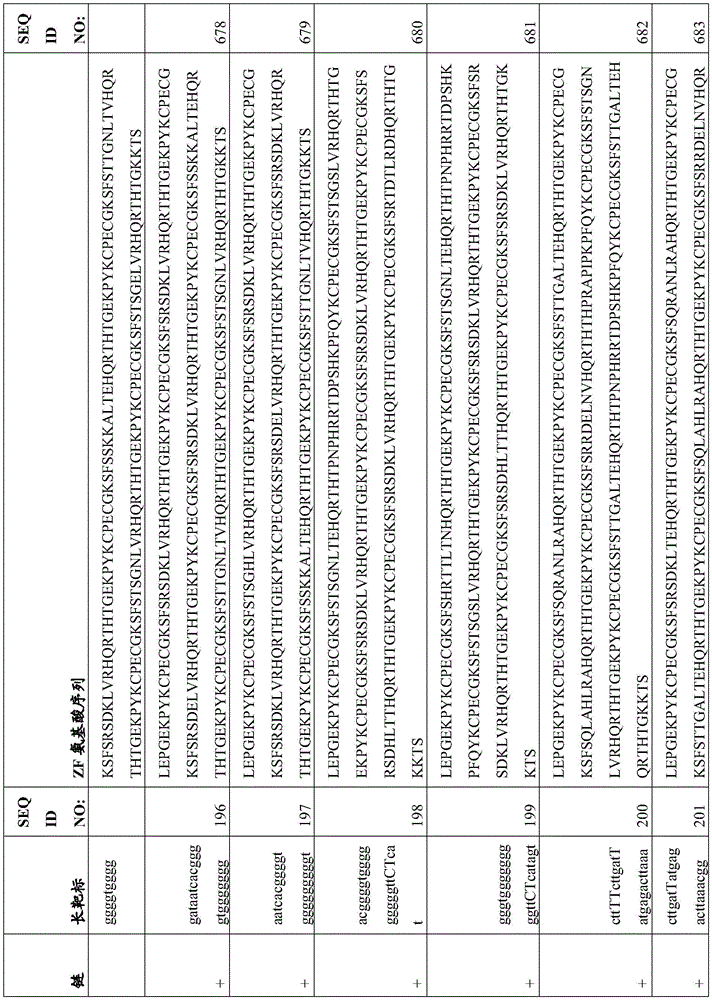


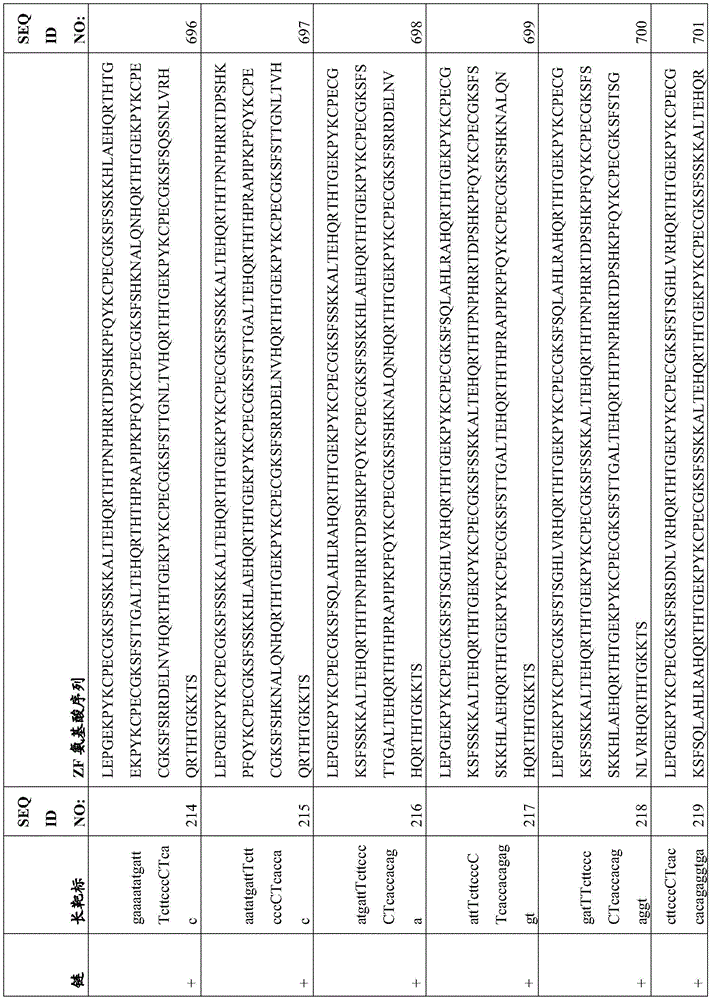


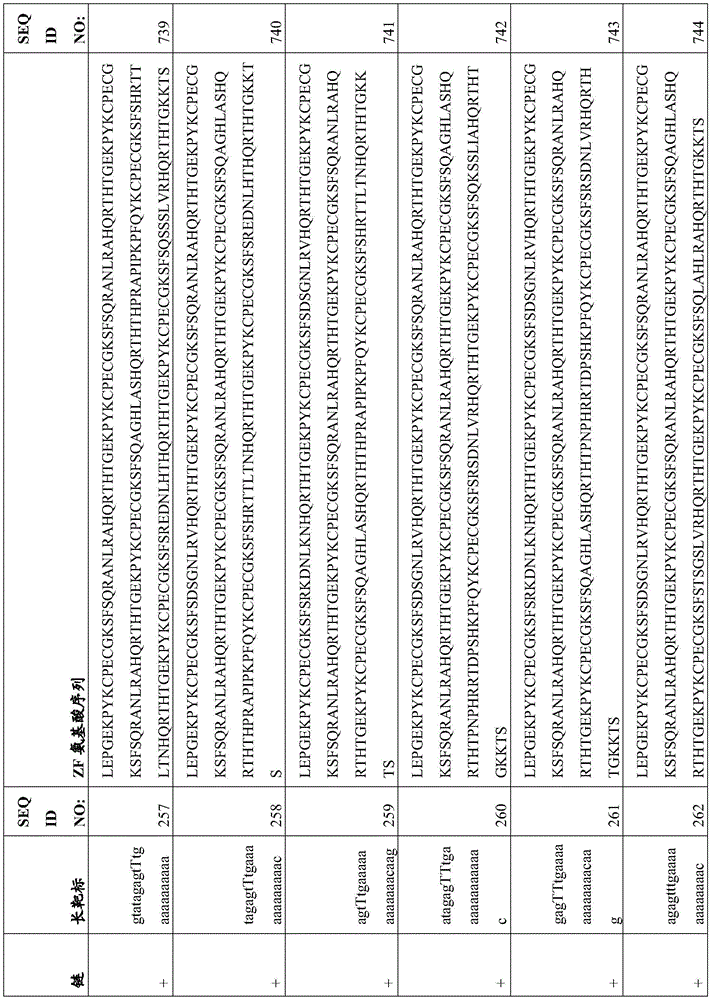
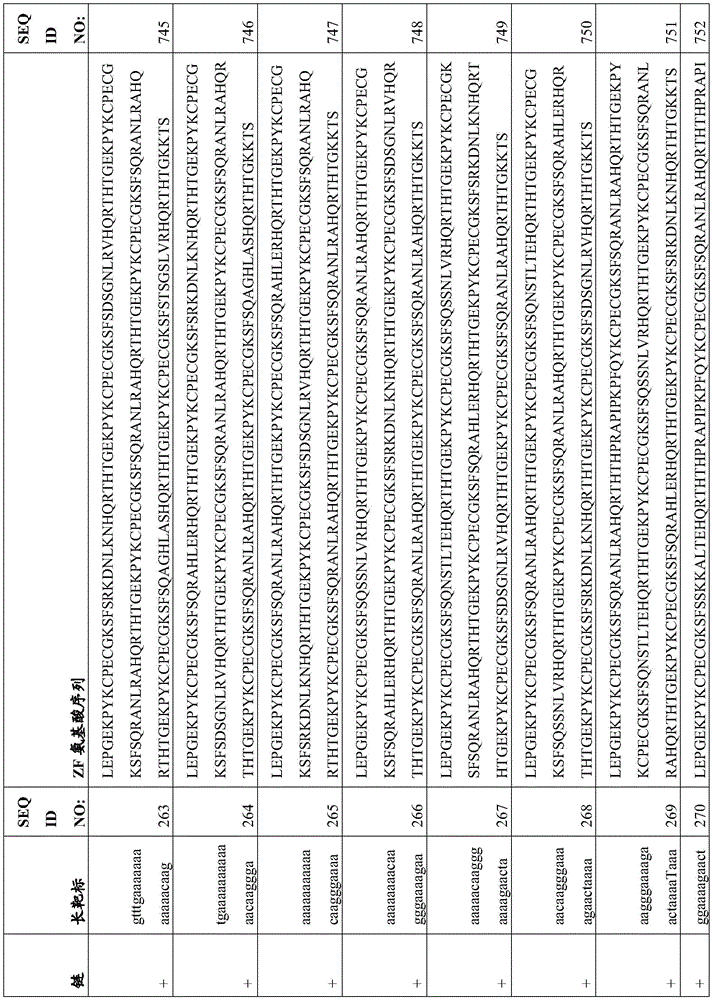


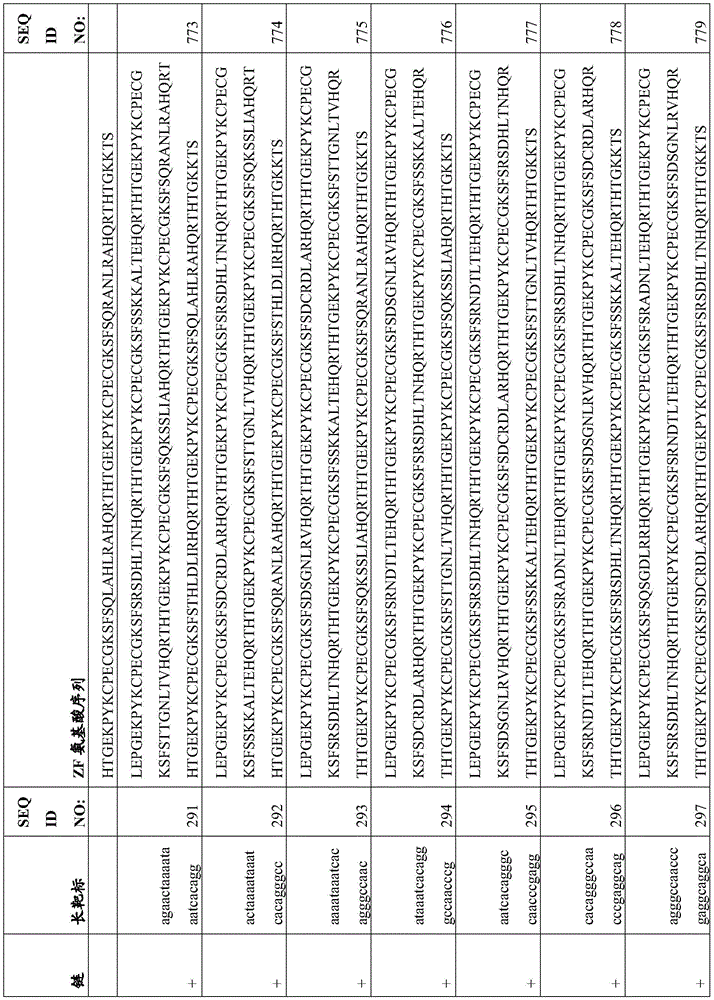
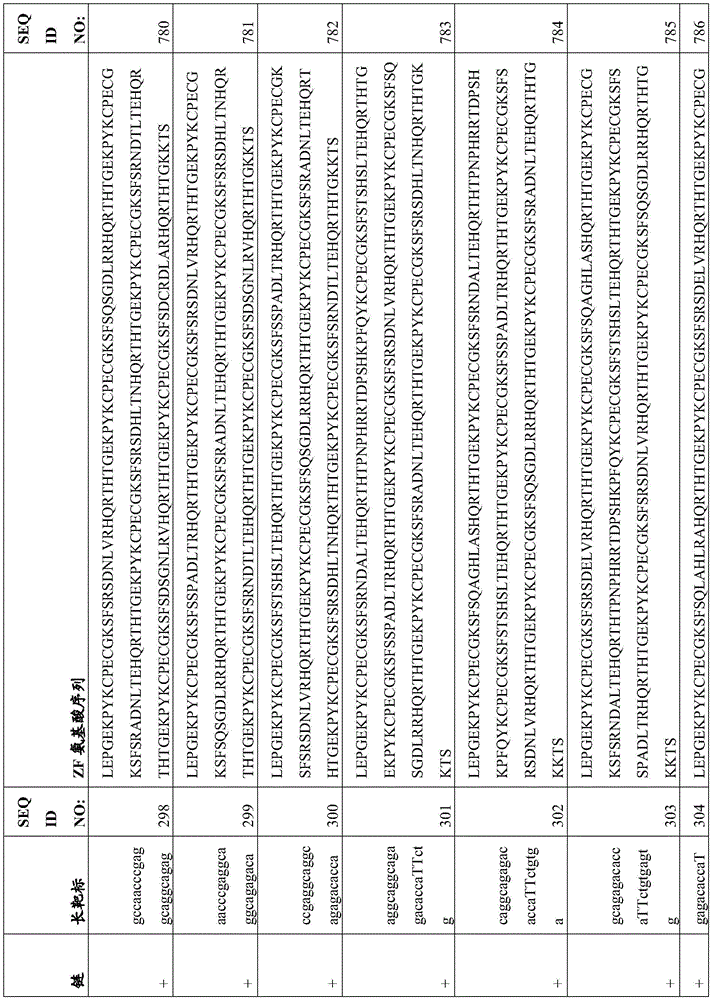
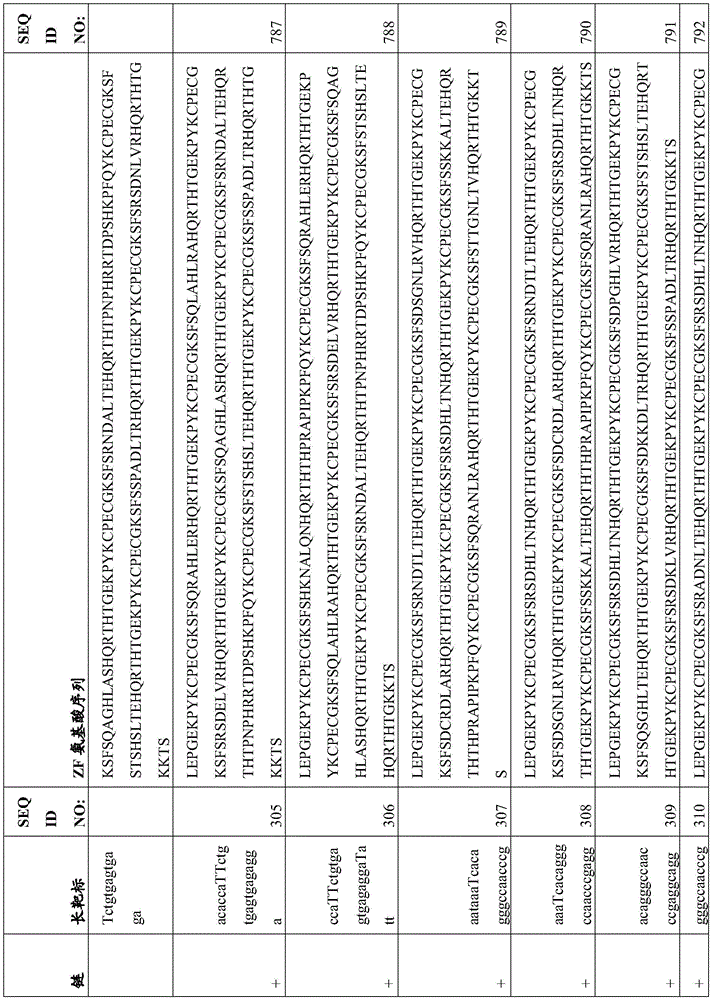
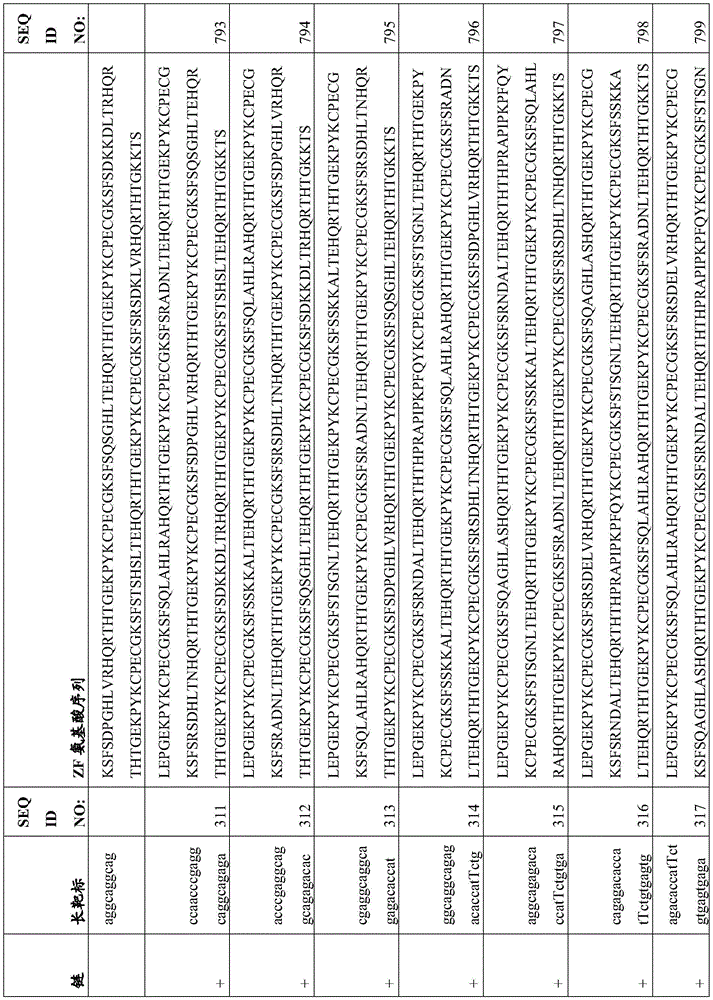


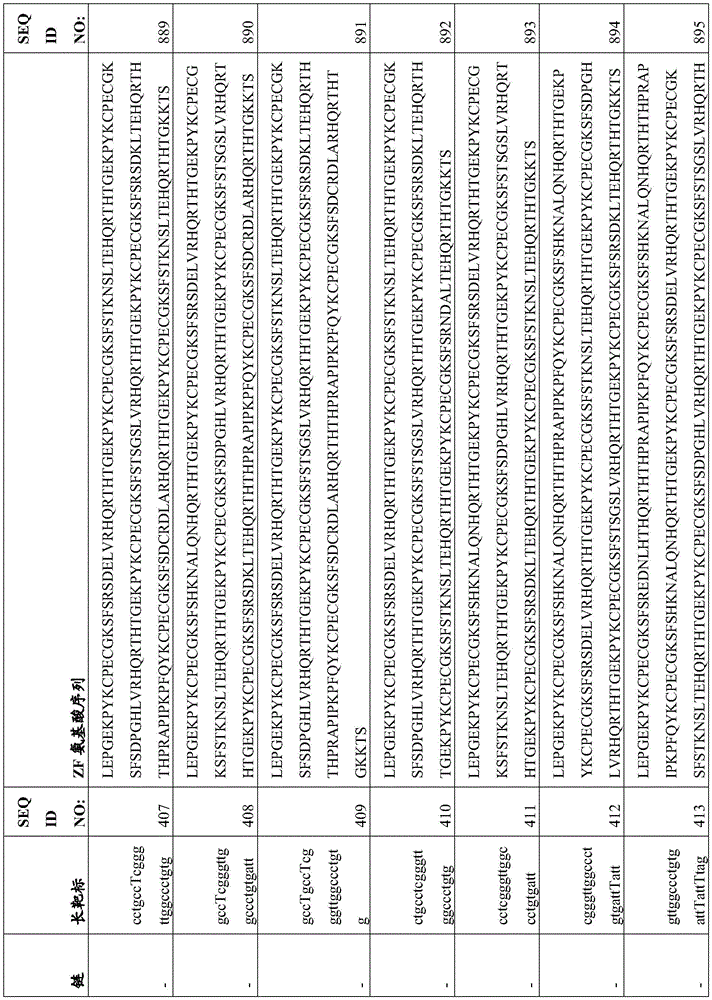


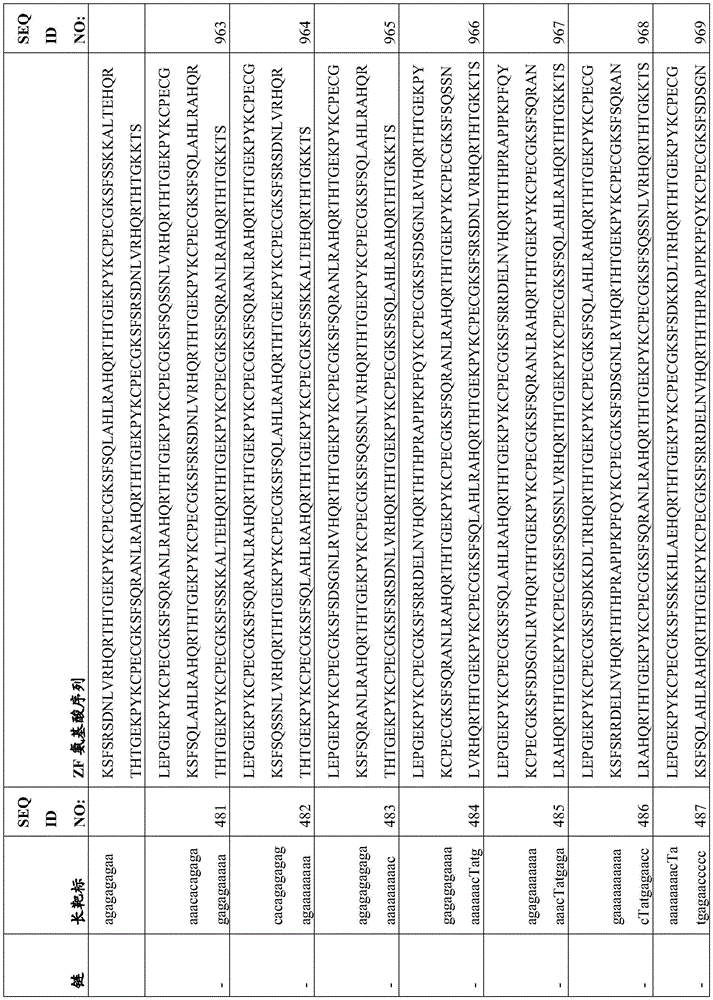


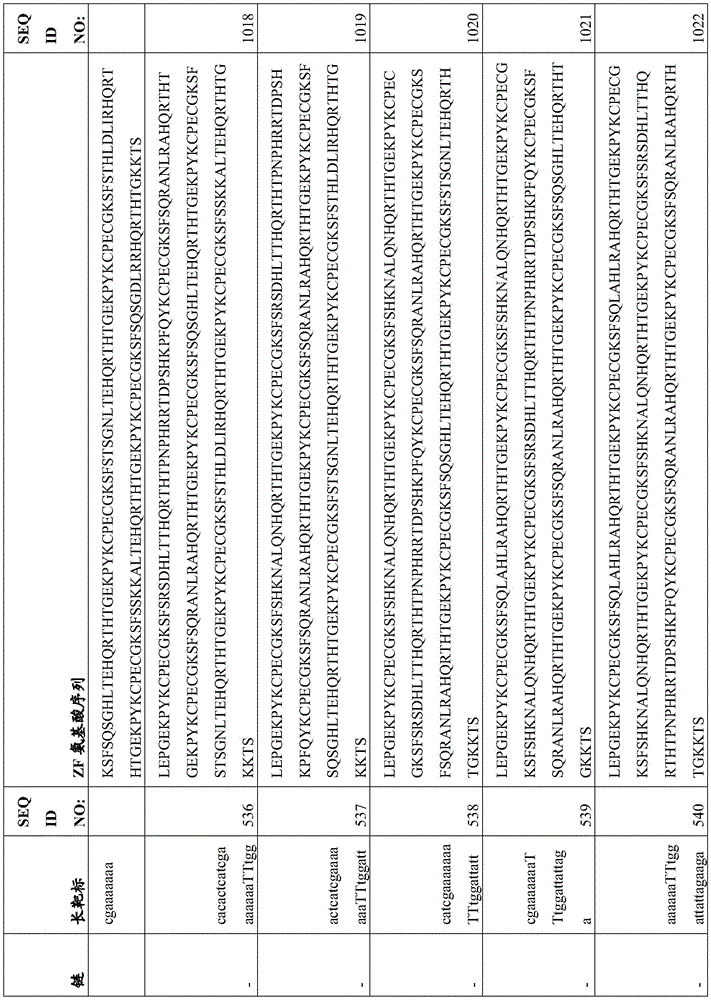
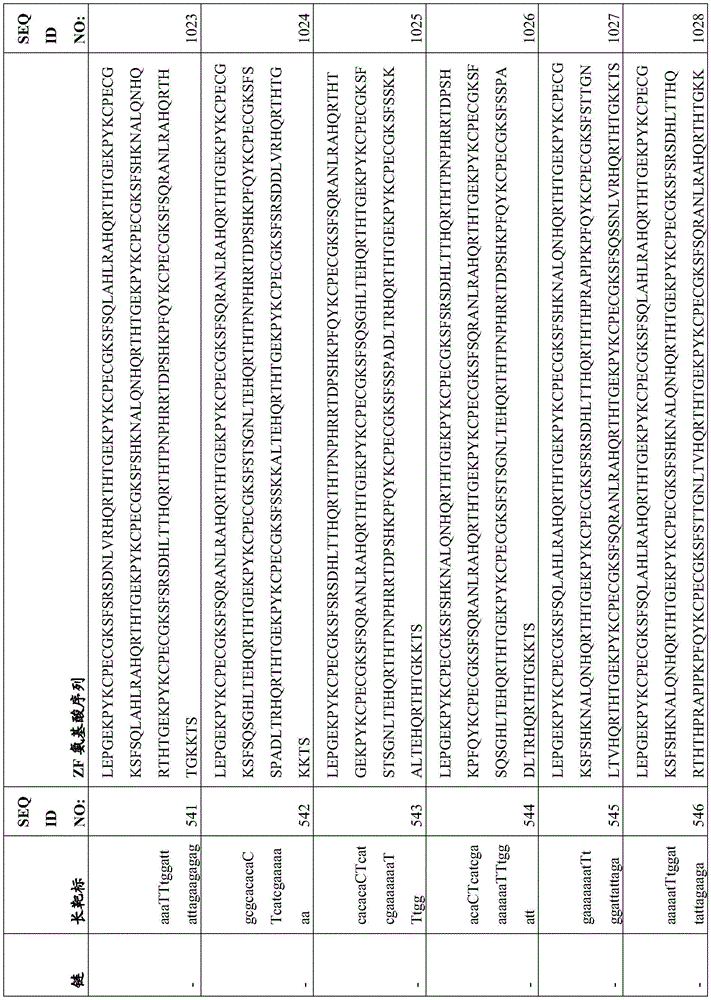
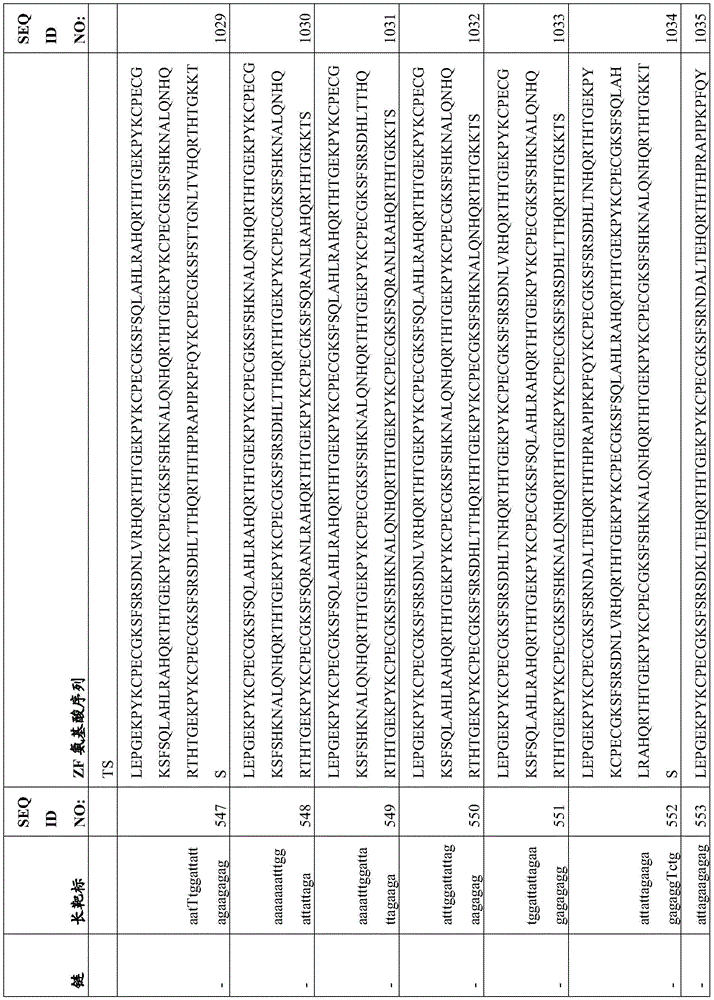


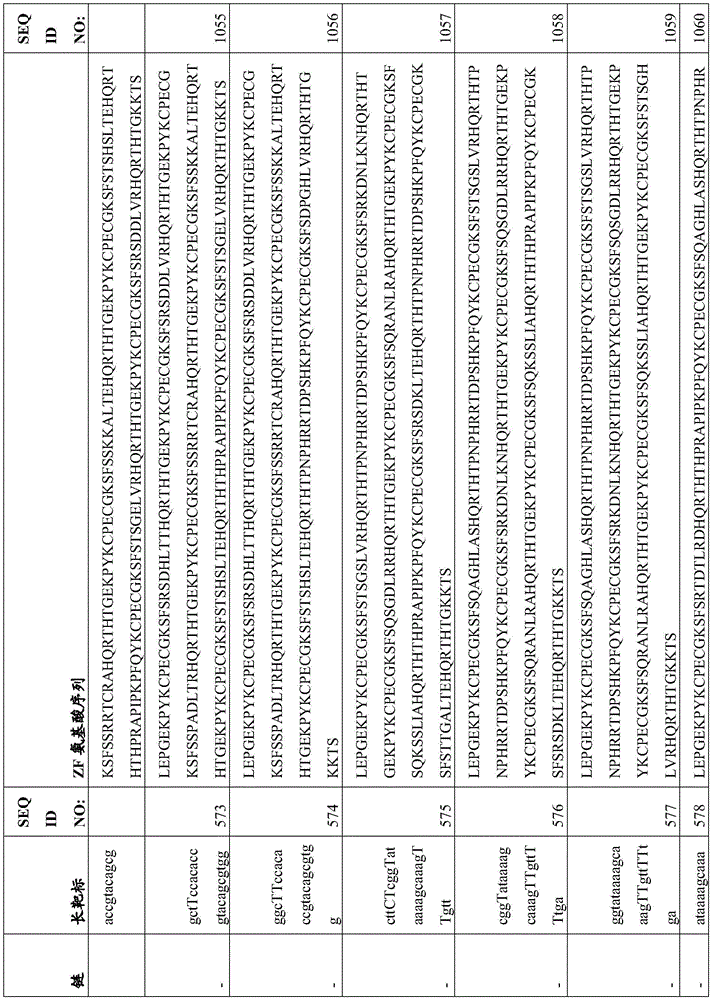


类似地,特异性结合目标DNA靶区域(例如FOXP3表达控制区)的这类TALE多肽的设计和制备是本领域众所周知的。例如,TALE DNA结合域包含重复的高度保守的33-34氨基酸的序列,其具有不同的第12和第13氨基酸。这两个位置(称为重复可变双残基(RVD))是高度可变的,并显示与特定核苷酸识别的强相关性。氨基酸序列和DNA识别之间的这种直接关系允许通过选择含有适当RVD的重复片段的组合来工程化特异性DNA结合域。参见,例如BochJ Nature Biotechnology.29(2)2011:135-6;Boch J等,Science.326(5959)2009:1509-12;Moscou MJ&Bogdanove AJ Science.326(5959)2009:1501。Similarly, the design and preparation of such TALE polypeptides that specifically bind to a target DNA target region (e.g., a FOXP3 expression control region) are well known in the art. For example, the TALE DNA binding domain comprises a repeated sequence of highly conserved 33-34 amino acids with different 12th and 13th amino acids. These two positions, referred to as repeat variable diresidues (RVDs), are highly variable and show a strong correlation with specific nucleotide recognition. This direct relationship between amino acid sequence and DNA recognition allows engineering of specific DNA binding domains by selecting a combination of repeat fragments containing appropriate RVDs. See, e.g., Boch J Nature Biotechnology. 29 (2) 2011: 135-6; Boch J et al., Science. 326 (5959) 2009: 1509-12; Moscou MJ & Bogdanove AJ Science. 326 (5959) 2009: 1501.
在一些实施方案中,包含多核苷酸的本发明的位点特异性FOXP3靶向部分包含指导RNA(或gRNA)或编码指导RNA的核酸。gRNA是包含例如引导效应物至FOXP3表达控制元件所必需的“支架”序列的短合成RNA分子,其可以例如包含靶向含FOXP3表达控制元件的基因组靶序列的约20个核苷酸位点特异性序列。In some embodiments, the site-specific FOXP3 targeting moiety of the present invention comprising a polynucleotide comprises a guide RNA (or gRNA) or a nucleic acid encoding a guide RNA. A gRNA is a short synthetic RNA molecule comprising, for example, a "scaffold" sequence necessary to guide an effector to a FOXP3 expression control element, which may, for example, comprise a site-specific sequence of about 20 nucleotides targeting a genomic target sequence containing a FOXP3 expression control element.
通常,指导RNA序列被设计为具有约17至约24个核苷酸(例如19、20或21个核苷酸)的长度并且与靶序列互补。定制gRNA发生器和算法在商业上可得以用于有效的指导RNA的设计。基因编辑也已使用嵌合“单指导RNA”(“sgRNA”)实现,其为模拟天然存在的crRNA-tracrRNA复合体且包含tracrRNA(用于结合核酸酶)和至少一种crRNA(以引导核酸酶至用于编辑的靶序列)的工程化(合成)单RNA分子。化学修饰的sgNA也已被证实在基因组编辑中是有效的;参见,例如Hendel等(2015)Nature Biotechnol.,985-991。Typically, the guide RNA sequence is designed to have a length of about 17 to about 24 nucleotides (e.g., 19, 20 or 21 nucleotides) and is complementary to the target sequence. Custom gRNA generators and algorithms are commercially available for the design of effective guide RNAs. Gene editing has also been achieved using chimeric "single guide RNA" ("sgRNA"), which is an engineered (synthetic) single RNA molecule that simulates naturally occurring crRNA-tracrRNA complexes and includes tracrRNA (for binding nucleases) and at least one crRNA (to guide nucleases to target sequences for editing). Chemically modified sgNAs have also been shown to be effective in genome editing; see, for example, Hendel et al. (2015) Nature Biotechnol., 985-991.
在某些实施方案中,本发明的位点特异性FOXP3靶向部分包含指导RNA(或gRNA)或编码指导RNA和蛋白质或肽的核酸。在一些实施方案中,蛋白质或肽包含CRISPR相关蛋白(CaS)多肽或其片段(例如,Cas9多肽或其片段)。在一个实施方案中,合适的Cas多肽是无酶活性的Cas多肽,例如“死Cas多肽”或“dCaS”多肽。In certain embodiments, the site-specific FOXP3 targeting moiety of the present invention comprises a guide RNA (or gRNA) or a nucleic acid encoding a guide RNA and a protein or peptide. In some embodiments, the protein or peptide comprises a CRISPR-associated protein (CaS) polypeptide or a fragment thereof (e.g., a Cas9 polypeptide or a fragment thereof). In one embodiment, a suitable Cas polypeptide is an enzymatically inactive Cas polypeptide, such as a "dead Cas polypeptide" or a "dCaS" polypeptide.
包含多核苷酸(例如gRNA)的示例性位点特异性FOXP3靶向部分提供于下表2中。在一些实施方案中,多核苷酸包含与表2中核苷酸序列的任何一个的完整核苷酸序列具有至少75%、至少80%、至少85%、至少86%、至少87%、至少88%、至少89%、至少90%、至少91%、至少92%、至少93%、至少94%、至少95%、至少96%、至少97%、至少98%、至少99%同一性的核苷酸序列。Exemplary site-specific FOXP3 targeting moieties comprising polynucleotides (e.g., gRNAs) are provided below in Table 2. In some embodiments, the polynucleotide comprises a nucleotide sequence that is at least 75%, at least 80%, at least 85%, at least 86%, at least 87%, at least 88%, at least 89%, at least 90%, at least 91%, at least 92%, at least 93%, at least 94%, at least 95%, at least 96%, at least 97%, at least 98%, at least 99% identical to the complete nucleotide sequence of any one of the nucleotide sequences in Table 2.
应当理解,尽管表2中的序列被描述为经修饰的(或未修饰的),但本发明所涵盖的核酸分子(例如位点特异性破坏剂)可以包含表2中所列的未修饰的或与本文所述修饰不同的任何一个序列。还应当理解,尽管表2中的一些序列在用作本发明的位点特异性靶向部分中的RNA分子(例如指导RNA)时具有“Ts”,但“Ts”可被“Us”替代。It should be understood that although the sequences in Table 2 are described as modified (or unmodified), the nucleic acid molecules (e.g., site-specific destroying agents) encompassed by the present invention may include any of the sequences listed in Table 2 that are unmodified or modified differently than described herein. It should also be understood that although some of the sequences in Table 2 have "Ts" when used as RNA molecules (e.g., guide RNAs) in the site-specific targeting moiety of the present invention, "Ts" may be replaced by "Us".
在一些实施方案中,包含多核苷酸(例如gRNA)的位点特异性FOXP3靶向部分包含与锚定序列互补的核苷酸序列。在一个实施方案中,锚定序列包含CTCF结合基序或共有序列:N(T/C/G)N(G/A/T)CC(A/T/G)(C/G)(C/T/A)AG(G/A)(G/T)GG(C/A/T)(G/A)(C/G)(C/T/A)(G/A/C)(SEQ ID NO:1),其中N是任何核苷酸。CTCF结合基序或共有序列也可以是相反取向的,例如(G/A/C)(C/T/A)(C/G)(G/A)(C/A/T)GG(G/T)(G/A)GA(C/T/A)(C/G)(A/T/G)CC(G/A/T)N(T/C/G)N(SEQ ID NO:2)。在一些实施方案中,核酸序列包含与CTCF结合基序或共有序列互补的序列。In some embodiments, the site-specific FOXP3 targeting portion comprising a polynucleotide (e.g., a gRNA) comprises a nucleotide sequence complementary to an anchor sequence. In one embodiment, the anchor sequence comprises a CTCF binding motif or consensus sequence: N(T/C/G)N(G/A/T)CC(A/T/G)(C/G)(C/T/A)AG(G/A)(G/T)GG(C/A/T)(G/A)(C/G)(C/T/A)(G/A/C)(SEQ ID NO: 1), wherein N is any nucleotide. The CTCF binding motif or consensus sequence can also be in the opposite orientation, for example (G/A/C)(C/T/A)(C/G)(G/A)(C/A/T)GG(G/T)(G/A)GA(C/T/A)(C/G)(A/T/G)CC(G/A/T)N(T/C/G)N(SEQ ID NO: 2). In some embodiments, the nucleic acid sequence comprises a sequence that is complementary to a CTCF binding motif or consensus sequence.
在一些实施方案中,多核苷酸包含与锚定序列至少75%、至少80%、至少85%、至少86%、至少87%、至少88%、至少89%、至少90%、至少91%、至少92%、至少93%、至少94%、至少95%、至少96%、至少97%、至少98%、至少99%互补的核苷酸序列。In some embodiments, the polynucleotide comprises a nucleotide sequence that is at least 75%, at least 80%, at least 85%, at least 86%, at least 87%, at least 88%, at least 89%, at least 90%, at least 91%, at least 92%, at least 93%, at least 94%, at least 95%, at least 96%, at least 97%, at least 98%, or at least 99% complementary to an anchor sequence.
在一些实施方案中,多核苷酸包含与CTCF结合基序或共有序列至少80%、至少85%、至少86%、至少87%、至少88%、至少89%、至少90%、至少91%、至少92%、至少93%、至少94%、至少95%、至少96%、至少97%、至少98%、至少99%互补的核苷酸序列。在一些实施方案中,多核苷酸选自由gRNA和与锚定序列互补的序列或包含与锚定序列至少80%、至少85%、至少86%、至少87%、至少88%、至少89%、至少90%、至少91%、至少92%、至少93%、至少94%、至少95%、至少96%、至少97%、至少98%、至少99%互补的序列的序列组成的组。In some embodiments, the polynucleotide comprises a nucleotide sequence that is at least 80%, at least 85%, at least 86%, at least 87%, at least 88%, at least 89%, at least 90%, at least 91%, at least 92%, at least 93%, at least 94%, at least 95%, at least 96%, at least 97%, at least 98%, at least 99% complementary to a CTCF binding motif or consensus sequence. In some embodiments, the polynucleotide is selected from the group consisting of a gRNA and a sequence complementary to an anchor sequence or a sequence comprising a sequence that is at least 80%, at least 85%, at least 86%, at least 87%, at least 88%, at least 89%, at least 90%, at least 91%, at least 92%, at least 93%, at least 94%, at least 95%, at least 96%, at least 97%, at least 98%, at least 99% complementary to an anchor sequence.
在一些实施方案中,包含本发明的多核苷酸的位点特异性FOXP3靶向部分是RNAi分子。RNAi分子包括RNA或RNA样结构,其通常包含15-50个碱基对(例如约18-25个碱基对)并且具有与细胞内表达的靶基因中的编码序列相同(互补)或几乎相同(基本上互补)的核碱基序列。RNAi分子包括但不限于:短干扰RNA(siRNA)、双链RNA(dsRNA)、微RNA(miRNA)、短发夹RNA(shRNA)、部分双链体(meroduplexe)和dicer底物(美国专利号8,084,599、8,349,809和8,513,207)。在一个实施方案中,本发明包括抑制编码本文所述多肽(例如结合成核分子)的基因的表达的组合物。In some embodiments, the site-specific FOXP3 targeting portion comprising the polynucleotide of the present invention is an RNAi molecule. The RNAi molecule includes an RNA or RNA-like structure, which generally comprises 15-50 base pairs (e.g., about 18-25 base pairs) and has a nuclear base sequence that is identical (complementary) or almost identical (substantially complementary) to the coding sequence in the target gene expressed in the cell. RNAi molecules include, but are not limited to: short interfering RNA (siRNA), double-stranded RNA (dsRNA), microRNA (miRNA), short hairpin RNA (shRNA), partial duplex (meroduplexe) and dicer substrate (U.S. Patent Nos. 8,084,599, 8,349,809 and 8,513,207). In one embodiment, the present invention includes a composition for inhibiting the expression of a gene encoding a polypeptide described herein (e.g., in combination with a nucleating molecule).
RNAi分子包含与靶基因的全部或片段基本上互补或完全互补的序列。RNAi分子可以在内含子和外显子之间的边界处补充序列,以防止新产生的特定基因的核RNA转录物成熟为用于转录的mRNA。与特定基因互补的RNAi分子可与该基因的mRNA杂交并阻止其翻译。反义分子可以是DNA、RNA或其衍生物或杂合物。这种衍生分子的示例包括但不限于肽核酸(PNA)和基于硫代磷酸酯的分子,例如脱氧核糖核酸胍(DNG)或核糖核酸胍(R G)。RNAi molecules include sequences that are substantially complementary or fully complementary to the whole or fragment of the target gene. RNAi molecules can supplement sequences at the border between introns and exons to prevent the nuclear RNA transcripts of newly generated specific genes from maturing into mRNA for transcription. RNAi molecules complementary to specific genes can hybridize with the mRNA of the gene and prevent its translation. Antisense molecules can be DNA, RNA or its derivatives or heterocomplexes. Examples of such derivative molecules include, but are not limited to, peptide nucleic acids (PNA) and molecules based on thiophosphates, such as deoxyribonucleic acid guanidine (DNG) or ribonucleic acid guanidine (RG).
RNAi分子可以作为体外合成的“即用型”RNA或作为转染至细胞内的反义基因(其在转录后将产生RNAi分子)提供给细胞。与mRNA的杂交导致通过RNAse H降解杂交分子和/或抑制翻译复合体的形成。两者都导致不能产生原始基因的产物。RNAi molecules can be provided to cells as "ready-to-use" RNA synthesized in vitro or as antisense genes transfected into cells (which will produce RNAi molecules after transcription). Hybridization with mRNA leads to degradation of hybrid molecules by RNAse H and/or inhibition of the formation of translation complexes. Both lead to the inability to produce the product of the original gene.
与目标转录物杂交的RNAi分子的长度应为约10个核苷酸,约15或30个核苷酸之间,或约15、16、17、18、19、20、21、22、23、24、25、26、27、28、29、30或更多个核苷酸。反义序列与靶向的转录物的同一性程度应为至少75%、至少80%、至少85%、至少90%或至少95%。The length of the RNAi molecule that hybridizes to the target transcript should be about 10 nucleotides, between about 15 or 30 nucleotides, or about 15, 16, 17, 18, 19, 20, 21, 22, 23, 24, 25, 26, 27, 28, 29, 30 or more nucleotides. The degree of identity of the antisense sequence to the targeted transcript should be at least 75%, at least 80%, at least 85%, at least 90%, or at least 95%.
RNAi分子还可以包含突出端,即通常不成对的突出核苷酸,其不直接参与由本文定义的有义链和反义链对的核心序列正常形成的双螺旋结构。RNAi分子可在每个有义链和反义链上独立包含约1-5个碱基的3’和/或5’突出端。在一个实施方案中,有义链和反义链均包含3’和5’突出端。在一个实施方案中,一条链的一个或多个3’突出端核苷酸与另一条链的一个或多个5’突出端核苷酸配对。在另一个实施方案中,一条链碱基的一个或多个3’突出端核苷酸不与另一条链的一个或多个5’突出端核苷酸配对。RNAi分子的有义链和反义链可包含或不包含相同数目的核苷酸碱基。反义链和有义链可形成双链体,其中仅5’端具有平端,仅3’端具有平端,5’端和3’端均为平端,或5’端和3’端均不是平端。在另一个实施方案中,突出端中一个或多个核苷酸包含硫代磷酸、硫代磷酸酯、脱氧核苷酸反向(3’-3’连接)核苷酸或是经修饰的核糖核苷酸或脱氧核苷酸。RNAi molecules can also include overhangs, i.e., usually unpaired overhanging nucleotides that do not directly participate in the double helix structure normally formed by the core sequence of the sense strand and antisense strand pair defined herein. RNAi molecules can independently include 3' and/or 5' overhangs of about 1-5 bases on each sense strand and antisense strand. In one embodiment, the sense strand and antisense strand both include 3' and 5' overhangs. In one embodiment, one or more 3' overhanging nucleotides of one strand are paired with one or more 5' overhanging nucleotides of the other strand. In another embodiment, one or more 3' overhanging nucleotides of a strand base are not paired with one or more 5' overhanging nucleotides of the other strand. The sense strand and antisense strand of the RNAi molecule may or may not include the same number of nucleotide bases. The antisense strand and the sense strand can form a duplex, wherein only the 5' end has a blunt end, only the 3' end has a blunt end, both the 5' end and the 3' end are blunt ends, or both the 5' end and the 3' end are not blunt ends. In another embodiment, one or more nucleotides in the overhang comprise phosphorothioate, phosphorothioate, deoxynucleotide inverted (3'-3' linkage) nucleotides, or modified ribonucleotides or deoxynucleotides.
小干扰RNA(siRNA)分子包含与靶mRNA的约15至约25个连续核苷酸相同的核苷酸序列。在一些实施方案中,siRNA序列从二核苷酸AA开始,包含约30-70%(约50-60%、约40-60%、或约45%-55%)的GC含量,并且与其引入其中的哺乳动物基因组中除靶标以外的任何核苷酸序列不具有高百分比同一性,例如通过标准BLAST检索确定。Small interfering RNA (siRNA) molecules comprise a nucleotide sequence identical to about 15 to about 25 consecutive nucleotides of a target mRNA. In some embodiments, the siRNA sequence begins with the dinucleotide AA, comprises a GC content of about 30-70% (about 50-60%, about 40-60%, or about 45%-55%), and does not have a high percentage identity to any nucleotide sequence other than the target in the mammalian genome into which it is introduced, as determined, for example, by a standard BLAST search.
siRNA和shRNA类似于内源性微RNA(miRNA)基因的加工途径中的中间体(Bartel,Cell 116:281-297,2004)。在一些实施方案中,siRNA可作为miRNA发挥作用且反之亦然(Zeng等,Mol Cell 9:1327-1333,2002;Doench等,Genes Dev 17:438-442,2003)。与siRNA类似,微RNA使用RISC以下调靶基因,但与siRNA不同,大多数动物miRNA不切割mRNA。相反,miRNA通过翻译抑制或polyA去除和mRNA降解减少蛋白质输出(Wu等,Proc Natl Acad SciUSA 103:4034-4039,2006)。已知的miRNA结合位点在mRNA 3’UTR内;miRNA似乎靶向与miRNA 5’末端的核苷酸2-8几乎完全互补的位点(Rajewsky,Nat Genet 38Suppl:S8-13,2006;Lim等,Nature 433:769-773,2005)。该区域被称为种子区域。因为siRNA和miRNA是可互换的,外源性siRNA下调具有与siRNA的种子互补性的mRNA(Birmingham等,Nat Methods3:199-204,2006)。3’UTR内的多个靶位点给出更强的下调(Doench等,Genes Dev 17:438-442,2003)。siRNA and shRNA are similar to intermediates in the processing pathway of endogenous microRNA (miRNA) genes (Bartel, Cell 116: 281-297, 2004). In some embodiments, siRNA can function as miRNA and vice versa (Zeng et al., Mol Cell 9: 1327-1333, 2002; Doench et al., Genes Dev 17: 438-442, 2003). Similar to siRNA, microRNA uses RISC to downregulate target genes, but unlike siRNA, most animal miRNAs do not cut mRNA. Instead, miRNA reduces protein output by translation inhibition or polyA removal and mRNA degradation (Wu et al., Proc Natl Acad Sci USA 103: 4034-4039, 2006). The known miRNA binding site is within the mRNA 3'UTR; miRNAs appear to target sites that are almost completely complementary to nucleotides 2-8 at the 5' end of the miRNA (Rajewsky, Nat Genet 38 Suppl: S8-13, 2006; Lim et al., Nature 433: 769-773, 2005). This region is called the seed region. Because siRNA and miRNA are interchangeable, exogenous siRNAs downregulate mRNAs that have seed complementarity with siRNAs (Birmingham et al., Nat Methods 3: 199-204, 2006). Multiple target sites within the 3'UTR give stronger downregulation (Doench et al., Genes Dev 17: 438-442, 2003).
已知的miRNA序列的列表可以在由研究组织维护的数据库中找到,例如WellcomeTrust Sanger Institute、Perm Center for Bioinformatics、Memorial SloanKettering Cancer Center和European Molecule Biology Laboratory等。已知的有效siRNA序列和同源结合位点也在相关文献中充分描述。通过本领域内已知的技术容易地设计和生产RNAi分子。此外,存在增加发现有效且特异性序列基序的机会的计算工具(Pei等,2006;Reynolds等,2004;Khvorova等,2003;Schwarz等,2003;Ui-Tei等,2004;Heale等,2005;Chalk等,2004;Amarzguioui等,2004)。Lists of known miRNA sequences can be found in databases maintained by research organizations, such as Wellcome Trust Sanger Institute, Perm Center for Bioinformatics, Memorial Sloan Kettering Cancer Center, and European Molecule Biology Laboratory. Known effective siRNA sequences and homologous binding sites are also fully described in the relevant literature. RNAi molecules are easily designed and produced by techniques known in the art. In addition, there are computational tools (Pei et al., 2006; Reynolds et al., 2004; Khvorova et al., 2003; Schwarz et al., 2003; Ui-Tei et al., 2004; Heale et al., 2005; Chalk et al., 2004; Amarzguioui et al., 2004) that increase the chance of finding effective and specific sequence motifs.
RNAi分子调节由基因编码的RNA的表达。因为多个基因可以相互共享一定程度的序列同源性,在一些实施方案中,RNAi分子可以被设计为靶向具有足够序列同源性的一类基因。在一些实施方案中,RNAi分子可包含与在不同基因靶标之间共有的或对特定基因靶标独特的序列互补的序列。在一些实施方案中,RNAi分子可被设计为靶向在若干基因之间具有同源性的RNA序列的保守区,从而靶向基因家族中的若干基因(例如不同的基因异构体、剪接变体、突变基因等)。在一些实施方案中,RNAi分子可被设计为靶向单一基因的特定RNA序列所特有的序列。RNAi molecules regulate the expression of RNA encoded by genes. Because multiple genes can share a certain degree of sequence homology with each other, in some embodiments, RNAi molecules can be designed to target a class of genes with enough sequence homology. In some embodiments, RNAi molecules can include sequences complementary to sequences shared between different gene targets or to specific gene targets unique. In some embodiments, RNAi molecules can be designed to target the conserved regions of RNA sequences with homology between several genes, thereby targeting several genes (such as different gene isomers, splice variants, mutant genes, etc.) in gene families. In some embodiments, RNAi molecules can be designed to target sequences unique to specific RNA sequences of single genes.
在一些实施方案中,RNAi分子靶向结合成核分子(例如CTCF、黏连蛋白、USF1、YY1、TATA-盒结合蛋白相关因子3(TAF3)、ZNF143)中的序列,或促进锚定序列介导的结合体的形成的另一多肽,或表观遗传修饰剂,例如参与翻译后修饰的酶,其包括但不限于DNA甲基化酶(例如DNMT3a、DNMT3b、DNMTL),DNA去甲基化酶(例如催化5-甲基胞嘧啶氧化成5-羟甲基胞嘧啶和更高级氧化衍生物的TET家族酶),组蛋白甲基转移酶,组蛋白脱乙酰酶(例如HDAC1、HDAC2、HDAC3),去乙酰化酶1、2、3、4、5、6或7,赖氨酸特异性组蛋白去甲基化酶1(LSD1),组蛋白-赖氨酸-N-甲基转移酶(Setdbl),常染色质组蛋白-赖氨酸N-甲基转移酶2(G9a),组蛋白-赖氨酸N-甲基转移酶(SUV39H1),zeste同源物2增强子(EZH2),病毒赖氨酸甲基转移酶(vSET),组蛋白甲基转移酶(SET2),蛋白质-赖氨酸N-甲基转移酶(SMYD2)等。在一个实施方案中,RNAi分子靶向蛋白质脱乙酰酶,例如去乙酰化酶1、2、3、4、5、6或7。在一个实施方案中,本发明包括包含靶向结合成核分子(例如CTCF)的RNAi的组合物。In some embodiments, the RNAi molecule targets a sequence in a nuclear binding molecule (e.g., CTCF, cohesin, USF1, YY1, TATA-box binding protein-associated factor 3 (TAF3), ZNF143), or another polypeptide that promotes the formation of an anchor sequence-mediated binding body, or an epigenetic modifier, such as an enzyme involved in post-translational modification, including but not limited to DNA methylases (e.g., DNMT3a, DNMT3b, DNMTL), DNA demethylases (e.g., TET family enzymes that catalyze the oxidation of 5-methylcytosine to 5-hydroxymethylcytosine and higher oxidized derivatives), histone methyltransferases , histone deacetylase (e.g., HDAC1, HDAC2, HDAC3),
在一些实施方案中,位点特异性FOXP3靶向部分包含肽或蛋白质部分。在一些实施方案中,位点特异性破坏剂包含融合蛋白。在一些实施方案中,效应物是肽或蛋白质部分。肽或蛋白质部分可包括但不限于肽配体、抗体片段、或结合受体(如细胞外受体)的靶向适体、神经肽、激素肽、肽药物、毒性肽、病毒或微生物肽、合成肽和激动剂或拮抗剂肽。In some embodiments, the site-specific FOXP3 targeting moiety comprises a peptide or protein moiety. In some embodiments, the site-specific destructive agent comprises a fusion protein. In some embodiments, the effector is a peptide or protein moiety. The peptide or protein moiety may include, but is not limited to, a peptide ligand, an antibody fragment, or a targeting aptamer that binds to a receptor (such as an extracellular receptor), a neuropeptide, a hormone peptide, a peptide drug, a toxic peptide, a viral or microbial peptide, a synthetic peptide, and an agonist or antagonist peptide.
示例性肽或蛋白质包括DNA结合蛋白、CRISPR组分蛋白、结合成核分子、显性负性结合成核分子、表观遗传修饰剂或其任何组合。在一些实施方案中,肽包括核酸酶、物理阻断剂、表观遗传募集剂和表观遗传CpG修饰剂及前述的任何片段和组合。在一些实施方案中,肽包括蛋白质的DNA结合域,例如螺旋-转角-螺旋基序、亮氨酸拉链、Zn-指、TATA盒结合蛋白、转录因子。Exemplary peptides or proteins include DNA binding proteins, CRISPR component proteins, binding nucleation molecules, dominant negative binding nucleation molecules, epigenetic modifiers, or any combination thereof. In some embodiments, peptides include nucleases, physical blockers, epigenetic recruiters, and epigenetic CpG modifiers, and any fragments and combinations of the foregoing. In some embodiments, peptides include DNA binding domains of proteins, such as helix-turn-helix motifs, leucine zippers, Zn-fingers, TATA box binding proteins, transcription factors.
肽或蛋白质可以是直链或支链的。肽或蛋白质部分可具有约5至约200个氨基酸、约15至约150个氨基酸、约20至约125个氨基酸、约25至约100个氨基酸、约20-70个氨基酸、约20-80个氨基酸、约20-90个氨基酸、约30-100个氨基酸、约30-60个氨基酸、约30-80个氨基酸、约35-85个氨基酸、约40-100个氨基酸、或约50-125个氨基酸或其间的任何范围的长度。The peptide or protein can be linear or branched. The peptide or protein portion can have a length of about 5 to about 200 amino acids, about 15 to about 150 amino acids, about 20 to about 125 amino acids, about 25 to about 100 amino acids, about 20-70 amino acids, about 20-80 amino acids, about 20-90 amino acids, about 30-100 amino acids, about 30-60 amino acids, about 30-80 amino acids, about 35-85 amino acids, about 40-100 amino acids, or about 50-125 amino acids or any range therebetween.
如上所述,在一些实施方案中,本发明的位点特异性FOXP3靶向部分包含融合蛋白。As described above, in some embodiments, the site-specific FOXP3 targeting moiety of the invention comprises a fusion protein.
在一些实施方案中,本发明的融合蛋白包括靶向FOXP3表达控制区的位点特异性FOXP3靶向部分和效应物分子。在其他实施方案中,本发明的融合蛋白包含效应物分子。示例性效应物分子如下文所述且在一些实施方案中包括例如核酸酶、物理阻断剂、表观遗传募集剂(例如转录增强子或转录阻遏物)和表观遗传CpG修饰剂(例如DNA甲基化酶、DNA去甲基化酶、组蛋白修饰剂、组蛋白转乙酰酶或组蛋白脱乙酰酶)及前述的任何组合。In some embodiments, the fusion protein of the present invention includes a site-specific FOXP3 targeting portion and an effector molecule targeting a FOXP3 expression control region. In other embodiments, the fusion protein of the present invention includes an effector molecule. Exemplary effector molecules are described below and include, for example, nucleases, physical blockers, epigenetic recruiting agents (e.g., transcription enhancers or transcription repressors) and epigenetic CpG modifiers (e.g., DNA methylases, DNA demethylases, histone modifiers, histone transacetylases or histone deacetylases) and any combination of the foregoing in some embodiments.
例如,位点特异性靶向部分可包含gRNA和效应物,例如核酸酶,例如Cas9,例如野生型Cas9、切口酶Cas9(例如Cas9 D10A)、死亡Cas9(dCas9)、eSpCas9、Cpf1、C2C1或C2C3、或编码此类核酸酶的核酸。核酸酶和gRNA的选择取决于靶向的突变是否为核苷酸的缺失、取代或添加,例如对靶序列的核苷酸的缺失、取代或添加。无催化活性的核酸内切酶(例如死亡Cas9(dCas9,例如D10A;H840A))与(一个或多个)效应物结构域的全部或一部分(例如生物活性部分)拴系的融合产生嵌合蛋白,所述嵌合蛋白可通过一个或多个RNA序列(例如DNA识别元件,其包括但不限于锌指阵列、sgRNA、TAL阵列、本文所述肽核酸)连接至多肽以将组合物引导至特定DNA位点,从而调节一个或多个靶核酸序列的活性和/或表达(例如使DNA序列甲基化或去甲基化)。For example, the site-specific targeting moiety may comprise a gRNA and an effector, such as a nuclease, such as Cas9, such as wild-type Cas9, nickase Cas9 (e.g., Cas9 D10A), dead Cas9 (dCas9), eSpCas9, Cpf1, C2C1 or C2C3, or a nucleic acid encoding such a nuclease. The selection of the nuclease and gRNA depends on whether the targeted mutation is a deletion, substitution or addition of nucleotides, such as a deletion, substitution or addition of nucleotides to the target sequence. The fusion of a catalytically inactive endonuclease (e.g., dead Cas9 (dCas9, e.g., D10A; H840A)) tethered to all or a portion of (one or more) effector domains (e.g., a biologically active portion) produces a chimeric protein, which can be connected to a polypeptide by one or more RNA sequences (e.g., DNA recognition elements, including but not limited to zinc finger arrays, sgRNAs, TAL arrays, peptide nucleic acids described herein) to guide the composition to a specific DNA site, thereby regulating the activity and/or expression of one or more target nucleic acid sequences (e.g., methylating or demethylating a DNA sequence).
在一个实施方案中,本发明的融合蛋白可包含效应物分子,其包含例如CRISPR相关蛋白(Cas)多肽或其片段(例如Cas9多肽或其片段)和表观遗传募集剂或表观遗传CpG修饰剂。In one embodiment, the fusion protein of the present invention may comprise an effector molecule comprising, for example, a CRISPR-associated protein (Cas) polypeptide or a fragment thereof (eg, a Cas9 polypeptide or a fragment thereof) and an epigenetic recruiter or an epigenetic CpG modifier.
在一个实施方案中,合适的Cas多肽是无酶活性的Cas多肽,例如“死Cas多肽”或“dCas”多肽。In one embodiment, a suitable Cas polypeptide is an enzymatically inactive Cas polypeptide, such as a "dead Cas polypeptide" or "dCas" polypeptide.
适用于本文所述方法和组合物的示例性Cas多肽如下所述。使用本领域已知的方法,Cas多肽可与本文所述多种试剂和/或分子中的任何一种融合;这样得到的融合物分子可用于多种公开的方法。Exemplary Cas polypeptides suitable for use in the methods and compositions described herein are described below. Using methods known in the art, Cas polypeptides can be fused to any of the various agents and/or molecules described herein; the resulting fusion molecules can be used in a variety of disclosed methods.
在一个方面,本发明包括包含蛋白质及与将蛋白质靶向位点特异性靶序列的至少一种指导RNA(gRNA)或反义DNA寡核苷酸组合的组合物,所述蛋白质包含作用于DNA的结构域(例如效应物)(例如核酸酶结构域,例如Cas9结构域,例如dCas9结构域;DNA甲基转移酶、去甲基化酶、脱氨酶),其中所述组合物在人细胞中有效改变靶基因的表达。在一些实施方案中,酶结构域是Cas9或dCas9。在一些实施方案中,蛋白质包含两个酶结构域,例如dCas9和甲基化酶或去甲基化酶结构域。In one aspect, the present invention includes a composition comprising a protein and at least one guide RNA (gRNA) or antisense DNA oligonucleotide combination that targets the protein to a site-specific target sequence, the protein comprising a domain (e.g., effector) acting on DNA (e.g., a nuclease domain, e.g., a Cas9 domain, e.g., a dCas9 domain; DNA methyltransferase, demethylase, deaminase), wherein the composition effectively changes the expression of the target gene in human cells. In some embodiments, the enzyme domain is Cas9 or dCas9. In some embodiments, the protein comprises two enzyme domains, e.g., dCas9 and a methylase or demethylase domain.
在一个方面,本发明包括包含蛋白质及与将蛋白质靶向位点特异性靶序列的至少一种指导RNA(gRNA)或反义DNA寡核苷酸组合的组合物,所述蛋白质包含含有转录控制元件的结构域(例如效应物)(例如核酸酶结构域,例如Cas9结构域,例如dCas9结构域;转录增强子;转录阻遏物),其中所述组合物在人细胞中有效改变靶基因的表达。在一些实施方案中,酶结构域是Cas9或dCas9。在一些实施方案中,蛋白质包含两个酶结构域,例如dCas9和转录增强子或转录阻遏物结构域。In one aspect, the invention includes a composition comprising a protein and at least one guide RNA (gRNA) or antisense DNA oligonucleotide that targets the protein to a site-specific target sequence, wherein the protein comprises a domain (e.g., an effector) containing a transcriptional control element (e.g., a nuclease domain, such as a Cas9 domain, such as a dCas9 domain; a transcription enhancer; a transcription repressor), wherein the composition effectively changes the expression of a target gene in a human cell. In some embodiments, the enzyme domain is Cas9 or dCas9. In some embodiments, the protein comprises two enzyme domains, such as dCas9 and a transcription enhancer or transcription repressor domain.
如本文所用,“效应物结构域的生物活性部分”是维持效应物结构域的功能(例如完全地、部分地、最低限度地)的部分(例如“最小”或“核心”结构域)。As used herein, a "biologically active portion of an effector domain" is a portion (eg, a "minimal" or "core" domain) that maintains the function of the effector domain (eg, completely, partially, minimally).
本文所述的嵌合蛋白还可以包含接头,例如氨基酸接头。在一些方面,接头包含2个或更多个氨基酸,例如一个或多个GS序列。在一些方面,Cas9(例如dCas9)与两个或更多个效应物结构域(例如,DNA甲基化酶或在DNA去甲基化中起作用的酶或蛋白乙酰转移酶或脱乙酰酶)的融合包括在结构域之间的一个或多个散布的接头(例如GS接头)。在一些方面,dCas9与具有散布的接头的2-5效应物结构域融合。Chimeric protein as described herein can also include a joint, such as an amino acid joint. In some aspects, the joint includes 2 or more amino acids, such as one or more GS sequences. In some aspects, Cas9 (such as dCas9) and two or more effector domains (for example, DNA methylase or an enzyme or protein acetyltransferase or deacetylase that works in DNA demethylation) fusion include one or more interspersed joints (such as GS joints) between the domains. In some aspects, dCas9 is fused to 2-5 effector domains with interspersed joints.
在一些实施方案中,位点特异性FOXP3靶向部分包含结合成核分子、编码结合成核分子的核酸或其组合。在一些实施方案中,锚定序列介导的结合体通过结合至第一锚定序列的第一结合成核分子、结合至非邻接的第二锚定序列的第二结合成核分子以及第一和第二结合成核分子之间的缔合介导。在一些实施方案中,结合成核分子可以例如通过竞争性结合(内源性结合成核分子与其结合位点的结合)破坏。In some embodiments, the site-specific FOXP3 targeting moiety comprises a binding nucleation molecule, a nucleic acid encoding a binding nucleation molecule, or a combination thereof. In some embodiments, the anchor sequence-mediated binding is mediated by a first binding nucleation molecule bound to a first anchor sequence, a second binding nucleation molecule bound to a non-adjacent second anchor sequence, and an association between the first and second binding nucleation molecules. In some embodiments, the binding nucleation molecule can be destroyed, for example, by competitive binding (binding of an endogenous binding nucleation molecule to its binding site).
结合成核分子可以是例如CTCF、黏连蛋白、USF1、YY1、TATA-盒结合蛋白相关因子3(TAF3)、ZNF143结合基序或促进锚定序列介导的结合体形成的另一种多肽。结合成核分子可以是内源多肽或其他蛋白质,例如转录因子,例如自身免疫调节剂(AIRE),另一种因子,例如X-失活特异性转录物(XIST),或被工程化以识别特定目标DNA序列的工程化多肽,例如具有锌指、亮氨酸拉链或用于序列识别的bHLH结构域。结合成核分子可以调节锚定序列介导的结合体内或周围的DNA相互作用。例如,结合成核分子可以将其他因子募集至锚定序列,其改变锚定序列介导的结合体的形成或破坏。The binding nucleation molecule can be, for example, CTCF, cohesin, USF1, YY1, TATA-box binding protein-associated factor 3 (TAF3), ZNF143 binding motif, or another polypeptide that promotes the formation of a binding body mediated by an anchor sequence. The binding nucleation molecule can be an endogenous polypeptide or other protein, such as a transcription factor, such as an autoimmune regulator (AIRE), another factor, such as an X-inactivation specific transcript (XIST), or an engineered polypeptide engineered to recognize a specific target DNA sequence, such as a zinc finger, a leucine zipper, or a bHLH domain for sequence recognition. The binding nucleation molecule can regulate DNA interactions in or around the binding body mediated by the anchor sequence. For example, the binding nucleation molecule can recruit other factors to the anchor sequence, which changes the formation or destruction of the binding body mediated by the anchor sequence.
结合成核分子还可以具有用于同源或异源二聚化的二聚化结构域。一种或多种结合成核分子(例如内源的和工程化的)可以相互作用以形成锚定序列介导的结合体。在一些实施方案中,结合成核分子被工程化以进一步包括稳定结构域(例如粘聚相互作用结构域)以稳定锚定序列介导的结合体。在一些实施方案中,结合成核分子被工程化以结合靶序列,例如调节靶序列结合亲和力。在一些实施方案中,选择或工程化结合成核分子,使其对锚定序列介导的结合体内的锚定序列具有选择的结合亲和力。可以通过使用CTCF中携带失活突变的细胞和染色体构象捕获或基于3C的方法(例如Hi-C或高通量测序)来鉴定结合成核分子及它们相应的锚定序列,以在不存在CTCF的情况下检测拓扑相关的结构域,例如远端DNA区域或基因座之间的拓扑相互作用。也可鉴定长程DNA相互作用。其他分析可包括使用诱饵(例如黏连蛋白、YY1或USF1、ZNF143结合基序和MS)的ChlA-PET分析以识别与诱饵相关的复合体。In conjunction with nucleation molecules, it is also possible to have a dimerization domain for homologous or heterologous dimerization. One or more nucleation molecules (e.g., endogenous and engineered) can interact to form a binding body mediated by an anchor sequence. In some embodiments, the nucleation molecules are engineered to further include a stabilizing domain (e.g., a cohesive interaction domain) to stabilize the binding body mediated by the anchor sequence. In some embodiments, the nucleation molecules are engineered to bind to a target sequence, such as to regulate the target sequence binding affinity. In some embodiments, the nucleation molecules are selected or engineered to bind to the anchor sequence in the binding body mediated by the anchor sequence, so that the binding affinity selected is provided to the anchor sequence. The nucleation molecules and their corresponding anchor sequences can be identified by using cells and chromosome conformation capture or 3C-based methods (e.g., Hi-C or high-throughput sequencing) carrying inactivation mutations in CTCF to detect topologically related domains, such as topological interactions between distal DNA regions or loci in the absence of CTCF. Long-range DNA interactions can also be identified. Other analyses may include ChlA-PET analysis using baits (eg, cohesin, YY1 or USF1, ZNF143 binding motifs and MS) to identify complexes associated with the bait.
B.效应物分子B. Effector molecules
用于本发明组合物和方法的效应物分子包括调节生物活性的那些,例如增强或减弱酶活性、基因表达、细胞信号传导和细胞或器官功能。本发明优选的效应物分子是核酸酶、物理阻断剂、表观遗传募集剂(例如转录增强子或转录阻遏物)和表观遗传CpG修饰剂(例如DNA甲基化酶、DNA去甲基化酶、组蛋白修饰剂、组蛋白转乙酰酶或组蛋白脱乙酰酶)及前述的任何组合。Effector molecules used in the compositions and methods of the present invention include those that regulate biological activity, such as enhancing or reducing enzyme activity, gene expression, cell signaling, and cell or organ function. Preferred effector molecules of the present invention are nucleases, physical blockers, epigenetic recruiters (e.g., transcription enhancers or transcription repressors) and epigenetic CpG modifiers (e.g., DNA methylases, DNA demethylases, histone modifiers, histone transacetylases or histone deacetylases) and any combination of the foregoing.
其他效应物活性也可包含结合调节蛋白以调节调节子的活性(例如转录或翻译)。效应物分子还可包含本文所述的激活剂或抑制剂(或“负效应物”)功能。在另一个实施例中,效应物分子可抑制底物与受体结合并抑制其活化,例如纳曲酮和纳洛酮结合阿片样物质受体而不激活它们并阻断受体结合阿片样物质的能力。效应物分子还可调节蛋白质稳定性/降解和/或转录物稳定性/降解。例如,蛋白质可以通过多肽辅因子,泛素,靶向降解到蛋白质上以标记它们用于降解。在另一个实施例中,效应物分子通过阻断酶的活性位点来抑制酶活性,例如甲氨蝶呤是四氢叶酸的结构类似物,其是二氢叶酸还原酶的辅酶,其与二氢叶酸还原酶的结合比天然底物更紧密1000倍并抑制核苷酸碱基合成。Other effector activities may also include binding to regulatory proteins to regulate the activity of the regulator (e.g., transcription or translation). Effector molecules may also include activators or inhibitors (or "negative effectors") as described herein. In another embodiment, effector molecules may inhibit substrate binding to receptors and inhibit their activation, such as naltrexone and naloxone binding to opioid receptors without activating them and blocking the ability of receptors to bind opioids. Effector molecules may also regulate protein stability/degradation and/or transcript stability/degradation. For example, proteins may be targeted for degradation to proteins through polypeptide cofactors, ubiquitin, to mark them for degradation. In another embodiment, effector molecules inhibit enzyme activity by blocking the active site of the enzyme, such as methotrexate, a structural analog of tetrahydrofolate, which is a coenzyme of dihydrofolate reductase, which binds to
在一些实施方案中,效应物分子是化学品,例如调节胞嘧啶(C)或腺嘌呤(A)的化学品(例如亚硫酸氢钠、亚硫酸氢铵)。在一些实施方案中,效应物分子具有酶活性(甲基转移酶、去甲基化酶、核酸酶(例如Cas9)、脱氨酶)。在一些实施方案中,效应物分子在空间上阻碍锚定序列介导的结合体的形成或RNA聚合酶与启动子的结合。In some embodiments, the effector molecule is a chemical, such as a chemical that regulates cytosine (C) or adenine (A) (e.g., sodium bisulfite, ammonium bisulfite). In some embodiments, the effector molecule has enzymatic activity (methyltransferase, demethylase, nuclease (e.g., Cas9), deaminase). In some embodiments, the effector molecule sterically hinders the formation of an anchor sequence-mediated binding body or the binding of RNA polymerase to a promoter.
具有效应物活性的效应物分子可以是本文所述的具有差PK/PD的小分子、肽、融合蛋白、核酸、纳米颗粒、适体或药物试剂(pharmacoagent)中的任何一种。The effector molecule with effector activity can be any of the small molecules, peptides, fusion proteins, nucleic acids, nanoparticles, aptamers or pharmacological agents described herein that have poor PK/PD.
在一些实施方案中,效应物分子是抑制剂或“负效应物分子”。在调节锚定序列介导的结合体的形成的负效应物分子的情况下,在一些实施方案中,负效应物分子的特征在于负效应物分子存在时与不存在时相比,内源成核多肽的二聚化减少。例如,在一些实施方案中,负效应物分子是或包含内源成核多肽的二聚化结构域的变体或其二聚化部分。In some embodiments, the effector molecule is an inhibitor or "negative effector molecule". In the case of a negative effector molecule that modulates the formation of an anchor sequence-mediated binding entity, in some embodiments, the negative effector molecule is characterized in that dimerization of the endogenous nucleating polypeptide is reduced when the negative effector molecule is present compared to when it is not present. For example, in some embodiments, the negative effector molecule is or comprises a variant of the dimerization domain of the endogenous nucleating polypeptide or a dimerization portion thereof.
例如,在某些实施方案中,通过使用显性负性效应物(例如识别并结合锚定序列(例如CTCF结合基序)但具有失活的(例如突变的)二聚化结构域(例如不能形成功能性锚定序列介导的结合体的二聚化结构域)的蛋白质)来改变(例如破坏)锚定序列介导的结合体。例如,可以改变CTCF的锌指结构域,使其结合特定的锚定序列(通过加入识别侧翼核酸的锌指),同时改变同源二聚化结构域以防止工程化CTCF和CTCF的内源形式之间的相互作用。For example, in certain embodiments, anchor sequence-mediated binding is altered (e.g., disrupted) by using a dominant negative effector (e.g., a protein that recognizes and binds to an anchor sequence (e.g., a CTCF binding motif) but has an inactive (e.g., mutated) dimerization domain (e.g., a dimerization domain that is unable to form functional anchor sequence-mediated binding). For example, the zinc finger domain of CTCF can be altered so that it binds to a specific anchor sequence (by adding zinc fingers that recognize flanking nucleic acids), while the homodimerization domain is altered to prevent interaction between the engineered CTCF and the endogenous form of CTCF.
在一些实施方案中,效应物分子包含对靶锚定序列介导的结合体内的锚定序列具有选择的结合亲和力的合成结合成核分子(该结合亲和力与靶锚定序列相关的内源性结合成核分子的亲和力相比可以是至少10%、15%、20%、25%、30%、35%、40%、45%、50%、55%、60%、65%、70%、75%、80%、85%、90%、95%、或者更高或更低。合成结合成核分子可以与内源结合成核分子具有30-90%、30-85%、30-80%、30-70%、50-80%、50-90%的氨基酸序列同一性)。结合成核分子可以例如通过竞争性结合(内源性结合成核分子与其锚定序列的结合)破坏。在更多的一些实施方案中,结合成核分子被工程化以结合锚定序列介导的结合体中的新锚定序列。In some embodiments, the effector molecule comprises a synthetic binding nucleating molecule with a selected binding affinity for the target anchor sequence-mediated binding to the anchor sequence in vivo (the binding affinity can be at least 10%, 15%, 20%, 25%, 30%, 35%, 40%, 45%, 50%, 55%, 60%, 65%, 70%, 75%, 80%, 85%, 90%, 95%, or higher or lower than the affinity of the endogenous binding nucleating molecule associated with the target anchor sequence. The synthetic binding nucleating molecule can have 30-90%, 30-85%, 30-80%, 30-70%, 50-80%, 50-90% amino acid sequence identity with the endogenous binding nucleating molecule). The binding nucleating molecule can be disrupted, for example, by competitive binding (binding of the endogenous binding nucleating molecule to its anchor sequence). In yet further embodiments, the binding nucleating molecule is engineered to bind to a novel anchor sequence in an anchor sequence-mediated binding entity.
在一些实施方案中,显性负性效应物分子具有识别特定DNA序列(例如锚定序列、CTCF锚定序列、侧翼为赋予序列特异性的序列)的结构域和在锚定序列附近提供空间存在的第二结构域。第二结构域可包含显性负性的结合成核分子或其片段、干扰结合成核分子序列识别的多肽(例如,肽/核酸的氨基酸主链或PNA),赋予空间干扰的与小分子连接的核苷酸序列、或DNA识别元件和空间阻断剂的任何其他组合。In some embodiments, the dominant negative effector molecule has a domain that recognizes a specific DNA sequence (e.g., an anchor sequence, a CTCF anchor sequence, a sequence flanking a sequence that confers sequence specificity) and a second domain that provides space near the anchor sequence. The second domain may comprise a dominant negative binding nucleation molecule or fragment thereof, a polypeptide that interferes with binding nucleation molecule sequence recognition (e.g., an amino acid backbone of a peptide/nucleic acid or a PNA), a nucleotide sequence that confers spatial interference to a small molecule, or any other combination of a DNA recognition element and a steric blocker.
在一些实施方案中,效应物分子是表观遗传修饰剂。可用于本文所述方法和组合物的表观遗传修饰剂包括影响例如DNA甲基化/去甲基化、组蛋白乙酰化/去乙酰化和RNA相关沉默的试剂。在一些实施方案中,效应物序列特异性靶向表观遗传酶(例如产生或去除表观遗传标记(例如乙酰化和/或甲基化)的酶)。示例性的表观遗传效应物可通过包含位点特异性靶向部分的位点特异性破坏剂靶向包含例如转录控制元件或锚定序列的表达控制区。In some embodiments, the effector molecule is an epigenetic modifier. Epigenetic modifiers that can be used for methods and compositions described herein include agents that affect, for example, DNA methylation/demethylation, histone acetylation/deacetylation, and RNA-related silencing. In some embodiments, effector sequence-specific targeting epigenetic enzymes (e.g., enzymes that produce or remove epigenetic markers (e.g., acetylation and/or methylation)). Exemplary epigenetic effectors can be targeted to expression control regions that include, for example, transcriptional control elements or anchor sequences, by site-specific disruptors that include site-specific targeting moieties.
在一些实施方案中,效应物分子包含基因编辑系统的一个或多个组分。基因编辑系统的组分可用于多种情况,其包括但不限于基因编辑。例如,这些组分可用于靶向物理修饰、遗传修饰和/或表观遗传修饰FOXP3序列的试剂。In some embodiments, the effector molecule comprises one or more components of a gene editing system. The components of a gene editing system can be used in a variety of situations, including but not limited to gene editing. For example, these components can be used to target agents for physical modification, genetic modification, and/or epigenetic modification of FOXP3 sequences.
示例性基因编辑系统包括成簇的规律间隔短回文重复(CRISPR)系统、锌指核酸酶(ZFN)和基于转录激活物样效应物的核酸酶(TALEN)。ZFN、TALEN和基于CRISPR的方法描述于例如Gaj等,Trends Biotechnol.31.7(2013):397-405;基因编辑的CRISPR方法描述于例如Guan等,Application of CRISPR-Cas system in gene therapy:Pre-clinicalprogress in animal model.DNA Repair 2016July 30[Epub ahead of print];Zheng等,Precise gene deletion and replacement using the CRISPR/Cas9 system in humancells.BioTechniques,Vol.57,No.3,September 2014,pp.115-124。Exemplary gene editing systems include clustered regularly interspaced short palindromic repeats (CRISPR) systems, zinc finger nucleases (ZFNs), and nucleases (TALENs) based on transcription activator-like effectors. ZFNs, TALENs, and CRISPR-based methods are described in, for example, Gaj et al., Trends Biotechnol. 31.7 (2013): 397-405; CRISPR methods for gene editing are described in, for example, Guan et al., Application of CRISPR-Cas system in gene therapy: Pre-clinical progress in animal model. DNA Repair 2016 July 30 [Epub ahead of print]; Zheng et al., Precise gene deletion and replacement using the CRISPR/Cas9 system in human cells. BioTechniques, Vol. 57, No. 3, September 2014, pp. 115-124.
CRISPR系统是最初在细菌和古细菌中发现的适应性防御系统。CRISPR系统使用称为CRISPR相关或“Cas”核酸内切酶(例如Cas9或Cpf1)的RNA指导的核酸酶以切割外源DNA。在典型的CRISPR/Cas系统中,核酸内切酶通过靶向单链或双链DNA序列的序列特异性、非编码“指导RNA”被引导至靶核苷酸序列(例如基因组中待序列编辑的位点)。已经确定了三类(I-III)CRISPR系统。II类CRISPR系统使用单个Cas核酸内切酶(而不是多个Cas蛋白)。一种II类CRISPR系统包括II型Cas核酸内切酶例如Cas9、CRISPR RNA(“crRNA”)和反式激活crRNA(“tracrRNA”)。crRNA包含“指导RNA”,通常是对应于靶DNA序列的约20个核苷酸的RNA序列。crRNA还包含与tracrRNA结合以形成通过RNase III切割的部分双链结构的区域,从而产生crRNA/tracrRNA杂合体。然后crRNA/tracrRNA杂合体指导Cas9核酸内切酶识别和切割靶DNA序列。靶DNA序列通常必须与对给定Cas核酸内切酶具有特异性的“前间区序列邻近基序”(“PAM”)相邻;然而,PAM序列出现在整个给定的基因组中。从各种原核物种中鉴定的CRISPR核酸内切酶具有独特的PAM序列要求;PAM序列的示例包括5’-NGG(酿脓链球菌)、5’-NNAGAA(嗜热链球菌CRISPR1)、5’-NGGNG(嗜热链球菌CRISPR3)和5’-NNNGATT(脑膜炎奈瑟菌)。一些核酸内切酶(例如Cas9核酸内切酶)与富含G的PAM位点(例如5’-NGG)相关,及在PAM位点上游(从5’开始)3个核苷酸的位置进行靶DNA的平端切割。另一种II类CRISPR系统包含V型核酸内切酶Cpfl,其小于Cas9;示例包括AsCpfl(来自氨基酸球菌属)和LbCpfl(来自毛螺菌科物种)。Cpf1相关CRISPR阵列被加工为成熟crRNA而不需要tracrRNA;换句话说,Cpf1系统仅需要Cpf1核酸酶和crRNA来切割靶DNA序列。Cpf1核酸内切酶与富含T的PAM位点(例如5’-TTN)相关。Cpf1也可以识别5’-CTA PAM基序。Cpf1通过引入具有4-或5-核苷酸5’突出端的偏移的或错列的双链断裂切割靶DNA,例如,用位于编码链上PAM位点下游(从3’开始)18个核苷酸和互补链上PAM位点下游23个核苷酸的5-核苷酸偏移或错列切口切割靶DNA;由这种偏移切割产生的5-核苷酸突出端允许通过同源重组的DNA插入比通过平端切割的DNA处的插入更精确的基因组编辑。参见,例如Zetsche等(2015)Cell,163:759-771。The CRISPR system is an adaptive defense system originally found in bacteria and archaea. The CRISPR system uses a nuclease guided by RNA called CRISPR-related or "Cas" endonucleases (such as Cas9 or Cpf1) to cut exogenous DNA. In a typical CRISPR/Cas system, the endonuclease is guided to the target nucleotide sequence (such as the site to be sequenced in the genome) by the sequence-specific, non-coding "guide RNA" targeting a single-stranded or double-stranded DNA sequence. Three types (I-III) of CRISPR systems have been identified. Class II CRISPR systems use a single Cas endonuclease (rather than multiple Cas proteins). A Class II CRISPR system includes type II Cas endonucleases such as Cas9, CRISPR RNA ("crRNA"), and trans-activating crRNA ("tracrRNA"). CrRNA includes "guide RNA", which is typically an RNA sequence of about 20 nucleotides corresponding to a target DNA sequence. CrRNA also includes a region that combines with tracrRNA to form a partial double-stranded structure cut by RNase III, thereby producing a crRNA/tracrRNA hybrid. The crRNA/tracrRNA hybrid then guides the Cas9 endonuclease to recognize and cleave the target DNA sequence. The target DNA sequence must generally be adjacent to a "protospacer adjacent motif" ("PAM") that is specific for a given Cas endonuclease; however, PAM sequences occur throughout a given genome. CRISPR endonucleases identified from various prokaryotic species have unique PAM sequence requirements; examples of PAM sequences include 5'-NGG (Streptococcus pyogenes), 5'-NNAGAA (Streptococcus thermophilus CRISPR1), 5'-NGGNG (Streptococcus thermophilus CRISPR3), and 5'-NNNGATT (Neisseria meningitidis). Some endonucleases (e.g., Cas9 endonucleases) are associated with G-rich PAM sites (e.g., 5'-NGG), and blunt-end cleavage of the target DNA is performed 3 nucleotides upstream (from 5') of the PAM site. Another class II CRISPR system contains a type V endonuclease, Cpf1, which is smaller than Cas9; examples include AsCpf1 (from Acidaminococcus) and LbCpf1 (from Lachnospiraceae species). Cpf1-associated CRISPR arrays are processed into mature crRNAs without the need for tracrRNA; in other words, the Cpf1 system requires only the Cpf1 nuclease and crRNA to cleave the target DNA sequence. The Cpf1 endonuclease is associated with T-rich PAM sites (e.g., 5'-TTN). Cpf1 can also recognize the 5'-CTA PAM motif. Cpf1 cuts the target DNA by introducing an offset or staggered double-strand break with a 4- or 5-nucleotide 5' overhang, for example, with a 5-nucleotide offset or staggered cut 18 nucleotides downstream of the PAM site on the coding strand and 23 nucleotides downstream of the PAM site on the complementary strand; the 5-nucleotide overhang produced by this offset cutting allows DNA insertion by homologous recombination to be more precise than insertion at the DNA cut by blunt end. See, for example, Zetsche et al. (2015) Cell, 163: 759-771.
多种CRISPR相关(CaS)基因或蛋白可用于本发明,并且Cas蛋白的选择将取决于所述方法的特定条件。A variety of CRISPR-associated (Cas) genes or proteins can be used in the present invention, and the choice of Cas protein will depend on the specific conditions of the method.
CaS蛋白的具体示例包括II类系统,其包括Cas1、Cas2、Cas3、Cas4、Cas5、Cas6、Cas7、Cas8、Cas9、Cas10、Cpf1、C2C1或C2C3。在一些实施方案中,Cas蛋白(例如Cas9蛋白)可来自多种原核物种中的任何一种。在一些实施方案中,选择特定的Cas蛋白(例如特定的Cas9蛋白)以识别特定的前间区序列邻近基序(PAM)序列。在一些实施方案中,位点特异性靶向部分包括序列靶向多肽,例如酶,例如Cas9。在某些实施方案中,Cas蛋白(例如Cas9蛋白)可从细菌或古细菌获得或使用已知方法合成。在某些实施方案中,Cas蛋白可来自革兰氏阳性细菌或革兰氏阴性细菌。在某些实施方案中,Cas蛋白可以来自链球菌(例如,化脓性链球菌、嗜热链球菌)、隐球菌、棒状杆菌、嗜血杆菌、真杆菌、巴氏杆菌、普雷沃菌、韦永氏球菌或海杆菌。在一些实施方案中,编码两种或更多种不同Cas蛋白的核酸或者两种或更多种Cas蛋白可被引入细胞、受精卵、胚胎或动物中,例如以允许包含相同、相似或不同PAM基序的位点的识别和修饰。在一些实施方案中,Cas蛋白被修饰以使核酸酶失活(例如核酸酶缺陷型Cas9)并募集转录激活子或阻遏物,例如E.coli Pol的共同亚单位,VP64,p65的活化结构域,KRAB或SID4X,以诱导表观遗传修饰,例如组蛋白乙酰转移酶、组蛋白甲基转移酶和去甲基化酶、DNA甲基转移酶和在DNA去甲基化中发挥作用的酶(例如催化5-甲基胞嘧啶氧化成5-羟甲基胞嘧啶和更高级氧化衍生物的TET家族酶)。Specific examples of CaS proteins include class II systems, including Cas1, Cas2, Cas3, Cas4, Cas5, Cas6, Cas7, Cas8, Cas9, Cas10, Cpf1, C2C1 or C2C3. In some embodiments, Cas proteins (e.g., Cas9 proteins) may be from any of a variety of prokaryotic species. In some embodiments, a specific Cas protein (e.g., a specific Cas9 protein) is selected to recognize a specific protospacer sequence adjacent motif (PAM) sequence. In some embodiments, the site-specific targeting portion includes a sequence targeting polypeptide, such as an enzyme, such as Cas9. In certain embodiments, Cas proteins (e.g., Cas9 proteins) may be obtained from bacteria or archaea or synthesized using known methods. In certain embodiments, Cas proteins may be from Gram-positive bacteria or Gram-negative bacteria. In certain embodiments, Cas proteins may be from Streptococcus (e.g., Streptococcus pyogenes, Streptococcus thermophilus), Cryptococcus, Corynebacterium, Haemophilus, Eubacterium, Pasteurella, Prevotella, Veillonella or Sea Bacillus. In some embodiments, nucleic acids encoding two or more different Cas proteins or two or more Cas proteins may be introduced into cells, fertilized eggs, embryos or animals, for example to allow recognition and modification of sites containing the same, similar or different PAM motifs. In some embodiments, the Cas protein is modified to inactivate the nuclease (e.g., nuclease-deficient Cas9) and recruit transcriptional activators or repressors, such as the common subunit of E. coli Pol, VP64, the activation domain of p65, KRAB or SID4X, to induce epigenetic modifications, such as histone acetyltransferases, histone methyltransferases and demethylases, DNA methyltransferases, and enzymes that play a role in DNA demethylation (e.g., TET family enzymes that catalyze the oxidation of 5-methylcytosine to 5-hydroxymethylcytosine and higher oxidation derivatives).
出于基因编辑的目的,CRISPR阵列可以被设计为包含对应于所希望的靶DNA序列的一个或多个指导RNA序列;参见,例如Cong等,(2013)Science,339:819-823;Ran等,(2013)Nature Protocols,8:2281-2308。Cas9需要gRNA序列的至少约16或17个核苷酸用于发生DNA切割;对于Cpf1,需要gRNA序列的至少约16个核苷酸以实现可检测的DNA切割。For the purpose of gene editing, CRISPR arrays can be designed to contain one or more guide RNA sequences corresponding to the desired target DNA sequence; see, e.g., Cong et al., (2013) Science, 339: 819-823; Ran et al., (2013) Nature Protocols, 8: 2281-2308. Cas9 requires at least about 16 or 17 nucleotides of the gRNA sequence for DNA cleavage to occur; for Cpf1, at least about 16 nucleotides of the gRNA sequence are required to achieve detectable DNA cleavage.
虽然野生型Cas9在gRNA靶向的特定DNA序列处产生双链断裂(DSB),但是许多具有修饰的功能性的CRISPR核酸内切酶是可用的,例如Cas9的“切口酶”形式仅产生单链断裂;无催化活性的Cas9(“dCas9”)不切割靶DNA,但通过空间位阻干扰转录。dCas9还可以与异源效应物融合以抑制(CRISPRi)或激活(CRISPRa)靶基因的表达。例如,Cas9可以与转录沉默子(例如KRAB结构域)或转录激活因子(例如dCas9-VP64融合物)融合。与FokI核酸酶融合的无催化活性的Cas9(dCas9)(“dCas9-FokI”)可被用于在与两个gRNA同源的靶序列处产生DSB。参见,例如公开并可获自Addgene存储库的众多CRISPR/Cas9质粒(Addgene,75SidneySt.,Suite 550A,Cambridge,MA 02139;addgene.org/crispr)。引入两个单独的双链断裂(每个双链断裂由单独的指导RNA引导)的“双切口酶”Cas9被Ran等,(2013)Cell,154:1380-1389描述为实现更准确的基因组编辑。Although wild-type Cas9 produces double-strand breaks (DSBs) at specific DNA sequences targeted by gRNAs, many functional CRISPR endonucleases with modifications are available, such as the "nickase" form of Cas9 that only produces single-strand breaks; catalytically inactive Cas9 ("dCas9") does not cut the target DNA, but interferes with transcription by steric hindrance. dCas9 can also be fused to heterologous effectors to inhibit (CRISPRi) or activate (CRISPRa) the expression of target genes. For example, Cas9 can be fused to transcriptional silencers (e.g., KRAB domains) or transcriptional activators (e.g., dCas9-VP64 fusions). Catalytically inactive Cas9 (dCas9) fused to the FokI nuclease ("dCas9-FokI") can be used to produce DSBs at target sequences homologous to two gRNAs. See, for example, the numerous CRISPR/Cas9 plasmids that are publicly available and available from the Addgene repository (Addgene, 75 Sidney St., Suite 550A, Cambridge, MA 02139; addgene.org/crispr). A "double-nickase" Cas9 that introduces two separate double-strand breaks (each guided by a separate guide RNA) is described by Ran et al., (2013) Cell, 154: 1380-1389 to achieve more accurate genome editing.
用于编辑真核生物的基因的CRISPR技术公开于美国专利申请公布2016/0138008A1和US2015/0344912A1中,和美国专利8,697,359、8,771,945、8,945,839、8,999,641、8,993,233、8,895,308、8,865,406、8,889,418、8,871,445、8,889,356、8,932,814、8,795,965和8,906,616中。Cpfl核酸内切酶和相应的指导RNA和PAM位点公开于美国专利申请公开2016/0208243A1中。CRISPR technology for editing genes in eukaryotic organisms is disclosed in U.S. Patent Application Publication Nos. 2016/0138008A1 and 2015/0344912A1, and U.S. Patent Nos. 8,697,359, 8,771,945, 8,945,839, 8,999,641, 8,993,233, 8,895,308, 8,865,406, 8,889,418, 8,871,445, 8,889,356, 8,932,814, 8,795,965, and 8,906,616. Cpf1 endonuclease and corresponding guide RNA and PAM site are disclosed in U.S. Patent Application Publication No. 2016/0208243A1.
在一些实施方案中,效应物包含上文所述的CRISPR系统的一种或多种组分。In some embodiments, the effector comprises one or more components of the CRISPR system described above.
在一些实施方案中,用于本发明的试剂、组合物和方法中的合适的效应物包括例如核酸酶、物理阻断剂,表观遗传募集剂(例如转录增强子或转录阻遏物)和表观遗传CpG修饰剂(例如DNA甲基化酶、DNA去甲基化酶、组蛋白修饰剂、组蛋白转乙酰酶或组蛋白脱乙酰酶)及前述的任何组合。In some embodiments, suitable effectors for use in the reagents, compositions and methods of the invention include, for example, nucleases, physical blockers, epigenetic recruiters (e.g., transcription enhancers or transcription repressors) and epigenetic CpG modifiers (e.g., DNA methylases, DNA demethylases, histone modifiers, histone transacetylases or histone deacetylases) and any combinations of the foregoing.
合适的效应物包括多肽或其变体。如本文所用,术语“变体”是指通过在前体多肽(例如“亲本”多肽)中掺入一个或多个氨基酸插入、取代或缺失而衍生的多肽。在某些实施方案中,变体多肽与亲本多肽的完整氨基酸序列具有至少约85%的氨基酸序列同一性,例如约90%、约91%、约92%、约93%、约94%、约95%、约96%、约97%、约98%、约99%或约100%的氨基酸序列同一性Suitable effectors include polypeptides or variants thereof. As used herein, the term "variant" refers to a polypeptide derived by incorporating one or more amino acid insertions, substitutions or deletions into a precursor polypeptide (e.g., a "parent" polypeptide). In certain embodiments, the variant polypeptide has at least about 85% amino acid sequence identity with the complete amino acid sequence of the parent polypeptide, such as about 90%, about 91%, about 92%, about 93%, about 94%, about 95%, about 96%, about 97%, about 98%, about 99% or about 100% amino acid sequence identity.
本文所用的术语“序列同一性”是指核酸或氨基酸分子对之间的比较,即两个氨基酸序列之间或两个核苷酸序列之间的相关性。通常,对序列进行比对以便获得最高阶匹配。用于测定序列同一性的方法是已知的,并且可以通过商业上可获得的计算机程序来测定,所述计算机程序可以计算两个或更多个序列之间的同一性百分比。这种计算机程序的典型示例是CLUSTAL。The term "sequence identity" as used herein refers to the comparison between a nucleic acid or amino acid molecule pair, i.e. the correlation between two amino acid sequences or between two nucleotide sequences. Typically, the sequences are aligned to obtain the highest order match. Methods for determining sequence identity are known and can be determined by commercially available computer programs that can calculate the percent identity between two or more sequences. A typical example of such a computer program is CLUSTAL.
示例性效应物包括泛素、作为泛素连接酶抑制剂的双环肽、转录因子、DNA和蛋白质修饰酶(例如拓扑异构酶)、拓扑异构酶抑制剂(如拓扑替康)、DNA甲基转移酶(例如DNMT家族(例如DNMT3a、DNMT3b、DNMTL))、蛋白质甲基转移酶(例如病毒赖氨酸甲基转移酶(vSET)、蛋白质-赖氨酸N-甲基转移酶(SMYD2)、脱氨酶(例如FOXP3 EC、UG1)、组蛋白甲基转移酶(例如zeste同源物2增强子(EZH2))、PRMT1、组蛋白-赖氨酸-N-甲基转移酶(Setdb1)、组蛋白甲基转移酶(SET2)、常染色质组蛋白-赖氨酸N-甲基转移酶2(G9a)、组蛋白-赖氨酸N-甲基转移酶(SUV39H1)和G9a)、组蛋白脱乙酰酶(例如HDAC1、HDAC2、HDAC3)、在DNA去甲基化中发挥作用的酶(例如催化5-甲基胞嘧啶氧化成5-羟甲基胞嘧啶和更高级氧化衍生物的TET家族酶)、蛋白质去甲基化酶(例如KDMIA和赖氨酸特异性组蛋白去甲基化酶1(LSD1))、解旋酶(例如DHX9)、乙酰基转移酶、脱乙酰酶(例如去乙酰化酶1、2、3、4、5、6或7)、激酶、磷酸酶、DNA嵌入剂(例如溴化乙锭、sybr绿和普罗黄素)、外排泵抑制剂(例如类肽如苯丙氨酸精氨酰-萘酰胺,或喹啉衍生物)、核受体激活剂和抑制剂、蛋白酶体抑制剂、酶的竞争性抑制剂(例如涉及溶酶体贮积病的那些)、锌指蛋白、TALEN、来自蛋白的特定结构域(例如KRAB结构域、VP64结构域、p300结构域(例如p300核心结构域)、MeCP2结构域、MQ1结构域、DNMT3a-3L结构域、TET1结构域和/或TET2结构域)、蛋白质合成抑制剂、核酸酶(例如Cpf1、Cas9、锌指核酸酶)、其一种或多种的融合物(例如dCas9-DNMT、dCas9-FOXP3 EC、dCas9-UGl、dCas9-VP64、dCas9-p300核心、dCas9-KRAB、dCas9-KRAB-MeCP2、dCas9-MQ1、dCas9-DNMT3a-3L、dCas9-TET1、dCas9-TET2和dCas9-MC/MN)。Exemplary effectors include ubiquitin, bicyclic peptides as ubiquitin ligase inhibitors, transcription factors, DNA and protein modifying enzymes (e.g., topoisomerases), topoisomerase inhibitors (e.g., topotecan), DNA methyltransferases (e.g., DNMT family (e.g., DNMT3a, DNMT3b, DNMTL)), protein methyltransferases (e.g., viral lysine methyltransferase (vSET), protein-lysine N-methyltransferase (SMYD2), deaminases (e.g., FOXP3 EC, UG1), histone methyltransferases (e.g., enhancer of zeste homolog 2 (EZH2)), PRMT1, histone-lysine-N-methyltransferase (SETdb1), histone methyltransferase (SET2), euchromatic histone-lysine N-methyltransferase 2 (G9a), histone-lysine N-methyltransferase (SUV39H1) and G9a), histone deacetylases (e.g., HDAC1, HDAC2, HDAC3), enzymes that play a role in DNA demethylation (e.g., TET family enzymes that catalyze the oxidation of 5-methylcytosine to 5-hydroxymethylcytosine and higher oxidative derivatives), protein demethylases (e.g., KDMIA and lysine-specific histone demethylase 1 (LSD1)), helicases (e.g., DHX9), acetyltransferases, deacetylases (e.g., sirtuin 1, 2, 3, 4, 5, 6 or 7), kinases, phosphatases, DNA intercalators (e.g., ethidium bromide, sybr green and proflavin), efflux pump inhibitors (e.g., peptoids such as phenylalanine arginyl-naphthamide, or quinoline derivatives), nuclear receptor activators and inhibitors, proteasome inhibitors, competitive inhibitors of enzymes (e.g., those involved in lysosomal storage diseases), zinc finger proteins, TALENs, specific domains from proteins (e.g., KRAB domains, VP64 domains, p300 domains (e.g., p300 core domains), MeCP2 domains, MQ1 domains, DNMT3a-3L domains, TET1 domains and/or TET2 domains), protein synthesis inhibitors, nucleases (e.g., Cpf1, Cas9, zinc finger nucleases), fusions of one or more thereof (e.g., dCas9-DNMT, dCas9-FOXP3 EC, dCas9-UGl, dCas9-VP64, dCas9-p300 core, dCas9-KRAB, dCas9-KRAB-MeCP2, dCas9-MQ1, dCas9-DNMT3a-3L, dCas9-TET1, dCas9-TET2, and dCas9-MC/MN).
在一些实施方案中,用于本发明的试剂、组合物和方法中的合适的核酸酶包含Cas9多肽或其酶活性部分。在一个实施方案中,Cas9多肽或其酶活性部分进一步包含人核酸外切酶1(hEXO1)的催化活性结构域,例如5’至3’核酸外切酶活性和/或RNase H活性。在其他实施方案中,合适的核酸酶包括转录激活物样效应物核酸酶(TALEN)。在其他实施方案中,合适的核酸酶包括锌指蛋白。In some embodiments, suitable nucleases for use in the reagents, compositions and methods of the present invention include Cas9 polypeptides or enzymatically active portions thereof. In one embodiment, the Cas9 polypeptide or enzymatically active portion thereof further includes a catalytically active domain of human exonuclease 1 (hEXO1), such as 5' to 3' exonuclease activity and/or RNase H activity. In other embodiments, suitable nucleases include transcription activator-like effector nucleases (TALENs). In other embodiments, suitable nucleases include zinc finger proteins.
如本文所用,术语TALEN是广义的,并且包括能够切割双链DNA而无需另一个TALEN帮助的单体TALEN。术语TALEN也用于指一对TALEN的一个或两个成员,所述一对TALEN被工程化为在相同位点共同工作以切割DNA。共同工作的TALEN可称为左TALEN和右TALEN,其涉及DNA的手性(handedness)。参见USSN 12/965,590;USSN 13/426,991(US 8,450,471);USSN 13/427,040(US 8,440,431);USSN 13/427,137(US 8,440,432);和USSN 13/738,381,其全部内容通过引用并入本文。As used herein, the term TALEN is broad and includes monomeric TALENs that can cut double-stranded DNA without the help of another TALEN. The term TALEN is also used to refer to one or two members of a pair of TALENs that are engineered to work together at the same site to cut DNA. TALENs that work together can be referred to as left TALENs and right TALENs, which are related to the chirality of DNA. See USSN 12/965,590; USSN 13/426,991 (US 8,450,471); USSN 13/427,040 (US 8,440,431); USSN 13/427,137 (US 8,440,432); and USSN 13/738,381, the entire contents of which are incorporated herein by reference.
TAL效应物(TALE)是黄单胞菌分泌的蛋白质。DNA结合域包含高度保守的33-34个氨基酸的序列,第12和第13个氨基酸除外。这两个位置是高度可变的(重复可变双残基(RVD))并显示与特定核苷酸识别的强相关性。氨基酸序列和DNA识别之间的这种简单关系允许通过选择含有适当RVD的重复片段的组合来进行特定DNA结合结构域的工程化。TAL effectors (TALEs) are proteins secreted by Xanthomonas. The DNA binding domain contains a highly conserved sequence of 33-34 amino acids, with the exception of the 12th and 13th amino acids. These two positions are highly variable (repeating variable diresidues (RVDs)) and show a strong correlation with specific nucleotide recognition. This simple relationship between amino acid sequence and DNA recognition allows the engineering of specific DNA binding domains by selecting a combination of repeat fragments containing the appropriate RVDs.
来自FokI核酸内切酶末端的非特异性DNA切割结构域可用于构建在酵母测定中具有活性的杂合核酸酶。这些试剂在植物细胞和动物细胞中也具有活性。最初的TALEN研究使用野生型FokI切割结构域,但是一些随后的TALEN研究也使用具有设计以提高切割特异性和切割活性的突变的FokI切割结构域变体。FokI结构域作为二聚体发挥作用,其需要两个具有针对有正确取向和间隔的靶基因组中位点的独特DNA结合域的构建体。TALE DNA结合域和FokI切割结构域之间的氨基酸残基数目和两个单独的TALE结合位点之间的碱基数目都是用于获得高水平活性的参数。TALE DNA结合域和FokI切割结构域之间的氨基酸残基数目可以通过多个TAL效应物重复序列和FokI核酸内切酶结构域之间间隔区(不同于间隔区序列)的引入来修饰。间隔区序列可以是12-30个核苷酸,例如12-15、12-20、20-25或15-30个核苷酸。The non-specific DNA cleavage domain from the end of the FokI nuclease can be used to construct hybrid nucleases that are active in yeast assays. These reagents are also active in plant cells and animal cells. The initial TALEN studies used wild-type FokI cleavage domains, but some subsequent TALEN studies also used FokI cleavage domain variants with mutations designed to improve cleavage specificity and cleavage activity. The FokI domain functions as a dimer, which requires two constructs with unique DNA binding domains for sites in the target genome with the correct orientation and spacing. The number of amino acid residues between the TALE DNA binding domain and the FokI cleavage domain and the number of bases between the two separate TALE binding sites are parameters for obtaining high levels of activity. The number of amino acid residues between the TALE DNA binding domain and the FokI cleavage domain can be modified by the introduction of a spacer (different from the spacer sequence) between multiple TAL effector repeats and the FokI nuclease domain. The spacer sequence can be 12-30 nucleotides, such as 12-15, 12-20, 20-25 or 15-30 nucleotides.
TALE结合域的氨基酸序列和DNA识别之间的关系允许可设计的蛋白质。在这种情况下,人工基因合成是有问题的,因为在TALE结合域中发现的重复序列的不适当退火。对此的一个解决方案是使用公众可获得的软件程序(DNAWorks)来计算适合于在两步PCR中组装的寡核苷酸;寡核苷酸组装后进行全基因扩增。还报道了许多用于产生工程化TALE构建体的模块组装方案。两种方法都提供了工程化DNA结合域的系统方法,其在概念上类似于用于产生锌指DNA识别域的模块组装方法。The relationship between the amino acid sequence and DNA recognition of the TALE binding domain allows for designable proteins. In this case, artificial gene synthesis is problematic due to inappropriate annealing of the repetitive sequences found in the TALE binding domain. One solution to this is to use a publicly available software program (DNAWorks) to calculate oligonucleotides suitable for assembly in a two-step PCR; oligonucleotide assembly is followed by whole gene amplification. A number of modular assembly schemes for generating engineered TALE constructs have also been reported. Both methods provide a systematic approach to engineering DNA binding domains that is conceptually similar to the modular assembly approach used to generate zinc finger DNA recognition domains.
一旦TALEN基因被组装,就将它们插入质粒;然后用质粒转染表达基因产物的靶细胞并进入细胞核以进入基因组。TALEN可用于通过诱导双链断裂(DSB)来编辑基因组,细胞以修复机制应答所述双链断裂。用这种方式,它们可用于校正基因组中的突变,例如引起疾病的突变。Once the TALEN genes are assembled, they are inserted into plasmids; the target cells expressing the gene products are then transfected with plasmids and enter the nucleus to enter the genome. TALEN can be used to edit the genome by inducing double-strand breaks (DSBs), and cells respond to the double-strand breaks with repair mechanisms. In this way, they can be used to correct mutations in the genome, such as mutations that cause disease.
如本文所用,“锌指多肽”或“锌指蛋白”是通过被称为锌指的金属稳定结构域以序列特异性方式结合DNA、RNA和/或蛋白质的蛋白质。锌指蛋白是具有DNA切割结构域和DNA结合锌指结构域的核酸酶。锌指多肽可以通过融合核酸内切酶的非特异性DNA切割结构域和位点特异性DNA结合锌指结构域来制备。这样的核酸酶是用于基因编辑的强大工具,并且可被组装以诱导双链断裂(DSB)位点特异性地进入基因组DNA中。ZFN允许特定基因破坏(如在DNA修复期间),靶向的基因可以通过诱变的非同源末端连接(NHEJ)破坏或通过同源重组(HR)修饰(如果提供密切相关的DNA模板)。As used herein, "zinc finger polypeptides" or "zinc finger proteins" are proteins that bind DNA, RNA and/or proteins in a sequence-specific manner through metal-stabilized domains called zinc fingers. Zinc finger proteins are nucleases with a DNA cleavage domain and a DNA-binding zinc finger domain. Zinc finger polypeptides can be prepared by fusing the non-specific DNA cleavage domain of an endonuclease and a site-specific DNA-binding zinc finger domain. Such nucleases are powerful tools for gene editing and can be assembled to induce double-strand breaks (DSBs) site-specifically into genomic DNA. ZFNs allow specific gene destruction (such as during DNA repair), and targeted genes can be destroyed by mutagenic non-homologous end joining (NHEJ) or modified by homologous recombination (HR) (if a closely related DNA template is provided).
锌指核酸酶是通过融合核酸内切酶FokI的非特异性DNA切割结构域和位点特异性DNA结合锌指结构域制备的嵌合酶。由于锌指蛋白(ZFP)的柔性性质,ZFN可以被组装,其诱导双链断裂(DSB)位点特异性地进入基因组DNA中。ZFN允许特定基因破坏(如在DNA修复期间),靶基因可以通过诱变的非同源末端连接(NHEJ)破坏或通过同源重组(HR)修饰(如果提供密切相关的DNA模板)。Zinc finger nucleases are chimeric enzymes prepared by fusing the non-specific DNA cleavage domain of the endonuclease FokI and the site-specific DNA binding zinc finger domain. Due to the flexible nature of zinc finger proteins (ZFPs), ZFNs can be assembled, which induce double-strand breaks (DSBs) site-specifically into genomic DNA. ZFNs allow specific gene disruption (such as during DNA repair), and the target gene can be disrupted by mutagenic non-homologous end joining (NHEJ) or modified by homologous recombination (HR) (if a closely related DNA template is provided).
在一些实施方案中,用于本发明的试剂、组合物和方法的合适的物理阻断剂包括gRNA、反义DNA或三链体形成寡核苷酸(其可靶向表达控制单元)空间阻断转录控制元件或锚定序列。gRNA识别特定DNA序列,并且还包括干扰例如结合成核分子序列以用作空间阻断剂的序列。在一些实施方案中,gRNA与一种或多种用作空间存在的肽组合,例如S-腺苷甲硫氨酸(SAM)。在其他实施方案中,物理阻断剂包括无酶活性的Cas9多肽或其片段(例如dCas9)。In some embodiments, suitable physical blockers for reagents, compositions and methods of the present invention include gRNA, antisense DNA or triplex-forming oligonucleotides (which can target expression control units) to spatially block transcriptional control elements or anchor sequences. gRNA recognizes specific DNA sequences and also includes sequences that interfere with, for example, binding to nucleosome sequences to serve as spatial blockers. In some embodiments, gRNA is combined with one or more peptides used as spatial presence, such as S-adenosylmethionine (SAM). In other embodiments, physical blockers include Cas9 polypeptides or fragments thereof (e.g., dCas9) without enzymatic activity.
在一个实施方案中,表观遗传募集剂激活或增强靶基因的转录。在一些实施方案中,用于本发明的试剂、组合物和方法的合适的表观遗传募集剂包含VP64结构域或p300核心结构域。In one embodiment, the epigenetic recruiting agent activates or enhances transcription of a target gene.In some embodiments, suitable epigenetic recruiting agents for use in the agents, compositions, and methods of the invention comprise a VP64 domain or a p300 core domain.
在一个实施方案中,表观遗传募集剂沉默或阻遏靶基因的转录。在一些实施方案中,用于本发明的试剂、组合物和方法的合适的表观遗传募集剂包含KRAB结构域或MeCP2结构域。In one embodiment, the epigenetic recruiter silences or represses transcription of a target gene. In some embodiments, suitable epigenetic recruiters for use in the agents, compositions, and methods of the invention comprise a KRAB domain or a MeCP2 domain.
在一个实施方案中,用于本发明的试剂、组合物和方法的合适的表观遗传募集剂包含dCas9-VP64融合物、dCas9-p300核心融合物、dCas9-KRAB融合物或dCas9-KRAB-MeCP2融合物。In one embodiment, suitable epigenetic recruiters for use in the reagents, compositions, and methods of the invention comprise a dCas9-VP64 fusion, a dCas9-p300 core fusion, a dCas9-KRAB fusion, or a dCas9-KRAB-MeCP2 fusion.
如本文所用,“VP64”是包含用甘氨酸-丝氨酸(GS)接头连接的VP16(单纯疱疹病毒蛋白16,氨基酸437-447*:DALDDFDLDML(SEQ ID NO:95))的四个串联拷贝的转录激活因子。在一个实施方案中,VP64在C末端还包含转录因子p65和Rta。包含p65和Rta的VP64有时被称为“VPR”或“VP64-p65-Rta”。VP64-p65-Rta或VPR是通过向C末端的Vp64添加转录因子p65和Rta而产生的。因此,这三种转录因子都可以靶向同一基因。与单独使用Vp64相反,使用三种转录因子可导致靶基因表达的增加。VP64的GenBank登录号是ADD60007.1,p65的GenBank登录号是NP_001138610.1,Rta的GenBank登录号是AAA66528.1As used herein, "VP64" is a transcription activator comprising four tandem copies of VP16 (herpes simplex virus protein 16, amino acids 437-447*: DALDDFDLDML (SEQ ID NO: 95)) connected with a glycine-serine (GS) linker. In one embodiment, VP64 also comprises transcription factors p65 and Rta at the C-terminus. VP64 comprising p65 and Rta is sometimes referred to as "VPR" or "VP64-p65-Rta". VP64-p65-Rta or VPR is produced by adding transcription factors p65 and Rta to Vp64 at the C-terminus. Therefore, all three transcription factors can target the same gene. In contrast to the use of Vp64 alone, the use of three transcription factors can result in an increase in target gene expression. The GenBank accession number of VP64 is ADD60007.1, the GenBank accession number of p65 is NP_001138610.1, and the GenBank accession number of Rta is AAA66528.1
VPR的示例性氨基酸序列如下:An exemplary amino acid sequence of VPR is as follows:
DALDDFDLDMLGSDALDDFDLDMLGSDALDDFDLDMLGSDALDDFDLDMLSGGPKKKRKVGSQYLPDTDDRHRIEEKRKRTYETFKSIMKKSPFSGPTDPRPPPRRIAVPSRSSASVPKPAPQPYPFTSSLSTINYDEFPTMVFPSGQISQASALAPAPPQVLPQAPAPAPAPAMVSALAQAPAPVPVLAPGPPQAVAPPAPKPTQAGEGTLSEALLQLQFDDEDLGALLGNSTDPAVFTDLASVDNSEFQQLLNQGIPVAPHTTEPMLMEYPEAITRLVTGAQRPPDPAPAPLGAPGLPNGLLSGDEDFSSIADMDFSALLGSGSGSRDSREGMFLPKPEAGSAISDVFEGREVCQPKRLRPFHPPGSPWANRPLPASLAPTPTGPVHEPVGSLTPAPVPQPLDPAPAVTPEASHLLEDPDEETSQAVKALREMADTVIPQKEEAAICGQMDLSHPPPRGHLDELTTTLESMTEDLNLDSPLTPELNEILDTFLNDECLLHAMHISTGLSIFDTSLF(SEQ IDNO:64)。DALDDFDLDMLGSDALDDFDLDMLGSDALDDFDLDMLGSDALDDFDLDMLSGGPKKKRKVGSQYLPDTDDRHRIEEKRKRTYETFKSIMKKSPFSGPTDPRPPPRRIAVPSRSSASVPKPAPQPYPFTSSLSTINYDEFPTMVFPSGQISQASALAPAPPQVLPQAPAPAPAMVSALAQAPAPVPVLAPGPPQAVAPPKPTQAGEGTLSEALLQLQFDDEDLG ALLGNSTDPAVFTDLASVDNSEFQQLLNQGIPVA PHTTEPMLMEYPEAITRLVTGAQRPPDPAPAPLGAPGLPNGLLSGDEDFSSIADMDFSALLGSGSGSRDSREGMFLPKPEAGSAISDVFEGREVCQPKRLRPFHPPGSPWANRPLPASLAPTPTGPVHEPVGSLTPAPVPQPLDPAPAVTPEASHLLEDPDEETSQAVKALREMADTVIPQKEEAAICGQMDLSHPPPRGHLDELTTTLESMTEDLNLDSPLTPELNEILDTFLND ECLLHAMHISTGLSIFDTSLF (SEQ ID NO: 64).
如本文所用,“p300核心结构域”是指人乙酰转移酶p300的催化核心。包含p300的蛋白质的GenBank登记号是NP_001420.2。As used herein, "p300 core domain" refers to the catalytic core of human acetyltransferase p300. The GenBank accession number for proteins comprising p300 is NP_001420.2.
p300的示例性氨基酸序列如下:An exemplary amino acid sequence of p300 is as follows:
IFKPEELRQALMPTLEALYRQDPESLPFRQPVDPQLLGIPDYFDIVKSPMDLSTIKRKLDTGQYQEPWQYVDDIWLMFNNAWLYNRKTSRVYKYCSKLSEVFEQEIDPVMQSLGYCCGRKLEFSPQTLCCYGKQLCTIPRDATYYSYQNRYHFCEKCFNEIQGESVSLGDDPSQPQTTINKEQFSKRKNDTLDPELFVECTECGRKMHQICVLHHEIIWPAGFVCDGCLKKSARTRKENKFSAKRLPSTRLGTFLENRVNDFLRRQNHPESGEVTVRVVHASDKTVEVKPGMKARFVDSGEMAESFPYRTKALFAFEEIDGVDLCFFGMHVQEYGSDCPPPNQRRVYISYLDSVHFFRPKCLRTAVYHEILIGYLEYVKKLGYTTGHIWACPPSEGDDYIFHCHPPDQKIPKPKRLQEWYKKMLDKAVSERIVHDYKDIFKQATEDRLTSAKELPYFEGDFWPNVLEESIKELEQEEEERKREENTSNESTDVTKGDSKNAKKKNNKKTSKNKSSLSRGNKKKPGMPNVSNDLSQKLYATMEKHKEVFFVIRLIAGPAANSLPPIVDPDPLIPCDLMDGRDAFLTLARDKHLEFSSLRRAQWSTMCMLVELHTQSQD(SEQ ID NO:65)。IFKPEELRQALMPTLEALYRQDPESLPFRQPVDPQLLGIPDYFDIVKSPMDLSTIKRKLDTGQYQEPWQYVDDIWLMFNNAWLYNRKTSRVYKYCSKLSEFFEQEIDPVMQSLGYCCGRKLEFSPQTLCCYGKQLCTIPRDATYYSYQNRYHFCEKCFNEIQGESVSLGDDPSQPQTTINKEQFSKRKNDTLDPELFV ECTECGRKMHQICVLHHEIIWPAGFVCDGCLKKSARTRKENKFSAKRLPSTRLGTFLENRVNDFLRRQNHPESGEVTVRVVHASDKTVEVKPGMKARFVDSGEMAESFPYRT KALFAFEEIDGVDLCFFGMHVQEYGSDCPPPNQRRVYISYLDSVHFFRPKCLRTAVYHEILIGYLEYVKKLGYTTGHIWACPPSEGDDYIFHCHPPDQKIPKPKRLQEWYKKMLDKAVSERIVHDYKDIFKQATEDRLTSAKELPYFEGDFWPNVLEESIKELEQEEEERKREENTSNESTDVTKGDSKNAKKKNNKKTSKNKSSLSRGNKKK PGMPNVSNDLSQKLYATMEKHKEVFFVIRLIAGPAANSLPPIVDPDPLIPCDLMDGRDAFLTLARDKHLEFSSLRRAQWSTMCMLVELHTQSQD (SEQ ID NO: 65).
如本文所用,“KRAB”是指存在于基于人锌指蛋白的转录因子(KRAB锌指蛋白)中的KrüppeL相关盒(KRAB)转录阻遏域。As used herein, "KRAB" refers to the KrüppeL-associated box (KRAB) transcriptional repression domain present in human zinc finger protein-based transcription factors (KRAB zinc finger proteins).
如本文所用,“MeCp2”是指甲基CpG结合蛋白2,其例如通过结合至包含甲基化DNA的启动子来阻遏转录。As used herein, "MeCp2" refers to methyl
在一个实施方案中,表观遗传CpG修饰剂甲基化DNA并使转录失活或阻遏转录。在一些实施方案中,用于本发明的试剂、组合物和方法的合适的表观遗传CpG修饰剂包含MQ1结构域或DNMT3a-3L结构域。In one embodiment, the epigenetic CpG modifier methylates DNA and inactivates or represses transcription.In some embodiments, suitable epigenetic CpG modifiers for use in the reagents, compositions, and methods of the invention comprise a MQ1 domain or a DNMT3a-3L domain.
在一个实施方案中,表观遗传CpG修饰剂去甲基化DNA并激活或刺激转录。在一些实施方案中,用于本发明的试剂、组合物和方法的合适的表观遗传募集剂包含TET1或TET2结构域。In one embodiment, the epigenetic CpG modifier demethylates DNA and activates or stimulates transcription.In some embodiments, suitable epigenetic recruiters for use in the reagents, compositions, and methods of the invention comprise a TET1 or TET2 domain.
如本文所用,“MQ1”是指原核DNA甲基转移酶。As used herein, "MQ1" refers to a prokaryotic DNA methyltransferase.
如本文所用,“DNMT3a-3L”是指DNA甲基转移酶、Dnmt3a和Dnmt3L的融合物,其是无催化活性的,但直接与Dnmt3a的催化结构域相互作用。As used herein, "DNMT3a-3L" refers to a fusion of the DNA methyltransferases, Dnmt3a and Dnmt3L, which is catalytically inactive but directly interacts with the catalytic domain of Dnmt3a.
如本文所用,“TET1”是指由TET1基因编码的TET酶家族的成员“10-11易位甲基胞嘧啶双加氧酶1”。TET1是以铁和α-酮戊二酸依赖性方式通过5-mC的氧化催化经修饰的DNA碱基5-甲基胞嘧啶(5-mC)转化为5-羟甲基胞嘧啶(5-hmC)(哺乳动物中活性DNA去甲基化的初始步骤)的双加氧酶。胞嘧啶碱基C5位的甲基化是哺乳动物基因组的表观遗传修饰,其在转录调节中起重要作用。除了它在DNA去甲基化中的作用之外,它在染色质调节中还起着更普遍的作用。在转录活性和多梳阻遏基因的启动子处优先结合富含CpG的序列。参与O-GlcNAc转移酶OGT向活性基因的富含CpG的转录起始位点处的募集,从而促进通过OGT的组蛋白H2B GlcNAc糖基化(GlcNAcylation)。示例性TET1核苷酸和氨基酸序列可见于GenBank登录号:NM_030625.3、NP_085128.2。As used herein, "TET1" refers to "10-11
如本文所用,“TET2”是指由TET1基因编码的TET酶家族的成员“10-11易位2(TET2)”。与TET1类似,TET2是催化经修饰的基因组碱基5-甲基胞嘧啶(5mC)转化为5-羟甲基胞嘧啶(5hmC)的双加氧酶,并在活性DNA去甲基化中起关键作用。TET2偏好CpG基序中的5-羟甲基胞嘧啶。TET2还介导5hmC随后转化为5-甲酰基胞嘧啶(5fC)和5fC转化为5-羧基胞嘧啶(5caC)。5mC向5hmC、5fC和5caC的转化可能构成胞嘧啶去甲基化的第一步。胞嘧啶碱基C5位的甲基化是哺乳动物基因组的表观遗传修饰,其在转录调节中起重要作用。除了它在DNA去甲基化中的作用之外,它还参与O-GlcNAc转移酶OGT向活性基因的富含CpG的转录起始位点的募集,从而促进通过OGT的组蛋白H2B GlcNAc糖基化。示例性的核苷酸和氨基酸序列可见于GenBank登录号:NM_001127208.2、NP_001120680.1。As used herein, "TET2" refers to "10-11 translocation 2 (TET2)", a member of the TET enzyme family encoded by the TET1 gene. Similar to TET1, TET2 is a dioxygenase that catalyzes the conversion of modified genomic bases 5-methylcytosine (5mC) to 5-hydroxymethylcytosine (5hmC), and plays a key role in active DNA demethylation. TET2 prefers 5-hydroxymethylcytosine in CpG motifs. TET2 also mediates the subsequent conversion of 5hmC to 5-formylcytosine (5fC) and 5fC to 5-carboxycytosine (5caC). The conversion of 5mC to 5hmC, 5fC, and 5caC may constitute the first step in cytosine demethylation. Methylation of the C5 position of the cytosine base is an epigenetic modification of the mammalian genome, which plays an important role in transcriptional regulation. In addition to its role in DNA demethylation, it is also involved in the recruitment of the O-GlcNAc transferase OGT to CpG-rich transcription start sites of active genes, thereby promoting histone H2B GlcNAc glycosylation by OGT. Exemplary nucleotide and amino acid sequences can be found in GenBank Accession Nos.: NM_001127208.2, NP_001120680.1.
在一些实施方案中,用于本发明的试剂、组合物和方法的合适的表观遗传募集剂包含MQ1结构域、DNMT3a-3L、TET1或TET2结构域。在一个实施方案中,用于本发明的试剂、组合物和方法的合适的表观遗传募集剂包含dCas9-MQ1融合物、dCas9-DNMT3a-3L融合物、或dCas9-TET1融合物或-dCase9-TET2融合物。In some embodiments, suitable epigenetic recruiters for use in the reagents, compositions and methods of the present invention comprise a MQ1 domain, a DNMT3a-3L, a TET1 or a TET2 domain. In one embodiment, suitable epigenetic recruiters for use in the reagents, compositions and methods of the present invention comprise a dCas9-MQ1 fusion, a dCas9-DNMT3a-3L fusion, or a dCas9-TET1 fusion or a -dCas9-TET2 fusion.
III.本发明的位点特异性FOXP3破坏剂和包含本发明的位点特异性FOXP3破坏剂的组合物的递送III. Delivery of site-specific FOXP3 disrupting agents of the present invention and compositions comprising the site-specific FOXP3 disrupting agents of the present invention
本发明的破坏剂向细胞(例如受试者如人类受试者(例如有需要的受试者,如患有与FOXP3相关的病症,例如自身免疫性疾病(如IPEX综合征)的受试者)内的细胞)的递送可以许多不同的方式实现。例如,递送可以通过使细胞与本发明的破坏剂在体外、离体或在体内接触来进行。体内递送可通过向受试者施用包含破坏剂的组合物(例如脂质组合物)来直接进行。或者,体内递送可通过施用一种或多种编码并指导在受试者细胞内表达破坏剂的载体来间接进行。下面进一步讨论这些可选方案。向细胞的体外引入包括本领域内已知的方法,如电穿孔和脂质转染。进一步的方法如下文所描述和/或是本领域内已知的。The delivery of the destructive agents of the present invention to cells (e.g., cells in a subject such as a human subject (e.g., a subject in need, such as a subject suffering from a condition associated with FOXP3, such as a subject with an autoimmune disease (e.g., IPEX syndrome))) can be achieved in many different ways. For example, delivery can be carried out by contacting the cells with the destructive agents of the present invention in vitro, ex vivo, or in vivo. In vivo delivery can be carried out directly by administering a composition (e.g., a lipid composition) comprising the destructive agent to the subject. Alternatively, in vivo delivery can be carried out indirectly by administering one or more vectors that encode and direct the expression of the destructive agent in the subject's cells. These alternatives are discussed further below. In vitro introduction into cells includes methods known in the art, such as electroporation and lipofection. Further methods are described below and/or are known in the art.
在一些实施方案中,破坏剂包含编码融合蛋白的核酸分子,所述融合蛋白包含特异性靶向和结合FOXP3表达控制区的位点特异性FOXP3靶向部分,例如编码转录激活物样效应物(TALE)多肽或锌指(ZNF)多肽的DNA结合域的多核苷酸或其片段;和效应物分子(例如VPR)。In some embodiments, the disruptive agent comprises a nucleic acid molecule encoding a fusion protein comprising a site-specific FOXP3 targeting portion that specifically targets and binds to a FOXP3 expression control region, such as a polynucleotide encoding a DNA binding domain of a transcription activator-like effector (TALE) polypeptide or a zinc finger (ZNF) polypeptide, or a fragment thereof; and an effector molecule (e.g., VPR).
在其他实施方案中,破坏剂包含指导RNA和编码效应物分子的mRNA。指导RNA与mRNA的比率可以是约100:1至约1:100(wt:wt)。In other embodiments, the disrupting agent comprises a guide RNA and an mRNA encoding an effector molecule. The ratio of guide RNA to mRNA can be about 100:1 to about 1:100 (wt:wt).
通常,本发明的位点特异性FOXP3破坏剂的任何递送方法(体外、离体或体内)可适用于本发明的破坏剂(参见,例如Akhtar S.和Julian RL.,(1992)Trends Cell.Biol.2(5):139-144和WO94/02595,其全部内容通过引用并入本文)。对于体内递送,用于递送本发明的位点特异性FOXP3破坏剂考虑的因素包括,例如破坏剂的生物稳定性、非特异性作用的预防和靶组织中破坏剂的累积。破坏剂的非特异性作用可通过局部施用(例如通过直接注射或植入到组织中或局部施用包含破坏剂的组合物)最小化。对治疗部位的局部施用最大化破坏剂的局部浓度,限制破坏剂对全身组织的暴露(否则全身组织可被破坏剂损害或其可降解破坏剂),并允许施用总剂量较低的破坏剂。Generally, any method of delivery (in vitro, ex vivo or in vivo) of the site-specific FOXP3 destructive agent of the present invention can be applied to the destructive agent of the present invention (see, for example, Akhtar S. and Julian RL., (1992) Trends Cell. Biol. 2 (5): 139-144 and WO94/02595, the entire contents of which are incorporated herein by reference). For in vivo delivery, factors to be considered for delivery of the site-specific FOXP3 destructive agent of the present invention include, for example, the biological stability of the destructive agent, the prevention of non-specific effects, and the accumulation of the destructive agent in the target tissue. The non-specific effects of the destructive agent can be minimized by local administration (e.g., by direct injection or implantation into the tissue or local administration of a composition containing the destructive agent). Local administration to the treatment site maximizes the local concentration of the destructive agent, limits the exposure of the destructive agent to systemic tissues (otherwise systemic tissues may be damaged by the destructive agent or it may degrade the destructive agent), and allows the administration of a lower total dose of the destructive agent.
为了全身施用位点特异性FOXP3破坏剂以治疗疾病(例如FOXP3相关疾病),破坏剂(例如包含含有核酸分子的位点特异性靶向部分的破坏剂)可被修饰或者可选地使用药物递送体系递送;这两种方法用于防止包含核酸分子的位点特异性靶向部分通过内切核酸酶和外切核酸酶在体内的快速降解。包含含有核酸分子的位点特异性靶向部分的破坏剂的修饰或药物载体也允许破坏剂对靶组织的靶向和避免不期望的脱靶效应。例如,本发明的破坏剂可以通过与亲脂性基团(例如胆固醇)的化学缀合进行修饰以增强细胞摄取并防止降解。In order to systemically administer site-specific FOXP3 destructive agents to treat diseases (e.g., FOXP3-related diseases), destructive agents (e.g., destructive agents comprising site-specific targeting portions containing nucleic acid molecules) can be modified or alternatively delivered using a drug delivery system; these two methods are used to prevent the rapid degradation of site-specific targeting portions containing nucleic acid molecules by endonucleases and exonucleases in vivo. Modifications or drug carriers of destructive agents comprising site-specific targeting portions containing nucleic acid molecules also allow the targeting of destructive agents to target tissues and avoid undesirable off-target effects. For example, the destructive agents of the present invention can be modified by chemical conjugation with lipophilic groups (e.g., cholesterol) to enhance cellular uptake and prevent degradation.
或者,本发明的破坏剂可以使用药物递送系统(例如纳米颗粒、树枝状大分子、聚合物、脂质体或阳离子递送系统)递送。带正电荷的阳离子递送系统促进破坏剂(例如带负电荷的分子)的结合,并且还增强在带负电荷的细胞膜处的相互作用以允许细胞对破坏剂的有效摄取。阳离子脂质、树枝状大分子或聚合物可以与破坏剂结合,或被诱导以形成包封破坏剂的囊泡或胶束(参见例如Kim SH.等,(2008)Journal of Controlled Release 129(2):107-116)。当全身施用时,囊泡或胶束的形成进一步防止破坏剂的降解。制备和施用阳离子复合物的方法完全在本领域技术人员的能力范围内(参见,例如Sorensen,DR.等,(2003)J.Mol.Biol 327:761-766;Verma,UN.等,(2003)Clin.Cancer Res.9:1291-1300;Arnold,AS等,(2007)J.Hypertens.25:197-205,其通过全文引用并入本文)。可用于本发明的破坏剂的全身递送的药物递送系统的一些非限制性示例包括DOTAP(Sorensen,DR.等,(2003),同上;Verma,UN.等,(2003),同上)、Oligofectamine、“固体核酸脂质颗粒”(Zimmermann,TS.等,(2006)Nature 441:111-114)、心磷脂(Chien,PY.等,(2005)CancerGene Ther.12:321-328;Pal,A.等,(2005)Int J.Oncol.26:1087-1091)、聚乙烯亚胺(Bonnet ME.等,(2008)Pharm.Res.Aug 16 Epub ahead of print;Aigner,A.(2006)J.Biomed.Biotechnol.71659)、Arg-Gly-Asp(RGD)肽(Liu,S.(2006)Mol.Pharm.3:472-487)和聚酰胺胺(Tomalia,DA.等,(2007)Biochem.Soc.Trans.35:61-67;Yoo,H.等,(1999)Pharm.Res.16:1799-1804)。在一些实施方案中,破坏剂(例如gRNA或mRNA)与环糊精形成复合物用于全身施用。用于施用的方法和包含环糊精的药物组合物可以在美国专利号7,427,605中找到,其全部内容通过引用并入本文。Alternatively, the destructive agent of the present invention can be delivered using a drug delivery system (e.g., nanoparticles, dendritic macromolecules, polymers, liposomes, or cationic delivery systems). Positively charged cationic delivery systems promote the binding of destructive agents (e.g., negatively charged molecules), and also enhance the interaction at the negatively charged cell membrane to allow cells to effectively take up the destructive agent. Cationic lipids, dendritic macromolecules, or polymers can be combined with destructive agents, or induced to form vesicles or micelles that encapsulate destructive agents (see, e.g., Kim SH. et al., (2008) Journal of Controlled Release 129 (2): 107-116). When systemically administered, the formation of vesicles or micelles further prevents the degradation of destructive agents. Methods of preparing and administering cationic complexes are well within the capabilities of those skilled in the art (see, e.g., Sorensen, DR. et al., (2003) J. Mol. Biol 327:761-766; Verma, UN. et al., (2003) Clin. Cancer Res. 9:1291-1300; Arnold, AS et al., (2007) J. Hypertens. 25:197-205, which are incorporated herein by reference in their entireties). Some non-limiting examples of drug delivery systems that can be used for systemic delivery of disruptive agents of the present invention include DOTAP (Sorensen, DR. et al., (2003), supra; Verma, UN. et al., (2003), supra), Oligofectamine, "solid nucleic acid lipid particles" (Zimmermann, TS. et al., (2006) Nature 441: 111-114), cardiolipin (Chien, PY. et al., (2005) Cancer Gene Ther. 12: 321-328; Pal, A. et al., (2005) Int J. Oncol. 26: 1087-1091), polyethyleneimine (Bonnet ME. et al., (2008) Pharm. Res. Aug 16 Epub ahead of print;Aigner, A. (2006) J. Biomed. Biotechnol. 71659), Arg-Gly-Asp (RGD) peptides (Liu, S. (2006) Mol. Pharm. 3: 472-487) and polyamidoamines (Tomalia, DA. et al., (2007) Biochem. Soc. Trans. 35: 61-67; Yoo, H. et al., (1999) Pharm. Res. 16: 1799-1804). In some embodiments, the disrupting agent (e.g., gRNA or mRNA) forms a complex with cyclodextrin for systemic administration. Methods for administration and pharmaceutical compositions comprising cyclodextrins can be found in U.S. Pat. No. 7,427,605, the entire contents of which are incorporated herein by reference.
本发明的破坏剂可以掺入到适合施用的药物组合物中。这样的组合物通常包括一个或多个种类的破坏剂和药学上可接受的载体。如本文所用,术语“药学上可接受的载体”旨在包括与药物施用相容的任何和所有溶剂、分散介质、包衣、抗细菌剂和抗真菌剂、等渗剂和吸收延迟剂等。此类介质和试剂用于药物活性物质的用途是本领域众所周知的。除非任何常规介质或试剂与活性化合物不相容,否则其在组合物中的用途是预期的。补充活性化合物也可掺入组合物中。The disruptor of the present invention can be incorporated into a pharmaceutical composition suitable for administration. Such a composition generally includes one or more types of disruptors and a pharmaceutically acceptable carrier. As used herein, the term "pharmaceutically acceptable carrier" is intended to include any and all solvents, dispersion media, coatings, antibacterial and antifungal agents, isotonic agents and absorption delay agents compatible with drug administration. The use of such media and agents for pharmaceutically active substances is well known in the art. Unless any conventional media or agents are incompatible with the active compound, their use in the composition is expected. Supplementary active compounds may also be incorporated into the composition.
本发明的药物组合物可以多种方式施用,其取决于是否需要局部或全身治疗以及待治疗的区域。施用可以是局部(包括眼、阴道、直肠、鼻内、经皮肤)、口服或肠胃外。肠胃外施用包括静脉滴注、皮下、腹膜内或肌内注射、或鞘内或心室内施用。The pharmaceutical composition of the present invention can be applied in a variety of ways, depending on whether local or systemic treatment is needed and the area to be treated. Application can be topical (including eye, vagina, rectum, nasal, percutaneous), oral or parenteral. Parenteral administration includes intravenous drip, subcutaneous, intraperitoneal or intramuscular injection, or intrathecal or intraventricular administration.
施用途径和位点可被选择以增强包含位点特异性靶向部分的破坏剂向特定位置的递送或靶向。例如,为了靶向肝细胞,可以使用静脉内注射。可以通过施用气溶胶形式的破坏剂靶向肺细胞。可通过肛门施用靶向空肠细胞。The route of administration and site can be selected to enhance the delivery or targeting of the disruptive agent comprising a site-specific targeting moiety to a specific location. For example, to target hepatocytes, intravenous injection can be used. Lung cells can be targeted by administering a disruptive agent in the form of an aerosol. Jejunal cells can be targeted by anal administration.
用于局部施用的制剂可包括透皮贴剂、软膏剂、洗剂、乳膏、凝胶、滴剂、栓剂、喷雾剂、液体和粉末。常规的药物载体、水性、粉末或油性基质、增稠剂等可能是必需的或期望的。有涂层的避孕套、手套等也可能是有用的。Preparations for topical administration may include transdermal patches, ointments, lotions, creams, gels, drops, suppositories, sprays, liquids and powders. Conventional pharmaceutical carriers, aqueous, powder or oily bases, thickeners, etc. may be necessary or desirable. Coated condoms, gloves, etc. may also be useful.
用于口服施用的组合物包括粉末或颗粒、水中的悬浮液或溶液、糖浆、酏剂或非水性介质、片剂、胶囊、锭剂或糖锭。在片剂的情况下,可以使用的载体包括乳糖、柠檬酸钠和磷酸的盐。各种崩解剂(例如淀粉)和润滑剂(例如硬脂酸镁、十二烷基硫酸钠和滑石)常用于片剂中。对于胶囊形式的口服施用,有用的稀释剂是乳糖和高分子量聚乙二醇。当口服使用需要水性悬浮液时,核酸组合物可以与乳化剂和悬浮剂组合。如果需要,可以加入某些甜味剂或调味剂。Compositions for oral administration include powders or particles, suspensions or solutions in water, syrups, elixirs or non-aqueous media, tablets, capsules, lozenges or lozenges. In the case of tablets, usable carriers include lactose, sodium citrate and salts of phosphoric acid. Various disintegrants (e.g., starch) and lubricants (e.g., magnesium stearate, sodium lauryl sulfate and talc) are commonly used in tablets. For oral administration in capsule form, useful diluents are lactose and high molecular weight polyethylene glycol. When oral use requires an aqueous suspension, the nucleic acid composition can be combined with an emulsifier and a suspending agent. If necessary, certain sweeteners or flavorings can be added.
用于静脉内施用的组合物可包括无菌水溶液,其还可含有缓冲剂、稀释剂和其他合适的添加剂。Compositions for intravenous administration may include sterile aqueous solutions which may also contain buffers, diluents and other suitable additives.
用于肠胃外施用的制剂可以包括无菌水溶液,其还可含有缓冲剂、稀释剂和其他合适的添加剂。对于静脉内使用,可以控制溶质的总浓度以使制备物等渗。Formulations for parenteral administration may include sterile aqueous solutions which may also contain buffers, diluents and other suitable additives. For intravenous use, the total concentration of solutes may be controlled to render the preparation isotonic.
在一个实施方案中,本发明的破坏剂组合物的施用是肠胃外的,例如静脉内(例如作为大丸剂或作为可扩散的输注液)、皮内、腹膜内、肌内、鞘内、心室内、颅内、皮下、经粘膜、口腔、舌下、内窥镜、直肠、口服、阴道、局部、肺部、鼻内、尿道或眼部。施用可由受试者或另一个人(例如健康护理提供者)提供。组合物可以测量的剂量或在递送计量剂量的分配器中提供。下面更详细地讨论选定的递送模式。In one embodiment, the use of the disruptor composition of the present invention is parenteral, such as intravenous (e.g., as a bolus or as a diffusible infusion), intradermal, intraperitoneal, intramuscular, intrathecal, intraventricular, intracranial, subcutaneous, transmucosal, oral, sublingual, endoscopic, rectal, oral, vaginal, local, pulmonary, intranasal, urethral or ocular. Use can be provided by the experimenter or another person (e.g., a health care provider). Compositions can be measured in dosage or provided in a dispenser for delivering a metered dose. Selected delivery mode is discussed in more detail below.
在某些实施方案中,本发明的破坏剂是多核苷酸,例如mRNA,并且在脂质纳米颗粒(LNP)中配制。In certain embodiments, the disruptive agent of the invention is a polynucleotide, such as mRNA, and is formulated in a lipid nanoparticle (LNP).
A.包含本发明的位点特异性FOXP3破坏剂的组合物A. Compositions containing site-specific FOXP3 disruptors of the present invention
本发明的位点特异性FOXP3破坏剂可以使用一种或多种赋形剂配制成组合物(例如药物组合物)以:(1)增加稳定性;(2)增加细胞转染;(3)允许持续或延迟释放(例如,从贮库型制剂);(4)改变生物分布(例如将破坏剂靶向特定组织或细胞类型);(5)增强编码蛋白的体内翻译;和/或(6)改变编码蛋白的体内释放曲线。除了常规赋形剂之外,例如任何和所有溶剂、分散介质、稀释剂或其他液体载体、分散或悬浮助剂、表面活性剂、等渗剂、增稠剂或乳化剂、防腐剂,本发明的组合物中所用的赋形剂可包括但不限于类脂质、脂质体、脂质纳米颗粒、聚合物、脂质复合物、核-壳纳米颗粒、肽、蛋白质、用核酸分子转染的细胞、经修饰的核酸分子或RNA(例如用于移植到受试者中)、透明质酸酶、纳米颗粒模拟物及其组合。因此,本发明的药物组合物可以包含一种或多种赋形剂,每种的量使得其一起增加破坏剂的稳定性,增加破坏剂的细胞转染,增加经修饰的核酸或mRNA编码的蛋白质的表达,和/或改变破坏剂的释放曲线。此外,本发明的破坏剂可以使用自组装核酸纳米颗粒配制(参见,例如美国专利公开号2016/0038612A1,其通过全文引用并入本文)。The site-specific FOXP3 disruptors of the present invention can be formulated into compositions (e.g., pharmaceutical compositions) using one or more excipients to: (1) increase stability; (2) increase cell transfection; (3) allow for sustained or delayed release (e.g., from a depot formulation); (4) change biodistribution (e.g., target the disruptor to a specific tissue or cell type); (5) enhance in vivo translation of the encoded protein; and/or (6) change the in vivo release profile of the encoded protein. In addition to conventional excipients, such as any and all solvents, dispersion media, diluents or other liquid carriers, dispersion or suspension aids, surfactants, isotonic agents, thickeners or emulsifiers, preservatives, the excipients used in the compositions of the present invention may include, but are not limited to, lipidoids, liposomes, lipid nanoparticles, polymers, lipid complexes, core-shell nanoparticles, peptides, proteins, cells transfected with nucleic acid molecules, modified nucleic acid molecules or RNA (e.g., for transplantation into a subject), hyaluronidase, nanoparticle mimics, and combinations thereof. Therefore, the pharmaceutical composition of the present invention may include one or more excipients, each of which is in an amount such that it increases the stability of the destructive agent together, increases the cell transfection of the destructive agent, increases the expression of the protein encoded by the modified nucleic acid or mRNA, and/or changes the release curve of the destructive agent. In addition, the destructive agent of the present invention can be prepared using self-assembling nucleic acid nanoparticles (see, for example, U.S. Patent Publication No. 2016/0038612A1, which is incorporated herein by reference in its entirety).
i.类脂质i. Lipids
类脂质的合成已被广泛描述并且含有这些化合物的制剂尤其适用于本发明的破坏剂(例如包含含有核酸分子(例如含有经修饰的核酸分子或mRNA)的位点特异性FOXP3靶向部分的破坏剂)的递送(参见Mahon等,Bioconjug Chem.201021:1448-1454;Schroeder等,J Intern Med.2010267:9-21;Akinc等,Nat Biotechnol.2008 26:561-569;Love等,Proc Natl Acad Sci USA.201 0 107:1864-1869;Siegwart等,Proc Natl Acad SciUSA.2011108:12996-3001;所有这些文献在此全文引入)。The synthesis of lipidoids has been extensively described and formulations containing these compounds are particularly suitable for delivery of the disrupting agents of the present invention (e.g., disrupting agents comprising a site-specific FOXP3 targeting portion containing a nucleic acid molecule (e.g., containing a modified nucleic acid molecule or mRNA)) (see Mahon et al., Bioconjug Chem. 2010 21: 1448-1454; Schroeder et al., J Intern Med. 2010 267: 9-21; Akinc et al., Nat Biotechnol. 2008 26: 561-569; Love et al., Proc Natl Acad Sci USA. 201 0 107: 1864-1869; Siegwart et al., Proc Natl Acad Sci USA. 2011 108: 12996-3001; all of which are incorporated herein in their entirety).
例如,类脂质已用于有效递送双链小干扰RNA分子、单链核酸分子、经修饰的核酸分子或经修饰的mRNA。(参见,例如美国专利公布2016/0038612A1)。可制备含有这些类脂质的复合物、胶束、脂质体或颗粒,并且因此提供包含核酸分子的位点特异性FOXP3靶向部分的有效递送,如通过在类脂质制剂的施用(例如通过局部和/或全身施用)后编码的蛋白质的产生所判断的。类脂质复合物可通过各种方式施用,其包括但不限于静脉内、肌内、皮内、腹膜内或皮下途径。For example, lipidoids have been used to effectively deliver double-stranded small interfering RNA molecules, single-stranded nucleic acid molecules, modified nucleic acid molecules or modified mRNA. (See, e.g., U.S. Patent Publication 2016/0038612A1). Complexes, micelles, liposomes or particles containing these lipidoids can be prepared, and thus provide effective delivery of site-specific FOXP3 targeting moieties comprising nucleic acid molecules, as determined by the production of encoded proteins after administration of lipidoid formulations (e.g., by local and/or systemic administration). Lipidoid complexes can be administered in various ways, including but not limited to intravenous, intramuscular, intradermal, intraperitoneal or subcutaneous routes.
包含例如核酸分子的位点特异性FOXP3靶向部分的体内递送可受到许多参数的影响,所述参数包括但不限于制剂组成、颗粒PEG化的性质、装载程度(degree of loading)、多核苷酸与脂质的比率和生物物理参数,例如但不限于粒度(Akinc等,Mol Ther.2009 17:872-879;其全部内容通过引用并入本文)。例如,聚(乙二醇)(PEG)脂质的锚定链长度的小变化可导致对体内功效的显著影响。可使用具有不同类脂质的制剂(包括但不限于五[3-(1-月桂基氨基丙酰基)]-三亚乙基四胺盐酸盐(TETA-5LAP;也称为98NI2-5,参见Murugaiah等,Analytical Biochemistry,401:61(2010);其内容通过引用整体并入本文))、C12-200(包括衍生物和变体)和MDI。The in vivo delivery of site-specific FOXP3 targeting moieties comprising, for example, nucleic acid molecules can be affected by many parameters, including, but not limited to, formulation composition, the nature of particle PEGylation, degree of loading, ratio of polynucleotide to lipid, and biophysical parameters, such as, but not limited to, particle size (Akinc et al., Mol Ther. 2009 17:872-879; the entire contents of which are incorporated herein by reference). For example, small changes in the anchor chain length of poly(ethylene glycol) (PEG) lipids can lead to significant effects on in vivo efficacy. Formulations with different lipid classes (including, but not limited to, penta[3-(1-laurylaminopropionyl)]-triethylenetetramine hydrochloride (TETA-5LAP; also known as 98NI2-5, see Murugaiah et al., Analytical Biochemistry, 401:61 (2010); the contents of which are incorporated herein by reference in their entirety)), C12-200 (including derivatives and variants), and MDI can be used.
在一个实施方案中,将包含位点特异性FOXP3靶向部分(包含例如核酸分子)的破坏剂与类脂质配制用于全身静脉内施用以靶向肝脏的细胞。例如,包含含有位点特异性FOXP3靶向部分(其包含核酸分子)的破坏剂和42%98NI2-5、48%胆固醇和10%PEG-脂质的脂质摩尔组合物的最终优化的静脉内制剂(具有总脂质与核酸分子的约7.5比1的最终重量比,和PEG脂质上的C14烷基链长度,具有约50-60nm的平均粒度)可导致制剂在肝脏中大于90%的分布(参见,Akinc等,Mol Ther.2009 17:872-879;其全部内容通过引用并入本文)。在另一个实例中,使用C12-200类脂质(参见,例如PCT公开号WO2010/129709,其通过全文引用方式并入本文)的静脉内制剂可用于将包含含有核酸分子的位点特异性FOXP3靶向部分的破坏剂递送至肝细胞,所述制剂具有50/10/38.5/1.5摩尔比的C12-200/双硬脂酰磷脂酰胆碱/胆固醇/PEG-DMG,具有总脂质与核酸分子的7:1的重量比,并且平均粒度为80nm(参见,Love等,Proc Natl Acad Sci USA.2010 107:1864-1869;其全部内容通过引用并入本文)。在另一个实施方案中,含MDI类脂质的制剂可用于在体内将包含含有核酸分子的位点特异性FOXP3靶向部分的破坏剂有效递送至肝细胞。用于肌内或皮下途径的优化类脂质制剂的特性可根据靶细胞类型和制剂通过细胞外基质扩散到血流中的能力而显著变化。尽管由于内皮窗孔的尺寸,小于150nm的粒度可能是有效的肝细胞递送所期望的(参见,Akinc等,Mol Ther.2009 17:872-879;其全部内容通过引用并入本文),使用类脂质配制的核酸分子将制剂递送到其他细胞类型(包括但不限于内皮细胞、骨髓细胞和肌细胞)可能不受类似的尺寸限制。已经报道了使用类脂质制剂将siRNA体内递送至其他非肝细胞例如骨髓细胞和内皮(参见Akinc等,Nat Biotechnol.200826:561-569;Leuschner等,NatBiotechnol.2011 29:1005-1010;Cho等,Adv.Funct.Mater.2009 19:3112-3118;8thInternational Judah Folkman Conference,Cambridge,Mass.Oct.8-9,2010;其中每一个的全部内容均通过引用并入本文)。对于递送至骨髓细胞(例如单核细胞),类脂质制剂可具有类似的组分摩尔比。类脂质和其他组分(包括但不限于双硬脂酰磷脂酰胆碱、胆固醇和PEG-DMG)的不同比率可用于优化用于递送至不同细胞类型(包括但不限于肝细胞、骨髓细胞、肌肉细胞等)的制剂。例如,组分摩尔比可包括但不限于50% CI2-200、10%双硬脂酰磷脂酰胆碱、38.5%胆固醇和1.5% PEG-DMG(参见Leuschner等,Nat Biotechnol 2011 29:1005-1010;其全部内容通过引用并入本文)。用于通过皮下、皮内或肌内递送局部递送至细胞(例如但不限于脂肪细胞和肌肉细胞)的类脂质制剂的使用可以不需要全身递送所需的所有制剂组分,并且因此,可仅包含类脂质和本文所述的包含含有例如核酸分子的位点特异性FOXP3靶向部分的破坏剂。In one embodiment, a disruptive agent comprising a site-specific FOXP3 targeting moiety (comprising, for example, a nucleic acid molecule) is formulated with a lipidoid for systemic intravenous administration to target cells of the liver. For example, a disruptive agent comprising a site-specific FOXP3 targeting moiety (comprising a nucleic acid molecule) and a lipid molar composition of 42% 98NI2-5, 48% cholesterol and 10% PEG-lipid (having a final weight ratio of about 7.5 to 1 of total lipid to nucleic acid molecules, and a C14 alkyl chain length on the PEG lipid, with an average particle size of about 50-60 nm) can result in greater than 90% distribution of the formulation in the liver (see, Akinc et al., Mol Ther. 2009 17: 872-879; the entire contents of which are incorporated herein by reference). In another example, an intravenous formulation using C12-200 lipidoids (see, e.g., PCT Publication No. WO2010/129709, which is incorporated herein by reference in its entirety) can be used to deliver a disruptive agent comprising a site-specific FOXP3 targeting portion containing a nucleic acid molecule to hepatocytes, the formulation having a 50/10/38.5/1.5 molar ratio of C12-200/distearoylphosphatidylcholine/cholesterol/PEG-DMG, a weight ratio of total lipid to nucleic acid molecules of 7:1, and an average particle size of 80 nm (see, Love et al., Proc Natl Acad Sci USA. 2010 107:1864-1869; the entire contents of which are incorporated herein by reference). In another embodiment, a formulation containing MDI lipidoids can be used to effectively deliver a disruptive agent comprising a site-specific FOXP3 targeting portion containing a nucleic acid molecule to hepatocytes in vivo. The properties of optimized lipidoid formulations for intramuscular or subcutaneous routes can vary significantly depending on the target cell type and the ability of the formulation to diffuse into the bloodstream through the extracellular matrix. Although a particle size of less than 150 nm may be desirable for effective hepatocyte delivery due to the size of the endothelial fenestrations (see, Akinc et al., Mol Ther. 2009 17: 872-879; the entire contents of which are incorporated herein by reference), the use of lipidoid formulated nucleic acid molecules to deliver formulations to other cell types (including but not limited to endothelial cells, bone marrow cells and muscle cells) may not be subject to similar size limitations. It has been reported that siRNA is delivered to other non-hepatic cells such as bone marrow cells and endothelium in vivo using lipidoid formulations (see Akinc et al., Nat Biotechnol. 2008 26: 561-569; Leuschner et al., Nat Biotechnol. 2011 29: 1005-1010; Cho et al., Adv. Funct. Mater. 2009 19: 3112-3118; 8th International Judah Folkman Conference, Cambridge, Mass. Oct. 8-9, 2010; the entire contents of each of which are incorporated herein by reference). For delivery to bone marrow cells (e.g., monocytes), lipidoid formulations can have similar molar ratios of components. Different ratios of lipidoids and other components (including but not limited to distearoylphosphatidylcholine, cholesterol and PEG-DMG) can be used to optimize formulations for delivery to different cell types (including but not limited to hepatocytes, bone marrow cells, muscle cells, etc.). For example, the molar ratio of the components may include, but is not limited to, 50% CI2-200, 10% distearoylphosphatidylcholine, 38.5% cholesterol, and 1.5% PEG-DMG (see Leuschner et al., Nat Biotechnol 2011 29: 1005-1010; the entire contents of which are incorporated herein by reference). The use of lipidoid formulations for local delivery to cells (e.g., but not limited to adipocytes and muscle cells) by subcutaneous, intradermal, or intramuscular delivery may not require all formulation components required for systemic delivery, and therefore, may only include lipidoids and a disrupting agent comprising a site-specific FOXP3 targeting moiety containing, for example, a nucleic acid molecule as described herein.
不同类脂质的组合可用于通过增加细胞转染和/或增加其中所含的编码蛋白质的翻译来提升制剂的功效(参见Whitehead等,Mol.Ther.2011,19:1688-1694,其整体内容通过引用并入本文)。Combinations of different lipidoids may be used to enhance the efficacy of the formulation by increasing transfection of cells and/or increasing translation of encoded proteins contained therein (see Whitehead et al., Mol. Ther. 2011, 19: 1688-1694, the entire contents of which are incorporated herein by reference).
在一个实施方案中,类脂质可由烷基胺与丙烯酸酯的共轭加成制备。作为非限制性示例,类脂质可通过PCT专利公开号WO2014/028487中所述的方法制备,其全文内容通过引用方式并入本文。在一个实施方案中,类脂质可包含如PCT专利公开号WO2014/028487所述的具有式(I)、式(II)、式(III)、式(IV)或式(V)的化合物,其全文内容通过引用方式并入本文。在一个实施方案中,类脂质可以是可生物降解的。In one embodiment, lipidoids can be prepared by the conjugate addition of alkylamines and acrylates. As a non-limiting example, lipidoids can be prepared by the method described in PCT Patent Publication No. WO2014/028487, the entire contents of which are incorporated herein by reference. In one embodiment, lipidoids can include compounds with formula (I), formula (II), formula (III), formula (IV) or formula (V) as described in PCT Patent Publication No. WO2014/028487, the entire contents of which are incorporated herein by reference. In one embodiment, lipidoids can be biodegradable.
ii.脂质体、脂质复合物和脂质纳米颗粒ii. Liposomes, Lipoplexes and Lipid Nanoparticles
本发明的破坏剂可以使用一种或多种脂质体、脂质复合物或脂质纳米颗粒配制。在一个实施方案中,本发明的药物组合物包括脂质体。脂质体是主要由脂质双层构成的人工制备的囊泡,并且可以用作营养物和药物制剂的施用的递送载体。脂质体可以具有不同的大小,例如但不限于直径可以是数百纳米且可包含一系列由狭窄的水性隔室分开的同心双层的多层囊泡(MLV),直径可以小于50nm的小单细胞囊泡(SUV),以及直径可以在50和500nm之间的大单层囊泡(LUV)。脂质体设计可包括但不限于调理素或配体,以改善脂质体对不健康组织的附着或激活事件(例如但不限于内吞作用)。脂质体可包含低或高pH以改善药物制剂的递送。脂质体的形成可取决于物理化学特性,例如但不限于包埋的药物制剂和脂质体成分,脂质囊泡分散于其中的介质的性质,包埋的物质的有效浓度及其潜在毒性,囊泡的应用和/或递送过程中涉及的任何其他过程,用于预期应用的囊泡的最优化尺寸、多分散性和保质期,以及安全有效的脂质体产品的批次间再现性和大规模生产的可能性。The destructive agent of the present invention can be prepared using one or more liposomes, lipid complexes or lipid nanoparticles. In one embodiment, the pharmaceutical composition of the present invention includes liposomes. Liposomes are artificially prepared vesicles mainly composed of lipid bilayers, and can be used as delivery vehicles for the administration of nutrients and pharmaceutical preparations. Liposomes can have different sizes, such as but not limited to multilamellar vesicles (MLVs) with a diameter of hundreds of nanometers and a series of concentric bilayers separated by narrow aqueous compartments, small unicellular vesicles (SUVs) with a diameter of less than 50nm, and large unilamellar vesicles (LUVs) with a diameter of between 50 and 500nm. Liposome design can include but is not limited to opsonins or ligands to improve the attachment or activation events (such as but not limited to endocytosis) of liposomes to unhealthy tissues. Liposomes can include low or high pH to improve the delivery of pharmaceutical preparations. The formation of liposomes may depend on physicochemical properties such as, but not limited to, the entrapped drug agent and liposome components, the nature of the medium in which the lipid vesicles are dispersed, the effective concentration of the entrapped substance and its potential toxicity, the application of the vesicles and/or any other processes involved in the delivery process, the optimal size, polydispersity and shelf life of the vesicles for the intended application, and the batch-to-batch reproducibility and large-scale production potential of a safe and effective liposome product.
作为非限制性示例,脂质体(例如合成膜囊泡)可以通过美国专利公开号2013/0177638、2013/0177637、2013/0177636、201/30177635、2013/0177634、2013/0177633、2013/0183375、2013/0183373、2013/0183372和2016/0038612和PCT专利公开号WO2008/042973中所述的方法、设备和装置来制备,其中每一个通过全文引用方式并入本文。As non-limiting examples, liposomes (e.g., synthetic membrane vesicles) can be prepared by the methods, devices and apparatus described in U.S. Patent Publication Nos. 2013/0177638, 2013/0177637, 2013/0177636, 201/30177635, 2013/0177634, 2013/0177633, 2013/0183375, 2013/0183373, 2013/0183372 and 2016/0038612 and PCT Patent Publication No. WO2008/042973, each of which is incorporated herein by reference in its entirety.
在一个实施方案中,本文所述的药物组合物可以包括但不限于脂质体,例如由1,2-二油酰基氧基-N,N-二甲基氨基丙烷(DODMA)脂质体、来自Marina Biotech(Bothell,Wash.)的DiLa2脂质体、1,2-二亚油基氧基-3-二甲基氨基丙烷(DLin-DMA)、2,2-二亚油基-4-(2-二甲基氨基乙基)-[1,3]-二氧戊环(DLin-KC2-DMA)和MC3(US20100324120;其通过全文引用并入本文)形成的那些,和可递送小分子药物的脂质体,例如但不限于来自JanssenBiotech,Inc.(Horsham,Pa.)的
在一个实施方案中,药物组合物可以包含可形成以递送本发明的破坏剂的脂质体。包含位点特异性FOXP3靶向部分的破坏剂可以被脂质体包封和/或其可以包含在水性核中,然后该水性核可以被脂质体包封(参见,例如PCT专利公开号WO2012/031046、WO2012/031043、WO2012/030901和WO2012/006378以及美国专利公开号2013/0189351、2013/0195969和201/30202684,其中每一个通过全文引用方式并入本文)。In one embodiment, the pharmaceutical composition may include liposomes that can be formed to deliver the disruptive agent of the present invention. The disruptive agent comprising the site-specific FOXP3 targeting moiety may be encapsulated by the liposome and/or it may be contained in an aqueous core, which may then be encapsulated by the liposome (see, e.g., PCT Patent Publications WO2012/031046, WO2012/031043, WO2012/030901, and WO2012/006378 and U.S. Patent Publications 2013/0189351, 2013/0195969, and 201/30202684, each of which is incorporated herein by reference in its entirety).
在另一个实施方案中,用于本发明的脂质体可被配制用于靶向递送。作为非限制性示例,脂质体可被配制用于靶向递送至肝脏。这样的脂质体可以包括但不限于美国专利公开号2013/0195967中描述的脂质体,其全部内容通过引用并入本文。In another embodiment, the liposomes used in the present invention can be formulated for targeted delivery. As a non-limiting example, the liposomes can be formulated for targeted delivery to the liver. Such liposomes can include, but are not limited to, the liposomes described in U.S. Patent Publication No. 2013/0195967, the entire contents of which are incorporated herein by reference.
在一个实施方案中,包含脂质体和破坏剂的制剂可以肌内、皮内或静脉内施用。In one embodiment, the formulation comprising the liposomes and the disrupting agent can be administered intramuscularly, intradermally, or intravenously.
在另一个实施方案中,本发明的脂质制剂可以包括至少一种阳离子脂质、增强转染的脂质和至少一种包含连接至脂质部分的亲水头部基团的脂质(国际公布号WO2011076807和美国公布号20110200582;其中每一个通过全文引用方式并入本文)。在另一个实施方案中,本发明的脂质制剂是脂质囊泡,其可具有官能化的脂质双层之间的交联(参见美国专利公开号2012/0177724,其全部内容通过引用并入本文)。In another embodiment, the lipid formulation of the present invention can include at least one cationic lipid, a lipid that enhances transfection, and at least one lipid comprising a hydrophilic head group connected to a lipid moiety (International Publication No. WO2011076807 and U.S. Publication No. 20110200582; each of which is incorporated herein by reference in its entirety). In another embodiment, the lipid formulation of the present invention is a lipid vesicle that may have crosslinking between functionalized lipid bilayers (see U.S. Patent Publication No. 2012/0177724, the entire contents of which are incorporated herein by reference).
在一个实施方案中,包含破坏剂的制剂是可包含至少一种脂质的脂质纳米颗粒(LNP)。所述脂质可选自但不限于DLin-DMA、DLin-K-DMA、98NI2-5、CI2-200、DLin-MC3-DMA、DLin-KC2-DMA、DODMA、PLGA、PEG、PEG-DMG、PEG化脂质和氨基醇脂质。在另一个方面,脂质可以是阳离子脂质,例如但不限于DLin-DMA、DLin-D-DMA、DLin-MC3-DMA、DLin-KC2-DMA、DODMA和氨基醇脂质。氨基醇阳离子脂质可以是美国专利公开号2013/0150625中描述的和/或通过该专利描述的方法制备的脂质。In one embodiment, the preparation comprising the disruptor is a lipid nanoparticle (LNP) that can include at least one lipid. The lipid can be selected from, but is not limited to, DLin-DMA, DLin-K-DMA, 98NI2-5, CI2-200, DLin-MC3-DMA, DLin-KC2-DMA, DODMA, PLGA, PEG, PEG-DMG, PEGylated lipids and amino alcohol lipids. In another aspect, lipid can be a cationic lipid, such as, but not limited to, DLin-DMA, DLin-D-DMA, DLin-MC3-DMA, DLin-KC2-DMA, DODMA and amino alcohol lipids. The amino alcohol cationic lipid can be a lipid described in U.S. Patent Publication No. 2013/0150625 and/or prepared by the method described in the patent.
在一个实施方案中,阳离子脂质可选自但不限于PCT公布号WO2012/040184、WO2011/153120、WO2011/149733、WO2011/090965、WO2011/043913、WO2011/022460、WO2012/061259、WO2012/054365、WO2012/044638、WO2010/080724、WO2010/21865、WO2008/103276、WO2013/086373和WO2013/086354、美国专利号7,893,302、7,404,969、8,283,333、8,466,122和8,569,256以及美国专利公布号2010/0036115、2012/0202871、2013/0064894、2013/0129785、2013/0150625、2013/0178541、2013/0225836和2014/0039032中所描述的阳离子,其中每一个通过全文引用方式并入本文。在另一个实施方案中,阳离子脂质可以选自但不限于PCT公开号WO2012/040184、WO0111/53120、WO2011/149733、WO2011/090965、WO2011/043913、WO2011/022460、WO2012/061259、WO2012/054365、WO2012/044638和WO2013/116126或美国专利公开号2013/0178541和2013/0225836中所描述的式A;其中每一个通过全文引用方式并入本文。在又一个实施方案中,阳离子脂质可选自但不限于PCT公开号WO2008/103276的式CLI-CLXXIX、美国专利号7,893,302的式CLICLXXIX、美国专利号7,404,969的式CLICLXXXXII和美国专利公开号2010/0036115的式I-VI、美国专利公开号2013/0123338的式I;其中每一个通过全文引用方式并入本文。In one embodiment, the cationic lipid may be selected from, but is not limited to, PCT Publication Nos. WO2012/040184, WO2011/153120, WO2011/149733, WO2011/090965, WO2011/043913, WO2011/022460, WO2012/061259, WO2012/054365, WO2012/044638, WO2010/080724, WO2010/21865, WO2008/103276, WO2013/086373 and cations described in WO 2013/086354, U.S. Pat. Nos. 7,893,302, 7,404,969, 8,283,333, 8,466,122, and 8,569,256, and U.S. Patent Publication Nos. 2010/0036115, 2012/0202871, 2013/0064894, 2013/0129785, 2013/0150625, 2013/0178541, 2013/0225836, and 2014/0039032, each of which is incorporated herein by reference in its entirety. In another embodiment, the cationic lipid may be selected from, but not limited to, Formula A described in PCT Publication Nos. WO2012/040184, WO0111/53120, WO2011/149733, WO2011/090965, WO2011/043913, WO2011/022460, WO2012/061259, WO2012/054365, WO2012/044638, and WO2013/116126, or U.S. Patent Publication Nos. 2013/0178541 and 2013/0225836; each of which is incorporated herein by reference in its entirety. In yet another embodiment, the cationic lipid may be selected from, but is not limited to, Formula CLI-CLXXIX of PCT Publication No. WO2008/103276, Formula CLICLXXIX of U.S. Pat. No. 7,893,302, Formula CLICLXXXXII of U.S. Pat. No. 7,404,969, and Formulas I-VI of U.S. Pat. Publication No. 2010/0036115, Formula I of U.S. Pat. Publication No. 2013/0123338; each of which is incorporated herein by reference in its entirety.
在一个实施方案中,阳离子脂质可通过本领域已知的方法和/或PCT公开号WO2012/040184、WO2011/153120、WO2011/149733、WO2011/090965、WO2011/043913、WO2011/022460、WO2012/061259、WO2012/054365、WO2012/044638、WO2010/080724、WO2010/21865、WO2013/126803、WO2013/086373和WO2013/086354中所述的方法合成;其中每一个通过全文引用方式并入本文。In one embodiment, the cationic lipids can be synthesized by methods known in the art and/or as described in PCT Publication Nos. WO2012/040184, WO2011/153120, WO2011/149733, WO2011/090965, WO2011/043913, WO2011/022460, WO2012/061259, WO2012/054365, WO2012/044638, WO2010/080724, WO2010/21865, WO2013/126803, WO2013/086373, and WO2013/086354; each of which is incorporated herein by reference in its entirety.
在一个实施方案中,可用于本文所述的破坏剂的制剂和/或用于递送的脂质可以是可裂解的脂质。作为非限制性示例,可裂解脂质和/或包含可裂解脂质的药物组合物包括PCT专利公布号WO2012/170889中所描述的那些,其通过全文引用方式并入本文。作为另一个非限制性示例,可裂解脂质可以是PCT专利公开号WO2012/170889中所描述的HGT4001、HGT4002、HGT4003、HGT4004和/或HGT4005,其通过全文引用方式并入本文。In one embodiment, the preparation that can be used for disruptive agent as herein described and/or the lipid for sending can be a cleavable lipid.As non-limiting example, cleavable lipid and/or the pharmaceutical composition comprising cleavable lipid include those described in PCT patent publication WO2012/170889, which are incorporated herein by reference in full.As another non-limiting example, cleavable lipid can be HGT4001, HGT4002, HGT4003, HGT4004 and/or HGT4005 described in PCT patent publication WO2012/170889, which are incorporated herein by reference in full.
在一个实施方案中,可用于本文所述的破坏剂的制剂和/或递送的聚合物可包括但不限于聚(乙二醇)(PEG)、聚乙烯亚胺(PEI)、二硫代双(琥珀酰亚胺丙酸酯)(DSP)、二甲基-3,3’-二硫代双丙酰亚胺(DTBP)、聚(乙烯亚胺)双氨基甲酸酯(PEIC)、聚(L-赖氨酸)(PLL)、组氨酸修饰的PLL、聚(N-乙烯基吡咯烷酮)(PVP)、聚(丙烯亚胺)(PPI)、聚(酰胺基胺)(PAMAM)、聚(酰胺基乙烯亚胺)(SS-PAEI)、三亚乙基四胺(TETA)、聚(β-氨基酯)、聚(4-羟基-L-脯氨酸酯)(PHP)、聚(烯丙胺)、聚(α-[4-氨基丁基])-L-乙醇酸(PAGA)、聚(D,L-乳酸-共乙醇酸)(PLGA)、聚(N-乙基-4-乙烯基溴化吡啶)、聚(磷腈)(PPZ)、聚(磷酸酯)(PPE)、聚(氨基磷酸酯)(PPA)、聚(N-2-羟丙基甲基丙烯酰胺)(pHPMA)、聚(2-(二甲氨基)乙基甲基丙烯酸酯)(pDMAEMA)、聚(2-氨基乙基丙烯磷酸酯)(PPE_EA)、壳聚糖、半乳糖基化壳聚糖、N-十二烷基化壳聚糖、组蛋白、胶原和葡聚糖精胺。在一个实施方案中,聚合物可以是惰性聚合物,例如但不限于PEG。在一个实施方案中,聚合物可以是阳离子聚合物,例如但不限于PE1、PLL、TETA、聚(烯丙胺)、聚(N-乙基-4-乙烯基溴化吡啶)、pHPMA和pDMAEMA。在一个实施方案中,聚合物可以是可生物降解的PE1,例如但不限于DSP、DTBP和PEIC。在一个实施方案中,聚合物可以是可生物降解的,例如但不限于组氨酸修饰的PLL SSPAEI、聚(β-氨基酯)、PHP、PAGA、PLGA、PPZ、PPE、PPA和PPE-EA。In one embodiment, polymers useful for the formulation and/or delivery of the disruptive agents described herein may include, but are not limited to, poly(ethylene glycol) (PEG), polyethyleneimine (PEI), dithiobis(succinimidyl propionate) (DSP), dimethyl-3,3'-dithiobispropionimide (DTBP), poly(ethyleneimine) biscarbamate (PEIC), poly(L-lysine) (PLL), histidine-modified PLL, poly(N-vinylpyrrolidone) (PVP), poly(propyleneimine) (PPI), poly(amidoamine) (PAMAM), poly(amidoethyleneimine) (SS-PAEI), triethylenetetramine (TETA), poly(β-aminoester), poly( 4-hydroxy-L-proline ester) (PHP), poly (allylamine), poly (α-[4-aminobutyl])-L-glycolic acid (PAGA), poly (D, L-lactic acid-co-glycolic acid) (PLGA), poly (N-ethyl-4-vinylpyridinium bromide), poly (phosphazene) (PPZ), poly (phosphate) (PPE), poly (phosphoramidate) (PPA), poly (N-2-hydroxypropyl methacrylamide) (pHPMA), poly (2- (dimethylamino) ethyl methacrylate) (pDMAEMA), poly (2-aminoethyl propylene phosphate) (PPE_EA), chitosan, galactosylated chitosan, N-dodecyl chitosan, histone, collagen and dextran spermine. In one embodiment, the polymer can be an inert polymer, such as but not limited to PEG. In one embodiment, the polymer can be a cationic polymer, such as but not limited to PE1, PLL, TETA, poly (allylamine), poly (N-ethyl-4-vinylpyridinium bromide), pHPMA and pDMAEMA. In one embodiment, the polymer can be a biodegradable PE1, such as, but not limited to, DSP, DTBP, and PEIC. In one embodiment, the polymer can be a biodegradable, such as, but not limited to, histidine-modified PLL SSPAEI, poly(β-amino ester), PHP, PAGA, PLGA, PPZ, PPE, PPA, and PPE-EA.
在一个实施方案中,本发明的LNP制剂可以根据PCT公开号WO2011/127255或WO2008/103276中描述的方法制备,其中每一个通过全文引用方式并入本文。作为非限制性示例,包含位点特异性FOXP3靶向部分的破坏剂可以包封在如PCT公开号WO2011/127255和/或WO2008/103276中所描述的LNP制剂中;其中每一个通过全文引用并入本文。作为另一个非限制性示例,如本文所述的包含位点特异性FOXP3靶向部分的破坏剂可以配制在纳米颗粒中以通过如美国专利公开号2012/0207845和PCT公开号WO2014/008334中所述的肠胃外途径递送;其中每一个通过全文引用方式并入本文。In one embodiment, the LNP formulation of the present invention can be prepared according to the method described in PCT Publication No. WO2011/127255 or WO2008/103276, each of which is incorporated herein by reference in its entirety. As a non-limiting example, a destructive agent comprising a site-specific FOXP3 targeting portion can be encapsulated in an LNP formulation as described in PCT Publication No. WO2011/127255 and/or WO2008/103276; each of which is incorporated herein by reference in its entirety. As another non-limiting example, a destructive agent comprising a site-specific FOXP3 targeting portion as described herein can be formulated in a nanoparticle to be delivered by a parenteral route as described in U.S. Patent Publication No. 2012/0207845 and PCT Publication No. WO2014/008334; each of which is incorporated herein by reference in its entirety.
在一个实施方案中,本文所述的LNP制剂可以肌内施用。LNP制剂可包含本文所述的阳离子脂质,例如但不限于DLin-DMA、DLin-KC2-DMA、DLin-MC3-DMA、DODMA和C12-200。In one embodiment, the LNP formulations described herein can be administered intramuscularly. The LNP formulations can include cationic lipids described herein, such as, but not limited to, DLin-DMA, DLin-KC2-DMA, DLin-MC3-DMA, DODMA, and C12-200.
在一个实施方案中,本文所述的包含如本文所述破坏剂的LNP制剂可以皮内施用。LNP制剂可包含本文所述的阳离子脂质,例如但不限于DLin-DMA、DLin-KC2-DMA、DLin-MC3-DMA、DODMA和C12-200。In one embodiment, the LNP formulations described herein comprising a disrupting agent as described herein can be administered intradermally. The LNP formulations can comprise cationic lipids as described herein, such as, but not limited to, DLin-DMA, DLin-KC2-DMA, DLin-MC3-DMA, DODMA, and C12-200.
纳米颗粒制剂可以包含偶联物,例如磷酸酯偶联物、聚合物偶联物、增强纳米颗粒递送的偶联物,如美国专利公开号US20160038612A1中所描述。The nanoparticle formulation may include a conjugate, such as a phosphate conjugate, a polymer conjugate, a conjugate that enhances nanoparticle delivery, as described in U.S. Patent Publication No. US20160038612A1.
在一个实施方案中,脂质纳米颗粒制剂包含如美国专利公开号US 20100324120中所描述的DLin-MC3-DMA。In one embodiment, the lipid nanoparticle formulation comprises DLin-MC3-DMA as described in US Patent Publication No. US 20100324120.
在一个实施方案中,脂质纳米颗粒包含脂质化合物或其药学上可接受的盐、互变异构体或立体异构体、或脂质纳米颗粒制剂,如美国专利号US10723692B2、美国专利公开号US20200172472A1、US20200163878A1、US20200046838A1、US20190359556A1、US20190314524A1、US20190274968A1、US20190022247A1、US20180303925A1、US20180185516A1、US20160317676A1、国际专利公开号:WO20200146805A1、WO2020081938A1、WO2019089828A1、WO2019036030A1、WO2019036028A1、WO2019036008A1、WO2018200943A1、WO2018191719A1、WO2018107026A1、WO2018081480A1中所描述,其中每一个通过全文引用方式并入本文(Acuitas Therapeutics,Inc.)。In one embodiment, the lipid nanoparticle comprises a lipid compound or a pharmaceutically acceptable salt, tautomer or stereoisomer thereof, or a lipid nanoparticle formulation, such as U.S. Pat. No. US10723692B2, U.S. Patent Publication Nos. US20200172472A1, US20200163878A1, US20200046838A1, US20190359556A1, US20190314524A1, US20190274968A1, US20190022247A1, US20180303925A1, US201 80185516A1, US20160317676A1, International Patent Publication Nos. WO20200146805A1, WO2020081938A1, WO2019089828A1, WO2019036030A1, WO2019036028A1, WO2019036008A1, WO2018200943A1, WO2018191719A1, WO2018107026A1, WO2018081480A1, each of which is incorporated herein by reference in its entirety (Acuitas Therapeutics, Inc.).
在一个实施方案中,脂质纳米颗粒包含氨基脂质或其药学上可接受的盐、互变异构体或立体异构体、或脂质纳米颗粒制剂,其由Tekmira Pharmaceuticals Corp.描述于US9139554B2、US9051567B2、US8883203B2、美国专利公开US20110117125A1中,其中每一个通过全文引用方式并入本文。在一个具体示例中,US9139554B2中描述的化合物是DLin-kC2-DMA。In one embodiment, the lipid nanoparticles comprise an amino lipid or a pharmaceutically acceptable salt, tautomer or stereoisomer thereof, or a lipid nanoparticle formulation described in US9139554B2, US9051567B2, US8883203B2, US Patent Publication US20110117125A1 by Tekmira Pharmaceuticals Corp., each of which is incorporated herein by reference in its entirety. In a specific example, the compound described in US9139554B2 is DLin-kC2-DMA.
在一个实施方案中,脂质纳米颗粒包含氨基脂质或其药学上可接受的盐、互变异构体或其立体异构体、或脂质纳米颗粒制剂,其由Arbutus Biopharma Corp.描述于US10561732B2、US9938236B2、US9687550B2、美国专利公开US20190240354A1、US20170027658A1、WO2020097493A1、WO2020097520A1、WO2020097540A1、WO2020097548A1中,其中每一个通过全文引用方式并入本文。In one embodiment, the lipid nanoparticles comprise an amino lipid or a pharmaceutically acceptable salt, tautomer or stereoisomer thereof, or a lipid nanoparticle formulation described by Arbutus Biopharma Corp. in US10561732B2, US9938236B2, US9687550B2, US Patent Publications US20190240354A1, US20170027658A1, WO2020097493A1, WO2020097520A1, WO2020097540A1, WO2020097548A1, each of which is incorporated herein by reference in its entirety.
脂质纳米颗粒可被工程化以改变颗粒的表面性质,从而使脂质纳米颗粒可穿透粘膜屏障。粘液位于粘膜组织上,例如但不限于口腔(例如口腔和食道膜和扁桃体组织)、眼、胃肠道(例如胃、小肠、大肠、结肠、直肠)、鼻、呼吸道(例如鼻、咽、气管和支气管膜)、生殖器(例如阴道、宫颈和尿道膜)。出于更高的药物封装效率和提供多种药物的缓释递送的能力而言优选的大于10-200nm的纳米颗粒已被认为太大而不能通过粘膜屏障快速扩散。粘液连续地分泌、脱落、丢弃或消化并再循环,因此大多数捕获颗粒可在数秒内或数小时内被从粘膜组织中去除。已经被低分子量聚乙二醇(PEG)致密地涂覆的大聚合物纳米颗粒(直径为200nm-500nm)通过粘液扩散仅比相同颗粒在水中扩散低4-6倍(Lai等,PNAS 2007 104(5):1482-487;Lai等,Adv Drug Deliv Rev.200961(2):158-171;其中每一个通过全文引用方式并入本文)。纳米颗粒的转运可以使用渗透率和/或荧光显微镜技术(其包括但不限于荧光漂白后荧光恢复(FRAP)和高分辨率多颗粒跟踪(MPT))来测定。作为非限制性示例,可穿透粘膜屏障的组合物可以根据美国专利号8,241,670或国际专利公开号WO 2013110028中所描述制备,其中每一个通过全文引用方式并入本文。Lipid nanoparticles can be engineered to change the surface properties of particles so that lipid nanoparticles can penetrate mucosal barriers. Mucus is located on mucosal tissues, such as but not limited to oral cavity (such as oral and esophageal membranes and tonsil tissues), eyes, gastrointestinal tract (such as stomach, small intestine, large intestine, colon, rectum), nose, respiratory tract (such as nose, pharynx, trachea and bronchial membranes), genitals (such as vagina, cervix and urethra membranes). For higher drug encapsulation efficiency and the ability of providing sustained release delivery of multiple drugs, it is preferred that the nanoparticles greater than 10-200nm have been considered too large to diffuse rapidly through mucosal barriers. Mucus is continuously secreted, falls off, discarded or digested and recirculated, so most of the captured particles can be removed from mucosal tissues within seconds or hours. Large polymer nanoparticles (200nm-500nm in diameter) that have been densely coated with low molecular weight polyethylene glycol (PEG) diffuse through mucus only 4-6 times slower than the same particles diffuse in water (Lai et al., PNAS 2007 104(5):1482-487; Lai et al., Adv Drug Deliv Rev. 2009 61(2):158-171; each of which is incorporated herein by reference in its entirety). The transport of nanoparticles can be measured using permeability and/or fluorescence microscopy techniques (which include, but are not limited to, fluorescence recovery after photobleaching (FRAP) and high-resolution multi-particle tracking (MPT)). As a non-limiting example, compositions that can penetrate mucosal barriers can be prepared as described in U.S. Pat. No. 8,241,670 or International Patent Publication No. WO 2013110028, each of which is incorporated herein by reference in its entirety.
在一个实施方案中,如本文所述的包含位点特异性FOXP3靶向部分的破坏剂被配制为脂质复合物,例如但不限于ATUPLEXTM系统、DACC系统、DBTC系统和来自SilenceTherapeutics(London,United Kingdom)的其他siRNA脂质复合物技术、来自
在一个实施方案中,还可以构建这样的制剂或改变组合物,使得它们在体内被动或主动地被引导至不同的细胞类型,所述细胞类型包括但不限于肝细胞、免疫细胞、肿瘤细胞、内皮细胞、抗原呈递细胞和白细胞(Akinc等,Mol Ther.2010 18:1357-1364;Song等,Nat Biotechnol.2005 23:709-717;Judge等,J Clinlnvest.2009 119:661-673;Kaufmann等,Microvasc Res 2010 80:286-293;Santel等,Gene Ther 200613:1222-1234;Santel等,Gene Ther 2006 13:1360-1370;Gutbier等,Pulm Pharmacol.Ther.2010 23:334-344;Basha等,Mol.Ther.2011 19:2186-2200;Fenske和Cullis,Expert Opin DrugDeliv.20085:25-44;Peer等,Science.2008 319:627-630;Peer和Lieberman,GeneTher.2011 18:1127-1133;前述所有均通过全文引用方式并入本文)。制剂被动靶向肝细胞的一个示例包括基于DLin-DMA、DLin-KC2-DMA和DLin-MC3-DMA的脂质纳米颗粒制剂,其已显示结合载脂蛋白E并促进这些制剂在体内结合并被摄取至肝细胞中(Akinc等,MolTher.2010 18:1357-1364;其通过全文引用方式并入本文)。制剂也可通过在其表面上的不同配体的表达(例如但不限于叶酸、转铁蛋白、N-乙酰半乳糖胺(GaINAc))和抗体靶向方法而被选择性靶向(Kolhatkar等,Curr Drug Discov Technol.2011 8:197 -206;Musacchio和Torchilin,Front Biosci.201116:1388-1412;Yu等,Mol Membr BioI.2010 27:286-298;Patil等,Crit Rev Ther Drug Carrier Syst.2008 25:1-61;Benoit等,Biomacromolecules.2011 12:2708-2714;Zhao等,Expert Opin Drug Deliv.2008 5:309-319;Akinc等,Mol Ther.2010 18:1357-1364;Srinivasan等,Methods Mol BioI.2012820:105-116;Ben-Arie等,Methods Mol Biol.2012 757:497-507;Peer 2010J ControlRelease.20:63-68;Peer等,Proc Natl Acad Sci USA.2007 104:4095-4100;Kim等,Methods Mol BioI.2011 721:339-353;Subramanya等,Mol Ther.2010 18:2028-2037;Song等,Nat Biotechnol.2005 23:709-717;Peer等,Science.2008 319:627-630;Peer和Lieberman,Gene Ther.2011 18:1127-1133;前述所有均通过全文引用并入本文)。In one embodiment, such preparations can also be constructed or the compositions can be modified so that they are passively or actively directed to different cell types in vivo, including but not limited to hepatocytes, immune cells, tumor cells, endothelial cells, antigen presenting cells and leukocytes (Akinc et al., Mol Ther. 2010 18:1357-1364; Song et al., Nat Biotechnol. 2005 23:709-717; Judge et al., J Clin Invest. 2009 119:661-673; Kaufmann et al., Microvasc Res 2010 80:286-293; Santel et al., Gene Ther 2006 13:1222-1234; Santel et al., Gene Ther 2006 13:1360-1370; Gutbier et al., Pulm Pharmacol. Ther. 2010 23:334-344; Basha et al., Mol. Ther. 2011 19:2186-2200; Fenske and Cullis, Expert Opin Drug Deliv. 2008 5:25-44; Peer et al., Science. 2008 319:627-630; Peer and Lieberman, Gene Ther. 2011 18:1127-1133; all of which are incorporated herein by reference in their entirety). An example of a formulation passively targeting hepatocytes includes lipid nanoparticle formulations based on DLin-DMA, DLin-KC2-DMA, and DLin-MC3-DMA, which have been shown to bind to apolipoprotein E and promote the binding and uptake of these formulations into hepatocytes in vivo (Akinc et al., Mol Ther. 2010 18:1357-1364; which is incorporated herein by reference in its entirety). The agents can also be selectively targeted by expression of different ligands on their surface, such as but not limited to folic acid, transferrin, N-acetylgalactosamine (GaINAc) and antibody targeting approaches (Kolhatkar et al., Curr Drug Discov Technol. 2011 8:197-206; Musacchio and Torchilin, Front Biosci. 2011 16:1388-1412; Yu et al., Mol Membr Biol. 2010 27:286-298; Patil et al., Crit Rev Ther Drug Carrier Syst. 2008 25:1-61; Benoit et al., Biomacromolecules. 2011 12:2708-2714; Zhao et al., Expert Opin Drug Deliv. 2008 5:309-319; Akinc et al., Mol Ther. 2010 18:1357-1364; Srinivasan et al., Methods Mol Biol. 2012820:105-116; Ben-Arie et al., Methods Mol Biol. 2012 757:497-507; Peer 2010J ControlRelease.20:63-68; Peer et al., Proc Natl Acad Sci USA. 2007 104:40 95-4100; Kim et al., Methods Mol BioI. 2011 721:339-353; Subramanya et al., Mol Ther. 2010 18:2028-2037; Song et al., Nat Biotechnol. 2005 23:709-717; Peer et al., Science. 2008 319:627-630; Peer and Lieberman, Gene Ther. 2011 18:1127-1133; all of the foregoing are incorporated herein by reference in their entirety).
在一个实施方案中,本发明的包含位点特异性FOXP3靶向部分的破坏剂可被配制为固体脂质纳米颗粒。固体脂质纳米颗粒(SLN)可以是平均直径在10至1000nm之间的球形。SLN具有可以溶解亲脂性分子的固体脂质核心基质,并且可以用表面活性剂和/或乳化剂稳定。在另一个实施方案中,脂质纳米颗粒可以是自组装脂质-聚合物纳米颗粒(参见,Zhang等,ACS Nano,2008,2(8),pp 1696-1702;其内容通过全文引用并入本文)。作为非限制性示例,SLN可以是PCT公开号WO2013/105101中描述的SLN,其内容通过全文引用并入本文。作为另一个非限制性示例,SLN可以通过PCT公开号WO2013/105101中描述的方法或工艺制备,其内容通过全文引用并入本文。In one embodiment, the destructive agent comprising a site-specific FOXP3 targeting moiety of the present invention can be formulated as a solid lipid nanoparticle. Solid lipid nanoparticles (SLN) can be spherical with an average diameter between 10 and 1000 nm. SLN has a solid lipid core matrix that can dissolve lipophilic molecules and can be stabilized with surfactants and/or emulsifiers. In another embodiment, the lipid nanoparticle can be a self-assembled lipid-polymer nanoparticle (see, Zhang et al., ACS Nano, 2008, 2 (8), pp 1696-1702; the contents of which are incorporated herein by reference in their entirety). As a non-limiting example, SLN can be a SLN described in PCT Publication No. WO2013/105101, the contents of which are incorporated herein by reference in their entirety. As another non-limiting example, SLN can be prepared by the method or process described in PCT Publication No. WO2013/105101, the contents of which are incorporated herein by reference in their entirety.
脂质体、脂质复合物或脂质纳米颗粒可用于改善包含含有例如核酸分子的位点特异性FOXP3靶向部分的破坏剂指导蛋白质产生的功效,因为这些制剂可能能够增加核酸分子的细胞转染;和/或增加编码蛋白(例如本发明的效应物)的翻译。一个这样的示例包括使用脂质封装以能够有效地全身递送复合载体(polyplex)质粒DNA(Heyes等,Mol Ther.200715:713-720;其通过全文引用并入本文)。本发明的脂质体、脂质复合物或脂质纳米颗粒还可以提高包含含有例如核酸分子的位点特异性FOXP3靶向部分的破坏剂的稳定性。脂质体、脂质复合物或脂质纳米颗粒被描述于美国专利公开号2016/0038612中,其通过全文引用方式并入本文。Liposomes, lipid complexes or lipid nanoparticles can be used to improve the efficacy of destructive agents containing site-specific FOXP3 targeting moieties containing, for example, nucleic acid molecules to guide protein production, because these preparations may be able to increase cell transfection of nucleic acid molecules; and/or increase the translation of encoded proteins (e.g., effectors of the present invention). One such example includes the use of lipid encapsulation to enable effective systemic delivery of composite carrier (polyplex) plasmid DNA (Heyes et al., Mol Ther. 200715: 713-720; which is incorporated herein by reference in its entirety). The liposomes, lipid complexes or lipid nanoparticles of the present invention can also improve the stability of destructive agents containing site-specific FOXP3 targeting moieties containing, for example, nucleic acid molecules. Liposomes, lipid complexes or lipid nanoparticles are described in U.S. Patent Publication No. 2016/0038612, which is incorporated herein by reference in its entirety.
在一个实施方案中,包含位点特异性FOXP3靶向部分的破坏剂可被配制用于受控释放和/或靶向递送。如本文所用,“受控释放”是指符合特定释放模式以实现治疗结果的药物组合物或化合物释放曲线。在一个实施方案中,如本文所述,包含位点特异性FOXP3靶向部分的破坏剂可以被包封在本文所述的和/或本领域已知的用于受控释放和/或靶向递送的递送剂中。如本文所用,术语“包封”意指封装、包围或包裹。当涉及本发明的化合物的制剂时,包封可以是基本上的、完全的或部分的。术语“基本上包封”是指至少大于50、60、70、80、85、90、95、96、97、98、99、99.9、99.9或大于99.999%的本发明的药物组合物或破坏剂可以被封装、包围或包裹在递送剂内。“部分包封”或“部分包封的”意指少于10、10、20、30、40或50或更少的本发明的药物组合物或破坏剂可以被封装、包围或包裹在递送剂内。有利地,可以通过使用荧光和/或电子显微照片测量本发明的药物组合物或化合物的逃逸或活性来测定包封。例如,至少1、5、10、20、30、40、50、60、70、80、85、90、95、96、97、98、99、99.9、99.99%或大于99.99%的本发明的药物组合物或破坏剂被包封在递送剂中。In one embodiment, a disruptor comprising a site-specific FOXP3 targeting portion can be formulated for controlled release and/or targeted delivery. As used herein, "controlled release" refers to a pharmaceutical composition or compound release curve that conforms to a specific release pattern to achieve a therapeutic outcome. In one embodiment, as described herein, a disruptor comprising a site-specific FOXP3 targeting portion can be encapsulated in a delivery agent for controlled release and/or targeted delivery as described herein and/or known in the art. As used herein, the term "encapsulation" means encapsulation, surrounding or wrapping. When it comes to the preparation of the compound of the present invention, the encapsulation can be substantially, completely or partially. The term "substantially encapsulated" means that at least greater than 50, 60, 70, 80, 85, 90, 95, 96, 97, 98, 99, 99.9, 99.9 or greater than 99.999% of the pharmaceutical composition of the present invention or disruptor can be encapsulated, surrounded or wrapped in a delivery agent. "Partially encapsulated" or "partially encapsulated" means that less than 10, 10, 20, 30, 40 or 50 or less of the pharmaceutical composition of the present invention or the disrupting agent can be encapsulated, surrounded or wrapped in the delivery agent. Advantageously, the encapsulation can be determined by measuring the escape or activity of the pharmaceutical composition of the present invention or the compound using fluorescence and/or electron micrographs. For example, at least 1, 5, 10, 20, 30, 40, 50, 60, 70, 80, 85, 90, 95, 96, 97, 98, 99, 99.9, 99.99% or more than 99.99% of the pharmaceutical composition of the present invention or the disrupting agent is encapsulated in the delivery agent.
在一个实施方案中,如本文所述的包含位点特异性FOXP3靶向部分的破坏剂可以包封在治疗性纳米颗粒中。治疗性纳米颗粒可通过本文所述和本领域已知的方法配制,例如但不限于PCT公布号WO2010/005740、WO2010/030763、WO2010/005721、WO2010/005723、WO2012/054923、美国专利公布号2201/10262491、2010/0104645、2010/0087337、2010/0068285、2011/0274759、2010/0068286、2012/0288541、2013/0123351、2013/0230567、2013/0236500、2013/0302433、2013/0302432、1013/0280339和2013/0251757以及美国专利号8,206,747、8,293,276、8,318,208、8,318,211、8,623,417、8,617,608、8,613,954、8,613,951、8,609,142、8,603,534和8,563,041;其中每一个通过全文引用并入本文。在另一个实施方案中,治疗性聚合物纳米颗粒可通过美国专利公布号2012/0140790中所述的方法制备,其通过全文引用并入本文。作为非限制性示例,治疗性纳米颗粒可包含约4至约25重量%的破坏剂和约10至约99重量%的包含聚(乳酸)的二嵌段聚(乳酸)-聚(乙二醇)共聚物(如美国专利公开号2013/0236500中所描述,其通过全文引用并入本文)。作为另一个非限制性示例,纳米颗粒可包含约0.2至约35重量%的破坏剂和约10至约99重量%的二嵌段聚(乳酸)-聚(乙二醇)共聚物(如美国专利公布号2013/0280339和2010251757和美国专利号8,652,528中所述,其中每一个通过全文引用并入本文)。In one embodiment, the disrupting agent comprising a site-specific FOXP3 targeting moiety as described herein can be encapsulated in a therapeutic nanoparticle. Therapeutic nanoparticles can be formulated by methods described herein and known in the art, such as, but not limited to, PCT Publication Nos. WO2010/005740, WO2010/030763, WO2010/005721, WO2010/005723, WO2012/054923, U.S. Patent Publication Nos. 2201/10262491, 2010/0104645, 2010/0087337, 2010/0068285, 2011/0274759, 2010/0068286, 2012/0288541, 2013/012 3351, 2013/0230567, 2013/0236500, 2013/0302433, 2013/0302432, 1013/0280339 and 2013/0251757 and U.S. Patent Nos. 8,206,747, 8,293,276, 8,318,208, 8,318,211, 8,623,417, 8,617,608, 8,613,954, 8,613,951, 8,609,142, 8,603,534 and 8,563,041; each of which is incorporated herein by reference in its entirety. In another embodiment, the therapeutic polymer nanoparticles can be prepared by the method described in U.S. Patent Publication No. 2012/0140790, which is incorporated herein by reference in its entirety. As a non-limiting example, the therapeutic nanoparticles may include about 4 to about 25 wt % of a disrupting agent and about 10 to about 99 wt % of a diblock poly(lactic acid)-poly(ethylene glycol) copolymer comprising poly(lactic acid) (as described in U.S. Patent Publication No. 2013/0236500, which is incorporated herein by reference in its entirety). As another non-limiting example, the nanoparticles may include about 0.2 to about 35 wt % of a disrupting agent and about 10 to about 99 wt % of a diblock poly(lactic acid)-poly(ethylene glycol) copolymer (as described in U.S. Patent Publication Nos. 2013/0280339 and 2010251757 and U.S. Patent No. 8,652,528, each of which is incorporated herein by reference in its entirety).
在一个实施方案中,配制在治疗性纳米颗粒中的破坏剂可以肌内、皮内或静脉内施用。In one embodiment, the disruptive agent formulated in the therapeutic nanoparticles can be administered intramuscularly, intradermally, or intravenously.
在一个实施方案中,破坏剂可以在具有高玻璃化转变温度的治疗性纳米颗粒中递送,例如但不限于美国专利公开号2014/0030351和2011/0294717中描述的纳米颗粒,其中每一个通过全文引用并入本文。In one embodiment, the disrupting agent may be delivered in therapeutic nanoparticles having a high glass transition temperature, such as, but not limited to, the nanoparticles described in U.S. Patent Publication Nos. 2014/0030351 and 2011/0294717, each of which is incorporated herein by reference in its entirety.
在一个实施方案中,治疗性纳米颗粒可被配制用于持续释放。如本文所用,“持续释放”是指药物组合物或化合物符合在特定时间段内的释放速率。该时间段可包括但不限于数小时、数天、数周、数月和数年。作为非限制性示例,持续释放纳米颗粒可以包括聚合物和本发明的破坏剂(参见PCT公开号WO2010075072和美国专利公开号2010/0216804、2011/0217377、2012/0201859、2013/0243848和2013/0243827,其中每一个通过全文引用并入本文)。In one embodiment, therapeutic nanoparticles can be formulated for sustained release. As used herein, "sustained release" refers to a release rate that a pharmaceutical composition or compound meets within a specific time period. The time period may include, but is not limited to, hours, days, weeks, months, and years. As a non-limiting example, sustained release nanoparticles may include polymers and disruptors of the present invention (see PCT Publication No. WO2010075072 and U.S. Patent Publication Nos. 2010/0216804, 2011/0217377, 2012/0201859, 2013/0243848, and 2013/0243827, each of which is incorporated herein by reference in its entirety).
在一个实施方案中,本发明的破坏剂可以包封在合成纳米载体中、连接至合成纳米载体和/或与合成纳米载体缔合。合成纳米载体包括但不限于PCT公开号WO2010/005740、WO2010/030763、WO2012/13501、WO2012/149252、WO2012149255、WO2012149259、WO2012149265、WO2012149268、WO2012149282、WO2012149301、WO2012149393、WO2012149405、WO2012149411和WO2012149454以及美国专利公开号20110262491、20100104645、20100087337、20120244222和US20130236533以及美国专利号8,652,487中所描述的那些,其中每一个通过全文引用并入本文。合成纳米载体可以使用本领域已知的和/或本文所述的方法配制。作为非限制性示例,合成纳米载体可以通过PCT公开号WO2010005740、WO2010030763和WO201213501以及美国专利公开号20110262491、20100104645、20100087337和20120244222中描述的方法配制,其中每一个通过全文引用并入本文。在另一个实施方案中,合成纳米载体制剂可以通过PCT公开号WO2011072218和美国专利号8,211,473中描述的方法冻干;其中每一个通过全文引用并入本文。在又一个实施方案中,本发明的制剂(包括但不限于合成纳米载体)可以通过美国专利公开号20130230568中描述的方法冻干或重构,其通过全文引用并入本文。In one embodiment, the destructive agent of the present invention can be encapsulated in, attached to, and/or associated with a synthetic nanocarrier. Synthetic nanocarriers include, but are not limited to, PCT Publication Nos. WO2010/005740, WO2010/030763, WO2012/13501, WO2012/149252, WO2012149255, WO2012149259, WO2012149265, WO2012149268, WO2012149282, WO2012149301, WO2012149253, WO2012149254, WO2012149255, WO2012149259, WO2012149265, WO2012149268, WO2012149282, WO2012149301, WO2012149253. 2149393, WO2012149405, WO2012149411 and WO2012149454 and those described in US Patent Publication Nos. 20110262491, 20100104645, 20100087337, 20120244222 and US20130236533 and US Patent No. 8,652,487, each of which is incorporated herein by reference in its entirety. Synthetic nanocarriers can be formulated using methods known in the art and/or described herein. As a non-limiting example, synthetic nanocarriers can be prepared by the methods described in PCT Publication Nos. WO2010005740, WO2010030763 and WO201213501 and U.S. Patent Publication Nos. 20110262491, 20100104645, 20100087337 and 20120244222, each of which is incorporated herein by reference in its entirety. In another embodiment, the synthetic nanocarrier formulation can be lyophilized by the methods described in PCT Publication No. WO2011072218 and U.S. Patent No. 8,211,473; each of which is incorporated herein by reference in its entirety. In yet another embodiment, the formulation of the present invention (including but not limited to synthetic nanocarriers) can be lyophilized or reconstituted by the methods described in U.S. Patent Publication No. 20130230568, which is incorporated herein by reference in its entirety.
在一个实施方案中,包含破坏剂的合成纳米载体可以肌内、皮内或静脉内施用。In one embodiment, the synthetic nanocarriers comprising the disrupting agent may be administered intramuscularly, intradermally, or intravenously.
在一些实施方案中,破坏剂可以使用较小的LNP配制用于递送。这样的颗粒可以包含从小于0.1μm至高达1000μm的直径,例如但不限于小于0.1μm、小于1.0μm、小于5μm、小于10μm、小于15μm、小于20μm、小于25μm、小于30μm、小于35μm、小于40μm、小于50μm、小于55μm、小于60μm、小于65μm、小于70μm、小于75μm、小于80μm、小于85μm、小于90μm、小于95μm、小于100μm、小于125μm、小于150μm、小于175μm、小于200μm、小于225μm、小于250μm、小于275μm、小于300μm、小于325μm、小于350μm、小于375μm、小于400μm、小于425μm、小于450μm、小于475μm、小于500μm、小于525μm、小于550μm、小于575μm、小于600μm、小于625μm、小于650μm、小于675μm、小于700μm、小于725μm、小于750μm、小于775μm、小于800μm、小于825μm、小于850μm、小于875μm、小于900μm、小于925μm、小于950μm、小于975μm。In some embodiments, the disrupting agent can be formulated for delivery using smaller LNPs. Such particles can include diameters from less than 0.1 μm to up to 1000 μm, such as, but not limited to, less than 0.1 μm, less than 1.0 μm, less than 5 μm, less than 10 μm, less than 15 μm, less than 20 μm, less than 25 μm, less than 30 μm, less than 35 μm, less than 40 μm, less than 50 μm, less than 55 μm, less than 60 μm, less than 65 μm, less than 70 μm, less than 75 μm, less than 80 μm, less than 85 μm, less than 90 μm, less than 95 μm, less than 100 μm, less than 125 μm, less than 150 μm, less than 175 μm, less than 200 μm, less than 225 μm, less than 250 μm. , less than 275μm, less than 300μm, less than 325μm, less than 350μm, less than 375μm, less than 400μm, less than 425μm, less than 450μm, less than 475μm, less than 500μm, less than 525μm, less than 550μm, less than 575μm, less than 600μm, less than 625μm, less than 650μm, less than 675μm, less than 700μm, less than 725μm, less than 750μm, less than 775μm, less than 800μm, less than 825μm, less than 850μm, less than 875μm, less than 900μm, less than 925μm, less than 950μm, less than 975μm.
在另一个实施方案中,破坏剂可以使用较小的LNP配制用于递送,所述较小的LNP可以包含约1nm至约100nm、约1nm至约10nm、约1nm至约20nm、约1nm至约30nm、约1nm至约40nm、约1nm至约50nm、约1nm至约60nm、约1nm至约70nm、约1nm至约80nm、约1nm至约90nm、约5nm至约100nm、约5nm至约10nm、约5nm至约20nm、约5nm至约30nm、约5nm至约40nm、约5nm至约50nm、约5nm至约60nm、约5nm至约70nm、约5nm至约80nm、约5nm至约90nm、约10至约50nm、约20至约50nm、约30至约50nm、约40至约50nm、约20至约60nm、约30至约60nm、约40至约60nm、约20至约70nm、约30至约70nm、约40至约70nm、约50至约70nm、约60至约70nm、约20至约80nm、约30至约80nm、约40至约80nm、约50至约80nm、约60至约80nm、约20至约90nm、约30至约90nm、约40至约90nm、约50至约90nm、约60至约90nm和/或约70至约90nm的直径。In another embodiment, the disrupting agent can be formulated for delivery using smaller LNPs that can comprise about 1 nm to about 100 nm, about 1 nm to about 10 nm, about 1 nm to about 20 nm, about 1 nm to about 30 nm, about 1 nm to about 40 nm, about 1 nm to about 50 nm, about 1 nm to about 60 nm, about 1 nm to about 70 nm, about 1 nm to about 80 nm, about 1 nm to about 90 nm, about 5 nm to about 100 nm, about 5 nm to about 10 nm, about 5 nm to about 20 nm, about 5 nm to about 30 nm, about 5 nm to about 40 nm, about 5 nm to about 50 nm, about 5 nm to about 60 nm, about 5 nm to about 70 nm, about 1 nm to about 80 nm, about 1 nm to about 90 nm, about 5 nm to about 100 nm, about 5 nm to about 10 nm, about 5 nm to about 20 nm, about 5 nm to about 30 nm, about 5 nm to about 40 nm, about 5 nm to about 50 nm, about 5 nm to about 60 nm, about 5 nm to about 70 nm, about 5 nm to about 80 nm. 80 nm, about 30 to about 80 nm, about 40 to about 80 nm, about 50 to about 80 nm, about 60 to about 80 nm, about 20 to about 90 nm, about 30 to about 90 nm, about 40 to about 90 nm, about 50 to about 90 nm, about 60 to about 90 nm, and/or about 70 to about 90 nm in diameter.
在一个实施方案中,破坏剂可以配制在较小的LNP中,并且可以肌内、皮内或静脉内施用。In one embodiment, the disrupting agent can be formulated in smaller LNPs and can be administered intramuscularly, intradermally, or intravenously.
在一个实施方案中,破坏剂可以使用PCT专利公开号WO2013063468或美国专利号8,440,614中描述的药物包封微球配制用于递送,其中每一个通过全文引用方式并入本文。在另一个方面,氨基酸、肽、多肽、脂质(APPL)可用于将本发明的破坏剂递送至细胞(参见PCT专利公开号WO2013063468,其通过全文引用并入本文)。In one embodiment, the destructive agent can be formulated for delivery using drug encapsulated microspheres described in PCT Patent Publication No. WO2013063468 or U.S. Patent No. 8,440,614, each of which is incorporated herein by reference in its entirety. In another aspect, amino acids, peptides, polypeptides, lipids (APPL) can be used to deliver the destructive agent of the present invention to cells (see PCT Patent Publication No. WO2013063468, which is incorporated herein by reference in its entirety).
在一个方面,脂质纳米颗粒可以是PCT专利公开号WO2013059922中描述的限制尺寸的脂质纳米颗粒,其通过全文引用并入本文。限制尺寸的脂质纳米颗粒可以包含围绕水性核心或疏水性核心的脂质双层;其中所述脂质双层可包含磷脂,例如但不限于二酰基磷脂酰胆碱、二酰基磷脂酰乙醇胺、神经酰胺、鞘磷脂、双氢鞘磷脂、脑磷脂、脑苷脂、C8-C20脂肪酸二酰基磷脂酰胆碱和I-棕榈酰-2-油酰磷脂酰胆碱(POPC)。在另一个方面,限制尺寸的脂质纳米颗粒可包含聚乙二醇-脂质,例如但不限于DLPEPEG、DMPE-PEG、DPPC-PEG和DSPE-PEG。In one aspect, lipid nanoparticles can be the lipid nanoparticles of the restricted size described in PCT Patent Publication No. WO2013059922, which is incorporated herein by reference in its entirety. The lipid nanoparticles of restricted size can include a lipid bilayer around an aqueous core or a hydrophobic core; wherein the lipid bilayer can include phospholipids, such as but not limited to diacylphosphatidylcholine, diacylphosphatidylethanolamine, ceramide, sphingomyelin, dihydrosphingomyelin, cephalin, cerebrosides, C8-C20 fatty acid diacylphosphatidylcholine and 1-palmitoyl-2-oleoylphosphatidylcholine (POPC). In another aspect, the lipid nanoparticles of restricted size can include polyethylene glycol-lipids, such as but not limited to DLPEPEG, DMPE-PEG, DPPC-PEG and DSPE-PEG.
在一个实施方案中,可以使用PCT专利公开号WO2013063530(其通过全文引用并入本文)中描述的递送方法将本发明的破坏剂递送、定位和/或聚集于特定位置。作为非限制性示例,可以在向受试者递送破坏剂之前、同时或之后向受试者施用空的聚合物颗粒。一旦与受试者接触,空的聚合物颗粒就经历体积变化,并在受试者体内的特定位置处被捕获、嵌入、固定或诱捕。In one embodiment, the destructive agent of the present invention can be delivered, positioned and/or gathered in a specific location using the delivery method described in PCT Patent Publication No. WO2013063530 (which is incorporated herein by reference in its entirety). As a non-limiting example, empty polymer particles can be applied to a subject before, simultaneously or after the destructive agent is delivered to the subject. Once in contact with the subject, the empty polymer particles undergo a volume change and are captured, embedded, fixed or trapped at a specific location in the subject's body.
在一个实施方案中,破坏剂可被配制在活性物质释放系统中(参见例如美国专利公开号20130102545,其通过全文引用并入本文)。活性物质释放系统可以包括:1)至少一种键合至寡核苷酸抑制链的纳米颗粒,所述寡核苷酸抑制链与催化活性核酸杂交,和2)与至少一种键合至治疗活性物质的底物分子键合的化合物(例如,本发明的破坏剂),其中所述治疗活性物质通过催化活性核酸对底物分子的裂解而释放。In one embodiment, the destructive agent may be formulated in an active substance release system (see, e.g., U.S. Patent Publication No. 20130102545, which is incorporated herein by reference in its entirety). The active substance release system may include: 1) at least one nanoparticle bonded to an oligonucleotide inhibitory chain, the oligonucleotide inhibitory chain hybridizing with a catalytically active nucleic acid, and 2) a compound (e.g., a destructive agent of the present invention) bonded to at least one substrate molecule bonded to a therapeutically active substance, wherein the therapeutically active substance is released by cleavage of the substrate molecule by the catalytically active nucleic acid.
在一个实施方案中,本发明的纳米颗粒可以是水溶性纳米颗粒,例如但不限于在PCT公开号WO2013090601中描述的那些,其通过全文引用并入本文。纳米颗粒可以是具有致密两性离子配体的无机纳米颗粒以显示良好的水溶性。纳米颗粒还可以具有小的流体动力学直径(HD),相对于时间、pH和盐度的稳定性以及低水平的非特异性蛋白质结合。In one embodiment, the nanoparticles of the present invention can be water-soluble nanoparticles, such as but not limited to those described in PCT Publication No. WO2013090601, which is incorporated herein by reference in its entirety. The nanoparticles can be inorganic nanoparticles with dense zwitterionic ligands to show good water solubility. The nanoparticles can also have a small hydrodynamic diameter (HD), stability with respect to time, pH and salinity, and low levels of nonspecific protein binding.
在一个实施方案中,本发明的纳米颗粒是隐形纳米颗粒或靶标特异性隐形纳米颗粒,例如但不限于美国专利公开号20130172406(Bind)、US20130251817(Bind)、2013251816(Bind)和20130251766(Bind)中所述的那些,其中每一个通过全文引用并入本文。隐形纳米颗粒可以包含二嵌段共聚物和化学治疗剂。这些隐形纳米颗粒可以通过美国专利公开号20130172406、20130251817、2013251816和20130251766中描述的方法制备,其每一个通过全文引用并入本文。作为非限制性示例,隐形纳米颗粒可以靶向癌细胞,例如美国专利公开号20130172406、20130251817、2013251816和20130251766中描述的纳米颗粒,其中每一个通过全文引用并入本文。In one embodiment, the nanoparticles of the present invention are stealth nanoparticles or target-specific stealth nanoparticles, such as, but not limited to, those described in U.S. Patent Publication Nos. 20130172406 (Bind), US20130251817 (Bind), 2013251816 (Bind), and 20130251766 (Bind), each of which is incorporated herein by reference in its entirety. Stealth nanoparticles may include diblock copolymers and chemotherapeutic agents. These stealth nanoparticles may be prepared by the methods described in U.S. Patent Publications Nos. 20130172406, 20130251817, 2013251816, and 20130251766, each of which is incorporated herein by reference in its entirety. As a non-limiting example, stealth nanoparticles may target cancer cells, such as the nanoparticles described in U.S. Patent Publication Nos. 20130172406, 20130251817, 2013251816, and 20130251766, each of which is incorporated herein by reference in its entirety.
在一个实施方案中,包含本发明的破坏剂的隐形纳米颗粒可以肌内、皮内或静脉内施用。In one embodiment, stealth nanoparticles comprising a disruptive agent of the invention may be administered intramuscularly, intradermally, or intravenously.
在一个实施方案中,本发明的破坏剂可在包含多种阳离子脂质的脂质纳米颗粒中被配制和/或递送,例如但不限于美国专利公开号20130017223中描述的脂质纳米颗粒,其通过全文引用并入本文。作为非限制性示例,LNP制剂可以包含第一阳离子脂质和第二阳离子脂质。作为另一个非限制性示例,LNP制剂可以包含DLin-MC2-DMA和DLinMC4-DMA。作为另一个非限制性示例,LNP制剂可以包含DLin-MC3-DMA和CI2-200。在一个实施方案中,LNP制剂包含多种阳离子脂质(例如但不限于美国专利公开号US20130017223中描述的那些,其通过全文引用并入本文),并且可以肌内、皮内或静脉内施用。In one embodiment, the disruptive agent of the present invention can be formulated and/or delivered in the lipid nanoparticles comprising multiple cationic lipids, such as, but not limited to, the lipid nanoparticles described in U.S. Patent Publication No. 20130017223, which is incorporated herein by reference in its entirety. As a non-limiting example, the LNP preparation can include the first cationic lipid and the second cationic lipid. As another non-limiting example, the LNP preparation can include DLin-MC2-DMA and DLinMC4-DMA. As another non-limiting example, the LNP preparation can include DLin-MC3-DMA and CI2-200. In one embodiment, the LNP preparation includes multiple cationic lipids (such as, but not limited to, those described in U.S. Patent Publication No. US20130017223, which is incorporated herein by reference in its entirety), and can be administered intramuscularly, intradermally or intravenously.
在一个实施方案中,如本文所述的破坏剂可以在包含阳离子脂质DLin-MC3-DMA和中性脂质DOPE的脂质纳米颗粒中配制和/或递送。脂质纳米颗粒还可包含基于PEG的脂质和胆固醇或抗氧化剂。包含DLin-MC3-DMA和DOPE和破坏剂的这些脂质纳米颗粒制剂可以肌内、皮内或静脉内施用。In one embodiment, the disruptive agent as described herein can be formulated and/or delivered in a lipid nanoparticle comprising a cationic lipid DLin-MC3-DMA and a neutral lipid DOPE. The lipid nanoparticle can also comprise a lipid and cholesterol or an antioxidant based on PEG. These lipid nanoparticle preparations comprising DLin-MC3-DMA and DOPE and disruptive agent can be administered intramuscularly, intradermally or intravenously.
在一个实施方案中,包含DLin-MC3-DMA和DOPE的脂质纳米颗粒可包含PEG脂质,例如但不限于季戊四醇PEG酯四琥珀酰亚胺基和季戊四醇PEG醚四硫醇、PEGc-DOMG、PEG-DMG(1,2-二肉豆蔻酰-sn-甘油、聚乙二醇单甲醚)、PEG-DSG(1,2-二硬脂酰-sn-甘油、聚乙二醇单甲醚)、PEG-DPG(1,2-二棕榈酰-sn-甘油、聚乙二醇单甲醚)、PEG-DSA(与1,2-二硬脂酰氧基丙基-3-胺偶联的PEG)、PEG-DMA(与1,2-二肉豆蔻酰氧基丙基-3-胺偶联的PEG)、PEG-c-DNA、PEG-c-DMA、PEG-S-DSG、PEG-c-DMA、PEG-DPG、PEG-DMG 2000和本文所述和/或本领域内已知的那些。In one embodiment, the lipid nanoparticles comprising DLin-MC3-DMA and DOPE may comprise PEG lipids, such as, but not limited to, pentaerythritol PEG ester tetrasuccinimidyl and pentaerythritol PEG ether tetrathiol, PEGc-DOMG, PEG-DMG (1,2-dimyristoyl-sn-glycerol, polyethylene glycol monomethyl ether), PEG-DSG (1,2-distearoyl-sn-glycerol, polyethylene glycol monomethyl ether), PEG-DPG (1,2-dipalmitoyl-sn-glycerol, polyethylene glycol monomethyl ether), PEG-DSA (PEG coupled to 1,2-distearoyloxypropyl-3-amine), PEG-DMA (PEG coupled to 1,2-dimyristoyloxypropyl-3-amine), PEG-c-DNA, PEG-c-DMA, PEG-S-DSG, PEG-c-DMA, PEG-DPG, PEG-DMG 2000, and those described herein and/or known in the art.
在一个实施方案中,包含DLin-MC3-DMA和DOPE的脂质纳米颗粒可包含0.5%至约3.0%、约1.0%至约3.5%、约1.5%至约4.0%、约2.0%至约4.5%、约2.5%至约5.0%和/或约3.0%至约6.0%的PEG脂质的脂质摩尔比。In one embodiment, lipid nanoparticles comprising DLin-MC3-DMA and DOPE may comprise a lipid molar ratio of PEG lipid of 0.5% to about 3.0%, about 1.0% to about 3.5%, about 1.5% to about 4.0%, about 2.0% to about 4.5%, about 2.5% to about 5.0% and/or about 3.0% to about 6.0%.
在一个实施方案中,包含DLin-MC3-DMA和DOPE的脂质纳米颗粒可包含25.0%胆固醇至约50.0%胆固醇、约30.0%胆固醇至约45.0%胆固醇、约35.0%胆固醇至约50.0%胆固醇和/或约48.5%胆固醇至约60%胆固醇。在一个实施方案中,制剂可以包含选自由28.5%、31.5%、33.5%、36.5%、37.0%、38.5%、39.0%、43.5%和48.5%组成的组的胆固醇百分比。In one embodiment, the lipid nanoparticles comprising DLin-MC3-DMA and DOPE may include 25.0% cholesterol to about 50.0% cholesterol, about 30.0% cholesterol to about 45.0% cholesterol, about 35.0% cholesterol to about 50.0% cholesterol and/or about 48.5% cholesterol to about 60% cholesterol. In one embodiment, the formulation may include a cholesterol percentage selected from the group consisting of 28.5%, 31.5%, 33.5%, 36.5%, 37.0%, 38.5%, 39.0%, 43.5% and 48.5%.
在一个实施方案中,包含DLin-MC3-DMA和DOPE的脂质纳米颗粒可包含25.0%抗氧化剂至约50.0%抗氧化剂、约30.0%抗氧化剂至约45.0%抗氧化剂、约35.0%抗氧化剂至约50.0%抗氧化剂和/或约48.5%抗氧化剂至约60%抗氧化剂。在一个实施方案中,制剂可包含选自由28.5%、31.5%、33.5%、36.5%、37.0%、38.5%、39.0%、43.5%和48.5%组成的组的抗氧化剂百分比。In one embodiment, the lipid nanoparticles comprising DLin-MC3-DMA and DOPE may include 25.0% antioxidant to about 50.0% antioxidant, about 30.0% antioxidant to about 45.0% antioxidant, about 35.0% antioxidant to about 50.0% antioxidant and/or about 48.5% antioxidant to about 60% antioxidant. In one embodiment, the formulation may include an antioxidant percentage selected from the group consisting of 28.5%, 31.5%, 33.5%, 36.5%, 37.0%, 38.5%, 39.0%, 43.5% and 48.5%.
本发明的破坏剂可以使用天然和/或合成聚合物配制。可用于递送的聚合物的非限制性示例包括但不限于来自


聚合物制剂可以允许破坏剂的持续或延迟释放(例如,在肌内、皮内或皮下注射后)。破坏剂的改变的释放曲线可导致例如编码蛋白在延长的时间段内的翻译。聚合物制剂也可用于增强破坏剂的稳定性。例如,可生物降解的聚合物先前已经用于保护经修饰的mRNA以外的核酸免于降解,并且已经显示出导致有效负荷在体内的持续释放(Rozema等,Proc Natl Acad Sci USA.2007104:12982-12887;Sullivan等,Expert Opin DrugDeliv.20107:1433-1446;Convertine等,Biomacromolecules.2010Oct.1;Chu等,AccChern Res.2012Jan.13;Manganiello等,Biomaterials.201233:2301-2309;Benoit等,Biomacromolecules.201112:2708-2714;Singha等,Nucleic Acid Ther.20112:133-147;deFougerolles Hum Gene Ther.200819:125-132;Schaffert和Wagner,GeneTher.200816:1131-1138;Chaturvedi等,Expert Opin Drug Deliv.20118:1455-1468;Davis,Mol Pharm.2009 6:659-668;Davis,Nature 2010464:1067-1070;其中每一个通过全文引用并入本文)。The polymer formulation can allow for sustained or delayed release of the disruptor (e.g., after intramuscular, intradermal, or subcutaneous injection). The altered release profile of the disruptor can result in, for example, translation of the encoded protein over an extended period of time. The polymer formulation can also be used to enhance the stability of the disruptor. For example, biodegradable polymers have previously been used to protect nucleic acids other than modified mRNA from degradation and have been shown to result in sustained release of payloads in vivo (Rozema et al., Proc Natl Acad Sci USA. 2007 104: 12982-12887; Sullivan et al., Expert Opin Drug Deliv. 2010 7: 1433-1446; Convertine et al., Biomacromolecules. 2010 Oct. 1; Chu et al., Acc Chern Res. 2012 Jan. 13; Manganiello et al., Biomaterials. 2012 33: 2301-2309; Benoit et al., Biomacromolecules. 2011 12: 2708-2714; Singha et al., Nucleic Acid Ther. 2011 2: 133-147; deFougerolles Hum Gene Ther. 2008 19: 125-132; Schaffert and Wagner, Gene Ther. 2008 16: 1131-1138; Chaturvedi et al., Expert Opin Drug Deliv. 20118: 1455-1468; Davis, Mol Pharm. 2009 6: 659-668; Davis, Nature 2010 464: 1067-1070; each of which is incorporated herein by reference in its entirety).
在一个实施方案中,药物组合物可以是持续释放制剂。在另一个实施方案中,持续释放制剂可以用于皮下递送。持续释放制剂可包括但不限于PLGA微球、乙烯乙酸乙烯酯(EVAc)、泊洛沙姆、


B.本发明的载体编码的位点特异性FOXP3破坏剂B. Site-specific FOXP3 disruptors encoded by the vectors of the present invention
包含含有例如核酸分子的位点特异性FOXP3靶向部分的破坏剂可以由插入DNA或RNA载体中的转录单元表达(参见,例如Couture,A,等,TIG.(1996),12:5-10;WO00/22113、WO00/22114和US6,054,299)。在一些实施方案中,根据所用的特定构建体和靶组织或细胞类型,表达是持续的(数月或更长)。这些转基因可以作为可以是整合或非整合载体的线性构建体、环状质粒或病毒载体引入。转基因也可被构建为允许其作为染色体外质粒遗传(Gassmann等,(1995)Proc.Natl.Acad.Sci.USA 92:1292)。破坏剂的不同组分(例如gRNA和效应物)可位于可共同引入(例如通过转染或感染)靶细胞中的单独表达载体上。或者,每个单独的组分可以通过位于同一表达质粒上的启动子转录。Destructive agents comprising site-specific FOXP3 targeting moieties containing, for example, nucleic acid molecules can be expressed by transcription units inserted into DNA or RNA vectors (see, for example, Couture, A, et al., TIG. (1996), 12: 5-10; WO00/22113, WO00/22114 and US6,054,299). In some embodiments, expression is sustained (several months or longer) depending on the specific construct used and the target tissue or cell type. These transgenes can be introduced as linear constructs, circular plasmids or viral vectors that can be integrating or non-integrating vectors. Transgenes can also be constructed to allow them to be inherited as extrachromosomal plasmids (Gassmann et al., (1995) Proc. Natl. Acad. Sci. USA 92: 1292). Different components of the destructive agent (e.g., gRNA and effector) can be located on separate expression vectors that can be introduced together (e.g., by transfection or infection) into target cells. Alternatively, each individual component can be transcribed by a promoter located on the same expression plasmid.
破坏剂表达载体的递送可以是全身的,例如通过静脉内或肌内施用,通过施用至从患者外植的靶细胞后再引入所述患者,或通过允许引入所需靶细胞中的任何其他方式。Delivery of the disruptive agent expression vector can be systemic, such as by intravenous or intramuscular administration, by administration to target cells explanted from a patient followed by introduction into the patient, or by any other means that allows introduction into the desired target cells.
在某些实施方案中,本文所述的核酸或编码本文所述的蛋白质(例如效应物)的核酸被并入载体(例如病毒载体)中。In certain embodiments, a nucleic acid described herein or a nucleic acid encoding a protein described herein (eg, an effector) is incorporated into a vector (eg, a viral vector).
包含含有核酸分子的位点特异性FOXP3靶向部分的破坏剂的单个链或多个链可以从表达载体中的启动子转录。当要表达两条单独的链以产生例如dsRNA时,可将两个单独的表达载体共引入(例如通过转染或感染)靶细胞中。或者,核酸分子的每条单独链可通过均位于同一表达质粒上的启动子转录。在一个实施方案中,核酸分子表达为通过接头多核苷酸序列接合的反向重复多核苷酸,使得核酸分子具有茎和环结构。A single chain or multiple chains of a disruptor comprising a site-specific FOXP3 targeting portion containing a nucleic acid molecule can be transcribed from a promoter in an expression vector. When two separate chains are to be expressed to produce, for example, dsRNA, two separate expression vectors can be co-introduced (e.g., by transfection or infection) into a target cell. Alternatively, each separate chain of the nucleic acid molecule can be transcribed by a promoter all located on the same expression plasmid. In one embodiment, the nucleic acid molecule is expressed as an inverted repeat polynucleotide joined by a linker polynucleotide sequence, so that the nucleic acid molecule has a stem and loop structure.
表达载体通常是DNA质粒或病毒载体。与真核细胞相容的表达载体,优选与脊椎动物细胞相容的表达载体,可用于产生用于本文所述的破坏剂的表达的重组构建体。The expression vector is usually a DNA plasmid or a viral vector.An expression vector compatible with eukaryotic cells, preferably an expression vector compatible with vertebrate cells, can be used to produce a recombinant construct for expression of the disruptive agent described herein.
用于破坏剂的重组表达的构建体通常将需要调控元件(例如启动子、增强子等)以确保破坏剂在靶细胞中的表达。Constructs for recombinant expression of a destructive agent will generally require regulatory elements (eg, promoters, enhancers, etc.) to ensure expression of the destructive agent in target cells.
天然或合成核酸的表达通常通过将编码目的核酸的核酸可操作地连接至调控区(例如启动子)并将构建体并入表达载体中来实现。载体可适于真核生物中的复制和整合。Expression of natural or synthetic nucleic acids is typically achieved by operably linking a nucleic acid encoding the nucleic acid of interest to a regulatory region (eg, a promoter) and incorporating the construct into an expression vector. The vector may be suitable for replication and integration in eukaryotes.
适合于可操作地连接至核酸分子的调控区(例如启动子)可以可操作地连接至调控区(例如启动子),可以来自任何物种。任何类型的启动子都可以可操作地连接至核酸序列。启动子的示例包括但不限于组织特异性启动子、组成型启动子和对特定刺激有反应或无反应的启动子(例如诱导型启动子)。其他启动子元件(例如增强序列)调节转录起始的频率。通常,这些位于起始位点上游30-110bp的区域中,尽管最近发现许多启动子也包含起始位点下游的功能元件。启动子元件之间的间隔通常是灵活的,使得当元件相对于彼此反转或移动时,启动子功能得到保留。在胸苷激酶(tk)启动子中,在活性开始下降之前,启动子元件之间的间隔可以增加到相隔50bp。取决于启动子,单个元件可以协同或独立地发挥作用以激活转录。The regulatory region (such as promoter) suitable for being operably connected to nucleic acid molecules can be operably connected to the regulatory region (such as promoter), can be from any species. Any type of promoter can be operably connected to the nucleotide sequence. The example of promoter includes but is not limited to tissue-specific promoter, constitutive promoter and promoter (such as inducible promoter) that is responsive or unresponsive to specific stimulation. Other promoter elements (such as enhancing sequences) regulate the frequency of transcription initiation. Usually, these are located in the region of 30-110bp upstream of the start site, although recently found that many promoters also include functional elements downstream of the start site. The interval between the promoter elements is usually flexible, so that when the elements are reversed or moved relative to each other, the promoter function is retained. In thymidine kinase (tk) promoter, before the activity begins to decline, the interval between the promoter elements can be increased to 50bp apart. Depending on the promoter, a single element can work in coordination or independently to activate transcription.
合适启动子的一个示例是立即早期巨细胞病毒(CMV)启动子序列。该启动子序列是能够驱动与其可操作地连接的任何多核苷酸序列的高水平表达的强组成型启动子序列。合适的启动子的另一个示例是延伸生长因子-1a(EF-1a)。但是,也可以使用其他组成型启动子序列,其包括但不限于猿病毒40(SV40)早期启动子、小鼠乳腺肿瘤病毒(MMTV)、人免疫缺陷病毒(HIV)长末端重复序列(LTR)启动子、MoMuLV启动子、禽白血病病毒启动子、Epstein-Barr病毒立即早期启动子、鲁斯氏肉瘤病毒启动子以及人基因启动子,例如但不限于肌动蛋白启动子、肌球蛋白启动子、血红蛋白启动子和肌酸激酶启动子。An example of a suitable promoter is the immediate early cytomegalovirus (CMV) promoter sequence. This promoter sequence is a strong constitutive promoter sequence that can drive the high-level expression of any polynucleotide sequence operably connected thereto. Another example of a suitable promoter is elongation growth factor-1a (EF-1a). However, other constitutive promoter sequences may also be used, including but not limited to simian virus 40 (SV40) early promoter, mouse mammary tumor virus (MMTV), human immunodeficiency virus (HIV) long terminal repeat (LTR) promoter, MoMuLV promoter, avian leukosis virus promoter, Epstein-Barr virus immediate early promoter, Rous sarcoma virus promoter, and human gene promoters, such as but not limited to actin promoter, myosin promoter, hemoglobin promoter, and creatine kinase promoter.
此外,本发明不应限于使用组成型启动子。诱导型启动子也被认为是本发明的一部分。诱导型启动子的使用提供了一种分子开关,当需要这样的表达时,该开关能够开启可操作地连接的多核苷酸序列的表达,或当不需要表达时,能够关闭该表达。诱导型启动子的示例包括但不限于金属硫蛋白启动子、糖皮质激素启动子、孕酮启动子和四环素启动子。In addition, the present invention should not be limited to the use of constitutive promoters. Inducible promoters are also considered to be part of the present invention. The use of inducible promoters provides a molecular switch that can turn on the expression of an operably connected polynucleotide sequence when such expression is needed, or can turn off the expression when expression is not needed. Examples of inducible promoters include, but are not limited to, metallothionein promoters, glucocorticoid promoters, progesterone promoters, and tetracycline promoters.
可用于核酸构建体的其他调控区包括但不限于转录和翻译终止子、起始序列、聚腺苷酸化序列、翻译控制序列(例如内部核糖体进入片段,IRES)、增强子、诱导型元件或内含子。这样的调控区可以不是必需的,尽管它们可以通过影响转录、mRNA的稳定性、翻译效率等来增加表达。这样的调控区可以根据需要被包含在核酸构建体中以获得核酸在细胞中的最佳表达。但是,在没有这些附加元件的情况下有时可以获得足够的表达。Other regulatory regions that can be used for nucleic acid constructs include but are not limited to transcription and translation terminators, initiation sequences, polyadenylation sequences, translation control sequences (for example internal ribosome entry fragments, IRES), enhancers, inducible elements or introns. Such regulatory regions may not be necessary, although they can increase expression by affecting transcription, the stability of mRNA, translation efficiency, etc. Such regulatory regions may be included in nucleic acid constructs as required to obtain the optimal expression of nucleic acids in cells. However, sometimes enough expression may be obtained without these additional elements.
待引入的表达载体还可以包含选择标记基因或报道基因或两者,以促进寻求转染或通过病毒载体感染的细胞群体中的表达细胞的鉴定和选择。在其他方面,选择标记可以携带在DNA的单独片段上并用于共转染程序。选择标记和报道基因都可以与合适的转录控制序列侧接以能够在宿主细胞中表达。有用的选择标记包括例如抗生素抗性基因,如neo等。选择标记的非限制性示例包括嘌呤霉素、更昔洛韦、腺苷脱氨酶(ADA)、氨基糖苷磷酸转移酶(neo、G418、APH)、二氢叶酸还原酶(DHFR)、潮霉素-B-磷酸转移酶、胸核激酶(TK)和黄嘌呤-鸟嘌呤磷酸核糖基转移酶(XGPRT)。这些标记可用于选择培养中的稳定转化体。其他选择标记包括荧光多肽,如绿色荧光蛋白或黄色荧光蛋白。The expression vector to be introduced can also include a selective marker gene or a reporter gene or both, to promote the identification and selection of the expressing cells in the cell colony seeking transfection or infection by a viral vector. In other aspects, the selective marker can be carried on a separate fragment of DNA and used for co-transfection procedures. Both the selective marker and the reporter gene can be flanked by suitable transcription control sequences to be able to express in host cells. Useful selective markers include, for example, antibiotic resistance genes, such as neo, etc. The non-limiting examples of selective markers include puromycin, ganciclovir, adenosine deaminase (ADA), aminoglycoside phosphotransferase (neo, G418, APH), dihydrofolate reductase (DHFR), hygromycin-B-phosphotransferase, thymus nuclear kinase (TK) and xanthine-guanine phosphoribosyl transferase (XGPRT). These markers can be used to select the stable transformant in the culture. Other selective markers include fluorescent polypeptides, such as green fluorescent protein or yellow fluorescent protein.
信号肽也可被包括并可被使用,使得编码的多肽被引导至特定的细胞位置(例如细胞表面)。A signal peptide may also be included and may be used so that the encoded polypeptide is directed to a specific cellular location (eg, the cell surface).
报道基因可用于鉴定潜在转染的细胞和评价转录控制序列的功能。通常,报道基因是一种不存在于受体来源中或不由受体来源表达且编码的多肽的表达通过一些容易检测的性质(例如酶活性)显现的多肽的基因。在将DNA引入受体细胞后的合适时间测定报道基因的表达。合适的报道基因可包括编码荧光素酶、β-半乳糖苷酶、氯霉素乙酰转移酶、分泌型碱性磷酸酶的基因或绿色荧光蛋白基因(例如,Ui-Tei等,2000 FEBS Letters 479:79-82)。合适的表达系统是众所周知的,并且可以使用已知技术制备或商购获得。通常,展现出报道基因最高表达水平的具有最小5’侧翼区的构建体被鉴定为启动子。这样的启动子区可以与报道基因连接并用于评价试剂调节启动子驱动的转录的能力。Reporter gene can be used to identify the cells of potential transfection and evaluate the function of transcription control sequence. Generally, reporter gene is a gene of polypeptide that is not present in receptor source or is not expressed by receptor source and the expression of encoded polypeptide is manifested by some easily detectable properties (such as enzymatic activity). The expression of reporter gene is measured at the appropriate time after DNA is introduced into receptor cells. Suitable reporter gene can include the gene of encoding luciferase, beta-galactosidase, chloramphenicol acetyltransferase, secretory alkaline phosphatase or green fluorescent protein gene (for example, Ui-Tei etc., 2000 FEBS Letters 479:79-82). Suitable expression system is well-known, and can be prepared or commercially available using known technology. Generally, the construct with minimum 5 ' flanking region showing the highest expression level of reporter gene is identified as promoter. Such promoter region can be connected with reporter gene and used to evaluate the ability of transcription driven by reagent regulation promoter.
对于载体和构建体要考虑的其他方面是本领域已知的。Other aspects to consider with respect to vectors and constructs are known in the art.
在一些实施方案中,载体(例如病毒载体)包含破坏剂,所述破坏剂包含含有核酸分子的位点特异性FOXP3靶向部分。In some embodiments, a vector (eg, a viral vector) comprises a disrupting agent comprising a site-specific FOXP3 targeting moiety comprising a nucleic acid molecule.
可与本文所述的方法和组合物一起使用的病毒载体系统包括但不限于:(a)腺病毒载体(例如Ad5/F35载体);(b)逆转录病毒载体,包括但不限于慢病毒载体(包括有整合能力的或整合缺陷的慢病毒载体)、莫洛尼鼠白血病病毒等;(c)腺相关病毒载体;(d)单纯疱疹病毒载体;(e)SV 40载体;(f)多瘤病毒载体;(g)乳头瘤病毒载体;(h)小核糖核酸病毒载体;(i)痘病毒载体,例如正痘病毒(例如牛痘病毒载体),或禽痘病毒(例如金丝雀痘病毒或鸡痘病毒);和(j)辅助依赖性或无肠腺病毒。复制缺陷型病毒也可能是有利的。不同的载体将并入或不并入细胞的基因组中。如果需要,构建体可以包括用于转染的病毒序列。或者,构建体可被掺入能够附加型复制的载体中,例如EPV和EBV载体。参见,例如美国专利号6,534,261;6,607,882;6,824,978;6,933,113;6,979,539;7,013,219和7,163,824,其中每一个通过全文引用并入本文。Viral vector systems that can be used with the methods and compositions described herein include, but are not limited to: (a) adenoviral vectors (e.g., Ad5/F35 vectors); (b) retroviral vectors, including, but not limited to, lentiviral vectors (including integration-competent or integration-deficient lentiviral vectors), Moloney murine leukemia virus, and the like; (c) adeno-associated viral vectors; (d) herpes simplex virus vectors; (e) SV 40 vectors; (f) polyoma virus vectors; (g) papilloma virus vectors; (h) picornavirus vectors; (i) poxvirus vectors, such as orthopoxviruses (e.g., vaccinia virus vectors), or avian poxviruses (e.g., canarypox virus or fowlpox virus); and (j) helper-dependent or gutless adenoviruses. Replication-defective viruses may also be advantageous. Different vectors will or will not be incorporated into the genome of the cell. If desired, the construct may include viral sequences for transfection. Alternatively, the construct may be incorporated into a vector capable of episomal replication, such as EPV and EBV vectors. See, e.g., U.S. Patent Nos. 6,534,261; 6,607,882; 6,824,978; 6,933,113; 6,979,539; 7,013,219 and 7,163,824, each of which is incorporated herein by reference in its entirety.
载体,包括源自逆转录病毒(例如慢病毒)的那些,是实现长期基因转移的合适工具,因为它们允许转基因长期且稳定的整合及其在子代细胞中的增殖。载体的示例包括表达载体、复制载体、探针生成载体和测序载体。表达载体可以病毒载体的形式提供给细胞。病毒载体技术是本领域众所周知的,并且描述于各种病毒学和分子生物学手册中。Vectors, including those derived from retroviruses (e.g., lentiviruses), are suitable tools for achieving long-term gene transfer because they allow long-term and stable integration of transgenes and their proliferation in daughter cells. Examples of vectors include expression vectors, replication vectors, probe generation vectors, and sequencing vectors. Expression vectors can be provided to cells in the form of viral vectors. Viral vector technology is well known in the art and is described in various virology and molecular biology manuals.
在一个实施方案中,用于本发明的合适的病毒载体是腺相关病毒载体,如重组腺相关病毒载体。In one embodiment, a suitable viral vector for use in the present invention is an adeno-associated viral vector, such as a recombinant adeno-associated viral vector.
重组腺相关病毒载体(rAAV)是基于缺陷型和非致病性细小病毒腺相关2型病毒的基因递送系统。所有载体均源自仅保留位于转基因表达盒侧翼的AAV 145bp反向末端重复序列的质粒。由于向转导细胞的基因组中的整合,有效的基因转移和稳定的转基因递送是该载体系统的关键特征。(Wagner等,Lancet 351:9117 1702-3(1998),Kearns等,GeneTher.9:748-55(1996))。根据本发明可以使用AAV血清型,其包括AAV1、AAV2、AAV3、AAV4、AAV5、AAV6、AAV7、AAV8和AAV9。Recombinant adeno-associated virus vector (rAAV) is a gene delivery system based on defective and non-pathogenic parvovirus adeno-associated
复制缺陷型重组腺病毒载体(Ad)可以高滴度产生,并且容易感染许多不同的细胞类型。大多数腺病毒载体被工程化以使转基因取代Ad E1a、E1b和/或E3基因;随后,复制缺陷型载体在提供反式缺失基因功能的人293细胞中扩增。Ad载体可以在体内转导多种类型的组织,包括不分裂的分化细胞,例如在肝、肾和肌肉中发现的那些。传统的Ad载体具有大承载能力。临床试验中使用Ad载体的示例涉及用肌内注射进行抗肿瘤免疫的多核苷酸疗法(Sterman等,Hum.Gene Ther.7:1083-9(1998))。在临床试验中使用腺病毒载体进行基因转移的其他示例包括Rosenecker等,Infection 24:15-10(1996);Sterman等,Hum.GeneTher.9:71083-1089(1998);Welsh等,Hum.Gene Ther.2:205-18(1995);Alvarez等,Hum.Gene Ther.5:597-613(1997);Topf等,Gene Ther.5:507-513(1998);Sterman等,Hum.Gene Ther.7:1083-1089(1998)。Replication-deficient recombinant adenoviral vectors (Ad) can be produced in high titers and easily infect many different cell types. Most adenoviral vectors are engineered to replace Ad E1a, E1b and/or E3 genes with transgenes; subsequently, replication-deficient vectors are amplified in human 293 cells that provide trans-deletion gene function. Ad vectors can transduce various types of tissues in vivo, including non-dividing differentiated cells, such as those found in liver, kidney and muscle. Traditional Ad vectors have a large carrying capacity. Examples of the use of Ad vectors in clinical trials involve polynucleotide therapy for anti-tumor immunity with intramuscular injection (Sterman et al., Hum. Gene Ther. 7: 1083-9 (1998)). Other examples of the use of adenoviral vectors for gene transfer in clinical trials include Rosenecker et al., Infection 24:15-10 (1996); Sterman et al., Hum. Gene Ther. 9:71083-1089 (1998); Welsh et al., Hum. Gene Ther. 2:205-18 (1995); Alvarez et al., Hum. Gene Ther. 5:597-613 (1997); Topf et al., Gene Ther. 5:507-513 (1998); Sterman et al., Hum. Gene Ther. 7:1083-1089 (1998).
包装细胞用于形成能够感染宿主细胞的病毒颗粒。这些细胞包括包装腺病毒的293细胞和包装逆转录病毒的ψ2细胞或PA317细胞。用于基因治疗的病毒载体通常由将核酸载体包装至病毒颗粒中的生产细胞系产生。载体通常包含包装和随后整合入宿主(如果适用)中所需的最小病毒序列,其他病毒序列被编码要表达的蛋白质的表达盒取代。缺失的病毒功能由包装细胞系反式提供。例如,用于基因治疗的AAV载体通常仅具有包装和整合入宿主基因组所必需的来自AAV基因组的反向末端重复(ITR)序列。病毒DNA包装在细胞系中,该细胞系包含编码其他AAV基因(即rep和cap),但缺乏ITR序列的辅助质粒。细胞系也被作为辅助者的腺病毒感染。辅助病毒促进AAV载体的复制和来自辅助质粒的AAV基因的表达。由于缺乏ITR序列,辅助质粒没有被大量包装。腺病毒的污染可以通过例如对热处理比AAV更敏感的腺病毒来减少。Packaging cells are used to form viral particles that can infect host cells. These cells include 293 cells for packaging adenovirus and ψ2 cells or PA317 cells for packaging retrovirus. Viral vectors for gene therapy are usually produced by production cell lines that package nucleic acid vectors into viral particles. The vector usually contains the minimum viral sequence required for packaging and subsequent integration into the host (if applicable), and other viral sequences are replaced by expression cassettes encoding the protein to be expressed. The missing viral function is provided in trans by the packaging cell line. For example, the AAV vector for gene therapy usually only has reverse terminal repeats (ITR) sequences from the AAV genome necessary for packaging and integration into the host genome. Viral DNA is packaged in a cell line that includes a helper plasmid encoding other AAV genes (i.e., rep and cap), but lacks ITR sequences. The cell line is also infected by adenovirus as a helper. Helper viruses promote the replication of AAV vectors and the expression of AAV genes from helper plasmids. Due to the lack of ITR sequences, helper plasmids are not packaged in large quantities. The contamination of adenovirus can be reduced by, for example, adenoviruses that are more sensitive to heat treatment than AAV.
IV.本发明的方法IV. Methods of the Invention
A.细胞中FOXP3表达的调节A. Regulation of FOXP3 expression in cells
本发明还提供使用本文所述的试剂和组合物来调节细胞中叉头框P3(FOXP3)的表达的方法。所述方法包括使细胞(例如天然T细胞)与位点特异性FOXP3破坏剂接触,所述破坏剂包含靶向FOXP3表达控制区的位点特异性FOXP3靶向部分和效应物分子,从而调节细胞中FOXP3的表达。位点特异性破坏剂、效应物或位点特异性破坏剂和效应物两者可以存在于组合物中,例如上述组合物。在一些实施方案中,位点特异性破坏剂和效应物存在于相同的组合物中。在其他实施方案中,位点特异性破坏剂和效应物存在于不同的组合物中。在一些实施方案中,本发明的方法包括使细胞与两种位点特异性FOXP3破坏剂(第一和第二试剂)接触。两种位点特异性FOXP3破坏剂可存在于相同组合物(例如药物组合物,例如包含LNP的药物组合物)中,或存在于单独组合物(例如药物组合物,例如包含LNP的药物组合物)中。细胞可以在一个时间与第一位点特异性FOXP3破坏剂接触,且在第二个时间与第二位点特异性FOXP3破坏剂接触,或者细胞可以同时与两种试剂接触。The present invention also provides a method for regulating the expression of forkhead box P3 (FOXP3) in cells using reagents and compositions described herein. The method includes contacting a cell (e.g., a natural T cell) with a site-specific FOXP3 destructive agent, the destructive agent comprising a site-specific FOXP3 targeting portion and an effector molecule targeting a FOXP3 expression control region, thereby regulating the expression of FOXP3 in the cell. Site-specific destructive agents, effectors, or both site-specific destructive agents and effectors can be present in a composition, such as the above-mentioned composition. In some embodiments, site-specific destructive agents and effectors are present in the same composition. In other embodiments, site-specific destructive agents and effectors are present in different compositions. In some embodiments, the method of the present invention includes contacting a cell with two site-specific FOXP3 destructive agents (the first and second reagents). Two site-specific FOXP3 destructive agents may be present in the same composition (e.g., a pharmaceutical composition, such as a pharmaceutical composition comprising LNP), or in a separate composition (e.g., a pharmaceutical composition, such as a pharmaceutical composition comprising LNP). The cells can be contacted with a first site-specific FOXP3-disrupting agent at one time and a second site-specific FOXP3-disrupting agent at a second time, or the cells can be contacted with both agents simultaneously.
相比于例如未与位点特异性FOXP3破坏剂接触的细胞,FOXP3的表达可增加或降低。基因表达的调节可通过本领域已知的任何方法评估。例如,表达的调节可以通过使用本领域内技术人员已知的常规方法(例如RNA印迹法、qRT-PCR)测定例如细胞、多个细胞和/或组织样品中基因的mRNA表达水平;通过使用本领域内技术人员已知的常规方法(例如蛋白质印迹、免疫学技术)测定基因的蛋白质水平来测定。Compared to cells that are not contacted with a site-specific FOXP3 destructive agent, for example, the expression of FOXP3 may be increased or decreased. Regulation of gene expression may be assessed by any method known in the art. For example, regulation of expression may be measured by measuring the mRNA expression level of a gene in, for example, a cell, a plurality of cells, and/or a tissue sample using conventional methods known to those skilled in the art (e.g., Northern blotting, qRT-PCR); by measuring the protein level of a gene using conventional methods known to those skilled in the art (e.g., Western blotting, immunological techniques).
在受试者中FOXP3基因表达或FOXP3蛋白产生的水平或疾病标记或症状的背景下,术语“降低的”是指这种水平的统计上显著的降低。降低可以是例如至少20%、25%、30%、35%、40%、45%、50%、55%、60%、65%、70%、75%、80%、85%、90%或95%、或低于检测方法的检测水平。在某些实施方案中,靶标的表达被正常化,即朝向未患此类病症的个体在正常范围内能接受的水平降低或降低到该水平。如本文所用,受试者中的“降低”可指降低受试者细胞中的基因表达或蛋白质产生不需要降低受试者的所有细胞或组织中的表达。例如,如本文所用,受试者中的降低可包括受试者肝脏中基因表达或蛋白质产生的降低。In the context of the level of FOXP3 gene expression or FOXP3 protein production in a subject or a disease marker or symptom, the term "reduced" refers to a statistically significant reduction in such level. The reduction can be, for example, at least 20%, 25%, 30%, 35%, 40%, 45%, 50%, 55%, 60%, 65%, 70%, 75%, 80%, 85%, 90% or 95%, or below the detection level of the detection method. In certain embodiments, the expression of the target is normalized, that is, it is reduced or reduced to a level that is acceptable within the normal range for individuals who do not suffer from such diseases. As used herein, "reduction" in a subject may refer to reducing gene expression in a subject's cells or protein production without reducing expression in all cells or tissues of the subject. For example, as used herein, a reduction in a subject may include a reduction in gene expression or protein production in the subject's liver.
术语“降低的”还可以与正常化疾病或病症的症状结合使用,即将患有自身免疫性疾病或FOXP3相关疾病的受试者的水平朝向未患有自身免疫性疾病或FOXP3相关疾病的正常受试者的水平降低以减小两者之间的差异或降低到正常受试者的水平。如本文所用,如果疾病与症状的升高值相关,则“正常”被认为是正常的上限。如果疾病与症状的降低值相关,则“正常”被认为是正常的下限。The term "reduced" can also be used in conjunction with normalizing the symptoms of a disease or condition, i.e., reducing the level of a subject with an autoimmune disease or FOXP3-related disease toward the level of a normal subject without the autoimmune disease or FOXP3-related disease to reduce the difference between the two or to the level of a normal subject. As used herein, if the disease is associated with an elevated value of the symptom, "normal" is considered to be the upper limit of normal. If the disease is associated with a decreased value of the symptom, "normal" is considered to be the lower limit of normal.
在受试者中FOXP3基因表达或FOXP3蛋白产生的水平或疾病标记或症状的背景下,术语“增加的”是指这种水平的统计上显著的增加。增加可以是例如至少20%、25%、30%、35%、40%、45%、50%、55%、60%、65%、70%、75%、80%、85%、90%或95%、或高于检测方法的检测水平。在某些实施方案中,靶标的表达被正常化,即朝向未患此类病症的个体在正常范围内能接受的水平增加或增加到该水平。如本文所用,受试者中的“增加”可指增加受试者细胞中的基因表达或蛋白质产生不需要增加受试者的所有细胞或组织中的表达。例如,如本文所用,受试者中的增加可包括受试者肝脏中基因表达或蛋白质产生的增加。In the context of the level of FOXP3 gene expression or FOXP3 protein production in a subject or a disease marker or symptom, the term "increased" refers to a statistically significant increase in such a level. The increase can be, for example, at least 20%, 25%, 30%, 35%, 40%, 45%, 50%, 55%, 60%, 65%, 70%, 75%, 80%, 85%, 90% or 95%, or above the detection level of the detection method. In certain embodiments, the expression of the target is normalized, that is, increased or increased to a level acceptable within the normal range toward an individual who does not suffer from such a disease. As used herein, "increase" in a subject may refer to an increase in gene expression or protein production in a subject's cells that does not require an increase in expression in all cells or tissues of the subject. For example, as used herein, an increase in a subject may include an increase in gene expression or protein production in the subject's liver.
术语“增加的”还可以与正常化疾病或病症的症状结合使用,即将患有FOXP3相关疾病或自身免疫性疾病的受试者的水平朝向未患有FOXP3相关疾病或自身免疫性疾病的正常受试者的水平增加以减小两者之间的差异或增加到正常受试者的水平。如本文所用,如果疾病与症状的升高值相关,则“正常”被认为是正常的上限。如果疾病与症状的降低值相关,则“正常”被认为是正常的下限。The term "increased" can also be used in conjunction with normalizing the symptoms of a disease or condition, i.e., increasing the level of a subject with a FOXP3-related disease or autoimmune disease toward the level of a normal subject without a FOXP3-related disease or autoimmune disease to reduce the difference between the two or increase to the level of a normal subject. As used herein, if the disease is associated with an elevated value of a symptom, "normal" is considered to be the upper limit of normal. If the disease is associated with a decreased value of a symptom, "normal" is considered to be the lower limit of normal.
在一些实施方案中,用于本发明方法的合适细胞是哺乳动物细胞。在一些实施方案中,细胞是体细胞。在一些实施方案中,细胞是原代细胞。例如,在一些实施方案中,细胞是哺乳动物体细胞。在一些实施方案中,哺乳动物体细胞是原代细胞。在一些实施方案中,哺乳动物体细胞是非胚胎细胞。In some embodiments, suitable cells for the methods of the present invention are mammalian cells. In some embodiments, cells are somatic cells. In some embodiments, cells are primary cells. For example, in some embodiments, cells are mammalian somatic cells. In some embodiments, mammalian somatic cells are primary cells. In some embodiments, mammalian somatic cells are non-embryonic cells.
B.免疫细胞的体外产生B. In vitro generation of immune cells
接触步骤可以在体外、在体内(即,细胞可以在受试者体内)或离体进行。在一些实施方案中,接触细胞是离体进行的,并且方法在所述接触步骤之前还包括从受试者移除所述细胞(例如哺乳动物细胞)的步骤。在一些实施方案中,方法在接触步骤之后还包括步骤(b)向受试者施用细胞(例如哺乳动物细胞)。The contacting step can be performed in vitro, in vivo (i.e., the cell can be in the subject), or ex vivo. In some embodiments, contacting the cell is performed ex vivo, and the method further comprises the step of removing the cell (e.g., mammalian cell) from the subject before the contacting step. In some embodiments, the method further comprises the step (b) administering the cell (e.g., mammalian cell) to the subject after the contacting step.
本发明提供产生免疫细胞(例如Treg)的方法,其在本发明的一个方面包括本发明的位点特异性FOXP3破坏剂。FOXP3破坏剂可以调节(例如,增加)FOXP3基因的表达持续足以将免疫细胞引导至分化途径或改变激活状态(例如,诱导天然T细胞分化成Treg细胞或激活Treg细胞)的一段时间。The present invention provides a method for producing immune cells (e.g., Treg), which in one aspect of the present invention includes a site-specific FOXP3 destructive agent of the present invention. The FOXP3 destructive agent can regulate (e.g., increase) the expression of the FOXP3 gene for a period of time sufficient to guide immune cells to a differentiation pathway or change the activation state (e.g., induce natural T cells to differentiate into Treg cells or activate Treg cells).
用于操纵免疫细胞的方法Methods for manipulating immune cells
在一个实施方案中,本发明提供操纵细胞,例如免疫细胞或其亚群(例如Treg或天然T细胞)的方法。在本文中,术语“操纵”包括例如靶细胞的激活、分裂、分化、生长、扩增、重编程、免疫失能、沉默、衰老、凋亡或死亡。In one embodiment, the invention provides methods for manipulating cells, such as immune cells or their subpopulations (e.g., Treg or naive T cells). In this article, the term "manipulation" includes, for example, activation, division, differentiation, growth, expansion, reprogramming, immune incapacity, silencing, aging, apoptosis or death of target cells.
可以操纵多种细胞,例如免疫细胞,其中包括来自受试者的新鲜样品、原代培养细胞、永生化细胞、细胞系、杂交瘤等。待操纵的细胞还可以包括干细胞,例如胚胎干细胞、诱导多能干细胞、动员外周血干细胞。经过操纵的细胞可用于各种免疫治疗应用以及用于研究。A variety of cells, such as immune cells, can be manipulated, including fresh samples from subjects, primary cultured cells, immortalized cells, cell lines, hybridomas, etc. The cells to be manipulated can also include stem cells, such as embryonic stem cells, induced pluripotent stem cells, mobilized peripheral blood stem cells. The manipulated cells can be used for various immunotherapy applications as well as for research.
在本发明的某些实施方案中,可以通过使用本发明的FOXP3破坏剂培养包含免疫细胞的样品(例如,获取自受试者(例如能够受益于FOXP3表达调节的受试者)的样品)离体操纵细胞。In certain embodiments of the invention, cells can be manipulated ex vivo by culturing a sample containing immune cells (eg, a sample obtained from a subject (eg, a subject that could benefit from modulation of FOXP3 expression)) using a FOXP3-disrupting agent of the invention.
在某些实施方案中,待操纵的免疫细胞可以是从脐带血或外周血分离的天然T细胞。可通过使细胞与本发明的FOXP3破坏剂接触来操纵(例如分化和/或激活)天然T细胞。在一些实施方案中,天然T细胞可进一步与抗原或抗原呈递细胞接触以分化成抗原特异性Treg。在一些实施方案中,待操纵的免疫细胞可以是Treg细胞。可以通过使细胞与本发明的FOXP3破坏剂接触来操纵(例如,激活)Treg。In certain embodiments, the immune cells to be manipulated can be natural T cells isolated from cord blood or peripheral blood. Natural T cells can be manipulated (e.g., differentiated and/or activated) by contacting cells with the FOXP3 destructive agent of the present invention. In some embodiments, natural T cells can be further contacted with antigens or antigen presenting cells to differentiate into antigen-specific Tregs. In some embodiments, the immune cells to be manipulated can be Treg cells. Treg can be manipulated (e.g., activated) by contacting cells with the FOXP3 destructive agent of the present invention.
从样品(例如来自受试者的样品)中分离前述T细胞的方法是本领域已知的并在下文描述。Methods for isolating the aforementioned T cells from a sample (eg, a sample from a subject) are known in the art and are described below.
如本文所用,术语“调节性T细胞”、“Treg细胞”或“Treg”(也称为“抑制性T细胞”),是指调节免疫系统、维持对自身抗原的耐受性并预防自身免疫性疾病的T细胞群体。Treg是免疫抑制性的,并且通常抑制或下调效应T细胞的诱导和增殖。Treg表达生物标记CD4、FOXP3和CD25,并且被认为源自与天然CD4细胞相同的谱系。As used herein, the term "regulatory T cells", "Treg cells" or "Tregs" (also known as "suppressor T cells"), refers to a population of T cells that regulate the immune system, maintain tolerance to self-antigens, and prevent autoimmune diseases. Tregs are immunosuppressive and generally inhibit or downregulate the induction and proliferation of effector T cells. Tregs express the biomarkers CD4, FOXP3, and CD25, and are believed to be derived from the same lineage as natural CD4 cells.
如本文所用,术语“天然T细胞”是指已在骨髓中分化并在胸腺中成功地经历了中枢选择的阳性和阴性过程的T细胞群体。其中,存在天然形式的辅助T细胞(CD4+)和细胞毒性T细胞(CD8+)。与激活或记忆T细胞不同,天然T细胞被认为是成熟的,并且在外周中没有遇到其同源抗原。As used herein, the term "natural T cells" refers to a population of T cells that have differentiated in the bone marrow and successfully undergone the positive and negative processes of central selection in the thymus. Among them, there are natural forms of helper T cells (CD4+) and cytotoxic T cells (CD8+). Unlike activated or memory T cells, natural T cells are considered mature and have not encountered their cognate antigens in the periphery.
T细胞群的扩增Expansion of T cell populations
在相关实施方案中,本发明还涉及用于扩增某些免疫细胞(例如来自免疫细胞群体的天然T细胞或Treg)的方法,例如扩增包含在样品中的Treg或天然T细胞的方法,所述样品包含B细胞、树突细胞、巨噬细胞、浆细胞等。在另一个实施方案中,本发明还涉及用于扩增特定T细胞群体(例如扩增分化/激活的Treg)的方法。In a related embodiment, the present invention also relates to a method for expanding certain immune cells (e.g., natural T cells or Tregs from an immune cell population), such as a method for expanding Tregs or natural T cells contained in a sample, the sample comprising B cells, dendritic cells, macrophages, plasma cells, etc. In another embodiment, the present invention also relates to a method for expanding a specific T cell population (e.g., expanding differentiated/activated Tregs).
在一个实施方案中,通过使用本发明的FOXP3破坏剂培养含有免疫细胞的样品来离体扩增(例如,生长或分化)免疫细胞,例如Treg。在一个实施方案中,离体T细胞扩增可通过如下步骤进行:首先从样品中分离Treg或天然T细胞,随后通过使它们与本发明的FOXP3破坏剂接触来刺激T细胞,使得Treg被激活和/或扩增。In one embodiment, immune cells, such as Treg, are expanded (e.g., grown or differentiated) in vitro by culturing a sample containing immune cells using a FOXP3 destructive agent of the present invention. In one embodiment, ex vivo T cell expansion can be performed by first isolating Treg or natural T cells from a sample, and then stimulating T cells by contacting them with a FOXP3 destructive agent of the present invention, so that Treg is activated and/or expanded.
在本发明的一个实施方案中,T细胞是从受试者获得的原代T细胞。T细胞可以获取自许多来源,其中包括外周血单核细胞、骨髓、淋巴结组织、脐带血、胸腺组织、来自感染部位的组织、脾脏组织和肿瘤。在本发明的某些实施方案中,可以使用本领域可获得的任何数量的原代T细胞和/或T细胞系。In one embodiment of the invention, T cells are primary T cells obtained from a subject. T cells can be obtained from many sources, including peripheral blood mononuclear cells, bone marrow, lymph node tissue, umbilical cord blood, thymus tissue, tissue from an infection site, spleen tissue, and tumors. In certain embodiments of the invention, any number of primary T cells and/or T cell lines available in the art can be used.
对全血计数的研究显示全血中T细胞的数量非常低。例如,根据Stem CellTechnologies,Vancouver,BC,CANADA公开的产品目录(Document#23629,VERSION 2.1.0),全血中的白细胞群体为约0.1-0.2%(由于红细胞占数量优势),其中T细胞占总白细胞群体的约7-24%。在T细胞中,CD4+T细胞占总白细胞群体的约4-20%(转化为在全血中的总细胞群体的低于0.04%),CD8+T细胞占总白细胞群体的约2-11%(转化为在全血中的总细胞群体的低于0.022%)。因此,在本发明的某些实施方案中,本发明的方法可以与本领域已知其他用于富集免疫细胞(例如天然T细胞或Treg)的技术联用。富集步骤可以在样品与本发明的FOXP3破坏剂接触之前进行。在另一个实施方案中,富集步骤可以在样品已经与本发明的FOXP3破坏剂接触之后进行。Studies on complete blood counts show that the number of T cells in whole blood is very low. For example, according to the product catalog (Document#23629, VERSION 2.1.0) disclosed by Stem Cell Technologies, Vancouver, BC, CANADA, the white blood cell population in whole blood is about 0.1-0.2% (due to the predominance of red blood cells), of which T cells account for about 7-24% of the total white blood cell population. In T cells, CD4+T cells account for about 4-20% of the total white blood cell population (converted to less than 0.04% of the total cell population in whole blood), and CD8+T cells account for about 2-11% of the total white blood cell population (converted to less than 0.022% of the total cell population in whole blood). Therefore, in certain embodiments of the present invention, the method of the present invention can be used in conjunction with other techniques known in the art for enriching immune cells (such as natural T cells or Treg). The enrichment step can be performed before the sample is contacted with the FOXP3 destructive agent of the present invention. In another embodiment, the enrichment step can be performed after the sample has been contacted with the FOXP3 destructive agent of the present invention.
在一个实施方案中,可以使用FICOLL分离来富集Treg群体。在一个实施方案中,来自个体的循环血液的细胞通过单采血液成分法或白细胞单采血液成分法获得。单采血液成分法产物通常含有淋巴细胞,其中包括T细胞、单核细胞、粒细胞、B细胞、其他有核白细胞、红细胞和血小板。可以洗涤通过单采血液成分法收集的细胞以去除血浆部分并将细胞置于合适的缓冲液或培养基中用于随后的处理步骤。然后用磷酸盐缓冲盐水(PBS)洗涤细胞。或者,洗涤溶液缺少钙并且可以缺少镁或者可以缺少许多(如果不是全部的话)二价阳离子。还可以根据制造商的说明书使用半自动“流通”离心机。洗涤后,可将细胞重悬于多种生物相容性缓冲液中,例如无钙、无镁的PBS。或者,可以去除单采血液成分法样品中不需要的成分,并将细胞直接重悬于培养基中。In one embodiment, FICOLL separation can be used to enrich Treg colonies. In one embodiment, cells from individual circulating blood are obtained by apheresis or leukocyte apheresis. Apheresis products generally contain lymphocytes, including T cells, monocytes, granulocytes, B cells, other nucleated leukocytes, red blood cells and platelets. Cells collected by apheresis can be washed to remove the plasma portion and the cells are placed in a suitable buffer or culture medium for subsequent processing steps. The cells are then washed with phosphate buffered saline (PBS). Alternatively, the washing solution lacks calcium and can lack magnesium or can lack many (if not all) divalent cations. Semi-automatic "circulation" centrifuges can also be used according to the manufacturer's instructions. After washing, cells can be resuspended in a variety of biocompatible buffers, such as PBS without calcium or magnesium. Alternatively, unwanted components in the apheresis sample can be removed and the cells can be directly resuspended in culture medium.
在另一个实施方案中,外周血或全血T细胞可通过裂解红细胞并消耗单核细胞来富集,例如通过PERCOLLTM梯度离心。T细胞的特定亚群(例如CD28+、CD4+、CD8+、CD45RA+和CD45RO+T细胞)可以通过阳性或阴性选择技术进一步分离。In another embodiment, peripheral blood or whole blood T cells can be enriched by lysing red blood cells and depleting monocytes, for example, by PERCOLL ™ gradient centrifugation. Specific subpopulations of T cells (e.g., CD28+, CD4+, CD8+, CD45RA+, and CD45RO+ T cells) can be further separated by positive or negative selection techniques.
根据本发明,可以可选地采用各种分类技术。例如,还可以使用针对细胞特有表面标记的抗体的组合进一步分类扩增或操纵的T细胞群体。优选的方法是通过磁性免疫粘附或流式细胞术的细胞分类和/或选择,其使用针对所选细胞上存在的细胞表面标记的单克隆抗体的混合物。例如,为了富集Treg,可能需要选择通常表达CD4+、CD25+、CD62Lhi、GITR+和FoxP3+的调节性T细胞。According to the present invention, various classification techniques can be optionally used. For example, a combination of antibodies for cell-specific surface markers can also be used to further classify the T cell populations amplified or manipulated. A preferred method is cell sorting and/or selection by magnetic immunoadhesion or flow cytometry, which uses a mixture of monoclonal antibodies for cell surface markers present on selected cells. For example, in order to enrich Treg, it may be necessary to select regulatory T cells that generally express CD4+, CD25+, CD62Lhi, GITR+, and FoxP3+.
为了分离期望的细胞群体,可以改变细胞和支架表面的浓度。在某些实施方案中,可能预期显著降低FOXP3破坏剂和T细胞混合在一起的体积(即,增加细胞的浓度),以确保细胞与FOXP3破坏剂的最大接触。例如,在一个实施方案中,使用20亿个细胞/ml的浓度。在一个实施方案中,使用10亿个细胞/ml的浓度。在另一个实施方案中,使用大于1亿个细胞/ml。在另一个实施方案中,使用1000万、1500万、2000万、2500万、3000万、3500万、4000万、4500万或5000万个细胞/ml的细胞浓度。在又一个实施方案中,使用7500万、8000万、8500万、9000万、9500万或1亿个细胞/ml的细胞浓度。在进一步的实施方案中,可以使用1.25亿或1.5亿个细胞/ml的浓度。使用高浓度可导致增加的细胞产量、细胞激活和细胞扩增。此外,高细胞浓度的使用允许更有效地捕获可能弱表达目标靶抗原的细胞。In order to separate the desired cell population, the concentration of cells and the support surface can be changed. In certain embodiments, it may be expected that the volume (i.e., increasing the concentration of cells) in which FOXP3 destructive agents and T cells are mixed together is significantly reduced to ensure the maximum contact of cells with FOXP3 destructive agents. For example, in one embodiment, a concentration of 2 billion cells/ml is used. In one embodiment, a concentration of 1 billion cells/ml is used. In another embodiment, greater than 100 million cells/ml are used. In another embodiment, a cell concentration of 10 million, 15 million, 20 million, 25 million, 30 million, 35 million, 40 million, 45 million or 50 million cells/ml is used. In yet another embodiment, a cell concentration of 75 million, 80 million, 85 million, 90 million, 95 million or 100 million cells/ml is used. In a further embodiment, a concentration of 125 million or 150 million cells/ml can be used. The use of high concentrations can result in increased cell yield, cell activation, and cell expansion. In addition, the use of high cell concentrations allows for more efficient capture of cells that may weakly express the target antigen of interest.
在一个实施方案中,本发明可以包括本领域已知的样品制备方法。例如,T细胞可在洗涤步骤后冷冻并在使用前解冻。冷冻和随后的解冻通过去除细胞群体中的粒细胞和一定程度的单核细胞来提供更均匀的产物。在去除血浆和血小板的洗涤步骤之后,可以将细胞悬浮在冷冻溶液中。虽然许多冷冻溶液和参数是本领域已知的并且在本文中是有用的,但是提供了一种方法,其涉及使用含有20%DMSO和8%人血清白蛋白的PBS,或含有例如HESPAN和PLASMALYTE A的其他合适的细胞冷冻介质,然后将细胞以1°/分钟的速率冷冻至-80℃并储存在液氮储存罐的气相中。可以使用其他受控的冷冻方法以及在-20℃或液氮中的立即不受控冷冻。In one embodiment, the present invention may include sample preparation methods known in the art. For example, T cells may be frozen after a washing step and thawed before use. Freezing and subsequent thawing provide a more uniform product by removing granulocytes and a certain degree of monocytes in the cell population. After the washing step of removing plasma and platelets, the cells can be suspended in a freezing solution. Although many freezing solutions and parameters are known in the art and are useful herein, a method is provided, which involves using PBS containing 20% DMSO and 8% human serum albumin, or other suitable cell freezing media containing, for example, HESPAN and PLASMALYTE A, and then freezing the cells to -80 ° C at a rate of 1 ° / minute and storing them in the gas phase of a liquid nitrogen storage tank. Other controlled freezing methods and immediate uncontrolled freezing at -20 ° C or in liquid nitrogen can be used.
在本发明的背景下,还考虑了在可能需要如本文所述的扩增细胞之前的时间段从受试者处收集血样或白细胞去除术产物。因此,可以在任何必要的时间点收集待扩增的细胞来源,以及分离并冷冻期望的细胞,例如T细胞,以随后在用于将受益于T细胞疗法的任何数量的疾病或病症的T细胞疗法中使用,例如本文所述的那些。在一个实施方案中,血液样品或白细胞单采取自一般健康的受试者。在某些实施方案中,血液样品或白细胞单采取自处于发展疾病危险中但尚未发展疾病的一般健康受试者,分离目标细胞并冷冻以备后用。在某些实施方案中,可以扩增、冷冻T细胞,并在随后的时间使用。在某些实施方案中,在被诊断为本文所述的特定疾病之后不久但在任何治疗之前,从患者处收集样品。In the context of the present invention, it is also contemplated that a blood sample or leukapheresis product may be collected from a subject in a time period before the amplification cells as described herein may be needed. Therefore, the cell source to be amplified can be collected at any necessary time point, and the desired cells, such as T cells, can be separated and frozen to be used in T cell therapies for any number of diseases or conditions that will benefit from T cell therapy, such as those described herein. In one embodiment, a blood sample or a leukocyte single is taken from a generally healthy subject. In certain embodiments, a blood sample or a leukocyte single is taken from a generally healthy subject who is in danger of developing a disease but has not yet developed a disease, and the target cells are separated and frozen for later use. In certain embodiments, T cells can be amplified, frozen, and used at a subsequent time. In certain embodiments, samples are collected from patients shortly after being diagnosed with a specific disease as described herein but before any treatment.
在相关的实施方案中,本发明涉及用于获得CD4+/FOXP3+或CD4+/FOXP3-细胞的多克隆群体的方法。方法包括使本发明的FOXP3破坏剂与受试者的生物样品接触,从而激活和任选地扩增样品中存在的T细胞群体;使样品中的T细胞和用于检测CD4+细胞的试剂接触;进一步使T细胞和用于检测FOXP3+细胞的试剂接触;以及从样品中分离检测到的CD4+/FOXP3+或CD4+/FOXP3-T细胞的亚群。在这些实施方案中,用于CD4+和/或FOXP3+T细胞的检测和/或分离的试剂优选是特异性结合CD4+和FOXP3标记的抗体或其抗原结合片段。In a related embodiment, the present invention relates to a method for obtaining a polyclonal population of CD4+/FOXP3+ or CD4+/FOXP3- cells. The method comprises contacting a FOXP3-destroying agent of the present invention with a biological sample of a subject, thereby activating and optionally amplifying a population of T cells present in the sample; contacting T cells in the sample with a reagent for detecting CD4+ cells; further contacting T cells with a reagent for detecting FOXP3+ cells; and separating a subpopulation of CD4+/FOXP3+ or CD4+/FOXP3-T cells detected from the sample. In these embodiments, the reagent for detecting and/or separating CD4+ and/or FOXP3+ T cells is preferably an antibody or antigen-binding fragment thereof that specifically binds to CD4+ and FOXP3 markers.
在另一个实施方案中,本发明涉及获得天然T细胞群体的方法。用于分离天然T细胞的方法是本领域已知的,例如,使用商业上可获得的试剂盒,例如STEMCELLTechnologies的EasySepTM人天然CD4+T细胞分离试剂盒。In another embodiment, the present invention relates to a method for obtaining a naive T cell population. Methods for isolating naive T cells are known in the art, for example, using commercially available kits, such as the EasySep ™ Human Naive CD4+ T Cell Isolation Kit from STEMCELL Technologies.
在某些实施方案中,可以进一步扩增已经分化/激活的免疫细胞。例如,激活的Treg可以在某些细胞因子(例如IL-2)存在下培养以进一步扩增。In certain embodiments, already differentiated/activated immune cells can be further expanded. For example, activated Tregs can be cultured in the presence of certain cytokines (e.g., IL-2) to further expand.
因此,在另一个方面,本发明提供包含FOXP3破坏剂的免疫细胞。在一些实施方案中,FOXP3破坏剂可以在免疫细胞中存在足够长的一段时间,以诱导免疫细胞例如天然T细胞分化为Treg或激活Treg。在某些实施方案中,免疫细胞可含有一种或多种调节(例如激活)FOXP3基因表达的遗传修饰。在FOXP3破坏剂从细胞中消失或以非常低的水平保留在细胞中后,这种遗传修饰可以存在于细胞中。因此,即使在FOXP3破坏剂停止发挥作用后,FOXP3基因的表达仍可保持激活。Therefore, in another aspect, the present invention provides immune cells comprising FOXP3 destructive agents. In some embodiments, FOXP3 destructive agents can exist in immune cells for a sufficiently long period of time to induce immune cells such as natural T cells to differentiate into Treg or activate Treg. In certain embodiments, immune cells may contain one or more genetic modifications that regulate (e.g., activate) FOXP3 gene expression. After the FOXP3 destructive agent disappears from the cell or remains in the cell at a very low level, this genetic modification may be present in the cell. Therefore, even after the FOXP3 destructive agent stops working, the expression of the FOXP3 gene can remain activated.
在这种情况下,可以通过位点特异性FOXP3破坏剂引入遗传修饰。遗传修饰包括在靶序列(例如FOXP3基因的TSS上游周围/接近上游的DNA区)上的一个或多个核苷酸添加、缺失或取代。遗传修饰可以是靶序列的一个或多个核苷酸的表观遗传修饰(例如甲基化/去甲基化)或靶序列(例如FOXP3基因的TSS上游周围/接近上游的DNA区)处的一个或多个染色质蛋白的表观遗传修饰(例如乙酰化/脱乙酰化)。In this case, genetic modification can be introduced by site-specific FOXP3 destructive agent.Genetic modification includes one or more nucleotide addition, deletion or substitution on target sequence (e.g., DNA region around/near upstream of TSS upstream of FOXP3 gene).Genetic modification can be epigenetic modification (e.g., methylation/demethylation) of one or more nucleotides of target sequence or epigenetic modification (e.g., acetylation/deacetylation) of one or more chromatin proteins at target sequence (e.g., DNA region around/near upstream of TSS upstream of FOXP3 gene).
C.本发明的体内方法C. In Vivo Methods of the Invention
本发明的体内方法可包括向受试者施用本发明的试剂、组合物或细胞。The in vivo methods of the invention may comprise administering to a subject an agent, composition or cell of the invention.
在一个实施方案中,通过提供本发明的FOXP3破坏剂来在体内操纵(例如激活)免疫细胞,例如天然T细胞或Treg,使得免疫细胞(例如天然T细胞或Treg)与破坏剂接触。为了促进接触,FOXP3破坏剂可以在受试者中施用,例如皮下或静脉内施用。In one embodiment, an immune cell, such as a natural T cell or Treg, is manipulated (e.g., activated) in vivo by providing a FOXP3 destructive agent of the present invention, so that the immune cell (e.g., natural T cell or Treg) is contacted with the destructive agent. To facilitate contact, the FOXP3 destructive agent can be administered to a subject, such as subcutaneously or intravenously.
如本文所用,术语“受试者”是指生物体,例如哺乳动物(例如人类、非人类哺乳动物、非人类灵长类动物、灵长类动物、实验室动物、小鼠、大鼠、仓鼠、沙鼠、猫或狗)。在一些实施方案中,人类受试者是成人、青少年或儿童受试者。在一些实施方案中,受试者患有疾病或病症。在一些实施方案中,受试者患有疾病、病症或病状,例如可如本文提供治疗的疾病、病症或病状。在一些实施方案中,受试者易患疾病、病症或病状;在一些实施方案中,易患病受试者易患疾病、病症或病状和/或显示出增加的患疾病、病症或病状的风险(与在参照受试者或群体中观察到的平均风险相比)。在一些实施方案中,受试者表现出疾病、病症或病状的一种或多种症状。在一些实施方案中,受试者不表现出疾病、病症或病状的特定症状(例如疾病的临床表现)或特征。在一些实施方案中,受试者不表现出疾病、病症或病状的任何症状或特征。在一些实施方案中,受试者是患者。在一些实施方案中,受试者是被诊断和/或治疗和/或已经被诊断和/或治疗的个体。As used herein, the term "subject" refers to an organism, such as a mammal (e.g., a human, a non-human mammal, a non-human primate, a primate, a laboratory animal, a mouse, a rat, a hamster, a gerbil, a cat, or a dog). In some embodiments, a human subject is an adult, a teenager, or a child subject. In some embodiments, the subject suffers from a disease or disorder. In some embodiments, the subject suffers from a disease, disorder, or condition, such as a disease, disorder, or condition for which treatment can be provided as herein. In some embodiments, the subject is susceptible to a disease, disorder, or condition; in some embodiments, the susceptible subject is susceptible to a disease, disorder, or condition and/or shows an increased risk of suffering from a disease, disorder, or condition (compared to the average risk observed in a reference subject or population). In some embodiments, the subject exhibits one or more symptoms of a disease, disorder, or condition. In some embodiments, the subject does not exhibit specific symptoms (e.g., clinical manifestations of the disease) or features of a disease, disorder, or condition. In some embodiments, the subject does not exhibit any symptoms or features of a disease, disorder, or condition. In some embodiments, the subject is a patient. In some embodiments, the subject is an individual who is being diagnosed and/or treated and/or has been diagnosed and/or treated.
受益于本发明方法的受试者包括患有自身免疫性疾病的受试者、处于自身免疫性疾病风险中的受试者、患有“FOXP3相关疾病”或处于“FOXP3相关疾病”风险的受试者。Subjects that benefit from the methods of the present invention include subjects having an autoimmune disease, subjects at risk of an autoimmune disease, subjects having a "FOXP3-associated disease" or subjects at risk of a "FOXP3-associated disease".
因此,本发明还提供治疗有此需要的受试者的方法。本发明的治疗方法包括以治疗有效量向受试者(例如,将受益于FOXP3表达的调节的受试者,例如患有自身免疫性疾病或FOXP3相关疾病的受试者)施用本发明的试剂、组合物或细胞。在一些实施方案中,本发明的方法包括向受试者施用两种位点特异性FOX3P破坏剂(第一和第二试剂)。两种位点特异性FOX3P破坏剂可以存在于相同的组合物,例如药物组合物,例如包含LNP的药物组合物中,或存在于单独的组合物,例如药物组合物,例如包含LNP的药物组合物中。受试者可以在一个时间被施用第一位点特异性FOX3P破坏剂,且在第二个时间被施用第二位点特异性FOX3P破坏剂,或者受试者可以同时被施用两种试剂。Therefore, the present invention also provides a method for treating a subject in need thereof. The method of treatment of the present invention includes administering the reagent, composition or cell of the present invention to a subject (e.g., a subject who will benefit from the regulation of FOXP3 expression, such as a subject suffering from an autoimmune disease or a FOXP3-related disease) in a therapeutically effective amount. In some embodiments, the method of the present invention includes administering two site-specific FOX3P destructive agents (the first and second reagents) to the subject. The two site-specific FOX3P destructive agents may be present in the same composition, such as a pharmaceutical composition, such as a pharmaceutical composition comprising LNP, or in a separate composition, such as a pharmaceutical composition, such as a pharmaceutical composition comprising LNP. The subject may be administered a first site-specific FOX3P destructive agent at one time, and a second site-specific FOX3P destructive agent at a second time, or the subject may be administered two reagents simultaneously.
此外,本发明提供了通过向受试者施用预防有效量的本发明的试剂、组合物或细胞来预防受试者中的至少一种症状的方法,其中所述受试者是将受益于FOXP3表达的调节的受试者,例如患有自身免疫性疾病或FOXP3相关疾病的受试者。In addition, the present invention provides a method of preventing at least one symptom in a subject by administering to the subject a prophylactically effective amount of an agent, composition or cell of the present invention, wherein the subject is a subject who would benefit from modulation of FOXP3 expression, such as a subject with an autoimmune disease or a FOXP3-related disease.
如本文所用,“治疗有效量”旨在包括当施用于患者以治疗患有自身免疫性疾病或FOXP3相关疾病的受试者时,足以实现疾病治疗(例如通过减少、减轻或维持现有疾病或疾病的一种或多种症状或其相关并发症)的试剂或组合物或细胞的量。“治疗有效量”可根据试剂或组合物、如何施用、疾病及其严重程度和待治疗患者的病史、年龄、体重、家族史、遗传组成、由FOXP3基因表达介导的病理过程的阶段、先前或伴随治疗的类型(如果有的话)和其他个体特征而变化。As used herein, "therapeutically effective amount" is intended to include an amount of an agent or composition or cell that, when administered to a patient to treat a subject with an autoimmune disease or FOXP3-related disease, is sufficient to achieve disease treatment (e.g., by reducing, alleviating, or maintaining an existing disease or one or more symptoms of a disease or its associated complications). The "therapeutically effective amount" may vary depending on the agent or composition, how it is administered, the disease and its severity, and the patient's medical history, age, weight, family history, genetic makeup, stage of the pathological process mediated by FOXP3 gene expression, type of previous or concomitant treatment (if any), and other individual characteristics to be treated.
如本文所用,“预防有效量”旨在包括当施用于尚未经历或展现出FOXP3相关疾病的症状但可能易患FOXP3相关疾病的受试者时,足以在具有临床意义的时间段中预防或延迟疾病或疾病的一种或多种症状的发展或进展的试剂或组合物或细胞的量。“预防有效量”可以根据试剂或组合物、如何施用、疾病的风险程度及待治疗患者的病史、年龄、体重、家族史、遗传组成、先前或伴随治疗的类型(如果有的话)和其他个体特征而变化。As used herein, a "prophylactically effective amount" is intended to include an amount of an agent, composition, or cell that is sufficient to prevent or delay the development or progression of a disease or one or more symptoms of a disease for a clinically significant period of time when administered to a subject who has not yet experienced or exhibited symptoms of a FOXP3-related disease but may be susceptible to a FOXP3-related disease. A "prophylactically effective amount" may vary depending on the agent or composition, how it is administered, the degree of risk of the disease, and the medical history, age, weight, family history, genetic makeup, type of previous or concomitant treatment (if any), and other individual characteristics of the patient to be treated.
如本文所用,“预防(prevention)”或“防止(preventing)”当用于提及将受益于FOXP3基因表达的激活或FOXP3蛋白的产生的疾病、病症或病状时,是指受试者将发展出与此类疾病、病症或病状相关的症状(例如Treg或FOXP3基因功能障碍的征兆或症状)的可能性的降低。As used herein, "prevention" or "preventing," when used in reference to a disease, disorder, or condition that would benefit from activation of FOXP3 gene expression or production of FOXP3 protein, refers to a reduction in the likelihood that a subject will develop symptoms associated with such a disease, disorder, or condition (e.g., signs or symptoms of Treg or FOXP3 gene dysfunction).
“治疗有效量”或“预防有效量”也包括以适用于任何治疗的合理益处/风险比产生一定的期望的局部或全身作用的试剂或组合物或细胞的量。本发明的方法中使用的试剂和组合物或细胞可以足够的量施用以产生适用于此类治疗的合理的益处/风险比。在一些实施方案中,治疗有效量或预防有效量以单次剂量施用;在一些实施方案中,需要多个单位剂量来递送治疗或预防有效量。A "therapeutically effective amount" or "prophylactically effective amount" also includes an amount of an agent, composition, or cell that produces a certain desired local or systemic effect at a reasonable benefit/risk ratio applicable to any treatment. The agents and compositions or cells used in the methods of the present invention can be administered in sufficient amounts to produce a reasonable benefit/risk ratio applicable to such treatment. In some embodiments, a therapeutically effective amount or a prophylactically effective amount is administered in a single dose; in some embodiments, multiple unit doses are required to deliver a therapeutically or prophylactically effective amount.
如本文所用,当特定疾病、病症或病状的一种或多种症状在量值(例如强度、严重度等)和/或频率上降低时,可使用短语“症状减轻”。在一些实施方案中,特定症状发作的延迟被认为是降低该症状频率的一种形式。As used herein, the phrase "reduction of symptoms" may be used when one or more symptoms of a particular disease, disorder or condition are reduced in magnitude (e.g., intensity, severity, etc.) and/or frequency. In some embodiments, a delay in the onset of a particular symptom is considered a form of reducing the frequency of that symptom.
当待治疗的的受试者是哺乳动物(例如人类)时,组合物或细胞可以通过本领域已知的任何方式施用,其中包括但不限于口服、腹膜内或肠胃外途径,包括颅内(例如脑室内、实质内和鞘内)、静脉内、肌内、皮下、透皮、气道(气溶胶)、鼻、直肠和局部(包括口腔和舌下)施用。在某些实施方案中,组合物通过静脉内输注或注射施用。在某些实施方案中,组合物通过皮下注射施用。When the subject to be treated is a mammal (e.g., a human), the composition or cell can be administered by any means known in the art, including but not limited to oral, intraperitoneal, or parenteral routes, including intracranial (e.g., intraventricular, intraparenchymal, and intrathecal), intravenous, intramuscular, subcutaneous, transdermal, airway (aerosol), nasal, rectal, and topical (including oral and sublingual) administration. In certain embodiments, the composition is administered by intravenous infusion or injection. In certain embodiments, the composition is administered by subcutaneous injection.
如本文所用,术语“FOXP3相关疾病”包括将受益于FOXP3基因表达、复制或蛋白质活性的调节(例如增加)的疾病、病症或病状,例如自身免疫性疾病或与Treg功能障碍相关的疾病。FOXP3相关疾病的非限制性示例包括自身免疫性疾病,例如,IPEX综合征(IPEX)、1型糖尿病、多发性硬化、系统性红斑狼疮(SLE)、类风湿性关节炎(RA)、失弛缓症、艾迪生氏病、成人史迪尔氏病、血中丙球蛋白贫乏、斑秃、淀粉样变性、强直性脊柱炎、抗GBM/抗TBM肾炎、抗磷脂综合征、自身免疫性血管性水肿、自身免疫性自主神经异常、自身免疫性脑脊髓炎、自身免疫性肝炎、自身免疫性内耳疾病(AIED)、自身免疫性心肌炎、自身免疫性卵巢炎、自身免疫性睾丸炎、自身免疫性胰腺炎、自身免疫性视网膜病、自身免疫性荨麻疹、轴突和神经元神经病(AMAN)、Baló病、白塞病、良性黏膜类天疱疮、大疱性类天疱疮、Castleman病(CD)、乳糜泻、恰加斯氏病、慢性炎症性脱髓鞘性多发性神经病(CIDP)、慢性复发性多灶性骨髓炎(CRMO)、ChurgStrauss综合征(CSS)或嗜酸性肉芽肿(EGPA)、瘢痕性类天疱疮、Cogan综合征、冷凝集素病、先天性心脏传导阻滞、柯萨奇心肌炎、CREST综合征、克罗恩病、疱疹样皮炎、皮肌炎、德维克病(视神经脊髓炎)、盘状狼疮、Dressier综合征、子宫内膜异位症、嗜酸性食管炎(EoE)、嗜酸性筋膜炎、结节性红斑、原发性混合冷球蛋白血症、埃文斯综合征、纤维肌痛、纤维化肺泡炎、巨细胞动脉炎(颞动脉炎)、巨细胞心肌炎、肾小球肾炎、Goodpasture综合征、肉芽肿性多血管炎、格雷夫斯病、格林巴利综合征、桥本甲状腺炎、溶血性贫血、过敏性紫癜(HSP)、妊娠疱疹或妊娠类天疱疮(PG)、化脓性汗腺炎(HS)(反常性痤疮)、低丙种球蛋白血症、IgA肾病、IgG4相关硬化性疾病、免疫性血小板减少性紫癜(ITP)、包涵体肌炎(IBM)、间质性膀胱炎(IC)、青少年关节炎、青少年糖尿病(1型糖尿病)、幼年性肌炎(JM)、川崎病、Lambert-Eaton综合征、白细胞破碎性血管炎、扁平苔藓、硬化苔藓、结膜炎、线性IgA病(LAD)、狼疮、慢性莱姆病、梅尼埃病、显微镜下多血管炎(MPA)、混合结缔组织病(MCTD)、莫伦氏溃疡、穆夏-哈伯曼病、多灶性运动神经病(MMN)或MMNCB、重症肌无力、肌炎、嗜睡症、新生儿狼疮、视神经脊髓炎、中性粒细胞减少症、眼瘢痕性类天疱疮、视神经炎、回文风湿病(PR)、PANDAS、副肿瘤性小脑变性(PCD)、阵发性夜间血红蛋白尿(PNH)、ParryRomberg综合征、睫状体平坦部炎(外周葡萄膜炎)、Parsonage-Turner综合征、天疱疮、外周神经病、周围性脑脊髓炎、恶性贫血(PA)、POEMS综合征、结节性多动脉炎、I、II、III型多腺体综合征、风湿性多肌痛、多发性肌炎、心肌梗死后综合征、心包切开术后综合征、原发性胆汁性肝硬化、原发性硬化性胆管炎、孕激素皮炎、银屑病、银屑病性关节炎、纯红细胞再生障碍(PRCA)、坏疽性脓皮病、雷诺现象、反应性关节炎、反射性交感神经营养不良、复发性多软骨炎、不宁腿综合征(RLS)、腹膜后纤维化、风湿热、结节病、施密特综合征、巩膜炎、硬皮病、干燥综合征、精子和睾丸自身免疫、僵人综合征(SPS)、亚急性细菌性心内膜炎(SBE)、Susac综合征、交感性眼炎(SO)、高安氏动脉炎、颞动脉炎/巨细胞动脉炎、血小板减少性紫癜(TTP)、Tolosa-Hunt综合征(THS)、横贯性脊髓炎、溃疡性结肠炎(UC)、未分化结缔组织病(UCTD)、葡萄膜炎、血管炎、白癜风、小柳原田病(Vogt-Koyanagi-Harada Disease)。As used herein, the term "FOXP3-related disease" includes diseases, disorders or conditions that would benefit from modulation (e.g., increase) of FOXP3 gene expression, replication or protein activity, such as autoimmune diseases or diseases associated with Treg dysfunction. Non-limiting examples of FOXP3-related diseases include autoimmune diseases, such as IPEX syndrome (IPEX), type 1 diabetes, multiple sclerosis, systemic lupus erythematosus (SLE), rheumatoid arthritis (RA), achalasia, Addison's disease, adult Still's disease, agammaglobulinemia, alopecia areata, amyloidosis, ankylosing spondylitis, anti-GBM/anti-TBM nephritis, antiphospholipid syndrome, autoimmune angioedema, autoimmune autonomic dysregulation, autoimmune encephalomyelitis, autoimmune hepatitis , Autoimmune inner ear disease (AIED), Autoimmune myocarditis, Autoimmune oophoritis, Autoimmune orchitis, Autoimmune pancreatitis, Autoimmune retinopathy, Autoimmune urticaria, Axonal and neuronal neuropathy (AMAN), Baló disease, Behçet disease, Benign mucous membrane pemphigoid, Bullous pemphigoid, Castleman disease (CD), Celiac disease, Chagas disease, Chronic inflammatory demyelinating polyneuropathy (CIDP), Chronic recurrent multifocal osteomyelitis (CRMO), Chur gStrauss syndrome (CSS) or eosinophilic granulomatosis (EGPA), cicatricial pemphigoid, Cogan syndrome, cold agglutinin disease, congenital heart block, coxsackie myocarditis, CREST syndrome, Crohn's disease, dermatitis herpetiformis, dermatomyositis, Devic disease (neuromyelitis optica), discoid lupus, Dressier syndrome, endometriosis, eosinophilic esophagitis (EoE), eosinophilic fasciitis, erythema nodosum, essential mixed cryoglobulinemia, Evans syndrome, fibromyalgia, fibro Alveolitis, giant cell arteritis (temporal arteritis), giant cell myocarditis, glomerulonephritis, Goodpasture syndrome, granulomatosis with polyangiitis, Graves' disease, Guillain-Barré syndrome, Hashimoto's thyroiditis, hemolytic anemia, Henoch-Schönlein purpura (HSP), herpes gestationis or pemphigoid gestationis (PG), hidradenitis suppurativa (HS) (acne inversa), hypogammaglobulinemia, IgA nephropathy, IgG4-related sclerosing disease, immune thrombocytopenic purpura (ITP), inclusion body myositis (IBM), interstitial cystitis (IC), juvenile arthritis, juvenile diabetes (type 1 diabetes), juvenile myositis (JM), Kawasaki disease, Lambert-Eaton syndrome, leukocytoclastic vasculitis, lichen planus, lichen sclerosus, conjunctivitis, linear IgA disease (LAD), lupus, chronic Lyme disease, Meniere's disease, microscopic polyangiitis (MPA), mixed connective tissue disease (MCTD), Moren's ulcer, Mucha-Haberman disease, multifocal motor neuropathy (MMN) or MMNCB, myasthenia gravis, myositis, philtrum fumigatus Narcolepsy, neonatal lupus, neuromyelitis optica, neutropenia, ocular cicatricial pemphigoid, optic neuritis, palindromic rheumatism (PR), PANDAS, paraneoplastic cerebellar degeneration (PCD), paroxysmal nocturnal hemoglobinuria (PNH), ParryRomberg syndrome, pars planitis (peripheral uveitis), Parsonage-Turner syndrome, pemphigus, peripheral neuropathy, peripheral encephalomyelitis, pernicious anemia (PA), POEMS syndrome, polyarteritis nodosa, I, Polyglandular syndromes type II and III, polymyalgia rheumatica, polymyositis, post-myocardial infarction syndrome, postpericardiotomy syndrome, primary biliary cirrhosis, primary sclerosing cholangitis, progestogen dermatitis, psoriasis, psoriatic arthritis, pure red cell aplasia (PRCA), pyoderma gangrenosum, Raynaud's phenomenon, reactive arthritis, reflex sympathetic dystrophy, relapsing polychondritis, restless legs syndrome (RLS), retroperitoneal fibrosis, rheumatic fever, sarcoidosis, Schmidt's syndrome, scleritis, scleroderma, Sjögren's syndrome Syndrome, sperm and testicular autoimmunity, stiff-man syndrome (SPS), subacute bacterial endocarditis (SBE), Susac syndrome, sympathetic ophthalmia (SO), Takayasu's arteritis, temporal arteritis/giant cell arteritis, thrombocytopenic purpura (TTP), Tolosa-Hunt syndrome (THS), transverse myelitis, ulcerative colitis (UC), undifferentiated connective tissue disease (UCTD), uveitis, vasculitis, vitiligo, Vogt-Koyanagi-Harada Disease.
在一个实施方案中,FOXP3相关疾病选自由IPEX综合征(IPEX)、1型糖尿病、多发性硬化、系统性红斑狼疮(SLE)和类风湿性关节炎(RA)组成的组。In one embodiment, the FOXP3-related disease is selected from the group consisting of IPEX syndrome (IPEX),
关于各种疾病或病症的体征和症状的进一步细节是在本文中提供的并且是本领域熟知的(参见,例如,ghr.nlm.nih.gov)。Further details regarding the signs and symptoms of various diseases or conditions are provided herein and are well known in the art (see, e.g., ghr.nlm.nih.gov).
根据本发明的方法的试剂或组合物或细胞的施用可导致患有FOXP3相关疾病或病症的患者中FOXP3相关疾病或病症的严重程度、体征、症状或标记的降低。在此背景下的“降低”是指这种水平的统计学上显著的降低。降低(绝对降低或受试者中升高的水平与正常水平之间的差异的降低)可以是例如至少约20%、25%、30%、35%、40%、45%、50%、55%、60%、65%、70%、75%、80%、85%、90%或95%、或至低于所用测定的检测水平。Administration of an agent or composition or cell according to the methods of the invention may result in a reduction in severity, signs, symptoms or markers of a FOXP3-related disease or disorder in a patient suffering from a FOXP3-related disease or disorder. "Reduction" in this context refers to a statistically significant reduction in such levels. The reduction (absolute reduction or reduction in the difference between an elevated level and a normal level in a subject) may be, for example, at least about 20%, 25%, 30%, 35%, 40%, 45%, 50%, 55%, 60%, 65%, 70%, 75%, 80%, 85%, 90% or 95%, or to below the detection level of the assay used.
根据本发明的方法的试剂或组合物或细胞的施用可以稳定地或瞬时地调节靶基因的表达,或可以稳定地或瞬时地增加Treg的量或激活水平。在一些实施方案中,表达的调节持续至少约1小时至约30天,或至少约2小时、6小时、12小时、18小时、24小时、2天、3天、4天、5天、6天、7天、8天、9天、10天、11天、12天、13天、14天、15天、16天、17天、18天、19天、20天、21天、22天、23天、24天、25天、26天、27天、28天、29天、30天或更长时间或其间的任何时间。在一些其他实施方案中,表达的调节持续不超过约30分钟至约7天、或不超过约1小时、2小时、3小时、4小时、5小时、6小时、7小时、8小时、9小时、10小时、11小时、12小时、13小时、14小时、15小时、16小时、17小时、18小时、19小时、20小时、21小时、22小时、24小时、36小时、48小时、60小时、72小时、4天、5天、6天、7天或其间的任何时间。在某些实施方案中,Treg的量可以增加约至少5%至约10倍、或至少约10%、20%、30%、40%、50%、60%、70%、80%、90%、1倍、2倍、3倍、4倍、5倍、6倍、7倍、8倍、9倍、10倍或更多或其间的任何值。在某些实施方案中,激活的Treg(例如,特征为FOXP3表达增加的Treg)的百分比可以增加约至少5%至约10倍、或至少约10%、20%、30%、40%、50%、60%、70%、80%、90%、1倍、2倍、3倍、4倍、5倍、6倍、7倍、8倍、9倍、10倍或更多或其间的任何值。在一些实施方案中,在Treg或Treg群体中FOXP3的表达可以增加约至少5%至约10倍、或至少约10%、20%、30%、40%、50%、60%、70%、80%、90%、1倍、2倍、3倍、4倍、5倍、6倍、7倍、8倍、9倍、10倍或更多或其间的任何值。The use of reagent or composition or cell according to the method of the present invention can stably or transiently regulate the expression of target gene, or can stably or transiently increase the amount or activation level of Treg.In some embodiments, the regulation of expression continues at least about 1 hour to about 30 days, or at least about 2 hours, 6 hours, 12 hours, 18 hours, 24 hours, 2 days, 3 days, 4 days, 5 days, 6 days, 7 days, 8 days, 9 days, 10 days, 11 days, 12 days, 13 days, 14 days, 15 days, 16 days, 17 days, 18 days, 19 days, 20 days, 21 days, 22 days, 23 days, 24 days, 25 days, 26 days, 27 days, 28 days, 29 days, 30 days or longer time or any time therebetween. In some other embodiments, the regulation of expression lasts no more than about 30 minutes to about 7 days, or no more than about 1 hour, 2 hours, 3 hours, 4 hours, 5 hours, 6 hours, 7 hours, 8 hours, 9 hours, 10 hours, 11 hours, 12 hours, 13 hours, 14 hours, 15 hours, 16 hours, 17 hours, 18 hours, 19 hours, 20 hours, 21 hours, 22 hours, 24 hours, 36 hours, 48 hours, 60 hours, 72 hours, 4 days, 5 days, 6 days, 7 days or any time therebetween. In certain embodiments, the amount of Treg can be increased by about at least 5% to about 10 times, or at least about 10%, 20%, 30%, 40%, 50%, 60%, 70%, 80%, 90%, 1 times, 2 times, 3 times, 4 times, 5 times, 6 times, 7 times, 8 times, 9 times, 10 times or more or any value therebetween. In certain embodiments, the percentage of activated Tregs (e.g., Tregs characterized by increased expression of FOXP3) can be increased by about at least 5% to about 10-fold, or at least about 10%, 20%, 30%, 40%, 50%, 60%, 70%, 80%, 90%, 1-fold, 2-fold, 3-fold, 4-fold, 5-fold, 6-fold, 7-fold, 8-fold, 9-fold, 10-fold or more, or any value therebetween. In some embodiments, the expression of FOXP3 in Treg or Treg populations can be increased by about at least 5% to about 10-fold, or at least about 10%, 20%, 30%, 40%, 50%, 60%, 70%, 80%, 90%, 1-fold, 2-fold, 3-fold, 4-fold, 5-fold, 6-fold, 7-fold, 8-fold, 9-fold, 10-fold or more, or any value therebetween.
试剂或组合物或细胞可以向受试者施用一次,或者,可以在一段时间内进行多次施用。例如,可以在一次治疗期间或在一段时间内给予受试者两次、三次、四次、五次或多次施用。在一些实施方案中,可以在一个治疗期间或在作为治疗方案的一段时间内给予受试者六次、八次、十次、十二次、十五次或二十次或更多次施用。The reagent or composition or cell can be administered once to the subject, or multiple administrations can be performed over a period of time. For example, two, three, four, five or more administrations can be administered to the subject during a treatment period or over a period of time. In some embodiments, six, eight, ten, twelve, fifteen or twenty or more administrations can be administered to the subject during a treatment period or over a period of time as a treatment regimen.
在一些实施方案中,可以根据需要施用(例如,只要与疾病、病症或病状相关的症状持续)。在一些实施方案中,可指示在受试者的剩余生命中重复施用。治疗期可以变化并且可以是例如一天、两天、三天、一周、两周、一个月、两个月、三个月、六个月、一年或更久。In some embodiments, administration may be as needed (e.g., as long as symptoms associated with the disease, disorder, or condition persist). In some embodiments, repeated administration may be indicated for the remainder of the subject's life. The treatment period may vary and may be, for example, one day, two days, three days, one week, two weeks, one month, two months, three months, six months, one year, or longer.
可以例如通过测定疾病进展、疾病缓解、症状严重程度、疼痛减轻、生活质量、维持治疗效果所需的药物剂量、疾病标记的水平或适合于待治疗或靶向预防的给定疾病的任何其他可测量参数来评估疾病的治疗或预防的功效。通过测量这些参数中的任何一个或参数的任何组合来监测治疗或预防的功效在本领域技术人员的能力范围内。如本文所讨论,待测量的具体参数取决于受试者所患的自身免疫性疾病或FOXP3相关疾病。The efficacy of treatment or prevention of a disease can be assessed, for example, by measuring disease progression, disease remission, symptom severity, pain relief, quality of life, drug dosage required to maintain therapeutic effect, levels of disease markers, or any other measurable parameter suitable for a given disease to be treated or targeted for prevention. It is within the capabilities of those skilled in the art to monitor the efficacy of treatment or prevention by measuring any one of these parameters or any combination of parameters. As discussed herein, the specific parameters to be measured depend on the autoimmune disease or FOXP3-related disease from which the subject suffers.
在后读数与初始读数的比较为医生提供了治疗是否有效的指示。通过测量这些参数中的任何一个或参数的任何组合来监测治疗或预防的功效在本领域技术人员的能力范围内。与试剂或组合物的施用相关,“有效对抗”自身免疫性疾病或FOXP3相关病症是指以临床上合适的方式施用对具有统计学意义的至少一部分患者产生有益的效果,例如症状的改善、治愈、疾病的减少、生命的延长、生活质量的改善或通常被熟悉FOXP3相关病症的治疗的医生认为是积极的其他效果。Comparison of the subsequent readings with the initial readings provides the physician with an indication of whether the treatment is effective. It is within the capabilities of those skilled in the art to monitor the efficacy of treatment or prevention by measuring any one of these parameters or any combination of parameters. In connection with the administration of an agent or composition, "effectively combating" an autoimmune disease or FOXP3-related disorder means that administration in a clinically appropriate manner produces a beneficial effect on at least a portion of patients with statistical significance, such as improvement of symptoms, cure, reduction of disease, extension of life, improvement of quality of life, or other effects generally considered to be positive by physicians familiar with the treatment of FOXP3-related disorders.
当疾病状态的一个或多个参数存在统计学上显著的改善,或没有恶化或发展预期的症状时,治疗或预防效果是明显的。例如,疾病的可测量参数的至少10%、优选至少20%、30%、40%、50%或更多的有利变化可表明有效治疗。还可以使用本领域已知的给定疾病的实验动物模型来判断给定试剂或组合物的功效。当使用实验动物模型时,治疗的功效在观察到标记或症状的统计学显著的减少时被证实。The therapeutic or preventive effect is evident when there is a statistically significant improvement in one or more parameters of the disease state, or when there is no worsening or development of expected symptoms. For example, a favorable change of at least 10%, preferably at least 20%, 30%, 40%, 50% or more in a measurable parameter of the disease may indicate effective treatment. Experimental animal models of a given disease known in the art may also be used to judge the efficacy of a given agent or composition. When an experimental animal model is used, the efficacy of the treatment is confirmed when a statistically significant reduction in a marker or symptom is observed.
或者,可通过由诊断领域内技术人员基于临床上接受的疾病严重程度分级表确定的疾病严重程度的降低来测量功效。导致例如使用适当分级表确定的疾病严重程度的减轻的任何积极变化表示使用本文所述的试剂或组合物进行的适当治疗。Alternatively, efficacy can be measured by a decrease in disease severity as determined by a person skilled in the art of diagnosis based on a clinically accepted disease severity grading scale. Any positive change resulting in, for example, a decrease in disease severity as determined using an appropriate grading scale indicates appropriate treatment using an agent or composition described herein.
如本文所用,术语“治疗(treating)”或“处理(treatment)”是指有益的或期望的结果,包括但不限于减轻或缓解与自身免疫性疾病相关的一种或多种体征或症状或降低FOXP3基因表达或FOXP3蛋白产生。“治疗”还可以指相比于未治疗时的预期存活期,存活期延长。As used herein, the term "treating" or "treatment" refers to a beneficial or desired result, including but not limited to alleviating or alleviating one or more signs or symptoms associated with an autoimmune disease or reducing FOXP3 gene expression or FOXP3 protein production. "Treatment" can also refer to an extension of survival compared to the expected survival without treatment.
D.组合方法D. Combination Method
本发明还提供激活Treg细胞的组合方法。在某些实施方案中,通过FOXP3激活的Treg的体外或离体分化或激活可与TGFβ的刺激组合,例如通过将TGFβ包含在如本文所述的体外或离体培养细胞时使用的生长培养基中。TGFβ是T细胞分化中的重要生长因子并且已知用于触发FOXP3激活。The present invention also provides a combined method for activating Treg cells. In certain embodiments, the in vitro or ex vivo differentiation or activation of Treg activated by FOXP3 can be combined with the stimulation of TGFβ, for example, by including TGFβ in the growth medium used when culturing cells in vitro or ex vivo as described herein. TGFβ is an important growth factor in T cell differentiation and is known to be used to trigger FOXP3 activation.
接下来通过以下实施例描述本发明。但是,在说明书中任何地方使用这些和其他实施例仅是说明性的,而不以任何形式限制本发明或任何示例形式的范围和含义。本发明不限于这里描述的任何特定的优选实施方案。本发明的许多修改和变化对于本领域技术人员是显而易见的,并且可以在不脱离其精神和范围的情况下做出。本申请全文(包括附图)引用的所有参考文献、专利和公开的专利申请的内容通过引用并入本文。Next, the present invention is described by the following examples. However, the use of these and other examples anywhere in the specification is merely illustrative, and does not limit the scope and meaning of the present invention or any illustrative form in any form. The present invention is not limited to any specific preferred embodiment described herein. Many modifications and variations of the present invention are apparent to those skilled in the art, and can be made without departing from its spirit and scope. The contents of all references, patents and disclosed patent applications cited in this application in full (including accompanying drawings) are incorporated herein by reference.
实施例Example
实施例1.Jurkat细胞中的FOXP3激活Example 1. FOXP3 activation in Jurkat cells
此实施例描述了在Jurkat细胞中使用位点特异性FOXP3破坏剂的FOXP3表达的激活,如通过FOXP3 mRNA水平和蛋白质水平的提高所测量的,所述位点特异性FOXP3破坏剂包含靶向FOXP3表达控制区的位点特异性FOXP3靶向部分(即sgRNA)和包含dCas9、dCas9和p300或dCas9和VPR的效应物。This example describes activation of FOXP3 expression in Jurkat cells as measured by increases in FOXP3 mRNA and protein levels using a site-specific FOXP3 disruption agent comprising a site-specific FOXP3 targeting moiety (i.e., sgRNA) targeting a FOXP3 expression control region and an effector comprising dCas9, dCas9 and p300, or dCas9 and VPR.
为了理解本发明的激活剂对FOXP3基因表达的影响,根据制造商的建议,用dCas9-或dCas9-p300-或dCas9-VPR-编码mRNA与靶向转录起始位点(TSS)周围和上游的不同区域的sgRNA和Lipofectamine Messeger Max一起转染Jurkat细胞(人白血病T细胞系)。使用三个指导RNA的混合物,并发现一个混合物与p300(9倍)和VPR(100倍)一起激活FOXP3 mRNA(图1A)。发现sgRNA的混合物与VPR蛋白组合诱导FOXP3蛋白产生。当用sgRNA(混合物2)和编码dCas9-VPR的mRNA的组合处理后通过FACS分析时,百分之八(8%)的细胞变成FOXP3阳性(图1B)。To understand the effect of the activator of the present invention on FOXP3 gene expression, Jurkat cells (human leukemia T cell line) were transfected with dCas9- or dCas9-p300- or dCas9-VPR-encoding mRNAs together with sgRNAs and Lipofectamine Messeger Max targeting different regions around and upstream of the transcription start site (TSS) according to the manufacturer's recommendations. A mixture of three guide RNAs was used, and one mixture was found to activate FOXP3 mRNA together with p300 (9 times) and VPR (100 times) (Figure 1A). It was found that the mixture of sgRNAs induced FOXP3 protein production in combination with VPR proteins. When analyzed by FACS after treatment with a combination of sgRNA (Mixture 2) and mRNA encoding dCas9-VPR, eight percent (8%) of the cells became FOXP3 positive (Figure 1B).
当使用指导物混合物或单个指导物时,可以实现VPR激活反应。不希望受理论束缚,据信在该实验中观察到的激活是多个效应物/激活剂将更多的激活机器募集到靶位点的结果(图2)。实施例1和2中使用的指导混合物总结于表2中。VPR activation reactions can be achieved when using a mixture of guides or a single guide. Without wishing to be bound by theory, it is believed that the activation observed in this experiment is a result of multiple effectors/activators recruiting more activation machinery to the target site (Figure 2). The guide mixtures used in Examples 1 and 2 are summarized in Table 2.
实施例2.天然T细胞中的FOXP3激活Example 2. FOXP3 Activation in Naive T Cells
此实施例描述了在天然T细胞中使用位点特异性FOXP3破坏剂的FOXP3表达的激活,如通过FOXP3 mRNA水平和蛋白质水平的提高所测量的,所述位点特异性FOXP3破坏剂包含靶向FOXP3表达控制区的位点特异性FOXP3靶向部分(即sgRNA)和包含dCas9、dCas9和p300或dCas9和VPR的效应物。This example describes activation of FOXP3 expression in naive T cells as measured by increases in FOXP3 mRNA and protein levels using a site-specific FOXP3 disrupting agent comprising a site-specific FOXP3 targeting moiety (i.e., sgRNA) targeting a FOXP3 expression control region and an effector comprising dCas9, dCas9 and p300, or dCas9 and VPR.
对于天然T细胞中的激活,使用制造商推荐的电穿孔设置,用MaxCyte Atx的电穿孔转染与上文详述的Jurkat实验中优化的相同的mRNA和3种sgRNA指导物组合(混合物2),以比较单独的dCas9和dCas9-p300或dCas9-VPR激活剂融合物的作用。如在Jurkat细胞中那样,发现VPR在FOXP3 mRNA表达方面引起最大反应(与单独的dCas9相比高达600倍),如通过qPCR所测定的;其中10%至14%的细胞被测定为FOXP3+细胞,如通过FACS分析所测定(图3)。For activation in natural T cells, the same mRNA and 3 sgRNA guide combinations optimized in the Jurkat experiments detailed above (Mixture 2) were transfected with MaxCyte Atx electroporation using the manufacturer's recommended electroporation settings to compare the effects of dCas9 alone and dCas9-p300 or dCas9-VPR activator fusions. As in Jurkat cells, VPR was found to cause the greatest response in FOXP3 mRNA expression (up to 600-fold compared to dCas9 alone), as determined by qPCR; 10% to 14% of the cells were determined to be FOXP3 + cells, as determined by FACS analysis (Figure 3).
表2:位点特异性FOXP3靶向部分一以下每个部分中的前20个核苷酸包含所述部分的靶向部分。Table 2: Site-specific FOXP3 targeting moieties - The first 20 nucleotides in each of the following moieties comprise the targeting moiety of that moiety.

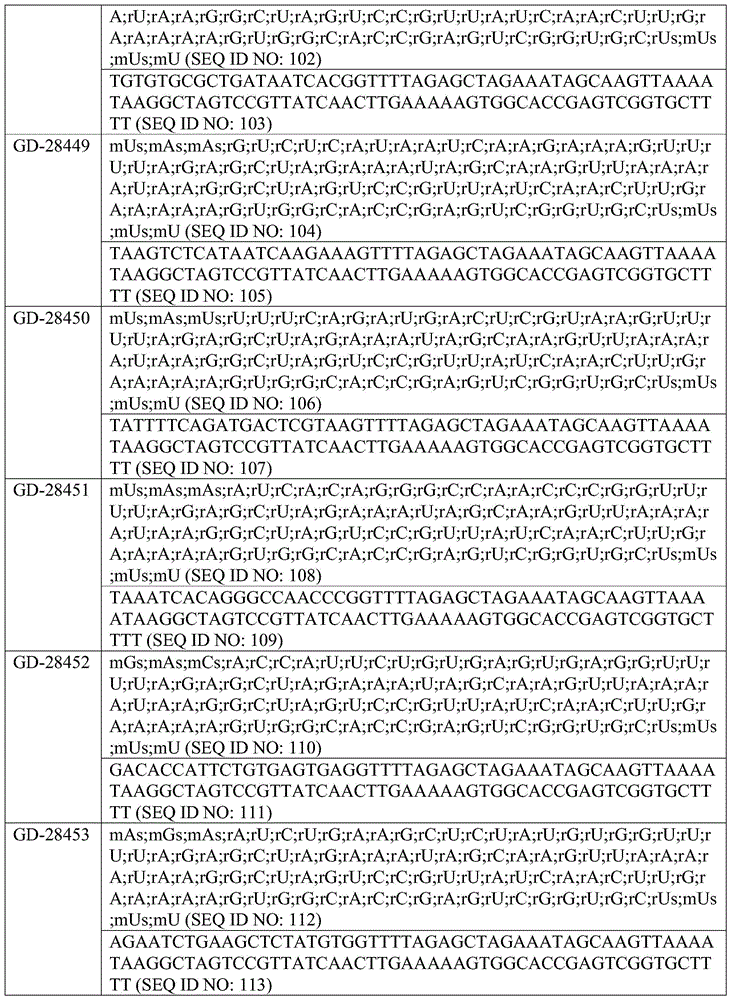
表3:位点特异性FOXP3靶向部分一实施例1和2中使用的FOXP3指导物的核苷酸序列和基因组中的互补靶序列Table 3: Site-specific FOXP3 targeting moieties - nucleotide sequences of FOXP3 guides used in Examples 1 and 2 and complementary target sequences in the genome

注:Note:
*:所有单指导物长度均为100个核苷酸。所示的20mer靶区域是具有用于dCas9结合的以下80nt序列的SpCas9 PAM单指导RNA的一部分:5’-GTTTTAGAGCTAGAAATAGCAAGTTAAAATAAGGCTAGTCCGTTATCAACTTGAAAAAGTGGCACCGAGTCGGTGCTTTT-3’(SEQ ID NO:132)。*: All single guides are 100 nucleotides in length. The 20mer target region shown is a portion of the SpCas9 PAM single guide RNA with the following 80nt sequence for dCas9 binding: 5'-GTTTTAGAGCTAGAAATAGCAAGTTAAAATAAGGCTAGTCCGTTATCAACTTGAAAAAGTGGCACCGAGTCGGTGCTTTT-3' (SEQ ID NO: 132).
#:混合物编号与图1A和1B中的那些相同。#: Mixture numbers are the same as those in Figures 1A and 1B.
**:混合物2在Jurkat细胞中强烈地诱导上调反应,并成功地用于激活天然T细胞中的FOXP3。**:
表4:位点特异性FOXP3靶向部分Table 4: Site-specific FOXP3 targeting moieties


表5.用于核酸序列表示中的核苷酸单体的缩写。应当理解,当这些单体存在于寡核苷酸中时,它们通过5’-3’-磷酸二酯键相互连接。Table 5. Abbreviations for nucleotide monomers used in nucleic acid sequence representations. It should be understood that when these monomers are present in an oligonucleotide, they are linked to each other via 5'-3'-phosphodiester bonds.
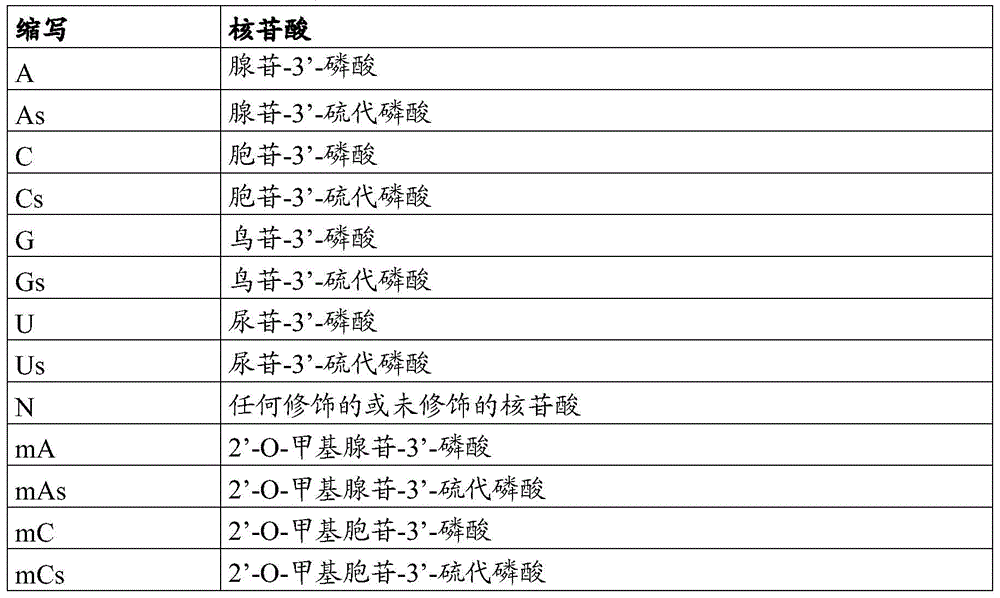

Claims (145)
Applications Claiming Priority (3)
| Application Number | Priority Date | Filing Date | Title |
|---|---|---|---|
| US202062988044P | 2020-03-11 | 2020-03-11 | |
| US62/988,044 | 2020-03-11 | ||
| PCT/US2021/021825 WO2021183720A1 (en) | 2020-03-11 | 2021-03-11 | Compositions and methods for modulating forkhead box p3 (foxp3) gene expression |
Publications (1)
| Publication Number | Publication Date |
|---|---|
| CN116096886A true CN116096886A (en) | 2023-05-09 |
Family
ID=75302656
Family Applications (1)
| Application Number | Title | Priority Date | Filing Date |
|---|---|---|---|
| CN202180034263.2A Pending CN116096886A (en) | 2020-03-11 | 2021-03-11 | Compositions and methods for modulating fork-box P3 (FOXP 3) gene expression |
Country Status (7)
| Country | Link |
|---|---|
| US (1) | US20230114151A1 (en) |
| EP (1) | EP4118207A1 (en) |
| JP (1) | JP2023517326A (en) |
| CN (1) | CN116096886A (en) |
| AU (1) | AU2021234302A1 (en) |
| CA (1) | CA3173528A1 (en) |
| WO (1) | WO2021183720A1 (en) |
Families Citing this family (4)
| Publication number | Priority date | Publication date | Assignee | Title |
|---|---|---|---|---|
| WO2021061815A1 (en) | 2019-09-23 | 2021-04-01 | Omega Therapeutics, Inc. | COMPOSITIONS AND METHODS FOR MODULATING HEPATOCYTE NUCLEAR FACTOR 4-ALPHA (HNF4α) GENE EXPRESSION |
| WO2023081787A2 (en) * | 2021-11-04 | 2023-05-11 | Prime Medicine, Inc. | Genome editing compositions and methods for treatment of fanconi anemia |
| AU2024240582A1 (en) * | 2023-03-21 | 2025-11-06 | Lung Biotechnology Pbc | Methods for creating regulatory t cells (tregs) using genome engineering |
| WO2025019742A1 (en) * | 2023-07-19 | 2025-01-23 | Omega Therapeutics, Inc. | Methods and compositions for modulating ctnnb1 expression |
Family Cites Families (128)
| Publication number | Priority date | Publication date | Assignee | Title |
|---|---|---|---|---|
| EP1251170A3 (en) | 1992-07-17 | 2002-10-30 | Ribozyme Pharmaceuticals, Inc. | Method and reagent for treatment of NF-kappaB dependent animal diseases |
| US6054299A (en) | 1994-04-29 | 2000-04-25 | Conrad; Charles A. | Stem-loop cloning vector and method |
| WO2000022114A1 (en) | 1998-10-09 | 2000-04-20 | Ingene, Inc. | PRODUCTION OF ssDNA $i(IN VIVO) |
| US20030073640A1 (en) | 1997-07-23 | 2003-04-17 | Ribozyme Pharmaceuticals, Inc. | Novel compositions for the delivery of negatively charged molecules |
| EP1117776A1 (en) | 1998-10-09 | 2001-07-25 | Ingene, Inc. | ENZYMATIC SYNTHESIS OF ssDNA |
| US7013219B2 (en) | 1999-01-12 | 2006-03-14 | Sangamo Biosciences, Inc. | Regulation of endogenous gene expression in cells using zinc finger proteins |
| US6534261B1 (en) | 1999-01-12 | 2003-03-18 | Sangamo Biosciences, Inc. | Regulation of endogenous gene expression in cells using zinc finger proteins |
| US7708915B2 (en) | 2004-05-06 | 2010-05-04 | Castor Trevor P | Polymer microspheres/nanospheres and encapsulating therapeutic proteins therein |
| WO2003092665A2 (en) | 2002-05-02 | 2003-11-13 | Massachusetts Eye And Ear Infirmary | Ocular drug delivery systems and use thereof |
| AU2005222965B8 (en) | 2004-03-15 | 2010-07-01 | City Of Hope | Methods and compositions for the specific inhibition of gene expression by double-stranded RNA |
| MXPA06011871A (en) | 2004-04-15 | 2007-10-08 | Chiasma Inc | Compositions capable of facilitating penetration across a biological barrier. |
| US8192718B1 (en) | 2005-01-04 | 2012-06-05 | Gp Medical, Inc. | Pharmaceutical composition of nanoparticles |
| CA2597724A1 (en) | 2005-02-14 | 2007-08-02 | Sirna Therapeutics, Inc. | Cationic lipids and formulated molecular compositions containing them |
| US7404969B2 (en) | 2005-02-14 | 2008-07-29 | Sirna Therapeutics, Inc. | Lipid nanoparticle based compositions and methods for the delivery of biologically active molecules |
| TWI335352B (en) | 2005-03-31 | 2011-01-01 | Calando Pharmaceuticals Inc | Inhibitors of ribonucleotide reductase subunit 2 and uses thereof |
| BRPI0710503A2 (en) | 2006-04-07 | 2011-08-16 | Merrion Res Iii Ltd | use of a pharmaceutical composition, pharmaceutical composition, and oral dosage form |
| AU2007303205A1 (en) | 2006-10-03 | 2008-04-10 | Tekmira Pharmaceuticals Corporation | Lipid containing formulations |
| CN101506597B (en) | 2006-10-25 | 2013-01-02 | 松下电器产业株式会社 | Refrigeration cycle device and fluid machine used for the same |
| JP2010519203A (en) | 2007-02-16 | 2010-06-03 | メルク・シャープ・エンド・ドーム・コーポレイション | Compositions and methods for enhancing the activity of bioactive molecules |
| HUE035101T2 (en) | 2007-09-28 | 2018-05-02 | Pfizer | Cancer Cell Targeting Using Nanoparticles |
| AU2008314647B2 (en) | 2007-10-12 | 2013-03-21 | Massachusetts Institute Of Technology | Vaccine nanotechnology |
| EP3100718B1 (en) | 2008-01-02 | 2019-11-27 | Arbutus Biopharma Corporation | Improved compositions and methods for the delivery of nucleic acids |
| WO2010005725A2 (en) | 2008-06-16 | 2010-01-14 | Bind Biosciences, Inc. | Therapeutic polymeric nanoparticles comprising vinca alkaloids and methods of making and using same |
| ES2765240T3 (en) | 2008-06-16 | 2020-06-08 | Pfizer | Drug-loaded polymeric nanoparticles and manufacturing procedures and use thereof |
| US8613951B2 (en) | 2008-06-16 | 2013-12-24 | Bind Therapeutics, Inc. | Therapeutic polymeric nanoparticles with mTor inhibitors and methods of making and using same |
| PL2285350T3 (en) | 2008-06-16 | 2018-03-30 | Pfizer Inc. | Methods for the preparation of targeting agent functionalized diblock copolymers for use in fabrication of therapeutic nanoparticles |
| US20110224447A1 (en) | 2008-08-18 | 2011-09-15 | Bowman Keith A | Novel Lipid Nanoparticles and Novel Components for Delivery of Nucleic Acids |
| US20100087337A1 (en) | 2008-09-10 | 2010-04-08 | Bind Biosciences, Inc. | High Throughput Fabrication of Nanoparticles |
| EP2350043B9 (en) | 2008-10-09 | 2014-08-20 | TEKMIRA Pharmaceuticals Corporation | Improved amino lipids and methods for the delivery of nucleic acids |
| US8563041B2 (en) | 2008-12-12 | 2013-10-22 | Bind Therapeutics, Inc. | Therapeutic particles suitable for parenteral administration and methods of making and using same |
| US20100216804A1 (en) | 2008-12-15 | 2010-08-26 | Zale Stephen E | Long Circulating Nanoparticles for Sustained Release of Therapeutic Agents |
| KR20110110776A (en) | 2008-12-18 | 2011-10-07 | 다이서나 파마수이티컬, 인크. | Extended Dicer Substrate Formulations and Methods for Specific Inhibition of Gene Expression |
| US20100249214A1 (en) | 2009-02-11 | 2010-09-30 | Dicerna Pharmaceuticals | Multiplex dicer substrate rna interference molecules having joining sequences |
| WO2010080724A1 (en) | 2009-01-12 | 2010-07-15 | Merck Sharp & Dohme Corp. | Novel lipid nanoparticles and novel components for delivery of nucleic acids |
| KR20240015723A (en) | 2009-05-05 | 2024-02-05 | 알닐람 파마슈티칼스 인코포레이티드 | Lipid compositions |
| CA2764609C (en) | 2009-06-10 | 2018-10-02 | Alnylam Pharmaceuticals, Inc. | Improved cationic lipid of formula i |
| WO2010147992A1 (en) | 2009-06-15 | 2010-12-23 | Alnylam Pharmaceuticals, Inc. | Methods for increasing efficacy of lipid formulated sirna |
| WO2011000106A1 (en) | 2009-07-01 | 2011-01-06 | Protiva Biotherapeutics, Inc. | Improved cationic lipids and methods for the delivery of therapeutic agents |
| EP2449114B9 (en) | 2009-07-01 | 2017-04-19 | Protiva Biotherapeutics Inc. | Novel lipid formulations for delivery of therapeutic agents to solid tumors |
| EP2467357B1 (en) | 2009-08-20 | 2016-03-30 | Sirna Therapeutics, Inc. | Novel cationic lipids with various head groups for oligonucleotide delivery |
| WO2011043913A2 (en) | 2009-10-08 | 2011-04-14 | Merck Sharp & Dohme Corp. | Novel cationic lipids with short lipid chains for oligonucleotide delivery |
| ES2666559T3 (en) | 2009-12-01 | 2018-05-07 | Translate Bio, Inc. | Delivery of mrna for the augmentation of proteins and enzymes in human genetic diseases |
| AU2010328336B2 (en) | 2009-12-07 | 2017-03-02 | Arbutus Biopharma Corporation | Compositions for nucleic acid delivery |
| TR201815882T4 (en) | 2009-12-10 | 2018-11-21 | Univ Iowa State Res Found Inc | Tal effector mediated DNA modification. |
| JP5891175B2 (en) | 2009-12-11 | 2016-03-22 | バインド セラピューティックス インコーポレイテッド | Stable formulation against lyophilization of therapeutic particles |
| EP2515942B1 (en) | 2009-12-15 | 2020-02-12 | Pfizer Inc. | Therapeutic polymeric nanoparticle compositions with high glass transition temperature or high molecular weight copolymers |
| DE102009058769A1 (en) | 2009-12-16 | 2011-06-22 | MagForce Nanotechnologies AG, 10589 | Temperature-dependent activation of catalytic nucleic acids for controlled drug release |
| WO2011075656A1 (en) | 2009-12-18 | 2011-06-23 | The University Of British Columbia | Methods and compositions for delivery of nucleic acids |
| KR101762466B1 (en) | 2009-12-23 | 2017-07-27 | 노파르티스 아게 | Lipids, lipid compositions, and methods of using them |
| US9670487B2 (en) | 2010-01-22 | 2017-06-06 | Sirna Therapeutics, Inc. | Cationic lipids for oligonucleotide delivery |
| US9149432B2 (en) | 2010-03-19 | 2015-10-06 | Massachusetts Institute Of Technology | Lipid vesicle compositions and methods of use |
| EP2558074B1 (en) | 2010-04-08 | 2018-06-06 | The Trustees of Princeton University | Preparation of lipid nanoparticles |
| CN104959052B (en) | 2010-04-09 | 2018-07-13 | 帕西拉制药有限公司 | The method for synthesizing membrane vesicle for preparing major diameter |
| US20110262491A1 (en) | 2010-04-12 | 2011-10-27 | Selecta Biosciences, Inc. | Emulsions and methods of making nanocarriers |
| WO2011143230A1 (en) | 2010-05-10 | 2011-11-17 | Alnylam Pharmaceuticals | Methods and compositions for delivery of active agents |
| WO2011141705A1 (en) | 2010-05-12 | 2011-11-17 | Protiva Biotherapeutics, Inc. | Novel cationic lipids and methods of use thereof |
| JP2013531634A (en) | 2010-05-24 | 2013-08-08 | メルク・シャープ・エンド・ドーム・コーポレイション | Novel aminoalcohol cationic lipids for oligonucleotide delivery |
| EP2575767B1 (en) | 2010-06-04 | 2017-01-04 | Sirna Therapeutics, Inc. | Novel low molecular weight cationic lipids for oligonucleotide delivery |
| US9006417B2 (en) | 2010-06-30 | 2015-04-14 | Protiva Biotherapeutics, Inc. | Non-liposomal systems for nucleic acid delivery |
| BR112013000244A2 (en) | 2010-07-06 | 2016-05-17 | Novartis Ag | lipid liposomes having advantageous pka for administration of rna |
| DE102010032758B4 (en) | 2010-07-29 | 2012-02-23 | Fujitsu Technology Solutions Intellectual Property Gmbh | Computer system, method of programming a real time clock and computer program product |
| PL4066819T3 (en) | 2010-08-31 | 2023-06-05 | Glaxosmithkline Biologicals Sa | Small liposomes for delivery of immunogen-encoding rna |
| EP4066857B1 (en) | 2010-08-31 | 2022-12-21 | GlaxoSmithKline Biologicals SA | Pegylated liposomes for delivery of immunogen-encoding rna |
| WO2012031046A2 (en) | 2010-08-31 | 2012-03-08 | Novartis Ag | Lipids suitable for liposomal delivery of protein-coding rna |
| US8466122B2 (en) | 2010-09-17 | 2013-06-18 | Protiva Biotherapeutics, Inc. | Trialkyl cationic lipids and methods of use thereof |
| AU2011305617A1 (en) | 2010-09-20 | 2013-02-21 | Sirna Therapeutics, Inc. | Novel low molecular weight cationic lipids for oligonucleotide delivery |
| CN103260611A (en) | 2010-09-30 | 2013-08-21 | 默沙东公司 | Low molecular weight cationic lipids for oligonucleotide delivery |
| US9029590B2 (en) | 2010-10-21 | 2015-05-12 | Sirna Therapeutics, Inc. | Low molecular weight cationic lipids for oligonucleotide delivery |
| JP2013543844A (en) | 2010-10-22 | 2013-12-09 | バインド セラピューティックス インコーポレイテッド | Therapeutic nanoparticles containing macromolecular copolymers |
| DK2635265T3 (en) | 2010-11-05 | 2018-07-16 | Sirna Therapeutics Inc | New low molecular weight cyclic amine-containing cationic lipids for oligonucleotide delivery |
| JP6320912B2 (en) | 2011-03-25 | 2018-05-09 | セレクタ バイオサイエンシーズ インコーポレーテッドSelecta Biosciences,Inc. | Osmotically mediated release synthetic nanocarrier |
| MX2013012596A (en) | 2011-04-29 | 2014-08-21 | Selecta Biosciences Inc | SYNTHETIC TOLEROGENIC NANOPORTERS TO GENERATE CD8 + T REGULATORS LYMPHOCYTES. |
| ES2663360T3 (en) | 2011-06-08 | 2018-04-12 | Translate Bio, Inc. | Cleavable lipids |
| US9126966B2 (en) | 2011-08-31 | 2015-09-08 | Protiva Biotherapeutics, Inc. | Cationic lipids and methods of use thereof |
| EP2770980A4 (en) | 2011-10-25 | 2015-11-04 | Univ British Columbia | LIPID NANOPARTICLES OF LIMITED SIZE AND METHOD THEREFOR |
| NZ747501A (en) | 2011-10-27 | 2020-05-29 | Massachusetts Inst Technology | Amino acid derivatives functionalized on the n-terminal capable of forming drug encapsulating microspheres |
| AU2012328457A1 (en) | 2011-10-28 | 2014-04-24 | Presage Biosciences, Inc. | Methods for drug delivery |
| WO2013086373A1 (en) | 2011-12-07 | 2013-06-13 | Alnylam Pharmaceuticals, Inc. | Lipids for the delivery of active agents |
| ES2921724T1 (en) | 2011-12-07 | 2022-08-31 | Alnylam Pharmaceuticals Inc | Biodegradable lipids for the administration of active agents |
| TWI594767B (en) | 2011-12-12 | 2017-08-11 | 協和醱酵麒麟有限公司 | Lipid nano particles comprising cationic lipid for drug delivery system |
| WO2013090601A2 (en) | 2011-12-16 | 2013-06-20 | Massachusetts Institute Of Technology | Compact nanoparticles for biological applications |
| WO2013105101A1 (en) | 2012-01-13 | 2013-07-18 | Department Of Biotechnology | Solid lipid nanoparticles entrapping hydrophilic/ amphiphilic drug and a process for preparing the same |
| RU2598627C2 (en) | 2012-01-19 | 2016-09-27 | Дзе Джонс Хопкинс Юниверсити | Composition based on nanoparticles with improved penetration through mucous membranes |
| WO2013116126A1 (en) | 2012-02-01 | 2013-08-08 | Merck Sharp & Dohme Corp. | Novel low molecular weight, biodegradable cationic lipids for oligonucleotide delivery |
| RS58077B1 (en) | 2012-02-24 | 2019-02-28 | Arbutus Biopharma Corp | Trialkyl cationic lipids and methods of use thereof |
| US10322089B2 (en) | 2012-03-14 | 2019-06-18 | The Board Of Trustees Of The Leland Stanford Junior University | Nanoparticles, nanoparticle delivery methods, and systems of delivery |
| PT3241902T (en) | 2012-05-25 | 2018-05-28 | Univ California | METHODS AND COMPOSITIONS FOR MODIFICATION OF TARGETED TARGET DNA BY RNA AND FOR MODULATION DIRECTED BY TRANSCRIPTION RNA |
| US9415109B2 (en) | 2012-07-06 | 2016-08-16 | Alnylam Pharmaceuticals, Inc. | Stable non-aggregating nucleic acid lipid particle formulations |
| CA2884870C (en) | 2012-08-13 | 2022-03-29 | Massachusetts Institute Of Technology | Amine-containing lipidoids and uses thereof |
| WO2014065596A1 (en) | 2012-10-23 | 2014-05-01 | Toolgen Incorporated | Composition for cleaving a target dna comprising a guide rna specific for the target dna and cas protein-encoding nucleic acid or cas protein, and use thereof |
| WO2014093655A2 (en) | 2012-12-12 | 2014-06-19 | The Broad Institute, Inc. | Engineering and optimization of systems, methods and compositions for sequence manipulation with functional domains |
| KR20150105634A (en) | 2012-12-12 | 2015-09-17 | 더 브로드 인스티튜트, 인코퍼레이티드 | Engineering and optimization of improved systems, methods and enzyme compositions for sequence manipulation |
| EP4234696A3 (en) | 2012-12-12 | 2023-09-06 | The Broad Institute Inc. | Crispr-cas component systems, methods and compositions for sequence manipulation |
| WO2014093694A1 (en) | 2012-12-12 | 2014-06-19 | The Broad Institute, Inc. | Crispr-cas nickase systems, methods and compositions for sequence manipulation in eukaryotes |
| US8697359B1 (en) | 2012-12-12 | 2014-04-15 | The Broad Institute, Inc. | CRISPR-Cas systems and methods for altering expression of gene products |
| ES2553782T3 (en) | 2012-12-12 | 2015-12-11 | The Broad Institute, Inc. | Systems engineering, methods and guide compositions optimized for sequence manipulation |
| HK1217649A1 (en) | 2012-12-27 | 2017-01-20 | 德雷克塞尔大学 | Novel antiviral agents against hbv infection |
| EP2971010B1 (en) | 2013-03-14 | 2020-06-10 | ModernaTX, Inc. | Formulation and delivery of modified nucleoside, nucleotide, and nucleic acid compositions |
| US10405937B2 (en) | 2014-04-09 | 2019-09-10 | Arbutus Medical Inc. | Drill cover and chuck mechanism |
| US20170044540A1 (en) * | 2014-04-22 | 2017-02-16 | Mina Therapeutics Limited | Sarna compositions and methods of use |
| EP3160938B1 (en) | 2014-06-25 | 2020-09-16 | Acuitas Therapeutics Inc. | Novel lipids and lipid nanoparticle formulations for delivery of nucleic acids |
| WO2016176330A1 (en) | 2015-04-27 | 2016-11-03 | The Trustees Of The University Of Pennsylvania | Nucleoside-modified rna for inducing an adaptive immune response |
| US9790490B2 (en) | 2015-06-18 | 2017-10-17 | The Broad Institute Inc. | CRISPR enzymes and systems |
| AU2016285852B2 (en) | 2015-06-29 | 2020-12-17 | Acuitas Therapeutics Inc. | Lipids and lipid nanoparticle formulations for delivery of nucleic acids |
| FI3368507T3 (en) | 2015-10-28 | 2023-03-21 | Acuitas Therapeutics Inc | New lipids and lipid nanoparticle preparations for delivery of nucleic acids |
| WO2017117528A1 (en) | 2015-12-30 | 2017-07-06 | Acuitas Therapeutics, Inc. | Lipids and lipid nanoparticle formulations for delivery of nucleic acids |
| JP7086870B2 (en) | 2016-06-30 | 2022-06-20 | アルブータス・バイオファーマー・コーポレイション | Compositions and Methods for Delivering Messenger RNA |
| AU2017296195A1 (en) * | 2016-07-11 | 2019-01-24 | Translate Bio Ma, Inc. | Nucleic acid conjugates and uses thereof |
| WO2018031762A1 (en) * | 2016-08-10 | 2018-02-15 | Duke University | Compositions, systems and methods for programming immune cell function through targeted gene regulation |
| CA3035910A1 (en) | 2016-09-07 | 2018-03-15 | Flagship Pioneering, Inc. | Methods and compositions for modulating gene expression |
| KR20190093816A (en) | 2016-10-26 | 2019-08-26 | 큐어백 아게 | Lipid nanoparticle mRNA vaccine |
| EP3532103B1 (en) | 2016-10-26 | 2025-12-03 | Acuitas Therapeutics, Inc. | Lipid nanoparticle formulations |
| WO2018081638A1 (en) | 2016-10-27 | 2018-05-03 | The Trustees Of The University Of Pennsylvania | Nucleoside-modified rna for inducing an adaptive immune response |
| CA3045122A1 (en) | 2016-12-09 | 2018-06-14 | Sangamo Therapeutics, Inc. | Delivery of target specific nucleases |
| WO2018191719A1 (en) | 2017-04-13 | 2018-10-18 | Acuitas Therapeutics, Inc. | Lipid delivery of therapeutic agents to adipose tissue |
| US11357856B2 (en) | 2017-04-13 | 2022-06-14 | Acuitas Therapeutics, Inc. | Lipids for delivery of active agents |
| IL301115A (en) | 2017-04-28 | 2023-05-01 | Acuitas Therapeutics Inc | New lipid carbonyl and lipid nanoparticle formulations for delivery of nucleic acids |
| CA3073020A1 (en) | 2017-08-16 | 2019-02-21 | Acuitas Therapeutics, Inc. | Lipids for use in lipid nanoparticle formulations |
| US11542225B2 (en) | 2017-08-17 | 2023-01-03 | Acuitas Therapeutics, Inc. | Lipids for use in lipid nanoparticle formulations |
| WO2019036000A1 (en) | 2017-08-17 | 2019-02-21 | Acuitas Therapeutics, Inc. | Lipids for use in lipid nanoparticle formulations |
| WO2019036030A1 (en) | 2017-08-17 | 2019-02-21 | Acuitas Therapeutics, Inc. | Lipids for use in lipid nanoparticle formulations |
| WO2019089828A1 (en) | 2017-10-31 | 2019-05-09 | Acuitas Therapeutics, Inc. | Lamellar lipid nanoparticles |
| US20210395188A1 (en) | 2018-10-18 | 2021-12-23 | Acuitas Therapeutics, Inc. | Lipids for lipid nanoparticle delivery of active agents |
| MX2021005462A (en) | 2018-11-09 | 2021-08-24 | Arbutus Biopharma Corp | Cationic lipids containing silicon. |
| US20220001029A1 (en) | 2018-11-09 | 2022-01-06 | Arbutus Biopharma Corporation | Lipid nanoparticle formulations |
| US12357705B2 (en) | 2018-11-09 | 2025-07-15 | Arbutus Biopharma Corporation | Negatively charged peg-lipid conjugates |
| US12251470B2 (en) | 2018-11-09 | 2025-03-18 | Arbutus Biopharma Corporation | Lipid nanoparticle formulations |
| CN113474328B (en) | 2019-01-11 | 2025-07-11 | 爱康泰生治疗公司 | Lipids for lipid nanoparticle delivery of active agents |
-
2021
- 2021-03-11 CN CN202180034263.2A patent/CN116096886A/en active Pending
- 2021-03-11 WO PCT/US2021/021825 patent/WO2021183720A1/en not_active Ceased
- 2021-03-11 CA CA3173528A patent/CA3173528A1/en active Pending
- 2021-03-11 AU AU2021234302A patent/AU2021234302A1/en active Pending
- 2021-03-11 JP JP2022554320A patent/JP2023517326A/en active Pending
- 2021-03-11 EP EP21715725.4A patent/EP4118207A1/en active Pending
-
2022
- 2022-09-06 US US17/929,828 patent/US20230114151A1/en active Pending
Also Published As
| Publication number | Publication date |
|---|---|
| CA3173528A1 (en) | 2021-09-16 |
| WO2021183720A1 (en) | 2021-09-16 |
| EP4118207A1 (en) | 2023-01-18 |
| JP2023517326A (en) | 2023-04-25 |
| AU2021234302A1 (en) | 2022-11-10 |
| WO2021183720A8 (en) | 2021-10-21 |
| US20230114151A1 (en) | 2023-04-13 |
Similar Documents
| Publication | Publication Date | Title |
|---|---|---|
| US20240417706A1 (en) | Systems and methods for the treatment of hemoglobinopathies | |
| US20200299661A1 (en) | Cpf1-related methods and compositions for gene editing | |
| KR102587132B1 (en) | Crispr-cpf1-related methods, compositions and components for cancer immunotherapy | |
| US20230114151A1 (en) | Compositions and methods for modulating forkhead box p3 (foxp3) gene expression | |
| US20240344061A1 (en) | COMPOSITIONS AND METHODS FOR MODULATING HEPATOCYTE NUCLEAR FACTOR 4-ALPHA (HNF4alpha) GENE EXPRESSION | |
| US20180119123A1 (en) | Crispr/cas-related methods and compositions for treating hiv infection and aids | |
| CN110382697B (en) | Compositions and methods for treating alpha-1 antitrypsin deficiency | |
| US20160298099A1 (en) | Permanent gene correction by means of nucleotide-modified messenger rna | |
| WO2016198500A1 (en) | Methods and compositions for rna-guided treatment of human cytomegalovirus (hcmv) infection | |
| US20240254462A1 (en) | Compositions and methods for modulating secreted frizzled receptor protein 1 (sfrp1) gene expression | |
| CA3184474A1 (en) | Phenylalanine hydroxylase variants and uses thereof | |
| WO2022012531A1 (en) | Method for preparing modified immune cell | |
| JP2024502036A (en) | engineered T cells | |
| US20220288237A1 (en) | Compositions and methods for modulating apolipoprotein b (apob) gene expression | |
| US20220280571A1 (en) | Compositions and methods for treating alpha thalassemia | |
| WO2024243438A2 (en) | Compositions and methods for reducing cxcl9, cxcl10, and cxcl11 gene expression | |
| JP2023553701A (en) | Therapeutic LAMA2 Payload for the Treatment of Congenital Muscular Dystrophy | |
| WO2026006558A2 (en) | Compositions and methods for increasing cxcl9 and cxcl10 gene expression | |
| JP2025518638A (en) | Use of transposases to improve transgene expression and nuclear localization |
Legal Events
| Date | Code | Title | Description |
|---|---|---|---|
| PB01 | Publication | ||
| PB01 | Publication | ||
| SE01 | Entry into force of request for substantive examination | ||
| SE01 | Entry into force of request for substantive examination |