WO2019089828A1 - Lamellar lipid nanoparticles - Google Patents
Lamellar lipid nanoparticles Download PDFInfo
- Publication number
- WO2019089828A1 WO2019089828A1 PCT/US2018/058555 US2018058555W WO2019089828A1 WO 2019089828 A1 WO2019089828 A1 WO 2019089828A1 US 2018058555 W US2018058555 W US 2018058555W WO 2019089828 A1 WO2019089828 A1 WO 2019089828A1
- Authority
- WO
- WIPO (PCT)
- Prior art keywords
- alkyl
- independently
- lipid
- lipid nanoparticle
- occurrence
- Prior art date
- Legal status (The legal status is an assumption and is not a legal conclusion. Google has not performed a legal analysis and makes no representation as to the accuracy of the status listed.)
- Ceased
Links
- 0 **N(*OC(*)=O)I*O*(*)=O Chemical compound **N(*OC(*)=O)I*O*(*)=O 0.000 description 5
Classifications
-
- A—HUMAN NECESSITIES
- A61—MEDICAL OR VETERINARY SCIENCE; HYGIENE
- A61K—PREPARATIONS FOR MEDICAL, DENTAL OR TOILETRY PURPOSES
- A61K9/00—Medicinal preparations characterised by special physical form
- A61K9/10—Dispersions; Emulsions
- A61K9/127—Synthetic bilayered vehicles, e.g. liposomes or liposomes with cholesterol as the only non-phosphatidyl surfactant
- A61K9/1271—Non-conventional liposomes, e.g. PEGylated liposomes or liposomes coated or grafted with polymers
- A61K9/1272—Non-conventional liposomes, e.g. PEGylated liposomes or liposomes coated or grafted with polymers comprising non-phosphatidyl surfactants as bilayer-forming substances, e.g. cationic lipids or non-phosphatidyl liposomes coated or grafted with polymers
-
- A—HUMAN NECESSITIES
- A61—MEDICAL OR VETERINARY SCIENCE; HYGIENE
- A61K—PREPARATIONS FOR MEDICAL, DENTAL OR TOILETRY PURPOSES
- A61K9/00—Medicinal preparations characterised by special physical form
- A61K9/48—Preparations in capsules, e.g. of gelatin, of chocolate
- A61K9/50—Microcapsules having a gas, liquid or semi-solid filling; Solid microparticles or pellets surrounded by a distinct coating layer, e.g. coated microspheres, coated drug crystals
- A61K9/51—Nanocapsules; Nanoparticles
- A61K9/5107—Excipients; Inactive ingredients
- A61K9/5123—Organic compounds, e.g. fats, sugars
-
- C—CHEMISTRY; METALLURGY
- C12—BIOCHEMISTRY; BEER; SPIRITS; WINE; VINEGAR; MICROBIOLOGY; ENZYMOLOGY; MUTATION OR GENETIC ENGINEERING
- C12N—MICROORGANISMS OR ENZYMES; COMPOSITIONS THEREOF; PROPAGATING, PRESERVING, OR MAINTAINING MICROORGANISMS; MUTATION OR GENETIC ENGINEERING; CULTURE MEDIA
- C12N15/00—Mutation or genetic engineering; DNA or RNA concerning genetic engineering, vectors, e.g. plasmids, or their isolation, preparation or purification; Use of hosts therefor
- C12N15/09—Recombinant DNA-technology
- C12N15/87—Introduction of foreign genetic material using processes not otherwise provided for, e.g. co-transformation
- C12N15/88—Introduction of foreign genetic material using processes not otherwise provided for, e.g. co-transformation using microencapsulation, e.g. using amphiphile liposome vesicle
Definitions
- Embodiments of the present invention generally relate to lipid nanoparticles (LNPs) having bilayer structures.
- LNPs are useful for facilitating the intracellular delivery of therapeutic agents, such as nucleic acids (e.g., oligonucleotides, messenger RNA) both in vitro and in vivo.
- therapeutic agents such as nucleic acids (e.g., oligonucleotides, messenger RNA) both in vitro and in vivo.
- nucleic acid based therapeutics have enormous potential but there remains a need for more effective delivery of nucleic acids to appropriate sites within a cell or organism in order to realize this potential.
- Therapeutic nucleic acids include, e.g., messenger RNA (mRNA), antisense
- nucleic acids such as mRNA, closed end DNA or plasmids, can be used to effect expression of specific cellular products as would be useful in the treatment of, for example, diseases related to a deficiency of a protein or enzyme. Such nucleic acids can also be used to introduce specific enzymes as would be useful in the treatment of, for example, diseases benefiting from gene editing and/or gene repair in a cell.
- the therapeutic applications of translatable nucleotide delivery are extremely broad as constructs can be synthesized to produce any chosen protein sequence, whether or not indigenous to the system.
- the expression products of the nucleic acid can augment existing levels of protein, replace missing or non-functional versions of a protein, or introduce new protein and associated functionality in a cell or organism.
- Some nucleic acids such as miRNA inhibitors or small activating RNA, can be used to modify cellular regulatory pathways to effect expression of specific cellular products or broad groups of cellular products as would be useful in the treatment of, for example, diseases related to deficiency of proteins or enzymes.
- the therapeutic applications of miRNA inhibition are extremely broad as constructs can be synthesized to inhibit one or more miRNA that would in turn regulate the expression of mRNA products.
- the inhibition of endogenous miRNA can augment its downstream target endogenous protein expression and restore proper function in a cell or organism as a means to treat disease associated to a specific miRNA or a group of miRNA.
- saRNA are extremely broad as constructs can be synthesized to simultaneously enhance the expression of a range of endogenous protein targets to affect function in a cell or organism as a means to treat disease.
- nucleic acids can down-regulate intracellular levels of specific mRNA and, as a result, down-regulate the synthesis of the corresponding proteins through processes such as RNA interference (RNAi) or complementary binding of antisense RNA.
- RNA interference RNA interference
- the therapeutic applications of antisense oligonucleotide and RNAi are also extremely broad, since oligonucleotide constructs can be synthesized with any nucleotide sequence directed against a target mRNA.
- Targets may include mRNAs from normal cells, mRNAs associated with disease-states, such as cancer, and mRNAs of infectious agents, such as viruses.
- antisense oligonucleotide constructs have shown the ability to specifically down-regulate target proteins through degradation of the cognate mRNA in both in vitro and in vivo models.
- antisense oligonucleotide constructs as well as siRNA are currently being evaluated in clinical studies.
- RNAs are susceptible to nuclease digestion in plasma.
- free RNAs have limited ability to gain access to the intracellular compartment where the relevant translation machinery resides.
- Lipid nanoparticles formed from cationic lipids with other lipid components, such as neutral lipids, cholesterol, PEG, PEGylated lipids, and oligonucleotides have been used to block degradation of the RNAs in plasma and facilitate the cellular uptake of the oligonucleotides.
- these lipid nanoparticle formulations would provide optimal drug:lipid ratios, protect the nucleic acid from degradation and clearance in serum, be suitable for systemic or local delivery, and provide intracellular delivery of the nucleic acid.
- these lipid-nucleic acid particles should be well-tolerated and provide an adequate therapeutic index, such that patient treatment at an effective dose of the nucleic acid is not associated with unacceptable toxicity and/or risk to the patient. The present invention provides these and related advantages.
- Embodiments of the present invention are based, in part, upon the surprising discovery that by controlling the lipid composition of the LNP formulations as well as the formulation process used to prepare the LNP formulation, a novel lamellar lipid nanoparticle can be produced.
- controlling the content of cationic lipid in the LNPs to values of greater than about 40 mol percent results in LNPs of the present disclosure having novel lamellar (i.e., bilayer) structures as determined by cryo-TEM measurements.
- the disclosed LNPs are useful in any number of therapeutic applications, including delivery of nucleic acids, such as anti sense and/or mRNA.
- lipid nanoparticle comprising:
- nucleic acid ii) a nucleic acid, or a pharmaceutically acceptable salt thereof, within an interior volume of the lipid nanoparticle;
- Another embodiment provides a lipid nanoparticle encapsulating a nucleic acid, or a pharmaceutically acceptable salt thereof, within a bilayer structure and comprising at least 40 mol percent of a cationic lipid.
- nucleic acid a nucleic acid, or a pharmaceutically acceptable salt thereof, encapsulated within the lipid nanoparticle
- Still more embodiments provide a plurality of lipid nanoparticles, wherein at least 20% of the plurality of nanoparticle comprises a nucleic acid, or a pharmaceutically acceptable salt thereof , at least 40 mol percent of a cationic lipid and two or more interior volumes enclosed within a bilayer structure.
- lipid nanoparticle comprising at least 40 mol percent of a cationic lipid and a nucleic acid, or a pharmaceutically acceptable salt thereof, encapsulated within the lipid nanoparticle, wherein the lipid nanoparticle comprises a bilayer structure forming a perimeter around an interior volume of the lipid nanoparticle, the bilayer structure comprising one or more spheroid structures appended thereto or distended therefrom.
- Still other different embodiments are directed to a lipid nanoparticle containing cationic lipid and nucleic acid, or a pharmaceutically acceptable salt thereof, encapsulated within one or more spheroid structures distended from the main body of the lipid nanoparticle, such that a lipid bilayer structure encompasses the nucleic acid (e.g., mRNA or siRNA) within the distended spheroid structure.
- nucleic acid e.g., mRNA or siRNA
- lipid nanoparticle comprising a cationic lipid and a nucleic acid (e.g., mRNA or siRNA), or a
- the lipid nanoparticle having at least a first and a second distended spheroid structure wherein the nucleic acid is substantially encapsulated within the first distended spheroid structure. In some embodiments, the nucleic acid is not present in the second spheroid structure. Still another embodiment provides a lipid nanoparticle comprising a nucleic acid and having a main interior volume and one or more distended spheroid structures, the main interior volume and one or more distended spheroid structures being enclosed by a lamellar bilayer, wherein the nucleic acid (e.g., mRNA or siRNA) is substantially encapsulated in the distended spheroid structure and is not present in the main interior volume.
- the nucleic acid e.g., mRNA or siRNA
- compositions comprising the disclosed lipid nanoparticles and methods for use of the same for treatment of various diseases or conditions, such as those caused by infectious entities and/or insufficiency of a protein, and/or genetic defect are also provided.
- the present invention provides a method for administering a therapeutic agent to a patient in need thereof, the method comprising administering the disclosed lipid nanoparticles, or pharmaceutical composition comprising the same, to the patient.
- a method for treating a disease in a patient in need thereof the method comprising administering an LNP disclosed herein, or a pharmaceutical composition comprising the same, to the patient, wherein the LNP comprises a nucleic acid effective to treat the disease.
- the LNPs may also be employed in methods for inducing an immune response, for example as a vaccine. Accordingly, other embodiments provide a method for vaccinating a patient in need thereof, the method comprising administering an LNP disclosed herein, or a pharmaceutical composition comprising the same, to the patient, wherein the LNP comprises a nucleic acid comprising an mRNA capable of translating an immunogenic protein.
- Figures 1-18 provide representative cryo-TEM images showing representative lamellar features of the disclosed lipid nanoparticles.
- Figures 19A-D are images of mRNA-L Ps comprising compound III-3
- Figures 20A-D are images of mRNA-LNPs comprising compound 1-5
- Figures 21A-D are images of mRNA-LNPs comprising compound 1-6
- Figures 22A-D are images of mRNA-LNPs comprising compound II-9
- Figures 23A-C are images of mRNA-LNPs comprising compound 11-15
- Figures 24A-C are images of mRNA-LNPs comprising compound 111-45
- Figures 25A-C are images of mRNA-LNPs comprising compound 1-40
- Figures 26A-C are images of mRNA-LNPs comprising compound DLin- KC2-DMA (white arrows indicate mottled appearance that are not within a distended spheroidal structure.
- the white star of Figure 26B indicates a distended spheroidal structure is present, but the mottled appearance is found within the parent particle structure rather than the distension. Several other empty distended structures are observed.
- Figures 27A-C are images of mRNA-LNPs comprising compound III-3 formulated in acetate buffer
- Figures 28A-C are images of siRNA-LNPs comprising compound III-3 formulated in citrate buffer
- Figures 29A-D are images of mRNA-LNPs comprising compound 1-6 formulated in citrate buffer at pH 4.0
- Figure 30 is an image of a sample formulated to make an mRNA-LNP comprising compound III-3 and gold labeled mRNA
- Figure 33 is a simplified illustration of a representative embodiment of a lipid nanoparticle (3301) having 2 interior volumes ⁇ i.e., 3303 and 3305) contained within a perimeter formed by a lamellar layer (3302 and 3304).
- the present invention provides lipid nanoparticles having lamellar structural features for the in vitro and in vivo delivery of mRNA and/or other oligonucleotides.
- these improved lipid nanoparticle compositions are useful for expression of protein encoded by mRNA.
- these improved lipid nanoparticles are useful for upregulation of endogenous protein expression by delivering miRNA inhibitors targeting one specific miRNA or a group of miRNA regulating one target mRNA or several mRNA.
- these improved lipid nanoparticle compositions are useful for down- regulating ⁇ e.g., silencing) the protein levels and/or mRNA levels of target genes.
- the lipid nanoparticles are also useful for delivery of mRNA and plasmids or close ended DNA for expression of transgenes. In some other embodiments, the lipid nanoparticles are also useful for delivery of guide RNA or DNA for an enzymatic gene editor and/or a piece of genetic material to be inserted at a point of gene editing. In yet other embodiments, the lipid nanoparticles are useful for inducing a pharmacological effect resulting from expression of a protein, e.g., increased production of red blood cells through the delivery of a suitable erythropoietin mRNA, or protection against infection through delivery of mRNA encoding for a suitable antigen or antibody.
- a protein e.g., increased production of red blood cells through the delivery of a suitable erythropoietin mRNA, or protection against infection through delivery of mRNA encoding for a suitable antigen or antibody.
- lipid nanoparticles of embodiments of the present invention may be used for a variety of purposes, including the delivery of encapsulated or associated (e.g., complexed) therapeutic agents such as nucleic acids to cells, both in vitro and in vivo. Accordingly, embodiments of the present invention provide a method for administering a therapeutic agent to a patient in need thereof, the method comprising administering a lipid nanoparticle as described herein to the patient.
- embodiments of the lipid nanoparticles of the present invention are particularly useful for the delivery of nucleic acids, including, e.g., mRNA, antisense oligonucleotide, plasmid DNA, microRNA (miRNA), miRNA inhibitors (antagomirs/antimirs), messenger-RNA-interfering complementary RNA (micRNA), DNA, multivalent RNA, dicer substrate RNA, complementary DNA
- nucleic acids including, e.g., mRNA, antisense oligonucleotide, plasmid DNA, microRNA (miRNA), miRNA inhibitors (antagomirs/antimirs), messenger-RNA-interfering complementary RNA (micRNA), DNA, multivalent RNA, dicer substrate RNA, complementary DNA
- the lipid nanoparticles of embodiments of the present invention may be used to induce expression of a desired protein both in vitro and in vivo by contacting cells with a lipid nanoparticle.
- the expressed protein may have a biological effect, such as inducing an immune response.
- the lipid nanoparticles and compositions of embodiments of the present invention may be used to decrease the expression of target genes and proteins both in vitro and in vivo by contacting cells with a lipid nanoparticle.
- lipid nanoparticles and compositions of embodiments of the present invention may also be used for co-delivery of different nucleic acids ⁇ e.g., mRNA and plasmid DNA) separately or in combination, such as may be useful to provide an effect requiring colocalization of different nucleic acids ⁇ e.g. mRNA encoding for a suitable gene modifying enzyme and DNA segment(s) for incorporation into the host genome).
- nucleic acids e.g., mRNA and plasmid DNA
- Nucleic acids for use with embodiments of this invention may be prepared according to the techniques described herein.
- the primary methodology of preparation is, but not limited to, enzymatic synthesis (also termed in vitro transcription) which currently represents the most efficient method to produce long sequence-specific mRNA.
- In vitro transcription describes a process of template- directed synthesis of RNA molecules from an engineered DNA template comprised of an upstream bacteriophage promoter sequence (e.g. including but not limited to that from the T7, T3 and SP6 coliphage) linked to a downstream sequence encoding the gene of interest.
- an upstream bacteriophage promoter sequence e.g. including but not limited to that from the T7, T3 and SP6 coliphage
- Template DNA can be prepared for in vitro transcription from a number of sources with appropriate techniques which are well known in the art including, but not limited to, plasmid DNA and polymerase chain reaction amplification (see Linpinsel, J.L and Conn, G.L., General protocols for preparation of plasmid DNA template and Bowman, J.C., Azizi, B., Lenz, T.K., Ray, P., and Williams, L.D. in RNA in vitro transcription and RNA purification by denaturing PAGE in Recombinant and in vitro RNA syntheses Methods v. 941 Conn G.L. (ed), New York, N.Y. Humana Press, 2012).
- plasmid DNA and polymerase chain reaction amplification see Linpinsel, J.L and Conn, G.L., General protocols for preparation of plasmid DNA template and Bowman, J.C., Azizi, B., Lenz, T.K., Ray, P., and Williams, L.D.
- RNA polymerase adenosine, guanosine, uridine and cytidine ribonucleoside triphosphates (rNTPs) under conditions that support polymerase activity while minimizing potential degradation of the resultant mRNA transcripts.
- rNTPs ribonucleoside triphosphates
- In vitro transcription can be performed using a variety of commercially available kits including, but not limited to RiboMax Large Scale RNA Production System (Promega), MegaScript Transcription kits (Life Technologies) as well as with commercially available reagents including RNA polymerases and rNTPs.
- the methodology for in vitro transcription of mRNA is well known in the art. (see, e.g.
- the desired in vitro transcribed mRNA is then purified from the undesired components of the transcription or associated reactions (including
- RNA transcripts unincorporated rNTPs, protein enzyme, salts, short RNA oligos, etc.).
- Techniques for the isolation of the mRNA transcripts are well known in the art.
- Well known procedures include phenol/chloroform extraction or precipitation with either alcohol (e.g., ethanol, isopropanol) in the presence of monovalent cations or lithium chloride.
- alcohol e.g., ethanol, isopropanol
- purification procedures which can be used include size exclusion chromatography (Lukavsky, P.J.
- RNA in vitro transcription and RNA purification by denaturing PAGE in Recombinant and in vitro RNA syntheses Methods v. 941 Conn G.L. (ed), New York, N.Y. Humana Press, 2012 ). Purification can be performed using a variety of commercially available kits including, but not limited to SV Total Isolation System (Promega) and In Vitro
- RNA impurities associated with undesired polymerase activity which may need to be removed from the full-length mRNA preparation.
- RNA impurities include short RNAs that result from abortive transcription initiation as well as double-stranded RNA (dsRNA) generated by RNA-dependent RNA polymerase activity, RNA-primed transcription from RNA templates and self- complementary 3' extension. It has been demonstrated that these contaminants with dsRNA structures can lead to undesired immunostimulatory activity through interaction with various innate immune sensors in eukaryotic cells that function to recognize specific nucleic acid structures and induce potent immune responses.
- dsRNA double-stranded RNA
- Endogenous eukaryotic mRNA typically contain a cap structure on the 5'- end of a mature molecule which plays an important role in mediating binding of the mRNA Cap Binding Protein (CBP), which is in turn responsible for enhancing mRNA stability in the cell and efficiency of mRNA translation. Therefore, highest levels of protein expression are achieved with capped mRNA transcripts.
- CBP mRNA Cap Binding Protein
- the 5 '-cap contains a 5 '-5 '-triphosphate linkage between the 5 '-most nucleotide and guanine nucleotide.
- the conjugated guanine nucleotide is methylated at the N7 position.
- modifications include methylation of the ultimate and penultimate most 5 '-nucleotides on the 2'-hydroxyl group.
- 5 '-capping of synthetic mRNA can be performed co- transcriptionally with chemical cap analogs ⁇ i.e., capping during in vitro transcription).
- the Anti -Reverse Cap Analog (ARC A) cap contains a 5 '-5 '-triphosphate guanine-guanine linkage where one guanine contains an N7 methyl group as well as a 3'-0-methyl group.
- ARC A Anti -Reverse Cap Analog
- the synthetic cap analog is not identical to the 5 '-cap structure of an authentic cellular mRNA, potentially reducing translatability and cellular stability.
- synthetic mRNA molecules may also be enzymatically capped post-transcriptionally. These may generate a more authentic 5 '-cap structure that more closely mimics, either structurally or functionally, the endogenous 5 '-cap which have enhanced binding of cap binding proteins, increased half-life, reduced susceptibility to 5' endonucleases and/or reduced 5' decapping.
- poly-A tail On the 3 '-terminus, a long chain of adenine nucleotides (poly-A tail) is normally added to mRNA molecules during RNA processing. Immediately after transcription, the 3' end of the transcript is cleaved to free a 3' hydroxyl to which poly- A polymerase adds a chain of adenine nucleotides to the RNA in a process called polyadenylation.
- the poly-A tail has been extensively shown to enhance both translational efficiency and stability of mRNA (see Bernstein, P. and Ross, J., 1989, Poly (A), poly (A) binding protein and the regulation of mRNA stability, Trends Bio Sci v. 14 373-377; Guhaniyogi, J.
- Poly (A) tailing of in vitro transcribed mRNA can be achieved using various approaches including, but not limited to, cloning of a poly (T) tract into the DNA template or by post-transcriptional addition using Poly (A) polymerase.
- the first case allows in vitro transcription of mRNA with poly (A) tails of defined length, depending on the size of the poly (T) tract, but requires additional manipulation of the template.
- poly (A) tail to in vitro transcribed mRNA using poly (A) polymerase which catalyzes the incorporation of adenine residues onto the 3 'termini of RNA, requiring no additional manipulation of the DNA template, but results in mRNA with poly(A) tails of heterogeneous length.
- 5'- capping and 3 '-poly (A) tailing can be performed using a variety of commercially available kits including, but not limited to Poly (A) Polymerase Tailing kit (EpiCenter), mMESSAGE mMACHINE T7 Ultra kit and Poly (A) Tailing kit (Life Technologies) as well as with commercially available reagents, various ARCA caps, Poly (A)
- modified nucleosides into in vitro transcribed mRNA can be used to prevent recognition and activation of RNA sensors, thus mitigating this undesired immunostimulatory activity and enhancing translation capacity (see e.g. Kariko, K. And Weissman, D.
- nucleoside modifications are available that may be incorporated alone or in combination with other modified nucleosides to some extent into the in vitro transcribed mRNA ⁇ see, e.g., U.S. Pub. No. 2012/0251618).
- In vitro synthesis of nucleoside-modified mRNA have been reported to have reduced ability to activate immune sensors with a concomitant enhanced translational capacity.
- Other components of mRNA which can be modified to provide benefit in terms of translatability and stability include the 5' and 3' untranslated regions (UTR).
- oligonucleotides In addition to mRNA, other nucleic acid payloads may be used for this invention.
- methods of preparation include but are not limited to chemical synthesis and enzymatic, chemical cleavage of a longer precursor, in vitro transcription as described above, etc. Methods of synthesizing DNA and RNA nucleotides are widely used and well known in the art ⁇ see, e.g., Gait, M. J. (ed.) Oligonucleotide synthesis: a practical approach, Oxford [Oxfordshire], Washington, D.C.: IRL Press, 1984; and Herdewijn, P. (ed.) Oligonucleotide synthesis: methods and applications, Methods in Molecular Biology, v. 288 (Clifton, N.J.) Totowa, N.J.:
- plasmid DNA preparation for use with embodiments of this invention commonly utilizes but is not limited to expansion and isolation of the plasmid DNA in vitro in a liquid culture of bacteria containing the plasmid of interest.
- a gene in the plasmid of interest that encodes resistance to a particular antibiotic penicillin, kanamycin, etc.
- Methods of isolating plasmid DNA are widely used and well known in the art ⁇ see, e.g., Heilig, J., Elbing, K. L. and Brent, R (2001) Large-Scale Preparation of Plasmid DNA. Current Protocols in Molecular Biology.
- Plasmid isolation can be performed using a variety of commercially available kits including, but not limited to Plasmid Plus (Qiagen), GenJET plasmid MaxiPrep (Thermo) and Pure Yield MaxiPrep (Promega) kits as well as with commercially available reagents.
- a test sample e.g., a sample of cells in culture expressing the desired protein
- a test mammal e.g., a mammal such as a human or an animal model such as a rodent (e.g. mouse) or a non-human primate (e.g., monkey) model
- a nucleic acid e.g., nucleic acid in combination with a lipid of the present invention.
- expression of the desired protein in the test sample or test animal is compared to expression of the desired protein in a control sample (e.g.
- a sample of cells in culture expressing the desired protein or a control mammal (e.g. , a mammal such as a human or an animal model such as a rodent (e.g. , mouse) or non-human primate (e.g. , monkey) model) that is not contacted with or administered the nucleic acid.
- a control mammal e.g. , a mammal such as a human or an animal model such as a rodent (e.g. , mouse) or non-human primate (e.g. , monkey) model
- the expression of a desired protein in a control sample or a control mammal may be assigned a value of 1.0.
- inducing expression of a desired protein is achieved when the ratio of desired protein expression in the test sample or the test mammal to the level of desired protein expression in the control sample or the control mammal is greater than 1, for example, about 1.1, 1.5, 2.0. 5.0 or 10.0.
- inducing expression of a desired protein is achieved when any measurable level of the desired protein in the test sample or the test mammal is detected.
- the phrase "inhibiting expression of a target gene” refers to the ability of a nucleic acid to silence, reduce, or inhibit the expression of a target gene.
- a test sample e.g., a sample of cells in culture expressing the target gene
- a test mammal e.g., a mammal such as a human or an animal model such as a rodent (e.g., mouse) or a non-human primate (e.g., monkey) model
- a nucleic acid that silences, reduces, or inhibits expression of the target gene.
- Expression of the target gene in the test sample or test animal is compared to expression of the target gene in a control sample (e.g., a sample of cells in culture expressing the target gene) or a control mammal (e.g., a mammal such as a human or an animal model such as a rodent (e.g., mouse) or non-human primate (e.g., monkey) model) that is not contacted with or administered the nucleic acid.
- a control sample e.g., a sample of cells in culture expressing the target gene
- a control mammal e.g., a mammal such as a human or an animal model such as a rodent (e.g., mouse) or non-human primate (e.g., monkey) model
- the expression of the target gene in a control sample or a control mammal may be assigned a value of 100%.
- silencing, inhibition, or reduction of expression of a target gene is achieved when the level of target gene expression in the test sample or the test mammal relative to the level of target gene expression in the control sample or the control mammal is about 95%, 90%, 85%, 80%, 75%, 70%, 65%, 60%, 55%, 50%, 45%, 40%, 35%, 30%, 25%, 20%, 15%, 10%, 5%, or 0%.
- the nucleic acids are capable of silencing, reducing, or inhibiting the expression of a target gene by at least about 5%, 10%, 15%, 20%, 25%, 30%, 35%, 40%, 45%, 50%, 55%, 60%, 65%, 70%, 75%, 80%, 85%, 90%, 95%, or 100% in a test sample or a test mammal relative to the level of target gene expression in a control sample or a control mammal not contacted with or administered the nucleic acid.
- Suitable assays for determining the level of target gene expression include, without limitation, examination of protein or mRNA levels using techniques known to those of skill in the art, such as, e.g., dot blots, northern blots, in situ hybridization, ELISA, immunoprecipitation, enzyme function, as well as phenotypic assays known to those of skill in the art.
- an “effective amount” or “therapeutically effective amount” of an active agent or therapeutic agent such as a therapeutic nucleic acid is an amount sufficient to produce the desired effect, e.g. an increase or inhibition of expression of a target sequence in comparison to the normal expression level detected in the absence of the nucleic acid.
- An increase in expression of a target sequence is achieved when any measurable level is detected in the case of an expression product that is not present in the absence of the nucleic acid.
- an in increase in expression is achieved when the fold increase in value obtained with a nucleic acid such as mRNA relative to control is about 1.05, 1.1, 1.2, 1.3, 1.4, 1.5, 1.75, 2, 2.5, 3, 4, 5, 6, 7, 8, 9, 10, 15, 20, 25, 30, 40, 50, 75, 100, 250, 500, 750, 1000, 5000, 10000 or greater.
- Inhibition of expression of a target gene or target sequence is achieved when the value obtained with a nucleic acid such as antisense oligonucleotide relative to the control is about 95%, 90%, 85%, 80%, 75%, 70%, 65%, 60%, 55%, 50%, 45%, 40%, 35%, 30%, 25%, 20%, 15%), 10%), 5%), or 0%.
- Suitable assays for measuring expression of a target gene or target sequence include, e.g., examination of protein or RNA levels using techniques known to those of skill in the art such as dot blots, northern blots, in situ hybridization, ELISA, immunoprecipitation, enzyme function, fluorescence or luminescence of suitable reporter proteins, as well as phenotypic assays known to those of skill in the art.
- nucleic acid refers to a polymer containing at least two deoxyribonucleotides or ribonucleotides in either single- or double-stranded form and includes DNA, RNA, and hybrids thereof.
- analogs include, without limitation, phosphorothioates, phosphoramidates, methyl phosphonates, chiral-methyl phosphonates, 2'-0-methyl ribonucleotides, and peptide- nucleic acids (PNAs).
- PNAs peptide- nucleic acids
- the term encompasses nucleic acids containing known analogues of natural nucleotides that have similar binding properties as the reference nucleic acid.
- a particular nucleic acid sequence also implicitly encompasses conservatively modified variants thereof (e.g., degenerate codon substitutions), alleles, orthologs, single nucleotide polymorphisms, and complementary sequences as well as the sequence explicitly indicated.
- degenerate codon substitutions may be achieved by generating sequences in which the third position of one or more selected (or all) codons is substituted with mixed-base and/or deoxyinosine residues (Batzer et al., Nucleic Acid Res., 19:5081 (1991);
- Nucleotides contain a sugar deoxyribose (DNA) or ribose (RNA), a base, and a phosphate group. Nucleotides are linked together through the phosphate groups.
- Bases include purines and pyrimidines, which further include natural compounds adenine, thymine, guanine, cytosine, uracil, inosine, and natural analogs, and synthetic derivatives of purines and pyrimidines, which include, but are not limited to, modifications which place new reactive groups such as, but not limited to, amines, alcohols, thiols, carboxylates, and alkylhalides.
- the term “gene” refers to a nucleic acid (e.g., DNA or RNA) sequence that comprises partial length or entire length coding sequences necessary for the production of a polypeptide or precursor polypeptide.
- Gene product refers to a product of a gene such as an RNA transcript or a polypeptide.
- lipid refers to a group of organic compounds that include, but are not limited to, esters of fatty acids and are generally characterized by being poorly soluble in water, but soluble in many organic solvents. They are usually divided into at least three classes: (1) “simple lipids,” which include fats and oils as well as waxes; (2) “compound lipids,” which include phospholipids and glycolipids; and (3) “derived lipids” such as steroids.
- a “steroid” is a compound comprising the following carbon skeleton:
- Non-limiting examples of steroids include cholesterol, and the like.
- a “cationic lipid” refers to a lipid capable of being positively charged.
- Exemplary cationic lipids include one or more amine group(s) which bear the positive charge.
- Preferred cationic lipids are ionizable such that they can exist in a positively charged or neutral form depending on pH.
- the ionization of the cationic lipid affects the surface charge of the lipid nanoparticle under different pH conditions. This charge state can influence plasma protein absorption, blood clearance and tissue distribution (Semple, S.C., et al., Adv. Drug Deliv Rev 32:3-17 (1998)) as well as the ability to form endosomolytic non-bilayer structures (Hafez, I.M., et al., Gene Ther 8: 1 188-1 196 (2001)) critical to the intracellular delivery of nucleic acids.
- anionic lipid refers to a lipid capable of being negatively charged.
- Exemplary anionic lipids include one or more phosphate group(s) which bear a negative charge, for example at physiological pHs.
- the anionic lipid does not include a serine moiety, including phosphatidyl serine lipids.
- Phosphatidylglycerol lipid refers to a lipid with a structure that generally comprises a glycerol 3-phosphate backbone which is attached to saturated or unsaturated fatty acids via and ester linkage.
- Exemplary phosphatidylglycerol lipids have the following structure:
- Ri and R 2 are each independently a branched or straight, saturated or unsaturated carbon chain (e.g., alkyl, alkenyl, alkynyl).
- polymer conjugated lipid refers to a molecule comprising both a lipid portion and a polymer portion.
- An example of a polymer conjugated lipid is a pegylated lipid.
- pegylated lipid refers to a molecule comprising both a lipid portion and a polyethylene glycol portion. Pegylated lipids are known in the art and include l-(monomethoxy-polyethyleneglycol)-2,3-dimyristoylglycerol
- neutral lipid refers to any of a number of lipid species that exist either in an uncharged or neutral zwitterionic form at a selected pH.
- lipids include, but are not limited to, phosphotidylcholines such as l,2-Distearoyl-s «-glycero-3-phosphocholine (DSPC), l,2-Dipalmitoyl-5 «-glycero-3- phosphocholine (DPPC), l,2-Dimyristoyl-s «-glycero-3-phosphocholine (DMPC), 1- Palmitoyl-2-oleoyl-s «-glycero-3-phosphocholine (POPC), l,2-dioleoyl-sn-glycero-3- phosphocholine (DOPC), phophatidylethanolamines such as l,2-Dioleoyl-s «-glycero-3- phosphoethanolamine (DOPE), sphin
- charged lipid refers to any of a number of lipid species that exist in either a positively charged or negatively charged form independent of the pH within a useful physiological range, e.g., pH ⁇ 3 to pH ⁇ 9.
- Charged lipids may be synthetic or naturally derived. Examples of charged lipids include phosphatidylserines, phosphatidic acids, phosphatidylglycerols, phosphatidylinositols, sterol hemi succinates, dialkyl trimethylammonium-propanes, (e.g., DOTAP, DOTMA), dialkyl
- dimethylaminopropanes ethyl phosphocholines, dimethylaminoethane carbamoyl sterols (e.g., DC-Choi).
- lipid nanoparticle refers to particles having at least one dimension on the order of nanometers (e.g., 1-1,000 nm) which include one or more of the compounds of Formula I, II, III, IV, V, VI, VII, VIII, IX, or X or other specified cationic lipids.
- lipid nanoparticles are included in a formulation that can be used to deliver an active agent or therapeutic agent, such as a nucleic acid (e.g., mRNA) to a target site of interest (e.g., cell, tissue, organ, tumor, and the like).
- a nucleic acid e.g., mRNA
- the lipid nanoparticles of the invention comprise a nucleic acid.
- Such lipid nanoparticles typically comprise a compound of Formula I, II, III, IV, V, VI, VII, VIII, IX, or X and one or more excipient selected from neutral lipids, charged lipids, steroids and polymer conjugated lipids.
- the active agent or therapeutic agent such as a nucleic acid
- the lipid nanoparticles have a mean diameter of from about 30 nm to about 150 nm, from about 40 nm to about 150 nm, from about 50 nm to about 150 nm, from about 60 nm to about 130 nm, from about 70 nm to about 1 10 nm, from about 70 nm to about 100 nm, from about 80 nm to about 100 nm, from about 90 nm to about 100 nm, from about 70 to about 90 nm, from about 80 nm to about 90 nm, from about 70 nm to about 80 nm, or about 30 nm, 35 nm, 40 nm, 45 nm, 50 nm, 55 nm, 60 nm, 65 nm, 70 nm, 75 nm, 80 nm, 85 nm, 90 nm, 95 nm, 100 nm, 105 nm, 1 10 nm, 1 15 nm, 120
- LNPs are prepared according to the methods disclosed herein.
- lipid encapsulated refers to a lipid nanoparticle that provides an active agent or therapeutic agent, such as a nucleic acid (e.g., mRNA), with full encapsulation, partial encapsulation, or both.
- a nucleic acid e.g., mRNA
- aqueous solution refers to a composition comprising water.
- “Serum-stable” in relation to nucleic acid-lipid nanoparticles means that the nucleotide is not significantly degraded after exposure to a serum or nuclease assay that would significantly degrade free DNA or RNA.
- Suitable assays include, for example, a standard serum assay, a DNAse assay, or an RNAse assay.
- Systemic delivery refers to delivery of a therapeutic product that can result in a broad exposure of an active agent within an organism.
- Systemic delivery means that a useful, preferably therapeutic, amount of an agent is exposed to most parts of the body.
- Systemic delivery of lipid nanoparticles can be by any means known in the art including, for example, intravenous, intraarterial, subcutaneous, and intraperitoneal delivery. In some embodiments, systemic delivery of lipid nanoparticles is by intravenous delivery.
- Local delivery refers to delivery of an active agent directly to a target site within an organism.
- an agent can be locally delivered by direct injection into a disease site such as a tumor, other target site such as a site of inflammation, or a target organ such as the liver, heart, pancreas, kidney, and the like.
- Local delivery can also include topical applications or localized injection techniques such as intramuscular, subcutaneous or intradermal injection. Local delivery does not preclude a systemic pharmacological effect.
- amino acid refers to naturally-occurring and non-naturally occurring amino acids.
- An amino acid lipid can be made from a genetically encoded amino acid, a naturally occurring non-genetically encoded amino acid, or a synthetic amino acid.
- amino acids include Ala, Arg, Asn, Asp, Cys, Gin, Glu, Gly, His, He, Leu, Lys, Met, Phe, Pro, Ser, Thr, Trp, Tyr, and Val.
- amino acids also include azetidine, 2-aminooctadecanoic acid, 2-aminoadipic acid, 3-aminoadipic acid, 2,3- diaminopropionic acid, 2-aminobutyric acid, 4-aminobutyric acid, 2,3-diaminobutyric acid, 2,4-diaminobutyric acid, 2-aminoisobutyric acid, 4-aminoisobutyric acid, 2- aminopimelic acid, 2,2'-diaminopimelic acid, 6-aminohexanoic acid, 6-aminocaproic acid, 2-aminoheptanoic acid, desmosine, ornithine, citrulline, N-methylisoleucine, norleucine, tert-leucine, phenylglycine, t-butylglycine, N-methylglycine, sacrosine, N- ethylglycine, cyclohexylglycine
- Alkyl refers to a straight or branched hydrocarbon chain radical consisting solely of carbon and hydrogen atoms, which is saturated or unsaturated (i.e., contains one or more double (alkenyl) and/or triple bonds (alkynyl)), having, for example, from one to twenty-four carbon atoms (C 1 -C 24 alkyl), four to twenty carbon atoms (C 4 -C 20 alkyl), six to sixteen carbon atoms (C 6 -Ci 6 alkyl), six to nine carbon atoms (C6-C9 alkyl), one to fifteen carbon atoms (C 1 -C 15 alkyl),one to twelve carbon atoms (C 1 -C 12 alkyl), one to eight carbon atoms (Ci-C 8 alkyl) or one to six carbon atoms (Ci-C 6 alkyl) and which is attached to the rest of the molecule by a single bond, e.g., methyl, ethyl, n prop
- Alkylene or “alkylene chain” refers to a straight or branched divalent hydrocarbon chain linking the rest of the molecule to a radical group, consisting solely of carbon and hydrogen, which is saturated or unsaturated (i.e., contains one or more double (alkenylene) and/or triple bonds (alkynylene)), and having, for example, from one to twenty-four carbon atoms (Ci-C 2 4 alkylene), one to fifteen carbon atoms (C 1 -C 15 alkylene),one to twelve carbon atoms (Ci-Ci 2 alkylene), one to eight carbon atoms (Ci- C 8 alkylene), one to six carbon atoms (Ci-C 6 alkylene), two to four carbon atoms (C 2 -C 4 alkylene), one to two carbon atoms (Ci-C 2 alkylene), e.g., methylene, ethylene, propylene, «-butylene, ethenylene, propenylene, «
- the alkylene chain is attached to the rest of the molecule through a single or double bond and to the radical group through a single or double bond.
- the points of attachment of the alkylene chain to the rest of the molecule and to the radical group can be through one carbon or any two carbons within the chain.
- an alkylene chain may be optionally substituted.
- alkenyl refers to an alkyl, as defined above, containing at least one double bond between adjacent carbon atoms. Alkenyls include both cis and trans isomers. Representative straight chain and branched alkenyls include, but are not limited to, ethylenyl, propylenyl, 1-butenyl, 2-butenyl, isobutylenyl, 1 -pentenyl, 2- pentenyl, 3 -methyl- 1-butenyl, 2-methyl-2-butenyl, 2,3-dimethyl-2-butenyl, and the like.
- Alkoxy refers to an alkyl, cycloalkyl, alkenyl, or alkynyl group covalently bonded to an oxygen atom.
- Alkylamino refers to the group -NRR, where R and R' are each either hydrogen or alkyl, and at least one of R and R is alkyl. Alkylamino includes groups such as piped dino wherein R and R form a ring. The term “alkylaminoalkyl” refers to - alkyl- RR.
- alkynyl includes any alkyl or alkenyl, as defined above, which additionally contains at least one triple bond between adjacent carbons.
- Representative straight chain and branched alkynyls include, without limitation, acetylenyl, propynyl, 1-butynyl, 2-butynyl, 1-pentynyl, 2-pentynyl, 3 -methyl- 1 butynyl, and the like.
- acyl “carbonyl,” and “alkanoyl” refer to any alkyl, alkenyl, or alkynyl wherein the carbon at the point of attachment is substituted with an oxo group, as defined below.
- Aryl refers to any stable monocyclic, bicyclic, or poly cyclic carbon ring system of from 4 to 12 atoms in each ring, wherein at least one ring is aromatic. Some examples of an aryl include phenyl, naphthyl, tetrahydro-naphthyl, indanyl, and biphenyl. Where an aryl substituent is bicyclic and one ring is non-aromatic, it is understood that attachment is to the aromatic ring. An aryl may be substituted or unsubstituted.
- Cyano refers to a functional group of the formula -CN.
- Cycloalkyl or “carbocyclic ring” refers to a stable non-aromatic monocyclic or polycyclic hydrocarbon radical consisting solely of carbon and hydrogen atoms, which may include fused or bridged ring systems, having from three to fifteen carbon atoms, preferably having from three to ten carbon atoms, and which is saturated or unsaturated and attached to the rest of the molecule by a single bond.
- Monocyclic radicals include, for example, cyclopropyl, cyclobutyl, cyclopentyl, cyclohexyl, cycloheptyl, and cyclooctyl.
- Polycyclic radicals include, for example, adamantyl, norbornyl, decalinyl, 7,7-dimethyl-bicyclo[2.2.1]heptanyl, and the like. Unless otherwise stated specifically in the specification, a cycloalkyl group may be optionally substituted.
- Cycloalkylene is a divalent cycloalkyl group. Unless otherwise stated specifically in the specification, a cycloalkylene group may be optionally substituted.
- diacylglycerol or “DAG” includes a compound having 2 fatty acyl chains, both of which have independently between 2 and 30 carbons bonded to the 1- and 2-position of glycerol by ester linkages.
- the acyl groups can be saturated or have varying degrees of unsaturation. Suitable acyl groups include, but are not limited to, lauroyl (C12), myristoyl (C14), palmitoyl (C16), stearoyl (C18), and icosoyl (C20).
- the fatty acid acyl chains of one compound are the same, i.e., both myristoyl ⁇ i.e., dimyristoyl), both stearoyl ⁇ i.e., distearoyl), etc.
- Heteroaryl refers to any stable monocyclic, bicyclic, or poly cyclic carbon ring system of from 4 to 12 atoms in each ring, wherein at least one ring is aromatic and contains from 1 to 4 heteroatoms selected from oxygen, nitrogen and sulfur.
- a heteroaryl examples include acridinyl, quinoxalinyl, pyrazolyl, indolyl, benzotriazolyl, furanyl, thienyl, benzothienyl, benzofuranyl, quinolinyl, isoquinolinyl, oxazolyl, isoxazolyl, pyrazinyl, pyridazinyl, pyridinyl, pyrimidinyl, pyrrolyl, and tetrahydroquinolinyl.
- a heteroaryl includes the N-oxide derivative of a nitrogen-containing heteroaryl.
- alkylamine and “dialkylamine” refer to— NH(alkyl) and — N(alkyl) 2 radicals respectively.
- alkylphosphorothioate refers to an alkylphosphate wherein at least one of Q' or Q" is S.
- alkylphosphonate refers to an alkylphosphate wherein at least one of Q' or Q" is alkyl.
- Hydrox alkyl refers to an -alkyl-OH radical.
- alkylheterocycle refers to an alkyl where at least one methylene has been replaced by a heterocycle.
- co-aminoalkyl refers to -alkyl-NI3 ⁇ 4 radical.
- co- (substituted)aminoalkyl refers to an co-aminoalkyl wherein at least one of the H on N has been replaced with alkyl.
- ⁇ -phosphoalkyl refers to -alkyl-0-P(Q')(Q")-0-R, wherein Q' and Q" are each independently O or S and R optionally substituted alkyl.
- ⁇ -thiophosphoalkyl refers to co-phosphoalkyl wherein at least one of Q' or Q" is S.
- R is, at each occurrence, independently H, C 1 -C 15 alkyl or cycloalkyl, and x is 0, 1 or 2.
- R is, at each occurrence, independently H, C 1 -C 15 alkyl or cycloalkyl, and x is 0, 1 or 2.
- the substituent is a C 1 -C 12 alkyl group.
- the substituent is a cycloalkyl group.
- the substituent is a halo group, such as fluoro.
- the substituent is an oxo group.
- the substituent is a hydroxyl group. In other embodiments, the substituent is an alkoxy group (-OR ). In other embodiments, the substituent is a carboxyl group. In other embodiments, the substituent is an amine group(- R R ).
- Optional or “optionally substituted” means that the subsequently described event of circumstances may or may not occur, and that the description includes instances where said event or circumstance occurs and instances in which it does not.
- optionally substituted alkyl means that the alkyl radical may or may not be substituted and that the description includes both substituted alkyl radicals and alkyl radicals having no substitution.
- Prodrug is meant to indicate a compound, such as a therapeutic agent, that may be converted under physiological conditions or by solvolysis to a biologically active compound of the invention.
- prodrug refers to a metabolic precursor of a compound of the invention that is pharmaceutically acceptable.
- a prodrug may be inactive when administered to a subject in need thereof, but is converted in vivo to an active compound of the invention.
- Prodrugs are typically rapidly transformed in vivo to yield the parent compound of the invention, for example, by hydrolysis in blood.
- the prodrug compound often offers advantages of solubility, tissue compatibility or delayed release in a mammalian organism (see, Bundgard, H., Design of Prodrugs (1985), pp.
- prodrugs are provided in Higuchi, T., et al., A.C.S. Symposium Series, Vol. 14, and in Bioreversible Carriers in Drug Design, Ed. Edward B. Roche, American Pharmaceutical Association and Pergamon Press, 1987.
- prodrug is also meant to include any covalently bonded carriers, which release the active compound of the invention in vivo when such prodrug is administered to a mammalian subject.
- Prodrugs ⁇ e.g., a prodrug of a therapeutic agent) may be prepared by modifying functional groups present in the compound of the invention in such a way that the modifications are cleaved, either in routine
- Embodiments of the invention disclosed herein are also meant to encompass all pharmaceutically acceptable lipid nanoparticles and components thereof ⁇ e.g., cationic lipid, therapeutic agent, etc.) being isotopically -labelled by having one or more atoms replaced by an atom having a different atomic mass or mass number.
- substitution with heavier isotopes such as deuterium, that is, 2 H, may afford certain therapeutic advantages resulting from greater metabolic stability, for example, increased in vivo half-life or reduced dosage requirements, and hence may be preferred in some circumstances.
- Isotopically-labeled compounds of Formula I, II, III, IV, V, VI, VII, VIII, IX, or X can generally be prepared by conventional techniques known to those skilled in the art or by processes analogous to those described in the Examples as set out below using an appropriate isotopically-labeled reagent in place of the non- labeled reagent previously employed.
- Solid compound and “stable structure” are meant to indicate a compound that is sufficiently robust to survive isolation to a useful degree of purity from a reaction mixture, and formulation into an efficacious therapeutic agent.
- “Mammal” includes humans and both domestic animals such as laboratory animals and household pets ⁇ e.g., cats, dogs, swine, cattle, sheep, goats, horses, rabbits), and non-domestic animals such as wildlife and the like.
- “Pharmaceutically acceptable carrier, diluent or excipient” includes without limitation any adjuvant, carrier, excipient, glidant, sweetening agent, diluent, preservative, dye/colorant, flavor enhancer, surfactant, wetting agent, dispersing agent, suspending agent, stabilizer, isotonic agent, solvent, or emulsifier which has been approved by the United States Food and Drug Administration as being acceptable for use in humans or domestic animals.
- “Pharmaceutically acceptable salt” includes both acid and base addition salts.
- “Pharmaceutically acceptable acid addition salt” refers to those salts which retain the biological effectiveness and properties of the free bases, which are not biologically or otherwise undesirable, and which are formed with inorganic acids such as, but are not limited to, hydrochloric acid, hydrobromic acid, sulfuric acid, nitric acid, phosphoric acid and the like, and organic acids such as, but not limited to, acetic acid, 2,2-dichloroacetic acid, adipic acid, alginic acid, ascorbic acid, aspartic acid, benzenesulfonic acid, benzoic acid, 4-acetamidobenzoic acid, camphoric acid, camphor- 10-sulfonic acid, capric acid, caproic acid, caprylic acid, carbonic acid, cinnamic acid, citric acid, cyclamic acid, dodecylsulfuric acid, ethane- 1,2-disulfonic acid, ethanesulfonic acid, 2-hydroxyethanesulfonic
- naphthalene-l,5-disulfonic acid naphthalene-2-sulfonic acid, l-hydroxy-2-naphthoic acid, nicotinic acid, oleic acid, orotic acid, oxalic acid, palmitic acid, pamoic acid, propionic acid, pyroglutamic acid, pyruvic acid, salicylic acid, 4-aminosalicylic acid, sebacic acid, stearic acid, succinic acid, tartaric acid, thiocyanic acid, ⁇ -toluenesulfonic acid, trifluoroacetic acid, undecylenic acid, and the like.
- “Pharmaceutically acceptable base addition salt” refers to those salts which retain the biological effectiveness and properties of the free acids, which are not biologically or otherwise undesirable. These salts are prepared from addition of an inorganic base or an organic base to the free acid. Salts derived from inorganic bases include, but are not limited to, the sodium, potassium, lithium, ammonium, calcium, magnesium, iron, zinc, copper, manganese, aluminum salts and the like. Preferred inorganic salts are the ammonium, sodium, potassium, calcium, and magnesium salts.
- Salts derived from organic bases include, but are not limited to, salts of primary, secondary, and tertiary amines, substituted amines including naturally occurring substituted amines, cyclic amines and basic ion exchange resins, such as ammonia, isopropylamine, trimethylamine, diethylamine, triethylamine, tripropylamine, diethanolamine, ethanolamine, deanol, 2-dimethylaminoethanol,
- 2-diethylaminoethanol dicyclohexylamine, lysine, arginine, histidine, caffeine, procaine, hydrabamine, choline, betaine, benethamine, benzathine, ethylenediamine, glucosamine, methylglucamine, theobromine, triethanolamine, tromethamine, purines, piperazine, piperidine, N-ethylpiperidine, polyamine resins and the like.
- Particularly preferred organic bases are isopropylamine, diethylamine, ethanolamine,
- a "pharmaceutical composition” refers to a formulation of an L P of the invention and a medium generally accepted in the art for the delivery of the biologically active compound to mammals, e.g., humans. Such a medium includes all
- Effective amount refers to that amount of a compound of the invention which, when administered to a mammal, preferably a human, is sufficient to effect treatment in the mammal, preferably a human.
- the amount of a lipid nanoparticle of the invention which constitutes a “therapeutically effective amount” will vary depending on the compound, the condition and its severity, the manner of administration, and the age of the mammal to be treated, but can be determined routinely by one of ordinary skill in the art having regard to his own knowledge and to this disclosure.
- Treating covers the treatment of the disease or condition of interest in a mammal, preferably a human, having the disease or condition of interest, and includes:
- disease or condition i.e., causing regression of the disease or condition
- relieving the symptoms resulting from the disease or condition i.e., relieving pain without addressing the underlying disease or condition.
- the terms "disease” and "condition” may be used interchangeably or may be different in that the particular malady or condition may not have a known causative agent (so that etiology has not yet been worked out) and it is therefore not yet recognized as a disease but only as an undesirable condition or syndrome, wherein a more or less specific set of symptoms have been identified by clinicians.
- the present invention provides lipid nanoparticles comprising a therapeutic agent encapsulated within or associated with the lipid nanoparticle.
- Specific embodiments are directed to novel LNPs having lamellar ⁇ i.e., bilayer) structural features. Certain embodiments of such lamellar LNPs comprise at least 40 mol percent of cationic lipid. LNPs having lamellar or bilayer structural features are also referred to herein as having a lamellar or bilayer morphology. In some embodiments, at least about 95% of the LNPs in a plurality of LNPs have a lamellar morphology or bilayer morphology.
- greater than 95%, greater than 96%), greater than 97%, preferably, than 98%> or greater than 99% of the LNPs in a plurality of LNPs have a lamellar morphology or bilayer morphology.
- the lamellar morphology or bilayer morphology of the LNPs can readily be determined using techniques known to and used by those of skill in the art. Such techniques include, but are not limited to, Cryo-Transmission Electron Microscopy (“Cryo-TEM”), Differential Scanning calorimetry (“DSC”), X-Ray Diffraction, etc.
- Figures 1-18 provide representative Cryo-TEM images of LNPs comprising lamellar or bilayer features according to various embodiments.
- Embodiments of the lipid nanoparticles having such lamellar morphology and/or bilayer morphology and an interior volume are exemplified in Figures 1-18.
- a lamellar outer layer 101 forms a perimeter around the interior volume 102.
- Figure 2 illustrates a lamellar interior layer 104a within the perimeter of the lamellar outer layer 104b dividing the interior volume 105 into a first and second interior volume (106a and 106b, respectively) as well as a first interior volume 107, second interior volume 108 and third interior volume 109.
- Figure 4 shows a plurality of lamellar interior layers (110 and 111) within the perimeter of the lamellar outer layer 116 dividing the interior volume 112 into a plurality of interior volumes 113, 114 and 115.
- Figure 10 depicts a lipid nanoparticle with spheroid structures 117 and 118 appended thereto or distended therefrom.
- Embodiment 1 provides a lipid nanoparticle comprising at least 40 mol percent of a cationic lipid and a nucleic acid, or a pharmaceutically acceptable salt thereof, encapsulated within the lipid nanoparticle, wherein the lipid nanoparticle comprises a bilayer structure forming a perimeter around an interior volume of the lipid nanoparticle, the bilayer structure comprising one or more spheroid structures appended thereto or distended therefrom.
- At least one spheroid structure comprises less than 50% of the total interior volume and partially or fully encapsulates the nucleic acid.
- at least one spheroid structure comprises less than 50%, less than 40%, less than 30%, less than 20%, less than 10%, less than 5%, or less than 1% of the nucleic acid.
- at least one spheroid structure is substantially devoid of any nucleic acid.
- at least one spheroid structure comprises less than 45%, less than 40%, less than 35%, less than 30%, or less than 25% of the total interior volume.
- Appended spheroid or “distended spheroid” (and grammatical equivalents) refer to morphological features that are distortions from a substantially regular, uniform lipid nanoparticle structure (e.g., having a spheroid or ellipsoid morphology).
- Certain embodiments of the spheroid structures described as being appended to or distended from include instances that may be characterized as a protrusion, bulge, swelling, protuberance, bump, outcrop, outgrowth, projection, node, nodule, tumescence, lobe, and the like.
- An illustrative example of an embodiment having one spheroid structure appended thereto or distended therefrom is shown in Figure 33.
- Figure 33 is an illustration of an embodiment of a lipid nanoparticle structure (3301) having two interior volumes (3203 and 3205; a nucleic acid is omitted for ease of illustration).
- An enlarged view of the perimeter formed by a lamellar layer (3302; i.e., a bilayer) is provided.
- aspects of the lipid components are also provided for illustrative purposes, including a PEG portion of an exemplary PEGylated lipid (3308), head groups of exemplary lipids (3306) that orient themselves to partially form an outer and inner border of the lamellar layer, and lipid tails (3307) of exemplary lipids that form an interior portion of a lamellar layer (3302).
- the L P (3301) and lamellar layer (3302) are not necessarily drawn to scale or an accurate reflection of components that form the same ⁇ e.g., PEG-ylated lipids, neutral lipids, cholesterol, cationic lipids, etc.).
- the embodiment depicted in Figure 33 shows 2 interior volumes only for illustration and it is understood that embodiments that have 2 or more interior volumes are to be included within the present disclosure, each of which may distend from a central volume as illustrated.
- the lamellar layer that forms the outer perimeter of the entire LNP may be interconnected with the inner lamellar layer that forms the border of the interior volumes.
- lipid nanoparticle comprising:
- nucleic acid ii) a nucleic acid, or a pharmaceutically acceptable salt thereof, within an interior volume of the lipid nanoparticle;
- the LNP further comprises a lamellar interior layer within the perimeter of the lamellar outer layer, the lamellar interior layer dividing the interior volume in to at least first and second interior volumes.
- the second interior volume comprises less than 50% of the total interior volume (e.g., the sum of the first and second interior volumes).
- the second interior volume fully or partially encapsulates the nucleic acid (e.g., mRNA or siRNA).
- the second interior volume is a distended spheroid structure.
- the first interior volume comprises less than 50%, less than 40%, less than 30%, less than 20%, less than 10%, less than 5%, or less than 1% of the nucleic acid. In some embodiments, the first interior volume is substantially devoid of any nucleic acid. In certain more specific embodiments, the second interior volume comprises less than 45%, less than 40%, less than 35%, less than 30%, or less than 25% of the total interior volume.
- the L P further comprises first and second lamellar interior layers within the perimeter of the lamellar outer layer, the first and second lamellar interior layer dividing the interior volume in to at least first, second and third interior volumes (wherein the total interior volume may be, e.g., the sum of the first, second, and third interior volumes)
- the LNP further comprises a plurality of lamellar interior layers within the perimeter of the lamellar outer layer, the plurality of lamellar interior layers dividing the interior volume in to a plurality of interior volumes.
- the LNP further comprises at least one lamellar interior layer within the perimeter of the lamellar outer layer, such that at least one portion of the interior volume is contained within a perimeter formed by the lamellar outer layer and at least one of the lamellar interior layers.
- Embodiment 3 is directed to a lipid nanoparticle encapsulating a nucleic acid, or a pharmaceutically acceptable salt thereof, within a bilayer structure and comprising at least 40 mol percent of a cationic lipid.
- the lipid nanoparticle comprises at least two interior volumes, each interior volume having a bilayer structure around the perimeter thereof.
- At least one interior volume comprises less than 50% of the total interior volume (e.g., the total volume within the bilayer structure) and partially or fully encapsulates the nucleic acid.
- at least one interior volume is a distended spheroid structure.
- at least one interior volume comprises less than 50%, less than 40%, less than 30%, less than 20%, less than 10%, less than 5%, or less than 1% of the nucleic acid.
- at least one interior volume is substantially devoid of any nucleic acid.
- at least one interior volume comprises less than 45%, less than 40%, less than 35%, less than 30%, or less than 25% of the total interior volume.
- lipid nanoparticle comprising:
- nucleic acid a nucleic acid, or a pharmaceutically acceptable salt thereof, encapsulated within the lipid nanoparticle
- the L P comprises three or more interior volumes, each interior volume contained within a perimeter formed by a lamellar layer.
- At least one interior volume comprises less than 50% of the total interior volume (e.g., the sum of all interior volumes contained within the perimeter formed by the lamellar layer) and partially or fully encapsulates the nucleic acid. In some more specific embodiments of
- At least one interior volume is a distended spheroid structure.
- at least one interior volume comprises less than 50%, less than 40%, less than 30%), less than 20%, less than 10%, less than 5%, or less than 1% of the nucleic acid.
- at least one interior volume is substantially devoid of any nucleic acid.
- at least one interior volume comprises less than 45%, less than 40%, less than 35%, less than 30%, or less than 25% of the total interior volume.
- the present disclosure provides a composition comprising a plurality of lipid nanoparticles, wherein at least 20%) of the nanoparticles comprise a nucleic acid, or a pharmaceutically acceptable salt thereof, at least 40 mol percent of a cationic lipid and two or more interior volumes enclosed within a bilayer structure.
- At least 40%, at least 45%, at least 50%, at least 55%, at least 60%, at least 65%, at least 70%, at least 75%, at least 80%, at least 85%, at least 90%, at least 95%,or at least 99% of the nanoparticles comprise a nucleic acid, at least 40 mol percent of a cationic lipid and two or more interior volumes enclosed within a bilayer structure.
- at least one interior volume is a distended spheroid structure.
- at least one interior volume comprises less than 50% of the total interior volume and partially or fully encapsulates the nucleic acid.
- At least one interior volume comprises less than 50%, less than 40%, less than 30%, less than 20%, less than 10%, less than 5%, or less than 1% of the nucleic acid. In some embodiments, at least one interior volume is substantially devoid of any nucleic acid. In certain more specific embodiments, at least one interior volume comprises less than 45%, less than 40%, less than 35%, less than 30%, or less than 25% of the total interior volume.
- the lipid nanoparticle forms one or more non-concentric interior volume(s). More specific embodiments provide that the lamellar interior layer are connected to the lamellar outer layer (e.g., as illustrated in Figure 33). In some embodiments, the lipid nanoparticle comprises one continuous lamellar layer and two or more interior volumes.
- two or more interior volumes are separated by a lamellar bilayer that is part of the same lamellar bilayer that defines the outer perimeter of the L P.
- an interior lamellar bilayer is a partition between two or more interior volumes (e.g., a first interior volume and a second interior volume) and is interconnected to the lamellar outer layer forming a perimeter around the interior volume(s).
- two or more interior volumes e.g., a first interior volume and a second interior volume
- the lipid nanoparticle comprises an internal bilayer connected to the outer perimeter or lamellar outer layer.
- the internal bilayer, partition or perimeter around the interior volume(s) defines a portion of a border of the one or more spheroid structure(s).
- a nucleic acid is encapsulated or partially encapsulated in a total interior volume of the lipid nanoparticle.
- the nucleic acid is encapsulated in two or more interior volumes that make up the interior volume.
- the interior volume comprises at least a first interior volume and a second interior volume.
- the second interior volume e.g., a lamellar interior volume
- the second interior volume comprises a minority of the interior volume (i.e., less than 50%).
- the second interior volume encapsulates greater than 50% of the nucleic acid encapsulated or partially encapsulated in the total interior volume.
- the second interior volume comprises greater than 55%, greater than 60%, greater than 65%, greater than 70%, greater than 75%, greater than 80%, greater than 85%, greater than 90%, greater than 95%, greater than 99% of the nucleic acid encapsulated or partially encapsulated in the total interior volume.
- the lamellar or bilayer features of the lipid nanoparticles of any one of Embodiments 1-5 can be determined by Cryo-TEM measurements.
- the lipid nanoparticle comprises from 41 to 49 mol percent, from 41 to 48 mol percent, from 42 to 48 mol percent, from 43 to 48 mol percent, from 44 to 48 mol percent, from 45 to 48 mol percent, from 46 to 48 mol percent, or from 47.2 to 47.8 mol percent of the cationic lipid.
- the lipid nanoparticle comprises about 47.0, 47.1, 47.2, 47.3, 47.4, 47.5, 47.6, 47.7, 47.8, 47.9 or 48.0 mol percent of the cationic lipid.
- lipid nanoparticles formation of lipid nanoparticles according the present disclosure is thought to depend at least partially on the selection of components used, as well as the chemical and physical properties thereof (e.g., net charge at a selected pH, hydrophobicity, hydrophilicity, etc.).
- the cationic lipid(s) for use in any of Embodiments 1, 2, 3, 4 or 5 can be any of a number of lipid species which may carry a net positive charge at a selected pH, such as physiological pH.
- Cationic lipids may be prepared according to the procedures set forth in the Examples or according to methods known or derivable by one of ordinary skill in the art.
- Embodiments of lipid nanoparticles prepared according to the present disclosure are also at least partially dependent on changes in morphology of the particles. As described in more detail in Example 6 of the present disclosure, it was unexpectedly discovered that lipid nanoparticle morphology could be manipulated to form a desirable distended spheroid structure.
- the mRNA-L P forms distended spheroidal structures containing the mRNA.
- Such LNP structures are highly advantageous for the delivery of large nucleic acids such as mRNA.
- the formation of such LNP structures is achieved by forming complex intermediate LNP structures at low pH and changing the external buffer in a controlled manner to a neutral pH such that the lipids rearrange into new L P structures comprising at least an exterior bilayer and distended spheroidal structure separated from the main parent structure by a bilayer.
- the mRNA is localized in the distended spheroidal structure thereby enhancing release of the mRNA when the exterior bilayer interacts with an endosomal membrane, e.g., as a result of charge interaction with externally oriented cationic lipid on the LNP upon natural acidification within an endosome.
- one embodiment provides a method for preparing a lipid nanoparticle, the method comprising:
- the nucleic acid is encapsulated within a distended spheroid.
- the bilayer comprises at least 40 mol percent of the cationic lipid. In some more specific embodiments, the bilayer is a lamellar bilayer.
- the equilibration time is greater than 30 minutes.
- the equilibration time is greater than 8 hours. In some embodiments, the equilibration time is greater than 1 hour, greater than 2 hours, greater than 3 hours, greater than 4 hours, greater than 5 hours, greater than 6 hour, greater than 7 hours, greater than 12 hours, greater than 18 hours, greater than 24 hours, greater than 36 hours, greater than 48 hours, or greater than 72 hours.
- the first pH is less than 5.0. In some more specific embodiments, the first pH is less than 4.5. In some specific embodiments, the first pH is less than 7.0, less than 6.5, less than 6.0, less than 5.5, less than 5.2, less than 4.75, less than 4.25, less than 4.0, less than 3.75, less than 3.5, less than 3.25, less than 3.0, or less than 2.75. In some embodiments, the second pH is greater than 7.0. In some more specific embodiments, the second pH is greater than 7.2. In some more specific embodiments, the second pH is greater than 5.0, greater than 5.5, greater than 6.0, greater than 6.5, greater than 6.75, greater than 7.25, greater than 7.35, or greater than 7.5.
- cationic lipids also include, but are not limited to, N,N-dioleyl-N,N-dimethylammonium chloride (DODAC); N-(2,3- dioleyloxy)propyl)-N,N,N-trimethylammonium chloride (DOTMA); N,N-distearyl- ⁇ , ⁇ -dimethylammonium bromide (DDAB); N-(2,3dioleoyloxy)propyl)-N,N,N- trimethylammonium chloride (DOTAP); 3-(N— (N',N'dimethylaminoethane)- carbamoyl)cholesterol (DC-Choi), N-(l-(2,3-dioleoyloxy)propyl)N-2-
- DODAC N,N-dioleyl-N,N-dimethylammonium chloride
- DOTMA N,N-distearyl- ⁇ , ⁇ -dimethylammonium bro
- sperminecarboxamido)ethyl N,N-dimethylammonium trifluoracetate
- DOSPA dioctadecylamidoglycyl carboxy spermine
- DOGS dioctadecylamidoglycyl carboxy spermine
- DODAP dioctadecylamidoglycyl carboxy spermine
- DODMA N,N-dimethyl-2,3-dioleoyloxy)propylamine
- DMRIE N- (l,2-dimyristyloxyprop-3-yl)-N,N-dimethyl-N-hydroxy ethyl ammonium bromide
- cationic lipids are available which can be used in Embodiments 1, 2, 3, 4 or 5. These include, for example, LIPOFECTIN® (commercially available cationic liposomes comprising DOTMA and l,2-dioleoyl-sn-3phosphoethanolamine (DOPE), from GIBCO/BRL, Grand Island, N.
- LIPOFECTIN® commercially available cationic liposomes comprising DOTMA and l,2-dioleoyl-sn-3phosphoethanolamine (DOPE)
- DOPE dioleoyl-sn-3phosphoethanolamine
- LIPOFECTAMINE® commercially available cationic liposomes comprising N- (l-(2,3dioleyloxy)propyl)-N-(2-(sperminecarboxamido)ethyl)-N,N-dimethylammonium trifluoroacetate (DOSPA) and (DOPE), from GIBCO/BRL); and TRANSFECTAM® (commercially available cationic lipids comprising dioctadecylamidoglycyl
- DOGS carboxyspermine
- the cationic lipid for use in Embodiments 1, 2, 3, 4 or 5 is independently an amino lipid.
- Suitable amino lipids include those described in WO 2012/016184, incorporated herein by reference in its entirety.
- Representative amino lipids include, but are not limited to, l,2-dilinoleyoxy-3- (dimethylamino)acetoxypropane (DLin-DAC), l,2-dilinoleyoxy-3morpholinopropane (DLin-MA), l,2-dilinoleoyl-3-dimethylaminopropane (DLinDAP), l,2-dilinoleylthio-3- dimethylaminopropane (DLin-S-DMA), l-linoleoyl-2-linoleyloxy- 3dimethylaminopropane (DLin-2-DMAP), l,2-dilinoleyloxy-3-trimethylaminopropane chloride salt (DLin-TMA.
- the cationic lipid has the following formula:
- Ri and R 2 are either the same or different and independently optionally substituted Cio-C 24 alkyl, optionally substituted C10-C24 alkenyl, optionally substituted Cio-C 2 4 alkynyl, or optionally substituted Ci 0 -C 2 4 acyl;
- R 3 and R4 are either the same or different and independently optionally substituted Ci-C 6 alkyl, optionally substituted C 2 -C 6 alkenyl, or optionally substituted C 2 -C 6 alkynyl or R 3 and R4 may join to form an optionally substituted heterocyclic ring of 4 to 6 carbon atoms and 1 or 2 heteroatoms chosen from nitrogen and oxygen;
- R 5 is either absent or present and when present is hydrogen or Ci-C 6 alkyl; m, n, and p are either the same or different and independently either 0 or 1 with the proviso that m, n, and p are not simultaneously 0; q is 0, 1, 2, 3, or 4; and
- Y and Z are either the same or different and independently O, S, or H.
- Ri and R 2 are each linoleyl, and the amino lipid is a dilinoleyl amino lipid. In one embodiment, the amino lipid is a dilinoleyl amino lipid. In various other embodiments, the cationic lipid of Embodiments 1, 2, 3, 4 or 5 has the following structure:
- Ri and R 2 are independently selected from the group consisting of H, and C1-C3 alkyls;
- R 3 and R 4 are independently selected from the group consisting of alkyl groups having from about 10 to about 20 carbon atoms, wherein at least one of R 3 and R4 comprises at least two sites of unsaturation.
- R 3 and R4 may be, for example, dodecadienyl, tetradecadienyl, hexadecadienyl, Hnoleyl, and icosadienyl.
- R 3 and R 4 are both Hnoleyl.
- R 3 and R 4 may comprise at least three sites of unsaturation (e.g., R 3 and R may be, for example, dodecatrienyl, tetradectrienyl, hexadecatrienyl, iinolenyl, and icosatrienyl).
- the cationic lipid of Embodiments 1, 2, 3, 4 or 5 has the following structure:
- Ri and R 2 are independently selected and are H or Ci-C 3 alkyls.
- R 3 and R 3 are independently selected and are H or Ci-C 3 alkyls.
- R are independently selected and are alkyl groups having from about 10 to about 20 carbon atoms, wherein at least one of R and R 4 comprises at least two sites of unsaturation.
- R 3 and 4 are both the same, for example, in some embodiments R 3 and R 4 are both linoleyl (i.e. , CI 8), etc.
- R 3 and R 4 are different, for example, in some embodiments R 3 is tetradectrienyl (C 14) and R 4 is linoleyl (CI 8).
- the cationic lipid(s) of the present invention are symmetrical, i.e., R 3 and R 4 . are the same.
- both R 3 and R 4 comprise at least two sites of unsaturation.
- R 3 and R4 are independently selected from dodecadienyl, tetrad ecadienyl, hexadecadienyl, linoleyL and icosadienyl.
- R 3 and R 4 are both linoleyl.
- R 4 and R 4 comprise at least three sites of unsaturation and are
- the cationic lipid of Embodiments 1, 2, 3, 4 or 5 has the formula:
- X aa is a D- or L-amino acid residue having the formula - R ⁇ CR ⁇ 2 -
- R ! is independently, for each occurrence, a non-hydrogen, substituted or unsubstituted side chain of an amino acid
- R ⁇ and R are independently, for each occurrence, hydrogen, an organic group consisting of carbon, oxygen, nitrogen, sulfur, and hydrogen atoms, or any combination of the foregoing, and having from 1 to 20 carbon atoms, Q j.sjalkyl, cycloalkyi, cycloalkylalkyl, C( 3 .5)alkenyl, C( 3 .5)alkynyl, C( 1 .5)alkanoyl, Cr..
- Z is NH, O, S,— CH 2 S— ,— CH 2 S(0)— , or an organic linker consisting of 1-40 atoms selected from hydrogen, carbon, oxygen, nitrogen, and sulfur atoms (preferably, Z is NH or O);
- R x and R 5" are, independently, (i) a lipophilic tail derived from a lipid (which can be naturally-occurring or synthetic), phospholipid, glycolipid,
- R x and R y are lipophilic tails as defined above and the other is an amino acid terminal group, or both R x and R y are lipophilic tails;
- N C(R 5 >— , --C(0)(NR 5 )--, --N(R 5 )C(0)--,— C(S)(NR 5 )— ,— N(R 5 )C(0>— ,— N(R 5 )C:(0)N(R 5 ) , ()C:(0)0 , OSi(R 5 ) 2 0 , C(0)(CR 3 R 4 )C(0)0 ,
- R is a C?-Cg alkyl or alkenyi and each occurrence of R 5 is, independently, H or alkyl; and each occurrence of R 3 and R 4 are, independently H, halogen, OH, alkyl, alkoxy,— H 2 , alkylamino, or dialkylamino; or R 3 and R 4 , together with the carbon atom to which they are directly attached, form a cycloalkyl group (in one preferred embodiment, each occurrence of R J and R 4 are, independently H or C C* alkyl)); and R x and IV each, independently, optionally have one or more carbon-carbon double bonds.
- the cationic lipid of Embodiments 1, 2, 3, 4 or 5 is one of the following:
- Ri and R 2 are independently alkyl, alkenyi or alkynyl, and each can optionally substituted; R 3 and R 4 are independently a Ci-C 6 alkyl, or R 3 and R4 can be taken together to form an optionally substituted heterocyclic ring.
- a representative useful dilinoleyl amino lipid has the formula:
- n 0, 1, 2, 3, or 4.
- the cationic lipid of Embodiments 1, 2, 3, 4 or 5 is DLin-K-DMA.
- a cationic lipid of any one of the disclosed embodiments e.g., the cationic lipid, the first cationic lipid, the second cationic lipid
- DLin-KC2-DMA DLin-K-DMA above, wherein n is 2.
- the cationic lipid of Embodiments 1, 2, 3, 4 or 5 has the following structure:
- Rj and R 2 are each independently for each occurrence optionally substituted C10-C30 alkyl, optionally substituted C10-C30 alkenyl, optionally substituted C]o-C 3 o alkynyl or optionally substituted Cio-C 30 acyl;
- R 3 is H, optionally substituted C 10 -C 10 alkyl, optionally substituted C 2 - Cio alkenyl, optionally substituted C 2 -C 10 alk nyl, alkylhetrocycle, alkylpbosphate, alkylphosphorothioate, alkylphosphorodithioate, alkylphosphonate, alkylamine, hydroxyalkyl, ⁇ -aminoalkyl, ro-(substituted)aminoalkyl, ⁇ -phosphoalkyl, ⁇ - thiophosphoalkyl, optionally substituted polyethylene glycol (PEG, mw 100-40K), optionally substituted mPEG (mw 120-40K), heteroaryl, or heterocycle, or linker- ligand, for example in some embodiments R 3 is ( ⁇ 3 ) 2 ⁇ ( € ⁇ 2 ) ⁇ -, wherein n is 1, 2, 3 or 4: E is (X S, N(Q), (
- heteroaryl cyclic or heterocycle, for example -C(0)Q, wherein - is a point of connection to R 3 ;
- Q is H, alkyl, ⁇ -aminoalkyl, G (substituted)armnoalkyl, ⁇ -phospboalkyl or ⁇ -thiophosphoalkyl.
- the cationic lipid of Embodiments 1, 2, 3, 4 or 5 has the following structure:
- E is O, S, N(Q), ⁇ ⁇ (()).
- Q is H, alkyl, ⁇ -amninoalkyl, to-(substituted)amniiioalky, to- phospb oalkyl or ⁇ -thi ophospb oalkyl ;
- Ri and R 2 and R x are each independently for each occurrence H, optionally substituted Ci-Cjo alkyl, optionally substituted CurC 3 o alkyl, optionally substituted C 10 -C 3 o alkenyl., optionally substituted C 10 -C 30 alkynyl, optionally substituted C 10 -C 30 acyl, or linker-ligand, provided that at least one of Ri , R? and R x is not H;
- R . s H optionally substituted Ci-Cjo alkyl, optionally substituted C 2 -C 10 alkenyl, optionally substituted C 2 -Cio alkynyl, alkylhetrocycle, alkylphosphate, al ky 1 phosphorothi oate, al ky 1 phosphorodi thi oate, alkyl phospb onate, al ky 1 amine, hydroxyalkyl, ⁇ -aminoalkyl, ⁇ (substituted)aminoalkyl, ⁇ -phosphoalkyl, ⁇ - thiophosphoalkyl, optionally substituted polyethylene glycol (PEG, mw 100-40K), optionally substituted mPEG (mvv 120-40K), heteroaiyl, or heterocycle, or linker- ligand; and
- n 0, 1, 2, or 3.
- the cationic lipid of Embodiments 1, 2, 3, 4 or 5 has the structure of Formula I:
- R a is H or C1-C12 alkyl
- R la and R lb are, at each occurrence, independently either (a) H or C 1 -C 12 alkyl, or (b) R la is H or C 1 -C 12 alkyl, and R lb together with the carbon atom to which it is bound is taken together with an adjacent R lb and the carbon atom to which it is bound to form a carbon-carbon double bond;
- R 2a and R 2b are, at each occurrence, independently either (a) H or C 1 -C 12 alkyl, or (b) R 2a is H or C 1 -C 12 alkyl, and R 2b together with the carbon atom to which it is bound is taken together with an adjacent R 2b and the carbon atom to which it is bound to form a carbon-carbon double bond;
- R 3a and R 3b are, at each occurrence, independently either (a) H or C 1 -C 12 alkyl, or (b) R 3a is H or C 1 -C 12 alkyl, and R 3b together with the carbon atom to which it is bound is taken together with an adjacent R 3b and the carbon atom to which it is bound to form a carbon-carbon double bond;
- R 4a and R 4b are, at each occurrence, independently either (a) H or C 1 -C 12 alkyl, or (b) R 4a is H or C 1 -C 12 alkyl, and R 4b together with the carbon atom to which it is bound is taken together with an adjacent R 4b and the carbon atom to which it is bound to form a carbon-carbon double bond;
- R 5 and R 6 are each independently methyl or cycloalkyl
- R 7 is, at each occurrence, independently H or C 1 -C 12 alkyl
- R 8 and R 9 are each independently unsubstituted C 1 -C 12 alkyl; or R 8 and R 9 , together with the nitrogen atom to which they are attached, form a 5, 6 or 7- membered heterocyclic ring comprising one nitrogen atom;
- a and d are each independently an integer from 0 to 24; b and c are each independently an integer from 1 to 24; e is 1 or 2; and
- x 0, 1 or 2.
- R la and R lb are not isopropyl when a is 6 or n-butyl when a is 8.
- R la and R lb are not isopropyl when a is 6 or n-butyl when a is 8.
- R 8 and R 9 are each independently unsubstituted C 1 -C 12 alkyl; or R 8 and R 9 , together with the nitrogen atom to which they are attached, form a 5, 6 or 7-membered heterocyclic ring comprising one nitrogen atom;
- one of L L ⁇ s -C CK))- In other embodiments, both L 1 and L 2 are -0(C 0)-. In some embodiments of Formula I, one
- one of L 1 or L 2 is a carbon- carbon double bond. In other embodiments, both L 1 and L 2 are a carbon-carbon double bond.
- R a and R are, at each occurrence, independently H or a substituent.
- R a and R b are, at each occurrence, independently H, Ci- Ci 2 alkyl or cycloalkyl, for example H or C 1 -C 12 alkyl.
- the lipid compounds of Formula I have the following Formula (la):
- the lipid compounds of Formula I have the following Formula (lb):
- the lipid compounds of Formula I have the following Formula (Ic):
- a, b, c and d are each independently an integer from 2 to 12 or an integer from 4 to 12. In other embodiments, a, b, c and d are each independently an integer from 8 to 12 or 5 to 9. In some certain embodiments, a is 0. In some embodiments, a is 1. In other embodiments, a is 2. In more embodiments, a is 3. In yet other embodiments, a is 4. In some embodiments, a is 5. In other embodiments, a is 6. In more embodiments, a is 7. In yet other embodiments, a is 8. In some embodiments, a is 9. In other embodiments, a is 10. In more embodiments, a is 11. In yet other embodiments, a is 12. In some embodiments, a is 13. In other embodiments, a is 14. In more embodiments, a is 15. In yet other embodiments, a is 16.
- b is 1. In other embodiments, b is 2. In more embodiments, b is 3. In yet other embodiments, b is 4. In some embodiments, b is 5. In other embodiments, b is 6. In more embodiments, b is 7. In yet other embodiments, b is 8. In some embodiments, b is 9. In other embodiments, b is 10. In more embodiments, b is 11. In yet other embodiments, b is 12. In some embodiments, b is 13. In other embodiments, b is 14. In more embodiments, b is 15. In yet other embodiments, b is 16.
- c is 1. In other embodiments, c is 2. In more embodiments, c is 3. In yet other embodiments, c is 4. In some embodiments, c is 5. In other embodiments, c is 6. In more embodiments, c is 7. In yet other embodiments, c is 8. In some embodiments, c is 9. In other embodiments, c is 10. In more embodiments, c is 11. In yet other embodiments, c is 12. In some embodiments, c is 13. In other embodiments, c is 14. In more embodiments, c is 15. In yet other embodiments, c is 16.
- d is 0. In some embodiments, d is 1. In other embodiments, d is 2. In more embodiments, d is 3. In yet other embodiments, d is 4. In some embodiments, d is 5. In other embodiments, d is 6. In more embodiments, d is 7. In yet other embodiments, d is 8. In some embodiments, d is 9. In other embodiments, d is 10. In more embodiments, d is 11. In yet other embodiments, d is 12. In some embodiments, d is 13. In other embodiments, d is 14. In more embodiments, d is 15. In yet other embodiments, d is 16.
- a and d are the same. In some other embodiments, b and c are the same. In some other specific embodiments, a and d are the same and b and c are the same.
- a and b and the sum of c and d in Formula I are factors which may be varied to obtain a lipid of formula I having the desired properties.
- a and b are chosen such that their sum is an integer ranging from 14 to 24.
- c and d are chosen such that their sum is an integer ranging from 14 to 24.
- the sum of a and b and the sum of c and d are the same.
- the sum of a and b and the sum of c and d are both the same integer which may range from 14 to 24.
- a. b, c and d are selected such the sum of a and b and the sum of c and d is 12 or greater.
- e is 1. In other embodiments, e is 2.
- the substituents at R la , R 2a , R 3a and R 4a of Formula I are not particularly limited. In certain embodiments R la , R 2a , R 3a and R 4a are H at each occurrence. In certain other embodiments at least one of R a , R a , R a and R a is C 1 -C 12 alkyl. In certain other embodiments at least one of R la , R 2a , R 3a and R 4a is Ci-C 8 alkyl. In certain other embodiments at least one of R la , R 2a , R 3a and R 4a is Ci-C 6 alkyl.
- the Ci-C 8 alkyl is methyl, ethyl, n-propyl, iso-propyl, n-butyl, iso-butyl, tert-butyl, n-hexyl or n-octyl.
- R la , R lb , R 4a and R 4b are C 1 -C 12 alkyl at each occurrence.
- R 4b is H or R lb , R 2b , R 3b and R 4b are H at each occurrence.
- R lb together with the carbon atom to which it is bound is taken together with an adjacent R lb and the carbon atom to which it is bound to form a carbon-carbon double bond.
- R 4b together with the carbon atom to which it is bound is taken together with an adjacent R 4b and the carbon atom to which it is bound to form a carbon-carbon double bond.
- R 5 and R 6 of Formula I are not particularly limited in the foregoing embodiments.
- one or both of R 5 or R 6 is methyl.
- one or both of R 5 or R 6 is cycloalkyl for example cyclohexyl.
- the cycloalkyl may be substituted or not substituted.
- the cycloalkyl is substituted with C 1 -C 12 alkyl, for example tert-butyl.
- R 7 are not particularly limited in the foregoing embodiments of Formula I. In certain embodiments at least one R 7 is H. In some other embodiments, R 7 is H at each occurrence. In certain other embodiments R 7 is C 1 -C 12 alkyl.
- one of R 8 or R 9 is methyl. In other embodiments, both R 8 and R 9 are methyl.
- R 8 and R 9 together with the nitrogen atom to which they are attached, form a 5, 6 or 7-membered heterocyclic ring.
- R 8 and R 9 together with the nitrogen atom to which they are attached, form a 5-membered heterocyclic ring, for example a pyrrolidinyl ring.
- the first and second cationic lipids are each, independently selected from a lipid of Formula I.
- the lipid of Formula I has one of the structures set forth in Table 1 below.
- the cationic lipid of Embodiments 1, 2, 3, 4 or 5 has a structure of Formula II:
- G is Ci-C 6 alkylene
- R a is H or C1-C12 alkyl
- R la and R lb are, at each occurrence, independently either: (a) H or C 1 -C 12 alkyl; or (b) R la is H or C 1 -C 12 alkyl, and R lb together with the carbon atom to which it is bound is taken together with an adjacent R lb and the carbon atom to which it is bound to form a carbon-carbon double bond;
- R 2a and R 2b are, at each occurrence, independently either: (a) H or C 1 -C 12 alkyl; or (b) R 2a is H or C 1 -C 12 alkyl, and R 2b together with the carbon atom to which it is bound is taken together with an adjacent R 2b and the carbon atom to which it is bound to form a carbon-carbon double bond;
- R 3a and R 3b are, at each occurrence, independently either (a): H or C 1 -C 12 alkyl; or (b) R 3a is H or C 1 -C 12 alkyl, and R 3b together with the carbon atom to which it is bound is taken together with an adjacent R 3b and the carbon atom to which it is bound to form a carbon-carbon double bond;
- R 4a and R 4b are, at each occurrence, independently either: (a) H or C1-C12 alkyl; or (b) R 4a is H or C1-C12 alkyl, and R 4b together with the carbon atom to which it is bound is taken together with an adjacent R 4b and the carbon atom to which it is bound to form a carbon-carbon double bond;
- R 5 and R 6 are each independently H or methyl
- R 7 is C4-C20 alkyl
- R 8 and R 9 are each independently C1-C12 alkyl; or R 8 and R 9 , together with the nitrogen atom to which they are attached, form a 5, 6 or 7-membered heterocyclic ring;
- a, b, c and d are each independently an integer from 1 to 24; and x is 0, 1 or 2.
- the lipid compound has one of the following Formulae (IIA) or (IIB):
- the lipid compound has Formula (IIA). In other embodiments, the lipid compound has Formula (IIB).
- one of L 1 or L 2 is a direct bond.
- a "direct bond” means the group (e.g., L 1 or L 2 ) is absent.
- each of L 1 and L 2 is a direct bond.
- R la is H or C 1 -C 12 alkyl
- R lb together with the carbon atom to which it is bound is taken together with an adjacent R lb and the carbon atom to which it is bound to form a carbon-carbon double bond.
- R 4a is H or Ci-Ci 2 alkyl
- R 4b together with the carbon atom to which it is bound is taken together with an adjacent R 4b and the carbon atom to which it is bound to form a carbon-carbon double bond.
- R 2a is H or Ci-Ci 2 alkyl
- R 2b together with the carbon atom to which it is bound is taken together with an adjacent R 2b and the carbon atom to which it is bound to form a carbon-carbon double bond
- R 3a is H or C 1 -C 12 alkyl
- R 3b together with the carbon atom to which it is bound is taken together with an adjacent R 3b and the carbon atom to which it is bound to form a carbon-carbon double bond.
- the lipid compound has one of the followin Formulae (IIC) or (IID):
- e, f, g and h are each independently an integer from 1 to 12.
- the lipid compound has Formula (IIC). In other embodiments, the lipid compound has Formula (IID).
- e, f, g and h are each independently an integer from 4 to 10.
- a, b, c and d are each independently an integer from 8 to 12 or 5 to 9. In some certain embodiments, a is 0. In some embodiments, a is 1. In other embodiments, a is 2. In more embodiments, a is 3. In yet other embodiments, a is 4. In some embodiments, a is 5. In other embodiments, a is 6. In more embodiments, a is 7. In yet other embodiments, a is 8. In some embodiments, a is 9. In other embodiments, a is 10. In more embodiments, a is 11. In yet other embodiments, a is 12. In some embodiments, a is 13. In other embodiments, a is 14. In more embodiments, a is 15. In yet other embodiments, a is 16.
- b is 1. In other embodiments, b is 2. In more embodiments, b is 3. In yet other embodiments, b is 4. In some
- b is 5. In other embodiments, b is 6. In more embodiments, b is 7. In yet other embodiments, b is 8. In some embodiments, b is 9. In other embodiments, b is 10. In more embodiments, b is 11. In yet other embodiments, b is 12. In some embodiments, b is 13. In other embodiments, b is 14. In more embodiments, b is 15. In yet other embodiments, b is 16.
- c is 1. In other embodiments, c is 2. In more embodiments, c is 3. In yet other embodiments, c is 4. In some
- c is 5. In other embodiments, c is 6. In more embodiments, c is 7. In yet other embodiments, c is 8. In some embodiments, c is 9. In other embodiments, c is 10. In more embodiments, c is 11. In yet other embodiments, c is 12. In some embodiments, c is 13. In other embodiments, c is 14. In more embodiments, c is 15. In yet other embodiments, c is 16.
- d is 0. In some embodiments, d is 1. In other embodiments, d is 2. In more embodiments, d is 3. In yet other embodiments, d is 4. In some embodiments, d is 5. In other embodiments, d is 6. In more embodiments, d is 7. In yet other embodiments, d is 8. In some embodiments, d is 9. In other embodiments, d is 10. In more embodiments, d is 11. In yet other embodiments, d is 12. In some embodiments, d is 13. In other embodiments, d is 14. In more embodiments, d is 15. In yet other embodiments, d is 16.
- e is 1. In other embodiments, e is 2. In more embodiments, e is 3. In yet other embodiments, e is 4. In some
- e is 5. In other embodiments, e is 6. In more embodiments, e is 7. In yet other embodiments, e is 8. In some embodiments, e is 9. In other embodiments, e is 10. In more embodiments, e is 11. In yet other embodiments, e is 12.
- f is 1. In other embodiments, f is 2. In more embodiments, f is 3. In yet other embodiments, f is 4. In some
- f is 5. In other embodiments, f is 6. In more embodiments, f is 7. In yet other embodiments, f is 8. In some embodiments, f is 9. In other embodiments, f is 10. In more embodiments, f is 11. In yet other embodiments, f is 12.
- g is 1. In other embodiments, g is 2. In more embodiments, g is 3. In yet other embodiments, g is 4. In some
- g is 5. In other embodiments, g is 6. In more embodiments, g is 7. In yet other embodiments, g is 8. In some embodiments, g is 9. In other embodiments, g is 10. In more embodiments, g is 11. In yet other embodiments, g is 12.
- h is 1. In other embodiments, e is 2. In more embodiments, h is 3. In yet other embodiments, h is 4. In some
- e is 5. In other embodiments, h is 6. In more embodiments, h is 7. In yet other embodiments, h is 8. In some embodiments, h is 9. In other embodiments, h is 10. In more embodiments, h is 11. In yet other embodiments, h is 12.
- a and d are the same. In some other embodiments, b and c are the same. In some other specific embodiments and a and d are the same and b and c are the same.
- the sum of a and b and the sum of c and d of Formula (II) are factors which may be varied to obtain a lipid having the desired properties.
- a and b are chosen such that their sum is an integer ranging from 14 to 24.
- c and d are chosen such that their sum is an integer ranging from 14 to 24.
- the sum of a and b and the sum of c and d are the same.
- the sum of a and b and the sum of c and d are both the same integer which may range from 14 to 24.
- a. b, c and d are selected such that the sum of a and b and the sum of c and d is 12 or greater.
- the substituents at R , R , R 3a and R 4a of Formula (II) are not particularly limited.
- At least one of R la , R 2a , R 3a and R 4a is H. In certain embodiments R la , R 2a , R 3a and R 4a are H at each occurrence. In certain other embodiments at least one of R la , R 2a , R 3a and R 4a is C 1 -C 12 alkyl. In certain other embodiments at least one of R la , R 2a , R 3a and R 4a is Ci-C 8 alkyl. In certain other embodiments at least one of R la , R 2a , R 3a and R 4a is Ci-C 6 alkyl.
- the Ci-C 8 alkyl is methyl, ethyl, n-propyl, iso-propyl, n-butyl, iso-butyl, tert-butyl, n-hexyl or n-octyl.
- R la , R lb , R 4a and R 4b are C 1 -C 12 alkyl at each occurrence.
- R 4b is H or R lb , R 2b , R 3b and R 4b are H at each occurrence.
- R lb together with the carbon atom to which it is bound is taken together with an adjacent R lb and the carbon atom to which it is bound to form a carbon-carbon double bond.
- R 4b together with the carbon atom to which it is bound is taken together with an adjacent R 4b and the carbon atom to which it is bound to form a carbon-carbon double bond.
- R 5 and R 6 of Formula (II) are not particularly limited in the foregoing embodiments.
- one of R 5 or R 6 is methyl.
- each of R 5 or R 6 is methyl.
- R a is H or C 1 -C 12 alkyl
- R b is C 1 -C 15 alkyl
- x is 0, 1 or 2.
- R b is branched C 1 -C 16 alkyl.
- R b has one of the following structures:
- one of R or R 9 is methyl. In other embodiments, both R 8 and R 9 are methyl.
- R 8 and R 9 together with the nitrogen atom to which they are attached, form a 5, 6 or 7-membered heterocyclic ring.
- R 8 and R 9 together with the nitrogen atom to which they are attached, form a 5-membered heterocyclic ring, for example a pyrrolidinyl ring.
- R 8 and R 9 together with the nitrogen atom to which they are attached, form a 6-membered heterocyclic ring, for example a piperazinyl ring.
- the first and second cationic lipids are each, independently selected from a lipid of Formula II.
- G 3 is C2-C4 alkylene, for example C 3 alkylene.
- the lipid compound has one of the structures set forth in Table 2 below
- the cationic lipid of Embodiments 1, 2, 3, 4 a structure of Formula
- G 1 and G 2 are each independently unsubstituted C 1 -C 12 alkylene or Ci- C 12 alkenylene;
- G 3 is C1-C24 alkylene, C1-C24 alkenylene, C3-C8 cycloalkylene, C3-C8 cycloalkenylene;
- R a is H or C1-C12 alkyl
- R 1 and R 2 are each independently C 6 -C 24 alkyl or C 6 -C 24 alkenyl
- R 4 is C1-C12 alkyl
- R 5 is H or Ci-Ce alkyl
- the lipid has one of the following Formulae ⁇ ) or (IIIB):
- A is a 3 to 8-membered cycloalkyl or cycloalkylene ring
- R 6 is, at each occurrence, independently H, OH or Ci-C 2 4 alkyl
- n is an integer ranging from 1 to 15.
- the lipid has Formula (IIIA), and in other embodiments, the lipid has Formula (IIIB).
- the lipid has one of the following Formulae (IIIC) or HID):
- y and z are each independently integers ranging from 1 to 12.
- L 1 and L 2 are each
- the lipid has one of the following Formulae (HIE) or (IIIF):
- the lipid has one of the following Formulae (IIIG), (IIIH), (IIII), or (IIIJ):
- n is an integer ranging from 2 to 12, for example from 2 to 8 or from 2 to 4.
- n is 3, 4, 5 or 6.
- n is 3.
- n is 4.
- n is 5.
- n is 6.
- y and z are each independently an integer ranging from 2 to 10.
- y and z are each independently an integer ranging from 2 to 10.
- y and z are each independently an integer ranging from 4 to 9 or from 4 to 6.
- R 6 is H. In other of the foregoing embodiments, R 6 is C1-C 24 alkyl. In other embodiments, R 6 is OH. In some embodiments of Formula (III), G is unsubstituted. In other embodiments, G3 is substituted. In various different embodiments, G 3 is linear Ci-C 2 4 alkylene or linear Ci-C 24 alkenylene.
- R 1 or R 2 is C 6 -C 24 alkenyl.
- R 1 and R 2 each, independently have the following structure:
- R a and R are, at each occurrence, independently H or Ci-Ci 2 alkyl
- a is an integer from 2 to 12
- R 7a , R ⁇ and a are each selected such that R 1 and R 2 each independently comprise from 6 to 20 carbon atoms.
- a is an integer ranging from 5 to 9 or from 8 to 12.
- At least one occurrence of R 7a is H.
- R 7a is H at each occurrence.
- at least one occurrence of R 7b is Ci-C 8 alkyl.
- Ci-C 8 alkyl is methyl, ethyl, n-propyl, iso- propyl, n-butyl, iso-butyl, tert-butyl, n-hexyl or n-octyl.
- R 1 or R 2 has one of the followin structures:
- R 4 is methyl or ethyl.
- the first and second cationic lipids are each, independently selected from a lipid of Formula III.
- a cationic lipid of any one of the disclosed embodiments e.g., the cationic lipid, the first cationic lipid, the second cationic lipid) of Formula (III) has one of the structures set forth in Table 3 below.
- the cationic lipid of any one of Embodiments 1, 2, 3, 4 or 5 has a structure of Formula (IV):
- X is CR a ;
- Z is alkyl, cycloalkyl or a monovalent moiety comprising at least one polar functional group when n is 1 ; or Z is alkylene, cycloalkylene or a polyvalent moiety comprising at least one polar functional group when n is greater than 1 ;
- R a is, at each occurrence, independently H, C 1 -C 12 alkyl, C 1 -C 12 hydroxylalkyl, C 1 -C 12 aminoalkyl, C 1 -C 12 alkylaminylalkyl, C 1 -C 12 alkoxyalkyl, C 1 -C 12 alkoxycarbonyl, C 1 -C 12 alkylcarbonyloxy, C 1 -C 12 alkylcarbonyloxyalkyl or C 1 -C 12 alkylcarbonyl;
- R is, at each occurrence, independently either: (a) H or C 1 -C 12 alkyl; or (b) R together with the carbon atom to which it is bound is taken together with an adjacent R and the carbon atom to which it is bound to form a carbon-carbon double bond;
- R 1 and R 2 have, at each occurrence, the following structure, respectively:
- a 1 and a 2 are, at each occurrence, independently an integer from 3 to 12; b 1 and b 2 are, at each occurrence, independently 0 or 1 ;
- c 1 and c 2 are, at each occurrence, independently an integer from 5 to 10; d 1 and d 2 are, at each occurrence, independently an integer from 5 to 10; y is, at each occurrence, independently an integer from 0 to 2; and n is an integer from 1 to 6,
- alkylcarbonyloxyalkyl and alkylcarbonyl is optionally substituted with one or more substituent.
- G 1 and G 2 are each independently
- X is CH.
- the sum of a ⁇ ⁇ + c the sum of a 2 + b 2 + c 2 is an integer from 12 to 26.
- a 1 and a 2 are independently an integer from 3 to 10.
- a 1 and a 2 are independently an integer from 3 to 10.
- b 1 and b 2 are 0. In different embodiments, b 1 and b 2 are 1.
- c 1 , c 2 , d 1 and d 2 are independently an integer from 6 to 8.
- c 1 and c 2 are, at each occurrence, independently an integer from 6 to 10
- d 1 and d 2 are, at each occurrence, independently an integer from 6 to 10.
- c 1 and c 2 are, at each occurrence, independently an integer from 5 to 9, and d 1 and d 2 are, at each occurrence,
- Z is alkyl, cycloalkyl or a monovalent moiety comprising at least one polar functional group when n is 1. In other embodiments, Z is alkyl.
- R is, at each occurrence, independently either: (a) H or methyl; or (b) R together with the carbon atom to which it is bound is taken together with an adjacent R and the carbon atom to which it is bound to form a carbon-carbon double bond.
- each R is H.
- at least one R together with the carbon atom to which it is bound is taken together with an adjacent R and the carbon atom to which it is bound to form a carbon-carbon double bond.
- R 1 and R 2 independently have one of the following structures:
- the compound has one of the following struts:
- the cationic lipid of Embodiments 1, 2, 3, 4 or 5 has the structure of Formula (V):
- X is CR a ;
- Z is alkyl, cycloalkyl or a monovalent moiety comprising at least one polar functional group when n is 1; or Z is alkylene, cycloalkylene or a polyvalent moiety comprising at least one polar functional group when n is greater than 1;
- R a is, at each occurrence, independently H, C 1 -C 12 alkyl, C 1 -C 12 hydroxylalkyl, C 1 -C 12 aminoalkyl, C 1 -C 12 alkylaminylalkyl, C 1 -C 12 alkoxyalkyl, C 1 -C 12 alkoxycarbonyl, C 1 -C 12 alkylcarbonyloxy, C 1 -C 12 alkylcarbonyloxyalkyl or C 1 -C 12 alkylcarbonyl;
- R is, at each occurrence, independently either: (a) H or C 1 -C 12 alkyl; or (b) R together with the carbon atom to which it is bound is taken together with an adjacent R and the carbon atom to which it is bound to form a carbon-carbon double bond;
- R' is, at each occurrence, independently H or C 1 -C 12 alkyl; a 1 and a 2 are, at each occurrence, independently an integer from 3 to 12; b 1 and b 2 are, at each occurrence, independently 0 or 1;
- c 1 and c 2 are, at each occurrence, independently an integer from 2 to 12; d 1 and d 2 are, at each occurrence, independently an integer from 2 to 12; y is, at each occurrence, independently an integer from 0 to 2; and n is an integer from 1 to 6,
- G 1 and G 2 are each alkyl, alkylene, hydroxylalkyl, aminoalkyl, alkylaminylalkyl, alkoxyalkyl, alkoxycarbonyl, alkylcarbonyloxy, alkylcarbonyloxyalkyl and alkylcarbonyl is optionally substituted with one or more substituent.
- G 1 and G 2 are each alkyl, alkylene, hydroxylalkyl, aminoalkyl, alkylaminylalkyl, alkoxyalkyl, alkoxycarbonyl, alkylcarbonyloxy, alkylcarbonyloxyalkyl and alkylcarbonyl is optionally substituted with one or more substituent.
- G 1 and G 2 are each alkyl, alkylene, hydroxylalkyl, aminoalkyl, alkylaminylalkyl, alkoxyalkyl, alkoxycarbonyl, alkylcarbonyloxy, alkylcarbonyloxyalkyl and alkylcarbon
- X is CH.
- the sum of a ⁇ +d 1 is an integer from 20 to 30, and the sum of a 2 +c 2 +d 2 is an integer from 18 to 30.
- the sum of a ⁇ +d 1 is an integer from 20 to 30, and the sum of a 2 +c 2 +d 2 is an integer from 20 to 30.
- a , a , c 1 , c 2 , d 1 and d 2 are selected such that the sum of a ⁇ +d 1 is an integer from 18 to 28, and the sum of a 2 +c 2 +d 2 is an integer from 18 to 28,
- a 1 and a 2 are independently an integer from 3 to 10, for example an integer from 4 to 9.
- b 1 and b 2 are 0. In different embodiments b 1 and b 2 are 1.
- c 1 , c 2 , d 1 and d 2 are independently an integer from 6 to 8.
- Z is alkyl or a monovalent moiety comprising at least one polar functional group when n is 1 ; or Z is alkylene or a polyvalent moiety comprising at least one polar functional group when n is greater than 1.
- Z is alkyl, cycloalkyl or a monovalent moiety comprising at least one polar functional group when n is 1. In other embodiments, Z is alkyl.
- R is, at each occurrence, independently either: (a) H or methyl; or (b) R together with the carbon atom to which it is bound is taken together with an adjacent R and the carbon atom to which it is bound to form a carbon-carbon double bond.
- each R is H.
- at least one R together with the carbon atom to which it is bound is taken together with an adjacent R and the carbon atom to which it is bound to form a carbon-carbon double bond.
- each R' is H.
- the sum of a ⁇ +d 1 is an integer from 20 to 25, and the sum of a 2 +c 2 +d 2 is an integer from 20 to 25.
- R 1 and R 2 independently have one of the following structures:
- the compound has one of the following struts:
- n is 1. In other of the foregoing embodiments of Formula (IV) or (V), n is greater than 1.
- Z is a mono- or polyvalent moiety comprising at least one polar functional group. In some embodiments, Z is a monovalent moiety comprising at least one polar functional group. In other embodiments, Z is a polyvalent moiety comprising at least one polar functional group.
- the polar functional group is a hydroxyl, alkoxy, ester, cyano, amide, amino, alkylaminyl, heterocyclyl or heteroaryl functional group.
- Z is hydroxyl, hydroxylalkyl, alkoxyalkyl, amino, aminoalkyl, alkylaminyl,
- alkylaminylalkyl heterocyclyl or heterocyclylalkyl.
- Z has the following structure:
- R 5 and R 6 are independently H or Ci-C 6 alkyl
- R 7 and R 8 are independently H or Ci-C 6 alkyl or R 7 and R 8 , together with the nitrogen atom to which they are attached, join to form a 3-7 membered heterocyclic ring;
- x is an integer from 0 to 6.
- Z has the following structure:
- R 5 and R 6 are independently H or Ci-C 6 alkyl
- R 7 and R 8 are independently H or Ci-C 6 alkyl or R 7 and R 8 , together with the nitrogen atom to which they are attached, join to form a 3-7 membered heterocyclic ring;
- x is an integer from 0 to 6.
- Z has the following structure:
- R 5 and R 6 are independently H or Ci-C 6 alkyl
- R and R are independently H or Ci-C 6 alkyl or R and R , together with the nitrogen atom to which they are attached, join to form a 3-7 membered heterocyclic ring;
- x is an integer from 0 to 6.
- Z is hydroxylalkyl, cyanoalkyl or an alkyl substituted with one or more ester or amide groups.
- Z is hydroxylalkyl, cyanoalkyl or an alkyl substituted with one or more ester or amide groups.
- Z-L has one of the following structures:
- Z-L has one of the following structures:
- X is CH and Z-L has one of the following structures:
- a cationic lipid of any one Embodiments 1, 2, 3, 4 or 5 has one of the structures set forth in Table 4 below.
- the cationic lipid is a compound having the following structure (VI):
- G 3 is Ci-C 6 alkylene
- R a is H or C 1 -C 12 alkyl
- R la and R lb are, at each occurrence, independently either: (a) H or C 1 -C 12 alkyl; or (b) R la is H or C 1 -C 12 alkyl, and R lb together with the carbon atom to which it is bound is taken together with an adjacent R lb and the carbon atom to which it is bound to form a carbon-carbon double bond;
- R 2a and R 2b are, at each occurrence, independently either: (a) H or C 1 -C 12 alkyl; or (b) R 2a is H or C 1 -C 12 alkyl, and R 2b together with the carbon atom to which it is bound is taken together with an adjacent R 2b and the carbon atom to which it is bound to form a carbon-carbon double bond;
- R 3a and R 3b are, at each occurrence, independently either (a): H or C 1 -C 12 alkyl; or (b) R 3a is H or C 1 -C 12 alkyl, and R 3b together with the carbon atom to which it is bound is taken together with an adjacent R 3b and the carbon atom to which it is bound to form a carbon-carbon double bond;
- R 4a and R 4b are, at each occurrence, independently either: (a) H or C 1 -C 12 alkyl; or (b) R 4a is H or C 1 -C 12 alkyl, and R 4b together with the carbon atom to which it is bound is taken together with an adjacent R 4b and the carbon atom to which it is bound to form a carbon-carbon double bond;
- R 5 and R 6 are each independently H or methyl
- R 7 is H or C1-C20 alkyl
- R 11 is aralkyl
- a, b, c and d are each independently an integer from 1 to 24; and x is 0, 1 or 2,
- each alkyl, alkylene and aralkyl is optionally substituted.
- the compound has one of the following structures (VIA) or (VIB):
- the compound has structure (VIA). In other embodiments, the compound has structure (VIB).
- one of L 1 or L 2 is a direct bond.
- a "direct bond" means the group (e.g., L 1 or L 2 ) is absent.
- each of L 1 and L 2 is a direct bond.
- R la is H or C 1 -C 12 alkyl
- R lb together with the carbon atom to which it is bound is taken together with an adjacent R lb and the carbon atom to which it is bound to form a carbon-carbon double bond.
- R 4a is H or C 1 -C 12 alkyl
- R 4b together with the carbon atom to which it is bound is taken together with an adjacent R 4b and the carbon atom to which it is bound to form a carbon-carbon double bond.
- R 2a is H or C 1 -C 12 alkyl
- R 2b together with the carbon atom to which it is bound is taken together with an adjacent R 2b and the carbon atom to which it is bound to form a carbon-carbon double bond.
- R 3a is H or C 1 -C 12 alkyl
- R 3b together with the carbon atom to which it is bound is taken together with an adjacent R 3b and the carbon atom to which it is bound to form a carbon-carbon double bond.
- carbon-carbon double bond refers to one of the following structures:
- R c and R d are, at each occurrence, independently H or a substituent.
- R c and R d are, at each occurrence, independently H, Ci- C 12 alkyl or cycloalkyl, for example H or C 1 -C 12 alkyl.
- the compound has one of the following structures (VIC) or (VID):
- e, f, g and h are each independently an integer from 1 to 12.
- the compound has structure (VIC). In other embodiments, the compound has structure (VID).
- e, f, g and h are each independently an integer from 4 to 10.
- a, b, c and d are each independently an integer from 8 to 12 or 5 to 9. In some certain embodiments, a is 0. In some embodiments, a is 1. In other embodiments, a is 2. In more embodiments, a is 3. In yet other embodiments, a is 4. In some embodiments, a is 5. In other embodiments, a is 6. In more embodiments, a is 7. In yet other embodiments, a is 8. In some embodiments, a is 9. In other embodiments, a is 10. In more embodiments, a is 11. In yet other embodiments, a is 12. In some embodiments, a is 13. In other embodiments, a is 14. In more embodiments, a is 15. In yet other embodiments, a is 16.
- b is 1. In other embodiments, b is 2. In more embodiments, b is 3. In yet other embodiments, b is 4. In some embodiments, b is 5. In other embodiments, b is 6. In more embodiments, b is 7. In yet other embodiments, b is 8. In some embodiments, b is 9. In other embodiments, b is 10. In more embodiments, b is 11. In yet other embodiments, b is 12. In some embodiments, b is 13. In other embodiments, b is 14. In more embodiments, b is 15. In yet other embodiments, b is 16.
- c is 1. In other embodiments, c is 2. In more embodiments, c is 3. In yet other embodiments, c is 4. In some embodiments, c is 5. In other embodiments, c is 6. In more embodiments, c is 7. In yet other embodiments, c is 8. In some embodiments, c is 9. In other embodiments, c is 10. In more embodiments, c is 11. In yet other embodiments, c is 12. In some embodiments, c is 13. In other embodiments, c is 14. In more embodiments, c is 15. In yet other embodiments, c is 16.
- d is 0. In some embodiments, d is 1. In other embodiments, d is 2. In more embodiments, d is 3. In yet other embodiments, d is 4. In some embodiments, d is 5. In other embodiments, d is 6. In more embodiments, d is 7. In yet other embodiments, d is 8. In some embodiments, d is 9. In other embodiments, d is 10. In more embodiments, d is 11. In yet other embodiments, d is 12. In some embodiments, d is 13. In other embodiments, d is 14. In more embodiments, d is 15. In yet other embodiments, d is 16.
- e is 1. In other embodiments, e is 2. In more embodiments, e is 3. In yet other embodiments, e is 4. In some embodiments, e is 5. In other embodiments, e is 6. In more embodiments, e is 7. In yet other embodiments, e is 8. In some embodiments, e is 9. In other embodiments, e is 10. In more embodiments, e is 11. In yet other embodiments, e is 12.
- f is 1. In other embodiments, f is 2. In more embodiments, f is 3. In yet other embodiments, f is 4. In some embodiments, f is 5. In other embodiments, f is 6. In more embodiments, f is 7. In yet other embodiments, f is 8. In some embodiments, f is 9. In other embodiments, f is 10. In more embodiments, f is 11. In yet other embodiments, f is 12.
- g is 1. In other embodiments, g is 2. In more embodiments, g is 3. In yet other embodiments, g is 4. In some embodiments, g is 5. In other embodiments, g is 6. In more embodiments, g is 7. In yet other embodiments, g is 8. In some embodiments, g is 9. In other embodiments, g is 10. In more embodiments, g is 11. In yet other embodiments, g is 12.
- h is 1. In other embodiments, e is 2. In more embodiments, h is 3. In yet other embodiments, h is 4. In some embodiments, e is 5. In other embodiments, h is 6. In more embodiments, h is 7. In yet other embodiments, h is 8. In some embodiments, h is 9. In other embodiments, h is 10. In more embodiments, h is 11. In yet other embodiments, h is 12.
- a and d are the same. In some other embodiments, b and c are the same. In some other specific embodiments a and d are the same and b and c are the same.
- the sum of a and b and the sum of c and d are factors which may be varied to obtain a lipid having the desired properties.
- a and b are chosen such that their sum is an integer ranging from 14 to 24.
- c and d are chosen such that their sum is an integer ranging from 14 to 24.
- the sum of a and b and the sum of c and d are the same.
- the sum of a and b and the sum of c and d are both the same integer which may range from 14 to 24.
- a. b, c and d are selected such that the sum of a and b and the sum of c and d is 12 or greater.
- R la , R 2a , R 3a and R 4a are not particularly limited. In some embodiments, at least one of R la , R 2a , R 3a and R 4a is H. In certain embodiments R la , R 2a , R 3a and R 4a are H at each occurrence. In certain other embodiments at least one of R la , R 2a , R 3a and R 4a is C 1 -C 12 alkyl. In certain other embodiments at least one of R la , R 2a , R 3a and R 4a is Ci-C 8 alkyl. In certain other embodiments at least one of R la , R 2a , R 3a and R 4a is Ci-C 6 alkyl.
- the Ci-C 8 alkyl is methyl, ethyl, n-propyl, iso-propyl, n-butyl, iso-butyl, tert-butyl, n-hexyl or n-octyl.
- R la , R lb , R 4a and R 4b are Ci-Ci 2 alkyl at each occurrence.
- At least one of R lb , R 2b , R 3b and R 4b is H or R lb , R 2b , R 3b and R 4b are H at each occurrence.
- R lb together with the carbon atom to which it is bound is taken together with an adjacent R lb and the carbon atom to which it is bound to form a carbon-carbon double bond.
- R 4b together with the carbon atom to which it is bound is taken together with an adjacent R 4b and the carbon atom to which it is bound to form a carbon-carbon double bond.
- R 5 and R 6 are not particularly limited in the foregoing embodiments.
- one of R 5 or R 6 is methyl.
- each of R 5 or R 6 is methyl.
- R b is branched C3-C15 alkyl.
- R b has one of the following stru
- R is OH
- R 11 is benzyl.
- R 8 has one of the foll
- G is C 2 -C 5 alkylene, for example C 2 -C 4 alkylene, C 3 alkylene or C 4 alkylene.
- R 8 is OH.
- G 2 is absent and R 7 is Ci-C 2 alkylene, such as methyl.
- the compound has one of the structures set forth in Table 5 below.
- the cationic lipid is a compound having the following structure (VII):
- X and X' are each independently N or CR;
- a)Y is absent when X is N;
- G 1 , G 1 , G 2 and G 2 are each independently C 2 -Ci 2 alkylene or C 2 -C 12 alkenylene;
- G 3 is C 2 -C 2 4 heteroalkylene or C 2 -C 24 heteroalkenylene;
- R a , R b , R d and R e are, at each occurrence, independently H, Ci-Ci 2 alkyl or C 2 -Ci 2 alkenyl;
- R c and R f are, at each occurrence, independently Ci-Ci 2 alkyl or C 2 -C 12 alkenyl;
- R is, at each occurrence, independently H or Ci-Ci 2 alkyl;
- R 1 and R 2 are, at each occurrence, independently branched C 6 -C 24 alkyl or branched C 6 -C 24 alkenyl;
- z 0, 1 or 2
- each alkyl, alkenyl, alkylene, alkenylene, heteroalkylene and heteroalkenylene is independently substituted or unsubstituted unless otherwise specified.
- X and X' are each independently N or CR;
- Y and Y' are each independently absent or R, provided that:
- Y is NR when X is CR
- Y is NR when X' is CR
- G 1 , G 1 , G 2 and G 2 are each independently C2-C12 alkylene or C2-C12 alkenylene;
- G 3 is C2-C24 alkyleneoxide or C2-C24 alkenyleneoxide
- R a , R b , R d and R e are, at each occurrence, independently H, C1-C12 alkyl or C2-C12 alkenyl;
- R c and R f are, at each occurrence, independently C1-C12 alkyl or C2-C12 alkenyl;
- R is, at each occurrence, independently H or C1-C12 alkyl
- R 1 and R 2 are, at each occurrence, independently branched C6-C24 alkyl or branched C 6 -C 2 4 alkenyl;
- z 0, 1 or 2
- each alkyl, alkenyl, alkylene, alkenylene, alkyleneoxide and alkenyleneoxide is independently substituted or unsubstituted unless otherwise specified.
- G 3 is C2-C24 alkyleneoxide or C2-C24 alkenyleneoxide. In certain embodiments, G 3 is unsubstituted. In other embodiments, G 3 is substituted, for example substituted with hydroxyl. In more specific embodiments G 3 is C 2 -Ci 2 alkyleneoxide, for example, in some embodiments G 3 is C3-C7 alkyleneoxide or in other embodiments G 3 is C3-C12 alkyleneoxide.
- G 3 is C2-C24 alkyleneaminyl or C2-C24 alkenyleneaminyl, for example C 6 -Ci2 alkyleneaminyl. In some of these embodiments, G 3 is unsubstituted. In other of these embodiments, G 3 is substituted with Ci-Ce alkyl.
- X and X' are each N, and Y and
- Y are each absent.
- X and X' are each CR, and Y and Y are each NR.
- R is H.
- the compound has one of the following structures (VIIA), (VIIB), (VIIC), (VIID), (VIIE), (VIIF),
- R d is, at each occurrence, independently H or optionally substituted Ci-C 6 alkyl.
- R d is H.
- R d is Ci-C 6 alkyl, such as methyl.
- L 2 and L 2' are each
- G 1 , G 1 , G 2 and G 2 are each independently C 2 -C 8 alkylene, for example C 4 -C 8 alkylene.
- R 1 or R 2 are each, at each occurrence, independently branched C 6 -C 24 alkyl.
- R 1 and R 2 at each occurrence independently have the following structure:
- R a and R are, at each occurrence, independently H or C1-C12 alkyl
- a is an integer from 2 to 12
- R 7a , R ⁇ and a are each selected such that R 1 and R 2 each independently comprise from 6 to 20 carbon atoms.
- a is an integer ranging from 5 to 9 or from 8 to 12.
- At least one occurrence of R 7a is H.
- R 7a is H at each occurrence.
- at least one occurrence of R 7b is Ci-C 8 alkyl.
- Ci-C 8 alkyl is methyl, ethyl, n-propyl, iso- propyl, n-butyl, iso-butyl, tert-butyl, n-hexyl or n-octyl.
- R 1 or R 2 at each occurrence independently has one of the following structures:
- R when present, are each independently C3-C12 alkyl.
- R b , R c , R e and R f when present, are n-hexyl and in other embodiments R b , R c , R e and R f , when present, are n-octyl.
- the cationic lipid has one of the structures set forth in Table 6 below. Table 6. Representative cationic lipids of structure (VII)
- the cationic lipid is a compound having the following structure (VIII):
- X is N, and Y is absent; or X is CR, and Y is R;
- G 1 and G 2 are each independently C 2 -Ci 2 alkylene or C 2 -C 12 alkenylene;
- G 3 is Ci-C 2 4 alkylene, C 2 -C 24 alkenylene, Ci-C 24 heteroalkylene or C 2 - C 24 heteroalkenylene;
- R a , R b , R d and R e are each independently H or C 1 -C 12 alkyl or C 1 -C 12 alkenyl;
- R c and R are each independently Ci-Ci 2 alkyl or C 2 -C 12 alkenyl
- each R is independently H or Ci-Ci 2 alkyl;
- R 1 , R 2 and R 3 are each independently C1-C24 alkyl or C2-C24 alkenyl; and
- x is 0, 1 or 2
- each alkyl, alkenyl, alkylene, alkenylene, heteroalkylene and heteroalkenylene is independently substituted or unsubstituted unless otherwise specified.
- X is N, and Y is absent; or X is CR, and Y is R;
- G ⁇ nd G 2 are each independently C2-C12 alkylene or C2-C12 alkenylene
- G 3 is C1-C24 alkylene, C2-C24 alkenylene, C1-C24 heteroalkylene or C 2 - C24 heteroalkenylene when X is CR, and Y is NR; and G 3 is C1-C24 heteroalkylene or C2-C24 heteroalkenylene when X is N, and Y is absent;
- R a , R b , R d and R e are each independently H or C1-C12 alkyl or C1-C12 alkenyl;
- R c and R f are each independently C1-C12 alkyl or C2-C12 alkenyl
- each R is independently H or C1-C12 alkyl
- R 1 , R 2 and R 3 are each independently C1-C24 alkyl or C2-C24 alkenyl; and x is 0, 1 or 2, and
- each alkyl, alkenyl, alkylene, alkenylene, heteroalkylene and heteroalkenylene is independently substituted or unsubstituted unless otherwise specified.
- X is N and Y is absent, or X is CR and Y is NR;
- G 1 and G 2 are each independently C 2 -Ci 2 alkylene or C 2 -C 12 alkenylene;
- G 3 is Ci-C 2 4 alkylene, C 2 -C 24 alkenylene, Ci-C 24 heteroalkylene or C 2 - C 24 heteroalkenylene;
- R a , R b , R d and R e are each independently H or C1-C12 alkyl or C1-C12 alkenyl;
- R c and R f are each independently Ci-Ci 2 alkyl or C 2 -C 12 alkenyl
- each R is independently H or Ci-Ci 2 alkyl
- R 1 , R 2 and R 3 are each independently branched C 6 -C 24 alkyl or branched C 6 -C 24 alkenyl;
- x 0, 1 or 2
- each alkyl, alkenyl, alkylene, alkenylene, heteroalkylene and heteroalkenylene is independently substituted or unsubstituted unless otherwise specified.
- G 3 is unsubstituted.
- G 3 is C 2 -Ci 2 alkylene, for example, in some embodiments G 3 is
- G 3 is C 3 -Ci 2 alkylene.
- G 3 is C 2 or C 3 alkylene.
- G 3 is Ci-Ci 2 heteroalkylene, for example Ci-Ci 2 aminylalkylene.
- X is N and Y is absent. In other embodiments, X is CR and Y is NR, for example in some of these embodiments R is H.
- the compound has one of the following structures (VIIIA), (VIIIB), (VIIIC) or (VIIID):
- G 1 and G 2 are each independently C2-C12 alkylene, for example C4-C10 alkylene.
- R 1 , R 2 and R 3 are each, independently branched C6-C24 alkyl.
- R 1 , R 2 and R 3 each, independently have the following structure:
- R a and R are, at each occurrence, independently H or C1-C12 alkyl
- a is an integer from 2 to 12, wherein R 7a , R ⁇ and a are each selected such that R 1 and R 2 each independently comprise from 6 to 20 carbon atoms.
- a is an integer ranging from 5 to 9 or from 8 to 12.
- At least one occurrence of R 7a is H.
- R 7a is H at each occurrence.
- at least one occurrence of R 7b is Ci-C 8 alkyl.
- Ci-C 8 alkyl is methyl, ethyl, n-propyl, iso- propyl, n-butyl, iso-butyl, tert-butyl, n-hexyl or n-octyl.
- X is CR
- Y is R
- R 3 is C1-C12 alkyl, such as ethyl, propyl or butyl.
- R 1 and R 2 are each independently branched C6-C24 alkyl.
- R 1 , R 2 and R 3 each, independently have one of the following structures:
- R 1 and R 2 and R 3 are each, independently, branched C 6 -C 2 4 alkyl and R 3 is C1-C24 alkyl or C 2 -C 2 4 alkenyl.
- R b , R c , R e and R f are each independently C3-C12 alkyl.
- R b , R c , R e and R f are n-hexyl and in other embodiments R b , R c , R e and R f are n-octyl.
- the compound has one of the structures set forth in Table 7 below.
- the cationic lipid is a compound having the following structure (IX):
- G 1 and G 2 are each independently C 2 -Ci 2 alkylene or C 2 -C I2 alkenylene;
- G 3 is Ci-C 2 4 alkylene, C 2 -C 24 alkenylene, C3-C8 cycloalkylene or C3-C8 cycloalkenylene;
- R a , R b , R d and R e are each independently H or C1-C12 alkyl or C1-C12 alkenyl;
- R c and R f are each independently C1-C12 alkyl or C2-C12 alkenyl
- R 1 and R 2 are each independently branched C6-C24 alkyl or branched C 6 - C24 alkenyl
- R 3 is -N(R 4 )R 5 ;
- R 4 is C1-C12 alkyl
- R 5 is substituted C1-C12 alkyl
- x 0, 1 or 2
- each alkyl, alkenyl, alkylene, alkenylene, cycloalkylene, cycloalkenylene, aryl and aralkyl is independently substituted or unsubstituted unless otherwise specified.
- G 3 is unsubstituted.
- G 3 is C2-C12 alkylene, for example, in some embodiments G 3 is C3-C7 alkylene or in other embodiments G 3 is C3-C12 alkylene. In some embodiments, G 3 is C2 or C 3 alkylene.
- the compound has the following structure (IX A):
- y and z are each independently integers ranging from 2 to 12, for example an integer from 2 to 6, from 4 to 10, or for example 4 or 5. In certain embodiments, y and z are each the same and selected from 4, 5, 6, 7, 8 and 9.
- L 1 is -
- L 1 is
- the compound has one of the followin r (IXE):
- the compound has structure
- the compound in other embodiments, has structure (IXC) and in still other embodiments the compound has the structure (IXD). In other embodiments, the compound has structure (IXE).
- the compound has of the following structures (IXF), (IXG), (IXH) or (IXJ):
- y and z are each independently integers ranging from 2 to 12, for example an integer from 2 to 6, for example 4.
- y and z are each independently an integer ranging from 2 to 10, 2 to 8, from 4 to 10 or from 4 to 7.
- y is 4, 5, 6, 7, 8, 9, 10, 11 or 12.
- z is 4, 5, 6, 7, 8, 9, 10, 11 or 12. In some embodiments, y and z are the same, while in other embodiments y and z are different.
- R 1 or R 2 is branched C 6 -C 2 4 alkyl.
- R 1 and R 2 each, independently have the following structure:
- R 7a and R 7b are, at each occurrence, independently H or Ci-Ci 2 alkyl
- a is an integer from 2 to 12
- R 7a , R ⁇ and a are each selected such that R 1 and R 2 each independently comprise from 6 to 20 carbon atoms.
- a is an integer ranging from 5 to 9 or from 8 to 12.
- At least one occurrence of R 7a is H.
- R 7a is H at each occurrence.
- at least one occurrence of R 7b is Ci-C 8 alkyl.
- Ci-C 8 alkyl is methyl, ethyl, n-propyl, iso- propyl, n-butyl, iso-butyl, tert-butyl, n-hexyl or n-octyl.
- R 1 or R 2 has one of the following structures:
- R b , R c , R e and R f are each independently C3-C 12 alkyl.
- R b , R c , R e and R f are n-hexyl and in other embodiments R b , R c , R e and R f are n-octyl.
- R 4 is substituted or unsubstituted: methyl, ethyl, propyl, n-butyl, n-hexyl, n-octyl or n-nonyl.
- R 4 is unsubstituted.
- R g is, at each occurrence independently H or Ci-C 6 alkyl
- R h is at each occurrence independently Ci-C 6 alkyl
- R 1 is, at each occurrence independently Ci-C 6 alkylene.
- R 5 is substituted: methyl, ethyl, propyl, n-butyl, n-hexyl, n-octyl or n-nonyl. In some embodiments, R 5 is substituted ethyl or substituted propyl. In other different embodiments, R 5 is substituted with hydroxyl.
- R g is, at each occurrence independently H or Ci-C 6 alkyl
- R h is at each occurrence independently Ci-C 6 alkyl
- R 1 is, at each occurrence independently Ci-C 6 alkylene.
- R 4 is unsubstituted methyl, and R 5 is substituted: methyl, ethyl, propyl, n-butyl, n-hexyl, n-octyl or n-nonyl. In some of these embodiments, R 5 is substituted with hydroxyl.
- R 3 has one of the following structures:
- the cationic lipid has one of the structures set forth in Table 8 below.
- the cationic lipid is a compound having the following structure (X):
- R is, at each occurrence, independently H or OH
- R 1 and R 2 are each independently branched, saturated or unsaturated C 12 -
- R 3 and R 4 are each independently H or straight or branched, saturated or unsaturated Ci-C 6 alkyl
- R 5 is straight or branched, saturated or unsaturated Ci-C 6 alkyl; and n is an integer from 2 to 6.
- R 1 and R 2 are each independently branched, saturated or unsaturated Ci 2 -C 30 alkyl, Ci 2 -C 20 alkyl, or Ci 5 -C 2 o alkyl. In some specific embodiments, R 1 and R 2 are each saturated. In certain embodiments, at least one of R 1 and R 2 is unsaturated.
- R 1 and R 2 have the following structure:
- the compound has the following structure (XA).
- R 6 and R 7 are, at each occurrence, independently H or straight or branched, saturated or unsaturated C 1 -C 14 alkyl;
- a and b are each independently an integer ranging from 1 to 15, provided that R 6 and a, and R 7 and b, are each independently selected such that R 1 and R 2 , respectively, are each independently branched, saturated or unsaturated C12-C36 alkyl.
- the compound has the following structure (XB): wherein:
- R 8 , R 9 , R 10 and R 11 are each independently straight or branched, saturated or unsaturated C 4 -C 12 alkyl, provided that R 8 and R 9 , and R 10 and R 11 , are each independently selected such that R 1 and R 2 , respectively, are each independently branched, saturated or unsaturated C 12 -C36 alkyl.
- R 8 , R 9 , R 10 and R 11 are each independently straight or branched, saturated or unsaturated C 6 -Cio alkyl.
- at least one of R 8 , R 9 , R 10 and R 11 is unsaturated.
- each of R 8 , R 9 , R 10 and R 11 is saturated.
- the compound has structure (XA), and in other embodiments, the compound has structure (XB).
- G 1 is -OH, and in some embodiments G 1 is - R 3 R 4 .
- G 1 is - H 2 , - HCH 3 or -N(CH 3 ) 2 .
- G 1 is
- n is an integer ranging from 2 to 6, for example, in some embodiments n is 2, 3, 4, 5 or 6. In some embodiments, n is 2. In some embodiments, n is 3. In some embodiments, n is 4.
- R , R , R , R and R is unsubstituted.
- R , R , R , R 4 and R 5 are each unsubstituted.
- R 3 is substituted.
- R 4 is substituted.
- R 5 is substituted.
- each of R 3 and R 4 are substituted.
- a substituent on R 3 , R 4 or R 5 is hydroxyl.
- R 3 and R 4 are each substituted with hydroxyl.
- At least one R is OH. In other embodiments, each R is H.
- the compound has one of the structures set forth in Table 9 below.
- the LNPs further comprise a neutral lipid.
- the molar ratio of the cationic lipid to the neutral lipid ranges from about 2: 1 to about 8: 1.
- the neutral lipid is present in any of the foregoing LNPs in a concentration ranging from 5 to 10 mol percent, from 5 to 15 mol percent, 7 to 13 mol percent, or 9 to 11 mol percent. In certain specific embodiments, the neutral lipid is present in a concentration of about 9.5, 10 or 10.5 mol percent.
- the molar ratio of cationic lipid to the neutral lipid ranges from about 4.1 : 1.0 to about 4.9: 1.0, from about 4.5: 1.0 to about 4.8: 1.0, or from about 4.7: 1.0 to 4.8: 1.0. In some embodiments, the molar ratio of total cationic lipid to the neutral lipid ranges from about 4.1 : 1.0 to about 4.9: 1.0, from about 4.5: 1.0 to about 4.8: 1.0, or from about 4.7: 1.0 to 4.8: 1.0.
- Exemplary neutral lipids for use in any of Embodiments 1, 2, 3, 4 or 5 include, for example, distearoylphosphatidylcholine (DSPC),
- dioleoylphosphatidylcholine DOPC
- dipalmitoylphosphatidylcholine DPPC
- dioleoylphosphatidylglycerol DOPG
- dipalmitoylphosphatidylglycerol DPPG
- dioleoyl-phosphatidylethanolamine DOPE
- palmitoyloleoylphosphatidylcholine POPC
- palmitoyloleoyl-phosphatidylethanolamine POPE
- dioleoyl- phosphatidylethanolamine POPE
- dioleoyl- phosphatidylethanolamine POPE
- dipalmitoyl phosphatidyl ethanolamine DPPE
- dimyristoylphosphoethanolamine DMPE
- the neutral lipid is l,2-distearoyl-sn-glycero-3phosphocholine (DSPC).
- DSPC l,2-distearoyl-sn-glycero-3phosphocholine
- the neutral lipid is selected from DSPC, DPPC, DMPC, DOPC, POPC, DOPE and SM.
- the neutral lipid is DSPC.
- any of the disclosed lipid nanoparticles comprise a steroid or steroid analogue.
- the steroid or steroid analogue is cholesterol.
- the steroid is present in a concentration ranging from 39 to 49 molar percent, 40 to 46 molar percent, from 40 to 44 molar percent, from 40 to 42 molar percent, from 42 to 44 molar percent, or from 44 to 46 molar percent.
- the steroid is present in a concentration of 40, 41, 42, 43, 44, 45, or 46 molar percent.
- the molar ratio of cationic lipid to the steroid ranges from 1.0:0.9 to 1.0: 1.2, or from 1.0: 1.0 to 1.0: 1.2. In some of these
- the molar ratio of cationic lipid to cholesterol ranges from about 5: 1 to 1 : 1.
- the steroid is present in a concentration ranging from 32 to 40 mol percent of the steroid.
- the molar ratio of total cationic to the steroid ranges from 1.0:0.9 to 1.0: 1.2, or from 1.0: 1.0 to 1.0: 1.2. In some of these embodiments, the molar ratio of total cationic lipid to cholesterol ranges from about 5: 1 to 1 : 1. In certain embodiments, the steroid is present in a concentration ranging from 32 to 40 mol percent of the steroid.
- the L Ps further comprise a polymer conjugated lipid.
- the polymer conjugated lipid is a pegylated lipid.
- some embodiments include a pegylated diacylglycerol (PEG-DAG) such as
- PEG-DMG l-(monomethoxy-polyethyleneglycol)-2,3-dimyristoylglycerol
- PEG-PE pegylated phosphatidylethanoloamine
- PEG- S-DAG PEG succinate diacylglycerol
- PEG- S-DAG PEG succinate diacylglycerol
- PEG- S-DAG PEG succinate diacylglycerol
- PEG- S-DAG PEG succinate diacylglycerol
- PEG- S-DAG PEG succinate diacylglycerol
- PEG- S-DAG PEG succinate diacylglycerol
- PEG- S-DAG PEG succinate diacylglycerol
- PEG- S-DAG PEG succinate diacylglycerol
- PEG- S-DAG PEG succinate diacylglycerol
- PEG- S-DAG PEG succinate diacylglyce
- the polymer conjugated lipid is present in a concentration ranging from 1.0 to 2.5 molar percent. In certain specific embodiments, the polymer conjugated lipid is present in a concentration of about 1.7 molar percent. In some embodiments, the polymer conjugated lipid is present in a concentration of about 1.5 molar percent.
- the molar ratio of cationic lipid to the polymer conjugated lipid ranges from about 35 : 1 to about 25: 1. In some embodiments, the molar ratio of cationic lipid to polymer conjugated lipid ranges from about 100: 1 to about 20: 1.
- the molar ratio of total cationic lipid (i.e., the sum of the first and second cationic lipid) to the polymer conjugated lipid ranges from about 35 : 1 to about 25: 1. In some embodiments, the molar ratio of total cationic lipid to polymer conjugated lipid ranges from about 100: 1 to about 20: 1.
- the pegylated lipid when present, has the following Formula (XI):
- R and R are each independently a straight or branched, saturated or unsaturated alkyl chain containing from 10 to 30 carbon atoms, wherein the alkyl chain is optionally interrupted by one or more ester bonds;
- w has a mean value ranging from 30 to 60.
- R 12 and R 13 are each independently straight, saturated alkyl chains containing from 12 to 16 carbon atoms.
- the average w ranges from 42 to 55, for example, the average w is 42, 43, 44, 45, 46, 47, 48, 49, 50, 51, 52, 53, 54 or 55. In some specific embodiments, the average w is about 49.
- the pegylated lipid has the following Formula
- the nucleic acid is selected from antisense and messenger RNA.
- messenger RNA may be used to induce an immune response (e.g., as a vaccine), for example by translation of immunogenic proteins.
- the nucleic acid is mRNA
- the mRNA to lipid ratio in the L P i.e., N/P, were N represents the moles of cationic lipid and P represents the moles of phosphate present as part of the nucleic acid backbone
- N/P ranges from 6: 1 to 20: 1 or 2: 1 to 12: 1.
- Exemplary N/P ranges include about 3 : 1. About 6: 1, about 12: 1 and about 22: 1.
- a plurality of the lipid nanoparticles according to Embodiments 1, 2, 3 4 or 5 has a polydispersity of less than 0.12, or less than 0.08.
- the lipid nanoparticle has a mean diameter ranging from 50 nm to 100 nm, or from 60 nm to 85 nm.
- the invention is directed to a method for administering a therapeutic agent to a patient in need thereof, the method comprising preparing or providing any of the foregoing LNPs of Embodiments 1, 2, 3 4 or 5 and/or administering a composition comprising the same to the patient.
- the therapeutic agent is effective to treat the disease.
- the lipid nanoparticles of embodiments of the present invention may be administered alone or may be formulated as pharmaceutical compositions.
- Pharmaceutical compositions of certain embodiments comprise a lipid nanoparticle according to any of the foregoing embodiments and one or more pharmaceutically acceptable carrier, diluent or excipient.
- nanoparticle may be present in an amount which is effective to deliver the therapeutic agent, e.g., for treating a particular disease or condition of interest.
- Appropriate concentrations and dosages can be readily determined by one skilled in the art.
- lipid nanoparticles of some embodiments can be carried out via any of the accepted modes of administration of agents for serving similar utilities.
- the pharmaceutical compositions of some embodiments may be formulated into preparations in solid, semi-solid, liquid or gaseous forms, such as tablets, capsules, powders, granules, ointments, solutions, suspensions, suppositories, injections, inhalants, gels, microspheres, and aerosols.
- Typical routes of administering such pharmaceutical compositions include, without limitation, oral, topical, transdermal, inhalation, parenteral, sublingual, buccal, rectal, vaginal, and intranasal.
- parenteral as used herein includes subcutaneous injections, intravenous, intramuscular, intradermal, intrasternal injection or infusion techniques.
- Pharmaceutical compositions of some embodiments are formulated so as to allow the active ingredients contained therein to be bioavailable upon administration of the composition to a patient.
- compositions that may be administered to a subject or patient may take the form of one or more dosage units, where for example, a tablet may be a single dosage unit, and a container comprising L Ps in aerosol form may hold a plurality of dosage units.
- composition to be administered will typically contain a therapeutically effective amount of a lipid nanoparticle of any of the embodiments disclosed herein, comprising a therapeutic agent, or a pharmaceutically acceptable salt thereof, for treatment of a disease or condition of interest.
- a pharmaceutical composition of some embodiments may be in the form of a solid or liquid.
- the carrier(s) are particulate, so that the compositions are, for example, in tablet or powder form.
- the carrier(s) may be liquid, with the compositions being, for example, an oral syrup, injectable liquid or an aerosol, which is useful in, for example, inhalatory administration.
- the pharmaceutical composition When intended for oral administration, the pharmaceutical composition is preferably in either solid or liquid form, where semi-solid, semi-liquid, suspension and gel forms are included within the forms considered herein as either solid or liquid.
- the pharmaceutical composition may be formulated into a powder, granule, compressed tablet, pill, capsule, chewing gum, wafer or the like form.
- a solid composition will typically contain one or more inert diluents or edible carriers.
- binders such as carboxymethylcellulose, ethyl cellulose,
- microcrystalline cellulose, gum tragacanth or gelatin such as starch, lactose or dextrins, disintegrating agents such as alginic acid, sodium alginate, Primogel, corn starch and the like; lubricants such as magnesium stearate or Sterotex; glidants such as colloidal silicon dioxide; sweetening agents such as sucrose or saccharin; a flavoring agent such as peppermint, methyl salicylate or orange flavoring; and a coloring agent.
- a liquid carrier such as polyethylene glycol or oil.
- the pharmaceutical composition may be in the form of a liquid, for example, an elixir, syrup, solution, emulsion or suspension.
- the liquid may be for oral administration or for delivery by injection, as two examples.
- preferred composition contain, in addition to the present compounds, one or more of a sweetening agent, preservatives, dye/colorant and flavor enhancer.
- a surfactant, preservative, wetting agent, dispersing agent, suspending agent, buffer, stabilizer and isotonic agent may be included.
- liquid pharmaceutical compositions of some embodiments may include one or more of the following adjuvants: sterile diluents such as water for injection, saline solution, preferably physiological saline, Ringer's solution, isotonic sodium chloride, fixed oils such as synthetic mono or diglycerides which may serve as the solvent or suspending medium, polyethylene glycols, glycerin, propylene glycol or other solvents;
- antibacterial agents such as benzyl alcohol or methyl paraben; antioxidants such as ascorbic acid or sodium bisulfite; chelating agents such as ethylenediaminetetraacetic acid; buffers such as acetates, citrates or phosphates and agents for the adjustment of tonicity such as sodium chloride or dextrose; agents to act as cryoprotectants such as sucrose or trehalose.
- the parenteral preparation can be enclosed in ampoules, disposable syringes or multiple dose vials made of glass or plastic.
- Physiological saline is a preferred adjuvant.
- An injectable pharmaceutical composition is preferably sterile.
- a liquid pharmaceutical composition of certain embodiments intended for either parenteral or oral administration should contain an amount of a lipid nanoparticle of the invention such that a suitable dosage will be obtained.
- the pharmaceutical composition of embodiments of the invention may be intended for topical administration, in which case the carrier may suitably comprise a solution, emulsion, ointment or gel base.
- the base for example, may comprise one or more of the following: petrolatum, lanolin, polyethylene glycols, bee wax, mineral oil, diluents such as water and alcohol, and emulsifiers and stabilizers.
- Thickening agents may be present in a pharmaceutical composition for topical administration.
- the composition may include a transdermal patch or iontophoresis device.
- compositions of some embodiments may be intended for rectal administration, in the form, for example, of a suppository, which will melt in the rectum and release the drug.
- the composition for rectal administration may contain an oleaginous base as a suitable nonirritating excipient.
- bases include, without limitation, lanolin, cocoa butter and polyethylene glycol.
- the pharmaceutical composition of other embodiments may include various materials, which modify the physical form of a solid or liquid dosage unit.
- the composition may include materials that form a coating shell around the active ingredients.
- the materials that form the coating shell are typically inert, and may be selected from, for example, sugar, shellac, and other enteric coating agents.
- the active ingredients may be encased in a gelatin capsule.
- the pharmaceutical composition of embodiments in solid or liquid form may include an agent that binds to the L P or therapeutic agent, and thereby assists in the delivery of the LNP or therapeutic agent.
- Suitable agents that may act in this capacity include a monoclonal or polyclonal antibody, or a protein.
- the pharmaceutical composition may comprise or consist of dosage units that can be administered as an aerosol.
- aerosol is used to denote a variety of systems ranging from those of colloidal nature to systems consisting of pressurized packages. Delivery may be by a liquefied or compressed gas or by a suitable pump system that dispenses the active ingredients. Aerosols of compounds of the invention may be delivered in single phase, bi-phasic, or tri-phasic systems in order to deliver the active ingredient(s). Delivery of the aerosol includes the necessary container, activators, valves, sub-containers, and the like, which together may form a kit. One skilled in the art, without undue experimentation may determine preferred aerosols.
- the pharmaceutical compositions may be prepared by methodology well known in the pharmaceutical art.
- a pharmaceutical composition intended to be administered by injection can be prepared by combining the lipid nanoparticles of the invention with sterile, distilled water or other carrier so as to form a solution.
- a surfactant may be added to facilitate the formation of a homogeneous solution or suspension.
- Surfactants are compounds that non-covalently interact with the compound of the invention so as to facilitate dissolution or homogeneous suspension of the compound in the aqueous delivery system.
- compositions of some embodiments are administered in a therapeutically effective amount, which will vary depending upon a variety of factors including the activity of the specific therapeutic agent employed; the metabolic stability and length of action of the therapeutic agent; the age, body weight, general health, sex, and diet of the patient; the mode and time of administration; the rate of excretion; the drug combination; the severity of the particular disorder or condition; and the subject undergoing therapy.
- compositions of various embodiments may also be administered simultaneously with, prior to, or after administration of one or more other therapeutic agents.
- combination therapy includes administration of a single pharmaceutical dosage formulation of a composition of the invention and one or more additional active agents, as well as administration of the composition of the invention and each active agent in its own separate pharmaceutical dosage formulation.
- a pharmaceutical composition of one embodiments and the other active agent can be administered to the patient together in a single oral dosage composition such as a tablet or capsule, or each agent administered in separate oral dosage formulations.
- the compounds of the invention and one or more additional active agents can be administered at essentially the same time, i.e., concurrently, or at separately staggered times, i.e., sequentially; combination therapy is understood to include all these regimens.
- combination therapy is understood to include all these regimens.
- Cationic lipids and polymer conjugated lipids were prepared and tested according to the general procedures described in PCT Pub. Nos. WO 2015/199952, WO 2017/004143, WO 2017/075531 and WO 2017/1 17528, the full disclosures of which are incorporated herein by reference, or were prepared as described herein.
- LNPs were prepared according to the following exemplary procedure.
- Cationic lipid e.g., ⁇ -3
- DSPC lipid-containing lipid-containing lipid-containing lipid-containing lipid-containing lipid-containing lipid-containing lipid-containing lipid-containing lipid-containing lipid-containing lipid-containing lipid-containing lipid-containing lipid-containing lipid-containing lipid-containing lipid-containing lipid-containing lipid-containing lipid-containing lipid-containing lipid-containing lipid-lipids (LNP) were prepared at a total lipid to mRNA weight ratio of approximately 10: 1 to 30: 1. Briefly, the mRNA was diluted to 0.2 mg/mL in 10 to 50 tnM citrate buffer, pH 4. Syringe pumps were used to mix the ethanolic lipid solution with the mRNA aqueous solution at a ratio of about 1 :5 to 1 :3 (vol/vol) with total flow rates above 15 ml/min.
- LNP Lipid nanoparticles
- Lipid nanoparticle particle size was approximately 55-95 nm diameter, and in some instances approximately 70-90 nm diameter as determined by quasi-elastic light scattering using a Malvern Zetasizer Nano ZS (Malvern, UK).
- Luciferase mRNA in vivo evaluation studies are performed in 6-8 week old female C57BL/6 mice (Charles River) 8-10 week old CD-I (Harlan) mice (Charles River) according to guidelines established by an institutional animal care committee (ACC) and the Canadian Council on Animal Care (CCAC). Varying doses of mRNA- lipid nanoparticle are systemically administered by tail vein injection and animals euthanized at a specific time point (e.g., 4 hours) post-administration. Liver and spleen are collected in pre-weighed tubes, weights determined, immediately snap frozen in liquid nitrogen and stored at -80 °C until processing for analysis.
- Homogenate is incubated at room temperature for 5 minutes prior to a 1 :4 dilution in GLB and assessed using SteadyGlo Luciferase assay system (Promega). Specifically, 50 ⁇ L of diluted tissue homogenate is reacted with 50 ⁇ L of SteadyGlo substrate, shaken for 10 seconds followed by 5 minute incubation and then quantitated using a CentroXS 3 LB 960 luminometer (Berthold Technologies, Germany). The amount of protein assayed is determined by using the BCA protein assay kit (Pierce, Rockford IL). Relative luminescence units (RLU) are then normalized to total ⁇ g protein assayed. To convert RLU to ng luciferase a standard curve is generated with QuantiLum
- Recombinant Luciferase Promega.
- a four-hour time point is chosen for an efficacy evaluation of the lipid formulation.
- the FLuc mRNA (L-6107) from Trilink Biotechnologies will express a luciferase protein, originally isolated from the firefly, photinus pyralis. FLuc is commonly used in mammalian cell culture to measure both gene expression and cell viability. It emits bioluminescence in the presence of the substrate, luciferin. This capped and polyadenylated mRNA is fully substituted with 5-methylcytidine and pseudouridine.
- Lipid nanoparticles (LNP) samples were imaged by cryo transmission electron microscopy. Cryo- ⁇ samples were prepared for imaging by applying the LNP to a glow-discharged standard EM grid (Lacey-Formvar Copper grids, 200um mesh) with a perforated carbon film. Specifically, upon retraction into a standard EM grid (Lacey-Formvar Copper grids, 200um mesh) with a perforated carbon film. Specifically, upon retraction into a
- Figures 1-18 provide representative Cryo-TEM images of L Ps having lamellar or bilayer structures.
- Figures 19-26 provide representative Cryo-TEM images of LNPs having lamellar or bilayer structures and varying degrees of spheroidal structures.
- Table 10 below provides cross reference between the formulations prepared according to Example 1 with the corresponding cationic lipid employed for each formulation and the associated relative potency of the formulation based on luciferase activity as described in Example 2. An estimate of the proportion of distended spheroidal structures is also provided.
- Distended spheroidal structures of these embodiments appear mottled or granular (see, e.g., circled portion of the LNP of Figure 23 A), and, as the images are 2 dimensional representations of 3 dimensional structures, mottled areas judged to be consistent with a rotation of the particle such that the distension is out of the plane have been counted as having distended spheroidal structure. All formulations showing a significant proportion of spheroidal structures have high activity compared to corresponding formulations with little or no spheroidal structures.
- mRNA-L P comprising DLin-KC2- DMA is noted to have some distended structures but the mottled or granular appearance within the distended spheroid is absent and therefore not counted as examples of a preferred embodiment. In these structures, the mottled appearance in some cases is seen not in the distended structure but in the parent structure.
- An exemplary image of this phenomenon is shown in Figures 26A-C (e.g., the interior volume denoted in Figure 26B denoted with a star and arrow). Such structures are associated with poor activity in the liver.
- Figure 30 shows a CryoTEM image displaying mRNA-LNP consistent with the structures typified in this example.
- White arrows indicate selected locations of darker points indicative of the presence of mRNA derivatized with gold nanoparticles (see Example 7).
- Many dark dots are observed within the distended spheroidal structures of the indicated LNP in the image, whereas the parent LNP structure displays no granular or mottled appearance (i.e., no dark dots). This indicates the mRNA is localized in the distended spheroidal structure in these LNPs.
- EXAMPLE 5 EXAMPLE 5
- Table 11 provides a cross reference for formulation prepared according to Example 1 except that either a siRNA is employed or a different low pH buffer is employed as indicated.
- the nature of the low pH buffer used in the formulation process does not affect the propensity to form distended spheroidal structures (compare, e.g., Figure 19 to Figure 27).
- the distended spheroidal structures seem to be indicative of high activity formulations comprising mRNA, but are not prevalent for the same lipid formulation comprising siRNA as shown in Figure 28A-D.
- mRNA-LNP comprising compound II-6 were formulated according to the procedure detailed in Example 1. At the buffer exchange stage, half the formulation was processed as normal with exchange against PBS at pH 7.4 (Formulation 6-1) and the other half was exchanged against a citrate buffer at pH 4 (Formulation 6-2). These respective formulations were then assessed for in vivo activity.
- the mRNA-LNPs formed in Formulation 6-2 is shown in Figures 29A-D and does not show a structures similar to those formed using Formulation 6-1. Although a significant proportion of distended LNP structures are present, the distensions do not have the typical mottled appearance whereas the main bodies of the parent LNP appear highly structured. Table 12. Cryo-TEM Figure cross reference table for mRNA-LNP formulated
- MRNA-LNP COMPRISING GOLD LABELLED MRNA mRNA-LNP comprising compound III-3 were formulated using according to the procedure detailed in Example 1 using mRNA that was modified to include several biotin molecules. Plasmid DNA was linearized by restriction digest and purified using silica membrane-based columns (Qiagen, cat no. 28104). Biotinylated RNAs were transcribed in vitro using T7 RNA polymerase in the presence of an 18: 1 ratio of UTP to biotin- 16-UTP (Sigma, cat no. 11388908910). Synthesized RNAs were treated with DNase I to remove template DNA, and subsequently purified using silica membrane purification columns (Qiagen, cat no. 74104).
- RNAs The integrity of the RNAs was confirmed by gel electrophoresis. Biotin incorporation was verified by detection using streptavidin-URP antibody (Cell Signaling Technology, cat no. 3999). Biotinylated RNA was then incubated with Nanogold Gold-Streptavidin conjugate (Nanoprobes, cat no. 2016) at 1 :2, 1 : 1 and 1 :0.5 mole ratio. Gold-conjugated mRNA were then formulated into lipid nanoparticles by standard mixing processes described above.
- Gold nanoparticles on the order of -1-2 nm in diameter which are covalently attached to streptavidin were introduced to bind to the biotinylated mRNA molecules thereby bringing the gold nanoparticles in close proximity and association with the mRNA.
- the mRNA/gold nanoparticle conjugates are detected by CryTEM as intensely dark dots and provide a means to discern the location of mRNA within an L P (middle two arrows in Figure 30).
Landscapes
- Health & Medical Sciences (AREA)
- Life Sciences & Earth Sciences (AREA)
- Chemical & Material Sciences (AREA)
- Engineering & Computer Science (AREA)
- Bioinformatics & Cheminformatics (AREA)
- Genetics & Genomics (AREA)
- Biomedical Technology (AREA)
- General Health & Medical Sciences (AREA)
- General Engineering & Computer Science (AREA)
- Wood Science & Technology (AREA)
- Epidemiology (AREA)
- Medicinal Chemistry (AREA)
- Animal Behavior & Ethology (AREA)
- Organic Chemistry (AREA)
- Public Health (AREA)
- Veterinary Medicine (AREA)
- Biophysics (AREA)
- Molecular Biology (AREA)
- Zoology (AREA)
- Pharmacology & Pharmacy (AREA)
- Biotechnology (AREA)
- Physics & Mathematics (AREA)
- Plant Pathology (AREA)
- Microbiology (AREA)
- Nanotechnology (AREA)
- Dispersion Chemistry (AREA)
- Biochemistry (AREA)
- Optics & Photonics (AREA)
- Medicinal Preparation (AREA)
- Pharmaceuticals Containing Other Organic And Inorganic Compounds (AREA)
Abstract
Lipid nanoparticles having lamellar morphologies are provided. Use of the lipid nanoparticles for delivery of a therapeutic agent and methods for their preparation are also provided.
Description
LAMELLAR LIPID NANOPARTICLES
BACKGROUND
Technical Field
Embodiments of the present invention generally relate to lipid nanoparticles (LNPs) having bilayer structures. The LNPs are useful for facilitating the intracellular delivery of therapeutic agents, such as nucleic acids (e.g., oligonucleotides, messenger RNA) both in vitro and in vivo.
Description of the Related Art
There are many challenges associated with the delivery of nucleic acids to affect a desired response in a biological system. Nucleic acid based therapeutics have enormous potential but there remains a need for more effective delivery of nucleic acids to appropriate sites within a cell or organism in order to realize this potential. Therapeutic nucleic acids include, e.g., messenger RNA (mRNA), antisense
oligonucleotides, ribozymes, DNAzymes, plasmids, closed end circular DNA, small interfering RNA, small activating RNA, immune stimulating nucleic acids, antagomir, antimir, mimic, supermir, and aptamers. Some nucleic acids, such as mRNA, closed end DNA or plasmids, can be used to effect expression of specific cellular products as would be useful in the treatment of, for example, diseases related to a deficiency of a protein or enzyme. Such nucleic acids can also be used to introduce specific enzymes as would be useful in the treatment of, for example, diseases benefiting from gene editing and/or gene repair in a cell. The therapeutic applications of translatable nucleotide delivery are extremely broad as constructs can be synthesized to produce any chosen protein sequence, whether or not indigenous to the system. The expression products of the nucleic acid can augment existing levels of protein, replace missing or non-functional versions of a protein, or introduce new protein and associated functionality in a cell or organism.
Some nucleic acids, such as miRNA inhibitors or small activating RNA, can be used to modify cellular regulatory pathways to effect expression of specific cellular products or broad groups of cellular products as would be useful in the treatment of, for example, diseases related to deficiency of proteins or enzymes. The therapeutic applications of miRNA inhibition are extremely broad as constructs can be synthesized to inhibit one or more miRNA that would in turn regulate the expression of mRNA products. The inhibition of endogenous miRNA can augment its downstream target endogenous protein expression and restore proper function in a cell or organism as a means to treat disease associated to a specific miRNA or a group of miRNA.
Similarly, the therapeutic applications of saRNA are extremely broad as constructs can be synthesized to simultaneously enhance the expression of a range of endogenous protein targets to affect function in a cell or organism as a means to treat disease.
Other nucleic acids can down-regulate intracellular levels of specific mRNA and, as a result, down-regulate the synthesis of the corresponding proteins through processes such as RNA interference (RNAi) or complementary binding of antisense RNA. The therapeutic applications of antisense oligonucleotide and RNAi are also extremely broad, since oligonucleotide constructs can be synthesized with any nucleotide sequence directed against a target mRNA. Targets may include mRNAs from normal cells, mRNAs associated with disease-states, such as cancer, and mRNAs of infectious agents, such as viruses. To date, antisense oligonucleotide constructs have shown the ability to specifically down-regulate target proteins through degradation of the cognate mRNA in both in vitro and in vivo models. In addition, antisense oligonucleotide constructs as well as siRNA are currently being evaluated in clinical studies.
However, two problems currently face the use of oligonucleotides in therapeutic contexts. First, free RNAs are susceptible to nuclease digestion in plasma. Second, free RNAs have limited ability to gain access to the intracellular compartment where the relevant translation machinery resides. Lipid nanoparticles formed from cationic lipids with other lipid components, such as neutral lipids, cholesterol, PEG,
PEGylated lipids, and oligonucleotides have been used to block degradation of the RNAs in plasma and facilitate the cellular uptake of the oligonucleotides.
There remains a need for improved cationic lipid formulations and lipid nanoparticles for the delivery of oligonucleotides. Preferably, these lipid nanoparticle formulations would provide optimal drug:lipid ratios, protect the nucleic acid from degradation and clearance in serum, be suitable for systemic or local delivery, and provide intracellular delivery of the nucleic acid. In addition, these lipid-nucleic acid particles should be well-tolerated and provide an adequate therapeutic index, such that patient treatment at an effective dose of the nucleic acid is not associated with unacceptable toxicity and/or risk to the patient. The present invention provides these and related advantages.
BRIEF SUMMARY
Embodiments of the present invention are based, in part, upon the surprising discovery that by controlling the lipid composition of the LNP formulations as well as the formulation process used to prepare the LNP formulation, a novel lamellar lipid nanoparticle can be produced. For example, in certain embodiments controlling the content of cationic lipid in the LNPs to values of greater than about 40 mol percent, results in LNPs of the present disclosure having novel lamellar (i.e., bilayer) structures as determined by cryo-TEM measurements. The disclosed LNPs are useful in any number of therapeutic applications, including delivery of nucleic acids, such as anti sense and/or mRNA.
Accordingly, in one embodiment is provided a lipid nanoparticle comprising:
i) at least 40 mol percent of a cationic lipid;
ii) a nucleic acid, or a pharmaceutically acceptable salt thereof, within an interior volume of the lipid nanoparticle; and
iii) a lamellar outer layer forming a perimeter around the interior volume.
Another embodiment provides a lipid nanoparticle encapsulating a nucleic acid, or a pharmaceutically acceptable salt thereof, within a bilayer structure and comprising at least 40 mol percent of a cationic lipid.
One other embodiment provides a lipid nanoparticle comprising:
i) a nucleic acid, or a pharmaceutically acceptable salt thereof, encapsulated within the lipid nanoparticle;
ii) at least 40 mol percent of a cationic lipid; and
iii) two or more interior volumes, each interior volume contained within a perimeter formed by a lamellar layer.
Still more embodiments provide a plurality of lipid nanoparticles, wherein at least 20% of the plurality of nanoparticle comprises a nucleic acid, or a pharmaceutically acceptable salt thereof , at least 40 mol percent of a cationic lipid and two or more interior volumes enclosed within a bilayer structure.
Other different embodiments are directed to a lipid nanoparticle comprising at least 40 mol percent of a cationic lipid and a nucleic acid, or a pharmaceutically acceptable salt thereof, encapsulated within the lipid nanoparticle, wherein the lipid nanoparticle comprises a bilayer structure forming a perimeter around an interior volume of the lipid nanoparticle, the bilayer structure comprising one or more spheroid structures appended thereto or distended therefrom.
Still other different embodiments are directed to a lipid nanoparticle containing cationic lipid and nucleic acid, or a pharmaceutically acceptable salt thereof, encapsulated within one or more spheroid structures distended from the main body of the lipid nanoparticle, such that a lipid bilayer structure encompasses the nucleic acid (e.g., mRNA or siRNA) within the distended spheroid structure.
Other different embodiments are directed to a lipid nanoparticle comprising a cationic lipid and a nucleic acid (e.g., mRNA or siRNA), or a
pharmaceutically acceptable salt thereof, the lipid nanoparticle having at least a first and a second distended spheroid structure wherein the nucleic acid is substantially encapsulated within the first distended spheroid structure. In some embodiments, the nucleic acid is not present in the second spheroid structure.
Still another embodiment provides a lipid nanoparticle comprising a nucleic acid and having a main interior volume and one or more distended spheroid structures, the main interior volume and one or more distended spheroid structures being enclosed by a lamellar bilayer, wherein the nucleic acid (e.g., mRNA or siRNA) is substantially encapsulated in the distended spheroid structure and is not present in the main interior volume.
Pharmaceutical compositions comprising the disclosed lipid nanoparticles and methods for use of the same for treatment of various diseases or conditions, such as those caused by infectious entities and/or insufficiency of a protein, and/or genetic defect are also provided.
In other embodiments, the present invention provides a method for administering a therapeutic agent to a patient in need thereof, the method comprising administering the disclosed lipid nanoparticles, or pharmaceutical composition comprising the same, to the patient. For example, certain embodiments provide a method for treating a disease in a patient in need thereof, the method comprising administering an LNP disclosed herein, or a pharmaceutical composition comprising the same, to the patient, wherein the LNP comprises a nucleic acid effective to treat the disease.
The LNPs may also be employed in methods for inducing an immune response, for example as a vaccine. Accordingly, other embodiments provide a method for vaccinating a patient in need thereof, the method comprising administering an LNP disclosed herein, or a pharmaceutical composition comprising the same, to the patient, wherein the LNP comprises a nucleic acid comprising an mRNA capable of translating an immunogenic protein.
These and other aspects of embodiments of the invention will be apparent upon reference to the following detailed description.
BRIEF DESCRIPTION OF THE SEVERAL VIEWS OF THE DRAWINGS
In the figures, identical reference numbers identify similar elements. The sizes and relative positions of elements in the figures are not necessarily drawn to
scale and some of these elements are arbitrarily enlarged and positioned to improve figure legibility. Further, the particular shapes of the elements as drawn are not intended to convey any information regarding the actual shape of the particular elements, and have been solely selected for ease of recognition in the figures.
Figures 1-18 provide representative cryo-TEM images showing representative lamellar features of the disclosed lipid nanoparticles.
Figures 19A-D are images of mRNA-L Ps comprising compound III-3 Figures 20A-D are images of mRNA-LNPs comprising compound 1-5 Figures 21A-D are images of mRNA-LNPs comprising compound 1-6 Figures 22A-D are images of mRNA-LNPs comprising compound II-9
Figures 23A-C are images of mRNA-LNPs comprising compound 11-15 Figures 24A-C are images of mRNA-LNPs comprising compound 111-45 Figures 25A-C are images of mRNA-LNPs comprising compound 1-40 Figures 26A-C are images of mRNA-LNPs comprising compound DLin- KC2-DMA (white arrows indicate mottled appearance that are not within a distended spheroidal structure. The white star of Figure 26B indicates a distended spheroidal structure is present, but the mottled appearance is found within the parent particle structure rather than the distension. Several other empty distended structures are observed.
Figures 27A-C are images of mRNA-LNPs comprising compound III-3 formulated in acetate buffer
Figures 28A-C are images of siRNA-LNPs comprising compound III-3 formulated in citrate buffer
Figures 29A-D are images of mRNA-LNPs comprising compound 1-6 formulated in citrate buffer at pH 4.0
Figure 30 is an image of a sample formulated to make an mRNA-LNP comprising compound III-3 and gold labeled mRNA
Figure 31 is an illustration of a representative embodiment of a lipid nanoparticle comprising a PEG component on the surface as well as a lamellar layer that encapsulates mRNA
Figures 32A-B show an illustration of an L P with a functional group on an outer surface (Figure 32A) that can be further derivatized to include an antibody (Figure 33B)
Figure 33 is a simplified illustration of a representative embodiment of a lipid nanoparticle (3301) having 2 interior volumes {i.e., 3303 and 3305) contained within a perimeter formed by a lamellar layer (3302 and 3304).
DETAILED DESCRIPTION
In the following description, certain specific details are set forth in order to provide a thorough understanding of various embodiments of the invention.
However, one skilled in the art will understand that the invention may be practiced without these details.
In particular embodiments, the present invention provides lipid nanoparticles having lamellar structural features for the in vitro and in vivo delivery of mRNA and/or other oligonucleotides. In some embodiments, these improved lipid nanoparticle compositions are useful for expression of protein encoded by mRNA. In other embodiments, these improved lipid nanoparticles are useful for upregulation of endogenous protein expression by delivering miRNA inhibitors targeting one specific miRNA or a group of miRNA regulating one target mRNA or several mRNA. In other embodiments, these improved lipid nanoparticle compositions are useful for down- regulating {e.g., silencing) the protein levels and/or mRNA levels of target genes. In some other embodiments, the lipid nanoparticles are also useful for delivery of mRNA and plasmids or close ended DNA for expression of transgenes. In some other embodiments, the lipid nanoparticles are also useful for delivery of guide RNA or DNA for an enzymatic gene editor and/or a piece of genetic material to be inserted at a point of gene editing. In yet other embodiments, the lipid nanoparticles are useful for inducing a pharmacological effect resulting from expression of a protein, e.g., increased production of red blood cells through the delivery of a suitable erythropoietin mRNA, or protection against infection through delivery of mRNA encoding for a suitable antigen or antibody.
The lipid nanoparticles of embodiments of the present invention may be used for a variety of purposes, including the delivery of encapsulated or associated (e.g., complexed) therapeutic agents such as nucleic acids to cells, both in vitro and in vivo. Accordingly, embodiments of the present invention provide a method for administering a therapeutic agent to a patient in need thereof, the method comprising administering a lipid nanoparticle as described herein to the patient.
As described herein, embodiments of the lipid nanoparticles of the present invention are particularly useful for the delivery of nucleic acids, including, e.g., mRNA, antisense oligonucleotide, plasmid DNA, microRNA (miRNA), miRNA inhibitors (antagomirs/antimirs), messenger-RNA-interfering complementary RNA (micRNA), DNA, multivalent RNA, dicer substrate RNA, complementary DNA
(cDNA), closed end circular DNA, small activating RNA (saRNA), small interfering RNA (siRNA), guide strands for gene editing enzymes (gRNA or gDNA), DNA or RNA for insertion after the effect of gene editing enzymes, etc. Therefore, the lipid nanoparticles of embodiments of the present invention may be used to induce expression of a desired protein both in vitro and in vivo by contacting cells with a lipid nanoparticle. The expressed protein may have a biological effect, such as inducing an immune response. Alternatively, the lipid nanoparticles and compositions of embodiments of the present invention may be used to decrease the expression of target genes and proteins both in vitro and in vivo by contacting cells with a lipid nanoparticle. The lipid nanoparticles and compositions of embodiments of the present invention may also be used for co-delivery of different nucleic acids {e.g., mRNA and plasmid DNA) separately or in combination, such as may be useful to provide an effect requiring colocalization of different nucleic acids {e.g. mRNA encoding for a suitable gene modifying enzyme and DNA segment(s) for incorporation into the host genome).
Nucleic acids for use with embodiments of this invention may be prepared according to the techniques described herein. For mRNA, the primary methodology of preparation is, but not limited to, enzymatic synthesis (also termed in vitro transcription) which currently represents the most efficient method to produce long sequence-specific mRNA. In vitro transcription describes a process of template-
directed synthesis of RNA molecules from an engineered DNA template comprised of an upstream bacteriophage promoter sequence (e.g. including but not limited to that from the T7, T3 and SP6 coliphage) linked to a downstream sequence encoding the gene of interest. Template DNA can be prepared for in vitro transcription from a number of sources with appropriate techniques which are well known in the art including, but not limited to, plasmid DNA and polymerase chain reaction amplification (see Linpinsel, J.L and Conn, G.L., General protocols for preparation of plasmid DNA template and Bowman, J.C., Azizi, B., Lenz, T.K., Ray, P., and Williams, L.D. in RNA in vitro transcription and RNA purification by denaturing PAGE in Recombinant and in vitro RNA syntheses Methods v. 941 Conn G.L. (ed), New York, N.Y. Humana Press, 2012).
Transcription of the RNA occurs in vitro using the linearized DNA template in the presence of the corresponding RNA polymerase and adenosine, guanosine, uridine and cytidine ribonucleoside triphosphates (rNTPs) under conditions that support polymerase activity while minimizing potential degradation of the resultant mRNA transcripts. In vitro transcription can be performed using a variety of commercially available kits including, but not limited to RiboMax Large Scale RNA Production System (Promega), MegaScript Transcription kits (Life Technologies) as well as with commercially available reagents including RNA polymerases and rNTPs. The methodology for in vitro transcription of mRNA is well known in the art. (see, e.g. Losick, R., 1972, In vitro transcription, Ann Rev Biochem v.41 409-46; Kamakaka, R. T. and Kraus, W. L. 2001. In Vitro Transcription. Current Protocols in Cell Biology. 2: 11.6: 11.6.1-11.6.17; Beckert, B. And Masquida, B.,(2010) Synthesis of RNA by In Vitro Transcription in RNA in Methods in Molecular Biology v. 703 (Neilson, H. Ed), New York, N.Y. Humana Press, 2010; Brunelle, J.L. and Green, R., 2013, Chapter Five - In vitro transcription from plasmid or PCR-amplified DNA, Methods in
Enzymology v. 530, 101-114; all of which are incorporated herein by reference).
The desired in vitro transcribed mRNA is then purified from the undesired components of the transcription or associated reactions (including
unincorporated rNTPs, protein enzyme, salts, short RNA oligos, etc.). Techniques for
the isolation of the mRNA transcripts are well known in the art. Well known procedures include phenol/chloroform extraction or precipitation with either alcohol (e.g., ethanol, isopropanol) in the presence of monovalent cations or lithium chloride. Additional, non-limiting examples of purification procedures which can be used include size exclusion chromatography (Lukavsky, P.J. and Puglisi, J.D., 2004, Large-scale preparation and purification of polyacrylamide-free RNA oligonucleotides, RNA v.10, 889-893), silica-based affinity chromatography and polyacrylamide gel electrophoresis (Bowman, J.C., Azizi, B., Lenz, T.K., Ray, P., and Williams, L.D. in RNA in vitro transcription and RNA purification by denaturing PAGE in Recombinant and in vitro RNA syntheses Methods v. 941 Conn G.L. (ed), New York, N.Y. Humana Press, 2012 ). Purification can be performed using a variety of commercially available kits including, but not limited to SV Total Isolation System (Promega) and In Vitro
Transcription Cleanup and Concentration Kit (Norgen Biotek).
Furthermore, while reverse transcription can yield large quantities of mRNA, the products can contain a number of aberrant RNA impurities associated with undesired polymerase activity which may need to be removed from the full-length mRNA preparation. These include short RNAs that result from abortive transcription initiation as well as double-stranded RNA (dsRNA) generated by RNA-dependent RNA polymerase activity, RNA-primed transcription from RNA templates and self- complementary 3' extension. It has been demonstrated that these contaminants with dsRNA structures can lead to undesired immunostimulatory activity through interaction with various innate immune sensors in eukaryotic cells that function to recognize specific nucleic acid structures and induce potent immune responses. This in turn, can dramatically reduce mRNA translation since protein synthesis is reduced during the innate cellular immune response. Therefore, additional techniques to remove these dsRNA contaminants have been developed and are known in the art including but not limited to scaleable HPLC purification (see, e.g., Kariko, K., Muramatsu, H., Ludwig, J. And Weissman, D., 2011, Generating the optimal mRNA for therapy: HPLC
purification eliminates immune activation and improves translation of nucleoside- modified, protein-encoding mRNA, Nucl Acid Res, v. 39 el42; Weissman, D., Pardi,
N., Muramatsu, H., and Kariko, K., HPLC Purification of in vitro transcribed long RNA in Synthetic Messenger RNA and Cell Metabolism Modulation in Methods in
Molecular Biology v.969 (Rabinovich, P.H. Ed), 2013). HPLC purified mRNA has been reported to be translated at much greater levels, particularly in primary cells and in vivo.
A significant variety of modifications have been described in the art which are used to alter specific properties of in vitro transcribed mRNA, and improve its utility. These include, but are not limited to modifications to the 5' and 3' termini of the mRNA. Endogenous eukaryotic mRNA typically contain a cap structure on the 5'- end of a mature molecule which plays an important role in mediating binding of the mRNA Cap Binding Protein (CBP), which is in turn responsible for enhancing mRNA stability in the cell and efficiency of mRNA translation. Therefore, highest levels of protein expression are achieved with capped mRNA transcripts. The 5 '-cap contains a 5 '-5 '-triphosphate linkage between the 5 '-most nucleotide and guanine nucleotide. The conjugated guanine nucleotide is methylated at the N7 position. Additional
modifications include methylation of the ultimate and penultimate most 5 '-nucleotides on the 2'-hydroxyl group.
Multiple distinct cap structures can be used to generate the 5 '-cap of in vitro transcribed synthetic mRNA. 5 '-capping of synthetic mRNA can be performed co- transcriptionally with chemical cap analogs {i.e., capping during in vitro transcription). For example, the Anti -Reverse Cap Analog (ARC A) cap contains a 5 '-5 '-triphosphate guanine-guanine linkage where one guanine contains an N7 methyl group as well as a 3'-0-methyl group. However, up to 20% of transcripts remain uncapped during this co- transcriptional process and the synthetic cap analog is not identical to the 5 '-cap structure of an authentic cellular mRNA, potentially reducing translatability and cellular stability. Alternatively, synthetic mRNA molecules may also be enzymatically capped post-transcriptionally. These may generate a more authentic 5 '-cap structure that more closely mimics, either structurally or functionally, the endogenous 5 '-cap which have enhanced binding of cap binding proteins, increased half-life, reduced susceptibility to 5' endonucleases and/or reduced 5' decapping. Numerous synthetic 5'-cap analogs have
been developed and are known in the art to enhance mRNA stability and translatability (see, e.g., Grudzien-Nogalska, E., Kowalska, J., Su, W., Kuhn, A.N., Slepenkov, S.V., Darynkiewicz, E., Sahin, U., Jemielity, J., and Rhoads, R.E., Synthetic mRNAs with superior translation and stability properties in Synthetic Messenger RNA and Cell Metabolism Modulation in Methods in Molecular Biology v.969 (Rabinovich, P.H. Ed), 2013).
On the 3 '-terminus, a long chain of adenine nucleotides (poly-A tail) is normally added to mRNA molecules during RNA processing. Immediately after transcription, the 3' end of the transcript is cleaved to free a 3' hydroxyl to which poly- A polymerase adds a chain of adenine nucleotides to the RNA in a process called polyadenylation. The poly-A tail has been extensively shown to enhance both translational efficiency and stability of mRNA (see Bernstein, P. and Ross, J., 1989, Poly (A), poly (A) binding protein and the regulation of mRNA stability, Trends Bio Sci v. 14 373-377; Guhaniyogi, J. And Brewer, G., 2001, Regulation of mRNA stability in mammalian cells, Gene, v. 265, 11-23; Dreyfus, M. And Regnier, P., 2002, The poly (A) tail of mRNAs: Bodyguard in eukaryotes, scavenger in bacteria, Cell, v. I l l, 611- 613).
Poly (A) tailing of in vitro transcribed mRNA can be achieved using various approaches including, but not limited to, cloning of a poly (T) tract into the DNA template or by post-transcriptional addition using Poly (A) polymerase. The first case allows in vitro transcription of mRNA with poly (A) tails of defined length, depending on the size of the poly (T) tract, but requires additional manipulation of the template. The latter case involves the enzymatic addition of a poly (A) tail to in vitro transcribed mRNA using poly (A) polymerase which catalyzes the incorporation of adenine residues onto the 3 'termini of RNA, requiring no additional manipulation of the DNA template, but results in mRNA with poly(A) tails of heterogeneous length. 5'- capping and 3 '-poly (A) tailing can be performed using a variety of commercially available kits including, but not limited to Poly (A) Polymerase Tailing kit (EpiCenter), mMESSAGE mMACHINE T7 Ultra kit and Poly (A) Tailing kit (Life Technologies) as
well as with commercially available reagents, various ARCA caps, Poly (A)
polymerase, etc.
In addition to 5' cap and 3' poly adenylation, other modifications of the in vitro transcripts have been reported to provide benefits as related to efficiency of translation and stability. It is well known in the art that pathogenic DNA and RNA can be recognized by a variety of sensors within eukaryotes and trigger potent innate immune responses. The ability to discriminate between pathogenic and self DNA and RNA has been shown to be based, at least in part, on structure and nucleoside modifications since most nucleic acids from natural sources contain modified nucleosides In contrast, in vitro synthesized RNA lacks these modifications, thus rendering it immunostimulatory which in turn can inhibit effective mRNA translation as outlined above. The introduction of modified nucleosides into in vitro transcribed mRNA can be used to prevent recognition and activation of RNA sensors, thus mitigating this undesired immunostimulatory activity and enhancing translation capacity (see e.g. Kariko, K. And Weissman, D. 2007, Naturally occurring nucleoside modifications suppress the immunostimulatory activity of RNA: implication for therapeutic RNA development, Curr Opin Drug Discov Devel, v.10 523-532; Pardi, N., Muramatsu, H., Weissman, D., Kariko, K., In vitro transcription of long RNA containing modified nucleosides in Synthetic Messenger RNA and Cell Metabolism Modulation in Methods in Molecular Biology v.969 (Rabinovich, P.H. Ed), 2013);
Kariko, K., Muramatsu, H., Welsh, F.A., Ludwig, J., Kato, H., Akira, S., Weissman, D., 2008, Incorporation of Pseudouridine Into mRNA Yields Superior Nonimmunogenic Vector With Increased Translational Capacity and Biological Stability, Mol Ther v.16, 1833-1840. The modified nucleosides and nucleotides used in the synthesis of modified RNAs can be prepared monitored and utilized using general methods and procedures known in the art. A large variety of nucleoside modifications are available that may be incorporated alone or in combination with other modified nucleosides to some extent into the in vitro transcribed mRNA {see, e.g., U.S. Pub. No. 2012/0251618). In vitro synthesis of nucleoside-modified mRNA have been reported to have reduced ability to activate immune sensors with a concomitant enhanced translational capacity.
Other components of mRNA which can be modified to provide benefit in terms of translatability and stability include the 5' and 3' untranslated regions (UTR). Optimization of the UTRs (favorable 5' and 3' UTRs can be obtained from cellular or viral RNAs), either both or independently, have been shown to increase mRNA stability and translational efficiency of in vitro transcribed mRNA {see, e.g., Pardi, N.,
Muramatsu, H., Weissman, D., Kariko, K., In vitro transcription of long RNA containing modified nucleosides in Synthetic Messenger RNA and Cell Metabolism Modulation in Methods in Molecular Biology v.969 (Rabinovich, P.H. Ed), 2013).
In addition to mRNA, other nucleic acid payloads may be used for this invention. For oligonucleotides, methods of preparation include but are not limited to chemical synthesis and enzymatic, chemical cleavage of a longer precursor, in vitro transcription as described above, etc. Methods of synthesizing DNA and RNA nucleotides are widely used and well known in the art {see, e.g., Gait, M. J. (ed.) Oligonucleotide synthesis: a practical approach, Oxford [Oxfordshire], Washington, D.C.: IRL Press, 1984; and Herdewijn, P. (ed.) Oligonucleotide synthesis: methods and applications, Methods in Molecular Biology, v. 288 (Clifton, N.J.) Totowa, N.J.:
Humana Press, 2005; both of which are incorporated herein by reference).
For plasmid DNA, preparation for use with embodiments of this invention commonly utilizes but is not limited to expansion and isolation of the plasmid DNA in vitro in a liquid culture of bacteria containing the plasmid of interest. The presence of a gene in the plasmid of interest that encodes resistance to a particular antibiotic (penicillin, kanamycin, etc.) allows those bacteria containing the plasmid of interest to selectively grow in antibiotic-containing cultures. Methods of isolating plasmid DNA are widely used and well known in the art {see, e.g., Heilig, J., Elbing, K. L. and Brent, R (2001) Large-Scale Preparation of Plasmid DNA. Current Protocols in Molecular Biology. 41 :11: 1.7: 1.7.1-1.7.16; Rozkov, A., Larsson, B., Gillstrom, S., Bjornestedt, R. and Schmidt, S. R. (2008), Large-scale production of endotoxin-free plasmids for transient expression in mammalian cell culture. Biotechnol. Bioeng., 99: 557-566; and U.S. Pat. No. 6, 197,553 Bl). Plasmid isolation can be performed using a variety of commercially available kits including, but not limited to Plasmid Plus
(Qiagen), GenJET plasmid MaxiPrep (Thermo) and Pure Yield MaxiPrep (Promega) kits as well as with commercially available reagents.
As used herein, the following terms have the meanings ascribed to them unless specified otherwise.
Unless the context requires otherwise, throughout the present specification and claims, the word "comprise" and variations thereof, such as,
"comprises" and "comprising" are to be construed in an open and inclusive sense, that is, as "including, but not limited to".
Reference throughout this specification to "one embodiment" or "an embodiment" means that a particular feature, structure or characteristic described in connection with the embodiment is included in at least one embodiment of the present invention. Thus, the appearances of the phrases "in one embodiment" or "in an embodiment" in various places throughout this specification are not necessarily all referring to the same embodiment. Furthermore, the particular features, structures, or characteristics may be combined in any suitable manner in one or more embodiments.
Unless defined otherwise, all technical and scientific terms used herein have the same meaning as is commonly understood by one of skill in the art to which this invention belongs. As used in the specification and claims, the singular form "a", "an" and "the" include plural references unless the context clearly dictates otherwise.
The phrase "induce expression of a desired protein" refers to the ability of a nucleic acid to increase expression of the desired protein. To examine the extent of protein expression, a test sample (e.g., a sample of cells in culture expressing the desired protein) or a test mammal (e.g., a mammal such as a human or an animal model such as a rodent (e.g. mouse) or a non-human primate (e.g., monkey) model) is contacted with a nucleic acid (e.g., nucleic acid in combination with a lipid of the present invention). Expression of the desired protein in the test sample or test animal is compared to expression of the desired protein in a control sample (e.g. a sample of cells in culture expressing the desired protein) or a control mammal (e.g. , a mammal such as a human or an animal model such as a rodent (e.g. , mouse) or non-human primate (e.g. , monkey) model) that is not contacted with or administered the nucleic acid. When the
desired protein is present in a control sample or a control mammal, the expression of a desired protein in a control sample or a control mammal may be assigned a value of 1.0. In particular embodiments, inducing expression of a desired protein is achieved when the ratio of desired protein expression in the test sample or the test mammal to the level of desired protein expression in the control sample or the control mammal is greater than 1, for example, about 1.1, 1.5, 2.0. 5.0 or 10.0. When a desired protein is not present in a control sample or a control mammal, inducing expression of a desired protein is achieved when any measurable level of the desired protein in the test sample or the test mammal is detected. One of ordinary skill in the art will understand appropriate assays to determine the level of protein expression in a sample, for example dot blots, northern blots, in situ hybridization, ELISA, immunoprecipitation, enzyme function, and phenotypic assays, or assays based on reporter proteins that can produce fluorescence or luminescence under appropriate conditions.
The phrase "inhibiting expression of a target gene" refers to the ability of a nucleic acid to silence, reduce, or inhibit the expression of a target gene. To examine the extent of gene silencing, a test sample (e.g., a sample of cells in culture expressing the target gene) or a test mammal (e.g., a mammal such as a human or an animal model such as a rodent (e.g., mouse) or a non-human primate (e.g., monkey) model) is contacted with a nucleic acid that silences, reduces, or inhibits expression of the target gene. Expression of the target gene in the test sample or test animal is compared to expression of the target gene in a control sample (e.g., a sample of cells in culture expressing the target gene) or a control mammal (e.g., a mammal such as a human or an animal model such as a rodent (e.g., mouse) or non-human primate (e.g., monkey) model) that is not contacted with or administered the nucleic acid. The expression of the target gene in a control sample or a control mammal may be assigned a value of 100%. In particular embodiments, silencing, inhibition, or reduction of expression of a target gene is achieved when the level of target gene expression in the test sample or the test mammal relative to the level of target gene expression in the control sample or the control mammal is about 95%, 90%, 85%, 80%, 75%, 70%, 65%, 60%, 55%, 50%, 45%, 40%, 35%, 30%, 25%, 20%, 15%, 10%, 5%, or 0%. In other words, the nucleic
acids are capable of silencing, reducing, or inhibiting the expression of a target gene by at least about 5%, 10%, 15%, 20%, 25%, 30%, 35%, 40%, 45%, 50%, 55%, 60%, 65%, 70%, 75%, 80%, 85%, 90%, 95%, or 100% in a test sample or a test mammal relative to the level of target gene expression in a control sample or a control mammal not contacted with or administered the nucleic acid. Suitable assays for determining the level of target gene expression include, without limitation, examination of protein or mRNA levels using techniques known to those of skill in the art, such as, e.g., dot blots, northern blots, in situ hybridization, ELISA, immunoprecipitation, enzyme function, as well as phenotypic assays known to those of skill in the art.
An "effective amount" or "therapeutically effective amount" of an active agent or therapeutic agent such as a therapeutic nucleic acid is an amount sufficient to produce the desired effect, e.g. an increase or inhibition of expression of a target sequence in comparison to the normal expression level detected in the absence of the nucleic acid. An increase in expression of a target sequence is achieved when any measurable level is detected in the case of an expression product that is not present in the absence of the nucleic acid. In the case where the expression product is present at some level prior to contact with the nucleic acid, an in increase in expression is achieved when the fold increase in value obtained with a nucleic acid such as mRNA relative to control is about 1.05, 1.1, 1.2, 1.3, 1.4, 1.5, 1.75, 2, 2.5, 3, 4, 5, 6, 7, 8, 9, 10, 15, 20, 25, 30, 40, 50, 75, 100, 250, 500, 750, 1000, 5000, 10000 or greater. Inhibition of expression of a target gene or target sequence is achieved when the value obtained with a nucleic acid such as antisense oligonucleotide relative to the control is about 95%, 90%, 85%, 80%, 75%, 70%, 65%, 60%, 55%, 50%, 45%, 40%, 35%, 30%, 25%, 20%, 15%), 10%), 5%), or 0%. Suitable assays for measuring expression of a target gene or target sequence include, e.g., examination of protein or RNA levels using techniques known to those of skill in the art such as dot blots, northern blots, in situ hybridization, ELISA, immunoprecipitation, enzyme function, fluorescence or luminescence of suitable reporter proteins, as well as phenotypic assays known to those of skill in the art.
The term "nucleic acid" as used herein refers to a polymer containing at least two deoxyribonucleotides or ribonucleotides in either single- or double-stranded form and includes DNA, RNA, and hybrids thereof. DNA may be in the form of antisense molecules, plasmid DNA, cDNA, PCR products, closed end DNA, guide strand DNA or vectors. RNA may be in the form of small hairpin RNA (shRNA), messenger RNA (mRNA), antisense RNA, miRNA, micRNA, multivalent RNA, dicer substrate RNA, small interfering RNA (siRNA), small activating RNA (saRNA), guide strand RNA or viral RNA (vRNA), and combinations thereof. Nucleic acids include nucleic acids containing known nucleotide analogs or modified backbone residues or linkages, which are synthetic, naturally occurring, and non-naturally occurring, and which have similar binding properties as the reference nucleic acid. Examples of such analogs include, without limitation, phosphorothioates, phosphoramidates, methyl phosphonates, chiral-methyl phosphonates, 2'-0-methyl ribonucleotides, and peptide- nucleic acids (PNAs). Unless specifically limited, the term encompasses nucleic acids containing known analogues of natural nucleotides that have similar binding properties as the reference nucleic acid. Unless otherwise indicated, a particular nucleic acid sequence also implicitly encompasses conservatively modified variants thereof (e.g., degenerate codon substitutions), alleles, orthologs, single nucleotide polymorphisms, and complementary sequences as well as the sequence explicitly indicated. Specifically, degenerate codon substitutions may be achieved by generating sequences in which the third position of one or more selected (or all) codons is substituted with mixed-base and/or deoxyinosine residues (Batzer et al., Nucleic Acid Res., 19:5081 (1991);
Ohtsuka et al., J. Biol. Chem., 260:2605-2608 (1985); Rossolini et al., Mol. Cell.
Probes, 8:91-98 (1994)). "Nucleotides" contain a sugar deoxyribose (DNA) or ribose (RNA), a base, and a phosphate group. Nucleotides are linked together through the phosphate groups. "Bases" include purines and pyrimidines, which further include natural compounds adenine, thymine, guanine, cytosine, uracil, inosine, and natural analogs, and synthetic derivatives of purines and pyrimidines, which include, but are not limited to, modifications which place new reactive groups such as, but not limited to, amines, alcohols, thiols, carboxylates, and alkylhalides.
The term "gene" refers to a nucleic acid (e.g., DNA or RNA) sequence that comprises partial length or entire length coding sequences necessary for the production of a polypeptide or precursor polypeptide.
"Gene product," as used herein, refers to a product of a gene such as an RNA transcript or a polypeptide.
The term "lipid" refers to a group of organic compounds that include, but are not limited to, esters of fatty acids and are generally characterized by being poorly soluble in water, but soluble in many organic solvents. They are usually divided into at least three classes: (1) "simple lipids," which include fats and oils as well as waxes; (2) "compound lipids," which include phospholipids and glycolipids; and (3) "derived lipids" such as steroids.
A "steroid" is a compound comprising the following carbon skeleton:

Non-limiting examples of steroids include cholesterol, and the like.
A "cationic lipid" refers to a lipid capable of being positively charged.
Exemplary cationic lipids include one or more amine group(s) which bear the positive charge. Preferred cationic lipids are ionizable such that they can exist in a positively charged or neutral form depending on pH. The ionization of the cationic lipid affects the surface charge of the lipid nanoparticle under different pH conditions. This charge state can influence plasma protein absorption, blood clearance and tissue distribution (Semple, S.C., et al., Adv. Drug Deliv Rev 32:3-17 (1998)) as well as the ability to form endosomolytic non-bilayer structures (Hafez, I.M., et al., Gene Ther 8: 1 188-1 196 (2001)) critical to the intracellular delivery of nucleic acids.
An "anionic lipid" refers to a lipid capable of being negatively charged. Exemplary anionic lipids include one or more phosphate group(s) which bear a negative charge, for example at physiological pHs. In some embodiments, the anionic lipid does not include a serine moiety, including phosphatidyl serine lipids.
"Phosphatidylglycerol lipid" refers to a lipid with a structure that generally comprises a glycerol 3-phosphate backbone which is attached to saturated or unsaturated fatty acids via and ester linkage. Exemplary phosphatidylglycerol lipids have the following structure:

wherein Ri and R2 are each independently a branched or straight, saturated or unsaturated carbon chain (e.g., alkyl, alkenyl, alkynyl).
The term "polymer conjugated lipid" refers to a molecule comprising both a lipid portion and a polymer portion. An example of a polymer conjugated lipid is a pegylated lipid. The term "pegylated lipid" refers to a molecule comprising both a lipid portion and a polyethylene glycol portion. Pegylated lipids are known in the art and include l-(monomethoxy-polyethyleneglycol)-2,3-dimyristoylglycerol
(PEG-DMG) and the like.
The term "neutral lipid" refers to any of a number of lipid species that exist either in an uncharged or neutral zwitterionic form at a selected pH. At physiological pH, such lipids include, but are not limited to, phosphotidylcholines such as l,2-Distearoyl-s«-glycero-3-phosphocholine (DSPC), l,2-Dipalmitoyl-5«-glycero-3- phosphocholine (DPPC), l,2-Dimyristoyl-s«-glycero-3-phosphocholine (DMPC), 1- Palmitoyl-2-oleoyl-s«-glycero-3-phosphocholine (POPC), l,2-dioleoyl-sn-glycero-3- phosphocholine (DOPC), phophatidylethanolamines such as l,2-Dioleoyl-s«-glycero-3- phosphoethanolamine (DOPE), sphingomyelins (SM), ceramides, steroids such as sterols and their derivatives. Neutral lipids may be synthetic or naturally derived.
The term "charged lipid" refers to any of a number of lipid species that exist in either a positively charged or negatively charged form independent of the pH within a useful physiological range, e.g., pH ~3 to pH ~9. Charged lipids may be synthetic or naturally derived. Examples of charged lipids include phosphatidylserines,
phosphatidic acids, phosphatidylglycerols, phosphatidylinositols, sterol hemi succinates, dialkyl trimethylammonium-propanes, (e.g., DOTAP, DOTMA), dialkyl
dimethylaminopropanes, ethyl phosphocholines, dimethylaminoethane carbamoyl sterols (e.g., DC-Choi).
The term "lipid nanoparticle" refers to particles having at least one dimension on the order of nanometers (e.g., 1-1,000 nm) which include one or more of the compounds of Formula I, II, III, IV, V, VI, VII, VIII, IX, or X or other specified cationic lipids. In some embodiments, lipid nanoparticles are included in a formulation that can be used to deliver an active agent or therapeutic agent, such as a nucleic acid (e.g., mRNA) to a target site of interest (e.g., cell, tissue, organ, tumor, and the like). In some embodiments, the lipid nanoparticles of the invention comprise a nucleic acid. Such lipid nanoparticles typically comprise a compound of Formula I, II, III, IV, V, VI, VII, VIII, IX, or X and one or more excipient selected from neutral lipids, charged lipids, steroids and polymer conjugated lipids. In some embodiments, the active agent or therapeutic agent, such as a nucleic acid, may be encapsulated in the lipid portion of the lipid nanoparticle or an aqueous space enveloped by some or all of the lipid portion of the lipid nanoparticle, thereby protecting it from enzymatic degradation or other undesirable effects induced by the mechanisms of the host organism or cells, e.g., an adverse immune response.
In various embodiments, the lipid nanoparticles have a mean diameter of from about 30 nm to about 150 nm, from about 40 nm to about 150 nm, from about 50 nm to about 150 nm, from about 60 nm to about 130 nm, from about 70 nm to about 1 10 nm, from about 70 nm to about 100 nm, from about 80 nm to about 100 nm, from about 90 nm to about 100 nm, from about 70 to about 90 nm, from about 80 nm to about 90 nm, from about 70 nm to about 80 nm, or about 30 nm, 35 nm, 40 nm, 45 nm, 50 nm, 55 nm, 60 nm, 65 nm, 70 nm, 75 nm, 80 nm, 85 nm, 90 nm, 95 nm, 100 nm, 105 nm, 1 10 nm, 1 15 nm, 120 nm, 125 nm, 130 nm, 135 nm, 140 nm, 145 nm, or 150 nm, and are substantially non-toxic. In certain embodiments, nucleic acids, when present in the lipid nanoparticles, are resistant in aqueous solution to degradation with a nuclease. Lipids and their method of preparation are disclosed in, e.g., U. S. Patent Nos.
8,569,256, 5,965,542 and U. S. Patent Publication Nos. 2016/0199485, 2016/0009637, 2015/0273068, 2015/0265708, 2015/0203446, 2015/0005363, 2014/0308304,
2014/0200257, 2013/086373, 2013/0338210, 2013/0323269, 2013/0245107,
2013/0195920, 2013/0123338, 2013/0022649, 2013/0017223, 2012/0295832,
2012/0183581, 2012/017241 1, 2012/0027803, 2012/0058188, 201 1/031 1583,
201 1/031 1582, 201 1/0262527, 201 1/0216622, 201 1/01 17125, 201 1/0091525,
201 1/0076335, 201 1/0060032, 2010/0130588, 2007/0042031, 2006/0240093,
2006/0083780, 2006/0008910, 2005/0175682, 2005/017054, 2005/01 18253,
2005/0064595, 2004/0142025, 2007/0042031, 1999/009076 and PCT Pub. Nos. WO 99/39741, WO 2017/1 17528, WO 2017/004143, WO 2017/075531, WO 2015/199952, WO 2014/008334, WO 2013/086373, WO 2013/086322, WO 2013/016058, WO 2013/086373, WO201 1/141705, and WO 2001/07548 and Semple et. al, Nature Biotechnology, 2010, 28, 1 72-176, the full disclosures of which are herein incorporated by reference in their entirety for all purposes. LNPs are prepared according to the methods disclosed herein.
Other exemplary lipids and their manufacture are described in the art, for example in U. S. Patent Application Publication No. U. S. 2012/0276209, Semple et al., 2010, Nat Biotechnol., 28(2): 172-176; Akinc et al., 2010, Mol Ther., 18(7): 1357-1364; Basha et al., 201 1, Mol Ther, 19(12): 2186-2200; Leung et al., 2012, J Phys Chem C Nanomater Interfaces, 1 16(34): 18440-18450; Lee et al., 2012, Int J Cancer., 131(5): E781-90; Belliveau et al., 2012, Mol Ther nucleic Acids, 1 : e37; Jayaraman et al., 2012, Angew Chem Int Ed Engl., 51(34): 8529-8533; Mui et al., 2013, Mol Ther Nucleic Acids. 2, el39; Maier et al., 2013, Mol Ther., 21(8): 1570-1578; and Tarn et al., 2013, Nanomedicine, 9(5): 665-74, each of which are incorporated by reference in their entirety. Lipids and their manufacture can be found, for example, in U.S. Pub. No. 2015/03761 15 and 2016/0376224, both of which are incorporated herein by reference.
As used herein, "lipid encapsulated" refers to a lipid nanoparticle that provides an active agent or therapeutic agent, such as a nucleic acid (e.g., mRNA), with full encapsulation, partial encapsulation, or both. In an embodiment, the nucleic acid (e.g., mRNA) is fully encapsulated in the lipid nanoparticle.
As used herein, the term "aqueous solution" refers to a composition comprising water.
"Serum-stable" in relation to nucleic acid-lipid nanoparticles means that the nucleotide is not significantly degraded after exposure to a serum or nuclease assay that would significantly degrade free DNA or RNA. Suitable assays include, for example, a standard serum assay, a DNAse assay, or an RNAse assay.
"Systemic delivery," as used herein, refers to delivery of a therapeutic product that can result in a broad exposure of an active agent within an organism.
Some techniques of administration can lead to the systemic delivery of certain agents, but not others. Systemic delivery means that a useful, preferably therapeutic, amount of an agent is exposed to most parts of the body. Systemic delivery of lipid nanoparticles can be by any means known in the art including, for example, intravenous, intraarterial, subcutaneous, and intraperitoneal delivery. In some embodiments, systemic delivery of lipid nanoparticles is by intravenous delivery.
"Local delivery," as used herein, refers to delivery of an active agent directly to a target site within an organism. For example, an agent can be locally delivered by direct injection into a disease site such as a tumor, other target site such as a site of inflammation, or a target organ such as the liver, heart, pancreas, kidney, and the like. Local delivery can also include topical applications or localized injection techniques such as intramuscular, subcutaneous or intradermal injection. Local delivery does not preclude a systemic pharmacological effect.
"Amino acid" refers to naturally-occurring and non-naturally occurring amino acids. An amino acid lipid can be made from a genetically encoded amino acid, a naturally occurring non-genetically encoded amino acid, or a synthetic amino acid. Examples of amino acids include Ala, Arg, Asn, Asp, Cys, Gin, Glu, Gly, His, He, Leu, Lys, Met, Phe, Pro, Ser, Thr, Trp, Tyr, and Val. Examples of amino acids also include azetidine, 2-aminooctadecanoic acid, 2-aminoadipic acid, 3-aminoadipic acid, 2,3- diaminopropionic acid, 2-aminobutyric acid, 4-aminobutyric acid, 2,3-diaminobutyric acid, 2,4-diaminobutyric acid, 2-aminoisobutyric acid, 4-aminoisobutyric acid, 2- aminopimelic acid, 2,2'-diaminopimelic acid, 6-aminohexanoic acid, 6-aminocaproic
acid, 2-aminoheptanoic acid, desmosine, ornithine, citrulline, N-methylisoleucine, norleucine, tert-leucine, phenylglycine, t-butylglycine, N-methylglycine, sacrosine, N- ethylglycine, cyclohexylglycine, 4-oxo-cyclohexylglycine, N-ethylasparagine, cyclohexylalanine, t-butylalanine, naphthylalanine, pyridylalanine, 3-chloroalanine, 3- benzothienylalanine, 4-halophenylalanine, 4-chlorophenylalanine, 2- fluorophenylalanine, 3-fluorophenylalanine, 4-fluorophenylalanine, penicillamine, 2- thienylalanine, methionine, methionine sulfoxide, homoarginine, norarginine, nor- norarginine, N-acetyllysine, 4-aminophenylalanine, N-methylvaline, homocysteine, homoserine, hydroxylysine, allo-hydroxylysine, 3-hydroxyproline, 4-hydroxyproline, isodesmosine, allo-isoleucine, 6-N-methyllysine, norvaline, 0-allyl-serine, 0-allyl- threonine, alpha-aminohexanoic acid, alpha-aminovaleric acid, pyroglutamic acid, and derivatives thereof. "Amino acid" includes alpha- and beta- amino acids. Examples of amino acid residues can be found in Fasman, CRC Practical Handbook of Biochemistry and Molecular Biology, CRC Press, Inc. (1989).
"Alkyl" refers to a straight or branched hydrocarbon chain radical consisting solely of carbon and hydrogen atoms, which is saturated or unsaturated (i.e., contains one or more double (alkenyl) and/or triple bonds (alkynyl)), having, for example, from one to twenty-four carbon atoms (C1-C24 alkyl), four to twenty carbon atoms (C4-C20 alkyl), six to sixteen carbon atoms (C6-Ci6 alkyl), six to nine carbon atoms (C6-C9 alkyl), one to fifteen carbon atoms (C1-C15 alkyl),one to twelve carbon atoms (C1-C12 alkyl), one to eight carbon atoms (Ci-C8 alkyl) or one to six carbon atoms (Ci-C6 alkyl) and which is attached to the rest of the molecule by a single bond, e.g., methyl, ethyl, n propyl, 1 methylethyl (iso propyl), n butyl, n pentyl, 1, 1- dimethylethyl (t butyl), 3-methylhexyl, 2-methylhexyl, ethenyl, prop-l-enyl, but-l-enyl, pent-l-enyl, penta-l,4-dienyl, ethynyl, propynyl, butynyl, pentynyl, hexynyl, and the like. Unless stated otherwise specifically in the specification, an alkyl group is optionally substituted.
"Alkylene" or "alkylene chain" refers to a straight or branched divalent hydrocarbon chain linking the rest of the molecule to a radical group, consisting solely of carbon and hydrogen, which is saturated or unsaturated (i.e., contains one or more
double (alkenylene) and/or triple bonds (alkynylene)), and having, for example, from one to twenty-four carbon atoms (Ci-C24 alkylene), one to fifteen carbon atoms (C1-C15 alkylene),one to twelve carbon atoms (Ci-Ci2 alkylene), one to eight carbon atoms (Ci- C8 alkylene), one to six carbon atoms (Ci-C6 alkylene), two to four carbon atoms (C2-C4 alkylene), one to two carbon atoms (Ci-C2 alkylene), e.g., methylene, ethylene, propylene, «-butylene, ethenylene, propenylene, «-butenylene, propynylene,
«-butynylene, and the like. The alkylene chain is attached to the rest of the molecule through a single or double bond and to the radical group through a single or double bond. The points of attachment of the alkylene chain to the rest of the molecule and to the radical group can be through one carbon or any two carbons within the chain.
Unless stated otherwise specifically in the specification, an alkylene chain may be optionally substituted.
The term "alkenyl" refers to an alkyl, as defined above, containing at least one double bond between adjacent carbon atoms. Alkenyls include both cis and trans isomers. Representative straight chain and branched alkenyls include, but are not limited to, ethylenyl, propylenyl, 1-butenyl, 2-butenyl, isobutylenyl, 1 -pentenyl, 2- pentenyl, 3 -methyl- 1-butenyl, 2-methyl-2-butenyl, 2,3-dimethyl-2-butenyl, and the like.
"Alkoxy" refers to an alkyl, cycloalkyl, alkenyl, or alkynyl group covalently bonded to an oxygen atom.
"Alkanoyloxy" refers to -0-C(=0)-alkyl groups.
" Alkylamino" refers to the group -NRR, where R and R' are each either hydrogen or alkyl, and at least one of R and R is alkyl. Alkylamino includes groups such as piped dino wherein R and R form a ring. The term "alkylaminoalkyl" refers to - alkyl- RR.
The term "alkynyl" includes any alkyl or alkenyl, as defined above, which additionally contains at least one triple bond between adjacent carbons.
Representative straight chain and branched alkynyls include, without limitation, acetylenyl, propynyl, 1-butynyl, 2-butynyl, 1-pentynyl, 2-pentynyl, 3 -methyl- 1 butynyl, and the like.
The terms "acyl," "carbonyl," and "alkanoyl" refer to any alkyl, alkenyl, or alkynyl wherein the carbon at the point of attachment is substituted with an oxo group, as defined below. The following are non-limiting examples of acyl, carbonyl or alkanoyl groups: -C(=0)alkyl, -C(=0)alkenyl, and -C(=0)alkynyl.
"Aryl" refers to any stable monocyclic, bicyclic, or poly cyclic carbon ring system of from 4 to 12 atoms in each ring, wherein at least one ring is aromatic. Some examples of an aryl include phenyl, naphthyl, tetrahydro-naphthyl, indanyl, and biphenyl. Where an aryl substituent is bicyclic and one ring is non-aromatic, it is understood that attachment is to the aromatic ring. An aryl may be substituted or unsubstituted.
"Carboxyl" refers to a functional group of the formula -C(=0)OH.
"Cyano" refers to a functional group of the formula -CN.
"Cycloalkyl" or "carbocyclic ring" refers to a stable non-aromatic monocyclic or polycyclic hydrocarbon radical consisting solely of carbon and hydrogen atoms, which may include fused or bridged ring systems, having from three to fifteen carbon atoms, preferably having from three to ten carbon atoms, and which is saturated or unsaturated and attached to the rest of the molecule by a single bond. Monocyclic radicals include, for example, cyclopropyl, cyclobutyl, cyclopentyl, cyclohexyl, cycloheptyl, and cyclooctyl. Polycyclic radicals include, for example, adamantyl, norbornyl, decalinyl, 7,7-dimethyl-bicyclo[2.2.1]heptanyl, and the like. Unless otherwise stated specifically in the specification, a cycloalkyl group may be optionally substituted.
"Cycloalkylene" is a divalent cycloalkyl group. Unless otherwise stated specifically in the specification, a cycloalkylene group may be optionally substituted.
The term "diacylglycerol" or "DAG" includes a compound having 2 fatty acyl chains, both of which have independently between 2 and 30 carbons bonded to the 1- and 2-position of glycerol by ester linkages. The acyl groups can be saturated or have varying degrees of unsaturation. Suitable acyl groups include, but are not limited to, lauroyl (C12), myristoyl (C14), palmitoyl (C16), stearoyl (C18), and icosoyl (C20). In
preferred embodiments, the fatty acid acyl chains of one compound are the same, i.e., both myristoyl {i.e., dimyristoyl), both stearoyl {i.e., distearoyl), etc.
The term "heterocycle" or "heterocyclyl" refers to an aromatic or nonaromatic ring system of from five to twenty -two atoms, wherein from 1 to 4 of the ring atoms are heteroatoms selected from oxygen, nitrogen, and sulfur. Thus, a heterocycle may be a heteroaryl or a dihydro or tetrathydro version thereof.
Heterocycles include, but are not limited to, pyrrolidine, tetryhydrofuran, thiolane, azetidine, oxetane, thietane, diazetidine, dioxetane, dithietane, piperidine,
tetrahydrofuran, pyran, tetrahydropyran, thiacyclohexane, tetrahydrothiophene, pyridine, pyrimidine and the like.
"Heteroaryl" refers to any stable monocyclic, bicyclic, or poly cyclic carbon ring system of from 4 to 12 atoms in each ring, wherein at least one ring is aromatic and contains from 1 to 4 heteroatoms selected from oxygen, nitrogen and sulfur. Some examples of a heteroaryl include acridinyl, quinoxalinyl, pyrazolyl, indolyl, benzotriazolyl, furanyl, thienyl, benzothienyl, benzofuranyl, quinolinyl, isoquinolinyl, oxazolyl, isoxazolyl, pyrazinyl, pyridazinyl, pyridinyl, pyrimidinyl, pyrrolyl, and tetrahydroquinolinyl. A heteroaryl includes the N-oxide derivative of a nitrogen-containing heteroaryl.
The terms "alkylamine" and "dialkylamine" refer to— NH(alkyl) and — N(alkyl)2 radicals respectively.
The term "alkylphosphate" refers to— O— P(Q')(Q")-0— R, wherein Q' and Q" are each independently O, S, N(R)2, optionally substituted alkyl or alkoxy; and R is optionally substituted alkyl, co-aminoalkyl or ro-(substituted)aminoalkyl.
The term "alkylphosphorothioate" refers to an alkylphosphate wherein at least one of Q' or Q" is S.
The term "alkylphosphonate" refers to an alkylphosphate wherein at least one of Q' or Q" is alkyl.
"Hydroxy alkyl" refers to an -alkyl-OH radical.
The term "alkylheterocycle" refers to an alkyl where at least one methylene has been replaced by a heterocycle.
The term "co-aminoalkyl" refers to -alkyl-NI¾ radical. And the term "co- (substituted)aminoalkyl refers to an co-aminoalkyl wherein at least one of the H on N has been replaced with alkyl.
The term "ω-phosphoalkyl" refers to -alkyl-0-P(Q')(Q")-0-R, wherein Q' and Q" are each independently O or S and R optionally substituted alkyl.
The term "ω-thiophosphoalkyl" refers to co-phosphoalkyl wherein at least one of Q' or Q" is S.
The term "substituted" used herein means any of the above groups (e.g., alkyl, alkylene, cycloalkyl or cycloalkylene) wherein at least one hydrogen atom is replaced by a bond to a non-hydrogen atom such as, but not limited to: a halogen atom such as F, CI, Br, or I; oxo groups (=0); hydroxyl groups (-OH); C1-C12 alkyl groups; cycloalkyl groups; -(C=0)OR ; -0(C=0)R ; -C(=0)R ; -OR ; -S(0)xR ; -S-SR ;
-C(=0)SR ; -SC(=0)R ; - R R ; - R C(=0)R ; -C(=0) R R ; - R C(=0) R R ;
-OC(=0) R R ; - R'C(=0)0R ; - R'S(0)X R'R ; - R'S(0)XR ; and -S(0)x R R , wherein: R is, at each occurrence, independently H, C1-C15 alkyl or cycloalkyl, and x is 0, 1 or 2. In some embodiments the substituent is a C1-C12 alkyl group. In other embodiments, the substituent is a cycloalkyl group. In other embodiments, the substituent is a halo group, such as fluoro. In other embodiments, the substituent is an oxo group. In other embodiments, the substituent is a hydroxyl group. In other embodiments, the substituent is an alkoxy group (-OR ). In other embodiments, the substituent is a carboxyl group. In other embodiments, the substituent is an amine group(- R R ).
"Optional" or "optionally" (e.g., optionally substituted) means that the subsequently described event of circumstances may or may not occur, and that the description includes instances where said event or circumstance occurs and instances in which it does not. For example, "optionally substituted alkyl" means that the alkyl radical may or may not be substituted and that the description includes both substituted alkyl radicals and alkyl radicals having no substitution.
"Prodrug" is meant to indicate a compound, such as a therapeutic agent, that may be converted under physiological conditions or by solvolysis to a biologically
active compound of the invention. Thus, the term "prodrug" refers to a metabolic precursor of a compound of the invention that is pharmaceutically acceptable. A prodrug may be inactive when administered to a subject in need thereof, but is converted in vivo to an active compound of the invention. Prodrugs are typically rapidly transformed in vivo to yield the parent compound of the invention, for example, by hydrolysis in blood. The prodrug compound often offers advantages of solubility, tissue compatibility or delayed release in a mammalian organism (see, Bundgard, H., Design of Prodrugs (1985), pp. 7-9, 21-24 (Elsevier, Amsterdam)). A discussion of prodrugs is provided in Higuchi, T., et al., A.C.S. Symposium Series, Vol. 14, and in Bioreversible Carriers in Drug Design, Ed. Edward B. Roche, American Pharmaceutical Association and Pergamon Press, 1987.
The term "prodrug" is also meant to include any covalently bonded carriers, which release the active compound of the invention in vivo when such prodrug is administered to a mammalian subject. Prodrugs {e.g., a prodrug of a therapeutic agent) may be prepared by modifying functional groups present in the compound of the invention in such a way that the modifications are cleaved, either in routine
manipulation or in vivo, to the parent compound of the invention. Prodrugs include compounds wherein a hydroxy, amino or mercapto group is bonded to any group such that, when the prodrug is administered to a mammalian subject, cleaves to form a free hydroxy, free amino or free mercapto group, respectively. Examples of prodrugs include, but are not limited to, acetate, formate and benzoate derivatives of alcohol or amide derivatives of amine functional groups in the therapeutic agents of the invention and the like.
Embodiments of the invention disclosed herein are also meant to encompass all pharmaceutically acceptable lipid nanoparticles and components thereof {e.g., cationic lipid, therapeutic agent, etc.) being isotopically -labelled by having one or more atoms replaced by an atom having a different atomic mass or mass number.
Examples of isotopes that can be incorporated into the disclosed compounds include isotopes of hydrogen, carbon, nitrogen, oxygen, phosphorous, fluorine, chlorine, and iodine, such as 2H, 3H, UC, 13C, 14C, 13N, 15N, 150, 170, 180, 31P, 32P, 35S, 18F, 36C1, 123I,
and I, respectively. These radiolabeled L Ps could be useful to help determine or measure the effectiveness of the compounds, by characterizing, for example, the site or mode of action, or binding affinity to pharmacologically important site of action. Certain isotopically-labelled LNPs, for example, those incorporating a radioactive isotope, are useful in drug and/or substrate tissue distribution studies. The radioactive isotopes tritium, i.e., 3H, and carbon-14, that is, 14C, are particularly useful for this purpose in view of their ease of incorporation and ready means of detection.
Substitution with heavier isotopes such as deuterium, that is, 2H, may afford certain therapeutic advantages resulting from greater metabolic stability, for example, increased in vivo half-life or reduced dosage requirements, and hence may be preferred in some circumstances.
Substitution with positron emitting isotopes, such as UC, 18F, 150 and 13N, can be useful in Positron Emission Topography (PET) studies for examining substrate receptor occupancy. Isotopically-labeled compounds of Formula I, II, III, IV, V, VI, VII, VIII, IX, or X can generally be prepared by conventional techniques known to those skilled in the art or by processes analogous to those described in the Examples as set out below using an appropriate isotopically-labeled reagent in place of the non- labeled reagent previously employed.
"Stable compound" and "stable structure" are meant to indicate a compound that is sufficiently robust to survive isolation to a useful degree of purity from a reaction mixture, and formulation into an efficacious therapeutic agent.
"Mammal" includes humans and both domestic animals such as laboratory animals and household pets {e.g., cats, dogs, swine, cattle, sheep, goats, horses, rabbits), and non-domestic animals such as wildlife and the like.
"Pharmaceutically acceptable carrier, diluent or excipient" includes without limitation any adjuvant, carrier, excipient, glidant, sweetening agent, diluent, preservative, dye/colorant, flavor enhancer, surfactant, wetting agent, dispersing agent, suspending agent, stabilizer, isotonic agent, solvent, or emulsifier which has been approved by the United States Food and Drug Administration as being acceptable for use in humans or domestic animals.
"Pharmaceutically acceptable salt" includes both acid and base addition salts.
"Pharmaceutically acceptable acid addition salt" refers to those salts which retain the biological effectiveness and properties of the free bases, which are not biologically or otherwise undesirable, and which are formed with inorganic acids such as, but are not limited to, hydrochloric acid, hydrobromic acid, sulfuric acid, nitric acid, phosphoric acid and the like, and organic acids such as, but not limited to, acetic acid, 2,2-dichloroacetic acid, adipic acid, alginic acid, ascorbic acid, aspartic acid, benzenesulfonic acid, benzoic acid, 4-acetamidobenzoic acid, camphoric acid, camphor- 10-sulfonic acid, capric acid, caproic acid, caprylic acid, carbonic acid, cinnamic acid, citric acid, cyclamic acid, dodecylsulfuric acid, ethane- 1,2-disulfonic acid, ethanesulfonic acid, 2-hydroxyethanesulfonic acid, formic acid, fumaric acid, galactaric acid, gentisic acid, glucoheptonic acid, gluconic acid, glucuronic acid, glutamic acid, glutaric acid, 2-oxo-glutaric acid, glycerophosphoric acid, glycolic acid, hippuric acid, isobutyric acid, lactic acid, lactobionic acid, lauric acid, maleic acid, malic acid, malonic acid, mandelic acid, methanesulfonic acid, mucic acid,
naphthalene-l,5-disulfonic acid, naphthalene-2-sulfonic acid, l-hydroxy-2-naphthoic acid, nicotinic acid, oleic acid, orotic acid, oxalic acid, palmitic acid, pamoic acid, propionic acid, pyroglutamic acid, pyruvic acid, salicylic acid, 4-aminosalicylic acid, sebacic acid, stearic acid, succinic acid, tartaric acid, thiocyanic acid, ^-toluenesulfonic acid, trifluoroacetic acid, undecylenic acid, and the like.
"Pharmaceutically acceptable base addition salt" refers to those salts which retain the biological effectiveness and properties of the free acids, which are not biologically or otherwise undesirable. These salts are prepared from addition of an inorganic base or an organic base to the free acid. Salts derived from inorganic bases include, but are not limited to, the sodium, potassium, lithium, ammonium, calcium, magnesium, iron, zinc, copper, manganese, aluminum salts and the like. Preferred inorganic salts are the ammonium, sodium, potassium, calcium, and magnesium salts. Salts derived from organic bases include, but are not limited to, salts of primary, secondary, and tertiary amines, substituted amines including naturally occurring
substituted amines, cyclic amines and basic ion exchange resins, such as ammonia, isopropylamine, trimethylamine, diethylamine, triethylamine, tripropylamine, diethanolamine, ethanolamine, deanol, 2-dimethylaminoethanol,
2-diethylaminoethanol, dicyclohexylamine, lysine, arginine, histidine, caffeine, procaine, hydrabamine, choline, betaine, benethamine, benzathine, ethylenediamine, glucosamine, methylglucamine, theobromine, triethanolamine, tromethamine, purines, piperazine, piperidine, N-ethylpiperidine, polyamine resins and the like. Particularly preferred organic bases are isopropylamine, diethylamine, ethanolamine,
trimethylamine, dicyclohexylamine, choline and caffeine.
A "pharmaceutical composition" refers to a formulation of an L P of the invention and a medium generally accepted in the art for the delivery of the biologically active compound to mammals, e.g., humans. Such a medium includes all
pharmaceutically acceptable carriers, diluents or excipients therefor.
"Effective amount" or "therapeutically effective amount" refers to that amount of a compound of the invention which, when administered to a mammal, preferably a human, is sufficient to effect treatment in the mammal, preferably a human. The amount of a lipid nanoparticle of the invention which constitutes a "therapeutically effective amount" will vary depending on the compound, the condition and its severity, the manner of administration, and the age of the mammal to be treated, but can be determined routinely by one of ordinary skill in the art having regard to his own knowledge and to this disclosure.
"Treating" or "treatment" as used herein covers the treatment of the disease or condition of interest in a mammal, preferably a human, having the disease or condition of interest, and includes:
(i) preventing the disease or condition from occurring in a mammal, in particular, when such mammal is predisposed to the condition but has not yet been diagnosed as having it;
(ii) inhibiting the disease or condition, i.e., arresting its development;
(iii) relieving the disease or condition, i.e., causing regression of the disease or condition; or
(iv) relieving the symptoms resulting from the disease or condition, i.e., relieving pain without addressing the underlying disease or condition. As used herein, the terms "disease" and "condition" may be used interchangeably or may be different in that the particular malady or condition may not have a known causative agent (so that etiology has not yet been worked out) and it is therefore not yet recognized as a disease but only as an undesirable condition or syndrome, wherein a more or less specific set of symptoms have been identified by clinicians.
Lipid Nanoparticles
In certain embodiments, the present invention provides lipid nanoparticles comprising a therapeutic agent encapsulated within or associated with the lipid nanoparticle. Specific embodiments are directed to novel LNPs having lamellar {i.e., bilayer) structural features. Certain embodiments of such lamellar LNPs comprise at least 40 mol percent of cationic lipid. LNPs having lamellar or bilayer structural features are also referred to herein as having a lamellar or bilayer morphology. In some embodiments, at least about 95% of the LNPs in a plurality of LNPs have a lamellar morphology or bilayer morphology. In other embodiments, greater than 95%, greater than 96%), greater than 97%, preferably, than 98%> or greater than 99% of the LNPs in a plurality of LNPs have a lamellar morphology or bilayer morphology.
The lamellar morphology or bilayer morphology of the LNPs can readily be determined using techniques known to and used by those of skill in the art. Such techniques include, but are not limited to, Cryo-Transmission Electron Microscopy ("Cryo-TEM"), Differential Scanning calorimetry ("DSC"), X-Ray Diffraction, etc. Figures 1-18 provide representative Cryo-TEM images of LNPs comprising lamellar or bilayer features according to various embodiments.
Embodiments of the lipid nanoparticles having such lamellar morphology and/or bilayer morphology and an interior volume are exemplified in Figures 1-18. As shown in Figure 1, a lamellar outer layer 101 forms a perimeter around the interior volume 102. Figure 2 illustrates a lamellar interior layer 104a within the perimeter of the lamellar outer layer 104b dividing the interior volume 105 into a
first and second interior volume (106a and 106b, respectively) as well as a first interior volume 107, second interior volume 108 and third interior volume 109.
Figure 4 shows a plurality of lamellar interior layers (110 and 111) within the perimeter of the lamellar outer layer 116 dividing the interior volume 112 into a plurality of interior volumes 113, 114 and 115. Figure 10 depicts a lipid nanoparticle with spheroid structures 117 and 118 appended thereto or distended therefrom.
One embodiment ("Embodiment 1 ") provides a lipid nanoparticle comprising at least 40 mol percent of a cationic lipid and a nucleic acid, or a pharmaceutically acceptable salt thereof, encapsulated within the lipid nanoparticle, wherein the lipid nanoparticle comprises a bilayer structure forming a perimeter around an interior volume of the lipid nanoparticle, the bilayer structure comprising one or more spheroid structures appended thereto or distended therefrom.
Another embodiment provides a lipid nanoparticle according to the foregoing embodiments, wherein at least one spheroid structure comprises less than 50% of the total interior volume and partially or fully encapsulates the nucleic acid. In some embodiments, at least one spheroid structure comprises less than 50%, less than 40%, less than 30%, less than 20%, less than 10%, less than 5%, or less than 1% of the nucleic acid. In some embodiments, at least one spheroid structure is substantially devoid of any nucleic acid. In certain more specific embodiments, at least one spheroid structure comprises less than 45%, less than 40%, less than 35%, less than 30%, or less than 25% of the total interior volume.
"Appended spheroid" or "distended spheroid" (and grammatical equivalents) refer to morphological features that are distortions from a substantially regular, uniform lipid nanoparticle structure (e.g., having a spheroid or ellipsoid morphology). Certain embodiments of the spheroid structures described as being appended to or distended from include instances that may be characterized as a protrusion, bulge, swelling, protuberance, bump, outcrop, outgrowth, projection, node, nodule, tumescence, lobe, and the like.
An illustrative example of an embodiment having one spheroid structure appended thereto or distended therefrom is shown in Figure 33. Figure 33 is an illustration of an embodiment of a lipid nanoparticle structure (3301) having two interior volumes (3203 and 3205; a nucleic acid is omitted for ease of illustration). An enlarged view of the perimeter formed by a lamellar layer (3302; i.e., a bilayer) is provided. Aspects of the lipid components are also provided for illustrative purposes, including a PEG portion of an exemplary PEGylated lipid (3308), head groups of exemplary lipids (3306) that orient themselves to partially form an outer and inner border of the lamellar layer, and lipid tails (3307) of exemplary lipids that form an interior portion of a lamellar layer (3302). It should be noted that the L P (3301) and lamellar layer (3302) are not necessarily drawn to scale or an accurate reflection of components that form the same {e.g., PEG-ylated lipids, neutral lipids, cholesterol, cationic lipids, etc.). Furthermore, the embodiment depicted in Figure 33 shows 2 interior volumes only for illustration and it is understood that embodiments that have 2 or more interior volumes are to be included within the present disclosure, each of which may distend from a central volume as illustrated. As shown in the embodiment illustrated in Figure 33, the lamellar layer that forms the outer perimeter of the entire LNP may be interconnected with the inner lamellar layer that forms the border of the interior volumes.
One embodiment ("Embodiment 2") provides a lipid nanoparticle comprising:
i) at least 40 mol percent of a cationic lipid;
ii) a nucleic acid, or a pharmaceutically acceptable salt thereof, within an interior volume of the lipid nanoparticle; and
iii) a lamellar outer layer forming a perimeter around the interior volume.
In some embodiments of Embodiment 2, the LNP further comprises a lamellar interior layer within the perimeter of the lamellar outer layer, the lamellar interior layer dividing the interior volume in to at least first and second interior volumes.
In some embodiments of Embodiment 2, the second interior volume comprises less than 50% of the total interior volume (e.g., the sum of the first and second interior volumes). In some more specific embodiments, the second interior volume fully or partially encapsulates the nucleic acid (e.g., mRNA or siRNA). In some embodiments, the second interior volume is a distended spheroid structure. In some embodiments, the first interior volume comprises less than 50%, less than 40%, less than 30%, less than 20%, less than 10%, less than 5%, or less than 1% of the nucleic acid. In some embodiments, the first interior volume is substantially devoid of any nucleic acid. In certain more specific embodiments, the second interior volume comprises less than 45%, less than 40%, less than 35%, less than 30%, or less than 25% of the total interior volume.
In other different embodiments of Embodiment 2, the L P further comprises first and second lamellar interior layers within the perimeter of the lamellar outer layer, the first and second lamellar interior layer dividing the interior volume in to at least first, second and third interior volumes (wherein the total interior volume may be, e.g., the sum of the first, second, and third interior volumes)
In more embodiments of Embodiment 2, the LNP further comprises a plurality of lamellar interior layers within the perimeter of the lamellar outer layer, the plurality of lamellar interior layers dividing the interior volume in to a plurality of interior volumes.
In still different embodiments of Embodiment 2, the LNP further comprises at least one lamellar interior layer within the perimeter of the lamellar outer layer, such that at least one portion of the interior volume is contained within a perimeter formed by the lamellar outer layer and at least one of the lamellar interior layers.
Another different embodiment ("Embodiment 3") is directed to a lipid nanoparticle encapsulating a nucleic acid, or a pharmaceutically acceptable salt thereof, within a bilayer structure and comprising at least 40 mol percent of a cationic lipid. For example, in some of these embodiments the lipid nanoparticle comprises at least two
interior volumes, each interior volume having a bilayer structure around the perimeter thereof.
In some embodiments of Embodiment 3, at least one interior volume comprises less than 50% of the total interior volume (e.g., the total volume within the bilayer structure) and partially or fully encapsulates the nucleic acid. In some more specific embodiments, at least one interior volume is a distended spheroid structure. In some embodiments, at least one interior volume comprises less than 50%, less than 40%, less than 30%, less than 20%, less than 10%, less than 5%, or less than 1% of the nucleic acid. In some embodiments, at least one interior volume is substantially devoid of any nucleic acid. In certain more specific embodiments, at least one interior volume comprises less than 45%, less than 40%, less than 35%, less than 30%, or less than 25% of the total interior volume.
Other embodiments ("Embodiment 4") include a lipid nanoparticle comprising:
i) a nucleic acid, or a pharmaceutically acceptable salt thereof, encapsulated within the lipid nanoparticle;
ii) at least 40 mol percent of a cationic lipid; and
iii) two or more interior volumes, each interior volume contained within a perimeter formed by a lamellar layer. In some of these embodiments, the L P comprises three or more interior volumes, each interior volume contained within a perimeter formed by a lamellar layer.
In some embodiments of Embodiment 4 at least one interior volume comprises less than 50% of the total interior volume (e.g., the sum of all interior volumes contained within the perimeter formed by the lamellar layer) and partially or fully encapsulates the nucleic acid. In some more specific embodiments of
Embodiment 3, at least one interior volume is a distended spheroid structure. In some embodiments, at least one interior volume comprises less than 50%, less than 40%, less than 30%), less than 20%, less than 10%, less than 5%, or less than 1% of the nucleic acid. In some embodiments, at least one interior volume is substantially devoid of any nucleic acid. In certain more specific embodiments, at least one interior volume
comprises less than 45%, less than 40%, less than 35%, less than 30%, or less than 25% of the total interior volume.
In another embodiment ("Embodiment 5") the present disclosure provides a composition comprising a plurality of lipid nanoparticles, wherein at least 20%) of the nanoparticles comprise a nucleic acid, or a pharmaceutically acceptable salt thereof, at least 40 mol percent of a cationic lipid and two or more interior volumes enclosed within a bilayer structure. For example, in certain embodiments at least 40%, at least 45%, at least 50%, at least 55%, at least 60%, at least 65%, at least 70%, at least 75%, at least 80%, at least 85%, at least 90%, at least 95%,or at least 99% of the nanoparticles comprise a nucleic acid, at least 40 mol percent of a cationic lipid and two or more interior volumes enclosed within a bilayer structure. In any one of the foregoing embodiments, at least one interior volume is a distended spheroid structure. In any one of the foregoing embodiments, at least one interior volume comprises less than 50% of the total interior volume and partially or fully encapsulates the nucleic acid. In some embodiments, at least one interior volume comprises less than 50%, less than 40%, less than 30%, less than 20%, less than 10%, less than 5%, or less than 1% of the nucleic acid. In some embodiments, at least one interior volume is substantially devoid of any nucleic acid. In certain more specific embodiments, at least one interior volume comprises less than 45%, less than 40%, less than 35%, less than 30%, or less than 25% of the total interior volume.
More specifically, in some of the foregoing embodiments (e.g.,
Embodiments 1-5), the lipid nanoparticle forms one or more non-concentric interior volume(s). More specific embodiments provide that the lamellar interior layer are connected to the lamellar outer layer (e.g., as illustrated in Figure 33). In some embodiments, the lipid nanoparticle comprises one continuous lamellar layer and two or more interior volumes.
That is, in some specific embodiments, two or more interior volumes (e.g., a first interior volume and a second interior volume) are separated by a lamellar bilayer that is part of the same lamellar bilayer that defines the outer perimeter of the L P. In some embodiments, an interior lamellar bilayer is a partition between two or
more interior volumes (e.g., a first interior volume and a second interior volume) and is interconnected to the lamellar outer layer forming a perimeter around the interior volume(s). In some embodiments, two or more interior volumes (e.g., a first interior volume and a second interior volume) share an interior lamellar bilayer that bisects the interior volume. In some embodiments, the shared interior lamellar bilayer
substantially intersects or partitions the interior volume into two or more interior volumes. In some embodiments, the lipid nanoparticle comprises an internal bilayer connected to the outer perimeter or lamellar outer layer. In any one of the foregoing embodiments, the internal bilayer, partition or perimeter around the interior volume(s) defines a portion of a border of the one or more spheroid structure(s).
One embodiment provides a plurality of lipid nanoparticles wherein at least 10% of the lipid nanoparticles are lipid nanoparticles according to any one of the foregoing Embodiments 1, 2, 3, 4, and /or 5. A more specific embodiment provides a plurality of lipid nanoparticles wherein at least 15%, at least 20%, at least 25%, at least 30%, at least 35%, at least 40%, at least 45%, at least 50%, at least 55%, at least 60%, at least 65%>, at least 70%, at least 75%, at least 80%, at least 85%, at least 90%, at least 95%), at least 99% of the lipid nanoparticles are lipid nanoparticles according to any one of the foregoing Embodiments 1, 2, 3, 4, and /or 5.
In some of the foregoing embodiments, a nucleic acid is encapsulated or partially encapsulated in a total interior volume of the lipid nanoparticle. In more specific embodiments, the nucleic acid is encapsulated in two or more interior volumes that make up the interior volume. In some embodiments, the interior volume comprises at least a first interior volume and a second interior volume. For example, in some embodiments, the second interior volume (e.g., a lamellar interior volume) comprises a minority of the interior volume (i.e., less than 50%). In some embodiments, the second interior volume encapsulates greater than 50% of the nucleic acid encapsulated or partially encapsulated in the total interior volume. In some embodiments, the second interior volume comprises greater than 55%, greater than 60%, greater than 65%, greater than 70%, greater than 75%, greater than 80%, greater than 85%, greater than
90%, greater than 95%, greater than 99% of the nucleic acid encapsulated or partially encapsulated in the total interior volume.
The lamellar or bilayer features of the lipid nanoparticles of any one of Embodiments 1-5 can be determined by Cryo-TEM measurements.
In certain aspects of any one of Embodiments 1-5, the lipid nanoparticle comprises from 41 to 49 mol percent, from 41 to 48 mol percent, from 42 to 48 mol percent, from 43 to 48 mol percent, from 44 to 48 mol percent, from 45 to 48 mol percent, from 46 to 48 mol percent, or from 47.2 to 47.8 mol percent of the cationic lipid. In certain specific embodiments, the lipid nanoparticle comprises about 47.0, 47.1, 47.2, 47.3, 47.4, 47.5, 47.6, 47.7, 47.8, 47.9 or 48.0 mol percent of the cationic lipid.
Without wishing to be bound by theory, formation of lipid nanoparticles according the present disclosure is thought to depend at least partially on the selection of components used, as well as the chemical and physical properties thereof (e.g., net charge at a selected pH, hydrophobicity, hydrophilicity, etc.). Additionally, the cationic lipid(s) for use in any of Embodiments 1, 2, 3, 4 or 5 can be any of a number of lipid species which may carry a net positive charge at a selected pH, such as physiological pH. Cationic lipids may be prepared according to the procedures set forth in the Examples or according to methods known or derivable by one of ordinary skill in the art.
Embodiments of lipid nanoparticles prepared according to the present disclosure are also at least partially dependent on changes in morphology of the particles. As described in more detail in Example 6 of the present disclosure, it was unexpectedly discovered that lipid nanoparticle morphology could be manipulated to form a desirable distended spheroid structure.
In a preferred embodiment, the mRNA-L P forms distended spheroidal structures containing the mRNA. Such LNP structures are highly advantageous for the delivery of large nucleic acids such as mRNA. The formation of such LNP structures is achieved by forming complex intermediate LNP structures at low pH and changing the external buffer in a controlled manner to a neutral pH such that the lipids rearrange
into new L P structures comprising at least an exterior bilayer and distended spheroidal structure separated from the main parent structure by a bilayer. Without wishing to be bound by theory, the mRNA is localized in the distended spheroidal structure thereby enhancing release of the mRNA when the exterior bilayer interacts with an endosomal membrane, e.g., as a result of charge interaction with externally oriented cationic lipid on the LNP upon natural acidification within an endosome.
Accordingly, one embodiment provides a method for preparing a lipid nanoparticle, the method comprising:
preparing a mixture comprising a cationic lipid and a nucleic acid or a pharmaceutically acceptable salt thereof, at a first pH thereby forming a lipid nanoparticle having an interior volume within a bilayer structure, wherein the nucleic acid encapsulated within the interior volume; and
adjusting the pH of the mixture to a second pH and maintaining the second pH for an equilibration time, thereby forming one or more spheroid structures distended from the lipid nanoparticle.
In some more specific embodiments, the nucleic acid is encapsulated within a distended spheroid. In some embodiments, the bilayer comprises at least 40 mol percent of the cationic lipid. In some more specific embodiments, the bilayer is a lamellar bilayer.
In some embodiments, the equilibration time is greater than 30 minutes.
In some more specific embodiments, the equilibration time is greater than 8 hours. In some embodiments, the equilibration time is greater than 1 hour, greater than 2 hours, greater than 3 hours, greater than 4 hours, greater than 5 hours, greater than 6 hour, greater than 7 hours, greater than 12 hours, greater than 18 hours, greater than 24 hours, greater than 36 hours, greater than 48 hours, or greater than 72 hours.
In some embodiments, the first pH is less than 5.0. In some more specific embodiments, the first pH is less than 4.5. In some specific embodiments, the first pH is less than 7.0, less than 6.5, less than 6.0, less than 5.5, less than 5.2, less than 4.75, less than 4.25, less than 4.0, less than 3.75, less than 3.5, less than 3.25, less than 3.0, or less than 2.75.
In some embodiments, the second pH is greater than 7.0. In some more specific embodiments, the second pH is greater than 7.2. In some more specific embodiments, the second pH is greater than 5.0, greater than 5.5, greater than 6.0, greater than 6.5, greater than 6.75, greater than 7.25, greater than 7.35, or greater than 7.5. In any of the foregoing embodiments, cationic lipids also include, but are not limited to, N,N-dioleyl-N,N-dimethylammonium chloride (DODAC); N-(2,3- dioleyloxy)propyl)-N,N,N-trimethylammonium chloride (DOTMA); N,N-distearyl- Ν,Ν-dimethylammonium bromide (DDAB); N-(2,3dioleoyloxy)propyl)-N,N,N- trimethylammonium chloride (DOTAP); 3-(N— (N',N'dimethylaminoethane)- carbamoyl)cholesterol (DC-Choi), N-(l-(2,3-dioleoyloxy)propyl)N-2-
(sperminecarboxamido)ethyl)-N,N-dimethylammonium trifluoracetate (DOSPA), dioctadecylamidoglycyl carboxy spermine (DOGS), l,2-dioleoyl-3-dimethylammonium propane (DODAP), N,N-dimethyl-2,3-dioleoyloxy)propylamine (DODMA), and N- (l,2-dimyristyloxyprop-3-yl)-N,N-dimethyl-N-hydroxy ethyl ammonium bromide (DMRIE).
Additionally, a number of commercial preparations of cationic lipids are available which can be used in Embodiments 1, 2, 3, 4 or 5. These include, for example, LIPOFECTIN® (commercially available cationic liposomes comprising DOTMA and l,2-dioleoyl-sn-3phosphoethanolamine (DOPE), from GIBCO/BRL, Grand Island, N. Y.); LIPOFECTAMINE® (commercially available cationic liposomes comprising N- (l-(2,3dioleyloxy)propyl)-N-(2-(sperminecarboxamido)ethyl)-N,N-dimethylammonium trifluoroacetate (DOSPA) and (DOPE), from GIBCO/BRL); and TRANSFECTAM® (commercially available cationic lipids comprising dioctadecylamidoglycyl
carboxyspermine (DOGS) in ethanol from Promega Corp., Madison, Wis.). The following lipids are cationic and have a positive charge at below physiological pH: DODAP, DODMA, DMDMA, l,2-dilinoleyloxy-N,N-dimethylaminopropane
(DLinDMA), 1 ,2-dilinolenyloxy-N,N-dimethylaminopropane (DLenDMA).
In one specific embodiment, the cationic lipid for use in Embodiments 1, 2, 3, 4 or 5 is independently an amino lipid. Suitable amino lipids include those described in WO 2012/016184, incorporated herein by reference in its entirety.
Representative amino lipids include, but are not limited to, l,2-dilinoleyoxy-3- (dimethylamino)acetoxypropane (DLin-DAC), l,2-dilinoleyoxy-3morpholinopropane (DLin-MA), l,2-dilinoleoyl-3-dimethylaminopropane (DLinDAP), l,2-dilinoleylthio-3- dimethylaminopropane (DLin-S-DMA), l-linoleoyl-2-linoleyloxy- 3dimethylaminopropane (DLin-2-DMAP), l,2-dilinoleyloxy-3-trimethylaminopropane chloride salt (DLin-TMA.Cl), l,2-dilinoleoyl-3-trimethylaminopropane chloride salt (DLin-TAP.Cl), l,2-dilinoleyloxy-3-(N-methylpiperazino)propane (DLin-MPZ), 3- (N,Ndilinoleylamino)-l,2-propanediol (DLinAP), 3-(N,N-dioleylamino)-l,2- propanediol (DOAP), l,2-dilinoleyloxo-3-(2-N,N-dimethylamino)ethoxypropane (DLin-EG-DMA), and 2,2-dilinoleyl-4-dimethylaminomethyl-[l,3]-dioxolane (DLin-K- DMA).
In some of Embodiments 1, 2, 3, 4 or 5, the cationic lipid has the following formula:
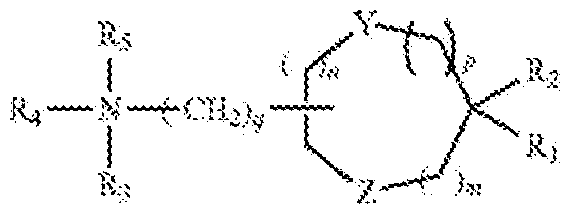
R3 and R4 are either the same or different and independently optionally substituted Ci-C6 alkyl, optionally substituted C2-C6 alkenyl, or optionally substituted C2-C6 alkynyl or R3 and R4 may join to form an optionally substituted heterocyclic ring of 4 to 6 carbon atoms and 1 or 2 heteroatoms chosen from nitrogen and oxygen;
R5 is either absent or present and when present is hydrogen or Ci-C6 alkyl; m, n, and p are either the same or different and independently either 0 or 1 with the proviso that m, n, and p are not simultaneously 0; q is 0, 1, 2, 3, or 4; and
Y and Z are either the same or different and independently O, S, or H.
In one embodiment, Ri and R2 are each linoleyl, and the amino lipid is a dilinoleyl amino lipid. In one embodiment, the amino lipid is a dilinoleyl amino lipid.
In various other embodiments, the cationic lipid of Embodiments 1, 2, 3, 4 or 5 has the following structure:

or a pharmaceutically acceptable salt, tautomer, prodrug or stereoisomer thereof, wherein:
Ri and R2 are independently selected from the group consisting of H, and C1-C3 alkyls;
R3 and R4 are independently selected from the group consisting of alkyl groups having from about 10 to about 20 carbon atoms, wherein at least one of R3 and R4 comprises at least two sites of unsaturation. (e.g., R3 and R4 may be, for example, dodecadienyl, tetradecadienyl, hexadecadienyl, Hnoleyl, and icosadienyl. In a preferred embodiment, R3 and R4 are both Hnoleyl. R3 and R4 may comprise at least three sites of unsaturation (e.g., R3 and R may be, for example, dodecatrienyl, tetradectrienyl, hexadecatrienyl, iinolenyl, and icosatrienyl).
In some embodiments, the cationic lipid of Embodiments 1, 2, 3, 4 or 5 has the following structure:
Θ
R2 X
R!-N-R3
1 I © J
R4
or a pharmaceutically acceptable salt, tautomer, prodrug or stereoisomer thereof, wherein:
Ri and R2 are independently selected and are H or Ci-C3 alkyls. R3 and
R are independently selected and are alkyl groups having from about 10 to about 20 carbon atoms, wherein at least one of R and R4 comprises at least two sites of unsaturation. In one embodiment, R3 and 4 are both the same, for example, in some embodiments R3 and R4 are both linoleyl (i.e. , CI 8), etc. In another embodiment, R3 and R4 are different, for example, in some embodiments R3 is tetradectrienyl (C 14) and R4 is linoleyl (CI 8). In a preferred embodiment, the cationic lipid(s) of the present invention are symmetrical, i.e., R3 and R4. are the same. In another preferred embodiment, both R3 and R4 comprise at least two sites of unsaturation. In some embodiments, R3 and R4 are
independently selected from dodecadienyl, tetrad ecadienyl, hexadecadienyl, linoleyL and icosadienyl. In a preferred embodiment, R3 and R4 are both linoleyl. In some embodiments, R4 and R4 comprise at least three sites of unsaturation and are
independently selected from, e.g., dodecatrienyl, tetradectrienyl, hexadecatrienyl, linoleny], and icosatrienyl.
In various enibodinients, the cationic lipid of Embodiments 1, 2, 3, 4 or 5 has the formula:
O
Rx^ aa-Z-Ry
or a pharmaceutically acceptable salt, tautomer, prodrug or stereoisomer thereof, wherein:
Xaa is a D- or L-amino acid residue having the formula - R^CR^2-
C(C=0)-, or a peptide or a peptide of amino acid residues having the formula
{ RN— CR R2— (C==0) } n— , wherein n is 2 to 20;
R! is independently, for each occurrence, a non-hydrogen, substituted or unsubstituted side chain of an amino acid;
R~ and R are independently, for each occurrence, hydrogen, an organic group consisting of carbon, oxygen, nitrogen, sulfur, and hydrogen atoms, or any combination of the foregoing, and having from 1 to 20 carbon atoms, Q j.sjalkyl, cycloalkyi, cycloalkylalkyl, C(3.5)alkenyl, C(3.5)alkynyl, C(1.5)alkanoyl, Cr..
5)alkanoyloxy, C(i-5)alkoxy, C(1.5>alkoxy-C(1.5)ajkyj , C(i.5)aikoxy-C(i.5)aikoxy, C(i.
5)aIkyI-amino-C(i.5)alkyl-, C(1 -5)dialkyl-amino-C(1.5)alkyl-, nitro-Ca^alkyl, cyano-C(1. 5)alkyl, aryi-C(i-5)aikyi, 4-biphenyl-C(1-s)alkyl, carboxyl, or hydroxyl;
Z is NH, O, S,— CH2S— ,— CH2S(0)— , or an organic linker consisting of 1-40 atoms selected from hydrogen, carbon, oxygen, nitrogen, and sulfur atoms (preferably, Z is NH or O);
Rx and R5" are, independently, (i) a lipophilic tail derived from a lipid (which can be naturally-occurring or synthetic), phospholipid, glycolipid,
triacylglycerol, glycerophospholipid, sphingolipid, ceramide, sphingomyelin, cerebroside, or ganglioside, wherein the tail optionally includes a steroid; (ii) an amino acid terminal group selected from hydrogen, hydroxyl, amino, and an organic protecting
group; or (iii) a substituted or unsubstituted C(3.22)alkyl, C(6-12>cycloalkyl, C .
i2)Cycloalkyl-C(3.22)alkyl, C(3.22)alkenyl, C(3.22)alkynyl, C(3.22)alkoxy, or C(6-12)-alkoxy- C(3-22>alkyl;
one of Rx and Ry is a lipophilic tail as defined above and the other is an amino acid terminal group, or both Rx and Ry are lipophilic tails;
at least one of Rx and R- is interrupted by one or more biodegradable groups (e.g. , --OC(O)--, ( '(() )() . --SC(O)--, --€(0)8--,— OC(S)— -,—
C(S)0— ,— S— 8— ,— C(R5)-N— ,— N-C(R5)— ,— C(R5)=N— O— , 0
N=C(R5>— , --C(0)(NR5)--, --N(R5)C(0)--,— C(S)(NR5)— ,— N(R5)C(0>— ,— N(R5)C:(0)N(R5) , ()C:(0)0 , OSi(R5)20 , C(0)(CR3R4)C(0)0 ,

wherein R is a C?-Cg alkyl or alkenyi and each occurrence of R5 is, independently, H or alkyl; and each occurrence of R3 and R4 are, independently H, halogen, OH, alkyl, alkoxy,— H2, alkylamino, or dialkylamino; or R3 and R4, together with the carbon atom to which they are directly attached, form a cycloalkyl group (in one preferred embodiment, each occurrence of RJ and R4 are, independently H or C C* alkyl)); and Rx and IV each, independently, optionally have one or more carbon-carbon double bonds.
In some embodiments, the cationic lipid of Embodiments 1, 2, 3, 4 or 5 is one of the following:

or a pharmaceutically acceptable salt, tautomer, prodrug or stereoisomer thereof, wherein:
Ri and R2 are independently alkyl, alkenyi or alkynyl, and each can optionally substituted;
R3 and R4 are independently a Ci-C6 alkyl, or R3 and R4 can be taken together to form an optionally substituted heterocyclic ring.
A representative useful dilinoleyl amino lipid has the formula:

In one embodiment, the cationic lipid of Embodiments 1, 2, 3, 4 or 5 is DLin-K-DMA. In one embodiment, a cationic lipid of any one of the disclosed embodiments (e.g., the cationic lipid, the first cationic lipid, the second cationic lipid) is DLin-KC2-DMA (DLin-K-DMA above, wherein n is 2).
In one embodiment, the cationic lipid of Embodiments 1, 2, 3, 4 or 5 has the following structure:
Ra-E-(
R2
or a pharmaceutically acceptable salt, tautomer, prodrug or stereoisomer thereof, wherein:
Rj and R2 are each independently for each occurrence optionally substituted C10-C30 alkyl, optionally substituted C10-C30 alkenyl, optionally substituted C]o-C3o alkynyl or optionally substituted Cio-C30 acyl;
R3 is H, optionally substituted C10-C10 alkyl, optionally substituted C2- Cio alkenyl, optionally substituted C2-C10 alk nyl, alkylhetrocycle, alkylpbosphate, alkylphosphorothioate, alkylphosphorodithioate, alkylphosphonate, alkylamine, hydroxyalkyl, ω-aminoalkyl, ro-(substituted)aminoalkyl, ω-phosphoalkyl, ω- thiophosphoalkyl, optionally substituted polyethylene glycol (PEG, mw 100-40K), optionally substituted mPEG (mw 120-40K), heteroaryl, or heterocycle, or linker- ligand, for example in some embodiments R3 is (ΟΗ3)2Ν(€Η2)η-, wherein n is 1, 2, 3 or 4:
E is (X S, N(Q), ( '(()). ()( (()}. C(G)0, N(Q)CiO), C(0)N(Q),
(Q)N(CO)0, 0(CO)N(Q), S(O), NS(0)2N(Q), S(0)2, N(Q)8(0)2, SS, 0=N, ar> l.
heteroaryl, cyclic or heterocycle, for example -C(0)Q, wherein - is a point of connection to R3; and
Q is H, alkyl, ω-aminoalkyl, G (substituted)armnoalkyl, ω-phospboalkyl or ω-thiophosphoalkyl.
In one specific embodiment, the cationic lipid of Embodiments 1, 2, 3, 4 or 5 has the following structure:

or a pharmaceutically acceptable salt, tautomer, prodrug or stereoisomer thereof, wherein:
E is O, S, N(Q), { ·(()). N(Q)C(0), C(0)N(Q), (Q)N(CO)0, 0(CO)N(Q), S(0), NS(0)2N(Q), SCOK N(Q)S(0)2, SS, O-N, a^l, heteroaiyl, cyclic or heterocycle;
Q is H, alkyl, ω-amninoalkyl, to-(substituted)amniiioalky, to- phospb oalkyl or ω-thi ophospb oalkyl ;
Ri and R2 and Rx are each independently for each occurrence H, optionally substituted Ci-Cjo alkyl, optionally substituted CurC3o alkyl, optionally substituted C10-C3o alkenyl., optionally substituted C10-C30 alkynyl, optionally substituted C10-C30 acyl, or linker-ligand, provided that at least one of Ri , R? and Rx is not H;
R. s H, optionally substituted Ci-Cjo alkyl, optionally substituted C2-C10 alkenyl, optionally substituted C2-Cio alkynyl, alkylhetrocycle, alkylphosphate, al ky 1 phosphorothi oate, al ky 1 phosphorodi thi oate, alkyl phospb onate, al ky 1 amine, hydroxyalkyl, ω-aminoalkyl, ^^(substituted)aminoalkyl, ω-phosphoalkyl, ω- thiophosphoalkyl, optionally substituted polyethylene glycol (PEG, mw 100-40K), optionally substituted mPEG (mvv 120-40K), heteroaiyl, or heterocycle, or linker- ligand; and
n is 0, 1, 2, or 3.
In one embodiment, the cationic lipid of Embodiments 1, 2, 3, 4 or 5 has the structure of Formula I:

I
or a pharmaceutically acceptable salt, tautomer, prodrug or stereoisomer thereof, wherein:
one of L1 or L2 is -0(C=0)-, -(C=0)0-, -C(=0)-, -0-, -S(0)x-, -S-S-, -C(=0)S-, SC(=0)-, - RaC(=0)-, -C(=0) Ra-, RaC(=0) Ra-, -OC(=0) Ra- or - RaC(=0)0-, and the other of L1 or L2 is -0(C=0)-, -(C=0)0-, -C(=0)-, -0-, -S(0)x-, -S-S-, -C(=0)S-, SC(=0)-, - RaC(=0)-, -C(=0) Ra-, , RaC(=0) Ra-, -OC(=0) Ra- or
- RaC(=0)0- or a direct bond;
Ra is H or C1-C12 alkyl;
Rla and Rlb are, at each occurrence, independently either (a) H or C1-C12 alkyl, or (b) Rla is H or C1-C12 alkyl, and Rlb together with the carbon atom to which it is bound is taken together with an adjacent Rlb and the carbon atom to which it is bound to form a carbon-carbon double bond;
R2a and R2b are, at each occurrence, independently either (a) H or C1-C12 alkyl, or (b) R2a is H or C1-C12 alkyl, and R2b together with the carbon atom to which it is bound is taken together with an adjacent R2b and the carbon atom to which it is bound to form a carbon-carbon double bond;
R3a and R3b are, at each occurrence, independently either (a) H or C1-C12 alkyl, or (b) R3a is H or C1-C12 alkyl, and R3b together with the carbon atom to which it is bound is taken together with an adjacent R3b and the carbon atom to which it is bound to form a carbon-carbon double bond;
R4a and R4b are, at each occurrence, independently either (a) H or C1-C12 alkyl, or (b) R4a is H or C1-C12 alkyl, and R4b together with the carbon atom to which it is bound is taken together with an adjacent R4b and the carbon atom to which it is bound to form a carbon-carbon double bond;
R5 and R6 are each independently methyl or cycloalkyl;
R7 is, at each occurrence, independently H or C1-C12 alkyl;
R8 and R9 are each independently unsubstituted C1-C12 alkyl; or R8 and R9, together with the nitrogen atom to which they are attached, form a 5, 6 or 7- membered heterocyclic ring comprising one nitrogen atom;
a and d are each independently an integer from 0 to 24; b and c are each independently an integer from 1 to 24; e is 1 or 2; and
x is 0, 1 or 2.
In some embodiments of Formula I, L1 and L2 are independently - 0(C=0)- or -(C=0)0-.
In certain embodiments of Formula I, at least one of Rla, R2a, R3a or R4a is C1-C12 alkyl, or at least one of L1 or L2 is -0(C=0)- or -(C=0)0-. In other embodiments, Rla and Rlb are not isopropyl when a is 6 or n-butyl when a is 8.
In still further embodiments of Formula I, at least one of Rla, R2a, R3a or R4a is C1-C12 alkyl, or at least one of L1 or L2 is -0(C=0)- or -(C=0)O; and
Rla and Rlb are not isopropyl when a is 6 or n-butyl when a is 8.
In other embodiments of Formula I, R8 and R9 are each independently unsubstituted C1-C12 alkyl; or R8 and R9, together with the nitrogen atom to which they are attached, form a 5, 6 or 7-membered heterocyclic ring comprising one nitrogen atom;
In certain embodiments of Formula I, any one of L1 or L2 may be -0(C=0)- or a carbon-carbon double bond. L1 and L2 may each be -0(C=0)- or may each be a carbon-carbon double bond.
In some embodiments of Formula I, one of L L^s -C CK))- In other embodiments, both L1 and L2 are -0(C=0)-.
In some embodiments of Formula I, one
other embodiments, both L1 and L2 are -(C=0)0-
In some other embodiments of Formula I, one of L1 or L2 is a carbon- carbon double bond. In other embodiments, both L1 and L2 are a carbon-carbon double bond.
In still other embodiments of Formula I, one of l or l^ is -OCCO)- and the other of L1 or L2 is -(C=0)0- In more embodiments, one of L1 or L2 is -0(C=0)- and the other of L1 or L2 is a carbon-carbon double bond. In yet more embodiments, one of L1 or L2 is -(C=0)0- and the other of L1 or L2 is a carbon-carbon double bond.
It is understood that "carbon-carbon" double bond, as used throughout the specification, refers to one of the followin structures:

wherein Ra and R are, at each occurrence, independently H or a substituent. For example, in some embodiments Ra and Rb are, at each occurrence, independently H, Ci- Ci2 alkyl or cycloalkyl, for example H or C1-C12 alkyl.
In other embodiments, the lipid compounds of Formula I have the following Formula (la):

In other embodiments, the lipid compounds of Formula I have the following Formula (lb):

(lb)
In yet other embodiments, the lipid compounds of Formula I have the following Formula (Ic):

(Ic)
In certain embodiments of the lipid compound of Formula I, a, b, c and d are each independently an integer from 2 to 12 or an integer from 4 to 12. In other embodiments, a, b, c and d are each independently an integer from 8 to 12 or 5 to 9. In some certain embodiments, a is 0. In some embodiments, a is 1. In other embodiments, a is 2. In more embodiments, a is 3. In yet other embodiments, a is 4. In some embodiments, a is 5. In other embodiments, a is 6. In more embodiments, a is 7. In yet other embodiments, a is 8. In some embodiments, a is 9. In other embodiments, a is 10. In more embodiments, a is 11. In yet other embodiments, a is 12. In some embodiments, a is 13. In other embodiments, a is 14. In more embodiments, a is 15. In yet other embodiments, a is 16.
In some other embodiments of Formula I, b is 1. In other embodiments, b is 2. In more embodiments, b is 3. In yet other embodiments, b is 4. In some embodiments, b is 5. In other embodiments, b is 6. In more embodiments, b is 7. In yet other embodiments, b is 8. In some embodiments, b is 9. In other embodiments, b is 10. In more embodiments, b is 11. In yet other embodiments, b is 12. In some
embodiments, b is 13. In other embodiments, b is 14. In more embodiments, b is 15. In yet other embodiments, b is 16.
In some more embodiments of Formula I, c is 1. In other embodiments, c is 2. In more embodiments, c is 3. In yet other embodiments, c is 4. In some embodiments, c is 5. In other embodiments, c is 6. In more embodiments, c is 7. In yet other embodiments, c is 8. In some embodiments, c is 9. In other embodiments, c is 10. In more embodiments, c is 11. In yet other embodiments, c is 12. In some embodiments, c is 13. In other embodiments, c is 14. In more embodiments, c is 15. In yet other embodiments, c is 16.
In some certain other embodiments of Formula I, d is 0. In some embodiments, d is 1. In other embodiments, d is 2. In more embodiments, d is 3. In yet other embodiments, d is 4. In some embodiments, d is 5. In other embodiments, d is 6. In more embodiments, d is 7. In yet other embodiments, d is 8. In some embodiments, d is 9. In other embodiments, d is 10. In more embodiments, d is 11. In yet other embodiments, d is 12. In some embodiments, d is 13. In other embodiments, d is 14. In more embodiments, d is 15. In yet other embodiments, d is 16.
In some other various embodiments of Formula I, a and d are the same. In some other embodiments, b and c are the same. In some other specific embodiments, a and d are the same and b and c are the same.
The sum of a and b and the sum of c and d in Formula I are factors which may be varied to obtain a lipid of formula I having the desired properties. In one embodiment, a and b are chosen such that their sum is an integer ranging from 14 to 24. In other embodiments, c and d are chosen such that their sum is an integer ranging from 14 to 24. In further embodiment, the sum of a and b and the sum of c and d are the same. For example, in some embodiments the sum of a and b and the sum of c and d are both the same integer which may range from 14 to 24. In still more embodiments, a. b, c and d are selected such the sum of a and b and the sum of c and d is 12 or greater.
In some embodiments of Formula I, e is 1. In other embodiments, e is 2. The substituents at Rla, R2a, R3a and R4a of Formula I are not particularly limited. In certain embodiments Rla, R2a, R3a and R4a are H at each occurrence. In
certain other embodiments at least one of R a, R a, R a and R a is C1-C12 alkyl. In certain other embodiments at least one of Rla, R2a, R3a and R4a is Ci-C8 alkyl. In certain other embodiments at least one of Rla, R2a, R3a and R4a is Ci-C6 alkyl. In some of the foregoing embodiments, the Ci-C8 alkyl is methyl, ethyl, n-propyl, iso-propyl, n-butyl, iso-butyl, tert-butyl, n-hexyl or n-octyl.
In certain embodiments of Formula I, Rla, Rlb, R4a and R4b are C1-C12 alkyl at each occurrence.
In further embodiments of Formula I, at least one of Rib R2b R3b and
R4b is H or Rlb, R2b, R3b and R4b are H at each occurrence.
In certain embodiments of Formula I, Rlb together with the carbon atom to which it is bound is taken together with an adjacent Rlb and the carbon atom to which it is bound to form a carbon-carbon double bond. In other embodiments of the foregoing R4b together with the carbon atom to which it is bound is taken together with an adjacent R4b and the carbon atom to which it is bound to form a carbon-carbon double bond.
The substituents at R5 and R6 of Formula I are not particularly limited in the foregoing embodiments. In certain embodiments one or both of R5 or R6 is methyl. In certain other embodiments one or both of R5 or R6 is cycloalkyl for example cyclohexyl. In these embodiments the cycloalkyl may be substituted or not substituted. In certain other embodiments the cycloalkyl is substituted with C1-C12 alkyl, for example tert-butyl.
The substituents at R7 are not particularly limited in the foregoing embodiments of Formula I. In certain embodiments at least one R7 is H. In some other embodiments, R7 is H at each occurrence. In certain other embodiments R7 is C1-C12 alkyl.
In certain other of the foregoing embodiments of Formula I, one of R8 or R9 is methyl. In other embodiments, both R8 and R9 are methyl.
In some different embodiments of Formula I, R8 and R9, together with the nitrogen atom to which they are attached, form a 5, 6 or 7-membered heterocyclic ring. In some embodiments of the foregoing, R8 and R9, together with the nitrogen
atom to which they are attached, form a 5-membered heterocyclic ring, for example a pyrrolidinyl ring.
In some embodiments of Embodiment 3, the first and second cationic lipids are each, independently selected from a lipid of Formula I.
In various different embodiments, the lipid of Formula I has one of the structures set forth in Table 1 below.
Table 1 : Re resentative Li ids of Formula I


 o. Structure pKa -19 6.72 -20 6.44
0 -21 6.28
0 -22 6.53 -23 6.24 -24 6.28 -25 6.20
o. Structure pKa -26 6.89 o -27 6.30
-28 6.20
-29 6.22
-30 - o -31 6.33
-32 6.47
O
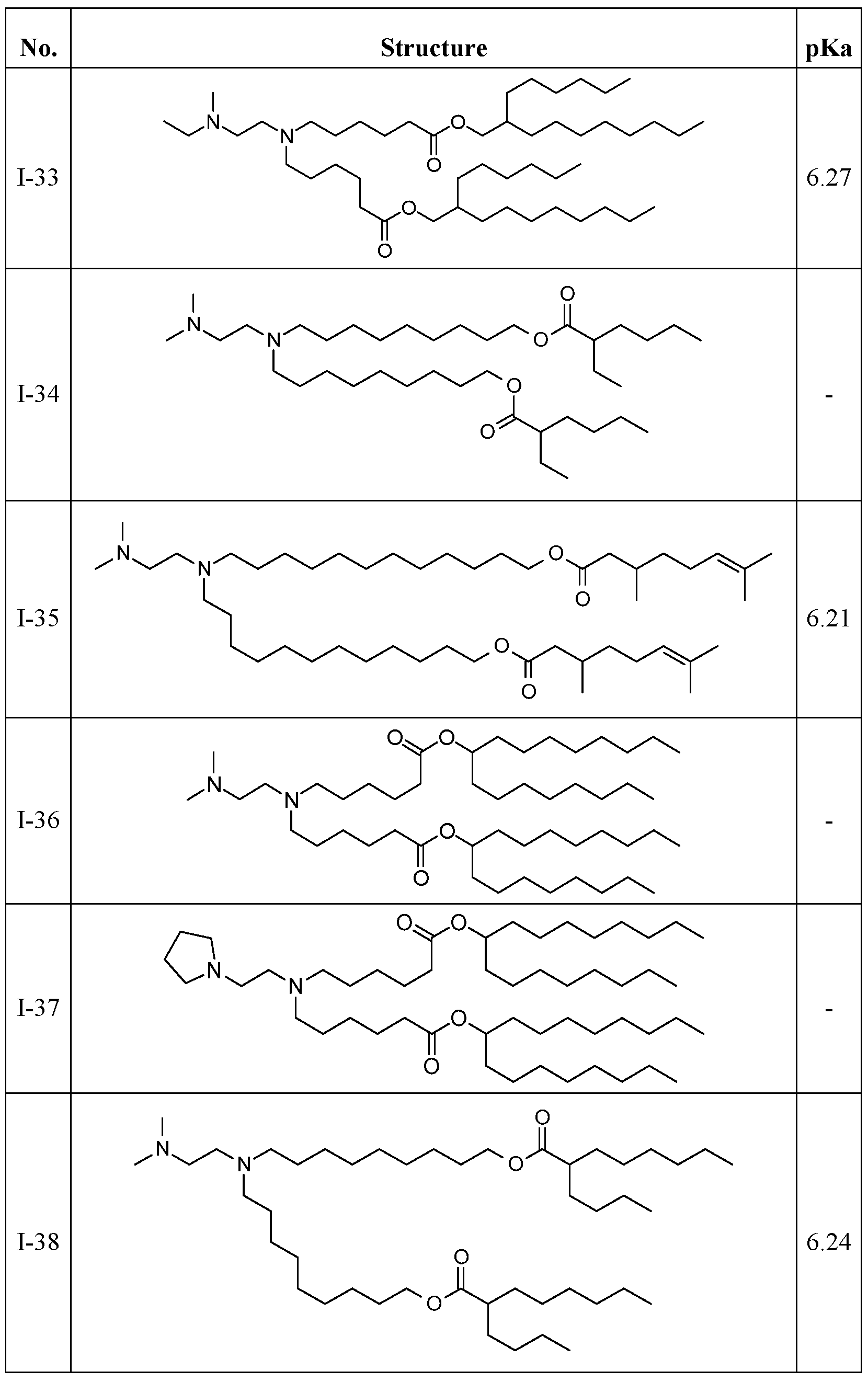

In some embodiments, the cationic lipid of Embodiments 1, 2, 3, 4 or 5 has a structure of Formula II:

II
or a pharmaceutically acceptable salt, tautomer, prodrug or stereoisomer thereof, wherein:
one of L1 or L2 is -0(C=0)-, -(C=0)0-, -C(=0)-, -0-, -S(0)x-, -S-S-,
-C(=0)S-, SC(=0)-, - RaC(=0)-, -C(=0) Ra-, RaC(=0) Ra-, -OC(=0) Ra- or - RaC(=0)0-, and the other of L1 or L2 is -0(C=0)-, -(C=0)0-, -C(=0)-, -0-, -S(0)x-, -S-S-, -C(=0)S-, SC(=0)-, - RaC(=0)-, -C(=0) Ra-, , RaC(=0) Ra-, -OC(=0) Ra- or
- RaC(=0)0- or a direct bond;
G1 is Ci-C2 alkylene, -(C=0)-, -0(C=0)-, -SC(=0)-, - RaC(=0)- or a direct bond:
-C(=0)-, -(C=0)0-, -C(=0)S-, -C(=0) Ra- or a direct bond;
G is Ci-C6 alkylene;
Ra is H or C1-C12 alkyl;
Rla and Rlb are, at each occurrence, independently either: (a) H or C1-C12 alkyl; or (b) Rla is H or C1-C12 alkyl, and Rlb together with the carbon atom to which it is bound is taken together with an adjacent Rlb and the carbon atom to which it is bound to form a carbon-carbon double bond;
R2a and R2b are, at each occurrence, independently either: (a) H or C1-C12 alkyl; or (b) R2a is H or C1-C12 alkyl, and R2b together with the carbon atom to which it is bound is taken together with an adjacent R2b and the carbon atom to which it is bound to form a carbon-carbon double bond;
R3a and R3b are, at each occurrence, independently either (a): H or C1-C12 alkyl; or (b) R3a is H or C1-C12 alkyl, and R3b together with the carbon atom to which it
is bound is taken together with an adjacent R3b and the carbon atom to which it is bound to form a carbon-carbon double bond;
R4a and R4b are, at each occurrence, independently either: (a) H or C1-C12 alkyl; or (b) R4a is H or C1-C12 alkyl, and R4b together with the carbon atom to which it is bound is taken together with an adjacent R4b and the carbon atom to which it is bound to form a carbon-carbon double bond;
R5 and R6 are each independently H or methyl;
R7 is C4-C20 alkyl;
R8 and R9 are each independently C1-C12 alkyl; or R8 and R9, together with the nitrogen atom to which they are attached, form a 5, 6 or 7-membered heterocyclic ring;
a, b, c and d are each independently an integer from 1 to 24; and x is 0, 1 or 2.
In some embodiments of Formula (II), L1 and L2 are each independently -0(C=0)-, -(C=0)0- or a direct bond. In other embodiments, G1 and G2 are each independently -(C=0)- or a direct bond. In some different embodiments, L1 and L2 are each independently -0(C=0)-, -(C=0)0- or a direct bond; and G1 and G2 are each independently -(C=0)- or a direct bond.
In some different embodiments of Formula (II), L1 and L2 are each independently -C(=0)-, -0-, -S(0)x-, -S-S-, -C(=0)S-, -SC(=0)-, - Ra-, - RaC(=0)-,
-C(=0) Ra-, - RaC(=0) Ra, -OC(=0) Ra-, - RaC(=0)0-, - RaS(0)x Ra-, - RaS (0)x- or -S(0)x Ra-.
In other of the foregoing embodiments of Formula (II), the lipid compound has one of the following Formulae (IIA) or (IIB):

(IIA) (ΠΒ)
In some embodiments of Formula (II), the lipid compound has Formula (IIA). In other embodiments, the lipid compound has Formula (IIB).
In any of the foregoing embodiments of Formula (II), one of L1 or L2 is -0(C=0)-. For example, in some embodiments each of L1 and L2 are -0(C=0)-.
In some different embodiments of Formula (II), one of L1 or L2 is -(C=0)0-. For example, in some embodiments each of L1 and L2 is -(C=0)0-.
In different embodiments of Formula (II), one of L1 or L2 is a direct bond. As used herein, a "direct bond" means the group (e.g., L1 or L2) is absent. For example, in some embodiments each of L1 and L2 is a direct bond.
In other different embodiments of Formula (II), for at least one occurrence of Rla and Rlb, Rla is H or C1-C12 alkyl, and Rlb together with the carbon atom to which it is bound is taken together with an adjacent Rlb and the carbon atom to which it is bound to form a carbon-carbon double bond.
In still other different embodiments of Formula (II), for at least one occurrence of R4a and R4b, R4a is H or Ci-Ci2 alkyl, and R4b together with the carbon atom to which it is bound is taken together with an adjacent R4b and the carbon atom to which it is bound to form a carbon-carbon double bond.
In more embodiments of Formula (II), for at least one occurrence of R2a and R2b, R2a is H or Ci-Ci2 alkyl, and R2b together with the carbon atom to which it is bound is taken together with an adjacent R2b and the carbon atom to which it is bound to form a carbon-carbon double bond.
In other different embodiments of Formula (II), for at least one occurrence of R3a and R3b, R3a is H or C1-C12 alkyl, and R3b together with the carbon atom to which it is bound is taken together with an adjacent R3b and the carbon atom to which it is bound to form a carbon-carbon double bond.
In various other embodiments of Formula (II), the lipid compound has one of the followin Formulae (IIC) or (IID):

wherein e, f, g and h are each independently an integer from 1 to 12.
In some embodiments of Formula (II), the lipid compound has Formula (IIC). In other embodiments, the lipid compound has Formula (IID).
In various embodiments of Formulae (IIC) or (IID), e, f, g and h are each independently an integer from 4 to 10.
In certain embodiments of Formula (II), a, b, c and d are each
independently an integer from 2 to 12 or an integer from 4 to 12. In other
embodiments, a, b, c and d are each independently an integer from 8 to 12 or 5 to 9. In some certain embodiments, a is 0. In some embodiments, a is 1. In other embodiments,
a is 2. In more embodiments, a is 3. In yet other embodiments, a is 4. In some embodiments, a is 5. In other embodiments, a is 6. In more embodiments, a is 7. In yet other embodiments, a is 8. In some embodiments, a is 9. In other embodiments, a is 10. In more embodiments, a is 11. In yet other embodiments, a is 12. In some embodiments, a is 13. In other embodiments, a is 14. In more embodiments, a is 15. In yet other embodiments, a is 16.
In some embodiments of Formula (II), b is 1. In other embodiments, b is 2. In more embodiments, b is 3. In yet other embodiments, b is 4. In some
embodiments, b is 5. In other embodiments, b is 6. In more embodiments, b is 7. In yet other embodiments, b is 8. In some embodiments, b is 9. In other embodiments, b is 10. In more embodiments, b is 11. In yet other embodiments, b is 12. In some embodiments, b is 13. In other embodiments, b is 14. In more embodiments, b is 15. In yet other embodiments, b is 16.
In some embodiments of Formula (II), c is 1. In other embodiments, c is 2. In more embodiments, c is 3. In yet other embodiments, c is 4. In some
embodiments, c is 5. In other embodiments, c is 6. In more embodiments, c is 7. In yet other embodiments, c is 8. In some embodiments, c is 9. In other embodiments, c is 10. In more embodiments, c is 11. In yet other embodiments, c is 12. In some embodiments, c is 13. In other embodiments, c is 14. In more embodiments, c is 15. In yet other embodiments, c is 16.
In some certain embodiments of Formula (II), d is 0. In some embodiments, d is 1. In other embodiments, d is 2. In more embodiments, d is 3. In yet other embodiments, d is 4. In some embodiments, d is 5. In other embodiments, d is 6. In more embodiments, d is 7. In yet other embodiments, d is 8. In some embodiments, d is 9. In other embodiments, d is 10. In more embodiments, d is 11. In yet other embodiments, d is 12. In some embodiments, d is 13. In other embodiments, d is 14. In more embodiments, d is 15. In yet other embodiments, d is 16.
In some embodiments of Formula (II), e is 1. In other embodiments, e is 2. In more embodiments, e is 3. In yet other embodiments, e is 4. In some
embodiments, e is 5. In other embodiments, e is 6. In more embodiments, e is 7. In yet
other embodiments, e is 8. In some embodiments, e is 9. In other embodiments, e is 10. In more embodiments, e is 11. In yet other embodiments, e is 12.
In some embodiments of Formula (II), f is 1. In other embodiments, f is 2. In more embodiments, f is 3. In yet other embodiments, f is 4. In some
embodiments, f is 5. In other embodiments, f is 6. In more embodiments, f is 7. In yet other embodiments, f is 8. In some embodiments, f is 9. In other embodiments, f is 10. In more embodiments, f is 11. In yet other embodiments, f is 12.
In some embodiments of Formula (II), g is 1. In other embodiments, g is 2. In more embodiments, g is 3. In yet other embodiments, g is 4. In some
embodiments, g is 5. In other embodiments, g is 6. In more embodiments, g is 7. In yet other embodiments, g is 8. In some embodiments, g is 9. In other embodiments, g is 10. In more embodiments, g is 11. In yet other embodiments, g is 12.
In some embodiments of Formula (II), h is 1. In other embodiments, e is 2. In more embodiments, h is 3. In yet other embodiments, h is 4. In some
embodiments, e is 5. In other embodiments, h is 6. In more embodiments, h is 7. In yet other embodiments, h is 8. In some embodiments, h is 9. In other embodiments, h is 10. In more embodiments, h is 11. In yet other embodiments, h is 12.
In some other various embodiments of Formula (II), a and d are the same. In some other embodiments, b and c are the same. In some other specific embodiments and a and d are the same and b and c are the same.
The sum of a and b and the sum of c and d of Formula (II) are factors which may be varied to obtain a lipid having the desired properties. In one
embodiment, a and b are chosen such that their sum is an integer ranging from 14 to 24. In other embodiments, c and d are chosen such that their sum is an integer ranging from 14 to 24. In further embodiment, the sum of a and b and the sum of c and d are the same. For example, in some embodiments the sum of a and b and the sum of c and d are both the same integer which may range from 14 to 24. In still more embodiments, a. b, c and d are selected such that the sum of a and b and the sum of c and d is 12 or greater.
The substituents at R , R , R3a and R4a of Formula (II) are not particularly limited. In some embodiments, at least one of Rla, R2a, R3a and R4a is H. In certain embodiments Rla, R2a, R3a and R4a are H at each occurrence. In certain other embodiments at least one of Rla, R2a, R3a and R4a is C1-C12 alkyl. In certain other embodiments at least one of Rla, R2a, R3a and R4a is Ci-C8 alkyl. In certain other embodiments at least one of Rla, R2a, R3a and R4a is Ci-C6 alkyl. In some of the foregoing embodiments, the Ci-C8 alkyl is methyl, ethyl, n-propyl, iso-propyl, n-butyl, iso-butyl, tert-butyl, n-hexyl or n-octyl.
In certain embodiments of Formula (II), Rla, Rlb, R4a and R4b are C1-C12 alkyl at each occurrence.
of Rib R2b R3b and
In further embodiments of Formula (II), at least one
R4b is H or Rlb, R2b, R3b and R4b are H at each occurrence.
In certain embodiments of Formula (II), Rlb together with the carbon atom to which it is bound is taken together with an adjacent Rlb and the carbon atom to which it is bound to form a carbon-carbon double bond. In other embodiments of the foregoing R4b together with the carbon atom to which it is bound is taken together with an adjacent R4b and the carbon atom to which it is bound to form a carbon-carbon double bond.
The substituents at R5 and R6 of Formula (II) are not particularly limited in the foregoing embodiments. In certain embodiments one of R5 or R6 is methyl. In other embodiments each of R5 or R6 is methyl.
The substituents at R7 of Formula (II) are not particularly limited in the foregoing embodiments. In certain embodiments R7 is C6-Ci6 alkyl. In some other embodiments, R7 is C6-C9 alkyl. In some of these embodiments, R7 is substituted with -(C=0)ORb, -0(C=0)Rb, -C(=0)Rb, -ORb, -S(0)xRb, -S-SRb, -C(=0)SRb, -SC(=0)Rb, - RaRb, - RaC(=0)Rb, -C(=0) RaRb, - RaC(=0) RaRb,
-OC(=0) RaRb, - RaC(=0)ORb, - RaS(0)x RaRb, - RaS(0)xRb or -S(0)x RaRb, wherein: Ra is H or C1-C12 alkyl; Rb is C1-C15 alkyl; and x is 0, 1 or 2. For example, in some embodiments R7 is substituted with -(C=0)ORb or -0(C=0)Rb.
In some of the foregoing embodiments of Formula (II), Rb is branched C1-C16 alkyl. For example, in some embodiments Rb has one of the following structures:

In certain other of the foregoing embodiments of Formula (II), one of R or R9 is methyl. In other embodiments, both R8 and R9 are methyl.
In some different embodiments of Formula (II), R8 and R9, together with the nitrogen atom to which they are attached, form a 5, 6 or 7-membered heterocyclic ring. In some embodiments of the foregoing, R8 and R9, together with the nitrogen atom to which they are attached, form a 5-membered heterocyclic ring, for example a pyrrolidinyl ring. In some different embodiments of the foregoing, R8 and R9, together with the nitrogen atom to which they are attached, form a 6-membered heterocyclic ring, for example a piperazinyl ring.
In certain embodiments of Embodiment 3, the first and second cationic lipids are each, independently selected from a lipid of Formula II.
In still other embodiments of the foregoing lipids of Formula (II), G3 is C2-C4 alkylene, for example C3 alkylene. In various different embodiments, the lipid compound has one of the structures set forth in Table 2 below
Table 2: Re resentative Li ids of Formula II


70


O -34 - -35 5.97
0 -36 6.13-37 5.61-38 6.45
0 -39 6.45
0
o. Structure pKa -40 6.57 -41 - -42 -
0 -43 -
-44 -
-45 - o
No. Structure pKa
11-46 -
0
In some other embodiments, the cationic lipid of Embodiments 1, 2, 3, 4 a structure of Formula

III
or a pharmaceutically acceptable salt, prodrug or stereoisomer thereof, wherein:
one of L1 or L2 is -0(C=0)-, -(C=0)0-, -C(=0)-, -0-, -S(0)x-, -S-S-, -C(=0)S-, SC(=0)-, - RaC(=0)-, -C(=0) Ra-, RaC(=0) Ra-, -OC(=0) Ra- or - RaC(=0)0-, and the other of L1 or L2 is -0(C=0)-, -(C=0)0-, -C(=0)-, -0-, -S(0)x-, -S-S-, -C(=0)S-, SC(=0)-, - RaC(=0)-, -C(=0) Ra-, , RaC(=0) Ra-, -OC(=0)NRa- or
- RaC(=0)0- or a direct bond;
G1 and G2 are each independently unsubstituted C1-C12 alkylene or Ci- C12 alkenylene;
G3 is C1-C24 alkylene, C1-C24 alkenylene, C3-C8 cycloalkylene, C3-C8 cycloalkenylene;
Ra is H or C1-C12 alkyl;
R1 and R2 are each independently C6-C24 alkyl or C6-C24 alkenyl;
R3 is H, OR5, CN, -C(=0)OR4, -OC(=0)R4 or -NR5C(=0)R4;
R4 is C1-C12 alkyl;
R5 is H or Ci-Ce alkyl; and
x is 0, 1 or 2.
In some of the foregoing embodiments of Formula (III), the lipid has one of the following Formulae ΙΠΑ) or (IIIB):

(IIIA) (IIIB)
wherein:
A is a 3 to 8-membered cycloalkyl or cycloalkylene ring;
R6 is, at each occurrence, independently H, OH or Ci-C24 alkyl;
n is an integer ranging from 1 to 15.
In some of the foregoing embodiments of Formula (III), the lipid has Formula (IIIA), and in other embodiments, the lipid has Formula (IIIB).
In other embodiments of Formula (III), the lipid has one of the following Formulae (IIIC) or HID):

(IIIC) (HID)
wherein y and z are each independently integers ranging from 1 to 12.
In any of the foregoing embodiments of Formula (III), one of L1 or L2 is -0(C=0)-. For example, in some embodiments each of L1 and L2 are -0(C=0)-. In some different embodiments of any of the foregoing, L1 and L2 are each
independently -(C=0)0- or -0(C=0)-. For example, in some embodiments each of L1 and L2 is -(C=0)0-.
In some different embodiments of Formula (III), the lipid has one of the following Formulae (HIE) or (IIIF):

(HIE) (IIIF)
In some of the foregoing embodiments of Formula (III), the lipid has one of the following Formulae (IIIG), (IIIH), (IIII), or (IIIJ):


(IIII) (IIIJ)
In some of the foregoing embodiments of Formula (III), n is an integer ranging from 2 to 12, for example from 2 to 8 or from 2 to 4. For example, in some embodiments, n is 3, 4, 5 or 6. In some embodiments, n is 3. In some embodiments, n is 4. In some embodiments, n is 5. In some embodiments, n is 6.
In some other of the foregoing embodiments of Formula (III), y and z are each independently an integer ranging from 2 to 10. For example, in some
embodiments, y and z are each independently an integer ranging from 4 to 9 or from 4 to 6.
In some of the foregoing embodiments of Formula (III), R6 is H. In other of the foregoing embodiments, R6 is C1-C24 alkyl. In other embodiments, R6 is OH.
In some embodiments of Formula (III), G is unsubstituted. In other embodiments, G3 is substituted. In various different embodiments, G3 is linear Ci-C24 alkylene or linear Ci-C24 alkenylene.
In some other foregoing embodiments of Formula (III), R1 or R2, or both, is C6-C24 alkenyl. For example, in some embodiments, R1 and R2 each, independently have the following structure:

R a and R are, at each occurrence, independently H or Ci-Ci2 alkyl; and
a is an integer from 2 to 12,
wherein R7a, R^ and a are each selected such that R1 and R2 each independently comprise from 6 to 20 carbon atoms. For example, in some embodiments a is an integer ranging from 5 to 9 or from 8 to 12.
In some of the foregoing embodiments of Formula (III), at least one occurrence of R7a is H. For example, in some embodiments, R7a is H at each occurrence. In other different embodiments of the foregoing, at least one occurrence of R7b is Ci-C8 alkyl. For example, in some embodiments, Ci-C8 alkyl is methyl, ethyl, n-propyl, iso- propyl, n-butyl, iso-butyl, tert-butyl, n-hexyl or n-octyl.
In different embodiments of Formula (III), R1 or R2, or both, has one of the followin structures:

In some specific embodiments of Embodiment 3, the first and second cationic lipids are each, independently selected from a lipid of Formula III.
In various different embodiments, a cationic lipid of any one of the disclosed embodiments (e.g., the cationic lipid, the first cationic lipid, the second cationic lipid) of Formula (III) has one of the structures set forth in Table 3 below.


Ill- 12 -
III- 13 -
0
III- 14 -
III- 15 6.14
III- 16 6.31
III- 17 6.28 o
III- 18 -


In one embodiment, the cationic lipid of any one of Embodiments 1, 2, 3, 4 or 5 has a structure of Formula (IV):

n
(IV)
or a pharmaceutically acceptable salt, prodrug or stereoisomer thereof, wherein:
one of G1 or G2 is, at each occurrence, -0(C=0)-, -(C=0)0-, -C(=0)-, -0-, -S(0) , -S-S-, -C(=0)S-, SC(=0)-, -N(Ra)C(=0)-, -C(=0)N(Ra)-,
-N(Ra)C(=0)N(Ra)-, -OC(=0)N(Ra)- or -N(Ra)C(=0)0-, and the other of G1 or G2 is, at each occurrence, -0(C=0)-, -(C=0)0-, -C(=0)-, -0-, -S(0) , -S-S-, -C(=0)S-, -SC(=0)-, -N(Ra)C(=0)-, -C(=0)N(Ra)-, -N(Ra)C(=0)N(Ra)-, -OC(=0)N(Ra)- or -N(Ra)C(=0)0- or a direct bond;
L is, at each occurrence, ~0(C=0)-, wherein ~ represents a covalent bond to X;
X is CRa;
Z is alkyl, cycloalkyl or a monovalent moiety comprising at least one polar functional group when n is 1 ; or Z is alkylene, cycloalkylene or a polyvalent moiety comprising at least one polar functional group when n is greater than 1 ;
Ra is, at each occurrence, independently H, C1-C12 alkyl, C1-C12 hydroxylalkyl, C1-C12 aminoalkyl, C1-C12 alkylaminylalkyl, C1-C12 alkoxyalkyl, C1-C12 alkoxycarbonyl, C1-C12 alkylcarbonyloxy, C1-C12 alkylcarbonyloxyalkyl or C1-C12 alkylcarbonyl;
R is, at each occurrence, independently either: (a) H or C1-C12 alkyl; or (b) R together with the carbon atom to which it is bound is taken together with an adjacent R and the carbon atom to which it is bound to form a carbon-carbon double bond;
R1 and R2 have, at each occurrence, the following structure, respectively:
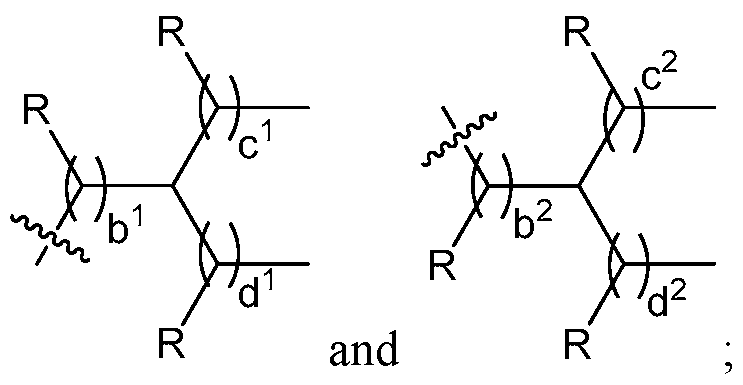
R1 R2
a1 and a2 are, at each occurrence, independently an integer from 3 to 12; b1 and b2 are, at each occurrence, independently 0 or 1 ;
c1 and c2 are, at each occurrence, independently an integer from 5 to 10; d1 and d2 are, at each occurrence, independently an integer from 5 to 10;
y is, at each occurrence, independently an integer from 0 to 2; and n is an integer from 1 to 6,
wherein each alkyl, alkylene, hydroxylalkyl, aminoalkyl, alkylaminylalkyl, alkoxyalkyl, alkoxycarbonyl, alkylcarbonyloxy,
alkylcarbonyloxyalkyl and alkylcarbonyl is optionally substituted with one or more substituent.
In some embodiments of Formula (IV), G1 and G2 are each independently
-0(C=0)- or -(C=0)0-.
In other embodiments of Formula (IV), X is CH.
In different embodiments of Formula (IV), the sum of a^ ^ + c the sum of a2 + b2 + c2 is an integer from 12 to 26.
In still other embodiments of Formula (IV), a1 and a2 are independently an integer from 3 to 10. For example, in some embodiments a1 and a2 are
independently an integer from 4 to 9.
In various embodiments of Formula (IV), b1 and b2 are 0. In different embodiments, b1 and b2 are 1.
In more embodiments of Formula (IV), c1, c2, d1 and d2 are independently an integer from 6 to 8.
In other embodiments of Formula (IV), c1 and c2 are, at each occurrence, independently an integer from 6 to 10, and d1 and d2 are, at each occurrence, independently an integer from 6 to 10.
In other embodiments of Formula (IV), c1 and c2 are, at each occurrence, independently an integer from 5 to 9, and d1 and d2 are, at each occurrence,
independently an integer from 5 to 9.
In more embodiments of Formula (IV), Z is alkyl, cycloalkyl or a monovalent moiety comprising at least one polar functional group when n is 1. In other embodiments, Z is alkyl.
In various embodiments of the foregoing Formula (IV), R is, at each occurrence, independently either: (a) H or methyl; or (b) R together with the carbon
atom to which it is bound is taken together with an adjacent R and the carbon atom to which it is bound to form a carbon-carbon double bond. In certain embodiments, each R is H. In other embodiments at least one R together with the carbon atom to which it is bound is taken together with an adjacent R and the carbon atom to which it is bound to form a carbon-carbon double bond.
In other embodiments of the compound of Formula (IV), R1 and R2 independently have one of the following structures:

In certain embodiments of Formula (IV), the compound has one of the following stru


93

In still different embodiments the cationic lipid of Embodiments 1, 2, 3, 4 or 5 has the structure of Formula (V):

(V)
or a pharmaceutically acceptable salt, prodrug or stereoisomer thereof, wherein:
one of G1 or G2 is, at each occurrence, -0(C=0)-, -(C=0)0-, -C(=0)-,
-0-, -S(0) , -S-S-, -C(=0)S-, SC(=0)-, -N(Ra)C(=0)-, -C(=0)N(Ra)-,
-N(Ra)C(=0)N(Ra)-, -OC(=0)N(Ra)- or -N(Ra)C(=0)0-, and the other of G1 or G2 is, at each occurrence, -0(C=0)-, -(C=0)0-, -C(=0)-, -0-, -S(0)y-, -S-S-, -C(=0)S-,
-SC(=0)-, -N(Ra)C(=0)-, -C(=0)N(Ra)-, -N(Ra)C(=0)N(Ra)-, -OC(=0)N(Ra)- or
-N(Ra)C(=0)0- or a direct bond;
L is, at each occurrence, ~0(C=0)-, wherein ~ represents a covalent bond to X;
X is CRa;
Z is alkyl, cycloalkyl or a monovalent moiety comprising at least one polar functional group when n is 1; or Z is alkylene, cycloalkylene or a polyvalent moiety comprising at least one polar functional group when n is greater than 1;
Ra is, at each occurrence, independently H, C1-C12 alkyl, C1-C12 hydroxylalkyl, C1-C12 aminoalkyl, C1-C12 alkylaminylalkyl, C1-C12 alkoxyalkyl, C1-C12 alkoxycarbonyl, C1-C12 alkylcarbonyloxy, C1-C12 alkylcarbonyloxyalkyl or C1-C12 alkylcarbonyl;
R is, at each occurrence, independently either: (a) H or C1-C12 alkyl; or (b) R together with the carbon atom to which it is bound is taken together with an adjacent R and the carbon atom to which it is bound to form a carbon-carbon double bond;
R1 and R2 ng structure, respectively:

R1 R2
R' is, at each occurrence, independently H or C1-C12 alkyl; a1 and a2 are, at each occurrence, independently an integer from 3 to 12; b1 and b2 are, at each occurrence, independently 0 or 1;
c1 and c2 are, at each occurrence, independently an integer from 2 to 12; d1 and d2 are, at each occurrence, independently an integer from 2 to 12; y is, at each occurrence, independently an integer from 0 to 2; and n is an integer from 1 to 6,
1 2 1 2 1 2 1 1 1 wherein a , a , c , c , d and d are selected such that the sum of a^+d1 is an integer from 18 to 30, and the sum of a2+c2+d2 is an integer from 18 to 30, and wherein each alkyl, alkylene, hydroxylalkyl, aminoalkyl, alkylaminylalkyl, alkoxyalkyl, alkoxycarbonyl, alkylcarbonyloxy, alkylcarbonyloxyalkyl and alkylcarbonyl is optionally substituted with one or more substituent.
In certain embodiments of Formula (V), G1 and G2 are each
independently
-0(C=0)- or -(C=0)0-.
In other embodiments of Formula (V), X is CH.
In some embodiments of Formula (V), the sum of a^^+d1 is an integer from 20 to 30, and the sum of a2+c2+d2 is an integer from 18 to 30. In other
embodiments, the sum of a^^+d1 is an integer from 20 to 30, and the sum of a2+c2+d2 is an integer from 20 to 30. In more embodiments of Formula (V), the sum of a1 + b1 +
1 2 2 2 1 2 c or the sum of a + b + c is an integer from 12 to 26. In other embodiments, a , a , c1, c2, d1 and d2 are selected such that the sum of a^^+d1 is an integer from 18 to 28, and the sum of a2+c2+d2 is an integer from 18 to 28,
In still other embodiments of Formula (V), a1 and a2 are independently an integer from 3 to 10, for example an integer from 4 to 9.
In yet other embodiments of Formula (V), b1 and b2 are 0. In different embodiments b1 and b2 are 1.
In certain other embodiments of Formula (V), c1, c2, d1 and d2 are independently an integer from 6 to 8.
In different other embodiments of Formula (V), Z is alkyl or a monovalent moiety comprising at least one polar functional group when n is 1 ; or Z is alkylene or a polyvalent moiety comprising at least one polar functional group when n is greater than 1.
In more embodiments of Formula (V), Z is alkyl, cycloalkyl or a monovalent moiety comprising at least one polar functional group when n is 1. In other embodiments, Z is alkyl.
In other different embodiments of Formula (V), R is, at each occurrence, independently either: (a) H or methyl; or (b) R together with the carbon atom to which it is bound is taken together with an adjacent R and the carbon atom to which it is bound to form a carbon-carbon double bond. For example in some embodiments each R is H. In other embodiments at least one R together with the carbon atom to which it
is bound is taken together with an adjacent R and the carbon atom to which it is bound to form a carbon-carbon double bond.
In more embodiments, each R' is H.
In certain embodiments of Formula (V), the sum of a^+d1 is an integer from 20 to 25, and the sum of a2+c2+d2 is an integer from 20 to 25.
In other embodiments of Formula (V), R1 and R2 independently have one of the following structures:

In more embodiments of Formula (V), the compound has one of the following stru


99

In any of the foregoing embodiments of Formula (IV) or (V), n is 1. In other of the foregoing embodiments of Formula (IV) or (V), n is greater than 1.
In more of any of the foregoing embodiments of Formula (IV) or (V), Z is a mono- or polyvalent moiety comprising at least one polar functional group. In some embodiments, Z is a monovalent moiety comprising at least one polar functional group. In other embodiments, Z is a polyvalent moiety comprising at least one polar functional group.
In more of any of the foregoing embodiments of Formula (IV) or (V), the polar functional group is a hydroxyl, alkoxy, ester, cyano, amide, amino, alkylaminyl, heterocyclyl or heteroaryl functional group.
In any of the foregoing embodiments of Formula (IV) or (V), Z is hydroxyl, hydroxylalkyl, alkoxyalkyl, amino, aminoalkyl, alkylaminyl,
alkylaminylalkyl, heterocyclyl or heterocyclylalkyl.
In some other embodiments of Formula (IV) or (V), Z has the following structure:

wherein:
R5 and R6 are independently H or Ci-C6 alkyl;
R7 and R8 are independently H or Ci-C6 alkyl or R7 and R8, together with the nitrogen atom to which they are attached, join to form a 3-7 membered heterocyclic ring; and
x is an integer from 0 to 6.
In still different embodiments of Formula (IV) or (V), Z has the following structure:

wherein:
R5 and R6 are independently H or Ci-C6 alkyl;
R7 and R8 are independently H or Ci-C6 alkyl or R7 and R8, together with the nitrogen atom to which they are attached, join to form a 3-7 membered heterocyclic ring; and
x is an integer from 0 to 6.
In still different embodiments of formula (IV) or (V), Z has the following structure:
O R5
R° R6
wherein:
R5 and R6 are independently H or Ci-C6 alkyl;
R and R are independently H or Ci-C6 alkyl or R and R , together with the nitrogen atom to which they are attached, join to form a 3-7 membered heterocyclic ring; and
x is an integer from 0 to 6.
In some other embodiments of Formula (IV) or (V), Z is hydroxylalkyl, cyanoalkyl or an alkyl substituted with one or more ester or amide groups.
For example, in any of the foregoing embodiments of Formula (IV) or
(V), Z has one of the following structures:

In other embodiments of Formula (IV) or (V), Z-L has one of the following structures:


W = = H, Me, Et, iPr . W = H, Me, Et, iPr W = H, Me, Et, iPr


In other embodiments, Z-L has one of the following structures:

In still other embodiments, X is CH and Z-L has one of the following structures:

In various different embodiments, a cationic lipid of any one Embodiments 1, 2, 3, 4 or 5 has one of the structures set forth in Table 4 below.

In one embodiment, the cationic lipid is a compound having the following structure (VI):
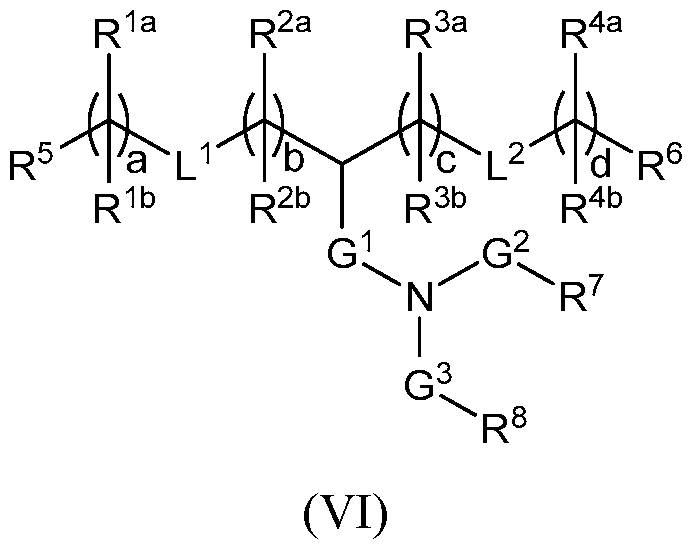
L1 and L2 are each independently -0(C=0)-, -(C=0)0-, -C(=0)-, -0-, -S(0)x-, -S-S-, -C(=0)S-, -SC(=0)-, - RaC(=0)-, -C(=0) Ra-, - RaC(=0) Ra-, -OC(=0) Ra-, - RaC(=0)0- or a direct bond;
G1 is Ci-C2 alkylene, -(C=0)-, -0(C=0)-, -SC(=0)-, - RaC(=0)- or a direct bond;
G2 is -C(=0)-, -(C=0)0-, -C(=0)S-, -C(=0) Ra- or a direct bond;
G3 is Ci-C6 alkylene;
Ra is H or C1-C12 alkyl;
Rla and Rlb are, at each occurrence, independently either: (a) H or C1-C12 alkyl; or (b) Rla is H or C1-C12 alkyl, and Rlb together with the carbon atom to which it is bound is taken together with an adjacent Rlb and the carbon atom to which it is bound to form a carbon-carbon double bond;
R2a and R2b are, at each occurrence, independently either: (a) H or C1-C12 alkyl; or (b) R2a is H or C1-C12 alkyl, and R2b together with the carbon atom to which it is bound is taken together with an adjacent R2b and the carbon atom to which it is bound to form a carbon-carbon double bond;
R3a and R3b are, at each occurrence, independently either (a): H or C1-C12 alkyl; or (b) R3a is H or C1-C12 alkyl, and R3b together with the carbon atom to which it is bound is taken together with an adjacent R3b and the carbon atom to which it is bound to form a carbon-carbon double bond;
R4a and R4b are, at each occurrence, independently either: (a) H or C1-C12 alkyl; or (b) R4a is H or C1-C12 alkyl, and R4b together with the carbon atom to which it is bound is taken together with an adjacent R4b and the carbon atom to which it is bound to form a carbon-carbon double bond;
R5 and R6 are each independently H or methyl;
R7 is H or C1-C20 alkyl;
R8 is OH, -N(R9)(C=0)R10, -(C=0) R9R10, - R9R10, -(C=0)ORu or -0(C=0)Ru, provided that G3 is C4-C6 alkylene when R8 is - R9R10,
R9 and R10 are each independently H or C1-C12 alkyl;
R11 is aralkyl;
a, b, c and d are each independently an integer from 1 to 24; and x is 0, 1 or 2,
wherein each alkyl, alkylene and aralkyl is optionally substituted.
In some embodiments of structure (VI), L1 and L2 are each independently -0(C=0)-, -(C=0)0- or a direct bond. In other embodiments, G1 and G2 are each independently -(C=0)- or a direct bond. In some different embodiments, L1 and L2 are each independently -0(C=0)-, -(C=0)0- or a direct bond; and G1 and G2 are each independently - (C=0)- or a direct bond.
In some different embodiments of structure (VI), L1 and L2 are each independently -C(=0)-, -0-, -S(0)x-, -S-S-, -C(=0)S-, -SC(=0)-, - Ra-, - RaC(=0)-, -C(=0) Ra-, - RaC(=0) Ra, -OC(=0) Ra-, - RaC(=0)0-, -NRaS(0)x Ra-,
- RaS(0)x- or -S(0)x Ra-.
In other of the foregoing embodiments of structure (VI), the compound has one of the following structures (VIA) or (VIB):

(VIA) (VIB)
In some embodiments, the compound has structure (VIA). In other embodiments, the compound has structure (VIB).
In any of the foregoing embodiments of structure (VI), one of L1 or L2 is -0(C=0)-. For example, in some embodiments each of L1 and L2 are -0(C=0)-.
In some different embodiments of any of the foregoing, one of L1 or L2 is -(C=0)0-. For example, in some embodiments each of L1 and L2 is -(C=0)0-.
In different embodiments of structure (VI), one of L1 or L2 is a direct bond. As used herein, a "direct bond" means the group (e.g., L1 or L2) is absent. For example, in some embodiments each of L1 and L2 is a direct bond.
In other different embodiments of the foregoing, for at least one occurrence of Rla and Rlb, Rla is H or C1-C12 alkyl, and Rlb together with the carbon atom to which it is bound is taken together with an adjacent Rlb and the carbon atom to which it is bound to form a carbon-carbon double bond.
In still other different embodiments of structure (VI), for at least one occurrence of R4a and R4b, R4a is H or C1-C12 alkyl, and R4b together with the carbon atom to which it is bound is taken together with an adjacent R4b and the carbon atom to which it is bound to form a carbon-carbon double bond.
In more embodiments of structure (VI), for at least one occurrence of R2a and R2b, R2a is H or C1-C12 alkyl, and R2b together with the carbon atom to which it is bound is taken together with an adjacent R2b and the carbon atom to which it is bound to form a carbon-carbon double bond.
In other different embodiments of any of the foregoing, for at least one occurrence of R3a and R3b, R3a is H or C1-C12 alkyl, and R3b together with the carbon atom to which it is bound is taken together with an adjacent R3b and the carbon atom to which it is bound to form a carbon-carbon double bond.
It is understood that "carbon-carbon" double bond refers to one of the following structures:

wherein Rc and Rd are, at each occurrence, independently H or a substituent. For example, in some embodiments Rc and Rd are, at each occurrence, independently H, Ci- C12 alkyl or cycloalkyl, for example H or C1-C12 alkyl.
In various other embodiments, the compound has one of the following structures (VIC) or (VID):

(VID)
wherein e, f, g and h are each independently an integer from 1 to 12.
In some embodiments, the compound has structure (VIC). In other embodiments, the compound has structure (VID).
In various embodiments of the compounds of structures (VIC) or (VID), e, f, g and h are each independently an integer from 4 to 10.
In other different embodiments,

independently has one of the following structures:

embodiments, a, b, c and d are each independently an integer from 8 to 12 or 5 to 9. In some certain embodiments, a is 0. In some embodiments, a is 1. In other embodiments, a is 2. In more embodiments, a is 3. In yet other embodiments, a is 4. In some embodiments, a is 5. In other embodiments, a is 6. In more embodiments, a is 7. In yet other embodiments, a is 8. In some embodiments, a is 9. In other embodiments, a is 10. In more embodiments, a is 11. In yet other embodiments, a is 12. In some embodiments, a is 13. In other embodiments, a is 14. In more embodiments, a is 15. In yet other embodiments, a is 16.
In some embodiments of structure (VI), b is 1. In other embodiments, b is 2. In more embodiments, b is 3. In yet other embodiments, b is 4. In some embodiments, b is 5. In other embodiments, b is 6. In more embodiments, b is 7. In yet other embodiments, b is 8. In some embodiments, b is 9. In other embodiments, b is 10. In more embodiments, b is 11. In yet other embodiments, b is 12. In some embodiments, b is 13. In other embodiments, b is 14. In more embodiments, b is 15. In yet other embodiments, b is 16.
In some embodiments of structure (VI), c is 1. In other embodiments, c is 2. In more embodiments, c is 3. In yet other embodiments, c is 4. In some embodiments, c is 5. In other embodiments, c is 6. In more embodiments, c is 7. In yet other embodiments, c is 8. In some embodiments, c is 9. In other embodiments, c is 10. In more embodiments, c is 11. In yet other embodiments, c is 12. In some embodiments, c is 13. In other embodiments, c is 14. In more embodiments, c is 15. In yet other embodiments, c is 16.
In some certain embodiments of structure (VI), d is 0. In some embodiments, d is 1. In other embodiments, d is 2. In more embodiments, d is 3. In yet other embodiments, d is 4. In some embodiments, d is 5. In other embodiments, d is 6. In more embodiments, d is 7. In yet other embodiments, d is 8. In some embodiments, d is 9. In other embodiments, d is 10. In more embodiments, d is 11. In
yet other embodiments, d is 12. In some embodiments, d is 13. In other embodiments, d is 14. In more embodiments, d is 15. In yet other embodiments, d is 16.
In some embodiments of structure (VI), e is 1. In other embodiments, e is 2. In more embodiments, e is 3. In yet other embodiments, e is 4. In some embodiments, e is 5. In other embodiments, e is 6. In more embodiments, e is 7. In yet other embodiments, e is 8. In some embodiments, e is 9. In other embodiments, e is 10. In more embodiments, e is 11. In yet other embodiments, e is 12.
In some embodiments of structure (VI), f is 1. In other embodiments, f is 2. In more embodiments, f is 3. In yet other embodiments, f is 4. In some embodiments, f is 5. In other embodiments, f is 6. In more embodiments, f is 7. In yet other embodiments, f is 8. In some embodiments, f is 9. In other embodiments, f is 10. In more embodiments, f is 11. In yet other embodiments, f is 12.
In some embodiments of structure (VI), g is 1. In other embodiments, g is 2. In more embodiments, g is 3. In yet other embodiments, g is 4. In some embodiments, g is 5. In other embodiments, g is 6. In more embodiments, g is 7. In yet other embodiments, g is 8. In some embodiments, g is 9. In other embodiments, g is 10. In more embodiments, g is 11. In yet other embodiments, g is 12.
In some embodiments of structure (VI), h is 1. In other embodiments, e is 2. In more embodiments, h is 3. In yet other embodiments, h is 4. In some embodiments, e is 5. In other embodiments, h is 6. In more embodiments, h is 7. In yet other embodiments, h is 8. In some embodiments, h is 9. In other embodiments, h is 10. In more embodiments, h is 11. In yet other embodiments, h is 12.
In some other various embodiments of structure (VI), a and d are the same. In some other embodiments, b and c are the same. In some other specific embodiments a and d are the same and b and c are the same.
The sum of a and b and the sum of c and d are factors which may be varied to obtain a lipid having the desired properties. In one embodiment, a and b are chosen such that their sum is an integer ranging from 14 to 24. In other embodiments, c and d are chosen such that their sum is an integer ranging from 14 to 24. In further embodiment, the sum of a and b and the sum of c and d are the same. For example, in
some embodiments the sum of a and b and the sum of c and d are both the same integer which may range from 14 to 24. In still more embodiments, a. b, c and d are selected such that the sum of a and b and the sum of c and d is 12 or greater.
The substituents at Rla, R2a, R3a and R4a are not particularly limited. In some embodiments, at least one of Rla, R2a, R3a and R4a is H. In certain embodiments Rla, R2a, R3a and R4a are H at each occurrence. In certain other embodiments at least one of Rla, R2a, R3a and R4a is C1-C12 alkyl. In certain other embodiments at least one of Rla, R2a, R3a and R4a is Ci-C8 alkyl. In certain other embodiments at least one of Rla, R2a, R3a and R4a is Ci-C6 alkyl. In some of the foregoing embodiments, the Ci-C8 alkyl is methyl, ethyl, n-propyl, iso-propyl, n-butyl, iso-butyl, tert-butyl, n-hexyl or n-octyl.
In certain embodiments of the foregoing, Rla, Rlb, R4a and R4b are Ci-Ci2 alkyl at each occurrence.
In further embodiments of the foregoing, at least one of Rlb, R2b, R3b and R4b is H or Rlb, R2b, R3b and R4b are H at each occurrence.
In certain embodiments of the foregoing, Rlb together with the carbon atom to which it is bound is taken together with an adjacent Rlb and the carbon atom to which it is bound to form a carbon-carbon double bond. In other embodiments of the foregoing R4b together with the carbon atom to which it is bound is taken together with an adjacent R4b and the carbon atom to which it is bound to form a carbon-carbon double bond.
The substituents at R5 and R6 are not particularly limited in the foregoing embodiments. In certain embodiments one of R5 or R6 is methyl. In other
embodiments each of R5 or R6 is methyl.
The substituents at R7 are not particularly limited in the foregoing embodiments. In certain embodiments R7 is C6-Ci6 alkyl. In some other embodiments, R7 is C6-C9 alkyl. In some of these embodiments, R7 is substituted with -(C=0)ORb, -0(C=0)Rb, -C(=0)Rb, -ORb, -S(0)xRb, -S-SRb, -C(=0)SRb, -SC(=0)Rb, - RaRb, - RaC(=0)Rb, -C(=0) RaRb, - RaC(=0) RaRb, -OC(=0) RaRb, - RaC(=0)ORb,
- RaS(0)x RaRb, - RaS(0)xRb or -S(0)x RaRb, wherein: Ra is H or C1-C12 alkyl; Rb is C1-C15 alkyl; and x is 0, 1 or 2. For example, in some embodiments R7 is substituted with -(C=0)ORb or -0(C=0)Rb.
In various of the foregoing embodiments of structure (VI), Rb is branched C3-C15 alkyl. For example, in some embodiments Rb has one of the following stru

In certain embodiments, R is OH.
In other embodiments of structure (VI), R8 is -N(R9)(C=0)R10. In some other embodiments, R8 is -(C=0) R9R10. In still more embodiments, R8 is - R9R10. In some of the foregoing embodiments, R9 and R10 are each independently H or Ci-C8 alkyl, for example H or C1-C3 alkyl. In more specific of these embodiments, the Ci-C8 alkyl or C1-C3 alkyl is unsubstituted or substituted with hydroxyl. In other of these embodiments, R9 and R10 are each methyl.
In yet more embodiments of structure (VI), R8 is -(C=0)ORu. In some of these embodiments R11 is benzyl.
In yet more specific embodiments of structure (VI), R8 has one of the foll
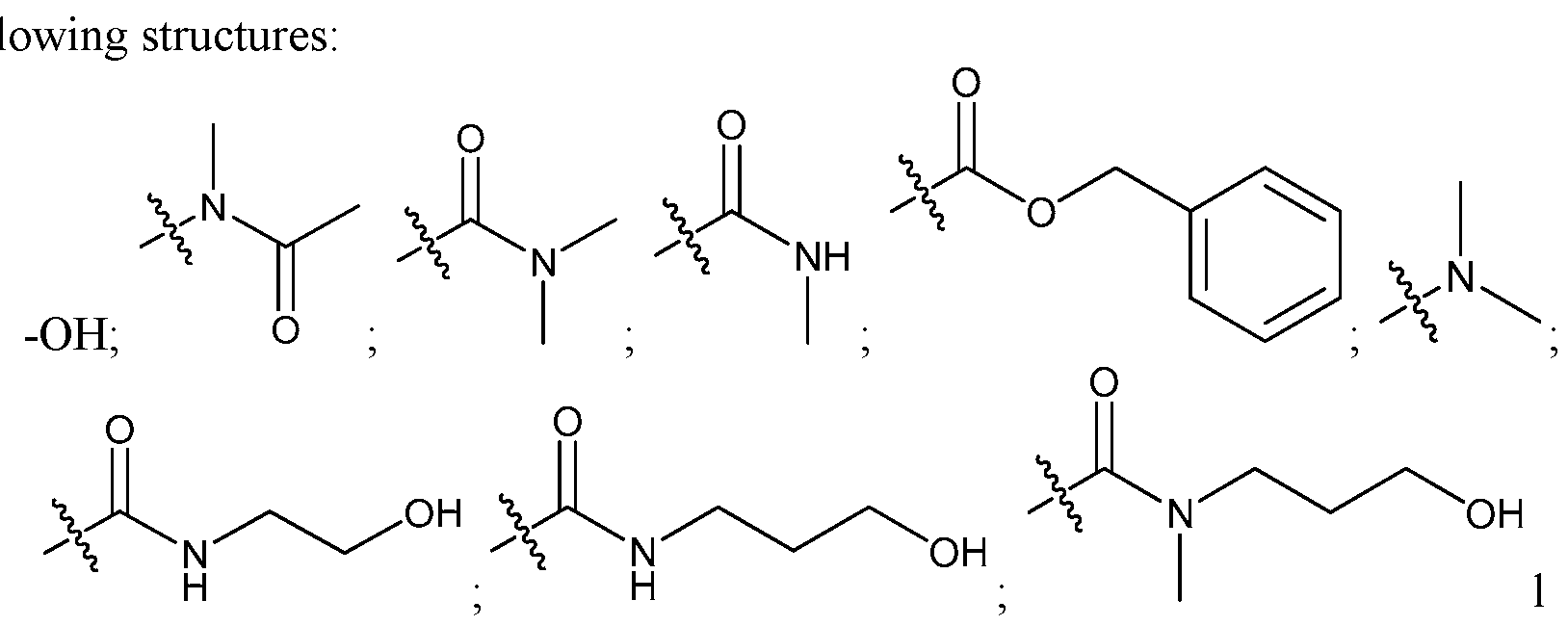

In still other embodiments of the foregoing compounds, G is C2-C5 alkylene, for example C2-C4 alkylene, C3 alkylene or C4 alkylene. In some of these embodiments, R8 is OH. In other embodiments, G2 is absent and R7 is Ci-C2 alkylene, such as methyl.
In various different embodiments, the compound has one of the structures set forth in Table 5 below.
Table 5. Representative cationic lipids of structure (VI)


VI- 18 o
1 0
VI- 19
VI-20
VI-21
VI-22
VI-23
VI-24
0


In one embodiment, the cationic lipid is a compound having the following structure (VII):
L1— G1 G1— L1
\ , /
X— Y— G3-Y'— X'
/ \
L2— G2 G2 -L2'
(VII)
or a pharmaceutically acceptable salt, prodrug or stereoisomer thereof, wherein:
X and X' are each independently N or CR;
Y and Y' are each independently absent, -0(C=0)-, -(C=0)0- or R, provided that:
a)Y is absent when X is N;
b) Y is absent when X is N;
c) Y is -0(C=0)-, -(C=0)0- or NR when X is CR; and d) Y is -0(C=0)-, -(C=0)0- or NR when X is CR,
L1 and L1' are each independently -0(C=0)R1, -(C=0)OR1, -C(=0)R1, -OR1, -S(0)zR1, -S-SR1, -C(=0)SR1, -SC(=0)R1, - RaC(=0)R1, -C(=0) RbRc, - RaC(=0) RbRc, -OC(=0)NRbRc or - RaC(=0)OR1;
L2 and L2' are each independently -0(C=0)R2, -(C=0)OR2, -C(=0)R2, -OR2, -S(0)zR2, -S-SR2, -C(=0)SR2, -SC(=0)R2, - RdC(=0)R2, -C(=0) ReRf, - RdC(=0) ReRf, -OC(=0) ReRf;- RdC(=0)OR2 or a direct bond to R2;
G1, G1 , G2 and G2 are each independently C2-Ci2 alkylene or C2-C12 alkenylene;
G3 is C2-C24 heteroalkylene or C2-C24 heteroalkenylene;
Ra, Rb, Rd and Re are, at each occurrence, independently H, Ci-Ci2 alkyl or C2-Ci2 alkenyl;
Rc and Rf are, at each occurrence, independently Ci-Ci2 alkyl or C2-C12 alkenyl;
R is, at each occurrence, independently H or Ci-Ci2 alkyl; R1 and R2 are, at each occurrence, independently branched C6-C24 alkyl or branched C6-C24 alkenyl;
z is 0, 1 or 2, and
wherein each alkyl, alkenyl, alkylene, alkenylene, heteroalkylene and heteroalkenylene is independently substituted or unsubstituted unless otherwise specified.
In other different embodiments of structure (VII):
X and X' are each independently N or CR;
Y and Y' are each independently absent or R, provided that:
a) Y is absent when X is N;
b) Y is absent when X is N;
c) Y is NR when X is CR; and
d) Y is NR when X' is CR,
L1 and L1' are each independently -0(C=0)R1, -(C=0)OR1, -C(=0)R1, -OR1, -S(0)zR1, -S-SR1, -C(=0)SR1, -SC(=0)R1, -NRaC(=0)R1, -C(=0)NRbRc, -NRaC(=0)NRbRc, -OC(=0)NRbRc or -NRaC(=0)OR1;
L2 and L2' are each independently -0(C=0)R2, -(C=0)OR2, -C(=0)R2,
-OR2, -S(0)zR2, -S-SR2, -C(=0)SR2, -SC(=0)R2, - RdC(=0)R2, -C(=0) ReRf, - RdC(=0) ReRf, -OC(=0) ReRf;- RdC(=0)OR2 or a direct bond to R2;
G1, G1 , G2 and G2 are each independently C2-C12 alkylene or C2-C12 alkenylene;
G3 is C2-C24 alkyleneoxide or C2-C24 alkenyleneoxide;
Ra, Rb, Rd and Re are, at each occurrence, independently H, C1-C12 alkyl or C2-C12 alkenyl;
Rc and Rf are, at each occurrence, independently C1-C12 alkyl or C2-C12 alkenyl;
R is, at each occurrence, independently H or C1-C12 alkyl;
R1 and R2 are, at each occurrence, independently branched C6-C24 alkyl or branched C6-C24 alkenyl;
z is 0, 1 or 2, and
wherein each alkyl, alkenyl, alkylene, alkenylene, alkyleneoxide and alkenyleneoxide is independently substituted or unsubstituted unless otherwise specified.
In some embodiments of structure (VII), G3 is C2-C24 alkyleneoxide or C2-C24 alkenyleneoxide. In certain embodiments, G3 is unsubstituted. In other embodiments, G3 is substituted, for example substituted with hydroxyl. In more specific embodiments G3 is C2-Ci2 alkyleneoxide, for example, in some embodiments G3 is C3-C7 alkyleneoxide or in other embodiments G3 is C3-C12 alkyleneoxide.
In other embodiments of structure (VII), G3 is C2-C24 alkyleneaminyl or C2-C24 alkenyleneaminyl, for example C6-Ci2 alkyleneaminyl. In some of these embodiments, G3 is unsubstituted. In other of these embodiments, G3 is substituted with Ci-Ce alkyl.
In some embodiments of structure (VII), X and X' are each N, and Y and
Y are each absent. In other embodiments, X and X' are each CR, and Y and Y are each NR. In some of these embodiments, R is H.
In certain embodiments of structure (VII), X and X' are each CR, and Y and Y are each independently -0(C=0)- or -(C=0)0-.
In some of the foregoing embodiments of structure (VII), the compound has one of the following structures (VIIA), (VIIB), (VIIC), (VIID), (VIIE), (VIIF),

(VIIF)

(VIIH)
wherein Rd is, at each occurrence, independently H or optionally substituted Ci-C6 alkyl. For example, in some embodiments Rd is H. In other embodiments, Rd is Ci-C6 alkyl, such as methyl. In other embodiments, Rd is substituted Ci-C6 alkyl, such as Ci- C6 alkyl substituted with -0(C=0)R, -(C=0)OR, - RC(=0)R or -C(=0)N(R)2, wherein R is, at each occurrence, independently H or Ci-Ci2 alkyl.
In some of the foregoing embodiments of structure (VII), L1 and L1 are each independently -0(C=0)R1, -(C=0)OR1 or -C(=0) RbRc, and L2 and L2' are each independently -0(C=0)R2, -(C=0)OR2 or -C(=0) ReRf. For example, in some embodiments L1 and L1 are each -(C=0)OR1, and L2 and L2' are each -(C=0)OR2.. In other embodiments L1 and L1 are each -(C=0)OR1, and L2 and L2' are each
-C(=0) ReRf. In other embodiments L1 and L1' are each -C(=0) RbRc, and L2 and L2' are each -C(=0) ReRf.
In some embodiments of the foregoing, G1, G1 , G2 and G2 are each independently C2-C8 alkylene, for example C4-C8 alkylene.
In some of the foregoing embodiments of structure (VII), R1 or R2, are each, at each occurrence, independently branched C6-C24 alkyl. For example, in some embodiments, R1 and R2 at each occurrence, independently have the following structure:

wherein:
R a and R are, at each occurrence, independently H or C1-C12 alkyl; and
a is an integer from 2 to 12,
wherein R7a, R^ and a are each selected such that R1 and R2 each independently comprise from 6 to 20 carbon atoms. For example, in some embodiments a is an integer ranging from 5 to 9 or from 8 to 12.
In some of the foregoing embodiments of structure (VII), at least one occurrence of R7a is H. For example, in some embodiments, R7a is H at each occurrence. In other different embodiments of the foregoing, at least one occurrence of R7b is Ci-C8 alkyl. For example, in some embodiments, Ci-C8 alkyl is methyl, ethyl, n-propyl, iso- propyl, n-butyl, iso-butyl, tert-butyl, n-hexyl or n-octyl.
In different embodiments of structure (VII), R1 or R2, or both, at each occurrence independently has one of the following structures:

R , when present, are each independently C3-C12 alkyl. For example, in some embodiments Rb, Rc, Re and Rf, when present, are n-hexyl and in other embodiments Rb, Rc, Re and Rf, when present, are n-octyl.
In various different embodiments of structure (VII), the cationic lipid has one of the structures set forth in Table 6 below.
Table 6. Representative cationic lipids of structure (VII)


In one embodiment, the cationic lipid is a compound having the following structure (VIII):
G2-L2
L3— G— Y— X
G1-L1
(VIII)
or a pharmaceutically acceptable salt, prodrug or stereoisomer thereof, wherein:
X is N, and Y is absent; or X is CR, and Y is R;
L1 is -C CKTlR1,
 -S-SR1, -C(=0)SR1, -SC(=0)R1, - RaC(=0)R1, -C(=0) RbRc, - RaC(=0) RbRc,
-OC(=0) RbRc or - RaC(=0)OR1;
L2 is -0(C=0)R2, -(C=0)OR2, -C(=0)R2, -OR2, -S(0)xR2, -S-SR2, -C(=0)SR2, -SC(=0)R2, - RdC(=0)R2, -C(=0) ReRf, - RdC(=0) ReRf,
-OC(=0) ReRf; - RdC(=0)OR2 or a direct bond to R2;
L3 is -0(C=0)R3 or -(C=0)OR3;
G1 and G2 are each independently C2-Ci2 alkylene or C2-C12 alkenylene; G3 is Ci-C24 alkylene, C2-C24 alkenylene, Ci-C24 heteroalkylene or C2- C24 heteroalkenylene;
Ra, Rb, Rd and Re are each independently H or C1-C12 alkyl or C1-C12 alkenyl;
Rc and R are each independently Ci-Ci2 alkyl or C2-C12 alkenyl;
each R is independently H or Ci-Ci2 alkyl;
R1, R2 and R3 are each independently C1-C24 alkyl or C2-C24 alkenyl; and x is 0, 1 or 2, and
wherein each alkyl, alkenyl, alkylene, alkenylene, heteroalkylene and heteroalkenylene is independently substituted or unsubstituted unless otherwise specified.
In more embodiments of structure (I):
X is N, and Y is absent; or X is CR, and Y is R;
L1 is
 -OR1, -SCC XR1, -S-SR1, -C(=0)SR1, -SC(=0)R1, - RaC(=0)R1, -C(=0) RbRc, - RaC(=0) RbRc,
-OC(=0) RbRc or - RaC(=0)OR1;
L2 is -0(C=0)R2, -(C=0)OR2, -C(=0)R2, -OR2, -S(0)xR2, -S-SR2, -C(=0)SR2, -SC(=0)R2, - RdC(=0)R2, -C(=0) ReRf, - RdC(=0) ReRf,
-OC(=0) ReRf; - RdC(=0)OR2 or a direct bond to R2;
L3 is -0(C=0)R3 or -(C=0)OR3;
G^nd G2 are each independently C2-C12 alkylene or C2-C12 alkenylene;
G3 is C1-C24 alkylene, C2-C24 alkenylene, C1-C24 heteroalkylene or C2- C24 heteroalkenylene when X is CR, and Y is NR; and G3 is C1-C24 heteroalkylene or C2-C24 heteroalkenylene when X is N, and Y is absent;
Ra, Rb, Rd and Re are each independently H or C1-C12 alkyl or C1-C12 alkenyl;
Rc and Rf are each independently C1-C12 alkyl or C2-C12 alkenyl;
each R is independently H or C1-C12 alkyl;
R1, R2 and R3 are each independently C1-C24 alkyl or C2-C24 alkenyl; and x is 0, 1 or 2, and
wherein each alkyl, alkenyl, alkylene, alkenylene, heteroalkylene and heteroalkenylene is independently substituted or unsubstituted unless otherwise specified.
In other embodiments of structure (I):
X is N and Y is absent, or X is CR and Y is NR;
L1 is -OCCKTlR1, -(CO)OR1,
 -S-SR1,
-C(=0)SR1, -SC(=0)R1, - RaC(=0)R1, -C(=0) RbRc, - RaC(=0) RbRc,
-S-SR1,
-C(=0)SR1, -SC(=0)R1, - RaC(=0)R1, -C(=0) RbRc, - RaC(=0) RbRc,
-OC(=0) RbRc or - RaC(=0)OR1;
L2 is -0(C=0)R2, -(C=0)OR2, -C(=0)R2, -OR2, -S(0)xR2, -S-SR2, -C(=0)SR2, -SC(=0)R2, - RdC(=0)R2, -C(=0) ReRf, - RdC(=0) ReRf,
-OC(=0) ReRf; - RdC(=0)OR2 or a direct bond to R2;
L3 is -0(C=0)R3 or -(C=0)OR3;
G1 and G2 are each independently C2-Ci2 alkylene or C2-C12 alkenylene; G3 is Ci-C24 alkylene, C2-C24 alkenylene, Ci-C24 heteroalkylene or C2- C24 heteroalkenylene;
Ra, Rb, Rd and Re are each independently H or C1-C12 alkyl or C1-C12 alkenyl;
Rc and Rf are each independently Ci-Ci2 alkyl or C2-C12 alkenyl;
each R is independently H or Ci-Ci2 alkyl;
R1, R2 and R3 are each independently branched C6-C24 alkyl or branched C6-C24 alkenyl; and
x is 0, 1 or 2, and
wherein each alkyl, alkenyl, alkylene, alkenylene, heteroalkylene and heteroalkenylene is independently substituted or unsubstituted unless otherwise specified.
In certain embodiments of structure (VIII), G3 is unsubstituted. In more specific embodiments G3 is C2-Ci2 alkylene, for example, in some embodiments G3 is
C3-C7 alkylene or in other embodiments G3 is C3-Ci2 alkylene. In some embodiments,
G3 is C2 or C3 alkylene.
In other embodiments of structure (VIII), G3 is Ci-Ci2 heteroalkylene, for example Ci-Ci2 aminylalkylene.
In certain embodiments of structure (VIII), X is N and Y is absent. In other embodiments, X is CR and Y is NR, for example in some of these embodiments R is H.
In some of the foregoing embodiments of structure (VIII), the compound has one of the following structures (VIIIA), (VIIIB), (VIIIC) or (VIIID):

(VIIIC) (VIIID)
In some of the foregoing embodiments of structure (VIII), L1 is - 0(C=0)R1, -(C=0)OR1 or
-C(=0) RbRc, and L2 is -0(C=0)R2, -(C=0)OR2 or -C(=0) ReRf. In other specific embodiments, L1 is -(C=0)OR1 and L2 is -(C=0)OR2. In any of the foregoing embodiments, L3 is -(C=0)OR3.
In some of the foregoing embodiments of structure (VIII), G1 and G2 are each independently C2-C12 alkylene, for example C4-C10 alkylene.
In some of the foregoing embodiments of structure (VIII), R1, R2 and R3 are each, independently branched C6-C24 alkyl. For example, in some embodiments, R1, R2 and R3 each, independently have the following structure:

wherein:
R a and R are, at each occurrence, independently H or C1-C12 alkyl; and
a is an integer from 2 to 12,
wherein R7a, R^ and a are each selected such that R1 and R2 each independently comprise from 6 to 20 carbon atoms. For example, in some embodiments a is an integer ranging from 5 to 9 or from 8 to 12.
In some of the foregoing embodiments of structure (VIII), at least one occurrence of R7a is H. For example, in some embodiments, R7a is H at each occurrence. In other different embodiments of the foregoing, at least one occurrence of R7b is Ci-C8 alkyl. For example, in some embodiments, Ci-C8 alkyl is methyl, ethyl, n-propyl, iso- propyl, n-butyl, iso-butyl, tert-butyl, n-hexyl or n-octyl.
In some of the foregoing embodiments of structure (VIII), X is CR, Y is R and R3 is C1-C12 alkyl, such as ethyl, propyl or butyl. In some of these
embodiments, , R1 and R2 are each independently branched C6-C24 alkyl.
In different embodiments of structure (VIII), R1, R2 and R3 each, independently have one of the following structures:

In certain embodiments of structure (VIII), R1 and R2 and R3 are each, independently, branched C6-C24 alkyl and R3 is C1-C24 alkyl or C2-C24 alkenyl.
In some of the foregoing embodiments of structure (VIII), Rb, Rc, Re and Rf are each independently C3-C12 alkyl. For example, in some embodiments Rb, Rc, Re and Rf are n-hexyl and in other embodiments Rb, Rc, Re and Rf are n-octyl.
In various different embodiments of structure (VIII), the compound has one of the structures set forth in Table 7 below.


In one embodiment, the cationic lipid is a compound having the following structure (IX):

or a pharmaceutically acceptable salt, prodrug or stereoisomer thereof, wherein:
L1 is -C CKriR1, -(CKriOR1,
 -OR1, -SCC XR1, -S-SR1, -C(=0)SR1, -SC(=0)R1, - RAC(=0)R1, -C(=0) RBRC, - RAC(=0) RBRC, - OC(=0) RBRC or - RAC(=0)OR1;
L2 is -0(C=0)R2, -(C=0)OR2, -C(=0)R2, -OR2, -S(0)XR2, -S-SR2, -C(=0)SR2, -SC(=0)R2, - RDC(=0)R2, -C(=0) RERF, - RDC(=0) RERF, - OC(=0) RERF, - RDC(=0)OR2 or a direct bond to R2;
G1 and G2 are each independently C2-Ci2 alkylene or C2-CI2 alkenylene;
G3 is Ci-C24 alkylene, C2-C24 alkenylene, C3-C8 cycloalkylene or C3-C8 cycloalkenylene;
Ra, Rb, Rd and Re are each independently H or C1-C12 alkyl or C1-C12 alkenyl;
Rc and Rf are each independently C1-C12 alkyl or C2-C12 alkenyl;
R1 and R2 are each independently branched C6-C24 alkyl or branched C6- C24 alkenyl;
R3 is -N(R4)R5;
R4 is C1-C12 alkyl;
R5 is substituted C1-C12 alkyl; and
x is 0, 1 or 2, and
wherein each alkyl, alkenyl, alkylene, alkenylene, cycloalkylene, cycloalkenylene, aryl and aralkyl is independently substituted or unsubstituted unless otherwise specified.
In certain embodiments of structure (XI), G3 is unsubstituted. In more specific embodiments G3 is C2-C12 alkylene, for example, in some embodiments G3 is C3-C7 alkylene or in other embodiments G3 is C3-C12 alkylene. In some embodiments, G3 is C2 or C3 alkylene.
In some of the foregoing embodiments of structure (IX), the compound has the following structure (IX A):

(IXA)
wherein y and z are each independently integers ranging from 2 to 12, for example an integer from 2 to 6, from 4 to 10, or for example 4 or 5. In certain embodiments, y and z are each the same and selected from 4, 5, 6, 7, 8 and 9.
In some of the foregoing embodiments of structure (IX), L1 is -
0(C=0)R1, -(C=0)OR1 or -C(=0) RbRc, and L2 is -0(C=0)R2, -(C=0)OR2 or - C(=0) ReRf. For example, in some embodiments L1 and L2 are -(C=0)OR1 and -
(C=0)OR2, respectively. In other embodiments L1 is -(C=0)OR1 and L2 is -
C(=0) ReRf. In other embodiments L1 is
-C(=0) RbRc and L2 is -C(=0) ReRf.
In other embodiments of the foregoing, the compound has one of the followin r (IXE):

(IXD) (IXE)
In some of the foregoing embodiments, the compound has structure
(IXB), in other embodiments, the compound has structure (IXC) and in still other embodiments the compound has the structure (IXD). In other embodiments, the compound has structure (IXE).
In some different embodiments of the foregoing, the compound has of the following structures (IXF), (IXG), (IXH) or (IXJ):

(IXH) (IXJ)
wherein y and z are each independently integers ranging from 2 to 12, for example an integer from 2 to 6, for example 4.
In some of the foregoing embodiments of structure (IX), y and z are each independently an integer ranging from 2 to 10, 2 to 8, from 4 to 10 or from 4 to 7. For example, in some embodiments, y is 4, 5, 6, 7, 8, 9, 10, 11 or 12. In some
embodiments, z is 4, 5, 6, 7, 8, 9, 10, 11 or 12. In some embodiments, y and z are the same, while in other embodiments y and z are different.
In some of the foregoing embodiments of structure (IX), R1 or R2, or both is branched C6-C24 alkyl. For example, in some embodiments, R1 and R2 each, independently have the following structure:

wherein:
R7a and R7b are, at each occurrence, independently H or Ci-Ci2 alkyl; and
a is an integer from 2 to 12,
wherein R7a, R^ and a are each selected such that R1 and R2 each independently comprise from 6 to 20 carbon atoms. For example, in some embodiments a is an integer ranging from 5 to 9 or from 8 to 12.
In some of the foregoing embodiments of structure (IX), at least one occurrence of R7a is H. For example, in some embodiments, R7a is H at each occurrence. In other different embodiments of the foregoing, at least one occurrence of R7b is Ci-C8 alkyl. For example, in some embodiments, Ci-C8 alkyl is methyl, ethyl, n-propyl, iso- propyl, n-butyl, iso-butyl, tert-butyl, n-hexyl or n-octyl.
In different embodiments of structure (IX), R1 or R2, or both, has one of the following structures:

In any of the foregoing embodiments of structure (IX), R4 is substituted or unsubstituted: methyl, ethyl, propyl, n-butyl, n-hexyl, n-octyl or n-nonyl. For example, in some embodiments R4 is unsubstituted. In other R4 is substituted with one or more substituents selected from the group consisting of -ORg, - RgC(=0)Rh, - C(=0) RgRh, -C(=0)Rh, -OC(=0)Rh, -C(=0)ORh and -OR^H, wherein:
Rg is, at each occurrence independently H or Ci-C6 alkyl;
Rh is at each occurrence independently Ci-C6 alkyl; and
R1 is, at each occurrence independently Ci-C6 alkylene.
In other of the foregoing embodiments of structure (IX), R5 is substituted: methyl, ethyl, propyl, n-butyl, n-hexyl, n-octyl or n-nonyl. In some embodiments, R5 is substituted ethyl or substituted propyl. In other different embodiments, R5 is substituted with hydroxyl. In still more embodiments, R5 is substituted with one or more substituents selected from the group consisting of -ORg, - RgC(=0)Rh, -C(=0) RgRh, -C(=0)Rh, -OC(=0)Rh, -C(=0)ORh and -OR^H, wherein:
Rg is, at each occurrence independently H or Ci-C6 alkyl;
Rh is at each occurrence independently Ci-C6 alkyl; and
R1 is, at each occurrence independently Ci-C6 alkylene.
In other embodiments of structure (IX), R4 is unsubstituted methyl, and R5 is substituted: methyl, ethyl, propyl, n-butyl, n-hexyl, n-octyl or n-nonyl. In some of these embodiments, R5 is substituted with hydroxyl.
In some other specific embodiments of structure (IX), R3 has one of the following structures:

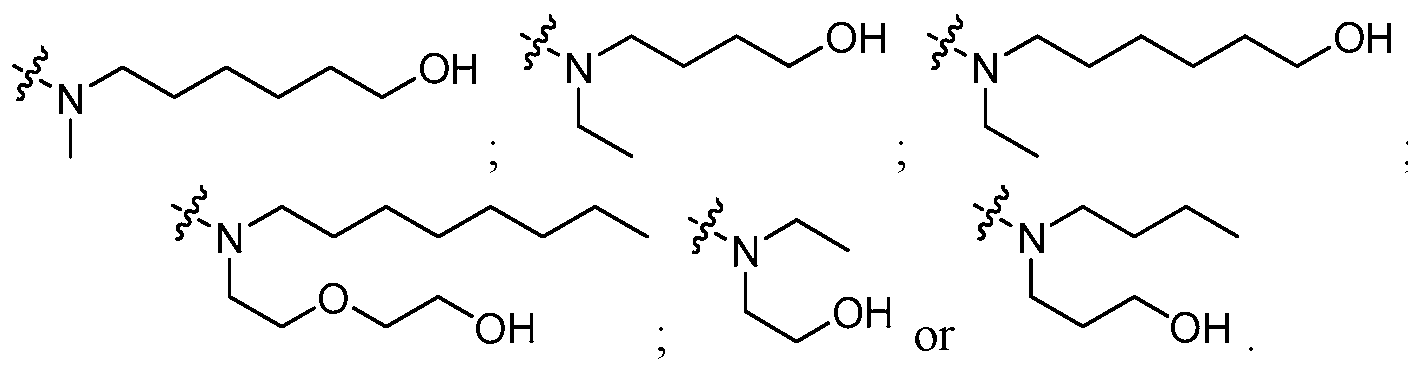
In various different embodiments of structure (IX), the cationic lipid has one of the structures set forth in Table 8 below.


IX- 17
IX- 18
In one embodiment, the cationic lipid is a compound having the following structure (X):

(X)
or a pharmaceutically acceptable salt, tautomer, prodrug or stereoisomer thereof, wherein:
G1 is -OH, - R3R4, -(C=0) R5 or - R3(C=0)R5;
G2 is -CH2- or -(C=0)-;
R is, at each occurrence, independently H or OH;
R1 and R2 are each independently branched, saturated or unsaturated C12-
C36 alk l;
R3 and R4 are each independently H or straight or branched, saturated or unsaturated Ci-C6 alkyl;
R5 is straight or branched, saturated or unsaturated Ci-C6 alkyl; and n is an integer from 2 to 6.
In some embodiments, R1 and R2 are each independently branched, saturated or unsaturated Ci2-C30 alkyl, Ci2-C20 alkyl, or Ci5-C2o alkyl. In some specific embodiments, R1 and R2 are each saturated. In certain embodiments, at least one of R1 and R2 is unsaturated.
In some of the foregoing embodiments of structure (X), R1 and R2 have the following structure:

In some of the foregoing embodiments of structure (X), the compound has the following structure (XA

(XA)
wherein:
R6 and R7 are, at each occurrence, independently H or straight or branched, saturated or unsaturated C1-C14 alkyl;
a and b are each independently an integer ranging from 1 to 15, provided that R6 and a, and R7 and b, are each independently selected such that R1 and R2, respectively, are each independently branched, saturated or unsaturated C12-C36 alkyl.
In some of the foregoing embodiments, the compound has the following structure (XB):
 wherein:
R8, R9, R10 and R11 are each independently straight or branched, saturated or unsaturated C4-C12 alkyl, provided that R8 and R9, and R10 and R11, are each independently selected such that R1 and R2, respectively, are each independently branched, saturated or unsaturated C12-C36 alkyl. In some embodiments of (XB), R8, R9, R10 and R11 are each independently straight or branched, saturated or unsaturated C6-Cio alkyl. In certain embodiments of (XB), at least one of R8, R9, R10 and R11 is unsaturated. In other certain specific embodiments of (XB), each of R8, R9, R10 and R11 is saturated.
In some of the foregoing embodiments, the compound has structure (XA), and in other embodiments, the compound has structure (XB).
In some of the foregoing embodiments, G1 is -OH, and in some embodiments G1 is - R3R4. For example, in some embodiments, G1 is - H2, - HCH3 or -N(CH3)2. In certain embodiments, G1 is -(C=0) R5. In certain other
embodiments, G1 is - R3(C=0)R5. For example, in some embodiments G1 is
- H(C=0)CH3 or - H(C=0)CH2CH2CH3.
In some of the foregoing embodiments of structure (X), G2 is -CH2- In some different embodiments, G2 is -(C=0)-.
In some of the foregoing embodiments of structure (X), n is an integer ranging from 2 to 6, for example, in some embodiments n is 2, 3, 4, 5 or 6. In some embodiments, n is 2. In some embodiments, n is 3. In some embodiments, n is 4.
In certain of the foregoing embodiments of structure (X), at least one of
1 2 3 4 5 1 2 3
R , R , R , R and R is unsubstituted. For example, in some embodiments, R , R , R , R4 and R5 are each unsubstituted. In some embodiments, R3 is substituted. In other embodiments R4 is substituted. In still more embodiments, R5 is substituted. In certain specific embodiments, each of R3 and R4 are substituted. In some embodiments, a substituent on R3, R4 or R5 is hydroxyl. In certain embodiments, R3 and R4 are each substituted with hydroxyl.
In some of the foregoing embodiments of structure (X), at least one R is OH. In other embodiments, each R is H.
In various different embodiments of structure (X), the compound has one of the structures set forth in Table 9 below.
Table 9. Representative cationic lipids of structure (X)


141

ı42

In any of Embodiments 1, 2, 3, 4 or 5, the LNPs further comprise a neutral lipid. In various embodiments, the molar ratio of the cationic lipid to the neutral lipid ranges from about 2: 1 to about 8: 1. In certain embodiments, the neutral lipid is present in any of the foregoing LNPs in a concentration ranging from 5 to 10 mol percent, from 5 to 15 mol percent, 7 to 13 mol percent, or 9 to 11 mol percent. In certain specific embodiments, the neutral lipid is present in a concentration of about 9.5, 10 or 10.5 mol percent. In some embodiments, the molar ratio of cationic lipid to the neutral lipid ranges from about 4.1 : 1.0 to about 4.9: 1.0, from about 4.5: 1.0 to about 4.8: 1.0, or from about 4.7: 1.0 to 4.8: 1.0. In some embodiments, the molar ratio of total
cationic lipid to the neutral lipid ranges from about 4.1 : 1.0 to about 4.9: 1.0, from about 4.5: 1.0 to about 4.8: 1.0, or from about 4.7: 1.0 to 4.8: 1.0.
Exemplary neutral lipids for use in any of Embodiments 1, 2, 3, 4 or 5 include, for example, distearoylphosphatidylcholine (DSPC),
dioleoylphosphatidylcholine (DOPC), dipalmitoylphosphatidylcholine (DPPC), dioleoylphosphatidylglycerol (DOPG), dipalmitoylphosphatidylglycerol (DPPG), dioleoyl-phosphatidylethanolamine (DOPE), palmitoyloleoylphosphatidylcholine (POPC), palmitoyloleoyl-phosphatidylethanolamine (POPE) and dioleoyl- phosphatidylethanolamine 4-(N-maleimidomethyl)-cyclohexane- 1 carboxylate (DOPE- mal), dipalmitoyl phosphatidyl ethanolamine (DPPE), dimyristoylphosphoethanolamine (DMPE), distearoyl-phosphatidylethanolamine (DSPE), 16-O-monom ethyl PE, 16-0- dimethyl PE, 18-1 -trans PE, l-stearioyl-2-oleoylphosphatidyethanol amine (SOPE), and l,2-dielaidoyl-sn-glycero-3-phophoethanolamine (transDOPE). In one embodiment, the neutral lipid is l,2-distearoyl-sn-glycero-3phosphocholine (DSPC). In some embodiments, the neutral lipid is selected from DSPC, DPPC, DMPC, DOPC, POPC, DOPE and SM. In some embodiments, the neutral lipid is DSPC.
In various embodiments of Embodiments 1, 2, 3, 4 or 5, any of the disclosed lipid nanoparticles comprise a steroid or steroid analogue. In certain embodiments, the steroid or steroid analogue is cholesterol. In some embodiments, the steroid is present in a concentration ranging from 39 to 49 molar percent, 40 to 46 molar percent, from 40 to 44 molar percent, from 40 to 42 molar percent, from 42 to 44 molar percent, or from 44 to 46 molar percent. In certain specific embodiments, the steroid is present in a concentration of 40, 41, 42, 43, 44, 45, or 46 molar percent.
In certain embodiments, the molar ratio of cationic lipid to the steroid ranges from 1.0:0.9 to 1.0: 1.2, or from 1.0: 1.0 to 1.0: 1.2. In some of these
embodiments, the molar ratio of cationic lipid to cholesterol ranges from about 5: 1 to 1 : 1. In certain embodiments, the steroid is present in a concentration ranging from 32 to 40 mol percent of the steroid.
In certain embodiments, the molar ratio of total cationic to the steroid ranges from 1.0:0.9 to 1.0: 1.2, or from 1.0: 1.0 to 1.0: 1.2. In some of these
embodiments, the molar ratio of total cationic lipid to cholesterol ranges from about 5: 1 to 1 : 1. In certain embodiments, the steroid is present in a concentration ranging from 32 to 40 mol percent of the steroid.
In some embodiments of Embodiments 1, 2, 3 4 or 5, the L Ps further comprise a polymer conjugated lipid. In various other embodiments of Embodiments 1, 2, 3 4 or 5, the polymer conjugated lipid is a pegylated lipid. For example, some embodiments include a pegylated diacylglycerol (PEG-DAG) such as
l-(monomethoxy-polyethyleneglycol)-2,3-dimyristoylglycerol (PEG-DMG), a pegylated phosphatidylethanoloamine (PEG-PE), a PEG succinate diacylglycerol (PEG- S-DAG) such as 4-0-(2',3'-di(tetradecanoyloxy)propyl-l-0-(co- methoxy(polyethoxy)ethyl)butanedioate (PEG-S-DMG), a pegylated ceramide (PEG- cer), or a PEG dialkoxypropylcarbamate such as Q-methoxy(polyethoxy)ethyl-N-(2,3- di(tetradecanoxy)propyl)carbamate or 2,3-di(tetradecanoxy)propyl-N-(co- methoxy(polyethoxy)ethyl)carbamate.
In various embodiments, the polymer conjugated lipid is present in a concentration ranging from 1.0 to 2.5 molar percent. In certain specific embodiments, the polymer conjugated lipid is present in a concentration of about 1.7 molar percent. In some embodiments, the polymer conjugated lipid is present in a concentration of about 1.5 molar percent.
In certain embodiments, the molar ratio of cationic lipid to the polymer conjugated lipid ranges from about 35 : 1 to about 25: 1. In some embodiments, the molar ratio of cationic lipid to polymer conjugated lipid ranges from about 100: 1 to about 20: 1.
In certain embodiments, the molar ratio of total cationic lipid (i.e., the sum of the first and second cationic lipid) to the polymer conjugated lipid ranges from about 35 : 1 to about 25: 1. In some embodiments, the molar ratio of total cationic lipid to polymer conjugated lipid ranges from about 100: 1 to about 20: 1.
In some embodiments of Embodiments 1, 2, 3 4 or 5, the pegylated lipid, when present, has the following Formula (XI):

(XI)
or a pharmaceutically acceptable salt, tautomer or stereoisomer thereof, wherein:
R and R are each independently a straight or branched, saturated or unsaturated alkyl chain containing from 10 to 30 carbon atoms, wherein the alkyl chain is optionally interrupted by one or more ester bonds; and
w has a mean value ranging from 30 to 60.
In some embodiments, R12 and R13 are each independently straight, saturated alkyl chains containing from 12 to 16 carbon atoms. In other embodiments, the average w ranges from 42 to 55, for example, the average w is 42, 43, 44, 45, 46, 47, 48, 49, 50, 51, 52, 53, 54 or 55. In some specific embodiments, the average w is about 49.
In some embodiments, the pegylated lipid has the following Formula
(XIa):

(XIa)
wherein the average w is about 49.
In some embodiments of Embodiments 1, 2, 3 4 or 5, the nucleic acid is selected from antisense and messenger RNA. For example, messenger RNA may be used to induce an immune response (e.g., as a vaccine), for example by translation of immunogenic proteins.
In other embodiments of Embodiments 1, 2, 3 4 or 5, the nucleic acid is mRNA, and the mRNA to lipid ratio in the L P (i.e., N/P, were N represents the moles of cationic lipid and P represents the moles of phosphate present as part of the nucleic
acid backbone) range from 2: 1 to 30: 1, for example 3 : 1 to 22: 1. In other embodiments, N/P ranges from 6: 1 to 20: 1 or 2: 1 to 12: 1. Exemplary N/P ranges include about 3 : 1. About 6: 1, about 12: 1 and about 22: 1.
In some embodiments, a plurality of the lipid nanoparticles according to Embodiments 1, 2, 3 4 or 5 has a polydispersity of less than 0.12, or less than 0.08. In some embodiments, the lipid nanoparticle has a mean diameter ranging from 50 nm to 100 nm, or from 60 nm to 85 nm.
In other different embodiments, the invention is directed to a method for administering a therapeutic agent to a patient in need thereof, the method comprising preparing or providing any of the foregoing LNPs of Embodiments 1, 2, 3 4 or 5 and/or administering a composition comprising the same to the patient. In some embodiments, the therapeutic agent is effective to treat the disease.
For the purposes of administration, the lipid nanoparticles of embodiments of the present invention may be administered alone or may be formulated as pharmaceutical compositions. Pharmaceutical compositions of certain embodiments comprise a lipid nanoparticle according to any of the foregoing embodiments and one or more pharmaceutically acceptable carrier, diluent or excipient. The lipid
nanoparticle may be present in an amount which is effective to deliver the therapeutic agent, e.g., for treating a particular disease or condition of interest. Appropriate concentrations and dosages can be readily determined by one skilled in the art.
Administration of the lipid nanoparticles of some embodiments can be carried out via any of the accepted modes of administration of agents for serving similar utilities. The pharmaceutical compositions of some embodiments may be formulated into preparations in solid, semi-solid, liquid or gaseous forms, such as tablets, capsules, powders, granules, ointments, solutions, suspensions, suppositories, injections, inhalants, gels, microspheres, and aerosols. Typical routes of administering such pharmaceutical compositions include, without limitation, oral, topical, transdermal, inhalation, parenteral, sublingual, buccal, rectal, vaginal, and intranasal. The term parenteral as used herein includes subcutaneous injections, intravenous, intramuscular, intradermal, intrasternal injection or infusion techniques. Pharmaceutical compositions
of some embodiments are formulated so as to allow the active ingredients contained therein to be bioavailable upon administration of the composition to a patient.
Compositions that may be administered to a subject or patient may take the form of one or more dosage units, where for example, a tablet may be a single dosage unit, and a container comprising L Ps in aerosol form may hold a plurality of dosage units.
Actual methods of preparing such dosage forms are known, or will be apparent, to those skilled in this art; for example, see Remington: The Science and Practice of Pharmacy, 20th Edition (Philadelphia College of Pharmacy and Science, 2000). The composition to be administered will typically contain a therapeutically effective amount of a lipid nanoparticle of any of the embodiments disclosed herein, comprising a therapeutic agent, or a pharmaceutically acceptable salt thereof, for treatment of a disease or condition of interest.
A pharmaceutical composition of some embodiments may be in the form of a solid or liquid. In one aspect, the carrier(s) are particulate, so that the compositions are, for example, in tablet or powder form. The carrier(s) may be liquid, with the compositions being, for example, an oral syrup, injectable liquid or an aerosol, which is useful in, for example, inhalatory administration.
When intended for oral administration, the pharmaceutical composition is preferably in either solid or liquid form, where semi-solid, semi-liquid, suspension and gel forms are included within the forms considered herein as either solid or liquid.
As a solid composition for oral administration, the pharmaceutical composition may be formulated into a powder, granule, compressed tablet, pill, capsule, chewing gum, wafer or the like form. Such a solid composition will typically contain one or more inert diluents or edible carriers. In addition, one or more of the following may be present: binders such as carboxymethylcellulose, ethyl cellulose,
microcrystalline cellulose, gum tragacanth or gelatin; excipients such as starch, lactose or dextrins, disintegrating agents such as alginic acid, sodium alginate, Primogel, corn starch and the like; lubricants such as magnesium stearate or Sterotex; glidants such as colloidal silicon dioxide; sweetening agents such as sucrose or saccharin; a flavoring agent such as peppermint, methyl salicylate or orange flavoring; and a coloring agent.
When the pharmaceutical composition is in the form of a capsule, for example, a gelatin capsule, it may contain, in addition to materials of the above type, a liquid carrier such as polyethylene glycol or oil.
The pharmaceutical composition may be in the form of a liquid, for example, an elixir, syrup, solution, emulsion or suspension. The liquid may be for oral administration or for delivery by injection, as two examples. When intended for oral administration, preferred composition contain, in addition to the present compounds, one or more of a sweetening agent, preservatives, dye/colorant and flavor enhancer. In a composition intended to be administered by injection, one or more of a surfactant, preservative, wetting agent, dispersing agent, suspending agent, buffer, stabilizer and isotonic agent may be included.
The liquid pharmaceutical compositions of some embodiments, whether they be solutions, suspensions or other like form, may include one or more of the following adjuvants: sterile diluents such as water for injection, saline solution, preferably physiological saline, Ringer's solution, isotonic sodium chloride, fixed oils such as synthetic mono or diglycerides which may serve as the solvent or suspending medium, polyethylene glycols, glycerin, propylene glycol or other solvents;
antibacterial agents such as benzyl alcohol or methyl paraben; antioxidants such as ascorbic acid or sodium bisulfite; chelating agents such as ethylenediaminetetraacetic acid; buffers such as acetates, citrates or phosphates and agents for the adjustment of tonicity such as sodium chloride or dextrose; agents to act as cryoprotectants such as sucrose or trehalose. The parenteral preparation can be enclosed in ampoules, disposable syringes or multiple dose vials made of glass or plastic. Physiological saline is a preferred adjuvant. An injectable pharmaceutical composition is preferably sterile.
A liquid pharmaceutical composition of certain embodiments intended for either parenteral or oral administration should contain an amount of a lipid nanoparticle of the invention such that a suitable dosage will be obtained.
The pharmaceutical composition of embodiments of the invention may be intended for topical administration, in which case the carrier may suitably comprise a solution, emulsion, ointment or gel base. The base, for example, may comprise one or
more of the following: petrolatum, lanolin, polyethylene glycols, bee wax, mineral oil, diluents such as water and alcohol, and emulsifiers and stabilizers. Thickening agents may be present in a pharmaceutical composition for topical administration. If intended for transdermal administration, the composition may include a transdermal patch or iontophoresis device.
The pharmaceutical composition of some embodiments may be intended for rectal administration, in the form, for example, of a suppository, which will melt in the rectum and release the drug. The composition for rectal administration may contain an oleaginous base as a suitable nonirritating excipient. Such bases include, without limitation, lanolin, cocoa butter and polyethylene glycol.
The pharmaceutical composition of other embodiments may include various materials, which modify the physical form of a solid or liquid dosage unit. For example, the composition may include materials that form a coating shell around the active ingredients. The materials that form the coating shell are typically inert, and may be selected from, for example, sugar, shellac, and other enteric coating agents.
Alternatively, the active ingredients may be encased in a gelatin capsule.
The pharmaceutical composition of embodiments in solid or liquid form may include an agent that binds to the L P or therapeutic agent, and thereby assists in the delivery of the LNP or therapeutic agent. Suitable agents that may act in this capacity include a monoclonal or polyclonal antibody, or a protein.
In other embodiments, the pharmaceutical composition may comprise or consist of dosage units that can be administered as an aerosol. The term aerosol is used to denote a variety of systems ranging from those of colloidal nature to systems consisting of pressurized packages. Delivery may be by a liquefied or compressed gas or by a suitable pump system that dispenses the active ingredients. Aerosols of compounds of the invention may be delivered in single phase, bi-phasic, or tri-phasic systems in order to deliver the active ingredient(s). Delivery of the aerosol includes the necessary container, activators, valves, sub-containers, and the like, which together may form a kit. One skilled in the art, without undue experimentation may determine preferred aerosols.
In some embodiments, the pharmaceutical compositions may be prepared by methodology well known in the pharmaceutical art. For example, a pharmaceutical composition intended to be administered by injection can be prepared by combining the lipid nanoparticles of the invention with sterile, distilled water or other carrier so as to form a solution. A surfactant may be added to facilitate the formation of a homogeneous solution or suspension. Surfactants are compounds that non-covalently interact with the compound of the invention so as to facilitate dissolution or homogeneous suspension of the compound in the aqueous delivery system.
The pharmaceutical compositions of some embodiments are administered in a therapeutically effective amount, which will vary depending upon a variety of factors including the activity of the specific therapeutic agent employed; the metabolic stability and length of action of the therapeutic agent; the age, body weight, general health, sex, and diet of the patient; the mode and time of administration; the rate of excretion; the drug combination; the severity of the particular disorder or condition; and the subject undergoing therapy.
The pharmaceutical compositions of various embodiments may also be administered simultaneously with, prior to, or after administration of one or more other therapeutic agents. Such combination therapy includes administration of a single pharmaceutical dosage formulation of a composition of the invention and one or more additional active agents, as well as administration of the composition of the invention and each active agent in its own separate pharmaceutical dosage formulation. For example, a pharmaceutical composition of one embodiments and the other active agent can be administered to the patient together in a single oral dosage composition such as a tablet or capsule, or each agent administered in separate oral dosage formulations.
Where separate dosage formulations are used, the compounds of the invention and one or more additional active agents can be administered at essentially the same time, i.e., concurrently, or at separately staggered times, i.e., sequentially; combination therapy is understood to include all these regimens.
The following examples are provided for purpose of illustration and not limitation.
EXAMPLES EXAMPLE 1
PREPARATION OF LIPID NANOP ARTICLE COMPOSITIONS
Cationic lipids and polymer conjugated lipids (PEG-lipid) were prepared and tested according to the general procedures described in PCT Pub. Nos. WO 2015/199952, WO 2017/004143, WO 2017/075531 and WO 2017/1 17528, the full disclosures of which are incorporated herein by reference, or were prepared as described herein. LNPs were prepared according to the following exemplary procedure.
Cationic lipid (e.g., Ιίί-3), DSPC, cholesterol and PEG-lipid were so!ubilized in ethanol at a molar ratio of 47.5: 10:40.7: 1 .8. Lipid nanoparticles (LNP) were prepared at a total lipid to mRNA weight ratio of approximately 10: 1 to 30: 1. Briefly, the mRNA was diluted to 0.2 mg/mL in 10 to 50 tnM citrate buffer, pH 4. Syringe pumps were used to mix the ethanolic lipid solution with the mRNA aqueous solution at a ratio of about 1 :5 to 1 :3 (vol/vol) with total flow rates above 15 ml/min. The ethanol was then removed and the external buffer replaced with PBS by dialysis. Finally, the lipid nanoparticles were filtered through a 0.2 μηι pore sterile filter. Lipid nanoparticle particle size was approximately 55-95 nm diameter, and in some instances approximately 70-90 nm diameter as determined by quasi-elastic light scattering using a Malvern Zetasizer Nano ZS (Malvern, UK).
EXAMPLE 2
LUCIFERASE MRNA IN VIVO EVALUATION USING THE LIPID NANOPARTICLE COMPOSITIONS
Luciferase mRNA in vivo evaluation studies are performed in 6-8 week old female C57BL/6 mice (Charles River) 8-10 week old CD-I (Harlan) mice (Charles River) according to guidelines established by an institutional animal care committee (ACC) and the Canadian Council on Animal Care (CCAC). Varying doses of mRNA-
lipid nanoparticle are systemically administered by tail vein injection and animals euthanized at a specific time point (e.g., 4 hours) post-administration. Liver and spleen are collected in pre-weighed tubes, weights determined, immediately snap frozen in liquid nitrogen and stored at -80 °C until processing for analysis.
For liver, approximately 50 mg is dissected for analyses in a 2 mL
FastPrep tubes (MP Biomedicals, Solon OH). ¼" ceramic sphere (MP Biomedicals) is added to each tube and 500 μL of Glo Lysis Buffer - GLB (Promega, Madison WI) equilibrated to room temperature is added to liver tissue. Liver tissues are homogenized with the FastPrep24 instrument (MP Biomedicals) at 2 x 6.0 m/s for 15 seconds.
Homogenate is incubated at room temperature for 5 minutes prior to a 1 :4 dilution in GLB and assessed using SteadyGlo Luciferase assay system (Promega). Specifically, 50 μL of diluted tissue homogenate is reacted with 50 μL of SteadyGlo substrate, shaken for 10 seconds followed by 5 minute incubation and then quantitated using a CentroXS3 LB 960 luminometer (Berthold Technologies, Germany). The amount of protein assayed is determined by using the BCA protein assay kit (Pierce, Rockford IL). Relative luminescence units (RLU) are then normalized to total μg protein assayed. To convert RLU to ng luciferase a standard curve is generated with QuantiLum
Recombinant Luciferase (Promega). For a representative formulation, a four-hour time point is chosen for an efficacy evaluation of the lipid formulation.
The FLuc mRNA (L-6107) from Trilink Biotechnologies will express a luciferase protein, originally isolated from the firefly, photinus pyralis. FLuc is commonly used in mammalian cell culture to measure both gene expression and cell viability. It emits bioluminescence in the presence of the substrate, luciferin. This capped and polyadenylated mRNA is fully substituted with 5-methylcytidine and pseudouridine.
EXAMPLE 3
CRYO-TEM ANALYSES
Lipid nanoparticles (LNP) samples were imaged by cryo transmission electron microscopy. Cryo-ΊΈΜ samples were prepared for imaging by applying the
LNP to a glow-discharged standard EM grid (Lacey-Formvar Copper grids, 200um mesh) with a perforated carbon film. Specifically, upon retraction into a
temperature/humidity-controlled chamber, the sample was pipetted onto the grid through the appropriate window and allowed to equilibrate. Excess liquid was removed from the grid by blotting, and then the grid was plunge-frozen in liquid ethane to rapidly freeze the sample using a Mark IV Vitrobot system (FEI, Hiilsboro, OR) Vitrobot settings were as follows: Blot Time (s): 1; Blot Total : 1; Force: 1; Wait Time (s): 3; Drain Time (s): 0.5-1; Humidity: 100%; Temperature: 22.0.
Samples were imaged using a high resolution FEI Titan Krios™ Cryo- Transmission Electron Microscope and images were acquired using Gatan K2 Summit post GIF direct electron detector using SerialEM. Image parameters were as follows: Magnification 81000x; Exposure time= 20 sees, Bin=l; Gain normalized; Dose fractionation mode 0.25s; Frames were aligned; Defocus target 2 microns; Image size 3836x3710; Pixel size at 81kx= 1.71 A/pixel; Dose -40-43 e-/A2.
Figures 1-18 provide representative Cryo-TEM images of L Ps having lamellar or bilayer structures.
EXAMPLE 4
LNP COMPRISING DISTENDED SPHEROIDAL STRUCTURES HAVE HIGH ACTIVITY
Figures 19-26 provide representative Cryo-TEM images of LNPs having lamellar or bilayer structures and varying degrees of spheroidal structures. Table 10 below provides cross reference between the formulations prepared according to Example 1 with the corresponding cationic lipid employed for each formulation and the associated relative potency of the formulation based on luciferase activity as described in Example 2. An estimate of the proportion of distended spheroidal structures is also provided. Distended spheroidal structures of these embodiments appear mottled or granular (see, e.g., circled portion of the LNP of Figure 23 A), and, as the images are 2 dimensional representations of 3 dimensional structures, mottled areas judged to be consistent with a rotation of the particle such that the distension is out of the plane have been counted as having distended spheroidal structure.
All formulations showing a significant proportion of spheroidal structures have high activity compared to corresponding formulations with little or no spheroidal structures. The example provided by mRNA-L P comprising DLin-KC2- DMA is noted to have some distended structures but the mottled or granular appearance within the distended spheroid is absent and therefore not counted as examples of a preferred embodiment. In these structures, the mottled appearance in some cases is seen not in the distended structure but in the parent structure. An exemplary image of this phenomenon is shown in Figures 26A-C (e.g., the interior volume denoted in Figure 26B denoted with a star and arrow). Such structures are associated with poor activity in the liver.
Table 10. Cryo-TEM Figure cross reference table for mRNA-LNP comprising

Figure 30 shows a CryoTEM image displaying mRNA-LNP consistent with the structures typified in this example. White arrows indicate selected locations of darker points indicative of the presence of mRNA derivatized with gold nanoparticles (see Example 7). Many dark dots are observed within the distended spheroidal structures of the indicated LNP in the image, whereas the parent LNP structure displays no granular or mottled appearance (i.e., no dark dots). This indicates the mRNA is localized in the distended spheroidal structure in these LNPs.
EXAMPLE 5
L P STRUCTURES WITH VARYING FORMULATION BUFFERS AND SIZE OF NUCLEIC ACID
PAYLOAD
Table 11 below provides a cross reference for formulation prepared according to Example 1 except that either a siRNA is employed or a different low pH buffer is employed as indicated.
The nature of the low pH buffer used in the formulation process does not affect the propensity to form distended spheroidal structures (compare, e.g., Figure 19 to Figure 27). The distended spheroidal structures seem to be indicative of high activity formulations comprising mRNA, but are not prevalent for the same lipid formulation comprising siRNA as shown in Figure 28A-D.
Table 11. Cryo-TEM Figure cross reference table for mRNA-L P formulated with different formulation buffers, and size of nucleic acid payload. Each

LNP STRUCTURES WITH VARYING FINAL FORMULATION BUFFER PH
mRNA-LNP comprising compound II-6 were formulated according to the procedure detailed in Example 1. At the buffer exchange stage, half the formulation was processed as normal with exchange against PBS at pH 7.4 (Formulation 6-1) and the other half was exchanged against a citrate buffer at pH 4 (Formulation 6-2). These respective formulations were then assessed for in vivo activity. The mRNA-LNPs formed in Formulation 6-2 is shown in Figures 29A-D and does not show a structures similar to those formed using Formulation 6-1. Although a significant proportion of distended LNP structures are present, the distensions do not have the typical mottled appearance whereas the main bodies of the parent LNP appear highly structured.
Table 12. Cryo-TEM Figure cross reference table for mRNA-LNP formulated

* distended spheroidal structures distinctly different from Formulation 6-1
EXAMPLE 7
MRNA-LNP COMPRISING GOLD LABELLED MRNA mRNA-LNP comprising compound III-3 were formulated using according to the procedure detailed in Example 1 using mRNA that was modified to include several biotin molecules. Plasmid DNA was linearized by restriction digest and purified using silica membrane-based columns (Qiagen, cat no. 28104). Biotinylated RNAs were transcribed in vitro using T7 RNA polymerase in the presence of an 18: 1 ratio of UTP to biotin- 16-UTP (Sigma, cat no. 11388908910). Synthesized RNAs were treated with DNase I to remove template DNA, and subsequently purified using silica membrane purification columns (Qiagen, cat no. 74104). The integrity of the RNAs was confirmed by gel electrophoresis. Biotin incorporation was verified by detection using streptavidin-URP antibody (Cell Signaling Technology, cat no. 3999). Biotinylated RNA was then incubated with Nanogold Gold-Streptavidin conjugate (Nanoprobes, cat no. 2016) at 1 :2, 1 : 1 and 1 :0.5 mole ratio. Gold-conjugated mRNA were then formulated into lipid nanoparticles by standard mixing processes described above.
Gold nanoparticles on the order of -1-2 nm in diameter which are covalently attached to streptavidin were introduced to bind to the biotinylated mRNA molecules thereby bringing the gold nanoparticles in close proximity and association with the mRNA. The mRNA/gold nanoparticle conjugates are detected by CryTEM as
intensely dark dots and provide a means to discern the location of mRNA within an L P (middle two arrows in Figure 30).
Figure 30 contains a typical spherical LNP without distended sub structures and it is noted that no gold nanoparticles are present within this LNP (left arrow in Figure 30). Furthermore, there exist some excess gold nanoparticles randomly distributed outside any LNP structures (right-most arrow in Figure 30). This image shows the typical appearance of gold nanoparticles and confirms that the observed phenomenon within the distended spheroids is attributable to the presence of mRNA.
All of the U.S. patents, U.S. patent application publications, U.S. patent applications, foreign patents, foreign patent applications and non-patent publications referred to in this specification or the attached Application Data Sheet, including U.S. Provisional Patent Application No. 62/579,739, filed October 31, 2017, are incorporated herein by reference, in their entirety to the extent not inconsistent with the present description.
From the foregoing it will be appreciated that, although specific embodiments of the disclosure have been described herein for purposes of illustration, various modifications may be made without deviating from the spirit and scope of the invention. Accordingly, the disclosure is not limited except as by the appended claims.
Claims
1. A lipid nanoparticle comprising at least 40 mol percent of a cationic lipid and a nucleic acid, or a pharmaceutically acceptable salt thereof, encapsulated within the lipid nanoparticle, wherein the lipid nanoparticle comprises a bilayer structure forming a perimeter around an interior volume of the lipid
nanoparticle, the bilayer structure comprising one or more spheroid structures appended thereto.
2. A lipid nanoparticle comprising at least 40 mol percent of a cationic lipid and a nucleic acid, or a pharmaceutically acceptable salt thereof, encapsulated within the lipid nanoparticle, wherein the lipid nanoparticle comprises a bilayer structure forming a perimeter around an interior volume of the lipid
nanoparticle, the bilayer structure comprising one or more spheroid structures distended therefrom.
3. The lipid nanoparticle of any one of claims 1 or 2, wherein at least one spheroid structure comprises less than 50% of the total interior volume and partially or fully encapsulates the nucleic acid.
4. A lipid nanoparticle comprising:
i) at least 40 mol percent of a cationic lipid;
ii) a nucleic acid, or a pharmaceutically acceptable salt thereof, within an interior volume of the lipid nanoparticle; and
iii) a lamellar outer layer forming a perimeter around the interior volume.
5. The lipid nanoparticle of claim 4, further comprising a lamellar interior layer within the perimeter of the lamellar outer layer, the lamellar interior layer dividing the interior volume in to at least first and second interior volumes.
6. The lipid nanoparticle of claim 5, wherein the second interior volume comprises less than 50% of the interior volume.
7. The lipid nanoparticle of claim 6, wherein the second interior volume fully or partially encapsulates the nucleic acid.
8. The lipid nanoparticle of any one of claims 5-7, wherein the second interior volume is a distended spheroid structure.
9. The lipid nanoparticle of claim 1, further comprising first and second lamellar interior layers within the perimeter of the lamellar outer layer, the first and second lamellar interior layers dividing the interior volume in to at least first, second and third interior volumes.
10. The lipid nanoparticle of claim 4, further comprising a plurality of lamellar interior layers within the perimeter of the lamellar outer layer, the plurality of lamellar interior layers dividing the interior volume in to a plurality of interior volumes.
11. The lipid nanoparticle of claim 4, further comprising at least one lamellar interior layer within the perimeter of the lamellar outer layer, such that at least one portion of the interior volume is contained within a perimeter formed by the lamellar outer layer and at least one of the lamellar interior layers.
12. A lipid nanoparticle encapsulating a nucleic acid, or a pharmaceutically acceptable salt thereof, within a bilayer structure and comprising at least 40 mol percent of a cationic lipid.
13. The lipid nanoparticle of claim 12, wherein the lipid nanoparticle comprises at least two interior volumes, each interior volume having a bilayer structure around the perimeter thereof.
14. The lipid nanoparticle of claim 13, wherein at least one interior volume comprises less than 50% of the total interior volume and partially or fully encapsulates the nucleic acid.
15. The lipid nanoparticle of any one of claims 13 or 14, wherein at least one interior volume is a distended spheroid structure.
16. A lipid nanoparticle comprising:
i) a nucleic acid, or a pharmaceutically acceptable salt thereof, encapsulated within the lipid nanoparticle;
ii) at least 40 mol percent of a cationic lipid; and
iii) two or more interior volumes, each interior volume contained within a perimeter formed by a lamellar layer.
17. The lipid nanoparticle of claim 16, comprising three or more interior volumes, each interior volume contained within a perimeter formed by a lamellar layer.
18. The lipid nanoparticle of any one of claims 16 or 17, wherein at least one interior volume comprises less than 50% of the total interior volume and partially or fully encapsulates the nucleic acid.
19. The lipid nanoparticle of any one of claims 16-18, wherein at least one interior volume is a distended spheroid structure.
20. A composition comprising a plurality of lipid nanoparticles, wherein at least 20% of the nanoparticles comprise a nucleic acid, or a pharmaceutically acceptable salt thereof, at least 40 mol percent of a cationic lipid and two of more interior volumes enclosed within a bilayer structure.
21. The composition of claim 20, wherein at least 60% of the nanoparticles comprise a nucleic acid, at least 40 mol percent of a cationic lipid and two of more interior volumes enclosed within a bilayer structure.
22. The composition of claims 20, wherein at least 80% of the nanoparticles comprise a nucleic acid, at least 40 mol percent of a cationic lipid and two of more interior volumes enclosed within a bilayer structure.
23. The composition of any one of claims 20-22, wherein at least one interior volume is a distended spheroid structure.
24. The composition of any one of claims 20-23, wherein at least one interior volume comprises less than 50% of the total interior volume and partially or fully encapsulates the nucleic acid.
25. The lipid nanoparticle of any one of claims 1-24, wherein the lamellar layer or bilayer structure is determined by Cryo-TEM measurements.
26. The lipid nanoparticle of any one of claims 1-25, wherein the cationic lipid has a structure of Formula I):

(I)
or a pharmaceutically acceptable salt, tautomer, prodrug or stereoisomer thereof, wherein:
one of L1 or L2 is -0(C=0)-, -(C=0)0-, -C(=0)-, -0-, -S(0)x-, -S-S-, -C(=0)S-, SC(=0)-, - RaC(=0)-, -C(=0) Ra-, RaC(=0) Ra-, -OC(=0) Ra- or - RaC(=0)0-, and the other of L1 or L2 is -0(C=0)-, -(C=0)0-, -C(=0)-, -0-, -S(0)x-,
-S-S-, -C(=0)S-, SC(=0)-, - RaC(=0)-, -C(=0) Ra-, , RaC(=0) Ra-, -OC(=0) Ra- or - RaC(=0)0- or a direct bond;
Ra is H or C1-C12 alkyl;
Rla and Rlb are, at each occurrence, independently either (a) H or C1-C12 alkyl, or (b) Rla is H or C1-C12 alkyl, and Rlb together with the carbon atom to which it is bound is taken together with an adjacent Rlb and the carbon atom to which it is bound to form a carbon-carbon double bond;
R2a and R2b are, at each occurrence, independently either (a) H or C1-C12 alkyl, or (b) R2a is H or C1-C12 alkyl, and R2b together with the carbon atom to which it is bound is taken together with an adjacent R2b and the carbon atom to which it is bound to form a carbon-carbon double bond;
R3a and R3b are, at each occurrence, independently either (a) H or C1-C12 alkyl, or (b) R3a is H or C1-C12 alkyl, and R3b together with the carbon atom to which it is bound is taken together with an adjacent R3b and the carbon atom to which it is bound to form a carbon-carbon double bond;
R4a and R4b are, at each occurrence, independently either (a) H or C1-C12 alkyl, or (b) R4a is H or C1-C12 alkyl, and R4b together with the carbon atom to which it is bound is taken together with an adjacent R4b and the carbon atom to which it is bound to form a carbon-carbon double bond;
R5 and R6 are each independently methyl or cycloalkyl;
R7 is, at each occurrence, independently H or C1-C12 alkyl;
R8 and R9 are each independently unsubstituted C1-C12 alkyl; or R8 and R9, together with the nitrogen atom to which they are attached, form a 5, 6 or 7- membered heterocyclic ring comprising one nitrogen atom;
a and d are each independently an integer from 0 to 24; b and c are each independently an integer from 1 to 24; e is 1 or 2; and
x is 0, 1 or 2.
27. The lipid nanoparticle of any one of claims 1-25, wherein the cationic lipid has a structure of Formula (II):

(Π)
or a pharmaceutically acceptable salt, tautomer, prodrug or stereoisomer thereof, wherein:
one of L1 or L2 is -0(C=0)-, -(C=0)0-, -C(=0)-, -0-, -S(0)x-, -S-S-, -C(=0)S-, SC(=0)-, - RaC(=0)-, -C(=0) Ra-, RaC(=0) Ra-, -OC(=0) Ra- or - RaC(=0)0-, and the other of L1 or L2 is -0(C=0)-, -(C=0)0-, -C(=0)-, -0-, -S(0)x-, -S-S-, -C(=0)S-, SC(=0)-, - RaC(=0)-, -C(=0) Ra-, , RaC(=0) Ra-, -OC(=0) Ra- or - RaC(=0)0- or a direct bond;
G1 is Ci-C2 alkylene, -(C=0)-, -0(C=0)-, -SC(=0)-, - RaC(=0)- or a direct bond;
G2 is -C(=0)-, -(C=0)0-, -C(=0)S-, -C(=0) Ra- or a direct bond; G3 is Ci-C6 alkylene;
Ra is H or C1-C12 alkyl;
Rla and Rlb are, at each occurrence, independently either: (a) H or C1-C12 alkyl; or (b) Rla is H or C1-C12 alkyl, and Rlb together with the carbon atom to which it is bound is taken together with an adjacent Rlb and the carbon atom to which it is bound to form a carbon-carbon double bond;
R2a and R2b are, at each occurrence, independently either: (a) H or C1-C12 alkyl; or (b) R2a is H or C1-C12 alkyl, and R2b together with the carbon atom to which it is bound is taken together with an adjacent R2b and the carbon atom to which it is bound to form a carbon-carbon double bond;
R a and R are, at each occurrence, independently either (a): H or C1-C12 alkyl; or (b) R3a is H or C1-C12 alkyl, and R3b together with the carbon atom to which it is bound is taken together with an adjacent R3b and the carbon atom to which it is bound to form a carbon-carbon double bond;
R4a and R4b are, at each occurrence, independently either: (a) H or C1-C12 alkyl; or (b) R4a is H or C1-C12 alkyl, and R4b together with the carbon atom to which it is bound is taken together with an adjacent R4b and the carbon atom to which it is bound to form a carbon-carbon double bond;
R5 and R6 are each independently H or methyl;
R7 is C4-C20 alkyl;
R8 and R9 are each independently C1-C12 alkyl; or R8 and R9, together with the nitrogen atom to which they are attached, form a 5, 6 or 7-membered heterocyclic ring;
a, b, c and d are each independently an integer from 1 to 24; and x is 0, 1 or 2.
28. The lipid nanoparticle of any one of claims 1-25, wherein the cationic lipid has a structure of Formula III:

III
or a pharmaceutically acceptable salt, prodrug or stereoisomer thereof, wherein:
one of L1 or L2 is -0(C=0)-, -(C=0)0-, -C(=0)-, -0-, -S(0)x-, -S-S-, -C(=0)S-, SC(=0)-, - RaC(=0)-, -C(=0) Ra-, RaC(=0) Ra-, -OC(=0) Ra- or - RaC(=0)0-, and the other of L1 or L2 is -0(C=0)-, -(C=0)0-, -C(=0)-, -0-, -S(0)x-, -S-S-, -C(=0)S-, SC(=0)-, - RaC(=0)-, -C(=0) Ra-, , RaC(=0) Ra-, -OC(=0) Ra- or - RaC(=0)0- or a direct bond;
G1 and G2 are each independently unsubstituted C1-C12 alkylene or Ci- C12 alkenylene;
G is C1-C24 alkylene, C1-C24 alkenylene, C3-C8 cycloalkylene, C3-C8 cycloalkenylene;
Ra is H or C1-C12 alkyl;
R1 and R2 are each independently C6-C24 alkyl or C6-C24 alkenyl;
R3 is H, OR5, CN, -C(=0)OR4, -OC(=0)R4 or - R5C(=0)R4;
R4 is C1-C12 alkyl;
R5 is H or Ci-C6 alkyl; and
x is 0, 1 or 2.
29. The lipid nanoparticle of any one of claims 1-25, wherein the cationic lipid has the following Formula (IV):

(IV)
or a pharmaceutically acceptable salt, prodrug or stereoisomer thereof, wherein:
one of G1 or G2 is, at each occurrence, -0(C=0)-, -(C=0)0-, -C(=0)-, -0-, -S(0) , -S-S-, -C(=0)S-, SC(=0)-, -N(Ra)C(=0)-, -C(=0)N(Ra)-,
-N(Ra)C(=0)N(Ra)-, -OC(=0)N(Ra)- or -N(Ra)C(=0)0-, and the other of G1 or G2 is, at each occurrence, -0(C=0)-, -(C=0)0-, -C(=0)-, -0-, -S(0) , -S-S-, -C(=0)S-, -SC(=0)-, -N(Ra)C(=0)-, -C(=0)N(Ra)-, -N(Ra)C(=0)N(Ra)-, -OC(=0)N(Ra)- or -N(Ra)C(=0)0- or a direct bond;
L is, at each occurrence, ~0(C=0)-, wherein ~ represents a covalent bond to X;
X is CRa;
Z is alkyl, cycloalkyl or a monovalent moiety comprising at least one polar functional group when n is 1; or Z is alkylene, cycloalkylene or a polyvalent moiety comprising at least one polar functional group when n is greater than 1;
Ra is, at each occurrence, independently H, C1-C12 alkyl, C1-C12 hydroxylalkyl, C1-C12 aminoalkyl, C1-C12 alkylaminylalkyl, C1-C12 alkoxyalkyl, C1-C12 alkoxycarbonyl, C1-C12 alkylcarbonyloxy, C1-C12 alkylcarbonyloxyalkyl or C1-C12 alkylcarbonyl;
R is, at each occurrence, independently either: (a) H or C1-C12 alkyl; or (b) R together with the carbon atom to which it is bound is taken together with an adjacent R and the carbon atom to which it is bound to form a carbon-carbon double bond;
R1 and R2 structure, respectively:

R1 R2
a1 and a2 are, at each occurrence, independently an integer from 3 to 12; b1 and b2 are, at each occurrence, independently 0 or 1;
c1 and c2 are, at each occurrence, independently an integer from 5 to 10; d1 and d2 are, at each occurrence, independently an integer from 5 to 10; y is, at each occurrence, independently an integer from 0 to 2; and n is an integer from 1 to 6,
wherein each alkyl, alkylene, hydroxylalkyl, aminoalkyl, alkylaminylalkyl, alkoxyalkyl, alkoxycarbonyl, alkylcarbonyloxy, alkylcarbonyloxyalkyl and
alkylcarbonyl is optionally substituted with one or more substituent.
30. The lipid nanoparticle of any one of claims 1-25, wherein the cationic lipid has the following Formula (V):

(V)
or a pharmaceutically acceptable salt, prodrug or stereoisomer thereof, wherein:
one of G1 or G2 is, at each occurrence, -0(C=0)-, -(C=0)0-, -C(=0)-, -0-, -S(0) , -S-S-, -C(=0)S-, SC(=0)-, -N(Ra)C(=0)-, -C(=0)N(Ra)-,
-N(Ra)C(=0)N(Ra)-, -OC(=0)N(Ra)- or -N(Ra)C(=0)0-, and the other of G1 or G2 is, at each occurrence, -0(C=0)-, -(C=0)0-, -C(=0)-, -0-, -S(0) , -S-S-, -C(=0)S-, -SC(=0)-, -N(Ra)C(=0)-, -C(=0)N(Ra)-, -N(Ra)C(=0)N(Ra)-, -OC(=0)N(Ra)- or -N(Ra)C(=0)0- or a direct bond;
L is, at each occurrence, ~0(C=0)-, wherein ~ represents a covalent bond to X;
X is CRa;
Z is alkyl, cycloalkyl or a monovalent moiety comprising at least one polar functional group when n is 1; or Z is alkylene, cycloalkylene or a polyvalent moiety comprising at least one polar functional group when n is greater than 1;
Ra is, at each occurrence, independently H, C1-C12 alkyl, C1-C12 hydroxylalkyl, C1-C12 aminoalkyl, C1-C12 alkylaminylalkyl, C1-C12 alkoxyalkyl, C1-C12 alkoxycarbonyl, C1-C12 alkylcarbonyloxy, C1-C12 alkylcarbonyloxyalkyl or C1-C12 alkylcarbonyl;
R is, at each occurrence, independently either: (a) H or C1-C12 alkyl; or (b) R together with the carbon atom to which it is bound is taken together with an adjacent R and the carbon atom to which it is bound to form a carbon-carbon double bond;
R1 and R2 have, at each occurrence, the following structure, respectively:

R1 R2
R' is, at each occurrence, independently H or C1-C12 alkyl; a1 and a2 are, at each occurrence, independently an integer from 3 to 12; b1 and b2 are, at each occurrence, independently 0 or 1;
c1 and c2 are, at each occurrence, independently an integer from 2 to 12; d1 and d2 are, at each occurrence, independently an integer from 2 to 12; y is, at each occurrence, independently an integer from 0 to 2; and n is an integer from 1 to 6,
1 2 1 2 1 2 1 1 1 wherein a , a , c , c , d and d are selected such that the sum of a^+d1 is an integer from 18 to 30, and the sum of a2+c2+d2 is an integer from 18 to 30, and wherein each alkyl, alkylene, hydroxylalkyl, aminoalkyl, alkylaminylalkyl, alkoxyalkyl, alkoxycarbonyl, alkylcarbonyloxy, alkylcarbonyloxyalkyl and alkylcarbonyl is optionally substituted with one or more substituent.
31. The lipid nanoparticle of any one of claims 1-25, wherein the cationic lipid has the following Formula (VI):

(VI)
or a pharmaceutically acceptable salt, tautomer, prodrug or stereoisomer thereof, wherein:
L1 and L2 are each independently -0(C=0)-, -(C=0)0-, -C(=0)-, -0-,
-S(0)x-, -S-S-, -C(=0)S-, -SC(=0)-, - RaC(=0)-, -C(=0) Ra-, - RaC(=0) Ra-, -OC(=0) Ra-, - RaC(=0)0- or a direct bond;
G1 is Ci-C2 alkylene, -(C=0)-, -0(C=0)-, -SC(=0)-, - RaC(=0)- or a direct bond;
G2 is -C(=0)-, -(C=0)0-, -C(=0)S-, -C(=0) Ra- or a direct bond; G3 is Ci-C6 alkylene;
Ra is H or C1-C12 alkyl;
Rla and Rlb are, at each occurrence, independently either: (a) H or C1-C12 alkyl; or (b) Rla is H or C1-C12 alkyl, and Rlb together with the carbon atom to which it is bound is taken together with an adjacent Rlb and the carbon atom to which it is bound to form a carbon-carbon double bond;
R2a and R2b are, at each occurrence, independently either: (a) H or C1-C12 alkyl; or (b) R2a is H or C1-C12 alkyl, and R2b together with the carbon atom to which it is bound is taken together with an adjacent R2b and the carbon atom to which it is bound to form a carbon-carbon double bond;
R3a and R3b are, at each occurrence, independently either (a): H or C1-C12 alkyl; or (b) R3a is H or C1-C12 alkyl, and R3b together with the carbon atom to which it is bound is taken together with an adjacent R3b and the carbon atom to which it is bound to form a carbon-carbon double bond;
R4a and R4b are, at each occurrence, independently either: (a) H or C1-C12 alkyl; or (b) R4a is H or C1-C12 alkyl, and R4b together with the carbon atom to which it is bound is taken together with an adjacent R4b and the carbon atom to which it is bound to form a carbon-carbon double bond;
R5 and R6 are each independently H or methyl;
R7 is H or C1-C20 alkyl;
R8 is OH, -N(R9)(C=0)R10, -(C=0) R9R10, - R9R10, -(C=0)ORu or -0(C=0)Ru, provided that G3 is C4-C6 alkylene when R8 is - R9R10,
R9 and R10 are each independently H or C1-C12 alkyl;
R11 is aralkyl;
a, b, c and d are each independently an integer from 1 to 24; and
x is 0, 1 or 2,
wherein each alkyl, alkylene and aralkyl is optionally substituted.
32. The lipid nanoparticle of any one of claims 1-25, wherein the cationic lipid has the following Formula (VII):
L1— G1 G -L1'
x— Y— G3-r— x'
/ \
L2— G2 G2 -L2'
(VII)
or a pharmaceutically acceptable salt, prodrug or stereoisomer thereof, wherein:
X and X' are each independently N or CR;
Y and Y' are each independently absent, -0(C=0)-, -(C=0)0- or R, provided that:
a) Y is absent when X is N;
b) Y is absent when X is N;
c) Y is -0(C=0)-, -(C=0)0- or NR when X is CR; and d) Y is -0(C=0)-, -(C=0)0- or NR when X is CR,
L1 and L1' are each independently -0(C=0)R1, -(C=0)OR1, -C(=0)R1, -
OR1,
-S(0)zR1, -S-SR1, -C(=0)SR1, -SC(=0)R1, -NRaC(=0)R1, -C(=0)NRbRc, -
NRaC(=0)NRbRc,
-OC(=0)NRbRc or -NRaC(=0)OR1;
L2 and L2' are each independently -0(C=0)R2, -(C=0)OR2, -C(=0)R2, -
OR2,
-S(0)zR2, -S-SR2, -C(=0)SR2, -SC(=0)R2, -NRdC(=0)R2, -C(=0)NReRf, - NRdC(=0)NReRf,
-OC(=0)NReRf;- RdC(=0)OR2 or a direct bond to R2;
G1, G1 , G2 and G2 are each independently C2-C12 alkylene or C2-C12 alkenylene;
G3 is C2-C24 heteroalkylene or C2-C24 heteroalkenylene;
Ra, Rb, Rd and Re are, at each occurrence, independently H, C1-C12 alkyl or C2-C12 alkenyl;
Rc and Rf are, at each occurrence, independently C1-C12 alkyl or C2-C12 alkenyl;
R is, at each occurrence, independently H or C1-C12 alkyl; R1 and R2 are, at each occurrence, independently branched C6-C24 alkyl or branched C6-C24 alkenyl;
z is 0, 1 or 2, and
wherein each alkyl, alkenyl, alkylene, alkenylene, heteroalkylene and heteroalkenylene is independently substituted or unsubstituted unless otherwise specified.
33. The lipid nanoparticle of any one of claims 1-25, wherein the cationic lipid has the following Formula (VIII):

(VIII)
or a pharmaceutically acceptable salt, prodrug or stereoisomer thereof, wherein:
X is N, and Y is absent; or X is CR, and Y is R;

-C(=0)SR1, -SC(=0)R1, - RaC(=0)R1, -C(=0) RbRc, - RaC(=0) RbRc,
-OC(=0) RbRc or - RaC(=0)OR1;
L2 is -0(C=0)R2, -(C=0)OR2, -C(=0)R2, -OR2, -S(0)xR2, -S-SR2, -C(=0)SR2, -SC(=0)R2, - RdC(=0)R2, -C(=0) ReRf, - RdC(=0) ReRf,
-OC(=0) ReRf; - RdC(=0)OR2 or a direct bond to R2;
L3 is -0(C=0)R3 or -(C=0)OR3;
G1 and G2 are each independently C2-C12 alkylene or C2-C12 alkenylene;
G3 is C1-C24 alkylene, C2-C24 alkenylene, C1-C24 heteroalkylene or C2- C24 heteroalkenylene when X is CR, and Y is NR; and G3 is C1-C24 heteroalkylene or C2-C24 heteroalkenylene when X is N, and Y is absent;
Ra, Rb, Rd and Re are each independently H or C1-C12 alkyl or C1-C12 alkenyl;
Rc and Rf are each independently C1-C12 alkyl or C2-C12 alkenyl;
each R is independently H or C1-C12 alkyl;
R1, R2 and R3 are each independently C1-C24 alkyl or C2-C24 alkenyl; and x is 0, 1 or 2, and
wherein each alkyl, alkenyl, alkylene, alkenylene, heteroalkylene and heteroalkenylene is independently substituted or unsubstituted unless otherwise specified.
34. The lipid nanoparticle of any one of claims 1-25, wherein the cationic lipid has the following Formula (IX):

or a pharmaceutically acceptable salt, prodrug or stereoisomer thereof, wherein:

-SC(=0)R1, - RaC(=0)R1, -C(=0) RbRc, - RaC(=0) RbRc, -OC(=0)NRbRc or - RaC(=0)OR1;
L2 is -0(C=0)R2, -(C=0)OR2, -C(=0)R2, -OR2, -S(0)xR2, -S-SR2, -
C(=0)SR2,
-SC(=0)R2, - RdC(=0)R2, -C(=0) ReRf, - RdC(=0) ReRf, -OC(=0) ReRf;
- RdC(=0)OR2 or a direct bond to R2;
G1 and G2 are each independently C2-C12 alkylene or C2-C12 alkenylene;
G3 is C1-C24 alkylene, C2-C24 alkenylene, C3-C8 cycloalkylene or C3-C8 cycloalkenylene;
Ra, Rb, Rd and Re are each independently H or C1-C12 alkyl or C1-C12 alkenyl;
Rc and Rf are each independently C1-C12 alkyl or C2-C12 alkenyl;
R1 and R2 are each independently branched C6-C24 alkyl or branched C6-
C24 alkenyl;
R3 is -N(R4)R5;
R4 is C1-C12 alkyl;
R5 is substituted C1-C12 alkyl; and
x is 0, 1 or 2, and
wherein each alkyl, alkenyl, alkylene, alkenylene, cycloalkylene, cycloalkenylene, aryl and aralkyl is independently substituted or unsubstituted unless otherwise specified.
35. The lipid nanoparticle of any one of claims 1-25, wherein the cationic lipid has the following Formula (X):

(X)
or a pharmaceutically acceptable salt, prodrug or stereoisomer thereof, wherein:
G1 is -OH, - R3R4, -(C=0) R5 or - R3(C=0)R5;
G2 is -CH2- or -(C=0)-;
R is, at each occurrence, independently H or OH;
R1 and R2 are each independently optionally substituted branched, saturated or unsaturated Ci2-C36 alkyl;
R3 and R4 are each independently H or optionally substituted straight or branched, saturated or unsaturated Ci-C6 alkyl;
R5 is optionally substituted straight or branched, saturated or unsaturated Ci-C6 alkyl; and
n is an integer from 2 to 6.
36. The lipid nanoparticle of any one of claims 1-25, wherein the cationic lipid is selected from a lipid in Table 1, Table 2, Table 3, Table 4, Table 5, Table 6, Table 7, Table 8, or Table 9.
37. The lipid nanoparticle of any one of claims 1-36, further comprising a neutral lipid.
38. The lipid nanoparticle of claim 37, wherein the molar ratio of cationic lipid to neutral lipid ranges from about 2: 1 to about 8: 1.
39. The lipid nanoparticle of any one of claims 37 or 38, wherein the neutral lipid is distearoylphosphatidylcholine (DSPC), dioleoylphosphatidylcholine (DOPC), dipalmitoylphosphatidylcholine (DPPC), dioleoylphosphatidylglycerol (DOPG), dipalmitoylphosphatidylglycerol (DPPG), dioleoyl-phosphatidylethanolamine (DOPE), palmitoyloleoylphosphatidylcholine (POPC), palmitoyloleoyl- phosphatidylethanolamine (POPE) and dioleoyl-phosphatidylethanolamine 4-(N- maleimidomethyl)-cyclohexane-lcarboxylate (DOPE-mal), dipalmitoyl phosphatidyl ethanolamine (DPPE), dimyristoylphosphoethanolamine (DMPE), distearoyl- phosphatidylethanolamine (DSPE), 16-O-monomethyl PE, 16-O-dimethyl PE, 18-1- trans PE, l-stearioyl-2-oleoylphosphatidyethanol amine (SOPE) or 1,2-dielaidoyl-sn- glycero-3-phophoethanolamine (transDOPE).
40. The lipid nanoparticle of any one of claims 37-39, wherein the neutral lipid is DSPC, DPPC, DMPC, DOPC, POPC, DOPE or SM.
41. The lipid nanoparticle of claim 40, wherein the neutral lipid is
DSPC.
42. The lipid nanoparticle of any one of claims 1-41, further comprising a steroid.
43. The lipid nanoparticle of claim 42, wherein the steroid is cholesterol.
44. The lipid nanoparticle of any one of claims 42 or 43, wherein the molar ratio of cationic lipid to steroid ranges from 5: 1 to 1 : 1.
45. The lipid nanoparticle of any one of claims 1-44, further comprising a polymer conjugated lipid.
46. The lipid nanoparticle of claim 45, wherein the molar ratio of cationic lipid to polymer conjugated lipid ranges from about 100: 1 to about 20: 1.
47. The lipid nanoparticle of any one of claims 45 or 46, wherein the polymer conjugated lipid is present in a concentration ranging from 1.0 to 2.5 molar percent.
48. The lipid nanoparticle of any one of claims 45-47, wherein the polymer conjugated lipid is a pegylated lipid.
49. The lipid nanoparticle of claim 48, wherein the pegylated lipid is PEG-DAG, PEG-PE, PEG-S-DAG, PEG-cer or a PEG dialkyoxypropylcarbamate.
50. The lipid nanoparticle of claim 48, wherein the pegylated lipid has the following Formula

(XI)
or a pharmaceutically acceptable salt, tautomer or stereoisomer thereof, wherein:
R12 and R13 are each independently a straight or branched, saturated or unsaturated alkyl chain containing from 10 to 30 carbon atoms, wherein the alkyl chain is optionally interrupted by one or more ester bonds; and
w has a mean value ranging from 30 to 60.
51. The lipid nanoparticle of claim 50, wherein R and R are each independently straight, saturated alkyl chains containing from 12 to 16 carbon atoms.
52. The lipid nanoparticle of any one of claims 50 or 51, wherein the average w ranges from 42 to 55.
53. The lipid nanoparticle of claim 52, wherein the average w is about 49.
54. The lipid nanoparticle of claim 50, wherein the pegylated lipid has the following Formula (XIa):

wherein the average w is about 49.
55. The lipid nanoparticle of any one of claims 1-54, wherein the nucleic acid is selected from antisense and messenger RNA.
56. The lipid nanoparticle of any one of claims 1-55, wherein a plurality of the nanoparticles has a polydispersity of less than 0.12.
57. The lipid nanoparticle of any one of claims 1-56, having a mean diameter ranging from 50 nm to 100 nm.
58. A pharmaceutical composition comprising a lipid nanoparticle of any one of claims 1-57 and a pharmaceutically acceptable excipient.
59. A method for administering a nucleic acid to a patient in need thereof, the method comprising administering the lipid nanoparticle of any one of claims 1-57 or the pharmaceutical composition of claim 58 to the patient.
60. A method for treating a disease in a patient in need thereof, the method comprising administering the lipid nanoparticle of any one of claims 1-57, or the pharmaceutical composition of claim 58, to the patient, wherein the nucleic acid is effective to treat the disease.
61. A method for vaccinating a patient in need thereof, the method comprising administering the lipid nanoparticle of any one of claims 1-57, or the pharmaceutical composition of claim 58, to the patient, wherein the nucleic acid comprises an mRNA capable of translating an immunogenic protein.
62. A method for preparing a lipid nanoparticle, the method comprising:
preparing a mixture comprising a cationic lipid and a nucleic acid or a pharmaceutically acceptable salt thereof, at a first pH thereby forming a lipid nanoparticle comprising a bilayer structure forming a perimeter around an interior volume, wherein the nucleic acid encapsulated within the lipid nanoparticle; and
adjusting the pH of the mixture to a second pH and maintaining the second pH for an equilibration time, thereby forming one or more spheroid structures distended from the lipid nanoparticle.
63. The method of claim 62, wherein the nucleic acid is encapsulated within a distended spheroid.
64. The method of any one of claims 62 or 63, wherein the equilibration time is greater than 30 minutes.
65. The method of any one of claims 62-64, wherein the equilibration time is greater than 8 hours.
66. The method of any one of claims 62-65, wherein the first pH is less than 5.0.
67. The method of any one of claims 62-66, wherein the first pH is less than 4.5.
68. The method of any one of claims 62-67, wherein the second pH is greater than 7.0.
69. The method of any one of claims 62-68, wherein the second pH is greater than 7.2.
70. The method of any one of claims 62-69, wherein the bilayer comprises at least 40 mol percent of the cationic lipid.
71. The method of any one of claims 62-70, wherein the bilayer is a lamellar bilayer.
Applications Claiming Priority (2)
| Application Number | Priority Date | Filing Date | Title |
|---|---|---|---|
| US201762579739P | 2017-10-31 | 2017-10-31 | |
| US62/579,739 | 2017-10-31 |
Publications (1)
| Publication Number | Publication Date |
|---|---|
| WO2019089828A1 true WO2019089828A1 (en) | 2019-05-09 |
Family
ID=64332407
Family Applications (1)
| Application Number | Title | Priority Date | Filing Date |
|---|---|---|---|
| PCT/US2018/058555 Ceased WO2019089828A1 (en) | 2017-10-31 | 2018-10-31 | Lamellar lipid nanoparticles |
Country Status (1)
| Country | Link |
|---|---|
| WO (1) | WO2019089828A1 (en) |
Cited By (106)
| Publication number | Priority date | Publication date | Assignee | Title |
|---|---|---|---|---|
| WO2020061367A1 (en) * | 2018-09-19 | 2020-03-26 | Modernatx, Inc. | Compounds and compositions for intracellular delivery of therapeutic agents |
| WO2021030701A1 (en) * | 2019-08-14 | 2021-02-18 | Acuitas Therapeutics, Inc. | Improved lipid nanoparticles for delivery of nucleic acids |
| WO2021061815A1 (en) | 2019-09-23 | 2021-04-01 | Omega Therapeutics, Inc. | COMPOSITIONS AND METHODS FOR MODULATING HEPATOCYTE NUCLEAR FACTOR 4-ALPHA (HNF4α) GENE EXPRESSION |
| WO2021061707A1 (en) | 2019-09-23 | 2021-04-01 | Omega Therapeutics, Inc. | Compositions and methods for modulating apolipoprotein b (apob) gene expression |
| US11040112B2 (en) | 2015-10-28 | 2021-06-22 | Acuitas Therapeutics, Inc. | Lipids and lipid nanoparticle formulations for delivery of nucleic acids |
| US11066355B2 (en) | 2019-09-19 | 2021-07-20 | Modernatx, Inc. | Branched tail lipid compounds and compositions for intracellular delivery of therapeutic agents |
| WO2021183720A1 (en) | 2020-03-11 | 2021-09-16 | Omega Therapeutics, Inc. | Compositions and methods for modulating forkhead box p3 (foxp3) gene expression |
| US11168051B2 (en) | 2015-06-29 | 2021-11-09 | Acuitas Therapeutics, Inc. | Lipids and lipid nanoparticle formulations for delivery of nucleic acids |
| US11203569B2 (en) | 2017-03-15 | 2021-12-21 | Modernatx, Inc. | Crystal forms of amino lipids |
| WO2021257595A1 (en) | 2020-06-15 | 2021-12-23 | Research Institute At Nationwide Children's Hospital | Adeno-associated virus vector delivery for muscular dystrophies |
| US11220476B2 (en) | 2015-09-17 | 2022-01-11 | Modernatx, Inc. | Compounds and compositions for intracellular delivery of therapeutic agents |
| US11357856B2 (en) | 2017-04-13 | 2022-06-14 | Acuitas Therapeutics, Inc. | Lipids for delivery of active agents |
| CN114989182A (en) * | 2022-06-23 | 2022-09-02 | 尧唐(上海)生物科技有限公司 | Lipid compounds, compositions comprising the same and uses thereof |
| US11472766B2 (en) | 2020-04-09 | 2022-10-18 | Suzhou Abogen Biosciences Co., Ltd. | Lipid nanoparticle composition |
| WO2022226396A1 (en) | 2021-04-23 | 2022-10-27 | Ganna Bio, Inc. | Glycan modified nucleic acids, methods of preparation, and therapeutic uses |
| WO2022227888A1 (en) * | 2021-04-30 | 2022-11-03 | 普瑞科德(香港)生物医药科技有限公司 | Lipid compounds, and lipid carrier, nucleic acid lipid nanoparticle composition and pharmaceutical preparation containing same |
| US11510977B2 (en) | 2020-04-09 | 2022-11-29 | Suzhou Abogen Biosciences Co., Ltd. | Nucleic acid vaccines for coronavirus |
| CN115403761A (en) * | 2021-07-23 | 2022-11-29 | 天津键凯科技有限公司 | Polyglycol modified lipid compound and preparation method and application thereof |
| WO2022247801A1 (en) * | 2021-05-28 | 2022-12-01 | 北京启辰生生物科技有限公司 | Lipid compound and use thereof in delivery of nucleic acid |
| US11524932B2 (en) | 2017-08-17 | 2022-12-13 | Acuitas Therapeutics, Inc. | Lipids for use in lipid nanoparticle formulations |
| US11542225B2 (en) | 2017-08-17 | 2023-01-03 | Acuitas Therapeutics, Inc. | Lipids for use in lipid nanoparticle formulations |
| WO2023273364A1 (en) * | 2021-06-30 | 2023-01-05 | 天津键凯科技有限公司 | Polyethylene glycol lipid and use thereof |
| WO2023283359A2 (en) | 2021-07-07 | 2023-01-12 | Omega Therapeutics, Inc. | Compositions and methods for modulating secreted frizzled receptor protein 1 (sfrp1) gene expression |
| CN115611757A (en) * | 2021-07-16 | 2023-01-17 | 江苏慧聚药业股份有限公司 | Synthesis of mRNA delivery Agents |
| WO2023023055A1 (en) | 2021-08-16 | 2023-02-23 | Renagade Therapeutics Management Inc. | Compositions and methods for optimizing tropism of delivery systems for rna |
| US11591544B2 (en) | 2020-11-25 | 2023-02-28 | Akagera Medicines, Inc. | Ionizable cationic lipids |
| WO2023031394A1 (en) | 2021-09-03 | 2023-03-09 | CureVac SE | Novel lipid nanoparticles for delivery of nucleic acids |
| WO2023044333A1 (en) | 2021-09-14 | 2023-03-23 | Renagade Therapeutics Management Inc. | Cyclic lipids and methods of use thereof |
| WO2023044343A1 (en) | 2021-09-14 | 2023-03-23 | Renagade Therapeutics Management Inc. | Acyclic lipids and methods of use thereof |
| WO2023056914A1 (en) * | 2021-10-08 | 2023-04-13 | Suzhou Abogen Biosciences Co., Ltd. | Lipid compounds and lipid nanoparticle compositions |
| US11634379B2 (en) | 2014-06-25 | 2023-04-25 | Acuitas Therapeutics, Inc. | Lipids and lipid nanoparticle formulations for delivery of nucleic acids |
| WO2023069498A1 (en) | 2021-10-22 | 2023-04-27 | Senda Biosciences, Inc. | Mrna vaccine composition |
| US11639329B2 (en) | 2017-08-16 | 2023-05-02 | Acuitas Therapeutics, Inc. | Lipids for use in lipid nanoparticle formulations |
| WO2023073228A1 (en) | 2021-10-29 | 2023-05-04 | CureVac SE | Improved circular rna for expressing therapeutic proteins |
| WO2023081756A1 (en) | 2021-11-03 | 2023-05-11 | The J. David Gladstone Institutes, A Testamentary Trust Established Under The Will Of J. David Gladstone | Precise genome editing using retrons |
| WO2023091490A1 (en) * | 2021-11-16 | 2023-05-25 | Senda Biosciences, Inc. | Novel ionizable lipids and lipid nanoparticles and methods of using the same |
| WO2023096858A1 (en) | 2021-11-23 | 2023-06-01 | Senda Biosciences, Inc. | A bacteria-derived lipid composition and use thereof |
| WO2023122080A1 (en) | 2021-12-20 | 2023-06-29 | Senda Biosciences, Inc. | Compositions comprising mrna and lipid reconstructed plant messenger packs |
| WO2023122752A1 (en) | 2021-12-23 | 2023-06-29 | Renagade Therapeutics Management Inc. | Constrained lipids and methods of use thereof |
| WO2023133946A1 (en) * | 2022-01-13 | 2023-07-20 | 杭州天龙药业有限公司 | Cationic lipid compound, composition containing same and use thereof |
| WO2023141602A2 (en) | 2022-01-21 | 2023-07-27 | Renagade Therapeutics Management Inc. | Engineered retrons and methods of use |
| WO2023144330A1 (en) | 2022-01-28 | 2023-08-03 | CureVac SE | Nucleic acid encoded transcription factor inhibitors |
| JP2023535365A (en) * | 2020-07-16 | 2023-08-17 | アクイタス セラピューティクス インコーポレイテッド | Cationic lipids for use in lipid nanoparticles |
| WO2023196931A1 (en) | 2022-04-07 | 2023-10-12 | Renagade Therapeutics Management Inc. | Cyclic lipids and lipid nanoparticles (lnp) for the delivery of nucleic acids or peptides for use in vaccinating against infectious agents |
| US11820728B2 (en) | 2017-04-28 | 2023-11-21 | Acuitas Therapeutics, Inc. | Carbonyl lipids and lipid nanoparticle formulations for delivery of nucleic acids |
| WO2023230098A1 (en) | 2022-05-23 | 2023-11-30 | Logicbio Therapeutics, Inc. | Gene therapy compositions and methods of use thereof |
| WO2023227608A1 (en) | 2022-05-25 | 2023-11-30 | Glaxosmithkline Biologicals Sa | Nucleic acid based vaccine encoding an escherichia coli fimh antigenic polypeptide |
| WO2023240156A1 (en) * | 2022-06-08 | 2023-12-14 | Tidal Therapeutics, Inc. | Ionizable cationic lipids and lipid nanoparticles, and methods of synthesis and use thereof |
| US11865190B2 (en) | 2018-10-09 | 2024-01-09 | The University Of British Columbia | Compositions and systems comprising transfection-competent vesicles free of organic-solvents and detergents and methods related thereto |
| WO2024020346A2 (en) | 2022-07-18 | 2024-01-25 | Renagade Therapeutics Management Inc. | Gene editing components, systems, and methods of use |
| WO2024022263A1 (en) * | 2022-07-25 | 2024-02-01 | 苏州艾博生物科技有限公司 | Lipid compound and lipid nanoparticle composition |
| WO2024044723A1 (en) | 2022-08-25 | 2024-02-29 | Renagade Therapeutics Management Inc. | Engineered retrons and methods of use |
| DE202023106198U1 (en) | 2022-10-28 | 2024-03-21 | CureVac SE | Nucleic acid-based vaccine |
| US11969506B2 (en) | 2017-03-15 | 2024-04-30 | Modernatx, Inc. | Lipid nanoparticle formulation |
| WO2024102434A1 (en) | 2022-11-10 | 2024-05-16 | Senda Biosciences, Inc. | Rna compositions comprising lipid nanoparticles or lipid reconstructed natural messenger packs |
| KR20240066975A (en) * | 2022-11-08 | 2024-05-16 | 주식회사 삼양홀딩스 | Cationic lipid and method for preparing the same |
| WO2024106715A1 (en) * | 2022-11-16 | 2024-05-23 | 주식회사 삼양홀딩스 | Cationic lipids and method for preparing same |
| US12011507B2 (en) | 2022-04-01 | 2024-06-18 | Nanovation Therapeutics Inc. | MRNA delivery composition |
| WO2024131810A1 (en) * | 2022-12-21 | 2024-06-27 | Suzhou Abogen Biosciences Co., Ltd. | Lipid nanoparticles comprising sterol-modified phospholipids |
| CN118319880A (en) * | 2024-04-15 | 2024-07-12 | 荣灿生物医药技术(上海)有限公司 | Lipid nanoparticles, inhalation preparations and applications for efficient delivery of nucleic acids to the lungs |
| WO2024159172A1 (en) | 2023-01-27 | 2024-08-02 | Senda Biosciences, Inc. | A modified lipid composition and uses thereof |
| US12065396B2 (en) | 2017-08-17 | 2024-08-20 | Acuitas Therapeutics, Inc. | Lipids for use in lipid nanoparticle formulations |
| US12064479B2 (en) | 2022-05-25 | 2024-08-20 | Akagera Medicines, Inc. | Lipid nanoparticles for delivery of nucleic acids and methods of use thereof |
| US12077501B2 (en) | 2017-06-14 | 2024-09-03 | Modernatx, Inc. | Compounds and compositions for intracellular delivery of agents |
| WO2024184500A1 (en) | 2023-03-08 | 2024-09-12 | CureVac SE | Novel lipid nanoparticle formulations for delivery of nucleic acids |
| WO2024192291A1 (en) | 2023-03-15 | 2024-09-19 | Renagade Therapeutics Management Inc. | Delivery of gene editing systems and methods of use thereof |
| WO2024192277A2 (en) | 2023-03-15 | 2024-09-19 | Renagade Therapeutics Management Inc. | Lipid nanoparticles comprising coding rna molecules for use in gene editing and as vaccines and therapeutic agents |
| WO2024220712A2 (en) | 2023-04-19 | 2024-10-24 | Sail Biomedicines, Inc. | Vaccine compositions |
| WO2024220752A2 (en) | 2023-04-19 | 2024-10-24 | Sail Biomedicines, Inc. | Rna therapeutic compositions |
| WO2024220625A1 (en) | 2023-04-19 | 2024-10-24 | Sail Biomedicines, Inc. | Delivery of polynucleotides from lipid nanoparticles comprising rna and ionizable lipids |
| US12129223B2 (en) | 2021-12-16 | 2024-10-29 | Acuitas Therapeutics, Inc. | Lipids for use in lipid nanoparticle formulations |
| WO2024230934A1 (en) | 2023-05-11 | 2024-11-14 | CureVac SE | Therapeutic nucleic acid for the treatment of ophthalmic diseases |
| DE102023001946A1 (en) | 2023-05-12 | 2024-11-14 | Friedrich-Schiller-Universität Jena, Körperschaft des öffentlichen Rechts | Nanoparticles for the transport of active substances with anionic groups, processes for their preparation and their use |
| WO2024243438A2 (en) | 2023-05-23 | 2024-11-28 | Omega Therapeutics, Inc. | Compositions and methods for reducing cxcl9, cxcl10, and cxcl11 gene expression |
| WO2025007148A1 (en) | 2023-06-30 | 2025-01-02 | Orna Therapeutics, Inc. | Polymer lipid nanoparticle compositions for delivering circular polynucleotides |
| WO2025049959A2 (en) | 2023-09-01 | 2025-03-06 | Renagade Therapeutics Management Inc. | Gene editing systems, compositions, and methods for treatment of vexas syndrome |
| US12257317B2 (en) | 2017-03-17 | 2025-03-25 | Newcastle University | Adeno-associated virus vector delivery of a fragment of micro-dystrophin to treat muscular dystrophy |
| WO2025081042A1 (en) | 2023-10-12 | 2025-04-17 | Renagade Therapeutics Management Inc. | Nickase-retron template-based precision editing system and methods of use |
| WO2025089792A1 (en) * | 2023-10-24 | 2025-05-01 | 주식회사 삼양홀딩스 | Nanoparticle composition for drug delivery |
| WO2025095659A1 (en) * | 2023-11-02 | 2025-05-08 | 주식회사 삼양홀딩스 | Cationic lipid and method for preparing same |
| US12297285B2 (en) | 2022-06-24 | 2025-05-13 | Orna Therapeutics, Inc. | Circular RNA encoding chimeric antigen receptors targeting BCMA |
| US12303526B2 (en) | 2021-10-18 | 2025-05-20 | Flagship Pioneering Innovations Vii, Llc | DNA compositions and related methods |
| WO2025106930A1 (en) | 2023-11-17 | 2025-05-22 | Sail Biomedicines, Inc. | Circular polyribonucleotides encoding glucagon-like peptide 2 (glp-2) and uses thereof |
| WO2025106915A1 (en) | 2023-11-17 | 2025-05-22 | Sail Biomedicines, Inc. | Circular polyribonucleotides encoding glucagon-like peptide 1 (glp-1) and uses thereof |
| WO2025106806A1 (en) | 2023-11-17 | 2025-05-22 | Acuitas Therapeutics, Inc. | Pegylated lipids |
| US12324859B2 (en) | 2017-03-15 | 2025-06-10 | Modernatx, Inc. | Compounds and compositions for intracellular delivery of therapeutic agents |
| US12329857B2 (en) | 2018-09-21 | 2025-06-17 | Acuitas Therapeutics, Inc. | Systems and methods for manufacturing lipid nanoparticles and liposomes |
| WO2025128871A2 (en) | 2023-12-13 | 2025-06-19 | Renagade Therapeutics Management Inc. | Lipid nanoparticles comprising coding rna molecules for use in gene editing and as vaccines and therapeutic agents |
| WO2025128696A1 (en) | 2023-12-12 | 2025-06-19 | Acuitas Therapeutics, Inc. | Cationic lipid compounds for use in lipid nanoparticles |
| WO2025132122A1 (en) | 2023-12-13 | 2025-06-26 | Berlin Institute Of Health | Methods of delivering therapeutics using lipid nanoparticles |
| WO2025144938A1 (en) | 2023-12-26 | 2025-07-03 | Emmune, Inc. | Systems for nucleic acid transfer |
| WO2025143853A1 (en) * | 2023-12-29 | 2025-07-03 | 주식회사 삼양홀딩스 | Nanoparticle composition for drug delivery |
| WO2025155753A2 (en) | 2024-01-17 | 2025-07-24 | Renagade Therapeutics Management Inc. | Improved gene editing system, guides, and methods |
| WO2025166325A1 (en) | 2024-02-02 | 2025-08-07 | Editas Medicine, Inc. | MODIFIED GUIDE RNAs |
| WO2025166238A1 (en) | 2024-01-31 | 2025-08-07 | Orna Therapeutics, Inc. | Fast-shedding polyethylene glycol lipids |
| WO2025174858A1 (en) | 2024-02-15 | 2025-08-21 | Acuitas Therapeutics, Inc. | Cationic lipid compounds for use in lipid nanoparticles |
| WO2025174765A1 (en) | 2024-02-12 | 2025-08-21 | Renagade Therapeutics Management Inc. | Lipid nanoparticles comprising coding rna molecules for use in gene editing and as vaccines and therapeutic agents |
| US12396961B2 (en) | 2015-12-22 | 2025-08-26 | Modernatx, Inc. | Compounds and compositions for intracellular delivery of agents |
| WO2025184508A1 (en) | 2024-03-01 | 2025-09-04 | Acuitas Therapeutics, Inc. | Materials and methods for encapsulating therapeutics in lipid nanoparticles |
| WO2025213138A1 (en) | 2024-04-05 | 2025-10-09 | Editas Medicine, Inc. | Crispr/rna-guided nuclease related methods and compositions for treating primary open angle glaucoma |
| WO2025211732A1 (en) * | 2024-04-03 | 2025-10-09 | (주)지노믹트리 | Lipid nanoparticles comprising ginsenoside or derivative thereof, and use thereof |
| WO2025217264A1 (en) | 2024-04-10 | 2025-10-16 | Acuitas Therapeutics, Inc. | Cationic lipid compounds for use in lipid nanoparticles |
| US12458604B2 (en) | 2020-10-14 | 2025-11-04 | The Trustees Of The University Of Pennsylvania | Methods of lipid nanoparticle manufacture and compositions derived therefrom |
| WO2025240833A1 (en) | 2024-05-17 | 2025-11-20 | Acuitas Therapeutics, Inc. | Galnac lipid compounds for use in lipid nanoparticles |
| US12491265B2 (en) | 2018-06-18 | 2025-12-09 | Research Institute At Nationwide Children's Hospital | Adeno-associated virus vector delivery of muscle specific micro-dystrophin to treat muscular dystrophy |
| WO2026003582A2 (en) | 2024-06-27 | 2026-01-02 | Axelyf ehf. | Lipids and lipid nanoparticles |
Citations (40)
| Publication number | Priority date | Publication date | Assignee | Title |
|---|---|---|---|---|
| WO1999039741A2 (en) | 1998-02-03 | 1999-08-12 | Inex Pharmaceuticals Corporation | Systemic delivery of serum stable plasmid lipid particles for cancer therapy |
| US5965542A (en) | 1997-03-18 | 1999-10-12 | Inex Pharmaceuticals Corp. | Use of temperature to control the size of cationic liposome/plasmid DNA complexes |
| WO2001007548A1 (en) | 1999-07-26 | 2001-02-01 | The Procter & Gamble Company | Cationic charge boosting systems |
| US6197553B1 (en) | 1994-07-15 | 2001-03-06 | Merck & Co., Inc. | Method for large scale plasmid purification |
| US20040142025A1 (en) | 2002-06-28 | 2004-07-22 | Protiva Biotherapeutics Ltd. | Liposomal apparatus and manufacturing methods |
| US20050017054A1 (en) | 2003-07-23 | 2005-01-27 | Tom Iverson | Flyback transformer wire attach method to printed circuit board |
| US20050064595A1 (en) | 2003-07-16 | 2005-03-24 | Protiva Biotherapeutics, Inc. | Lipid encapsulated interfering RNA |
| US20050118253A1 (en) | 1998-02-03 | 2005-06-02 | Protiva Biotherapeutics, Inc. | Systemic delivery of serum stable plasmid lipid particles for cancer therapy |
| US20050175682A1 (en) | 2003-09-15 | 2005-08-11 | Protiva Biotherapeutics, Inc. | Polyethyleneglycol-modified lipid compounds and uses thereof |
| US20060008910A1 (en) | 2004-06-07 | 2006-01-12 | Protiva Biotherapeuties, Inc. | Lipid encapsulated interfering RNA |
| US20060083780A1 (en) | 2004-06-07 | 2006-04-20 | Protiva Biotherapeutics, Inc. | Cationic lipids and methods of use |
| US20070042031A1 (en) | 2005-07-27 | 2007-02-22 | Protiva Biotherapeutics, Inc. | Systems and methods for manufacturing liposomes |
| US20100130588A1 (en) | 2008-04-15 | 2010-05-27 | Protiva Biotherapeutics, Inc. | Novel lipid formulations for nucleic acid delivery |
| US20110076335A1 (en) | 2009-07-01 | 2011-03-31 | Protiva Biotherapeutics, Inc. | Novel lipid formulations for delivery of therapeutic agents to solid tumors |
| US20110117125A1 (en) | 2008-01-02 | 2011-05-19 | Tekmira Pharmaceuticals Corporation | Compositions and methods for the delivery of nucleic acids |
| WO2011141705A1 (en) | 2010-05-12 | 2011-11-17 | Protiva Biotherapeutics, Inc. | Novel cationic lipids and methods of use thereof |
| US20110311583A1 (en) | 2008-11-10 | 2011-12-22 | Alnylam Pharmaceuticals, Inc. | Novel lipids and compositions for the delivery of therapeutics |
| US20120027803A1 (en) | 2010-06-03 | 2012-02-02 | Alnylam Pharmaceuticals, Inc. | Biodegradable lipids for the delivery of active agents |
| WO2012016184A2 (en) | 2010-07-30 | 2012-02-02 | Alnylam Pharmaceuticals, Inc. | Methods and compositions for delivery of active agents |
| US20120172411A1 (en) | 2010-09-17 | 2012-07-05 | Protiva Biotherapeutics, Inc. | Novel trialkyl cationic lipids and methods of use thereof |
| US20120251618A1 (en) | 2011-03-31 | 2012-10-04 | modeRNA Therapeutics | Delivery and formulation of engineered nucleic acids |
| US20120276209A1 (en) | 2009-11-04 | 2012-11-01 | The University Of British Columbia | Nucleic acid-containing lipid particles and related methods |
| US20120295832A1 (en) | 2011-05-17 | 2012-11-22 | Arrowhead Research Corporation | Novel Lipids and Compositions for Intracellular Delivery of Biologically Active Compounds |
| US20130017223A1 (en) | 2009-12-18 | 2013-01-17 | The University Of British Columbia | Methods and compositions for delivery of nucleic acids |
| US20130022649A1 (en) | 2009-12-01 | 2013-01-24 | Protiva Biotherapeutics, Inc. | Snalp formulations containing antioxidants |
| WO2013016058A1 (en) | 2011-07-22 | 2013-01-31 | Merck Sharp & Dohme Corp. | Novel bis-nitrogen containing cationic lipids for oligonucleotide delivery |
| US20130086373A1 (en) | 2011-09-29 | 2013-04-04 | Apple Inc. | Customized content for electronic devices |
| WO2013086373A1 (en) | 2011-12-07 | 2013-06-13 | Alnylam Pharmaceuticals, Inc. | Lipids for the delivery of active agents |
| WO2013086322A1 (en) | 2011-12-07 | 2013-06-13 | Alnylam Pharmaceuticals, Inc. | Branched alkyl and cycloalkyl terminated biodegradable lipids for the delivery of active agents |
| US20130195920A1 (en) | 2011-12-07 | 2013-08-01 | Alnylam Pharmaceuticals, Inc. | Biodegradable lipids for the delivery of active agents |
| US20130245107A1 (en) | 2011-12-16 | 2013-09-19 | modeRNA Therapeutics | Dlin-mc3-dma lipid nanoparticle delivery of modified polynucleotides |
| US8569256B2 (en) | 2009-07-01 | 2013-10-29 | Protiva Biotherapeutics, Inc. | Cationic lipids and methods for the delivery of therapeutic agents |
| US20130338210A1 (en) | 2009-12-07 | 2013-12-19 | Alnylam Pharmaceuticals, Inc. | Compositions for nucleic acid delivery |
| WO2014008334A1 (en) | 2012-07-06 | 2014-01-09 | Alnylam Pharmaceuticals, Inc. | Stable non-aggregating nucleic acid lipid particle formulations |
| US20140200257A1 (en) | 2011-01-11 | 2014-07-17 | Alnylam Pharmaceuticals, Inc. | Pegylated lipids and their use for drug delivery |
| US20150203446A1 (en) | 2011-09-27 | 2015-07-23 | Takeda Pharmaceutical Company Limited | Di-aliphatic substituted pegylated lipids |
| WO2015199952A1 (en) | 2014-06-25 | 2015-12-30 | Acuitas Therapeutics Inc. | Novel lipids and lipid nanoparticle formulations for delivery of nucleic acids |
| US20160376224A1 (en) | 2015-06-29 | 2016-12-29 | Acuitas Therapeutics, Inc. | Lipids and lipid nanoparticle formulations for delivery of nucleic acids |
| WO2017075531A1 (en) | 2015-10-28 | 2017-05-04 | Acuitas Therapeutics, Inc. | Novel lipids and lipid nanoparticle formulations for delivery of nucleic acids |
| WO2017117528A1 (en) | 2015-12-30 | 2017-07-06 | Acuitas Therapeutics, Inc. | Lipids and lipid nanoparticle formulations for delivery of nucleic acids |
-
2018
- 2018-10-31 WO PCT/US2018/058555 patent/WO2019089828A1/en not_active Ceased
Patent Citations (58)
| Publication number | Priority date | Publication date | Assignee | Title |
|---|---|---|---|---|
| US6197553B1 (en) | 1994-07-15 | 2001-03-06 | Merck & Co., Inc. | Method for large scale plasmid purification |
| US5965542A (en) | 1997-03-18 | 1999-10-12 | Inex Pharmaceuticals Corp. | Use of temperature to control the size of cationic liposome/plasmid DNA complexes |
| US20050118253A1 (en) | 1998-02-03 | 2005-06-02 | Protiva Biotherapeutics, Inc. | Systemic delivery of serum stable plasmid lipid particles for cancer therapy |
| WO1999039741A2 (en) | 1998-02-03 | 1999-08-12 | Inex Pharmaceuticals Corporation | Systemic delivery of serum stable plasmid lipid particles for cancer therapy |
| WO2001007548A1 (en) | 1999-07-26 | 2001-02-01 | The Procter & Gamble Company | Cationic charge boosting systems |
| US20040142025A1 (en) | 2002-06-28 | 2004-07-22 | Protiva Biotherapeutics Ltd. | Liposomal apparatus and manufacturing methods |
| US20110216622A1 (en) | 2002-06-28 | 2011-09-08 | Protiva Biotherapeutics, Inc. | Liposomal apparatus and manufacturing method |
| US20050064595A1 (en) | 2003-07-16 | 2005-03-24 | Protiva Biotherapeutics, Inc. | Lipid encapsulated interfering RNA |
| US20060240093A1 (en) | 2003-07-16 | 2006-10-26 | Protiva Biotherapeutics, Inc. | Lipid encapsulated interfering rna |
| US20120058188A1 (en) | 2003-07-16 | 2012-03-08 | Protiva Biotherapeutics, Inc. | Lipid encapsulated interfering rna |
| US20050017054A1 (en) | 2003-07-23 | 2005-01-27 | Tom Iverson | Flyback transformer wire attach method to printed circuit board |
| US20050175682A1 (en) | 2003-09-15 | 2005-08-11 | Protiva Biotherapeutics, Inc. | Polyethyleneglycol-modified lipid compounds and uses thereof |
| US20110091525A1 (en) | 2003-09-15 | 2011-04-21 | Protiva Biotherapeutics, Inc. | Polyethyleneglycol-modified lipid compounds and uses thereof |
| US20110262527A1 (en) | 2004-06-07 | 2011-10-27 | Protiva Biotherapeutics, Inc. | Cationic lipids and methods of use |
| US20060008910A1 (en) | 2004-06-07 | 2006-01-12 | Protiva Biotherapeuties, Inc. | Lipid encapsulated interfering RNA |
| US20060083780A1 (en) | 2004-06-07 | 2006-04-20 | Protiva Biotherapeutics, Inc. | Cationic lipids and methods of use |
| US20110060032A1 (en) | 2004-06-07 | 2011-03-10 | Protiva Biotherapeutics, Inc. | Lipid encapsulating interfering rna |
| US20070042031A1 (en) | 2005-07-27 | 2007-02-22 | Protiva Biotherapeutics, Inc. | Systems and methods for manufacturing liposomes |
| US20110117125A1 (en) | 2008-01-02 | 2011-05-19 | Tekmira Pharmaceuticals Corporation | Compositions and methods for the delivery of nucleic acids |
| US20120183581A1 (en) | 2008-04-15 | 2012-07-19 | Protiva Biotherapeutics, Inc | Novel lipid formulations for nucleic acid delivery |
| US20100130588A1 (en) | 2008-04-15 | 2010-05-27 | Protiva Biotherapeutics, Inc. | Novel lipid formulations for nucleic acid delivery |
| US20160199485A1 (en) | 2008-11-10 | 2016-07-14 | Tekmira Pharmaceuticals Corporation | Novel lipids and compositions for the delivery of therapeutics |
| US20110311583A1 (en) | 2008-11-10 | 2011-12-22 | Alnylam Pharmaceuticals, Inc. | Novel lipids and compositions for the delivery of therapeutics |
| US20110311582A1 (en) | 2008-11-10 | 2011-12-22 | Muthiah Manoharan | Novel lipids and compositions for the delivery of therapeutics |
| US20150265708A1 (en) | 2008-11-10 | 2015-09-24 | Tekmira Pharmaceuticals Corporation | Novel lipids and compositions for the delivery of therapeutics |
| US8569256B2 (en) | 2009-07-01 | 2013-10-29 | Protiva Biotherapeutics, Inc. | Cationic lipids and methods for the delivery of therapeutic agents |
| US20110076335A1 (en) | 2009-07-01 | 2011-03-31 | Protiva Biotherapeutics, Inc. | Novel lipid formulations for delivery of therapeutic agents to solid tumors |
| US20120276209A1 (en) | 2009-11-04 | 2012-11-01 | The University Of British Columbia | Nucleic acid-containing lipid particles and related methods |
| US20130022649A1 (en) | 2009-12-01 | 2013-01-24 | Protiva Biotherapeutics, Inc. | Snalp formulations containing antioxidants |
| US20130338210A1 (en) | 2009-12-07 | 2013-12-19 | Alnylam Pharmaceuticals, Inc. | Compositions for nucleic acid delivery |
| US20130017223A1 (en) | 2009-12-18 | 2013-01-17 | The University Of British Columbia | Methods and compositions for delivery of nucleic acids |
| US20130123338A1 (en) | 2010-05-12 | 2013-05-16 | Protiva Biotherapeutics, Inc. | Novel cationic lipids and methods of use thereof |
| WO2011141705A1 (en) | 2010-05-12 | 2011-11-17 | Protiva Biotherapeutics, Inc. | Novel cationic lipids and methods of use thereof |
| US20160009637A1 (en) | 2010-06-03 | 2016-01-14 | Alnylam Pharmaceuticals, Inc. | Biodegradable lipids for the delivery of active agents |
| US20120027803A1 (en) | 2010-06-03 | 2012-02-02 | Alnylam Pharmaceuticals, Inc. | Biodegradable lipids for the delivery of active agents |
| WO2012016184A2 (en) | 2010-07-30 | 2012-02-02 | Alnylam Pharmaceuticals, Inc. | Methods and compositions for delivery of active agents |
| US20130323269A1 (en) | 2010-07-30 | 2013-12-05 | Muthiah Manoharan | Methods and compositions for delivery of active agents |
| US20120172411A1 (en) | 2010-09-17 | 2012-07-05 | Protiva Biotherapeutics, Inc. | Novel trialkyl cationic lipids and methods of use thereof |
| US20140200257A1 (en) | 2011-01-11 | 2014-07-17 | Alnylam Pharmaceuticals, Inc. | Pegylated lipids and their use for drug delivery |
| US20120251618A1 (en) | 2011-03-31 | 2012-10-04 | modeRNA Therapeutics | Delivery and formulation of engineered nucleic acids |
| US20120295832A1 (en) | 2011-05-17 | 2012-11-22 | Arrowhead Research Corporation | Novel Lipids and Compositions for Intracellular Delivery of Biologically Active Compounds |
| WO2013016058A1 (en) | 2011-07-22 | 2013-01-31 | Merck Sharp & Dohme Corp. | Novel bis-nitrogen containing cationic lipids for oligonucleotide delivery |
| US20150203446A1 (en) | 2011-09-27 | 2015-07-23 | Takeda Pharmaceutical Company Limited | Di-aliphatic substituted pegylated lipids |
| US20130086373A1 (en) | 2011-09-29 | 2013-04-04 | Apple Inc. | Customized content for electronic devices |
| US20130195920A1 (en) | 2011-12-07 | 2013-08-01 | Alnylam Pharmaceuticals, Inc. | Biodegradable lipids for the delivery of active agents |
| WO2013086322A1 (en) | 2011-12-07 | 2013-06-13 | Alnylam Pharmaceuticals, Inc. | Branched alkyl and cycloalkyl terminated biodegradable lipids for the delivery of active agents |
| US20150005363A1 (en) | 2011-12-07 | 2015-01-01 | Alnylam Pharmaceuticals, Inc. | Branched Alkyl And Cycloalkyl Terminated Biodegradable Lipids For The Delivery Of Active Agents |
| US20150273068A1 (en) | 2011-12-07 | 2015-10-01 | Alnylam Pharmaceuticals, Inc. | Biodegradable lipids for the delivery of active agents |
| WO2013086373A1 (en) | 2011-12-07 | 2013-06-13 | Alnylam Pharmaceuticals, Inc. | Lipids for the delivery of active agents |
| US20140308304A1 (en) | 2011-12-07 | 2014-10-16 | Alnylam Pharmaceuticals, Inc. | Lipids for the delivery of active agents |
| US20130245107A1 (en) | 2011-12-16 | 2013-09-19 | modeRNA Therapeutics | Dlin-mc3-dma lipid nanoparticle delivery of modified polynucleotides |
| WO2014008334A1 (en) | 2012-07-06 | 2014-01-09 | Alnylam Pharmaceuticals, Inc. | Stable non-aggregating nucleic acid lipid particle formulations |
| US20150376115A1 (en) | 2014-06-25 | 2015-12-31 | Acuitas Therapeutics Inc. | Novel lipids and lipid nanoparticle formulations for delivery of nucleic acids |
| WO2015199952A1 (en) | 2014-06-25 | 2015-12-30 | Acuitas Therapeutics Inc. | Novel lipids and lipid nanoparticle formulations for delivery of nucleic acids |
| US20160376224A1 (en) | 2015-06-29 | 2016-12-29 | Acuitas Therapeutics, Inc. | Lipids and lipid nanoparticle formulations for delivery of nucleic acids |
| WO2017004143A1 (en) | 2015-06-29 | 2017-01-05 | Acuitas Therapeutics Inc. | Lipids and lipid nanoparticle formulations for delivery of nucleic acids |
| WO2017075531A1 (en) | 2015-10-28 | 2017-05-04 | Acuitas Therapeutics, Inc. | Novel lipids and lipid nanoparticle formulations for delivery of nucleic acids |
| WO2017117528A1 (en) | 2015-12-30 | 2017-07-06 | Acuitas Therapeutics, Inc. | Lipids and lipid nanoparticle formulations for delivery of nucleic acids |
Non-Patent Citations (45)
| Title |
|---|
| "Bioreversible Carriers in Drug Design", 1987, AMERICAN PHARMACEUTICAL ASSOCIATION AND PERGAMON PRESS |
| "Methods in Molecular Biology", vol. 288, 2005, HUMANA PRESS, article "Oligonucleotide synthesis: methods and applications" |
| "Oligonucleotide synthesis: a practical approach", 1984, IRL PRESS |
| "Remington: The Science and Practice of Pharmacy", 2000, PHILADELPHIA COLLEGE OF PHARMACY AND SCIENCE |
| AKINC ET AL., MOL THER., vol. 18, no. 7, 2010, pages 1357 - 1364 |
| ALEX K. K. LEUNG ET AL: "Microfluidic Mixing: A General Method for Encapsulating Macromolecules in Lipid Nanoparticle Systems", JOURNAL OF PHYSICAL CHEMISTRY PART B: CONDENSED MATTER, MATERIALS, SURFACES, INTERFACES & BIOPHYSICAL, vol. 119, no. 28, 7 July 2015 (2015-07-07), US, pages 8698 - 8706, XP055551921, ISSN: 1520-6106, DOI: 10.1021/acs.jpcb.5b02891 * |
| BASHA ET AL., MOL THER, vol. 19, no. 12, 2011, pages 2186 - 2200 |
| BATZER ET AL., NUCLEIC ACID RES., vol. 19, 1991, pages 5081 |
| BECKERT, B.; MASQUIDA, B.: "Synthesis of RNA by In Vitro Transcription in RNA in Methods in Molecular Biology", 2010, HUMANA PRESS |
| BELLIVEAU ET AL., MOL THER NUCLEIC ACIDS, vol. 1, 2012, pages e37 |
| BERNSTEIN, P.; ROSS, J.: "Poly (A), poly (A) binding protein and the regulation of mRNA stability", TRENDS BIO SCI, vol. 14, 1989, pages 373 - 377, XP023669459, DOI: doi:10.1016/0968-0004(89)90011-X |
| BOWMAN, J.C.; AZIZI, B.; LENZ, T.K.; RAY, P.; WILLIAMS, L.D.: "Methods", vol. 941, 2012, HUMANA PRESS, article "RNA in vitro transcription and RNA purification by denaturing PAGE in Recombinant and in vitro RNA syntheses" |
| BOWMAN, J.C.; AZIZI, B.; LENZ, T.K.; RAY, P.; WILLIAMS, L.D.: "RNA in vitro transcription and RNA purification by denaturing PAGE in Recombinant and in vitro RNA syntheses Methods", vol. 941, 2012, HUMANA PRESS |
| BRUNELLE, J.L.; GREEN, R.: "Methods in Enzymology", vol. 530, 2013, article "Five - In vitro transcription from plasmid or PCR-amplified DNA", pages: 101 - 114 |
| BUNDGARD, H.: "Design of Prodrugs", 1985, ELSEVIER, pages: 7 - 9,21-24 |
| DREYFUS, M.; REGNIER, P.: "The poly (A) tail of mRNAs: Bodyguard in eukaryotes, scavenger in bacteria", CELL, vol. lll, 2002, pages 611 - 613 |
| FASMAN: "CRC Practical Handbook of Biochemistry and Molecular Biology", 1989, CRC PRESS, INC. |
| GRUDZIEN-NOGALSKA, E.; KOWALSKA, J.; SU, W.; KUHN, A.N.; SLEPENKOV, S.V.; DARYNKIEWICZ, E.; SAHIN, U.; JEMIELITY, J.; RHOADS, R.E.: "Methods in Molecular Biology", vol. 969, 2013, article "Synthetic mRNAs with superior translation and stability properties in Synthetic Messenger RNA and Cell Metabolism Modulation" |
| GUHANIYOGI, J.; BREWER, G.: "Regulation of mRNA stability in mammalian cells", GENE, vol. 265, 2001, pages 11 - 23, XP004230718, DOI: doi:10.1016/S0378-1119(01)00350-X |
| HAFEZ, I.M. ET AL., GENE THER, vol. 8, 2001, pages 1188 - 1196 |
| HEILIG, J.; ELBING, K. L.; BRENT, R: "Large-Scale Preparation of Plasmid DNA", CURRENT PROTOCOLS IN MOLECULAR BIOLOGY, vol. 41, no. 11, 2001, pages 1.7,1.7.1 - 1.7.16 |
| HIGUCHI, T. ET AL., A.C.S. SYMPOSIUM SERIES, vol. 14 |
| JAYARAMAN ET AL., ANGEW CHEM INT ED ENGL., vol. 51, no. 34, 2012, pages 8529 - 8533 |
| KAMAKAKA, R. T.; KRAUS, W. L.: "Vitro Transcription", CURRENT PROTOCOLS IN CELL BIOLOGY, vol. 2, 2001, pages 11.6,11.6.1 - 11.6.17 |
| KARIKO, K.; MURAMATSU, H.; LUDWIG, J.; WEISSMAN, D.: "Nucl Acid Res", vol. 39, 2011, article "Generating the optimal mRNA for therapy: HPLC purification eliminates immune activation and improves translation of nucleoside-modified, protein-encoding mRNA", pages: e142 |
| KARIKO, K.; MURAMATSU, H.; WELSH, F.A.; LUDWIG, J.; KATO, H.; AKIRA, S.; WEISSMAN, D.: "Mol Ther", vol. 16, 2008, article "Incorporation of Pseudouridine Into mRNA Yields Superior Nonimmunogenic Vector With Increased Translational Capacity and Biological Stability", pages: 1833 - 1840 |
| KARIKO, K.; WEISSMAN, D.: "Naturally occurring nucleoside modifications suppress the immunostimulatory activity of RNA: implication for therapeutic RNA development", CURR OPIN DRUG DISCOV DEVEL, vol. 10, 2007, pages 523 - 532, XP009154595 |
| LEE ET AL., INT J CANCER, vol. 131, no. 5, 2012 |
| LEUNG ET AL., J PHYS CHEM C NANOMATER INTERFACES, vol. 116, no. 34, 2012, pages 18440 - 18450 |
| LINPINSEL, J.L; CONN, G.L., GENERAL PROTOCOLS FOR PREPARATION OF PLASMID DNA TEMPLATE |
| LOSICK, R.: "In vitro transcription", ANN REV BIOCHEM, vol. 41, 1972, pages 409 - 46 |
| LUKAVSKY, P.J.; PUGLISI, J.D.: "Large-scale preparation and purification of polyacrylamide-free RNA oligonucleotides", RNA, vol. 10, 2004, pages 889 - 893 |
| MAIER ET AL., MOL THER., vol. 21, no. 8, 2013, pages 1570 - 1578 |
| MUI ET AL., MOL THER NUCLEIC ACIDS, vol. 2, 2013, pages e139 |
| OHTSUKA ET AL., J. BIOL. CHEM., vol. 260, 1985, pages 2605 - 2608 |
| PARDI, N.; MURAMATSU, H.; WEISSMAN, D.; KARIKO, K.: "Methods in Molecular Biology", vol. 969, 2013, article "In vitro transcription of long RNA containing modified nucleosides in Synthetic Messenger RNA and Cell Metabolism Modulation" |
| PARDI, N.; MURAMATSU, H.; WEISSMAN, D.; KARIKO, K.: "Molecular Biology", vol. 969, 2013, article "In vitro transcription of long RNA containing modified nucleosides in Synthetic Messenger RNA and Cell Metabolism Modulation in Methods" |
| PIETER R. CULLIS ET AL: "Lipid Nanoparticle Systems for Enabling Gene Therapies", MOLECULAR THERAPY : THE JOURNAL OF THE AMERICAN SOCIETY OF GENE THERAPY, vol. 25, no. 7, July 2017 (2017-07-01), US, pages 1467 - 1475, XP055548712, ISSN: 1525-0016, DOI: 10.1016/j.ymthe.2017.03.013 * |
| ROSSOLINI ET AL., MOL. CELL. PROBES, vol. 8, 1994, pages 91 - 98 |
| ROZKOV, A.; LARSSON, B.; GILLSTROM, S.; BJORNESTEDT, R.; SCHMIDT, S. R.: "Large-scale production of endotoxin-free plasmids for transient expression in mammalian cell culture", BIOTECHNOL. BIOENG., vol. 99, 2008, pages 557 - 566 |
| SEMPLE ET AL., NAT BIOTECHNOL., vol. 28, no. 2, 2010, pages 172 - 176 |
| SEMPLE, NATURE BIOTECHNOLOGY, vol. 28, 2010, pages 172 - 176 |
| SEMPLE, S.C. ET AL., ADV. DRUG DELIV REV, vol. 32, 1998, pages 3 - 17 |
| TAM ET AL., NANOMEDICINE, vol. 9, no. 5, 2013, pages 665 - 74 |
| WEISSMAN, D.; PARDI, N.; MURAMATSU, H.; KARIKO, K.: "Methods in Molecular Biology", vol. 969, 2013, article "HPLC Purification of in vitro transcribed long RNA in Synthetic Messenger RNA and Cell Metabolism Modulation" |
Cited By (143)
| Publication number | Priority date | Publication date | Assignee | Title |
|---|---|---|---|---|
| US11634379B2 (en) | 2014-06-25 | 2023-04-25 | Acuitas Therapeutics, Inc. | Lipids and lipid nanoparticle formulations for delivery of nucleic acids |
| US11168051B2 (en) | 2015-06-29 | 2021-11-09 | Acuitas Therapeutics, Inc. | Lipids and lipid nanoparticle formulations for delivery of nucleic acids |
| US12404232B2 (en) | 2015-09-17 | 2025-09-02 | Modernatx, Inc. | Compounds and compositions for intracellular delivery of therapeutic agents |
| US12151995B2 (en) | 2015-09-17 | 2024-11-26 | Modernatx, Inc. | Compounds and compositions for intracellular delivery of therapeutic agents |
| US11220476B2 (en) | 2015-09-17 | 2022-01-11 | Modernatx, Inc. | Compounds and compositions for intracellular delivery of therapeutic agents |
| US11040112B2 (en) | 2015-10-28 | 2021-06-22 | Acuitas Therapeutics, Inc. | Lipids and lipid nanoparticle formulations for delivery of nucleic acids |
| US11648324B2 (en) | 2015-10-28 | 2023-05-16 | Acuitas Therapeutics, Inc. | Lipids and lipid nanoparticle formulations for delivery of nucleic acids |
| US12396961B2 (en) | 2015-12-22 | 2025-08-26 | Modernatx, Inc. | Compounds and compositions for intracellular delivery of agents |
| US11969506B2 (en) | 2017-03-15 | 2024-04-30 | Modernatx, Inc. | Lipid nanoparticle formulation |
| US12324859B2 (en) | 2017-03-15 | 2025-06-10 | Modernatx, Inc. | Compounds and compositions for intracellular delivery of therapeutic agents |
| US11203569B2 (en) | 2017-03-15 | 2021-12-21 | Modernatx, Inc. | Crystal forms of amino lipids |
| US12257317B2 (en) | 2017-03-17 | 2025-03-25 | Newcastle University | Adeno-associated virus vector delivery of a fragment of micro-dystrophin to treat muscular dystrophy |
| US11357856B2 (en) | 2017-04-13 | 2022-06-14 | Acuitas Therapeutics, Inc. | Lipids for delivery of active agents |
| US11820728B2 (en) | 2017-04-28 | 2023-11-21 | Acuitas Therapeutics, Inc. | Carbonyl lipids and lipid nanoparticle formulations for delivery of nucleic acids |
| US12077501B2 (en) | 2017-06-14 | 2024-09-03 | Modernatx, Inc. | Compounds and compositions for intracellular delivery of agents |
| US11639329B2 (en) | 2017-08-16 | 2023-05-02 | Acuitas Therapeutics, Inc. | Lipids for use in lipid nanoparticle formulations |
| US11542225B2 (en) | 2017-08-17 | 2023-01-03 | Acuitas Therapeutics, Inc. | Lipids for use in lipid nanoparticle formulations |
| US11524932B2 (en) | 2017-08-17 | 2022-12-13 | Acuitas Therapeutics, Inc. | Lipids for use in lipid nanoparticle formulations |
| US12065396B2 (en) | 2017-08-17 | 2024-08-20 | Acuitas Therapeutics, Inc. | Lipids for use in lipid nanoparticle formulations |
| US12491265B2 (en) | 2018-06-18 | 2025-12-09 | Research Institute At Nationwide Children's Hospital | Adeno-associated virus vector delivery of muscle specific micro-dystrophin to treat muscular dystrophy |
| WO2020061367A1 (en) * | 2018-09-19 | 2020-03-26 | Modernatx, Inc. | Compounds and compositions for intracellular delivery of therapeutic agents |
| JP7410135B2 (en) | 2018-09-19 | 2024-01-09 | モデルナティエックス インコーポレイテッド | Compounds and compositions for intracellular delivery of therapeutic agents |
| US12263248B2 (en) | 2018-09-19 | 2025-04-01 | Modernatx, Inc. | Compounds and compositions for intracellular delivery of therapeutic agents |
| JP2024038014A (en) * | 2018-09-19 | 2024-03-19 | モデルナティエックス インコーポレイテッド | Compounds and compositions for intracellular delivery of therapeutic agents |
| JP2022501360A (en) * | 2018-09-19 | 2022-01-06 | モデルナティエックス インコーポレイテッドModernaTX, Inc. | Compounds and compositions for intracellular delivery of therapeutic agents |
| EP3853202A1 (en) * | 2018-09-19 | 2021-07-28 | ModernaTX, Inc. | Compounds and compositions for intracellular delivery of therapeutic agents |
| US12329857B2 (en) | 2018-09-21 | 2025-06-17 | Acuitas Therapeutics, Inc. | Systems and methods for manufacturing lipid nanoparticles and liposomes |
| US11980673B2 (en) | 2018-10-09 | 2024-05-14 | The University Of British Columbia | Compositions and systems comprising transfection-competent vesicles free of organic-solvents and detergents and methods related thereto |
| US11865190B2 (en) | 2018-10-09 | 2024-01-09 | The University Of British Columbia | Compositions and systems comprising transfection-competent vesicles free of organic-solvents and detergents and methods related thereto |
| EP4013385B1 (en) | 2019-08-14 | 2024-07-03 | Acuitas Therapeutics, Inc. | Improved lipid nanoparticles for delivery of nucleic acids |
| GB2600859B (en) * | 2019-08-14 | 2024-04-03 | Acuitas Therapeutics Inc | Improved lipid nanoparticles for delivery of nucleic acids |
| ES2918001R1 (en) * | 2019-08-14 | 2025-02-18 | Acuitas Therapeutics Inc | Enhanced Lipid Nanoparticles for Nucleic Acid Delivery |
| WO2021030701A1 (en) * | 2019-08-14 | 2021-02-18 | Acuitas Therapeutics, Inc. | Improved lipid nanoparticles for delivery of nucleic acids |
| EP4454640A3 (en) * | 2019-08-14 | 2025-02-12 | Acuitas Therapeutics Inc. | Improved lipid nanoparticles for delivery of nucleic acids |
| JP7753190B2 (en) | 2019-08-14 | 2025-10-14 | アクイタス セラピューティクス インコーポレイテッド | Improved lipid nanoparticles for delivery of nucleic acids |
| JP2022544652A (en) * | 2019-08-14 | 2022-10-20 | アクイタス セラピューティクス インコーポレイテッド | Improved Lipid Nanoparticles for Delivery of Nucleic Acids |
| CN114901253A (en) * | 2019-08-14 | 2022-08-12 | 爱康泰生治疗公司 | Improved lipid nanoparticles for delivery of nucleic acids |
| GB2600859A (en) * | 2019-08-14 | 2022-05-11 | Acuitas Therapeutics Inc | Improved lipid nanoparticles for delivery of nucleic acids |
| US11597698B2 (en) | 2019-09-19 | 2023-03-07 | Modernatx, Inc. | Branched tail lipid compounds and compositions for intracellular delivery of therapeutic agents |
| US11066355B2 (en) | 2019-09-19 | 2021-07-20 | Modernatx, Inc. | Branched tail lipid compounds and compositions for intracellular delivery of therapeutic agents |
| US12312293B2 (en) | 2019-09-19 | 2025-05-27 | Modernatx, Inc. | Branched tail lipid compounds and compositions for intracellular delivery of therapeutic agents |
| WO2021061707A1 (en) | 2019-09-23 | 2021-04-01 | Omega Therapeutics, Inc. | Compositions and methods for modulating apolipoprotein b (apob) gene expression |
| WO2021061815A1 (en) | 2019-09-23 | 2021-04-01 | Omega Therapeutics, Inc. | COMPOSITIONS AND METHODS FOR MODULATING HEPATOCYTE NUCLEAR FACTOR 4-ALPHA (HNF4α) GENE EXPRESSION |
| WO2021183720A1 (en) | 2020-03-11 | 2021-09-16 | Omega Therapeutics, Inc. | Compositions and methods for modulating forkhead box p3 (foxp3) gene expression |
| US11472766B2 (en) | 2020-04-09 | 2022-10-18 | Suzhou Abogen Biosciences Co., Ltd. | Lipid nanoparticle composition |
| US11510977B2 (en) | 2020-04-09 | 2022-11-29 | Suzhou Abogen Biosciences Co., Ltd. | Nucleic acid vaccines for coronavirus |
| WO2021257595A1 (en) | 2020-06-15 | 2021-12-23 | Research Institute At Nationwide Children's Hospital | Adeno-associated virus vector delivery for muscular dystrophies |
| US11976019B2 (en) | 2020-07-16 | 2024-05-07 | Acuitas Therapeutics, Inc. | Cationic lipids for use in lipid nanoparticles |
| JP7798855B2 (en) | 2020-07-16 | 2026-01-14 | アクイタス セラピューティクス インコーポレイテッド | Cationic lipids for use in lipid nanoparticles - Patent Application 20070122999 |
| JP2023535365A (en) * | 2020-07-16 | 2023-08-17 | アクイタス セラピューティクス インコーポレイテッド | Cationic lipids for use in lipid nanoparticles |
| US12410121B2 (en) | 2020-07-16 | 2025-09-09 | Acuitas Therapeutics, Inc. | Cationic lipids for use in lipid nanoparticles |
| US12458604B2 (en) | 2020-10-14 | 2025-11-04 | The Trustees Of The University Of Pennsylvania | Methods of lipid nanoparticle manufacture and compositions derived therefrom |
| US12077725B2 (en) | 2020-11-25 | 2024-09-03 | Akagera Medicines, Inc. | Ionizable cationic lipids |
| US11591544B2 (en) | 2020-11-25 | 2023-02-28 | Akagera Medicines, Inc. | Ionizable cationic lipids |
| US12331264B2 (en) | 2020-11-25 | 2025-06-17 | Akagera Medicines, Inc. | Lipid nanoparticles for delivery of nucleic acids and methods of use thereof |
| WO2022226396A1 (en) | 2021-04-23 | 2022-10-27 | Ganna Bio, Inc. | Glycan modified nucleic acids, methods of preparation, and therapeutic uses |
| US11786609B2 (en) | 2021-04-30 | 2023-10-17 | Purecodon (Hong Kong) Biopharma Limited | Lipid compound as well as lipid vector, nucleic acid lipid nanoparticle composition, and pharmaceutical preparation comprising the same |
| EP4108655A4 (en) * | 2021-04-30 | 2023-09-27 | Purecodon (Hongkong) Biopharma Limited | Lipid compounds, and lipid carrier, nucleic acid lipid nanoparticle composition and pharmaceutical preparation containing same |
| WO2022227888A1 (en) * | 2021-04-30 | 2022-11-03 | 普瑞科德(香港)生物医药科技有限公司 | Lipid compounds, and lipid carrier, nucleic acid lipid nanoparticle composition and pharmaceutical preparation containing same |
| WO2022247801A1 (en) * | 2021-05-28 | 2022-12-01 | 北京启辰生生物科技有限公司 | Lipid compound and use thereof in delivery of nucleic acid |
| US12508225B2 (en) | 2021-05-28 | 2025-12-30 | Beijing Tricisionbio Therapeutics Inc. | Lipid compound and use thereof in delivery of nucleic acid |
| WO2023273364A1 (en) * | 2021-06-30 | 2023-01-05 | 天津键凯科技有限公司 | Polyethylene glycol lipid and use thereof |
| WO2023283359A2 (en) | 2021-07-07 | 2023-01-12 | Omega Therapeutics, Inc. | Compositions and methods for modulating secreted frizzled receptor protein 1 (sfrp1) gene expression |
| CN115611757A (en) * | 2021-07-16 | 2023-01-17 | 江苏慧聚药业股份有限公司 | Synthesis of mRNA delivery Agents |
| WO2023284217A1 (en) * | 2021-07-16 | 2023-01-19 | 江苏慧聚药业有限公司 | Synthesis of mrna delivery agent |
| CN115403761B (en) * | 2021-07-23 | 2025-04-25 | 天津键凯科技有限公司 | A polyglycol-modified lipid compound and its preparation method and application |
| WO2023001286A1 (en) * | 2021-07-23 | 2023-01-26 | 天津键凯科技有限公司 | Polyol-modified lipid compound and preparation method and application thereof |
| CN115403761A (en) * | 2021-07-23 | 2022-11-29 | 天津键凯科技有限公司 | Polyglycol modified lipid compound and preparation method and application thereof |
| WO2023023055A1 (en) | 2021-08-16 | 2023-02-23 | Renagade Therapeutics Management Inc. | Compositions and methods for optimizing tropism of delivery systems for rna |
| WO2023031394A1 (en) | 2021-09-03 | 2023-03-09 | CureVac SE | Novel lipid nanoparticles for delivery of nucleic acids |
| WO2023044343A1 (en) | 2021-09-14 | 2023-03-23 | Renagade Therapeutics Management Inc. | Acyclic lipids and methods of use thereof |
| WO2023044333A1 (en) | 2021-09-14 | 2023-03-23 | Renagade Therapeutics Management Inc. | Cyclic lipids and methods of use thereof |
| JP2024538531A (en) * | 2021-10-08 | 2024-10-23 | スージョウ・アボジェン・バイオサイエンシズ・カンパニー・リミテッド | Lipid Compounds and Lipid Nanoparticle Compositions |
| CN117202895A (en) * | 2021-10-08 | 2023-12-08 | 苏州艾博生物科技有限公司 | Lipid compounds and lipid nanoparticle compositions |
| WO2023056914A1 (en) * | 2021-10-08 | 2023-04-13 | Suzhou Abogen Biosciences Co., Ltd. | Lipid compounds and lipid nanoparticle compositions |
| US12303526B2 (en) | 2021-10-18 | 2025-05-20 | Flagship Pioneering Innovations Vii, Llc | DNA compositions and related methods |
| WO2023069498A1 (en) | 2021-10-22 | 2023-04-27 | Senda Biosciences, Inc. | Mrna vaccine composition |
| WO2023073228A1 (en) | 2021-10-29 | 2023-05-04 | CureVac SE | Improved circular rna for expressing therapeutic proteins |
| WO2023081756A1 (en) | 2021-11-03 | 2023-05-11 | The J. David Gladstone Institutes, A Testamentary Trust Established Under The Will Of J. David Gladstone | Precise genome editing using retrons |
| WO2023091490A1 (en) * | 2021-11-16 | 2023-05-25 | Senda Biosciences, Inc. | Novel ionizable lipids and lipid nanoparticles and methods of using the same |
| WO2023096858A1 (en) | 2021-11-23 | 2023-06-01 | Senda Biosciences, Inc. | A bacteria-derived lipid composition and use thereof |
| US12129223B2 (en) | 2021-12-16 | 2024-10-29 | Acuitas Therapeutics, Inc. | Lipids for use in lipid nanoparticle formulations |
| WO2023122080A1 (en) | 2021-12-20 | 2023-06-29 | Senda Biosciences, Inc. | Compositions comprising mrna and lipid reconstructed plant messenger packs |
| WO2023122752A1 (en) | 2021-12-23 | 2023-06-29 | Renagade Therapeutics Management Inc. | Constrained lipids and methods of use thereof |
| WO2023133946A1 (en) * | 2022-01-13 | 2023-07-20 | 杭州天龙药业有限公司 | Cationic lipid compound, composition containing same and use thereof |
| WO2023141602A2 (en) | 2022-01-21 | 2023-07-27 | Renagade Therapeutics Management Inc. | Engineered retrons and methods of use |
| WO2023144330A1 (en) | 2022-01-28 | 2023-08-03 | CureVac SE | Nucleic acid encoded transcription factor inhibitors |
| US12011507B2 (en) | 2022-04-01 | 2024-06-18 | Nanovation Therapeutics Inc. | MRNA delivery composition |
| WO2023196931A1 (en) | 2022-04-07 | 2023-10-12 | Renagade Therapeutics Management Inc. | Cyclic lipids and lipid nanoparticles (lnp) for the delivery of nucleic acids or peptides for use in vaccinating against infectious agents |
| WO2023230098A1 (en) | 2022-05-23 | 2023-11-30 | Logicbio Therapeutics, Inc. | Gene therapy compositions and methods of use thereof |
| US12064479B2 (en) | 2022-05-25 | 2024-08-20 | Akagera Medicines, Inc. | Lipid nanoparticles for delivery of nucleic acids and methods of use thereof |
| WO2023227608A1 (en) | 2022-05-25 | 2023-11-30 | Glaxosmithkline Biologicals Sa | Nucleic acid based vaccine encoding an escherichia coli fimh antigenic polypeptide |
| WO2023240156A1 (en) * | 2022-06-08 | 2023-12-14 | Tidal Therapeutics, Inc. | Ionizable cationic lipids and lipid nanoparticles, and methods of synthesis and use thereof |
| CN114989182A (en) * | 2022-06-23 | 2022-09-02 | 尧唐(上海)生物科技有限公司 | Lipid compounds, compositions comprising the same and uses thereof |
| US12297285B2 (en) | 2022-06-24 | 2025-05-13 | Orna Therapeutics, Inc. | Circular RNA encoding chimeric antigen receptors targeting BCMA |
| WO2024020346A2 (en) | 2022-07-18 | 2024-01-25 | Renagade Therapeutics Management Inc. | Gene editing components, systems, and methods of use |
| WO2024022263A1 (en) * | 2022-07-25 | 2024-02-01 | 苏州艾博生物科技有限公司 | Lipid compound and lipid nanoparticle composition |
| WO2024044723A1 (en) | 2022-08-25 | 2024-02-29 | Renagade Therapeutics Management Inc. | Engineered retrons and methods of use |
| DE202023106198U1 (en) | 2022-10-28 | 2024-03-21 | CureVac SE | Nucleic acid-based vaccine |
| KR102731878B1 (en) * | 2022-11-08 | 2024-11-19 | 주식회사 삼양홀딩스 | Cationic lipid and method for preparing the same |
| WO2024101618A1 (en) * | 2022-11-08 | 2024-05-16 | 주식회사 삼양홀딩스 | Cationic lipids and manufacturing method therefor |
| KR20240066975A (en) * | 2022-11-08 | 2024-05-16 | 주식회사 삼양홀딩스 | Cationic lipid and method for preparing the same |
| WO2024102434A1 (en) | 2022-11-10 | 2024-05-16 | Senda Biosciences, Inc. | Rna compositions comprising lipid nanoparticles or lipid reconstructed natural messenger packs |
| WO2024106715A1 (en) * | 2022-11-16 | 2024-05-23 | 주식회사 삼양홀딩스 | Cationic lipids and method for preparing same |
| WO2024131810A1 (en) * | 2022-12-21 | 2024-06-27 | Suzhou Abogen Biosciences Co., Ltd. | Lipid nanoparticles comprising sterol-modified phospholipids |
| WO2024159172A1 (en) | 2023-01-27 | 2024-08-02 | Senda Biosciences, Inc. | A modified lipid composition and uses thereof |
| WO2024184500A1 (en) | 2023-03-08 | 2024-09-12 | CureVac SE | Novel lipid nanoparticle formulations for delivery of nucleic acids |
| WO2024192291A1 (en) | 2023-03-15 | 2024-09-19 | Renagade Therapeutics Management Inc. | Delivery of gene editing systems and methods of use thereof |
| WO2024192277A2 (en) | 2023-03-15 | 2024-09-19 | Renagade Therapeutics Management Inc. | Lipid nanoparticles comprising coding rna molecules for use in gene editing and as vaccines and therapeutic agents |
| WO2024220712A2 (en) | 2023-04-19 | 2024-10-24 | Sail Biomedicines, Inc. | Vaccine compositions |
| WO2024220752A2 (en) | 2023-04-19 | 2024-10-24 | Sail Biomedicines, Inc. | Rna therapeutic compositions |
| WO2024220625A1 (en) | 2023-04-19 | 2024-10-24 | Sail Biomedicines, Inc. | Delivery of polynucleotides from lipid nanoparticles comprising rna and ionizable lipids |
| WO2024230934A1 (en) | 2023-05-11 | 2024-11-14 | CureVac SE | Therapeutic nucleic acid for the treatment of ophthalmic diseases |
| DE102023001946A1 (en) | 2023-05-12 | 2024-11-14 | Friedrich-Schiller-Universität Jena, Körperschaft des öffentlichen Rechts | Nanoparticles for the transport of active substances with anionic groups, processes for their preparation and their use |
| WO2024235481A1 (en) | 2023-05-12 | 2024-11-21 | Friedrich-Schiller-Universität Jena | Nanoparticles for transporting active substances comprising anionic groups, method for the production thereof, and use thereof |
| WO2024243438A2 (en) | 2023-05-23 | 2024-11-28 | Omega Therapeutics, Inc. | Compositions and methods for reducing cxcl9, cxcl10, and cxcl11 gene expression |
| WO2025007148A1 (en) | 2023-06-30 | 2025-01-02 | Orna Therapeutics, Inc. | Polymer lipid nanoparticle compositions for delivering circular polynucleotides |
| WO2025049959A2 (en) | 2023-09-01 | 2025-03-06 | Renagade Therapeutics Management Inc. | Gene editing systems, compositions, and methods for treatment of vexas syndrome |
| WO2025081042A1 (en) | 2023-10-12 | 2025-04-17 | Renagade Therapeutics Management Inc. | Nickase-retron template-based precision editing system and methods of use |
| WO2025089792A1 (en) * | 2023-10-24 | 2025-05-01 | 주식회사 삼양홀딩스 | Nanoparticle composition for drug delivery |
| WO2025095659A1 (en) * | 2023-11-02 | 2025-05-08 | 주식회사 삼양홀딩스 | Cationic lipid and method for preparing same |
| WO2025106930A1 (en) | 2023-11-17 | 2025-05-22 | Sail Biomedicines, Inc. | Circular polyribonucleotides encoding glucagon-like peptide 2 (glp-2) and uses thereof |
| WO2025106915A1 (en) | 2023-11-17 | 2025-05-22 | Sail Biomedicines, Inc. | Circular polyribonucleotides encoding glucagon-like peptide 1 (glp-1) and uses thereof |
| WO2025106806A1 (en) | 2023-11-17 | 2025-05-22 | Acuitas Therapeutics, Inc. | Pegylated lipids |
| WO2025128696A1 (en) | 2023-12-12 | 2025-06-19 | Acuitas Therapeutics, Inc. | Cationic lipid compounds for use in lipid nanoparticles |
| WO2025128871A2 (en) | 2023-12-13 | 2025-06-19 | Renagade Therapeutics Management Inc. | Lipid nanoparticles comprising coding rna molecules for use in gene editing and as vaccines and therapeutic agents |
| WO2025132122A1 (en) | 2023-12-13 | 2025-06-26 | Berlin Institute Of Health | Methods of delivering therapeutics using lipid nanoparticles |
| WO2025144938A1 (en) | 2023-12-26 | 2025-07-03 | Emmune, Inc. | Systems for nucleic acid transfer |
| WO2025143853A1 (en) * | 2023-12-29 | 2025-07-03 | 주식회사 삼양홀딩스 | Nanoparticle composition for drug delivery |
| WO2025155753A2 (en) | 2024-01-17 | 2025-07-24 | Renagade Therapeutics Management Inc. | Improved gene editing system, guides, and methods |
| WO2025166238A1 (en) | 2024-01-31 | 2025-08-07 | Orna Therapeutics, Inc. | Fast-shedding polyethylene glycol lipids |
| WO2025166325A1 (en) | 2024-02-02 | 2025-08-07 | Editas Medicine, Inc. | MODIFIED GUIDE RNAs |
| WO2025166323A2 (en) | 2024-02-02 | 2025-08-07 | Editas Medicine, Inc. | Crispr-related methods and compositions targeting lipoprotein (a) expression |
| WO2025174765A1 (en) | 2024-02-12 | 2025-08-21 | Renagade Therapeutics Management Inc. | Lipid nanoparticles comprising coding rna molecules for use in gene editing and as vaccines and therapeutic agents |
| WO2025174858A1 (en) | 2024-02-15 | 2025-08-21 | Acuitas Therapeutics, Inc. | Cationic lipid compounds for use in lipid nanoparticles |
| WO2025184508A1 (en) | 2024-03-01 | 2025-09-04 | Acuitas Therapeutics, Inc. | Materials and methods for encapsulating therapeutics in lipid nanoparticles |
| WO2025211732A1 (en) * | 2024-04-03 | 2025-10-09 | (주)지노믹트리 | Lipid nanoparticles comprising ginsenoside or derivative thereof, and use thereof |
| WO2025213138A1 (en) | 2024-04-05 | 2025-10-09 | Editas Medicine, Inc. | Crispr/rna-guided nuclease related methods and compositions for treating primary open angle glaucoma |
| WO2025217264A1 (en) | 2024-04-10 | 2025-10-16 | Acuitas Therapeutics, Inc. | Cationic lipid compounds for use in lipid nanoparticles |
| CN118319880B (en) * | 2024-04-15 | 2025-02-07 | 荣灿生物医药技术(上海)有限公司 | Lipid nanoparticles, inhalation preparations and applications for efficient delivery of nucleic acids to the lungs |
| CN118319880A (en) * | 2024-04-15 | 2024-07-12 | 荣灿生物医药技术(上海)有限公司 | Lipid nanoparticles, inhalation preparations and applications for efficient delivery of nucleic acids to the lungs |
| WO2025240833A1 (en) | 2024-05-17 | 2025-11-20 | Acuitas Therapeutics, Inc. | Galnac lipid compounds for use in lipid nanoparticles |
| WO2026003582A2 (en) | 2024-06-27 | 2026-01-02 | Axelyf ehf. | Lipids and lipid nanoparticles |
Similar Documents
| Publication | Publication Date | Title |
|---|---|---|
| WO2019089828A1 (en) | Lamellar lipid nanoparticles | |
| EP3532103B1 (en) | Lipid nanoparticle formulations | |
| US11648324B2 (en) | Lipids and lipid nanoparticle formulations for delivery of nucleic acids | |
| US11976019B2 (en) | Cationic lipids for use in lipid nanoparticles | |
| US11168051B2 (en) | Lipids and lipid nanoparticle formulations for delivery of nucleic acids | |
| US11524932B2 (en) | Lipids for use in lipid nanoparticle formulations | |
| US12065396B2 (en) | Lipids for use in lipid nanoparticle formulations | |
| US11542225B2 (en) | Lipids for use in lipid nanoparticle formulations | |
| US11639329B2 (en) | Lipids for use in lipid nanoparticle formulations | |
| WO2018191719A1 (en) | Lipid delivery of therapeutic agents to adipose tissue | |
| CA3125485A1 (en) | Lipids for lipid nanoparticle delivery of active agents | |
| IL281615B1 (en) | Systems and methods for manufacturing lipid nanoparticles and liposomes | |
| CA3179824A1 (en) | Lipids and lipid nanoparticle formulations for delivery of nucleic acids | |
| EP4448482A2 (en) | Fluorinated cationic lipids for use in lipid nanoparticles | |
| US12491261B2 (en) | Lipid nanoparticle formulations | |
| HK40115605A (en) | Lipids and lipid nanoparticle formulations for delivery of nucleic acids | |
| HK40096542A (en) | Novel lipids and lipid nanoparticle formulations for delivery of nucleic acids | |
| HK40045790B (en) | Novel lipids and lipid nanoparticle formulations for delivery of nucleic acids | |
| HK1260362A1 (en) | Novel lipids and lipid nanoparticle formulations for delivery of nucleic acids | |
| HK1260362B (en) | Novel lipids and lipid nanoparticle formulations for delivery of nucleic acids |
Legal Events
| Date | Code | Title | Description |
|---|---|---|---|
| 121 | Ep: the epo has been informed by wipo that ep was designated in this application |
Ref document number: 18804482 Country of ref document: EP Kind code of ref document: A1 |
|
| NENP | Non-entry into the national phase |
Ref country code: DE |
|
| 122 | Ep: pct application non-entry in european phase |
Ref document number: 18804482 Country of ref document: EP Kind code of ref document: A1 |