BR112014007852B1 - MODIFIED ISOLATED POLYNUCLEOTIDE AND PHARMACEUTICAL COMPOSITION - Google Patents
MODIFIED ISOLATED POLYNUCLEOTIDE AND PHARMACEUTICAL COMPOSITION Download PDFInfo
- Publication number
- BR112014007852B1 BR112014007852B1 BR112014007852-1A BR112014007852A BR112014007852B1 BR 112014007852 B1 BR112014007852 B1 BR 112014007852B1 BR 112014007852 A BR112014007852 A BR 112014007852A BR 112014007852 B1 BR112014007852 B1 BR 112014007852B1
- Authority
- BR
- Brazil
- Prior art keywords
- optionally substituted
- modified
- alkyl
- independently
- nucleic acid
- Prior art date
Links
Images


Classifications
-
- C—CHEMISTRY; METALLURGY
- C07—ORGANIC CHEMISTRY
- C07K—PEPTIDES
- C07K14/00—Peptides having more than 20 amino acids; Gastrins; Somatostatins; Melanotropins; Derivatives thereof
- C07K14/435—Peptides having more than 20 amino acids; Gastrins; Somatostatins; Melanotropins; Derivatives thereof from animals; from humans
- C07K14/52—Cytokines; Lymphokines; Interferons
- C07K14/53—Colony-stimulating factor [CSF]
- C07K14/535—Granulocyte CSF; Granulocyte-macrophage CSF
-
- C—CHEMISTRY; METALLURGY
- C07—ORGANIC CHEMISTRY
- C07H—SUGARS; DERIVATIVES THEREOF; NUCLEOSIDES; NUCLEOTIDES; NUCLEIC ACIDS
- C07H21/00—Compounds containing two or more mononucleotide units having separate phosphate or polyphosphate groups linked by saccharide radicals of nucleoside groups, e.g. nucleic acids
- C07H21/02—Compounds containing two or more mononucleotide units having separate phosphate or polyphosphate groups linked by saccharide radicals of nucleoside groups, e.g. nucleic acids with ribosyl as saccharide radical
-
- A—HUMAN NECESSITIES
- A61—MEDICAL OR VETERINARY SCIENCE; HYGIENE
- A61K—PREPARATIONS FOR MEDICAL, DENTAL OR TOILETRY PURPOSES
- A61K38/00—Medicinal preparations containing peptides
- A61K38/16—Peptides having more than 20 amino acids; Gastrins; Somatostatins; Melanotropins; Derivatives thereof
- A61K38/17—Peptides having more than 20 amino acids; Gastrins; Somatostatins; Melanotropins; Derivatives thereof from animals; from humans
- A61K38/19—Cytokines; Lymphokines; Interferons
- A61K38/193—Colony stimulating factors [CSF]
-
- A—HUMAN NECESSITIES
- A61—MEDICAL OR VETERINARY SCIENCE; HYGIENE
- A61K—PREPARATIONS FOR MEDICAL, DENTAL OR TOILETRY PURPOSES
- A61K48/00—Medicinal preparations containing genetic material which is inserted into cells of the living body to treat genetic diseases; Gene therapy
- A61K48/0008—Medicinal preparations containing genetic material which is inserted into cells of the living body to treat genetic diseases; Gene therapy characterised by an aspect of the 'non-active' part of the composition delivered, e.g. wherein such 'non-active' part is not delivered simultaneously with the 'active' part of the composition
- A61K48/0025—Medicinal preparations containing genetic material which is inserted into cells of the living body to treat genetic diseases; Gene therapy characterised by an aspect of the 'non-active' part of the composition delivered, e.g. wherein such 'non-active' part is not delivered simultaneously with the 'active' part of the composition wherein the non-active part clearly interacts with the delivered nucleic acid
- A61K48/0033—Medicinal preparations containing genetic material which is inserted into cells of the living body to treat genetic diseases; Gene therapy characterised by an aspect of the 'non-active' part of the composition delivered, e.g. wherein such 'non-active' part is not delivered simultaneously with the 'active' part of the composition wherein the non-active part clearly interacts with the delivered nucleic acid the non-active part being non-polymeric
-
- A—HUMAN NECESSITIES
- A61—MEDICAL OR VETERINARY SCIENCE; HYGIENE
- A61K—PREPARATIONS FOR MEDICAL, DENTAL OR TOILETRY PURPOSES
- A61K48/00—Medicinal preparations containing genetic material which is inserted into cells of the living body to treat genetic diseases; Gene therapy
- A61K48/005—Medicinal preparations containing genetic material which is inserted into cells of the living body to treat genetic diseases; Gene therapy characterised by an aspect of the 'active' part of the composition delivered, i.e. the nucleic acid delivered
- A61K48/0066—Manipulation of the nucleic acid to modify its expression pattern, e.g. enhance its duration of expression, achieved by the presence of particular introns in the delivered nucleic acid
-
- A—HUMAN NECESSITIES
- A61—MEDICAL OR VETERINARY SCIENCE; HYGIENE
- A61K—PREPARATIONS FOR MEDICAL, DENTAL OR TOILETRY PURPOSES
- A61K48/00—Medicinal preparations containing genetic material which is inserted into cells of the living body to treat genetic diseases; Gene therapy
- A61K48/0075—Medicinal preparations containing genetic material which is inserted into cells of the living body to treat genetic diseases; Gene therapy characterised by an aspect of the delivery route, e.g. oral, subcutaneous
-
- A—HUMAN NECESSITIES
- A61—MEDICAL OR VETERINARY SCIENCE; HYGIENE
- A61K—PREPARATIONS FOR MEDICAL, DENTAL OR TOILETRY PURPOSES
- A61K9/00—Medicinal preparations characterised by special physical form
- A61K9/0012—Galenical forms characterised by the site of application
- A61K9/0019—Injectable compositions; Intramuscular, intravenous, arterial, subcutaneous administration; Compositions to be administered through the skin in an invasive manner
-
- A—HUMAN NECESSITIES
- A61—MEDICAL OR VETERINARY SCIENCE; HYGIENE
- A61K—PREPARATIONS FOR MEDICAL, DENTAL OR TOILETRY PURPOSES
- A61K9/00—Medicinal preparations characterised by special physical form
- A61K9/0012—Galenical forms characterised by the site of application
- A61K9/0019—Injectable compositions; Intramuscular, intravenous, arterial, subcutaneous administration; Compositions to be administered through the skin in an invasive manner
- A61K9/0021—Intradermal administration, e.g. through microneedle arrays, needleless injectors
-
- A—HUMAN NECESSITIES
- A61—MEDICAL OR VETERINARY SCIENCE; HYGIENE
- A61K—PREPARATIONS FOR MEDICAL, DENTAL OR TOILETRY PURPOSES
- A61K9/00—Medicinal preparations characterised by special physical form
- A61K9/48—Preparations in capsules, e.g. of gelatin, of chocolate
- A61K9/50—Microcapsules having a gas, liquid or semi-solid filling; Solid microparticles or pellets surrounded by a distinct coating layer, e.g. coated microspheres, coated drug crystals
- A61K9/51—Nanocapsules; Nanoparticles
- A61K9/5107—Excipients; Inactive ingredients
- A61K9/5123—Organic compounds, e.g. fats, sugars
-
- A—HUMAN NECESSITIES
- A61—MEDICAL OR VETERINARY SCIENCE; HYGIENE
- A61P—SPECIFIC THERAPEUTIC ACTIVITY OF CHEMICAL COMPOUNDS OR MEDICINAL PREPARATIONS
- A61P37/00—Drugs for immunological or allergic disorders
- A61P37/02—Immunomodulators
- A61P37/04—Immunostimulants
-
- A—HUMAN NECESSITIES
- A61—MEDICAL OR VETERINARY SCIENCE; HYGIENE
- A61P—SPECIFIC THERAPEUTIC ACTIVITY OF CHEMICAL COMPOUNDS OR MEDICINAL PREPARATIONS
- A61P43/00—Drugs for specific purposes, not provided for in groups A61P1/00-A61P41/00
-
- C—CHEMISTRY; METALLURGY
- C12—BIOCHEMISTRY; BEER; SPIRITS; WINE; VINEGAR; MICROBIOLOGY; ENZYMOLOGY; MUTATION OR GENETIC ENGINEERING
- C12N—MICROORGANISMS OR ENZYMES; COMPOSITIONS THEREOF; PROPAGATING, PRESERVING, OR MAINTAINING MICROORGANISMS; MUTATION OR GENETIC ENGINEERING; CULTURE MEDIA
- C12N15/00—Mutation or genetic engineering; DNA or RNA concerning genetic engineering, vectors, e.g. plasmids, or their isolation, preparation or purification; Use of hosts therefor
- C12N15/09—Recombinant DNA-technology
- C12N15/11—DNA or RNA fragments; Modified forms thereof; Non-coding nucleic acids having a biological activity
-
- C—CHEMISTRY; METALLURGY
- C12—BIOCHEMISTRY; BEER; SPIRITS; WINE; VINEGAR; MICROBIOLOGY; ENZYMOLOGY; MUTATION OR GENETIC ENGINEERING
- C12N—MICROORGANISMS OR ENZYMES; COMPOSITIONS THEREOF; PROPAGATING, PRESERVING, OR MAINTAINING MICROORGANISMS; MUTATION OR GENETIC ENGINEERING; CULTURE MEDIA
- C12N15/00—Mutation or genetic engineering; DNA or RNA concerning genetic engineering, vectors, e.g. plasmids, or their isolation, preparation or purification; Use of hosts therefor
- C12N15/09—Recombinant DNA-technology
- C12N15/63—Introduction of foreign genetic material using vectors; Vectors; Use of hosts therefor; Regulation of expression
- C12N15/67—General methods for enhancing the expression
Landscapes
- Health & Medical Sciences (AREA)
- Life Sciences & Earth Sciences (AREA)
- Chemical & Material Sciences (AREA)
- Genetics & Genomics (AREA)
- Engineering & Computer Science (AREA)
- Organic Chemistry (AREA)
- General Health & Medical Sciences (AREA)
- Molecular Biology (AREA)
- Biotechnology (AREA)
- Biochemistry (AREA)
- Bioinformatics & Cheminformatics (AREA)
- Zoology (AREA)
- Biomedical Technology (AREA)
- Medicinal Chemistry (AREA)
- Public Health (AREA)
- Veterinary Medicine (AREA)
- Animal Behavior & Ethology (AREA)
- Pharmacology & Pharmacy (AREA)
- General Engineering & Computer Science (AREA)
- Wood Science & Technology (AREA)
- Epidemiology (AREA)
- Biophysics (AREA)
- Immunology (AREA)
- Physics & Mathematics (AREA)
- Microbiology (AREA)
- Plant Pathology (AREA)
- Gastroenterology & Hepatology (AREA)
- Proteomics, Peptides & Aminoacids (AREA)
- Toxicology (AREA)
- Dermatology (AREA)
- Chemical Kinetics & Catalysis (AREA)
- General Chemical & Material Sciences (AREA)
- Nuclear Medicine, Radiotherapy & Molecular Imaging (AREA)
- Nanotechnology (AREA)
- Optics & Photonics (AREA)
- Pharmaceuticals Containing Other Organic And Inorganic Compounds (AREA)
- Medicines That Contain Protein Lipid Enzymes And Other Medicines (AREA)
- Saccharide Compounds (AREA)
- Medicinal Preparation (AREA)
- Micro-Organisms Or Cultivation Processes Thereof (AREA)
Abstract
POLINUCLEOTÍDEO ISOLADO MODIFICADO, COMPOSIÇÃO FARMACÊUTICA QUE O COMPREENDE E USO DO MESMO. A presente invenção refere-se a composições e métodos usando ácidos nucleicos modificados para modular a função celular. Os ácidos nucleicos modificados da invenção podem codificar peptídeos, polipeptídeos ou proteínas múltiplas. As moléculas codificadas podem ser usadas como agentes terapêuticos e/ou de diagnóstico.MODIFIED ISOLATED POLYNUCLEOTIDE, PHARMACEUTICAL COMPOSITION INCLUDING IT AND USE OF IT. The present invention relates to compositions and methods using modified nucleic acids to modulate cell function. The modified nucleic acids of the invention can encode multiple peptides, polypeptides or proteins. The encoded molecules can be used as therapeutic and/or diagnostic agents.
Description
[0001] O presente pedido está sendo depositado junto com uma Listagem de Sequência em formato eletrônico. O arquivo da Listagem de Sequência, intitulado M009SQLST.txt, foi criado em 3 de outubro de 2012 e tem 9.859 bytes de tamanho. A informação em formato eletrônica da Listagem de Sequência é aqui incorporada a título de referência em sua totalidade.[0001] The present application is being filed together with a Sequence Listing in electronic format. The Sequence Listing file, titled M009SQLST.txt, was created on October 3, 2012 and is 9,859 bytes in size. The information in electronic form from the Sequence Listing is incorporated herein by reference in its entirety.
[0002] O presente pedido reivindica prioridade para o Pedido de Patente Provisório U.S. No. 61/542.533, depositado em 3 de outubro de 2011, intitulado "Modified Nucleosides, Nucleotides, and Nucleic Acids, and Uses Thereof", cujos conteúdos são aqui incorporados a título de referência em sua totalidade.[0002] The present application claims priority to US Provisional Patent Application No. 61/542,533, filed October 3, 2011, entitled "Modified Nucleosides, Nucleotides, and Nucleic Acids, and Uses Thereof", the contents of which are incorporated herein for reference in its entirety.
[0003] A presente invenção refere-se a composições e métodos usando ácidos nucleicos modificados para modular a função celular. Os ácidos nucleicos modificados da invenção podem codificar peptídeos, polipeptídeos ou proteínas múltiplas. As moléculas codificadas podem ser usadas como agentes terapêuticos e/ou de diagnóstico.[0003] The present invention relates to compositions and methods using modified nucleic acids to modulate cell function. The modified nucleic acids of the invention can encode multiple peptides, polypeptides or proteins. The encoded molecules can be used as therapeutic and/or diagnostic agents.
[0004] RNAs de ocorrência natural são sintetizados a partir de quatro ribonucleotídeos básicos: ATP, CTP, UTP e GTP, mas podem conter nucleotídeos pós-transcricionalmente modificados. Ainda, aproximadamente cem modificações de nucleosídeo diferentes foram identificadas em RNA (Rozenski, J., Crain, P. e McCloskey, J. (1999) The RNA Modification Database: 1999 update. Nucl. Acids Res. 27: 196197). O papel de modificações de nucleosídeo sobre o potencial imunoestimulador e sobre a eficiência de tradução de RNA, no entanto, não está claro.[0004] Naturally occurring RNAs are synthesized from four basic ribonucleotides: ATP, CTP, UTP and GTP, but may contain post-transcriptionally modified nucleotides. In addition, approximately one hundred different nucleoside modifications have been identified in RNA (Rozenski, J., Crain, P. and McCloskey, J. (1999) The RNA Modification Database: 1999 update. Nucl. Acids Res. 27: 196197). The role of nucleoside modifications on immunostimulatory potential and on RNA translation efficiency, however, is unclear.
[0005] Há vários problemas com as metodologias anteriores de realização de expressão de proteína. Por exemplo, DNA heterólogo introduzido em uma célula pode ser herdado por células filhas (quer ou não o DNA heterólogo tendo integrado ao cromossomo) ou pela prole. DNA introduzido pode integrar ao DNA genômico de célula hospedeiro com certa frequência, resultando em alterações e/ou dano ao DNA genômico da célula hospedeiro. Ainda, etapas múltiplas podem ocorrer antes de uma proteína ser feita. Uma vez dentro da célula, DNA deve ser transportado para o núcleo, onde ele é transcrito em RNA. RNA transcrito a partir do DNA deve então entrar no citoplasma onde ele é traduzido em proteína. Esta necessidade de etapas de processamento múltiplas cria tempos de latência antes da geração de uma proteína de interesse. Ainda, é difícil obter expressão de DNA em células; frequentemente o DNA entra nas células, mas não é expresso ou não expresso em taxas ou concentrações razoáveis. Isso pode ser um problema particular quando DNA é introduzido em células tais como células primárias ou linhagens de célula modificadas.[0005] There are several problems with previous methodologies for performing protein expression. For example, heterologous DNA introduced into a cell can be inherited by daughter cells (whether or not the heterologous DNA having integrated into the chromosome) or by offspring. Introduced DNA can integrate into the host cell genomic DNA with some frequency, resulting in alterations and/or damage to the host cell genomic DNA. Also, multiple steps can occur before a protein is made. Once inside the cell, DNA must be transported to the nucleus, where it is transcribed into RNA. RNA transcribed from DNA must then enter the cytoplasm where it is translated into protein. This need for multiple processing steps creates latency times before generating a protein of interest. Furthermore, it is difficult to get DNA expression in cells; DNA often enters cells but is not expressed or not expressed at reasonable rates or concentrations. This can be a particular problem when DNA is introduced into cells such as primary cells or modified cell lines.
[0006] Há uma necessidade na técnica de modalidades biológicas para se endereçar à modulação de tradução intracelular de ácidos nucleicos.[0006] There is a need in the art for biological modalities to address the modulation of intracellular translation of nucleic acids.
[0007] A presente invenção provê, inter alia, nucleosídeos modificados, nucleotídeos modificados e ácidos nucleicos modificados que podem exibir uma resposta imune inata reduzida quando introduzidos em uma população de células, ambos in vivo e ex vivo.[0007] The present invention provides, inter alia, modified nucleosides, modified nucleotides and modified nucleic acids that can exhibit a reduced innate immune response when introduced into a population of cells, both in vivo and ex vivo.
[0008] A presente invenção provê polinucleotídeos que podem ser isolados ou purificados. Esses polinucleotídeos podem codificar um ou mais polipeptídeos de interesse e compreendem uma sequência de número n de nucleosídeos ou nucleotídeos ligados compreendendo pelo menos um nucleosídeo ou nucleotídeo modificado comparado com a estrutura química de um nucleosídeo ou nucleotídeo A, G, U ou C. Os polinucleotídeos podem também conter uma UTR 5’ compreendendo pelo menos uma sequência Kozak, uma UTR 3’ e pelo menos uma estrutura cap 5’. Os polinucleotídeos isolados podem conter ainda uma cauda poli-A e podem ser purificados.[0008] The present invention provides polynucleotides that can be isolated or purified. Such polynucleotides can encode one or more polypeptides of interest and comprise a sequence of number n of linked nucleosides or nucleotides comprising at least one modified nucleoside or nucleotide compared to the chemical structure of an A, G, U or C nucleoside or nucleotide. they may also contain a 5' UTR comprising at least a Kozak sequence, a 3' UTR and at least a 5' cap structure. Isolated polynucleotides can further contain a poly-A tail and can be purified.
[0009] Os polinucleotídeos isolados da invenção também compreendem pelo menos uma estrutura cap 5’ selecionada do grupo consistindo em Cap0, Cap1, ARCA, inosina, N1-metil-guanosina, 2’fluor-guanosina, 7-desaza-guanosina, 8-oxo-guanosina, 2-amino- guanosina, LNA-guanosina e 2-azido-guanosina.[0009] The isolated polynucleotides of the invention also comprise at least one 5' cap structure selected from the group consisting of Cap0, Cap1, ARCA, inosine, N1-methyl-guanosine, 2'fluoro-guanosine, 7-deaza-guanosine, 8- oxo-guanosine, 2-amino-guanosine, LNA-guanosine and 2-azido-guanosine.
[00010] Modificações dos polinucleotídeos da invenção podem ser na base do nucleosídeo e/ou porção açúcar dos nucleosídeos que compreendem o polinucleotídeo.[00010] Modifications of the polynucleotides of the invention may be on the basis of the nucleoside and/or sugar portion of the nucleosides comprising the polynucleotide.
[00011] Em algumas modalidades, a modificação está na nucleobase e é selecionada do grupo consistindo em pseudouridina ou N1- metilpseudouridina.[00011] In some embodiments, the modification is at the nucleobase and is selected from the group consisting of pseudouridine or N1-methylpseudouridine.
[00012] Em algumas modalidades, o nucleosídeo modificado não é pseudouridina (^) ou 5-metil-citidina (m5C).[00012] In some embodiments, the modified nucleoside is not pseudouridine (^) or 5-methyl-cytidine (m5C).
[00013] Em algumas modalidades, modificações múltiplas estão incluídas no ácido nucleico modificado ou em um ou mais nucleosídeo ou nucleotídeo individual. Por exemplo, modificações em um nucleosídeo podem incluir uma ou mais modificações na nucleobase e no açúcar.[00013] In some embodiments, multiple modifications are included in the modified nucleic acid or in one or more individual nucleosides or nucleotides. For example, modifications to a nucleoside can include one or more modifications to the nucleobase and the sugar.
[00014] Em algumas modalidades são providos novos blocos de construção, por exemplo, nucleosídeos e nucleotídeos, para a preparação de polinucleotídeos modificados e seu método de síntese e fabricação.[00014] In some modalities, new building blocks are provided, for example, nucleosides and nucleotides, for the preparation of modified polynucleotides and their method of synthesis and fabrication.
[00015] A presente invenção também provê composições farmacêuticas compreendendo os polinucleotídeos modificados descritos aqui. Esses podem também incluir ainda um ou mais excipientes farmaceuticamente aceitáveis selecionados de um solvente, solvente aquoso, solvente não aquoso, meios de dispersão, diluente, dispersão, auxiliar de suspensão, agente tensoativo, agente isotônico, agente espessante ou emulsificante, conservante, lipídeo, lipossomo lipidoide, nanopartícula de lipídeo, nanopartículas de núcleo-casca, polímero, peptídeo lipoplexo, proteína, célula, hialuronidase e suas misturas.[00015] The present invention also provides pharmaceutical compositions comprising the modified polynucleotides described herein. These may also further include one or more pharmaceutically acceptable excipients selected from a solvent, aqueous solvent, non-aqueous solvent, dispersing media, diluent, dispersing, suspending aid, surface active agent, isotonic agent, thickening or emulsifying agent, preservative, lipid, lipidoid liposome, lipid nanoparticle, core-shell nanoparticles, polymer, lipoplex peptide, protein, cell, hyaluronidase and mixtures thereof.
[00016] Métodos de uso dos polinucleotídeos e ácidos nucleicos modificados da invenção são também providos. Neste caso, os polinucleotídeos podem ser formulados através de quaisquer meios conhecidos na técnica ou administrados através de qualquer uma de várias vias incluindo injeção através de meios intradérmicos, subcutâneos ou intramuscular.[00016] Methods of using the polynucleotides and modified nucleic acids of the invention are also provided. In this case, the polynucleotides can be formulated by any means known in the art or administered by any of several routes including injection through intradermal, subcutaneous or intramuscular means.
[00017] Administração dos ácidos nucleicos modificados da invenção pode ser através de duas ou mais doses separadas iguais ou não. Em algumas modalidades, o nível de polipeptídeo produzido pelo indivíduo através da administração de doses separadas do polinucleotídeo é maior do que os níveis produzidos através da administração da mesma dose diária total de polinucleotídeos como uma administração única.[00017] Administration of the modified nucleic acids of the invention can be through two or more separate doses, equal or not. In some embodiments, the level of polypeptide produced by the individual by administering separate doses of the polynucleotide is greater than the levels produced by administering the same total daily dose of polynucleotide as a single administration.
[00018] Detecção dos ácidos nucleicos modificados ou dos polipeptídeos codificados pode ser realizada no fluido corporal do indivíduo ou paciente onde o fluido corporal é selecionado do grupo consistindo em sangue periférico, soro, plasma, ascite, urina, fluido cérebro-espinhal (CSF), esputo, saliva, medula óssea, fluido sinovial, humor aquoso, fluido amniótico, cerume, leite materno, fluido de lavagem broncoalveolar, sêmen, fluido prostático, fluido de Cowper ou fluido pré-ejaculatório, suor, matéria fecal, cabelo, lágrimas, fluido de cisto, fluidos pleural e peritoneal, fluido pericardial, linfo, quimo, quilo, bile, fluido intersticial, menstruação, pus, sebo, vômito, secreções vaginais, secreção de mucosa, água de fezes, suco pancreático, fluidos de lavagem de cavidades nasais, aspiratos broncopulmonares, fluido do blastocélio e sangue do cordão umbilical.[00018] Detection of modified nucleic acids or encoded polypeptides can be performed in the bodily fluid of the individual or patient where the bodily fluid is selected from the group consisting of peripheral blood, serum, plasma, ascites, urine, cerebrospinal fluid (CSF) , sputum, saliva, bone marrow, synovial fluid, aqueous humor, amniotic fluid, cerumen, breast milk, bronchoalveolar lavage fluid, semen, prostatic fluid, Cowper fluid or pre-ejaculatory fluid, sweat, fecal matter, hair, tears, cyst fluid, pleural and peritoneal fluid, pericardial fluid, lymph, chyme, chyle, bile, interstitial fluid, menstruation, pus, sebum, vomit, vaginal secretions, mucosal secretion, stool water, pancreatic juice, cavity lavage fluid nasal, bronchopulmonary aspirates, blastocoel fluid, and umbilical cord blood.
[00019] Em algumas modalidades, administração é de acordo com um regime de dosagem que ocorre durante o curso de horas, dias, semanas, meses ou anos e pode ser obtida usando um ou mais dispositivos selecionados de sistemas de injeção multiagulha, cateter ou sistemas de lúmen e sistemas de ultrassom, elétricos ou baseados em radiação.[00019] In some embodiments, administration is according to a dosing regimen that occurs over the course of hours, days, weeks, months, or years and can be achieved using one or more devices selected from multi-needle injection systems, catheter, or systems. lumen and ultrasound, electrical or radiation-based systems.
[00020] A menos que de outro modo definido, todos os termos técnicos e científicos usados aqui têm os mesmos significados geralmente conhecido por um versado comum na técnica à qual a presente invenção pertence. Métodos e materiais são descritos aqui para uso na presente invenção; outros métodos e materiais adequados conhecidos na técnica podem ser também usados. Os materiais, métodos e exemplos são ilustrativos apenas e não pretendem ser limitantes. Todas as publicações, pedidos de patente, patentes, sequências, registros de banco de dados e outras referências mencionadas aqui são incorporados a título de referência em sua totalidade. No caso de conflito, o presente pedido, incluindo definições, prevalecerá.[00020] Unless otherwise defined, all technical and scientific terms used herein have the same meanings generally known to one of ordinary skill in the art to which the present invention belongs. Methods and materials are described herein for use in the present invention; other suitable methods and materials known in the art can also be used. The materials, methods and examples are illustrative only and are not intended to be limiting. All publications, patent applications, patents, sequences, database records and other references mentioned herein are incorporated by reference in their entirety. In the event of a conflict, the present order, including definitions, will prevail.
[00021] Outras características e vantagens da presente invenção serão aparentes a partir da descrição detalhada e figuras que seguem e a partir das reivindicações.[00021] Other features and advantages of the present invention will be apparent from the detailed description and figures that follow and from the claims.
[00022] Os objetivos, características e vantagens acima e outros serão aparentes a partir da descrição que segue de modalidades particulares da invenção, conforme ilustrado nos desenhos acompanhantes onde caracteres de referência similares se referem às mesmas partes em vistas diferentes. Os desenhos não estão necessariamente em escala, ênfase sendo posta em vez disso dada à ilustração dos princípios de várias modalidades da invenção.[00022] The above and other objectives, features and advantages will be apparent from the following description of particular embodiments of the invention, as illustrated in the accompanying drawings where similar reference characters refer to the same parts in different views. The drawings are not necessarily to scale, emphasis being placed instead on illustrating the principles of various embodiments of the invention.
[00023] A FIG. 1 provê o espectro e gráficos dos resultados analíticos para N4-Me-CTP (NTP do composto 1). A Figura 1A provê o espectro de ressonância magnética nuclear (RMN) (Nuclear Magnetic Resonance) em DMSO e a Figura 1B provê o espectro de RMN em D2O, a Figura 1C provê os resultados de espectrometria de massa (MS) (Mass Spectrometry) e a Figura 1D são os resultados de cromatografia líquida de alto desempenho (HPLC) (High Performance Liquid Chromatography) para N4-metilcitidina (N4-Me-citidina, composto 1).[00023] FIG. 1 provides the spectrum and graphs of the analytical results for N4-Me-CTP (NTP of compound 1). Figure 1A provides the nuclear magnetic resonance (NMR) (Nuclear Magnetic Resonance) spectrum in DMSO and Figure 1B provides the NMR spectrum in D2O, Figure 1C provides the results of mass spectrometry (MS) (Mass Spectrometry) and Figure 1D is High Performance Liquid Chromatography (HPLC) results for N4-methylcytidine (N4-Me-cytidine, compound 1).
[00024] A FIG. 2 mostra os resultados de HPLC para N4-Me-CTP (NTP de composto 1).[00024] FIG. 2 shows the HPLC results for N4-Me-CTP (NTP of compound 1).
[00025] A FIG. 3 provê os resultados analíticos para 2’-OMe-N,N-di- Me-CTP (NTP de composto 2). A Figura 3A provê o espectro de RMN. A Figura 3B provê os resultados de MS. A Figura 3C provê resultados de HPLC para 2’-O-metil-N4,N4-dimetilcitidina (2’-OMe-N,N-di-Me- citidina, composto 2).[00025] FIG. 3 provides the analytical results for 2'-OMe-N,N-di-Me-CTP (NTP of compound 2). Figure 3A provides the NMR spectrum. Figure 3B provides the MS results. Figure 3C provides HPLC results for 2'-O-methyl-N4,N4-dimethylcytidine (2'-OMe-N,N-di-Mecytidine, compound 2).
[00026] A FIG. 4 mostra os resultados de HPLC para 2’-OMe-N,N-di- Me-CTP (NTP de composto 2).[00026] FIG. 4 shows the HPLC results for 2'-OMe-N,N-di-Me-CTP (NTP of compound 2).
[00027] A FIG. 5 provê os resultados de HPLC para 5-metoxicarbo- nilmetóxi-UTP (NTP de composto 3).[00027] FIG. 5 provides the HPLC results for 5-methoxycarbonylmethoxy-UTP (NTP of compound 3).
[00028] A FIG. 6 provê os resultados analíticos de 3-metil pseudouridina (composto 4). A Figura 6A provê o espectro de RMN de 3-metil pseudouridina (composto 4) e a Figura 6B provê os resultados de HPLC para 3-metil pseudouridina (composto 4).[00028] FIG. 6 provides the analytical results of 3-methyl pseudouridine (compound 4). Figure 6A provides the NMR spectrum of 3-methyl pseudouridine (compound 4) and Figure 6B provides the HPLC results for 3-methyl pseudouridine (compound 4).
[00029] A FIG. 7 provê os resultados analíticos de 5-TBDMS-OCH2- citidina (composto 6). A Figura 7A provê o espectro de RMN, a Figura 7B provê os resultados de MS e a Figura 7C provê os resultados de HPLC para 5-TBDMS-OCH2-citidina (composto 6).[00029] FIG. 7 provides the analytical results of 5-TBDMS-OCH2-cytidine (compound 6). Figure 7A provides the NMR spectrum, Figure 7B provides the MS results and Figure 7C provides the HPLC results for 5-TBDMS-OCH2-cytidine (compound 6).
[00030] A FIG. 8 provê os resultados analíticos de 5-trifluormetil uridina (composto 8). A Figura 8A provê o espectro de RMN, a Figura 8B provê resultados de MS e Figura 8C provê resultados de HPLC para 5-trifluormetil uridina (composto 8).[00030] FIG. 8 provides the analytical results of 5-trifluoromethyl uridine (compound 8). Figure 8A provides NMR spectrum, Figure 8B provides MS results and Figure 8C provides HPLC results for 5-trifluoromethyl uridine (compound 8).
[00031] A FIG. 9 provê os resultados de espectro de RMN para 5- (metoxicarbonil)metil uridina (composto 9).[00031] FIG. 9 provides the NMR spectrum results for 5-(methoxycarbonyl)methyl uridine (compound 9).
[00032] A FIG. 10 provê um gráfico mostrando a variabilidade de proteína (GSCF; linha B) e citocina (interferon-alfa (IFNa); linha A e fator alfa de necrose de tumor (TNFa); linha C) expressão como função de modificação percentual.[00032] FIG. 10 provides a graph showing the variability of protein (GSCF; line B) and cytokine (interferon-alpha (IFNa); line A and tumor necrosis factor alpha (TNFα); line C) expression as a function of percent modification.
[00033] A presente invenção provê, inter alia, nucleosídeos modificados, nucleotídeos modificados e ácidos nucleicos modificados que exibem propriedades terapêuticas aperfeiçoadas incluindo, mas não limitado a uma resposta imune inata reduzida quando introduzidos em uma população de células.[00033] The present invention provides, inter alia, modified nucleosides, modified nucleotides and modified nucleic acids that exhibit improved therapeutic properties including, but not limited to, a reduced innate immune response when introduced into a population of cells.
[00034] Com permanece uma necessidade na técnica de modalidades terapêuticas para se endereçar à miríade de barreiras que circundam a modulação eficaz de tradução intracelular e processamento de polipeptídeos codificando ácidos nucleicos ou seus fragmentos, os inventores mostraram que certas sequências de mRNA modificadas têm o potencial como agentes terapêuticos com benefícios além de apenas evasão, prevenção ou diminuição da resposta imune.[00034] As there remains a need in the art for therapeutic modalities to address the myriad of barriers surrounding the efficient modulation of intracellular translation and processing of polypeptides encoding nucleic acids or fragments thereof, the inventors have shown that certain modified mRNA sequences have the potential as therapeutic agents with benefits beyond just evasion, prevention or decreased immune response.
[00035] A presente invenção se direciona a esta necessidade através da provisão de compostos baseados em ácido nucleico ou polinucleotídeos que codificam um polipeptídeo de interesse (por exemplo, mRNA modificado) e que têm características estruturais e/ou químicas que evitam um ou mais dos problemas na técnica, por exemplo, características que são úteis para otimização de agentes terapêuticos baseados em ácido nucleico enquanto retendo integridades estrutural e funcional, superando o limiar de expressão, aperfeiçoando as taxas de expressão, meia-vida e/ou concentrações de proteína, otimizando localização de proteína e evitando biorrespostas prejudiciais tais como a resposta imune e/ou cursos de degradação.[00035] The present invention addresses this need through the provision of compounds based on nucleic acid or polynucleotides that encode a polypeptide of interest (for example, modified mRNA) and that have structural and/or chemical characteristics that avoid one or more of the problems in the art, for example, features that are useful for optimizing nucleic acid-based therapeutic agents while retaining structural and functional integrity, overcoming the expression threshold, improving expression rates, half-life and/or protein concentrations, optimizing protein localization and avoiding harmful bioresponses such as the immune response and/or degradation courses.
[00036] São providos aqui, em parte, polipeptídeos codificando polinucleotídeos de interesse que foram quimicamente modificados para aperfeiçoar um ou mais da estabilidade e/ou eliminação em tecidos, absorção e/ou cinética de receptor, acesso celular pelas composições, compromisso com maquinário de tradução, meia-vida do mRNA, eficiência de tradução, evasão imune, capacidade de produção de proteína, eficiência de secreção (quando aplicável), acessibilidade para circulação, meia-vida da proteína e/ou modulação do estado, função e/ou atividade de uma célula.[00036] Provided herein are, in part, polypeptides encoding polynucleotides of interest that have been chemically modified to improve one or more of the stability and/or clearance in tissues, receptor absorption and/or kinetics, cell access by the compositions, engagement with machinery of translation, mRNA half-life, translation efficiency, immune evasion, protein production capacity, secretion efficiency (where applicable), accessibility to circulation, protein half-life and/or modulation of state, function and/or activity of a cell.
[00037] Os nucleosídeos, nucleotídeos e ácidos nucleicos modificados da invenção, incluindo a combinação de modificações ensinadas aqui, têm propriedades superiores que os tornam mais adequados como modalidades terapêuticas.[00037] The nucleosides, nucleotides and modified nucleic acids of the invention, including the combination of modifications taught herein, have superior properties that make them more suitable as therapeutic modalities.
[00038] Foi determinado que o modelo "tudo ou nada" na técnica é extremamente insuficiente para descrever os fenômenos biológicos associados com a utilidade terapêutica de mRNA modificado. Os presentes inventores determinaram que para melhorar a produção de proteína, deve ser considerada a natureza da modificação, ou combinação de modificações, a modificação percentual e pesquisar mais de uma citocina ou métrica para determinar o perfil de eficácia e risco de um mRNA modificado particular.[00038] It has been determined that the "all or nothing" model in the art is extremely insufficient to describe the biological phenomena associated with the therapeutic utility of modified mRNA. The present inventors have determined that to improve protein production, one must consider the nature of the modification, or combination of modifications, the percent modification, and search for more than one cytokine or metric to determine the efficacy and risk profile of a particular modified mRNA.
[00039] Em um aspecto da invenção, métodos de determinação da eficácia de um mRNA modificado comparado com não modificado envolvem a medição e a análise de uma ou mais citocinas cuja expressão é disparada pela administração do ácido nucleico exógeno da invenção. Esses valores são comparados com uma administração de um ácido nucleico não modificado ou com uma métrica padrão tal como resposta de citocina, PolyIC, R-848 ou outro padrão conhecido na técnica.[00039] In one aspect of the invention, methods of determining the effectiveness of a modified compared to unmodified mRNA involve the measurement and analysis of one or more cytokines whose expression is triggered by administration of the exogenous nucleic acid of the invention. These values are compared to an administration of an unmodified nucleic acid or to a standard metric such as cytokine response, PolyIC, R-848 or other standard known in the art.
[00040] Um exemplo de uma métrica padrão desenvolvida aqui é a medida da razão do nível ou quantidade de polipeptídeo (proteína) codificado produzido na célula, tecido ou organismo para o nível ou quantidade de uma ou mais (ou um painel de) citocinas cuja expressão é disparada na célula, tecido ou organismo como um resultado de administração ou contato com o ácido nucleico modificado. Tais razões são referidas aqui como a Razão Proteína:Citocina ou Razão "PC". Quanto maior a razão PC, mais eficaz o ácido nucleico modificado (polinucleotídeo codificando a proteína medida). Razões PC preferidas, pela citocina, da presente invenção podem ser maiores do que 1, maiores do que 10, maiores do que 100, maiores do que 1000, maiores do que 10000 ou mais. Ácidos nucleicos modificados tendo Razões PC maiores do que um ácido nucleico modificado de um construto diferente ou não modificado são preferidos.[00040] An example of a standard metric developed here is the measure of the ratio of the level or amount of encoded polypeptide (protein) produced in the cell, tissue or organism to the level or amount of one or more (or a panel of) cytokines whose expression is triggered in the cell, tissue or organism as a result of administration or contact with the modified nucleic acid. Such ratios are referred to herein as the Protein:Cytokine Ratio or "PC" Ratio. The higher the PC ratio, the more effective the modified nucleic acid (polynucleotide encoding the measured protein). Preferred cytokine PC ratios of the present invention may be greater than 1, greater than 10, greater than 100, greater than 1000, greater than 10,000, or greater. Modified nucleic acids having PC Ratios greater than a modified nucleic acid of a different or unmodified construct are preferred.
[00041] A razão PC pode ser qualificada adicionalmente pela modificação percentual presente no polinucleotídeo. Por exemplo, normalizada para um ácido nucleico 100% modificado, a produção de proteína como uma função de citocina (ou risco) ou perfil de citocina pode ser determinada.[00041] The PC ratio can be further qualified by the percent modification present in the polynucleotide. For example, normalized to a 100% modified nucleic acid, protein production as a cytokine function (or hazard) or cytokine profile can be determined.
[00042] Em uma modalidade, a presente invenção provê um método para determinação, através de químicas, citocinas ou modificação percentual, da eficácia relativa de qualquer polinucleotídeo modificado particular através da comparação da Razão PC do ácido nucleico modificado (polinucleotídeo).[00042] In one embodiment, the present invention provides a method for determining, through chemistries, cytokines or percent modification, the relative effectiveness of any particular modified polynucleotide by comparing the PC Ratio of the modified nucleic acid (polynucleotide).
[00043] Em outra modalidade, os mRNA quimicamente modificados são substancialmente não tóxicos e não mutagênicos.[00043] In another embodiment, chemically modified mRNAs are substantially non-toxic and non-mutagenic.
[00044] Em uma modalidade, os nucleosídeos modificados, nucleotídeos modificados e ácidos nucleicos modificados podem ser quimicamente modificados na face de ranhura principal, desta maneira rompendo as interações de contraparte de ligação de ranhura principal, que pode causar respostas imunes inatas. Ainda, esses nucleosídeos modificados, nucleotídeos modificados e ácidos nucleicos modificados podem ser usados para administrar uma carga útil, por exemplo, agente detectável ou terapêutico, a um alvo biológico. Por exemplo, os ácidos nucleicos podem ser covalentemente ligados a uma carga útil, por exemplo, um agente detectável ou terapêutico, através de um ligante ligado à nucleobase ou à porção açúcar. As composições e os métodos descritos aqui podem ser usados, in vivo e in vitro, ambos extracelularmente ou intracelularmente, bem como em ensaios tais como ensaios livres de célula.[00044] In one embodiment, modified nucleosides, modified nucleotides, and modified nucleic acids can be chemically modified on the major spline face, thereby disrupting major spline binding counterpart interactions, which can cause innate immune responses. In addition, such modified nucleosides, modified nucleotides and modified nucleic acids can be used to deliver a payload, e.g., detectable or therapeutic agent, to a biological target. For example, nucleic acids can be covalently linked to a payload, e.g., a detectable or therapeutic agent, through a linker attached to the nucleobase or the sugar moiety. The compositions and methods described herein can be used, in vivo and in vitro, both extracellularly and intracellularly, as well as in assays such as cell-free assays.
[00045] Em algumas modalidades, a presente invenção provê compostos compreendendo um nucleotídeo que rompe a ligação de uma interação da ranhura principal, por exemplo, ligação, de contraparte com um ácido nucleico, onde o nucleotídeo tem afinidade de ligação diminuída com contrapartes de interação da ranhura principal.[00045] In some embodiments, the present invention provides compounds comprising a nucleotide that breaks the binding of a major groove interaction, for example, binding, counterparty with a nucleic acid, where the nucleotide has decreased binding affinity with interacting counterparties of the main slot.
[00046] Em outro aspecto, a presente invenção provê nucleotídeos que contêm modificações químicas, onde o nucleotídeo tem ligação alterada com contrapartes de interação da ranhura principal.[00046] In another aspect, the present invention provides nucleotides that contain chemical modifications, where the nucleotide has altered binding with main groove interacting counterparts.
[00047] Em algumas modalidades, as modificações químicas estão localizadas na face da ranhura principal da nucleobase, e onde as modificações químicas podem incluir substituição de um átomo de uma nucleobase de pirimidina com uma amina, uma SH, uma alquila (por exemplo, metila ou etila) ou um halo (por exemplo, cloro ou flúor).[00047] In some embodiments, chemical modifications are located on the face of the main groove of the nucleobase, and where chemical modifications may include replacement of an atom of a pyrimidine nucleobase with an amine, an SH, an alkyl (eg, methyl or ethyl) or a halo (for example chlorine or fluorine).
[00048] Em outro aspecto, a presente invenção provê modificações químicas localizadas na porção açúcar do nucleotídeo.[00048] In another aspect, the present invention provides chemical modifications located in the sugar portion of the nucleotide.
[00049] Em outro aspecto, a presente invenção provê modificações químicas localizadas na estrutura principal de fosfato do ácido nucleico.[00049] In another aspect, the present invention provides chemical modifications located in the phosphate backbone of the nucleic acid.
[00050] Em algumas modalidades, as modificações químicas alteram a eletroquímica na face da ranhura principal do ácido nucleico.[00050] In some embodiments, chemical modifications alter the electrochemistry on the face of the main nucleic acid groove.
[00051] Em outro aspecto, a presente invenção provê nucleotídeos que contêm modificações químicas, onde o nucleotídeo reduz a resposta imune inata celular, comparado com a imune inata celular induzida por um ácido nucleico não modificado correspondente.[00051] In another aspect, the present invention provides nucleotides that contain chemical modifications, where the nucleotide reduces the cellular innate immune response, compared to the cellular innate immune induced by a corresponding unmodified nucleic acid.
[00052] Em outro aspecto, a presente invenção provê sequências de ácido nucleico compreendendo pelo menos dois nucleotídeos, a sequência de ácido nucleico compreendendo um nucleotídeo que rompe ligação de uma contraparte de interação da ranhura principal com a sequência de ácido nucleico, onde o nucleotídeo tem afinidade de ligação diminuída com a contraparte de ligação da ranhura principal.[00052] In another aspect, the present invention provides nucleic acid sequences comprising at least two nucleotides, the nucleic acid sequence comprising a nucleotide that breaks binding of an interacting counterpart of the main groove with the nucleic acid sequence, where the nucleotide it has decreased binding affinity to the main slot binding counterpart.
[00053] Em outro aspecto, a presente invenção provê composições compreendendo um composto conforme aqui descrito. Em algumas modalidades, a composição é uma mistura de reação. Em algumas modalidades, a composição é uma composição farmacêutica. Em algumas modalidades, a composição é uma cultura celular. Em algumas modalidades, a composição compreende ainda uma polimerase de RNA e um molde de cDNA. Em algumas modalidades, a composição compreende ainda um nucleotídeo selecionado do grupo consistindo em adenosina, citosina, guanosina e uracila.[00053] In another aspect, the present invention provides compositions comprising a compound as described herein. In some embodiments, the composition is a reaction mixture. In some embodiments, the composition is a pharmaceutical composition. In some embodiments, the composition is a cell culture. In some embodiments, the composition further comprises an RNA polymerase and a cDNA template. In some embodiments, the composition further comprises a nucleotide selected from the group consisting of adenosine, cytosine, guanosine and uracil.
[00054] Em um aspecto adicional, a presente invenção provê métodos de fabricação de uma formulação farmacêutica compreendendo uma proteína secretada fisiologicamente ativa compreendendo transfecção de uma primeira população de células humanas com o ácido nucleico farmacêutico feito através dos métodos descritos aqui, onde a proteína secretada é ativa em uma segunda população de células humanas.[00054] In a further aspect, the present invention provides methods of manufacturing a pharmaceutical formulation comprising a physiologically active secreted protein comprising transfection of a first population of human cells with the pharmaceutical nucleic acid made by the methods described herein, where the secreted protein it is active in a second population of human cells.
[00055] Em algumas modalidades, a proteína secretada é capaz de interagir com um receptor na superfície de pelo menos uma célula presente na segunda população.[00055] In some embodiments, the secreted protein is able to interact with a receptor on the surface of at least one cell present in the second population.
[00056] Em algumas modalidades, a proteína secretada é Fator de Estimulação de Colônia de Granulócito (G-CSF).[00056] In some embodiments, the secreted protein is Granulocyte Colony Stimulating Factor (G-CSF).
[00057] Em algumas modalidades, a segunda população contém células de mieloblasto que expressam o receptor de G-CSF.[00057] In some embodiments, the second population contains myeloblast cells that express the G-CSF receptor.
[00058] Em certas modalidades, são providos aqui agentes terapêuticos de combinação contendo um ou mais ácidos nucleicos modificados contendo regiões traduzíveis que codificam uma proteína ou proteínas que reforçam a imunidade de um indivíduo mamífero junto com uma proteína que induz toxicidade celular dependente de anticorpo. Por exemplo, são providos aqui agentes terapêuticos contendo um ou mais ácidos nucleicos que codificam trastuzumabe e fator de estimulação de colônia de granulócito (G-CSF). Em particular, tais agentes terapêuticos de combinação são úteis em pacientes com câncer de mama Her2+ que desenvolvem resistência induzida a trastuzumabe. (Vide, por exemplo, Albrecht, Immunotherapy. 2(6):795- 8 (2010)).[00058] In certain embodiments, provided herein are combination therapeutic agents containing one or more modified nucleic acids containing translatable regions encoding a protein or proteins that enhance the immunity of a mammalian individual along with a protein that induces antibody-dependent cellular toxicity. For example, provided herein are therapeutic agents containing one or more nucleic acids encoding trastuzumab and granulocyte colony stimulating factor (G-CSF). In particular, such combination therapeutic agents are useful in Her2+ breast cancer patients who develop induced resistance to trastuzumab. (See, for example, Albrecht, Immunotherapy. 2(6):795-8 (2010)).
[00059] Em uma modalidade, é pretendido que os compostos da presente invenção sejam estáveis. É ainda compreendido que certas características da presente invenção, que são, por questão de clareza, descritas no contexto de modalidades separadas, podem ser providas em combinação em uma única modalidade. Por outro lado, várias características da presente invenção, que são, por questão de brevidade, descritas no contexto de uma modalidade única, são também providas separadamente ou em qualquer subcombinação adequada.[00059] In one embodiment, the compounds of the present invention are intended to be stable. It is further understood that certain features of the present invention, which are, for clarity, described in the context of separate embodiments, may be provided in combination in a single embodiment. On the other hand, various features of the present invention, which are, for the sake of brevity, described in the context of a single embodiment, are also provided separately or in any suitable sub-combination.
[00060] Aqui, em um nucleotídeo, nucleosídeo ou polinucleotídeo (tais como os ácidos nucleicos da invenção, por exemplo, molécula de mRNA), os termos "modificação" e, conforme apropriado, "modificado", se referem à modificação com relação a ribonucleotídeos A, G, U ou C. Em geral, aqui, esses termos não pretendem se referir às modificações de ribonucleotídeos em porções cap de mRNA 5’-terminal de ocorrência natural. Em um polipeptídeo, o termo "modificação" se refere a uma modificação comparada com o conjunto cônico de 20 aminoácidos, porção.[00060] Here, in a nucleotide, nucleoside or polynucleotide (such as the nucleic acids of the invention, eg mRNA molecule), the terms "modification" and, as appropriate, "modified", refer to the modification with respect to ribonucleotides A, G, U, or C. In general, these terms are not intended to refer to ribonucleotide modifications in cap portions of naturally occurring 5'-terminal mRNA herein. In a polypeptide, the term "modification" refers to a modification compared to the conical set of 20 amino acids, portion.
[00061] As modificações podem ser várias modificações distintas. Em algumas modalidades, onde o ácido nucleico é um mRNA, a região de codificação, as regiões de flanqueamento e/ou as regiões terminais podem conter uma, duas ou mais modificações de nucleosídeo ou nucleotídeo (opcionalmente diferentes). Em algumas modalidades, um polinucleotídeo modificado introduzido em uma célula pode exibir degradação reduzida na célula comparada com um polinucleotídeo não modificado.[00061] Modifications can be several distinct modifications. In some embodiments, where the nucleic acid is an mRNA, the coding region, flanking regions, and/or terminal regions may contain one, two, or more (optionally different) nucleoside or nucleotide modifications. In some embodiments, a modified polynucleotide introduced into a cell can exhibit reduced degradation in the cell compared to an unmodified polynucleotide.
[00062] Os polinucleotídeos podem incluir qualquer modificação útil, tal como no açúcar, na nucleobase ou na ligação internucleosídeo (por exemplo, a um fosfato de ligação / a uma ligação fosfodiéster / à estrutura principal de fosfodiéster). Por exemplo, a ranhura principal de um polinucleotídeo ou a face de ranhura principal de uma nucleobase pode compreender uma ou mais modificações. Um ou mais átomos de uma nucleobase de pirimidina (por exemplo, na face de estrutura principal) podem ser substituídos com amino opcionalmente substituído, tiol opcionalmente substituído, alquila opcionalmente substituída (por exemplo, metila ou etila) ou halo (por exemplo, cloro ou flúor). Em certas modalidades, modificações (por exemplo, uma ou mais modificações) estão presentes em cada uma da ligação açúcar e internucleosídeo. Modificações de acordo com a presente invenção podem ser modificações de ácidos ribonucleicos (RNAs) para ácidos desoxirribonucleicos (DNAs), por exemplo, a substituição do 2’OH do anel ribofuranisila para 2’H, ácidos nucleicos de treose (TNAs), ácidos nucleicos de glicol (GNAs), ácidos nucleicos de peptídeo (PNAs), ácidos nucleicos bloqueados (LNAs) ou seus híbridos). Modificações adicionais são descritas aqui.Polynucleotides can include any useful modification, such as to the sugar, nucleobase or internucleoside linkage (eg to a phosphate linkage / to a phosphodiester linkage / to the phosphodiester backbone). For example, the major spline of a polynucleotide or the major spline face of a nucleobase can comprise one or more modifications. One or more atoms of a pyrimidine nucleobase (for example, on the backbone face) may be substituted with optionally substituted amino, optionally substituted thiol, optionally substituted alkyl (for example, methyl or ethyl) or halo (for example, chlorine or fluorine). In certain embodiments, modifications (e.g., one or more modifications) are present at each of the sugar and internucleoside bonds. Modifications in accordance with the present invention can be modifications of ribonucleic acids (RNAs) to deoxyribonucleic acids (DNAs), e.g. substitution of the 2'OH of the ribofuranisyl ring to 2'H, threosis nucleic acids (TNAs), nucleic acids of glycol (GNAs), peptide nucleic acids (PNAs), blocked nucleic acids (LNAs) or their hybrids). Additional modifications are described here.
[00063] Conforme aqui descrito, os polinucleotídeos da invenção não induzem substancialmente uma resposta imune inata de uma célula na qual o polinucleotídeo (por exemplo, mRNA) é introduzido. Características de uma resposta imune inata induzida incluem 1) expressão aumentada de citocinas pró-inflamatórias, 2) ativação de PRRs intracelulares (RIG-I, MDA5, etc, e/ou 3) término ou redução em tradução de proteína.[00063] As described herein, the polynucleotides of the invention do not substantially induce an innate immune response from a cell into which the polynucleotide (e.g., mRNA) is introduced. Characteristics of an induced innate immune response include 1) increased expression of pro-inflammatory cytokines, 2) activation of intracellular PRRs (RIG-I, MDA5, etc., and/or 3) termination or reduction in protein translation.
[00064] Em certas modalidades, pode ser desejável que uma molécula de ácido nucleico modificada introduzida em uma célula seja degradada intracelularmente. Por exemplo, degradação de uma molécula de ácido nucleico modificada pode ser preferível se cronometragem precisa de produção de proteína for desejada. Desta maneira, em algumas modalidades, a invenção provê uma molécula de ácido nucleico modificada contendo um domínio de degradação, que é capaz de ser atuada de uma maneira direta dentro de uma célula. Em outro aspecto, a presente invenção provê polinucleotídeos compreendendo um nucleosídeo ou nucleotídeo que pode romper a ligação de uma interação da ranhura principal, por exemplo, ligação, de contraparte com o polinucleotídeo (por exemplo, onde o nucleotídeo modificado tem afinidade de ligação diminuída com contraparte de interação da ranhura principal, comparado com um nucleotídeo não modificado).In certain embodiments, it may be desirable for a modified nucleic acid molecule introduced into a cell to be degraded intracellularly. For example, degradation of a modified nucleic acid molecule may be preferable if precise timing of protein production is desired. Thus, in some embodiments, the invention provides a modified nucleic acid molecule containing a degradation domain, which is capable of being directly acted upon within a cell. In another aspect, the present invention provides polynucleotides comprising a nucleoside or nucleotide that can disrupt the binding of a major groove interaction, e.g., binding, counterpart with the polynucleotide (e.g., where the modified nucleotide has decreased binding affinity with interacting counterpart of the main groove, compared to an unmodified nucleotide).
[00065] Os polinucleotídeos podem opcionalmente incluir outros agentes (por exemplo, agentes de indução de RNAi, agentes RNAi, siRNAs, shRNAs, miRNAs, RNAs de antissentido, ribozimas, DNA catalítico, tRNA, RNAs que induzem formação de hélice tripla, aptâmeros, vetores, etc). Em algumas modalidades, os polinucleotídeos podem incluir um ou mais RNAs mensageiros (mRNAs) tendo um ou mais nucleosídeo ou nucleotídeos modificados (isto é, moléculas de mRNA modificadas). Detalhes desses polinucleotídeos são encontrados abaixo.[00065] Polynucleotides may optionally include other agents (for example, RNAi inducing agents, RNAi agents, siRNAs, shRNAs, miRNAs, antisense RNAs, ribozymes, catalytic DNA, tRNA, RNAs that induce triple helix formation, aptamers, vectors, etc). In some embodiments, polynucleotides can include one or more messenger RNAs (mRNAs) having one or more modified nucleoside or nucleotides (i.e., modified mRNA molecules). Details of these polynucleotides are found below.
[00066] Os polinucleotídeos da invenção incluem uma primeira região de nucleosídeos ligados codificando um polipeptídeo de interesse, uma primeira região de flanqueamento localizada no terminal 5’ da primeira região e uma segunda região de flanqueamento localizada no terminal 3’ da primeira região.[00066] The polynucleotides of the invention include a first region of linked nucleosides encoding a polypeptide of interest, a first flanking region located at the 5' terminus of the first region and a second flanking region located at the 3' terminus of the first region.
[00067] Em algumas modalidades, o polinucleotídeo (por exemplo, a primeira região, primeira região de flanqueamento ou segunda região de flanqueamento) inclui um número n de nucleosídeos ligados tendo Fórmula (Ia) ou Fórmula (Ia-1):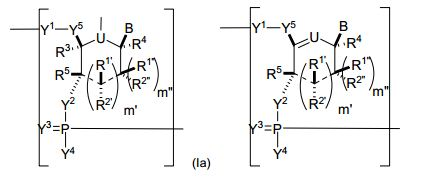
[00068] — é uma ligação simples ou está ausente; cada um de R1’, R2’, R1", R2", R1, R2, R3, R4 e R5, se presente, é, independentemente, H, halo, hidróxi, tiol, alquila opcionalmente substituída, alcóxi opcionalmente substituído, alquenilóxi opcionalmente substituído, alquinilóxi opcionalmente substituído, aminoalcóxi opcionalmente substituído, alcoxialcoxi opcionalmente substituído, hidroxialcóxi opcionalmente substituído, amino opcionalmente substituído, azido, arila opcionalmente substituída, aminoalquila opcionalmente substituída, aminoalquenila opcionalmente substituída, aminoalquinila opcionalmente substituída ou ausente; onde a combinação de R3 com um ou mais de R1’, R1", R2’, R2" ou R5 (por exemplo, a combinação de R1’ e R3, a combinação de R1" e R3, a combinação de R2’ e R3, a combinação de R2" e R3 ou a combinação de R5 e R3) pode se unir para formar alquileno opcionalmente substituído ou heteroalquileno opcionalmente substituído e junto com os carbonos aos quais ele estão ligados proveem uma heterociclila opcionalmente substituída (por exemplo, uma heterociclila bicíclica, tricíclica ou tetracíclica); onde a combinação de R5 com um ou mais de R1’, R1", R2’ ou R2" (por exemplo, a combinação de R1’ e R5, a combinação de R1" e R5, a combinação de R2‘ e R5 ou a combinação de R2" e R5) pode ser unida para formar alquileno opcionalmente substituído ou heteroalquileno opcionalmente substituído e junto com os carbonos aos quais ele estão ligados proveem uma heterociclila opcionalmente substituída (por exemplo, uma heterociclila bicíclica, tricíclica ou tetracíclica); e onde a combinação de R4 e um ou mais de R1’, R1", R2’, R2", R3 ou R5 pode ser unida para formar alquileno opcionalmente substituído ou heteroalquileno opcionalmente substituído e junto com os carbonos aos quais ele estão ligados proveem uma heterociclila opcionalmente substituída (por exemplo, uma heterociclila bicíclica, tricíclica ou tetracíclica);cada um de m’ e m" é, independentemente, um número inteiro de a partir de 0 a 3 (por exemplo, de a partir de 0 a 2, de a partir de 0 a 1, de a partir de 1 a 3 ou de a partir de 1 a 2); cada um de Y1, Y2 e Y3 é, independentemente, O, S, Se, - NRN1-, alquileno opcionalmente substituído, ou heteroalquileno opcionalmente substituído, onde RN1 é H, alquila opcionalmente substituída, alquenila opcionalmente substituída, alquinila opcionalmente substituída, arila opcionalmente substituída ou ausente; cada Y4 é, independentemente, H, hidróxi, tiol, boranila, alquila opcionalmente substituída, alquenila opcionalmente substituída, alquinila opcionalmente substituída, alcóxi opcionalmente substituído, alquenilóxi opcionalmente substituído, alquinilóxi opcionalmente substituído, tioalcóxi opcionalmente substituído, alcoxialcóxi opcionalmente substituído ou amino opcionalmente substituído; cada Y5 é, independentemente, O, S, Se, alquileno opcionalmente substituído (por exemplo, metileno) ou heteroalquileno opcionalmente substituído; n é um número inteiro de a partir de 1 a 100.000; e B é uma nucleobase (por exemplo, uma purina, uma pirimidina ou derivados das mesmas), onde a combinação de B e R1’, a combinação de B e R2’, a combinação de B e R1" ou a combinação de B e R2" pode junto com os carbonos aos quais eles estão ligados formar opcionalmente um grupo bicíclico (por exemplo, uma heterociclila bicíclica) ou onde a combinação de B, R1" e R3 ou uma combinação de B, R2" e R3 pode opcionalmente formar um grupo tricíclico ou tetracíclico (por exemplo, uma heterociclila tricíclica ou tetracíclica, tal como na presente Fórmula (IIo)-(IIp)).[00068] — is a single binding or is absent; each of R1', R2', R1", R2", R1, R2, R3, R4 and R5, if present, is independently H, halo, hydroxy, thiol, optionally substituted alkyl, optionally substituted alkoxy, optionally substituted alkenyloxy substituted, optionally substituted alkynyloxy, optionally substituted aminoalkoxy, optionally substituted alkoxyalkoxy, optionally substituted hydroxyalkoxy, optionally substituted amino, azido, optionally substituted aryl, optionally substituted aminoalkyl, optionally substituted aminoalkenyl, optionally substituted or absent aminoalkynyl; where the combination of R3 with one or more of R1', R1", R2', R2" or R5 (for example, the combination of R1' and R3, the combination of R1" and R3, the combination of R2' and R3 , the combination of R2" and R3 or the combination of R5 and R3) can join to form optionally substituted alkylene or optionally substituted heteroalkylene and together with the carbons to which they are attached provide an optionally substituted heterocyclyl (eg, a bicyclic heterocyclyl , tricyclic or tetracyclic); where the combination of R5 with one or more of R1', R1", R2' or R2" (for example, the combination of R1' and R5, the combination of R1" and R5, the combination of R2' and R5 or a combination of R2" and R5) can be joined to form optionally substituted alkylene or optionally substituted heteroalkylene and together with the carbons to which they are attached provide an optionally substituted heterocyclyl (for example, a bicyclic, tricyclic or tetracyclic heterocyclyl); and where the combination of R4 and one or more of R1', R1", R2', R2", R3 or R5 may be joined to form optionally substituted alkylene or optionally substituted heteroalkylene and together with the carbons to which they are attached provide a optionally substituted heterocyclyl (for example, a bicyclic, tricyclic or tetracyclic heterocyclyl); each of m' in" is independently an integer from from 0 to 3 (for example, from from 0 to 2, from from 0 to 1, from 1 to 3 or from 1 to 2); each of Y1, Y2 and Y3 is independently O, S, Se, -NRN1-, optionally substituted alkylene, or optionally substituted heteroalkylene, where RN1 is H, optionally substituted alkyl, optionally substituted alkenyl, optionally substituted alkynyl, optionally substituted or absent aryl; each Y4 is independently H, hydroxy, thiol, boranyl, optionally substituted alkyl, optionally substituted alkenyl, optional alkynyl optionally substituted alkoxy, optionally substituted alkenyloxy, optionally substituted alkynyloxy, optionally substituted thioalkoxy, optionally substituted alkoxyalkoxy, or optionally substituted amino; each Y5 is independently O, S, Se, optionally substituted alkylene (e.g., methylene) or optionally substituted heteroalkylene; n is an integer from 1 to 100,000; and B is a nucleobase (eg a purine, a pyrimidine or derivatives thereof), where the combination of B and R1', the combination of B and R2', the combination of B and R1" or the combination of B and R2" may together with the carbons to which they are attached optionally form a bicyclic group (eg a bicyclic heterocyclyl) or where the combination of B, R1" and R3 or a combination of B, R2" and R3 may optionally form a tricyclic or tetracyclic group (for example a tricyclic or tetracyclic heterocyclyl as in the present Formula (IIo)-(IIp)).
[00069] Em algumas modalidades, o polinucleotídeo inclui uma ribose modificada. Em algumas modalidades, o polinucleotídeo (por exemplo, a primeira região, a primeira região de flanqueamento ou a segunda região de flanqueamento) inclui um número n de nucleosídeos ligados tendo Fórmula (Ia-2)-(Ia-5) ou um sal farmaceuticamente aceitável ou estereoisômero do mesmo.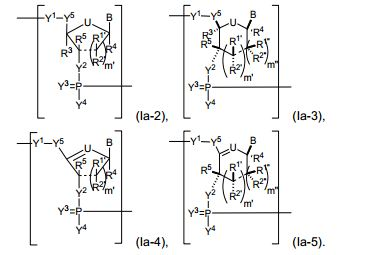
[00070] Em algumas modalidades, o polinucleotídeo (por exemplo, a primeira região, a primeira região de flanqueamento ou a segunda região de flanqueamento) inclui um número n de nucleosídeos ligados tendo Fórmula (Ib) ou Fórmula (Ib-1):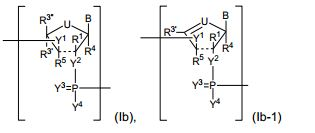
[00071] U é O, S, N(RU)nu ou C(RU)nu, onde nu é um número inteiro de a partir de 0 a 2 e cada RU é, independentemente, H, halo ou alquila opcionalmente substituída;— é uma ligação simples ou está ausente;cada um de R1, R3’, R3" e R4 é, independentemente, H, halo, hidróxi, alquila opcionalmente substituída, alcóxi opcionalmente substituído, alquenilóxi opcionalmente substituído, alquinilóxi opcionalmente substituído, aminoalcóxi opcionalmente substituído, alcoxialcóxi opcionalmente substituído, hidroxialcóxi opcionalmente substituído, amino opcionalmente substituído, azido, arila opcionalmente substituída, aminoalquila opcionalmente substituída, aminoalquenila opcionalmente substituída, aminoalquinilaopcionalmente substituída ou ausente; e onde a combinação de R1 e R3’ ou a combinação de R1 e R3" pode ser unida para formar alquileno opcionalmente substituído ou heteroalquileno opcionalmente substituído (por exemplo, para produzir um ácido nucleico bloqueado);cada R5 é, independentemente, H, halo, hidróxi, alquila opcionalmente substituída, alcóxi opcionalmente substituído, alquenilóxi opcionalmente substituído, alquinilóxi opcionalmente substituído, aminoalcóxi opcionalmente substituído, alcoxialcóxi opcionalmente substituído ou ausente;cada um de Y1, Y2 e Y3 é, independentemente, O, S, Se, NRN1-, alquileno opcionalmente substituído ou heteroalquileno opcionalmente substituído, onde RN1 é H, alquila opcionalmente substituída, alquenila opcionalmente substituída, alquinila opcionalmente substituída ou arila opcionalmente substituída;cada Y4 é, independentemente, H, hidróxi, tiol, boranila, alquila opcionalmente substituída, alquenila opcionalmente substituída, alquinila opcionalmente substituída, alcóxi opcionalmente substituído, alquenilóxi opcionalmente substituído, alquinilóxi opcionalmente substituído, alcoxialcóxi opcionalmente substituído ou amino opcionalmente substituído;n é um número inteiro de a partir de 1 a 100.000; eB é uma nucleobase.[00071] U is O, S, N(RU)nu or C(RU)nu, where nu is an integer from 0 to 2 and each RU is independently H, halo or optionally substituted alkyl;— is a single bond or is absent; each of R1, R3', R3" and R4 is independently H, halo, hydroxy, optionally substituted alkyl, optionally substituted alkoxy, optionally substituted alkenyloxy, optionally substituted alkynyloxy, optionally substituted aminoalkoxy, optionally substituted alkoxyalkoxy, optionally substituted hydroxyalkoxy, optionally substituted amino, azido, optionally substituted aryl, optionally substituted aminoalkyl, optionally substituted aminoalkenyl, optionally substituted or absent aminoalkynyl; and where the combination of R1 and R3' or the combination of R1 and R3" may be joined to form optionally substituted alkylene or optionally substituted heteroalkylene (for example, to produce a blocked nucleic acid); each R5 is independently , H, halo, hydroxy, optionally substituted alkyl, optionally substituted alkoxy, optionally substituted alkenyloxy, optionally substituted alkynyloxy, optionally substituted aminoalkoxy, optionally substituted or absent alkoxyalkoxy; each of Y1, Y2 and Y3 is independently O, S, Se , NRN1-, optionally substituted alkylene or optionally substituted heteroalkylene, where RN1 is H, optionally substituted alkyl, optionally substituted alkenyl, optionally substituted alkynyl, or optionally substituted aryl; each Y4 is independently H, hydroxy, thiol, boranyl, optionally substituted alkyl , optionally substituted alkenyl, optionally substituted alkynyl, optionally substituted alkoxy, optionally substituted alkenyloxy, optionally substituted alkynyloxy, optionally substituted alkoxyalkoxy, or optionally substituted amino; n is an integer from 1 to 100,000; eB is a nucleobase.
[00072] Em algumas modalidades, o polinucleotídeo (por exemplo, a primeira região, primeira região de flanqueamento ou segunda região de flanqueamento) inclui um número n de nucleosídeos ligados tendo Fórmula (Ic):
[00073] Em modalidades particulares, o anel incluindo U não tem uma ligação dupla entre U-CB3Rb3 ou entre CB3Rb3-CB2Rb2.[00073] In particular embodiments, the ring including U does not have a double bond between U-CB3Rb3 or between CB3Rb3-CB2Rb2.
[00074] Em algumas modalidades, o polinucleotídeo (por exemplo, a primeira região, primeira região de flanqueamento ou segunda região de flanqueamento) inclui um número n de nucleosídeos ligados tendo Fórmula (Id):
[00075] Em algumas modalidades, o polinucleotídeo (por exemplo, a primeira região, primeira região de flanqueamento ou segunda região de flanqueamento) inclui um número n de nucleosídeos ligados tendo Fórmula (Ie):
[00076] Em algumas modalidades, o polinucleotídeo (por exemplo, a primeira região, primeira região de flanqueamento ou segunda região de flanqueamento) inclui um número n de nucleosídeos ligados tendo Fórmula (If) ou (If-1):
[00077] Em algumas modalidades dos polinucleotídeos (por exemplo, Fórmulas (Ia)-(Ia-5), (Ib)-(If-1), (IIa)-(IIp), (IIb-1), (IIb-2), (IIc-1)- (IIc-2), (IIn-1), (IIn-2), (IVa)-(IVl) e (IXa)-(IXr)), o anel incluindo U tem uma ou duas ligações duplas.[00077] In some embodiments of polynucleotides (for example, Formulas (Ia)-(Ia-5), (Ib)-(If-1), (IIa)-(IIp), (IIb-1), (IIb- 2), (IIc-1)-(IIc-2), (IIn-1), (IIn-2), (IVa)-(IVl) and (IXa)-(IXr)), the ring including U has a or two double bonds.
[00078] Em algumas modalidades dos polinucleotídeos (por exemplo, Fórmulas (Ia)-Ia-5), (Ib)-(If-1), (IIa)-(IIp), (IIb-1), (IIb-2), (IIc-1)- (IIc-2), (IIn-1), (IIn-2), (IVa)-(IVl) e (IXa)-(IXr)), cada um de R1, R1’ e R1", se presente, é H. Em modalidades adicionais, cada um de R2, R2, e R2", se presente, é, independentemente, H, halo (por exemplo, flúor), hidróxi, alcóxi opcionalmente substituído (por exemplo, metóxi ou etóxi) ou alcoxialcóxi opcionalmente substituído. Em modalidades particulares, alcoxialcóxi é -(CH2)s2(OCH2CH2)s1(CH2)s3OR’, onde s1 é um número inteiro de a partir de 1 a 10 (por exemplo, de a partir de 1 a 6 ou de a partir de 1 a 4), cada um de s2 e s3, independentemente, é um número inteiro de a partir de 0 a 10 (por exemplo, de a partir de 0 a 4, de a partir de 0 a 6, de a partir de 1 a 4, de a partir de 1 a 6 ou de a partir de 1 a 10) e R’ é H ou C1-20 alquila). Em algumas modalidades, s2 é 0, s1 é 1 ou 2, s3 é 0 ou 1 e R’ é C1-6 alquila.[00078] In some embodiments of polynucleotides (for example, Formulas (Ia)-Ia-5), (Ib)-(If-1), (IIa)-(IIp), (IIb-1), (IIb-2 ), (IIc-1)-(IIc-2), (IIn-1), (IIn-2), (IVa)-(IVl) and (IXa)-(IXr)), each of R1, R1' and R1", if present, is H. In additional embodiments, each of R2, R2, and R2", if present, is independently H, halo (e.g., fluorine), hydroxy, optionally substituted alkoxy (e.g. , methoxy or ethoxy) or optionally substituted alkoxyalkoxy. In particular embodiments, alkoxyalkoxy is -(CH2)s2(OCH2CH2)s1(CH2)s3OR', where s1 is an integer from 1 to 10 (e.g., from 1 to 6 or de from 1 to 4), each of s2 and s3, independently, is an integer from 0 to 10 (eg, from 0 to 4, from 0 to 6, and from 1 to 4, from 1 to 6 or from from 1 to 10) and R' is H or C1-20 alkyl). In some embodiments, s2 is 0, s1 is 1 or 2, s3 is 0 or 1, and R' is C1-6 alkyl.
[00079] Em algumas modalidades dos polinucleotídeos (por exemplo, Fórmulas (Ia)-(Ia-5), (Ib)-(If), (IIa)-(IIp), (IIb-1), (IIb-2), (IIc-1)- (IIc-2), (IIn-1), (IIn-2), (IVa)-(IVl) e (IXa)-(IXr)), cada um de R2, R2’ e R2", se presente, é H. Em modalidades adicionais, cada um de R1, R1’ e R1", se presente, é, independentemente, H, halo (por exemplo, flúor), hidróxi, alcóxi opcionalmente substituído (por exemplo, metóxi ou etóxi) ou alcoxialcóxi opcionalmente substituído. Em modalidades particulares, alcoxialcóxi é -(CH2)s2(OCH2CH2)s1(CH2)s3OR’, onde s1 é um número inteiro de a partir de 1 a 10 (por exemplo, de a partir de 1 a 6 ou de a partir de 1 a 4), cada um de s2 e s3, independentemente, é um número inteiro de a partir de 0 a 10 (por exemplo, de a partir de 0 a 4, de a partir de 0 a 6, de a partir de 1 a 4, de a partir de 1 a 6 ou de a partir de 1 a 10) e R’ é H ou C1-20 alquila). Em algumas modalidades, s2 é 0, s1 é 1 ou 2, s3 é 0 ou 1 e R’ é C1-6 alquila.[00079] In some embodiments of polynucleotides (for example, Formulas (Ia)-(Ia-5), (Ib)-(If), (IIa)-(IIp), (IIb-1), (IIb-2) , (IIc-1)-(IIc-2), (IIn-1), (IIn-2), (IVa)-(IVl) and (IXa)-(IXr)), each of R2, R2' and R2", if present, is H. In additional embodiments, each of R1, R1' and R1", if present, is independently H, halo (e.g., fluorine), hydroxy, optionally substituted alkoxy (e.g., methoxy or ethoxy) or optionally substituted alkoxyalkoxy. In particular embodiments, alkoxyalkoxy is -(CH2)s2(OCH2CH2)s1(CH2)s3OR', where s1 is an integer from 1 to 10 (e.g., from 1 to 6 or de from 1 to 4), each of s2 and s3, independently, is an integer from 0 to 10 (eg, from 0 to 4, from 0 to 6, and from 1 to 4, from 1 to 6 or from from 1 to 10) and R' is H or C1-20 alkyl). In some embodiments, s2 is 0, s1 is 1 or 2, s3 is 0 or 1, and R' is C1-6 alkyl.
[00080] Em algumas modalidades dos polinucleotídeos (por exemplo, Fórmulas (Ia)-(Ia-5), (Ib)-(If-1), (IIa)-(IIp), (IIb-1), (IIb-2), (IIc-1)- (IIc-2), (IIn-1), (IIn-2), (IVa)-(IVl) e (IXa)-(IXr)), cada um de R3, R4 e R5 é, independentemente, H, halo (por exemplo, flúor), hidróxi, alquila opcionalmente substituída, alcóxi opcionalmente substituído (por exemplo, metóxi ou etóxi) ou alcoxialcóxi opcionalmente substituído. Em modalidades particulares, R3 é H, R4 é H, R5 é H ou R3, R4 e R5 são todos H. Em modalidades particulares, R3 é C1-6 alquila, R4 é C1-6 alquila, R5 é C1-6 alquila ou R3, R4 e R5 são todos C1-6 alquila. Em modalidades particulares, R3 e R4 são ambos H e R5 é C1-6 alquila.[00080] In some embodiments of polynucleotides (for example, Formulas (Ia)-(Ia-5), (Ib)-(If-1), (IIa)-(IIp), (IIb-1), (IIb- 2), (IIc-1)-(IIc-2), (IIn-1), (IIn-2), (IVa)-(IVl) and (IXa)-(IXr)), each of R3, R4 and R5 is independently H, halo (for example fluorine), hydroxy, optionally substituted alkyl, optionally substituted alkoxy (for example methoxy or ethoxy) or optionally substituted alkoxyalkoxy. In particular embodiments, R3 is H, R4 is H, R5 is H or R3, R4 and R5 are all H. In particular embodiments, R3 is C1-6 alkyl, R4 is C1-6 alkyl, R5 is C1-6 alkyl or R3, R4 and R5 are all C1-6 alkyl. In particular embodiments, R3 and R4 are both H and R5 is C1-6 alkyl.
[00081] Em algumas modalidades dos polinucleotídeos (por exemplo, Fórmulas (Ia)-(Ia-5), (Ib)-(If-1), (IIa)-(IIp), (IIb-1), (IIb-2), (IIc-1)- (IIc-2), (IIn-1), (IIn-2), (IVa)-(IVl) e (IXa)-(IXr)), R3 e R5 se unem para formar alquileno opcionalmente substituído ou heteroalquileno opcionalmente substituído e, junto com os carbonos aos quais eles estão ligados, proveem uma heterociclila opcionalmente substituída (por exemplo, uma heterociclila bicíclica, tricíclica ou tetracíclica, tais como análogos de trans-3’-4’, onde R3 e R5 se unem para formar heteroalquileno (por exemplo, -(CH2)b1O(CH2)b2O(CH2)b3-, onde cada um de b1, b2 e b3 é, independentemente, um número inteiro de a partir de 0 a 3).[00081] In some embodiments of polynucleotides (for example, Formulas (Ia)-(Ia-5), (Ib)-(If-1), (IIa)-(IIp), (IIb-1), (IIb- 2), (IIc-1)- (IIc-2), (IIn-1), (IIn-2), (IVa)-(IVl) and (IXa)-(IXr)), R3 and R5 join together to form optionally substituted alkylene or optionally substituted heteroalkylene and, together with the carbons to which they are attached, provide an optionally substituted heterocyclyl (for example, a bicyclic, tricyclic or tetracyclic heterocyclyl, such as analogs of trans-3'-4', where R3 and R5 join to form heteroalkylene (eg, -(CH2)b1O(CH2)b2O(CH2)b3-, where each of b1, b2 and b3 is independently an integer from 0 to 3 ).
[00082] Em algumas modalidades dos polinucleotídeos (por exemplo, Fórmulas (Ia)-(Ia-5), (Ib)-(If-1), (IIa)-(IIp), (IIb-1), (IIb-2), (IIc-1)- (IIc-2), (IIn-1), (IIn-2), (IVa)-(IVl) e (IXa)-(IXr)), R3 e um ou mais de R1’, R1", R2‘, R2" ou R5 se unem para formar alquileno opcionalmente substituído ou heteroalquileno opcionalmente substituído e, junto com os carbonos aos quais eles estão ligados, proveem uma heterociclila opcionalmente substituída (por exemplo, uma heterociclila bicíclica, tricíclica ou tetracíclica, R3 e um ou mais de R1’, R1", R2‘, R2" ou R5 se unem para formar heteroalquileno (por exemplo, - (CH2)b1O(CH2)b2O(CH2)b3-, onde cada um de b1, b2, e b3 é, independentemente, um número inteiro de a partir de 0 a 3).[00082] In some embodiments of polynucleotides (for example, Formulas (Ia)-(Ia-5), (Ib)-(If-1), (IIa)-(IIp), (IIb-1), (IIb- 2), (IIc-1)- (IIc-2), (IIn-1), (IIn-2), (IVa)-(IVl) and (IXa)-(IXr)), R3 and one or more of R1', R1", R2', R2" or R5 join to form optionally substituted alkylene or optionally substituted heteroalkylene and, together with the carbons to which they are attached, provide an optionally substituted heterocyclyl (eg, a bicyclic, tricyclic heterocyclyl or tetracyclic, R3 and one or more of R1', R1", R2', R2" or R5 join to form heteroalkylene (for example, -(CH2)b1O(CH2)b2O(CH2)b3-, where each of b1, b2, and b3 is independently an integer from 0 to 3).
[00083] Em algumas modalidades dos polinucleotídeos (por exemplo, Fórmulas (Ia)-(Ia-5), (Ib)-(If-1), (IIa)-(IIp), (IIb-1), (IIb-2), (IIc-1)- (IIc-2), (IIn-1), (IIn-2), (IVa)-(IVl) e (IXa)-(IXr)), R5 e um ou mais de R1’, R1", R2‘ ou R2" se unem para formar alquileno opcionalmente substituído ou heteroalquileno opcionalmente substituído e, junto com os carbonos aos quais eles estão ligados, proveem uma heterociclila opcionalmente substituída (por exemplo, uma heterociclila bicíclica, tricíclica ou tetracíclica, R5 e um ou mais de R1’, R1", R2‘ ou R2" se unem para formar heteroalquileno (por exemplo, -(CH2)b1O(CH2)b2O(CH2)b3-, onde cada um de b1, b2 e b3 é, independentemente, um número inteiro de a partir de 0 a 3).[00083] In some embodiments of polynucleotides (for example, Formulas (Ia)-(Ia-5), (Ib)-(If-1), (IIa)-(IIp), (IIb-1), (IIb- 2), (IIc-1)- (IIc-2), (IIn-1), (IIn-2), (IVa)-(IVl) and (IXa)-(IXr)), R5 and one or more of R1', R1", R2' or R2" join to form optionally substituted alkylene or optionally substituted heteroalkylene and, together with the carbons to which they are attached, provide an optionally substituted heterocyclyl (for example, a bicyclic, tricyclic or tetracyclic heterocyclyl , R5 and one or more of R1', R1", R2' or R2" join to form heteroalkylene (for example, -(CH2)b1O(CH2)b2O(CH2)b3-, where each of b1, b2 and b3 is independently an integer from 0 to 3).
[00084] Em algumas modalidades dos polinucleotídeos (por exemplo, Fórmulas (Ia)-(Ia-5), (Ib)-(If-1), (IIa)-(IIp), (IIb-1), (IIb-2), (IIc-1)- (IIc-2), (IIn-1), (IIn-2), (IVa)-(IVl) e (IXa)-(IXr)), cada Y2 é, independentemente, O, S ou -NRN1-, onde RN1 é H, alquila opcionalmente substituída, alquenila opcionalmente substituída, alquinila opcionalmente substituída ou arila opcionalmente substituída. Em modalidades particulares, Y2 é NRN1-, onde RN1 é H ou alquila opcionalmente substituída (por exemplo, C1-6 alquila, tal como metila, etila, isopropila ou n-propila).[00084] In some embodiments of polynucleotides (for example, Formulas (Ia)-(Ia-5), (Ib)-(If-1), (IIa)-(IIp), (IIb-1), (IIb- 2), (IIc-1)- (IIc-2), (IIn-1), (IIn-2), (IVa)-(IVl) and (IXa)-(IXr)), each Y2 is, independently, O, S or -NRN1-, where RN1 is H, optionally substituted alkyl, optionally substituted alkenyl, optionally substituted alkynyl, or optionally substituted aryl. In particular embodiments, Y2 is NRN1-, where RN1 is H or optionally substituted alkyl (for example, C1-6 alkyl, such as methyl, ethyl, isopropyl or n-propyl).
[00085] Em algumas modalidades dos polinucleotídeos (por exemplo, Fórmulas (Ia)-(Ia-5), (Ib)-(If-1), (IIa)-(IIp), (IIb-1), (IIb-2), (IIc-1)- (IIc-2), (IIn-1), (IIn-2), (IVa)-(IVl) e (IXa)-(IXr)), cada Y3 é, independentemente, O ou S.[00085] In some embodiments of polynucleotides (for example, Formulas (Ia)-(Ia-5), (Ib)-(If-1), (IIa)-(IIp), (IIb-1), (IIb- 2), (IIc-1)- (IIc-2), (IIn-1), (IIn-2), (IVa)-(IVl) and (IXa)-(IXr)), each Y3 is, independently, O or S.
[00086] Em algumas modalidades dos polinucleotídeos (por exemplo, Fórmulas (Ia)-(Ia-5), (Ib)-(If-1), (IIa)-(IIp), (IIb-1), (IIb-2), (IIc-1)- (IIc-2), (IIn-1), (IIn-2), (IVa)-(IVl) e (IXa)-(IXr)), R1 é H; cada R2 é, independentemente, H, halo (por exemplo, flúor), hidróxi, alcóxi opcionalmente substituído (por exemplo, metóxi ou etóxi) ou alcoxialcóxi opcionalmente substituído (por exemplo, -(CH2)s2(OCH2CH2)s1(CH2)s3OR’, onde s1 é um número inteiro de a partir de 1 a 10 (por exemplo, de a partir de 1 a 6 ou de a partir de 1 a 4), cada um de s2 e s3, independentemente, é um número inteiro de a partir de 0 a 10 (por exemplo, de a partir de 0 a 4, de a partir de 0 a 6, de a partir de 1 a 4, de a partir de 1 a 6 ou de a partir de 1 a 10) e R’ é H ou C1-20 alquila, tal como onde s2 é 0, s1 é 1 ou 2, s3 é 0 ou 1, e R’ é C1-6 alquila); cada Y2 é, independentemente, O ou -NRN1-, onde RN1 é H, alquila opcionalmente substituída, alquenila opcionalmente substituída, alquinila opcionalmente substituída ou arila opcionalmente substituída (por exemplo, onde RN1 é H ou alquila opcionalmente substituída (por exemplo, C1-6 alquila, tal como metila, etila, isopropila ou n-propila)); e cada Y3 é, independentemente, O ou S (por exemplo, S). Em modalidades adicionais, R3 é H, halo (por exemplo, flúor), hidróxi, alquila opcionalmente substituída, alcóxi opcionalmente substituído (por exemplo, metóxi ou etóxi) ou alcoxialcóxi opcionalmente substituído. Em ainda outras modalidades adicionais, cada Y1 é , independentemente, O ou -NRN1-, onde RN1 é H, alquila opcionalmente substituída, alquenila opcionalmente substituída, alquinila opcionalmente substituída ou arila opcionalmente substituída (por exemplo, onde RN1 é H ou alquila opcionalmente substituída (por exemplo, C1-6 alquila, tal como metila, etila, isopropila ou n-propila)); e cada Y4 é, independentemente, H, hidróxi, tiol, alquila opcionalmente substituída, alcóxi opcionalmente substituído, tioalcóxi opcionalmente substituído, alcoxialcóxi opcionalmente substituído ou amino opcionalmente substituído.[00086] In some embodiments of polynucleotides (for example, Formulas (Ia)-(Ia-5), (Ib)-(If-1), (IIa)-(IIp), (IIb-1), (IIb- 2), (IIc-1)-(IIc-2), (IIn-1), (IIn-2), (IVa)-(IVl) and (IXa)-(IXr)), R1 is H; each R2 is independently H, halo (eg fluorine), hydroxy, optionally substituted alkoxy (eg methoxy or ethoxy) or optionally substituted alkoxyalkoxy (eg -(CH2)s2(OCH2CH2)s1(CH2)s3OR ', where s1 is an integer from 1 to 10 (for example, from 1 to 6 or from 1 to 4), each of s2 and s3 independently is an integer of from 0 to 10 (eg from 0 to 4, from 0 to 6, from 1 to 4, from 1 to 6 or from 1 to 10) and R' is H or C1-20 alkyl, such as where s2 is 0, s1 is 1 or 2, s3 is 0 or 1, and R' is C1-6 alkyl); each Y2 is independently O or -NRN1-, where RN1 is H, optionally substituted alkyl, optionally substituted alkenyl, optionally substituted alkynyl, or optionally substituted aryl (for example, where RN1 is H or optionally substituted alkyl (for example, C1- 6 alkyl, such as methyl, ethyl, isopropyl or n-propyl)); and each Y3 is independently O or S (for example, S). In additional embodiments, R3 is H, halo (for example, fluorine), hydroxy, optionally substituted alkyl, optionally substituted alkoxy (for example, methoxy or ethoxy) or optionally substituted alkoxyalkoxy. In still other additional embodiments, each Y1 is independently O or -NRN1-, where RN1 is H, optionally substituted alkyl, optionally substituted alkenyl, optionally substituted alkynyl, or optionally substituted aryl (e.g., where RN1 is H or optionally substituted alkyl (for example C 1-6 alkyl such as methyl, ethyl, isopropyl or n-propyl)); and each Y4 is independently H, hydroxy, thiol, optionally substituted alkyl, optionally substituted alkoxy, optionally substituted thioalkoxy, optionally substituted alkoxyalkoxy, or optionally substituted amino.
[00087] Em algumas modalidades dos polinucleotídeos (por exemplo, Fórmulas (Ia)-(Ia-5), (Ib)-(If-1), (IIa)-(IIp), (IIb-1), (IIb-2), (IIc-1)- (IIc-2), (IIn-1), (IIn-2), (IVa)-(IVl) e (IXa)-(IXr)), cada R1 é, independentemente, H, halo (por exemplo, flúor), hidróxi, alcóxi opcionalmente substituído (por exemplo, metóxi ou etóxi) ou alcoxialcóxi opcionalmente substituído (por exemplo, -(CH2)s2(OCH2CH2)s1(CH2)s3OR’, onde s1 é um número inteiro de a partir de 1 a 10 (por exemplo, de a partir de 1 a 6 ou de a partir de 1 a 4), cada um de s2 e s3, independentemente, é um número inteiro de a partir de 0 a 10 (por exemplo, de a partir de 0 a 4, de a partir de 0 a 6, de a partir de 1 a 4, de a partir de 1 a 6 ou de a partir de 1 a 10) e R’ é H ou C1-20 alquila, tal como onde s2 é 0, s1 é 1 ou 2, s3 é 0 ou 1, e R’ é C1-6 alquila); R2 é H; cada Y2 é, independentemente, O ou -NRN1-, onde RN1 é H, alquila opcionalmente substituída, alquenila opcionalmente substituída, alquinila opcionalmente substituída ou arila opcionalmente substituída (por exemplo, onde RN1 é H ou alquila opcionalmente substituída (por exemplo, C1-6 alquila, tal como metila, etila, isopropila ou n-propila)); e cada Y3 é, independentemente, O ou S (por exemplo, S). Em modalidades adicionais, R3 é H, halo (por exemplo, flúor), hidróxi, alquila opcionalmente substituída, alcóxi opcionalmente substituído (por exemplo, metóxi ou etóxi) ou alcoxialcóxi opcionalmente substituído. Em ainda modalidades adicionais, cada Y1 é , independentemente, O ou - NRN1-, onde RN1 é H, alquila opcionalmente substituída, alquenila opcionalmente substituída, alquinila opcionalmente substituída ou arila opcionalmente substituída (por exemplo, onde RN1 é H ou alquila opcionalmente substituída (por exemplo, C1-6 alquila, tal como metila, etila, isopropila ou n-propila)); e cada Y4 é, independentemente, H, hidróxi, tiol, alquila opcionalmente substituída, alcóxi opcionalmente substituído, tioalcóxi opcionalmente substituído, alcoxialcóxi opcionalmente substituído ou amino opcionalmente substituído.[00087] In some embodiments of polynucleotides (for example, Formulas (Ia)-(Ia-5), (Ib)-(If-1), (IIa)-(IIp), (IIb-1), (IIb- 2), (IIc-1)- (IIc-2), (IIn-1), (IIn-2), (IVa)-(IVl) and (IXa)-(IXr)), each R1 is, independently, H, halo (eg fluorine), hydroxy, optionally substituted alkoxy (eg methoxy or ethoxy) or optionally substituted alkoxyalkoxy (eg -(CH2)s2(OCH2CH2)s1(CH2)s3OR', where s1 is a integer from 1 to 10 (for example, from 1 to 6 or from 1 to 4), each of s2 and s3 independently is an integer from 0 to 10 (eg from 0 to 4, from 0 to 6, from 1 to 4, from 1 to 6 or from 1 to 10) and R' is H or C1-20 alkyl, such as where s2 is 0, s1 is 1 or 2, s3 is 0 or 1, and R' is C1-6 alkyl); R2 is H; each Y2 is independently O or -NRN1-, where RN1 is H, optionally substituted alkyl, optionally substituted alkenyl, optionally substituted alkynyl, or optionally substituted aryl (for example, where RN1 is H or optionally substituted alkyl (for example, C1- 6 alkyl, such as methyl, ethyl, isopropyl or n-propyl)); and each Y3 is independently O or S (for example, S). In additional embodiments, R3 is H, halo (for example, fluorine), hydroxy, optionally substituted alkyl, optionally substituted alkoxy (for example, methoxy or ethoxy) or optionally substituted alkoxyalkoxy. In still further embodiments, each Y1 is independently O or -NRN1-, where RN1 is H, optionally substituted alkyl, optionally substituted alkenyl, optionally substituted alkynyl, or optionally substituted aryl (e.g., where RN1 is H or optionally substituted alkyl ( for example C 1-6 alkyl such as methyl, ethyl, isopropyl or n-propyl)); and each Y4 is independently H, hydroxy, thiol, optionally substituted alkyl, optionally substituted alkoxy, optionally substituted thioalkoxy, optionally substituted alkoxyalkoxy, or optionally substituted amino.
[00088] Em algumas modalidades dos polinucleotídeos (por exemplo, Fórmulas (Ia)-(Ia-5), (Ib)-(If-1), (IIa)-(IIp), (IIb-1), (IIb-2), (IIc-1)- (IIc-2), (IIn-1), (IIn-2), (IVa)-(IVl) e (IXa)-(IXr)), o anel incluindo U está na configuração β-D (por exemplo, β-D-ribo).[00088] In some embodiments of polynucleotides (for example, Formulas (Ia)-(Ia-5), (Ib)-(If-1), (IIa)-(IIp), (IIb-1), (IIb- 2), (IIc-1)-(IIc-2), (IIn-1), (IIn-2), (IVa)-(IVl) and (IXa)-(IXr)), the ring including U is in the β-D configuration (eg β-D-ribo).
[00089] Em algumas modalidades dos polinucleotídeos (por exemplo, Fórmulas (Ia)-(Ia-5), (Ib)-(If-1), (IIa)-(IIp), (IIb-1), (IIb-2), (IIc-1)- (IIc-2), (IIn-1), (IIn-2), (IVa)-(IVl) e (IXa)-(IXr)), o anel incluindo U está na configuração α-L (por exemplo, α-L-ribo).[00089] In some embodiments of polynucleotides (for example, Formulas (Ia)-(Ia-5), (Ib)-(If-1), (IIa)-(IIp), (IIb-1), (IIb- 2), (IIc-1)-(IIc-2), (IIn-1), (IIn-2), (IVa)-(IVl) and (IXa)-(IXr)), the ring including U is in the α-L configuration (eg α-L-ribo).
[00090] Em algumas modalidades dos polinucleotídeos (por exemplo, Fórmulas (Ia)-(Ia-5), (Ib)-(If-1), (IIa)-(IIp), (IIb-1), (IIb-2), (IIc-1)- (IIc-2), (IIn-1), (IIn-2), (IVa)-(IVl) e (IXa)-(IXr)), um ou mais B não é pseudouridina (Φ) ou 5-metil-citidina (m5C).[00090] In some embodiments of polynucleotides (for example, Formulas (Ia)-(Ia-5), (Ib)-(If-1), (IIa)-(IIp), (IIb-1), (IIb- 2), (IIc-1)- (IIc-2), (IIn-1), (IIn-2), (IVa)-(IVl) and (IXa)-(IXr)), one or more B is not pseudouridine (Φ) or 5-methyl-cytidine (m5C).
[00091] Em algumas modalidades, cerca de 10% a cerca de 100% de número n de nucleobases B não são Φ ou m5C (por exemplo, de a partir de 10% a 20%, de a partir de 10% a 35%, de a partir de 10% a 50%, de a partir de 10% a 60%, de a partir de 10% a 75%, de a partir de 10% a 90%, de a partir de 10% a 95%, de a partir de 10% a 98%, de a partir de 10% a 99%, de a partir de 20% a 35%, de a partir de 20% a 50%, de a partir de 20% a 60%, de a partir de 20% a 75%, de a partir de 20% a 90%, de a partir de 20% a 95%, de a partir de 20% a 98%, dea partir de 20% a 99%, de a partir de 20% a 100%, de a partir de 50% a60%, de a partir de 50% a 75%, de a partir de 50% a 90%, de a partir de 50% a 95%, de a partir de 50% a 98%, de a partir de 50% a 99%, dea partir de 50% a 100%, de a partir de 75% a 90%, de a partir de 75% a95%, de a partir de 75% a 98%, de a partir de 75% a 99% e de a partir de 75% a 100% de número n de B não são Φ ou m 5C). Em algumas modalidades, B não é Φ ou m5C.[00091] In some embodiments, about 10% to about 100% of number n B nucleobases are not Φ or m5C (eg, from 10% to 20%, from 10% to 35% , from 10% to 50%, from 10% to 60%, from 10% to 75%, from 10% to 90%, from 10% to 95% , from 10% to 98%, from 10% to 99%, from 20% to 35%, from 20% to 50%, from 20% to 60% , from 20% to 75%, from 20% to 90%, from 20% to 95%, from 20% to 98%, from 20% to 99%, from 20% to 100%, from 50% to 60%, from 50% to 75%, from 50% to 90%, from 50% to 95%, from from 50% to 98%, from 50% to 99%, from 50% to 100%, from 75% to 90%, from 75% to 95%, from from 75% to 98%, from from 75% to 99% and from from 75% to 100% of number n of B are not Φ or m 5C). In some modalities, B is not Φ or m5C.
[00092] Em algumas modalidades dos polinucleotídeos (por exemplo, Fórmulas (Ia)-(Ia-5), (Ib)-(If-1), (IIa)-(IIp), (IIb-1), (IIb-2), (IIc-1)- (IIc-2), (IIn-1), (IIn-2), (IVa)-(IVl) e (IXa)-(IXr)), quando B é uma nucleobase não modificada selecionada de citosina, guanina, uracila e adenina, então pelo menos um de Y1, Y2 ou Y3 não é O.[00092] In some embodiments of polynucleotides (for example, Formulas (Ia)-(Ia-5), (Ib)-(If-1), (IIa)-(IIp), (IIb-1), (IIb- 2), (IIc-1)- (IIc-2), (IIn-1), (IIn-2), (IVa)-(IVl) and (IXa)-(IXr)), when B is a non-nucleobase modified selected from cytosine, guanine, uracil and adenine, then at least one of Y1, Y2 or Y3 is not O.
[00093] Em algumas modalidades, o polinucleotídeo inclui uma ribose modificada. Em algumas modalidades, o polinucleotídeo (por exemplo, a primeira região, a primeira região de flanqueamento ou a segunda região de flanqueamento) inclui um número n de nucleosídeos ligados tendo Fórmula (IIa)-(IIc):
[00094] (IIc) ou um sal farmaceuticamente aceitável ou estereoisômero do mesmo. Em modalidades particulares, U é O ou C(RU)nu, onde nu é um número inteiro de a partir de 0 a 2 e cada RU é, independentemente, H, halo ou alquila opcionalmente substituída (por exemplo, U é -CH2- ou -CH-). Em outras modalidades, cada um de R1, R2, R3, R4 e R5 é, independentemente, H, halo, hidróxi, tiol, alquila opcionalmente substituída, alcóxi opcionalmente substituído, alquenilóxi opcionalmente substituído, alquinilóxi opcionalmente substituído, aminoalcóxi opcionalmente substituído, alcoxialcóxi opcionalmente substituído, hidroxialcóxi opcionalmente substituído, amino opcionalmente substituído, azido, arila opcionalmente substituída, aminoalquila opcionalmente substituída, aminoalquenila opcionalmente substituída, aminoalquinila opcionalmente substituída ou está ausente (por exemplo, cada R1 e R2 é, independentemente H, halo, hidróxi, alquila opcionalmente substituída ou alcóxi opcionalmente substituído; cada R3 e R4 é, independentemente, H ou alquila opcionalmente substituída; e R5 é H ou hidróxi), e — é uma ligação simples ou dupla.[00094] (IIc) or a pharmaceutically acceptable salt or stereoisomer thereof. In particular embodiments, U is O or C(RU)nu, where nu is an integer from 0 to 2 and each RU is independently H, halo, or optionally substituted alkyl (e.g., U is -CH 2 - or -CH-). In other embodiments, each of
[00095] Em modalidades particulares, o polinucleotídeo (por exemplo, a primeira região, a primeira região de flanqueamento ou a segunda região de flanqueamento) inclui um número n de nucleosídeos ligados tendo Fórmula (IIb-1)-(IIb-2):
[00096] Em modalidades particulares, o polinucleotídeo (por exemplo, a primeira região, a primeira região de flanqueamento ou a segunda região de flanqueamento) inclui um número n de nucleosídeos ligados tendo Fórmula (IIc-1)-(IIc-4):

[00097] Em algumas modalidades, U é O ou C(RU)nu, onde nu é um número inteiro de a partir de 0 a 2 e cada RU é, independentemente, H, halo ou alquila opcionalmente substituída (por exemplo, U é -CH2- ou -CH-). Em algumas modalidades, cada um de R1, R2 e R3 é, independentemente, H, halo, hidróxi, tiol, alquila opcionalmente substituída, alcóxi opcionalmente substituído, alquenilóxi opcionalmente substituído, alquinilóxi opcionalmente substituído, aminoalcóxi opcionalmente substituído, alcoxialcóxi opcionalmente substituído, hidroxialcóxi opcionalmente substituído, amino opcionalmente substituído, azido, arila opcionalmente substituída, aminoalquila opcionalmente substituída, aminoalquenila opcionalmente substituída, aminoalquinila opcionalmente substituída ou está ausente (por exemplo, cada R1 e R2 é, independentemente, H, halo, hidróxi, alquila opcionalmente substituída ou alcóxi opcionalmente substituído, por exemplo, H, halo, hidróxi, alquila ou alcóxi; e cada R3 é, independentemente, H ou alquila opcionalmente substituída)). Em modalidades particulares, R2 é alcóxi opcionalmente substituído (por exemplo, metóxi ou etóxi ou qualquer um descrito aqui). Em modalidades particulares, R1 é alquila opcionalmente substituída e R2 é hidróxi. Em outras modalidades, R1 é hidróxi e R2 é alquila opcionalmente substituída. Em modalidades adicionais, R3 é alquila opcionalmente substituída.[00097] In some embodiments, U is O or C(RU)nu, where nu is an integer from 0 to 2 and each RU is independently H, halo, or optionally substituted alkyl (e.g., U is -CH2- or -CH-). In some embodiments, each of
[00098] Em algumas modalidades, o polinucleotídeo inclui uma ribose acíclica modificada. Em algumas modalidades, o polinucleotídeo (por exemplo, a primeira região, a primeira região de flanqueamento ou a segunda região de flanqueamento) inclui um número n de nucleosídeos ligados tendo Fórmula (IId)-(IIf):
[00099] Em algumas modalidades, o polinucleotídeo inclui um hexitol acíclico modificado. Em algumas modalidades, o polinucleotídeo (por exemplo, a primeira região, a primeira região de flanqueamento ou a segunda região de flanqueamento) inclui um número n de nucleosídeos ligados tendo Fórmula (IIg)-(IIj):
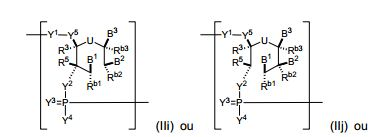
[000100] Em algumas modalidades, o polinucleotídeo inclui uma porção açúcar tendo um anel ribose contraído ou expandido. Em algumas modalidades, o polinucleotídeo (por exemplo, a primeira região, a primeira região de flanqueamento ou a segunda região de flanqueamento) inclui um número n de nucleosídeos ligados tendo Fórmula (IIk)-(IIm):
[000101] Em algumas modalidades, o polinucleotídeo includes uma ribose modificada bloqueada. Em algumas modalidades, o polinucleotídeo (por exemplo, a primeira região, a primeira região de flanqueamento ou a segunda região de flanqueamento) inclui um número n de nucleosídeos ligados tendo Fórmula (IIn):
[000102] Em algumas modalidades, o polinucleotídeo (por exemplo, a primeira região, a primeira região de flanqueamento ou a segunda região de flanqueamento) inclui um número n de nucleosídeos ligados tendo Fórmula (IIn-1)-(II-n2):
[000103] Em algumas modalidades, o polinucleotídeo includes uma ribose modificada bloqueada que forma uma heterociclila tetracíclica. Em algumas modalidades, o polinucleotídeo (por exemplo, a primeira região, a primeira região de flanqueamento ou a segunda região de flanqueamento) inclui um número n de nucleosídeos ligados tendo Fórmula (IIo):
[000104] Qualquer uma das fórmulas para os polinucleotídeos pode incluir uma ou mais nucleobase descritas aqui (por exemplo, Fórmulas (b1)-(b43)).[000104] Any of the formulas for polynucleotides may include one or more nucleobases described herein (for example, Formulas (b1)-(b43)).
[000105] Em uma modalidade, a presente invenção provê métodos de preparação de um polinucleotídeo compreendendo pelo menos um nucleotídeo que rompe a ligação de uma contraparte de interação da ranhura principal com o ácido nucleico, onde o polinucleotídeo compreende número n de nucleosídeos tendo Fórmula (Ia), conforme definido aqui: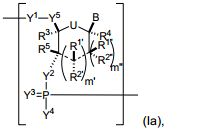
[000106] o método compreendendo reação de um composto de Fórmula (IIIa), conforme aqui definido:
[000107] Em uma modalidade adicional, a presente invenção provê métodos de amplificação de um polinucleotídeo compreendendo pelo menos um polinucleotídeo que rompe a ligação de uma contraparte de ligação da ranhura principal com a sequência de polinucleotídeo, o método compreendendo: reação de um composto de Fórmula (IIIa), conforme aqui definido, com um iniciador , um modelo de cDNA e uma polimerase de RNA.[000107] In a further embodiment, the present invention provides methods of amplifying a polynucleotide comprising at least one polynucleotide that breaks the binding of a main slot binding counterpart with the polynucleotide sequence, the method comprising: reacting a compound of Formula (IIIa), as defined herein, with a primer, a cDNA template and an RNA polymerase.
[000108] Em uma modalidade, a presente invenção provê métodos de preparação de um polinucleotídeo compreendendo pelo menos um nucleotídeo que rompe ligação de uma contraparte de interação da ranhura principal com o ácido nucleico, onde o polinucleotídeo compreende número n de nucleosídeos tendo Fórmula (Ia-1), conforme aqui definido:

[000109] Em uma modalidade adicional, a presente invenção provê métodos de amplificação de um polinucleotídeo compreendendo pelo menos um nucleotídeo (por exemplo, molécula de mRNA modificada) que rompe ligação de uma contraparte de ligação da ranhura principal com a sequência de polinucleotídeo, o método compreendendo: reação de um composto de fórmula (IIIa-i), conforme aqui definido, com um iniciador , um modelo de cDNA e uma polimerase de RNA.[000109] In a further embodiment, the present invention provides methods of amplifying a polynucleotide comprising at least one nucleotide (for example, modified mRNA molecule) that breaks binding of a main groove binding counterpart with the polynucleotide sequence, the method comprising: reacting a compound of formula (IIIa-i), as defined herein, with a primer, a cDNA template and an RNA polymerase.
[000110] Em uma modalidade, a presente invenção provê métodos de preparação de um polinucleotídeo compreendendo pelo menos um nucleotídeo que rompe ligação de uma contraparte de interação da ranhura principal com a sequência de ácido nucleico, onde o polinucleotídeo compreende número n de nucleosídeos tendo Fórmula (Ia-2), conforme aqui definido:
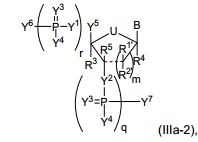
[000111] Em uma modalidade adicional, a presente invenção provê métodos de amplificação de um polinucleotídeo compreendendo pelo menos um nucleotídeo (por exemplo, molécula de RNA modificada) que rompe ligação de uma contraparte de ligação da ranhura principal com o polinucleotídeo, o método compreendendo reação de um composto de Fórmula (III-2), conforme aqui definido, com um iniciador , um modelo de cDNA e uma polimerase de RNA.[000111] In a further embodiment, the present invention provides methods of amplifying a polynucleotide comprising at least one nucleotide (for example, modified RNA molecule) that breaks binding of a main slot binding counterpart with the polynucleotide, the method comprising reacting a compound of Formula (III-2), as defined herein, with a primer, a cDNA template and an RNA polymerase.
[000112] Em algumas modalidades, a reação pode ser repetida de a partir de 1 a cerca de 7.000 vezes. Em qualquer uma das presentes modalidades, B pode ser uma nucleobase de Fórmula (b1)-(b43).[000112] In some embodiments, the reaction can be repeated from 1 to about 7,000 times. In any of the present embodiments, B can be a nucleobase of Formula (b1)-(b43).
[000113] Os polinucleotídeos podem incluir opcionalmente regiões de flanqueamento 5’ e/ou 3’, que são descritas aqui.[000113] Polynucleotides may optionally include 5' and/or 3' flanking regions, which are described herein.
[000114] A presente invenção também inclui blocos de construção, por exemplo, ribonucleosídeos modificados, ribonucleotídeos modificados, dos polinucleotídeos, por exemplo, moléculas de RNA (ou mRNA) modificadas. Por exemplo, esses blocos de construção podem ser úteis para a preparação dos polinucleotídeos da invenção.[000114] The present invention also includes building blocks, for example, modified ribonucleosides, modified ribonucleotides, of polynucleotides, for example, modified RNA (or mRNA) molecules. For example, such building blocks can be useful for preparing the polynucleotides of the invention.
[000115] Em algumas modalidades, a molécula do bloco de construção tem a Fórmula (IIIa) ou (IIIa-1):
[000116] Em algumas modalidades, a molécula do bloco de construção, que pode ser incorporada a um polinucleotídeo, tem a (IVa) ou HO OH (IVb),
[000117] Em modalidades particulares, a Fórmula (IVa) ou (IVb) é combinada com uma uracila modificada (por exemplo, qualquer uma das fórmulas (b1)-(b9), (b21)-(b23) e (b28)-(b31), tal como fórmula (b1), (b8), (b28), (b29) ou (b30)). Em modalidades particulares, a Fórmula (IVa) ou (IVb) é combinada com uma citosina modificada (por exemplo, qualquer uma de fórmulas (b10)-(b14), (b24), (b25) e (b32)-(b36), tal como fórmula (b10) ou (b32)). Em modalidades particulares, a Fórmula (IVa) ou (IVb) é combinada com uma guanina modificada (por exemplo, qualquer uma das fórmulas (b15)-(b17) e (b37)-(b40)). Em modalidades particulares, a Fórmula (IVa) ou (IVb) é combinada com uma adenina modificada (por exemplo, qualquer uma das fórmulas (b18)-(b20) e (b41)-(b43)).[000117] In particular embodiments, Formula (IVa) or (IVb) is combined with a modified uracil (for example, any of formulas (b1)-(b9), (b21)-(b23) and (b28)- (b31), such as formula (b1), (b8), (b28), (b29) or (b30)). In particular embodiments, Formula (IVa) or (IVb) is combined with a modified cytosine (for example, any one of formulas (b10)-(b14), (b24), (b25) and (b32)-(b36) , such as formula (b10) or (b32)). In particular embodiments, Formula (IVa) or (IVb) is combined with a modified guanine (for example, any one of formulas (b15)-(b17) and (b37)-(b40)). In particular embodiments, Formula (IVa) or (IVb) is combined with a modified adenine (for example, any one of formulas (b18)-(b20) and (b41)-(b43)).
[000118] Em algumas modalidades, a molécula do bloco de construção, que pode ser incorporada a um polinucleotídeo, tem a Fórmula (IVc)-(IVk):

[000119] Em modalidades particulares, uma das Fórmulas (IVc)-(IVk) é combinada com uma uracila modificada (por exemplo, qualquer uma das Fórmulas (b1)-(b9), (b21)-(b23) e (b28)-(b31), tal como fórmula (b1), (b8), (b28), (b29) ou (b30)).[000119] In particular embodiments, one of Formulas (IVc)-(IVk) is combined with a modified uracil (eg, any of Formulas (b1)-(b9), (b21)-(b23) and (b28) -(b31), such as formula (b1), (b8), (b28), (b29) or (b30)).
[000120] Em modalidades particulares, uma das Fórmulas (IVc)-(IVk) é combinada com uma citosina modificada (por exemplo, qualquer uma das Fórmulas (b10)-(b14), (b24), (b25) e (b32)-(b36), tal como fórmula (b10) ou (b32)).[000120] In particular embodiments, one of Formulas (IVc)-(IVk) is combined with a modified cytosine (eg, any of Formulas (b10)-(b14), (b24), (b25) and (b32) -(b36), such as formula (b10) or (b32)).
[000121] Em modalidades particulares, uma das Fórmulas (IVc)-(IVk) é combinada com uma guanina modificada (por exemplo, qualquer uma das Fórmulas (b15)-(b17) e (b37)-(b40)).[000121] In particular embodiments, one of Formulas (IVc)-(IVk) is combined with a modified guanine (for example, any one of Formulas (b15)-(b17) and (b37)-(b40)).
[000122] Em modalidades particulares, uma das Fórmulas (IVc)-(IVk) é combinada com uma adenina modificada (por exemplo, qualquer uma das Fórmulas (b18)-(b20) e (b41)-(b43)).[000122] In particular embodiments, one of Formulas (IVc)-(IVk) is combined with a modified adenine (for example, any of Formulas (b18)-(b20) and (b41)-(b43)).
[000123] Em outras modalidades, a molécula de bloco de construção, que pode ser incorporada a um polinucleotídeo, tem a Fórmula (Va) ou (Vb):
[000124] Em outras modalidades, a molécula de bloco de construção, que pode ser incorporada a um polinucleotídeo, tem a Fórmula (IXa)- (IXd):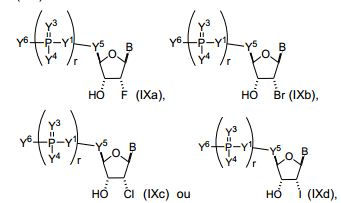
[000125] Em modalidades particulares, uma das Fórmulas (IXa)-(IXd) é combinada com uma uracila modificada (por exemplo, qualquer uma das Fórmulas (b1)-(b9), (b21)-(b23) e (b28)-(b31), tal como fórmula (b1), (b8), (b28), (b29) ou (b30)). Em modalidades particulares, uma das Fórmulas (IXa)-(IXd) é combinada com uma citosina modificada (por exemplo, qualquer uma das Fórmulas (b10)-(b14), (b24), (b25) e (b32)- (b36), tal como fórmula (b10) ou (b32)).[000125] In particular embodiments, one of Formulas (IXa)-(IXd) is combined with a modified uracil (for example, any of Formulas (b1)-(b9), (b21)-(b23) and (b28) -(b31), such as formula (b1), (b8), (b28), (b29) or (b30)). In particular embodiments, one of Formulas (IXa)-(IXd) is combined with a modified cytosine (for example, any of Formulas (b10)-(b14), (b24), (b25) and (b32)-(b36 ), such as formula (b10) or (b32)).
[000126] Em modalidades particulares, uma das Fórmulas (IXa)-(IXd) é combinada com uma guanina modificada (por exemplo, qualquer uma das Fórmulas (b15)-(b17) e (b37)-(b40)).[000126] In particular embodiments, one of Formulas (IXa)-(IXd) is combined with a modified guanine (for example, any one of Formulas (b15)-(b17) and (b37)-(b40)).
[000127] Em modalidades particulares, uma das Fórmulas (IXa)-(IXd) é combinada com uma adenina modificada (por exemplo, qualquer uma das Fórmulas (b18)-(b20) e (b41)-(b43)).[000127] In particular embodiments, one of Formulas (IXa)-(IXd) is combined with a modified adenine (for example, any one of Formulas (b18)-(b20) and (b41)-(b43)).
[000128] Em outras modalidades, a molécula de bloco de construção, que pode ser incorporada a um polinucleotídeo, tem a Fórmula (IXe)- (IXg):
[000129] Em modalidades particulares, uma das Fórmulas (IXe)-(IXg) é combinada com uma uracila modificada (por exemplo, qualquer uma das Fórmulas (b1)-(b9), (b21)-(b23) e (b28)-(b31), tal como fórmula (b1), (b8), (b28), (b29) ou (b30)).[000129] In particular embodiments, one of Formulas (IXe)-(IXg) is combined with a modified uracil (eg, any of Formulas (b1)-(b9), (b21)-(b23) and (b28) -(b31), such as formula (b1), (b8), (b28), (b29) or (b30)).
[000130] Em modalidades particulares, uma das Fórmulas (IXe)-(IXg) é combinada com uma citosina modificada (por exemplo, qualquer uma das Fórmulas (b10)-(b14), (b24), (b25) e (b32)-(b36), tal como fórmula (b10) ou (b32)).[000130] In particular embodiments, one of Formulas (IXe)-(IXg) is combined with a modified cytosine (eg any of Formulas (b10)-(b14), (b24), (b25) and (b32) -(b36), such as formula (b10) or (b32)).
[000131] Em modalidades particulares, uma das Fórmulas (IXe)-(IXg) é combinada com uma guanina modificada (por exemplo, qualquer uma das Fórmulas (b15)-(b17) e (b37)-(b40)).[000131] In particular embodiments, one of Formulas (IXe)-(IXg) is combined with a modified guanine (for example, any one of Formulas (b15)-(b17) and (b37)-(b40)).
[000132] Em modalidades particulares, uma das Fórmulas (IXe)-(IXg) é combinada com uma adenina modificada (por exemplo, qualquer uma das Fórmulas (b18)-(b20) e (b41)-(b43)).[000132] In particular embodiments, one of Formulas (IXe)-(IXg) is combined with a modified adenine (for example, any one of Formulas (b18)-(b20) and (b41)-(b43)).
[000133] Em outras modalidades, a molécula de bloco de construção,que pode ser incorporada a um polinucleotídeo, tem a Fórmula (IXh)-(IXk):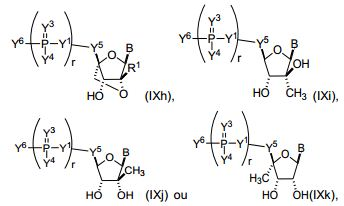
[000134] Em modalidades particulares, uma das Fórmulas (IXh)-(IXk) é combinada com uma guanina modificada (por exemplo, qualquer uma das Fórmulas (b15)-(b17) e (b37)-(b40)). Em modalidades particulares, uma das Fórmulas (IXh)-(IXk) é combinada com uma adenina modificada (por exemplo, qualquer uma das Fórmulas (b18)-(b20) e (b41)-(b43)).[000134] In particular embodiments, one of Formulas (IXh)-(IXk) is combined with a modified guanine (for example, any one of Formulas (b15)-(b17) and (b37)-(b40)). In particular embodiments, one of Formulas (IXh)-(IXk) is combined with a modified adenine (for example, any one of Formulas (b18)-(b20) and (b41)-(b43)).
[000135] Em outras modalidades, a molécula de bloco de construção, que pode ser incorporada a um polinucleotídeo, tem a Fórmula (IXl)-(IXr):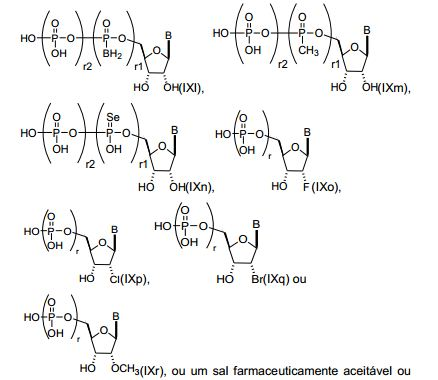
[000136] Em modalidades particulares, uma das Fórmulas (IXl)-(IXr) é combinada com uma uracila modificada (por exemplo, qualquer uma das Fórmulas (b1)-(b9), (b21)-(b23) e (b28)-(b31), tal como fórmula (b1), (b8), (b28), (b29) ou (b30)).[000136] In particular embodiments, one of Formulas (IXl)-(IXr) is combined with a modified uracil (for example, any of Formulas (b1)-(b9), (b21)-(b23) and (b28) -(b31), such as formula (b1), (b8), (b28), (b29) or (b30)).
[000137] Em modalidades particulares, uma das Fórmulas (IXl)-(IXr) é combinada com uma citosina modificada (por exemplo, qualquer uma das Fórmulas (b10)-(b14), (b24), (b25) e (b32)-(b36), tal como fórmula (b10) ou (b32)).[000137] In particular embodiments, one of Formulas (IXl)-(IXr) is combined with a modified cytosine (eg, any of Formulas (b10)-(b14), (b24), (b25) and (b32) -(b36), such as formula (b10) or (b32)).
[000138] Em modalidades particulares, uma das Fórmulas (IXl)-(IXr) é combinada com uma guanina modificada (por exemplo, qualquer uma das Fórmulas (b15)-(b17) e (b37)-(b40)). Em modalidades particulares, uma das Fórmulas (IXl)-(IXr) é combinada com uma adenina modificada (por exemplo, qualquer uma das Fórmulas (b18)-(b20) e (b41)-(b43)).[000138] In particular embodiments, one of Formulas (IXl)-(IXr) is combined with a modified guanine (for example, any one of Formulas (b15)-(b17) and (b37)-(b40)). In particular embodiments, one of Formulas (IXl)-(IXr) is combined with a modified adenine (for example, any one of Formulas (b18)-(b20) and (b41)-(b43)).
[000139] Em algumas modalidades, a molécula de bloco de construção, que pode ser incorporada a um polinucleotídeo, pode ser selecionada do grupo consistindo em:
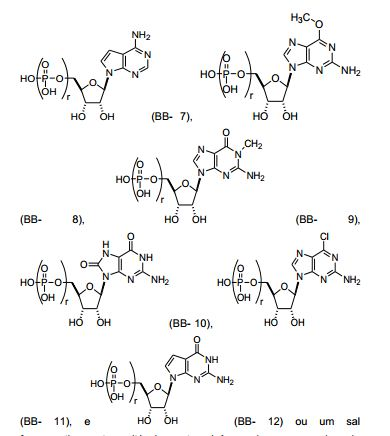
[000140] Em algumas modalidades, a molécula de bloco de construção, que pode ser incorporada a um polinucleotídeo, pode ser selecionada do grupo consistindo em:
[000141] Em algumas modalidades, a molécula do bloco de construção, que pode ser incorporada a um ácido nucleico (por exemplo, RNA, mRNA, polinucleotídeo), é uma uridina modificada (por exemplo, selecionada do grupo consistindo em:

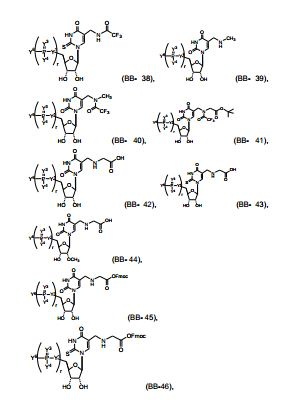


[000142] Em algumas modalidades, a molécula do bloco de construção, que pode ser incorporada a um polinucleotídeo, é uma citidina modificada (por exemplo, selecionada do grupo consistindo em:

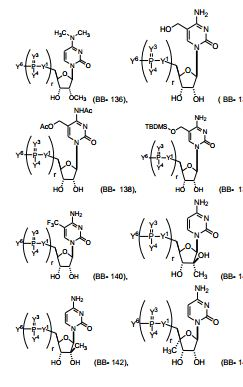


[000143] Em algumas modalidades, a molécula do bloco de construção, que pode ser incorporada a um polinucleotídeo, é uma adenosina modificada (por exemplo, selecionada do grupo consistindo em:

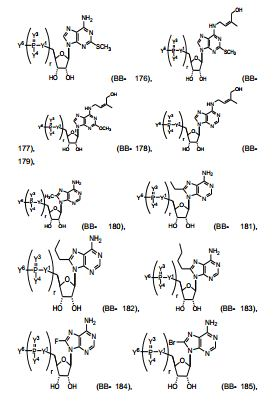

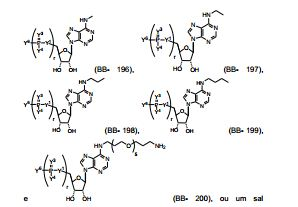
[000144] Em algumas modalidades, a molécula de bloco de construção, que pode ser incorporada a um polinucleotídeo, é uma guanosina modificada (por exemplo, selecionada do grupo consistindo em:
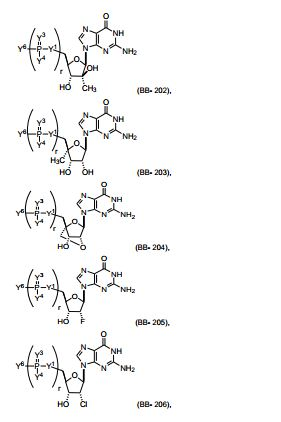
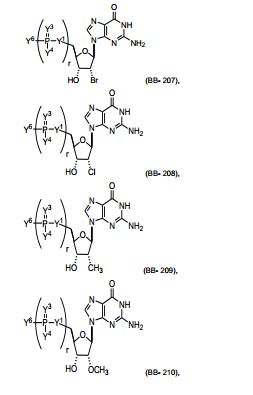
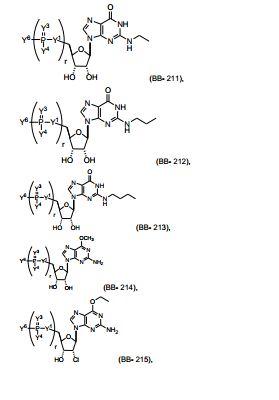


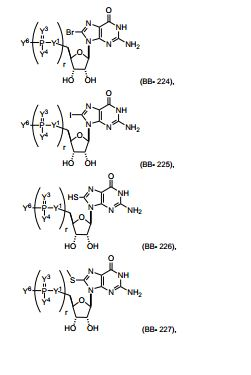

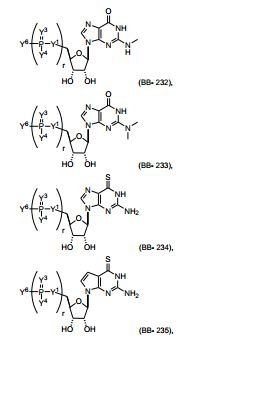

[000145] Em algumas modalidades, a modificação química da ranhura principal pode incluir substituição de grupo C em C-5 do anel (por exemplo, para um nucleosídeo pirimidina, talcomo citosina ou uracila) com N (por exemplo, substituição do grupo >CH em C-5 com grupo >NRN1, onde RN1 é H ou alquila opcionalmente substituída). Por exemplo, a molécula do bloco de construção, que pode ser incorporada a um polinucleotídeo, pode ser:
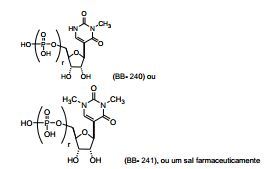
[000146] Em outra modalidade, a modificação química da ranhura principal pode incluir substituição do hidrogênio em C-5 de citosina com halo (por exemplo, Br, Cl, F ou I) ou alquila opcionalmente substituída (por exemplo, metila). Por exemplo, a molécula do bloco de construção, que pode ser incorporada a um polinucleotídeo, pode ser:

[000147] Em ainda uma modalidade adicional, a modificação química da ranhura principal pode incluir um anel fundido que é formado pelo NH2 na posição C-4 e o átomo de carbono na posição C-5. Por exemplo, a molécula do bloco de construção, que pode ser incorporada a um polinucleotídeo, pod ser: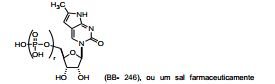
[000148] Os nucleosídeos e nucleotídeos modificados (por exemplo, moléculas de bloco de construção), que podem ser incorporados a um polinucleotídeo (por exemplo, RNA ou mRNA, conforme aqui descrito), podem ser modificados no açúcar do ácido ribonucleico. Por exemplo, o grupo 2’ hidroxila (OH) pode ser modificado ou substituído com vários substituintes diferentes. Substituições exemplares na posição 2’ incluem, mas não estão limitadas a, H, halo, C1-6 alquila opcionalmente substituída; C1-6 alcóxi opcionalmente substituído; C6-10 arilóxi opcionalmente substituído; C3-8 cicloalquila opcionalmente substituída; C3-8 cicloalcóxi opcionalmente substituído; C6-10 arilóxi opcionalmente substituído; C6-10 aril-C1-6 alcóxi opcionalmente substituído, C1-12 (heterociclila)óxi opcionalmente substituído; um açúcar (por exemplo, ribose, pentose ou qualquer um descrito aqui); um polietilenoglicol (PEG), -O(CH2CH2O)nCH2CH2OR, onde R é H ou alquila opcionalmente substituída e n é um número inteiro de a partir de 0 a 20 (por exemplo,de a partir de 0 a 4, de a partir de 0 a 8, de a partir de 0 a 10, de a partir de 0 a 16, de a partir de 1 a 4, de a partir de 1 a 8, de a partir de 1 a 10, de a partir de 1 a 16, de a partir de 1 a 20, de a partir de 2 a 4, de a partir de 2 a 8, de a partir de 2 a 10, de a partir de 2 a 16, de a partir de 2 a 20, de a partir de 4 a 8, de a partir de 4 a 10, de a partir de 4 a 16 e de a partir de 4 a 20); ácidos nucleicos "bloqueados" (LNA) ("Locked" Nucleic Acids) onde 2’-hidroxila é conectada por uma ponte C1-6 alquileno ou C1-6 heteroalquileno ao 4’-carbono do mesmo açúcar ribose, onde pontes exemplares incluíam pontes metileno, propileno, éter ou amino; aminoalquila, conforme aqui definido; aminoalcóxi, conforme aqui definido; amino conforme aqui definido; e aminoácido, conforme aqui definido.[000148] Modified nucleosides and nucleotides (eg building block molecules), which can be incorporated into a polynucleotide (eg RNA or mRNA, as described herein), can be modified on the sugar of ribonucleic acid. For example, the 2' hydroxyl (OH) group can be modified or substituted with several different substituents. Exemplary 2'-position substitutions include, but are not limited to, H, halo, optionally substituted C 1-6 alkyl; optionally substituted C1-6 alkoxy; optionally substituted C6-10 aryloxy; optionally substituted C3-8 cycloalkyl; optionally substituted C3-8 cycloalkoxy; optionally substituted C6-10 aryloxy; optionally substituted C6-10 aryl-C1-6 alkoxy, optionally substituted C1-12 (heterocyclyl)oxy; a sugar (for example, ribose, pentose or any of those described herein); a polyethylene glycol (PEG), -O(CH2CH2O)nCH2CH2OR, where R is H or optionally substituted alkyl and n is an integer from from 0 to 20 (e.g., from from 0 to 4, from from 0 to 8, from 0 to 10, from 0 to 16, from 1 to 4, from 1 to 8, from 1 to 10, from 1 to 16 , from 1 to 20, from 2 to 4, from 2 to 8, from 2 to 10, from 2 to 16, from 2 to 20, from from 4 to 8, from 4 to 10, from 4 to 16 and from 4 to 20); "Locked" Nucleic Acids (LNA) where 2'-hydroxyl is connected by a C1-6 alkylene or C1-6 heteroalkylene bridge to the 4'-carbon of the same ribose sugar, where exemplary bridges included methylene bridges , propylene, ether or amino; aminoalkyl as defined herein; aminoalkoxy as defined herein; amino as defined herein; and amino acid, as defined herein.
[000149] Em geral, RNA inclui grupo de açúcar ribose, que é um anel de 5 membros tendo um oxigênio. Nucleotídeos modificados não limitantes, exemplares, incluem substituição do oxigênio em ribose (por exemplo, com S, Se ou alquileno, tal como metileno ou etileno); adição de uma ligação dupla (por exemplo, para substituir ribose com ciclopentenila ou ciclo-hexenila); contração do anel de ribose (por exemplo, para formar um anel de 4 membros de ciclobutano ou oxetano); expansão de anel de ribose (por exemplo, para formar um anel de 6 ou 7 membros tendo um carbono ou heteroátomo adicional, tal como anidroexitol, altritol, manitol, ciclo-hexenila, ciclo-hexenila e morfolino que também tem uma estrutura principal fosforamidato); formas multicíclicas (por exemplo, triciclo; e formas "não bloqueadas", tal como ácido nucleico de glicol (GNA) (por exemplo, R-GNA ou S- GNA, onde ribose é substituída por unidades glicol ligadas a ligações fosfodiéster), ácido nucleico de treose (TNA, onde ribose é substituída com α-L-treofuranosil-(3‘^2‘)), e ácido nucleico de peptídeo (PNA, onde ligações 2-amino-etil-glicina substituem a estrutura principal de ribose e fosfodiéster). O grupo açúcar pode também conter um ou mais carbonos que possuem a configuração estereoquímica oposta àquela do carbono correspondente em ribose. Desta maneira, uma molécula de polinucleotídeo pode incluir nucleotídeos contendo, por exemplo, arabinose, como o açúcar.[000149] In general, RNA includes ribose sugar group, which is a 5-membered ring having an oxygen. Exemplary non-limiting modified nucleotides include replacement of oxygen on ribose (for example, with S, Se, or alkylene, such as methylene or ethylene); addition of a double bond (for example, to replace ribose with cyclopentenyl or cyclohexenyl); contraction of the ribose ring (for example, to form a 4-membered ring of cyclobutane or oxetane); ribose ring expansion (for example, to form a 6- or 7-membered ring having an additional carbon or heteroatom, such as anhydrohexitol, altritol, mannitol, cyclohexenyl, cyclohexenyl and morpholino which also has a phosphoramidate backbone) ; multicyclic forms (eg tricycle; and "unblocked" forms such as glycol nucleic acid (GNA) (eg R-GNA or S-GNA, where ribose is replaced by glycol moieties linked to phosphodiester bonds), acid threose nucleic acid (TNA, where ribose is replaced with α-L-threofuranosyl-(3'^2')), and peptide nucleic acid (PNA, where 2-amino-ethyl-glycine bonds replace the ribose backbone and phosphodiester.) The sugar group may also contain one or more carbons that have the opposite stereochemical configuration to that of the corresponding carbon in ribose. In this way, a polynucleotide molecule may include nucleotides containing, for example, arabinose, such as sugar.
[000150] A presente invenção provê nucleosídeos e nucleotídeos modificados. Conforme aqui descrito, "nucleosídeo" é definido como um composto contendo uma molécula de açúcar (por exemplo, uma pentose ou ribose) ou derivado da mesma em combinação com uma base orgânica (por exemplo, uma purina ou pirimidina) ou um derivado da mesma (também referido aqui como "nucleobase"). Conforme aqui descrito, "nucleotídeo" é definido como um nucleosídeo incluindo um grupo fosfato. Em algumas modalidades, os nucleosídeos e nucleotídeos descritos aqui são geralmente quimicamente modificados na face da ranhura principal. Modificações não limitantes exemplares incluem um grupo amino, um grupo tiol, um grupo alquila, um grupo halo ou qualquer um descrito aqui. Os nucleotídeos modificados podem ser sintetizados através de qualquer método útil, conforme aqui descrito (por exemplo, quimicamente, enzimaticamente ou recombinantemente para incluir um ou mais nucleosídeos modificados ou não naturais).[000150] The present invention provides modified nucleosides and nucleotides. As described herein, "nucleoside" is defined as a compound containing a sugar molecule (eg a pentose or ribose) or derivative thereof in combination with an organic base (eg a purine or pyrimidine) or a derivative thereof (also referred to herein as "nucleobase"). As described herein, "nucleotide" is defined as a nucleoside including a phosphate group. In some embodiments, the nucleosides and nucleotides described herein are generally chemically modified on the face of the main groove. Exemplary non-limiting modifications include an amino group, a thiol group, an alkyl group, a halo group, or any of those described herein. The modified nucleotides can be synthesized by any useful method as described herein (for example, chemically, enzymatically or recombinantly to include one or more modified or unnatural nucleosides).
[000151] O emparelhamento de base de nucleotídeo modificado compreende não apenas os pares de base adenosina-timina, adenosina-uracila ou guanosina-citosina, mas também pares de base formados entre nucleotídeos e/ou nucleotídeos modificados compreendendo bases não padrão ou modificadas, onde a disposição de doadores de ligação hidrogênio e aceitadores de ligação hidrogênio permite ligação hidrogênio entre uma base não padrão e uma base- padrão ou entre duas estruturas de base não padrão complementares. Um exemplo de tal emparelhamento de base não padrão é um emparelhamento de base entre o nucleotídeo modificado inosina e adenina, citosina ou uracila.[000151] Modified nucleotide base pairing comprises not only adenosine-thymine, adenosine-uracil or guanosine-cytosine base pairs, but also base pairs formed between nucleotides and/or modified nucleotides comprising non-standard or modified bases, where the arrangement of hydrogen bond donors and hydrogen bond acceptors allows hydrogen bonding between a non-standard base and a standard base or between two complementary non-standard base structures. An example of such non-standard base pairing is a base pairing between the modified nucleotide inosine and adenine, cytosine or uracil.
[000152] Os nucleosídeos e nucleotídeos modificados podem incluir uma nucleobase modificada. Exemplos de uma nucleobase encontrada em RNA incluem, mas não estão limitados a, adenina, guanina, citosina e uracila. Exemplos de nucleobase encontrada em DNA incluem, mas não estão limitados a, adenina, guanina, citosina e timina. Essas nucleobases podem ser modificadas ou totalmente substituídas para prover moléculas de polinucleotídeo tendo propriedades melhoradas, por exemplo, resistência a nucleases, estabilidade, e essas propriedades podem se manifestar através do rompimento da ligação de uma contraparte de ligação da ranhura principal. Por exemplo, os nucleosídeos ou nucleotídeos descritos podem ser quimicamente modificados na face da estrutura principal. Em algumas modalidades, as modificações químicas de ranhura principal podem incluir um grupo amino, um grupo tiol, um grupo alquila ou um grupo halo.[000152] Modified nucleosides and nucleotides can include a modified nucleobase. Examples of a nucleobase found in RNA include, but are not limited to, adenine, guanine, cytosine and uracil. Examples of nucleobase found in DNA include, but are not limited to, adenine, guanine, cytosine and thymine. These nucleobases can be modified or completely substituted to provide polynucleotide molecules having improved properties, eg, nuclease resistance, stability, and these properties can manifest through the disruption of the bond of a major splice binding counterpart. For example, the described nucleosides or nucleotides can be chemically modified on the backbone face. In some embodiments, the main groove chemical modifications can include an amino group, a thiol group, an alkyl group, or a halo group.
[000153] A Tabela 1 abaixo identifica as faces químicas de cada nucleotídeo canônico. Círculos identificam os átomos compreendendo as respectivas regiões químicas. Tabela 1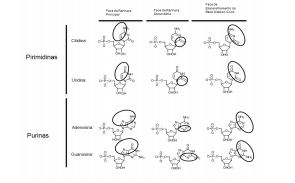
[000154] Em algumas modalidades, B é uma uracila modificada. Uracilas modificadas exemplares incluem aquelas de Fórmula (b1)-(b5):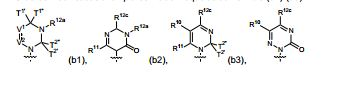


[000155] Outras uracilas modificadas exemplares incluem aquelas tendo a Fórmula (b6)-(b9):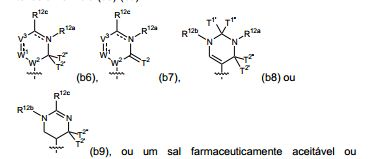

[000156] Uracilas modificadas exemplares adicionais incluem aquelas tendo a Fórmula (b28)-(b31):
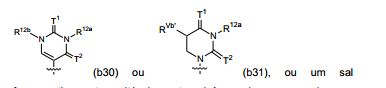
[000157] Em modalidades particulares, T1 é O (oxo) e T2 é S (tio) ou Se (seleno). Em outras modalidades, T1 é S (tio) e T2 é O (oxo) ou Se (seleno). Em algumas modalidades, RVb’ é H, alquila opcionalmente substituída ou alcóxi opcionalmente substituído.[000157] In particular modalities, T1 is O (oxo) and T2 is S (tio) or Se (seleno). In other modalities, T1 is S (tio) and T2 is O (oxo) or Se (seleno). In some embodiments, RVb' is H, optionally substituted alkyl, or optionally substituted alkoxy.
[000158] Em outras modalidades, cada R12a e R12b é,independentemente, H, alquila opcionalmente substituída, alquenila opcionalmente substituída, alquinila opcionalmente substituída ou hidroxialquila opcionalmente substituída. Em modalidades particulares, R12a é H. Em outras modalidades, ambos R12a e R12b são H.[000158] In other embodiments, each R12a and R12b is independently H, optionally substituted alkyl, optionally substituted alkenyl, optionally substituted alkynyl, or optionally substituted hydroxyalkyl. In particular embodiments, R12a is H. In other embodiments, both R12a and R12b are H.
[000159] Em algumas modalidades, cada RVb’de R12b é,independentemente, aminoalquila opcionalmente substituída (por exemplo, substituída com um grupo de proteção N, tal como qualquer um descrito aqui, por exemplo, trifluoracetila ou sulfoalquila), aminoalquenila opcionalmente substituída, aminoalquinila opcionalmente substituída ou acilaminoalquila opcionalmente substituída (por exemplo, substituída com um grupo de proteção N, tal como qualquer um descrito aqui, por exemplo, trifluoracetila). Em algumas modalidades, o amino e/ou alquila da aminoalquila opcionalmente substituída é substituído com um ou mais de alquila opcionalmente substituída, alquenila opcionalmente substituída, sulfoalquila opcionalmente substituída, carbóxi opcionalmente substituído (por exemplo, substituído com um grupo de proteção O), hidróxi opcionalmente substituído (por exemplo, substituído com um grupo de proteção O), carboxialquila opcionalmente substituída (por exemplo, substituída com um grupo de proteção O),alcoxicarbonilalquila opcionalmente substituída (por exemplo, substituída com um grupo de proteção O) ou grupo de proteção N. Em algumas modalidades, aminoalquila opcionalmente substituída é substituída com uma sulfoalquila opcionalmente substituída ou alquenila opcionalmente substituída. Em modalidades particulares, R12a e RVb" são ambos H. Em modalidades particulares, T1 é O (oxo) e T2 é S (tio) ou Se (seleno).[000159] In some embodiments, each RVb'd and R12b is independently optionally substituted aminoalkyl (for example, substituted with an N-protecting group, such as any described herein, for example, trifluoroacetyl or sulfoalkyl), optionally substituted aminoalkenyl, optionally substituted aminoalkynyl or optionally substituted acylaminoalkyl (for example substituted with an N-protecting group such as any described herein, for example trifluoroacetyl). In some embodiments, the amino and/or alkyl of the optionally substituted aminoalkyl is substituted with one or more of optionally substituted alkyl, optionally substituted alkenyl, optionally substituted sulfoalkyl, optionally substituted carboxy (e.g., substituted with a protecting group O), hydroxy optionally substituted (eg substituted with an O protecting group), optionally substituted carboxyalkyl (eg substituted with an O protecting group), optionally substituted alkoxycarbonylalkyl (eg substituted with an O protecting group) or protecting group N. In some embodiments, optionally substituted aminoalkyl is substituted with an optionally substituted sulfoalkyl or optionally substituted alkenyl. In particular embodiments, R12a and RVb" are both H. In particular embodiments, T1 is O (oxo) and T2 is S (thio) or Se (seleno).
[000160] Em algumas modalidades, RVb’ é alcoxicarbonilalquila opci-onalmente substituída ou carbamoilalquila opcionalmente substituída.[000160] In some embodiments, RVb' is optionally substituted alkoxycarbonylalkyl or optionally substituted carbamoylalkyl.
[000161] Em modalidades particulares, o substituinte opcional para R12a, R12b, R12c ou RVa é um grupo polietileno glicol (por exemplo, - (CH2)s2(OCH2CH2)s1(CH2)s3OR’, onde s1 é um número inteiro de a partir de 1 a 10 (por exemplo, de a partir de 1 a 6 ou de a partir de 1 a 4), cada um de s2 e s3, independentemente, é um número inteiro de a partir de 0 a 10 (por exemplo, de a partir de 0 a 4, de a partir de 0 a 6, de a partir de 1 a 4, de a partir de 1 a 6 ou de a partir de 1 a 10) e R’ é H ou C1-20 alquila); ou um grupo amino-polietileno glicol (por exemplo, - NRN1(CH2)s2(CH2CH2O)s1(CH2)s3NRN1, onde s1 é um número inteiro de a partir de 1 a 10 (por exemplo, de a partir de 1 a 6 ou de a partir de 1 a 4), cada um de s2 e s3, independentemente, é um número inteiro de a partir de 0 a 10 (por exemplo, de a partir de 0 a 4, de a partir de 0 a 6, de a partir de 1 a 4, de a partir de 1 a 6 ou de a partir de 1 a 10), e cada RN1 é, independentemente, hidrogênio ou C1-6 alquila opcionalmente substituída).[000161] In particular embodiments, the optional substituent for R12a, R12b, R12c or RVa is a polyethylene glycol group (for example, -(CH2)s2(OCH2CH2)s1(CH2)s3OR', where s1 is an integer of a from 1 to 10 (eg, from 1 to 6 or from 1 to 4), each of s2 and s3 independently is an integer from 0 to 10 (eg, from from 0 to 4, from from 0 to 6, from from 1 to 4, from from 1 to 6 or from from 1 to 10) and R' is H or C1-20 alkyl ); or an amino-polyethylene glycol group (for example, -NRN1(CH2)s2(CH2CH2O)s1(CH2)s3NRN1, where s1 is an integer from 1 to 10 (for example, from from 1 to 6 or from 1 to 4), each of s2 and s3 independently is an integer from 0 to 10 (eg, from 0 to 4, from from 0 to 6, from 1 to 4, from 1 to 6 or from 1 to 10), and each RN1 is independently hydrogen or optionally substituted C1-6 alkyl).
[000162] Em algumas modalidades, B é uma citosina modificada. Citosinas modificadas exemplares incluem compostos de Fórmula (b10)-(b14):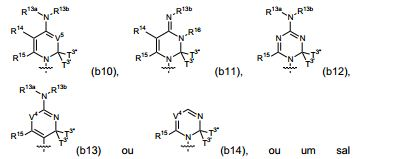
[000163] Citosinas modificadas exemplares adicionais incluem aquelas de Fórmula (b32)-(b35):
[000164] Em algumas modalidades, R15 é H e R16 é H ou alquila opcionalmente substituída. Em modalidades particulares, R14 é H, acila ou hidroxialquila. Em algumas modalidades, R14 é halo. Em algumas modalidades, ambos R14 e R15 são H. Em algumas modalidades, ambos R15 e R16 são H. Em algumas modalidades, cada um de R14 e R15 e R16 é H. Em modalidades adicionais, cada um de R13a e R13b é independentemente, H ou alquila opcionalmente substituída.[000164] In some embodiments, R15 is H and R16 is H or optionally substituted alkyl. In particular embodiments, R14 is H, acyl or hydroxyalkyl. In some embodiments, R14 is halo. In some embodiments, both R14 and R15 are H. In some embodiments, both R15 and R16 are H. In some embodiments, each of R14 and R15 and R16 is H. In additional embodiments, each of R13a and R13b is independently, H or optionally substituted alkyl.
[000165] Exemplos não limitantes adicionais de citosinas modificadas incluem compostos de Fórmula (b36):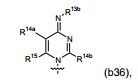
[000166] Em modalidades particulares, R14b é um aminoácido opcionalmente substituído (por exemplo, lisina opcionalmente substituída). Em algumas modalidades, R14a é H.[000166] In particular embodiments, R14b is an optionally substituted amino acid (for example, optionally substituted lysine). In some embodiments, R14a is H.
[000167] Em algumas modalidades, B é uma guanina modificada. Guaninas modificadas exemplares incluem compostos de Fórmula (b15)-(b17):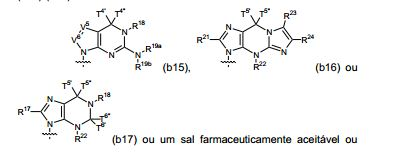
[000168] Guanosinas modificadas exemplares incluem compostos de Fórmula (b37)-(b40):
[000169] Em algumas modalidades, B é uma adenina modificada. Adeninas modificadas exemplares incluem compostos de Fórmula (b18)-(b20):
[000170] Adeninas modificadas exemplares incluem compostos de Fórmula (b41)-(b43):
[000171] Em algumas modalidades, R26a é H e R26b é alquila opcionalmente substituída. Em algumas modalidades, cada um de R26a e R26b é, independentemente, alquila opcionalmente substituída. Em modalidades particulares, R27 é alquila opcionalmente substituída, alcóxi opcionalmente substituído ou tioalcóxi opcionalmente substituído. Em outras modalidades, R25 é alquila opcionalmente substituída, alcóxi opcionalmente substituído ou tioalcóxi opcionalmente substituído.[000171] In some embodiments, R26a is H and R26b is optionally substituted alkyl. In some embodiments, each of R26a and R26b is independently optionally substituted alkyl. In particular embodiments, R27 is optionally substituted alkyl, optionally substituted alkoxy, or optionally substituted thioalkoxy. In other embodiments, R25 is optionally substituted alkyl, optionally substituted alkoxy, or optionally substituted thioalkoxy.
[000172] Em modalidades particulares, o substituinte opcional para R26a, R26b ou R29 é um grupo polietileno glicol (por exemplo, - (CH2)s2(OCH2CH2)s1(CH2)s3OR’, onde s1 é um número inteiro de a partir de 1 a 10 (por exemplo, de a partir de 1 a 6 ou de a partir de 1 a 4), cada um de s2 e s3, independentemente, é um número inteiro de a partir de 0 a 10 (por exemplo, de a partir de 0 a 4, de a partir de 0 a 6, de a partir de 1 a 4, de a partir de 1 a 6 ou de a partir de 1 a 10), e R’ é H ou C1-20 alquila); ou um grupo amino-polietileno glicol (por exemplo, - NRN1(CH2)s2(CH2CH2O)s1(CH2)s3NRN1, onde s1 é um número inteiro de a partir de 1 a 10 (por exemplo, de a partir de 1 a 6 ou de a partir de 1 a 4), cada um de s2 e s3, independentemente, é um número inteiro de a partir de 0 a 10 (por exemplo, de a partir de 0 a 4, de a partir de 0 a 6, de a partir de 1 a 4, de a partir de 1 a 6 ou de a partir de 1 a 10) e cada RN1 é, independentemente, hidrogênio ou C1-6 alquila opcionalmente substituída).[000172] In particular embodiments, the optional substituent for R26a, R26b or R29 is a polyethylene glycol group (for example, -(CH2)s2(OCH2CH2)s1(CH2)s3OR', where s1 is an integer from and from 1 to 10 (for example, from 1 to 6 or from 1 to 4), each of s2 and s3 independently is an integer from 0 to 10 (for example, from to from 0 to 4, from 0 to 6, from 1 to 4, from 1 to 6 or from 1 to 10), and R' is H or C1-20 alkyl) ; or an amino-polyethylene glycol group (for example, -NRN1(CH2)s2(CH2CH2O)s1(CH2)s3NRN1, where s1 is an integer from 1 to 10 (for example, from from 1 to 6 or from 1 to 4), each of s2 and s3 independently is an integer from 0 to 10 (eg, from 0 to 4, from from 0 to 6, from 1 to 4, from 1 to 6 or from 1 to 10) and each RN1 is independently hydrogen or optionally substituted C1-6 alkyl).
[000173] Em algumas modalidades, B pode ter a Fórmula (b21):
[000174] Em algumas modalidades, B pode ter Fórmula (b22):
[000175] Em algumas modalidades, B pode ter a Fórmula (b23):
[000176] Em algumas modalidades, B pode ter a Fórmula (b24):
[000177] Em algumas modalidades, B pode ter a Fórmula (b25):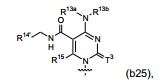
[000178] Em algumas modalidades, B é uma nucleobase selecionada do grupo consistindo em citosina, guanina, adenina e uracila. Em algumas modalidades, B pode ser: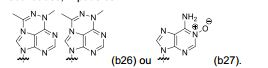
[000179] Em algumas modalidades, a nucleobase modificada é uma uracila modificada. Nucleobases e nucleosídeos exemplares tendo uma uracila modificada incluem pseudouridina (^), ribonucleosídeo de piridin-4-ona, 5-aza-uridina, 6-aza-uridina, 2-tio-5-aza-uridina, 2-tio- uridina (s2U), 4-tio-uridina (s4U), 4-tio-pseudouridina, 2-tio-pseudouridina, 5-hidróxi-uridina (ho5U), 5-aminoalil-uridina, 5-halo- uridina (por exemplo, 5-iodo-uridine ou 5-bromo-uridina), 3-metil-uridina (m3U), 5-metóxi-uridina (mo5U), ácido uridino 5-oxiacético (cmo5U), metil éster do ácido uridino 5-acético (mcmo5U), 5-carboximetil-uridina (cm5U), 1-carboximetil-pseudouridina, 5-carboxidroximetil-uridina (chm5U), metil éster de 5-carboxidroximetil-uridina (mchm5U), 5- metoxicarbonilmetil-uridina (mcm5U), 5-metoxicarbonilmetil-2-tio-uridina (mcm5s2U), 5-aminometil-2-tio-uridina (nm5s2U), 5-metilaminometil- uridina (mnm5U), 5-metilaminometil-2-tio-uridina (mnm5s2U), 5- metilaminometil-2-seleno-uridina (mnm5se2U), 5-carbamoilmetil-uridina (ncm5U), 5-carboximetilaminometil-uridina (cmnm5U), 5- carboximetilaminometil-2-tio-uridina (cmnm5s2U), 5-propinil-uridina, 1- propinil-pseudouridina, 5-taurinometil-uridina (Tm5U), 1-taurinometil- pseudouridina, 5-taurinometil-2-tio-uridina (Tm5s2U), 1-taurinometil-4- tio-pseudouridina, 5-metil-uridina (m5U, isto é, tendo a nucleobase desoxitimina), 1-metil-pseudouridina (m1Φ), 5-metil-2-tio-uridina (m5s2U), 1-metil-4-tio-pseudouridina (m1s4Φ), 4-tio-1-metil- pseudouridina, 3-metil-pseudouridina (m3Φ), 2-tio-1-metil- pseudouridina, 1-metil-1-desaza-pseudouridina, 2-tio-1-metil-1-desaza- pseudouridina, di-hidrouridina (D), di-hidropseudouridina, 5,6-di- hidrouridina, 5-metil-di-hidrouridina (m5D), 2-tio-di-hidrouridina, 2-tio-di- hidropseudouridina, 2-metóxi-uridina, 2-metóxi-4-tio-uridina, 4-metóxi- pseudouridina, 4-metóxi-2-tio-pseudouridina, N1-metil-pseudouridina, 3-(3-amino-3-carboxipropil)uridina (acp3U), 1-metil-3-(3-amino-3-carboxipropil)pseudouridina (acp3 Φ), 5-(isopentenilaminometil)uridina (inm5U), 5-(isopentenilaminometil)-2-tio-uridina (inm5s2U), α-tio-uridina, 2‘-O-metil-uridina (Um), 5,2‘-O-dimetil-uridina (m5Um), 2‘-O-metil- pseudouridina (Φm), 2-tio-2‘-O-metil-uridina (s2Um), 5-metoxicarbonilmetil-2‘-O-metil-uridina (mcm5Um), 5-carbamoilmetil-2‘- O-metil-uridina (ncm5Um), 5-carboximetilaminometil-2‘-O-metil-uridina (cmnm5Um), 3,2‘-O-dimetil-uridina (m3Um) e 5-(isopentenilaminometil)- 2-O-metil-uridina (inm5Um), 1-tio-uridina, desoxitimidina, 2'-F-ara- uridina, 2'-F-uridina, 2'-OH-ara-uridina, 5-(2-carbometoxivinil)uridina e 5-[3-(1-E-propenilamino)uridina.[000179] In some embodiments, the modified nucleobase is a modified uracil. Exemplary nucleobases and nucleosides having a modified uracil include pseudouridine (^), pyridin-4-one ribonucleoside, 5-aza-uridine, 6-aza-uridine, 2-thio-5-aza-uridine, 2-thiouridine ( s2U), 4-thio-uridine (s4U), 4-thio-pseudouridine, 2-thio-pseudouridine, 5-hydroxy-uridine (ho5U), 5-aminoallyl-uridine, 5-halouridine (eg 5- iodo-uridine or 5-bromo-uridine), 3-methyl-uridine (m3U), 5-methoxy-uridine (mo5U), uridine 5-oxyacetic acid (cmo5U), uridine 5-acetic acid methyl ester (mcmo5U), 5-carboxymethyl-uridine (cm5U), 1-carboxymethyl-pseudouridine, 5-carboxyhydroxymethyl-uridine (chm5U), 5-carboxyhydroxymethyl-uridine methyl ester (mchm5U), 5-methoxycarbonylmethyl-uridine (mcm5U), 5-methoxycarbonylmethyl-2 -thio-uridine (mcm5s2U), 5-aminomethyl-2-thio-uridine (nm5s2U), 5-methylaminomethyl-uridine (mnm5U), 5-methylaminomethyl-2-thio-uridine (mnm5s2U), 5-methylaminomethyl-2-selene -uridine (mnm5se2U), 5-carbamoylmethyl-uridine (ncm5U), 5-carboxymethylaminomethyl-uridine (cmnm5U), 5-carboxy methylaminomethyl-2-thio-uridine (cmnm5s2U), 5-propynyl-uridine, 1-propynyl-pseudouridine, 5-taurinomethyl-uridine (Tm5U), 1-taurinomethyl-pseudouridine, 5-taurinomethyl-2-thio-uridine (Tm5s2U) , 1-taurinomethyl-4-thio-pseudouridine, 5-methyl-uridine (m5U, ie having the nucleobase deoxythymine), 1-methyl-pseudouridine (m1'), 5-methyl-2-thio-uridine (m5s2U), 1-methyl-4-thio-pseudouridine (m1s4'), 4-thio-1-methyl-pseudouridine, 3-methyl-pseudouridine (m3'), 2-thio-1-methyl-pseudouridine, 1-methyl-1-deaza- pseudouridine, 2-thio-1-methyl-1-deaza-pseudouridine, dihydrouridine (D), dihydropseudouridine, 5,6-dihydrouridine, 5-methyl-dihydrouridine (m5D), 2-thio- dihydrouridine, 2-thio-dihydropseudouridine, 2-methoxy-uridine, 2-methoxy-4-thio-uridine, 4-methoxy-pseudouridine, 4-methoxy-2-thio-pseudouridine, N1-methyl-pseudouridine, 3-(3-amino-3-carboxypropyl)uridine (acp3U), 1-methyl-3-(3-amino-3-carboxypropyl)pseudouridine (acp3 Φ), 5-(isopentenylaminomethyl)uridine (inm5U), 5-( isopentenylaminomethyl)-2-thio-urid ina (inm5s2U), α-thio-uridine, 2'-O-methyl-uridine (Um), 5,2'-O-dimethyl-uridine (m5Um), 2'-O-methyl-pseudouridine (Φm), 2 -thio-2'-O-methyl-uridine (s2Um), 5-methoxycarbonylmethyl-2'-O-methyl-uridine (mcm5Um), 5-carbamoylmethyl-2'-O-methyl-uridine (ncm5Um), 5-carboxymethylaminomethyl -2'-O-methyl-uridine (cmnm5Um), 3,2'-O-dimethyl-uridine (m3Um) and 5-(isopentenylaminomethyl)-2-O-methyl-uridine (inm5Um), 1-thio-uridine, deoxythymidine, 2'-F-arauridine, 2'-F-uridine, 2'-OH-arauridine, 5-(2-carbomethoxyvinyl)uridine and 5-[3-(1-E-propenylamino)uridine.
[000180] Em algumas modalidades, a nucleobase modificada é uma citosina modificada. Nucleobases e nucleosídeos exemplares tendo uma citosina modificada incluem 5-aza-citidina, 6-aza-citidina, pseudo- isocitidina, 3-metil-citidina (m3C), N4-acetil-citidina (ac4C), 5-formil- citidina (f5C), N4-metil-citidina (m4C), 5-metil-citidina (m5C), 5-halo- citidina (por exemplo, 5-iodo-citidina), 5-hidroximetil-citidina (hm5C), 1- metil-pseudo-isocitidina, pirrol-citidina, pirrol-pseudo-isocitidina, 2-tio- citidina (s2C), 2-tio-5-metil-citidina, 4-tio-pseudo-isocitidina, 4-tio-1- metil-pseudo-isocitidina, 4-tio-1-metil-1-desaza-pseudo-isocitidina, 1- metil-1-desaza-pseudo-isocitidina, zebularina, 5-aza-zebularina, 5- metil-zebularina, 5-aza-2-tio-zebularina, 2-tio-zebularina, 2-metóxi- citidina, 2-metóxi-5-metil-citidina, 4-metóxi-pseudo-isocitidina, 4-metóxi- 1-metil-pseudo-isocitidina, lisidina (k2C), α-tio-citidina, 2‘-O-metil-citidina (Cm), 5,2‘-O-dimetil-citidina (m5Cm), N4-acetil-2-O-metil-citidina (ac4Cm), N4,2‘-O-dimetil-citidina (m4Cm), 5-formil-2‘-O-metil-citidina (f5Cm), N4,N4,2‘-O-trimetil-citidina (m42Cm), 1-tio-citidina, 2'-F-ara- citidina, 2'-F-citidina e 2'-OH-ara-citidina.[000180] In some embodiments, the modified nucleobase is a modified cytosine. Exemplary nucleobases and nucleosides having a modified cytosine include 5-aza-cytidine, 6-aza-cytidine, pseudo-isocytidine, 3-methyl-cytidine (m3C), N4-acetyl-cytidine (ac4C), 5-formyl-cytidine (f5C ), N4-methyl-cytidine (m4C), 5-methyl-cytidine (m5C), 5-halocytidine (eg 5-iodo-cytidine), 5-hydroxymethyl-cytidine (hm5C), 1-methyl-pseudo -isocytidine, pyrrole-cytidine, pyrrole-pseudo-isocytidine, 2-thio-thio-cytidine (s2C), 2-thio-5-methyl-cytidine, 4-thio-pseudo-isocytidine, 4-thio-1-methyl-pseudo- isocytidine, 4-thio-1-methyl-1-deaza-pseudo-isocytidine, 1-methyl-1-deaza-pseudo-isocytidine, zebularin, 5-aza-zebularin, 5-methyl-zebularin, 5-aza-2- thio-zebularin, 2-thio-zebularin, 2-methoxy-cytidine, 2-methoxy-5-methyl-cytidine, 4-methoxy-pseudo-isocytidine, 4-methoxy-1-methyl-pseudo-isocytidine, lysidine (k2C) , α-thio-cytidine, 2'-O-methyl-cytidine (Cm), 5,2'-O-dimethyl-cytidine (m5Cm), N4-acetyl-2-O-methyl-cytidine (ac4Cm), N4, 2'-O-dimethyl-cytidine (m4Cm), 5-formyl-2'-O-methyl-cytidine (f5Cm ), N4,N4,2'-O-trimethyl-cytidine (m42Cm), 1-thio-cytidine, 2'-F-aracytidine, 2'-F-cytidine and 2'-OH-ara-cytidine.
[000181] Em algumas modalidades, a nucleobase modificada é uma adenina modificada. Nucleobases e nucleosídeos exemplares tendo uma adenina modificada incluem[000181] In some embodiments, the modified nucleobase is a modified adenine. Exemplary nucleobases and nucleosides having a modified adenine include
[000182] 2-amino-purina, 2, 6-diaminopurina, 2-amino-6-halo-purina (por exemplo, 2-amino-6-cloro-purina), 6-halo-purina (por exemplo, 6- cloro-purina), 2-amino-6-metil-purina, 8-azido-adenosina, 7-desaza- adenina, 7-desaza-8-aza-adenina, 7-desaza-2-amino-purina, 7-desaza- 8-aza-2-amino-purina, 7-desaza-2,6-diaminopurina, 7-desaza-8-aza- 2,6-diaminopurina, 1-metil-adenosina (m1A), 2-metil-adenina (m2A), N6- metil-adenosina (m6A), 2-metiltio-N6-metil-adenosina (ms2m6A), N6- isopentenil-adenosina (i6A), 2-metiltio-N6-isopentenil-adenosina (ms2i6A), N6-(cis-hidroxiisopentenil)adenosina (io6A), 2-metiltio-N6-(cis- hidroxiisopentenil)adenosina (ms2io6A), N6-glicinilcarbamoil-adenosina (g6A), N6-treonilcarbamoil-adenosina (t6A), N6-metil-N6-treonilcarbamoil-adenosina (m6t6A), 2-metiltio-N6-treonilcarbamoil-adenosina (ms2g6A), N6,N6-dimetil-adenosina (m62A), N6-hidroxinorvalilcarbamoil-adenosina (hn6A), 2-metiltio-N6-hidroxinorvalilcarbamoil-adenosina (ms2hn6A), N6-acetil-adenosina(ac6A), 7-metil-adenina, 2-metiltio-adenina, 2-metóxi-adenina, α-tio- adenosina, 2‘-O-metil-adenosina (Am), N6,2‘-O-dimetil-adenosina (m6Am), N6,N6,2‘-O-trimetil-adenosina (m62Am), 1,2-O-dimetil-adenosina (m1Am), 2-O-ribosiladenosina (fosfato) (Ar(p)), 2-amino-N6- metil-purina, 1-tio-adenosina, 8-azido-adenosina, 2'-F-ara-adenosina, 2'-F-adenosina, 2'-OH-ara-adenosina e N6-(19-amino-pentaoxanonadecil)-adenosina.[000182] 2-amino-purine, 2,6-diaminopurine, 2-amino-6-halo-purine (eg 2-amino-6-chloro-purine), 6-halo-purine (eg 6- chloro-purine), 2-amino-6-methyl-purine, 8-azido-adenosine, 7-deaza-adenine, 7-deaza-8-aza-adenine, 7-deaza-2-amino-purine, 7-deaza - 8-aza-2-amino-purine, 7-deaza-2,6-diaminopurine, 7-deaza-8-aza-2,6-diaminopurine, 1-methyl-adenosine (m1A), 2-methyl-adenine ( m2A), N6-methyl-adenosine (m6A), 2-methylthio-N6-methyl-adenosine (ms2m6A), N6-isopentenyl-adenosine (i6A), 2-methylthio-N6-isopentenyl-adenosine (ms2i6A), N6-( cis-hydroxyisopentenyl)adenosine (io6A), 2-methylthio-N6-(cis-hydroxyisopentenyl)adenosine (ms2io6A), N6-glycinylcarbamoyl-adenosine (g6A), N6-threonylcarbamoyl-adenosine (t6A), N6-methyl-N6-threonylcarbamo -adenosine (m6t6A), 2-methylthio-N6-threonylcarbamoyl-adenosine (ms2g6A), N6,N6-dimethyl-adenosine (m62A), N6-hydroxynorvalylcarbamoyl-adenosine (hn6A), 2-methylthio-N6-hydroxynorvalylcarbamoyl-adenosine (ms2A) ), N6-acetyl-adenosine(ac6A), 7-me til-adenine, 2-methylthio-adenine, 2-methoxy-adenine, α-thio-adenosine, 2'-O-methyl-adenosine (Am), N6,2'-O-dimethyl-adenosine (m6Am), N6, N6,2'-O-trimethyl-adenosine (m62Am), 1,2-O-dimethyl-adenosine (m1Am), 2-O-ribosyladenosine (phosphate) (Ar(p)), 2-amino-N6-methyl- purine, 1-thio-adenosine, 8-azido-adenosine, 2'-F-ara-adenosine, 2'-F-adenosine, 2'-OH-ara-adenosine and N6-(19-amino-pentaoxanonadecyl)-adenosine .
[000183] Em algumas modalidades, a nucleobase modificada é uma guanina modificada. Nucleobase e nucleosídeos exemplares tendo uma guanina modificada incluem inosina (I), 1-metil-inosina (m1I), vinosina (imG), metilvinosina (mimG), 4-desmetil-vinosina (imG-14), isovinosina (imG2), vibutosina (yW), peroxivibutosina (o2yW), hidroxivibutosina (OHyW), hidroxivibutosina submodificada (OHyW*), 7-desaza- guanosina, queuosina (Q), epoxiqueuosina (oQ), galactosil-queuosina (galQ), manosil-queuosina (manQ), 7-ciano-7-desaza-guanosina (preQ0), 7-aminometil-7-desaza-guanosina (preQ1), arqueosina (G+), 7- desaza-8-aza-guanosina, 6-tio-guanosina, 6-tio-7-desaza-guanosina, 6- tio-7-desaza-8-aza-guanosina, 7-metil-guanosina (m7G), 6-tio-7-metil- guanosina, 7-metil-inosina, 6-metóxi-guanosina, 1-metil-guanosina (m1G), N2-metil-guanosina (m2G), N2,N2-dimetil-guanosina (m22G), N2,7-dimetil-guanosina (m2,7G), N2,N2,7-dimetil-guanosina (m2,2,7G), 8- oxo-guanosina, 7-metil-8-oxo-guanosina, 1-metil-6-tio-guanosina, N2- metil-6-tio-guanosina, N2,N2-dimetil-6-tio-guanosina, α-tio-guanosina, 2-O-metil-guanosina (Gm), N2-metil-2‘-O-metil-guanosina (m2Gm), N2,N2-dimetil-2‘-O-metil-guanosina (m22Gm), 1-metil-2‘-O-metil-guanosina (m1Gm), N2,7-dimetil-2‘-O-metil-guanosina (m2,7Gm), 2‘-O- metil-inosina (Im), 1,2-O-dimetil-inosina (m1Im), 2-O-ribosilguanosina (fosfato) (Gr(p)) , 1-tio-guanosina, O6-metil-guanosina, 2'-F-ara-guanosina e 2'-F-guanosina.[000183] In some embodiments, the modified nucleobase is a modified guanine. Exemplary nucleobase and nucleosides having a modified guanine include inosine (I), 1-methyl-inosine (m1I), vinosine (imG), methylvinosine (mimG), 4-desmethyl-vinosine (imG-14), isovinosine (imG2), vibutosine (yW), peroxyvibutosin (o2yW), hydroxyvibutosin (OHyW), undermodified hydroxyvibutosin (OHyW*), 7-deaza-guanosine, queuosine (Q), epoxyqueuosin (oQ), galactosyl-queuosine (galQ), mannosyl-queuosine (manQ) , 7-cyano-7-deaza-guanosine (preQ0), 7-aminomethyl-7-deaza-guanosine (preQ1), archeosine (G+), 7-deaza-8-aza-guanosine, 6-thio-guanosine, 6- thio-7-deaza-guanosine, 6-thio-7-deaza-8-aza-guanosine, 7-methyl-guanosine (m7G), 6-thio-7-methyl-guanosine, 7-methyl-inosine, 6-methoxy -guanosine, 1-methyl-guanosine (m1G), N2-methyl-guanosine (m2G), N2,N2-dimethyl-guanosine (m22G), N2,7-dimethyl-guanosine (m2.7G), N2,N2.7 -dimethyl-guanosine (m2,2.7G), 8-oxo-guanosine, 7-methyl-8-oxo-guanosine, 1-methyl-6-thio-guanosine, N2-methyl-6-thio-guanosine, N2, N2-dimethyl-6-thio-guanosine, α-thio-guanosine, 2 -O-methyl-guanosine (Gm), N2-methyl-2'-O-methyl-guanosine (m2Gm), N2,N2-dimethyl-2'-O-methyl-guanosine (m22Gm), 1-methyl-2' -O-methyl-guanosine (m1Gm), N2,7-dimethyl-2'-O-methyl-guanosine (m2.7Gm), 2'-O-methyl-inosine (Im), 1,2-O-dimethyl- inosine (m1Im), 2-O-ribosylguanosine (phosphate) (Gr(p)), 1-thio-guanosine, O6-methyl-guanosine, 2'-F-ara-guanosine and 2'-F-guanosine.
[000184] Em algumas modalidades, o nucleotídeo pode ser modificado na face da ranhura principal. Por exemplo, tais modificações incluem substituição de hidrogênio em C-5 de uracila ou citosina com alquila (por exemplo, metila) ou halo.[000184] In some embodiments, the nucleotide may be modified on the face of the main groove. For example, such modifications include replacement of the C-5 hydrogen of uracil or cytosine with alkyl (eg, methyl) or halo.
[000185] A nucleobase do nucleotídeo pode ser independentemente selecionada de uma purina, uma pirimidina, um análogo purina ou de pirimidina. Por exemplo, a nucleobase pode ser cada uma independentemente selecionada de adenina, citosina, guanina, uracila ou hipoxantina. Em outra modalidade, a nucleobase pode também incluir, por exemplo, derivados de ocorrência natural ou sintéticos de uma base, incluindo pirazol[3,4-d]pirimidina, 5-metilcitosina (5-me-C), 5- hidroximetil citosina, xantina, hipoxantina, 2-aminoadenina, 6-metila e outros derivados alquila de adenina e guanina, 2-propila e outros derivados alquila de adenina e guanina, 2-tiouracila, 2-tiotimina e 2- tiocitosina, 5-propinil uracila e citosina, 6-azo uracila, citosina e timina, 5-uracila (pseudouracila), 4-tiouracila, 8-halo (por exemplo, 8-bromo), 8- amino, 8-tiol, 8-tioalquila, 8-hidroxila e outras adeninas e guaninas 8 substituídas, 5-halo particularmente 5-bromo, 5-trifluormetila e outras uracilas e citosinas 5-substituídas, 7-metilguanina e 7-metiladenina, 8- azaguanina e 8-azaadenina, desazaguanina, 7-desazaguanina, 3- desazaguanina, desazaadenina, 7-desazaadenina, 3-desazaadenina, pirazol[3,4-d]pirimidina, imidazo[1,5-a]1,3,5 triazinonas, 9-desazapurinas, imidazo[4,5-d]pirazinas, tiazol[4,5-d]pirimidinas, pirazin- 2-onas, 1,2,4-triazina, piridazina; e 1,3,5 triazina. Quando os nucleotídeos são mostrados usando a estenografia A, G, C, T ou U, cada letra se refere à base representativa e/ou seus derivados, por exemplo, A inclui adenina ou análogos de adenina, por exemplo, 7- desazaadenina).[000185] The nucleobase of the nucleotide can be independently selected from a purine, a pyrimidine, a purine analogue or a pyrimidine. For example, the nucleobase can each be independently selected from adenine, cytosine, guanine, uracil or hypoxanthine. In another embodiment, the nucleobase can also include, for example, naturally occurring or synthetic derivatives of a base, including pyrazol[3,4-d]pyrimidine, 5-methylcytosine (5-me-C), 5-hydroxymethyl cytosine, xanthine, hypoxanthine, 2-aminoadenine, 6-methyl and other alkyl derivatives of adenine and guanine, 2-propyl and other alkyl derivatives of adenine and guanine, 2-thiouracil, 2-thiothymine and 2-thiocytosine, 5-propynyl uracil and cytosine , 6-azouracil, cytosine and thymine, 5-uracil (pseudouracil), 4-thiouracil, 8-halo (eg 8-bromo), 8-amino, 8-thiol, 8-thioalkyl, 8-hydroxy and others 8-substituted adenines and guanines, 5-halo particularly 5-bromo, 5-trifluoromethyl and other 5-substituted uracils and cytosines, 7-methylguanine and 7-methyladenine, 8-azaguanine and 8-azaadenine, deazaguanine, 7-deazaguanine, 3- deazaguanine, deazaadenine, 7-deazaadenine, 3-deazaadenine, pyrazol[3,4-d]pyrimidine, imidazo[1,5-a]1,3,5 triazinones, 9-deazapurines, imidazo[4,5-d]pyrazines , you azol[4,5-d]pyrimidines, pyrazin-2-ones, 1,2,4-triazine, pyridazine; and 1,3,5 triazine. When nucleotides are shown using shorthand A, G, C, T or U, each letter refers to the representative base and/or its derivatives, eg A includes adenine or adenine analogues eg 7-desazaadenine).
[000186] Em algumas modalidades, o nucleotídeo modificado é um composto de Fórmula XI:


[000187] Em algumas modalidades, B é uma nucleobase selecionada do grupo consistindo em citosina, guanina, adenina e uracila.[000187] In some embodiments, B is a nucleobase selected from the group consisting of cytosine, guanine, adenine and uracil.
[000188] Em algumas modalidades, a nucleobase é uma pirimidina ou derivado da mesma.[000188] In some embodiments, the nucleobase is a pyrimidine or derivative thereof.
[000189] Em algumas modalidades, os nucleotídeos modificados são um composto de Fórmula XI-a: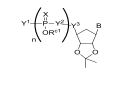
[000190] Em algumas modalidades, os nucleotídeos modificados são um composto de Fórmula XI-b: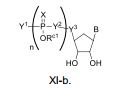
[000191] Em algumas modalidades, os nucleotídeos modificados são um composto de Fórmula XI-c1, XI-c2 ou XI-c3: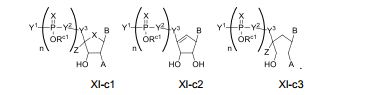
[000192] Em algumas modalidades, os nucleotídeos modificados são um composto de Fórmula XI:

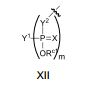
[000193] B é uma nucleobase de Fórmula XIII:
[000194] Em algumas modalidades, B é:
[000195] Em algumas modalidades, B é:
[000196] Em algumas modalidades, B é:
[000197] Em algumas modalidades, os nucleotídeos modificados são um composto de Fórmula I-d:
[000198] Em algumas modalidades, os nucleotídeos modificados são um composto selecionado do grupo consistindo em:
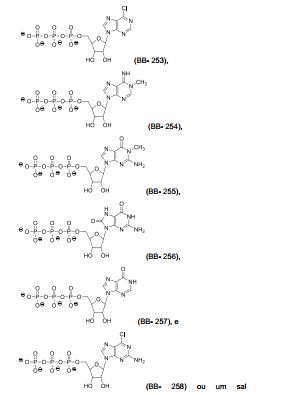
[000199] Em algumas modalidades, os nucleotídeos modificados são um composto selecionado do grupo consistindo em: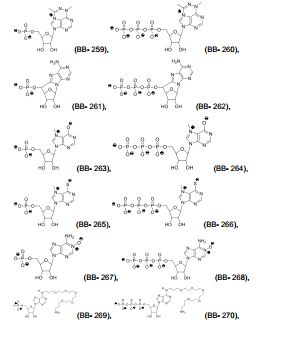
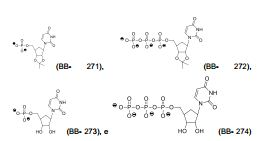
[000200] Os nucleotídeos modificados, que podem ser incorporados a uma molécula de polinucleotídeo, podem ser modificados na ligação internucleosídeo (por exemplo, estrutura principal de fosfato). Aqui, no contexto da estrutura principal de polinucleotídeo, as expressões "fosfato" e "fosfodiéster" são usadas intercomutavelmente. Grupos fosfato de estrutura principal podem ser modificados através de substituição de um ou mais dos átomos de oxigênio com um substituinte diferente. Ainda, os nucleosídeos e nucleotídeos modificados podem incluir a substituição completa de uma porção fosfato não modificada com outras ligações internucleosídeo conforme descrito aqui. Exemplos de grupos fosfato modificados incluem, mas não estão limitados a, fosforotioato, fosforoselenatos, boranofosfatos, ésteres de boranofosfato, hidrogênio fosfonatos, fosforamidatos, osforodiamidatos, alquila ou aril fosfonatos e fosfotriésteres. Fosforoditioatos têm ambos oxigênios de não ligação substituídos por enxofre. A ligação fosfato pode ser também modificada pela substituição de um oxigênio de ligação com nitrogênio (fosforamidatos em ponte), enxofre (fosforotioatos em ponte) e carbono (metileno-fosfonatos em ponte).[000200] Modified nucleotides, which can be incorporated into a polynucleotide molecule, can be modified in the internucleoside bond (eg phosphate backbone). Here, in the context of the polynucleotide backbone, the terms "phosphate" and "phosphodiester" are used interchangeably. Backbone phosphate groups can be modified by replacing one or more of the oxygen atoms with a different substituent. In addition, modified nucleosides and nucleotides can include complete replacement of an unmodified phosphate moiety with other internucleoside linkages as described herein. Examples of modified phosphate groups include, but are not limited to, phosphorothioate, phosphorouslenates, boranophosphates, boranophosphate esters, hydrogen phosphonates, phosphoramidates, phorodiamidates, alkyl or aryl phosphonates, and phosphotriesters. Phosphorodithioates both have sulfur-substituted unbound oxygens. The phosphate bond can also be modified by replacing a bond oxygen with nitrogen (bridged phosphoramidates), sulfur (bridged phosphorothioates), and carbon (bridged methylene phosphonates).
[000201] A porção fosfato substituída com α-tio é provida para conferir estabilidade a polímeros de RNA e DNA através das ligações de estrutura principal de fosforotioato não naturais. DNA e RNA de fosforotioato têm resistência à nuclease aumentada e susequentemente uma meia-vida mais longa em um ambiente celular. Embora não desejando ser limitado pela teoria, moléculas de polinucleotídeo ligadas por fosforotioato são esperadas também ser reduzidas na resposta imune inata através de ligação/ativação mais fraca de moléculas imunes inatas celulares.[000201] The α-thio substituted phosphate moiety is provided to impart stability to RNA and DNA polymers through unnatural phosphorothioate backbone linkages. Phosphorothioate DNA and RNA have increased nuclease resistance and subsequently a longer half-life in a cellular environment. While not wishing to be bound by theory, phosphorothioate-linked polynucleotide molecules are also expected to be reduced in the innate immune response through weaker binding/activation of cellular innate immune molecules.
[000202] Em modalidades específicas, um nucleosídeo modificado inclui um alfa-tio-nucleosídeo (por exemplo, 5’-O-(1-tiofosfato)-adeno- sina, 5‘-O-(1-tiofosfato)-citidina (α-tio-citidina), 5‘-O-(1-tiofosfato)-gua- nosina, 5‘-O-(1-tiofosfato)-uridina ou 5‘-O-(1-tiofosfato)-pseudouridina).[000202] In specific embodiments, a modified nucleoside includes an alpha-thio-nucleoside (eg, 5'-O-(1-thiophosphate)-adenosine, 5'-O-(1-thiophosphate)-cytidine (α -thio-cytidine), 5'-O-(1-thiophosphate)-guanosine, 5'-O-(1-thiophosphate)-uridine or 5'-O-(1-thiophosphate)-pseudouridine).
[000203] Outras ligações internucleosídeo podem ser empregadas de acordo com a presente invenção, incluindo ligações internucleosídeo que não contêm um átomo de fosforo, conforme descrito aqui abaixo. Combinações de Ligações de Açúcares, Nucleobases e Internucleosídeo Modificadas[000203] Other internucleoside linkages may be employed in accordance with the present invention, including internucleoside linkages that do not contain a phosphorus atom, as described herein below. Combinations of Modified Sugar, Nucleobase and Internucleoside Linkages
[000204] Os polinucleotídeos da presente invenção podem incluir uma combinação de modificações na ligação de açúcar, nucleobase e/ou internucleosídeo. Essas combinações podem incluir qualquer uma ou mais modificações descritas aqui. Por exemplo, qualquer um dos nucleotídeos descritos aqui nas Fórmulas (Ia), (Ia-1)-(Ia-3), (Ib)-(If), (IIa)-(IIp), (IIb-1), (IIb-2), (IIc-1)-(IIc-2), (IIn-1), (IIn-2), (IVa)-(IVl) e (IXa)- (IXr) pode ser combinado com qualquer uma das nucleobase descritas aqui (por exemplo, nas Fórmulas (b1)-(b43)) ou qualquer outra descrita aqui.[000204] The polynucleotides of the present invention may include a combination of sugar, nucleobase and/or internucleoside linkage modifications. Such combinations can include any one or more of the modifications described herein. For example, any of the nucleotides described in Formulas (Ia), (Ia-1)-(Ia-3), (Ib)-(If), (IIa)-(IIp), (IIb-1), ( IIb-2), (IIc-1)-(IIc-2), (IIn-1), (IIn-2), (IVa)-(IVl) and (IXa)-(IXr) can be combined with either of the nucleobases described herein (for example, in Formulas (b1)-(b43)) or any other described herein.
[000205] As moléculas de polinucleotídeo para uso de acordo com a invenção podem ser preparadas de acordo com qualquer técnica útil, conforme aqui descrito. Os nucleosídeos e nucleotídeos modificados usados na síntese de moléculas de polinucleotídeo reveladas aqui podem ser preparados a partir de materiais de partida prontamente disponíveis usando os métodos e procedimentos gerais que seguem. Onde condições de processo típicas ou preferidas (por exemplo, temperaturas de reação, tempos, razões em mol de reagentes, solventes, pressões, etc) são providas, um versado na técnica seria capaz de otimizar e desenvolver condições de processo adicionais. Condições de reação ótimas podem variar com os reagentes ou solvente em particular usados, mas tais condições podem ser determinadas por um versado na técnica através de procedimentos de otimização de rotina.[000205] Polynucleotide molecules for use in accordance with the invention can be prepared according to any useful technique as described herein. The modified nucleosides and nucleotides used in the synthesis of polynucleotide molecules disclosed herein can be prepared from readily available starting materials using the following general methods and procedures. Where typical or preferred process conditions (eg reaction temperatures, times, mole ratios of reactants, solvents, pressures, etc.) are provided, one skilled in the art would be able to optimize and develop additional process conditions. Optimal reaction conditions may vary with the particular reagents or solvent used, but such conditions can be determined by one skilled in the art through routine optimization procedures.
[000206] Os processos descritos aqui podem ser monitorados de acordo com qualquer método adequado conhecido na técnica. Por exemplo, formação de produção pode ser monitorada através de meios espectroscópicos, tal como espectroscopia de ressonância magnética nuclear (por exemplo, 1H ou 13C), espectroscopia infravermelha, espectrofotometria (por exemplo, visível UV) ou espectrometria de massa, ou através de cromatografia tal como cromatografia líquida de alto desempenho (HPLC) ou cromatografia de camada fina.[000206] The processes described here can be monitored according to any suitable method known in the art. For example, production formation can be monitored through spectroscopic means, such as nuclear magnetic resonance spectroscopy (eg 1H or 13C), infrared spectroscopy, spectrophotometry (eg visible UV) or mass spectrometry, or through chromatography such as high performance liquid chromatography (HPLC) or thin layer chromatography.
[000207] Preparação de moléculas de polinucleotídeo da presente invenção pode envolver a proteção e a desproteção de vários grupos químicos. A necessidade de proteção e desproteção e a seleção de grupos de proteção apropriados podem ser prontamente determinadas por um versado na técnica. A química de grupos de proteção pode ser encontrada, por exemplo, em Greene e outros, Protective Groups in Organic Synthesis, 2a ed., Wiley & Sons, 1991, que é aqui incorporado a título de referência em sua totalidade.[000207] Preparation of polynucleotide molecules of the present invention may involve the protection and deprotection of various chemical groups. The need for protection and deprotection and the selection of appropriate protecting groups can be readily determined by one of ordinary skill in the art. The chemistry of protecting groups can be found, for example, in Greene et al., Protective Groups in Organic Synthesis, 2nd ed., Wiley & Sons, 1991, which is hereby incorporated by reference in its entirety.
[000208] As reações dos processos descritos aqui podem ser realizadas em solventes adequados, que podem ser prontamente selecionados por um versado na técnica de síntese orgânica. Solventes adequados podem ser substancialmente não reativos com os materiais de partida (reagentes), os intermediários ou produtos nas temperaturas nas quais as reações são realizadas, isto é, temperaturas que podem variar da temperatura de congelamento do solvente até a temperatura de ebulição do solvente. Uma dada reação pode ser realizada em um solvente ou uma mistura de mais de um solvente. Dependendo da etapa de reação particular, solventes adequados para uma etapa de reação particular podem ser selecionados.[000208] The reactions of the processes described here can be carried out in suitable solvents, which can be readily selected by one skilled in the art of organic synthesis. Suitable solvents can be substantially unreactive with the starting materials (reactants), the intermediates or products at the temperatures at which the reactions are carried out, i.e., temperatures which can range from the freezing temperature of the solvent to the boiling temperature of the solvent. A given reaction can be carried out in one solvent or a mixture of more than one solvent. Depending on the particular reaction step, suitable solvents for a particular reaction step can be selected.
[000209] Separação de misturas racêmicas de polinucleotídeos ou ácidos nucleicos modificados (por exemplo, polinucleotídeos ou moléculas de mRNA modificadas) pode ser realizada através de qualquer um de vários métodos conhecidos na técnica. Um método exemplar inclui recristalização fracional usando um "ácido de separação quiral" que é um ácido orgânico de formação de sal, opticamente ativo. Agentes de separação adequados para métodos de recristalização fracionais são, por exemplo, ácidos opticamente ativos, tais como as formas D e L de ácido tartárico, ácido diacetiltartárico, ácido dibenzoiltartárico, ácido mandélico, ácido málico, ácido láctico ou os vários ácidos canforsulfônicos opticamente ativos. Separação de misturas racêmicas pode também ser realizada através de eluição em uma coluna embalada com um agente opticamente ativo (por exemplo, dinitrobenzoilfenilglicina). Composição de solvente de eluição adequada pode ser determinada por um versado na técnica.[000209] Separation of racemic mixtures of polynucleotides or modified nucleic acids (for example, polynucleotides or modified mRNA molecules) can be performed by any of several methods known in the art. An exemplary method includes fractional recrystallization using a "chiral separating acid" which is an optically active, salt-forming organic acid. Suitable separating agents for fractional recrystallization methods are, for example, optically active acids, such as the D and L forms of tartaric acid, diacetyl tartaric acid, dibenzoyltartaric acid, mandelic acid, malic acid, lactic acid or the various optically active camphorsulfonic acids . Separation of racemic mixtures can also be accomplished through elution over a column packed with an optically active agent (eg, dinitrobenzoylphenylglycine). Appropriate elution solvent composition can be determined by one skilled in the art.
[000210] Nucleosídeos e nucleotídeos modificados (por exemplo, moléculas de bloco de construção) podem ser preparados de acordo com os métodos sintéticos descritos em Ogata e outros, J. Org. Chem. 74:2585-2588 (2009); Purmal e outros, Nucl. Acids Res. 22(1): 72-78, (1994); Fukuhara e outros, Biochemistry, 1(4): 563-568 (1962); e Xu e outros, Tetrahedron, 48(9): 1729-1740 (1992), cada um deles é aqui incorporado a título de referência em sua totalidade.[000210] Modified nucleotides and nucleotides (eg building block molecules) can be prepared according to the synthetic methods described in Ogata et al., J. Org. Chem. 74:2585-2588 (2009); Purmal et al., Nucl. Acids Res. 22(1):72-78, (1994); Fukuhara et al., Biochemistry, 1(4): 563-568 (1962); and Xu et al., Tetrahedron, 48(9): 1729-1740 (1992), each of which is incorporated herein by reference in its entirety.
[000211] Os polinucleotídeos da invenção podem ou não ser uniformemente modificados ao longo de todo o comprimento da molécula. Por exemplo, um ou mais ou todos os tipos de nucleotídeo (por exemplo, purina ou pirimidina ou qualquer um ou mais ou todos de A, G, U, C) podem ou não ser uniformemente modificados em um polinucleotídeo da invenção ou em uma dada região de sequência predeterminada do mesmo. Em algumas modalidades, todos os nucleotídeos X em um polinucleotídeo da invenção (ou em uma dada região de sequência do mesmo) são modificados, onde X pode ser qualquer um dos nucleotídeos A, G, U, C ou qualquer uma das combinações A+G, A+U, A+C, G+U, G+C, U+C, A+G+U, A+G+C, G+U+C ou A+G+C.[000211] The polynucleotides of the invention may or may not be uniformly modified along the entire length of the molecule. For example, one or more or all of the nucleotide types (eg, purine or pyrimidine or any one or more or all of A, G, U, C) may or may not be uniformly modified in a polynucleotide of the invention or in a given predetermined sequence region thereof. In some embodiments, all X nucleotides in a polynucleotide of the invention (or in a given region of sequence thereof) are modified, where X can be any one of nucleotides A, G, U, C or any of the combinations A+G , A+U, A+C, G+U, G+C, U+C, A+G+U, A+G+C, G+U+C or A+G+C.
[000212] Modificações de açúcar, modificações de nucleotídeo e/ou ligações internucleosídeo diferentes (por exemplo, estruturas de estrutura principal) podem existir em várias posições no polinucleotídeo. Um versado comum na técnica vai compreender que os análogos de nucleotídeo ou outra modificação(ões) podem estar localizados em qualquer posição(ões) de um polinucleotídeo de maneira que a função do polinucleotídeo não seja substancialmente diminuída. Uma modificação pode ser também uma modificação 5’ ou 3’ terminal. O polinucleotídeo pode conter de a partir de cerca de 1% a cerca de 100% de nucleotídeos modificados (ou em relação ao teor de nucleotídeo total, ou em relação a um ou mais tipos de nucelotídeo, isto é, qualquer um ou mais de A, G, U ou C) ou qualquer porcentagem entre eles (por exemplo, de a partir de 1% a 20%, de a partir de 1% a 25%, de a partir de 1% a 50%, de a partir de 1% a 60%, de a partir de 1% a 70%, de a partir de 1% a 80%, de a partir de 1% a 90%, de a partir de 1% a 95%, de a partir de 10% a 20%, de a partir de 10% a 25%, de a partir de 10% a 50%, de a partir de 10% a 60%, de a partir de 10% a 70%, de a partir de 10% a 80%, de a partir de 10% a 90%, de a partir de 10% a 95%, de a partir de 10% a 100%, de a partir de 20% a 25%, de a partir de 20% a 50%, de a partir de 20% a 60%, de a partir de 20% a 70%, de a partir de 20% a 80%, de a partir de 20% a 90%, de a partir de 20% a 95%, de a partir de 20% a 100%, de a partir de 50% a 60%, de a partir de 50% a 70%, de a partir de 50% a 80%, de a partir de 50% a 90%, de a partir de 50% a 95%, de a partir de 50% a 100%, de a partir de 70% a 80%, de a partir de 70% a 90%, de a partir de 70% a 95%, de a partir de 70% a 100%, de a partir de 80% a 90%, de a partir de 80% a 95%, de a partir de 80% a 100%, de a partir de 90% a 95%, de a partir de 90% a 100% e de a partir de 95% a 100%).[000212] Different sugar modifications, nucleotide modifications and/or internucleoside linkages (eg backbone structures) may exist at various positions in the polynucleotide. One of ordinary skill in the art will understand that nucleotide analogs or other modification(s) can be located at any position(s) on a polynucleotide such that the function of the polynucleotide is not substantially diminished. A modification can also be a 5’ or 3 terminal modification. The polynucleotide can contain from about 1% to about 100% modified nucleotides (or in relation to the total nucleotide content, or in relation to one or more types of nucleotide, i.e. any one or more of A , G, U or C) or any percentage in between (for example, from 1% to 20%, from 1% to 25%, from 1% to 50%, from 1% to 60%, from 1% to 70%, from 1% to 80%, from 1% to 90%, from 1% to 95%, from 10% to 20%, from 10% to 25%, from 10% to 50%, from 10% to 60%, from 10% to 70%, from 10% to 80%, from 10% to 90%, from 10% to 95%, from 10% to 100%, from 20% to 25%, from 20% to 50%, from 20% to 60%, from 20% to 70%, from 20% to 80%, from 20% to 90%, from 20% to 95%, from 20% to 100%, from 50% to 60%, from 50% to 70%, from 50% to 80%, from 50% to 90%, from 50% to 95%, from 50% to 100%, from 70% to 80%, from 70% to 90%, from 70% to 95%, from 70% to 100%, from 80% to 90%, from 80% to 95%, from 80% to 100%, from 90% to 95%, from 90% to 100% and from 95% to 100%).
[000213] Em algumas modalidades, o polinucleotídeo inclui uma pirimidina modificada (por exemplo, uma uracila/uridina/U modificada ou citosina/citidina/C modificada). Em algumas modalidades, a uracila ou uridina (geralmente: U) na molécula de polinucleotídeo pode ser substituída com de a partir de cerca de 1% a cerca de 100% de uma uracila modificada ou uridina modificada (por exemplo, de a partir de 1% a 20%, de a partir de 1% a 25%, de a partir de 1% a 50%, de a partir de 1% a 60%, de a partir de 1% a 70%, de a partir de 1% a 80%, de a partir de 1% a 90%, de a partir de 1% a 95%, de a partir de 10% a 20%, de a partir de 10% a 25%, de a partir de 10% a 50%, de a partir de 10% a 60%, de a partir de 10% a 70%, de a partir de 10% a 80%, de a partir de 10% a 90%, de a partir de 10% a 95%, de a partir de 10% a 100%, de a partir de 20% a 25%, de a partir de 20% a 50%, de a partir de 20% a 60%, de a partir de 20% a 70%, de a partir de 20% a 80%, de a partir de 20% a 90%, de a partir de 20% a 95%, de a partir de 20% a 100%, de a partir de 50% a 60%, de a partir de 50% a 70%, de a partir de 50% a 80%, de a partir de 50% a 90%, de a partir de 50% a 95%, de a partir de 50% a 100%, de a partir de 70% a 80%, de a partir de 70% a 90%, de a partir de 70% a 95%, de a partir de 70% a 100%, de a partir de 80% a 90%, de a partir de 80% a 95%, de a partir de 80% a 100%, de a partir de 90% a 95%, de a partir de 90% a 100% e de a partir de 95% a 100% de uma uracila modificada ou uridina modificada). A uracila ou uridina modificada pode ser substituída por um composto tendo uma estrutura única simples ou por uma pluralidade de compostos tendo estruturas diferentes (por exemplo, 2, 3, 4 ou mais estruturas únicas, conforme aqui descrito). Em algumas modalidades, a citosina ou citidina (geralmente: C) na molécula de polinucleotídeo pode ser substituída com de a partir de cerca de 100% de uma citosina modificada ou citidina modificada (por exemplo, de a partir de (por exemplo, de a partir de 1% a 20%, de a partir de 1% a 25%, de a partir de 1% a 50%, de a partir de 1% a 60%, de a partir de 1% a 70%, de a partir de 1% a 80%, de a partir de 1% a 90%, de a partir de 1% a 95%, de a partir de 10% a 20%, de a partir de 10% a 25%, de a partir de 10% a 50%, de a partir de 10% a 60%, de a partir de 10% a 70%, de a partir de 10% a 80%, de a partir de 10% a 90%, de a partir de 10% a 95%, de a partir de 10% a 100%, de a partir de 20% a 25%, de a partir de 20% a 50%, de a partir de 20% a 60%, de a partir de 20% a 70%, de a partir de 20% a 80%, de a partir de 20% a 90%, de a partir de 20% a 95%, de a partir de 20% a 100%, de a partir de 50% a 60%, de a partir de 50% a 70%, de a partir de 50% a 80%, de a partir de 50% a 90%, de a partir de 50% a 95%, de a partir de 50% a 100%, de a partir de 70% a 80%, de a partir de 70% a 90%, de a partir de 70% a 95%, de a partir de 70% a 100%, de a partir de 80% a 90%, de a partir de 80% a 95%, de a partir de 80% a 100%, de a partir de 90% a 95%, de a partir de 90% a 100% e de a partir de 95% a 100% de uma citosina modificada ou citidina modificada). A citosina ou citidina modificada pode ser substituída por um composto tendo uma estrutura única simples ou por uma pluralidade de compostos tendo estruturas diferentes (por exemplo, 2, 3, 4 ou mais estruturas únicas, conforme descrito aqui).[000213] In some embodiments, the polynucleotide includes a modified pyrimidine (eg, a modified uracil/uridine/U or modified cytosine/cytidine/C). In some embodiments, the uracil or uridine (generally: U) in the polynucleotide molecule can be replaced with from about 1% to about 100% of a modified uracil or modified uridine (e.g., from about 1 % to 20%, from 1% to 25%, from 1% to 50%, from 1% to 60%, from 1% to 70%, from 1 % to 80%, from 1% to 90%, from 1% to 95%, from 10% to 20%, from 10% to 25%, from 10 % to 50%, from 10% to 60%, from 10% to 70%, from 10% to 80%, from 10% to 90%, from 10 % to 95%, from 10% to 100%, from 20% to 25%, from 20% to 50%, from 20% to 60%, from 20 % to 70%, from 20% to 80%, from 20% to 90%, from 20% to 95%, from 20% to 100%, from 50 % to 60%, from 50% to 70%, from 50% to 80%, from 50% to 90%, from 50% to 95%, from to from 50% to 100%, from 70% to 80%, from 70% to 90%, from 70% to 95%, from 70% to 100%, from to from 80% to 90%, from 80% to 95%, from 80% to 100%, from 90% to 95%, from 90% to 100% and from to from 95% to 100% of a modified uracil or modified uridine). The uracil or modified uridine can be replaced with a compound having a simple single structure or with a plurality of compounds having different structures (for example 2, 3, 4 or more unique structures as described herein). In some embodiments, the cytosine or cytidine (generally: C) in the polynucleotide molecule can be replaced with from about 100% of a modified cytosine or modified cytidine (e.g., from (e.g., from to) from 1% to 20%, from 1% to 25%, from 1% to 50%, from 1% to 60%, from 1% to 70%, from to from 1% to 80%, from 1% to 90%, from 1% to 95%, from 10% to 20%, from 10% to 25%, from to from 10% to 50%, from 10% to 60%, from 10% to 70%, from 10% to 80%, from 10% to 90%, from to from 10% to 95%, from 10% to 100%, from 20% to 25%, from 20% to 50%, from 20% to 60%, from to from 20% to 70%, from 20% to 80%, from 20% to 90%, from 20% to 95%, from 20% to 100%, from to from 50% to 60%, from 50% to 70%, from 50% to 80%, from 50% to 90%, from from 50% to 95%, from from 50% to 100%, from from 70% to 80%, from from 70% to 90%, from from 70% to 95%, from from from 70% to 100%, from from 80% to 90%, from from 80% to 95%, from from 80% to 100%, from from 90% to 95%, from from from 90% to 100% and from 95% to 100% of a modified cytosine or modified cytidine). The modified cytosine or cytidine can be replaced with a compound having a single simple structure or with a plurality of compounds having different structures (e.g. 2, 3, 4 or more unique structures as described herein).
[000214] Em algumas modalidades, a presente invenção provê métodos de síntese de um polinucleotídeo (por exemplo, a primeira região, primeira região de flanqueamento ou segundo região de flanqueamento) incluindo vários nucleosídeos ligados tendo a Fórmula (Ia-1):
[000215] reação de um nucleotídeo de Fórmula (IV-1):
[000216] com um composto fosforamidita de Fórmula (V-1):
[000217] para prover um polinucleotídeo de Fórmula (VI-1):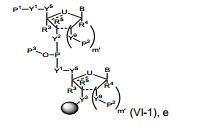
[000218] b) oxidação ou sulfurização do polinucleotídeo de Fórmula (V) para fornecer um polinucleotídeo de Fórmula (VII-1):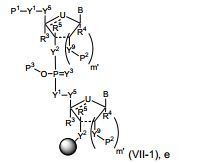
[000219] Em algumas modalidades, as etapas a) e b) são repetidas de 1 a cerca de 10.000 vezes. Em algumas modalidades, os métodos compreendem ainda um nucleotídeo selecionado do grupo consistindo em A, C, G e U adenosina, citosina, guanosina e uracila. Em algumas modalidades, o polinucleotídeo é um traduzível.[000219] In some embodiments, steps a) and b) are repeated from 1 to about 10,000 times. In some embodiments, the methods further comprise a nucleotide selected from the group consisting of A, C, G and U adenosine, cytosine, guanosine and uracil. In some embodiments, the polynucleotide is a translatable one.
[000220] Outros componentes de polinucleotídeos são opcionais e são benéficos em algumas modalidades. Por exemplo, uma região não traduzida 5’ (UTR) e/ou uma UTR 3’ são providas, onde ou uma ou ambas podem conter independentemente uma ou mais modificações de nucleotídeo diferentes. Em tais modalidades, modificações de nucleotídeo podem também estar presentes na região traduzível. São também providos polinucleotídeos contendo uma sequência Kozak.[000220] Other polynucleotide components are optional and are beneficial in some modalities. For example, a 5' untranslated region (UTR) and/or a 3' UTR are provided, where either one or both may independently contain one or more different nucleotide modifications. In such embodiments, nucleotide modifications may also be present in the translatable region. Polynucleotides containing a Kozak sequence are also provided.
[000221] Exemplos adicionais de nucleotídeos modificados e combinações de nucleotídeo modificado são providos abaixo na Tabela 2. Essas combinações de nucleotídeos modificados podem ser usadas para formar os polinucleotídeos da invenção. A menos que de outro modo declarado, os nucleotídeos modificados podem substituir completamente os nucleotídeos naturais dos polinucleotídeos da invenção. Como um exemplo não limitante, a uridina de nucleotídeo natural pode ser substituída com um nucleosídeo modificado descrito aqui. Em outro exemplo não limitante, a uridina de nucleotídeo natural pode ser parcialmente substituída (por exemplo, cerca de 0,1%, 1%, 5%, 10%, 15%, 20%, 25%, 30%, 35%, 40%, 45%, 50%, 55%, 60%, 65%, 70%, 75%, 80%, 85%, 90%, 95% ou 99,9%) com pelo menos um dos nucleosídeos modificados revelados aqui. Tabela 2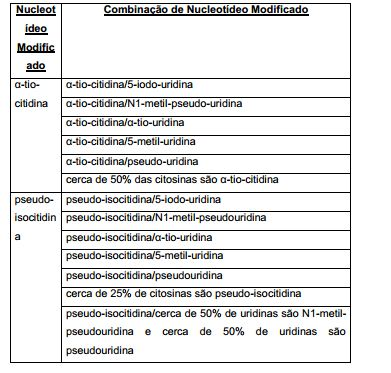
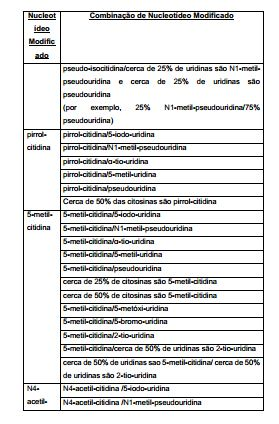

[000222] Certos nucleotídeos modificados e combinações de nucleotídeo foram explorados pelos presentes inventores. Essas constatações são descritas no Pedido de Patente Provisório U.S. No. 61/404.413 depositado em 1 de outubro de 2010 intitulado Engineered Nucleic Acids and Methods of Use Thereof, Pedido de Patente U.S. No. 13/251.840 depositado em 3 de outubro de 2011, intitulado[000222] Certain modified nucleotides and nucleotide combinations were explored by the present inventors. These findings are described in U.S. Provisional Patent Application No. 61/404,413 filed October 1, 2010 entitled Engineered Nucleic Acids and Methods of Use Thereof, U.S. Patent Application No. 13/251,840 filed October 3, 2011, entitled
[000223] Modified Nucleotides, and Nucleic Acids, and Uses Thereof, agora abandonado, Pedido de Patente U.S. No. 13/481.127, depositado em 25 de maio de 2012, intitulado Modified Nucleotides, and Nucleic Acids, and Uses Thereof, Publicação de Pedido de Patente Internacional No. WO2012045075, depositado em 31 de outubro de 2011, intitulado Modified Nucleosides, Nucleotides, and Nucleic Acids, and Uses Thereof, Publicação de Patente U.S. No. US20120237975 depositado em 3 de outubro de 2011, intitulado Engineered Nucleic Acids and Method of Use Thereof e Publicação de Patente Internacional No. WO2012045082, que são aqui incorporados a título de referência em suas totalidades.[000223] Modified Nucleotides, and Nucleic Acids, and Uses Thereof, now abandoned, US Patent Application No. 13/481,127, filed May 25, 2012, entitled Modified Nucleotides, and Nucleic Acids, and Uses Thereof, Publication Application International Patent No. WO2012045075, filed October 31, 2011, entitled Modified Nucleosides, Nucleotides, and Nucleic Acids, and Uses Thereof, US Patent Publication No. US20120237975 filed October 3, 2011, entitled Engineered Nucleic Acids and Method of Use Thereof and International Patent Publication No. WO2012045082, which are incorporated herein by reference in their entirety.
[000224] Exemplos adicionais de combinações de nucleotídeo modificado são providos abaixo na Tabela 3. Essas combinações de nucleotídeos modificados podem ser usadas para formar os polinucleotídeos da invenção.Tabela 3

[000225] Em algumas modalidades, pelo menos 25% das citosinas são substituídos por um composto de Fórmula (b10)-(b14), (b24), (b25) ou (b32)-(b35) (por exemplo, pelo menos cerca de 30%, pelo menos cerca de 35%, pelo menos cerca de 40%, pelo menos cerca de 45%, pelo menos cerca de 50%, pelo menos cerca de 55%, pelo menos cerca de 60%, pelo menos cerca de 65%, pelo menos cerca de 70%, pelo menos cerca de 75%, pelo menos cerca de 80%, pelo menos cerca de 85%, pelo menos cerca de 90%, pelo menos cerca de 95% ou cerca de 100% de, por exemplo, de um composto de Fórmula (b10) ou (b32)).[000225] In some embodiments, at least 25% of the cytosines are replaced by a compound of Formula (b10)-(b14), (b24), (b25) or (b32)-(b35) (eg, at least about 30%, at least about 35%, at least about 40%, at least about 45%, at least about 50%, at least about 55%, at least about 60%, at least about 65%, at least about 70%, at least about 75%, at least about 80%, at least about 85%, at least about 90%, at least about 95% or about 100% of , for example, of a compound of Formula (b10) or (b32)).
[000226] Em algumas modalidades, pelo menos 25% das uracilas são substituídos por um composto de Fórmula (b1)-(b9), (b21)-(b23) ou (b28)-(b31) (por exemplo, pelo menos cerca de 30%, pelo menos cerca de 35%, pelo menos cerca de 40%, pelo menos cerca de 45%, pelo menos cerca de 50%, pelo menos cerca de 55%, pelo menos cerca de 60%, pelo menos cerca de 65%, pelo menos cerca de 70%, pelo menos cerca de 75%, pelo menos cerca de 80%, pelo menos cerca de 85%, pelo menos cerca de 90%, pelo menos cerca de 95% ou cerca de 100% de, por exemplo, de um composto de Fórmula (b1), (b8), (b28), (b29) ou (b30)).[000226] In some embodiments, at least 25% of the uracils are replaced by a compound of Formula (b1)-(b9), (b21)-(b23) or (b28)-(b31) (e.g., at least about 30%, at least about 35%, at least about 40%, at least about 45%, at least about 50%, at least about 55%, at least about 60%, at least about 65%, at least about 70%, at least about 75%, at least about 80%, at least about 85%, at least about 90%, at least about 95% or about 100% of , for example, of a compound of the Formula (b1), (b8), (b28), (b29) or (b30)).
[000227] Em algumas modalidades, pelo menos 25% das citosinas são substituídos por um composto de Fórmula (b10)-(b14), (b24), (b25) ou (b32)-(b35) (por exemplo, Fórmula (b10) ou (b32)), e pelo menos 25% das uracilas são substituídos por um composto de Fórmula (b1)- (b9), (b21)-(b23) ou (b28)-(b31) (por exemplo, Fórmula (b1), (b8), (b28), (b29) ou (b30)) (por exemplo, pelo menos cerca de 30%, pelo menos cerca de 35%, pelo menos cerca de 40%, pelo menos cerca de 45%, pelo menos cerca de 50%, pelo menos cerca de 55%, pelo menos cerca de 60%, pelo menos cerca de 65%, pelo menos cerca de 70%, pelo menos cerca de 75%, pelo menos cerca de 80%, pelo menos cerca de 85%, pelo menos cerca de 90%, pelo menos cerca de 95% ou cerca de 100%).[000227] In some embodiments, at least 25% of the cytosines are replaced by a compound of Formula (b10)-(b14), (b24), (b25) or (b32)-(b35) (eg, Formula (b10) ) or (b32)), and at least 25% of the uracils are replaced by a compound of Formula (b1)-(b9), (b21)-(b23) or (b28)-(b31) (e.g., Formula ( b1), (b8), (b28), (b29) or (b30)) (for example, at least about 30%, at least about 35%, at least about 40%, at least about 45% , at least about 50%, at least about 55%, at least about 60%, at least about 65%, at least about 70%, at least about 75%, at least about 80%, at least about 85%, at least about 90%, at least about 95% or about 100%).
[000228] A nucleobase do nucleotídeo pode ser covalentemente ligada em qualquer posição quimicamente apropriada a uma carga útil, por exemplo, agente detectável ou agente terapêutico. Por exemplo, a nucleobase pode ser desaza-adenosina ou desaza-guanosina e o ligante pode ser ligado às posições C-7 ou C-8 da desaza-adenosina ou desaza-guanosina. Em outras modalidades, a nucleobase pode ser citosina ou uracila e o ligante pode ser ligado às posições N-3 ou C-5 de citosina ou uracila. O Esquema 1 abaixo mostra um nucleotídeo modificado exemplar onde a nucleobase, adenina, é ligada a um ligante na C-7 carbono de 7-desaza adenina. Ainda, o Esquema 1 mostra o nucleotídeo modificado com o ligante e carga útil, por exemplo, um agente detectável, incorporado à extremidade 3’ do mRNA. Clivagem de dissulfeto e 1,2-adição do grupo tiol no éster de propargila liberam o agente detectável. A estrutura restante (mostrada, por exemplo, como pApC5Parg no Esquema 1) é o inibidor. A lógica para a estrutura dos nucleotídeos modificados é que o inibidor ligado em corrente interfere estericamente com a habilidade da polimerase em incorporar uma segunda base. Desta maneira, é crítico que a corrente seja longa o suficiente para realizar sua função e que o inibidor esteja em uma orientação estereoquímica que iniba ou proíba segundo e seguintes nucleotídeos no fita do polinucleotídeo em formação. Esquema 1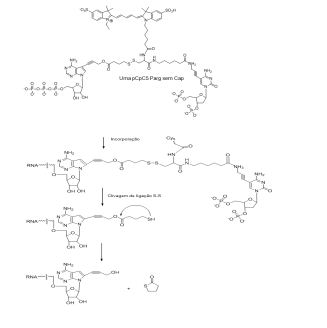
[000229] O termo "ligante" conforme aqui usado se refere a um grupo de átomos, por exemplo, 10-1.000 átomos, e pode ser compreendido dos átomos ou grupos tais como, mas não limitado a, carbono, amino, alquilamino, oxigênio, enxofre, sulfóxido, sulfonila, carbonila e imina. O ligante pode ser ligado a um nucleosídeo ou nucleotídeo modificado na nucleobase ou porção açúcar em uma primeira extremidade e a uma carga útil, por exemplo, agente detectável ou terapêutico, em uma segunda extremidade. O ligante é de comprimento suficiente de maneira a não interferir com a incorporação em uma sequência de ácido nucleico.[000229] The term "linker" as used herein refers to a group of atoms, for example 10-1,000 atoms, and may be comprised of atoms or groups such as, but not limited to, carbon, amino, alkylamino, oxygen , sulfur, sulfoxide, sulfonyl, carbonyl and imine. The linker may be attached to a nucleoside or nucleotide modified at the nucleobase or sugar moiety at a first end and to a payload, eg, detectable or therapeutic agent, at a second end. The linker is of sufficient length so as not to interfere with incorporation into a nucleic acid sequence.
[000230] Exemplos de grupos químicos que podem ser incorporados ao ligante incluem, mas não estão limitados a, um grupo alquila, alceno, uma alcina, um amido, um éter, um tio éter ou um éster. A cadeia de ligante pode também compreender parte de um anel saturado, insaturado ou aromático, incluindo anéis policíclicos ou heteroaromáticos onde o anel heteroaromático é um grupo arila contendo de a partir de um a quatro heteroátomos, N, O ou S. Exemplos específicos de ligantes incluem, mas não estão limitados a, alcanos insaturados, polietileno glicóis e polímeros de dextrano.[000230] Examples of chemical groups that can be incorporated into the binder include, but are not limited to, an alkyl, alkene, an alkyne, an amide, an ether, a thio ether or an ester group. The linker chain may also comprise part of a saturated, unsaturated or aromatic ring, including polycyclic or heteroaromatic rings where the heteroaromatic ring is an aryl group containing from one to four heteroatoms, N, O or S. Specific examples of linkers include, but are not limited to, unsaturated alkanes, polyethylene glycols and dextran polymers.
[000231] Por exemplo, o ligante pode incluir unidades monoméricas de etileno ou propileno glicol, por exemplo, dietileno glicol, dipropileno glicol, trietileno glicol, tripropileno glicol, tetraetileno glicol ou tetraetileno glicol. Em algumas modalidades, o ligante pode incluir uma porção alquila, alquenila e/ou alquinila divalente. O ligante pode incluir uma porção éster, amida ou éter.[000231] For example, the binder may include monomeric units of ethylene or propylene glycol, for example, diethylene glycol, dipropylene glycol, triethylene glycol, tripropylene glycol, tetraethylene glycol or tetraethylene glycol. In some embodiments, the linker can include a divalent alkyl, alkenyl and/or alkynyl moiety. The linker can include an ester, amide or ether moiety.
[000232] Outros exemplos incluem porções cliváveis dentro do ligante, tal como, por exemplo, uma ligação dissulfeto (-S-S-) ou uma ligação azo (-N=N-), que podem ser clivadas usando um agente de redução ou fotólise. Uma ligação clivável incorporada ao ligante e ligada a um nucleotídeo modificado, quando clivada, resulta em, por exemplo, uma "cicatriz" curta ou modificação química no nucleotídeo. Por exemplo, após clivagem, a cicatriz resultante em uma base de nucleotídeo, que fazia parte do nucleotídeo modificado, e é incorporada a uma fita de polinucleotídeo, é não reativa e não precisa ser quimicamente neutralizada. Isso aumenta a facilidade com a qual um nucleotídeo subsequente pode ser incorporado durante sequenciamento de um modelo de polímero de ácido nucleico. Por exemplo, condições incluem o uso de tris(2-carboxietil)fosfina (TCEP), ditiotreitol (DTT) e/ou outros agentes de redução para clivagem de uma ligação dissulfeto. Uma ligação seletivamente separável que inclui uma ligação amido pode ser clivada, por exemplo, através do uso de TCP ou outros agentes de redução e/ou fotólise. Uma ligação seletivamente separável que inclui uma ligação éster pode ser clivada, por exemplo, através de hidrólise ácida ou básica.[000232] Other examples include cleavable moieties within the linker, such as, for example, a disulfide bond (-S-S-) or an azo bond (-N=N-), which can be cleaved using a reducing agent or photolysis. A cleavable bond incorporated into the linker and attached to a modified nucleotide, when cleaved, results in, for example, a short "scar" or chemical modification to the nucleotide. For example, after cleavage, the resulting scar on a nucleotide base, which was part of the modified nucleotide, and is incorporated into a polynucleotide strand, is non-reactive and does not need to be chemically neutralized. This increases the ease with which a subsequent nucleotide can be incorporated during sequencing of a nucleic acid polymer template. For example, conditions include the use of tris(2-carboxyethyl)phosphine (TCEP), dithiothreitol (DTT) and/or other reducing agents to cleave a disulfide bond. A selectively cleavable bond that includes an amide bond can be cleaved, for example, through the use of TCP or other reducing and/or photolysis agents. A selectively cleavable bond that includes an ester bond can be cleaved, for example, through acidic or basic hydrolysis.
[000233] Os métodos e composições descritos aqui são úteis para aplicação de uma carga útil a um alvo biológico. A carga útil pode ser usada, por exemplo, para marcação (por exemplo, um agente detectável tal como um fluoróforo) ou para propósitos terapêuticos (por exemplo, uma citotoxina ou outro agente terapêutico).[000233] The methods and compositions described herein are useful for applying a payload to a biological target. The payload can be used, for example, for labeling (for example a detectable agent such as a fluorophore) or for therapeutic purposes (for example a cytotoxin or other therapeutic agent).
[000234] Em algumas modalidades, a carga útil é um agente terapêutico tal como uma citotoxina, íon radioativo, agente quimioterapêutico ou outro agente terapêutico. Uma citotoxina ou agente citotóxico inclui qualquer agente que seja prejudicial para células. Exemplos incluem taxol, citocalasina B, gramicidina D, brometo de etídio, emetina, mitomicina, etoposídeo, tenoposídeo, vincristina, vimblastina, colchidina, doxorrubicina, daunorrubicina, di-hidroxi antracino diona, mitoxantrona, mitramicina, actinomicina D, 1-desidrotestosterona, glucocorticoides, procaína, tetracaína, lodocaína, propranolol, puromicina, maitansinoides, por exemplo, maitansinol (vide, por exemplo, Patente U.S. No. 5.208.020), CC-1065 (Patentes U.S. Nos. 5.475.092, 5.585.499, 5.846.545) e seus análogos e homólogos. Íons radioativos incluem, mas não estão limitados a, iodo (por exemplo, iodo 125 ou iodo 131), estrôncio 89, fósforo, paládio, césio, irídio, fosfoato, cobalto, ítrio 90, Samário 153 e praseodímio. Outros agentes terapêuticos incluem, mas não estão limitados a, antimetabolitos (por exemplo, metotrexato, 6-mercaptopurina, 6- tioguanina, citarabina, 5-fluoruracila descarbazina), agentes de alquilação (por exemplo, mecloretamina, tiotepa clorambutil, CC-1065, melfalano, carmustina (BSNU) e lomustina (CCNU), ciclofosfamida, bussulfano, dibromomanitol, estreptozotocina, mitomicina C e cis- diclorodiamino platina (II) (DDP) cisplatina), antraciclinas (por exemplo, daunorrubicina (antes daunomicina) e doxorrubicina), antibióticos (por exemplo, dactinomicina (antes actinomicina), bleomicina, mitramicina e antramicina (AMC)) e agentes antimitóticos (por exemplo, vincristina, vimblastina, taxol e maitansinoides).[000234] In some embodiments, the payload is a therapeutic agent such as a cytotoxin, radioactive ion, chemotherapeutic agent, or other therapeutic agent. A cytotoxin or cytotoxic agent includes any agent that is harmful to cells. Examples include taxol, cytochalasin B, gramicidin D, ethidium bromide, emetin, mitomycin, etoposide, tenoposide, vincristine, vinblastine, colchidine, doxorubicin, daunorubicin, dihydroxy anthracin dione, mitoxantrone, mithramycin, actinhydromycin D, 1-desydromycin , procaine, tetracaine, lodocaine, propranolol, puromycin, maytansinoids, e.g., maytansinol (see, for example, US Patent No. 5,208,020), CC-1065 (US Patent Nos. 5,475,092, 5,585,499, 5,846. 545) and their analogues and homologues. Radioactive ions include, but are not limited to, iodine (eg, iodine 125 or iodine 131),
[000235] Exemplos de substâncias detectáveis incluem várias moléculas pequenas orgânicas, compostos inorgânicos, nanopartículas, enzimas ou substratos de enzima, materiais fluorescentes, materiais luminescentes, materiais bioluminescentes, materiais quimioluminescentes, materiais radioativos e agentes de contraste. Tais marcadores opticamente detectáveis incluem, por exemplo, sem limitação, ácido 4-acetamido-4'-isotiocianatoestilbeno-2,2'dissulfônico; acridina e derivados: acridina, isotiocianato de acridina; ácido 5-(2'- aminoetil)aminonaftaleno-1 -sulfônico (EDANS); 4-amino-N-[3- vinilsulfonil)fenil]naftalimido-3,5 dissulfonato; N-(4-anilino-l- naftil)maleimida; antranilamida; BODIPY; Amarelo Brilhante; cumarina e derivados; cumarina; 7-amino-4-metilcumarina (AMC, Coumarin 120), 7-amino-4-trifluormetilcouluarina (Coumaran 151); corantes cianina; cianosina; 4',6-diaminidino-2-fenilindol (DAPI); 5' 5"-dibromopirogalol- sulfonaftaleína (Vermelho de Bromopirogalol); 7-dietilamino-3-(4'- isotiocianatofenil)-4-metilcumarina; pentaacetato de dietilenetriamina; ácido 4,4'-diisotiocianatodi-hidro-estilbeno-2,2'-dissulfônico; ácido 4,4'- diisotiocianatoestilbeno-2,2'-dissulfônico; cloreto de 5-[dimetilamino]- naftaleno-1-sulfonila (DNS, cloreto de dansila); 4-dimetilaminofenilazofenil-4'-isotiocianato (DABITC); eosina e derivados; eosina, isotiocianato de eosina, eritrosina e derivados; eritrosina B, eritrosina, isotiocianato; etídio; fluoresceína e derivados; 5- carboxifluoresceína (FAM), 5-(4,6-diclorotriazin-2-il)aminofluoresceína (DTAF), 2',7'-dimetóxi-4'5'-dicloro-6-carboxifluoresceína, fluoresceína, isotiocianato de fluoresceína, QFITC, (XRITC); fluorescamina; IR144; IR1446; isotiocianato de Verde Malaquita; 4-metilumbeliferoneorto cresolftaleína; nitrotirosina; pararosanilina; Vermelho Fenol; B- ficoeritrina; o-ftaldialdeído; pireno e derivados: pireno, butirato de pireno, succinimidil 1-pireno; pontos quânticos de butirato; Vermelho Reativo 4 (CibacronTM Brilliant Red 3B-A) rodamina e derivados: 6- carbóxi-X-rodamina (ROX), 6-carboxirrodamina (R6G), lissamina rodamina B cloreto de sulfonila rodamina (Rhod), rodamina B, rodamina 123, isotiocianato de rodamina X, sulforrodamina B, sulforrodamina 101, derivado de cloreto de sulfonila de sulforrodamina 101 (Vermelho Texas); N,N,N',N'tetrametil-6-carboxirrodamina (TAMRA); tetrametil rodamina; isotiocianato de tetrametil rodamina (TRITC); riboflavina; ácido rosólico; derivados de quelato de térbio; Cianina-3 (Cy3); Cianina- 5 (Cy5); Cianina-5.5 (Cy5.5), Cianina-7 (Cy7); IRD 700; IRD 800; Alexa 647; La Jolta Blue; ftalo cianina; e naftalo cianina. Em algumas modalidades, o marcador detectável é corante fluorescente, tais como Cy5 e Cy3.[000235] Examples of detectable substances include various small organic molecules, inorganic compounds, nanoparticles, enzymes or enzyme substrates, fluorescent materials, luminescent materials, bioluminescent materials, chemiluminescent materials, radioactive materials and contrast agents. Such optically detectable markers include, for example, without limitation, 4-acetamido-4'-isothiocyanatostilbene-2,2'disulfonic acid; acridine and derivatives: acridine, acridine isothiocyanate; 5-(2'-aminoethyl)aminonaphthalene-1-sulfonic acid (EDANS); 4-amino-N-[3-vinylsulfonyl)phenyl]naphthalimido-3,5 disulfonate; N-(4-anilino-1-naphthyl)maleimide; anthranilamide; BODIPY; Bright yellow; coumarin and derivatives; coumarin; 7-amino-4-methylcoumarin (AMC, Coumarin 120), 7-amino-4-trifluoromethylcoumarin (Coumaran 151); cyanine dyes; cyanosine; 4',6-diaminidino-2-phenylindole (DAPI); 5' 5"-dibromopyrogallol-sulfonaphthalein (Bromopyrogallol Red); 7-diethylamino-3-(4'-isothiocyanatophenyl)-4-methylcoumarin; diethylenetriamine pentaacetate; 4,4'-diisothiocyanatodihydro-stilbene-2,2 acid '-disulfonic acid; 4,4'-diisothiocyanatostilbene-2,2'-disulfonic acid; 5-[dimethylamino]-naphthalene-1-sulfonyl chloride (DNS, dansyl chloride); 4-dimethylaminophenylazophenyl-4'-isothiocyanate (DABITC ); eosin and derivatives; eosin, eosin isothiocyanate, erythrosin and derivatives; erythrosin B, erythrosine, isothiocyanate; ethidium; fluorescein and derivatives; 5-carboxyfluorescein (FAM), 5-(4,6-dichlorotriazin-2-yl)aminofluorescein (DTAF), 2',7'-dimethoxy-4'5'-dichloro-6-carboxyfluorescein, fluorescein, fluorescein isothiocyanate, QFITC, (XRITC); fluorescamine; IR144; IR1446; Malachite Green isothiocyanate; 4-methylumbelliferoneortho cresolphthalein ; nitrotyrosine; pararosaniline; Phenol Red; B-phycoerythrin; o-phthaldialdehyde; pyrene and derivatives: pyrene, pyrene butyrate, succ inimidyl 1-pyrene; butyrate quantum dots; Reactive Red 4 (CibacronTM Brilliant Red 3B-A) rhodamine and derivatives: 6- carboxy-X-rhodamine (ROX), 6-carboxyrhodamine (R6G), lysamine rhodamine B sulfonyl chloride rhodamine (Rhod), rhodamine B, rhodamine 123, rhodamine X isothiocyanate, sulphorhodamine B, sulphorhodamine 101, sulfonyl chloride derivative of sulforrhodamine 101 (Texas Red); N,N,N',N'tetramethyl-6-carboxyrhodamine (TAMRA); tetramethyl rhodamine; tetramethyl rhodamine isothiocyanate (TRITC); riboflavin; Rosic acid; terbium chelate derivatives; Cyanine-3(Cy3); Cyanine-5(Cy5); Cyanine-5.5 (Cy5.5), Cyanine-7 (Cy7); IRD 700; IRD 800; Alexa 647; La Jolta Blue; phthalocyanine; and naphthalocyanine. In some embodiments, the detectable label is a fluorescent dye, such as Cy5 and Cy3.
[000236] Exemplos de materiais luminescentes incluem luminol; exemplos de materiais bioluminescentes incluem luciferase, luciferina e aequorina.[000236] Examples of luminescent materials include luminol; examples of bioluminescent materials include luciferase, luciferin and aequorin.
[000237] Exemplos de materiais radioativos adequados incluem 18F, 67Ga, 81mKr, 82Rb, 111In, 123I, 133Xe, 201Tl, 125I, 35S, 14C ou 3H, 99mTc (por exemplo, pertecnetato (tecnetato(VII), TcO4-) ou diretamente ou indiretamente ou outro radioisótopo detectável através de contagem direta de radioemissão ou através de contagem por cintilação.[000237] Examples of suitable radioactive materials include 18F, 67Ga, 81mKr, 82Rb, 111In, 123I, 133Xe, 201Tl, 125I, 35S, 14C or 3H, 99mTc (for example, pertechnetate (technetate(VII), TcO4-) or directly or indirectly or another radioisotope detectable through direct radioemission counting or through scintillation counting.
[000238] Ainda, agentes de contraste, por exemplo, agentes de contraste para MRI ou RMN, para CT de raios X, imagem Raman, tomografia de coerência óptica, imagem por absorção, imagem por ultrassom ou imagem térmica podem ser usados. Agentes de contraste exemplares incluem ouro (por exemplo, nanopartículas de ouro), gadolínio (por exemplo, Gd quelado), óxidos de ferro (por exemplo, óxido de ferro superparamagnético) (SPIO) (Superparamagnetic Iron Oxide), nanopartículas de óxido de ferro monocristalino (MIONs) (Monocrystalline Iron Oxide Nanoparticles) e óxido de ferro superparamagnético ultrapequeno (USPIO) (Ultrasmall Superparamagnetic Iron Oxide)), quelato de manganês (por exemplo, Mn-DPDP), sulfato de bário, meio de contraste iodado (ioexol), microbolhas ou perfluorcarbonos podem ser também usados.[000238] In addition, contrast agents, for example, contrast agents for MRI or NMR, for X-ray CT, Raman imaging, optical coherence tomography, absorption imaging, ultrasound imaging or thermal imaging can be used. Exemplary contrast agents include gold (eg gold nanoparticles), gadolinium (eg chelated Gd), iron oxides (eg superparamagnetic iron oxide) (SPIO) (Superparamagnetic Iron Oxide), iron oxide nanoparticles monocrystalline (MIONs) (Monocrystalline Iron Oxide Nanoparticles) and ultra-small superparamagnetic iron oxide (USPIO) (Ultrasmall Superparamagnetic Iron Oxide)), manganese chelate (eg Mn-DPDP), barium sulfate, iodinated contrast medium (iohexol) , microbubbles or perfluorocarbons can also be used.
[000239] Em algumas modalidades, o agente detectável é um percursor não detectável que se torna detectável quando da ativação. Exemplos incluem construtos de tetrazina fluorgênica-fluoróforo (por exemplo, tetrazina-BODIPY FL, tetrazina-Verde Oregon 488 ou tetrazina-BODIPY TMR-X) ou agentes fluorgênicos ativáveis por enzima (por exemplo, PROSENSE (VisEn Medical)).[000239] In some embodiments, the detectable agent is an undetectable precursor that becomes detectable upon activation. Examples include fluorogenic tetrazine-fluorophore constructs (eg, tetrazine-BODIPY FL, tetrazine-Oregon Green 488, or tetrazine-BODIPY TMR-X) or enzyme-activatable fluorogenic agents (eg, PROSENSE (VisEn Medical)).
[000240] Quando os compostos são enzimaticamente marcados com, por exemplo, peroxidase de rábano silvestre, fosfatase alcalina ou luciferase, o marcador enzimático é marcado através da determinação de conversão de um substrato apropriado em produto.[000240] When compounds are enzymatically labeled with, for example, horseradish peroxidase, alkaline phosphatase or luciferase, the enzymatic label is labeled by determining the conversion of an appropriate substrate to product.
[000241] Ensaios in vitro onde essas composições podem ser usadas incluem ensaios imunoabsorventes ligados à enzima (ELISAs), imunoprecipitações, imunofluorescência, imunoensaio de enzima (EIA), radioimunoensaio (RIA) e análise Western blot.[000241] In vitro assays where these compositions can be used include enzyme-linked immunosorbent assays (ELISAs), immunoprecipitations, immunofluorescence, enzyme immunoassay (EIA), radioimmunoassay (RIA) and Western blot analysis.
[000242] Marcadores que não aqueles descritos aqui são compreendidos pela presente invenção, incluindo outros marcadores opticamente detectáveis. Marcadores podem ser ligados ao nucleotídeo modificado da presente invenção em qualquer posição usando químicas-padrão de maneira que o marcador pode ser removido da base incorporada quando da clivagem do ligante clivável.[000242] Markers other than those described herein are encompassed by the present invention, including other optically detectable markers. Tags can be attached to the modified nucleotide of the present invention at any position using standard chemistries such that the tag can be removed from the incorporated base upon cleavage of the cleavable linker.
[000243] Em algumas modalidades, os nucleotídeos modificados e os ácidos nucleicos modificados podem também incluir uma carga útil que pode ser uma porção de penetração de célula ou agente que aumenta a aplicação intracelular das composições. Por exemplo, as composições podem incluir uma sequência de peptídeo de penetração de célula que facilita a aplicação ao espaço intracelular, por exemplo, peptídeo TAT derivado de HIV, penetratins, transportans, ou peptídeos de penetração na célula derivados de hCT, vide, por exemplo, Caron e outros (2001), (2001) Mol Ther. 3(3):310-8; Langel, Cell-Penetrating Peptides: Processes and Applications (CRC Press, Boca Raton FL 2002); El-Andaloussi e outros, (2005) Curr Pharm Des. 11(28):3597-611; e Deshayes e outros, (2005) Cell Mol Life Sci. 62(16):1839-49. As composicoes podem também ser formuladas para incluir um agente de penetração de célula, por exemplo, lipossomos, que aumentam a aplicação das composições ao espaço intracelular.[000243] In some embodiments, the modified nucleotides and the modified nucleic acids may also include a payload which may be a cell-penetrating portion or agent that enhances the intracellular delivery of the compositions. For example, the compositions may include a cell-penetration peptide sequence that facilitates application to the intracellular space, for example, HIV-derived TAT peptide, penetratins, transportans, or hCT-derived cell-penetration peptides, see, for example , Caron et al. (2001), (2001) Mol Ther. 3(3):310-8; Langel, Cell-Penetrating Peptides: Processes and Applications (CRC Press, Boca Raton FL 2002); El-Andaloussi et al., (2005) Curr Pharm Des. 11(28):3597-611; and Deshayes et al., (2005) Cell Mol Life Sci. 62(16):1839-49. The compositions can also be formulated to include a cell penetrating agent, for example, liposomes, which enhance the delivery of the compositions to the intracellular space.
[000244] Os nucleotídeos modificados e ácidos nucleicos modificados descritos aqui podem ser usados para aplicar uma carga útil a qualquer alvo biológico para o qual um ligante específico existe ou pode ser gerado. O ligante pode se ligar ao alvo biológico ou covalentemente ou não covalentemente.[000244] The modified nucleotides and modified nucleic acids described herein can be used to apply a payload to any biological target for which a specific ligand exists or can be generated. The ligand can bind to the biological target either covalently or non-covalently.
[000245] Alvos biológicos exemplares incluem biopolímeros, por exemplo, anticorpos, ácidos nuclicos tais como RNA e DNA, proteínas, enzimas; proteínas exemplares incluem enzimas, receptores e canais de íon. Em algumas modalidades, o alvo é um marcador específico de tipo de célula ou tecido, por exemplo, uma proteína que é expressa especificamente em um tipo de tecido ou célula específico. Em algumas modalidades, o alvo é um receptor, tal como, mas não limitado a, receptores de membrana do plasma e receptores nucleares; exemplos mais específicos incluem receptores acoplados à proteína G, proteínas de poro de célula, proteínas transportadoras, anticorpos expressos na superfície, proteínas HLA, proteínas MHC e receptores de fator de crescimento.[000245] Exemplary biological targets include biopolymers, for example, antibodies, nucleic acids such as RNA and DNA, proteins, enzymes; exemplary proteins include enzymes, receptors, and ion channels. In some embodiments, the target is a cell or tissue type-specific marker, for example, a protein that is specifically expressed in a specific tissue or cell type. In some embodiments, the target is a receptor, such as, but not limited to, plasma membrane receptors and nuclear receptors; more specific examples include G protein-coupled receptors, cell pore proteins, transporter proteins, surface expressed antibodies, HLA proteins, MHC proteins and growth factor receptors.
[000246] Os nucleosídeos e os nucleotídeos modificados revelados aqui podem ser preparados a partir de materiais de partida prontamente disponíveis usando os métodos e procedimentos gerais que seguem. É compreendido que onde condições de processo típicas ou preferidas (isto é, temperaturas de reação, tempos, razões em mol de reagentes, solventes, pressões, etc.) são dadas, outras condições de processo podem ser usadas a menos que de outro modo declarado. Condições de reação ótimas podem variar com os reagentes ou solvente particulares usados, mas tais condições podem ser determinadas por aqueles versados na técnica através de procedimentos de otimização de rotina.[000246] The nucleosides and modified nucleotides disclosed herein can be prepared from readily available starting materials using the general methods and procedures that follow. It is understood that where typical or preferred process conditions (ie, reaction temperatures, times, mole ratios of reactants, solvents, pressures, etc.) are given, other process conditions may be used unless otherwise stated . Optimum reaction conditions may vary with the particular reagents or solvent used, but such conditions can be determined by those skilled in the art through routine optimization procedures.
[000247] Os processos descritos aqui podem ser monitorados de acordo com qualquer método adequado conhecido na técnica. Por exemplo, formação de produto pode ser monitorada através de dispositivos espectroscópicos, tal como espectroscopia de ressonância magnética nuclear (por exemplo, 1H ou 13C), espectroscopia infravermelha, espectrofotometria (por exemplo, visível por UV), ou espectrometria de massa, ou através de cromatografia tal como cromatografia líquida de alto desempenho (HPLC) ou cromatografia de camada fina.[000247] The processes described here can be monitored according to any suitable method known in the art. For example, product formation can be monitored through spectroscopic devices, such as nuclear magnetic resonance spectroscopy (eg, 1H or 13C), infrared spectroscopy, spectrophotometry (eg, visible by UV), or mass spectrometry, or by of chromatography such as high performance liquid chromatography (HPLC) or thin layer chromatography.
[000248] Preparação de nucleosídeos e nucleotídeos modificados pode envolver a proteção e a desproteção de vários grupos químicos. A necessidade de proteção e desproteção e a seleção de grupos de proteção adequados podem ser prontamente determinadas por um versado na técnica. A química de grupos de proteção pode ser encontrada, por exemplo, em Greene e outros, Protective Groups in Organic Synthesis, 2d. Ed., Wiley & Sons, 1991, o qual é aqui incorporado a título de referência em sua totalidade.[000248] Preparation of modified nucleosides and nucleotides may involve the protection and deprotection of various chemical groups. The need for protection and deprotection and the selection of suitable protecting groups can be readily determined by one of ordinary skill in the art. The chemistry of protecting groups can be found, for example, in Greene et al., Protective Groups in Organic Synthesis, 2d. Ed., Wiley & Sons, 1991, which is incorporated herein by reference in its entirety.
[000249] As reações dos processos descritos aqui podem ser realizadas em solventes adequados, que podem ser prontamente selecionados por um versado na técnica de síntese orgânica. Solventes adequados podem ser substancialmente não reativos com os materiais de partida (reagentes), os intermediários ou produtos nas temperaturas nas quais as reações são realizadas, isto é, temperaturas que podem variar da temperatura de congelamento do solvente até a temperatura de ebulição do solvente. Uma dada reação pode ser realizada em um solvente ou uma mistura de mais de um solvente. Dependendo da etapa de reação particular, solventes adequados para uma etapa de reação particular podem ser selecionados.[000249] The reactions of the processes described here can be carried out in suitable solvents, which can be readily selected by one skilled in the art of organic synthesis. Suitable solvents can be substantially unreactive with the starting materials (reactants), the intermediates or products at the temperatures at which the reactions are carried out, i.e., temperatures which can range from the freezing temperature of the solvent to the boiling temperature of the solvent. A given reaction can be carried out in one solvent or a mixture of more than one solvent. Depending on the particular reaction step, suitable solvents for a particular reaction step can be selected.
[000250] Separação de misturas racêmicas de nucleosídeos e nucleotídeos modificados pode ser realizada através de qualquer um de vários métodos conhecidos na técnica. Um método exemplar inclui recristalização fracional usando um "ácido de separação quiral" que é um ácido orgânico de formação de sal, opticamente ativo. Agentes de separação adequados para métodos de recristalização fracional são, por exemplo, ácidos opticamente ativos, tais como as formas D e L de ácido tartárico, ácido diacetiltartárico, ácido dibenzoiltartárico, ácido mandélico, ácido málico, ácido láctico ou os vários ácidos conforsulfônicos opticamente ativos. Separação de misturas racêmicas pode também ser realizada através de eluição em uma coluna embalada com um agente de separação opticamente ativo (por exemplo, dinitrobenzoilfenilglicina). Composição de solvente de eluição pode ser determinada por um versado na técnica.[000250] Separation of racemic mixtures of nucleosides and modified nucleotides can be performed by any of several methods known in the art. An exemplary method includes fractional recrystallization using a "chiral separating acid" which is an optically active, salt-forming organic acid. Suitable separating agents for fractional recrystallization methods are, for example, optically active acids, such as the D and L forms of tartaric acid, diacetyl tartaric acid, dibenzoyltartaric acid, mandelic acid, malic acid, lactic acid or the various optically active conphorsulfonic acids . Separation of racemic mixtures can also be accomplished by elution over a column packed with an optically active separating agent (eg, dinitrobenzoylphenylglycine). Elution solvent composition can be determined by one skilled in the art.
[000251] Síntese exemplar de nucleotídeos modificados, que são incorporados em polinucleotídeos, por exemplo, RNA ou mRNA, é provida abaixo no Esquema 1 até o Esquema 12. O Esquema 2 provê um método geral para fosforilação de nucleosídeos, incluindo nucleosídeos modificados. Esquema 2
[000252] Vários grupos de proteção podem ser usados para controlar a reação. Por exemplo, o Esquema 3 provê o uso de etapas de proteção e desproteção múltiplas para promover fosforilação na posição 5’ do açúcar ao invés dos grupos 2’ e 3’ hidroxila. Esquema 3
[000253] Nucleotídeos modificados podem ser sintetizados de qualquer maneira útil. Os Esquemas 4, 5 e 8 proveem métodos exemplares para síntese de nucleotídeos modificados tendo uma nucleobase de purina modificada; e os Esquemas 6 e 7 proveem métodos exemplares para síntese de nucleotídeos modificados tendo uma pseudouridina ou pseudo-isocitidina modificada, respectivamente. Esquema 4

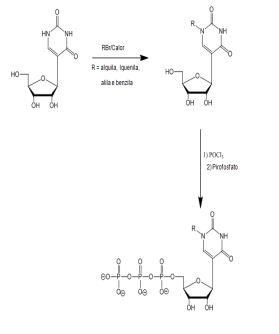
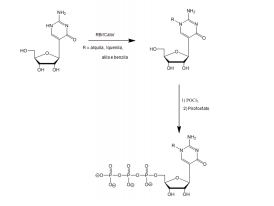
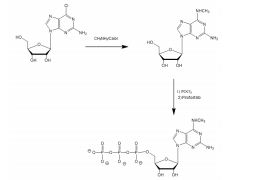
[000254] Os Esquemas 9 e 10 proveem sínteses exemplares de nucleotídeos modificados. O Esquema 11 provê um método biocatalítico não limitante para produção de nucleotídeos. Esquema 9


[000255] O Esquema 12 provê uma síntese exemplar de uma uracila modificada, onde a posição N1 na face da ranhura principal é modificada com R12b, conforme provido em outro ponto, e a posição 5’ de ribose é fosforilada. T1, T2, R12a, R12b e r são conforme aqui provido. Esta síntese, bem como suas versões modificadas, pode ser usada para modificar a face de ranhura principal de outras nucleobases de pirimidina e nucleobases de purina (vide, por exemplo, Fórmulas (b1)-(b43)) e/ou instalar um ou mais grupos fosfato (por exemplo, na posição 5’ do açúcar). Esta reação de alquilação pode ser também usada para incluir um ou mais grupos alquila opcionalmente substituídos em qualquer grupo reativo (por exemplo, grupo amino) em qualquer nucleobase descrita aqui (por exemplo, os grupos amino na face de emparelhamento de base Watson-Crick para citosina, uracila, adenina e guanina). Esquema 12
[000256] Nucleosídeos e nucleotídeos modificados podem ser também preparados de acordo com os métodos sintéticos descritos em Ogata e outros, Journal of Organic Chemistry 74:2585-2588, 2009; Purmal e outros, Nucleic Acids Research 22(1): 72-78, 1994; Fukuhara e outros, Biochemistry 1(4): 563-568, 1962; e Xu e outros, Tetrahedron 48(9): 1729-1740, 1992, cada um aqui incorporado a título de referência em sua totalidade.[000256] Modified nucleotides and nucleotides can also be prepared according to the synthetic methods described in Ogata et al., Journal of Organic Chemistry 74:2585-2588, 2009; Purmal et al., Nucleic Acids Research 22(1):72-78, 1994; Fukuhara et al., Biochemistry 1(4): 563-568, 1962; and Xu et al., Tetrahedron 48(9): 1729-1740, 1992, each incorporated herein by reference in its entirety.
[000257] A presente invenção provê ácidos nucleicos (ou polinucleotídeos), incluindo RNAs tais como mRNAs que contêm um ou mais nucleosídeos modificados (chamados "ácidos nucleicos modificados") ou nucleotídeos conforme aqui descrito, que têm propriedades úteis incluindo a falta de uma indução substancial da resposta imune inata de uma célula na qual no mRNA é introduzido. Devido ao fato desses ácidos nucleicos modificados terem aumentado a eficiência de produção de proteína, retenção intracelular de ácidos nucleicos e viabilidade de células contatadas, bem como possuírem imunogenicidade reduzida, esses ácidos nucleicos tendo essas propriedades também são chamados aqui "ácidos nucleicos melhorados".[000257] The present invention provides nucleic acids (or polynucleotides), including RNAs such as mRNAs which contain one or more modified nucleosides (called "modified nucleic acids") or nucleotides as described herein, which have useful properties including the lack of an induction substantial part of the innate immune response of a cell into which mRNA is introduced. Because these modified nucleic acids have increased efficiency of protein production, intracellular nucleic acid retention and contacted cell viability, as well as having reduced immunogenicity, those nucleic acids having these properties are also referred to herein as "enhanced nucleic acids".
[000258] Ainda, a presente invenção provê ácidos nucleicos, que têm afinidade de ligação menor com uma contraparte de interação da ranhura principal, por exemplo, ligação. Por exemplo, os ácidos nucleicos são compreendidos de pelo menos um nucleotídeo que foi quimicamente modificado na face da ranhura principal conforme descrito aqui.[000258] Furthermore, the present invention provides nucleic acids, which have lower binding affinity with an interacting counterpart of the main groove, e.g., binding. For example, nucleic acids are comprised of at least one nucleotide that has been chemically modified on the face of the major groove as described herein.
[000259] O termo "ácido nucleico", em seu sentido mais amplo, inclui qualquer composto e/ou substância que é ou pode ser incorporado a uma cadeia de oligonucleotídeo. Neste contexto, o termo ácido nucleico é usado sinonimamente com polinucleotídeo. Ácidos nucleicos exemplares para uso de acordo com a presente invenção incluem, mas não estão limitados a, um ou mais de DNA, RNA incluindo RNA mensageiro (mRNA), seus híbridos, agentes de indução de RNAi, agentes de RNAi, siRNAs, shRNAs, miRNAs, RNAs antissentido, ribozimas, DNA catalítico, RNAs que induzem formação de hélice tripla, aptâmeros, vetores, etc, descritos em detalhes aqui.[000259] The term "nucleic acid", in its broadest sense, includes any compound and/or substance that is or can be incorporated into an oligonucleotide chain. In this context, the term nucleic acid is used synonymously with polynucleotide. Exemplary nucleic acids for use in accordance with the present invention include, but are not limited to, one or more of DNA, RNA including messenger RNA (mRNA), hybrids thereof, RNAi inducing agents, RNAi agents, siRNAs, shRNAs, miRNAs, antisense RNAs, ribozymes, catalytic DNA, RNAs that induce triple helix formation, aptamers, vectors, etc., described in detail here.
[000260] São providos aqui ácidos nucleicos modificados contendo uma região traduzível e uma, duas ou mais de duas modificações de nucleosídeo diferentes. Em algumas modalidades, o ácido nucleico modificado exibe degradação reduzida em uma célula na qual o ácido nucleico é introduzido, com relação a um ácido nucleico não modificado correspondente. Ácidos nucleicos exemplares incluem ácidos ribonucleicos (RNAs), ácidos desoxirribonucleicos (DNAs), ácidos nucleicos de treose (TNAs), ácidos nucleicos de glicol (GNAs) ou um híbrido do mesmo. Em modalidades preferidas, o ácido nucleico modificado inclui RNAs mensageiros (mRNAs). Conforme aqui descrito, os ácidos nucleicos da presente invenção não induzem substancialmente uma resposta imune inata de uma célula na qual o mRNA é introduzido.Provided herein are modified nucleic acids containing a translatable region and one, two or more than two different nucleoside modifications. In some embodiments, the modified nucleic acid exhibits reduced degradation in a cell into which the nucleic acid is introduced, relative to a corresponding unmodified nucleic acid. Exemplary nucleic acids include ribonucleic acids (RNAs), deoxyribonucleic acids (DNAs), threose nucleic acids (TNAs), glycol nucleic acids (GNAs) or a hybrid thereof. In preferred embodiments, the modified nucleic acid includes messenger RNAs (mRNAs). As described herein, the nucleic acids of the present invention do not substantially induce an innate immune response from a cell into which the mRNA is introduced.
[000261] Em certas modalidades, é desejável degradar intracelularmente um ácido nucleico modificado introduzido na célula, por exemplo, se cronometragem precisa de produção de proteína for desejada. Desta maneira, a presente invenção provê um ácido nucleico modificado contendo um domínio de degradação, que é capaz de ser atuado de uma maneira direta dentro de uma célula.In certain embodiments, it is desirable to intracellularly degrade a modified nucleic acid introduced into the cell, for example, if accurate timing of protein production is desired. In this way, the present invention provides a modified nucleic acid containing a degradation domain, which is capable of being directly acted upon within a cell.
[000262] Outros componentes de ácido nucleico são opcionais e benéficos em algumas modalidades. Por exemplo, uma região não traduzida 5’ (UTR) (Untraslated Region) e/ou uma UTR 3’ são providas, onde uma ou ambas podem conter independentemente uma ou mais modificações de nucleosídeo diferentes. Em tais modalidades, modificações de nucleosídeo podem também estar presentes na região traduzível. São também providos aqui ácidos nucleicos contendo uma sequência Kozak.[000262] Other nucleic acid components are optional and beneficial in some embodiments. For example, a 5' untranslated region (UTR) (Untraslated Region) and/or a 3' UTR are provided, where one or both may independently contain one or more different nucleoside modifications. In such embodiments, nucleoside modifications can also be present in the translatable region. Nucleic acids containing a Kozak sequence are also provided herein.
[000263] Ainda, são providos aqui ácidos nucleicos contendo uma ou mais sequências de nucleotídeo intrônicas capazes de ser excisadas do ácido nucleico.[000263] In addition, provided herein are nucleic acids containing one or more intronic nucleotide sequences capable of being excised from the nucleic acid.
[000264] Ainda, são providos aqui ácidos nucleicos contendo um sítio interno de entrada do ribossomo (IRES) (Internal Ribosome Entry Site). Um IRES pode agir como o único sítio de ligação de ribossomo ou pode servir como um de múltiplos sítios de ligação de ribossomo de um mRNA. Um mRNA contendo mais de um sítio de ligação de ribossomo funcional pode codificar vários peptídeos ou polipeptídeos que são traduzidos independentemente pelos ribossomos ("mRNA multicistrônico"). Quando ácidos nucleicos são providos com IRES, opcionalmente adicionalmente provida é uma segunda região traduzível. Exemplos de sequências de IRES que podem ser usadas de acordo com a presente invenção incluem, sem limitação, aquelas de picornavírus (por exemplo, FMDV), vírus da peste (CFFV), vírus da pólio (PV), vírus da encefalomiocardite (ECMV), vírus da doença pé-e-boca (FMDV), vírus da hepatite C (HCV), vírus da febre suína clássica (CSFV), vírus da leucemia do murino (MLV), vírus da imunodeficiência simiana (SIV) ou vírus da paralisia cricket (CrPV).[000264] In addition, nucleic acids containing an internal ribosome entry site (IRES) are provided here. An IRES can act as the single ribosome binding site or it can serve as one of multiple ribosome binding sites of an mRNA. An mRNA containing more than one functional ribosome binding site can encode multiple peptides or polypeptides that are independently translated by the ribosomes ("multicistronic mRNA"). When nucleic acids are provided with IRES, optionally additionally provided is a second translatable region. Examples of IRES sequences that can be used in accordance with the present invention include, without limitation, those from picornaviruses (e.g., FMDV), plague virus (CFFV), polio virus (PV), encephalomyocarditis virus (ECMV) , foot-and-mouth disease virus (FMDV), hepatitis C virus (HCV), classical swine fever virus (CSFV), murine leukemia virus (MLV), simian immunodeficiency virus (SIV) or paralysis virus cricket (CrPV).
[000265] Em outro aspecto, a presente invenção provê sequências de ácido nucleico compreendendo pelo menos dois nucleotídeos, a sequência de ácido nucleico compreendendo um nucleotídeo que rompe a ligação de uma contraparte de ligação da ranhura principal com a sequência de ácido nucleico, onde o nucleotídeo tem afinidade de ligação menor com a contraparte de ligação da ranhura principal.[000265] In another aspect, the present invention provides nucleic acid sequences comprising at least two nucleotides, the nucleic acid sequence comprising a nucleotide which breaks the binding of a main groove binding counterpart with the nucleic acid sequence, where the nucleotide has lower binding affinity to the main slot binding counterpart.
[000266] Em algumas modalidades, o ácido nucleico é um composto de Fórmula XI-a:

[000267] Em algumas modalidades, B é uma nucleobase de Fórmula XII-a, XII-b ou XII-c:

[000268] Em algumas modalidades, B é uma nucleobase de Fórmula XII-a1, XII-a2, XII-a3, XII-a4 ou XII-a5:
[000269] Em algumas modalidades, a nucleobase é uma pirimidina ou derivado da mesma.[000269] In some embodiments, the nucleobase is a pyrimidine or derivative thereof.
[000270] Em algumas modalidades, o ácido nucleico contém uma pluralidade de compostos estruturalmente únicos de Fórmula XI-a.[000270] In some embodiments, the nucleic acid contains a plurality of structurally unique compounds of Formula XI-a.
[000271] Em algumas modalidades, pelo menos 25% das citosinas são substituídas por um composto de Fórmula XI-a (por exemplo, pelo menos cerca de 30%, pelo menos cerca de 35%, pelo menos cerca de 40%, pelo menos cerca de 45%, pelo menos cerca de 50%, pelo menos cerca de 55%, pelo menos cerca de 60%, pelo menos cerca de 65%, pelo menos cerca de 70%, pelo menos cerca de 75%, pelo menos cerca de 80%, pelo menos cerca de 85%, pelo menos cerca de 90%, pelo menos cerca de 95% ou cerca de 100%).[000271] In some embodiments, at least 25% of the cytosines are replaced by a compound of Formula XI-a (eg, at least about 30%, at least about 35%, at least about 40%, at least about 45%, at least about 50%, at least about 55%, at least about 60%, at least about 65%, at least about 70%, at least about 75%, at least about 80%, at least about 85%, at least about 90%, at least about 95% or about 100%).
[000272] Em algumas modalidades, pelo menos 25% das uracilas são substituídos por um composto de Fórmula XI-a (por exemplo, pelo menos cerca de 30%, pelo menos cerca de 35%, pelo menos cerca de 40%, pelo menos cerca de 45%, pelo menos cerca de 50%, pelo menos cerca de 55%, pelo menos cerca de 60%, pelo menos cerca de 65%, pelo menos cerca de 70%, pelo menos cerca de 75%, pelo menos cerca de 80%, pelo menos cerca de 85%, pelo menos cerca de 90%, pelo menos cerca de 95% ou cerca de 100%).[000272] In some embodiments, at least 25% of the uracils are replaced by a compound of Formula XI-a (eg, at least about 30%, at least about 35%, at least about 40%, at least about 45%, at least about 50%, at least about 55%, at least about 60%, at least about 65%, at least about 70%, at least about 75%, at least about 80%, at least about 85%, at least about 90%, at least about 95% or about 100%).
[000273] Em algumas modalidades, pelo menos 25% das citosinas e 25% das uracilas são substituídos por um composto de Fórmula XI-a (por exemplo, pelo menos cerca de 30%, pelo menos cerca de 35%, pelo menos cerca de 40%, pelo menos cerca de 45%, pelo menos cerca de 50%, pelo menos cerca de 55%, pelo menos cerca de 60%, pelo menos cerca de 65%, pelo menos cerca de 70%, pelo menos cerca de 75%, pelo menos cerca de 80%, pelo menos cerca de 85%, pelo menos cerca de 90%, pelo menos cerca de 95% ou cerca de 100%).[000273] In some embodiments, at least 25% of the cytosines and 25% of the uracils are replaced by a compound of Formula XI-a (eg, at least about 30%, at least about 35%, at least about 40%, at least about 45%, at least about 50%, at least about 55%, at least about 60%, at least about 65%, at least about 70%, at least about 75 %, at least about 80%, at least about 85%, at least about 90%, at least about 95% or about 100%).
[000274] Em algumas modalidades, o ácido nucleico é traduzível.[000274] In some embodiments, the nucleic acid is translatable.
[000275] Em algumas modalidades, quando o ácido nucleico inclui um nucleotídeo modificado com um ligante e carga útil, por exemplo, conforme aqui descrito, o nucleotídeo modificado com um ligante e carga útil está na extremidade 3’ do ácido nucleico.[000275] In some embodiments, when the nucleic acid includes a nucleotide modified with a linker and payload, for example, as described herein, the nucleotide modified with a linker and payload is at the 3' end of the nucleic acid.
[000276] Conforme aqui descrito, a expressão "contraparte de interação da ranhura principal" se refere a receptores de reconhecimento de RNA que detectam e respondem a ligantes de RNA através de interações, por exemplo, ligação, com a face da ranhura principal de um nucleotídeo ou ácido nucleico. Desta maneira, ligantes de RNA compreendendo nucleotídeos ou ácidos nucleicos modificados conforme aqui descrito diminuem as interações com contrapartes de ligação da ranhura principal, e então diminuem uma resposta inata, ou expressão e secreção de citocinas pró-inflamatórias, ou ambas.[000276] As described herein, the term "major groove interacting counterparty" refers to RNA recognition receptors that detect and respond to RNA ligands through interactions, eg binding, with the face of the main groove of a nucleotide or nucleic acid. In this way, RNA binders comprising nucleotides or nucleic acids modified as described herein decrease interactions with major spline binding counterparts, and then decrease an innate response, or expression and secretion of proinflammatory cytokines, or both.
[000277] Exemplos de contrapartes de interação de ranhura principal, por exemplo, ligação, incluem, mas não estão limitados a, nucleases e helicases. Dentro das membranas, TLRs (Receptores tipo Toll) (Toll- like-Receptors) 3, 7 e 8 podem responder a RNAs de fita simples e dupla. Dentro do citoplasma, membros da superfamília classe 2 de DEX(D/H) helicases e ATPases podem sentir RNAs para iniciar respostas antivirais. Essas helicases incluem o RIG-I (Gene-I Induzível por Ácido Retinoico) (Retinoic Acid-Inducible Gene I) e MDA5 (gene 5 associado à diferenciação de melanoma) (Melanoma Differentiation- Associated Gene 5). Outros exemplos incluem laboratório de genética e fisiologia 2 (LGP2) (Laboratory of Genetics and Physiology 2), proteínas contendo domínio HIN-200 ou proteínas contendo domínio Helicase.[000277] Examples of major slot interaction counterparts, eg binding, include, but are not limited to, nucleases and helicases. Within membranes, TLRs (Toll-like-Receptors) 3, 7, and 8 can respond to single-stranded and double-stranded RNAs. Within the cytoplasm, members of the
[000278] O termo "resposta imune inata" inclui uma resposta celular a ácidos nucleicos de fita simples exógenos, geralmente de origem viral ou bacteriana, que envolve a indução de expressão e liberação de citocina, particularmente o interferon, e morte celular. Síntese de proteína é também reduzida durante a resposta imune celular inata. Embora seja vantajoso eliminar a resposta imune inata em uma célula que é disparada pela introdução de ácidos nucleicos exógenos, a presente invenção provê ácidos nucleicos modificados tais como mRNAs que reduzem substancialmente a resposta imune, incluindo sinalização de interferon, sem eliminar totalmente tal resposta. Em algumas modalidades, a resposta imune é reduzida em 10%, 20%, 30%, 40%, 50%, 60%, 70%, 80%, 90%, 95%, 99%, 99,9% ou mais do que 99,9% comparado com a resposta imune induzida por um ácido nucleico não modificado correspondente. Tal redução pode ser medida através do nível de expressão ou atividade de interferons Tipo 1 ou a expressão de genes regulados por interferon tais como receptores tipo toll (por exemplo, TLR7 e TLR8). Redução ou falta de indução de resposta imune inata pode ser também medida através da diminuição de morte celular seguindo uma ou mais administrações de RNAs modificados a uma população de célula, por exemplo, a morte celular é 10%, 25%, 50%, 75%, 85%, 90%, 95% ou mais de 95% menor do que a frequência de morte celular observada com um ácido nucleico não modificado correspondente. Além disso, morte celular pode afetar menos de 50%, 40%, 30%, 20%, 10%, 5%, 1%, 0,1%, 0,01% ou menos de 0,01% de células contatadas com os ácidos nucleicos modificados.[000278] The term "innate immune response" includes a cellular response to exogenous single-stranded nucleic acids, usually of viral or bacterial origin, which involves the induction of expression and release of cytokines, particularly interferon, and cell death. Protein synthesis is also reduced during the innate cellular immune response. While it is advantageous to eliminate the innate immune response in a cell that is triggered by the introduction of exogenous nucleic acids, the present invention provides modified nucleic acids such as mRNAs that substantially reduce the immune response, including interferon signaling, without totally eliminating such a response. In some modalities, the immune response is reduced by 10%, 20%, 30%, 40%, 50%, 60%, 70%, 80%, 90%, 95%, 99%, 99.9% or more of the that 99.9% compared to the immune response induced by a corresponding unmodified nucleic acid. Such a reduction can be measured by the level of expression or activity of
[000279] Em algumas modalidades, os ácidos nucleicos modificados, incluindo polinucleotídeos e/ou moléculas de RNA, são modificados de maneira a não induzir, ou induzir apenas minimamente, uma resposta imune pela célula ou organismo recipiente. Tal evasão ou prevenção de disparo ou ativação de resposta imune é uma característica nova dos polinucleotídeos modificados da presente invenção.[000279] In some embodiments, the modified nucleic acids, including polynucleotides and/or RNA molecules, are modified so as not to induce, or only minimally induce, an immune response by the recipient cell or organism. Such evasion or prevention of triggering or activating an immune response is a novel feature of the modified polynucleotides of the present invention.
[000280] A presente invenção provê a introdução repetida (por exemplo, transfecção) de ácidos nucleicos modificados em uma população de célula-alvo, por exemplo, in vitro, ex vivo ou in vivo. A etapa de contato da população celular pode ser repetida uma ou mais vezes (tal como duas, três, quatro, cinco ou mais de cinco vezes). Em algumas modalidades, a etapa de contato da população celular com os ácidos nucleicos modificados é repetida várias vezes o suficiente de maneira que uma eficiência predeterminada de tradução de proteína na população celular é obtida. Dada a citotoxicidade reduzida da população de célula-alvo provida pelas modificações de ácido nucleico, tais transfecções repetidas são obtidas em uma disposição diversa de tipos de célula in vitro e/ou in vivo.[000280] The present invention provides for the repeated introduction (eg transfection) of modified nucleic acids into a target cell population, for example, in vitro, ex vivo or in vivo. The cell population contact step can be repeated one or more times (such as two, three, four, five, or more than five times). In some embodiments, the step of contacting the cell population with the modified nucleic acids is repeated several times enough so that a predetermined protein translation efficiency in the cell population is obtained. Given the reduced cytotoxicity of the target cell population provided by the nucleic acid modifications, such repeat transfections are obtained in a diverse array of cell types in vitro and/or in vivo.
[000281] São providos ácidos nucleicos que codificam polipeptídeos variantes, que têm uma certa identidade com uma sequência de polipeptídeo de referência. O termo "identidade" como conhecido na técnica se refere a uma relação entre as sequências de dois ou mais peptídeos, conforme determinado comparando as sequências. Na técnica, "identidade" também significa o grau de relação de sequência entre os peptídeos, conforme determinado pelo número de compatibilidades entre as fitas de dois ou mais resíduos de aminoácido. "Identidade" mede a porcentagem de compatibilidades idênticas entre a menor de duas ou mais sequências com alinhamentos de lacuna (se algum) endereçados por um modelo matemático ou programa de computador particular (isto é, "algoritmos"). Identidade de peptídeos relacionados pode ser prontamente calculada através de métodos conhecidos. Tais métodos incluem, mas não estão limitados a, aqueles descritos em Computational Molecular Biology, Lesk, A. M., ed., Oxford University Press, New York, 1988; Biocomputing: Informatics e Genome Projects, Smith, D. W., ed., Academic Press, New York, 1993; Computer Analysis of Sequence Data, Part 1, Griffin, A. M., e Griffin, H. G., eds., Humana Press, New Jersey, 1994; Sequence Analysis in Molecular Biology, von Heinje, G., Academic Press, 1987; Sequence Analysis Iniciador , Gribskov, M. e Devereux, J., eds., M. Stockton Press, New York, 1991; e Carillo e outros, SIAM J. Applied Math. 48, 1073 (1988).Nucleic acids encoding variant polypeptides, which have a certain identity with a reference polypeptide sequence, are provided. The term "identity" as known in the art refers to a relationship between the sequences of two or more peptides, as determined by comparing the sequences. In the art, "identity" also means the degree of sequence relatedness between the peptides, as determined by the number of matches between the strands of two or more amino acid residues. "Identity" measures the percentage of identical matches between the smallest of two or more sequences with gap alignments (if any) addressed by a particular mathematical model or computer program (ie, "algorithms"). Identity of related peptides can be readily calculated using known methods. Such methods include, but are not limited to, those described in Computational Molecular Biology, Lesk, A.M., ed., Oxford University Press, New York, 1988; Biocomputing: Informatics and Genome Projects, Smith, D.W., ed., Academic Press, New York, 1993; Computer Analysis of Sequence Data,
[000282] Em algumas modalidades, a variante de polipeptídeo tem a mesma atividade ou atividade similar ao peptídeo de referência. Alternativamente, a variante tem uma atividade alterada (por exemplo, aumentada ou diminuída) com relação a um polipeptídeo de referência. Em geral, variantes de um polinucleotídeo ou polipeptídeo particular da presente invenção terão pelo menos cerca de 40%, 45%, 50%, 55%, 60%, 65%, 70%, 75%, 80%, 85%, 90%, 91%, 92%, 93%, 94%, 95%, 96%, 97%, 98%, 99% ou mais de identidade de sequência com o polinucleotídeo ou polipeptídeo de referência particular conforme determinado pelos programas e parâmetros de alinhamento de sequência descritos aqui e conhecidos daqueles versados na técnica.[000282] In some embodiments, the polypeptide variant has the same or similar activity as the reference peptide. Alternatively, the variant has an altered activity (eg, increased or decreased) relative to a reference polypeptide. In general, variants of a particular polynucleotide or polypeptide of the present invention will have at least about 40%, 45%, 50%, 55%, 60%, 65%, 70%, 75%, 80%, 85%, 90% , 91%, 92%, 93%, 94%, 95%, 96%, 97%, 98%, 99% or more sequence identity to the particular reference polynucleotide or polypeptide as determined by the alignment programs and parameters of sequence described herein and known to those skilled in the art.
[000283] Conforme reconhecido por aqueles versados na técnica, fragmentos de proteína, domínios de proteína funcionais e proteínas homólogas são também considerados estar dentro do escopo da presente invenção. Por exemplo, é provido aqui um fragmento de proteína de uma proteína de referência (significando uma sequência de polipeptídeo pelo menos um resíduo de aminoácido menor do que uma sequência de polipeptídeo de referência, mas de outra maneira idêntica) 10, 20, 30, 40, 50, 60, 70, 80, 90, 100 ou maior do que 100 aminoácidos de comprimento. Em outro exemplo, qualquer proteína que inclua uma extensão de cerca de 20, cerca de 30, cerca de 40, cerca de 50 ou cerca de 100 aminoácidos que são cerca de 40%, cerca de 50%, cerca de 60%, cerca de 70%, cerca de 80%, cerca de 90%, cerca de 95% ou cerca de 100% idênticos a qualquer uma das sequências descritas aqui pode ser utilizada de acordo com a presente invenção. Em certas modalidades, uma sequência de proteína a ser utilizada de acordo com a presente invenção inclui 2, 3, 4, 5, 6, 7, 8, 9, 10 ou mais mutações conforme mostrado em qualquer uma das sequências providas ou referidas aqui.[000283] As recognized by those of skill in the art, protein fragments, functional protein domains and homologous proteins are also considered to be within the scope of the present invention. For example, provided herein is a protein fragment of a reference protein (meaning a polypeptide sequence at least one amino acid residue shorter than a reference polypeptide sequence, but otherwise identical) 10, 20, 30, 40 , 50, 60, 70, 80, 90, 100 or greater than 100 amino acids in length. In another example, any protein that includes a span of about 20, about 30, about 40, about 50, or about 100 amino acids that is about 40%, about 50%, about 60%, about 70%, about 80%, about 90%, about 95%, or about 100% identical to any of the sequences described herein can be used in accordance with the present invention. In certain embodiments, a protein sequence to be used in accordance with the present invention includes 2, 3, 4, 5, 6, 7, 8, 9, 10 or more mutations as shown in any of the sequences provided or referred to herein.
[000284] São também providas bibliotecas de polinucleotídeo contendo modificações de nucleosídeo, onde os polinucleotídeos contêm individualmente uma primeira sequência de ácido nucleico codificando um polipeptídeo, tal como um anticorpo, contraparte de ligação de proteína, proteína de base e outros polipeptídeos conhecidos na técnica. Preferivelmente, os polinucleotídeos são mRNA em uma forma adequada para introdução direta em um hospedeiro de célula- alvo, que por sua vez sintetiza o polipeptídeo codificado.[000284] Polynucleotide libraries containing nucleoside modifications are also provided, where the polynucleotides individually contain a first nucleic acid sequence encoding a polypeptide, such as an antibody, protein binding counterpart, protein base and other polypeptides known in the art. Preferably, the polynucleotides are mRNA in a form suitable for direct introduction into a target cell host, which in turn synthesizes the encoded polypeptide.
[000285] Em certas modalidades, variantes múltiplas de uma proteína, cada uma com modificação(ões) de aminoácido diferente, são produzidas e testadas para determinar a melhor variante em termos de farmacocinética, estabilidade, biocompatibilidade e/ou atividade biológica, ou uma propriedade biofísica tal como nível de expressão. Tal biblioteca pode conter 10, 102, 103, 104, 105, 106, 107, 108, 109 ou mais de 109 variantes possíveis (incluindo substituições, deleções de um ou mais resíduos e inserção de um ou mais resíduos).[000285] In certain embodiments, multiple variants of a protein, each with different amino acid modification(s), are produced and tested to determine the best variant in terms of pharmacokinetics, stability, biocompatibility and/or biological activity, or a property biophysics such as level of expression. Such a library may contain 10, 102, 103, 104, 105, 106, 107, 108, 109 or more than 109 possible variants (including substitutions, deletions of one or more residues and insertion of one or more residues).
[000286] Tradução de proteína apropriada envolve a agregação física de vários polipeptídeos e ácidos nucleicos associados com o mRNA. São providos pela presente invenção complexos de proteína-ácido nucleico contendo um mRNA traduzível tendo uma ou mais modificações de nucleosídeo (por exemplo, pelo menos duas modificações de nucleosídeo diferentes) e um ou mais polipeptídeos ligados ao mRNA. Em geral, as proteínas são providas em uma quantidade eficaz para prevenir ou reduzir uma resposta imune inata de uma célula na qual o complexo é introduzido.[000286] Proper protein translation involves the physical aggregation of various polypeptides and nucleic acids associated with the mRNA. Provided by the present invention are protein-nucleic acid complexes containing a translatable mRNA having one or more nucleoside modifications (for example, at least two different nucleoside modifications) and one or more polypeptides linked to the mRNA. In general, the proteins are provided in an amount effective to prevent or reduce an innate immune response from a cell into which the complex is introduced.
[000287] Conforme aqui descrito, são providos mRNAs tendo sequências que são substancialmente não traduzíveis. Tal mRNA é eficaz como uma vacina quando administrado a um indivíduo mamífero.[000287] As described herein, mRNAs having sequences that are substantially untranslatable are provided. Such mRNA is effective as a vaccine when administered to a mammalian subject.
[000288] São também providos ácidos nucleicos modificados que contêm uma ou mais regiões de não codificação. Tais ácidos nucleicos modificados são geralmente não traduzidos, mas são capazes de ligação a e sequestro de um ou mais componente de maquinário traducional tal como uma proteína ribossomal ou um RNA de transferência (tRNA), desta maneira eficazmente reduzindo expressão de proteína na célula. O ácido nucleico modificado pode conter um RNA nucleolar pequena (sno-RNA), micro RNA (miRNA), RNA de interferência pequeno (siRNA) ou RNA de interação Piwi (piRNA).[000288] Modified nucleic acids that contain one or more non-coding regions are also provided. Such modified nucleic acids are generally untranslated, but are capable of binding to and sequestering one or more components of translational machinery such as a ribosomal protein or a transfer RNA (tRNA), thereby effectively reducing protein expression in the cell. The modified nucleic acid can contain a small nucleolar RNA (sno-RNA), micro RNA (miRNA), small interfering RNA (siRNA) or Piwi interacting RNA (piRNA).
[000289] Ácidos nucleicos para uso de acordo com a presente invenção podem ser preparados de acordo com qualquer técnica disponível incluindo, mas não limitado a, síntese química, síntese enzimática, que é geralmente chamada transcrição in vitro, clivagem enzimática ou química de um precursor mais longo, etc. Métodos de síntese de RNAs são conhecidos na técnica (vide, por exemplo, Gait, M.J. (ed.) Oligonucleotide synthesis: a practical approach, Oxford [Oxfordshire], Washington, DC: IRL Press, 1984; e Herdewijn, P. (ed.) Oligonucleotide synthesis: methods and applications, Methods in Molecular Biology, v. 288 (Clifton, N.J.) Totowa, N.J.: Humana Press, 2005; ambos aqui incorporados a título de referência).[000289] Nucleic acids for use in accordance with the present invention may be prepared according to any available technique including, but not limited to, chemical synthesis, enzymatic synthesis, which is generally called in vitro transcription, enzymatic or chemical cleavage of a precursor longer, etc. Methods of synthesizing RNAs are known in the art (see, for example, Gait, MJ (ed.) Oligonucleotide synthesis: a practical approach, Oxford [Oxfordshire], Washington, DC: IRL Press, 1984; and Herdewijn, P. (ed. .) Oligonucleotide synthesis: methods and applications, Methods in Molecular Biology, v. 288 (Clifton, NJ) Totowa, NJ: Humana Press, 2005; both incorporated herein by reference).
[000290] Ácidos nucleicos modificados não precisam ser uniformemente modificados ao longo de todo o comprimento da molécula. Modificações de nucleotídeo e/ou estruturas de estrutura principal diferentes podem existir em várias posições no ácido nucleico. Um versado comum na técnica compreenderá que os análogos de nucleotídeo ou outra modificação(ões) podem estar localizados em qualquer posição(ões) de um ácido nucleico de maneira que a função do ácido nucleico não seja substancialmente diminuída. Uma modificação pode ser também uma modificação 5’ ou 3’ terminal. Os ácidos nucleicos podem conter no mínimo um e no máximo 100% de nucleotídeos modificados, ou qualquer porcentagem entre elas, tal como pelo menos 5% de nucleotídeos modificados, pelo menos 10% de nucleotídeos modificados, pelo menos 25% de nucleotídeos modificados, pelo menos 50% de nucleotídeos modificados, pelo menos 80% de nucleotídeos modificados ou pelo menos 90% de nucleotídeos modificados. Por exemplo, os ácidos nucleicos podem conter uma pirimidina modificada tal como uracila ou citosina. Em algumas modalidades, pelo menos 5%, pelo menos 10%, pelo menos 25%, pelo menos 50%, pelo menos 80%, pelo menos 90% ou 100% da uracila no ácido nucleico são substituídos com uma uracila modificada. A uracila modificada pode ser substituída por um composto tendo uma estrutura única simples ou pode ser substituída por uma pluralidade de compostos tendo estruturas diferentes (por exemplo, 2, 3, 4 ou mais estruturas únicas). Em algumas modalidades, pelo menos 5%, pelo menos 10%, pelo menos 25%, pelo menos 50%, pelo menos 80%, pelo menos 90% ou 100% da citosina no ácido nucleico são substituídos com uma citosina modificada. A citosina modificada pode ser substituída por um composto tendo uma estrutura única simples ou pode ser substituída por uma pluralidade de compostos tendo estruturas diferentes (por exemplo, 2, 3, 4 ou mais estruturas únicas).[000290] Modified nucleic acids need not be uniformly modified along the entire length of the molecule. Different nucleotide modifications and/or backbone structures can exist at various positions in the nucleic acid. One of ordinary skill in the art will understand that nucleotide analogs or other modification(s) can be located at any position(s) in a nucleic acid such that the function of the nucleic acid is not substantially diminished. A modification can also be a 5’ or 3 terminal modification. Nucleic acids can contain at least one and at most 100% modified nucleotides, or any percentage in between, such as at least 5% modified nucleotides, at least 10% modified nucleotides, at least 25% modified nucleotides, at at least 50% modified nucleotides, at least 80% modified nucleotides, or at least 90% modified nucleotides. For example, nucleic acids can contain a modified pyrimidine such as uracil or cytosine. In some embodiments, at least 5%, at least 10%, at least 25%, at least 50%, at least 80%, at least 90% or 100% of the uracil in the nucleic acid is replaced with a modified uracil. Modified uracil can be replaced by a compound having a simple single structure or it can be replaced by a plurality of compounds having different structures (for example 2, 3, 4 or more unique structures). In some embodiments, at least 5%, at least 10%, at least 25%, at least 50%, at least 80%, at least 90% or 100% of the cytosine in the nucleic acid is replaced with a modified cytosine. The modified cytosine can be replaced with a compound having a simple, single structure, or it can be replaced with a plurality of compounds having different structures (e.g., 2, 3, 4 or more unique structures).
[000291] Em geral, o comprimento mais curto do mRNA modificado da presente invenção pode ser o comprimento de uma sequência de um mRNA que é suficiente para codificar um dipeptídeo. Em outra modalidade, o comprimento da sequência de um mRNA é suficiente para codificar um tripeptídeo. Em outra modalidade, o comprimento da sequência de um mRNA é suficiente para codificar um tetrapeptídeo. Em outra modalidade, o comprimento da sequência de um mRNA é suficiente para codificar um pentapeptídeo. Em outra modalidade, o comprimento da sequência de um mRNA é suficiente para codificar um hexapeptídeo. Em outra modalidade, o comprimento da sequência de um mRNA é suficiente para codificar um heptapeptídeo. Em outra modalidade, o comprimento da sequência de um mRNA é suficiente para codificar um octapeptídeo. Em outra modalidade, o comprimento da sequência de um mRNA é suficiente para codificar um nonapeptídeo. Em outra modalidade, o comprimento da sequência de um mRNA é suficiente para codificar um decapeptídeo.[000291] In general, the shortest length of the modified mRNA of the present invention may be the length of a sequence of an mRNA that is sufficient to encode a dipeptide. In another embodiment, the sequence length of an mRNA is sufficient to encode a tripeptide. In another embodiment, the sequence length of an mRNA is sufficient to encode a tetrapeptide. In another embodiment, the sequence length of an mRNA is sufficient to encode a pentapeptide. In another embodiment, the sequence length of an mRNA is sufficient to encode a hexapeptide. In another embodiment, the sequence length of an mRNA is sufficient to encode a heptapeptide. In another embodiment, the sequence length of an mRNA is sufficient to encode an octapeptide. In another embodiment, the sequence length of an mRNA is sufficient to encode a nonapeptide. In another embodiment, the sequence length of an mRNA is sufficient to encode a decapeptide.
[000292] Exemplos de dipeptídeos que as sequências de ácido nucleico modificadas podem codificar incluem, mas não estão limitados a, carnosina e anserina.[000292] Examples of dipeptides that the modified nucleic acid sequences can encode include, but are not limited to, carnosine and anserine.
[000293] Em uma modalidade adicional, o mRNA é maior do que 30 nucleotídeos de comprimento. Em outra modalidade, a molécula de mRNA é maior do que 35 nucleotídeos de comprimento. Em outra modalidade, o comprimento é pelo menos de 40 nucleotídeos. Em outra modalidade, o comprimento é pelo menos 45 nucleotídeos. Em outra modalidade, o comprimento é pelo menos 55 nucleotídeos. Em outra modalidade, o comprimento é pelo menos de 60 nucleotídeos. Em outra modalidade, o comprimento é pelo menos 60 nucleotídeos. Em outramodalidade, o comprimento é pelo menos 80 nucleotídeos. Em outramodalidade, o comprimento é pelo menos 90 nucleotídeos. Em outramodalidade, o comprimento é pelo menos 100 nucleotídeos. Em outramodalidade, o comprimento é pelo menos 120 nucleotídeos. Em outramodalidade, o comprimento é pelo menos 140 nucleotídeos. Em outramodalidade, o comprimento é pelo menos 160 nucleotídeos. Em outramodalidade, o comprimento é pelo menos 180 nucleotídeos. Em outramodalidade, o comprimento é pelo menos 200 nucleotídeos. Em outramodalidade, o comprimento é pelo menos 250 nucleotídeos. Em outramodalidade, o comprimento é pelo menos 300 nucleotídeos. Em outra modalidade, o comprimento é pelo menos 350 nucleotídeos. Em outramodalidade, o comprimento é pelo menos 400 nucleotídeos. Em outramodalidade, o comprimento é pelo menos 450 nucleotídeos. Em outramodalidade, o comprimento é pelo menos 500 nucleotídeos. Em outramodalidade, o comprimento é pelo menos 600 nucleotídeos. Em outramodalidade, o comprimento é pelo menos 700 nucleotídeos. Em outramodalidade, o comprimento é pelo menos 800 nucleotídeos. Em outramodalidade, o comprimento é pelo menos 900 nucleotídeos. Em outramodalidade, o comprimento é pelo menos 1000 nucleotídeos. Em outramodalidade, o comprimento é pelo menos 1100 nucleotídeos. Em outramodalidade, o comprimento é pelo menos 1200 nucleotídeos. Em outramodalidade, o comprimento é pelo menos 1300 nucleotídeos. Em outramodalidade, o comprimento é pelo menos 1400 nucleotídeos. Em outramodalidade, o comprimento é pelo menos 1500 nucleotídeos. Em outramodalidade, o comprimento é pelo menos 1600 nucleotídeos. Em outramodalidade, o comprimento é pelo menos 1800 nucleotídeos. Em outramodalidade, o comprimento é pelo menos 2000 nucleotídeos. Em outramodalidade, o comprimento é pelo menos 2500 nucleotídeos. Em outramodalidade, o comprimento é pelo menos 3000 nucleotídeos. Em outramodalidade, o comprimento é pelo menos 4000 nucleotídeos. Em outramodalidade, o comprimento é pelo menos 5000 nucleotídeos ou mais do que 5000 nucleotídeos.[000293] In an additional embodiment, the mRNA is greater than 30 nucleotides in length. In another embodiment, the mRNA molecule is greater than 35 nucleotides in length. In another embodiment, the length is at least 40 nucleotides. In another embodiment, the length is at least 45 nucleotides. In another embodiment, the length is at least 55 nucleotides. In another embodiment, the length is at least 60 nucleotides. In another embodiment, the length is at least 60 nucleotides. In another embodiment, the length is at least 80 nucleotides. In another embodiment, the length is at least 90 nucleotides. In another embodiment, the length is at least 100 nucleotides. In another embodiment, the length is at least 120 nucleotides. In another embodiment, the length is at least 140 nucleotides. In another embodiment, the length is at least 160 nucleotides. In another embodiment, the length is at least 180 nucleotides. In another embodiment, the length is at least 200 nucleotides. In another embodiment, the length is at least 250 nucleotides. In another embodiment, the length is at least 300 nucleotides. In another embodiment, the length is at least 350 nucleotides. In another embodiment, the length is at least 400 nucleotides. In another embodiment, the length is at least 450 nucleotides. In another embodiment, the length is at least 500 nucleotides. In another embodiment, the length is at least 600 nucleotides. In another embodiment, the length is at least 700 nucleotides. In another embodiment, the length is at least 800 nucleotides. In another embodiment, the length is at least 900 nucleotides. In another embodiment, the length is at least 1000 nucleotides. In another embodiment, the length is at least 1100 nucleotides. In another embodiment, the length is at least 1200 nucleotides. In another embodiment, the length is at least 1300 nucleotides. In another embodiment, the length is at least 1400 nucleotides. In another embodiment, the length is at least 1500 nucleotides. In another embodiment, the length is at least 1600 nucleotides. In another embodiment, the length is at least 1800 nucleotides. In another embodiment, the length is at least 2000 nucleotides. In another embodiment, the length is at least 2500 nucleotides. In another embodiment, the length is at least 3000 nucleotides. In another embodiment, the length is at least 4000 nucleotides. In another embodiment, the length is at least 5000 nucleotides or more than 5000 nucleotides.
[000294] Por exemplo, os ácidos nucleicos modificados descritos aqui podem ser preparados usando métodos que são conhecidos daqueles versados na técnica de síntese de ácido nucleico.[000294] For example, the modified nucleic acids described herein can be prepared using methods that are known to those skilled in the art of nucleic acid synthesis.
[000295] Em algumas modalidades, a presente invenção provê métodos, por exemplo, enzimáticos, de preparação de uma sequência de ácido nucleico compreendendo um nucleotídeo que rompe a ligação de uma contraparte de ligação da ranhura principal com a sequência de nucleotídeo, onde a sequência de ácido nucleico compreende um composto de Fórmula XI-a:


[000296] Em algumas modalidades, a reação é repetida de 1 a cerca de 7.000 vezes.[000296] In some embodiments, the reaction is repeated from 1 to about 7,000 times.
[000297] Em algumas modalidades, B é uma nucleobase de Fórmula XII-a, XII-b ou XII-c:

[000298] Em algumas modalidades, B é uma nucleobase de Fórmula XII-a1, XII-a2, XII-a3, XII-a4 ou XII-a5:
[000299] Em algumas modalidades, os métodos compreendem ainda um nucleotídeo selecionado do grupo consistindo em adenosina, citosina, guanosina e uracila.[000299] In some embodiments, the methods further comprise a nucleotide selected from the group consisting of adenosine, cytosine, guanosine and uracil.
[000300] Em algumas modalidades, a nucleobase é uma pirimidina ou um derivado da mesma.[000300] In some embodiments, the nucleobase is a pyrimidine or a derivative thereof.
[000301] Em outro aspecto, a presente invenção provê métodos de amplificação de uma sequência de ácido nucleico compreendendo um nucleotídeo que rompe a ligação de uma contraparte de ligação da ranhura principal com a sequência de ácido nucleico, o método compreendendo: reação de um composto de Fórmula XI-d:

[000302] Em algumas modalidades, B é uma nucleobase de Fórmula XII-a, XII-b ou XII-c:

[000303] Em algumas modalidades, B é uma nucleobase de Fórmula XII-a1, XII-a2, XII-a3, XII-a4 ou XII-a5: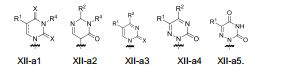
[000304] Em algumas modalidades, os métodos compreendem ainda um nucleotídeo selecionado do grupo consistindo em adenosina, citosina, guanosina e uracila.[000304] In some embodiments, the methods further comprise a nucleotide selected from the group consisting of adenosine, cytosine, guanosine and uracil.
[000305] Em algumas modalidades, a nucleobase é uma pirimidina ou derivado da mesma.[000305] In some embodiments, the nucleobase is a pyrimidine or derivative thereof.
[000306] Em algumas modalidades, a presente invenção provê métodos de síntese de um ácido nucleico farmacêutico compreendendo as etapas de:a) provisão de um ácido desoxirribonucleico complementar (cDNA) que codifica uma proteína farmacêutica de interesse;b) seleção de um nucleotídeo que é conhecido romper uma ligação de uma contraparte de ligação da ranhura principal com um ácido nucleico, onde o nucleotídeo tem afinidade de ligação diminuída com a contraparte de ligação da ranhura principal; ec) contato do cDNA provido e do nucleotídeo selecionado com uma polimerase de RNA, sob condições de maneira que o ácido nucleico farmacêutico seja sintetizado.[000306] In some embodiments, the present invention provides methods of synthesizing a pharmaceutical nucleic acid comprising the steps of: a) providing a complementary deoxyribonucleic acid (cDNA) encoding a pharmaceutical protein of interest; b) selecting a nucleotide that it is known to break a binding of a major groove binding counterpart with a nucleic acid, where the nucleotide has decreased binding affinity to the major groove binding counterpart; and c) contacting the provided cDNA and selected nucleotide with an RNA polymerase under conditions such that the pharmaceutical nucleic acid is synthesized.
[000307] Em modalidades adicionais, o ácido nucleico farmacêutico é um ácido ribonucleico (RNA).[000307] In additional embodiments, the pharmaceutical nucleic acid is a ribonucleic acid (RNA).
[000308] Em ainda um aspecto adicional da presente invenção, os ácidos nucleicos modificados podem ser preparados usando métodos de síntese de fase sólida.[000308] In yet a further aspect of the present invention, modified nucleic acids can be prepared using solid phase synthesis methods.
[000309] Em algumas modalidades, a presente invenção provê métodos de síntese de um ácido nucleico compreendendo um composto de Fórmula XI-a:


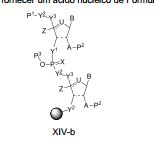
[000310] Em algumas modalidades, os métodos compreendem ainda um nucleotídeo selecionado do grupo consistindo em adenosina, citosina, guanosina e uracila.[000310] In some embodiments, the methods further comprise a nucleotide selected from the group consisting of adenosine, cytosine, guanosine and uracil.
[000311] Em algumas modalidades, B é uma nucleobase de Fórmula XIII:
[000312] Em algumas modalidades, as etapas a) e b) são repetidas de 1 a cerca de 10.000 vezes.[000312] In some embodiments, steps a) and b) are repeated from 1 to about 10,000 times.
[000313] Os ácidos nucleicos modificados descritos aqui podem ser usados como agentes terapêuticos. Por exemplo, um ácido nucleico modificado descrito aqui pode ser administrado a um animal ou indivíduo, onde o ácido nucleico modificado é traduzido in vivo para produzir um peptídeo terapêutico no animal ou indivíduo. Desta maneira, são providos aqui composições, métodos, kits e reagentes para tratamento ou prevenção de doenças ou condições em humanos e outros mamíferos. Os agentes terapêuticos ativos da presente invenção incluem ácidos nucleicos modificados, células contendo ácidos nucleicos ou polipeptídeos modificados traduzidos dos ácidos nucleicos modificados, polipeptídeos traduzidos dos ácidos nucleicos modificados, células contatadas com células contendo ácidos nucleicos modificados ou polipeptídeos traduzidos dos ácidos nucleicos modificados, tecidos contendo células contendo ácidos nucleicos modificados e órgãos contendo tecidos contendo células contendo ácidos nucleicos modificados.[000313] The modified nucleic acids described herein can be used as therapeutic agents. For example, a modified nucleic acid described herein can be administered to an animal or individual, where the modified nucleic acid is translated in vivo to produce a therapeutic peptide in the animal or individual. Accordingly, provided herein are compositions, methods, kits and reagents for treating or preventing diseases or conditions in humans and other mammals. Active therapeutic agents of the present invention include modified nucleic acids, cells containing modified nucleic acids or polypeptides translated from modified nucleic acids, polypeptides translated from modified nucleic acids, cells contacted with cells containing modified nucleic acids or polypeptides translated from modified nucleic acids, tissues containing cells containing modified nucleic acids and organs containing tissues containing cells containing modified nucleic acids.
[000314] São providos aqui métodos de indução de tradução de um polinucleotídeo sintético ou recombinante para produzir um polipeptídeo em uma população de célula usando os ácidos nucleicos modificados descritos aqui. Tal tradução pode ser in vivo, ex vivo, in cultura ou in vitro. A população de célula é contatada com uma quantidade eficaz de uma composição contendo um ácido nucleico que tem pelo menos uma modificação de nucleosídeo e uma região traduzível codificando o polipeptídeo. A população é contatada sob condições de maneira que o ácido nucleico é localizado em uma ou mais células da população de célula e o polipeptídeo recombinante é traduzido na célula a partir do ácido nucleico.[000314] Provided herein are methods of inducing translation of a synthetic or recombinant polynucleotide to produce a polypeptide in a cell population using the modified nucleic acids described herein. Such translation can be in vivo, ex vivo, in culture or in vitro. The cell population is contacted with an effective amount of a composition containing a nucleic acid that has at least one nucleoside modification and a translatable region encoding the polypeptide. The population is contacted under conditions such that the nucleic acid is localized to one or more cells in the cell population and the recombinant polypeptide is translated into the cell from the nucleic acid.
[000315] Uma quantidade eficaz da composição é provida com base, pelo menos em parte, no tecido alvo, tipo de célula-alvo, dispositivos de administração, características físicas do ácido nucleico (por exemplo, tamanho e extensão de nucleosídeos modificados) e outros determinantes. Em geral, uma quantidade eficaz da composição provê produção de proteína eficiente na célula, preferivelmente mais eficiente do que uma composição contendo um ácido nucleico não modificado correspondente. Eficiência aumentada pode ser demonstrada através de transfecção de célula aumentada (isto é, a porcentagem de células transfectadas com o ácido nucleico), tradução de proteína aumentada a partir do ácido nucleico, degradação de ácido nucleico diminuída (conforme demonstrado, por exemplo, pela duração aumentada de tradução de proteína a partir de um ácido nucleico modificado) ou resposta imune inata reduzida da célula hospedeiro ou utilidade terapêutica aperfeiçoada.[000315] An effective amount of the composition is provided based, at least in part, on the target tissue, type of target cell, delivery devices, physical characteristics of the nucleic acid (for example, size and extent of modified nucleosides) and others determinants. In general, an effective amount of the composition provides efficient protein production in the cell, preferably more efficient than a composition containing a corresponding unmodified nucleic acid. Increased efficiency can be demonstrated by increased cell transfection (ie, the percentage of cells transfected with the nucleic acid), increased protein translation from nucleic acid, decreased nucleic acid degradation (as shown, for example, by duration increased protein translation from a modified nucleic acid) or reduced innate host cell immune response or improved therapeutic utility.
[000316] Aspectos da presente invenção se referem a métodos de indução de tradução in vivo de um polipeptídeo recombinante em um indivíduo mamífero com necessidade dos mesmos. Neles, uma quantidade eficaz de uma composição contendo um ácido nucleico que tem pelo menos uma modificação de nucleosídeo e uma região traduzível codificando o polipeptídeo é administrada ao indivíduo usando os métodos de aplicação descritos aqui. O ácido nucleico é provido em uma quantidade e sob outras condições de maneira que o ácido nucleico está localizado em uma célula ou células do indivíduo e o polipeptídeo recombinante é traduzido na célula a partir do ácido nucleico. A célula onde o ácido nucleico está localizado, ou o tecido no qual a célula está presente, pode ser direcionado com uma ou mais de uma rodada de administração de ácido nucleico.[000316] Aspects of the present invention relate to methods of inducing in vivo translation of a recombinant polypeptide in a mammalian subject in need thereof. Therein, an effective amount of a composition containing a nucleic acid that has at least one nucleoside modification and a translatable region encoding the polypeptide is administered to the subject using the delivery methods described herein. Nucleic acid is provided in an amount and under other conditions such that the nucleic acid is located in a cell or cells of the individual and the recombinant polypeptide is translated in the cell from the nucleic acid. The cell where the nucleic acid is located, or the tissue in which the cell is present, can be targeted with one or more than one round of nucleic acid administration.
[000317] Outros aspectos da presente invenção se referem a transplante de células contendo ácidos nucleicos modificados para um indivíduo mamífero. Administração de células a indivíduos mamíferos é conhecida daqueles versados na técnica, tais como implante local (por exemplo, administração tópica ou subcutânea), injeção de aplicação a órgão ou sistêmica (por injeção, injeção intravenosa ou inalação), como é a formulação de células em veículo farmaceuticamente aceitável. Composições contendo ácidos nucleicos modificados são formuladas para administração intramuscularmente, transarterialmente, interaperitonealmente, intravenosamente, intranasalmente,subcutaneamente, endoscopicamente, transdermalmente ou intratecalmente. Em algumas modalidades, a composição é formulada para aplicação prolongada.[000317] Other aspects of the present invention relate to transplantation of cells containing modified nucleic acids into a mammalian subject. Administration of cells to mammalian individuals is known to those skilled in the art, such as local implantation (eg, topical or subcutaneous administration), organ application or systemic injection (by injection, intravenous injection or inhalation), as is cell formulation in a pharmaceutically acceptable vehicle. Compositions containing modified nucleic acids are formulated for administration intramuscularly, transarterially, interaperitoneally, intravenously, intranasally, subcutaneously, endoscopically, transdermally or intrathecally. In some embodiments, the composition is formulated for prolonged application.
[000318] O indivíduo ao qual o agente terapêutico é administrado sofre de um risco de desenvolver uma doença, distúrbio ou condição prejudicial. São providos métodos de identificação, diagnóstico e classificação de indivíduos sob essas bases, os quais podem incluir diagnóstico clínico, níveis de biomarcador, estudos de associação genômica ampla (GWAS) (Genome-wide Association Studies) e outros métodos conhecidos na técnica.[000318] The individual to whom the therapeutic agent is administered is at risk of developing a harmful disease, disorder or condition. Methods of identification, diagnosis, and classification of individuals are provided on these grounds, which may include clinical diagnosis, biomarker levels, Genome-wide Association Studies (GWAS) and other methods known in the art.
[000319] Em certas modalidades, o ácido nucleico modificado administrado se direciona à produção de um ou mais polipeptídeos recombinantes que proveem uma atividade funcional que está substancialmente ausente na célula onde o polipeptídeo recombinante é traduzido. Por exemplo, a atividade funcional ausente pode ser de natureza enzimática, estrutural ou reguladora de gene.[000319] In certain embodiments, the administered modified nucleic acid is directed to the production of one or more recombinant polypeptides that provide a functional activity that is substantially absent in the cell where the recombinant polypeptide is translated. For example, the absent functional activity may be enzymatic, structural, or gene regulatory in nature.
[000320] Em outras modalidades, o ácido nucleico modificado administrado se direciona à produção de um ou mais polipeptídeos recombinantes que substituem um polipeptídeo (ou polipeptídeos múltiplos) que está substancialmente ausente na célula onde o polipeptídeo recombinante é traduzido. Tal ausência pode ser devido à mutação genética do gene de codificação ou seu curso regulador. Em outras modalidades, o ácido nucleico modificado administrado se direciona à produção de um ou mais polipeptídeos recombinantes para suplementar a quantidade de polipeptídeo (ou polipeptídeos múltiplos) que está presente na célula onde o polipeptídeo recombinante é traduzido. Alternativamente, o polipeptídeo recombinante funciona para antagonizar a atividade de uma proteína endógena presente em, na superfície de ou secretada a partir da célula. Geralmente, a atividade da proteína endógena é prejudicial para o indivíduo, por exemplo, devido à mutação da proteína endógena resultando em atividade ou localização alterada. Ainda, o polipeptídeo recombinante antagoniza, diretamente ou indiretamente, a atividade de uma porção biológica presente em, na superfície de ou secretada a partir da célula. Exemplos de porções biológicas antagonizadas incluem lipídeos (por exemplo, colesterol), uma lipoproteína (por exemplo, lipoproteína de baixa densidade), um ácido nucleico, um carboidrato ou uma toxina de molécula pequena.[000320] In other embodiments, the administered modified nucleic acid is directed to the production of one or more recombinant polypeptides that replace a polypeptide (or multiple polypeptides) that is substantially absent from the cell where the recombinant polypeptide is translated. Such absence may be due to the genetic mutation of the encoding gene or its regulatory course. In other embodiments, the administered modified nucleic acid is directed to the production of one or more recombinant polypeptides to supplement the amount of polypeptide (or multiple polypeptides) that is present in the cell where the recombinant polypeptide is translated. Alternatively, the recombinant polypeptide functions to antagonize the activity of an endogenous protein present on, on the surface of or secreted from the cell. Usually, the activity of the endogenous protein is harmful to the individual, for example, due to the mutation of the endogenous protein resulting in altered activity or location. Furthermore, the recombinant polypeptide antagonizes, directly or indirectly, the activity of a biological portion present on, on the surface of or secreted from the cell. Examples of antagonized biological moieties include lipids (eg, cholesterol), a lipoprotein (eg, low-density lipoprotein), a nucleic acid, a carbohydrate, or a small molecule toxin.
[000321] As proteínas recombinantes descritas aqui são engenheiradas para localização dentro da célula, potencialmente dentro de um compartimento específico tal como o núcleo, ou são engenheiradas para secreção a partir da célula ou translocação para a membrana plasmática da célula.[000321] The recombinant proteins described herein are engineered for localization within the cell, potentially within a specific compartment such as the nucleus, or are engineered for secretion from the cell or translocation to the cell's plasma membrane.
[000322] Conforme aqui descrito, uma característica útil dos ácidos nucleicos modificados da presente invenção é a capacidade de reduzir, evadir, evitar ou eliminar a resposta imune inata de uma célula a um ácido nucleico exógeno. São providos métodos para realização da titulação, redução ou eliminação da resposta imune em uma célula ou uma população de células. Em algumas modalidades, a célula é contatada com uma primeira composição que contém uma primeira dose de um primeiro ácido nucleico endógeno incluindo uma região traduzível e pelo menos uma modificação de nucleosídeo, e o nível da resposta imune inata da célula ao primeiro ácido nucleico exógeno é determinado. Subsequentemente, a célula é contatada com uma segunda composição, que inclui uma segunda dose do primeiro ácido nucleico exógeno, a segunda dose contendo uma quantidade menor do primeiro ácido nucleico exógeno comparado com a primeira dose. Alternativamente, a célula é contatada com uma primeira dose de um segundo ácido nucleico exógeno. O segundo ácido nucleico exógeno pode conter um ou mais nucleosídeos modificados, que podem ser iguais ou diferentes do primeiro ácido nucleico exógeno ou, alternativamente, o segundo ácido nucleico exógeno pode não conter nucleosídeos modificados. As etapas de contato da célula com a primeira composição e/ou a segunda composição podem ser repetidas uma ou mais vezes. Ainda, eficiência de produção de proteína (por exemplo, tradução de proteína) na célula é opcionalmente determinada, e a célula pode ser retransfectada com a primeira e/ou segunda composição repetidamente até que eficiência de produção de uma proteína alvo seja obtida.As described herein, a useful feature of the modified nucleic acids of the present invention is the ability to reduce, evade, prevent or eliminate a cell's innate immune response to an exogenous nucleic acid. Methods for performing the titration, reduction or elimination of the immune response in a cell or a population of cells are provided. In some embodiments, the cell is contacted with a first composition that contains a first dose of a first endogenous nucleic acid including a translatable region and at least one nucleoside modification, and the level of the cell's innate immune response to the first exogenous nucleic acid is determined. Subsequently, the cell is contacted with a second composition, which includes a second dose of the first exogenous nucleic acid, the second dose containing a smaller amount of the first exogenous nucleic acid compared to the first dose. Alternatively, the cell is contacted with a first dose of a second exogenous nucleic acid. The second exogenous nucleic acid may contain one or more modified nucleosides, which may be the same or different from the first exogenous nucleic acid, or alternatively the second exogenous nucleic acid may contain no modified nucleosides. The steps of contacting the cell with the first composition and/or the second composition can be repeated one or more times. Furthermore, efficiency of protein production (e.g., protein translation) in the cell is optionally determined, and the cell can be re-transfected with the first and/or second composition repeatedly until efficiency of production of a target protein is obtained.
[000323] São providos aqui métodos para tratamento ou prevenção de um sintoma de doença caracterizada por atividade de proteína ausente ou aberrante, através da substituição da atividade de proteína ausente ou superação da atividade de proteína aberrante. Devido ao início rápido de produção de proteína seguindo introdução de mRNAs modificados, comparado com vetores de DNA virais, os compostos da presente invenção são particularmente vantajosos no tratamento de doenças agudas tais como sepse, derrame e infarto do miocárdio. Além disso, a falta de regulagem transcripcional dos mRNAs modificados da presente invenção é vantajosa pelo fato de que titulação precisa de produção de proteína é obtida. Doenças múltiplas são caracterizadas pela falta (ou substancialmente diminuição de maneira que a função de proteína apropriada não ocorre) de atividade de proteína. Tais proteínas podem não estar presentes, estão presentes em quantidades muito baixas ou são essencialmente não funcionais. A presente invenção provê um método para tratamento de tais condições ou doenças em um indivíduo através da introdução de agentes terapêuticos baseados em ácido nucleico ou célula contendo os ácidos nucleicos providos aqui, onde os ácidos nucleicos modificados codificam uma proteína que substitui a atividade de proteína ausente das células alvo do indivíduo.[000323] Provided herein are methods for treating or preventing a symptom of disease characterized by absent or aberrant protein activity, by substituting absent protein activity or overcoming aberrant protein activity. Due to the rapid onset of protein production following introduction of modified mRNAs, compared to viral DNA vectors, the compounds of the present invention are particularly advantageous in the treatment of acute diseases such as sepsis, stroke and myocardial infarction. Furthermore, the lack of transcriptional regulation of the modified mRNAs of the present invention is advantageous in that accurate titration of protein production is obtained. Multiple diseases are characterized by the lack (or substantially diminished so that proper protein function does not occur) of protein activity. Such proteins may not be present, are present in very low amounts, or are essentially non-functional. The present invention provides a method of treating such conditions or diseases in an individual by introducing nucleic acid or cell-based therapeutic agents containing the nucleic acids provided herein, wherein the modified nucleic acids encode a protein that replaces the absent protein activity. of the individual's target cells.
[000324] Doenças caracterizadas pela atividade de proteína disfuncional ou aberrante incluem, mas não estão limitadas a, câncer e doenças proliferativas, doenças genéticas (por exemplo, fibrose cística), doenças autoimunes, diabetes, doenças neurodegenerativas, doenças cardiovasculares e doenças metabólicas. A presente invenção provê um método para tratamento de tais condições ou doenças em um indivíduo através de introdução de agentes terapêuticos baseados em ácido nucleico ou célula contendo os ácidos nucleicos modificados providos aqui, onde os ácidos nucleicos modificados codificam uma proteína que antagoniza ou de outra maneira supera a atividade de proteína aberrante presente na célula do indivíduo.[000324] Diseases characterized by dysfunctional or aberrant protein activity include, but are not limited to, cancer and proliferative diseases, genetic diseases (eg, cystic fibrosis), autoimmune diseases, diabetes, neurodegenerative diseases, cardiovascular diseases, and metabolic diseases. The present invention provides a method of treating such conditions or diseases in an individual by introducing therapeutic agents based on nucleic acid or cell containing the modified nucleic acids provided herein, where the modified nucleic acids encode a protein that antagonizes or otherwise overcomes the aberrant protein activity present in the individual's cell.
[000325] Exemplos específicos de uma proteína disfuncional são variantes de mutação sem sentido do gene regulador de condutância de transmembrana de fibrose cística (CFTR) (Cystic Fibrosis Transmembrane Conductance Regulator), que produzem uma variante de proteína disfuncional ou não funcional, respectivamente, de proteína CFTR, que causa fibrose cística.[000325] Specific examples of a dysfunctional protein are nonsense mutation variants of the Cystic Fibrosis Transmembrane Conductance Regulator (CFTR) gene, which produce a dysfunctional or non-functional protein variant, respectively, of CFTR protein, which causes cystic fibrosis.
[000326] Desta maneira, são providos métodos de tratamento de fibrose cística em um indivíduo mamífero através de contato de uma célula do indivíduo com um ácido nucleico modificado tendo uma região traduzível que codifica um polipeptídeo de CFTR funcional, sob condições de maneira que uma quantidade eficaz do polipeptídeo de CFTR esteja presente na célula. Células alvo preferidas são células epiteliais, tal como o pulmão, e métodos de administração são determinados em vista do tecido alvo, isto é, para aplicação ao pulmão, as moléculas de RNA são formuladas para administração através de inalação.[000326] In this way, methods of treating cystic fibrosis in a mammalian subject are provided by contacting a cell of the subject with a modified nucleic acid having a translatable region encoding a functional CFTR polypeptide, under conditions such that an amount effective CFTR polypeptide is present in the cell. Preferred target cells are epithelial cells, such as the lung, and methods of administration are determined in view of the target tissue, i.e., for application to the lung, the RNA molecules are formulated for administration via inhalation.
[000327] Em outra modalidade, a presente invenção provê um método para tratamento de hiperlipidemia em um indivíduo, através de introdução em uma população de célula do indivíduo de uma molécula de mRNA modificada codificando Sortilina, uma proteína recentemente caracaterizada por estudos genômicos, desta maneira melhorando a hiperlipidemia em um indivíduo. O gene SORT1 codifica uma proteína de transmembrana de rede trans-Golgi (TGN) (Trans-Golgi Network) chamada Sortilina. Estudos genéticos mostraram que um dos cinco indivíduos tem um polimorfismo de nucleotídeo simples, rs12740374, no locus 1p13 do gene SORT1 que o predispõe a ter níveis baixos de lipoproteína de baixa densidade (LDL) (Low-Density Lipoprotein) e lipoproteína de densidade muito baixa (VLDL) (Very-Low-Density Lipoprotein). Cada cópia do alelo secundário, presente em cerca de 30% de pessoas, altera colesterol LDL em 8 mg/dL, enquanto duas cópias do alelo secundário, presentes em cerca de 5% da população, diminuem o colesterol LDL 16 mg/dL. Veículos do alelo secundário foram também mostrados ter um risco 40% menor de infarto do miocárdio. Estudos funcionais in vivo em camundongos descreve que superexpressão de SORT1 em tecido de fígado de camundongo levou a níveis de colesterol LDL significantemente menores, mais de 80% menor, e que silenciamento de SORT1 aumentou o colesterol LDL aproximadamente 200% (Musunuru K e outros. "From noncoding variant to phenotype via SORT1 at the 1p13 cholesterol locus". Nature 2010; 466: 714-721).[000327] In another embodiment, the present invention provides a method for treating hyperlipidemia in an individual, by introducing into an individual's cell population a modified mRNA molecule encoding Sortilin, a protein recently characterized by genomic studies, in this way improving hyperlipidemia in an individual. The SORT1 gene encodes a trans-Golgi network (TGN) transmembrane protein (Trans-Golgi Network) called Sortilin. Genetic studies have shown that one of the five individuals has a single nucleotide polymorphism, rs12740374, at the 1p13 locus of the SORT1 gene that predisposes him to have low levels of low-density lipoprotein (LDL) and very low-density lipoprotein (VLDL) (Very-Low-Density Lipoprotein). Each copy of the secondary allele, present in about 30% of people, changes LDL cholesterol by 8 mg/dL, while two copies of the secondary allele, present in about 5% of the population, lower LDL cholesterol by 16 mg/dL. Vehicles of the secondary allele have also been shown to have a 40% lower risk of myocardial infarction. Functional in vivo studies in mice describe that overexpression of SORT1 in mouse liver tissue led to significantly lower LDL cholesterol levels, more than 80% lower, and that silencing of SORT1 increased LDL cholesterol approximately 200% (Musunuru K et al. "From noncoding variant to phenotype via SORT1 at the 1p13 cholesterol locus." Nature 2010;466:714-721).
[000328] Os métodos da presente invenção aumentam a entrega de ácido nucleico em uma população de célula, in vivo, ex vivo ou in culture (em cultura). Por exemplo, uma cultura de célula contendo uma pluralidade de células hospedeiro (por exemplo, células eucarióticas tais como células de levedura ou mamífero) é contatada com uma composição que contém um ácido nucleico melhorado tendo pelo menos uma modificação de nucleosídeo e, opcionalmente, uma região traduzível. A composição também contém geralmente um reagente de transfecção ou outro composto que aumenta a eficiência de absorção de ácido nucleico melhorado nas células hospedeiro. O ácido nucleico aperfeiçoado exibe retenção aumentada na população de célula, com relação a um ácido nucleico não modificado correspondente. A retenção do ácido nucleico aperfeiçoado é maior do que a retenção do ácido nucleico não modificado. Em algumas modalidades, ela é pelo menos cerca de 50%, 75%, 90%, 95%, 100%, 150%, 200% ou mais do que 200% maior do que a retenção de ácido nucleico não modificado. Tal vantagem de retenção pode ser obtida através de uma rodada de transfecção com o ácido nucleico aperfeiçoado ou pode ser obtida seguindo rodadas repetidas de transfecção.[000328] The methods of the present invention increase the delivery of nucleic acid in a cell population, in vivo, ex vivo or in culture (in culture). For example, a cell culture containing a plurality of host cells (for example, eukaryotic cells such as yeast or mammalian cells) is contacted with a composition that contains an improved nucleic acid having at least one nucleoside modification and, optionally, one translatable region. The composition also generally contains a transfection reagent or other compound that enhances the efficiency of improved nucleic acid uptake into host cells. The improved nucleic acid exhibits increased retention in the cell population relative to a corresponding unmodified nucleic acid. The retention of improved nucleic acid is greater than the retention of unmodified nucleic acid. In some embodiments, it is at least about 50%, 75%, 90%, 95%, 100%, 150%, 200% or more than 200% greater than the retention of unmodified nucleic acid. Such retention advantage can be obtained through one round of transfection with the improved nucleic acid or it can be obtained following repeated rounds of transfection.
[000329] Em algumas modalidades, o ácido nucleico aperfeiçoado é aplicado a uma população de célula-alvo com um ou mais ácidos nucleicos adicionais. Tal aplicação pode ser ao mesmo tempo ou o ácido nucleico aperfeiçoado é aplicado antes da aplicação do um ou mais ácidos nucleicos adicionais. O um ou mais ácidos nucleicos adicionais podem ser ácidos nucleicos modificados ou ácidos nucleicos não modificados. É compreendido que a presença inicial dos ácidos nucleicos aperfeiçoados não induz substancialmente uma resposta imune inata da população de célula e, além disso, que a resposta imune inata não será ativada pela presença posterior dos ácidos nucleicos não modificados. Com relação a isso, o ácido nucleico aperfeiçoado pode não conter uma região traduzível, se a proteína desejada estar presente na população de célula-alvo for traduzida a partir dos ácidos nucleicos não modificados.[000329] In some embodiments, the improved nucleic acid is applied to a target cell population with one or more additional nucleic acids. Such application can be concurrently or the improved nucleic acid is applied prior to application of the one or more additional nucleic acids. The one or more additional nucleic acids can be modified nucleic acids or unmodified nucleic acids. It is understood that the initial presence of the improved nucleic acids does not substantially induce an innate immune response from the cell population and, furthermore, that the innate immune response will not be activated by the later presence of the unmodified nucleic acids. In this regard, the improved nucleic acid may not contain a translatable region if the desired protein to be present in the target cell population is translated from the unmodified nucleic acids.
[000330] Em modalidades da presente invenção, ácidos nucleicos modificados são providos para expressar uma contraparte de ligação de proteína ou um receptor sobre a superfície da célula, que funciona para direcionar a célula-alvo para um espaço de tecido específico ou interagir com uma porção específica, ou in vivo ou in vitro. Contrapartes de ligação de proteína adequadas incluem anticorpos e seus fragmentos funcionais, proteínas de base ou peptídeos. Ainda, ácidos nucleicos modificados podem ser empregados para direcionar a síntese e localização extracelular de lipídeos, carboidratos ou outras porções biológicas.[000330] In embodiments of the present invention, modified nucleic acids are provided to express a protein-binding counterpart or a receptor on the cell surface, which functions to direct the target cell to a specific tissue space or interact with a portion specific, either in vivo or in vitro. Suitable protein binding counterparts include antibodies and their functional fragments, base proteins or peptides. Furthermore, modified nucleic acids can be used to direct the synthesis and extracellular localization of lipids, carbohydrates or other biological portions.
[000331] Um método para silenciar epigeneticamente expressão de gene em um indivíduo mamífero, que compreendeo um ácido nucleico onde a região traduzível codifica um polipeptídeo ou polipeptídeos capazes de direcionar metilação de histona H3 específica de sequência para iniciar formação de heterocromatina e reduzir transcrição de gene em torno de genes específicos para o propósito de silenciamento do gene. Por exemplo, uma mutação de ganho de função no gene Janus Kinase 2 é responsável pela família de Doenças Mieloproliferativas.[000331] A method for epigenetically silencing gene expression in a mammalian individual, comprising a nucleic acid where the translatable region encodes a polypeptide or polypeptides capable of directing sequence-specific histone H3 methylation to initiate heterochromatin formation and reduce gene transcription around specific genes for the purpose of gene silencing. For example, a gain-of-function mutation in the
[000332] Os nucleosídeos modificados, nucleotídeos modificados e ácidos nucleicos modificados descritos aqui podem ser usados em vários cenários diferentes onde aplicação de uma substância (a "carga útil") a um alvo biológico é desejada, por exemplo, aplicação de substância detectável para detecção do alvo, ou aplicação de um agente terapêutico. Métodos de detecção podem incluir ambos métodos de imagem in vitro e imagem in vivo, por exemplo, imunoistoquímica, imagem por bioluminescência (BLI) (Bioluminescence Imaging), Imagem de Ressonância Magnética (MRI) (Magnetic Resonance Imaging), tomografia de emissão de pósitron (PET) (Positron Emission Tomography), microscopia eletrônica, tomografia computadorizada de raios X, imagem Raman, tomografia de coerência óptica, imagem por absorção, imagem térmica, imagem de fluorescência e refletância, microscopia de fluorescência, imagem tomográfica molecular de fluorescência, imagem de ressonância magnética nuclear, imagem de raios X, imagem ultrassônica, imagem fotoacústica, ensaios de laboratório ou qualquer situação onde marcação/tingimento/imagem é requerido.[000332] The modified nucleosides, modified nucleotides and modified nucleic acids described herein can be used in several different scenarios where application of a substance (the "payload") to a biological target is desired, for example, application of detectable substance for detection target, or application of a therapeutic agent. Detection methods may include both in vitro imaging and in vivo imaging methods, eg immunohistochemistry, Bioluminescence Imaging (BLI), Magnetic Resonance Imaging (MRI), positron emission tomography (PET) (Positron Emission Tomography), electron microscopy, X-ray computed tomography, Raman imaging, optical coherence tomography, absorption imaging, thermal imaging, fluorescence and reflectance imaging, fluorescence microscopy, fluorescence molecular tomography, imaging nuclear magnetic resonance, X-ray imaging, ultrasonic imaging, photoacoustic imaging, laboratory testing or any situation where marking/staining/imaging is required.
[000333] Por exemplo, os nucleosídeos modificados, nucleotídeos modificados e ácidos nucleicos modificados descritos aqui podem ser usados em reprogramação de células tronco pluripotentes induzidas (células iPs), que podem então ser usadas para traçar diretamente o caminho de células que são transfectadas comparado com células totais no grupo. Em outro exemplo, um fármaco que é ligado ao ácido nucleico modificado via um ligante e é fluorescentemente marcado pode ser usado para traçar o caminho do fármaco in vivo, por exemplo, intracelularmente. Outros exemplos incluem o uso de um ácido nucleico modificado em administração de fármaco reversível em células.[000333] For example, the modified nucleosides, modified nucleotides and modified nucleic acids described here can be used in reprogramming induced pluripotent stem cells (iPs cells), which can then be used to directly trace the path of cells that are transfected compared to total cells in the group. In another example, a drug that is linked to the modified nucleic acid via a linker and is fluorescently labeled can be used to trace the drug pathway in vivo, for example, intracellularly. Other examples include the use of a modified nucleic acid in reversible drug delivery to cells.
[000334] Os nucleosídeos modificados, nucleotídeos modificados e ácidos nucleicos modificados descritos aqui podem ser usados em direcionamento intracelular de uma carga útil, por exemplo, agente detectável ou terapêutico, à organela específica. Alvos intracelulares exemplares podem incluir a localização nuclear para processamento de mRNA avançado ou uma sequência de localização nuclear (NLS) (Nuclear Localization Sequence) ligada ao mRNA contendo um inibidor.[000334] The modified nucleosides, modified nucleotides and modified nucleic acids described herein can be used in intracellular targeting of a payload, e.g. detectable or therapeutic agent, to the specific organelle. Exemplary intracellular targets can include nuclear localization for advanced mRNA processing or a nuclear localization sequence (NLS) (Nuclear Localization Sequence) linked to mRNA containing an inhibitor.
[000335] Ainda, os nucleosídeos modificados, nucleotídeos modificados e ácidos nucleicos modificados descritos aqui podem ser usados para aplicar agentes terapêuticos a células ou tecidos, por exemplo, em animais vivos. Por exemplo, os nucleosídeos modificados, nucleotídeos modificados e ácidos nucleicos modificados descritos aqui podem ser usados para aplicar agentes quimioterapêuticos altamente polares a células de câncer assassinas. Os ácidos nucleicos modificados ligados ao agente terapêutico através de um ligante podem facilitar permeação de membro permitindo que o agente terapêutico viaje para uma célula para atingir um alvo intracelular.[000335] Furthermore, the modified nucleosides, modified nucleotides and modified nucleic acids described herein can be used to apply therapeutic agents to cells or tissues, for example, in live animals. For example, the modified nucleosides, modified nucleotides and modified nucleic acids described herein can be used to apply highly polar chemotherapeutic agents to killer cancer cells. Modified nucleic acids linked to the therapeutic agent through a linker can facilitate limb permeation by allowing the therapeutic agent to travel into a cell to reach an intracellular target.
[000336] Em outro exemplo, os nucleosídeos modificados, nucleotídeos modificados e ácidos nucleicos modificados podem ser ligados a um peptídeo inibidor viral (VIP) (Viral Inhibitory Peptide) através de um ligante clivável. O ligante clivável vai liberar o VIP e tingi- lo na célula. Em outro exemplo, os nucleosídeos modificados, nucleotídeos modificados e ácidos nucleicos modificados podem ser ligados através de um ligante a um ADP-ribosilato, que é responsável pelas ações de algumas toxinas bacterianas, tal como toxina do cólera, toxina da difteria e toxina pertussica. Essas proteínas de toxina são ADP-ribosiltransferases que modificam proteínas alvo em células humanas. Por exemplo, proteínas G ADP-ribosilato da toxina do cólera, que causam secreção de fluido massiva a partir do revestimento do intestino delgado, resultando em diarreia ameaçadora à vida.[000336] In another example, the modified nucleosides, modified nucleotides and modified nucleic acids can be linked to a viral inhibitory peptide (VIP) (Viral Inhibitory Peptide) through a cleavable linker. The cleavable ligand will release the VIP and stain it in the cell. In another example, modified nucleosides, modified nucleotides and modified nucleic acids can be linked through a linker to an ADP-ribosylate, which is responsible for the actions of some bacterial toxins, such as cholera toxin, diphtheria toxin and pertussis toxin. These toxin proteins are ADP-ribosyltransferases that modify target proteins in human cells. For example, cholera toxin ADP-ribosylate G proteins, which cause massive fluid secretion from the lining of the small intestine, resulting in life-threatening diarrhea.
[000337] A presente invenção provê proteínas geradas a partir de mRNAs modificados. As composições farmacêuticas podem compreender opcionalmente uma ou mais substâncias terapeuticamente ativas. De acordo com algumas modalidades, um método de administração de composições farmacêuticas compreendendo um ácido nucleico modificado codificando uma ou mais proteínas a serem administradas a um indivíduo com necessidade do mesmo é provido. Em algumas modalidades, composições são administradas a humanos. Para os propósitos da presente invenção, a expressão "ingrediente ativo" geralmente se refere a uma proteína, complexo de codificação de proteína ou contendo proteína conforme aqui descrito.[000337] The present invention provides proteins generated from modified mRNAs. Pharmaceutical compositions can optionally comprise one or more therapeutically active substances. In accordance with some embodiments, a method of administering pharmaceutical compositions comprising a modified nucleic acid encoding one or more proteins to be administered to an individual in need thereof is provided. In some embodiments, compositions are administered to humans. For purposes of the present invention, the term "active ingredient" generally refers to a protein, protein-coding or protein-containing complex as described herein.
[000338] Embora as descrições de composições farmacêuticas providas aqui sejam principalmente direcionadas a composições farmacêuticas que são adequadas para administração a humanos, será compreendido pelo versado na técnica que tais composições são geralmente adequadas para administração a animais de todos os tipos. Modificação de composições farmacêuticas adequadas para administração a humanos a fim de tornar as composições adequadas para administração a vários animais é bem compreendida, e o farmacologista veterinário versado comum pode planejar e/ou realizar tal modificação com experimentação apenas comum, se alguma. Indivíduos aos quais administração das composições farmacêuticas é compreendida incluem, mas não estão limitados a, seres humanos e/ou outros primatas; mamíferos, incluindo mamíferos comercialmente relevantes tais com gado, porcos, cavalos, ovelha, gatos, cachorros, camundongos e/ou ratos; e/ou aves, incluindo aves comercialmente relevantes tais como galinhas, patos, gansos e/ou perus.[000338] Although the descriptions of pharmaceutical compositions provided herein are primarily directed to pharmaceutical compositions that are suitable for administration to humans, it will be understood by the person skilled in the art that such compositions are generally suitable for administration to animals of all types. Modification of pharmaceutical compositions suitable for administration to humans in order to make the compositions suitable for administration to various animals is well understood, and the ordinary skilled veterinary pharmacologist can devise and/or carry out such modification with only ordinary experimentation, if any. Subjects to which administration of the pharmaceutical compositions is understood include, but are not limited to, humans and/or other primates; mammals, including commercially relevant mammals such as cattle, pigs, horses, sheep, cats, dogs, mice and/or rats; and/or birds, including commercially relevant birds such as chickens, ducks, geese and/or turkeys.
[000339] Formulações das composições farmacêuticas descritas aqui podem ser preparadas através de qualquer método conhecido ou desenvolvido posteriormente na técnica de farmacologia. Em geral, tais métodos preparatórios incluem a etapa de trazer o ingrediente ativo em associação com um excipiente e/ou um ou mais ingrediente acessórios e, então, se necessário e/ou desejável, modelagem e/ou embalagem do produto em uma unidade de dose única ou múltipla desejável.[000339] Formulations of the pharmaceutical compositions described herein can be prepared by any method known or further developed in the art of pharmacology. In general, such preparatory methods include the step of bringing the active ingredient in association with an excipient and/or one or more accessory ingredients and then, if necessary and/or desirable, shaping and/or packaging the product in a unit dose single or multiple desirable.
[000340] Uma composição farmacêutica de acordo com a presente invenção pode ser preparada, embalada e/ou vendida a granel, como uma dose unitária única e/ou como uma pluralidade de doses unitárias únicas. Conforme aqui usado, uma "dose unitária" é quantidade separada da composição farmacêutica compreendendo uma quantidade predeterminada do ingrediente ativo. A quantidade do ingrediente ativo é geralmente igual à dosagem do ingrediente ativo que seria administrada ao indivíduo e/ou uma fração conveniente de tal dosagem tal como, por exemplo, metade ou um terço de tal dosagem.[000340] A pharmaceutical composition according to the present invention can be prepared, packaged and/or sold in bulk, as a single unit dose and/or as a plurality of single unit doses. As used herein, a "unit dose" is a separate amount of pharmaceutical composition comprising a predetermined amount of the active ingredient. The amount of active ingredient is generally equal to the dosage of active ingredient that would be administered to the individual and/or a convenient fraction of such dosage such as, for example, one-half or one-third of such dosage.
[000341] Quantidades relativas do ingrediente ativo, do excipiente farmaceuticamente aceitável e/ou quaisquer ingredientes adicionais em uma composição farmacêutica de acordo com a presente invenção variarão, dependendo da identidade, tamanho e/ou configuração do indivíduo tratado e dependendo ainda da via através da qual a composição deve ser administrada. A título de exemplo, a composição pode compreender entre 0,1% e 100% (p/p) de ingrediente ativo.[000341] Relative amounts of the active ingredient, the pharmaceutically acceptable excipient and/or any additional ingredients in a pharmaceutical composition according to the present invention will vary depending on the identity, size and/or configuration of the individual treated and further depending on the route through the which composition should be administered. By way of example, the composition may comprise between 0.1% and 100% (w/w) of active ingredient.
[000342] Formulações farmacêuticas podem compreender ainda um excipiente farmaceuticamente aceitável que, conforme aqui usado, inclui qualquer um e todos os solventes, meios de dispersão, diluentes ou outros veículos líquidos, auxiliares de dispersão ou suspensão, agentes tensoativos, agentes isotônicos, agentes espessantes ou emulsificantes, conservantes, ligantes sólidos, lubrificantes e similar, conforme adequado para a forma de dosagem particular desejada. Remington’s The Science e Practice of Pharmacy, 21st Edição, A. R. Gennaro (Lippincott, Williams & Wilkins, Baltimore, MD, 2006; incorporado aqui a título de referência) revela vários excipientes usados na formulação de composições farmacêuticas e técnicas conhecidas para a sua preparação. Exceto até o ponto que qualquer meio excipiente convencional for incompatível com uma substância ou seus derivados, tal como através da produção de qualquer efeito biológico indesejável ou de outra maneira interagindo de uma maneira prejudicial com qualquer outro componente(s) da composição farmacêutica, seu uso é compreendido estar dentro do escopo da presente invenção.[000342] Pharmaceutical formulations may further comprise a pharmaceutically acceptable excipient which, as used herein, includes any and all solvents, dispersing media, diluents or other liquid vehicles, dispersing or suspending aids, surface active agents, isotonic agents, thickening agents or emulsifiers, preservatives, solid binders, lubricants and the like, as appropriate for the particular dosage form desired. Remington's The Science and Practice of Pharmacy, 21st Edition, A.R. Gennaro (Lippincott, Williams & Wilkins, Baltimore, MD, 2006; incorporated herein by reference) discloses various excipients used in formulating pharmaceutical compositions and known techniques for their preparation. Except to the extent that any conventional excipient medium is incompatible with a substance or its derivatives, such as through the production of any undesirable biological effect or otherwise interacting in a harmful way with any other component(s) of the pharmaceutical composition, its use is understood to be within the scope of the present invention.
[000343] Em algumas modalidades, um excipiente farmaceuticamente aceitável é pelo menos 95%, pelo menos 96%, pelo menos 97%, pelo menos 98%, pelo menos 99% ou 100% puro. Em algumas modalidades, um excipiente é aprovado para uso em humanos e para uso veterinário. Em algumas modalidades, um excipiente é aprovado pelo United States Food and Drug Administration. Em algumas modalidades, um excipiente é de grau farmacêutico. Em algumas modalidades, um excipiente satisfaz os padrões da United States Pharmacopoeia (USP), da European Pharmacopoeia (EP), da British Pharmacopoeia e/ou da International Pharmacopoeia.[000343] In some embodiments, a pharmaceutically acceptable excipient is at least 95%, at least 96%, at least 97%, at least 98%, at least 99%, or 100% pure. In some embodiments, an excipient is approved for use in humans and for veterinary use. In some embodiments, an excipient is approved by the United States Food and Drug Administration. In some embodiments, an excipient is pharmaceutical grade. In some embodiments, an excipient meets United States Pharmacopoeia (USP), European Pharmacopoeia (EP), British Pharmacopoeia, and/or International Pharmacopoeia standards.
[000344] Excipientes farmaceuticamente aceitáveis usados na fabricação de composições farmacêuticas incluem, mas não estão limitados a, diluentes inertes, agentes de dispersão e/ou granulação, agentes tensoativos e/ou emulsificantes, agentes de desintegração, agentes de ligação, conservantes, agentes de tamponamento, agentes lubrificantes e/ou óleos. Tais excipientes podem opcionalmente ser incluídos em formulações farmacêuticas. Excipientes tais como manteiga de cacau e ceras de supositório, agentes de coloração, agentes de revestimento, agentes adoçantes, saborizantes e/ou de perfume podem estar presentes na composição, de acordo com o julgamento do formulador.[000344] Pharmaceutically acceptable excipients used in the manufacture of pharmaceutical compositions include, but are not limited to, inert diluents, dispersing and/or granulating agents, surface-active and/or emulsifying agents, disintegrating agents, binding agents, preservatives, flavoring agents. buffering, lubricating agents and/or oils. Such excipients can optionally be included in pharmaceutical formulations. Excipients such as cocoa butter and suppository waxes, coloring agents, coating agents, sweetening, flavoring and/or perfume agents may be present in the composition, at the discretion of the formulator.
[000345] Diluentes exemplares incluem, mas não estão limitados a, carbonato de cálcio, carbonato de sódio, fosfato de cálcio, fosfato de dicálcio, sulfato de cálcio, hidrogeno fosfato de cálcio, fosfato lactose de sódio, sacarose, celulose, celulose microcristalina, caulim, manitol, sorbitol, inositol, cloreto de sódio, amido seco, amido de milho, açúcar de confeiteiro, etc e/ou suas combinações.[000345] Exemplary diluents include, but are not limited to, calcium carbonate, sodium carbonate, calcium phosphate, dicalcium phosphate, calcium sulfate, calcium hydrogen phosphate, sodium lactose phosphate, sucrose, cellulose, microcrystalline cellulose, kaolin, mannitol, sorbitol, inositol, sodium chloride, dry starch, corn starch, confectioner's sugar, etc. and/or combinations thereof.
[000346] Agentes de granulação e/ou dispersão exemplares incluem, mas não estão limitados a, amido de batata, amido de milho, amido de tapioca, amido glicolato de sódio, argilas, ácido algínico, goma guar, polpa cítrica, ágar, bentonita, celulose e produtos de madeira, esponja natural, resina de troca de cátion, carbonato de cálcio, silicatos, carbonato de sódio, poli(vinil-pirrolidona) reticulada (crospovidona), carboximetil amido de sódio (amido glicolato de sódio), carboximetil celulose, carboximetil celulose de sódio reticulada (croscarmelose), metilcelulose, amido pré-gelatinizado (amido 1500), amido microcristalino, amido insolúvel em água, carboximetil celulose de cálcio, alumínio silicato de magnésio (Veegum), lauril sulfato de sódio, compostos de amônio quaternário, etc. e/ou combinações dos mesmos.[000346] Exemplary granulating and/or dispersing agents include, but are not limited to, potato starch, corn starch, tapioca starch, sodium starch glycolate, clays, alginic acid, guar gum, citrus pulp, agar, bentonite , cellulose and wood products, natural sponge, cation exchange resin, calcium carbonate, silicates, sodium carbonate, cross-linked poly(vinyl-pyrrolidone) (crospovidone), sodium carboxymethyl starch (sodium starch glycolate), carboxymethyl cellulose , cross-linked sodium carboxymethyl cellulose (croscarmellose), methylcellulose, pregelatinized starch (1500 starch), microcrystalline starch, water-insoluble starch, calcium carboxymethyl cellulose, magnesium aluminum silicate (Veegum), sodium lauryl sulfate, ammonium compounds quaternary, etc. and/or combinations thereof.
[000347] Agentes tensoativos e/ou emulsificantes exemplares incluem, mas não estão limitados a, emulsificantes naturais (por exemplo, acácia, ágar, ácido algínico, alginato de sódio, tragacanto, condrux, colesterol, xantana, pectina, gelatina, gema de ovo, lanolina, colesterol, cera e lecitina), argilas coloidais (por exemplo, bentonita [silicato de alumínio] e Veegum® [silicato de magnésio alumínio]), derivados de aminoácido de cadeia longa, álcoois de peso molecular alto (por exemplo, álcool de estearila, álcool cetílico, álcool de oleíla, monoestearato de triacetina, diestearato de etileno glicol, monoestearato de glicerila e monoestearato de propileno glicol, álcool de polivinila), carbômero (por exemplo, carbóxi polimetileno, ácido poliacrílico, polímero de ácido acrílico e polímero de carboxivinila), carragenana, derivados celulósicos (por exemplo, carboximetilcelulose de sódio, celulose em pó, hidroximetil celulose, hidroxipropil celulose, hidroxipropil metilcelulose, metilcelulose), ésteres de ácido graxo sorbitano (por exemplo, monolaurato de polioxietileno sorbitano [Tween®20], polioxietileno sorbitano [Tween®60], monooleato de polioxietileno sorbitano [Tween®80], monopalmitato sorbitano [Span®40], monoestearato sorbitano [Span®60], triestearato sorbitano [SPan®65], mono-oleato de glicerila, mono-oleato sorbitano [Span®80]), ésteres de polioxietileno (por exemplo, monoestearato de polioxietileno [Myrj®45], óleo de rícino hidrogenado com polioxietileno, óleo de rícino polietoxilado, estearato de polioximetileno e Solutol®), ésteres de ácido graxo de sacarose, ésteres de ácido graxo de polietileno glicol (por exemplo, Cremophor®), ésteres de polioxietileno (por exemplo, lauril éter de polioxietileno [Brij®30]), poli(vinil-pirrolidona), monolaurato de dietileno glicol, oleato de trietanolamina, oleato de sódio, oleato de potássio, oleato de etila, ácido oleico, laurato de etila, lauril sulfato de sódio, Pluronic® F 68, Poloxamer®188, brometo de cetrimonio, cloreto de cetilpiridínio, cloreto de benzalcônio, codusato de sódio, etc e/ou suas combinações.[000347] Exemplary surfactants and/or emulsifiers include, but are not limited to, natural emulsifiers (for example, acacia, agar, alginic acid, sodium alginate, tragacanth, chondrux, cholesterol, xanthan, pectin, gelatin, egg yolk , lanolin, cholesterol, wax and lecithin), colloidal clays (eg bentonite [aluminum silicate] and Veegum® [magnesium aluminum silicate]), long chain amino acid derivatives, high molecular weight alcohols (eg alcohol of stearyl, cetyl alcohol, oleyl alcohol, triacetin monostearate, ethylene glycol distearate, glyceryl monostearate and propylene glycol monostearate, polyvinyl alcohol), carbomer (eg, polymethylene carboxy, polyacrylic acid, acrylic acid polymer and polymer of carboxyvinyl), carrageenan, cellulosic derivatives (eg, sodium carboxymethylcellulose, powdered cellulose, hydroxymethyl cellulose, hydroxypropyl cellulose, hydroxypropyl methylcellulose, methylcellulose ose), sorbitan fatty acid esters (eg, polyoxyethylene sorbitan monolaurate [Tween®20], polyoxyethylene sorbitan [Tween®60], polyoxyethylene sorbitan monooleate [Tween®80], sorbitan monopalmitate [Span®40], sorbitan monostearate [Span®60], sorbitan tristearate [SPan®65], glyceryl monooleate, sorbitan monooleate [Span®80]), polyoxyethylene esters (eg, polyoxyethylene monostearate [Myrj®45], castor oil hydrogenated with polyoxyethylene, polyethoxylated castor oil, polyoxymethylene stearate and Solutol®), sucrose fatty acid esters, polyethylene glycol fatty acid esters (eg Cremophor®), polyoxyethylene esters (eg polyoxyethylene lauryl ether [Brij®30]), poly(vinyl-pyrrolidone), diethylene glycol monolaurate, triethanolamine oleate, sodium oleate, potassium oleate, ethyl oleate, oleic acid, ethyl laurate, sodium lauryl sulfate, Pluronic® F 68, Poloxamer®188, cetrimonium bromide, cl cetylpyridinium oride, benzalkonium chloride, sodium codusate, etc. and/or combinations thereof.
[000348] Agentes de ligação exemplares incluem, mas não estão limitados a, amido (por exemplo, amino de milho e pasta de amido); gelatina; açucares (por exemplo, sacarose, glicose, dextrose, dextrina, molassas, lactose, lactitol, manitol); gomas naturais e sintéticas (por exemplo, acácia, alginato de sódio, extrato de musgo Irlandês, goma panwar, goma ghatti, mucilagem de cascas de isapol, carboximetilcelulose, metilcelulose, etilcelulose, hidroximetilcelulose, hidroxipropil celulose, hidroxipropil metilcelulose, celulose microcristalina, acetato de celulose, poli(vinil-pirrolidona), silicato de magnésio alumínio (Veegum®) e arabinogalactana de lariço); alginato; óxido de polietileno; polietileno glicol; sais de cálcio inorgânico; ácido silícico; polimetacrilatos; ceras; água; álcool; etc.; e combinações dos mesmos.[000348] Exemplary binding agents include, but are not limited to, starch (for example, corn amine and starch paste); gelatin; sugars (for example sucrose, glucose, dextrose, dextrin, molasses, lactose, lactitol, mannitol); natural and synthetic gums (eg acacia, sodium alginate, Irish moss extract, panwar gum, ghatti gum, isapol husk mucilage, carboxymethylcellulose, methylcellulose, ethylcellulose, hydroxymethylcellulose, hydroxypropyl cellulose, hydroxypropyl methylcellulose, microcrystalline cellulose, acetate cellulose, poly(vinyl-pyrrolidone), magnesium aluminum silicate (Veegum®) and larch arabinogalactan); alginate; polyethylene oxide; polyethylene glycol; inorganic calcium salts; silicic acid; polymethacrylates; waxes; Water; alcohol; etc.; and combinations thereof.
[000349] Conservantes exemplares podem incluir, mas não estão limitados a, antioxidantes, agentes de quelação, conservantes antimicrobianos, conservantes antifúngicos, conservantes de álcool, conservantes de ácido e/ou outros conservantes. Antioxidantes exemplares incluem, mas não estão limitados a, alfa tocoferol, ácido ascórbico, palmitato de ascorbila, hidroxianisol butilado, hidroxitolueno butilado, monotioglicerol, metabissulfito de potássio, ácido propiônico, propil galato, ascorbato de sódio, bissulfito de sódio, metabissulfito de sódio e/ou sulfito de sódio. Agentes de quelação exemplares incluem ácido etilenodiaminotetraacético (EDTA), monoidrato de ácido cítrico, edetato dissódico, edetato dipotássico, ácido edético, ácido fumárico, ácido málico, ácido fosfórico, edetato sódico, ácido tartárico e/ou edetato trissódico. Conservantes antimicrobianos exemplares incluem, mas não estão limitados a, cloreto de benzalcônio, cloreto de benzetônio, álcool de benzila, bronopol, cetrimida, cloreto de cetilpiridínio, clorexidina, clorobutanol, clorocresol, cloroxilenol, cresol, álcool de etila, glicerina, hexetidina, imidoureia, fenol, fenoxietanol, álcool de feniletila, nitrato fenilmercúrico, propileno glicol e/ou timerossal. Conservantes antifúngicos exemplares incluem, mas não estão limitados a, butil parabeno, metil parabeno, etil parabeno, propil parabeno, ácido benzoico, ácido hidroxibenzoico, benzoato de potássio, sorbato de potássio, benzoato de sódio, propionato de sódio e ácido sórbico. Conservantes de álcool exemplares incluem, mas não estão limitados a, etanol, polietileno glicol, fenol, compostos fenólicos, bisfenol, clorobutanol, hidroxibenzoato e/ou álcool de feniletila. Conservantes ácidos exemplares incluem, mas não estão limitados a, vitamina A, vitamina C, vitamina E, beta-caroteno, ácido cítrico, ácido acético, ácido desidroacético, ácido ascórbico, ácido sórbico e/ou ácido fítico. Outros conservantes incluem, mas não estão limitados a, tocoferol, acetato de tocoferol, mesilato de deteroxima, cetrimida, hidroxianisol butilado (BHA) (Butylated Hydroxyanisol), Butylated Hydroxytoluene (BHT), etilenodiamina, lauril sulfato de sódio (SLS) (Sodium Lauryl Sulfate), lauril éter sulfato de sódio (SLES) (Sodium Lauryl Ether Sulfate), bissulfito de sódio, metabissulfito de sódio, sulfite de potássio, metabissulfito de potássio, Glydant Plus®, Phenonip®, metilparabeno, Germall®115, Germaben®II, Neolone®, Kathon® e/ou Euxyl®.[000349] Exemplary preservatives may include, but are not limited to, antioxidants, chelating agents, antimicrobial preservatives, antifungal preservatives, alcohol preservatives, acid preservatives and/or other preservatives. Exemplary antioxidants include, but are not limited to, alpha tocopherol, ascorbic acid, ascorbyl palmitate, butylated hydroxyanisole, butylated hydroxytoluene, monothioglycerol, potassium metabisulfite, propionic acid, propyl gallate, sodium ascorbate, sodium bisulfite, sodium metabisulfite, and /or sodium sulfite. Exemplary chelating agents include ethylenediaminetetraacetic acid (EDTA), citric acid monohydrate, disodium edetate, dipotassium edetate, edetic acid, fumaric acid, malic acid, phosphoric acid, sodium edetate, tartaric acid and/or trisodium edetate. Exemplary antimicrobial preservatives include, but are not limited to, benzalkonium chloride, benzethonium chloride, benzyl alcohol, bronopol, cetrimide, cetylpyridinium chloride, chlorhexidine, chlorobutanol, chlorocresol, chloroxylenol, cresol, ethyl alcohol, glycerin, hexetidine, imido , phenol, phenoxyethanol, phenylethyl alcohol, phenylmercuric nitrate, propylene glycol and/or thimerosal. Exemplary antifungal preservatives include, but are not limited to, butyl paraben, methyl paraben, ethyl paraben, propyl paraben, benzoic acid, hydroxybenzoic acid, potassium benzoate, potassium sorbate, sodium benzoate, sodium propionate and sorbic acid. Exemplary alcohol preservatives include, but are not limited to, ethanol, polyethylene glycol, phenol, phenolic compounds, bisphenol, chlorobutanol, hydroxybenzoate and/or phenylethyl alcohol. Exemplary acidic preservatives include, but are not limited to, vitamin A, vitamin C, vitamin E, beta-carotene, citric acid, acetic acid, dehydroacetic acid, ascorbic acid, sorbic acid, and/or phytic acid. Other preservatives include, but are not limited to, tocopherol, tocopherol acetate, deteroxime mesylate, cetrimide, butylated hydroxyanisole (BHA) (Butylated Hydroxyanisol), Butylated Hydroxytoluene (BHT), ethylenediamine, sodium lauryl sulfate (SLS) (Sodium Lauryl Sulfate), Sodium Lauryl Ether Sulfate (SLES) (Sodium Lauryl Ether Sulfate), Sodium Bisulfite, Sodium Metabisulfite, Potassium Sulphite, Potassium Metabisulfite, Glydant Plus®, Phenonip®, Methylparaben, Germall®115, Germaben®II , Neolone®, Kathon® and/or Euxyl®.
[000350] Agentes de tamponamento exemplares incluem, mas não estão limitados a, soluções tampão de citrato, soluções tampão de acetato, soluções tampão de fosfato, cloreto de amônio, carbonato de cálcio, cloreto de cálcio, citrato de cálcio, glubionato de cálcio, gluceptato de cálcio, gluconato de cálcio, ácido d-glucônico, glicerofosfato de cálcio, lactato de cálcio, ácido propanoico, levulinato de cálcio, ácido pentanoico, fosfato de cálcio dibásico, ácido fosfórico, fosfato de cálcio tribásico, fosfato de hidróxido de cálcio, acetato de potássio, cloreto de potássio, gluconato de potássio, misturas de potássio, fosfato de potássio dibásico, fosfato de potássio monobásico, misturas de fosfato de potássio, acetato de sódio, bicarbonato de sódio, cloreto de sódio, citrato de sódio, lactato de sódio, fosfato de sódio dibásico, fosfato de sódio monobásico, misturas de fosfato de sódio, trometamina, hidróxido de magnésio, hidróxido de alumínio, acido algínico, água livre de pirógeno, solução salina isotônica, solução de Ringer, álcool de etila, etc. e/ou suas combinações.[000350] Exemplary buffering agents include, but are not limited to, citrate buffer solutions, acetate buffer solutions, phosphate buffer solutions, ammonium chloride, calcium carbonate, calcium chloride, calcium citrate, calcium glutionate, calcium gluconate, calcium gluconate, d-gluconic acid, calcium glycerophosphate, calcium lactate, propanoic acid, calcium levulinate, pentanoic acid, dibasic calcium phosphate, phosphoric acid, tribasic calcium phosphate, calcium hydroxide phosphate, potassium acetate, potassium chloride, potassium gluconate, potassium mixtures, dibasic potassium phosphate, monobasic potassium phosphate, potassium phosphate mixtures, sodium acetate, sodium bicarbonate, sodium chloride, sodium citrate, sodium lactate sodium, sodium phosphate dibasic, sodium phosphate monobasic, sodium phosphate mixtures, tromethamine, magnesium hydroxide, aluminum hydroxide, alginic acid, pyrogen-free water, solution isotonic saline, Ringer's solution, ethyl alcohol, etc. and/or their combinations.
[000351] Agentes de lubrificação exemplares incluem, mas não estão limitados a estearato de magnésio, estearato de cálcio, ácido esteárico, sílica, talco, malte, beenato de glicerila, óleos vegetais hidrogenados, polietileno glicol, benzoato de sódio, acetato de sódio, cloreto de sódio, leucina, lauril sulfato de magnésio, lauril sulfato de sódio, etc, e combinações dos mesmos.[000351] Exemplary lubricating agents include, but are not limited to magnesium stearate, calcium stearate, stearic acid, silica, talc, malt, glyceryl behenate, hydrogenated vegetable oils, polyethylene glycol, sodium benzoate, sodium acetate, sodium chloride, leucine, magnesium lauryl sulfate, sodium lauryl sulfate, etc., and combinations thereof.
[000352] Óleos exemplares incluem, mas não estão limitados a, óleo de amêndoa, semente de abricó, abacate, babaçu, bergamota, semente de cassis, borrage, cade, camomila, canola, caraway, canaúba, rícino, canela, manteiga de cacau, coco, fígado de bacalhau, café, milho, semente de algodão, emu, eucalipto, prímula da manhã, peixe, semente de cânhamo, geraniol, cabaça, semente de uva, avelã, orégano, miristato de isopropila, jojoba, noz de kukui, lavandin, lavanda, limão, litsea cubeba, noz de macadâmia, malva, semente de manga, semente de meadowfoam, pele de marta, noz-moscada, oliva, laranja, casca de laranja, palma, semente de palma, semente de pêssego, amendoim, semente de papoula, semente de abóbora, semente de colza, farelo de arroz, Rosemary, açafrão, sândalo, sasquana, segurelha, espinheiro- marítimo, sésamo, manteiga de karité, silicone, soja, girassol, árvore do chá, cardo, tsubaki, vetiver, noz e germe de trigo. Óleos exemplares incluem, mas não estão limitados a, estearato de butila, triglicerídeo caprílico, triglicerídeo cáprico, ciclometicona, sebacato de dietila, dimeticona 360, miristato de isopropila, óleo mineral, octildodecanol, álcool de oleíla, óleo de silicone e/ou combinações dos mesmos.[000352] Exemplary oils include, but are not limited to, almond oil, apricot, avocado, babassu, bergamot, blackcurrant, borrage, cade, chamomile, canola, caraway, canauba, castor, cinnamon, cocoa butter , coconut, cod liver, coffee, corn, cottonseed, emu, eucalyptus, morning primrose, fish, hemp seed, geraniol, gourd, grape seed, hazelnut, oregano, isopropyl myristate, jojoba, kukui nut , lavandin, lavender, lemon, litsea cubeba, macadamia nut, mallow, mango seed, meadowfoam seed, mink skin, nutmeg, olive, orange, orange peel, palm, palm seed, peach seed, peanuts, poppy seed, pumpkin seed, rapeseed, rice bran, Rosemary, turmeric, sandalwood, sasquana, savory, sea buckthorn, sesame, shea butter, silicone, soy, sunflower, tea tree, thistle, tsubaki, vetiver, walnut and wheat germ. Exemplary oils include, but are not limited to, butyl stearate, caprylic triglyceride, capric triglyceride, cyclomethicone, diethyl sebacate, dimethicone 360, isopropyl myristate, mineral oil, octyldodecanol, oleyl alcohol, silicone oil and/or combinations of the same.
[000353] Formas de dosagem líquidas para administrações oral e parenteral incluem, mas não estão limitadas a, emulsões, microemulsões, soluções, suspensões, xaropes e/ou elixires farmaceuticamente aceitáveis. Em adição a ingredientes ativos, formas de dosagem líquidas podem compreender diluentes inertes geralmente usados na técnica tais como, por exemplo, água ou outros solventes, agentes de solubilização e emulsificantes tais como álcool de etila, álcool de isopropila, carbonato de etila, acetato de etila, álcool de benzila, benzoato de benzila, propileno glicol, 1,3-butileno glicol, dimetilformamida, óleos (em particular, óleos de semente de algodão, noz, milho, germe, oliva, rícino e sésamo), glicerol, álcool de tetra- hidrofurfurila, polietileno glicóis e ésteres de ácido graxo de sorbitano e misturas dos mesmos. Além de diluentes inertes, composições orais podem incluir adjuvantes tais como agentes umectantes, agentes emulsificantes e de suspensão, agentes adoçantes, saborizantes e/ou de perfume. Em certas modalidades para administração parenteral, composições são misturadas com agentes de solubilização tais como Cremophor®, álcoois, óleos, óleos modificados, glicóis, polissorbato, ciclodextrinas, polímeros e/ou combinações dos mesmos.[000353] Liquid dosage forms for oral and parenteral administration include, but are not limited to, pharmaceutically acceptable emulsions, microemulsions, solutions, suspensions, syrups and/or elixirs. In addition to active ingredients, liquid dosage forms may comprise inert diluents commonly used in the art such as, for example, water or other solvents, solubilizing agents and emulsifiers such as ethyl alcohol, isopropyl alcohol, ethyl carbonate, ethyl acetate. ethyl, benzyl alcohol, benzyl benzoate, propylene glycol, 1,3-butylene glycol, dimethylformamide, oils (in particular cottonseed, walnut, corn, germ, olive, castor and sesame oils), glycerol, cottonseed alcohol. tetrahydrofurfuryl, polyethylene glycols and sorbitan fatty acid esters and mixtures thereof. In addition to inert diluents, oral compositions may include adjuvants such as wetting agents, emulsifying and suspending agents, sweetening, flavoring and/or perfuming agents. In certain embodiments for parenteral administration, compositions are mixed with solubilizing agents such as Cremophor®, alcohols, oils, modified oils, glycols, polysorbate, cyclodextrins, polymers and/or combinations thereof.
[000354] Preparações injetáveis, por exemplo, suspensões aquosas ou oleaginosas injetáveis estéreis, podem ser formuladas de acordo com a técnica conhecida usando agentes de dispersão, agentes umectantes e/ou agentes de suspensão adequados. Preparações injetáveis estéreis podem ser soluções, suspensões e/ou emulsões injetáveis estéreis em diluentes e/ou solventes parenteralmente aceitáveis não tóxicos, por exemplo, como uma solução em 1,3- butanodiol. Dentre os veículos e solventes aceitáveis que podem ser empregados são água, solução de Ringer, U.S.P. e solução de cloreto de sódio isotônica. Óleos estéreis, fixos, são convencionalmente empregados como um solvente ou meio de suspensão. Para este propósito, qualquer óleo fixo suave pode ser empregado, incluindo mono- ou diglicerídeos sintéticos. Ácidos graxos tal como ácido oleico podem ser usados na preparação de injetáveis.[000354] Injectable preparations, for example sterile injectable aqueous or oleaginous suspensions, may be formulated according to the known art using suitable dispersing agents, wetting agents and/or suspending agents. Sterile injectable preparations may be sterile injectable solutions, suspensions and/or emulsions in non-toxic parenterally acceptable diluents and/or solvents, for example, as a solution in 1,3-butanediol. Among the acceptable vehicles and solvents that may be employed are water, Ringer's solution, U.S.P. and isotonic sodium chloride solution. Sterile, fixed oils are conventionally employed as a solvent or suspending medium. For this purpose any bland fixed oil can be employed, including synthetic mono- or diglycerides. Fatty acids such as oleic acid can be used in the preparation of injectables.
[000355] Formulações injetáveis podem ser esterilizadas, por exemplo, através de filtragem em um filtro de retenção bacteriana e/ou através de incorporação de agentes de esterilização na forma de composições sólidas estéreis que podem ser dissolvidas ou dispersas em água estéril ou outro meio injetável estéril antes do uso.[000355] Injectable formulations can be sterilized, for example, through filtration in a bacterial retention filter and/or through incorporation of sterilizing agents in the form of sterile solid compositions that can be dissolved or dispersed in sterile water or other injectable medium sterile before use.
[000356] A fim de prolongar o efeito de um ingrediente ativo, é frequentemente desejável deixar mais lenta a absorção do ingrediente ativo a partir de injeção subcutânea ou intramuscular. Isso pode ser realizado através do uso de uma suspensão líquida de material cristalino ou amorfo com solubilidade em água pobre. A taxa de absorção do fármaco então depende de sua taxa de dissolução que, por sua vez, pode depender do tamanho do cristal e da forma do cristal. Alternativamente, absorção retardada de uma forma de fármaco parenteralmente administrada é realizada dissolvendo ou suspendendo o fármaco em um veículo óleo. Formas depósito injetáveis são feitas através de formação de matrizes microencapsuladas do fármaco em polímeros biodegradáveis tal como polilactídeo-poliglicolídeo. Dependendo da razão de fármaco para polímero e da natureza do polímero particular empregado, a taxa de administração de fármaco pode ser controlada. Exemplos de outros polímeros biodegradáveis incluem poli(ortoésteres) e poli(anidridos). Formulações injetáveis depósito são preparadas aprisionando o fármaco em lipossomos ou microemulsões que são compatíveis com os tecidos do corpo.[000356] In order to prolong the effect of an active ingredient, it is often desirable to slow the absorption of the active ingredient from subcutaneous or intramuscular injection. This can be accomplished through the use of a liquid suspension of crystalline or amorphous material with poor water solubility. The drug's rate of absorption then depends on its rate of dissolution which, in turn, may depend on crystal size and crystal shape. Alternatively, delayed absorption of a parenterally administered drug form is accomplished by dissolving or suspending the drug in an oil vehicle. Injectable depot forms are made by forming microencapsule matrices of the drug in biodegradable polymers such as polylactide-polyglycolide. Depending on the drug to polymer ratio and the nature of the particular polymer employed, the drug delivery rate can be controlled. Examples of other biodegradable polymers include poly(orthoesters) and poly(anhydrides). Depot injectable formulations are prepared by trapping the drug in liposomes or microemulsions that are compatible with body tissues.
[000357] Composições para administração retal ou vaginal são tipicamente supositórios que podem ser preparados misturando composições com excipientes não irritantes adequados tais como manteiga de cacau, polietileno ou uma cera de supositório que são sólidos em temperatura ambiente, mas líquidos na temperatura do corpo e então derretem no reto ou cavidade vaginal e liberam o ingrediente ativo.[000357] Compositions for rectal or vaginal administration are typically suppositories that can be prepared by mixing compositions with suitable non-irritating excipients such as cocoa butter, polyethylene or a suppository wax that are solid at room temperature but liquid at body temperature and then they melt in the rectum or vaginal cavity and release the active ingredient.
[000358] Formas de dosagem sólidas para administração oral incluem cápsulas, comprimidos, pílulas, pós e grânulos. Em tais formas de dosagem sólicas, um ingrediente ativo é misturado com pelo menos um excipiente farmaceuticamente aceitável, inerte, tal como citrato de amônio ou fosfato de dicálcio e/ou cargas ou extensores (por exemplo, amidos, lactose, sacarose, glicose, manitol e ácido silícico), ligantes (por exemplo, carboximetilcelulose, alginato, gelatina, polivinilpirrolidona, sacarose e acácia), umectantes (por exemplo, glicerol), agentes desintegrantes (por exemplo, ágar, carbonato de cálcio, amido de batata ou tapioca, ácido algínico, certos silicatos e carbonato de sódio), agentes de retardo de solução (por exemplo, parafina), aceleradores de absorção (por exemplo, composto de amônio quaternário), agentes umectantes (por exemplo, álcool cetílico e monoestearato de glicerol), absorventes (por exemplo, caulim e argila bentonita) e lubrificantes (por exemplo, talco, estearato de cálcio, estearato de magnésio, polietileno glicóis sólidos, lauril sulfato de sódio) e misturas dos mesmos. No caso de cápsulas, comprimidos e pílulas, a forma de dosagem pode compreender agentes de tamponamento.[000358] Solid dosage forms for oral administration include capsules, tablets, pills, powders and granules. In such sol dosage forms, an active ingredient is mixed with at least one inert, pharmaceutically acceptable excipient such as ammonium citrate or dicalcium phosphate and/or fillers or extenders (eg, starches, lactose, sucrose, glucose, mannitol and silicic acid), binders (eg carboxymethylcellulose, alginate, gelatin, polyvinylpyrrolidone, sucrose and acacia), humectants (eg glycerol), disintegrating agents (eg agar, calcium carbonate, potato or tapioca starch, acid alginic acid, certain silicates and sodium carbonate), solution delaying agents (eg paraffin), absorption accelerators (eg quaternary ammonium compound), wetting agents (eg cetyl alcohol and glycerol monostearate), absorbents (eg kaolin and bentonite clay) and lubricants (eg talc, calcium stearate, magnesium stearate, solid polyethylene glycols, sodium lauryl sulfate) and mixtures thereof. In the case of capsules, tablets and pills, the dosage form can comprise buffering agents.
[000359] Composições sólidas de um tipo similar podem ser empregadas como cargas em cápsulas de gelatina cheias macias e duras usando excipientes tais como lactose ou açúcar do leite bem como polietileno glicóis de alto peso molecular e similar. Formas de dosagem sólidas de comprimidos, drágeas, cápsulas, pílulas e grânulos podem ser preparadas com revestimentos e cascas tais como revestimentos entéricos e outros revestimentos bem conhecidos na técnica de formulação farmacêutica. Elas podem compreender opcionalmente agentes opacificantes e podem ser de uma composição que elas liberam o ingrediente(s) ativo apenas ou, preferivelmente, em uma certa parte do trato intestinal, opcionalmente, de uma maneira retardada. Exemplos de composições de encrustamento que podem ser usadas incluem substâncias e ceras poliméricas. Composições sólidas de um tipo similar podem ser empregadas como cargas em cápsulas de gelatina cheias macias e duras usando excipientes tais como lactose ou açúcar do leite bem como polietileno glicóis de alto peso molecular e similar.[000359] Solid compositions of a similar type can be employed as fillers in soft and hard filled gelatin capsules using excipients such as lactose or milk sugar as well as high molecular weight polyethylene glycols and the like. Solid dosage forms of tablets, pills, capsules, pills and granules can be prepared with coatings and shells such as enteric coatings and other coatings well known in the pharmaceutical formulating art. They may optionally comprise opacifying agents and may be of a composition that they release the active ingredient(s) only or, preferably, in a certain part of the intestinal tract, optionally, in a delayed manner. Examples of embedding compositions which can be used include polymeric substances and waxes. Solid compositions of a similar type can be employed as fillers in soft and hard filled gelatin capsules using excipients such as lactose or milk sugar as well as high molecular weight polyethylene glycols and the like.
[000360] Formas de dosagem para administração tópica e/ou transdermal de uma composição podem incluir unguentos, pastas, cremes, loções, géis, pós, soluções, sprays, inalantes e/ou emplastros. Em geral, um ingrediente ativo é misturado sob condições estéreis com um excipiente farmaceuticamente aceitável e/ou quaisquer conservantes e/ou tampões necessários conforme necessário. Ainda, a presente invenção compreende o uso de emplastros transdermais, que frequentemente têm a vantagem de provisão de administração controlada de um composto ao corpo. Tais formas de dosagem podem ser preparadas, por exemplo, dissolvendo e/ou dispersando o composto no meio apropriado. Alternativamente ou adicionalmente, a taxa pode ser controlada ou provendo uma membrana de controle de taxa e/ou dispersando o composto em uma matriz de polímero e/ou gel.[000360] Dosage forms for topical and/or transdermal administration of a composition may include ointments, pastes, creams, lotions, gels, powders, solutions, sprays, inhalants and/or patches. In general, an active ingredient is mixed under sterile conditions with a pharmaceutically acceptable excipient and/or any necessary preservatives and/or buffers as needed. Furthermore, the present invention comprises the use of transdermal patches, which often have the advantage of providing controlled delivery of a compound to the body. Such dosage forms can be prepared, for example, by dissolving and/or dispersing the compound in the proper medium. Alternatively or additionally, the rate can be controlled by either providing a rate controlling membrane and/or dispersing the compound in a polymer matrix and/or gel.
[000361] Dispositivos adequados para uso em administração de composições farmacêuticas intradermais descritas aqui incluem dispositivos de agulha curta tais como aqueles descritos nas Patentes U.S. Nos 4.886.499; 5.190.521; 5.328.483; 5.527.288; 4.270.537;5.015.235; 5.141.496; e 5.417.662. Composições intradermais podem ser administradas por dispositivos que limitam o comprimento de penetração eficaz de uma agulha na pele, tais como aqueles descritos na publicação PCT WO 99/34850 e seus equivalentes funcionais. Dispositivos de injeção de jato que administram as composições líquidas à derme via um injetor de jato de líquido e/ou via uma agulha que perfura o estrato córneo e produz um jato que atinge a derme são adequados. Dispositivos de injeção de jato são descritos, por exemplo, nas Patentes U.S. Nos 5.480.381; 5.599.302; 5.334.144; 5.993.412; 5.649.912; 5.569.189; 5.704.911; 5.383.851; 5.893.397; 5.466.220;5.339.163; 5.312.335; 5.503.627; 5.064.413; 5.520.639; 4.596.556;4.790.824; 4.941.880; 4.940.460; e publicações PCT WO 97/37705 e WO 97/13537. Dispositivos de administração de pó/partícula balísticos que usam gás comprimido para acelerar vacina em forma de pó através das camadas externas da pele para a derme são adequados. Alternativamente ou adicionalmente, seringas convencionais podem ser usadas no método mantoux clássico de administração intradermal.Devices suitable for use in administering the intradermal pharmaceutical compositions described herein include short needle devices such as those described in U.S. Patent Nos. 4,886,499; 5,190,521; 5,328,483; 5,527,288; 4,270,537; 5,015.235; 5,141,496; and 5,417,662. Intradermal compositions can be administered by devices that limit the effective penetration length of a needle into the skin, such as those described in PCT publication WO 99/34850 and their functional equivalents. Jet injection devices that deliver liquid compositions to the dermis via a liquid jet injector and/or via a needle that pierces the stratum corneum and produces a jet that reaches the dermis are suitable. Jet injection devices are described, for example, in U.S. Patent Nos. 5,480,381; 5,599,302; 5,334,144; 5,993,412; 5,649,912; 5,569,189; 5,704,911; 5,383,851; 5,893,397; 5,466,220; 5,339,163; 5,312,335; 5,503,627; 5,064,413; 5,520,639; 4,596,556;4,790,824; 4,941,880; 4,940,460; and PCT publications WO 97/37705 and WO 97/13537. Ballistic powder/particle delivery devices that use compressed gas to accelerate vaccine in powder form through the outer layers of the skin into the dermis are suitable. Alternatively or additionally, conventional syringes can be used in the classic mantoux method of intradermal administration.
[000362] Formulações adequadas para administração tópica incluem, mas não estão limitadas a, preparações liquidas e/ou semilíquidas tais como linimentos, loções, emulsões óleo-em-água e/ou água-em-óleo tais como cremes, unguentos e/ou pastas e/ou soluções e/ou suspensões. Formulações topicamente administráveis podem, por exemplo, compreender de a partir de cerca de 1% a cerca de 10% (p/p) de ingrediente ativo, embora a concentração de ingrediente ativo possa ser tão alta quanto o limite de solubilidade do ingrediente ativo no solvente. Formulações para administração tópica podem compreender ainda um ou mais dos ingredientes ativos adicionais descritos aqui.Formulations suitable for topical administration include, but are not limited to, liquid and/or semi-liquid preparations such as liniments, lotions, oil-in-water and/or water-in-oil emulsions such as creams, ointments and/or pastes and/or solutions and/or suspensions. Topically administrable formulations may, for example, comprise from about 1% to about 10% (w/w) of active ingredient, although the concentration of active ingredient can be as high as the solubility limit of the active ingredient in the solvent. Formulations for topical administration may further comprise one or more of the additional active ingredients described herein.
[000363] Uma composição farmacêutica pode ser preparada, embalada e/ou vendida em uma formulação adequada para administração pulmonar via a cavidade bucal. Tal formulação pode compreender partículas secas que compreendem o ingrediente ativo e que têm um diâmetro na faixa de a partir de cerca de 0,5 nm a cerca de 7 nm ou de a partir de cerca de 1 nm a cerca de 6 nm. Tais composições estão convenientemente na forma de pós secos para administração usando um dispositivo compreendendo um reservatório de pó seco ao qual uma corrente de propelente pode ser direcionada para dispersar o pó e/ou usando um recipiente de administração de solvente/pó autopropelente tal como um dispositivo compreendendo o ingrediente ativo dissolvido e/ou suspenso em um propelente de baixa ebulição em um recipiente vedado. Tais pós compreendem partículas onde pelo menos 98% das partículas em peso têm um diâmetro maior do que 0,5 nm e pelo menos 95% das partículas em número têm um diâmetro de menos do que 7 nm. Alternativamente, pelo menos 95% das partículas em peso têm um diâmetro maior do que 1 nm e pelo menos 90% das partículas em número têm um diâmetro de menos do que 6 nm. Composições de pó seco podem incluir um diluente em pó fino sólido tal como açúcar e são convenientemente providas em uma forma de dose unitária.[000363] A pharmaceutical composition can be prepared, packaged and/or sold in a formulation suitable for pulmonary administration via the oral cavity. Such a formulation may comprise dry particles comprising the active ingredient and having a diameter ranging from about 0.5 nm to about 7 nm or from about 1 nm to about 6 nm. Such compositions are conveniently in the form of dry powders for administration using a device comprising a dry powder reservoir to which a stream of propellant can be directed to disperse the powder and/or using a self-propelling powder/solvent delivery container such as a device. comprising the active ingredient dissolved and/or suspended in a low boiling propellant in a sealed container. Such powders comprise particles where at least 98% of the particles by weight have a diameter greater than 0.5 nm and at least 95% of the particles by weight have a diameter of less than 7 nm. Alternatively, at least 95% of the particles by weight have a diameter greater than 1 nm and at least 90% of the particles by weight have a diameter of less than 6 nm. Dry powder compositions may include a fine solid powder diluent such as sugar and are conveniently provided in unit dose form.
[000364] Propelentes de baixa ebulição geralmente incluem propelentes líquidos tendo um ponto de ebulição abaixo de (65° F) em pressão atmosférica. Em geral o propelente pode constituir 50% a 99,9% (p/p) da composição, e o ingrediente ativo pode constituir 0,1% a 20% (p/p) da composição. Um propelente pode compreender ainda ingredientes adicionais tais como um tensoativo não iônico líquido e/ou aniônico sólido e/ou um diluente sólido (que pode ter um tamanho de partícula da mesma ordem que as partículas compreendendo o ingrediente ativo).[000364] Low boiling propellants generally include liquid propellants having a boiling point below (65°F) at atmospheric pressure. In general the propellant can make up 50% to 99.9% (w/w) of the composition, and the active ingredient can make up 0.1% to 20% (w/w) of the composition. A propellant may further comprise additional ingredients such as a liquid nonionic and/or solid anionic surfactant and/or a solid diluent (which may have a particle size of the same order as the particles comprising the active ingredient).
[000365] As composições farmacêuticas formuladas para administração pulmonar podem prover um ingrediente ativo na forma de gotículas de uma solução e/ou suspensão. Tais formulações podem ser preparadas, embaladas e/ou vendidas como soluções e/ou suspensões alcoólicas aquosas e/ou diluídas, opcionalmente estéreis, compreendendo ingrediente ativo, e podem ser convenientemente administradas usando qualquer dispositivo de nebulização e/ou atomização. Tais formulações podem compreender ainda um ou mais ingredientes adicionais incluindo, mas não limitado a, um agente saborizante tal como sacarina sódica, um óleo volátil, um agente de tamponamento, um agente tensoativo e/ou um conservante tal como metil hidroxibenzoato. Gotículas providas por esta via de administração podem ter um diâmetro médio na faixa de a partir de cerca de 0,1 nm a cerca de 200 nm.[000365] Pharmaceutical compositions formulated for pulmonary administration can provide an active ingredient in the form of droplets of a solution and/or suspension. Such formulations may be prepared, packaged and/or sold as optionally sterile aqueous and/or dilute alcoholic solutions and/or suspensions comprising active ingredient, and may be conveniently administered using any nebulizing and/or atomizing device. Such formulations may further comprise one or more additional ingredients including, but not limited to, a flavoring agent such as sodium saccharin, a volatile oil, a buffering agent, a surface active agent and/or a preservative such as methyl hydroxybenzoate. Droplets provided by this route of administration can have an average diameter in the range of from about 0.1 nm to about 200 nm.
[000366] Formulações descritas aqui como sendo úteis para administração pulmonar são úteis para administração intranasal de uma composição farmacêutica. Outra formulação adequada para administração intranasal é um pó grosso compreendendo o ingrediente ativo e tendo um tamanho de partícula médio de a partir de cerca de 0,1 μm a 500 μm. Tal formulação é administrada da maneira que "fungadela" é dada, isto é, inalando rapidamente através da passagem nasal a partir de um recipiente do pó mantido próximo do nariz.[000366] Formulations described herein as being useful for pulmonary administration are useful for intranasal administration of a pharmaceutical composition. Another formulation suitable for intranasal administration is a coarse powder comprising the active ingredient and having an average particle size of from about 0.1 µm to 500 µm. Such a formulation is administered the way a "sniff" is given, i.e., by rapidly inhaling through the nasal passage from a container of powder held close to the nose.
[000367] Formulações adequadas para administração nasal podem, por exemplo, compreender de a partir de cerca de um mínimo de 0,1% (p/p) a no máximo 100% (p/p) de ingrediente ativo, e podem compreender um ou mais dos ingredientes ativos descritos aqui. Uma composição farmacêutica pode ser preparada, embalada e/ou vendida em uma formulação adequada para administração bucal. Tais formulações podem, por exemplo, estar na forma de comprimidos e/ou pastilhas feitos usando métodos convencionais e podem, por exemplo, ter 0,1% a 20% (p/p) de ingrediente ativo, o equilíbrio compreendendo uma composição oralmente dissolvível e/ou degradável e, opcionalmente, um ou mais dos ingredientes adicionais descritos aqui. Alternativamente, formulações adequadas para administração bucal podem compreender um pó e/ou uma solução e/ou suspensão aerossolizada e/ou atomizada compreendendo ingrediente ativo. Tais formulações em pó, aerossolizadas e/ou atomizadas, quando dispersas, podem ter um tamanho de partícula e/ou gotícula médio na faixa de a partir de cerca de 0,1 nm a cerca de 200 nm, e podem compreender ainda um ou mais de quaisquer ingredientes adicionais descritos aqui.[000367] Formulations suitable for nasal administration may, for example, comprise from about a minimum of 0.1% (w/w) to a maximum of 100% (w/w) of active ingredient, and may comprise a or more of the active ingredients described here. A pharmaceutical composition can be prepared, packaged and/or sold in a formulation suitable for oral administration. Such formulations may, for example, be in the form of tablets and/or lozenges made using conventional methods and may, for example, have 0.1% to 20% (w/w) of active ingredient, the balance comprising an orally dissolvable composition. and/or degradable and, optionally, one or more of the additional ingredients described herein. Alternatively, formulations suitable for buccal administration may comprise a powder and/or an aerosolized and/or atomized solution and/or suspension comprising active ingredient. Such aerosolized and/or atomized powder formulations, when dispersed, may have an average particle and/or droplet size in the range of from about 0.1 nm to about 200 nm, and may further comprise one or more of any additional ingredients described here.
[000368] Uma composição farmacêutica pode ser preparada, embalada e/ou vendida em uma formulação adequada para administração oftálmica. Tais formulações podem, por exemplo, estar na forma de colírios incluindo, por exemplo, uma solução e/ou suspensão a 0,1/1,0% (p/p) do ingrediente ativo em um excipiente líquido aquoso ou oleoso. Tais colírios podem compreender ainda agentes de tamponamento, sais e/ou um ou mais outros de quaisquer ingredientes adicionais descritos aqui. Outras formulações oftalmicamente administráveis que são úteis incluem aquelas que compreendem o ingrediente ativo em forma cristalina e/ou em uma preparação lipossomal. Gotas para o ouvido e/ou colírios são compreendidos como estando dentro do escopo da presente invenção.[000368] A pharmaceutical composition can be prepared, packaged and/or sold in a formulation suitable for ophthalmic administration. Such formulations may, for example, be in the form of eye drops including, for example, a 0.1/1.0% (w/w) solution and/or suspension of the active ingredient in an aqueous or oily liquid excipient. Such eye drops may further comprise buffering agents, salts and/or one or more other of any additional ingredients described herein. Other ophthalmically administrable formulations which are useful include those which comprise the active ingredient in crystalline form and/or in a liposomal preparation. Ear drops and/or eye drops are understood to be within the scope of the present invention.
[000369] Considerações gerais na formulação e/ou fabricação de agentes farmacêuticos podem ser encontradas, por exemplo, em Remington: The Science e Practice of Pharmacy 21st ed., Lippincott Williams & Wilkins, 2005 (incorporado aqui a título de referência).[000369] General considerations in formulating and/or manufacturing pharmaceutical agents can be found, for example, in Remington: The Science and Practice of Pharmacy 21st ed., Lippincott Williams & Wilkins, 2005 (incorporated here by reference).
[000370] A presente invenção provê métodos compreendendo administração de proteínas ou complexos de acordo com a presente invenção a um indivíduo com necessidade dos mesmos. Proteínas ou complexos, ou suas composições farmacêuticas, de imagem, diagnóstico ou profiláticas, podem ser administrados a um indivíduo usando qualquer quantidade e qualquer via de administração eficaz para prevenção, tratamento, diagnóstico ou imagem de uma doença, distúrbio e/ou condição (por exemplo, uma doença, distúrbio e/ou condição com relação a déficits de memória de trabalho). A quantidade exata requerida variará de indivíduo para indivíduo, dependendo da espécie, idade e condição geral do indivíduo, da severidade da doença, da composição particular, seu modo de administração, seu modo de atividade e similar. As composições de acordo com a presente invenção são tipicamente formuladas em forma de unidade de dosagem para facilidade de administração e uniformidade de dosagem. Será compreendido, no entanto, que o uso diário total das composições da presente invenção será decidido pelo médico acompanhante dentro do escopo de julgamento médico importante. O nível de dose terapeuticamente eficaz, profilaticamente eficaz ou apropriado específico para qualquer paciente particular dependerá de uma variedade de fatores incluindo o distúrbio sendo tratado e a severidade do distúrbio; da atividade do composto específico empregado; da composição específica empregada; da idade, peso do corpo, saúde, geral, sexo e dieta do paciente; do tempo de administração, via de administração e taxa de excreção do composto específico empregado; da duração do tratamento; fármacos usados na combinação ou coincidentais com o composto específico empregado; e fatores similares bem conhecidos na técnica médica.[000370] The present invention provides methods comprising administering proteins or complexes according to the present invention to a subject in need thereof. Proteins or complexes, or pharmaceutical, imaging, diagnostic or prophylactic compositions thereof, can be administered to an individual using any amount and any route of administration effective for preventing, treating, diagnosing or imaging a disease, disorder and/or condition (by example, a disease, disorder and/or condition with respect to working memory deficits). The exact amount required will vary from individual to individual depending on the species, age and general condition of the individual, the severity of the disease, the particular composition, its mode of administration, its mode of activity and the like. Compositions in accordance with the present invention are typically formulated in dosage unit form for ease of administration and uniformity of dosage. It will be understood, however, that the total daily use of the compositions of the present invention will be decided by the attending physician within the scope of important medical judgment. The specific therapeutically effective, prophylactically effective or appropriate dose level for any particular patient will depend on a variety of factors including the disorder being treated and the severity of the disorder; the activity of the specific compound employed; the specific composition used; the age, body weight, health, general, sex, and diet of the patient; the time of administration, route of administration and excretion rate of the specific compound employed; duration of treatment; drugs used in combination or coinciding with the specific compound employed; and similar factors well known in the medical art.
[000371] Proteínas a serem administradas e/ou suas composições farmacêuticas, profiláticas, de diagnóstico ou imagem podem ser administradas a animais, tais como mamíferos (por exemplo, humanos, animais domesticados, gatos, cachorros, camundongos, ratos, etc.). Em algumas modalidades, suas composições farmacêuticas, profiláticas, de diagnóstico ou imagem são administradas a seres humanos.[000371] Proteins to be administered and/or their pharmaceutical, prophylactic, diagnostic or imaging compositions can be administered to animals, such as mammals (for example, humans, domesticated animals, cats, dogs, mice, rats, etc.). In some embodiments, their pharmaceutical, prophylactic, diagnostic or imaging compositions are administered to humans.
[000372] As proteínas a serem administradas e/ou suas composições farmacêuticas, profiláticas, de diagnóstico ou imagem de acordo com a presente invenção podem ser administradas através de qualquer via. Em algumas modalidades, as proteínas e/ou suas composições farmacêuticas, profiláticas, de diagnóstico ou imagem são administradas através de uma ou mais de uma variedade de vias, incluindo oral, intravenosa, intramuscular, intra-arterial, intramedular, intratecal, subcutânea, intraventricular, transdermal, interdermal, retal, intravaginal, intraperitoneal, tópica (por exemplo, através de pós, unguentos, cremes, géis, loções e/ou gotas), mucosal, nasal, bucal, enteral, vítrea, intratumoral, sublingual; através de instilação intratraqueal, instilação brônquica e/ou inalação; como um spray oral, spray nasal e/ou aerossol e/ou através de um cateter de veia porta. Em algumas modalidades, proteínas ou complexos e/ou suas composições farmacêuticas, profiláticas, de diagnóstico ou imagem são administrados através de injeção intravenosa sistêmica. Em modalidades específicas, proteínas ou complexos e/ou suas composições farmacêuticas, profiláticas, de diagnóstico ou imagem podem ser administrados intravenosamente e/ou oralmente. Em modalidades específicas, proteínas ou complexos, e/ou suas composições farmacêuticas, profiláticas, de diagnóstico ou imagem, podem ser administrados de uma maneira que permita a proteção ou complexo cruzar a barreira sangue-cérebro, barreira vascular ou outra barreira epitelial.[000372] The proteins to be administered and/or their pharmaceutical, prophylactic, diagnostic or imaging compositions according to the present invention can be administered via any route. In some embodiments, proteins and/or their pharmaceutical, prophylactic, diagnostic or imaging compositions are administered via one or more of a variety of routes, including oral, intravenous, intramuscular, intraarterial, intramedullary, intrathecal, subcutaneous, intraventricular , transdermal, interdermal, rectal, intravaginal, intraperitoneal, topical (e.g., via powders, ointments, creams, gels, lotions and/or drops), mucosal, nasal, buccal, enteral, vitreous, intratumoral, sublingual; through intratracheal instillation, bronchial instillation and/or inhalation; as an oral spray, nasal spray and/or aerosol and/or through a portal vein catheter. In some embodiments, proteins or complexes and/or their pharmaceutical, prophylactic, diagnostic or imaging compositions are administered via systemic intravenous injection. In specific embodiments, proteins or complexes and/or their pharmaceutical, prophylactic, diagnostic or imaging compositions can be administered intravenously and/or orally. In specific embodiments, proteins or complexes, and/or pharmaceutical, prophylactic, diagnostic or imaging compositions thereof, can be administered in a manner that allows the shield or complex to cross the blood-brain barrier, vascular barrier, or other epithelial barrier.
[000373] No entanto, a presente invenção compreende a administração de proteínas ou complexos, e/ou suas composições farmacêuticas, profiláticas, de diagnóstico ou imagem, através de uma via apropriada levando em consideração prováveis avanços na ciência de administração de fármaco.[000373] However, the present invention comprises the administration of proteins or complexes, and/or their pharmaceutical, prophylactic, diagnostic or imaging compositions, through an appropriate route taking into account likely advances in the science of drug administration.
[000374] Em geral, a via de administração mais apropriada dependerá de uma variedade de fatores incluindo a natureza da proteína ou complexo compreendendo proteínas associadas com pelo menos um agente a ser administrado (por exemplo, sua estabilidade no ambiente do trato gastrintestinal, corrente sanguínea, etc), da condição do paciente (por exemplo, se o paciente é capaz de tolerar vias de administração particulares), etc. A presente invenção compreende a administração das composições farmacêuticas, profiláticas, de diagnóstico ou imagem através de via apropriada levando em consideração prováveis avanços na ciência de administração de fármaco.[000374] In general, the most appropriate route of administration will depend on a variety of factors including the nature of the protein or complex comprising proteins associated with at least one agent to be administered (for example, its stability in the environment of the gastrointestinal tract, blood stream , etc.), the condition of the patient (eg, whether the patient is able to tolerate particular routes of administration), etc. The present invention comprises the administration of pharmaceutical, prophylactic, diagnostic or imaging compositions via the appropriate route taking into account likely advances in the science of drug administration.
[000375] Em certas modalidades, as composições de acordo com a presente invenção podem ser administradas em níveis de dosagem suficientes para administração de a partir de cerca de 0,0001 mg/kg a cerca de 100 mg/kg, de a partir de cerca de 0.01 mg/kg to cerca de 50 mg/kg, de a partir de cerca de 0.1 mg/kg to cerca de 40 mg/kg, de a partir de cerca de 0.5 mg/kg to cerca de 30 mg/kg, de a partir de cerca de 0.01 mg/kg to cerca de 10 mg/kg, de a partir de cerca de 0.1 mg/kg to cerca de 10 mg/kg ou de a partir de cerca de de 1 mg/kg a cerca de 25 mg/kg, de peso do corpo por dia, uma ou mais vezes por dia, para obter o efeito terapêutico, de diagnóstico, profilático ou imagem desejado. A dosagem desejada pode ser administrada três vezes por dia, duas vezes por dia, uma vez por dia, dia-sim-dia-não, a cada três dias, toda semana, a cada duas semanas, a cada três semanas ou a cada quatro semanas. Em certas modalidades, a dosagem desejada pode ser administrada usando administrações múltiplas (por exemplo, duas, três, quatro, cinco, seis, sete, oito, novo, dez, onze, doze, treze, quatorze ou mais administrações).[000375] In certain embodiments, the compositions according to the present invention may be administered at dosage levels sufficient for administration of from about 0.0001 mg/kg to about 100 mg/kg, of from about from 0.01 mg/kg to about 50 mg/kg, from from about 0.1 mg/kg to about 40 mg/kg, from from about 0.5 mg/kg to about 30 mg/kg, from from about 0.01 mg/kg to about 10 mg/kg, from about 0.1 mg/kg to about 10 mg/kg, or from about 1 mg/kg to about 25 mg/kg of body weight per day, one or more times a day, to obtain the desired therapeutic, diagnostic, prophylactic, or imaging effect. The desired dosage can be administered three times a day, twice a day, once a day, every other day, every three days, every week, every two weeks, every three weeks or every four weeks. In certain embodiments, the desired dosage can be administered using multiple administrations (for example, two, three, four, five, six, seven, eight, new, ten, eleven, twelve, thirteen, fourteen or more administrations).
[000376] Proteínas ou complexos podem ser usados em combinação com um ou mais outros agentes terapêuticos, profiláticos ou de diagnóstico ou imagem. Por "em combinação com" não pretende implicar que os agentes devem ser administrados ao mesmo tempo e/ou formulados para administração juntos, embora esses métodos de administração estejam dentro do escopo da presente invenção. As composições podem ser administradas concomitantemente com, antes da ou subsequente a, um ou mais outros procedimentos terapêuticos ou médicos desejados. Em geral, cada agente será administrado em uma dose e/ou em um programa de tempo determinado para este agente. Em algumas modalidades, a presente invenção compreende a administração de composições farmacêuticas, profiláticas, de diagnóstico ou imagem em combinação com agentes que melhoram sua biodisponibilidade, reduzem ou modificam seu metabolismo, inibem sua excreção e/ou modificam sua distribuição no corpo.[000376] Proteins or complexes can be used in combination with one or more other therapeutic, prophylactic or diagnostic or imaging agents. By "in combination with" is not intended to imply that the agents are to be administered at the same time and/or formulated for administration together, although such methods of administration are within the scope of the present invention. The compositions can be administered concurrently with, prior to or subsequent to, one or more other desired therapeutic or medical procedures. In general, each agent will be administered at a dose and/or on a timed schedule for that agent. In some embodiments, the present invention comprises the administration of pharmaceutical, prophylactic, diagnostic or imaging compositions in combination with agents that improve its bioavailability, reduce or modify its metabolism, inhibit its excretion and/or modify its distribution in the body.
[000377] Será ainda compreendido que agentes terapeuticamente, profilaticamente, diagnosticamente ou de imagem utilizados em combinação podem ser administrados juntos em uma composição única ou administrados separadamente em composições diferentes. Em geral, é esperado que agentes utilizados em combinação sejam utilizados em níveis que não excedam os níveis nos quais eles são utilizados individualmente. Em algumas modalidades, os níveis utilizados em combinação serão menores do que aqueles utilizados individualmente.[000377] It will be further understood that therapeutically, prophylactically, diagnostically or imaging agents used in combination may be administered together in a single composition or administered separately in different compositions. In general, agents used in combination are expected to be used at levels that do not exceed the levels at which they are used individually. In some modalities, the levels used in combination will be lower than those used individually.
[000378] A combinação particular de terapias (agentes terapêuticos ou procedimentos) para empregar em um regime de combinação levará em consideração a compatibilidade dos agentes terapêuticos desejados e/ou procedimentos e o efeito terapêutico desejado a ser obtido. Será também compreendido que as terapias empregadas podem obter um efeito desejado para o mesmo distúrbio (por exemplo, uma composição útil para tratamento de câncer de acordo com a presente invenção pode ser administrada concomitantemente com um agente quimioterapêutico) ou elas podem obter efeitos diferentes (por exemplo, controle de quaisquer efeitos adversos).[000378] The particular combination of therapies (therapeutic agents or procedures) to employ in a combination regimen will take into account the compatibility of the desired therapeutic agents and/or procedures and the desired therapeutic effect to be obtained. It will also be understood that the therapies employed may achieve a desired effect for the same disorder (for example, a composition useful for treating cancer in accordance with the present invention may be administered concurrently with a chemotherapeutic agent) or they may achieve different effects (by eg control for any adverse effects).
[000379] A presente invenção provê uma variedade de kits para convenientemente e/ou eficazmente realizar métodos da presente invenção. Kits típicos compreenderão quantidades e/ou números suficientes de componentes para permitir que um usuário realizar múltiplos tratamentos de um indivíduo(s) e/ou realize experimentos múltiplos.[000379] The present invention provides a variety of kits to conveniently and/or effectively carry out methods of the present invention. Typical kits will comprise sufficient quantities and/or numbers of components to allow a user to perform multiple treatments of an individual(s) and/or perform multiple experiments.
[000380] Em um aspecto, a invenção provê kits para produção de proteína compreendendo um primeiro ácido nucleico isolado compreendendo uma região traduzível e uma modificação de ácido nucleico, onde o ácido nucleico é capaz de evadir ou prevenir indução de uma resposta imune inata de uma célula onde o primeiro ácido nucleico isolado é introduzido; e embalagem e instruções.[000380] In one aspect, the invention provides kits for protein production comprising a first isolated nucleic acid comprising a translatable region and a nucleic acid modification, where the nucleic acid is capable of evading or preventing induction of an innate immune response from a cell where the first isolated nucleic acid is introduced; and packaging and instructions.
[000381] Em um aspecto, a invenção provê kits para produção de proteína compreendendo: um primeiro ácido nucleico modificado isolado compreendendo uma região traduzível, provido em uma quantidade eficaz para produzir uma quantidade desejada de uma proteína codificada pela região traduzível quando introduzida em uma célula-alvo; um segundo ácido nucleico compreendendo um ácido nucleico inibidor, provido em uma quantidade eficaz para substancialmente inibir a resposta imune inata da célula; e embalagem e instruções.[000381] In one aspect, the invention provides kits for protein production comprising: a first isolated modified nucleic acid comprising a translatable region, provided in an amount effective to produce a desired amount of a protein encoded by the translatable region when introduced into a cell -target; a second nucleic acid comprising an inhibitory nucleic acid, provided in an amount effective to substantially inhibit the innate immune response of the cell; and packaging and instructions.
[000382] Em um aspecto, a invenção provê kits para produção de proteína compreendendo um primeiro ácido nucleico isolado compreendendo uma região traduzível e uma modificação de nucleosídeo, onde o ácido nucleico exibe degradação reduzida por uma nuclease celular; e embalagem e instruções.[000382] In one aspect, the invention provides kits for protein production comprising a first isolated nucleic acid comprising a translatable region and a nucleoside modification, where the nucleic acid exhibits reduced degradation by a cellular nuclease; and packaging and instructions.
[000383] Em um aspecto, a invenção provê kits para produção de proteína compreendendo um primeiro ácido nucleico isolado compreendendo uma região traduzível e pelo menos duas modificações de nucleosídeo diferentes, onde o ácido nucleico exibe degradação reduzida por uma nuclease celular; e embalagem e instruções.[000383] In one aspect, the invention provides kits for protein production comprising a first isolated nucleic acid comprising a translatable region and at least two different nucleoside modifications, where the nucleic acid exhibits reduced degradation by a cellular nuclease; and packaging and instructions.
[000384] Em um aspecto, a invenção provê kits para produção de proteína compreendendo um primeiro ácido nucleico isolado compreendendo uma região traduzível e pelo menos uma modificação de nucleosídeo, onde o ácido nucleico exibe degradação reduzida por uma nuclease celular; um segundo ácido nucleico compreendendo um ácido nucleico inibidor; e embalagem e instruções.[000384] In one aspect, the invention provides kits for protein production comprising a first isolated nucleic acid comprising a translatable region and at least one nucleoside modification, where the nucleic acid exhibits reduced degradation by a cellular nuclease; a second nucleic acid comprising an inhibitor nucleic acid; and packaging and instructions.
[000385] Em algumas modalidades, o primeiro ácido nucleico isolado compreende RNA mensageiro (mRNA). Em algumas modalidades, o mRNA compreende pelo menos um nucleosídeo selecionado do grupo consistindo em ribonucleosídeo de piridin-4-ona, 5-aza-uridina, 2-tio-5- uridina, 2-tiouridina, 4-tio-pseudouridina, 2-tio-pseudouridina, 5-hidro- xiuridina, 3-metiluridina, 5-carboximetil-uridina, 1-carboximetil-pseudo- uridina, 5-propinil-uridina, 1-propinil-pseudouridina, 5-taurinometilu- ridina, 1-taurinometil-pseudouridina, 5-taurinometil-2-tio-uridina, 1-tau- rinometil-4-tio-uridina, 5-metil-uridina, 1-metil-pseudouridina, 4-tio-1- metil-pseudouridina, 2-tio-1-metil-pseudouridina, 1-metil-1-desaza- pseudouridina, 2-tio-1-metil-1-desaza-pseudouridina, di-hidrouridina, di- hidropseudouridina, 2-tio-di-hidrouridina, 2-tio-di-hidropseudouridina, 2- metoxiuridina, 2-metóxi-4-tio-uridina, 4-metóxi-pseudouridina, 4-metóxi- 2-tio-pseudouridina ou qualquer um revelado aqui.[000385] In some embodiments, the first isolated nucleic acid comprises messenger RNA (mRNA). In some embodiments, the mRNA comprises at least one nucleoside selected from the group consisting of pyridin-4-one ribonucleoside, 5-aza-uridine, 2-thio-5-uridine, 2-thiouridine, 4-thio-pseudouridine, 2- thio-pseudouridine, 5-hydroxyuridine, 3-methyluridine, 5-carboxymethyl-uridine, 1-carboxymethyl-pseudo-uridine, 5-propynyl-uridine, 1-propynyl-pseudouridine, 5-taurinomethyluridine, 1-taurinomethyl- pseudouridine, 5-taurinomethyl-2-thio-uridine, 1-taurinomethyl-4-thio-uridine, 5-methyl-uridine, 1-methyl-pseudouridine, 4-thio-1-methyl-pseudouridine, 2-thio- 1-methyl-pseudouridine, 1-methyl-1-deaza-pseudouridine, 2-thio-1-methyl-1-deaza-pseudouridine, dihydrouridine, dihydropseudouridine, 2-thio-dihydrouridine, 2-thio- dihydropseudouridine, 2-methoxyuridine, 2-methoxy-4-thio-uridine, 4-methoxy-pseudouridine, 4-methoxy-2-thio-pseudouridine or any one disclosed herein.
[000386] Em algumas modalidades, o mRNA compreende pelo menos um nucleosídeo selecionado do grupo consistindo em 5-aza-citidina, pseudo-isocitidina, 3-metil-citidina, N4-acetilcitidina, 5-formilcitidina, N4- metilcitidina, 5-hidroximetilcitidina, 1-metil-pseudo-isocitidina, pirrol- citidina, pirrol-pseudo-isocitidina, 2-tio-citidina, 2-tio-5-metil-citidina, 4- tio-pseudo-isocitidina, 4-tio-1-metil-pseudo-isocitidina, 4-tio-1-metil-1- desaza-pseudo-isocitidina, 1-metil-1-desaza-pseudo-isocitidina, zebularina, 5-aza-zebularina, 5-metil-zebularina, 5-aza-2-tio-zebularina, 2-tio-zebularina, 2-metóxi-citidina, 2-metóxi-5-metil-citidina, 4-metóxi- pseudo-isocitidina, 4-metóxi-1-metil-pseudo-isocitidina ou qualquer um revelado aqui.[000386] In some embodiments, the mRNA comprises at least one nucleoside selected from the group consisting of 5-aza-cytidine, pseudo-isocytidine, 3-methyl-cytidine, N4-acetylcytidine, 5-formylcytidine, N4-methylcytidine, 5-hydroxymethylcytidine , 1-methyl-pseudo-isocytidine, pyrrole-cytidine, pyrrole-pseudo-isocytidine, 2-thio-cytidine, 2-thio-5-methyl-cytidine, 4-thio-pseudo-isocytidine, 4-thio-1-methyl -pseudo-isocytidine, 4-thio-1-methyl-1-desaza-pseudo-isocytidine, 1-methyl-1-deaza-pseudo-isocytidine, zebularin, 5-aza-zebularin, 5-methyl-zebularin, 5-aza -2-thio-zebularin, 2-thio-zebularin, 2-methoxy-cytidine, 2-methoxy-5-methyl-cytidine, 4-methoxy-pseudo-isocytidine, 4-methoxy-1-methyl-pseudo-isocytidine or any one revealed here.
[000387] Em algumas modalidades, o mRNA compreende pelo menos um nucleosídeo selecionado do grupo consistindo em 2-aminopurina, 2,6-diaminopurina, 7-desaza-adenina, 7-desaza-8-aza-adenina, 7- desaza-2-aminopurina, 7-desaza-8-aza-2-aminopurina, 7-desaza-2,6- diaminopurina, 7-desaza-8-aza-2,6-diaminopurina, 1-metiladenosina, N6-metiladenosina, N6-isopenteniladenosina, N6-(cis- hidroxiisopentenil)adenosina, 2-metiltio-N6-(cis-hidroxiisopentenil) adenosina, N6-glicinilcarbamoiladenosina, N6-treonilcarbamoiladeno- sina, 2-metiltio-N6-treonil carbamoiladenosina, N6,N6-dimetiladeno- sina, 7-metiladenina, 2-metiltio-adenina, 2-metóxi-adenina ou qualquer um revelado aqui.[000387] In some embodiments, the mRNA comprises at least one nucleoside selected from the group consisting of 2-aminopurine, 2,6-diaminopurine, 7-deaza-adenine, 7-deaza-8-aza-adenine, 7-deaza-2 -aminopurine, 7-deaza-8-aza-2-aminopurine, 7-deaza-2,6-diaminopurine, 7-deaza-8-aza-2,6-diaminopurine, 1-methyladenosine, N6-methyladenosine, N6-isopentenyladenosine , N6-(cis-hydroxyisopentenyl)adenosine, 2-methylthio-N6-(cis-hydroxyisopentenyl)adenosine, N6-glycinylcarbamoyladenosine, N6-threonylcarbamoyladenosine, 2-methylthio-N6-threonyl carbamoyladenosine, N6,N6-dimethyladene 7-methyladenine, 2-methylthio-adenine, 2-methoxy-adenine or any one disclosed herein.
[000388] Em algumas modalidades, o mRNA compreende pelo menos um nucleosídeo selecionado do grupo consistindo em 1-metil-inosina, vinosina, vibutosina, 7-desaza-guanosina, 7-desaza-8-aza-guanosina, 6-tio-guanosina, 6-tio-7-desaza-guanosina, 6-tio-7-desaza-8-aza- guanosina, 7-metil-guanosina, 6-tio-7-metil-guanosina, 7-metilinosina, 6-metóxi-guanosina, 1-metilguanosina, N2-metilguanosina, N2,N2- dimetilguanosina, 8-oxo-guanosina, 7-metil-8-oxo-guanosina, 1-metil-6- tio-guanosina, N2-metil-6-tio-guanosina, N2,N2-dimetil-6-tio-guanosina ou qualquer um revelado aqui.[000388] In some embodiments, the mRNA comprises at least one nucleoside selected from the group consisting of 1-methyl-inosine, vinosine, vibutosine, 7-deaza-guanosine, 7-deaza-8-aza-guanosine, 6-thio-guanosine , 6-thio-7-deaza-guanosine, 6-thio-7-deaza-8-aza-guanosine, 7-methyl-guanosine, 6-thio-7-methyl-guanosine, 7-methylinosine, 6-methoxy-guanosine , 1-methylguanosine, N2-methylguanosine, N2,N2-dimethylguanosine, 8-oxo-guanosine, 7-methyl-8-oxo-guanosine, 1-methyl-6-thio-guanosine, N2-methyl-6-thio-guanosine , N2,N2-dimethyl-6-thio-guanosine or any one disclosed herein.
[000389] Em outro aspecto, a invenção provê composições para produção de proteína compreendendo um primeiro ácido nucleico isolado compreendendo uma região traduzível e uma modificação de nucleosídeo, onde o primeiro ácido nucleico exibe degradação reduzida por uma nuclease celular, e uma célula de mamífero adequada para tradução da região traduzível do primeiro ácido nucleico.[000389] In another aspect, the invention provides compositions for protein production comprising a first isolated nucleic acid comprising a translatable region and a nucleoside modification, where the first nucleic acid exhibits reduced degradation by a cellular nuclease, and a suitable mammalian cell for translating the translatable region of the first nucleic acid.
[000390] Em vários momentos no presente relatório, substituintes de compostos da presente invenção são revelados em grupos ou em faixas. É especificamente pretendido que a presente invenção inclua cada e toda subcombinação individual dos membros de tais grupos e faixas. Por exemplo, o termo "C1-6 alquila" é especificamente pretendido revelar individualmente metila, etila, C3 alquila, C4 alquila, C5 alquila e C6 alquila.[000390] At various times in this report, substituents of compounds of the present invention are disclosed in groups or bands. It is specifically intended that the present invention include each and every individual sub-combination of members of such groups and bands. For example, the term "C1-6 alkyl" is specifically intended to mean individually methyl, ethyl, C3 alkyl, C4 alkyl, C5 alkyl and C6 alkyl.
[000391] Cerca de: Conforme aqui usado, o termo "cerca de" significa +/- 10% do valor mencionado.[000391] About: As used herein, the term "about" means +/- 10% of the stated value.
[000392] Administrado em combinação: Conforme aqui usado, o termo "administrado em combinação" ou "administração combinada" significa que dois ou mais agentes são administrados a um indivíduo ao mesmo tempo ou dentro de um intervalo de maneira que haja uma sobreposição de um efeito de cada agente no paciente. Em algumas modalidades, eles são administrados dentro de cerca de 60, 30, 15, 10, 5 ou 1 minuto um do outro. Em algumas modalidades, a administração dos agentes é espaçada suficientemente próxima de maneira que um efeito combinatorial (por exemplo, um sinérgico) é obtido.[000392] Administered in combination: As used herein, the term "administered in combination" or "administered in combination" means that two or more agents are administered to an individual at the same time or within an interval such that there is an overlap of one effect of each agent on the patient. In some modalities they are administered within about 60, 30, 15, 10, 5 or 1 minute of each other. In some embodiments, administration of agents is spaced sufficiently closely so that a combinatorial (eg, a synergistic) effect is obtained.
[000393] Animal: Conforme aqui usado, o termo "animal" se refere a qualquer membro no reino animal. Em algumas modalidades, "animal" se refere a seres humanos em qualquer estágio de desenvolvimento. Em algumas modalidades, "animal" se refere a animais não humanos em qualquer estágio de desenvolvimento. Em certas modalidades, o animal não humano é um mamífero (por exemplo, um roedor, um camundongo, um rato, um coelho, um macaco, um cachorro, um gato, uma ovelha, gado, um primata ou um porco). Em algumas modalidades, animais incluem, mas não estão limitado a, mamíferos, aves, répteis, anfíbios, peixe e vermes. Em algumas modalidades, o animal é um animal transgênico, animal geneticamente engenheirado ou um clone.[000393] Animal: As used herein, the term "animal" refers to any member in the animal kingdom. In some embodiments, "animal" refers to human beings at any stage of development. In some embodiments, "animal" refers to non-human animals at any stage of development. In certain embodiments, the non-human animal is a mammal (eg, a rodent, mouse, rat, rabbit, monkey, dog, cat, sheep, cattle, primate, or pig). In some embodiments, animals include, but are not limited to, mammals, birds, reptiles, amphibians, fish and worms. In some embodiments, the animal is a transgenic animal, genetically engineered animal, or a clone.
[000394] Antígenos de interesse ou antígenos desejados: Conforme aqui usado, os termos "antígeno de interesse" e "antígenos desejados" incluem aquelas proteínas e outras biomoléculas providas aqui que são imunoespecificamente ligadas pelos anticorpos e fragmentos, mutantes, variantes e suas alterações descritos aqui. Exemplos de antígenos de interesse incluem, mas não estão limitados a, insulina, fator de crescimento tipo insulina, hGH, tPA, citocinas, tais como interleucina (IL), por exemplo, IL-1, IL-2, IL-3, IL-4, IL-5, IL-6, IL-7, IL-8, IL-9, IL-10, IL-11, IL-12, IL-13, IL-14, IL-15, IL-16, IL-17, IL-18, interferon (IFN) alfa, IFN beta, IFN gama, IFN omega ou IFN tau, fator de necrose de tumor (TNF), tais como TNF alfa e TNF beta, TNF gama, TRAIL; G-CSF, GM- CSF, M-CSF, MCP-1 e VEGF.[000394] Antigens of interest or desired antigens: As used herein, the terms "antigen of interest" and "desired antigens" include those proteins and other biomolecules provided herein which are immunospecifically bound by the described antibodies and fragments, mutants, variants and alterations thereof on here. Examples of antigens of interest include, but are not limited to, insulin, insulin-like growth factor, hGH, tPA, cytokines such as interleukin (IL), e.g. IL-1, IL-2, IL-3, IL -4, IL-5, IL-6, IL-7, IL-8, IL-9, IL-10, IL-11, IL-12, IL-13, IL-14, IL-15, IL-16 , IL-17, IL-18, interferon (IFN) alpha, IFN beta, IFN gamma, IFN omega or IFN tau, tumor necrosis factor (TNF), such as TNF alpha and TNF beta, TNF gamma, TRAIL; G-CSF, GM-CSF, M-CSF, MCP-1 and VEGF.
[000395] Aproximadamente: Conforme aqui usado, o termo "aproximadamente" ou "cerca de", conforme aplicado a um ou mais valores de interesse, se refere a um valor que é similar a um valor de referência declarado. Em certas modalidades, o termo "aproximadamente" ou "cerca de" se refere a uma faixa de valores que se encaixa em 25%, 20%, 19%, 18%, 17%, 16%, 15%, 14%, 13%, 12%, 11%, 10%, 9%, 8%, 7%, 6%, 5%, 4%, 3%, 2%, 1% ou menos em qualquer direção (maior que ou menor que) do valor de referência declarado a menos que de outro modo declarado ou de outro modo evidente a partir do contexto (exceto onde tal número exceder 100% de um possível valor).[000395] Approximately: As used herein, the term "approximately" or "about", as applied to one or more values of interest, refers to a value that is similar to a stated reference value. In certain modalities, the term "approximately" or "about" refers to a range of values that fall within 25%, 20%, 19%, 18%, 17%, 16%, 15%, 14%, 13 %, 12%, 11%, 10%, 9%, 8%, 7%, 6%, 5%, 4%, 3%, 2%, 1% or less in any direction (greater than or less than) of the stated reference value unless otherwise stated or otherwise evident from the context (except where such number exceeds 100% of a possible value).
[000396] Associado com: Conforme aqui usado, os termo "associado com", "conjugado", "ligado", "anexado" e "em corrente", quando usado com relação a duas ou mais porções, significa que as porções estão fisicamente associadas ou conectadas umas com as outras, ou diretamente ou via uma ou mais porções adicionais que servem como um agente de ligação, para formar uma estrutura que é suficientemente estável de maneira que as porções permanecem fisicamente associadas sob as condições onde a estrutura é usada, por exemplo, condições fisiológicas. Uma "associação" não precisa ser estritamente através de ligação química covalente direta. Ela pode também sugerir ligação iônica ou hidrogênio ou uma conectividade baseada em hibridização suficientemente estável de maneira que as entidades associadas permanecem fisicamente associadas.[000396] Associated with: As used herein, the term "associated with", "conjugate", "attached", "attached" and "in chain", when used in relation to two or more portions, means that the portions are physically associated or connected with each other, either directly or via one or more additional portions that serve as a binding agent, to form a structure that is sufficiently stable so that the portions remain physically associated under the conditions where the structure is used, for example, physiological conditions. An "association" need not be strictly through direct covalent chemical bonding. It may also suggest ionic or hydrogen bonding or a sufficiently stable hybridization-based connectivity so that the associated entities remain physically associated.
[000397] Biocompatível: Conforme aqui usado, o termo "biocompatível" significa compatível com células, tecidos, órgãos ou sistemas vivos impondo pouco ou nenhum risco de lesão, toxicidade ou rejeição pelo sistema imune.[000397] Biocompatible: As used herein, the term "biocompatible" means compatible with living cells, tissues, organs or systems posing little or no risk of injury, toxicity or rejection by the immune system.
[000398] Biodegradável: Conforme aqui usado, o termo "biodegradável" significa capaz de ser quebrado em produtos inócuos pela ação de seres vivos.[000398] Biodegradable: As used herein, the term "biodegradable" means capable of being broken down into innocuous products by the action of living beings.
[000399] Biologicamente ativo: Conforme aqui usado, a expressão "biologicamente ativo" se refere a uma característica de qualquer substância que tem atividade em um sistema e/ou organismo biológico. Por exemplo, uma substância que, quando administrada a um organismo, tem um efeito biológico sobre esse organismo, é considerada ser biologicamente ativa. Em modalidades particulares, um polinucleotídeo da presente invenção pode ser considerado biologicamente ativo se mesmo uma porção do polinucleotídeo for biologicamente ativa ou imitar uma atividade considerada biologicamente relevante.[000399] Biologically active: As used herein, the term "biologically active" refers to a characteristic of any substance that has activity in a biological system and/or organism. For example, a substance that, when administered to an organism, has a biological effect on that organism is considered to be biologically active. In particular embodiments, a polynucleotide of the present invention may be considered biologically active if even a portion of the polynucleotide is biologically active or mimics an activity considered biologically relevant.
[000400] Termos químicos: A seguir é provida a definição de vários termos químicos de "acila" a "tiol".[000400] Chemical terms: The following is the definition of various chemical terms from "acyl" to "thiol".
[000401] O termo "acila", conforme aqui usado, representa um hidrogênio ou um grupo alquila (por exemplo, um grupo haloalquila), conforme aqui definido, que é ligado ao grupo molecular parental através de um grupo carbonila, conforme aqui definido, e é exemplificado por formila (isto é, um grupo carboxialdeído), acetila, trifluoracetila, propionila, butanoíla e similar. Grupos acila não substituídos exemplares incluem de a partir de 1 a 7, de a partir de 1 a 11 ou de a partir de 1 a 21 carbonos. Em algumas modalidades, o grupo alquila é substituído adicionalmente com 1, 2, 3 ou 4 substituintes conforme aqui descrito.[000401] The term "acyl", as used herein, represents a hydrogen or an alkyl group (for example, a haloalkyl group) as defined herein, which is attached to the parent molecular group through a carbonyl group, as defined herein, and is exemplified by formyl (i.e., a carboxyaldehyde group), acetyl, trifluoroacetyl, propionyl, butanoyl, and the like. Exemplary unsubstituted acyl groups include from 1 to 7, from 1 to 11, or from 1 to 21 carbons. In some embodiments, the alkyl group is further substituted with 1, 2, 3 or 4 substituents as described herein.
[000402] O termo "acilamino", conforme aqui usado, representa um grupo acila, conforme aqui definido, ligado ao grupo molecular parental através de um grupo amino, conforme aqui definido (isto é, -N(RN1)- C(O)-R, onde R é H ou um grupo C1-6, C1-10 ou C1-20 alquila opcionalmente substituído (por exemplo, haloalquila) e RN1 é conforme aqui definido). Grupos acilamino não substituídos exemplares incluem de a partir de 1 a 41 carbonos (por exemplo, de a partir de 1 a 7, de a partir de 1 a 13, de a partir de 1 a 21, de a partir de 2 a 7, de a partir de 2 a 13, de a partir de 2 a 21 ou de a partir de 2 a 41 carbonos). Em algumas modalidades, o grupo alquila é adicionalmente substituído com 1,2 3 ou 4 substituintes conforme aqui descrito, e/ou o grupo amino é - NH2 ou -NHRN1, onde RN1 é, independentemente, OH, NO2, NH2, NRN22, SO2ORN2, SO2RN2, SORN2, alquila, arila, acila (por exemplo, acetila, trifluoracetila ou outros descritos aqui) ou alcoxicarbonilalquila, e cada RN2 pode ser H, alquila ou arila.[000402] The term "acylamino", as used herein, represents an acyl group as defined herein attached to the parent molecular group through an amino group as defined herein (i.e., -N(RN1)-C(O) -R, where R is H or an optionally substituted C1-6, C1-10 or C1-20 alkyl group (e.g. haloalkyl) and RN1 is as defined herein). Exemplary unsubstituted acylamino groups include from 1 to 41 carbons (eg, from 1 to 7, from 1 to 13, from 1 to 21, and from 2 to 7, from from 2 to 13, from from 2 to 21 or from from 2 to 41 carbons). In some embodiments, the alkyl group is further substituted with 1,2 3 or 4 substituents as described herein, and/or the amino group is -NH2 or -NHRN1, where RN1 is, independently, OH, NO2, NH2, NRN22, SO2ORN2 , SO2RN2, SORN2, alkyl, aryl, acyl (for example, acetyl, trifluoroacetyl or others described herein) or alkoxycarbonylalkyl, and each RN2 can be H, alkyl, or aryl.
[000403] O termo "acilaminoalquila", conforme usado aqui, representa um grupo acila, conforme aqui definido, ligado a um grupo amino que é por sua vez ligado ao grupo molecular parental através de um grupo alquila, conforme aqui definido (isto é, -alquil-N(RN1)-C(O)-R, onde R é H ou um grupo C1-6, C1-10 ou C1-20 alquila opcionalmente substituído (por exemplo, haloalquila) e RN1 é conforme aqui definido). Grupos acilamino não substituídos exemplares incluem de a partir de 1 a 41 carbonos (por exemplo, de a partir de 1 a 7, de a partir de 1 a 13, de a partir de 1 a 21, de a partir de 2 a 7, de a partir de 2 a 13, de a partir de 2 a 21 ou de a partir de 2 a 41 carbonos). Em algumas modalidades, o grupo alquila é adicionalmente substituído com 1, 2 3 ou 4 substituintes conforme aqui descrito, e/ou o grupo amino é -NH2 ou -NHRN1, onde RN1 é, independentemente, OH, NO2, NH2, NRN22, SO2ORN2, SO2RN2, SORN2, alquila, arila, acila (por exemplo, acetila, trifluoracetila ou outros descritos aqui) ou alcoxicarbonilalquila, e cada RN2 pode ser H, alquila ou arila.[000403] The term "acylaminoalkyl", as used herein, represents an acyl group, as defined herein, attached to an amino group which is in turn attached to the parent molecular group through an alkyl group, as defined herein (i.e., -alkyl-N(RN1)-C(O)-R, where R is H or an optionally substituted C1-6, C1-10 or C1-20 alkyl group (e.g., haloalkyl) and RN1 is as defined herein). Exemplary unsubstituted acylamino groups include from 1 to 41 carbons (eg, from 1 to 7, from 1 to 13, from 1 to 21, and from 2 to 7, from from 2 to 13, from from 2 to 21 or from from 2 to 41 carbons). In some embodiments, the alkyl group is further substituted with 1, 2 3 or 4 substituents as described herein, and/or the amino group is -NH2 or -NHRN1, where RN1 is, independently, OH, NO2, NH2, NRN22, SO2ORN2 , SO2RN2, SORN2, alkyl, aryl, acyl (for example, acetyl, trifluoroacetyl or others described herein) or alkoxycarbonylalkyl, and each RN2 can be H, alkyl, or aryl.
[000404] O termo "acilóxi", conforme usado aqui, representa um grupo acila, conforme aqui definido, ligado ao grupo molecular parental através de um átomo de oxigênio (isto é, -O-C(O)-R, onde R é H ou um grupo C1-6, C1-10ou C1-20alquila opcionalmente substituído). Grupos acilóxi não substituídos exemplares incluem de a partir de 1 a 21 carbonos (por exemplo, de a partir de 1 a 7 ou de a partir de 1 a 11 carbonos). Em algumas modalidades, o grupo alquila é adicionalmente substituído com 1, 2 3 ou 4 substituintes conforme aqui descrito.[000404] The term "acyloxy", as used herein, represents an acyl group, as defined herein, attached to the parent molecular group through an oxygen atom (i.e., -OC(O)-R, where R is H or an optionally substituted C1-6, C1-10or C1-20alkyl group). Exemplary unsubstituted acyloxy groups include from 1 to 21 carbons (for example, from 1 to 7 or from 1 to 11 carbons). In some embodiments, the alkyl group is further substituted with 1, 2 3 or 4 substituents as described herein.
[000405] O termo "aciloxialquila", conforme usado aqui, representa um grupo acila, conforme aqui definido, ligado a um átomo de oxigênio que por sua vez é ligado ao grupo molecular parental através de um grupo alquila (isto é, -alquil-O-C(O)-R, onde R é H ou um grupo C1-6, C1-10 ou C1-20 alquila opcionalmente substituído). Grupos aciloxialquila não substituídos exemplares incluem de a partir de 1 a 21 carbonos (por exemplo, de a partir de 1 a 7 ou de a partir de 1 a 11 carbonos). Em algumas modalidades, o grupo alquila é, independentemente, substituído adicionalmente com 1, 2, 3 ou 4 substituintes conforme aqui descrito.[000405] The term "acyloxyalkyl", as used herein, represents an acyl group, as defined herein, attached to an oxygen atom which in turn is attached to the parent molecular group through an alkyl group (i.e., -alkyl- OC(O)-R, where R is H or an optionally substituted C1-6, C1-10 or C1-20 alkyl group). Exemplary unsubstituted acyloxyalkyl groups include from 1 to 21 carbons (for example, from 1 to 7 or from 1 to 11 carbons). In some embodiments, the alkyl group is independently further substituted with 1, 2, 3 or 4 substituents as described herein.
[000406] O termo "alcarila", conforme aqui usado, representa um group arila, conforme aqui definido, ligado ao grupo molecular parental através de um grupo alquileno, conforme aqui definido. Grupos alcarila não substituídos exemplares são de a partir de 7 a 30 carbonos (por exemplo, de a partir de 7 a 16 ou de a partir de 7 a 20 carbonos, tal como C1-6 alc-C6-10 arila, C1-10 alc-C6-10 arila ou C1-20 alc-C6-10 arila). Em algumas modalidades, o alquileno e a arila podem ser cada um substituídos com 1, 2, 3 ou 4 grupos substituintes conforme aqui definido para os respectivos grupos. Outros grupos precedidos pelo prefixo "alqu-" são definidos da mesma maneira, onde "alqu" se refere a C1-6 alquileno, a menos que de outro modo mencionado, e a estrutura química ligada é conforme aqui definido.[000406] The term "alkaryl", as used herein, represents an aryl group, as defined herein, attached to the parent molecular group through an alkylene group, as defined herein. Exemplary unsubstituted alkaryl groups are from 7 to 30 carbons (for example, from 7 to 16 or from 7 to 20 carbons, such as C1-6 alk-C6-10 aryl, C1-10 alc-C6-10 aryl or C1-20 alc-C6-10 aryl). In some embodiments, the alkylene and aryl can each be substituted with 1, 2, 3 or 4 substituent groups as defined herein for the respective groups. Other groups preceded by the prefix "alky-" are defined in the same way, where "alky" refers to C 1-6 alkylene, unless otherwise noted, and the chemical structure attached is as defined herein.
[000407] O termo "alquicicloalquila" representa um grupo cicloalquila, conforme aqui definido, ligado ao grupo molecular parental através de um grupo alquileno, conforme aqui definido (por exemplo, um grupo alquileno de a partir de 1 a 4, de a partir de 1 a 6, de a partir de 1 a 10 ou de a partir de 1 a 20 carbonos). Em algumas modalidades, o alquileno e a cicloalquila podem ser cada um substituídos adicionalmente com 1, 2, 3 ou 4 grupos substituintes conforme aqui definido para o respectivo grupo.[000407] The term "alkycycloalkyl" represents a cycloalkyl group, as defined herein, attached to the parent molecular group through an alkylene group, as defined herein (e.g., an alkylene group from 1 to 4, de from 1 to 6, from 1 to 10 or from 1 to 20 carbons). In some embodiments, the alkylene and cycloalkyl can each be further substituted with 1, 2, 3 or 4 substituent groups as defined herein for the respective group.
[000408] O termo "alquenila," conforme aqui usado, representa grupos de cadeia reta ou ramificada monovalentes de, a menos que de outro modo especificado, a partir de 2 a 20 carbonos (por exemplo, de a partir de 2 a 6 ou de a partir de 2 a 10 carbonos) contendo uma ou mais ligações duplas carbono-carbono e é exemplificado por etenila, 1- propenila, 2-propenila, 2-metil-1-propenila, 1-butenila, 2-butenila e similar. Alquenilas incluem ambos os isômeros cis e trans. Grupos alquenila podem ser opcionalmente substituídos com 1, 2, 3 ou 4 grupos substituintes que são selecionados, independentemente, de amino, arila, cicloalquila ou heterociclila (por exemplo, heteroarila), conforme aqui definido, ou qualquer um dos grupos substituintes alquila exemplares descritos aqui.[000408] The term "alkenyl," as used herein, represents monovalent straight or branched chain groups of, unless otherwise specified, from 2 to 20 carbons (e.g., from 2 to 6 or from 2 to 10 carbons) containing one or more carbon-carbon double bonds and is exemplified by ethenyl, 1-propenyl, 2-propenyl, 2-methyl-1-propenyl, 1-butenyl, 2-butenyl and the like. Alkenyls include both cis and trans isomers. Alkenyl groups may optionally be substituted with 1, 2, 3 or 4 substituent groups that are independently selected from amino, aryl, cycloalkyl or heterocyclyl (e.g., heteroaryl) as defined herein, or any of the exemplary alkyl substituent groups described herein. on here.
[000409] O termo "alquenilóxi" representa um substiruinte químico de fórmula -OR, onde R é um grupo C2-20 alquenila (por exemplo, C2-6 ou C2-10 alquenila), a menos que de outro modo especificado. Grupos alquenilóxi exemplares incluem etenilóxi, propenilóxi e similar. Em algumas modalidades, o grupo alquenila pode ser substituído adicionalmente com 1, 2, 3 ou 4 grupos substituintes conforme aqui definido (por exemplo, um grupo hidróxi).[000409] The term "alkenyloxy" represents a chemical substituent of the formula -OR, where R is a C2-20 alkenyl group (for example, C2-6 or C2-10 alkenyl), unless otherwise specified. Exemplary alkenyloxy groups include ethenyloxy, propenyloxy and the like. In some embodiments, the alkenyl group may be further substituted with 1, 2, 3 or 4 substituent groups as defined herein (for example, a hydroxy group).
[000410] O termo "alquieteroarila" se refere a um grupo heteroarila, conforme aqui definido, ligado ao grupo molecular parental através de um grupo alquileno, conforme aqui definido. Grupos alquieteroarila não substituídos exemplares são de a partir de 2 a 32 carbonos (por exemplo, de a partir de 2 a 22, de a partir de 2 a 18, de a partir de 2 a 17, de a partir de 2 a 16, de a partir de 3 a 15, de a partir de 2 a 14, de a partir de 2 a 13 ou de a partir de 2 a 12 carbonos, tal como C1-6 alqui- C1-12 heteroarila, C1-10 alqui-C1-12 heteroarila ou C1-20 alqui-C1-12 heteroarila). Em algumas modalidades, o alquileno ou a heteroarila podem, cada um, ser substituídos adicionalmente com 1, 2, 3 ou 4 grupos substituintes conforme aqui definido para o respectivo grupo. Grupos alquieteroarila são um subconjunto de grupos alquieterociclila.[000410] The term "alkyeteroaryl" refers to a heteroaryl group, as defined herein, attached to the parent molecular group through an alkylene group, as defined herein. Exemplary unsubstituted alkyleteroaryl groups are from 2 to 32 carbons (eg, from 2 to 22, from 2 to 18, from 2 to 17, from 2 to 16, from from 3 to 15, from from 2 to 14, from from 2 to 13 or from from 2 to 12 carbons, such as C1-6 alkyl-C1-12 heteroaryl, C1-10 alkyl- C1-12 heteroaryl or C1-20 alkyl-C1-12 heteroaryl). In some embodiments, the alkylene or heteroaryl may each be further substituted with 1, 2, 3 or 4 substituent groups as defined herein for the respective group. Alkyeteroaryl groups are a subset of alkyleterocyclyl groups.
[000411] O termo "alquieterociclila" representa um grupo heterociclila, conforme aqui definido, ligado ao grupo molecular parental através de um grupo alquila, conforme aqui definido. Grupos alquieterociclila não substituídos exemplares são de 2 a 32 carbonos (por exemplo, de a partir de 2 a 22, de a partir de 2 a 18, de a partir de 2 a 17, de a partir de 2 a 16, de a partir de 3 a 15, de a partir de 2 a 14, de a partir de 2 a 13 ou de a partir de 2 a 12 carbonos, tal como C1-6 alqui-C1-12 heterociclila-C1-10 alqui-C1-12 heterociclila ou C1-20 alqui-C1-12 heterociclila). Em algumas modalidades, o alquileno e a heterociclila podem ser cada um substituídos adicionalmente com 1, 2, 3 ou 4 grupos substituintes conforme aqui definido para o respectivo grupo.[000411] The term "alkyeterocyclyl" represents a heterocyclyl group, as defined herein, attached to the parent molecular group through an alkyl group, as defined herein. Exemplary unsubstituted alkyleterocyclyl groups are from 2 to 32 carbons (eg, from 2 to 22, from 2 to 18, from 2 to 17, from 2 to 16, from and from 3 to 15, from from 2 to 14, from from 2 to 13 or from from 2 to 12 carbons, such as C1-6 alkyl-C1-12 heterocyclyl-C1-10 alkyl-C1-12 heterocyclyl or C1-20 alkyl-C1-12 heterocyclyl). In some embodiments, the alkylene and heterocyclyl can each be further substituted with 1, 2, 3 or 4 substituent groups as defined herein for the respective group.
[000412] O termo "alcóxi" representa um substituinte químico de fórmula -OR, onde R é um grupo C1-20 alquila (por exemplo, C1-6 ou Ci— 10 alquila), a menos que de outro modo especificado. Grupos alcóxi exemplares incluem metóxi, etóxi, propóxi (por exemplo, n-propóxi e isopropóxi), t-butóxi e similar. Em algumas modalidades, o grupo alquila pode ser substituído adicionalmente com 1, 2, 3 ou 4 grupos substituintes conforme aqui definido (por exemplo, hidróxido ou alcóxi).[000412] The term "alkoxy" represents a chemical substituent of the formula -OR, where R is a C1-20 alkyl group (for example, C1-6 or C1-10 alkyl), unless otherwise specified. Exemplary alkoxy groups include methoxy, ethoxy, propoxy (for example, n-propoxy and isopropoxy), t-butoxy and the like. In some embodiments, the alkyl group may be further substituted with 1, 2, 3 or 4 substituent groups as defined herein (e.g., hydroxy or alkoxy).
[000413] O termo "alcoxialcóxi" representa um group alcóxi que é substituído com um grupo alcóxi. Grupos alcoxialcóxi não substituídos exemplares incluem entre 2 a 40 carbonos (por exemplo, de a partir de 2 a 12 ou de a partir de 2 a 20 carbonos, tal como C1-6 alcóxi-C1-6 alcóxi, C1-10 alcóxi-C1-10 alcóxi ou C1-20 alcóxi-C1-20 alcóxi). Em algumas modalidades, cada grupo alcóxi pode ser substituído adicionalmente com 1, 2, 3 ou 4 grupos substituintes conforme aqui definido.[000413] The term "alkoxyalkoxy" represents an alkoxy group which is substituted with an alkoxy group. Exemplary unsubstituted alkoxyalkoxy groups include from 2 to 40 carbons (for example, from 2 to 12 or from 2 to 20 carbons, such as C1-6 alkoxy-C1-6 alkoxy, C1-10 alkoxy-C1 -10 alkoxy or C1-20 alkoxy-C1-20 alkoxy). In some embodiments, each alkoxy group may be additionally substituted with 1, 2, 3 or 4 substituent groups as defined herein.
[000414] O termo "alcoxialquila" representa um grupo alquila que é substituído com um grupo alcóxi. Grupos alcoxialquila não substituídos exemplares incluem entre 2 a 40 carbonos (por exemplo, de a partir de 2 a 12 ou de a partir de 2 a 20 carbonos, tal como C1-6 alcóxi-C1-6 alquila, C1-10 alcóxi-C1-10 alquila ou C1-20 alcóxi-C1-20 alquila). Em algumas modalidades, a alquila e o alcóxi podem ser cada um substituídos adicionalmente com 1, 2, 3 ou 4 grupos substituintes conforme aqui definido para o respectivo grupo.[000414] The term "alkoxyalkyl" represents an alkyl group that is substituted with an alkoxy group. Exemplary unsubstituted alkoxyalkyl groups include from 2 to 40 carbons (for example, from 2 to 12 or from 2 to 20 carbons, such as C1-6 alkoxy-C1-6 alkyl, C1-10 alkoxy-C1 -10 alkyl or C1-20 alkoxy-C1-20 alkyl). In some embodiments, the alkyl and alkoxy can each be further substituted with 1, 2, 3 or 4 substituent groups as defined herein for the respective group.
[000415] O termo "alcoxicarbonila", conforme aqui usado, representa um alcóxi, conforme aqui definido, ligado ao grupo molecular parental através de um átomo de carbono (por exemplo, -C(O)-OR, onde R é H ou um grupo C1-6, C1-10 ou C1-20 alquila opcionalmente substituído). Alcoxicarbonila não substituída exemplar inclui de a partir de 1 a 21 carbonos (por exemplo, de a partir de 1 a 11 ou de a partir de 1 a 7 carbonos). Em algumas modalidades, o grupo alcóxi é adicionalmente substituído com 1, 2, 3 ou 4 substituintes conforme aqui descrito.[000415] The term "alkoxycarbonyl", as used herein, represents an alkoxy, as defined herein, attached to the parent molecular group through a carbon atom (for example, -C(O)-OR, where R is H or a optionally substituted C1-6, C1-10 or C1-20 alkyl group). Exemplary unsubstituted alkoxycarbonyl includes from 1 to 21 carbons (eg, from 1 to 11 or from 1 to 7 carbons). In some embodiments, the alkoxy group is further substituted with 1, 2, 3 or 4 substituents as described herein.
[000416] O termo "alcoxicarbonilacila, conforme usado aqui, representa um grupo acila, conforme aqui definido, que é substituído com um grupo alcoxicarbonila, conforme aqui definido (por exemplo, - C(O) -alqui-C(O)-OR, onde R é um grupo C1-6, C1-10 ou C1-20 alquila opcionalmente substituído). Alcoxicarbonilacila não substituída exemplar inclui de a partir de 3 a 41 carbonos (por exemplo, de a partir de 3 a 10, de a partir de 3 a 13, de a partir de 3 a 17, de a partir de 3 a 21 ou de a partir de 3 a 31 carbonos, tal como C1-6 alcoxicarbonil-C1-6 acila, C1-10 alcoxicarbonil-C1-10 acila ou C1-20 alcoxicarbonil-C1-20 acila). Em algumas modalidades, cada grupo alcóxi e alquila é adicionalmente independentemente substituído com 1, 2, 3 ou 4 substituintes, conforme aqui descrito (por exemplo, um grupo hidróxi) para cada grupo.[000416] The term "alkoxycarbonylacyl as used herein represents an acyl group as defined herein which is substituted with an alkoxycarbonyl group as defined herein (for example, -C(O)-alkyl-C(O)-OR , where R is an optionally substituted C1-6, C1-10, or C1-20 alkyl group.) Exemplary unsubstituted alkoxycarbonylacyl includes from 3 to 41 carbons (eg, from 3 to 10, de from from 3 to 13, from from 3 to 17, from from 3 to 21 or from from 3 to 31 carbons, such as C1-6 alkoxycarbonyl-C1-6 acyl, C1-10 alkoxycarbonyl-C1-10 acyl or C1-20 alkoxycarbonyl-C1-20 acyl.) In some embodiments, each alkoxy and alkyl group is additionally independently substituted with 1, 2, 3, or 4 substituents, as described herein (e.g., a hydroxy group) for each group .
[000417] O termo "alcoxicarbonilalcóxi", conforme aqui usado, representa um grupo alcóxi, conforme aqui definido, que é substituído com um grupo alcoxicarbonila, conforme aqui definido (por exemplo, - O-alquil-C(O)-OR, onde R é um grupo C1-6, C1-10 ou C1-20 alquila opcionalmente substituído). Alcoxicarbonilalcóxi não substituído exemplar inclui de a partir de 3 a 41 carbonos (por exemplo, de a partir de 3 a 10, de a partir de 3 a 13, de a partir de 3 a 17, de a partir de 3 a 21 ou de a partir de 3 a 31 carbonos, tal como C1-6 alcoxicarbonil-C1-6 alcóxi, C1-10 alcoxicarbonil-C1-10 alcóxi ou C1-20 alcoxicarbonil-C1-20 alcóxi). Em algumas modalidades, cada grupo alcóxi é adicionalente independentemente substituído com 1, 2, 3 ou 4 substituintes, conforme aqui descrito (por exemplo, um grupo hidróxi).[000417] The term "alkoxycarbonylalkoxy", as used herein, represents an alkoxy group, as defined herein, which is substituted with an alkoxycarbonyl group, as defined herein (for example, -O-alkyl-C(O)-OR, where R is an optionally substituted C1-6, C1-10 or C1-20 alkyl group). Exemplary unsubstituted alkoxycarbonylalkoxy includes from 3 to 41 carbons (eg, from 3 to 10, from 3 to 13, from 3 to 17, from 3 to 21, or from from 3 to 31 carbons, such as C1-6 alkoxycarbonyl-C1-6 alkoxy, C1-10 alkoxycarbonyl-C1-10 alkoxy or C1-20 alkoxycarbonyl-C1-20 alkoxy). In some embodiments, each alkoxy group is additionally independently substituted with 1, 2, 3 or 4 substituents, as described herein (for example, a hydroxy group).
[000418] O termo "alcoxicarbonilalquila", conforme aqui usado, representa um grupo alquila, conforme aqui definido, que é substituído com um grupo alcoxicarbonila, conforme aqui definido, (por exemplo, - alquil-C(O)-OR, onde R é um grupo C1-20, C1-10 ou C1-6 alquila opcionalmente substituído). Alcoxicarbonilalquila não substituída exemplar inclui de a partir de 3 a 41 carbonos (por exemplo, de a partir de 3 a 10, de a partir de 3 a 13, de a partir de 3 a 17, de a partir de 3 a 21 ou de a partir de 3 a 31 carbonos, tal como C1-6 alcoxicarbonil-C1-6 alquila, C1-10 alcoxicarbonil-C1-10 alquila ou C1-20 alcoxicarbonil-C1-20 alquila). Em algumas modalidades, cada grupo alquila e alcóxi é adicionalmente independentemente substituído com 1, 2, 3 ou 4 substituintes conforme aqui descrito (por exemplo, um grupo hidróxi).[000418] The term "alkoxycarbonylalkyl", as used herein, represents an alkyl group, as defined herein, which is substituted with an alkoxycarbonyl group, as defined herein, (for example, -alkyl-C(O)-OR, where R is an optionally substituted C1-20, C1-10 or C1-6 alkyl group). Exemplary unsubstituted alkoxycarbonylalkyl includes from 3 to 41 carbons (eg, from 3 to 10, from 3 to 13, from 3 to 17, from 3 to 21, or from from 3 to 31 carbons, such as C1-6 alkoxycarbonyl-C1-6 alkyl, C1-10 alkoxycarbonyl-C1-10 alkyl or C1-20 alkoxycarbonyl-C1-20 alkyl). In some embodiments, each alkyl and alkoxy group is additionally independently substituted with 1, 2, 3 or 4 substituents as described herein (for example, a hydroxy group).
[000419] O termo "alcoxicarbonilalquenila", conforme aqui usado, representa um grupo alquenila, conforme aqui definido, que é substituído com um grupo alcoxicarbonila, conforme aqui definido (por exemplo, -alquenil-C(O)-OR, onde R é um grupo C1-20, C1-10 ou C1-6 alquila opcionalmente substituído). Alcoxicarbonilalquenila não substituída exemplar inclui de a partir de 4 a 41 carbonos (por exemplo, de a partir de 4 a 10, de a partir de 4 a 13, de a partir de 4 a 17, de a partir de 4 a 21 ou de a partir de 4 a 31 carbonos, tal como C1-6 alcoxicarbonil-C2-6 alquenila, C1-10 alcoxicarbonil-C2-10 alquenila ou C1-20 alcoxicarbonil-C2-20 alquenila). Em algumas modalidades, cada grupo alquila, alquenila e alcóxi é independentemente adicionalmente substituído com 1, 2, 3 ou 4 substituintes conforme aqui descrito (por exemplo, um grupo hidróxi).[000419] The term "alkoxycarbonylalkenyl", as used herein, represents an alkenyl group as defined herein which is substituted with an alkoxycarbonyl group as defined herein (for example, -alkenyl-C(O)-OR, where R is an optionally substituted C1-20, C1-10 or C1-6 alkyl group). Exemplary unsubstituted alkoxycarbonylalkenyl includes from 4 to 41 carbons (eg, from 4 to 10, from 4 to 13, from 4 to 17, from 4 to 21, or from from 4 to 31 carbons, such as C1-6 alkoxycarbonyl-C2-6 alkenyl, C1-10 alkoxycarbonyl-C2-10 alkenyl or C1-20 alkoxycarbonyl-C2-20 alkenyl). In some embodiments, each alkyl, alkenyl and alkoxy group is independently further substituted with 1, 2, 3 or 4 substituents as described herein (for example, a hydroxy group).
[000420] O termo "alcoxicarbonilalquinila", conforme aqui usado, representa um grupo alquinila, conforme aqui definido, que é substituído com um grupo alcoxicarbonila, conforme aqui definido (por exemplo, - alquinil-C(O)-OR, onde R é um grupo C1-20, C1-10 ou C1-6 alquila opcionalmente substituído). Alcoxicarbonilalquinila não substituída exemplar inclui de a partir de 4 a 41 carbonos (por exemplo, de a partir de 4 a 10, de a partir de 4 a 13, de a partir de 4 a 17, de a partir de 4 a 21 ou de a partir de 4 a 31 carbonos, tal como C1-6 alcoxicarbonil-C2-6 alquinila, C1-10 alcoxicarbonil-C2-10 alquinila ou C1-20 alcoxicarbonil-C2-20 alquinila). Em algumas modalidades, cada grupo alquila, alquinila e alcóxi é adicionalmente independentemente substituído com 1, 2, 3 ou 4 substituintes conforme aqui descrito (por exemplo, um grupo hidróxi).[000420] The term "alkoxycarbonylalkynyl", as used herein, represents an alkynyl group, as defined herein, which is substituted with an alkoxycarbonyl group, as defined herein (for example, -alkynyl-C(O)-OR, where R is an optionally substituted C1-20, C1-10 or C1-6 alkyl group). Exemplary unsubstituted alkoxycarbonylalkynyl includes from 4 to 41 carbons (eg, from 4 to 10, from 4 to 13, from 4 to 17, from 4 to 21, or from from 4 to 31 carbons, such as C1-6 alkoxycarbonyl-C2-6 alkynyl, C1-10 alkoxycarbonyl-C2-10 alkynyl or C1-20 alkoxycarbonyl-C2-20 alkynyl). In some embodiments, each alkyl, alkynyl and alkoxy group is additionally independently substituted with 1, 2, 3 or 4 substituents as described herein (for example, a hydroxy group).
[000421] O termo "alquila", conforme aqui usado, inclui ambos os grupos saturados de cadeia reta ou cadeia ramificada de a partir de 1 a 20 carbonos (por exemplo, de a partir de 1 a 10 ou de a partir de 1 a 6), a menos que de outro modo especificado. Grupos alquila são exemplificados por metila, etila, n- e isopropila, n-, sec-, iso- e terc-butila, neopentila, e similar, e podem ser opcionalmente substituídos com um, dois, três ou, no caso de grupos alquila de dois carbonos ou mais, quatro substituintes independentemente selecionados do grupo consistindo em: (1) C1-6 alcóxi; (2) C1-6 alquilsulfinila; (3) amino, conforme aqui definido (por exemplo, amino não substituído (isto é, -NH2) ou amino substituído (isto é, -N(RN1)2, onde RN1 é é conforme definido para amino); (4) C6-10 aril-C1-6 alcóxi; (5) azido; (6) halo; (7) (C2-9 heterociclil)óxi; (8) hidróxi, opcionalmente substituído com um grupo de proteção O; (9) nitro; (10) oxo (por exemplo, carboxialdeído ou acila); (11) C1-7 espirociclila; (12) tioalcóxi; (13) tiol; (14) -CO2RA’, opcionalmente substituído com um grupo de proteção O e onde RA’ é selecionado do grupo consistindo em (a) C1-20 alquila (por exemplo, C16 alquila), (b) C2-20 alquenila (por exemplo, C2-6 alquenila), (c) C6-10 arila, (d) hidrogênio, (e) C1-6 alquil-C6-10 arila, (f) amino-C1-20 alquila, (g) polietileno glicol de -(CH2)s2(OCH2CH2)s1(CH2)s3OR’, onde s1 é um número inteiro de a partir de 1 a 10 (por exemplo, de a partir de 1 a 6 ou de a partir de 1 a 4), cada um de s2 e s3, independentemente, é um número inteiro de a partir de 0 a 10 (por exemplo, de a partir de 0 a 4, de a partir de 0 a 6, de a partir de 1 a 4, de a partir de 1 a 6 ou de a partir de 1 a 10), e R’ é H ou C1-20 alquila, e (h) amino-polietileno glicol de - NRN1(CH2)s2(CH2CH2O)s1(CH2)s3NRN1, onde s1 é um número inteiro de a partir de 1 a 10 (por exemplo, de a partir de 1 a 6 ou de a partir de 1 a 4), cada um de s2 e s3, independentemente, é um número inteiro de a partir de 0 a 10 (por exemplo, de a partir de 0 a 4, de a partir de 0 a 6, de a partir de 1 a 4, de a partir de 1 a 6 ou de a partir de 1 a 10), e cada RN1 é, independentemente, hidrogênio ou C1-6 alquila opcionalmente substituída; (15) -C(O)NRB’RC’, onde cada um de RB’ e RC’ é, independentemente, selecionado do grupo consistindo em (a) hidrogênio, (b) C1-6 alquila, (c) C6-10 arila e (d) C1-6 alquil-C6-10 arila; (16) -SO2RD’, onde RD’ é selecionado do grupo consistindo em (a) C1-6 alquila, (b) C6-10 arila, (c) C1-6 alquil-C6-10 arila e (d) hidróxi; (17) - SO2NRE’RF’, onde cada um de RE’ e RF’ é, independentemente, selecionado do grupo consistindo em (a) hidrogênio; (b) C1-6 alquila, (c) C6-10 arila e (d) C1-6 alqui-C6-10 arila; (18) -C(O)RG’, onde RG’ é selecionado do grupo consistindo em (a) C1-20 alquila (por exemplo, C16 alquila), (b) C2-20 alquenila (por exemplo, C2-6 alquenila), (c) C6-10 arila, (d) hidrogênio; (e) C1-6 alqui-C6-10 arila, (f) amino-C1-20 alquila, (g) polietileno glicol de -(CH2)s2(OCH2CH2)s1(CH2)s3OR’, onde s1 é um número inteiro de a partir de 1 a 10 (por exemplo, de a partir de 1 a 6 ou de a partir de 1 a 4), cada um de s2 e s3, independentemente, é um número inteiro de a partir de 0 a 10 (por exemplo, de a partir de 0 a 4, de a partir de 0 a 6, de a partir de 1 a 4, de a partir de 1 a 6 ou de a partir de 1 a 10), e R’ é H ou C1-20 alquila, e (h) amino-polietileno glicol de - NRN1(CH2)s2(CH2CH2O)s1(CH2)s3NRN1, onde s1 é um número inteiro de a partir de 1 a 10 (por exemplo, de a partir de 1 a 6 ou de a partir de 1 a 4), cada um de s2 e s3, independentemente, é um número inteiro de a partir de 0 a 10 (por exemplo, de a partir de 0 a 4, de a partir de 0 a 6, de a partir de 1 a 4, de a partir de 1 a 6 ou de a partir de 1 a 10), e cada RN1 é, independentemente, hidrogênio ou C1-6 alquila opcionalmente substituída; (19) -NRH’C(O)RI’, onde RH’ é selecionado do grupo consistindo em (a1) hidrogênio e (b1) C1-6 alquila, e RI’ é selecionado do grupo consistindo em (a2) C1-20 alquila (por exemplo, C1-6 alquila), (b2) C2-20 alquenila (por exemplo, C2-6 alquenila), (c2) C6-10 arila, (d2) hidrogênio; (e2) C1-6 alqui-C6-10 arila, (f2) amino-C1-20 alquila, (g2) polietileno glicol de -(CH2)s2(OCH2CH2)s1(CH2)s3OR’, onde s1 é um número inteiro de a partir de 1 a 10 (por exemplo, de a partir de 1 a 6 ou de a partir de 1 a 4), cada um de s2 e s3, independentemente, é um número inteiro de a partir de 0 a 10 (por exemplo, de a partir de 0 a 4, de a partir de 0 a 6, de a partir de 1 a 4, de a partir de 1 a 6 ou de a partir de 1 a 10), e R’ é H ou C1-20 alquila, e (h2) amino-polietileno glicol de - NRN1(CH2)s2(CH2CH2O)s1(CH2)s3NRN1, onde s1 é um número inteiro de a partir de 1 a 10 (por exemplo, de a partir de 1 a 6 ou de a partir de 1 a 4), cada um de s2 e s3, independentemente, é um número inteiro de a partir de 0 a 10 (por exemplo, de a partir de 0 a 4, de a partir de 0 a 6, de a partir de 1 a 4, de a partir de 1 a 6 ou de a partir de 1 a 10), e cada RN1 é, independentemente, hidrogênio ou C1-6 alquila opcionalmente substituída; (20) -NRJ’C(O)ORK’, onde RJ’ é selecionado do grupo consistindo em (a1) hidrogênio e (b1) C1-6 alquila, e RK’ é selecionado do grupo consistindo em (a2) C1-20 alquila (por exemplo, C1-6 alquila), (b2) C2-20 alquenila (por exemplo, C2-6 alquenila), (c2) C6-10 arila, (d2) hidrogênio; (e2) C1-6 alquil-C6-10 arila, (f2) amino-C1-20 alquila, (g2) polietileno glicol de -(CH2)s2(OCH2CH2)s1(CH2)s3OR’, onde s1 é um número inteiro de a partir de 1 a 10 (por exemplo, de a partir de 1 a 6 ou de a partir de 1 a 4), cada um de s2 e s3, independentemente, é um número inteiro de a partir de 0 a 10 (por exemplo, de a partir de 0 a 4, de a partir de 0 a 6, de a partir de 1 a 4, de a partir de 1 a 6 ou de a partir de 1 a 10), e R’ é H ou C1-20 alquila, e (h2) amino-polietileno glicol de - NRN1(CH2)s2(CH2CH2O)s1(CH2)s3NRN1, onde s1 é um número inteiro de a partir de 1 a 10 (por exemplo, de a partir de 1 a 6 ou de a partir de 1 a 4), cada um de s2 e s3, independentemente, é um número inteiro de a partir de 0 a 10 (por exemplo, de a partir de 0 a 4, de a partir de 0 a 6, de a partir de 1 a 4, de a partir de 1 a 6 ou de a partir de 1 a 10), e cada RN1 é, independentemente, hidrogênio ou C1-6 alquila opcionalmente substituída; e (21) amidina. Em algumas modalidades, cada um desses grupos pode ser substituído adicionalmente conforme aqui descrito. Por exemplo, o grupo alquileno de uma C1-alcarila pode ser substituído adicionalmente com um grupo oxo para fornecer o respectivo substituinte ariloíla.[000421] The term "alkyl", as used herein, includes both straight-chain and branched-chain saturated groups of from 1 to 20 carbons (for example, from 1 to 10 or from 1 to 1 to 6), unless otherwise specified. Alkyl groups are exemplified by methyl, ethyl, n- and isopropyl, n-, sec-, iso- and tert-butyl, neopentyl, and the like, and may be optionally substituted with one, two, three or, in the case of alkyl groups of two carbons or more, four substituents independently selected from the group consisting of: (1) C1-6 alkoxy; (2) C1-6 alkylsulfinyl; (3) amino, as defined herein (for example, unsubstituted amino (i.e., -NH2) or substituted amino (i.e., -N(RN1)2 where RN1 is is as defined for amino); (4) C6 -10 aryl-C1-6 alkoxy; (5) azido; (6) halo; (7) (C2-9 heterocyclyl)oxy; (8) hydroxy, optionally substituted with an O-protecting group; (9) nitro; ( 10) oxo (eg, carboxyaldehyde or acyl); (11) C1-7 spirocyclyl; (12) thioalkoxy; (13) thiol; (14) -CO2RA', optionally substituted with a protecting group O and where RA' is selected from the group consisting of (a) C1-20 alkyl (eg C16 alkyl), (b) C2-20 alkenyl (eg C2-6 alkenyl), (c) C6-10 aryl, (d) hydrogen, (e) C1-6 alkyl-C6-10 aryl, (f) amino-C1-20 alkyl, (g) polyethylene glycol of -(CH2)s2(OCH2CH2)s1(CH2)s3OR', where s1 is an integer de from 1 to 10 (for example, from from 1 to 6 or from from 1 to 4), each of s2 and s3 independently is an integer from 0 to 10 (by example from from from 0 to 4, from from 0 to 6, from from 1 to 4, from from 1 to 6 or from from 1 to 10), and R' is H or C1-20 alkyl, and (h) amino polyethylene glycol of - NRN1(CH2)s2(CH2CH2O)s1(CH2)s3NRN1, where s1 is an integer from 1 to 10 (for example, from 1 to 6 or from to from 1 to 4), each of s2 and s3 independently is an integer from from 0 to 10 (for example, from from 0 to 4, from from 0 to 6, from from from 1 to 4, from from 1 to 6 or from from 1 to 10), and each RN1 is independently hydrogen or optionally substituted C1-6 alkyl; (15) -C(O)NRB'RC', where each of RB' and RC' is independently selected from the group consisting of (a) hydrogen, (b) C1-6 alkyl, (c) C6-10 aryl and (d) C1-6 alkyl-C6-10 aryl; (16) -SO2RD', where RD' is selected from the group consisting of (a) C1-6 alkyl, (b) C6-10 aryl, (c) C1-6 alkyl-C6-10 aryl, and (d) hydroxy; (17) - SO2NRE’RF’, where each of RE’ and RF’ is independently selected from the group consisting of (a) hydrogen; (b) C1-6 alkyl, (c) C6-10 aryl and (d) C1-6 alkyl-C6-10 aryl; (18) -C(O)RG', where RG' is selected from the group consisting of (a) C1-20 alkyl (eg, C16 alkyl), (b) C2-20 alkenyl (eg, C2-6 alkenyl ), (c) C6-10 aryl, (d) hydrogen; (e) C1-6 alkyl-C6-10 aryl, (f) amino-C1-20 alkyl, (g) polyethylene glycol of -(CH2)s2(OCH2CH2)s1(CH2)s3OR', where s1 is an integer de from 1 to 10 (for example, from from 1 to 6 or from from 1 to 4), each of s2 and s3 independently is an integer from 0 to 10 (by for example, from 0 to 4, from 0 to 6, from 1 to 4, from 1 to 6 or from 1 to 10), and R' is H or C1 -20 alkyl, and (h) amino-polyethylene glycol of -NRN1(CH2)s2(CH2CH2O)s1(CH2)s3NRN1, where s1 is an integer from 1 to 10 (for example, from from 1 to 6 or from 1 to 4), each of s2 and s3 independently is an integer from 0 to 10 (eg, from 0 to 4, from 0 to 0 to 6, from 1 to 4, from 1 to 6, or from 1 to 10), and each RN1 is independently hydrogen or optionally substituted C1-6 alkyl; (19) -NRH'C(O)RI', where RH' is selected from the group consisting of (a1) hydrogen and (b1) C1-6 alkyl, and RI' is selected from the group consisting of (a2) C1-20 alkyl (eg, C1-6 alkyl), (b2) C2-20 alkenyl (eg, C2-6 alkenyl), (c2) C6-10 aryl, (d2) hydrogen; (e2) C1-6 alkyl-C6-10 aryl, (f2) amino-C1-20 alkyl, (g2) polyethylene glycol of -(CH2)s2(OCH2CH2)s1(CH2)s3OR', where s1 is an integer de from 1 to 10 (for example, from from 1 to 6 or from from 1 to 4), each of s2 and s3 independently is an integer from 0 to 10 (by for example, from 0 to 4, from 0 to 6, from 1 to 4, from 1 to 6 or from 1 to 10), and R' is H or C1 -20 alkyl, and (h2) amino-polyethylene glycol of - NRN1(CH2)s2(CH2CH2O)s1(CH2)s3NRN1, where s1 is an integer from 1 to 10 (for example, from from 1 to 6 or from 1 to 4), each of s2 and s3 independently is an integer from 0 to 10 (eg, from 0 to 4, from 0 to 0 to 6, from 1 to 4, from 1 to 6, or from 1 to 10), and each RN1 is independently hydrogen or optionally substituted C1-6 alkyl; (20) -NRJ'C(O)ORK', where RJ' is selected from the group consisting of (a1) hydrogen and (b1) C1-6 alkyl, and RK' is selected from the group consisting of (a2) C1-20 alkyl (eg, C1-6 alkyl), (b2) C2-20 alkenyl (eg, C2-6 alkenyl), (c2) C6-10 aryl, (d2) hydrogen; (e2) C1-6 alkyl-C6-10 aryl, (f2) amino-C1-20 alkyl, (g2) polyethylene glycol of -(CH2)s2(OCH2CH2)s1(CH2)s3OR', where s1 is an integer de from 1 to 10 (for example, from from 1 to 6 or from from 1 to 4), each of s2 and s3 independently is an integer from 0 to 10 (by for example, from 0 to 4, from 0 to 6, from 1 to 4, from 1 to 6 or from 1 to 10), and R' is H or C1 -20 alkyl, and (h2) amino-polyethylene glycol of - NRN1(CH2)s2(CH2CH2O)s1(CH2)s3NRN1, where s1 is an integer from 1 to 10 (for example, from from 1 to 6 or from 1 to 4), each of s2 and s3 independently is an integer from 0 to 10 (eg, from 0 to 4, from 0 to 0 to 6, from 1 to 4, from 1 to 6, or from 1 to 10), and each RN1 is independently hydrogen or optionally substituted C1-6 alkyl; and (21) amidine. In some embodiments, each of these groups can be further substituted as described herein. For example, the alkylene group of a C1-alkaryl may be further substituted with an oxo group to provide the respective arylyl substituent.
[000422] O termo "alquileno" e o prefixo "alqui-", conforme aqui usado, representam um grupo hidrocarboneto divalente saturado derivado de um hidrocarboneto saturado de cadeia reta ou ramificada através da remoção de dois átomos de hidrogênio, e é exemplificado por metileno, etileno, isopropileno e similar. O termo "Cx-y alquileno" e o prefixo "Cx-y alqui-" representam grupos alquileno tendo entre x e y carbonos. Valores exemplares para x são 1, 2, 3, 4, 5 e 6 e valores exemplares para y são 2, 3, 4, 5, 6, 7, 8, 9, 10, 12, 14, 16, 18 ou 20 (por exemplo, C1-6, C1-10, C2-20, C2-6, C2-10 ou C2-20 alquileno). Em algumas modalidades, o alquileno pode ser substituído adicionalmente com 1, 2, 3 ou 4 grupos substituintes conforme aqui definido para um grupo alquila.[000422] The term "alkylene" and the prefix "alky-", as used herein, represent a divalent saturated hydrocarbon group derived from a straight or branched chain saturated hydrocarbon by removal of two hydrogen atoms, and is exemplified by methylene , ethylene, isopropylene and the like. The term "Cx-y alkylene" and the prefix "Cx-y alkylene" represent alkylene groups having between x and y carbons. Exemplary values for x are 1, 2, 3, 4, 5 and 6 and exemplary values for y are 2, 3, 4, 5, 6, 7, 8, 9, 10, 12, 14, 16, 18 or 20 ( for example, C1-6, C1-10, C2-20, C2-6, C2-10 or C2-20 alkylene). In some embodiments, the alkylene can be further substituted with 1, 2, 3 or 4 substituent groups as defined herein for an alkyl group.
[000423] O termo "alquilsulfinila", conforme aqui usado, representa um grupo alquila ligado ao grupo molecular parental através de um grupo - S(O)-. Grupos alquilsulfinila não substituídos exemplares são de a partir de 1 a 6, de a partir de 1 a 10 ou de a partir de 1 a 20 carbonos. Em algumas modalidades, o grupo alquila pode ser substituído adicionalmente com 1, 2, 3 ou 4 grupos substituintes conforme aqui definido.[000423] The term "alkylsulfinyl", as used herein, represents an alkyl group attached to the parent molecular group through an -S(O)- group. Exemplary unsubstituted alkylsulfinyl groups are from 1 to 6, from 1 to 10, or from 1 to 20 carbons. In some embodiments, the alkyl group may be further substituted with 1, 2, 3 or 4 substituent groups as defined herein.
[000424] O termo "alquilsulfinilalquila", conforme aqui usado, representa um group alquila, conforme aqui definido, substituído por um grupo alquilsulfinila. Grupos alquilsulfinilalquila não substituídos exemplares são de a partir de 2 a 12, de a partir de 2 a 20 ou de a partir de 2 a 40 carbonos. Em algumas modalidades, cada grupo alquila pode ser substituído adicionalmente com 1, 2, 3 ou 4 grupos substituintes conforme aqui definido.[000424] The term "alkylsulfinylalkyl", as used herein, represents an alkyl group, as defined herein, substituted by an alkylsulfinyl group. Exemplary unsubstituted alkylsulfinylalkyl groups are from 2 to 12, from 2 to 20, or from 2 to 40 carbons. In some embodiments, each alkyl group can be further substituted with 1, 2, 3 or 4 substituent groups as defined herein.
[000425] O termo "alquinila", conforme aqui usado, representa grupos de cadeia reta ou ramificada monovalentes de a partir de 2 a 20 átomos de carbono (por exemplo, de a partir de 2 a 4, de a partir de 2 a 6 ou de a partir de 2 a 10 carbonos) contendo uma ligação tripla carbono- carbono e é exemplificado por etinila, 1-propinila e similar. Grupos alquinila podem ser opcionalmente substituídos com 1, 2, 3 ou 4 grupos substituintes que são selecionados, independentemente de arila, cicloalquila ou heterociclila (por exemplo, heteroarila), conforme aqui definido ou qualquer um dos grupos substituintes alquila exemplares descritos aqui.[000425] The term "alkynyl", as used herein, represents monovalent straight or branched chain groups of from 2 to 20 carbon atoms (eg, from 2 to 4, from 2 to 6 or from 2 to 10 carbons) containing a carbon-carbon triple bond and is exemplified by ethynyl, 1-propynyl and the like. Alkynyl groups can optionally be substituted with 1, 2, 3 or 4 substituent groups that are independently selected from aryl, cycloalkyl or heterocyclyl (e.g., heteroaryl) as defined herein or any of the exemplary alkyl substituent groups described herein.
[000426] O termo "alquinilóxi" representa um substituinte químico de fórmula -OR, onde R é um grupo C2-20 alquinila (por exemplo, C2-6 ou C2-10 alquinila), a menos que de outro modo especificado. Grupos alquinilóxi exemplares incluem etinilóxi, propinilóxi e similar. Em algumas modalidades, o grupo alquinila pode ser substituído adicionalmente com 1, 2, 3 ou 4 grupos substituintes conforme aqui definido (por exemplo, um grupo hidróxi).[000426] The term "alkynyloxy" represents a chemical substituent of the formula -OR, where R is a C2-20 alkynyl group (for example, C2-6 or C2-10 alkynyl), unless otherwise specified. Exemplary alkynyloxy groups include ethynyloxy, propynyloxy and the like. In some embodiments, the alkynyl group may be further substituted with 1, 2, 3 or 4 substituent groups as defined herein (for example, a hydroxy group).
[000427] O termo "amidina", conforme aqui usado, representa um grupo -C(=NH)NH2.[000427] The term "amidine", as used herein, represents a -C(=NH)NH2 group.
[000428] O termo "amino", conforme aqui usado, representa um grupo -N(RN1)2, onde cada RN1 é, independentemente, H, OH, NO2, N(RN2)2, SO2ORN2, SO2RN2, SORN2, um grupo de proteção N, alquila, alquenila, alquinila, alcóxi, arila, alcarila, cicloalquila, alquilcicloalquila, carboxialquila (por exemplo, opcionalmente substituído com um grupo de proteção O, tais como grupos arilalcoxicarbonila opcionalmente substituídos ou qualquer um descrito aqui), sulfoalquila, acila (por exemplo, acetila, trifluoracetila ou outros descritos aqui), alcoxicarbonilalquila (por exemplo, opcionalmente substituído com um grupo de proteção O, tais como grupos arilalcoxicarbonila opcionalmente substituídos ou qualquer um descrito aqui), heterociclila (por exemplo, heteroarila) ou alquieterociclila (por exemplo, alquieteroarila), onde cada um desses grupos RN1 mencionados pode ser opcionalmente substituído, conforme aqui definido para cada group; ou dois RN1 combinam para formar um grupo heterociclila ou de proteção N, e onde cada RN2 é, independentemente, H, alquila ou arila. Os grupos amino da invenção podem ser um grupo amino não substituído (isto é, -NH2) ou um grupo amino substituído (isto é, - N(RN1)2). Em uma modalidade preferida, amino é -NH2 ou -NHRN1, onde RN1 é, independentemente, OH, NO2, NH2, NRN22, SO2ORN2, SO2RN2, SORN2, alquila, carboxialquila, sulfoalquila, acila (por exemplo, acetila, trifluoracetila ou outros descritos aqui), alcoxicarbonilalquila (por exemplo, t-butoxicarbonilalquila) ou arila, e cada RN2 pode ser H, C1-20 alquila (por exemplo, C1-6 alquila) ou C6-10 arila.[000428] The term "amino", as used herein, represents a group -N(RN1)2, where each RN1 is independently H, OH, NO2, N(RN2)2, SO2ORN2, SO2RN2, SORN2, a group protecting N, alkyl, alkenyl, alkynyl, alkoxy, aryl, alkaryl, cycloalkyl, alkylcycloalkyl, carboxyalkyl (e.g., optionally substituted with an O protecting group, such as optionally substituted arylalkoxycarbonyl groups or any described herein), sulfoalkyl, acyl (eg, acetyl, trifluoroacetyl or others described herein), alkoxycarbonylalkyl (eg, optionally substituted with a protecting group O, such as optionally substituted arylalkoxycarbonyl groups or any one described herein), heterocyclyl (eg, heteroaryl) or alkyleterocyclyl ( for example, alkyleteroaryl), where each of these mentioned RN1 groups may be optionally substituted, as defined herein for each group; or two RN1 combine to form a heterocyclyl or N-protecting group, and where each RN2 is independently H, alkyl, or aryl. The amino groups of the invention can be an unsubstituted amino group (i.e., -NH2) or a substituted amino group (i.e., -N(RN1)2). In a preferred embodiment, amino is -NH2 or -NHRN1, where RN1 is independently OH, NO2, NH2, NRN22, SO2ORN2, SO2RN2, SORN2, alkyl, carboxyalkyl, sulfoalkyl, acyl (e.g., acetyl, trifluoroacetyl or others described here), alkoxycarbonylalkyl (for example t-butoxycarbonylalkyl) or aryl, and each RN2 can be H, C1-20 alkyl (for example C1-6 alkyl) or C6-10 aryl.
[000429] O termo "aminoácido," conforme aqui descrito, se refere a uma molécula tendo uma cadeia lateral, um grupo amino e um grupo ácido (por exemplo, um grupo carbóxi de -CO2H ou um grupo sulfo de -SO3H), onde o aminoácido é ligado ao grupo molecular parental pela cadeia lateral, grupo amino ou grupo ácido (por exemplo, a cadeia lateral). Em algumas modalidades, o aminoácido é ligado ao grupo molecular parental por um grupo carbonila, onde a cadeia lateral ou grupo amino é ligado ao grupo carbonila. Cadeias laterais exemplares incluem uma alquila, arila, heterociclila, alcarila, alquieterociclila, aminoalquila, carbamoilalquila e carboxialquila opcionalmente substituída. Aminoácidos exemplares incluem alanina, arginina, asparagina, ácido aspártico, cisteína, ácido glutâmico, glutamina, glicina, histidina, hidroxinorvalina, isoleucina, leucina, lisina, metionina, norvalina, ornitina, fenilalanina, prolina, pirrolisina, selenocisteína, serina, taurina, treonina, triptofano, tirosina e valina. Grupos de aminoácido podem ser opcionalmente substituídos com um, dois, três ou, no caso de grupos de aminoácido de dois carbonos ou mais, quatro substituintes independentemente selecionados do grupo consistindo em: (1) C1-6 alcóxi; (2) C1-6 alquilsulfinila; (3) amino, conforme aqui definido (por exemplo, amino não substituído (isto é, -NH2) ou um amino substituído (isto é, -N(RN1)2, onde RN1 é é conforme definido para amino); (4) C6-10 aril-C1-6 alcóxi; (5) azido; (6) halo; (7) (C2-9 heterociclil)óxi; (8) hidróxi; (9) nitro; (10) oxo (por exemplo, carboxialdeído ou acila); (11) C1-7 espirociclila; (12) tioalcóxi; (13) tiol; (14) -CO2RA’, onde RA’ é selecionado do grupo consistindo em (a) C1-20 alquila (por exemplo, C1-6 alquila), (b) C2-20 alquenila (por exemplo, C2-6 alquenila), (c) C6-10 arila, (d) hidrogênio; (e) C1-6 alquil-C6-10 arila, (f) amino-C1-20 alquila, (g) polietileno glicol de - (CH2)s2(OCH2CH2)s1(CH2)s3OR’, onde s1 é um número inteiro de a partir de 1 a 10 (por exemplo, de a partir de 1 a 6 ou de a partir de 1 a 4), cada um de s2 e s3, independentemente, é um número inteiro de a partir de 0 a 10 (por exemplo, de a partir de 0 a 4, de a partir de 0 a 6, de a partir de 1 a 4, de a partir de 1 a 6 ou de a partir de 1 a 10), e R’ é H ou C1-20 alquila, e (h) amino-polietileno glicol de - NRN1(CH2)s2(CH2CH2O)s1(CH2)s3NRN1, onde s1 é um número inteiro de a partir de 1 a 10 (por exemplo, de a partir de 1 a 6 ou de a partir de 1 a 4), cada um de s2 e s3, independentemente, é um número inteiro de a partir de 0 a 10 (por exemplo, de a partir de 0 a 4, de a partir de 0 a 6, de a partir de 1 a 4, de a partir de 1 a 6 ou de a partir de 1 a 10), e cada RN1 é, independentemente, hidrogênio ou C1-6 alquila opcionalmente substituída; (15) -C(O)NRB’RC’, onde cada um de RB’ e RC’ é, independentemente, selecionado do grupo consistindo em (a) hidrogênio; (b) C1-6 alquila, (c) C6-10 arila e (d) C1-6 alquil-C6-10 arila; (16) -SO2RD’, onde RD’ é selecionado do grupo consistindo em (a) C1-6 alquila, (b) C6-10 arila, (c) C1-6 alqui-C6-10 arila e (d) hidróxi; (17) - SO2NRE’RF’, onde cada um de RE’ e RF’ é, independentemente, selecionado do grupo consistindo em (a) hidrogênio; (b) C1-6 alquila, (c) C6-10 arila e (d) C1-6 alquil-C6-10 arila; (18) -C(O)RG’, onde RG’ é selecionado do grupo consistindo em (a) C1-20 alquila (por exemplo, C16 alquila), (b) C2-20 alquenila (por exemplo, C2-6 alquenila), (c) C6-10 arila, (d) hidrogênio; (e) C1-6 alqui-C6-10 arila, (f) amino-C1-20 alquila, (g) polietileno glicol de -(CH2)s2(OCH2CH2)s1(CH2)s3OR’, onde s1 é um número inteiro de a partir de 1 a 10 (por exemplo, de a partir de 1 a 6 ou de a partir de 1 a 4), cada um de s2 e s3, independentemente, é um número inteiro de a partir de 0 a 10 (por exemplo, de a partir de 0 a 4, de a partir de 0 a 6, de a partir de 1 a 4, de a partir de 1 a 6 ou de a partir de 1 a 10), e R’ é H ou C1-20 alquila, e (h) amino-polietileno glicol de - NRN1(CH2)s2(CH2CH2O)s1(CH2)s3NRN1, onde s1 é um número inteiro de a partir de 1 a 10 (por exemplo, de a partir de 1 a 6 ou de a partir de 1 a 4), cada um de s2 e s3, independentemente, é um número inteiro de a partir de 0 a 10 (por exemplo, de a partir de 0 a 4, de a partir de 0 a 6, de a partir de 1 a 4, de a partir de 1 a 6 ou de a partir de 1 a 10), e cada RN1 é, independentemente, hidrogênio ou C1-6 alquila opcionalmente substituída; (19) -NRH’C(O)RI’, onde RH’ é selecionado do grupo consistindo em (a1) hidrogênio e (b1) C1-6 alquila e RI’ é selecionado do grupo consistindo em (a2) C1-20 alquila (por exemplo, C1-6 alquila), (b2) C2-20 alquenila (por exemplo, C2-6 alquenila), (c2) C6-10 arila, (d2) hidrogênio; (e2) C1-6 alquil-C6-10 arila, (f2) amino-C1-20 alquila, (g2) polietileno glicol de -(CH2)s2(OCH2CH2)s1(CH2)s3OR’, onde s1 é um número inteiro de a partir de 1 a 10 (por exemplo, de a partir de 1 a 6 ou de a partir de 1 a 4), cada um de s2 e s3, independentemente, é um número inteiro de a partir de 0 a 10 (por exemplo, de a partir de 0 a 4, de a partir de 0 a 6, de a partir de 1 a 4, de a partir de 1 a 6 ou de a partir de 1 a 10), e R’ é H ou C1-20 alquila, e (h2) amino-polietileno glicol de - NRN1(CH2)s2(CH2CH2O)s1(CH2)s3NRN1, onde s1 é um número inteiro de a partir de 1 a 10 (por exemplo, de a partir de 1 a 6 ou de a partir de 1 a 4), cada um de s2 e s3, independentemente, é um número inteiro de a partir de 0 a 10 (por exemplo, de a partir de 0 a 4, de a partir de 0 a 6, de a partir de 1 a 4, de a partir de 1 a 6 ou de a partir de 1 a 10), e cada RN1 é, independentemente, hidrogênio ou C1-6 alquila opcionalmente substituída; (20) -NRJ’C(O)ORK’, onde RJ’ é selecionado do grupo consistindo em (a1) hidrogênio e (b1) C1-6 alquila, e RK’ é selecionado do grupo consistindo em (a2) C1-20 alquila (por exemplo, C1-6 alquila), (b2) C2-20 alquenila (por exemplo, C2-6 alquenila), (c2) C6-10 arila, (d2) hidrogênio; (e2) C1-6 alquil-C6-10 arila, (f2) amino-C1-20 alquila, (g2) polietileno glicol de -(CH2)s2(OCH2CH2)s1(CH2)s3OR’, onde s1 é um número inteiro de a partir de 1 a 10 (por exemplo, de a partir de 1 a 6 ou de a partir de 1 a 4), cada um de s2 e s3, independentemente, é um número inteiro de a partir de 0 a 10 (por exemplo, de a partir de 0 a 4, de a partir de 0 a 6, de a partir de 1 a 4, de a partir de 1 a 6 ou de a partir de 1 a 10), e R’ é H ou C1-20 alquila, e (h2) amino-polietileno glicol de - NRN1(CH2)s2(CH2CH2O)s1(CH2)s3NRN1, onde s1 é um número inteiro de a partir de 1 a 10 (por exemplo, de a partir de 1 a 6 ou de a partir de 1 a 4), cada um de s2 e s3, independentemente, é um número inteiro de a partir de 0 a 10 (por exemplo, de a partir de 0 a 4, de a partir de 0 a 6, de a partir de 1 a 4, de a partir de 1 a 6 ou de a partir de 1 a 10), e cada RN1 é, independentemente, hidrogênio ou C1-6 alquila opcionalmente substituída; e (21) amidina. Em algumas modalidades, cada um desses grupos pode ser substituído adicionalmente conforme aqui descrito.[000429] The term "amino acid," as described herein, refers to a molecule having a side chain, an amino group, and an acid group (for example, a carboxy group of -CO2H or a sulpho group of -SO3H), where the amino acid is linked to the parent molecular group by the side chain, amino group or acid group (eg, the side chain). In some embodiments, the amino acid is attached to the parent molecular group by a carbonyl group, where the side chain or amino group is attached to the carbonyl group. Exemplary side chains include an optionally substituted alkyl, aryl, heterocyclyl, alkaryl, alkyleterocyclyl, aminoalkyl, carbamoylalkyl and carboxyalkyl. Exemplary amino acids include alanine, arginine, asparagine, aspartic acid, cysteine, glutamic acid, glutamine, glycine, histidine, hydroxynorvaline, isoleucine, leucine, lysine, methionine, norvaline, ornithine, phenylalanine, proline, pyrrolysine, selenocysteine, serine , tryptophan, tyrosine and valine. Amino acid groups may optionally be substituted with one, two, three or, in the case of amino acid groups of two carbons or more, four substituents independently selected from the group consisting of: (1) C1-6 alkoxy; (2) C1-6 alkylsulfinyl; (3) amino, as defined herein (for example, unsubstituted amino (i.e., -NH2) or a substituted amino (i.e., -N(RN1)2 where RN1 is is as defined for amino); (4) C6-10 aryl-C1-6 alkoxy; (5) azido; (6) halo; (7) (C2-9 heterocyclyl)oxy; (8) hydroxy; (9) nitro; (10) oxo (eg, carboxyaldehyde or acyl); (11) C1-7 spirocyclyl; (12) thioalkoxy; (13) thiol; (14) -CO2RA', where RA' is selected from the group consisting of (a) C1-20 alkyl (e.g., C1 -6 alkyl), (b) C2-20 alkenyl (eg, C2-6 alkenyl), (c) C6-10 aryl, (d) hydrogen; (e) C1-6 alkyl-C6-10 aryl, (f ) amino-C1-20 alkyl, (g) polyethylene glycol of -(CH2)s2(OCH2CH2)s1(CH2)s3OR', where s1 is an integer from 1 to 10 (for example, from from 1 to 6 or from 1 to 4), each of s2 and s3 independently is an integer of from 0 to 10 (eg, from from 0 to 4, from from 0 to 6, from 1 to 4, from 1 to 6 or from 1 to 10), and R' is H or C1-20 alkyl, and (h) amino-polyethylene glycol of -NRN1(CH2)s2(CH2CH2O)s1(CH2)s3NRN1, where s1 is an integer from 1 to 10 (for example , from from 1 to 6 or from from 1 to 4), each of s2 and s3 independently is an integer from from 0 to 10 (eg, from from 0 to 4, from from 0 to 6, from from 1 to 4, from from 1 to 6 or from from 1 to 10), and each RN1 is independently hydrogen or optionally substituted C1-6 alkyl; (15) -C(O)NRB’RC’, where each of RB’ and RC’ is independently selected from the group consisting of (a) hydrogen; (b) C1-6 alkyl, (c) C6-10 aryl and (d) C1-6 alkyl-C6-10 aryl; (16) -SO2RD', where RD' is selected from the group consisting of (a) C1-6 alkyl, (b) C6-10 aryl, (c) C1-6 alkyl-C6-10 aryl, and (d) hydroxy; (17) - SO2NRE’RF’, where each of RE’ and RF’ is independently selected from the group consisting of (a) hydrogen; (b) C1-6 alkyl, (c) C6-10 aryl and (d) C1-6 alkyl-C6-10 aryl; (18) -C(O)RG', where RG' is selected from the group consisting of (a) C1-20 alkyl (eg, C16 alkyl), (b) C2-20 alkenyl (eg, C2-6 alkenyl ), (c) C6-10 aryl, (d) hydrogen; (e) C1-6 alkyl-C6-10 aryl, (f) amino-C1-20 alkyl, (g) polyethylene glycol of -(CH2)s2(OCH2CH2)s1(CH2)s3OR', where s1 is an integer de from 1 to 10 (for example, from from 1 to 6 or from from 1 to 4), each of s2 and s3 independently is an integer from 0 to 10 (by for example, from 0 to 4, from 0 to 6, from 1 to 4, from 1 to 6 or from 1 to 10), and R' is H or C1 -20 alkyl, and (h) amino-polyethylene glycol of -NRN1(CH2)s2(CH2CH2O)s1(CH2)s3NRN1, where s1 is an integer from 1 to 10 (for example, from from 1 to 6 or from 1 to 4), each of s2 and s3 independently is an integer from 0 to 10 (eg, from 0 to 4, from 0 to 0 to 6, from 1 to 4, from 1 to 6, or from 1 to 10), and each RN1 is independently hydrogen or optionally substituted C1-6 alkyl; (19) -NRH'C(O)RI', where RH' is selected from the group consisting of (a1) hydrogen and (b1) C1-6 alkyl and R1' is selected from the group consisting of (a2) C1-20 alkyl (eg, C1-6 alkyl), (b2) C2-20 alkenyl (eg, C2-6 alkenyl), (c2) C6-10 aryl, (d2) hydrogen; (e2) C1-6 alkyl-C6-10 aryl, (f2) amino-C1-20 alkyl, (g2) polyethylene glycol of -(CH2)s2(OCH2CH2)s1(CH2)s3OR', where s1 is an integer de from 1 to 10 (for example, from from 1 to 6 or from from 1 to 4), each of s2 and s3 independently is an integer from 0 to 10 (by for example, from 0 to 4, from 0 to 6, from 1 to 4, from 1 to 6 or from 1 to 10), and R' is H or C1 -20 alkyl, and (h2) amino-polyethylene glycol of - NRN1(CH2)s2(CH2CH2O)s1(CH2)s3NRN1, where s1 is an integer from 1 to 10 (for example, from from 1 to 6 or from 1 to 4), each of s2 and s3 independently is an integer from 0 to 10 (eg, from 0 to 4, from 0 to 0 to 6, from 1 to 4, from 1 to 6, or from 1 to 10), and each RN1 is independently hydrogen or optionally substituted C1-6 alkyl; (20) -NRJ'C(O)ORK', where RJ' is selected from the group consisting of (a1) hydrogen and (b1) C1-6 alkyl, and RK' is selected from the group consisting of (a2) C1-20 alkyl (eg, C1-6 alkyl), (b2) C2-20 alkenyl (eg, C2-6 alkenyl), (c2) C6-10 aryl, (d2) hydrogen; (e2) C1-6 alkyl-C6-10 aryl, (f2) amino-C1-20 alkyl, (g2) polyethylene glycol of -(CH2)s2(OCH2CH2)s1(CH2)s3OR', where s1 is an integer de from 1 to 10 (for example, from from 1 to 6 or from from 1 to 4), each of s2 and s3 independently is an integer from 0 to 10 (by for example, from 0 to 4, from 0 to 6, from 1 to 4, from 1 to 6 or from 1 to 10), and R' is H or C1 -20 alkyl, and (h2) amino-polyethylene glycol of - NRN1(CH2)s2(CH2CH2O)s1(CH2)s3NRN1, where s1 is an integer from 1 to 10 (for example, from from 1 to 6 or from 1 to 4), each of s2 and s3 independently is an integer from 0 to 10 (eg, from 0 to 4, from 0 to 0 to 6, from 1 to 4, from 1 to 6, or from 1 to 10), and each RN1 is independently hydrogen or optionally substituted C1-6 alkyl; and (21) amidine. In some embodiments, each of these groups can be further substituted as described herein.
[000430] O termo "aminoalcóxi", conforme aqui usado, representa um grupo alcóxi, conforme aqui definido, substituído por um grupo amino, conforme aqui definido. A alquila e o amino podem ser cada um substituídos adicionalmente com 1, 2, 3 ou 4 grupos substituintes conforme aqui descrito para o respectivo grupo (por exemplo, CO2RA’, onde RA’ é selecionado do grupo consistindo em (a) C1-6 alquila, (b) C610 arila, (c) hidrogênio; e (d) C1-6 alqui-C6-10 arila, por exemplo, carbóxi).[000430] The term "aminoalkoxy", as used herein, represents an alkoxy group as defined herein substituted for an amino group as defined herein. The alkyl and amino may each be further substituted with 1, 2, 3 or 4 substituent groups as described herein for the respective group (for example, CO2RA', where RA' is selected from the group consisting of (a) C1-6 alkyl, (b) C610 aryl, (c) hydrogen; and (d) C1-6 alkyl-C6-10 aryl, e.g., carboxy).
[000431] O termo "aminoalquila", conforme aqui usado, representa um grupo alquila, conforme aqui definido, substituído por um grupo amino, conforme aqui definido. A alquila e o amino pode ser cada um substituídos adicionalmente com 1, 2, 3 ou 4 grupos substituintes conforme aqui descrito para o respectivo grupo (por exemplo, CO2RA’, onde RA’ é selecionado do grupo consistindo em (a) C1-6 alquila, (b) C610 arila, (c) hidrogênio; e (d) C1-6 alqui-C6-10 arila, por exemplo, carbóxi, e/ou um grupo de proteção N).[000431] The term "aminoalkyl" as used herein represents an alkyl group as defined herein substituted by an amino group as defined herein. The alkyl and the amino may each be further substituted with 1, 2, 3 or 4 substituent groups as described herein for the respective group (e.g., CO2RA', where RA' is selected from the group consisting of (a) C1-6 alkyl, (b) C610 aryl, (c) hydrogen; and (d) C1-6 alkyl-C6-10 aryl, e.g., carboxy, and/or an N-protecting group).
[000432] O termo "aminoalquenila", conforme aqui usado, representa um grupo alquenila, conforme aqui definido, substituído por um grupo amino, conforme aqui definido. A alquenila e o amino podem ser substituídos adicionalmente com 1, 2, 3 ou 4 grupos substituintes conforme aqui descrito para grupo (por exemplo, CO2RA’, onde RA’ é selecionado do grupo consistindo em (a) C1-6 alquila, (b) C6-10 arila, (c) hidrogênio; e (d) C1-6 alqui-C6-10 arila, por exemplo, carbóxi, e/ou um grupo de proteção N).[000432] The term "aminoalkenyl", as used herein, represents an alkenyl group as defined herein substituted by an amino group as defined herein. Alkenyl and amino may be further substituted with 1, 2, 3 or 4 substituent groups as described for group herein (for example, CO2RA', where RA' is selected from the group consisting of (a) C1-6 alkyl, (b ) C6-10 aryl, (c) hydrogen; and (d) C1-6 alkyl-C6-10 aryl, e.g. carboxy, and/or an N-protecting group).
[000433] O termo "aminoalquinila", conforme aqui usado, representa um grupo alquinila, conforme aqui definido, substituído por um grupo amino, conforme aqui definido. A alquinila e o amino podem ser substituídos adicionalmente com 1, 2, 3 ou 4 grupos substituintes conforme aqui descrito para o respectivo grupo (por exemplo, CO2RA’, onde RA’ é selecionado do grupo consistindo em (a) C1-6 alquila, (b) C610 arila, (c) hidrogênio; e (d) C1-6 alquil-C6-10 arila, por exemplo, carbóxi, e/ou um grupo de proteção N).[000433] The term "aminoalkynyl", as used herein, represents an alkynyl group as defined herein substituted by an amino group as defined herein. The alkynyl and amino may be further substituted with 1, 2, 3 or 4 substituent groups as described herein for the respective group (e.g., CO2RA', where RA' is selected from the group consisting of (a) C1-6 alkyl, (b) C 610 aryl, (c) hydrogen; and (d) C 1-6 alkyl-C 6-10 aryl, for example carboxy, and/or an N-protecting group).
[000434] O termo "arila", conforme aqui usado, representa um sistema de anel carbocíclico mono-, bicíclico ou multicíclico tendo um ou dois anéis aromáticos e é exemplificado por fenila, naftila, 1,2-di-hidronaftila, 1,2,3,4-tetra-hidronaftila, antaracenila, fenantrenila, fluorenila, indanila, indenila, e similar, e pode ser opcionalmente substituído com 1, 2, 3, 4 ou 5 substituintes independentemente selecionados do grupo consistindo em: (1) C1-7 acila (por exemplo, carboxialdeído); (2) C1-20 alquila (por exemplo, C1-6 alquila, C1-6 alcóxi-C1-6 alquila, C1-6 alquilsulfinil-C1-6 alquila, amino-C1-6 alquila, azido-C1-6 alquila, (carboxialdeído)-C1-6 alquila, halo-C1-6 alquila (por exemplo, perfluoralquila), hidróxi-C1-6 alquila, nitro-C1-6 alquila ou C1-6 tioalcóxi-C1- 6 alquila); (3) C1-20 alcóxi (por exemplo, C1-6 alcóxi, tal como perfluoralcóxi); (4) C1-6 alquilsulfinila; (5) C6-10 arila; (6) amino; (7) C1-6 alqui-C6-10 arila; (8) azido; (9) C3-8 cicloalquila; (10) C1-6 alquil-C3-8 cicloalquila; (11) halo; (12) C1-12 heterociclila (por exemplo, C1-12 heteroarila); (13) (C1-12 heterociclil)óxi; (14) hidróxi; (15) nitro; (16) C1-20 tioalcóxi (por exemplo, Ci-6 tioalcóxi); (17) -(CH2)qCO2RA‘, onde q é um número inteiro de a partir de zero a quatro, e RA’ é selecionado do grupo consistindo em (a) C1-6 alquila, (b) C6-10 arila, (c) hidrogênio; e (d) C1-6 alqui-C6—io arila; (18) -(CH2)qCONRB’RC’, onde q é um número inteiro de a partir de zero a quatro e onde RB’ e RC’ são independentemente selecionados do grupo consistindo em (a) hidrogênio; (b) C1-6 alquila, (c) C6-10 arila e (d) C1-6 alqui-C6-w arila; (19) -(CH2)qSO2RD‘, onde q é um número inteiro de a partir de zero a quatro e onde RD’ é selecionado do grupo consistindo em (a) alquila, (b) C6-10 arila, e (c) alqui-C6-10 arila; (20) -(CH2)qSO2NRE’RF, onde q é um número inteiro de a partir de zero a quatro e onde cada um de RE’ e RF’ é, independentemente, selecionado do grupo consistindo em (a) hidrogênio; (b) C1-6 alquila, (c) C6-10 arila e (d) C1-6 alqui-C6-10 arila; (21) tiol; (22) C6-10 arilóxi; (23) C3-8 cicloalcóxi; (24) C6-10 aril-C1-6 alcóxi; (25) C1-6 alqui-C1-12 heterociclila (por exemplo, C1-6 alqui-C1-12 heteroarila); (26) C2-20 alquenila e (27) C2-20 alquinila. Em algumas modalidades, cada um desses grupos pode ser substituído adicionalmente conforme aqui descrito. Por exemplo, o grupo alquileno de uma C1-alcarila ou uma C1-alquieterociclila pode ser substituído adicionalmente com um grupo oxo para fornecer o respectivo grupo substituinte ariloíla e (heterociclil)oíla.[000434] The term "aryl", as used herein, represents a mono-, bicyclic or multicyclic carbocyclic ring system having one or two aromatic rings and is exemplified by phenyl, naphthyl, 1,2-dihydronaphthyl, 1,2 ,3,4-tetrahydronaphthyl, antaracenyl, phenanthrenyl, fluorenyl, indanyl, indenyl, and the like, and may be optionally substituted with 1, 2, 3, 4 or 5 substituents independently selected from the group consisting of: (1) C1- 7 acyl (eg carboxyaldehyde); (2) C1-20 alkyl (for example, C1-6 alkyl, C1-6 alkoxy-C1-6 alkyl, C1-6 alkylsulfinyl-C1-6 alkyl, amino-C1-6 alkyl, azido-C1-6 alkyl, (carboxyaldehyde)-C1-6 alkyl, halo-C1-6 alkyl (for example, perfluoroalkyl), hydroxy-C1-6 alkyl, nitro-C1-6 alkyl or C1-6 thioalkoxy-C1-6 alkyl); (3) C1-20 alkoxy (for example, C1-6 alkoxy, such as perfluoroalkoxy); (4) C1-6 alkylsulfinyl; (5) C6-10 aryl; (6) amino; (7) C1-6 alkyl-C6-10 aryl; (8) azide; (9) C3-8 cycloalkyl; (10) C1-6 alkyl-C3-8 cycloalkyl; (11) halo; (12) C1-12 heterocyclyl (for example, C1-12 heteroaryl); (13) (C1-12 heterocyclyl)oxy; (14) hydroxy; (15) nitro; (16) C1-20 thioalkoxy (for example C1-6 thioalkoxy); (17) -(CH2)qCO2RA', where q is an integer from zero to four, and RA' is selected from the group consisting of (a) C1-6 alkyl, (b) C6-10 aryl, ( c) hydrogen; and (d) C1-6 alkyl-C6-10 aryl; (18) -(CH2)qCONRB’RC’, where q is an integer from zero to four and where RB’ and RC’ are independently selected from the group consisting of (a) hydrogen; (b) C1-6 alkyl, (c) C6-10 aryl and (d) C1-6 alkyl-C6-w aryl; (19) -(CH2)qSO2RD', where q is an integer from zero to four and where RD' is selected from the group consisting of (a) alkyl, (b) C6-10 aryl, and (c) C6-10 alkyl aryl; (20) -(CH2)qSO2NRE’RF, where q is an integer from zero to four and where each of RE’ and RF’ is independently selected from the group consisting of (a) hydrogen; (b) C1-6 alkyl, (c) C6-10 aryl and (d) C1-6 alkyl-C6-10 aryl; (21) thiol; (22) C6-10 aryloxy; (23) C3-8 cycloalkoxy; (24) C6-10 aryl-C1-6 alkoxy; (25) C 1-6 alkyl-C 1-12 heterocyclyl (for example C 1-6 alkyl-C 1-12 heteroaryl); (26) C2-20 alkenyl and (27) C2-20 alkynyl. In some embodiments, each of these groups can be further substituted as described herein. For example, the alkylene group of a C1-alkaryl or a C1-alkyeterocyclyl can be further substituted with an oxo group to provide the respective arylyl and (heterocyclyl)oyl substituent group.
[000435] O termo "arilalcóxi", conforme aqui usado, representa um grupo alcarila, conforme aqui definido, ligado ao grupo molecular parental através de um átomo de oxigênio. Grupos arilalcóxi não substituídos exemplares incluem de a partir de 7 a 30 átomos de carbono (por exemplo, de a partir de 7 a 16 ou de a partir de 7 a 20 carbonos, tal como C6-10 aril-C1-6 alcóxi, C6-10 aril-C1-10 alcóxi ou C6-10 aril- C1-20 alcóxi). Em algumas modalidades, o grupo arilalcóxi pode ser substituído com 1, 2, 3 ou 4 substituintes conforme aqui definido[000435] The term "arylalkoxy", as used herein, represents an alkaryl group, as defined herein, attached to the parent molecular group through an oxygen atom. Exemplary unsubstituted arylalkoxy groups include from 7 to 30 carbon atoms (for example, from 7 to 16 or from 7 to 20 carbons, such as C6-10 aryl-C1-6 alkoxy, C6 -10 aryl-C1-10 alkoxy or C6-10 aryl-C1-20 alkoxy). In some embodiments, the arylalkoxy group may be substituted with 1, 2, 3 or 4 substituents as defined herein.
[000436] O termo "arilalcoxicarbonila", conforme aqui usado, representa um grupo arilalcóxi, conforme aqui definido, ligado ao grupo molecular parental através de uma carbonila (por exemplo, -C(O)-O- alquil-arila). Grupo arilalcóxi não substituídos exemplares incluem de a partir de 8 a 31 carbonos (por exemplo, de a partir de 8 a 17 ou de a partir de 8 a 21 carbonos, tal como C6-10 aril-C1-6 alcóxi-carbonila, C6-10 aril-C1-10 alcóxi-carbonila ou C6-10 aril-C1-20 alcóxi-carbonila). Em algumas modalidades, o grupo arilalcoxicarbonila pode ser substituído com 1, 2, 3 ou 4 substituintes conforme aqui definido.[000436] The term "arylalkoxycarbonyl", as used herein, represents an arylalkoxy group, as defined herein, attached to the parent molecular group through a carbonyl (for example, -C(O)-O-alkyl-aryl). Exemplary unsubstituted arylalkoxy groups include from 8 to 31 carbons (for example, from 8 to 17 or from 8 to 21 carbons, such as C6-10 aryl-C1-6 alkoxy-carbonyl, C6 -10 aryl-C1-10 alkoxycarbonyl or C6-10 aryl-C1-20 alkoxycarbonyl). In some embodiments, the arylalkoxycarbonyl group can be substituted with 1, 2, 3 or 4 substituents as defined herein.
[000437] O termo "arilóxi" representa um substituinte químico de fórmula -OR’, onde R‘ é um grupo arila de 6 a 18 carbonos, a menos que de outro modo especificado. Em algumas modalidades, o grupo arila pode ser substituído com 1, 2, 3 ou 4 substituintes conforme aqui definido.[000437] The term "aryloxy" represents a chemical substituent of the formula -OR', where R' is an aryl group of 6 to 18 carbons, unless otherwise specified. In some embodiments, the aryl group can be substituted with 1, 2, 3 or 4 substituents as defined herein.
[000438] O termo "ariloíla", conforme aqui usado, representa um grupo arila, conforme aqui definido, que é ligado ao grupo molecular parental através de um grupo carbonila. Grupos ariloíla não substituídos exemplares são de 7 a 11 carbonos. Em algumas modalidades, o grupo arila pode ser substituído com 1, 2, 3 ou 4 substituintes conforme aqui definido.[000438] The term "aryloyl", as used herein, represents an aryl group, as defined herein, which is attached to the parent molecular group through a carbonyl group. Exemplary unsubstituted arylyl groups are 7 to 11 carbons. In some embodiments, the aryl group can be substituted with 1, 2, 3 or 4 substituents as defined herein.
[000439] O termo "azido" representa um grupo -N3, que pode ser também representado como -N=N=N.[000439] The term "azido" represents a -N3 group, which may also be represented as -N=N=N.
[000440] O termo "bicíclico", conforme aqui usado, se refere a uma estrutura tendo dois anéis, que podem ser aromáticos ou não aromáticos. Estruturas bicíclicas incluem grupos espirociclila, conforme aqui definido, e dois anéis que compartilham uma ou mais pontes, onde tais pontes podem incluir um átomo ou uma cadeia incluindo dois, três ou mais átomos. Grupos bicíclicos exemplares incluem um grupo carbociclila bicíclico, onde os primeiro e segundo anéis são grupos carbociclila, conforme aqui definido; um grupo arila bicíclico, onde os primeiro e segundo anéis são grupos arila, conforme aqui definido; grupos heterociclila bicíclicos, onde o primeiro anel é um grupo heterociclila e o segundo anel é um grupo carbociclila (por exemplo, arila) ou heterociclila (por exemplo, heteroarila); e grupos heteroarila bicíclicos, onde o primeiro anel é um grupo heteroarila e o segundo anel é um grupo carbociclila (por exemplo, arila) ou heterociclila (por exemplo, heteroarila). Em algumas modalidades, o grupo bicíclico pode ser substituído com 1, 2, 3 ou 4 substituintes conforme aqui definido para grupos cicloalquila, heterociclila e arila.[000440] The term "bicyclic", as used herein, refers to a structure having two rings, which may be aromatic or non-aromatic. Bicyclic structures include spirocyclyl groups, as defined herein, and two rings that share one or more bridges, where such bridges can include an atom or a chain including two, three or more atoms. Exemplary bicyclic groups include a bicyclic carbocyclyl group, where the first and second rings are carbocyclyl groups, as defined herein; a bicyclic aryl group, where the first and second rings are aryl groups, as defined herein; bicyclic heterocyclyl groups, where the first ring is a heterocyclyl group and the second ring is a carbocyclyl (eg, aryl) or heterocyclyl (eg, heteroaryl) group; and bicyclic heteroaryl groups, where the first ring is a heteroaryl group and the second ring is a carbocyclyl (eg, aryl) or heterocyclyl (eg, heteroaryl) group. In some embodiments, the bicyclic group can be substituted with 1, 2, 3 or 4 substituents as defined herein for cycloalkyl, heterocyclyl and aryl groups.
[000441] O termo "boranila", conforme aqui usado, representa - B(RB1)3, onde cada RB1 é, independentemente, selecionado do grupo consistindo em H e alquila opcionalmente substituída. Em algumas modalidades, o grupo boranila pode ser substituído com 1, 2, 3 ou 4 substituintes conforme aqui definido for alquila.[000441] The term "boranyl", as used herein, represents -B(RB1)3, where each RB1 is independently selected from the group consisting of H and optionally substituted alkyl. In some embodiments, the boranyl group can be substituted with 1, 2, 3 or 4 substituents as defined herein is alkyl.
[000442] Os termos "carbocíclico" e "carbociclila", conforme aqui usado, se referem a uma estrutura C3-12 monocíclica, bicíclica ou tricíclica opcionalmente substituída onde os anéis, que podem ser aromáticos ou não aromáticos, são formados por átomos de carbono. Estruturas carbocíclica incluem grupos cicloalquila, cicloalquenila e arila.[000442] The terms "carbocyclic" and "carbocyclyl", as used herein, refer to an optionally substituted monocyclic, bicyclic or tricyclic C3-12 structure where the rings, which may be aromatic or non-aromatic, are formed by carbon atoms . Carbocyclic structures include cycloalkyl, cycloalkenyl and aryl groups.
[000443] O termo "carbamoíla", conforme aqui usado, representa - C(O)-N(RN1)2, onde o significado de cada RN1 é encontrado na definição de "amino" provida aqui.[000443] The term "carbamoyl", as used herein, represents -C(O)-N(RN1)2, where the meaning of each RN1 is found in the definition of "amino" provided herein.
[000444] O termo "carbamoilalquila", conforme aqui usado, representa um grupo alquila, conforme aqui definido, substituído por um grupo carbamoíla, conforme aqui definido. O grupo alquila pode ser substituído adicionalmente com 1, 2, 3 ou 4 grupos substituintes conforme aqui descrito.[000444] The term "carbamoylalkyl" as used herein represents an alkyl group as defined herein substituted by a carbamoyl group as defined herein. The alkyl group may be further substituted with 1, 2, 3 or 4 substituent groups as described herein.
[000445] O termo "carbamila", conforme aqui, usado, se refere a um grupo carbamato tendo a estrutura -NRN1C(=O)OR ou -OC(=O)N(RN1)2, onde o significado de cada RN1 é encontrado na definição de "amino" provida aqui, e R é alquila, cicloalquila, alquilcicloalquila, arila, alcarila, heterociclila (por exemplo, heteroarila) ou alquieterociclila (por exemplo, alquieteroarila), conforme aqui definido.[000445] The term "carbamyl", as used herein, refers to a carbamate group having the structure -NRN1C(=O)OR or -OC(=O)N(RN1)2, where the meaning of each RN1 is found in the definition of "amino" provided herein, and R is alkyl, cycloalkyl, alkylcycloalkyl, aryl, alkaryl, heterocyclyl (e.g., heteroaryl) or alkyleterocyclyl (e.g., alkyleteroaryl) as defined herein.
[000446] O termo "carbonila", conforme aqui usado, representa um grupo C(O), que pode ser também representado por C=O.[000446] The term "carbonyl", as used herein, represents a C(O) group, which may also be represented by C=O.
[000447] O termo "carboxialdeído" representa um grupo acila tendo a estrutura -CHO.[000447] The term "carboxyaldehyde" represents an acyl group having the structure -CHO.
[000448] O termo "carbóxi", conforme aqui usado, significa -CO2H.[000448] The term "carboxy", as used herein, means -CO2H.
[000449] O termo "carboxialcóxi", conforme aqui usado, representa um grupo alcóxi, conforme aqui definido, substituído por um grupo carbóxi, conforme aqui definido. O grupo alcóxi pode ser substituído adicionalmente com 1, 2, 3 ou 4 grupos substituintes conforme aqui descrito para o grupo alquila, e o grupo carbóxi pode ser opcionalmente substituído com um ou mais grupos de proteção O.[000449] The term "carboxyalkoxy", as used herein, represents an alkoxy group as defined herein substituted for a carboxy group as defined herein. The alkoxy group may be further substituted with 1, 2, 3 or 4 substituent groups as described herein for the alkyl group, and the carboxy group may optionally be substituted with one or more O-protecting groups.
[000450] O termo "carboxialquila", conforme aqui usado, representa um grupo alquila, conforme aqui definido, substituído por um grupo carbóxi, conforme aqui definido. O grupo alquila pode ser substituído adicionalmente com 1, 2, 3 ou 4 grupos substituintes conforme aqui descrito, e o grupo carbóxi pode ser opcionalmente substituído com um ou mais grupos de proteção O.[000450] The term "carboxyalkyl" as used herein represents an alkyl group as defined herein substituted by a carboxy group as defined herein. The alkyl group may be further substituted with 1, 2, 3 or 4 substituent groups as described herein, and the carboxy group may optionally be substituted with one or more O-protecting groups.
[000451] O termo "carboxiaminoalquila", conforme aqui usado, representa um grupo aminoalquila, conforme aqui definido, substituído por um carbóxi, conforme aqui definido. O carbóxi, a alquila e o amino podem ser substituídos adicionalmente com 1, 2, 3 ou 4 grupos substituintes conforme aqui descrito para o respectivo grupo (por exemplo, CO2RA’, onde RA’ é selecionado do grupo consistindo em (a) C1-6 alquila, (b) C6-10 arila, (c) hidrogênio; e (d) C1-6 alquil-C6-10 arila, por exemplo, carbóxi, e/ou um grupo de proteção N e/ou um grupo de proteção O).[000451] The term "carboxyaminoalkyl" as used herein represents an aminoalkyl group as defined herein substituted by a carboxy as defined herein. The carboxy, alkyl and amino may be further substituted with 1, 2, 3 or 4 substituent groups as described herein for the respective group (for example, CO2RA', where RA' is selected from the group consisting of (a) C1- 6 alkyl, (b) C6-10 aryl, (c) hydrogen; and (d) C1-6 alkyl-C6-10 aryl, eg carboxy, and/or an N-protecting group and/or a protecting group O).
[000452] O termo "ciano", conforme aqui usado, representa um grupo -CN.[000452] The term "cyan", as used herein, represents a -CN group.
[000453] O termo "cicloalcóxi" representa um substituinte químico de fórmula -OR, onde R é um grupo C3-8 cicloalquila, conforme aqui definido, a menos que de outro modo especificado. O grupo cicloalquila pode ser substituído adicionalmente com 1, 2, 3 ou 4 grupos substituintes conforme aqui descrito. Grupos cicloalcóxi não substituídos exemplares são de 3 a 8 carbonos. Em algumas modalidades, o grupo cicloalquila pode ser substituído adicionalmente com 1, 2, 3 ou 4 grupos substituintes conforme aqui descrito.[000453] The term "cycloalkoxy" represents a chemical substituent of the formula -OR, where R is a C3-8 cycloalkyl group, as defined herein, unless otherwise specified. The cycloalkyl group may be further substituted with 1, 2, 3 or 4 substituent groups as described herein. Exemplary unsubstituted cycloalkoxy groups are 3 to 8 carbons. In some embodiments, the cycloalkyl group can be further substituted with 1, 2, 3 or 4 substituent groups as described herein.
[000454] O termo "cicloalquila", conforme aqui usado, representa um grupo hidrocarboneto cíclico não aromático saturado ou não saturado monovalente de três a oito carbonos, a menos que de outro modo especificado, e é exemplificado por ciclopropila, ciclobutila, ciclopentila, ciclo-hexila, ciclo-heptila, biciclo heptila e similar. Quando o grupo cicloalquila inclui uma ligação dupla carbono-carbono, o grupo cicloalquila pode ser referido como um grupo "cicloalquenila". Grupos cicloalquenila exemplares incluem ciclopentenila, ciclo-hexenila e similar. Os grupos cicloalquila da presente invenção podem ser referidos como um grupo "cicloalquenila". Grupos cicloalquenila exemplares incluem ciclopentenila, ciclo-hexenila e similar. Os grupos cicloalquila da presente invenção podem ser opcionalmente substituídos com: (1) C1-7 acila (por exemplo, carboxialdeído); (2) C1-20 alquila (por exemplo, C1-6 alquila, C1-6 alcóxi-C1-6 alquila, C1-6 alquilsulfinil-C1-6 alquila, amino- C1-6 alquila, azido-C1-6 alquila, (carboxialdeído)-C1-6 alquila, halo-C1-6 alquila (por exemplo, perfluoralquila), hidróxi-C1-6 alquila, nitro-C1-6 alquila ou C1-6 tioalcóxi-C1-6 alquila); (3) C1-20 alcóxi (por exemplo, C1-6 alcóxi, tal como perfluoralcóxi); (4) C1-6 alquilsulfinila; (5) C6-10 arila; (6) amino; (7) C1-6 alqui-C6-10 arila; (8) azido; (9) C3-8 cicloalquila; (10) C1-6 alqui-C3-8 cicloalquila; (11) halo; (12) C1-12 heterociclila (por exemplo, C112 heteroarila); (13) (C1-12 heterociclil)óxi; (14) hidróxi; (15) nitro; (16) C120 tioalcóxi (por exemplo, C1-6 tioalcóxi); (17) -(CH2)qCO2RA‘, onde q é um número inteiro de a partir de zero a quatro, e RA’ é selecionado do grupo consistindo em (a) C1-6 alquila, (b) C6-10 arila, (c) hidrogênio; e (d) C1-6 alqui-C6—io arila; (18) -(CH2)qCONRB’RC’, onde q é um número inteiro de a partir de zero a quatro e onde RB’ e RC’ são independentemente selecionados do grupo consistindo em (a) hidrogênio; (b) C6-10 alquila, (c) C6-10 arila, e (d) C1-6 alqui-C6-w arila; (19) -(CH2)qSO2RD‘, onde q é um número inteiro de a partir de zero a quatro e onde RD’ é selecionado do grupo consistindo em (a) C6-10 alquila, (b) C6-10 arila, e (c) C1-6 alquil- C6-10 arila; (20) -(CH2)qSO2NRE’RF, onde q é um número inteiro de a partir de zero a quatro e onde cada um de RE’ e RF’ é, independentemente, selecionado do grupo consistindo em (a) hidrogênio; (b) C6-10 alquila, (c) C6-10 arila e (d) C1-6 alquil-C6-10 arila; (21) tiol; (22) C6-10 arilóxi; (23) C3-8 cicloalcóxi; (24) C6-10 aril-C1-6 alcóxi; (25) C1-6 alqui-C1-12 heterociclila (por exemplo, C1-6 alqui-C1-12 heteroarila); (26) oxo; (27) C2-20 alquenila; e (28) C2-20 alquinila. Em algumas modalidades, cada um desses grupos pode ser substituído adicionalmente conforme aqui descrito. Por exemplo, o grupo alquileno de uma C1-alcarila ou uma C1-alquieterociclila pode ser substituído adicionalmente com um grupo oxo para fornecer o respectivo grupo substituinte ariloíla e (heterociclil)oíla.[000454] The term "cycloalkyl", as used herein, represents a monovalent saturated or unsaturated cyclic hydrocarbon group of three to eight carbons, unless otherwise specified, and is exemplified by cyclopropyl, cyclobutyl, cyclopentyl, cyclo -hexyl, cycloheptyl, bicycloheptyl and the like. When the cycloalkyl group includes a carbon-carbon double bond, the cycloalkyl group may be referred to as a "cycloalkenyl" group. Exemplary cycloalkenyl groups include cyclopentenyl, cyclohexenyl, and the like. The cycloalkyl groups of the present invention may be referred to as a "cycloalkenyl" group. Exemplary cycloalkenyl groups include cyclopentenyl, cyclohexenyl, and the like. The cycloalkyl groups of the present invention may optionally be substituted with: (1) C1-7 acyl (for example, carboxyaldehyde); (2) C1-20 alkyl (for example, C1-6 alkyl, C1-6 alkoxy-C1-6 alkyl, C1-6 alkylsulfinyl-C1-6 alkyl, amino-C1-6 alkyl, azido-C1-6 alkyl, (carboxyaldehyde)-C1-6 alkyl, halo-C1-6 alkyl (for example, perfluoroalkyl), hydroxy-C1-6 alkyl, nitro-C1-6 alkyl or C1-6 thioalkoxy-C1-6 alkyl); (3) C1-20 alkoxy (for example, C1-6 alkoxy, such as perfluoroalkoxy); (4) C1-6 alkylsulfinyl; (5) C6-10 aryl; (6) amino; (7) C1-6 alkyl-C6-10 aryl; (8) azide; (9) C3-8 cycloalkyl; (10) C1-6 alkyl-C3-8 cycloalkyl; (11) halo; (12) C1-12 heterocyclyl (for example, C112 heteroaryl); (13) (C1-12 heterocyclyl)oxy; (14) hydroxy; (15) nitro; (16) C120 thioalkoxy (for example C1-6 thioalkoxy); (17) -(CH2)qCO2RA', where q is an integer from zero to four, and RA' is selected from the group consisting of (a) C1-6 alkyl, (b) C6-10 aryl, ( c) hydrogen; and (d) C1-6 alkyl-C6-10 aryl; (18) -(CH2)qCONRB’RC’, where q is an integer from zero to four and where RB’ and RC’ are independently selected from the group consisting of (a) hydrogen; (b) C6-10 alkyl, (c) C6-10 aryl, and (d) C1-6 alkyl-C6-w aryl; (19) -(CH2)qSO2RD', where q is an integer from zero to four and where RD' is selected from the group consisting of (a) C6-10 alkyl, (b) C6-10 aryl, and (c) C1-6 alkyl-C6-10 aryl; (20) -(CH2)qSO2NRE’RF, where q is an integer from zero to four and where each of RE’ and RF’ is independently selected from the group consisting of (a) hydrogen; (b) C6-10 alkyl, (c) C6-10 aryl and (d) C1-6 alkyl-C6-10 aryl; (21) thiol; (22) C6-10 aryloxy; (23) C3-8 cycloalkoxy; (24) C6-10 aryl-C1-6 alkoxy; (25) C 1-6 alkyl-C 1-12 heterocyclyl (for example C 1-6 alkyl-C 1-12 heteroaryl); (26) oxo; (27) C2-20 alkenyl; and (28) C2-20 alkynyl. In some embodiments, each of these groups can be further substituted as described herein. For example, the alkylene group of a C1-alkaryl or a C1-alkyeterocyclyl can be further substituted with an oxo group to provide the respective arylyl and (heterocyclyl)oyl substituent group.
[000455] O termo "diastereômero", conforme aqui usado, significa estereoisômeros que não são imagens espelhadas um do outro e são não superpostos uns sobre os outros.[000455] The term "diastereomer", as used herein, means stereoisomers that are not mirror images of one another and are not superimposed on one another.
[000456] O termo "quantidade eficaz" de um agente, conforme aqui usado, é aquela quantidade suficiente para obter resultados benéficos ou desejados, por exemplo, resultados clínicos e, desta maneira, uma "quantidade eficaz" depende do contexto onde ele está sendo aplicado. Por exemplo, no contexto de administração de um agente que trata câncer, uma quantidade eficaz de um agente é, por exemplo, uma quantidade suficiente para obter tratamento, conforme aqui definido, de câncer, comparado com a resposta obtida sem administração do agente.[000456] The term "effective amount" of an agent, as used herein, is that amount sufficient to obtain beneficial or desired results, for example clinical results, and thus an "effective amount" depends on the context in which it is being applied. For example, in the context of administering an agent that treats cancer, an effective amount of an agent is, for example, an amount sufficient to obtain treatment, as defined herein, of cancer, compared to the response obtained without administering the agent.
[000457] O termo "enantiômero", conforme aqui usado, significa cada forma opticamente ativa individual de um composto da invenção, tendo uma pureza óptica ou excesso enantiomérico (conforme determinado através de métodos padrão na técnica) de pelo menos 80% (isto é, pelo menos 90% de um enantiômero e no máximo 10% do outro enantiômero), preferivelmente pelo menos 90% e mais preferivelmente pelo menos 98%.[000457] The term "enantiomer", as used herein, means each individual optically active form of a compound of the invention having an optical purity or enantiomeric excess (as determined by standard methods in the art) of at least 80% (i.e. , at least 90% of one enantiomer and at most 10% of the other enantiomer), preferably at least 90% and more preferably at least 98%.
[000458] O termo "halo", conforme aqui usado, representa um halogênio selecionado de bromo, cloro, iodo ou flúor.[000458] The term "halo", as used herein, represents a halogen selected from bromine, chlorine, iodine or fluorine.
[000459] O termo "haloalcóxi", conforme aqui usado, representa um grupo alcóxi, conforme aqui definido, substituído por um grupo halogênio (isto é, Fl, Cl, Br ou I). Um haloalcóxi pode ser substituído com um, dois, três ou, no caso de grupos alquila de dois carbonos ou mais, quatro halogênios. Grupos haloalcóxi incluem perfluoralcóxi (por exemplo, -OCF3), -OCHF2, -OCH2F, -OCCl3, -OCH2CH2Br, - OCH2CH(CH2CH2Br)CH3 e -OCHICH3. Em algumas modalidades, o grupo haloalcóxi pode ser substituído adicionalmente com 1, 2, 3 ou 4 grupos substituintes conforme aqui descrito para grupos alquila.[000459] The term "haloalkoxy", as used herein, represents an alkoxy group, as defined herein, substituted by a halogen group (i.e., Fl, Cl, Br or I). A haloalkoxy can be substituted with one, two, three or, in the case of alkyl groups of two carbons or more, four halogens. Haloalkoxy groups include perfluoroalkoxy (eg, -OCF3), -OCHF2, -OCH2F, -OCCl3, -OCH2CH2Br, -OCH2CH(CH2CH2Br)CH3 and -OCHICH3. In some embodiments, the haloalkoxy group may be further substituted with 1, 2, 3 or 4 substituent groups as described herein for alkyl groups.
[000460] O termo "haloalquila", conforme aqui usado, representa um grupo alquila, conforme aqui definido, substituído por um grupo halogênio (isto é, F, Cl, Br ou I). Uma haloalquila pode ser substituída com um, dois, três ou, no caso de grupos alquila de dois carbonos ou mais, quatro halogênios. Grupos haloalquila incluem perfluoralquila (por exemplo, -CF3), -CHF2, -CH2F, -CCl3, -CH2CH2Br, - CH2CH(CH2CH2Br)CH3 e -CHICH3. Em algumas modalidades, o grupo haloalquila pode ser substituído adicionalmente com 1, 2, 3 ou 4 grupos substituintes conforme aqui descrito para grupos alquila.[000460] The term "haloalkyl", as used herein, represents an alkyl group, as defined herein, substituted by a halogen group (i.e., F, Cl, Br or I). A haloalkyl can be substituted with one, two, three or, in the case of alkyl groups of two carbons or more, four halogens. Haloalkyl groups include perfluoroalkyl (for example, -CF3), -CHF2, -CH2F, -CCl3, -CH2CH2Br, -CH2CH(CH2CH2Br)CH3 and -CHICH3. In some embodiments, the haloalkyl group may be further substituted with 1, 2, 3 or 4 substituent groups as described herein for alkyl groups.
[000461] O termo "heteroalquileno", conforme aqui usado, se refere a um grupo alquileno, conforme aqui definido, onde um ou dois dos átomos de carbono substituintes foram cada um substituídos por nitrogênio, oxigênio ou enxofre. Em algumas modalidades, o grupo heteroalquileno pode ser substituído adicionalmente com 1, 2, 3 ou 4 grupos substituintes conforme aqui descrito para grupos alquileno.[000461] The term "heteroalkylene", as used herein, refers to an alkylene group, as defined herein, wherein one or two of the substituting carbon atoms have each been replaced by nitrogen, oxygen or sulfur. In some embodiments, the heteroalkylene group may be further substituted with 1, 2, 3 or 4 substituent groups as described herein for alkylene groups.
[000462] O termo "heteroarila", conforme aqui usado, representa aquele subconjunto de heterociclilas, conforme aqui definido, que são aromáticas, isto é, elas contêm 4n+2 pi elétrons dentro do sistema de anel mono- ou multicíclico. Grupos heteroarila não substituídos exemplares são de 1 a 12 (por exemplo, 1 a 11, 1 a 10, 1 a 9, 2 a 12, 2 a 11, 2 a 10 ou 2 a 9) carbonos. Em algumas modalidades, a heteroarila é substituída com 1, 2, 3 ou 4 grupos substituintes conforme definido para o grupo heterociclila.[000462] The term "heteroaryl", as used herein, represents that subset of heterocyclyls, as defined herein, which are aromatic, that is, they contain 4n+2 pi electrons within the mono- or multicyclic ring system. Exemplary unsubstituted heteroaryl groups are 1 to 12 (eg, 1 to 11, 1 to 10, 1 to 9, 2 to 12, 2 to 11, 2 to 10, or 2 to 9) carbons. In some embodiments, heteroaryl is substituted with 1, 2, 3 or 4 substituent groups as defined for the heterocyclyl group.
[000463] O termo "heterociclila", conforme usado aqui, representa um anel de 5, 6 ou 7 membros, a menos que de outro modo especificado, contendo um, dois, três ou quatro heteroátomos independentemente selecionados do grupo consistindo em nitrogênio, oxigênio e enxofre. O anel de 5 membros tem zero a duas ligações duplas e os anéis de 6 e 7 membros têm zer a três ligações duplas. Grupos heterociclila não substituídos exemplares são de 1 a 12 (por exemplo, 1 a 11, 1 a 10, 1 a 9, 2 a 12, 2 a 11, 2 a 10 ou 2 a 9) carbonos. O termo "heterociclila" também representa um composto heterocíclico tendo uma estrutura multicíclica em ponte onde um ou mais carbonos e/ou heteroátomos se ligam em ponte com dois membros não adjacentes de um anel monocíclico, por exemplo, um grupo quinuclidinila. O termo "heterociclila" inclui grupos bicíclicos, tricíclicos e tetracíclicos onde qualquer um dos anéis heterocíclicos acima é fundido a um, dois ou três anéis carbocíclicos, por exemplo, um anel arila, um anel ciclo-hexano, um anel ciclo-hexeno, um anel ciclopentano, um anel ciclopenteno ou outro anel heterocíclico monocíclico, tal como indolila, quinolila, isoquinolila, tetra-hidroquinolila, benzofurila, benzotienila e similar. Exemplos de heterociclilas fundidas incluem tropanos e 1,2,3,5,8,8a- hexa-hidroindolizina. Heterocíclicos incluem pirrolila, pirrolinila, pirrolidinila, pirazolila, pirazolinila, pirazolidinila, imidazolila, imidazolinila, imidazolidinila, piridila, piperidinila, homopiperidinila, pirazinila, piperazinila, pirimidinila, piridazinila, oxazolila, oxazolidinila, isoxazolila, isoxazolidinila, morfolinila, tiomorfolinila, tiazolila, tiazolidinila, isotiazolila, isotiazolidinila, indolila, indazolila, quinolila, isoquinolila, quinoxalinila, di-hidroquinoxalinila, quinazolinila, cinolinila, ftalazinila, benzimidazolila, benzotiazolila, benzoxazolila, benzotiadiazolila, furila, tienila, tiazolidinila, isotiazolila, triazolila, tetrazolila, oxadiazolila (por exemplo, 1,2,3-oxadiazolila), purinila, tiadiazolila (por exemplo, 1,2,3-tiadiazolila), tetra-hidrofuranila, di- hidrofuranila, tetra-hidrotienila, di-hidrotienila, di-hidroindolila, di- hidroquinolila, tetra-hidroquinolila, tetra-hidroisoquinolila, di- hidroisoquinolila, piranila, di-hidropiranila, ditiazolila, benzofuranila, isobenzofuranila, benzotienila e similar, incluindo suas formas di-hidro e tetra-hidro, onde uma ou mais ligações duplas são reduzidas e substituídas com hidrogênios. Outras heterociclilas exemplares incluem: 2,3,4,5-tetra-hidro-2-oxo-oxazolila; 2,3-di-hidro-2-oxo-1H-imidazolila; 2,3,4,5-tetra-hidro-5-oxo-1H-pirazolila (por exemplo, 2,3,4,5-tetra-hidro- 2-fenil-5-oxo-1H-pirazolila); 2,3,4,5-tetra-hidro-2,4-dioxo-1H-imidazolila (por exemplo, 2,3,4,5-tetra-hidro-2,4-dioxo-5-metil-5-fenil-1H- imidazolila); 2,3-di-hidro-2-tioxo-1,3,4-oxadiazolila (por exemplo, 2,3-di- hidro-2-tioxo-5-fenil-1,3,4-oxadiazolila); 4,5-di-hidro-5-oxo-1H-triazolila (por exemplo, 4,5-di-hidro-3-metil-4-amino 5-oxo-1H-triazolila); 1,2,3,4- tetra-hidro-2,4-dioxopiridinila (por exemplo, 1,2,3,4-tetra-hidro-2,4- dioxo-3,3-dietilpiridinila); 2,6-dioxo-piperidinila (por exemplo, 2,6-dioxo- 3-etil-3-fenilpiperidinila); 1,6-di-hidro-6-oxopiridiminila; 1,6-di-hidro-4- oxopirimidinila (por exemplo, 2-(metiltio)-1,6-di-hidro-4-oxo-5- metilpirimidin-1-ila); 1,2,3,4-tetra-hidro-2,4-dioxopirimidinila (por exemplo, 1,2,3,4-tetra-hidro-2,4-dioxo-3-etilpirimidinila); 1,6-di-hidro-6- oxo-piridazinila (por exemplo, 1,6-di-hidro-6-oxo-3-etilpiridazinila); 1,6- di-hidro-6-oxo-1,2,4-triazinila (por exemplo, 1,6-di-hidro-5-isopropil-6- oxo-1,2,4-triazinila); 2,3-di-hidro-2-oxo-1H-indolila (por exemplo, 3,3- dimetil-2,3-di-hidro-2-oxo-1 H-indolila e 2,3-di-hidro-2-oxo-3,3‘- espiropropano-1H-indol-1-ila); 1,3-di-hidro-1-oxo-2H-iso-indolila; 1,3-di- hidro-1,3-dioxo-2H-iso-indolila; 1H-benzopirazolila (por exemplo, 1- (etoxicarbonil)- 1H-benzopirazolila); 2,3-di-hidro-2-oxo-1H- benzimidazolila (por exemplo, 3-etil-2,3-di-hidro-2-oxo-1H- benzimidazolila); 2,3-di-hidro-2-oxo-benzoxazolila (por exemplo, 5- cloro-2,3-di-hidro-2-oxo-benzoxazolila); 2,3-di-hidro-2-oxo- benzoxazolila; 2-oxo-2H-benzopiranila; 1,4-benzodioxanila; 1,3- benzodioxanila; 2,3-di-hidro-3-oxo,4H-1,3-benzotiazinila; 3,4-di-hidro-4- oxo-3H-quinazolinila (por exemplo, 2-metil-3,4-di-hidro-4-oxo-3H- quinazolinila); 1,2,3,4-tetra-hidro-2,4-dioxo-3H-quinazolila (por exemplo, 1-etil-1,2,3,4-tetra-hidro-2,4-dioxo-3H-quinazolila); 1,2,3,6- tetra-hidro-2,6-dioxo-7H-purinila (por exemplo, 1,2,3,6-tetra-hidro-1,3- dimetil-2,6-dioxo-7 H -purinila); 1,2,3,6-tetra-hidro-2,6-dioxo-1 H - purinila (por exemplo, 1,2,3,6-tetra-hidro-3,7-dimetil-2,6-dioxo-1 H - purinila); 2-oxobenz[c,d]indolila; 1,1-dioxo-2H-naft[1,8-c,d]isotiazolila; e 1,8-naftilenodicarboxamido. Heterocíclicos adicionais incluem 3,3a,4,5,6,6a-hexa-hidro-pirrol[3,4-b]pirrol-(2H)-ila e 2,5- diazabiciclo[2.2.1]heptan-2-ila, homopiperazinila (ou diazepanila), tetra- hidropiranila, ditiazolila, benzofuranila, benzotienila, oxepanila, tiepanila, azocanila, oxecanila e tiocanila. Grupos heterocíclicos também incluem grupos da formula
[000464] E‘ é selecionado do grupo consistindo em -N- e -CH-; F‘ é selecionado do grupo consistindo em -N=CH-, -NH-CH2-, -NH-C(O)-, - NH-, -CH=N-, -CH2-NH-, -C(O)-NH-, -CH=CH-, -CH2-, -CH2CH2-, -CH2O- , -OCH2-, -O- e -S-; e G‘ é selecionado do grupo consistindo em -CH- e -N-. Qualquer um dos grupos heterociclila mencionados aqui pode ser opcionalmente substituído com um, dois, três, quatro ou cinco substituintes independentemente selecionados do grupo consistindo em: (1) C1-7 acila (por exemplo, carboxialdeído); (2) C1-20 alquila (por exemplo, C1-6 alquila, C1-6 alcóxi-C1-6 alquila, C1-6 alquilsulfinil-C1-6 alquila, amino-C1-6 alquila, azido-C1-6 alquila, (carboxialdeído)-C1-6 alquila, halo-C1-6 alquila (por exemplo, perfluoralquila), hidróxi-C1-6 alquila, nitro-C1-6 alquila ou C1-6 tioalcóxi-C1-6 alquila); (3) C1-20 alcoxi (por exemplo, C1-6 alcóxi, tal como perfluoralcóxi); (4) C1-6 alquilsulfinila; (5) C6-10 arila; (6) amino; (7) C1-6 alquil-C6-10 arila; (8) azido; (9) C3-8 cicloalquila; (10) C1-6 alquil-C3-8 cicloalquila; (11) halo; (12) C1-12 heterociclila (por exemplo, C2-12 heteroarila); (13) (C1-12 heterociclil)óxi; (14) hidróxi; (15) nitro; (16) C1-20 tioalcóxi (por exemplo, C1-6 tioalcóxi); (17) -(CH2)qCO2RA’, onde q é um número inteiro de a partir de zero a quatro e RA’ é selecionado do grupo consistindo em (a) C1-6 alquila, (b) C6-10 arila, (c) hidrogênio; e (d) C1-6 alqui-C6-10 arila; (18) - (CH2)qCONRB’RC’, onde q é um número inteiro de a partir de zero a quatro e onde RB’ e RC’ são independentemente selecionados do grupo consistindo em (a) hidrogênio; (b) C1-6 alquila, (c) C6-10 arila e (d) C1-6 alqui-C6-10 arila; (19) -(CH2)qSO2RD’, onde q é um número inteiro de a partir de zero a quatro e onde RD’ é selecionado do grupo consistindo em (a) C1-6 alquila, (b) C6-10 arila, e (c) C1-6 alquil-C6-10 arila; (20) - (CH2)qSO2NRE’RF’, onde q é um número inteiro de a partir de zero a quatro e onde cada um de RE’ e RF’ é, independentemente, selecionado do grupo consistindo em (a) hidrogênio; (b) C1-6 alquila, (c) C6-10 arila, e (d) C1-6 alqui-C6-10 arila; (21) tiol; (22) C6-10 arilóxi; (23) C3-8 cicloalcóxi; (24) arilalcóxi; (25) C1-6 alqui-C1-12 heterociclila (por exemplo, C1-6 alqui- C1-12 heteroarila); (26) oxo; (27) (C1-12 heterociclil)imino; (28) C2-20 alquenila; e (29) C2-20 alquinila. Em algumas modalidades, cada um desses grupos pode ser substituído adicionalmente conforme aqui descrito. Por exemplo, o grupo alquileno de uma C1-alcarila ou uma C1- alquieterociclila pode ser substituído adicionalmente com um grupo oxo para fornecer o respectivo grupo substituinte ariloíla e (heterociclil)oíla.[000464] E‘ is selected from the group consisting of -N- and -CH-; F' is selected from the group consisting of -N=CH-, -NH-CH2-, -NH-C(O)-, -NH-, -CH=N-, -CH2-NH-, -C(O) -NH-, -CH=CH-, -CH2-, -CH2CH2-, -CH2O-, -OCH2-, -O- and -S-; and G' is selected from the group consisting of -CH- and -N-. Any of the heterocyclyl groups mentioned herein may optionally be substituted with one, two, three, four or five substituents independently selected from the group consisting of: (1) C1-7 acyl (for example, carboxyaldehyde); (2) C1-20 alkyl (for example, C1-6 alkyl, C1-6 alkoxy-C1-6 alkyl, C1-6 alkylsulfinyl-C1-6 alkyl, amino-C1-6 alkyl, azido-C1-6 alkyl, (carboxyaldehyde)-C1-6 alkyl, halo-C1-6 alkyl (for example, perfluoroalkyl), hydroxy-C1-6 alkyl, nitro-C1-6 alkyl or C1-6 thioalkoxy-C1-6 alkyl); (3) C1-20 alkoxy (for example, C1-6 alkoxy, such as perfluoroalkoxy); (4) C1-6 alkylsulfinyl; (5) C6-10 aryl; (6) amino; (7) C1-6 alkyl-C6-10 aryl; (8) azide; (9) C3-8 cycloalkyl; (10) C1-6 alkyl-C3-8 cycloalkyl; (11) halo; (12) C1-12 heterocyclyl (for example, C2-12 heteroaryl); (13) (C1-12 heterocyclyl)oxy; (14) hydroxy; (15) nitro; (16) C1-20 thioalkoxy (for example C1-6 thioalkoxy); (17) -(CH2)qCO2RA', where q is an integer from zero to four and RA' is selected from the group consisting of (a) C1-6 alkyl, (b) C6-10 aryl, (c ) hydrogen; and (d) C1-6 alkyl-C6-10 aryl; (18) - (CH2)qCONRB’RC’, where q is an integer from zero to four and where RB’ and RC’ are independently selected from the group consisting of (a) hydrogen; (b) C1-6 alkyl, (c) C6-10 aryl and (d) C1-6 alkyl-C6-10 aryl; (19) -(CH2)qSO2RD', where q is an integer from zero to four and where RD' is selected from the group consisting of (a) C1-6 alkyl, (b) C6-10 aryl, and (c) C1-6 alkyl-C6-10 aryl; (20) - (CH2)qSO2NRE’RF’, where q is an integer from zero to four and where each of RE’ and RF’ is independently selected from the group consisting of (a) hydrogen; (b) C1-6 alkyl, (c) C6-10 aryl, and (d) C1-6 alkyl-C6-10 aryl; (21) thiol; (22) C6-10 aryloxy; (23) C3-8 cycloalkoxy; (24) arylalkoxy; (25) C 1-6 alkyl-C 1-12 heterocyclyl (for example C 1-6 alkyl-C 1-12 heteroaryl); (26) oxo; (27) (C1-12 heterocyclyl)imino; (28) C2-20 alkenyl; and (29) C2-20 alkynyl. In some embodiments, each of these groups can be further substituted as described herein. For example, the alkylene group of a C1-alkaryl or a C1-alkyleterocyclyl can be further substituted with an oxo group to provide the respective arylyl and (heterocyclyl)oyl substituent group.
[000465] O termo "(heterociclil) imino", conforme aqui usado, representa um grupo heterociclila, conforme aqui definido, ligado ao grupo molecular parental através de um grupo imino. Em algumas modalidades, o grupo heterociclila pode ser substituído com 1, 2, 3 ou 4 grupos substituintes conforme aqui definido.[000465] The term "(heterocyclyl) imino", as used herein, represents a heterocyclyl group, as defined herein, attached to the parent molecular group through an imino group. In some embodiments, the heterocyclyl group may be substituted with 1, 2, 3 or 4 substituent groups as defined herein.
[000466] O termo "(heterociclil)óxi", conforme aqui usado, representa um grupo heterociclila, conforme aqui definido, ligado ao grupo molecular parental através de um átomo de oxigênio. Em algumas modalidades, o grupo heterociclila pode ser substituído com 1, 2, 3 ou 4 grupos substituintes conforme aqui definido.[000466] The term "(heterocyclyl)oxy", as used herein, represents a heterocyclyl group, as defined herein, attached to the parent molecular group through an oxygen atom. In some embodiments, the heterocyclyl group may be substituted with 1, 2, 3 or 4 substituent groups as defined herein.
[000467] O termo "(heterociclil)oíla", representa um grupo heterociclila, conforme aqui definido, ligado ao grupo molecular parental através de um grupo carbonila. Em algumas modalidades, o grupo heterociclila pode ser substituído com 1, 2, 3 ou 4 grupos substituintes conforme aqui definido.[000467] The term "(heterocyclyl)oyl" represents a heterocyclyl group, as defined herein, attached to the parent molecular group through a carbonyl group. In some embodiments, the heterocyclyl group may be substituted with 1, 2, 3 or 4 substituent groups as defined herein.
[000468] O termo "hidrocarboneto", conforme aqui usado, representa um grupo consistindo apenas em átomos de carbono e hidrogênio.[000468] The term "hydrocarbon", as used herein, represents a group consisting only of carbon and hydrogen atoms.
[000469] O termo "hidróxi", conforme aqui usado, representa um grupo -OH. Em algumas modalidades, o grupo hidróxi pode ser substituído com 1, 2, 3 ou 4 grupos substituintes (por exemplo, grupos de proteção O) conforme aqui definido para uma alquila.[000469] The term "hydroxy", as used herein, represents an -OH group. In some embodiments, the hydroxy group may be substituted with 1, 2, 3 or 4 substituent groups (e.g., O-protecting groups) as defined herein for an alkyl.
[000470] O termo "hidroxialquenila", conforme aquiusado, representa um grupo alquenila, conforme aqui definido, substituído por um a três grupos hidróxi, contanto que não mais do que um grupo hidróxi possa ser ligado a um átomo de carbono únido do grupo alquila, e é exemplificado por di-hidroxipropenila, hidroxiisopentenila e similar. Em algumas modalidades, o grupo hidroxialquenila pode ser substituído com 1, 2, 3 ou 4 grupos substituintes (por exemplo, grupos de proteção O) conforme aqui definido para uma alquila.[000470] The term "hydroxyalkenyl", as used herein, represents an alkenyl group, as defined herein, substituted by one to three hydroxy groups, provided that no more than one hydroxy group can be attached to a single carbon atom of the alkyl group , and is exemplified by dihydroxypropenyl, hydroxyisopentenyl and the like. In some embodiments, the hydroxyalkenyl group may be substituted with 1, 2, 3 or 4 substituent groups (e.g., O-protecting groups) as defined herein for an alkyl.
[000471] O termo "hidroxialquila", conforme aqui usado, representa um grupo alquila, conforme aqui definido, substituído por um ou três grupos hidróxi, contanto que não mais do que um grupo hidróxi possa ser ligado a um átomo de carbono simples do grupo alquila, e é exemplificado por hidroximetila, di-hidroxipropila e similar. Em algumas modalidades, o grupo hidroxialquila pode ser substituído com 1, 2, 3 ou 4 grupos substituintes (por exemplo, grupos de proteção O) conforme aqui definido para uma alquila.[000471] The term "hydroxyalkyl", as used herein, represents an alkyl group, as defined herein, substituted by one or three hydroxy groups, provided that no more than one hydroxy group can be attached to a single carbon atom of the group. alkyl, and is exemplified by hydroxymethyl, dihydroxypropyl and the like. In some embodiments, the hydroxyalkyl group may be substituted with 1, 2, 3 or 4 substituent groups (e.g., O-protecting groups) as defined herein for an alkyl.
[000472] O termo "hidroxialquinila", conforme aqui usado, representa um grupo alquinila, conforme aqui definido, substituído por um a três grupos hidróxi, contanto que não mais do que um grupo hidróxi possa ser ligado a um átomo de carbono simples do grupo alquila. Em algumas modalidades, o grupo hidroxialquinila pode ser substituído com 1, 2, 3 ou 4 grupos substituintes (por exemplo, grupos de proteção O) conforme aqui definido para uma alquila.[000472] The term "hydroxyalkynyl", as used herein, represents an alkynyl group, as defined herein, substituted by one to three hydroxy groups, provided that no more than one hydroxy group can be attached to a single carbon atom of the group. alkyl. In some embodiments, the hydroxyalkynyl group may be substituted with 1, 2, 3 or 4 substituent groups (e.g., O-protecting groups) as defined herein for an alkyl.
[000473] O termo "isômero", conforme aqui usado, significa qualquer tautômero, estereoisômero, enantiômero ou diastereômero de qualquer composto da invenção. É reconhecido que os compostos da invenção podem ter um ou mais centros quirais e/ou ligações duplas e, então, existem como estereoisômeros, tais como isômeros de ligação dupla (isto é, isômeros E/Z geométricos) ou diastereômeros (por exemplo, enantiômeros (isto é, (+) ou (-)) ou isômeros cis/trans). De acordo co a invenção, as estruturas químicas mostradas aqui e, então, os compostos da invenção, compreendem todos os estereoisômeros correspondentes, isto é, ambas a forma estereomericamente pura (por exemplo, geometricamente pura, enantiomericamente pura ou diastereomericamente pura) e misturas enantioméricas e estereoisoméricas, por exemplo, racematos. Misturas enantioméricas e estereoisoméricas de compostos da invenção podem ser tipicamente separadas em seus enantiômeros ou estereoisômeros componentes através de métodos bem conhecidos, tais como cromatografia de gás de fase quiral, cromatografia líquida de alto desempenho de fase quiral, cristalização do composto como um complexo de sal quiral ou cristalização do composto em um solvente quiral. Enantiômeros e estereoisômeros podem ser também obtidos a partir de intermediários estereomericamente ou enantiomericamente puros, reagentes e catalisadores através de métodos sintéticos assimétricos bem conhecidos.[000473] The term "isomer", as used herein, means any tautomer, stereoisomer, enantiomer or diastereomer of any compound of the invention. It is recognized that compounds of the invention may have one or more chiral centers and/or double bonds and thus exist as stereoisomers, such as double bond isomers (ie geometric E/Z isomers) or diastereomers (eg enantiomers (i.e., (+) or (-)) or cis/trans isomers). According to the invention, the chemical structures shown here and then the compounds of the invention comprise all corresponding stereoisomers, i.e. both stereomerically pure form (eg geometrically pure, enantiomerically pure or diastereomerically pure) and enantiomeric mixtures and stereoisomeric, for example, racemates. Enantiomeric and stereoisomeric mixtures of compounds of the invention can typically be separated into their component enantiomers or stereoisomers by well known methods such as chiral phase gas chromatography, chiral phase high performance liquid chromatography, crystallization of the compound as a salt complex chiral or crystallization of the compound in a chiral solvent. Enantiomers and stereoisomers can also be obtained from stereomerically or enantiomerically pure intermediates, reagents and catalysts by well known asymmetric synthetic methods.
[000474] O termo "amino N-protegido", conforme aqui usado, se refere a um grupo amino, conforme aqui definido, ao qual são ligados um ou dois grupos de proteção N, conforme aqui definido.[000474] The term "N-protected amino" as used herein refers to an amino group as defined herein to which one or two N-protecting groups as defined herein are attached.
[000475] O termo "grupo de proteção N", conforme aqui usado, representa aqueles grupos pretendidos proteger um grupo amino contra reações indesejáveis durante procedimentos sintéticos. Grupos de proteção N geralmente usados são revelados em Greene, "Protective Groups in Organic Synthesis", 3a Edição (John Wiley & Sons, New York, 1999), que é aqui incorporado a título de referência. Grupos de proteção N incluem grupos acila, ariloíla ou carbamila, tais como formila, acetila, propionila, pivaloíla, t-butilacetila, 2-cloroacetila, 2-bromoacetila, trifluoracetila, tricloroacetila, fthalila, o-nitrofenoxiacetila, α-clorobutirila, benzoíla, 4-clorobenzoíla, 4-bromobenzoíla, 4-nitrobenzoíla e auxiliares quirais tais como D, L ou D,L-aminoácidos protegidos ou não protegidos tais como alanina, leucina, fenilalanina e similar; grupos contendo sulfonila tais como benzenesulfonila, p-toluenossulfonila e similar; grupos de formação de carbamato tais como benziloxicarbonila, p- p-metoxibenziloxicarbonila, p 2-nitrobenziloxicarbonila 3,4-dimetoxibenziloxicarbonila 2,4-dimetoxibenziloxicarbonila 2-nitro-4,5-dimetoxibenziloxicarbonila 3,4,5-trimetoxibenziloxicarbonila, 1-(p-bifenilil)-1-metiletoxicarbonila, α,α-dimetil-3,5-dimetoxibenziloxicarbonila, benzidriloxi carbonila, t- butiloxicarbonila, diisopropilmetoxicarbonila, isopropiloxicarbonila, etoxicarbonila, metoxicarbonila, aliloxicarbonila, 2,2,2,- tricloroetoxicarbonila, fenoxicarbonila, 4-nitrofenoxi carbonila, fluorenil- 9-metoxicarbonila, ciclopentiloxicarbonila, adamantiloxicarbonila, ciclo- hexiloxicarbonila, feniltiocarbonila e similar, grupos alcarila tais como como benzila, trifenilmetila, benziloximetila e similar e grupos silila tal como trimetilsilila e similar. Grupos de proteção N preferidos são formila, acetila, benzoíla, pivaloíla, t-butilacetila, alanila, fenilsulfonila, benzila, t- butiloxicarbonila (Boc) e benziloxicarbonila (Cbz).[000475] The term "N-protecting group", as used herein, represents those groups intended to protect an amino group against undesirable reactions during synthetic procedures. Commonly used protecting groups N are disclosed in Greene, "Protective Groups in Organic Synthesis", 3rd Edition (John Wiley & Sons, New York, 1999), which is incorporated herein by reference. Protecting groups N include acyl, arylyl or carbamyl groups such as formyl, acetyl, propionyl, pivaloyl, t-butylacetyl, 2-chloroacetyl, 2-bromoacetyl, trifluoroacetyl, trichloroacetyl, phthalyl, o-nitrophenoxyacetyl, α-chlorobutyryl, benzoyl, 4-chlorobenzoyl, 4-bromobenzoyl, 4-nitrobenzoyl and chiral auxiliaries such as D, L or D,L-protected or unprotected amino acids such as alanine, leucine, phenylalanine and the like; sulfonyl-containing groups such as benzenesulfonyl, p-toluenesulfonyl and the like; carbamate-forming groups such as benzyloxycarbonyl, p-p-methoxybenzyloxycarbonyl, p 2-
[000476] O termo "nitro", conforme aqui usado, representa um grupo -NO2.[000476] The term "nitro", as used herein, represents a -NO2 group.
[000477] O termo "grupo de proteção O", conforme aqui usado, representa aqueles grupos pretendidos proteger um grupo contendo oxigênio (por exemplo, fenol, hidroxila ou carbonila) contra reações indesejadas durante procedimentos sintéticos. Grupos de proteção O geralmente usados são revelados em Greene, "Protective Groups in Organic Synthesis", 3a Edição (John Wiley & Sons, New York, 1999), que é aqui incorporado a título de referência. Grupos de proteção O exemplares incluem grupos acila, ariloíla ou carbamila, tais como formila, acetila, propionila, pivaloíla, t-butilacetila, 2-cloroacetila, 2- bromoacetila, trifluoracetila, tricloroacetila, fthalila, o-nitrofenoxiacetila, α-clorobutirila, benzoíla, 4-clorobenzoíla, 4-bromobenzoíla, t- butildimetilsilila, tri-iso-propilsililoximetila, 4,4'-dimetoxitritila, isobutirila, fenoxiacetila, 4-isopropilfenoxiacetila, dimetilformamidino e 4- nitrobenzoíla; grupos alquilcarbonila, tais como acila, acetila, propionila, pivaloíla e similar; grupos arilcarbonila opcionalmente substituídos, tal como benzoíla; grupos silila, tais como trimetilsilila (TMS), terc- butildimetilsilila (TBDMS), tri-iso-propilsililoximetila (TOM), triisopropilsilila (TIPS) e similar; grupos de formação de éter com a hidroxila, tais como metila, metoximetila, tetra-hidropiranila, benzila, p- metoxibenzila, tritila e similar; alcoxicarbonilas, tais como metoxicarbonila, etoxicarbonila, isopropoxicarbonila, n- isopropoxicarbonila, n-butiloxicarbonila, isobutiloxicarbonila, sec- butiloxicarbonila, t-butiloxicarbonila, 2-etilexiloxicarbonila, ciclo- hexiloxicarbonila, metiloxicarbonila e similar; grupos alkoxialcoxicarbonila, tais como metoximetoxicarbonila, etoximetoxicarbonila, 2-metoxietoxicarbonila, 2-etoxietoxicarbonila, 2- butoxietoxicarbonila, 2-metoxietoximetoxicarbonila, aliloxicarbonila, propargiloxicarbonila, 2-butenoxicarbonila, 3-metil-2-butenoxicarbonila e similar; haloalcoxicarbonilas, tais como 2-cloroetoxicarbonila, 2- cloroetoxicarbonila, 2,2,2-tricloroetoxicarbonila e similar; grupos arilcarbonila opcionalmente substituídos, tais como benziloxicarbonila, p-metilbenziloxicarbonila, p-metoxibenziloxicarbonila, p- nitrobenziloxicarbonila, 2,4-dinitrobenziloxicarbonila, 3,5- dimetilbenziloxicarbonila, p-clorobenziloxicarbonila, p-bromobenzilóxi- carbonila, fluorenilmetiloxicarbonila e similar; e grupos arilcarbonila opcionalmente substituídos, tais como fenoxicarbonila, p- nitrofenoxicarbonila, o-nitrofenoxicarbonila, 2,4-dinitrofenoxicarbonila, p-metil-fenoxicarbonila, m-metilfenoxicarbonila, o- bromofenoxicarbonila, 3,5-dimetilfenoxicarbonila, p- clorofenoxicarbonila, 2-cloro-4-nitrofenóxi-carbonila e similar); éteres de alquila, arila e alcarila substituída (por exemplo, tritila; metiltiometila; metoximetila; benziloximetila; siloximetila; 2,2,2,-tricloroetoximetila; tetra-hidropiranila; tetra-hidrofuranila; etoxietila; 1-[2- (trimetilsilil)etoxi]etila; 2-trimetilsililetila; t-butil éter; p-clorofenila, p- metoxifenila, p-nitrofenila, benzila, p-metoxibenzila e nitrobenzila); éteres de silila (por exemplo, trimetilsilila; trietilsilila; triisopropilsilila; dimetilisopropilsilila; t-butildimetilsilila; t-butildifenilsilila; tribenzilsilila; trifenilsilila; e difenilmetilsilila); carbonatos (por exemplo, metila, metoximetila, 9-fluorenilmetila; etila; 2,2,2-tricloroetila; 2- (trimetilsilil)etila; vinila, allila, nitrofenila; benzila; metoxibenzila; 3,4- dimetoxibenzila; e nitrobenzila); grupos de proteção de carbonila (por exemplo, grupos acetais e cetais, tais como dimetil acetal, 1,3-dioxolano e similar; grupos acilal; e grupos ditiano, tais como 1,3-ditianos, 1,3- ditiolano e similar); grupos de proteção de ácido carboxílico (por exemplo, grupos éster, tais como metil éster, benzil éster, t-butil éster ortoésteres e similar; e grupos oxazolina.[000477] The term "protecting group O", as used herein, represents those groups intended to protect an oxygen-containing group (for example, phenol, hydroxyl or carbonyl) against unwanted reactions during synthetic procedures. The commonly used protective groups are disclosed in Greene, "Protective Groups in Organic Synthesis", 3rd Edition (John Wiley & Sons, New York, 1999), which is hereby incorporated by reference. Exemplary protecting groups include acyl, arylyl, or carbamyl groups, such as formyl, acetyl, propionyl, pivaloyl, t-butylacetyl, 2-chloroacetyl, 2-bromoacetyl, trifluoroacetyl, trichloroacetyl, phthalyl, o-nitrophenoxyacetyl, α-chlorobutyryl, benzoyl , 4-chlorobenzoyl, 4-bromobenzoyl, t-butyldimethylsilyl, tri-iso-propylsilyloxymethyl, 4,4'-dimethoxytrityl, isobutyryl, phenoxyacetyl, 4-isopropylphenoxyacetyl, dimethylformamidino and 4-nitrobenzoyl; alkylcarbonyl groups such as acyl, acetyl, propionyl, pivaloyl and the like; optionally substituted arylcarbonyl groups such as benzoyl; silyl groups such as trimethylsilyl (TMS), tert-butyldimethylsilyl (TBDMS), triiso-propylsilyloxymethyl (TOM), triisopropylsilyl (TIPS) and the like; hydroxy ether-forming groups such as methyl, methoxymethyl, tetrahydropyranyl, benzyl, p-methoxybenzyl, trityl and the like; alkoxycarbonyls such as methoxycarbonyl, ethoxycarbonyl, isopropoxycarbonyl, n-isopropoxycarbonyl, n-butyloxycarbonyl, isobutyloxycarbonyl, sec-butyloxycarbonyl, t-butyloxycarbonyl, 2-ethylhexyloxycarbonyl, cyclohexyloxycarbonyl, methyloxycarbonyl and the like; alkoxyalkoxycarbonyl groups such as methoxymethoxycarbonyl, ethoxymethoxycarbonyl, 2-methoxyethoxycarbonyl, 2-ethoxyethoxycarbonyl, 2-butoxyethoxycarbonyl, 2-methoxyethoxymethoxycarbonyl, allyloxycarbonyl, propargyloxycarbonyl, 2-butenoxycarbonyl, 3-methyl-2-butenoxycarbonyl and the like; haloalkoxycarbonyls such as 2-chloroethoxycarbonyl, 2-chloroethoxycarbonyl, 2,2,2-trichloroethoxycarbonyl and the like; optionally substituted arylcarbonyl groups such as benzyloxycarbonyl, p-methylbenzyloxycarbonyl, p-methoxybenzyloxycarbonyl, p-nitrobenzyloxycarbonyl, 2,4-dinitrobenzyloxycarbonyl, 3,5-dimethylbenzyloxycarbonyl, p-chlorobenzyloxycarbonyl, p-bromobenzyloxycarbonyl, fluorenylmethyloxycarbonyl and the like; and optionally substituted arylcarbonyl groups such as phenoxycarbonyl, p-nitrophenoxycarbonyl, o-nitrophenoxycarbonyl, 2,4-dinitrophenoxycarbonyl, p-methyl-phenoxycarbonyl, m-methylphenoxycarbonyl, o-bromophenoxycarbonyl, 3,5-dimethylphenoxycarbonyl, p-chlorophenoxycarbonyl, 2- chloro-4-nitrophenoxy-carbonyl and the like); alkyl, aryl and substituted alkaryl ethers (eg, trityl; methylthiomethyl; methoxymethyl; benzyloxymethyl; siloxymethyl; 2,2,2,-trichloroethoxymethyl; tetrahydropyranyl; tetrahydrofuranyl; ethoxyethyl; 1-[2-(trimethylsilyl)ethoxy ]ethyl; 2-trimethylsilylethyl; t-butyl ether; p-chlorophenyl, p-methoxyphenyl, p-nitrophenyl, benzyl, p-methoxybenzyl and nitrobenzyl); silyl ethers (for example trimethylsilyl; triethylsilyl; triisopropylsilyl; dimethylisopropylsilyl; t-butyldimethylsilyl; t-butyldiphenylsilyl; tribenzylsilyl; triphenylsilyl; and diphenylmethylsilyl); carbonates (for example, methyl, methoxymethyl, 9-fluorenylmethyl; ethyl; 2,2,2-trichloroethyl; 2-(trimethylsilyl)ethyl; vinyl, allyl, nitrophenyl; benzyl; methoxybenzyl; 3,4-dimethoxybenzyl; and nitrobenzyl); carbonyl protecting groups (for example, acetal and ketal groups such as dimethyl acetal, 1,3-dioxolane and the like; acylal groups; and dithiane groups such as 1,3-dithiane, 1,3-dithiolane and the like) ; carboxylic acid protecting groups (for example, ester groups such as methyl ester, benzyl ester, t-butyl ester orthoesters and the like; and oxazoline groups.
[000478] O termo "oxo", conforme aqui usado, representa =O.[000478] The term "oxo", as used herein, represents =O.
[000479] O termo "perfluoralquila", conforme aqui usado, representa um grupo alquila, conforme aqui definido, onde cada radical hidrogênio ligado ao grupo alquila foi substituído por um radical fluoreto. Grupos perfluoralquila são exemplificados por trifluorometila, pentafluoretila e similar.[000479] The term "perfluoroalkyl", as used herein, represents an alkyl group, as defined herein, wherein each hydrogen radical attached to the alkyl group has been replaced by a fluoride radical. Perfluoroalkyl groups are exemplified by trifluoromethyl, pentafluoroethyl and the like.
[000480] O termo "perfluoroalcóxi", conforme aqui usado, representa um grupo alcóxi, conforme aqui definido, onde cada radical hidrogênio ligado ao grupo alcóxi foi substituído por um radical fluoreto. Grupos perfluoralcóxi são exemplificados por trifluormetóxi, pentafluoretóxi e similar.[000480] The term "perfluoroalkoxy", as used herein, represents an alkoxy group, as defined herein, wherein each hydrogen radical attached to the alkoxy group has been replaced by a fluoride radical. Perfluoroalkoxy groups are exemplified by trifluoromethoxy, pentafluoroethoxy, and the like.
[000481] O termo "espirociclila", conforme aqui usado, representa um dirradical C2-7 alquileno, cujas ambas as extremidades são ligadas ao mesmo átomo de carbono do grupo parental para formar um grupo espirocíclico, e também um dirradical C1-6 heteroalquileno, cujas ambas as extremidades são ligadas ao mesmo átomo. O radical heteroalquileno formando o grupo espirociclila pode conter um, dois, três ou quatro heteroátomos independentemente selecionados do grupo consistindo em nitrogênio, oxigênio e enxofre. Em algumas modalidades, o grupo espirociclila inclui um a sete carbonos, excluindo o átomo de carbono ao qual o birradical é ligado. Os grupos espirociclila da invenção podem ser opcionalmente substituídos com 1, 2, 3 ou 4 substituintes providos aqui como substituintes opcionais para grupos cicloalquila e/ou heterociclila.[000481] The term "spirocyclyl", as used herein, represents a C2-7 alkylene diradical, both ends of which are attached to the same carbon atom as the parent group to form a spirocyclic group, and also a C1-6 heteroalkylene diradical, whose both ends are attached to the same atom. The heteroalkylene radical forming the spirocyclyl group may contain one, two, three or four heteroatoms independently selected from the group consisting of nitrogen, oxygen and sulfur. In some embodiments, the spirocyclyl group includes one to seven carbons, excluding the carbon atom to which the biradical is attached. The spirocyclyl groups of the invention may optionally be substituted with 1, 2, 3 or 4 substituents provided herein as optional substituents for cycloalkyl and/or heterocyclyl groups.
[000482] O termo "estereoisômero", conforme aqui usado, se refere a todas as formas isoméricas diferentes possíveis bem como conformacionais que um composto pode possuir (por exemplo, um composto de qualquer fórmula descrita aqui), em particular todas as formas isoméricas estereoquimicamente e conformacionalmente possíveis, todos os diastereômeros, enantiômeros e/ou confôrmeros da estrutura molecular básica. Alguns compostos da presente invenção podem existir em formas tautoméricas diferentes, todas as últimas sendo incluídas no escopo da presente invenção.[000482] The term "stereoisomer", as used herein, refers to all possible different isomeric forms as well as conformational forms that a compound may possess (for example a compound of any formula described herein), in particular all stereochemically isomeric forms and conformationally possible, all diastereomers, enantiomers and/or conformers of the basic molecular structure. Some compounds of the present invention may exist in different tautomeric forms, all of the latter being included within the scope of the present invention.
[000483] O termo "sulfoalquila", conforme aqui usado, representa um grupo alquila, conforme aqui definido, substituído por um grupo sulfo de -SO3H. Em algumas modalidades, o grupo alquila pode ser substituído adicionalmente com 1, 2, 3 ou 4 grupos substituintes conforme aqui descrito, e o grupo sulfo pode ser substituído adicionalmente com um ou mais grupos de proteção O (por exemplo, conforme descrito aqui).[000483] The term "sulfoalkyl", as used herein, represents an alkyl group, as defined herein, substituted by a sulfo group of -SO3H. In some embodiments, the alkyl group can be further substituted with 1, 2, 3 or 4 substituent groups as described herein, and the sulfo group can be further substituted with one or more O-protecting groups (for example, as described herein).
[000484] O termo "sulfonila", conforme aqui usado, representa um grupo - S(O)2-.[000484] The term "sulfonyl", as used herein, represents a -S(O)2- group.
[000485] O termo "tioalcarila", conforme aqui usado, representa um substituinte químico de fórmula -SR, onde R é um grupo alcarila. Em algumas modalidades, o grupo alcarila pode ser substituído adicionalmente com 1, 2, 3 ou 4 grupos substituintes conforme aqui descrito.[000485] The term "thioalkaryl", as used herein, represents a chemical substituent of the formula -SR, where R is an alkaryl group. In some embodiments, the alkaryl group may be further substituted with 1, 2, 3 or 4 substituent groups as described herein.
[000486] O termo "tioalquieterociclila", conforme aqui usado, representa um substituinte químico de fórmula -SR, onde R é um grupo alquieterociclila. Em algumas modalidades, o grupo alquieterociclila pode ser substituído adicionalmente com 1, 2, 3 ou 4 grupos substituintes conforme descrito aqui.[000486] The term "thioalkyleterocyclyl", as used herein, represents a chemical substituent of the formula -SR, where R is an alkyleterocyclyl group. In some embodiments, the alkyleterocyclyl group can be further substituted with 1, 2, 3 or 4 substituent groups as described herein.
[000487] O termo "tioalcóxi", conforme aqui usado, representa um substituinte químico de fórmula -SR, onde R é um grupo alquila, conforme aqui definido. Em algumas modalidades, o grupo alquila pode ser substituído adicionalmente com 1, 2, 3 ou 4 grupos substituintes conforme aqui descrito.[000487] The term "thioalkoxy", as used herein, represents a chemical substituent of the formula -SR, where R is an alkyl group, as defined herein. In some embodiments, the alkyl group can be further substituted with 1, 2, 3 or 4 substituent groups as described herein.
[000488] Composto: Conforme aqui usado, o termo "composto" pretende incluir todos os estereoisômeros, isômeros geométricos, tautômeros e isótopos das estruturas mostradas.[000488] Compound: As used herein, the term "compound" is intended to include all stereoisomers, geometric isomers, tautomers and isotopes of the structures shown.
[000489] Os compostos descritos aqui podem ser assimétricos (por exemplo, tendo um ou mais estereocentros). Todos os estereoisômeros, tais como enantiômeros e diastereômeros, são pretendidos a menos que de outro modo indicado. Os compostos da presente invenção que contêm átomos de carbono assimetricamente substituídos podem ser isolados em formas opticamente ativas ou racêmicas. Métodos de como preparar formas opticamente ativas a partir de materiais de partida opticamente ativos são conhecidos na técnica, tal como através de separação de misturas racêmicas ou através de síntese estereosseletiva. Muitos isômeros geométricos de olefinas, ligações duplas C=N e similar podem também estar presentes nos compostos descritos aqui, e todos tais isômeros estáveis são compreendidos na presente invenção. Isômeros geométricos cis e trans dos compostos da presente invenção são descritos e podem ser isolados como uma mistura de isômeros ou como formas isoméricas separadas.[000489] The compounds described herein may be asymmetric (for example, having one or more stereocenters). All stereoisomers, such as enantiomers and diastereomers, are intended unless otherwise indicated. Compounds of the present invention which contain asymmetrically substituted carbon atoms can be isolated in optically active or racemic forms. Methods of how to prepare optically active forms from optically active starting materials are known in the art, such as through separation of racemic mixtures or through stereoselective synthesis. Many geometric isomers of olefins, C=N double bonds and the like may also be present in the compounds described herein, and all such stable isomers are encompassed by the present invention. Cis and trans geometric isomers of the compounds of the present invention are described and can be isolated as a mixture of isomers or as separate isomeric forms.
[000490] Os compostos da presente invenção também incluem formas tautoméricas. Formas tautoméricas resultam da permuta de uma ligação simples com uma ligação dupla adjacente e a migração concomitante de um próton. Formas tautoméricas incluem tautômeros prototrópicos que são estados de protonação isoméricos tendo as mesmas fórmula empírica e carga total. Exemplos de tautômeros prototrópicos incluem pares enol - cetona, pares amida - ácido imídico, pares lactama - lactim, pares amida - ácido imídico, pares enamina - imina e formas anulares onde um próton pode ocupar duas ou mais posições de um sistema heterocíclico, tais como 1H e 3H-imidazol, 1H, 2H- e 4H-1,2,4-triazol, 1H- e 2H-isoindol e 1H- e 2H-pirazol. Formas tautoméricas podem estar em equilíbrio ou estericamente bloqueadas em uma forma através de substituição apropriada.[000490] The compounds of the present invention also include tautomeric forms. Tautomeric forms result from the exchange of a single bond with an adjacent double bond and the concomitant migration of a proton. Tautomeric forms include prototropic tautomers which are isomeric protonation states having the same empirical formula and total charge. Examples of prototropic tautomers include enol-ketone pairs, amide-imidic acid pairs, lactam-lactam pairs, amide-imidic acid pairs, enamine-imine pairs, and ring forms where a proton may occupy two or more positions of a heterocyclic system, such as 1H and 3H-imidazole, 1H, 2H- and 4H-1,2,4-triazole, 1H- and 2H-isoindole and 1H- and 2H-pyrazole. Tautomeric forms can be in equilibrium or sterically locked into a form through appropriate substitution.
[000491] Os compostos da presente invenção também incluem todos os isótopos dos átomos que ocorrem nos compostos intermediários ou finais. "Isótopos" se referem a átomos do mesmo número atômico, mas números de massa diferentes, resultante de um número diferente de nêutrons nos núcleos. Por exemplo, isótopos de hidrogênio incluem trítio e deutério.[000491] The compounds of the present invention also include all isotopes of the atoms that occur in the intermediate or final compounds. "Isotopes" refer to atoms of the same atomic number but different mass numbers, resulting from a different number of neutrons in the nuclei. For example, isotopes of hydrogen include tritium and deuterium.
[000492] Os compostos e sais da presente invenção podem ser preparados em combinação com solvente ou moléculas de água para formar solvatos e hidratos através de métodos de rotina.[000492] The compounds and salts of the present invention can be prepared in combination with solvent or water molecules to form solvates and hydrates through routine methods.
[000493] Conservado: Conforme aqui usado, o termo "conservado" se refere a resíduos de nucleotídeos ou aminoácido de uma sequência de polinucleotídeo ou sequência de polipeptídeo, respectivamente, que são aqueles que ocorrem sem alteração na mesma posição de duas ou mais sequências sendo comparadas. Nucleotídeos ou aminoácidos que são relativamente conservados são aqueles que são conservados dentre as sequências mais relacionadas do que nucleotídeos ou aminoácidos que aparecem em outro ponto nas sequências.[000493] Conserved: As used herein, the term "conserved" refers to nucleotide or amino acid residues of a polynucleotide sequence or polypeptide sequence, respectively, which are those that occur without change at the same position of two or more sequences being compared. Nucleotides or amino acids that are relatively conserved are those that are conserved within more related sequences than nucleotides or amino acids that appear elsewhere in the sequences.
[000494] Em algumas modalidades, duas ou mais sequências são ditas ser "completamente conservadas" se elas forem 100% idênticas uma à outra. Em algumas modalidades, duas ou mais sequências são ditas ser "altamente conservadas" se elas forem pelo menos 70% idênticas, pelo menos 80% idênticas, pelo menos 90% identical ou pelo menos 95% idênticas umas às outras. Em algumas modalidades, duas ou mais sequências são ditas ser "altamente conservadas" se elas forem cerca de 70% idênticas, cerca de 80% idênticas, cerca de 90% idênticas, cerca de 95%, cerca de 98% ou cerca de 99% idênticas umas às outras. Em algumas modalidades, duas ou mais sequências são ditas ser "conservadas" se elas forem pelo menos 30% idênticas, pelo menos 40% idênticas, pelo menos 50% idênticas, pelo menos 60% idênticas, pelo menos 70% idênticas, pelo menos 80% idênticas, pelo menos 90% identical ou pelo menos 95% idênticas umas às outras. Em algumas modalidades, duas ou mais sequências são ditas ser "conservadas" se elas forem cerca de 30% idênticas, cerca de 40% idênticas, cerca de 50% idênticas, cerca de 60% idênticas, cerca de 70% idênticas, cerca de 80% idênticas, cerca de 90% idênticas, cerca de 95% idênticas, cerca de 98% idênticas ou cerca de 99% idênticas umas às outras. Conservação de sequência pode se aplicar ao comprimento total de um oligonucleotídeo ou polipeptídeo ou pode se aplicar a uma porção, região ou característica da mesma.[000494] In some embodiments, two or more sequences are said to be "completely conserved" if they are 100% identical to each other. In some embodiments, two or more sequences are said to be "highly conserved" if they are at least 70% identical, at least 80% identical, at least 90% identical, or at least 95% identical to each other. In some embodiments, two or more sequences are said to be "highly conserved" if they are about 70% identical, about 80% identical, about 90% identical, about 95%, about 98%, or about 99% identical to each other. In some embodiments, two or more sequences are said to be "conserved" if they are at least 30% identical, at least 40% identical, at least 50% identical, at least 60% identical, at least 70% identical, at least 80 % identical, at least 90% identical or at least 95% identical to each other. In some embodiments, two or more sequences are said to be "conserved" if they are about 30% identical, about 40% identical, about 50% identical, about 60% identical, about 70% identical, about 80 % identical, about 90% identical, about 95% identical, about 98% identical, or about 99% identical to each other. Sequence conservation may apply to the full length of an oligonucleotide or polypeptide or it may apply to a portion, region or feature thereof.
[000495] Cíclico ou Ciclizado: Conforme aqui usado, o termo "cíclico" se refere à presença de uma alça contínua. Moléculas cíclicas não precisam ser circulares, apenas unidas para formar uma cadeia sem rompimento de subunidades. Moléculas cíclicas tal como o mRNA da presente invenção podem ser unidades simples ou multímeros ou compreendem um ou mais componentes de um complexo ou estrutura de ordem superior.[000495] Cyclic or Cyclic: As used herein, the term "cyclic" refers to the presence of a continuous loop. Cyclic molecules do not need to be circular, just joined together to form a chain without disruption of subunits. Cyclic molecules such as the mRNA of the present invention can be single units or multimers or comprise one or more components of a higher order complex or structure.
[000496] Citostático: Conforme aqui usado, "citostático" se refere à inibição, redução, supressão do crescimento, divisão ou multiplicação de uma célula (por exemplo, uma célula de mamífero (por exemplo, uma célula humana)), bactéria, vírus, fungo, protozoário, parasita, príon ou uma combinação dos mesmos.[000496] Cytostatic: As used herein, "cytostatic" refers to the inhibition, reduction, suppression of growth, division or multiplication of a cell (eg a mammalian cell (eg a human cell)), bacteria, virus , fungus, protozoan, parasite, prion or a combination thereof.
[000497] Citotóxico: Conforme aqui usado, "citotóxico" se refere à morte de ou provocação de efeito prejudicial, tóxico ou mortal em uma célula por exemplo, uma célula de mamífero (por exemplo, uma célula humana)), bactéria, vírus, fungo, protozoário, parasita, príon ou uma combinação dos mesmos.[000497] Cytotoxic: As used herein, "cytotoxic" refers to the killing of or causing a harmful, toxic or deadly effect on a cell e.g. a mammalian cell (eg a human cell)), bacteria, virus, fungus, protozoan, parasite, prion or a combination thereof.
[000498] Administração: Conforme aqui usado, "administração" se refere ao ato ou maneira de administrar de um composto, substância, entidade, porção, carga ou carga útil.[000498] Administration: As used herein, "administration" refers to the act or manner of administering a compound, substance, entity, portion, charge or payload.
[000499] Agente de Administração: Conforme aqui usado, "agente de administração" se refere a qualquer substância que facilite, pelo menos em parte, a administração in vivo de um polinucleotídeo a células alvo.[000499] Delivery Agent: As used herein, "delivery agent" refers to any substance that facilitates, at least in part, the in vivo delivery of a polynucleotide to target cells.
[000500] Desestabilizado: Conforme aqui usado, o termo "instável", "desestabilizar" ou "região de desestabilização" significa uma região ou molécula que é menos estável do que uma forma de partida, do tipo selvagem ou nativa da mesma região ou molécula.[000500] Destabilized: As used herein, the term "unstable", "destabilize" or "destabilize region" means a region or molecule that is less stable than a starting, wild-type or native form of the same region or molecule .
[000501] Marcador detectável: Conforme aqui usado, "marcador detectável" se refere a um ou mais marcadores, sinais ou porções que são ligados, incorporados ou associados com outra entidade que são prontamente detectados através de métodos conhecidos na técnica incluindo radiografia, fluorescência, quimioluminescência, atividade enzimática, absorbância e similar. Marcadores detectáveis incluem radioisótopos, fluoróforos, cromóforos, enzimas, corantes, íons de metal, ligantes tais como biotina, avidina, estreptavidina e haptenos, pontos quânticos e similar. Marcadores detectáveis podem estar localizados em qualquer posição nos peptídeos ou proteínas revelados aqui. Eles podem estar dentro dos aminoácidos, peptídeos ou proteínas ou localizados nos terminais N ou C.[000501] Detectable marker: As used herein, "detectable marker" refers to one or more markers, signals or moieties that are linked, incorporated or associated with another entity that are readily detected by methods known in the art including radiography, fluorescence, chemiluminescence, enzymatic activity, absorbance and the like. Detectable markers include radioisotopes, fluorophores, chromophores, enzymes, dyes, metal ions, ligands such as biotin, avidin, streptavidin and haptens, quantum dots and the like. Detectable markers can be located at any position on the peptides or proteins disclosed herein. They can be within amino acids, peptides or proteins or located at the N- or C-terminus.
[000502] Digestão: Conforme aqui usado, o termo "digerir" significa quebrar em pedaços ou componentes menores. Quando se referindo a polipeptídeos ou proteínas, digestão resulta na produção de peptídeos.[000502] Digestion: As used herein, the term "digest" means to break down into smaller pieces or components. When referring to polypeptides or proteins, digestion results in the production of peptides.
[000503] Distal: Conforme aqui usado, o termo "distal" significa situado distante do centro ou distante de um ponto ou região de interesse.[000503] Distal: As used herein, the term "distal" means situated far from the center or far from a point or region of interest.
[000504] Sinal de clivagem de proteína codificada: Conforme aqui usado, "sinal de clivagem de proteína codificada" se refere à sequência de nucleotídeo que codifica um sinal de clivagem de proteína.[000504] Coded protein cleavage signal: As used herein, "coded protein cleavage signal" refers to the nucleotide sequence that encodes a protein cleavage signal.
[000505] Engenheirado: Conforme aqui usado, as modalidades da invenção são "engenheiradas" quando elas são projetadas para ter uma característica ou propriedade, seja estrutural ou química, que varia de uma molécula de partida, do tipo selvagem ou nativa.[000505] Engineered: As used herein, embodiments of the invention are "engineered" when they are designed to have a characteristic or property, whether structural or chemical, that varies from a starting, wild-type or native molecule.
[000506] Expressão: Conforme aqui usado, "expressão" de uma sequência de ácido nucleico se refere a um ou mais dos eventos seguintes: (1) produção de um modelo de RNA a partir de uma sequência de DNA (por exemplo, por transcrição); (2) processamento de um transcrito de RNA (por exemplo, por combinação, edição, formação de cap 5, e/ou processamento de extremidade 3‘ ); (3) tradução de um RNA em um polipeptídeo ou proteína; e (4) modificação pós-traducional de um polipeptídeo ou proteína.[000506] Expression: As used herein, "expression" of a nucleic acid sequence refers to one or more of the following events: (1) production of an RNA template from a DNA sequence (eg, by transcription ); (2) processing an RNA transcript (eg, by combining, editing,
[000507] Característica: Conforme aqui usado, um "traço" se refere a uma característica, uma propriedade ou um elemento distintivo.[000507] Characteristic: As used herein, a "trait" refers to a characteristic, property or distinctive element.
[000508] Formulação: Conforme aqui usado, uma "formulação" inclui pelo menos um polinucleotídeo e um agente de administração.[000508] Formulation: As used herein, a "formulation" includes at least one polynucleotide and a delivery agent.
[000509] Fragmento: Um "fragmento", conforme aqui usado, se refere a uma porção. Por exemplo, fragmentos de proteínas podem compreender polipeptídeos obtidos pela digestão proteína integral isolada de células de cultura.[000509] Fragment: A "fragment", as used herein, refers to a portion. For example, protein fragments can comprise polypeptides obtained by digesting whole protein isolated from cultured cells.
[000510] Funcional: Conforme aqui usado, uma molécula biológica "funcional" é uma molécula biológica em uma forma na qual ela exibe uma propriedade e/ou atividade pela qual é caracterizada.[000510] Functional: As used herein, a "functional" biological molecule is a biological molecule in a form in which it exhibits a property and/or activity by which it is characterized.
[000511] Homologia: Conforme aqui usado, o termo "homologia" se refere à relação total entre as molécula poliméricas, por exemplo, entre moléculas de ácido nucleico (por exemplo moléculas de DNA e/ou moléculas de RNA) e/ou entre as moléculas de polipeptídeo. Em algumas modalidades, as moléculas poliméricas são consideradas ser "homólogas" umas às outras se suas sequências forem pelo menos 25%, 30%, 35%, 40%, 45%, 50%, 55%, 60%, 65%, 70%, 75%, 80%, 85%, 90%, 95% ou 99% idênticas ou similares. O termo "homólogo" se necessariamente refere a uma comparação entre pelo menos duas sequências (sequências de polinucleotídeo ou polipeptídeo). De acordo com a invenção, duas sequências de polinucleotídeos são consideradas ser homólogas se os polipeptídeos que elas codificam forem pelo menos cerca de 50%, 60%, 70%, 80%, 90%, 95% ou ainda 99% para pelo menos uma extensão de pelo menos cerca de 20 aminoácidos. Em algumas modalidades, as sequências de polinucleotídeos homólogas são caracterizadas pela habilidade em codificar uma extensão de pelo menos 4-5 aminoácidos singularmente especificados. Para sequências de polinucleotídeos com menos de 60 nucleotídeos de comprimento, homologia é determinada pela habilidade de codificar uma extensão de pelo menos 4-5 aminoácidos singularmente especificados. De acordo com a invenção, duas sequências de proteína são consideradas serem homólogas se as proteínas forem pelo menos cerca de 50%, 60%, 70%, 80%, ou 90% idênticas para pelo menos uma extensão de pelo menos cerca de 20 aminoácidos.[000511] Homology: As used herein, the term "homology" refers to the total relationship between polymeric molecules, for example, between nucleic acid molecules (for example DNA molecules and/or RNA molecules) and/or between the polypeptide molecules. In some embodiments, polymer molecules are considered to be "homologous" to each other if their sequences are at least 25%, 30%, 35%, 40%, 45%, 50%, 55%, 60%, 65%, 70 %, 75%, 80%, 85%, 90%, 95% or 99% identical or similar. The term "homologous" necessarily refers to a comparison between at least two sequences (polynucleotide or polypeptide sequences). According to the invention, two polynucleotide sequences are considered to be homologous if the polypeptides they encode are at least about 50%, 60%, 70%, 80%, 90%, 95% or even 99% for at least one length of at least about 20 amino acids. In some embodiments, homologous polynucleotide sequences are characterized by the ability to encode an extension of at least 4-5 uniquely specified amino acids. For polynucleotide sequences less than 60 nucleotides in length, homology is determined by the ability to encode a length of at least 4-5 uniquely specified amino acids. According to the invention, two protein sequences are considered to be homologous if the proteins are at least about 50%, 60%, 70%, 80%, or 90% identical to at least an extent of at least about 20 amino acids. .
[000512] Identidade: Conforme aqui usado, o termo "identidade" se refere à relação total entre moléculas poliméricas, por exemplo, entre moléculas de oligonucleotídeos (por exemplo moléculas de DNA e/ou moléculas de RNA) e/ou entre as moléculas de polipeptídeo. Cálculo da identidade percentual de duas sequências de polinucleotídeos, por exemplo, pode ser realizado ao alinhar as duas sequências para propósitos de comparação ótima (por exemplo lacunas podem ser introduzidas em uma ou ambas uma primeira e uma segunda sequências de ácido nucleico para alinhamento ótimo e as sequências não-idênticas podem ser desconsideradas para propósitos de comparação). Em determinadas modalidades, o comprimento de uma sequência alinhada para propósitos de comparação é de pelo menos 30%, pelo menos 40%, pelo menos 50%, pelo menos 60%, pelo menos 70%, pelo menos 80%, pelo menos 90%, pelo menos 95%, ou 100% do comprimento da sequência em referência. Os nucleotídeos em posições de nucleotídeo correspondentes são então comparados. Quando uma posição na primeira sequência é ocupada pelo mesmo nucleotídeo que a posição correspondente na segunda sequência, então as moléculas são idênticas naquela posição. A identidade percentual entre as duas sequências é uma função do número de posições idênticas compartilhada pelas sequências, levando em consideração o número de lacunas, o comprimento de cada lacuna, que precisa ser introduzido para alinhamento ótimo das duas sequências. A comparação das sequências e a determinação de identidade percentual entre as duas sequências podem ser conseguidas usando-se um algoritmo matemático. Por exemplo, a identidade percentual entre duas sequências de nucleotídeos pode ser determinada usando métodos tais como aqueles descritos em Computational Molecular Biology, Lesk, A. M., ed., Oxford University Press, New York, 1988; Biocomputing: Informatics and Genome Projects, Smith, D. W., ed., Academic Press, New York, 1993; Sequence Analysis in Molecular Biology, von Heinje, G., Academic Press, 1987; Computer Analysis of Sequence Data, Part I, Griffin, A. M. e Griffin, H. G., eds., Humana Press, New Jersey, 1994; e Sequence Analysis Iniciador , Gribskov, M. e Devereux, J., eds., M Stockton Press, New York, 1991; cada um desses é incorporado aqui a título de referência. Por exemplo, a identidade percentual entre duas sequências de nucleotídeos pode ser determinada usando o algoritmo de Meyers e Miller (CABIOS, 1989, 4:11-17), que foi incorporado ao programa ALIGN (versão 2.0) usando uma tabela de resíduo de peso PAM120, uma penalidade de comprimento de lacuna de 12 e uma penalidade de lacuna de 4. A identidade percentual entre as duas sequências de nucleotídeos pode, alternadamente, ser determinada usando o programa GAP no pacote de software GCG usando uma matriz NWSgapdna.CMP. Métodos geralmente empregados para determinar identidade percentual entre as sequência incluem, mas não estão limitados àqueles descritos em Carillo, H. e Lipman, D., SIAM J Applied Math., 48:1073 (1988); incorporado aqui a título de referência. Técnicas para determinar identidade são codificadas em programas de computador disponíveis publicamente. Software de computador exemplar para determinar homologia entre as duas sequências inclui, mas não está limitado a, pacote programa GCG, Devereux, J., e outros, Nucleic Acids Research, 12(1), 387 (1984)), BLASTP, BLASTN, e FASTA Altschul, S. F. e outros, J. Molec. Biol., 215, 403 (1990)).[000512] Identity: As used herein, the term "identity" refers to the total relationship between polymer molecules, for example, between oligonucleotide molecules (for example DNA molecules and/or RNA molecules) and/or between molecules of polypeptide. Calculation of the percent identity of two polynucleotide sequences, for example, can be performed by aligning the two sequences for purposes of optimal comparison (eg gaps can be introduced into one or both of a first and a second nucleic acid sequence for optimal alignment and non-identical sequences can be disregarded for comparison purposes). In certain embodiments, the length of an aligned sequence for comparison purposes is at least 30%, at least 40%, at least 50%, at least 60%, at least 70%, at least 80%, at least 90% , at least 95%, or 100% of the length of the reference sequence. Nucleotides at corresponding nucleotide positions are then compared. When a position in the first sequence is occupied by the same nucleotide as the corresponding position in the second sequence, then the molecules are identical at that position. The percent identity between the two sequences is a function of the number of identical positions shared by the sequences, taking into account the number of gaps, the length of each gap, that needs to be introduced for optimal alignment of the two sequences. Comparison of sequences and determination of percent identity between the two sequences can be accomplished using a mathematical algorithm. For example, the percent identity between two nucleotide sequences can be determined using methods such as those described in Computational Molecular Biology, Lesk, A.M., ed., Oxford University Press, New York, 1988; Biocomputing: Informatics and Genome Projects, Smith, D.W., ed., Academic Press, New York, 1993; Sequence Analysis in Molecular Biology, von Heinje, G., Academic Press, 1987; Computer Analysis of Sequence Data, Part I, Griffin, A.M. and Griffin, H.G., eds., Humana Press, New Jersey, 1994; and Sequence Analysis Initiator, Gribskov, M. and Devereux, J., eds., M Stockton Press, New York, 1991; each of these is incorporated herein by reference. For example, the percent identity between two nucleotide sequences can be determined using the algorithm of Meyers and Miller (CABIOS, 1989, 4:11-17), which has been incorporated into the ALIGN program (version 2.0) using a weight residue table PAM120, a gap length penalty of 12 and a gap penalty of 4. The percent identity between the two nucleotide sequences can alternately be determined using the GAP program in the GCG software package using an NWSgapdna.CMP matrix. Methods commonly employed to determine percent identity between sequences include, but are not limited to those described in Carillo, H. and Lipman, D., SIAM J Applied Math., 48:1073 (1988); incorporated herein by reference. Techniques for determining identity are encoded in publicly available computer programs. Exemplary computer software for determining homology between the two sequences includes, but is not limited to, the GCG program package, Devereux, J., et al., Nucleic Acids Research, 12(1), 387 (1984)), BLASTP, BLASTN, and FASTA Altschul, SF et al., J. Molec. Biol., 215, 403 (1990)).
[000513] Inibir expressão de um gene: Conforme aqui usado, a expressão "inibir a expressão de um gene" significa causar uma redução na quantidade de um produto de expressão do gene. O produto de expressão pode ser um RNA transcrito do gene (por exemplo, um mRNA) ou um polipeptídeo traduzido de um mRNA transcrito do gene. Tipicamente, uma redução no nível de um mRNA resulta em uma redução no nível de um polipeptídeo traduzido a partir dele. O nível de expressão pode ser determinado usando técnicas padrão para medir mRNA ou proteína.[000513] Inhibit expression of a gene: As used herein, the expression "inhibit the expression of a gene" means to cause a reduction in the amount of a gene expression product. The expression product can be an RNA transcribed from the gene (eg, an mRNA) or a polypeptide translated from an mRNA transcribed from the gene. Typically, a reduction in the level of an mRNA results in a reduction in the level of a polypeptide translated from it. The level of expression can be determined using standard techniques to measure mRNA or protein.
[000514] In vitro: Conforme aqui usado, o termo "in vitro" se refere a eventos que ocorrem em um ambiente artificial, por exemplo, em um tubo de teste ou recipiente de reação, em cultura celular, em uma placa de Petri, etc., em vez de estar dentro de um organismo (por exemplo, animal, planta ou micróbio).[000514] In vitro: As used herein, the term "in vitro" refers to events that occur in an artificial environment, for example, in a test tube or reaction vessel, in cell culture, in a Petri dish, etc., rather than being inside an organism (eg animal, plant or microbe).
[000515] In vivo: Conforme aqui usado, o termo "in vivo" se refere a eventos que ocorrem dentro de um organismo (por exemplo, animal, planta ou micróbio ou célula ou tecido do mesmo).[000515] In vivo: As used herein, the term "in vivo" refers to events that occur within an organism (eg, animal, plant or microbe or cell or tissue thereof).
[000516] Isolado: Conforme aqui usado, o termo "isolado" se refere a uma substância ou entidade que foi separada de pelo menos alguns componentes com os quais era associada (seja na natureza ou em um ambiente experimental). Substâncias isoladas podem ter níveis variantes de pureza em referência às substâncias das quais elas eram associadas. Substâncias e/ou entidades isoladas podem ser separadas de pelo menos cerca de 10%, cerca de 20%, cerca de 30%, cerca de 40%, cerca de 50%, cerca de 60%, cerca de 70%, cerca de 80%, cerca de 90%, ou mais dos outros componentes com os quais elas eram inicialmente associadas. Em algumas modalidades, agentes isolados são mais do que cerca de 80%, cerca de 85%, cerca de 90%, cerca de 91%, cerca de 92%, cerca de 93%, cerca de 94%, cerca de 95%, cerca de 96%, cerca de 97%, cerca de 98%, cerca de 99%, ou mais do que cerca de 99% puros. Conforme aqui usado, uma substância é "pura" se for substancialmente livre de outros componentes. Substancialmente isolada: Por "substancialmente isolada" entende-se que o composto é substancialmente separado do meio-ambiente no qual foi formado ou detectado. A separação parcial pode incluir, por exemplo, uma composição enriquecida no composto da presente invenção. Separação substancial pode incluir composições que contêm pelo menos cerca de 50%, pelo menos cerca de 60%, pelo menos cerca de 70%, pelo menos cerca de 80%, pelo menos cerca de 90%, pelo menos cerca de 95%, pelo menos cerca de 97%, ou pelo menos cerca de 99% em peso do composto da presente invenção ou seus sais. Métodos para isolar compostos e seus sais são rotina na técnica.[000516] Isolated: As used herein, the term "isolated" refers to a substance or entity that has been separated from at least some components with which it was associated (either in nature or in an experimental setting). Isolated substances may have varying levels of purity in reference to the substances with which they were associated. Isolated substances and/or entities can be separated by at least about 10%, about 20%, about 30%, about 40%, about 50%, about 60%, about 70%, about 80 %, about 90%, or more of the other components with which they were initially associated. In some embodiments, single agents are more than about 80%, about 85%, about 90%, about 91%, about 92%, about 93%, about 94%, about 95%, about 96%, about 97%, about 98%, about 99%, or more than about 99% pure. As used herein, a substance is "pure" if it is substantially free of other components. Substantially isolated: By "substantially isolated" it is meant that the compound is substantially separated from the environment in which it was formed or detected. Partial separation can include, for example, a composition enriched in the compound of the present invention. Substantial separation can include compositions containing at least about 50%, at least about 60%, at least about 70%, at least about 80%, at least about 90%, at least about 95%, at least less about 97%, or at least about 99% by weight of the compound of the present invention or salts thereof. Methods for isolating compounds and their salts are routine in the art.
[000517] Ligante: Conforme aqui usado, um ligante se refere a um grupo de átomos, por exemplo, 10-1.000 átomos, e pode ser compreendido dos átomos ou grupos tais como, mas não limitados a, carbono, amino, alquilamino, oxigênio, enxofre, sulfóxido, sulfonila, carbonila, e imina. O ligante pode ser ligado a um nucleosídeo ou nucleotídeo modificado na nucleobase ou porção açúcar em uma primeira extremidade, e a uma carga útil, por exemplo, um agente detectável ou terapêutico, em uma segunda extremidade. O ligante pode ser de comprimento suficiente de maneira a não interferir com a incorporação em uma sequência de ácido nucleico. O ligante pode ser usado para qualquer propósito útil, tal como para formar multímeros (por exemplo, através de ligação de dois ou mais polinucleotídeos) ou conjugados, assim como para administrar uma carga útil, conforme aqui descrito. Exemplos de grupos químicos que podem ser incorporados ao ligante incluem, mas não estão limitados a, alquila, alquenila, alquinila, amido, amino, éter, tioéter, éster, alquileno, heteroalquileno, arila ou heterociclila, cada um desses pode ser opcionalmente substituído, conforme aqui descrito. Exemplos de ligantes incluem, mas não estão limitados a, alcanos insaturados, polietileno glicóis (por exemplo, unidades monoméricas de etileno ou propileno glicol, por exemplo, dietileno glicol, dipropileno glicol, trietileno glicol, tripropileno glicol, tetraetileno glicol ou tetraetileno glicol) e polímeros de dextrano. Outros exemplos incluem, mas não estão limitados a, porções cliváveis dentro do ligante, tais como, por exemplo, uma ligação dissulfeto (-S-S-) ou uma ligação azo (-N=N-), que pode ser clivada usando um agente de redução ou fotólise. Exemplos não limitantes de uma ligação seletivamente clivável incluem uma ligação amido que pode ser clivada por exemplo pelo uso de tris(2-carboxietil)fosfina (TCEP), ou outros agentes de redução, e/ou fotólise, assim como uma ligação éster que pode ser clivada, por exemplo, por hidrólise ácida ou básica.[000517] Linker: As used herein, a linker refers to a group of atoms, for example 10-1,000 atoms, and may be comprised of atoms or groups such as, but not limited to, carbon, amino, alkylamino, oxygen , sulfur, sulfoxide, sulfonyl, carbonyl, and imine. The linker can be attached to a nucleoside or nucleotide modified at the nucleobase or sugar moiety at a first end, and to a payload, eg, a detectable or therapeutic agent, at a second end. The linker can be of sufficient length such that it does not interfere with incorporation into a nucleic acid sequence. The linker can be used for any useful purpose, such as to form multimers (for example, by linking two or more polynucleotides) or conjugates, as well as to deliver a payload, as described herein. Examples of chemical groups that can be incorporated into the linker include, but are not limited to, alkyl, alkenyl, alkynyl, starch, amino, ether, thioether, ester, alkylene, heteroalkylene, aryl or heterocyclyl, each of which may optionally be substituted, as described herein. Examples of binders include, but are not limited to, unsaturated alkanes, polyethylene glycols (for example, monomeric units of ethylene or propylene glycol, for example, diethylene glycol, dipropylene glycol, triethylene glycol, tripropylene glycol, tetraethylene glycol or tetraethylene glycol) and dextran polymers. Other examples include, but are not limited to, cleavable moieties within the linker, such as, for example, a disulfide bond (-SS-) or an azo bond (-N=N-), which can be cleaved using a cleavage agent. reduction or photolysis. Non-limiting examples of a selectively cleavable bond include an amide bond that can be cleaved for example by the use of tris(2-carboxyethyl)phosphine (TCEP), or other reducing agents, and/or photolysis, as well as an ester bond that can be cleaved, for example, by acidic or basic hydrolysis.
[000518] Modificado: Conforme aqui usado, "modificado" se refere a um estado ou estrutura modificado de uma molécula da invenção. Moléculas podem ser modificadas de várias maneiras incluindo quimicamente, estruturalmente e funcionalmente. Em uma modalidade, as moléculas de mRNA da presente invenção são modificadas pela introdução de nucleosídeos e/ou nucleotídeos não naturais, por exemplo, uma vez que ele se relaciona aos ribonucleotídeos naturais A, U, G e C. Nucleotídeos não canônicos tais como estruturas cap não são considerados "modificados", embora eles exibam diferença da estrutura química dos ribonucleotídeos A, C, G e U.[000518] Modified: As used herein, "modified" refers to a modified state or structure of a molecule of the invention. Molecules can be modified in a number of ways including chemically, structurally and functionally. In one embodiment, the mRNA molecules of the present invention are modified by the introduction of unnatural nucleosides and/or nucleotides, for example, as it relates to the natural ribonucleotides A, U, G and C. Non-canonical nucleotides such as structures cap are not considered "modified", although they exhibit difference in chemical structure of ribonucleotides A, C, G and U.
[000519] De ocorrência natural: Conforme aqui usado, "de ocorrência natural" significa existir na natureza sem ajuda artificial.[000519] Naturally occurring: As used herein, "naturally occurring" means existing in nature without artificial assistance.
[000520] Vertebrado não-humano: Conforme aqui usado, um "vertebrado não-humano" inclui todos os vertebrados exceto Homo sapiens, incluindo espécies selvagens e domesticadas. Exemplos de vertebrados não-humanos incluem, mas não estão limitados a, mamíferos, tais como alpaca, tembadau, bisão, camelo, gato, gado, veado, cachorro, jumento, boi selvagem, cabra, porquinho da índia, cavalo, llama, mula, porco, coelho, alce, ovelha, búfalo e boi tibetano.[000520] Non-human vertebrate: As used herein, a "non-human vertebrate" includes all vertebrates except Homo sapiens, including wild and domesticated species. Examples of non-human vertebrates include, but are not limited to, mammals such as alpaca, tembadau, bison, camel, cat, cattle, deer, dog, donkey, wild ox, goat, guinea pig, horse, llama, mule , pig, rabbit, moose, sheep, buffalo and Tibetan ox.
[000521] Fora do alvo: Conforme aqui usado, "fora do alvo" se refere a qualquer efeito não pretendido em qualquer um ou mais alvo, gene ou transcrito celular.[000521] Off-target: As used herein, "off target" refers to any unintended effect on any one or more target, gene or cellular transcript.
[000522] Janela de leitura aberta: Conforme aqui usado, "janela de leitura aberta" ou "ORF" (Open Reading Frame) se refere a uma sequência que não contém um códon de parada em uma determinada janela de leitura.[000522] Open Reading Window: As used herein, "Open Reading Frame" or "ORF" (Open Reading Frame) refers to a sequence that does not contain a stop codon in a given reading window.
[000523] Operacionalmente ligado: Conforme aqui usado, a frase "operacionalmente ligado" se refere a uma conexão funcional entre dois ou mais moléculas, construtos, transcritos, entidades, porções ou similar. .[000523] Operationally linked: As used herein, the phrase "operatively linked" refers to a functional connection between two or more molecules, constructs, transcripts, entities, portions or the like. .
[000524] Parátopo: Conforme aqui usado, um "parátopo" se refere ao sítio de ligação de antígeno de um anticorpo.[000524] Paratope: As used herein, a "paratope" refers to the antigen-binding site of an antibody.
[000525] Paciente: Conforme aqui usado, "paciente" se refere um indivíduo que pode procurar ou estar precisando de tratamento, requer tratamento, está recebendo tratamento, irá receber tratamento, ou um indivíduo que está sob cuidado de um profissional treinado para uma condição ou doença particular.[000525] Patient: As used herein, "patient" refers to an individual who may be seeking or be in need of treatment, requires treatment, is receiving treatment, will receive treatment, or an individual who is under the care of a trained professional for a condition or particular illness.
[000526] Opcionalmente substituído: Aqui a expressão da forma "X opcionalmente substituído" (por exemplo, alquila opcionalmente substituída) pretende ser equivalente a "X, onde X é opcionalmente substituído" (por exemplo, "alquila, onde a dita alquila é opcionalmente substituída"). Ela não pretende significar que a característica "X" (por exemplo, alquila) per se seja opcional.[000526] Optionally substituted: Here the expression of the form "optionally substituted X" (eg optionally substituted alkyl) is intended to be equivalent to "X, where X is optionally substituted" (eg "alkyl, where said alkyl is optionally substituted replaced"). It is not intended to imply that the "X" feature (eg, alkyl) per se is optional.
[000527] Peptídeo: Conforme aqui usado, "peptídeo" é menor ou igual a 50 aminoácidos de comprimento, por exemplo, cerca de 5, 10, 15, 20, 25, 30, 35, 40, 45 ou 50 aminoácidos de comprimento.[000527] Peptide: As used herein, "peptide" is less than or equal to 50 amino acids in length, for example, about 5, 10, 15, 20, 25, 30, 35, 40, 45 or 50 amino acids in length.
[000528] Farmaceuticamente aceitável: A expressão "farmaceuticamente aceitável" é empregada aqui para se referir àqueles compostos, materiais, composições e/ou formas de dosagem que são, dentro do escopo do julgamento médico relevante, adequados para uso em contato com os tecidos dos seres humanos e animais sem toxicidade, irritação, resposta alérgica, ou outro problema ou complicação excessivo, proporcional a uma relação de risco/benefício razoável.[000528] Pharmaceutically acceptable: The term "pharmaceutically acceptable" is used herein to refer to those compounds, materials, compositions and/or dosage forms which are, within the scope of relevant medical judgment, suitable for use in contact with the tissues of the humans and animals without excessive toxicity, irritation, allergic response, or other problem or complication commensurate with a reasonable benefit/risk ratio.
[000529] Excipientes farmaceuticamente aceitáveis: A expressão "excipiente farmaceuticamente aceitável", conforme aqui usado, se refere a qualquer ingrediente que não os compostos descritos aqui (por exemplo, um veículo capaz de suspender ou dissolver o composto ativo) e tendo as propriedades de ser substancialmente não tóxico e não inflamatórios em um paciente. Excipientes podem incluir, por exemplo: antiaderentes, antioxidantes, ligantes, revestimentos, aditivos de compressão, desintegrantes, corantes (cores), emolientes, emulsificantes, cargas (diluentes), formadores de película ou revestimentos, sabores, fragrâncias, glidantes (melhoradores de fluxo), lubrificantes, conservantes, tintas para impressão, absorvedores, agentes de suspensão ou dispersão, adoçantes e águas para hidratação. Excipientes exemplares incluem, mas não estão limitados a: hidroxitolueno butilado (BHT), carbonato de cálcio, fosfato de cálcio (dibásico), estearato de cálcio, croscarmelose, polivinil pirrolidona reticulada, ácido cítrico, crospovidona, cisteína, etilcelulose, gelatina, hidroxipropil celulose, hidroxipropil metilcelulose, lactose, estearato de magnésio, maltitol, manitol, metionina, metilcelulose, metil parabeno, celulose microcristalina, polietileno glicol, polivinil pirrolidona, povidona, amido pré-gelatinizado, propil parabeno, palmitato de retinila, goma laca, dióxido de silício, carboximetil celulose de sódio, citrato de sódio, amido glicolato de sódio, sorbitol, amido (milho), ácido esteárico, sacarose, talco, dióxido de titânio, vitamina A, vitamina E, vitamina C e xilitol.[000529] Pharmaceutically acceptable excipients: The term "pharmaceutically acceptable excipient", as used herein, refers to any ingredient other than the compounds described herein (for example, a vehicle capable of suspending or dissolving the active compound) and having the properties of be substantially non-toxic and non-inflammatory in a patient. Excipients may include, for example: non-sticks, antioxidants, binders, coatings, compression additives, disintegrants, dyes (colors), emollients, emulsifiers, fillers (diluents), film formers or coatings, flavors, fragrances, glidants (flow improvers) ), lubricants, preservatives, printing inks, absorbers, suspending or dispersing agents, sweeteners and hydrating waters. Exemplary excipients include, but are not limited to: butylated hydroxytoluene (BHT), calcium carbonate, calcium phosphate (dibasic), calcium stearate, croscarmellose, cross-linked polyvinyl pyrrolidone, citric acid, crospovidone, cysteine, ethylcellulose, gelatin, hydroxypropyl cellulose , hydroxypropyl methylcellulose, lactose, magnesium stearate, maltitol, mannitol, methionine, methylcellulose, methyl paraben, microcrystalline cellulose, polyethylene glycol, polyvinyl pyrrolidone, povidone, pregelatinized starch, propyl paraben, retinyl palmitate, shellac, silicon dioxide , sodium carboxymethyl cellulose, sodium citrate, sodium starch glycolate, sorbitol, starch (corn), stearic acid, sucrose, talc, titanium dioxide, vitamin A, vitamin E, vitamin C and xylitol.
[000530] Sais farmaceuticamente aceitáveis: A presente invenção também inclui sais farmaceuticamente aceitáveis dos compostos descritos aqui. Conforme aqui usado, "sais farmaceuticamente aceitáveis" se refere a derivados dos compostos descritos em que o composto parental é modificado pela conversão de um ácido ou porção base existente em sua forma de sal (por exemplo, ao reagir o grupo de base livre com um ácido orgânico adequado). Exemplos de sais farmaceuticamente aceitáveis incluem, mas não estão limitados a, sais de ácido mineral ou orgânico de resíduos básicos tais como aminas; sais alcalinos ou orgânicos de resíduos ácidos tais como ácidos carboxílicos; e similar. Sais de adição ácidos representativos incluem acetato, adipato, alginato, ascorbato, aspartato, benzenossulfonato, benzoato, bissulfato, borato, butirato, canforato, canforsulfonato, citrato, ciclopentanopropionato, digluconato, dodecilsulfato, etanossulfonato, fumarato, glucoeptonato, glicerofosfato, hemissulfato, heptonato, hexanoato, bromidrato, cloridrato, iodrato, 2-hidróxi-etanossulfonato, lactobionato, lactato, laurato, lauril sulfato, malato, maleato, malonato, metanossulfonato, 2-naftalenossulfonato, nicotinato, nitrato, oleato, oxalato, palmitato, pamoato, pectinato, persulfato, 3-fenilpropionato, fosfato, picrato, pivalato, propionato, estearato, succinato, sulfato, tartarato, tiocianato, toluenossulfonato, undecanoato, sais de valerato e similar. Sais de metal alcalino ou alcalino-terroso representativos incluem sódio, lítio, potássio, cálcio, magnésio e similar, assim como amônio não-tóxico, amônio quaternário e cátions de amina, incluindo, mas não limitado a amônio, tetrametilamônio, tetraetilamônio, metilamina, dimetilamina, trimetilamina, trietilamina, etilamina e similar. Os sais farmaceuticamente aceitáveis da presente invenção incluem os sais nãotóxicos convencionais do composto parental formado, por exemplo, de ácidos inorgânicos ou orgânicos não tóxicos. Os sais farmaceuticamente aceitáveis da presente invenção podem ser sintetizados a partir do composto parental que contém uma porção básica ou ácida atraves de métodos químicos convencionais. De modo geral, tais sais podem ser preparados pela reação de formas de ácido ou base livre desses compostos com uma quantidade estequiométrica da base ou ácido apropriado em água ou em um solvente orgânico, ou em uma mistura dos dois; geralmente, meio não aquoso como éter, acetato de etila, etanol, isopropanol ou acetonitrila é preferido. Listas de sais adequados são encontradas em Remington’s Pharmaceutical Sciences, 17th ed., Mack Publishing Company, Easton, Pa., 1985, p. 1418, Pharmaceutical Salts: Properties, Selection, and Use, P.H. Stahl e C.G. Wermuth (eds.), Wiley-VCH, 2008, e Berge e outros, Journal of Pharmaceutical Science, 66, 1-19 (1977), cada um é incorporado aqui a título de referência em sua totalidade.[000530] Pharmaceutically acceptable salts: The present invention also includes pharmaceutically acceptable salts of the compounds described herein. As used herein, "pharmaceutically acceptable salts" refers to derivatives of the disclosed compounds wherein the parent compound is modified by converting an existing acid or base moiety to its salt form (for example, by reacting the free base group with a suitable organic acid). Examples of pharmaceutically acceptable salts include, but are not limited to, mineral or organic acid salts of basic residues such as amines; alkaline or organic salts of acidic residues such as carboxylic acids; It's similar. Representative acid addition salts include acetate, adipate, alginate, ascorbate, aspartate, benzenesulfonate, benzoate, bisulfate, borate, butyrate, camphorate, camphorsulfonate, citrate, cyclopentanepropionate, digluconate, dodecylsulfate, ethanesulfonate, fumarate, glucoeptonate, glycerophosphate, hexanoate, hydrobromide, hydrochloride, hydroiodide, 2-hydroxyethanesulfonate, lactobionate, lactate, laurate, lauryl sulfate, malate, maleate, malonate, methanesulfonate, 2-naphthalenesulfonate, nicotinate, nitrate, oleate, oxalate, palmitate, pamoate, persulfate , 3-phenylpropionate, phosphate, picrate, pivalate, propionate, stearate, succinate, sulfate, tartrate, thiocyanate, toluenesulfonate, undecanoate, valerate salts and the like. Representative alkali or alkaline earth metal salts include sodium, lithium, potassium, calcium, magnesium and the like, as well as non-toxic ammonium, quaternary ammonium and amine cations, including but not limited to ammonium, tetramethylammonium, tetraethylammonium, methylamine, dimethylamine, trimethylamine, triethylamine, ethylamine and the like. The pharmaceutically acceptable salts of the present invention include the conventional non-toxic salts of the parent compound formed, for example, from non-toxic inorganic or organic acids. The pharmaceutically acceptable salts of the present invention can be synthesized from the parent compound which contains a basic or acidic moiety by conventional chemical methods. Generally speaking, such salts can be prepared by reacting the free acid or base forms of these compounds with a stoichiometric amount of the appropriate base or acid in water or an organic solvent, or a mixture of the two; generally, a non-aqueous medium such as ether, ethyl acetate, ethanol, isopropanol or acetonitrile is preferred. Lists of suitable salts are found in Remington's Pharmaceutical Sciences, 17th ed., Mack Publishing Company, Easton, Pa., 1985, p. 1418, Pharmaceutical Salts: Properties, Selection, and Use, P.H. Stahl and C.G. Wermuth (eds.), Wiley-VCH, 2008, and Berge et al., Journal of Pharmaceutical Science, 66, 1-19 (1977), each is incorporated herein by reference in its entirety.
[000531] Farmacocinética: Conforme aqui usado, "farmacocinética" se refere a qualquer uma ou mais propriedades de uma molécula ou composto uma vez que ela se refere à determinação do destino de substâncias administradas a um organismo vivo. A farmacocinética é dividida em várias áreas incluindo o grau e taxa de absorção, distribuição, metabolismo e excreção. Isso é geralmente referido como ADME em que: (A) Absorção é o processo de uma substância entrar na circulação sanguínea; (D) Distribuição é a dispersão ou disseminação de substâncias pelos fluidos e tecidos do corpo; (M) Metabolismo (ou Biotransformação) é a transformação irreversível de compostos parentais em metabólitos filhos; e (E) Excreção (ou Eliminação) se refere à eliminação das substâncias do corpo. Em raros casos, alguns fármacos se acumulam irreversivelmente no tecido do corpo.[000531] Pharmacokinetics: As used herein, "pharmacokinetics" refers to any one or more properties of a molecule or compound as it refers to determining the fate of substances administered to a living organism. Pharmacokinetics is divided into several areas including the degree and rate of absorption, distribution, metabolism and excretion. This is commonly referred to as ADME where: (A) Absorption is the process of a substance entering the bloodstream; (D) Distribution is the dispersion or dissemination of substances through the fluids and tissues of the body; (M) Metabolism (or Biotransformation) is the irreversible transformation of parent compounds into child metabolites; and (E) Excretion (or Elimination) refers to the elimination of substances from the body. In rare cases, some drugs irreversibly accumulate in body tissue.
[000532] Solvato farmaceuticamente aceitável: O termo "solvato farmaceuticamente aceitável", conforme aqui usado, significa um composto da invenção onde as moléculas de um solvente adequado são incorporadas no látice cristal. Um solvente adequado é fisiologicamente tolerável na dosagem administrada. Por exemplo, solvatos podem ser preparados por cristalização, recristalização ou precipitação a partir de uma solução que inclui solventes orgânicos, água ou uma mistura dos mesmos. Exemplos de solventes adequados são etanol, água (por exemplo, mono-, di-, and tri-hidratos), N- metilpirrolidinona (NMP), sulfóxido de dimetila (DMSO), N,N’- dimetilformamida (DMF), N,N’-dimetilacetamida (DMAC), 1,3-dimetil-2- imidazolidinona (DMEU), 1,3-dimetil-3,4,5,6-tetra-hidro-2-(1H)- pirimidinona (DMPU), acetonitrila (ACN), propileno glicol, acetato de etila, álcool benzílico, 2-pirrolidona, benzoato de benzila e similar. Quando água é o solvente, o solvato é referido como um "hidrato."[000532] Pharmaceutically acceptable solvate: The term "pharmaceutically acceptable solvate", as used herein, means a compound of the invention where molecules of a suitable solvent are incorporated into the crystal lattice. A suitable solvent is physiologically tolerable in the dosage administered. For example, solvates can be prepared by crystallizing, recrystallizing or precipitating from a solution that includes organic solvents, water, or a mixture thereof. Examples of suitable solvents are ethanol, water (eg, mono-, di-, and trihydrates), N-methylpyrrolidinone (NMP), dimethyl sulfoxide (DMSO), N,N'-dimethylformamide (DMF), N, N'-dimethylacetamide (DMAC), 1,3-dimethyl-2-imidazolidinone (DMEU), 1,3-dimethyl-3,4,5,6-tetrahydro-2-(1H)-pyrimidinone (DMPU), acetonitrile (ACN), propylene glycol, ethyl acetate, benzyl alcohol, 2-pyrrolidone, benzyl benzoate and the like. When water is the solvent, the solvate is referred to as a "hydrate."
[000533] Físico-química: Conforme aqui usado, "físico-química" significa ou se refere a uma propriedade física e/ou química.[000533] Physical-chemistry: As used herein, "physical-chemistry" means or refers to a physical and/or chemical property.
[000534] Prevenção: Conforme aqui usado, o termo "prevenção" se refere a parcialmente ou completamente retardar o começo de uma infecção, doença, distúrbio e/ou condição; parcialmente ou completamente retardar o começo de um ou mais sintomas, características ou manifestações clínicas de uma infecção, doença, distúrbio e/ou condição particular; parcialmente ou completamente retardar o começo de um ou mais sintomas, características ou manifestações de uma infecção doença, distúrbio e/ou condição particular; parcialmente ou completamente retardar a progressão de uma infecção, uma doença, distúrbio e/ou condição particular; e/ou diminuir o risco de desenvolver patologia associada com a infecção, a doença, o distúrbio e/ou condição.[000534] Prevention: As used herein, the term "prevention" refers to partially or completely delaying the onset of an infection, disease, disorder and/or condition; partially or completely delay the onset of one or more symptoms, features or clinical manifestations of a particular infection, disease, disorder and/or condition; partially or completely delay the onset of one or more symptoms, features or manifestations of a particular disease, disorder, and/or infection infection; partially or completely slowing the progression of a particular infection, disease, disorder, and/or condition; and/or decrease the risk of developing pathology associated with the infection, disease, disorder and/or condition.
[000535] Profármaco: A presente invenção também inclui profármacos dos compostos descritos aqui. Conforme aqui usado, "profármacos" se refere a qualquer substância, molécula ou entidade que está em uma forma estabelecida para aquela substância, molécula ou entidade para agir como um agente terapêutico mediante alteração química ou física. Profármacos podem ser covalentemente ligados ou sequestrados de algum modo e que liberam ou são convertidos na porção de fármaco ativo antes da, mediante ou após ser administrado a um indivíduo mamífero. Profármacos podem ser preparados ao modificar grupos funcionais presentes nos compostos de tal modo que as modificações são clivadas, tanto em manipulação de rotina ou in vivo, nos compostos parentais. Profármacos incluem compostos onde grupos hidroxila, amino, sulfidrila ou carboxila são ligados a qualquer grupo que, quando administrado a um indivíduo mamífero, cliva para formar um grupo hidroxila, amino, sulfidrila ou carboxila livre, respectivamente. Preparação e uso de profármacos são discutidos em T. Higuchi e V. Stella, "Pro-drugs as Novel Delivery Systems", Vol. 14 do A.C.S. Symposium Series e em Bioreversible Carriers in Drug Design, ed. Edward B. Roche, American Pharmaceutical Association and Pergamon Press, 1987, ambos são aqui incorporados a título de referência em sua totalidade.[000535] Prodrug: The present invention also includes prodrugs of the compounds described herein. As used herein, "prodrugs" refers to any substance, molecule or entity that is in an established form for that substance, molecule or entity to act as a therapeutic agent upon chemical or physical alteration. Prodrugs may be covalently linked or sequestered in some way and which release or are converted to the active drug moiety prior to, upon or after being administered to a mammalian subject. Prodrugs can be prepared by modifying functional groups present in the compounds in such a way that the modifications are cleaved, either in routine manipulation or in vivo, to the parent compounds. Prodrugs include compounds where hydroxyl, amino, sulfhydryl or carboxyl groups are attached to any group which, when administered to a mammalian subject, cleaves to form a free hydroxyl, amino, sulfhydryl or carboxyl group, respectively. Preparation and use of prodrugs are discussed in T. Higuchi and V. Stella, "Pro-drugs as Novel Delivery Systems", Vol. 14 of the A.C.S. Symposium Series and in Bioreversible Carriers in Drug Design, ed. Edward B. Roche, American Pharmaceutical Association and Pergamon Press, 1987, both are hereby incorporated by reference in their entirety.
[000536] Proliferar: Conforme aqui usado, o termo "proliferar" significa crescer, expandir ou aumentar ou causar o crescimento, expansão ou aumento rapidamente. "Proliferativo" significa ter a habilidade de proliferar. "Antiproliferativo" significa ter propriedades contra ou inoportunas para propriedades proliferativas.[000536] Proliferate: As used herein, the term "proliferate" means to grow, expand or increase or cause to grow, expand or increase rapidly. "Proliferative" means having the ability to proliferate. "Antiproliferative" means having properties against or inappropriate for proliferative properties.
[000537] Sítio de clivagem de proteína: Conforme aqui usado, "sítio de clivagem de proteína" se refere a um sítio onde clivagem controlada da cadeia de aminoácidos pode ser alcançada por meios químicos, enzimáticos ou fotoquímicos.[000537] Protein cleavage site: As used herein, "protein cleavage site" refers to a site where controlled cleavage of the amino acid chain can be achieved by chemical, enzymatic or photochemical means.
[000538] Sinal de clivagem de proteína: Conforme aqui usado "sinal de clivagem de proteína" se refere a pelo menos um aminoácido que assinala ou marca um polipeptídeo para clivagem.[000538] Protein cleavage signal: As used herein "protein cleavage signal" refers to at least one amino acid that signals or marks a polypeptide for cleavage.
[000539] Proteína de interesse: Conforme aqui usado, os termos "proteínas de interesse" e "proteínas desejadas" incluem aquelas providas aqui e fragmentos, mutantes, variantes e suas alterações.[000539] Protein of interest: As used herein, the terms "proteins of interest" and "desired proteins" include those provided herein and fragments, mutants, variants and alterations thereof.
[000540] Proximal: Conforme aqui usado, o termo "proximal" significa situado mais próximo do centro ou em um ponto ou região de interesse.[000540] Proximal: As used herein, the term "proximal" means located closer to the center or at a point or region of interest.
[000541] Purificado: Conforme aqui usado, "purificar" "purificado", "purificação" significam tornar substancialmente puro ou limpo de componentes indesejados, impureza material, mistura ou imperfeição.[000541] Purified: As used herein, "to purify" "purified", "purification" means to make substantially pure or clean of unwanted components, material impurity, mixture or imperfection.
[000542] Amostra: Conforme aqui usado, o termo "amostra" ou "amostra biológica" se refere a um subconjunto de seus tecidos, células ou partes componentes (por exemplo, fluidos corporais, incluindo, mas não limitados a sangue, muco, fluido linfático, fluido sinovial, fluido cérebro-espinhal, saliva, líquido amniótico, sangue do cordão amniótico, urina, fluido vaginal e sémen). Uma amostra ainda pode incluir um homogenato, lisato ou extrato preparado de um organismo completo ou de subconjunto de seus tecidos, células ou partes componentes, ou uma fração ou suas porções, incluindo, mas não limitados a, por exemplo, plasma, soro, fluido espinhal, fluido de linfa, as partes externas da pele, tratos respiratório, intestinal e geniturinário, lágrima, saliva, leite, células do sangue, tumores, órgãos. Uma amostra ainda se refere a um meio, tal como caldo ou gel nutriente, que pode conter componentes celulares, tais como proteínas ou molécula de ácido nucleico.[000542] Sample: As used herein, the term "sample" or "biological sample" refers to a subset of its tissues, cells or component parts (eg, bodily fluids, including, but not limited to blood, mucus, fluid lymphatic fluid, synovial fluid, cerebrospinal fluid, saliva, amniotic fluid, amniotic cord blood, urine, vaginal fluid and semen). A sample may further include a homogenate, lysate or extract prepared from a complete organism or a subset of its tissues, cells or component parts, or a fraction or portions thereof, including, but not limited to, for example, plasma, serum, fluid spinal, lymph fluid, the outer parts of the skin, respiratory, intestinal and genitourinary tracts, tear, saliva, milk, blood cells, tumors, organs. A sample further refers to a medium, such as a nutrient broth or gel, which may contain cellular components such as a protein or nucleic acid molecule.
[000543] Sequências de sinal: Conforme aqui usado, a expressão "sequências de sinal" se refere a uma sequência que pode direcionar o transporte ou a localização de uma proteína.[000543] Signal sequences: As used herein, the term "signal sequences" refers to a sequence that can direct the transport or localization of a protein.
[000544] Significante ou Significantemente: Conforme aqui usado, os termos "significante" e "significantemente" são usados de maneira sinônima ao termo "substancialmente."[000544] Significantly or Significantly: As used herein, the terms "significantly" and "significantly" are used synonymously with the term "substantially."
[000545] Dose unitária única: Conforme aqui usado, uma "dose unitária única" é uma dose de qualquer agente terapêutico administrado em uma dose/em um momento/via única/único ponto de contato, isto é, evento de administração único.Single unit dose: As used herein, a "single unit dose" is a dose of any therapeutic agent administered in one dose/at one time/single route/single point of contact, i.e., single administration event.
[000546] Similaridade: Conforme aqui usado, o termo "similaridade" se refere à relação total entre as moléculas poliméricas, por exemplo entre as moléculas de polinucleotídeos (por exemplo moléculas de DNA e/ou moléculas de RNA) e/ou entre moléculas de polipeptídeo. Cálculo de similaridade percentual de moléculas poliméricas de uma para a outra pode ser realizado da mesma forma como um cálculo de identidade percentual, exceto que cálculo de similaridade percentual leva em consideração substituições conservadoras como é entendido na técnica.[000546] Similarity: As used herein, the term "similarity" refers to the total relationship between polymer molecules, for example between polynucleotide molecules (for example DNA molecules and/or RNA molecules) and/or between DNA molecules. polypeptide. Calculation of percent similarity of polymer molecules to one another can be performed in the same way as a percent identity calculation, except that percent similarity calculation takes into account conservative substitutions as understood in the art.
[000547] Dose fracionada: Conforme aqui usado, uma "dose fracionada" é a divisão de uma dose unitária única ou dose diária total em duas ou mais doses.[000547] Fractioned dose: As used herein, a "fractional dose" is the division of a single unit dose or total daily dose into two or more doses.
[000548] Estável: Conforme aqui usado "estável" se refere a um composto que é suficientemente robusto para sobreviver ao isolamento em um grau útil de pureza a partir de uma mistura de reação, e preferivelmente capaz de formulação em um agente terapêutico eficaz.[000548] Stable: As used herein "stable" refers to a compound that is sufficiently robust to survive isolation to a useful degree of purity from a reaction mixture, and preferably capable of formulation into an effective therapeutic agent.
[000549] Estabilizado: Conforme aqui usado, o termo "estabilizar", "estabilizado", "região estabilizada" significa se tornar estável.[000549] Stabilized: As used herein, the term "stabilize", "stabilized", "stabilized region" means to become stable.
[000550] Indivíduo: Conforme aqui usado, o termo "indivíduo" ou "paciente" se refere a qualquer organismo ao qual uma composição de acordo com a invenção pode ser administrada, por exemplo, para propósitos experimentais, de diagnóstico, profiláticos e/ou terapêuticos. Indivíduos típicos incluem animais (por exemplo, mamíferos tais como camundongos, camundongos, coelhos, primatas não humanos e seres humanos) e/ou plantas.[000550] Subject: As used herein, the term "individual" or "patient" refers to any organism to which a composition according to the invention may be administered, for example, for experimental, diagnostic, prophylactic and/or therapeutic. Typical individuals include animals (for example, mammals such as mice, mice, rabbits, non-human primates and humans) and/or plants.
[000551] Substancialmente: Conforme aqui usado, o termo "substancialmente" se refere à condição qualitativa de exibir extensão ou grau de uma característica ou propriedade de interesses total ou quase total. Uma pessoa de habilidade comum nas técnicas biológicas vai entender que fenômenos biológicos e químicos raramente, se alguma vez, finalizam e/ou progridem para integridade ou alcançam ou evitam um resultado absoluto. O termo "substancialmente" é, portanto, usado aqui para capturar a falta potencial de integridade inerente em muitos fenômenos biológicos e químicos.[000551] Substantially: As used herein, the term "substantially" refers to the qualitative condition of exhibiting the extent or degree of a characteristic or property of total or near total interests. A person of ordinary skill in biological techniques will understand that biological and chemical phenomena rarely, if ever, complete and/or progress to integrity or achieve or avoid an absolute result. The term "substantially" is therefore used here to capture the potential lack of integrity inherent in many biological and chemical phenomena.
[000552] Substancialmente igual: Conforme aqui usado, se refere às diferenças de horário entre as doses, o termo significa mais/menos 2%.[000552] Substantially equal: As used herein, refers to time differences between doses, the term means plus/minus 2%.
[000553] Substancialmente simultaneamente: Conforme aqui usado e como se refere à pluralidade de doses, o termo significa dentro de 2 segundos.[000553] Substantially Simultaneously: As used herein and as it refers to the plurality of doses, the term means within 2 seconds.
[000554] Sofrendo de: Um indivíduo que está "sofrendo de" uma doença, distúrbio e/ou condição foi diagnosticado com ou mostra um ou mais sintomas de uma doença, distúrbio e/ou condição.[000554] Suffering From: An individual who is "suffering from" a disease, disorder and/or condition has been diagnosed with or displays one or more symptoms of a disease, disorder and/or condition.
[000555] Suscetível a: Um indivíduo que é "suscetível a" uma doença, distúrbio e/ou condição não foi diagnosticado com e/ou pode não exibir sintomas da doença, distúrbio e/ou condição, mas carrega uma propensão a desenvolver uma doença ou seus sintomas. Em algumas modalidades, um indivíduo que é suscetível a uma doença, distúrbio e/ou condição (por exemplo, câncer) pode ser caracterizado por um ou mais dos seguintes: (1) uma mutação genética associada com o desenvolvimento da doença, distúrbio e/ou condição; (2) um polimorfismo genético associado com o desenvolvimento da doença, distúrbio e/ou condição; (3) expressão e/ou atividade aumentada e/ou diminuída de uma proteína e/ou ácido nucleico associado com a doença, distúrbio, e/ou condição; (4) hábitos e/ou estilos de vida associados com o desenvolvimento da doença, distúrbio e/ou condição; (5) um histórico familiar da doença, distúrbio e/ou condição; e (6) exposição a e/ou infecção com um micróbio associada com o desenvolvimento da doença, distúrbio e/ou condição. Em algumas modalidades, um indivíduo que é suscetível a uma doença, distúrbio e/ou condição vai desenvolver a doença, distúrbio e/ou condição. Em algumas modalidades, um indivíduo que é suscetível a uma doença, distúrbio e/ou condição não vai desenvolver a doença, distúrbio e/ou condição.[000555] Susceptible to: An individual who is "susceptible to" a disease, disorder and/or condition has not been diagnosed with and/or may not exhibit symptoms of the disease, disorder and/or condition, but carries a propensity to develop a disease or its symptoms. In some embodiments, an individual who is susceptible to a disease, disorder, and/or condition (eg, cancer) may be characterized by one or more of the following: (1) a genetic mutation associated with the development of the disease, disorder, and/or or condition; (2) a genetic polymorphism associated with the development of the disease, disorder and/or condition; (3) increased and/or decreased expression and/or activity of a protein and/or nucleic acid associated with the disease, disorder, and/or condition; (4) habits and/or lifestyles associated with the development of the disease, disorder and/or condition; (5) a family history of the disease, disorder, and/or condition; and (6) exposure to and/or infection with a microbe associated with the development of the disease, disorder and/or condition. In some embodiments, an individual who is susceptible to a disease, disorder and/or condition will develop the disease, disorder and/or condition. In some embodiments, an individual who is susceptible to a disease, disorder, and/or condition will not develop the disease, disorder, and/or condition.
[000556] Sintético: O termo "sintético" significa produzido, preparado, e/ou fabricado pelas mãos do homem. A síntese de polinucleotídeos ou polipeptídeos ou outras moléculas da presente invenção pode ser química ou enzimática.[000556] Synthetic: The term "synthetic" means produced, prepared, and/or manufactured by the hands of man. The synthesis of polynucleotides or polypeptides or other molecules of the present invention can be chemical or enzymatic.
[000557] Células alvo: Conforme aqui usado, "células alvo" se referem a qualquer uma ou mais células de interesse. As células podem ser encontradas in vitro, in vivo, in situ ou no tecido ou órgão de um organismo. O organismo pode ser um animal, preferivelmente um mamífero, mais preferivelmente um ser humano, e ainda mais preferivelmente um paciente.[000557] Target cells: As used herein, "target cells" refers to any one or more cells of interest. Cells can be found in vitro, in vivo, in situ, or in the tissue or organ of an organism. The organism can be an animal, preferably a mammal, more preferably a human, and most preferably a patient.
[000558] Agente terapêutico: O termo "agente terapêutico" se refere a qualquer agente que, quando administrado a um indivíduo, tem um efeito terapêutico, de diagnóstico e/ou profilático e/ou obtém um efeito biológico e/ou farmacêutico desejado.Therapeutic agent: The term "therapeutic agent" refers to any agent which, when administered to an individual, has a therapeutic, diagnostic and/or prophylactic effect and/or achieves a desired biological and/or pharmaceutical effect.
[000559] Quantidade terapeuticamente eficaz: Conforme aqui usado, o termo "quantidade terapeuticamente eficaz" significa uma quantidade de um agente a ser administrado (por exemplo, ácido nucleico, fármaco, agente terapêutico, agente de diagnóstico, agente profilático, etc.) que é suficiente, quando administrado a um indivíduo que sofre de ou é suscetível a uma infecção, doença, distúrbio e/ou condição, para tratar, melhorar sintomas de , diagnosticar, prevenir e/ou retardar o começo da infecção, doença, distúrbio e/ou condição.Therapeutically effective amount: As used herein, the term "therapeutically effective amount" means an amount of an agent to be administered (e.g., nucleic acid, drug, therapeutic agent, diagnostic agent, prophylactic agent, etc.) that is sufficient, when administered to an individual suffering from or susceptible to an infection, disease, disorder and/or condition, to treat, ameliorate symptoms of, diagnose, prevent and/or delay the onset of the infection, disease, disorder and/ or condition.
[000560] Resultado terapeuticamente eficaz: Conforme aqui usado, o termo "resultado terapeuticamente eficaz" significa um resultado que é suficiente em um indivíduo que sofre de um ou é suscetível a uma infecção, doença, distúrbio e/ou condição para tratar, melhorar sintomas de, diagnosticar, prevenir e/ou retardar o começo da infecção, doença, distúrbio e/ou condição.[000560] Therapeutically effective outcome: As used herein, the term "therapeutically effective outcome" means an outcome that is sufficient in an individual suffering from or susceptible to an infection, disease, disorder and/or condition to treat, ameliorate symptoms of, diagnosing, preventing and/or delaying the onset of the infection, disease, disorder and/or condition.
[000561] Dose total diária: Conforme aqui usado, uma "dose total diária" é uma quantidade dada ou prescrita em um período de 24 horas. Pode ser administrada como uma dose unitária única.[000561] Total daily dose: As used herein, a "total daily dose" is an amount given or prescribed over a 24-hour period. It can be administered as a single unit dose.
[000562] Fator de transcrição: Conforme aqui usado, o termo "fator de transcrição" se refere a uma proteína de ligação de DNA que regula a transcrição de DNA em RNA, por exemplo, pela ativação ou repressão de transcrição. Alguns fatores de transcrição efetuam a regulação da transcrição sozinhos, enquanto outros agem de acordo com outras proteínas. Alguns fatores de transcrição podem tanto ativar e reprimir a transcrição sob certas condições. Em geral, fatores de transcrição se ligam a uma determinada sequência-alvo ou sequências altamente similares a uma sequência de consenso específica em uma região reguladora de um gene-alvo. Fatores de transcrição podem regular a transcrição de um gene-alvo sozinhos ou em um complexo com outras moléculas.[000562] Transcription factor: As used herein, the term "transcription factor" refers to a DNA-binding protein that regulates the transcription of DNA to RNA, for example, by activating or repressing transcription. Some transcription factors regulate transcription on their own, while others act on other proteins. Some transcription factors can both activate and repress transcription under certain conditions. In general, transcription factors bind to a particular target sequence or sequences that are highly similar to a specific consensus sequence in a regulatory region of a target gene. Transcription factors can regulate transcription of a target gene alone or in a complex with other molecules.
[000563] Tratamento: Conforme aqui usado, o termo "tratamento" se refere a parcialmente ou completamente aliviar, melhorar, aprimorar, remediar, retardar o começo de, inibir progressão de, reduzir a gravidade de e/ou reduzir a incidência de um ou mais sintomas ou[000563] Treatment: As used herein, the term "treatment" refers to partially or completely alleviating, ameliorating, ameliorating, remediating, delaying the onset of, inhibiting progression of, reducing the severity of and/or reducing the incidence of one or more symptoms or
[000564] características de uma infecção, doença, distúrbio e/ou condição particular. Por exemplo, "tratar" câncer pode se referir a inibir a sobrevivência, crescimento e/ou espalhamento de um tumor. Tratamento pode ser administrado a um indivíduo que não exibe sinais de uma doença, distúrbio e/ou condição e/ou a um indivíduo que exibe somente sinais iniciais de uma doença, distúrbio e/ou condição para o propósito de diminuir o risco de desenvolver patologia associada com a doença, distúrbio e/ou condição.[000564] characteristics of a particular infection, disease, disorder and/or condition. For example, "treating" cancer can refer to inhibiting the survival, growth and/or spread of a tumor. Treatment may be administered to an individual who does not exhibit signs of a disease, disorder and/or condition and/or to an individual who only exhibits early signs of a disease, disorder and/or condition for the purpose of decreasing the risk of developing the condition. associated with the disease, disorder and/or condition.
[000565] Não modificado: Conforme aqui usado, "não modificado" se refere a qualquer substância, composto ou molécula antes de ser modificado de qualquer maneira. Não modificado pode, mas nem sempre, se referir a tipo selvagem ou forma nativa de uma biomolécula. Moléculas podem sofrer uma série de modificações de maneira que cada molécula modificada pode servir como a molécula de partida "não modificada" para uma modificação subsequente.[000565] Unmodified: As used herein, "unmodified" refers to any substance, compound or molecule before it is modified in any way. Unmodified can, but not always, refer to wild-type or native form of a biomolecule. Molecules can undergo a series of modifications so that each modified molecule can serve as the "unmodified" starting molecule for a subsequent modification.
[000566] Aqueles versados na técnica vão reconhecer, ou serão capazes de determinar usando não mais do que experimentação de rotina, muitos equivalentes às modalidades específicas de acordo com a invenção descrita aqui. O escopo da presente invenção não pretende ser limitado à descrição acima, mas de preferência como exposto nas reivindicações anexas.[000566] Those skilled in the art will recognize, or be able to determine using no more than routine experimentation, many equivalents to the specific embodiments in accordance with the invention described herein. The scope of the present invention is not intended to be limited to the above description, but rather as set out in the appended claims.
[000567] Nas reivindicações, artigos tais como "um", "uma" e "o", "a" significa um ou mais do que um a menos que indicado ao contrário ou de outro modo evidente a partir do contexto. Reivindicações ou descrições que incluem "ou" entre um ou mais membros de um grupo são consideradas satisfeitas se um, mais do que um ou todos dos membros do grupo estiverem presentes, empregados ou de outro modo relevantes a um dado produto ou processo a menos que indicado ao contrário ou de outro modo evidente a partir do contexto. A invenção inclui modalidades nas quais exatamente um membro do grupo está presente, empregado ou de outro modo relevante para o dato produto ou processo. A invenção inclui modalidades nas quais mais de um, ou todos os membros do grupo estão presentes, empregados ou de outro modo são relevantes a um dado produto ou processo.[000567] In the claims, articles such as "a", "an" and "the", "a" means one or more than one unless otherwise indicated or otherwise evident from the context. Claims or descriptions that include "or" between one or more members of a group are considered satisfied if one, more than one or all of the group members are present, employed or otherwise relevant to a given product or process unless indicated to the contrary or otherwise evident from the context. The invention includes embodiments in which exactly one member of the group is present, employed or otherwise relevant to the given product or process. The invention includes embodiments in which more than one, or all members of the group are present, employed or otherwise relevant to a given product or process.
[000568] É também notado que o termo "compreendendo" pretende estar aberto e permite, mas não requer a inclusão de elementos ou etapas adicionais. Quando o termo "compreendendo" é usado aqui, o termo "consistindo em" também está incluído e descrito.[000568] It is also noted that the term "understanding" is intended to be open-ended and allows, but does not require the inclusion of additional elements or steps. When the term "comprising" is used herein, the term "consisting of" is also included and described.
[000569] Quando faixas são dadas, pontos finais são incluídos. Além disso, deve ser compreendido que a menos que de outro modo indicado ou de outro modo evidente a partir do contexto e entendimento de um versado comum na técnica, valores que estão expressos como faixas podem assumir qualquer valor específico ou subfaixa dentro dos limites fixados em diferentes modalidades da invenção, até o décimo da unidade do menor limite das faixas, a menos que o contexto claramente dite de outro modo.[000569] When ranges are given, end points are included. In addition, it should be understood that unless otherwise indicated or otherwise evident from the context and understanding of one of ordinary skill in the art, values that are expressed as ranges may take on any specific value or sub-range within the limits set in different embodiments of the invention, to the tenth of a unit of the smallest range limit, unless the context clearly dictates otherwise.
[000570] Além disso, deve ser compreendido que qualquer modalidade particular da presente invenção que se encaixe na técnica anterior pode ser explicitamente excluída de qualquer uma ou mais reivindicações. Já que tais modalidades são consideradas conhecidas de um versado comum na técnica, elas podem ser excluídas mesmo que a exclusão não esteja exposta de forma explícita aqui. Qualquer modalidade particular das composições da invenção (por exemplo, qualquer ácido nucleico ou proteína codificada pelo mesmo; qualquer método de produção; qualquer método de uso; etc.) pode ser excluída de qualquer uma ou mais reivindicações, por qualquer razão, estando ou não relacionado à existência de técnica anterior.[000570] Furthermore, it is to be understood that any particular embodiment of the present invention that falls within the prior art may be explicitly excluded from any one or more claims. Since such modalities are considered known to a person of ordinary skill in the art, they can be excluded even if the exclusion is not explicitly stated here. Any particular embodiment of the compositions of the invention (e.g., any nucleic acid or protein encoded thereby; any method of production; any method of use; etc.) may be excluded from any one or more claims for any reason, whether or not related to the existence of prior art.
[000571] Todas as fontes citadas, por exemplo, referências, publicações, bandos de dados, e técnica citada aqui, são incorporadas ao presente pedido a título de referência, mesmo se não expressamente declarado na citação. No caso de exposições conflitantes de uma fonte citada e o presente pedido, a exposição no presente pedido deve prevalecer.[000571] All sources cited, eg, references, publications, databases, and technique cited herein, are hereby incorporated by reference, even if not expressly stated in the citation. In the case of conflicting exposures from a cited source and the present application, the exposure in the present application shall prevail.
[000572] A presente invenção é ainda descrita nos exemplos a seguir, os quais não limitam o escopo da invenção descrita nas reivindicações.[000572] The present invention is further described in the following examples, which do not limit the scope of the invention described in the claims.
[000573] mRNAs modificados de acordo com a invenção são feitos usando métodos de laboratório padrão e materiais para transcrição in vitro com a exceção de mistura de nucleotídeos que contém nucleotídeos modificados. A janela de leitura aberta (ORF) do gene de interesse é flanqueada por uma região não-traduzida 5' (UTR) que contém um sinal de iniciação translacional forte Kozak e uma 3' UTR alfa-globina que termina com uma sequência oligo(dT) para a adição modular de uma cauda poli-A para mRNAs que não incorporam análogos de adenosina. mRNAs que contêm adenosina são sintetizados sem uma sequência oligo (dT) para permitir a filamentação pós-transcrição de poli (A) polimerase poli-(A).[000573] mRNAs modified according to the invention are made using standard laboratory methods and materials for in vitro transcription with the exception of nucleotide mixture which contains modified nucleotides. The open reading frame (ORF) of the gene of interest is flanked by a 5' untranslated region (UTR) that contains a strong Kozak translational initiation signal and a 3' alpha-globin UTR ending with an oligo(dT sequence) ) for the modular addition of a poly-A tail for mRNAs that do not incorporate adenosine analogues. mRNAs that contain adenosine are synthesized without an oligo (dT) sequence to allow for post-transcriptional filamentation of poly(A) polymerase poly(A).
[000574] Os mRNAs modificados podem ser modificados para reduzir a resposta imune celular inata. As modificações para reduzir a resposta celular podem incluir pseudouridina (^) e 5-metil-citidina (5meC, 5mc ou m5C). (Vide, Kariko, K. e outros Immunity 23:165-75 (2005), Kariko, K. e outros, Mol. Ther. 16:1833-40 (2008), Anderson, B.R. e outros, NAR (2010); aqui incorporados a título de referência).[000574] The modified mRNAs can be modified to reduce the innate cellular immune response. Modifications to reduce the cellular response can include pseudouridine (^) and 5-methyl-cytidine (5meC, 5mc or m5C). (See, Kariko, K. et al. Immunity 23:165-75 (2005), Kariko, K. et al., Mol. Ther. 16:1833-40 (2008), Anderson, BR et al., NAR (2010); hereby incorporated by reference).
[000575] A ORF pode também incluir várias adições a montante ou a jusante (tais como, mas não limitado a, β-globina, marcadores, etc.) que podem ser solicitadas de um serviço de otimização tal como, mas não limitado a, DNA2.0 (Menlo Park, CA) e pode conter múltiplos sítios de clonagem que têm um reconhecimento XbaI. Mediante recebimento do construto, ele pode ser reconstituído e transformado em E. coli quimicamente competente.[000575] The ORF may also include various upstream or downstream additions (such as, but not limited to, β-globin, tags, etc.) that can be requested from an optimization service such as, but not limited to, DNA2.0 (Menlo Park, CA) and may contain multiple cloning sites that have an XbaI recognition. Upon receipt of the construct, it can be reconstituted and transformed into chemically competent E. coli.
[000576] Para a presente invenção, E. coli NEB DH5-alfa Competente são usadas. Transformações são realizadas de acordo com as instruções NEB usando 100 ng de plasmídeo. O protocolo é como segue:[000576] For the present invention, E. coli NEB DH5-Alpha Competent are used. Transformations are performed according to NEB instructions using 100 ng of plasmid. The protocol is as follows:
[000577] Descongelar um tubo de células de E. coli NEB 5-alpha Competente em gelo por 10 minutos.[000577] Thaw a tube of 5-alpha Competent E. coli NEB cells on ice for 10 minutes.
[000578] Adicionar 1-5 μl contendo 1 pg-100 ng de plasmídeo DNA à mistura celular. Com cuidado, mexer o tubo 4-5 vezes para misturar as células e o DNA. Não turbilhonar.[000578] Add 1-5 μl containing 1 pg-100 ng plasmid DNA to the cell mixture. Gently shake the tube 4-5 times to mix the cells and DNA. Do not vortex.
[000579] Colocar a mistura em gelo por 30 minutos. Não misturar.[000579] Place the mixture on ice for 30 minutes. Do not mix.
[000580] Aquecer bruscamente a 42°C por exatamente 30 segundos. Não misturar.[000580] Heat abruptly to 42°C for exactly 30 seconds. Do not mix.
[000581] Colocar em gelo por 5 minutos. Não misturar.[000581] Place on ice for 5 minutes. Do not mix.
[000582] Pipetar 950 μl de SOC a temperatura ambiente na mistura.[000582] Pipette 950 μl of SOC at room temperature into the mixture.
[000583] Colocar a 37°C por 60 minutos. Sacudir vigorosamente (250 rpm) ou girar.[000583] Place at 37°C for 60 minutes. Shake vigorously (250 rpm) or rotate.
[000584] Aquecer placas de seleção para 37°C.[000584] Heat selection plates to 37°C.
[000585] Misturar as células completamente sacudindo levemente o tubo e invertendo.[000585] Mix the cells thoroughly by gently shaking the tube and inverting.
[000586] Espalhar vigorosamente 50-100 μl de cada diluição em uma placa de seleção e incubar durante a noite a 37°C. De forma alternativa, incubar a 30°C por 24-36 horas ou 25°C por 48 horas.[000586] Vigorously spread 50-100 μl of each dilution on a selection plate and incubate overnight at 37°C. Alternatively, incubate at 30°C for 24-36 hours or 25°C for 48 hours.
[000587] Uma única colônia é então usada para inocular 5 ml de meio de crescimento LB usando o antibiótico apropriado e depois deixando crescer (250 RPM, 37° C) por 5 horas. Isso é então usado para inocular um meio de cultura de 200 ml e deixado crescer durante a noite sob as mesmas condições.[000587] A single colony is then used to inoculate 5 ml of LB growth medium using the appropriate antibiotic and then growing (250 RPM, 37°C) for 5 hours. This is then used to inoculate a 200 ml culture medium and allowed to grow overnight under the same conditions.
[000588] Para isolar o plasmídeo (até 850 μg), uma preparação maxi é realizada usando o kit Invitrogen PURELINK® HiPure Maxiprep (Carlsbad, CA), seguindo as instruções do fabricante.[000588] To isolate the plasmid (up to 850 μg), a maxi preparation is performed using the Invitrogen PURELINK® HiPure Maxiprep Kit (Carlsbad, CA), following the manufacturer's instructions.
[000589] De modo a gerar cDNA para transcrição In Vitro (IVT), o plasmídeo (cujo exemplo é mostrado na Figura 3) é primeiro linearizado usando uma enzima de restrição tal como XbaI. Uma digestão de restrição típica com XbaI compreenderá o seguinte: Plasmídeo 1,0 μg; 10x Tampão 1,0 μl; XbaI 1,5 μl; dH20 até 10 μl; incubados a 37° C por 1 h. Se for realizada em uma escala de laboratório (< 5μg), a reação é limpa usando kit PURELINK® PCR Micro da Invitrogen (Carlsbad, CA) seguindo as instruções do fabricante. Purificações em escala maior podem precisar ser feitas com um produto que tenha uma maior capacidade de carga tal como kit padrão PURELINK® PCR da Invitrogen (Carlsbad, CA). Após a limpeza, o vetor linearizado é quantificado usando o NanoDrop e analisado para confirmar a linearização usando eletroforese em gel de agarose.[000589] In order to generate cDNA for In Vitro Transcription (IVT), the plasmid (the example of which is shown in Figure 3) is first linearized using a restriction enzyme such as XbaI. A typical XbaI restriction digest will comprise the following: Plasmid 1.0 µg; 10x Buffer 1.0 µl; XbaI 1.5 µl; dH20 to 10 µl; incubated at 37°C for 1 h. If performed on a laboratory scale (< 5μg), the reaction is cleaned using Invitrogen's PURELINK® PCR Micro Kit (Carlsbad, CA) following the manufacturer's instructions. Larger scale purifications may need to be done with a product that has a higher load capacity such as Invitrogen's standard PURELINK® PCR kit (Carlsbad, CA). After cleaning, the linearized vector is quantified using NanoDrop and analyzed to confirm linearization using agarose gel electrophoresis.
[000590] mRNAs individuais modificados (200-400 ng em um volume de 20 μl) são carregados em uma cavidade em um E-Gel de Agarose 1,2% não desnaturante (Invitrogen, Carlsbad, CA) e ativados por 12-15 minutos de acordo com o protocolo do fabricante.[000590] Individual modified mRNAs (200-400 ng in a volume of 20 μl) are loaded into a well in a non-denaturing 1.2% Agarose E-Gel (Invitrogen, Carlsbad, CA) and activated for 12-15 minutes according to the manufacturer's protocol.
[000591] Produtos de PCR que sofreram transcrição reversa (200400ng) são carregados em uma cavidade de um E-Gel de Agarose 1,2% não desnaturante (Invitrogen, Carlsbad, CA) e ativados por 12-15 minutos de acordo com o protocolo do fabricante.[000591] Reverse transcribed PCR products (200400ng) are loaded into a well of a non-denaturing 1.2% Agarose E-Gel (Invitrogen, Carlsbad, CA) and activated for 12-15 minutes according to protocol from the manufacturer.
[000592] mRNAs modificados no tampão TE (1 μl) são usados para leituras de absorbância de UV Nanodrop para quantificar o rendimento de cada mRNA modificado em uma reação de transcrição in vitro (traços de absorbância de UV não são mostrados).[000592] mRNAs modified in TE buffer (1 μl) are used for Nanodrop UV absorbance readings to quantify the yield of each modified mRNA in an in vitro transcription reaction (UV absorbance traces are not shown).
[000593] Para experimentos realizados em uma placa de cultura de tecidos revestida por colágeno de 24 cavidades, Queratinócitos são semeados em uma densidade de célula de 1 x 10⁵. Para experimentos realizados em uma placa de cultura de tecidos revestida por colágeno de 96 cavidades, queratinócitos são semeados em uma densidade de célula de 0,5 x 10⁵. Para cada mRNA modificado a ser transfectado, mRNA modificado: RNAIMAX® são preparados como descrito e misturados com as células em uma placa de múltiplas cavidades dentro de 6 horas da semeadura da célula antes que as células tenham aderido à placa de cultura de tecidos.[000593] For experiments performed in a 24-well collagen-coated tissue culture plate, Keratinocytes are seeded at a cell density of 1 x 10⁵. For experiments performed in a 96-well collagen-coated tissue culture plate, keratinocytes are seeded at a cell density of 0.5 x 10⁵. For each modified mRNA to be transfected, modified mRNA: RNAIMAX® are prepared as described and mixed with the cells in a multi-well plate within 6 hours of seeding. cell before the cells have adhered to the tissue culture dish.
[000594] Em uma placa de cultura de tecidos revestida por colágeno de 24 cavidades, queratinócitos são semeados em uma densidade de célula de 0,7 x 10⁵. Para experimentos realizados em uma placa de cultura de tecido revestida por colágeno de 96 cavidades, queratinócitos são semeados em uma densidade de célula de 0,3 x 10⁵. Queratinócitos são então cultivados para uma confluência de >70% por mais de 24 horas. Para cada mRNA modificado a ser transfectado, mRNA modificado: RNAIMAX® são preparados como descrito e transfectados nas células em uma placa de múltiplas cavidades por mais de 24 horas após semeadura das células e a aderência à placa de cultura de tecidos.[000594] In a 24-well collagen-coated tissue culture plate, keratinocytes are seeded at a cell density of 0.7 x 10⁵. For experiments performed in a 96-well collagen-coated tissue culture plate, keratinocytes are seeded at a cell density of 0.3 x 10⁵. Keratinocytes are then cultured to >70% confluence for more than 24 hours. For each modified mRNA to be transfected, modified mRNA: RNAIMAX® are prepared as described and transfected into cells in a multi-well plate for more than 24 hours after cell seeding and adherence to tissue culture plate.
[000595] Queratinócitos são cultivados em um meio EpiLife com Supplement S7 da Invitrogen em uma confluência de >70%. Queratinócitos são transfectados de maneira reversa com 300 ng do mRNA modificado quimicamente indicado complexado com RNAIMAX® da Invitrogen. Alternativamente, queratinócitos são transfectados de maneira avançada com 300 ng de mRNA modificado complexado com RNAIMAX® da Invitrogen. O complexo RNA: RNAIMAX® é formado ao primeiro incubar o RNA com meio EPILIFE® livre de suplemento em uma diluição volumétrica de 5X por 10 minutos em temperatura ambiente.[000595] Keratinocytes are cultured in an EpiLife medium with Supplement S7 from Invitrogen at >70% confluence. Keratinocytes are reverse transfected with 300 ng of the indicated chemically modified mRNA complexed with RNAIMAX® from Invitrogen. Alternatively, keratinocytes are advanced transfected with 300 ng of modified mRNA complexed with RNAIMAX® from Invitrogen. The RNA:RNAIMAX® complex is formed by first incubating the RNA with supplement-free EPILIFE® medium at a 5X volumetric dilution for 10 minutes at room temperature.
[000596] Em um segundo frasco, o reagente RNAIMAX® é incubado com meio EPILIFE® livre de suplemento em uma diluição volumétrica de 10X por 10 minutos em temperatura ambiente. O frasco de RNA é então misturado com o frasco de RNAIMAX® e incubado por 20-30 _ em temperatura ambiente antes de ser adicionado às células em gotas. A concentração de huG-CSF secretada no meio de cultura é medida 18 horas após a transfecção para cada dos mRNAs quimicamente modificados em triplicata. A secreção de fator estimulante de colônia de granulócitos humanos (G-CSF) dos queratinócitos transfectados humanos é quantificada usando um kit ELISA da Invitrogen ou R&D Systems (Minneapolis, MN) seguindo as instruções recomendadas pelos fabricantes.[000596] In a second vial, the RNAIMAX® reagent is incubated with supplement-free EPILIFE® medium at a 10X volumetric dilution for 10 minutes at room temperature. The RNA vial is then mixed with the RNAIMAX® vial and incubated for 20-30 _ at room temperature before being added to the cells in drops. The concentration of huG-CSF secreted in the culture medium is measured 18 hours after transfection for each of the chemically modified mRNAs in triplicate. Human granulocyte colony-stimulating factor (G-CSF) secretion from transfected human keratinocytes is quantified using an ELISA kit from Invitrogen or R&D Systems (Minneapolis, MN) following the manufacturers recommended instructions.
[000597] Queratinócitos são cultivados em um meio EPILIFE® com Supplement S7 da Invitrogen em uma confluência de >70%. Queratinócitos são transfectados de forma reversa com 0ng, 46,875 ng, 93,75 ng, 187,5 ng, 375 ng, 750 ng ou 1500 ng de mRNA modificado complexo com RNAIMAX® da Invitrogen. O complexo mRNA modificado: RNAIMAX® é formado como descrito. A concentração de huG-CSF secretado no meio de cultura é medido em 0, 6, 12, 24 e 48 hours após a transfecção para cada concentração de cada mRNA modificado em triplicata. A separação de fator estimulante de colônia de granulócitos humanos (G-CSF) de queratinócitos humanos transfectados é quantificada usando um kit ELISA da Invitrogen ou R&D Systems seguindo as instruções recomendadas pelos fabricantes.[000597] Keratinocytes are cultured in an EPILIFE® medium with Supplement S7 from Invitrogen at a confluence of >70%. Keratinocytes are reverse transfected with 0ng, 46.875 ng, 93.75 ng, 187.5 ng, 375 ng, 750 ng or 1500 ng of modified mRNA complex with RNAIMAX® from Invitrogen. The modified mRNA complex: RNAIMAX® is formed as described. The concentration of secreted huG-CSF in the culture medium is measured at 0, 6, 12, 24 and 48 hours after transfection for each concentration of each modified mRNA in triplicate. Separation of human granulocyte colony-stimulating factor (G-CSF) from transfected human keratinocytes is quantified using an ELISA kit from Invitrogen or R&D Systems following the manufacturers recommended instructions.
[000598] Um ensaio imunoabsorvente ligado à enzima (ELISA) para Fator-α de necrose de tumor humano (TNF-α), Interferon-β humano (IFN-β) e fator estimulante de colônia de granulócitos (G-CSF) secretados de células de queratinócito humano transfectadas in vitro é testado para a detecção de uma resposta imune celular inata.[000598] An enzyme-linked immunosorbent assay (ELISA) for human tumor necrosis factor-α (TNF-α), human interferon-β (IFN-β) and granulocyte colony stimulating factor (G-CSF) secreted from In vitro transfected human keratinocyte cells are tested for detection of an innate cellular immune response.
[000599] Queratinócitos são cultivados em meio EPILIFE® com suplemento de cultivo de queratinócito humano na ausência de hidrocortisona da Invitrogen em uma confluência de >70%. Queratinócitos são transfectados de forma reversa com 0 ng, 93,75 ng, 187,5 ng, 375 ng, 750 ng, 1500 ng ou 3000 ng do mRNA indicado quimicamente modificado complexado com RNAIMAX® da Invitrogen como descrito em triplicata. TNF-α secretado no meio de cultura é medido 24 horas após a transfecção para cada dos mRNAs quimicamente modificados usando um kit ELISA da Invitrogen de acordo com os protocolos do fabricante.[000599] Keratinocytes are cultured in EPILIFE® medium supplemented by Invitrogen's hydrocortisone human keratinocyte culture supplementation at >70% confluence. Keratinocytes are reverse transfected with 0 ng, 93.75 ng, 187.5 ng, 375 ng, 750 ng, 1500 ng or 3000 ng of the chemically modified indicated mRNA complexed with RNAIMAX® from Invitrogen as described in triplicate. TNF-α secreted into the culture medium is measured 24 hours after transfection for each of the chemically modified mRNAs using an Invitrogen ELISA kit according to the manufacturer's protocols.
[000600] IFN-β secretado é medido 24 horas após a transfecção para cada dos mRNAs quimicamente modificados usando um kit ELISA da Invitrogen de acordo com os protocolos do fabricante. A concentração do hu-G-CSF separado é medida em 24 horas após a transfecção para cada um dos mRNAs quimicamente modificados. A secreção de fator estimulante de colônia de granulócitos humanos (G-CSF) de queratinócitos humanos transfectados é quantificada usando um kit ELISA da Invitrogen ou R&D Systems (Minneapolis, MN) seguindo as instruções recomendadas pelos fabricantes. Esses dados indicam em quais mRNA modificados são capazes de elicitar uma resposta imune celular inata em comparação a polinucleotídeos naturais e outros modificados quimicamente ou compostos de referência ao medir citocinas do tipo exemplar 1 TNF-alfa e IFN-beta.[000600] Secreted IFN-β is measured 24 hours after transfection for each of the chemically modified mRNAs using an Invitrogen ELISA kit according to the manufacturer's protocols. The concentration of the separated hu-G-CSF is measured at 24 hours after transfection for each of the chemically modified mRNAs. Secretion of human granulocyte colony-stimulating factor (G-CSF) from transfected human keratinocytes is quantified using an ELISA kit from Invitrogen or R&D Systems (Minneapolis, MN) following the manufacturers recommended instructions. These data indicate in which modified mRNAs are capable of eliciting an innate cellular immune response compared to natural and other chemically modified polynucleotides or reference compounds when measuring
[000601] Queratinócitos humanos são cultivados em um meio EPILIFE® com Supplement S7 da Invitrogen em uma confluência de >70% em uma placa de cultura de tecidos de co-cultura de 24 cavidades revestida com colágeno TRANSWELL® (Corning, Lowell, MA).Queratinócitos são transfectados de forma reversa com 750ng do mRNA modificado quimicamente indicado complexado com RNAIMAX® da Invitrogen como descrito em triplicata. O complexo mRNA modificado: RNAIMAX® é formado como descrito. O meio de queratinócito é trocado 6-8 horas após a transfecção. 42-horas após a transfecção, a inserção da placa de 24 cavidades TRANSWELL® com uma membrana de poliéster semipermeável de poro de 0,4 μm é colocada no queratinócito transfectado com mRNA modificado hu-G- CSF que contém a placa de cultura.[000601] Human keratinocytes are cultured in an EPILIFE® medium with Supplement S7 from Invitrogen at >70% confluence in a 24-well co-culture tissue culture plate coated with TRANSWELL® collagen (Corning, Lowell, MA) .Keratinocytes are reverse transfected with 750ng of the indicated chemically modified mRNA complexed with RNAIMAX® from Invitrogen as described in triplicate. The modified mRNA complex: RNAIMAX® is formed as described. Keratinocyte medium is changed 6-8 hours after transfection. 42-hours after transfection, the TRANSWELL® 24-well plate insert with a 0.4 µm pore semipermeable polyester membrane is placed on the keratinocyte transfected with modified hu-G-CSF mRNA that contains the culture plate.
[000602] Células de mieloblasto humano, células Kasumi-1 ou KG-1 (células de 0,2 x 10⁵), são semeadas na cavidade de inserção e a proliferação celular é quantificada 42 horas após o início da co-cultura usando um Direct Cell Proliferation Assay CyQuant (Invitrogen) em um volume 100-120 μl de 96 placas de cavidade. A proliferação de células de mieloblasto induzida por hu-G-CSF que codifica mRNA modificado é expressa como uma proliferação de células percentual normalizada para cavidades controle de co-cultura de queratinócito/mieloblasto não- transfectado. A concentração de hu-G-CSF secretado em ambas as cavidades de co-cultura de inserção de queratinócito e mieloblasto é medida 42 horas após o início da co-cultura para cada mRNA modificado em duplicata. Secreção de fator estimulante de colônia de granulócito humano (G-CSF) é quantificada usando um kit ELISA da Invitrogen seguindo as instruções recomendadas pelos fabricantes.[000602] Human myeloblast cells, Kasumi-1 or KG-1 cells (0.2 x 10⁵ cells), are seeded into the insertion cavity and cell proliferation is quantified 42 hours after the start of co-culture using a Direct Cell Proliferation Assay CyQuant (Invitrogen) in a 100-120 μl volume of 96-well plates. Myeloblast cell proliferation induced by hu-G-CSF encoding modified mRNA is expressed as percent cell proliferation normalized to control wells of non-transfected keratinocyte/myeloblast co-culture. The concentration of secreted hu-G-CSF in both the keratinocyte and myeloblast insert coculture wells is measured 42 hours after the start of the coculture for each modified mRNA in duplicate. Human granulocyte colony-stimulating factor (G-CSF) secretion is quantified using an Invitrogen ELISA kit following the manufacturers recommended instructions.
[000603] mRNA modificado transfectado com hu-G-CSF em células de alimentação de queratinócito humano e células de mieloblasto humano não transfectadas são detectados por RT-PCR. RNA total das células de amostra é extraído e lisado usando kit RNAEASY® (Qiagen, Valencia, CA) de acordo com as instruções do fabricante. RNA total extraído é submetido a RT-PCR para amplificação específica de mRNA- G-CSF modificado usando kit PROTOSCRIPT® M-MuLV Taq RT-PCR (New England BioLabs, Ipswich, MA) de acordo com as instruções do fabricante com iniciador s específicos para hu-G-CSF. Os produtos RT- PCR são visualizados por eletroforese em gel agarose 1,2%.[000603] Modified mRNA transfected with hu-G-CSF in human keratinocyte feeder cells and untransfected human myeloblast cells are detected by RT-PCR. Total RNA from sample cells is extracted and lysed using the RNAEASY® kit (Qiagen, Valencia, CA) according to the manufacturer's instructions. Extracted total RNA is RT-PCR for specific amplification of modified mRNA-G-CSF using PROTOSCRIPT® M-MuLV Taq RT-PCR kit (New England BioLabs, Ipswich, MA) according to manufacturer's instructions with specific primers for hu-G-CSF. RT-PCR products are visualized by 1.2% agarose gel electrophoresis.
[000604] Esse experimento demonstra viabilidade, citotoxicidade e apoptose celular para células de queratinócito humano transfectadas com mRNA modificado in vitro. Queratinócitos são cultivados em um meio EPILIFE® com suplemento de cultivo de queratinócito humano na ausência de hidrocortisona da Invitrogen em uma confluência de >70%. Queratinócitos são transfectados de modo reverso com 0 ng, 46,875 ng, 93,75 ng, 187,5 ng, 375 ng, 750 ng, 1500 ng, 3000 ng ou 6000 ng de mRNA modificado complexo com RNAIMAX® da Invitrogen. O complexo de mRNA modificado: RNAIMAX® é formado. A concentração de huG- CSF secretado no meio de cultura é medido a 0, 6, 12, 24 e 48 horas após a transfecção para cada concentração de cada mRNA modificado em triplicata. A secreção do fator estimulante de colônia de granulócito humano (G-CSF) de queratinócitos humanos transfectados é quantificada usando um kit ELISA da Invitrogen ou R&D Systems seguindo as instruções recomendadas dos fabricantes. Viabilidade, citotoxicidade e apoptose celular são medidas em 0, 12, 48, 96, e 192 horas após a transfecção usando um kit APOTOX-GLO® da Promega (Madison, WI) de acordo com as instruções do fabricante.[000604] This experiment demonstrates cell viability, cytotoxicity and apoptosis for human keratinocyte cells transfected with modified mRNA in vitro. Keratinocytes are cultured in an EPILIFE® medium supplemented with Invitrogen's Hydrocortisone Human Keratinocyte Culture Supplement at >70% confluence. Keratinocytes are reverse transfected with 0 ng, 46.875 ng, 93.75 ng, 187.5 ng, 375 ng, 750 ng, 1500 ng, 3000 ng or 6000 ng of modified mRNA complexed with RNAIMAX® from Invitrogen. The modified mRNA complex: RNAIMAX® is formed. The concentration of secreted huG-CSF in the culture medium is measured at 0, 6, 12, 24 and 48 hours after transfection for each concentration of each modified mRNA in triplicate. Secretion of human granulocyte colony-stimulating factor (G-CSF) from transfected human keratinocytes is quantified using an ELISA kit from Invitrogen or R&D Systems following the manufacturers' recommended instructions. Viability, cytotoxicity, and cell apoptosis are measured at 0, 12, 48, 96, and 192 hours post transfection using an APOTOX-GLO® kit from Promega (Madison, WI) according to the manufacturer's instructions.
[000605] O mRNA modificado compreendido de nucleotídeos modificados quimicamente distintos que codificam fator estimulante de colônia de granulócito humano (G-CSF) pode estimular a proliferação celular de uma célula incompetente em transfecção em um ambiente de cocultura. A cocultura inclui um tipo de célula altamente transfectável tal como um queratinócito humano e um tipo de célula incompetente em transfecção tal como uma célula branca do sangue (WBC). O mRNA modificado que codifica G-CSF pode ser transfectado em uma célula altamente transfectável permitindo a produção e secreção de proteína G-CSF no ambiente extracelular onde G-CSF age de modo similar a parácrino para estimular a célula branca do sangue expressando o receptor G-CSF a proliferar. A população de WBC aumentada pode ser usada para tratar pacientes imunocomprometidos ou parcialmente reconstituir a população de WBC de um paciente imunossuprimido e assim reduz o risco de infecções oportunistas.[000605] The modified mRNA comprised of chemically distinct modified nucleotides encoding human granulocyte colony stimulating factor (G-CSF) can stimulate cell proliferation of an incompetent transfection cell in a coculture environment. Coculture includes a highly transfectable cell type such as a human keratinocyte and a transfection-incompetent cell type such as a white blood cell (WBC). The modified mRNA encoding G-CSF can be transfected into a highly transfectable cell allowing production and secretion of G-CSF protein in the extracellular environment where G-CSF acts similarly to paracrine to stimulate white blood cell expressing the G receptor -CSF to proliferate. The augmented WBC population can be used to treat immunocompromised patients or partially reconstitute the WBC population of an immunosuppressed patient and thus reduce the risk of opportunistic infections.
[000606] Em outro exemplo, uma célula altamente transfectável tal como um fibroblasto é transfectada com certos fatores de crescimento para auxiliar e simular o crescimento, manutenção, ou diferenciação de células-tronco embrionárias pobremente transfectáveis ou células- tronco pluripotentes induzidas.[000606] In another example, a highly transfectable cell such as a fibroblast is transfected with certain growth factors to assist and simulate the growth, maintenance, or differentiation of poorly transfectable embryonic stem cells or induced pluripotent stem cells.
[000607] A clonagem, a síntese do gene e o sequenciamento de vetores foram realizados pela DNA2.0 Inc. (Menlo Park, CA). A ORF foi digerida por restrição usando XbaI e usada para síntese de cDNA usando PCR cauda ou sem cauda. O produto de cDNA de PCR com cauda foi usado como o modelo para reação de síntese de mRNA modificado usando 25 mM de cada mistura de nucleotídeo modificado (todos os nucleotídeos modificados foram sintetizados sob encomenda ou comprados da TriLink Biotech, San Diego, CA exceto pirrol-C trifosfato comprado de Glen Research, Sterling VA; nucleotídeos não- modificados foram comprados de Epicenter Biotechnologies, Madison, WI) e kit de síntese de mRNA completo CellScript MEGASCRIPT® (Epicenter Biotechnologies, Madison, WI). A reação de transcrição in vitro foi realizada por 4 horas a 37°C. mRNAS modificados que incorporam análogos de adenosina foram filamentados com poli (A) usando Poly (A) Polymerase de levedura (Affymetrix, Santa Clara, CA). A reação de PCR usou HiFi PCR 2X MASTER MIX® (Kapa Biosystems, Woburn, MA). mRNAs modificados foram capeados após a transcrição usando Vaccinia Virus Capping Enzyme recombinante (New England BioLabs, Ipswich, MA) e uma 2’-o-metiltransferase recombinante (Epicenter Biotechnologies, Madison, WI) para gerar a estrutura Cap1 5’-guanosina. Estrutura Cap 2 e estruturas Cap 2 podem ser geradas usando 2’-o-metiltransferases adicionais. O produto de mRNA transcrito In vitro foi administrado em gel de agarose e visualizado. mRNA modificado foi purificado com kit Ambion/Applied Biosystems (Austin, Tx) MEGAClear RNA® (Austin, TX). PCR usou kit de purificação PURELINK® PCR (Invitrogen, Carlsbad, CA). O produto foi quantificado em NANODROP®UV Absorbance (ThermoFisher, Waltham, MA). Qualidade, qualidade de absorbância de UV e visualização do produto foram realizadas em um gel agarose 1,2%. O produto foi ressuspenso em tampão TE.[000607] Cloning, gene synthesis and vector sequencing were performed by DNA2.0 Inc. (Menlo Park, CA). The ORF was restriction digested using XbaI and used for cDNA synthesis using either tailed or untailed PCR. The cDNA product from the tailed PCR was used as the template for the modified mRNA synthesis reaction using 25 mM of each modified nucleotide mix (all modified nucleotides were synthesized to order or purchased from TriLink Biotech, San Diego, CA except pyrrole -C triphosphate purchased from Glen Research, Sterling VA; unmodified nucleotides were purchased from Epicenter Biotechnologies, Madison, WI) and CellScript MEGASCRIPT® complete mRNA synthesis kit (Epicenter Biotechnologies, Madison, WI). The in vitro transcription reaction was carried out for 4 hours at 37°C. Modified mRNAs incorporating adenosine analogs were filamentized with poly(A) using Yeast Poly(A) Polymerase (Affymetrix, Santa Clara, CA). The PCR reaction used HiFi PCR 2X MASTER MIX® (Kapa Biosystems, Woburn, MA). Modified mRNAs were capped after transcription using recombinant Vaccinia Virus Capping Enzyme (New England BioLabs, Ipswich, MA) and a recombinant 2'-o-methyltransferase (Epicenter Biotechnologies, Madison, WI) to generate the Cap1 5'-guanosine structure.
[000608] Capeamento 5’ de mRNA modificado pode ser completado concomitantemente durante a reação de transcrição in vitro usando os análogos de cap de RNA químicos que seguem para gerar a estrutura de cap 5’-guanosina de acordo com os protocolos do fabricante: 3'-0- Me-m7G(5')ppp(5')G (o cap ARCA); G(5')ppp(5')A; G(5')ppp(5')G; m7G(5')ppp(5')A; m7G(5')ppp(5')G (New England BioLabs, Ipswich, MA). Capeamento 5’ de mRNA modificado pode ser completado após a transcrição usando uma Enzima de Capeamento do Vírus Vaccínia para gerar a estrutura "Cap 0": m7G(5')ppp(5')G (New England BioLabs, Ipswich, MA). A estrutura Cap 1 pode ser gerada usando ambas a Enzima de Capeamento do Vírus Vaccínia e a 2’-O metil-transferase para gerar: m7G(5')ppp(5')G-2’-O-metila. A estrutura Cap 2 pode ser gerada a partir da estrutura Cap 1 seguido pela 2’-o-metilação do antepenúltimo nucleotídeo 5’ usando uma 2’-O metil-transferase. A estrutura Cap 3 pode ser gerada a partir da estrutura Cap 2 seguido pela 2’-o-metilação do preantepenúltimo nucleotídeo 5’ usando uma 2’-O metil-transferase. Enzimas são preferivelmente derivadas de uma fonte recombinante.[000608] 5' capping of modified mRNA can be concurrently completed during the in vitro transcription reaction using the following chemical RNA cap analogues to generate the 5'-guanosine cap structure according to the manufacturer's protocols: 3' -0- Me-m7G(5')ppp(5')G (the ARCA cap); G(5')ppp(5')A; G(5')ppp(5')G; m7G(5')ppp(5')A; m7G(5')ppp(5')G (New England BioLabs, Ipswich, MA). 5' capping of modified mRNA can be completed after transcription using a Vaccinia Virus Capping Enzyme to generate the "
[000609] Quando transfectados em células de mamíferos, os mRNAs modificados têm a estabilidade de 12-18 horas ou mais do que 18 horas, por exemplo, 24, 36, 48, 60, 72 ou mais do que 72 horas. Exemplo 8. Síntese de N4-metil citidina (composto 1) e N4-metil CTP (NTP de dito composto)
[000610] Uridina foi sililada para prover um composto trissililado, o qual foi purificado por coluna, ativado com POCl3/triazol redestilado sob condição anidra, e depois seguido de substituição nucleofílica com solução aquosa de metilamina 40%. N4-Metil-2’,3’,5’-tri-O-TBDMS- citidina foi assim obtida após purificação cromatográfica. O produto resultante foi desprotegido com TBAF e então purificado com um sistema solvente de acetato de etila-etanol (3:1) para obter o composto 1. O produto final foi caracterizado por RMN (em DMSO); MS: 258 (M + H)+, 280 (M + Na)+ e 296 (M + K)+; e HPLC: pureza, 99,35% (FIGS. 1A- 1D). HPLC, pureza 98% (FIG. 2). Exemplo 9. Síntese de 2’-OMe-N,N-di-Me-citidina (composto 2) e 2’- OMe-N,N-di-Me-CTP (NTP de dito composto)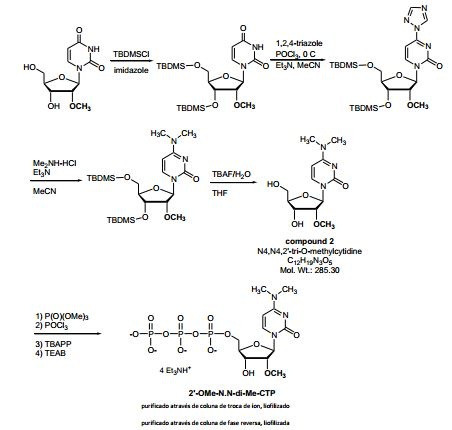
[000611] 2’-O-Metiluridina foi sililada para fornecer o composto disililado. 2’-O-metil-3’,5’-di-O-TBDMS uridina purificada foi ativada com POCl3 redestilado e imidazol sob condição anidra, seguido pela substituição nucleofílica com cloridrato de dimetilamina sob ambiente de trietilamina para aprisionar HCl. Composto intermediário N4,N4,2’-tri-Ometil-3’,5’-bis- O-TBDMS uridina foi purificado por cromatografia flash e obtido com uma espuma branca. O composto resultante foi desprotegido com TBAF e então purificado para prover ~400 mg de produto final composto 2 como espuma branca. ES MS: m/z 308 (M + Na)+, 386 (M + H)+; HPLC: pureza, 99,49% (FIGS. 3A-3C).[000611] 2'-O-Methyluridine was silylated to provide the disilylated compound. Purified 2'-O-methyl-3',5'-di-O-TBDMS uridine was activated with redistilled POCl3 and imidazole under anhydrous condition, followed by nucleophilic substitution with dimethylamine hydrochloride under triethylamine environment to trap HCl. Intermediate compound N4,N4,2'-tri-Omethyl-3',5'-bis-O-TBDMS uridine was purified by flash chromatography and obtained as a white foam. The resulting compound was deprotected with TBAF and then purified to provide ~400 mg
[000612] Para sintetizar o NTP correspondente, 70 mg de composto 2 nucleosídeo proveram 23 mg de 2’-OMe-N,N-di-Me-CTP após a purificação por troca de íons e colunas de fase reversas. HPLC: pureza, 95% (FIG. 4). Exemplo 10. Síntese de 5-metoxicarbonilmetoxi uridina (composto 3) e 5-metoxicarbonilmetóxi-UTP (NTP de dito composto)
[000613] Uridina 3-a em água foi tratada com quantidade de bromo em excesso e depois recebeu fluxo de ar para remover o bromo. A mistura de reação foi tratada com piridina a velocidade e temperatura controladas. Durante a reação, bromo instável-intermediário 3-b gradualmente convertido em intermediário 3-c di-hidroxila, o qual presumidamente desidratou para a 5-hidroxiuridina 3-d estável. Então, a 5-hidroxiuridina foi protegida com um grupo 2’,3’-isopropilideno para prover composto 3-g. A reação com composto 3-f proveu composto 3.[000613] Uridine 3-a in water was treated with excess amount of bromine and then air flown to remove bromine. The reaction mixture was treated with pyridine at controlled rate and temperature. During the reaction, unstable bromine-intermediate 3-b gradually converted to intermediate 3-c dihydroxy, which presumably dehydrated to the stable 3-d 5-hydroxyuridine. Then, 5-hydroxyuridine was protected with a 2',3'-isopropylidene group to provide compound 3-g. Reaction with compound 3-f provided
[000614] 60-70 mg do nucleosídeo proveram >21 mg do trifosfato desejado após duas etapas de purificação por coluna HPLC e duas etapas de liofilização. HPLC: pureza, 98% (FIG. 5). Exemplo 11. Síntese de 3-metil pseudouridina (composto 4) e 3-metil pseudo-UTP (NTP de dito composto)
[000615] Pseudouridina 4-a foi reagida com Ac2O para prover pseudouridina 4-b protegida por acetila. Então, N1 foi seletivamente protegido com POM para prover composto 4-c. Metilação de N3, seguida por composto 4 provido, desprotegido (~400 mg). Fórmula molecular: C10H14N2O6, peso molecular: 258.23g/mol; aparência: sólido branco; condições de armazenamento: armazenar a 25 °C; HPLC: pureza, 98,51%; 1H RMN (DMSO-d6): δ 11,17 (d, 1H, J = 3,0 Hz), 7,56 (d, 1H, J = 3,6 Hz), 4,91 (d, 1H, J = 3,6 Hz), 4,79 (t, 1H, J = 4,2Hz), 4,70 (d, 1H, J = 4,2Hz), 4,49 (d, 1H, J = 3,0Hz), 3,82-3,88 (m, 2H), 3,66-3,67 (m, 1H), 3,57-3,61 (m, 1H), 3,40-3,47 (m, 1H), 3,09 (s, 3H); MS: 281 (M + Na)+) (FIGURAS, 6A e 6B).[000615] Pseudouridine 4-a was reacted with Ac2O to provide acetyl-protected pseudouridine 4-b. Then, N1 was selectively protected with POM to provide compound 4-c. N3 methylation followed by provided, deprotected compound 4 (~400 mg). Molecular formula: C10H14N2O6, molecular weight: 258.23g/mol; appearance: solid white; storage conditions: store at 25°C; HPLC: purity, 98.51%; 1H NMR (DMSO-d6): δ 11.17 (d, 1H, J = 3.0 Hz), 7.56 (d, 1H, J = 3.6 Hz), 4.91 (d, 1H, J = 3.6 Hz), 4.79 (t, 1H, J = 4.2Hz), 4.70 (d, 1H, J = 4.2Hz), 4.49 (d, 1H, J = 3.0Hz) ), 3.82-3.88 (m, 2H), 3.66-3.67 (m, 1H), 3.57-3.61 (m, 1H), 3.40-3.47 (m, , 1H), 3.09 (s, 3H); MS: 281 (M + Na)+) (FIGURES, 6A and 6B).
[000616] Rotas alternativas poderiam ser aplicadas para se obter o composto 4. Por exemplo, pseudouridina pode ser reagida com um grupo de proteção O (por exemplo, conforme aqui descrito, tal como TMS) e reagido com um grupo de proteção N (por exemplo, conforme aqui descrito, tal como acetila em N1). Então, N3 da nucleobase poderia ser reagido com um agente de alquilação (por exemplo, dimetilamina/dimetoximetila) para prover composto 4 que tem grupos de proteção N e O. Finalmente, o composto resultante seria desprotegido (por exemplo, sob condições básicas, tais como NH3/MeOH) para prover o composto 4. Exemplo 12. Síntese de N-Ac, 5-Ac-OCH2-citidina (composto 5)
[000617] Uridina 5-a foi protegida para obter o composto 5-b isopropilideno, o qual foi reagido com (CHCO)n. Ácido acético com quantidade de catalisador de TFA foi empregado para obter o composto 5-f seletivamente acilado desejado (30% de rendimento). Além disso, a tritilação do grupo 5’-OH resultou no composto 5-g desejado ortogonalmente protegido.[000617] Uridine 5-a was protected to obtain compound 5-b isopropylidene, which was reacted with (CHCO)n. Acetic acid with amount of TFA catalyst was employed to obtain the desired selectively acylated compound 5-f (30% yield). Furthermore, tritylation of the 5'-OH group resulted in the desired compound 5-g orthogonally protected.
[000618] O composto 5-g foi tratado com POCl3 e triazol para prover composto 5-h junto com o composto 5-i desacilado. Acetilação desses dois compostos proveu composto 5-j di-acilado, amplamente protegido. A desproteção do composto 5-j com ácido acético sob condição de aquecimento resultou em três produtos, um dos quais foi o composto 5.[000618] Compound 5-g was treated with
[000619] Para obter o NTP correspondente, uma reação de trifosfato pode ser conduzida (por exemplo, qualquer uma descrita aqui). Opcionalmente, o NTP pode ser purificado (por exemplo, usando uma coluna Sephadex DEAE-A25), liofilizado ou evaporado (por exemplo, a partir de EtOH).[000619] To obtain the corresponding NTP, a triphosphate reaction can be conducted (eg any one described here). Optionally, NTP can be purified (for example, using a Sephadex DEAE-A25 column), lyophilized or evaporated (for example, from EtOH).
[000620] Rotas alternativas poderiam ser aplicadas para obter o composto 5, tal como começar com citidina como material de partida. Em tais métodos, a posição 5 poderia ser reagida com um halogênio ou um agente de halogenação (por exemplo, qualquer um descrito aqui, tal como ácido I2/ meta-cloroperoxibenzoico), o qual pode ser deslocado com um agente de alquilação. Além disso, ditos métodos poderiam incluir o uso de um ou mais grupos de proteção N ou Os (por exemplo, qualquer um descrito aqui, tal como sililação ou acetilação) para proteger o grupo amino de citidina e/ou grupos hidroxila da porção açúcar. Exemplo 13. Síntese de 5-TBDMS-OCH2-citidina (composto 6)
[000621] Um composto 5-hidroxiuracila’-b foi glicosilado para obter o composto 6’-d (rendimento de 28%), o qual foi sililado para prover o composto 6’-e. A ativação da uridina protegida proveu o composto 6 desejado após aminação e desproteção adicionais (800 mg do composto final). Fórmula molecular: C16H29N3O6Si; peso molecular: 387,50 g/mol; aparência: sólido branco; condições de armazenagem: armazenar a 25 °C; HPLC: pureza, 97,57%; 1H RMN (CDCl3): d 7,81 (s, 1H), 7,40 (s amplo, 1H), 6,49 (s amplo, 1H), 5,79 (d, 1H, J = 2,4 Hz), 5,3-5,32 (m, 1H), 5,00-5,07 (m, 2H), 4,30-4,45 (m, 2H), 3,90-3,94 (m, 2H), 3,80-3,83 (m, 1H), 3,50-3,70 (m, 2H), 0,87 (s, 9H), 0,05 (S, 6H); MS: 388 (M + H)+, 410 (M + Na)+) (FIGURAS 7A-7C).[000621] A 5-hydroxyuracil’-b compound was glycosylated to obtain the 6’-d compound (yield 28%), which was silylated to provide the 6’-e compound. Activation of protected uridine provided the desired compound 6 after additional amination and deprotection (800 mg of final compound). Molecular formula: C16H29N3O6Si; molecular weight: 387.50 g/mol; appearance: solid white; storage conditions: store at 25 °C; HPLC: purity, 97.57%; 1H NMR (CDCl3): d 7.81 (s, 1H), 7.40 (broad s, 1H), 6.49 (broad s, 1H), 5.79 (d, 1H, J = 2.4 Hz ), 5.3-5.32 (m, 1H), 5.00-5.07 (m, 2H), 4.30-4.45 (m, 2H), 3.90-3.94 (m) , 2H), 3.80-3.83 (m, 1H), 3.50-3.70 (m, 2H), 0.87 (s, 9H), 0.05 (S, 6H); MS: 388 (M + H)+, 410 (M + Na)+) (FIGURES 7A-7C).
[000622] Para obter o NTP correspondente, uma reação de trifosfato pode ser conduzida (por exemplo qualquer uma descrita aqui). Opcionalmente, o NTP pode ser purificado (por exemplo, usando uma coluna Sephadex DEAE-A25), liofilizado ou evaporado (por exemplo a partir de EtOH). Exemplo 14. Síntese de 5-trifluorometil citidina (composto 7)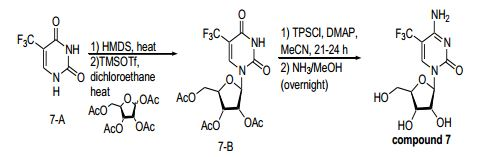
[000623] Composto 7-A foi glicosilado para prover composto 7-B, o qual foi tratado com cloreto de 2,4,6-triisopropilbenzeno sulfonila (TPSCl) para ativar o grupo carbonila e para prover a aminação redutora. A desproteção proveu o composto 7. Agentes de ativação alternativos poderiam ser usados em vez de TPSCl, tal como cloreto de 2,4,6-trimetilbenzeno sulfonila.[000623] Compound 7-A was glycosylated to provide compound 7-B, which was treated with 2,4,6-triisopropylbenzene sulfonyl chloride (TPSCl) to activate the carbonyl group and to provide reductive amination. Deprotection provided compound 7. Alternative activating agents could be used in place of TPSCl, such as 2,4,6-trimethylbenzene sulfonyl chloride.
[000624] Para obter o NTP correspondente, uma reação de trifosfato pode ser conduzida (por exemplo, qualquer uma descrita aqui). Opcionalmente, o NTP pode ser purificado (por exemplo, usando uma coluna Sephadex DEAE-A25), liofilizado ou evaporado (por exemplo, a partir de EtOH). Exemplo 15. Síntese de 5-trifluormetil uridina (composto 8)
[000625] 5-Trifluormetiluracila 8-A foi glicosilada com tetra-O-acetil ribose e a 5-trifluorometiluridina triprotegida 8-B desejada foi obtida em bom rendimento. Além disso, a desproteção forneceu o composto 8 desejado, o qual foi caracterizado com resultados de RMN, MS e HPLC. MS: 313 (M + H)+, 335 (M + Na)+; HPLC: pureza, 98,87%, ((FIGURAS 8A-8C).[000625] 5-Trifluoromethyluracil 8-A was glycosylated with tetra-O-acetyl ribose and the desired triprotected 5-trifluoromethyluridine 8-B was obtained in good yield. Furthermore, deprotection provided the desired
[000626] Para obter o NTP correspondente, uma reação de trifosfato pode ser conduzida (por exemplo, qualquer uma descrita aqui). Opcionalmente, o NTP pode ser purificado (por exemplo, usando uma coluna Sephadex DEAE-A25), liofilizado ou evaporado (por exemplo, a partir de EtOH). Exemplo 16. Síntese de 5-(metoxicarbonil)metil uridina (composto 9)
[000627] Uridina 9-a foi protegida para prover composto 9-b (rendimento de 98%). Este composto foi brominado com excesso de bromo na presença de anidrido de ácido acético e ácido acético. O análogo de 5-bromo 9-c foi obtido (60% de rendimento) e ainda benzoilado para prover o composto 9-d desejado (rendimento de 64%). Composto 5-bromo 9-d foi condensado com malonato de dimetila sob condição básica fornecer dar o malonato arilado e diéster 9-e totalmente protegido (50% de rendimento). Após a descarboxilação e desproteção, o composto 9 foi obtido verificado por RMN (FIG. 9).[000627] Uridine 9-a was protected to provide compound 9-b (98% yield). This compound was brominated with excess bromine in the presence of acetic acid anhydride and acetic acid. The 5-bromo analogue 9-c was obtained (60% yield) and further benzoylated to provide the desired compound 9-d (64% yield). 5-Bromo compound 9-d was condensed with dimethyl malonate under basic condition to give the fully protected arylated malonate and diester 9-e (50% yield). After decarboxylation and deprotection, compound 9 was obtained checked by NMR (FIG. 9).
[000628] Para obter o NTP correspondente, uma reação de trifosfato pode ser conduzida (por exemplo, qualquer uma descrita aqui). Opcionalmente, o NTP pode ser purificado (por exemplo, usando uma coluna Sephadex DEAE-A25), liofilizado ou evaporado (por exemplo, a partir de EtOH). Exemplo 17. Síntese de 5-(metoxicarbonil)metil-2'-O-metil uridina (2- OMe-MCM5U) (composto 10)
[000629] Estratégia similar à síntese do composto 9 acima, 2’-O- metiluridina 10-a foi acilada e brominada para obter o composto 10-c. Benzoilação adicional proveu análogo de 5-bromo 10-d, o qual foi condensado com malonato de dimetila para prover o produto 10-e desejado (rendimento de 45%). Descarboxilação e desproteção proveram o composto 10.[000629] Similar strategy to the synthesis of compound 9 above, 2'-O-methyluridine 10-a was acylated and brominated to obtain compound 10-c. Further benzoylation provided 5-bromo analogue 10-d, which was condensed with dimethyl malonate to provide the desired product 10-e (45% yield). Decarboxylation and deprotection provided
[000630] Para se obter o NTP correspondente, uma reação de trifosfato pode ser conduzida (por exemplo, qualquer uma descrita aqui). Opcionalmente, o NTP pode ser purificado (por exemplo, usando uma coluna Sephadex DEAE-A25), liofilizado ou evaporado (por exemplo, a partir de EtOH). Exemplo 18. Síntese de 5-trifluoroacetil-aminometil-2-tiouridina (composto 11)
[000631] Glicosilação de 2-tiouracila 11-a proveu o composto 11-c, o qual pode ser desprotegido com qualquer reagente de desproteção útil. Em particular, LiOH proveu o produto desejado 11-d (rendimento de 80-90%). A proteção com isopropilideno proveu composto 11-e (rendimento de 90%). Além disso, 5-hidroxilmetilação adicional proveu composto 11-f. Cloração, azidação e redução adicional proveram o composto de metilamina 11-i, o qual foi acetilado para prover o composto 11.[000631] Glycosylation of 2-thiouracil 11-a provided compound 11-c, which can be deprotected with any useful deprotection reagent. In particular, LiOH provided the desired product 11-d (80-90%) yield. Protection with isopropylidene provided compound 11-e (90% yield). Furthermore, additional 5-hydroxylmethylation provided compound 11-f. Chlorination, azidation and further reduction provided the methylamine compound 11-i, which was acetylated to provide
[000632] Para obter o NTP correspondente, uma reação de trifosfato pode ser conduzida (por exemplo, qualquer uma descrita aqui). Opcionalmente, o NTP pode ser purificado (por exemplo, usando uma coluna Sephadex DEAE-A25), liofilizado ou evaporado (por exemplo, a partir de EtOH). Exemplo 19. Síntese de 5-metilaminometil-2-uridina (composto 12)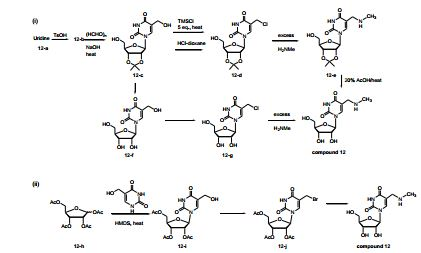
[000633] Composto 12 pode ser obtido através qualquer método útil (por exemplo, vide esquemas (i) e (ii) acima). Por exemplo, uracila protegida pode ser glicosilada e subsequentemente aminada para prover o composto 12. Etapas adicionais de proteção, desproteção e ativação podem ser conduzidas conforme necessário. Para obter o NTP correspondente, uma reação com trifosfato pode ser conduzida (por exemplo qualquer uma descrita aqui). Opcionalmente, o NTP pode ser purificado (por exemplo, usando uma coluna Sephadex DEAE-A25), liofilizado ou evaporado (por exemplo, a partir de EtOH). Exemplo 20. Síntese de 5-TFA-metilaminometil-2-uridina (composto 13)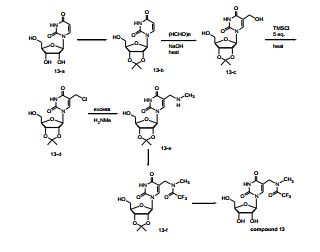
[000634] Uridina 13-a foi protegida com isopropilideno para prover o composto 13-b e depois 5-hidroximetilada para prover o composto 13- c. Cloração e subsequente aminação proveram composto 13-e, que pode ser protegido para prover 13-f. Desproteção subsequente proveu composto 13.[000634] Uridine 13-a was protected with isopropylidene to provide compound 13-b and then 5-hydroxymethylated to provide compound 13-c. Chlorination and subsequent amination provided compound 13-e, which could be protected to provide 13-f. Subsequent deprotection provided compound 13.
[000635] Para obter o NTP correspondente, uma reação com trifosfato pode ser conduzida (por exemplo, qualquer uma descrita aqui). Opcionalmente, o NTP pode ser purificado (por exemplo, usando uma coluna Sephadex DEAE-A25), liofilizado ou evaporado (por exemplo, a partir de EtOH). Exemplo 21. Síntese de 5-carboximetilaminometil uridina (composto 14)
[000636] Uridina 14-a foi protegida com isopropilideno para prover composto 14-b e então 5-aminoalquilada com a reação de Mannich para prover composto 14-c. Metilação proveu amina quaternária 14-d. As etapas de aminação e desproteção subsequentes podem ser usadas para prover composto 14. Para obter o NTP correspondente, uma reação de trifosfato pode ser conduzida (por exemplo qualquer uma descrita aqui). Opcionalmente, o NTP pode ser purificado (por exemplo, usando uma coluna Sephadex DEAE-A25), liofilizado ou evaporado (por exemplo, a partir de EtOH). Exemplo 22. Síntese alternativa de 5-metilaminometil-2-uridina (composto 12) e 5-carboximetilaminometil-2-uridina (composto 14)
[000637] Além daquelas estratégias providas acima para os compostos 12 e 14, a estratégia a seguir pode também ser implementada. 5-Metiluridina A pode ser sililada para prover o composto B. Após monobrominação radical, o brometo intermediário resultante C pode ser usado para a preparação dos análogos do composto 12 e composto 14. Alquilaminação subsequente do composto brometo C poderia prover compostos D e E, os quais podem ser desprotegidos para prover compostos 14 e 12, respectivamente. Para obter o NTP correspondente, uma reação com trifosfato pode ser conduzida (por exemplo, qualquer uma descrita aqui). Opcionalmente, o NTP pode ser purificado (por exemplo, usando uma coluna Sephadex DEAE-A25), liofilizado ou evaporado (por exemplo, a partir de EtOH). ,Exemplo 23. Síntese de dimetil-pseudouridina (composto 15) e dimetil- pseudo-UTP (NTP do dito composto)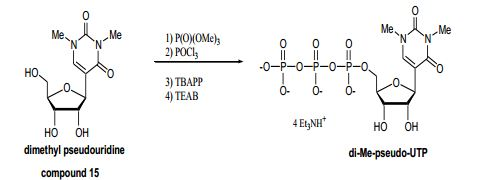
[000638] Nucleosídeos podem ser fosforilados através de qualquer método útil. Por exemplo, como mostrado acima, nucleosídeos podem ser reagidos com oxicloreto fosforoso e subsequentemente tratados com um intermediário monofosfato com bis(tributilamonio)pirofosfato (TBAPP) para dar o trifosfato. Exemplo 24. Síntese de 2’-C-metil adenosina (composto 16) e 2’-C-metil ATP (NTP do dito composto)
[000639] Cerca de 5 g de composto 16-2 foram preparados de 5 g de composto 16-1 via uma reação com periodinana de Dess-Martin. O composto 16-2 foi reagido com MeMgI/TiCl4/-78oC para prover o composto 16-3 e composto bruto 16-3 (6 g) foi diretamente reagido com cloreto de benzila para preparar o composto 16-4. Reação com a nucleobase e a desproteção proveram o composto 16 (0,56 g). Exemplo 25. Síntese de isômeros de 2’-C-metil-citidina (composto 17 e composto 18) e 2’-C-metil UTP (NTP dos ditos compostos)
[000640] Cerca de 17,4 g de composto 17-3 foram preparados a partir de 20 g de composto 17-1. Então, 2’-oxidação e a alquilação com MeMgI proveram 300 mg de composto 17-5 a e 80 mg de composto 17-5b. Cerca de 9 g de composto 17-5a (cerca de 90% puro) e 2,1g de composto 17-5b (puro) foram preparados a partir de 17,4g de composto 17-3 em 2 bateladas. Desproteção N e O proveu os compostos 17 e 18. Exemplo 26. Síntese de 2’-C-metil guanosina (composto 19) e 2’-C-metil GTP (NTP do dito composto)
[000641] 2’-Oxidação de ribose protegida 19-1 e alquilação subsequente com MeMgCl proveram composto 19-3. O composto resultante foi ainda protegido para prover o composto 19-4, e 1,56 g de composto 19-5a foi preparado a partir de 3,1 g de composto 19-4. Oxidação e desproteção subsequentes proveram composto 19 (cerca de 90% puro, 50 mg).[000641] 2'-Oxidation of protected ribose 19-1 and subsequent alkylation with MeMgCl provided compound 19-3. The resulting compound was further protected to provide compound 19-4, and 1.56 g of compound 19-5a was prepared from 3.1 g of compound 19-4. Subsequent oxidation and deprotection provided compound 19 (about 90% pure, 50 mg).
[000642] Para obter o NTP correspondente, uma reação com trifosfato pode ser conduzida (por exemplo, qualquer uma descrita aqui). Opcionalmente, o NTP pode ser purificado (por exemplo, usando uma coluna Sephadex DEAE-A25), liofilizado ou evaporado (por exemplo, a partir de EtOH). Exemplo 27. Síntese de 2’-C-metil uridina (composto 20) e 2’-C-metil UTP (NTP do dito composto)
[000643] 2’-Oxidação de ribose 20-1 protegida e alquilação subsequente com MeMgCl proveram composto 20-3. O composto resultante foi ainda protegido para prover o composto 20-4. Reação com uracila e a desproteção proveram composto puro 20 (50 mg).[000643] 2'-Oxidation of protected ribose 20-1 and subsequent alkylation with MeMgCl provided compound 20-3. The resulting compound was further protected to provide compound 20-4. Reaction with uracil and deprotection provided pure compound 20 (50 mg).
[000644] Para obter o NTP correspondente, uma reação com trifosfato pode ser conduzida (por exemplo, qualquer uma descrita aqui). Opcionalmente, o NTP pode ser purificado (por exemplo, usando uma coluna Sephadex DEAE-A25), liofilizado ou evaporado (por exemplo, a partir de EtOH). Exemplo 28. Síntese de (S)-2’-C-metil adenosina (composto 21) e (S)- 2’-C-metil ATP (NTP do dito composto)
[000645] O Composto 21-1 (5 g) foi protegido para formar composto 21-2a, e a oxidação com cromo proveu composto 21-3a. Alquilação via rota [i] (MeMgI 5 eq. em éter a -50°C) proveu composto 21-4. Opcionalmente, o rendimento poderia ser melhorado via rota [ii] ao proteger o grupo amino para prover composto 21-3b e então alquilação na posição 2’-C para prover o composto 21-4a. Composto 21-3a foi alquilado para prover composto bruto 21-4 (3 g, 20% de composto 3a neste produto bruto), onde o produto pode ser opcionalmente purificado. A desproteção do composto 21-4 rendeu composto 21 (rendimento de 50%).[000645] Compound 21-1 (5 g) was protected to form compound 21-2a, and oxidation with chromium provided compound 21-3a. Alkylation via route [i] (5 eq. MeMgI in ether at -50°C) provided compound 21-4. Optionally, the yield could be improved via route [ii] by protecting the amino group to provide compound 21-3b and then alkylating at the 2'-C position to provide compound 21-4a. Compound 21-3a was alkylated to provide crude compound 21-4 (3 g, 20% compound 3a in this crude product), where the product can be optionally purified. Deprotection of compound 21-4 yielded compound 21 (50% yield).
[000646] Para obter o NTP correspondente, uma reação com trifosfato pode ser conduzida (por exemplo, qualquer uma descrita aqui). Opcionalmente, o NTP pode ser purificado (por exemplo, usando uma coluna Sephadex DEAE-A25), liofilizado ou evaporado (por exemplo, a partir de EtOH). Exemplo 29. Síntese de (S)-2’-C-metil guanosina (composto 22) e (S)- 2’-metil GTP (NTP do dito composto)
[000647] Cerca de 30 g do composto 22-1 foram sililados para prover composto 22-2 em três etapas. Proteção adicional proveu composto 223 e oxidação com periodinana de Dess-Martin proveu composto 22-4 (1,6 g) em duas bateladas. Alquilação 2’-C (MeMgI 5 eq. em éter, -50°C a TA) proveu composto 22-5 e etapas de desproteção adicionais proveram composto 22.[000647] About 30 g of compound 22-1 were silylated to provide compound 22-2 in three steps. Additional protection provided compound 223 and Dess-Martin periodinane oxidation provided compound 22-4 (1.6 g) in two batches. 2'-C alkylation (5 eq. MeMgI in ether, -50°C to RT) provided compound 22-5 and additional deprotection steps provided compound 22.
[000648] Para obter o NTP correspondente, uma reação com trifosfato pode ser conduzida (por exemplo, qualquer uma descrita aqui). Opcionalmente, o NTP pode ser purificado (por exemplo, usando uma coluna Sephadex DEAE-A25), liofilizado ou evaporado (por exemplo, a partir de EtOH). Exemplo 30. Síntese de (S)-2’-C-metil uridina (composto 23) e de (S)- 2’-C-metil UTP (NTP do dito composto)
[000649] Uridina 23-1 (2,0 g) foi protegida com TIPDSCl2 (1,3-dicloro- 1,1,3,3-tetraisopropildisiloxano) para prover composto 23-2. Oxidação proveu composto 23-3 e alquilação 2’-C proveu composto 23-4, que pode ser opcionalmente purificado com Prep-HPLC antes da próxima etapa. Depois, a desproteção proveu o composto desejado 23.[000649] Uridine 23-1 (2.0 g) was protected with TIPDSCl2 (1,3-dichloro-1,1,3,3-tetraisopropyldisiloxane) to provide compound 23-2. Oxidation provided compound 23-3 and 2'-C alkylation provided compound 23-4, which can be optionally purified with Prep-HPLC before the next step. Then deprotection provided the desired compound 23.
[000650] Para obter o NTP correspondente, uma reação com trifosfato pode ser conduzida (por exemplo, qualquer uma descrita aqui). Opcionalmente, o NTP pode ser purificado (por exemplo, usando uma coluna Sephadex DEAE-A25), liofilizado ou evaporado (por exemplo, a partir de EtOH). Exemplo 31. Síntese de 4’-C-metil adenosina (composto 24) e 4’-C-metiI ATP (NTP do dito composto)
[000651] 1,2:5,6-Di-O-isopropilideno-α-D-glucofuranose 24-1 foi convertido via etapas de oxidação, redução e proteção sequenciais para prover composto 24-4. A primeira etapa de oxidação para prover composto 24-2 pode ser implementada com quaisquer reagentes úteis, tais como de dicromato de piridínio 0,75 eq. (PDC) com Ac2O 1 eq. ou periodana de Dess-Martin1,2 eq. Desproteção, formilação e redução subsequentes proveram composto 24-7, o qual foi seguido com etapas de proteção e desoxigenação para prover o composto 24-10. Cerca de 0,4 g de composto 24-14 foi preparado a partir de 1 g de composto 2410 via etapas de proteção e desproteção sequenciais. Adição de N6- benzoiladenina e desproteção subsequente proveram composto 24.[000651] 1,2:5,6-Di-O-isopropylidene-α-D-glucofuranose 24-1 was converted via sequential oxidation, reduction and protection steps to provide compound 24-4. The first oxidation step to provide compound 24-2 can be implemented with any useful reagents such as pyridinium dichromate 0.75 eq. (PDC) with
[000652] Para obter o NTP correspondente, uma reação com trifosfato pode ser conduzida (por exemplo, qualquer uma descrita aqui). Opcionalmente, o NTP pode ser purificado (por exemplo, usando uma coluna Sephadex DEAE-A25), liofilizado ou evaporado (por exemplo, a partir de EtOH). Exemplo 32. Síntese de 4’-C-metil citidina (composto 25) e 4’-C-metil CTP (NTP do dito composto)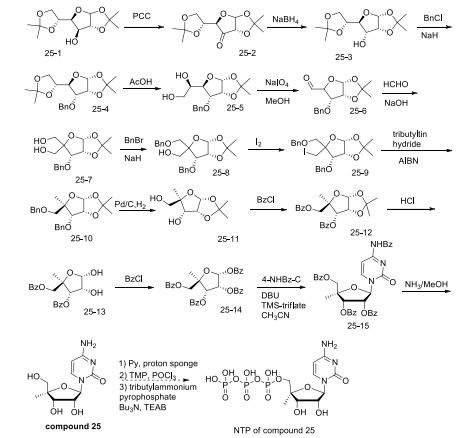
[000653] Similar à estratégia provida acima para o composto 24, composto 25-14 foi produzido com composto 25-1. Adição de citidina e desproteção subsequente proveram o composto 25.[000653] Similar to the strategy provided above for compound 24, compound 25-14 was produced with compound 25-1. Addition of cytidine and subsequent deprotection provided
[000654] Para obter o NTP correspondente, uma reação com trifosfato pode ser conduzida (por exemplo, qualquer uma descrita aqui). Opcionalmente, o NTP pode ser purificado (por exemplo, usando uma coluna Sephadex DEAE-A25), liofilizado ou evaporado (por exemplo, a partir de EtOH). Exemplo 33. Síntese de 4’-C-metil guanosina (composto 26) e 4’-C-metil GTP (NTP do dito composto)
[000655] Similar à estratégia provida acima para o composto 24,composto 26-14 foi produzido com composto 26-1. Adição de 2-amino- 6-cloropurina, oxidação subsequente e então desproteção proveram o composto 26.[000655] Similar to the strategy provided above for compound 24, compound 26-14 was produced with compound 26-1. Addition of 2-amino-6-chloropurine, subsequent oxidation and then deprotection provided compound 26.
[000656] Para obter o NTP correspondente, uma reação com trifosfato pode ser conduzida (por exemplo, qualquer uma descrita aqui). Opcionalmente, o NTP pode ser purificado (por exemplo, usando uma coluna Sephadex DEAE-A25), liofilizado ou evaporado (por exemplo, a partir de EtOH). Exemplo 34. Síntese de 4’-C-metil uridina (composto 27) e 4’-C-metil UTP (NTP do dito composto)
[000657] Similar à estratégia provida acima para o composto 24, composto 27-14 foi produzido com composto 27-1. Adição de uracila e desproteção subsequente proveram o composto 27.[000657] Similar to the strategy provided above for compound 24, compound 27-14 was produced with compound 27-1. Addition of uracil and subsequent deprotection provided compound 27.
[000658] Para obter o NTP correspondente, uma reação com trifosfato pode ser conduzida (por exemplo, qualquer uma descrita aqui). Opcionalmente, o NTP pode ser purificado (por exemplo, usando uma coluna Sephadex DEAE-A25), liofilizado ou evaporado (por exemplo, a partir de EtOH). Exemplo 35. Síntese de 2’-O,4’-C-metileno adenosina (composto 28) e 2’-O,4’-C-metileno ATP (NTP do dito composto)
[000659] Similar à estratégia provida acima para o composto 24, composto 28-7 foi produzido com composto 28-1. Metilação, desproteção e acetilação subsequentes proveram composto 28-10, o qual foi seguido pela adição de N6-benzoiladenina e ciclização interna subsequente. Várias etapas de proteção e desproteção proveram composto 28. Exemplo 36. Síntese de 5-metil-2’-O,4’-C-metileno citidina (composto 29) e 5-metil-2’-O,4’-C-metileno CTP (NTP do dito composto)
[000660] Composto aldofuranose 29-1 foi reagido por várias etapas de proteção, e então 5-metiluracila foi adicionada para prover composto 29 5. Etapas de ciclização, desproteção, proteção e aminação internas proveram o composto 29. Exemplo 37. Síntese de 2’-O,4’-C-metileno guanosina (composto 30) e 2’-O,4’-C-metileno GTP (NTP do dito composto)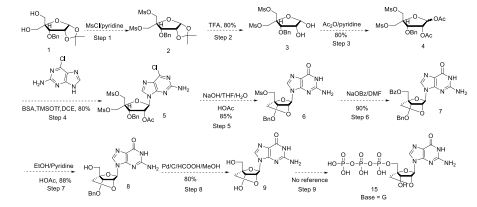
[000661] Similar à estratégia provida acima para o composto 29, composto aldofuranose 30-1 foi reagido via várias etapas de proteção, e depois 2-amino-6-cloropurina foi adicionada para prover o composto 30-5. Etapas de ciclização, desproteção, proteção e aminação internas proveram composto 30.[000661] Similar to the strategy provided above for compound 29, compound aldofuranose 30-1 was reacted via several protection steps, and then 2-amino-6-chloropurine was added to provide compound 30-5. Internal cyclization, deprotection, protection and amination steps provided
[000662] Para obter o NTP correspondente, uma reação com trifosfato pode ser conduzida (por exemplo, qualquer uma descrita aqui). Opcionalmente, o NTP pode ser purificado (por exemplo, usando uma coluna Sephadex DEAE-A25), liofilizado ou evaporado (por exemplo, a partir de EtOH)., Exemplo 38. Síntese de 2’-O,4’-C-metileno uridina (composto 31) e 2’- O,4’-C-metileno UTP (NTP do dito composto)
[000663] Similar à estratégia provida acima para o composto 24, composto 31-7 foi produzido com composto 31-1. Mesilação, desproteção e acetilação subsequentes proveram composto 30-10. Adição de uracila e a ciclização interna subsequente proveram composto 31-12, e várias etapas de proteção e desproteção proveram o composto 31. Uma reação de trifosfato subsequente (por exemplo, conforme aqui descrito) proveu o NTP do composto 31, o qual pode ser opcionalmente purificado (por exemplo, com HPLC). Exemplo 39. Síntese de 2’-cloro adenosina (composto 32) e 2’-cloro ATP (NTP do dito composto)
[000664] Arabinoadenosina 32-1 foi protegida via etapas 1 e 2 e então clorada para prover o composto 32-4. Desproteção subsequente proveu composto 32, e a reação com trifosfato proveu o NTP do composto 32. Exemplo 40. Síntese de 2’-iodo adenosina (composto 33) e 2’-iodo ATP (NTP do dito composto)
[000665] Arabinoadenosina 33-1 foi protegida via etapas 1 e 2 e então iodada para prover o composto 33-4. Desproteção subsequente proveu composto 33, e a reação com trifosfato em DMF proveu o NTP do composto 33. Exemplo 41. Síntese de 2’-bromo citidina (composto 34) e 2’-bromo CTP(NTP do dito composto)
[000666] Arabinocitidina 34-1 foi protegida sob várias condições e então bromada para prover o composto 34-4. Opcionalmente, a reação pode prover composto 34-4 via composto 34-3a sob quaisquer reações de proteção úteis, tais como (i) Et3N 1,5 eq., DMAP 1 eq., TfCl 1,2 eq., em DCM (10 mL); (ii) DMAP 3 eq., TfCl 1,2 eq. em DCM (15 mL); ou (iii) DMAP 15 eq., Tf2O 1,5 eq., em DCM (15mL) a -10°C até 0°C por 2 horas. Em particular, 55 mg de composto 34-3a foram obtido a partir da condição de reação (iii). Desproteção subsequente proveu o composto 34, e a reação de trifosfato em DMF proveu o NTP do composto 34. Produto bruto 34 poderia ser opcionalmente purificado antes da fosforilação. Exemplo 42. Síntese de 2’-cloro guanosina (composto 35) e 2’-cloro GTP (NTP do dito composto)
[000667] Guanosina 35-1 foi protegida sob várias condições e então acetilada para prover composto 35-4. A reação a partir do composto 352 para composto 35-3 foi conduzida com DMAR 2 eq., Et3N 2 eq., Tf2O 3 eq. em 1,2-dicloroetano (10 mL) a 40°C por 4 horas. Cerca de 55 mg de composto 35-3 foram obtidos após a purificação.[000667] Guanosine 35-1 was protected under various conditions and then acetylated to provide compound 35-4. The reaction from compound 352 to compound 35-3 was conducted with
[000668] O composto desejado 35 pode ser obtido através de qualquer método útil. Ror exemplo, como mostrado acima, o composto 35-4 pode ser tratado com etapas de proteção, cloração e desproteção subsequentes para prover o composto 35. Rara obter o NTR correspondente, uma reação de trifosfato pode ser conduzida (por exemplo, qualquer uma descrita aqui). Opcionalmente, o NTR pode ser purificado (por exemplo, usando uma coluna Sephadex DEAE-A25), liofilizado ou evaporado (por exemplo, a partir de EtOH). Exemplo 43. Síntese de 2’-iodo uridina (composto 36) e 2’-iodo UTR (NTP do dito composto
[000669] O2,2‘-Ciclouridina 36-1 foi protegida para prover composto 36-2. Iodação subsequente, opcionalmente mediada com selênio, proveu composto 36. Uma reação com trifosfato foi conduzida para prover o NTP do composto 36. Opcionalmente, o NTP pode ser purificado (por exemplo, usando uma coluna Sephadex DEAE-A25), liofilizado ou evaporado (por exemplo, a partir de EtOH). Exemplo 44. Síntese de 2’-O,4‘-C-metileno adenosina (composto 37) e 2’-O,4‘-C-metileno ATP (NTP do dito composto)
[000670] Similar à estratégia provida acima para o composto 24, composto 37-7 foi produzido com composto 37-1. Mesilação, desproteção e acetilação subsequentes proveram o composto 37-10. Adição de uracila e ciclização interna subsequente proveram composto 37-12. Várias etapas de proteção e desproteção proveram o composto 37.[000670] Similar to the strategy provided above for compound 24, compound 37-7 was produced with compound 37-1. Subsequent mesylation, deprotection and acetylation provided compound 37-10. Addition of uracil and subsequent internal cyclization provided compound 37-12. Several protection and deprotection steps provided compound 37.
[000671] Para obter o NTP correspondente, uma reação com trifosfato pode ser conduzida (por exemplo, qualquer uma descrita aqui). Opcionalmente, o NTP pode ser purificado (por exemplo, usando uma coluna Sephadex DEAE-A25), liofilizado ou evaporado (por exemplo, a partir de EtOH). Exemplo 45. Síntese de ciclopenteno diol citidina (composto 38) e ciclopentene diol CTP (NTP do dito composto)
[000672] D-ribose foi protegida e então alilada para prover composto 38-4, que foi subsequentemente ciclizado e reduzido para prover composto 38-7. Metátese de olefina e subsequente oxidação proveram composto 38-9, e reações de redução e adição adicionais de N- benzoiluracila proveram composto 38-14. Reações de desproteção e proteção adicionais proveram composto 38, e a reação de trifosfato (por exemplo, com qualquer condição de reação útil, tais como aquelas descritas aqui ou na Patente Norte-americana No. 7.893.227, incorporada aqui a título de referência) proveu o NTP do composto 38. Exemplo 46. Síntese de 2’-metil uridina (composto 39) e 2’-metil UTP (NTP do dito composto)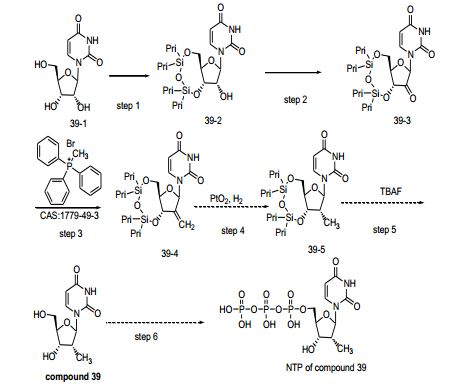
[000673] Uridina 39-1 foi protegida e depois oxidada com 2 eq. de periodinana de Dess-Martin para prover composto 39-3. Etapas de reação de Wittig, hidrogenação e de desproteção subsequentes proveram o composto 39. Exemplo 47. Síntese de 2’-metil citidina (composto 40) e 2’-metil CTP (NTP do dito composto)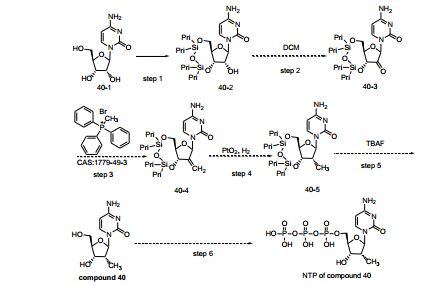
[000674] Citidina 40-1 foi protegida e depois oxidada para prover composto 40-3. Etapas de reação de Wittig, hidrogenação e desproteção subsequentes proveram o composto 40. Exemplo 48. Síntese de N-acetil citidina (composto 41) e N-acetil CTP (NTP do dito composto)
[000675] Uma solução de N-acetil-citidina (composto 41) (103,0 mg, 0,36 mmol) foi adicionada à esponja de prótons (115,72 mg, 0,54 mmol, 1,50 equiv.) em 1,0 mL de trimetilfosfato (TMP) e 1,0 mL de tetra- hidrofurano anidro (THF). A solução foi agitada por 10 minutos a 0°C. Oxicloreto fosforoso (POCl3) (67,2 ul, 0,72 mmol, 2,0 equiv.) foi adicionado em gotas à solução antes de ser mantida em agitação por 2 horas sob atmosfera de N2. Após 2 horas, a solução foi reagida com uma mistura de pirofosfato de bistributilamônio (TBAPP ou (n-Bu3NH)2H2P2O7) (1,28 g, 2,34 mmol, 6,5 equiv.) e tributilamina (350,0 ul, 1,45 mmol, 4,0 equiv.) em 2,5 ml de dimetilformamida. Após aproximadamente 15 minutos, a reação foi extinta com 24,0 ml de bicarbonato de trietilamônio 0,2M (TEAB) e a solução clara foi agitada em temperatura ambiente por uma hora. A mistura de reação foi liofilizada durante a noite e a mistura de reação bruta foi purificada por HPLC (Shimadzu, Kyoto Japan, coluna preparativa Phenomenex C18 , 250 x 21,20 mm, 10,0 mícrons; gradiente: A 100% por 3,0 min, então B 1%/min, A = 100 mM tampão TEAB, B = ACN; taxa de fluxo: 10,0 mL/min; tempo de retenção: 16,81-17,80 min). Frações que contêm o composto desejado foram agrupadas e liofilizadas para produzir o NTP do composto 41. As reações de trifosforilação foram realizadas em um frasco de dois gargalos seco sob chamada sob uma atmosfera de N2. Nucleosídeos e a esponja de proteína foram secos sob P2O5 sob vácuo durante a noite antes do uso. A formação de monofosfatos foi monitorada por LCMS. Exemplo 49. Síntese de 5-metoxiuridina (composto 42) e 5-metóxi UTP (NTP do dito composto)
[000676] Uma solução de 5-metoxiuridina (composto 42) (69,0 mg, 0,25 mmol, mais calor para torná-la solúvel) foi adicionada à esponja de prótons (80,36 mg, 0,375 mmol, 1,50 equiv.) em 0,7 mL de trimetilfosfato (TMP) e foi agitada por 10 minutos a 0°C. Oxicloreto fosforoso (POCI3) (46.7 ul, 0,50 mmol, 2,0 equiv.) foi adicionado em gotas à solução antes de manter em agitação por 2 horas sob atmosfera N2. Após 2 horas, a solução foi reagida com uma mistura de pirofosfato de bistributilamônio (TBAPP ou (n-Bu3NH)2H2P2O7) (894,60 mg, 1,63 mmol, 6,50 equiv.) e tributilamina (243,0 ul, 1,00 mmol, 4,0 equiv.) em 2,0 ml de dimetilformamida. Após aproximadamente 15 minutos, a reação foi extinta com 17.0 ml de bicarbonato de trietilamônio 0,2 M (TEAB) e a solução clara foi agitada em temperatura ambiente por uma hora. A mistura de reação foi liofilizada durante a noite e a mistura de reação bruta foi purificada por HPLC (Shimadzu, Kyoto Japan, coluna preparativa Phenomenex C18, 250 x 21,20 mm, 10,0 mícrons; gradiente: A 100% por 3,0 min, então B 1%/min, A = tampão TEAB 100 mM , B = ACN; taxa de fluxo: 10,0 mL/min; tempo de retenção: 16,57-17,51 min). Frações que contêm o composto desejado foram agrupadas e liofilizadas para produzir o NTP do composto 42. As reações de trifosforilação foram realizadas em um frasco de dois gargalos seco sob chama sob uma atmosfera de N2. Nucleosídeos e a esponja de proteína foram secos sob P2O5 sob vácuo durante a noite antes do uso. A formação de monofosfatos foi monitorada por LCMS. Exemplo 50. Síntese de 5-formil citidina (composto 43) e 5-formil CTP (NTP do dito composto)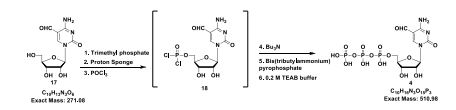
[000677] Uma solução de 5-formil citidina (composto 43) (48,4 mg, 0,18 mmol, mais calor para torná-la solúvel) foi adicionada à esponja de prótons (57,86 mg, 0,27 mmol, 1,50 equiv.) em 0,7 mL de trimetilfosfato (TMP) e foi agitada por 10 minutos a 0°C. Oxicloreto fosforoso (POCI3) (33,6 ul, 0,36 mmol, 2,0 equiv.) foi adicionado em gotas à solução antes de ser mantida em agitação por 2 horas sob atmosfera de N2. Após 2 horas, a solução foi reagida com uma mistura de pirofosfato de bistributilamônio (TBAPP ou (n-Bu3NH)2H2P2O7) (642,0 mg, 1,17 mmol, 6,50 equiv.) e tributilamina (175,0 ul, 0,72 mmol, 4.0 equiv.) em 1,7 ml de dimetilformamida. Após aproximadamente 15 minutos, a reação foi extinta com 12,0 ml de bicarbonato de trietilamônio 0,2M (TEAB) e a solução clara foi agitada em temperatura ambiente por uma hora. A mistura de reação foi liofilizada durante a noite e a mistura de reação bruta foi purificada por HPLC (Shimadzu, Kyoto Japan, coluna preparativa Phenomenex C18, 250 x 21,20 mm, 10,0 mícrons; gradiente: A 100% por 3,0 min, então B 1%/min, A = tampão TEAB 100 mM, B = ACN; taxa de fluxo: 10,0 mL/min; tempo de retenção: 17.04-17.87 min). Frações que contêm o composto desejado foram agrupadas e liofilizadas para prover o NTP do composto 43. As reações de trifosforilação foram realizadas em um frasco de dois gargalos seco sob chama sob uma atmosfera de N2. Nucleosídeos e a esponja de proteína foram secos sob P2O5 sob vácuo durante a noite antes do uso. A formação de monofosfatos foi monitorada por LCMS. Exemplo 51. Síntese de 3-metil uridina (composto 44) e 3-metil UTP (NTP do dito composto)
[000678] Uma solução de 3-metil uridina (composto 44) (45,80 mg, 0,18 mmol) foi adicionada à esponja de prótons (57,86 mg, 0,27 mmol, 1,50 equiv.) em 0,5 mL de trimetilfosfato (TMP) e foi agitada por 10 minutos a 0°C. Oxicloreto fosforoso (POCh) (33,6 ul, 0,36 mmol, 2,0 equiv.) foi adicionado em gotas à solução antes de ser mantida em agitação por 2 horas sob atmosfera de N2. Após 2 horas, a solução foi reagida com uma mistura de pirofosfato de bistributilamônio (TBAPP ou (n-Bu3NH)2H2P2O7) (652,0 mg, 1,19 mmol, 6,60 equiv.) e tributilamina (175,0 ul, 0,72 mmol, 4,0 equiv.) em 1,3 ml de dimetilformamida. Após aproximadamente 15 minutos, a reação foi extinta com 12,0 ml de bicarbonato de trietilamônio 0,2M (TEAB) e a solução clara foi agitada em temperatura ambiente por uma hora. A mistura de reação foi liofilizada durante a noite e mistura de reação bruta foi purificada por HPLC (Shimadzu, Kyoto Japan, coluna preparativa Phenomenex C18, 250 x 21,20 mm, 10,0 mícrons; gradiente: A 100% por 3,0 min, então B 1%/min, A = tampão TEAB 100 mM, B = ACN; taxa de fluxo: 10,0 mL/min; tempo de retenção: 18,52-19,57 min). Frações que contêm o composto desejado foram agrupadas e liofilizadas para prover o NTP do composto 44. As reações de trifosforilação foram realizadas em um frasco de dois gargalos seco sob chama sob uma atmosfera de N2. Nucleosídeos e a esponja de proteína foram secos sob P2O5 sob vácuo durante a noite antes do uso. A formação de monofosfatos foi monitorada por LCMS. Exemplo 52. Síntese de N1-metil pseudouridina (composto45) e N1- metil pseudoUTP (NTP do dito composto)
[000679] Uma solução de N1-metil pseudouridina (composto 45) (96,6 mg, 0,374 mmol, mais calor para torná-la solúvel) foi adicionada à esponja de prótons (120,0 mg, 0,56 mmol, 1,50 equiv.) em 0,8 mL de trimetilfosfato (TMP) e foi agitada por 10 minutos a 0°C. Oxicloreto fosforoso (POCl3) (70,0 ul, 0,75 mmol, 2,0 equiv.) foi adicionado em gotas à solução antes de ser mantida em agitação por 2 horas sob atmosfera de N2. Após 2 horas, a solução foi reagida com uma mistura de pirofosfato de bistributilamônio (TBAPP ou (n-Bu3NH)2H2P2O7) (1,36 g, 2,47 mmol, 6,60 equiv.) e tributilamina (362,0 ul, 1,5 mmol, 4,0 equiv.) em 2,5 ml de dimetilformamida. Após aproximadamente 15 minutos, a reação foi extinta com 17.0 ml de bicarbonato de trietilamônio (TEAB) 0,2M e a solução clara foi agitada em temperatura ambiente por uma hora. A mistura de reação foi liofilizada durante a noite e a mistura de reação bruta foi purificada por HPLC (Shimadzu, Kyoto Japan, coluna preparativa Phenomenex C18, 250 x 21,20 mm, 10,0 mícrons; gradiente: A 100% por 3,0 min, então B 1%/min, A = tampão TEAB 100 mM, B = ACN; taxa de fluxo: 10,0 mL/min; tempo de retenção: 15,91-17,01 min). Frações que contêm o composto desejado foram agrupadas e liofilizadas e submetidas a uma reação de trifosforilação para prover o NTP do composto 45. As reações de trifosforilação foram realizadas em um frasco de dois gargalos seco sob chama sob uma atmosfera de N2. Nucleosídeos e a esponja de proteína foram secos sob P2O5 sob vácuo durante a noite antes do uso. A formação de monofosfatos foi monitorada por LCMS. Exemplo 53. Síntese de 5-metoxicarboniletenil uridina (composto 46) e 5-metoxicarboniletenil UTP (NTP do dito composto)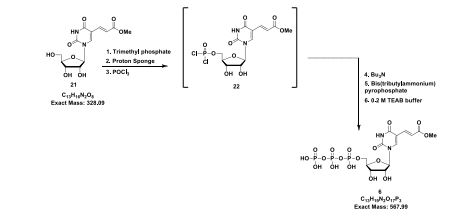
[000680] Uma solução de 5-metoxicarboniletenil uridina (composto 46) (102,0 mg, 0,31 mmol) foi adicionada à esponja de próton (99,65 mg, 0,46 mmol, 1,50 equiv.) em 0,8 mL de trimetilfosfato (TMP) e foi agitada por 10 minutos a 0 °C. Oxicloreto fosforoso (POCI3) (57,8 ul, 0,62 mmol, 2,0 equiv.) foi adicionado em gotas à solução antes de ser mantida em agitação por 2 horas sob atmosfera de N2. Após 2 horas, a solução foi reagida com uma mistura de pirofosfato de bistributilamônio (TBAPP ou (n-Bu3NH)2H2P2O7) (1,12 g, 2,05 mol, 6,60 equiv.) e tributilamina (300,0 ul, 1,24 mmol, 4.0 equiv.) em 2,5 ml de dimetilformamida. Após aproximadamente 15 minutos, a reação foi extinta com 20,0 ml de bicarbonato de trietilamônio 0,2 M (TEAB) e a solução clara foi agitada em temperatura ambiente por uma hora. A mistura de reação foi liofilizada durante a noite e a mistura de reação bruta foi purificada por HPLC (Shimadzu, Kyoto Japan, coluna preparativa Phenomenex C18, 250 x 21,20 mm, 10,0 mícrons; gradiente: A 100% por 3,0 min, então B 1%/min, A = tampão TEAB 100 mM, B = ACN; taxa de fluxo: 10,0 mL/min; tempo de retenção: 21,56-23,21 min). Frações que contêm o composto desejado foram agrupadas e liofilizadas para prover o NTP do composto 46. As reações de trifosforilação foram realizadas em um frasco de dois gargalos seco sob chama sob uma atmosfera de N2. Nucleosídeos e a esponja de proteína foram secos sob P2O5 sob vácuo durante a noite antes do uso. A formação de monofosfatos foi monitorada por LCMS. Exemplo 54. Síntese de 5-aminopropenil uridina (composto 47) e 5- aminopropenil UTP (NTP do dito composto)
[000681] 5-Aminopropenil uridina 47 foi protegida e uma solução de composto protegido 47 (86,0 mg, 0,22 mmol) foi adicionada à esponja de prótons (70,7 mg, 0,33 mmol, 1,50 equiv.) em 0,7 mL de trimetilfosfato (TMP) e foi agitada por 10 minutos a 0 °C. Oxicloreto fosforoso (POCl3) (41,1 ul, 0,44 mmol, 2,0 equiv.) foi adicionado em gotas à solução antes de ser mantida em agitação por 2 horas sob atmosfera de N2. Após 2 horas, a solução foi reagida com uma mistura de pirofosfato de bistributilamônio (TBAPP ou (n-Bu3NH)2H2P2O7) (784.6 mg, 1,43 mmol, 6,50 equiv.) e tributilamina (213.0 ul, 0,88 mmol, 4.0 equiv.) em 1,6 ml de dimetilformamida. Após aproximadamente 15 minutos, a reação foi extinta com 15,0 ml de bicarbonato de trietilamônio 0,2 M (TEAB) e a solução clara foi agitada em temperatura ambiente por uma hora. 18.0 ml de hidróxido de amônio concentrado foram adicionados à mistura de reação para remover o grupo trifluoracetila. Ela foi então armazenada em agitação durante a noite. A mistura de reação foi liofilizada durante a noite e a mistura de reação bruta foi purificada por HPLC (Shimadzu, Kyoto Japan, coluna preparativa Phenomenex C18, 250 x 21,20 mm, 10,0 mícrons; gradiente: A 100% por 3,0 min, então B 1%/min, A = tampão TEAB 100 mM, B = ACN; taxa de fluxo: 10,0 mL/min; tempo de retenção: 16,14-17,02 min). Frações que contêm o composto desejado foram agrupadas e liofilizadas para prover o NTP do composto 47. As reações de trifosforilação foram realizadas em um frasco de dois gargalos seco sob chama sob uma atmosfera de N2. Nucleosídeos e a esponja de proteína foram secos sob P2O5 sob vácuo durante a noite antes do uso. A formação de monofosfatos foi monitorada por LCMS. Exemplo 55. Síntese de N-PEG adenosina (composto 48) e N-PEG ATP (NTP do dito composto)
[000682] N-PEG adenosina 48 foi protegida e uma solução do composto protegido 48 (100,0 mg, 0,15 mmol) foi adicionada à esponja de próton (49,3 mg, 0,23 mmol, 1,50 equiv.) em 0,65 mL de trimetilfosfato (TMP) e foi agitada por 10 minutos a 0°C. Oxicloreto fosforoso (POCl3) (28,0 ul, 0,3 mmol, 2,0 equiv.) foi adicionado em gotas à solução antes de manter em agitação por 2 horas sob atmosfera N2. Após 2 horas, a solução foi reagida com uma mistura de pirofosfato de bistributilamônio (TBAPP ou (n-Bu3NH)2H2P2O7) (537,7 mg, 0,98 mmol, 6,50 equiv.) e tributilamina (146,0 ul, 0,6 mmol, 4,0 equiv.) em 1,2 ml de dimetilformamida. Após aproximadamente 15 minutos, a reação foi extinta com 10,0 mL de bicarbonato de trietilamônio 0,2 M (TEAB) e a solução clara foi agitada em temperatura ambiente por uma hora. 18.0 ml de hidróxido de amônio concentrado foram adicionados à mistura de reação para remover o grupo trifluoracetila. Ela foi então armazenada em agitação durante a noite. A mistura de reação foi liofilizada durante a noite e a mistura de reação bruta foi purificada por HPLC (Shimadzu, Kyoto Japan, coluna preparativa Phenomenex C18, 250 x 21,20 mm, 10,0 mícrons; gradiente: A 100% por 3,0 min, então B 1%/min, A = tampão TEAB 100 mM, B = ACN; taxa de fluxo: 10,0 mL/min; tempo de retenção: 24,5-25,5 min). Frações que contêm o composto desejado foram agrupadas e liofilizadas para prover o NTP do composto 48. As reações de trifosforilação foram realizadas em um frasco de dois gargalos seco sob chama sob uma atmosfera de N2. Nucleosídeos e a esponja de proteína foram secos sob P2O5 sob vácuo durante a noite antes do uso. A formação de monofosfatos foi monitorada por LCMS. Exemplo 56. Síntese de N-metil adenosina (composto 49) e N-metil ATP (NTP do dito composto)
[000683] Uma solução de N-metil adenosina (composto 49) (70,0 mg, 0,25 mmol) foi adicionada à esponja de prótons (79,29 mg, 0,37 mmol, 1,50 equiv.) em 0,7 mL de trimetilfosfato (TMP) e foi agitada por 10 minutos a 0°C. Oxicloreto fosforoso (POCh) (46,66 ul, 0,50 mmol, 2,0 equiv.) foi adicionado em gotas à solução antes de ser mantida em agitação por 2 horas sob atmosfera N2. Após 2 horas, a solução foi reagida com uma mistura de pirofosfato de bistributilamônio (TBAPP ou (n-Bu3NH)2H2P2O7) (888,85 mg, 1,62 mmol, 6,50 equiv.) e tributilamina (241,0 ul, 1,0 mmol, 4,0 equiv.) em 1,3 ml de dimetilformamida. Após aproximadamente 15 minutos, a reação foi extinta com 16,0 ml de bicarbonato de 0,2 M trietilamônio (TEAB) e a solução clara foi agitada em temperatura ambiente por uma hora. A mistura de reação foi liofilizada durante a noite e a mistura de reação bruta foi purificada por HPLC (Shimadzu, Kyoto Japan, coluna preparativa Phenomenex C18, 250 x 21,20 mm, 10,0 mícrons; gradiente: A 100% por 3,0 min, então B 1%/min, A = tampão TEAB 100 mM, B = ACN; taxa de fluxo: 10,0 mL/min; tempo de retenção: 19.62-20.14 min). Frações que contêm o composto desejado foram agrupadas e liofilizadas para prover o NTP do composto 49. As reações de trifosforilação foram realizadas em um frasco de dois gargalos seco sob chama sob uma atmosfera de N2. Nucleosídeos e a esponja de proteína foram secos sob P2O5 sob vácuo durante a noite antes do uso. A formação de monofosfatos foi monitorada por LCMS. Exemplo 57. Síntese de N,N-dimetil guanosina (composto 50) e N,N- dimetil GTP (NTP do dito composto)
[000684] Uma solução de N,N-dimetil guanosina (composto 50) (65,8 mg, 0,21 mmol) foi adicionada à esponja de prótons (68,58 mg, 0,32 mmol, 1,50 equiv.) em 0,7 mL de trimetilfosfato (TMP) e foi agitada por 10 minutos a 0°C. Oxicloreto fosforoso (POCI3) (39,20 ul, 0,42 mmol, 2,0 equiv.) foi adicionado em gotas à solução antes de ser mantida em agitação por 2 horas sob atmosfera N2. Após 2 horas, a solução foi reagida com uma mistura de pirofosfato de bistributilamônio (TBAPP ou (n-Bu3NH)2H2P2O?) (751,67 mg, 1,37 mmol, 6,50 equiv.) e tributilamina (204,0 ul, 0,84 mmol, 4,0 equiv.) em 1,5 ml de dimetilformamida. Após aproximadamente 15 minutos, a reação foi extinta com 14,0 ml de bicarbonato de trietilamônio 0,2M (TEAB) e a solução clara foi agitada em temperatura ambiente por uma hora. A mistura de reação foi liofilizada durante a noite e a mistura de reação bruta foi purificada por HPLC (Shimadzu, Kyoto Japan, coluna preparativa Phenomenex C18, 250 x 21,20 mm, 10,0 mícrons; gradiente: A 100% por 3,0 min, então B 1%/min, A = tampão TEAB 100 mM, B = ACN; taxa de fluxo: 10,0 mL/min; tempo de retenção: 19.27-19.95 min). Frações que contêm o composto desejado foram agrupadas e liofilizadas para prover o NTP do composto 50. As reações de trifosforilação foram realizadas em um frasco de dois gargalos seco sob chama sob uma atmosfera de N2. Nucleosídeos e a esponja de proteína foram secos sob P2O5 sob vácuo durante a noite antes do uso. A formação de monofosfatos foi monitorada por LCMS. Exemplo 58. Métodos gerais para a síntese de trifosfato de NTPS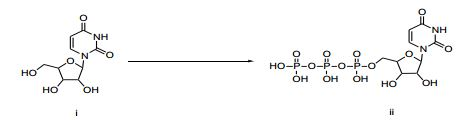
[000685] O nucleosídeo i pode ser fosforilado através de qualquer método útil para prover um composto ii trifosfato. Por exemplo, o nucleosídeo pode ser adicionado à esponja de prótons e trimetilfosfato (TMP) e resfriado (por exemplo a -40°C). Oxicloreto fosforoso (POCl3) pode ser adicionado em gotas antes de reagir com pirofosfato de bistributilamônio (TBAPP ou (n-Bu3NH)2H2P2O7) e tributilamina. A reação pode ser rapidamente extinta com bicarbonato de trietilamônio (TEAB). Condições exemplares são providas na Patente Norte- americana No. 7.893.227, que é incorporada aqui a título de referência.[000685] Nucleoside i can be phosphorylated by any method useful to provide a triphosphate compound ii. For example, the nucleoside can be added to the proton sponge and trimethylphosphate (TMP) and cooled (eg to -40°C). Phosphorous oxychloride (POCl3) can be added dropwise before reacting with bistributylammonium pyrophosphate (TBAPP or (n-Bu3NH)2H2P2O7) and tributylamine. The reaction can be quickly quenched with triethylammonium bicarbonate (TEAB). Exemplary terms are provided in U.S. Patent No. 7,893,227, which is incorporated herein by reference.
[000686] Após a reação de fosforilação, a mistura de reação pode ser opcionalmente liofilizada, purificada (por exemplo, por cromatografia de troca de íon e/ou HPLC) ou convertida em um sal de sódio (por exemplo, dissolvendo em MeOH e adicionando perclorato de sódio em acetona).[000686] After the phosphorylation reaction, the reaction mixture can be optionally lyophilized, purified (for example, by ion exchange chromatography and/or HPLC) or converted to a sodium salt (for example, dissolving in MeOH and adding sodium perchlorate in acetone).
[000687] Procedimentos de PCR para a preparação de cDNA são realizados usando 2x KAPA HIFI® HotStart ReadyMix da Kapa Biosystems (Woburn, MA). Esse sistema inclui 2x KAPA ReadyMix 12,5 μl; Iniciador avançado (10 uM) 0,75 μl; Iniciador Reverso (10 uM) 0,75 μl; cDNA Modelo 100 ng; e dH20 diluído para 25,0 μl. As condições da reação são a 95° C por 5 min e 25 ciclos de 98° C por 20 s, então 58° C por 15 seg, então 72° C por 45 seg, então 72° C por 5 min, então 4° C até o fim.[000687] PCR procedures for cDNA preparation are performed using 2x KAPA HIFI® HotStart ReadyMix from Kapa Biosystems (Woburn, MA). This system includes 2x KAPA ReadyMix 12.5 µl; Advanced Primer (10 µM) 0.75 µl; Reverse Primer (10 µM) 0.75 µl; Model cDNA 100ng; and dH20 diluted to 25.0 µl. Reaction conditions are 95°C for 5 min and 25 cycles of 98°C for 20 s, then 58°C for 15 sec, then 72°C for 45 sec, then 72°C for 5 min, then 4° C to the end.
[000688] O iniciador reverso da presente invenção incorpora uma poli- T120 para uma poli-A120 no mRNA. Outros iniciadores reversos com tratos Poli-T mais longos ou mais curtos podem ser usados para ajustar o comprimento da cauda poli-A no mRNA.[000688] The reverse primer of the present invention incorporates a poly-T120 to a poly-A120 in the mRNA. Other reverse primers with longer or shorter Poly-T tracts can be used to adjust the length of the poly-A tail in the mRNA.
[000689] A reação é limpa usando PURELINK® PCR Micro Kit da Invitrogen (Carlsbad, CA) conforme instruções do fabricante (até 5 μg). Reações maiores necessitarão uma limpeza usando um produto com uma capacidade maior. Após a limpeza, o cDNA é quantificado usando o NanoDrop e analisado através de eletroforese em gel de agarose para confirmar se o cDNA é do tamanho esperado. O cDNA é então submetido à análise de sequenciamento antes de prosseguir para a reação de transcrição in vitro.[000689] The reaction is cleaned using Invitrogen's PURELINK® PCR Micro Kit (Carlsbad, CA) per manufacturer's instructions (up to 5 μg). Larger reactions will require cleaning using a product with a higher capacity. After cleaning, the cDNA is quantified using NanoDrop and analyzed using agarose gel electrophoresis to confirm that the cDNA is the expected size. The cDNA is then subjected to sequencing analysis before proceeding to the in vitro transcription reaction.
[000690] A reação de transcrição in vitro gera mRNA contendo nucleotídeos modificados ou RNA modificado. A mistura de trifosfato de nucleotídeo (NTP) de entrada é feita internamente usando NTPs naturais e não-naturais.[000690] The in vitro transcription reaction generates mRNA containing modified nucleotides or modified RNA. The input nucleotide triphosphate (NTP) mixture is made in-house using natural and non-natural NTPs.
[000691] Uma reação de transcrição in vitro típica inclui o seguinte: Modelo de cDNA 1,0 μg 10x tampão de transcrição (Tris-HCl 400 mM pH 8,0, 2,0 μl MgCl2190 mM, DTT 50 mM, Espermidina 10 mM) NTPs customizados (25mM cada 7,2 μl Inibidor de RNase 20 U Polimerase de RNA T7 3000 U dH20 até 20,0 μl[000691] A typical in vitro transcription reaction includes the following: cDNA template 1.0 µg 10x transcription buffer (Tris-
[000692] Incubação a 37° C por 3 hr-5 h.[000692] Incubation at 37°C for 3 hr-5 h.
[000693] A mistura IVT bruta pode ser armazenada a 4° C durante a noite para limpeza no dia seguinte. 1 U de DNase livre de RNase é então usado para digerir o modelo original. Após 15 minutos de incubação a 37° C, o mRNA é purificado usando MEGACLEAR® Kit da Ambion (Austin, TX) seguindo as instruções do fabricante. Este kit pode purificar até 500 μg de RNA. Seguindo a limpeza, o RNA é quantificado usando o NanoDrop e analisado por eletroforese em gel agarose para confirmar que o RNA está no tamanho apropriado e que nenhuma degradação do RNA tenha ocorrido.[000693] Crude IVT mix can be stored at 4°C overnight for cleaning the next day. 1 U of RNase-free DNase is then used to digest the original model. After a 15 minute incubation at 37°C, the mRNA is purified using Ambion's MEGACLEAR® Kit (Austin, TX) following the manufacturer's instructions. This kit can purify up to 500 μg of RNA. Following cleaning, the RNA is quantified using NanoDrop and analyzed by agarose gel electrophoresis to confirm that the RNA is the appropriate size and that no RNA degradation has occurred.
[000694] A polimerase de RNA T7 pode ser selecionada a partir de polimerase de RNA T7, polimerase de RNA T3 e polimerases mutantes tais como, mas não limitado a, as novas polimerases capazes de incorporar NTPs modificados assim como aquelas polimerases descritas por Liu (Esvelt e outros (Nature (2011) 472(7344):499-503 e publicação Norte-americana No. 20110177495) a qual reconhece promotores alternativos, Ellington (Chelliserrykattil e Ellington, Nature Biotechnology (2004) 22(9):1155-1160) descrevendo uma polimerase de RNA T7 variante para transcrever 2’-O-methyl RNA e Sousa (Padilla e Sousa, Nucleic Acids Research (2002) 30(24): e128) descrevendo uma polimerase de RNA T7 dupla mutante; aqui incorporada a título de referência em sua totalidade.[000694] T7 RNA polymerase can be selected from T7 RNA polymerase, T3 RNA polymerase and mutant polymerases such as, but not limited to, new polymerases capable of incorporating modified NTPs as well as those polymerases described by Liu ( Esvelt et al. (Nature (2011) 472(7344):499-503 and U.S. Publication No. 20110177495) which recognize alternative promoters, Ellington (Chelliserrykattil and Ellington, Nature Biotechnology (2004) 22(9):1155-1160 ) describing a variant T7 RNA polymerase for transcribing 2'-O-methyl RNA and Sousa (Padilla and Sousa, Nucleic Acids Research (2002) 30(24): e128) describing a mutant double T7 RNA polymerase; reference in its entirety.
[000695] Capeamento do mRNA é realizado como a seguir onde a mistura inclui: RNA IVT 60 μg-180μg e dH20 até 72 μl. A mistura é incubada a 65° C por 5 minutos para desnaturar o RNA e depois é transferida imediatamente para gelo.[000695] mRNA capping is performed as follows where the mixture includes:
[000696] O protocolo então envolve a mistura de 10x de Tampão de Capeamento (Tris-HCl 0,5 M (pH 8,0), KC l60 mM, 12,5 mM de MgCl2) (10,0 μl); GTP 20 mM (5,0 μl); S-Adenosil Metionina 20 mM (2,5 μl); inibidor de RNase (100 U); 2-O-Metiltransferase (400U); enzima de capeamento de Vaccínia (Guanilil transferase) (40 U); dH20 (até 28 μl); e incubação a 37° C por 30 minutos para 60 μg de RNA ou até 2 horas para 180 μg de RNA.[000696] The protocol then involves mixing 10x Capping Buffer (0.5 M Tris-HCl (pH 8.0), 160 mM KC, 12.5 mM MgCl2) (10.0 µl); 20 mM GTP (5.0 µl); 20 mM S-Adenosyl Methionine (2.5 µl); RNase inhibitor (100 U); 2-O-Methyltransferase (400U); Vaccinia capping enzyme (Guanilil transferase) (40 U); dH20 (up to 28 µl); and incubation at 37°C for 30 minutes for 60 μg RNA or up to 2 hours for 180 μg RNA.
[000697] O mRNA é então purificado usando kit da Ambion MEGACLEAR® (Austin, TX) seguindo as instruções do fabricante. Após a limpeza, o RNA é quantificado usando o NANODROP® (ThermoFisher, Waltham, MA) e analisado por eletroforese em gel de agarose para confirmar que o RNA está no tamanho apropriado e nenhuma degradação do RNA tenha ocorrido. O produto de RNA pode também ser sequenciado ao realizar uma PCR para gerar o cDNA para sequenciamento.[000697] The mRNA is then purified using the Ambion MEGACLEAR® kit (Austin, TX) following the manufacturer's instructions. After cleaning, the RNA is quantified using NANODROP® (ThermoFisher, Waltham, MA) and analyzed by agarose gel electrophoresis to confirm that the RNA is the appropriate size and no RNA degradation has occurred. The RNA product can also be sequenced by performing a PCR to generate cDNA for sequencing.
[000698] Sem um poli-T no cDNA, uma reação formação da poli-A deve ser realizada antes da limpeza do produto final. Isso é feito ao misturar RNA capeado IVT (100 μl); Inibidor de RNase (20 U); 10x Tampão de formação da cauda (Tris-HCl 0,5 M (pH 8,0), NaCl 2,5 M, MgCl2 100 mM)(12,0 μl); ATP 20 mM (60 μl); Polimerase de Poli-A (20 U); dH20 até 1235 μl e incubação a 37° C por 30 min. Se a cauda poli-A já estiver no transcrito, então a reação de formação da cauda pode ser omitida e prosseguir diretamente para limpeza com o kit da Ambion MEGACLEAR® (Austin, TX) (até 500 μg). Polimerase de Poli-A é de preferência uma enzima recombinante expressa em levedura.[000698] Without a poly-T in the cDNA, a poly-A formation reaction must be performed before cleaning the final product. This is done by mixing capped RNA IVT (100 μl); RNase Inhibitor (20 U); 10x Tail Formation Buffer (0.5 M Tris-HCl (pH 8.0), 2.5 M NaCl, 100 mM MgCl 2 )(12.0 µl); 20 mM ATP (60 µl); Poly-A polymerase (20 U); dH20 to 1235 μl and incubation at 37°C for 30 min. If the poly-A tail is already in the transcript, then the tail formation reaction can be skipped and proceed directly to cleaning with the Ambion MEGACLEAR® kit (Austin, TX) (up to 500 μg). Poly-A polymerase is preferably a recombinant enzyme expressed in yeast.
[000699] Para estudos realizados e descritos aqui, a cauda poli-A é codificada no modelo IVT para compreender 160 nucleotídeos de comprimento. No entanto, deve ser entendido que a capacidade de processamento ou integridade da reação de formação da cauda poli-A pode nem sempre resultar em exatamente 160 nucleotídeos. Portanto, caudas poli-A de aproximadamente 160 nucleotídeos, por exemplo, cerca de 150-165, 155, 156, 157, 158, 159, 160, 161, 162, 163, 164 ou 165 estão dentro do escopo da invenção.[000699] For studies performed and described here, the poly-A tail is encoded in the IVT model to comprise 160 nucleotides in length. However, it should be understood that the processability or integrity of the poly-A tail formation reaction may not always result in exactly 160 nucleotides. Therefore, poly-A tails of approximately 160 nucleotides, e.g., about 150-165, 155, 156, 157, 158, 159, 160, 161, 162, 163, 164 or 165 are within the scope of the invention.
[000700] Uma amostra biológica que pode conter proteínas codificadas por RNA modificado administrada ao indivíduo é preparada e analisada de acordo com o protocolo do fabricante para ionização por eletropulverização (ESI) usando 1, 2, 3 ou 4 analisadores de massa. Uma amostra biológica pode também ser analisada usando um sistema de espectrometria de massa ESI em tandem.[000700] A biological sample that may contain proteins encoded by modified RNA administered to the subject is prepared and analyzed according to the manufacturer's protocol for electrospray ionization (ESI) using 1, 2, 3 or 4 mass analyzers. A biological sample can also be analyzed using an ESI tandem mass spectrometry system.
[000701] Padrões de fragmentos de proteína, ou proteínas inteiras, são comparados a controles conhecidos quanto a uma dada proteína e a identidade é determinada por comparação.[000701] Patterns of protein fragments, or whole proteins, are compared to known controls for a given protein and identity is determined by comparison.
[000702] Uma amostra biológica que pode conter proteínas codificadas por RNA modificado administrada ao indivíduo é preparada e analisada de acordo com o protocolo do fabricante para dessorção/ionização a laser auxiliada por matriz (MALDI).[000702] A biological sample that may contain proteins encoded by modified RNA administered to the individual is prepared and analyzed according to the manufacturer's protocol for matrix-assisted laser desorption/ionization (MALDI).
[000703] Padrões de fragmentos de proteína, ou proteínas inteiras, são comparados a controles conhecidos quanto uma dada proteína e a identidade é determinada por comparação.[000703] Patterns of protein fragments, or whole proteins, are compared to known controls when a given protein and identity is determined by comparison.
[000704] Uma amostra biológica, a qual pode conter proteínas codificadas por RNA modificado, pode ser tratada com uma enzima tripsina para digerir as proteínas contidas nela. Os peptídeos resultantes são analisados por cromatografia líquida-espectrometria de massa- espectrometria de massa (LC/MS/MS). Os peptídeos são fragmentados no espectrômetro de massa para fornecer padrões de diagnóstico que podem ser compatíveis com bancos de dados de sequência de proteína através de algoritmos de computador. A amostra digerida pode ser diluída para obter 1 ng ou menos do material de partida para uma dada proteína. Amostras biológicas que contêm uma base de tampão simples (por exemplo água ou sais voláteis) são condescendentes à digestão em solução direta; bases mais complexas (por exemplo detergente, sais não-voláteis, glicerol) requerem uma etapa de limpeza para facilitar a análise da amostra.[000704] A biological sample, which may contain proteins encoded by modified RNA, can be treated with a trypsin enzyme to digest the proteins contained in it. The resulting peptides are analyzed by liquid chromatography-mass spectrometry-mass spectrometry (LC/MS/MS). Peptides are fragmented in the mass spectrometer to provide diagnostic patterns that can be matched to protein sequence databases through computer algorithms. The digested sample can be diluted to obtain 1 ng or less of starting material for a given protein. Biological samples that contain a simple buffer base (eg water or volatile salts) are amenable to digestion in direct solution; more complex bases (eg detergent, non-volatile salts, glycerol) require a cleaning step to facilitate sample analysis.
[000705] Padrões de fragmentos de proteína, ou proteínas inteiras, são comparados a controles conhecidos para uma dada proteína e a identidade é determinada por comparação.[000705] Patterns of protein fragments, or whole proteins, are compared to known controls for a given protein and identity is determined by comparison.
[000706] 50 mL de sangue humano de dois doadores foram recebidos da Research Blood Components (lotes KP30928 e KP30931) em tubos de heparina de sódio. Para cada doador, o sangue foi agrupado e diluído para 70 mL com DPBS (SAFC Bioscience 59331C, lote 071M8408) e separado igualmente entre dois tubos cônicos de 50 mL. 10 mL de Ficoll Paque (GE Healthcare 17-5442-03, lote 10074400) foram suavemente despejados abaixo da camada de sangue. Os tubos foram centrifugados a 2000 rpm por 30 minutos com baixa aceleração e freio. Os tubos foram removidos e as camadas de células brancas PBMC foram suavemente transferidas a um tubo cônico novo de 50 mL e lavadas com DPBS. Os tubos foram centrifugados a 1450 rpm por 10 minutos.[000706] 50 ml of human blood from two donors were received from Research Blood Components (lots KP30928 and KP30931) in sodium heparin tubes. For each donor, blood was pooled and diluted to 70 mL with DPBS (SAFC Bioscience 59331C, lot 071M8408) and separated equally between two 50 mL conical tubes. 10 ml of Ficoll Paque (GE Healthcare 17-5442-03, lot 10074400) was gently poured below the blood layer. The tubes were centrifuged at 2000 rpm for 30 minutes with low acceleration and brake. The tubes were removed and the layers of white PBMC cells were gently transferred to a new 50 ml conical tube and washed with DPBS. Tubes were centrifuged at 1450 rpm for 10 minutes.
[000707] O sobrenadante foi aspirado e os peletes de PBMC foram ressuspensos e lavados em 50 mL de DPBS. Os tubos foram centrifugados a 1250 rpm por 10 minutos. Esta etapa de lavagem foi repetida, e os peletes de PBMC foram ressuspensos em 19 mL de Optimem I (Gibco 11058, lote 1072088) e contados. As suspensões de célula foram ajustadas para uma concentração de 3,0 x 10⁶ células / mL células vivas.[000707] The supernatant was aspirated and the PBMC pellets were resuspended and washed in 50 ml of DPBS. Tubes were centrifuged at 1250 rpm for 10 minutes. This wash step was repeated, and the PBMC pellets were resuspended in 19 ml of Optimem I (Gibco 11058, lot 1072088) and counted. Cell suspensions were adjusted to a concentration of 3.0 x 10⁶ cells/ml live cells.
[000708] Essas células foram então plaqueadas em cinco placas de fundo redondo tratadas com cultura de tecido de 96 cavidades (Costar 3799) por doador em 50 uL por cavidade. Dentro de 30 minutos, as misturas de transfecção foram adicionadas a cada cavidade em um volume de 50 uL por cavidade. Após 4 horas pós- transfecção, o meio foi suplementado com 10 uL de Soro Fetal Bovino (Gibco 10082, lote 1012368)[000708] These cells were then plated in five round bottom plates treated with 96-well tissue culture (Costar 3799) per donor at 50 μl per well. Within 30 minutes, transfection mixes were added to each well in a volume of 50 μl per well. After 4 hours post-transfection, the medium was supplemented with 10 µl of Fetal Bovine Serum (Gibco 10082, lot 1012368)
[000709] mRNA modificado que codifica G-CSF humano (sequência de mRNA mostrada em SEQ ID NO: 1; cauda poli-A de aproximadamente 160 nucleotídeos não mostrada em sequência; cap 5’, Cap1) (contendo ou (1) NTPs naturais, (2) 100% de substituição com 5-metil citidina e pseudouridina ou (3) 100% de substituição com 5-metil citidina e N1-metil pseudouridina; mRNA que codifica luciferase (sequência de cDNA IVT mostrada na SEQ ID NO: 2; sequência de mRNA mostrada em SEQ ID NO: 3, cauda poli-A de aproximadamente 160 nucleotídeos não mostrada em sequência, cap’ 5, Cap1, completamente modificado com 5-metilcitosina em cada substituição de citosina e pseudouridina em cada sítio de uridina) (contendo ou (1) NTPs naturais ou (2) 100% de substituição com 5-metil citidina e pseudouridina) e agonista de TLR R848 (tlrl-r848 da Invitrogem) foram diluídos até 38,4 ng / uL em um volume final de 2500 uL de Optimem I.[000709] Modified mRNA encoding human G-CSF (mRNA sequence shown in SEQ ID NO: 1; poly-A tail of approximately 160 nucleotides not shown in sequence; 5' cap, Cap1) (containing or (1) natural NTPs , (2) 100% replacement with 5-methyl cytidine and pseudouridine or (3) 100% replacement with 5-methyl cytidine and N1-methyl pseudouridine; mRNA encoding luciferase (IVT cDNA sequence shown in SEQ ID NO: 2 ; mRNA sequence shown in SEQ ID NO: 3, poly-A tail of approximately 160 nucleotides not shown in sequence, cap' 5, Cap1, fully modified with 5-methylcytosine at each cytosine and pseudouridine substitution at each uridine site) (containing either (1) natural NTPs or (2) 100% replacement with 5-methyl cytidine and pseudouridine) and TLR agonist R848 (tlrl-r848 from Invitrogem) were diluted to 38.4 ng/uL in a final volume of 2500 uL of Optimem I.
[000710] Separadamente, 110 uL de Lipofectamina 2000 (Invitrogen 11668-027, lote 1070962) foram diluídos com 6,76 mL de Optimem I. Em uma placa de 96 cavidades, nove alíquotas de 135 uL de cada mRNA, controle positivo (R-848) ou controle negativo (Optimem I) foram adicionadas a 135 uL da Lipofectamina 2000 diluída. A placa que contém o material a ser transfectado foi incubada por 20 minutos. As misturas de transfecção foram então transferidas para cada uma das placas de PBMC humano em 50 uL por cavidade. As placas foram então incubadas a 37°C. Em 2, 4, 8, 20, e 44 horas, cada placa foi removida da incubadora, e os sobrenadantes foram congelados.[000710] Separately, 110 ul of Lipofectamine 2000 (Invitrogen 11668-027, lot 1070962) were diluted with 6.76 ml of Optimem I. In a 96-well plate, nine aliquots of 135 ul of each mRNA, positive control (R -848) or negative control (Optimem I) were added to 135 µl of diluted
[000711] Após a última placa ser removida, os sobrenadantes foram testados usando um kit ELISA de G-CSF humano (Invitrogen KHC2032) e kit ELISA de IFN-alfa humano (Thermo Scientific 41105-2). Cada condição foi feita em duplicata.[000711] After the last plate was removed, supernatants were tested using a human G-CSF ELISA kit (Invitrogen KHC2032) and human IFN-alpha ELISA kit (Thermo Scientific 41105-2). Each condition was done in duplicate.
[000712] A capacidade de mRNA modificado e não-modificado em produzir a proteína codificada foi avaliada (produção de G-CSF) com o tempo assim como a capacidade do mRNA de disparar o reconhecimento imune inato como medido pela produção de interferon- alfa. Uso de culturas PBMC in vitro é uma forma aceitável de medir o potencial imunoestimulador de oligonucleotídeos (Robbins e outros, Oligonucleotides 2009 19:89-102).[000712] The ability of modified and unmodified mRNA to produce the encoded protein was assessed (G-CSF production) over time as well as the ability of the mRNA to trigger innate immune recognition as measured by interferon-alpha production. Use of in vitro PBMC cultures is an acceptable way to measure the immunostimulatory potential of oligonucleotides (Robbins et al., Oligonucleotides 2009 19:89-102).
[000713] Resultados foram interpolados contra a curva padrão de cada placa de ELISA usando um ajuste de curva logística de quatro parâmetros. São mostradas nas Tabelas 4 e 5 médias de 3 doadores de PBMC separados da produção de G-CSF, interferon-alfa (IFN-alfa) e fator de necrose de tumor alfa (TNF-alfa) com o tempo como medido por ELISA específico.[000713] Results were interpolated against the standard curve of each ELISA plate using a four-parameter logistic curve fit. Shown in Tables 4 and 5 are means of 3 PBMC donors separated from the production of G-CSF, interferon-alpha (IFN-alpha) and tumor necrosis factor alpha (TNF-alpha) over time as measured by specific ELISA.
[000714] No ELISA de G-CSF, sinal de base da condição não-tratada de Lipofectamina 2000 (LF2000) foi subtraído a cada ponto de tempo. Os dados demonstraram que produção específica de proteína G-CSF humana por sangue periférico humano mononuclear é vista com mRNA de G-CSF que contém NTPs naturais, 100% de substituição com 5-metil citidina e pseudouridina ou 100% de substituição com 5-metil citidina e N1-metil pseudouridina. Produção de G-CSF foi significativamente aumentada através do uso de mRNA modificado com 5-metil citidina e N1-metil pseudouridina com relação a mRNA modificado com 5-metil citidina e pseudouridina.[000714] In the G-CSF ELISA, background signal from the
[000715] Com relação ao reconhecimento imune inato, embora ambas as químicas de mRNA modificado tenham prevenido amplamente a produção de IFN-alfa e TNF-alfa com relação aos controles positivos (R848, p(I)p(C)), diferenças significativas realmente existiam entre as químicas. mRNA modificado por 5-metil citidina e pseudouridina resultou em níveis baixos, mas detectáveis de produção de IFN-alfa e TNF-alfa, enquanto mRNA modificado por 5-metil citidina e N1-metil pseudouridina resultou em nenhuma produção detectável de IFN-alfa e TNF-alfa.[000715] With respect to innate immune recognition, although both modified mRNA chemistries have largely prevented the production of IFN-alpha and TNF-alpha compared to positive controls (R848, p(I)p(C)), significant differences actually existed among chemistries. mRNA modified by 5-methyl cytidine and pseudouridine resulted in low but detectable levels of production of IFN-alpha and TNF-alpha, while mRNA modified by 5-methyl cytidine and N1-methyl pseudouridine resulted in no detectable production of IFN-alpha and TNF-alpha.
[000716] Consequentemente, foi determinado que, além da necessidade de rever mais do que um marcador de citocina da ativação da resposta imune inata, verificou-se surpreendentemente que combinações de modificações proveem níveis diferentes de resposta celular (produção de proteína e ativação imune). A modificação, N1- metil pseudouridina, neste estudo mostrou transmitir proteção adicional com relação à combinação padrão de 5-metilcitidina/pseudouridina explorada por outros resultando em duas vezes mais proteína e redução de quase 150 vezes em ativação imune (TNF-alfa).[000716] Consequently, it was determined that, in addition to the need to review more than one cytokine marker of innate immune response activation, it was surprisingly found that combinations of modifications provide different levels of cellular response (protein production and immune activation) . The modification, N1-methyl pseudouridine, in this study was shown to impart additional protection over the standard 5-methylcytidine/pseudouridine combination exploited by others resulting in twice as much protein and nearly 150-fold reduction in immune activation (TNF-alpha).
[000717] Dado que o PBMC contém uma disposição grande de sensores de reconhecimento de RNA imune inato e também são capazes de tradução de proteínas, elas oferecem um sistema útil para testar a interdependência desses dois cursos. Sabe-se que a tradução de mRNA pode ser negativamente afetada pela ativação de tais cursos imunes inatos. (Kariko e outros, Immunity (2005) 23:165-175; Warren e outros, Cell Stem Cell (2010) 7:618-630). Ao usar PBMC como um sistema de teste in vitro, é possível estabelecer uma correlação entre tradução (neste caso produção de proteína G-CSF) e a produção de citocina (neste caso exemplificado pela produção de proteínas IFN-alfa e TNF-alfa). A melhor produção de proteína está correlacionada com a indução mais baixa de curso de ativação imune inato, e novas químicas podem ser julgadas favoravelmente com base nesta razão (Tabela 6).[000717] Given that the PBMC contain a large array of innate immune RNA recognition sensors and are also capable of protein translation, they offer a useful system for testing the interdependence of these two courses. It is known that mRNA translation can be negatively affected by the activation of such innate immune pathways. (Kariko et al., Immunity (2005) 23:165-175; Warren et al., Cell Stem Cell (2010) 7:618-630). By using PBMC as an in vitro test system, it is possible to establish a correlation between translation (in this case G-CSF protein production) and cytokine production (in this case exemplified by IFN-alpha and TNF-alpha protein production). Better protein production is correlated with lower induction of an innate immune activation course, and new chemistries can be judged favorably based on this ratio (Table 6).
[000718] Neste estudo, a proporção PC para as duas modificações químicas, pseudouridina e N1-metil pseudouridina, ambas com 5-metil citosina foi de 4742/141=34 quando comparado a 9944/1=9944 para a citocina IFN-alfa. Para a citocina TNF-alfa, as duas químicas tinham razões PC de 153 e 1243, respectivamente, sugerindo que para cada citocina, a N1-metilpseudouridina é a modificação superior. Nas tabelas 4 e 5, "NT" significa não testado. Tabela 4. G-CSF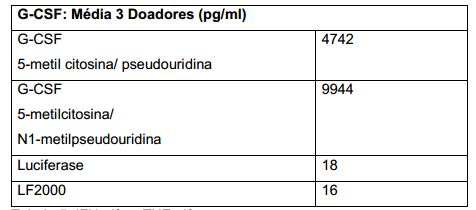
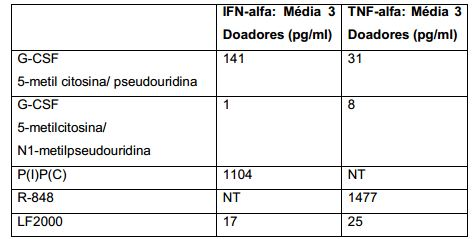
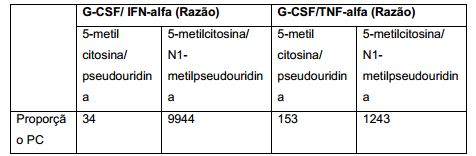
[000719] Nucleosídeos modificados tais como, mas não limitados a, modificações químicas 5-metilcitosina e pseudouridina foram mostrados diminuir a resposta imune inata e aumentar a expressão de RNA em células de mamíferos. Surpreendentemente, e não conhecido anteriormente, os efeitos manifestados por essas modificações químicas podem ser titulados quando a quantidade de modificação química de um nucleotídeo particular é menor do que 100%. Anteriormente, acreditou-se que o benefício de modificação química poderia ser derivado usando menos do que substituição completa de um nucleosídeo modificado e relatórios publicados sugeriam nenhuma perda de benefício até o nível de substituição sendo menos do que 50% (Kariko e outros, Immunity (2005) 23:165-175).[000719] Modified nucleosides such as, but not limited to, chemical modifications 5-methylcytosine and pseudouridine have been shown to decrease the innate immune response and increase RNA expression in mammalian cells. Surprisingly, and not previously known, the effects manifested by these chemical modifications can be titrated when the amount of chemical modification of a particular nucleotide is less than 100%. Previously, it was believed that the benefit of chemical modification could be derived using less than complete replacement of a modified nucleoside and published reports suggested no loss of benefit until the replacement level was less than 50% (Kariko et al., Immunity ( 2005) 23:165-175).
[000720] No entanto, foi agora mostrado que os benefícios de modificação química estão diretamente correlacionados com o grau de modificação química e devem ser considerados em vista de mais do que uma única medida de resposta imune. Tais benefícios incluem a produção de proteína ou tradução de mRNA aumentada e estimulação reduzida ou prevenida da resposta imune inata como medido por perfis de citocina e métricas de gatilhos de respostas imunes.[000720] However, it has now been shown that the benefits of chemical modification are directly correlated with the degree of chemical modification and should be considered in view of more than a single measure of immune response. Such benefits include increased protein production or mRNA translation and reduced or prevented stimulation of the innate immune response as measured by cytokine profiles and immune response trigger metrics.
[000721] Tradução de mRNA aumentada e imunoestimulação inata reduzida ou ausente são vistas com substituição 100% com um nucleosídeo modificado. Percentuais menores de substituição resultam em menos tradução de mRNA e mais imunoestimulação inata, com mRNA não modificado mostrando a tradução mais baixa e a imunoestimulação mais alta.[000721] Increased mRNA translation and reduced or absent innate immunostimulation are seen with 100% replacement with a modified nucleoside. Lower replacement percentages result in less mRNA translation and more innate immunostimulation, with unmodified mRNA showing the lowest translation and the highest immunostimulation.
[000722] 480 ng de mRNA de G-CSF modificado com 5-metilcitosina (5mC) e pseudouridina (pseudoU) ou mRNA de G-CSF não-modificado foram transfectados com 0,4 uL de Lipofectamina 2000 em células mononucleares do sangue periférico (PBMC) a partir de três doadores de sangue normais (D1, D2 e D3). O mRNA de G-CSF (SEQ ID NO: 1; cauda poli-A de aproximadamente 160 nucleotídeos não mostrada na sequência; cap 5’, Cap1) foi completamente modificado com 5mC e pseudo (100% de modificação), não modificado com 5mC e pseudo (0% de modificação) ou foi parcialmente modificado com 5mC e pseudoU de modo que o mRNA conteria 75% de modificação, 50% de modificação ou 25% de modificação. Uma amostra controle de Luciferase (sequência de mRNA mostrada em SEQ ID NO: 3; cauda poli-A de aproximadamente 160 nucleotídeos não mostrada em sequência; cap 5’, Cap1; totalmente modificados 5meC e pseudoU) foi também analisada pela expressão de G-CSF. Para amostras controle de TNF- alfa e IFN-alfa de Lipofectamina 2000, LPS, R-848, Luciferase (sequência de mRNA mostrada em SEQ ID NO: 3; cauda poli-A de aproximadamente 160 nucleotídeos não mostrada em sequência; cap 5’, Cap1; totalmente modificado 5mC e pseudo) e P(I)P(C) foram também analisados. O sobrenadante foi colhido e administrado por ELISA 22 horas após a transfecção para determinar a expressão da proteína. A expressão de G-CSF é mostrada na Tabela 7 e a expressão de IFN-alfa e TNF-alfa são mostradas na Tabela 8. A expressão de IFN- alfa e TNF-alfa pode ser um efeito secundário da transfecção do mRNA de G-CSF. As tabelas 7, 8 e FIG. 10 mostram que a quantidade de modificação química de G-CSF, interferon alfa (IFN-alfa) e fator alfa de necrose de tumor (TNF-alfa) é titulável quando o mRNA não é totalmente modificado e a tendência titulável não é a mesma para cada alvo.[000722] 480 ng of G-CSF mRNA modified with 5-methylcytosine (5mC) and pseudouridine (pseudoU) or unmodified G-CSF mRNA were transfected with 0.4
[000723] Como mencionado acima, ao usar PBMC como um sistema de teste in vitro, é possível estabelecer uma correlação entre tradução (neste caso produção da proteína G-CSF) e produção de citocina (neste caso exemplificado pela produção de proteína IFN-alfa). Melhor produção de proteína está correlacionada com menor indução de curso de ativação imune inata, e a modificação de percentual de uma química pode ser julgada favoravelmente baseado nesta proporção (Tabela 9). Como calculado das Tabelas 7 e 8 e mostrado na Tabela 9, modificação integral com 5-metilcitidina e pseudouridina mostra uma razão muito melhor de produção de proteína/citocina do que sem qualquer modificação (mRNA de G-CSF natural) (100 vezes para IFN-alfa e 27 vezes para TNF-alfa). Modificação parcial mostra uma relação linear com cada vez menos modificação resultando em uma razão menor de proteína/citocina. Tabela 7. Expressão de G-CSF
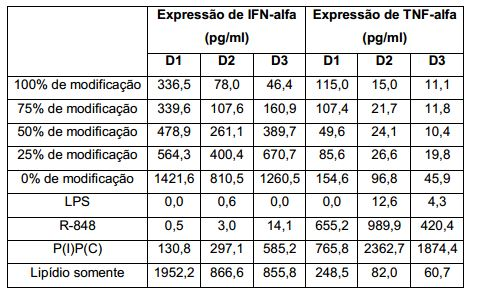

[000724] 500 ng de mRNA de G-CSF modificado com 5-metilcitosina (5mC) e pseudouridina (pseudoU) ou mRNA de G-CSF não modificado foram transfectados com 0,4 uL de Lipofectamina 2000 em células mononucleares de sangue periférica (PBMC) a partir de três doadores de sangue normais (D1, D2 e D3). O mRNA de G-CSF (SEQ ID NO: 1; cauda poli-A de aproximadamente 160 nucleotídeos não mostrada em sequência; cap 5’, Cap1) foi completamente modificado com 5mC e pseudo (100% de modificação), não modificado com 5mC e pseudo (0% de modificação) ou parcialmente modificado com 5mC e pseudoU de modo que o mRNA conteria 50% de modificação, 25% de modificação, 10% de modificação, 5% de modificação, 1% de modificação ou 0,1% de modificação. Uma amostra controle de mCherry (sequência de mRNA mostrada em SEQ ID NO: 6; cuada poli-A de aproximadamente 160 nucleotídeos não mostrada em sequência; cap 5’, Cap1; totalmente modificado 5meC e pseudouridina) e G-CSF totalmente modificado com 5-metilcitosina e pseudouridina (G-CSF controle) foi também analisada quanto à expressão de G-CSF. Para fator alfa (TNT-alfa) de necrose de tumor e interferon-alfa (IFN-alfa), as amostras controle de Lipofectamina2000, LPS, R-848, Luciferase (sequência de mRNA mostrada em SEQ ID NO: 3; cauda poli-A de aproximadamente 160 nucleotídeos não mostrada em sequência; cap 5’, Cap1; totalmente modificado 5mC e pseudo), e P(I)P(C) foram também analisados. O sobrenadante foi coletado 6 horas e 18 horas após a transfecção e administrados por ELISA para determinar a expressão da proteína. A expressão de G-CSF, IFN-alfa e TNF-alfa para Doador 1 é mostrada na Tabela 10, Doador 2 é mostrada na Tabela 11 e Doador 3 é mostrada na Tabela 12.[000724] 500 ng of G-CSF mRNA modified with 5-methylcytosine (5mC) and pseudouridine (pseudoU) or unmodified G-CSF mRNA were transfected with 0.4
[000725] 100% de modificação total com 5-metilcitidina e pseudouridina resultou na maior tradução de proteína (G-CSF) e na menor quantidade de citocina produzida em todos os três doadores de PBMC humanos. Quantidades menores de modificação resulta em maior produção de citocina (IFN-alfa e TNF-alfa), assim destacando mais a importância de modificação total para reduzir as citocinas e melhorar a tradução de proteína (como evidenciado aqui pela produção de G-CSF). Tabela 10. Doador 1


[000726] A avaliação de microames é uma versão do teste de pré- incubação Ames completo. Ela detecta ambas as mutações de substituição de pares de base e mudanças de estrutura usando quatro cepas de teste de Salmonella (TA97a, TA98, TA100 e TA1535) e uma cepa de Escherichia coli (pKM101 uvrA WP2). As cepas TA97a e TA98 detectam mutações de mudança de estrutura e TA100, TA1535 e pKM101 uvrA WP2 detectam mutações de substituição de par de base. Esse teste Ames reduzido usa composto mínimo, é conduzido com ou sem ativação metabólica (fração S9) e usa placas de múltiplas cavidades. Esse teste é um teste microbiano para detectar o potencial mutagênico de compostos de teste.[000726] The microames evaluation is a version of the full Ames pre-incubation test. It detects both base pair substitution mutations and structure changes using four Salmonella test strains (TA97a, TA98, TA100 and TA1535) and one Escherichia coli strain (pKM101 uvrA WP2). Strains TA97a and TA98 detect frameshift mutations and TA100, TA1535 and pKM101 uvrA WP2 detect basepair substitution mutations. This reduced Ames test uses minimal compound, is conducted with or without metabolic activation (fraction S9), and uses multi-well plates. This test is a microbial test to detect the mutagenic potential of test compounds.
[000727] A avaliação microAmes para artigo de teste de 5-Metilci- tidina, Pseudouridina ou N’-metilpseudouridina foi testada em duplicata com cepas TA97a, TA98, TA100, TA1535 e pKM101 uvrA WP2 na presença ou ausência de um sistema de ativação metabólico (fração microssomal S9 de fígado de camundongos induzida por AROCLOR® 1254) em 0,25, 2,5, 12,5, 25, 75 e 250 ug/cavidade. Compostos controle positivos foram usados em 4 diferentes concentrações para assegurar que o sistema de teste fosse sensível a compostos mutagênicos conhecidos. DMSO foi usado como o controle veículo. Controles veículo e positivos forneceram os resultados esperados, demonstrando que a avaliação microAmes é suficientemente sensível para detectar mutações.[000727] The microAmes evaluation for 5-Methylcytidine, Pseudouridine or N'-methylpseudouridine test article was tested in duplicate with strains TA97a, TA98, TA100, TA1535 and pKM101 uvrA WP2 in the presence or absence of a metabolic activation system (AROCLOR® 1254-induced mouse liver microsomal S9 fraction) at 0.25, 2.5, 12.5, 25, 75 and 250 ug/well. Positive control compounds were used at 4 different concentrations to ensure that the test system was sensitive to known mutagenic compounds. DMSO was used as the vehicle control. Vehicle and positive controls provided the expected results, demonstrating that the microAmes assay is sensitive enough to detect mutations.
[000728] Para 5-metilcitosina, precipitados não foram observados com nenhuma cepa teste tanto com ou sem ativação metabólica. A citotoxicidade (redução do crescimento bacteriano e/ou número de revertedoras) não foi observada em qualquer cepa tanto com ou sem ativação metabólica. Não houve nenhum aumento no número de colônias revertedoras comparado com o controle veículo em qualquer cepa com ou sem ativação metabólica. Portanto, 5-Metilcitidina não foi mutagênica até 250 ug/cavidade em cepas TA97a, TA98, TA100, TA1535 e pKM101 uvrA WP2 com ou sem ativação metabólica sob as condições da avaliação microAmes.[000728] For 5-methylcytosine, precipitates were not observed with any test strain either with or without metabolic activation. Cytotoxicity (reduction of bacterial growth and/or number of revertants) was not observed in any strain with or without metabolic activation. There was no increase in the number of reversing colonies compared to the vehicle control in any strain with or without metabolic activation. Therefore, 5-Methylcytidine was not mutagenic up to 250 ug/well in TA97a, TA98, TA100, TA1535 and pKM101 uvrA WP2 strains with or without metabolic activation under the conditions of the microAmes evaluation.
[000729] Precipitados não foram observados com qualquer cepa de teste tanto com ou sem ativação metabólica para pseudouridina. Citotoxicidade (redução no número de revertedoras) foi observada com cepa TA100 sem ativação metabólica. Citotoxicidade (redução do crescimento bacteriano e/ou número de revertedores) não foi observada em qualquer outra cepa tanto com ou sem ativação metabólica. Não houve aumento no número de colônias revertedoras comparado com o controle veículo em qualquer cepa com ou sem ativação metabólica. Portanto, pseudouridina não foi mutagênica até 75 ug/cavidade em cepa TA100 sem ativação metabólica e até 250 μg/cavidade em cepas TA97a, TA98, TA1535 e pKM101 uvrA WP2 com ou sem ativação metabólica e cepa TA100 sem ativação metabólica sob as condições desta avaliação microAmes.[000729] Precipitates have not been observed with any test strain either with or without metabolic activation for pseudouridine. Cytotoxicity (reduction in the number of revertants) was observed with strain TA100 without metabolic activation. Cytotoxicity (reduced bacterial growth and/or number of revertants) was not observed in any other strain with or without metabolic activation. There was no increase in the number of reversing colonies compared to the vehicle control in any strain with or without metabolic activation. Therefore, pseudouridine was not mutagenic up to 75 ug/well in TA100 strain without metabolic activation and up to 250 μg/well in TA97a, TA98, TA1535 and pKM101 uvrA WP2 strains with or without metabolic activation and TA100 strain without metabolic activation under the conditions of this evaluation microAmes.
[000730] Para a modificação, precipitados de N1-metilpseudouridina não foram observados com qualquer cepa de teste tanto com ou sem ativação metabólica. Citotoxicidade (redução do crescimento bacteriano e/ou número de revertedoras) não foi observada em qualquer cepa tanto com ou sem ativação metabólica. Não houve aumento no número de colônias revertedoras comparado com o controle veículo em qualquer cepa com ou sem ativação metabólica. N1-metilpseudouridina não foi mutagênica até 250 μg/cavidade em cepas TA97a, TA98, TA100, TA1535 e pKM101 uvrA WP2 com ou sem ativação metabólica sob as condições desta avaliação. Verificou-se que a N1-metilpseudouridina é menos mutagênica que a pseudouridina.[000730] For modification, N1-methylpseudouridine precipitates were not observed with any test strain either with or without metabolic activation. Cytotoxicity (reduced bacterial growth and/or number of revertants) was not observed in any strain with or without metabolic activation. There was no increase in the number of reversing colonies compared to the vehicle control in any strain with or without metabolic activation. N1-methylpseudouridine was not mutagenic up to 250 μg/well in strains TA97a, TA98, TA100, TA1535 and pKM101 uvrA WP2 with or without metabolic activation under the conditions of this evaluation. N1-methylpseudouridine was found to be less mutagenic than pseudouridine.
[000731] A comparação neste teste microAmes de 5 metil citidina, pseudouridina e N1-metilpseudouridina os revela como geralmente não- mutagênicos. De nota particular, no entanto, foi a diferença entre a pseudouridina e N1-metilpseudouridina, onde a pseudouridina mostrou uma resposta citotóxica em uma cepa bacteriana em que a N1- metilpseudouridina não mostrou. Esses testes microAMES são rotineiramente usados como parte da avaliação pré-clínica de segurança do composto e destacam uma diferença importante entre N1- metilpseudouridina e pseudouridina.[000731] Comparison in this microAmes test of 5-methyl cytidine, pseudouridine, and N1-methylpseudouridine reveals them to be generally non-mutagenic. Of particular note, however, was the difference between pseudouridine and N1-methylpseudouridine, where pseudouridine showed a cytotoxic response in a bacterial strain that N1-methylpseudouridine did not. These microAMES tests are routinely used as part of the preclinical safety assessment of the compound and highlight an important difference between N1-methylpseudouridine and pseudouridine.
[000732] A citotoxicidade de trifosfatos de nucleosídeo naturais e modificados (NTPs) sozinhos ou em combinação com outras bases foi analisada em células de rim embrionário humano 293 (HEK293) na ausência de reagente de transfecção. Células HEK293 foram semeadas em placas de 96 cavidades em uma densidade de 30.000 células por cavidade tendo 0,75ul de RNAiMAX® (Invitrogen, Carlsbad, CA) por cavidade em um volume de cavidade total de 100 ul. 10 ul dos NTPs descritos na Tabela 12 foram combinados com 10 ul de diluição lipídica e incubados por 30 minutos para formar um complexo antes que 80 ul da suspensão da célula HEK293 fossem adicionados ao complexo de NTP.[000732] The cytotoxicity of natural and modified nucleoside triphosphates (NTPs) alone or in combination with other bases was analyzed in 293 human embryonic kidney cells (HEK293) in the absence of transfection reagent. HEK293 cells were seeded into 96-well plates at a density of 30,000 cells per well having 0.75 µl RNAiMAX® (Invitrogen, Carlsbad, CA) per well in a total well volume of 100 µl. 10 µl of the NTPs described in Table 12 were combined with 10 µl of lipid dilution and incubated for 30 minutes to form a complex before 80 µl of the HEK293 cell suspension was added to the NTP complex.
[000733] NTPs naturais e modificados foram transfectados em uma concentração de 2,1 nM, 21 nM, 210 nM, 2,1 um, 21 uM, 210 um ou 2,1 mM. NTPs em combinação foram transfectados em uma concentração total de NTPs de 8.4 nM, 84 nM, 840 nM, 8.4 uM, 84 uM, 840 uM e 8.4 mM. Como um controle, mRNA de G-CSF modificado (SEQ ID NO: 1; cauda poli-A de aproximadamente 160 nucleotídeos não mostrada em sequência; cap 5’, Cap1; 5-metilcitosina e pseudouridina totalmente modificadas) foi transfectado em células HEK293 em uma concentração de 8,4 nM. A citotoxicidade dos NTPs e do mRNA de G-CSF modificado foi testada em 4, 24, 48 e 72 hours após a adição às células HEK293 usando teste CYTO TOX-GLO® da Promega (Madison, WI) seguindo o protocolo do fabricante exceto quando pipetagem foi usada para lisar as células em vez de agitar as placas.[000733] Natural and modified NTPs were transfected at a concentration of 2.1 nM, 21 nM, 210 nM, 2.1 µM, 21 µM, 210 µM or 2.1 mM. Combination NTPs were transfected at a total concentration of NTPs of 8.4 nM, 84 nM, 840 nM, 8.4 uM, 84 uM, 840 uM and 8.4 mM. As a control, modified G-CSF mRNA (SEQ ID NO: 1; poly-A tail of approximately 160 nucleotides not shown in sequence; 5' cap, Cap1; fully modified 5-methylcytosine and pseudouridine) was transfected into HEK293 cells in a concentration of 8.4 nM. The cytotoxicity of NTPs and modified G-CSF mRNA was tested at 4, 24, 48, and 72 hours after addition to HEK293 cells using Promega's CYTO TOX-GLO® Assay (Madison, WI) following the manufacturer's protocol except when pipetting was used to lyse the cells instead of shaking the plates.
[000734] As Tabela 13 e 14 mostram o percentual de células viáveis para cada um dos NTPs, combinações de NTP e controles testados. Não houve toxicidade vista com os NTPs individuais quando comparado com células não-tratadas. Esses dados demonstram que a introdução de NTPs individuais, incluindo 5- metilcitidina, pseudouridina e N1-metil- pseudouridina, em células de mamíferos não é tóxica em doses 1.000.000 vezes uma dose eficaz quando introduzida como um mRNA modificado. Tabela 13. Citotoxicidade de NTPs individuais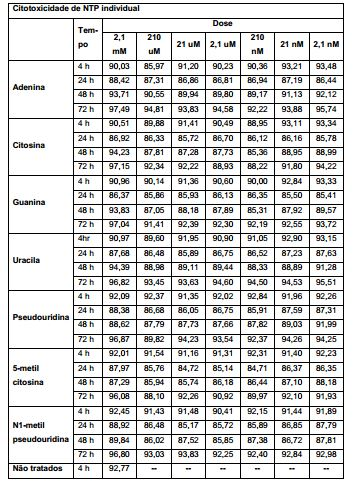


[000735] Fibroblastos do prepúcio primário humano (fibroblastos BJ) foram obtidos da American Type Culture Collection (ATCC) (No. catálogo CRL-2522) e cultivados em meio essencial mínimo da Eagle (ATCC, No. Catálogo 30-2003) suplementados com soro fetal bovino 10% a 37°C, sob CO2 5%. Fibroblastos BJ foram semeados em uma placa de 24 cavidades em uma densidade de 300.000 células por cavidade em 0,5 ml de meio de cultura. 250 ng de mRNA de G-CSF modificado (sequência de mRNA mostrada em SEQ ID NO: 1; cauda poli-A de aproximadamente 160 nucleotídeos não mostrada em sequência; cap 5’, Cap1) totalmente modificado com 5-metilcitosina e pseudouridina (Gen1) ou totalmente modificado com 5-metilcitosina e N1-metilpseudouridina (Gen2) tendo Cap0, Cap1 ou nenhum cap foi transfectado usando Lipofectamina 2000 (Invitrogen, No. catálogo 11668-019), seguindo o protocolo do fabricante. Amostras controle de poli I:C (PIC), Lipofectamina 2000 (Lipo), mRNA de luciferase natural (sequência de mRNA mostrada em SEQ ID NO: 3; cauda poli-A de aproximadamente 160 nucleotídeos não mostrada em sequência; cap 5’, Cap1) e mRNA de G-CSF natural também foram transfectados. As células foram coletadas após 18 horas, o RNA total foi isolado e tratado com DNASE® usando o kit micro RNeasy (No. de catálogo 74004) seguindo o protocolo do fabricante. 100 ng de RNA total foram usados para síntese de cDNA usando cDNA Reverse Transcription kit (No. catálogo 4368814) seguindo o protocolo do fabricante. O cDNA foi então analisado quanto à expressão de genes de resposta imune inata por PCR em tempo real quantitativo usando SybrGreen em um instrumento Biorad CFX 384 seguindo o protocolo do fabricante. A Tabela 15 mostra o nível de expressão de transcritos de resposta imune inata com relação a HPRT (hipoxantina fosforibossinstransferase) do gene de regulagem e é expresso como indução em vezes com relação HPRT. Na tabela, o painel de métrica padrão inclui: RIG-I é o gene do ácido retinóico que pode ser induzido 1, IL6 é interleucina-6, OAS-1 é oligoadenilato sintetase 1, IFNb é interferon-beta, AIM2 está ausente em melanoma-2, IFIT-1 é proteína induzida por interferon com repetições de tetratricopeptídeo 1, PKR é proteína cinase R, TNFa é o fator alfa de necrose de tumor e IFNa é interferon alfa. Tabela 15. Níveis transcritos de Resposta Imune Inata
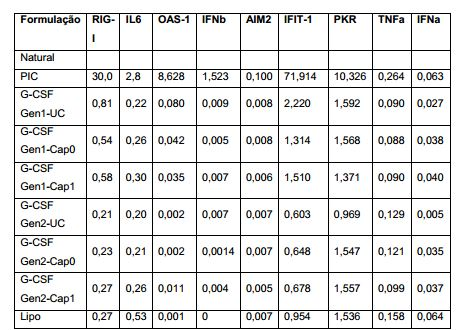
[000736] Em um esforço para distinguir a importância de modificação química diferente de mRNA em produção de proteína in vivo e resposta de citocina in vivo, camundongos fêmea BALB/C (n=5) são injetados intramuscularmente com mRNA de G-CSF (mRNA de GCSF não modificado) (sequência de mRNA mostrada em SEQ ID NO: 1; cauda poliA de aproximadamente 160 nucleotídeos não mostrada em sequência;) com uma cap 5’ de Cap1 , mRNA de G-CSF totalmente modificado com 5- metilcitosina e pseudouridina (mRNA de GCSF 5mc/pU), mRNA de G-CSF totalmente modificado com 5-metilcitosina e N1-metilpseudouridina com (mRNA de GCSF 5mc/N1pU) ou sem uma cap 5’ (mRNA de GCSF 5mc/N1 pU nenhum cap) ou de R848 ou sacarose 5% como descrito na Tabela 16. Tabela 16. Gráfico de Dosagem

[000737] Sangue é coletado em 8 horas após a dosagem. Usando ELISA, os níveis de proteína G-CSF, TNF-alfa e IFN-alfa é determinado por ELISA. 8 horas após dosagem, músculo é coletado do local da injeção e reação em cadeia da polimerase em tempo real quantitativa (QPCR) é usada para determinar os níveis de mRNA de RIG-I, PKR, AIM-2, IFIT-1, OAS-2, MDA-5, IFN-beta, TNF-alfa, IL-6, G-CSF, CD45 no músculo.[000737] Blood is collected within 8 hours of dosing. Using ELISA, G-CSF, TNF-alpha and IFN-alpha protein levels are determined by ELISA. 8 hours after dosing, muscle is harvested from the injection site and real-time quantitative polymerase chain reaction (QPCR) is used to determine mRNA levels of RIG-I, PKR, AIM-2, IFIT-1, OAS- 2, MDA-5, IFN-beta, TNF-alpha, IL-6, G-CSF, CD45 in muscle.
[000738] Camundongos fêmeas BALB/C (n=5) foram injetados intramuscularmente com mRNA de G-CSF (mRNA de GCSF não modificado) (sequência de mRNA mostrada em SEQ ID NO: 1; cauda poli-A de aproximadamente 160 nucleotídeos não mostrada em sequência;) com uma cap 5’ de Cap1, mRNA de G-CSF totalmente modificado com 5-metilcitosina e pseudouridina (mRNA de GCSF 5mc/pU), mRNA de G-CSF totalmente modificado com 5-metilcitosina e N1-metilpseudouridina com (mRNA de GCSF 5mc/N1pU) ou sem uma cap 5’ (mRNA de GCSF 5mc/N1 pU nenhum cap) ou um controle ou de R848 ou sacarose a 5% como descrito na Tabela 17. Sangue é coletado em 8 horas após a dosagem e usando ELISA, os níveis de proteína de G-CSF e interferon-alfa (IFN-alfa) são determinados por ELISA e são mostrados na Tabela 17.[000738] Female BALB/C mice (n=5) were injected intramuscularly with G-CSF mRNA (unmodified GCSF mRNA) (mRNA sequence shown in SEQ ID NO: 1; poly-A tail of approximately 160 nucleotides not shown in sequence;) with a 5' cap of Cap1, G-CSF mRNA fully modified with 5-methylcytosine and pseudouridine (5mc/pU GCSF mRNA), G-CSF mRNA fully modified with 5-methylcytosine and N1-methylpseudouridine with (5mc/N1pU GCSF mRNA) or without a 5' cap (5mc/N1 pU GCSF mRNA no cap) or a control or either R848 or 5% sucrose as described in Table 17. Blood is collected at 8 hours later dosing and using ELISA, protein levels of G-CSF and interferon-alpha (IFN-alpha) are determined by ELISA and are shown in Table 17.
[000739] Como mostrado na Tabela 17, mRNA de G-CSF não modificado e modificado com 5mc/pU e 5mc/N1pU resultou na expressão de G-CSF humano no soro de camundongo. mRNA de G- CSF modificado com 5mC/N1pU não capeado nao mostrou nenhuma expressão de G-CSF humano em soro, destacando a importância de ter uma cap 5’ para tradução de proteína.[000739] As shown in Table 17, unmodified and modified G-CSF mRNA with 5mc/pU and 5mc/N1pU resulted in the expression of human G-CSF in mouse serum. 5mC/N1pU modified G-CSF mRNA uncapped showed no expression of human G-CSF in serum, highlighting the importance of having a 5' cap for protein translation.
[000740] Como esperado, nenhuma proteína G-CSF humana foi expressa no R848, sacarose 5% somente, e grupos não-tratados. Importantemente, diferenças significativas foram vistas na produção de citocina como medido por IFN-alfa de camundongo no soro. Como esperado, mRNA de G-CSF não modificado demonstrou uma resposta à citocina robusta in vivo (maior que o controle positivo de R848). O mRNA de G-CSF modificado com 5mc/pU realmente mostrou uma baixa resposta à citocina, mas detectável in vivo, enquanto mRNA modificado com 5mc/N1pU não mostrou nenhum IFN-alfa detectável no soro (e mesmo que veículo ou animais não-tratados).[000740] As expected, no human G-CSF protein was expressed in the R848, 5% sucrose only, and untreated groups. Importantly, significant differences were seen in cytokine production as measured by mouse IFN-alpha in serum. As expected, unmodified G-CSF mRNA demonstrated a robust cytokine response in vivo (greater than the positive control of R848). G-CSF mRNA modified with 5mc/pU actually showed a low cytokine response but detectable in vivo, whereas mRNA modified with 5mc/N1pU did not show any detectable IFN-alpha in serum (and even in vehicle or untreated animals ).
[000741] Também, a resposta de mRNA modificado com 5mc/N1pU foi a mesma independente se estava capeado ou não. Esses resultados in vivo reforçam a conclusão que 1) mRNA não modificado produz uma resposta imune inata robusta, 2) esta é reduzida, mas não abolida, através de 100% de incorporação de modificação de 5mc/pU e 3) que a incorporação de modificações 5mc/N1pU resulta em nenhuma resposta de citocina detectável.[000741] Also, the mRNA response modified with 5mc/N1pU was the same regardless of whether it was capped or not. These in vivo results support the conclusion that 1) unmodified mRNA produces a robust innate immune response, 2) it is reduced, but not abolished, through 100% modification incorporation of 5mc/pU, and 3) that modification incorporation 5mc/N1pU results in no detectable cytokine response.
[000742] Por fim, dado que essas injeções estão em sacarose 5% (que não tem nenhum efeito sozinho), esses resultados devem refletir com precisão o potencial imunoestimulador dessas modificações.[000742] Finally, given that these injections are in 5% sucrose (which has no effect alone), these results should accurately reflect the immunostimulatory potential of these modifications.
[000743] A partir desses dados é evidente que moléculas modificadas com N1pU produzem mais proteína enquanto concomitantemente tem pouco ou nenhum efeito sobre expressão alfa IFN-alfa. Também é evidente que capeamento é requerido para produção de proteína para esta modificação química. A Proteína: Razão de Citocina de 748 comparado com a Razão PC para o mRNA não modificado (PC=9) significa que esta modificação química é bem mais superior em relação aos efeitos ou implicações biológicas associados com IFN-alfa. Tabela 17. G-CSF humano e IFN-alfa de camundongos em soro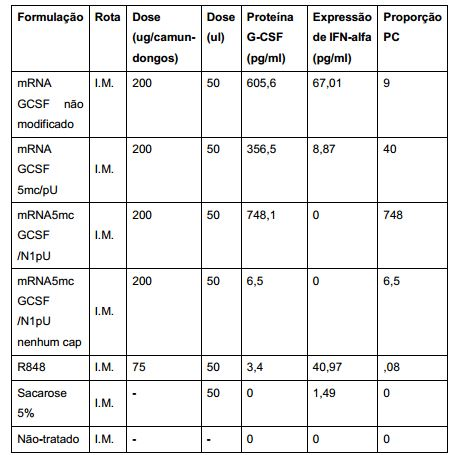
[000744] Uma formulação que contém 100 μg de uma ou duas versões de mRNA de G-CSF modificado humano (sequência de mRNA mostrada em SEQ ID NO: 1; cauda poli-A de aproximadamente 160 nucleotídeos não mostrada em sequência; cap 5’, Cap1) (G-CSF totalmente modificada com 5-metilcitosina e pseudouridina (G-CSF) ou G-CSF totalmente modificada com 5-metilcitosina e N1-metil- pseudouridina (G-CSF-N1) lipoplexada com 30% em volume de RNAIMAX® e administrado em 150 uL intramuscularmente (I.M.) e em 225uL intravenosamente (I.V.) a camundongos C57/BL6.[000744] A formulation containing 100 μg of one or two versions of human modified G-CSF mRNA (mRNA sequence shown in SEQ ID NO: 1; poly-A tail of approximately 160 nucleotides not shown in sequence; cap 5' , Cap1) (G-CSF fully modified with 5-methylcytosine and pseudouridine (G-CSF) or G-CSF fully modified with 5-methylcytosine and N1-methyl-pseudouridine (G-CSF-N1) lipoplexed with 30% by volume of RNAIMAX® is administered in 150 uL intramuscularly (IM) and in 225 uL intravenously (IV) to C57/BL6 mice.
[000745] Três grupos controle foram administrados ou com 100 μg de mRNA de luciferase modificado (sequência de cDNA IVT mostrada em SEQ ID NO: 2; sequência de mRNA mostrada em SEQ ID NO: 3, cauda poli-A de aproximadamente 160 nucleotídeos não mostrada em sequência, cap 5’, Cap1, totalmente modificado com 5-metilcitosina em cada substituição de citosina e pseudouridina em cada sítio de uridina) intramuscularmente (Luc-unsp I.M.) ou 150 μg de mRNA de luciferase modificado intravenosamente (Luc-unsp I.V.) ou 150 uL do tampão de formulação intramuscularmente (Tampão I.M.). 6 horas após a administração de uma formulação, soro foi coletado para medir a quantidade de proteína G-CSF humana no soro de camundongos por ELISA de G-CSF humano e os resultados são mostrados na Tabela 18.[000745] Three control groups were administered either with 100 μg of modified luciferase mRNA (IVT cDNA sequence shown in SEQ ID NO: 2; mRNA sequence shown in SEQ ID NO: 3, poly-A tail of approximately 160 nucleotides not shown in sequence, cap 5', Cap1, fully modified with 5-methylcytosine at each cytosine and pseudouridine substitution at each uridine site) intramuscularly (Luc-unsp IM) or 150 μg of modified luciferase mRNA intravenously (Luc-unsp IV ) or 150 µl of the formulation buffer intramuscularly (Buffer IM). 6 hours after administration of a formulation, serum was collected to measure the amount of human G-CSF protein in mouse serum by human G-CSF ELISA and the results are shown in Table 18.
[000746] Esses resultados demonstram que mRNA de G-CSF humano modificado com ambas 5-metilcitosina/pseudouridina e 5-metilci- tosina/N1-metilpseudouridina pode resultar em expressão de proteína G-CSF humana específica em soro quando administrado via administração I.V. ou I.M. em uma formulação lipoplex. Tabela 18. G-CSF humano em soro (Via de Injeção I.M. e I.V.)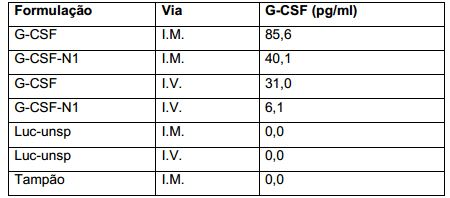
[000747] Uma formulação que contém 100 μg ou de mRNA de G-CSF humano modificado lipoplexado com 30% em volume de RNAIMAX® com uma modificação de 5-metilcitosina (5mc) e uma de pseudouridina (Φ) (G-CSF-Gen1-Lipoplex), mRNA de G-CSF modificado humano com um modificação 5mc e uma Φ em solução salina (G-CSF-Gen1-Solução salina), mRNA de G-CSF humano modificado com uma N1-5- metilcitosina (N1-5mc) e uma modificação Φ lipoplexado com 30% em volume de RNAIMAX® (G-CSF-Gen2-Lipoplex), mRNA de G-CSF humano modificado com uma modificação N1-5mc e uma Φ em solução salina (G-CSF-Gen2-Solução salina), luciferase modificada com uma modificação 5mc e uma Φ lipoplexada com 30% em volume de RNAIMAX® (Luc-Lipoplex) ou mRNA de luciferase totalmente modificado com modificações 5mc e Φ em solução salina (Luc-Solução salina) foram administrados intramuscularmente (I.M.) ou subcutaneamente (S.C.) e um grupo controle para cada método de administração recebeu uma dose de 80uL do tampão de formulação (Tampão F.) a camundongos C57/BL6. 13 horas após injeção soro e tecido do local da injeção foram coletados de cada camundongo e analisados por ELISA de G-CSF para comparar níveis de proteína G- CSF humana. Os resultados da proteína G-CSF humana em soro de camundongos a partir da administração intramuscular e os resultados da administração subcutânea são mostrados na Tabela 19.[000747] A formulation containing 100 μg or modified human G-CSF mRNA lipoplexed with 30% by volume RNAIMAX® with one modification of 5-methylcytosine (5mc) and one of pseudouridine (Φ) (G-CSF-Gen1 -Lipoplex), modified human G-CSF mRNA with a 5mc modification and a Φ in saline (G-CSF-Gen1-Saline), human G-CSF mRNA modified with an N1-5- methylcytosine (N1-5mc ) and a modification Φ lipoplexed with 30% by volume of RNAIMAX® (G-CSF-Gen2-Lipoplex), human G-CSF mRNA modified with an N1-5mc modification and a Φ in saline solution (G-CSF-Gen2- Saline), modified luciferase with a 5mc modification and a Φ lipoplexed with 30% by volume RNAIMAX® (Luc-Lipoplex) or fully modified luciferase mRNA with 5mc and Φ modifications in saline (Luc-Saline) were administered intramuscularly (IM) or subcutaneously (SC) and a control group for each method of administration received a dose of 80uL of the formulation buffer (Buffer F.) to C57/BL6 mice. 13 hours after injection, serum and tissue from the injection site were collected from each mouse and analyzed by G-CSF ELISA to compare human G-CSF protein levels. The results of human G-CSF protein in mouse serum from intramuscular administration and the results of subcutaneous administration are shown in Table 19.
[000748] Esses resultados demonstram que mRNA de G-CSF humano modificado com 5-metilcitosina/pseudouridina e 5-metilcito- sina/N1-metilpseudouridina pode resultar na expressão de proteína G- CSF humana específica em soro quando administrado via administração I.M. ou S.C. seja em uma formulação salina ou em uma formulação lipoplex. Como mostrado na Tabela 19, mRNA de G-CSF humano modificado com 5-metilcitosina/N1-metilpseudouridina geralmente demonstra produção de proteína G-CSF humana aumentada com relação a mRNA de G-CSF humano modificado com 5- metilcitosina/pseudouridina. Tabela 19. Proteína G-CSF Humana em soro de camundongos
[000749] mRNA de G-CSF modificado humano (sequência de mRNA mostrada em SEQ ID NO: 1; cauda poli-A de aproximadamente 160 nucleotídeos não mostrada em sequência; cap 5', Cap1) modificado ou com Gen1 ou Gen2 (uma modificação 5-metilcitosina (5mc) e pseudouridina (^), G-CSF-Gen1; ou uma modificação N1-5-metilcito- sina (N1-5mc) e uma Φ, G-CSF-Gen2) e formulado em solução salina foi administrado a camundongos via injeção intramuscular (IM) ou subcutânea (SC). Injeção de quatro doses ou 2x de 50ug (dois locais) diariamente por três dias (intervalo de 24 h) foi realizada. A quarta dose foi administrada 6 horas antes da coleta de sangue e análise de CBC. Controles incluíam Luciferase (sequência de cDNA para IVT mostrada em SEQ ID NO: 2; Sequência de mRNA mostrada em SEQ ID NO: 3, cauda poli-A de aproximadamente 160 nucleotídeos não mostrada em sequência, cap 5’, Cap1, totalmente modificado com 5-metilcitosina em cada substituição de citosina e pseudouridina em cada local de uridina) ou a formulação tampão (Tampão F.). Os camundongos sofreram sangria em 72 horas após a primeira injeção de mRNA (6 horas após a última dose de mRNA) para determinar o efeito de G-CSF humano codificado por mRNA sobre a contagem de neutrófilos. O regime de dosagem é mostrado na Tabela 20 como as contagens de neutrófilos resultantes (milhares/uL). Na tabela 20, um asterisco (*) indica significância estatística em p<0,05.[000749] Modified human G-CSF mRNA (mRNA sequence shown in SEQ ID NO: 1; poly-A tail of approximately 160 nucleotides not shown in sequence; cap 5', Cap1) modified or with Gen1 or Gen2 (a modification 5-methylcytosine (5mc) and pseudouridine (^), G-CSF-Gen1; or a modification N1-5-methylcytosine (N1-5mc) and a Φ, G-CSF-Gen2) and formulated in saline solution was administered to mice via intramuscular (IM) or subcutaneous (SC) injection. Injection of four doses or 2x 50ug (two sites) daily for three days (24 h interval) was performed. The fourth dose was administered 6 hours before blood collection and CBC analysis. Controls included Luciferase (IVT cDNA sequence shown in SEQ ID NO: 2; mRNA sequence shown in SEQ ID NO: 3, poly-A tail of approximately 160 nucleotides not shown in sequence, cap 5', Cap1, fully modified with 5-methylcytosine at each cytosine and pseudouridine substitution at each uridine site) or the buffer formulation (Buffer F.). Mice were bled 72 hours after the first mRNA injection (6 hours after the last mRNA dose) to determine the effect of mRNA-encoded human G-CSF on the neutrophil count. The dosing regimen is shown in Table 20 as the resulting neutrophil counts (thousands/uL). In table 20, an asterisk (*) indicates statistical significance at p<0.05.
[000750] Para administração intramuscular, os dados revelam um aumento de quatro vezes em contagem de neutrófilos acima do controle no dia 3 para o mRNA de G-CSF Gen1 e um aumento de duas vezes para o mRNA de G-CSF Gen2. Para administração subcutânea, os dados revelam um aumento de duas vezes na contagem de neutrófilos acima do controle no dia 3 para o mRNA de G-CSF Gen2.[000750] For intramuscular administration, data reveal a four-fold increase in neutrophil counts above control on
[000751] Esses dados demonstraram que mRNA modificados por ambas 5-metilcitidina/pseudouridina e 5-metilcitidina/N1-metilpseu- douridina pode ser biologicamenteativo, como evidenciado por aumentos específicos em contagens de neutrófilo no sangue. Tabela 20. Regime de Dosagem
[000752] mRNA de G-CSF humano modificado (sequência de mRNA mostrada em SEQ ID NO: 1; cauda poli-A de aproximadamente 160 nucleotídeos não mostrada em sequência; cap 5’, Cap1) modificado com 5-metilcitosina (5mc) e uma modificação de pseudouridina (^) (Gen1); ou não tendo nenhuma modificação e formulado em lipoplex 10% (RNAIMAX®) foi administrado a camundongos em uma dose de 50 ug de RNA e em um volume de 100 uL via injeção intravenosa (IV) em dias 0, 2 e 4. Neutrófilos foram medidos nos dias 1, 5 e 8. Controles incluíam RNA de mamífero não-específico ou a formulação tampão sozinha (Tampão F.). Os camundongos sofreram sangria nos dias 1, 5 e 8 para determinar o efeito de G-CSF humana codificada por mRNA em aumentar contagem de neutrófilos. O regime de dosagem é mostrado na Tabela 21 como as contagens de neutrófilo resultantes. (milhares/uL; K/uL).[000752] Modified human G-CSF mRNA (mRNA sequence shown in SEQ ID NO: 1; poly-A tail of approximately 160 nucleotides not shown in sequence; 5' cap, Cap1) modified with 5-methylcytosine (5mc) and a pseudouridine modification (^) (Gen1); or having no modification and formulated in
[000753] Para administração intravenosa, os dados revelaram um aumento de quatro a cinco vezes em contagem de neutrófilos acima do controle no dia 5 com mRNA modificado de G-CSF, mas não com controles de mRNA não modificado de G-CSF ou não-específicos. Contagem do sangue retornou ao nível basal quatro dias após a injeção final. Quaisquer outras mudanças em populações de leucócitos foram observada.[000753] For intravenous administration, data revealed a four- to five-fold increase in neutrophil counts above control on
[000754] Na Tabela 21, um asterisco (*) indica significância estatística em p<0,001 comparada ao tampão.[000754] In Table 21, an asterisk (*) indicates statistical significance at p<0.001 compared to buffer.
[000755] Esses dados demonstram que mRNA modificado por 5- metilcitidina/pseudouridina formulado com lipoplex pode ser biologicamente ativo, quando administrado através de uma via de administração I.V. como evidenciado por aumentos específicos em contagens de neutrófilo no sangue. Quaisquer outros subconjuntos de células foram significativamente alterados. mRNA de G-CSF não modificado similarmente administrado não mostrou nenhum efeito farmacológico sobre contagens de neutrófilo. Tabela 21. Regime de dosagem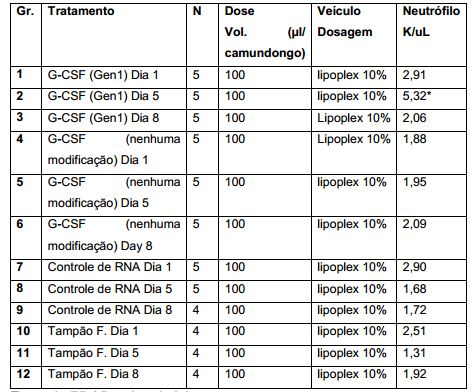
[000756] Estudos foram realizados para investigar dosagem dividida usando diferentes vias de administração. Estudos que utilizam locais de injeção subcutânea ou intramuscular múltiplos em um único ponto foram planejados e realizados para investigar maneiras de aumentar exposição ao fármaco de mRNA modificado e melhorar a produção de proteína. Além da detecção do produto de proteína expresso, uma avaliação da função fisiológica das proteínas também foi determinada através de análise de amostras dos animais testados.[000756] Studies have been performed to investigate split dosage using different routes of administration. Studies using multiple subcutaneous or intramuscular injection sites at a single point were designed and performed to investigate ways to increase modified mRNA drug exposure and improve protein production. In addition to the detection of the expressed protein product, an assessment of the physiological function of the proteins was also determined by analyzing samples from the tested animals.
[000757] Surpreendentemente, foi determinado que dosagem dividida de mRNA modificado permite produção de proteína e respostas de fenótipo maiores do que aquelas produzidas por esquemas de dosagem unitária única ou múltiplas dosagens.[000757] Surprisingly, it has been determined that split dosing of modified mRNA allows for greater protein production and phenotype responses than those produced by single-dose or multiple-dose regimens.
[000758] O planejamento de um experimento de dose dividida envolveu uso de mRNA modificado com eritropoietina humana (EPO) (sequência de mRNA mostrada em SEQ ID NO: 5; cauda poli-A de aproximadamente 160 nucleotídeos não mostrada em sequência; cap 5’, Cap1) ou mRNA modificado de luciferase (sequência mRNA mostrada em SEQ ID NO: 3; cauda poli-A de aproximadamente 160 nucleotídeos não mostrada em sequência; cap 5’, Cap1) administrado em tampão sozinho ou formulado com lipoplex a 30% (RNAIMAX®). O veículo de dosagem (tampão) consistia em NaCl 150 mM, CaCl2 2 mM, Na+-fosfato 2 mM (fosfato de sódio monobásico 1,4 mM; fosfato de sódio dibásico 0,6 mM) e EDTA 0,5 mM, pH 6,5. O pH foi ajustado usando hidróxido de sódio e a solução final foi esterilizada com filtro. O mRNA foi modificado com 5metilC (5meC) em cada substituição de citosina e pseudouridina em cada sítio de uridina.[000758] The design of a split dose experiment involved use of mRNA modified with human erythropoietin (EPO) (mRNA sequence shown in SEQ ID NO: 5; poly-A tail of approximately 160 nucleotides not shown in sequence; cap 5' , Cap1) or modified luciferase mRNA (mRNA sequence shown in SEQ ID NO: 3; poly-A tail of approximately 160 nucleotides not shown in sequence; 5' cap, Cap1) administered in buffer alone or formulated with 30% lipoplex ( RNAIMAX®). The dosing vehicle (buffer) consisted of 150 mM NaCl, 2 mM CaCl2, 2 mM Na+-phosphate (1.4 mM monobasic sodium phosphate; 0.6 mM sodium phosphate dibasic) and 0.5 mM EDTA, pH 6 .5. The pH was adjusted using sodium hydroxide and the final solution was filter sterilized. The mRNA was modified with 5methylC (5meC) at each cytosine and pseudouridine substitution at each uridine site.
[000759] 4 camundongos por grupo foram dosados intramuscularmente (I.M.), intravenosamente (I.V.) ou subcutaneamente (S.C.) pelo gráfico de dosagem esquematizado na Tabela 22. Soro foi coletado 13 horas após a injeção em todos os camundongos, tecido foi coletado do sítio da injeção do grupo subcutâneo e intramuscular e o baço, fígado e rins foram coletados do grupo intravenoso. Os resultados do grupo intramuscular e os resultados do grupo subcutâneo são mostrados na Tabela 23. Tabela 22. Gráfico de Dosagem

[000760] mRNA modificado foi administrado a camundongos C57/BL6 para avaliar as razões de lipídeos variáveis e a expressão da proteína resultante. Formulações de 100 μg de mRNA de EPO humano modificado (sequência de mRNA mostrada em SEQ ID NO: 5; cauda poli-A de aproximadamente 160 nucleotídeos não mostrada em sequência; cap 5’, Cap1; totalmente modificado com 5-metilcitosina e pseudouridina) lipoplexado com RNAIMAX® 10%, 30% ou 50%, 100 μg de mRNA de luciferase modificado (sequência de cDNA de IVT mostrada em SEQ ID NO: 2; sequência de mRNA mostrada na SEQ ID NO: 3, cauda poli-A de aproximadamente 160 nucleotídeos não mostrada em sequência, cap 5’, Cap1, totalmente modificado com 5- metilcitosina em cada substituição de citosina e pseudouridina em cada sítio de uridina) lipoplexado com RNAIMAX® 10%, 30% ou 50% ou um tampão de formulação foram administrados intramuscularmente a camundongos em uma única dose de 70 μl. Soro foi coletado 13 horas após a injeção para sofrer um ELISA de EPO humana para determinar o nível de proteína EPO humana em cada camundongo. Os resultados de ELISA de EPO humana, mostrados na Tabela 24, mostram que EPO humana expressa no músculo é secretada no soro para cada uma da porcentagem diferente de RNAIMAX®. Tabela 24. Proteína EPO Humana em soro de Camundongo (Via de Injeção IM)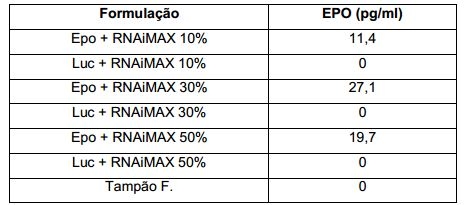
[000761] Produção de Proteína de mRNA modificado foi avaliada através da administração de mRNA de G-CSF modificado ou mRNA de Fator IX modificado a ratos fêmeas Sprague Dawley (n=6). Os ratos foram injetados com 400 ug em 100 ul de mRNA de G-CSF (sequência mRNA mostrada em SEQ ID NO: 1; cauda poli-A de aproximadamente 160 nucleotídeos não mostrada em sequência; cap 5’, Cap1) totalmente modificados com 5-metilcitosina e pseudouridina (G-CSF Gen1), mRNA de G-CSF totalmente modificado com 5-metilcitosina e N1- metilpseudouridina (G-CSF Gen2) ou mRNA de Fator IX (sequência de mRNA mostrada em SEQ ID NO: 6; cauda poli-A de aproximadamente 160 nucleotídeos não mostrada em sequência; cap 5’, Cap1) totalmente modificado com 5-metilcitosina e pseudouridina (Fator IX Gen1) reconstituído da forma liofilizada em sacarose 5%. Sangue foi coletado 8 horas após a injeção e o nível de proteína G-CSF no soro foi medido por ELISA. Tabela 25 mostra os níveis de proteína G-CSF no soro após 8 horas.[000761] Protein production from modified mRNA was assessed by administering modified G-CSF mRNA or modified Factor IX mRNA to female Sprague Dawley rats (n=6). Mice were injected with 400 ug in 100 ul of G-CSF mRNA (mRNA sequence shown in SEQ ID NO: 1; poly-A tail of approximately 160 nucleotides not shown in sequence; cap 5', Cap1) fully modified with 5 -methylcytosine and pseudouridine (G-CSF Gen1), fully modified G-CSF mRNA with 5-methylcytosine and N1-methylpseudouridine (G-CSF Gen2) or Factor IX mRNA (mRNA sequence shown in SEQ ID NO: 6; tail poly-A of approximately 160 nucleotides not shown in sequence; cap 5', Cap1) fully modified with 5-methylcytosine and pseudouridine (Factor IX Gen1) reconstituted in lyophilized form in 5% sucrose. Blood was collected 8 hours after injection and serum G-CSF protein level was measured by ELISA. Table 25 shows serum G-CSF protein levels after 8 hours.
[000762] Esses resultados demonstram que mRNA modificado com ambos G-CSF Gen 1 e G-CSF Gen 2 pode produzir proteína G-CSF humana em um rato seguindo uma injeção intramuscular única, e que a produção de proteína G-CSF humana é melhorada quando usando a química de Gen 2 com relação à química de Gen 1. Tabela 25. Proteína G-CSF em Soro de Rato (Via de injeção I.M.)
[000763] 500 ng de G-CSF (sequência de mRNA mostrada em SEQ ID NO: 1; cauda poli-A de aproximadamente 160 nucleotídeos não mostrada em sequência; cap 5’, Cap1) mRNA totalmente modificado com a modificação química mostrada nas Tabelas 26 e 27 foi transfectado com 0,4 uL de Lipofectamina 2000 em células de sangue mononucleares periférico (PBMC) de três doadores de sangue normais. Amostras de controle de LPS, R848, P(I)P(C) e mCherry (sequência de mRNA mostrada em SEQ ID NO: 4; cauda poli-A de aproximadamente 160 nucleotídeos não mostrada em sequência, cap 5’, Cap1; totalmente modificado com 5-metilcitosina e pseudouridina) foram também analisadas. O sobrenadante foi coletado e armazenado congelado até ser analisado por ELISA para determinar a expressão da proteína G- CSF, e a indução das citocinas interferon-alfa (IFN-α) e fator de necrose de tumor alfa (TNF-α). A expressão da proteína de G-CSF é mostrada na Tabela 26, a expressão de IFN-α e TNF-α é mostrada na Tabela 27.[000763] 500 ng G-CSF (mRNA sequence shown in SEQ ID NO: 1; poly-A tail of approximately 160 nucleotides not shown in sequence; cap 5', Cap1) mRNA fully modified with chemical modification shown in Tables 26 and 27 was transfected with 0.4
[000764] Os dados na Tabela 26 demonstram que muitas, mas não todas, as modificações químicas podem ser usadas para produzir de forma produtiva G-CSF humana em PBMC. De importância, 100% de substituição de N1-metilpseudouridina demonstra o mais alto nível de produção de G-CSF humano (quase 10 vezes maior que a pseudouridina sozinha). Quando N1-metilpseudouridina é usada em combinação com 5-metilcitidina um alto nível de proteína G-CSF humana também é produzido (isto é também mais alto do que quando pseudouridina é usada em combinação com 5 metilcitidina).[000764] The data in Table 26 demonstrate that many, but not all, of the chemical modifications can be used to productively produce human G-CSF in PBMC. Importantly, 100% substitution of N1-methylpseudouridine demonstrates the highest level of human G-CSF production (almost 10 times greater than pseudouridine alone). When N1-methylpseudouridine is used in combination with 5-methylcytidine a high level of human G-CSF protein is also produced (this is also higher than when pseudouridine is used in combination with 5-methylcytidine).
[000765] Dada a relação inversa entre produção de proteína e produção de citocina em PBMC, uma tendência similar também é vista na Tabela 27, onde 100% de substituição com N1-metilpseudouridina resulta em nenhuma indução de citocina (similar à transfecção apenas com controles) e pseudouridina mostra indução de citocina detectável que está acima da base.[000765] Given the inverse relationship between protein production and cytokine production in PBMC, a similar trend is also seen in Table 27, where 100% substitution with N1-methylpseudouridine results in no cytokine induction (similar to transfection only with controls ) and pseudouridine shows detectable cytokine induction that is above base.
[000766] Outras modificações tais como N6-metiladenosina e α- tiocitidina parecem aumentar a estimulação de citocina. Tabela 26. Modificações químicas e expressão da proteína G-CSF
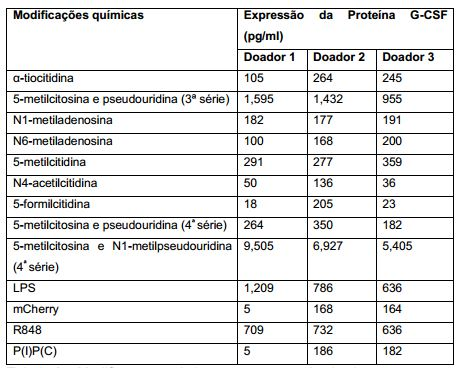
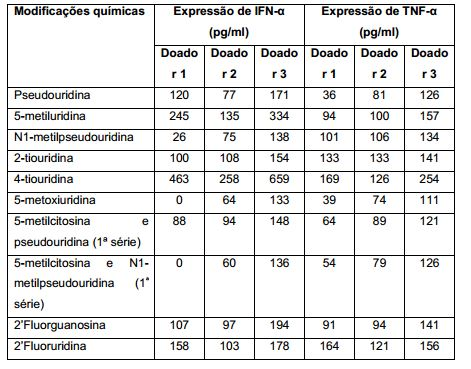

[000767] No dia antes da transfecção, 20.000 células HeLa (ATCC no. CCL-2; Manassas, VA) foram coletadas por tratamento com solução de Tripsina-EDTA (LifeTechnologies, Grand Island, NY) e semeadas em um volume total de 100 ul de meio EMEM (suplementado com FCS 10% e Glutamax 1x) por cavidade em uma placa de cultura de 96 cavidades (Corning, Manassas, VA). As células foram cultivadas a 37 oC em uma atmosfera de CO2 a 5% durante a noite. No dia seguinte, 83 ng de RNA modificado por Luciferase (sequência de mRNA mostrada em SEQ ID NO: 3; cauda poli-A de aproximadamente 160 nucleotídeos não mostrada em sequência; cap 5’, Cap1) com a modificação química mostrada na Tabela 28, foram diluídos em 10 uL de volume final de OPTI-MEM (LifeTechnologies, Grand Island, NY). Lipofectamina 2000 (LifeTechnologies, Grand Island, NY) foi usada como reagente de transfecção e 0,2 uL foi diluído em um volume final de 10 uL de OPTI- MEM. Após 5 minutos de incubação em temperatura ambiente, ambas as soluções foram combinadas e incubadas por mais 15 em temperatura ambiente. Então a solução combinada de 20 uL foi adicionada ao meio de cultura de célula 100ul que contém as células HeLa e incubada em temperatura ambiente.[000767] The day before transfection, 20,000 HeLa cells (ATCC no. CCL-2; Manassas, VA) were collected by treatment with Trypsin-EDTA solution (LifeTechnologies, Grand Island, NY) and seeded in a total volume of 100 ul of EMEM medium (supplemented with 10% FCS and 1x Glutamax) per well in a 96-well culture plate (Corning, Manassas, VA). Cells were grown at 37 oC in a 5% CO2 atmosphere overnight. The next day, 83 ng of Luciferase-modified RNA (mRNA sequence shown in SEQ ID NO: 3; poly-A tail of approximately 160 nucleotides not shown in sequence; cap 5', Cap1) with chemical modification shown in Table 28 , were diluted in 10 µl final volume of OPTI-MEM (LifeTechnologies, Grand Island, NY). Lipofectamine 2000 (LifeTechnologies, Grand Island, NY) was used as transfection reagent and 0.2 μl was diluted in a final volume of 10 μl OPTI-MEM. After 5 minutes of incubation at room temperature, both solutions were combined and incubated for another 15 minutes at room temperature. Then the combined 20 µl solution was added to the 100 µl cell culture medium containing the HeLa cells and incubated at room temperature.
[000768] Após 18 a 22 horas de incubação, as células que expressam luciferase foram lisadas com 100 uL de Passive Lysis Buffer (Promega, Madison, WI) de acordo com as instruções do fabricante. Alíquotas dos lisatos foram transferidas para placas de 96 cavidades de poliestireno opacas brancas (Corning, Manassas, VA) e combinadas com 100 uL de solução de teste de luciferase completa (Promega, Madison, WI). Os volumes de lisato foram ajustados ou diluídos até não mais do que 2 mio de unidades de luz relativa (RLU) (Relative Light Units) por cavidade, foram detectados para as amostras que produzem o sinal mais forte e as RLUs para cada química testada são mostradas na Tabela 28. O leitor da placa era um BioTek Synergy H1 (BioTek, Winooski, VT). O sinal histórico das placas sem reagente foi de cerca de 200 unidades de luz relativa por cavidade.[000768] After 18 to 22 hours of incubation, cells expressing luciferase were lysed with 100 uL of Passive Lysis Buffer (Promega, Madison, WI) according to the manufacturer's instructions. Aliquots of the lysates were transferred to white opaque 96-well polystyrene plates (Corning, Manassas, VA) and combined with 100 μl of complete luciferase test solution (Promega, Madison, WI). Lysate volumes were adjusted or diluted to no more than 2 mio Relative Light Units (RLU) per well, were detected for the samples producing the strongest signal and the RLUs for each chemistry tested are shown in Table 28. The plate reader was a BioTek Synergy H1 (BioTek, Winooski, VT). The historical signal from the unreacted plates was about 200 relative light units per well.
[000769] Esses resultados demonstraram que muitas, mas não todas, as modificações químicas podem ser usadas para de forma produtiva produzir G-CSF humano em células HeLa. De importância, 100% da substituição de N1-metilpseudouridina demonstra o nível mais alto da produção de G-CSF humana. Tabela 28. Unidades de Luz relativa de Luciferase
[000770] mRNA de luciferase (sequência de mRNA mostrada em SEQ ID NO: 3; cauda poli-A de aproximadamente 160 nucleotídeos não mostrada em sequência; cap 5’, Cap1) foi modificado com a modificação química listada na Tabela 29 e foi diluído em água livre de nuclease estéril para uma quantidade final de 250 ng em 10 ul. A luciferase diluída foi adicionada a 40 ul de lisato de reticulócito de coelho recém- preparado e a reação de tradução in vitro foi feita em um tubo de reação de polipropileno padrão de 1,5 mL (Thermo Fisher Scientific, Waltham, MA) a 30°C em um bloco de aquecimento seco. O teste de tradução foi feito com o kit para lisato de reticulócito de coelho (tratado com nuclease) (Promega, Madison, WI) de acordo com as instruções do fabricante. O tampão da reação foi suplementado com uma mistura um- para-um de soluções de estoque de aminoácido desprovidas ou de Leucina ou Metionina que resultam em uma mistura de reação que contém quantidades suficientes de ambos aminoácidos para permitir a tradução in vitro eficaz.[000770] Luciferase mRNA (mRNA sequence shown in SEQ ID NO: 3; poly-A tail of approximately 160 nucleotides not shown in sequence; cap 5', Cap1) was modified with the chemical modification listed in Table 29 and was diluted in sterile nuclease-free water to a final amount of 250 ng in 10 ul. The diluted luciferase was added to 40 ul of freshly prepared rabbit reticulocyte lysate and the in vitro translation reaction was done in a standard 1.5 mL polypropylene reaction tube (Thermo Fisher Scientific, Waltham, MA) at 30°C °C in a dry heating block. Translation testing was done with the Rabbit Reticulocyte Lysate Kit (Nuclease-treated) (Promega, Madison, WI) according to the manufacturer's instructions. The reaction buffer was supplemented with a one-to-one mix of amino acid stock solutions devoid of either Leucine or Methionine resulting in a reaction mix containing sufficient amounts of both amino acids to allow for efficient in vitro translation.
[000771] Após 60 minutos de incubação, a reação foi parada pondo os tubos de reação em gelo. Alíquotas da reação de tradução in vitro que contêm RNA modificado de luciferase foram transferidas para placas de 96 cavidades de poliestireno opacas brancas (Corning, Manassas, VA) e combinadas com 100 ul de solução de teste de luciferase completa (Promega, Madison, WI). Os volumes das reações de tradução in vitro foram ajustados ou diluídos até não mais do que 2 mio de unidades de luz relativa (RLUs) por cavidade fossem detectados para as amostras de produção de sinal mais forte e as RLUs para cada química testada são mostradas na Tabela 29. O leitor de placa era um BioTek Synergy H1 (BioTek, Winooski, VT). O sinal histórico das placas sem reagente era de cerca de 200 unidades de luz relativa por cavidade.[000771] After 60 minutes of incubation, the reaction was stopped by placing the reaction tubes on ice. Aliquots of the in vitro translation reaction containing modified luciferase RNA were transferred to white opaque polystyrene 96-well plates (Corning, Manassas, VA) and combined with 100 ul of complete luciferase test solution (Promega, Madison, WI) . The volumes of the in vitro translation reactions were adjusted or diluted until no more than 2 mio Relative Light Units (RLUs) per well were detected for the strongest signal producing samples and the RLUs for each chemistry tested are shown in Table 29. The plate reader was a BioTek Synergy H1 (BioTek, Winooski, VT). The historical signal from the unreacted plates was about 200 relative light units per well.
[000772] Esses resultados de tradução livre de células se correlacionam muito bem com os resultados da produção de proteína em HeLa, com as mesmas modificações geralmente funcionando ou não em ambos os sistemas. Uma exceção notável é o mRNA de luciferase modificado por 5-formilcitidina que funcionou no sistema de tradução livre de células, mas não no sistema de transfecção baseado em células HeLa. Uma diferença similar entre os dois ensaios foi também vista com mRNA de G-CSF modificado com 5-formilcitidina. Tabela 29. Unidades de Luz Relativa de Luciferase
[000773] Camundongos Balb-C (n=4) são injetados intramuscularmente em cada perna com mRNA de G-CSF modificado (sequência de mRNA mostrada em SEQ ID NO: 1; cauda poli-A de aproximadamente 160 nucleotídeos não mostrado em sequência; cap 5’, Cap1), totalmente modificado com as modificações químicas mostradas na Tabela 30, é formulado em 1xPBS. Um controle de mRNA modificado de luciferase (sequência de mRNA mostrada em SEQ ID NO: 3; cauda poli-A de aproximadamente 160 nucleotídeos não mostrada em sequência; cap 5’, Cap1; totalmente modificado com pseudouridina e 5-metilcitosina) e um controle de PBS são também testados. Após 8 horas, o soro é coletado para determinar níveis de proteína G-CSF e níveis de citocina por ELISA. Tabela 30. G-CSF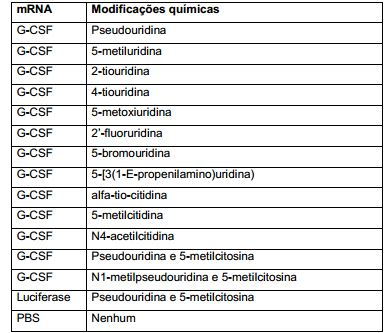
[000774] Camundongos Balb-C (n=4) foram injetados subcutaneamente com 200 ul contendo 42 a 103 ug de mRNA de luciferase modificado (sequência de mRNA mostrada em SEQ ID NO: 3; cauda poli-A de aproximadamente 160 nucleotídeos não mostrada em sequência; cap 5’, Cap1), totalmente modificado com as modificações químicas mostradas na Tabela 31, foi formulado em 1xPBS. Um PBS controle foi também testado. As dosagens do mRNA de luciferase modificado são também esquematizadas na Tabela 31. 8 horas após a dosagem, os camundongos foram submetidos a exame de imagem para determinar a expressão da luciferase. Vinte minutos antes de serem submetidos a exame de imagem, os camundongos foram injetados intraperitonealmente com uma solução de D-luciferina em 150 mg/kg. Animais foram então anestesiados e as imagens foram adquiridas com um sistema de representação gráfica de imagens IVIS Lumina II (Perkin Elmer). Bioluminescência foi medida como o fluxo total (fótons/segundo) do camundongo inteiro.[000774] Balb-C mice (n=4) were injected subcutaneously with 200 ul containing 42 to 103 ug of modified luciferase mRNA (mRNA sequence shown in SEQ ID NO: 3; poly-A tail of approximately 160 nucleotides not shown in sequence; cap 5', Cap1), fully modified with the chemical modifications shown in Table 31, was formulated in 1xPBS. A control PBS was also tested. Modified luciferase mRNA assays are also depicted in Table 31. 8 hours after dosing, mice underwent imaging to determine luciferase expression. Twenty minutes before being subjected to imaging examination, mice were injected intraperitoneally with a solution of D-luciferin at 150 mg/kg. Animals were then anesthetized and images were acquired with an IVIS Lumina II imaging graphical system (Perkin Elmer). Bioluminescence was measured as the total flux (photons/second) of the whole mouse.
[000775] Como demonstrado na Tabela 31, todas as químicas modificadas de mRNA de luciferase demonstraram atividade in vivo, com a exceção de 2’-fluoruridina. Adicionalmente, mRNA modificado com 1-metilpseudouridina demonstrou expressão muito alta de luciferase (expressão 5 vezes maior do que mRNA que contém pseudouridina). Tabela 31. Avaliação de Luciferase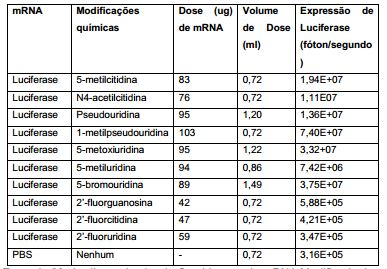
[000776] Camundongos Balb-C (n=4) foram injetados subcutaneamente com 200 ul de 100 ug de mRNA modificado de luciferase (sequência de mRNA mostrada em SEQ ID NO: 3; cauda poli-A de aproximadamente 160 nucleotídeos não mostrada em sequência; cap 5’, Cap1), totalmente modificado com as modificações químicas mostradas na Tabela 32, foi formulado em 1x PBS. Um PBS controle também foi testado. As dosagens de mRNA de luciferase modificado são também mostradas na Tabela 29. 8 horas após a dosagem, os camundongos passaram por exame de imagem para determinar a expressão de luciferase. Vinte minutos antes do exame de imagem, os camundongos foram injetados intraperitonealmente com uma solução de D-luciferina em 150 mg/kg. Os animais foram então anestesiados e as imagens foram obtidas com um sistema imagem IVIS Lumina II (Perkin Elmer). Bioluminescência foi medida como fluxo total (fótons/segundo) do camundongo inteiro.[000776] Balb-C mice (n=4) were injected subcutaneously with 200 ul of 100 ug of modified luciferase mRNA (mRNA sequence shown in SEQ ID NO: 3; poly-A tail of approximately 160 nucleotides not shown in sequence ; cap 5', Cap1), fully modified with the chemical modifications shown in Table 32, was formulated in 1x PBS. A control PBS was also tested. Modified luciferase mRNA assays are also shown in Table 29. 8 hours after dosing, mice underwent imaging to determine luciferase expression. Twenty minutes before imaging, mice were injected intraperitoneally with a solution of D-luciferin at 150 mg/kg. The animals were then anesthetized and images were obtained with an IVIS Lumina II imaging system (Perkin Elmer). Bioluminescence was measured as the total flux (photons/second) of the whole mouse.
[000777] Como demonstrado na Tabela 32, todas as químicas modificadas de mRNA de luciferase (em combinação) demonstraram atividade in vivo. Ainda, a presença de N1-metilpseudouridina no mRNA modificado (com N4-acetilcitidina ou 5 metilcitidina) demonstrou expressão mais alta do que quando as mesmas combinações foram testadas usando pseudouridina. Juntos, esses dados demonstram que mRNA de luciferase contendo N1-metilpseudouridina resulta em expressão de proteína aperfeiçoada in vivo se usada sozinho (Tabela 31) ou quando usado em combinação com outros nucleotídeos modificados (Tabela 32). Tabela 32. Combinações de Avaliação de Luciferase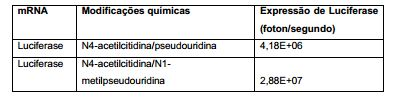

[000778] Experimentos de estabilidade foram conduzidos para obter um melhor entendimento de condições de armazenamento para reter a integridade de RNA modificado. mRNA de G-CSF não modificado (sequência de mRNA mostrada em SEQ ID NO: 1; cauda poli-A de aproximadamente 160 nucleotídeos não mostrada em sequência; cap 5’, Cap1), mRNA de G-CSF totalmente modificado com 5-metilcitosina e pseudouridina e mRNA de G-CSF totalmente modificado com 5- metilcitosina e pseudouridina lipoplexados com 0,75% em volume de RNAIMAX® foram armazenados a 50°C, 40°C, 37°C, 25°C, 4°C ou - 20°C. Após o mRNA ter sido armazenado por 0 hora, 2 horas, 6 horas, 24 horas, 48 horas, 5 dias e 14 dias, o mRNA foi analisado por eletroforese em gel usando um sistema Bio-Rad EXPERION®. O mRNA de G-CSF modificado, não modificado e lipoplexado foi também armazenado em RNASTABLE® (Biomatrica, Inc. San Diego, CA) a 40°C ou água em -80 °C ou 40°C por 35 dias antes de ser analisado por eletroforese de gel.[000778] Stability experiments were conducted to gain a better understanding of storage conditions to retain the integrity of modified RNA. unmodified G-CSF mRNA (mRNA sequence shown in SEQ ID NO: 1; poly-A tail of approximately 160 nucleotides not shown in sequence; 5' cap, Cap1), fully modified 5-methylcytosine G-CSF mRNA and pseudouridine and G-CSF mRNA fully modified with 5-methylcytosine and pseudouridine lipoplexed with 0.75% by volume of RNAIMAX® were stored at 50°C, 40°C, 37°C, 25°C, 4°C or - 20°C. After the mRNA had been stored for 0 hour, 2 hours, 6 hours, 24 hours, 48 hours, 5 days and 14 days, the mRNA was analyzed by gel electrophoresis using a Bio-Rad EXPERION® system. Modified, unmodified, and lipoplexed G-CSF mRNA was also stored in RNASTABLE® (Biomatrica, Inc. San Diego, CA) at 40°C or water at -80°C or 40°C for 35 days before being analyzed by gel electrophoresis.
[000779] Todas as amostras de mRNA sem estabilizador estavam estáveis após 2 semanas após armazenamento em 4°C ou -20°C. mRNA de G-CSF modificado, com ou sem lipoplex, era mais estável do que G-CSF não modificado quando armazenado a 25°C (estáveis até 5 dias versus 48 horas), 37°C (estáveis até 24 horas versus 6 horas) e 50°C (estáveis até 6 horas versus 2 horas). mRNA de G-CSF não modificado, mRNA de G-CSF modificado com ou sem lipoplex toleraram 12 ciclos de congelamento/descongelamento.[000779] All mRNA samples without stabilizer were stable after 2 weeks after storage at 4°C or -20°C. Modified G-CSF mRNA, with or without lipoplex, was more stable than unmodified G-CSF when stored at 25°C (stable up to 5 days versus 48 hours), 37°C (stable up to 24 hours versus 6 hours) and 50°C (stable up to 6 hours versus 2 hours). Unmodified G-CSF mRNA, modified G-CSF mRNA with or without lipoplex tolerated 12 freeze/thaw cycles.
[000780] Amostras de mRNA armazenadas em estabilizador a 40°C mostraram estabilidade similar às amostras de mRNA armazenadas em água a -80°C após 35 dias enquanto que o mRNA armazenado em água a 40°C mostrou degradação pesada após 18 dias.[000780] mRNA samples stored in stabilizer at 40°C showed similar stability to mRNA samples stored in water at -80°C after 35 days while mRNA stored in water at 40°C showed heavy degradation after 18 days.
[000781] Fibroblastos de prepúcio primários humano (fibroblastos BJ) foram obtidos da American Type Culture Collection (ATCC) (No. catálogo CRL-2522) e cultivados em Meio Essencial Mínimo de Eagle (ATCC, No. cat 30-2003) suplementado com soro fetal bovino 10% a 37°C, sob CO2 5%. Fibroblastos BJ foram semeados em uma placa de 24 cavidades em uma densidade de 130.000 células por cavidade em 0,5 ml de meio de cultura. 250 ng de mRNA de G-CSF modificado (sequência de mRNA mostrada em SEQ ID NO: 1; cauda poli-A de aproximadamente 160 nucleotídeos não mostrada em sequência; cap 5’, Cap1) totalmente modificado com 5-metilcitosina e pseudouridina (Gen1) ou totalmente modificado com 5-metilcitosina e N1- metilpseudouridina (Gen2) foram transfectados usando Lipofectamina 2000 (Invitrogen, No. cat. 11668-019), seguindo o protocolo do fabricante. Amostras controle de Lipofectamina 2000 (LF2000) e mRNA de G-CSF não modificado foram também transfectadas. O mRNA modificado ou amostras controle foram transfectados diariamente por 4 dias. A viabilidade das células após a transfecção foi avaliada 6 horas e 24 horas após a primeira transfecção (T1, 6 horas ou T1, 24 horas), e 24 horas após a segunda (T2, 24 horas) e quarta transfecções (T4, 24 horas).[000781] Primary human foreskin fibroblasts (BJ fibroblasts) were obtained from the American Type Culture Collection (ATCC) (Catalog No. CRL-2522) and cultured in Eagle's Minimal Essential Medium (ATCC, cat. No. 30-2003) supplemented with 10% fetal bovine serum at 37°C, under 5% CO2. BJ fibroblasts were seeded in a 24-well plate at a density of 130,000 cells per well in 0.5 ml of culture medium. 250 ng of modified G-CSF mRNA (mRNA sequence shown in SEQ ID NO: 1; poly-A tail of approximately 160 nucleotides not shown in sequence; cap 5', Cap1) fully modified with 5-methylcytosine and pseudouridine (Gen1 ) or fully modified with 5-methylcytosine and N1-methylpseudouridine (Gen2) were transfected using Lipofectamine 2000 (Invitrogen, Cat. No. 11668-019), following the manufacturer's protocol. Control samples of Lipofectamine 2000 (LF2000) and unmodified G-CSF mRNA were also transfected. Modified mRNA or control samples were transfected daily for 4 days. Cell viability after transfection was assessed 6 hours and 24 hours after the first transfection (T1, 6 hours or T1, 24 hours), and 24 hours after the second (T2, 24 hours) and fourth transfections (T4, 24 hours) ).
[000782] Para determinar a viabilidade celular, o meio de cultura foi completamente removido e as células lavadas uma vez com 600 ul de PBS estéril sem Ca2+/Mg2+ (Gibco/Life Technologies, Manassas, VA) de modo a retirar células soltas. PBS foi removido e descartado. Os fibroblastos limpos em cada cavidade foram tratados com 220 ul de uma solução de estoque diluída CELL TITER GLO® (Promega, No. catálogo G7570) (a solução de estoque CELL TITER GLO® foi diluída mais 1:1 com uma quantidade igual de PBS estéril). Uma ponta de pipeta estéril foi usada para raspar as células da placa e acelerar o processo de lise.[000782] To determine cell viability, the culture medium was completely removed and the cells washed once with 600 ul of sterile PBS without Ca2+/Mg2+ (Gibco/Life Technologies, Manassas, VA) in order to remove loose cells. PBS was removed and discarded. Cleaned fibroblasts in each well were treated with 220 ul of a diluted CELL TITER GLO® Stock Solution (Promega, Catalog No. G7570) (CELL TITER GLO® Stock Solution was diluted 1:1 plus with an equal amount of PBS sterile). A sterile pipette tip was used to scrape cells from the plate and speed up the lysis process.
[000783] Para dois intervalos de tempo, T1, 24 horas e T2, 24 horas, um protocolo alternativo foi aplicado. As células foram lavadas com PBS, como descrito acima, e subsequentemente tripsinizadas com solução de Tripsina/EDTA (Gibco/Life Technologies, Manassas, VA). As células foram separadas e coletadas em 500 ul de meio que contém inibidor de tripsina. As células foram coletadas através de centrifugação a 1200 rcf por 5 minutos. O pelete de célula foi ressuspenso em 500 ul de PBS. Essa suspensão de célula foi mantida em gelo e 100 ul desta foram combinados com 100 ul de solução Cell Titer Glo não diluída.[000783] For two time intervals, T1, 24 hours and T2, 24 hours, an alternative protocol was applied. Cells were washed with PBS, as described above, and subsequently trypsinized with Trypsin/EDTA solution (Gibco/Life Technologies, Manassas, VA). Cells were separated and collected in 500 µl of medium containing trypsin inhibitor. Cells were collected by centrifugation at 1200 rcf for 5 minutes. The cell pellet was resuspended in 500 µl PBS. This cell suspension was kept on ice and 100 µl of this was combined with 100 µl of undiluted Cell Titer Glo solution.
[000784] Todos dos lisatos de CELL TITER GLO® foram então incubados em temperatura ambiente por 20 minutos. 20 ul dos lisatos foram transferidos para uma placa de 96 cavidades de poliestireno opacas brancas (Corning, Manassas, VA) e combinados com 100 ul de solução CELL TITER GLO® diluída. O leitor de placa usado era da BioTek Synergy H1 (BioTek, Winooski, VT) e os valores absolutos foram normalizados para sinal dos fibroblastos BJ não tratados para 100% de viabilidade celular. O percentual de viabilidade para os fibroblastos BJ fibroblastos é mostrado na Tabela 33.[000784] All of the CELL TITER GLO® lysates were then incubated at room temperature for 20 minutes. 20 µl of the lysates were transferred to a white opaque 96-well polystyrene plate (Corning, Manassas, VA) and combined with 100 µl of diluted CELL TITER GLO® solution. The plate reader used was from BioTek Synergy H1 (BioTek, Winooski, VT) and absolute values were normalized to signal from untreated BJ fibroblasts to 100% cell viability. The percentage of viability for the BJ fibroblast fibroblasts is shown in Table 33.
[000785] Importantemente, todos esses experimentos são conduzidos na ausência de qualquer interferon ou outros inibidores de citocina e assim representam uma medida precisa da citotoxicidade do mRNA diferente.[000785] Importantly, all of these experiments are conducted in the absence of any interferon or other cytokine inhibitors and thus represent an accurate measure of the cytotoxicity of the different mRNA.
[000786] Esses resultados demonstram que a transfecção repetida de fibroblastos de BJ com mRNA não modificado resulta em perda de viabilidade celular que é aparente logo 24 horas após a primeira transfecção (T1, 24 hours) e continua a ser aparente e mais pronunciada em pontos de tempo subsequentes.[000786] These results demonstrate that repeated transfection of BJ fibroblasts with unmodified mRNA results in loss of cell viability that is apparent as early as 24 hours after the first transfection (T1, 24 hours) and continues to be apparent and more pronounced in spots subsequent time periods.
[000787] Há também uma perda de viabilidade com transfecção repetida de mRNA modificado com 5-metilcitidina e pseudouridina que é aparente 24 horas após a quarta transfecção diária (T4, 24 horas). Nenhuma perda de viabilidade celular ao longo desse experimento é vista usando mRNA modificado com 5-metilcitidina e N1-metilpseudouridina. Esses resultados demonstraram que mRNA que contém 5-metilcitidina e N1-metilpseudouridina têm viabilidade celular aperfeiçoada quando analisado sob transfecção repetida. A capacidade de repetidamente administrar mRNA modificado é importante na maioria das aplicações terapêuticas, e tal capacidade de fazer tal coisa sem citotoxicidade também é importante. Apesar de não desejar estar limitado à teoria, acredita-se que genes de resposta que seguem uma transfecção única podem levar a uma diminuição na produção de proteína, indução de citocina e eventualmente perda de viabilidade celular. Esses resultados estão de acordo com mRNA contendo N1-metilpseudouridina que mostra um perfil aperfeiçoado a esse respeito com relação a ambos mRNA não modificado e mRNA modificado com pseudouridina. Tabela 33.Viabilidade percentual
[000788] Fibroblastos do prepúcio primário humano (fibroblastos de BJ) são obtidos a partir da American Type Culture Collection (ATCC) (No. catálogo CRL-2522) e cultivados em Meio Essencial Mínimo da Eagle (ATCC, No. cat 30-2003) suplementado com soro bovino fetal 10% a 37 °C, sob CO2 5%. Fibroblastos de BJ são semeados em uma placa de 24 cavidades em uma densidade de 130.000 células por cavidade em 0,5 ml de meio de cultura. 250 ng de mRNA de G-CSF modificado (sequência de mRNA mostrada em SEQ ID NO: 1; cauda poli-A de aproximadamente 160 nucleotídeos não mostrada em sequência; cap 5’, Cap1) totalmente modificado com 5-metilcitosina e pseudouridina (Gen1) ou totalmente modificado com 5-metilcitosina e N1-metilpseudouridina (Gen2) é transfectado usando Lipofectamina 2000 (Invitrogen, No. cat 11668-019), seguindo o protocolo do fabricante. Amostras controle de Lipofectamina 2000 e mRNA de G-CSF não modificado (G-CSF natural) são também transfectadas. As células são transfectadas por cinco dias consecutivos. Os complexos da transfecção são removidos quatro horas após cada etapa de transfecção.Human primary foreskin fibroblasts (BJ fibroblasts) are obtained from the American Type Culture Collection (ATCC) (catalog No. CRL-2522) and cultured in Eagle's Minimal Essential Medium (ATCC, cat. No. 30-2003 ) supplemented with 10% fetal bovine serum at 37°C, under 5% CO2. BJ fibroblasts are seeded in a 24-well plate at a density of 130,000 cells per well in 0.5 ml of culture medium. 250 ng of modified G-CSF mRNA (mRNA sequence shown in SEQ ID NO: 1; poly-A tail of approximately 160 nucleotides not shown in sequence; cap 5', Cap1) fully modified with 5-methylcytosine and pseudouridine (Gen1 ) or fully modified with 5-methylcytosine and N1-methylpseudouridine (Gen2) is transfected using Lipofectamine 2000 (Invitrogen, cat. No. 11668-019), following the manufacturer's protocol.
[000789] O sobrenadante de cultura é ensaiado quanto a G-CSF (R&D Systems, No. catálogo DCS50), fator alfa de necrose de tumor (TNF- alfa) e interferon alfa (IFN-alfa) secretados através de ELISA todos os dias após a transfecção, seguindo os protocolos do fabricante. As células são analisadas quanto à viabilidade usando CELL TITER GLO® (Promega, No. catálogo G7570) 6 horas e 18 horas após a primeira rodada de transfecção e dia-sim-dia-não seguindo esta. Ao mesmo tempo a partir das células coletadas, RNA total é isolado e tratado com DNASE® usando micro kit RNAEASY (No. catálogo 74004) seguindo o protocolo do fabricante. 100 ng de RNA total são usados para síntese de cDNA usando o kit High Capacity cDNA Reverse Transcription (Applied Biosystems, No. cat 4368814) seguindo o protocolo do fabricante. O cDNA é então analisado quanto à expressão de genes de resposta imune inata por PCR em tempo real quantitativa usando SybrGreen em um instrumento Biorad CFX 384 seguindo o protocolo do fabricante.[000789] Culture supernatant is assayed for secreted G-CSF (R&D Systems, Catalog No. DCS50), tumor necrosis factor alpha (TNF-alpha) and secreted interferon alpha (IFN-alpha) by ELISA every day after transfection, following the manufacturer's protocols. Cells are analyzed for viability using CELL TITER GLO® (Promega, Catalog No. G7570) 6 hours and 18 hours after the first round of transfection and every other day thereafter. At the same time from the collected cells, total RNA is isolated and treated with DNASE® using RNAEASY micro kit (Catalog No. 74004) following the manufacturer's protocol. 100 ng of total RNA is used for cDNA synthesis using the High Capacity cDNA Reverse Transcription Kit (Applied Biosystems, cat. No. 4368814) following the manufacturer's protocol. The cDNA is then analyzed for innate immune response gene expression by quantitative real-time PCR using SybrGreen on a Biorad CFX 384 instrument following the manufacturer's protocol.
[000790] mRNA de luciferase (sequência de mRNA mostrada em SEQ ID NO: 3; cauda poli-A de aproximadamente 160 nucleotídeos não mostrada em sequência; cap 5’, Cap1) e mRNA de G-CSF (sequência de mRNA mostrada em SEQ ID NO: 1; cauda poli-A de aproximadamente 160 nucleotídeos não mostrada em sequência; cap 5’, Cap1) foram totalmente modificados com químicas e combinações químicas diferentes listadas nas Tabelas 34-37 usando polimerase T7do tipo selvagem como previamente descrito.[000790] Luciferase mRNA (mRNA sequence shown in SEQ ID NO: 3; poly-A tail of approximately 160 nucleotides not shown in sequence; 5' cap, Cap1) and G-CSF mRNA (mRNA sequence shown in SEQ ID NO: 1; poly-A tail of approximately 160 nucleotides not shown in sequence; cap 5', Cap1) were fully modified with different chemistries and chemical combinations listed in Tables 34-37 using wild-type T7 polymerase as previously described.
[000791] O rendimento das reações de tradução foi determinado pela medição de espectrofotometria (OD260) e o rendimento de Luciferase é mostrado na Tabela 34 e G-CSF é mostrado na Tabela 36.[000791] The yield of translation reactions was determined by measuring spectrophotometry (OD260) and the yield of Luciferase is shown in Table 34 and G-CSF is shown in Table 36.
[000792] Os mRNAs modificados de luciferase e de G-CSF foram também submetidos a uma reação de capeamento enzimático e cada reação de capeamento de mRNA modificado foi avaliada quanto a rendimento através medição espectrofotométrica (OD260) e o tamanho correto avaliado usando bioanalisador. O rendimento da reação de capeamento para luciferase é mostrado na Tabela 35 e G-CSF é mostrado na Tabela 37. Tabela 34. Química de transcrição In vitro para Luciferase


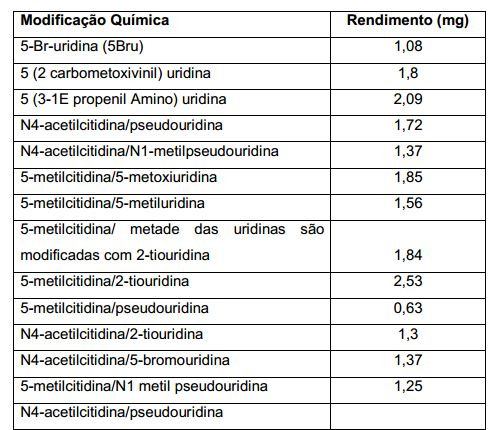

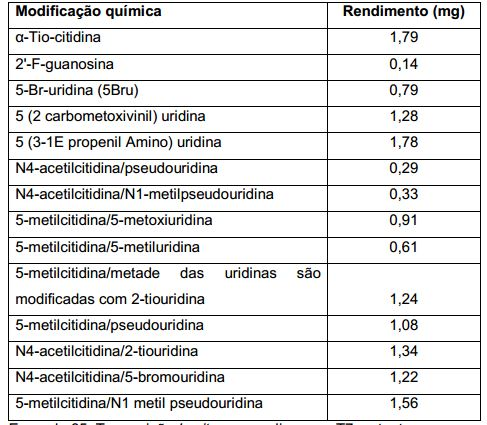
[000793] mRNA de luciferase (sequência de mRNA mostrada em SEQ ID NO: 3; cauda poli-A de aproximadamente 160 nucleotídeos não mostrada em sequência; cap 5’, Cap1) e mRNA de G-CSF (sequência de mRNA mostrada em SEQ ID NO: 1; cauda poli-A de aproximadamente 160 nucleotídeos não mostrada em sequência; cap 5’, Cap1) foram totalmente modificados com químicas e combinações químicas diferentes listadas nas Tabelas 38-41 usando uma polimerase T7 mutante (kit de Transcrição Durascribe® T7 (Cat. No. DS010925) (Epicentre®, Madison, WI).[000793] Luciferase mRNA (mRNA sequence shown in SEQ ID NO: 3; poly-A tail of approximately 160 nucleotides not shown in sequence; 5' cap, Cap1) and G-CSF mRNA (mRNA sequence shown in SEQ ID NO: 1; poly-A tail of approximately 160 nucleotides not shown in sequence; cap 5', Cap1) were fully modified with different chemistries and chemical combinations listed in Tables 38-41 using a mutant T7 polymerase (Durascribe® Transcription Kit T7 (Cat. No. DS010925) (Epicentre®, Madison, WI).
[000794] O rendimento das reações de tradução foi determinado por medição espectrofotométrica (OD260) e o rendimento para Luciferase é mostrado na Tabela 38 e G-CSF é mostrado na Tabela 40.[000794] The yield of translation reactions was determined by spectrophotometric measurement (OD260) and the yield for Luciferase is shown in Table 38 and G-CSF is shown in Table 40.
[000795] Os mRNAs modificados de luciferase e G-CSF foram também submetidos a uma reação de capeamento enzimático e cada reação de capeamento de mRNA modificado foi avaliada quanto a rendimento através medição espectrofotométrica (OD260) e o tamanho correto avaliado usando bioanalisador. O rendimento a partir da reação de capeamento para luciferase é mostrado na Tabela 39 e G-CSF é mostrado na Tabela 41. Tabela 38. Química de transcrição In vitro e rendimento para mRNA modificado de Luciferase
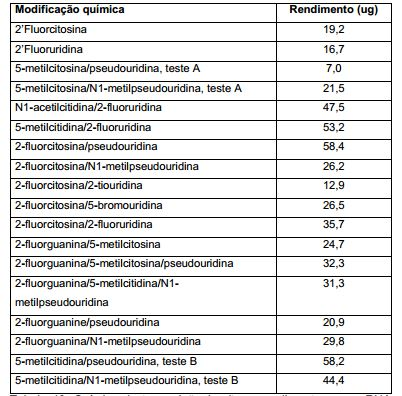


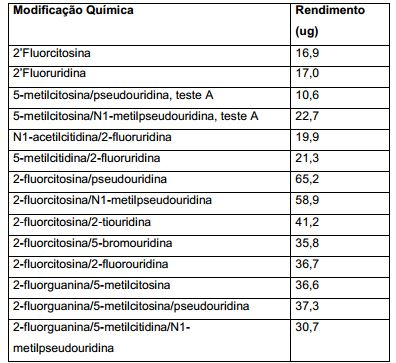
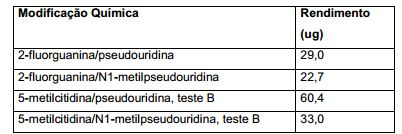
[000796] mRNAs de luciferase (sequência de mRNA mostrada em SEQ ID NO: 3; cauda poli-A de aproximadamente 160 nucleotídeos não mostrada em sequência; cap 5’, Cap1) foram produzidos como versões totalmente modificadas com as químicas na Tabela 42 e transcritos usando polimerase T7 mutante (kit de transcrição Durascribe® T7 (No. Cat. DS010925) (Epicentre®, Madison, WI). mRNA contendo 2’ flúor foi feito usando Durascribe T7, no entanto, mRNA contendo 2’Ometila não pôde ser transcrito usando Durascribe T7.[000796] Luciferase mRNAs (mRNA sequence shown in SEQ ID NO: 3; poly-A tail of approximately 160 nucleotides not shown in sequence; 5' cap, Cap1) were produced as fully modified versions with the chemistries in Table 42 and transcribed using mutant T7 polymerase (Durascribe® T7 transcription kit (Cat. No. DS010925) (Epicentre®, Madison, WI) mRNA containing 2' fluor was made using Durascribe T7, however, mRNA containing 2'Omethyl could not be transcribed using Durascribe T7.
[000797] Incorporação de mRNA modificado com 2’Ometila poderia talvez ser realizada usando outras polimerases T7 mutantes (Nat Biotechnol. (2004) 22:1155-1160; Nucleic Acids Res. (2002) 30:e138). Alternativamente, modificações de 2’OMe poderiam ser introduzidas após transcrição usando meio enzimático.[000797] 2'Omethyl-modified mRNA incorporation could perhaps be performed using other mutant T7 polymerases (Nat Biotechnol. (2004) 22:1155-1160; Nucleic Acids Res. (2002) 30:e138). Alternatively, 2'OMe modifications could be introduced after transcription using enzymatic medium.
[000798] Introdução de modificações no grupo 2’ do açúcar tem muitas vantagens potenciais. Substituições 2’OMe, como substituições 2’ flúor são conhecidas proteger contra as nucleases e também foram mostradas abolir reconhecimento imune inato quando incorporadas em outros ácidos nucleicos tais como siRNA e anti-sentido (incorporados em sua totalidade, Crooke, ed. Antisense Drug Technology, 2a edição; Boca Raton: CRC press).[000798] Introducing modifications in group 2’ of sugar has many potential advantages. 2'OMe substitutions such as 2' fluorine substitutions are known to protect against nucleases and have also been shown to abolish innate immune recognition when incorporated into other nucleic acids such as siRNA and antisense (incorporated in its entirety, Crooke, ed. Antisense Drug Technology , 2nd edition; Boca Raton: CRC press).
[000799] Os mRNAs modificados com 2’Flúor foram então transfectados em células HeLa para avaliar a produção de proteína em um contexto celular e o mesmo mRNA foi também avaliado em um sistema de reticulócito de coelhos livre de célula. Um controle de luciferase não modificada (luciferase natural) foi usado para ambos os experimentos de transcrição, um controle de falso transfectado e não tratado (Lipofectamina 2000 sozinha) foi também analisado quanto à transfecção de HeLa e um controle de nenhum RNA foi analisado quanto aos reticulatos de coelhos.[000799] The 2'Fluoride modified mRNAs were then transfected into HeLa cells to assess protein production in a cellular context and the same mRNA was also assessed in a cell-free rabbit reticulocyte system. An unmodified luciferase control (natural luciferase) was used for both transcription experiments, a mock transfected and untreated control (
[000800] Para os experimentos de transfecção de HeLa, no dia anterior à transfecção, 20.000 células HeLa (ATCC no. CCL-2; Manassas, VA) foram coletadas por tratamento com solução de Tripsina-EDTA (LifeTechnologies, Grand Island, NY) e semeadas em um volume total de 100 ul de meio EMEM (suplementado com FCS 10% e 1x Glutamax) por cavidade em uma placa de cultura de 96 cavidades (Corning, Manassas, VA). As células foram cultivadas 37 oC em uma atmosfera de CO2 5% durante a noite. No dia seguinte, 83 ng do RNA modificado de luciferase contendo 2’ flúor (sequência de mRNA mostrada em SEQ ID NO: 3; cauda poli-A de aproximadamente 160 nucleotídeos não mostrada em sequência; cap 5’, Cap1) com a modificação química descrita na Tabela 42 foram diluídos em um volume final de 10 uL de OPTI-MEM (LifeTechnologies, Grand Island, NY). Lipofectamina 2000 (LifeTechnologies, Grand Island, NY) foi usada como reagente de transfecção e 0,2 uL foi diluído em um volume final de 10 uL de OPTI-MEM. Após 5 minutos de incubação em temperatura ambiente, ambas as soluções foram combinadas e incubadas mais 15 minutos em temperatura ambiente. Então a solução combinada de 20 uL foi adicionada ao meio de cultura de célula 100ul que contém as células HeLa e incubados em temperatura ambiente. Após 18 a 22 horas de incubação, as células que expressam luciferase foram lisadas com 100 uL de Passive Lysis Buffer (Promega, Madison, WI) de acordo com as instruções do fabricante. Alíquotas dos lisatos foram transferidas para placas de 96 cavidades de poliestireno opacas brancas (Corning, Manassas, VA) e combinadas com 100 uL de solução de ensaio de luciferase completa (Promega, Madison, WI). Os volumes de lisato foram ajustados ou diluídos até não mais do que 2 mil de unidades de luz relativa (RLU) por cavidade fossem detectados para as amostras de produção de sinal mais forte e as RLUs para cada química testada são mostradas na Tabela 42. O leitor de placa era um BioTek Synergy H1 (BioTek, Winooski, VT). O sinal de base das placas sem reagente era de cerca de 200 unidades de luz relativa por cavidade.[000800] For the HeLa transfection experiments, the day before transfection, 20,000 HeLa cells (ATCC no. CCL-2; Manassas, VA) were collected by treatment with Trypsin-EDTA solution (LifeTechnologies, Grand Island, NY) and seeded in a total volume of 100 ul of EMEM medium (supplemented with 10% FCS and 1x Glutamax) per well in a 96-well culture plate (Corning, Manassas, VA). Cells were grown at 37 oC in a 5% CO2 atmosphere overnight. The next day, 83 ng of the modified luciferase RNA containing 2' fluorine (mRNA sequence shown in SEQ ID NO: 3; poly-A tail of approximately 160 nucleotides not shown in sequence; cap 5', Cap1) with chemical modification described in Table 42 were diluted in a final volume of 10 µl of OPTI-MEM (LifeTechnologies, Grand Island, NY). Lipofectamine 2000 (LifeTechnologies, Grand Island, NY) was used as transfection reagent and 0.2 μl was diluted in a final volume of 10 μl OPTI-MEM. After 5 minutes of incubation at room temperature, both solutions were combined and incubated a further 15 minutes at room temperature. Then the combined 20 µl solution was added to the 100 µl cell culture medium containing the HeLa cells and incubated at room temperature. After 18 to 22 hours of incubation, luciferase expressing cells were lysed with 100 μl Passive Lysis Buffer (Promega, Madison, WI) according to the manufacturer's instructions. Aliquots of the lysates were transferred to white opaque 96-well polystyrene plates (Corning, Manassas, VA) and combined with 100 μl of complete luciferase assay solution (Promega, Madison, WI). Lysate volumes were adjusted or diluted until no more than 2,000 relative light units (RLU) per well were detected for the strongest signal producing samples and the RLUs for each chemistry tested are shown in Table 42. plate reader was a BioTek Synergy H1 (BioTek, Winooski, VT). The background signal from unreacted plates was about 200 relative light units per well.
[000801] Para o ensaio de lisato de reticulato de coelho, mRNA de luciferase contendo 2’-flúor foi diluído em água livre de nuclease estéril para uma quantidade final de 250 ng em 10 uL e adicionado a 40 uL de Lisato de Reticulócito de Coelho recém-preparado e a reação de tradução in vitro foi feita em um tubo de reação de polipropileno de 1,5 mL padrão (Thermo Fisher Scientific, Waltham, MA) a 30°C em um bloco de aquecimento seco. O ensaio de tradução foi feito com kit de Lisato de Reticulócito de Coelho (tratado com nuclease) (Promega, Madison, WI) de acordo com as instruções do fabricante. O tampão da reação foi suplementado com uma mistura um-para-um de soluções de estoque de aminoácido providas destituídas ou Leucina ou Metionina resultando em uma mistura de reação que contém quantidades suficientes de ambos os aminoácidos para permitir a tradução in vitro eficaz. Após 60 minutos de incubação, a reação foi parada ao colocar os tubos de reação em gelo.[000801] For the rabbit reticulate lysate assay, 2'-fluorine containing luciferase mRNA was diluted in sterile nuclease free water to a final amount of 250 ng in 10 μl and added to 40 μl Rabbit Reticulocyte Lysate freshly prepared and the in vitro translation reaction was done in a standard 1.5 mL polypropylene reaction tube (Thermo Fisher Scientific, Waltham, MA) at 30°C in a dry heat block. Translation assay was performed with Rabbit Reticulocyte Lysate (Nuclease-treated) kit (Promega, Madison, WI) according to the manufacturer's instructions. The reaction buffer was supplemented with a one-to-one mixture of amino acid stock solutions provided devoid of either Leucine or Methionine resulting in a reaction mixture that contains sufficient amounts of both amino acids to allow efficient in vitro translation. After 60 minutes of incubation, the reaction was stopped by placing the reaction tubes on ice.
[000802] Alíquotas da reação de tradução in vitro contendo RNA modificado de luciferase foram transferidas para placas de 96 cavidades de poliestireno opacas brancas (Corning, Manassas, VA) e combinadas com 100 ul de solução de ensaio de luciferase completa (Promega, Madison, WI). Os volumes das reações de tradução in vitro foram ajustados ou diluídos até que não mais do que 2 mio de unidades de luz relativa (RLUs) por cavidade fossem detectadas para as amostras de produção de sinal mais forte e as RLUs para cada química testada são mostradas na Tabela 43. O leitor da placa era um BioTek Synergy H1 (BioTek, Winooski, VT). O sinal de base das placas sem reagente era de cerca de 160 unidades de luz relativa por cavidade.[000802] Aliquots of the in vitro translation reaction containing modified luciferase RNA were transferred to white opaque polystyrene 96-well plates (Corning, Manassas, VA) and combined with 100 ul of complete luciferase assay solution (Promega, Madison, WI). The volumes of the in vitro translation reactions were adjusted or diluted until no more than 2 mio Relative Light Units (RLUs) per well were detected for the strongest signal producing samples and the RLUs for each chemistry tested are shown in Table 43. The plate reader was a BioTek Synergy H1 (BioTek, Winooski, VT). The background signal from unreacted plates was about 160 relative light units per well.
[000803] Como pode ser visto na Tabela 42 e 43, compostos contendo 2’Flúor múltiplos são ativos in vitro e produzem proteína luciferase. Tabela 42. Células HeLa

[000804] Para avaliar o uso de mRNA modificado com 2’flúor em combinação com outra modificação, uma série de mRNA foi transcrita usando ou polimerase T7 do tipo selvagem (compostos que não contêm fluoro) ou usando polimerases T7 mutantes (compostos que contêm fluoro) como descrito no Exemplo 86. Todos os mRNAs modificados foram testados através de transfecção in vitro em células HeLa.[000804] To evaluate the use of mRNA modified with 2'fluorine in combination with another modification, a series of mRNA was transcribed using either wild-type T7 polymerase (compounds not containing fluoro) or using mutant T7 polymerases (compounds containing fluoro ) as described in Example 86. All modified mRNAs were tested by in vitro transfection into HeLa cells.
[000805] O dia anterior à transfecção, 20.000 células HeLa (ATCC no. CCL-2; Manassas, VA) foram coletadas por tratamento com solução de Tripsina-EDTA (LifeTechnologies, Grand Island, NY) e semeadas em um volume total de 100 uL de meio EMEM (suplementado com FCS 10% e 1x Glutamax) por cavidade em uma placa de cultura de 96 cavidades (Corning, Manassas, VA). As células foram cultivadas a 37 °C em uma atmosfera de CO2 5% durante a noite. No dia seguinte, 83 ng do mRNA modificado de luciferase (sequência de mRNA mostrada em SEQ ID NO: 3; cauda poli-A de aproximadamente 160 nucleotídeos não mostrada em sequência; cap 5’, Cap1) com a modificação química descrita na Tabela 44, foram diluídos em um volume final de 10 uL de OPTI-MEM (LifeTechnologies, Grand Island, NY). Lipofectamina 2000 (LifeTechnologies, Grand Island, NY) foi usada como reagente de transfecção e 0,2 uL foi diluído em um volume final de 10 uL de OPTI- MEM. Após 5 minutos de incubação em temperatura ambiente, ambas as soluções foram combinadas e incubadas por mais 15 minutos em temperatura ambiente. Então, a solução combinada de 20 uL foi adicionada aos 100 uL de meio de cultura celular contendo as células HeLa e incubada em temperatura ambiente.[000805] The day before transfection, 20,000 HeLa cells (ATCC no. CCL-2; Manassas, VA) were collected by treatment with Trypsin-EDTA solution (LifeTechnologies, Grand Island, NY) and seeded in a total volume of 100 μl of EMEM medium (supplemented with 10% FCS and 1x Glutamax) per well in a 96-well culture plate (Corning, Manassas, VA). Cells were grown at 37°C in a 5% CO2 atmosphere overnight. The next day, 83 ng of the modified luciferase mRNA (mRNA sequence shown in SEQ ID NO: 3; poly-A tail of approximately 160 nucleotides not shown in sequence; cap 5', Cap1) with the chemical modification described in Table 44 , were diluted in a final volume of 10 µl of OPTI-MEM (LifeTechnologies, Grand Island, NY). Lipofectamine 2000 (LifeTechnologies, Grand Island, NY) was used as transfection reagent and 0.2 μl was diluted in a final volume of 10 μl OPTI-MEM. After 5 minutes of incubation at room temperature, both solutions were combined and incubated for another 15 minutes at room temperature. Then, the combined 20 μl solution was added to the 100 μl of cell culture medium containing the HeLa cells and incubated at room temperature.
[000806] Após 18 a 22 horas de incubação, as células que expressam luciferase foram lisadas com 100 uL de Passive Lysis Buffer (Promega, Madison, WI) de acordo com as instruções do fabricante. Alíquotas dos lisatos foram transferidas para placas de 96 cavidades de poliestireno opacas brancas (Corning, Manassas, VA) e combinadas com 100 uL de solução de ensaio de luciferase completa (Promega, Madison, WI). Os volumes de lisato foram ajustados ou diluídos até que não mais do que 2 mio de unidades de luz relativa (RLU) por cavidade fossem detectados para as amostras que produzem sinal mais forte e as RLUs para cada química testada são mostradas na Tabela 44. O leitor de placa era um BioTek Synergy H1 (BioTek, Winooski, VT). O sinal de base das placas sem reagente era de cerca de 200 unidades de luz relativa por cavidade.[000806] After 18 to 22 hours of incubation, cells expressing luciferase were lysed with 100 uL of Passive Lysis Buffer (Promega, Madison, WI) according to the manufacturer's instructions. Aliquots of the lysates were transferred to white opaque 96-well polystyrene plates (Corning, Manassas, VA) and combined with 100 μl of complete luciferase assay solution (Promega, Madison, WI). Lysate volumes were adjusted or diluted until no more than 2 mio Relative Light Units (RLU) per well were detected for the samples producing the strongest signal and the RLUs for each chemistry tested are shown in Table 44. plate reader was a BioTek Synergy H1 (BioTek, Winooski, VT). The background signal from unreacted plates was about 200 relative light units per well.
[000807] Como evidenciado na Tabela 44, a maior parte das combinações de modificações resultou em mRNA que produziu proteína luciferase funcional, incluindo todos os compostos contendo flúor e muitas das combinações contendo modificações com 2’flúor. Tabela 44. Luciferase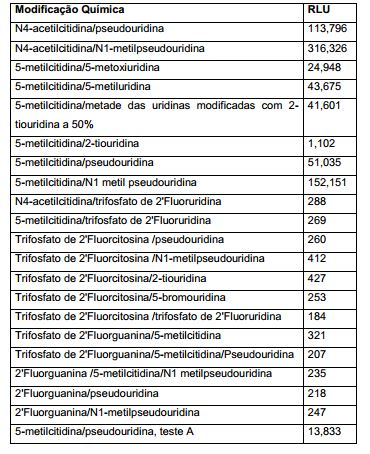

[000808] Para avaliar a atividade de todas as quatro modificações químicas diferentes da requerente no contexto de uma segunda janela de leitura aberta, foram replicados experimentos conduzidos anteriormente usando mRNA de luciferase, com mRNA de G-CSF humano. mRNA de G-CSF (sequência de mRNA mostrada em SEQ ID NO: 1; cauda poli-A de aproximadamente 160 nucleotídeos não mostrada em sequência; cap 5’, Cap1) foram totalmente modificados com as químicas nas Tabelas 45 e 46 usando polimerase T7 do tipo selvagem (para todos os compostos que não contêm flúor) ou polimerase T7 mutante (para todos os compostos que contêm flúor). A polimerase T7 mutante foi obtida comercialmente (kit de transcrição Durascribe® T7 (No.Cat. DS010925) (Epicentre®, Madison, WI).[000808] To assess the activity of all four different chemical modifications of the applicant in the context of a second open reading frame, experiments previously conducted using luciferase mRNA with human G-CSF mRNA were replicated. G-CSF mRNA (mRNA sequence shown in SEQ ID NO: 1; poly-A tail of approximately 160 nucleotides not shown in sequence; 5' cap, Cap1) were fully modified with the chemistries in Tables 45 and 46 using T7 polymerase wild-type (for all fluorine-free compounds) or mutant T7 polymerase (for all fluorine-containing compounds). Mutant T7 polymerase was obtained commercially (Durascribe® T7 transcription kit (Cat.No. DS010925) (Epicentre®, Madison, WI).
[000809] O RNA modificado nas Tabelas 45 e 46 foi transfectado in vitro em células HeLa ou adicionado a reticulatos de coelho (250ng de mRNA modificado) como indicado. Um controle de G-CSF não tratado, falso transfectado (reagente de transfecção sozinho), totalmente modificado com 5-metilcitosina e N1-metilpseudouridina ou controle de luciferase (sequência de mRNA mostrada em SEQ ID NO: 3; cauda poliA de aproximadamente 160 nucleotídeos não mostrada em sequência; cap 5’, Cap1) totalmente modificados com 5-metilcitosina e N1- metilpseudouridina foram também analisados. A expressão de proteína G-CSF foi determinada através ELISA e os valores são mostrados em Tabelas 45 e 46. Na tabela 45, "NT" significa não testado.[000809] The modified RNA in Tables 45 and 46 was transfected in vitro into HeLa cells or added to rabbit crosslinks (250ng of modified mRNA) as indicated. An untreated, mock transfected G-CSF control (transfection reagent alone), fully modified with 5-methylcytosine and N1-methylpseudouridine or luciferase control (mRNA sequence shown in SEQ ID NO:3; polyA tail of approximately 160 nucleotides). not shown in sequence; cap 5', Cap1) fully modified with 5-methylcytosine and N1-methylpseudouridine were also analyzed. G-CSF protein expression was determined by ELISA and values are shown in Tables 45 and 46. In Table 45, "NT" means not tested.
[000810] Como mostrado na Tabela 45, muitas, mas não todas, as modificações químicas resultaram em produção de proteína G-CSF humana. Esses resultados de sistemas de tradução livres de célula e baseados em célula se correlacionam muito bem com as mesmas modificações que geralmente funcionam ou não funcionam em ambos os sistemas. Uma exceção notável é o mRNA de G-CSF modificado com 5-formilcitidina que funcionou no sistema de tradução livre de células, mas não no sistema de transfecção baseado em célula HeLa. Uma diferença similar entre os dois ensaios foi também vista com mRNA de luciferase modificado com 5-formilcitidina.[000810] As shown in Table 45, many, but not all, of the chemical modifications resulted in the production of human G-CSF protein. These results from cell-free and cell-based translation systems correlate very well with the same modifications that generally work or do not work in both systems. A notable exception is the 5-formylcytidine modified G-CSF mRNA which functioned in the cell-free translation system but not in the HeLa cell-based transfection system. A similar difference between the two assays was also seen with 5-formylcytidine modified luciferase mRNA.
[000811] Como demonstrado na Tabela 46, muitas, mas não todas, das químicas modificadas de mRNA de G-CSF (quando usadas em combinação) demonstraram atividade in vivo. Ainda, a presença de N1- metilpseudouridina no mRNA modificado (com N4-acetilcitidina ou 5 metilcitidina) demonstrou expressão mais alta do que quando as mesmas combinações foram testadas usando pseudouridina. Juntos, esses dados demonstram que mRNA de G-CSF contendo N1-metilpseudouridina resulta em expressão de proteína in vitro melhorada. Tabela 45. Expressão de G-CSF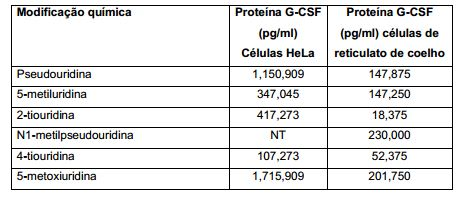
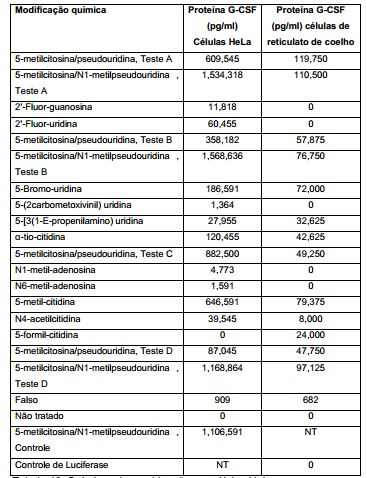

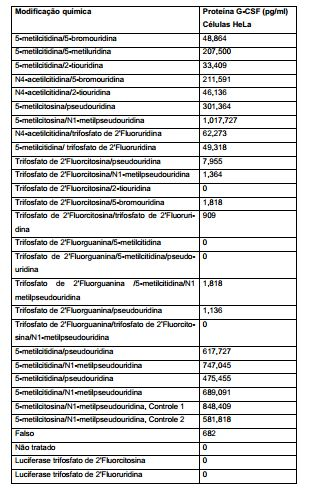
[000812] As tabelas listadas abaixo (Tabelas 47-49) sumarizam muito dos dados de avaliação in vitro e in vivo com os compostos diferentes apresentados nos exemplos anteriores. Uma boa correlação existe entre ensaios de tradução livres de célula e baseados em células. As mesmas substituições químicas geralmente mostram boa concordância se testados no contexto de mRNA de luciferase ou G-CSF. Por último, mRNA contendo N1- metilpseudouridina mostra um nível de expressão de proteína muito alto com pouco ou nenhum estímulo de citocina detectável in vitro e in vivo, e é superior a mRNA que contém pseudouridina ambos in vitro e in vivo.[000812] The tables listed below (Tables 47-49) summarize much of the in vitro and in vivo evaluation data with the different compounds presented in the examples above. A good correlation exists between cell-free and cell-based translation assays. The same chemical substitutions generally show good agreement if tested in the context of luciferase mRNA or G-CSF. Lastly, mRNA containing N1-methylpseudouridine shows a very high level of protein expression with little or no detectable cytokine stimulus in vitro and in vivo, and is superior to mRNA containing pseudouridine both in vitro and in vivo.
[000813] mRNA de luciferase (sequência de mRNA mostrada em SEQ ID NO: 3; cauda poli-A de aproximadamente 160 nucleotídeos não mostrada em sequência; cap 5’, Cap1) e mRNA de G-CSF (sequência de mRNA mostrada em SEQ ID NO: 1; cauda poli-A de aproximadamente 160 nucleotídeos não mostrada em sequência; cap 5’, Cap1) foram modificados com químicas que ocorrem naturalmente e não naturalmente descritas nas Tabelas 47 e 48 ou químicas de combinação descritas na Tabela 48 e testados usando os métodos descritos aqui.[000813] Luciferase mRNA (mRNA sequence shown in SEQ ID NO: 3; poly-A tail of approximately 160 nucleotides not shown in sequence; 5' cap, Cap1) and G-CSF mRNA (mRNA sequence shown in SEQ ID NO: 1; poly-A tail of approximately 160 nucleotides not shown in sequence; cap 5', Cap1) were modified with naturally occurring and non-naturally occurring chemistries described in Tables 47 and 48 or combination chemistries described in Table 48 and tested using the methods described here.
[000814] Nas tabelas 47 e 48, "*" se refere à reação de transcrição in vitro usando uma polimerase T7 mutante (kit de transcrição Durascribe® T7 (Cat. No. DS010925) (Epicentre®, Madison, WI); "**" se refere ao segundo resultado da reação de transcrição in vitro usando uma polimerase T7 mutante (kit de transcrição Durascribe® T7 (Cat. No. DS010925) (Epicentre®, Madison, WI); "***" se refere à produção vista em traduções livres de células (lisatos de reticulócito de coelho); a produção de proteína de HeLa é julgada por "+", "+/-" e "-"; quando se refere a G-CSF PBMC "++++" significa maior que 6.000 pg/ml G-CSF, "+++" significa maior que 3.000 pg/ml G-CSF, "++" significa maior que 1.500 pg/ml G-CSF, "+" significa maior que 300 pg/ml G-CSF, "+/-" significa maior que 150-300 pg/ml G-CSF e a base era cerca de 110 pg/ml; quando se referindo à PBMC de citocina "++++" significa maior que 1.000 pg/ml de interferon-alfa (IFN-alfa), "+++" significa maior que 600 pg/ml de IFN-alfa, "++" significa maior que 300 pg/ml de IFN-alfa, "+" significa maior que 100 pg/ml de IFN-alfa, "-" significa menos do que 100 pg/ml e a base foi de cerca de 70 pg/ml; e "NT" significa não testado. Na tabela 48, a produção de proteína foi avaliada usando uma polimerase T7 mutante (kit de transcrição Durascribe® T7 (Cat. No. DS010925) (Epicentre®, Madison, WI). Tabela 47. Ocorrência Natural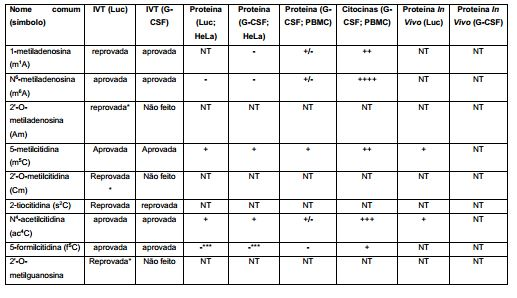
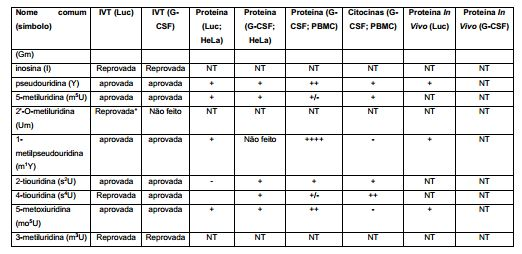


[000815] Na Tabela 49, a produção de proteína de HeLa é julgada por "+", "+/-" e "-"; quando se refere a G-CSF PBMC "++++" significa mais que 6.000 pg/ml G-CSF, "+++" significa mais que 3.000 pg/ml G-CSF, "++" significa mais que 1,500 pg/ml G-CSF, "+" significa mais que 300 pg/ml G-CSF, "+/-" significa 150-300 pg/ml G-CSF e a base foi de cerca de 110 pg/ml; quando se referindo à citocina de PBMC "++++" significa mais que 1.000 pg/ml de interferon-alfa (IFN-alfa), "+++" significa mais que 600 pg/ml de IFN-alfa, "++" significa mais que 300 pg/ml de IFN- alfa, "+" significa mais que 100 pg/ml de IFN-alfa, "-" significa menos do que 100 pg/ml e a base foi de cerca de 70 pg/ml; "WT" se refere à polimerase T7 do tipo selvagem, "MT" se refere à polimerase T7 mutante (kit de transcrição Durascribe® T7 (Cat. No. DS010925) (Epicentre®, Madison, WI) e "NT" significa não testado. Tabela 49. Química de combinação


[000816] A capacidade de mRNA modificado de G-CSF (sequência de mRNA mostrada em SEQ ID NO: 1; cauda poli-A de aproximadamente 160 nucleotídeos não mostrada em sequência; cap 5’, Cap1) em disparar uma resposta imune foi determinada pela medição de interferon-alfa (IFN-alfa) e a produção de fator alfa de necrose de tumor (TNF-alfa). Uso de culturas de PBMC in vitro é um caminho aceito para medir o potencial imunoestimulador de oligonucleotídeos (Robbins e outros, Oligonucleotides 2009 19:89-102) e métodos de transfecção são descritos aqui. São mostradas na Tabela 50 as médias de 2 ou 3 doadores de PBMC separados da produção de interferon-alfa (IFN-alfa) e fator alfa de necrose de tumor (TNF-alfa) com o tempo conforme medido por ELISA específico. Controles de R848, P(I)P(C), LPS e Lipofectamina 2000 (L2000) também foram analisados.[000816] The ability of modified G-CSF mRNA (mRNA sequence shown in SEQ ID NO: 1; poly-A tail of approximately 160 nucleotides not shown in sequence; 5' cap, Cap1) to trigger an immune response was determined by measuring interferon-alpha (IFN-alpha) and the production of tumor necrosis factor alpha (TNF-alpha). Use of in vitro PBMC cultures is an accepted way to measure the immunostimulatory potential of oligonucleotides (Robbins et al., Oligonucleotides 2009 19:89-102) and transfection methods are described here. Shown in Table 50 are the means of 2 or 3 separate PBMC donors of interferon-alpha (IFN-alpha) and tumor necrosis factor alpha (TNF-alpha) production over time as measured by specific ELISA. Controls for R848, P(I)P(C), LPS and Lipofectamine 2000 (L2000) were also analyzed.
[000817] Com relação ao reconhecimento imune inato, enquanto ambas químicas de mRNA modificado amplamente preveniram a produção de IFN-alfa e TNF-alfa com relação a controles positivos (R848, P(I)P(C)), compostos 2’flúor reduzem a produção de IFN-alfa e TNF-alfa ainda menor do que outras combinações e as combinações de N4-acetylcitidina aumentaram o perfil de citocina. Tabela 50. IFN-alfa e TNF-alfa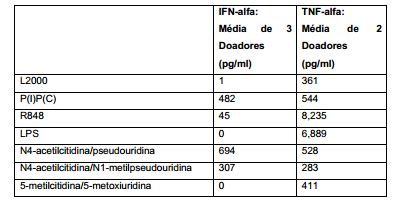

[000818] Deve ser entendido que embora a presente invenção tenha sido descrita em conjunto com a descrição detalhada da mesma, a descrição acima pretende ilustrar e não limitar o escopo da presente invenção, o qual é definido pelo escopo das reivindicações anexas. Outros aspectos, vantagens e modificações estão dentro do escopo das reivindicações que seguem.[000818] It is to be understood that although the present invention has been described in conjunction with the detailed description thereof, the above description is intended to illustrate and not limit the scope of the present invention, which is defined by the scope of the appended claims. Other aspects, advantages and modifications are within the scope of the claims that follow.
Claims (6)
Applications Claiming Priority (3)
| Application Number | Priority Date | Filing Date | Title |
|---|---|---|---|
| US201161542533P | 2011-10-03 | 2011-10-03 | |
| US61/542,533 | 2011-10-03 | ||
| PCT/US2012/058519 WO2013052523A1 (en) | 2011-10-03 | 2012-10-03 | Modified nucleosides, nucleotides, and nucleic acids, and uses thereof |
Publications (2)
| Publication Number | Publication Date |
|---|---|
| BR112014007852A2 BR112014007852A2 (en) | 2017-04-18 |
| BR112014007852B1 true BR112014007852B1 (en) | 2021-11-03 |
Family
ID=48044115
Family Applications (1)
| Application Number | Title | Priority Date | Filing Date |
|---|---|---|---|
| BR112014007852-1A BR112014007852B1 (en) | 2011-10-03 | 2012-10-03 | MODIFIED ISOLATED POLYNUCLEOTIDE AND PHARMACEUTICAL COMPOSITION |
Country Status (25)
| Country | Link |
|---|---|
| US (4) | US9428535B2 (en) |
| EP (4) | EP2763701B1 (en) |
| JP (6) | JP6113737B2 (en) |
| KR (2) | KR20190099538A (en) |
| CN (2) | CN110511939A (en) |
| AU (5) | AU2012318752B2 (en) |
| BR (1) | BR112014007852B1 (en) |
| CA (1) | CA2850624A1 (en) |
| CY (1) | CY1125029T1 (en) |
| DE (1) | DE19216461T1 (en) |
| DK (1) | DK3682905T3 (en) |
| ES (1) | ES2911677T3 (en) |
| HR (1) | HRP20220250T1 (en) |
| HU (1) | HUE057725T2 (en) |
| IL (2) | IL231808B (en) |
| LT (1) | LT3682905T (en) |
| MX (1) | MX354267B (en) |
| PL (1) | PL3682905T3 (en) |
| PT (1) | PT3682905T (en) |
| RS (1) | RS62993B1 (en) |
| RU (2) | RU2648950C2 (en) |
| SG (2) | SG11201401196WA (en) |
| SI (1) | SI3682905T1 (en) |
| SM (1) | SMT202200229T1 (en) |
| WO (1) | WO2013052523A1 (en) |
Families Citing this family (363)
| Publication number | Priority date | Publication date | Assignee | Title |
|---|---|---|---|---|
| DE10229872A1 (en) | 2002-07-03 | 2004-01-29 | Curevac Gmbh | Immune stimulation through chemically modified RNA |
| DE10347710B4 (en) | 2003-10-14 | 2006-03-30 | Johannes-Gutenberg-Universität Mainz | Recombinant vaccines and their use |
| DE102005046490A1 (en) | 2005-09-28 | 2007-03-29 | Johannes-Gutenberg-Universität Mainz | New nucleic acid molecule comprising promoter, a transcriptable nucleic acid sequence, a first and second nucleic acid sequence for producing modified RNA with transcriptional stability and translational efficiency |
| PT2591114T (en) | 2010-07-06 | 2016-08-02 | Glaxosmithkline Biologicals Sa | Immunisation of large mammals with low doses of rna |
| LT3243526T (en) | 2010-07-06 | 2020-02-10 | Glaxosmithkline Biologicals S.A. | Delivery of rna to trigger multiple immune pathways |
| BR112013000244A2 (en) | 2010-07-06 | 2016-05-17 | Novartis Ag | lipid liposomes having advantageous pka for administration of rna |
| EP2600901B1 (en) | 2010-08-06 | 2019-03-27 | ModernaTX, Inc. | A pharmaceutical formulation comprising engineered nucleic acids and medical use thereof |
| EP4066857B1 (en) | 2010-08-31 | 2022-12-21 | GlaxoSmithKline Biologicals SA | Pegylated liposomes for delivery of immunogen-encoding rna |
| CN104531812A (en) | 2010-10-01 | 2015-04-22 | 现代治疗公司 | Engineered nucleic acids and methods of use thereof |
| EP3520813B1 (en) | 2010-10-11 | 2023-04-19 | GlaxoSmithKline Biologicals S.A. | Antigen delivery platforms |
| US8710200B2 (en) * | 2011-03-31 | 2014-04-29 | Moderna Therapeutics, Inc. | Engineered nucleic acids encoding a modified erythropoietin and their expression |
| RU2670745C9 (en) | 2011-05-24 | 2018-12-13 | Бионтех Рна Фармасьютикалс Гмбх | Individualised vaccines for cancer |
| BR112013031553A2 (en) | 2011-06-08 | 2020-11-10 | Shire Human Genetic Therapies, Inc. | compositions, mrna encoding a gland and its use, use of at least one mrna molecule and a vehicle for transfer and use of an mrna encoding for exogenous protein |
| US11896636B2 (en) | 2011-07-06 | 2024-02-13 | Glaxosmithkline Biologicals Sa | Immunogenic combination compositions and uses thereof |
| US9464124B2 (en) | 2011-09-12 | 2016-10-11 | Moderna Therapeutics, Inc. | Engineered nucleic acids and methods of use thereof |
| BR112014007852B1 (en) | 2011-10-03 | 2021-11-03 | Moderna Therapeutics, Inc | MODIFIED ISOLATED POLYNUCLEOTIDE AND PHARMACEUTICAL COMPOSITION |
| JP6073916B2 (en) | 2011-12-05 | 2017-02-01 | ファクター バイオサイエンス インコーポレイテッド | Methods and products for transfecting cells |
| US8497124B2 (en) | 2011-12-05 | 2013-07-30 | Factor Bioscience Inc. | Methods and products for reprogramming cells to a less differentiated state |
| PL2791160T3 (en) | 2011-12-16 | 2022-06-20 | Modernatx, Inc. | Modified mrna compositions |
| WO2013143555A1 (en) | 2012-03-26 | 2013-10-03 | Biontech Ag | Rna formulation for immunotherapy |
| HK1206779A1 (en) | 2012-04-02 | 2016-01-15 | Modernatx, Inc. | Modified polynucleotides for the production of nuclear proteins |
| US10501512B2 (en) | 2012-04-02 | 2019-12-10 | Modernatx, Inc. | Modified polynucleotides |
| US9283287B2 (en) | 2012-04-02 | 2016-03-15 | Moderna Therapeutics, Inc. | Modified polynucleotides for the production of nuclear proteins |
| US10501513B2 (en) | 2012-04-02 | 2019-12-10 | Modernatx, Inc. | Modified polynucleotides for the production of oncology-related proteins and peptides |
| US9572897B2 (en) | 2012-04-02 | 2017-02-21 | Modernatx, Inc. | Modified polynucleotides for the production of cytoplasmic and cytoskeletal proteins |
| US9890364B2 (en) | 2012-05-29 | 2018-02-13 | The General Hospital Corporation | TAL-Tet1 fusion proteins and methods of use thereof |
| CA2877644A1 (en) | 2012-07-03 | 2014-01-09 | Prosensa Technologies B.V. | Oligonucleotide for the treatment of muscular dystrophy patients |
| US9512456B2 (en) | 2012-08-14 | 2016-12-06 | Modernatx, Inc. | Enzymes and polymerases for the synthesis of RNA |
| WO2014093924A1 (en) * | 2012-12-13 | 2014-06-19 | Moderna Therapeutics, Inc. | Modified nucleic acid molecules and uses thereof |
| EP2909222B1 (en) * | 2012-10-22 | 2021-05-26 | Idenix Pharmaceuticals LLC | 2',4'-bridged nucleosides for hcv infection |
| AU2013337651B2 (en) | 2012-11-01 | 2018-12-13 | Factor Bioscience Inc. | Methods and products for expressing proteins in cells |
| DK2922554T3 (en) | 2012-11-26 | 2022-05-23 | Modernatx Inc | Terminalt modificeret rna |
| EP2925348B1 (en) | 2012-11-28 | 2019-03-06 | BioNTech RNA Pharmaceuticals GmbH | Individualized vaccines for cancer |
| AU2013374345A1 (en) | 2013-01-17 | 2015-08-06 | Moderna Therapeutics, Inc. | Signal-sensor polynucleotides for the alteration of cellular phenotypes |
| EP2968391A1 (en) | 2013-03-13 | 2016-01-20 | Moderna Therapeutics, Inc. | Long-lived polynucleotide molecules |
| EP3301102B1 (en) | 2013-03-14 | 2020-04-15 | Translate Bio, Inc. | Ribonucleic acids with 4'-thio-modified nucleotides and related methods |
| EP4446413A3 (en) | 2013-03-14 | 2024-12-18 | Translate Bio, Inc. | Methods for purification of messenger rna |
| WO2014153052A2 (en) | 2013-03-14 | 2014-09-25 | Shire Human Genetic Therapies, Inc. | Cftr mrna compositions and related methods and uses |
| HUE055044T2 (en) | 2013-03-14 | 2021-10-28 | Translate Bio Inc | Methods and compositions for delivering mrna coded antibodies |
| EP2971010B1 (en) | 2013-03-14 | 2020-06-10 | ModernaTX, Inc. | Formulation and delivery of modified nucleoside, nucleotide, and nucleic acid compositions |
| US11377470B2 (en) | 2013-03-15 | 2022-07-05 | Modernatx, Inc. | Ribonucleic acid purification |
| ES2795249T3 (en) | 2013-03-15 | 2020-11-23 | Translate Bio Inc | Synergistic enhancement of nucleic acid delivery through mixed formulations |
| WO2014144767A1 (en) | 2013-03-15 | 2014-09-18 | Moderna Therapeutics, Inc. | Ion exchange purification of mrna |
| US10077439B2 (en) | 2013-03-15 | 2018-09-18 | Modernatx, Inc. | Removal of DNA fragments in mRNA production process |
| US10138507B2 (en) | 2013-03-15 | 2018-11-27 | Modernatx, Inc. | Manufacturing methods for production of RNA transcripts |
| US8980864B2 (en) | 2013-03-15 | 2015-03-17 | Moderna Therapeutics, Inc. | Compositions and methods of altering cholesterol levels |
| BR112015027279A8 (en) | 2013-05-03 | 2018-01-30 | Selecta Biosciences Inc | methods and compositions for enhancing cd4 + regulatory t cells |
| WO2014180490A1 (en) | 2013-05-10 | 2014-11-13 | Biontech Ag | Predicting immunogenicity of t cell epitopes |
| AU2014274894A1 (en) | 2013-06-04 | 2015-11-26 | Selecta Biosciences, Inc. | Repeated administration of non-immunosupressive antigen specific immunotherapeutics |
| CN103254253B (en) * | 2013-06-06 | 2015-11-18 | 济南卡博唐生物科技有限公司 | A kind of method preparing diacetone-D-allose |
| EP3013964B1 (en) | 2013-06-28 | 2020-05-06 | ethris GmbH | Compositions for introducing rna into cells |
| PT3019619T (en) | 2013-07-11 | 2021-11-11 | Modernatx Inc | COMPOSITIONS COMPRISING SYNTHETIC POLYNUCLEOTIDES ENCODING SYNTHETIC CRISPR AND SGARN-RELATED PROTEINS AND METHODS OF USE |
| US20160194625A1 (en) * | 2013-09-03 | 2016-07-07 | Moderna Therapeutics, Inc. | Chimeric polynucleotides |
| EP3041938A1 (en) | 2013-09-03 | 2016-07-13 | Moderna Therapeutics, Inc. | Circular polynucleotides |
| US9925277B2 (en) | 2013-09-13 | 2018-03-27 | Modernatx, Inc. | Polynucleotide compositions containing amino acids |
| CN103467509A (en) * | 2013-09-27 | 2013-12-25 | 成都爱博协诺化学技术有限公司 | Antitumor drug intermediate synthesis method |
| US10023626B2 (en) | 2013-09-30 | 2018-07-17 | Modernatx, Inc. | Polynucleotides encoding immune modulating polypeptides |
| EP3052479A4 (en) * | 2013-10-02 | 2017-10-25 | Moderna Therapeutics, Inc. | Polynucleotide molecules and uses thereof |
| EP3052511A4 (en) * | 2013-10-02 | 2017-05-31 | Moderna Therapeutics, Inc. | Polynucleotide molecules and uses thereof |
| WO2015051214A1 (en) | 2013-10-03 | 2015-04-09 | Moderna Therapeutics, Inc. | Polynucleotides encoding low density lipoprotein receptor |
| WO2015062738A1 (en) | 2013-11-01 | 2015-05-07 | Curevac Gmbh | Modified rna with decreased immunostimulatory properties |
| EP3062798B1 (en) | 2013-11-01 | 2020-05-06 | CureVac AG | Modified rna with decreased immunostimulatory properties |
| EP3594348B1 (en) | 2013-11-22 | 2021-09-08 | MiNA Therapeutics Limited | C/ebp alpha short activating rna compositions and methods of use |
| EP3053585A1 (en) * | 2013-12-13 | 2016-08-10 | Moderna Therapeutics, Inc. | Alternative nucleic acid molecules and uses thereof |
| WO2015095351A1 (en) | 2013-12-19 | 2015-06-25 | Novartis Ag | LEPTIN mRNA COMPOSITIONS AND FORMULATIONS |
| KR102726294B1 (en) | 2014-01-31 | 2024-11-06 | 팩터 바이오사이언스 인크. | Methods and products for nucleic acid production and delivery |
| EP3110954A1 (en) | 2014-02-26 | 2017-01-04 | Ethris GmbH | Compositions for gastrointestinal administration of rna |
| CN103784422B (en) * | 2014-02-28 | 2016-03-02 | 重庆医科大学附属第二医院 | A kind of year rtPA nanoparticle and preparation method thereof |
| PL3981437T3 (en) | 2014-04-23 | 2025-02-24 | Modernatx, Inc. | Nucleic acid vaccines |
| MX382298B (en) | 2014-06-10 | 2025-03-12 | Curevac Mfg Gmbh | METHODS AND MEANS FOR INCREASING RNA PRODUCTION. |
| EP3157573A4 (en) | 2014-06-19 | 2018-02-21 | Moderna Therapeutics, Inc. | Alternative nucleic acid molecules and uses thereof |
| JP6599373B2 (en) * | 2014-06-24 | 2019-10-30 | シャイアー ヒューマン ジェネティック セラピーズ インコーポレイテッド | Stereochemically enriched compositions for delivery of nucleic acids |
| EP3169335B8 (en) * | 2014-07-16 | 2019-10-09 | ModernaTX, Inc. | Circular polynucleotides |
| AU2015289583A1 (en) | 2014-07-16 | 2017-02-02 | Modernatx, Inc. | Chimeric polynucleotides |
| WO2016014846A1 (en) | 2014-07-23 | 2016-01-28 | Moderna Therapeutics, Inc. | Modified polynucleotides for the production of intrabodies |
| CN104211740B (en) * | 2014-08-20 | 2016-10-26 | 济南尚博生物科技有限公司 | A kind of N4the preparation method of-benzoyl-D-cytidine |
| WO2016045732A1 (en) | 2014-09-25 | 2016-03-31 | Biontech Rna Pharmaceuticals Gmbh | Stable formulations of lipids and liposomes |
| US20160130567A1 (en) | 2014-11-02 | 2016-05-12 | Arcturus Therapeutics, Inc. | Messenger una molecules and uses thereof |
| EP3461904A1 (en) | 2014-11-10 | 2019-04-03 | ModernaTX, Inc. | Alternative nucleic acid molecules containing reduced uracil content and uses thereof |
| WO2016077123A1 (en) | 2014-11-10 | 2016-05-19 | Moderna Therapeutics, Inc. | Multiparametric nucleic acid optimization |
| EP3034539A1 (en) | 2014-12-19 | 2016-06-22 | Ethris GmbH | Compositions for introducing nucleic acid into cells |
| WO2016128060A1 (en) | 2015-02-12 | 2016-08-18 | Biontech Ag | Predicting t cell epitopes useful for vaccination |
| EP3543339A1 (en) | 2015-02-13 | 2019-09-25 | Factor Bioscience Inc. | Nucleic acid products and methods of administration thereof |
| SG11201708681SA (en) | 2015-04-30 | 2017-11-29 | Curevac Ag | Method for in vitro transcription using an immobilized restriction enzyme |
| KR20180004820A (en) | 2015-05-15 | 2018-01-12 | 큐어백 아게 | A novel prime-boost therapy comprising administration of at least one mRNA construct |
| ES2960429T3 (en) | 2015-05-29 | 2024-03-04 | Curevac Mfg Gmbh | Method for producing and purifying RNA, comprising at least one tangential flow filtration step |
| EP3303575B1 (en) | 2015-05-29 | 2022-03-16 | CureVac AG | Method for adding cap structures to rna using immobilized enzymes |
| ES2902125T3 (en) * | 2015-07-14 | 2022-03-25 | Abbott Molecular Inc | Purification of nucleic acids using copper-titanium oxides or magnesium-titanium oxides |
| EP3825407A1 (en) | 2015-08-10 | 2021-05-26 | CureVac Real Estate GmbH | Method of increasing the replication of a circular dna molecule |
| AU2016324463B2 (en) | 2015-09-17 | 2022-10-27 | Modernatx, Inc. | Polynucleotides containing a stabilizing tail region |
| WO2017049286A1 (en) | 2015-09-17 | 2017-03-23 | Moderna Therapeutics, Inc. | Polynucleotides containing a morpholino linker |
| LT4104687T (en) | 2015-09-21 | 2024-02-26 | Trilink Biotechnologies, Llc | Compositions and methods for synthesizing 5 -capped rnas |
| ES2810701T5 (en) | 2015-10-05 | 2024-07-11 | Modernatx Inc | Procedures for the therapeutic administration of messenger ribonucleic acid drugs |
| WO2017059902A1 (en) | 2015-10-07 | 2017-04-13 | Biontech Rna Pharmaceuticals Gmbh | 3' utr sequences for stabilization of rna |
| WO2017066797A1 (en) | 2015-10-16 | 2017-04-20 | Modernatx, Inc. | Trinucleotide mrna cap analogs |
| EP4086269A1 (en) | 2015-10-16 | 2022-11-09 | ModernaTX, Inc. | Mrna cap analogs with modified phosphate linkage |
| WO2017066791A1 (en) * | 2015-10-16 | 2017-04-20 | Modernatx, Inc. | Sugar substituted mrna cap analogs |
| EP4349404A3 (en) | 2015-10-22 | 2024-06-19 | ModernaTX, Inc. | Respiratory virus vaccines |
| AU2016342376A1 (en) * | 2015-10-22 | 2018-06-07 | Modernatx, Inc. | Sexually transmitted disease vaccines |
| US20210108252A1 (en) | 2015-12-09 | 2021-04-15 | Novartis Ag | Label-free analysis of rna capping efficiency using rnase h, probes and liquid chromatography/mass spectrometry |
| SI3394093T1 (en) | 2015-12-23 | 2022-05-31 | Modernatx, Inc. | Methods of using ox40 ligand encoding polynucleotides |
| WO2017109161A1 (en) | 2015-12-23 | 2017-06-29 | Curevac Ag | Method of rna in vitro transcription using a buffer containing a dicarboxylic acid or tricarboxylic acid or a salt thereof |
| US20190241658A1 (en) | 2016-01-10 | 2019-08-08 | Modernatx, Inc. | Therapeutic mRNAs encoding anti CTLA-4 antibodies |
| EP3417069A1 (en) | 2016-02-15 | 2018-12-26 | CureVac AG | Method for analyzing by-products of rna in vitro transcription |
| EP3423595A1 (en) | 2016-03-03 | 2019-01-09 | CureVac AG | Rna analysis by total hydrolysis |
| EP3433361A1 (en) | 2016-03-24 | 2019-01-30 | CureVac AG | Immobilized inorganic pyrophosphatase (ppase) |
| BR112018069823A2 (en) * | 2016-03-31 | 2019-04-09 | Ethris Gmbh | dna molecule, vector, host cell, composition, rna molecule, nucleic acid molecule, pharmaceutical composition, kit, and use of an utr |
| CA3020343A1 (en) | 2016-04-08 | 2017-10-12 | Translate Bio, Inc. | Multimeric coding nucleic acid and uses thereof |
| WO2017180587A2 (en) | 2016-04-11 | 2017-10-19 | Obsidian Therapeutics, Inc. | Regulated biocircuit systems |
| US20190167811A1 (en) | 2016-04-13 | 2019-06-06 | Modernatx, Inc. | Lipid compositions and their uses for intratumoral polynucleotide delivery |
| JP7114485B2 (en) | 2016-05-18 | 2022-08-08 | モデルナティエックス インコーポレイテッド | Polynucleotides encoding α-galactosidase A for the treatment of Fabry disease |
| WO2017201342A1 (en) | 2016-05-18 | 2017-11-23 | Modernatx, Inc. | Polynucleotides encoding jagged1 for the treatment of alagille syndrome |
| WO2017201332A1 (en) | 2016-05-18 | 2017-11-23 | Modernatx, Inc. | Polynucleotides encoding acyl-coa dehydrogenase, very long-chain for the treatment of very long-chain acyl-coa dehydrogenase deficiency |
| CA3024624A1 (en) | 2016-05-18 | 2017-11-23 | Modernatx, Inc. | Polynucleotides encoding porphobilinogen deaminase for the treatment of acute intermittent porphyria |
| JP7088911B2 (en) | 2016-05-18 | 2022-06-21 | モデルナティエックス インコーポレイテッド | Polynucleotide encoding relaxin |
| EP3458105B1 (en) | 2016-05-18 | 2024-01-17 | Modernatx, Inc. | Polynucleotides encoding galactose-1-phosphate uridylyltransferase for the treatment of galactosemia type 1 |
| SG11201809381XA (en) | 2016-05-18 | 2018-12-28 | Modernatx Inc | Polynucleotides encoding interleukin-12 (il12) and uses thereof |
| JP7210287B2 (en) | 2016-05-18 | 2023-01-23 | モダーナティエックス・インコーポレイテッド | Polynucleotides encoding citrine for the treatment of type II citrullinemia |
| EP4137509A1 (en) | 2016-05-18 | 2023-02-22 | ModernaTX, Inc. | Combinations of mrnas encoding immune modulating polypeptides and uses thereof |
| KR101892086B1 (en) | 2016-05-19 | 2018-08-27 | 주식회사 삼양사 | Oxime ester derivative compounds, photopolymerization initiator, and photosensitive composition containing the same |
| US10835583B2 (en) | 2016-06-13 | 2020-11-17 | Translate Bio, Inc. | Messenger RNA therapy for the treatment of ornithine transcarbamylase deficiency |
| US12385034B2 (en) | 2016-06-24 | 2025-08-12 | Modernatx, Inc. | Methods and apparatus for filtration |
| MX2019000205A (en) | 2016-07-07 | 2019-09-23 | Rubius Therapeutics Inc | Compositions and methods related to therapeutic cell systems expressing exogenous rna. |
| AU2017296195A1 (en) | 2016-07-11 | 2019-01-24 | Translate Bio Ma, Inc. | Nucleic acid conjugates and uses thereof |
| JP2019528284A (en) | 2016-08-17 | 2019-10-10 | ファクター バイオサイエンス インコーポレイテッド | Nucleic acid product and method of administration thereof |
| US10925958B2 (en) | 2016-11-11 | 2021-02-23 | Modernatx, Inc. | Influenza vaccine |
| WO2018096179A1 (en) | 2016-11-28 | 2018-05-31 | Curevac Ag | Method for purifying rna |
| CN110325210A (en) | 2017-01-11 | 2019-10-11 | 小利兰·斯坦福大学托管委员会 | RSPO substitute molecule |
| WO2018140821A1 (en) | 2017-01-26 | 2018-08-02 | Surrozen, Inc. | Tissue-specific wnt signal enhancing molecules and uses thereof |
| US10093706B2 (en) | 2017-01-30 | 2018-10-09 | Indiana University Research And Technology Corporation | Dominant positive hnRNP-E1 polypeptide compositions and methods |
| WO2018141371A1 (en) | 2017-01-31 | 2018-08-09 | Curevac Ag | Purification and/or formulation of rna |
| WO2018144778A1 (en) * | 2017-02-01 | 2018-08-09 | Modernatx, Inc. | Polynucleotide secondary structure |
| KR102799810B1 (en) | 2017-02-02 | 2025-04-28 | 주식회사 삼양사 | Oxime ester biphenyl compounds, photopolymerization initiator, and photosensitive composition containing the same |
| AU2018224387B2 (en) | 2017-02-22 | 2024-08-08 | Crispr Therapeutics Ag | Compositions and methods for gene editing |
| MX2019010155A (en) | 2017-02-27 | 2020-12-10 | Translate Bio Inc | Novel codon-optimized cftr mrna. |
| TW202428301A (en) | 2017-02-28 | 2024-07-16 | 法商賽諾菲公司 | Therapeutic rna |
| WO2018160592A1 (en) | 2017-02-28 | 2018-09-07 | Arcturus Therapeutics, Inc. | Translatable molecules and synthesis thereof |
| CA3055200A1 (en) | 2017-03-03 | 2018-09-07 | Obsidian Therapeutics, Inc. | Compositions and methods for immunotherapy |
| EP3601568A1 (en) | 2017-03-31 | 2020-02-05 | Agenovir Corporation | Antiviral therapeutic |
| WO2018213476A1 (en) | 2017-05-16 | 2018-11-22 | Translate Bio, Inc. | Treatment of cystic fibrosis by delivery of codon-optimized mrna encoding cftr |
| WO2018213789A1 (en) | 2017-05-18 | 2018-11-22 | Modernatx, Inc. | Modified messenger rna comprising functional rna elements |
| US11421011B2 (en) | 2017-05-18 | 2022-08-23 | Modernatx, Inc. | Polynucleotides encoding tethered interleukin-12 (IL12) polypeptides and uses thereof |
| CA3063907A1 (en) | 2017-05-31 | 2018-12-06 | Ultragenyx Pharmaceutical Inc. | Therapeutics for glycogen storage disease type iii |
| WO2018224166A1 (en) | 2017-06-09 | 2018-12-13 | Biontech Rna Pharmaceuticals Gmbh | Methods for predicting the usefulness of disease specific amino acid modifications for immunotherapy |
| US20200268666A1 (en) | 2017-06-14 | 2020-08-27 | Modernatx, Inc. | Polynucleotides encoding coagulation factor viii |
| WO2018231990A2 (en) | 2017-06-14 | 2018-12-20 | Modernatx, Inc. | Polynucleotides encoding methylmalonyl-coa mutase |
| US10034951B1 (en) | 2017-06-21 | 2018-07-31 | New England Biolabs, Inc. | Use of thermostable RNA polymerases to produce RNAs having reduced immunogenicity |
| GB201714430D0 (en) * | 2017-09-07 | 2017-10-25 | Micol Romain | Compositions and processes for targeted delivery and expression and modulation of therapeutic components in tissue |
| EP3679140B1 (en) | 2017-09-08 | 2022-11-16 | MiNA Therapeutics Limited | Stabilized cebpa sarna compositions and methods of use |
| CA3075219A1 (en) | 2017-09-08 | 2019-03-14 | Mina Therapeutics Limited | Hnf4a sarna compositions and methods of use |
| WO2019087113A1 (en) | 2017-11-01 | 2019-05-09 | Novartis Ag | Synthetic rnas and methods of use |
| JP2021501753A (en) | 2017-11-03 | 2021-01-21 | ザ・トラスティーズ・オブ・プリンストン・ユニバーシティThe Trustees Of Princeton University | Hydrophobic ion pairing and flash nanoprecipitation to form sustained release nanocarrier formulations |
| US11939601B2 (en) | 2017-11-22 | 2024-03-26 | Modernatx, Inc. | Polynucleotides encoding phenylalanine hydroxylase for the treatment of phenylketonuria |
| EP3714045A1 (en) | 2017-11-22 | 2020-09-30 | Modernatx, Inc. | Polynucleotides encoding propionyl-coa carboxylase alpha and beta subunits for the treatment of propionic acidemia |
| JP7423522B2 (en) | 2017-11-22 | 2024-01-29 | モダーナティエックス・インコーポレイテッド | Polynucleotide encoding ornithine transcarbamylase for the treatment of urea cycle disorders |
| KR101991903B1 (en) | 2017-12-07 | 2019-10-01 | 주식회사 삼양사 | Carbazole oxime ester derivative compounds and, photopolymerization initiator and photosensitive composition containing the same |
| US20200325532A1 (en) | 2017-12-15 | 2020-10-15 | Novartis Ag | Polya tail length analysis of rna by mass spectrometry |
| US11167043B2 (en) | 2017-12-20 | 2021-11-09 | Translate Bio, Inc. | Composition and methods for treatment of ornithine transcarbamylase deficiency |
| MA51523A (en) | 2018-01-05 | 2020-11-11 | Modernatx Inc | POLYNUCLEOTIDES CODING ANTI-BODY ANTI-CHIKUNGUNYA VIRUS |
| EP3737424A4 (en) | 2018-01-10 | 2021-10-27 | Translate Bio MA, Inc. | COMPOSITIONS AND METHODS FOR FACILITATING THE DELIVERY OF SYNTHETIC NUCLEIC ACIDS TO CELLS |
| HUE060791T2 (en) | 2018-04-11 | 2023-04-28 | Enterome S A | Antigenic peptides for the prevention and treatment of cancer |
| EP4242307A3 (en) | 2018-04-12 | 2023-12-27 | MiNA Therapeutics Limited | Sirt1-sarna compositions and methods of use |
| JP7399876B2 (en) * | 2018-04-16 | 2023-12-18 | ジョージア テック リサーチ コーポレーション | mRNA-driven expression of RNA editors for disease treatment |
| CN119286871A (en) | 2018-04-19 | 2025-01-10 | 查美特制药公司 | Synthetic RIG-I-like receptor agonists |
| KR20210021943A (en) | 2018-04-25 | 2021-03-02 | 에트리스 게엠베하 | Anti-freeze agent for particulate formulation |
| US20220403001A1 (en) | 2018-06-12 | 2022-12-22 | Obsidian Therapeutics, Inc. | Pde5 derived regulatory constructs and methods of use in immunotherapy |
| US11827877B2 (en) | 2018-06-28 | 2023-11-28 | Crispr Therapeutics Ag | Compositions and methods for genomic editing by insertion of donor polynucleotides |
| WO2020014271A1 (en) | 2018-07-09 | 2020-01-16 | Surrozen, Inc. | Tissue-specific wnt signal enhancing molecules and uses |
| WO2020018890A1 (en) | 2018-07-19 | 2020-01-23 | Prudhomme Robert K | Triblock copolymer stabilizers for the formation of nanoparticles encapsulating soluble biologics, therapeutics, and imaging agents |
| US20220184185A1 (en) | 2018-07-25 | 2022-06-16 | Modernatx, Inc. | Mrna based enzyme replacement therapy combined with a pharmacological chaperone for the treatment of lysosomal storage disorders |
| IL317123A (en) | 2018-08-27 | 2025-01-01 | Regeneron Pharma | Use of Raman Spectroscopy in Downstream Purification |
| CA3111076A1 (en) | 2018-08-30 | 2020-03-05 | Tenaya Therapeutics, Inc. | Cardiac cell reprogramming with myocardin and ascl1 |
| WO2020047201A1 (en) | 2018-09-02 | 2020-03-05 | Modernatx, Inc. | Polynucleotides encoding very long-chain acyl-coa dehydrogenase for the treatment of very long-chain acyl-coa dehydrogenase deficiency |
| MX2021003015A (en) | 2018-09-13 | 2021-07-15 | Modernatx Inc | Polynucleotides encoding glucose-6-phosphatase for the treatment of glycogen storage disease. |
| MA53608A (en) | 2018-09-13 | 2021-07-21 | Modernatx Inc | POLYNUCLEOTIDES ENCODED FOR THE E1-ALPHA, E1-BETA AND E2 SUBUNITS OF THE BRANCHED-CHAIN ALPHA-KETOACID DEHYDROGENASE COMPLEX FOR THE TREATMENT OF LEUCINOSIS |
| EP3850102A1 (en) | 2018-09-14 | 2021-07-21 | ModernaTX, Inc. | Polynucleotides encoding uridine diphosphate glycosyltransferase 1 family, polypeptide a1 for the treatment of crigler-najjar syndrome |
| US20220152225A1 (en) | 2018-09-27 | 2022-05-19 | Modernatx, Inc. | Polynucleotides encoding arginase 1 for the treatment of arginase deficiency |
| US11072808B2 (en) | 2018-10-04 | 2021-07-27 | New England Biolabs, Inc. | Methods and compositions for increasing capping efficiency of transcribed RNA |
| AU2019355177A1 (en) | 2018-10-04 | 2021-05-06 | New England Biolabs, Inc. | Methods and compositions for increasing capping efficiency of transcribed RNA |
| US12331320B2 (en) | 2018-10-10 | 2025-06-17 | The Research Foundation For The State University Of New York | Genome edited cancer cell vaccines |
| US20210386788A1 (en) | 2018-10-24 | 2021-12-16 | Obsidian Therapeutics, Inc. | Er tunable protein regulation |
| CA3120647A1 (en) | 2018-11-21 | 2020-05-28 | Translate Bio, Inc. | Treatment of cystic fibrosis by delivery of nebulized mrna encoding cftr |
| HUE064076T2 (en) | 2018-12-06 | 2024-02-28 | Arcturus Therapeutics Inc | Compositions and methods for treating ornithine transcarbamylase deficiency |
| KR102228630B1 (en) | 2018-12-28 | 2021-03-16 | 주식회사 삼양사 | Carbazole multi β-oxime ester derivative compounds and, photopolymerization initiator and photoresist composition containing the same |
| GB2580963C (en) * | 2019-02-01 | 2025-09-03 | Hemispherian As | Cancer therapies |
| KR20210149251A (en) | 2019-03-08 | 2021-12-08 | 옵시디안 테라퓨틱스, 인크. | Human carbonic anhydrase 2 compositions and methods for tunable modulation |
| WO2020198403A2 (en) * | 2019-03-25 | 2020-10-01 | Flagship Pioneering Innovations Vi, Llc | Compositions comprising modified circular polyribonucleotides and uses thereof |
| US20220211740A1 (en) | 2019-04-12 | 2022-07-07 | Mina Therapeutics Limited | Sirt1-sarna compositions and methods of use |
| US20220226438A1 (en) | 2019-05-08 | 2022-07-21 | Astrazeneca Ab | Compositions for skin and wounds and methods of use thereof |
| WO2020252404A1 (en) | 2019-06-12 | 2020-12-17 | Obsidian Therapeutics, Inc. | Ca2 compositions and methods for tunable regulation |
| BR112021025022A2 (en) | 2019-06-12 | 2022-02-22 | Obsidian Therapeutics Inc | Ca2 compositions and adjustable regulation methods |
| CN114450265B (en) | 2019-07-03 | 2024-12-24 | 菲克特生物科学股份有限公司 | Cationic lipids and their uses |
| US20230137971A1 (en) | 2019-07-11 | 2023-05-04 | Tenaya Therapeutics Inc. | Cardiac cell reprogramming with micrornas and other factors |
| US10501404B1 (en) | 2019-07-30 | 2019-12-10 | Factor Bioscience Inc. | Cationic lipids and transfection methods |
| CN112390838A (en) * | 2019-08-14 | 2021-02-23 | 斯微(上海)生物科技有限公司 | Modified nucleoside and synthetic method thereof |
| CN114585633A (en) | 2019-08-19 | 2022-06-03 | 米纳治疗有限公司 | Oligonucleotide conjugate compositions and methods of use |
| AU2020333968A1 (en) | 2019-08-22 | 2022-03-31 | New England Biolabs, Inc. | Cleavage of single stranded DNA having a modified nucleotide |
| WO2021041260A1 (en) | 2019-08-23 | 2021-03-04 | New England Biolabs, Inc. | Enzymatic rna capping method |
| WO2021040736A1 (en) | 2019-08-30 | 2021-03-04 | Obsidian Therapeutics, Inc. | Tandem cd19 car-based compositions and methods for immunotherapy |
| US12344656B2 (en) | 2019-09-06 | 2025-07-01 | Crispr Therapeutics Ag | Genetically engineered T cells having improved persistence in culture |
| US20220348937A1 (en) | 2019-09-06 | 2022-11-03 | Obsidian Therapeutics, Inc. | Compositions and methods for dhfr tunable protein regulation |
| IL292286A (en) * | 2019-10-18 | 2022-06-01 | Daiichi Sankyo Co Ltd | Method for producing bicyclic phosphoramidite |
| DK4021487T5 (en) | 2019-11-15 | 2024-07-29 | Enterome S A | ANTIGENIC PEPTIDES FOR THE PREVENTION AND TREATMENT OF B-CELL MALIGNANCY |
| WO2021151001A1 (en) | 2020-01-22 | 2021-07-29 | Outpace Bio, Inc. | Chimeric polypeptides |
| EP4097256A1 (en) | 2020-01-31 | 2022-12-07 | Regeneron Pharmaceuticals, Inc. | Use of liquid chromatography and mass spectrometry to characterize oligonucleotides |
| US12194089B2 (en) | 2020-02-04 | 2025-01-14 | CureVac SE | Coronavirus vaccine |
| CN115552022A (en) | 2020-03-02 | 2022-12-30 | 特纳亚治疗股份有限公司 | MicroRNA-controlled gene vector expressed by cardiac muscle cells |
| CA3169889A1 (en) | 2020-03-03 | 2021-09-10 | Arcturus Therapeutics, Inc. | Compositions and methods for the treatment of ornithine transcarbamylase deficiency |
| WO2021202788A2 (en) * | 2020-04-03 | 2021-10-07 | Ionis Pharmaceuticals, Inc. | Modified oligomeric compounds and uses thereof |
| IL297419B2 (en) | 2020-04-22 | 2025-02-01 | BioNTech SE | Coronavirus vaccine |
| WO2021229502A1 (en) | 2020-05-15 | 2021-11-18 | Crispr Therapeutics Ag | Messenger rna encoding cas9 for use in genome-editing systems |
| JP2023527875A (en) | 2020-06-01 | 2023-06-30 | モダーナティエックス・インコーポレイテッド | Phenylalanine hydroxylase variants and uses thereof |
| CN116368226A (en) * | 2020-09-04 | 2023-06-30 | 维乎医疗有限公司 | Compositions and methods for capping RNA |
| IL301012A (en) | 2020-09-23 | 2023-05-01 | Crispr Therapeutics Ag | Genetically engineered t cells with regnase-1 and/or tgfbrii disruption have improved functionality and persistence |
| CN117177766A (en) | 2020-10-26 | 2023-12-05 | 佩奇大学 | Vaccine platform |
| JP2023549787A (en) | 2020-11-12 | 2023-11-29 | インターベット インターナショナル ベー. フェー. | Recombinant vectors encoding chimeric coronavirus spike proteins and their uses |
| IL302625A (en) | 2020-11-13 | 2023-07-01 | Modernatx Inc | Cystic fibrosis-encoding polynucleotides transmembrane conductance regulator for the treatment of cystic fibrosis |
| AU2021379770A1 (en) | 2020-11-16 | 2023-06-22 | Surrozen Operating, Inc. | Liver-specific wnt signal enhancing molecules and uses thereof |
| WO2022106860A1 (en) | 2020-11-20 | 2022-05-27 | Pécsi Tudományegyetem | Recombinant peptides for use in therapy |
| JP2023551072A (en) | 2020-11-25 | 2023-12-06 | アリダ・バイオサイエンシーズ・インコーポレイテッド | Multiplexed profiling of RNA and DNA modifications |
| CA3205569A1 (en) | 2020-12-22 | 2022-06-30 | CureVac SE | Rna vaccine against sars-cov-2 variants |
| WO2022137181A1 (en) | 2020-12-23 | 2022-06-30 | Crispr Therapeutics Ag | Co-use of lenalidomide with car-t cells |
| CN112725346A (en) * | 2021-01-22 | 2021-04-30 | 青岛大学 | Modified mRNA sequence for increasing uric acid excretion and application thereof |
| US11028379B1 (en) | 2021-01-27 | 2021-06-08 | New England Biolabs, Inc. | FCE mRNA capping enzyme compositions, methods and kits |
| WO2022164428A1 (en) | 2021-01-27 | 2022-08-04 | New England Biolabs, Inc. | Faustovirus capping enzyme, mrna capping enzyme compositions, methods and kits |
| JP2024507394A (en) | 2021-02-26 | 2024-02-19 | エスリス ゲーエムベーハー | Formulations for aerosol formation and aerosols for delivering nucleic acids |
| CA3208070A1 (en) | 2021-03-01 | 2022-09-09 | Matthias Schneider | Humanized antibodies against irhom2 |
| EP4305153A1 (en) | 2021-03-09 | 2024-01-17 | CRISPR Therapeutics AG | Genetically engineered t cells with ptpn2 knockout have improved functionality and anti-tumor activity |
| US20240207444A1 (en) | 2021-03-24 | 2024-06-27 | Modernatx, Inc. | Lipid nanoparticles containing polynucleotides encoding phenylalanine hydroxylase and uses thereof |
| WO2022204380A1 (en) | 2021-03-24 | 2022-09-29 | Modernatx, Inc. | Lipid nanoparticles containing polynucleotides encoding propionyl-coa carboxylase alpha and beta subunits and uses thereof |
| WO2022204369A1 (en) | 2021-03-24 | 2022-09-29 | Modernatx, Inc. | Polynucleotides encoding methylmalonyl-coa mutase for the treatment of methylmalonic acidemia |
| WO2022204371A1 (en) | 2021-03-24 | 2022-09-29 | Modernatx, Inc. | Lipid nanoparticles containing polynucleotides encoding glucose-6-phosphatase and uses thereof |
| JP2024512026A (en) | 2021-03-24 | 2024-03-18 | モデルナティエックス インコーポレイテッド | Lipid nanoparticles and polynucleotide encoding ornithine transcarbamylase for the treatment of ornithine transcarbamylase deficiency |
| AU2022246144A1 (en) | 2021-03-26 | 2023-09-21 | Mina Therapeutics Limited | Tmem173 sarna compositions and methods of use |
| WO2022207652A1 (en) | 2021-03-29 | 2022-10-06 | Scirhom Gmbh | Methods of treatment using protein binders to irhom2 epitopes |
| CN112979721B (en) * | 2021-03-29 | 2023-05-09 | 江苏集萃分子工程研究院有限公司 | A kind of preparation method of high-purity antineoplastic drug triflucytidine |
| WO2022214664A1 (en) | 2021-04-09 | 2022-10-13 | Philogen S.P.A. | Improved interferon-gamma mutant |
| BR112023020597A2 (en) | 2021-04-09 | 2023-12-12 | Selecta Biosciences Inc | SYNTHETIC NANOCARRIERS COMPRISING AN IMMUNOSUPPRESSANT IN COMBINATION WITH HIGH AFFINITY IL-2 RECEPTOR AGONITS TO INCREASE IMMUNE TOLERANCE |
| WO2022251644A1 (en) | 2021-05-28 | 2022-12-01 | Lyell Immunopharma, Inc. | Nr4a3-deficient immune cells and uses thereof |
| EP4347826A1 (en) | 2021-06-02 | 2024-04-10 | Lyell Immunopharma, Inc. | Nr4a3-deficient immune cells and uses thereof |
| CN113372432A (en) * | 2021-06-15 | 2021-09-10 | 深圳市臻质医疗科技有限公司 | Method for inducing and/or enhancing cartilage injury repair based on chemically modified mRNA coding protein factor |
| WO2022271776A1 (en) | 2021-06-22 | 2022-12-29 | Modernatx, Inc. | Polynucleotides encoding uridine diphosphate glycosyltransferase 1 family, polypeptide a1 for the treatment of crigler-najjar syndrome |
| WO2023007373A1 (en) | 2021-07-26 | 2023-02-02 | Crispr Therapeutics Ag | Methods for manufacturing genetically engineered car-t cells |
| CN113651865A (en) * | 2021-08-19 | 2021-11-16 | 上海兆维科技发展有限公司 | Method for removing tetrabutylammonium fluoride |
| CA3230031A1 (en) | 2021-09-03 | 2023-03-09 | Patrick Baumhof | Novel lipid nanoparticles for delivery of nucleic acids |
| WO2023042079A1 (en) | 2021-09-14 | 2023-03-23 | Crispr Therapeutics Ag | Genetically engineered immune cells having a disrupted cd83 gene |
| US20250017867A1 (en) | 2021-10-01 | 2025-01-16 | Modernatx, Inc. | Polynucleotides encoding relaxin for the treatment of fibrosis and/or cardiovascular disease |
| JP2024539512A (en) | 2021-10-22 | 2024-10-28 | セイル バイオメディシンズ インコーポレイテッド | MRNA Vaccine Compositions |
| US20250027108A1 (en) | 2021-10-29 | 2025-01-23 | CureVac SE | Improved circular rna for expressing therapeutic proteins |
| JP2024540170A (en) | 2021-11-01 | 2024-10-31 | モデルナティエックス インコーポレイテッド | Polynucleotides encoding integrin beta-6 and methods of use thereof |
| WO2023084399A1 (en) | 2021-11-09 | 2023-05-19 | Crispr Therapeutics Ag | Genetically engineered immune cells expressing masked chimeric antigen receptors specific to protein tyrosine kinase 7 |
| CN118488834A (en) | 2021-11-23 | 2024-08-13 | 赛欧生物医药股份有限公司 | Bacteria-derived lipid compositions and uses thereof |
| JP2024541478A (en) * | 2021-11-24 | 2024-11-08 | アリダ・バイオサイエンシーズ・インコーポレイテッド | RNA and DNA analysis using artificial surfaces |
| US12186387B2 (en) | 2021-11-29 | 2025-01-07 | BioNTech SE | Coronavirus vaccine |
| WO2023099884A1 (en) | 2021-12-01 | 2023-06-08 | Mina Therapeutics Limited | Pax6 sarna compositions and methods of use |
| US20250360194A1 (en) | 2021-12-08 | 2025-11-27 | Modernatx, Inc. | Herpes simplex virus mrna vaccines |
| WO2023111913A1 (en) | 2021-12-15 | 2023-06-22 | Crispr Therapeutics Ag | Engineered anti-liv1 cell with regnase-1 and/or tgfbrii disruption |
| JP2025500373A (en) | 2021-12-20 | 2025-01-09 | セイル バイオメディシンズ インコーポレイテッド | Composition for MRNA treatment |
| EP4452304A1 (en) | 2021-12-22 | 2024-10-30 | CRISPR Therapeutics AG | Genetically engineered t cells with disrupted casitas b-lineage lymphoma proto-oncogene-b (cblb) and uses thereof |
| AU2022419468A1 (en) * | 2021-12-23 | 2024-06-27 | Optimeos Life Sciences, Inc. | Nanoparticles and methods of production for the encapsulation of nucleic acids |
| US20230263906A1 (en) | 2022-01-10 | 2023-08-24 | Selecta Biosciences, Inc. | High affinity il-2 receptor agonists and synthetic nanocarrier dose sparing |
| EP4469091A1 (en) | 2022-01-28 | 2024-12-04 | CureVac SE | Nucleic acid encoded transcription factor inhibitors |
| TW202345864A (en) | 2022-02-18 | 2023-12-01 | 美商現代公司 | Mrnas encoding checkpoint cancer vaccines and uses thereof |
| EP4486890A1 (en) | 2022-03-01 | 2025-01-08 | CRISPR Therapeutics AG | Methods and compositions for treating angiopoietin-like 3 (angptl3) related conditions |
| WO2023170435A1 (en) | 2022-03-07 | 2023-09-14 | Mina Therapeutics Limited | Il10 sarna compositions and methods of use |
| WO2023172628A1 (en) | 2022-03-09 | 2023-09-14 | Selecta Biosciences, Inc. | Immunosuppressant in combination with high affinity il-2 receptor agonists and related dosing |
| US20230287376A1 (en) | 2022-03-11 | 2023-09-14 | New England Biolabs, Inc. | Immobilized enzyme compositions and methods |
| WO2023180904A1 (en) | 2022-03-21 | 2023-09-28 | Crispr Therapeutics Ag | Methods and compositions for treating lipoprotein-related diseases |
| WO2023180967A1 (en) | 2022-03-23 | 2023-09-28 | Crispr Therapeutics Ag | Anti-cd83 car-t cells with regnase-1 and/or tgfbrii disruption |
| TW202400778A (en) | 2022-03-23 | 2024-01-01 | 瑞士商Crispr治療公司 | Anti-cd19 car-t cells with multiple gene edits and therapeutic uses thereof |
| WO2023183568A1 (en) | 2022-03-25 | 2023-09-28 | Selecta Biosciences, Inc. | Synthetic nanocarriers comprising an immunosuppressant in combination with high affinity il-2 receptor agonists and anti-igm agents |
| WO2023183909A2 (en) | 2022-03-25 | 2023-09-28 | Modernatx, Inc. | Polynucleotides encoding fanconi anemia, complementation group proteins for the treatment of fanconi anemia |
| CN114736260B (en) * | 2022-03-29 | 2024-08-23 | 上海吉量医药工程有限公司 | Preparation method of nucleotide triphosphate |
| CN114656511B (en) * | 2022-03-29 | 2024-04-16 | 上海吉量医药工程有限公司 | Process for the preparation of acetylated cytosine triphosphates and intermediates therefor |
| CN119522232A (en) | 2022-03-31 | 2025-02-25 | 恩特姆生物科学公司 | Antigenic peptides for the prevention and treatment of cancer |
| WO2023196399A1 (en) | 2022-04-06 | 2023-10-12 | Modernatx, Inc. | Lipid nanoparticles and polynucleotides encoding argininosuccinate lyase for the treatment of argininosuccinic aciduria |
| EP4504958A1 (en) | 2022-04-07 | 2025-02-12 | New England Biolabs, Inc. | Methods of higher fidelity rna synthesis |
| US20230381277A1 (en) | 2022-04-08 | 2023-11-30 | Selecta Biosciences, Inc. | High affinity il-2 receptor agonists and immunosuppressants to enhance immune tolerance |
| CN119343358A (en) | 2022-05-04 | 2025-01-21 | 螺旋纳米技术公司 | Acetylated RNA and its use |
| WO2023223183A1 (en) | 2022-05-16 | 2023-11-23 | Crispr Therapeutics Ag | Picornaviral vectors for gene editing |
| JP2025516823A (en) | 2022-05-19 | 2025-05-30 | ライエル・イミュノファーマ・インコーポレイテッド | Polynucleotides targeting NR4A3 and uses thereof |
| JP2025517508A (en) | 2022-05-25 | 2025-06-05 | キュアバック エスイー | Nucleic Acid-Based Vaccines |
| AU2023290692A1 (en) | 2022-06-17 | 2025-01-23 | Crispr Therapeutics Ag | LIPID NANOPARTICLES (LNPs)-BASED OCULAR DELIVERY |
| WO2023248110A1 (en) | 2022-06-20 | 2023-12-28 | Crispr Therapeutics Ag | Base editing proteins and uses thereof |
| WO2023248145A1 (en) | 2022-06-21 | 2023-12-28 | Crispr Therapeutics Ag | Compositions and methods for treating human immunodeficiency virus |
| US20250381304A1 (en) | 2022-06-21 | 2025-12-18 | Crispr Therapeutics Ag | Methods and compositions for in vivo editing of stem cells |
| US11878055B1 (en) | 2022-06-26 | 2024-01-23 | BioNTech SE | Coronavirus vaccine |
| WO2024003786A1 (en) | 2022-06-29 | 2024-01-04 | Crispr Therapeutics Ag | Chimeric antigen receptor targeting gpc-3 and immune cells expressing such for therapeutic uses |
| WO2024023246A1 (en) | 2022-07-28 | 2024-02-01 | Philogen S.P.A. | Antibody binding to pd1 |
| WO2024023801A2 (en) | 2022-07-29 | 2024-02-01 | Crispr Therapeutics Ag | Genetically engineered immune cells having disrupted transporter associated with antigen processing-1 (tap-1) gene |
| WO2024023802A2 (en) | 2022-07-29 | 2024-02-01 | Crispr Therapeutics Ag | Genetically engineered immune cells having disrupted transporter associated with antigen processing-2 (tap-2) gene |
| WO2024023804A2 (en) | 2022-07-29 | 2024-02-01 | Crispr Therapeutics Ag | Genetically engineered immune cells having disrupted transporter associated with antigen processing binding protein (tapbp) gene |
| WO2024031087A2 (en) * | 2022-08-05 | 2024-02-08 | Modernatx, Inc. | Internal ribosome entry sites for improved polynucleotide translation |
| WO2024033362A1 (en) | 2022-08-08 | 2024-02-15 | Atb Therapeutics | Humanized antibodies against cd79b |
| JP2025529925A (en) | 2022-08-26 | 2025-09-09 | エスリス ゲーエムベーハー | Stable lipid or lipidoid nanoparticle suspensions |
| EP4327829A1 (en) | 2022-08-26 | 2024-02-28 | Ethris GmbH | Stabilization of lipid or lipidoid nanoparticle suspensions |
| WO2024050483A1 (en) | 2022-08-31 | 2024-03-07 | Modernatx, Inc. | Variant strain-based coronavirus vaccines and uses thereof |
| WO2024062388A2 (en) | 2022-09-20 | 2024-03-28 | Crispr Therapeutics Ag | Genetically engineered immune cells expressing chimeric antigen receptor targeting cd20 |
| DE202023106198U1 (en) | 2022-10-28 | 2024-03-21 | CureVac SE | Nucleic acid-based vaccine |
| WO2024097875A1 (en) * | 2022-11-02 | 2024-05-10 | Shattuck Labs, Inc. | Fusion proteins for the treatment of nonalcoholic steatohepatitis |
| EP4615424A1 (en) | 2022-11-10 | 2025-09-17 | Sail Biomedicines, Inc. | Rna compositions comprising lipid nanoparticles or lipid reconstructed natural messenger packs |
| WO2024130158A1 (en) | 2022-12-16 | 2024-06-20 | Modernatx, Inc. | Lipid nanoparticles and polynucleotides encoding extended serum half-life interleukin-22 for the treatment of metabolic disease |
| WO2024134199A1 (en) | 2022-12-22 | 2024-06-27 | Mina Therapeutics Limited | Chemically modified sarna compositions and methods of use |
| WO2024141784A2 (en) | 2022-12-29 | 2024-07-04 | Popvax Private Limited | Broadly protective betacoronavirus vaccines and compositions |
| CN120435314A (en) | 2022-12-29 | 2025-08-05 | 波普瓦克斯私人有限公司 | Multi-target vaccines and therapeutics |
| EP4648793A1 (en) | 2023-01-11 | 2025-11-19 | ModernaTX, Inc. | Personalized cancer vaccines |
| CN118679174A (en) * | 2023-01-20 | 2024-09-20 | 石药集团中奇制药技术(石家庄)有限公司 | Modified nucleoside monomer and double-stranded ribonucleic acid |
| WO2024157194A1 (en) | 2023-01-25 | 2024-08-02 | Crispr Therapeutics Ag | Methods and assays for off-target analysis |
| AU2024212425A1 (en) | 2023-01-27 | 2025-08-07 | Sail Biomedicines, Inc. | A modified lipid composition and uses thereof |
| WO2024163465A1 (en) | 2023-01-30 | 2024-08-08 | Modernatx, Inc. | Epstein-barr virus mrna vaccines |
| EP4658809A1 (en) | 2023-01-31 | 2025-12-10 | Seqirus Inc. | Capping assay |
| WO2024182301A2 (en) | 2023-02-27 | 2024-09-06 | Modernatx, Inc. | Lipid nanoparticles and polynucleotides encoding galactose-1-phosphate uridylyltransferase (galt) for the treatment of galactosemia |
| DE112024001143T5 (en) | 2023-03-08 | 2025-12-18 | CureVac SE | NEW LIPID NANOPARTICLE FORMULAS FOR NUCLEAN ACID RELEASE |
| WO2024192108A1 (en) | 2023-03-14 | 2024-09-19 | Evolveimmune Therapeutics, Inc. | Genetically modified car t cells and methods of making and using the same |
| WO2024206329A1 (en) | 2023-03-27 | 2024-10-03 | Modernatx, Inc. | Nucleic acid molecules encoding bi-specific secreted engagers and uses thereof |
| EP4687991A1 (en) | 2023-03-30 | 2026-02-11 | Ose Immunotherapeutics | Lipid-based nanoparticle targeted at activated immune cells for the expression of immune cell enhancing molecule and use thereof |
| WO2024200826A1 (en) | 2023-03-30 | 2024-10-03 | Ose Immunotherapeutics | Lipid-based nanoparticle targeted at activated immune cells for the expression of immune cell inhibiting molecule and use thereof |
| WO2024215721A1 (en) | 2023-04-10 | 2024-10-17 | Modernatx, Inc. | Lyme disease vaccines |
| CN121463947A (en) | 2023-04-19 | 2026-02-03 | 赛欧生物医药股份有限公司 | Delivery of polynucleotides from lipid nanoparticles comprising RNA and ionizable lipids |
| WO2024220712A2 (en) | 2023-04-19 | 2024-10-24 | Sail Biomedicines, Inc. | Vaccine compositions |
| WO2024220752A2 (en) | 2023-04-19 | 2024-10-24 | Sail Biomedicines, Inc. | Rna therapeutic compositions |
| WO2024229370A1 (en) | 2023-05-03 | 2024-11-07 | Cartesian Therapeutics, Inc. | Compositions and methods for treating gvhd |
| AU2024265267A1 (en) | 2023-05-03 | 2025-11-20 | Modernatx, Inc. | Polynucleotides encoding cystic fibrosis transmembrane conductance regulator for the treatment of cystic fibrosis |
| WO2024229380A1 (en) | 2023-05-03 | 2024-11-07 | Cartesian Therapeutics, Inc. | Immunosuppressant in combination with high affinity il-2 receptor agonists in autoimmune liver diseases |
| WO2024230934A1 (en) | 2023-05-11 | 2024-11-14 | CureVac SE | Therapeutic nucleic acid for the treatment of ophthalmic diseases |
| WO2024238726A1 (en) | 2023-05-16 | 2024-11-21 | Omega Therapeutics, Inc. | Methods and compositions for modulating methylation of a target gene |
| CN116284189B (en) * | 2023-05-16 | 2023-08-08 | 深圳赛陆医疗科技有限公司 | Method for synthesizing MANT-GTPγS |
| WO2024238723A1 (en) | 2023-05-16 | 2024-11-21 | Omega Therapeutics, Inc. | Methods and compositions for modulating pcsk9 expression |
| CN119080855A (en) * | 2023-06-05 | 2024-12-06 | 中国科学院深圳先进技术研究院 | A chemically modified cytosine triphosphate and its preparation method and application |
| WO2024250923A1 (en) * | 2023-06-05 | 2024-12-12 | 中国科学院深圳先进技术研究院 | Chemically modified nucleoside, chemically modified nucleoside triphosphate and use thereof |
| WO2024254552A1 (en) | 2023-06-08 | 2024-12-12 | Modernatx, Inc. | Stabilized flavivirus vaccines |
| WO2024263826A1 (en) | 2023-06-22 | 2024-12-26 | Modernatx, Inc. | Sars-cov-2 t cell vaccines |
| CN116875611B (en) * | 2023-07-06 | 2024-10-29 | 臻赫医药(杭州)有限公司 | Chemically modified mRNA (messenger ribonucleic acid) for encoding epidermal growth factor as well as construction method and application thereof |
| WO2025019352A2 (en) | 2023-07-14 | 2025-01-23 | Modernatx, Inc. | Mers-cov mrna vaccines |
| WO2025019742A1 (en) | 2023-07-19 | 2025-01-23 | Omega Therapeutics, Inc. | Methods and compositions for modulating ctnnb1 expression |
| WO2025019023A1 (en) | 2023-07-20 | 2025-01-23 | New England Biolabs, Inc. | Polynucleotide error recognition methods and compositions |
| AU2024301706A1 (en) | 2023-07-21 | 2026-02-05 | Crispr Therapeutics Ag | Modulating expression of alas1 (5'-aminolevulinate synthase 1) gene |
| WO2025027116A1 (en) | 2023-08-01 | 2025-02-06 | Institut Curie | Nanoparticles comprising nucleic acid sequences encoding cyclic gmp-amp synthase |
| WO2025034612A1 (en) | 2023-08-04 | 2025-02-13 | Modernatx, Inc. | Varicella-zoster virus mrna vaccine |
| WO2025038971A1 (en) * | 2023-08-17 | 2025-02-20 | Adarx Pharmaceuticals, Inc. | Oligonucleotides containing a ligand at a nucleobase, 2' position, or 3' position |
| WO2025045767A1 (en) | 2023-08-25 | 2025-03-06 | Ethris Gmbh | Stabilized lipid and lipidoid nanoparticle formulations with specific surfactant properties for enhanced pharmaceutical applications |
| WO2025059215A1 (en) | 2023-09-12 | 2025-03-20 | Aadigen, Llc | Methods and compositions for treating or preventing cancer |
| WO2025059500A1 (en) | 2023-09-14 | 2025-03-20 | New England Biolabs, Inc. | Rna polymerases |
| WO2025072696A1 (en) | 2023-09-29 | 2025-04-03 | New England Biolabs, Inc. | Compositions, methods, and cells for making 2-aminoadenine (dz) dna |
| KR102774172B1 (en) * | 2023-10-25 | 2025-02-28 | 서울대학교산학협력단 | Design of massive-scale libraries of RNA modifications that include all possible combinations of flanking RNA sequences and use thereof |
| WO2025126049A2 (en) | 2023-12-11 | 2025-06-19 | Crispr Therapeutics Ag | Multiplex gene editing |
| WO2025137453A1 (en) | 2023-12-20 | 2025-06-26 | New England Biolabs, Inc. | Compositions, methods, kits, and instruments for analyzing rna structure |
| WO2025133115A1 (en) | 2023-12-21 | 2025-06-26 | Ose Immunotherapeutics | Lipid-based nanoparticles comprising il-35 |
| WO2025171182A1 (en) | 2024-02-08 | 2025-08-14 | Iovance Biotherapeutics, Inc. | Treatment of cancer patients with tumor infiltrating lymphocyte therapies in combination with cancer vaccine |
| WO2025181704A2 (en) | 2024-02-27 | 2025-09-04 | Crispr Therapeutics Ag | Rt editing compositions and methods |
| WO2025186726A1 (en) | 2024-03-05 | 2025-09-12 | Crispr Therapeutics Ag | Modulating expression of agt (angiotensinogen) gene |
| WO2025194138A1 (en) | 2024-03-14 | 2025-09-18 | Tessera Therapeutics, Inc. | St1cas9 compositions and methods for modulating a genome |
| WO2025208142A2 (en) | 2024-03-29 | 2025-10-02 | New England Biolabs, Inc. | Compositions, kits, and methods for in vitro transcription |
| WO2025213179A1 (en) | 2024-04-05 | 2025-10-09 | New England Biolabs, Inc. | Compositions and methods for characterizing rna |
| WO2025224036A1 (en) | 2024-04-22 | 2025-10-30 | Mina Therapeutics Limited | Chemically modified sarna compositions and methods of use |
| WO2025226656A1 (en) | 2024-04-23 | 2025-10-30 | Modernatx, Inc. | Hepatitis b virus mrna vaccines |
| WO2025227034A1 (en) | 2024-04-26 | 2025-10-30 | New England Biolabs, Inc. | Salt active nuclease compositions and methods |
| WO2025231432A1 (en) | 2024-05-03 | 2025-11-06 | Caribou Biosciences, Inc. | In vivo gene editing with crispr systems |
| GB202406294D0 (en) | 2024-05-06 | 2024-06-19 | Thermo Fisher Scientific Baltics Uab | Methods and compositions for producing capped mRNA |
| WO2025235563A1 (en) | 2024-05-07 | 2025-11-13 | Omega Therapeutics, Inc. | Epigenetic modulation for upregulation of genes |
| CN118240844B (en) | 2024-05-27 | 2024-12-13 | 北京悦康科创医药科技股份有限公司 | Herpes zoster mRNA vaccine and preparation method and application thereof |
| WO2025255199A1 (en) | 2024-06-05 | 2025-12-11 | Modernatx, Inc. | Argininosuccinate synthase 1 and argininosuccinate lyase polypeptides and polynucleotides and uses thereof |
| WO2026010863A2 (en) | 2024-07-01 | 2026-01-08 | New England Biolabs, Inc. | Programmable cleavage of rna |
Family Cites Families (1116)
| Publication number | Priority date | Publication date | Assignee | Title |
|---|---|---|---|---|
| US2008526A (en) | 1932-11-03 | 1935-07-16 | Wappler Frederick Charles | Method and means for treating living tissue |
| US3467096A (en) | 1966-04-12 | 1969-09-16 | Ferrell S Horn | Multiple hypodermic syringe arrangement |
| BE757653A (en) | 1969-10-21 | 1971-04-16 | Ugine Kuhlmann | NEW DRUGS DERIVED FROM NUCLEIC ACIDS AND METHODS FOR THEIR PREPARATION |
| BE786542A (en) | 1971-07-22 | 1973-01-22 | Dow Corning | SUCTION DEVICE ALLOWING TO OBTAIN CELL SAMPLES |
| US3906092A (en) | 1971-11-26 | 1975-09-16 | Merck & Co Inc | Stimulation of antibody response |
| US4270537A (en) | 1979-11-19 | 1981-06-02 | Romaine Richard A | Automatic hypodermic syringe |
| US4399216A (en) | 1980-02-25 | 1983-08-16 | The Trustees Of Columbia University | Processes for inserting DNA into eucaryotic cells and for producing proteinaceous materials |
| US4458066A (en) | 1980-02-29 | 1984-07-03 | University Patents, Inc. | Process for preparing polynucleotides |
| US5132418A (en) | 1980-02-29 | 1992-07-21 | University Patents, Inc. | Process for preparing polynucleotides |
| US4500707A (en) | 1980-02-29 | 1985-02-19 | University Patents, Inc. | Nucleosides useful in the preparation of polynucleotides |
| US4411657A (en) | 1980-05-19 | 1983-10-25 | Anibal Galindo | Hypodermic needle |
| US4415732A (en) | 1981-03-27 | 1983-11-15 | University Patents, Inc. | Phosphoramidite compounds and processes |
| US4973679A (en) | 1981-03-27 | 1990-11-27 | University Patents, Inc. | Process for oligonucleo tide synthesis using phosphormidite intermediates |
| US4668777A (en) | 1981-03-27 | 1987-05-26 | University Patents, Inc. | Phosphoramidite nucleoside compounds |
| US4401796A (en) | 1981-04-30 | 1983-08-30 | City Of Hope Research Institute | Solid-phase synthesis of polynucleotides |
| US4373071A (en) | 1981-04-30 | 1983-02-08 | City Of Hope Research Institute | Solid-phase synthesis of polynucleotides |
| US4474569A (en) | 1982-06-28 | 1984-10-02 | Denver Surgical Developments, Inc. | Antenatal shunt |
| US4588585A (en) | 1982-10-19 | 1986-05-13 | Cetus Corporation | Human recombinant cysteine depleted interferon-β muteins |
| US4737462A (en) | 1982-10-19 | 1988-04-12 | Cetus Corporation | Structural genes, plasmids and transformed cells for producing cysteine depleted muteins of interferon-β |
| US4816567A (en) | 1983-04-08 | 1989-03-28 | Genentech, Inc. | Recombinant immunoglobin preparations |
| US4579849A (en) | 1984-04-06 | 1986-04-01 | Merck & Co., Inc. | N-alkylguanine acyclonucleosides as antiviral agents |
| US4957735A (en) | 1984-06-12 | 1990-09-18 | The University Of Tennessee Research Corporation | Target-sensitive immunoliposomes- preparation and characterization |
| US4959314A (en) | 1984-11-09 | 1990-09-25 | Cetus Corporation | Cysteine-depleted muteins of biologically active proteins |
| US5036006A (en) | 1984-11-13 | 1991-07-30 | Cornell Research Foundation, Inc. | Method for transporting substances into living cells and tissues and apparatus therefor |
| US5116943A (en) | 1985-01-18 | 1992-05-26 | Cetus Corporation | Oxidation-resistant muteins of Il-2 and other protein |
| CA1288073C (en) | 1985-03-07 | 1991-08-27 | Paul G. Ahlquist | Rna transformation vector |
| US4596556A (en) | 1985-03-25 | 1986-06-24 | Bioject, Inc. | Hypodermic injection apparatus |
| EP0204401A1 (en) | 1985-04-09 | 1986-12-10 | Biogen, Inc. | Method of improving the yield of polypeptides produced in a host cell by stabilizing mRNA |
| US5017691A (en) | 1986-07-03 | 1991-05-21 | Schering Corporation | Mammalian interleukin-4 |
| US5153319A (en) | 1986-03-31 | 1992-10-06 | University Patents, Inc. | Process for preparing polynucleotides |
| US4879111A (en) | 1986-04-17 | 1989-11-07 | Cetus Corporation | Treatment of infections with lymphokines |
| US4886499A (en) | 1986-12-18 | 1989-12-12 | Hoffmann-La Roche Inc. | Portable injection appliance |
| GB8704027D0 (en) | 1987-02-20 | 1987-03-25 | Owen Mumford Ltd | Syringe needle combination |
| US4941880A (en) | 1987-06-19 | 1990-07-17 | Bioject, Inc. | Pre-filled ampule and non-invasive hypodermic injection device assembly |
| US4940460A (en) | 1987-06-19 | 1990-07-10 | Bioject, Inc. | Patient-fillable and non-invasive hypodermic injection device assembly |
| US4790824A (en) | 1987-06-19 | 1988-12-13 | Bioject, Inc. | Non-invasive hypodermic injection device |
| US6090591A (en) | 1987-07-31 | 2000-07-18 | The Board Of Trustees Of The Leland Stanford Junior University | Selective amplification of target polynucleotide sequences |
| JP2774121B2 (en) | 1987-07-31 | 1998-07-09 | ザ ボード オブ トラスティーズ オブ ザ リーランド スタンフォード ジュニア ユニバーシティ | Selective amplification of target polynucleotide sequence |
| AU624601B2 (en) | 1988-01-21 | 1992-06-18 | Genentech Inc. | Amplification and detection of nucleic acid sequences |
| JP2650159B2 (en) | 1988-02-24 | 1997-09-03 | アクゾ・ノベル・エヌ・ベー | Nucleic acid amplification method |
| CA1340807C (en) | 1988-02-24 | 1999-11-02 | Lawrence T. Malek | Nucleic acid amplification process |
| EP0336562B1 (en) | 1988-03-04 | 1995-06-14 | Cancer Research Campaign Technology Ltd. | Improvements relating to antigens |
| US5339163A (en) | 1988-03-16 | 1994-08-16 | Canon Kabushiki Kaisha | Automatic exposure control device using plural image plane detection areas |
| JPH02503867A (en) | 1988-04-15 | 1990-11-15 | プロテイン デザイン ラブズ インコーポレーテッド | IL-2 receptor-specific chimeric antibody |
| US5021335A (en) | 1988-06-17 | 1991-06-04 | The Board Of Trustees Of The Leland Stanford Junior University | In situ transcription in cells and tissues |
| US5168038A (en) | 1988-06-17 | 1992-12-01 | The Board Of Trustees Of The Leland Stanford Junior University | In situ transcription in cells and tissues |
| US5130238A (en) | 1988-06-24 | 1992-07-14 | Cangene Corporation | Enhanced nucleic acid amplification process |
| US5759802A (en) | 1988-10-26 | 1998-06-02 | Tonen Corporation | Production of human serum alubumin A |
| FR2638359A1 (en) | 1988-11-03 | 1990-05-04 | Tino Dalto | SYRINGE GUIDE WITH ADJUSTMENT OF DEPTH DEPTH OF NEEDLE IN SKIN |
| US5262530A (en) | 1988-12-21 | 1993-11-16 | Applied Biosystems, Inc. | Automated system for polynucleotide synthesis and purification |
| US5047524A (en) | 1988-12-21 | 1991-09-10 | Applied Biosystems, Inc. | Automated system for polynucleotide synthesis and purification |
| US5530101A (en) | 1988-12-28 | 1996-06-25 | Protein Design Labs, Inc. | Humanized immunoglobulins |
| US5703055A (en) | 1989-03-21 | 1997-12-30 | Wisconsin Alumni Research Foundation | Generation of antibodies through lipid mediated DNA delivery |
| US6214804B1 (en) | 1989-03-21 | 2001-04-10 | Vical Incorporated | Induction of a protective immune response in a mammal by injecting a DNA sequence |
| US5693622A (en) | 1989-03-21 | 1997-12-02 | Vical Incorporated | Expression of exogenous polynucleotide sequences cardiac muscle of a mammal |
| EP1026253B2 (en) | 1989-03-21 | 2012-12-19 | Vical Incorporated | Expression of exogenous polynucleotide sequences in a vertebrate |
| US6867195B1 (en) | 1989-03-21 | 2005-03-15 | Vical Incorporated | Lipid-mediated polynucleotide administration to reduce likelihood of subject's becoming infected |
| US6673776B1 (en) | 1989-03-21 | 2004-01-06 | Vical Incorporated | Expression of exogenous polynucleotide sequences in a vertebrate, mammal, fish, bird or human |
| US5012818A (en) | 1989-05-04 | 1991-05-07 | Joishy Suresh K | Two in one bone marrow surgical needle |
| IE66597B1 (en) | 1989-05-10 | 1996-01-24 | Akzo Nv | Method for the synthesis of ribonucleic acid (RNA) |
| US5332671A (en) | 1989-05-12 | 1994-07-26 | Genetech, Inc. | Production of vascular endothelial cell growth factor and DNA encoding same |
| US5240855A (en) | 1989-05-12 | 1993-08-31 | Pioneer Hi-Bred International, Inc. | Particle gun |
| CA2020958C (en) | 1989-07-11 | 2005-01-11 | Daniel L. Kacian | Nucleic acid sequence amplification methods |
| US5545522A (en) | 1989-09-22 | 1996-08-13 | Van Gelder; Russell N. | Process for amplifying a target polynucleotide sequence using a single primer-promoter complex |
| US5208020A (en) | 1989-10-25 | 1993-05-04 | Immunogen Inc. | Cytotoxic agents comprising maytansinoids and their therapeutic use |
| NO904633L (en) | 1989-11-09 | 1991-05-10 | Molecular Diagnostics Inc | AMPLIFICATION OF NUCLEIC ACIDS BY TRANSCRIPABLE HAIRNEL PROBE. |
| US5312335A (en) | 1989-11-09 | 1994-05-17 | Bioject Inc. | Needleless hypodermic injection device |
| US5064413A (en) | 1989-11-09 | 1991-11-12 | Bioject, Inc. | Needleless hypodermic injection device |
| US5215899A (en) | 1989-11-09 | 1993-06-01 | Miles Inc. | Nucleic acid amplification employing ligatable hairpin probe and transcription |
| US5633076A (en) | 1989-12-01 | 1997-05-27 | Pharming Bv | Method of producing a transgenic bovine or transgenic bovine embryo |
| US5697901A (en) | 1989-12-14 | 1997-12-16 | Elof Eriksson | Gene delivery by microneedle injection |
| US5194370A (en) | 1990-05-16 | 1993-03-16 | Life Technologies, Inc. | Promoter ligation activated transcription amplification of nucleic acid sequences |
| WO1992001813A1 (en) | 1990-07-25 | 1992-02-06 | Syngene, Inc. | Circular extension for generating multiple nucleic acid complements |
| US5190521A (en) | 1990-08-22 | 1993-03-02 | Tecnol Medical Products, Inc. | Apparatus and method for raising a skin wheal and anesthetizing skin |
| US6140496A (en) | 1990-10-09 | 2000-10-31 | Benner; Steven Albert | Precursors for deoxyribonucleotides containing non-standard nucleosides |
| US5527288A (en) | 1990-12-13 | 1996-06-18 | Elan Medical Technologies Limited | Intradermal drug delivery device and method for intradermal delivery of drugs |
| US6100024A (en) | 1991-02-08 | 2000-08-08 | Promega Corporation | Methods and compositions for nucleic acid detection by target extension and probe amplification |
| DE10199067I2 (en) | 1991-03-18 | 2006-03-16 | Univ New York | Human Tumor Necrosis Factor Specific Monoclonal and Chimeric Antibodies |
| US5426180A (en) | 1991-03-27 | 1995-06-20 | Research Corporation Technologies, Inc. | Methods of making single-stranded circular oligonucleotides |
| JP3370324B2 (en) | 1991-04-25 | 2003-01-27 | 中外製薬株式会社 | Reshaped human antibodies to human interleukin-6 receptor |
| US5169766A (en) | 1991-06-14 | 1992-12-08 | Life Technologies, Inc. | Amplification of nucleic acid molecules |
| US5199441A (en) | 1991-08-20 | 1993-04-06 | Hogle Hugh H | Fine needle aspiration biopsy apparatus and method |
| GB9118204D0 (en) | 1991-08-23 | 1991-10-09 | Weston Terence E | Needle-less injector |
| SE9102652D0 (en) | 1991-09-13 | 1991-09-13 | Kabi Pharmacia Ab | INJECTION NEEDLE ARRANGEMENT |
| US5298422A (en) | 1991-11-06 | 1994-03-29 | Baylor College Of Medicine | Myogenic vector systems |
| US5824307A (en) | 1991-12-23 | 1998-10-20 | Medimmune, Inc. | Human-murine chimeric antibodies against respiratory syncytial virus |
| WO1993014778A1 (en) | 1992-01-23 | 1993-08-05 | Vical, Inc. | Ex vivo gene transfer |
| US5328483A (en) | 1992-02-27 | 1994-07-12 | Jacoby Richard M | Intradermal injection device with medication and needle guard |
| JP3368603B2 (en) | 1992-02-28 | 2003-01-20 | オリンパス光学工業株式会社 | Gene therapy treatment device |
| ES2149768T3 (en) | 1992-03-25 | 2000-11-16 | Immunogen Inc | CONJUGATES OF BINDING AGENTS OF CELLS DERIVED FROM CC-1065. |
| US6174666B1 (en) | 1992-03-27 | 2001-01-16 | The United States Of America As Represented By The Department Of Health And Human Services | Method of eliminating inhibitory/instability regions from mRNA |
| US6132419A (en) | 1992-05-22 | 2000-10-17 | Genetronics, Inc. | Electroporetic gene and drug therapy |
| US5514545A (en) | 1992-06-11 | 1996-05-07 | Trustees Of The University Of Pennsylvania | Method for characterizing single cells based on RNA amplification for diagnostics and therapeutics |
| US6670178B1 (en) | 1992-07-10 | 2003-12-30 | Transkaryotic Therapies, Inc. | In Vivo production and delivery of insulinotropin for gene therapy |
| US5383851A (en) | 1992-07-24 | 1995-01-24 | Bioject Inc. | Needleless hypodermic injection device |
| ES2104160T3 (en) | 1992-07-31 | 1997-10-01 | Behringwerke Ag | METHOD FOR INTRODUCING DEFINED SEQUENCES AT THE 3 'END OF POLYNUCLEOTIDES. |
| US5273525A (en) | 1992-08-13 | 1993-12-28 | Btx Inc. | Injection and electroporation apparatus for drug and gene delivery |
| US5569189A (en) | 1992-09-28 | 1996-10-29 | Equidyne Systems, Inc. | hypodermic jet injector |
| US5334144A (en) | 1992-10-30 | 1994-08-02 | Becton, Dickinson And Company | Single use disposable needleless injector |
| AU5665694A (en) | 1992-11-04 | 1994-05-24 | Denver Biomaterials Inc. | Apparatus for removal of pleural effusion fluid |
| US5736137A (en) | 1992-11-13 | 1998-04-07 | Idec Pharmaceuticals Corporation | Therapeutic application of chimeric and radiolabeled antibodies to human B lymphocyte restricted differentiation antigen for treatment of B cell lymphoma |
| ATE139900T1 (en) | 1992-11-13 | 1996-07-15 | Idec Pharma Corp | THERAPEUTIC USE OF CHIMERIC AND LABELED ANTIBODIES AGAINST HUMAN B LYMPHOCYTE RESTRICTED DIFFERENTIATION ANTIGEN FOR THE TREATMENT OF B CELL LYMPHOMA |
| DK0678122T3 (en) | 1993-01-12 | 2000-03-06 | Biogen Inc | Recombinant anti-VLA4 antibody molecules |
| FR2703253B1 (en) | 1993-03-30 | 1995-06-23 | Centre Nat Rech Scient | APPLICATOR OF ELECTRIC PULSES FOR TREATING BIOLOGICAL TISSUES. |
| US7135312B2 (en) | 1993-04-15 | 2006-11-14 | University Of Rochester | Circular DNA vectors for synthesis of RNA and DNA |
| US5773244A (en) | 1993-05-19 | 1998-06-30 | Regents Of The University Of California | Methods of making circular RNA |
| US5851829A (en) | 1993-07-16 | 1998-12-22 | Dana-Farber Cancer Institute | Method of intracellular binding of target molecules |
| US5672491A (en) | 1993-09-20 | 1997-09-30 | The Leland Stanford Junior University | Recombinant production of novel polyketides |
| US6432711B1 (en) | 1993-11-03 | 2002-08-13 | Diacrin, Inc. | Embryonic stem cells capable of differentiating into desired cell lines |
| US6096503A (en) | 1993-11-12 | 2000-08-01 | The Scripps Research Institute | Method for simultaneous identification of differentially expresses mRNAs and measurement of relative concentrations |
| US5840299A (en) | 1994-01-25 | 1998-11-24 | Athena Neurosciences, Inc. | Humanized antibodies against leukocyte adhesion molecule VLA-4 |
| US7435802B2 (en) | 1994-01-25 | 2008-10-14 | Elan Pharaceuticals, Inc. | Humanized anti-VLA4 immunoglobulins |
| EP0668350B2 (en) | 1994-02-16 | 2008-12-03 | The Government of the United States of America, as represented by the Secretary, Department of Health and Human Services | Melanoma associated antigenic polypeptide, epitopes thereof and vaccines against melanoma |
| WO1995024176A1 (en) | 1994-03-07 | 1995-09-14 | Bioject, Inc. | Ampule filling device |
| IL112820A0 (en) | 1994-03-07 | 1995-05-26 | Merck & Co Inc | Coordinate in vivo gene expression |
| US5466220A (en) | 1994-03-08 | 1995-11-14 | Bioject, Inc. | Drug vial mixing and transfer device |
| US5965720A (en) | 1994-03-18 | 1999-10-12 | Lynx Therapeutics, Inc. | Oligonucleotide N3'→P5' phosphoramidates |
| WO1995026204A1 (en) | 1994-03-25 | 1995-10-05 | Isis Pharmaceuticals, Inc. | Immune stimulation by phosphorothioate oligonucleotide analogs |
| US5457041A (en) | 1994-03-25 | 1995-10-10 | Science Applications International Corporation | Needle array and method of introducing biological substances into living cells using the needle array |
| US6074642A (en) | 1994-05-02 | 2000-06-13 | Alexion Pharmaceuticals, Inc. | Use of antibodies specific to human complement component C5 for the treatment of glomerulonephritis |
| DE69535543T2 (en) | 1994-05-18 | 2008-04-30 | Bayer Bioscience Gmbh | FOR ENZYMES WHO HAVE THE ABILITY TO SYNTHESIZE LINEAR ALPHA 1,4-GLUCANE IN PLANTS, MUSHROOMS, AND MICROORGANISMS, ENCODING DNA SEQUENCES |
| EP0802980A1 (en) | 1994-06-02 | 1997-10-29 | Chiron Corporation | Nucleic acid immunization using a virus-based infection/transfection system |
| GB9412230D0 (en) | 1994-06-17 | 1994-08-10 | Celltech Ltd | Interleukin-5 specific recombiant antibodies |
| US6239116B1 (en) | 1994-07-15 | 2001-05-29 | University Of Iowa Research Foundation | Immunostimulatory nucleic acid molecules |
| ATE306930T1 (en) | 1994-08-12 | 2005-11-15 | Immunomedics Inc | IMMUNE CONJUGATES AND HUMAN ANTIBODIES SPECIFIC FOR B-CELL LYMPHOMA AND LEUKEMIA CELLS |
| US5641665A (en) | 1994-11-28 | 1997-06-24 | Vical Incorporated | Plasmids suitable for IL-2 expression |
| US5665545A (en) | 1994-11-28 | 1997-09-09 | Akzo Nobel N.V. | Terminal repeat amplification method |
| US5588960A (en) | 1994-12-01 | 1996-12-31 | Vidamed, Inc. | Transurethral needle delivery device with cystoscope and method for treatment of urinary incontinence |
| US5807718A (en) | 1994-12-02 | 1998-09-15 | The Scripps Research Institute | Enzymatic DNA molecules |
| WO1996021023A1 (en) | 1995-01-06 | 1996-07-11 | Centrum Voor Plantenveredelings- En Reproduktieonderzoek (Cpro - Dlo) | Dna sequences encoding carbohydrate polymer synthesizing enzymes and method for producing transgenic plants |
| US5599302A (en) | 1995-01-09 | 1997-02-04 | Medi-Ject Corporation | Medical injection system and method, gas spring thereof and launching device using gas spring |
| US5795587A (en) | 1995-01-23 | 1998-08-18 | University Of Pittsburgh | Stable lipid-comprising drug delivery complexes and methods for their production |
| US5824497A (en) | 1995-02-10 | 1998-10-20 | Mcmaster University | High efficiency translation of mRNA molecules |
| DE69629326D1 (en) | 1995-02-15 | 2003-09-11 | Joseph Eldor | Spinal needle with several holes |
| EP0735144B1 (en) | 1995-03-28 | 2002-06-05 | Japan Science and Technology Corporation | Method for molecular indexing of genes using restriction enzymes |
| US5869230A (en) | 1995-03-30 | 1999-02-09 | Beth Israel Hospital Association | Gene transfer into the kidney |
| US5986054A (en) | 1995-04-28 | 1999-11-16 | The Hospital For Sick Children, Hsc Research And Development Limited Partnership | Genetic sequences and proteins related to alzheimer's disease |
| FR2733762B1 (en) | 1995-05-02 | 1997-08-01 | Genset Sa | METHOD FOR THE SPECIFIC COUPLING OF THE HAIR OF THE 5 'END OF A RNAM FRAGMENT AND PREPARATION OF RNAM AND COMPLETE DNA |
| US5700642A (en) | 1995-05-22 | 1997-12-23 | Sri International | Oligonucleotide sizing using immobilized cleavable primers |
| US5730723A (en) | 1995-10-10 | 1998-03-24 | Visionary Medical Products Corporation, Inc. | Gas pressured needle-less injection device and method |
| US6111095A (en) | 1995-06-07 | 2000-08-29 | Merck & Co., Inc. | Capped synthetic RNA, analogs, and aptamers |
| US6051429A (en) | 1995-06-07 | 2000-04-18 | Life Technologies, Inc. | Peptide-enhanced cationic lipid transfections |
| US5889136A (en) | 1995-06-09 | 1999-03-30 | The Regents Of The University Of Colorado | Orthoester protecting groups in RNA synthesis |
| US5766903A (en) | 1995-08-23 | 1998-06-16 | University Technology Corporation | Circular RNA and uses thereof |
| US6265389B1 (en) | 1995-08-31 | 2001-07-24 | Alkermes Controlled Therapeutics, Inc. | Microencapsulation and sustained release of oligonucleotides |
| AU7073096A (en) | 1995-09-19 | 1997-04-09 | University Of Massachusetts | Inhibited biological degradation of oligodeoxynucleotides |
| US5830879A (en) | 1995-10-02 | 1998-11-03 | St. Elizabeth's Medical Center Of Boston, Inc. | Treatment of vascular injury using vascular endothelial growth factor |
| US6265387B1 (en) | 1995-10-11 | 2001-07-24 | Mirus, Inc. | Process of delivering naked DNA into a hepatocyte via bile duct |
| EP0771873A3 (en) | 1995-10-27 | 1998-03-04 | Takeda Chemical Industries, Ltd. | Neuronal cell-specific receptor protein |
| CU22584A1 (en) | 1995-11-17 | 1999-11-03 | Centro Inmunologia Molecular | PHARMACEUTICAL COMPOSITIONS CONTAINING A MONOCLONAL ANTIBODY THAT RECOGNIZES THE CD6 HUMAN LEUKOCYTARY DIFFERENTIATION ANTIGEN AND ITS USES FOR THE DIAGNOSIS AND TREATMENT OF PSORIASIS |
| US6090382A (en) | 1996-02-09 | 2000-07-18 | Basf Aktiengesellschaft | Human antibodies that bind human TNFα |
| US5962271A (en) | 1996-01-03 | 1999-10-05 | Cloutech Laboratories, Inc. | Methods and compositions for generating full-length cDNA having arbitrary nucleotide sequence at the 3'-end |
| US5893397A (en) | 1996-01-12 | 1999-04-13 | Bioject Inc. | Medication vial/syringe liquid-transfer apparatus |
| US6395292B2 (en) | 1996-02-02 | 2002-05-28 | Alza Corporation | Sustained delivery of an active agent using an implantable system |
| US6261584B1 (en) | 1996-02-02 | 2001-07-17 | Alza Corporation | Sustained delivery of an active agent using an implantable system |
| AU1874397A (en) | 1996-02-16 | 1997-09-02 | Stichting Rega Vzw | Hexitol containing oligonucleotides and their use in antisense strategies |
| US6534312B1 (en) | 1996-02-22 | 2003-03-18 | Merck & Co., Inc. | Vaccines comprising synthetic genes |
| US6090391A (en) | 1996-02-23 | 2000-07-18 | Aviron | Recombinant tryptophan mutants of influenza |
| US6300487B1 (en) | 1996-03-19 | 2001-10-09 | Cell Therapuetics, Inc. | Mammalian lysophosphatidic acid acyltransferase |
| SE9601245D0 (en) | 1996-03-29 | 1996-03-29 | Pharmacia Ab | Chimeric superantigens and their use |
| TW517061B (en) | 1996-03-29 | 2003-01-11 | Pharmacia & Amp Upjohn Ab | Modified/chimeric superantigens and their use |
| GB9607549D0 (en) | 1996-04-11 | 1996-06-12 | Weston Medical Ltd | Spring-powered dispensing device |
| US5712127A (en) | 1996-04-29 | 1998-01-27 | Genescape Inc. | Subtractive amplification |
| US5853719A (en) | 1996-04-30 | 1998-12-29 | Duke University | Methods for treating cancers and pathogen infections using antigen-presenting cells loaded with RNA |
| US7329741B2 (en) | 1996-06-05 | 2008-02-12 | Chiron Corporation | Polynucleotides that hybridize to DP-75 and their use |
| AU3230797A (en) | 1996-06-05 | 1998-01-05 | Chiron Corporation | Dna encoding dp. 75 and a process for its use |
| JP2000516445A (en) | 1996-06-21 | 2000-12-12 | メルク エンド カンパニー インコーポレーテッド | Vaccines containing synthetic genes |
| JP2002515786A (en) | 1996-06-28 | 2002-05-28 | ソントラ メディカル,エル.ピー. | Ultrasound enhancement of transdermal delivery |
| US5677124A (en) | 1996-07-03 | 1997-10-14 | Ambion, Inc. | Ribonuclease resistant viral RNA standards |
| US5939262A (en) | 1996-07-03 | 1999-08-17 | Ambion, Inc. | Ribonuclease resistant RNA preparation and utilization |
| US7288266B2 (en) | 1996-08-19 | 2007-10-30 | United States Of America As Represented By The Secretary, Department Of Health And Human Services | Liposome complexes for increased systemic delivery |
| US5849546A (en) | 1996-09-13 | 1998-12-15 | Epicentre Technologies Corporation | Methods for using mutant RNA polymerases with reduced discrimination between non-canonical and canonical nucleoside triphosphates |
| US6114148C1 (en) | 1996-09-20 | 2012-05-01 | Gen Hospital Corp | High level expression of proteins |
| DE69735375T3 (en) | 1996-09-24 | 2010-09-02 | Tanox, Inc., Houston | GENE FAMILY OF APOPTOSIS-RELATED PEPTIDES, THEREFORE, ENCODED PEPTIDES AND METHOD FOR THE PRODUCTION THEREOF |
| US6214966B1 (en) | 1996-09-26 | 2001-04-10 | Shearwater Corporation | Soluble, degradable poly(ethylene glycol) derivatives for controllable release of bound molecules into solution |
| US6610661B1 (en) | 1996-10-11 | 2003-08-26 | The Regents Of The University Of California | Immunostimulatory polynucleotide/immunomodulatory molecule conjugates |
| EP0839912A1 (en) | 1996-10-30 | 1998-05-06 | Instituut Voor Dierhouderij En Diergezondheid (Id-Dlo) | Infectious clones of RNA viruses and vaccines and diagnostic assays derived thereof |
| GB9623051D0 (en) | 1996-11-06 | 1997-01-08 | Schacht Etienne H | Delivery of DNA to target cells in biological systems |
| US5980887A (en) | 1996-11-08 | 1999-11-09 | St. Elizabeth's Medical Center Of Boston | Methods for enhancing angiogenesis with endothelial progenitor cells |
| US5759179A (en) | 1996-12-31 | 1998-06-02 | Johnson & Johnson Medical, Inc. | Needle and valve assembly for use with a catheter |
| RU2233878C2 (en) | 1997-01-21 | 2004-08-10 | Дзе Дженерал Хоспитал Корпорейшн | Method for selection of desirable protein and nucleic acid, agents for its realization |
| EP0855184A1 (en) | 1997-01-23 | 1998-07-29 | Grayson B. Dr. Lipford | Pharmaceutical composition comprising a polynucleotide and an antigen especially for vaccination |
| US6696291B2 (en) | 1997-02-07 | 2004-02-24 | Merck & Co., Inc. | Synthetic HIV gag genes |
| US6251665B1 (en) | 1997-02-07 | 2001-06-26 | Cem Cezayirli | Directed maturation of stem cells and production of programmable antigen presenting dentritic cells therefrom |
| DE69836206T2 (en) | 1997-02-07 | 2007-08-23 | Merck & Co., Inc. | SYNTHETIC HIV GAG GENES |
| US6228640B1 (en) | 1997-02-07 | 2001-05-08 | Cem Cezayirli | Programmable antigen presenting cell of CD34 lineage |
| US6406705B1 (en) | 1997-03-10 | 2002-06-18 | University Of Iowa Research Foundation | Use of nucleic acids containing unmethylated CpG dinucleotide as an adjuvant |
| US6306393B1 (en) | 1997-03-24 | 2001-10-23 | Immunomedics, Inc. | Immunotherapy of B-cell malignancies using anti-CD22 antibodies |
| US6261281B1 (en) | 1997-04-03 | 2001-07-17 | Electrofect As | Method for genetic immunization and introduction of molecules into skeletal muscle and immune cells |
| US5914269A (en) | 1997-04-04 | 1999-06-22 | Isis Pharmaceuticals, Inc. | Oligonucleotide inhibition of epidermal growth factor receptor expression |
| WO1998047913A2 (en) | 1997-04-18 | 1998-10-29 | The University Of Medicine And Dentistry Of New Jersey | Inhibition of hiv-1 replication by a tat rna-binding domain peptide analog |
| US5958688A (en) | 1997-04-28 | 1999-09-28 | The Trustees Of The University Of Pennsylvania | Characterization of mRNA patterns in neurites and single cells for medical diagnosis and therapeutics |
| US6235883B1 (en) | 1997-05-05 | 2001-05-22 | Abgenix, Inc. | Human monoclonal antibodies to epidermal growth factor receptor |
| US5989911A (en) | 1997-05-09 | 1999-11-23 | University Of Massachusetts | Site-specific synthesis of pseudouridine in RNA |
| US5993412A (en) | 1997-05-19 | 1999-11-30 | Bioject, Inc. | Injection apparatus |
| US6124091A (en) | 1997-05-30 | 2000-09-26 | Research Corporation Technologies, Inc. | Cell growth-controlling oligonucleotides |
| US6589940B1 (en) | 1997-06-06 | 2003-07-08 | Dynavax Technologies Corporation | Immunostimulatory oligonucleotides, compositions thereof and methods of use thereof |
| CA2293489C (en) | 1997-06-06 | 2009-09-29 | The Regents Of The University Of California | Inhibitors of dna immunostimulatory sequence activity |
| CA2294988C (en) | 1997-07-01 | 2015-11-24 | Isis Pharmaceuticals Inc. | Compositions and methods for the delivery of oligonucleotides via the alimentary canal |
| US5994511A (en) | 1997-07-02 | 1999-11-30 | Genentech, Inc. | Anti-IgE antibodies and methods of improving polypeptides |
| CA2296798A1 (en) | 1997-07-21 | 1999-02-04 | Morten Soegaard | Directed cytolysis of target cells, agents and compositions causing cytolysis, and compounds that can be used to produce the agents |
| CA2298811A1 (en) | 1997-07-31 | 1999-02-11 | St. Elizabeth's Medical Center Of Boston, Inc. | Method for the treatment of grafts |
| ES2389519T3 (en) | 1997-09-18 | 2012-10-26 | The Trustees Of The University Of Pennsylvania | Attenuated vif DNA immunization cassettes for genetic vaccines |
| AU9319398A (en) | 1997-09-19 | 1999-04-05 | Sequitur, Inc. | Sense mrna therapy |
| US6004573A (en) | 1997-10-03 | 1999-12-21 | Macromed, Inc. | Biodegradable low molecular weight triblock poly(lactide-co-glycolide) polyethylene glycol copolymers having reverse thermal gelation properties |
| JP2001519162A (en) | 1997-10-07 | 2001-10-23 | ユニバーシティ・オブ・メリーランド・バイオテクノロジー・インスティチュート | Method for introducing and expressing RNA in animal cells |
| AP1219A (en) | 1997-10-20 | 2003-10-22 | Gtc Biotherapeutics Inc | Novel modified MSP-1 nucleic acid sequences and methods for increasing mRNA levels and protein expression in cell systems. |
| US6019747A (en) | 1997-10-21 | 2000-02-01 | I-Flow Corporation | Spring-actuated infusion syringe |
| JP2001520889A (en) | 1997-10-24 | 2001-11-06 | バレンティス,インコーポレイティド | Methods for preparing polynucleotide transfection complexes |
| ATE243045T1 (en) | 1997-11-20 | 2003-07-15 | Vical Inc | TREATMENT OF CANCER BY USING CYTOKINE-EXPRESSING POLYNUCLEOTIDES AND COMPOSITIONS THEREOF |
| US7655777B2 (en) | 1997-11-24 | 2010-02-02 | Monsanto Technology Llc | Nucleic acid molecules associated with the tocopherol pathway |
| ZA9811377B (en) | 1997-12-12 | 1999-08-27 | Expression Genetics Inc | Positively charged poly[alpha-(omega-aminoalkyl) glycolic acid[ for the delivery of a bioactive agent via tissue and cellular uptake. |
| US6517869B1 (en) | 1997-12-12 | 2003-02-11 | Expression Genetics, Inc. | Positively charged poly(alpha-(omega-aminoalkyl)lycolic acid) for the delivery of a bioactive agent via tissue and cellular uptake |
| WO1999033982A2 (en) | 1997-12-23 | 1999-07-08 | Chiron Corporation | Human genes and gene expression products i |
| US6383811B2 (en) | 1997-12-30 | 2002-05-07 | Mirus Corporation | Polyampholytes for delivering polyions to a cell |
| US6835393B2 (en) | 1998-01-05 | 2004-12-28 | University Of Washington | Enhanced transport using membrane disruptive agents |
| US8287483B2 (en) | 1998-01-08 | 2012-10-16 | Echo Therapeutics, Inc. | Method and apparatus for enhancement of transdermal transport |
| WO1999034857A1 (en) | 1998-01-08 | 1999-07-15 | Sontra Medical, Inc. | Sonophoretic enhanced transdermal transport |
| IT1298087B1 (en) | 1998-01-08 | 1999-12-20 | Fiderm S R L | DEVICE FOR CHECKING THE PENETRATION DEPTH OF A NEEDLE, IN PARTICULAR APPLICABLE TO A SYRINGE FOR INJECTIONS |
| US6365346B1 (en) | 1998-02-18 | 2002-04-02 | Dade Behring Inc. | Quantitative determination of nucleic acid amplification products |
| US5955310A (en) | 1998-02-26 | 1999-09-21 | Novo Nordisk Biotech, Inc. | Methods for producing a polypeptide in a bacillus cell |
| US6432925B1 (en) | 1998-04-16 | 2002-08-13 | John Wayne Cancer Institute | RNA cancer vaccine and methods for its use |
| US6429301B1 (en) | 1998-04-17 | 2002-08-06 | Whitehead Institute For Biomedical Research | Use of a ribozyme to join nucleic acids and peptides |
| GB9808327D0 (en) | 1998-04-20 | 1998-06-17 | Chiron Spa | Antidiotypic compounds |
| CN1177931C (en) | 1998-04-23 | 2004-12-01 | 宝生物工程株式会社 | DNA synthesis method |
| US6395253B2 (en) | 1998-04-23 | 2002-05-28 | The Regents Of The University Of Michigan | Microspheres containing condensed polyanionic bioactive agents and methods for their production |
| US20020064517A1 (en) | 1998-04-30 | 2002-05-30 | Stewart A. Cederholm-Williams | Fibrin sealant as a transfection/transformation vehicle for gene therapy |
| US20090208418A1 (en) | 2005-04-29 | 2009-08-20 | Innexus Biotechnology Internaltional Ltd. | Superantibody synthesis and use in detection, prevention and treatment of disease |
| IL139761A0 (en) | 1998-05-20 | 2002-02-10 | Expression Genetics Inc | A hepatocyte targeting polyethylene glyco-grafted poly-l-lysine polymeric gene carrier |
| US6503231B1 (en) | 1998-06-10 | 2003-01-07 | Georgia Tech Research Corporation | Microneedle device for transport of molecules across tissue |
| US7091192B1 (en) | 1998-07-01 | 2006-08-15 | California Institute Of Technology | Linear cyclodextrin copolymers |
| EP1117720A4 (en) | 1998-07-13 | 2001-11-14 | Expression Genetics Inc | Polyester analogue of poly-l-lysine as a soluble, biodegradable gene delivery carrier |
| EP2428250A1 (en) | 1998-07-13 | 2012-03-14 | Genetronics, Inc. | Skin and muscle-targeted gene therapy by pulsed electrical field |
| US6222030B1 (en) | 1998-08-03 | 2001-04-24 | Agilent Technologies, Inc. | Solid phase synthesis of oligonucleotides using carbonate protecting groups and alpha-effect nucleophile deprotection |
| EP1946775A3 (en) | 1998-08-11 | 2008-08-06 | Biogen Idec Inc. | Combination therapies for B-cell lymphomas comprising administration of anti-CD20 antibody |
| GB9817662D0 (en) | 1998-08-13 | 1998-10-07 | Crocker Peter J | Substance delivery |
| US20090017533A1 (en) | 1998-09-29 | 2009-01-15 | Shire Human Genetic Therapies, Inc., A Delaware Corporation | Optimized messenger rna |
| US6924365B1 (en) | 1998-09-29 | 2005-08-02 | Transkaryotic Therapies, Inc. | Optimized messenger RNA |
| JP2002528109A (en) | 1998-11-03 | 2002-09-03 | エール ユニバーシティ | Multi-domain polynucleotide molecule sensor |
| CA2350058C (en) | 1998-11-09 | 2015-10-13 | Idec Pharmaceuticals Corporation | Treatment of hematologic malignancies associated with circulating tumor cells using chimeric anti-cd20 antibody |
| DK1131096T3 (en) | 1998-11-09 | 2010-05-17 | Biogen Idec Inc | Anti-CD20 antibody therapy in patients receiving bone marrow or peripheral blood stem cell transplants |
| AU2023400A (en) | 1998-11-12 | 2000-05-29 | Children's Medical Center Corporation | Compositions and methods for inhibiting angiogenesis using trna and fragments thereof |
| US6210931B1 (en) | 1998-11-30 | 2001-04-03 | The United States Of America As Represented By The Secretary Of Agriculture | Ribozyme-mediated synthesis of circular RNA |
| US20040171980A1 (en) | 1998-12-18 | 2004-09-02 | Sontra Medical, Inc. | Method and apparatus for enhancement of transdermal transport |
| CA2356542A1 (en) | 1998-12-23 | 2000-07-06 | Human Genome Sciences, Inc. | Peptidoglycan recognition proteins |
| CA2364921A1 (en) | 1999-02-22 | 2000-08-31 | European Molecular Biology Laboratory | Translation system |
| US6255476B1 (en) | 1999-02-22 | 2001-07-03 | Pe Corporation (Ny) | Methods and compositions for synthesis of labelled oligonucleotides and analogs on solid-supports |
| US7629311B2 (en) | 1999-02-24 | 2009-12-08 | Edward Lewis Tobinick | Methods to facilitate transmission of large molecules across the blood-brain, blood-eye, and blood-nerve barriers |
| JP2002537102A (en) | 1999-02-26 | 2002-11-05 | カイロン コーポレイション | Microemulsion with adsorbed polymer and fine particles |
| WO2001077137A1 (en) | 2000-04-12 | 2001-10-18 | Human Genome Sciences, Inc. | Albumin fusion proteins |
| EP1165798A2 (en) | 1999-03-29 | 2002-01-02 | Statens Serum Institut | Nucleotide construct with optimised codons for an hiv genetic vaccine based on a primary, early hiv isolate and synthetic envelope |
| US7217762B1 (en) | 1999-04-09 | 2007-05-15 | Invitrogen Corporation | Process for the preparation of monodisperse polymer particles |
| US8663692B1 (en) | 1999-05-07 | 2014-03-04 | Pharmasol Gmbh | Lipid particles on the basis of mixtures of liquid and solid lipids and method for producing same |
| CA2904259C (en) | 1999-05-07 | 2016-11-15 | Genentech, Inc. | Use of rituximab to treat vasculitis |
| US6346382B1 (en) | 1999-06-01 | 2002-02-12 | Vanderbilt University | Human carbamyl phosphate synthetase I polymorphism and diagnostic methods related thereto |
| US6611707B1 (en) | 1999-06-04 | 2003-08-26 | Georgia Tech Research Corporation | Microneedle drug delivery device |
| AU4332399A (en) | 1999-06-04 | 2000-12-28 | Cheng-Ming Chuong | Rna polymerase chain reaction |
| US6743211B1 (en) | 1999-11-23 | 2004-06-01 | Georgia Tech Research Corporation | Devices and methods for enhanced microneedle penetration of biological barriers |
| US6303573B1 (en) | 1999-06-07 | 2001-10-16 | The Burnham Institute | Heart homing peptides and methods of using same |
| EP1196558A1 (en) | 1999-06-08 | 2002-04-17 | Aventis Pasteur | Immunostimulant oligonucleotide |
| JP4286483B2 (en) | 1999-06-09 | 2009-07-01 | イムノメディクス, インコーポレイテッド | Immunotherapy for autoimmune diseases using antibodies targeting B cells |
| US6949245B1 (en) | 1999-06-25 | 2005-09-27 | Genentech, Inc. | Humanized anti-ErbB2 antibodies and treatment with anti-ErbB2 antibodies |
| IL147179A0 (en) | 1999-06-30 | 2002-08-14 | Advanced Cell Tech Inc | Cytoplasmic transfer to de-differentiate recipient cells |
| US6514948B1 (en) | 1999-07-02 | 2003-02-04 | The Regents Of The University Of California | Method for enhancing an immune response |
| CA2378653A1 (en) | 1999-07-09 | 2001-01-18 | American Home Products Corporation | Methods and compositions for preventing the formation of aberrant rna during transcription of a plasmid sequence |
| US8557244B1 (en) | 1999-08-11 | 2013-10-15 | Biogen Idec Inc. | Treatment of aggressive non-Hodgkins lymphoma with anti-CD20 antibody |
| ATE354655T1 (en) | 1999-08-24 | 2007-03-15 | Medarex Inc | HUMAN ANTIBODIES TO CTLA-4 AND THEIR USES |
| US20050112141A1 (en) | 2000-08-30 | 2005-05-26 | Terman David S. | Compositions and methods for treatment of neoplastic disease |
| US20040106567A1 (en) | 1999-09-07 | 2004-06-03 | Hagstrom James E. | Intravascular delivery of non-viral nucleic acid |
| ES2238799T3 (en) | 1999-09-09 | 2005-09-01 | Curevac Gmbh | RNA-M TRANSFER. |
| WO2001021810A1 (en) | 1999-09-17 | 2001-03-29 | Aventis Pasteur Limited | Chlamydia antigens and corresponding dna fragments and uses thereof |
| US6623457B1 (en) | 1999-09-22 | 2003-09-23 | Becton, Dickinson And Company | Method and apparatus for the transdermal administration of a substance |
| WO2002064799A2 (en) | 1999-09-28 | 2002-08-22 | Transkaryotic Therapies, Inc. | Optimized messenger rna |
| AU7863200A (en) | 1999-10-06 | 2001-05-10 | Quark Biotech, Inc. | Method for enrichment of natural antisense messenger rna |
| US7060291B1 (en) | 1999-11-24 | 2006-06-13 | Transave, Inc. | Modular targeted liposomal delivery system |
| US6613026B1 (en) | 1999-12-08 | 2003-09-02 | Scimed Life Systems, Inc. | Lateral needle-less injection apparatus and method |
| US6277974B1 (en) | 1999-12-14 | 2001-08-21 | Cogent Neuroscience, Inc. | Compositions and methods for diagnosing and treating conditions, disorders, or diseases involving cell death |
| US6245929B1 (en) | 1999-12-20 | 2001-06-12 | General Electric Company | Catalyst composition and method for producing diaryl carbonates, using bisphosphines |
| KR20010102300A (en) | 1999-12-22 | 2001-11-15 | 간디 지오프레이 에이치. | Alpha-olefin polymerization catalyst system which contains an aromatic silane compound |
| AU2764801A (en) | 2000-01-07 | 2001-07-24 | University Of Washington | Enhanced transport of agents using membrane disruptive agents |
| WO2001051661A2 (en) | 2000-01-13 | 2001-07-19 | Amsterdam Support Diagnostics B.V. | A universal nucleic acid amplification system for nucleic acids in a sample |
| WO2001055341A2 (en) | 2000-01-31 | 2001-08-02 | The Regents Of The University Of California | Immunomodulatory polynucleotides in treatment of an infection by an intracellular pathogen |
| WO2001055306A2 (en) | 2000-01-31 | 2001-08-02 | Human Genome Sciences, Inc. | Nucleic acids, proteins, and antibodies |
| WO2001062827A2 (en) | 2000-02-22 | 2001-08-30 | Shearwater Corporation | N-maleimidyl polymer derivatives |
| DE1257584T1 (en) | 2000-02-24 | 2003-05-28 | Lilly Co Eli | HUMANIZED ANTIBODIES THAT DETECT AMYLOID BETA PEPTID |
| JP4987205B2 (en) | 2000-03-03 | 2012-07-25 | ジェネトロニクス, インコーポレイテッド | Nucleic acid preparations for gene delivery and methods of use |
| EP1283722A1 (en) | 2000-03-31 | 2003-02-19 | Idec Pharmaceuticals Corporation | Combined use of anti-cytokine antibodies or antagonists and anti-cd20 for the treatment of b cell lymphoma |
| EP1276702A2 (en) | 2000-03-31 | 2003-01-22 | Genentech, Inc. | Compositions and methods for detecting and quantifying gene expression |
| US6565572B2 (en) | 2000-04-10 | 2003-05-20 | Sdgi Holdings, Inc. | Fenestrated surgical screw and method |
| US6368801B1 (en) | 2000-04-12 | 2002-04-09 | Molecular Staging, Inc. | Detection and amplification of RNA using target-mediated ligation of DNA by RNA ligase |
| US20010046496A1 (en) | 2000-04-14 | 2001-11-29 | Brettman Lee R. | Method of administering an antibody |
| US6375972B1 (en) | 2000-04-26 | 2002-04-23 | Control Delivery Systems, Inc. | Sustained release drug delivery devices, methods of use, and methods of manufacturing thereof |
| US20040229271A1 (en) | 2000-05-19 | 2004-11-18 | Williams Richard B. | Compositions and methods for the identification and selection of nucleic acids and polypeptides |
| WO2001092523A2 (en) | 2000-05-30 | 2001-12-06 | Curagen Corporation | Human polynucleotides and polypeptides encoded thereby |
| EP1292331A2 (en) | 2000-06-07 | 2003-03-19 | Biosynexus Incorporated | Immunostimulatory rna/dna hybrid molecules |
| DK1292615T3 (en) | 2000-06-23 | 2007-02-19 | Wyeth Corp | Modified morbillivirus V proteins |
| WO2002002606A2 (en) | 2000-07-03 | 2002-01-10 | Chiron S.P.A. | Immunisation against chlamydia pneumoniae |
| US6440096B1 (en) | 2000-07-14 | 2002-08-27 | Becton, Dickinson And Co. | Microdevice and method of manufacturing a microdevice |
| AU7569501A (en) | 2000-07-21 | 2002-02-05 | Glaxo Group Ltd | Codon-optimized papilloma virus sequences |
| US6902734B2 (en) | 2000-08-07 | 2005-06-07 | Centocor, Inc. | Anti-IL-12 antibodies and compositions thereof |
| US6696038B1 (en) | 2000-09-14 | 2004-02-24 | Expression Genetics, Inc. | Cationic lipopolymer as biocompatible gene delivery agent |
| US20040142474A1 (en) | 2000-09-14 | 2004-07-22 | Expression Genetics, Inc. | Novel cationic lipopolymer as a biocompatible gene delivery agent |
| AU2001290078A1 (en) | 2000-09-20 | 2002-04-02 | Ruggero Della Bitta | Stem cell therapy |
| CN1549730A (en) | 2000-10-04 | 2004-11-24 | ���������Ǵ�ѧ�й��� | Composition and methods of use of flavivirus and pestivirus capsid proteins |
| US6998115B2 (en) | 2000-10-10 | 2006-02-14 | Massachusetts Institute Of Technology | Biodegradable poly(β-amino esters) and uses thereof |
| US7202226B2 (en) | 2000-10-23 | 2007-04-10 | Detroit R & D | Augmentation of wound healing by elF-4E mRNA and EGF mRNA |
| US20030077604A1 (en) | 2000-10-27 | 2003-04-24 | Yongming Sun | Compositions and methods relating to breast specific genes and proteins |
| US20020132788A1 (en) | 2000-11-06 | 2002-09-19 | David Lewis | Inhibition of gene expression by delivery of small interfering RNA to post-embryonic animal cells in vivo |
| US7521054B2 (en) | 2000-11-17 | 2009-04-21 | The United States Of America As Represented By The Department Of Health And Human Services | Reduction of the nonspecific animal toxicity of immunotoxins by mutating the framework regions of the Fv to lower the isoelectric point |
| WO2002046477A2 (en) | 2000-12-07 | 2002-06-13 | Chiron Corporation | Endogenous retroviruses up-regulated in prostate cancer |
| US7708915B2 (en) | 2004-05-06 | 2010-05-04 | Castor Trevor P | Polymer microspheres/nanospheres and encapsulating therapeutic proteins therein |
| US20020130430A1 (en) | 2000-12-29 | 2002-09-19 | Castor Trevor Percival | Methods for making polymer microspheres/nanospheres and encapsulating therapeutic proteins and other products |
| EP1224943A1 (en) | 2001-01-19 | 2002-07-24 | Crucell Holland B.V. | Fibronectin as a tumor marker detected by phage antibodies |
| CN1524088B (en) | 2001-01-19 | 2012-11-07 | 维洛诺瓦蒂夫公司 | Viruses that cause respiratory disease in susceptible mammals |
| US20040110191A1 (en) | 2001-01-31 | 2004-06-10 | Winkler Matthew M. | Comparative analysis of nucleic acids using population tagging |
| CA2437737A1 (en) | 2001-02-14 | 2002-08-22 | Stephen D. Ginsberg | Methods and compositions of amplifying rna |
| US6652886B2 (en) | 2001-02-16 | 2003-11-25 | Expression Genetics | Biodegradable cationic copolymers of poly (alkylenimine) and poly (ethylene glycol) for the delivery of bioactive agents |
| DE10109897A1 (en) | 2001-02-21 | 2002-11-07 | Novosom Ag | Optional cationic liposomes and their use |
| US7232425B2 (en) | 2001-03-02 | 2007-06-19 | Sorenson Development, Inc. | Apparatus and method for specific interstitial or subcutaneous diffusion and dispersion of medication |
| ATE404679T1 (en) | 2001-03-09 | 2008-08-15 | Gene Stream Pty Ltd | NEW EXPRESSION VECTORS |
| JP2002262882A (en) | 2001-03-12 | 2002-09-17 | Nisshinbo Ind Inc | RNA amplification method |
| FR2822164B1 (en) | 2001-03-19 | 2004-06-18 | Centre Nat Rech Scient | POLYPEPTIDES DERIVED FROM POLYMERASE RNAS, AND USES THEREOF |
| US6520949B2 (en) | 2001-04-02 | 2003-02-18 | Martin St. Germain | Method and apparatus for administering fluid to animals subcutaneously |
| DE10119005A1 (en) | 2001-04-18 | 2002-10-24 | Roche Diagnostics Gmbh | Process for protein expression starting from stabilized linear short DNA in cell-free in vitro transcription / translation systems with exonuclease-containing lysates or in a cellular system containing exonucleases |
| US20030171253A1 (en) | 2001-04-19 | 2003-09-11 | Averil Ma | Methods and compositions relating to modulation of A20 |
| WO2002086134A2 (en) | 2001-04-23 | 2002-10-31 | Amaxa Gmbh | Buffer solution for electroporation and a method comprising the use of the same |
| US7560424B2 (en) | 2001-04-30 | 2009-07-14 | Zystor Therapeutics, Inc. | Targeted therapeutic proteins |
| US6777187B2 (en) | 2001-05-02 | 2004-08-17 | Rubicon Genomics, Inc. | Genome walking by selective amplification of nick-translate DNA library and amplification from complex mixtures of templates |
| WO2002090225A2 (en) | 2001-05-08 | 2002-11-14 | Magnatech International, L.P. | Electronic length control wire pay-off system and method |
| US20050137155A1 (en) | 2001-05-18 | 2005-06-23 | Sirna Therapeutics, Inc. | RNA interference mediated treatment of Parkinson disease using short interfering nucleic acid (siNA) |
| US8137911B2 (en) | 2001-05-22 | 2012-03-20 | Cellscript, Inc. | Preparation and use of single-stranded transcription substrates for synthesis of transcription products corresponding to target sequences |
| EP1404860B8 (en) | 2001-05-30 | 2013-12-25 | The Scripps Research Institute | Delivery system for nucleic acids |
| ES2340499T3 (en) | 2001-06-05 | 2010-06-04 | Curevac Gmbh | TUMOR ANTIGEN ARNM STABILIZED WITH AN INCREASED G / C CONTENT. |
| WO2002102839A2 (en) | 2001-06-18 | 2002-12-27 | Novartis Ag | Novel g-protein coupled receptors and dna sequences thereof |
| US7785610B2 (en) | 2001-06-21 | 2010-08-31 | Dynavax Technologies Corporation | Chimeric immunomodulatory compounds and methods of using the same—III |
| US7547551B2 (en) | 2001-06-21 | 2009-06-16 | University Of Antwerp. | Transfection of eukaryontic cells with linear polynucleotides by electroporation |
| US20040175789A1 (en) | 2001-06-26 | 2004-09-09 | Umesh Bhatia | G protein coupled receptors and dna sequences thereof |
| SE0102327D0 (en) | 2001-06-28 | 2001-06-28 | Active Biotech Ab | A novel engineered superantigen for human therapy |
| US20040236092A1 (en) | 2001-07-13 | 2004-11-25 | Roman Dziarski | Peptidologlycan recognition protein encoding nucleic acids and methods of use thereof |
| US6586524B2 (en) | 2001-07-19 | 2003-07-01 | Expression Genetics, Inc. | Cellular targeting poly(ethylene glycol)-grafted polymeric gene carrier |
| US7169750B2 (en) | 2001-07-31 | 2007-01-30 | Anormed, Inc. | Methods to mobilize progenitor/stem cells |
| AU2002312543A1 (en) | 2001-08-01 | 2003-02-17 | University Of Utah, Technology Transfer Office | Isoform-selective inhibitors and activators of pde3 cyclic |
| EP1423519A2 (en) | 2001-08-27 | 2004-06-02 | Novartis AG | G-protein coupled receptor and dna sequences thereof |
| US20040142325A1 (en) | 2001-09-14 | 2004-07-22 | Liat Mintz | Methods and systems for annotating biomolecular sequences |
| AR045702A1 (en) | 2001-10-03 | 2005-11-09 | Chiron Corp | COMPOSITIONS OF ASSISTANTS. |
| DE10148886A1 (en) | 2001-10-04 | 2003-04-30 | Avontec Gmbh | Inhibition of STAT-1 |
| US7276489B2 (en) | 2002-10-24 | 2007-10-02 | Idera Pharmaceuticals, Inc. | Modulation of immunostimulatory properties of oligonucleotide-based compounds by optimal presentation of 5′ ends |
| DE60231901D1 (en) | 2001-11-14 | 2009-05-20 | Toyo Boseki | DNA SYNTHESIS ENGINES, FACTORS ASSOCIATED WITH DNA POLYMERASE, AND USE THEREOF |
| US20030138419A1 (en) | 2001-11-16 | 2003-07-24 | The University Of Tennessee Research Corporation | Recombinant antibody fusion proteins and methods for detection of apoptotic cells |
| JP2005510251A (en) | 2001-11-29 | 2005-04-21 | ノバルティス アクチエンゲゼルシャフト | Evaluation method and prognostication method of sarcoidosis |
| CA2409775C (en) | 2001-12-03 | 2010-07-13 | F. Hoffmann-La Roche Ag | Reversibly modified thermostable enzymes for dna synthesis and amplification in vitro |
| JP4646315B2 (en) | 2001-12-07 | 2011-03-09 | ノバルティス バクシンズ アンド ダイアグノスティックス,インコーポレーテッド | Endogenous retroviruses up-regulated in prostate cancer |
| AU2002351332A1 (en) | 2001-12-07 | 2003-06-23 | Chiron Corporation | Endogenous retrovirus polypeptides linked to oncogenic transformation |
| US20060275747A1 (en) | 2001-12-07 | 2006-12-07 | Hardy Stephen F | Endogenous retrovirus up-regulated in prostate cancer |
| US20050107589A1 (en) | 2001-12-17 | 2005-05-19 | Gung-Wei Chirn | Novel g-protein coupled receptors and dna sequences thereof |
| DE10162480A1 (en) | 2001-12-19 | 2003-08-07 | Ingmar Hoerr | The application of mRNA for use as a therapeutic agent against tumor diseases |
| KR100990810B1 (en) | 2001-12-21 | 2010-10-29 | 알콘, 인코퍼레이티드 | Use of Synthetic Inorganic Nanoparticles as Carriers for Ophthalmic and Ophthalmic Drugs |
| WO2003059381A2 (en) | 2002-01-18 | 2003-07-24 | Curevac Gmbh | Immunogenic preparations and vaccines on the basis of mrna |
| WO2003066649A1 (en) | 2002-02-04 | 2003-08-14 | Biomira Inc. | Immunostimulatory, covalently lipidated oligonucleotides |
| DE60325334D1 (en) | 2002-02-05 | 2009-01-29 | Genentech Inc | PROTEIN PURIFICATION |
| FR2835749B1 (en) | 2002-02-08 | 2006-04-14 | Inst Nat Sante Rech Med | PHARMACEUTICAL COMPOSITION IMPROVING IN VIVO GENE TRANSFER |
| DE10207178A1 (en) | 2002-02-19 | 2003-09-04 | Novosom Ag | Components for the production of amphoteric liposomes |
| AR038568A1 (en) | 2002-02-20 | 2005-01-19 | Hoffmann La Roche | ANTI-A BETA ANTIBODIES AND ITS USE |
| US7354742B2 (en) | 2002-02-22 | 2008-04-08 | Ortho-Mcneil Pharmaceutical, Inc. | Method for generating amplified RNA |
| NZ535690A (en) | 2002-02-26 | 2009-04-30 | Maxygen Inc | Novel flavivirus antigens |
| EP1916001B1 (en) | 2002-03-04 | 2011-05-25 | Imclone LLC | Human antibodies specific to KDR and uses thereof |
| EP1485070A1 (en) | 2002-03-13 | 2004-12-15 | Novartis AG | Pharmaceutical microparticles |
| US7074596B2 (en) | 2002-03-25 | 2006-07-11 | Board Of Supervisors Of Louisiana State University And Agricultural And Mechanical College | Synthesis and use of anti-reverse mRNA cap analogues |
| ES2734652T3 (en) | 2002-04-04 | 2019-12-11 | Zoetis Belgium S A | Immunostimulatory oligonucleotides containing G and U |
| AU2003226820A1 (en) | 2002-04-17 | 2003-10-27 | Novartis Ag | Method for the identification of inhibitors of the binding of are-containing mrn a and an hur protein |
| GB0209539D0 (en) | 2002-04-26 | 2002-06-05 | Avecia Ltd | Monomer Polymer and process |
| EP1361277A1 (en) | 2002-04-30 | 2003-11-12 | Centre National De La Recherche Scientifique (Cnrs) | Optimization of transgene expression in mammalian cells |
| ES2916174T3 (en) | 2002-05-02 | 2022-06-28 | Wyeth Holdings Llc | Calicheamicin-derived transporter conjugates |
| US20040018525A1 (en) | 2002-05-21 | 2004-01-29 | Bayer Aktiengesellschaft | Methods and compositions for the prediction, diagnosis, prognosis, prevention and treatment of malignant neoplasma |
| US7374930B2 (en) | 2002-05-21 | 2008-05-20 | Expression Genetics, Inc. | GLP-1 gene delivery for the treatment of type 2 diabetes |
| DE10224200C1 (en) | 2002-05-31 | 2003-08-21 | Artus Ges Fuer Molekularbiolog | Replicating RNA, useful, after reverse transcription, for analysis on microarrays, comprises conversion to cDNA then reverse transcription of this to form antisense sequences |
| US7198899B2 (en) | 2002-06-03 | 2007-04-03 | Chiron Corporation | Use of NRG4, or inhibitors thereof, in the treatment of colon and pancreatic cancers |
| EP2338478B1 (en) | 2002-06-28 | 2014-07-23 | Protiva Biotherapeutics Inc. | Method for producing liposomes |
| KR20060019501A (en) | 2002-07-01 | 2006-03-03 | 더 케네쓰 에스. 워렌 인스티튜트 인코포레이티드 | Recombinant tissue protective cytokines and nucleic acids encoding them for protecting, repairing and enhancing response cells, tissues and organs |
| DE10229872A1 (en) | 2002-07-03 | 2004-01-29 | Curevac Gmbh | Immune stimulation through chemically modified RNA |
| GB0215509D0 (en) | 2002-07-04 | 2002-08-14 | Novartis Ag | Marker genes |
| AR040575A1 (en) | 2002-07-16 | 2005-04-13 | Advisys Inc | OPTIMIZED SYNTHETIC PLASMIDS IN EXPRESSION CODONS IN MAMMERS |
| WO2004010106A2 (en) | 2002-07-24 | 2004-01-29 | Ptc Therapeutics, Inc. | METHODS FOR IDENTIFYING SMALL MOLEDULES THAT MODULATE PREMATURE TRANSLATION TERMINATION AND NONSENSE MEDIATED mRNA DECAY |
| EP1393745A1 (en) | 2002-07-29 | 2004-03-03 | Hybridon, Inc. | Modulation of immunostimulatory properties of oligonucleotide-based compounds by optimal presentation of 5'ends |
| EP1386925A1 (en) | 2002-07-31 | 2004-02-04 | Girindus AG | Method for preparing oligonucleotides |
| US6653468B1 (en) | 2002-07-31 | 2003-11-25 | Isis Pharmaceuticals, Inc. | Universal support media for synthesis of oligomeric compounds |
| EP1873180B1 (en) | 2002-08-14 | 2014-05-07 | Novartis AG | Ophthalmic device made from a radiation-curable prepolymer |
| CN104383554B (en) | 2002-09-06 | 2018-06-08 | 天蓝制药公司 | For transmitting the polymer based on cyclodextrin of therapeutic agent |
| CA2497980C (en) | 2002-09-09 | 2011-06-21 | Nektar Therapeutics Al, Corporation | Method for preparing water-soluble polymer derivatives bearing a terminal carboxylic acid |
| US7534872B2 (en) | 2002-09-27 | 2009-05-19 | Syngen, Inc. | Compositions and methods for the use of FMOC derivatives in DNA/RNA synthesis |
| NZ568769A (en) | 2002-10-17 | 2010-04-30 | Genmab As | Human monoclonal antibodies against CD20 |
| WO2004038018A1 (en) | 2002-10-22 | 2004-05-06 | Eisai Co., Ltd. | Gene expressed specifically in dopamine-producing neuron precursor cells after termination of division |
| US7413857B2 (en) | 2002-11-21 | 2008-08-19 | Epicentre Technologies | Methods for using riboprimers for strand displacement replication of target sequences |
| US7491234B2 (en) | 2002-12-03 | 2009-02-17 | Boston Scientific Scimed, Inc. | Medical devices for delivery of therapeutic agents |
| DK2289936T3 (en) | 2002-12-16 | 2017-07-31 | Genentech Inc | IMMUNGLOBULIN VARIATIONS AND APPLICATIONS THEREOF |
| WO2004058159A2 (en) | 2002-12-23 | 2004-07-15 | Dynavax Technologies Corporation | Branched immunomodulatory compounds and methods of using the same |
| US7169892B2 (en) | 2003-01-10 | 2007-01-30 | Astellas Pharma Inc. | Lipid-peptide-polymer conjugates for long blood circulation and tumor specific drug delivery systems |
| WO2004067728A2 (en) | 2003-01-17 | 2004-08-12 | Ptc Therapeutics | Methods and systems for the identification of rna regulatory sequences and compounds that modulate their function |
| US8426194B2 (en) | 2003-01-21 | 2013-04-23 | Ptc Therapeutics, Inc. | Methods and agents for screening for compounds capable of modulating VEGF expression |
| CA2514184C (en) | 2003-01-21 | 2016-04-12 | Ptc Therapeutics, Inc. | Methods for identifying compounds that modulate untranslated region-dependent gene expression and methods of using same |
| US9068234B2 (en) | 2003-01-21 | 2015-06-30 | Ptc Therapeutics, Inc. | Methods and agents for screening for compounds capable of modulating gene expression |
| US20040147027A1 (en) | 2003-01-28 | 2004-07-29 | Troy Carol M. | Complex for facilitating delivery of dsRNA into a cell and uses thereof |
| WO2004071439A2 (en) | 2003-02-10 | 2004-08-26 | Elan Pharmaceuticals, Inc. | Immunoglobulin formulation and method of preparation thereof |
| US20040167090A1 (en) | 2003-02-21 | 2004-08-26 | Monahan Sean D. | Covalent modification of RNA for in vitro and in vivo delivery |
| CA2450289A1 (en) | 2003-03-20 | 2005-05-19 | Imclone Systems Incorporated | Method of producing an antibody to epidermal growth factor receptor |
| US7320961B2 (en) | 2003-03-24 | 2008-01-22 | Abbott Laboratories | Method for treating a disease, disorder or adverse effect caused by an elevated serum concentration of an UGT1A1 substrate |
| US7704712B2 (en) | 2003-03-25 | 2010-04-27 | Stratagene California | DNA polymerase fusions and uses thereof |
| US20040242502A1 (en) | 2003-04-08 | 2004-12-02 | Galenica Pharmaceuticals, Inc. | Semi-synthetic saponin analogs with carrier and immune stimulatory activities for DNA and RNA vaccines |
| RU2358762C9 (en) | 2003-04-09 | 2016-10-10 | Джинентех, Инк. | Treatment of autoimmune diseases in patient suffering from inadequate response to tnf-alpha inhibitor |
| CA2524356C (en) | 2003-05-05 | 2015-03-10 | Smadar Cohen | Injectable cross-linked polymeric preparations and uses thereof |
| TWI353991B (en) | 2003-05-06 | 2011-12-11 | Syntonix Pharmaceuticals Inc | Immunoglobulin chimeric monomer-dimer hybrids |
| EP2077121B1 (en) | 2003-05-06 | 2011-02-09 | Syntonix Pharmaceuticals, Inc. | Clotting factor VII-Fc chimeric proteins for treatment of a hemostatic disorder |
| US7348004B2 (en) | 2003-05-06 | 2008-03-25 | Syntonix Pharmaceuticals, Inc. | Immunoglobulin chimeric monomer-dimer hybrids |
| US9567591B2 (en) | 2003-05-15 | 2017-02-14 | Mello Biotechnology, Inc. | Generation of human embryonic stem-like cells using intronic RNA |
| GB0313132D0 (en) | 2003-06-06 | 2003-07-09 | Ich Productions Ltd | Peptide ligands |
| WO2005009346A2 (en) | 2003-06-24 | 2005-02-03 | Mirus Corporation | Inhibition of gene function by delivery of polynucleotide-based gene expression inhibitors to mammalian cells in vivo |
| GB0316089D0 (en) | 2003-07-09 | 2003-08-13 | Xo Bioscience Ltd | Differentiation method |
| US8592197B2 (en) | 2003-07-11 | 2013-11-26 | Novavax, Inc. | Functional influenza virus-like particles (VLPs) |
| US7575572B2 (en) | 2003-07-15 | 2009-08-18 | Spinal Generations, Llc | Method and device for delivering medicine to bone |
| US20050013870A1 (en) | 2003-07-17 | 2005-01-20 | Toby Freyman | Decellularized extracellular matrix of conditioned body tissues and uses thereof |
| DK1648998T3 (en) | 2003-07-18 | 2015-01-05 | Amgen Inc | Specific binding agents for hepatocyte growth factor |
| DE10335833A1 (en) | 2003-08-05 | 2005-03-03 | Curevac Gmbh | Transfection of blood cells with mRNA for immune stimulation and gene therapy |
| US8668926B1 (en) | 2003-09-15 | 2014-03-11 | Shaker A. Mousa | Nanoparticle and polymer formulations for thyroid hormone analogs, antagonists, and formulations thereof |
| US7135010B2 (en) | 2003-09-30 | 2006-11-14 | Damage Control Surgical Technologies, Inc. | Method and apparatus for rapid deployment chest drainage |
| PL1673473T3 (en) | 2003-10-06 | 2011-12-30 | Novartis Ag | Use of genetic polymorphisms that associate with efficacy of treatment of inflammatory disease |
| US20050130201A1 (en) | 2003-10-14 | 2005-06-16 | Dharmacon, Inc. | Splint-assisted enzymatic synthesis of polyribounucleotides |
| DE10347710B4 (en) | 2003-10-14 | 2006-03-30 | Johannes-Gutenberg-Universität Mainz | Recombinant vaccines and their use |
| DK2380910T3 (en) | 2003-11-05 | 2015-10-19 | Roche Glycart Ag | Antigen binding molecules with increased Fc receptor binding affinity and effector function |
| WO2005047536A2 (en) | 2003-11-13 | 2005-05-26 | Novartis Ag | Detection of genomic amplification and deletion in cancer |
| US20070054278A1 (en) | 2003-11-18 | 2007-03-08 | Applera Corporation | Polymorphisms in nucleic acid molecules encoding human enzyme proteins, methods of detection and uses thereof |
| US7699852B2 (en) | 2003-11-19 | 2010-04-20 | Zimmer Spine, Inc. | Fenestrated bone tap and method |
| US8304183B2 (en) | 2005-11-30 | 2012-11-06 | Cellscript, Inc. | Selective terminal tagging of nucleic acids |
| US20050153333A1 (en) | 2003-12-02 | 2005-07-14 | Sooknanan Roy R. | Selective terminal tagging of nucleic acids |
| CA2548822C (en) | 2003-12-08 | 2015-08-11 | Gel-Del Technologies, Inc. | Mucoadhesive drug delivery devices and methods of making and using thereof |
| US7674884B2 (en) | 2003-12-10 | 2010-03-09 | Novimmune S.A. | Neutralizing antibodies and methods of use thereof |
| WO2005084180A2 (en) | 2003-12-19 | 2005-09-15 | University Of Cincinnati | Polyamides and polyamide complexes for delivery of oligonucleotide decoys |
| ES2967485T3 (en) | 2003-12-23 | 2024-04-30 | Genentech Inc | New anti-IL 13 antibodies and their uses |
| WO2005072710A2 (en) | 2004-01-28 | 2005-08-11 | Johns Hopkins University | Drugs and gene carrier particles that rapidly move through mucous barriers |
| US20070224635A1 (en) | 2004-01-30 | 2007-09-27 | Maxygen Holdings, Ltd. | Regulated Stop Codon Readthrough |
| US7309487B2 (en) | 2004-02-09 | 2007-12-18 | George Inana | Methods and compositions for detecting and treating retinal diseases |
| EP3101034A1 (en) | 2004-02-12 | 2016-12-07 | Morphotek, Inc. | Monoclonal antibodies that specifically bind to folate receptor alpha |
| US20070265220A1 (en) | 2004-03-15 | 2007-11-15 | City Of Hope | Methods and compositions for the specific inhibition of gene expression by double-stranded RNA |
| EP3269738A1 (en) | 2004-03-24 | 2018-01-17 | Chugai Seiyaku Kabushiki Kaisha | Subtypes of humanized antibody against interleukin-6 receptor |
| WO2005098433A2 (en) | 2004-04-01 | 2005-10-20 | Novartis Ag | Diagnostic assays for alzheimer’s disease |
| JP5848861B2 (en) | 2004-04-20 | 2016-01-27 | ジェンマブ エー/エスGenmab A/S | Human monoclonal antibody against CD20 |
| ES2246694B1 (en) | 2004-04-29 | 2007-05-01 | Instituto Cientifico Y Tecnologico De Navarra, S.A. | PEGILATED NANOPARTICLES. |
| US20080119645A1 (en) | 2004-05-05 | 2008-05-22 | Isis Pharmaceuticals, Inc. | Amidites and Methods of Rna Synthesis |
| EP1765294B1 (en) | 2004-05-12 | 2008-09-24 | Baxter International Inc. | Nucleic acid microspheres, production and delivery thereof |
| CA2568772A1 (en) | 2004-06-01 | 2005-12-15 | San Diego State University Foundation | Expression system based on recombinant vesicular stomatitis virus synthesizing t7 rna polymerase |
| EP1766035B1 (en) | 2004-06-07 | 2011-12-07 | Protiva Biotherapeutics Inc. | Lipid encapsulated interfering rna |
| WO2005120152A2 (en) | 2004-06-07 | 2005-12-22 | Protiva Biotherapeutics, Inc. | Cationic lipids and methods of use |
| CA2608862C (en) | 2004-06-11 | 2020-05-05 | Trustees Of Tufts College | Silk-based drug delivery system |
| WO2006046978A2 (en) | 2004-06-28 | 2006-05-04 | Argos Therapeutics, Inc. | Cationic peptide-mediated transformation |
| KR101146160B1 (en) | 2004-06-30 | 2012-07-16 | 넥타르 테라퓨틱스 | Polymer-factor ix moiety conjugates |
| DE102004035227A1 (en) | 2004-07-21 | 2006-02-16 | Curevac Gmbh | mRNA mixture for vaccination against tumor diseases |
| CA2574088C (en) | 2004-07-21 | 2013-09-17 | Alnylam Pharmaceuticals, Inc. | Oligonucleotides comprising a modified or non-natural nucleobase |
| US7603349B1 (en) | 2004-07-29 | 2009-10-13 | Yahoo! Inc. | User interfaces for search systems using in-line contextual queries |
| GB0417487D0 (en) | 2004-08-05 | 2004-09-08 | Novartis Ag | Organic compound |
| SE0402025D0 (en) | 2004-08-13 | 2004-08-13 | Active Biotech Ab | Treatment of hyperproliferative disease with superantigens in combination with another anticancer agent |
| US7291208B2 (en) | 2004-08-13 | 2007-11-06 | Gore Enterprise Holdings, Inc. | Grooved active and passive adsorbent filters |
| CA2478458A1 (en) | 2004-08-20 | 2006-02-20 | Michael Panzara | Treatment of pediatric multiple sclerosis |
| HUE024999T2 (en) | 2004-08-26 | 2016-02-29 | Engeneic Molecular Delivery Pty Ltd | Delivering functional nucleic acids to mammalian cells via bacterially-derived, intact minicells |
| DE102004042546A1 (en) | 2004-09-02 | 2006-03-09 | Curevac Gmbh | Combination therapy for immune stimulation |
| US7501486B2 (en) | 2004-09-07 | 2009-03-10 | Burnham Institute For Medical Research | Peptides that selectively home to heart vasculature and related conjugates and methods |
| US8663599B1 (en) | 2004-10-05 | 2014-03-04 | Gp Medical, Inc. | Pharmaceutical composition of nanoparticles |
| JPWO2006041088A1 (en) | 2004-10-12 | 2008-05-15 | 株式会社ティッシュターゲティングジャパン | Brain transitional bone marrow progenitor cells |
| JP2008515992A (en) | 2004-10-13 | 2008-05-15 | ピーティーシー セラピューティクス,インコーポレーテッド | Use of prescribed compounds for the manufacture of medicaments for the prevention / treatment of diseases caused by somatic mutations |
| US8057821B2 (en) | 2004-11-03 | 2011-11-15 | Egen, Inc. | Biodegradable cross-linked cationic multi-block copolymers for gene delivery and methods of making thereof |
| WO2006047842A2 (en) | 2004-11-08 | 2006-05-11 | K.U. Leuven Research And Development | Modified nucleosides for rna interference |
| JP2008520742A (en) | 2004-11-23 | 2008-06-19 | ピーティーシー セラピューティクス, インコーポレイテッド | Carbazole derivatives, carboline derivatives and indole derivatives useful for inhibition of VEGF production |
| US7838657B2 (en) * | 2004-12-03 | 2010-11-23 | University Of Massachusetts | Spinal muscular atrophy (SMA) treatment via targeting of SMN2 splice site inhibitory sequences |
| US7964571B2 (en) | 2004-12-09 | 2011-06-21 | Egen, Inc. | Combination of immuno gene therapy and chemotherapy for treatment of cancer and hyperproliferative diseases |
| ES2407979T3 (en) | 2004-12-10 | 2013-06-17 | Kala Pharmaceuticals, Inc. | Functionalized poly (ether-anhydride) block copolymers |
| US9068969B2 (en) | 2004-12-28 | 2015-06-30 | Ptc Therapeutics, Inc. | Cell based methods and systems for the identification of RNA regulatory sequences and compounds that modulate their functions |
| US8535702B2 (en) | 2005-02-01 | 2013-09-17 | Boston Scientific Scimed, Inc. | Medical devices having porous polymeric regions for controlled drug delivery and regulated biocompatibility |
| EP2287608B1 (en) | 2005-03-11 | 2014-01-08 | Firalis SAS | Biomarkers for cardiovascular side-effects induced by cox-2 inhibitory compounds |
| US8415325B2 (en) | 2005-03-31 | 2013-04-09 | University Of Delaware | Cell-mediated delivery and targeted erosion of noncovalently crosslinked hydrogels |
| EP2062591A1 (en) | 2005-04-07 | 2009-05-27 | Novartis Vaccines and Diagnostics, Inc. | CACNA1E in cancer diagnosis detection and treatment |
| AU2006235258A1 (en) | 2005-04-07 | 2006-10-19 | Novartis Vaccines And Diagnostics Inc. | Cancer-related genes |
| WO2006110776A2 (en) | 2005-04-12 | 2006-10-19 | Nektar Therapeutics Al, Corporation | Polyethylene glycol cojugates of antimicrobial agents |
| WO2006116458A2 (en) | 2005-04-26 | 2006-11-02 | Coley Pharmaceutical Gmbh | Modified oligoribonucleotide analogs with enhances immunostimulatory activity |
| PL2161336T5 (en) | 2005-05-09 | 2017-10-31 | Ono Pharmaceutical Co | Human monoclonal antibodies to programmed death 1(PD-1) and methods for treating cancer using anti-PD-1 antibodies alone or in combination with other immunotherapeutics |
| US20070072175A1 (en) | 2005-05-13 | 2007-03-29 | Biogen Idec Ma Inc. | Nucleotide array containing polynucleotide probes complementary to, or fragments of, cynomolgus monkey genes and the use thereof |
| US20060265771A1 (en) | 2005-05-17 | 2006-11-23 | Lewis David L | Monitoring microrna expression and function |
| DE102005023170A1 (en) | 2005-05-19 | 2006-11-23 | Curevac Gmbh | Optimized formulation for mRNA |
| MX2007015107A (en) | 2005-06-03 | 2008-02-15 | Genentech Inc | Method of producing antibodies with modified fucosylation level. |
| US7550264B2 (en) | 2005-06-10 | 2009-06-23 | Datascope Investment Corporation | Methods and kits for sense RNA synthesis |
| MX2007016314A (en) | 2005-06-16 | 2008-03-10 | Nektar Therapeutics Al Corp | Conjugates having a degradable linkage and polymeric reagents useful in preparing such conjugates. |
| US8202835B2 (en) | 2005-06-17 | 2012-06-19 | Yitzchak Hillman | Disease treatment via antimicrobial peptides or their inhibitors |
| CN102016814B (en) | 2005-06-17 | 2013-10-23 | 北卡罗来纳大学查珀尔希尔分校 | Nanoparticle fabrication methods, systems, and materials |
| US8101385B2 (en) | 2005-06-30 | 2012-01-24 | Archemix Corp. | Materials and methods for the generation of transcripts comprising modified nucleotides |
| CA2613442C (en) | 2005-06-30 | 2016-08-23 | Archemix Corp. | Materials and methods for the generation of fully 2'-modified nucleic acid transcripts |
| US20080220471A1 (en) | 2005-07-27 | 2008-09-11 | Genentech, Inc. | Vectors and Methods Using Same |
| US9012219B2 (en) * | 2005-08-23 | 2015-04-21 | The Trustees Of The University Of Pennsylvania | RNA preparations comprising purified modified RNA for reprogramming cells |
| EP4174179B1 (en) | 2005-08-23 | 2025-05-07 | The Trustees of the University of Pennsylvania | Rna containing modified nucleosides and methods of use thereof |
| US20070048741A1 (en) | 2005-08-24 | 2007-03-01 | Getts Robert C | Methods and kits for sense RNA synthesis |
| EP1928492B1 (en) | 2005-09-01 | 2011-02-23 | Celgene Corporation | Immunological uses of immunodulatory compounds for vaccine and anti-infections disease therapy |
| EP2308505A3 (en) | 2005-09-01 | 2011-11-30 | Novartis Vaccines and Diagnostics GmbH | Multiple vaccines including serogroup C meningococcus |
| US8420605B2 (en) | 2005-09-07 | 2013-04-16 | The University Of Strathclyde | Hydrogel compositions |
| US20120021042A1 (en) | 2005-09-15 | 2012-01-26 | Steffen Panzner | Efficient Method For Loading Amphoteric Liposomes With Nucleic Acid Active Substances |
| DE102005046490A1 (en) | 2005-09-28 | 2007-03-29 | Johannes-Gutenberg-Universität Mainz | New nucleic acid molecule comprising promoter, a transcriptable nucleic acid sequence, a first and second nucleic acid sequence for producing modified RNA with transcriptional stability and translational efficiency |
| US20070087437A1 (en) | 2005-10-14 | 2007-04-19 | Jifan Hu | Methods for rejuvenating cells in vitro and in vivo |
| US20070105124A1 (en) | 2005-11-08 | 2007-05-10 | Getts Robert C | Methods and kits for nucleic acid amplification |
| WO2007057167A2 (en) | 2005-11-18 | 2007-05-24 | Bioline Limited | A method for enhancing enzymatic dna polymerase reactions |
| WO2007059782A1 (en) | 2005-11-28 | 2007-05-31 | Genmab A/S | Recombinant monovalent antibodies and methods for production thereof |
| TWI389709B (en) | 2005-12-01 | 2013-03-21 | Novartis Ag | Transdermal therapeutic system |
| US8603457B2 (en) | 2005-12-02 | 2013-12-10 | University Of Rochester | Nonsense suppression and genetic codon alteration by targeted modification |
| EP1954252B1 (en) | 2005-12-02 | 2016-02-03 | GlaxoSmithKline Biologicals SA | Nanoparticles for use in immunogenic compositions |
| WO2007069090A2 (en) | 2005-12-06 | 2007-06-21 | Centre National De La Recherche Scientifique | Cell penetrating peptides for intracellular delivery of molecules |
| US7579318B2 (en) | 2005-12-06 | 2009-08-25 | Centre De La Recherche De La Scientifique | Cell penetrating peptides for intracellular delivery of molecules |
| EP2546359A1 (en) | 2005-12-08 | 2013-01-16 | Novartis AG | Effects of inhibitors of FGFR3 on gene transcription |
| EP1970446B1 (en) | 2005-12-13 | 2011-08-03 | Kyoto University | Nuclear reprogramming factor |
| JP2009519033A (en) | 2005-12-16 | 2009-05-14 | ディアト | Cell penetrating peptide conjugates for delivering nucleic acids to cells |
| CN101432300A (en) | 2006-01-13 | 2009-05-13 | 宾夕法尼亚州立大学托管会 | Vaccines and immunotherapeutics using codon optimized IL-15 and methods for using the same |
| US20070178103A1 (en) | 2006-01-30 | 2007-08-02 | Fey Georg H | CD19-specific immunotoxin and treatment method |
| US8946155B2 (en) | 2006-02-03 | 2015-02-03 | Opko Biologics Ltd. | Long-acting polypeptides and methods of producing and administering same |
| US9458444B2 (en) | 2006-02-03 | 2016-10-04 | Opko Biologics Ltd. | Long-acting coagulation factors and methods of producing same |
| US8476234B2 (en) | 2006-02-03 | 2013-07-02 | Prolor Biotech Inc. | Long-acting coagulation factors and methods of producing same |
| DE102006007433A1 (en) | 2006-02-17 | 2007-08-23 | Curevac Gmbh | Adjuvant in the form of a lipid-modified nucleic acid |
| JP5295785B2 (en) | 2006-02-20 | 2013-09-18 | エファ・ユニバーシティ・インダストリー・コラボレイション・ファウンデイション | Cell membrane permeable peptide |
| CN101420984B (en) | 2006-02-21 | 2013-01-02 | 尼克塔治疗公司 | Block degradable polymer and conjugate prepared therefrom |
| CA2643322C (en) | 2006-02-24 | 2015-07-21 | Novartis Ag | Microparticles containing biodegradable polymer and cationic polysaccharide for use in immunogenic compositions |
| US20080038278A1 (en) | 2006-02-24 | 2008-02-14 | Jingsong Cao | GPAT3 encodes a mammalian, microsomal acyl-coa:glycerol 3- phosphate acyltransferase |
| CA3127202A1 (en) | 2006-02-28 | 2007-09-07 | Biogen Ma Inc. | Methods of treating inflammatory and autoimmune diseases with natalizumab |
| US7910152B2 (en) | 2006-02-28 | 2011-03-22 | Advanced Cardiovascular Systems, Inc. | Poly(ester amide)-based drug delivery systems with controlled release rate and morphology |
| GB0605217D0 (en) | 2006-03-15 | 2006-04-26 | Novartis Ag | Method and compositions for assessing acute rejection |
| US8231907B2 (en) | 2006-03-21 | 2012-07-31 | Morehouse School Of Medicine | Nanoparticles for delivery of active agents |
| ES2776100T3 (en) | 2006-03-31 | 2020-07-29 | Massachusetts Inst Technology | System for targeted delivery of therapeutic agents |
| WO2007123793A2 (en) | 2006-04-04 | 2007-11-01 | Stc.Unm | Swellable particles for drug delivery |
| EP1852127A1 (en) | 2006-05-02 | 2007-11-07 | Charité - Universitätsmedizin Berlin | Use of a B-cell-depleting antibody for treatment of polyoma virus infections |
| US8367113B2 (en) | 2006-05-15 | 2013-02-05 | Massachusetts Institute Of Technology | Polymers for functional particles |
| AU2007253254B2 (en) | 2006-05-24 | 2013-01-17 | Merck Serono Sa | Cladribine regimen for treating multiple sclerosis |
| ES2570334T3 (en) | 2006-06-02 | 2016-05-17 | Harvard College | Surface protein remodeling |
| JP5605895B2 (en) | 2006-07-04 | 2014-10-15 | ゲンマブ エー/エス | CD20 binding molecule for treating COPD |
| EP2295045A1 (en) | 2006-07-07 | 2011-03-16 | Aarhus Universitet | Nanoparticles for nucleic acid delivery |
| ES2346812T3 (en) | 2006-07-12 | 2010-10-20 | Novartis Ag | CURRENTLY CRUSHABLE COPOLYMERS FOR THE MANUFACTURE OF CONTACT LENSES. |
| KR20090039748A (en) | 2006-07-20 | 2009-04-22 | 노파르티스 아게 | AMBI-2 inhibitors for the treatment, diagnosis or detection of cancer |
| US8728527B2 (en) | 2006-07-24 | 2014-05-20 | Luminus Biosciences, Inc. | Solid nanoparticle formulation of water insoluble pharmaceutical substances with reduced ostwald ripening |
| EP2049665A2 (en) | 2006-07-28 | 2009-04-22 | Applera Corporation | Dinucleotide mrna cap analogs |
| DE102006035618A1 (en) | 2006-07-31 | 2008-02-07 | Curevac Gmbh | Nucleic acid of the formula (I): GlXmGn, in particular as immunostimulating adjuvant |
| EP2046954A2 (en) | 2006-07-31 | 2009-04-15 | Curevac GmbH | NUCLEIC ACID OF FORMULA (I): GIXmGn, OR (II): CIXmCn, IN PARTICULAR AS AN IMMUNE-STIMULATING AGENT/ADJUVANT |
| CN101500595A (en) | 2006-08-07 | 2009-08-05 | 健赞股份有限公司 | Combination therapy |
| US8658211B2 (en) | 2006-08-18 | 2014-02-25 | Arrowhead Madison Inc. | Polyconjugates for in vivo delivery of polynucleotides |
| US20080076701A1 (en) | 2006-08-18 | 2008-03-27 | Nastech Pharmaceutical Company Inc. | Dicer substrate rna peptide conjugates and methods for rna therapeutics |
| JP5775260B2 (en) | 2006-09-06 | 2015-09-09 | シー3 ジアン インコーポレイテッド | Selectively targeted antimicrobial peptides and uses thereof |
| EA017203B1 (en) | 2006-09-07 | 2012-10-30 | Круселл Холланд Б.В. | HUMAN BINDING MOLECULES, HOW TO NEUTRALIZE THE H5N1 FLU VIRUS, AND THEIR USE |
| ATE498393T1 (en) | 2006-09-08 | 2011-03-15 | Univ Johns Hopkins | COMPOSITIONS FOR INTENSIVATING TRANSPORT THROUGH THE MUCOSA |
| US8454948B2 (en) | 2006-09-14 | 2013-06-04 | Medgenics Medical Israel Ltd. | Long lasting drug formulations |
| GB0619182D0 (en) | 2006-09-29 | 2006-11-08 | Leuven K U Res & Dev | Oligonucleotide arrays |
| AU2007303205A1 (en) | 2006-10-03 | 2008-04-10 | Tekmira Pharmaceuticals Corporation | Lipid containing formulations |
| CN101583379B (en) | 2006-10-05 | 2013-04-03 | 约翰斯霍普金斯大学 | Water-dispersible oral, parenteral and topical formulations of poorly water-soluble drugs using superior polymeric nanoparticles |
| DE102006051516A1 (en) | 2006-10-31 | 2008-05-08 | Curevac Gmbh | (Base) modified RNA to increase the expression of a protein |
| US8414927B2 (en) | 2006-11-03 | 2013-04-09 | Boston Scientific Scimed, Inc. | Cross-linked polymer particles |
| US7999087B2 (en) | 2006-11-15 | 2011-08-16 | Agilent Technologies, Inc. | 2′-silyl containing thiocarbonate protecting groups for RNA synthesis |
| US8242258B2 (en) | 2006-12-03 | 2012-08-14 | Agilent Technologies, Inc. | Protecting groups for RNA synthesis |
| US8399007B2 (en) | 2006-12-05 | 2013-03-19 | Landec Corporation | Method for formulating a controlled-release pharmaceutical formulation |
| US7893227B2 (en) | 2006-12-05 | 2011-02-22 | Lasergen, Inc. | 3′-OH unblocked nucleotides and nucleosides base modified with non-cleavable, terminating groups and methods for their use in DNA sequencing |
| WO2008068631A2 (en) | 2006-12-06 | 2008-06-12 | Novartis Ag | Vaccines including antigen from four strains of influenza virus |
| US9034348B2 (en) | 2006-12-11 | 2015-05-19 | Chi2Gel Ltd. | Injectable chitosan mixtures forming hydrogels |
| ME02335B (en) | 2006-12-18 | 2013-04-30 | Acceleron Pharma Inc | ACTIVIN ACTRII ANTAGONISTS AND THEIR USES FOR THE TREATMENT OF ANEMIA |
| CA2671925A1 (en) | 2006-12-21 | 2008-07-10 | Stryker Corporation | Sustained-release formulations comprising crystals, macromolecular gels, and particulate suspensions of biologic agents |
| EP2104739B1 (en) | 2006-12-21 | 2013-06-19 | Novozymes Inc. | Modified messenger rna stabilizing sequences for expressing genes in bacterial cells |
| DE102006061015A1 (en) | 2006-12-22 | 2008-06-26 | Curevac Gmbh | Process for the purification of RNA on a preparative scale by HPLC |
| CA2673029C (en) | 2006-12-22 | 2017-03-28 | Archemix Corp. | Materials and methods for the generation of transcripts comprising modified nucleotides |
| US8338166B2 (en) | 2007-01-04 | 2012-12-25 | Lawrence Livermore National Security, Llc | Sorting, amplification, detection, and identification of nucleic acid subsequences in a complex mixture |
| DE102007001370A1 (en) | 2007-01-09 | 2008-07-10 | Curevac Gmbh | RNA-encoded antibodies |
| WO2008091799A2 (en) | 2007-01-22 | 2008-07-31 | The Trustees Of Columbia University In The City Of New York | Cell-based methods for identifying inhibitors of parkinson's disease-associated lrrk2 mutants |
| CN107011431B (en) | 2007-01-30 | 2020-11-06 | 埃皮瓦克斯公司 | Regulatory T cell epitopes, compositions and uses thereof |
| US8859229B2 (en) | 2007-02-02 | 2014-10-14 | Yale University | Transient transfection with RNA |
| TW201803890A (en) | 2007-02-02 | 2018-02-01 | 艾瑟勒朗法瑪公司 | Variants derived from ActRIIB and their uses |
| WO2008096370A2 (en) | 2007-02-05 | 2008-08-14 | Natco Pharma Limited | An efficient and novel purification method of recombinant hg-csf |
| US8333799B2 (en) | 2007-02-12 | 2012-12-18 | C. R. Bard, Inc. | Highly flexible stent and method of manufacture |
| US8242087B2 (en) | 2007-02-27 | 2012-08-14 | K.U.Leuven Research & Development | Phosphate modified nucleosides useful as substrates for polymerases and as antiviral agents |
| PT2126093E (en) | 2007-03-02 | 2012-12-03 | Boehringer Ingelheim Pharma | Improvement of protein production |
| EP1964922A1 (en) | 2007-03-02 | 2008-09-03 | Boehringer Ingelheim Pharma GmbH & Co. KG | Improvement of protein production |
| EP2120876B1 (en) | 2007-03-05 | 2015-03-04 | Washington University | Nanoparticle delivery systems for membrane-integrating peptides |
| WO2008115504A2 (en) | 2007-03-20 | 2008-09-25 | Millennium Pharmaceuticals, Inc. | Nucleic acids encoding humanized immunoglobulin that binds a4b7 integrin |
| WO2008134545A1 (en) | 2007-04-27 | 2008-11-06 | Echo Therapeutics, Inc. | Skin permeation device for analyte sensing or transdermal drug delivery |
| DK2152290T3 (en) | 2007-04-30 | 2014-08-18 | Glaxosmithkline Llc | PROCEDURES FOR ADMINISTRATION OF ANTI-IL-5 ANTIBODIES |
| US8703204B2 (en) | 2007-05-03 | 2014-04-22 | Bend Research, Inc. | Nanoparticles comprising a cholesteryl ester transfer protein inhibitor and anon-ionizable polymer |
| US7682789B2 (en) | 2007-05-04 | 2010-03-23 | Ventana Medical Systems, Inc. | Method for quantifying biomolecules conjugated to a nanoparticle |
| CN101674853B (en) | 2007-05-04 | 2013-03-27 | 玛瑞纳生物技术有限公司 | Amino acid lipids and uses thereof |
| US8728491B2 (en) | 2007-05-07 | 2014-05-20 | Alba Therapeutics Corporation | Transcutaneous delivery of therapeutic agents |
| JP5296328B2 (en) | 2007-05-09 | 2013-09-25 | 独立行政法人理化学研究所 | Single-stranded circular RNA and method for producing the same |
| EP2476689B1 (en) | 2007-05-10 | 2015-10-21 | Agilent Technologies, Inc. | Thiocarbon-protecting groups for RNA synthesis |
| WO2008144365A2 (en) | 2007-05-17 | 2008-11-27 | Novartis Ag | Method for making dry powder compositions containing ds-rna based on supercritical fluid technology |
| EA200901550A1 (en) | 2007-05-22 | 2010-10-29 | Новартис Аг | METHODS OF TREATMENT, DIAGNOSIS AND DETECTION ASSOCIATED WITH FGF21 DISTURBANCES |
| DK2160464T3 (en) | 2007-05-30 | 2014-08-04 | Univ Northwestern | NUCLEIC ACID FUNCTIONALIZED NANOPARTICLES FOR THERAPEUTIC APPLICATIONS |
| WO2008151058A2 (en) | 2007-05-30 | 2008-12-11 | The General Hospital Corporation | Methods of generating pluripotent cells from somatic cells |
| PT2167523E (en) | 2007-06-19 | 2014-09-22 | Univ Louisiana State | Synthesis and use of anti-reverse phosphorothioate analogs of the messenger rna cap |
| CA2707436C (en) | 2007-06-29 | 2014-01-28 | Epicentre Technologies Corporation | Copy dna and sense rna |
| US8367318B2 (en) | 2007-07-23 | 2013-02-05 | Dharmacon, Inc. | Screening of micro-RNA cluster inhibitor pools |
| US9144546B2 (en) | 2007-08-06 | 2015-09-29 | Clsn Laboratories, Inc. | Nucleic acid-lipopolymer compositions |
| US20090042825A1 (en) | 2007-08-06 | 2009-02-12 | Majed Matar | Composition, method of preparation & application of concentrated formulations of condensed nucleic acids with a cationic lipopolymer |
| WO2009024599A1 (en) | 2007-08-23 | 2009-02-26 | Novartis Ag | Methods for detecting oligonucleotides |
| US20110243931A1 (en) | 2007-09-02 | 2011-10-06 | Thomas Friess | Combination therapy with type i and type ii anti-cd20 antibodies |
| WO2009030254A1 (en) | 2007-09-04 | 2009-03-12 | Curevac Gmbh | Complexes of rna and cationic peptides for transfection and for immunostimulation |
| US8506928B2 (en) | 2007-09-07 | 2013-08-13 | The Regents Of The University Of California | Methods and compounds for targeting tissues |
| CA2700536A1 (en) | 2007-09-26 | 2009-04-02 | Oregon Health & Science University | Cyclic undecapeptides and derivatives as multiple sclerosis therapies |
| EP2535419A3 (en) | 2007-09-26 | 2013-05-29 | Intrexon Corporation | Synthetic 5'UTRs, expression vectors, and methods for increasing transgene expression |
| EP2042193A1 (en) | 2007-09-28 | 2009-04-01 | Biomay AG | RNA Vaccines |
| HUE035101T2 (en) | 2007-09-28 | 2018-05-02 | Pfizer | Cancer Cell Targeting Using Nanoparticles |
| US8470560B2 (en) | 2007-10-03 | 2013-06-25 | The United States Of America As Represented By The Secretary Of The Army | CR-2 binding peptide P28 as molecular adjuvant for DNA vaccines |
| WO2009046738A1 (en) | 2007-10-09 | 2009-04-16 | Curevac Gmbh | Composition for treating lung cancer, particularly of non-small lung cancers (nsclc) |
| WO2009046739A1 (en) | 2007-10-09 | 2009-04-16 | Curevac Gmbh | Composition for treating prostate cancer (pca) |
| AU2008314647B2 (en) | 2007-10-12 | 2013-03-21 | Massachusetts Institute Of Technology | Vaccine nanotechnology |
| US20090098118A1 (en) | 2007-10-15 | 2009-04-16 | Thomas Friess | Combination therapy of a type ii anti-cd20 antibody with an anti-bcl-2 active agent |
| EP2205277B1 (en) | 2007-10-22 | 2017-07-26 | Genmab A/S | Novel antibody therapies |
| MX2010004813A (en) | 2007-11-01 | 2010-10-04 | Univ Rochester | Recombinant factor viii having increased stability. |
| CA2705263A1 (en) | 2007-11-09 | 2009-05-14 | Novartis Ag | Combination therapy with an antagonist anti-cd 40 antibody and cyclophosphamide, doxorubicin, vincristine and prednisone (chop) for treatment of b-cell malignancies |
| US8470771B2 (en) | 2007-11-14 | 2013-06-25 | Institute Of Microbiology, Chinese Academy Of Sciences | Method and medicament for inhibiting the infection of influenza virus |
| WO2009068649A2 (en) | 2007-11-30 | 2009-06-04 | Glaxo Group Limited | Antigen-binding constructs |
| EP2848688A1 (en) | 2007-12-10 | 2015-03-18 | Alnylam Pharmaceuticals, Inc. | Compositions and methods for inhibiting expression of factor VII gene |
| CN101939428B (en) | 2007-12-11 | 2014-05-07 | 斯克利普斯研究所 | Compositions and methods involving mRNA translation enhancers |
| EP2229459B1 (en) | 2007-12-13 | 2014-08-27 | Alnylam Pharmaceuticals, Inc. | Methods and compositions for prevention or treatment of RSV infection |
| EP2072618A1 (en) | 2007-12-14 | 2009-06-24 | Johannes Gutenberg-Universität Mainz | Use of RNA for reprogramming somatic cells |
| CN101945667A (en) | 2007-12-21 | 2011-01-12 | 健泰科生物技术公司 | Therapy of rituximab-refractory rheumatoid arthritis patients |
| EP2248906A4 (en) | 2008-01-23 | 2012-07-11 | Ajinomoto Kk | Method of producing l-amino acid |
| US20100297750A1 (en) | 2008-01-24 | 2010-11-25 | Toru Natsume | Polynucleotide or analogue thereof, and gene expression regulation method using the polynucleotide or the analogue thereof |
| KR101483715B1 (en) | 2008-01-31 | 2015-01-19 | 큐어백 게엠바하 | NUCLEIC ACIDS COMPRISING FORMULA (NuGlXmGnNv)a AND DERIVATIVES THEREOF AS AN IMMUNOSTIMULATING AGENTS/ADJUVANTS |
| US20100330677A1 (en) | 2008-02-11 | 2010-12-30 | Cambridge Enterprise Limited | Improved Reprogramming of Mammalian Cells, and Cells Obtained |
| US8343140B2 (en) | 2008-02-13 | 2013-01-01 | Intarcia Therapeutics, Inc. | Devices, formulations, and methods for delivery of multiple beneficial agents |
| DE102008009920A1 (en) | 2008-02-15 | 2009-08-20 | Aj Innuscreen Gmbh | Mobile device for nucleic acid isolation |
| US20120027813A1 (en) | 2008-02-22 | 2012-02-02 | Novartis Vaccines And Diagnostics Srl | Adjuvanted influenza vaccines for pediatric use |
| US8506966B2 (en) | 2008-02-22 | 2013-08-13 | Novartis Ag | Adjuvanted influenza vaccines for pediatric use |
| US20100004313A1 (en) | 2008-02-29 | 2010-01-07 | Tbd | Modified Poloxamers for Gene Expression and Associated Methods |
| CA2716919C (en) | 2008-03-14 | 2015-01-20 | Biocon Limited | An anti-cd6 monoclonal antibody and use thereof |
| EP2271699A1 (en) | 2008-03-14 | 2011-01-12 | Egen, Inc. | Biodegradable cross-linked branched poly (alkylene imines) |
| US9834600B2 (en) | 2008-03-28 | 2017-12-05 | Glaxosmithkline Llc | Methods of treatment of eosinophilic bronchitis with an anti-IL-5 antibody |
| AU2009238175C1 (en) | 2008-04-15 | 2023-11-30 | Arbutus Biopharma Corporation | Novel lipid formulations for nucleic acid delivery |
| WO2009127230A1 (en) | 2008-04-16 | 2009-10-22 | Curevac Gmbh | MODIFIED (m)RNA FOR SUPPRESSING OR AVOIDING AN IMMUNOSTIMULATORY RESPONSE AND IMMUNOSUPPRESSIVE COMPOSITION |
| KR20110042152A (en) | 2008-04-25 | 2011-04-25 | 노쓰웨스턴유니버시티 | Nanostructures suitable for sequestering cholesterol |
| US20110112040A1 (en) | 2008-04-28 | 2011-05-12 | President And Fellows Of Harvard College | Supercharged proteins for cell penetration |
| BRPI0913012B1 (en) | 2008-04-30 | 2021-12-14 | The Government Of The United States Of America As Represented By The Secretary Of The Department Of Health And Human Services, Centers For Disease Control And Prevention | CHIMERA NUCLEIC ACID CHIMERA, METHODS FOR DETECTING A DENGUE VIRUS ANTIBODY IN A PATIENT SAMPLE, AND FOR PRODUCING VIRAL PARTICLES THAT EXPRESS PRM AND DENGUE VIRUS PROTEINS, USE OF CHIMERIC VIRUS AND FLAVIVIRUSES OR VIRAL PARTICLES |
| US9394538B2 (en) | 2008-05-07 | 2016-07-19 | Shi-Lung Lin | Development of universal cancer drugs and vaccines |
| US8231609B2 (en) | 2008-05-08 | 2012-07-31 | Minipumps, Llc | Drug-delivery pumps and methods of manufacture |
| US8697098B2 (en) | 2011-02-25 | 2014-04-15 | South Dakota State University | Polymer conjugated protein micelles |
| CA3065577C (en) | 2008-05-13 | 2022-05-31 | Phaserx, Inc. | Diblock copolymers and polynucleotide complexes thereof for delivery into cells |
| JP5689413B2 (en) | 2008-05-21 | 2015-03-25 | ライニッシュ フリードリッヒ−ウィルヘルムズ−ユニバーシタット ボン | 5 'triphosphate oligonucleotide having blunt ends and uses thereof |
| ATE548381T1 (en) | 2008-05-29 | 2012-03-15 | Hanall Biopharma Co Ltd | MODIFIED ERYTHROPOIETIN (EPO) POLYPEPTIDES WITH INCREASED PROTEASE RESISTANCE AND PHARMACEUTICAL COMPOSITIONS THEREOF |
| FR2931824B1 (en) | 2008-05-29 | 2014-11-28 | Centre Nat Rech Scient | PROCESS FOR RNA SYNTHESIS THROUGH CHEMICAL. |
| WO2009148528A2 (en) | 2008-05-30 | 2009-12-10 | Millennium Pharmaceuticals, Inc. | Assessment of chromosomal alterations to predict clinical outcome of bortezomib treatment |
| PL215513B1 (en) | 2008-06-06 | 2013-12-31 | Univ Warszawski | New borane phosphate analogs of dinucleotides, their application, RNA particle, method of obtaining RNA and method of obtaining peptides or protein |
| TWI451876B (en) | 2008-06-13 | 2014-09-11 | Lilly Co Eli | Pegylated insulin lispro compounds |
| PL2285350T3 (en) | 2008-06-16 | 2018-03-30 | Pfizer Inc. | Methods for the preparation of targeting agent functionalized diblock copolymers for use in fabrication of therapeutic nanoparticles |
| US8613951B2 (en) | 2008-06-16 | 2013-12-24 | Bind Therapeutics, Inc. | Therapeutic polymeric nanoparticles with mTor inhibitors and methods of making and using same |
| ES2765240T3 (en) | 2008-06-16 | 2020-06-08 | Pfizer | Drug-loaded polymeric nanoparticles and manufacturing procedures and use thereof |
| US20100009424A1 (en) | 2008-07-14 | 2010-01-14 | Natasha Forde | Sonoporation systems and methods |
| JP5781929B2 (en) | 2008-07-15 | 2015-09-24 | ノバルティス アーゲー | Immunogenic amphiphilic peptide composition |
| WO2010009065A2 (en) | 2008-07-15 | 2010-01-21 | Novartis Ag | Amphipathic peptide compositions |
| US8557550B2 (en) * | 2008-07-24 | 2013-10-15 | Meija Seika Pharma Co., Ltd. | Pyripyropene a biosynthetic gene |
| WO2010025510A1 (en) | 2008-09-03 | 2010-03-11 | Xenome Ltd | Libraries of peptide conjugates and methods for making them |
| EP3199630B1 (en) | 2008-09-05 | 2019-05-08 | President and Fellows of Harvard College | Continuous directed evolution of proteins and nucleic acids |
| JP5714490B2 (en) | 2008-09-06 | 2015-05-07 | ケムジーンズ コーポレーション | Methods for preparing oligonucleotides by RNA synthesis, phosphoramidites for synthetic RNA in the reverse direction, and bond formation in the 5 'to 3' direction for synthesis of RNA oligomers |
| US20120100558A1 (en) | 2008-09-08 | 2012-04-26 | Hanash Samir M | Lung cancer diagnosis |
| US20100087337A1 (en) | 2008-09-10 | 2010-04-08 | Bind Biosciences, Inc. | High Throughput Fabrication of Nanoparticles |
| AR073295A1 (en) | 2008-09-16 | 2010-10-28 | Genentech Inc | METHODS TO TREAT PROGRESSIVE MULTIPLE SCLEROSIS. MANUFACTURING ARTICLE. |
| WO2010033906A2 (en) | 2008-09-19 | 2010-03-25 | President And Fellows Of Harvard College | Efficient induction of pluripotent stem cells using small molecule compounds |
| WO2010037408A1 (en) | 2008-09-30 | 2010-04-08 | Curevac Gmbh | Composition comprising a complexed (m)rna and a naked mrna for providing or enhancing an immunostimulatory response in a mammal and uses thereof |
| WO2010042490A1 (en) | 2008-10-06 | 2010-04-15 | Boston Medical Center Corporation | A single lentiviral vector system for induced pluripotent (ips) stem cells derivation |
| EP2350043B9 (en) | 2008-10-09 | 2014-08-20 | TEKMIRA Pharmaceuticals Corporation | Improved amino lipids and methods for the delivery of nucleic acids |
| US8535655B2 (en) | 2008-10-10 | 2013-09-17 | Polyactiva Pty Ltd. | Biodegradable polymer—bioactive moiety conjugates |
| US8343498B2 (en) | 2008-10-12 | 2013-01-01 | Massachusetts Institute Of Technology | Adjuvant incorporation in immunonanotherapeutics |
| WO2010047765A2 (en) | 2008-10-20 | 2010-04-29 | Massachussetts Institute Of Technology | Nanostructures for drug delivery |
| WO2010047839A1 (en) | 2008-10-25 | 2010-04-29 | Aura Biosciences | Modified plant virus particles and uses therefor |
| MX353900B (en) | 2008-11-07 | 2018-02-01 | Massachusetts Inst Technology | Aminoalcohol lipidoids and uses thereof. |
| CN111909020A (en) | 2008-11-10 | 2020-11-10 | 阿布特斯生物制药公司 | Lipids and compositions for delivery of therapeutic agents |
| US8734853B2 (en) | 2008-11-17 | 2014-05-27 | University Of North Texas Health Science Center At Fort Worth | HDL particles for delivery of nucleic acids |
| EP2191840A1 (en) | 2008-11-28 | 2010-06-02 | Sanofi-Aventis | Antitumor combinations containing antibodies recognizing specifically CD38 and melphalan |
| EP2196476A1 (en) | 2008-12-10 | 2010-06-16 | Novartis Ag | Antibody formulation |
| AU2009324534B2 (en) | 2008-12-10 | 2015-07-30 | Alnylam Pharmaceuticals, Inc. | GNAQ targeted dsRNA compositions and methods for inhibiting expression |
| US8563041B2 (en) | 2008-12-12 | 2013-10-22 | Bind Therapeutics, Inc. | Therapeutic particles suitable for parenteral administration and methods of making and using same |
| WO2010068918A2 (en) | 2008-12-12 | 2010-06-17 | The Regents Of The University Of California | Novel targets for treatment of hypercholesterolemia |
| US20100216804A1 (en) | 2008-12-15 | 2010-08-26 | Zale Stephen E | Long Circulating Nanoparticles for Sustained Release of Therapeutic Agents |
| JP2012515217A (en) | 2009-01-16 | 2012-07-05 | グラクソスミスクライン・リミテッド・ライアビリティ・カンパニー | Cancer treatment using a combination of bendamustine and anti-CD20 antibody |
| WO2010084371A1 (en) | 2009-01-26 | 2010-07-29 | Mitoprod | Novel circular interfering rna molecules |
| US20120101148A1 (en) | 2009-01-29 | 2012-04-26 | Alnylam Pharmaceuticals, Inc. | lipid formulation |
| WO2010088927A1 (en) | 2009-02-09 | 2010-08-12 | Curevac Gmbh | Use of pei for the improvement of endosomal release and expression of transfected nucleic acids, complexed with cationic or polycationic compounds |
| US20140141089A1 (en) | 2009-02-11 | 2014-05-22 | Colorado School Of Mines | Nanoparticles, Compositions Thereof, and Methods of Use, and Methods of Making the Same |
| WO2010098861A1 (en) | 2009-02-24 | 2010-09-02 | The Scripps Research Institute | Reengineering mrna primary structure for enhanced protein production |
| WO2010141135A2 (en) | 2009-03-05 | 2010-12-09 | Trustees Of Boston University | Bacteriophages expressing antimicrobial peptides and uses thereof |
| WO2010102065A1 (en) | 2009-03-05 | 2010-09-10 | Bend Research, Inc. | Pharmaceutical compositions of dextran polymer derivatives |
| US8569065B2 (en) | 2009-03-13 | 2013-10-29 | Egen, Inc. | Compositions and methods for the delivery of biologically active RNAs |
| JP5782602B2 (en) | 2009-03-20 | 2015-09-24 | シーエルエスエヌ ラボラトリーズ、インコーポレイテッド | Polyamine derivatives |
| WO2010111290A1 (en) | 2009-03-23 | 2010-09-30 | University Of Utah Research Foundation | Methods and compositions related to modified guanine bases for controlling off-target effects in rna interference |
| JP5622254B2 (en) | 2009-03-31 | 2014-11-12 | 国立大学法人東京大学 | Double-stranded ribonucleic acid polyion complex |
| PL3281947T3 (en) | 2009-04-03 | 2020-07-27 | The University Of Chicago | Compositions and methods related to protein a (spa) variants |
| EP3427755B1 (en) | 2009-04-13 | 2020-10-21 | INSERM - Institut National de la Santé et de la Recherche Médicale | Hpv particles and uses thereof |
| CA2758548A1 (en) | 2009-04-17 | 2010-10-21 | Biogen Idec Ma Inc. | Compositions and methods to treat acute myelogenous leukemia |
| WO2010123501A1 (en) | 2009-04-22 | 2010-10-28 | Massachusetts Institute Of Technology | Innate immune suppression enables repeated delivery of long rna molecules |
| CA2758290C (en) | 2009-04-27 | 2018-04-10 | Novartis Ag | Antagonistic activin receptor iib (actriib) antibodies for increasing muscle growth |
| US8287910B2 (en) | 2009-04-30 | 2012-10-16 | Intezyne Technologies, Inc. | Polymeric micelles for polynucleotide encapsulation |
| US8715736B2 (en) | 2009-04-30 | 2014-05-06 | Florida Agricultural And Mechanical University | Nanoparticle formulations for skin delivery |
| KR20240015723A (en) | 2009-05-05 | 2024-02-05 | 알닐람 파마슈티칼스 인코포레이티드 | Lipid compositions |
| DE202009007116U1 (en) | 2009-05-18 | 2010-10-14 | Amoena Medizin-Orthopädie-Technik GmbH | Anti decubitus cushions |
| US8574835B2 (en) | 2009-05-29 | 2013-11-05 | Life Technologies Corporation | Scaffolded nucleic acid polymer particles and methods of making and using |
| EP2440556A1 (en) | 2009-06-10 | 2012-04-18 | Vertex Pharmaceuticals Incorporated | Inhibitors of phosphatidylinositol 3-kinase |
| CA2764609C (en) | 2009-06-10 | 2018-10-02 | Alnylam Pharmaceuticals, Inc. | Improved cationic lipid of formula i |
| CN102458366B (en) | 2009-06-15 | 2015-02-11 | 阿尔尼拉姆医药品有限公司 | Lipid-formulated DSRNA targeting the PCSK9 gene |
| US20110097329A1 (en) | 2009-06-26 | 2011-04-28 | Massachusetts Institute Of Technology | Compositions and methods for treating cancer and modulating stress granule formation |
| WO2011000106A1 (en) | 2009-07-01 | 2011-01-06 | Protiva Biotherapeutics, Inc. | Improved cationic lipids and methods for the delivery of therapeutic agents |
| EP2449114B9 (en) | 2009-07-01 | 2017-04-19 | Protiva Biotherapeutics Inc. | Novel lipid formulations for delivery of therapeutic agents to solid tumors |
| CA2766907A1 (en) | 2009-07-06 | 2011-01-13 | Novartis Ag | Self replicating rna molecules and uses thereof |
| DE102009033507A1 (en) * | 2009-07-15 | 2011-01-20 | Niro-Plan Ag | Apparatus and method for producing chilled coffee |
| DK2459231T3 (en) * | 2009-07-31 | 2016-09-05 | Ethris Gmbh | RNA with a combination of unmodified and modified nucleotides for protein expression |
| EP2281579A1 (en) | 2009-08-05 | 2011-02-09 | BioNTech AG | Vaccine composition comprising 5'-Cap modified RNA |
| US20110053829A1 (en) | 2009-09-03 | 2011-03-03 | Curevac Gmbh | Disulfide-linked polyethyleneglycol/peptide conjugates for the transfection of nucleic acids |
| US20110070227A1 (en) | 2009-09-18 | 2011-03-24 | Anna-Marie Novotney-Barry | Treatment of Autoimmune and Inflammatory Diseases |
| US8859284B2 (en) | 2009-10-22 | 2014-10-14 | The United States Of America, As Represented By The Secretary Of The Navy | Delivery of nanoparticles to neurons |
| US8449916B1 (en) | 2009-11-06 | 2013-05-28 | Iowa State University Research Foundation, Inc. | Antimicrobial compositions and methods |
| WO2011060250A1 (en) | 2009-11-13 | 2011-05-19 | Bend Research, Inc. | Cationic dextran polymer derivatives |
| US9415113B2 (en) | 2009-11-18 | 2016-08-16 | University Of Washington | Targeting monomers and polymers having targeting blocks |
| US8530429B2 (en) | 2009-11-24 | 2013-09-10 | Arch Cancer Therapeutics, Inc. | Brain tumor targeting peptides and methods |
| ES2666559T3 (en) | 2009-12-01 | 2018-05-07 | Translate Bio, Inc. | Delivery of mrna for the augmentation of proteins and enzymes in human genetic diseases |
| US20110245756A1 (en) | 2009-12-03 | 2011-10-06 | Rishi Arora | Devices for material delivery, electroporation, sonoporation, and/or monitoring electrophysiological activity |
| PT3326643T (en) | 2009-12-06 | 2021-07-12 | Bioverativ Therapeutics Inc | Factor viii-fc chimeric and hybrid polypeptides, and methods of use thereof |
| US20130189741A1 (en) | 2009-12-07 | 2013-07-25 | Cellscript, Inc. | Compositions and methods for reprogramming mammalian cells |
| AU2010328336B2 (en) | 2009-12-07 | 2017-03-02 | Arbutus Biopharma Corporation | Compositions for nucleic acid delivery |
| KR102171849B1 (en) | 2009-12-07 | 2020-10-30 | 더 트러스티스 오브 더 유니버시티 오브 펜실바니아 | Rna preparations comprising purified modified rna for reprogramming cells |
| WO2011069528A1 (en) | 2009-12-09 | 2011-06-16 | Curevac Gmbh | Lyophilization of nucleic acids in lactate-containing solutions |
| WO2011069529A1 (en) | 2009-12-09 | 2011-06-16 | Curevac Gmbh | Mannose-containing solution for lyophilization, transfection and/or injection of nucleic acids |
| JP5891175B2 (en) | 2009-12-11 | 2016-03-22 | バインド セラピューティックス インコーポレイテッド | Stable formulation against lyophilization of therapeutic particles |
| EP2512487A4 (en) | 2009-12-15 | 2013-08-07 | Therapeutic polymeric nanoparticles comprising corticosteroids and methods of making and using same | |
| EP2515942B1 (en) | 2009-12-15 | 2020-02-12 | Pfizer Inc. | Therapeutic polymeric nanoparticle compositions with high glass transition temperature or high molecular weight copolymers |
| DE102009058769A1 (en) | 2009-12-16 | 2011-06-22 | MagForce Nanotechnologies AG, 10589 | Temperature-dependent activation of catalytic nucleic acids for controlled drug release |
| EP2512522A4 (en) | 2009-12-16 | 2013-09-25 | Brigham & Womens Hospital | PARTICULARS FOR THE DELIVERY OF SEVERAL ACTIVE SUBSTANCES |
| WO2011075656A1 (en) | 2009-12-18 | 2011-06-23 | The University Of British Columbia | Methods and compositions for delivery of nucleic acids |
| KR101762466B1 (en) | 2009-12-23 | 2017-07-27 | 노파르티스 아게 | Lipids, lipid compositions, and methods of using them |
| WO2011088309A1 (en) | 2010-01-14 | 2011-07-21 | Regulus Therapeutics Inc. | Microrna compositions and methods |
| CN102869774B (en) | 2010-02-24 | 2018-02-09 | 箭头研究公司 | Composition for targeted delivery siRNA |
| EP2538929A4 (en) | 2010-02-25 | 2014-07-09 | Univ Johns Hopkins | PROLONGED DELIVERY OF THERAPEUTIC AGENTS TO AN OCULAR COMPARTMENT |
| WO2011112608A1 (en) | 2010-03-08 | 2011-09-15 | University Of Rochester | Synthesis of nanoparticles using reducing gases |
| WO2011116072A1 (en) | 2010-03-16 | 2011-09-22 | Escape Therapeutics, Inc. | Hybrid hydrogel scaffold compositions and methods of use |
| JP2013521805A (en) | 2010-03-16 | 2013-06-13 | ユニバーシティ・オブ・ユタ・リサーチ・ファウンデイション | Cleavageable modifications to reducing poly (amidoethyleneimine) to enhance nucleotide delivery |
| US20110230816A1 (en) | 2010-03-18 | 2011-09-22 | Tyco Healthcare Group Lp | Gels for Transdermal Delivery |
| US9149432B2 (en) | 2010-03-19 | 2015-10-06 | Massachusetts Institute Of Technology | Lipid vesicle compositions and methods of use |
| US20110237975A1 (en) | 2010-03-24 | 2011-09-29 | United States Endoscopy Group, Inc. | Multiple biopsy device |
| GB201005005D0 (en) | 2010-03-25 | 2010-05-12 | Angeletti P Ist Richerche Bio | New vaccine |
| WO2011120053A1 (en) | 2010-03-26 | 2011-09-29 | Mersana Therapeutics, Inc. | Modified polymers for delivery of polynucleotides, method of manufacture, and methods of use thereof |
| WO2011119262A1 (en) | 2010-03-26 | 2011-09-29 | Cerulean Pharma Inc. | Methods and systems for generating nanoparticles |
| US20110247090A1 (en) | 2010-04-02 | 2011-10-06 | Intrexon Corporation | Synthetic 5'UTRs, Expression Vectors, and Methods for Increasing Transgene Expression |
| EP2555794A4 (en) | 2010-04-05 | 2014-01-15 | Univ Chicago | PROTEIN A (SPA) ANTIBODY COMPOSITIONS AND METHODS AS AN IMMUNE RESPONSE AMPLIFIER |
| EP2558074B1 (en) | 2010-04-08 | 2018-06-06 | The Trustees of Princeton University | Preparation of lipid nanoparticles |
| CN104959052B (en) | 2010-04-09 | 2018-07-13 | 帕西拉制药有限公司 | The method for synthesizing membrane vesicle for preparing major diameter |
| CA2795695A1 (en) | 2010-04-09 | 2011-10-13 | The University Of Tokyo | Microrna-controlled recombinant vaccinia virus and use thereof |
| KR101196667B1 (en) | 2010-04-15 | 2012-11-02 | 포항공과대학교 산학협력단 | A DELEVERY SYSTEM OF ANTI-CANCER AGENT USING pH SENSITIVE METAL NANOPARTICLE |
| WO2011130624A2 (en) | 2010-04-16 | 2011-10-20 | Immune Disease Institute, Inc. | Sustained polypeptide expression from synthetic, modified rnas and uses thereof |
| EP3540059A1 (en) | 2010-04-16 | 2019-09-18 | Nuevolution A/S | Bi-functional complexes and methods for making and using such complexes |
| EP2377938A1 (en) | 2010-04-16 | 2011-10-19 | Eukarys | Capping-prone RNA polymerase enzymes and their applications |
| WO2011133868A2 (en) | 2010-04-22 | 2011-10-27 | Alnylam Pharmaceuticals, Inc. | Conformationally restricted dinucleotide monomers and oligonucleotides |
| CA2796965C (en) | 2010-04-28 | 2019-04-16 | Kimberly-Clark Worldwide, Inc. | Method for increasing permeability of an epithelial barrier |
| US20130156845A1 (en) | 2010-04-29 | 2013-06-20 | Alnylam Pharmaceuticals, Inc. | Lipid formulated single stranded rna |
| JP2013524840A (en) | 2010-04-30 | 2013-06-20 | ノバルティス アーゲー | Predictive markers useful in the treatment of fragile X syndrome (FXS) |
| WO2011143230A1 (en) | 2010-05-10 | 2011-11-17 | Alnylam Pharmaceuticals | Methods and compositions for delivery of active agents |
| WO2011141704A1 (en) | 2010-05-12 | 2011-11-17 | Protiva Biotherapeutics, Inc | Novel cyclic cationic lipids and methods of use |
| WO2011141705A1 (en) | 2010-05-12 | 2011-11-17 | Protiva Biotherapeutics, Inc. | Novel cationic lipids and methods of use thereof |
| EP2387999A1 (en) | 2010-05-21 | 2011-11-23 | CureVac GmbH | Histidine-containing solution for transfection and/or injection of nucleic acids and uses thereof |
| JP2013531634A (en) | 2010-05-24 | 2013-08-08 | メルク・シャープ・エンド・ドーム・コーポレイション | Novel aminoalcohol cationic lipids for oligonucleotide delivery |
| EP2575767B1 (en) | 2010-06-04 | 2017-01-04 | Sirna Therapeutics, Inc. | Novel low molecular weight cationic lipids for oligonucleotide delivery |
| WO2011157715A1 (en) | 2010-06-14 | 2011-12-22 | F. Hoffmann-La Roche Ag | Cell-penetrating peptides and uses therof |
| WO2011163121A1 (en) | 2010-06-21 | 2011-12-29 | Alnylam Pharmaceuticals, Inc. | Multifunctional copolymers for nucleic acid delivery |
| US10478483B2 (en) | 2010-06-25 | 2019-11-19 | Glaxosmithkline Biologicals Sa | Combinations of meningococcal factor H binding proteins |
| CN103079592B (en) | 2010-07-01 | 2015-10-21 | 浦项工科大学校产学协力团 | Methods of treating and diagnosing cancer using microvesicles derived from cells |
| SG186290A1 (en) | 2010-07-02 | 2013-01-30 | Univ Chicago | Compositions and methods related to protein a (spa) variants |
| EP2590676B1 (en) | 2010-07-06 | 2016-08-17 | GlaxoSmithKline Biologicals SA | Virion-like delivery particles for self-replicating rna molecules |
| US9770463B2 (en) | 2010-07-06 | 2017-09-26 | Glaxosmithkline Biologicals Sa | Delivery of RNA to different cell types |
| US9192661B2 (en) | 2010-07-06 | 2015-11-24 | Novartis Ag | Delivery of self-replicating RNA using biodegradable polymer particles |
| BR112013000244A2 (en) | 2010-07-06 | 2016-05-17 | Novartis Ag | lipid liposomes having advantageous pka for administration of rna |
| PT2591114T (en) | 2010-07-06 | 2016-08-02 | Glaxosmithkline Biologicals Sa | Immunisation of large mammals with low doses of rna |
| EP2590625B1 (en) | 2010-07-06 | 2017-09-20 | GlaxoSmithKline Biologicals SA | Cationic oil-in-water emulsions |
| LT3243526T (en) | 2010-07-06 | 2020-02-10 | Glaxosmithkline Biologicals S.A. | Delivery of rna to trigger multiple immune pathways |
| WO2012006623A1 (en) | 2010-07-09 | 2012-01-12 | Biogen Idec Hemophilia Inc. | Systems for factor viii processing and methods thereof |
| CN103140237A (en) | 2010-07-09 | 2013-06-05 | 比奥根艾迪克依蒙菲利亚公司 | Factor ix polypeptides and methods of use thereof |
| US20130177523A1 (en) | 2010-07-13 | 2013-07-11 | University Of Utah Research Foundation | Gold particles and methods of making and using the same in cancer treatment |
| GB201012410D0 (en) | 2010-07-23 | 2010-09-08 | Medical Res Council | Intracellular immunity |
| ES2558106T3 (en) | 2010-07-30 | 2016-02-02 | Curevac Ag | Formation of nucleic acid complexes with disulfide-cross-linked cationic components for transfection and immunostimulation |
| EP2600901B1 (en) | 2010-08-06 | 2019-03-27 | ModernaTX, Inc. | A pharmaceutical formulation comprising engineered nucleic acids and medical use thereof |
| WO2012021516A2 (en) | 2010-08-09 | 2012-02-16 | The Trustees Of The University Of Pennsylvania | Nanoparticle-oligonucletide hybrid structures and methods of use thereof |
| WO2012019630A1 (en) | 2010-08-13 | 2012-02-16 | Curevac Gmbh | Nucleic acid comprising or coding for a histone stem-loop and a poly(a) sequence or a polyadenylation signal for increasing the expression of an encoded protein |
| CA2808965C (en) | 2010-08-20 | 2020-01-07 | Novartis Ag | Soluble needle arrays for delivery of influenza vaccines |
| US20130142868A1 (en) | 2010-08-20 | 2013-06-06 | University Of Washington | Circumferential Aerosol Device for Delivering Drugs to Olfactory Epithelium and Brain |
| JP5756858B2 (en) | 2010-08-20 | 2015-07-29 | セルリアン・ファーマ・インコーポレイテッド | Composites, particles, compositions and related methods |
| JP2013541510A (en) | 2010-08-31 | 2013-11-14 | メルク・シャープ・エンド・ドーム・コーポレイション | Novel single chemical and oligonucleotide delivery method |
| EP4066857B1 (en) | 2010-08-31 | 2022-12-21 | GlaxoSmithKline Biologicals SA | Pegylated liposomes for delivery of immunogen-encoding rna |
| PL4066819T3 (en) | 2010-08-31 | 2023-06-05 | Glaxosmithkline Biologicals Sa | Small liposomes for delivery of immunogen-encoding rna |
| AU2011296065B2 (en) | 2010-08-31 | 2016-01-28 | International Aids Vaccine Initiative | Human immunodeficiency virus (HIV)-neutralizing antibodies |
| WO2012031046A2 (en) | 2010-08-31 | 2012-03-08 | Novartis Ag | Lipids suitable for liposomal delivery of protein-coding rna |
| WO2012031205A2 (en) | 2010-09-03 | 2012-03-08 | The Brigham And Women's Hospital, Inc. | Lipid-polymer hybrid particles |
| JP5793194B2 (en) | 2010-09-09 | 2015-10-14 | ザ・ユニバーシティ・オブ・シカゴThe University Of Chicago | Methods and compositions involving protective staphylococcal antigens |
| US20130236419A1 (en) | 2010-09-09 | 2013-09-12 | The University Of Chicago | Compositions and methods related to attenuated staphylococcal strains |
| US10307372B2 (en) | 2010-09-10 | 2019-06-04 | The Johns Hopkins University | Rapid diffusion of large polymeric nanoparticles in the mammalian brain |
| US8466122B2 (en) | 2010-09-17 | 2013-06-18 | Protiva Biotherapeutics, Inc. | Trialkyl cationic lipids and methods of use thereof |
| AU2011305617A1 (en) | 2010-09-20 | 2013-02-21 | Sirna Therapeutics, Inc. | Novel low molecular weight cationic lipids for oligonucleotide delivery |
| US20130183718A1 (en) | 2010-09-21 | 2013-07-18 | RibpxX GmbH | Method for Synthesizing RNA using DNA Template |
| US20130280334A1 (en) | 2010-09-24 | 2013-10-24 | Massachusetts Institute Of Technology | Nanostructured Gels Capable of Controlled Release of Encapsulated Agents |
| WO2012050975A2 (en) | 2010-09-29 | 2012-04-19 | The University Of North Carolina At Chapel Hill | Novel circular mammalian rna molecules and uses thereof |
| CN103260611A (en) | 2010-09-30 | 2013-08-21 | 默沙东公司 | Low molecular weight cationic lipids for oligonucleotide delivery |
| CN104531812A (en) | 2010-10-01 | 2015-04-22 | 现代治疗公司 | Engineered nucleic acids and methods of use thereof |
| US10078075B2 (en) | 2011-12-09 | 2018-09-18 | Vanderbilt University | Integrated organ-on-chip systems and applications of the same |
| US9029590B2 (en) | 2010-10-21 | 2015-05-12 | Sirna Therapeutics, Inc. | Low molecular weight cationic lipids for oligonucleotide delivery |
| BR112013009649A2 (en) | 2010-10-29 | 2016-07-12 | Merck Sharp & Dohme | immunogenic composition, methods for eliciting a protective immune response in a human patient and for providing human immune protection against disease, and use of a composition |
| US20120121718A1 (en) | 2010-11-05 | 2012-05-17 | The Johns Hopkins University | Compositions and methods relating to reduced mucoadhesion |
| CN103201386A (en) | 2010-11-09 | 2013-07-10 | 加利福尼亚大学董事会 | Skin-penetrating and cell-entry (SPACE) peptides and methods of use thereof |
| KR102364214B1 (en) | 2010-11-12 | 2022-02-17 | 더 트러스티스 오브 더 유니버시티 오브 펜실바니아 | Consensus prostate antigens nucleic acid molecule encoding the same and vaccine and uses comprising the same |
| DK2640426T3 (en) | 2010-11-16 | 2016-05-02 | Selecta Biosciences Inc | Immunostimulating Oligonucleotides |
| PT2640842T (en) | 2010-11-17 | 2018-10-12 | Providence Health & Services Oregon D/B/A Providence Portland Medical Center | Methods and compositions for inducing an immune response to egfrviii |
| WO2012068470A2 (en) | 2010-11-19 | 2012-05-24 | Idera Pharmaceuticals, Inc. | Immune regulatory oligonucleotide (iro) compounds to modulate toll-like receptor based immune response |
| WO2012075040A2 (en) | 2010-11-30 | 2012-06-07 | Shire Human Genetic Therapies, Inc. | mRNA FOR USE IN TREATMENT OF HUMAN GENETIC DISEASES |
| WO2012072096A1 (en) | 2010-12-03 | 2012-06-07 | Biontech Ag | Method for cellular rna expression |
| AU2011358150B2 (en) | 2010-12-16 | 2016-11-03 | Sprna Gmbh | Pharmaceutical composition consisting of RNA having alkali metal as counter ion and formulated with dications |
| US8501930B2 (en) | 2010-12-17 | 2013-08-06 | Arrowhead Madison Inc. | Peptide-based in vivo siRNA delivery system |
| WO2012088381A2 (en) | 2010-12-22 | 2012-06-28 | President And Fellows Of Harvard College | Continuous directed evolution |
| WO2012089225A1 (en) | 2010-12-29 | 2012-07-05 | Curevac Gmbh | Combination of vaccination and inhibition of mhc class i restricted antigen presentation |
| CA2976966C (en) | 2010-12-29 | 2021-11-09 | F. Hoffmann-La Roche Ag | Small molecule conjugates for intracellular delivery of nucleic acids |
| US10364440B2 (en) | 2011-01-04 | 2019-07-30 | Brown University | Nanotubes as carriers of nucleic acids into cells |
| WO2012094574A2 (en) | 2011-01-06 | 2012-07-12 | The Johns Hopkins University | Stabilized polyribonucleotide nanoparticles |
| US20140080766A1 (en) | 2011-01-07 | 2014-03-20 | Massachusetts Institute Of Technology | Compositions and methods for macromolecular drug delivery |
| EP3202760B1 (en) | 2011-01-11 | 2019-08-21 | Alnylam Pharmaceuticals, Inc. | Pegylated lipids and their use for drug delivery |
| US20120189700A1 (en) | 2011-01-19 | 2012-07-26 | Zoraida Aguilar | Nanoparticle Based Immunological Stimulation |
| EP2667898A1 (en) | 2011-01-26 | 2013-12-04 | Cenix Bioscience GmbH | Delivery system and conjugates for compound delivery via naturally occurring intracellular transport routes |
| US10363309B2 (en) | 2011-02-04 | 2019-07-30 | Case Western Reserve University | Targeted nanoparticle conjugates |
| WO2012109121A1 (en) | 2011-02-07 | 2012-08-16 | Purdue Research Foundation | Carbohydrate nanoparticles for prolonged efficacy of antimicrobial peptide |
| WO2012116715A1 (en) | 2011-03-02 | 2012-09-07 | Curevac Gmbh | Vaccination in newborns and infants |
| US20120207840A1 (en) | 2011-02-10 | 2012-08-16 | Aura Biosciences, Inc. | Virion Derived Protein Nanoparticles For Delivering Diagnostic Or Therapeutic Agents For The Treatment Of Non-Melanoma Skin Cancer |
| CA2826904A1 (en) | 2011-02-14 | 2012-08-23 | Swift Biosciences, Inc. | Polynucleotide primers and probes |
| US20140081012A1 (en) | 2011-02-15 | 2014-03-20 | The University Of North Carolina At Chapel Hill | Nanoparticle, liposomes, polymers, agents and proteins modified with reversible linkers |
| JP6054308B2 (en) | 2011-02-15 | 2016-12-27 | メリマック ファーマシューティカルズ, インコーポレイテッドMerrimack Pharmaceuticals, Inc. | Compositions and methods for delivering nucleic acids to cells |
| EP2489371A1 (en) | 2011-02-18 | 2012-08-22 | Instituto Nacional de Investigacion y Tecnologia Agraria y Alimentaria | Carrier peptides for drug delivery |
| WO2012113413A1 (en) | 2011-02-21 | 2012-08-30 | Curevac Gmbh | Vaccine composition comprising complexed immunostimulatory nucleic acids and antigens packaged with disulfide-linked polyethyleneglycol/peptide conjugates |
| US8865881B2 (en) | 2011-02-22 | 2014-10-21 | California Institute Of Technology | Delivery of proteins using adeno-associated virus (AAV) vectors |
| US8696637B2 (en) | 2011-02-28 | 2014-04-15 | Kimberly-Clark Worldwide | Transdermal patch containing microneedles |
| WO2012116714A1 (en) | 2011-03-02 | 2012-09-07 | Curevac Gmbh | Vaccination in elderly patients |
| CA2828844C (en) | 2011-03-02 | 2020-07-14 | Novartis Ag | Combination vaccines with lower doses of antigen and/or adjuvant |
| WO2012122318A2 (en) | 2011-03-07 | 2012-09-13 | Massachusetts Institute Of Technology | Methods for transfecting cells with nucleic acids |
| WO2012125680A1 (en) | 2011-03-16 | 2012-09-20 | Novartis Ag | Methods of treating vasculitis using an il-17 binding molecule |
| CA2829988A1 (en) | 2011-03-17 | 2012-09-20 | Novartis Ag | Fgfr and ligands thereof as biomarkers for breast cancer in hr positive subjects |
| WO2012125987A2 (en) | 2011-03-17 | 2012-09-20 | Massachusetts Institute Of Technology | Delivery system |
| WO2012129483A1 (en) | 2011-03-24 | 2012-09-27 | Novartis Ag | Adjuvant nanoemulsions with phospholipids |
| DK2691443T3 (en) | 2011-03-28 | 2021-05-03 | Massachusetts Inst Technology | CONJUGIATED LIPOMERS AND USES OF THESE |
| CN103476949A (en) | 2011-03-28 | 2013-12-25 | 诺瓦提斯公司 | Markers associated with cyclin-dependent kinase inhibitors |
| US8710200B2 (en) | 2011-03-31 | 2014-04-29 | Moderna Therapeutics, Inc. | Engineered nucleic acids encoding a modified erythropoietin and their expression |
| EP3460064B8 (en) | 2011-04-03 | 2024-03-20 | The General Hospital Corporation d/b/a Massachusetts General Hospital | Efficient protein expression in vivo using modified rna (mod-rna) |
| US9284343B2 (en) | 2011-04-04 | 2016-03-15 | The United States Of America, As Represented By The Secretary, Department Of Health And Human Services | 2′-O-aminooxymethyl nucleoside derivatives for use in the synthesis and modification of nucleosides, nucleotides and oligonucleotides |
| WO2012142132A1 (en) | 2011-04-11 | 2012-10-18 | Life Technologies Corporation | Polymer particles and methods of making and using same |
| WO2012142240A1 (en) | 2011-04-13 | 2012-10-18 | The Trustees Of The University Of Pennsylvania | Coated mesoporous nanoparticles |
| WO2013158127A1 (en) | 2012-04-16 | 2013-10-24 | Molecular Transfer, Inc. | Agents for improved delivery of nucleic acids to eukaryotic cells |
| US20140178894A1 (en) | 2011-04-20 | 2014-06-26 | Novartis Forschungsstiftung, Zweigniederlassung | Culture medium suitable for the culture of undifferentiated cells |
| EP2701734B1 (en) | 2011-04-26 | 2019-09-25 | Molecular Express, Inc. | Liposomal formulations |
| CN103687590A (en) | 2011-04-28 | 2014-03-26 | Stc·Unm公司 | Porous nanoparticle supported lipid bilayers (protocells) for targeted drug delivery and methods of use thereof |
| WO2012149536A1 (en) | 2011-04-28 | 2012-11-01 | The Henry M. Jackson Foundation For The Advancement Of Military Medicine, Inc. | Neutralizing antibodies to nipah and hendra virus |
| MX2013012596A (en) | 2011-04-29 | 2014-08-21 | Selecta Biosciences Inc | SYNTHETIC TOLEROGENIC NANOPORTERS TO GENERATE CD8 + T REGULATORS LYMPHOCYTES. |
| WO2012149246A1 (en) | 2011-04-29 | 2012-11-01 | Novartis Ag | Methods of treating squamous cell carcinoma related applications |
| UA116189C2 (en) | 2011-05-02 | 2018-02-26 | Мілленніум Фармасьютікалз, Інк. | COMPOSITION OF ANTI-α4β7 ANTIBODY |
| CN103826459B (en) | 2011-05-02 | 2017-05-10 | 韦恩州立大学 | Protein-induced pluripotent cell technology and its use |
| US8945588B2 (en) | 2011-05-06 | 2015-02-03 | The University Of Chicago | Methods and compositions involving protective staphylococcal antigens, such as EBH polypeptides |
| WO2012152810A1 (en) | 2011-05-10 | 2012-11-15 | Basf Se | Oil-in-water emulsions |
| WO2012153297A1 (en) | 2011-05-11 | 2012-11-15 | Ramot At Tel-Aviv University Ltd. | Targeted polymeric conjugates and uses thereof |
| US20140072657A1 (en) | 2011-05-12 | 2014-03-13 | Helmut Vockner | Novel pharmaceutical formulation |
| ES2762224T3 (en) | 2011-05-12 | 2020-05-22 | Yissum Res Dev Co Of Hebrew Univ Jerusalem Ltd | Liposomes Comprising Polymer Conjugated Lipids and Related Uses |
| AU2012255971A1 (en) | 2011-05-13 | 2013-05-02 | Novartis Ag | Pre-fusion RSV F antigens |
| US8691750B2 (en) | 2011-05-17 | 2014-04-08 | Axolabs Gmbh | Lipids and compositions for intracellular delivery of biologically active compounds |
| WO2012158736A1 (en) | 2011-05-17 | 2012-11-22 | modeRNA Therapeutics | Engineered nucleic acids and methods of use thereof for non-human vertebrates |
| US8978170B2 (en) | 2011-05-20 | 2015-03-17 | Kohler Co. | Toilet installation system and method |
| EP2714926B1 (en) | 2011-05-25 | 2015-07-22 | Novartis AG | Biomarkers for lung cancer |
| WO2012166923A2 (en) | 2011-05-31 | 2012-12-06 | Bind Biosciences | Drug loaded polymeric nanoparticles and methods of making and using same |
| CN103857387B (en) | 2011-06-02 | 2017-03-15 | 加利福尼亚大学董事会 | Membrane-encapsulated nanoparticles and methods of use |
| CA2837852A1 (en) | 2011-06-02 | 2012-12-06 | Novartis Ag | Biomarkers for hedgehog inhibitor therapy |
| WO2012168259A1 (en) | 2011-06-06 | 2012-12-13 | Novartis Forschungsstiftung, Zweigniederlassung | Protein tyrosine phosphatase, non-receptor type 11 (ptpn11) and triple-negative breast cancer |
| ES2663360T3 (en) | 2011-06-08 | 2018-04-12 | Translate Bio, Inc. | Cleavable lipids |
| BR112013031553A2 (en) | 2011-06-08 | 2020-11-10 | Shire Human Genetic Therapies, Inc. | compositions, mrna encoding a gland and its use, use of at least one mrna molecule and a vehicle for transfer and use of an mrna encoding for exogenous protein |
| US8636696B2 (en) | 2011-06-10 | 2014-01-28 | Kimberly-Clark Worldwide, Inc. | Transdermal device containing microneedles |
| WO2012170607A2 (en) | 2011-06-10 | 2012-12-13 | Novartis Ag | Use of pcsk9 antagonists |
| WO2012168491A1 (en) | 2011-06-10 | 2012-12-13 | Novartis Ag | Pharmaceutical formulations of pcsk9 antagonists |
| US8916696B2 (en) | 2011-06-12 | 2014-12-23 | City Of Hope | Aptamer-mRNA conjugates for targeted protein or peptide expression and methods for their use |
| WO2012172495A1 (en) | 2011-06-14 | 2012-12-20 | Novartis Ag | Compositions and methods for antibodies targeting tem8 |
| CN103717249B (en) | 2011-06-15 | 2017-03-22 | 克洛恩泰克制药股份公司 | Injection needle and device |
| MX2013014789A (en) | 2011-06-16 | 2014-01-20 | Novartis Ag | Soluble proteins for use as therapeutics. |
| CN106995488A (en) | 2011-06-20 | 2017-08-01 | 高等教育联邦系统-匹兹堡大学 | The H1N1 influenza antigens of the width reactivity of calculation optimization |
| WO2013003475A1 (en) | 2011-06-27 | 2013-01-03 | Cellscript, Inc. | Inhibition of innate immune response |
| CA2837214C (en) | 2011-06-28 | 2021-06-01 | Inovio Pharmaceuticals, Inc. | A minimally invasive dermal electroporation device |
| PL2726099T3 (en) | 2011-07-01 | 2018-12-31 | Novartis Ag | Method for treating metabolic disorders |
| WO2013003887A1 (en) | 2011-07-04 | 2013-01-10 | Commonwealth Scientific And Industrial Research Organisation | Nucleic acid complex |
| MX350258B (en) | 2011-07-06 | 2017-08-31 | Novartis Ag | Cationic oil-in-water emulsions. |
| US11896636B2 (en) | 2011-07-06 | 2024-02-13 | Glaxosmithkline Biologicals Sa | Immunogenic combination compositions and uses thereof |
| US9655845B2 (en) | 2011-07-06 | 2017-05-23 | Glaxosmithkline Biologicals, S.A. | Oil-in-water emulsions that contain nucleic acids |
| CA2841047A1 (en) | 2011-07-06 | 2013-01-10 | Novartis Ag | Immunogenic compositions and uses thereof |
| RU2014104090A (en) | 2011-07-06 | 2015-08-20 | Новартис Аг | LIPOSOMES WITH AN EFFECTIVE N: P RATIO FOR DELIVERY OF PHK MOLECULES |
| US8975302B2 (en) | 2011-07-07 | 2015-03-10 | Life Technologies Corporation | Polymer particles, nucleic acid polymer particles and methods of making and using the same |
| US20130012566A1 (en) | 2011-07-10 | 2013-01-10 | Aura Biosciences, Inc. | Virion Derived Protein Nanoparticles For Delivering Diagnostic Or Therapeutic Agents For The Treatment of Alopecia |
| EP2758458A4 (en) | 2011-07-10 | 2015-10-21 | Harvard College | COMPOSITIONS AND METHODS FOR SELF-PRODUCTION OF POLYMERS WITH COMPLEMENTARY MACROSCOPIC AND MICROSCOPIC DEPOSITS |
| WO2013009717A1 (en) | 2011-07-10 | 2013-01-17 | Elisabet De Los Pinos | Virion derived protein nanoparticles for delivering diagnostic or therapeutic agents for the treatment of skin-related diseases |
| GB2492999A (en) | 2011-07-20 | 2013-01-23 | Univ Central Lancashire | Neutron detector |
| US20140148503A1 (en) | 2011-07-20 | 2014-05-29 | University Of Iowa Research Foundation | Nucleic acid aptamers |
| CN103732211B (en) | 2011-07-21 | 2017-03-01 | 禾大国际股份公开有限公司 | Branched polyether block polyamides copolymer and its manufacture and use method |
| US9493549B2 (en) | 2011-07-25 | 2016-11-15 | The Rockefeller University | Antibodies directed toward the HIV-1 GP120 CD4 binding site with increased potency and breadth |
| WO2013016460A1 (en) | 2011-07-25 | 2013-01-31 | Novartis Ag | Compositions and methods for assessing functional immunogenicity of parvovirus vaccines |
| WO2013019648A1 (en) | 2011-07-29 | 2013-02-07 | Selecta Biosciences, Inc. | Control of antibody responses to synthetic nanocarriers |
| CA2845259A1 (en) | 2011-08-15 | 2013-02-21 | The University Of Chicago | Compositions and methods related to antibodies to staphylococcal protein a |
| BR112014004585A2 (en) | 2011-08-26 | 2017-06-13 | Arrowhead Res Corp | polyvinyl ester polymers for in vivo nucleic acid release |
| EP2750712A2 (en) | 2011-08-31 | 2014-07-09 | Mallinckrodt LLC | Nanoparticle peg modification with h-phosphonates |
| US9126966B2 (en) | 2011-08-31 | 2015-09-08 | Protiva Biotherapeutics, Inc. | Cationic lipids and methods of use thereof |
| SI2750707T1 (en) | 2011-08-31 | 2019-02-28 | Glaxosmithkline Biologicals Sa | Pegylated liposomes for delivery of immunogen-encoding rna |
| US20140206682A1 (en) | 2011-09-01 | 2014-07-24 | Novartis Pharmaceuticals Uk Limited | Compounds and compositions as pdgfr kinase inhibitors |
| BR112014005103A2 (en) | 2011-09-02 | 2017-07-04 | Novartis Ag | organic compositions for treating diseases associated with hsf1 |
| EP2755986A4 (en) | 2011-09-12 | 2015-05-20 | Moderna Therapeutics Inc | MODIFIED NUCLEIC ACIDS AND METHODS OF USE |
| WO2013039861A2 (en) | 2011-09-12 | 2013-03-21 | modeRNA Therapeutics | Engineered nucleic acids and methods of use thereof |
| US9358284B2 (en) | 2011-09-14 | 2016-06-07 | Glaxosmithkline Biologicals Sa | Methods for making saccharide-protein glycoconjugates |
| US20150017245A1 (en) | 2011-09-22 | 2015-01-15 | Bind Therapeutics, Inc. | Methods of treating cancers with therapeutic nanoparticles |
| US9375388B2 (en) | 2011-09-23 | 2016-06-28 | Indian Institute Of Technology, Bombay | Nanoparticle based cosmetic composition |
| US9458214B2 (en) | 2011-09-26 | 2016-10-04 | Novartis Ag | Dual function fibroblast growth factor 21 proteins |
| US9006400B2 (en) | 2011-09-26 | 2015-04-14 | Novartis Ag | Fibroblast growth factor-21-Fc fusion proteins |
| JP6250543B2 (en) | 2011-09-27 | 2017-12-20 | アルニラム・ファーマシューティカルズ・インコーポレーテッド | Dialiphatic substituted PEGylated lipids |
| WO2013045505A1 (en) | 2011-09-28 | 2013-04-04 | Novartis Ag | Biomarkers for raas combination therapy |
| BR112014007852B1 (en) | 2011-10-03 | 2021-11-03 | Moderna Therapeutics, Inc | MODIFIED ISOLATED POLYNUCLEOTIDE AND PHARMACEUTICAL COMPOSITION |
| WO2013055971A1 (en) | 2011-10-11 | 2013-04-18 | Arizona Board Of Regents For And On Behalf Of Arizona State University | Polymers for delivering a substance into a cell |
| CA2872033A1 (en) | 2011-10-11 | 2013-04-18 | Novartis Ag | Recombinant self-replicating polycistronic rna molecules |
| WO2014066811A1 (en) | 2012-10-25 | 2014-05-01 | The Johns Hopkins University | Bioreducible poly (b-amino ester)s for sirna delivery |
| EP2766407B1 (en) | 2011-10-12 | 2018-06-27 | The Curators Of The University Of Missouri | Pentablock polymers |
| EP3653222A1 (en) | 2011-10-14 | 2020-05-20 | Novartis AG | Antibodies and methods for wnt pathway-related diseases |
| CA2852064A1 (en) | 2011-10-14 | 2013-04-18 | Stc.Unm | Porous nanoparticle-supported lipid bilayers (protocells) for targeted delivery including transdermal delivery of cargo and methods thereof |
| PT3597644T (en) | 2011-10-18 | 2021-11-03 | Dicerna Pharmaceuticals Inc | Amine cationic lipids and uses thereof |
| JP2015501178A (en) | 2011-10-18 | 2015-01-15 | ミセル テクノロジーズ,インク. | Medical device for drug delivery |
| CA2852857A1 (en) | 2011-10-20 | 2013-04-25 | Novartis Ag | Adjuvanted influenza b virus vaccines for pediatric priming |
| JP6162705B2 (en) | 2011-10-20 | 2017-07-12 | ノバルティス アーゲー | Biomarkers predicting responsiveness to treatment with alpha 7 nicotinic acetylcholine receptor activators |
| EP2770980A4 (en) | 2011-10-25 | 2015-11-04 | Univ British Columbia | LIPID NANOPARTICLES OF LIMITED SIZE AND METHOD THEREFOR |
| US20130110043A1 (en) | 2011-10-26 | 2013-05-02 | Nanopass Technologies Ltd. | Microneedle Intradermal Drug Delivery Device with Auto-Disable Functionality |
| US9550053B2 (en) | 2011-10-27 | 2017-01-24 | Kimberly-Clark Worldwide, Inc. | Transdermal delivery of high viscosity bioactive agents |
| NZ747501A (en) | 2011-10-27 | 2020-05-29 | Massachusetts Inst Technology | Amino acid derivatives functionalized on the n-terminal capable of forming drug encapsulating microspheres |
| CA2951856A1 (en) | 2011-10-28 | 2013-05-02 | Integritybio Inc. | Protein formulations containing amino acids |
| WO2013062140A1 (en) | 2011-10-28 | 2013-05-02 | Kyoto University | Method for efficiently inducing differentiation of pluripotent stem cells into hepatic lineage cells |
| AU2012328457A1 (en) | 2011-10-28 | 2014-04-24 | Presage Biosciences, Inc. | Methods for drug delivery |
| CA3078979C (en) | 2011-10-31 | 2022-10-11 | Genentech, Inc. | Formulation comprising an anti-il13 antibody having extended stability |
| ES2694154T3 (en) | 2011-10-31 | 2018-12-18 | Mallinckrodt Llc | Compositions of combinatorial liposomes for the treatment of cancer |
| SG11201401964TA (en) | 2011-11-04 | 2014-05-29 | Agency Science Tech & Res | Self-assembled composite ultrasmall peptide-polymer hydrogels |
| EP3252075A1 (en) | 2011-11-04 | 2017-12-06 | Novartis AG | Low density lipoprotein-related protein 6 (lrp6) - half life extender constructs |
| US9579338B2 (en) | 2011-11-04 | 2017-02-28 | Nitto Denko Corporation | Method of producing lipid nanoparticles for drug delivery |
| JP6133883B2 (en) | 2011-11-04 | 2017-05-24 | 日東電工株式会社 | Method for producing lipid nanoparticles for drug delivery |
| US9872870B2 (en) | 2011-11-04 | 2018-01-23 | University Of Notre Dame Du Lac | Multifunctional micellar nanoparticle-based drug and targeting agent system |
| US20130116408A1 (en) | 2011-11-05 | 2013-05-09 | Aura Biosciences, Inc. | Virion Derived Protein Nanoparticles For Delivering Radioisotopes For The Diagnosis And Treatment Of Malignant And Systemic Disease And The Monitoring Of Therapy |
| US20130115247A1 (en) | 2011-11-05 | 2013-05-09 | Aura Biosciences, Inc. | Virion Derived Protein Nanoparticles For Delivering Radioisotopes For The Diagnosis And Treatment Of Malignant And Systemic Disease And The Monitoring Of Therapy |
| WO2013068431A1 (en) | 2011-11-08 | 2013-05-16 | Novartis Forschungsstiftung, Zweigniederlassung, Friedrich Miescher Institute For Biomedical Research | New treatment for neurodegenerative diseases |
| WO2013070872A1 (en) | 2011-11-08 | 2013-05-16 | The Board Of Trustees Of The University Of Arkansas | Methods and compositions for x-ray induced release from ph sensitive liposomes |
| US20140294732A1 (en) | 2011-11-08 | 2014-10-02 | Novartis Forschungsstiftung, Zweigniederlassung, Friedrich Miescher Institute | Early diagnostic of neurodegenerative diseases |
| EP2776459A1 (en) | 2011-11-08 | 2014-09-17 | Novartis Forschungsstiftung, Zweigniederlassung Friedrich Miescher Institute For Biomedical Research | Rod cell-specific promoter |
| WO2013070653A1 (en) | 2011-11-09 | 2013-05-16 | Board Of Trustees Michigan State University | Metallic nanoparticle synthesis with carbohydrate capping agent |
| WO2013071047A1 (en) | 2011-11-11 | 2013-05-16 | Children's Medical Center Corporation | Compositions and methods for in vitro transcription of rna |
| US9777043B2 (en) | 2011-11-11 | 2017-10-03 | Variation Biotechnologies Inc. | Compositions and methods for treatment of cytomegalovirus |
| BR112014011560A2 (en) | 2011-11-14 | 2017-05-09 | Novartis Ag | immunogenic complexes of polyanionic carbomers and env polypeptides, and methods of manufacture and use thereof |
| KR20140091695A (en) | 2011-11-15 | 2014-07-22 | 노파르티스 아게 | Combination of a phosphoinositide 3-kinase inhibitor and a modulator of the janus kinase 2-signal transducer and activator of transcription 5 pathway |
| IL277958B2 (en) | 2011-11-18 | 2023-11-01 | Regeneron Pharma | Polymer protein microparticles |
| EP2783014A1 (en) | 2011-11-21 | 2014-10-01 | Novartis AG | Methods of treating psoriatic arthritis (psa) using il-17 antagonists and psa response or non- response alleles |
| WO2013078199A2 (en) | 2011-11-23 | 2013-05-30 | Children's Medical Center Corporation | Methods for enhanced in vivo delivery of synthetic, modified rnas |
| EP2785326A2 (en) | 2011-11-29 | 2014-10-08 | The University of North Carolina at Chapel Hill | Geometrically engineered particles and methods for modulating macrophage or immune responses |
| CA2857501C (en) | 2011-11-30 | 2020-06-23 | 3M Innovative Properties Company | Microneedle device having a peptide therapeutic agent and an amino acid, methods of making and using the same |
| US9364549B2 (en) | 2011-11-30 | 2016-06-14 | Andreas Voigt | Hydrophobic drug-delivery material, method for manufacturing thereof and methods for delivery of a drug-delivery composition |
| WO2013082529A1 (en) | 2011-12-02 | 2013-06-06 | Yale University | Enzymatic synthesis of poly(amine-co-esters) and methods of use thereof for gene delivery |
| US20130142781A1 (en) | 2011-12-02 | 2013-06-06 | Invivo Therapeutics Corporation | Peg based hydrogel for peripheral nerve injury applications and compositions and method of use of synthetic hydrogel sealants |
| WO2013082470A1 (en) | 2011-12-02 | 2013-06-06 | Pegasus Laboratories, Inc. | Amphipathic lipid-based sustained release compositions |
| JP6073916B2 (en) | 2011-12-05 | 2017-02-01 | ファクター バイオサイエンス インコーポレイテッド | Methods and products for transfecting cells |
| US8497124B2 (en) | 2011-12-05 | 2013-07-30 | Factor Bioscience Inc. | Methods and products for reprogramming cells to a less differentiated state |
| KR102055772B1 (en) | 2011-12-05 | 2019-12-13 | 나노 프리시전 메디컬, 인코포레이티드 | Device having titania nanotube membrane for drug delivery |
| WO2013086373A1 (en) | 2011-12-07 | 2013-06-13 | Alnylam Pharmaceuticals, Inc. | Lipids for the delivery of active agents |
| GB201121070D0 (en) | 2011-12-07 | 2012-01-18 | Isis Innovation | composition for delivery of biotherapeutics |
| JP6305343B2 (en) | 2011-12-07 | 2018-04-04 | アルニラム・ファーマシューティカルズ・インコーポレーテッド | Branched alkyl and cycloalkyl terminated biodegradable lipids for the delivery of active agents |
| ES2921724T1 (en) | 2011-12-07 | 2022-08-31 | Alnylam Pharmaceuticals Inc | Biodegradable lipids for the administration of active agents |
| US10087422B2 (en) | 2011-12-09 | 2018-10-02 | President And Fellows Of Harvard College | Organ chips and uses thereof |
| WO2013086526A1 (en) | 2011-12-09 | 2013-06-13 | The Regents Of The University Of California | Liposomal drug encapsulation |
| US9725687B2 (en) | 2011-12-09 | 2017-08-08 | President And Fellows Of Harvard College | Integrated human organ-on-chip microphysiological systems |
| AU2012353463B2 (en) | 2011-12-12 | 2017-08-24 | Kyowa Hakko Kirin Co., Ltd. | Lipid nanoparticles containing combinations of cationic lipids |
| WO2013090294A1 (en) | 2011-12-12 | 2013-06-20 | The Trustees Of The University Of Pennsylvania | Proteins comprising mrsa pbp2a and fragments thereof, nucleic acids encoding the same, and compositions and their use to prevent and treat mrsa infections |
| TWI594767B (en) | 2011-12-12 | 2017-08-11 | 協和醱酵麒麟有限公司 | Lipid nano particles comprising cationic lipid for drug delivery system |
| EP2604253A1 (en) | 2011-12-13 | 2013-06-19 | Otto Glatter | Water-in-oil emulsions and methods for their preparation |
| US20150000936A1 (en) | 2011-12-13 | 2015-01-01 | Schlumberger Technology Corporation | Energization of an element with a thermally expandable material |
| SMT202000676T1 (en) | 2011-12-13 | 2021-01-05 | Engeneic Molecular Delivery Pty Ltd | Bacterially derived, intact minicells for delivery of therapeutic agents to brain tumors |
| EP2791364A4 (en) | 2011-12-14 | 2015-11-11 | Moderna Therapeutics Inc | METHODS OF RESPONSE TO A BIOLOGICAL THREAT |
| US20140349320A1 (en) | 2011-12-15 | 2014-11-27 | The Trustees Of The University Of Pennsylvania | Using Adaptive Immunity to Detect Drug Resistance |
| WO2013087083A1 (en) | 2011-12-15 | 2013-06-20 | Biontech Ag | Particles comprising single stranded rna and double stranded rna for immunomodulation |
| PL2791160T3 (en) | 2011-12-16 | 2022-06-20 | Modernatx, Inc. | Modified mrna compositions |
| ES2924032T3 (en) | 2011-12-16 | 2022-10-04 | Novartis Ag | Passive Powder Aerosolization Apparatus |
| WO2013087914A1 (en) | 2011-12-16 | 2013-06-20 | Synthon Biopharmaceuticals B.V. | EXPRESSION OF SECRETORY IgA ANTIBODIES IN DUCKWEED |
| WO2013090842A2 (en) | 2011-12-16 | 2013-06-20 | Allergan, Inc. | Ophthalmic compositions comprising polyvinyl capralactam-polyvinyl acetate-polyethylene glycol graft copolymers |
| WO2013090601A2 (en) | 2011-12-16 | 2013-06-20 | Massachusetts Institute Of Technology | Compact nanoparticles for biological applications |
| CA2859205A1 (en) | 2011-12-16 | 2013-06-20 | Massachusetts Institute Of Technology | Alpha-aminoamidine polymers and uses thereof |
| ES2627856T3 (en) | 2011-12-19 | 2017-07-31 | The University Of Sydney | Peptide Hydrogel Composite |
| US9241829B2 (en) | 2011-12-20 | 2016-01-26 | Abbott Medical Optics Inc. | Implantable intraocular drug delivery apparatus, system and method |
| JP2015510495A (en) | 2011-12-21 | 2015-04-09 | モデルナ セラピューティクス インコーポレイテッドModerna Therapeutics,Inc. | Methods for extending the viability or longevity of an organ or organ graft |
| EP2793941A1 (en) | 2011-12-23 | 2014-10-29 | F.Hoffmann-La Roche Ag | Articles of manufacture and methods for co-administration of antibodies |
| WO2013101908A1 (en) | 2011-12-27 | 2013-07-04 | Massachusetts Institute Of Technology | Microneedle devices and uses thereof |
| BR112014016223A8 (en) | 2011-12-29 | 2017-07-04 | Novartis Ag | adjuvant combinations of meningococcal h-factor binding proteins |
| AU2013207423B2 (en) | 2012-01-06 | 2017-10-12 | Gemphire Therapeutics Inc. | Methods of reducing risk of cardiovascular disease |
| CN108977412A (en) | 2012-01-26 | 2018-12-11 | 生命科技公司 | Method for improving viral infection |
| US20150017703A1 (en) | 2012-01-26 | 2015-01-15 | Life Technologies Corporation | Methods for increasing the infectivity of viruses |
| WO2013113326A1 (en) | 2012-01-31 | 2013-08-08 | Curevac Gmbh | Pharmaceutical composition comprising a polymeric carrier cargo complex and at least one protein or peptide antigen |
| EP2623121A1 (en) | 2012-01-31 | 2013-08-07 | Bayer Innovation GmbH | Pharmaceutical composition comprising a polymeric carrier cargo complex and an antigen |
| WO2013113325A1 (en) | 2012-01-31 | 2013-08-08 | Curevac Gmbh | Negatively charged nucleic acid comprising complexes for immunostimulation |
| CN104245745B (en) | 2012-02-09 | 2017-03-29 | 生命技术公司 | Hydrophilic polymer particle and its preparation method |
| US20140037573A1 (en) | 2012-02-22 | 2014-02-06 | Cerulean Pharma Inc. | Conjugates, particles, compositions, and related methods |
| US20130243867A1 (en) | 2012-02-23 | 2013-09-19 | University Of South Florida (A Florida Non-Profit Corporation) | Micelle compositions and methods for their use |
| WO2013130535A1 (en) | 2012-02-27 | 2013-09-06 | Newgen Biopharma Corporation | Topical delivery of hormonal and non hormonal nano formulations, methods of making and using the same |
| JP6407726B2 (en) | 2012-03-01 | 2018-10-24 | アムゲン リサーチ (ミュンヘン) ゲーエムベーハーAMGEN Research(Munich)GmbH | Long-life polypeptide binding molecule |
| US20150094259A1 (en) | 2012-03-13 | 2015-04-02 | University Of Kwazulu-Natal | Transdermal Delivery Devices |
| US10322089B2 (en) | 2012-03-14 | 2019-06-18 | The Board Of Trustees Of The Leland Stanford Junior University | Nanoparticles, nanoparticle delivery methods, and systems of delivery |
| JP6527331B2 (en) | 2012-03-16 | 2019-06-05 | メルク パテント ゲゼルシャフト ミット ベシュレンクテル ハフツングMerck Patent Gesellschaft mit beschraenkter Haftung | Target-directed amino acid lipid |
| CA2867381C (en) | 2012-03-16 | 2016-09-20 | The Johns Hopkins University | Controlled release formulations for the delivery of hif-1 inhibitors |
| US10159743B2 (en) | 2012-03-16 | 2018-12-25 | The Johns Hopkins University | Non-linear multiblock copolymer-drug conjugates for the delivery of active agents |
| US9610346B2 (en) | 2012-03-23 | 2017-04-04 | International Aids Vaccine Initiative | Recombinant viral vectors |
| WO2013142349A1 (en) | 2012-03-23 | 2013-09-26 | University Of Chicago | Compositions and methods related to staphylococcal sbi |
| EP2830991A1 (en) | 2012-03-26 | 2015-02-04 | President and Fellows of Harvard College | Lipid-coated nucleic acid nanostructures of defined shape |
| WO2013143555A1 (en) | 2012-03-26 | 2013-10-03 | Biontech Ag | Rna formulation for immunotherapy |
| MX362981B (en) | 2012-03-27 | 2019-02-28 | Curevac Ag | Artificial nucleic acid molecules for improved protein or peptide expression. |
| ES2660129T3 (en) | 2012-03-27 | 2018-03-20 | Curevac Ag | Artificial nucleic acid molecules comprising a 5'UTR-TOP |
| EP2830594B1 (en) | 2012-03-27 | 2018-05-09 | Sirna Therapeutics, Inc. | DIETHER BASED BIODEGRADABLE CATIONIC LIPIDS FOR siRNA DELIVERY |
| CA2866955A1 (en) | 2012-03-27 | 2013-10-03 | Curevac Gmbh | Artificial nucleic acid molecules |
| JP6211054B2 (en) | 2012-03-29 | 2017-10-11 | シャイアー ヒューマン ジェネティック セラピーズ インコーポレイテッド | Lipid-induced neutral nanoparticles |
| US10501512B2 (en) | 2012-04-02 | 2019-12-10 | Modernatx, Inc. | Modified polynucleotides |
| AU2013243949A1 (en) | 2012-04-02 | 2014-10-30 | Moderna Therapeutics, Inc. | Modified polynucleotides for the production of biologics and proteins associated with human disease |
| HK1206779A1 (en) | 2012-04-02 | 2016-01-15 | Modernatx, Inc. | Modified polynucleotides for the production of nuclear proteins |
| EP3563872A1 (en) | 2012-04-05 | 2019-11-06 | Massachusetts Institute Of Technology | Immunostimulatory compositions and methods of use thereof |
| EP2833926A4 (en) | 2012-04-05 | 2015-11-25 | Univ Florida | NEUROPHILE NANOPARTICLES |
| WO2013152351A2 (en) | 2012-04-06 | 2013-10-10 | The Trustees Of Columbia University In The City Of New York | Fusion polypeptides and methods of use thereof |
| WO2013153550A2 (en) | 2012-04-08 | 2013-10-17 | Theracoat Ltd | Reverse thermal hydrogel preparations for use in the treatment of disorders of the urothelium |
| NZ700397A (en) | 2012-04-11 | 2016-02-26 | Intezyne Technologies Inc | Block copolymers for stable micelles |
| EP3939572B1 (en) | 2012-04-12 | 2024-03-27 | Yale University | Vehicles for controlled delivery of different pharmaceutical agents |
| WO2013155513A1 (en) | 2012-04-13 | 2013-10-17 | President And Fellows Of Harvard College | Devices and methods for in vitro aerosol delivery |
| WO2013154766A1 (en) | 2012-04-13 | 2013-10-17 | New York University | Microrna control of ldl receptor pathway |
| AU2012377385A1 (en) | 2012-04-18 | 2014-01-23 | Arrowhead Research Corporation | Poly(acrylate) polymers for in vivo nucleic acid delivery |
| WO2013158579A1 (en) | 2012-04-19 | 2013-10-24 | Merck Sharp & Dohme Corp. | Novel diester and triester based low molecular weight, biodegradable cationic lipids for oligonucleotide delivery |
| EP2841056A4 (en) | 2012-04-23 | 2015-09-16 | Massachusetts Inst Technology | COATED PARTICLES LAYER BY LAYER STABLE |
| AU2013251696B2 (en) | 2012-04-25 | 2018-11-15 | Sanofi | MicroRNA compounds and methods for modulating miR-21 activity |
| EP4008355A1 (en) | 2012-05-03 | 2022-06-08 | Kala Pharmaceuticals, Inc. | Pharmaceutical nanoparticles showing improved mucosal transport |
| WO2013166498A1 (en) | 2012-05-04 | 2013-11-07 | The Johns Hopkins University | Lipid-based drug carriers for rapid penetration through mucus linings |
| WO2013173657A1 (en) | 2012-05-16 | 2013-11-21 | Micell Technologies, Inc. | Low burst sustained release lipophilic and biologic agent compositions |
| WO2013173582A1 (en) | 2012-05-17 | 2013-11-21 | The United States Of America, As Represented By The Secretary, Department Of Health And Human Services | Hepatitis c virus neutralizing antibody |
| WO2013173693A1 (en) | 2012-05-18 | 2013-11-21 | The United States Of America, As Represented By The Secretary, Department Of Health And Human Services | Nanoparticles with enhanced entry into cancer cells |
| KR20150020180A (en) | 2012-05-23 | 2015-02-25 | 더 오하이오 스테이트 유니버시티 | Lipid nanoparticle compositions for antisense oligonucleotides delivery |
| EP3498267A1 (en) | 2012-05-25 | 2019-06-19 | CureVac AG | Reversible immobilization and/or controlled release of nucleic acid containing nanoparticles by (biodegradable) polymer coatings |
| EP2858708B1 (en) | 2012-06-06 | 2020-07-29 | Loma Vista Medical, Inc. | Inflatable medical devices |
| CA2876155C (en) | 2012-06-08 | 2022-12-13 | Ethris Gmbh | Pulmonary delivery of mrna to non-lung target cells |
| CA2873274C (en) | 2012-06-08 | 2021-06-01 | Ethris Gmbh | Pulmonary delivery of messenger rna |
| DK3489220T3 (en) | 2012-06-08 | 2021-09-06 | Nitto Denko Corp | LIPIDES FOR THERAPEUTIC MEDIUM DELIVERY FORMULATIONS |
| US20150218252A1 (en) | 2012-06-20 | 2015-08-06 | President And Fellows Of Harvard College | Self-assembling peptides, peptide nanostructures and uses thereof |
| ES2658972T3 (en) | 2012-06-20 | 2018-03-13 | University Of Waterloo | Mucoadhesive nanoparticle administration system |
| WO2014004436A2 (en) | 2012-06-27 | 2014-01-03 | Merck Sharp & Dohme Corp. | Crystalline anti-human il-23 antibodies |
| US9956291B2 (en) | 2012-07-10 | 2018-05-01 | Shaker A. Mousa | Nanoformulation and methods of use of thyroid receptor beta1 agonists for liver targeting |
| WO2014014890A1 (en) | 2012-07-16 | 2014-01-23 | Nanoderm Sciences, Inc. | Targeted therapeutic nanoparticles |
| EP2687251A1 (en) | 2012-07-17 | 2014-01-22 | Sanofi-Aventis Deutschland GmbH | Drug delivery device |
| EP2687252A1 (en) | 2012-07-17 | 2014-01-22 | Sanofi-Aventis Deutschland GmbH | Drug delivery device |
| CN103566377A (en) | 2012-07-18 | 2014-02-12 | 上海博笛生物科技有限公司 | Targeted immunotherapy for cancer |
| WO2014015334A1 (en) | 2012-07-20 | 2014-01-23 | Brown University | System and methods for nanostructure protected delivery of treatment agent and selective release thereof |
| EP2877600B1 (en) | 2012-07-24 | 2019-04-10 | President and Fellows of Harvard College | Self-assembly of nucleic acid nanostructures |
| WO2014015422A1 (en) | 2012-07-27 | 2014-01-30 | Ontario Institute For Cancer Research | Cellulose-based nanoparticles for drug delivery |
| GB201213624D0 (en) | 2012-07-27 | 2012-09-12 | Univ Ulster The | Method and system for production of conjugated nanoparticles |
| WO2014024193A1 (en) | 2012-08-07 | 2014-02-13 | Prodel Pharma Ltd. | Compositions and methods for rapid transmucosal delivery of pharmaceutical ingredients |
| US9931418B2 (en) | 2012-08-07 | 2018-04-03 | Northeastern University | Compositions for the delivery of RNA and drugs into cells |
| EP2882474A4 (en) | 2012-08-08 | 2016-05-11 | Presage Biosciences Inc | Extrusion methods and devices for drug delivery |
| CN104582747B (en) | 2012-08-08 | 2016-12-21 | 南洋理工大学 | For manufacturing the method for the hydrogel fines with living cells and for manufacturing the compositions of tissue engineering bracket |
| CN104736181A (en) | 2012-08-10 | 2015-06-24 | 北德克萨斯大学健康科学中心 | Drug delivery vehicle comprising conjugates between targeting polyamino acids and fatty acids |
| CA2884870C (en) | 2012-08-13 | 2022-03-29 | Massachusetts Institute Of Technology | Amine-containing lipidoids and uses thereof |
| WO2014027006A1 (en) | 2012-08-13 | 2014-02-20 | Edko Pazarlama Tanitim Ticaret Limited Sirketi | Bioadhesive formulations for use in drug delivery |
| WO2014028209A1 (en) | 2012-08-14 | 2014-02-20 | The Trustees Of The University Of Pennsylvania | Stabilizing shear-thinning hydrogels |
| CA2881605A1 (en) | 2012-08-14 | 2014-02-20 | Aaron FROESE | Internal structured self assembling liposomes |
| AU2013302526B2 (en) | 2012-08-15 | 2018-03-22 | The University Of Chicago | Exosome-based therapeutics against neurodegenerative disorders |
| US10179134B2 (en) | 2012-09-05 | 2019-01-15 | Creighton University | Polymeric nanoparticles in a thermosensitive gel for coital-independent vaginal prophylaxis of HIV |
| US8703197B2 (en) | 2012-09-13 | 2014-04-22 | International Business Machines Corporation | Branched polyamines for delivery of biologically active materials |
| CA2885193C (en) | 2012-09-17 | 2021-04-27 | Bind Therapeutics, Inc. | Process for preparing therapeutic nanoparticles |
| WO2014047649A1 (en) | 2012-09-24 | 2014-03-27 | The Regents Of The University Of California | Methods for arranging and packing nucleic acids for unusual resistance to nucleases and targeted delivery for gene therapy |
| US20150246137A1 (en) | 2012-09-27 | 2015-09-03 | The University Of North Carolina At Chapel Hill | Lipid coated nanoparticles containing agents having low aqueous and lipid solubilities and methods thereof |
| CN104812372A (en) | 2012-10-04 | 2015-07-29 | 约翰内斯堡金山大学 | Liposomal medicine delivery system |
| EP2716655A1 (en) | 2012-10-04 | 2014-04-09 | Institut Pasteur | Neutralizing antibodies directed against Hepatitis C virus ectodomain glycoprotein E2 |
| US20140100178A1 (en) | 2012-10-04 | 2014-04-10 | Aslam Ansari | Composition and methods for site-specific drug delivery to treat malaria and other liver diseases |
| WO2014053882A1 (en) | 2012-10-04 | 2014-04-10 | Centre National De La Recherche Scientifique | Cell penetrating peptides for intracellular delivery of molecules |
| WO2014053880A1 (en) | 2012-10-04 | 2014-04-10 | Centre National De La Recherche Scientifique | Cell penetrating peptides for intracellular delivery of molecules |
| WO2014053881A1 (en) | 2012-10-04 | 2014-04-10 | Centre National De La Recherche Scientifique | Cell penetrating peptides for intracellular delivery of molecules |
| WO2014053879A1 (en) | 2012-10-04 | 2014-04-10 | Centre National De La Recherche Scientifique | Cell penetrating peptides for intracellular delivery of molecules |
| WO2014064534A2 (en) | 2012-10-05 | 2014-05-01 | Chrontech Pharma Ab | Injection needle, device, immunogenic compositions and method of use |
| EP2716689A1 (en) | 2012-10-05 | 2014-04-09 | National University of Ireland, Galway | Polymer comprising a plurality of branches having at least one disulfide group and/or at least one vinyl group |
| WO2014059022A1 (en) | 2012-10-09 | 2014-04-17 | The Brigham And Women's Hospital, Inc. | Nanoparticles for targeted delivery of multiple therapeutic agents and methods of use |
| US20140106260A1 (en) | 2012-10-11 | 2014-04-17 | The Trustees Of The University Of Pennsylvania | Core-shell nanoparticulate compositions and methods |
| CA2887727A1 (en) | 2012-10-16 | 2014-04-24 | Endocyte, Inc. | Drug delivery conjugates containing unnatural amino acids and methods for using |
| HUE051577T2 (en) | 2012-10-18 | 2021-03-01 | Univ Rockefeller | Anti-HIV antibodies that provide broad neutralization |
| CN104918639B (en) | 2012-10-22 | 2018-01-26 | 萨拜格Rfa公司 | System for being delivered to therapeutic agent in living cells and nucleus |
| JP2016503394A (en) | 2012-10-26 | 2016-02-04 | エヌライフ、セラピューティックス、ソシエダッド、リミターダNlife Therapeutics, S.L. | Compositions and methods for selective delivery of oligonucleotide molecules to cell types |
| WO2014066898A1 (en) | 2012-10-26 | 2014-05-01 | The Johns Hopkins University | A layer-by-layer approach to co-deliver dna and sirna via aunps: a potential platform for modifying release kinetics |
| WO2014066912A1 (en) | 2012-10-26 | 2014-05-01 | Vanderbilt University | Polymeric nanoparticles |
| EP2912180A1 (en) | 2012-10-29 | 2015-09-02 | Technische Universität Dortmund | T7 rna polymerase variants and methods of using the same |
| AU2013337651B2 (en) | 2012-11-01 | 2018-12-13 | Factor Bioscience Inc. | Methods and products for expressing proteins in cells |
| WO2014071072A2 (en) | 2012-11-02 | 2014-05-08 | Pungente Michael D | Novel cationic carotenoid-based lipids for cellular nucleic acid uptake |
| EP2914723B1 (en) | 2012-11-05 | 2018-06-13 | Fondazione Centro San Raffaele | Novel targets in multiple myeloma and other disorders |
| WO2014074289A1 (en) | 2012-11-06 | 2014-05-15 | Rochal Industries, Llp | Delivery of biologically-active agents using volatile, hydrophobic solvents |
| US9975916B2 (en) | 2012-11-06 | 2018-05-22 | President And Fellows Of Harvard College | Compositions and methods relating to complex nucleic acid nanostructures |
| WO2014072997A1 (en) | 2012-11-07 | 2014-05-15 | Council Of Scientific & Industrial Research | Nanocomplex containing amphipathic peptide useful for efficient transfection of biomolecules |
| US9572893B2 (en) | 2012-11-07 | 2017-02-21 | Council Of Scientific And Industrial Research | Nanocomplex containing cationic peptide for biomolecule delivery |
| BR112015010318A2 (en) | 2012-11-08 | 2017-08-22 | Albumedix As | ALBUMIN VARIANTS |
| TW201428101A (en) | 2012-11-08 | 2014-07-16 | Inviragen Inc | Compositions, methods and uses for dengue virus serotype-4 constructs |
| EP4566672A3 (en) | 2012-11-08 | 2025-08-13 | Clearside Biomedical Inc. | Methods for the treatment of ocular disease in human subjects |
| MX2015005831A (en) | 2012-11-08 | 2015-09-24 | Eleven Biotherapeutics Inc | Il-6 antagonists and uses thereof. |
| US9200119B2 (en) | 2012-11-09 | 2015-12-01 | Momentive Performance Materials Inc. | Silicon-containing zwitterionic linear copolymer composition |
| WO2014071963A1 (en) | 2012-11-09 | 2014-05-15 | Biontech Ag | Method for cellular rna expression |
| WO2014072468A1 (en) | 2012-11-09 | 2014-05-15 | Velin-Pharma A/S | Compositions for pulmonary delivery |
| AU2013343864B2 (en) | 2012-11-09 | 2019-04-04 | BioNTech SE | Method for cellular RNA expression |
| AU2013341711A1 (en) | 2012-11-12 | 2015-05-21 | Redwood Bioscience, Inc. | Compounds and methods for producing a conjugate |
| EP2916862B1 (en) | 2012-11-12 | 2020-01-08 | GenVec, Inc. | Malaria antigens and methods of use |
| GB201220354D0 (en) | 2012-11-12 | 2012-12-26 | Medpharm Ltd | Dermal compositions |
| US9943608B2 (en) | 2012-11-13 | 2018-04-17 | Baylor College Of Medicine | Multi-arm biodegradable polymers for nucleic acid delivery |
| US9310374B2 (en) | 2012-11-16 | 2016-04-12 | Redwood Bioscience, Inc. | Hydrazinyl-indole compounds and methods for producing a conjugate |
| WO2014078636A1 (en) | 2012-11-16 | 2014-05-22 | President And Fellows Of Harvard College | Nucleic acid hydrogel self-assembly |
| EP2919760A4 (en) | 2012-11-19 | 2016-08-03 | Technion Res & Dev Foundation | LIPOSOMES FOR DISTRIBUTION IN VIVO |
| EP2732825B1 (en) | 2012-11-19 | 2015-07-01 | Invivogen | Conjugates of a TLR7 and/or TLR8 agonist and a TLR2 agonist |
| WO2014081849A1 (en) | 2012-11-20 | 2014-05-30 | Phasebio Pharmaceuticals, Inc. | Formulations of active agents for sustained release |
| FI2922574T3 (en) | 2012-11-22 | 2023-08-11 | Tagworks Pharmaceuticals B V | Chemically cleavable group |
| WO2014081299A1 (en) | 2012-11-22 | 2014-05-30 | Tagworks Pharmaceuticals B.V. | Activatable liposomes |
| WO2014081300A1 (en) | 2012-11-22 | 2014-05-30 | Tagworks Pharmaceuticals B.V. | Channel protein activatable liposomes |
| DK2922554T3 (en) | 2012-11-26 | 2022-05-23 | Modernatx Inc | Terminalt modificeret rna |
| EP2971010B1 (en) | 2013-03-14 | 2020-06-10 | ModernaTX, Inc. | Formulation and delivery of modified nucleoside, nucleotide, and nucleic acid compositions |
| US8980864B2 (en) | 2013-03-15 | 2015-03-17 | Moderna Therapeutics, Inc. | Compositions and methods of altering cholesterol levels |
| PL3981437T3 (en) | 2014-04-23 | 2025-02-24 | Modernatx, Inc. | Nucleic acid vaccines |
-
2012
- 2012-10-03 BR BR112014007852-1A patent/BR112014007852B1/en not_active IP Right Cessation
- 2012-10-03 CN CN201910822228.1A patent/CN110511939A/en active Pending
- 2012-10-03 KR KR1020197023887A patent/KR20190099538A/en not_active Ceased
- 2012-10-03 LT LTEP19216461.4T patent/LT3682905T/en unknown
- 2012-10-03 DK DK19216461.4T patent/DK3682905T3/en active
- 2012-10-03 US US13/644,072 patent/US9428535B2/en active Active
- 2012-10-03 JP JP2014534647A patent/JP6113737B2/en active Active
- 2012-10-03 EP EP12838676.0A patent/EP2763701B1/en active Active
- 2012-10-03 EP EP18213451.0A patent/EP3492109B1/en not_active Revoked
- 2012-10-03 PL PL19216461T patent/PL3682905T3/en unknown
- 2012-10-03 PT PT192164614T patent/PT3682905T/en unknown
- 2012-10-03 ES ES19216461T patent/ES2911677T3/en active Active
- 2012-10-03 RS RS20220208A patent/RS62993B1/en unknown
- 2012-10-03 MX MX2014003979A patent/MX354267B/en active IP Right Grant
- 2012-10-03 SG SG11201401196WA patent/SG11201401196WA/en unknown
- 2012-10-03 SM SM20220229T patent/SMT202200229T1/en unknown
- 2012-10-03 SI SI201231984T patent/SI3682905T1/en unknown
- 2012-10-03 CA CA2850624A patent/CA2850624A1/en active Pending
- 2012-10-03 HR HRP20220250TT patent/HRP20220250T1/en unknown
- 2012-10-03 SG SG10201602654SA patent/SG10201602654SA/en unknown
- 2012-10-03 AU AU2012318752A patent/AU2012318752B2/en not_active Ceased
- 2012-10-03 RU RU2014117701A patent/RU2648950C2/en active
- 2012-10-03 CN CN201280059453.0A patent/CN103974724B/en active Active
- 2012-10-03 EP EP21210754.4A patent/EP4015005A1/en active Pending
- 2012-10-03 RU RU2018104839A patent/RU2707251C2/en active
- 2012-10-03 EP EP19216461.4A patent/EP3682905B1/en active Active
- 2012-10-03 WO PCT/US2012/058519 patent/WO2013052523A1/en not_active Ceased
- 2012-10-03 HU HUE19216461A patent/HUE057725T2/en unknown
- 2012-10-03 DE DE19216461.4T patent/DE19216461T1/en active Pending
- 2012-10-03 KR KR1020147011467A patent/KR102014061B1/en active Active
-
2013
- 2013-01-17 US US13/743,518 patent/US20130123481A1/en not_active Abandoned
-
2014
- 2014-03-30 IL IL231808A patent/IL231808B/en active IP Right Grant
-
2016
- 2016-01-04 US US14/987,231 patent/US20170056528A1/en not_active Abandoned
-
2017
- 2017-03-15 JP JP2017049969A patent/JP6388977B2/en active Active
- 2017-08-10 AU AU2017213503A patent/AU2017213503B2/en not_active Ceased
-
2018
- 2018-08-15 JP JP2018152801A patent/JP6574032B2/en active Active
- 2018-10-29 IL IL262667A patent/IL262667B/en active IP Right Grant
-
2019
- 2019-08-14 JP JP2019148703A patent/JP7019639B2/en active Active
- 2019-08-23 AU AU2019219843A patent/AU2019219843A1/en not_active Abandoned
-
2020
- 2020-09-25 US US17/032,657 patent/US20210308283A1/en not_active Abandoned
-
2021
- 2021-03-10 AU AU2021201508A patent/AU2021201508A1/en not_active Abandoned
-
2022
- 2022-02-02 JP JP2022014572A patent/JP2022060269A/en active Pending
- 2022-02-28 CY CY20221100168T patent/CY1125029T1/en unknown
-
2023
- 2023-01-11 AU AU2023200127A patent/AU2023200127A1/en not_active Abandoned
-
2024
- 2024-02-09 JP JP2024018741A patent/JP2024036694A/en active Pending
Also Published As
Similar Documents
| Publication | Publication Date | Title |
|---|---|---|
| JP6574032B2 (en) | Modified nucleosides, nucleotides and nucleic acids and methods for their use | |
| EP3080289A2 (en) | Modified nucleic acid molecules and uses thereof | |
| HK40077638A (en) | Modified nucleosides, nucleotides, and nucleic acids, and uses thereof | |
| HK40032374A (en) | Modified nucleosides, nucleotides, and nucleic acids, and uses thereof | |
| HK40032374B (en) | Modified nucleosides, nucleotides, and nucleic acids, and uses thereof | |
| HK40009706B (en) | Modified nucleosides, nucleotides, and nucleic acids, and uses thereof | |
| HK40009706A (en) | Modified nucleosides, nucleotides, and nucleic acids, and uses thereof | |
| HK1200730B (en) | Modified nucleosides, nucleotides, and nucleic acids, and uses thereof | |
| NZ623476B2 (en) | Modified nucleosides, nucleotides, and nucleic acids, and uses thereof |
Legal Events
| Date | Code | Title | Description |
|---|---|---|---|
| B07D | Technical examination (opinion) related to article 229 of industrial property law [chapter 7.4 patent gazette] | ||
| B07E | Notification of approval relating to section 229 industrial property law [chapter 7.5 patent gazette] | ||
| B07A | Application suspended after technical examination (opinion) [chapter 7.1 patent gazette] | ||
| B07A | Application suspended after technical examination (opinion) [chapter 7.1 patent gazette] | ||
| B09A | Decision: intention to grant [chapter 9.1 patent gazette] | ||
| B16A | Patent or certificate of addition of invention granted [chapter 16.1 patent gazette] |
Free format text: PRAZO DE VALIDADE: 20 (VINTE) ANOS CONTADOS A PARTIR DE 03/10/2012, OBSERVADAS AS CONDICOES LEGAIS. |
|
| B25D | Requested change of name of applicant approved |
Owner name: MODERNATX, INC. (US) |
|
| B21F | Lapse acc. art. 78, item iv - on non-payment of the annual fees in time |
Free format text: REFERENTE A 13A ANUIDADE. |
|
| B24J | Lapse because of non-payment of annual fees (definitively: art 78 iv lpi, resolution 113/2013 art. 12) |
Free format text: EM VIRTUDE DA EXTINCAO PUBLICADA NA RPI 2847 DE 29-07-2025 E CONSIDERANDO AUSENCIA DE MANIFESTACAO DENTRO DOS PRAZOS LEGAIS, INFORMO QUE CABE SER MANTIDA A EXTINCAO DA PATENTE E SEUS CERTIFICADOS, CONFORME O DISPOSTO NO ARTIGO 12, DA RESOLUCAO 113/2013. |