DE102005023170A1 - Optimized formulation for mRNA - Google Patents
Optimized formulation for mRNA Download PDFInfo
- Publication number
- DE102005023170A1 DE102005023170A1 DE102005023170A DE102005023170A DE102005023170A1 DE 102005023170 A1 DE102005023170 A1 DE 102005023170A1 DE 102005023170 A DE102005023170 A DE 102005023170A DE 102005023170 A DE102005023170 A DE 102005023170A DE 102005023170 A1 DE102005023170 A1 DE 102005023170A1
- Authority
- DE
- Germany
- Prior art keywords
- rna
- mrna
- injection
- lactate
- injection buffer
- Prior art date
- Legal status (The legal status is an assumption and is not a legal conclusion. Google has not performed a legal analysis and makes no representation as to the accuracy of the status listed.)
- Withdrawn
Links
Classifications
-
- A—HUMAN NECESSITIES
- A61—MEDICAL OR VETERINARY SCIENCE; HYGIENE
- A61K—PREPARATIONS FOR MEDICAL, DENTAL OR TOILETRY PURPOSES
- A61K31/00—Medicinal preparations containing organic active ingredients
- A61K31/70—Carbohydrates; Sugars; Derivatives thereof
- A61K31/7088—Compounds having three or more nucleosides or nucleotides
-
- A—HUMAN NECESSITIES
- A61—MEDICAL OR VETERINARY SCIENCE; HYGIENE
- A61K—PREPARATIONS FOR MEDICAL, DENTAL OR TOILETRY PURPOSES
- A61K31/00—Medicinal preparations containing organic active ingredients
- A61K31/70—Carbohydrates; Sugars; Derivatives thereof
- A61K31/7088—Compounds having three or more nucleosides or nucleotides
- A61K31/7105—Natural ribonucleic acids, i.e. containing only riboses attached to adenine, guanine, cytosine or uracil and having 3'-5' phosphodiester links
-
- A—HUMAN NECESSITIES
- A61—MEDICAL OR VETERINARY SCIENCE; HYGIENE
- A61K—PREPARATIONS FOR MEDICAL, DENTAL OR TOILETRY PURPOSES
- A61K39/00—Medicinal preparations containing antigens or antibodies
-
- A—HUMAN NECESSITIES
- A61—MEDICAL OR VETERINARY SCIENCE; HYGIENE
- A61K—PREPARATIONS FOR MEDICAL, DENTAL OR TOILETRY PURPOSES
- A61K47/00—Medicinal preparations characterised by the non-active ingredients used, e.g. carriers or inert additives; Targeting or modifying agents chemically bound to the active ingredient
- A61K47/02—Inorganic compounds
-
- A—HUMAN NECESSITIES
- A61—MEDICAL OR VETERINARY SCIENCE; HYGIENE
- A61K—PREPARATIONS FOR MEDICAL, DENTAL OR TOILETRY PURPOSES
- A61K47/00—Medicinal preparations characterised by the non-active ingredients used, e.g. carriers or inert additives; Targeting or modifying agents chemically bound to the active ingredient
- A61K47/06—Organic compounds, e.g. natural or synthetic hydrocarbons, polyolefins, mineral oil, petrolatum or ozokerite
- A61K47/08—Organic compounds, e.g. natural or synthetic hydrocarbons, polyolefins, mineral oil, petrolatum or ozokerite containing oxygen, e.g. ethers, acetals, ketones, quinones, aldehydes, peroxides
- A61K47/12—Carboxylic acids; Salts or anhydrides thereof
-
- A—HUMAN NECESSITIES
- A61—MEDICAL OR VETERINARY SCIENCE; HYGIENE
- A61K—PREPARATIONS FOR MEDICAL, DENTAL OR TOILETRY PURPOSES
- A61K48/00—Medicinal preparations containing genetic material which is inserted into cells of the living body to treat genetic diseases; Gene therapy
- A61K48/0008—Medicinal preparations containing genetic material which is inserted into cells of the living body to treat genetic diseases; Gene therapy characterised by an aspect of the 'non-active' part of the composition delivered, e.g. wherein such 'non-active' part is not delivered simultaneously with the 'active' part of the composition
-
- A—HUMAN NECESSITIES
- A61—MEDICAL OR VETERINARY SCIENCE; HYGIENE
- A61K—PREPARATIONS FOR MEDICAL, DENTAL OR TOILETRY PURPOSES
- A61K48/00—Medicinal preparations containing genetic material which is inserted into cells of the living body to treat genetic diseases; Gene therapy
- A61K48/005—Medicinal preparations containing genetic material which is inserted into cells of the living body to treat genetic diseases; Gene therapy characterised by an aspect of the 'active' part of the composition delivered, i.e. the nucleic acid delivered
-
- A—HUMAN NECESSITIES
- A61—MEDICAL OR VETERINARY SCIENCE; HYGIENE
- A61K—PREPARATIONS FOR MEDICAL, DENTAL OR TOILETRY PURPOSES
- A61K9/00—Medicinal preparations characterised by special physical form
- A61K9/0012—Galenical forms characterised by the site of application
- A61K9/0019—Injectable compositions; Intramuscular, intravenous, arterial, subcutaneous administration; Compositions to be administered through the skin in an invasive manner
-
- A—HUMAN NECESSITIES
- A61—MEDICAL OR VETERINARY SCIENCE; HYGIENE
- A61P—SPECIFIC THERAPEUTIC ACTIVITY OF CHEMICAL COMPOUNDS OR MEDICINAL PREPARATIONS
- A61P35/00—Antineoplastic agents
-
- A—HUMAN NECESSITIES
- A61—MEDICAL OR VETERINARY SCIENCE; HYGIENE
- A61P—SPECIFIC THERAPEUTIC ACTIVITY OF CHEMICAL COMPOUNDS OR MEDICINAL PREPARATIONS
- A61P37/00—Drugs for immunological or allergic disorders
- A61P37/02—Immunomodulators
-
- A—HUMAN NECESSITIES
- A61—MEDICAL OR VETERINARY SCIENCE; HYGIENE
- A61P—SPECIFIC THERAPEUTIC ACTIVITY OF CHEMICAL COMPOUNDS OR MEDICINAL PREPARATIONS
- A61P37/00—Drugs for immunological or allergic disorders
- A61P37/08—Antiallergic agents
-
- A—HUMAN NECESSITIES
- A61—MEDICAL OR VETERINARY SCIENCE; HYGIENE
- A61P—SPECIFIC THERAPEUTIC ACTIVITY OF CHEMICAL COMPOUNDS OR MEDICINAL PREPARATIONS
- A61P43/00—Drugs for specific purposes, not provided for in groups A61P1/00-A61P41/00
-
- A—HUMAN NECESSITIES
- A61—MEDICAL OR VETERINARY SCIENCE; HYGIENE
- A61K—PREPARATIONS FOR MEDICAL, DENTAL OR TOILETRY PURPOSES
- A61K39/00—Medicinal preparations containing antigens or antibodies
- A61K2039/51—Medicinal preparations containing antigens or antibodies comprising whole cells, viruses or DNA/RNA
- A61K2039/53—DNA (RNA) vaccination
-
- C—CHEMISTRY; METALLURGY
- C12—BIOCHEMISTRY; BEER; SPIRITS; WINE; VINEGAR; MICROBIOLOGY; ENZYMOLOGY; MUTATION OR GENETIC ENGINEERING
- C12N—MICROORGANISMS OR ENZYMES; COMPOSITIONS THEREOF; PROPAGATING, PRESERVING, OR MAINTAINING MICROORGANISMS; MUTATION OR GENETIC ENGINEERING; CULTURE MEDIA
- C12N15/00—Mutation or genetic engineering; DNA or RNA concerning genetic engineering, vectors, e.g. plasmids, or their isolation, preparation or purification; Use of hosts therefor
- C12N15/09—Recombinant DNA-technology
- C12N15/10—Processes for the isolation, preparation or purification of DNA or RNA
- C12N15/1034—Isolating an individual clone by screening libraries
- C12N15/1062—Isolating an individual clone by screening libraries mRNA-Display, e.g. polypeptide and encoding template are connected covalently
Landscapes
- Health & Medical Sciences (AREA)
- Life Sciences & Earth Sciences (AREA)
- Chemical & Material Sciences (AREA)
- Pharmacology & Pharmacy (AREA)
- Veterinary Medicine (AREA)
- Public Health (AREA)
- General Health & Medical Sciences (AREA)
- Medicinal Chemistry (AREA)
- Animal Behavior & Ethology (AREA)
- Epidemiology (AREA)
- Engineering & Computer Science (AREA)
- Molecular Biology (AREA)
- Chemical Kinetics & Catalysis (AREA)
- General Chemical & Material Sciences (AREA)
- Immunology (AREA)
- Genetics & Genomics (AREA)
- Biotechnology (AREA)
- Organic Chemistry (AREA)
- Nuclear Medicine, Radiotherapy & Molecular Imaging (AREA)
- Bioinformatics & Cheminformatics (AREA)
- Oil, Petroleum & Natural Gas (AREA)
- Dermatology (AREA)
- Inorganic Chemistry (AREA)
- Biochemistry (AREA)
- Microbiology (AREA)
- Mycology (AREA)
- Pulmonology (AREA)
- Pharmaceuticals Containing Other Organic And Inorganic Compounds (AREA)
- Medicinal Preparation (AREA)
- Medicines That Contain Protein Lipid Enzymes And Other Medicines (AREA)
Abstract
Die Erfindung betrifft die Verwendung von RNA und einem Injektionspuffer, der ein Natriumsalz, ein Kaliumsalz und ein Calciumsalz sowie optional zusätzlich Laktat enthält, zur Herstellung einer RNA-Injektionslösung zur Steigerung des RNA-Transfers und/oder der RNA-Translation in einen/einem Wirkorganismus. Die Erfindung betrifft weiterhin einen Injektionspuffer, eine RNA-Injektionslösung sowie ein Verfahren zur Steigerung des RNA-Transfers und/oder der RNA-Translation von RNA.The invention relates to the use of RNA and an injection buffer containing a sodium salt, a potassium salt and a calcium salt, and optionally additionally lactate, for the preparation of an RNA injection solution for increasing RNA transfer and / or RNA translation into an active organism , The invention further relates to an injection buffer, an RNA injection solution and a method for increasing RNA transfer and / or RNA translation of RNA.
Description
Die Erfindung betrifft die Verwendung von RNA und einem Injektionspuffer, der ein Natriumsalz, ein Kaliumsalz und ein Calciumsalz sowie optional zusätzlich Laktat enthält, zur Herstellung einer RNA-Injektionslösung zur Steigerung des RNA-Transfers und/oder der RNA-Translation in einen/einem Wirtsorganismus.The Invention relates to the use of RNA and an injection buffer, a sodium salt, a potassium salt and a calcium salt and optionally additionally Contains lactate, for the preparation of an RNA injection solution for increasing the RNA transfer and / or RNA translation into a host organism.
In der Therapie und Prävention zahlreicher Erkrankungen spielen molekularmedizinische Verfahren, wie die Gentherapie und die genetische Vakzinierung, eine große Rolle. Basis dieser Verfahren ist die Einbringung von Nukleinsäuren in Zellen bzw. Gewebe des Patienten, gefolgt von der Verarbeitung der durch die eingebrachten Nukleinsäuren kodierten Informationen, d.h. der Translation in die erwünschten Polypeptide bzw. Proteine. Als einzubringende Nukleinsäuren kommt hierbei sowohl DNA als auch RNA in Betracht.In the therapy and prevention Numerous diseases play molecular medical procedures, such as gene therapy and genetic vaccination, a big role. The basis of these methods is the introduction of nucleic acids in Cells or tissues of the patient, followed by the processing of by the introduced nucleic acids encoded information, i. Translation in the desired Polypeptides or proteins. As to be introduced nucleic acids comes here both DNA and RNA into consideration.
Genetische Vakzinierungen, die aus der Injektion von nackter Plasmid-DNA bestehen, wurden erstmals in den frühen 90iger Jahren an Mäusen demonstriert. Es stellte sich jedoch in Studien der klinischen Phasen I/II heraus, dass diese Technologie beim Menschen nicht die durch die Studien an Mäusen geweckten Erwartungen erfüllen konnte1. Zahlreiche DNA-basierte genetische Vakzinierungen und Verfahren zur Einbringung von DNA in Zellen (u.a. Calciumphosphat-Transfektion, Polypren-Transfektion, Protoplasten-Fusion, Elektroporation, Mikroinjektion, Lipofektion, Verwendung von DNA-Viren als DNA-Vehikel) wurden seitdem entwickelt.Genetic vaccinations consisting of injection of naked plasmid DNA were first demonstrated in mice in the early 1990's. However, in clinical phase I / II studies, it has been found that this technology in humans has failed to meet expectations raised by mouse studies 1 . Numerous DNA-based genetic vaccinations and methods for introducing DNA into cells (including calcium phosphate transfection, polyprene transfection, protoplast fusion, electroporation, microinjection, lipofection, use of DNA viruses as DNA vehicles) have since been developed.
Vor
15 Jahren zeigte Wolff et al., dass die Injektion von nackter genetischer
Information in Form von Plasmid-DNA (pDNA) oder mRNA bei Mäusen zu
einer Proteinexpression führen
kann2. Diesen Ergebnissen folgten Untersuchungen,
die zeigten, dass nackte pDNA für
eine Vakzinierung verwendet werden kann3- 5. Die Verwendung von mRNA zur Vakzinierung
fand jedoch bis in die späten
90iger weniger Beachtung, bis die Gruppe von E. Gilboa zeigte, dass
der Transfer von mRNA in dentritischen Zellen Immunantworten auslöst6. Die direkte Injektion von nackter mRNA
zur Vakzinierung blieb jedoch ein Randthema und wurde lediglich
in vier Artikeln von drei unterschiedlichen Arbeitsgruppen behandelt7-10. Einer der Hauptgründe hierfür war die Instabilität von mRNA
aufgrund ihrer raschen Zerstörung
durch Ribonukleasen und der damit verbundenen eingeschränkten Effektivität der mRNA
als genetisches Werkzeug in vivo. Zwischenzeitlich sind im Stand
der Technik jedoch zahlreiche Verfahren zur Stabilisierung von mRNA
beschrieben worden, so beispielsweise in EP-A-1083232, WO 99/14346,
RNA als Nukleinsäure für ein genetisches Vehikel besitzt gegenüber DNA zahlreiche Vorteile, unter anderem:
- i) die in die Zelle eingebrachte RNA integriert nicht in das Genom (während DNA in gewissem Ausmaß in das Genom integriert und dabei in ein intaktes Gen des Genoms der Wirtszelle inserieren kann, so dass dieses Gen mutieren kann und zu einem teilweisen oder vollständigen Verlust der genetischen Information oder zu einer Fehlinformation führen kann),
- ii) es sind keine viralen Sequenzen, wie Promotoren etc., zur wirksamen Transkription von RNA erforderlich (während für die Expression von in die Zelle eingebrachter DNA ein starker Promotor (z.B., der virale CMV-Promotor) erforderlich ist. Die Integration derartiger Promotoren in das Genom der Wirtszelle kann zu unerwünschten Veränderungen der Regulierung der Genexpression führen),
- iii) der Abbau eingebrachter RNA erfolgt in begrenzter Zeit (einige Stunden)11,12, so dass eine transiente Genexpression erzielt werden kann, die nach der erforderlichen Behandlungsdauer eingestellt werden kann (während das bei in das Genom integrierter DNA nicht möglich ist).
- iv) RNA führt nicht zu einer Induktion pathogener anti-RNA-Antikörper in dem Patienten (während die Induktion anti-DNA-Antikörper für die Hervorrufung einer unerwünschten Immunantwort bekannt ist),
- v) RNA ist vielseitig einsetzbar - jede beliebige RNA für jedes beliebige Protein von Interesse kann kurzfristig für eine Vakzinierung hergestellt werden, sogar auf individueller Basis eines Patienten.
- i) the RNA introduced into the cell does not integrate into the genome (while DNA can be integrated into the genome to some extent and thereby insert into an intact gene of the genome of the host cell, so that this gene can mutate and lead to a partial or complete loss of the gene genetic information or misleading information),
- ii) no viral sequences, such as promoters, etc., are required for the efficient transcription of RNA (whereas for the expression of DNA introduced into the cell a strong promoter (eg, the CMV viral promoter) is required The integration of such promoters in the genome of the host cell can lead to unwanted changes in the regulation of gene expression),
- iii) degradation of introduced RNA occurs in a limited time (several hours) 11,12 , so that transient gene expression can be achieved, which can be adjusted after the required treatment time (while this is not possible with DNA integrated into the genome).
- iv) RNA does not induce pathogenic anti-RNA antibodies in the patient (while induction of anti-DNA antibodies is known to elicit an unwanted immune response),
- v) RNA is versatile - any RNA for any protein of interest can be prepared for vaccination in the short term, even on an individual patient basis.
Zusammenfassend bleibt festzustellen, dass mRNA eine transiente Kopie der kodierten genetischen Information in allen Organismen darstellt, als Vorlage für die Synthese von Proteinen dient und im Gegensatz zu DNA alle erforderlichen Voraussetzungen darstellt, um einen geeigneten Vektor für den Transfer exogener genetischer Informationen in vivo bereitzustellen.In summary remains to be noted that mRNA is a transient copy of the encoded represents genetic information in all organisms, as a template for the Synthesis of proteins serves and unlike DNA all necessary Requirements represents a suitable vector for the transfer provide exogenous genetic information in vivo.
Ein besonders geeignete Vorgehensweise für den beschriebenen Transfer von Nukleinsäuren in einen Wirtsorganismus, insbesondere ein Säugetier, stellt deren Injektion dar. Während für solche Injektionen DNA üblicherweise in Wasser, NaCl oder Injektionspuffer PBS verdünnt wird, wird RNA üblicherweise nur in einem Injektionspuffer verdünnt. Als RNA-Injektionspuffer werden Standardpuffer, wie Phosphat-gepufferte Salzlösungen, insbesondere PBS und HEPES-gepufferte Salzlösung (HBS), verwendet. Bei dem Transfer von mRNA wird eine solche RNA-Injektionslösung vor ihrer Applikation vorzugsweise für kurze Zeit erhitzt, um Sekundärstrukturen der mRNA zu entfernen. Ein Nachteil bei der Verwendung dieser Standardpuffer für die RNA-Injektionslösungen ist, dass der intradermale Transfer der RNA nur sehr ineffizient erfolgt. Ein weiterer Nachteil ist, dass die Translationsrate der transferierten RNA sehr gering ist. Ein weiterer Nachteil liegt darin begründet, dass die RNA in solchen Standardpuffern häufig eine Sekundärstruktur (z.B. eine sog. hair pin (Haarnadel) Struktur) ausbildet, welche die Effektivität der Aufnahme der RNA in das Cytosol stark herabsetzen kann.A particularly suitable procedure for the described transfer of nucleic acids into a host organism, in particular a mammal, represents their injection. While for such injections DNA is usually diluted in water, NaCl or injection buffer PBS, RNA is usually only in one Diluted in injection buffer. As RNA injection buffer, standard buffers such as phosphate-buffered saline, especially PBS and HEPES-buffered saline (HBS) are used. In the transfer of mRNA, such an RNA injection solution is preferably heated for a short time before its application in order to remove secondary structures of the mRNA. A disadvantage of using these standard buffers for the RNA injection solutions is that the intradermal transfer of RNA is very inefficient. Another disadvantage is that the translation rate of the transferred RNA is very low. Another disadvantage lies in the fact that the RNA in such standard buffers often forms a secondary structure (eg a so-called hairpin (hairpin) structure), which can greatly reduce the effectiveness of the uptake of the RNA into the cytosol.
Aufgabe der vorliegenden Erfindung ist es daher, ein System bereitzustellen, mit dem zum einen der intradermale RNA-Transfer in einen Wirtsorganismus verbessert wird und zum anderen die Translationsrate der übertragenen RNA erhöht wird.task It is therefore an object of the present invention to provide a system with the one the intradermal RNA transfer into a host organism is improved and on the other hand, the translation rate of the transmitted RNA increased becomes.
Diese Aufgabe wird durch die in den Ansprüchen gekennzeichneten Ausführungsformen der Erfindung gelöst.These The object is achieved by the embodiments characterized in the claims solved the invention.
Ein Gegenstand der vorliegenden Erfindung ist die Verwendung von RNA und einem Injektionspuffer, der ein Natriumsalz, bevorzugt mindestens 50 mM eines Natriumsalzes, ein Kaliumsalz, bevorzugt mindestens 3 mM eines Kaliumsalzes und ein Calciumsalz, bevorzugt mindestens 0,01 mM eines Calciumsalzes enthält, zur Herstellung einer RNA-Injektionslösung zur Steigerung des RNA-Transfers und/oder der RNA-Translation in einen/einem Wirtsorganismus.One The present invention is the use of RNA and an injection buffer containing a sodium salt, preferably at least 50 mM of a sodium salt, a potassium salt, preferably at least 3 mM of a potassium salt and a calcium salt, preferably at least 0.01 mM of a calcium salt, for Preparation of an RNA injection solution to increase RNA transfer and / or RNA translation in a host organism.
Gemäß einer bevorzugten Ausführungsform liegen die im Injektionspuffer enthaltenen Natriumsalze, Kaliumsalze und Calciumsalze in Form von Halogeniden, z.B. Chloriden, Iodiden oder Bromiden, in Form ihrer Hydroxide, Carbonate, Hydrogencarbonate oder Sulfate vor. Beispielhaft sollen hier für das Natriumsalz NaCl, Nal, NaBr, Na2CO3, NaHCO3, Na2SO4, für das Kaliumsalz KCl, KI, KBr, K2CO3, KHCO3, K2SO4, und für das Calciumsalz CaCl2, Cal2, CaBr2, CaCO3, CaSO4, Ca(OH)2 genannt werden.According to a preferred embodiment, the sodium salts, potassium salts and calcium salts contained in the injection buffer are in the form of halides, for example chlorides, iodides or bromides, in the form of their hydroxides, carbonates, bicarbonates or sulfates. By way of example, for the sodium salt NaCl, Nal, NaBr, Na 2 CO 3 , NaHCO 3 , Na 2 SO 4 , for the potassium salt KCl, KI, KBr, K 2 CO 3 , KHCO 3 , K 2 SO 4 , and for the Calcium salt CaCl 2 , Cal 2 , CaBr 2 , CaCO 3 , CaSO 4 , Ca (OH) 2 .
In einer besonders bevorzugten Ausführungsform der erfindungsgemäßen Verwendung von RNA und einem Injektionspuffer liegen im Injektionspuffer mindestens Natriumchlorid (NaCl), Kaliumchlorid (KCl) und Calciumchlorid (CaCl2) als Salze vor. Noch stärker bevorzugt liegen diese Salze im Injektionspuffer in einer Konzentration von mindestens 50 mM Natriumchlorid (NaCl), mindestens 3 mM Kaliumchlorid (KCl) und mindestens 0,01 mM Calciumchlorid (CaCl2) vor.In a particularly preferred embodiment of the use according to the invention of RNA and an injection buffer, at least sodium chloride (NaCl), potassium chloride (KCl) and calcium chloride (CaCl 2 ) are present as salts in the injection buffer. Even more preferably, these salts are present in the injection buffer at a concentration of at least 50 mM sodium chloride (NaCl), at least 3 mM potassium chloride (KCl), and at least 0.01 mM calcium chloride (CaCl 2 ).
Der erfindungsgemäße Injektionspuffer kann sowohl als hypertonischer, als auch isotonischer oder hypotonischer Injektionspuffer vorliegen. Im Zusammenhang mit der vorliegenden Erfindung ist dabei der Injektionspuffer jeweils in Bezug auf das jeweilige Referenzmedium hypertonisch, isotonisch oder hypotonisch, d.h. der erfindungegemäße Injektionspuffer weist entweder einen im Vergleich mit dem jeweiligen Referenzmedium höheren, gleichen oder niedrigeren Salzgehalt auf, wobei bevorzugt solche Konzentrationen der zuvor genannten Salze eingesetzt werden, die nicht zu einer durch Osmose oder anderen Konzentrationseffekten bedingten Schädigung der Zellen führen. Referenzmedien sind hier beispielsweise in „in vivo"-Verfahren auftretende Flüssigkeiten wie beispielsweise Blut, Lymphflüssigkeit, cytosolische Flüssigkeiten, oder sonstige im Körper vorkommende Flüssigkeiten, oder bei in „in vitro"-Verfahren üblicherweise eingesetzte Flüssigkeiten oder Puffer. Solche Flüssigkeiten und Puffer sind einem Fachmann bekannt.Of the Inventive injection buffer can be both hypertonic, isotonic or hypotonic Injection buffer present. In connection with the present Invention is the injection buffer in each case with respect to the respective reference medium hypertonic, isotonic or hypotonic, i.e. the injection buffer according to the invention either has a higher, same in comparison with the respective reference medium or lower salinity, preferably such concentrations the aforementioned salts are used, which does not lead to a damage caused by osmosis or other concentration effects Lead cells. Reference media are here, for example, in "in vivo" processes occurring liquids such as blood, lymph, cytosolic fluids, or others in the body occurring liquids, or at in "in in vitro method usually used liquids or Buffer. Such liquids and buffers are known to a person skilled in the art.
Der pH-Wert des Injektionspuffers der vorliegenden Erfindung liegt vorzugsweise zwischen 1 und 8,5, vorzugsweise zwischen 3 und 5, stärker bevorzugt zwischen 5,5 und 6,5. Ggf. kann der Injektionspuffer auch ein Puffersystem enthalten, das den Injektionspuffer auf einen gepufferten pH-Wert festlegt. Bspw. kann es sich um ein Phosphatpuffer-System handeln.Of the pH of the injection buffer of the present invention is preferably between 1 and 8.5, preferably between 3 and 5, more preferred between 5.5 and 6.5. Possibly. the injection buffer can also be a buffer system contain the injection buffer to a buffered pH sets. For example. it can be a phosphate buffer system.
Der erfindungsgemäß verwendete Injektionspuffer enthält, wie zuvor beschrieben, Salze von Natrium, Kalium, und Calcium, wobei Natrium und Kalium im Injektionspuffer bevorzugt als monovalente Kationen (Na+, K+) vorliegen, und Calcium als divalentes Kation (Ca2+) vorliegt. Gemäß einer bevorzugten Ausführungsform können zusätzlich zu diesen oder alternativ dazu im erfindungsgemäß verwendeten Injektionspuffer enthaltenen monovalenten und divalenten Kationen divalente Kationen, wie beispielsweise Magnesium (Mg2+), Eisen (Fe2+), und monovalente Kationen, wie beispielsweise Lithium (Li+), enthalten sein. Diese monovalenten Kationen liegen bevorzugt in Form ihrer Salze vor, z.B. in Form von Halogeniden, z.B. Chloriden, Jodiden oder Bromiden, in Form ihrer Hydroxide, Carbonate, Hydrogencarbonate oder Sulfate vor. Beispielhaft sollen hier für das Lithiumsalz LiCl, Lil, LiBr, Li2CO3, LiHCO3, Li2SO4, für das Magnesiumsalz MgCl2, Mgl2, MgBr2, MgCO3, MgSO4, und Mg(OH)2 und für das Eisensalz FeCl2, FeBr2, FeIZ, FeF2, Fe2O3, FeCO3, FeSO4, Fe(OH)2. Umfasst werden ebenfalls sämtliche Kombinationen von di- und/oder monovalenten Kationen, wie zuvor beschrieben. So sind erfindungsgemäße Injektionspuffer umfasst, die nur divalente, nur monovalente oder di- und monovalente Kationen enthalten. Ebenfalls umfasst sind erfindungsgemäße Injektionspuffer, die lediglich eine Sorte di- oder monovalente Kationen enthalten, insbesondere bevorzugt z.B. lediglich Ca2+-Kationen bzw. ein Salz davon, z.B. CaCl2.The injection buffer used according to the invention comprises, as described above, salts of sodium, potassium and calcium, with sodium and potassium preferably being present in the injection buffer as monovalent cations (Na + , K + ) and calcium as divalent cation (Ca 2+ ). According to a preferred embodiment, divalent cations, such as, for example, magnesium (Mg 2+ ), iron (Fe 2+ ), and monovalent cations, such as, for example, lithium (Li + ), may be present in addition to these or, alternatively, monovalent and divalent cations contained in the injection buffer according to the invention. to be included. These monovalent cations are preferably present in the form of their salts, for example in the form of halides, for example chlorides, iodides or Bromides, in the form of their hydroxides, carbonates, bicarbonates or sulfates. By way of example, for the lithium salt LiCl, Lil, LiBr, Li 2 CO 3 , LiHCO 3 , Li 2 SO 4 , for the magnesium salt MgCl 2 , Mgl 2 , MgBr 2 , MgCO 3 , MgSO 4 , and Mg (OH) 2 and for the iron salt FeCl 2 , FeBr 2 , FeI Z , FeF 2 , Fe 2 O 3 , FeCO 3 , FeSO 4 , Fe (OH) 2 . Also included are all combinations of di- and / or monovalent cations, as previously described. Thus, injection buffers according to the invention comprising only divalent, monovalent or di- and monovalent cations are included. Also included are injection buffers according to the invention which contain only one kind of di- or monovalent cations, in particular preferably only Ca 2+ cations or a salt thereof, eg CaCl 2 .
Die Herstellung des Injektionspuffers erfolgt vorzugsweise bei Raumtemperatur (25°C) und atmosphärischem Luftdruck. Die Herstellung kann nach jedem beliebigen Verfahren aus dem Stand der Technik erfolgen. Vorzugsweise werden die enthaltenen Ionen bzw. Salze in wässriger Lösung verdünnt, wobei die jeweiligen Konzentrationsverhältnisse gemäß den jeweiligen Voraussetzungen (Wirtsorganismus, insbesondere Säugetier, dem die RNA-Injektionslösung injiziert wird, Gesundheitszustand, Alter etc. des Wirtsorganismus sowie Voraussetzungen der Löslichkeit und Interferenz der Komponenten, Reaktionstemperatur, -zeit, usw.) zu wählen sind.The Preparation of the injection buffer is preferably carried out at room temperature (25 ° C) and atmospheric Air pressure. The production can be done by any method made from the prior art. Preferably, the included Ions or salts in aqueous solution diluted wherein the respective concentration ratios according to the respective conditions (Host organism, especially mammal, the RNA injection solution is injected, health status, age, etc. of the host organism as well Prerequisites of solubility and interference of the components, reaction temperature, time, etc.) choose are.
Die Konzentrationen der in dem wässrigen Injektionspuffer enthaltenen Komponenten Natrium-, Kalium-, Calcium- und Chlorid-Ionen sowie ggf. Laktat (siehe nachfolgende Ausrührungsformen) hängt insbesondere von deren Löslichkeit in Wasser, der Interferenz der Komponenten untereinander, aber auch von Reaktionstemperatur und -druck bei Herstellen des Injektionspuffers bzw. der RNA-Injektionslösung ab.The Concentrations of in the aqueous Injection buffer contained components sodium, potassium, calcium and chloride ions and optionally lactate (see following embodiments) depends in particular of their solubility in water, the interference of the components among themselves, as well reaction temperature and pressure when preparing the injection buffer or the RNA injection solution.
Der gemäß der vorliegenden Erfindung verwendete Injektionspuffer basiert auf einer wässrigen Lösung, d.h. aus einer Lösung bestehend aus Wasser und den erfindungsgemäß für die Injektionslösung verwendeten Salzen und ggf. Laktat. Die Salze der oben genannten monovalenten oder divalenten Kationen können in einer solchen wässrigen Lösung gegebenenfalls schwer- oder auch nicht-löslich sein. Das Maß der Löslichkeit der jeweiligen Salze lässt sich dabei aus dem Löslichkeitsprodukt errechnen. Verfahren zur genauen Bestimmung der Löslichkeit und des Löslichkeitsproduktes sind einem Fachmann bekannt. Diese wässrige Lösung kann bis zu 30 Mol % der in der Lösung enthaltenen Salze, vorzugsweise bis zu 25Mol%, bevorzugt bis zu 20 Mol %, weiterhin bevorzugt bis zu 15 Mol %, stärker bevorzugt bis zu 10 Mol %, noch stärker bevorzugt bis zu 5 Mol %, ebenfalls stärker bevorzugt bis zu 2 Mol % nicht bzw. schwer lösliche Salze enthalten. Als schwer löslich im Sinne der vorliegenden Erfindung gelten solche Salze, deren Löslichkeitsprodukt < 10–4 ist. Als leicht löslich gelten solche Salze, deren Löslichkeitsprodukt > 10–4 ist.The injection buffer used according to the present invention is based on an aqueous solution, ie from a solution consisting of water and the salts and optionally lactate used according to the invention for the injection solution. The salts of the abovementioned monovalent or divalent cations may optionally be difficultly or non-soluble in such an aqueous solution. The degree of solubility of the respective salts can be calculated from the solubility product. Methods for accurately determining solubility and solubility product are known to one skilled in the art. This aqueous solution may contain up to 30 mol% of the salts contained in the solution, preferably up to 25 mol%, preferably up to 20 mol%, more preferably up to 15 mol%, more preferably up to 10 mol%, even more preferably up to 5 mol%, also more preferably up to 2 mol% of non or sparingly soluble salts. For the purposes of the present invention, those salts whose solubility product is <10 -4 are considered sparingly soluble. Soluble solvents are those whose solubility product is> 10 -4 .
Die Löslichkeit eines Salzes bzw. Ions oder Ionenverbindung in Wasser hängt von seiner Gitterenergie und der Hydratationsenergie und unter Berücksichtigung auftretender Entropieeftekte ab. Man spricht auch von dem Löslichkeitsprodukt, genauer, dem Gleichgewicht, das sich bei Lösung eines Salzes bzw. Ions oder Ionenverbindung in Wasser einstellt. Das Löslichkeitsprodukt wird allgemein als Produkt der Konzentrationen der Ionen in der gesättigten Lösung eines Elektrolyten definiert. Beispielsweise sind Alkalimetalle (wie z.B. Na+, K+) in Wasser in höheren Konzentrationen löslich als Erdalkalimetallsalze (wie z.B. Ca2+-Salze), d.h. sie haben ein größeres Löslichkeitsprodukt. D.h., dass die in der wässrigen Lösung des erfindungsgemäßen Injektionspuffer enthaltenen Kalium- und Natrium-Salze leichter löslich sind, als die enthaltenen Calcium-Salze. Daher muss u.a. die Interferenz zwischen den Kalium-, Natrium- und Calcium-Salze bei der Bestimmung der Konzentration dieser Ionen berücksichtigt werden.The solubility of a salt or ion or ion compound in water depends on its lattice energy and hydration energy and taking into account entropy fractions that occur. It is also referred to the solubility product, more precisely, the equilibrium, which occurs when a solution of a salt or ion or ion compound in water. The solubility product is generally defined as the product of the concentrations of ions in the saturated solution of an electrolyte. For example, alkali metals (such as Na + , K + ) are more soluble in water in higher concentrations than alkaline earth metal salts (such as Ca 2+ salts), ie they have a larger solubility product. This means that the potassium and sodium salts contained in the aqueous solution of the injection buffer according to the invention are more readily soluble than the calcium salts contained. Therefore, inter alia, the interference between the potassium, sodium and calcium salts must be taken into account in determining the concentration of these ions.
Bevorzugt ist eine erfindungsgemäße Verwendung, bei welcher der Injektionspuffer von 50 mM bis 800 mM, bevorzugt von 60 mM bis 500 mM, stärker bevorzugt von 70 mM bis 250 mM, insbesondere bevorzugt 60 mM bis 110 mM Natriumchlorid (NaCl), von 3 mM bis 500 mM, bevorzugt von 4 mM bis 300 mM, stärker bevorzugt von 5 mM bis 200 mM Kaliumchlorid (KCl) und von 0,01 mM bis 100 mM, bevorzugt von 0,5 mM bis 80 mM, stärker bevorzugt von 1,5 mM bis 40 mM Calciumchlorid (CaCl2) enthält.Preferred is a use according to the invention wherein the injection buffer is from 50 mM to 800 mM, preferably from 60 mM to 500 mM, more preferably from 70 mM to 250 mM, most preferably from 60 mM to 110 mM sodium chloride (NaCl), from 3 mM 500 mM, preferably from 4 mM to 300 mM, more preferably from 5 mM to 200 mM potassium chloride (KCl) and from 0.01 mM to 100 mM, preferably from 0.5 mM to 80 mM, more preferably from 1.5 mM to 40 mM calcium chloride (CaCl 2 ).
Vorzugsweise enthält ein Injektionspuffer der erfindungsgemäßen Verwendung weiterhin Laktat. Laktat im Sinne der Erfindung kann jedes beliebige Laktat sein, beispielsweise L-Laktat und D-Laktat. Als Laktatsalze kommen zum Beispiel Kaliumlaktat, Magnesiumlaktat, Calciumlaktat, insbesondere bevorzugt Natriumlaktat, in Betracht.Preferably contains an injection buffer of the use according to the invention further lactate. Lactate in the sense of the invention may be any lactate, for example L-lactate and D-lactate. As lactate salts come to Example potassium lactate, magnesium lactate, calcium lactate, in particular preferably sodium lactate, into consideration.
In einer bevorzugten Ausführungsform der erfindungsgemäßen Verwendung enthält ein erfindungsgemäßer Injektionspuffer bevorzugt von 17 mM bis 500 mM, stärker bevorzugt von 20 mM bis 200 mM, und noch stärker stärksten bevorzugt von 25 mM bis 100 mM Laktat.In a preferred embodiment the use according to the invention contains an injection buffer according to the invention preferably from 17 mM to 500 mM, more preferably from 20 mM 200mM, and even stronger most preferably from 25 mM to 100 mM lactate.
Erfindungsgemäß wurde festgestellt, dass die Verwendung eines Injektionspuffers mit den vorstehend beschriebenen Komponenten, optional mit oder ohne Laktat (nachfolgend: „RL-Injektionspuffer", wenn die Komponente Laktat nicht enthalten ist, bzw. „RL-Injektionspuffer mit Laktat", wenn die Komponente Laktat enthalten ist) für RNA-Injektionslösungen (d.h. Injektionslösungen, die RNA enthalten und für die Injektion dieser RNA geeignet sind) sowohl den Transfer als auch die Translation der RNA in die/den Zellen/Gewebe eines Wirtsorganismus (Säugetier) signifikant erhöht im Vergleich zu im Stand der Technik herkömmlich verwendeten Injektionspuffern.According to the invention was found that the use of an injection buffer with the components described above, optionally with or without lactate (hereinafter: "RL Injection Buffer" if the component Lactate is not included, or "RL injection buffer with lactate" when the component Lactate is included) for RNA injection solutions (i.e., injection solutions, contain the RNA and for the injection of this RNA are suitable) both the transfer than also the translation of the RNA into the cells / tissue of a host organism (Mammal) significantly increased compared to injection bumpers conventionally used in the art.
Eine Lösung mit den vorstehend bezeichneten Komponenten Natriumchlorid (NaCl), Kaliumchlorid (KCl), Calciumchlorid (CaCl2) und gegebenenfalls weiterhin Laktat, insbesondere Natriumlaktat, ist auch als „Ringer-Lösung" oder „Ringer-Laktat" bekannt. Ringer-Laktat ist eine kristalloide Vollelektrolytlösung, die als Volumenersatz und als Trägerlösung, beispielsweise für kompatible Arzneimittel, verwendet wird. Beispielsweise wird Ringer-Laktat bei Flüssigkeits- und Elektrolytverlust (durch Erbrechen, Durchfall, Darmverschluss oder Verbrennung) als primäres Volumenersatzmittel, insbesondere bei Säuglingen und Kleinkindern, und zum Offenhalten von peripheren und/oder zentralen Venenzugängen verwendet. Die erfindungsgemäße Verwendung von Ringer-Laktat als Injektionspuffer in einer RNA-Injektionslösung wird im Stand der Technik allerdings nicht beschrieben.A solution with the above-identified components sodium chloride (NaCl), potassium chloride (KCl), calcium chloride (CaCl 2 ) and optionally lactate, in particular sodium lactate, is also known as "Ringer's solution" or "Ringer's lactate". Ringer's lactate is a crystalloid full electrolyte solution used as a volume replacement and as a carrier solution, for example, for compatible drugs. For example, Ringer's lactate is used in fluid and electrolyte loss (through vomiting, diarrhea, intestinal obstruction or burns) as a primary volume replacement agent, particularly in infants and toddlers, and to keep peripheral and / or central venous access open. However, the use according to the invention of Ringer's lactate as injection buffer in an RNA injection solution is not described in the prior art.
RNA im Sinne der Erfindung ist jede beliebige RNA, beispielsweise mRNA, tRNA, rRNA, siRNA, einzel- oder doppelsträngige RNA, Heteroduplex-RNA, etc.. Die verwendete RNA kann für jedes beliebige Protein von Interesse kodieren. Vorzugsweise handelt es sich bei der erfindungsgemäß verwendeten RNA um nackte RNA. Insbesondere bevorzugt handelt es sich um mRNA, stärker bevorzugt um nackte mRNA.RNA For the purposes of the invention, any RNA, for example mRNA, tRNA, rRNA, siRNA, single or double-stranded RNA, heteroduplex RNA, etc .. The RNA used for encode any protein of interest. Preferably it is used in the invention RNA around naked RNA. In particular, it is preferably mRNA, stronger prefers naked mRNA.
Unter nackter RNA, insbesondere nackter mRNA, im Sinne der Erfindung ist eine RNA zu verstehen, die nicht komplexiert vorliegt. Nackte RNA kann einzelsträngig, aber auch doppelsträngig also als Sekundärstruktur, z. B. als sogenannte „hair pin structure" bzw. Haarnadelstruktur, vorliegen. Solche Doppelstrang-Formen treten vor allem innerhalb der nackten RNA, insbesondere der nackten mRNA, auf, wenn komplementäre Ribonucleotid-Abfolgen in dem Molekül vorliegen.Under naked RNA, in particular naked mRNA, within the meaning of the invention to understand an RNA that is not complexed. Naked RNA can be single-stranded, but also double-stranded as a secondary structure, z. B. as so-called "hair pin structure Hairpin structure, present. Such double-stranded forms occur especially within the naked RNA, especially the naked mRNA, when complementary ribonucleotide sequences in the molecule available.
Erfindungsgemäß kann die RNA, insbesondere mRNA, jedoch auch komplexiert vorliegen. Durch eine solche Komplexierung/Kondensierung der RNA, insbesondere mRNA, der Erfindung kann der wirksame Transfer der RNA in die zu behandelnden Zellen bzw. das zu behandelnde Gewebe des zu behandelnden Organismus dadurch verbessert werden, dass die RNA mit einem kationischen Peptid oder Protein assoziiert oder daran gebunden wird. Vorzugsweise wird eine solche RNA (mRNA) mit mindestens einem kationischen oder polykationischen Agens komplexiert oder kondensiert. Bevorzugt handelt es sich bei einem solchen kationischen oder poykationischen Agens um ein Agens, das aus der Gruppe bestehend aus Protamin, Poly-L-Lysin, Poly-L-Arginin und Histonen ausgewählt wird. Insbesondere bevorzugt ist die Verwendung von Protamin als polykationisches, Nukleinsäure-bindendes Protein. Diese Vorgehensweise zur Stabilisierung der RNA wird beispielsweise in EP-A-1083232 beschrieben, deren diesbezüglicher Offenbarungsgehalt in die vorliegende Erfindung vollumfänglich eingeschlossen wird.According to the invention, the RNA, in particular mRNA, but also complexed. By such complexation / condensation of the RNA, in particular mRNA, The invention may involve the efficient transfer of the RNA into the cells to be treated or the tissue to be treated of the organism to be treated thereby be improved that the RNA with a cationic peptide or Protein is associated or bound to it. Preferably, a such RNA (mRNA) with at least one cationic or polycationic Agent complexed or condensed. It is preferable such a cationic or polycationic agent is an agent, that from the group consisting of protamine, poly-L-lysine, poly-L-arginine and histones selected becomes. Particularly preferred is the use of protamine as polycationic, nucleic acid-binding Protein. This procedure for stabilizing the RNA is, for example in EP-A-1083232, the disclosure of which is hereby incorporated by reference is fully included in the present invention.
Die RNA der Erfindung kann weiterhin modifiziert vorliegen. Diese Modifikationen dienen vor allem der Erhöhung der Stabilität der RNA. Vorzugsweise weist die RNA eine oder mehrere Modifikationen, insbesondere chemische Modifikationen, auf, die beispielsweise zur Erhöhung der Halbwertszeit der RNA im Organismus beitragen oder Translationseffizienz der mRNA im Cytosol gegenüber der Translationseffizienz nicht modifizierter mRNA im Cytosol verbessern. Vorzugsweise wird die Translationseffizienz durch eine erfindungsgemäße Modifikation um mindestens 10%, bevorzugt mindestens 20%, ebenfalls bevorzugt um mindestens 40%, stärker bevorzugt um mindestens 50%, weiterhin stärker bevorzugt um mindestens 60%, ebenfalls stärker bevorzugt um mindestens 75%, am meisten bevorzugt um mindestens 85%, am meisten bevorzugt um mindestens 100% gegenüber der Translationseffizienz nicht modifizierter mRNA im Cytosol verbessernThe RNA of the invention may be further modified. These modifications serve above all the increase stability the RNA. Preferably, the RNA has one or more modifications, in particular, chemical modifications, for example, to increase contribute to the half-life of RNA in the organism or translation efficiency of the mRNA in the cytosol improve the translation efficiency of unmodified mRNA in the cytosol. Preferably, the translation efficiency by a modification of the invention by at least 10%, preferably at least 20%, also preferred at least 40%, stronger preferably at least 50%, more preferably at least 60%, also stronger preferably at least 75%, most preferably at least 85%, most preferably at least 100% over the Improve the translation efficiency of unmodified mRNA in the cytosol
Beispielsweise kann der G/C-Gehalt des kodierenden Bereichs einer modifizierten mRNA gegenüber dem G/C-Gehalt des kodierenden Bereichs der entsprechenden Wildtyp-mRNA erhöht werden, wobei die kodierte Aminosäuresequenz der modifizierten mRNA gegenüber der kodierten Aminosäuresequenz der Wildtyp-mRNA vorzugsweise unverändert bleibt. Diese Modifikation beruht auf der Tatsache, dass für die effiziente Translation einer mRNA die Sequenzabfolge des zu translatierenden Bereichs der mRNA wesentlich ist. Bedeutungsvoll ist hier die Zusammensetzung und die Abfolge der verschiedenen Nukleotide. Insbesondere sind Sequenzen mit hohen G (Guanosin)/C (Cytosin)-Gehalt stabiler als Sequenzen mit einem hohen A (Adenosin)/U (Uracil)-Gehalt. Daher ist es sinnvoll unter Beibehaltung der translatierten Aminosäureabfolge die Codons gegenüber der Wildtyp-mRNA derart zu variieren, dass sie vermehrt G/C-Nukleotide beinhalten. Aufgrund der Tatsache, dass mehrere Codons für ein und dieselbe Aminosäure kodieren (sog. „Degeneration des genetischen Codes"), können die für die Stabilität günstigsten Codons, vorzugsweise mit maximalem G/C-Gehalt, ermittelt werden. Im Ergebnis weist ein RNA im Injektionspuffer bevorzugt 70%, stärker bevorzugt 80%, des maximalen G/C-Gehaltes und am stärksten bevorzugt den maximalen G/C-Gehalt auf, wobei der maximale G/C-Gehalt durch jene Sequenz vorgegeben wird, deren G/C-Gehalt maximiert ist, ohne daß hierdurch die kodierte Aminosäuresequenz verändert wird.For example, the G / C content of the coding region of a modified mRNA can be increased relative to the G / C content of the coding region of the corresponding wild-type mRNA, the encoded amino acid sequence of the modified mRNA preferably remaining unchanged from the encoded amino acid sequence of the wild-type mRNA , This modification is based on the fact that the sequence of the sequence of the mRNA to be translated is essential for the efficient translation of an mRNA. Significant here is the composition and sequence of the various nucleotides. In particular, sequences with high G (guanosine) / C (cytosine) content are more stable than sequences with a high A (adenosine) / U (uracil) content. Therefore, while maintaining the translated amino acid sequence, it makes sense to vary the codons from wild-type mRNA to include more G / C nucleotides. On Due to the fact that several codons code for one and the same amino acid (so-called "degeneracy of the genetic code"), the most favorable codons for stability, preferably with maximum G / C content, can be determined Injection buffer preferably 70%, more preferably 80%, of the maximum G / C content, and most preferably the maximum G / C content, wherein the maximum G / C content is dictated by that sequence whose G / C content is maximized, without thereby changing the encoded amino acid sequence.
In Abhängigkeit von der durch die modifizierte mRNA zu kodierenden Aminosäure sind unterschiedliche Möglichkeiten zur Modifikation der mRNA-Sequenz gegenüber der Wildtyp-Sequenz möglich. Im Fall von Aminosäuren, die durch Codons kodiert werden, die ausschließlich G- oder C-Nukleotide enthalten, ist keine Modifikation des Codons erforderlich. Beispiele hierfür sind Codons für Pro (CCC oder CCG), Arg (CGC oder CGG), Ala (GCC oder GCG) und Gly (GGC oder GGG).In dependence of the amino acid to be coded by the modified mRNA different possibilities for the modification of the mRNA sequence compared to the wild-type sequence possible. in the Case of amino acids, which are coded by codons which are exclusively G or C nucleotides contain no modification of the codon is required. Examples therefor are codons for Pro (CCC or CCG), Arg (CGC or CGG), Ala (GCC or GCG) and Gly (GGC or GGG).
Dagegen können Codons, die A- und/oder U-Nukleotide enthalten, durch Substitution anderer Codons, welche die gleichen Aminosäuren kodieren, jedoch kein A und/oder U enthalten, verändert werden. Beispiele hierfür sind:
- – Codons für Pro können von CCU oder CCA zu CCC oder CCG verändert werden;
- – Codons für Arg können von CGU oder CGA oder AGA oder AGG zu CGC oder CGG verändert werden;
- – Codons für Ala können von GCU oder GCA zu GCC oder GCG verändert werden;
- – Codons für Gly können von GGU oder GGA zu GGC oder GGG verändert werden.
- - Codons for Pro can be changed from CCU or CCA to CCC or CCG;
- - Codons for Arg can be changed from CGU or CGA or AGA or AGG to CGC or CGG;
- - Codons for Ala can be changed from GCU or GCA to GCC or GCG;
- - Codons for Gly can be changed from GGU or GGA to GGC or GGG.
In
einigen Fällen
können
A- bzw. U-Nukleotide zwar nicht aus den Codons eliminiert werden,
jedoch ist es möglich,
den A- und U-Gehalt zu verringern, indem Codons verwendet werden,
die einen geringeren Anteil A- und/oder U-Nukleotide enthalten.
Beispiele hierfür
sind:
die Codons für
Phe können
von UUU zu UUC verändert
werden;
- – Codons für Leu können von UUA, UUG, CUU oder CUA zu CUC oder CUG verändert werden;
- – Codons für Ser können von UCU oder UCA oder AGU zu UCC, UCG oder AGC verändert werden;
- – das Codon für Tyr kann von UAU zu UAC verändert werden;
- – das Codon für Cys kann von UGU zu UGC verändert werden;
- – das Codon His kann von CAU zu CAC verändert werden;
- – das Codon für Gln kann von CAA zu CAG verändert werden;
- – Codons für Ile können von AUU oder AUA zu AUC verändert werden;
- – Codons für Thr können von ACU oder ACA zu ACC oder ACG verändert werden;
- – das Codon für Asn kann von AAU zu AAC verändert werden;
- – das Codon für Lys kann von AAA zu AAG verändert werden;
- – Codons für Val können von GUU oder GUA zu GUC oder GUG verändert werden;
- – das Codon für Asp kann von GAU zu GAC verändert werden;
- – das Codon für Glu kann von GAA zu GAG verändert werden,
- – das Stop-Codon UAA kann zu UAG oder UGA verändert werden.
the codons for Phe can be changed from UUU to UUC;
- - Codons for Leu can be changed from UUA, UUG, CUU or CUA to CUC or CUG;
- - Codons for Ser can be changed from UCU or UCA or AGU to UCC, UCG or AGC;
- The codon for Tyr can be changed from UAU to UAC;
- The codon for Cys can be changed from UGU to UGC;
- The codon His can be changed from CAU to CAC;
- The codon for Gln can be changed from CAA to CAG;
- - Codons for Ile can be changed from AUU or AUA to AUC;
- - Codons for Thr can be changed from ACU or ACA to ACC or ACG;
- The codon for Asn can be changed from AAU to AAC;
- The codon for Lys can be changed from AAA to AAG;
- - Codons for Val can be changed from GUU or GUA to GUC or GUG;
- The codon for Asp can be changed from GAU to GAC;
- The codon for Glu can be changed from GAA to GAG,
- - The stop codon UAA can be changed to UAG or UGA.
Die vorstehend aufgeführten Substitutionen können einzeln aber auch in allen möglichen Kombinationen zur Erhöhung des G/C-Gehalts der modifizierten mRNA gegenüber der Wildtyp-mRNA (der ursprünglichen Sequenz) verwendet werden. Bevorzugt werden beispielsweise Kombinationen der vorstehenden Substitutionsmöglichkeiten verwendet:
- – Substitution aller in der ursprünglichen Sequenz (Wildtyp-mRNA) für Thr kodierenden Codons zu ACC (oder ACG) und Substitution aller ursprünglich für Ser kodierenden Codons zu UCC (oder UCG oder AGC);
- – Substitution aller in der ursprünglichen Sequenz für Ile kodierenden Codons zu AUC und Substitution aller ursprünglich für Lys kodierenden Codons zu AAG und Substitution aller ursprünglich für Tyr kodierenden Codons zu UAC;
- – Substitution aller in der ursprünglichen Sequenz für Val kodierenden Codons zu GUC (oder GUG) und Substitution aller ursprünglich für Glu kodierenden Codons zu GAG und Substitution aller ursprünglich für Ala kodierenden Codons zu GCC (oder GCG) und Substitution aller ursprünglich für Arg kodierenden Codons zu CGC (oder CGG);
- – Substitution aller in der ursprünglichen Sequenz für Val kodierenden Codons zu GUC (oder GUG) und Substitution aller ursprünglich für Glu kodierenden Codons zu GAG und Substitution aller ursprünglich für Ala kodierenden Codons zu GCC (oder GCG) und Substitution aller ursprünglich für Gly kodierenden Codons zu GGC (oder GGG) und Substituion aller ursprünglich für Asn kodierenden Codons zu AAC;
- – Substitution aller in der ursprünglichen Sequenz für Val kodierenden Codons zu GUC (oder GUG) und Substitution aller usprünglich für Phe kodierenden Codons zu UUC und Substitution aller ursprünglich für Cys kodierenden Codons zu UGC und Substitution aller ursprünglich für Leu kodierenden Codons zu CUG (oder CUC) und Substitution aller ursprünglich für Gln kodierenden Codons zu CAG und Substitution aller ursprünglich für Pro kodierenden Codons zu CCC (oder CCG); usw.
- Substitution of all codons coding for Thr in the original sequence (wild-type mRNA) to ACC (or ACG) and substitution of all codons originally coding for Ser for UCC (or UCG or AGC);
- Substitution of all codons coding for Ile in the original sequence to AUC and substitution of all codons originally coding for Lys to AAG and substitution of all codons originally coding for Tyr to UAC;
- Substitution of all codons coding for Val in the original sequence to GUC (or GUG) and substitution of all codons originally coding for Glu to GAG and substitution of all codons originally coding for Ala to GCC (or GCG) and substitution of all codons originally coding for Arg CGC (or CGG);
- Substitution of all codons coding for Val in the original sequence to GUC (or GUG) and substitution of all codons originally coding for Glu to GAG and substitution of all codons originally coding for Ala to GCC (or GCG) and substitution of all originally coding for Gly codons GGC (or GGG) and substitution of all codons originally coding for Asn to AAC;
- Substitution of all codons coding for Val in the original sequence to GUC (or GUG) and substitution of all codons originally coding for Phe to UUC and substitution of all codons originally coding for Cys to UGC and substitution of all codons originally coding for Leu to CUG (or CUC) and substitution of all codons originally coding for Gln to CAG and substitution of all codons originally coding for Pro into CCC (or CCG); etc.
Vorzugsweise wird der G/C-Gehalt des für das Protein kodierenden Bereichs der modifizierten mRNA um mindestens 7%-Punkte, stärker bevorzugt um mindestens 15%-Punkte, ebenfalls stärker bevorzugt um mindestens 20%-Punkte, noch stärker bevorzugt um mindestens 30%-Punkte gegenüber dem G/C-Gehalt des kodierten Bereichs der für das Protein kodierenden Wildtyp-mRNA erhöht. Besonders bevorzugt ist es in diesem Zusammenhang, den G/C-Gehalt der modifizierten mRNA, insbesondere in dem für das Protein kodierenden Bereich, im Vergleich zur Wildtyp-Sequenz maximal zu erhöhen.Preferably is the G / C content of the for the protein coding region of the modified mRNA by at least 7% points, stronger preferably at least 15% -points, also more preferably at least 20% points, even stronger preferably at least 30% points over the G / C content of the coded Area of for increased the protein encoding wild-type mRNA. Particularly preferred in this context, the G / C content of the modified mRNA, especially in the for the protein coding region, compared to the wild-type sequence maximum increase.
Weiterhin bevorzugt ist eine Erhöhung des A/U-Gehalts in der Umgebung der Ribosomen-Bindungsstelle der modifizierten mRNA des gegenüber dem A/U-Gehalt in der Umgebung der Ribosomen-Bindungsstelle der entsprechenden Wildtyp-mRNA. Diese Modifikation erhöht die Effizienz der Ribosomen-Bindung an die mRNA. Eine wirksame Bindung der Ribosomen an die Ribosomen-Bindungsstelle (Kozak-Sequenz: GCCGCCACCAUGG, das AUG bildet das Startcodon) bewirkt wiederum eine effiziente Translation der mRNA.Farther preferred is an increase of the A / U content in the vicinity of the ribosome binding site of the modified mRNA of the opposite the A / U content in the vicinity of the ribosome binding site of the corresponding wild-type mRNA. This modification increases the efficiency of ribosome binding to the mRNA. An effective bond the ribosomes to the ribosome binding site (Kozak sequence: GCCGCCACCAUGG, the AUG forms the start codon) in turn causes an efficient Translation of mRNA.
Eine ebenfalls bevorzugte Modifikation betrifft eine mRNA, bei der der kodierende Bereich und/oder der 5'- und/oder 3'-nicht-translatierte Bereich der modifizierten mRNA gegenüber der Wildtyp-mRNA derart verändert ist, dass er keine destabilisierenden Sequenzelemente enthält, wobei die kodierte Aminosäuresequenz der modifizierten mRNA gegenüber der Wildtyp-mRNA vorzugsweise nicht verändert ist. Es ist bekannt, dass beispielsweise in den Sequenzen eukaryotischer mRNAs destabilisierende Sequenzelemente (DSE) auftreten, an welche Signalproteine binden und den enzymatischen Abbau der mRNA in vivo regulieren. Daher können zur weiteren Stabilisierung der erfindungsgemäßen modifizierten mRNA gegebenenfalls im für das Protein kodierenden Bereich ein oder mehrere derartige Veränderungen gegenüber dem entsprechenden Bereich der Wildtyp-mRNA vorgenommen werden, so dass dort keine bzw. im wesentlichen keine destabilisierenden Sequenzelemente enthalten sind. Durch derartige Veränderungen können erfindungsgemäß ebenfalls in den nicht-translatierten Bereichen (3'- und/oder 5'-UTR) vorhandene DSE aus der mRNA eliminiert werden.A likewise preferred modification relates to an mRNA in which the coding region and / or the 5 'and / or 3' untranslated region of the modified mRNA opposite the wild-type mRNA changed so is that it contains no destabilizing sequence elements, wherein the encoded amino acid sequence the modified mRNA the wild-type mRNA is preferably unchanged. It is known that for example destabilizing in the sequences of eukaryotic mRNAs Sequence elements (DSE) occur to which signal proteins bind and regulate the enzymatic degradation of mRNA in vivo. Therefore, to further stabilization of the modified mRNA according to the invention optionally im for the protein coding region one or more such changes across from the appropriate area of the wild-type mRNA, so that there are no or essentially no destabilizing Sequence elements are included. Through such changes can also in accordance with the invention eliminates DSE present in the untranslated regions (3 'and / or 5' UTR) from the mRNA become.
Derartige destabilisierende Sequenzen sind bspw. AU-reiche Sequenzen ("AURES"), die in 3'-UTR-Abschnitten zahlreicher instabiler mRNA vorkommen (Caput et al., Proc. Natl. Acad. Sci. USA 1986, 83: 1670 bis 1674) sowie Sequenzmotive, die von Endonucleasen erkannt werden (z.B. Binder et al., EMBO J. 1994, 13: 1969 bis 1980).such destabilizing sequences are, for example, AU-rich sequences ("AURES"), which are in 3 'UTR sections numerous unstable mRNAs (Caput et al., Proc. Natl. Acad. Sci. USA 1986, 83: 1670-1674) as well as sequence motifs, the of endonucleases (e.g., Binder et al., EMBO J. 1994, 13: 1969 to 1980).
Ebenfalls bevorzugt ist eine modifizierte mRNA, die eine 5'-Cap-Struktur zur Stabilisierung aufweist. Beispiele von Cap-Strukturen, die erfindungsgemäß verwendet werden können, sind m7G(5')ppp (5'(A,G(5')ppp(5')A und G(5')ppp(5')G.Also preferred is a modified mRNA having a 5 'cap structure for stabilization. Examples cap structures that can be used in the invention m7G (5 ') ppp (5' (A, G (5 ') ppp (5') A and G (5 ') ppp (5') G.
Ferner ist es bevorzugt, dass die modifizierte mRNA einen Poly(A)-Schwanz, vorzugsweise von mindestens 25 Nukleotiden, stärker bevorzugt von mindestens 50 Nukleotiden, noch stärker bevorzugt von mindestens 70 Nukleotiden, ebenfalls stärker bevorzugt von mindestens 100 Nukleotiden, am stärksten bevorzugt von mindestens 200 Nukleotiden aufweist.Further it is preferred that the modified mRNA is a poly (A) tail, preferably at least 25 nucleotides, more preferably at least 50 nucleotides, even stronger preferably at least 70 nucleotides, also more preferred of at least 100 nucleotides, most preferably at least 200 nucleotides.
Ebenfalls bevorzugt weist die modifizierte mRNA mindestens eine IRES- und/oder mindestens eine 5'- und/oder 3'-Stabilisierungssequenz auf. Erfindungsgemäß können in die modifizierte mRNA eine oder mehrere sog. IRES (engl. „internal ribosomal entry side") eingefügt werden. Eine IRES kann so als alleinige Ribosomen-Bindungsstelle fungieren, sie kann jedoch auch zur Bereitstellung einer mRNA dienen, die mehrere Proteine, Peptide bzw. Polypeptide kodiert, die unabhängig voneinander durch die Ribosomen translatiert werden sollen ("multicistronische mRNA"). Beispiele erfindungsgemäß verwendbarer IRES-Sequenzen sind diejenigen aus Picornaviren (z.B. FMDV), Pestviren (CFFV), Polioviren (PV), Enzephalo-Myocarditis-Viren (ECMV), Maul-und-Klauenseuche-Viren (FMDV), Hepatitis-C-Viren (HCV), Klassische-Schweinefieber-Viren (CSFV), Murines-Leukoma-Virus (MLV), Simean-Immundefizienz-Viren (SIV) oder Cricket-Paralysis-Viren (CrPV).Also Preferably, the modified mRNA has at least one IRES and / or at least one 5'- and / or 3'-stabilizing sequence on. According to the invention in the modified mRNA one or more so-called. IRES (English "internal ribosomal entry side ") added become. An IRES can thus act as the sole ribosome binding site, however, it may also serve to provide a mRNA containing several Proteins, peptides or polypeptides encoded independently are to be translated by the ribosomes ("multicistronic mRNA"). Examples of use according to the invention IRES sequences are those from picornaviruses (e.g., FMDV), pestiviruses (CFFV), polioviruses (PV), encephalococytitis viruses (ECMV), foot-and-mouth disease viruses (FMDV), hepatitis C viruses (HCV), Classical Swine Fever Viruses (CSFV), Murine Leukoma Virus (MLV), Simean Immunodeficiency Virus (SIV) or Cricket Paralysis Viruses (CrPV).
Weiterhin bevorzugt weist eine modifizierte mRNA mindestens eine 5'- und/oder 3'-Stabilisierungssequenz auf. Diese Stabilisierungssequenzen in den 5'- und/oder 3'-nicht-translatierten Bereichen bewirken eine Erhöhung der Halbwertszeit der mRNA im Cytosol. Diese Stabilisierungssequenzen können eine 100%ige Sequenzhomologie zu natürlich vorkommenden Sequenzen, die in Viren, Bakterien und Eukaryoten auftreten, aufweisen, können aber auch teilweise oder vollständig synthetischer Natur sein. Als Beispiel für stabilisierende Sequenzen, die in der vorliegenden Erfindung verwendbar sind, können die nicht-translatierten Sequenzen (UTR) des Globingens, bspw. von Homo sapiens oder Xenopus laevis, genannt werden. Ein anderes Beispiel einer Stabilisierungssequenz weist die allgemeine Formel (C/U)CCANxCCC(U/A)PyxUC(C/U)CC auf, die im 3'UTR der sehr stabilen mRNA enthalten ist, die für Globin, (I)-Collagen, 15-Lipoxygenase oder für Tyrosin-Hydroxylase kodiert (vgl. Holcik et al., Proc. Natl. Acad. Sci. USA 1997, 94: 2410 bis 2414). Selbstverständlich können derartige Stabilisierungssequenzen einzeln oder in Kombination miteinander, und auch in Kombination mit anderen, einem Fachmann bekannten Stabilisierungssequenzen verwendet werden.Furthermore, a modified mRNA preferably has at least one 5 'and / or 3' stabilization sequence. These stabilization sequences in the 5 'and / or 3' untranslated regions cause an increase in the half-life of the mRNA in the cytosol. These stabilizing sequences may have 100% sequence homology to naturally occurring sequences found in viruses, bacteria and eukaryotes, but may also be partially or wholly synthetic. As an example of stabilizing sequences useful in the present invention, the untranslated sequences (UTR) of globin gene, for example of Homo sapiens or Xenopus laevis, may be mentioned. Another example of a stabilization sequence has the general formula (C / U) CCAN x CCC (U / A) Py x UC (C / U) CC, which in the 3'UTR of the very stable mRNA coding for globin, (I) collagen, 15-lipoxygenase or for tyrosine hydroxylase (see Holcik et al., Proc. Natl. Acad Sci., USA 1997, 94: 2410 to 2414). Of course, such stabilizing sequences may be used alone or in combination with one another, and also in combination with other stabilizing sequences known to one skilled in the art.
In
einer bevorzugten Ausführungsform
der vorliegenden Erfindung weist die modifizierte mRNA mindestens
ein Analoges natürlich
vorkommender Nukleotide auf. Dieses/diese Analog/Analoga dient/dienen
der weiteren Stabilisierung der modifizierten mRNA, wobei dies auf
der Tatsache beruht, dass die in den Zellen vorkommenden RNA-abbauenden
Enzyme als Substrat vorzugsweise natürlich vorkommende Nukleotide
erkennen. Durch Einfügen
von Nukleotid-Analoga in die RNA wird daher der RNA-Abbau erschwert,
wobei die Auswirkung auf die Translationseffizienz bei Einfügen dieser
Analoga, insbesondere in den kodierenden Bereich der mRNA, einen
positiven oder negativen Effekt haben kann. In einer keineswegs
abschließenden
Aufzählung
können
als Beispiele erfindungsgemäß verwendbarer
Nukleotidanaloga Phosphoramidate, Phosphorthioate, Peptidnukleotide,
Methylphosphonate, 7-Deazaguaonsin, 5-Methylcytosin und Inosin verwendet werden.
Die Herstellung derartiger Analoga sind einem Fachmann bekannt,
bspw. aus den US-Patenten 4,373,071,
In einer weiteren bevorzugten Ausführungsform der vorliegenden Erfindung weist die modifizierte mRNA zusätzlich eine für ein Signalpeptid kodierende Sequenz auf. Diese für ein Signalpeptid kodierende Sequenz ist bevorzugt 30 bis 300 Basen lang, kodierend für 10 bis 100 Aminosäuren. Stärker bevorzugt ist die für ein Signalpeptid kodierende Sequenz 45 bis 180 Basen lang, die für 15 bis 60 Aminosäuren kodieren. Beispielhafte, zur Modifikation der erfindungsgemäß eingesetzten RNA können folgende in Tabelle 1 genannten Sequenzen eingesetzt werden. Umfasst sind dabei auch solche der in Tabelle 1 genannten Sequenzen, die 1–20, bevorzugt 1–10 und am stärksten bevorzugt 1–5 Basenaustausche gegen A, T, C oder G in im Vergleich zu einer der in Tabelle 1 genannten Sequenz aufweisen.In a further preferred embodiment In addition, according to the present invention, the modified mRNA has a for a Signal peptide coding sequence. This encoding a signal peptide Sequence is preferably 30 to 300 bases long, encoding 10 to 100 amino acids. Stronger preferred is the for a signal peptide coding sequence of 45 to 180 bases long for 15 to 60 amino acids encode. Exemplary, for the modification of the invention used RNA can the following sequences listed in Table 1 are used. includes are also those of the sequences mentioned in Table 1, the 1-20, preferred 1-10 and the strongest preferably 1-5 Base exchanges against A, T, C or G in comparison to one of the have in sequence 1.


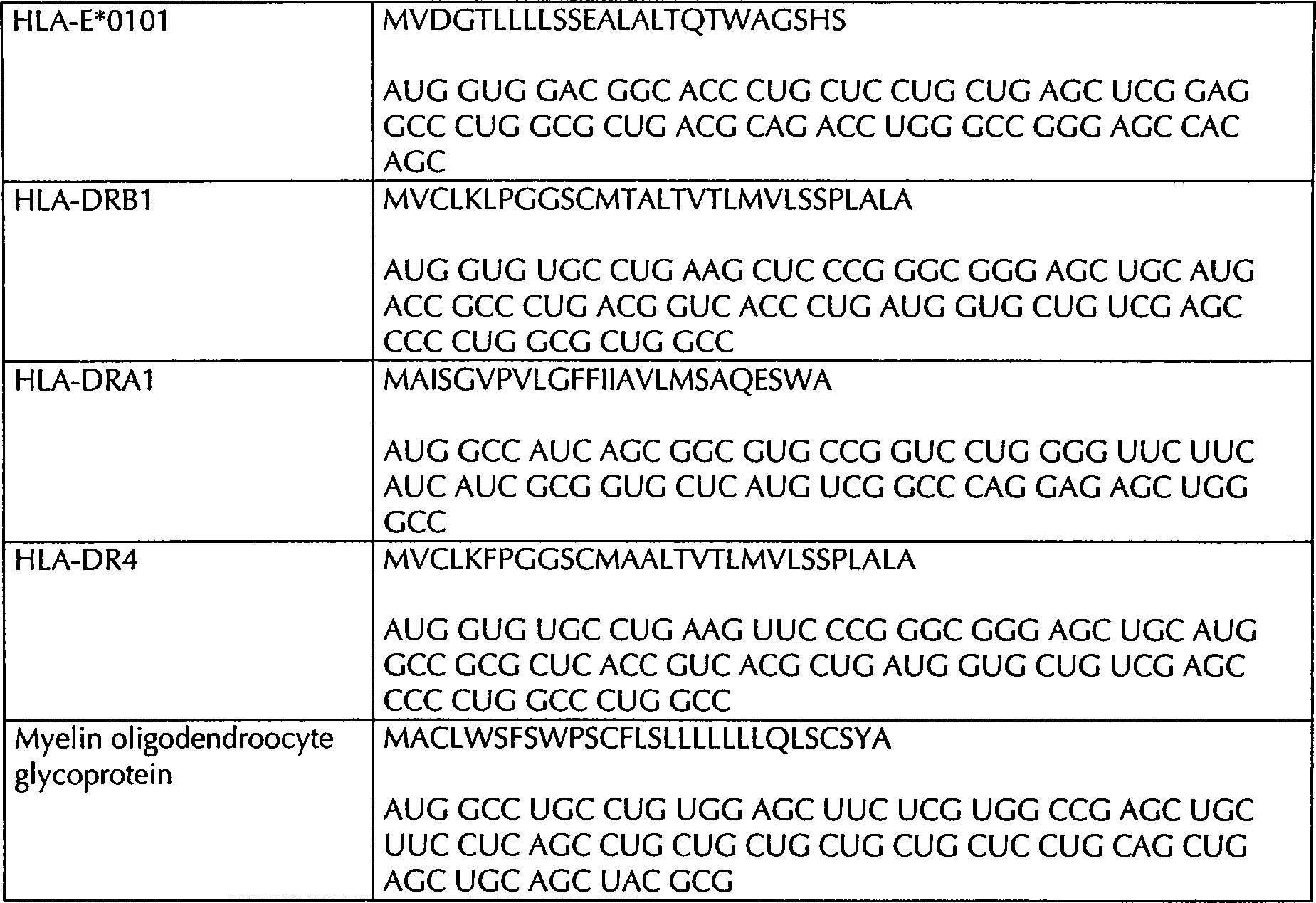
Einem Fachmann sind verschiedene Verfahren geläufig, die vorstehend beschriebenen Modifikationen vorzunehmen. Beispielsweise kann für die Substitution von Codons in der erfindungsgemäßen modifizierten mRNA im Falle kürzerer kodierender Bereiche, die gesamte mRNA chemisch unter Verwendung von Standardtechniken synthetisiert werden. Bevorzugt werden Substitutionen, Additionen oder Eliminierungen von Basen allerdings unter Verwendung einer DNA-Matrize zur Herstellung der modifizierten mRNA mit Hilfe von Techniken der gängigen zielgerichteten Mutagenese eingeführt (siehe z.B. Maniatis et al., Molecular Cloning: A Laboratory Manual, Cold Spring Harbor Laboratory Press, 3. Aufl., Cold Spring Harbor, NY, 2001). Bei einem solchen Verfahren wird zur Herstellung der mRNA ein entsprechendes DNA-Molekül in vitro transkribiert. Diese DNA-Matrize besitzt einen geeigneten Promotor, bspw. einen T7 -oder SP6-Promotor, für die in vitro Transkription, dem die gewünschte Nukleotidsequenz für die herzustellende mRNA und ein Termisationssignal für die in in vitro Transkribtion folgen. Das DNA-Molekül, das die Matrize des herzustellenden RNA-Konstrukts bildet, kann durch fermentative Vermehrung und anschließende Isolierung als Teil eines in Bakterien replizierbaren Plasmids hergestellt werden. So kann unter Verwendung kurzer synthetischer DNA-Oligonukleotide, die an den entstehenden Schnittstellen kurze einzelsträngige Übergänge aufweisen, oder durch chemische Synthese hergestellte Gene, die gewünschte Nukleotidsequenz nach einem Fachmann geläufigen molekularbiologischen Methoden in ein geeignetes Plasmid kloniert werden (vgl. Maniatis et al., supra). Das DNA-Molekül wird dann aus dem Plasmid, in welchem es in einfacher oder mehrfacher Kopie vorliegen kann, durch Verdauung mit Restriktionsendonucleasen ausgeschnitten.a Those skilled in the art are familiar with various methods described above Make modifications. For example, for substitution of codons in the modified invention mRNA in case of shorter coding areas, the entire mRNA chemically using be synthesized by standard techniques. Preference is given to substitutions, Additions or eliminations of bases, however, using a DNA template for the preparation of the modified mRNA using from techniques of common targeted mutagenesis (see, e.g., Maniatis et al., Molecular Cloning: A Laboratory Manual, Cold Spring Harbor Laboratory Press, 3rd ed., Cold Spring Harbor, NY, 2001). In such a Method is for producing the mRNA a corresponding DNA molecule in vitro transcribed. This DNA template has a suitable promoter, for example, a T7 or SP6 promoter, for the In vitro transcription, which the desired nucleotide sequence for the produced mRNA and a termination signal for in vitro transcription consequences. The DNA molecule, which forms the template of the RNA construct to be produced can by fermentative propagation and subsequent isolation as part of a be produced in bacteria replicable plasmid. So can using short synthetic DNA oligonucleotides attached have short single-stranded transitions at the resulting interfaces, or by chemical Synthesized genes, the desired nucleotide sequence according to familiar to a person skilled in the art molecular biological methods into a suitable plasmid cloned (see Maniatis et al., supra). The DNA molecule is then from the plasmid in which it is in single or multiple copy may be cut out by digestion with restriction endonucleases.
Die vorstehend beschriebenen Modifikationen der RNA, insbesondere mRNA, können im Sinne der Erfindung einzeln oder in Kombinationen miteinander auftreten. Ebenfalls kann/können eine oder mehrere Modifikationen) mit der oben beschriebenen Komplexierung der RNA, insbesondere mRNA, kombiniert werden.The above-described modifications of the RNA, in particular mRNA, can within the meaning of the invention individually or in combinations with one another occur. Also can / can one or more modifications) with the complexation described above the RNA, in particular mRNA, are combined.
Die Erfindung hat die Steigerung des RNA-Transfers und/oder der RNA-Translation in einem Wirtsorganismus zum Ziel. Unter einem Wirtsorganismus im Sinne der Erfindung ist jeder Organismus zu verstehen, in dessen Zellen bzw. Gewebe RNA transferiert werden kann, gefolgt von deren Translation. Ein Wirtsorganismus im Sinne der Erfindung ist insbesondere ein Säugetier, ausgewählt aus der Gruppe bestehend aus Maus, Ratte, Schwein, Rind, Pferd, Hund, Katze, Affe und insbesondere Mensch.The Invention has the enhancement of RNA transfer and / or RNA translation in a host organism to the goal. Under a host organism in the The meaning of the invention is to be understood as meaning any organism in which Cells or tissue RNA can be transferred, followed by their Translation. A host organism according to the invention is in particular a mammal, selected from the group consisting of mouse, rat, pig, cattle, horse, Dog, cat, monkey and especially human.
Mit
der vorliegenden Erfindung wird gezeigt, dass in dem erfindungsgemäßen RL-Injektionspuffer
(mit oder ohne Laktat) verdünnte,
Luziferase kodierende RNA, insbesondere mRNA, eine signifikant höhere Translationsrate
ergibt, als mRNA, die in herkömmlich
für RNA
verwendeten Standardpuffern, wie HBS oder PBS, verdünnt wurde
(siehe
Es wurde daher festgestellt, dass erstens ein erfindungsgemäßer RL-Injektionspuffer (mit oder ohne Laktat) den RNA-Transfer erheblich steigert, und dass dieser verbesserte RNA-Transfer zweitens durch einen erfindungsgemäßen RL-Injektionspuffer (mit oder ohne Laktat) mit einer hohen Calcium-Konzentration von bis zu 100 mM noch um einen weiteren Faktor gesteigert wird.It Therefore, it was found that, first, an inventive RL injection buffer (with or without lactate) significantly increases the RNA transfer, and second, that this improved RNA transfer by an RL injection buffer according to the invention (with or without lactate) with a high calcium concentration of up to 100 mM is increased by a further factor.
Der erfindungsgemäße Injektionspuffer wird bevorzugt in Kombination mit RNA in einer RNA-Injektionslösung verwendet. Ein weiterer Gegenstand der Erfindung ist daher eine RNA-Injektionslösung, enthaltend RNA und einen Injektionspuffer, der mindestens 50 mM Natriumchlorid (NaCl), mindestens 3 mM Kaliumchlorid (KCl) und mindestens 0,01 mM Calciumchlorid (CaCl2), zur Steigerung des RNA-Transfers und/oder der RNA-Translation in Zellen. Bevorzugt wird eine erfindungsgemäße RNA-Injektionslösung, in welcher der Injektionspuffer mindestens 50 mM bis 800 mM, bevorzugt mindestens 60 mM bis 500 mM, stärker bevorzugt mindestens 70 mM bis 250 mM, insbesondere bevorzugt 60 mM bis 110 mM Natriumchlorid (NaCl), mindestens 3 mM bis 500 mM, bevorzugt mindestens 4 mM bis 300 mM, stärker bevorzugt mindestens 5 mM bis 200 mM Kaliumchlorid (KCl) und mindestens 0,01 mM bis 100 mM, bevorzugt mindestens 0,5 mM bis 80 mM, stärker bevorzugt mindestens 1,5 mM bis 40 mM Calciumchlorid (CaCl2) enthält.The injection buffer according to the invention is preferably used in combination with RNA in an RNA injection solution. Another object of the invention is therefore an RNA injection solution containing RNA and an injection buffer containing at least 50 mM sodium chloride (NaCl), at least 3 mM potassium chloride (KCl) and at least 0.01 mM calcium chloride (CaCl 2 ) to increase the RNA Transfers and / or RNA translation into cells. Preferred is an RNA injection solution according to the invention in which the injection buffer is at least 50 mM to 800 mM, preferably at least 60 mM to 500 mM, more preferably at least 70 mM to 250 mM, more preferably 60 mM to 110 mM sodium chloride (NaCl), at least 3 mM to 500 mM, preferably at least 4 mM to 300 mM, more preferably at least 5 mM to 200 mM potassium chloride (KCl) and at least 0.01 mM to 100 mM, preferably at least 0.5 mM to 80 mM, more preferably at least 1, 5 mM to 40 mM calcium chloride (CaCl 2 ).
Der Injektionspuffer der erfindungsgemäßen RNA-Injektionslösung enthält vorzugsweise weiterhin Laktat. Bevorzugt enthält ein solcher Injektionspuffer der erfindungsgemäßen RNA-Injektionslösung mindestens 17 mM Laktat. Weiterhin bevorzugt wird eine erfindungsgemäße RNA-Injektionslösung, in welcher der Injektionspuffer von 17 mM bis 500 mM, bevorzugt von 20 mM bis 200 mM, stärker bevorzugt von 25 mM bis 100 mM Laktat enthält.Of the Injection buffer of the RNA injection solution according to the invention preferably contains continue lactate. Preferably contains such an injection buffer of the RNA injection solution according to the invention at least 17 mM lactate. Also preferred is an RNA injection solution according to the invention, in which of the injection buffer is from 17 mM to 500 mM, preferably from 20 mM to 200 mM, stronger preferably from 25 mM to 100 mM lactate.
Die Herstellung der RNA-Injektionslösung kann nach jedem beliebigen Verfahren aus dem Stand der Technik erfolgen. Vorzugsweise wird die RNA in dem RL-Injektionspuffer bzw. RL-Injektionspuffer mit Laktat verdünnt. Ebenfalls kann die RNA als trockene RNA (beispielsweise gefriergetrocknet) vorgegeben werden und der RNA-Injektionspuffer bzw. RL-Injektionspuffer mit Laktat hinzugegeben werden, optional unter Temperaturerhöhung, Rühren, Ultraschall etc., um das In-Lösung-gehen zu beschleunigen. Die jeweiligen Konzentrationsverhältnisse gemäß den jeweiligen Voraussetzungen (Wirtsorganismus, insbesondere Säugetier, dem die RNA-Injektionslösung injiziert wird, Gesundheitszustand, Alter etc. des Wirtsorganismus usw.) zu wählen sind.The Preparation of the RNA injection solution can be done by any method of the prior art. Preferably, the RNA is in the RL injection buffer or RL injection buffer diluted with lactate. Also, the RNA can be used as dry RNA (for example freeze-dried) and the RNA injection buffer or RL injection buffer be added with lactate, optionally with temperature increase, stirring, ultrasound etc., to speed up the in-solution. The respective concentration ratios according to the respective conditions (Host organism, especially mammal, the RNA injection solution is injected, health status, age etc. of the host organism etc.) are to be selected.
Bei der RNA in der erfindungsgemäßen RNA-Injektionslösung handelt es sich bevorzugt um nackte RNA, stärker bevorzugt um mRNA, bevorzugt um nackte RNA, wie bereits vorstehend definiert.at the RNA is in the RNA injection solution according to the invention it is preferably nude RNA, more preferably mRNA around naked RNA, as already defined above.
Wie beschrieben, ist die erfindungsgemäße RNA-Injektionslösung insbesondere zur Steigerung des RNA-Transfers und der RNA-Translation in einen/einem Wirtsorganismus einsetztbar.As described, the RNA injection solution according to the invention is in particular to increase RNA transfer and RNA translation into one Host organism used.
Ein weiterer Gegenstand der vorliegenden Erfindung betrifft demnach die Verwendung einer der vorstehend beschriebenen RNA-Injektionslösung zur Steigerung des RNA-Transfers und/oder der RNA-Translation in einen/einem Wirtsorganismus.One Another object of the present invention accordingly relates the use of one of the above-described RNA injection solution for Increasing RNA transfer and / or RNA translation in one Host organism.
Ebenfalls wurde die Dosierung (hinsichtlich Menge und Dauer für insbesondere klinische Anwendungen) der zu transferierenden RNA in RL-Injektionspuffer (mit oder ohne Laktat), untersucht. Diese Untersuchungen ergaben einen Anstieg der Luziferase-Expression mit ansteigenden Mengen an mRNA bis zu 0,1 μg (in 100 μl Injektionsvolumen) bei Mäusen und bis zu 3 mg (in 150 μl Injektionsvolumen) beim Menschen. Die Translation von mRNA erfolgt transient und wird konsequent reguliert, so dass für eine anhaltende, gleichmäßige Expression des Fremdmoleküls (Protein) eine Wiederholungsinjektion, abhängig von diversen Faktoren, wie dem zu exprimierenden Fremdmolekühl und der beabsichtigten Wirkung, dem Organismus, der die Injektion erhält, sowie dessen (Gesundheits-)zustand etc. ungefähr alle drei Tage, jedoch auch alle zwei Tage oder auch täglich vorgenommen werden sollte. Die Menge der RNA kann – ebenfalls abhängig von verschiedenen, u. a. den vorstehend erwähnten, Faktoren – kann von 0,01 μg bis 1.000 μg, vorzugsweise von 1 μg bis 800 μg, ebenfalls bevorzugt von 2 μg bis 500 μg, μg, stärker bevorzugt von 5 μg bis 100 μg, noch stärker bevorzugt von 10 μg bis 90 μg, am stärksten bevorzugt von 20 μg bis 80 μg in 100 μl Injektionsvolumen betragen. Besonders bevorzugt beträgt die Menge an RNA 60 μg in 100 μl Injektionsvolumen betragen.Also, the dosage (in terms of amount and duration for particular clinical applications) of the RNA to be transferred in RL injection buffer (with or without lactate) was examined. These studies revealed an increase in luciferase expression with increasing levels of mRNA up to 0.1 μg (in 100 μl injection volume) in mice and up to 3 mg (in 150 μl injection volume) in humans. The translation of mRNA is transient and is consistently regulated, so that for a sustained, uniform expression of the foreign molecule (protein) a re-injection, depending on various factors, such as the foreign molecule to be expressed and the intended effect, the organism receiving the injection, and its (health) condition etc. should be made approximately every three days, but also every two days or even daily. The amount of RNA may also depend on various factors, including the factors mentioned above, from 0.01 μg to 1000 μg, preferably from 1 μg to 800 μg, also preferably from 2 μg to 500 μg, μg, more preferably from 5 μg to 100 μg, even more preferably from 10 μg to 90 μg, most preferably from 20 μg to 80 μg in 100 μl injection volume. Beson Preferably, the amount of RNA is 60 μg in 100 μl injection volume.
Erfindungsgemäße Verwendungen sowohl der RNA und des RL-Injektionpuffers bzw. RL-Injektionspuffers mit Laktat, als auch des RL-Injektionpuffers bzw. RL-Injektionspuffers mit Laktat, als auch der RNA-Injektionslösung der vorliegenden Erfindung ist demnach beispielsweise die Verwendung zur Behandlung und/oder Prophylaxe bzw. zur Herstellung eines Arzneimittels zur Behandlung und/oder Prophylaxe von Krebs- bzw. Tumorerkrankungen, beispielsweise Melanom, wie malignem Melanom, wie malignem Melanom, Hautmelanom, Carzinom, wie Coloncarzinom, Lungencarcinom, wie kleinzelligem Lungencarzinom, Adenocarcinom, Prostatacarcinom, Speiseröhrencarcinom, Brustcarcinom, Nierencarcinom, Sacrom, Myelom, Leukämie, insbesondere AML (akute myeloische Leukämie), Gliom (Glioma), Lymphomen, und Blastomen, Allergien, Autoimmunerkrankungen, wie Multiple Sklerose, viralen und/oder bakteriellen Infektionen.Uses according to the invention both the RNA and RL injection buffer and RL injection buffer with lactate, as well as the RL injection buffer or RL injection buffer with lactate, as well as the RNA injection solution of the present invention is therefore for example the use for the treatment and / or Prophylaxis or for the preparation of a medicament for treatment and / or prophylaxis of cancer or tumor diseases, for example Melanoma, such as malignant melanoma, such as malignant melanoma, skin melanoma, Carcinoma, such as colon carcinoma, lung carcinoma, such as small cell lung carcinoma, Adenocarcinoma, prostate carcinoma, esophageal carcinoma, breast carcinoma, Renal carcinoma, sacrum, myeloma, leukemia, especially AML (acute myeloid leukemia), Glioma (glioma), lymphomas, and blastomas, allergies, autoimmune diseases, like multiple sclerosis, viral and / or bacterial infections.
Beispielsweise umfasst die vorliegende Erfindung die Verwendung sowohl der RNA und des RL-Injektionpuffers bzw. RL-Injektionspuffers mit Laktat, als auch des RL-Injektionpuffers bzw. RL-Injektionspuffers mit Laktat, als auch der RNA-Injektionslösung u.a. zur Gentherapie und zur Vakzinierung, ggf. zur anti-viralen Vakzinierung, zur Prävention der vorstehend genannten Erkrankungen.For example For example, the present invention encompasses the use of both the RNA and the RL injection buffer or RL injection buffer with lactate, as well as the RL injection buffer or RL injection buffer with lactate, as well as the RNA injection solution u.a. for gene therapy and for vaccination, if necessary for anti-viral vaccination, for prevention the aforementioned diseases.
Eine „Gentherapie" im Sinne der vorliegenden Erfindung bedeutet vor allem, eine fehlende Funktion des Körpers oder der Zelle durch das Einbringen eines funktionierenden Gens in die kranken Zellen wiederherzustellen oder eine störende Funktion durch entsprechende genetische Information zu hemmen. Beispielsweise kann bei einem fehlenden oder nur in geringen Mengen exprimierten Tumorsuppressorgen, z.B. p53, dieses in Form seiner mRNA in die Zelle eingeschleust, in die DNA insertiert und so das ursprünglich defizient exprimierte Protein wieder in physiologisch relevanten Mengen erzeugt werden. Beispielhafte Tumorsuppressorgene im Sinne der vorliegenden Erfindung sind z.B. p53 TP53, RB1, APC, WT1, NF1, NF2, VHL, BRCA1, BRCA2, DCC, MEN 1, MEN 2, PTCH, p57/KIP2, MSH2, MLH1, FMS1, FMS2, MET, p16/INK4a/CDKN2, CDK4, RET, EXT1, EXT2, EXT3, PTEN/MMAC1, ATM, BLM, XPB, XPD, XPA, XPG, FACC, FACA, SMAD4/DPC4, p14Art(p19Art), DPC4, E-CAD, LKB1/STK1, TSC2, PMS1, PMS2, MSH6, TGF-β Typ II R, BAX, α-CAT, MADR2/SMAD2, CDX2, MKK4, PP2R1B, MCC, etc..A "gene therapy" in the sense of the present invention means above all to restore a missing function of the body or the cell by introducing a functioning gene into the diseased cells or to inhibit a disturbing function by appropriate genetic information Tumor suppressor genes expressed in small amounts, for example p53, are introduced into the cell in the form of its mRNA, inserted into the DNA, and the originally deficiently expressed protein is again generated in physiologically relevant amounts. RB1, APC, WT1, NF1, NF2, VHL, BRCA1, BRCA2, DCC, MEN1, MEN2, PTCH, p57 / KIP2, MSH2, MLH1, FMS1, FMS2, MET, p16 / INK4a / CDKN2, CDK4, RET, EXT1, EXT2, EXT3, PTEN / MMAC1, ATM, BLM, XPB, XPD, XPA, XPG, FACC, FACA, SMAD4 / DPC4, p14 type (p19 type ), DPC4, E-CAD, LKB1 / STK1, TSC2, PMS1 , PMS2, MSH6, TGF-β type II R, BAX, α -CAT, MADR2 / SMAD2, CDX2, MKK4, PP2R1B, MCC, etc.
Eine Vakzinierung im Sinne der Erfindung bedeutet die Einbringung von genetischer Information in Form von RNA, insbesondere mRNA, in einen Organismus, insbesondere in eine/mehrere Zelle/Zellen bzw. Gewebe dieses Organismus. Die so verabreichte mRNA wird in dem Organismus das Zielmolekül (z.B. Peptid, Polypeptid, Protein) translatiert, d.h. das von der mRNA kodierte Zielmolekül wird exprimiert und löst eine Immunantwort aus. Es ist bekannt, dass Antigenpräsentierende Zellen (APC) eine obligatorische Schlüsselrolle während des Auslösens einer Immunantwort spielen, da sie den einzigen Zelltyp darstellen, der bei seiner Aktivierung alle Signale auslöst, die für die Initiation der Proliferation von Antigen-spezifischen Immunzellen erforderlich sind. Eine Vakzinierung im Sinne der vorliegenden Erfindung kann beispielsweise erfolgen, indem RNA, insbesondere mRNA, verwendet wird, die für ein Antigen kodiert, wobei es sich um Tumorantigene im Falle einer Tumorvakzinierung oder um Fremdantigene im Falle einer Vakzine gegen Fremderreger handeln kann. Beispiele von Tumorantigenen gemäß der vorliegenden Erfindung sind z.B. T-Zell-definierte "Tumorantigene wie bspw. "Cancer/Testis"-Antigene, z. B. MAGE, RAGE, NY-ESO-1, Differenzierungsantigene, z.B. MART-1/Melan-A, Tyrosinase, gp100, PSA, CD20, Antigene Epitope mutierter Gene, z.B. CDK4, Caspase-8 oder onkofötale Antigene, z.B. CEA, AF. Andere Tumorantigene sind beispielsweise bei T-Zell und B-Zell-Lymphomen auftretenden Tumorantigene CD5 und CAMPATH-1(CDw52), bei Nicht-Hodgkin'schen B-Zell Lymphomen auftretenden CD20, die bei festen Tumoren, insbesondere bei epithelialen Tumoren (Brust, Darm und Lunge) auftretenden Tumorantigene CEA (carcinoembryogenes Antigen), Mucin, CA-125, sowie FAP-a, Tenascin, und Metalloproteinase, die zusätzlich bei glioblastomen Tumoren auftreten. Weitere Tumorantigene sind bspw. die bei Lunge,Brust, Kopf und Nacken sowie T- und B-Zell-Tumoren auftretenden Tumorantigene EGF (epidermaler Wachstumsfaktor), p185HER2 und der IL-2-Rezeptor, oder das Tumorantigen SV40, etc..A Vaccination according to the invention means the introduction of genetic information in the form of RNA, in particular mRNA, in one Organism, in particular in a / several cell / cells or tissue this organism. The thus administered mRNA is in the organism the target molecule (e.g., peptide, polypeptide, protein), i. that of the mRNA encoded target molecule is expressed and dissolves an immune response. It is known that antigen presenting Cells (APC) a mandatory key role during the triggering of a Play immune response as they represent the only cell type that When activated, triggers all signals necessary for the initiation of proliferation of antigen-specific immune cells are required. A vaccination For the purposes of the present invention, for example, by using RNA, in particular mRNA, that is responsible for an antigen which are tumor antigens in the case of tumor vaccination or foreign antigens in the case of a vaccine against foreign particles can act. Examples of tumor antigens according to the present invention are e.g. T-cell-defined "tumor antigens such as "Cancer / Testis" antigens, e.g. B. MAGE, RAGE, NY-ESO-1, differentiation antigens, e.g. MART-1 / Melan-A, Tyrosinase, gp100, PSA, CD20, antigens Epitopes of mutant genes, e.g. CDK4, caspase-8 or oncofetal Antigens, e.g. CEA, AF. Other tumor antigens are, for example in T-cell and B-cell lymphomas occurring tumor antigens CD5 and CAMPATH-1 (CDw52), in non-Hodgkin's B-cell lymphomas occurring CD20, which in solid tumors, especially in epithelial Tumors (breast, intestine and lung) occurring tumor antigens CEA (carcinoembryogenes Antigen), mucin, CA-125, as well as FAP-a, tenascin, and metalloproteinase, the additional occur in glioblastoma tumors. Other tumor antigens are For example, in the lung, breast, head and neck as well as T and B cell tumors occurring tumor antigens EGF (epidermal growth factor), p185HER2 and the IL-2 receptor, or the tumor antigen SV40, etc.
Es kann auch eine RNA, insbesondere mRNA, verwendet werden, die für mehrere solcher Antigene kodiert. Dadurch wird erreicht, dass ein Melanom, Carcinom, AML bzw. Gliom effektiv bekämpft werden kann, da eine Kombination aus verschiedenen für den jeweiligen Tumor spezifischen Antigene ein extrem breites Wirkspektrum aufweisen. Die RNA, insbesondere mRNA, der Erfindung kann weiterhin für ein immunogenes Protein kodieren. Ein solches immunogenes Protein kann die Reaktivierung einer Immunantwort vermitteln. Einer solchen Reaktivierung liegt die Erkenntnis zugrunde, dass nahezu jeder Organismus sogenannte „Gedächtnis-Immunantworten" gegen gewisse Fremd-Moleküle, z.B. Proteine, insbesondere virale Proteine, Antigene, besitzt. Das bedeutet, dass ein Organismus bereits zu einem früheren Zeitpunkt mit einem solchen Fremd-Molekül infiziert worden ist, und dass durch diese Infektion bereits eine Immunantwort gegen dieses Fremd-Molekül, z.B. ein virales Protein, ausgelöst wurde, die dem Immunsystem im „Gedächtnis" bleibt, d.h. die es speichert. Bei einer erneuten Infektion mit dem gleichen Fremd-Molekül wird diese Immunantwort reaktiviert. Erfindungsgemäß kann eine solche Reaktivierung der Immunantwort durch die Vakzinierung mit einer RNA, insbesondere mRNA, erfolgen, die mindestens einen für mindestens ein immunogenes Protein kodierenden Bereich enthält. Bevorzugt ist eine RNA, insbesondere mRNA, die sowohl für ein oder mehrere Antigene als auch für ein oder mehrere immunogene Protein kodiert.It is also possible to use an RNA, in particular mRNA, which codes for a plurality of such antigens. This ensures that a melanoma, carcinoma, AML or glioma can be effectively combated, since a combination of different tumor specific antigens have an extremely broad spectrum of activity. The RNA, in particular mRNA, of the invention can furthermore code for an immunogenic protein. Such an immunogenic protein may mediate the reactivation of an immune response. Such a reactivation is based on the finding that almost every organism has so-called "memory immune responses" against certain foreign molecules, eg proteins, in particular viral proteins, antigens, which means that an organism already has such a foreign substance at an earlier time Molecule has been infected, and that this infection has already triggered an immune response against this foreign molecule, such as a viral protein, which remains in the immune system in the "memory", ie it saves. In a renewed infection with the same foreign molecule, this immune response is reactivated. According to the invention, such a reactivation of the immune response can be effected by vaccination with an RNA, in particular mRNA, which contains at least one coding region for at least one immunogenic protein. Preference is given to an RNA, in particular mRNA, which codes for one or more antigens as well as for one or more immunogenic proteins.
Immunogene Proteine im Sinne der Erfindung sind vorzugsweise Strukturproteine von Viren, insbesondere Matrixproteine, Capsidproteine und Oberflächenproteine der Lipidmembran. Weitere Beispiele für solche viralen Proteine sind Proteine von Adenoviren, Rhinoviren, Corona-Viren, Retroviren. Besonders bevorzugt ist hierbei das Hepatitis B Oberflächen-Antigen („Hepatits B Surface Antigen", nachfolgend als „HBS-Antigen" bezeichnet) und Influenza-Matixproteine, insbesondere das Influenza Matrix-M1-Protein.immunogenic Proteins according to the invention are preferably structural proteins of viruses, in particular matrix proteins, capsid proteins and surface proteins the lipid membrane. Further examples of such viral proteins are Proteins of adenoviruses, rhinoviruses, corona viruses, retroviruses. Especially preferred here is the hepatitis B surface antigen ("Hepatitis B Surface Antigen ", hereinafter referred to as "HBS antigen") and Influenza matix proteins, in particular the influenza matrix M1 protein.
Die vorliegende Erfindung betrifft die weiterhin die Verwendung von RNA und des oben beschriebenen RL-Injektionpuffers bzw. RL-Injektionspuffers mit Laktat, sowie des oben beschriebenen RL-Injektionpuffers bzw. RL-Injektionspuffers mit Laktat, oder der oben beschriebenen RNA-Injektionslösung, zur Steigerung des RNA-Transfers und/oder der RNA-Translation von RNA bei „in vitro"-Verfahren, bspw. für Genexpressionsanalysen oder für in-vitro-Screening Verfahren, z.B. via HTS (High Throughput Screening).The The present invention further relates to the use of RNA and the RL injection buffer or RL injection buffer described above with lactate, as well as the above-described RL injection buffer or RL injection buffer with lactate, or the RNA injection solution described above, for Increase in RNA transfer and / or RNA translation of RNA in "in vitro" methods, for example for gene expression analyzes or for in vitro screening Method, e.g. via HTS (High Throughput Screening).
Ein weiterer Gegenstand der vorliegenden Erfindung ist ein Verfahren zur Steigerung des RNA-Transfers und/oder der RNA-Translation von RNA in einem Wirtsorganismus, z.B. zur Behandlung und/oder Prophylaxe von Krebs- bzw. Tumorerkrankungen, beispielsweise Melanom, wie malignem Melanom, wie malignem Melanom, Hautmelanom, Carzinom, wie Coloncarzinom, Lungencarcinom, wie kleinzelligem Lungencarzinom, Adenocarcinom, Prostatacarcinom, Speiseröhrencarcinom, Brustcarcinom, Nierencarcinom, Sacrom, Myelom, Leukämie, insbesondere AML (akute myeloische Leukämie), Gliom (Glioma), Lymphomen, und Blastomen, Allergien, Autoimmunerkrankungen, wie Multiple Sklerose, viralen und/oder bakteriellen Infektionen sowie zur Gentherapie und/oder Vakzinierung, ggf. zur anti-viralen Vakzinierung, zur Prävention der vorstehend genannten Erkrankungen, wobei das Verfahren folgende Schritte umfasst:
- a.) Herstellen einer RNA-Injektionslösung der vorliegenden Erfindung, und
- b.) Verabreichen der RNA-Injektionslösung aus Schritt a.) an einen Wirtsorganismus.
- a.) preparing an RNA injection solution of the present invention, and
- b.) administering the RNA injection solution from step a.) to a host organism.
Die Herstellung der RNA-Injektionslösung aus Schritt a. kann wie oben beschrieben erfolgen, d.h. nach jedem beliebigen Verfahren aus dem Stand der Technik, vorzugsweise durch Verdünnen der RNA in dem RL-Injektionspuffer bzw. RL-Injektionspuffer mit Laktat. Die jeweiligen Konzentrationsverhältnisse sind auch hier abhängig von den oben beschriebenen Voraussetzungen (z.B., Wirtsorganismus, insbesondere Säugetier, dem die RNA-Injektionslösung injiziert wird, Gesundheitszustand, Alter etc. des Wirtsorganismus usw.) zu wählen. Die Verabreichung der RNA-Injektionslösung kann beispielsweise über eine Injektionsspritze (z.B. Sub-Q, Becton Dickinson, Heidelberg, Deutschland) erfolgen, auf jede geeignete Weise, beispielsweise intradermal, intraepithelial, subkutan, intravenös, intravasal, intraarteriell, intraabdominal, intraperitoneal, intranodal (z.B. in den Lymphknoten) usw..The Preparation of the RNA injection solution from step a. can be done as described above, i. after every any method of the prior art, preferably by Dilute the RNA in the RL injection buffer or RL injection buffer with lactate. The respective ones concentration ratios are also dependent here from the conditions described above (e.g., host organism, especially mammal, the RNA injection solution is injected, health status, age etc. of the host organism etc.). The administration of the RNA injection solution, for example, via a Injection syringe (e.g., Sub-Q, Becton Dickinson, Heidelberg, Germany) carried out in any suitable manner, for example intradermally, intraepithelial, subcutaneous, intravenous, intravascular, intraarterial, intra-abdominal, intraperitoneal, intranodal (e.g., in the lymph nodes) etc..
Bei einem Wirtsorganismus des erfindungsgemäßen Verfahrens handelt es sich vorzugsweise um ein Säugetier, ausgewählt aus der Gruppe bestehend aus Maus, Ratte, Schwein, Rind, Pferd, Hund, Katze, Affe und insbesondere Mensch.at a host organism of the method according to the invention is preferably around a mammal, selected from the group consisting of mouse, rat, pig, cattle, horse, Dog, cat, monkey and especially human.
Die nachfolgenden Figuren und Beispiele dienen der weiteren Erläuterung und Illustration der vorliegenden Erfindung, ohne diese hierauf zu beschränken.The The following figures and examples serve for further explanation and Illustration of the present invention without these to restrict.
Figuren
In den in
In
In
In
In
Zur
zeitlichen Dosierung ist anzumerken, dass die Translation von mRNA
transient erfolgt (wie in
Die Anwesenheit von Ca2+-Ionen bei höherer Konzentration (ab ca. 2 mM) erhöhte die enzymatische Aktivität von Luziferase nicht.The presence of Ca 2+ ions at higher concentrations (from about 2 mM) did not increase the enzymatic activity of luciferase.
Weiterhin
wurde eine gerichtete Genexpression von RNA in RL-Injektionspuffer
(mit oder ohne Laktat) untersucht. Hierzu wurde definiert, welche
Zelltypen die exogene, in RL-Injektionspuffer (mit oder ohne Laktat) transferierte,
RNA aufnehmen und translatieren (siehe auch Beispiel 5,
In
Experimenten, dargestellt in
Erfindungsgemäß wurde
weiterhin untersucht, ob APCs ein fremdes Antigen durch direkte
Aufnahme und Selbst-Translation der transferierten mRNA erfassen
oder durch die Aufnahme des Translationsproduktes der transferierten
RNA von anderen Zellen (sog. „cross
presentation").
Aufgrund der Lokalisation der Zellen, ihrer Form sowie ihres MHC
Klasse II Phänotyps
konnte darauf geschlossen werden, dass Zellen, die exogene nackte
mRNA an der Injektionsstelle aufnehmen und exprimieren, hauptsächlich Muskelzellen
und/oder Fibroblasten sind (
Das
Histogramm in
In
Experimenten der
In
In
den in
Die
Translationskapazität
der injizierten mRNA wurde durch Elektroporation von BHK21-Zellen
mit 10 μg
mRNA überprüft. Als
Kontrolle wurden entweder 10 μg
irrelevanter mRNA oder keine mRNA verwendet (mock). Nachfolgend
wurden die Zellen entweder lysiert und mit einem Luminometer auf
ihre Luziferase-Aktivität
hin untersucht (
- – Einzeltransfektionen mit nur eGFP mRNA oder lacZ mRNA
- – eine Mischung aus solchen einzeln transfizierten Zellen (eGFP/lacZ) und
- – doppelt transfizierte Zellen (eGFP + lacZ).
- - Single transfections with only eGFP mRNA or lacZ mRNA
- A mixture of such individually transfected cells (eGFP / lacZ) and
- - double transfected cells (eGFP + lacZ).
Die Zellen wurden mit einem anti-eGFP-Antikörper mit Alexa Fluor 546-Detektion und nachfolgend mit Mangenta-gal gefärbt. Es wurden Mangenta-gal gefärbte positive Zellen (die lacZ exprimieren) mit Breitfeldlichtmikroskopie detektiert (obere Reihe) und Alexa Fluor 546 gefärbte positive Zellen (die eGFP exprimieren) mit Fluoreszenzmikroskopie detektiert (mittlere Reihe). Es wurden Überlagerungen von beiden Ergebnissen vorgenommen (untere Reihe), um genaue Resultate über die Lokalisation der Zellen zueinander zu erhalten, obwohl das Alexa 546-Signal in dieser Darstellung die Abbildung des Lichtmikroskops verdeckt. Zwar konnte nicht ausgeschlossen werden, dass die direkte Aufnahme und Selbst-Translation der zugeführten mRNA in den APCs stattfindet und ausreichend ist, um eine Immunantwort auszulösen. Es könnten in einigen APCs Vorgänge einer geringen oder unvollständigen nicht detektierbaren Translation, erfolgt sein und (im Fall einer unvollständigen Translation) die Prozessierung und Präsentation des fremden Antigens bewirkt haben.The cells were stained with an anti-eGFP antibody with Alexa Fluor 546 detection and subsequently with mangenta-gal. Mangenta-gal stained positive cells (expressing lacZ) were detected by far-field light microscopy (top row) and Alexa Fluor 546 stained positive cells (expressing eGFP) detected by fluorescence microscopy (middle row). Overlaps were made from both results (bottom row) to obtain accurate results on the localization of the cells to each other, although the Alexa 546 signal in this representation obscures the image of the light microscope. Although it could not be excluded that the direct uptake and self-translation of the supplied mRNA takes place in the APCs and is sufficient to trigger an immune response. There may have been instances of poor or incomplete nondetectable translation in some APCs, and (in the case of incomplete translation) have caused processing and presentation of the foreign antigen.
Materialienmaterials
1. Injektionspuffer1. injection buffer
Es wurden folgende Puffer verwendet:
- – 2× Phosphat-gepufferte Salzlösung (PBS) (PBS 274 mM Natriumchlorid, 5,4 mM Kaliumchlorid, 20 mM Dintraiumhydrogenphosphat, 4 mM Kaliumdihydrogenphosphat, pH 7,3 bei 20,8 °C),
- – 2× HEPES-gepufferte Salzlösung (HBS) (HBS: 300 mM Natriumchlorid, 20 mM Hepes, pH 7,4 bei 20,8 °C) und
- – 1× RL-Injektionspuffer (ohne Laktat) (82,2 mM Natriumchlorid, 4,3 mM Kaliumchlorid, 1,44 mM Calciumchlorid, falls keine andere Zusammensetzung und Konzentration angegeben wurde.
- – 1× RL-Injektionspuffer mit Laktat (102,7 mM Natriumchlorid, 5,4 mM Kaliumchlorid, 1,8 mM Calciumchlorid, 20 mM Natriumlaktat, falls keine andere Zusammensetzung und Konzentration angegeben wurde.
- – 1× RL-Injektionspuffer mit Laktat, ohne Natriumchlorid (4,3 mM Kaliumchlorid, 1,44 mM Calciumchlorid, 22,4 mM Natriumlaktat, falls keine andere Zusammensetzung und Konzentration angegeben wurde.
- – 1× RL-Injektionspuffer mit Laktat, ohne Kaliumchlorid (82,2 mM Natriumchlorid, 1,44 mM Calciumchlorid, 22,4 mM Natriumlaktat, falls keine andere Zusammensetzung und Konzentration angegeben wurde.
- – 1× RL-Injektionspuffer mit Laktat, ohne Calciumchlorid (82,2 mM Natriumchlorid, 4,3 mM Kaliumchlorid, 22,4 mM Natriumlaktat, falls keine andere Zusammensetzung und Konzentration angegeben wurde.
- 2 × phosphate buffered saline (PBS) (PBS 274 mM sodium chloride, 5.4 mM potassium chloride, 20 mM dintraium hydrogen phosphate, 4 mM potassium dihydrogen phosphate, pH 7.3 at 20.8 ° C),
- 2 × HEPES-buffered saline (HBS) (HBS: 300 mM sodium chloride, 20 mM Hepes, pH 7.4 at 20.8 ° C) and
- 1 × RL injection buffer (without lactate) (82.2 mM sodium chloride, 4.3 mM potassium chloride, 1.44 mM calcium chloride, if no other composition and concentration was indicated.
- - 1X RL injection buffer with lactate (102.7mM sodium chloride, 5.4mM potassium chloride, 1.8mM calcium chloride, 20mM sodium lactate, if no other composition and concentration was given.
- - 1 × RL injection buffer with lactate, without sodium chloride (4.3 mM potassium chloride, 1.44 mM calcium chloride, 22.4 mM sodium lactate, if no other composition and concentration was given.
- - 1 × RL injection buffer with lactate, without potassium chloride (82.2 mM sodium chloride, 1.44 mM calcium chloride, 22.4 mM sodium lactate, if no other composition and concentration was given.
- - 1 × RL injection buffer with lactate, without calcium chloride (82.2 mM sodium chloride, 4.3 mM potassium chloride, 22.4 mM sodium lactate, if no other composition and concentration was indicated.
Bei Verwendung von 2× PBS und 2× HBS wurden alle Komponenten in Wasser aufgelöst und der pH eingestellt. Dann wurde Diethylpyrocarbonat (DEPC, Sigma, Schnelldorf, Deutschland) hinzugefügt, bis zu einer Konzentration von 0,1 % (v/v). Die Puffer wurden für über eine Stunde bei 37°C inkubiert. Anschließend wurden die Puffer autoklaviert.at Use of 2 × PBS and 2 × HBS All components were dissolved in water and the pH adjusted. Then diethyl pyrocarbonate (DEPC, Sigma, Schnelldorf, Germany) added up to a concentration of 0.1% (v / v). The buffers were for over one Hour at 37 ° C incubated. Subsequently were the buffers are autoclaved.
1× RL-Injektionspuffer mit Laktat wurde selbst hergestellt aus einer 20× Stammlösung der vier verschiedenen Salze (Natriumchlorid, Kaliumchlorid, Calziumchlorid und Natriumlaktat). Ebenso wurde der 1× RL-Injektionspuffer hergestellt aus einer 20× Stammlösung der drei verschiedenen Salze (Natriumchlorid, Kaliumchlorid und Calciumchlorid). Bei weiteren Experimenten wurde Natriumchlorid bzw. Kaliumchlorid bzw. Calciumchlorid weggelassen, ohne die niedrigere Osmolarität zu kompensieren. Auch diese RL-Injektionspuffer mit Laktat, ohne NaCl, KCl oder CaCl2 wurden aus einer 20× Stammlösung hergestelt. Mit Ausnahme der Natriumlaktat-Racemat-Lösung (Fluka, Schnelldorf, Deutschland), wurde jede dieser Komponenten mit DEPC behandelt und autoklaviert, wie für 2× PBS und 2× HBS beschrieben.1 × RL injection buffer with lactate was self-made from a 20 × stock solution of the four different salts (sodium chloride, potassium chloride, calcium chloride and sodium lactate). Similarly, the 1X RL injection buffer was prepared from a 20X stock solution of the three different salts (sodium chloride, potassium chloride and calcium chloride). In further experiments, sodium chloride or potassium chloride or calcium chloride was omitted without compensating for the lower osmolarity. These RL injection buffers with lactate, without NaCl, KCl or CaCl 2 were also prepared from a 20 × stock solution. With the exception of the sodium lactate racemate solution (Fluka, Schnelldorf, Germany), each of these components was treated with DEPC and autoclaved as described for 2x PBS and 2xHBS.
Sämtliche Puffer und Pufferkomponenten wurden auf Ribonuklease-Aktivität hin untersucht, indem 1 μg mRNA in 1× Puffer für mehr als zwei Stunden bei 37°C inkubiert wurde. Bei der Analyse der mRNA mittels Formaldehydagarose-Gelelektrophorese wurden Puffer verwendet, bei denen keine Degradation beobachtet wurde.All Buffers and buffer components were assayed for ribonuclease activity, by 1 μg mRNA in 1X buffer for more than two hours at 37 ° C was incubated. In the analysis of mRNA by Formaldehydagarose gel electrophoresis Buffers were used in which no degradation was observed.
2. Mäuse2. Mice
Alle Tierexperimente wurden in Übereinstimmung mit den institutionellen und nationalen Richtlinien durchgeführt. Es wurden weibliche BALB/c Mäuse mit einem Alter von 8–15 Wochen von Charles River (Sulzfeld, Deutschland) bezogen.All Animal experiments were in agreement carried out with the institutional and national guidelines. It were female BALB / c mice with an age of 8-15 Weeks related to Charles River (Sulzfeld, Germany).
Vor der intradermalen Injektion wurden die Mäuse anästhesiert und die Ohrmuschel mit Isopropanol behandelt. Um die mRNA-Aufnahme und -Translation zu analysieren, wurden die Mäuse nach einer bestimmten Zeit getötet, die Ohren wurden entfernt und mit einer Rasierklinge rasiert, um störende Haare zu entfernen.In front In the intradermal injection, the mice were anesthetized and the auricle treated with isopropanol. To mRNA uptake and translation The mice were analyzed killed after a certain time, the ears were removed and shaved with a razor blade to disturbing To remove hair.
3. Mensch3rd person
Die humanen Experimente wurden mit gesunden männlichen Freiwilligen durchgeführt, die über die Hintergründe und möglichen Konsequenzen der Untersuchungen aufgeklärt wurden, und die ihre Einwilligung erteilten.The Human experiments were conducted with healthy male volunteers who talked about the backgrounds and potential The consequences of the investigations were clarified and they gave their consent.
Beispiel 1: Herstellung der NukleinsäurenExample 1: Preparation of the nucleic acids
mRNAmRNA
Es wurde „capped" (gekappte) mRNA mittels in vitro "run-off" Transkription mit T7 RNA Polymerase (T7-Opti mRNA kits, CureVac, Tübingen, Deutschland) hergestellt.It was capped mRNA by in vitro "run-off" transcription with T7 RNA polymerase (T7-Opti mRNA kits, CureVac, Tübingen, Germany).
Die kodierende Sequenz dieser mRNA (entweder Eschericha coli β-Galactosidase [lacZ] kloniert von Acc. U02445, oder Photinus pyralis Luziferase [luc], kloniert von Acc. U47295) wurde an ihren 3'-Enden durch eine alpha-Globin nicht-translatierte Region und einen künstlichen poly A (n = 70)-Schwanz flankiert. Für die Mausexperimente wurde die mRNA mit Phenol/Chloroform/Isoamylalkohol extrahiert und mit Lithiumchlorid präzipitiert. Die mRNA wurde nachfolgend in Wasser resuspendiert und die Ausbeute spektrometrisch bei 260 nm bestimmt. Schließlich wurde die mRNA mit Ammoniumacetat präzipitiert und steril in Wasser resuspendiert.The coding sequence of this mRNA (either Escherichia coli β-galactosidase [lacZ] cloned from Acc. U02445, or Photinus pyralis luciferase [luc], cloned by Acc. U47295) was replaced at its 3 'ends by a alpha-globin untranslated region and an artificial flanked by poly A (n = 70) tail. For the mouse experiments was the mRNA is extracted with phenol / chloroform / isoamyl alcohol and with Lithium chloride precipitated. The mRNA was subsequently resuspended in water and the yield determined spectrometrically at 260 nm. Finally, the mRNA was mixed with ammonium acetate precipitated and resuspended sterile in water.
pDNApDNA
Es wurde Endotoxin-freie pCMV-luc DNA mit dem EndoFree Plasmid Maxi Kit (Qiagen, Hilden, Deutschland) hergestellt. Die pDNA wurde mit Ammoniumacetat präzipitiert und schließlich steril in Wasser resuspendiert. Das pCMV-luc Plasmid wurde durch Insertion eines Xba I- (blunted mit Klenow Fragment) Hind III-Fragments von pGL3 (Acc. U47295) in das Nsi I- (blunted mit Klenow Fragment) Hind III-verdaute Plasmid von pCMV-HB-S (Acc. A44171) modifiziert. Das Reportergen der pDNA stand unter der Kontrolle des CMV-Promoters.It was endotoxin-free pCMV-luc DNA with the EndoFree Plasmid Maxi Kit (Qiagen, Hilden, Germany). The pDNA was precipitated with ammonium acetate and finally resuspended sterile in water. The pCMV-luc plasmid was prepared by insertion of an Xba I (blunted with Klenow fragment) Hind III fragment from pGL3 (Acc. U47295) into the Nsi I (blunted with Klenow fragment) Hind III-digested plasmid from pCMV-HB- S (Acc. A44171) modified. The reporter gene of the pDNA was under the control of the CMV promoter.
StammlösungenStock solutions
Es wurden Stammlösungen hergestellt, indem die mRNA bzw. DNA in sterilem Wasser verdünnt wurde und die Konzentration und Reinheit spektrometrisch (bie 260, 280 and 320 nm) bestimmt wurde.It became stock solutions prepared by diluting the mRNA or DNA in sterile water and the concentration and purity spectrometrically (260, 280 and 320 nm).
Qualitätskontrollequality control
Für alle Nukleinsäureproben
wurde die Konzentration spektrometrisch bestimmt und die Integrität mittels
Formaldehyd-Agarose-Gelelektrophorese (mRNA) oder Restriktionsverdauung
und TBE-Agarose-Gelelektrophorese (DNA) überprüft (
Beispiel 2: Zubereitung der RNA-InjektionslösungenExample 2: Preparation the RNA injection solutions
Für HBS und PBS wurde die mRNA in 1× konzentriertem Puffer verdünnt. Für RL-Injektionspuffer mit bzw. ohne Laktat und die einzelnen Variationen von diesem (Abwesenheit von einem der Ionen Ca2+, K+, Na+) (Zusammensetzungen und Konzentrationen siehe Materialen, 1. Injektionspuffer) wurde die mRNA in 0,8 × konzentriertem Puffer verdünnt. Sofern nichts anderes angegeben wird, wurden 20 μg mRNA in 100 μl Injektionspuffer pro Mausohr verwendet. Um Sekundärstrukturen in der mRNA zu entfernen, wurden die RNA-Injektionslösungen für 5 Minuten auf 80°C erhitzt. Danach wurden die Lösungen auf Eis für weitere 5 Minuten gestellt. Schließlich wurde die RNA-Injektionslösung in Sub-Q (Becton Dickinson, Heidelberg, Deutschland)-Injektionsspritzen aufgezogen. Für jede Injektion wurden separate Injektionsspritzen verwendet. Plasmid-DNA (pDNA) wurde in 1× konzentriertem PBS verdünnt.For HBS and PBS, the mRNA was diluted in 1 × concentrated buffer. For RL injection buffer with or without lactate and the individual variations of this (absence of one of the ions Ca 2+ , K + , Na + ) (compositions and concentrations see Materials, 1st injection buffer), the mRNA was in 0.8 × diluted concentrated buffer. Unless otherwise stated, 20 μg of mRNA was used in 100 μl of injection buffer per mouse ear. In order to remove secondary structures in the mRNA, the RNA injection solutions were heated to 80 ° C for 5 minutes. Thereafter, the solutions were placed on ice for a further 5 minutes. Finally, the RNA injection solution was grown in Sub-Q (Becton Dickinson, Heidelberg, Germany) injection syringes. Separate syringes were used for each injection. Plasmid DNA (pDNA) was diluted in 1X concentrated PBS.
Beispiel 3: Detektion der Luziferase-Aktivität ex vivoExample 3: Detection the luciferase activity ex vivo
Um die Luziferase-Expression ex vivo zu detektieren, wurden Gewebelysate angefertigt. Hierfür wurde das Gewebe unter flüssigem Stickstoff mit Mörser und Stöszel zerkleinert und die restlichen "Klumpen" mit 800 μl Lysispuffer (25 mM Tris HCl, 2 mM EDTA, 10% (w/v) Glycerin, 1 % (w/v) Triton X-100 plus frisch hinzugegebenem 2 mM DTT und 1 mM PMSF) homogenisiert. Der Überstand des Homogenats wurde nach Zentrifugation (10 min, 13.000 rpm, 4°C) in einer Minizentrifuge gewonnen. Aliquots von 110 μl dieses Lysats wurden bei –80°C aufbewahrt.Around To detect the expression of luciferase ex vivo were tissue lysates prepared. Therefor the tissue became liquid Nitrogen with mortar and Stöszel crushed and the remaining "clumps" with 800 ul lysis buffer (25mM Tris HCl, 2mM EDTA, 10% (w / v) glycerol, 1% (w / v) Triton Homogenized X-100 plus freshly added 2 mM DTT and 1 mM PMSF). The supernatant of the homogenate was centrifuged (10 min, 13,000 rpm, 4 ° C) in a Minicentrifuge won. Aliquots of 110 μl of this lysate were stored at -80 ° C.
Um die Luziferase-Aktivität zu messen, wurden Aliquots auf Eis aufgetaut und die Lichtemission von 50 μl Lysat für 15 Sekunden mit einem Luminometer (LB 9507, Berthold, Bad Wildbad, Deutschland) gemessen. Das Luminometer fügte automatisch vor der Messung 300 μl Puffer A (25 mM Glycyl-glycin, 15 mM Magnesiumsulphat, 5 mM frisch zugefügtes ATP, pH 7,8) und 100 μl Puffer B (250 μM Luziferin in Wasser) zu dem Lysat hinzu.Around the luciferase activity aliquots were thawed on ice and the light emission of 50 μl Lysate for 15 seconds with a luminometer (LB 9507, Berthold, Bad Wildbad, Germany). The luminometer automatically added before the measurement 300 μl buffer A (25 mM glycylglycine, 15 mM magnesium sulphate, 5 mM freshly added ATP, pH 7.8) and 100 μl Buffer B (250 μM Luciferin in water) to the lysate.
Zur Standardisierung wurden in allen Messungen Reihenverdünnungen von rekombinantem Luziferase-Protein (QuantiLum®, Promega, Madison, USA) verwendet. Anhand dieses Standards wurde die Menge an Luziferase-Molekülen für jede einzelne Messung berechneten. Für jedes Lysat wurde die Luziferase-Aktivität an zwei verschiedenen Tagen doppelt gemessen und der Mittelwert der Luziferase-Aktivität berechnet. Der Variationskoeffizient (n = 4) für die Menge an Luziferase-Molekülen lag unter 10% für alle Lysate mit Luziferase-Aktivität oberhalb des Detektionslimits. Dieses Detektionslimit (angezeigt durch eine dicke Linie mit Nummer in allen Diagrammen) wurde anhand des Mittelwerts der Messungen mit nur Lysispuffer plus dreimal der Standardabweichung dieser Werte (n = 80) berechnet.Serial dilutions were used recombinant luciferase protein (QuantiLum ®, Promega, Madison, USA) for standardization in all measurements. Based on this standard, the amount of luciferase molecules was calculated for each individual measurement. For each lysate, the luciferase activity was doubled on two different days and the mean of the luciferase activity calculated. The coefficient of variation (n = 4) for the amount of luciferase molecules was below 10% for all lysates with luciferase activity above the detection limit. This detection limit (indicated by a thick line with number in all diagrams) was calculated from the mean of the lysis buffer only measurements plus three times the standard deviation of these values (n = 80).
Beispiel 4: In vivo Biolumineszenz-DetektionExample 4: In vivo Bioluminescence Detection
Um eine Luziferase-Injektion in lebenden Tieren zu detektieren, wurden Mäuse zu einem bestimmten Zeitpunkt nach der Nukleinsäure-Injektion anästhesiert. Die Mäuse wurden in drei unterschiedliche Gruppen eingeteilt: Gruppe I von Mäusen wurde in das linke Ohr 100 μl RL-Injektionspuffer, in das rechte Ohr 20 μg Luziferase-kodierende mRNA in 100 μl RL-Injektionspuffer, in injiziert. Gruppe II wurde in linkes und rechtes Ohr jeweils 20 μg Luziferase-kodierende mRNA in 100 μl RL-Injektionspuffer, in injiziert. Gruppe III von Mäusen wurde in das rechte Ohr 100 μl RL-Injektionspuffer, in das linke Ohr 20 μg Luziferase-kodierende mRNA in 100 μl RL-Injektionspuffer, in injiziert. Dann wurde den Mäusen i.p. 200 μl 20 mg/ml Luziferin (Synchem, Kassel, Deutschland) in PBS (steril filtriert) injiziert. 5 Minuten nach der Luziferin-Injektion wurde die Lichtemission der Mäuse für einen Zeitraum von 20 Minuten gesammelt. Hierzu wurden die Mäuse auf einer vorgewärmten Platte (37°C) in einer verdunkelten Box positioniert (Gruppe I links, Gruppe II Mitte, Gruppe III rechts). Die Box war ausgestattet mit einer Aequoria Macroscopic Imaging Kamera (Hamamatsu, Japan), platziert. Die Lichtemission wurde in einem Falschfarbenbild dargestellt, welches einem Graustufenbild der Maus überlagert ist. der Mäuse bei normalem Licht dargestellt. Das gleiche Experiment wurde analog unter Verwenden von 20 μg Luziferase-kodierende mRNA in RL-Injektionspuffer mit Laktat bzw. RL-Inhjektionspuffer mit Laktat, ohne Natriumchlorid, RL-Inhjektionspuffer mit Laktat, ohne Kaliumchlorid bzw. RL-Injektionspuffer mit Laktat, ohne Calciumchlorid durchgeführt.Around to detect luciferase injection in live animals Mice too anesthetized at a certain time after nucleic acid injection. The mice were divided into three different groups: Group I of mice was in the left ear 100 ul RL injection buffer, in the right ear 20 ug luciferase-encoding mRNA in 100 μl RL injection buffer, injected in. Group II was in left and right ear 20 μg each Luciferase-encoding mRNA in 100 ul RL injection buffer, injected in. Group III of mice became in the right ear 100 μl RL injection buffer, in the left ear 20 ug luciferase-encoding mRNA in 100 μl RL injection buffer, injected in. Then the mice were given i.p. 200 μl 20 mg / ml luciferin (Synchem, Kassel, Germany) in PBS (sterile filtered) injected. 5 minutes after the luciferin injection, the light emission became of the mice for one Period of 20 minutes collected. For this purpose, the mice were on a preheated Plate (37 ° C) positioned in a darkened box (Group I left, Group II Middle, group III right). The box was equipped with a Aequoria Macroscopic Imaging Camera (Hamamatsu, Japan). The light emission was represented in a false color image, which is a grayscale image superimposed over the mouse is. of the mice shown in normal light. The same experiment became analog using 20 μg Luciferase-encoding mRNA in RL injection buffer with lactate or RL Injection Buffer with lactate, without sodium chloride, RL Injection Buffer with lactate, without potassium chloride or RL injection buffer with lactate, without calcium chloride carried out.
Beispiel 5: β-Galactosidase-Aktivität und -HistologieExample 5: β-galactosidase activity and histology
Rasierte
Mausohren wurden zerlegt, in Medium, enthaltend Tissue-Tek® -O.C.TTm Verbindung (Sakura, Zoeterwuode, Niederlande),
eingebettet und bei –80°C gelagert.
Aus diesen Blöcken
wurden 20 aufeinanderfolgende 20 μm
dicke transversale Kryoabschnitte in 5 Sätzen (
Um Informationen über die Gewebsmorphologie zu erhalten, wurde für einen anderen Satz Abschnitte die X-gal-Färbung mit einer Hematoxylineosin(HE)-Färbung kombiniert. Hierfür wurden die Abschnitte nach der X-gal-Färbung 3× für 2 Minuten in PBS und zusätzlich 5 Minuten in bidestilliertem Wasser gewaschen, bevor eine 2 Sekunden dauernde Färbung mit Mayers Hämalaun (Merck, Darmstadt, Deutschland) durchgeführt wurde. Die Färbung wurde für 10 min unter fließendem Leitungswasser entwickelt, bevor für 10 min die Gegenfärbung mit 0,1 % Eosin Y (Sigma, Schnelldorf, Deutschland) in Wasser erfolgte. Die Färbung wurde durch kurzes Waschen in bidestilliertem Wasser gestoppt, gefolgt von der Dehydration mit ansteigenden Alkoholkonzentrationen (2 Minuten 80% Ethanol, 2 Minuten 95% Ethanol, 2 Minuten 100% Ethanol, 5 Minuten 100% Xylol). Schließlich wurden die getrockneten Abschnitte mit Roti®-Histokitt (Roth, Karlsruhe, Deutschland) Medium behandelt.To obtain information on tissue morphology, X-gal staining was combined with a hematoxylinositin (HE) staining for another set of sections. For this purpose, the sections after X-gal staining were washed 3X for 2 minutes in PBS and additionally 5 minutes in bidistilled water before staining for 2 seconds with Mayer's hemalum (Merck, Darmstadt, Germany). The staining was developed for 10 min under running tap water before counterstaining with 0.1% Eosin Y (Sigma, Schnelldorf, Germany) in water for 10 min. Staining was stopped by a brief wash in bidistilled water, followed by dehydration with increasing concentrations of alcohol (2 minutes 80% ethanol, 2 minutes 95% ethanol, 2 minutes 100% ethanol, 5 minutes 100% xylene). Finally, the dried sections with Roti ® -Histokitt (Roth, Karlsruhe, Germany) medium were treated.
Um festzustellen, ob es sich bei den mit der mRNA transfizierten Zielzellen um Antigen-präsentierende Zellen handelt, wurde eine Doppelfärbung für MHC Klasse II Moleküle (exprimiert durch APC) und mRNA-Transfer (bezüglich β-Galactosidase-Expression) durchgeführt. Es wurde sowohl eine immunhistochemische als auch eine immunfluoreszente Detektion der MHC-Klasse II Moleküle durchgeführt. Für beide Protokolle wurden die Abschnitte zwischen allen Schritten 3× für 2 Minuten mit PBS gewaschen. Für die immunhistochemische Vorgehensweise wurden die Abschnitte mit 1 % (w/v) Formalin (Fluka) in PBS fixiert. Dann wurden die Lipide durch Inkubation für 30 Sekunden in reinem Aceton entfernt. Unmittelbar danach wurde für 30 Minuten bei Raumtemperatur mit 4% Ziegenblut (Vektor Laboratories Inc., Burlingame, CA) und 50 μg/ml Avidin D (Vektor Laboratories Inc., Burlingame, CA) in PBS geblockt. Die verbleibenden Biotin-Bindungsseiten wurden mit 50 μg/ml Biotin (AppliChem, Darmstadt, Deutschland) geblockt und gleichzeitig für MHC Klasse II Moleküle mit dem monoklonalen Antikörper 2G9 (Becton Dickinson, Heidelberg, Deutschland) oder dem geeigneten Isotyp-Kontroll-Antikörper (Ratten- IgG 2a, R35-95, Becton Dickinson, Heidelberg, Deutschland), jeweils auf 1 μg/ml (alle in PBS) verdünnt, gefärbt. Danach wurden die Abschnitte für 30 Minuten bei Raumtemperatur inkubiert mit Biotinyliertem Ziege/anti-Ratte-IgG (3 μg/ml) Vektor und 2% Mausserum (CCPro, Neustadt, Deutschland) in PBS inkubiert. Nachfolgend wurde ABC-Komplex (1 : 100 von Reagenz A und B in PBS, (Vektor Laboratories Inc., Burlingame, CA) für 30 Minuten bei Raumtemperatur hinzugefügt. Die MHC Klasse II Färbung wurde vervollständigt durch Detektion mit frisch präparierter und 0,45 μm filtrierter 3-Amino-9-Ethylcarbazol- (AEC, Sigma) Substratlösung (0,5 mg/ml AEC, 0,015% Hydrogenperoxid, 50 mM Natriumacetat, pH 5,5). Die Substratreaktion wurde durch zweimaliges Waschen für 5 Minuten mit Wasser und dreimaligem Waschen für 5 Minuten mit PBS gestoppt. Nachfolgend wurde eine X-gal-Färbung durchgeführt, wie oben beschrieben.To determine whether the target cells transfected with the mRNA are antigen presenting cells, double staining was performed for MHC class II molecules (expressed by APC) and mRNA transfer (for β-galactosidase expression). Both immunohistochemical and immunofluorescent detection of MHC class II molecules was performed. For both protocols, sections between all steps were washed 3X for 2 minutes with PBS. For the immunohistochemical procedure, sections were fixed with 1% (w / v) formalin (Fluka) in PBS. Then the lipids were removed by incubation for 30 seconds in pure acetone. Immediately thereafter, it was blocked for 30 minutes at room temperature with 4% goat blood (Vector Laboratories Inc., Burlingame, CA) and 50 μg / ml Avidin D (Vector Laboratories Inc., Burlingame, CA) in PBS. The remaining biotin-binding sites were blocked with 50 μg / ml biotin (AppliChem, Darmstadt, Germany) and simultaneously for MHC class II molecules with the monoclonal antibody 2G9 (Becton Dickinson, Heidelberg, Germany) or the appropriate isotype control antibody (rats IgG 2a, R35-95, Becton Dickinson, Heidelberg, Germany), each because diluted to 1 μg / ml (all in PBS), stained. Thereafter, the sections were incubated for 30 minutes at room temperature with Biotinylated goat / anti-rat IgG (3 μg / ml) vector and 2% mouse serum (CCPro, Neustadt, Germany) in PBS. Subsequently, ABC complex (1: 100 of reagent A and B in PBS, (Vector Laboratories Inc., Burlingame, CA) was added for 30 minutes at room temperature. MHC class II staining was completed by detection with freshly prepared and 0.45 μm filtered 3-amino-9-ethylcarbazole (AEC, Sigma) substrate solution (0.5 mg / ml AEC, 0.015% hydrogen peroxide, 50 mM sodium acetate, pH 5.5) The substrate reaction was washed twice with water for 5 minutes and washed three times with PBS for 5 minutes, followed by X-gal staining as described above.
Für die immunfluoreszente Detektion wurde ein ähnliches Färbungsprotokoll verwendet. Auf den Aceton-Schritt folgend wurden die Abschnitte für 50 Minuten bei Raumtemperatur in Blocking-Puffer (1% Rinderserum Albumin in PBS) geblockt. Die Abschnitte wurden dann mit primären Antikörpern (2G9 oder Isotyp-Kontroll-Antikörper), verdünnt auf 1 μg/ml in Blocking-Puffer, für 40 Minuten inkubiert. Danach erfolgte eine Inkubation für 40 Minuten bei Raumtemperatur mit Alexa Fluor 546 Ziege/anti-Ratte-IgG (1:400; Molecular Probes, Leiden, Niederlande) in Blocking-Puffer. Schließlich wurde eine Mangenta-gal-Färbung durchgeführt. Hierfür wurde X-gal in der Färbungslösung durch 0,1 mg/ml Magenta-gal (Peglab, Erlangen, Deutschland) ersetzt.For the immunofluorescent Detection became a similar one staining protocol used. Following the acetone step were the sections for 50 Minutes at room temperature in blocking buffer (1% bovine serum albumin in PBS). The sections were then treated with primary antibodies (2G9 or isotype control antibody) diluted to 1 μg / ml in blocking buffer, for Incubated for 40 minutes. This was followed by incubation for 40 minutes at room temperature with Alexa Fluor 546 goat / anti-rat IgG (1: 400; Molecular Probes, Leiden, The Netherlands) in blocking buffer. Finally became a mangenta-gal stain carried out. For this was X-gal in the staining solution 0.1 mg / ml magenta-gal (Peglab, Erlangen, Germany).
Die Abschnitte wurden mit einem Zeiss (Oberkochen, Deutschland) Axioplan 2 Microscope, ausgestattet mit einer Axiocam HRc Kamera und der Axiovision 4.0 Software, analysiert. Farben und Kontrast in den Fotographien wurden in linearer Weise eingestellt.The Sections were with a Zeiss (Oberkochen, Germany) Axioplan 2 Microscope, equipped with an Axiocam HRc camera and the Axiovision 4.0 software, analyzed. Colors and contrast in the photographs were set in a linear manner.
Beispiel 6: RNA-Transfer und -Translation beim MenschenExample 6: RNA transfer and translation in humans
Dieses Experiment wurde mit gesunden männlichen Freiwilligen durchgeführt. Die Injektionsstellen wurden rasiert, desinfiziert und mit RNaseZap (Ambion, Austin, USA) Lösung behandelt. Dann wurden in einem Ansatz 120 μg mRNA in 0,8× RL-Injektionspuffer in einem Gesamtvolumen von 200 μl injiziert. In weiteren analogen Ansätzen wurde anstelle von RL-Injektionspuffer:
- – RL-Injektionspuffer mit Laktat, ohne Natriumchlorid,
- – RL-Injektionspuffer mit Laktat, ohne Kaliumchlorid und
- – RL-Injektionspuffer mit Laktat, ohne Calciumchlorid injiziert.
- - RL injection buffer with lactate, without sodium chloride,
- - RL injection buffer with lactate, without potassium chloride and
- - RL injection buffer with lactate, injected without calcium chloride.
15 Stunden nach der Injektion wurden Biopsien mit einem Durchmesser von 4 mm Durchmesser unter lokaler Anästhesie entnommen (ausgestanzt). Die Biopsien wurden in flüssigem Stickstoff schockgefroren und wie beschrieben zubereitet (Beispiel 3). Die zermahlenen Biopsien wurden in 600 μl Lysispuffer resuspendiert.15 Hours after the injection were biopsies of a diameter taken from 4 mm diameter under local anesthesia (punched out). The biopsies were in liquid Nitrogen snap frozen and prepared as described (Example 3). The crushed biopsies were resuspended in 600 μl lysis buffer.
Statistische BewertungStatistical evaluation
Es wurden die Mittelwerte von zwei verschiedenen Gruppen mit dem sog. "non-parametric Mann-Whitney rank sum test" verglichen. Ein p-Wert von <0,05 wurde als signifikanter Unterschied angesehen und in den Diagrammen dargestellt.It The averages of two different groups were compared with the so-called "non-parametric Mann-Whitney rank sum test ". A p-value of <0.05 was considered a significant difference and in the charts shown.
Beispiel 7: Anmerkungen zu den verschiedenen durchgeführten FärbungsverfahrenExample 7: Comments to the various performed staining method
Um den Zelltyp zu identifizieren, der die mRNA in vivo aufnimmt und exprimiert, wurde ein histologisches Verfahren verwendet, dass die Detektion des mRNA-Transfers in Verbindung mit einer Zelltyp-spezifischen Färbung ermöglicht.Around to identify the cell type that ingests the mRNA in vivo and a histological procedure was used that expressed Detection of mRNA transfer in conjunction with a cell-type-specific staining allows.
Da der mRNA-Transfer nicht mit fluoreszierenden Sonden detektiert werden konnte, wurde ein Verfahren durchgeführt, bei dem Eschericha coli β-galactosidase kodierende mRNA in Kombination mit verschiedenen Indigo-Farbstoffen (X-gal oder Magenta-gal) verwendet wurde.There the mRNA transfer can not be detected with fluorescent probes could, a method was performed, in which Eschericha coli β-galactosidase coding mRNA in combination with various indigo dyes (X-gal or magenta-gal).
1. Spezielle Merkmale des β-galactosidase-Detektionssystems1. Special Features of the β-galactosidase detection system
Um sicherzustellen, dass für das Indigo-Färbungsverfahren alle Zellen in einer Einzelschicht vorlagen, wurden dünne Abschnitte des Mausohrs angefertigt. Unter Berücksichtigung der Morphologie der Ohrmuschel der Mäuse (eine dünne Schicht von ungefähr 0,5–1 mm Dicke) und der Tatsache, dass nur Kryoabschnitte verwendet werden können (β-Galactosidase wird während einiger Schritte, die erforderlich sind, um Paraffinabschnitte herzustellen, hitzeinaktiviert), und dem Erfordernis von Abschnitten und möglichst zahlreichen Unterabschnitten mit hoher Qualität, erwies sich die Anfertigung dieser Abschnitte als sehr schwierig. Dennoch war es möglich, mehrere Sätze von Abschnitten guter Qualität mit einer Dicke von 20 μm herzustellen. Es wurden zwei verschiedene Farbstoffe verwendet, um die β-Galaktosidase-Aktivität zu detektieren. Für X-gal (positive Zellen färbten sich blaugrün) wurden Ergebnisse mit einem besseren Kontrast erzielt als mit Magenta-gal (positive Zellen färbten sich violett). Gleichzeitig waren jedoch unspezifische Hintergrundfärbungen, beispielsweise verursacht durch Haarfolikel, stark bei der X-gal-Färbung zu erkennen. Dennoch war eine klare Unterscheidung von dem mRNA-Transfer möglich. Eine unspezifische Hintergrundfärbung war für Magenta-gal nicht zu erkennen.To ensure that all cells were in a single layer for the indigo staining procedure, thin sections of the mouse ear were made. Taking into account the morphology of the auricle of the mice (a thin layer about 0.5-1 mm thick) and the fact that only cryose sections can be used (β-galactosidase is heat inactivated during some of the steps required to prepare paraffin sections ) and the requirement for sections and as many high quality subsections as possible, making these sections very difficult. Still was it is possible to produce several sets of good quality sections with a thickness of 20 μm. Two different dyes were used to detect β-galactosidase activity. For X-gal (positive cells stained cyan), results were obtained with better contrast than with magenta-gal (positive cells stained purple). At the same time, however, nonspecific background stains, caused, for example, by hair follicles, were strongly recognized in X-gal staining. Nevertheless, a clear distinction from the mRNA transfer was possible. Non-specific background staining was not evident for magenta-gal.
2. Erfordernisse für eine kombinierte Indigo- und Immun-Färbung2. Requirements for a combined Indigo and immune staining
Die Kombination von mRNA-Transfer-Färbung (Indigo-Farbstoff) und Zell-spezifischer-Marker-Färbung (spezifische Antikörper) erforderte mehrere Anpassungen bzgl. des Fixiermittels und der Reihenfolge der kombinierten Färbungen (Indigo-Färbung umfasste eine 14-Stunden lange Inkubation bei 37°C). Die besten Ergebnisse für die Antikörper-Färbung (gegen MHC II Moleküle) wurden erzielt, wenn zuerst eine Aceton-Fixierung und die Antikörper-Färbung durchgeführt wurde. Im Gegensatz dazu wurden die besten Ergebnisse für die β-Galaktosidase-Aktivität erzielt, wenn zuerst eine Fixierung mit einer Mischung aus Formaldehyd und Glutardialdehyd und die Indigo-Färbung durchgeführt wurde. Unter Berücksichtigung dieser verschiedenen Sachverhalte wurde folgendes Verfahren ausgewählt: Fixierung mit Formaldehyd, jedoch ohne Glutardialdehyd und der Antikörper-Färbung. Glutardialdehyd musste weggelassen werden, da es die Autofluoreszenz von dem Gewebe drastisch erhöht, während es lediglich einen geringen, wenn überhaupt irgendeinen, Effekt auf die Qualität der Indigo-Färbung hatte. Die Fixierung mit Formaldehyd wurde aus mehreren Gründen verwendet:
- 1. die Morphologie des Gewebes wurde hierdurch besser geschützt als mit Aceton,
- 2. eine scharfe und starke Indigo-Färbung erfordert eine Fixierung mit Formaldehyd und
- 3. die Qualität der Anti MHC II Antikörper-Färbung war dennoch mit Formaldehyd akzeptabel.
- 1. the morphology of the tissue was better protected than with acetone,
- 2. A sharp and strong indigo staining requires fixation with formaldehyde and
- 3. The quality of anti-MHC II antibody staining was still acceptable with formaldehyde.
Es wurde eine kurze Inkubation in reinem Aceton vorgenommen, um Lipide und Fette zu entfernen. Dies ermöglichte eine bessere Qualität (wenige bzw. keine Luftblasen) mit dem verwendeten wasserlöslichen Medium. Schließlich wurden Antikörper-Färbungen von guter Qualität lediglich dann erreicht, wenn diese Färbung zuerst durchgeführt wurde. Die Färbungsreihenfolge (Formaldehyd-Fixierung) hatte lediglich einen geringen Effekt auf die Qualität der Indigo-Färbung.It A short incubation in pure acetone was made to lipids and remove fats. This enabled a better quality (few or no air bubbles) with the water-soluble medium used. After all were antibody stains of good quality only achieved if this staining was performed first. The coloring order (Formaldehyde fixation) had only a minor effect on the quality of indigo staining.
3. Farbstoff-Kompatibilität in kombinierten Indigo- und Immun-Färbungen3. Dye compatibility in combined Indigo and immune stains
Die
Kombination von zwei verschiedenen Färbungen erforderte nicht nur
die Kompatibilität
der verschiedenen Schritte der beiden Protokollen, sondern auch
die Kompatibilität
der für
die Detektion verwendeten Sonden. Grundsätzlich ist eine Immun-Färbung mit
präzipitierenden
Farbstoffen (enzymatische Sonde) oder mit fluoreszierenden Farbstoffen
(markierte Sonde) möglich.
Um die Indigo-Färbung
mit einem präzipitierenden
Farbstoff zu kombinieren, wurden X-gal und AEC verwendet. Doppelt
positive Zellen erschienen in einer solchen Färbung schwarz (
- 1. Die Intensität der Magenta-gal-Färbung war durchweg schwächer (sogar, wenn der Farbstoff in gesättigten Mengen hinzu gegeben wurde),
- 2. die Farbe von Magenta-gal positiven Zellen stimmte besser mit der Emissions-Wellenlänge von dem Alexa Fluor 546 fluoreszierenden Farbstoff überein.
- 1. The intensity of magenta-gal staining was consistently weaker (even when the dye was added in saturated amounts),
- 2. The color of magenta-gal positive cells matched better with the emission wavelength of the Alexa Fluor 546 fluorescent dye.
Beide
Faktoren minimieren ein quenchen des Alexa Fluor 546 fluoreszierenden
Signals. Diese Farbstoffkombination ermöglichte tatsächlich die
Detektion von beiden Signalen (
LiteraturlisteBibliography
- 1. Ulmer J.B., Curr. Opin. Drug Discov. Devel, 2001, 4:192–1971. Ulmer J. B., Curr. Opin. Drug Discov. Devel, 2001, 4: 192-197
- 2. J. A. Wolff et al., Science 247, 1465–1468 (1990).2. J.A. Wolff et al., Science 247, 1465-1468 (1990).
- 3. H. L. Robinson, L. A. Hunt, R. G. Webster, Vaccine 11, 957–960 (1993).3. H.L. Robinson, L.A. Hunt, R.G. Webster, Vaccine 11, 957-960 (1993).
- 4. J. B. Ulmer et al., Science259, 1745–1749 (1993).4. J.B. Ulmer et al., Science 259, 1745-1749 (1993).
- 5. J. A. Wolff et al., Science247, 1465–1468 (1990).5. J.A. Wolff et al., Science 247, 1465-1468 (1990).
- 6. D. Boczkowski, S. K. Nair, D. Snyder, E. Gilboa, J.Exp.Med. 184, 465–472 (1996).6. D. Boczkowski, S.K. Nair, D. Snyder, E. Gilboa, J.Exp. Med. 184, 465-472 (1996).
- 7. J. P. Carralot et al., Ce//Mol.Life Sci. (2004).7. J.P. Carralot et al., Ce // Mol. Life Sci. (2004).
- 8. R. M. Conry et al., Cancer Res. 55, 1397–1400 (1995).8. R.M. Conry et al., Cancer Res. 55, 1397-1400 (1995).
- 9. R. D. Granstein, W. Ding, H. Ozawa, J Invest Dermatol 114, 632–636 (2000).9.R.D. Granstein, W. Ding, H. Ozawa, J Invest Dermatol 114, 632-636 (2000).
- 10. I. Hoerr, R. Obst, H. G. Rammensee, G. Jung, Eur J Immunol 30, 1–7 (2000).10. I. Hoerr, R. Obst, H.G. Rammensee, G. Jung, Eur J Immunol 30, 1-7 (2000).
- 11. J. Donnelly, K. Berry, J. B. Ulmer, Int J Parasitol 33, 457–467 (2003).11. J. Donnelly, K. Berry, J.B. Ulmer, Int J Parasitol 33, 457-467 (2003).
- 12. D. M. Klinman et al., Springer Semin.Immunopathol 19, 245–256 (1997).12. D.M. Klinman et al., Springer Semin. Immunopathol 19, 245-256 (1997).
- 13. P. Forg, P. von Hoegen, W. Dalemans, V. Schirrmacher, Gene Ther. 5, 789–797 (1998).13. P. Forg, P. von Hoegen, W. Dalemans, V. Schirrmacher, Gene Ther. 5, 789-797 (1998).
Claims (16)
Priority Applications (13)
| Application Number | Priority Date | Filing Date | Title |
|---|---|---|---|
| DE102005023170A DE102005023170A1 (en) | 2005-05-19 | 2005-05-19 | Optimized formulation for mRNA |
| US11/914,945 US20080267873A1 (en) | 2005-05-19 | 2006-05-19 | Injection Solution for Rna |
| CN2006800171263A CN101203245B (en) | 2005-05-19 | 2006-05-19 | Injection formula for RNA |
| EP06742996.9A EP1881847B8 (en) | 2005-05-19 | 2006-05-19 | Injection solution for rna |
| EP16001381.9A EP3153179B1 (en) | 2005-05-19 | 2006-05-19 | Optimised injection formulation for mrna |
| JP2008511654A JP5295760B2 (en) | 2005-05-19 | 2006-05-19 | Injection solution for RNA |
| ES06742996T ES2604538T5 (en) | 2005-05-19 | 2006-05-19 | RNA injection solution |
| AU2006249093A AU2006249093B2 (en) | 2005-05-19 | 2006-05-19 | Optimized injection formulation for RNA |
| PCT/EP2006/004784 WO2006122828A2 (en) | 2005-05-19 | 2006-05-19 | Optimized injection formulation for rna |
| EP19176589.0A EP3583953B1 (en) | 2005-05-19 | 2006-05-19 | Optimised injection formulation for mrna |
| RU2007146610/15A RU2418593C2 (en) | 2005-05-19 | 2006-05-19 | Optimised composition for rna injection |
| US15/835,403 US20180214523A1 (en) | 2005-05-19 | 2017-12-07 | Injection solution for rna |
| US17/200,693 US20210308238A1 (en) | 2005-05-19 | 2021-03-12 | Injection solution for rna |
Applications Claiming Priority (1)
| Application Number | Priority Date | Filing Date | Title |
|---|---|---|---|
| DE102005023170A DE102005023170A1 (en) | 2005-05-19 | 2005-05-19 | Optimized formulation for mRNA |
Publications (1)
| Publication Number | Publication Date |
|---|---|
| DE102005023170A1 true DE102005023170A1 (en) | 2006-11-23 |
Family
ID=37116756
Family Applications (1)
| Application Number | Title | Priority Date | Filing Date |
|---|---|---|---|
| DE102005023170A Withdrawn DE102005023170A1 (en) | 2005-05-19 | 2005-05-19 | Optimized formulation for mRNA |
Country Status (9)
| Country | Link |
|---|---|
| US (3) | US20080267873A1 (en) |
| EP (3) | EP3153179B1 (en) |
| JP (1) | JP5295760B2 (en) |
| CN (1) | CN101203245B (en) |
| AU (1) | AU2006249093B2 (en) |
| DE (1) | DE102005023170A1 (en) |
| ES (1) | ES2604538T5 (en) |
| RU (1) | RU2418593C2 (en) |
| WO (1) | WO2006122828A2 (en) |
Cited By (2)
| Publication number | Priority date | Publication date | Assignee | Title |
|---|---|---|---|---|
| EP3153179B1 (en) | 2005-05-19 | 2019-06-19 | CureVac AG | Optimised injection formulation for mrna |
| EP4346914A4 (en) * | 2021-06-03 | 2025-05-07 | Magle Chemoswed AB | A pharmaceutically acceptable aqueous gel composition for mrna delivery |
Families Citing this family (176)
| Publication number | Priority date | Publication date | Assignee | Title |
|---|---|---|---|---|
| EP4174179B1 (en) | 2005-08-23 | 2025-05-07 | The Trustees of the University of Pennsylvania | Rna containing modified nucleosides and methods of use thereof |
| EP2046954A2 (en) | 2006-07-31 | 2009-04-15 | Curevac GmbH | NUCLEIC ACID OF FORMULA (I): GIXmGn, OR (II): CIXmCn, IN PARTICULAR AS AN IMMUNE-STIMULATING AGENT/ADJUVANT |
| DE102007001370A1 (en) | 2007-01-09 | 2008-07-10 | Curevac Gmbh | RNA-encoded antibodies |
| WO2009030254A1 (en) | 2007-09-04 | 2009-03-12 | Curevac Gmbh | Complexes of rna and cationic peptides for transfection and for immunostimulation |
| WO2009046739A1 (en) | 2007-10-09 | 2009-04-16 | Curevac Gmbh | Composition for treating prostate cancer (pca) |
| WO2009046738A1 (en) | 2007-10-09 | 2009-04-16 | Curevac Gmbh | Composition for treating lung cancer, particularly of non-small lung cancers (nsclc) |
| KR101545660B1 (en) * | 2008-07-18 | 2015-08-20 | 온코제넥스 테크놀로지즈 아이엔씨. | Antisense formulation |
| WO2010037408A1 (en) | 2008-09-30 | 2010-04-08 | Curevac Gmbh | Composition comprising a complexed (m)rna and a naked mrna for providing or enhancing an immunostimulatory response in a mammal and uses thereof |
| US20110053829A1 (en) | 2009-09-03 | 2011-03-03 | Curevac Gmbh | Disulfide-linked polyethyleneglycol/peptide conjugates for the transfection of nucleic acids |
| WO2011069529A1 (en) | 2009-12-09 | 2011-06-16 | Curevac Gmbh | Mannose-containing solution for lyophilization, transfection and/or injection of nucleic acids |
| US8633029B2 (en) | 2010-03-15 | 2014-01-21 | Yamaguchi University | Agent for improving gene transfer efficiency to mammalian cells |
| ES2558106T3 (en) | 2010-07-30 | 2016-02-02 | Curevac Ag | Formation of nucleic acid complexes with disulfide-cross-linked cationic components for transfection and immunostimulation |
| EP2600901B1 (en) | 2010-08-06 | 2019-03-27 | ModernaTX, Inc. | A pharmaceutical formulation comprising engineered nucleic acids and medical use thereof |
| WO2012019630A1 (en) | 2010-08-13 | 2012-02-16 | Curevac Gmbh | Nucleic acid comprising or coding for a histone stem-loop and a poly(a) sequence or a polyadenylation signal for increasing the expression of an encoded protein |
| CN101961343A (en) * | 2010-09-15 | 2011-02-02 | 河南辅仁怀庆堂制药有限公司 | Injection ribonucleic acid and production method thereof |
| CN104531812A (en) | 2010-10-01 | 2015-04-22 | 现代治疗公司 | Engineered nucleic acids and methods of use thereof |
| AU2011358150B2 (en) * | 2010-12-16 | 2016-11-03 | Sprna Gmbh | Pharmaceutical composition consisting of RNA having alkali metal as counter ion and formulated with dications |
| WO2012089225A1 (en) | 2010-12-29 | 2012-07-05 | Curevac Gmbh | Combination of vaccination and inhibition of mhc class i restricted antigen presentation |
| WO2012116715A1 (en) | 2011-03-02 | 2012-09-07 | Curevac Gmbh | Vaccination in newborns and infants |
| CN102174513B (en) * | 2011-02-17 | 2013-09-18 | 杨俊海 | Mammal ribonucleic acid small molecular compound and application thereof |
| WO2012113413A1 (en) | 2011-02-21 | 2012-08-30 | Curevac Gmbh | Vaccine composition comprising complexed immunostimulatory nucleic acids and antigens packaged with disulfide-linked polyethyleneglycol/peptide conjugates |
| WO2012116714A1 (en) | 2011-03-02 | 2012-09-07 | Curevac Gmbh | Vaccination in elderly patients |
| US8710200B2 (en) | 2011-03-31 | 2014-04-29 | Moderna Therapeutics, Inc. | Engineered nucleic acids encoding a modified erythropoietin and their expression |
| US9464124B2 (en) | 2011-09-12 | 2016-10-11 | Moderna Therapeutics, Inc. | Engineered nucleic acids and methods of use thereof |
| BR112014007852B1 (en) | 2011-10-03 | 2021-11-03 | Moderna Therapeutics, Inc | MODIFIED ISOLATED POLYNUCLEOTIDE AND PHARMACEUTICAL COMPOSITION |
| PL2791160T3 (en) | 2011-12-16 | 2022-06-20 | Modernatx, Inc. | Modified mrna compositions |
| WO2013113326A1 (en) | 2012-01-31 | 2013-08-08 | Curevac Gmbh | Pharmaceutical composition comprising a polymeric carrier cargo complex and at least one protein or peptide antigen |
| WO2013120500A1 (en) | 2012-02-15 | 2013-08-22 | Curevac Gmbh | Nucleic acid comprising or coding for a histone stem-loop and a poly(a) sequence or a polyadenylation signal for increasing the expression of an encoded tumour antigen |
| WO2013120498A1 (en) | 2012-02-15 | 2013-08-22 | Curevac Gmbh | Nucleic acid comprising or coding for a histone stem-loop and a poly(a) sequence or a polyadenylation signal for increasing the expression of an encoded allergenic antigen or an autoimmune self-antigen |
| WO2013120499A1 (en) | 2012-02-15 | 2013-08-22 | Curevac Gmbh | Nucleic acid comprising or coding for a histone stem-loop and a poly (a) sequence or a polyadenylation signal for increasing the expression of an encoded pathogenic antigen |
| WO2013120497A1 (en) | 2012-02-15 | 2013-08-22 | Curevac Gmbh | Nucleic acid comprising or coding for a histone stem-loop and a poly(a) sequence or a polyadenylation signal for increasing the expression of an encoded therapeutic protein |
| MX362981B (en) | 2012-03-27 | 2019-02-28 | Curevac Ag | Artificial nucleic acid molecules for improved protein or peptide expression. |
| CA2866955A1 (en) | 2012-03-27 | 2013-10-03 | Curevac Gmbh | Artificial nucleic acid molecules |
| ES2660129T3 (en) | 2012-03-27 | 2018-03-20 | Curevac Ag | Artificial nucleic acid molecules comprising a 5'UTR-TOP |
| US10501512B2 (en) | 2012-04-02 | 2019-12-10 | Modernatx, Inc. | Modified polynucleotides |
| AU2013243949A1 (en) | 2012-04-02 | 2014-10-30 | Moderna Therapeutics, Inc. | Modified polynucleotides for the production of biologics and proteins associated with human disease |
| US9283287B2 (en) | 2012-04-02 | 2016-03-15 | Moderna Therapeutics, Inc. | Modified polynucleotides for the production of nuclear proteins |
| US9572897B2 (en) | 2012-04-02 | 2017-02-21 | Modernatx, Inc. | Modified polynucleotides for the production of cytoplasmic and cytoskeletal proteins |
| HK1206779A1 (en) | 2012-04-02 | 2016-01-15 | Modernatx, Inc. | Modified polynucleotides for the production of nuclear proteins |
| US9512456B2 (en) | 2012-08-14 | 2016-12-06 | Modernatx, Inc. | Enzymes and polymerases for the synthesis of RNA |
| DK2922554T3 (en) | 2012-11-26 | 2022-05-23 | Modernatx Inc | Terminalt modificeret rna |
| MX385338B (en) | 2013-02-22 | 2025-03-18 | CureVac SE | Combination of vaccination and inhibition of the pd-1 pathway |
| DK3292873T3 (en) | 2013-02-22 | 2019-06-03 | Curevac Ag | Combination of vaccination and inhibition of PD-1 pathway |
| EP2971010B1 (en) | 2013-03-14 | 2020-06-10 | ModernaTX, Inc. | Formulation and delivery of modified nucleoside, nucleotide, and nucleic acid compositions |
| US20160032316A1 (en) | 2013-03-14 | 2016-02-04 | The Trustees Of The University Of Pennsylvania | Purification and Purity Assessment of RNA Molecules Synthesized with Modified Nucleosides |
| US8980864B2 (en) | 2013-03-15 | 2015-03-17 | Moderna Therapeutics, Inc. | Compositions and methods of altering cholesterol levels |
| CA2912665C (en) | 2013-05-15 | 2021-03-02 | Robert Kruse | Intracellular translation of circular rna |
| SG11201510746WA (en) | 2013-08-21 | 2016-03-30 | Curevac Ag | Respiratory syncytial virus (rsv) vaccine |
| CN105473157A (en) | 2013-08-21 | 2016-04-06 | 库瑞瓦格股份公司 | Combination vaccine |
| CN105451779A (en) | 2013-08-21 | 2016-03-30 | 库瑞瓦格股份公司 | Method for increasing expression of RNA-encoded proteins |
| CN105517569A (en) | 2013-08-21 | 2016-04-20 | 库瑞瓦格股份公司 | Rabies vaccine |
| US20160194625A1 (en) | 2013-09-03 | 2016-07-07 | Moderna Therapeutics, Inc. | Chimeric polynucleotides |
| US10023626B2 (en) | 2013-09-30 | 2018-07-17 | Modernatx, Inc. | Polynucleotides encoding immune modulating polypeptides |
| WO2015051214A1 (en) | 2013-10-03 | 2015-04-09 | Moderna Therapeutics, Inc. | Polynucleotides encoding low density lipoprotein receptor |
| WO2015062738A1 (en) | 2013-11-01 | 2015-05-07 | Curevac Gmbh | Modified rna with decreased immunostimulatory properties |
| US11254951B2 (en) | 2014-12-30 | 2022-02-22 | Curevac Ag | Artificial nucleic acid molecules |
| KR102399799B1 (en) | 2013-12-30 | 2022-05-18 | 큐어백 아게 | Artificial nucleic acid molecules |
| CA2927254C (en) | 2013-12-30 | 2023-10-24 | Curevac Ag | Artificial nucleic acid molecules |
| AU2014375404C1 (en) | 2013-12-30 | 2020-11-19 | CureVac Manufacturing GmbH | Methods for RNA analysis |
| ES2754239T3 (en) | 2014-03-12 | 2020-04-16 | Curevac Ag | Combination of vaccination and OX40 agonists |
| US10369216B2 (en) | 2014-04-01 | 2019-08-06 | Curevac Ag | Polymeric carrier cargo complex for use as an immunostimulating agent or as an adjuvant |
| PL3981437T3 (en) | 2014-04-23 | 2025-02-24 | Modernatx, Inc. | Nucleic acid vaccines |
| MX382298B (en) | 2014-06-10 | 2025-03-12 | Curevac Mfg Gmbh | METHODS AND MEANS FOR INCREASING RNA PRODUCTION. |
| WO2016000792A1 (en) | 2014-07-04 | 2016-01-07 | Biontech Ag | Stabilised formulations of rna |
| WO2016009000A1 (en) * | 2014-07-16 | 2016-01-21 | Ethris Gmbh | Rna for use in the treatment of ligament or tendon lesions |
| AU2015289583A1 (en) | 2014-07-16 | 2017-02-02 | Modernatx, Inc. | Chimeric polynucleotides |
| JP6186572B2 (en) * | 2014-10-29 | 2017-08-30 | 株式会社高研 | Drug sustained release carrier and drug sustained release method |
| DE202015009961U1 (en) | 2014-12-12 | 2022-01-25 | Curevac Ag | Artificial nucleic acid molecules for improved protein expression |
| CA2971830A1 (en) * | 2014-12-29 | 2016-07-07 | Bonac Corporation | Composition containing nucleic acid molecule stably |
| EP4353257A3 (en) | 2015-04-13 | 2024-08-07 | CureVac Manufacturing GmbH | Method for producing rna compositions |
| CN107567497A (en) | 2015-04-17 | 2018-01-09 | 库瑞瓦格股份公司 | Lyophilization of RNA |
| US10293058B2 (en) | 2015-04-22 | 2019-05-21 | Curevac Ag | RNA containing composition for treatment of tumor diseases |
| EP3289101B1 (en) | 2015-04-30 | 2021-06-23 | CureVac AG | Immobilized poly(n)polymerase |
| WO2016180430A1 (en) | 2015-05-08 | 2016-11-17 | Curevac Ag | Method for producing rna |
| KR20180004820A (en) | 2015-05-15 | 2018-01-12 | 큐어백 아게 | A novel prime-boost therapy comprising administration of at least one mRNA construct |
| EP3916091A3 (en) | 2015-05-20 | 2022-03-30 | CureVac AG | Dry powder composition comprising long-chain rna |
| WO2016184576A2 (en) | 2015-05-20 | 2016-11-24 | Curevac Ag | Dry powder composition comprising long-chain rna |
| EP3303575B1 (en) | 2015-05-29 | 2022-03-16 | CureVac AG | Method for adding cap structures to rna using immobilized enzymes |
| ES2960429T3 (en) | 2015-05-29 | 2024-03-04 | Curevac Mfg Gmbh | Method for producing and purifying RNA, comprising at least one tangential flow filtration step |
| US10501768B2 (en) | 2015-07-13 | 2019-12-10 | Curevac Ag | Method of producing RNA from circular DNA and corresponding template DNA |
| AU2016316439B2 (en) | 2015-08-28 | 2022-02-24 | CureVac SE | Artificial nucleic acid molecules |
| ES2969082T3 (en) | 2015-09-17 | 2024-05-16 | Modernatx Inc | Compounds and compositions for intracellular administration of therapeutic agents |
| ES2810701T5 (en) | 2015-10-05 | 2024-07-11 | Modernatx Inc | Procedures for the therapeutic administration of messenger ribonucleic acid drugs |
| EP3362576A1 (en) | 2015-10-12 | 2018-08-22 | CureVac AG | Automated method for isolation, selection and/or detection of microorganisms or cells comprised in a solution |
| WO2017066789A1 (en) | 2015-10-16 | 2017-04-20 | Modernatx, Inc. | Mrna cap analogs with modified sugar |
| WO2017066782A1 (en) | 2015-10-16 | 2017-04-20 | Modernatx, Inc. | Hydrophobic mrna cap analogs |
| EP4086269A1 (en) | 2015-10-16 | 2022-11-09 | ModernaTX, Inc. | Mrna cap analogs with modified phosphate linkage |
| EP3362460A1 (en) | 2015-10-16 | 2018-08-22 | Modernatx, Inc. | Mrna cap analogs and methods of mrna capping |
| WO2017066791A1 (en) | 2015-10-16 | 2017-04-20 | Modernatx, Inc. | Sugar substituted mrna cap analogs |
| EP3373965A1 (en) | 2015-11-09 | 2018-09-19 | CureVac AG | Rotavirus vaccines |
| US10799463B2 (en) | 2015-12-22 | 2020-10-13 | Modernatx, Inc. | Compounds and compositions for intracellular delivery of agents |
| AU2016375021B2 (en) | 2015-12-22 | 2022-02-03 | CureVac SE | Method for producing RNA molecule compositions |
| WO2017109161A1 (en) | 2015-12-23 | 2017-06-29 | Curevac Ag | Method of rna in vitro transcription using a buffer containing a dicarboxylic acid or tricarboxylic acid or a salt thereof |
| US11723967B2 (en) | 2016-02-17 | 2023-08-15 | CureVac SE | Zika virus vaccine |
| EP3423595A1 (en) | 2016-03-03 | 2019-01-09 | CureVac AG | Rna analysis by total hydrolysis |
| WO2017180587A2 (en) | 2016-04-11 | 2017-10-19 | Obsidian Therapeutics, Inc. | Regulated biocircuit systems |
| WO2017186928A1 (en) | 2016-04-29 | 2017-11-02 | Curevac Ag | Rna encoding an antibody |
| EP3452101A2 (en) | 2016-05-04 | 2019-03-13 | CureVac AG | Rna encoding a therapeutic protein |
| EP4233898A3 (en) | 2016-05-04 | 2023-11-01 | CureVac SE | Influenza mrna vaccines |
| EP4477662A3 (en) | 2016-05-04 | 2025-03-19 | CureVac SE | Nucleic acid molecules and uses thereof |
| US11478552B2 (en) | 2016-06-09 | 2022-10-25 | Curevac Ag | Hybrid carriers for nucleic acid cargo |
| EP3468537A1 (en) | 2016-06-14 | 2019-04-17 | Modernatx, Inc. | Stabilized formulations of lipid nanoparticles |
| US11583504B2 (en) | 2016-11-08 | 2023-02-21 | Modernatx, Inc. | Stabilized formulations of lipid nanoparticles |
| WO2018096179A1 (en) | 2016-11-28 | 2018-05-31 | Curevac Ag | Method for purifying rna |
| US20180193270A1 (en) | 2016-11-29 | 2018-07-12 | PureTech Health LLC | Exosomes for delivery of therapeutic agents |
| US11464836B2 (en) | 2016-12-08 | 2022-10-11 | Curevac Ag | RNA for treatment or prophylaxis of a liver disease |
| WO2018104540A1 (en) | 2016-12-08 | 2018-06-14 | Curevac Ag | Rnas for wound healing |
| US11524066B2 (en) | 2016-12-23 | 2022-12-13 | CureVac SE | Henipavirus vaccine |
| US11141476B2 (en) | 2016-12-23 | 2021-10-12 | Curevac Ag | MERS coronavirus vaccine |
| WO2018115525A1 (en) | 2016-12-23 | 2018-06-28 | Curevac Ag | Lassa virus vaccine |
| TW202428301A (en) | 2017-02-28 | 2024-07-16 | 法商賽諾菲公司 | Therapeutic rna |
| CA3055200A1 (en) | 2017-03-03 | 2018-09-07 | Obsidian Therapeutics, Inc. | Compositions and methods for immunotherapy |
| MX2019011004A (en) | 2017-03-15 | 2020-08-10 | Modernatx Inc | Compounds and compositions for intracellular delivery of therapeutic agents. |
| CA3055653A1 (en) | 2017-03-15 | 2018-09-20 | Modernatx, Inc. | Lipid nanoparticle formulation |
| EP3601576A1 (en) | 2017-03-24 | 2020-02-05 | CureVac AG | Nucleic acids encoding crispr-associated proteins and uses thereof |
| US11357856B2 (en) | 2017-04-13 | 2022-06-14 | Acuitas Therapeutics, Inc. | Lipids for delivery of active agents |
| US12297489B2 (en) | 2017-05-17 | 2025-05-13 | CureVac Manufacturing GmbH | Method for determining at least one quality parameter of an RNA sample |
| US12077501B2 (en) | 2017-06-14 | 2024-09-03 | Modernatx, Inc. | Compounds and compositions for intracellular delivery of agents |
| EP3424524B1 (en) | 2017-07-04 | 2024-12-11 | CureVac SE | Cancer rna-vaccine |
| WO2019036638A1 (en) | 2017-08-18 | 2019-02-21 | Modernatx, Inc. | Methods of preparing modified rna |
| WO2019038332A1 (en) | 2017-08-22 | 2019-02-28 | Curevac Ag | Bunyavirales vaccine |
| WO2019046809A1 (en) | 2017-08-31 | 2019-03-07 | Modernatx, Inc. | Methods of making lipid nanoparticles |
| RU2020117848A (en) | 2017-11-08 | 2021-12-08 | Куревак Аг | PHK SEQUENCE ADAPTATION |
| EP3723796A1 (en) | 2017-12-13 | 2020-10-21 | CureVac AG | Flavivirus vaccine |
| SG11202005760PA (en) | 2017-12-21 | 2020-07-29 | Curevac Ag | Linear double stranded dna coupled to a single support or a tag and methods for producing said linear double stranded dna |
| EP3773702A2 (en) | 2018-04-05 | 2021-02-17 | CureVac AG | Novel yellow fever nucleic acid molecules for vaccination |
| WO2019202035A1 (en) | 2018-04-17 | 2019-10-24 | Curevac Ag | Novel rsv rna molecules and compositions for vaccination |
| US20220403001A1 (en) | 2018-06-12 | 2022-12-22 | Obsidian Therapeutics, Inc. | Pde5 derived regulatory constructs and methods of use in immunotherapy |
| WO2020002525A1 (en) | 2018-06-27 | 2020-01-02 | Curevac Ag | Novel lassa virus rna molecules and compositions for vaccination |
| SG11202011097YA (en) | 2018-06-28 | 2020-12-30 | Curevac Ag | Bioreactor for rna in vitro transcription |
| EP3853202A1 (en) | 2018-09-19 | 2021-07-28 | ModernaTX, Inc. | Compounds and compositions for intracellular delivery of therapeutic agents |
| CA3113651A1 (en) | 2018-09-20 | 2020-03-26 | Modernatx, Inc. | Preparation of lipid nanoparticles and methods of administration thereof |
| US20210386788A1 (en) | 2018-10-24 | 2021-12-16 | Obsidian Therapeutics, Inc. | Er tunable protein regulation |
| TW202039534A (en) | 2018-12-14 | 2020-11-01 | 美商美國禮來大藥廠 | Kras variant mrna molecules |
| US20220040281A1 (en) | 2018-12-21 | 2022-02-10 | Curevac Ag | Rna for malaria vaccines |
| SG11202106666UA (en) | 2018-12-21 | 2021-07-29 | Curevac Ag | Methods for rna analysis |
| EP3917656A1 (en) | 2019-01-31 | 2021-12-08 | Modernatx, Inc. | Vortex mixers and associated methods, systems, and apparatuses thereof |
| MX2021009245A (en) | 2019-01-31 | 2021-11-12 | Modernatx Inc | METHODS FOR THE PREPARATION OF LIPID NANOPARTICLES. |
| WO2020163654A1 (en) * | 2019-02-06 | 2020-08-13 | Paul Leo Mcgrane | Biologically modified vascular grafts for improved bypass surgery outcomes |
| EP4491229A3 (en) | 2019-02-08 | 2025-05-14 | CureVac SE | Coding rna administered into the suprachoroidal space in the treatment of ophtalmic diseases |
| EP3986452A1 (en) | 2019-06-18 | 2022-04-27 | CureVac AG | Rotavirus mrna vaccine |
| AU2021216658A1 (en) | 2020-02-04 | 2022-06-23 | CureVac SE | Coronavirus vaccine |
| US12194089B2 (en) | 2020-02-04 | 2025-01-14 | CureVac SE | Coronavirus vaccine |
| US11241493B2 (en) | 2020-02-04 | 2022-02-08 | Curevac Ag | Coronavirus vaccine |
| TW202204622A (en) | 2020-04-09 | 2022-02-01 | 大陸商蘇州艾博生物科技有限公司 | Nucleic acid vaccines for coronavirus |
| CN114206827B (en) | 2020-04-09 | 2023-05-23 | 苏州艾博生物科技有限公司 | Lipid nanoparticle compositions |
| BR112022024248A2 (en) | 2020-05-29 | 2023-10-10 | CureVac SE | NUCLEIC ACID-BASED COMBINATION VACCINES |
| KR20230030588A (en) | 2020-06-30 | 2023-03-06 | 쑤저우 아보젠 바이오사이언시스 컴퍼니 리미티드 | Lipid Compounds and Lipid Nanoparticle Compositions |
| US20230272052A1 (en) | 2020-07-31 | 2023-08-31 | CureVac SE | Nucleic acid encoded antibody mixtures |
| AU2021328980A1 (en) | 2020-08-20 | 2023-03-09 | Suzhou Abogen Biosciences Co., Ltd. | Lipid compounds and lipid nanoparticle compositions |
| CA3205569A1 (en) | 2020-12-22 | 2022-06-30 | CureVac SE | Rna vaccine against sars-cov-2 variants |
| WO2022137133A1 (en) | 2020-12-22 | 2022-06-30 | Curevac Ag | Rna vaccine against sars-cov-2 variants |
| WO2022152109A2 (en) | 2021-01-14 | 2022-07-21 | Suzhou Abogen Biosciences Co., Ltd. | Lipid compounds and lipid nanoparticle compositions |
| WO2022152141A2 (en) | 2021-01-14 | 2022-07-21 | Suzhou Abogen Biosciences Co., Ltd. | Polymer conjugated lipid compounds and lipid nanoparticle compositions |
| CA3170747A1 (en) | 2021-01-27 | 2022-08-04 | Moritz THRAN | Method of reducing the immunostimulatory properties of in vitro transcribed rna |
| CA3171589A1 (en) | 2021-05-03 | 2022-11-03 | Moritz THRAN | Improved nucleic acid sequence for cell type specific expression |
| CN116472275B (en) | 2021-05-24 | 2025-08-26 | 苏州艾博生物科技有限公司 | Lipid compounds and lipid nanoparticle compositions |
| JP2024533865A (en) | 2021-09-14 | 2024-09-12 | レナゲード セラピューティクス マネージメント インコーポレイテッド | Cyclic lipids and methods of use thereof |
| WO2023044343A1 (en) | 2021-09-14 | 2023-03-23 | Renagade Therapeutics Management Inc. | Acyclic lipids and methods of use thereof |
| CN116064598B (en) | 2021-10-08 | 2024-03-12 | 苏州艾博生物科技有限公司 | Coronavirus nucleic acid vaccine |
| JP2024536406A (en) | 2021-10-08 | 2024-10-04 | スージョウ・アボジェン・バイオサイエンシズ・カンパニー・リミテッド | Lipid Compounds and Lipid Nanoparticle Compositions |
| AR127312A1 (en) | 2021-10-08 | 2024-01-10 | Suzhou Abogen Biosciences Co Ltd | LIPID COMPOUNDS AND LIPID NANOPARTICLE COMPOSITIONS |
| EP4416274A2 (en) | 2021-10-15 | 2024-08-21 | BioNTech SE | Pharmaceutical compositions for delivery of viral antigens and related methods |
| CA3243054A1 (en) | 2021-12-23 | 2025-04-08 | Renagade Therapeutics Management Inc. | Constrained lipids and methods of use thereof |
| CA3241492A1 (en) | 2021-12-23 | 2023-06-29 | Suzhou Abogen Biosciences Co., Ltd. | Lipid compound and lipid nanoparticle composition |
| CA3255619A1 (en) | 2022-04-07 | 2023-10-12 | Renagade Therapeutics Management Inc. | Cyclic lipids and lipid nanoparticles (lnp) for the delivery of nucleic acids or peptides for use in vaccinating against infectious agents |
| JP2025527583A (en) | 2022-08-18 | 2025-08-22 | スージョウ・アボジェン・バイオサイエンシズ・カンパニー・リミテッド | Lipid nanoparticle composition |
| DE202023106198U1 (en) | 2022-10-28 | 2024-03-21 | CureVac SE | Nucleic acid-based vaccine |
| EP4680287A1 (en) | 2023-03-15 | 2026-01-21 | Renagade Therapeutics Management Inc. | Delivery of gene editing systems and methods of use thereof |
| EP4680595A2 (en) | 2023-03-15 | 2026-01-21 | Renagade Therapeutics Management Inc. | Lipid nanoparticles comprising coding rna molecules for use in gene editing and as vaccines and therapeutic agents |
| WO2024230934A1 (en) | 2023-05-11 | 2024-11-14 | CureVac SE | Therapeutic nucleic acid for the treatment of ophthalmic diseases |
| WO2025049959A2 (en) | 2023-09-01 | 2025-03-06 | Renagade Therapeutics Management Inc. | Gene editing systems, compositions, and methods for treatment of vexas syndrome |
| WO2025081042A1 (en) | 2023-10-12 | 2025-04-17 | Renagade Therapeutics Management Inc. | Nickase-retron template-based precision editing system and methods of use |
| WO2025128871A2 (en) | 2023-12-13 | 2025-06-19 | Renagade Therapeutics Management Inc. | Lipid nanoparticles comprising coding rna molecules for use in gene editing and as vaccines and therapeutic agents |
| WO2025155753A2 (en) | 2024-01-17 | 2025-07-24 | Renagade Therapeutics Management Inc. | Improved gene editing system, guides, and methods |
| WO2025174765A1 (en) | 2024-02-12 | 2025-08-21 | Renagade Therapeutics Management Inc. | Lipid nanoparticles comprising coding rna molecules for use in gene editing and as vaccines and therapeutic agents |
Citations (1)
| Publication number | Priority date | Publication date | Assignee | Title |
|---|---|---|---|---|
| US20050064596A1 (en) * | 2001-04-23 | 2005-03-24 | Gudula Riemen | Buffer solution for electroporation and a method comprising the use of the same |
Family Cites Families (39)
| Publication number | Priority date | Publication date | Assignee | Title |
|---|---|---|---|---|
| US4458066A (en) | 1980-02-29 | 1984-07-03 | University Patents, Inc. | Process for preparing polynucleotides |
| US4500707A (en) | 1980-02-29 | 1985-02-19 | University Patents, Inc. | Nucleosides useful in the preparation of polynucleotides |
| US5132418A (en) | 1980-02-29 | 1992-07-21 | University Patents, Inc. | Process for preparing polynucleotides |
| US4668777A (en) | 1981-03-27 | 1987-05-26 | University Patents, Inc. | Phosphoramidite nucleoside compounds |
| US4415732A (en) | 1981-03-27 | 1983-11-15 | University Patents, Inc. | Phosphoramidite compounds and processes |
| US4973679A (en) | 1981-03-27 | 1990-11-27 | University Patents, Inc. | Process for oligonucleo tide synthesis using phosphormidite intermediates |
| US4401796A (en) | 1981-04-30 | 1983-08-30 | City Of Hope Research Institute | Solid-phase synthesis of polynucleotides |
| US4373071A (en) | 1981-04-30 | 1983-02-08 | City Of Hope Research Institute | Solid-phase synthesis of polynucleotides |
| US5153319A (en) | 1986-03-31 | 1992-10-06 | University Patents, Inc. | Process for preparing polynucleotides |
| US5047524A (en) | 1988-12-21 | 1991-09-10 | Applied Biosystems, Inc. | Automated system for polynucleotide synthesis and purification |
| US5262530A (en) | 1988-12-21 | 1993-11-16 | Applied Biosystems, Inc. | Automated system for polynucleotide synthesis and purification |
| US5703055A (en) | 1989-03-21 | 1997-12-30 | Wisconsin Alumni Research Foundation | Generation of antibodies through lipid mediated DNA delivery |
| US6214804B1 (en) | 1989-03-21 | 2001-04-10 | Vical Incorporated | Induction of a protective immune response in a mammal by injecting a DNA sequence |
| US5700642A (en) | 1995-05-22 | 1997-12-23 | Sri International | Oligonucleotide sizing using immobilized cleavable primers |
| US5766903A (en) † | 1995-08-23 | 1998-06-16 | University Technology Corporation | Circular RNA and uses thereof |
| US6627616B2 (en) * | 1995-12-13 | 2003-09-30 | Mirus Corporation | Intravascular delivery of non-viral nucleic acid |
| US20030143204A1 (en) * | 2001-07-27 | 2003-07-31 | Lewis David L. | Inhibition of RNA function by delivery of inhibitors to animal cells |
| US6379966B2 (en) * | 1999-02-26 | 2002-04-30 | Mirus Corporation | Intravascular delivery of non-viral nucleic acid |
| US20020165183A1 (en) * | 1999-11-29 | 2002-11-07 | Hans Herweijer | Methods for genetic immunization |
| AU9319398A (en) | 1997-09-19 | 1999-04-05 | Sequitur, Inc. | Sense mrna therapy |
| JP2001519162A (en) * | 1997-10-07 | 2001-10-23 | ユニバーシティ・オブ・メリーランド・バイオテクノロジー・インスティチュート | Method for introducing and expressing RNA in animal cells |
| US6383811B2 (en) * | 1997-12-30 | 2002-05-07 | Mirus Corporation | Polyampholytes for delivering polyions to a cell |
| US20040106567A1 (en) | 1999-09-07 | 2004-06-03 | Hagstrom James E. | Intravascular delivery of non-viral nucleic acid |
| ES2238799T3 (en) | 1999-09-09 | 2005-09-01 | Curevac Gmbh | RNA-M TRANSFER. |
| US20020132788A1 (en) * | 2000-11-06 | 2002-09-19 | David Lewis | Inhibition of gene expression by delivery of small interfering RNA to post-embryonic animal cells in vivo |
| ES2340499T3 (en) * | 2001-06-05 | 2010-06-04 | Curevac Gmbh | TUMOR ANTIGEN ARNM STABILIZED WITH AN INCREASED G / C CONTENT. |
| DE10162480A1 (en) * | 2001-12-19 | 2003-08-07 | Ingmar Hoerr | The application of mRNA for use as a therapeutic agent against tumor diseases |
| DE10229872A1 (en) | 2002-07-03 | 2004-01-29 | Curevac Gmbh | Immune stimulation through chemically modified RNA |
| US20070141009A1 (en) * | 2003-01-03 | 2007-06-21 | Shaharyar Khan | Sirna mediated post-transriptional gene silencing of genes involved in alopecia |
| US20040167090A1 (en) * | 2003-02-21 | 2004-08-26 | Monahan Sean D. | Covalent modification of RNA for in vitro and in vivo delivery |
| WO2004087068A2 (en) * | 2003-03-27 | 2004-10-14 | Emory University | Cxcr4 antagonists and methods of their use |
| JP2007504273A (en) * | 2003-05-30 | 2007-03-01 | エーアールシー ファーマシューティカルズ,インク. | Pharmaceutical composition and method for inhibiting fibrous adhesion using various agents |
| WO2005009346A2 (en) * | 2003-06-24 | 2005-02-03 | Mirus Corporation | Inhibition of gene function by delivery of polynucleotide-based gene expression inhibitors to mammalian cells in vivo |
| DE10335833A1 (en) * | 2003-08-05 | 2005-03-03 | Curevac Gmbh | Transfection of blood cells with mRNA for immune stimulation and gene therapy |
| DE102004035227A1 (en) | 2004-07-21 | 2006-02-16 | Curevac Gmbh | mRNA mixture for vaccination against tumor diseases |
| DE102004042546A1 (en) * | 2004-09-02 | 2006-03-09 | Curevac Gmbh | Combination therapy for immune stimulation |
| EP1797113B1 (en) | 2004-09-27 | 2014-11-26 | GOVERNMENT OF THE UNITED STATES OF AMERICA, as represented by THE SECRETARY, DEPARTMENT OF HEALTH AND HUMAN SERVICES | Optimized vaccines to provide protection against ebola and other viruses |
| DE102005023170A1 (en) | 2005-05-19 | 2006-11-23 | Curevac Gmbh | Optimized formulation for mRNA |
| WO2010037408A1 (en) * | 2008-09-30 | 2010-04-08 | Curevac Gmbh | Composition comprising a complexed (m)rna and a naked mrna for providing or enhancing an immunostimulatory response in a mammal and uses thereof |
-
2005
- 2005-05-19 DE DE102005023170A patent/DE102005023170A1/en not_active Withdrawn
-
2006
- 2006-05-19 WO PCT/EP2006/004784 patent/WO2006122828A2/en not_active Ceased
- 2006-05-19 CN CN2006800171263A patent/CN101203245B/en not_active Expired - Fee Related
- 2006-05-19 EP EP16001381.9A patent/EP3153179B1/en active Active
- 2006-05-19 EP EP06742996.9A patent/EP1881847B8/en active Active
- 2006-05-19 EP EP19176589.0A patent/EP3583953B1/en active Active
- 2006-05-19 US US11/914,945 patent/US20080267873A1/en not_active Abandoned
- 2006-05-19 RU RU2007146610/15A patent/RU2418593C2/en active
- 2006-05-19 ES ES06742996T patent/ES2604538T5/en active Active
- 2006-05-19 AU AU2006249093A patent/AU2006249093B2/en not_active Ceased
- 2006-05-19 JP JP2008511654A patent/JP5295760B2/en not_active Expired - Fee Related
-
2017
- 2017-12-07 US US15/835,403 patent/US20180214523A1/en not_active Abandoned
-
2021
- 2021-03-12 US US17/200,693 patent/US20210308238A1/en not_active Abandoned
Patent Citations (1)
| Publication number | Priority date | Publication date | Assignee | Title |
|---|---|---|---|---|
| US20050064596A1 (en) * | 2001-04-23 | 2005-03-24 | Gudula Riemen | Buffer solution for electroporation and a method comprising the use of the same |
Non-Patent Citations (1)
| Title |
|---|
| QIAGEN (2002) The Qiagen transfection resource book. Second edition, S. 1-65 * |
Cited By (2)
| Publication number | Priority date | Publication date | Assignee | Title |
|---|---|---|---|---|
| EP3153179B1 (en) | 2005-05-19 | 2019-06-19 | CureVac AG | Optimised injection formulation for mrna |
| EP4346914A4 (en) * | 2021-06-03 | 2025-05-07 | Magle Chemoswed AB | A pharmaceutically acceptable aqueous gel composition for mrna delivery |
Also Published As
| Publication number | Publication date |
|---|---|
| ES2604538T5 (en) | 2023-01-30 |
| JP5295760B2 (en) | 2013-09-18 |
| JP2008540601A (en) | 2008-11-20 |
| AU2006249093A1 (en) | 2006-11-23 |
| EP1881847B2 (en) | 2022-12-07 |
| EP1881847A2 (en) | 2008-01-30 |
| US20080267873A1 (en) | 2008-10-30 |
| CN101203245A (en) | 2008-06-18 |
| RU2007146610A (en) | 2009-06-27 |
| EP1881847B8 (en) | 2023-01-11 |
| EP3153179A1 (en) | 2017-04-12 |
| US20180214523A1 (en) | 2018-08-02 |
| AU2006249093B2 (en) | 2013-09-19 |
| WO2006122828A2 (en) | 2006-11-23 |
| EP3153179B1 (en) | 2019-06-19 |
| US20210308238A1 (en) | 2021-10-07 |
| ES2604538T3 (en) | 2017-03-07 |
| WO2006122828A3 (en) | 2007-05-10 |
| RU2418593C2 (en) | 2011-05-20 |
| EP1881847B1 (en) | 2016-09-07 |
| CN101203245B (en) | 2012-11-07 |
| EP3583953B1 (en) | 2023-06-28 |
| EP3583953A1 (en) | 2019-12-25 |
Similar Documents
| Publication | Publication Date | Title |
|---|---|---|
| EP3583953B1 (en) | Optimised injection formulation for mrna | |
| Li et al. | Ionizable lipid-assisted efficient hepatic delivery of gene editing elements for oncotherapy | |
| EP1392341B1 (en) | Pharmaceutical composition containing a stabilised mrna which is optimised for translation in the coding regions thereof | |
| JP4987205B2 (en) | Nucleic acid preparations for gene delivery and methods of use | |
| EP3165234B1 (en) | Rna with a combination of unmodified and modified nucleotides for protein expression | |
| DE69535576T2 (en) | COMPOSITIONS OF NUCLEIC ACID AND VISCOSITY-INCREASING POLYMER PVP, FOR USE IN GENE THERAPY | |
| DE102004035227A1 (en) | mRNA mixture for vaccination against tumor diseases | |
| EP2216028A2 (en) | Immunostimulation by chemically modified RNA | |
| US20220259597A1 (en) | Oligonucleotide antagonists for rna guided genome editing | |
| RU2476229C2 (en) | Carrier composition for well-timed delivery of nucleic acids | |
| EP1259263B1 (en) | Complexation of rna, especially ribozymes, with polyethylenimines for the stabilization and cellular introduction thereof | |
| DE102010056610A1 (en) | Pharmaceutical composition containing L-DNA | |
| CN120754262A (en) | Nucleic acid delivery vector and preparation method and application thereof |
Legal Events
| Date | Code | Title | Description |
|---|---|---|---|
| OP8 | Request for examination as to paragraph 44 patent law | ||
| 8139 | Disposal/non-payment of the annual fee |