DE10229872A1 - Immune stimulation through chemically modified RNA - Google Patents
Immune stimulation through chemically modified RNA Download PDFInfo
- Publication number
- DE10229872A1 DE10229872A1 DE10229872A DE10229872A DE10229872A1 DE 10229872 A1 DE10229872 A1 DE 10229872A1 DE 10229872 A DE10229872 A DE 10229872A DE 10229872 A DE10229872 A DE 10229872A DE 10229872 A1 DE10229872 A1 DE 10229872A1
- Authority
- DE
- Germany
- Prior art keywords
- rna
- vaccine
- antigen
- mrna
- dna
- Prior art date
- Legal status (The legal status is an assumption and is not a legal conclusion. Google has not performed a legal analysis and makes no representation as to the accuracy of the status listed.)
- Withdrawn
Links
Classifications
-
- C—CHEMISTRY; METALLURGY
- C12—BIOCHEMISTRY; BEER; SPIRITS; WINE; VINEGAR; MICROBIOLOGY; ENZYMOLOGY; MUTATION OR GENETIC ENGINEERING
- C12N—MICROORGANISMS OR ENZYMES; COMPOSITIONS THEREOF; PROPAGATING, PRESERVING, OR MAINTAINING MICROORGANISMS; MUTATION OR GENETIC ENGINEERING; CULTURE MEDIA
- C12N15/00—Mutation or genetic engineering; DNA or RNA concerning genetic engineering, vectors, e.g. plasmids, or their isolation, preparation or purification; Use of hosts therefor
- C12N15/09—Recombinant DNA-technology
- C12N15/11—DNA or RNA fragments; Modified forms thereof; Non-coding nucleic acids having a biological activity
- C12N15/117—Nucleic acids having immunomodulatory properties, e.g. containing CpG-motifs
-
- A—HUMAN NECESSITIES
- A61—MEDICAL OR VETERINARY SCIENCE; HYGIENE
- A61K—PREPARATIONS FOR MEDICAL, DENTAL OR TOILETRY PURPOSES
- A61K31/00—Medicinal preparations containing organic active ingredients
- A61K31/70—Carbohydrates; Sugars; Derivatives thereof
- A61K31/7088—Compounds having three or more nucleosides or nucleotides
- A61K31/7115—Nucleic acids or oligonucleotides having modified bases, i.e. other than adenine, guanine, cytosine, uracil or thymine
-
- A—HUMAN NECESSITIES
- A61—MEDICAL OR VETERINARY SCIENCE; HYGIENE
- A61K—PREPARATIONS FOR MEDICAL, DENTAL OR TOILETRY PURPOSES
- A61K31/00—Medicinal preparations containing organic active ingredients
- A61K31/70—Carbohydrates; Sugars; Derivatives thereof
- A61K31/7088—Compounds having three or more nucleosides or nucleotides
- A61K31/7125—Nucleic acids or oligonucleotides having modified internucleoside linkage, i.e. other than 3'-5' phosphodiesters
-
- A—HUMAN NECESSITIES
- A61—MEDICAL OR VETERINARY SCIENCE; HYGIENE
- A61K—PREPARATIONS FOR MEDICAL, DENTAL OR TOILETRY PURPOSES
- A61K39/00—Medicinal preparations containing antigens or antibodies
- A61K39/0005—Vertebrate antigens
- A61K39/0011—Cancer antigens
-
- A—HUMAN NECESSITIES
- A61—MEDICAL OR VETERINARY SCIENCE; HYGIENE
- A61K—PREPARATIONS FOR MEDICAL, DENTAL OR TOILETRY PURPOSES
- A61K39/00—Medicinal preparations containing antigens or antibodies
- A61K39/39—Medicinal preparations containing antigens or antibodies characterised by the immunostimulating additives, e.g. chemical adjuvants
-
- A—HUMAN NECESSITIES
- A61—MEDICAL OR VETERINARY SCIENCE; HYGIENE
- A61K—PREPARATIONS FOR MEDICAL, DENTAL OR TOILETRY PURPOSES
- A61K47/00—Medicinal preparations characterised by the non-active ingredients used, e.g. carriers or inert additives; Targeting or modifying agents chemically bound to the active ingredient
- A61K47/30—Macromolecular organic or inorganic compounds, e.g. inorganic polyphosphates
- A61K47/42—Proteins; Polypeptides; Degradation products thereof; Derivatives thereof, e.g. albumin, gelatin or zein
-
- A—HUMAN NECESSITIES
- A61—MEDICAL OR VETERINARY SCIENCE; HYGIENE
- A61P—SPECIFIC THERAPEUTIC ACTIVITY OF CHEMICAL COMPOUNDS OR MEDICINAL PREPARATIONS
- A61P35/00—Antineoplastic agents
-
- A—HUMAN NECESSITIES
- A61—MEDICAL OR VETERINARY SCIENCE; HYGIENE
- A61P—SPECIFIC THERAPEUTIC ACTIVITY OF CHEMICAL COMPOUNDS OR MEDICINAL PREPARATIONS
- A61P37/00—Drugs for immunological or allergic disorders
- A61P37/02—Immunomodulators
- A61P37/04—Immunostimulants
-
- A—HUMAN NECESSITIES
- A61—MEDICAL OR VETERINARY SCIENCE; HYGIENE
- A61K—PREPARATIONS FOR MEDICAL, DENTAL OR TOILETRY PURPOSES
- A61K39/00—Medicinal preparations containing antigens or antibodies
- A61K2039/555—Medicinal preparations containing antigens or antibodies characterised by a specific combination antigen/adjuvant
- A61K2039/55511—Organic adjuvants
- A61K2039/55561—CpG containing adjuvants; Oligonucleotide containing adjuvants
-
- A—HUMAN NECESSITIES
- A61—MEDICAL OR VETERINARY SCIENCE; HYGIENE
- A61K—PREPARATIONS FOR MEDICAL, DENTAL OR TOILETRY PURPOSES
- A61K39/00—Medicinal preparations containing antigens or antibodies
- A61K2039/57—Medicinal preparations containing antigens or antibodies characterised by the type of response, e.g. Th1, Th2
- A61K2039/572—Medicinal preparations containing antigens or antibodies characterised by the type of response, e.g. Th1, Th2 cytotoxic response
-
- C—CHEMISTRY; METALLURGY
- C12—BIOCHEMISTRY; BEER; SPIRITS; WINE; VINEGAR; MICROBIOLOGY; ENZYMOLOGY; MUTATION OR GENETIC ENGINEERING
- C12N—MICROORGANISMS OR ENZYMES; COMPOSITIONS THEREOF; PROPAGATING, PRESERVING, OR MAINTAINING MICROORGANISMS; MUTATION OR GENETIC ENGINEERING; CULTURE MEDIA
- C12N2310/00—Structure or type of the nucleic acid
- C12N2310/10—Type of nucleic acid
- C12N2310/17—Immunomodulatory nucleic acids
-
- C—CHEMISTRY; METALLURGY
- C12—BIOCHEMISTRY; BEER; SPIRITS; WINE; VINEGAR; MICROBIOLOGY; ENZYMOLOGY; MUTATION OR GENETIC ENGINEERING
- C12N—MICROORGANISMS OR ENZYMES; COMPOSITIONS THEREOF; PROPAGATING, PRESERVING, OR MAINTAINING MICROORGANISMS; MUTATION OR GENETIC ENGINEERING; CULTURE MEDIA
- C12N2310/00—Structure or type of the nucleic acid
- C12N2310/30—Chemical structure
- C12N2310/31—Chemical structure of the backbone
- C12N2310/315—Phosphorothioates
-
- C—CHEMISTRY; METALLURGY
- C12—BIOCHEMISTRY; BEER; SPIRITS; WINE; VINEGAR; MICROBIOLOGY; ENZYMOLOGY; MUTATION OR GENETIC ENGINEERING
- C12N—MICROORGANISMS OR ENZYMES; COMPOSITIONS THEREOF; PROPAGATING, PRESERVING, OR MAINTAINING MICROORGANISMS; MUTATION OR GENETIC ENGINEERING; CULTURE MEDIA
- C12N2320/00—Applications; Uses
- C12N2320/30—Special therapeutic applications
- C12N2320/31—Combination therapy
-
- C—CHEMISTRY; METALLURGY
- C12—BIOCHEMISTRY; BEER; SPIRITS; WINE; VINEGAR; MICROBIOLOGY; ENZYMOLOGY; MUTATION OR GENETIC ENGINEERING
- C12N—MICROORGANISMS OR ENZYMES; COMPOSITIONS THEREOF; PROPAGATING, PRESERVING, OR MAINTAINING MICROORGANISMS; MUTATION OR GENETIC ENGINEERING; CULTURE MEDIA
- C12N2320/00—Applications; Uses
- C12N2320/30—Special therapeutic applications
- C12N2320/32—Special delivery means, e.g. tissue-specific
-
- Y—GENERAL TAGGING OF NEW TECHNOLOGICAL DEVELOPMENTS; GENERAL TAGGING OF CROSS-SECTIONAL TECHNOLOGIES SPANNING OVER SEVERAL SECTIONS OF THE IPC; TECHNICAL SUBJECTS COVERED BY FORMER USPC CROSS-REFERENCE ART COLLECTIONS [XRACs] AND DIGESTS
- Y02—TECHNOLOGIES OR APPLICATIONS FOR MITIGATION OR ADAPTATION AGAINST CLIMATE CHANGE
- Y02A—TECHNOLOGIES FOR ADAPTATION TO CLIMATE CHANGE
- Y02A50/00—TECHNOLOGIES FOR ADAPTATION TO CLIMATE CHANGE in human health protection, e.g. against extreme weather
- Y02A50/30—Against vector-borne diseases, e.g. mosquito-borne, fly-borne, tick-borne or waterborne diseases whose impact is exacerbated by climate change
Landscapes
- Health & Medical Sciences (AREA)
- Life Sciences & Earth Sciences (AREA)
- Chemical & Material Sciences (AREA)
- General Health & Medical Sciences (AREA)
- Public Health (AREA)
- Medicinal Chemistry (AREA)
- Veterinary Medicine (AREA)
- Pharmacology & Pharmacy (AREA)
- Animal Behavior & Ethology (AREA)
- Immunology (AREA)
- Engineering & Computer Science (AREA)
- Epidemiology (AREA)
- Genetics & Genomics (AREA)
- Molecular Biology (AREA)
- Microbiology (AREA)
- Biomedical Technology (AREA)
- Organic Chemistry (AREA)
- Biochemistry (AREA)
- Bioinformatics & Cheminformatics (AREA)
- Mycology (AREA)
- Chemical Kinetics & Catalysis (AREA)
- General Engineering & Computer Science (AREA)
- General Chemical & Material Sciences (AREA)
- Biotechnology (AREA)
- Wood Science & Technology (AREA)
- Zoology (AREA)
- Physics & Mathematics (AREA)
- Biophysics (AREA)
- Oncology (AREA)
- Plant Pathology (AREA)
- Nuclear Medicine, Radiotherapy & Molecular Imaging (AREA)
- Proteomics, Peptides & Aminoacids (AREA)
- Inorganic Chemistry (AREA)
- Medicines Containing Antibodies Or Antigens For Use As Internal Diagnostic Agents (AREA)
- Pharmaceuticals Containing Other Organic And Inorganic Compounds (AREA)
Abstract
Die vorliegende Erfindung betrifft ein immunstimulierendes Mittel, enthaltend mindestens eine chemisch modifizierte RNA. Des weiteren betrifft die Erfindung eine Vakzine, die mindestens ein Antigen in Verbindung mit dem immunstimulierenden Mittel enthält. Das erfindungsgemäße immunstimulierende Mittel und die erfindungsgemäße Vakzine werden insbesondere gegen Infektionserkrankungen oder Krebserkrankungen eingesetzt.The present invention relates to an immunostimulating agent containing at least one chemically modified RNA. The invention further relates to a vaccine which contains at least one antigen in conjunction with the immunostimulating agent. The immunostimulating agent according to the invention and the vaccine according to the invention are used in particular against infectious diseases or cancer.
Description
Die vorliegende Erfindung betrifft ein immunstimulierendes Mittel, enthaltend mindestens eine chemisch modifizierte RNA. Des weiteren betrifft die Erfindung eine Vakzine, die mindestens ein Antigen in Verbindung mit dem immunstimulierenden Mittel enthält Das erfindungsgemäße immunstimulierende Mittel und die erfindungsgemäße Vakzine werden insbesondere gegen Infektionserkrankungen oder Krebserkrankungen eingesetzt.The present invention relates to an immunostimulating agent containing at least one chemical modified RNA. The invention further relates to a vaccine, the at least one antigen associated with the immunostimulating Contains funds The immunostimulating according to the invention Agents and the vaccine according to the invention are used particularly against infectious diseases or cancer.
RNA spielt in Form von mRNA, tRNA und rRNA bei der Expression der genetischen Information in der Zelle eine zentrale Rolle. Darüber hinaus wurde jedoch in einigen Untersuchungen gezeigt, dass RNA auch als solche an der Regulation von etlichen Prozessen, inbesondere im Organismus von Säugetieren, beteiligt ist Dabei kann RNA die Rolle als Kommunikationsbotenstoff einnehmen (Benner, FEBS Lett. 1988, 232: 225-228). Des weiteren wurde eine RNA mit großer Homologie zu einer gewöhnlichen mRNA entdeckt, die aber nicht translatiert wird, sondern eine Funktion in der intrazellulären Regulation ausübt (Brown et al., Cell 1992, 71: 527-542). Derartige regulatorisch wirksame RNA ist durch eine unvollständige Sequenz der Ribosomen-Bindungsstelle (Kozak-Sequenz: GCCGCCACCAUGG, wobei das AUG das Startcodon bildet (vgl. Kozak, Gene Expr. 1991, 1(2): 117-125) gekennzeichnet, in der sie sich von (normaler) mRNA unterscheidet Darüber hinaus konnte gezeigt werden, dass diese Klasse der regulatorischen RNA auch in aktivierten Zellen des Immunsystems, bspw. CD4+-T-Zellen vorkommt (Liu et al., Genomics 1997, 39: 171-184).RNA plays a central role in the expression of genetic information in the cell in the form of mRNA, tRNA and rRNA. In addition, however, it was shown in some studies that RNA as such is also involved in the regulation of a number of processes, particularly in the mammalian organism. RNA can play the role of a communication messenger (Benner, FEBS Lett. 1988, 232: 225-228 ). Furthermore, an RNA with great homology to an ordinary mRNA was discovered, which, however, is not translated but has a function in the intracellular regulation (Brown et al., Cell 1992, 71: 527-542). Such regulatory RNA is characterized by an incomplete sequence of the ribosome binding site (Kozak sequence: GCCGCCACCAUGG, the AUG forming the start codon (see Kozak, Gene Expr. 1991, 1 (2): 117-125), in which it differs from (normal) mRNA It was also possible to show that this class of regulatory RNA also occurs in activated cells of the immune system, for example CD4 + T cells (Liu et al., Genomics 1997, 39: 171-184) ,
Sowohl bei der klassischen als auch bei der genetischen Vakzinierung tritt häufig das Problem auf, dass nur eine geringe und damit häufig unzureichende Immunantwort im zu therapierenden bzw. zu impfenden Organismus hervorgerufen wird. Daher werden Vakzinen häufig sog. Adjuvanzien, d.h. Substanzen beigefügt, die eine Immunantwort gegen ein Antigen erhöhen und/oder gerichtet beeinflussen können. Im Stand der Technik lange bekannte Adjuvanzien sind z.B. Aluminiumhydroxid, das Freud'sche Adjuvans u.ä. Derartige Adjuvanzien erzeugen jedoch unerwünschte Nebenwirkungen, bspw. sehr schmerzhafte Reizungen und Entzündungen am Ort der Applikation. Des weiteren werden auch toxische Nebenwirkungen, insbesondere Gewebsnekrosen beobachtet Schließlich bewirken diese bekannten Adjuvanzien nur eine unzureichende Stimulation der zellulären Immunantwort, da lediglich B-Zellen aktiviert werden.Both in the classic as well Genetic vaccination often has the problem that only a small and therefore frequent insufficient immune response in the organism to be treated or vaccinated is caused. Therefore, vaccines are often called adjuvants, i.e. Substances added that increase and / or influence an immune response against an antigen can. Adjuvants well known in the art are e.g. aluminum hydroxide, the Freudian adjuvant etc. such However, adjuvants produce undesirable side effects, e.g. very painful irritation and inflammation at the application site. Furthermore there are also toxic side effects, especially tissue necrosis finally observed these known adjuvants cause insufficient stimulation of the cellular Immune response, since only B cells are activated.
Des weiteren ist von bakterieller DNA bekannt, dass sie aufgrund des Vorhandenseins von nicht-methylierten CG-Motiven immunstimulierend wirkt, weshalb deratige CpG-DNA als immunstimulierendes Mittel allein und als Adjuvans für Vakzine vorgeschlagen wurde; vgl. US-Patent 5,663,153. Diese immunstimulierende Eigenschaft von DNA kann auch durch DNA-Oligonucleotide erreicht werden, die durch Phosphorthioat-Modifikation stabilisiert sind (US-Patent 6,239,116). Das US-Patent 6,406,705 offenbart schließlich Adjuvans-Zusammensetzungen, welche eine synergistische Kombination aus einem CpG-Oligodesoxyribonucleotid und einem Nicht-Nucleinsäure-Adjuvans enthalten.Furthermore, it is bacterial DNA is known to be due to the presence of unmethylated CG motifs have an immunostimulating effect, which is why derate CpG DNA as an immunostimulating Means alone and as an adjuvant for Vaccine was proposed; see. U.S. Patent 5,663,153. This immune stimulating property of DNA can also be achieved by DNA oligonucleotides that by phosphorothioate modification are stabilized (U.S. Patent 6,239,116). U.S. Patent 6,406,705 finally reveals Adjuvant compositions which are a synergistic combination from a CpG oligodeoxyribonucleotide and a non-nucleic acid adjuvant contain.
Die Verwendung von DNA als immunstimulierendes Mittel oder als Adjuvans in Vakzinen ist jedoch unter mehreren Gesichtspunkten nachteilig. DNA wird in der Blutbahn nur relativ langsam abgebaut, so dass es bei der Verwendung von immunstimulierender DNA zu einer Bildung von Anti-DNA-Antikörpern kommen kann, was im Tiermodell bei der Maus bestätigt wurde (Gilkeson et al., J. Clin. Invest. 1995, 95: 1398-1402). Die mögliche Persistent der DNA im Organismus kann so zu einer Überaktivierung des Immunsystems führen, welche bekanntermaßen bei Mäusen in einer Splenomegalie resultiert (Montheith et al., Anticancer Drug Res. 1997, 12(5): 421-432). Des weiteren kann DNA mit dem Wirtsgenom Wechselwirken, insbesondere durch Integration in das Wirtsgenom Mutationen hervorrufen. So kann es bspw. zu einer Insertion der eingebrachten DNA in ein intaktes Gen kommen, was eine Mutation darstellt, welche die Funktion des endogenen Gens behindert oder gar vollkommen ausschaltet Durch solche Integrationsereignisse können einerseits für die Zelle lebenswichtige Enzymsysteme ausgeschaltet werden, andererseits besteht auch die Gefahr einer Transformation der so veränderten Zelle in einen entarteten Zustand, falls durch die Integration der Fremd-DNA ein für die Regulation des Zellwachstums entscheidendes Gen verändert wird. Daher kann bei der Verwendung von DNA als immunstimulierendem Mittel ein Risiko der Krebsbildung nicht ausgeschlossen werden.The use of DNA as an immunostimulating Means or as an adjuvant in vaccines is, however, from several points of view disadvantageous. DNA breaks down relatively slowly in the bloodstream, so that when using immunostimulatory DNA it becomes a Formation of anti-DNA antibodies can come, which was confirmed in the animal model in the mouse (Gilkeson et al., J. Clin. Invest. 1995, 95: 1398-1402). The possible persistence of DNA in the Organism can overactivate of the immune system, which are known in mice resulted in splenomegaly (Montheith et al., Anticancer Drug Res. 1997, 12 (5): 421-432). Furthermore, DNA can with the host genome Interact, especially through integration into the host genome Cause mutations. For example, an insertion of the inserted DNA come into an intact gene, which is a mutation represents, which hinders the function of the endogenous gene or even completely switched off Such integration events can on the one hand for the Cell vital enzyme systems are turned off, on the other hand there is also a risk of a transformation of the so changed Cell into a degenerate state if by integrating the Foreign DNA for the regulation of cell growth crucial gene is changed. Therefore, when using DNA as an immunostimulating agent a risk of cancer formation cannot be excluded.
Riedl et al. (J. Immunol. 2002, 168(10): 4951-4959) offenbaren, dass an eine Arg-reiche Domäne des HBcAg-Nucleocapsids gebundene RNA eine Th1-vermittelte Immunantwort gegen HbcAg hervorruft Die Arg-reiche Domäne des Nucleocapsids weist Ähnlichkeit zu Protaminen auf und bindet unspezifisch Nucleinsäuren.Riedl et al. (J. Immunol. 2002, 168 (10): 4951-4959) disclose that an Arg-rich domain of the HBcAg nucleocapsid bound RNA elicits a Th1-mediated immune response against HbcAg The Arg-rich domain of the nucleocapsid shows similarity to protamines and binds non-specifically nucleic acids.
Der vorliegenden Erfindung liegt daher die Aufgabe zugrunde, ein neues System zur Verbesserung der Immunstimulation allgemein und der Vakzinierung im Besonderen bereitzustellen, das eine besonders effiziente Immunantwort im zu therapierenden bzw. zu impfenden Patienten hervorruft, die Nachteile bekannter Immunstimulanzien jedoch vermeidet.The present invention is therefore based on the object of providing a new system for improving immunostimulation in general and vaccination in particular, which is particularly effective efficient immune response in the patient to be treated or vaccinated, but avoids the disadvantages of known immunostimulants.
Diese Aufgabe wird durch die in den Ansprüchen gekennzeichneten Ausführungsformen der vorliegenden Erfindung gelöst.This task is carried out in the claims featured embodiments solved the present invention.
Insbesondere wird erfindungsgemäß ein immunstimulierendes Mittel bereitgestellt, enthaltend mindestens eine RNA, die mindestens eine chemische Modifikation aufweist Somit wird gemäß der vorliegenden Erfindung auch die Verwendung der chemisch modifizierten RNA zur Herstellung eines immunstimulierenden Mittels offenbart.In particular, according to the invention, an immunostimulating Means provided, containing at least one RNA, the at least has a chemical modification. Thus, according to the present invention also the use of chemically modified RNA for production of an immunostimulating agent.
Die vorliegende Erfindung beruht auf der überraschenden Feststellung, dass chemisch modifizierte RNA Zellen des Immunsystems (vornehmlich Antigen-präsentierende Zellen, insbesondere dentrtische Zellen (DC), sowie die Abwehrzellen, bspw. in Form von T-Zellen), besonders stark aktiviert und so das Immunsystem eines Organismus zu stimuliert. Insbesondere führt das erfindungsgemäße immunstimmulierende Mittel, enthaltend die chemisch modifizierte RNA, zu einer vermehrten Freisetzung von immunsteuernden Cytokinen, bspw. Interleukinen, wie IL-6, IL-12 usw. Daher ist es bspw. möglich, das immunstimulierende Mittel der vorliegenden Erfindung gegen Infektionen oder Krebserkrankungen einzusetzen, indem es z.B. in den infizierten Organismus oder den Tumor selbst injiziert wird. Als Beispiele für mit dem erfindungsgemäßen immunstimulierenden Mittel behandelbare Krebserkrankungen können malignes Melanom, Kolon-Karzinom, Lymphome, Sarkome, kleinzelliges Lungenkarzinom, Blastome usw., genannt werden. Des weiteren wird das immunstimulierende Mittel vorteilhaft gegen Infektionserkrankungen (z.B. virale Infektionskrankheiten, wie AIDS (HIV), Hepatitis A, B oder C, Herpes, Herpes Zoster (Varizellen), Röteln (Rubeola-Virus), Gelbfieber, Dengue usw. (Flavi-Viren), Grippe (Influenza-Viren), hämorrhagische Infektionskrankheiten (Marburg- oder Ebola-Viren), bakterielle Infektionserkrankungen, wie Legionärskrankheit (Legionella), Magengeschwür (Helicobacter), Cholera (Vibrio), E.coli-Infektionen, Staphylokokken-Infektionen, Salmonellen-Infektionen oder Streptokokken-Infektionen (Tetanus), protozoologische Infektionserkrankungen (Malaria, Schlafkrankheit, Leishmaniose, Toxoplasmose, d.h. Infektionen durch Plasmodium, Trypanosomen, Leishmania und Toxoplasmen, oder Pilzinfektionen, die bspw. durch Cryptococcus neoformans, Histoplasma capsulatum, Coccidioides immitis, Blastomyces dermatitidis oder Candida albicans hervorgerufen werden) eingesetzt.The present invention is based on the surprising Finding that chemically modified RNA cells of the immune system (primarily antigen-presenting Cells, especially dentrtic cells (DC), as well as the defense cells, e.g. in the form of T cells), activated particularly strongly and thus the immune system of an organism too stimulated. In particular, leads the immunostimulating according to the invention Agent containing the chemically modified RNA to an increased Release of immune-controlling cytokines, e.g. interleukins, such as IL-6, IL-12 etc. It is therefore possible, for example, to use the immunostimulating Agents of the present invention against infection or cancer by using e.g. in the infected organism or Tumor is injected itself. As examples of immunostimulating with the invention Treatable cancers can include malignant melanoma, colon carcinoma, Lymphomas, sarcomas, small cell lung cancer, blastomas, etc., to be named. Furthermore, the immunostimulating agent advantageous against infectious diseases (e.g. viral infectious diseases, such as AIDS (HIV), hepatitis A, B or C, herpes, herpes zoster (varicella), rubella (Rubeola virus), yellow fever, dengue, etc. (Flavi virus), flu (influenza virus), haemorrhagic Infectious diseases (Marburg or Ebola viruses), bacterial infectious diseases, like legionnaires' disease (Legionella), gastric ulcer (Helicobacter), cholera (Vibrio), E. coli infections, staphylococcal infections, Salmonella infections or streptococcal infections (tetanus), protozoological infectious diseases (malaria, sleeping sickness, Leishmaniasis, toxoplasmosis, i.e. Infections caused by plasmodium, trypanosomes, Leishmania and toxoplasmas, or fungal infections caused by Cryptococcus neoformans, Histoplasma capsulatum, Coccidioides immitis, Blastomyces dermatitidis or Candida albicans) used.
Der Begriff "chemische Modifikation" bedeutet, dass die im erfindungsgemäßen Immunstimulans enthaltene RNA durch Ersetzen, Anfügen oder Entfernen einzelner oder mehrerer Atome oder Atomgruppen im Vergleich zu natürlich vorkommenden RNA-Spezies verändert ist.The term "chemical modification" means that the in the immunostimulant according to the invention contained RNA by replacing, adding or removing individual or more atoms or groups of atoms compared to naturally occurring ones RNA species changed is.
Vorzugsweise ist die chemische Modifikation derart ausgestaltet, dass die RNA mindestens ein Analoges natürlich vorkommender Nucleotide enthält.The chemical modification is preferred designed in such a way that the RNA is at least one naturally occurring analog Contains nucleotides.
In einer keineswegs abschließenden Aufzählung können als
Beispiele erfindungsgemäß verwendbarer
Nucleotidanaloga Phosphoramidate, Phosphorthioate, Peptidnucleotide,
Methylphosphonate, 7-Deazaguaonsin, 5-Methylcytosin und Inosin genannt
werden. Die Herstellung derartiger Analoga sind einem Fachmann bspw.
aus den US-Patenten 4,373,071,
Als weitere chemische Modifikationen ist beispielsweise die Anfügung einer sog. "5'-Cap"-Struktur, d.h. ein modifiziertes Guanosin-Nucleotid, zu nennen, insbesondere m7G(5'ppp (5'(A,G(5'ppp(5')A und G(5')ppp(5')G.As further chemical modifications is the appendix, for example a so-called "5'-cap" structure, i.e. a modified guanosine nucleotide, to be mentioned, in particular m7G (5'ppp (5 '(A, G (5'ppp (5') A and G (5 ') ppp (5') G.
Gemäß einer weiteren bevorzugten Ausführungsform der vorliegenden Erfindung handelt es sich bei der chemisch modifizierten RNA um relativ kotze RNA-Moleküle, die bspw. aus etwa 2 bis etwa 1000 Nucleotiden, vorzugsweise aus etwa 8 bis etwa 200 Nucleotiden, besonders bevorzugt aus 15 bis etwa 31 Nucleotiden besteht.According to another preferred embodiment the present invention is the chemically modified RNA around relatively puke RNA molecules, for example, from about 2 to about 1000 nucleotides, preferably from about 8 to about 200 nucleotides, particularly preferably from 15 to about 31 nucleotides.
Erfindungsgemäß kann die im immunstimulierenden Mittel enthaltene RNA einzel- oder doppelsträngig sein. Dabei kann insbesondere doppelsträngige RNA mit einer Länge von 21 Nucleotiden auch als Interferenz-RNA eingesetzt werden, um spezifisch Gene, z.B. von Tumorzellen, auszuschalten, und so diese Zellen gezielt abzutöten oder um darin aktive, für eine maligne Entartung verantwortlich zu machende Gene zu inaktivieren (Elbashir et al., Nature 2001, 411, 494-498).According to the invention, the immunostimulating Means contained RNA be single or double-stranded. In particular, double RNA with a length of 21 nucleotides can also be used as interference RNA specifically genes, e.g. of tumor cells to turn off, and so this Target cell killing or to be active in it, for to inactivate genes responsible for a malignant degeneration (Elbashir et al., Nature 2001, 411, 494-498).
Spezifische Beispiele erfindungsgemäß einsetzbarer RNA-Spezies ergeben sich, wenn die RNA eine der folgenden Sequenzen aufweist: 5'-UCCAUGACGUUCCUGAUGCU-3', 5'-UCCAUGACGUUCCUGACGUU-3' oder 5'-UCCAGGACUUCUCUCAGGUU-3'. Dabei ist es besonders bevorzugt, wenn die RNA-Spezies Phosphortioat-modifiziert sind.Specific examples that can be used according to the invention RNA species result when the RNA has one of the following sequences comprises: 5'-UCCAUGACGUUCCUGAUGCU-3 ', 5'-UCCAUGACGUUCCUGACGUU-3' or 5'-UCCAGGACUUCUCUCAGGUU-3 '. It is special preferred if the RNA species are phosphorothioate modified.
Gegebenenfalls kann das erfindungsgemäße immunstimulierende Mittel die chemisch modifizierte RNA in Verbindung mit einem pharmazeutisch verträglichen Träger und/oder Vehikel enthalten.If necessary, the immunostimulating according to the invention Agent the chemically modified RNA in conjunction with a pharmaceutical acceptable carrier and / or contain vehicle.
Zur weiteren Erhöhung der Immunogenizität kann das erfindungsgemäße immunstimulierende Mittel ein oder mehrere Adjuvanzien enthalten. Hierbei wird in Bezug auf die Immunstimulation vorzugsweise eine synergistische Wirkung von erfindungsgemäßer chemisch modifizierter RNA und dem Adjuvans erzielt Unter "Adjuvans" ist dabei jede Ver bindung zu verstehen, die eine Immunantwort begünstigt. In Abhängigkeit der verschiedenen Arten von Adjuvanzien können diesbezüglich verschiedene Mechanismen in Betracht kommen. Bspw. bilden Verbindungen, welche die Reifung der DC erlauben, bspw. Lipopolysaccharide, TNF-a oder CD40-Ligand, eine erste Klasse geeigneter Adjuvanzien. Allgemein kann jedes das Immunsystem beeinflussende Agens von der Art eines "Gefahrsignals" (LPS, GP96 usw.) oder Cytokine, wie GM-CFS, als Adjuvans verwendet werden, welche es erlauben, eine Immunantwort zu verstärken und/oder gerichtet zu beeinflussen. Gegebenenfalls können hierbei auch CpG-Oligonucleotide verwendet werden, wobei allerdings deren unter Umständen auftretenden Nebenwirkungen, wie vorstehend dargelegt, abzuwägen sind. Aufgrund des Vorhandenseins des erfindungsgemäßen immunstimulierenden Mittels, enthaltend die chemisch modifizierte RNA, als primärem Immunstimulans ist jedoch nur eine verhältnismäßig geringe Menge an CpG-DNA erforderlich (im Vergleich zu einer Immunstimulation nur mit CpG-DNA), weshalb eine synergistische Wirkung von erfindungsgemäßem immunstimulierendem Mittel und CpG-DNA im allgemeinen zu einer positiven Bewertung dieser Kombination führt Besondere bevorzugte Adjuvanzien sind Cytokine, wie Monokine, Lymphokine, Interleukine oder Chemokine, z.B. IL-1, IL-2, IL-3, IL-4, IL-5, IL-6, IL-7, IL-8, IL-9, IL-10, IL-12, INF-a, INF-?, GM-CFS, LT-a oder Wachstumsfaktoren, bspw. hGH, bevorzugt. Weitere bekannte Adjuvanzien sind Aluminiumhydroxid, das Freud'sche Adjuvans sowie die weiter unten genannten stabilisierenden kationischen Peptide bzw. Polypeptide, wie Protamin, sowie kationische Polysaccharide, insbesondere Chistosan. Des weiteren sind Lipopeptide, wie Pam3Cys, ebenfalls besondere geeignet, um als Adjuvanzien im immunstimulierenden Mittel der vorliegenden Erfindung eingesetzt zu werden; vgl. Deres et al, Nature 1989, 342: 561-564.To further increase the immunogenicity, the immunostimulating agent according to the invention can contain one or more adjuvants. In relation to the immunostimulation, a synergistic effect of chemically modified RNA according to the invention and the adjuvant is preferably achieved. “Adjuvant” is understood to mean any connection that favors an immune response. Depending on the ver Different types of adjuvants can have different mechanisms in this regard. For example. form compounds which allow the maturation of the DC, for example lipopolysaccharides, TNF-a or CD40 ligand, a first class of suitable adjuvants. In general, any "danger signal" -type agent (LPS, GP96, etc.) or cytokines such as GM-CFS, which can influence the immune system, can be used as adjuvant, which allow an immune response to be strengthened and / or influenced in a directed manner. If necessary, CpG oligonucleotides can also be used here, although the side effects which may occur, as explained above, must be weighed up. However, due to the presence of the immunostimulating agent according to the invention, containing the chemically modified RNA, as the primary immunostimulant, only a relatively small amount of CpG-DNA is required (compared to immunostimulation only with CpG-DNA), which is why a synergistic effect of the immunostimulating agent according to the invention and CpG-DNA generally leads to a positive evaluation of this combination. Particularly preferred adjuvants are cytokines, such as monokines, lymphokines, interleukins or chemokines, for example IL-1, IL-2, IL-3, IL-4, IL-5, IL -6, IL-7, IL-8, IL-9, IL-10, IL-12, INF-a, INF- ?, GM-CFS, LT-a or growth factors, e.g. hGH, are preferred. Other known adjuvants are aluminum hydroxide, Freud's adjuvant and the stabilizing cationic peptides or polypeptides mentioned below, such as protamine, and cationic polysaccharides, in particular chistosan. Furthermore, lipopeptides such as Pam3Cys are also particularly suitable for use as adjuvants in the immunostimulating agent of the present invention; see. Deres et al, Nature 1989, 342: 561-564.
Neben dem direkten Einsatz zum Starten einer Immunreaktion, bspw. gegen einen pathogenen Keim oder gegen einen Tumor, kann das immunstimulierende Mittel auch vorteilhaft zur Verstärkung der Immunantwort gegen ein Antigen eingesetzt werden. Daher kann die chemisch modifizierte RNA zur Herstellung einer Vakzine verwendet werden, in der sie als Adjuvans wirkt, das die spezifische Immunantwort gegen das jeweilige Antigen bzw. die jeweiligen Antigene begünstigt.In addition to the direct use to start an immune reaction, e.g. against a pathogenic germ or against a tumor, the immunostimulating agent can also be beneficial for reinforcement the immune response against an antigen. Therefore uses the chemically modified RNA to make a vaccine in which it acts as an adjuvant, which is the specific immune response favored against the respective antigen or antigens.
Somit betrifft ein weiterer Gegenstand der vorliegenden Erfindung eine Vakzine, enthaltend das vorstehend definierte immunstimulierende Mittel und mindestens ein Antigen.Thus, it concerns another subject the present invention a vaccine containing the above defined immunostimulating agents and at least one antigen.
Bei der "klassischen" Vakzinierung enthält die erfindungsgemäße Vakzine bzw. die unter Verwendung der chemisch modifizierten RNA herzustellende Vakzine das mindestens eine Antigen selbst. Unter einem "Antigen" ist jede Struktur zu verstehen, welche die Bildung von Antikörpern und/oder die Aktivierung einer zellulären Immunantwort hervorrufen kann. Erfindungemäß werden daher die Begriffe "Antigen" und "Immunogen" synonym verwendet. Beispiele von Antigenen sind Peptide, Polypeptide, also auch Proteine, Zellen, Zellextrakte, Polysaccharide, Polysaccharidkonjugate, Lipide, Plykolipide und Kohlenhydrate. Als Antigene kommen bspw. Tumorantigene, vitale, bakterielle, Pilz- und protozoologische Antigene in Betracht. Bevorzugt sind dabei Oberflächenantigene von Tumorzellen und Oberflächenantigene, insbesondere sekretierte Formen, vitaler, bakterieller, Pilz- oder protozoologischer Pathogene. Selbstverständlich kann das Antigen in der erfindungsgemäßen Vakzine auch in Form eines an einen geeigneten Träger gekoppelten Haptens vorliegen. Geeignete Träger sind einem Fachmann bekannt und schließen bspw. humanes Serumalbumin (HSA), Polyethylenglykole (PEG) u.ä. ein. Die Kopplung des Haptens an den Träger erfolgt gemäß im Stand der Technik bekannter Verfahren, bspw. im Fall eines Polypeptidträgers über eine Amidbindung an einen Lys-Rest.In the "classic" vaccination, the vaccine according to the invention contains or the one to be produced using the chemically modified RNA Vaccine is at least one antigen itself. Under an "antigen" is every structure understand which is the formation of antibodies and / or activation a cellular Can elicit an immune response. According to the invention, the terms "antigen" and "immunogen" are therefore used synonymously. Examples of antigens are peptides, polypeptides, including proteins, Cells, cell extracts, polysaccharides, polysaccharide conjugates, lipids, Plycolipids and carbohydrates. Examples of antigens are tumor antigens, vital, bacterial, fungal and protozoological antigens. Surface antigens are preferred of tumor cells and surface antigens, especially secreted forms, vital, bacterial, fungal or protozoological pathogens. Of course, the antigen can be found in the vaccine according to the invention also in the form of a hapten coupled to a suitable carrier. Suitable carriers are known to a person skilled in the art and include, for example, human serum albumin (HSA), polyethylene glycols (PEG) and the like on. The coupling of the hapten to the carrier takes place according to the state Methods known in the art, for example in the case of a polypeptide carrier via a Amide bond to a Lys residue.
Bei der genetischen Vakzinierung mit Hilfe der erfindungsgemäßen Vakzine bzw. der unter Verwendung der chemisch modifizierten RNA herzustellenden genetischen Vakzine erfolgt die Stimulierung einer Immunantwort durch die Einbringung der genetischen Information für das mindestens eine Antigen (in diesem Fall also ein Peptid- oder Polypeptid-Antigen) in Form einer für dieses Antigen codierenden Nucleinsäure, insbesondere einer DNA oder einer RNA (vorzugsweise einer mRNA), in den Organismus bzw. in die Zelle. Die in der Vakzine enthaltene Nucleinsäure wird in das Antigen translatiert, d.h. das von der Nucleinsäure codierte Polypeptid bzw. ein antigenes Peptid wird exprimiert, wodurch eine gegen dieses Antigen gerichtete Immunantwort stimuliert wird. Bei der Vakzinierung gegen einen pathologischen Keim, d.h. ein Virus, ein Bakterium oder ein protozoologischer Keim, wird daher bevorzugt ein Oberflächenantigen eines derartigen Keims zur Vakzinierung mit Hilfe der erfindungsgemäßen Vakzine, enthaltend eine für das Ober flächenantigen codierende Nucleinsäure, verwendet Im Fall der Verwendung als genetische Vakzine zur Behandlung von Krebs wird die Immunantwort durch Einbringung der genetischen Information für Tumorantigene, insbesondere Proteine, die ausschließlich auf Krebszellen exprimiert weiden, erreicht, indem eine erfindungsgemäße Vakzine verabreicht wird, die für ein derartiges Krebsartigen codierende Nucleinsäure enthält Dadurch wird das bzw. werden die Krebsantigen(e) im Organismus exprimiert, wodurch eine Immunantwort hervorgerufen wird, die wirksam gegen die Krebszellen gerichtet ist.In genetic vaccination with the help of the vaccine according to the invention or those to be produced using the chemically modified RNA genetic vaccines are used to stimulate an immune response by introducing the genetic information for the at least an antigen (in this case a peptide or polypeptide antigen) in the form of a for nucleic acid encoding this antigen, in particular a DNA or an RNA (preferably an mRNA) into the organism or to the cell. The nucleic acid contained in the vaccine becomes translated into the antigen, i.e. the polypeptide encoded by the nucleic acid or an antigenic peptide is expressed, whereby one against this Antigen-directed immune response is stimulated. When vaccination against a pathological germ, i.e. a virus, a bacterium or a protozoological germ, therefore a surface antigen is preferred of such a germ for vaccination with the help of the vaccine according to the invention, containing one for the surface antigen coding nucleic acid, Used in the case of use as a genetic vaccine for treatment Cancer increases the immune response by introducing the genetic information for Tumor antigens, especially proteins that are exclusively based on Cancer cells are expressed, achieved by a vaccine according to the invention is administered for contains such a cancerous coding nucleic acid Cancer antigen (s) are expressed in the organism, causing an immune response is caused, which is effectively directed against the cancer cells is.
Die erfindungsgemäße Vakzine kommt insbesondere zur Behandlung von Krebserkrankungen in Betracht Dabei wird vorzugsweise ein tumorspezifisches Oberflächenartigen (TSSA) oder aber eine Nucleinsäure, die für eine derartiges Antigen codiert, verwendet So kann die erfindungsgemäße Vakzine zur Behandlung der vorstehend in Bezug auf das erfindungsgemäße immunstimulierende Mittel genannten Krebserkrankungen eingesetzt werden. Spezifische Beispiele von erfindungsgemäß in der Vakzine verwendbaren Tumorantigenen sind u.a. 707-AP, AFP, ART-4, BAGE, ß-Catenin/m, Ber-abl, CAMEL, CAP-1, CASP-8, CDC27/m, CDK4/m, CEA, CT, Cyp-B, DAM, ELF2M, ETV6-AML1, G250, GAGE, GnT-V, Gp100, HAGE, HER-2/neu, HLA-A*0201-R170I, HPV-E7, HSP70-2M, HAST-2, hTERT (oder hTRT), iCE, KIAA0205, LAGE, LDLR/FUT, MAGE, MART-1/Me1an-A, MC1R, Myosin/m, MUC1, MUM-1, -2, -3, NA88-A, NY-ESO-1, p190 minor bcr-abl, Pml/RARa, PRAME, PSA, PSM, RAGE, RU1 oder RU2, SAGE, SART-1 oder SART-3, TEL/AML1, TPI/m, TRP-1, TRP-2, TRP-2/INT2 und WT1.The vaccine according to the invention is particularly suitable for the treatment of cancer. A tumor-specific surface-type (TSSA) or a nucleic acid which codes for such an antigen is preferably used. The vaccine according to the invention can be used to treat the above-mentioned in relation to the immunostimulating agent according to the invention Cancer can be used. Specific examples of tumor antigens which can be used according to the invention in the vaccine include 707-AP, AFP, ART-4, BAGE, β-catenin / m, Ber-abl, CAMEL, CAP-1, CASP-8, CDC27 / m, CDK4 / m, CEA, CT, Cyp-B, DAM, ELF2M, ETV6-AML1, G250, GAGE, GnT-V, Gp100, HAGE, HER-2 / new, HLA-A * 0201-R170I, HPV-E7, HSP70-2M, HAST-2, hTERT (or hTRT), iCE, KIAA0205, LAGE, LDLR / FUT, MAGE, MART-1 / Me1an-A, MC1R, Myosin / m, MUC1, MUM-1, -2, - 3, NA88-A, NY-ESO-1, p190 minor bcr-abl, Pml / RARa, PRAME, PSA, PSM, RAGE, RU1 or RU2, SAGE, SART-1 or SART-3, TEL / AML1, TPI / m, TRP-1, TRP-2, TRP-2 / INT2 and WT1.
Des weiteren wird die erfindungsgemäße Vakzine gegen Infektionserkrankungen, insbesondere die vorstehend in Bezug auf das erfindungsgemäße immunstimulierende Mittel genannten Infektionen, eingesetzt Vorzugsweise werden auch im Falle von Infektionserkrankungen die entsprechenden Oberflächenantigene mit dem stärksten atigenen Potenzial bzw. eine dafür codierende Nucleinsäure in der Vakzine verwendet Bei den genannten Antigenen pathogener Keime bzw. Organismen, insbesondere bei viralen Antigenen, ist dies typischerweise eine sekretierte Form eines Oberflächenantigens. Des weiteren werden erfindungsgemäß bevorzugt Polyepitope bzw. dafür codierende Nucleinsäuren, insbesondere mRNAs eingesetzt, wobei es sich. bevorzugt um Polyepitope der vorstehend genann ten Antigene, insbesondere Oberflächenantigene von pathogenen Keimen bzw. Organismen oder Tumorzelleq vorzugsweise sekretierter Proteinformen, handelt.Furthermore, the vaccine according to the invention against infectious diseases, especially those related above on the immunostimulating according to the invention Infections called agents, are also used preferably in the case of infectious diseases, the corresponding surface antigens with the strongest potential or one for it coding nucleic acid used in the vaccine With the mentioned antigens pathogenic This is germs or organisms, especially in the case of viral antigens typically a secreted form of surface antigen. Furthermore, polyepitopes or coding for it nucleic acids, used in particular mRNAs, where it. preferably around polyepitopes the above-mentioned antigens, in particular surface antigens of pathogenic germs or organisms or tumor cells q preferably secreted protein forms.
Darüber hinaus kann eine für mindestens ein Antigen codierende Nucleinsäure, die in der erfindungsgemäßen Vakzine enthalten sein kann, neben dem für eine antigenes Peptid bzw. Polypeptid codierenden Abschnitt auch mindestens einen weiteren funktionalen Abschnitt enthalten, der bspw. für ein die Immunantwort förderndes Cytokin, insbesondere die vorstehend unter dem Gesichtspunkt des "Adjuvans" genannten codiert.In addition, one can be used for at least an antigen coding nucleic acid, those in the vaccine according to the invention may be included in addition to that for an antigenic peptide or polypeptide coding section, too contain at least one further functional section, the e.g. for an immune enhancing one Cytokine, especially those encoded above from the point of view of "adjuvant".
Wie bereits erwähnt, kann es sich bei der mindestens ein Antigen codierenden Nucleinsäure um DNA oder RNA handeln. Zur Einbringung der genetischen Information für ein Antigen in eine Zelle bzw. einen Organismus ist im Falle einer erfindungsgemäßen DNA-Vakzine im allgemeinen ein geeigneter Vektor, welcher einen das jeweilige Antigen codierenden Abschnitt enthält, erforderlich. Als spezifische Beispiele derartiger Vektoren können die Vektoren der Serien pVITRO, pVIVO, pVAC, pBOOST usw. (InvivoGeq San Diego, CA, USA) genannt werden, die unter der URL http://www.invivogen.com beschrieben sind, deren diesbezüglicher Offenbarungsgehalt vollumfänglich in die vorliegende Erfindung aufgenommen ist.As mentioned earlier, it can be at least an antigen encoding nucleic acid are DNA or RNA. For the introduction of the genetic information for a Antigen in a cell or an organism is in general in the case of a DNA vaccine according to the invention a suitable vector which encodes the respective antigen Section contains required. As specific examples of such vectors, the Vectors of the series pVITRO, pVIVO, pVAC, pBOOST etc. (InvivoGeq San Diego, CA, USA), which is located at the URL http://www.invivogen.com are described, their respective disclosure content full is included in the present invention.
Im Zusammenhang mit erfindungsgemäßen DNA-Vakzinen können verschiedene Verfahren zur Einbringung der DNA in Zellen, wie bspw. Calciumphosphat-Transfektion, Polypren-Transfektion Protoblasten-Fusion, Elektroporation, Mikroinjektion und Lipofektion genannt werden, wobei insbesondere die Lipofektion bevorzugt ist.In connection with DNA vaccines according to the invention can various methods for introducing the DNA into cells, such as Calcium phosphate transfection, polyprene transfection protoblast fusion, Electroporation, microinjection and lipofection are called lipofection is particularly preferred.
Bei einer DNA Vakzine ist jedoch die Verwendung von DNA Viren als DNA Vehikel bevorzugt Derartige Viren haben den Vorteil, dass aufgrund ihrer infektiösen Eigenschaften eine sehr hohe Transfektionsrate zu erzielen ist. Die verwendeten Viren werden genetisch verändert, so dass in der transfizierten Zelle keine funktionsfähigen infektiösen Partikel gebildet werden.With a DNA vaccine, however the use of DNA viruses as DNA vehicles preferred such viruses have the advantage that due to their infectious properties a very high transfection rate can be achieved. The viruses used are genetically modified, so that there are no functional infectious particles in the transfected cell be formed.
Unter dem Gesichtspunkt der Sicherheit ist der Einsatz von RNA als für mindestens ein Antigen codierende Nucleinsäure in der erfindungsgemäßen Vakzine bevorzugt Insbe sondere bringt RNA nicht die Gefahr mit sich, stabil in das Genom der transfizierten Zelle integriert zu werden. Des weiteren sind keine vitalen Sequenzen, wie Promotoren, zur wirksamen Transkription, erforderlich. Darüber hinaus wird RNA wesentlich einfacher in vivo abgebaut Wohl aufgrund der gegenüber DNA relativ kotzen Halbwertszeit von RNA im Blutkreislauf sind bisher keine anti-RNA-Antikörper nachgewiesen worden.From a security perspective is the use of RNA as for at least one antigen coding nucleic acid in the vaccine according to the invention preferred In particular, RNA does not pose the risk of being stable to be integrated into the genome of the transfected cell. Of further, no vital sequences, such as promoters, are effective Transcription, required. About that in addition, RNA is broken down much more easily in vivo, probably because of the opposite So far, DNA has vomited the half-life of RNA in the bloodstream no anti-RNA antibodies has been proven.
Daher ist es erfindungsgemäß bevorzugt, wenn die für mindestens ein Antigen codierende Nucleinsäure eine mRNA ist, welche einen für das mindestens ein Peptid- oder Polypeptid-Antigen codierenden Abschnitt enthält.It is therefore preferred according to the invention if that for at least one nucleic acid encoding an antigen is an mRNA which comprises a for the at least one peptide or polypeptide antigen coding section contains.
Im Vergleich zu DNA ist RNA in Lösung allerdings wesentlich instabiler. Für die Instabilität sind RNA-abbauende Enzyme, sog. RNAasen (Ribonucleasen), verantwortlich. Selbst kleinste Verunreinigungen von Ribonucleasen reichen aus, um RNA in Lösung vollständig abzubauen. Derartige RNase-Verunreinigungen können allgemein nur durch besondere Behandlungen, insbesondere mit Diethylpyrocarbonat (DEPC), beseitigt werden. Der natürliche Abbau von mRNA im Cytoplasma von Zellen ist sehr fein reguliert. Diesbezüglich sind mehrere Mechanismen bekannt So ist für eine funktionale mRNA die endständige Struktur von entscheidender Bedeutung. Am 5'-Ende befindet sich die sogenannte "Cap-Struktur" (ein modifiziertes Guanosin-Nucleotid) und am 3'-Ende eine Abfolge von bis zu 200 Adenosin-Nucleotiden (der sog. Poly-A-Schwanz). Über diese Strukturen wird die RNA als mRNA erkannt und der Abbau reguliert Darüber hinaus gibt es weitere Prozesse, die RNA stabilisieren bzw. destabilisieren. Viele diese Prozesse sind noch unbekannt, oftmals scheint jedoch eine Wechselwirkung zwischen der RNA und Proteinen dafür maßgeblich zu sein. Bspw. wurde kürzlich ein "mRNA-Surveillance-System" beschrieben (Hellerin und Parker, Ann. Rev. Genet. 1999, 33: 229 bis 260), bei dem durch bestimmte Feedback-Protein-Wechselwirkungen im Cytosol unvollständige oder Nonsense-mRNA erkannt und dem Abbau zugänglich gemacht wird, wobei ein Hauptteil dieser Prozesse durch Exonucleasen vollzogen wird.Compared to DNA, however, RNA is in solution much more unstable. For the instability RNA-degrading enzymes, so-called RNAases (ribonucleases), are responsible. Even the smallest contaminants from ribonucleases are sufficient to RNA in solution Completely dismantle. Such RNase impurities can generally only by special Treatments, especially with diethyl pyrocarbonate (DEPC), eliminated become. The natural one Degradation of mRNA in the cytoplasm of cells is very finely regulated. In this regard, Several mechanisms are known. This is the case for a functional mRNA terminal Structure vital. At the 5 'end there is the so-called "cap structure" (a modified one Guanosine nucleotide) and at the 3 'end a sequence of up to 200 adenosine nucleotides (the so-called poly A tail). About these Structures, the RNA is recognized as mRNA and the degradation is regulated About that there are also other processes that stabilize or destabilize RNA. Many of these processes are still unknown, but often seem an interaction between the RNA and proteins is crucial for this to be. For example. was recently described an "mRNA surveillance system" (Hellerin and Parker, Ann. Rev. Genet. 1999, 33: 229 to 260), in which by certain incomplete or protein-protein interactions in the cytosol Nonsense mRNA is recognized and made accessible for degradation, whereby a major part of these processes is carried out by exonucleases.
Daher ist es bevorzugt, sowohl die erfindungsgemäße chemische modifizierte RNA als auch die gegebenenfalls in der Vakzine vorhandene, für ein Antigen codierende RNA, insbesondere eine mRNA, gegenüber dem Abbau durch RNasen zu stabilisieren.Therefore, it is preferred to use both the chemical according to the invention modified RNA as well as the possibly present in the vaccine, for a RNA encoding antigen, in particular an mRNA, against the Stabilize degradation by RNases.
Die Stabilisierung der chemisch modifizierten RNA und gegebenenfalls der für mindestens ein Antigen codierenden mRNA kann dadurch erfolgen, dass die chemisch modifizierte RNA bzw. die gegebenenfalls vorhandene, für das Antigen codierende mRNA mit einer kanonischen Verbindung, insbesondere einer polykationischen Verbindung, bspw. einem (poly)kationischen Peptid oder Protein, assoziiert bzw. komplexiert oder daran gebunden ist. Insbesondere ist dabei die Verwendung von Protamin als polykationischem, Nucleinsäure-bindenden Protein besonders wirksam. Des weiteren ist die Verwendung anderer kanonischer Peptide oder Proteine, wie Poly-L-Lysin oder Histonen, ebenfalls möglich. Diese Vorgehensweise zur Stabilisierung der modifizierten mRNA ist in EP-A-1083232 beschrieben, deren diesbezüglicher Offenbarungsgehalt in die vorliegende Erfindung vollumfänglich eingeschlossen ist. Weitere bevorzugte kanonische Substanzen, die zur Stabilisierung der chemisch modifizierten RNA und/oder der gegebenenfalls in der erfindungsgemäßen Vakzine enthaltenen mRNA verwendet werden können, schließen kanonische Polysaccharide, bspw. Chitosan, ein. Die Assoziierung oder Komplexierung mit kanonischer Verbindungen verbessert auch den Transfer der RNA-Moleküle in die zu behandelnden Zellen bzw. den zu behandelnden Organismus.Stabilizing the chemically modified RNA and possibly for at least one mRNA encoding an antigen can be made in that the chemically modified RNA or the possibly present, for the Antigen coding mRNA with a canonical compound, in particular a polycationic compound, for example a (poly) cationic Peptide or protein, associated or complexed or bound to it is. In particular, the use of protamine as a polycationic, Nucleic acid binding Protein particularly effective. Furthermore, the use of others canonical peptides or proteins, such as poly-L-lysine or histones, also possible. This is how to stabilize the modified mRNA in EP-A-1083232, the disclosure content in this regard is fully included in the present invention. Other preferred canonical substances used for stabilization the chemically modified RNA and / or the optionally in the Contained vaccine according to the invention mRNA can be used conclude canonical polysaccharides, e.g. chitosan. The association or complexation with canonical compounds also improves the transfer of the RNA molecules into the cells or organism to be treated.
In den Sequenzen eukaryotischer mRNAs gibt es destabilisierende Sequenzelemente (DSE), an welche Signalproteine binden und den enzymatischen Abbau der mRNA in vivo regulieren. Daher werden zur weiteren Stabilisierung der in der erfindungsgemäßen Vakzine enthaltenen mRNA, insbesondere im für das mindestens eine Antigen codierenden Bereich, ein oder mehrere Veränderungen gegenüber dem entsprechenden Bereich der Wildtyp-mRNA vorgenommen, so dass keine destabilisierenden Sequenzelemente enthalten sind Selbstverständlich ist es erfindungsgemäß ebenfalls bevorzugt, gegebenenfalls in den nicht-translatierten Bereichen (3'- und/oder 5'-UTR) vorhandene DSE aus der mRNA zu eliminieren. Ebenfalls ist es hinsichtlich des erfindungsgemäßen immunstimulierenden Mittels bevorzugt, dass die Sequenz der darin enthaltenen chemisch modifizierten RNA keine derartigen destabilisierenden Sequenzen aufweist.In the sequences of eukaryotic mRNAs there are destabilizing sequence elements (DSE) to which signal proteins bind and regulate the enzymatic degradation of the mRNA in vivo. Therefore, to further stabilize the vaccine according to the invention mRNA contained, in particular for the at least one antigen coding area, one or more changes from the corresponding area of the wild-type mRNA, so that none destabilizing sequence elements are included it also according to the invention preferred, optionally in the non-translated areas (3'- and / or 5'-UTR) available Eliminate DSE from the mRNA. It is also the immunostimulating according to the invention Preferred means that the sequence of chemically contained therein modified RNA no such destabilizing sequences having.
Beispiele der vorstehenden DSE sind AU-reiche Sequenzen ("AURES"), die in 3'-UTR-Abschnitten zahleicher instabiler mRNA vorkommen (Caput et al., Proc. Natl. Acad. Sci.Examples of the above DSE are AU-rich sequences ("AURES"), which are counted in 3'-UTR sections unstable mRNA (Caput et al., Proc. Natl. Acad. Sci.
USA 1986, 83: 1670 bis 1674). Die in der erfindungsgemäßen Vakzine enthaltenen RNA-Moleküle sind daher vorzugsweise derart gegenüber der Wildtyp-mRNA verändert, dass sie keine derartigen destabilisierenden Sequenzen aufweisen. Dies gilt auch für solche Sequenzmotive, die von möglichen Endonucleasen erkannt werden, bspw. die Sequenz GAACAAG, die im 3'UTR-Segment des für den Transferin-Rezeptor codierenden Gens enthalten ist (Binder et al., EMBO J. 1994,13: 1969 bis 1980). Vorzugsweise werden auch diese Sequenzmotive aus den chemisch modifizierten RNA-Molekülen des erfindungsgemäßen immunstimulierenden Mittels bzw. aus der gegebenenfalls in der erfindungsgemäßen Vakzine vorhandenen mRNA eliminiert.USA 1986, 83: 1670 to 1674). The in the vaccine according to the invention RNA molecules contained are therefore preferably over this the wild-type mRNA changes, that they have no such destabilizing sequences. This also applies to such sequence motifs that of possible Endonucleases are recognized, for example the sequence GAACAAG, which is in the 3'UTR segment of the for the Gene encoding transferin receptor (Binder et al., EMBO J. 1994, 13: 1969 to 1980). These sequence motifs are also preferred from the chemically modified RNA molecules of the immunostimulating according to the invention By means of or, if appropriate, in the vaccine according to the invention existing mRNA eliminated.
Auch die mRNA-Moleküle, welche in der erfindungsgemäßen Vakzine enthalten sein können, weisen bevorzugt eine 5'-Cap-Struktur auf. Als Beispiele von Cap-Strukturen können wiederum m7G(5')ppp (5'(A,G(5')ppp(5')A und G(5')ppp(5')G genannt werden. Weiterhin kann auch die mRNA, wie oben hinsichtlich der chemisch modifizierten RNA erläutert, Analoga natürlich vorkommender Nucleotide aufweisen.The mRNA molecules, too in the vaccine according to the invention may be included preferably have a 5'-cap structure on. Again, m7G (5 ') ppp (5' (A, G (5 ') ppp (5') A and G (5 ') ppp (5') G can be mentioned as examples of cap structures. Furthermore, the mRNA, as above with regard to the chemical modified RNA explained Analogues of course have occurring nucleotides.
Gemäß einer weiteren bevorzugten Ausführungsform der vorliegenden Erfindung enthält die mRNA einen PolyA-Schwanz von mindestens 50 Nuclotiden, vorzugsweise mindestens 70 Nuclotiden, mehr bevorzugt mindestens 100 Nuclotiden, besonders bevorzugt mindestens 200 Nuclotiden.According to another preferred embodiment of the present invention the mRNA preferably has a polyA tail of at least 50 nuclotides at least 70 nuclotides, more preferably at least 100 nuclotides, particularly preferably at least 200 nuclotides.
Für eine effiziente Translation der für mindestens ein Antigen codierenden mRNA ist weiterhin eine wirksame Bindung der Ribosomen an die Ribosomen-Bindungsstelle (Kozak-Sequenz: GCCGCCACCAUGG, das AUG bildet das Startcodon) erforderlich. Diesbezüglich ist festgestellt worden, dass ein erhöhter A/U-Gehalt um diese Stelle herum eine effizientere Ribosomen-Bindung an die mRNA ermöglicht.For an efficient translation of those coding for at least one antigen mRNA is also an effective binding of the ribosomes to the ribosome binding site (Kozak sequence: GCCGCCACCAUGG, the AUG forms the start codon) required. In this regard, it has been found that there is an increased A / U content around this point enables more efficient ribosome binding to the mRNA.
Des weiteren ist es möglich, in die für mindestens ein Antigen codierenden mRNA eine oder mehrere sog. IRES (engt "internal ribosomal entry side") einzufügen. Eine IRES kann so als alleinige Ribosomen-Bindungsstelle fungieren, sie kann jedoch auch zur Bereitstellung einer mRNA dienen, die mehrere Peptide bzw. Polypeptide codiert, die unabhängig voneinander durch die Ribosomen translatiert werden sollen ("multicistronische mRNA'). Beispiele erfindungsgemäß verwendbarer IRES-Sequenzen sind diejenigen aus Picornaviren (z.B. FMDV), Pestviren (CFFV), Polioviren (PV), Enzephalo-Myocarditis-Viren (ECMV), Maul-und-Klauenseuche-Viren (FMDV), Hepatitis-C-Viren (HCV), Klassisches-Schweinefieber-Viren (CSFV), Murines-Leukoma-Virus (MLV), Simean-Immundefizienz-Viren (SIV) oder Cricket-Paralysis-Viren (CrPV).Furthermore it is possible in the for at least one mRNA encoding an antigen is one or more so-called IRES (tight "internal ribosomal entry side ") insert. An IRES can act as the sole ribosome binding site however, it can also be used to provide an mRNA that has several Coded peptides or polypeptides that are independent of each other by the Ribosomes are to be translated ("multicistronic mRNA '). Examples that can be used according to the invention IRES sequences are those from Picorna viruses (e.g. FMDV), pest viruses (CFFV), poliovirus (PV), encephalo myocarditis virus (ECMV), foot-and-mouth disease virus (FMDV), hepatitis C viruses (HCV), classic swine fever viruses (CSFV), Murines Leukoma Virus (MLV), Simean Immunodeficiency Virus (SIV) or Cricket Paralysis Virus (CrPV).
Gemäß einer weiteren bevorzugten Ausführungsform der vorliegnden Erfindung weist die mRNA in den 5'- und/oder 3'-nicht translatierten Bereichen Stabilisierungssequenzen auf die befähigt sind, die Halbwertszeit der mRNA im Cytosol zu erhöhen.According to another preferred embodiment In the present invention, the mRNA has in the 5 'and / or 3' untranslated Areas of stabilization sequences that are capable of half-life to increase the mRNA in the cytosol.
Diese Stabilisierungssequenzen können eine 100%ige Sequenzhomologie zu natürlich vorkommenden Sequenzen, die in Viren, Bakterien und Eukaryoten auftreten, aufweisen, können aber auch teilweise oder vollständig synthetischer Natur sein. Als Beispiel für stabilisierende Sequenzen, die in der vorliegenden Erfindung verwendbar sind, können die nicht-translatierten Sequenzen (UTR) des β-Globingens, bspw. von Homo sapiens oder Xenopus laevis, genannt werden. Ein anderes Beispiel einer Stabilisierungssequenz weist die allgemeine Formel (C/U)CCANxCCC(U/A)PyxUC(C/U)CC auf, die im 3'UTR der sehr stabilen mRNA enthalten ist, die für a-Globin, a-(I)-Collagen, 15-Lipoxygenase oder für Tyrosin-Hydroxylase codiert (vgl. Holcik et al., Proc. Natl. Acad. Sci. USA 1997, 94: 2410 bis 2414). Selbstverständlich können derartige Stabilisierungssequenzen einzeln oder in Kombination miteinander als auch in Kombination mit anderen, einem Fachmann bekannten Stabilisierungssequenzen verwendet werden.These stabilizing sequences can have a 100% sequence homology to naturally occurring sequences which occur in viruses, bacteria and eukaryotes, but can also be partially or completely synthetic in nature. An example of stabilizing sequences which can be used in the present invention are the untranslated sequences (UTR) of the β-globin gene, for example from Homo sapiens or Xenopus laevis. Another example of a stabilization sequence has the general formula (C / U) CCAN x CCC (U / A) Py x UC (C / U) CC, which is contained in the 3'UTR of the very stable mRNA required for a-globin , a- (I) collagen, 15-lipoxygenase or encoded for tyrosine hydroxylase (cf. Holcik et al., Proc. Natl. Acad. Sci. USA 1997, 94: 2410 to 2414). Of course, such stabilization sequences can be used individually or in combination with one another or in combination with other stabilization sequences known to a person skilled in the art.
Zur weiteren Erhöhung der Translationseffizienz der gegebenenfalls in der erfindungsgemäßen Vakzine enthaltenen mRNA kann der für das mindestens eine Antigen codierende Bereich (sowie jeder weitere gegebenenfalls enthaltene codierende Abschnitt) gegenüber einer entsprechenden Wildtyp-mRNA folgende Modifikationen aufweisen, die entweder alternativ oder in Kombination vorliegen können.To further increase translation efficiency the mRNA optionally contained in the vaccine according to the invention can he for the region encoding at least one antigen (as well as each further region optionally contained coding section) against a corresponding wild-type mRNA have the following modifications, which either alternatively or in combination.
Zum einen kann der G/C-Gehalt des für das Peptid oder Polypeptid codierenden Bereichs der modifizierten mRNA größer sein als der G/C-Gehalt des codierenden Bereichs der für das Peptid oder Polypeptid codierenden Wildtyp-mRNA, wobei die codierte Aminosäuresequenz gegenüber dem Wildtyp unverändert ist.On the one hand, the G / C content of the for the Peptide or polypeptide coding region of the modified mRNA to be taller than the G / C content of the coding region for the peptide or wild type mRNA encoding polypeptide, the encoded amino acid sequence across from unchanged from the wild type is.
Diese Modifikation beruht auf der Tatsache, dass für eine effiziente Translation einer mRNA die Sequenzabfolge des zu translatierenden Bereichs der mRNA wesentlich ist Dabei spielt die Zusammensetzung und die Abfolge der verschiedenen Nucleotide eine große Rolle. Insbesondere sind Sequenzen mit erhöhtem G(Guanosin)/C(Cytosin)-Gehalt stabiler als Sequenzen mit einem erhöhten A(Adenosin)/U(Uracil)-Gehalt Daher werden erfindungsgemäß unter Beibehaltung der translatierten Aminosäureabfolge die Codons gegenüber der Wildtyp-mRNA derart variiert, dass sie vermehrt G/C-Nucleotide beinhalten. Da mehrere Codons für ein und dieselbe Aminosäure codieren (Degeneration des genetischen Codes), können die für die Stabilität günstigsten Codons ermittelt werden (alternative Codonverwendung, engl. "codon usage").This modification is based on the Fact that for an efficient translation of an mRNA the sequence sequence of the translating region of the mRNA is essential Composition and sequence of different nucleotides one size Role. In particular, sequences with increased G (guanosine) / C (cytosine) content more stable than sequences with an increased A (adenosine) / U (uracil) content Therefore, according to the invention Preservation of the translated amino acid sequence compared to the codons Wild-type mRNA varies in such a way that it increasingly contains G / C nucleotides. Since multiple codons for one and the same amino acid encode (degeneration of the genetic code) can be the most favorable for stability Codons are determined (alternative codon usage).
In Abhängigkeit von der durch die mRNA zu codierenden Aminosäure sind unterschiedliche Möglichkeiten zur Modifikation der mRNA-Sequenz gegenüber der Wildtyp-Sequenz möglich. Im Fall von Aminosäuren, die durch Codons codiert werden, die ausschließlich G- oder C- Nucleotide enthalten, ist keine Modifikation des Codons erforderlich. So erfordern die Codons für Pro (CCC oder CCG), Arg (CGC oder CGG), Ala (GCC oder GCG) und Gly (GGC oder GGG) keine Veränderung, da kein A oder U vorhanden ist.Depending on the through the Amino acid to be encoded are different options possible to modify the mRNA sequence compared to the wild-type sequence. in the Case of amino acids, which are encoded by codons which contain only G or C nucleotides contained, no modification of the codon is required. So require the codons for Pro (CCC or CCG), Arg (CGC or CGG), Ala (GCC or GCG) and Gly (GGC or GGG) no change, since there is no A or U.
In folgenden Fällen werden die Codons, welche
A-und/oder U-Nucleotide enthalten durch Substituieren anderer Codons,
welche die gleichen Aminosäuren
codieren, jedoch kein A und/oder U enthalten, verändert. Beispiele
sind:
Die Codons für
Pro können
von CCU oder CCA zu CCC oder CCG verändert werden;
die Codons
für Arg
können
von CGU oder CGA oder AGA oder AGG zu CGC oder CGG verändert werden;
die
Codons für
Ala können
von GCU oder GCA zu GCC oder GCG verändert werden;
die Codons
für Gly
können
von GGU oder GGA zu GGC oder GGG verändert werden.In the following cases, the codons which contain A and / or U nucleotides are changed by substituting other codons which code for the same amino acids but do not contain A and / or U. Examples are:
The codons for Pro can be changed from CCU or CCA to CCC or CCG;
the argon codons can be changed from CGU or CGA or AGA or AGG to CGC or CGG;
the codons for Ala can be changed from GCU or GCA to GCC or GCG;
the codons for Gly can be changed from GGU or GGA to GGC or GGG.
In anderen Fällen können A bzw. U-Nucleotide zwar
nicht aus den Codons eliminiert werden, es ist jedoch möglich, den
A- und U-Gehalt durch Verwendung von Codons zu vermindern, die weniger
A- und/oder U-Nucleotide enthalten. Zum Beispiel:
Die Codons
für Phe
können
von UUU zu UUC verändert
werden;
die Codons für
Leu können
von UUA, CUU oder CUA zu CUC oder CUG verändert werden;
die Codons
für Ser
können
von UCU oder UCA oder AGU zu UCC, UCG oder AGC verändert werden;
das
Codon für
Tyr kann von UAU zu UAC verändert
werden;
das Stop-Codon UAA kann zu UAG oder UGA verändert werden;
das
Codon für
Cys kann von UGU zu UGC verändert
werden;
das Codon His kann von CAU zu CAC verändert werden;
das
Codon für
Gln kann von CAA zu CAG verändert
werden;
die Codons für
Ile können
von AUU oder AUA zu AUC verändert
werden;
die Codons für
Thr können
von ACU oder ACA zu ACC oder ACG verändert werden;
das Codon
für Asn
kann von AAU zu AAC verändert
werden;
das Codon für
Lys kann von AAA zu AAG verändert
werden;
die Codons für
Val können
von GUU oder GUA zu GUC oder GUG verändert werden;
das Codon
für Asp
kann von GAU zu GAC verändert
werden;
das Codon für
Glu kann von GAA zu GAG verändert
werden.In other cases, A and U nucleotides cannot be eliminated from the codons, however, it is possible to reduce the A and U content by using codons which contain fewer A and / or U nucleotides. For example:
The codons for Phe can be changed from UUU to UUC;
the codons for Leu can be changed from UUA, CUU or CUA to CUC or CUG;
the codons for Ser can be changed from UCU or UCA or AGU to UCC, UCG or AGC;
the codon for Tyr can be changed from UAU to UAC;
the stop codon UAA can be changed to UAG or UGA;
the codon for Cys can be changed from UGU to UGC;
the codon His can be changed from CAU to CAC;
the codon for Gln can be changed from CAA to CAG;
the codons for Ile can be changed from AUU or AUA to AUC;
the codons for Thr can be changed from ACU or ACA to ACC or ACG;
the codon for Asn can be changed from AAU to AAC;
the codon for Lys can be changed from AAA to AAG;
the codons for Val can be changed from GUU or GUA to GUC or GUG;
the codon for Asp can be changed from GAU to GAC;
the codon for Glu can be changed from GAA to GAG.
Im Falle der Codons für Met (AUG) und Trp (UGG) besteht hingegen keine Möglichkeit der Sequenzmodifikation.In the case of codons for Met (AUG) and Trp (UGG), on the other hand, there is no possibility of sequence modification.
Die vorstehend aufgeführten Substitutionen
können
selbstverständlich
einzeln aber auch in allen möglichen
Kombinationen zur Erhöhung
des G/C-Gehalts der modifizierten mRNA gegenüber der ursprünglichen Sequenz
verwendet werden. So können
beispielsweise alle in der ursprünglichen
(Wildtyp-) Sequenz auftretenden Codons für Thr zu ACC (oder ACG) verändert werden.
Vorzugsweise werden jedoch Kombinationen der vorstehenden Substitutionsmöglichkeiten
genutzt, z.B.:
Substitution aller in der ursprünglichen
Sequenz für
Thr codierenden Codons zu ACC (oder ACG) und Substitution aller
ursprünglich
für Ser
codierenden Codons zu UCC oder UCG oder AGC);
Substitution
aller in der ursprünglichen
Sequenz für
Ile codierenden Codons zu AUC und Substitution aller ursprünglich für Lys codierenden
Codons zu AAG und Substitution aller ursprünglich für Tyr codierenden Codons zu
UAC;
Substitution aller in der ursprünglichen Sequenz für Val codierenden
Codons zu GUC (oder GUG) und Substitution aller ursprünglich für Glu codierenden
Codons zu GAG und Substitution aller ursprünglich für Ala codierenden Codons zu
GCC (oder GCG) und Substitution aller ursprünglich für Arg codierenden Codons zu
CGC (oder CGG);
Substitution aller in der ursprünglichen
Sequenz für
Val codierenden Codons zu GUC (oder GUG) und Substitution aller
ursprünglich
für Glu
codierenden Codons zu GAG und Substitution aller ursprünglich für Ala codierenden
Codons zu GCC (oder GCG) und Substitution aller ursprünglich für Gly codierenden
Codons zu GGC (oder GGG) und Substituion aller ursprünglich für Asn codierenden
Codons zu AAC;
Substitution aller in der ursprünglichen
Sequenz für
Val codierenden Codons zu GUC (oder GUG) und Substitution aller
usprünglich
für Phe
codierenden Codons zu UUC und Substitution aller ursprünglich für Cys codierenden
Codons zu UGC und Substitution aller ursprünglich für Le codierenden Codons zu
CUG (oder CUC) und Substitution aller ursprünglich für Gln codierenden Codons zu
GAG und Substitution aller ursprünglich
für Pro
codierenden Codons zu CCC (oder CCG); usw.The substitutions listed above can of course be used individually but also in all possible combinations to increase the G / C content of the modified mRNA compared to the original sequence. For example, all codons for Thr occurring in the original (wild-type) sequence can be changed to ACC (or ACG). However, combinations of the above substitution options are preferably used, for example:
Substitution of all codons in the original sequence coding for Thr to ACC (or ACG) and substitution of all codons originally coding for Ser to UCC or UCG or AGC);
Substitution of all codons coding for Ile to AUC and substitution of all codons originally coding for Lys to AAG and substitution of all codons originally coding for Tyr to UAC;
Substitution of all codons in the original sequence coding for Val to GUC (or GUG) and substitution of all codons originally coding for Glu to GAG and substitution of all codons originally coding for Ala to GCC (or GCG) and substitution of all codons originally coding for Arg to CGC (or CGG);
Substitution of all codons in the original sequence coding for Val to GUC (or GUG) and substitution of all codons originally coding for Glu to GAG and substitution of all codons originally coding for Ala to GCC (or GCG) and substitution of all codons originally coding for Gly to GGC (or GGG) and substitution of all codons originally coding for Asn to AAC;
Substitution of all codons in the original sequence for Val to GUC (or GUG) and substitution of all codons originally coding for Phe to UUC and substitution of all codons originally coding for Cys to UGC and substitution of all codons originally coding for Le to CUG (or CUC) and substitution of all codons originally coding for Gln to GAG and substitution of all codons originally coding for Pro to CCC (or CCG); etc.
Vorzugsweise wird der G/C-Gehalt des für das antigene Peptid bzw. Polypeptid codierenden Bereichs (bzw. jedes anderen gegebenenfalls vorhandenen weiteren Abschnitts) der mRNA um mindestens 7%-Punkte, mehr bevorzugt um mindestens 15%-Punkte, besonders bevorzugt um mindestens 20%-Punkte gegenüber dem G/C-Gehalt des codierten Bereichs der für das entsprechende Peptid bzw. Polypeptid codierenden Wildtyp-mRNA erhöht.The G / C content is preferred of for the region encoding the antigenic peptide or polypeptide (or each other possibly existing further section) of the mRNA by at least 7 percentage points, more preferably by at least 15 percentage points, particularly preferred by at least 20 percentage points over that G / C content of the encoded region for the corresponding peptide or polypeptide encoding wild-type mRNA increased.
Besonders bevorzugt ist es in diesem Zusammenhang, den G/C-Gehalt der derart modifizierten mRNA, insbesondere im für das mindestens eine antigene Peptid bzw. Polypeptid codierenden Bereich, im Vergleich zur Wildtyp-Sequenz maximal zu erhöhen.It is particularly preferred in this Context, the G / C content of the mRNA modified in this way, in particular im for encoding the at least one antigenic peptide or polypeptide Area to be maximally increased compared to the wild-type sequence.
Eine weitere bevorzugte Modifikation einer gegebenenfalls in der vorliegenden Erfindung gekennzeichneten Vakzine enthaltenen mRNA beruht auf der Erkenntnis, dass die Translationseffizienz auch durch eine unterschiedliche Häufigkeit im Vorkommen von tRNAs in Zellen bestimmt wird. Sind daher in einer RNA-Sequenz vermehrt sogenannte "seltene" Codons vorhanden, so wird die entsprechende mRNA deutlich schlechter translatiert als in dem Fall, wenn für relativ "häufige" tRNAs codierende Codons vorhanden sind.Another preferred modification one optionally identified in the present invention Vaccine contained mRNA is based on the finding that translation efficiency also by a different frequency in the occurrence of tRNAs is determined in cells. Are therefore multiplied in an RNA sequence so-called "rare" codons available, the corresponding mRNA is translated significantly poorer than in the case when for relatively "common" encoding tRNAs Codons are present.
Somit wird erfindungsgemäß in der mRNA (welche in der Vakzine enthalten sein kann), der für das Antigen (d.h. das artigen wirksame Peptid bzw. Polypeptid) codierende Bereich gegenüber dem entsprechenden Bereich der Wildtyp-mRNA derart verändert, dass mindestens ein Codon der Wildtyp-Sequenz, das für eine in der Zelle relativ seltene tRNA codiert, gegen ein Codon ausgetauscht, das für eine in der Zelle relativ häufige tRNA codiert, welche die gleiche Aminosäure trägt wie die relativ seltene tRNA.Thus, according to the invention in the mRNA (which may be contained in the vaccine) for the antigen (i.e. the type of active peptide or polypeptide coding) across from the corresponding region of the wild-type mRNA changed in such a way that at least one codon of the wild-type sequence that is relative to one in the cell rare tRNA coded, exchanged for a codon that is for a in the cell relatively common encoded tRNA, which carries the same amino acid as the relatively rare tRNA.
Durch diese Modifikation werden die RNA-Sequenzen derart modifiziert, dass Codons eingefügt werden, für die häufig vorkommende tRNAs zur Verfügung stehen.With this modification the Modified RNA sequences in such a way that codons are inserted, for the frequently occurring tRNAs are available stand.
Welche tRNAs relativ häufig in der Zelle vorkommen und welche demgegenüber relativ selten sind, ist einem Fachmann bekannt; vgl. bspw. Akashi, Curr. Opin. Genet. Dev. 2001, 11(6): 660-666.Which tRNAs are relatively common in occur in the cell and which, on the other hand, are relatively rare is one Known to those skilled in the art; see. e.g. Akashi, Curr. Opin. Genet. Dev. 2001, 11 (6): 660-666.
Durch diese Modifikation können erfindungsgemäß alle Codons der Wildtyp-Sequenz, die für. eine in der Zelle relativ seltene tRNA codieren, jeweils gegen ein Codon ausgetauscht werden, das für eine in der Zelle relativ häufige tRNA codiert, welche jeweils die gleiche Aminosäure trägt wie die relativ seltene tRNA.This modification allows all codons according to the invention the wild type sequence that is for. encode a relatively rare tRNA in the cell, each against one Codon that are exchanged for one relatively common in the cell encodes tRNA, which carries the same amino acid as the relatively rare one tRNA.
Besonders bevorzugt ist es, den in der wie vorstehend beschriebenen mRNA erhöhten, insbesondere maximalen, sequenziellen G/C-Anteil mit den "häufigen" Codons zu ver knüpfen, ohne die Aminosäuresequenz des durch den codierenden Bereich der mRNA codierten antigenen Peptids bzw. Polypeptids (ein oder mehrere) zu verändern. Diese bevorzugte Ausführungsform stellt eine besonders effizient translatierte und stabilisierte mRNA für die erfindungsgemäße Vakzine bereit.It is particularly preferred that the in of the mRNA as described above, in particular maximum, to link the sequential G / C portion to the "common" codons without the amino acid sequence of the through the coding region of the mRNA encoded antigenic peptide or polypeptide (one or more) to change. This preferred embodiment provides a particularly efficiently translated and stabilized mRNA for the vaccine according to the invention ready.
Vorzugsweise enthält das erfindungsgemäße immunstimulierende Mittel neben der chemisch modifizierten RNA sowie die erfindungsgemäße Vakzine neben dem immunstimulierenden Mittel einen pharmazeutisch verträglichen Träger und/oder ein pharmazeutisch verträgliches Vehikel Entsprechende Wege zur geeigneten Formulierung und Herstellung des erfindungsgemäßen immunstimulierenden Mittels und der Vakzine sind bei "Remington's Pharmaceutical Sciences" (Mack Pub. Co., Easton, PA, 1980) offenbart, das vollinhaltlich Bestandteil der Offenbarung der vorliegenden Erfindung ist. Für die parenterale Verabreichung kommen als Trägerstoffe bspw. steriles Wasser, sterile Kochsalzlösungen, Polyalkylenglykole, hydrogenierte Naphthalene und insbesondere biokompatible Lactidpolymere, Lactid/Glycolidcopolymer oder Polyoxyethylen-/Polyoxypropylencopolymere in Betracht. Erfindungsgemäße immunstimulierende Mittel und Vakzine können Füllsubstanzen oder Substanzen, wie Lactose, Mannitol, Substanzen zur kovalenten Anknüpfung von Polymeren, wie z.B. Polyethylenglykol an erfindungsgemäße antigene Haptene, Peptide oder Polypeptide, Komplexierung mit Metallionen oder Einschluss von Materialien in oder auf besondere Präparationen von Polymerverbindungen, wie z.B. Polylactat, Polyglykolsäure, Hydrogel oder auf Liposomen, Mikroemulsion, Micellen, unilamellare oder multilamellare Vesikel, Erythrozyten-Fragmente oder Sphäroblasten, enthalten. Die jeweiligen Ausführungsformen des immunstimulierenden Mittels und der Vakzine werden abhängig vom physikalische Verhalten, beispielsweise in Hinblick auf die Löslichkeit, die Stabilität, Bioverfügbarkeit oder Abbaubarkeit gewählt. Kontrollierte oder konstante Freisetzung der erfindungsgemäßen Wirkstoffkomponenten in der Vakzine bzw. im immunstimulierenden Mittel schließt Formulierungen auf der Basis lipophiler Depots ein (z.B. Fettsäuren, Wachse oder Öle). Im Rahmen der vorliegenden Erfindung werden auch Beschichtungen erfindungsgemäßer immunstimulierender Substanzen und Vakzinsubstanzen oder -zusammensetzungen, enthaltend solche Substanzen, nämlich Beschichtungen mit Polymeren offenbart (z.B. Polyoxamere oder Polyoxamine). Weiterhin können erfindungsgemäße immunstimulierende bzw. Vakzinsubstanzen oder -zusammensetzungen protektive Beschichtungen, z.B. Proteaseinhibitoren oder schichtungen, z.B. Proteaseinhibitoren oder Permeabilitätsverstärker, aufweisen. Bevorzugte Träger sind typischerweise wässrige Trägermaterialien, wobei Wasser zur Injektion (WFI) oder Wasser, gepuffert mit Phosphat, Citrat, HEPES oder Acetat usw. verwendet wird, und der pH typischerweise auf 5,0 bis 8,0, vorzugsweise 6,5 bis 7,5, eingestellt wird. Der Träger bzw. das Vehikel wird zusätzlich vorzugsweise Salzbestandteile enthalten, z.B. Natriumchlorid, Kaliumchlorid oder andere Komponenten, welche die Lösung bspw. isotonisch machen. Weiterhin kann der Träger bzw. das Vehikel neben den vorstehend genannten Bestandteilen zusätzliche Komponenten, wie humanes Serumalbumin (HSA), Polysorbat 80, Zucker oder Aminosäuren, enthalten.In addition to the chemically modified RNA and the vaccine according to the invention, the immunostimulating agent according to the invention preferably contains a pharmaceutically acceptable carrier and / or a pharmaceutically acceptable vehicle in addition to the immunostimulating agent. Appropriate ways of formulating and producing the immunostimulating agent according to the invention and the vaccine are available from "Remington's Pharmaceutical Sciences "(Mack Pub. Co., Easton, PA, 1980) which is fully incorporated in the disclosure of the present invention. Suitable carriers for parenteral administration are, for example, sterile water, sterile saline solutions, polyalkylene glycols, hydrogenated naphthalenes and in particular biocompatible lactide polymers, lactide / glycolide copolymer or polyoxyethylene / polyoxypropylene copolymers. Immunostimulating agents and vaccines according to the invention can contain filling substances or substances such as lactose, mannitol, substances for covalently attaching polymers such as polyethylene glycol to antigenic haptens according to the invention, peptides or polypeptides, complexing with metal ions or inclusion of materials in or on special preparations of polymer compounds, such as for example, polylactate, polyglycolic acid, hydrogel or on liposomes, microemulsion, micelles, unilamellar or multilamellar vesicles, erythrocyte fragments or spheroblasts. The respective embodiments of the immunostimulating agent and the vaccine are selected depending on the physical behavior, for example with regard to solubility, stability, bioavailability or degradability. Controlled or constant release of the active ingredient components according to the invention in the vaccine or the immunostimulating agent includes formulations based on lipophilic depots (eg fatty acids, waxes or oils). Within the scope of the present invention, coatings of immunostimulating substances according to the invention and vaccine substances or compositions containing such substances, namely coatings with polymers (eg polyoxamers or polyoxamines) are also disclosed. Furthermore, immunostimulating or vaccine substances or compositions according to the invention can have protective coatings, for example protease inhibitors or coatings, for example protease inhibitors or permeability enhancers. Preferred carriers are typically aqueous carrier materials using water for injection (WFI) or water buffered with phosphate, citrate, HEPES or acetate, etc., and the pH typically to 5.0 to 8.0, preferably 6.5 to 7 , 5, is set. The carrier or vehicle will preferably also contain salt components, for example sodium chloride, potassium chloride or other components which make the solution, for example, isotonic. In addition to the constituents mentioned above, the carrier or the vehicle can also contain additional components, such as human serum albumin (HSA), polysorbate 80, sugar or amino acids.
Die Art und Weise der Verabreichung und die Dosierung des erfindungsgemäßen immunstimulierenden Mittels und der erfindungsgemäßen Vakzine hängen von der Art der zu bekämpfenden Erkrankung, ggf. deren Stadium, dem Antigen (bei der Vakzine) wie auch dem Körpergewicht, dem Alter und dem Geschlecht des Patienten ab.The way of administration and the dosage of the immunostimulating agent according to the invention and the vaccine according to the invention hang on the type of to be fought Disease, possibly its stage, the antigen (in the vaccine) such as also the body weight, the age and gender of the patient.
Die Konzentration der chemisch modifizierten RNA wie auch der gegebenenfalls in der Vakzine enthaltenden codierenden Nucleinsäure in derartigen Formulierungen kann daher innerhalb eines weiten Bereichs von 1 μg bis 100 mg/ml variieren. Das erfindungsgemäße immunstimulierende Mittel als auch die erfindungsgemäße Vakzine werden vorzugsweise parenteral, bspw. intravenös, intraarteriell, subkutan, intramuskulär, dem Patienten verabreicht Ebenso ist es möglich, das immunstimulierende Mittel oder die Vakzine topisch oder oral zu verabreichen.The concentration of the chemically modified RNA as well as the coding that may be contained in the vaccine nucleic acid in such formulations can therefore be within a wide range of 1 μg vary up to 100 mg / ml. The immunostimulating agent according to the invention as well as the vaccine according to the invention are preferably parenteral, e.g. intravenous, intraarterial, subcutaneous, intramuscularly, administered to the patient It is also possible to use the immunostimulating Agent or to administer the vaccine topically or orally.
Somit wird erfindungsgemäß auch ein Verfahren zur Prävention und/oder Behandlung der vorstehend genannten Erkrankungen bereitgestellt, welches das Verabreichen des erfindungsgemäßen immunstimulierenden Mittel oder der erfindungsgemäßen Vakzine an einen Patienten, insbesondere an einen Menschen, umfasst.Thus, according to the invention, a Prevention procedures and / or treatment of the diseases mentioned above, which is the administration of the immunostimulating agent according to the invention or the vaccine according to the invention to a patient, especially a human being.
Die Figuren zeigen:The figures show:
Die folgenden Beispiele erläutern die vorliegende Erfindung näher, ohne sie einzuschränken.The following examples illustrate the present invention closer, without restricting them.
BeispieleExamples
Zur Ausführung der nachstehenden Beispiele wurden die folgenden Materialien und Methoden verwendet:To run the examples below the following materials and methods were used:
1. Zellkultur1. Cell culture
Dendritische Zellen (DC) wurden durch Ausspülen des Hinterbeinknochenmarks von BLAB/c-, B6- oder MyD88-Knock-Out-Mäusen mit Medium, Behandlung mit Gey'scher Lösung (zur Lyse der roten Blutzellen) und Filtration durch ein Zellsieb erhalten. Die Zellen wurden dann für 6 Tage in IMDM, enthaltend 10 % Hitze-inaktiviertes fötales Kälberserum (FCS; von PAN), 2 mM L-Glutamin (von Bio Whittaker), 10 mg/ml Streptomycin, 10 U/ml Penicillin (PEN-STREP, von Bio Whittaker) und 51 U/ml GM-CFS (im Folgenden als "Komplettmedium" bezeichnet), in Kulturplatten mit 24 Vertiefungen kultiviert Nach zwei bzw. vier Tagen wurde das Medium jeweils entfernt und ein äquivalentes Volumen von frischem Medium, welches die vorstehend angegebene Konzentration an GM-CFS enthielt, wurde zugegeben.Dendritic cells (DC) were examined rinse of the hind leg bone marrow of BLAB / c, B6 or MyD88 knock-out mice Medium, treatment with Gey's solution (for lysis of the red blood cells) and filtration through a cell strainer receive. The cells were then contained in IMDM for 6 days 10% heat-inactivated fetal calf serum (FCS; from PAN), 2 mM L-glutamine (from Bio Whittaker), 10 mg / ml streptomycin, 10 U / ml penicillin (PEN-STREP, from Bio Whittaker) and 51 U / ml GM-CFS (hereinafter referred to as "complete medium"), in Culture plates with 24 wells cultivated after two or four Days, the medium was removed and an equivalent volume of fresh Medium containing the above concentration of GM-CFS was added.
2. Aktivierung der DC2. Activation the DC
Nach 6 Tagen wurden die DC in eine Kulturplatte mit 96 Vertiefungen überführt, wobei in jede Vertiefung 200.000 Zellen in 200 μl Komplettmedium gegeben wurden. Die Nucleinsäureproben (DNA, chemisch modifizierte RNA, mRNA oder Protamin-stabilisierte RNA) wurden bei einer Konzentration von 10 μg/ml hinzugefügtAfter 6 days, the DC were turned into one Culture plate transferred to 96 wells, being in each well 200,000 cells in 200 μl Complete medium were given. The nucleic acid samples (DNA, chemically modified RNA, mRNA or protamine-stabilized RNA) were at a concentration of 10 μg / ml added
3. RNA-Abbaubedingungen3. RNA degradation conditions
Es wurden jeweils 5 μl der entsprechenden
Nucleinsäureproben
(
4. Cytokin-ELISA4. Cytokine ELISA
17 Stunden nach der Zugabe der jeweiligen Stimulans wurden 100 μl des Überstands entfernt und 100 μl frisches Medium zugegeben. ELISA-Platten (Nunc Maxisorb) wurden über Nacht mit Fängerantikörpern (Pharmingen) in Bindungspuffer (0,02% NaN3, 15 mM Na2CO3, 15 mM NaHCO3, pH 9,7) beschichtet. Unspezifische Bindungsstellen wurden mit Phosphat-gepufferter Salzlösung (PBS), enthaltend 1% Rinderserumalbumin (BSA), abgesättigt Danach wurden jeweils in eine so behandelte Vertiefung 100 μl des jeweiligen Zellkulturüberstands gegeben und 4 Stunden bei 37° C inkubiert. Biotinylierter Antikörper wurde nach 4 Waschschritten mit PBS, enthaltend 0,05% Tween-20, zugegeben. Die Nachweisreakrtion wurde durch Zugabe von Streptavidin-gekoppelter Rettichperoxidase (HRP-Streptavidin) und dem Substrat ABTS (Messung der Absorption bei 405 nm) gestartet.17 hours after the addition of the respective stimulant, 100 μl of the supernatant were removed and 100 μl of fresh medium were added. ELISA plates (Nunc Maxisorb) were coated overnight with capture antibodies (Pharmingen) in binding buffer (0.02% NaN 3 , 15 mM Na 2 CO 3 , 15 mM NaHCO 3 , pH 9.7). Unspecific binding sites were saturated with phosphate-buffered saline (PBS) containing 1% bovine serum albumin (BSA). Then 100 μl of the respective cell was put into each well treated in this way culture supernatant and incubated at 37 ° C for 4 hours. Biotinylated antibody was added after 4 washes with PBS containing 0.05% Tween-20. The detection reaction was started by adding streptavidin-coupled radish peroxidase (HRP-streptavidin) and the substrate ABTS (measurement of the absorption at 405 nm).
5. Durchflußcytometrie5. Flow cytometry
Zur Einfarb-Durchflußcytometrie wurden 2 x 10⁵ Zellen für 20 Minuten bei 4° C in PBS, enthaltend 10% FCS, mit FITC-konjugiertem, monoklonalem anti-CD86-Antikörper (Becton Dickinson) bei geeigneter Konzentration inkubiert. Nach zweimaligem Waschen und Fixierung in 1 % Formaldehyd wurden die Zellen mit einem FACScalibur-Durchflußcytometer (Becton Dickinson) und der CellQuestPro-Software analysiert.For single-color flow cytometry, 2 × 10 5 cells were incubated for 20 minutes at 4 ° C. in PBS containing 10% FCS with FITC-conjugated monoclonal anti-CD86 antibody (Becton Dickinson) at a suitable concentration. After washing twice and fixing in 1% formaldehyde, the cells were analyzed with a FACScalibur flow cytometer (Becton Dickinson) and the CellQuestPro software.
6. Alloreaktionstest durch 51Cr-Freisetzung6. Alloreaction test by 51 Cr release
Milzzellen von B6-Mäusen (C57b16, H-2d-Haplotyp) wurden mit den gemäß vorstehendem Punkt 2. stimulierten DC von BLAB/c-Mäusen (H-2d-Haplotyp) in einem Verhältnis von 1:3 für 5 Tage inkubiert und als Effektorzellen verwendet.Spleen cells from B6 mice (C57b16, H-2 d haplotype) were incubated with the DC of BLAB / c mice (H-2 d haplotype) stimulated according to item 2 above in a ratio of 1: 3 for 5 days and used as effector cells.
Jeweils 5.000 EL-4-Zellen (als Kontrolle) bzw. P815-Zellen (als Zielzellen) wurden in Platten mit 96 Vertiefungen in IMDM mit 10% FCS kultiviert und für eine Stunde mit 51Cr beladen. Die 51Cr-markierten Zellen wurden mit den Effektorzellen für 5 Stunden inkubiert (Endvolumen 200 μl). Es wurden jeweils 3 verschiedene Verhältnisse von Effektor- bzw. Kontrollzellen zu Zielzellen (E/T) untersucht: E/T = 41, 9 oder 2. Zur Bestimmung der spezifischen Abtötung wurden 50 μl des Überstands abgenommen und die Radioaktivität unter Verwendung einer Festphasen-Szintillationsplatte (Luma Plate-96, Packard) und einem Szintillationszähler für Microtierplatten (1450 Microbeta Plus) gemessen. Der Prozentanteil der 51Cr-Freisetzung wurde anhand der Menge des in das Medium freigesetzten 51Cr (A) bestimmt und mit der spontanen 51Cr-Freisetzung von Zielzellen (B) und dem 51Cr-Gesamtgehalt von Zielzellen (C), die mit 1% Triton-X-l00 lysiert wurden, verglichen, wobei sich die spezifische Abtötung aus der folgenden Formel ergibt: % Abtötung = [(A – B)/(C – B)] × 100.5,000 EL-4 cells (as control) and P815 cells (as target cells) were cultivated in 96-well plates in IMDM with 10% FCS and loaded with 51 Cr for one hour. The 51 Cr-labeled cells were incubated with the effector cells for 5 hours (final volume 200 μl). Three different ratios of effector and control cells to target cells (E / T) were investigated: E / T = 41, 9 or 2. To determine the specific kill, 50 μl of the supernatant were removed and the radioactivity using a solid phase Scintillation plate (Luma Plate-96, Packard) and a scintillation counter for microplates (1450 Microbeta Plus) were measured. The percentage of the 51 Cr release was determined on the basis of the amount of 51 Cr (A) released into the medium and with the spontaneous 51 Cr release of target cells (B) and the total 51 Cr content of target cells (C) associated with 1 % Triton-X-100 were lysed, where the specific kill results from the following formula:% kill = [(A - B) / (C - B)] x 100.
7. B-Zell-Proliferationstest7. B cell proliferation test
Frische Milzellen einer Maus wurden zweimal mit 10 ml PBS gewaschen und in einer Konzentration von 1 × 10⁷ Zellen/ml in PBS aufgenommen. Es wurde CSFE (FITCmarkiert) in einer Endkonzentration von 500 nM zugegeben und für 3 Minuten inkubierte. Anschließend wurde zweimal mit Medium gewaschen. Es wurde jeweils eine ungefärbte und eine gefärbte Probe im Durchflußcytometer (FACScalibur, Becton Dickinson) untersucht. Zu 200.000 Zellen/Vertiefung einer Kulturplatte mit 96 Vertiefungen (U-förmiger Boden) in 200 μl Medium wurde CpG DNA oder RNA in einer Konzentration von 10 μg/ml gegeben. An Tag 4 nach der Stimulation wurden die Zellen mit B220 CyChrome und CD 69 PE gefärbt und im FACS analysiert.Fresh mouse milk cells were washed twice with 10 ml of PBS and taken up in PBS at a concentration of 1 × 10 7 cells / ml. CSFE (FITC labeled) at a final concentration of 500 nM was added and incubated for 3 minutes. The mixture was then washed twice with medium. An undyed and a colored sample was examined in a flow cytometer (FACScalibur, Becton Dickinson). CpG DNA or RNA in a concentration of 10 μg / ml was added to 200,000 cells / well of a culture plate with 96 wells (U-shaped bottom) in 200 μl medium. On day 4 after stimulation, the cells were stained with B220 CyChrome and CD 69 PE and analyzed in the FACS.
8. In vivo-Untersuchung zur Splenomegalie8. In vivo investigation on splenomegaly
50 μg chemisch modifizierte RNA oder Vergleichs-ODN wurden subkutan mit einem Antigengemisch (100 μg Peptid TPHARGL + 100 μg β-Galaktosidase) in jeweils 200 μl PBS in BALB/c-Mäuse (für jede Probe wurden zwei Mäuse verwendet) injiziert. Nach 10 Tagen wurden die Milzen der Mäuse entnommen und gewogen.50 μg of chemically modified RNA or control ODN were subcutaneously with an antigen mixture (100 ug peptide TPHARGL + 100 μg β-galactosidase) in 200 μl each PBS in BALB / c mice (for every Two mice were sampled used) injected. The spleens were removed from the mice after 10 days and weighed.
9. Sequenzen der verwendeten Nucleinsäuren9. Sequences of the nucleic acids used
Oligodesoxyribonucleotide
(ODN): 
Oligoribonucleotide
(Phosporthioat-modifiziert): 
Beispiel 1example 1
Um das Vermögen verschiedener Nucleinsäure-Spezies
zur Stimulation der Reifung von DC zu bestimmen, wurden DC aus BALB/c-Mäusen gewonnen
und mit den unter vorstehendem Punkt 6 angegebenen Oligonucleotiden
behandelt. Als weitere Proben wurde jeweils mittels Protamin stabilisierte
(3-Galaktosidase-mRNA und pp65-RNA verwendet. Mittels ELISA wurde
die Freisetzung von IL-12 bzw. IL-6 durch die stimulierten DC bestimmt.
Die Stimulierung von DC mittels Protamin-assoziierter mRNA ergab
eine schwache Interleukin-Freisetzung. Im Gegensatz dazu war die
durch die erfindungsgemäßen Phosphorthioat-modifizierten RNA-Spezies
hervorgerufene Interleukin-Freisetzung erheblich größer und
war sogar mit der Positivkontrolle (Stimulation durch LPS) vergleichbar
(
Um die mittels Cytokin-ELISA demonstrierte
Induktion der Reifung der DC zu bestätigen, wurde mittels Durchflußcytometrie
die Expression eines für
reife DC spezifischen Oberflächenmackers
(CD86) bestimmt. Erfindungsgemäße Phosphorthioat-modifizierte
RNA-Spezies, nicht jedoch mRNA oder Protamin-assoziierte mRNA, konnten
eine deutliche CD86-Expression hervorrufen (
Beispiel 2Example 2
Des weiteren wurde untersucht, ob
die durch die chemisch modifizierten, immunstimulierend wirksamen
RNA-Spezies aktivierten DC in der Lage sind, eine Immunantwort in
einem allogenen System hervorzurufen (
Phosphorthioat-modifizierte RNA ist danach im Vergleich zu Protamin-stabilisierter mRNA sehr viel stärker in der Lage, die Reifung von DC zu aktivierten Zellen hervorzurufen, die eine Immunantwort durch Effektorzellen starten können. Überraschenderweise ist dabei festzustellen, dass durch Phosphorthioat-RNA aktivierte DC eine Immunantwort auslösen können, die ebenso stark ist wie diejenige, die durch ODN, welche CpG-Motive aufaweisen, ausgelöst wird.Is phosphorothioate-modified RNA then much more strongly compared to protamine-stabilized mRNA able to cause DC to mature into activated cells that can start an immune response through effector cells. Surprisingly it should be noted that activated by phosphorothioate RNA DC trigger an immune response can, which is as strong as that by ODN, which CpG motives exhibit, triggered becomes.
Beispiel 3Example 3
Es ist bekannt, dass die Aktivierung
von DC durch CpG-DN über
TLR-9 (engt "toll-like
receptor 9") vermittelt
wird (Kaisho et al., Trends Lmmunol. 2001, 22(2): 78-83). Es wurde
daher untersucht, ob auch an der durch die erfindungsgemäße chemisch
mofizierte, immunstimulierend wirksame RNA bewirkten DC-Aktivierung
ebenfalls die TLR-Signalkaskade
beteiligt ist. Dazu wurde wiederum anhand der Freisetzung von IL-12 und
IL-6 die Aktivierung von DC aus B6-Wildtyp-Mäusen mit der von DC aus B6-Mäusen, denen
das Protein MyD88 fehlt, verglichen. MyD88 ist an der TLR-9-Signalkaskade
beteiligt. Die starke Freisetzung von IL-12 und IL-6 von DC der
B6-Wildtyp-Mäuse
bestätigte
die Ergebnisse des Beispiels 1 (vgl.
Beispiel 4Example 4
Um zu untersuchen, ob erfindungsgemäße chemisch
modifizierte RNA einem zügigen
Abbau unterworfen ist und daher nicht die Gefahr einer Persistent
im Organismus besteht, wurden erfindungsgemäße Oligoribonucleotide unter
RNA-Degradationsbedingungen
(37°C, unbehandeltes
Medium, d.h. nicht-RNase-frei,) für 2, 26 oder 72 h inkubiert
und erst danach dem Stimulationstest mit DC zugeführt Bereits
nach einer zweistündigen
Inkubation unter RNA-Degradationsbedingungen wurde bei der er findungsgemäßen chemisch
modifizierten RNA keine Aktivierung der DC mehr beobachtet, wie
durch die fehlende IL-12- (
Die erfindugsgemäße chemische modifizierte RNA
wird jedoch nicht so schnell abgebaut, dass sie ihre immunstimulierende
Wirkung nicht mehr entfalten kann. Um dies zu belegen, wurde das
vorstehende Experiment mit einem erfindungsgemäßen Phosphorthioatmodifizierten
Oligoribonucleotid (RNA 1982) wiederholt, jedoch die Inkubation
unter RNA-Degradationsbedingungen nur für: 15, 30, 45 und 60 min durchgeführt. Wie die
Feisetzung von IL-6 durch die danach stimulierten DC zeigt, ergibt
sich auch nach einer Stunde Inkubation unter RNA-Degradationsbedingungen
eine deutliche DC-Aktivierung (
Beispiel 5Example 5
Die Induktion einer Splenomegalie,
die im wesentlichen auf eine starke Aktivierung der B-Zell-Proliferation
zurückzuführen ist,
stellt ein wesentliches Hindernis der Verwendung von CpG-DNA als
immunstimulierendes Adjuvans in Vakzinen dar (vgl. Monteith et al.,
s.o.). Daher wurde mittels eines B-Zell-Proliferationstest überprüft, ob die
erfindungsgemäße chemisch
modifizierte RNA eine Auswirkung auf die B-Zell-Proliferation hat
Im B-Zell-Proliferationstest
wurde ein erwartet hoher Anteil proliferierender Zellen im Fall
der Stimulation mit CpG-DNA nachgewiesen. Im Gegensatz dazu war überraschenderweise
erfindungsgemäße chemisch
modifizierte RNA (unabhängig
von etwaig in der Sequenz vorhandener CpG-Motive) diesbezüglich völlig unwirksam
(
Um diese überraschend positive Eigenschaft
der erfindungsgemäßen chemisch
modifizierten RNA in vivo zu bestätigen, wurde eine Testvakzine,
enthaltend ein erfindungsgemäßes Phosphorthioat-Oligoribonucleotid
(RNA 1982) und ein Antigengemisch aus einem Peptid und ß-Galaktosidase,
hergestellt und Mäusen subkutan
injiziert, Als Vergleich diente eine entsprechende DNA-Testvakzine,
die das gleiche Antigengemisch in Verbindung mit einem CpG-ODN (CpG
DNA 1826) enthielt. Nach 10 Tagen wurden die Milzen der Mäuse entnommen
und gewogen. Verglichen mit der Negativkontrolle (PBS) ergab sich
bei mit der DNA-Testvakzine behandelten Mäusen eine signifikante Erhöhung des
Milzgewichts. Im Gegensatz dazu wurde bei mit der erfindungsgemäßen RNA-Testvakzine
behandelten Mäusen
keine Splenomegalie festgestellt, da hier das Milzgewicht gegenüber der
Negativkontrolle unverändert
war (
Zusammenfassend ist festzustellen,
dass chemisch modifizierte RNA die Reifung von DC in vitro hervorruft
Die vorstehenden Beispiele belegen, dass chemisch modifizierte RNA,
hier in Form kurzer (bspw. 20-merer) synthetischer Oligoribonucleotide
(welche Phosphorthioat-modifiziert sind), unreife DC aktiviert und so
deren Reifung hervorruft, wie es durch Bestimmung der spezifischen
Cytokin-Freisetzung (
Von bakterieller DNA ist bekannt, dass sie aufgrund des Vorhandenseins von nichtmethylierten CG-Motiven immunstimulierend wirkt; vgl. US-Patent 5,663,153. Diese Eigenschaft von DNA kann bei DNA-Oligonucleotiden simuliert werden, die durch Phosphorthioat-Modifikation stabilisiert ist (US-Patent 6,239,116). Von RNA, die durch positiv geladene Proteine komplexiert ist, ist bekannt, dass sie eine immunstimulierende Wirkung aufweist (Riedl et al., 2002, s.o.). Es konnte durch die vorliegende Erfindung ge zeigt werden, dass RNA, die chemisch modifiziert ist, im Vergleich zu anderer, beispielsweise Protamin-komplexierter, RNA ein sehr viel wirksameres immunstimulierendes Agens ist Im Gegensatz zu DNA sind bei derartigen chemisch modifizierten RNA-Oligonucleotiden keine CpG-Motive erforderlich. Freie Phosphorthioat-Nucleotide (nicht gezeigt) sind im Gegensatz zu den 20-meren Ribonucleotiden nicht immunstimulierend wirksam.Bacterial DNA is known that they are due to the presence of unmethylated CG motifs has an immunostimulating effect; see. U.S. Patent 5,663,153. This attribute of DNA can be simulated by DNA oligonucleotides generated by Phosphorothioate modification is stabilized (US Patent 6,239,116). From RNA that is complexed by positively charged proteins known that it has an immunostimulating effect (Riedl et al., 2002, see above). It could be demonstrated by the present invention be that RNA that is chemically modified compared to other, for example protamine-complexed, RNA a lot Effective immunostimulating agent is unlike DNA with such chemically modified RNA oligonucleotides, no CpG motifs are required. Free phosphorothioate nucleotides (not shown) are in contrast to the 20-mer ribonucleotides not immunostimulating.
Die chemisch modifizierte immunstimulierende
RNA der vorliegenden Erfindung ist der immunstimulierenden DNA jedoch
insbesondere dadurch überlegen,
dass RNA schneller abgebaut und so aus dem Körper des Patienten entfernt
wird, weshalb das Risiko der Persistent und des Hervorrufens von
schweren Nebenwirkungen vermindert bzw. vermieden wird (
Claims (24)
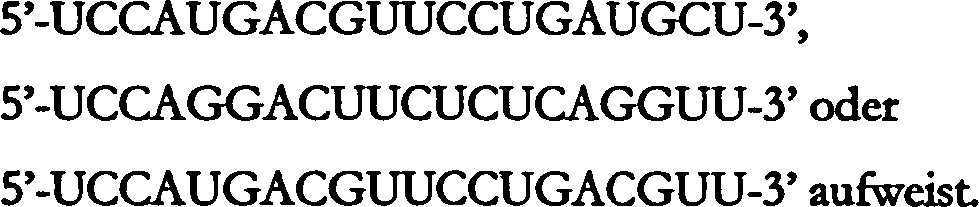
Priority Applications (18)
| Application Number | Priority Date | Filing Date | Title |
|---|---|---|---|
| DE10229872A DE10229872A1 (en) | 2002-07-03 | 2002-07-03 | Immune stimulation through chemically modified RNA |
| AT03762622T ATE390926T1 (en) | 2002-07-03 | 2003-07-03 | IMMUNE STIMULATION THROUGH CHEMICALLY MODIFIED RNA |
| ES06007325.1T ES2539756T3 (en) | 2002-07-03 | 2003-07-03 | Immunostimulation using a chemically modified RNA |
| EP06007325.1A EP1685844B9 (en) | 2002-07-03 | 2003-07-03 | Immunostimulation by chemically modified RNA |
| ES03762622T ES2304529T3 (en) | 2002-07-03 | 2003-07-03 | IMMUNOSTIMULATION THROUGH CHEMICALLY MODIFIED RNA. |
| EP10005375.0A EP2216028B1 (en) | 2002-07-03 | 2003-07-03 | Immunostimulation by chemically modified single-stranded RNA |
| EP10005374.3A EP2216027B1 (en) | 2002-07-03 | 2003-07-03 | Chemically modified rna for immunstimulation |
| EP07008651A EP1806139A3 (en) | 2002-07-03 | 2003-07-03 | Immune stimulation using chemically modified RNA |
| AU2003250889A AU2003250889A1 (en) | 2002-07-03 | 2003-07-03 | Immunostimulation by chemically modified rna |
| EP07000251.4A EP1797886B1 (en) | 2002-07-03 | 2003-07-03 | Immunostimulation by chemically modified RNA |
| EP03762622A EP1521585B1 (en) | 2002-07-03 | 2003-07-03 | Immunostimulation by chemically modified rna |
| CA2490983A CA2490983C (en) | 2002-07-03 | 2003-07-03 | Immunostimulation by chemically modified rna |
| PCT/EP2003/007175 WO2004004743A1 (en) | 2002-07-03 | 2003-07-03 | Immunostimulation by chemically modified rna |
| DE50309540T DE50309540D1 (en) | 2002-07-03 | 2003-07-03 | IMMUNOSTIMULATION BY CHEMICALLY MODIFIED RNA |
| US11/025,858 US20050250723A1 (en) | 2002-07-03 | 2004-12-28 | Immunostimulation by chemically modified RNA |
| US12/791,233 US20100303851A1 (en) | 2002-07-03 | 2010-06-01 | Immunostimulation by chemically modified rna |
| US13/850,024 US20130273001A1 (en) | 2002-07-03 | 2013-03-25 | Immunostimulation by chemically modified rna |
| US15/415,998 US20170211068A1 (en) | 2002-07-03 | 2017-01-26 | Immunostimulation by chemically modified rna |
Applications Claiming Priority (1)
| Application Number | Priority Date | Filing Date | Title |
|---|---|---|---|
| DE10229872A DE10229872A1 (en) | 2002-07-03 | 2002-07-03 | Immune stimulation through chemically modified RNA |
Publications (1)
| Publication Number | Publication Date |
|---|---|
| DE10229872A1 true DE10229872A1 (en) | 2004-01-29 |
Family
ID=29796120
Family Applications (2)
| Application Number | Title | Priority Date | Filing Date |
|---|---|---|---|
| DE10229872A Withdrawn DE10229872A1 (en) | 2002-07-03 | 2002-07-03 | Immune stimulation through chemically modified RNA |
| DE50309540T Expired - Lifetime DE50309540D1 (en) | 2002-07-03 | 2003-07-03 | IMMUNOSTIMULATION BY CHEMICALLY MODIFIED RNA |
Family Applications After (1)
| Application Number | Title | Priority Date | Filing Date |
|---|---|---|---|
| DE50309540T Expired - Lifetime DE50309540D1 (en) | 2002-07-03 | 2003-07-03 | IMMUNOSTIMULATION BY CHEMICALLY MODIFIED RNA |
Country Status (8)
| Country | Link |
|---|---|
| US (4) | US20050250723A1 (en) |
| EP (6) | EP1797886B1 (en) |
| AT (1) | ATE390926T1 (en) |
| AU (1) | AU2003250889A1 (en) |
| CA (1) | CA2490983C (en) |
| DE (2) | DE10229872A1 (en) |
| ES (2) | ES2539756T3 (en) |
| WO (1) | WO2004004743A1 (en) |
Cited By (4)
| Publication number | Priority date | Publication date | Assignee | Title |
|---|---|---|---|---|
| WO2006008154A1 (en) * | 2004-07-21 | 2006-01-26 | Curevac Gmbh | mRNA MIXTURE FOR VACCINATING AGAINST TUMORAL DISEASES |
| US8217016B2 (en) | 2001-12-19 | 2012-07-10 | Curevac Gmbh | Application of mRNA for use as a therapeutic agent for tumorous diseases |
| US10188748B2 (en) | 2001-06-05 | 2019-01-29 | Curevac Ag | Pharmaceutical composition containing a stabilised mRNA optimised for translation in its coding regions |
| US12533422B2 (en) | 2013-11-01 | 2026-01-27 | CureVac SE | Modified RNA with decreased immunostimulatory properties |
Families Citing this family (237)
| Publication number | Priority date | Publication date | Assignee | Title |
|---|---|---|---|---|
| ES2734652T3 (en) | 2002-04-04 | 2019-12-11 | Zoetis Belgium S A | Immunostimulatory oligonucleotides containing G and U |
| EP2338478B1 (en) | 2002-06-28 | 2014-07-23 | Protiva Biotherapeutics Inc. | Method for producing liposomes |
| DE10229872A1 (en) | 2002-07-03 | 2004-01-29 | Curevac Gmbh | Immune stimulation through chemically modified RNA |
| EP1578954A4 (en) | 2002-12-11 | 2010-08-11 | Coley Pharm Group Inc | 5' cpg nucleic acids and methods of use |
| DE10335833A1 (en) * | 2003-08-05 | 2005-03-03 | Curevac Gmbh | Transfection of blood cells with mRNA for immune stimulation and gene therapy |
| DE10347710B4 (en) | 2003-10-14 | 2006-03-30 | Johannes-Gutenberg-Universität Mainz | Recombinant vaccines and their use |
| DE102004042546A1 (en) * | 2004-09-02 | 2006-03-09 | Curevac Gmbh | Combination therapy for immune stimulation |
| JP4981681B2 (en) | 2004-12-09 | 2012-07-25 | アルナイラム ファーマシューティカルズ, インコーポレイテッド | Composition and method for inducing immune response in mammals and method for avoiding immune response to oligonucleotide agents such as short interfering RNA |
| WO2006116458A2 (en) * | 2005-04-26 | 2006-11-02 | Coley Pharmaceutical Gmbh | Modified oligoribonucleotide analogs with enhances immunostimulatory activity |
| DE102005023170A1 (en) | 2005-05-19 | 2006-11-23 | Curevac Gmbh | Optimized formulation for mRNA |
| EP4174179B1 (en) | 2005-08-23 | 2025-05-07 | The Trustees of the University of Pennsylvania | Rna containing modified nucleosides and methods of use thereof |
| EP1924284A1 (en) | 2005-09-14 | 2008-05-28 | Hartmann, Gunther | Compositions comprising immunostimulatory rna oligonucleotides and methods for producing said rna oligonucleotides |
| EP1764108A1 (en) * | 2005-09-14 | 2007-03-21 | Gunther Hartmann | Compositions comprising immunostimulatory RNA oligonucleotides and methods for producing said RNA oligonucleotides |
| EP1764107A1 (en) * | 2005-09-14 | 2007-03-21 | Gunther Hartmann | Compositions comprising immunostimulatory RNA oligonucleotides and methods for producing said RNA oligonucleotides |
| DE102005046490A1 (en) | 2005-09-28 | 2007-03-29 | Johannes-Gutenberg-Universität Mainz | New nucleic acid molecule comprising promoter, a transcriptable nucleic acid sequence, a first and second nucleic acid sequence for producing modified RNA with transcriptional stability and translational efficiency |
| DE102006007433A1 (en) * | 2006-02-17 | 2007-08-23 | Curevac Gmbh | Adjuvant in the form of a lipid-modified nucleic acid |
| EP2046954A2 (en) * | 2006-07-31 | 2009-04-15 | Curevac GmbH | NUCLEIC ACID OF FORMULA (I): GIXmGn, OR (II): CIXmCn, IN PARTICULAR AS AN IMMUNE-STIMULATING AGENT/ADJUVANT |
| DE102006035618A1 (en) * | 2006-07-31 | 2008-02-07 | Curevac Gmbh | Nucleic acid of the formula (I): GlXmGn, in particular as immunostimulating adjuvant |
| DE102007001370A1 (en) * | 2007-01-09 | 2008-07-10 | Curevac Gmbh | RNA-encoded antibodies |
| US8128944B2 (en) * | 2007-08-13 | 2012-03-06 | Coley Pharmaceutical Gmbh | RNA sequence motifs in the context of defined internucleotide linkages inducing specific immune modulatory profiles |
| WO2009030254A1 (en) | 2007-09-04 | 2009-03-12 | Curevac Gmbh | Complexes of rna and cationic peptides for transfection and for immunostimulation |
| WO2009046739A1 (en) | 2007-10-09 | 2009-04-16 | Curevac Gmbh | Composition for treating prostate cancer (pca) |
| WO2009046738A1 (en) * | 2007-10-09 | 2009-04-16 | Curevac Gmbh | Composition for treating lung cancer, particularly of non-small lung cancers (nsclc) |
| KR101483715B1 (en) | 2008-01-31 | 2015-01-19 | 큐어백 게엠바하 | NUCLEIC ACIDS COMPRISING FORMULA (NuGlXmGnNv)a AND DERIVATIVES THEREOF AS AN IMMUNOSTIMULATING AGENTS/ADJUVANTS |
| PT2280721T (en) | 2008-04-17 | 2018-02-16 | Io Biotech Aps | IMMUNE THERAPY BASED ON INDOLEAMINE 2,3-DIOXYGENASE |
| US8728465B2 (en) | 2008-06-17 | 2014-05-20 | Cedars-Sinai Medical Center | Use of toll-like receptor ligands as adjuvants to vaccination therapy for brain tumors |
| WO2010037408A1 (en) | 2008-09-30 | 2010-04-08 | Curevac Gmbh | Composition comprising a complexed (m)rna and a naked mrna for providing or enhancing an immunostimulatory response in a mammal and uses thereof |
| US20110053829A1 (en) | 2009-09-03 | 2011-03-03 | Curevac Gmbh | Disulfide-linked polyethyleneglycol/peptide conjugates for the transfection of nucleic acids |
| ES2666559T3 (en) | 2009-12-01 | 2018-05-07 | Translate Bio, Inc. | Delivery of mrna for the augmentation of proteins and enzymes in human genetic diseases |
| WO2011069529A1 (en) | 2009-12-09 | 2011-06-16 | Curevac Gmbh | Mannose-containing solution for lyophilization, transfection and/or injection of nucleic acids |
| ES2558106T3 (en) | 2010-07-30 | 2016-02-02 | Curevac Ag | Formation of nucleic acid complexes with disulfide-cross-linked cationic components for transfection and immunostimulation |
| EP2600901B1 (en) | 2010-08-06 | 2019-03-27 | ModernaTX, Inc. | A pharmaceutical formulation comprising engineered nucleic acids and medical use thereof |
| WO2012019630A1 (en) | 2010-08-13 | 2012-02-16 | Curevac Gmbh | Nucleic acid comprising or coding for a histone stem-loop and a poly(a) sequence or a polyadenylation signal for increasing the expression of an encoded protein |
| CN104531812A (en) | 2010-10-01 | 2015-04-22 | 现代治疗公司 | Engineered nucleic acids and methods of use thereof |
| WO2012075040A2 (en) * | 2010-11-30 | 2012-06-07 | Shire Human Genetic Therapies, Inc. | mRNA FOR USE IN TREATMENT OF HUMAN GENETIC DISEASES |
| WO2012089225A1 (en) | 2010-12-29 | 2012-07-05 | Curevac Gmbh | Combination of vaccination and inhibition of mhc class i restricted antigen presentation |
| WO2012116715A1 (en) | 2011-03-02 | 2012-09-07 | Curevac Gmbh | Vaccination in newborns and infants |
| WO2012113413A1 (en) | 2011-02-21 | 2012-08-30 | Curevac Gmbh | Vaccine composition comprising complexed immunostimulatory nucleic acids and antigens packaged with disulfide-linked polyethyleneglycol/peptide conjugates |
| WO2012116714A1 (en) | 2011-03-02 | 2012-09-07 | Curevac Gmbh | Vaccination in elderly patients |
| US8710200B2 (en) | 2011-03-31 | 2014-04-29 | Moderna Therapeutics, Inc. | Engineered nucleic acids encoding a modified erythropoietin and their expression |
| RU2670745C9 (en) | 2011-05-24 | 2018-12-13 | Бионтех Рна Фармасьютикалс Гмбх | Individualised vaccines for cancer |
| BR112013031553A2 (en) | 2011-06-08 | 2020-11-10 | Shire Human Genetic Therapies, Inc. | compositions, mrna encoding a gland and its use, use of at least one mrna molecule and a vehicle for transfer and use of an mrna encoding for exogenous protein |
| US9464124B2 (en) | 2011-09-12 | 2016-10-11 | Moderna Therapeutics, Inc. | Engineered nucleic acids and methods of use thereof |
| BR112014007852B1 (en) | 2011-10-03 | 2021-11-03 | Moderna Therapeutics, Inc | MODIFIED ISOLATED POLYNUCLEOTIDE AND PHARMACEUTICAL COMPOSITION |
| PL2791160T3 (en) | 2011-12-16 | 2022-06-20 | Modernatx, Inc. | Modified mrna compositions |
| WO2013113326A1 (en) | 2012-01-31 | 2013-08-08 | Curevac Gmbh | Pharmaceutical composition comprising a polymeric carrier cargo complex and at least one protein or peptide antigen |
| WO2013120497A1 (en) | 2012-02-15 | 2013-08-22 | Curevac Gmbh | Nucleic acid comprising or coding for a histone stem-loop and a poly(a) sequence or a polyadenylation signal for increasing the expression of an encoded therapeutic protein |
| WO2013120499A1 (en) | 2012-02-15 | 2013-08-22 | Curevac Gmbh | Nucleic acid comprising or coding for a histone stem-loop and a poly (a) sequence or a polyadenylation signal for increasing the expression of an encoded pathogenic antigen |
| WO2013120498A1 (en) | 2012-02-15 | 2013-08-22 | Curevac Gmbh | Nucleic acid comprising or coding for a histone stem-loop and a poly(a) sequence or a polyadenylation signal for increasing the expression of an encoded allergenic antigen or an autoimmune self-antigen |
| WO2013120500A1 (en) | 2012-02-15 | 2013-08-22 | Curevac Gmbh | Nucleic acid comprising or coding for a histone stem-loop and a poly(a) sequence or a polyadenylation signal for increasing the expression of an encoded tumour antigen |
| WO2013143555A1 (en) | 2012-03-26 | 2013-10-03 | Biontech Ag | Rna formulation for immunotherapy |
| ES2660129T3 (en) | 2012-03-27 | 2018-03-20 | Curevac Ag | Artificial nucleic acid molecules comprising a 5'UTR-TOP |
| MX362981B (en) | 2012-03-27 | 2019-02-28 | Curevac Ag | Artificial nucleic acid molecules for improved protein or peptide expression. |
| CA2866955A1 (en) | 2012-03-27 | 2013-10-03 | Curevac Gmbh | Artificial nucleic acid molecules |
| US9283287B2 (en) | 2012-04-02 | 2016-03-15 | Moderna Therapeutics, Inc. | Modified polynucleotides for the production of nuclear proteins |
| HK1206779A1 (en) | 2012-04-02 | 2016-01-15 | Modernatx, Inc. | Modified polynucleotides for the production of nuclear proteins |
| US9572897B2 (en) | 2012-04-02 | 2017-02-21 | Modernatx, Inc. | Modified polynucleotides for the production of cytoplasmic and cytoskeletal proteins |
| US10501512B2 (en) | 2012-04-02 | 2019-12-10 | Modernatx, Inc. | Modified polynucleotides |
| EP2859102A4 (en) | 2012-06-08 | 2016-05-11 | Shire Human Genetic Therapies | Nuclease resistant polynucleotides and uses thereof |
| DK2922554T3 (en) | 2012-11-26 | 2022-05-23 | Modernatx Inc | Terminalt modificeret rna |
| EP2925348B1 (en) | 2012-11-28 | 2019-03-06 | BioNTech RNA Pharmaceuticals GmbH | Individualized vaccines for cancer |
| MX385338B (en) | 2013-02-22 | 2025-03-18 | CureVac SE | Combination of vaccination and inhibition of the pd-1 pathway |
| DK3292873T3 (en) | 2013-02-22 | 2019-06-03 | Curevac Ag | Combination of vaccination and inhibition of PD-1 pathway |
| US20160032316A1 (en) | 2013-03-14 | 2016-02-04 | The Trustees Of The University Of Pennsylvania | Purification and Purity Assessment of RNA Molecules Synthesized with Modified Nucleosides |
| EP4446413A3 (en) | 2013-03-14 | 2024-12-18 | Translate Bio, Inc. | Methods for purification of messenger rna |
| WO2014153052A2 (en) | 2013-03-14 | 2014-09-25 | Shire Human Genetic Therapies, Inc. | Cftr mrna compositions and related methods and uses |
| US8980864B2 (en) | 2013-03-15 | 2015-03-17 | Moderna Therapeutics, Inc. | Compositions and methods of altering cholesterol levels |
| WO2014180490A1 (en) | 2013-05-10 | 2014-11-13 | Biontech Ag | Predicting immunogenicity of t cell epitopes |
| CN105473157A (en) | 2013-08-21 | 2016-04-06 | 库瑞瓦格股份公司 | Combination vaccine |
| CN105451779A (en) | 2013-08-21 | 2016-03-30 | 库瑞瓦格股份公司 | Method for increasing expression of RNA-encoded proteins |
| SG11201510746WA (en) | 2013-08-21 | 2016-03-30 | Curevac Ag | Respiratory syncytial virus (rsv) vaccine |
| CN105517569A (en) | 2013-08-21 | 2016-04-20 | 库瑞瓦格股份公司 | Rabies vaccine |
| US10023626B2 (en) | 2013-09-30 | 2018-07-17 | Modernatx, Inc. | Polynucleotides encoding immune modulating polypeptides |
| WO2015051214A1 (en) | 2013-10-03 | 2015-04-09 | Moderna Therapeutics, Inc. | Polynucleotides encoding low density lipoprotein receptor |
| CN105658242A (en) | 2013-10-22 | 2016-06-08 | 夏尔人类遗传性治疗公司 | MRNA therapy for phenylketonuria |
| ES2707966T3 (en) | 2013-10-22 | 2019-04-08 | Translate Bio Inc | MRNA therapy for the deficiency in argininosuccinate synthesis |
| WO2015085318A2 (en) * | 2013-12-06 | 2015-06-11 | Moderna Therapeutics, Inc. | Targeted adaptive vaccines |
| AU2014375404C1 (en) | 2013-12-30 | 2020-11-19 | CureVac Manufacturing GmbH | Methods for RNA analysis |
| CA2927254C (en) | 2013-12-30 | 2023-10-24 | Curevac Ag | Artificial nucleic acid molecules |
| KR102399799B1 (en) | 2013-12-30 | 2022-05-18 | 큐어백 아게 | Artificial nucleic acid molecules |
| US11254951B2 (en) | 2014-12-30 | 2022-02-22 | Curevac Ag | Artificial nucleic acid molecules |
| ES2754239T3 (en) | 2014-03-12 | 2020-04-16 | Curevac Ag | Combination of vaccination and OX40 agonists |
| US10369216B2 (en) | 2014-04-01 | 2019-08-06 | Curevac Ag | Polymeric carrier cargo complex for use as an immunostimulating agent or as an adjuvant |
| PL3981437T3 (en) | 2014-04-23 | 2025-02-24 | Modernatx, Inc. | Nucleic acid vaccines |
| CN106164248B (en) | 2014-04-25 | 2019-10-15 | 川斯勒佰尔公司 | Purification of messenger RNA |
| MX382298B (en) | 2014-06-10 | 2025-03-12 | Curevac Mfg Gmbh | METHODS AND MEANS FOR INCREASING RNA PRODUCTION. |
| EP3160938B1 (en) | 2014-06-25 | 2020-09-16 | Acuitas Therapeutics Inc. | Novel lipids and lipid nanoparticle formulations for delivery of nucleic acids |
| PL231158B1 (en) * | 2014-08-28 | 2019-01-31 | Inst Biochemii I Biofizyki Polskiej Akademii Nauk | Vaccine, pharmaceutical composition, carrier of nucleic acids and other biologically active substances, application of the composition in production of the vaccine and application of cationic derivatives of polyprenols PTAI for producing immunomodulating substances |
| WO2016045732A1 (en) | 2014-09-25 | 2016-03-31 | Biontech Rna Pharmaceuticals Gmbh | Stable formulations of lipids and liposomes |
| DE202015009961U1 (en) | 2014-12-12 | 2022-01-25 | Curevac Ag | Artificial nucleic acid molecules for improved protein expression |
| WO2016128060A1 (en) | 2015-02-12 | 2016-08-18 | Biontech Ag | Predicting t cell epitopes useful for vaccination |
| EP4353257A3 (en) | 2015-04-13 | 2024-08-07 | CureVac Manufacturing GmbH | Method for producing rna compositions |
| CN107567497A (en) | 2015-04-17 | 2018-01-09 | 库瑞瓦格股份公司 | Lyophilization of RNA |
| US10293058B2 (en) | 2015-04-22 | 2019-05-21 | Curevac Ag | RNA containing composition for treatment of tumor diseases |
| WO2016176330A1 (en) | 2015-04-27 | 2016-11-03 | The Trustees Of The University Of Pennsylvania | Nucleoside-modified rna for inducing an adaptive immune response |
| EP3289101B1 (en) | 2015-04-30 | 2021-06-23 | CureVac AG | Immobilized poly(n)polymerase |
| WO2016180430A1 (en) | 2015-05-08 | 2016-11-17 | Curevac Ag | Method for producing rna |
| KR20180004820A (en) | 2015-05-15 | 2018-01-12 | 큐어백 아게 | A novel prime-boost therapy comprising administration of at least one mRNA construct |
| WO2016184576A2 (en) | 2015-05-20 | 2016-11-24 | Curevac Ag | Dry powder composition comprising long-chain rna |
| EP3916091A3 (en) | 2015-05-20 | 2022-03-30 | CureVac AG | Dry powder composition comprising long-chain rna |
| ES2960429T3 (en) | 2015-05-29 | 2024-03-04 | Curevac Mfg Gmbh | Method for producing and purifying RNA, comprising at least one tangential flow filtration step |
| EP3303575B1 (en) | 2015-05-29 | 2022-03-16 | CureVac AG | Method for adding cap structures to rna using immobilized enzymes |
| AU2016285852B2 (en) | 2015-06-29 | 2020-12-17 | Acuitas Therapeutics Inc. | Lipids and lipid nanoparticle formulations for delivery of nucleic acids |
| US10501768B2 (en) | 2015-07-13 | 2019-12-10 | Curevac Ag | Method of producing RNA from circular DNA and corresponding template DNA |
| US11364292B2 (en) | 2015-07-21 | 2022-06-21 | Modernatx, Inc. | CHIKV RNA vaccines |
| ES2937963T3 (en) | 2015-07-21 | 2023-04-03 | Modernatx Inc | Infectious disease vaccines |
| HK1256498A1 (en) | 2015-07-30 | 2019-09-27 | Modernatx, Inc. | Concatemeric peptide epitope rnas |
| AU2016316439B2 (en) | 2015-08-28 | 2022-02-24 | CureVac SE | Artificial nucleic acid molecules |
| ES2969082T3 (en) | 2015-09-17 | 2024-05-16 | Modernatx Inc | Compounds and compositions for intracellular administration of therapeutic agents |
| WO2017059902A1 (en) | 2015-10-07 | 2017-04-13 | Biontech Rna Pharmaceuticals Gmbh | 3' utr sequences for stabilization of rna |
| EP3362576A1 (en) | 2015-10-12 | 2018-08-22 | CureVac AG | Automated method for isolation, selection and/or detection of microorganisms or cells comprised in a solution |
| WO2017066782A1 (en) | 2015-10-16 | 2017-04-20 | Modernatx, Inc. | Hydrophobic mrna cap analogs |
| WO2017066797A1 (en) | 2015-10-16 | 2017-04-20 | Modernatx, Inc. | Trinucleotide mrna cap analogs |
| WO2017066789A1 (en) | 2015-10-16 | 2017-04-20 | Modernatx, Inc. | Mrna cap analogs with modified sugar |
| EP3362460A1 (en) | 2015-10-16 | 2018-08-22 | Modernatx, Inc. | Mrna cap analogs and methods of mrna capping |
| EP4086269A1 (en) | 2015-10-16 | 2022-11-09 | ModernaTX, Inc. | Mrna cap analogs with modified phosphate linkage |
| WO2017066791A1 (en) | 2015-10-16 | 2017-04-20 | Modernatx, Inc. | Sugar substituted mrna cap analogs |
| WO2017070624A1 (en) | 2015-10-22 | 2017-04-27 | Modernatx, Inc. | Tropical disease vaccines |
| EP4349404A3 (en) | 2015-10-22 | 2024-06-19 | ModernaTX, Inc. | Respiratory virus vaccines |
| MA46316A (en) | 2015-10-22 | 2021-03-24 | Modernatx Inc | HUMAN CYTOMEGALOVIRUS VACCINE |
| MA46080A (en) | 2015-10-22 | 2019-07-10 | Modernatx Inc | NUCLEIC ACID VACCINES AGAINST VARICELLA ZONA VIRUS (VZV) |
| AU2016342376A1 (en) | 2015-10-22 | 2018-06-07 | Modernatx, Inc. | Sexually transmitted disease vaccines |
| FI3368507T3 (en) | 2015-10-28 | 2023-03-21 | Acuitas Therapeutics Inc | New lipids and lipid nanoparticle preparations for delivery of nucleic acids |
| EP3373965A1 (en) | 2015-11-09 | 2018-09-19 | CureVac AG | Rotavirus vaccines |
| AU2016375021B2 (en) | 2015-12-22 | 2022-02-03 | CureVac SE | Method for producing RNA molecule compositions |
| US10799463B2 (en) | 2015-12-22 | 2020-10-13 | Modernatx, Inc. | Compounds and compositions for intracellular delivery of agents |
| WO2017109161A1 (en) | 2015-12-23 | 2017-06-29 | Curevac Ag | Method of rna in vitro transcription using a buffer containing a dicarboxylic acid or tricarboxylic acid or a salt thereof |
| US11723967B2 (en) | 2016-02-17 | 2023-08-15 | CureVac SE | Zika virus vaccine |
| EP3423595A1 (en) | 2016-03-03 | 2019-01-09 | CureVac AG | Rna analysis by total hydrolysis |
| WO2017186928A1 (en) | 2016-04-29 | 2017-11-02 | Curevac Ag | Rna encoding an antibody |
| EP4233898A3 (en) | 2016-05-04 | 2023-11-01 | CureVac SE | Influenza mrna vaccines |
| EP4477662A3 (en) | 2016-05-04 | 2025-03-19 | CureVac SE | Nucleic acid molecules and uses thereof |
| EP3452101A2 (en) | 2016-05-04 | 2019-03-13 | CureVac AG | Rna encoding a therapeutic protein |
| WO2017201342A1 (en) | 2016-05-18 | 2017-11-23 | Modernatx, Inc. | Polynucleotides encoding jagged1 for the treatment of alagille syndrome |
| US11478552B2 (en) | 2016-06-09 | 2022-10-25 | Curevac Ag | Hybrid carriers for nucleic acid cargo |
| EP3468537A1 (en) | 2016-06-14 | 2019-04-17 | Modernatx, Inc. | Stabilized formulations of lipid nanoparticles |
| EP3528821A4 (en) | 2016-10-21 | 2020-07-01 | ModernaTX, Inc. | VACCINE AGAINST THE HUMANE CYTOMEGALOVIRUS |
| US11583504B2 (en) | 2016-11-08 | 2023-02-21 | Modernatx, Inc. | Stabilized formulations of lipid nanoparticles |
| US20190263906A1 (en) | 2016-11-10 | 2019-08-29 | Deutsches Krebsforschungszentrum Stiftung des öffentlichen Rechts | Immune modulators for reducing immune-resistance in melanoma and other proliferative diseases |
| WO2018096179A1 (en) | 2016-11-28 | 2018-05-31 | Curevac Ag | Method for purifying rna |
| US20180193270A1 (en) | 2016-11-29 | 2018-07-12 | PureTech Health LLC | Exosomes for delivery of therapeutic agents |
| US11464836B2 (en) | 2016-12-08 | 2022-10-11 | Curevac Ag | RNA for treatment or prophylaxis of a liver disease |
| WO2018104540A1 (en) | 2016-12-08 | 2018-06-14 | Curevac Ag | Rnas for wound healing |
| WO2018107088A2 (en) | 2016-12-08 | 2018-06-14 | Modernatx, Inc. | Respiratory virus nucleic acid vaccines |
| WO2018115525A1 (en) | 2016-12-23 | 2018-06-28 | Curevac Ag | Lassa virus vaccine |
| US11141476B2 (en) | 2016-12-23 | 2021-10-12 | Curevac Ag | MERS coronavirus vaccine |
| US11524066B2 (en) | 2016-12-23 | 2022-12-13 | CureVac SE | Henipavirus vaccine |
| US11241490B2 (en) | 2017-01-11 | 2022-02-08 | The Trustees Of The University Of Pennsylvania | Nucleoside-modified RNA for inducing an immune response against zika virus |
| WO2018151816A1 (en) | 2017-02-16 | 2018-08-23 | Modernatx, Inc. | High potency immunogenic compositions |
| MX2019010155A (en) | 2017-02-27 | 2020-12-10 | Translate Bio Inc | Novel codon-optimized cftr mrna. |
| MX2019011004A (en) | 2017-03-15 | 2020-08-10 | Modernatx Inc | Compounds and compositions for intracellular delivery of therapeutic agents. |
| US11752206B2 (en) | 2017-03-15 | 2023-09-12 | Modernatx, Inc. | Herpes simplex virus vaccine |
| US11045540B2 (en) | 2017-03-15 | 2021-06-29 | Modernatx, Inc. | Varicella zoster virus (VZV) vaccine |
| CA3055653A1 (en) | 2017-03-15 | 2018-09-20 | Modernatx, Inc. | Lipid nanoparticle formulation |
| EP3595713A4 (en) | 2017-03-15 | 2021-01-13 | ModernaTX, Inc. | RESPIRATORY SYNCYTIAL VIRUS VACCINE |
| EP3595676A4 (en) | 2017-03-17 | 2021-05-05 | Modernatx, Inc. | RNA-BASED VACCINES AGAINST ZOONOTIC DISEASES |
| EP3601576A1 (en) | 2017-03-24 | 2020-02-05 | CureVac AG | Nucleic acids encoding crispr-associated proteins and uses thereof |
| US11357856B2 (en) | 2017-04-13 | 2022-06-14 | Acuitas Therapeutics, Inc. | Lipids for delivery of active agents |
| JP7464954B2 (en) | 2017-04-27 | 2024-04-10 | ザ トラスティーズ オブ ザ ユニバーシティ オブ ペンシルバニア | Nucleoside-modified mRNA-lipid nanoparticle-based vaccine against hepatitis C virus |
| IL301115A (en) | 2017-04-28 | 2023-05-01 | Acuitas Therapeutics Inc | New lipid carbonyl and lipid nanoparticle formulations for delivery of nucleic acids |
| WO2018213476A1 (en) | 2017-05-16 | 2018-11-22 | Translate Bio, Inc. | Treatment of cystic fibrosis by delivery of codon-optimized mrna encoding cftr |
| US12297489B2 (en) | 2017-05-17 | 2025-05-13 | CureVac Manufacturing GmbH | Method for determining at least one quality parameter of an RNA sample |
| WO2018224166A1 (en) | 2017-06-09 | 2018-12-13 | Biontech Rna Pharmaceuticals Gmbh | Methods for predicting the usefulness of disease specific amino acid modifications for immunotherapy |
| US12077501B2 (en) | 2017-06-14 | 2024-09-03 | Modernatx, Inc. | Compounds and compositions for intracellular delivery of agents |
| EP3424524B1 (en) | 2017-07-04 | 2024-12-11 | CureVac SE | Cancer rna-vaccine |
| CA3073020A1 (en) | 2017-08-16 | 2019-02-21 | Acuitas Therapeutics, Inc. | Lipids for use in lipid nanoparticle formulations |
| US11542225B2 (en) | 2017-08-17 | 2023-01-03 | Acuitas Therapeutics, Inc. | Lipids for use in lipid nanoparticle formulations |
| WO2019036000A1 (en) | 2017-08-17 | 2019-02-21 | Acuitas Therapeutics, Inc. | Lipids for use in lipid nanoparticle formulations |
| WO2019036030A1 (en) | 2017-08-17 | 2019-02-21 | Acuitas Therapeutics, Inc. | Lipids for use in lipid nanoparticle formulations |
| WO2019036638A1 (en) | 2017-08-18 | 2019-02-21 | Modernatx, Inc. | Methods of preparing modified rna |
| WO2019038332A1 (en) | 2017-08-22 | 2019-02-28 | Curevac Ag | Bunyavirales vaccine |
| WO2019046809A1 (en) | 2017-08-31 | 2019-03-07 | Modernatx, Inc. | Methods of making lipid nanoparticles |
| WO2019055807A1 (en) | 2017-09-14 | 2019-03-21 | Modernatx, Inc. | Zika virus rna vaccines |
| RU2020117848A (en) | 2017-11-08 | 2021-12-08 | Куревак Аг | PHK SEQUENCE ADAPTATION |
| EP3723796A1 (en) | 2017-12-13 | 2020-10-21 | CureVac AG | Flavivirus vaccine |
| SG11202005760PA (en) | 2017-12-21 | 2020-07-29 | Curevac Ag | Linear double stranded dna coupled to a single support or a tag and methods for producing said linear double stranded dna |
| EP3508499A1 (en) | 2018-01-08 | 2019-07-10 | iOmx Therapeutics AG | Antibodies targeting, and other modulators of, an immunoglobulin gene associated with resistance against anti-tumour immune responses, and uses thereof |
| EP3746090A4 (en) | 2018-01-29 | 2021-11-17 | ModernaTX, Inc. | RSV RNA VACCINES |
| WO2019202035A1 (en) | 2018-04-17 | 2019-10-24 | Curevac Ag | Novel rsv rna molecules and compositions for vaccination |
| SG11202011097YA (en) | 2018-06-28 | 2020-12-30 | Curevac Ag | Bioreactor for rna in vitro transcription |
| KR20210060480A (en) | 2018-08-24 | 2021-05-26 | 트랜슬레이트 바이오 인코포레이티드 | Method for purifying messenger RNA |
| EP3853202A1 (en) | 2018-09-19 | 2021-07-28 | ModernaTX, Inc. | Compounds and compositions for intracellular delivery of therapeutic agents |
| CA3113651A1 (en) | 2018-09-20 | 2020-03-26 | Modernatx, Inc. | Preparation of lipid nanoparticles and methods of administration thereof |
| IL322436A (en) | 2018-09-21 | 2025-09-01 | Acuitas Therapeutics Inc | Systems and methods for manufacturing lipid nanoparticles and liposomes |
| CA3120647A1 (en) | 2018-11-21 | 2020-05-28 | Translate Bio, Inc. | Treatment of cystic fibrosis by delivery of nebulized mrna encoding cftr |
| TW202039534A (en) | 2018-12-14 | 2020-11-01 | 美商美國禮來大藥廠 | Kras variant mrna molecules |
| SG11202106666UA (en) | 2018-12-21 | 2021-07-29 | Curevac Ag | Methods for rna analysis |
| MX2021009245A (en) | 2019-01-31 | 2021-11-12 | Modernatx Inc | METHODS FOR THE PREPARATION OF LIPID NANOPARTICLES. |
| EP3917656A1 (en) | 2019-01-31 | 2021-12-08 | Modernatx, Inc. | Vortex mixers and associated methods, systems, and apparatuses thereof |
| US11351242B1 (en) | 2019-02-12 | 2022-06-07 | Modernatx, Inc. | HMPV/hPIV3 mRNA vaccine composition |
| US12070495B2 (en) | 2019-03-15 | 2024-08-27 | Modernatx, Inc. | HIV RNA vaccines |
| AU2020311579A1 (en) | 2019-07-05 | 2022-02-03 | Iomx Therapeutics Ag | Antibodies binding IgC2 of IGSF11 (VSIG3) and uses thereof |
| EP3822288A1 (en) | 2019-11-18 | 2021-05-19 | Deutsches Krebsforschungszentrum, Stiftung des öffentlichen Rechts | Antibodies targeting, and other modulators of, the cd276 antigen, and uses thereof |
| US12194089B2 (en) | 2020-02-04 | 2025-01-14 | CureVac SE | Coronavirus vaccine |
| US11241493B2 (en) | 2020-02-04 | 2022-02-08 | Curevac Ag | Coronavirus vaccine |
| CA3170563A1 (en) * | 2020-03-06 | 2021-09-10 | Raymond P. Goodrich | Production of vaccines comprising inactivated sars-cov-2 viral particles |
| CN114206827B (en) | 2020-04-09 | 2023-05-23 | 苏州艾博生物科技有限公司 | Lipid nanoparticle compositions |
| TW202204622A (en) | 2020-04-09 | 2022-02-01 | 大陸商蘇州艾博生物科技有限公司 | Nucleic acid vaccines for coronavirus |
| IL297419B2 (en) | 2020-04-22 | 2025-02-01 | BioNTech SE | Coronavirus vaccine |
| KR20230030588A (en) | 2020-06-30 | 2023-03-06 | 쑤저우 아보젠 바이오사이언시스 컴퍼니 리미티드 | Lipid Compounds and Lipid Nanoparticle Compositions |
| EP4175668A1 (en) | 2020-07-06 | 2023-05-10 | iOmx Therapeutics AG | Antibodies binding igv of igsf11 (vsig3) and uses thereof |
| EP4182297B1 (en) | 2020-07-16 | 2025-09-03 | Acuitas Therapeutics, Inc. | Cationic lipids for use in lipid nanoparticles |
| AU2021328980A1 (en) | 2020-08-20 | 2023-03-09 | Suzhou Abogen Biosciences Co., Ltd. | Lipid compounds and lipid nanoparticle compositions |
| US11406703B2 (en) | 2020-08-25 | 2022-08-09 | Modernatx, Inc. | Human cytomegalovirus vaccine |
| CN117177766A (en) | 2020-10-26 | 2023-12-05 | 佩奇大学 | Vaccine platform |
| US20230406961A1 (en) | 2020-11-03 | 2023-12-21 | Deutsches Krebsforschungszentrum Stiftung des öffentlichen Rechts | Target-cell restricted, costimulatory, bispecific and bivalent anti-cd28 antibodies |
| WO2022106860A1 (en) | 2020-11-20 | 2022-05-27 | Pécsi Tudományegyetem | Recombinant peptides for use in therapy |
| CA3205569A1 (en) | 2020-12-22 | 2022-06-30 | CureVac SE | Rna vaccine against sars-cov-2 variants |
| WO2022152109A2 (en) | 2021-01-14 | 2022-07-21 | Suzhou Abogen Biosciences Co., Ltd. | Lipid compounds and lipid nanoparticle compositions |
| WO2022152141A2 (en) | 2021-01-14 | 2022-07-21 | Suzhou Abogen Biosciences Co., Ltd. | Polymer conjugated lipid compounds and lipid nanoparticle compositions |
| WO2022184845A1 (en) | 2021-03-03 | 2022-09-09 | Chemotherapeutisches Forschungsinstitut Georg-Speyer-Haus | Bispecific antibodies enhancing cell mediated immune responses |
| CN116472275B (en) | 2021-05-24 | 2025-08-26 | 苏州艾博生物科技有限公司 | Lipid compounds and lipid nanoparticle compositions |
| JP2024533865A (en) | 2021-09-14 | 2024-09-12 | レナゲード セラピューティクス マネージメント インコーポレイテッド | Cyclic lipids and methods of use thereof |
| WO2023044343A1 (en) | 2021-09-14 | 2023-03-23 | Renagade Therapeutics Management Inc. | Acyclic lipids and methods of use thereof |
| AR127312A1 (en) | 2021-10-08 | 2024-01-10 | Suzhou Abogen Biosciences Co Ltd | LIPID COMPOUNDS AND LIPID NANOPARTICLE COMPOSITIONS |
| JP2024536406A (en) | 2021-10-08 | 2024-10-04 | スージョウ・アボジェン・バイオサイエンシズ・カンパニー・リミテッド | Lipid Compounds and Lipid Nanoparticle Compositions |
| CN116064598B (en) | 2021-10-08 | 2024-03-12 | 苏州艾博生物科技有限公司 | Coronavirus nucleic acid vaccine |
| US12186387B2 (en) | 2021-11-29 | 2025-01-07 | BioNTech SE | Coronavirus vaccine |
| WO2023114943A2 (en) | 2021-12-16 | 2023-06-22 | Acuitas Therapeutics, Inc. | Lipids for use in lipid nanoparticle formulations |
| CA3243054A1 (en) | 2021-12-23 | 2025-04-08 | Renagade Therapeutics Management Inc. | Constrained lipids and methods of use thereof |
| CA3241492A1 (en) | 2021-12-23 | 2023-06-29 | Suzhou Abogen Biosciences Co., Ltd. | Lipid compound and lipid nanoparticle composition |
| CA3255619A1 (en) | 2022-04-07 | 2023-10-12 | Renagade Therapeutics Management Inc. | Cyclic lipids and lipid nanoparticles (lnp) for the delivery of nucleic acids or peptides for use in vaccinating against infectious agents |
| US11878055B1 (en) | 2022-06-26 | 2024-01-23 | BioNTech SE | Coronavirus vaccine |
| JP2025527583A (en) | 2022-08-18 | 2025-08-22 | スージョウ・アボジェン・バイオサイエンシズ・カンパニー・リミテッド | Lipid nanoparticle composition |
| DE202023106198U1 (en) | 2022-10-28 | 2024-03-21 | CureVac SE | Nucleic acid-based vaccine |
| KR20250129687A (en) | 2022-12-23 | 2025-08-29 | 아이오엠엑스 테라퓨틱스 아게 | Cross-specific antigen binding proteins (ABPs) targeting leukocyte immunoglobulin-like receptor subfamily B1 (LILRB1) and LILRB2, combinations thereof, and uses thereof |
| EP4491230A1 (en) | 2023-07-14 | 2025-01-15 | iOmx Therapeutics AG | Cross-specific antigen binding proteins (abp) targeting leukocyte immunoglobulin-like receptor subfamily b1 (lilrb1) and lilrb2, combinations and uses thereof |
| EP4680595A2 (en) | 2023-03-15 | 2026-01-21 | Renagade Therapeutics Management Inc. | Lipid nanoparticles comprising coding rna molecules for use in gene editing and as vaccines and therapeutic agents |
| EP4680287A1 (en) | 2023-03-15 | 2026-01-21 | Renagade Therapeutics Management Inc. | Delivery of gene editing systems and methods of use thereof |
| WO2025049959A2 (en) | 2023-09-01 | 2025-03-06 | Renagade Therapeutics Management Inc. | Gene editing systems, compositions, and methods for treatment of vexas syndrome |
| WO2025059215A1 (en) | 2023-09-12 | 2025-03-20 | Aadigen, Llc | Methods and compositions for treating or preventing cancer |
| WO2025081042A1 (en) | 2023-10-12 | 2025-04-17 | Renagade Therapeutics Management Inc. | Nickase-retron template-based precision editing system and methods of use |
| WO2025119999A1 (en) | 2023-12-04 | 2025-06-12 | Universität Duisburg-Essen | Extracellular vesicle based vaccine platform |
| WO2025128871A2 (en) | 2023-12-13 | 2025-06-19 | Renagade Therapeutics Management Inc. | Lipid nanoparticles comprising coding rna molecules for use in gene editing and as vaccines and therapeutic agents |
| WO2025155753A2 (en) | 2024-01-17 | 2025-07-24 | Renagade Therapeutics Management Inc. | Improved gene editing system, guides, and methods |
| WO2025174765A1 (en) | 2024-02-12 | 2025-08-21 | Renagade Therapeutics Management Inc. | Lipid nanoparticles comprising coding rna molecules for use in gene editing and as vaccines and therapeutic agents |
| WO2026003224A2 (en) | 2024-06-26 | 2026-01-02 | Iomx Therapeutics Ag | Bispecific antigen binding proteins (abp) targeting immune checkpoint molecules and both leukocyte immunoglobulin-like receptor subfamily b1 (lilrb1) and lilrb2; combinations and uses thereof |
Citations (5)
| Publication number | Priority date | Publication date | Assignee | Title |
|---|---|---|---|---|
| US5663153A (en) * | 1994-03-25 | 1997-09-02 | Isis Pharmaceuticals, Inc. | Immune stimulation by phosphorothioate oligonucleotide analogs |
| EP1083232A1 (en) * | 1999-09-09 | 2001-03-14 | Jung, Günther, Prof. Dr. | Transfer of mRNA using polycationic compounds |
| US6239116B1 (en) * | 1994-07-15 | 2001-05-29 | University Of Iowa Research Foundation | Immunostimulatory nucleic acid molecules |
| WO2002098443A2 (en) * | 2001-06-05 | 2002-12-12 | Curevac Gmbh | Stabilised mrna with an increased g/c content and optimised codon for use in gene therapy |
| DE10148886A1 (en) * | 2001-10-04 | 2003-04-30 | Avontec Gmbh | Inhibition of STAT-1 |
Family Cites Families (57)
| Publication number | Priority date | Publication date | Assignee | Title |
|---|---|---|---|---|
| US3906092A (en) * | 1971-11-26 | 1975-09-16 | Merck & Co Inc | Stimulation of antibody response |
| US4500707A (en) | 1980-02-29 | 1985-02-19 | University Patents, Inc. | Nucleosides useful in the preparation of polynucleotides |
| US4458066A (en) | 1980-02-29 | 1984-07-03 | University Patents, Inc. | Process for preparing polynucleotides |
| US5132418A (en) | 1980-02-29 | 1992-07-21 | University Patents, Inc. | Process for preparing polynucleotides |
| US4415732A (en) | 1981-03-27 | 1983-11-15 | University Patents, Inc. | Phosphoramidite compounds and processes |
| US4668777A (en) | 1981-03-27 | 1987-05-26 | University Patents, Inc. | Phosphoramidite nucleoside compounds |
| US4973679A (en) | 1981-03-27 | 1990-11-27 | University Patents, Inc. | Process for oligonucleo tide synthesis using phosphormidite intermediates |
| US4373071A (en) | 1981-04-30 | 1983-02-08 | City Of Hope Research Institute | Solid-phase synthesis of polynucleotides |
| US4401796A (en) | 1981-04-30 | 1983-08-30 | City Of Hope Research Institute | Solid-phase synthesis of polynucleotides |
| DE3314999A1 (en) * | 1983-04-26 | 1985-03-14 | Behringwerke Ag, 3550 Marburg | USE OF THE DITERPEN DERIVATE FORSKOLIN FOR IMMUNE STIMULATION |
| US5153319A (en) | 1986-03-31 | 1992-10-06 | University Patents, Inc. | Process for preparing polynucleotides |
| US5663163A (en) * | 1987-09-07 | 1997-09-02 | Fujisawa Pharmaceutical Co., Ltd. | Cephem compounds and processes for preparation thereof |
| US5047524A (en) | 1988-12-21 | 1991-09-10 | Applied Biosystems, Inc. | Automated system for polynucleotide synthesis and purification |
| US5262530A (en) | 1988-12-21 | 1993-11-16 | Applied Biosystems, Inc. | Automated system for polynucleotide synthesis and purification |
| US5516652A (en) * | 1993-10-06 | 1996-05-14 | Merck Frosst Canada Inc. | DNA encoding prostaglandin receptor IP |
| US5965720A (en) * | 1994-03-18 | 1999-10-12 | Lynx Therapeutics, Inc. | Oligonucleotide N3'→P5' phosphoramidates |
| US5874560A (en) * | 1994-04-22 | 1999-02-23 | The United States Of America As Represented By The Department Of Health And Human Services | Melanoma antigens and their use in diagnostic and therapeutic methods |
| AU754463B2 (en) | 1994-07-15 | 2002-11-14 | University Of Iowa Research Foundation, The | Immunomodulatory oligonucleotides |
| JP3468773B2 (en) | 1994-07-15 | 2003-11-17 | ザ ユニバーシティ オブ アイオワ リサーチ ファウンデーション | Immunomodulatory oligonucleotide |
| US5700642A (en) | 1995-05-22 | 1997-12-23 | Sri International | Oligonucleotide sizing using immobilized cleavable primers |
| US6689757B1 (en) * | 1996-02-12 | 2004-02-10 | M.L. Laboratories Plc | Methods for vaccination and vaccines therefor |
| US6090391A (en) * | 1996-02-23 | 2000-07-18 | Aviron | Recombinant tryptophan mutants of influenza |
| US6610661B1 (en) * | 1996-10-11 | 2003-08-26 | The Regents Of The University Of California | Immunostimulatory polynucleotide/immunomodulatory molecule conjugates |
| EP0839912A1 (en) * | 1996-10-30 | 1998-05-06 | Instituut Voor Dierhouderij En Diergezondheid (Id-Dlo) | Infectious clones of RNA viruses and vaccines and diagnostic assays derived thereof |
| EP0855184A1 (en) * | 1997-01-23 | 1998-07-29 | Grayson B. Dr. Lipford | Pharmaceutical composition comprising a polynucleotide and an antigen especially for vaccination |
| US6406705B1 (en) | 1997-03-10 | 2002-06-18 | University Of Iowa Research Foundation | Use of nucleic acids containing unmethylated CpG dinucleotide as an adjuvant |
| CA2293489C (en) | 1997-06-06 | 2009-09-29 | The Regents Of The University Of California | Inhibitors of dna immunostimulatory sequence activity |
| US6589940B1 (en) * | 1997-06-06 | 2003-07-08 | Dynavax Technologies Corporation | Immunostimulatory oligonucleotides, compositions thereof and methods of use thereof |
| US20040006034A1 (en) * | 1998-06-05 | 2004-01-08 | Eyal Raz | Immunostimulatory oligonucleotides, compositions thereof and methods of use thereof |
| EP1872786A1 (en) * | 1997-09-05 | 2008-01-02 | The Regents of the University of California | Use of immunostimulatory oligonucleotides for preventing or reducing antigen-stimulated, granulocyte-mediated inflammation |
| AU9319398A (en) | 1997-09-19 | 1999-04-05 | Sequitur, Inc. | Sense mrna therapy |
| US6322968B1 (en) * | 1997-11-21 | 2001-11-27 | Orchid Biosciences, Inc. | De novo or “universal” sequencing array |
| US6096307A (en) * | 1997-12-11 | 2000-08-01 | A. Glenn Braswell | Compositions for immunostimulation containing Echinacea angustofolia, bromelain, and lysozyme |
| WO1999051259A2 (en) | 1998-04-03 | 1999-10-14 | University Of Iowa Research Foundation | Methods and products for stimulating the immune system using immunotherapeutic oligonucleotides and cytokines |
| US6432925B1 (en) | 1998-04-16 | 2002-08-13 | John Wayne Cancer Institute | RNA cancer vaccine and methods for its use |
| US6514948B1 (en) | 1999-07-02 | 2003-02-04 | The Regents Of The University Of California | Method for enhancing an immune response |
| CA2378653A1 (en) | 1999-07-09 | 2001-01-18 | American Home Products Corporation | Methods and compositions for preventing the formation of aberrant rna during transcription of a plasmid sequence |
| WO2001055341A2 (en) * | 2000-01-31 | 2001-08-02 | The Regents Of The University Of California | Immunomodulatory polynucleotides in treatment of an infection by an intracellular pathogen |
| NZ522045A (en) * | 2000-03-30 | 2007-05-31 | Whitehead Biomedical Inst | RNA sequence-specific mediators of RNA interference |
| EP1292331A2 (en) * | 2000-06-07 | 2003-03-19 | Biosynexus Incorporated | Immunostimulatory rna/dna hybrid molecules |
| DK1292615T3 (en) * | 2000-06-23 | 2007-02-19 | Wyeth Corp | Modified morbillivirus V proteins |
| US6716434B1 (en) * | 2000-09-19 | 2004-04-06 | Daniel R. Ansley | Composition and method for immunostimulation in non- mammalian vertebrates |
| US7557200B2 (en) | 2001-02-01 | 2009-07-07 | Johns Hopkins University | Superior molecular vaccine based on self-replicating RNA, suicidal DNA or naked DNA vector, that links antigen with polypeptide that promotes antigen presentation |
| US7704963B2 (en) * | 2001-04-02 | 2010-04-27 | University Of South Florida | LPS-responsive chs1/beige-like anchor gene and therapeutic applications thereof |
| US7820187B2 (en) * | 2001-04-26 | 2010-10-26 | Dairy Solutions, Llc | Method and mixture for protecting animals against pests |
| US7785610B2 (en) * | 2001-06-21 | 2010-08-31 | Dynavax Technologies Corporation | Chimeric immunomodulatory compounds and methods of using the same—III |
| AR045702A1 (en) * | 2001-10-03 | 2005-11-09 | Chiron Corp | COMPOSITIONS OF ASSISTANTS. |
| US7276489B2 (en) * | 2002-10-24 | 2007-10-02 | Idera Pharmaceuticals, Inc. | Modulation of immunostimulatory properties of oligonucleotide-based compounds by optimal presentation of 5′ ends |
| DE10162480A1 (en) * | 2001-12-19 | 2003-08-07 | Ingmar Hoerr | The application of mRNA for use as a therapeutic agent against tumor diseases |
| ES2734652T3 (en) * | 2002-04-04 | 2019-12-11 | Zoetis Belgium S A | Immunostimulatory oligonucleotides containing G and U |
| DE10229872A1 (en) | 2002-07-03 | 2004-01-29 | Curevac Gmbh | Immune stimulation through chemically modified RNA |
| EP1699814A4 (en) * | 2003-12-08 | 2009-01-14 | Hybridon Inc | Modulation of immunostimulatory properties by small oligonucleotide-based compounds |
| DE102004042546A1 (en) * | 2004-09-02 | 2006-03-09 | Curevac Gmbh | Combination therapy for immune stimulation |
| US7470674B2 (en) * | 2005-11-07 | 2008-12-30 | Idera Pharmaceuticals, Inc. | Immunostimulatory properties of oligonucleotide-based compounds comprising modified immunostimulatory dinucleotides |
| WO2009127230A1 (en) | 2008-04-16 | 2009-10-22 | Curevac Gmbh | MODIFIED (m)RNA FOR SUPPRESSING OR AVOIDING AN IMMUNOSTIMULATORY RESPONSE AND IMMUNOSUPPRESSIVE COMPOSITION |
| WO2010037408A1 (en) | 2008-09-30 | 2010-04-08 | Curevac Gmbh | Composition comprising a complexed (m)rna and a naked mrna for providing or enhancing an immunostimulatory response in a mammal and uses thereof |
| BR112014007852B1 (en) | 2011-10-03 | 2021-11-03 | Moderna Therapeutics, Inc | MODIFIED ISOLATED POLYNUCLEOTIDE AND PHARMACEUTICAL COMPOSITION |
-
2002
- 2002-07-03 DE DE10229872A patent/DE10229872A1/en not_active Withdrawn
-
2003
- 2003-07-03 EP EP07000251.4A patent/EP1797886B1/en not_active Revoked
- 2003-07-03 WO PCT/EP2003/007175 patent/WO2004004743A1/en not_active Ceased
- 2003-07-03 CA CA2490983A patent/CA2490983C/en not_active Expired - Fee Related
- 2003-07-03 EP EP10005375.0A patent/EP2216028B1/en not_active Revoked
- 2003-07-03 EP EP06007325.1A patent/EP1685844B9/en not_active Revoked
- 2003-07-03 EP EP07008651A patent/EP1806139A3/en not_active Withdrawn
- 2003-07-03 AT AT03762622T patent/ATE390926T1/en active
- 2003-07-03 DE DE50309540T patent/DE50309540D1/en not_active Expired - Lifetime
- 2003-07-03 AU AU2003250889A patent/AU2003250889A1/en not_active Abandoned
- 2003-07-03 EP EP03762622A patent/EP1521585B1/en not_active Expired - Lifetime
- 2003-07-03 ES ES06007325.1T patent/ES2539756T3/en not_active Expired - Lifetime
- 2003-07-03 ES ES03762622T patent/ES2304529T3/en not_active Expired - Lifetime
- 2003-07-03 EP EP10005374.3A patent/EP2216027B1/en not_active Expired - Lifetime
-
2004
- 2004-12-28 US US11/025,858 patent/US20050250723A1/en not_active Abandoned
-
2010
- 2010-06-01 US US12/791,233 patent/US20100303851A1/en not_active Abandoned
-
2013
- 2013-03-25 US US13/850,024 patent/US20130273001A1/en not_active Abandoned
-
2017
- 2017-01-26 US US15/415,998 patent/US20170211068A1/en not_active Abandoned
Patent Citations (5)
| Publication number | Priority date | Publication date | Assignee | Title |
|---|---|---|---|---|
| US5663153A (en) * | 1994-03-25 | 1997-09-02 | Isis Pharmaceuticals, Inc. | Immune stimulation by phosphorothioate oligonucleotide analogs |
| US6239116B1 (en) * | 1994-07-15 | 2001-05-29 | University Of Iowa Research Foundation | Immunostimulatory nucleic acid molecules |
| EP1083232A1 (en) * | 1999-09-09 | 2001-03-14 | Jung, Günther, Prof. Dr. | Transfer of mRNA using polycationic compounds |
| WO2002098443A2 (en) * | 2001-06-05 | 2002-12-12 | Curevac Gmbh | Stabilised mrna with an increased g/c content and optimised codon for use in gene therapy |
| DE10148886A1 (en) * | 2001-10-04 | 2003-04-30 | Avontec Gmbh | Inhibition of STAT-1 |
Non-Patent Citations (2)
| Title |
|---|
| Eur. J. Immunol. 2000 Jan, 30(1):1-7 * |
| Exp Dermatol. 2001 Jun, 10(3):143-54 * |
Cited By (13)
| Publication number | Priority date | Publication date | Assignee | Title |
|---|---|---|---|---|
| US10188748B2 (en) | 2001-06-05 | 2019-01-29 | Curevac Ag | Pharmaceutical composition containing a stabilised mRNA optimised for translation in its coding regions |
| US11369691B2 (en) | 2001-06-05 | 2022-06-28 | Curevac Ag | Pharmaceutical composition containing a stabilised mRNA optimised for translation in its coding regions |
| US11135312B2 (en) | 2001-06-05 | 2021-10-05 | Curevac Ag | Pharmaceutical composition containing a stabilised mRNA optimised for translation in its coding regions |
| US10568972B2 (en) | 2001-06-05 | 2020-02-25 | Curevac Ag | Pharmaceutical composition containing a stabilised mRNA optimised for translation in its coding regions |
| US9433669B2 (en) | 2001-12-19 | 2016-09-06 | Curevac Ag | Application of mRNA for use as a therapeutic against tumor diseases |
| US9439956B2 (en) | 2001-12-19 | 2016-09-13 | Curevac Ag | Application of mRNA for use as a therapeutic against tumour diseases |
| US9463228B2 (en) | 2001-12-19 | 2016-10-11 | Curevac Ag | Application of mRNA for use as a therapeutic against tumour diseases |
| US9655955B2 (en) | 2001-12-19 | 2017-05-23 | Curevac Ag | Application of mRNA for use as a therapeutic against tumour diseases |
| US9433670B2 (en) | 2001-12-19 | 2016-09-06 | Curevac Ag | Application of mRNA for use as a therapeutic against tumour diseases |
| US9155788B2 (en) | 2001-12-19 | 2015-10-13 | Curevac Gmbh | Application of mRNA for use as a therapeutic against tumour diseases |
| US8217016B2 (en) | 2001-12-19 | 2012-07-10 | Curevac Gmbh | Application of mRNA for use as a therapeutic agent for tumorous diseases |
| WO2006008154A1 (en) * | 2004-07-21 | 2006-01-26 | Curevac Gmbh | mRNA MIXTURE FOR VACCINATING AGAINST TUMORAL DISEASES |
| US12533422B2 (en) | 2013-11-01 | 2026-01-27 | CureVac SE | Modified RNA with decreased immunostimulatory properties |
Also Published As
| Publication number | Publication date |
|---|---|
| EP1685844A2 (en) | 2006-08-02 |
| ES2304529T3 (en) | 2008-10-16 |
| EP2216028B1 (en) | 2017-12-06 |
| ATE390926T1 (en) | 2008-04-15 |
| EP2216028A3 (en) | 2010-12-29 |
| EP1685844B1 (en) | 2015-03-18 |
| CA2490983A1 (en) | 2004-01-15 |
| EP1806139A3 (en) | 2007-08-15 |
| EP1797886A3 (en) | 2009-03-04 |
| EP1521585B1 (en) | 2008-04-02 |
| CA2490983C (en) | 2016-02-16 |
| US20050250723A1 (en) | 2005-11-10 |
| EP1797886B1 (en) | 2019-07-10 |
| DE50309540D1 (en) | 2008-05-15 |
| EP1685844B9 (en) | 2015-08-12 |
| EP2216027A2 (en) | 2010-08-11 |
| WO2004004743A1 (en) | 2004-01-15 |
| EP2216027B1 (en) | 2016-05-11 |
| EP2216028A2 (en) | 2010-08-11 |
| AU2003250889A1 (en) | 2004-01-23 |
| ES2539756T3 (en) | 2015-07-03 |
| US20170211068A1 (en) | 2017-07-27 |
| US20100303851A1 (en) | 2010-12-02 |
| EP1797886A2 (en) | 2007-06-20 |
| US20130273001A1 (en) | 2013-10-17 |
| EP1806139A2 (en) | 2007-07-11 |
| EP1521585A1 (en) | 2005-04-13 |
| EP1685844A3 (en) | 2006-08-09 |
| EP2216027A3 (en) | 2010-12-29 |
Similar Documents
| Publication | Publication Date | Title |
|---|---|---|
| EP1797886B1 (en) | Immunostimulation by chemically modified RNA | |
| EP1392341B1 (en) | Pharmaceutical composition containing a stabilised mrna which is optimised for translation in the coding regions thereof | |
| DE60100814T2 (en) | IMMUNITIMULATING OLIGODEOXYNUCLEOTIDES | |
| AT409085B (en) | PHARMACEUTICAL COMPOSITION FOR IMMUNULATING AND PRODUCING VACCINES | |
| DE69935507T2 (en) | METHOD AND PRODUCTS FOR STIMULATING THE IMMUNE SYSTEM BY IMMUNOTHERAPEUTIC OLIGONUCLEOTIDES AND CYTOKINES | |
| DE60109443T2 (en) | ANTIGENIC COMPOSITION CONTAINING A POLYCAPIC PEPTIDE AND INOSIN AND CYTOSINE | |
| DE60131430T2 (en) | OLIGODE OXYNUCLEOTIDES AND THEIR USE FOR INDUCING AN IMMUNE REACTION | |
| DE69819150T3 (en) | IMMUNOSTIMULATING OLIGONUCLEOTIDES, COMPOSITIONS THEREOF, AND METHOD OF USE THEREOF | |
| DE60221004T2 (en) | IMMUNOSTIMULATING OLIGODE OXYRIBONUCLEINE MOLECULES | |
| DE102004035227A1 (en) | mRNA mixture for vaccination against tumor diseases | |
| DE10335833A1 (en) | Transfection of blood cells with mRNA for immune stimulation and gene therapy | |
| DE102006035618A1 (en) | Nucleic acid of the formula (I): GlXmGn, in particular as immunostimulating adjuvant | |
| DE102004042546A1 (en) | Combination therapy for immune stimulation |
Legal Events
| Date | Code | Title | Description |
|---|---|---|---|
| OP8 | Request for examination as to paragraph 44 patent law | ||
| 8139 | Disposal/non-payment of the annual fee |