KR20210021943A - Anti-freeze agent for particulate formulation - Google Patents
Anti-freeze agent for particulate formulation Download PDFInfo
- Publication number
- KR20210021943A KR20210021943A KR1020207030471A KR20207030471A KR20210021943A KR 20210021943 A KR20210021943 A KR 20210021943A KR 1020207030471 A KR1020207030471 A KR 1020207030471A KR 20207030471 A KR20207030471 A KR 20207030471A KR 20210021943 A KR20210021943 A KR 20210021943A
- Authority
- KR
- South Korea
- Prior art keywords
- composition
- mrna
- formulation
- therapeutically active
- liquid phase
- Prior art date
- Legal status (The legal status is an assumption and is not a legal conclusion. Google has not performed a legal analysis and makes no representation as to the accuracy of the status listed.)
- Pending
Links
Images


Classifications
-
- A—HUMAN NECESSITIES
- A61—MEDICAL OR VETERINARY SCIENCE; HYGIENE
- A61K—PREPARATIONS FOR MEDICAL, DENTAL OR TOILETRY PURPOSES
- A61K9/00—Medicinal preparations characterised by special physical form
- A61K9/10—Dispersions; Emulsions
- A61K9/127—Synthetic bilayered vehicles, e.g. liposomes or liposomes with cholesterol as the only non-phosphatidyl surfactant
- A61K9/1271—Non-conventional liposomes, e.g. PEGylated liposomes or liposomes coated or grafted with polymers
- A61K9/1272—Non-conventional liposomes, e.g. PEGylated liposomes or liposomes coated or grafted with polymers comprising non-phosphatidyl surfactants as bilayer-forming substances, e.g. cationic lipids or non-phosphatidyl liposomes coated or grafted with polymers
-
- A—HUMAN NECESSITIES
- A61—MEDICAL OR VETERINARY SCIENCE; HYGIENE
- A61K—PREPARATIONS FOR MEDICAL, DENTAL OR TOILETRY PURPOSES
- A61K31/00—Medicinal preparations containing organic active ingredients
- A61K31/70—Carbohydrates; Sugars; Derivatives thereof
- A61K31/7088—Compounds having three or more nucleosides or nucleotides
- A61K31/7105—Natural ribonucleic acids, i.e. containing only riboses attached to adenine, guanine, cytosine or uracil and having 3'-5' phosphodiester links
-
- A—HUMAN NECESSITIES
- A61—MEDICAL OR VETERINARY SCIENCE; HYGIENE
- A61K—PREPARATIONS FOR MEDICAL, DENTAL OR TOILETRY PURPOSES
- A61K47/00—Medicinal preparations characterised by the non-active ingredients used, e.g. carriers or inert additives; Targeting or modifying agents chemically bound to the active ingredient
- A61K47/06—Organic compounds, e.g. natural or synthetic hydrocarbons, polyolefins, mineral oil, petrolatum or ozokerite
- A61K47/08—Organic compounds, e.g. natural or synthetic hydrocarbons, polyolefins, mineral oil, petrolatum or ozokerite containing oxygen, e.g. ethers, acetals, ketones, quinones, aldehydes, peroxides
- A61K47/10—Alcohols; Phenols; Salts thereof, e.g. glycerol; Polyethylene glycols [PEG]; Poloxamers; PEG/POE alkyl ethers
-
- A—HUMAN NECESSITIES
- A61—MEDICAL OR VETERINARY SCIENCE; HYGIENE
- A61K—PREPARATIONS FOR MEDICAL, DENTAL OR TOILETRY PURPOSES
- A61K47/00—Medicinal preparations characterised by the non-active ingredients used, e.g. carriers or inert additives; Targeting or modifying agents chemically bound to the active ingredient
- A61K47/06—Organic compounds, e.g. natural or synthetic hydrocarbons, polyolefins, mineral oil, petrolatum or ozokerite
- A61K47/24—Organic compounds, e.g. natural or synthetic hydrocarbons, polyolefins, mineral oil, petrolatum or ozokerite containing atoms other than carbon, hydrogen, oxygen, halogen, nitrogen or sulfur, e.g. cyclomethicone or phospholipids
-
- A—HUMAN NECESSITIES
- A61—MEDICAL OR VETERINARY SCIENCE; HYGIENE
- A61K—PREPARATIONS FOR MEDICAL, DENTAL OR TOILETRY PURPOSES
- A61K47/00—Medicinal preparations characterised by the non-active ingredients used, e.g. carriers or inert additives; Targeting or modifying agents chemically bound to the active ingredient
- A61K47/06—Organic compounds, e.g. natural or synthetic hydrocarbons, polyolefins, mineral oil, petrolatum or ozokerite
- A61K47/28—Steroids, e.g. cholesterol, bile acids or glycyrrhetinic acid
-
- A—HUMAN NECESSITIES
- A61—MEDICAL OR VETERINARY SCIENCE; HYGIENE
- A61K—PREPARATIONS FOR MEDICAL, DENTAL OR TOILETRY PURPOSES
- A61K47/00—Medicinal preparations characterised by the non-active ingredients used, e.g. carriers or inert additives; Targeting or modifying agents chemically bound to the active ingredient
- A61K47/50—Medicinal preparations characterised by the non-active ingredients used, e.g. carriers or inert additives; Targeting or modifying agents chemically bound to the active ingredient the non-active ingredient being chemically bound to the active ingredient, e.g. polymer-drug conjugates
- A61K47/51—Medicinal preparations characterised by the non-active ingredients used, e.g. carriers or inert additives; Targeting or modifying agents chemically bound to the active ingredient the non-active ingredient being chemically bound to the active ingredient, e.g. polymer-drug conjugates the non-active ingredient being a modifying agent
- A61K47/54—Medicinal preparations characterised by the non-active ingredients used, e.g. carriers or inert additives; Targeting or modifying agents chemically bound to the active ingredient the non-active ingredient being chemically bound to the active ingredient, e.g. polymer-drug conjugates the non-active ingredient being a modifying agent the modifying agent being an organic compound
- A61K47/549—Sugars, nucleosides, nucleotides or nucleic acids
-
- A—HUMAN NECESSITIES
- A61—MEDICAL OR VETERINARY SCIENCE; HYGIENE
- A61K—PREPARATIONS FOR MEDICAL, DENTAL OR TOILETRY PURPOSES
- A61K47/00—Medicinal preparations characterised by the non-active ingredients used, e.g. carriers or inert additives; Targeting or modifying agents chemically bound to the active ingredient
- A61K47/50—Medicinal preparations characterised by the non-active ingredients used, e.g. carriers or inert additives; Targeting or modifying agents chemically bound to the active ingredient the non-active ingredient being chemically bound to the active ingredient, e.g. polymer-drug conjugates
- A61K47/51—Medicinal preparations characterised by the non-active ingredients used, e.g. carriers or inert additives; Targeting or modifying agents chemically bound to the active ingredient the non-active ingredient being chemically bound to the active ingredient, e.g. polymer-drug conjugates the non-active ingredient being a modifying agent
- A61K47/56—Medicinal preparations characterised by the non-active ingredients used, e.g. carriers or inert additives; Targeting or modifying agents chemically bound to the active ingredient the non-active ingredient being chemically bound to the active ingredient, e.g. polymer-drug conjugates the non-active ingredient being a modifying agent the modifying agent being an organic macromolecular compound, e.g. an oligomeric, polymeric or dendrimeric molecule
- A61K47/59—Medicinal preparations characterised by the non-active ingredients used, e.g. carriers or inert additives; Targeting or modifying agents chemically bound to the active ingredient the non-active ingredient being chemically bound to the active ingredient, e.g. polymer-drug conjugates the non-active ingredient being a modifying agent the modifying agent being an organic macromolecular compound, e.g. an oligomeric, polymeric or dendrimeric molecule obtained otherwise than by reactions only involving carbon-to-carbon unsaturated bonds, e.g. polyureas or polyurethanes
-
- A—HUMAN NECESSITIES
- A61—MEDICAL OR VETERINARY SCIENCE; HYGIENE
- A61K—PREPARATIONS FOR MEDICAL, DENTAL OR TOILETRY PURPOSES
- A61K48/00—Medicinal preparations containing genetic material which is inserted into cells of the living body to treat genetic diseases; Gene therapy
- A61K48/0008—Medicinal preparations containing genetic material which is inserted into cells of the living body to treat genetic diseases; Gene therapy characterised by an aspect of the 'non-active' part of the composition delivered, e.g. wherein such 'non-active' part is not delivered simultaneously with the 'active' part of the composition
- A61K48/0025—Medicinal preparations containing genetic material which is inserted into cells of the living body to treat genetic diseases; Gene therapy characterised by an aspect of the 'non-active' part of the composition delivered, e.g. wherein such 'non-active' part is not delivered simultaneously with the 'active' part of the composition wherein the non-active part clearly interacts with the delivered nucleic acid
- A61K48/0033—Medicinal preparations containing genetic material which is inserted into cells of the living body to treat genetic diseases; Gene therapy characterised by an aspect of the 'non-active' part of the composition delivered, e.g. wherein such 'non-active' part is not delivered simultaneously with the 'active' part of the composition wherein the non-active part clearly interacts with the delivered nucleic acid the non-active part being non-polymeric
-
- A—HUMAN NECESSITIES
- A61—MEDICAL OR VETERINARY SCIENCE; HYGIENE
- A61K—PREPARATIONS FOR MEDICAL, DENTAL OR TOILETRY PURPOSES
- A61K48/00—Medicinal preparations containing genetic material which is inserted into cells of the living body to treat genetic diseases; Gene therapy
- A61K48/0008—Medicinal preparations containing genetic material which is inserted into cells of the living body to treat genetic diseases; Gene therapy characterised by an aspect of the 'non-active' part of the composition delivered, e.g. wherein such 'non-active' part is not delivered simultaneously with the 'active' part of the composition
- A61K48/0025—Medicinal preparations containing genetic material which is inserted into cells of the living body to treat genetic diseases; Gene therapy characterised by an aspect of the 'non-active' part of the composition delivered, e.g. wherein such 'non-active' part is not delivered simultaneously with the 'active' part of the composition wherein the non-active part clearly interacts with the delivered nucleic acid
- A61K48/0041—Medicinal preparations containing genetic material which is inserted into cells of the living body to treat genetic diseases; Gene therapy characterised by an aspect of the 'non-active' part of the composition delivered, e.g. wherein such 'non-active' part is not delivered simultaneously with the 'active' part of the composition wherein the non-active part clearly interacts with the delivered nucleic acid the non-active part being polymeric
-
- A—HUMAN NECESSITIES
- A61—MEDICAL OR VETERINARY SCIENCE; HYGIENE
- A61K—PREPARATIONS FOR MEDICAL, DENTAL OR TOILETRY PURPOSES
- A61K48/00—Medicinal preparations containing genetic material which is inserted into cells of the living body to treat genetic diseases; Gene therapy
- A61K48/0075—Medicinal preparations containing genetic material which is inserted into cells of the living body to treat genetic diseases; Gene therapy characterised by an aspect of the delivery route, e.g. oral, subcutaneous
-
- A—HUMAN NECESSITIES
- A61—MEDICAL OR VETERINARY SCIENCE; HYGIENE
- A61K—PREPARATIONS FOR MEDICAL, DENTAL OR TOILETRY PURPOSES
- A61K9/00—Medicinal preparations characterised by special physical form
- A61K9/0012—Galenical forms characterised by the site of application
- A61K9/0043—Nose
-
- A—HUMAN NECESSITIES
- A61—MEDICAL OR VETERINARY SCIENCE; HYGIENE
- A61K—PREPARATIONS FOR MEDICAL, DENTAL OR TOILETRY PURPOSES
- A61K9/00—Medicinal preparations characterised by special physical form
- A61K9/0012—Galenical forms characterised by the site of application
- A61K9/007—Pulmonary tract; Aromatherapy
-
- A—HUMAN NECESSITIES
- A61—MEDICAL OR VETERINARY SCIENCE; HYGIENE
- A61K—PREPARATIONS FOR MEDICAL, DENTAL OR TOILETRY PURPOSES
- A61K9/00—Medicinal preparations characterised by special physical form
- A61K9/0012—Galenical forms characterised by the site of application
- A61K9/007—Pulmonary tract; Aromatherapy
- A61K9/0073—Sprays or powders for inhalation; Aerolised or nebulised preparations generated by other means than thermal energy
-
- A—HUMAN NECESSITIES
- A61—MEDICAL OR VETERINARY SCIENCE; HYGIENE
- A61K—PREPARATIONS FOR MEDICAL, DENTAL OR TOILETRY PURPOSES
- A61K9/00—Medicinal preparations characterised by special physical form
- A61K9/10—Dispersions; Emulsions
- A61K9/127—Synthetic bilayered vehicles, e.g. liposomes or liposomes with cholesterol as the only non-phosphatidyl surfactant
- A61K9/1271—Non-conventional liposomes, e.g. PEGylated liposomes or liposomes coated or grafted with polymers
-
- A—HUMAN NECESSITIES
- A61—MEDICAL OR VETERINARY SCIENCE; HYGIENE
- A61K—PREPARATIONS FOR MEDICAL, DENTAL OR TOILETRY PURPOSES
- A61K9/00—Medicinal preparations characterised by special physical form
- A61K9/14—Particulate form, e.g. powders, Processes for size reducing of pure drugs or the resulting products, Pure drug nanoparticles
- A61K9/16—Agglomerates; Granulates; Microbeadlets ; Microspheres; Pellets; Solid products obtained by spray drying, spray freeze drying, spray congealing,(multiple) emulsion solvent evaporation or extraction
- A61K9/1605—Excipients; Inactive ingredients
- A61K9/1617—Organic compounds, e.g. phospholipids, fats
-
- A—HUMAN NECESSITIES
- A61—MEDICAL OR VETERINARY SCIENCE; HYGIENE
- A61K—PREPARATIONS FOR MEDICAL, DENTAL OR TOILETRY PURPOSES
- A61K9/00—Medicinal preparations characterised by special physical form
- A61K9/14—Particulate form, e.g. powders, Processes for size reducing of pure drugs or the resulting products, Pure drug nanoparticles
- A61K9/16—Agglomerates; Granulates; Microbeadlets ; Microspheres; Pellets; Solid products obtained by spray drying, spray freeze drying, spray congealing,(multiple) emulsion solvent evaporation or extraction
- A61K9/1682—Processes
- A61K9/1688—Processes resulting in pure drug agglomerate optionally containing up to 5% of excipient
-
- A—HUMAN NECESSITIES
- A61—MEDICAL OR VETERINARY SCIENCE; HYGIENE
- A61K—PREPARATIONS FOR MEDICAL, DENTAL OR TOILETRY PURPOSES
- A61K9/00—Medicinal preparations characterised by special physical form
- A61K9/48—Preparations in capsules, e.g. of gelatin, of chocolate
- A61K9/50—Microcapsules having a gas, liquid or semi-solid filling; Solid microparticles or pellets surrounded by a distinct coating layer, e.g. coated microspheres, coated drug crystals
- A61K9/51—Nanocapsules; Nanoparticles
- A61K9/5107—Excipients; Inactive ingredients
- A61K9/5123—Organic compounds, e.g. fats, sugars
-
- A—HUMAN NECESSITIES
- A61—MEDICAL OR VETERINARY SCIENCE; HYGIENE
- A61K—PREPARATIONS FOR MEDICAL, DENTAL OR TOILETRY PURPOSES
- A61K9/00—Medicinal preparations characterised by special physical form
- A61K9/48—Preparations in capsules, e.g. of gelatin, of chocolate
- A61K9/50—Microcapsules having a gas, liquid or semi-solid filling; Solid microparticles or pellets surrounded by a distinct coating layer, e.g. coated microspheres, coated drug crystals
- A61K9/51—Nanocapsules; Nanoparticles
- A61K9/5192—Processes
-
- A—HUMAN NECESSITIES
- A61—MEDICAL OR VETERINARY SCIENCE; HYGIENE
- A61P—SPECIFIC THERAPEUTIC ACTIVITY OF CHEMICAL COMPOUNDS OR MEDICINAL PREPARATIONS
- A61P11/00—Drugs for disorders of the respiratory system
-
- C—CHEMISTRY; METALLURGY
- C12—BIOCHEMISTRY; BEER; SPIRITS; WINE; VINEGAR; MICROBIOLOGY; ENZYMOLOGY; MUTATION OR GENETIC ENGINEERING
- C12N—MICROORGANISMS OR ENZYMES; COMPOSITIONS THEREOF; PROPAGATING, PRESERVING, OR MAINTAINING MICROORGANISMS; MUTATION OR GENETIC ENGINEERING; CULTURE MEDIA
- C12N15/00—Mutation or genetic engineering; DNA or RNA concerning genetic engineering, vectors, e.g. plasmids, or their isolation, preparation or purification; Use of hosts therefor
- C12N15/09—Recombinant DNA-technology
- C12N15/11—DNA or RNA fragments; Modified forms thereof; Non-coding nucleic acids having a biological activity
- C12N15/111—General methods applicable to biologically active non-coding nucleic acids
-
- C—CHEMISTRY; METALLURGY
- C12—BIOCHEMISTRY; BEER; SPIRITS; WINE; VINEGAR; MICROBIOLOGY; ENZYMOLOGY; MUTATION OR GENETIC ENGINEERING
- C12N—MICROORGANISMS OR ENZYMES; COMPOSITIONS THEREOF; PROPAGATING, PRESERVING, OR MAINTAINING MICROORGANISMS; MUTATION OR GENETIC ENGINEERING; CULTURE MEDIA
- C12N2320/00—Applications; Uses
- C12N2320/30—Special therapeutic applications
- C12N2320/32—Special delivery means, e.g. tissue-specific
Landscapes
- Health & Medical Sciences (AREA)
- Life Sciences & Earth Sciences (AREA)
- Chemical & Material Sciences (AREA)
- Engineering & Computer Science (AREA)
- General Health & Medical Sciences (AREA)
- Medicinal Chemistry (AREA)
- Veterinary Medicine (AREA)
- Public Health (AREA)
- Pharmacology & Pharmacy (AREA)
- Animal Behavior & Ethology (AREA)
- Epidemiology (AREA)
- Bioinformatics & Cheminformatics (AREA)
- Molecular Biology (AREA)
- Genetics & Genomics (AREA)
- Biomedical Technology (AREA)
- Biotechnology (AREA)
- Biochemistry (AREA)
- Biophysics (AREA)
- General Chemical & Material Sciences (AREA)
- Chemical Kinetics & Catalysis (AREA)
- Oil, Petroleum & Natural Gas (AREA)
- Dispersion Chemistry (AREA)
- Organic Chemistry (AREA)
- Physics & Mathematics (AREA)
- Otolaryngology (AREA)
- Wood Science & Technology (AREA)
- Zoology (AREA)
- General Engineering & Computer Science (AREA)
- Pulmonology (AREA)
- Nanotechnology (AREA)
- Optics & Photonics (AREA)
- Microbiology (AREA)
- Plant Pathology (AREA)
- Nuclear Medicine, Radiotherapy & Molecular Imaging (AREA)
- Pharmaceuticals Containing Other Organic And Inorganic Compounds (AREA)
- Medicinal Preparation (AREA)
- Medicines That Contain Protein Lipid Enzymes And Other Medicines (AREA)
- Acyclic And Carbocyclic Compounds In Medicinal Compositions (AREA)
Abstract
(i) 액체 상에 현탁된 치료적 활성제의 나노입자 또는 미세입자 제형, 및 (ii) 입자 제형을 안정화시키는 1개 또는 2개의 하이드록시 그룹으로 치환된 C3-C5 알칸으로부터 선택된 적어도 하나의 동결 방지 첨가제를 포함하는 조성물이 제공된다. 추가의 측면은 안정화된 조성물을 동결시킴으로써 수득될 수 있는 고체 조성물 및 본 발명에 따르는 조성물의 제조 방법에 관한 것이다.(i) a nanoparticle or microparticle formulation of a therapeutically active agent suspended in a liquid phase, and (ii) at least one antifreeze selected from C3-C5 alkanes substituted with one or two hydroxy groups to stabilize the particle formulation. A composition is provided comprising an additive. A further aspect relates to a solid composition which can be obtained by freezing the stabilized composition and a method for preparing the composition according to the invention.
Description
본 발명은 치료적 활성제의 입자 제형, 특히 나노 입자 또는 미세입자를 포함하는 제형을 포함하는 조성물의 안정화에 관한 것이다.The present invention relates to the stabilization of particulate formulations of therapeutically active agents, in particular compositions comprising formulations comprising nanoparticles or microparticles.
나노 입자 및 미세입자 제형은 치료적 활성제가 기도에 또는 기도를 통해 적용함으로써 체내로 들어갈 수 있도록 하는 능력으로 공지되어 있다. 그러나, 나노 입자 또는 미세입자로서 제형화된 많은 활성제는 실온에서, 심지어 냉장 상태(예: 2 내지 8℃)에서 제한된 안정성 문제를 겪는다. 동결된 제형은 장기간 안정성을 상당히 개선시키고, 따라서 나노 입자 또는 미세입자로서 제형화된 치료적 활성제의 이용가능성을 개선시킨다. 그러나, 동결은 일반적으로 기능의 손실이 동반되는 응집 프로세스를 유도한다. 종래의 동결 방지 첨가제의 첨가가 동결 동안 입자 응집을 방지하지만(예를 들어, W. Abdelwahed et al., Adv. Drug Del. Rev. 58 (2006), 1688-1713; J.C. Kasper et al., J. Contr. Rel. 151 (2011), 246-255), 생성되는 제형이 폐 적용 후 기능적이지 않다는 문제가 남는다. 따라서, 기도에 또는 기도를 통한 적용을 위한 기능성을 유지하면서 동결 동안 나노 입자 또는 미세입자의 안정화는 당과 같은 표준 동결방지제로 확실하게 달성될 수 없었다.Nanoparticle and microparticle formulations are known for their ability to allow therapeutically active agents to enter the body by application to or through the airways. However, many active agents formulated as nanoparticles or microparticles suffer from limited stability problems at room temperature, even in refrigerated conditions (eg 2-8° C.). Frozen formulations significantly improve long-term stability and thus improve the availability of therapeutically active agents formulated as nanoparticles or microparticles. However, freezing leads to an agglomeration process that is usually accompanied by loss of function. Although the addition of conventional anti-freeze additives prevents particle agglomeration during freezing (e.g., W. Abdelwahed et al., Adv. Drug Del. Rev. 58 (2006), 1688-1713; JC Kasper et al., J Contr. Rel. 151 (2011), 246-255), the problem remains that the resulting formulation is not functional after pulmonary application. Thus, stabilization of nanoparticles or microparticles during freezing while maintaining functionality for application to or through the airways could not reliably be achieved with standard cryoprotectants such as sugars.
본 발명의 맥락에서, 기도에 또는 기도를 통해 적용 동안 기능성을 유지하면서 나노 입자 또는 미세입자 제형의 동결을 예기치 않게 가능하게 하는 첨가제 부류가 동정되었다. 입자 제형과 이러한 동결 방지 첨가제를 조합하는 조성물은 제형이 그들의 적용 전에 고체 동결 상태로 편리하게 저장되고/되거나 고체 동결 상태로 이송되도록 한다. In the context of the present invention, a class of additives has been identified that unexpectedly enables freezing of nanoparticles or microparticle formulations while maintaining functionality during application to or through the airways. Compositions that combine the particulate formulation with these anti-freeze additives allow the formulations to be conveniently stored in a solid frozen state and/or transferred to a solid frozen state prior to their application.
따라서, 본 발명은, 제1 측면에 따라서, Thus, the present invention, according to the first aspect,
(i) 액체 상에 현탁된 치료적 활성제의 나노입자 또는 미세입자 제형, 및(i) a nanoparticle or microparticle formulation of a therapeutically active agent suspended in a liquid phase, and
(ii) 1개 또는 2개의 하이드록시 그룹으로 치환된 C3-C5 알칸으로부터 선택된 적어도 하나의 동결 방지 첨가제(cryoprotective additive)를 포함하는 조성물을 제공한다. (ii) a composition comprising at least one cryoprotective additive selected from C3-C5 alkanes substituted with one or two hydroxy groups.
제2 측면에 따라서, 본 발명은According to the second aspect, the present invention
(i) 치료적 활성제의 나노입자 또는 미세입자 제형, 및 (i) nanoparticles or microparticle formulations of therapeutically active agents, and
(ii) 1개 또는 2개의 하이드록시 그룹으로 치환된 C3-C5 알칸으로부터 선택된 적어도 하나의 동결 방지 첨가제를 포함하고,(ii) at least one anti-freeze additive selected from C3-C5 alkanes substituted with one or two hydroxy groups,
상기 제1 측면에 따르는 조성물을 동결시킴으로써 수득될 수 있는 조성물을 제공한다.It provides a composition obtainable by freezing the composition according to the first aspect.
하기에서, 제1 측면에 따르는 조성물은 또한 본원에서 "현탁액 조성물"로서 지칭될 수 있고, 제2 측면에 따르는 조성물은 "고체 조성물"로서 지칭될 수 있다.In the following, a composition according to the first aspect may also be referred to herein as a “suspension composition”, and a composition according to the second aspect may be referred to as a “solid composition”.
본 발명의 추가의 측면은 상기 제1 측면에 따라는 조성물의 제조 방법으로서, 상기 방법이 A further aspect of the invention is a method for preparing a composition according to the first aspect, wherein the method
a) 액체 상에 현탁된 치료적 활성제의 나노 입자 또는 미세입자 제형을 제공 하는 단계, 및a) providing a nanoparticle or microparticle formulation of a therapeutically active agent suspended in a liquid phase, and
b) 1개 또는 2개의 하이드록시 그룹으로 치환된 C3-C5 알칸으로부터 선택된 적어도 하나의 동결 방지 첨가제를 상기 액체 상에 첨가하는 단계로서, 상기 동결 방지 첨가제의 상기 액체 상에의 첨가가 액체 상에 현탁된 나노 입자 또는 미세입자 제형을 제공하기 전, 제공하는 동안 또는 제공한 후에 달성될 수 있는, 단계를 포함하는, 제조 방법에 관한 것이다.b) adding at least one antifreeze additive selected from C3-C5 alkanes substituted with one or two hydroxy groups to the liquid phase, wherein the addition of the antifreeze additive to the liquid phase It relates to a method of manufacturing, comprising steps, which can be achieved before, during or after providing the suspended nanoparticle or microparticle formulation.
유사하게, 본 발명은 추가의 측면에 따라서 상기 제2 측면에 따르는 고체 조성물의 제조 방법으로서, 상기 방법이 Similarly, the present invention according to a further aspect is a method for preparing a solid composition according to the second aspect, wherein the method
a) 액체 상에 현탁된 치료적 활성제의 나노 입자 또는 미세입자 제형을 제공하는 단계, 및a) providing a nanoparticle or microparticle formulation of a therapeutically active agent suspended in a liquid phase, and
b) 1개 또는 2개의 하이드록시 그룹으로 치환된 C3-C5 알칸으로부터 선택된 적어도 하나의 동결 방지 첨가제를 액체 상에 첨가하는 단계로서, 상기 동결 방지 첨가제의 상기 액체 상에의 첨가가 액체 상에 현탁된 나노 입자 또는 미세입자 제형을 제공하기 전, 제공하는 동안 또는 제공한 후에 달성될 수 있는, 단계를 포함하는 공정에 의해 상기 제1 측면에 따르는 조성물을 제공하는 제1 단계 및b) adding at least one antifreeze additive selected from C3-C5 alkanes substituted with one or two hydroxy groups into the liquid phase, wherein the addition of the antifreeze additive to the liquid phase is suspended in the liquid phase. A first step of providing the composition according to the first aspect by a process comprising a step, which can be achieved before, during or after providing the prepared nanoparticle or microparticle formulation, and
상기 제1 단계에서 수득된 조성물을 동결시키는 제2 단계를 포함하는, 제조 방법을 제공한다.It provides a manufacturing method comprising a second step of freezing the composition obtained in the first step.
본 발명의 추가의 측면은 치료적 활성제의 나노 입자 또는 미세입자 제형의 보존 방법으로서, 상기 방법이 상기 제1 측면에 따르는 현탁액 조성물을 제공하는 단계, 및 상기 조성물을 동결시키는 단계를 포함하는, 보존 방법에 관한 것이다. 또한, 추가의 측면은 치료적 활성제의 나노 입자 또는 미세입자 제형을 포함하는 조성물을 위한 동결 방지 첨가제로서의 1개 또는 2개의 하이드록시 그룹으로 치환된 C3-C5 알칸으로부터 선택된 화합물의 용도에 관한 것이다.A further aspect of the invention is a method of preserving a nanoparticle or microparticle formulation of a therapeutically active agent, the method comprising providing a suspension composition according to the first aspect, and freezing the composition. It's about the method. In addition, a further aspect relates to the use of a compound selected from C3-C5 alkanes substituted with one or two hydroxy groups as anti-freeze additives for compositions comprising nanoparticle or microparticle formulations of therapeutically active agents.
또한, 본 발명의 추가의 측면은 액체에 현탁된 미립자 조성물(particulate composition)로부터 에어로졸을 형성하거나 이러한 조성물을 분무(nebulising)하기 위한 장치를 제공하며, 이 장치는 본 발명의 제1 측면에 따르는 조성물을 포함한다. 관련 측면은 질환의 치료 또는 예방에 사용하기 위한 본 발명의 제1 측면에 따르는 조성물을 제공하며, 여기서 상기 조성물은 기도에 또는 기도를 통해 투여된다.In addition, a further aspect of the present invention provides an apparatus for forming an aerosol or nebulizing such a composition from a particulate composition suspended in a liquid, the apparatus comprising a composition according to the first aspect of the present invention. Includes. A related aspect provides a composition according to the first aspect of the invention for use in the treatment or prophylaxis of a disease, wherein the composition is administered to or through the airways.
하기에서, 본 발명 및 상기 논의된 이의 측면에 대한 상세한 설명이 제공될 것이다. 이러한 맥락에서, 이러한 측면은 밀접하게 관련되어 있음이 인식될 것이다. 따라서, 한 측면의 특징과 관련하여 제공되는 상세한 정보는 달리 지시되지 않는 한 이 특징에 의존하는 다른 측면에도 적용될 것임이 이해될 것이다.In the following, a detailed description of the invention and its aspects discussed above will be provided. In this context, it will be appreciated that these aspects are closely related. Accordingly, it will be understood that detailed information provided in connection with a feature of one aspect will also apply to other aspects that rely on this feature, unless otherwise indicated.
치료적 활성제Therapeutically active agent
본 발명에 따르는 조성물은 치료적 활성제의 나노 입자 또는 미세입자 제형을 포함한다. 다양한 치료적 활성제가 이러한 입자 제형에 적합한 것으로 공지되어 있다. 이러한 맥락에서, 치료 활성에 대한 참조는 질환 또는 장애가 환자에게 영향을 미치는 것을 예방하기 위해 투여되는 제제 뿐만 아니라 질환 또는 장애를 치료하기 위해 환자에게 투여되는 제제를 포함한다.The composition according to the invention comprises a nanoparticle or microparticle formulation of a therapeutically active agent. A variety of therapeutically active agents are known to be suitable for such particle formulations. In this context, references to therapeutic activity include agents administered to a patient to treat a disease or disorder as well as agents administered to prevent the disease or disorder from affecting the patient.
본 발명의 맥락에서 사용하기에 바람직한 치료적 활성제는 핵산이다. 나노 입자 또는 미세입자 제형에 포함된 치료적 활성제로서의 핵산 중에서, RNA가 더 바람직하고, 보다 바람직하게는 단일 가닥 RNA이고, 가장 바람직하게는 변형된 mRNA를 포함하는 mRNA이다.A preferred therapeutically active agent for use in the context of the present invention is a nucleic acid. Among the nucleic acids as therapeutically active agents included in nanoparticle or microparticle formulations, RNA is more preferred, more preferably single-stranded RNA, and most preferably mRNA containing modified mRNA.
용어 "핵산"은 모든 형태의 천연 유형의 핵산뿐만 아니라 화학적으로 및/또는 효소적으로 합성된 핵산을 포함하고, 또한 핵산 유사체 및 핵산 유도체, 예를 들어, 고정된 핵산(LNA), 펩티드 핵산(PNA), 올리고뉴클레오사이드 티오포스페이트 및 포스포트리에스테르, 모르폴리노 올리고뉴클레오타이드, 양이온성 올리고뉴클레오타이드(US6017700 A, WO/2007/069092), 치환된 리보-올리고뉴클레오타이드 또는 포스포로티오에이트를 포함한다. 또한, 용어 "핵산"은 또한 뉴클레오타이드 또는 뉴클레오타이드 유사체를 포함하는 임의의 분자를 지칭한다. 본 발명의 조성물에 포함되는 핵산의 서열 또는 크기에 대한 제한은 없다. 핵산은 주로 본 발명의 조성물이 전달되는 생물학적 표적에서 달성되는 생물학적 효과에 의해 정의된다. 예를 들어, 유전자 또는 핵산 요법에 적용하는 경우, 핵산 또는 핵산 서열은 발현될 유전자 또는 유전자 단편에 의해 또는 결함있는 유전자 또는 임의의 유전자 표적 서열의 의도된 치환 또는 복구에 의해 또는 억제, 녹다운 또는 하향 조절되는 유전자의 표적 서열에 의해 정의될 수 있다.The term “nucleic acid” includes nucleic acids of all natural types, as well as chemically and/or enzymatically synthesized nucleic acids, as well as nucleic acid analogs and nucleic acid derivatives such as immobilized nucleic acids (LNA), peptide nucleic acids ( PNA), oligonucleotide thiophosphates and phosphotriesters, morpholino oligonucleotides, cationic oligonucleotides (US6017700 A, WO/2007/069092), substituted ribo-oligonucleotides or phosphorothioates. In addition, the term “nucleic acid” also refers to any molecule comprising nucleotides or nucleotide analogs. There is no restriction on the sequence or size of the nucleic acid contained in the composition of the present invention. Nucleic acid is primarily defined by the biological effect achieved on the biological target to which the composition of the present invention is delivered. For example, when applied to gene or nucleic acid therapy, the nucleic acid or nucleic acid sequence is by the gene or gene fragment to be expressed or by the intended substitution or repair of the defective gene or any gene target sequence, or inhibited, knocked down or down It can be defined by the target sequence of the gene being regulated.
용어 "핵산"은 데옥시리보핵산(DNA) 및 리보핵산(RNA)을 포함하는 올리고뉴클레오타이드 또는 폴리뉴클레오타이드를 포함한다. RNA와 관련하여, 원칙적으로, 임의의 유형의 RNA가 본 발명의 맥락에서 사용될 수 있다. 바람직한 구현예에서, RNA는 단일 가닥 RNA이다. 용어 "단일 가닥 RNA"는 2개 이상의 개별 쇄가 개별 쇄의 하이브리드화로 인해 이중 가닥 분자를 형성하는 RNA 분자와 대조적으로 리보뉴클레오타이드의 단일 연속 쇄를 의미한다. 용어 "단일 가닥 RNA"는 단일 가닥 분자가 루프, 2차 또는 3차 구조와 같은 이중 가닥 구조를 그 자체로 형성한다는 것을 배제하지 않는다.The term “nucleic acid” includes oligonucleotides or polynucleotides including deoxyribonucleic acid (DNA) and ribonucleic acid (RNA). With respect to RNA, in principle, any type of RNA can be used in the context of the present invention. In a preferred embodiment, the RNA is single-stranded RNA. The term “single-stranded RNA” refers to a single contiguous strand of ribonucleotides as opposed to an RNA molecule in which two or more individual strands form a double-stranded molecule due to hybridization of the individual strands. The term “single-stranded RNA” does not exclude that single-stranded molecules form by themselves double-stranded structures such as loops, secondary or tertiary structures.
용어 "RNA"는 아미노산 서열을 코딩하는 RNA뿐만 아니라 아미노산 서열을 코딩하지 않는 RNA를 포함한다. 게놈의 80% 이상이 단백질을 코딩하지 않는 기능적 DNA 요소를 함유한다고 제안되었다. 이러한 비코딩 서열은 조절 DNA 요소(전사 인자, 조절자 및 공동 조절자 등의 결합 부위) 및 단백질로 번역되지 않는 전사체를 코딩하는 서열을 포함한다. 게놈에 의해 인코딩되고 RNA로 전사되지만 단백질로 번역되지 않는 이러한 전사체는 비코딩 RNA(ncRNA)라고 지칭된다. 따라서, 하나의 구현예에서, RNA는 비코딩 RNA이다. 바람직하게는, 비코딩 RNA는 단일 가닥 분자이다. 연구에 따르면, ncRNA가 유전자 조절, 게놈 완전성의 유지, 세포 분화 및 발달에 중요한 역할자이며, 그들이 다양한 인간 질환에서 잘못 조절된다는 것이 입증된다. 상이한 유형의 ncRNA: 짧은(20-50 nt), 중간(50-200 nt), 긴(> 200 nt) ncRNA가 존재한다. 짧은 ncRNA에는 microRNA(miRNA), 짧은 간섭성 RNA(siRNA), 피위-기능성 RNA(piRNA) 및 전사 개시 RNA(tiRNA)가 포함된다. 중간 ncRNA의 예에는 소형 핵 RNA(snRNA), 소형 핵인 RNA(snoRNA), 전달 RNA(tRNA), 전사 개시-부위-관련 RNA(TSSaRNA), 프로모터-관련 소형 RNA(PASR) 및 프로모터 업스트림 전사체(PROMPT)가 포함된다. 긴 비코딩 RNA(lncRNA)에는 긴 유전자간 비코딩 RNA(lincRNA), 안티센스-lncRNA, 인트론 lncRNA, 전사된 초보존 RNA(T-UCR) 및 기타가 포함된다(참조: Bhan A, Mandal SS, ChemMedChem. 2014 Mar 26. doi: 10.1002/cmdc.201300534). 상기 언급된 비코딩 RNA 중 siRNA만이 이중 가닥이다. 따라서, 바람직한 구현예에서, 비코딩 RNA가 단일 가닥이기 때문에, 비코딩 RNA는 siRNA가 아닌 것이 바람직하다. 또 다른 구현예에서, RNA는 코딩 RNA, 즉 아미노산 서열을 코딩하는 RNA이다. 이러한 RNA 분자는 또한 mRNA(메신저 RNA)라고 지칭되며, 단일 가닥 RNA 분자이다. 핵산은 당업자에게 공지된 합성 화학 및 효소 방법론으로, 또는 재조합 기술의 사용으로 제조될 수 있거나, 천연 공급원으로부터 또는 이들의 조합에 의해 단리될 수 있다. 올리고- 또는 폴리뉴클레오타이드는 임의로 비천연 뉴클레오타이드를 포함할 수 있고, 단일 또는 이중 또는 삼중 가닥일 수 있다. "핵산"은 또한 센스 및 안티센스 올리고- 또는 폴리뉴클레오타이드, 즉 DNA 및/또는 RNA에서 특정 뉴클레오타이드 서열에 상보적인 뉴클레오타이드 서열을 지칭한다.The term “RNA” includes RNA that encodes an amino acid sequence as well as RNA that does not encode an amino acid sequence. It has been suggested that more than 80% of the genome contains functional DNA elements that do not encode proteins. Such non-coding sequences include regulatory DNA elements (binding sites such as transcription factors, regulators and co-regulators) and sequences encoding transcripts that are not translated into proteins. These transcripts that are encoded by the genome and transcribed into RNA but not translated into proteins are referred to as non-coding RNA (ncRNA). Thus, in one embodiment, the RNA is a non-coding RNA. Preferably, the non-coding RNA is a single stranded molecule. Studies have demonstrated that ncRNAs are important players in gene regulation, maintenance of genomic integrity, cell differentiation and development, and that they are misregulated in a variety of human diseases. Different types of ncRNAs: short (20-50 nt), medium (50-200 nt), long (> 200 nt) ncRNAs exist. Short ncRNAs include microRNA (miRNA), short interfering RNA (siRNA), pseudo-functional RNA (piRNA), and transcription initiation RNA (tiRNA). Examples of intermediate ncRNAs include small nuclear RNA (snRNA), small nuclear RNA (snoRNA), transfer RNA (tRNA), transcription initiation-site-related RNA (TSSaRNA), promoter-related small RNA (PASR), and promoter upstream transcripts ( PROMPT). Long non-coding RNA (lncRNA) includes long intergenic non-coding RNA (lincRNA), antisense-lncRNA, intron lncRNA, transcribed superconserved RNA (T-UCR) and others (see: Bhan A, Mandal SS, ChemMedChem. 2014 Mar 26.doi: 10.1002/cmdc.201300534). Of the non-coding RNAs mentioned above, only siRNA is double stranded. Thus, in a preferred embodiment, since the non-coding RNA is single stranded, it is preferred that the non-coding RNA is not an siRNA. In another embodiment, the RNA is a coding RNA, i.e., an RNA encoding an amino acid sequence. These RNA molecules are also referred to as mRNA (messenger RNA) and are single-stranded RNA molecules. Nucleic acids can be prepared by synthetic chemistry and enzymatic methodologies known to those of skill in the art, or by use of recombinant techniques, or can be isolated from natural sources or by combinations thereof. The oligo- or polynucleotide may optionally comprise unnatural nucleotides and may be single or double or triple stranded. "Nucleic acid" also refers to sense and antisense oligo- or polynucleotides, ie nucleotide sequences that are complementary to a particular nucleotide sequence in DNA and/or RNA.
바람직하게는, 본 발명의 맥락에서 용어 핵산은 RNA, 보다 바람직하게는 단일 가닥 RNA, 가장 바람직하게는 mRNA를 지칭한다. 특정 맥락에서 달리 지시되지 않는 한, 본원에 사용된 용어 mRNA는 변형된 mRNA를 포함하는 것으로 이해될 것이다. 즉, 본 발명의 맥락에서 사용되는 나노 입자 또는 미세입자는 바람직하게는 치료적 활성제로서 핵산을 포함하고, 핵산은 바람직하게는 RNA, 보다 바람직하게는 단일 가닥 RNA, 가장 바람직하게는 mRNA이며, 이 mRNA는 변형된 mRNA일 수 있다.Preferably, the term nucleic acid in the context of the present invention refers to RNA, more preferably single-stranded RNA and most preferably mRNA. Unless otherwise indicated in a particular context, the term mRNA as used herein will be understood to include modified mRNA. That is, the nanoparticles or microparticles used in the context of the present invention preferably comprise a nucleic acid as a therapeutically active agent, and the nucleic acid is preferably RNA, more preferably single-stranded RNA, most preferably mRNA, The mRNA can be a modified mRNA.
메신저 RNA(mRNA)는 주로 아데노신, 시티딘, 우리딘 및 구아노신을 뉴클레오사이드로서 사용하여 뉴클레오사이드 포스페이트 빌딩 블록으로 구성된 공중합체로서, 이는 중간체 담체로서 세포핵의 DNA로부터 유전 정보를 세포질로 가져오고, 여기서 단백질로 번역된다. 따라서, 그들은 유전자 발현의 대안으로 적합하다.Messenger RNA (mRNA) is a copolymer composed of nucleoside phosphate building blocks mainly using adenosine, cytidine, uridine and guanosine as nucleosides, which is an intermediate carrier that brings genetic information from the DNA of the cell nucleus into the cytoplasm. , Where it is translated into protein. Thus, they are suitable as an alternative to gene expression.
본 발명의 맥락에서, mRNA는 세포 내로 들어 오는 경우, 단백질 또는 이의 단편의 발현에 적합하거나 단백질 또는 이의 단편으로 번역 가능한 임의의 폴리리보뉴클레오타이드 분자를 의미하는 것으로 이해되어야 한다. 여기서 용어 "단백질"은 임의의 종류의 아미노산 서열, 즉 각각 펩티드 결합을 통해 연결되고 펩티드 및 융합 단백질을 또한 포함하는 2개 이상의 아미노산의 쇄를 포함한다.In the context of the present invention, mRNA is to be understood as meaning any polyribonucleotide molecule suitable for expression of a protein or fragment thereof or translatable into a protein or fragment thereof when entering a cell. The term “protein” herein includes an amino acid sequence of any kind, ie a chain of two or more amino acids each linked via a peptide bond and also comprising a peptide and a fusion protein.
mRNA는 세포 또는 세포 주변에서 기능이 필요하거나 유익한 단백질 또는 이의 단편, 예를 들어, 결핍 또는 결함 있는 형태가 질환 또는 질병의 유발자이고, 이의 제공이 질환 또는 질병을 완화하거나 예방할 수 있는 단백질, 또는 세포 또는 그 주변에서 신체에 유익한 과정을 촉진할 수 있는 단백질을 인코딩하는 리보뉴클레오타이드 서열을 함유한다. mRNA는 완전한 단백질 또는 이의 기능적 변이체에 대한 서열을 함유할 수 있다. 또한, 리보뉴클레오타이드 서열은 인자, 유도제, 조절제, 자극제 또는 효소로 작용하는 단백질 또는 이의 기능적 단편을 인코딩할 수 있으며, 여기서 이 단백질은 기능이 장애, 특히 대사 장애를 치료하기 위해 또는 새로운 혈관, 조직 등의 형성과 같은 생체내 과정을 개시하기 위해 필요한 것이다. 여기서, 기능적 변이체는 세포에서 기능이 필요하거나 이의 결핍 또는 결함 있는 형태가 병원성인 단백질의 기능을 수행할 수 있는 단편을 의미하는 것으로 이해된다. 또한, mRNA는 또한 추가의 기능적 영역 및/또는 3' 또는 5' 비코딩 영역을 가질 수 있다. 3' 및/또는 5' 비코딩 영역은 RNA의 안정화에 기여하는 단백질 인코딩 서열 또는 인공 서열에 자연적으로 인접하는 영역일 수 있다. 당업자는 일상적인 실험에 의해 각각의 경우에 이에 적합한 서열을 결정할 수 있다.mRNA is a protein or fragment thereof that requires or is beneficial to function in a cell or around a cell, e.g., a protein in which a deficient or defective form is a trigger of a disease or disease, and its provision is capable of alleviating or preventing the disease or disease, or It contains ribonucleotide sequences that encode proteins that can facilitate processes beneficial to the body in or around cells. The mRNA may contain the sequence for the complete protein or functional variant thereof. In addition, the ribonucleotide sequence may encode a protein or a functional fragment thereof that acts as a factor, inducer, modulator, stimulator or enzyme, wherein the protein is to treat a dysfunction, in particular a metabolic disorder, or to treat new blood vessels, tissues, etc. It is necessary to initiate in vivo processes such as the formation of. Here, a functional variant is understood to mean a fragment capable of performing the function of a protein that requires a function in a cell, or whose deficient or defective form is pathogenic. In addition, the mRNA may also have additional functional regions and/or 3'or 5'non-coding regions. The 3'and/or 5'non-coding region may be a region naturally adjacent to a protein encoding sequence or an artificial sequence that contributes to the stabilization of RNA. One of skill in the art can determine suitable sequences for this in each case by routine experimentation.
바람직한 구현예에서, mRNA는 특히 번역을 개선하기 위해 3' 말단에 m7GpppG 캡, 내부 리보솜 진입 부위(IRES) 및/또는 polyA 테일을 함유한다. mRNA는 번역을 촉진하는 추가 영역을 가질 수 있다.In a preferred embodiment, the mRNA contains an m7GpppG cap, an internal ribosome entry site (IRES) and/or a polyA tail at the 3'end, particularly to improve translation. The mRNA may have additional regions that promote translation.
바람직한 구현예에서, mRNA는 변형된 뉴클레오타이드와 변형되지 않은 뉴클레오타이드의 조합을 함유하는 mRNA이다. 바람직하게는, 그것은 WO2011/012316에 기재된 바와 같이 변형된 뉴클레오타이드와 변형되지 않은 뉴클레오타이드의 조합을 함유하는 mRNA이다. 본원에 기재된 mRNA는 증가된 안정성과 감소된 면역원성을 나타내는 것으로 보고되어 있다. 바람직한 구현예에서, 이러한 변형된 mRNA에서 시티딘 뉴클레오타이드의 5 내지 50% 및 우리딘 뉴클레오타이드의 5 내지 50%가 변형된다. 아데노신- 및 구아노신 함유 뉴클레오타이드는 변형되지 않을 수 있다. 아데노신 및 구아노신 뉴클레오타이드는 변형되지 않거나 부분적으로 변형될 수 있으며, 그들은 바람직하게는 변형되지 않은 형태로 존재한다. 바람직하게는, 10 내지 35%의 시티딘 및 우리딘 뉴클레오타이드가 변형되고, 특히 바람직하게는 변형된 시티딘 뉴클레오타이드의 함량은 7.5 내지 25% 범위이고, 변형된 우리딘 뉴클레오타이드의 함량은 7.5 내지 25% 범위이다. 사실상 비교적 낮은 함량, 예를 들어, 각각 10%의 변형된 시티딘 및 우리딘 뉴클레오타이드만이 목적하는 특성을 달성할 수 있다는 것이 밝혀졌다. 변형된 시티딘 뉴클레오타이드가 5-메틸시티딘 잔기이고 변형된 우리딘 뉴클레오타이드가 2-티오우리딘 잔기인 것이 특히 바람직하다. 가장 바람직하게는, 변형된 시티딘 뉴클레오타이드의 함량 및 변형된 우리딘 뉴클레오타이드의 함량은 각각 25%이다.In a preferred embodiment, the mRNA is an mRNA containing a combination of modified and unmodified nucleotides. Preferably, it is an mRNA containing a combination of modified and unmodified nucleotides as described in WO2011/012316. The mRNA described herein is reported to exhibit increased stability and decreased immunogenicity. In a preferred embodiment, 5-50% of the cytidine nucleotides and 5-50% of the uridine nucleotides are modified in such modified mRNA. The adenosine- and guanosine containing nucleotides may not be modified. The adenosine and guanosine nucleotides may be unmodified or partially modified, and they are preferably present in an unmodified form. Preferably, 10 to 35% of cytidine and uridine nucleotides are modified, particularly preferably the content of modified cytidine nucleotides is in the range of 7.5 to 25%, and the content of modified uridine nucleotides is 7.5 to 25% Range. In fact, it has been found that only relatively low amounts, for example 10% each of the modified cytidine and uridine nucleotides, can achieve the desired properties. It is particularly preferred that the modified cytidine nucleotide is a 5-methylcytidine residue and the modified uridine nucleotide is a 2-thiouridine residue. Most preferably, the content of modified cytidine nucleotides and the content of modified uridine nucleotides are each 25%.
또 다른 바람직한 구현예에서, mRNA는 관련 세포에서만 목적하는 mRNA의 활성을 허용하기 위해 표적 결합 부위, 표적화 서열 및/또는 마이크로-RNA 결합 부위와 조합될 수 있다. 추가의 바람직한 구현예에서, RNA는 3' polyA 테일의 마이크로-RNA 또는 shRNA 다운스트림과 조합될 수 있다.In another preferred embodiment, the mRNA can be combined with a target binding site, a targeting sequence and/or a micro-RNA binding site to allow the activity of the desired mRNA only in the relevant cells. In a further preferred embodiment, the RNA can be combined with the micro-RNA or shRNA downstream of the 3'polyA tail.
또한, 용어 "핵산(들)"은 당업계에 공지된 DNA 또는 RNA 또는 이의 하이브리드 또는 이의 임의의 변형을 지칭할 수 있다(변형의 예로서, 예를 들어, US 8278036, WO 2013/052523, WO 2011/012316, US 5525711, US 4711955, US 5792608 또는 EP 302175(Lorenz et al. 2004, Bioorg Med Chem Lett, 14, 4975-4977; Soutschek et al. 2004, Nature, 432, 173-178) 참조). 이러한 핵산 분자(들)는 단일 가닥 또는 이중 가닥, 선형 또는 원형, 천연 또는 합성이며, 임의의 크기 제한은 없다. 예를 들어, 핵산 분자(들)는 게놈 DNA, cDNA, mRNA, 안티센스 RNA, 리보자임, 또는 작은 간섭성 RNA(siRNA), 마이크로 RNA, 안타고미르, 또는 짧은 헤어핀 RNA(shRNA), tRNA 또는 이러한 RNA 또는 키메라플라스트를 인코딩하는 긴 이중 가닥 RNA 또는 DNA 작제물(Colestrauss et al. 1996, Science, 273, 1386-1389), 또는 규칙적으로 간격을 둔 짧은 회문 반복체로 클러스터된 압타머(RNA 유도 부위 특이적 DNA 절단을 위한 "CRISPR")(Cong et al. 2013, Science, 339, 819-823), 또는 RNA 및 DNA일 수 있다. 상기 핵산 분자(들)는 플라스미드, 코스미드, 인공 염색체, 바이러스 DNA 또는 RNA, 박테리오파지 DNA, 코딩 및 비코딩 단일 가닥 (mRNA) 또는 이중 가닥 RNA 및 올리고 뉴클레오타이드(들)의 형태일 수 있으며, 여기서 상기 기재된 바와 같은 당 백본 및/또는 염기의 임의의 최신 변형 및 3'- 또는 5'-변형이 포함된다. 특히 바람직한 구현예에서, 핵산은 RNA, 보다 바람직하게는 mRNA 또는 siRNA, 가장 바람직하게는 mRNA이다.In addition, the term “nucleic acid(s)” may refer to DNA or RNA or hybrids thereof or any modification thereof known in the art (as an example of a modification, eg, US 8278036, WO 2013/052523, WO 2011/012316, US 5525711, US 4711955, US 5792608 or EP 302175 (See Lorenz et al. 2004, Bioorg Med Chem Lett, 14, 4975-4977; Soutschek et al. 2004, Nature, 432, 173-178). Such nucleic acid molecule(s) are single-stranded or double-stranded, linear or circular, natural or synthetic, without any size limitation. For example, the nucleic acid molecule(s) is genomic DNA, cDNA, mRNA, antisense RNA, ribozyme, or small interfering RNA (siRNA), micro RNA, antagomir, or short hairpin RNA (shRNA), tRNA or such RNA. Or long double-stranded RNA or DNA constructs encoding chimeric plasts (Colestrauss et al. 1996, Science, 273, 1386-1389), or aptamers clustered with regularly spaced short palindromic repeats (RNA induction site specific "CRISPR") for DNA digestion (Cong et al. 2013, Science, 339, 819-823), or RNA and DNA. The nucleic acid molecule(s) may be in the form of plasmids, cosmids, artificial chromosomes, viral DNA or RNA, bacteriophage DNA, coding and non-coding single-stranded (mRNA) or double-stranded RNA and oligonucleotide(s), wherein the Any modern modifications and 3'- or 5'-modifications of the sugar backbone and/or base as described are included. In a particularly preferred embodiment, the nucleic acid is RNA, more preferably mRNA or siRNA, most preferably mRNA.
핵산(들)은 표적 세포에서 발현될 폴리펩티드를 인코딩하는 뉴클레오타이드 서열을 함유할 수 있다. 당업자에게 익히 공지된 방법을 사용하여 재조합 핵산 분자를 작제할 수 있고; 예를 들어, 문헌[참조: Sambrook et al., Molecular Cloning A Laboratory Manual, Cold Spring Harbor Laboratory (2001) NY 및 Ausubel et al., Current Protocols in Molecular Biology, Green Publishing Associates and Wiley Interscience, NY (1989)]에 기재된 기술을 참조한다.The nucleic acid(s) may contain a nucleotide sequence encoding a polypeptide to be expressed in a target cell. Recombinant nucleic acid molecules can be constructed using methods well known to those of skill in the art; See, for example, Sambrook et al., Molecular Cloning A Laboratory Manual, Cold Spring Harbor Laboratory (2001) NY and Ausubel et al., Current Protocols in Molecular Biology, Green Publishing Associates and Wiley Interscience, NY (1989). Refer to the description in ].
상기 주시된 바와 같이, 핵산은 나노 입자 또는 미세입자 제형에 바람직한 치료적 활성제로서 포함될 것이다. 일반적으로, 치료 효과는 핵산과 세포 분자 및 세포 기관의 상호 작용에 의해 달성될 수 있다. 이러한 상호 작용만으로, 예를 들어, 특정 CpG 올리고뉴클레오타이드 및 톨형 및 다른 세포외 또는 세포내 수용체와 특이적으로 상호 작용하도록 설계된 서열의 경우와 같이 선천적 면역계를 활성화할 수 있다. 또한, 세포에서 핵산의 흡수 또는 도입은 핵산에 포함된 유전자와 같은 뉴클레오타이드 서열의 발현을 유도하도록 의도될 수 있으며, 도입된 외인성 핵산의 세포내 존재의 결과로 내인성 유전자 발현의 하향 조절, 사일런싱 또는 녹다운을 의도할 수 있거나, 선택된 염기 또는 내인성 핵산 서열의 전체 스트레치의 복구, 절제, 삽입 또는 교환과 같은 내인성 핵산 서열의 변형을 의도할 수 있거나, 도입된 외인성 핵산의 세포내 존재 및 상호 작용의 결과로 사실상 임의의 세포 과정에 의한 간섭을 의도할 수 있다. 도입된 외인성 핵산의 과발현은, 특히 낭포성 섬유증, 혈우병 또는 근이영양증과 같은 많은 대사 및 유전성 질환이 있는 경우와 같이 내인성 유전자가 결함이 있거나 침묵하여 유전자 발현이 없거나, 불충분하거나, 결함이 있거나, 기능 장애가 있는 생성물을 유도하는 경우에 내인성 유전자 발현을 보상하거나 보완하도록 의도될 수 있다. 도입된 외인성 핵산의 과발현은 또한 발현 생성물이 유전자 발현의 조절, 신호 전달 및 기타 세포 과정과 같은 임의의 내인성 세포 과정과 상호 작용하거나 간섭하도록 의도될 수 있다. 도입된 외인성 핵산의 과발현은 또한 형질 감염되거나 형질 도입된 세포가 거주하거나 거주하도록 만들어진 유기체의 맥락에서 면역 반응을 일으키도록 의도될 수 있다. 예는 백신 접종 목적을 위한 항원을 제시하기 위해 수지상 세포와 같은 항원 제시 세포의 유전자 변형이다. 다른 예는 종양 특이적 면역 반응을 유도하기 위해 종양에서 사이토카인의 과발현이다. 또한, 도입된 외인성 핵산의 과발현은 또한 변형된 T-세포 또는 전구체 또는 줄기 또는 재생 의학을 위한 다른 세포와 같은 세포 요법을 위한 일시적으로 유전자 변형된 세포를 생체내 또는 생체외에서 생성하도록 의도될 수 있다.As noted above, nucleic acids will be included as preferred therapeutically active agents in nanoparticle or microparticle formulations. In general, therapeutic effects can be achieved by the interaction of nucleic acids with cellular molecules and organelles. These interactions alone can activate the innate immune system, for example in the case of certain CpG oligonucleotides and sequences designed to specifically interact with toll-type and other extracellular or intracellular receptors. In addition, uptake or introduction of a nucleic acid in a cell may be intended to induce the expression of a nucleotide sequence, such as a gene contained in the nucleic acid, and as a result of the intracellular presence of the introduced exogenous nucleic acid, downregulation, silencing, or Knockdown may be intended, or modification of an endogenous nucleic acid sequence, such as repair, ablation, insertion or exchange of an entire stretch of a selected base or endogenous nucleic acid sequence, or as a result of the intracellular presence and interaction of the introduced exogenous nucleic acid. It can be intended to interfere with virtually any cellular process. Overexpression of the introduced exogenous nucleic acid is due to the defective or silent endogenous gene, especially in the presence of many metabolic and hereditary diseases such as cystic fibrosis, hemophilia or muscular dystrophy, resulting in no, insufficient, defective, or dysfunctional gene expression. It may be intended to compensate or complement endogenous gene expression when inducing a product that is present. Overexpression of the introduced exogenous nucleic acid may also be intended to allow the expression product to interact or interfere with any endogenous cellular processes such as regulation of gene expression, signal transduction and other cellular processes. Overexpression of the introduced exogenous nucleic acid may also be intended to elicit an immune response in the context of an organism in which the transfected or transduced cell resides or is made to reside. An example is the genetic modification of antigen presenting cells, such as dendritic cells, to present the antigen for vaccination purposes. Another example is the overexpression of cytokines in tumors to induce tumor specific immune responses. In addition, overexpression of the introduced exogenous nucleic acid may also be intended to generate in vivo or ex vivo transiently genetically modified cells for cell therapy, such as modified T-cells or precursors or other cells for stem or regenerative medicine. .
치료 목적을 위한 내인성 유전자 발현의 하향 조절, 사일런싱 또는 녹다운은, 예를 들어, RNA 간섭(RNAi), 리보자임, 안티센스 올리고뉴클레오타이드, tRNA, 이러한 하향 조절이 서열 특이적이거나 비특이적일 수 있고, 또한 긴 이중 가닥 RNA가 세포에 도입될 경우처럼 세포사를 유도할 수 있는 긴 이중 가닥 RNA에 의해 달성될 수 있다. 내인성 또는 기존의 유전자 발현의 하향 조절, 사일런싱 또는 녹다운은 바이러스 감염 및 암을 포함한 후천성, 유전성 또는 자발적으로 발생하는 질환의 치료에 유용할 수 있다. 핵산의 세포로의 도입이, 예를 들어, 바이러스 감염 또는 신생물을 예방하기 위한 예방 조치로서 실행될 수 있다는 것도 예상될 수 있다. 내인성 유전자 발현의 하향 조절, 사일런싱 또는 녹다운은 전사 수준 및 번역 수준에서 발휘될 수 있다. 다수의 메커니즘이 당업자에게 공지되어 있으며, 예를 들어, 후성 유전적 변형, 염색질 구조의 변화, 도입된 핵산에 의한 전사 인자의 선택적 결합, 삼중 나선 형성과 같은 비통상적인 염기 쌍 메커니즘을 포함하는 염기 쌍에 의한 게놈 DNA, mRNA 또는 기타 RNA 종의 상보적 서열에 대한 도입된 핵산의 하이브리드화를 포함한다. 유사하게, 유전자 복구, 염기 또는 서열 변화는 엑손 스키핑을 포함하는 게놈 수준 및 mRNA 수준에서 달성될 수 있다. 염기 또는 서열 변화는, 예를 들어, RNA 유도된 부위 특이적 DNA 절단, 트랜스-스플라이싱, 트랜스-스플라이싱 리보자임, 키메라플라스트, 스플라이코좀 매개된 RNA 트랜스-스플라이싱을 활용하는 절단 및 플라스트 메커니즘에 의해, 또는 그룹 II 또는 재표적화 인트론을 활용하거나, 바이러스에 의해 매개되는 삽입 돌연변이 유발을 활용하거나 원핵, 진핵 또는 바이러스 인테그라제 시스템을 사용하여 표적화 게놈 삽입을 활용함으로써 달성될 수 있다. 핵산은 살아 있는 시스템의 구축 계획의 담체이며 그들이 많은 세포 과정에 직접적 및 간접적인 방식으로 참여하기 때문에 이론적으로 임의의 세포 과정은 핵산을 외부에서 세포로 도입함으로써 영향을 받을 수 있다. 특히, 이러한 도입은 세포 또는 기관 배양에서 생체내 및 생체외에서 직접 수행될 수 있으며, 이어서 이렇게 변형된 기관 또는 세포를 수용자에게 이식할 수 있다. 치료적 활성제로서 핵산과 함께 본 발명의 맥락에서 사용하기 위한 나노 입자 또는 미세입자 제형은 상기한 모든 목적에 유용할 수 있다.Downregulation, silencing or knockdown of endogenous gene expression for therapeutic purposes, for example, RNA interference (RNAi), ribozyme, antisense oligonucleotide, tRNA, such downregulation may be sequence specific or non-specific, and also This can be achieved by long double-stranded RNA, which can induce cell death, such as when long double-stranded RNA is introduced into a cell. Downregulation, silencing or knockdown of endogenous or existing gene expression may be useful in the treatment of acquired, hereditary or spontaneous diseases including viral infections and cancer. It can also be envisaged that the introduction of nucleic acids into cells can be carried out as a preventive measure to prevent, for example, viral infection or neoplasm. Downregulation, silencing or knockdown of endogenous gene expression can be exerted at the level of transcription and translation. A number of mechanisms are known to those of skill in the art and include, for example, epigenetic modifications, changes in chromatin structure, selective binding of transcription factors by introduced nucleic acids, and non-conventional base pairing mechanisms such as triple helix formation. It includes hybridization of the introduced nucleic acid to the complementary sequence of genomic DNA, mRNA or other RNA species by pair. Similarly, gene repair, base or sequence changes can be achieved at the genomic level and mRNA level, including exon skipping. Base or sequence changes utilize, for example, RNA-induced site-specific DNA cleavage, trans-splicing, trans-splicing ribozyme, chimeraplast, splicosome-mediated RNA trans-splicing. By means of a cleavage and plasmid mechanism, or by utilizing Group II or retargeting introns, by utilizing viral mediated insertion mutagenesis, or by utilizing targeted genome insertion using prokaryotic, eukaryotic or viral integrase systems. I can. Nucleic acids are the carriers of the construction scheme of living systems, and since they participate in many cellular processes in direct and indirect ways, theoretically any cellular process can be influenced by introducing nucleic acids into the cell from the outside. In particular, such introduction can be carried out directly in vivo and ex vivo in cell or organ culture, and then the thus modified organ or cell can be implanted into a recipient. Nanoparticles or microparticle formulations for use in the context of the present invention with nucleic acids as therapeutically active agents may be useful for all of the above purposes.
본 발명의 맥락에서 사용하기 위한 나노 입자 또는 미세입자 제형은 단일 치료적 활성제를 포함할 수 있지만, 대안적으로 2개 이상의 치료적 활성제의 조합을, 예를 들어, 단일 입자에 조합된 2종 이상의 치료적 활성제를 포함하는 입자 형태로, 또는 내부에 함유된 치료적 활성제의 유형이 다른 입자의 블렌드 형태로 포함할 수 있음이 이해될 것이다.Nanoparticles or microparticle formulations for use in the context of the present invention may comprise a single therapeutically active agent, but alternatively a combination of two or more therapeutically active agents, e.g., two or more combined in a single particle. It will be appreciated that it may be included in the form of particles comprising the therapeutically active agent, or in the form of a blend of other particles with the type of therapeutically active agent contained therein.
입자 제형Particle formulation
본 발명에 따르는 조성물 (즉, 현탁액 조성물 및 고체 조성물)은 치료적 활성제의 나노 입자 또는 미세입자 제형을 포함한다. 숙련된 독자에 의해 이해되는 바와 같이, "또는"은 특별히 달리 지시되지 않는 한 비배타적인 방식으로 이 맥락에서 사용된다. 따라서, 나노 입자 또는 미세입자 제형에 대한 참조는 치료적 활성제를 포함하는 나노 입자를 함유하는 제형, 치료적 활성제를 포함하는 미세입자를 함유하는 제형, 및 치료적 활성제를 포함하는 나노 입자 및 미세입자를 모두 함유하는 제형을 포함한다. 편의상, "나노 입자 또는 미세입자 제형"은 본 발명의 논의에서 "입자 제형" 또는 "미립자 제형"으로서 본원에서 약칭될 수 있다. 유사하게, 나노 입자 또는 미세입자는 "입자"로서 지칭될 수 있다.Compositions according to the invention (ie suspension compositions and solid compositions) comprise nanoparticle or microparticle formulations of therapeutically active agents. As will be appreciated by the skilled reader, "or" is used in this context in a non-exclusive manner unless specifically indicated otherwise. Thus, references to nanoparticles or microparticle formulations include formulations containing nanoparticles comprising a therapeutically active agent, formulations containing microparticles comprising a therapeutically active agent, and nanoparticles and microparticles comprising a therapeutically active agent. It includes a formulation containing all of. For convenience, “nanoparticle or microparticle formulation” may be abbreviated herein as “particle formulation” or “particulate formulation” in the discussion of the present invention. Similarly, nanoparticles or microparticles may be referred to as “particles”.
나노 입자 또는 미세입자 제형의 입자는 유일한 성분으로서 치료적 활성제를 함유할 수 있다. 그러나, 입자는 하나 이상의 추가 성분과 조합하여 치료적 활성제를 함유하는 것이 바람직하다. 이들 추가 성분은 전형적으로 약제학적으로 허용되는 성분, 예를 들어, 약제학적으로 허용되는 부형제 또는 첨가제이다.The particles of the nanoparticle or microparticle formulation may contain a therapeutically active agent as the sole component. However, it is preferred that the particles contain a therapeutically active agent in combination with one or more additional ingredients. These additional ingredients are typically pharmaceutically acceptable ingredients, such as pharmaceutically acceptable excipients or additives.
본 발명에 따르는 조성물에서 나노 입자 또는 미세입자 제형은 치료적 활성제를 함유하는 나노 입자 또는 미세입자를 포함한다. 입자 제형은 이러한 나노 입자 또는 미세입자로 구성될 수 있다. 본원에 사용되는 바와 같이, 용어 나노 입자는 일반적으로 나노미터 크기 범위의 직경, 즉 직경이 1nm 이상, 1000nm 미만인 입자를 지칭한다. 용어 미세입자는 일반적으로 마이크로미터 크기 범위의 직경, 즉 직경이 1000nm 이상, 100㎛ 이하인 입자를 지칭한다.The nanoparticle or microparticle formulation in the composition according to the invention comprises nanoparticles or microparticles containing a therapeutically active agent. The particle formulation may be composed of such nanoparticles or microparticles. As used herein, the term nanoparticle generally refers to a particle having a diameter in the nanometer size range, i.e., 1 nm or more and less than 1000 nm in diameter. The term microparticle generally refers to a particle having a diameter in the micrometer size range, that is, a diameter of 1000 nm or more and 100 μm or less.
나노 입자 또는 미세입자 제형은 전형적으로 1 내지 4000nm, 더욱 바람직하게는 2 내지 2500nm, 가장 바람직하게는 5 내지 1000nm 범위의 평균 입자 직경을 나타낸다.Nanoparticles or microparticle formulations typically exhibit an average particle diameter in the range of 1 to 4000 nm, more preferably 2 to 2500 nm, most preferably 5 to 1000 nm.
나노 입자 또는 미세입자 제형에서 단일 입자의 직경에 대한 상한치는 바람직하게는 20㎛, 보다 바람직하게는 10㎛, 가장 바람직하게는 5㎛이다. 따라서, 상기로부터 이해될 것과 같이, 매우 바람직한 입자 제형은 평균 입자 직경이 5 내지 1000nm 범위인 입자, 및 최대 입자 직경이 5㎛인 입자일 것이다.In the nanoparticle or microparticle formulation, the upper limit on the diameter of a single particle is preferably 20 µm, more preferably 10 µm, and most preferably 5 µm. Thus, as will be appreciated from the above, very preferred particle formulations will be particles with an average particle diameter in the range of 5 to 1000 nm, and particles with a maximum particle diameter of 5 μm.
본원에서 지칭된 나노 입자 또는 미세입자 제형의 입자 직경 및 평균 입자 직경은 동적 광 산란(DLS)을 통해 편리하게 결정될 수 있다. 일반적으로, 본원에서 지칭되는 직경 및 평균 직경은 동적 광 산란을 통해 결정된 현탁된 상태의 입자의 유체역학적 직경으로 지시된다. 결과를 보고할 때 온도의 영향이 측정 장비(예: Malvern ZetaSizer)에 의해 고려되기 때문에, 측정된 직경은 일반적으로 온도 의존적이지 않다. 그러나, 측정은 전형적으로 실온(25℃)에서 수행된다. DLS 측정을 위한 현탁 매질로서, 예를 들어, 물 또는 동결 방지 첨가제를 함유하는 물이 적절하게 사용될 수 있다. 동결된 고체 조성물의 경우에, 입자 직경은 전형적으로 조성물을 해동한 후에 결정된다. 평균 입자 크기 또는 평균 입자 직경이 지시된 경우, 평균은 달리 지시되지 않는 한 전형적으로 z-평균이다. The particle diameter and average particle diameter of the nanoparticle or microparticle formulation referred to herein can be conveniently determined through dynamic light scattering (DLS). In general, the diameter and average diameter referred to herein are dictated by the hydrodynamic diameter of the particles in the suspended state as determined through dynamic light scattering. Since the effect of temperature is taken into account by measuring equipment (eg Malvern ZetaSizer) when reporting results, the measured diameter is generally not temperature dependent. However, measurements are typically carried out at room temperature (25° C.). As the suspension medium for DLS measurement, for example, water or water containing an antifreeze additive can be suitably used. In the case of a frozen solid composition, the particle diameter is typically determined after thawing the composition. Where an average particle size or average particle diameter is indicated, the average is typically the z-average unless otherwise indicated.
바람직하게는, 나노 입자 또는 미세입자 제형은 입자 제형 내 입자의 총 중량에 대한 치료적 활성제의 중량으로 표현된 0.1 내지 95%(w/w), 보다 바람직하게는 0.5 내지 90%(w/w), 가장 바람직하게는 1 내지 80%(w/w) 범위의 활성 부하를 갖는다.Preferably, the nanoparticle or microparticle formulation is 0.1 to 95% (w/w), more preferably 0.5 to 90% (w/w) expressed as the weight of the therapeutically active agent relative to the total weight of the particles in the particle formulation. ), most preferably in the range of 1 to 80% (w/w).
치료적 활성제 이외에, 본 발명의 맥락에서 사용하기 위한 나노 입자 또는 미세입자 제형의 입자는 하나 이상의 추가 성분, 예를 들어, 전형적으로 약제학적으로 허용되는 성분인 부형제 또는 첨가제를 포함할 수 있다. 예를 들어, 이러한 추가 성분은 특정 부위로의 수송을 촉진하거나 입자가 환자에게 투여된 후 특정 부위로의 입자의 추가 흡수를 촉진하거나 그들은 입자 또는 그 안에 함유된 치료적 활성제를 안정화시키는 데 도움을 줄 수 있다.In addition to the therapeutically active agent, particles of nanoparticles or microparticle formulations for use in the context of the present invention may contain one or more additional ingredients, such as excipients or additives, which are typically pharmaceutically acceptable ingredients. For example, these additional ingredients may facilitate transport to a specific site or promote further absorption of the particle to a specific site after the particle has been administered to a patient, or they help stabilize the particle or the therapeutically active agent contained therein. Can give.
치료적 활성제가 핵산인 경우, 핵산을 포함하는 입자에 유용한 성분은 바이러스 벡터이다. 이러한 바이러스 벡터는, 예를 들어, 문헌(참조: A.C. Silva et al., Current Drug Metabolism, 16, 2015, 3-16)의 검토 논문 및 여기서 논의된 문헌에서 논의된 바와 같이 당업계에 공지되어 있다.When the therapeutically active agent is a nucleic acid, a component useful for a particle comprising the nucleic acid is a viral vector. Such viral vectors are known in the art, for example, as discussed in the review papers of AC Silva et al., Current Drug Metabolism, 16, 2015, 3-16 and the literature discussed herein. .
또한, 다양한 중합체가 나노 입자 또는 미세입자를 포함하는 입자 제형에서 치료적 활성제의 제형을 위한 부형제로서 확립된다. 이러한 중합체는 또한 본 발명의 맥락에서 사용되는 미립자 제형을 위한 추가 성분을 제공할 수 있다. 예를 들어, 적합한 중합체 부형제는 입자를 환자에게 투여 후 체내에서 재흡수될 수 있는 중합체, 예를 들어, 아미노산, 탄수화물, 또는 락트산 및/또는 글리콜산으로부터 형성된 천연 중합체를 포함하는 중합체를 포함한다.In addition, various polymers are established as excipients for the formulation of therapeutically active agents in nanoparticles or particle formulations comprising microparticles. Such polymers can also provide additional components for particulate formulations used in the context of the present invention. For example, suitable polymeric excipients include polymers that can be reabsorbed in the body after administration of the particles to a patient, such as polymers comprising natural polymers formed from amino acids, carbohydrates, or lactic and/or glycolic acids.
치료적 활성제로서, 핵산, 바람직하게는 RNA, 더욱 바람직하게는 단일 가닥 RNA, 가장 바람직하게는 mRNA를 포함하는 입자 제형의 경우, 바람직한 추가 성분은 양이온성 부형제이다. 이러한 양이온성 부형제와 음전하를 제공하는 핵산은 함께 복합체를 형성할 수 있다. 양이온성 부형제에 대한 참조는, 양이온성 그룹이 부형제의 전체 양전하를 제공하기에 충분히 높은 수로 존재하는 한, 각각의 부형제에서 음이온성 그룹 또는 중성 영역의 존재를 배제하지 않는다는 것이 이해될 것이다.In the case of a particle formulation comprising a nucleic acid, preferably RNA, more preferably single-stranded RNA, most preferably mRNA, as a therapeutically active agent, a preferred additional component is a cationic excipient. These cationic excipients and nucleic acids that provide negative charges can form a complex together. It will be appreciated that references to cationic excipients do not exclude the presence of anionic groups or neutral regions in each excipient, as long as the cationic groups are present in a high enough number to provide the full positive charge of the excipient.
따라서, 하나의 바람직한 구현예에 따르면, 본 발명의 맥락에서 지칭되는 나노 입자 또는 미세입자 제형은 핵산 및 양이온성 부형제로서 양이온성 올리고머 또는 중합체, 바람직하게는 중합체에 의해 형성된 복합체의 형태로 치료적 활성제로서 핵산, 바람직하게는 RNA, 보다 바람직하게는 단일 RNA, 가장 바람직하게는 mRNA를 포함하는 입자 제형이다. 이러한 복합체는 당업계에서 폴리플렉스로서도 지칭된다.Thus, according to one preferred embodiment, the nanoparticles or microparticle formulations referred to in the context of the present invention are therapeutically active agents in the form of complexes formed by cationic oligomers or polymers, preferably polymers, as nucleic acids and cationic excipients. As a nucleic acid, preferably RNA, more preferably single RNA, most preferably mRNA. Such composites are also referred to in the art as polyplexes.
이러한 폴리플렉스, 및 그들을 형성할 수 있는 적합한 올리고머 또는 중합체는 당업계에 공지되어 있다. 본 발명의 맥락에서 지칭되는 입자 제형에 또한 사용될 수 있는 폴리플렉스의 형성을 위한 예시적인 적합한 양이온성 올리고머 또는 중합체는 문헌[참조: A.C. Silva et al., Current Drug Metabolism, 16, 2015, 3-16] 및 그 안에 언급된 문헌, 문헌[참조: J.C. Kasper et al., J. Contr. Rel. 151(2011), 246-255], 문헌[참조: WO 2014/207231] 및 그 안에 언급된 문헌, 및 문헌[참조: WO 2016/097377] 및 그 안에 언급된 문헌에 논의되어 있다.Such polyplexes, and suitable oligomers or polymers capable of forming them, are known in the art. Exemplary suitable cationic oligomers or polymers for the formation of polyplexes that can also be used in the particle formulation referred to in the context of the present invention are described in A.C. Silva et al., Current Drug Metabolism, 16, 2015, 3-16] and the literature cited therein, J.C. Kasper et al., J. Contr. Rel. 151(2011), 246-255], in WO 2014/207231 and in the literature cited therein, and in WO 2016/097377 and in the literature cited therein.
적합한 양이온성 올리고머 또는 중합체는 특히 아미노 그룹이 함유된 복수의 단위를 포함하는 양이온성 올리고머 또는 중합체를 포함한다. 아미노 그룹은 양성자화되어 중합체의 양전하를 제공할 수 있다.Suitable cationic oligomers or polymers include in particular cationic oligomers or polymers comprising a plurality of units containing amino groups. Amino groups can be protonated to provide a positive charge for the polymer.
핵산 및 아미노 그룹이 함유된 복수의 단위를 포함하는 양이온성 올리고머 또는 중합체로부터 형성된 폴리플렉스에서, 양이온성 올리고머 또는 중합체 중 아민 질소 원자의 수 대 핵산 중의 포스페이트 그룹의 수의 N/P 비율은 바람직하게는 1 내지 100, 보다 바람직하게는 2 내지 80, 가장 바람직하게는 3 내지 60의 범위이다.In a polyplex formed from a cationic oligomer or polymer comprising a plurality of units containing a nucleic acid and an amino group, the N/P ratio of the number of amine nitrogen atoms in the cationic oligomer or polymer to the number of phosphate groups in the nucleic acid is preferably Is in the range of 1 to 100, more preferably 2 to 80, and most preferably 3 to 60.
복수의 아미노 그룹을 포함하는 양이온성 올리고머 또는 중합체 중에서, 하기 (1), (2), (3) 및 (4)로부터 독립적으로 선택된 복수의 단위를 포함하는 올리고머 또는 중합체가 바람직하다:Among cationic oligomers or polymers comprising a plurality of amino groups, oligomers or polymers comprising a plurality of units independently selected from the following (1), (2), (3) and (4) are preferred:
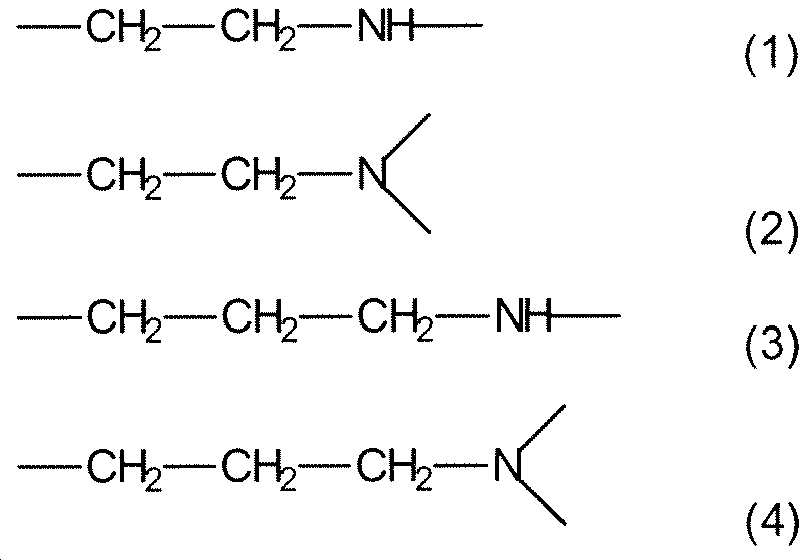
여기서. 반복 단위 (1), (2), (3) 및/또는 (4)의 질소 원자 중 하나 이상은 양성자화되어 중합체의 양전하를 제공할 수 있다.here. One or more of the nitrogen atoms of repeating units (1), (2), (3) and/or (4) can be protonated to provide a positive charge of the polymer.
입자 제형을 제공하기 위한 양이온성 올리고머 또는 중합체로서 특히 바람직한 것은 아미노 그룹이 함유된 복수의 단위를 포함하는 다음 4가지 부류의 올리고머 또는 중합체이다.Particularly preferred as cationic oligomers or polymers for providing particle formulations are the following four classes of oligomers or polymers comprising a plurality of units containing amino groups.
첫번째 바람직한 부류로서, 분지형 폴리(에틸렌 이민)("brPEI")을 포함하는 폴리(에틸렌 이민)("PEI")이 언급된다.As a first preferred class, mention is made of poly(ethylene imine) ("PEI") including branched poly(ethylene imine) ("brPEI").
두번째 바람직한 부류의 양이온성 올리고머 또는 중합체는 그들이 WO 2014/207231(출원인: 에트리스 게엠베하(ethris GmbH))에 개시되어 있는 바와 같이, 측쇄 및/또는 말단 그룹으로서 다음 화학식 II의 복수의 그룹을 포함하는 올리고머 또는 중합체이다:A second preferred class of cationic oligomers or polymers comprise a plurality of groups of formula II as side chains and/or end groups, as they are disclosed in WO 2014/207231 (applicant: ethris GmbH). Is an oligomer or polymer:
[화학식 II][Formula II]

상기 화학식 II에서,In Formula II,
변수 a, b, p, m, n 및 R2 내지 R6은 복수의 이러한 그룹에서 화학식 II의 각 그룹에 대해 독립적으로 다음과 같이 정의된다:The variables a, b, p, m, n and R 2 to R 6 are independently defined for each group of formula II in a plurality of such groups as follows:
a는 1이고 b는 2 내지 4의 정수이거나; a는 2 내지 4의 정수이고 b는 1이고,a is 1 and b is an integer from 2 to 4; a is an integer from 2 to 4 and b is 1,
p는 1 또는 2이고,p is 1 or 2,
m은 1 또는 2이고; n은 0 또는 1이고 m + n은 ≥ 2이고;m is 1 or 2; n is 0 or 1 and m + n is ≧2;
R2 내지 R5는 서로 독립적으로 수소; 그룹 -CH2-CH(OH)-R7, -CH(R7)-CH2-OH, -CH2-CH2-(C=O)-O-R7, -CH2-CH2-(C=O)-NH-R7 또는 -CH2-R7(여기서, R7은 C3-C18 알킬 또는 하나의 C-C 이중 결합을 갖는 C3-C18 알케닐로부터 선택된다); 아미노 그룹을 위한 보호 그룹; 및 폴리(에틸렌 글리콜) 쇄로부터 선택되고;R 2 to R 5 are each independently hydrogen; Group -CH 2 -CH(OH)-R 7 , -CH(R 7 )-CH 2 -OH, -CH 2 -CH 2 -(C=O)-OR 7 , -CH 2 -CH 2 -(C =O)-NH-R 7 or -CH 2 -R 7 (wherein R 7 is selected from C3-C18 alkyl or C3-C18 alkenyl with one CC double bond); Protecting groups for amino groups; And a poly(ethylene glycol) chain;
R6은 수소; 그룹 -CH2-CH(OH)-R7, -CH(R7)-CH-OH, -CH2-CH2-(C=O)-O-R7, -CH2-CH2-(C=O)-NH-R7 또는 -CH2-R7(여기서, R7은 C3-C18 알킬 또는 하나의 C-C 이중 결합을 갖는 C3-C18 알케닐로부터 선택된다); 아미노 그룹을 위한 보호 그룹; -C(NH)-NH2; 폴리(에틸렌 글리콜) 쇄; 및 수용체 리간드로부터 선택되고, R 6 is hydrogen; Group -CH 2 -CH(OH)-R 7 , -CH(R 7 )-CH-OH, -CH 2 -CH 2 -(C=O)-OR 7 , -CH 2 -CH 2 -(C= O)-NH-R 7 or -CH 2 -R 7 (wherein R 7 is selected from C3-C18 alkyl or C3-C18 alkenyl with one CC double bond); Protecting groups for amino groups; -C(NH)-NH 2 ; Poly(ethylene glycol) chain; And a receptor ligand,
여기서, 화학식 II에서 지시된 질소 원자 중 하나 이상은 양성자화되어 화학식 II의 양이온성 그룹을 제공할 수 있다.Here, one or more of the nitrogen atoms indicated in Formula II may be protonated to provide a cationic group of Formula II.
이들 올리고머 또는 중합체, 및 상기 화학식 II에 함유된 변수의 추가의 바람직한 정의와 관련하여, 구체적으로 달리 지시되지 않는 한, WO 2014/207231의 각각의 개시내용은 또한 본원에 기재된 발명에도 적용된다. 또한, 핵산 및 폴리플렉스 형태의 이들 올리고머 및 중합체를 함유하는 조성물의 관점에서, WO 2014/207231에 제공된 정보는 본원에서 지칭된 입자 제형에 적용 가능하다.With respect to these oligomers or polymers, and further preferred definitions of the variables contained in the above formula (II), unless specifically indicated otherwise, each disclosure of WO 2014/207231 also applies to the invention described herein. In addition, in terms of compositions containing these oligomers and polymers in the form of nucleic acids and polyplexes, the information provided in WO 2014/207231 is applicable to the particle formulations referred to herein.
세번째 바람직한 부류의 양이온성 올리고머 또는 중합체는, 그들이 WO 2014/207231(출원인: 에트리스 게엠베하)에 개시되어 있는 바와 같이, 반복 단위로서 다음 화학식 III의 복수의 그룹을 포함하는 올리고머 또는 중합체이다:A third preferred class of cationic oligomers or polymers are oligomers or polymers comprising a plurality of groups of formula III as repeating units, as they are disclosed in WO 2014/207231 (applicant: Etris GmbH):
[화학식 III][Formula III]

상기 화학식 III에서,In Formula III,
변수 a, b, p, m, n 및 R2 내지 R5는 복수의 이러한 그룹에서 화학식 III의 각 그룹에 대해 독립적으로 다음과 같이 정의된다:The variables a, b, p, m, n and R 2 to R 5 are independently defined for each group of formula III in a plurality of such groups as follows:
a는 1이고 b는 2 내지 4의 정수이거나; a는 2 내지 4의 정수이고 b는 1이고,a is 1 and b is an integer from 2 to 4; a is an integer from 2 to 4 and b is 1,
p는 1 또는 2이고,p is 1 or 2,
m은 1 또는 2이고; n은 0 또는 1이고 m + n은 ≥ 2이고;m is 1 or 2; n is 0 or 1 and m + n is ≧2;
R2 내지 R5는 서로 독립적으로 수소; 그룹 -CH2-CH(OH)-R7, -CH(R7)-CH2-OH, -CH2-CH2-(C=O)-O-R7, -CH2-CH2-(C=O)-NH-R7 또는 -CH2-R7(여기서, R7은 C3-C18 알킬 또는 하나의 C-C 이중 결합을 갖는 C3-C18 알케닐로부터 선택된다); 아미노 그룹을 위한 보호 그룹; -C(NH)-NH2; 및 폴리(에틸렌 글리콜) 쇄로부터 선택되고;R 2 to R 5 are each independently hydrogen; Group -CH 2 -CH(OH)-R 7 , -CH(R 7 )-CH 2 -OH, -CH 2 -CH 2 -(C=O)-OR 7 , -CH 2 -CH 2 -(C =O)-NH-R 7 or -CH 2 -R 7 (wherein R 7 is selected from C3-C18 alkyl or C3-C18 alkenyl with one CC double bond); Protecting groups for amino groups; -C(NH)-NH 2 ; And a poly(ethylene glycol) chain;
여기서, 화학식 III에서 지시된 질소 원자 중 하나 이상은 양성자화되어 화학식 III의 양이온성 그룹을 제공할 수 있다.Here, one or more of the nitrogen atoms indicated in Formula III may be protonated to provide a cationic group of Formula III.
이들 올리고머 또는 중합체, 및 상기 화학식 III에 함유된 변수의 추가의 바람직한 정의와 관련하여, 구체적으로 달리 지시되지 않는 한, WO 2014/207231의 각각의 개시내용은 또한 본원에 기재된 발명에도 적용된다. 또한, 핵산 및 폴리플렉스 형태의 이들 올리고머 및 중합체를 함유하는 조성물의 관점에서, WO 2014/207231에 제공된 정보는 본원에서 지칭된 입자 제형에 적용 가능하다.With respect to these oligomers or polymers, and further preferred definitions of the variables contained in the above formula (III), unless specifically indicated otherwise, each disclosure of WO 2014/207231 also applies to the invention described herein. In addition, in terms of compositions containing these oligomers and polymers in the form of nucleic acids and polyplexes, the information provided in WO 2014/207231 is applicable to the particle formulations referred to herein.
네 번째 바람직한 부류의 양이온성 올리고머 또는 중합체는 WO 2016/097377(출원인: 에트리스 게엠베하)에 개시된 바와 같이 통계적 공중합체에 의해 제공된다. 그것은 다음 화학식 (a1) 및 (a2)의 반복 단위로부터 독립적으로 선택된 복수의 반복 단위 (a):A fourth preferred class of cationic oligomers or polymers is provided by statistical copolymers as disclosed in WO 2016/097377 (applicant: Etris GmbH). It is a plurality of repeating units (a) independently selected from repeating units of the following formulas (a1) and (a2):
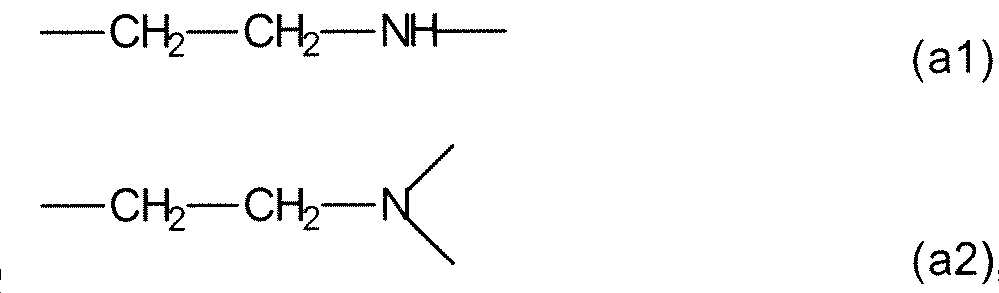
및 하기 화학식 (b1) 내지 (b4)의 반복 단위로부터 독립적으로 선택된 복수의 반복 단위 (b)를 포함하고:And a plurality of repeating units (b) independently selected from repeating units of the following formulas (b1) to (b4):
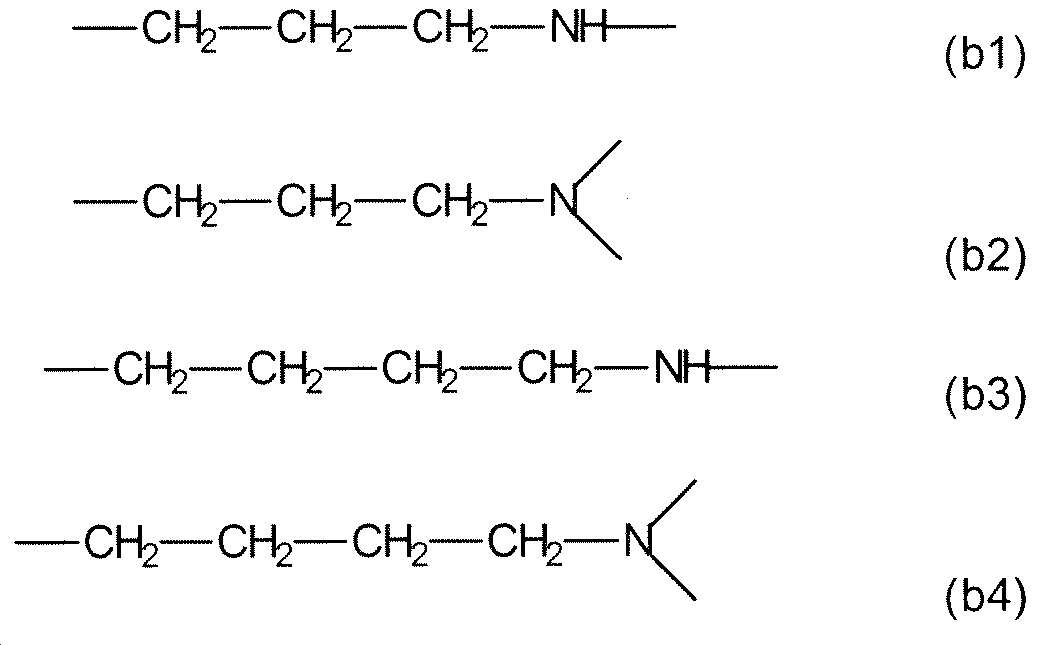
반복 단위 (a)의 합 대 반복 단위 (b)의 합의 몰 비는 0.7/1.0 내지 1.0/0.7의 범위 내에 있고, 공중합체에 함유된 반복 단위 (a) 및/또는 (b)의 질소 원자 중 하나 이상은 양성자화되어 양이온성 공중합체를 제공할 수 있다.The molar ratio of the sum of the repeating units (a) to the sum of the repeating units (b) is in the range of 0.7/1.0 to 1.0/0.7, and among the nitrogen atoms of the repeating units (a) and/or (b) contained in the copolymer One or more can be protonated to provide a cationic copolymer.
이 공중합체의 추가의 바람직한 정의와 관련하여, 구체적으로 달리 지시되지 않는 한, WO 2016/097377의 각각의 개시내용이 또한 본원에 기재된 발명에 적용된다. 본원에서 주시된 바와 같이, 특히 바람직한 공중합체는 반복 단위 (a1) 및 (b1)을 포함하거나, 반복 단위 (a1) 및 (b1)로 구성되는 선형 공중합체이다. 또한, 핵산 및 이들 올리고머 및 중합체를 폴리플렉스 형태로 함유하는 조성물의 관점에서, WO 2016/097377에 제공된 정보는 본원에서 지칭된 입자 제형에 적용 가능하다.With respect to further preferred definitions of this copolymer, each disclosure of WO 2016/097377 also applies to the invention described herein, unless specifically indicated otherwise. As noted herein, particularly preferred copolymers are linear copolymers comprising repeating units (a1) and (b1), or consisting of repeating units (a1) and (b1). In addition, in terms of compositions containing nucleic acids and these oligomers and polymers in polyplex form, the information provided in WO 2016/097377 is applicable to the particle formulation referred to herein.
또 다른 바람직한 구현예에서, 본 발명의 맥락에서 지칭되는 바와 같은 나노 입자 또는 미세입자 제형은 핵산 및 양이온성 부형제로서 양이온성 지질 또는 양이온성 리피도이드(lipidoid)에 의해 형성된 복합체 형태로 치료적 활성제로서 핵산, 바람직하게는 RNA, 더욱 바람직하게는 단일 가닥 RNA, 가장 바람직하게는 mRNA를 포함하는 입자 제형이다. 달리 정의되지 않는 한, 이러한 복합체는 특히 핵산과 양이온성 지질 또는 양이온성 리피도이드의 복합체를 포함하는 리포플렉스, 리포좀 및 지질 나노 입자("LNP")를 포함한다.In another preferred embodiment, the nanoparticle or microparticle formulation as referred to in the context of the present invention is a therapeutically active agent in the form of a complex formed by a cationic lipid or a cationic lipidoid as a nucleic acid and a cationic excipient. As a nucleic acid, preferably RNA, more preferably single-stranded RNA, most preferably mRNA. Unless otherwise defined, such complexes include lipoplexes, liposomes and lipid nanoparticles (“LNPs”), particularly comprising complexes of nucleic acids and cationic lipids or cationic lipidoids.
본 발명의 맥락에서 핵산과의 복합체 형성용으로 또한 사용될 수 있는 적합한 양이온성 지질 또는 양이온성 지질 및 리피도이드는 당업계에 공지되어 있으며, 예를 들어, 문헌[참조: A.C. Silva et al., Current Drug Metabolism, 16, 2015, 3-16 및 그 안에 언급된 문헌, US 2017/0267631, WO 2016/081029, WO 2011/071860, WO 2016/118697, US 8450298 B2, WO 2014/207231 및 E.R. Lee et al., Human Gene Therapy 7:1701-1717, September 10, 1996]에 논의되어 있다. 용어 "리피도이드"는 지질 구조는 갖지 않지만 지질의 특성을 나타내는 물질을 확립한다.Suitable cationic lipids or cationic lipids and lipidoids which can also be used for complexing with nucleic acids in the context of the present invention are known in the art and are described, for example, in A.C. Silva et al., Current Drug Metabolism, 16, 2015, 3-16 and documents cited therein, US 2017/0267631, WO 2016/081029, WO 2011/071860, WO 2016/118697, US 8450298 B2, WO 2014/ 207231 and ER Lee et al., Human Gene Therapy 7:1701-1717, September 10, 1996. The term “lipidoid” establishes a substance that does not have a lipid structure but exhibits the properties of a lipid.
양이온성 리피도이드와의 복합체 형태로, 예를 들어, 리포플렉스, 리포좀 또는 LNP로서 치료적 활성제로서 핵산, 바람직하게는 RNA, 더욱 바람직하게는 단일 가닥 RNA, 가장 바람직하게는 mRNA를 함유하는 입자 제형에 사용하기 위한 바람직한 부류의 리피도이드는 WO 2014/207231(출원인: 에트리스 게엠베하)에 개시된 바와 같이 다음 화학식 IV의 구조를 갖는 리피도이드이다:Particles containing nucleic acids, preferably RNA, more preferably single-stranded RNA, most preferably mRNA, as therapeutically active agents in the form of complexes with cationic lipidoids, for example as lipoplexes, liposomes or LNPs. A preferred class of lipidoids for use in the formulation are lipidoids having the structure of formula IV as disclosed in WO 2014/207231 (applicant: Etris GmbH):
[화학식 IV] [Formula IV]

상기 화학식 IV에서,In Formula IV,
변수 a, b, p, m, n 및 R1 내지 R6은 다음과 같이 정의된다:The variables a, b, p, m, n and R 1 to R 6 are defined as follows:
a는 1이고 b는 2 내지 4의 정수이거나; a는 2 내지 4의 정수이고 b는 1이고,a is 1 and b is an integer from 2 to 4; a is an integer from 2 to 4 and b is 1,
p는 1 또는 2이고,p is 1 or 2,
m은 1 또는 2이고; n은 0 또는 1이고 m + n은 ≥ 2이고;m is 1 or 2; n is 0 or 1 and m + n is ≧2;
R1 내지 R6은 서로 독립적으로 수소; 그룹 -CH2-CH(OH)-R7, -CH(R7)-CH2-OH, -CH2-CH2-(C=O)-O-R7, -CH2-CH2-(C=O)-NH-R7 또는 -CH2-R7(여기서, R7은 C3-C18 알킬 또는 하나의 C-C 이중 결합을 갖는 C3-C18 알케닐로부터 선택된다); 아미노 그룹을 위한 보호 그룹; -C(NH)-NH2; 폴리(에틸렌 글리콜) 쇄; 및 수용체 리간드로부터 선택되고; 단 R1 내지 R6 중 적어도 두 개의 잔기는 그룹 -CH2-CH(OH)-R7, -CH(R7)-CH2-OH, -CH2-CH2-(C=O)-O-R7, -CH2-CH2-(C=O)-NH-R7 또는 -CH2-R7(여기서, R7은 C3-C18 알킬 또는 하나의 C-C 이중 결합을 갖는 C3-C18 알케닐로부터 선택된다)이고; R 1 to R 6 are each independently hydrogen; Group -CH 2 -CH(OH)-R 7 , -CH(R 7 )-CH 2 -OH, -CH 2 -CH 2 -(C=O)-OR 7 , -CH 2 -CH 2 -(C =O)-NH-R 7 or -CH 2 -R 7 (wherein R 7 is selected from C3-C18 alkyl or C3-C18 alkenyl with one CC double bond); Protecting groups for amino groups; -C(NH)-NH 2 ; Poly(ethylene glycol) chain; And a receptor ligand; However, at least two residues of R 1 to R 6 are groups -CH 2 -CH(OH)-R 7 , -CH(R 7 )-CH 2 -OH, -CH 2 -CH 2 -(C=O)- OR 7 , -CH 2 -CH 2 -(C=O)-NH-R 7 or -CH 2 -R 7 (wherein R 7 is C3-C18 alkyl or C3-C18 alkenyl having one CC double bond Is selected from);
여기서, 화학식 IV에서 지시된 질소 원자 중 하나 이상은 양성자화되어 화학식 IV의 양이온성 리피도이드를 제공할 수 있다.Here, one or more of the nitrogen atoms indicated in Formula IV may be protonated to provide a cationic lipidoid of Formula IV.
이들 리피도이드, 및 상기 화학식 IV에 함유된 변수의 추가의 바람직한 정의와 관련하여, 구체적으로 달리 지시되지 않는 한, WO 2014/207231의 각각의 개시내용이 또한 본원에 기재된 발명에 적용된다. 또한, 핵산 및 이들 리피도이드를 복합체 형태, 예를 들어, 리포플렉스, 리포좀 또는 LNP 형태로 함유하는 조성물의 관점에서, WO 2014/207231에 제공된 정보는 본원에서 지칭된 입자 제형에 적용 가능하다.With respect to the further preferred definitions of these lipidoids, and of the variables contained in the above formula (IV), the disclosure of each of WO 2014/207231 also applies to the invention described herein, unless specifically indicated otherwise. In addition, in terms of compositions containing nucleic acids and these lipidoids in complex form, e.g., in the form of lipoplexes, liposomes or LNPs, the information provided in WO 2014/207231 is applicable to the particle formulations referred to herein.
본원에서 지칭되는 바와 같은 입자 제형에 함유될 수 있는 양이온성 지질과 핵산의 복합체를 제공하기 위한 또 다른 바람직한 유형의 지질은 양이온성 지질 젠 자임 지질 67(GL67)이다. 이 양이온 유도체화된 지질은 핵산, 바람직하게는 RNA,보다 바람직하게는 단일 가닥 RNA, 가장 바람직하게는 mRNA의 복합체화에 매우 유용하다.Another preferred type of lipid for providing a complex of a nucleic acid with a cationic lipid that may be contained in a particle formulation as referred to herein is a cationic lipid genzyme lipid 67 (GL67). These cationic derivatized lipids are very useful for complexing nucleic acids, preferably RNA, more preferably single-stranded RNA, and most preferably mRNA.
아미노 그룹을 함유하는 양이온성 지질 또는 양이온성 리피도이드, 예를 들어, 화학식 IV의 리피도이드로 형성된 핵산의 복합체를 포함하는 입자 제형의 경우, 리포플렉스의 N/P 비율은 바람직하게는 1 내지 100, 더욱 바람직하게는 2 내지 80이고, 가장 바람직한 것은 3 내지 60의 N/P 비율이다.In the case of a particle formulation comprising a complex of a cationic lipid containing an amino group or a complex of a cationic lipidoid, e.g., a nucleic acid formed with a lipidoid of formula IV, the N/P ratio of the lipoplex is preferably from 1 to 100, more preferably 2 to 80, most preferably 3 to 60 N/P ratio.
리포플렉스, LNP 또는 리포좀과 같은 양이온성 지질 또는 양이온성 리피도이드와 핵산의 복합체 형태로 치료적 활성제를 포함하는 입자 제형에 함유될 수 있는 임의의 성분으로서, 헬퍼 지질이 언급될 수 있다. 그들은 하나 이상의 스테로이드(예: 콜레스테롤 또는 덱사메타손), 중성 지질(예: DMPE, DOPE, DSPE, DPPE, DMPC, DOPC, DSPC, 또는 DPPC), 스핑고지질 및 페길화 지질(예: DMG-PEG, DMPE-PEG 또는 세라미아드-PEG)로부터 선택될 수 있다. 이러한 헬퍼 지질은 단독으로 또는 이의 둘 이상의 유형의 조합으로 사용될 수 있다. 양이온성 지질 또는 리피도이드를 포함하는 치료적 활성제의 미립자 제형용 부형제로서 또한 유용한 것은 폴리에틸렌 글리콜(PEG) 및 알킬렌 단위의 공중합체이다.As any component that may be contained in a particle formulation comprising a therapeutically active agent in the form of a cationic lipid such as a lipoplex, LNP or a liposome or a complex of a cationic lipidoid and a nucleic acid, a helper lipid may be mentioned. They include one or more steroids (e.g. cholesterol or dexamethasone), neutral lipids (e.g. DMPE, DOPE, DSPE, DPPE, DMPC, DOPC, DSPC, or DPPC), sphingolipids and pegylated lipids (e.g. DMG-PEG, DMPE). -PEG or ceramiad-PEG). These helper lipids can be used alone or in combination of two or more types thereof. Also useful as excipients for particulate formulations of therapeutically active agents comprising cationic lipids or lipidoids are copolymers of polyethylene glycol (PEG) and alkylene units.
이러한 복합체의 형성에 적합한 추가의 성분은 문헌[참조: A.C. Silva et al., Current Drug Metabolism, 16, 2015, 3-16 및 그 안에서 논의된 문헌]에 언급되어 있다.Additional components suitable for the formation of such complexes are described in A.C. Silva et al., Current Drug Metabolism, 16, 2015, 3-16 and the literature discussed therein.
바람직하게는, 양이온성 지질 또는 양이온성 리피도이드와 핵산의 복합체를 포함하는 입자 제형은 지질 및 리피도이드(존재하는 임의의 헬퍼 지질 포함)의 총 중량 대 핵산의 중량의 비뷸이 0.1 내지 200, 더욱 바람직하게는 0.2 내지 150, 가장 바람직하게는 0.5 내지 100의 범위이도록 하는 양으로 핵산을 함유한다.Preferably, a particle formulation comprising a cationic lipid or a complex of a cationic lipidoid and a nucleic acid has a ratio of 0.1 to 200 of the total weight of the lipid and lipidoid (including any helper lipids present) to the weight of the nucleic acid. , More preferably 0.2 to 150, most preferably 0.5 to 100.
상기 논의를 고려하여, 본 발명의 맥락에서 사용하기 위한 나노 입자 또는 미세입자 제형이 또한 바람직하며, 여기서 치료적 활성제는 mRNA이며, mRNA는 양이온성 중합체 또는 올리고머와의 복합체 형태로 또는 양이온성 지질 또는 양이온성 리피도이드와의 복합체 형태로 포함된다는 것이 자명할 것이다. 양이온성 부형제의 적합하고 바람직한 유형과 관련하여, 상기 고려 사항이 계속 적용된다. 또한, 이들 바람직한 입자 제형의 경우, 입자 제형 중의 입자는 전형적으로 1 내지 4000nm, 더욱 바람직하게는 2 내지 2500nm, 가장 바람직하게는 5 내지 1000nm 범위의 평균 입자 직경을 나타낸다. 나노 입자 또는 미세입자 제형 중 입자 직경의 상한치는 바람직하게는 20㎛, 더욱 바람직하게는 10㎛, 가장 바람직하게는 5㎛이다.In view of the above discussion, nanoparticles or microparticle formulations for use in the context of the present invention are also preferred, wherein the therapeutically active agent is mRNA and the mRNA is in the form of a complex with a cationic polymer or oligomer or in the form of a cationic lipid or It will be apparent that it is included in the form of a complex with cationic lipidoids. With regard to suitable and preferred types of cationic excipients, the above considerations continue to apply. In addition, for these preferred particle formulations, the particles in the particle formulation typically exhibit an average particle diameter in the range of 1 to 4000 nm, more preferably 2 to 2500 nm, most preferably 5 to 1000 nm. The upper limit of the particle diameter in the nanoparticle or microparticle formulation is preferably 20 µm, more preferably 10 µm, and most preferably 5 µm.
치료적 활성제 이외에, 입자 제형은 임의의 첨가제로서 또는 임의의 첨가제들로서 치료제의 전달 동안, 바람직하게는 치료제로서의 핵산의 세포로의 전달 동안 이펙터 기능을 발휘하는 하나 이상의 성분을 포함할 수 있다. 이러한 성분은 폴리음이온, 상술한 바와 같은 지질, 양이온성 펩티드와 같은 폴리플렉스의 형성을 위한 상기 논의된 것들 이외의 추가의 폴리양이온, 차폐성 올리고머 또는 중합체, 폴록사머(플루로닉으로서 공지되기도 함), 폴록사민, 표적화 리간드, 엔도좀 용해제, 세포 침투 및 신호 펩티드, 자기 및 비자성 나노 입자, RNAse 억제제, 형광 염료, 방사성 동위 원소 또는 의료 영상용 조영제일 수 있지만, 이에 제한되지 않는다. 용어 "이펙터 기능"은 생물학적 표적에서 또는 중에서 또는 생물학적 표적 주위에서 조성물의 치료적 활성제의 의도된 생물학적 효과를 달성하는 것을 지지하는 임의의 기능을 포함한다. 예를 들어, 핵산 전달용 조성물은 스터퍼 물질로서 비코딩 핵산 또는 비-핵산 폴리음이온을 포함하도록 제형화되었다(참조: Kichler et al. 2005, J Gene Med, 7, 1459-1467). 이러한 스터퍼 물질은 의도된 생물학적 효과를 갖는 핵산의 용량을 감소시키면서 이러한 스터퍼 물질의 부재하에 더 높은 핵산 용량에서 수득되는 효과의 정도 또는 정도를 유지하는데 적합하다. 비핵산 폴리음이온은 또한 감소된 독성에서 연장된 생체내 유전자 발현을 수득하는데 사용되었다(참조: Uchida et al. 2011, J Control Release, 155, 296-302). 핵산과 양이온성 중합체 또는 올리고머의 복합체를 포함하는 본 발명의 입자 제형은 또한 리포폴리플렉스의 경우와 같이 양이온성, 음이온성 또는 중성 지질을 포함할 수 있다(참조: Li and Huang in "Nonviral Vectors for Gene Therapy", Academic Press 1999, Chapter 13, 295-303). 리포폴리플렉스는 상기 제시된 바와 같은 화학식 IV에 상응하는 리피도이드를 사용하여 상기 제시된 바와 같은 화학식 II 또는 III에 상응하는 중합체로부터 유리하게 제조될 수 있다. 또한, 본 발명에 사용된 입자 제형은 폴리플렉스의 형성을 위해 상기 논의된 것들 이외의 올리고- 또는 폴리양이온을 포함할 수 있다. 이러한 추가의 폴리양이온은 핵산의 목적하는 압축 정도를 달성하는데 유용할 수 있거나, 폴리양이온성 펩티드의 경우, 이전에 기재된 바와 같은 핵 국소화 신호 기능을 가질 수 있다(참조: Ritter et al. 2003, J Mol Med, 81, 708-717). 차폐성 중합체, 예를 들어, 폴리(에틸렌 글리콜)(PEG)이 또한 본 발명의 맥락에서 사용된 입자 제형에 포함될 수 있고, 빈번하게 사용되어, 예를 들어, 핵산과 양이온성 부형제의 착물을 응집 및/또는 생물학적 환경에서 목적하지 않은 상호작용(옵소닌화), 예를 들어, 혈청 성분, 혈액 세포 또는 세포외 매트릭스와의 상호작용으로부터 안정화시킨다. 차폐는 또한 핵산-포함 조성물의 독성을 감소시키는 데 적합할 수 있다(참조: Finsinger et al. 2000, Gene Ther, 7, 1183-1192). 예를 들어, PEG와 같은 차폐 중합체는 다른 올리고머 또는 중합체, 또는 입자 제형에 존재할 수 있는 지질 또는 리피도이드에 직접 공유 결합될 수 있다. 커플링은 중합체 백본에서, 바람직하게는 가능하다면 중합체 백본 또는 덴드리머의 말단에서 달성될 수 있다. 그러나, 커플링은 또한 화학식 (1) 내지 (4), II, III, IV 또는 상기한 (a1), (a2) 또는 (b1) 내지 (b4) 중 어느 하나에 함유된 아미노 그룹에서 달성될 수 있다.In addition to the therapeutically active agent, the particulate formulation may contain one or more components that exert an effector function during delivery of the therapeutic agent as an optional additive or as optional additives, preferably during the delivery of the nucleic acid as a therapeutic agent to cells. These components are polyanions, lipids as described above, additional polycations other than those discussed above for the formation of polyplexes such as cationic peptides, masking oligomers or polymers, poloxamers (also known as Pluronics). , Poloxamine, targeting ligand, endosome lysing agent, cell penetrating and signaling peptide, magnetic and nonmagnetic nanoparticles, RNAse inhibitors, fluorescent dyes, radioactive isotopes, or contrast media for medical imaging, but is not limited thereto. The term “effector function” includes any function that supports achieving the intended biological effect of a therapeutically active agent of a composition at or in or around a biological target. For example, a nucleic acid delivery composition has been formulated to contain a non-coding nucleic acid or a non-nucleic acid polyanion as a stuffer material (Kichler et al. 2005, J Gene Med, 7, 1459-1467). Such stuffer materials are suitable for maintaining the degree or degree of effect obtained at higher nucleic acid doses in the absence of such stuffer materials while reducing the dose of nucleic acids having the intended biological effect. Non-nucleic acid polyanions have also been used to obtain prolonged gene expression in vivo at reduced toxicity (Uchida et al. 2011, J Control Release, 155, 296-302). Particle formulations of the invention comprising complexes of nucleic acids and cationic polymers or oligomers may also contain cationic, anionic or neutral lipids, as in the case of lipopolyplexes (see Li and Huang in "Nonviral Vectors for Gene Therapy", Academic Press 1999, Chapter 13, 295-303). Lipopolyplexes can advantageously be prepared from polymers corresponding to formulas II or III as set out above using lipidoids corresponding to formula IV as set out above. In addition, the particle formulations used in the present invention may contain oligo- or polycations other than those discussed above for the formation of polyplexes. Such additional polycations may be useful to achieve the desired degree of compression of the nucleic acid, or, in the case of polycationic peptides, may have a nuclear localization signaling function as previously described (Ritter et al. 2003, J. Mol Med, 81, 708-717). Masking polymers, such as poly(ethylene glycol) (PEG), can also be included in the particle formulations used in the context of the present invention, and are frequently used, e.g., to aggregate and to aggregate complexes of nucleic acids and cationic excipients. / Or from undesired interactions (opsonization) in the biological environment, for example, with serum components, blood cells or extracellular matrix. Masking may also be suitable for reducing the toxicity of nucleic acid-comprising compositions (Finsinger et al. 2000, Gene Ther, 7, 1183-1192). For example, masking polymers such as PEG can be covalently linked directly to other oligomers or polymers, or lipids or lipidoids that may be present in the particle formulation. Coupling can be achieved in the polymer backbone, preferably at the ends of the polymer backbone or dendrimer if possible. However, coupling can also be achieved at the amino groups contained in formulas (1) to (4), II, III, IV or any of the above-described (a1), (a2) or (b1) to (b4). have.
핵산과 양이온성 부형제의 복합체를 포함하는 입자 제형에 유용한 성분일 수 있는 문헌에 기재된 다른 예시적인 차폐 중합체는 하이드록시 에틸 전분(HES; Noga et al. Journal of Controlled Release, 2012. 159(1): 92-103), PAS-폴리펩티드(Pro, Ala, Ser 폴리펩티드: Schlapschy et a. Protein Eng Des Sel. 2013 Aug;26(8): 489-501) 또는 폴리사르코신(Psar,: Heller et al. Macromol Biosci 2014); 14: 1380-1395)을 포함한다.Other exemplary masking polymers described in the literature that may be useful components in particle formulations comprising complexes of nucleic acids and cationic excipients are hydroxy ethyl starch (HES; Noga et al. Journal of Controlled Release, 2012. 159(1): 92-103), PAS-polypeptide (Pro, Ala, Ser polypeptide: Schlapschy et a. Protein Eng Des Sel. 2013 Aug; 26(8): 489-501) or polysarcosine (Psar,: Heller et al. Macromol) Biosci 2014); 14: 1380-1395).
표적화 리간드가, 예를 들어, 표적 세포의 우선적이고 개선된 형질 감염을 위한 핵산 전달용 입자 제형에 유용할 수 있다(참조: Philipp and Wagner in "Gene and Cell Therapy - Therapeutic Mechanisms and Strategy", 3rd Edition, Chapter 15. CRC Press, Taylor & Francis Group LLC, Boca Raton 2009). 표적화 리간드는 본 발명의 조성물에 직접적 또는 간접적인 방식으로 표적 인식 및/또는 표적 결합 기능을 부여하는 임의의 화합물일 수 있다. 예시적인 표적화 리간드는 WO 2011/076391에 개시된 프로스타사이클린 유사체, 예를 들어, 일로프로스트 또는 트레프로스티닐이다. 항체는 또한 표적화 리간드로서 작용할 수 있다. 나노 입자 또는 미세입자용 리간드로서, 엽산 및 N-아세틸 갈락토사민이 언급될 수 있다. 가장 일반적인 용어로, 표적은 표적화 리간드가 분자 상호작용을 통해 특이적으로 결합할 수 있고, 이러한 결합이 표적 조직 중에서 및/또는 표적 세포에서 또는 표적 세포 중에서 조성물에 포함된 치료제, 예를 들어, 핵산의 우선적 축적을 궁극적으로 유도하는 뚜렷한 생물학적 구조이다. PEG (또는 HES 및 PSar) 쇄와 유사하게, 표적화 리간드는, 예를 들어, 중합체 백본 또는 덴드리머의 말단에 커플링될 수 있다. 그러나, 커플링은 또한 화학식 (1) 내지 (4), II, III, IV 또는 상기한 (a1), (a2) 또는 (b1) 내지 (b4) 중 어느 하나의 그룹에서 달성될 수 있다.Targeting ligands may be useful, for example, in particle formulations for nucleic acid delivery for preferential and improved transfection of target cells (see Philipp and Wagner in "Gene and Cell Therapy-Therapeutic Mechanisms and Strategy", 3rd Edition. , Chapter 15. CRC Press, Taylor & Francis Group LLC, Boca Raton 2009). The targeting ligand can be any compound that confers target recognition and/or target binding functions in a direct or indirect manner to the compositions of the present invention. Exemplary targeting ligands are prostacycline analogs disclosed in WO 2011/076391, such as iloprost or treprostinil. Antibodies can also act as targeting ligands. As ligands for nanoparticles or microparticles, folic acid and N-acetyl galactosamine may be mentioned. In the most general term, the target is capable of specifically binding a targeting ligand through molecular interactions, and such binding is included in the composition in the target tissue and/or in the target cell or in the target cell, e.g., a nucleic acid. It is a distinct biological structure that ultimately leads to the preferential accumulation of. Similar to PEG (or HES and PSar) chains, targeting ligands can be coupled to the ends of, for example, polymeric backbones or dendrimers. However, coupling can also be achieved in the formulas (1) to (4), II, III, IV or in any one of the groups (a1), (a2) or (b1) to (b4) described above.
또한, 엔도좀 분해제, 예를 들어, 엔도좀 분해 펩티드(참조: Plank et al. 1998, Adv Drug Deliv Rev, 34, 21-35) 또는 세포내 이입 핵산의 엔도좀 방출을 향상시키는 데 적합한 임의의 다른 화합물은 본 발명의 조성물의 유용한 성분이다. 유사하게, 세포 침투 펩티드(다른 맥락에서, 단백질 형질 도입 도메인으로서 공지되기도 함)(참조: Lindgren et al. 2000, Trends Pharmacol Sci, 21, 99-103)는 핵산의 세포내 전달을 매개하기 위해 본 발명의 조성물의 유용한 성분일 수 있다. 소위 TAT 펩티드는 이 부류에 속하며, 핵 국소화 기능을 또한 갖는다(참조: Rudolph et al. 2003, J Biol Chem, 278, 11411-11418).In addition, endosomes degrading agents, e.g., endosomes degrading peptides (Plank et al. 1998, Adv Drug Deliv Rev, 34, 21-35) or any suitable for enhancing endosomes release of endocytic nucleic acids. Other compounds of the present invention are useful components of the composition of the present invention. Similarly, cell penetrating peptides (in other contexts, also known as protein transduction domains) (Lindgren et al. 2000, Trends Pharmacol Sci, 21, 99-103) are used to mediate intracellular delivery of nucleic acids. It can be a useful component of the composition of the invention. So-called TAT peptides belong to this class and also have nuclear localization functions (Rudolph et al. 2003, J Biol Chem, 278, 11411-11418).
동결 방지 첨가제Anti-freeze additives
나노 입자 또는 미세입자 제형 이외의 추가 성분으로서, 본 발명에 따르는 조성물은 1개 또는 2개의 하이드록시 그룹으로 치환된 C3-C5 알칸으로부터 선택된 동결 방지 첨가제를 포함한다. 숙련된 독자에 의해 이해되는 바와 같이, 이러한 치환된 알칸은 선형 또는 분지형 알칸일 수 있다. 그들은 3 내지 5개의 탄소 원자를 갖는다. 하이드록시 치환체의 수에 따라, 그들은 모노- 또는 디알콜로서, 또는 알칸올 또는 알칸디올로서 지칭될 수 있다.As a further component other than the nanoparticle or microparticle formulation, the composition according to the invention comprises an antifreeze additive selected from C3-C5 alkanes substituted with one or two hydroxy groups. As will be appreciated by the skilled reader, such substituted alkanes may be linear or branched alkanes. They have 3 to 5 carbon atoms. Depending on the number of hydroxy substituents, they may be referred to as mono- or dialcohols, or as alkanols or alkanedols.
바람직하게는, 동결 방지 첨가제는 적어도 하나의 2차 하이드록시 그룹(예: 추가의 하이드록시 그룹 없는 하나의 2차 하이드록시 그룹, 또는 하나의 2차 하이드록시 그룹 및 하나의 1차 하이드록시 그룹, 또는 2개의 2차 하이드록시 그룹)을 포함한다.Preferably, the antifreeze additive comprises at least one secondary hydroxy group (e.g., one secondary hydroxy group without additional hydroxy groups, or one secondary hydroxy group and one primary hydroxy group, Or two secondary hydroxy groups).
보다 바람직하게는, 동결 방지 첨가제는 1,2-프로판디올, 2-프로판올, 1,2-부탄디올 및 1,3-부탄디올로부터 선택된다. 가장 바람직하게는, 동결 방지 첨가제는 1,2-프로판디올이다.More preferably, the antifreeze additive is selected from 1,2-propanediol, 2-propanol, 1,2-butanediol and 1,3-butanediol. Most preferably, the anti-freeze additive is 1,2-propanediol.
조성물Composition
상기 주시된 바와 같이, 본 발명은 제1 측면으로서 현탁액 조성물 및 제2 측면으로서 고체 조성물을 제공하며, 이들 각각은 치료적 활성제의 나노 입자 또는 미세입자 제형 및 상기 추가로 상세히 논의된 동결 방지 첨가제를 포함한다.As noted above, the present invention provides a suspension composition as a first aspect and a solid composition as a second aspect, each of which comprises a nanoparticle or microparticle formulation of a therapeutically active agent and an antifreeze additive discussed in further detail above. Includes.
본 발명에 따르는 조성물이 치료적 활성제를 함유하고 환자에게 치료적 활성제를 투여하기에 적합하기 때문에, 그들은 치료적 조성물 또는 약제학적 조성물로 지칭될 수 있다.Since the compositions according to the invention contain a therapeutically active agent and are suitable for administering a therapeutically active agent to a patient, they can be referred to as therapeutic compositions or pharmaceutical compositions.
특히, 본 발명의 제1 측면에 따르는 현탁액 조성물은 다음을 포함한다:In particular, the suspension composition according to the first aspect of the invention comprises:
(i) 액체 상에 현탁된 치료적 활성제의 나노 입자 또는 미세입자 제형, 및(i) a nanoparticle or microparticle formulation of a therapeutically active agent suspended in a liquid phase, and
(ii) 1개 또는 2개의 하이드록시 그룹으로 치환된 C3-C5 알칸으로부터 선택된 적어도 하나의 동결 방지 첨가제.(ii) At least one anti-freeze additive selected from C3-C5 alkanes substituted with one or two hydroxy groups.
이해되는 바와 같이, 치료제, 이의 입자 제형 및 동결 방지 첨가제의 적합하고 바람직한 구현예에 관한 정보는 이 맥락에서 계속 적용된다.As will be appreciated, information regarding suitable and preferred embodiments of the therapeutic agent, its particle formulation and anti-freeze additive continues to apply in this context.
현탁액 조성물은 바람직하게는 조성물의 총 용적을 기준으로 하여 입자 제형에 0.01 내지 50㎎/ml, 보다 바람직하게는 0.02 내지 30mg/ml의 농도로 함유되는 치료적 활성제를 제공하는 양으로 입자 제형의 입자를 포함한다.The suspension composition is preferably contained in the particle formulation at a concentration of 0.01 to 50 mg/ml, more preferably 0.02 to 30 mg/ml, based on the total volume of the composition, in an amount to provide a therapeutically active agent in the particle formulation. Includes.
동결 방지 첨가제는 바람직하게는 0.5 내지 50% w/v, 보다 바람직하게는 1 내지 40% w/v, 가장 바람직하게는 1 내지 30% w/v의 농도로 현탁액 조성물에 함유되며, 여기서 백분율 값은 동결 방지 첨가제의 중량을 조성물의 총 용적의 100ml당 g 단위로 나타낸다. 전형적으로, 동결 방지 첨가제는 액체 상에 함유되고, 바람직하게는 용해되며, 여기서 입자 제형은 현탁된다. 그러나, 그것은 또한 액체 상에 현탁된 입자와 부분적으로 연관될 수 있다.The antifreeze additive is preferably contained in the suspension composition in a concentration of 0.5 to 50% w/v, more preferably 1 to 40% w/v, most preferably 1 to 30% w/v, wherein the percentage value Represents the weight of the antifreeze additive in grams per 100 ml of the total volume of the composition. Typically, the antifreeze additive is contained in the liquid phase, preferably dissolved, wherein the particulate formulation is suspended. However, it can also be partially associated with particles suspended in the liquid phase.
본 발명의 제1 측면에 따르는 현탁액 조성물의 액체 상은 전형적으로 용매 로서 물을 함유한다. 바람직하게는, 50용적% 이상, 보다 바람직하게는 70용적% 이상(20℃에서 액체 상의 총 용적을 기준으로 하여)이 물에 의해 제공된다. 보다 바람직하게는, 물 및 동결 방지 첨가제가 액체 상에 함유된 유일한 용매이다.The liquid phase of the suspension composition according to the first aspect of the invention typically contains water as a solvent. Preferably, at least 50% by volume, more preferably at least 70% by volume (based on the total volume of the liquid phase at 20°C) is provided by water. More preferably, water and antifreeze additives are the only solvents contained in the liquid phase.
액체 상의 예시적인 추가의 임의의 첨가제로서, 염, 당, 유기 용매 및 완충제로부터 선택된 하나 이상이 언급될 수 있다.As exemplary additional optional additives in the liquid phase, mention may be made of one or more selected from salts, sugars, organic solvents and buffers.
용어 "현탁된"에 의해 암시된 바와 같이, 치료적 활성제의 나노 입자 또는 미세입자 제형은 연속 액체 상에서 불연속 고체 상을 형성한다.As implied by the term “suspended”, nanoparticles or microparticle formulations of a therapeutically active agent form a discontinuous solid phase in a continuous liquid phase.
일반적으로, 현탁액 조성물은 동결 방지 첨가제를 임의로 그 안에 용해된 추가의 첨가제와 함께 포함하는 하나의 연속 액체 상, 및 그 안에 불연속 고체 상으로서 현탁된 치료적 활성제의 나노 입자 또는 미세입자 제형을 갖는 2상 현탁액 조성물로서 제공되는 것이 바람직하다.In general, the suspension composition is two with a nanoparticle or microparticle formulation of a therapeutically active agent suspended therein as a continuous liquid phase comprising an antifreeze additive, optionally with further additives dissolved therein, and suspended as a discontinuous solid phase therein. It is preferably provided as a phase suspension composition.
제2 측면의 고체 조성물은The solid composition of the second aspect
(i) 치료적 활성제의 나노 입자 또는 미세입자 제형, 및(i) nanoparticles or microparticle formulations of therapeutically active agents, and
(ii) 1개 또는 2개의 하이드록시 그룹으로 치환된 C3-C5 알칸으로부터 선택된 적어도 하나의 동결 방지 첨가제를 포함하고,(ii) at least one anti-freeze additive selected from C3-C5 alkanes substituted with one or two hydroxy groups,
제1 측면에 따르는 조성물을 동결시킴으로써 수득될 수 있다.It can be obtained by freezing the composition according to the first aspect.
고체 조성물은 고체 조성물을 수득하기 위해 동결될 수 있는 현탁액 조성물과 동일한 성분을 함유한다. 따라서, 치료제, 이의 입자 제형, 동결 방지 첨가제, 및 현탁액 조성물을 위해 제공된 액체 상 및 이의 성분의 적합하고 바람직한 구현예에 관한 정보는 고체 조성물에 계속 적용된다. 그러나, 숙련된 독자에 의해 이해되는 바와 같이, 고체 조성물 및 현탁액 조성물은 현탁액 조성물의 액체 상이 고체 조성물에서 고형화되었다는 점에서 상이하다. 그 정도까지, 고체 조성물은 동결된 액체의 고체 연속 상에서 치료제의 나노 입자 또는 미세입자 제형의 분산액을 함유한다. 상기에 따라, 동결 방지 첨가제는 전형적으로 입자 제형이 분산되는 연속 상에 함유된다.The solid composition contains the same ingredients as the suspension composition, which can be frozen to obtain a solid composition. Accordingly, information regarding suitable and preferred embodiments of the liquid phase and components thereof provided for the therapeutic agent, its particle formulation, anti-freeze additive, and suspension composition continues to apply to the solid composition. However, as will be appreciated by the skilled reader, solid compositions and suspension compositions differ in that the liquid phase of the suspension composition has solidified in the solid composition. To that extent, the solid composition contains a dispersion of the nanoparticle or microparticle formulation of the therapeutic agent in a solid continuous phase of a frozen liquid. In accordance with the above, the antifreeze additive is typically contained in a continuous phase in which the particulate formulation is dispersed.
상기에 비추어 볼 때, 조성물이 (i) 치료적 활성제가 mRNA이고 mRNA가 양이온성 중합체 또는 올리고머와의 복합체 형태로 또는 양이온성 지질 또는 양이온성 리피도이드와의 복합체 형태로 입자 제형에 포함되는 나노 입자 또는 미세입자 제형 및 (ii) 동결 방지 첨가제로서 1,2 프로판디올을 포함하는 본 발명에 따르는 현탁액 조성물 또는 고체 조성물로서 또한 바람직하다는 것이 또한 명백할 것이다. 양이온성 중합체 또는 올리고머의 적합하고 바람직한 유형, 및 양이온성 지질 및 양이온성 리피도이드의 바람직한 유형과 관련하여, 상기 고려 사항이 계속 적용된다. 또한 이러한 바람직한 조성물에 대해, 입자 제형 중 입자는 전형적으로 1 내지 4000nm, 보다 바람직하게는 2 내지 2500nm, 가장 바람직하게는 5 내지 1000nm 범위의 평균 입자 직경을 나타낸다. 나노 입자 또는 미세입자 제형 중 입자 직경의 상한치는 바람직하게는 20㎛, 보다 바람직하게는 10㎛, 가장 바람직하게는 5㎛이다. In view of the above, the composition is (i) the therapeutically active agent is mRNA, and the mRNA is a nanoparticle formulation in the form of a complex with a cationic polymer or oligomer or in the form of a complex with a cationic lipid or cationic lipidoid. It will also be apparent that it is also preferred as a suspension composition or a solid composition according to the invention comprising 1,2 propanediol as particulate or microparticle formulation and (ii) as an antifreeze additive. With regard to suitable and preferred types of cationic polymers or oligomers, and preferred types of cationic lipids and cationic lipidoids, the above considerations continue to apply. Also for these preferred compositions, the particles in the particle formulation typically exhibit an average particle diameter in the range of 1 to 4000 nm, more preferably 2 to 2500 nm, most preferably 5 to 1000 nm. The upper limit of the particle diameter in the nanoparticle or microparticle formulation is preferably 20 µm, more preferably 10 µm, and most preferably 5 µm.
약제학적 측면Pharmaceutical aspect
본 발명의 제1 측면에 따르는 현탁액 조성물은 그 안에 함유된 치료적 활성제를 대상체에게 투여하기에 적합하다. 상기 설명된 바와 같이, 상기 조성물은 다른 동결 방지제를 함유하는 입자 조성물과 비교하여 동결 중 또는 동결 후 입자의 응집을 방지하고, 기도로 또는 기도를 통한 투여, 특히 폐 투여 또는 비강 투여를 위한 기능성이 유지되면서 동결된 상태로 유지될 수 있다는 예상치 못한 이점을 갖는다. 따라서, 현탁액 조성물의 바람직한 투여 경로는 기도로 또는 기도를 통한 투여, 특히 폐 투여 또는 비강 투여이다.The suspension composition according to the first aspect of the present invention is suitable for administering to a subject the therapeutically active agent contained therein. As described above, the composition prevents agglomeration of particles during or after freezing compared to particle compositions containing other anti-freezing agents, and is functional for administration into or through the airways, especially for pulmonary administration or nasal administration. It has the unexpected advantage of being able to remain frozen while being retained. Thus, the preferred route of administration of the suspension composition is by or through the airways, in particular pulmonary or nasal administration.
그러나, 본 발명에 따르는 조성물은 또한, 예를 들어, 동결 동안 또는 후에 입자 응집이 동결 방지제에 의해 방지되는 효과를 활용하기 위해, 현탁액의 형태로 정맥내 투여와 같은 치료적 활성제의 나노 입자 또는 미세입자 제형에 대해 당업계에 공지되어 있는 다른 투여 경로를 통해 투여될 수 있다는 것이 숙련된 독자에 의해 이해될 것이다. 이러한 맥락에서, 1개 또는 2개의 하이드록시 그룹으로 치환된 C3-C5 알칸의 존재가, 특히 치료제가 핵산, 바람직하게는 RNA, 더욱 바람직하게는 단일 가닥 RNA, 가장 바람직하게는 mRNA인 경우, 현탁액 조성물이 정맥내 투여와 같은 대안적인 경로를 통해 투여되는 경우, 치료제의 효능에 대해 유익한 영향을 미칠 수 있다는 것이 밝혀졌다.However, the composition according to the invention may also be applied to nanoparticles or microparticles of a therapeutically active agent, such as intravenous administration in the form of a suspension, in order to take advantage of the effect that particle aggregation is prevented by the cryoprotectant, for example during or after freezing It will be understood by the skilled reader that it may be administered via other routes of administration known in the art for the particle formulation. In this context, the presence of C3-C5 alkanes substituted with one or two hydroxy groups, especially if the therapeutic agent is a nucleic acid, preferably RNA, more preferably single-stranded RNA, most preferably mRNA, suspension It has been found that when the composition is administered via an alternative route, such as intravenous administration, it may have a beneficial effect on the efficacy of the therapeutic agent.
치료적 활성제가 핵산, 바람직하게는 RNA, 더욱 바람직하게는 단일 가닥 RNA, 가장 바람직하게는 mRNA인 경우, 핵산은 기도 내에서 또는 기도를 통해 표적 세포로 전달될 수 있다. 용어 "표적 세포로 전달된"은 바람직하게는 RNA, 바람직하게는 mRNA과 같은 단일 가닥 RNA의 세포로의 이동을 의미한다.When the therapeutically active agent is a nucleic acid, preferably RNA, more preferably single-stranded RNA, most preferably mRNA, the nucleic acid can be delivered to target cells within or through the airway. The term “delivered to a target cell” preferably refers to the transfer of RNA, preferably single-stranded RNA, such as mRNA, into a cell.
조성물은 적절한 용량으로 대상체에 투여될 수 있다. 투여량 섭생은 주치의 및 임상 요인에 의해 결정될 것이다. 의학 분야에서 익히 공지되어 있는 바와 같이, 임의의 한 대상체에 대한 투여량은 대상체의 크기, 체표면적, 연령, 투여될 특정 화합물, 성별, 투여 시간 및 경로, 일반적인 건강 및 동시에 투여되는 다른 약물을 포함하는 많은 요인에 따라 달라진다. 치료적 활성 물질의 전형적인 용량은, 예를 들어, 1ng 내지 수 g의 범위일 수 있다. (m)RNA 요법의 바람직한 경우에 적용하면, 발현 또는 발현 억제를 위한 (m)RNA의 투여량은 이 범위에 상응해야 하지만, 특히 전술한 요인을 고려할 때 이 예시적인 범위 이하 또는 이상의 용량이 예상된다. 일반적으로, 약제학적 조성물의 규칙적인 투여로서의 섭생은 0.01㎍ 내지 10mg 단위/체중 kg/일의 범위여야 한다. 섭생이 연속 주입인 경우, 그것은 또한 각각 1㎍ 내지 10mg 단위/체중 kg의 범위여야 한다. 진행은 주기적인 평가로 모니터링될 수 있다. 투여량은 다양하지만, 본 발명의 조성물의 성분으로서 (m)RNA의 투여에 바람직한 투여량은 (m)RNA의 분자의 약 106 내지 1019 카피이다.The composition can be administered to a subject in an appropriate dose. The dosage regimen will be determined by the attending physician and clinical factors. As is well known in the medical field, dosages for any one subject include the size of the subject, body surface area, age, specific compound to be administered, sex, time and route of administration, general health, and other drugs administered simultaneously. It depends on many factors. Typical dosages of therapeutically active substances can range from 1 ng to several grams, for example. When applied to the preferred case of (m)RNA therapy, the dosage of (m)RNA for expression or inhibition of expression should correspond to this range, but a dose below or above this exemplary range is expected, especially considering the above factors. do. In general, the regimen as a regular administration of the pharmaceutical composition should be in the range of 0.01 μg to 10 mg units/kg body weight/day. If the regimen is a continuous infusion, it should also be in the range of 1 μg to 10 mg units/kg body weight each. Progress can be monitored by periodic evaluation. Although dosages vary, the preferred dosage for administration of (m) RNA as a component of the composition of the present invention is about 10 6 to 10 19 copies of the molecule of (m) RNA.
액체에 현탁된 미립자 조성물로부터 에어로졸을 형성하거나 이러한 조성물을 분무하기 위한 장치는 당업계에 공지되어 있고, 시판된다. 그들은 기도로 또는 기도를 통한 본 발명의 제1 측면에 따르는 현탁액 조성물의 투여, 특히 폐 투여를 달성하기 위해 사용될 수 있다. 코를 통한 투여의 경우, 예를 들어, 비강 분무 장치 또는 비강 주입이 사용될 수 있다.Devices for forming aerosols or spraying such compositions from particulate compositions suspended in liquid are known in the art and are commercially available. They can be used to achieve administration of the suspension composition according to the first aspect of the invention, in particular pulmonary administration, either through the airways or through the airways. For nasal administration, for example, a nasal spray device or nasal infusion can be used.
따라서, 본 발명의 한 측면은 액체에 현탁된 미립자 조성물로부터 에어로졸을 형성하거나 이러한 조성물을 분무하기 위한 장치에 관한 것으로, 이 장치는 본 발명에 따르는 현탁액 조성물을 포함한다. 상기 장치는 바람직하게 계량된 용량 흡입기, 분무기 및 비강 분무 장치로부터 선택된 흡입기이다.Accordingly, one aspect of the present invention relates to a device for forming an aerosol or for spraying such a composition from a particulate composition suspended in a liquid, the device comprising a suspension composition according to the invention. The device is preferably an inhaler selected from metered dose inhalers, nebulizers and nasal spray devices.
또한, 상기 장치에 사용된 본 발명에 따르는 조성물의 경우, 바람직한 구현예와 함께 상기 제공된 정보가 계속 적용된다. 따라서, 예를 들어, 이러한 장치에 사용되는 바람직한 현탁액 조성물은 (i) 치료적 활성제가 mRNA이고 mRNA가 양이온성 중합체 또는 올리고머와의 복합체 형태로 또는 양이온성 지질 또는 양이온성 리피도이드와의 복합체 형태로 입자 제형에 포함되는 나노 입자 또는 미세입자 제형 및 (ii) 동결 방지 첨가제로서 1,2 프로판디올을 포함한다. 적합하고 바람직한 유형의 양이온성 중합체 또는 올리고머, 및 바람직한 유형의 양이온성 지질 및 양이온성 리피도이드와 관련하여, 상기 고려 사항이 계속 적용된다. 또한, 이러한 바람직한 조성물의 경우, 입자 제형 중 입자는 전형적으로 1 내지 4000nm, 보다 바람직하게는 2 내지 2500nm, 가장 바람직하게는 5 내지 1000nm 범위의 평균 입자 직경을 나타낸다. 나노 입자 또는 미세입자 제형 중 입자 직경의 상한치는 바람직하게는 20㎛, 보다 바람직하게는 10㎛, 가장 바람직하게는 5㎛이다. In addition, in the case of the composition according to the invention used in the device, the information provided above along with the preferred embodiment continues to apply. Thus, for example, preferred suspension compositions for use in such devices include (i) the therapeutically active agent is mRNA and the mRNA is in the form of a complex with a cationic polymer or oligomer or with a cationic lipid or cationic lipidoid. It contains 1,2 propanediol as a nanoparticle or microparticle formulation and (ii) an antifreeze additive included in the raw particle formulation. With regard to suitable and preferred types of cationic polymers or oligomers, and preferred types of cationic lipids and cationic lipidoids, the above considerations continue to apply. Further, for such preferred compositions, the particles in the particle formulation typically exhibit an average particle diameter in the range of 1 to 4000 nm, more preferably 2 to 2500 nm, most preferably 5 to 1000 nm. The upper limit of the particle diameter in the nanoparticle or microparticle formulation is preferably 20 µm, more preferably 10 µm, and most preferably 5 µm.
상기 설명된 바와 같이, 본 발명에 따르는 현탁액 조성물은 제조, 동결된 상태로 저장 및 해동에 의한 회수 후 편리하게 투여될 수 있다. 그러나, 본 발명에 따르는 현탁액 조성물은 또한 제조 직후에 투여될 수 있음이 이해될 것이며, 1개 또는 2개의 하이드록실 그룹으로 치환된 C3-C5 알칸의 존재가, 특히 치료제가 핵산, 바람직하게는 RNA, 보다 바람직하게는 단일 가닥 RNA, 가장 바람직하게는 mRNA 인 경우, 심지어 새로 제조된 조성물에서도 치료제의 효능에 유익한 영향을 미칠 수 있다는 것이 밝혀졌다.As described above, the suspension composition according to the present invention can be conveniently administered after preparation, storage in a frozen state, and recovery by thawing. However, it will be understood that the suspension composition according to the invention can also be administered immediately after preparation, and the presence of C3-C5 alkanes substituted with one or two hydroxyl groups, in particular the therapeutic agent is a nucleic acid, preferably RNA It has been found that, more preferably single-stranded RNA, most preferably mRNA, may have a beneficial effect on the efficacy of the therapeutic agent even in freshly prepared compositions.
따라서, 본 발명은 또한 질환의 치료 또는 예방에 사용하기 위한 본 발명에 따르는 현탁액 조성물을 제공하고, 바람직하게는 상기 조성물은 기도로 또는 기도를 통해 투여되어야 한다. 보다 바람직하게는, 상기 조성물은 폐 투여 또는 비강 투여를 통해 투여되어야 한다. 상기 조성물이 투여될 수 있는 환자는 동물 및 인간을 포함한다.Accordingly, the present invention also provides a suspension composition according to the present invention for use in the treatment or prophylaxis of a disease, preferably the composition should be administered into or through the airways. More preferably, the composition should be administered via pulmonary or nasal administration. Patients to which the composition may be administered include animals and humans.
또한, 본 발명에 의해 이용 가능한 것은 본 발명의 현탁액 조성물을, 상기 조성물에 함유된 치료적 활성제가 예방 또는 치료 효과를 유발하도록 하기 위해 바람직하게는 기도로 또는 기도를 통한 투여를 통해, 더욱 바람직하게는 폐 투여 또는 비강 투여를 통해 환자에게 투여하는 단계를 포함하는 치료 방법이다. 또한, 이러한 맥락에서 용어 "환자"는 동물 및 인간을 포함한다.Also available by the present invention is the suspension composition of the present invention, preferably through administration through the airways or through the airways, more preferably, in order to cause the therapeutically active agent contained in the composition to cause a prophylactic or therapeutic effect. Is a method of treatment comprising administering to a patient via pulmonary administration or nasal administration. Also, the term "patient" in this context includes animals and humans.
또한 질환의 치료 또는 예방에 사용하기 위한 본 발명에 따르는 조성물의 경우, 바람직한 구현예에 대해 상기 제공된 정보가 계속 적용된다. 따라서, 예를 들어, 질환의 치료 또는 예방에 사용하기 위한 바람직한 현탁액 조성물은 (i) 치료적 활성제가 mRNA이고 mRNA가 양이온성 중합체 또는 올리고머와의 복합체 형태로 또는 양이온성 지질 또는 양이온성 리피도이드와의 복합체 형태로 입자 제형에 포함되는 나노 입자 또는 미세입자 제형 및 (ii) 동결 방지 첨가제로서 1,2 프로판디올을 포함한다. 적합하고 바람직한 유형의 양이온성 중합체 또는 올리고머, 및 바람직한 유형의 양이온성 지질 및 양이온성 리피도이드와 관련하여, 상기 고려 사항이 계속 적용된다. 또한 이러한 바람직한 조성물의 경우, 입자 제형의 입자는 전형적으로 1 내지 4000nm, 보다 바람직하게는 2 내지 2500nm, 가장 바람직하게는 5 내지 1000nm 범위의 평균 입자 직경을 나타낸다. 나노 입자 또는 미세입자 제형의 입자 직경에 대한 상한치는 바람직하게는 20㎛, 보다 바람직하게는 10㎛, 가장 바람직하게는 5㎛이다. Also in the case of compositions according to the invention for use in the treatment or prophylaxis of diseases, the information provided above on preferred embodiments continues to apply. Thus, for example, preferred suspension compositions for use in the treatment or prophylaxis of diseases include (i) the therapeutically active agent is mRNA and the mRNA is in the form of a complex with a cationic polymer or oligomer, or in the form of a cationic lipid or cationic lipidoid. And (ii) 1,2 propanediol as an antifreeze additive, and nanoparticles or microparticle formulations included in the particle formulation in the form of a complex with. With regard to suitable and preferred types of cationic polymers or oligomers, and preferred types of cationic lipids and cationic lipidoids, the above considerations continue to apply. Also for such preferred compositions, the particles of the particle formulation typically exhibit an average particle diameter in the range of 1 to 4000 nm, more preferably 2 to 2500 nm, most preferably 5 to 1000 nm. The upper limit of the particle diameter of the nanoparticle or microparticle formulation is preferably 20 µm, more preferably 10 µm, and most preferably 5 µm.
상기 주시된 바와 같이, 투여는 조성물의 제조 직후에 달성될 수 있지만, 투여가 현탁액 조성물이 적어도 1회 동결되고 해동된 후에 달성되면 동결 방지 첨가제의 효과가 현저하다.As noted above, administration can be accomplished immediately after preparation of the composition, but if administration is achieved after the suspension composition has been frozen and thawed at least once, the effect of the antifreeze additive is remarkable.
본 발명의 현탁액 조성물을 투여함으로써 질환이 치료되거나 예방될 수 있다. 용어 "질환"은 본 발명의 조성물을 사용함으로써 치료되고, 예방되거나 또는 백신화될 수 있는 임의의 인식가능한 병리학적 상태를 지칭한다. 상기 질환은, 예를 들어, 선척적, 후천적, 감염성 또는 비감염성, 연령 관련, 심혈관, 대사, 장, 종양성(특히 암) 또는 유전적일 수 있다. 질환은, 예를 들어, 생리학적 과정, 분자 과정, 차례로, 예를 들어, 유기체의 유전 장비, 거동적, 사회적 또는 환경적 요인, 예를 들어, 화학 물질 또는 방사선에의 노출에 기반할 수 있는 유기체 내의 생화학적 반응의 불규칙성에 기반할 수 있다. 본 발명에 따르는 현탁액 조성물은 폐 질환의 치료 또는 예방에 사용하기에 특히 적합하다.The disease can be treated or prevented by administering the suspension composition of the present invention. The term “disease” refers to any recognizable pathological condition that can be treated, prevented or vaccinated by using the composition of the present invention. The disease can be, for example, congenital, acquired, infectious or non-infectious, age-related, cardiovascular, metabolic, intestinal, neoplastic (especially cancer) or genetic. Diseases can be based, for example, on physiological processes, molecular processes, in turn, e.g., the organism's genetic equipment, behavioral, social or environmental factors, e.g. exposure to chemicals or radiation. It can be based on the irregularities of the biochemical reactions within the organism. The suspension composition according to the invention is particularly suitable for use in the treatment or prevention of pulmonary diseases.
상기 기재된 바람직한 구현예와 일치하여, 치료적 활성제가 RNA, 더욱 바람직하게는 단일 가닥 RNA, 가장 바람직하게는 mRNA인 경우, 본 발명의 현탁액 조성물은 RNA 기반 요법에 사용될 수 있다. RNA 분자, 바람직하게는 mRNA의 분자는 단백질을 인코딩하는 서열을 포함하고, 따라서 RNA 기반 요법에 사용될 수 있고, 여기서 RNA, 바람직하게는 mRNA는 치료 또는 예방 효과를 갖는 치료적 또는 약제학적 활성 폴리펩티드 또는 단백질을 인코딩한다. 따라서, 바람직한 구현예에서, 본 발명의 현탁액 조성물은 하기 표에 인용된 질환의 치료 또는 예방에서 RNA 기반 요법에 사용될 수 있다. 따라서, 본 발명에 따르는 RNA 기반 요법은 하기 표에 인용된 질환의 치료 또는 예방에 사용될 수 있다 .Consistent with the preferred embodiments described above, when the therapeutically active agent is RNA, more preferably single-stranded RNA, most preferably mRNA, the suspension compositions of the present invention can be used in RNA-based therapy. The RNA molecule, preferably a molecule of mRNA, comprises a sequence encoding a protein, and thus can be used in RNA-based therapy, wherein the RNA, preferably mRNA, is a therapeutically or pharmaceutically active polypeptide having a therapeutic or prophylactic effect or Encodes a protein. Thus, in a preferred embodiment, the suspension compositions of the present invention can be used in RNA-based therapy in the treatment or prophylaxis of the diseases cited in the table below. Thus, the RNA-based therapy according to the present invention can be used for the treatment or prevention of diseases cited in the table below.
따라서, 본 발명의 현탁액 조성물은 하기 표에 기재된 유전자 결함이 이어서 본 발명의 RNA 분자, 바람직하게는 mRNA 분자를 사용하여 전사체 대체 요법/효소 대체 요법에 의해 치료 또는 예방될 수 있는 질환을 유도하는 경우에 RNA 기반 요법에 사용될 수 있고, 여기서 RNA 분자는 개시된 결함 있는 유전자를 보상하는 온전한 버전의 단백질 또는 이의 기능적 단편을 인코딩한다.Therefore, the suspension composition of the present invention is a gene defect described in the table below, which induces a disease that can be treated or prevented by transcript replacement therapy/enzyme replacement therapy using an RNA molecule, preferably an mRNA molecule of the present invention. In some cases it may be used in RNA based therapy, wherein the RNA molecule encodes an intact version of the protein or functional fragment thereof that compensates for the disclosed defective gene.
다른 구현예에서, 본 발명의 현탁액 조성물은 본 발명에 따르는 RNA-기반 요법에 사용될 수 있으며, 여기서 RNA, 바람직하게는 mRNA는 치료 또는 예방 효과를 갖는 치료적 또는 약제학적 활성 폴리펩티드, 단백질 또는 펩티드를 인코딩하고, 상기 폴리펩티드, 단백질 또는 펩티드는 하기 표에 요약된 유전자에 의해 인코딩된 그룹으로부터 선택된다.In another embodiment, the suspension compositions of the invention can be used in RNA-based therapy according to the invention, wherein the RNA, preferably mRNA, contains a therapeutically or pharmaceutically active polypeptide, protein or peptide having a therapeutic or prophylactic effect. Encoding, and the polypeptide, protein or peptide is selected from the group encoded by the genes summarized in the table below.
본 발명의 현탁액 조성물은 폐 질환의 치료 또는 예방에서 RNA 기반 요법에 사용하기에 특히 적합하다. 예시적인 질환으로서, 다음 표에 인용된 알파-1-항트립신, 천식(asthma), 낭포성 섬유증(cystic fibrosis), 계면활성제 대사 기능 장애(Surfactant metabolism dysfunction) 또는 원발성 섬모 운동 이상증(Primary ciliary dyskinesia)이 언급될 수 있다.The suspension compositions of the present invention are particularly suitable for use in RNA based therapy in the treatment or prevention of pulmonary diseases. As exemplary diseases, alpha-1-antitrypsin, asthma, cystic fibrosis, surfactant metabolism dysfunction, or primary ciliary dyskinesia cited in the following table. This can be mentioned.
다른 예시적인 구현예에서, 본 발명의 현탁액 조성물은 고셔병(Gaucher disease), 파브리병(Fabry disease), MPS I, MPS II(헌터 증후군), MPS VI 및 글리코겐 저장 질환, 예를 들어, 글리코겐 저장 질환 I형(폰 기에르케병(von Gierecke's disease)), II형(폼페병(Pompe's disease)), III형(코리병(Cori's disease)), IV형(안데르센병(Andersen's disease)), V형(맥아들병(McArdle's disease)), VI형(허스병(Hers disease)), VII형(타우리병(Tauri's disease)), VII형, IX형, X형, XI형(판코니-비켈 증후군(Fanconi-Bickel syndrome)), XI형, 또는 0형과 같은 리소좀 질환의 치료 또는 예방에서 RNA-기반 요법에 사용될 수 있다. 전사체 대체 요법/효소 대체 요법은 근본적인 유전적 결함에 유익하게 영향을 미치지 않지만, 환자가 결핍된 효소의 농도를 증가시킨다. 예로서, 폼페병에서 전사체 대체 요법/효소 대체 요법은 결핍된 리소좀 효소 산 알파-글루코시다제(GAA)를 대체한다. In another exemplary embodiment, the suspension composition of the present invention comprises Gaucher disease, Fabry disease, MPS I, MPS II (Hunter syndrome), MPS VI and glycogen storage diseases, e.g., glycogen storage diseases. Type I (von Gierecke's disease), type II (Pompe's disease), type III (Cori's disease), type IV (Andersen's disease), type V ( McArdle's disease), type VI (Hers disease), type VII (Tauri's disease), type VII, type IX, type X, type XI (Fanconi-Bickel syndrome ( Fanconi-Bickel syndrome)), type XI, or
추가의 예에 따르면, 본 발명에 따르는 RNA-기반 요법은 암(cancer), 심혈관 질환(cardiovascular disease), 바이러스 감염(viral infection), 면역 장애(immune dysfunction), 자가면역 질환(autoimmune disease), 신경학적 장애(neurologic disorder), 유전적 대사 장애(inherited metabolic disorders) 또는 유전적 장애(genetic disorder) 또는 세포에서 생성된 단백질 또는 단백질 단편이 환자에 유익한 영향을 미칠 수 있는 임의의 질환을 치료하는데 사용될 수 있다. 암의 예는 두경부암(head and neck cancer), 유방암(breast cancer), 신장암(renal cancer), 방광암(bladder cancer), 폐암(lung cancer), 전립선암(prostate cancer), 골암(bone cancer), 뇌암(brain cancer), 자궁경부암(cervical cancer), 항문암(anal cancer), 결장암(colon cancer), 결장직장암(colorectal cancer), 충수암(appendix cancer), 안암(eye cancer), 위암(gastric cancer), 백혈병(leukemia), 림프종(lymphoma), 간암(liver cancer), 피부암(skin cancer), 난소암(ovarian cancer), 음경암(penile cancer), 췌장암(pancreatic cancer), 고환암(testicular cancer), 갑상선암(thyroid cancer), 질암(vaginal cancer), 외음부암(vulvar cancer), 자궁 내막암(endometrial cancer), 심장암(cardiac cancer) 및 육종(sarcoma)을 포함한다. 심혈관 질환의 예는 아테롬성 동맥경화증(atherosclerosis), 관상 동맥 심장 질환(coronary heart disease), 폐 심장 질환(pulmonary heart disease) 및 심근병증(cardiomyopathy)을 포함한다. 면역 장애 및 자가면역 질환의 예는 류마티스성 질환(rheumatic diseases), 다발성 경화증(multiple sclerosis) 및 천식(asthma)을 포함하지만, 이에 제한되지 않는다. 바이러스 감염의 예는 인간 면역결핍 바이러스(human immunodeficiency virus), 단순 포진 바이러스(herpes simplex virus), 인간 유두종 바이러스(human papillomavirus) 뿐만 아니라 B형 및 C형 간염 바이러스(hepatitis B and C virus)에 의한 감염을 포함하지만, 이에 제한되지 않는다. 신경학적 장애의 예는 파킨슨병(Parkinson's disease), 다발성 경화증, 및 치매(dementia)를 포함하지만, 이에 제한되지 않는다. 유전적 대사 장애의 예는 고셔병(Gaucher's disease) 및 페닐케톤뇨증(Phenylketonuria)을 포함하지만, 이에 제한되지 않는다.According to a further example, the RNA-based therapy according to the present invention is cancer (cancer), cardiovascular disease (cardiovascular disease), viral infection (viral infection), immune dysfunction (immune dysfunction), autoimmune disease (autoimmune disease), neurological Neurologic disorders, inherited metabolic disorders, or genetic disorders, or any disease in which a protein or protein fragment produced in the cell can have a beneficial effect on the patient. have. Examples of cancer include head and neck cancer, breast cancer, renal cancer, bladder cancer, lung cancer, prostate cancer, and bone cancer. , Brain cancer, cervical cancer, anal cancer, colon cancer, colorectal cancer, appendix cancer, eye cancer, gastric cancer cancer, leukemia, lymphoma, liver cancer, skin cancer, ovarian cancer, penile cancer, pancreatic cancer, testicular cancer , Thyroid cancer, vaginal cancer, vulvar cancer, endometrial cancer, cardiac cancer, and sarcoma. Examples of cardiovascular disease include atherosclerosis, coronary heart disease, pulmonary heart disease and cardiomyopathy. Examples of immune disorders and autoimmune diseases include, but are not limited to, rheumatic diseases, multiple sclerosis and asthma. Examples of viral infections include human immunodeficiency virus, herpes simplex virus, human papillomavirus, as well as infection by hepatitis B and C virus Including, but is not limited to. Examples of neurological disorders include, but are not limited to, Parkinson's disease, multiple sclerosis, and dementia. Examples of genetic metabolic disorders include, but are not limited to, Gaucher's disease and Phenylketonuria.
I형: 성인 형태(치료하에 정상 수명)
II형: 유아기 형태(1세 이전 사망)
III형: 유년기 형태(유아기 발병, II형보다 덜 심함)Gaucher disease
Type I: Adult form (normal lifespan under treatment)
Type II: Infancy form (die before 1 year old)
Type III: childhood form (onset in infancy, less severe than type II)
Glucocerebrosidase, autosomal recessive,
(Hypercholesterolemia, familial)Familial hypercholesterolemia
(Hypercholesterolemia, familial)
(산뇨증(Acidurias)/산혈증(Acidemias))Organic acid disorder
(Acidurias/Acidemias)
(Progressive familial intrahepatic cholestasis)Progressive familial intrahepatic cholestasis
(Progressive familial intrahepatic cholestasis)
제조 방법Manufacturing method
본 발명의 추가의 측면은 상기 제1 측면에 따르는 조성물의 제조 방법으로사, 상기 방법이 A further aspect of the present invention is a method for preparing the composition according to the first aspect, wherein the method
a) 액체 상에 현탁된 것을 포함하는 치료적 활성제의 나노 입자 또는 미세입자 제형을 제공하는 단계, 및 a) providing a nanoparticle or microparticle formulation of a therapeutically active agent comprising suspended in a liquid phase, and
b) 1개 또는 2개의 하이드록시 그룹으로 치환된 C3-C5 알칸으로부터 선택된 적어도 하나의 동결 방지 첨가제를 액체 상에 첨가하는 단계로서, 상기 동결 방지 첨가제의 상기 액체 상에의 첨가가 액체 상에 현탁된 입자 제형을 제공하기 전, 제공하는 동안 또는 제공한 후에 달성될 수 있는, 단계를 포함하는, 제조 방법에 관한 것이다.b) adding at least one antifreeze additive selected from C3-C5 alkanes substituted with one or two hydroxy groups into the liquid phase, wherein the addition of the antifreeze additive to the liquid phase is suspended in the liquid phase. It relates to a method of manufacturing, comprising steps, which can be achieved before, during or after providing the prepared particle formulation.
나노 입자 또는 미세입자를 포함하는 치료적 활성제의 입자 제형의 제공과 관련하여, 기술이 당업계에 확립된다.With regard to the provision of particle formulations of therapeutically active agents comprising nanoparticles or microparticles, technology is established in the art.
치료제로서 핵산, 바람직하게는 RNA, 보다 바람직하게는 단일 가닥 RNA, 가장 바람직하게는 mRNA의 입자 제형을 제공하는 방법에 관해서는, 상기 논의된 문헌, 예를 들어, 문헌[참조: A.C. Silva et al., Current Drug Metabolism, 16, 2015, 3-16 및 그 안에 언급된 문헌, J.C. Kasper et al., J. Contr. Rel. 151 (2011), 246-255, WO 2014/207231 및 그 안에 언급된 문헌, WO 2016/097377 및 그 안에 언급된 문헌, US 2017/0267631, WO 2016/081029, WO 2011/071860, WO 2016/118697, US 8450298 B2 및 E.R. Lee et al., Human Gene Therapy 7:1701-1717, September 10, 1996]을 다시 참조할 수 있다.As for a method of providing a particle formulation of a nucleic acid, preferably RNA, more preferably single-stranded RNA, most preferably mRNA as a therapeutic agent, see the literature discussed above, for example A.C. Silva et al., Current Drug Metabolism, 16, 2015, 3-16 and references cited therein, J.C. Kasper et al., J. Contr. Rel. 151 (2011), 246-255, WO 2014/207231 and documents cited therein, WO 2016/097377 and documents cited therein, US 2017/0267631, WO 2016/081029, WO 2011/071860, WO 2016/118697 , US 8450298 B2 and ER Lee et al., Human Gene Therapy 7:1701-1717, September 10, 1996.
양이온성 중합체, 올리고머, 지질 또는 리피도이드와의 복합체 형태, 예를 들어, 폴리플렉스, 리포플렉스, 리포좀 또는 LNP로 활성제로서의 핵산, 바람직하게는 RNA, 더욱 바람직하게는 단일 RNA 가닥, 가장 바람직하게는 mRNA를 함유하는 바람직한 입자 제형은 양으로 하전된 올리고머, 중합체, 지질 또는 리피도이드와 음으로 하전된 핵산의 자기 조립체를 사용하여 편리하게 형성될 수 있다.Nucleic acid as active agent, preferably RNA, more preferably single RNA strand, most preferably in the form of a complex with cationic polymers, oligomers, lipids or lipidoids, for example polyplexes, lipoplexes, liposomes or LNPs. Preferred particle formulations containing an mRNA can be conveniently formed using self-assembly of a positively charged oligomer, polymer, lipid or lipidoid with a negatively charged nucleic acid.
자기 조립체는 성분의 용액을 혼합시 발생할 수 있다. 자기 조립체는, 예를 들어, 피펫팅 및 진탕/와동을 사용하거나, 예를 들어, 문헌[참조: Hirota et al. (Hirota et al. 1999, Biotechniques, 27, 286-290) 또는 Kasper et al. (Kasper et al. 2011, Eur J Pharm Biopharm, 77, 182-185)]에 의해 기재된 바와 같은 마이크로-혼합을 위한 자동화 장치를 사용하여 수동 혼합함으로써 또는 문헌[참조: Xuan et al. (Xuan et al. 2010, Microfluidics and Nanofluidics, 9, 1-16)]에 의해 검토된 바와 같은 미소유체 포커싱에 의해 달성될 수 있다. 입자 제형의 입자에 도입될 핵산 및 올리고머, 중합체, 지질 또는 리피도이드 이외에 추가의 성분을 도입하기 위해, 순차적인 혼합이 사용될 수 있다. 이 경우에, 임의의 추가 성분은 올리고머, 중합체, 지질 또는 리피도이드와 핵산의 자기 조립 후 첨가될 수 있거나, 혼합 전 이들 중 어느 하나에 첨가될 수 있다.Self-assembly can occur when mixing solutions of ingredients. Magnetic assembly can be done using, for example, pipetting and shaking/vortexing, or, for example, in Hirota et al. (Hirota et al. 1999, Biotechniques, 27, 286-290) or Kasper et al. (Kasper et al. 2011, Eur J Pharm Biopharm, 77, 182-185) by manual mixing using an automated device for micro-mixing, or by Xuan et al. (Xuan et al. 2010, Microfluidics and Nanofluidics, 9, 1-16)]. In order to introduce additional components other than the nucleic acids and oligomers, polymers, lipids or lipidoids to be introduced into the particles of the particle formulation, sequential mixing can be used. In this case, any additional components may be added after self-assembly of the oligomer, polymer, lipid or lipidoid and nucleic acid, or may be added to either of these prior to mixing.
예를 들어, 폴리플렉스의 형성은 물에 핵산을 함유하는 용액과 물에 양이온성 중합체 또는 올리고머를 함유하는 용액을 혼합함으로써 편리하게 달성될 수 있다.For example, the formation of a polyplex can be conveniently accomplished by mixing a solution containing a nucleic acid in water and a solution containing a cationic polymer or oligomer in water.
또한, 리포솜의 형성을 위해, 확립된 기술이 이용가능하다. 그들은, 예를 들어, 지질 또는 리피도이드 성분, 예를 들어, 지질 또는 리피도이드 필름의 재수화에 이어, 예를 들어, 필요할 경우, 초음파처리 또는 압출과 같은 균질화 기술을 포함한다. 대안적인 접근법은 유기 용매에 용해된 지질 또는 리피도이드 성분의 물 또는 수용액으로의 주입이다.In addition, for the formation of liposomes, established techniques are available. They include, for example, rehydration of a lipid or lipidoid component, for example a lipid or lipidoid film, followed by homogenization techniques such as, for example, sonication or extrusion, if necessary. An alternative approach is the injection of a lipid or lipidoid component dissolved in an organic solvent into water or an aqueous solution.
지질 나노 입자 또는 리포플렉스의 형성을 위해 의존할 수 있는 예시적인 방법으로서 용매 치환 방법이 언급될 수 있다.The solvent substitution method may be mentioned as an exemplary method that may be relied upon for the formation of lipid nanoparticles or lipoplexes.
바이러스 벡터에 의존하는 입자는 공지된 생물학적 방법에 의해 제공될 수 있다.Particles dependent on viral vectors can be provided by known biological methods.
입자 제형의 제조를 위한 추가의 예로서, 치료적 활성제를 포함하는 입자는 임의로 매트릭스 형성제와 조합하여 활성제를 함유하는 용액의 유화 후, 입자를 고화시킴으로써 형성될 수 있다. 고화는, 예를 들어, 매트릭스 형성 물질이 함유된 유화된 오일 상으로부터 용매를 제거하거나 매트릭스 형성을 위한 성분을 가교결합시키거나 중합시킴으로써 달성될 수 있다. 또한, 리포솜 제형의 형성을 위한 물질 및 방법은 숙련된 의사에게 공지되어 있다.As a further example for the preparation of particle formulations, particles comprising a therapeutically active agent can be formed by solidifying the particles after emulsification of a solution containing the active agent, optionally in combination with a matrix former. Solidification can be achieved, for example, by removing the solvent from the emulsified oil phase containing the matrix-forming material or by crosslinking or polymerizing the components for matrix formation. In addition, materials and methods for forming liposomal formulations are known to the skilled practitioner.
동결 방지 첨가제는 액체 상에 편리하게 첨가될 수 있고, 여기서 나노 입자 또는 미세입자 제형은 현탁되어 있거나, 현탁액이 제공되어야 한다. 다시 말하면, 동결 방지 첨가제의 액체 상에의 첨가는 액체 상에 현탁된 입자 제형을 제공하기 전, 제공하는 동안 또는 제공한 후에 달성될 수 있다.Anti-freeze additives can be conveniently added to the liquid phase, wherein the nanoparticles or microparticle formulations are suspended or a suspension should be provided. In other words, the addition of the antifreeze additive to the liquid phase can be achieved before, during or after providing the particle formulation suspended in the liquid phase.
본 발명의 제2 측면에 따르는 고체 조성물은 The solid composition according to the second aspect of the present invention
a) 액체 상에 현탁된 치료적 활성제의 나노 입자 또는 미세입자 제형을 제공하는 단계, 및a) providing a nanoparticle or microparticle formulation of a therapeutically active agent suspended in a liquid phase, and
b) 1개 또는 2개의 하이드록시 그룹으로 치환된 C3-C5 알칸으로부터 선택된 적어도 하나의 동결 방지 첨가제를 액체 상에 첨가하는 단계로서, 상기 동결 방지 첨가제의 액체 상에의 첨가는 액체 상에 현탁된 입자 제형을 제공하기 전, 제공하는 동안 또는 제공한 후에 달성될 수 있는, 단계를 포함하는 공정에 의해 상기 제1 측면에 따르는 조성물을 제조하는 제1 단계 및b) adding at least one antifreeze additive selected from C3-C5 alkanes substituted with one or two hydroxy groups into the liquid phase, wherein the addition of the antifreeze additive to the liquid phase is suspended in the liquid phase. A first step of preparing the composition according to the first aspect by a process comprising steps, which can be achieved before, during or after providing the particle formulation, and
상기 제1 단계에서 수득된 조성물을 동결시키는 제2 단계를 포함하는 공정으로 제조될 수 있다.It can be prepared by a process comprising a second step of freezing the composition obtained in the first step.
제1 단계와 관련하여, 현탁액 조성물의 제조와 관련하여 상기 제공된 정보가 고체 조성물의 제조에 동일하게 적용된다는 것이 이해될 것이다.With respect to the first step, it will be understood that the information provided above with respect to the preparation of the suspension composition applies equally to the preparation of the solid composition.
제2 단계로서의 동결 단계는 전형적으로 적합한 용기에서 현탁액 조성물을 충분히 저온(예: -10℃ 이하, 바람직하게는 -20℃ 이하)에 적용함으로써 달성된다. 냉각 매질로서, 예를 들어, 차가운 공기 또는 차가운 액체가 사용될 수 있다.The freezing step as the second step is typically achieved by subjecting the suspension composition to a sufficiently low temperature (eg -10°C or less, preferably -20°C or less) in a suitable container. As the cooling medium, for example, cold air or cold liquid can be used.
부수적으로, 상기 설명된 바와 같이, 본 발명의 제2 측면에 따르는 고체 조성물은 나노 입자 또는 미세입자를 함유하는 치료적 활성제의 입자 제형이 저장되도록 하는 조성물이다. 그 정도로, 본 발명의 제1 측면에 따르는 현탁액 조성물이 또한 고체 조성물을 해동시킴으로써 본 발명의 제2 측면에 따르는 고체 조성물로부터 회수될 수 있음이 이해될 것이다.Incidentally, as explained above, the solid composition according to the second aspect of the present invention is a composition that allows a particle formulation of a therapeutically active agent containing nanoparticles or microparticles to be stored. To that extent, it will be understood that the suspension composition according to the first aspect of the invention can also be recovered from the solid composition according to the second aspect of the invention by defrosting the solid composition.
따라서, 추가의 측면으로서, 본 발명은 또한 상기 제1 측면에 따르는 조성물을 제조 방법으로서, 상기 방법이 Thus, as a further aspect, the present invention also provides a method for preparing the composition according to the first aspect, wherein the method
a) 액체 상에 현탁된 치료적 활성제의 나노 입자 또는 미세입자 제형을 제공하는 단계, 및a) providing a nanoparticle or microparticle formulation of a therapeutically active agent suspended in a liquid phase, and
b) 1개 또는 2개의 하이드록시 그룹으로 치환된 C3-C5 알칸으로부터 선택된 적어도 하나의 동결 방지 첨가제를 액체 상에 첨가하는 단계로서, 상기 동결 방지 첨가제의 액체 상에의 첨가가 액체 상에 현탁된 입자 제형을 제공하기 전, 제공하는 동안 또는 제공한 후에 달성될 수 있는, 단계를 포함하는 공정에 의해 상기 제1 측면에 따르는 조성물을 제조하는 제1 단계,b) adding at least one antifreeze additive selected from C3-C5 alkanes substituted with one or two hydroxy groups to the liquid phase, wherein the addition of the antifreeze additive to the liquid phase is suspended in the liquid phase. A first step of preparing a composition according to the first aspect by a process comprising steps, which can be achieved before, during or after providing the particle formulation,
상기 제1 단계에서 수득된 조성물을 동결시키는 제2 단계 및A second step of freezing the composition obtained in the first step, and
상기 제2 단계에서 수득된 동결된 조성물을 해동시키는 제3 단계를 포함하는, 제조 방법을 제공한다. It provides a manufacturing method comprising a third step of thawing the frozen composition obtained in the second step.
방법 및 용도Method and use
또한, 본 발명은 치료적 활성제의 나노 입자 또는 미세입자 제형을 보존하는 방법을 제공하며, 이 방법은 본 발명의 상기 제1 측면에 따르는 조성물, 즉 In addition, the present invention provides a method of preserving a nanoparticle or microparticle formulation of a therapeutically active agent, the method comprising the composition according to the first aspect of the present invention, i.
(i) 액체 상에 현탁된 치료적 활성제의 나노 입자 또는 미세입자 제형, 및(i) a nanoparticle or microparticle formulation of a therapeutically active agent suspended in a liquid phase, and
(ii) 1개 또는 2개의 하이드록시 그룹으로 치환된 C3-C5 알칸으로부터 선택된 적어도 하나의 동결 방지 첨가제를 포함하는 조성물을 제공하는 단계 및(ii) providing a composition comprising at least one antifreeze additive selected from C3-C5 alkanes substituted with one or two hydroxy groups, and
상기 조성물을 동결시키는 단계를 포함한다.And freezing the composition.
또한, 본 발명의 이러한 측면과 관련하여, 치료제, 이의 입자 제형, 동결 방지 첨가제, 액체 상, 조성물을 제공하는 데 이용 가능한 공정 및 동결 단계의 적합하고 바람직한 구현예에 관한 상기 제공된 정보가 계속 적용된다.In addition, in connection with this aspect of the invention, the information provided above regarding suitable and preferred embodiments of the process and freezing step available for providing the therapeutic agent, its particle formulation, anti-freeze additive, liquid phase, composition continues to apply. .
숙련된 독자에 의해 이해되는 바와 같이, 용어 "보존"은 이러한 맥락에서 치료적 활성제의 입자 제형의 관련 치료 특성이 저장 동안 상당한 정도로 유지되고, 바람직하게는 완전히 유지된다는 것을 나타낸다. 입자 제형을 보존하는 방법은 전형적으로 목적하는 시간 동안, 예를 들어, 몇 시간, 몇 일, 몇 주, 몇 개월 또는 심지어 몇 년 동안 동결된 상태로 유지하면서 동결된 조성물의 저장을 추가로 포함한다.As will be understood by the skilled reader, the term “preservation” in this context indicates that the relevant therapeutic properties of the particulate formulation of the therapeutically active agent are maintained to a significant extent, preferably completely, during storage. Methods of preserving the particulate formulation typically further comprise storage of the frozen composition while remaining frozen for a desired time, e.g., hours, days, weeks, months or even years. .
또 다른 측면으로서, 본 발명은 치료적 활성제의 나노 입자 또는 미세입자 제형을 포함하는 조성물을 위한 동결 방지 첨가제로서 1개 또는 2개의 하이드록시 그룹으로 치환된 C3-C5 알칸으로부터 선택된 화합물의 용도를 제공한다.In another aspect, the present invention provides the use of a compound selected from C3-C5 alkanes substituted with one or two hydroxy groups as anti-freeze additives for compositions comprising nanoparticles or microparticle formulations of therapeutically active agents. do.
또한, 본 발명의 이러한 측면과 관련하여, 치료제, 이의 입자 제형 및 동결 방지 첨가제의 적합하고 바람직한 구현예에 관한 상기 제공된 정보가 계속 적용된다.Further, in connection with this aspect of the invention, the information provided above regarding suitable and preferred embodiments of the therapeutic agent, its particle formulation and anti-freeze additive continues to apply.
이해되는 바와 같이, 동결 보호 첨가제로서의 사용은 조성물에서 1개 또는 2개의 하이드록시 그룹으로 치환된 C3-C5 알칸으로부터 선택된 화합물과 치료적 활성제의 입자 제형의 조합을 포함한다. 두 성분이 조합된 조성물은 본 발명의 제1 측면에 따르는 조성물이다. 사용은 추가로 조성물을 동결시켜 1개 또는 2개의 하이드록시 그룹으로 치환된 C3-C5 알칸으로부터 선택된 화합물이 동결 방지제로서 작용할 수 있도록, 즉 그것이 입자 조성물의 입자를 보호할 수 있고, 특히 기도에 또는 기도를 통해 적용하기 위한 이들의 기능성이 상당한 정도로 유지되고, 바람직하게는 완전히 유지된다는 것을 보장할 수 있도록 함을 포함한다.As will be appreciated, use as a cryoprotective additive includes a combination of a particle formulation of a therapeutically active agent with a compound selected from C3-C5 alkanes substituted with one or two hydroxy groups in the composition. A composition in which the two components are combined is a composition according to the first aspect of the invention. The use can further freeze the composition so that a compound selected from C3-C5 alkanes substituted with one or two hydroxy groups can act as anti-freezing agents, i.e. it can protect the particles of the particle composition, in particular in the airways or It includes making it possible to ensure that their functionality for application through the airway is maintained to a significant extent, and preferably fully maintained.
본 발명의 중요한 측면의 요약이 다음 항목에 제공된다. 이들 항목은 본 발명의 일반적인 개시 내용의 일부를 형성하여, 예를 들어, 추가의 바람직한 구현예 또는 선택적 특징과 관련하여 명세서의 앞부분에 제공된 정보가 다음 항목에도 적용되도록 한다는 것이 이해될 것이다.A summary of important aspects of the invention is provided in the following section. It will be understood that these items form part of the general disclosure of the present invention so that the information provided at the beginning of the specification, with respect to, for example, additional preferred embodiments or optional features, applies to the following items as well.
1. (i) 액체 상에 현탁된 치료적 활성제의 나노 입자 또는 미세입자 제형, 및1.(i) a nanoparticle or microparticle formulation of a therapeutically active agent suspended in a liquid phase, and
(ii) 1개 또는 2개의 하이드록시 그룹으로 치환된 C3-C5 알칸으로부터 선택된 하나 이상의 동결 방지 첨가제를 포함하는 조성물.(ii) A composition comprising at least one anti-freeze additive selected from C3-C5 alkanes substituted with one or two hydroxy groups.
2. 항목 1에 있어서, 치료적 활성제가 핵산인, 조성물.2. The composition of item 1, wherein the therapeutically active agent is a nucleic acid.
3. 항목 2에 있어서, 핵산이 RNA인, 조성물.3. The composition according to item 2, wherein the nucleic acid is RNA.
4. 항목 3에 있어서, RNA가 mRNA인, 조성물.4. The composition according to item 3, wherein the RNA is mRNA.
5. 항목 1 내지 4 중 어느 한 항목에 있어서, 나노 입자 또는 미세입자 제형이 1 내지 4000nm, 더욱 바람직하게는 2 내지 2500nm, 가장 바람직하게는 5 내지 1000nm 범위의 평균 입자 직경을 나타내는, 조성물.5. The composition according to any one of items 1 to 4, wherein the nanoparticle or microparticle formulation exhibits an average particle diameter in the range of 1 to 4000 nm, more preferably 2 to 2500 nm, most preferably 5 to 1000 nm.
6. 항목 1 내지 5 중 어느 한 항목에 있어서, 나노 입자 또는 미세입자 제형의 입자가 20㎛, 더욱 바람직하게는 10㎛, 가장 바람직하게는 5㎛의 최대 입자 직경을 갖는, 조성물. 6. The composition according to any one of items 1 to 5, wherein the particles of the nanoparticle or microparticle formulation have a maximum particle diameter of 20 μm, more preferably 10 μm and most preferably 5 μm.
7. 항목 1 내지 6 중 어느 한 항목에 있어서, 나노 입자 또는 미세입자 제형이 입자 제형 내의 입자의 총 중량에 대한 치료적 활성제의 중량으로 표현되는, 0.1 내지 95%, 보다 바람직하게는 0.5 내지 90%, 가장 바람직하게는 1 내지 80% 범위의 활성 부하를 갖는, 조성물.7. According to any one of items 1 to 6, the nanoparticle or microparticle formulation is 0.1 to 95%, more preferably 0.5 to 90, expressed as the weight of the therapeutically active agent relative to the total weight of the particles in the particle formulation. %, most preferably in the range of 1 to 80%.
8. 항목 2 내지 7 중 어느 한 항목에 있어서, 치료적 활성제가 핵산이고, 나노 입자 또는 미세입자 제형의 입자가 핵산과 양이온성 부형제를 포함하는, 조성물.8. The composition of any one of items 2 to 7, wherein the therapeutically active agent is a nucleic acid, and the particles in the nanoparticle or microparticle formulation comprise nucleic acid and a cationic excipient.
9. 항목 8에 있어서, 입자 제형의 입자가 핵산을, 핵산과 양이온성 부형제로서의 양이온성 올리고머 또는 양이온성 중합체에 의해 형성된 복합체 형태로 포함하는, 조성물.9. The composition according to item 8, wherein the particles of the particle formulation comprise the nucleic acid in the form of a complex formed by the nucleic acid and a cationic oligomer or cationic polymer as a cationic excipient.
10. 항목 9에 있어서, 복합체가 핵산과 아미노 그룹이 함유된 복수의 단위를 포함하는 양이온성 올리고머 또는 중합체에 의해 형성되는, 조성물.10. The composition of item 9, wherein the complex is formed by a cationic oligomer or polymer comprising a plurality of units containing a nucleic acid and an amino group.
11. 항목 10에 있어서, 양이온성 올리고머 또는 중합체 중 아민 질소 원자 N의 수 대 상기 핵산 중 포스페이트 그룹 P의 수의 N/P 비율이 1 내지 100, 더욱 바람직하게는 2 내지 80, 가장 바람직하게는 3 내지 60의 범위인, 조성물.11.The method according to
12. 항목 10 또는 11에 있어서, 양이온성 중합체가 하기 (1), (2), (3) 및 (4)로부터 독립적으로 선택된 복수의 단위를 포함하고, 12. according to
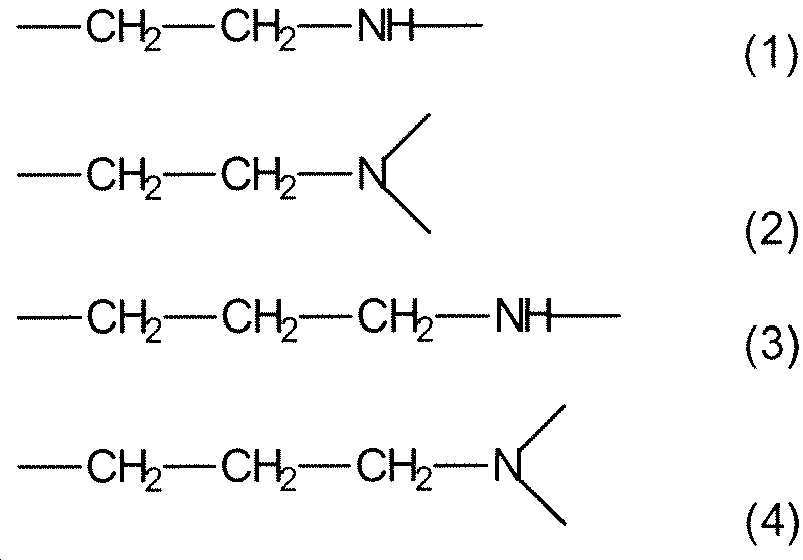
반복 단위 (1), (2), (3) 및/또는 (4)의 질소 원자 중 하나 이상이 양성자화되어 중합체의 양전하를 제공할 수 있는, 조성물. A composition, wherein one or more of the nitrogen atoms of repeating units (1), (2), (3) and/or (4) are protonated to provide a positive charge of the polymer.
13. 항목 8에 있어서, 입자 제형의 입자가 핵산을, 핵산과 양이온성 부형제로서의 양이온성 지질 또는 양이온성 리피도이드에 의해 형성된 복합체 형태로 포함하는, 조성물. 13. The composition of item 8, wherein the particles of the particle formulation comprise nucleic acids in the form of a complex formed by the nucleic acid and a cationic lipid or cationic lipidoid as a cationic excipient.
14. 항목 13에 있어서, 입자 제형의 입자가 리포플렉스, 리포솜 또는 지질 나노 입자를 포함하는, 조성물. 14. The composition of item 13, wherein the particles of the particulate formulation comprise lipoplexes, liposomes or lipid nanoparticles.
15. 항목 13 또는 14에 있어서, 입자 제형의 입자가 스테롤, 중성 지질, 스핑고지질 및 페길화 지질로부터 선택된 이상의 헬퍼 지질을 추가로 포함하는, 조성물.15. The composition of item 13 or 14, wherein the particles of the particulate formulation further comprise at least one helper lipid selected from sterols, neutral lipids, sphingolipids and pegylated lipids.
16. 항목 13 내지 15 중 어느 한 항목에 있어서, 지질 및 리피도이드의 총 중량 대 상기 핵산의 중량의 비율이 0.1 내지 200, 더욱 바람직하게는 0.2 내지 150, 가장 바람직하게는 0.5 내지 100의 범위인, 조성물. 16. According to any one of items 13 to 15, the ratio of the total weight of lipids and lipidoids to the weight of the nucleic acid is in the range of 0.1 to 200, more preferably 0.2 to 150, most preferably 0.5 to 100. Phosphorus, composition.
17. 항목 1 내지 16 중 어느 한 항목에 있어서, 동결 방지 첨가제가 적어도 하나의 2차 하이드록시 그룹을 포함하는, 조성물.17. The composition of any of items 1 to 16, wherein the antifreeze additive comprises at least one secondary hydroxy group.
18. 항목 17에 있어서, 동결 방지 첨가제가 1,2-프로판디올, 2-프로판올, 1,2-부탄디올 및 1,3-부탄디올로부터 선택되는, 조성물.18. The composition of item 17, wherein the antifreeze additive is selected from 1,2-propanediol, 2-propanol, 1,2-butanediol and 1,3-butanediol.
19. 항목 17에 있어서, 동결 방지 첨가제가 1,2-프로판디올인, 조성물.19. The composition of item 17, wherein the antifreeze additive is 1,2-propanediol.
20. 항목 1 내지 19 중 어느 한 항목에 있어서, 동결 방지 첨가제가, 액체 상의 용적을 기준으로 하여, 0.5 내지 50% w/v, 보다 바람직하게는 1 내지 40% w/v, 가장 바람직하게는 1 내지 30% w/v의 농도로 함유되는, 조성물.20. The antifreeze additive according to any one of items 1 to 19, based on the volume of the liquid phase, from 0.5 to 50% w/v, more preferably from 1 to 40% w/v, most preferably The composition is contained in a concentration of 1 to 30% w/v.
21. 항목 1 내지 20 중 어느 한 항목에 있어서, 나노 입자 또는 미세입자 제형의 입자를, 입자 제형에 함유된 치료적 활성제를 조성물의 총 용적을 기준으로 하여 0.01 내지 50mg/ml, 보다 바람직하게는 0.02 내지 30mg/ml의 농도로 제공하기 위한 양으로 포함하는, 조성물.21.The method according to any one of items 1 to 20, wherein the nanoparticles or the particles of the microparticle formulation, the therapeutically active agent contained in the particle formulation, are 0.01 to 50 mg/ml, more preferably, based on the total volume of the composition. A composition comprising in an amount to provide a concentration of 0.02 to 30 mg/ml.
22. 항목 1 내지 21 중 어느 한 항목에 있어서, 물 및 상기 동결 방지 첨가제가 액체 상에 함유된 유일한 용매인, 조성물.22. The composition of any of items 1 to 21, wherein water and the antifreeze additive are the only solvents contained in the liquid phase.
23. (i) 치료적 활성제의 나노 입자 또는 미세입자 제형, 및23. (i) nanoparticles or microparticle formulations of therapeutically active agents, and
(ii) 1개 또는 2개의 하이드록시 그룹으로 치환된 C3-C5 알칸으로부터 선택된 적어도 하나의 동결 방지 첨가제를 포함하고,(ii) at least one anti-freeze additive selected from C3-C5 alkanes substituted with one or two hydroxy groups,
항목 1 내지 22 중 어느 한 항목에 따르는 조성물을 동결시킴으로써 수득될 수 있는 고체 조성물.A solid composition obtainable by freezing a composition according to any one of items 1 to 22.
24. 항목 1 내지 22 중 어느 한 항목에 따르는 조성물의 제조 방법으로서, 상기 방법이24. A method for preparing a composition according to any one of items 1 to 22, wherein the method
a) 액체 상에 현탁된 치료적 활성제의 나노 입자 또는 미세입자 제형을 제공하는 단계, 및a) providing a nanoparticle or microparticle formulation of a therapeutically active agent suspended in a liquid phase, and
b) 1개 또는 2개의 하이드록시 그룹으로 치환된 C3-C5 알칸으로부터 선택된 적어도 하나의 동결 방지 첨가제를 액체 상에 첨가하는 단계로서, 동결 방지 첨가제의 액체 상에의 첨가가 액체 상에 현탁된 입자 제형을 제공하기 전, 제공하는 동안 또는 제공한 후에 달성될 수 있는, 단계를 포함하는, 제조 방법.b) adding at least one antifreeze additive selected from C3-C5 alkanes substituted with one or two hydroxy groups into the liquid phase, wherein the addition of the antifreeze additive to the liquid phase is suspended in the liquid phase. A method of manufacture comprising a step, which can be achieved before, during or after providing the formulation.
25. 항목 23에 따르는 고체 조성물의 제조 방법으로서, 방법이25. A method for preparing a solid composition according to item 23, wherein the method comprises:
a) 액체 상에 현탁된 치료적 활성제의 나노 입자 또는 미세입자 제형을 제공하는 단계, 및a) providing a nanoparticle or microparticle formulation of a therapeutically active agent suspended in a liquid phase, and
b) 1개 또는 2개의 하이드록시 그룹으로 치환된 C3-C5 알칸으로부터 선택된 적어도 하나의 동결 방지 첨가제를 액체 상에 첨가하는 단계로서, 동결 방지 첨가제의 액체 상에의 첨가가 액체 상에 현탁된 입자 제형을 제공하기 전, 제공하는 동안 또는 제공한 후에 달성될 수 있는, 단계를 포함하는 공정에 의해 상기 제1 측면에 따르는 조성물을 제조하는 제1 단계 및b) adding at least one antifreeze additive selected from C3-C5 alkanes substituted with one or two hydroxy groups into the liquid phase, wherein the addition of the antifreeze additive to the liquid phase is suspended in the liquid phase. A first step of preparing a composition according to the first aspect by a process comprising steps, which can be achieved before, during or after providing the formulation, and
제1 단계에서 수득된 조성물을 동결시키는 제2 단계를 포함하는, 제조 방법.A manufacturing method comprising a second step of freezing the composition obtained in the first step.
26. 치료적 활성제의 나노 입자 또는 미세입자 제형의 보존 방법으로서, 상기 방법이 항목 1 내지 22 중 어느 한 항목에 따르는 현탁액 조성물을 제공하는 단계 및 상기 조성물을 동결시키는 단계를 포함하는, 보존 방법.26. A method of preserving a nanoparticle or microparticle formulation of a therapeutically active agent, the method comprising providing a suspension composition according to any one of items 1 to 22 and freezing the composition.
27. 치료적 활성제의 나노 입자 또는 미세입자 제형을 포함하는 조성물을 위한 동결 방지 첨가제로서 1개 또는 2개의 하이드록시 그룹으로 치환된 C3-C5 알칸으로부터 선택된 화합물의 용도. 27. Use of a compound selected from C3-C5 alkanes substituted with one or two hydroxy groups as anti-freeze additives for compositions comprising nanoparticle or microparticle formulations of therapeutically active agents.
28. 액체에 현탁된 미립자 조성물로부터 에어로졸을 형성하거나, 이러한 조성물을 분무하기 위한 장치로서, 이러한 장치가 항목 1 내지 22 중 어느 한 항목에 따르는 조성물을 포함하는, 장치. 28. A device for forming an aerosol from a particulate composition suspended in a liquid, or for spraying such a composition, wherein the device comprises a composition according to any one of items 1 to 22.
29. 항목 28에 있어서, 장치가 계량된 용량 흡입기, 분무기 및 비강 분무 장치로부터 선택된 흡입기인, 장치.29. The device of item 28, wherein the device is an inhaler selected from a metered dose inhaler, a nebulizer and a nasal spray device.
30. 항목 1 내지 22 중 어느 한 항목에 따르는 조성물을 바람직하게는 기도로 또는 기도를 통한 투여를 통해, 더욱 바람직하게는 폐 투여 또는 비강 투여를 통해 환자에게 투여하는 단계를 포함하는 치료 방법.30. A method of treatment comprising administering to a patient a composition according to any one of items 1 to 22, preferably via administration via the airways or through the airways, more preferably via pulmonary administration or nasal administration.
31. 항목 1 내지 22 중 어느 한 항목에 있어서, 조성물이 기도에 또는 기도를 통해 투여되는, 질환의 치료 또는 예방에 사용하기 위한 조성물.31. A composition for use in the treatment or prevention of a disease according to any one of items 1 to 22, wherein the composition is administered to or through the airways.
32. 항목 31에 있어서, 조성물이 폐 투여를 통해 또는 비강 투여를 통해 투여되는, 조성물.32. The composition of item 31, wherein the composition is administered via pulmonary administration or via nasal administration.
33. 항목 31 또는 32에 있어서, 치료적 활성제가 RNA 기반 요법을 통한 질환의 치료 또는 예방에 사용하기 위한 RNA, 보다 바람직하게는 mRNA인, 조성물.33. The composition according to item 31 or 32, wherein the therapeutically active agent is RNA, more preferably mRNA, for use in the treatment or prevention of disease via RNA based therapy.
34. 항목 31 내지 33 중 어느 한 항목에 있어서, 치료되거나 예방될 상기 질환이 폐 질환인, 조성물.34. The composition of any of items 31 to 33, wherein the disease to be treated or prevented is a pulmonary disease.
도 1: A549 세포에서 첨가제를 함유하는 brPEI/FLuc mRNA N/P 10 제형의 형질 감염 효율
도 2: 1회 동결-해동 주기 후 brPEI/mRNA 제형의 생체내 형질 감염 효율
도 3: 1회 동결-해동 주기 후 brPEI/mRNA 제형의 생체내 형질 감염 효율. 점선: 신선한 입자의 활성의 50%.
도 4: 농축된 중합체/mRNA 제형의 생체내 형질 감염 효율
도 5: 1,2-프로판디올에서 동결 후 지질 기반 나노 입자 또는 미세입자의 생체내 형질 감염 효율Figure 1: Transfection efficiency of brPEI/FLuc mRNA N/
Figure 2: In vivo transfection efficiency of brPEI/mRNA formulations after one freeze-thaw cycle
Figure 3: In vivo transfection efficiency of brPEI/mRNA formulations after one freeze-thaw cycle. Dotted line: 50% of the activity of fresh particles.
Figure 4: In vivo transfection efficiency of concentrated polymer/mRNA formulation
Figure 5: In vivo transfection efficiency of lipid-based nanoparticles or microparticles after freezing in 1,2-propanediol
실시예Example
약어Abbreviation
약어Abbreviation 설명Explanation
RT 실온RT Room temperature
mRNA 메신저 리보핵산mRNA Messenger ribonucleic acid
brPEI 분지형 폴리에틸렌이민brPEI Branched polyethyleneimine
FLuc 반딧불이 루시퍼라제FLuc Firefly luciferase
w/o 없이w/o without
cmRNA 화학적으로 변형된 리보핵산cmRNA Chemically modified ribonucleic acid
FLuc 반딧불이 루시퍼라제FLuc Firefly luciferase
PG 1,2-프로판디올, 프로필렌 글리콜PG 1,2-propanediol, propylene glycol
N/P 담체 아민 질소 대 mRNA 포스페이트 비율N/P Carrier amine nitrogen to mRNA phosphate ratio
실시예 I: 나노 입자 또는 미세입자 제형을 위한 동결 방지 첨가제로서 상이한 부류의 분자의 스크리닝.Example I: Screening of different classes of molecules as anti-freeze additives for nanoparticle or microparticle formulations.
복합체 형성Complex formation
분지형 폴리(에틸렌이민)(brPEI) 및 루시퍼라제를 인코딩하는 mRNA의 복합체는 0.25mg/mL의 최종 농도로 형성되었다. 표준 혼합 공정에서, mRNA는 물을 사용하여 0.5mg/mL의 농도로 희석시켰다. 동일한 용적의 brPEI 용액을 물에서 0.65mg/mL의 농도로 제조했다. mRNA 용액을 brPEI 용액에 주입한 다음, 전자 피펫(Mettler-Toledo, E4 LTS 1000 μL)을 사용하여 혼합하여 나노 입자 또는 미세입자를 형성했다. 혼합 후, 복합체를 사용 전에 얼음 위에서 20분 동안 배양했다.A complex of mRNA encoding branched poly(ethyleneimine) (brPEI) and luciferase was formed at a final concentration of 0.25 mg/mL. In a standard mixing process, mRNA was diluted to a concentration of 0.5 mg/mL with water. The same volume of brPEI solution was prepared in water at a concentration of 0.65 mg/mL. After the mRNA solution was injected into the brPEI solution, it was mixed using an electronic pipette (Mettler-Toledo,
크기 측정Size measurement
입자 직경의 결정을 위해, 100μL의 입자의 현탁액을 큐벳(브랜드, UV-큐벳 마이크로)에 충전시키고, Malvern ZetaSizer Nano ZS(Malvern Instruments)를 사용하여 측정하여 유체역학적 직경 및 평균 유체역학적 직경(z-평균)을 nm 단위로 제공한다. 현탁 매질로서, 물 또는 지시된 바와 같이 동결 방지 첨가제를 함유하는 물이 사용되었다.For the determination of the particle diameter, a suspension of 100 μL of particles was charged into a cuvette (brand, UV-cuvette micro) and measured using Malvern ZetaSizer Nano ZS (Malvern Instruments) to determine the hydrodynamic diameter and average hydrodynamic diameter (z- Average) in nm. As the suspension medium, water or water containing anti-freeze additives as indicated was used.
동결-해동 도전Freeze-thaw challenge
제형을 2X (20/10/2%) 첨가제 용액(표 1)으로 1:2로 희석하고, 이중으로 분할했다. 각각 생성되는 제형 중 하나의 샘플을 첨가제의 존재하에 크기 결정(Malvern Zetasizer NanoZS)에 사용했다. 나머지 샘플은 -20℃에서 16시간 동안 동결시키고, 실온에서 해동시키고, 용액이 실온에 도달하기 전에 얼음 위에 즉시 저장했다. 이어서, 각각 해동된 제형을 크기 결정(Malvern Zetasizer NanoZS)에 사용하였고, 다음 방정식에 따라 동결 전과 해동 후 제형의 크기 편차 %와 관련하여 비교하였으며, 여기서 dh는 z-평균 입자 직경을 나타낸다:The formulation was diluted 1:2 with a 2X (20/10/2%) additive solution (Table 1) and partitioned in duplicate. One sample of each of the resulting formulations was used for size determination (Malvern Zetasizer NanoZS) in the presence of additives. The remaining samples were frozen at -20[deg.] C. for 16 hours, thawed at room temperature, and immediately stored on ice before the solution reached room temperature. Then, each thawed formulation was used for size determination (Malvern Zetasizer NanoZS), and compared with respect to the% size deviation of the formulation before freezing and after thawing according to the following equation, where d h represents the z-average particle diameter:

형질 감염 및 루시퍼라제 활성 검정Transfection and luciferase activity assay
A549 세포를 37℃, 5% CO2에서 10% 소 태아 혈청(FBS) 및 1% 페니실린/스트렙토마이신(P/S)이 보충된 MEM 배지에서 배양하였다. 세포를 형질 감염 24시간 전에 96-웰 플레이트에서 100μL 배지에서 20000개 세포/웰로 접종하였다. 형질 감염 당일에 배지를 FBS 및 페니실린/스트렙토마이신이 없는 MEM으로 교체한 후, 60μL/웰로 복합체화된 mRNA를 이중으로 첨가했다. 형질 감염 4시간 후, 배지는 10% FBS 및 1% P/S를 갖는 MEM으로 교체했다. 플레이트를 37℃ 및 5% CO2에서 24시간 동안 배양하였다. 24시간 배양 후, 배지를 제거하고, 세포를 100μL 용해 완충액(25mM Tris HCl, 0.1% TritonX-100, pH 7.8)에 용해시키고, 플레이트 진탕기에서 600rpm에서 30분 동안 배양했다. 다음으로, 각 웰로부터 50μL 세포 용해물을 96-웰 플레이트로 옮기고, 리포터 반딧불이 루시퍼라제의 활성은 루시페린 완충액(0.47mM D-루시페린, 0.27mM 코엔자임 A, 3.33mM의 DTT, 0.53mM의 ATP, 1.1mM의 MgCO3, 2.7mM MgSO4, 20mM의 트리신, 0.1mM의 EDTA)을 첨가한 후 Tecan Infinite 200 PRO에서 생물발광 강도로 측정했다. A549 cells were cultured in MEM medium supplemented with 10% fetal bovine serum (FBS) and 1% penicillin/streptomycin (P/S) at 37° C., 5% CO 2. Cells were seeded at 20000 cells/well in 100 μL medium in 96-well plates 24 hours before transfection. On the day of transfection, the medium was replaced with MEM without FBS and penicillin/streptomycin, and then the mRNA complexed at 60 μL/well was added in duplicate. After 4 hours of transfection, the medium was replaced with MEM with 10% FBS and 1% P/S. The plate was incubated at 37° C. and 5% CO 2 for 24 hours. After culturing for 24 hours, the medium was removed, and the cells were dissolved in 100 μL lysis buffer (25 mM Tris HCl, 0.1% TritonX-100, pH 7.8), and incubated for 30 minutes at 600 rpm on a plate shaker. Next, 50 μL of cell lysate from each well was transferred to a 96-well plate, and the activity of reporter firefly luciferase was determined in luciferin buffer (0.47 mM D-luciferin, 0.27 mM coenzyme A, 3.33 mM DTT, 0.53 mM ATP, 1.1). After adding mM MgCO 3 , 2.7 mM MgSO 4 , 20 mM tricine, 0.1 mM EDTA), the bioluminescence intensity was measured in Tecan Infinite 200 PRO.
생체내 실험을 위한 샘플 제조Sample preparation for in vivo experiments
복합체를 다음 변형과 함께 "복합체 형성" 및 "동결-해동 도전"하에 기재된 바와 같이 제조했다. 4mL의 복합체 용액을 0.5mg/mL의 mRNA 농도로 제조하고, 이중 농축된 첨가제 용액으로 1:2로 희석하여 0.25mg/mL(8mL)의 최종 mRNA 농도를 수득했다. 동물에게 분무될 때까지 샘플을 동결 유지시켰다.Composites were prepared as described under "Composite Formation" and "Freeze-thaw Challenge" with the following modifications. A 4 mL complex solution was prepared at an mRNA concentration of 0.5 mg/mL, and diluted 1:2 with the concentrated additive solution to obtain a final mRNA concentration of 0.25 mg/mL (8 mL). Samples were kept frozen until sprayed onto animals.
분무Spray
동물을 Buxco 소형 대량 투여 챔버(Small Size Mass Dosing Chamber)(Data Sciences International, Germany)에 위치시켰다. 제형을 실온에서 해동시키고, 실온에 도달하기 전에 분쇄된 얼음 위에 놓은 다음, Aeroneb Solo 분무기(nAeroneb, Germany)를 사용하여 공기 순환 속도 3L/분 및 듀티 사이클 100%로 분무했다. Animals were placed in a Buxco Small Size Mass Dosing Chamber (Data Sciences International, Germany). The formulation was thawed at room temperature, placed on crushed ice before reaching room temperature, and then sprayed using an Aeroneb Solo sprayer (nAeroneb, Germany) at an air circulation rate of 3 L/min and a duty cycle of 100%.
외식된 폐의 생물 발광 측정Bioluminescence measurement of explanted lungs
적용 24시간 후, 동물을 펜타닐/미다졸람/메데토미딘(0.05/5.0/0.5 mg/kg BW)의 복강내 주사를 통해 완전 마취하에 놓았다. 50μL의 D-루시페린(포스페이트 완충 식염수에 용해된 30mg/mL, pH 7)을 스니핑 경로(비공에 직접 적용한 후 용액 흡입)를 통해 적용하고, 100μL의 D-루시페린을 복강내 주사로 전신 적용했다. 루시페린 투여 10분 후, 마우스를 자궁 경부 탈구를 통해 안락사시켰다. 오른쪽 심장을 통해 PBS로 관류 후, 폐를 외식시켰다. 비닝 세트 8 및 노출 시간 5분으로 Xenogen IVIS Luminar XR(Caliper LifeSciences)을 사용하여 생물 발광을 측정했다. 생물 발광을 정량화하고, Living Image Software 4.4(Xenogen)를 사용하여 분석했다. 과포화된 사진의 경우(선형 범위를 벗어난 발현 검출), 노출 시간은 1분으로 단축되었다. 생물 발광은 총 플럭스/기관(광자/초)으로 측정되었다. 과포화가 없는 사진만 분석에 사용되었다. 폐를 급속 동결시키고, -80℃에 저장했다.24 hours after application, animals were placed under complete anesthesia via intraperitoneal injection of fentanyl/midazolam/medetomidine (0.05/5.0/0.5 mg/kg BW). 50 μL of D-luciferin (30 mg/mL dissolved in phosphate buffered saline, pH 7) was applied via the sniffing route (applied directly to the nostril, followed by inhalation of the solution), and 100 μL of D-luciferin was applied systemically by intraperitoneal injection. After 10 minutes of luciferin administration, mice were euthanized through cervical dislocation. After perfusion with PBS through the right heart, the lungs were explanted. Bioluminescence was measured using Xenogen IVIS Luminar XR (Caliper LifeSciences) with binning set 8 and
균질화된 폐에서 루시퍼라제 활성Luciferase activity in the homogenized lung
해동된 기관을 칭량하고, 외식된 폐의 절반을 FastPrep°-24 균질화기(MP Biomedicals)를 사용하여 용해 완충액에서 균질화했다. 100μL 루시페린 완충액을 Lumat LB 9507 광도계(Berthold Technologies)에 의해 75μL의 원심분리된 용해물에 자동으로 첨가했다. 루시퍼라제 활성은 RLU/s로 측정하였고, RLU/기관으로 전환시켰다.The thawed organs were weighed and half of the explanted lungs were homogenized in lysis buffer using a FastPrep°-24 homogenizer (MP Biomedicals). 100 μL luciferin buffer was automatically added to 75 μL of centrifuged lysate by a Lumat LB 9507 photometer (Berthold Technologies). Luciferase activity was measured as RLU/s and converted to RLU/organ.
결과result
1회 동결-해동 주기 후 중합체/mRNA 제형의 입자 응집을 방지하는 능력이 당업계에서 동결 방지 첨가제로서 확립된 화합물을 포함하여 상이한 유형의 첨가제에 대해 제시되었다. 1,2-프로판디올을 사용하는 조성물은 본 발명에 따르는 조성물이고, 다른 조성물은 참조 조성물이다. 유체역학적 입자 직경은 동결 전에 평가했다. -20℃에서 16시간 후, 제형을 해동하고, 유체역학적 입자 직경을 다시 측정했다. 동결 전과 해동 후 입자 사이의 크기 차이는 표 1b에 나타낸다. 큰 숫자는 거대한 크기 증가 및 따라서 응집을 나타낸다.The ability to prevent particle agglomeration of polymer/mRNA formulations after one freeze-thaw cycle has been shown for different types of additives, including compounds that have been established as anti-freeze additives in the art. Compositions using 1,2-propanediol are compositions according to the invention, and other compositions are reference compositions. Hydrodynamic particle diameter was evaluated prior to freezing. After 16 hours at -20[deg.] C., the formulation was thawed and the hydrodynamic particle diameter was measured again. The size difference between the particles before freezing and after thawing is shown in Table 1b. Large numbers indicate a huge increase in size and thus agglomeration.
[표 1a][Table 1a]
ZetaSizer Nano ZS(Malvern)로 측정된 물에서 새로 제조된 복합체의 표준 크기Standard size of newly prepared composites in water measured by ZetaSizer Nano ZS (Malvern)

[표 1b][Table 1b]
상이한 유형 및 농도의 첨가제에서 신선한 복합체와 비교된 1회 동결-해동 주기 후 입자 크기 편차.Particle size deviation after one freeze-thaw cycle compared to fresh complex at different types and concentrations of additives.
지시된 %(w/v)의 첨가제를 함유하는 0.25mg/mL mRNA 농도에서 brPEI 25kDa/mRNA N/P 10 제형의 동결-해동 도전(-20℃). α-락토스 일수화물 및 D-만니톨을 물에 대한 제한된 용해도로 인해 감소된 농도에서 시험했다. 염화나트륨은 등장성 농도 범위 내에서 유지되도록 감소된 농도에서 시험했다. n = 1.Freeze-thaw challenge (-20°C) of brPEI 25kDa/mRNA N/
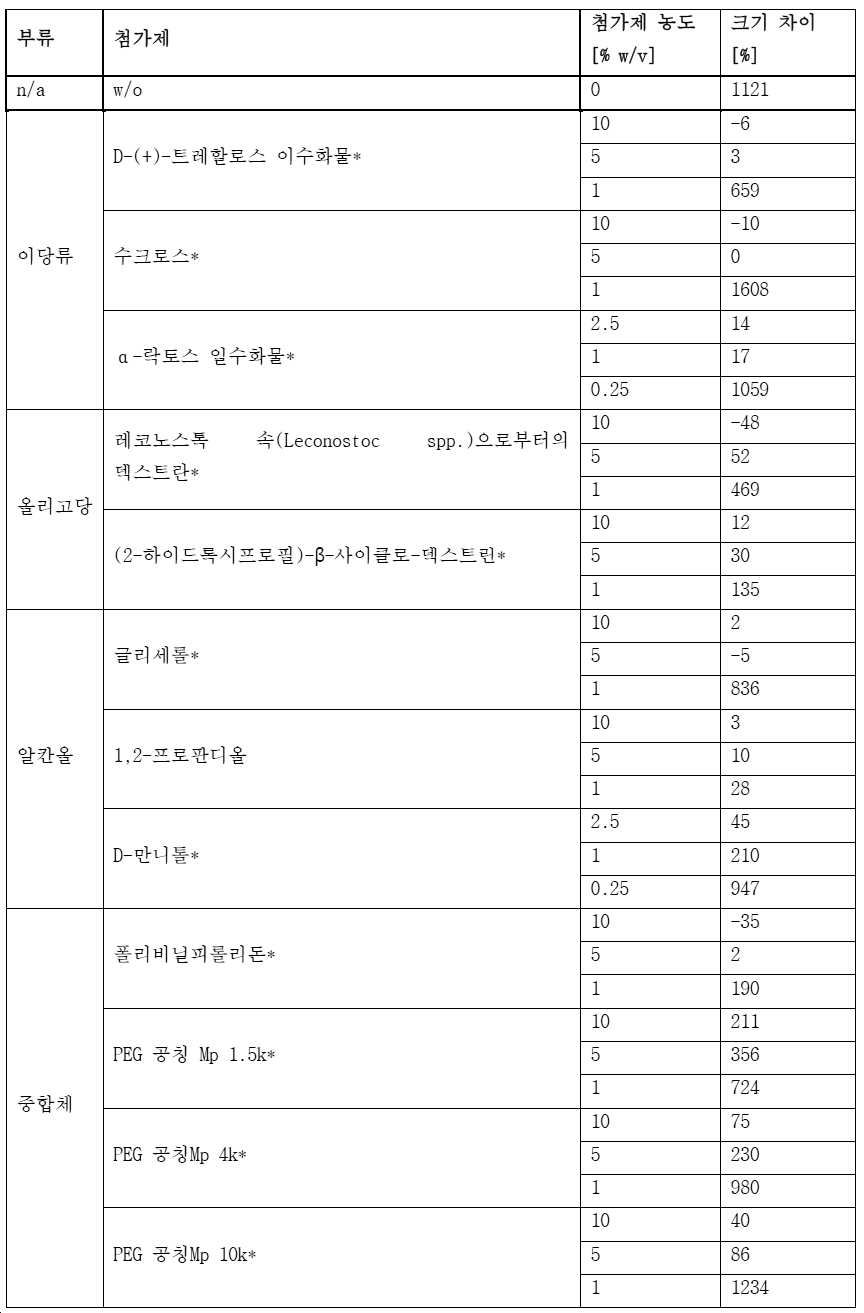

*참조 조성물*Reference composition
% w/v1,2-propanediol
% w/v
100% 이상의 크기 증가(100% 
도 1은 A549 세포에서 첨가제를 함유하는 brPEI/FLuc mRNA N/P 10 제형의 형질 감염 효율을 도시한다.1 shows the transfection efficiency of brPEI/FLuc mRNA N/
[% w/v][% w/v]
*참조 조성물*Reference composition
표 데이터로부터, 모든 첨가제가 형질 감염 효율을 유지시키고, 따라서 마우스에 분무하여 시험되도록 선택되었다는 것을 알 수 있다. 반딧불이 루시퍼라제를 인코딩하는 2mg mRNA를 함유하는 8mL 복합체 용액을 BALB/c 마우스 그룹(n=3)에 분무했다. 처리 24시간 후, 마우스를 안락사시켰다. mRNA 전달 효율은 절제된 기관(Ivis에 의해) 및 기관 균질화물(도 2 및 표 4 참조)에서 루시퍼라제 활성의 정량화를 통해 분석되었다. 사용된 mRNA/중합체/1,2-프로판디올 중량비는 표 5에 보고되어 있다.From the table data, it can be seen that all additives were chosen to be tested by spraying on mice, thus maintaining transfection efficiency. An 8 mL complex solution containing 2 mg mRNA encoding firefly luciferase was sprayed onto a group of BALB/c mice (n=3). After 24 hours of treatment, mice were euthanized. The efficiency of mRNA delivery was analyzed through quantification of luciferase activity in resected organs (by Ivis) and organ homogenates (see Figures 2 and 4). The mRNA/polymer/1,2-propanediol weight ratio used is reported in Table 5.
도 2는 1회 동결-해동 주기 후 분무를 통해 적용된 brPEI/mRNA 제형의 생체내 형질 감염 효율을 도시한다.Figure 2 shows the in vivo transfection efficiency of brPEI/mRNA formulations applied via spraying after one freeze-thaw cycle.
N/P 10 및 0.25mg/mL에서 brPEI 25kDa와 복합체화된 2mg FLuc mRNA를 지시된 첨가제의 존재하에 1회 동결-해동 주기 후에 마우스에게 분무하였다. 참고로, 한 그룹은 첨가제를 첨가하지 않고 새로 제조된 입자로 처리했다. 10% PEG4k 또는 PEG10k를 함유하는 고점도의 제형은 Aeroneb 분무기에 의한 분무를 억제했다. n = 3.Mice were sprayed with 2 mg FLuc mRNA complexed with brPEI 25 kDa at N/
(외식된 폐)(Eating out lungs)
(균질물)(Homogeneous material)
[% w/v]density
[% w/v]
*참조 조성물*Reference composition
% w/v1,2-propanediol
% w/v
[mg]mRNA
[mg]
[mg]polymer
[mg]
토론 및 결론Discussion and conclusion
1,2-프로판디올(프로필렌 글리콜, PG)은 새로 제형화된 brPEI/mRNA 나노 입자 또는 미세입자와 비교하여 1회 동결-해동 주기 후 생체내 분무 후 입자 응집을 방지하고 제형의 형질 감염 효율을 유지하는 첨가제로서 동정되었다.1,2-propanediol (propylene glycol, PG) prevents particle agglomeration after spraying in vivo after one freeze-thaw cycle compared to newly formulated brPEI/mRNA nanoparticles or microparticles, and improves the transfection efficiency of the formulation. It was identified as a retaining additive.
실시예 II: 나노 입자 또는 미세입자에 대한 동결 방지제로서 1,2-프로판디올과 구조적으로 관련된 상이한 첨가제의 비교.Example II: Comparison of different additives structurally related to 1,2-propanediol as a cryoprotectant for nanoparticles or microparticles.
복합체 형성Complex formation
분지형 폴리(에틸렌이민)(brPEI) 및 루시퍼라제를 인코딩하는 mRNA의 복합체는 0.25mg/mL의 최종 농도로 형성되었다. 표준 혼합 공정에서, mRNA는 물을 사용하여 0.5mg/mL의 농도로 희석시켰다. 동일한 용적의 brPEI 용액을 물에서 0.65mg/mL의 농도로 제조했다. mRNA 용액을 brPEI 용액에 주입한 다음 전자 피펫(Mettler-Toledo, E4 LTS 1000 μL)을 사용하여 혼합하여 나노 입자를 형성했다. 혼합 후, 복합체를 사용 전에 얼음 위에서 20분 동안 배양했다.A complex of mRNA encoding branched poly(ethyleneimine) (brPEI) and luciferase was formed at a final concentration of 0.25 mg/mL. In a standard mixing process, mRNA was diluted to a concentration of 0.5 mg/mL with water. The same volume of brPEI solution was prepared in water at a concentration of 0.65 mg/mL. The mRNA solution was injected into the brPEI solution and then mixed using an electronic pipette (Mettler-Toledo,
크기 측정Size measurement
입자 직경의 결정을 위해, 100μL의 입자의 현탁액을 큐벳(브랜드, UV-큐벳 마이크로)에 충전시키고, Malvern ZetaSizer Nano ZS(Malvern Instruments)를 사용하여 측정하여 유체역학적 직경 및 평균 유체역학적 직경(z-평균)을 nm 단위로 제공한다. 현탁 매질로서, 물 또는 지시된 바와 같이 동결 방지 첨가제를 함유하는 물이 사용되었다.For the determination of the particle diameter, a suspension of 100 μL of particles was charged into a cuvette (brand, UV-cuvette micro) and measured using Malvern ZetaSizer Nano ZS (Malvern Instruments) to determine the hydrodynamic diameter and average hydrodynamic diameter (z- Average) in nm. As the suspension medium, water or water containing anti-freeze additives as indicated was used.
동결-해동 도전Freeze-thaw challenge
제형을 2X (20/10/2%) 첨가제 용액(표 6)으로 1:2로 희석하고, 이중으로 분할했다. 일부 첨가제의 용해도가 제한되었기 때문에, 다음 물질이 감소된 농도(표 6 참조)로 시험되었다: 2-메틸-1,4-부탄디올, 펜타에리트리톨. 각각 생성되는 제형 중 하나의 샘플을 첨가제의 존재하에 크기 결정(Malvern Zetasizer NanoZS)에 사용했다. 나머지 샘플은 -20℃에서 16시간 동안 동결시키고, 실온에서 해동시키고, 용액이 실온에 도달하기 전에 얼음 위에 즉시 저장했다. 이어서, 각각 해동된 제형 중 하나의 샘플을 크기 결정(Malvern Zetasizer NanoZS)에 사용하였고, 다음 방정식에 따라 동결 전과 해동 후 제형의 크기 편차 %와 관련하여 비교하였으며, 여기서 dh는 z-평균 입자 직경을 나타낸다:The formulation was diluted 1:2 with a 2X (20/10/2%) additive solution (Table 6) and partitioned in duplicate. Due to the limited solubility of some additives, the following substances were tested at reduced concentrations (see Table 6): 2-methyl-1,4-butanediol, pentaerythritol. One sample of each of the resulting formulations was used for size determination (Malvern Zetasizer NanoZS) in the presence of additives. The remaining samples were frozen at -20[deg.] C. for 16 hours, thawed at room temperature, and immediately stored on ice before the solution reached room temperature. Then, one sample of each of the thawed formulations was used for size determination (Malvern Zetasizer NanoZS), and compared with the% size deviation of the formulation before and after freezing according to the following equation, where d h is the z-average particle diameter Indicates:

생체내 실험을 위한 샘플 제조Sample preparation for in vivo experiments
복합체를 다음 변형과 함께 "복합체 형성" 및 "동결-해동 도전"하에 기재된 바와 같이 제조했다. 4mL의 복합체 용액을 0.5mg/mL의 농도로 제조하고, 이중 농축된 첨가제 용액으로 1:2로 희석하여 0.25mg/mL(8mL)의 최종 mRNA 농도를 초래했다. 동물에게 분무될 때까지 샘플을 동결 유지시켰다.Composites were prepared as described under "Composite Formation" and "Freeze-thaw Challenge" with the following modifications. A 4 mL complex solution was prepared at a concentration of 0.5 mg/mL and diluted 1:2 with the double concentrated additive solution resulting in a final mRNA concentration of 0.25 mg/mL (8 mL). Samples were kept frozen until sprayed onto animals.
분무Spray
동물을 Buxco 소형 대량 투여 챔버(Data Sciences International, Germany)에 위치시켰다. 제형을 실온에서 해동시키고, 실온에 도달하기 전에 분쇄된 얼음 위에 놓은 다음, Aeroneb Solo 분무기(nAeroneb, Germany)를 사용하여 공기 순환 속도 3L/분 및 듀티 사이클 100%로 분무했다. Animals were placed in a Buxco small bulk dosing chamber (Data Sciences International, Germany). The formulation was thawed at room temperature, placed on crushed ice before reaching room temperature, and then sprayed using an Aeroneb Solo sprayer (nAeroneb, Germany) at an air circulation rate of 3 L/min and a duty cycle of 100%.
외식된 폐의 생물 발광 측정Bioluminescence measurement of explanted lungs
적용 24시간 후, 동물을 펜타닐/미다졸람/메데토미딘(0.05/5.0/0.5 mg/kg BW)의 복강내 주사를 통해 완전 마취하에 놓았다. 50μL의 D-루시페린(포스페이트 완충 식염수에 용해된 30mg/mL, pH 7)을 스니핑 경로(비공에 직접 적용한 후 용액 흡입)를 통해 적용하고, 100μL의 D-루시페린을 복강내 주사로 전신 적용했다. 루시페린 투여 10분 후, 마우스를 자궁 경부 탈구를 통해 안락사시켰다. 오른쪽 심장을 통해 PBS로 관류 후, 폐를 외식시켰다. 비닝 세트 8 및 노출 시간 5분으로 Xenogen IVIS Luminar XR(Caliper LifeSciences)을 사용하여 생물 발광을 측정했다. 생물 발광을 정량화하고, Living Image Software 4.4(Xenogen)를 사용하여 분석했다. 과포화된 사진의 경우(선형 범위를 벗어난 발현 검출), 노출 시간은 1분으로 단축되었다. 생물 발광은 총 플럭스/기관(광자/초)으로 측정되었다. 과포화가 없는 사진만 분석에 사용되었다. 폐를 급속 동결시키고, -80℃에 저장했다.24 hours after application, animals were placed under complete anesthesia via intraperitoneal injection of fentanyl/midazolam/medetomidine (0.05/5.0/0.5 mg/kg BW). 50 μL of D-luciferin (30 mg/mL dissolved in phosphate buffered saline, pH 7) was applied via the sniffing route (applied directly to the nostril, followed by inhalation of the solution), and 100 μL of D-luciferin was applied systemically by intraperitoneal injection. After 10 minutes of luciferin administration, mice were euthanized through cervical dislocation. After perfusion with PBS through the right heart, the lungs were explanted. Bioluminescence was measured using Xenogen IVIS Luminar XR (Caliper LifeSciences) with binning set 8 and
균질화된 폐에서 루시퍼라제 활성Luciferase activity in the homogenized lung
기관을 칭량하고, 외식된 폐의 절반을 FastPrep°-24 균질화기(MP Biomedicals)를 사용하여 용해 완충액에서 균질화했다. 100μL 루시페린 완충액을 Lumat LB 9507 광도계(Berthold Technologies)에 의해 75μL의 원심분리된 용해물에 자동으로 첨가했다. 루시퍼라제 활성은 RLU/s로 측정하였고, RLU/기관으로 전환시켰다.The trachea was weighed and half of the explanted lungs were homogenized in lysis buffer using a FastPrep°-24 homogenizer (MP Biomedicals). 100 μL luciferin buffer was automatically added to 75 μL of centrifuged lysate by a Lumat LB 9507 photometer (Berthold Technologies). Luciferase activity was measured as RLU/s and converted to RLU/organ.
결과result
실시예 I은 1,2-프로판디올이 생체내 활성을 유지하면서 동결 동안 나노 입자 또는 미세입자 응집을 방지하는 반면, 글리세롤(화학적 유사성을 갖는 분자)이 생체내 활성을 유지하지 않고 동결 동안 응집을 방지한다는 것을 보여준다. 이 사험의 결과는 1,2-프로판디올과 구조적으로 관련된 C3-C5 알칸올 및 알칸디올이 1회 동결-해동 도전 동안 응집을 방지할 수 있고, 후속적 분무 후 형질 감염 효율을 유지시킬 수 있음을 보여준다. 복합체가 형성되고, 첨가제 용액(물 중)과 혼합하여 표 6에 나열된 최종 첨가제 농도를 초래했다.Example I shows that 1,2-propanediol maintains activity in vivo while preventing aggregation of nanoparticles or microparticles during freezing, whereas glycerol (molecule with chemical similarity) does not maintain activity in vivo and prevents aggregation during freezing. Shows that it prevents. The results of this experiment are that C3-C5 alkanols and alkanols structurally related to 1,2-propanediol can prevent aggregation during one freeze-thaw challenge and maintain transfection efficiency after subsequent spraying. Shows. A complex was formed and mixed with the additive solution (in water) resulting in the final additive concentration listed in Table 6.
유체역학적 입자 직경을 -20℃에서 동결 전에 측정했다. 16시간 후, 모든 제형을 해동하고, 입자 크기를 다시 측정했다. 동결 전 대 해동 후 크기 편차 %는 표 6b에 제시된다. 높은 숫자는 크기의 큰 증가 및 따라서 응집을 나타낸다.Hydrodynamic particle diameter was measured before freezing at -20°C. After 16 hours, all formulations were thawed and the particle size measured again. The% size deviation before freezing versus after thawing is presented in Table 6b. High numbers indicate a large increase in size and thus agglomeration.
[표 6a][Table 6a]
물에서 새로 제조된 복합체의 표준 크기. ZetaSizer Nano ZS(Malvern)로 삼중 측정Standard size of a newly prepared complex in water. Triple measurement with ZetaSizer Nano ZS (Malvern)

[표 6b][Table 6b]
시험된 첨가제 농도의 동결 전 대 해동 후 크기 편차 %.% Of size deviation before freezing versus after thawing of the tested additive concentration.
2-메틸-1,4-부탄디올 및 펜타에리트리톨은 물에 대한 제한된 용해도로 인해 감소된 농도로 시험되었다. n = 1.2-Methyl-1,4-butanediol and pentaerythritol were tested at reduced concentrations due to their limited solubility in water. n = 1.
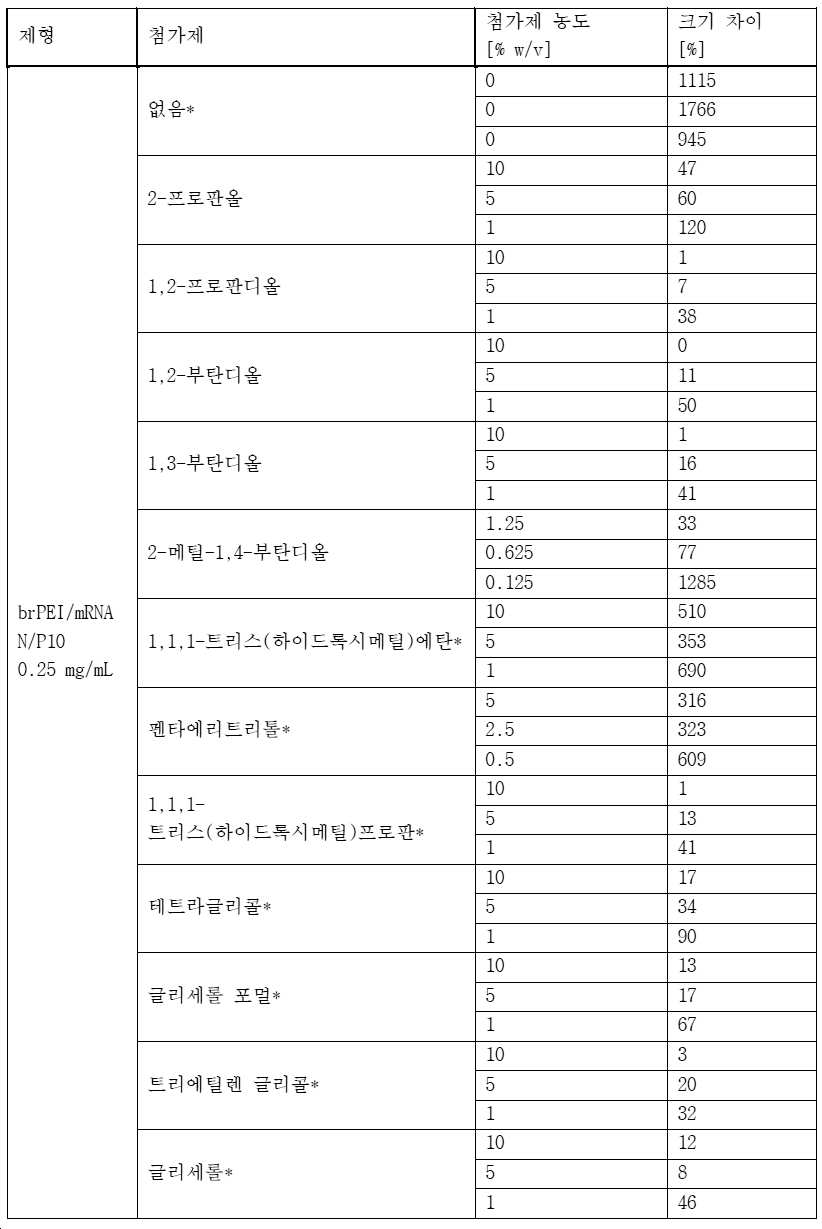
*참조 예*Reference example
100% 이상의 입자 크기의 변화(100% 
도 3은 1회 동결-해동 주기 후 brPEI/mRNA 제형의 생체내 형질 감염 효율을 도시한다.Figure 3 shows the in vivo transfection efficiency of brPEI/mRNA formulations after one freeze-thaw cycle.
N/P 10 및 0.25mg/mL에서 brPEI 25kDa와 복합체화된 2mg/8mL FLuc mRNA를 지시된 첨가제의 존재하에 1회 동결-해동 주기 후에 마우스에게 분무하였다. 처리 24시간 후 마우스를 마취시키고, 폐를 외식하고, 균질화하고 루시퍼라제 활성을 측정하였다. n = 3.Mice were sprayed with 2 mg/8 mL FLuc mRNA complexed with brPEI 25 kDa at N/
(외식된 폐)(Eating out lungs)
(균질물)(Homogeneous material)
[% w/v][% w/v]
* 참고 예* Reference example
토론 및 결론Discussion and conclusion
이 연구에서, 1,2-프로판디올과 구조적으로 관련된 알칸올/알칸디올이 1회 동결-해동 주기 후 뮤린 폐에 분무한 후 복합체 형질 감염 효율을 유지하는 능력을 갖는다는 것을 입증할 수 있다. 생물물리학적 특성을 동결 전 및 1회 동결-해동 주기 후에 먼저 입자의 응집 또는 붕괴로서 분석하여 비기능성 제형을 유도했다. 실시예 I의 발견은 1,2-프로판디올과 글리세롤이 입자 크기를 보존할 때 복제될 수 있었다. 이전 연구에서 이미 입증된 바와 같이, 입자 크기의 보존은 마우스에 분무 후 자동적으로 기능성 입자를 초래하지 않았다.In this study, it can be demonstrated that alkanol/alkanediol structurally related to 1,2-propanediol has the ability to maintain complex transfection efficiency after spraying into murine lung after one freeze-thaw cycle. The biophysical properties were first analyzed as agglomeration or disintegration of the particles before freezing and after one freeze-thaw cycle to induce non-functional formulations. The findings of Example I could be replicated when 1,2-propanediol and glycerol preserve particle size. As already demonstrated in previous studies, preservation of particle size did not automatically result in functional particles after nebulization in mice.
실시예 III: 다양한 mRNA 농도 및/또는 다양한 N/P 비율에서 동결 제형.Example III: Frozen formulation at various mRNA concentrations and/or various N/P ratios.
복합체 형성Complex formation
분지형 (폴리에틸렌이민)(brPEI), P7(선형 (폴리에틸렌이민-코-프로필렌이민), MW: 20kDa) 또는 P12 선형 (폴리에틸렌이민-코-프로필렌이민), MW: 24kDa)와 루시퍼라제를 인코딩하는 mRNA의 복합체가 0.25mg/mL의 농도로 형성되었다. 표준 혼합 공정에서, mRNA를 물에서 0.5mg/mL의 농도로 희석시켰다. 동일한 용적의 중합체 용액을 물에서 0.65mg/mL의 농도로 제조했다. 나노 입자를 제형화하기 위해, mRNA 용액을 brPEI 용액에 주입한 다음 전자 피펫(Mettler-Toledo, E4 LTS 1000 μL)을 사용하여 혼합했다. 혼합 후, 복합체를 사용 전에 얼음 위에서 20분 동안 배양하였다.Branched (polyethyleneimine) (brPEI), P7 (linear (polyethyleneimine-co-propylenimine), MW: 20 kDa) or P12 linear (polyethyleneimine-co-propyleneimine), MW: 24 kDa) and luciferase. A complex of mRNA was formed at a concentration of 0.25 mg/mL. In a standard mixing process, mRNA was diluted in water to a concentration of 0.5 mg/mL. An equal volume of polymer solution was prepared in water at a concentration of 0.65 mg/mL. To formulate the nanoparticles, the mRNA solution was injected into the brPEI solution and then mixed using an electronic pipette (Mettler-Toledo,
제형의 농도Concentration of formulation
사용 전에, Amicon® Ultra-15 원심분리 필터 장치(Merck Millipore, PLHK Ultracel-PL 막, 100 kDa 분자량 컷-오프)의 막을 15mL의 물(500 x g)로 세척했다. 이어서, 폴리플렉스 제형을 필터 장치로 옮기고, 500 x g 및 4℃에서 원심분리했다. 5분 간격으로, 유체 수준을 체크하여 과농도를 회피하였고, 용액을 1mL 피펫으로 완전히 혼합했다. 각 간격에서, 샘플 농도는 핵산 농도(A260)의 분광 광도계 평가에 의해 모니터링했다. 이 과정은 목적하는 농도에 도달할 때까지 반복되었다.Prior to use, the membrane of the Amicon® Ultra-15 centrifugal filter device (Merck Millipore, PLHK Ultracel-PL membrane, 100 kDa molecular weight cut-off) was washed with 15 mL of water (500 xg). The polyplex formulation was then transferred to a filter device and centrifuged at 500 xg and 4°C. At 5 minute intervals, the fluid level was checked to avoid overconcentration, and the solution was thoroughly mixed with a 1 mL pipette. At each interval, the sample concentration was monitored by spectrophotometric evaluation of the nucleic acid concentration (A 260 ). This process was repeated until the desired concentration was reached.
크기 측정Size measurement
입자 직경의 결정을 위해, 200μL의 입자의 현탁액을 큐벳(브랜드, UV-큐벳 마이크로)에 충전시키고, Malvern ZetaSizer Nano ZS(Malvern Instruments)를 사용하여 측정하여 유체역학적 직경 및 평균 유체역학적 직경(z-평균)을 nm 단위로 제공했다. 현탁 매질로서, 물 또는 지시된 바와 같이 동결 방지 첨가제를 함유하는 물이 사용되었다.For the determination of the particle diameter, a suspension of 200 μL of particles was charged into a cuvette (brand, UV-cuvette micro) and measured using Malvern ZetaSizer Nano ZS (Malvern Instruments) to determine the hydrodynamic diameter and average hydrodynamic diameter (z- Average) in nm. As the suspension medium, water or water containing anti-freeze additives as indicated was used.
동결-해동 도전Freeze-thaw challenge
폴리플렉스 크기(Malvern Zetasizer NanoZS)의 초기 결정 후, 제형을 96-웰 저프로파일 PCR 플레이트(투명함, RNAse 및 DNase 비함유)에 분배하고, 2X(20/10/2%) 첨가제 용액(표 1)으로 1:2로 희석시켰다. 각각 생성되는 제형 중 하나의 샘플을 크기 결정(Malvern Zetasizer NanoZS)에 사용했다. 나머지 샘플을 -20℃에서 약 16시간 동안 동결시키고, 실온에서 해동하고, 용액이 실온에 도달하기 전에 얼음에 즉시 저장했다. 이어서, 각각 해동된 제형 중 하나의 샘플을 크기 결정(Malvern Zetasizer NanoZS)에 사용하고, 다음 방정식에 따라 동결 전과 해동 후 제형의 크기 편차 %와 관련하여 비교하였고, 여기서 dh는 z-평균 입자 직경을 나타낸다:After initial determination of the polyplex size (Malvern Zetasizer NanoZS), the formulation was dispensed into 96-well low profile PCR plates (transparent, free of RNAse and DNase) and 2X (20/10/2%) additive solution (Table 1). ) Was diluted 1:2. One sample of each of the resulting formulations was used for size determination (Malvern Zetasizer NanoZS). The remaining samples were frozen at -20[deg.] C. for about 16 hours, thawed at room temperature, and immediately stored on ice before the solution reached room temperature. Then, one sample of each of the thawed formulations was used for size determination (Malvern Zetasizer NanoZS), and compared with the% size deviation of the formulation before and after freezing according to the following equation, where d h is the z-average particle diameter Represents:

결과result
증가된 mRNA 농도 및/또는 감소된 N/P 비율에서 또한 나노 입자 또는 미세입자에 대한 동결 방지제로서 작용하는 동정된 분자의 특허청구된 부류의 능력이 이 실험에서 나타날 수 있다. 이러한 목적으로, 1,2-프로판디올이 대표적인 첨가제로서 선택되었다. 표 8은 상이한 mRNA 농도(0.25, 1.1 또는 2.3 mg/mL) 및 상이한 N/P 비율(N/P 4 또는 10)에서 동결된 복합체의 동결 전 대 해동 후의 입자 크기 편차 %를 보여준다. 사용된 mRNA/중합체/1,2-프로판디올 중량비는 표 9에 보고되어 있다.The ability of the claimed class of identified molecules to act as cryoprotectants for nanoparticles or microparticles at increased mRNA concentrations and/or reduced N/P ratios can also be demonstrated in this experiment. For this purpose, 1,2-propanediol was chosen as a representative additive. Table 8 shows the% particle size deviation before freezing versus after thawing of frozen complexes at different mRNA concentrations (0.25, 1.1 or 2.3 mg/mL) and different N/P ratios (N/P 4 or 10). The mRNA/polymer/1,2-propanediol weight ratio used is reported in Table 9.
비율N/P
ratio
[mg/mL]mRNA concentration
[mg/mL]
데이터는 모든 시험된 조건이 첨가제를 사용하여 응집의 회피를 유도했음을 보여준다.The data show that all tested conditions induced the avoidance of agglomeration with additives.
[mg/mL]mRNA concentration
[mg/mL]
중량%1,2-propanediol
weight%
[mg]mRNA
[mg]
[mg]polymer
[mg]
[mg]1,2-propanediol
[mg]
토론 및 결론Discussion and conclusion
실시예 III은, 입자 크기가 동결 동안 mRNA 농도뿐만 아니라 중합체 대 mRNA 비율과 무관하게 유지될 수 있음을 입증한다.Example III demonstrates that particle size can be maintained independent of the mRNA concentration as well as the polymer to mRNA ratio during freezing.
실시예 IV: 상이한 폴리양이온에 대해 동정된 첨가제의 동결 방지 특성(혼합 전 첨가)Example IV: Anti-freeze properties of additives identified for different polycations (added before mixing)
복합체 형성Complex formation
양이온성 중합체와 루시퍼라제를 인코딩하는 mRNA의 복합체는 3개의 상이한 중합체 구조를 사용하여 형성되었다: 분지형 폴리(에틸렌이민)(brPEI, 25kDa), 선형 폴리(에틸렌이민-프로필렌이민)(P7, 20kDa) 또는 선형 폴리(에틸렌이민-프로필렌이민)(P12, 24 kDa). Complexes of cationic polymer and mRNA encoding luciferase were formed using three different polymer structures: branched poly(ethyleneimine) (brPEI, 25 kDa), linear poly(ethyleneimine-propylenimine) (P7, 20 kDa). ) Or linear poly(ethyleneimine-propylenimine) (P12, 24 kDa).
P7 및 P12는 다음 구조의 선형 폴리(에틸렌이민-프로필렌이민) 중합체이다:P7 and P12 are linear poly(ethyleneimine-propylenimine) polymers of the following structure:

합성:synthesis:
무수 2-에틸-2-옥사졸린 및 무수 2-에틸-2-옥사진의 혼합물을 아세토니트릴에서 메틸 트리플레이트와 조합하였다. 중합은 질소 대기하에 130℃에서 30시간 동안 수행하였다. 물을 첨가하고 130℃에서 3시간 동안 배양하여 중합을 중단시켰다. 중합체는 차가운 디에틸 에테르에서 3개의 침전 단계로 수득되었다. 가수분해를 위해 중합체를 진한 염산에 용해시키고, 130℃에서 30시간 동안 배양하였다. 중합체 용액의 pH는 NaOH를 사용하여 pH 10으로 조정하였다. 정제는 탈이온수에 대한 투석 후 동결 건조를 통해 수행되었다. 2-에틸-2-옥사졸린 대 2-에틸-2-옥사진 비율의 변형을 통해, 생성되는 에틸이민(C2) 대 프로필렌이민(C3) 비율이 중합체 내에서 변형될 수 있다. 사용된 메틸 트리플레이트의 양으로 분자량이 조절될 수 있다.A mixture of anhydrous 2-ethyl-2-oxazoline and anhydrous 2-ethyl-2-oxazine was combined with methyl triflate in acetonitrile. The polymerization was carried out at 130° C. for 30 hours under a nitrogen atmosphere. Water was added and the polymerization was stopped by incubation at 130° C. for 3 hours. The polymer was obtained in 3 precipitation steps in cold diethyl ether. For hydrolysis, the polymer was dissolved in concentrated hydrochloric acid and incubated at 130° C. for 30 hours. The pH of the polymer solution was adjusted to
생성되는 중합체는 다음과 같은 특성을 갖는다:The resulting polymer has the following properties:

복합체는 3개의 다른 N/P 비율 4, 6 및 10에서 0.25mg/mL의 최종 농도로 혼합하였다. 표준 혼합 공정에서, mRNA는 물에서 0.5mg/mL의 농도로 희석시켰다. 동일한 용적의 중합체 용액을 20% 또는 10% (w/v) 1,2-프로판디올을 함유하는 물에서 제조하였다(농도는 표 10 참조). 나노입자는 중합체 용액에 mRNA 용액을 주입 한 후 전자 피펫(Mettler-Toledo, E4 LTS 1000 μL)을 사용하여 혼합함으로써 형성되었다. 혼합 후, 복합체를 사용 전에 얼음 위에서 20분 동안 배양하였다.The complexes were mixed at a final concentration of 0.25 mg/mL at three different N/
크기 측정Size measurement
입자 직경의 결정을 위해, 100μL의 입자의 현탁액을 큐벳(브랜드, UV-큐벳 마이크로)에 충전시키고, Malvern ZetaSizer Nano ZS(Malvern Instruments)를 사용하여 측정하여 유체역학적 직경 및 평균 유체역학적 직경(z-평균)을 nm로 제공했다. 현탁 매질로서, 물 또는 지시된 바와 같이 동결 방지 첨가제를 포함하는 물이 사용되었다. For the determination of the particle diameter, a suspension of 100 μL of particles was charged into a cuvette (brand, UV-cuvette micro) and measured using Malvern ZetaSizer Nano ZS (Malvern Instruments) to determine the hydrodynamic diameter and average hydrodynamic diameter (z- Average) in nm. As the suspension medium, water or water containing anti-freeze additives as indicated was used.
동결-해동 도전Freeze-thaw challenge
각각 생성되는 제형 중 하나의 샘플을 크기 결정(Malvern Zetasizer NanoZS)에 사용했다. 나머지 샘플을 -20℃에서 약 16시간 동안 동결시키고, 실온에서 해동하고, 용액이 실온에 도달하기 전에 얼음에 즉시 저장했다. 이어서, 각각 해동된 제형 중 하나의 샘플을 크기 결정(Malvern Zetasizer NanoZS)에 사용하고, 다음 방정식에 따라 동결 전과 해동 후 제형의 크기 편차 %와 관련하여 비교하였다:One sample of each of the resulting formulations was used for size determination (Malvern Zetasizer NanoZS). The remaining samples were frozen at -20[deg.] C. for about 16 hours, thawed at room temperature, and immediately stored on ice before the solution reached room temperature. Then, one sample of each of the thawed formulations was used for size determination (Malvern Zetasizer NanoZS), and compared with respect to the% size deviation of the formulation before freezing and after thawing according to the following equation:

생체내 실험을 위한 샘플 제조Sample preparation for in vivo experiments
복합체를 8mL의 용적에서 N/P 4에서 "복합체 형성" 및 "동결-해동 도전"하에 기재된 바와 같이 제조했다. 샘플을 동물에게 분무될 때까지 동결 유지시켰다.Complexes were prepared as described under “Complex formation” and “Freeze-thaw challenge” in N/P 4 in a volume of 8 mL. Samples were kept frozen until sprayed onto animals.
분무Spray
동물을 Buxco 소형 대량 투여 챔버(Data Sciences International, Germany)에 위치시켰다. 제형을 실온에서 해동시키고, 실온에 도달하기 전에 분쇄된 얼음 위에 놓은 다음, Aeroneb Solo 분무기(nAeroneb, Germany)를 사용하여 공기 순환 속도 3L/분 및 듀티 사이클 100%로 분무했다. Animals were placed in a Buxco small bulk dosing chamber (Data Sciences International, Germany). The formulation was thawed at room temperature, placed on crushed ice before reaching room temperature, and then sprayed using an Aeroneb Solo sprayer (nAeroneb, Germany) at an air circulation rate of 3 L/min and a duty cycle of 100%.
외식된 폐의 생물 발광 측정Bioluminescence measurement of explanted lungs
적용 24시간 후, 동물을 펜타닐/미다졸람/메데토미딘(0.05/5.0/0.5 mg/kg BW)의 복강내 주사를 통해 완전 마취하에 놓았다. 50μL의 D-루시페린(포스페이트 완충 식염수에 용해된 30mg/mL, pH 7)을 스니핑 경로(비공에 직접 적용한 후 용액 흡입)를 통해 적용하고, 100μL의 D-루시페린을 복강내 주사로 전신 적용했다. 루시페린 투여 10분 후, 마우스를 자궁 경부 탈구를 통해 안락사시켰다. 오른쪽 심장을 통해 PBS로 관류 후, 폐를 외식시켰다. 비닝 세트 8 및 노출 시간 5분으로 Xenogen IVIS Luminar XR(Caliper LifeSciences)을 사용하여 생물 발광을 측정했다. 생물 발광을 정량화하고, Living Image Software 4.4(Xenogen)를 사용하여 분석했다. 과포화된 사진의 경우(선형 범위를 벗어난 발현 검출), 노출 시간은 1분으로 단축되었다. 생물 발광은 총 플럭스/기관(광자/초)으로 측정되었다. 과포화가 없는 사진만 분석에 사용되었다. 폐를 급속 동결시키고, -80℃에 저장했다.24 hours after application, animals were placed under complete anesthesia via intraperitoneal injection of fentanyl/midazolam/medetomidine (0.05/5.0/0.5 mg/kg BW). 50 μL of D-luciferin (30 mg/mL dissolved in phosphate buffered saline, pH 7) was applied via the sniffing route (applied directly to the nostril, followed by inhalation of the solution), and 100 μL of D-luciferin was applied systemically by intraperitoneal injection. After 10 minutes of luciferin administration, mice were euthanized through cervical dislocation. After perfusion with PBS through the right heart, the lungs were explanted. Bioluminescence was measured using Xenogen IVIS Luminar XR (Caliper LifeSciences) with binning set 8 and
균질화된 폐에서 루시퍼라제 활성Luciferase activity in the homogenized lung
기관을 칭량하고, 외식된 폐의 절반을 FastPrep°-24 균질화기(MP Biomedicals)를 사용하여 용해 완충액에서 균질화했다. 100μL 루시페린 완충액을 Lumat LB 9507 광도계(Berthold Technologies)에 의해 75μL의 원심분리된 용해물에 자동으로 첨가했다. 루시퍼라제 활성은 RLU/s로 측정하였고, RLU/기관으로 전환시켰다.The trachea was weighed and half of the explanted lungs were homogenized in lysis buffer using a FastPrep°-24 homogenizer (MP Biomedicals). 100 μL luciferin buffer was automatically added to 75 μL of centrifuged lysate by a Lumat LB 9507 photometer (Berthold Technologies). Luciferase activity was measured as RLU/s and converted to RLU/organ.
결과result
실시예 I 내지 III은 분지형 폴리(에틸렌이민)으로 형성된 입자만으로 다른 조건에서 생체내 효율을 유지하면서 응집을 방지하는데 있어서 첨가제의 효율을 입증한다. 이러한 첨가제의 기능성이 중합체 특성과 무관함을 입증하기 위해, 상이한 유형의 중합체가 시험되었다. 1,2-프로판디올이 예시적인 첨가제로서 선택되었다. 중합체는 분지 유형(분지형 및 선형), 분자량(20kDa, 24kDa 및 25kDa), 단량체 조성(폴리(에틸렌이민) 및 폴리(에틸렌이민-프로필렌이민)) 및 N/P 비율(4, 6 및 10)이 다양했다. 선택된 중합체는 이미 분무 후 기능성이 입증되었다. 두 가지 다른 첨가제 농도에 대한 동결 전과 해동 후 입자의 크기 편차 %의 결과는 표 10에 크기 편차로 제시된다. N/P 비율(N/P 4)은 생체내 기능성에 대해 또한 시험되었다. 효율 데이터의 요약은 도 4 및 표 13에 제시된다. 사용된 mRNA/중합체/1,2-프로판디올 중량비는 표 12 및 표 14b에 보고되어 있다.Examples I to III demonstrate the efficiency of the additive in preventing agglomeration while maintaining in vivo efficiency under different conditions only with particles formed of branched poly(ethyleneimine). To demonstrate that the functionality of these additives is independent of the polymer properties, different types of polymers have been tested. 1,2-propanediol was chosen as an exemplary additive. Polymers are branched type (branched and linear), molecular weight (20 kDa, 24 kDa and 25 kDa), monomer composition (poly(ethyleneimine) and poly(ethyleneimine-propyleneimine)) and N/P ratios (4, 6 and 10). This was varied. The selected polymer has already demonstrated functionality after spraying. The results of the% size deviation of the particles before freezing and after thawing for the two different additive concentrations are presented as size deviations in Table 10. The N/P ratio (N/P 4) was also tested for in vivo functionality. A summary of the efficiency data is presented in Figure 4 and Table 13. The mRNA/polymer/1,2-propanediol weight ratio used is reported in Table 12 and Table 14b.
[mg/mL]mRNA concentration
[mg/mL]
[kDa]MWt
[kDa]
% w/v1,2-propanediol
% w/v
도 4는 농축된 중합체/mRNA 제형의 생체내 형질 감염 효율을 도시한다.Figure 4 shows the in vivo transfection efficiency of concentrated polymer/mRNA formulations.
N/P 4에서 brPEI 25kDa/P7/P12와 복합체화된 반딧불이 루시퍼라제를 코딩하는 2mg의 mRNA를 지시된 첨가제의 존재하에 새로 제조(0.25㎎/mL mRNA; 8mL/그룹) 또는 1회 동결-해동 주기(1mg/mL mRNA; 2mL/그룹) 후에 마우스에게 분무했다. 처리 24시간 후 마우스를 마취시키고, 폐를 외식시켰다. 루시퍼라제 활성은 폐 균질물에서 측정되었다. n = 32 mg of mRNA encoding firefly luciferase complexed with brPEI 25kDa/P7/P12 at N/P 4 was freshly prepared (0.25 mg/mL mRNA; 8 mL/group) or once freeze-thaw in the presence of the indicated additives. Mice were sprayed after a cycle (1 mg/mL mRNA; 2 mL/group). Mice were anesthetized 24 hours after treatment and the lungs were explanted. Luciferase activity was measured in lung homogenates. n = 3
(외식된 폐)Bioluminescence
(Eating out lungs)
(균질물)Luciferase activity
(Homogeneous material)
[% w/v]density
[% w/v]
[표 14a][Table 14a]
ZetaSizer(Malvern)로 측정된 새로 제조된 복합체의 표준 크기Standard size of newly prepared composites measured with ZetaSizer (Malvern)

[표 14b][Table 14b]
상기 실험의 mRNA/중합체/1,2-프로판디올 중량비.The weight ratio of mRNA/polymer/1,2-propanediol in the above experiment.
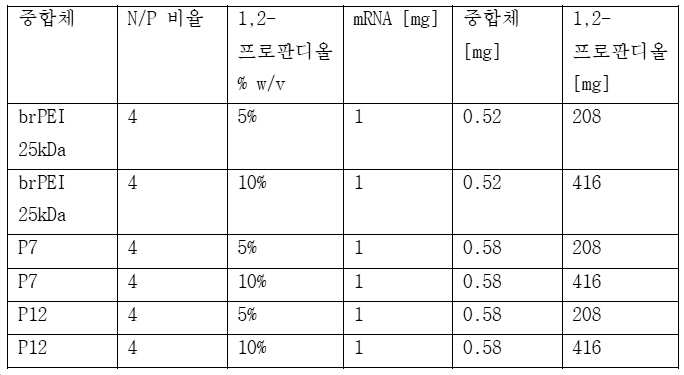
토론 및 결론Discussion and conclusion
이 실험에서 나타낸 바와 같이, 1,2-프로판디올의 안정화 효과는 중합체 분지 유형, 분자량, 단량체 조성 및 N/P 비율과 무관하다. 이러한 모든 매개 변수의 변화는 1회 동결 해동 도전 후 온전한 복합체를 초래했다. 추가로, 폐 적용 후 이러한 복합체의 기능성은 생체내 실험에서 입증될 수 있었다. 리포터 단백질의 발현 수준과 관련하여 5% 또는 10% 1,2-프로판디올에서 동결된 동일한 복합체와 비교하여 신선한 복합체의 유의한 차이는 검출될 수 없었다. 분지형 폴리(에틸렌이민) 대 폴리(에틸렌이민-프로필렌이민)의 효율의 일반적인 차이는 WO2013182683A1의 진술과 완전히 일치한다. 또한, 이 실험은 첨가제의 첨가 시점이 기능성에 영향을 미치지 않음을 확인했다. 실험 I 및 II에서 복합체화 후 첨가제를 나노 입자에 첨가하는 동안, 이 실험에서는 1,2-프로판디올이 mRNA 용액과 혼합되기 전에 중합체 용액에 첨가되었다.As shown in this experiment, the stabilizing effect of 1,2-propanediol is independent of the polymer branch type, molecular weight, monomer composition and N/P ratio. Changes in all these parameters resulted in intact complexes after one freeze-thaw challenge. Additionally, the functionality of these complexes after pulmonary application could be demonstrated in in vivo experiments. Regarding the level of expression of the reporter protein, no significant difference in the fresh complex could be detected compared to the same complex frozen in 5% or 10% 1,2-propanediol. The general difference in the efficiency of branched poly(ethyleneimine) versus poly(ethyleneimine-propyleneimine) is fully consistent with the statement of WO2013182683A1. In addition, this experiment confirmed that the time point of addition of the additive did not affect the functionality. While additives were added to the nanoparticles after complexation in Experiments I and II, in this experiment 1,2-propanediol was added to the polymer solution before being mixed with the mRNA solution.
실시예 V: 동결된 복합체의 안정성Example V: Stability of frozen complexes
복합체 형성Complex formation
분지형 (폴리에틸렌이민)(brPEI) 및 루시퍼라제를 인코딩하는 mRNA의 복합체가 0.25mg/mL의 농도로 형성되었다. 표준 혼합 공정에서, mRNA를 물에서 0.5mg/mL의 농도로 희석시켰다. 동일한 용적의 brPEI 용액을 물 또는 10% 1,2-프로판디올에서 0.65mg/mL의 농도로 제조했다. 나노 입자를 제형화하기 위해, mRNA 용액을 brPEI 용액에 주입한 다음 전자 피펫(Mettler-Toledo, E4 LTS 1000 μL)을 사용하여 혼합했다. 혼합 후, 복합체를 사용 전에 얼음 위에서 20분 동안 배양하였다.A complex of mRNA encoding branched (polyethyleneimine) (brPEI) and luciferase was formed at a concentration of 0.25 mg/mL. In a standard mixing process, mRNA was diluted in water to a concentration of 0.5 mg/mL. Equal volumes of brPEI solution were prepared in water or 10% 1,2-propanediol at a concentration of 0.65 mg/mL. To formulate the nanoparticles, the mRNA solution was injected into the brPEI solution and then mixed using an electronic pipette (Mettler-Toledo,
동결-해동 도전Freeze-thaw challenge
폴리플렉스 크기(Malvern Zetasizer NanoZS)의 초기 결정 후, 각 제형의 100μL 삼중물을 지시된 시간 동안 -20℃에서 동결 저장하고, 실온에서 해동시키고, 용액이 실온에 도달하기 전에 얼음에 즉시 저장했다. 이어서, 각각 해동된 제형 중 하나의 샘플을 크기 결정(Malvern Zetasizer NanoZS)에 사용하고, 다음 방정식에 따라 동결 전과 해동 후 제형의 크기 편차 %와 관련하여 비교하였고, 여기서 dh는 z-평균 입자 직경을 나타낸다:After initial determination of the polyplex size (Malvern Zetasizer NanoZS), 100 μL triplicates of each formulation were stored frozen at -20° C. for the indicated time, thawed at room temperature, and immediately stored on ice before the solution reached room temperature. Then, one sample of each of the thawed formulations was used for size determination (Malvern Zetasizer NanoZS), and compared with the% size deviation of the formulation before and after freezing according to the following equation, where d h is the z-average particle diameter Indicates:

mRNA 완전성 측정mRNA integrity measurement
나노 입자 제형은 물에서 0.2mg/mL mRNA로 희석시켰다. 이 희석액 5μL를 3μL의 40mg/mL 헤파린, 2μL의 2% v/v 트리톤 X-100 및 10μL 포름아미드로 처리했다. 혼합물을 완전한 입자 파괴를 위해 70℃에서 15분 동안 배양한 다음, 분쇄된 얼음에 유지시켰다. 이어서, 핵산 단편 분석은 모세관 겔 전기영동(Advanced Analytical Fragment Analyzer, PROSize 2.0)에 의해 수행되었다. 처리된 제형(mRNA처리됨)으로부터의 전장 mRNA에 대한 신호를 기준으로 제형화에 사용된 동일한 Lot의 신선한 복합체화되지 않은 mRNA(mRNAref)의 신호와 비교하고, 다음 식에 따라 mRNA 완전성[%]으로 표현하였다: The nanoparticle formulation was diluted to 0.2mg/mL mRNA in water. 5 µL of this dilution was treated with 3 µL of 40 mg/mL heparin, 2 µL of 2% v/v Triton X-100 and 10 µL formamide. The mixture was incubated for 15 minutes at 70° C. for complete particle destruction and then kept on crushed ice. Subsequently, nucleic acid fragment analysis was performed by capillary gel electrophoresis (Advanced Analytical Fragment Analyzer, PROSize 2.0). Based on the signal for full-length mRNA from the treated formulation (mRNA- treated), compared with the signal of fresh uncomplexed mRNA (mRNA ref ) of the same lot used for formulation, and mRNA integrity [%] according to the following equation Expressed as:

결과result
mRNA 기반 나노 입자 또는 미세입자의 중요한 매개 변수는 복합체에서 mRNA 안정성이다. 표 15에 제시된 바와 같이, 25℃에서 복합체를 저장하면 복합체화된 mRNA의 급속한 분해를 초래한다. 이 실험에서, 복합체화된 RNA의 안정성에 대한 복합체를 동결시키는 능력의 영향을 시험했다. 제1 세트에서, 복합체를 RNA로 형성하고, 양호한 실행 첨가제 그룹의 예시적인 후보로서 1,2-프로판디올을 첨가 후 동결시켰다. 복합체에서 mRNA의 완전성(전장 mRNA의 양)은 동결 전 및 -20℃에서 저장 1주일 후에 시험하였다. 신선한 복합체화되지 않은 mRNA를 측정하고, 기준으로 100%로 설정했다. 결과는 표 16에 요약된다.An important parameter for mRNA-based nanoparticles or microparticles is mRNA stability in the complex. As shown in Table 15, storage of the complex at 25° C. results in rapid degradation of the complexed mRNA. In this experiment, the effect of the ability to freeze the complex on the stability of the complexed RNA was tested. In the first set, the complexes were formed with RNA, and 1,2-propanediol was added as an exemplary candidate for a group of good performance additives and then frozen. The integrity of the mRNA in the complex (amount of full-length mRNA) was tested before freezing and after 1 week of storage at -20°C. Fresh uncomplexed mRNA was measured and set to 100% as a reference. The results are summarized in Table 16.
제2 세트에서, 실험은 -20℃에서 8주 동안 복합체를 저장한 후 반복했다. 결과는 표 17에 묘사된다.In the second set, the experiment was repeated after storing the complex for 8 weeks at -20°C. The results are depicted in Table 17.
[%]mRNA integrity
[%]
[%]mRNA integrity
[%]
토론 및 결론Discussion and conclusion
기재된 실험은 장기간 저장을 위해 나노 입자 또는 미세입자를 동결시키는 능력의 강력한 이점을 보여준다. 실온에서 저장된 복합체는 몇 시간 내에 mRNA의 분해 과정을 초래하지만, 동결된 상태로 저장된 복합체는 적어도 8주 동안 완전히 보존된 mRNA를 초래한다.The described experiment shows the powerful advantage of the ability to freeze nanoparticles or microparticles for long-term storage. Complexes stored at room temperature result in a process of degradation of the mRNA within a few hours, whereas complexes stored in a frozen state result in mRNAs completely preserved for at least 8 weeks.
실시예 VI: 지질 기반 제형을 위한 동결 방지제로서 1,2-프로판디올Example VI: 1,2-propanediol as cryoprotectant for lipid based formulations
복합체 형성Complex formation
지질 성분(양이온성 리피도이드, 헬퍼 지질 콜레스테롤 및 PEG-지질)을 가용화하고, 이소프로판올에서 혼합하고, 시트레이트 완충액(10mM 시트르산, 150mM NaCl, pH 4.5) 중 mRNA 용액에 1:4의 용적비로 주입하여 0.2mg/mL의 mRNA 농도를 초래한다. 복합체는 실온에서 20분 동안 배양했다. 배양 후, 용액을 16시간 동안 물에 대해 투석하였다. 투석 후 mRNA 농도는 0.13mg/mL였다. 0.2 또는 0.5mg/mL의 mRNA 농도에 도달하기 위해, 입자를 45℃에서 SpeedVac(Concentrator Plus, Eppendorf)에서 농축시켰다. Lipid components (cationic lipidoid, helper lipid cholesterol and PEG-lipid) are solubilized, mixed in isopropanol, and injected in an mRNA solution in a citrate buffer (10 mM citric acid, 150 mM NaCl, pH 4.5) at a volume ratio of 1:4. This results in an mRNA concentration of 0.2 mg/mL. The complex was incubated for 20 minutes at room temperature. After incubation, the solution was dialyzed against water for 16 hours. After dialysis, the mRNA concentration was 0.13mg/mL. To reach an mRNA concentration of 0.2 or 0.5 mg/mL, the particles were concentrated in SpeedVac (Concentrator Plus, Eppendorf) at 45°C.
크기 측정Size measurement
입자 직경의 결정을 위해, 200μL의 입자의 현탁액을 큐벳(브랜드, UV-큐벳 마이크로)에 충전시키고, Malvern ZetaSizer Nano ZS(Malvern Instruments)를 사용하여 측정하여 유체역학적 직경 및 평균 유체역학적 직경(z-평균)을 nm로 제공했다. 현탁 매질로서, 물 또는 지시된 바와 같이 동결 방지 첨가제를 함유하는 물이 사용되었다. For the determination of the particle diameter, a suspension of 200 μL of particles was charged into a cuvette (brand, UV-cuvette micro) and measured using Malvern ZetaSizer Nano ZS (Malvern Instruments) to determine the hydrodynamic diameter and average hydrodynamic diameter (z- Average) in nm. As the suspension medium, water or water containing anti-freeze additives as indicated was used.
동결-해동 도전Freeze-thaw challenge
제형은 2X(20 또는 10%) 1,2-프로판디올 용액으로 1:2로 희석시키고, 상이한 샘플로 분할했다. 각각 생성되는 제형 중 하나의 샘플을 첨가제의 존재하에 크기 결정(Malvern Zetasizer NanoZS)에 사용했다. 나머지 샘플을 -20℃에서 약 16시간 동안 동결시키고, 실온에서 해동하고, 용액이 실온에 도달하기 전에 얼음에 즉시 저장했다. 이어서, 각각 해동된 제형 중 하나의 샘플을 크기 결정(Malvern Zetasizer NanoZS)에 사용하고, 다음 방정식에 따라 동결 전과 해동 후 제형의 크기 편차 %와 관련하여 비교하였고, 여기서 dh는 z-평균 입자 직경을 나타낸다:The formulation was diluted 1:2 with a 2X (20 or 10%) 1,2-propanediol solution and partitioned into different samples. One sample of each of the resulting formulations was used for size determination (Malvern Zetasizer NanoZS) in the presence of additives. The remaining samples were frozen at -20[deg.] C. for about 16 hours, thawed at room temperature, and immediately stored on ice before the solution reached room temperature. Then, one sample of each of the thawed formulations was used for size determination (Malvern Zetasizer NanoZS), and compared with the% size deviation of the formulation before and after freezing according to the following equation, where d h is the z-average particle diameter Indicates:

기관내 분무 적용Intratracheal spray application
이소플루란 흡입 마취하에 MicroSprayer 1A 장치(PennCentury, USA)를 사용하여 50μL 복합체 용액을 기관내 적용했다.A 50 μL complex solution was applied intratracheally using a MicroSprayer 1A apparatus (PennCentury, USA) under isoflurane inhalation anesthesia.
외식된 폐의 생물 발광 측정Bioluminescence measurement of explanted lungs
적용 24시간 후, 동물을 펜타닐/미다졸람/메데토미딘(0.05/5.0/0.5 mg/kg BW)의 복강내 주사를 통해 완전 마취하에 놓았다. 50μL의 D-루시페린(포스페이트 완충 식염수에 용해된 30mg/mL, pH 7)을 스니핑 경로(비공에 직접 적용한 후 용액 흡입)를 통해 적용하고, 100μL의 D-루시페린을 복강내 주사로 전신 적용했다. 루시페린 투여 10분 후, 마우스를 자궁 경부 탈구를 통해 안락사시켰다. 오른쪽 심장을 통해 PBS로 관류 후, 폐를 외식시켰다. 비닝 세트 8 및 노출 시간 5분으로 Xenogen IVIS Luminar XR(Caliper LifeSciences)을 사용하여 생물 발광을 측정했다. 생물 발광을 정량화하고, Living Image Software 4.4(Xenogen)를 사용하여 분석했다. 과포화된 사진의 경우(선형 범위를 벗어난 발현 검출), 노출 시간은 1분으로 단축되었다. 생물 발광은 총 플럭스/기관(광자/초)으로 측정되었다. 과포화가 없는 사진만 분석에 사용되었다. 폐를 급속 동결시키고, -80℃에 저장했다.24 hours after application, animals were placed under complete anesthesia via intraperitoneal injection of fentanyl/midazolam/medetomidine (0.05/5.0/0.5 mg/kg BW). 50 μL of D-luciferin (30 mg/mL dissolved in phosphate buffered saline, pH 7) was applied via the sniffing route (applied directly to the nostril, followed by inhalation of the solution), and 100 μL of D-luciferin was applied systemically by intraperitoneal injection. After 10 minutes of luciferin administration, mice were euthanized through cervical dislocation. After perfusion with PBS through the right heart, the lungs were explanted. Bioluminescence was measured using Xenogen IVIS Luminar XR (Caliper LifeSciences) with binning set 8 and
균질화된 폐에서 루시퍼라제 활성Luciferase activity in the homogenized lung
해동된 기관을 칭량하고, 외식된 폐의 절반을 FastPrep°-24 균질화기(MP Biomedicals)를 사용하여 용해 완충액에서 균질화했다. 100μL의 루시페린 완충액을 Lumat LB 9507 광도계(Berthold Technologies)에 의해 75μL의 원심분리된 용해물에 자동으로 첨가했다. 루시퍼라제 활성은 RLU/s로 측정하였고, RLU/기관으로 전환시켰다.The thawed organs were weighed and half of the explanted lungs were homogenized in lysis buffer using a FastPrep°-24 homogenizer (MP Biomedicals). 100 μL of luciferin buffer was automatically added to 75 μL of centrifuged lysate by means of a Lumat LB 9507 photometer (Berthold Technologies). Luciferase activity was measured as RLU/s and converted to RLU/organ.
결과result
이 실시예는 지질 기반 복합체의 동결 방지제로서 본원에서 정의된 첨가제의 적합성을 입증했다. 제1 단계에서, 나노 입자를 형성시키고, 첨가제의 존재 또는 부재하에 1회 동결-해동 주기로 도전했다. 크기를 동결 전 및 해동 후에 측정했다. 1,2-프로판디올이 물질 그룹의 대표로서 선택되었다. 실험은 상이한 복합체 농도(0.2 및 0.5mg/mL)뿐만 아니라 상이한 첨가제 농도(5% 및 10% (w/v))에서 수행하였다. 크기 차이는 표 18b에 요약된다.This example demonstrated the suitability of the additives defined herein as cryoprotectants of lipid based complexes. In the first step, nanoparticles were formed and challenged with one freeze-thaw cycle in the presence or absence of additives. The size was measured before freezing and after thawing. 1,2-propanediol was chosen as the representative of the substance group. Experiments were performed at different complex concentrations (0.2 and 0.5 mg/mL) as well as at different additive concentrations (5% and 10% (w/v)). The size differences are summarized in Table 18b.
[표 18a][Table 18a]
ZetaSizer Nano ZS(Malvern)로 측정된 새로 제조된 복합체의 표준 크기Standard size of newly prepared composites measured with ZetaSizer Nano ZS (Malvern)

[표 18b][Table 18b]
동결 전 대 해동 후 5% 또는 10% 1,2-프로판디올을 함유하는 상이한 폴리플렉스 제형의 크기 편차 (%).Size deviation (%) of different polyplex formulations containing 5% or 10% 1,2-propanediol before freezing versus after thawing.
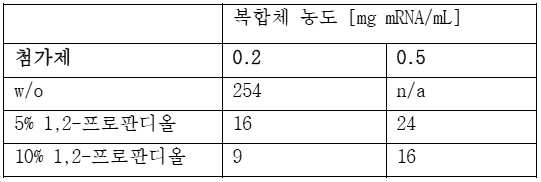
표 18b에 나타낸 바와 같이, 1,2-프로판디올은 또한 지질 기반 복합체에 대해 1회 동결-해동 도전 동안 입자 크기를 안정화시킨다. 따라서, 폐 전달 후 형질 감염의 효율은 다음 단계에서 시험되었다. 이 목적을 위해, 반딧불이 루시퍼라제를 인코딩하는 10㎍ mRNA의 용량을 마이크로스프레이 주사를 통해 기관으로 BALB/c 마우스에 적용했다. 전달 효율 및 이에 따른 담체의 기능성에 대한 척도로서 생성된 단백질의 검출 결과는 도 5 및 표 19에 제시된다. As shown in Table 18b, 1,2-propanediol also stabilizes the particle size during one freeze-thaw challenge for lipid based complexes. Therefore, the efficiency of transfection after lung delivery was tested in the next step. For this purpose, a dose of 10 μg mRNA encoding firefly luciferase was applied to BALB/c mice tracheally via microspray injection. The detection results of the protein produced as a measure for the delivery efficiency and thus the functionality of the carrier are shown in Fig. 5 and Table 19.
도 5는 1,2-프로판디올로 동결 후 지질 기반 나노 입자 또는 미세입자 입자의 생체내 형질 감염 효율을 도시한다.5 shows the in vivo transfection efficiency of lipid-based nanoparticles or microparticle particles after freezing with 1,2-propanediol.
반딧불이 루시퍼라제를 코딩하는 mRNA를 함유하는 복합체를 1,2-프로판디올의 존재 또는 부재하에 제조하였고, 4℃에서 저장 또는 1회 동결-해동 주기 후 마이크로스프레이를 통해 마우스에 기관내 적용했다. 처리 24시간 후, 마우스를 마취시키고, 루시퍼라제 활성 측정을 위해 폐를 외식시켰다. n = 3.Complexes containing mRNA encoding firefly luciferase were prepared in the presence or absence of 1,2-propanediol and applied intratracheally to mice via microspray after storage at 4° C. or one freeze-thaw cycle. After 24 hours of treatment, the mice were anesthetized and the lungs were explanted for determination of luciferase activity. n = 3.
(외식된 폐)(Eating out lungs)
(균질물) (Homogeneous material)
[% w/v][% w/v]
도 5 및 표 19에서 알 수 있는 바와 같이, 1,2-프로판디올의 존재하에 동결된 복합체는 생체내 적용 후 완전한 기능성을 유지했다. 따라서, 첨가제는 형질 감염 효율에 부정적인 영향을 미치지 않는다.As can be seen from Fig. 5 and Table 19, the frozen complex in the presence of 1,2-propanediol maintained full functionality after application in vivo. Therefore, the additive does not negatively affect the transfection efficiency.
토론 및 결론Discussion and conclusion
이 실시예에 제시된 데이터는 1,2-프로판디올이 중합체 기반 복합체뿐만 아니라 지질 기반 복합체의 동결을 허용하여 그들이 응집되는 것을 방지하고 생체내에서 활성을 보존한다는 것을 보여준다.The data presented in this example shows that 1,2-propanediol allows freezing of lipid based complexes as well as polymer based complexes, preventing them from agglomeration and preserving activity in vivo.
Claims (20)
(ii) 1개 또는 2개의 하이드록시 그룹으로 치환된 C3-C5 알칸으로부터 선택된 적어도 하나의 동결 방지 첨가제(cryoprotective additive)를 포함하는 조성물.(i) a nanoparticle or microparticle formulation of a therapeutically active agent suspended in a liquid phase, and
(ii) A composition comprising at least one cryoprotective additive selected from C3-C5 alkanes substituted with one or two hydroxy groups.
(ii) 1개 또는 2개의 하이드록시 그룹으로 치환된 C3-C5 알칸으로부터 선택된 적어도 하나의 동결 방지 첨가제를 포함하는 고체 조성물로서,
제1항 내지 제11항 중 어느 한 항에 따르는 조성물을 동결시킴으로써 수득될 수 있는 고체 조성물.(i) nanoparticles or microparticle formulations of therapeutically active agents, and
(ii) a solid composition comprising at least one antifreeze additive selected from C3-C5 alkanes substituted with one or two hydroxy groups,
A solid composition obtainable by freezing the composition according to claim 1.
a) 액체 상에 현탁된 치료적 활성제의 나노 입자 또는 미세입자 제형을 제공하는 단계, 및
b) 1개 또는 2개의 하이드록시 그룹으로 치환된 C3-C5 알칸으로부터 선택된 적어도 하나의 동결 방지 첨가제를 액체 상에 첨가하는 단계로서, 동결 방지 첨가제의 액체 상에의 첨가가 액체 상에 현탁된 입자 제형을 제공하기 전, 제공하는 동안 또는 제공한 후에 달성될 수 있는, 단계를 포함하는, 제조 방법.A method for preparing a composition according to any one of claims 1 to 11, wherein the method is
a) providing a nanoparticle or microparticle formulation of a therapeutically active agent suspended in a liquid phase, and
b) adding at least one antifreeze additive selected from C3-C5 alkanes substituted with one or two hydroxy groups into the liquid phase, wherein the addition of the antifreeze additive to the liquid phase is suspended in the liquid phase. A method of manufacture comprising a step, which can be achieved before, during or after providing the formulation.
a) 액체 상에 현탁된 치료적 활성제의 나노 입자 또는 미세입자 제형을 제공하는 단계, 및
b) 1개 또는 2개의 하이드록시 그룹으로 치환된 C3-C5 알칸으로부터 선택된 적어도 하나의 동결 방지 첨가제를 액체 상에 첨가하는 단계로서, 동결 방지 첨가제의 액체 상에의 첨가가 액체 상에 현탁된 입자 제형을 제공하기 전, 제공하는 동안 또는 제공한 후에 달성될 수 있는, 단계를 포함하는 공정에 의해 상기 제1 측면에 따르는 조성물을 제공하는 제1 단계 및
제1 단계에서 수득된 조성물을 동결시키는 제2 단계를 포함하는, 제조 방법.A method for preparing a solid composition according to claim 12, wherein the method comprises:
a) providing a nanoparticle or microparticle formulation of a therapeutically active agent suspended in a liquid phase, and
b) adding at least one antifreeze additive selected from C3-C5 alkanes substituted with one or two hydroxy groups into the liquid phase, wherein the addition of the antifreeze additive to the liquid phase is suspended in the liquid phase. A first step of providing a composition according to the first aspect by a process comprising steps, which can be achieved before, during or after providing the formulation, and
A manufacturing method comprising a second step of freezing the composition obtained in the first step.
Applications Claiming Priority (5)
| Application Number | Priority Date | Filing Date | Title |
|---|---|---|---|
| EP18169325 | 2018-04-25 | ||
| EP18169325.0 | 2018-04-25 | ||
| EP18189010 | 2018-08-14 | ||
| EP18189010.4 | 2018-08-14 | ||
| PCT/EP2019/060646 WO2019207061A1 (en) | 2018-04-25 | 2019-04-25 | Cryoprotective agents for particulate formulations |
Publications (1)
| Publication Number | Publication Date |
|---|---|
| KR20210021943A true KR20210021943A (en) | 2021-03-02 |
Family
ID=66240151
Family Applications (2)
| Application Number | Title | Priority Date | Filing Date |
|---|---|---|---|
| KR1020207030471A Pending KR20210021943A (en) | 2018-04-25 | 2019-04-25 | Anti-freeze agent for particulate formulation |
| KR1020207030470A Ceased KR20210022535A (en) | 2018-04-25 | 2019-04-25 | Lipid-based formulation for RNA delivery |
Family Applications After (1)
| Application Number | Title | Priority Date | Filing Date |
|---|---|---|---|
| KR1020207030470A Ceased KR20210022535A (en) | 2018-04-25 | 2019-04-25 | Lipid-based formulation for RNA delivery |
Country Status (13)
| Country | Link |
|---|---|
| US (2) | US12465568B2 (en) |
| EP (3) | EP4311541A3 (en) |
| JP (2) | JP2021522228A (en) |
| KR (2) | KR20210021943A (en) |
| CN (2) | CN112153985B (en) |
| AU (2) | AU2019258678B2 (en) |
| BR (2) | BR112020021054A2 (en) |
| CA (1) | CA3098259C (en) |
| ES (2) | ES2960939T3 (en) |
| MX (2) | MX2020011166A (en) |
| PL (1) | PL3784285T3 (en) |
| WO (2) | WO2019207061A1 (en) |
| ZA (2) | ZA202006026B (en) |
Families Citing this family (42)
| Publication number | Priority date | Publication date | Assignee | Title |
|---|---|---|---|---|
| ES2663360T3 (en) | 2011-06-08 | 2018-04-12 | Translate Bio, Inc. | Cleavable lipids |
| BR112013031553A2 (en) | 2011-06-08 | 2020-11-10 | Shire Human Genetic Therapies, Inc. | compositions, mrna encoding a gland and its use, use of at least one mrna molecule and a vehicle for transfer and use of an mrna encoding for exogenous protein |
| BR112014024131A2 (en) | 2012-03-29 | 2017-07-25 | Shire Human Genetic Therapies | ionizable cationic lipids |
| CA2903487A1 (en) | 2013-03-14 | 2014-09-25 | Shire Human Genetic Therapies, Inc. | Quantitative assessment for cap efficiency of messenger rna |
| EP3301102B1 (en) | 2013-03-14 | 2020-04-15 | Translate Bio, Inc. | Ribonucleic acids with 4'-thio-modified nucleotides and related methods |
| WO2014153052A2 (en) | 2013-03-14 | 2014-09-25 | Shire Human Genetic Therapies, Inc. | Cftr mrna compositions and related methods and uses |
| EP3495505B1 (en) | 2013-03-14 | 2024-09-11 | Translate Bio, Inc. | Quantitative assessment for cap efficiency of messenger rna |
| ES2795249T3 (en) | 2013-03-15 | 2020-11-23 | Translate Bio Inc | Synergistic enhancement of nucleic acid delivery through mixed formulations |
| AU2014340155B2 (en) | 2013-10-22 | 2018-11-01 | Massachusetts Institute Of Technology | Lipid formulations for delivery of messenger RNA |
| EP4036241A1 (en) | 2013-10-22 | 2022-08-03 | Translate Bio, Inc. | Cns delivery of mrna and uses thereof |
| ES2707966T3 (en) | 2013-10-22 | 2019-04-08 | Translate Bio Inc | MRNA therapy for the deficiency in argininosuccinate synthesis |
| CN105658242A (en) | 2013-10-22 | 2016-06-08 | 夏尔人类遗传性治疗公司 | MRNA therapy for phenylketonuria |
| CN106659731A (en) | 2014-05-30 | 2017-05-10 | 夏尔人类遗传性治疗公司 | Topical compositions and methods for treating wounds |
| EP3226912B1 (en) | 2014-12-05 | 2021-01-20 | Translate Bio, Inc. | Messenger rna therapy for treatment of articular disease |
| US10835583B2 (en) | 2016-06-13 | 2020-11-17 | Translate Bio, Inc. | Messenger RNA therapy for the treatment of ornithine transcarbamylase deficiency |
| MX2019005470A (en) | 2016-11-10 | 2019-11-21 | Translate Bio Inc | Improved ice-based lipid nanoparticle formulation for delivery of mrna. |
| EP3971291A1 (en) | 2017-02-27 | 2022-03-23 | Translate Bio, Inc. | Methods for purification of messenger rna |
| MA49393A (en) | 2017-06-12 | 2020-04-22 | Translate Bio Inc | POLY (PHOSPHOESTERS) INTENDED FOR THE ADMINISTRATION OF NUCLEIC ACIDS |
| US11167043B2 (en) | 2017-12-20 | 2021-11-09 | Translate Bio, Inc. | Composition and methods for treatment of ornithine transcarbamylase deficiency |
| KR20210021943A (en) | 2018-04-25 | 2021-03-02 | 에트리스 게엠베하 | Anti-freeze agent for particulate formulation |
| EP3794008A1 (en) | 2018-05-16 | 2021-03-24 | Translate Bio, Inc. | Ribose cationic lipids |
| EP3802487A1 (en) | 2018-05-24 | 2021-04-14 | Translate Bio, Inc. | Thioester cationic lipids |
| EP3802507A1 (en) | 2018-05-30 | 2021-04-14 | Translate Bio, Inc. | Vitamin cationic lipids |
| US20200016274A1 (en) | 2018-05-30 | 2020-01-16 | Translate Bio, Inc. | Messenger rna vaccines and uses thereof |
| CN112424214A (en) | 2018-05-30 | 2021-02-26 | 川斯勒佰尔公司 | Cationic lipids comprising steroidal moieties |
| ES2983019T3 (en) * | 2018-08-14 | 2024-10-21 | Ethris Gmbh | Lipid-based formulations containing salts for RNA delivery |
| KR20210060480A (en) | 2018-08-24 | 2021-05-26 | 트랜슬레이트 바이오 인코포레이티드 | Method for purifying messenger RNA |
| ES2971849T3 (en) | 2018-11-21 | 2024-06-10 | Translate Bio Inc | Cationic lipid compounds and compositions thereof for use in the delivery of messenger RNA |
| CA3120647A1 (en) | 2018-11-21 | 2020-05-28 | Translate Bio, Inc. | Treatment of cystic fibrosis by delivery of nebulized mrna encoding cftr |
| US11559561B2 (en) | 2019-01-07 | 2023-01-24 | Translate Bio, Inc. | Composition and methods for treatment of primary ciliary dyskinesia |
| CA3139679A1 (en) | 2019-05-15 | 2020-11-19 | Translate Bio, Inc. | Methods for purification of messenger rna |
| MX2022000934A (en) | 2019-07-23 | 2022-02-14 | Translate Bio Inc | STABLE COMPOSITIONS OF LIPIDIC NANOPARTICLES LOADED WITH ARNM AND MANUFACTURING PROCESSES. |
| WO2021072172A1 (en) | 2019-10-09 | 2021-04-15 | Translate Bio, Inc. | Compositions, methods and uses of messenger rna |
| PH12022550992A1 (en) | 2019-10-24 | 2023-09-25 | Novago Therapeutics Ag | Novel anti-nogo-a antibodies |
| CA3165388A1 (en) | 2019-12-20 | 2021-06-24 | Translate Bio, Inc. | Improved process of preparing mrna-loaded lipid nanoparticles |
| CA3173035A1 (en) | 2020-02-25 | 2021-09-02 | Translate Bio, Inc. | Improved processes of preparing mrna-loaded lipid nanoparticles |
| EP4149556B1 (en) | 2020-05-14 | 2026-01-07 | Translate Bio, Inc. | Peg lipidoid compounds |
| WO2021245184A1 (en) | 2020-06-02 | 2021-12-09 | Neurimmune Ag | HUMAN ANTIBODIES AGAINST SEVERE ACUTE RESPIRATORY SYNDROME CORONAVIRUS-2 (SARS-CoV-2) |
| WO2025056938A1 (en) * | 2023-09-11 | 2025-03-20 | BioNTech SE | Rna compositions for delivery of incretin agents |
| WO2023009422A1 (en) * | 2021-07-26 | 2023-02-02 | Modernatx, Inc. | Processes for preparing lipid nanoparticle compositions for the delivery of payload molecules to airway epithelium |
| TW202540154A (en) * | 2023-09-11 | 2025-10-16 | 德商拜恩技術股份公司 | Rna compositions for delivery of incretin agents |
| WO2026006617A1 (en) * | 2024-06-27 | 2026-01-02 | Genentech, Inc. | Lyophilized and frozen mrna-lnp formulations |
Family Cites Families (40)
| Publication number | Priority date | Publication date | Assignee | Title |
|---|---|---|---|---|
| US4711955A (en) | 1981-04-17 | 1987-12-08 | Yale University | Modified nucleotides and methods of preparing and using same |
| CA1223831A (en) | 1982-06-23 | 1987-07-07 | Dean Engelhardt | Modified nucleotides, methods of preparing and utilizing and compositions containing the same |
| JPS607932A (en) * | 1983-06-29 | 1985-01-16 | Dai Ichi Seiyaku Co Ltd | Preparation of liposome |
| US5792608A (en) | 1991-12-12 | 1998-08-11 | Gilead Sciences, Inc. | Nuclease stable and binding competent oligomers and methods for their use |
| US5525711A (en) | 1994-05-18 | 1996-06-11 | The United States Of America As Represented By The Secretary Of The Department Of Health And Human Services | Pteridine nucleotide analogs as fluorescent DNA probes |
| US5840710A (en) | 1994-12-09 | 1998-11-24 | Genzyme Corporation | Cationic amphiphiles containing ester or ether-linked lipophilic groups for intracellular delivery of therapeutic molecules |
| CA2214029A1 (en) | 1995-04-25 | 1996-10-31 | Magda Marquet | Single-vial formulations of dna/lipid complexes |
| US6017700A (en) | 1995-08-04 | 2000-01-25 | Bayer Corporation | Cationic oligonucleotides, and related methods of synthesis and use |
| IL133672A0 (en) | 1997-06-27 | 2001-04-30 | Vivorx Pharmaceuticals Inc | Novel formulations of pharmacological agents, methods for the preparation thereof and methods for the use thereof |
| TW520294B (en) | 1998-01-08 | 2003-02-11 | Res Dev Foundation | Stabilization of lipid: DNA formulations during nebulization |
| WO2005121369A2 (en) | 2004-06-02 | 2005-12-22 | Sourcepharm, Inc. | Rna-containing microvesicles and methods therefor |
| CN101163796B (en) * | 2004-06-07 | 2012-08-29 | 普洛体维生物治疗公司 | Cationic lipids and methods of use |
| EP4174179B1 (en) | 2005-08-23 | 2025-05-07 | The Trustees of the University of Pennsylvania | Rna containing modified nucleosides and methods of use thereof |
| EP1954252B1 (en) * | 2005-12-02 | 2016-02-03 | GlaxoSmithKline Biologicals SA | Nanoparticles for use in immunogenic compositions |
| ES2435420T3 (en) | 2005-12-15 | 2013-12-19 | Centre National De La Recherche Scientifique - Cnrs | Cationic oligonucleotides, automatic procedures for preparing them and their uses |
| US8808747B2 (en) | 2007-04-17 | 2014-08-19 | Baxter International Inc. | Nucleic acid microparticles for pulmonary delivery |
| GB0801876D0 (en) * | 2008-02-01 | 2008-03-12 | Vectura Group Plc | Suspension formulations |
| KR20110071017A (en) * | 2008-10-16 | 2011-06-27 | 마리나 바이오테크, 인크. | Processes and compositions for efficient delivery of liposomes for gene silencing therapies |
| MX353900B (en) | 2008-11-07 | 2018-02-01 | Massachusetts Inst Technology | Aminoalcohol lipidoids and uses thereof. |
| DK2459231T3 (en) | 2009-07-31 | 2016-09-05 | Ethris Gmbh | RNA with a combination of unmodified and modified nucleotides for protein expression |
| AU2010328336B2 (en) | 2009-12-07 | 2017-03-02 | Arbutus Biopharma Corporation | Compositions for nucleic acid delivery |
| EP2338520A1 (en) | 2009-12-21 | 2011-06-29 | Ludwig Maximilians Universität | Conjugate with targeting ligand and use of same |
| CN103687588B (en) | 2011-05-16 | 2017-04-12 | 丹麦科技大学 | Charge triggering of self-organized nanoparticles |
| BR112014007852B1 (en) | 2011-10-03 | 2021-11-03 | Moderna Therapeutics, Inc | MODIFIED ISOLATED POLYNUCLEOTIDE AND PHARMACEUTICAL COMPOSITION |
| GB201118704D0 (en) | 2011-10-28 | 2011-12-14 | Univ Oxford | Cystic fibrosis treatment |
| PL2791160T3 (en) | 2011-12-16 | 2022-06-20 | Modernatx, Inc. | Modified mrna compositions |
| CA2873274C (en) | 2012-06-08 | 2021-06-01 | Ethris Gmbh | Pulmonary delivery of messenger rna |
| ES2795249T3 (en) * | 2013-03-15 | 2020-11-23 | Translate Bio Inc | Synergistic enhancement of nucleic acid delivery through mixed formulations |
| EP3013964B1 (en) | 2013-06-28 | 2020-05-06 | ethris GmbH | Compositions for introducing rna into cells |
| CN105873902B (en) | 2013-11-18 | 2019-03-08 | 阿克丘勒斯治疗公司 | Ionizable cationic lipids for RNA delivery |
| EP3110954A1 (en) | 2014-02-26 | 2017-01-04 | Ethris GmbH | Compositions for gastrointestinal administration of rna |
| LT3221293T (en) | 2014-11-18 | 2023-03-27 | Arcturus Therapeutics, Inc. | Ionizable cationic lipid for rna delivery |
| EP3034539A1 (en) | 2014-12-19 | 2016-06-22 | Ethris GmbH | Compositions for introducing nucleic acid into cells |
| WO2016118697A1 (en) | 2015-01-21 | 2016-07-28 | Phaserx, Inc. | Methods, compositions, and systems for delivering therapeutic and diagnostic agents into cells |
| EP3247363A4 (en) * | 2015-01-21 | 2018-10-03 | Moderna Therapeutics, Inc. | Lipid nanoparticle compositions |
| WO2018010815A1 (en) * | 2016-07-15 | 2018-01-18 | Biontech Rna Pharmaceuticals Gmbh | Formulation for administration of rna |
| US11583504B2 (en) * | 2016-11-08 | 2023-02-21 | Modernatx, Inc. | Stabilized formulations of lipid nanoparticles |
| AU2017357758B2 (en) | 2016-11-10 | 2023-11-16 | Translate Bio, Inc. | Improved process of preparing mRNA-loaded lipid nanoparticles |
| KR20210021943A (en) | 2018-04-25 | 2021-03-02 | 에트리스 게엠베하 | Anti-freeze agent for particulate formulation |
| ES2983019T3 (en) | 2018-08-14 | 2024-10-21 | Ethris Gmbh | Lipid-based formulations containing salts for RNA delivery |
-
2019
- 2019-04-25 KR KR1020207030471A patent/KR20210021943A/en active Pending
- 2019-04-25 CN CN201980034447.1A patent/CN112153985B/en active Active
- 2019-04-25 EP EP23187109.6A patent/EP4311541A3/en not_active Withdrawn
- 2019-04-25 BR BR112020021054-4A patent/BR112020021054A2/en unknown
- 2019-04-25 US US17/050,440 patent/US12465568B2/en active Active
- 2019-04-25 JP JP2020558887A patent/JP2021522228A/en active Pending
- 2019-04-25 KR KR1020207030470A patent/KR20210022535A/en not_active Ceased
- 2019-04-25 MX MX2020011166A patent/MX2020011166A/en unknown
- 2019-04-25 AU AU2019258678A patent/AU2019258678B2/en not_active Ceased
- 2019-04-25 CN CN201980034487.6A patent/CN112153986B/en active Active
- 2019-04-25 ES ES19718760T patent/ES2960939T3/en active Active
- 2019-04-25 JP JP2020559465A patent/JP7256824B2/en active Active
- 2019-04-25 WO PCT/EP2019/060646 patent/WO2019207061A1/en not_active Ceased
- 2019-04-25 WO PCT/EP2019/060644 patent/WO2019207060A1/en not_active Ceased
- 2019-04-25 EP EP19718760.2A patent/EP3784285B1/en active Active
- 2019-04-25 US US17/050,441 patent/US20210137840A1/en not_active Abandoned
- 2019-04-25 MX MX2020011167A patent/MX2020011167A/en unknown
- 2019-04-25 PL PL19718760.2T patent/PL3784285T3/en unknown
- 2019-04-25 BR BR112020021037-4A patent/BR112020021037A2/en unknown
- 2019-04-25 AU AU2019258679A patent/AU2019258679B2/en active Active
- 2019-04-25 CA CA3098259A patent/CA3098259C/en active Active
- 2019-04-25 ES ES19718759T patent/ES2960936T3/en active Active
- 2019-04-25 EP EP19718759.4A patent/EP3784284B1/en active Active
-
2020
- 2020-09-29 ZA ZA2020/06026A patent/ZA202006026B/en unknown
- 2020-09-29 ZA ZA2020/06025A patent/ZA202006025B/en unknown
Also Published As
Similar Documents
| Publication | Publication Date | Title |
|---|---|---|
| EP3784285B1 (en) | Cryoprotective agents for particulate formulations | |
| US20240156729A1 (en) | Formulations for aerosol formation and aerosols for the delivery of nucleic acid | |
| KR102285326B1 (en) | Compositions for introducing RNA into cells | |
| Thomas et al. | Non-viral siRNA delivery to the lung | |
| US20220259597A1 (en) | Oligonucleotide antagonists for rna guided genome editing | |
| JP2024516164A (en) | All-in-one dendrimer-based lipid nanoparticles enabling precise in vivo HDR-mediated gene editing | |
| EP4327829A1 (en) | Stabilization of lipid or lipidoid nanoparticle suspensions | |
| CN120754284A (en) | Lipid nanoparticle for liver targeting combined delivery of CRISPR-Cas9 system and single-stranded DNA repair template | |
| CA3098262C (en) | Cryoprotective agents for particulate formulations | |
| EP3836903B1 (en) | Lipid-based formulations containing salts for the delivery of rna | |
| EP4306133A1 (en) | Composition for administration of double-stranded oligonucleotide structures using ultrasonic nebulizer for prevention or treatment of respiratory viral infection including covid-19, pulmonary fibrosis caused by viral infection, or respiratory diseases | |
| RU2820713C2 (en) | Cryoprotective agents for particle-containing formulations | |
| CN117899048A (en) | A targeted lipid nanoparticle and its preparation and application | |
| RU2815001C2 (en) | Lipid-based formulations for rna delivery | |
| WO2019144064A2 (en) | Nanoparticles comprising protein-polynucleotide complexes and for delivering protein based complexes | |
| WO2025240355A1 (en) | Lipid nanoparticles for extrahepatic delivery | |
| Iemsam-Arng et al. | Gene and ribonucleic acid therapy | |
| Zhang et al. | Charge-Engineered Lipid Nanoparticles with Poly (γ-glutamic acid) for Improved CRISPR/Cas9 Genome Editing | |
| HK40105394A (en) | Composition for administration of double-stranded oligonucleotide structures using ultrasonic nebulizer for prevention or treatment of respiratory viral infection including covid-19, pulmonary fibrosis caused by viral infection, or respiratory diseases |
Legal Events
| Date | Code | Title | Description |
|---|---|---|---|
| PA0105 | International application |
St.27 status event code: A-0-1-A10-A15-nap-PA0105 |
|
| P11-X000 | Amendment of application requested |
St.27 status event code: A-2-2-P10-P11-nap-X000 |
|
| P13-X000 | Application amended |
St.27 status event code: A-2-2-P10-P13-nap-X000 |
|
| PG1501 | Laying open of application |
St.27 status event code: A-1-1-Q10-Q12-nap-PG1501 |
|
| E13-X000 | Pre-grant limitation requested |
St.27 status event code: A-2-3-E10-E13-lim-X000 |
|
| P11-X000 | Amendment of application requested |
St.27 status event code: A-2-2-P10-P11-nap-X000 |
|
| P13-X000 | Application amended |
St.27 status event code: A-2-2-P10-P13-nap-X000 |
|
| PA0201 | Request for examination |
St.27 status event code: A-1-2-D10-D11-exm-PA0201 |
|
| PA0302 | Request for accelerated examination |
St.27 status event code: A-1-2-D10-D17-exm-PA0302 St.27 status event code: A-1-2-D10-D16-exm-PA0302 |
|
| E902 | Notification of reason for refusal | ||
| PE0902 | Notice of grounds for rejection |
St.27 status event code: A-1-2-D10-D21-exm-PE0902 |
|
| P11-X000 | Amendment of application requested |
St.27 status event code: A-2-2-P10-P11-nap-X000 |
|
| E902 | Notification of reason for refusal | ||
| PE0902 | Notice of grounds for rejection |
St.27 status event code: A-1-2-D10-D21-exm-PE0902 |
|
| T11 | Administrative time limit extension requested |
Free format text: ST27 STATUS EVENT CODE: U-3-3-T10-T11-OTH-X000 (AS PROVIDED BY THE NATIONAL OFFICE) |
|
| T11-X000 | Administrative time limit extension requested |
St.27 status event code: U-3-3-T10-T11-oth-X000 |
|
| E13 | Pre-grant limitation requested |
Free format text: ST27 STATUS EVENT CODE: A-2-3-E10-E13-LIM-X000 (AS PROVIDED BY THE NATIONAL OFFICE) |
|
| E13-X000 | Pre-grant limitation requested |
St.27 status event code: A-2-3-E10-E13-lim-X000 |
|
| P11 | Amendment of application requested |
Free format text: ST27 STATUS EVENT CODE: A-2-2-P10-P11-NAP-X000 (AS PROVIDED BY THE NATIONAL OFFICE) |
|
| P11-X000 | Amendment of application requested |
St.27 status event code: A-2-2-P10-P11-nap-X000 |