JP2025516823A - Polynucleotides targeting NR4A3 and uses thereof - Google Patents
Polynucleotides targeting NR4A3 and uses thereof Download PDFInfo
- Publication number
- JP2025516823A JP2025516823A JP2024568570A JP2024568570A JP2025516823A JP 2025516823 A JP2025516823 A JP 2025516823A JP 2024568570 A JP2024568570 A JP 2024568570A JP 2024568570 A JP2024568570 A JP 2024568570A JP 2025516823 A JP2025516823 A JP 2025516823A
- Authority
- JP
- Japan
- Prior art keywords
- seq
- fold
- set forth
- protein
- sequence set
- Prior art date
- Legal status (The legal status is an assumption and is not a legal conclusion. Google has not performed a legal analysis and makes no representation as to the accuracy of the status listed.)
- Pending
Links
Images




Classifications
-
- A—HUMAN NECESSITIES
- A61—MEDICAL OR VETERINARY SCIENCE; HYGIENE
- A61K—PREPARATIONS FOR MEDICAL, DENTAL OR TOILETRY PURPOSES
- A61K40/00—Cellular immunotherapy
- A61K40/10—Cellular immunotherapy characterised by the cell type used
- A61K40/11—T-cells, e.g. tumour infiltrating lymphocytes [TIL] or regulatory T [Treg] cells; Lymphokine-activated killer [LAK] cells
-
- A—HUMAN NECESSITIES
- A61—MEDICAL OR VETERINARY SCIENCE; HYGIENE
- A61K—PREPARATIONS FOR MEDICAL, DENTAL OR TOILETRY PURPOSES
- A61K40/00—Cellular immunotherapy
- A61K40/30—Cellular immunotherapy characterised by the recombinant expression of specific molecules in the cells of the immune system
- A61K40/31—Chimeric antigen receptors [CAR]
-
- A—HUMAN NECESSITIES
- A61—MEDICAL OR VETERINARY SCIENCE; HYGIENE
- A61K—PREPARATIONS FOR MEDICAL, DENTAL OR TOILETRY PURPOSES
- A61K40/00—Cellular immunotherapy
- A61K40/30—Cellular immunotherapy characterised by the recombinant expression of specific molecules in the cells of the immune system
- A61K40/32—T-cell receptors [TCR]
-
- A—HUMAN NECESSITIES
- A61—MEDICAL OR VETERINARY SCIENCE; HYGIENE
- A61K—PREPARATIONS FOR MEDICAL, DENTAL OR TOILETRY PURPOSES
- A61K40/00—Cellular immunotherapy
- A61K40/40—Cellular immunotherapy characterised by antigens that are targeted or presented by cells of the immune system
- A61K40/41—Vertebrate antigens
- A61K40/42—Cancer antigens
-
- A—HUMAN NECESSITIES
- A61—MEDICAL OR VETERINARY SCIENCE; HYGIENE
- A61K—PREPARATIONS FOR MEDICAL, DENTAL OR TOILETRY PURPOSES
- A61K40/00—Cellular immunotherapy
- A61K40/40—Cellular immunotherapy characterised by antigens that are targeted or presented by cells of the immune system
- A61K40/41—Vertebrate antigens
- A61K40/42—Cancer antigens
- A61K40/4202—Receptors, cell surface antigens or cell surface determinants
-
- A—HUMAN NECESSITIES
- A61—MEDICAL OR VETERINARY SCIENCE; HYGIENE
- A61K—PREPARATIONS FOR MEDICAL, DENTAL OR TOILETRY PURPOSES
- A61K40/00—Cellular immunotherapy
- A61K40/40—Cellular immunotherapy characterised by antigens that are targeted or presented by cells of the immune system
- A61K40/41—Vertebrate antigens
- A61K40/42—Cancer antigens
- A61K40/4267—Cancer testis antigens, e.g. SSX, BAGE, GAGE or SAGE
- A61K40/4269—NY-ESO
-
- A—HUMAN NECESSITIES
- A61—MEDICAL OR VETERINARY SCIENCE; HYGIENE
- A61K—PREPARATIONS FOR MEDICAL, DENTAL OR TOILETRY PURPOSES
- A61K45/00—Medicinal preparations containing active ingredients not provided for in groups A61K31/00 - A61K41/00
- A61K45/06—Mixtures of active ingredients without chemical characterisation, e.g. antiphlogistics and cardiaca
-
- A—HUMAN NECESSITIES
- A61—MEDICAL OR VETERINARY SCIENCE; HYGIENE
- A61P—SPECIFIC THERAPEUTIC ACTIVITY OF CHEMICAL COMPOUNDS OR MEDICINAL PREPARATIONS
- A61P35/00—Antineoplastic agents
-
- C—CHEMISTRY; METALLURGY
- C07—ORGANIC CHEMISTRY
- C07K—PEPTIDES
- C07K14/00—Peptides having more than 20 amino acids; Gastrins; Somatostatins; Melanotropins; Derivatives thereof
- C07K14/435—Peptides having more than 20 amino acids; Gastrins; Somatostatins; Melanotropins; Derivatives thereof from animals; from humans
- C07K14/705—Receptors; Cell surface antigens; Cell surface determinants
- C07K14/70503—Immunoglobulin superfamily
- C07K14/7051—T-cell receptor (TcR)-CD3 complex
-
- C—CHEMISTRY; METALLURGY
- C07—ORGANIC CHEMISTRY
- C07K—PEPTIDES
- C07K14/00—Peptides having more than 20 amino acids; Gastrins; Somatostatins; Melanotropins; Derivatives thereof
- C07K14/435—Peptides having more than 20 amino acids; Gastrins; Somatostatins; Melanotropins; Derivatives thereof from animals; from humans
- C07K14/705—Receptors; Cell surface antigens; Cell surface determinants
- C07K14/70567—Nuclear receptors, e.g. retinoic acid receptor [RAR], RXR, nuclear orphan receptors
-
- C—CHEMISTRY; METALLURGY
- C07—ORGANIC CHEMISTRY
- C07K—PEPTIDES
- C07K16/00—Immunoglobulins [IGs], e.g. monoclonal or polyclonal antibodies
- C07K16/18—Immunoglobulins [IGs], e.g. monoclonal or polyclonal antibodies against material from animals or humans
- C07K16/28—Immunoglobulins [IGs], e.g. monoclonal or polyclonal antibodies against material from animals or humans against receptors, cell surface antigens or cell surface determinants
- C07K16/2803—Immunoglobulins [IGs], e.g. monoclonal or polyclonal antibodies against material from animals or humans against receptors, cell surface antigens or cell surface determinants against the immunoglobulin superfamily
-
- C—CHEMISTRY; METALLURGY
- C12—BIOCHEMISTRY; BEER; SPIRITS; WINE; VINEGAR; MICROBIOLOGY; ENZYMOLOGY; MUTATION OR GENETIC ENGINEERING
- C12N—MICROORGANISMS OR ENZYMES; COMPOSITIONS THEREOF; PROPAGATING, PRESERVING, OR MAINTAINING MICROORGANISMS; MUTATION OR GENETIC ENGINEERING; CULTURE MEDIA
- C12N15/00—Mutation or genetic engineering; DNA or RNA concerning genetic engineering, vectors, e.g. plasmids, or their isolation, preparation or purification; Use of hosts therefor
- C12N15/09—Recombinant DNA-technology
- C12N15/11—DNA or RNA fragments; Modified forms thereof; Non-coding nucleic acids having a biological activity
- C12N15/113—Non-coding nucleic acids modulating the expression of genes, e.g. antisense oligonucleotides; Antisense DNA or RNA; Triplex- forming oligonucleotides; Catalytic nucleic acids, e.g. ribozymes; Nucleic acids used in co-suppression or gene silencing
- C12N15/1138—Non-coding nucleic acids modulating the expression of genes, e.g. antisense oligonucleotides; Antisense DNA or RNA; Triplex- forming oligonucleotides; Catalytic nucleic acids, e.g. ribozymes; Nucleic acids used in co-suppression or gene silencing against receptors or cell surface proteins
-
- C—CHEMISTRY; METALLURGY
- C12—BIOCHEMISTRY; BEER; SPIRITS; WINE; VINEGAR; MICROBIOLOGY; ENZYMOLOGY; MUTATION OR GENETIC ENGINEERING
- C12N—MICROORGANISMS OR ENZYMES; COMPOSITIONS THEREOF; PROPAGATING, PRESERVING, OR MAINTAINING MICROORGANISMS; MUTATION OR GENETIC ENGINEERING; CULTURE MEDIA
- C12N15/00—Mutation or genetic engineering; DNA or RNA concerning genetic engineering, vectors, e.g. plasmids, or their isolation, preparation or purification; Use of hosts therefor
- C12N15/09—Recombinant DNA-technology
- C12N15/87—Introduction of foreign genetic material using processes not otherwise provided for, e.g. co-transformation
- C12N15/90—Stable introduction of foreign DNA into chromosome
- C12N15/902—Stable introduction of foreign DNA into chromosome using homologous recombination
- C12N15/907—Stable introduction of foreign DNA into chromosome using homologous recombination in mammalian cells
-
- C—CHEMISTRY; METALLURGY
- C12—BIOCHEMISTRY; BEER; SPIRITS; WINE; VINEGAR; MICROBIOLOGY; ENZYMOLOGY; MUTATION OR GENETIC ENGINEERING
- C12N—MICROORGANISMS OR ENZYMES; COMPOSITIONS THEREOF; PROPAGATING, PRESERVING, OR MAINTAINING MICROORGANISMS; MUTATION OR GENETIC ENGINEERING; CULTURE MEDIA
- C12N5/00—Undifferentiated human, animal or plant cells, e.g. cell lines; Tissues; Cultivation or maintenance thereof; Culture media therefor
- C12N5/06—Animal cells or tissues; Human cells or tissues
- C12N5/0602—Vertebrate cells
- C12N5/0634—Cells from the blood or the immune system
- C12N5/0636—T lymphocytes
-
- C—CHEMISTRY; METALLURGY
- C12—BIOCHEMISTRY; BEER; SPIRITS; WINE; VINEGAR; MICROBIOLOGY; ENZYMOLOGY; MUTATION OR GENETIC ENGINEERING
- C12N—MICROORGANISMS OR ENZYMES; COMPOSITIONS THEREOF; PROPAGATING, PRESERVING, OR MAINTAINING MICROORGANISMS; MUTATION OR GENETIC ENGINEERING; CULTURE MEDIA
- C12N9/00—Enzymes; Proenzymes; Compositions thereof; Processes for preparing, activating, inhibiting, separating or purifying enzymes
- C12N9/14—Hydrolases (3)
- C12N9/16—Hydrolases (3) acting on ester bonds (3.1)
- C12N9/22—Ribonucleases [RNase]; Deoxyribonucleases [DNase]
-
- A—HUMAN NECESSITIES
- A61—MEDICAL OR VETERINARY SCIENCE; HYGIENE
- A61K—PREPARATIONS FOR MEDICAL, DENTAL OR TOILETRY PURPOSES
- A61K2300/00—Mixtures or combinations of active ingredients, wherein at least one active ingredient is fully defined in groups A61K31/00 - A61K41/00
-
- C—CHEMISTRY; METALLURGY
- C07—ORGANIC CHEMISTRY
- C07K—PEPTIDES
- C07K2317/00—Immunoglobulins specific features
- C07K2317/60—Immunoglobulins specific features characterized by non-natural combinations of immunoglobulin fragments
- C07K2317/62—Immunoglobulins specific features characterized by non-natural combinations of immunoglobulin fragments comprising only variable region components
- C07K2317/622—Single chain antibody (scFv)
-
- C—CHEMISTRY; METALLURGY
- C12—BIOCHEMISTRY; BEER; SPIRITS; WINE; VINEGAR; MICROBIOLOGY; ENZYMOLOGY; MUTATION OR GENETIC ENGINEERING
- C12N—MICROORGANISMS OR ENZYMES; COMPOSITIONS THEREOF; PROPAGATING, PRESERVING, OR MAINTAINING MICROORGANISMS; MUTATION OR GENETIC ENGINEERING; CULTURE MEDIA
- C12N2310/00—Structure or type of the nucleic acid
- C12N2310/10—Type of nucleic acid
- C12N2310/20—Type of nucleic acid involving clustered regularly interspaced short palindromic repeats [CRISPR]
-
- C—CHEMISTRY; METALLURGY
- C12—BIOCHEMISTRY; BEER; SPIRITS; WINE; VINEGAR; MICROBIOLOGY; ENZYMOLOGY; MUTATION OR GENETIC ENGINEERING
- C12N—MICROORGANISMS OR ENZYMES; COMPOSITIONS THEREOF; PROPAGATING, PRESERVING, OR MAINTAINING MICROORGANISMS; MUTATION OR GENETIC ENGINEERING; CULTURE MEDIA
- C12N2510/00—Genetically modified cells
-
- Y—GENERAL TAGGING OF NEW TECHNOLOGICAL DEVELOPMENTS; GENERAL TAGGING OF CROSS-SECTIONAL TECHNOLOGIES SPANNING OVER SEVERAL SECTIONS OF THE IPC; TECHNICAL SUBJECTS COVERED BY FORMER USPC CROSS-REFERENCE ART COLLECTIONS [XRACs] AND DIGESTS
- Y02—TECHNOLOGIES OR APPLICATIONS FOR MITIGATION OR ADAPTATION AGAINST CLIMATE CHANGE
- Y02A—TECHNOLOGIES FOR ADAPTATION TO CLIMATE CHANGE
- Y02A50/00—TECHNOLOGIES FOR ADAPTATION TO CLIMATE CHANGE in human health protection, e.g. against extreme weather
- Y02A50/30—Against vector-borne diseases, e.g. mosquito-borne, fly-borne, tick-borne or waterborne diseases whose impact is exacerbated by climate change
Landscapes
- Health & Medical Sciences (AREA)
- Life Sciences & Earth Sciences (AREA)
- Chemical & Material Sciences (AREA)
- Organic Chemistry (AREA)
- Genetics & Genomics (AREA)
- General Health & Medical Sciences (AREA)
- Engineering & Computer Science (AREA)
- Immunology (AREA)
- Zoology (AREA)
- Biomedical Technology (AREA)
- Molecular Biology (AREA)
- Wood Science & Technology (AREA)
- Bioinformatics & Cheminformatics (AREA)
- Animal Behavior & Ethology (AREA)
- Public Health (AREA)
- Veterinary Medicine (AREA)
- Biochemistry (AREA)
- Biotechnology (AREA)
- Medicinal Chemistry (AREA)
- Epidemiology (AREA)
- General Engineering & Computer Science (AREA)
- Biophysics (AREA)
- Microbiology (AREA)
- Cell Biology (AREA)
- Proteomics, Peptides & Aminoacids (AREA)
- Physics & Mathematics (AREA)
- Pharmacology & Pharmacy (AREA)
- Plant Pathology (AREA)
- Gastroenterology & Hepatology (AREA)
- Toxicology (AREA)
- General Chemical & Material Sciences (AREA)
- Hematology (AREA)
- Chemical Kinetics & Catalysis (AREA)
- Nuclear Medicine, Radiotherapy & Molecular Imaging (AREA)
- Mycology (AREA)
- High Energy & Nuclear Physics (AREA)
- Medicines That Contain Protein Lipid Enzymes And Other Medicines (AREA)
- Pharmaceuticals Containing Other Organic And Inorganic Compounds (AREA)
- Medicines Containing Material From Animals Or Micro-Organisms (AREA)
- Peptides Or Proteins (AREA)
Abstract
本開示は、細胞(例えば、免疫細胞)におけるNR4A3遺伝子及び/またはNR4A3タンパク質のレベルを低減することが可能なポリヌクレオチドを提供する。いくつかの態様では、ポリヌクレオチドは、NR4A3遺伝子内の領域を特異的に標的とするgRNAを含む。本開示はまた、様々な疾患または障害を処置するためのそのようなポリヌクレオチドの使用を提供する。 The present disclosure provides polynucleotides capable of reducing the levels of the NR4A3 gene and/or NR4A3 protein in a cell (e.g., an immune cell). In some aspects, the polynucleotide comprises a gRNA that specifically targets a region within the NR4A3 gene. The present disclosure also provides the use of such polynucleotides to treat various diseases or disorders.
Description
関連出願の相互参照
このPCT出願は、2022年5月19日に出願された米国仮出願番号63/365,025、2022年11月7日に出願された米国仮出願番号63/382,705;及び2023年2月2日に出願された米国仮出願番号63/482,984の優先権の利益を主張し、これらの各々は、その全体が参照により本明細書に組み込まれる。
CROSS-REFERENCE TO RELATED APPLICATIONS This PCT application claims the benefit of priority to U.S. Provisional Application No. 63/365,025, filed May 19, 2022; U.S. Provisional Application No. 63/382,705, filed November 7, 2022; and U.S. Provisional Application No. 63/482,984, filed February 2, 2023, each of which is incorporated by reference in its entirety herein.
電子的に提出された配列表に対する言及
配列表の内容は、電子的に提出され(名称:4385_105PC03_SequenceListing_ST26.XML;サイズ:124,447バイト;及び作成日:2023年5月19日)、本出願と共に出願され、その全体が参照により本明細書に組み込まれる。
REFERENCE TO ELECTRONICALLY SUBMITTED SEQUENCE LISTING The contents of the Sequence Listing have been submitted electronically (Name: 4385_105PC03_SequenceListing_ST26.XML; Size: 124,447 bytes; and Created: May 19, 2023), filed herewith, and are hereby incorporated by reference in their entirety.
本開示は、免疫細胞におけるNR4A3遺伝子及び/またはNR4A3タンパク質のレベルを低減するために使用され得るポリヌクレオチド(例えば、ガイドRNA)に関する。本開示はまた、NR4A3遺伝子及び/またはNR4A3タンパク質の低減されたレベルを有するそのような免疫細胞の投与を伴う細胞ベースの(例えば、T細胞)がん免疫療法に関する。 The present disclosure relates to polynucleotides (e.g., guide RNAs) that can be used to reduce levels of the NR4A3 gene and/or NR4A3 protein in immune cells. The present disclosure also relates to cell-based (e.g., T cell) cancer immunotherapy involving administration of such immune cells having reduced levels of the NR4A3 gene and/or NR4A3 protein.
がん免疫療法は、感染細胞及び罹患細胞の免疫系の主なキラーであるT細胞に、腫瘍細胞を攻撃及び殺傷させることに依存している。しかしながら、免疫療法には重要な障害がある:T細胞が殺傷する能力は衰え得る(しばしば疲弊と称される現象)。免疫チェックポイント遮断、キメラ抗原受容体(CAR)T細胞療法、及びT細胞受容体で操作された(TCR)T細胞療法は、患者から単離された機能的に活性なT細胞を使用し、かつ有効であるためには高度に機能的なT細胞を必要とする処置である。これらのT細胞は、標的がん細胞上の特定の抗原を認識するように操作され、ex vivoで増大させられる。 Cancer immunotherapy relies on T cells, the immune system's main killers of infected and diseased cells, to attack and kill tumor cells. However, immunotherapy has a major obstacle: the ability of T cells to kill can wane (a phenomenon often referred to as exhaustion). Immune checkpoint blockade, chimeric antigen receptor (CAR) T cell therapy, and T cell receptor engineered (TCR) T cell therapy are treatments that use functionally active T cells isolated from patients and require highly functional T cells to be effective. These T cells are engineered to recognize specific antigens on target cancer cells and expanded ex vivo.
免疫系が、例えば、持続的なウイルス感染またはがんの漸進的発達により長期間活性であることを強いられる場合、エフェクターT細胞は、疲弊し得る。疲弊したT細胞の1つの特徴は、PD-1及びCTLA-4のような免疫チェックポイントタンパク質の増加した発現であり、これは、それらのT細胞の離脱を引き起こし得る(すなわち、非機能的になる)。免疫チェックポイント阻害剤は、これらのチェックポイントタンパク質を遮断し、その際、腫瘍に対する免疫反応を増加させ得る。いくつかの研究は、疲弊したT細胞においてチェックポイントタンパク質の活性を遮断することが、その目的を達成しないことを示唆していた。このことは、いわゆる炎症性腫瘍(hot tumor)、すなわち、高レベルの免疫細胞を含み、ひいては免疫療法に反応するための理想的な候補となるはずである腫瘍が、しばしば、ほとんどが疲弊したT細胞から構成される集団を保有することから重要である。その上、腫瘍微小環境は、老化及び疲弊した細胞表現型を誘導し得る。そのため、これらの疲弊した状態を逆転及び/または防止するためのストラテジーを考案することは、免疫療法の有効性の改善に極めて重要である。 When the immune system is forced to remain active for a long period of time, for example, by persistent viral infection or the progressive development of cancer, effector T cells can become exhausted. One characteristic of exhausted T cells is the increased expression of immune checkpoint proteins such as PD-1 and CTLA-4, which can cause those T cells to detach (i.e., become non-functional). Immune checkpoint inhibitors can block these checkpoint proteins and, in so doing, increase the immune response against the tumor. Some studies have suggested that blocking the activity of checkpoint proteins in exhausted T cells does not achieve its purpose. This is important because so-called hot tumors, i.e. tumors that contain high levels of immune cells and thus should be ideal candidates for responding to immunotherapy, often harbor a population composed mostly of exhausted T cells. Moreover, the tumor microenvironment can induce senescence and exhausted cell phenotypes. Therefore, devising strategies to reverse and/or prevent these exhausting conditions is crucial to improving the efficacy of immunotherapy.
本明細書では、免疫細胞におけるNR4A3遺伝子及び/またはNR4A3タンパク質のレベルを低減する方法であって、免疫細胞をgRNAを含むポリヌクレオチドを含む遺伝子編集ツールで修飾することを含み、gRNAは、NR4A3遺伝子内の配列に特異的に結合することが可能であり、配列番号94、配列番号52、配列番号96、配列番号53、配列番号54、配列番号86、配列番号83、配列番号55、配列番号82、配列番号56、配列番号76、配列番号57、配列番号75、配列番号58、配列番号71、配列番号61、配列番号70、配列番号65、配列番号68、及び配列番号67のいずれか1つに示される配列を含み、それから本質的になり、またはそれからなり、修飾した後、免疫細胞におけるNR4A3遺伝子及び/またはNR4A3タンパク質のレベルは、参照免疫細胞(例えば、ポリヌクレオチドと接触させなかった対応する免疫細胞)と比較した場合、低減される、方法が提供される。いくつかの態様では、修飾した後、NR4A3遺伝子のレベルは、参照免疫細胞と比較した場合、少なくとも約5%、少なくとも約10%、少なくとも約20%、少なくとも約30%、少なくとも約40%、少なくとも約50%、少なくとも約60%、少なくとも約70%、少なくとも約80%、少なくとも約90%、または約100%低減される。いくつかの態様では、修飾した後、NR4A3タンパク質のレベルは、参照免疫細胞と比較した場合、少なくとも約5%、少なくとも約10%、少なくとも約20%、少なくとも約30%、少なくとも約40%、少なくとも約50%、少なくとも約60%、少なくとも約70%、少なくとも約80%、少なくとも約90%、または約100%低減される。 Provided herein is a method of reducing levels of the NR4A3 gene and/or NR4A3 protein in an immune cell, comprising modifying the immune cell with a gene editing tool comprising a polynucleotide comprising a gRNA, the gRNA being capable of specifically binding to a sequence within the NR4A3 gene and comprising, consisting essentially of, or consisting of a sequence set forth in any one of SEQ ID NO:94, SEQ ID NO:52, SEQ ID NO:96, SEQ ID NO:53, SEQ ID NO:54, SEQ ID NO:86, SEQ ID NO:83, SEQ ID NO:55, SEQ ID NO:82, SEQ ID NO:56, SEQ ID NO:76, SEQ ID NO:57, SEQ ID NO:75, SEQ ID NO:58, SEQ ID NO:71, SEQ ID NO:61, SEQ ID NO:70, SEQ ID NO:65, SEQ ID NO:68, and SEQ ID NO:67, wherein after modification, the levels of the NR4A3 gene and/or NR4A3 protein in the immune cell are reduced when compared to a reference immune cell (e.g., a corresponding immune cell that has not been contacted with the polynucleotide). In some embodiments, after modification, the level of the NR4A3 gene is reduced by at least about 5%, at least about 10%, at least about 20%, at least about 30%, at least about 40%, at least about 50%, at least about 60%, at least about 70%, at least about 80%, at least about 90%, or about 100% when compared to a reference immune cell. In some embodiments, after modification, the level of the NR4A3 protein is reduced by at least about 5%, at least about 10%, at least about 20%, at least about 30%, at least about 40%, at least about 50%, at least about 60%, at least about 70%, at least about 80%, at least about 90%, or about 100% when compared to a reference immune cell.
また、本明細書では、免疫細胞における疲弊を低減または防止する方法であって、免疫細胞をgRNAを含むポリヌクレオチドを含む遺伝子編集ツールと接触させることを含み、gRNAは、NR4A3遺伝子内の配列に特異的に結合することが可能であり、配列番号94、配列番号52、配列番号96、配列番号53、配列番号54、配列番号86、配列番号83、配列番号55、配列番号82、配列番号56、配列番号76、配列番号57、配列番号75、配列番号58、配列番号71、配列番号61、配列番号70、配列番号65、配列番号68、及び配列番号67のいずれか1つに示される配列を含み、それから本質的になり、またはそれからなり、接触させた後、免疫細胞は、参照免疫細胞(例えば、ポリヌクレオチドと接触させられなかった対応する免疫細胞)と比較した場合、永続的抗原刺激後に疲弊がより少ない、方法が提供される。いくつかの態様では、免疫細胞は、参照免疫細胞と比較した場合、疲弊に対してより耐性である。いくつかの態様では、免疫細胞は、参照免疫細胞と比較した場合、対象に投与された場合に増加した持続性/生存を示す。いくつかの態様では、免疫細胞は、参照免疫細胞と比較した場合、永続的抗原刺激により増加した増大/増殖を示す。いくつかの態様では、免疫細胞は、参照免疫細胞と比較した場合、永続的抗原刺激に反応して増加したエフェクター機能を示す。 Also provided herein is a method of reducing or preventing exhaustion in an immune cell, comprising contacting an immune cell with a gene editing tool comprising a polynucleotide comprising a gRNA, the gRNA being capable of specifically binding to a sequence in the NR4A3 gene, comprising, consisting essentially of, or consisting of a sequence set forth in any one of SEQ ID NO:94, SEQ ID NO:52, SEQ ID NO:96, SEQ ID NO:53, SEQ ID NO:54, SEQ ID NO:86, SEQ ID NO:83, SEQ ID NO:55, SEQ ID NO:82, SEQ ID NO:56, SEQ ID NO:76, SEQ ID NO:57, SEQ ID NO:75, SEQ ID NO:58, SEQ ID NO:71, SEQ ID NO:61, SEQ ID NO:70, SEQ ID NO:65, SEQ ID NO:68, and SEQ ID NO:67, wherein after contacting, the immune cell is less exhausted after persistent antigen stimulation when compared to a reference immune cell (e.g., a corresponding immune cell that was not contacted with the polynucleotide). In some aspects, the immune cell is more resistant to exhaustion when compared to the reference immune cell. In some aspects, the immune cell exhibits increased persistence/survival when administered to a subject when compared to the reference immune cell. In some embodiments, the immune cells exhibit increased expansion/proliferation upon persistent antigenic stimulation when compared to a reference immune cell. In some embodiments, the immune cells exhibit increased effector function in response to persistent antigenic stimulation when compared to a reference immune cell.
本明細書では、抗原刺激に反応する免疫細胞によるサイトカインの生成を増加させる方法であって、免疫細胞をgRNAを含むポリヌクレオチドを含む遺伝子編集ツールで修飾することを含み、gRNAは、NR4A3遺伝子内の配列に特異的に結合することが可能であり、配列番号94、配列番号52、配列番号96、配列番号53、配列番号54、配列番号86、配列番号83、配列番号55、配列番号82、配列番号56、配列番号76、配列番号57、配列番号75、配列番号58、配列番号71、配列番号61、配列番号70、配列番号65、配列番号68、及び配列番号67のいずれか1つに示される配列を含み、それから本質的になり、またはそれからなり、修飾した後、免疫細胞は、参照免疫細胞(例えば、ポリヌクレオチドで修飾されなかった対応する免疫細胞)と比較した場合、抗原刺激により増加したサイトカイン生成を示す、方法が提供される。いくつかの態様では、サイトカインは、IFN-γ、IL-2、TNF-α、またはそれらの組み合わせを含む。いくつかの態様では、修飾した後、抗原刺激に反応するサイトカインの生成は、参照免疫細胞と比較した場合、少なくとも約1倍、少なくとも約2倍、少なくとも約3倍、少なくとも約4倍、少なくとも約5倍、少なくとも約6倍、少なくとも約7倍、少なくとも約8倍、少なくとも約9倍、少なくとも約10倍、少なくとも約11倍、少なくとも約12倍、少なくとも約13倍、少なくとも約14倍、少なくとも約15倍、少なくとも約16倍、少なくとも約17倍、少なくとも約18倍、少なくとも約19倍、少なくとも約20倍、少なくとも約25倍、少なくとも約30倍、少なくとも約35倍、少なくとも約40倍、少なくとも約45倍、または少なくとも約50倍増加する。 Provided herein is a method of increasing cytokine production by an immune cell in response to antigenic stimulation, comprising modifying the immune cell with a gene editing tool comprising a polynucleotide comprising a gRNA, the gRNA being capable of specifically binding to a sequence within the NR4A3 gene and comprising, consisting essentially of, or consisting of a sequence set forth in any one of SEQ ID NO:94, SEQ ID NO:52, SEQ ID NO:96, SEQ ID NO:53, SEQ ID NO:54, SEQ ID NO:86, SEQ ID NO:83, SEQ ID NO:55, SEQ ID NO:82, SEQ ID NO:56, SEQ ID NO:76, SEQ ID NO:57, SEQ ID NO:75, SEQ ID NO:58, SEQ ID NO:71, SEQ ID NO:61, SEQ ID NO:70, SEQ ID NO:65, SEQ ID NO:68, and SEQ ID NO:67, wherein after modification, the immune cell exhibits increased cytokine production upon antigenic stimulation when compared to a reference immune cell (e.g., a corresponding immune cell that was not modified with the polynucleotide). In some aspects, the cytokine comprises IFN-γ, IL-2, TNF-α, or a combination thereof. In some embodiments, after modification, cytokine production in response to antigenic stimulation is increased by at least about 1-fold, at least about 2-fold, at least about 3-fold, at least about 4-fold, at least about 5-fold, at least about 6-fold, at least about 7-fold, at least about 8-fold, at least about 9-fold, at least about 10-fold, at least about 11-fold, at least about 12-fold, at least about 13-fold, at least about 14-fold, at least about 15-fold, at least about 16-fold, at least about 17-fold, at least about 18-fold, at least about 19-fold, at least about 20-fold, at least about 25-fold, at least about 30-fold, at least about 35-fold, at least about 40-fold, at least about 45-fold, or at least about 50-fold, when compared to a reference immune cell.
本開示はまた、永続的抗原刺激に反応する免疫細胞のエフェクター機能を増加させる方法であって、免疫細胞をgRNAを含むポリヌクレオチドを含む遺伝子編集ツールで修飾することを含み、gRNAは、NR4A3遺伝子内の配列に特異的に結合することが可能であり、配列番号94、配列番号52、配列番号96、配列番号53、配列番号54、配列番号86、配列番号83、配列番号55、配列番号82、配列番号56、配列番号76、配列番号57、配列番号75、配列番号58、配列番号71、配列番号61、配列番号70、配列番号65、配列番号68、及び配列番号67のいずれか1つに示される配列を含み、それから本質的になり、またはそれからなり、修飾した後、免疫細胞は、参照免疫細胞(例えば、ポリヌクレオチドと接触させられなかった対応する免疫細胞)と比較した場合、永続的抗原刺激により増加したエフェクター機能を示す、方法が提供される。いくつかの態様では、修飾した後、免疫細胞は、参照免疫細胞と比較した場合、少なくとも1、少なくとも2、または少なくとも3ラウンドの追加の抗原刺激アッセイについてエフェクター機能を保持する。いくつかの態様では、エフェクター機能は、(i)標的細胞(例えば、腫瘍細胞)を殺傷する能力、(ii)さらなる抗原刺激によりサイトカインを生成する能力、または(iii)(i)及び(ii)の両方を含む。 The present disclosure also provides a method of increasing effector function of an immune cell in response to persistent antigenic stimulation, comprising modifying the immune cell with a gene editing tool comprising a polynucleotide comprising a gRNA, the gRNA being capable of specifically binding to a sequence in the NR4A3 gene, comprising, consisting essentially of, or consisting of a sequence set forth in any one of SEQ ID NO:94, SEQ ID NO:52, SEQ ID NO:96, SEQ ID NO:53, SEQ ID NO:54, SEQ ID NO:86, SEQ ID NO:83, SEQ ID NO:55, SEQ ID NO:82, SEQ ID NO:56, SEQ ID NO:76, SEQ ID NO:57, SEQ ID NO:75, SEQ ID NO:58, SEQ ID NO:71, SEQ ID NO:61, SEQ ID NO:70, SEQ ID NO:65, SEQ ID NO:68, and SEQ ID NO:67, wherein after modification, the immune cell exhibits increased effector function upon persistent antigenic stimulation when compared to a reference immune cell (e.g., a corresponding immune cell that was not contacted with the polynucleotide). In some aspects, after modification, the immune cell retains effector function for at least one, at least two, or at least three additional rounds of antigenic stimulation assays when compared to the reference immune cell. In some embodiments, the effector function includes (i) the ability to kill a target cell (e.g., a tumor cell), (ii) the ability to produce cytokines upon further antigen stimulation, or (iii) both (i) and (ii).
本開示のいくつかの態様は、NR4A3遺伝子及び/またはNR4A3タンパク質の低減されたレベルを有する免疫細胞を含む組成物を調製する方法であって、方法は、免疫細胞をgRNAを含むポリヌクレオチドを含む遺伝子編集ツールで修飾することを含み、gRNAは、NR4A3遺伝子内の配列に特異的に結合することが可能であり、配列番号94、配列番号52、配列番号96、配列番号53、配列番号54、配列番号86、配列番号83、配列番号55、配列番号82、配列番号56、配列番号76、配列番号57、配列番号75、配列番号58、配列番号71、配列番号61、配列番号70、配列番号65、配列番号68、及び配列番号67のいずれか1つに示される配列を含み、それから本質的になり、またはそれからなり、修飾した後、免疫細胞におけるNR4A3遺伝子及び/またはNR4A3タンパク質のレベルは、参照免疫細胞(例えば、ポリヌクレオチドと接触させなかった対応する免疫細胞)と比較した場合、低減される、方法に関する。いくつかの態様では、方法は、修飾された免疫細胞を薬学的に許容可能な賦形剤と組み合わせることをさらに含む。 Some aspects of the present disclosure relate to a method of preparing a composition comprising an immune cell having a reduced level of NR4A3 gene and/or NR4A3 protein, the method comprising modifying the immune cell with a gene editing tool comprising a polynucleotide comprising a gRNA, the gRNA being capable of specifically binding to a sequence within the NR4A3 gene and comprising, consisting essentially of, or consisting of a sequence set forth in any one of SEQ ID NO:94, SEQ ID NO:52, SEQ ID NO:96, SEQ ID NO:53, SEQ ID NO:54, SEQ ID NO:86, SEQ ID NO:83, SEQ ID NO:55, SEQ ID NO:82, SEQ ID NO:56, SEQ ID NO:76, SEQ ID NO:57, SEQ ID NO:75, SEQ ID NO:58, SEQ ID NO:71, SEQ ID NO:61, SEQ ID NO:70, SEQ ID NO:65, SEQ ID NO:68, and SEQ ID NO:67, wherein after modification, the level of the NR4A3 gene and/or NR4A3 protein in the immune cell is reduced when compared to a reference immune cell (e.g., a corresponding immune cell not contacted with the polynucleotide). In some aspects, the method further comprises combining the modified immune cell with a pharma- ceutically acceptable excipient.
上記方法のいずれかについて、いくつかの態様では、修飾した後、NR4A3遺伝子のレベルは、参照免疫細胞と比較した場合、少なくとも約5%、少なくとも約10%、少なくとも約20%、少なくとも約30%、少なくとも約40%、少なくとも約50%、少なくとも約60%、少なくとも約70%、少なくとも約80%、少なくとも約90%、または約100%低減される。いくつかの態様では、修飾した後、NR4A3タンパク質のレベルは、参照免疫細胞と比較した場合、少なくとも約5%、少なくとも約10%、少なくとも約20%、少なくとも約30%、少なくとも約40%、少なくとも約50%、少なくとも約60%、少なくとも約70%、少なくとも約80%、少なくとも約90%、または約100%低減される。 For any of the above methods, in some embodiments, after modification, the level of the NR4A3 gene is reduced by at least about 5%, at least about 10%, at least about 20%, at least about 30%, at least about 40%, at least about 50%, at least about 60%, at least about 70%, at least about 80%, at least about 90%, or about 100% when compared to a reference immune cell. In some embodiments, after modification, the level of the NR4A3 protein is reduced by at least about 5%, at least about 10%, at least about 20%, at least about 30%, at least about 40%, at least about 50%, at least about 60%, at least about 70%, at least about 80%, at least about 90%, or about 100% when compared to a reference immune cell.
また、本明細書では、腫瘍を処置することを必要とする対象における腫瘍を処置する方法であって、gRNAを含むポリヌクレオチドを含む遺伝子編集ツールで修飾された免疫細胞を対象に投与することを含み、gRNAは、NR4A3遺伝子内の配列に特異的に結合することが可能であり、配列番号94、配列番号52、配列番号96、配列番号53、配列番号54、配列番号86、配列番号83、配列番号55、配列番号82、配列番号56、配列番号76、配列番号57、配列番号75、配列番号58、配列番号71、配列番号61、配列番号70、配列番号65、配列番号68、及び配列番号67のいずれか1つに示される配列を含む、それから本質的になる、またはそれからなる、方法が提供される。いくつかの態様では、免疫細胞におけるNR4A3遺伝子のレベルは、参照免疫細胞(例えば、ポリヌクレオチドと接触させられなかった対応する免疫細胞)と比較した場合、少なくとも約5%、少なくとも約10%、少なくとも約20%、少なくとも約30%、少なくとも約40%、少なくとも約50%、少なくとも約60%、少なくとも約70%、少なくとも約80%、少なくとも約90%、または約100%低減される。いくつかの態様では、免疫細胞におけるNR4A3タンパク質のレベルは、参照免疫細胞と比較した場合、少なくとも約5%、少なくとも約10%、少なくとも約20%、少なくとも約30%、少なくとも約40%、少なくとも約50%、少なくとも約60%、少なくとも約70%、少なくとも約80%、少なくとも約90%、または約100%低減される。 Also provided herein is a method of treating a tumor in a subject in need thereof, comprising administering to the subject immune cells modified with a gene editing tool comprising a polynucleotide comprising a gRNA, wherein the gRNA is capable of specifically binding to a sequence within the NR4A3 gene, and the method comprises, consists essentially of, or consists of a sequence set forth in any one of SEQ ID NO:94, SEQ ID NO:52, SEQ ID NO:96, SEQ ID NO:53, SEQ ID NO:54, SEQ ID NO:86, SEQ ID NO:83, SEQ ID NO:55, SEQ ID NO:82, SEQ ID NO:56, SEQ ID NO:76, SEQ ID NO:57, SEQ ID NO:75, SEQ ID NO:58, SEQ ID NO:71, SEQ ID NO:61, SEQ ID NO:70, SEQ ID NO:65, SEQ ID NO:68, and SEQ ID NO:67. In some embodiments, the level of the NR4A3 gene in the immune cell is reduced by at least about 5%, at least about 10%, at least about 20%, at least about 30%, at least about 40%, at least about 50%, at least about 60%, at least about 70%, at least about 80%, at least about 90%, or about 100% when compared to a reference immune cell (e.g., a corresponding immune cell that has not been contacted with the polynucleotide). In some embodiments, the level of the NR4A3 protein in the immune cell is reduced by at least about 5%, at least about 10%, at least about 20%, at least about 30%, at least about 40%, at least about 50%, at least about 60%, at least about 70%, at least about 80%, at least about 90%, or about 100% when compared to a reference immune cell.
腫瘍を処置する上記方法では、いくつかの態様では、投与することは、参照腫瘍体積(例えば、投与前の対象における腫瘍体積及び/または投与を受けなかった対象における腫瘍体積)と比較した場合、対象における腫瘍体積を低減する。いくつかの態様では、腫瘍体積は、参照腫瘍体積と比較して少なくとも約5%、少なくとも約10%、少なくとも約20%、少なくとも約30%、少なくとも約40%、少なくとも約50%、少なくとも約60%、少なくとも約70%、少なくとも約80%、少なくとも約90%、または少なくとも約100%低減される。 In the above methods of treating a tumor, in some embodiments, administering reduces the tumor volume in the subject as compared to a reference tumor volume (e.g., the tumor volume in the subject prior to administration and/or the tumor volume in a subject not receiving administration). In some embodiments, the tumor volume is reduced by at least about 5%, at least about 10%, at least about 20%, at least about 30%, at least about 40%, at least about 50%, at least about 60%, at least about 70%, at least about 80%, at least about 90%, or at least about 100% as compared to the reference tumor volume.
いくつかの態様では、本明細書で提供される方法で処置され得る腫瘍は、乳癌、頭頸部癌、子宮癌、脳癌、皮膚癌、腎臓癌、肺癌、大腸癌、前立腺癌、肝臓癌、膀胱癌、腎臓癌、膵臓癌、甲状腺癌、食道癌、眼癌、胃(stomach)(胃(gastric))癌、消化器癌、卵巣癌、子宮頸癌、癌腫、肉腫、白血病、リンパ腫、骨髄腫、またはそれらの組み合わせを含むがんに由来する。 In some aspects, tumors that may be treated with the methods provided herein are derived from cancers including breast cancer, head and neck cancer, uterine cancer, brain cancer, skin cancer, kidney cancer, lung cancer, colon cancer, prostate cancer, liver cancer, bladder cancer, renal cancer, pancreatic cancer, thyroid cancer, esophageal cancer, eye cancer, stomach (gastric) cancer, gastrointestinal cancer, ovarian cancer, cervical cancer, carcinoma, sarcoma, leukemia, lymphoma, myeloma, or combinations thereof.
いくつかの態様では、本明細書で提供される腫瘍を処置する方法は、追加の治療剤を対象に投与することをさらに含む。いくつかの態様では、追加の治療剤は、化学療法薬、標的化抗がん療法、腫瘍溶解性薬物、細胞傷害剤、免疫ベースの療法、サイトカイン、手術処置、放射線処置、共刺激分子の活性化因子、免疫チェックポイント阻害剤、ワクチン、細胞免疫療法、またはそれらの任意の組み合わせを含む。いくつかの態様では、追加の治療剤は、免疫チェックポイント阻害剤である。いくつかの態様では、免疫チェックポイント阻害剤は、抗PD-1抗体、抗PD-L1抗体、抗LAG-3抗体、抗CTLA-4抗体、抗GITR抗体、抗TIM3抗体、及びそれらの任意の組み合わせを含む。いくつかの態様では、免疫細胞及び追加の治療剤は、同時に対象に投与される。いくつかの態様では、免疫細胞及び追加の治療剤は、逐次に対象に投与される。 In some aspects, the methods of treating a tumor provided herein further comprise administering an additional therapeutic agent to the subject. In some aspects, the additional therapeutic agent comprises a chemotherapeutic agent, a targeted anti-cancer therapy, an oncolytic drug, a cytotoxic agent, an immune-based therapy, a cytokine, a surgical procedure, a radiation treatment, an activator of a costimulatory molecule, an immune checkpoint inhibitor, a vaccine, a cellular immunotherapy, or any combination thereof. In some aspects, the additional therapeutic agent is an immune checkpoint inhibitor. In some aspects, the immune checkpoint inhibitor comprises an anti-PD-1 antibody, an anti-PD-L1 antibody, an anti-LAG-3 antibody, an anti-CTLA-4 antibody, an anti-GITR antibody, an anti-TIM3 antibody, and any combination thereof. In some aspects, the immune cells and the additional therapeutic agent are administered to the subject simultaneously. In some aspects, the immune cells and the additional therapeutic agent are administered to the subject sequentially.
いくつかの態様では、免疫細胞は、挿入的、筋肉内、皮下、眼、静脈内、腹腔内、皮内、眼窩内、脳内、頭蓋内、脊髄内、心室内、髄腔内、嚢内、関節包内、腫瘍内、またはそれらの任意の組み合わせで対象に投与される。 In some embodiments, the immune cells are administered to the subject insertively, intramuscularly, subcutaneously, ocularly, intravenously, intraperitoneally, intradermally, intraorbitally, intracerebrally, intracranially, intraspinally, intraventricularly, intrathecally, intracapsularly, intracapsularly, intratumorally, or any combination thereof.
上記方法のいずれかでは、いくつかの態様では、方法は、免疫細胞を、NR4A1遺伝子及び/またはNR4A1タンパク質の低減されたレベルを有するように修飾することをさらに含む。いくつかの態様では、免疫細胞を、NR4A1遺伝子及び/またはNR4A1タンパク質の低減されたレベルを有するように修飾することは、免疫細胞を、NR4A1遺伝子及び/またはNR4A1タンパク質を特異的に標的とし、そのレベルを低減することが可能な遺伝子編集ツール(「NR4A1特異的遺伝子編集ツール」)と接触させることを含む。いくつかの態様では、免疫細胞をNR4A1特異的遺伝子編集ツールと接触させた後、NR4A1遺伝子のレベルは、NR4A1特異的遺伝子編集ツールと接触させられなかった対応する細胞と比較した場合、少なくとも約5%、少なくとも約10%、少なくとも約20%、少なくとも約30%、少なくとも約40%、少なくとも約50%、少なくとも約60%、少なくとも約70%、少なくとも約80%、少なくとも約90%、または約100%低減される。いくつかの態様では、免疫細胞をNR4A1特異的遺伝子編集ツールと接触させた後、NR4A1タンパク質のレベルは、NR4A1特異的遺伝子編集ツールと接触させられなかった対応する細胞と比較した場合、少なくとも約5%、少なくとも約10%、少なくとも約20%、少なくとも約30%、少なくとも約40%、少なくとも約50%、少なくとも約60%、少なくとも約70%、少なくとも約80%、少なくとも約90%、または約100%低減される。 In any of the above methods, in some aspects, the method further comprises modifying the immune cell to have a reduced level of the NR4A1 gene and/or NR4A1 protein. In some aspects, modifying the immune cell to have a reduced level of the NR4A1 gene and/or NR4A1 protein comprises contacting the immune cell with a gene editing tool capable of specifically targeting and reducing the level of the NR4A1 gene and/or NR4A1 protein (an "NR4A1-specific gene editing tool"). In some aspects, after contacting the immune cell with the NR4A1-specific gene editing tool, the level of the NR4A1 gene is reduced by at least about 5%, at least about 10%, at least about 20%, at least about 30%, at least about 40%, at least about 50%, at least about 60%, at least about 70%, at least about 80%, at least about 90%, or about 100% when compared to a corresponding cell that was not contacted with the NR4A1-specific gene editing tool. In some aspects, after contacting immune cells with an NR4A1-specific gene editing tool, the level of NR4A1 protein is reduced by at least about 5%, at least about 10%, at least about 20%, at least about 30%, at least about 40%, at least about 50%, at least about 60%, at least about 70%, at least about 80%, at least about 90%, or about 100% when compared to corresponding cells that were not contacted with an NR4A1-specific gene editing tool.
上記方法のいずれかについて、いくつかの態様では、方法は、免疫細胞を、NR4A2遺伝子及び/またはNR4A2タンパク質の低減されたレベルを有するように修飾することをさらに含む。いくつかの態様では、免疫細胞を、NR4A2遺伝子及び/またはNR4A2タンパク質の低減されたレベルを有するように修飾することは、免疫細胞を、NR4A2遺伝子及び/またはNR4A2タンパク質を特異的に標的とし、そのレベルを低減することが可能な遺伝子編集ツール(「NR4A1特異的遺伝子編集ツール」)と接触させることを含む。いくつかの態様では、免疫細胞をNR4A2特異的遺伝子編集ツールと接触させた後、NR4A2遺伝子のレベルは、NR4A2特異的遺伝子編集ツールと接触させられなかった対応する細胞と比較した場合、少なくとも約5%、少なくとも約10%、少なくとも約20%、少なくとも約30%、少なくとも約40%、少なくとも約50%、少なくとも約60%、少なくとも約70%、少なくとも約80%、少なくとも約90%、または約100%低減される。いくつかの態様では、免疫細胞をNR4A2特異的遺伝子編集ツールと接触させた後、NR4A2タンパク質のレベルは、NR4A2特異的遺伝子編集ツールと接触させられなかった対応する細胞と比較した場合、少なくとも約5%、少なくとも約10%、少なくとも約20%、少なくとも約30%、少なくとも約40%、少なくとも約50%、少なくとも約60%、少なくとも約70%、少なくとも約80%、少なくとも約90%、または約100%低減される。 For any of the above methods, in some aspects, the method further comprises modifying the immune cell to have a reduced level of the NR4A2 gene and/or NR4A2 protein. In some aspects, modifying the immune cell to have a reduced level of the NR4A2 gene and/or NR4A2 protein comprises contacting the immune cell with a gene editing tool capable of specifically targeting and reducing the level of the NR4A2 gene and/or NR4A2 protein (an "NR4A1-specific gene editing tool"). In some aspects, after contacting the immune cell with the NR4A2-specific gene editing tool, the level of the NR4A2 gene is reduced by at least about 5%, at least about 10%, at least about 20%, at least about 30%, at least about 40%, at least about 50%, at least about 60%, at least about 70%, at least about 80%, at least about 90%, or about 100% when compared to a corresponding cell that was not contacted with the NR4A2-specific gene editing tool. In some aspects, after contacting immune cells with an NR4A2-specific gene editing tool, the level of NR4A2 protein is reduced by at least about 5%, at least about 10%, at least about 20%, at least about 30%, at least about 40%, at least about 50%, at least about 60%, at least about 70%, at least about 80%, at least about 90%, or about 100% when compared to corresponding cells that were not contacted with an NR4A2-specific gene editing tool.
いくつかの態様では、上で提供される方法のいずれかは、免疫細胞を、c-Junタンパク質の増加したレベルを有するように修飾することをさらに含む。いくつかの態様では、免疫細胞を、c-Junタンパク質の増加したレベルを有するように修飾することは、免疫細胞をc-Junタンパク質をコードするヌクレオチド配列と接触させることを含む。いくつかの態様では、c-Junタンパク質をコードするヌクレオチド配列は、(a)配列番号7に示される核酸配列と少なくとも89%、少なくとも90%、少なくとも約95%、少なくとも約96%、少なくとも約97%、少なくとも約98%、少なくとも約99%、または約100%の配列同一性を有する核酸配列;(b)配列番号8に示される核酸配列と少なくとも90%、少なくとも約95%、少なくとも約96%、少なくとも約97%、少なくとも約98%、少なくとも約99%、または約100%の配列同一性を有する核酸配列;(c)配列番号10に示される核酸配列と少なくとも約30%、少なくとも約40%、少なくとも約50%、少なくとも約60%、少なくとも約70%、少なくとも約80%、少なくとも約90%、少なくとも約95%、少なくとも約96%、少なくとも約97%、少なくとも約98%、少なくとも約99%、または約100%の配列同一性を有する核酸配列;(d)配列番号11に示される核酸配列と少なくとも79%、少なくとも80%、少なくとも81%、少なくとも82%、少なくとも83%、少なくとも84%、少なくとも85%、少なくとも86%、少なくとも87%、少なくとも88%、少なくとも89%、少なくとも90%、少なくとも約95%、少なくとも約96%、少なくとも約97%、少なくとも約98%、少なくとも約99%、または約100%の配列同一性を有する核酸配列;(e)配列番号12に示される核酸配列と少なくとも88%、少なくとも89%、少なくとも90%、少なくとも約95%、少なくとも約96%、少なくとも約97%、少なくとも約98%、少なくとも約99%、または約100%の配列同一性を有する核酸配列;(f)配列番号13に示される核酸配列と少なくとも82%、少なくとも83%、少なくとも84%、少なくとも85%、少なくとも90%、少なくとも約95%、少なくとも約96%、少なくとも約97%、少なくとも約98%、少なくとも約99%、または約100%の配列同一性を有する核酸配列;(g)配列番号14に示される核酸配列と少なくとも90%、少なくとも約95%、少なくとも約96%、少なくとも約97%、少なくとも約98%、少なくとも約99%、または約100%の配列同一性を有する核酸配列;(h)配列番号15に示される核酸配列と少なくとも55%、少なくとも約55%、少なくとも約60%、少なくとも約65%、少なくとも約70%、少なくとも約75%、少なくとも約80%、少なくとも約85%、少なくとも約90%、少なくとも約95%、少なくとも約96%、少なくとも約97%、少なくとも約98%、少なくとも約99%、または約100%の配列同一性を有する核酸配列;または(i)配列番号16に示される核酸配列と少なくとも85%、少なくとも86%、少なくとも87%、少なくとも88%、少なくとも89%、少なくとも約90%、少なくとも約95%、少なくとも約96%、少なくとも約97%、少なくとも約98%、少なくとも約99%、または約100%の配列同一性を有する核酸配列を含む。 In some aspects, any of the methods provided above further include modifying the immune cell to have an increased level of c-Jun protein. In some aspects, modifying the immune cell to have an increased level of c-Jun protein includes contacting the immune cell with a nucleotide sequence encoding the c-Jun protein. In some aspects, the nucleotide sequence encoding the c-Jun protein is a nucleic acid sequence having at least 89%, at least 90%, at least about 95%, at least about 96%, at least about 97%, at least about 98%, at least about 99%, or about 100% sequence identity to the nucleic acid sequence set forth in SEQ ID NO:7; (b) a nucleic acid sequence having at least 90%, at least about 95%, at least about 96%, at least about 97%, at least about 98%, at least about 99%, or about 100% sequence identity to the nucleic acid sequence set forth in SEQ ID NO:8; (c) a nucleic acid sequence having at least about 30%, at least about 40%, at least about 50%, at least about 60%, at least about 70%, at least about 80%, (d) a nucleic acid sequence having at least about 79%, at least 80%, at least 81%, at least 82%, at least 83%, at least 84%, at least 85%, at least 86%, at least 87%, at least 88%, at least 89%, at least 90%, at least about 95%, at least about 96%, at least about 97%, at least about 98%, at least about 99%, or about 100% sequence identity to the nucleic acid sequence set forth in SEQ ID NO:11; (e) a nucleic acid sequence having at least 88%, at least 89%, at least (f) a nucleic acid sequence having at least 82%, at least 83%, at least 84%, at least 85%, at least 90%, at least about 95%, at least about 96%, at least about 97%, at least about 98%, at least about 99%, or about 100% sequence identity to the nucleic acid sequence set forth in SEQ ID NO:13; (g) a nucleic acid sequence having at least 90%, at least about 95%, at least about 96%, at least about 97%, at least about 98%, at least about 99%, or about 100% sequence identity to the nucleic acid sequence set forth in SEQ ID NO:14; (h) a nucleic acid sequence having at least 90%, at least about 95%, at least about 96%, at least about 97%, at least about 98%, at least about 99%, or about 100% sequence identity to the nucleic acid sequence set forth in SEQ ID NO:15. or (i) a nucleic acid sequence having at least 85%, at least 86%, at least 87%, at least 88%, at least 89%, at least about 90%, at least about 95%, at least about 96%, at least about 97%, at least about 98%, at least about 99%, or about 100% sequence identity to the nucleic acid sequence set forth in SEQ ID NO: 16.
いくつかの態様では、免疫細胞を、c-Junタンパク質の増加したレベルを有するように修飾することは、免疫細胞を、内因性c-Junタンパク質の発現を増加させることが可能な転写活性化因子と接触させることを含む。いくつかの態様では、転写活性化因子は、エンドヌクレアーゼ活性を欠くように修飾されたCasタンパク質に結合されている。 In some aspects, modifying the immune cell to have an increased level of c-Jun protein comprises contacting the immune cell with a transcriptional activator capable of increasing expression of endogenous c-Jun protein. In some aspects, the transcriptional activator is coupled to a Cas protein that has been modified to lack endonuclease activity.
いくつかの態様では、免疫細胞を、c-Junタンパク質の増加したレベルを有するように修飾した後、免疫細胞におけるc-Junタンパク質のレベルは、参照細胞(例えば、c-Junタンパク質の増加したレベルを有するように修飾されなかった対応する細胞)と比較した場合、少なくとも約1倍、少なくとも約2倍、少なくとも約3倍、少なくとも約4倍、少なくとも約5倍、少なくとも約6倍、少なくとも約7倍、少なくとも約8倍、少なくとも約9倍、少なくとも約10倍、少なくとも約11倍、少なくとも約12倍、少なくとも約13倍、少なくとも約14倍、少なくとも約15倍、少なくとも約16倍、少なくとも約17倍、少なくとも約18倍、少なくとも約19倍、少なくとも約20倍、少なくとも約25倍、少なくとも約30倍、少なくとも約35倍、少なくとも約40倍、少なくとも約45倍、または少なくとも約50倍増加する。 In some embodiments, after the immune cells are modified to have increased levels of c-Jun protein, the level of c-Jun protein in the immune cells is increased by at least about 1-fold, at least about 2-fold, at least about 3-fold, at least about 4-fold, at least about 5-fold, at least about 6-fold, at least about 7-fold, at least about 8-fold, at least about 9-fold, at least about 10-fold, at least about 11-fold, at least about 12-fold, at least about 13-fold, at least about 14-fold, at least about 15-fold, at least about 16-fold, at least about 17-fold, at least about 18-fold, at least about 19-fold, at least about 20-fold, at least about 25-fold, at least about 30-fold, at least about 35-fold, at least about 40-fold, at least about 45-fold, or at least about 50-fold when compared to a reference cell (e.g., a corresponding cell that has not been modified to have increased levels of c-Jun protein).
いくつかの態様では、上で提供される方法のいずれかは、免疫細胞を、リガンド結合タンパク質を発現するように修飾することをさらに含む。いくつかの態様では、リガンド結合タンパク質キメラ抗原受容体(CAR)、T細胞受容体(TCR)、キメラ抗体-T細胞受容体(caTCR)、キメラシグナル伝達受容体(CSR)、T細胞受容体模倣体(TCR模倣体)、またはそれらの組み合わせ。いくつかの態様では、リガンド結合タンパク質は、CARである。いくつかの態様では、リガンド結合タンパク質は、TCRである。いくつかの態様では、リガンド結合タンパク質は、CD19、TRAC、TCRβ、BCMA、CLL-1、CS1、CD38、CD19、TSHR、CD123、CD22、CD30、CD70、CD171、CD33、EGFRvIII、GD2、GD3、Tn Ag、PSMA、ROR1、ROR2、GPC1、GPC2、FLT3、FAP、TAG72、CD44v6、CEA、EPCAM、B7H3、KIT、IL-13Ra2、メソテリン、IL-l lRa、PSCA、PRSS21、VEGFR2、ルイスY、CD24、PDGFR-ベータ、SSEA-4、CD20、葉酸受容体アルファ、ERBB2(Her2/neu)、MUC1、MUC16、EGFR、NCAM、プロスターゼ、PAP、ELF2M、エフリンB2、IGF-I受容体、CAIX、LMP2、gplOO、bcr-abl、チロシナーゼ、EphA2、フコシルGM1、sLe、GM3、TGS5、HMWMAA、o-アセチル-GD2、葉酸受容体ベータ、TEM1/CD248、TEM7R、CLDN6、GPRC5D、CXORF61、CD97、CD179a、ALK、ポリシアル酸、PLAC1、GloboH、NY-BR-1、UPK2、HAVCR1、ADRB3、PANX3、GPR20、LY6K、OR51E2、TARP、WTl、NY-ESO-1、LAGE-la、MAGE-Al、レグマイン、HPV E6,E7、MAGE Al、ETV6-AML、精子タンパク質17、XAGE1、Tie2、MAD-CT-1、MAD-CT-2、Fos関連抗原1、p53、p53変異体、プロステイン、スルビビン及びテロメラーゼ、PCTA-1/ガレクチン8、メランA/MARTl、Ras変異体、hTERT、肉腫転座ブレークポイント、ML-IAP、ERG(TMPRSS2 ETS融合遺伝子)、NA17、PAX3、アンドロゲン受容体、サイクリンBl、MYCN、RhoC、TRP-2、CYP1B1、BORIS、SART3、PAX5、OY-TES1、LCK、AKAP-4、SSX2、RAGE-1、ヒトテロメラーゼ逆転写酵素、RU1、RU2、腸カルボキシルエステラーゼ、mut hsp70-2、CD79a、CD79b、CD72、LAIR1、FCAR、LILRA2、CD300LF、CLEC12A、BST2、EMR2、LY75、GPC3、FCRL5、IGLL1、またはそれらの任意の組み合わせから選択される抗原に特異的に結合することが可能である。 In some aspects, any of the methods provided above further comprise modifying the immune cell to express a ligand binding protein. In some aspects, the ligand binding protein is a chimeric antigen receptor (CAR), a T cell receptor (TCR), a chimeric antibody-T cell receptor (caTCR), a chimeric signal transducing receptor (CSR), a T cell receptor mimic (TCR mimic), or a combination thereof. In some aspects, the ligand binding protein is a CAR. In some aspects, the ligand binding protein is a TCR. In some aspects, the ligand binding protein is selected from the group consisting of CD19, TRAC, TCRβ, BCMA, CLL-1, CS1, CD38, CD19, TSHR, CD123, CD22, CD30, CD70, CD171, CD33, EGFRvIII, GD2, GD3, Tn Ag, PSMA, ROR1, ROR2, GPC1, GPC2, FLT3, FAP, TAG72, CD44v6, CEA, EPCAM, B7H3, KIT, IL-13Ra2, mesothelin, IL-1 lRa, PSCA, PRSS21, VEGFR2, Lewis Y, CD24, PDGFR-beta, SSEA-4, CD20, folate receptor alpha, ERBB2 (Her2/neu), MUC1, MUC16, EGFR, NCAM, prostase, PAP, ELF2M, ephrin B2, IGF-I receptor, CAIX, LMP2, gplOO, bcr-abl, tyrosinase, EphA2, fucosyl GM1, sLe, GM3, TGS5, HMWMAA, o-acetyl-GD2, folate receptor beta, TEM1/CD248, TEM7R, CLDN6, GPRC5D, CXORF61, CD97, CD179a, ALK, polysialic acid, PLAC1, GloboH, NY-BR-1, UPK2, HAVCR1, ADRB3, PANX3, GPR20, LY6K, OR51E2, TARP, WTl, NY-ESO-1, LAGE-la, MAGE-Al, legumain, HPV E6, E7, MAGE Al, ETV6-AML, sperm protein 17, XAGE1, Tie2, MAD-CT-1, MAD-CT-2, Fos-related antigen 1, p53, p53 mutant, prostein, survivin and telomerase, PCTA-1/galectin 8, MelanA/MARTl, Ras mutant, hTERT, sarcoma translocation breakpoints, ML-IAP, ERG (TMPRSS2 ETS fusion gene), NA17, PAX3, androgen receptor, cyclin B1, MYCN, RhoC, TRP-2, CYP1B1, BORIS, SART3, PAX5, OY-TES1, LCK, AKAP-4, SSX2, RAGE-1, human telomerase reverse transcriptase, RU1, RU2, intestinal carboxylesterase, mut hsp70-2, CD79a, CD79b, CD72, LAIR1, FCAR, LILRA2, CD300LF, CLEC12A, BST2, EMR2, LY75, GPC3, FCRL5, IGLL1, or any combination thereof.
いくつかの態様では、リガンド結合タンパク質は、ROR1に特異的に結合する。いくつかの態様では、リガンド結合タンパク質は、R12抗体、R11抗体、2A2抗体、またはそれらの任意の組み合わせに由来する抗原結合ドメインを含む。いくつかの態様では、リガンド結合タンパク質は、重鎖可変ドメイン(VH)及び軽鎖可変ドメイン(VL)を含み、VHは、配列番号17に示されるアミノ酸配列を含み、VLは、配列番号21に示されるアミノ酸配列を含む。 In some aspects, the ligand binding protein specifically binds to ROR1. In some aspects, the ligand binding protein comprises an antigen binding domain derived from the R12 antibody, the R11 antibody, the 2A2 antibody, or any combination thereof. In some aspects, the ligand binding protein comprises a heavy chain variable domain (VH) and a light chain variable domain (VL), where the VH comprises the amino acid sequence set forth in SEQ ID NO: 17 and the VL comprises the amino acid sequence set forth in SEQ ID NO: 21.
上記方法のいずれかでは、いくつかの態様では、遺伝子編集ツールは、shRNA、siRNA、miRNA、アンチセンスオリゴヌクレオチド、CRISPR、ジンクフィンガーヌクレアーゼ、TALEN、メガヌクレアーゼ、制限エンドヌクレアーゼ、またはそれらの任意の組み合わせを含む。いくつかの態様では、遺伝子編集ツールは、CRISPRである。 In any of the above methods, in some embodiments, the gene editing tool comprises an shRNA, an siRNA, an miRNA, an antisense oligonucleotide, a CRISPR, a zinc finger nuclease, a TALEN, a meganuclease, a restriction endonuclease, or any combination thereof. In some embodiments, the gene editing tool is a CRISPR.
また、本明細書では、NR4A3遺伝子及び/またはNR4A3タンパク質の低減されたレベルを有する細胞を含む組成物であって、組成物は、本明細書で提供される方法のいずれかによって調製されている、組成物が提供される。 Also provided herein is a composition comprising a cell having a reduced level of the NR4A3 gene and/or NR4A3 protein, the composition being prepared by any of the methods provided herein.
本開示はまた、NR4A3遺伝子及び/またはNR4A3タンパク質の低減されたレベルを発現する細胞を含む組成物であって、細胞は、NR4A3遺伝子を標的とし得るgRNAで修飾されており、gRNAは、配列番号94、配列番号52、配列番号96、配列番号53、配列番号54、配列番号86、配列番号83、配列番号55、配列番号82、配列番号56、配列番号76、配列番号57、配列番号75、配列番号58、配列番号71、配列番号61、配列番号70、配列番号65、配列番号68、及び配列番号67のいずれか1つに示される配列を含む、それからなる、またはそれから本質的になる、組成物を提供する。いくつかの態様では、gRNAは、配列番号94に示される配列を含む、それからなる、またはそれから本質的になる。いくつかの態様では、gRNAは、配列番号52に示される配列を含む、それからなる、またはそれから本質的になる。いくつかの態様では、gRNAは、配列番号96に示される配列を含む、それからなる、またはそれから本質的になる。いくつかの態様では、gRNAは、配列番号53に示される配列を含む、それからなる、またはそれから本質的になる。いくつかの態様では、gRNAは、配列番号54に示される配列を含む、それからなる、またはそれから本質的になる。いくつかの態様では、gRNAは、配列番号86に示される配列を含む、それからなる、またはそれから本質的になる。いくつかの態様では、gRNAは、配列番号83に示される配列を含む、それからなる、またはそれから本質的になる。いくつかの態様では、gRNAは、配列番号55に示される配列を含む、それからなる、またはそれから本質的になる。いくつかの態様では、gRNAは、配列番号82に示される配列を含む、それからなる、またはそれから本質的になる。いくつかの態様では、gRNAは、配列番号56に示される配列を含む、それからなる、またはそれから本質的になる。いくつかの態様では、gRNAは、配列番号76に示される配列を含む、それからなる、またはそれから本質的になる。いくつかの態様では、gRNAは、配列番号57に示される配列を含む、それからなる、またはそれから本質的になる。いくつかの態様では、gRNAは、配列番号75に示される配列を含む、それからなる、またはそれから本質的になる。いくつかの態様では、gRNAは、配列番号58に示される配列を含む、それからなる、またはそれから本質的になる。いくつかの態様では、gRNAは、配列番号71に示される配列を含む、それからなる、またはそれから本質的になる。いくつかの態様では、gRNAは、配列番号61に示される配列を含む、それからなる、またはそれから本質的になる。いくつかの態様では、gRNAは、配列番号70に示される配列を含む、それからなる、またはそれから本質的になる。いくつかの態様では、gRNAは、配列番号65に示される配列を含む、それからなる、またはそれから本質的になる。いくつかの態様では、gRNAは、配列番号68に示される配列を含む、それからなる、またはそれから本質的になる。いくつかの態様では、gRNAは、配列番号67に示される配列を含む、それからなる、またはそれから本質的になる。 The present disclosure also provides a composition comprising a cell expressing a reduced level of the NR4A3 gene and/or NR4A3 protein, the cell being modified with a gRNA capable of targeting the NR4A3 gene, the gRNA comprising, consisting of, or consisting essentially of a sequence set forth in any one of SEQ ID NO:94, SEQ ID NO:52, SEQ ID NO:96, SEQ ID NO:53, SEQ ID NO:54, SEQ ID NO:86, SEQ ID NO:83, SEQ ID NO:55, SEQ ID NO:82, SEQ ID NO:56, SEQ ID NO:76, SEQ ID NO:57, SEQ ID NO:75, SEQ ID NO:58, SEQ ID NO:71, SEQ ID NO:61, SEQ ID NO:70, SEQ ID NO:65, SEQ ID NO:68, and SEQ ID NO:67. In some aspects, the gRNA comprises, consists of, or consists essentially of a sequence set forth in SEQ ID NO:94. In some aspects, the gRNA comprises, consists of, or consists essentially of a sequence set forth in SEQ ID NO:52. In some aspects, the gRNA comprises, consists of, or consists essentially of a sequence set forth in SEQ ID NO:96. In some aspects, the gRNA comprises, consists of, or consists essentially of the sequence set forth in SEQ ID NO:53. In some aspects, the gRNA comprises, consists of, or consists essentially of the sequence set forth in SEQ ID NO:54. In some aspects, the gRNA comprises, consists of, or consists essentially of the sequence set forth in SEQ ID NO:86. In some aspects, the gRNA comprises, consists of, or consists essentially of the sequence set forth in SEQ ID NO:83. In some aspects, the gRNA comprises, consists of, or consists essentially of the sequence set forth in SEQ ID NO:55. In some aspects, the gRNA comprises, consists of, or consists essentially of the sequence set forth in SEQ ID NO:82. In some aspects, the gRNA comprises, consists of, or consists essentially of the sequence set forth in SEQ ID NO:56. In some aspects, the gRNA comprises, consists of, or consists essentially of the sequence set forth in SEQ ID NO:76. In some aspects, the gRNA comprises, consists of, or consists essentially of the sequence set forth in SEQ ID NO:57. In some aspects, the gRNA comprises, consists of, or consists essentially of the sequence set forth in SEQ ID NO:75. In some embodiments, the gRNA comprises, consists of, or consists essentially of the sequence set forth in SEQ ID NO:58. In some embodiments, the gRNA comprises, consists of, or consists essentially of the sequence set forth in SEQ ID NO:71. In some embodiments, the gRNA comprises, consists of, or consists essentially of the sequence set forth in SEQ ID NO:61. In some embodiments, the gRNA comprises, consists of, or consists essentially of the sequence set forth in SEQ ID NO:70. In some embodiments, the gRNA comprises, consists of, or consists essentially of the sequence set forth in SEQ ID NO:65. In some embodiments, the gRNA comprises, consists of, or consists essentially of the sequence set forth in SEQ ID NO:68. In some embodiments, the gRNA comprises, consists of, or consists essentially of the sequence set forth in SEQ ID NO:67.
いくつかの態様では、上記組成物のいずれかは、薬学的に許容可能な賦形剤をさらに含む。 In some embodiments, any of the above compositions further comprise a pharma- ceutically acceptable excipient.
また、本開示では、配列番号94、配列番号52、配列番号96、配列番号53、配列番号54、配列番号86、配列番号83、配列番号55、配列番号82、配列番号56、配列番号76、配列番号57、配列番号75、配列番号58、配列番号71、配列番号61、配列番号70、配列番号65、配列番号68、及び配列番号67のいずれか1つに示される配列を含む、それからなる、またはそれから本質的になる単離されたポリヌクレオチドが提供される。いくつかの態様では、gRNAは、配列番号94に示される配列を含む、それからなる、またはそれから本質的になる。いくつかの態様では、gRNAは、配列番号52に示される配列を含む、それからなる、またはそれから本質的になる。いくつかの態様では、gRNAは、配列番号96に示される配列を含む、それからなる、またはそれから本質的になる。いくつかの態様では、gRNAは、配列番号53に示される配列を含む、それからなる、またはそれから本質的になる。いくつかの態様では、gRNAは、配列番号54に示される配列を含む、それからなる、またはそれから本質的になる。いくつかの態様では、gRNAは、配列番号86に示される配列を含む、それからなる、またはそれから本質的になる。いくつかの態様では、gRNAは、配列番号83に示される配列を含む、それからなる、またはそれから本質的になる。いくつかの態様では、gRNAは、配列番号55に示される配列を含む、それからなる、またはそれから本質的になる。いくつかの態様では、gRNAは、配列番号82に示される配列を含む、それからなる、またはそれから本質的になる。いくつかの態様では、gRNAは、配列番号56に示される配列を含む、それからなる、またはそれから本質的になる。いくつかの態様では、gRNAは、配列番号76に示される配列を含む、それからなる、またはそれから本質的になる。いくつかの態様では、gRNAは、配列番号57に示される配列を含む、それからなる、またはそれから本質的になる。いくつかの態様では、gRNAは、配列番号75に示される配列を含む、それからなる、またはそれから本質的になる。いくつかの態様では、gRNAは、配列番号58に示される配列を含む、それからなる、またはそれから本質的になる。いくつかの態様では、gRNAは、配列番号71に示される配列を含む、それからなる、またはそれから本質的になる。いくつかの態様では、gRNAは、配列番号61に示される配列を含む、それからなる、またはそれから本質的になる。いくつかの態様では、gRNAは、配列番号70に示される配列を含む、それからなる、またはそれから本質的になる。いくつかの態様では、gRNAは、配列番号65に示される配列を含む、それからなる、またはそれから本質的になる。いくつかの態様では、gRNAは、配列番号68に示される配列を含む、それからなる、またはそれから本質的になる。いくつかの態様では、gRNAは、配列番号67に示される配列を含む、それからなる、またはそれから本質的になる。 Also provided herein is an isolated polynucleotide comprising, consisting of, or consisting essentially of a sequence set forth in any one of SEQ ID NO:94, SEQ ID NO:52, SEQ ID NO:96, SEQ ID NO:53, SEQ ID NO:54, SEQ ID NO:86, SEQ ID NO:83, SEQ ID NO:55, SEQ ID NO:82, SEQ ID NO:56, SEQ ID NO:76, SEQ ID NO:57, SEQ ID NO:75, SEQ ID NO:58, SEQ ID NO:71, SEQ ID NO:61, SEQ ID NO:70, SEQ ID NO:65, SEQ ID NO:68, and SEQ ID NO:67. In some aspects, the gRNA comprises, consists of, or consists essentially of a sequence set forth in SEQ ID NO:94. In some aspects, the gRNA comprises, consists of, or consists essentially of a sequence set forth in SEQ ID NO:52. In some aspects, the gRNA comprises, consists of, or consists essentially of a sequence set forth in SEQ ID NO:96. In some aspects, the gRNA comprises, consists of, or consists essentially of a sequence set forth in SEQ ID NO:53. In some aspects, the gRNA comprises, consists of, or consists essentially of a sequence set forth in SEQ ID NO:54. In some aspects, the gRNA comprises, consists of, or consists essentially of the sequence set forth in SEQ ID NO: 86. In some aspects, the gRNA comprises, consists of, or consists essentially of the sequence set forth in SEQ ID NO: 83. In some aspects, the gRNA comprises, consists of, or consists essentially of the sequence set forth in SEQ ID NO: 55. In some aspects, the gRNA comprises, consists of, or consists essentially of the sequence set forth in SEQ ID NO: 82. In some aspects, the gRNA comprises, consists of, or consists essentially of the sequence set forth in SEQ ID NO: 56. In some aspects, the gRNA comprises, consists of, or consists essentially of the sequence set forth in SEQ ID NO: 76. In some aspects, the gRNA comprises, consists of, or consists essentially of the sequence set forth in SEQ ID NO: 57. In some aspects, the gRNA comprises, consists of, or consists essentially of the sequence set forth in SEQ ID NO: 75. In some aspects, the gRNA comprises, consists of, or consists essentially of the sequence set forth in SEQ ID NO: 58. In some aspects, the gRNA comprises, consists of, or consists essentially of the sequence set forth in SEQ ID NO: 71. In some embodiments, the gRNA comprises, consists of, or consists essentially of the sequence set forth in SEQ ID NO:61. In some embodiments, the gRNA comprises, consists of, or consists essentially of the sequence set forth in SEQ ID NO:70. In some embodiments, the gRNA comprises, consists of, or consists essentially of the sequence set forth in SEQ ID NO:65. In some embodiments, the gRNA comprises, consists of, or consists essentially of the sequence set forth in SEQ ID NO:68. In some embodiments, the gRNA comprises, consists of, or consists essentially of the sequence set forth in SEQ ID NO:67.
本開示のいくつかの態様は、上述したポリヌクレオチドを含む細胞に関する。いくつかの態様では、細胞は、リガンド結合タンパク質をコードするポリヌクレオチドをさらに含む。いくつかの態様では、リガンド結合タンパク質キメラ抗原受容体(CAR)、T細胞受容体(TCR)、キメラ抗体-T細胞受容体(caTCR)、キメラシグナル伝達受容体(CSR)、T細胞受容体模倣体(TCR模倣体)、またはそれらの組み合わせ。いくつかの態様では、細胞は、(i)c-Junタンパク質をコードするヌクレオチド配列、(ii)内因性c-Junタンパク質の発現を増加させることが可能な転写活性化因子、または(iii)(i)及び(ii)の両方をさらに含む。 Some aspects of the present disclosure relate to a cell comprising the polynucleotide described above. In some aspects, the cell further comprises a polynucleotide encoding a ligand binding protein. In some aspects, the ligand binding protein is a chimeric antigen receptor (CAR), a T cell receptor (TCR), a chimeric antibody-T cell receptor (caTCR), a chimeric signal transducing receptor (CSR), a T cell receptor mimic (TCR mimic), or a combination thereof. In some aspects, the cell further comprises (i) a nucleotide sequence encoding a c-Jun protein, (ii) a transcriptional activator capable of increasing expression of an endogenous c-Jun protein, or (iii) both (i) and (ii).
いくつかの態様では、細胞は、免疫細胞である。いくつかの態様では、免疫細胞は、リンパ球、好中球、単球、マクロファージ、樹状細胞、またはそれらの組み合わせを含む。いくつかの態様では、リンパ球は、T細胞、腫瘍浸潤リンパ球(TIL)、リンホカイン活性化キラー細胞、天然(NK)細胞、またはそれらの組み合わせを含む。 In some embodiments, the cells are immune cells. In some embodiments, the immune cells include lymphocytes, neutrophils, monocytes, macrophages, dendritic cells, or combinations thereof. In some embodiments, the lymphocytes include T cells, tumor-infiltrating lymphocytes (TILs), lymphokine-activated killer cells, natural killer (NK) cells, or combinations thereof.
本明細書では、(i)NR4A3遺伝子内の領域を特異的に標的とするgRNAを含むポリヌクレオチド、及び(ii)使用するための指示書を含むキットであって、ポリヌクレオチドは、配列番号94、配列番号52、配列番号96、配列番号53、配列番号54、配列番号86、配列番号83、配列番号55、配列番号82、配列番号56、配列番号76、配列番号57、配列番号75、配列番号58、配列番号71、配列番号61、配列番号70、配列番号65、配列番号68、及び配列番号67のいずれか1つに示される配列を含む、それから本質的になる、またはそれからなる、キットが提供される Provided herein is a kit comprising (i) a polynucleotide comprising a gRNA that specifically targets a region within the NR4A3 gene, and (ii) instructions for use, wherein the polynucleotide comprises, consists essentially of, or consists of a sequence set forth in any one of SEQ ID NO:94, SEQ ID NO:52, SEQ ID NO:96, SEQ ID NO:53, SEQ ID NO:54, SEQ ID NO:86, SEQ ID NO:83, SEQ ID NO:55, SEQ ID NO:82, SEQ ID NO:56, SEQ ID NO:76, SEQ ID NO:57, SEQ ID NO:75, SEQ ID NO:58, SEQ ID NO:71, SEQ ID NO:61, SEQ ID NO:70, SEQ ID NO:65, SEQ ID NO:68, and SEQ ID NO:67.
本開示は概して、免疫細胞(例えば、T細胞)におけるNR4A3遺伝子及び/またはNR4A3タンパク質のレベルを低減することが可能なポリヌクレオチド(例えば、単離されたポリヌクレオチド)を対象とする。本明細書に記載されるように、本開示のポリヌクレオチドは、本明細書に記載のポリヌクレオチドが、NR4A3遺伝子と相互作用し得、それにより免疫細胞におけるNR4A3遺伝子及び/またはNR4A3タンパク質のレベルを低減するように、NR4A3遺伝子内の核酸配列に相補的なヌクレオチド配列(本明細書で「NR4A3標的化ヌクレオチド配列」またはそのバリアントとも称される)を含む。当業者に明らかになるように、そのようなポリヌクレオチドは、様々な遺伝子編集技術(例えば、CRISPR/Casシステム)を用いて使用され得る。また、いくつかの態様では、そのようなポリヌクレオチドは、本明細書に記載の1つ以上の追加のヌクレオチド配列(例えば、リガンド結合タンパク質及び/またはc-Junタンパク質をコードする)と組み合わせて使用され得る。いくつかの態様では、そのようなポリヌクレオチドは、NR4Aファミリーの他のメンバー(すなわち、NR4A1及び/またはNR4A2)内の核酸配列と相補的である1つ以上の追加のヌクレオチド配列と組み合わせて使用され得る。本明細書に記載されるように、いくつかの態様では、NR4A3遺伝子及び/またはNR4A3タンパク質のレベルを低減することによって、本開示のポリヌクレオチドは、免疫細胞の1つ以上の機能(例えば、増加した持続性及び/またはエフェクター活性)を改善すること際に有用である。NR4A3遺伝子及び/またはNR4A3タンパク質のレベルを(単独でまたはNR4A1遺伝子及び/またはNR4A1タンパク質及び/またはNR4A2遺伝子及び/またはNR4A2タンパク質の低減されたレベルと組み合わせて)低減することは、疲弊/機能不全耐性細胞をもたらし得る。さらに、NR4A3遺伝子及び/またはNR4A3タンパク質のレベルを(単独でまたはNR4A1遺伝子及び/またはNR4A1タンパク質及び/またはNR4A2遺伝子及び/またはNR4A2タンパク質の低減されたレベルと組み合わせて)低減することは、TME環境における抗腫瘍機能の維持をもたらし得る。いくつかの態様では、本開示はまた、広範囲の疾患または障害(例えば、がん)を処置することを必要とする対象における広範囲の疾患または障害(例えば、がん)を処置する方法であって、NR4A3遺伝子及び/またはNR4A3タンパク質の低減されたレベルを有するように修飾された本明細書に記載の免疫細胞を対象に投与することを含む、方法を対象とする。本開示の追加の態様は、本出願を通して提供される。 The present disclosure is generally directed to polynucleotides (e.g., isolated polynucleotides) capable of reducing levels of the NR4A3 gene and/or NR4A3 protein in immune cells (e.g., T cells). As described herein, the polynucleotides of the present disclosure include a nucleotide sequence (also referred to herein as an "NR4A3 targeting nucleotide sequence" or variants thereof) that is complementary to a nucleic acid sequence within the NR4A3 gene such that the polynucleotides described herein can interact with the NR4A3 gene, thereby reducing levels of the NR4A3 gene and/or NR4A3 protein in immune cells. As will be apparent to one of skill in the art, such polynucleotides can be used with a variety of gene editing techniques (e.g., CRISPR/Cas systems). Also, in some aspects, such polynucleotides can be used in combination with one or more additional nucleotide sequences (e.g., encoding ligand binding proteins and/or c-Jun proteins) described herein. In some aspects, such polynucleotides may be used in combination with one or more additional nucleotide sequences that are complementary to nucleic acid sequences within other members of the NR4A family (i.e., NR4A1 and/or NR4A2). As described herein, in some aspects, by reducing the levels of the NR4A3 gene and/or NR4A3 protein, the polynucleotides of the present disclosure are useful in improving one or more functions of immune cells (e.g., increased persistence and/or effector activity). Reducing the levels of the NR4A3 gene and/or NR4A3 protein (alone or in combination with reduced levels of the NR4A1 gene and/or NR4A1 protein and/or NR4A2 gene and/or NR4A2 protein) may result in exhausted/dysfunctional resistant cells. Furthermore, reducing the levels of the NR4A3 gene and/or NR4A3 protein (alone or in combination with reduced levels of the NR4A1 gene and/or NR4A1 protein and/or NR4A2 gene and/or NR4A2 protein) can result in the maintenance of anti-tumor function in the TME environment. In some aspects, the present disclosure is also directed to a method of treating a wide range of diseases or disorders (e.g., cancer) in a subject in need thereof, comprising administering to the subject an immune cell described herein that has been modified to have a reduced level of the NR4A3 gene and/or NR4A3 protein. Additional aspects of the present disclosure are provided throughout the application.
本開示をより詳細に記載する前に、本開示は、記載される特定の組成物またはプロセス工程に限定されず、そのようなものとして、当然ながら変わり得ることを理解されたい。本開示を読むと当業者に明らかになるように、本明細書において記載及び例示される個々の態様の各々は、本開示の範囲または趣旨から逸脱することなく他のいくつかの態様のうちのいずれかの特徴から容易に切り離され、またはそれと組み合わされ得る別々の構成要素及び特徴を有する。任意の記述された方法は、記述された事象の順序でまたは論理的に可能性のある任意の他の順序で行われ得る。 Before describing the present disclosure in more detail, it should be understood that the present disclosure is not limited to the particular compositions or process steps described, and as such may, of course, vary. As will be apparent to one of ordinary skill in the art upon reading this disclosure, each of the individual embodiments described and illustrated herein has separate components and features that may be readily separated from or combined with the features of any of the other several embodiments without departing from the scope or spirit of the present disclosure. Any described method may be carried out in the order of events described or in any other order that is logically possible.
本明細書で提供される見出しは、全体として明細書への参照によって定義され得る本開示の様々な態様の限定ではない。本開示の範囲は、添付の特許請求の範囲によってのみ限定されるので、本明細書で使用される専門用語は、特定の態様を記載する目的のものにすぎず、限定することは意図されていないことも理解されたい。 The headings provided herein are not limitations of the various aspects of the disclosure, which may be defined by reference to the specification as a whole. It is also to be understood that the terminology used herein is for the purpose of describing particular aspects only, and is not intended to be limiting, since the scope of the disclosure will be limited only by the appended claims.
I.用語
本開示がより容易に理解され得るように、所定の用語が最初に定義される。本出願において使用される場合、別途本明細書で明示的に提供されない限り、以下の用語の各々は、以下に示される意味を有するものとする。追加の定義は、本出願を通して示される。
I. Terminology In order that this disclosure may be more readily understood, certain terms are first defined. As used in this application, unless otherwise expressly provided herein, each of the following terms shall have the meaning set forth below. Additional definitions are set forth throughout this application.
本開示を通して、用語「a」または「an」実体は、その実体の1つ以上を指し;例えば、「免疫細胞(an immune cell)」は、1つ以上の免疫細胞を表すことが理解される。したがって、用語「a」(または「an」)、「1つ以上」、及び「少なくとも1つ」は、本明細書で互換的に使用され得る。 Throughout this disclosure, the term "a" or "an" entity refers to one or more of that entity; for example, it is understood that "an immune cell" refers to one or more immune cells. Thus, the terms "a" (or "an"), "one or more," and "at least one" may be used interchangeably herein.
さらに、本明細書で使用される場合、「及び/または」は、他方を伴うかまたは伴わない、2つの特定された特徴または成分の各々の具体的な開示として解釈されたい。よって、本明細書で「A及び/またはB」等の語句において使用される用語「及び/または」は、「A及びB」、「AまたはB」、「A」(単独)、及び「B」(単独)を含むことが意図される。同様に、「A、B、及び/またはC」等の語句において使用される用語「及び/または」は、以下の態様:A、B、及びC;A、B、またはC;AまたはC;AまたはB;BまたはC;A及びC;A及びB;B及びC;A(単独);B(単独);ならびにC(単独)の各々を包含することが意図される。 Furthermore, as used herein, "and/or" should be construed as a specific disclosure of each of the two specified features or components with or without the other. Thus, the term "and/or" as used herein in phrases such as "A and/or B" is intended to include "A and B," "A or B," "A" (single), and "B" (single). Similarly, the term "and/or" as used in phrases such as "A, B, and/or C" is intended to encompass each of the following aspects: A, B, and C; A, B, or C; A or C; A or B; B or C; A and C; A and B; B and C; A (single); B (single); and C (single).
態様が「含む」という言葉を用いて本明細書に記載される場合、別途「からなる」及び/または「から本質的になる」に関して記載される類似の態様も提供されることが理解される。 When an embodiment is described herein using the word "comprising," it is understood that similar embodiments separately described with "consisting of" and/or "consisting essentially of" are also provided.
別途定義されない限り、本明細書で使用されるすべての技術的及び科学的用語は、本開示が関連する分野に属する当業者によって一般的に理解されるものと同じ意味を有する。例えば、the Concise Dictionary of Biomedicine and Molecular Biology,Juo,Pei-Show,2nd ed.,2002,CRC Press;The Dictionary of Cell and Molecular Biology,3rd ed.,1999,Academic Press;及びthe Oxford Dictionary of Biochemistry and Molecular Biology,Revised,2000,Oxford University Pressは、本開示において使用される用語の多くの一般的辞書を当業者に提供する。 Unless otherwise defined, all technical and scientific terms used herein have the same meaning as commonly understood by one of ordinary skill in the art to which this disclosure pertains. See, e.g., the Concise Dictionary of Biomedicine and Molecular Biology, Juo, Pei-Show, 2nd ed., 2002, CRC Press; The Dictionary of Cell and Molecular Biology, 3rd ed. , 1999, Academic Press; and the Oxford Dictionary of Biochemistry and Molecular Biology, Revised, 2000, Oxford University Press provide those of skill in the art with a general dictionary of many of the terms used in this disclosure.
単位、接頭辞、及び記号は、それらの国際単位系(SI)の承認された形態で示される。数値範囲は、範囲を定義する数を包含する。別途示されない限り、アミノ酸配列は、アミノからカルボキシの方向で左から右へ記載される。本明細書で提供される見出しは、本開示の様々な態様の限定ではなく、これは、全体として本明細書への参照によってもたらされ得る。したがって、直下で定義される用語は、本明細書へのその全体としての参照によってより十分に定義される。 Units, prefixes, and symbols are denoted in their International System of Units (SI) accepted form. Numeric ranges are inclusive of the numbers defining the range. Unless otherwise indicated, amino acid sequences are written from left to right in amino to carboxy orientation. The headings provided herein are not limitations of the various aspects of this disclosure, which may be derived by reference to the specification in its entirety. Accordingly, the terms defined immediately below are more fully defined by reference to the specification in its entirety.
本明細書で使用される略語は、本開示を通して定義される。本開示の様々な態様は、以下の小節においてさらに詳細に記載される。 Abbreviations used herein are defined throughout this disclosure. Various aspects of the disclosure are described in further detail in the following subsections.
本明細書で使用される場合、用語「約」または「およそ」は、対象となる1つ以上の値に適用される場合、記述された参照値と同様の値を指す。いくつかの態様では、用語「およそ」は、別途記述されない限りまたは別途文脈から明らかでない限り、記述された参照値のいずれかの(より大きいまたはより小さい)方向に10%、9%、8%、7%、6%、5%、4%、3%、2%、1%、またはそれ未満の範囲内に入る値の範囲(そのような数値が、可能性のある値の100%を超えるであろう場合を除く)を指す。 As used herein, the term "about" or "approximately," when applied to one or more values of interest, refers to a value similar to a stated reference value. In some embodiments, the term "approximately" refers to a range of values that falls within 10%, 9%, 8%, 7%, 6%, 5%, 4%, 3%, 2%, 1%, or less in either direction (greater or less) of the stated reference value (except where such numerical value would exceed 100% of the possible values), unless otherwise stated or otherwise clear from the context.
本明細書に記載されるように、任意の濃度範囲、パーセンテージ範囲、比範囲または整数範囲は、別途示されない限り、記述される範囲内の任意の整数の値及び、適切な場合、その分数(例えば、整数の10分の1及び100分の1)を含むことを理解されたい。 As described herein, any concentration range, percentage range, ratio range, or integer range is understood to include any integer value within the stated range and, where appropriate, fractions thereof (e.g., tenths and hundredths of integers), unless otherwise indicated.
本明細書で使用される場合、「投与すること」は、当業者に知られている様々な方法及び送達システムのいずれかを使用する、対象への治療剤または治療剤を含む組成物の物理的導入を指す。本明細書に記載の治療剤のための種々の投与経路には、静脈内、腹腔内、筋肉内、皮下、脊髄または他の非経口投与経路、例えば、注射または注入によるものが含まれる。語句「非経口投与」は、本明細書で使用される場合、通常は注射による、腸及び局所投与以外の投与様式を意味し、それには、限定されないが、静脈内、腹腔内、筋肉内、動脈内、髄腔内、リンパ管内、病巣内、関節包内、眼窩内、心臓内、皮内、経気管、気管内、肺、皮下、表皮下、関節内、被膜下、くも膜下、心室内、硝子体内、硬膜外、及び胸骨内注射及び注入、ならびにin vivoエレクトロポレーションが含まれる。代替的には、本明細書に記載の治療剤は、非経口ではない経路、例えば、局所、表皮、または粘膜投与経路を介して、例えば、鼻腔内に、経口で、膣に、直腸に、舌下に、または局所に投与され得る。投与することはまた、例えば、1回、複数回、及び/または1つ以上の長期間にわたって実施され得る。 As used herein, "administering" refers to the physical introduction of a therapeutic agent or a composition containing a therapeutic agent into a subject using any of a variety of methods and delivery systems known to those of skill in the art. Various routes of administration for the therapeutic agents described herein include intravenous, intraperitoneal, intramuscular, subcutaneous, spinal or other parenteral routes of administration, e.g., by injection or infusion. The phrase "parenteral administration," as used herein, means a mode of administration other than intestinal and topical administration, usually by injection, including, but not limited to, intravenous, intraperitoneal, intramuscular, intraarterial, intrathecal, intralymphatic, intralesional, intracapsular, intraorbital, intracardiac, intradermal, transtracheal, intratracheal, pulmonary, subcutaneous, subcuticular, intraarticular, subcapsular, subarachnoid, intraventricular, intravitreal, epidural, and intrasternal injection and infusion, and in vivo electroporation. Alternatively, the therapeutic agents described herein can be administered via a non-parenteral route, e.g., a topical, epidermal, or mucosal route of administration, e.g., intranasally, orally, vaginally, rectally, sublingually, or topically. Administering can also be performed, e.g., once, multiple times, and/or over one or more extended periods of time.
本明細書で使用される場合、用語「抗原」は、任意の天然または合成免疫原性物質、例えば、タンパク質、ペプチド、またはハプテンを指す。本明細書で使用される場合、用語「同種抗原」は、免疫細胞(例えば、T細胞)が認識し、それにより、免疫細胞の活性化を誘導する(例えば、サイトカイン生成等のエフェクター機能を誘導する、及び/または細胞の増殖のための細胞内シグナルを誘発させる)抗原を指す。 As used herein, the term "antigen" refers to any natural or synthetic immunogenic substance, e.g., a protein, peptide, or hapten. As used herein, the term "cognate antigen" refers to an antigen that is recognized by an immune cell (e.g., a T cell) and thereby induces activation of the immune cell (e.g., induces an effector function such as cytokine production and/or triggers an intracellular signal for proliferation of the cell).
ヌクレオチドは、それらの一般的に認められている1文字コードによって言及される。別途示されない限り、核酸は、5’から3’の方向で、左から右へ記載される。ヌクレオチドは、IUPAC-IUB Biochemical Nomenclature Commissionによって推奨されるそれらの一般的に知られているヌクレオチドの1文字記号によって本明細書で言及される。したがって、Aはアデニンを表し、Cはシトシンを表し、Gはグアニンを表し、Tはチミンを表し、Uはウラシルを表す。 Nucleotides are referred to by their commonly accepted single-letter codes. Unless otherwise indicated, nucleic acids are written from left to right in the 5' to 3' orientation. Nucleotides are referred to herein by their commonly known single-letter symbols for nucleotides as recommended by the IUPAC-IUB Biochemical Nomenclature Commission. Thus, A stands for adenine, C stands for cytosine, G stands for guanine, T stands for thymine, and U stands for uracil.
開示される配列においてT及びUは、配列がDNAまたはRNAかどうかに応じて互換可能であることを理解されたい。例えば、gRNAスペーサー配列は、本開示ではDNA(A/T/C/G)として提示される一方で、gRNAキメラフレームは、RNA(A/U/C/G)として提示される。 It should be understood that in the disclosed sequences, T and U are interchangeable depending on whether the sequence is DNA or RNA. For example, gRNA spacer sequences are presented in this disclosure as DNA (A/T/C/G), while gRNA chimeric frames are presented as RNA (A/U/C/G).
アミノ酸は、それらの一般的に知られている3文字記号によってまたはIUPAC-IUB Biochemical Nomenclature Commissionによって推奨される1文字記号によって本明細書で言及される。別途示されない限り、アミノ酸配列は、アミノからカルボキシの方向で左から右へ記載される。 Amino acids are referred to herein by their commonly known three letter symbols or by the one-letter symbols recommended by the IUPAC-IUB Biochemical Nomenclature Commission. Unless otherwise indicated, amino acid sequences are written left to right in amino to carboxy orientation.
「ポリペプチド」は、少なくとも2つの連続的に連結されたアミノ酸残基を含む鎖を指し、鎖の長さに上限はない。タンパク質における1つ以上のアミノ酸残基は、修飾、例えば、限定されないが、グリコシル化、リン酸化またはジスルフィド結合形成を含有し得る。「タンパク質」は、1つ以上のポリペプチドを含み得る。別途特定されない限り、用語「タンパク質」及び「ポリペプチド」は、互換的に使用され得る。 "Polypeptide" refers to a chain comprising at least two contiguously linked amino acid residues, with no upper limit on the length of the chain. One or more amino acid residues in a protein may contain modifications, such as, but not limited to, glycosylation, phosphorylation, or disulfide bond formation. A "protein" may include one or more polypeptides. Unless otherwise specified, the terms "protein" and "polypeptide" may be used interchangeably.
用語「核酸分子」は、本明細書で使用される場合、DNA分子及びRNA分子を含むことが意図される。核酸分子は、一本鎖または二本鎖であり得、cDNAであり得る。 The term "nucleic acid molecule," as used herein, is intended to include DNA molecules and RNA molecules. A nucleic acid molecule may be single-stranded or double-stranded and may be cDNA.
用語「ポリヌクレオチド」は、本明細書で使用される場合、リボヌクレオチド、デオキシリボヌクレオチド、そのアナログ、またはそれらの混合物を含む任意の長さのヌクレオチドのポリマーを指す。この用語は、分子の一次構造を指す。よって、その用語には、三本、二本及び一本鎖デオキシリボ核酸(「DNA」)、ならびに三本、二本及び一本鎖リボ核酸(「RNA」)が含まれる。それにはまた、例えば、アルキル化によって、及び/またはキャッピングによって修飾された形態及び非修飾形態のポリヌクレオチドが含まれる。より具体的には、用語「ポリヌクレオチド」には、ポリデオキシリボヌクレオチド(2-デオキシ-D-リボースを含有する)、スプライシングされているかスプライシングされていないかにかかわらず、mRNA及びgRNAを含むポリリボヌクレオチド(D-リボースを含有する)、プリンまたはピリミジン塩基のN-またはC-グリコシドである任意の他のタイプのポリヌクレオチド、ならびに非ヌクレオチド骨格を含有する他のポリマー、例えば、ポリアミド(例えば、ペプチド核酸「PNA」)及びポリモルホリノポリマー、ならびにDNA及びRNAにおいて見られるような塩基対合及び塩基スタッキングを可能にする構成でポリマーが核酸塩基を含有するという条件で他の配列特異的合成核酸ポリマーが含まれる。別途示されない限り、用語「ポリヌクレオチド」、「核酸」、「遺伝子」、「cDNA」、及び「mRNA」は、互換的に使用され得る。 The term "polynucleotide," as used herein, refers to a polymer of nucleotides of any length, including ribonucleotides, deoxyribonucleotides, analogs thereof, or mixtures thereof. The term refers to the primary structure of the molecule. Thus, the term includes triple-, double-, and single-stranded deoxyribonucleic acid ("DNA"), as well as triple-, double-, and single-stranded ribonucleic acid ("RNA"). It also includes modified and unmodified forms of polynucleotides, for example, by alkylation and/or by capping. More specifically, the term "polynucleotide" includes polydeoxyribonucleotides (containing 2-deoxy-D-ribose), whether spliced or unspliced, including mRNA and gRNA, polyribonucleotides (containing D-ribose), any other type of polynucleotide that is an N- or C-glycoside of a purine or pyrimidine base, as well as other polymers that contain non-nucleotide backbones, such as polyamides (e.g., peptide nucleic acids, "PNAs") and polymorpholino polymers, and other sequence-specific synthetic nucleic acid polymers, provided that the polymer contains nucleic acid bases in a configuration that allows for base pairing and base stacking as found in DNA and RNA. Unless otherwise indicated, the terms "polynucleotide," "nucleic acid," "gene," "cDNA," and "mRNA" may be used interchangeably.
用語「遺伝子」は、ポリペプチド鎖を生成することに関与するDNAのセグメントを意味する。それには、コード領域(リーダー及びトレーラー)の前及び後の領域ならびに個々のコードセグメント(エクソン)間の介在配列(イントロン)が含まれ得る。 The term "gene" refers to a segment of DNA involved in producing a polypeptide chain. It may include the regions preceding and following the coding region (leader and trailer) as well as the intervening sequences (introns) between individual coding segments (exons).
用語「ベクター」は、本明細書で使用される場合、それが連結された別の核酸を輸送することが可能な核酸分子を指すことが意図される。ベクターの1つのタイプは、追加のDNAセグメントがライゲーションされ得る環状二本鎖DNAループを指す「プラスミド」である。ベクターの別のタイプは、追加のDNAセグメントがウイルスゲノムにライゲーションされ得るウイルスベクターである。所定のベクターは、それらが導入される宿主細胞において自己複製が可能である(例えば、細菌複製起点を有する細菌ベクター及びエピソーム性哺乳動物ベクター)。他のベクター(例えば、非エピソーム性哺乳動物ベクター)は、宿主細胞への導入により宿主細胞のゲノムに組み込まれ得、それにより宿主ゲノムと共に複製される。その上、所定のベクターは、機能可能に連結された遺伝子の発現を指示することが可能である。そのようなベクターは、本明細書で「組換え発現ベクター」(または単に、「発現ベクター」)と称される。通常、組換えDNA技術において利用される発現ベクターは、しばしばプラスミドの形態である。プラスミドは、最も一般的に使用される形態のベクターであるため、本明細書では、「プラスミド」及び「ベクター」は、互換的に使用され得る。しかしながら、他の形態の発現ベクター、例えば、ウイルスベクター(例えば、複製欠損レトロウイルス、アデノウイルス及びアデノ随伴ウイルス)も含まれ、これらは同等の機能を果たす。 The term "vector," as used herein, is intended to refer to a nucleic acid molecule capable of transporting another nucleic acid to which it has been linked. One type of vector is a "plasmid," which refers to a circular double-stranded DNA loop into which additional DNA segments can be ligated. Another type of vector is a viral vector into which additional DNA segments can be ligated into the viral genome. Certain vectors are capable of autonomous replication in a host cell into which they are introduced (e.g., bacterial vectors having a bacterial origin of replication and episomal mammalian vectors). Other vectors (e.g., non-episomal mammalian vectors) can be integrated into the genome of a host cell upon introduction into the host cell, and thereby are replicated along with the host genome. Moreover, certain vectors are capable of directing the expression of genes to which they are operably linked. Such vectors are referred to herein as "recombinant expression vectors" (or simply, "expression vectors"). Typically, expression vectors utilized in recombinant DNA techniques are often in the form of plasmids. Because plasmids are the most commonly used form of vector, "plasmid" and "vector" may be used interchangeably herein. However, other forms of expression vectors are also included, such as viral vectors (e.g., replication defective retroviruses, adenoviruses and adeno-associated viruses), which serve equivalent functions.
「がん」は、身体における異常細胞の制御されない成長によって特性化される様々な疾患の広範な群を意味する。制御されない細胞分裂及び成長は、隣接組織に侵入する悪性腫瘍の形成をもたらし、また、リンパ系または血流を通して身体の遠位部分に移転し得る。「がん」は、本明細書で使用される場合、原発性、転移性及び再発性がんを指す。 "Cancer" refers to a broad group of various diseases characterized by the uncontrolled growth of abnormal cells in the body. Uncontrolled cell division and growth can lead to the formation of malignant tumors that invade adjacent tissues and may also spread to distant parts of the body through the lymphatic system or bloodstream. "Cancer" as used herein refers to primary, metastatic and recurrent cancers.
本明細書で使用される場合、用語「免疫反応」は、外来物質に対する脊椎動物内の生物学的反応を指し、この反応は、生物をこれらの物質及びそれらによって引き起こされる疾患に対して保護する。免疫反応は、侵入する病原体、病原体に感染した細胞もしくは組織、がん性もしくは他の異常な細胞、または、自己免疫もしくは病理学的炎症の場合は正常なヒト細胞または組織への選択的標的化、結合、損傷、その破壊、及び/または脊椎動物の身体からの排除をもたらす、免疫系の細胞(例えば、Tリンパ球、Bリンパ球、ナチュラルキラー(NK)細胞、マクロファージ、好酸球、肥満細胞、樹状細胞または好中球)及びこれらの細胞または肝臓のいずれかによって生成される可溶性マクロ分子(抗体、サイトカイン、及び補体を含む)の作用によって媒介される。免疫反応には、例えば、T細胞、例えば、エフェクターT細胞またはTh細胞、例えば、CD4+またはCD8+T細胞の活性化または阻害、またはTreg細胞の阻害が含まれる。本明細書で使用される場合、用語「T細胞」及び「Tリンパ球」は、互換可能であり、胸腺によって生成及び処理される任意のリンパ球を指す。いくつかの態様では、T細胞は、CD4+T細胞である。いくつかの態様では、T細胞は、CD8+T細胞である。いくつかの態様では、T細胞は、NKT細胞である。 As used herein, the term "immune response" refers to a biological reaction in a vertebrate to foreign substances, which protects the organism against these substances and the diseases caused by them. Immune responses are mediated by the action of cells of the immune system (e.g., T lymphocytes, B lymphocytes, natural killer (NK) cells, macrophages, eosinophils, mast cells, dendritic cells, or neutrophils) and soluble macromolecules (including antibodies, cytokines, and complement) produced by either these cells or the liver, which result in the selective targeting, binding to, damaging, destroying, and/or eliminating from the vertebrate body invading pathogens, pathogen-infected cells or tissues, cancerous or other abnormal cells, or, in the case of autoimmunity or pathological inflammation, normal human cells or tissues. Immune responses include, for example, the activation or inhibition of T cells, e.g., effector T cells or Th cells, e.g., CD4 + or CD8 + T cells, or the inhibition of Treg cells. As used herein, the terms "T cell" and "T lymphocyte" are interchangeable and refer to any lymphocyte produced and processed by the thymus. In some aspects, the T cell is a CD4 + T cell. In some aspects, the T cell is a CD8 + T cell. In some aspects, the T cell is a NKT cell.
本明細書で使用される場合、用語「抗腫瘍免疫反応」は、腫瘍抗原に対する免疫反応を指す。免疫反応または免疫系を刺激する増加した能力は、T細胞共刺激受容体の向上したアゴニスト活性及び/または阻害性受容体の向上したアンタゴニスト活性に起因し得る。免疫反応または免疫系を刺激する増加した能力は、免疫反応を測定するアッセイ、例えば、サイトカインまたはケモカイン放出、細胞溶解活性(標的細胞で直接的に、またはCD107aもしくはグランザイムを検出することを介して間接的に決定される)及び増殖の変化を測定するアッセイにおける、EC50または最大活性レベルの増加倍率に反映され得る。いくつかの態様では、免疫反応または免疫系活性を刺激する能力は、例えば、少なくとも約10%、少なくとも約15%、少なくとも約20%、少なくとも約25%、少なくとも約30%、少なくとも約35%、少なくとも約40%、少なくとも約45%、少なくとも約50%、少なくとも約55%、少なくとも約60%、少なくとも約65%、少なくとも約70%、少なくとも約75%、少なくとも約80%、少なくとも約85%、少なくとも約90%、少なくとも約95%、または少なくとも約100%向上し得る。いくつかの態様では、免疫反応または免疫系活性を刺激する能力は、例えば、少なくとも約1.2倍、少なくとも約1.4倍、少なくとも約1.6倍、少なくとも約1.8倍、少なくとも約2倍、少なくとも約3倍、少なくとも約4倍、少なくとも約5倍、少なくとも約6倍、少なくとも約7倍、少なくとも約8倍、少なくとも約9倍、少なくとも約10倍、またはそれを超えて向上し得る。 As used herein, the term "anti-tumor immune response" refers to an immune response against a tumor antigen. An immune response or increased ability to stimulate the immune system may result from increased agonistic activity of T cell costimulatory receptors and/or increased antagonistic activity of inhibitory receptors. An immune response or increased ability to stimulate the immune system may be reflected in an increase in fold increase in EC50 or maximal activity levels in assays that measure immune responses, such as assays that measure cytokine or chemokine release, cytolytic activity (determined directly on target cells or indirectly via detecting CD107a or granzymes) and changes in proliferation. In some aspects, the ability to stimulate an immune response or immune system activity may be improved, for example, by at least about 10%, at least about 15%, at least about 20%, at least about 25%, at least about 30%, at least about 35%, at least about 40%, at least about 45%, at least about 50%, at least about 55%, at least about 60%, at least about 65%, at least about 70%, at least about 75%, at least about 80%, at least about 85%, at least about 90%, at least about 95%, or at least about 100%. In some aspects, the ability to stimulate an immune response or immune system activity may be improved, for example, by at least about 1.2-fold, at least about 1.4-fold, at least about 1.6-fold, at least about 1.8-fold, at least about 2-fold, at least about 3-fold, at least about 4-fold, at least about 5-fold, at least about 6-fold, at least about 7-fold, at least about 8-fold, at least about 9-fold, at least about 10-fold, or more.
「対象]には、任意のヒトまたは非ヒト動物が含まれる。用語「非ヒト動物」には、脊椎動物、例えば、非ヒト霊長類、ヒツジ、イヌ、及び齧歯類、例えば、マウス、ラット及びモルモットが含まれるがこれらに限定されない。いくつかの態様では、対象は、ヒトである。用語「対象」及び「患者」は、本明細書で互換的に使用される。 "Subject" includes any human or non-human animal. The term "non-human animal" includes, but is not limited to, vertebrates, such as non-human primates, sheep, dogs, and rodents, such as mice, rats, and guinea pigs. In some embodiments, the subject is a human. The terms "subject" and "patient" are used interchangeably herein.
用語「有効量」または「有効な投薬量は、所望の生物学的、治療的、及び/または予防的結果を提供する薬剤(例えば、本明細書に開示される修飾された免疫細胞)の量を指す。その結果は、疾患の兆候、症状、または原因のうちの1つ以上の低減、改善、緩和、減弱、遅延、及び/または軽減、または生物学的システムの任意の他の所望の改変であり得る。固形腫瘍に関して、有効量は、腫瘍を縮小させるために及び/または腫瘍の成長速度を低下させるために(例えば、腫瘍成長を抑制するために)または他の不要な細胞増殖を防止するまたは遅延させるために十分な量を含む。いくつかの態様では、有効量は、腫瘍発達を遅延させるために十分な量である。いくつかの態様では、有効量は、腫瘍再発を予防するまたは遅延させるために十分な量である。有効量は、1回以上の投与で投与され得る。組成物の有効量は、例えば、(i)がん細胞の数を低減し、(ii)腫瘍サイズを低減し、(iii)末梢器官へのがん細胞浸潤を阻害し、遅らせ、ある程度減速させ、停止させ得、(iv)腫瘍転移を阻害し(すなわち、ある程度減速させ、停止させ得、(v)腫瘍成長を阻害し、(vi)腫瘍の発生及び/または再発を予防し、または遅延させ、及び/または(vii)がんに関連する症状のうちの1つ以上をある程度軽減し得る。 The term "effective amount" or "effective dosage" refers to an amount of an agent (e.g., a modified immune cell disclosed herein) that provides a desired biological, therapeutic, and/or prophylactic result. The result may be reduction, amelioration, mitigation, attenuation, delay, and/or alleviation of one or more of the signs, symptoms, or causes of a disease, or any other desired modification of a biological system. With respect to solid tumors, an effective amount includes an amount sufficient to shrink the tumor and/or to reduce the rate of tumor growth (e.g., to inhibit tumor growth) or to prevent or delay other unwanted cell proliferation. In some aspects, an effective amount refers to an amount of an agent (e.g., a modified immune cell disclosed herein) that provides a desired biological, therapeutic, and/or prophylactic result. The result may be reduction, amelioration, alleviation, attenuation, delay, and/or alleviation of one or more of the signs, symptoms, or causes of a disease, or any other desired modification of a biological system. With respect to solid tumors, an effective amount includes an amount sufficient to shrink the tumor and/or to reduce the rate of tumor growth (e.g., to inhibit tumor growth) or to prevent or delay other unwanted cell proliferation. In some embodiments, an effective amount is an amount sufficient to prevent or delay tumor recurrence. An effective amount may be administered in one or more doses. An effective amount of the composition may, for example, (i) reduce the number of cancer cells, (ii) reduce tumor size, (iii) inhibit, delay, slow to some extent, or stop cancer cell invasion into peripheral organs, (iv) inhibit (i.e., slow to some extent or stop) tumor metastasis, (v) inhibit tumor growth, (vi) prevent or delay tumor onset and/or recurrence, and/or (vii) relieve to some extent one or more of the symptoms associated with cancer.
疾患退縮を促進する治療剤の能力は、熟練した実施者に知られている多様な方法を使用して、例えば、臨床試験中のヒト対象において、ヒトにおける有効性を予測する動物モデル系において、またはin vitroアッセイで薬剤の活性をアッセイすることによって評価され得る。 The ability of a therapeutic agent to promote disease regression can be evaluated using a variety of methods known to the skilled practitioner, for example, by assaying the activity of the agent in human subjects in clinical trials, in animal model systems predictive of efficacy in humans, or in in vitro assays.
本明細書で使用される場合、用語「ケアの標準」は、所定のタイプの疾患のための適切な処置として医学的専門家にょって受け入れられており、かつヘルスケアプロフェッショナルによって広く使用されている処置を指す。その用語は、以下の用語:「ベストプラクティス」、「標準的な医学的ケア」、及び「標準的な療法」のいずれかと互換的に使用され得る。 As used herein, the term "standard of care" refers to a treatment that is accepted by medical experts as an appropriate treatment for a given type of disease and that is widely used by health care professionals. The term may be used interchangeably with any of the following terms: "best practice," "standard medical care," and "standard of therapy."
例として、「抗がん剤」は、対象におけるがん退縮を促進し、またはさらなる腫瘍成長を予防する。いくつかの態様では、治療的有効量の薬物は、がんを排除する点までがんの退縮を促進する。 By way of example, an "anti-cancer drug" promotes cancer regression or prevents further tumor growth in a subject. In some embodiments, a therapeutically effective amount of the drug promotes cancer regression to the point of eliminating the cancer.
「がん退縮を促進すること」は、薬物の有効量を単独でまたは抗新生物剤と組み合わせて投与することが、腫瘍成長もしくはサイズの低減、腫瘍の壊死、少なくとも1つの疾患症状の重症度の低下、疾患症状のない期間の頻度及び継続期間の増加、または疾患苦痛による機能不全もしくは障害の予防をもたらすことを意味する。 "Promoting cancer regression" means that administration of an effective amount of a drug, alone or in combination with an anti-neoplastic agent, results in a reduction in tumor growth or size, tumor necrosis, a decrease in the severity of at least one disease symptom, an increase in the frequency and duration of disease symptom-free periods, or prevention of dysfunction or disability due to disease affliction.
処置に関して用語「有効な」及び「有効性」には、薬理学的有効性及び生理学的安全性の両方が含まれる。薬理学的薬理学的有効性は、薬物が患者におけるがん退縮を促進する能力を指す。生理学的安全性は、薬物の投与に起因する細胞、器官及び/または生物レベルでの毒性、または他の有害な生理的効果(有害作用)のレベルを指す。 The terms "effective" and "effectiveness" in reference to a treatment include both pharmacological effectiveness and physiological safety. Pharmacological effectiveness refers to the ability of a drug to promote cancer regression in a patient. Physiological safety refers to the level of toxicity or other adverse physiological effects (adverse effects) at the cellular, organ and/or organism level resulting from administration of the drug.
本明細書で使用される場合、用語「免疫チェックポイント阻害剤」は、1つ以上のチェックポイントタンパク質を全体的または部分的に低減する、阻害する、妨害するまたは調節する分子を指す。チェックポイントタンパク質は、T細胞活性化または機能を制御する。多数のチェックポイントタンパク質、例えば、CTLA-4及びそのリガンドCD80及びCD86;ならびにPD-1とそのリガンドPD-L1及びPD-L2が知られている。Pardoll,D.M.,Nat Rev Cancer 12(4):252-64(2012)。これらのタンパク質は、T細胞反応の共刺激または阻害性相互作用を担う。免疫チェックポイントタンパク質は、自己忍容性ならびに生理学的免疫反応の継続期間及び程度を制御及び維持する。免疫チェックポイント阻害剤には、抗体が含まれ、または抗体に由来する。 As used herein, the term "immune checkpoint inhibitors" refers to molecules that reduce, inhibit, interfere with or modulate one or more checkpoint proteins, in whole or in part. Checkpoint proteins control T-cell activation or function. A number of checkpoint proteins are known, such as CTLA-4 and its ligands CD80 and CD86; and PD-1 and its ligands PD-L1 and PD-L2. Pardoll, D. M., Nat Rev Cancer 12(4):252-64 (2012). These proteins are responsible for costimulatory or inhibitory interactions of T-cell responses. Immune checkpoint proteins control and maintain self-tolerance as well as the duration and extent of physiological immune responses. Immune checkpoint inhibitors include or are derived from antibodies.
本明細書で使用される場合、用語「酸化ストレス」は、余剰の酸化物質及び/または抗酸化物質レベルの減少によって特性化される状態を指す。細胞酸化物質には、酸素のラジカル(スーパーオキシドアニオン、ヒドロキシルラジカル、及び/またはペルオキシラジカル);反応性非ラジカル酸素種、例えば、過酸化水素及び一重項酸素等;炭素ラジカル;窒素ラジカル;硫黄ラジカル;及びそれらの組み合わせ含まれ得るがこれらに限定されない。いくつかの態様では、酸化ストレスの状態は、例えば、細胞損傷、細胞の機能不全、及び/または細胞死をもたらし得る。 As used herein, the term "oxidative stress" refers to a condition characterized by excess oxidants and/or reduced antioxidant levels. Cellular oxidants can include, but are not limited to, oxygen radicals (superoxide anion, hydroxyl radicals, and/or peroxy radicals); reactive non-radical oxygen species such as hydrogen peroxide and singlet oxygen; carbon radicals; nitrogen radicals; sulfur radicals; and combinations thereof. In some aspects, a state of oxidative stress can result, for example, in cell damage, cell dysfunction, and/or cell death.
本明細書で使用される場合、用語「修飾された細胞」は、細胞の表現型(すなわち、NR4A3遺伝子及び/またはNR4A3タンパク質の発現レベル)が非修飾細胞(すなわち、参照細胞)とは異なるように、天然に存在しない操作を受けた細胞、例えば、T細胞を指す。本開示から明らかになるように、本明細書に開示される修飾された細胞は、参照細胞(例えば、修飾されていない対応する細胞)と比較してNR4A3遺伝子及び/またはNR4A3タンパク質の低減されたレベルを発現するように(例えば、本明細書に記載のポリヌクレオチドを含む遺伝子編集ツールで)修飾されている。本明細書に記載されるように、いくつかの態様では、修飾された細胞は、NR4A1遺伝子及び/またはNR4A1タンパク質及びNR4A2遺伝子及び/またはNR4A2タンパク質の正常なレベル(すなわち、「内因性レベル」)を発現し得る。いくつかの態様では、本開示の修飾された細胞は、(i)NR4A3遺伝子及び/またはNR4A3タンパク質の低減されたレベル及び(ii)NR4A1遺伝子及び/またはNR4A1タンパク質の低減されたレベルを発現し得る。いくつかの態様では、本明細書に記載の修飾された細胞は、(i)NR4A3遺伝子及び/またはNR4A3タンパク質の低減されたレベル及び(ii)NR4A2遺伝子及び/またはNR4A2タンパク質の低減されたレベルを発現し得る。いくつかの態様では、修飾された細胞は、(i)NR4A3遺伝子及び/またはNR4A3タンパク質の低減されたレベル、(ii)NR4A1遺伝子及び/またはNR4A1タンパク質の低減されたレベル、及び(iii)NR4A2遺伝子及び/またはNR4A2タンパク質の低減されたレベルを発現し得る。本明細書で使用される場合、用語「対応する細胞」は、修飾された細胞と同じ免疫細胞分類に属する細胞を指す。例えば、修飾された細胞がT細胞である場合、対応する細胞はまた、T細胞であるであろう。別途示されない限り、「NR4A3遺伝子及び/またはNR4A3タンパク質の低減されたレベルを有する(発現する)修飾された細胞」(その類型を含む)は、NR4A3遺伝子及び/またはNR4A3タンパク質の低減されたレベル及び:(i)NR4A1及びNR4A2遺伝子及びNR4A1及びNR4A2タンパク質の内因性レベル;(ii)NR4A1遺伝子及び/またはNR4A1タンパク質の低減されたレベル;(iii)NR4A2遺伝子及び/またはNR4A2タンパク質の低減されたレベル;または(iv)NR4A1遺伝子及び/またはNR4A1タンパク質及びNR4A2遺伝子及び/またはNR4A2タンパク質の両方の低減されたレベルを有するように修飾された細胞(例えば、T細胞)を含む。 As used herein, the term "modified cell" refers to a cell, e.g., a T cell, that has been subjected to a non-naturally occurring manipulation such that the phenotype of the cell (i.e., the expression level of the NR4A3 gene and/or NR4A3 protein) differs from that of an unmodified cell (i.e., a reference cell). As will be apparent from the present disclosure, the modified cells disclosed herein have been modified (e.g., with a gene editing tool comprising a polynucleotide described herein) to express a reduced level of the NR4A3 gene and/or NR4A3 protein compared to a reference cell (e.g., a corresponding cell that has not been modified). As described herein, in some aspects, the modified cells may express normal levels (i.e., "endogenous levels") of the NR4A1 gene and/or NR4A1 protein and the NR4A2 gene and/or NR4A2 protein. In some aspects, the modified cells of the present disclosure may express (i) a reduced level of the NR4A3 gene and/or NR4A3 protein and (ii) a reduced level of the NR4A1 gene and/or NR4A1 protein. In some aspects, the modified cells described herein may express (i) a reduced level of the NR4A3 gene and/or NR4A3 protein and (ii) a reduced level of the NR4A2 gene and/or NR4A2 protein. In some aspects, the modified cells may express (i) a reduced level of the NR4A3 gene and/or NR4A3 protein, (ii) a reduced level of the NR4A1 gene and/or NR4A1 protein, and (iii) a reduced level of the NR4A2 gene and/or NR4A2 protein. As used herein, the term "corresponding cells" refers to cells that belong to the same immune cell classification as the modified cells. For example, if the modified cell is a T cell, the corresponding cell would also be a T cell. Unless otherwise indicated, "modified cells having (expressing) reduced levels of the NR4A3 gene and/or NR4A3 protein" (including variants thereof) includes cells (e.g., T cells) that have been modified to have reduced levels of the NR4A3 gene and/or NR4A3 protein and: (i) endogenous levels of the NR4A1 and NR4A2 genes and NR4A1 and NR4A2 proteins; (ii) reduced levels of the NR4A1 gene and/or NR4A1 protein; (iii) reduced levels of the NR4A2 gene and/or NR4A2 protein; or (iv) reduced levels of both the NR4A1 gene and/or NR4A1 protein and the NR4A2 gene and/or NR4A2 protein.
本明細書で使用される場合、用語「内因性発現」または「内因性発現レベル」または「内因性レベル」(またはその類型)は、天然に存在する遺伝子及び/またはタンパク質発現(例えば、量、動態等)(例えば、天然に存在しない操作によって直接的に操作されていない遺伝子及び/またはタンパク質)を指す。本開示から明らかになるように、いくつかの態様では、本明細書に開示される修飾された細胞(例えば、リガンド結合タンパク質を発現し、かつ本開示のポリヌクレオチドを含む遺伝子編集ツールで修飾された免疫細胞)は、NR4A3遺伝子またはNR4A3タンパク質の内因性レベルを発現しないが、NR4A1及びNR4A2遺伝子は、(例えば、CRISPR、例えば、天然に存在しない操作によって)修飾されていないので、修飾された細胞は、NR4A1及びNR4A2遺伝子及び/またはNR4A1及びNR4A2タンパク質を内因的に発現する。本明細書に記載されるように、いくつかの態様では、NR4A3遺伝子またはNR4A3タンパク質の低減されたレベルを発現する修飾された細胞は、(i)NR4A1遺伝子またはNR4A1タンパク質、(ii)NR4A2遺伝子またはNR4A2タンパク質、または(iii)(i)及び(ii)の両方の低減されたレベルも発現するようにさらに修飾され得る。 As used herein, the term "endogenous expression" or "endogenous expression level" or "endogenous level" (or variants thereof) refers to naturally occurring gene and/or protein expression (e.g., amount, kinetics, etc.) (e.g., genes and/or proteins that have not been directly manipulated by a non-naturally occurring manipulation). As will be apparent from the present disclosure, in some aspects, the modified cells disclosed herein (e.g., immune cells modified with a gene editing tool that expresses a ligand binding protein and includes a polynucleotide of the present disclosure) do not express endogenous levels of the NR4A3 gene or NR4A3 protein, but because the NR4A1 and NR4A2 genes have not been modified (e.g., by CRISPR, e.g., a non-naturally occurring manipulation), the modified cells endogenously express the NR4A1 and NR4A2 genes and/or NR4A1 and NR4A2 proteins. As described herein, in some aspects, modified cells that express reduced levels of the NR4A3 gene or NR4A3 protein can be further modified to also express reduced levels of (i) the NR4A1 gene or NR4A1 protein, (ii) the NR4A2 gene or NR4A2 protein, or (iii) both (i) and (ii).
いくつかの態様では、修飾された細胞は、外来または外因性核酸(例えば、NR4A3遺伝子内の領域を特異的に標的とし得るgRNAを含む本明細書に記載のポリヌクレオチド)を細胞に導入することによって生成される。いくつかの態様では、外来または外因性核酸は、本明細書に開示される遺伝子編集ツールをコードし得る。核酸は、当該技術分野で知られている方法、例えば、例えば、エレクトロポレーション(例えば、Heiser W.C.Transcription Factor Protocols:Methods in Molecular Biology(商標)2000;130:117-134を参照されたい)、化学(例えば、リン酸カルシウムまたは脂質)トランスフェクション(例えば、Lewis W.H.,et al.,Somatic Cell Genet.1980 May;6(3):333-47;Chen C.,et al.,Mol Cell Biol.1987 August;7(8):2745-2752を参照されたい)、組換えプラスミドを含有する細菌プロトプラストとの融合(例えば、Schaffner W.Proc Natl Acad Sci USA.1980 April;77(4):2163-7を参照されたい)、または細胞の核への精製されたDNAの直接的なマイクロインジェクション(例えば、Capecchi M.R.Cell.1980 November;22(2 Pt 2):479-88を参照されたい)によって細胞に導入され得る。
In some aspects, the modified cells are generated by introducing foreign or exogenous nucleic acids (e.g., polynucleotides described herein, including gRNAs that can specifically target a region within the NR4A3 gene) into the cells. In some aspects, the foreign or exogenous nucleic acids can encode gene editing tools disclosed herein. Nucleic acids can be introduced into cells using methods known in the art, such as, for example, electroporation (see, e.g., Heiser W.C. Transcription Factor Protocols: Methods in
「修飾された細胞」または「細胞」に言及する開示は、それらの細胞の集団、すなわち、複数のそれらの細胞に同等に適用可能であることを理解されたい。 It should be understood that any disclosure referring to a "modified cell" or a "cell" is equally applicable to a population of those cells, i.e., a plurality of those cells.
本明細書で使用される場合、用語「編集された」(及びその文法的類型)は、細胞(例えば、T細胞)が、対応する修飾されていない細胞とは機能的及び/または構造的に異なるように修飾されているプロセスを指す。より具体的には、本明細書にさらに記載されるように、本明細書で提供される細胞は、細胞が、非編集細胞と比較した場合、NR4Aタンパク質及び/または遺伝子の低減された発現を示すように編集されている。したがって、用語「NR4A編集された」は、本明細書で使用される場合、NR4Aファミリーの1つ以上のメンバー(例えば、NR4A1、NR4A2、及び/またはNR4A3)の低減された発現を指す。いくつかの態様では、NR4A編集された細胞(例えば、NR4A1編集された、NR4A2編集された、及び/またはNR4A3編集された)は、NR4Aファミリーの1つ以上のメンバーの発現を示さない。いくつかの態様では、いくつかの態様では、NR4A編集された細胞は、NR4Aファミリーのメンバーのいくらかの発現を示すが、対応する非編集細胞と比較してはるかに低減されたレベルで示す。いくつかの態様では、対応する非編集細胞と比較して、本明細書で提供されるNR4A編集細胞におけるNR4A発現は、少なくとも約5%、少なくとも約10%、少なくとも約15%、少なくとも約20%、少なくとも約25%、少なくとも約30%、少なくとも約35%、少なくとも約40%、少なくとも約45%、少なくとも約50%、少なくとも約55%、少なくとも約60%、少なくとも約65%、少なくとも約70%、少なくとも約75%、少なくとも約80%、少なくとも約85%、少なくとも約90%、少なくとも約95%、または約100%低減される。別途示されない限り、用語「編集された」、「欠損性」、及び「ノックアウトされた」(またはその類型)は、本開示において互換的に使用される。 As used herein, the term "edited" (and grammatical variants thereof) refers to a process in which a cell (e.g., a T cell) is modified to be functionally and/or structurally different from a corresponding unmodified cell. More specifically, as further described herein, the cells provided herein are edited such that the cells exhibit reduced expression of the NR4A protein and/or gene when compared to a non-edited cell. Thus, the term "NR4A edited" as used herein refers to reduced expression of one or more members of the NR4A family (e.g., NR4A1, NR4A2, and/or NR4A3). In some aspects, NR4A edited cells (e.g., NR4A1 edited, NR4A2 edited, and/or NR4A3 edited) do not exhibit expression of one or more members of the NR4A family. In some aspects, NR4A edited cells exhibit some expression of a member of the NR4A family, but at a much reduced level compared to the corresponding non-edited cell. In some aspects, NR4A expression in the NR4A-edited cells provided herein is reduced by at least about 5%, at least about 10%, at least about 15%, at least about 20%, at least about 25%, at least about 30%, at least about 35%, at least about 40%, at least about 45%, at least about 50%, at least about 55%, at least about 60%, at least about 65%, at least about 70%, at least about 75%, at least about 80%, at least about 85%, at least about 90%, at least about 95%, or about 100% compared to the corresponding non-edited cells. Unless otherwise indicated, the terms "edited", "defective" and "knocked out" (or variants thereof) are used interchangeably in this disclosure.
したがって、用語「NR4A3編集された」は、特異的にNR4A3遺伝子及び/またはタンパク質の低減された発現を指す。いくつかの態様では、NR4A3編集細胞は、NR4A3遺伝子及び/またはタンパク質の発現を示さない。いくつかの態様では、NR4A3編集細胞は、NR4A3遺伝子及び/またはタンパク質のいくらかの発現を示し得るが、対応する非編集細胞と比較してはるかに低減されたレベルにある。いくつかの態様では、対応する非編集細胞と比較して、NR4A3発現は、少なくとも約5%、少なくとも約10%、少なくとも約15%、少なくとも約20%、少なくとも約25%、少なくとも約30%、少なくとも約35%、少なくとも約40%、少なくとも約45%、少なくとも約50%、少なくとも約55%、少なくとも約60%、少なくとも約65%、少なくとも約70%、少なくとも約75%、少なくとも約80%、少なくとも約85%、少なくとも約90%、少なくとも約95%、または約100%低減される。別途示されない限り、「NR4A3編集された」、「NR4A3欠損性」、及び「NR4A3がノックアウトされた」(またはその類型)は、本明細書で互換的に使用される。 Thus, the term "NR4A3 edited" specifically refers to reduced expression of the NR4A3 gene and/or protein. In some aspects, NR4A3 edited cells do not exhibit expression of the NR4A3 gene and/or protein. In some aspects, NR4A3 edited cells may exhibit some expression of the NR4A3 gene and/or protein, but at a much reduced level compared to the corresponding non-edited cells. In some aspects, NR4A3 expression is reduced by at least about 5%, at least about 10%, at least about 15%, at least about 20%, at least about 25%, at least about 30%, at least about 35%, at least about 40%, at least about 45%, at least about 50%, at least about 55%, at least about 60%, at least about 65%, at least about 70%, at least about 75%, at least about 80%, at least about 85%, at least about 90%, at least about 95%, or about 100% compared to the corresponding non-edited cells. Unless otherwise indicated, "NR4A3 edited," "NR4A3 deficient," and "NR4A3 knocked out" (or variants thereof) are used interchangeably herein.
本明細書で使用される場合、用語「上昇した濃度」または「上昇したレベル」及びその文法的類型は、適切な対照(例えば、健康な組織または細胞)と比較して正常なレベルを超える物質(例えば、反応性酸素種;ROS)を指す。 As used herein, the terms "elevated concentration" or "elevated level" and grammatical variants thereof refer to a substance (e.g., reactive oxygen species; ROS) that is above normal levels compared to an appropriate control (e.g., healthy tissue or cells).
本明細書で使用される場合、用語「反応性酸素種」及び「ROS」は、他の分子と容易に反応し得、潜在的に損傷する修飾をもたらす、酸素を含有する非常に反応性の化学物質を指す。反応性酸素種には、例えば、酸素イオン、無機及び有機の両方のフリーラジカル及び過酸化物、例えば、過酸化水素、スーパーオキシド、ヒドロキシルラジカル、脂質ヒドロペルオキシダーゼ、及び一重項酸素が含まれる。それらは通常、極めて小分子であり、不対原子価殻電子の存在に起因して非常に反応性である。ほぼすべてのがんは、反応性酸素種の上昇した濃度に関連する。 As used herein, the terms "reactive oxygen species" and "ROS" refer to highly reactive chemicals containing oxygen that can readily react with other molecules, resulting in potentially damaging modifications. Reactive oxygen species include, for example, oxygen ions, both inorganic and organic free radicals and peroxides, such as hydrogen peroxide, superoxide, hydroxyl radicals, lipid hydroperoxidases, and singlet oxygen. They are usually very small molecules and are highly reactive due to the presence of an unpaired valence shell electron. Nearly all cancers are associated with elevated concentrations of reactive oxygen species.
用語「キメラ抗原受容体」及び「CAR」は、本明細書で使用される場合、細胞外ドメインへの抗原の結合により特殊な機能を発揮するように細胞を仕向ける細胞内ドメインにカップリングされた抗原特異的細胞外ドメインを有する組換え融合タンパク質を指す。用語「人工T細胞受容体」、「キメラT細胞受容体」、及び「キメラ免疫受容体」はそれぞれ、本明細書で用語「キメラ抗原受容体」と互換的に使用され得る。キメラ抗原受容体は、MHC非依存性抗原を結合させ、それらの細胞内ドメインを介して活性化シグナルを伝達するその両方のそれらの能力によって他の抗原結合剤とは区別される。 The terms "chimeric antigen receptor" and "CAR" as used herein refer to a recombinant fusion protein having an antigen-specific extracellular domain coupled to an intracellular domain that directs a cell to perform a specialized function upon binding of an antigen to the extracellular domain. The terms "artificial T cell receptor", "chimeric T cell receptor", and "chimeric immune receptor" may each be used interchangeably herein with the term "chimeric antigen receptor". Chimeric antigen receptors are distinguished from other antigen binding agents by their ability to both bind MHC-independent antigens and transmit activation signals through their intracellular domains.
キメラ抗原受容体の抗原特異的細胞外ドメインは、抗原、典型的には悪性腫瘍の表面発現抗原を認識し、特異的に結合させる。抗原特異的細胞外ドメインは、例えば、約0.1pM~約10μM、例えば、約0.1pM~約1μMまたは約0.1pM~約100nMの親和性定数または相互作用の親和性(KD)で抗原を結合させる場合、抗原を特異的に結合させる。相互作用の親和性を決定するための方法は、当該技術分野で知られている。本開示のCARにおいて使用するために好適な抗原特異的細胞外ドメインは、任意の抗原結合ポリペプチドであり得、その多様なものが当該技術分野で知られている。いくつかの態様では、抗原結合ドメインは、一本鎖Fv(scFv)である。他の抗体ベースの認識ドメイン(cAb VHH(ラクダ科動物抗体可変ドメイン)及びそのヒト化バージョン、lgNAR VH(サメ抗体可変ドメイン)及びそのヒト化バージョン、sdAb VH(シングルドメイン抗体可変ドメイン)及び「ラクダ科動物化」抗体可変ドメインは、使用するために好適である。いくつかの態様では、T細胞受容体(TCR)ベースの認識ドメイン、例えば、一本鎖TCR(scTv、VアルファVベータを含有する一本鎖2ドメインTCR)もはまた、使用するために好適である。 The antigen-specific extracellular domain of a chimeric antigen receptor recognizes and specifically binds an antigen, typically a surface-expressed antigen of a malignant tumor. An antigen-specific extracellular domain specifically binds an antigen if it binds the antigen with an affinity constant or affinity of interaction (K D ) of, for example, about 0.1 pM to about 10 μM, e.g., about 0.1 pM to about 1 μM or about 0.1 pM to about 100 nM. Methods for determining the affinity of an interaction are known in the art. An antigen-specific extracellular domain suitable for use in the CAR of the present disclosure can be any antigen-binding polypeptide, a variety of which are known in the art. In some aspects, the antigen-binding domain is a single chain Fv (scFv). Other antibody-based recognition domains are suitable for use (cAb VHH (camelid antibody variable domain) and humanized versions thereof, lgNAR VH (shark antibody variable domain) and humanized versions thereof, sdAb VH (single domain antibody variable domain) and "camelidized" antibody variable domains. In some aspects, T cell receptor (TCR) based recognition domains are also suitable for use, e.g., single chain TCR (scTv, single chain two domain TCR containing V alpha V beta).
本明細書に開示されるキメラ抗原受容体にはまた、抗原特異的細胞外ドメインへの抗原結合により細胞内シグナルを細胞(CARを発現する)に提供する細胞内ドメインが含まれ得る。いくつかの態様では、CARの細胞内シグナル伝達ドメインは、キメラ受容体が発現するT細胞のエフェクター機能のうちの少なくとも1つの活性化を担う。 The chimeric antigen receptors disclosed herein may also include an intracellular domain that provides an intracellular signal to a cell (expressing the CAR) upon antigen binding to the antigen-specific extracellular domain. In some aspects, the intracellular signaling domain of the CAR is responsible for activating at least one effector function of the T cell in which the chimeric receptor is expressed.
用語「細胞内ドメイン」は、細胞外ドメインへの抗原の結合によりエフェクター機能シグナルを伝達し、特殊な機能を発揮するようにT細胞を仕向けるCARの部分を指す。好適な細胞内ドメインの非限定的な例には、T細胞受容体のゼータ鎖またはそのホモログのいずれか(例えば、イータ、デルタ、ガンマ、またはイプシロン)、MB 1鎖、829、Fc RIII、Fc RI、及びシグナル伝達分子の組み合わせ、例えば、CD3ゼータ、及びCD28、CD27、4-1BB、DAP-10、OX40、及びそれらの組み合わせ、ならびに同様の分子及び断片が含まれる。FcγRIII及びFcεRI等の、活性化タンパク質のファミリーの他のメンバーの細胞内シグナル伝達部分が使用され得る。通常は細胞内ドメイン全体が用いられるのに対し、多くの場合、細胞内ポリペプチド全体を使用する必要はないであろう。細胞内シグナル伝達ドメインの切断型部分を利用し得る程度まで、そのような切断型部分は、エフェクター機能シグナルを依然として導入する限り、インタクト鎖の代わりに使用され得る。よって、細胞内ドメインという用語は、エフェクター機能シグナルを導入するために十分な細胞内ドメインの任意の切断型部分を含むことを意味する。典型的には、抗原特異的細胞外ドメインは、膜貫通ドメインによってキメラ抗原受容体の細胞内ドメインに連結される。膜貫通ドメインは、細胞膜を横断し、CARをT細胞表面に固定し、細胞外ドメインを細胞内シグナル伝達ドメインに接続し、よって、T細胞表面上でのCARの発現に影響を及ぼす。キメラ抗原受容体はまた、1つ以上の共刺激ドメイン及び/または1つ以上のスペーサーをさらに含み得る。共刺激ドメインは、in vivoでサイトカイン生成、増殖、細胞傷害性、及び/または持続性を向上させる共刺激タンパク質の細胞内シグナル伝達ドメインに由来する。
The term "intracellular domain" refers to the portion of the CAR that delivers an effector function signal upon binding of an antigen to the extracellular domain, directing the T cell to exert a specialized function. Non-limiting examples of suitable intracellular domains include the zeta chain of the T cell receptor or any of its homologs (e.g., eta, delta, gamma, or epsilon),
「ペプチドヒンジ」または「スペーサー」は、抗原特異的細胞外ドメインを膜貫通ドメインに接続させる。膜貫通ドメインは、共刺激ドメインに融合されており、任意に共刺激ドメインは、第2の共刺激ドメインに融合されており、共刺激ドメインは、CD3ζに限定されないシグナル伝達ドメインに融合されている。例えば、抗原特異的細胞外ドメインと膜貫通ドメインとの間、及びタンデムCARの場合は複数のscFv間のスペーサードメインの包含は、抗原結合ドメイン(複数可)の柔軟性、及びそれによりCAR機能に影響を及ぼし得る。好適な膜貫通ドメイン、共刺激ドメイン、及びスペーサーは、当該技術分野で知られている。 A "peptide hinge" or "spacer" connects the antigen-specific extracellular domain to the transmembrane domain. The transmembrane domain is fused to a costimulatory domain, which is optionally fused to a second costimulatory domain, which is fused to a signaling domain, including but not limited to CD3ζ. For example, the inclusion of a spacer domain between the antigen-specific extracellular domain and the transmembrane domain, and between multiple scFvs in the case of tandem CARs, can affect the flexibility of the antigen binding domain(s) and thereby CAR function. Suitable transmembrane domains, costimulatory domains, and spacers are known in the art.
本明細書で使用される場合、用語「ug」及び「uM」は、それぞれ「μg」及び「μΜ」と互換的に使用される。 As used herein, the terms "ug" and "uM" are used interchangeably with "μg" and "μM", respectively.
本明細書で使用される場合、用語「遺伝子編集」は、細胞のゲノムに存在する遺伝子情報を変化させるプロセスを指す。この遺伝子編集は、遺伝子情報の修飾をもたらすゲノムDNAを操作することによって実施され得る。いくつかの態様では、そのような遺伝子編集は、編集されたDNAの発現に影響を及ぼし得る。いくつかの態様では、そのような遺伝子編集は、編集されたDNAの発現に影響を及ぼさない。いくつかの態様では、本明細書に開示される修飾された細胞の遺伝子編集は、本明細書に記載の遺伝子編集ツールを使用して行われ得る。遺伝子編集ツールの非限定的な例には、RNA干渉分子(例えば、shRNA、siRNA、miRNA)、アンチセンスオリゴヌクレオチド、CRISPR、ジンクフィンガーヌクレアーゼ(ZFN)、転写活性化因子様エフェクターヌクレアーゼ(TALEN)、メガヌクレアーゼ、制限エンドヌクレアーゼ、またはそれらの任意の組み合わせが含まれる。 As used herein, the term "gene editing" refers to a process of altering the genetic information present in the genome of a cell. This gene editing may be performed by manipulating genomic DNA resulting in the modification of the genetic information. In some aspects, such gene editing may affect the expression of the edited DNA. In some aspects, such gene editing does not affect the expression of the edited DNA. In some aspects, gene editing of the modified cells disclosed herein may be performed using gene editing tools described herein. Non-limiting examples of gene editing tools include RNA interference molecules (e.g., shRNA, siRNA, miRNA), antisense oligonucleotides, CRISPR, zinc finger nucleases (ZFNs), transcription activator-like effector nucleases (TALENs), meganucleases, restriction endonucleases, or any combination thereof.
本明細書で使用される場合、用語「ヌクレアーゼ」は、DNA切断のための触媒活性を保有する酵素を指す。所望の認識部位にニックまたは二本鎖破断を誘導する任意のヌクレアーゼ剤が、本明細書に開示される方法及び組成物において使用され得る。ヌクレアーゼ剤が所望の認識部位においてニックまたは二本鎖破断を誘導する限り、天然に存在するまたはネイティブヌクレアーゼ剤が用いられ得る。代替的には、修飾または操作されたヌクレアーゼ剤が用いられ得る。「操作されたヌクレアーゼ剤」は、所望の認識部位を特異的に認識し、そこでニックまたは二本鎖破断を誘導するためにそのネイティブ形態から操作された(修飾されたまたは誘導された)ヌクレアーゼを含む。よって、操作されたヌクレアーゼ剤は、ネイティブの天然に存在するヌクレアーゼ剤に由来し得、またはそれは、人工的に創出または合成され得る。ヌクレアーゼ剤の修飾は、タンパク質切断剤における1つのアミノ酸または核酸切断剤における1つのヌクレオチドほどの小さいものであり得る。いくつかの態様では、操作されたヌクレアーゼは、認識部位においてニックまたは二本鎖破断を誘導し、認識部位は、ネイティブ(操作されていないまたは修飾されていない)ヌクレアーゼ剤によって認識されていたであろう配列ではなかった。認識部位または他のDNAにおいてニックまたは二重鎖破断を生成することは、本明細書で認識部位または他のDNAを「切る」または「切断する」と称され得る。 As used herein, the term "nuclease" refers to an enzyme that possesses catalytic activity for DNA cleavage. Any nuclease agent that induces a nick or double-stranded break at a desired recognition site may be used in the methods and compositions disclosed herein. Naturally occurring or native nuclease agents may be used, so long as the nuclease agent induces a nick or double-stranded break at the desired recognition site. Alternatively, modified or engineered nuclease agents may be used. An "engineered nuclease agent" includes a nuclease that has been engineered (modified or derived) from its native form to specifically recognize a desired recognition site and induce a nick or double-stranded break therein. Thus, an engineered nuclease agent may be derived from a native, naturally occurring nuclease agent, or it may be artificially created or synthesized. Modifications of a nuclease agent may be as small as one amino acid in a protein cleavage agent or one nucleotide in a nucleic acid cleavage agent. In some aspects, the engineered nuclease induces a nick or double-stranded break at the recognition site, which was not a sequence that would have been recognized by the native (unengineered or unmodified) nuclease agent. Generating a nick or double-stranded break in the recognition site or other DNA may be referred to herein as "cutting" or "cleaving" the recognition site or other DNA.
「コード配列」または「コード核酸」は、本明細書で使用される場合、タンパク質、例えば、Cas9タンパク質、CAR、もしくはTCR、またはポリヌクレオチド、例えば、gRNAをコードするヌクレオチド配列を含む核酸(RNAまたはDNA分子)を意味する。コード配列は、核酸が投与される個体または哺乳動物の細胞において発現を仕向けることが可能なプロモーター及びポリアデニル化シグナルを含む制御性要素に機能可能に連結された開始及び終結シグナルをさらに含み得る。コード配列は、コドン最適化され得る。 "Coding sequence" or "encoding nucleic acid" as used herein means a nucleic acid (RNA or DNA molecule) that includes a nucleotide sequence that encodes a protein, e.g., a Cas9 protein, a CAR, or a TCR, or a polynucleotide, e.g., a gRNA. The coding sequence may further include initiation and termination signals operably linked to regulatory elements including a promoter and a polyadenylation signal capable of directing expression in cells of an individual or mammal to which the nucleic acid is administered. The coding sequence may be codon optimized.
「相補体」または「相補的」は、本明細書で使用される場合、核酸分子のヌクレオチドまたはヌクレオチドアナログ間のワトソン・クリック(例えば、A-T/U及びC-G)またはフーグスティーン塩基対合を指す。「相補性」は、2つの核酸配列が互いに逆平行に整列された場合、各位置でのヌクレオチド塩基が相補的となるようにそれらの間で共有される特性を指す。 "Complement" or "complementary," as used herein, refers to Watson-Crick (e.g., A-T/U and C-G) or Hoogsteen base pairing between nucleotides or nucleotide analogs of a nucleic acid molecule. "Complementarity" refers to the property shared between two nucleic acid sequences such that when they are aligned antiparallel to one another, the nucleotide bases at every position are complementary.
本明細書に記載の様々な態様は、以下の小節においてさらに詳細に記載される。 The various aspects described herein are described in further detail in the following subsections.
II.NR4A3標的化ポリヌクレオチド
本明細書では、NR4A3遺伝子内の標的配列に特異的に結合することが可能なヌクレオチド配列を含むポリヌクレオチド(例えば、単離されたポリヌクレオチド)が提供される。いかなる1つの理論によっても縛られることなく、いくつかの態様では、NR4A3遺伝子内の標的配列に結合することによって、本開示のポリヌクレオチドは、細胞(例えば、免疫細胞)におけるNR4A3遺伝子及び/またはコードされるタンパク質のレベルを低減することが可能である。本開示における他の箇所にさらに記載されるように、いくつかの態様では、NR4A3遺伝子及び/またはNR4A3タンパク質の低減されたレベルは、低減されたNR4A3活性に関連し得、これはひいては、細胞の1つ以上の特性を改善し得る。そのような特性の非限定的な例は、本開示における他の箇所で提供される。
II. NR4A3 Targeting Polynucleotides Provided herein are polynucleotides (e.g., isolated polynucleotides) that comprise a nucleotide sequence capable of specifically binding to a target sequence in the NR4A3 gene. Without being bound by any one theory, in some aspects, by binding to a target sequence in the NR4A3 gene, the polynucleotides of the present disclosure can reduce the level of the NR4A3 gene and/or the encoded protein in a cell (e.g., an immune cell). As further described elsewhere in this disclosure, in some aspects, reduced levels of the NR4A3 gene and/or NR4A3 protein can be associated with reduced NR4A3 activity, which in turn can improve one or more properties of the cell. Non-limiting examples of such properties are provided elsewhere in this disclosure.
本明細書で提供されるポリヌクレオチド(例えば、NR4A3遺伝子内の標的領域を特異的に標的とし得るgRNAを含む)は、細胞全体に、細胞ライセートに、または部分的に精製された形態もしくは実質的に純粋な形態で存在し得る。ポリヌクレオチドは、アルカリ/SDS処置、CsClバンディング、カラムクロマトグラフィー、制限酵素、アガロースゲル電気泳動及び当該技術分野でよく知られている他のものを含む標準的な技術によって、他の細胞成分または他の混入物質、例えば、他の細胞核酸(例えば、他の染色体DNA、例えば、単離されるDNAに事実上連結された染色体DNA)またはタンパク質から精製された場合、「単離されている」または「実質的に純粋にされている」。本明細書に記載のポリヌクレオチドは、例えば、DNAまたはRNAであり得、イントロン配列を含有することができまたは含有することができない。いくつかの態様では、ポリヌクレオチドは、cDNA分子である。 The polynucleotides provided herein (including, for example, gRNAs that can specifically target a target region within the NR4A3 gene) can be present in whole cells, in cell lysates, or in partially purified or substantially pure form. A polynucleotide is "isolated" or "substantially purified" when it is purified from other cellular components or other contaminants, such as other cellular nucleic acids (e.g., other chromosomal DNA, e.g., chromosomal DNA that is effectively linked to the DNA being isolated) or proteins, by standard techniques including alkaline/SDS treatment, CsCl banding, column chromatography, restriction enzymes, agarose gel electrophoresis, and others well known in the art. The polynucleotides described herein can be, for example, DNA or RNA, and may or may not contain intronic sequences. In some aspects, the polynucleotide is a cDNA molecule.
II.A.結合配列
本明細書に記載されるように、本明細書に記載のポリヌクレオチドは、NR4A3遺伝子内の核酸配列に特異的に結合し得るヌクレオチド配列を含む。そのようなヌクレオチド配列は、本明細書で「結合配列」または「ガイド配列」または「ガイドRNA」(gRNA)とも称される。したがって、用語「ガイドRNA」(gRNA)は、本明細書で使用される場合、NR4A3遺伝子を有する核酸配列に特異的に結合し得、それにより、NR4A3遺伝子及び/またはNR4A3タンパク質のレベルを低減する限り、特に限定されない。そのようなgRNAの非限定的な例は、本開示を通して提供される(例えば、表A~Dを参照されたい)。
II. A. Binding Sequences As described herein, the polynucleotides described herein comprise nucleotide sequences capable of specifically binding to a nucleic acid sequence within the NR4A3 gene. Such nucleotide sequences are also referred to herein as "binding sequences" or "guide sequences" or "guide RNAs" (gRNAs). Thus, the term "guide RNA" (gRNA), as used herein, is not particularly limited, so long as it is capable of specifically binding to a nucleic acid sequence comprising the NR4A3 gene, thereby reducing the level of the NR4A3 gene and/or NR4A3 protein. Non-limiting examples of such gRNAs are provided throughout this disclosure (see, e.g., Tables A-D).
いくつかの態様では、gRNAは、DNAまたはRNAである。いくつかの態様では、gRNAは、DNAである。いくつかの態様では、gRNAは、RNAである。いくつかの態様では、DNA及び/またはRNAは、それぞれ合成DNA及び/またはRNAである。いくつかの態様では、合成RNAまたはDNAは、少なくとも1つの非天然核酸塩基を含む。いくつかの態様では、所定のクラスのすべての核酸塩基は、非天然核酸塩基で置き換えられている(例えば、本明細書に開示されるポリヌクレオチドにおけるすべてのウリジンは、非天然核酸塩基、例えば、5-メトキシウリジンまたはシュードウリジンで置き換えられ得る)。いくつかの態様では、ポリヌクレオチド(例えば、合成RNAまたは合成DNA)は、天然核酸塩基のみ、すなわち、合成DNAの場合はA、C、T及びU、または合成RNAもしくは合成DNAの場合はA、C、T、及びUを含む。 In some aspects, the gRNA is DNA or RNA. In some aspects, the gRNA is DNA. In some aspects, the gRNA is RNA. In some aspects, the DNA and/or RNA are synthetic DNA and/or RNA, respectively. In some aspects, the synthetic RNA or DNA includes at least one unnatural nucleobase. In some aspects, all nucleobases of a given class are replaced with an unnatural nucleobase (e.g., all uridines in a polynucleotide disclosed herein can be replaced with an unnatural nucleobase, e.g., 5-methoxyuridine or pseudouridine). In some aspects, the polynucleotide (e.g., synthetic RNA or DNA) includes only natural nucleobases, i.e., A, C, T, and U in the case of synthetic DNA, or A, C, T, and U in the case of synthetic RNA or DNA.
いくつかの態様では、gRNAは、約5~約100ヌクレオチド長であり得る。いくつかの態様では、gRNAは、長さが約5、約6、約7、約8、約9、約10、約15、約20、約25、約30、約35、約40、約45、約50、約60、約70、約80、約90、または約100ヌクレオチドである。いくつかの態様では、gRNAは、長さが約10~約30ヌクレオチド(例えば、約10、約11、約12、約13、約14、約15、約16、約17、約18、約19、約20、約21、約22、約23、約24、約25、約26、約27、約28、約29、または約30ヌクレオチド)である。いくつかの態様では、gRNAは、長さが約20ヌクレオチドである。 In some aspects, the gRNA can be about 5 to about 100 nucleotides in length. In some aspects, the gRNA is about 5, about 6, about 7, about 8, about 9, about 10, about 15, about 20, about 25, about 30, about 35, about 40, about 45, about 50, about 60, about 70, about 80, about 90, or about 100 nucleotides in length. In some aspects, the gRNA is about 10 to about 30 nucleotides in length (e.g., about 10, about 11, about 12, about 13, about 14, about 15, about 16, about 17, about 18, about 19, about 20, about 21, about 22, about 23, about 24, about 25, about 26, about 27, about 28, about 29, or about 30 nucleotides). In some aspects, the gRNA is about 20 nucleotides in length.
いくつかの態様では、本明細書に記載のポリヌクレオチドのgRNAは、NR4A3遺伝子内の核酸配列(本明細書で「標的配列」とも称される)と相補的または実質的に相補的となるように設計される。いくつかの態様では、gRNAは、複数の配列(例えば、NR4A3遺伝子内の複数の標的配列;またはNR4A3遺伝子内の標的配列及びNR4Aファミリーの他のメンバー内の標的配列)を結合させるために揺らぎまたは縮重塩基を組み込み得る。いくつかの場合では、gRNAは、安定性を増加させるために改変され得る。例えば、非天然ヌクレオチドが、分解に対する耐性を増加させるために組み込まれ得る。いくつかの態様では、gRNAは、gRNAにおける二次構造形成を回避または低減するように改変または設計され得る。いくつかの態様では、gRNAは、G-C含有量を最適化するように設計され得る。いくつかの態様では、G-C含有量は、約40%~約60%(例えば、約40%、約45%、約50%、約55%、約60%)である。いくつかの態様では、gRNAは、修飾されたヌクレオチド、例えば、限定されないが、メチル化またはリン酸化ヌクレオチドを含有し得る。本明細書に記載のポリヌクレオチドの1つ以上の特性を修飾し、それにより改善する追加の方法は、当該技術分野で知られている。本明細書に記載のポリヌクレオチドに付加され得るそのような修飾の非限定的な例には、5’キャップ、3’ポリアデニル化テール、リボスイッチ配列、安定性制御配列、ヘアピン、細胞内局在化配列、検出もしくは標識配列、1つ以上のタンパク質のための結合部位、非天然ヌクレオチド、またはそれらの組み合わせが含まれる。例えば、米国公開番号20210123046A1(その全体が参照により本明細書に組み込まれる)を参照されたい。そのような修飾に関する追加の開示は、本開示における他の箇所で提供される。 In some aspects, the gRNA of the polynucleotides described herein is designed to be complementary or substantially complementary to a nucleic acid sequence in the NR4A3 gene (also referred to herein as a "target sequence"). In some aspects, the gRNA may incorporate wobble or degenerate bases to bind multiple sequences (e.g., multiple target sequences in the NR4A3 gene; or a target sequence in the NR4A3 gene and a target sequence in another member of the NR4A family). In some cases, the gRNA may be modified to increase stability. For example, non-natural nucleotides may be incorporated to increase resistance to degradation. In some aspects, the gRNA may be modified or designed to avoid or reduce secondary structure formation in the gRNA. In some aspects, the gRNA may be designed to optimize G-C content. In some aspects, the G-C content is about 40% to about 60% (e.g., about 40%, about 45%, about 50%, about 55%, about 60%). In some aspects, the gRNA may contain modified nucleotides, such as, but not limited to, methylated or phosphorylated nucleotides. Additional methods for modifying and thereby improving one or more properties of the polynucleotides described herein are known in the art. Non-limiting examples of such modifications that may be added to the polynucleotides described herein include 5' caps, 3' polyadenylation tails, riboswitch sequences, stability control sequences, hairpins, subcellular localization sequences, detection or labeling sequences, binding sites for one or more proteins, non-natural nucleotides, or combinations thereof. See, for example, U.S. Publication No. 20210123046A1, which is incorporated herein by reference in its entirety. Additional disclosure regarding such modifications is provided elsewhere in this disclosure.
本明細書に記載されるように、いくつかの態様では、本明細書に記載のポリヌクレオチドは、NR4A3遺伝子内の標的配列に十分に相補的(すなわち、完全に相補的)であるgRNAを含む。当業者に明らかになるように、完全な相補性は、複数の核酸配列が互いにハイブリダイズすることが常に必要とされるわけではない。したがって、いくつかの態様では、gRNAが免疫細胞のNR4A3遺伝子内の標的配列に結合することが可能であり、それにより、免疫細胞におけるNR4A3遺伝子及び/またはNR4A3タンパク質のレベルを低減する限り、本明細書に記載のポリヌクレオチドのgRNAは、1つ以上の塩基ミスマッチを含み得る。いくつかの態様では、本明細書に記載のポリヌクレオチドのgRNAは、NR4A3遺伝子を有する標的配列と約80%、約81%、約82%、約83%、約84%、約85%、約86%、約87%、約88%、約89%、約90%、約91%、約92%、約93%、約94%、約95%、約96%、約97%、約98%、または約99%相補的である。 As described herein, in some aspects, the polynucleotides described herein include a gRNA that is sufficiently complementary (i.e., fully complementary) to a target sequence within the NR4A3 gene. As will be apparent to one of skill in the art, full complementarity is not always required for multiple nucleic acid sequences to hybridize to one another. Thus, in some aspects, the gRNA of the polynucleotides described herein may include one or more base mismatches, so long as the gRNA is capable of binding to a target sequence within the NR4A3 gene of an immune cell, thereby reducing the level of the NR4A3 gene and/or NR4A3 protein in the immune cell. In some embodiments, the gRNA of the polynucleotide described herein is about 80%, about 81%, about 82%, about 83%, about 84%, about 85%, about 86%, about 87%, about 88%, about 89%, about 90%, about 91%, about 92%, about 93%, about 94%, about 95%, about 96%, about 97%, about 98%, or about 99% complementary to a target sequence having the NR4A3 gene.
本開示のために有用なgRNAの非限定的な例が表C及びDに提供される。 Non-limiting examples of gRNAs useful for the present disclosure are provided in Tables C and D.
いくつかの態様では、本開示のために有用なポリヌクレオチドは、gRNAを含み、gRNAは、配列番号30に示されるヌクレオチド配列を含む、それからなる、またはそれから本質的になる。例えば、いくつかの態様では、ポリヌクレオチドは、配列番号30に示されるヌクレオチド配列を含むgRNAを含む。いくつかの態様では、ポリヌクレオチドは、配列番号30に示されるヌクレオチド配列からなるgRNAを含む。いくつかの態様では、ポリヌクレオチドは、配列番号30に示されるヌクレオチド配列から本質的になるgRNAを含む。 In some aspects, a polynucleotide useful for the present disclosure comprises a gRNA, wherein the gRNA comprises, consists of, or consists essentially of the nucleotide sequence set forth in SEQ ID NO:30. For example, in some aspects, a polynucleotide comprises a gRNA comprising the nucleotide sequence set forth in SEQ ID NO:30. In some aspects, a polynucleotide comprises a gRNA consisting of the nucleotide sequence set forth in SEQ ID NO:30. In some aspects, a polynucleotide comprises a gRNA consisting essentially of the nucleotide sequence set forth in SEQ ID NO:30.
いくつかの態様では、本開示のために有用なポリヌクレオチドは、gRNAを含み、gRNAは、配列番号52に示されるヌクレオチド配列を含む、それからなる、またはそれから本質的になる。例えば、いくつかの態様では、ポリヌクレオチドは、配列番号52に示されるヌクレオチド配列を含むgRNAを含む。いくつかの態様では、ポリヌクレオチドは、配列番号52に示されるヌクレオチド配列からなるgRNAを含む。いくつかの態様では、ポリヌクレオチドは、配列番号52に示されるヌクレオチド配列から本質的になるgRNAを含む。 In some aspects, a polynucleotide useful for the present disclosure comprises a gRNA, wherein the gRNA comprises, consists of, or consists essentially of the nucleotide sequence set forth in SEQ ID NO:52. For example, in some aspects, a polynucleotide comprises a gRNA comprising the nucleotide sequence set forth in SEQ ID NO:52. In some aspects, a polynucleotide comprises a gRNA consisting of the nucleotide sequence set forth in SEQ ID NO:52. In some aspects, a polynucleotide comprises a gRNA consisting essentially of the nucleotide sequence set forth in SEQ ID NO:52.
いくつかの態様では、本開示のために有用なポリヌクレオチドは、gRNAを含み、gRNAは、配列番号53に示されるヌクレオチド配列を含む、それからなる、またはそれから本質的になる。例えば、いくつかの態様では、ポリヌクレオチドは、配列番号53に示されるヌクレオチド配列を含むgRNAを含む。いくつかの態様では、ポリヌクレオチドは、配列番号53に示されるヌクレオチド配列からなるgRNAを含む。いくつかの態様では、ポリヌクレオチドは、配列番号53に示されるヌクレオチド配列から本質的になるgRNAを含む。 In some aspects, a polynucleotide useful for the present disclosure comprises a gRNA, wherein the gRNA comprises, consists of, or consists essentially of the nucleotide sequence set forth in SEQ ID NO:53. For example, in some aspects, a polynucleotide comprises a gRNA comprising the nucleotide sequence set forth in SEQ ID NO:53. In some aspects, a polynucleotide comprises a gRNA consisting of the nucleotide sequence set forth in SEQ ID NO:53. In some aspects, a polynucleotide comprises a gRNA consisting essentially of the nucleotide sequence set forth in SEQ ID NO:53.
いくつかの態様では、本開示のために有用なポリヌクレオチドは、gRNAを含み、gRNAは、配列番号54に示されるヌクレオチド配列を含む、それからなる、またはそれから本質的になる。例えば、いくつかの態様では、ポリヌクレオチドは、配列番号54に示されるヌクレオチド配列を含むgRNAを含む。いくつかの態様では、ポリヌクレオチドは、配列番号54に示されるヌクレオチド配列からなるgRNAを含む。いくつかの態様では、ポリヌクレオチドは、配列番号54に示されるヌクレオチド配列から本質的になるgRNAを含む。 In some aspects, a polynucleotide useful for the present disclosure comprises a gRNA, wherein the gRNA comprises, consists of, or consists essentially of the nucleotide sequence set forth in SEQ ID NO:54. For example, in some aspects, a polynucleotide comprises a gRNA comprising the nucleotide sequence set forth in SEQ ID NO:54. In some aspects, a polynucleotide comprises a gRNA consisting of the nucleotide sequence set forth in SEQ ID NO:54. In some aspects, a polynucleotide comprises a gRNA consisting essentially of the nucleotide sequence set forth in SEQ ID NO:54.
いくつかの態様では、本開示のために有用なポリヌクレオチドは、gRNAを含み、gRNAは、配列番号55に示されるヌクレオチド配列を含む、それからなる、またはそれから本質的になる。例えば、いくつかの態様では、ポリヌクレオチドは、配列番号55に示されるヌクレオチド配列を含むgRNAを含む。いくつかの態様では、ポリヌクレオチドは、配列番号55に示されるヌクレオチド配列からなるgRNAを含む。いくつかの態様では、ポリヌクレオチドは、配列番号55に示されるヌクレオチド配列から本質的になるgRNAを含む。 In some aspects, a polynucleotide useful for the present disclosure comprises a gRNA, wherein the gRNA comprises, consists of, or consists essentially of the nucleotide sequence set forth in SEQ ID NO:55. For example, in some aspects, a polynucleotide comprises a gRNA comprising the nucleotide sequence set forth in SEQ ID NO:55. In some aspects, a polynucleotide comprises a gRNA consisting of the nucleotide sequence set forth in SEQ ID NO:55. In some aspects, a polynucleotide comprises a gRNA consisting essentially of the nucleotide sequence set forth in SEQ ID NO:55.
いくつかの態様では、本開示のために有用なポリヌクレオチドは、gRNAを含み、gRNAは、配列番号56に示されるヌクレオチド配列を含む、それからなる、またはそれから本質的になる。例えば、いくつかの態様では、ポリヌクレオチドは、配列番号56に示されるヌクレオチド配列を含むgRNAを含む。いくつかの態様では、ポリヌクレオチドは、配列番号56に示されるヌクレオチド配列からなるgRNAを含む。いくつかの態様では、ポリヌクレオチドは、配列番号56に示されるヌクレオチド配列から本質的になるgRNAを含む。 In some aspects, a polynucleotide useful for the present disclosure comprises a gRNA, wherein the gRNA comprises, consists of, or consists essentially of the nucleotide sequence set forth in SEQ ID NO:56. For example, in some aspects, a polynucleotide comprises a gRNA comprising the nucleotide sequence set forth in SEQ ID NO:56. In some aspects, a polynucleotide comprises a gRNA consisting of the nucleotide sequence set forth in SEQ ID NO:56. In some aspects, a polynucleotide comprises a gRNA consisting essentially of the nucleotide sequence set forth in SEQ ID NO:56.
いくつかの態様では、本開示のために有用なポリヌクレオチドは、gRNAを含み、gRNAは、配列番号57に示されるヌクレオチド配列を含む、それからなる、またはそれから本質的になる。例えば、いくつかの態様では、ポリヌクレオチドは、配列番号57に示されるヌクレオチド配列を含むgRNAを含む。いくつかの態様では、ポリヌクレオチドは、配列番号57に示されるヌクレオチド配列からなるgRNAを含む。いくつかの態様では、ポリヌクレオチドは、配列番号57に示されるヌクレオチド配列から本質的になるgRNAを含む。 In some aspects, a polynucleotide useful for the present disclosure comprises a gRNA, wherein the gRNA comprises, consists of, or consists essentially of the nucleotide sequence set forth in SEQ ID NO:57. For example, in some aspects, a polynucleotide comprises a gRNA comprising the nucleotide sequence set forth in SEQ ID NO:57. In some aspects, a polynucleotide comprises a gRNA consisting of the nucleotide sequence set forth in SEQ ID NO:57. In some aspects, a polynucleotide comprises a gRNA consisting essentially of the nucleotide sequence set forth in SEQ ID NO:57.
いくつかの態様では、本開示のために有用なポリヌクレオチドは、gRNAを含み、gRNAは、配列番号58に示されるヌクレオチド配列を含む、それからなる、またはそれから本質的になる。例えば、いくつかの態様では、ポリヌクレオチドは、配列番号58に示されるヌクレオチド配列を含むgRNAを含む。いくつかの態様では、ポリヌクレオチドは、配列番号58に示されるヌクレオチド配列からなるgRNAを含む。いくつかの態様では、ポリヌクレオチドは、配列番号58に示されるヌクレオチド配列から本質的になるgRNAを含む。 In some aspects, a polynucleotide useful for the present disclosure comprises a gRNA, wherein the gRNA comprises, consists of, or consists essentially of the nucleotide sequence set forth in SEQ ID NO:58. For example, in some aspects, a polynucleotide comprises a gRNA comprising the nucleotide sequence set forth in SEQ ID NO:58. In some aspects, a polynucleotide comprises a gRNA consisting of the nucleotide sequence set forth in SEQ ID NO:58. In some aspects, a polynucleotide comprises a gRNA consisting essentially of the nucleotide sequence set forth in SEQ ID NO:58.
いくつかの態様では、本開示のために有用なポリヌクレオチドは、gRNAを含み、gRNAは、配列番号59に示されるヌクレオチド配列を含む、それからなる、またはそれから本質的になる。例えば、いくつかの態様では、ポリヌクレオチドは、配列番号59に示されるヌクレオチド配列を含むgRNAを含む。いくつかの態様では、ポリヌクレオチドは、配列番号59に示されるヌクレオチド配列からなるgRNAを含む。いくつかの態様では、ポリヌクレオチドは、配列番号59に示されるヌクレオチド配列から本質的になるgRNAを含む。 In some aspects, a polynucleotide useful for the present disclosure comprises a gRNA, wherein the gRNA comprises, consists of, or consists essentially of the nucleotide sequence set forth in SEQ ID NO:59. For example, in some aspects, a polynucleotide comprises a gRNA comprising the nucleotide sequence set forth in SEQ ID NO:59. In some aspects, a polynucleotide comprises a gRNA consisting of the nucleotide sequence set forth in SEQ ID NO:59. In some aspects, a polynucleotide comprises a gRNA consisting essentially of the nucleotide sequence set forth in SEQ ID NO:59.
いくつかの態様では、本開示のために有用なポリヌクレオチドは、gRNAを含み、gRNAは、配列番号60に示されるヌクレオチド配列を含む、それからなる、またはそれから本質的になる。例えば、いくつかの態様では、ポリヌクレオチドは、配列番号60に示されるヌクレオチド配列を含むgRNAを含む。いくつかの態様では、ポリヌクレオチドは、配列番号60に示されるヌクレオチド配列からなるgRNAを含む。いくつかの態様では、ポリヌクレオチドは、配列番号60に示されるヌクレオチド配列から本質的になるgRNAを含む。 In some aspects, a polynucleotide useful for the present disclosure comprises a gRNA, wherein the gRNA comprises, consists of, or consists essentially of the nucleotide sequence set forth in SEQ ID NO:60. For example, in some aspects, a polynucleotide comprises a gRNA comprising the nucleotide sequence set forth in SEQ ID NO:60. In some aspects, a polynucleotide comprises a gRNA consisting of the nucleotide sequence set forth in SEQ ID NO:60. In some aspects, a polynucleotide comprises a gRNA consisting essentially of the nucleotide sequence set forth in SEQ ID NO:60.
いくつかの態様では、本開示のために有用なポリヌクレオチドは、gRNAを含み、gRNAは、配列番号61に示されるヌクレオチド配列を含む、それからなる、またはそれから本質的になる。例えば、いくつかの態様では、ポリヌクレオチドは、配列番号61に示されるヌクレオチド配列を含むgRNAを含む。いくつかの態様では、ポリヌクレオチドは、配列番号61に示されるヌクレオチド配列からなるgRNAを含む。いくつかの態様では、ポリヌクレオチドは、配列番号61に示されるヌクレオチド配列から本質的になるgRNAを含む。 In some aspects, a polynucleotide useful for the present disclosure comprises a gRNA, wherein the gRNA comprises, consists of, or consists essentially of the nucleotide sequence set forth in SEQ ID NO:61. For example, in some aspects, a polynucleotide comprises a gRNA comprising the nucleotide sequence set forth in SEQ ID NO:61. In some aspects, a polynucleotide comprises a gRNA consisting of the nucleotide sequence set forth in SEQ ID NO:61. In some aspects, a polynucleotide comprises a gRNA consisting essentially of the nucleotide sequence set forth in SEQ ID NO:61.
いくつかの態様では、本開示のために有用なポリヌクレオチドは、gRNAを含み、gRNAは、配列番号62に示されるヌクレオチド配列を含む、それからなる、またはそれから本質的になる。例えば、いくつかの態様では、ポリヌクレオチドは、配列番号62に示されるヌクレオチド配列を含むgRNAを含む。いくつかの態様では、ポリヌクレオチドは、配列番号62に示されるヌクレオチド配列からなるgRNAを含む。いくつかの態様では、ポリヌクレオチドは、配列番号62に示されるヌクレオチド配列から本質的になるgRNAを含む。 In some aspects, a polynucleotide useful for the present disclosure comprises a gRNA, wherein the gRNA comprises, consists of, or consists essentially of the nucleotide sequence set forth in SEQ ID NO:62. For example, in some aspects, a polynucleotide comprises a gRNA comprising the nucleotide sequence set forth in SEQ ID NO:62. In some aspects, a polynucleotide comprises a gRNA consisting of the nucleotide sequence set forth in SEQ ID NO:62. In some aspects, a polynucleotide comprises a gRNA consisting essentially of the nucleotide sequence set forth in SEQ ID NO:62.
いくつかの態様では、本開示のために有用なポリヌクレオチドは、gRNAを含み、gRNAは、配列番号63に示されるヌクレオチド配列を含む、それからなる、またはそれから本質的になる。例えば、いくつかの態様では、ポリヌクレオチドは、配列番号63に示されるヌクレオチド配列を含むgRNAを含む。いくつかの態様では、ポリヌクレオチドは、配列番号63に示されるヌクレオチド配列からなるgRNAを含む。いくつかの態様では、ポリヌクレオチドは、配列番号63に示されるヌクレオチド配列から本質的になるgRNAを含む。 In some aspects, a polynucleotide useful for the present disclosure comprises a gRNA, wherein the gRNA comprises, consists of, or consists essentially of the nucleotide sequence set forth in SEQ ID NO:63. For example, in some aspects, a polynucleotide comprises a gRNA comprising the nucleotide sequence set forth in SEQ ID NO:63. In some aspects, a polynucleotide comprises a gRNA consisting of the nucleotide sequence set forth in SEQ ID NO:63. In some aspects, a polynucleotide comprises a gRNA consisting essentially of the nucleotide sequence set forth in SEQ ID NO:63.
いくつかの態様では、本開示のために有用なポリヌクレオチドは、gRNAを含み、gRNAは、配列番号64に示されるヌクレオチド配列を含む、それからなる、またはそれから本質的になる。例えば、いくつかの態様では、ポリヌクレオチドは、配列番号64に示されるヌクレオチド配列を含むgRNAを含む。いくつかの態様では、ポリヌクレオチドは、配列番号64に示されるヌクレオチド配列からなるgRNAを含む。いくつかの態様では、ポリヌクレオチドは、配列番号64に示されるヌクレオチド配列から本質的になるgRNAを含む。 In some aspects, a polynucleotide useful for the present disclosure comprises a gRNA, wherein the gRNA comprises, consists of, or consists essentially of the nucleotide sequence set forth in SEQ ID NO:64. For example, in some aspects, a polynucleotide comprises a gRNA comprising the nucleotide sequence set forth in SEQ ID NO:64. In some aspects, a polynucleotide comprises a gRNA consisting of the nucleotide sequence set forth in SEQ ID NO:64. In some aspects, a polynucleotide comprises a gRNA consisting essentially of the nucleotide sequence set forth in SEQ ID NO:64.
いくつかの態様では、本開示のために有用なポリヌクレオチドは、gRNAを含み、gRNAは、配列番号65に示されるヌクレオチド配列を含む、それからなる、またはそれから本質的になる。例えば、いくつかの態様では、ポリヌクレオチドは、配列番号65に示されるヌクレオチド配列を含むgRNAを含む。いくつかの態様では、ポリヌクレオチドは、配列番号65に示されるヌクレオチド配列からなるgRNAを含む。いくつかの態様では、ポリヌクレオチドは、配列番号65に示されるヌクレオチド配列から本質的になるgRNAを含む。 In some aspects, a polynucleotide useful for the present disclosure comprises a gRNA, wherein the gRNA comprises, consists of, or consists essentially of the nucleotide sequence set forth in SEQ ID NO:65. For example, in some aspects, a polynucleotide comprises a gRNA comprising the nucleotide sequence set forth in SEQ ID NO:65. In some aspects, a polynucleotide comprises a gRNA consisting of the nucleotide sequence set forth in SEQ ID NO:65. In some aspects, a polynucleotide comprises a gRNA consisting essentially of the nucleotide sequence set forth in SEQ ID NO:65.
いくつかの態様では、本開示のために有用なポリヌクレオチドは、gRNAを含み、gRNAは、配列番号66に示されるヌクレオチド配列を含む、それからなる、またはそれから本質的になる。例えば、いくつかの態様では、ポリヌクレオチドは、配列番号66に示されるヌクレオチド配列を含むgRNAを含む。いくつかの態様では、ポリヌクレオチドは、配列番号66に示されるヌクレオチド配列からなるgRNAを含む。いくつかの態様では、ポリヌクレオチドは、配列番号66に示されるヌクレオチド配列から本質的になるgRNAを含む。 In some aspects, a polynucleotide useful for the present disclosure comprises a gRNA, wherein the gRNA comprises, consists of, or consists essentially of the nucleotide sequence set forth in SEQ ID NO:66. For example, in some aspects, a polynucleotide comprises a gRNA comprising the nucleotide sequence set forth in SEQ ID NO:66. In some aspects, a polynucleotide comprises a gRNA consisting of the nucleotide sequence set forth in SEQ ID NO:66. In some aspects, a polynucleotide comprises a gRNA consisting essentially of the nucleotide sequence set forth in SEQ ID NO:66.
いくつかの態様では、本開示のために有用なポリヌクレオチドは、gRNAを含み、gRNAは、配列番号67に示されるヌクレオチド配列を含む、それからなる、またはそれから本質的になる。例えば、いくつかの態様では、ポリヌクレオチドは、配列番号67に示されるヌクレオチド配列を含むgRNAを含む。いくつかの態様では、ポリヌクレオチドは、配列番号67に示されるヌクレオチド配列からなるgRNAを含む。いくつかの態様では、ポリヌクレオチドは、配列番号67に示されるヌクレオチド配列から本質的になるgRNAを含む。 In some aspects, a polynucleotide useful for the present disclosure comprises a gRNA, wherein the gRNA comprises, consists of, or consists essentially of the nucleotide sequence set forth in SEQ ID NO:67. For example, in some aspects, a polynucleotide comprises a gRNA comprising the nucleotide sequence set forth in SEQ ID NO:67. In some aspects, a polynucleotide comprises a gRNA consisting of the nucleotide sequence set forth in SEQ ID NO:67. In some aspects, a polynucleotide comprises a gRNA consisting essentially of the nucleotide sequence set forth in SEQ ID NO:67.
いくつかの態様では、本開示のために有用なポリヌクレオチドは、gRNAを含み、gRNAは、配列番号68に示されるヌクレオチド配列を含む、それからなる、またはそれから本質的になる。例えば、いくつかの態様では、ポリヌクレオチドは、配列番号68に示されるヌクレオチド配列を含むgRNAを含む。いくつかの態様では、ポリヌクレオチドは、配列番号68に示されるヌクレオチド配列からなるgRNAを含む。いくつかの態様では、ポリヌクレオチドは、配列番号68に示されるヌクレオチド配列から本質的になるgRNAを含む。 In some aspects, a polynucleotide useful for the present disclosure comprises a gRNA, wherein the gRNA comprises, consists of, or consists essentially of the nucleotide sequence set forth in SEQ ID NO:68. For example, in some aspects, a polynucleotide comprises a gRNA comprising the nucleotide sequence set forth in SEQ ID NO:68. In some aspects, a polynucleotide comprises a gRNA consisting of the nucleotide sequence set forth in SEQ ID NO:68. In some aspects, a polynucleotide comprises a gRNA consisting essentially of the nucleotide sequence set forth in SEQ ID NO:68.
いくつかの態様では、本開示のために有用なポリヌクレオチドは、gRNAを含み、gRNAは、配列番号69に示されるヌクレオチド配列を含む、それからなる、またはそれから本質的になる。例えば、いくつかの態様では、ポリヌクレオチドは、配列番号69に示されるヌクレオチド配列を含むgRNAを含む。いくつかの態様では、ポリヌクレオチドは、配列番号69に示されるヌクレオチド配列からなるgRNAを含む。いくつかの態様では、ポリヌクレオチドは、配列番号69に示されるヌクレオチド配列から本質的になるgRNAを含む。 In some aspects, a polynucleotide useful for the present disclosure comprises a gRNA, wherein the gRNA comprises, consists of, or consists essentially of the nucleotide sequence set forth in SEQ ID NO:69. For example, in some aspects, a polynucleotide comprises a gRNA comprising the nucleotide sequence set forth in SEQ ID NO:69. In some aspects, a polynucleotide comprises a gRNA consisting of the nucleotide sequence set forth in SEQ ID NO:69. In some aspects, a polynucleotide comprises a gRNA consisting essentially of the nucleotide sequence set forth in SEQ ID NO:69.
いくつかの態様では、本開示のために有用なポリヌクレオチドは、gRNAを含み、gRNAは、配列番号70に示されるヌクレオチド配列を含む、それからなる、またはそれから本質的になる。例えば、いくつかの態様では、ポリヌクレオチドは、配列番号70に示されるヌクレオチド配列を含むgRNAを含む。いくつかの態様では、ポリヌクレオチドは、配列番号70に示されるヌクレオチド配列からなるgRNAを含む。いくつかの態様では、ポリヌクレオチドは、配列番号70に示されるヌクレオチド配列から本質的になるgRNAを含む。 In some aspects, a polynucleotide useful for the present disclosure comprises a gRNA, wherein the gRNA comprises, consists of, or consists essentially of the nucleotide sequence set forth in SEQ ID NO:70. For example, in some aspects, a polynucleotide comprises a gRNA comprising the nucleotide sequence set forth in SEQ ID NO:70. In some aspects, a polynucleotide comprises a gRNA consisting of the nucleotide sequence set forth in SEQ ID NO:70. In some aspects, a polynucleotide comprises a gRNA consisting essentially of the nucleotide sequence set forth in SEQ ID NO:70.
いくつかの態様では、本開示のために有用なポリヌクレオチドは、gRNAを含み、gRNAは、配列番号71に示されるヌクレオチド配列を含む、それからなる、またはそれから本質的になる。例えば、いくつかの態様では、ポリヌクレオチドは、配列番号71に示されるヌクレオチド配列を含むgRNAを含む。いくつかの態様では、ポリヌクレオチドは、配列番号71に示されるヌクレオチド配列からなるgRNAを含む。いくつかの態様では、ポリヌクレオチドは、配列番号71に示されるヌクレオチド配列から本質的になるgRNAを含む。 In some aspects, a polynucleotide useful for the present disclosure comprises a gRNA, wherein the gRNA comprises, consists of, or consists essentially of the nucleotide sequence set forth in SEQ ID NO:71. For example, in some aspects, a polynucleotide comprises a gRNA comprising the nucleotide sequence set forth in SEQ ID NO:71. In some aspects, a polynucleotide comprises a gRNA consisting of the nucleotide sequence set forth in SEQ ID NO:71. In some aspects, a polynucleotide comprises a gRNA consisting essentially of the nucleotide sequence set forth in SEQ ID NO:71.
いくつかの態様では、本開示のために有用なポリヌクレオチドは、gRNAを含み、gRNAは、配列番号72に示されるヌクレオチド配列を含む、それからなる、またはそれから本質的になる。例えば、いくつかの態様では、ポリヌクレオチドは、配列番号72に示されるヌクレオチド配列を含むgRNAを含む。いくつかの態様では、ポリヌクレオチドは、配列番号72に示されるヌクレオチド配列からなるgRNAを含む。いくつかの態様では、ポリヌクレオチドは、配列番号72に示されるヌクレオチド配列から本質的になるgRNAを含む。 In some aspects, a polynucleotide useful for the present disclosure comprises a gRNA, wherein the gRNA comprises, consists of, or consists essentially of the nucleotide sequence set forth in SEQ ID NO:72. For example, in some aspects, a polynucleotide comprises a gRNA comprising the nucleotide sequence set forth in SEQ ID NO:72. In some aspects, a polynucleotide comprises a gRNA consisting of the nucleotide sequence set forth in SEQ ID NO:72. In some aspects, a polynucleotide comprises a gRNA consisting essentially of the nucleotide sequence set forth in SEQ ID NO:72.
いくつかの態様では、本開示のために有用なポリヌクレオチドは、gRNAを含み、gRNAは、配列番号73に示されるヌクレオチド配列を含む、それからなる、またはそれから本質的になる。例えば、いくつかの態様では、ポリヌクレオチドは、配列番号73に示されるヌクレオチド配列を含むgRNAを含む。いくつかの態様では、ポリヌクレオチドは、配列番号73に示されるヌクレオチド配列からなるgRNAを含む。いくつかの態様では、ポリヌクレオチドは、配列番号73に示されるヌクレオチド配列から本質的になるgRNAを含む。 In some aspects, a polynucleotide useful for the present disclosure comprises a gRNA, wherein the gRNA comprises, consists of, or consists essentially of the nucleotide sequence set forth in SEQ ID NO:73. For example, in some aspects, a polynucleotide comprises a gRNA comprising the nucleotide sequence set forth in SEQ ID NO:73. In some aspects, a polynucleotide comprises a gRNA consisting of the nucleotide sequence set forth in SEQ ID NO:73. In some aspects, a polynucleotide comprises a gRNA consisting essentially of the nucleotide sequence set forth in SEQ ID NO:73.
いくつかの態様では、本開示のために有用なポリヌクレオチドは、gRNAを含み、gRNAは、配列番号74に示されるヌクレオチド配列を含む、それからなる、またはそれから本質的になる。例えば、いくつかの態様では、ポリヌクレオチドは、配列番号74に示されるヌクレオチド配列を含むgRNAを含む。いくつかの態様では、ポリヌクレオチドは、配列番号74に示されるヌクレオチド配列からなるgRNAを含む。いくつかの態様では、ポリヌクレオチドは、配列番号74に示されるヌクレオチド配列から本質的になるgRNAを含む。 In some aspects, a polynucleotide useful for the present disclosure comprises a gRNA, wherein the gRNA comprises, consists of, or consists essentially of the nucleotide sequence set forth in SEQ ID NO:74. For example, in some aspects, a polynucleotide comprises a gRNA comprising the nucleotide sequence set forth in SEQ ID NO:74. In some aspects, a polynucleotide comprises a gRNA consisting of the nucleotide sequence set forth in SEQ ID NO:74. In some aspects, a polynucleotide comprises a gRNA consisting essentially of the nucleotide sequence set forth in SEQ ID NO:74.
いくつかの態様では、本開示のために有用なポリヌクレオチドは、gRNAを含み、gRNAは、配列番号75に示されるヌクレオチド配列を含む、それからなる、またはそれから本質的になる。例えば、いくつかの態様では、ポリヌクレオチドは、配列番号75に示されるヌクレオチド配列を含むgRNAを含む。いくつかの態様では、ポリヌクレオチドは、配列番号75に示されるヌクレオチド配列からなるgRNAを含む。いくつかの態様では、ポリヌクレオチドは、配列番号75に示されるヌクレオチド配列から本質的になるgRNAを含む。 In some aspects, a polynucleotide useful for the present disclosure comprises a gRNA, wherein the gRNA comprises, consists of, or consists essentially of the nucleotide sequence set forth in SEQ ID NO:75. For example, in some aspects, a polynucleotide comprises a gRNA comprising the nucleotide sequence set forth in SEQ ID NO:75. In some aspects, a polynucleotide comprises a gRNA consisting of the nucleotide sequence set forth in SEQ ID NO:75. In some aspects, a polynucleotide comprises a gRNA consisting essentially of the nucleotide sequence set forth in SEQ ID NO:75.
いくつかの態様では、本開示のために有用なポリヌクレオチドは、gRNAを含み、gRNAは、配列番号76に示されるヌクレオチド配列を含む、それからなる、またはそれから本質的になる。例えば、いくつかの態様では、ポリヌクレオチドは、配列番号76に示されるヌクレオチド配列を含むgRNAを含む。いくつかの態様では、ポリヌクレオチドは、配列番号76に示されるヌクレオチド配列からなるgRNAを含む。いくつかの態様では、ポリヌクレオチドは、配列番号76に示されるヌクレオチド配列から本質的になるgRNAを含む。 In some aspects, a polynucleotide useful for the present disclosure comprises a gRNA, wherein the gRNA comprises, consists of, or consists essentially of the nucleotide sequence set forth in SEQ ID NO:76. For example, in some aspects, a polynucleotide comprises a gRNA comprising the nucleotide sequence set forth in SEQ ID NO:76. In some aspects, a polynucleotide comprises a gRNA consisting of the nucleotide sequence set forth in SEQ ID NO:76. In some aspects, a polynucleotide comprises a gRNA consisting essentially of the nucleotide sequence set forth in SEQ ID NO:76.
いくつかの態様では、本開示のために有用なポリヌクレオチドは、gRNAを含み、gRNAは、配列番号77に示されるヌクレオチド配列を含む、それからなる、またはそれから本質的になる。例えば、いくつかの態様では、ポリヌクレオチドは、配列番号77に示されるヌクレオチド配列を含むgRNAを含む。いくつかの態様では、ポリヌクレオチドは、配列番号77に示されるヌクレオチド配列からなるgRNAを含む。いくつかの態様では、ポリヌクレオチドは、配列番号77に示されるヌクレオチド配列から本質的になるgRNAを含む。 In some aspects, a polynucleotide useful for the present disclosure comprises a gRNA, wherein the gRNA comprises, consists of, or consists essentially of the nucleotide sequence set forth in SEQ ID NO:77. For example, in some aspects, a polynucleotide comprises a gRNA comprising the nucleotide sequence set forth in SEQ ID NO:77. In some aspects, a polynucleotide comprises a gRNA consisting of the nucleotide sequence set forth in SEQ ID NO:77. In some aspects, a polynucleotide comprises a gRNA consisting essentially of the nucleotide sequence set forth in SEQ ID NO:77.
いくつかの態様では、本開示のために有用なポリヌクレオチドは、gRNAを含み、gRNAは、配列番号78に示されるヌクレオチド配列を含む、それからなる、またはそれから本質的になる。例えば、いくつかの態様では、ポリヌクレオチドは、配列番号78に示されるヌクレオチド配列を含むgRNAを含む。いくつかの態様では、ポリヌクレオチドは、配列番号78に示されるヌクレオチド配列からなるgRNAを含む。いくつかの態様では、ポリヌクレオチドは、配列番号78に示されるヌクレオチド配列から本質的になるgRNAを含む。 In some aspects, a polynucleotide useful for the present disclosure comprises a gRNA, wherein the gRNA comprises, consists of, or consists essentially of the nucleotide sequence set forth in SEQ ID NO:78. For example, in some aspects, a polynucleotide comprises a gRNA comprising the nucleotide sequence set forth in SEQ ID NO:78. In some aspects, a polynucleotide comprises a gRNA consisting of the nucleotide sequence set forth in SEQ ID NO:78. In some aspects, a polynucleotide comprises a gRNA consisting essentially of the nucleotide sequence set forth in SEQ ID NO:78.
いくつかの態様では、本開示のために有用なポリヌクレオチドは、gRNAを含み、gRNAは、配列番号79に示されるヌクレオチド配列を含む、それからなる、またはそれから本質的になる。例えば、いくつかの態様では、ポリヌクレオチドは、配列番号79に示されるヌクレオチド配列を含むgRNAを含む。いくつかの態様では、ポリヌクレオチドは、配列番号79に示されるヌクレオチド配列からなるgRNAを含む。いくつかの態様では、ポリヌクレオチドは、配列番号79に示されるヌクレオチド配列から本質的になるgRNAを含む。 In some aspects, a polynucleotide useful for the present disclosure comprises a gRNA, wherein the gRNA comprises, consists of, or consists essentially of the nucleotide sequence set forth in SEQ ID NO:79. For example, in some aspects, a polynucleotide comprises a gRNA comprising the nucleotide sequence set forth in SEQ ID NO:79. In some aspects, a polynucleotide comprises a gRNA consisting of the nucleotide sequence set forth in SEQ ID NO:79. In some aspects, a polynucleotide comprises a gRNA consisting essentially of the nucleotide sequence set forth in SEQ ID NO:79.
いくつかの態様では、本開示のために有用なポリヌクレオチドは、gRNAを含み、gRNAは、配列番号80に示されるヌクレオチド配列を含む、それからなる、またはそれから本質的になる。例えば、いくつかの態様では、ポリヌクレオチドは、配列番号80に示されるヌクレオチド配列を含むgRNAを含む。いくつかの態様では、ポリヌクレオチドは、配列番号80に示されるヌクレオチド配列からなるgRNAを含む。いくつかの態様では、ポリヌクレオチドは、配列番号80に示されるヌクレオチド配列から本質的になるgRNAを含む。 In some aspects, a polynucleotide useful for the present disclosure comprises a gRNA, wherein the gRNA comprises, consists of, or consists essentially of the nucleotide sequence set forth in SEQ ID NO:80. For example, in some aspects, a polynucleotide comprises a gRNA comprising the nucleotide sequence set forth in SEQ ID NO:80. In some aspects, a polynucleotide comprises a gRNA consisting of the nucleotide sequence set forth in SEQ ID NO:80. In some aspects, a polynucleotide comprises a gRNA consisting essentially of the nucleotide sequence set forth in SEQ ID NO:80.
いくつかの態様では、本開示のために有用なポリヌクレオチドは、gRNAを含み、gRNAは、配列番号81に示されるヌクレオチド配列を含む、それからなる、またはそれから本質的になる。例えば、いくつかの態様では、ポリヌクレオチドは、配列番号81に示されるヌクレオチド配列を含むgRNAを含む。いくつかの態様では、ポリヌクレオチドは、配列番号81に示されるヌクレオチド配列からなるgRNAを含む。いくつかの態様では、ポリヌクレオチドは、配列番号81に示されるヌクレオチド配列から本質的になるgRNAを含む。 In some aspects, a polynucleotide useful for the present disclosure comprises a gRNA, wherein the gRNA comprises, consists of, or consists essentially of the nucleotide sequence set forth in SEQ ID NO:81. For example, in some aspects, a polynucleotide comprises a gRNA comprising the nucleotide sequence set forth in SEQ ID NO:81. In some aspects, a polynucleotide comprises a gRNA consisting of the nucleotide sequence set forth in SEQ ID NO:81. In some aspects, a polynucleotide comprises a gRNA consisting essentially of the nucleotide sequence set forth in SEQ ID NO:81.
いくつかの態様では、本開示のために有用なポリヌクレオチドは、gRNAを含み、gRNAは、配列番号82に示されるヌクレオチド配列を含む、それからなる、またはそれから本質的になる。例えば、いくつかの態様では、ポリヌクレオチドは、配列番号82に示されるヌクレオチド配列を含むgRNAを含む。いくつかの態様では、ポリヌクレオチドは、配列番号82に示されるヌクレオチド配列からなるgRNAを含む。いくつかの態様では、ポリヌクレオチドは、配列番号82に示されるヌクレオチド配列から本質的になるgRNAを含む。 In some aspects, a polynucleotide useful for the present disclosure comprises a gRNA, wherein the gRNA comprises, consists of, or consists essentially of the nucleotide sequence set forth in SEQ ID NO:82. For example, in some aspects, a polynucleotide comprises a gRNA comprising the nucleotide sequence set forth in SEQ ID NO:82. In some aspects, a polynucleotide comprises a gRNA consisting of the nucleotide sequence set forth in SEQ ID NO:82. In some aspects, a polynucleotide comprises a gRNA consisting essentially of the nucleotide sequence set forth in SEQ ID NO:82.
いくつかの態様では、本開示のために有用なポリヌクレオチドは、gRNAを含み、gRNAは、配列番号83に示されるヌクレオチド配列を含む、それからなる、またはそれから本質的になる。例えば、いくつかの態様では、ポリヌクレオチドは、配列番号83に示されるヌクレオチド配列を含むgRNAを含む。いくつかの態様では、ポリヌクレオチドは、配列番号83に示されるヌクレオチド配列からなるgRNAを含む。いくつかの態様では、ポリヌクレオチドは、配列番号83に示されるヌクレオチド配列から本質的になるgRNAを含む。 In some aspects, a polynucleotide useful for the present disclosure comprises a gRNA, wherein the gRNA comprises, consists of, or consists essentially of the nucleotide sequence set forth in SEQ ID NO:83. For example, in some aspects, a polynucleotide comprises a gRNA comprising the nucleotide sequence set forth in SEQ ID NO:83. In some aspects, a polynucleotide comprises a gRNA consisting of the nucleotide sequence set forth in SEQ ID NO:83. In some aspects, a polynucleotide comprises a gRNA consisting essentially of the nucleotide sequence set forth in SEQ ID NO:83.
いくつかの態様では、本開示のために有用なポリヌクレオチドは、gRNAを含み、gRNAは、配列番号84に示されるヌクレオチド配列を含む、それからなる、またはそれから本質的になる。例えば、いくつかの態様では、ポリヌクレオチドは、配列番号84に示されるヌクレオチド配列を含むgRNAを含む。いくつかの態様では、ポリヌクレオチドは、配列番号84に示されるヌクレオチド配列からなるgRNAを含む。いくつかの態様では、ポリヌクレオチドは、配列番号84に示されるヌクレオチド配列から本質的になるgRNAを含む。 In some aspects, a polynucleotide useful for the present disclosure comprises a gRNA, wherein the gRNA comprises, consists of, or consists essentially of the nucleotide sequence set forth in SEQ ID NO:84. For example, in some aspects, a polynucleotide comprises a gRNA comprising the nucleotide sequence set forth in SEQ ID NO:84. In some aspects, a polynucleotide comprises a gRNA consisting of the nucleotide sequence set forth in SEQ ID NO:84. In some aspects, a polynucleotide comprises a gRNA consisting essentially of the nucleotide sequence set forth in SEQ ID NO:84.
いくつかの態様では、本開示のために有用なポリヌクレオチドは、gRNAを含み、gRNAは、配列番号85に示されるヌクレオチド配列を含む、それからなる、またはそれから本質的になる。例えば、いくつかの態様では、ポリヌクレオチドは、配列番号85に示されるヌクレオチド配列を含むgRNAを含む。いくつかの態様では、ポリヌクレオチドは、配列番号85に示されるヌクレオチド配列からなるgRNAを含む。いくつかの態様では、ポリヌクレオチドは、配列番号85に示されるヌクレオチド配列から本質的になるgRNAを含む。 In some aspects, a polynucleotide useful for the present disclosure comprises a gRNA, wherein the gRNA comprises, consists of, or consists essentially of the nucleotide sequence set forth in SEQ ID NO:85. For example, in some aspects, a polynucleotide comprises a gRNA comprising the nucleotide sequence set forth in SEQ ID NO:85. In some aspects, a polynucleotide comprises a gRNA consisting of the nucleotide sequence set forth in SEQ ID NO:85. In some aspects, a polynucleotide comprises a gRNA consisting essentially of the nucleotide sequence set forth in SEQ ID NO:85.
いくつかの態様では、本開示のために有用なポリヌクレオチドは、gRNAを含み、gRNAは、配列番号86に示されるヌクレオチド配列を含む、それからなる、またはそれから本質的になる。例えば、いくつかの態様では、ポリヌクレオチドは、配列番号86に示されるヌクレオチド配列を含むgRNAを含む。いくつかの態様では、ポリヌクレオチドは、配列番号86に示されるヌクレオチド配列からなるgRNAを含む。いくつかの態様では、ポリヌクレオチドは、配列番号86に示されるヌクレオチド配列から本質的になるgRNAを含む。 In some aspects, a polynucleotide useful for the present disclosure comprises a gRNA, wherein the gRNA comprises, consists of, or consists essentially of the nucleotide sequence set forth in SEQ ID NO:86. For example, in some aspects, a polynucleotide comprises a gRNA comprising the nucleotide sequence set forth in SEQ ID NO:86. In some aspects, a polynucleotide comprises a gRNA consisting of the nucleotide sequence set forth in SEQ ID NO:86. In some aspects, a polynucleotide comprises a gRNA consisting essentially of the nucleotide sequence set forth in SEQ ID NO:86.
いくつかの態様では、本開示のために有用なポリヌクレオチドは、gRNAを含み、gRNAは、配列番号87に示されるヌクレオチド配列を含む、それからなる、またはそれから本質的になる。例えば、いくつかの態様では、ポリヌクレオチドは、配列番号87に示されるヌクレオチド配列を含むgRNAを含む。いくつかの態様では、ポリヌクレオチドは、配列番号87に示されるヌクレオチド配列からなるgRNAを含む。いくつかの態様では、ポリヌクレオチドは、配列番号87に示されるヌクレオチド配列から本質的になるgRNAを含む。 In some aspects, a polynucleotide useful for the present disclosure comprises a gRNA, wherein the gRNA comprises, consists of, or consists essentially of the nucleotide sequence set forth in SEQ ID NO:87. For example, in some aspects, a polynucleotide comprises a gRNA comprising the nucleotide sequence set forth in SEQ ID NO:87. In some aspects, a polynucleotide comprises a gRNA consisting of the nucleotide sequence set forth in SEQ ID NO:87. In some aspects, a polynucleotide comprises a gRNA consisting essentially of the nucleotide sequence set forth in SEQ ID NO:87.
いくつかの態様では、本開示のために有用なポリヌクレオチドは、gRNAを含み、gRNAは、配列番号88に示されるヌクレオチド配列を含む、それからなる、またはそれから本質的になる。例えば、いくつかの態様では、ポリヌクレオチドは、配列番号88に示されるヌクレオチド配列を含むgRNAを含む。いくつかの態様では、ポリヌクレオチドは、配列番号88に示されるヌクレオチド配列からなるgRNAを含む。いくつかの態様では、ポリヌクレオチドは、配列番号88に示されるヌクレオチド配列から本質的になるgRNAを含む。 In some aspects, a polynucleotide useful for the present disclosure comprises a gRNA, wherein the gRNA comprises, consists of, or consists essentially of the nucleotide sequence set forth in SEQ ID NO:88. For example, in some aspects, a polynucleotide comprises a gRNA comprising the nucleotide sequence set forth in SEQ ID NO:88. In some aspects, a polynucleotide comprises a gRNA consisting of the nucleotide sequence set forth in SEQ ID NO:88. In some aspects, a polynucleotide comprises a gRNA consisting essentially of the nucleotide sequence set forth in SEQ ID NO:88.
いくつかの態様では、本開示のために有用なポリヌクレオチドは、gRNAを含み、gRNAは、配列番号89に示されるヌクレオチド配列を含む、それからなる、またはそれから本質的になる。例えば、いくつかの態様では、ポリヌクレオチドは、配列番号89に示されるヌクレオチド配列を含むgRNAを含む。いくつかの態様では、ポリヌクレオチドは、配列番号89に示されるヌクレオチド配列からなるgRNAを含む。いくつかの態様では、ポリヌクレオチドは、配列番号89に示されるヌクレオチド配列から本質的になるgRNAを含む。 In some aspects, a polynucleotide useful for the present disclosure comprises a gRNA, wherein the gRNA comprises, consists of, or consists essentially of the nucleotide sequence set forth in SEQ ID NO:89. For example, in some aspects, a polynucleotide comprises a gRNA comprising the nucleotide sequence set forth in SEQ ID NO:89. In some aspects, a polynucleotide comprises a gRNA consisting of the nucleotide sequence set forth in SEQ ID NO:89. In some aspects, a polynucleotide comprises a gRNA consisting essentially of the nucleotide sequence set forth in SEQ ID NO:89.
いくつかの態様では、本開示のために有用なポリヌクレオチドは、gRNAを含み、gRNAは、配列番号90に示されるヌクレオチド配列を含む、それからなる、またはそれから本質的になる。例えば、いくつかの態様では、ポリヌクレオチドは、配列番号90に示されるヌクレオチド配列を含むgRNAを含む。いくつかの態様では、ポリヌクレオチドは、配列番号90に示されるヌクレオチド配列からなるgRNAを含む。いくつかの態様では、ポリヌクレオチドは、配列番号90に示されるヌクレオチド配列から本質的になるgRNAを含む。 In some aspects, a polynucleotide useful for the present disclosure comprises a gRNA, wherein the gRNA comprises, consists of, or consists essentially of the nucleotide sequence set forth in SEQ ID NO:90. For example, in some aspects, a polynucleotide comprises a gRNA comprising the nucleotide sequence set forth in SEQ ID NO:90. In some aspects, a polynucleotide comprises a gRNA consisting of the nucleotide sequence set forth in SEQ ID NO:90. In some aspects, a polynucleotide comprises a gRNA consisting essentially of the nucleotide sequence set forth in SEQ ID NO:90.
いくつかの態様では、本開示のために有用なポリヌクレオチドは、gRNAを含み、gRNAは、配列番号91に示されるヌクレオチド配列を含む、それからなる、またはそれから本質的になる。例えば、いくつかの態様では、ポリヌクレオチドは、配列番号91に示されるヌクレオチド配列を含むgRNAを含む。いくつかの態様では、ポリヌクレオチドは、配列番号91に示されるヌクレオチド配列からなるgRNAを含む。いくつかの態様では、ポリヌクレオチドは、配列番号91に示されるヌクレオチド配列から本質的になるgRNAを含む。 In some aspects, a polynucleotide useful for the present disclosure comprises a gRNA, wherein the gRNA comprises, consists of, or consists essentially of the nucleotide sequence set forth in SEQ ID NO:91. For example, in some aspects, a polynucleotide comprises a gRNA comprising the nucleotide sequence set forth in SEQ ID NO:91. In some aspects, a polynucleotide comprises a gRNA consisting of the nucleotide sequence set forth in SEQ ID NO:91. In some aspects, a polynucleotide comprises a gRNA consisting essentially of the nucleotide sequence set forth in SEQ ID NO:91.
いくつかの態様では、本開示のために有用なポリヌクレオチドは、gRNAを含み、gRNAは、配列番号92に示されるヌクレオチド配列を含む、それからなる、またはそれから本質的になる。例えば、いくつかの態様では、ポリヌクレオチドは、配列番号92に示されるヌクレオチド配列を含むgRNAを含む。いくつかの態様では、ポリヌクレオチドは、配列番号92に示されるヌクレオチド配列からなるgRNAを含む。いくつかの態様では、ポリヌクレオチドは、配列番号92に示されるヌクレオチド配列から本質的になるgRNAを含む。 In some aspects, a polynucleotide useful for the present disclosure comprises a gRNA, wherein the gRNA comprises, consists of, or consists essentially of the nucleotide sequence set forth in SEQ ID NO:92. For example, in some aspects, a polynucleotide comprises a gRNA comprising the nucleotide sequence set forth in SEQ ID NO:92. In some aspects, a polynucleotide comprises a gRNA consisting of the nucleotide sequence set forth in SEQ ID NO:92. In some aspects, a polynucleotide comprises a gRNA consisting essentially of the nucleotide sequence set forth in SEQ ID NO:92.
いくつかの態様では、本開示のために有用なポリヌクレオチドは、gRNAを含み、gRNAは、配列番号93に示されるヌクレオチド配列を含む、それからなる、またはそれから本質的になる。例えば、いくつかの態様では、ポリヌクレオチドは、配列番号93に示されるヌクレオチド配列を含むgRNAを含む。いくつかの態様では、ポリヌクレオチドは、配列番号93に示されるヌクレオチド配列からなるgRNAを含む。いくつかの態様では、ポリヌクレオチドは、配列番号93に示されるヌクレオチド配列から本質的になるgRNAを含む。 In some aspects, a polynucleotide useful for the present disclosure comprises a gRNA, wherein the gRNA comprises, consists of, or consists essentially of the nucleotide sequence set forth in SEQ ID NO:93. For example, in some aspects, a polynucleotide comprises a gRNA comprising the nucleotide sequence set forth in SEQ ID NO:93. In some aspects, a polynucleotide comprises a gRNA consisting of the nucleotide sequence set forth in SEQ ID NO:93. In some aspects, a polynucleotide comprises a gRNA consisting essentially of the nucleotide sequence set forth in SEQ ID NO:93.
いくつかの態様では、本開示のために有用なポリヌクレオチドは、gRNAを含み、gRNAは、配列番号94に示されるヌクレオチド配列を含む、それからなる、またはそれから本質的になる。例えば、いくつかの態様では、ポリヌクレオチドは、配列番号94に示されるヌクレオチド配列を含むgRNAを含む。いくつかの態様では、ポリヌクレオチドは、配列番号94に示されるヌクレオチド配列からなるgRNAを含む。いくつかの態様では、ポリヌクレオチドは、配列番号94に示されるヌクレオチド配列から本質的になるgRNAを含む。 In some aspects, a polynucleotide useful for the present disclosure comprises a gRNA, wherein the gRNA comprises, consists of, or consists essentially of the nucleotide sequence set forth in SEQ ID NO:94. For example, in some aspects, a polynucleotide comprises a gRNA comprising the nucleotide sequence set forth in SEQ ID NO:94. In some aspects, a polynucleotide comprises a gRNA consisting of the nucleotide sequence set forth in SEQ ID NO:94. In some aspects, a polynucleotide comprises a gRNA consisting essentially of the nucleotide sequence set forth in SEQ ID NO:94.
いくつかの態様では、本開示のために有用なポリヌクレオチドは、gRNAを含み、gRNAは、配列番号95に示されるヌクレオチド配列を含む、それからなる、またはそれから本質的になる。例えば、いくつかの態様では、ポリヌクレオチドは、配列番号95に示されるヌクレオチド配列を含むgRNAを含む。いくつかの態様では、ポリヌクレオチドは、配列番号95に示されるヌクレオチド配列からなるgRNAを含む。いくつかの態様では、ポリヌクレオチドは、配列番号95に示されるヌクレオチド配列から本質的になるgRNAを含む。 In some aspects, a polynucleotide useful for the present disclosure comprises a gRNA, wherein the gRNA comprises, consists of, or consists essentially of the nucleotide sequence set forth in SEQ ID NO:95. For example, in some aspects, a polynucleotide comprises a gRNA comprising the nucleotide sequence set forth in SEQ ID NO:95. In some aspects, a polynucleotide comprises a gRNA consisting of the nucleotide sequence set forth in SEQ ID NO:95. In some aspects, a polynucleotide comprises a gRNA consisting essentially of the nucleotide sequence set forth in SEQ ID NO:95.
いくつかの態様では、本開示のために有用なポリヌクレオチドは、gRNAを含み、gRNAは、配列番号96に示されるヌクレオチド配列を含む、それからなる、またはそれから本質的になる。例えば、いくつかの態様では、ポリヌクレオチドは、配列番号96に示されるヌクレオチド配列を含むgRNAを含む。いくつかの態様では、ポリヌクレオチドは、配列番号96に示されるヌクレオチド配列からなるgRNAを含む。いくつかの態様では、ポリヌクレオチドは、配列番号96に示されるヌクレオチド配列から本質的になるgRNAを含む。 In some aspects, a polynucleotide useful for the present disclosure comprises a gRNA, wherein the gRNA comprises, consists of, or consists essentially of the nucleotide sequence set forth in SEQ ID NO:96. For example, in some aspects, a polynucleotide comprises a gRNA comprising the nucleotide sequence set forth in SEQ ID NO:96. In some aspects, a polynucleotide comprises a gRNA consisting of the nucleotide sequence set forth in SEQ ID NO:96. In some aspects, a polynucleotide comprises a gRNA consisting essentially of the nucleotide sequence set forth in SEQ ID NO:96.
いくつかの態様では、本開示のために有用なポリヌクレオチドは、gRNAを含み、gRNAは、配列番号97に示されるヌクレオチド配列を含む、それからなる、またはそれから本質的になる。例えば、いくつかの態様では、ポリヌクレオチドは、配列番号97に示されるヌクレオチド配列を含むgRNAを含む。いくつかの態様では、ポリヌクレオチドは、配列番号97に示されるヌクレオチド配列からなるgRNAを含む。いくつかの態様では、ポリヌクレオチドは、配列番号97に示されるヌクレオチド配列から本質的になるgRNAを含む。 In some aspects, a polynucleotide useful for the present disclosure comprises a gRNA, wherein the gRNA comprises, consists of, or consists essentially of the nucleotide sequence set forth in SEQ ID NO:97. For example, in some aspects, a polynucleotide comprises a gRNA comprising the nucleotide sequence set forth in SEQ ID NO:97. In some aspects, a polynucleotide comprises a gRNA consisting of the nucleotide sequence set forth in SEQ ID NO:97. In some aspects, a polynucleotide comprises a gRNA consisting essentially of the nucleotide sequence set forth in SEQ ID NO:97.
いくつかの態様では、本開示のために有用なポリヌクレオチドは、gRNAを含み、gRNAは、配列番号98に示されるヌクレオチド配列を含む、それからなる、またはそれから本質的になる。例えば、いくつかの態様では、ポリヌクレオチドは、配列番号98に示されるヌクレオチド配列を含むgRNAを含む。いくつかの態様では、ポリヌクレオチドは、配列番号98に示されるヌクレオチド配列からなるgRNAを含む。いくつかの態様では、ポリヌクレオチドは、配列番号98に示されるヌクレオチド配列から本質的になるgRNAを含む。 In some aspects, a polynucleotide useful for the present disclosure comprises a gRNA, wherein the gRNA comprises, consists of, or consists essentially of the nucleotide sequence set forth in SEQ ID NO:98. For example, in some aspects, a polynucleotide comprises a gRNA comprising the nucleotide sequence set forth in SEQ ID NO:98. In some aspects, a polynucleotide comprises a gRNA consisting of the nucleotide sequence set forth in SEQ ID NO:98. In some aspects, a polynucleotide comprises a gRNA consisting essentially of the nucleotide sequence set forth in SEQ ID NO:98.
いくつかの態様では、本開示のために有用なポリヌクレオチドは、gRNAを含み、gRNAは、配列番号99に示されるヌクレオチド配列を含む、それからなる、またはそれから本質的になる。例えば、いくつかの態様では、ポリヌクレオチドは、配列番号99に示されるヌクレオチド配列を含むgRNAを含む。いくつかの態様では、ポリヌクレオチドは、配列番号99に示されるヌクレオチド配列からなるgRNAを含む。いくつかの態様では、ポリヌクレオチドは、配列番号99に示されるヌクレオチド配列から本質的になるgRNAを含む。 In some aspects, a polynucleotide useful for the present disclosure comprises a gRNA, wherein the gRNA comprises, consists of, or consists essentially of the nucleotide sequence set forth in SEQ ID NO:99. For example, in some aspects, a polynucleotide comprises a gRNA comprising the nucleotide sequence set forth in SEQ ID NO:99. In some aspects, a polynucleotide comprises a gRNA consisting of the nucleotide sequence set forth in SEQ ID NO:99. In some aspects, a polynucleotide comprises a gRNA consisting essentially of the nucleotide sequence set forth in SEQ ID NO:99.
II.B.標的
本明細書に記載されるように、本開示のポリヌクレオチドは、NR4A3遺伝子内の核酸配列を特異的に標的とすることが可能である(すなわち、特異的に結合することが可能である)。通常NR4A3と略され、MINOR、CSMF、NOR1、CHN、マイトジェン誘導核オーファン受容体、ニューロン由来オーファン受容体、核ホルモン受容体NOR-1、「EWSに融合された骨外性粘液型軟骨肉腫(Chondrosarcoma,Extraskeletal Myxoid,Fused to EWS)」及びTECとしても知られている核受容体サブファミリー4群Aメンバー3は、ヒトにおいてNR4A3遺伝子によってコードされるタンパク質である。オーファン核受容体のNR4Aファミリーには、NR4A1(Nur77)、NR4A2(Nurr1)、及びNR4A3(Nor-1)が含まれる。それらは、転写因子としてリガンド非依存的に作用する。それらの機能は、主に多様な細胞外シグナルによるそれらの発現の迅速かつ一時的な誘導によって制御され、よって、前初期遺伝子とみなされる。NR4Aは、アポトーシス、生存、増殖、血管形成、炎症、DNA修復、及び脂肪酸代謝を含む様々な細胞機能に関与する。
II. B. Targets As described herein, the polynucleotides of the present disclosure are capable of specifically targeting (i.e., specifically binding to) a nucleic acid sequence within the NR4A3 gene.
ヒトNR4A3遺伝子についての配列は、9番染色体(塩基99,821,885~99,866,893;45,039塩基;プラス鎖配向;NCBI参照配列:NC_000009.12)。別途示されない限り、本明細書で使用される用語「NR4A3遺伝子」は、NR4A3タンパク質(またはそのバリアント)をコードする任意の核酸配列を指す。 The sequence for the human NR4A3 gene is located on chromosome 9 (bases 99,821,885 to 99,866,893; 45,039 bases; positive strand orientation; NCBI Reference Sequence: NC_000009.12). Unless otherwise indicated, the term "NR4A3 gene" as used herein refers to any nucleic acid sequence that encodes the NR4A3 protein (or a variant thereof).
NR4A3タンパク質は、選択的スプライシングによって生成される3つのアイソフォームを有する。配列が以下の表1に示されている。別途示されない限り及び本明細書にさらに記載されるように、本開示のポリヌクレオチドは、ために使用され得るは、任意の既知のNR4A3タンパク質(任意のアイソフォーム及びそのバリアントを含む)のレベルを低減する。


III.修飾された免疫細胞
いくつかの態様では、本開示は、本明細書に記載のポリヌクレオチド(すなわち、NR4A3遺伝子を特異的に標的とするgRNAを含む)で修飾された免疫細胞を提供する。したがって、本明細書に記載の修飾された免疫細胞は、本明細書に記載されるように(例えば、NR4A3遺伝子及び/またはNR4A3タンパク質の低減されたレベルを有するように)修飾されていない対応する免疫細胞(「参照細胞」)と比較した場合、NR4A3遺伝子及び/またはNR4A3タンパク質の低減されたレベルを有する。いくつかの態様では、参照細胞は、本明細書に記載のポリヌクレオチドでの修飾前の免疫細胞を含む。いくつかの態様では、参照細胞は、本明細書に記載のポリヌクレオチドで修飾されなかった対応する免疫細胞を含む。いくつかの態様では、参照細胞は、NR4A3遺伝子及び/またはNR4A3タンパク質の内因性レベルを有する。
III. Modified Immune Cells In some aspects, the present disclosure provides immune cells modified with a polynucleotide described herein (i.e., comprising a gRNA that specifically targets the NR4A3 gene). Thus, the modified immune cells described herein have a reduced level of the NR4A3 gene and/or NR4A3 protein when compared to a corresponding immune cell ("reference cell") that has not been modified as described herein (e.g., to have a reduced level of the NR4A3 gene and/or NR4A3 protein). In some aspects, the reference cell comprises an immune cell prior to modification with a polynucleotide described herein. In some aspects, the reference cell comprises a corresponding immune cell that has not been modified with a polynucleotide described herein. In some aspects, the reference cell comprises an endogenous level of the NR4A3 gene and/or NR4A3 protein.
本明細書で使用される場合、用語「低減されたレベル」、「より低いレベル」、「低減された発現レベル」、または「より低い発現レベル」(またはその類型)は、物理的レベルの低減(例えば、ゲノムからの編集によるより少ない遺伝子配列、またはタンパク質発現の減少によるより少ないタンパク質)及び機能の低減の両方を指す。例えば、NR4A3遺伝子のレベルの低減は、例えば、終止コドンまたはフレームシフトを導入する変異の導入、転写を改変するであろうエピジェネティック修飾、またはNR4A3発現を制御するプロモーター遺伝子または別の遺伝子上の変異または他の変化による遺伝子機能の低下を指し得る。いくつかの態様では、修飾された細胞におけるNR4A3遺伝子のレベルの低減は、参照細胞と比較した、機能的NR4A3タンパク質、例えば、野生型NR4A3タンパク質をコードすることが可能なゲノムDNA、pre-mRNA、及び/またはmRNAの量(例えば、濃度)の減少を指す。同様に、NR4A3タンパク質の低減は、(部分的または完全な)機能の喪失を引き起こす変化(例えば、変異または翻訳後修飾)を含むがこれに限定されない機能的NR4A3タンパク質、例えば、野生型NR4A3タンパク質の発現をもたらす変化、または例えば、他の細胞シグナル伝達パートナーとのその相互作用を改変するNR4A3の機能的部位に結合する分子の活性を指し得る。 As used herein, the terms "reduced level," "lower level," "reduced expression level," or "lower expression level" (or variants thereof) refer to both a reduction in physical level (e.g., less gene sequence due to editing from the genome, or less protein due to reduced protein expression) and a reduction in function. For example, a reduction in the level of the NR4A3 gene may refer to a reduction in gene function due to, for example, the introduction of a mutation that introduces a stop codon or a frameshift, an epigenetic modification that would alter transcription, or a mutation or other change on the promoter gene or another gene that controls NR4A3 expression. In some aspects, a reduction in the level of the NR4A3 gene in a modified cell refers to a reduction in the amount (e.g., concentration) of genomic DNA, pre-mRNA, and/or mRNA capable of encoding a functional NR4A3 protein, e.g., a wild-type NR4A3 protein, compared to a reference cell. Similarly, reduction of NR4A3 protein can refer to alterations that result in expression of a functional NR4A3 protein, e.g., a wild-type NR4A3 protein, including, but not limited to, alterations (e.g., mutations or post-translational modifications) that cause a loss of function (partial or complete), or the activity of a molecule that binds to a functional site of NR4A3 that alters, e.g., its interactions with other cell signaling partners.
NR4A3遺伝子レベル(例えば、遺伝子全体またはその一部の存在/非存在、または遺伝子機能)は、当該技術分野で知られている様々な方法によって測定され得る。NR4A3タンパク質レベル(例えば、NR4A3タンパク質もしくはその断片の存在/非存在、または定量もしくはタンパク質機能)は、当該技術分野で知られている様々な方法によって測定され得る。 NR4A3 gene levels (e.g., the presence/absence of the entire gene or a portion thereof, or gene function) can be measured by a variety of methods known in the art. NR4A3 protein levels (e.g., the presence/absence, or quantification or protein function of NR4A3 protein or a fragment thereof) can be measured by a variety of methods known in the art.
いくつかの態様では、記載される修飾された免疫細胞のNR4A3遺伝子及び/またはNR4A3タンパク質のレベルは、参照細胞と比較した場合、少なくとも約5%、少なくとも約10%、少なくとも約15%、少なくとも約20%、少なくとも約25%、少なくとも約30%、少なくとも約35%、少なくとも約40%、少なくとも約45%、少なくとも約50%、少なくとも約55%、少なくとも約60%、少なくとも約65%、少なくとも約70%、少なくとも約75%、少なくとも約80%、少なくとも約85%、少なくとも約90%、少なくとも約95%、または約100%低減される。いくつかの態様では、NR4A3遺伝子及び/またはNR4A3タンパク質のレベルは、完全に阻害される。 In some aspects, the levels of the NR4A3 gene and/or NR4A3 protein in the described modified immune cells are reduced by at least about 5%, at least about 10%, at least about 15%, at least about 20%, at least about 25%, at least about 30%, at least about 35%, at least about 40%, at least about 45%, at least about 50%, at least about 55%, at least about 60%, at least about 65%, at least about 70%, at least about 75%, at least about 80%, at least about 85%, at least about 90%, at least about 95%, or about 100% when compared to a reference cell. In some aspects, the levels of the NR4A3 gene and/or NR4A3 protein are completely inhibited.
いくつかの態様では、本明細書に記載の修飾された免疫細胞は、参照細胞と比較した場合、NR4A3遺伝子の低減されたレベルを有する。いくつかの態様では、NR4A3遺伝子のレベルは、参照細胞と比較した場合、少なくとも約5%、少なくとも約10%、少なくとも約15%、少なくとも約20%、少なくとも約25%、少なくとも約30%、少なくとも約35%、少なくとも約40%、少なくとも約45%、少なくとも約50%、少なくとも約55%、少なくとも約60%、少なくとも約65%、少なくとも約70%、少なくとも約75%、少なくとも約80%、少なくとも約85%、少なくとも約90%、少なくとも約95%、または約100%低減される。いくつかの態様では、NR4A3遺伝子のレベルは、完全に阻害される。 In some aspects, the modified immune cells described herein have a reduced level of the NR4A3 gene when compared to a reference cell. In some aspects, the level of the NR4A3 gene is reduced by at least about 5%, at least about 10%, at least about 15%, at least about 20%, at least about 25%, at least about 30%, at least about 35%, at least about 40%, at least about 45%, at least about 50%, at least about 55%, at least about 60%, at least about 65%, at least about 70%, at least about 75%, at least about 80%, at least about 85%, at least about 90%, at least about 95%, or about 100% when compared to a reference cell. In some aspects, the level of the NR4A3 gene is completely inhibited.
いくつかの態様では、本明細書に記載の修飾された免疫細胞は、参照細胞と比較した場合、NR4A3タンパク質の低減されたレベルを有する。いくつかの態様では、NR4A3タンパク質のレベルは、参照細胞と比較した場合、少なくとも約5%、少なくとも約10%、少なくとも約15%、少なくとも約20%、少なくとも約25%、少なくとも約30%、少なくとも約35%、少なくとも約40%、少なくとも約45%、少なくとも約50%、少なくとも約55%、少なくとも約60%、少なくとも約65%、少なくとも約70%、少なくとも約75%、少なくとも約80%、少なくとも約85%、少なくとも約90%、少なくとも約95%、または約100%低減される。いくつかの態様では、修飾された免疫細胞におけるNR4A3タンパク質のレベルは、完全に阻害される。 In some aspects, the modified immune cells described herein have reduced levels of NR4A3 protein when compared to a reference cell. In some aspects, the level of NR4A3 protein is reduced by at least about 5%, at least about 10%, at least about 15%, at least about 20%, at least about 25%, at least about 30%, at least about 35%, at least about 40%, at least about 45%, at least about 50%, at least about 55%, at least about 60%, at least about 65%, at least about 70%, at least about 75%, at least about 80%, at least about 85%, at least about 90%, at least about 95%, or about 100% when compared to a reference cell. In some aspects, the level of NR4A3 protein in the modified immune cells is completely inhibited.
いくつかの態様では、記載される修飾された免疫細胞は、参照細胞と比較した場合、NR4A3遺伝子の低減されたレベル及びNR4A3タンパク質の低減されたレベルの両方を有する。いくつかの態様では、NR4A3遺伝子のレベル及びNR4A3タンパク質のレベルの両方は、参照細胞と比較した場合、少なくとも約5%、少なくとも約10%、少なくとも約15%、少なくとも約20%、少なくとも約25%、少なくとも約30%、少なくとも約35%、少なくとも約40%、少なくとも約45%、少なくとも約50%、少なくとも約55%、少なくとも約60%、少なくとも約65%、少なくとも約70%、少なくとも約75%、少なくとも約80%、少なくとも約85%、少なくとも約90%、少なくとも約95%、または約100%低減される。いくつかの態様では、NR4A3遺伝子及びNR4A3タンパク質の両方のレベルは、完全に阻害される。 In some aspects, the modified immune cells described have both a reduced level of the NR4A3 gene and a reduced level of the NR4A3 protein when compared to a reference cell. In some aspects, both the level of the NR4A3 gene and the level of the NR4A3 protein are reduced by at least about 5%, at least about 10%, at least about 15%, at least about 20%, at least about 25%, at least about 30%, at least about 35%, at least about 40%, at least about 45%, at least about 50%, at least about 55%, at least about 60%, at least about 65%, at least about 70%, at least about 75%, at least about 80%, at least about 85%, at least about 90%, at least about 95%, or about 100% when compared to a reference cell. In some aspects, the levels of both the NR4A3 gene and the NR4A3 protein are completely inhibited.
本開示から明らかなように、NR4A3遺伝子及び/またはNR4A3タンパク質を天然に発現することが可能な任意の細胞は、本開示のポリヌクレオチドを使用して修飾され得る。本明細書に記載されるように、いくつかの態様では、本開示のために有用な細胞は、免疫細胞を含む。いくつかの態様では、免疫細胞は、リンパ球、好中球、単球、マクロファージ、樹状細胞、ナチュラルキラー細胞、またはそれらの組み合わせを含む。いくつかの態様では、NR4A3遺伝子及び/またはNR4A3タンパク質の低減されたレベルを有するように修飾され得る免疫細胞は、リンパ球を含む。いくつかの態様では、リンパ球は、T細胞(例えば、CD4+T細胞、CD8+T細胞、またはその両方)である。本明細書で使用される場合、「修飾された免疫細胞」には、最初に修飾された免疫細胞の子孫細胞が含まれ、子孫細胞もまた、NR4A3遺伝子及び/またはNR4A3タンパク質の低減されたレベルを発現する。 As is apparent from the present disclosure, any cell capable of naturally expressing the NR4A3 gene and/or NR4A3 protein may be modified using the polynucleotides of the present disclosure. As described herein, in some aspects, cells useful for the present disclosure include immune cells. In some aspects, immune cells include lymphocytes, neutrophils, monocytes, macrophages, dendritic cells, natural killer cells, or combinations thereof. In some aspects, immune cells that may be modified to have reduced levels of the NR4A3 gene and/or NR4A3 protein include lymphocytes. In some aspects, lymphocytes are T cells (e.g., CD4+ T cells, CD8+ T cells, or both). As used herein, "modified immune cells" include progeny cells of the originally modified immune cells, which also express reduced levels of the NR4A3 gene and/or NR4A3 protein.
本明細書に記載されるように、本開示の修飾された免疫細胞(例えば、NR4A3遺伝子及び/またはNR4A3タンパク質の低減されたレベルを有する)は、NR4A3遺伝子及び/またはNR4A3タンパク質の低減されたレベルを有するように修飾されていない対応する細胞(「参照細胞」)と比較した場合、1つ以上の改善された特性を示す。そのような特性の非限定的な例には、疲弊に対する耐性(例えば、疲弊マーカー、例えば、PD-1、CD39、TIM-3、及び/またはLAG-3の低減された発現;増加した生存;及び/または増加したサイトカイン生成によって示される)、増加した持続性/生存、増加した増大/増殖、改善されたエフェクター機能(例えば、抗原刺激によるサイトカイン生成、標的抗原を発現する細胞の溶解、またはその両方)、またはそれらの組み合わせが含まれる。 As described herein, the modified immune cells of the present disclosure (e.g., having reduced levels of the NR4A3 gene and/or NR4A3 protein) exhibit one or more improved properties when compared to corresponding cells ("reference cells") that have not been modified to have reduced levels of the NR4A3 gene and/or NR4A3 protein. Non-limiting examples of such properties include resistance to exhaustion (e.g., as indicated by reduced expression of exhaustion markers, e.g., PD-1, CD39, TIM-3, and/or LAG-3; increased survival; and/or increased cytokine production), increased persistence/survival, increased expansion/proliferation, improved effector function (e.g., cytokine production upon antigen stimulation, lysis of cells expressing a target antigen, or both), or a combination thereof.
疲弊、細胞表現型、持続性、細胞傷害性及び/または殺傷、増殖、サイトカイン生成/放出、及び遺伝子発現プロファイルを測定するために有用なアッセイは、当該技術分野で知られており、それには、例えばフローサイトメトリー、細胞内サイトカイン染色(ICS)、INCUCYTE(登録商標)免疫細胞殺傷分析、Meso Scale Discovery(MSD)または同様のアッセイ、永続的抗原刺激アッセイ、バルク及びシングルセルRNAseq(例えば、Fron Genet.2020;11:220;2019 Bioinformatics 35:i436-445;2019 Annual Review of Biomed.Data Sci.2:139-173を参照されたい)、細胞傷害性/殺傷アッセイ、ELISA、ウェスタンブロット及び他の標準的な分子及び細胞生物学的方法、例えば、本明細書に記載されているものまたは例えば、Current Protocols in Molecular Biology or Current Protocols in Immunology(John Wiley & Sons,Inc.,1999-2021)または他の場所に記載されているものが含まれる。 Assays useful for measuring exhaustion, cell phenotype, persistence, cytotoxicity and/or killing, proliferation, cytokine production/release, and gene expression profiles are known in the art and include, for example, flow cytometry, intracellular cytokine staining (ICS), INCUCYTE® immune cell killing assay, Meso Scale Discovery (MSD) or similar assays, persistent antigen stimulation assays, bulk and single cell RNAseq (see, e.g., Fron Genet. 2020; 11:220; 2019 Bioinformatics 35:i436-445; 2019 Annual Review of Biomed. Data Sci. 2:139-173), cytotoxicity/killing assays, ELISA, Western blots and other standard molecular and cell biology methods, such as those described herein or in, for example, Current Protocols in Molecular Biology or Current Protocols in Immunology (John Wiley & Sons, Inc., 1999-2021) or elsewhere.
いくつかの態様では、本明細書に記載の修飾された細胞(すなわち、NR4A3遺伝子及び/またはNR4A3タンパク質の低減されたレベルを有する)は、NR4A3遺伝子及び/またはNR4A3タンパク質の低減されたレベルを有するように修飾されていない対応する細胞(「参照細胞」)と比較した場合、例えば、永続的抗原刺激後に、疲弊に対する増加した耐性を示す。いくつかの態様では、永続的抗原刺激に反応して、本明細書で提供される修飾された細胞は、参照細胞と比較した場合、(i)疲弊に関連する遺伝子の低下したレベル、(ii)活性化に関連する遺伝子の増加したレベル、または(iii)(i)及び(ii)の両方を発現する。そのような遺伝子の非限定的な例は、本開示における他の箇所に記載される。 In some aspects, the modified cells described herein (i.e., having reduced levels of the NR4A3 gene and/or NR4A3 protein) exhibit increased resistance to exhaustion, e.g., after persistent antigenic stimulation, when compared to corresponding cells ("reference cells") that have not been modified to have reduced levels of the NR4A3 gene and/or NR4A3 protein. In some aspects, in response to persistent antigenic stimulation, the modified cells provided herein express (i) reduced levels of exhaustion-associated genes, (ii) increased levels of activation-associated genes, or (iii) both (i) and (ii), when compared to the reference cells. Non-limiting examples of such genes are described elsewhere in this disclosure.
いくつかの態様では、疲弊に対する耐性は、参照細胞と比較した場合、少なくとも約1倍、少なくとも約2倍、少なくとも約3倍、少なくとも約4倍、少なくとも約5倍、少なくとも約6倍、少なくとも約7倍、少なくとも約8倍、少なくとも約9倍、少なくとも約10倍、少なくとも約11倍、少なくとも約12倍、少なくとも約13倍、少なくとも約14倍、少なくとも約15倍、少なくとも約16倍、少なくとも約17倍、少なくとも約18倍、少なくとも約19倍、少なくとも約20倍、少なくとも約25倍、少なくとも約30倍、少なくとも約35倍、少なくとも約40倍、少なくとも約45倍、少なくとも約50倍、少なくとも約75倍、少なくとも約100倍、少なくとも約200倍、少なくとも約300倍、少なくとも約400倍、少なくとも約500倍、少なくとも約750倍、または少なくとも約1,000倍増加する。 In some embodiments, the resistance to exhaustion is increased by at least about 1-fold, at least about 2-fold, at least about 3-fold, at least about 4-fold, at least about 5-fold, at least about 6-fold, at least about 7-fold, at least about 8-fold, at least about 9-fold, at least about 10-fold, at least about 11-fold, at least about 12-fold, at least about 13-fold, at least about 14-fold, at least about 15-fold, at least about 16-fold, at least about 17-fold, at least about 18-fold, at least about 19-fold, at least about 20-fold, at least about 25-fold, at least about 30-fold, at least about 35-fold, at least about 40-fold, at least about 45-fold, at least about 50-fold, at least about 75-fold, at least about 100-fold, at least about 200-fold, at least about 300-fold, at least about 400-fold, at least about 500-fold, at least about 750-fold, or at least about 1,000-fold when compared to a reference cell.
いくつかの態様では、本明細書に記載の修飾された細胞(すなわち、NR4A3遺伝子及び/またはNR4A3タンパク質の低減されたレベルを有する)は、参照細胞(すなわち、内因性レベルのNR4A3遺伝子及び/またはNR4A3タンパク質を有する対応する細胞)と比較した場合、低下した疲弊を示す。いくつかの態様では、疲弊は、参照細胞と比較した場合、少なくとも約5%、少なくとも約10%、少なくとも約15%、少なくとも約20%、少なくとも約25%、少なくとも約30%、少なくとも約35%、少なくとも約40%、少なくとも約45%、少なくとも約50%、少なくとも約55%、少なくとも約60%、少なくとも約65%、少なくとも約70%、少なくとも約75%、少なくとも約80%、少なくとも約85%、少なくとも約90%、少なくとも約95%、または約100%低下する。 In some aspects, the modified cells described herein (i.e., having reduced levels of the NR4A3 gene and/or NR4A3 protein) exhibit reduced exhaustion when compared to a reference cell (i.e., a corresponding cell having endogenous levels of the NR4A3 gene and/or NR4A3 protein). In some aspects, exhaustion is reduced by at least about 5%, at least about 10%, at least about 15%, at least about 20%, at least about 25%, at least about 30%, at least about 35%, at least about 40%, at least about 45%, at least about 50%, at least about 55%, at least about 60%, at least about 65%, at least about 70%, at least about 75%, at least about 80%, at least about 85%, at least about 90%, at least about 95%, or about 100% when compared to the reference cell.
いくつかの態様では、本明細書に記載の修飾された細胞(すなわち、NR4A3遺伝子及び/またはNR4A3タンパク質の低減されたレベルを有する)は、参照細胞(すなわち、内因性レベルのNR4A3遺伝子及び/またはNR4A3タンパク質を有する対応する細胞)と比較した場合、例えば、対象に投与された場合、増加した持続性/生存を示す。いくつかの態様では、修飾された細胞の持続性/生存は、参照細胞と比較した場合、少なくとも約1倍、少なくとも約2倍、少なくとも約3倍、少なくとも約4倍、少なくとも約5倍、少なくとも約6倍、少なくとも約7倍、少なくとも約8倍、少なくとも約9倍、少なくとも約10倍、少なくとも約11倍、少なくとも約12倍、少なくとも約13倍、少なくとも約14倍、少なくとも約15倍、少なくとも約16倍、少なくとも約17倍、少なくとも約18倍、少なくとも約19倍、少なくとも約20倍、少なくとも約25倍、少なくとも約30倍、少なくとも約35倍、少なくとも約40倍、少なくとも約45倍、少なくとも約50倍、少なくとも約75倍、少なくとも約100倍、少なくとも約200倍、少なくとも約300倍、少なくとも約400倍、少なくとも約500倍、少なくとも約750倍、または少なくとも約1,000倍増加する。 In some aspects, the modified cells described herein (i.e., having reduced levels of the NR4A3 gene and/or NR4A3 protein) exhibit increased persistence/survival, e.g., when administered to a subject, when compared to reference cells (i.e., corresponding cells having endogenous levels of the NR4A3 gene and/or NR4A3 protein). In some embodiments, the persistence/survival of the modified cells is increased by at least about 1-fold, at least about 2-fold, at least about 3-fold, at least about 4-fold, at least about 5-fold, at least about 6-fold, at least about 7-fold, at least about 8-fold, at least about 9-fold, at least about 10-fold, at least about 11-fold, at least about 12-fold, at least about 13-fold, at least about 14-fold, at least about 15-fold, at least about 16-fold, at least about 17-fold, at least about 18-fold, at least about 19-fold, at least about 20-fold, at least about 25-fold, at least about 30-fold, at least about 35-fold, at least about 40-fold, at least about 45-fold, at least about 50-fold, at least about 75-fold, at least about 100-fold, at least about 200-fold, at least about 300-fold, at least about 400-fold, at least about 500-fold, at least about 750-fold, or at least about 1,000-fold when compared to the reference cells.
いくつかの態様では、本明細書に記載の修飾された細胞(すなわち、NR4A3遺伝子及び/またはNR4A3タンパク質の低減されたレベルを有する)は、参照細胞(すなわち、内因性レベルのNR4A3遺伝子及び/またはNR4A3タンパク質を有する対応する細胞)と比較した場合、例えば、永続的抗原刺激により、増加した増大/増殖を示す。いくつかの態様では、修飾された細胞の増大/増殖は、参照細胞と比較した場合、少なくとも約1倍、少なくとも約2倍、少なくとも約3倍、少なくとも約4倍、少なくとも約5倍、少なくとも約6倍、少なくとも約7倍、少なくとも約8倍、少なくとも約9倍、少なくとも約10倍、少なくとも約11倍、少なくとも約12倍、少なくとも約13倍、少なくとも約14倍、少なくとも約15倍、少なくとも約16倍、少なくとも約17倍、少なくとも約18倍、少なくとも約19倍、少なくとも約20倍、少なくとも約25倍、少なくとも約30倍、少なくとも約35倍、少なくとも約40倍、少なくとも約45倍、少なくとも約50倍、少なくとも約75倍、少なくとも約100倍、少なくとも約200倍、少なくとも約300倍、少なくとも約400倍、少なくとも約500倍、少なくとも約750倍、または少なくとも約1,000倍増加する。 In some aspects, the modified cells described herein (i.e., having reduced levels of the NR4A3 gene and/or NR4A3 protein) exhibit increased growth/proliferation, e.g., upon persistent antigenic stimulation, when compared to reference cells (i.e., corresponding cells having endogenous levels of the NR4A3 gene and/or NR4A3 protein). In some embodiments, the expansion/proliferation of the modified cells is increased by at least about 1-fold, at least about 2-fold, at least about 3-fold, at least about 4-fold, at least about 5-fold, at least about 6-fold, at least about 7-fold, at least about 8-fold, at least about 9-fold, at least about 10-fold, at least about 11-fold, at least about 12-fold, at least about 13-fold, at least about 14-fold, at least about 15-fold, at least about 16-fold, at least about 17-fold, at least about 18-fold, at least about 19-fold, at least about 20-fold, at least about 25-fold, at least about 30-fold, at least about 35-fold, at least about 40-fold, at least about 45-fold, at least about 50-fold, at least about 75-fold, at least about 100-fold, at least about 200-fold, at least about 300-fold, at least about 400-fold, at least about 500-fold, at least about 750-fold, or at least about 1,000-fold when compared to the reference cells.
いくつかの態様では、本明細書に記載の修飾された細胞(すなわち、NR4A3遺伝子及び/またはNR4A3タンパク質の低減されたレベルを有する)は、参照細胞(すなわち、内因性レベルのNR4A3遺伝子及び/またはNR4A3タンパク質を有する対応する細胞)と比較した場合、例えば、永続的抗原刺激に反応して、増加したエフェクター機能を示す。そのようなエフェクター機能の非限定的な例には、サイトカイン生成(例えば、IFN-γ、TNF-α、IL-2、またはそれらの組み合わせ)、グランザイム放出、永続的抗原刺激に反応する細胞傷害性、抗原発現細胞を殺傷/溶解する能力、及びそれらの組み合わせが含まれる。いくつかの態様では、本明細書で提供される修飾された細胞のエフェクター機能は、参照細胞と比較した場合、少なくとも約1倍、少なくとも約2倍、少なくとも約3倍、少なくとも約4倍、少なくとも約5倍、少なくとも約6倍、少なくとも約7倍、少なくとも約8倍、少なくとも約9倍、少なくとも約10倍、少なくとも約11倍、少なくとも約12倍、少なくとも約13倍、少なくとも約14倍、少なくとも約15倍、少なくとも約16倍、少なくとも約17倍、少なくとも約18倍、少なくとも約19倍、少なくとも約20倍、少なくとも約25倍、少なくとも約30倍、少なくとも約35倍、少なくとも約40倍、少なくとも約45倍、少なくとも約50倍、少なくとも約75倍、少なくとも約100倍、少なくとも約200倍、少なくとも約300倍、少なくとも約400倍、少なくとも約500倍、少なくとも約750倍、または少なくとも約1,000倍増加する。 In some aspects, the modified cells described herein (i.e., having reduced levels of the NR4A3 gene and/or NR4A3 protein) exhibit increased effector function, e.g., in response to persistent antigenic stimulation, when compared to a reference cell (i.e., a corresponding cell having endogenous levels of the NR4A3 gene and/or NR4A3 protein). Non-limiting examples of such effector function include cytokine production (e.g., IFN-γ, TNF-α, IL-2, or combinations thereof), granzyme release, cytotoxicity in response to persistent antigenic stimulation, ability to kill/lyse antigen-expressing cells, and combinations thereof. In some aspects, the effector function of the modified cells provided herein is increased by at least about 1-fold, at least about 2-fold, at least about 3-fold, at least about 4-fold, at least about 5-fold, at least about 6-fold, at least about 7-fold, at least about 8-fold, at least about 9-fold, at least about 10-fold, at least about 11-fold, at least about 12-fold, at least about 13-fold, at least about 14-fold, at least about 15-fold, at least about 16-fold, at least about 17-fold, at least about 18-fold, at least about 19-fold, at least about 20-fold, at least about 25-fold, at least about 30-fold, at least about 35-fold, at least about 40-fold, at least about 45-fold, at least about 50-fold, at least about 75-fold, at least about 100-fold, at least about 200-fold, at least about 300-fold, at least about 400-fold, at least about 500-fold, at least about 750-fold, or at least about 1,000-fold, when compared to a reference cell.
いくつかの態様では、本明細書で提供される修飾された細胞(すなわち、NR4A3遺伝子及び/またはNR4A3タンパク質の低減されたレベルを有する)は、疲弊に関連する1つ以上のマーカーの低減された発現を有する。そのようなマーカーの非限定的な例には、TIGIT、PD-1、CD39、及びそれらの組み合わせが含まれる。そのようなマーカーの発現は、バルクRNASeqトランスクリプトーム分析を使用して、フローサイトメトリーによってバルク集団で測定され得またはいくつかの態様では、個々の細胞トランスクリプトーム分析は、シングルセルRNASeqを使用して行われ得る。いくつかの態様では、疲弊に関連する1つ以上のマーカーの発現は、参照細胞と比較した場合、本開示の修飾された細胞において少なくとも約5%、少なくとも約10%、少なくとも約15%、少なくとも約20%、少なくとも約25%、少なくとも約30%、少なくとも約35%、少なくとも約40%、少なくとも約45%、少なくとも約50%、少なくとも約55%、少なくとも約60%、少なくとも約65%、少なくとも約70%、少なくとも約75%、少なくとも約80%、少なくとも約85%、少なくとも約90%、少なくとも約95%、または約100%低減される。 In some aspects, the modified cells provided herein (i.e., having reduced levels of the NR4A3 gene and/or NR4A3 protein) have reduced expression of one or more markers associated with exhaustion. Non-limiting examples of such markers include TIGIT, PD-1, CD39, and combinations thereof. Expression of such markers can be measured in bulk populations by flow cytometry using bulk RNASeq transcriptome analysis or in some aspects, individual cell transcriptome analysis can be performed using single cell RNASeq. In some aspects, expression of one or more markers associated with exhaustion is reduced by at least about 5%, at least about 10%, at least about 15%, at least about 20%, at least about 25%, at least about 30%, at least about 35%, at least about 40%, at least about 45%, at least about 50%, at least about 55%, at least about 60%, at least about 65%, at least about 70%, at least about 75%, at least about 80%, at least about 85%, at least about 90%, at least about 95%, or about 100% in modified cells of the present disclosure as compared to reference cells.
いかなる1つの理論によっても縛られることなく、いくつかの態様では、上述した改善された特性のうちの1つ以上は、アポトーシスに対する修飾された細胞の増加した耐性、免疫チェックポイント制御に対する修飾された細胞の増加した耐性、抗原刺激に反応して増加した活性化、またはそれらの組み合わせに関連する。 Without being bound by any one theory, in some aspects, one or more of the improved properties described above are related to increased resistance of the modified cells to apoptosis, increased resistance of the modified cells to immune checkpoint control, increased activation in response to antigenic stimulation, or a combination thereof.
本明細書においてさらに記載され、実証されるように、いくつかの態様では、本明細書で提供される修飾された細胞(すなわち、NR4A3遺伝子及び/またはNR4A3タンパク質の低減されたレベルを有する)は、参照細胞(すなわち、内因性レベルのNR4A3遺伝子及び/またはNR4A3タンパク質を有する対応する細胞)と比較した場合、腫瘍微小環境(TME)における抗腫瘍機能を維持することが可能である。 As further described and demonstrated herein, in some aspects, the modified cells provided herein (i.e., having reduced levels of the NR4A3 gene and/or NR4A3 protein) are capable of maintaining anti-tumor function in the tumor microenvironment (TME) when compared to reference cells (i.e., corresponding cells having endogenous levels of the NR4A3 gene and/or NR4A3 protein).
III.A.他の修飾
本明細書に記載の免疫細胞(例えば、NR4A3遺伝子及び/またはNR4A3タンパク質の低減されたレベルを有するように本明細書に記載のポリヌクレオチドで修飾されている)は、1つ以上の追加の修飾を含み得る。いくつかの態様では、1つ以上の追加の修飾は、細胞の1つ以上の特性をさらに改善し得る。そのような追加の修飾の非限定的な例は、以下にさらに記載される。
III. A. Other Modifications Immune cells described herein (e.g., modified with a polynucleotide described herein to have reduced levels of the NR4A3 gene and/or NR4A3 protein) may include one or more additional modifications. In some aspects, the one or more additional modifications may further improve one or more properties of the cells. Non-limiting examples of such additional modifications are described further below.
III.A.1.NR4A2
NR4A3遺伝子及び/またはNR4A3タンパク質の低減されたレベルに加えて、いくつかの態様では、本明細書に記載の修飾された細胞は、NR4A2遺伝子及び/またはNR4A2タンパク質の低減されたレベルを有するようにさらに修飾され得る。当該技術分野で知られている任意の好適な方法は、本明細書に記載の修飾された細胞におけるNR4A2遺伝子及び/またはNR4A2タンパク質のレベルを低減するために使用され得る。例えば、いくつかの態様では、NR4A2遺伝子及び/またはNR4A2タンパク質のレベルは、本明細書に記載の遺伝子編集ツールのいずれか(例えば、CRISPR/Casシステム)を使用して低減され得る。
III. A. 1. NR4A2
In addition to reduced levels of the NR4A3 gene and/or NR4A3 protein, in some aspects, the modified cells described herein may be further modified to have reduced levels of the NR4A2 gene and/or NR4A2 protein. Any suitable method known in the art may be used to reduce the levels of the NR4A2 gene and/or NR4A2 protein in the modified cells described herein. For example, in some aspects, the levels of the NR4A2 gene and/or NR4A2 protein may be reduced using any of the gene editing tools described herein (e.g., the CRISPR/Cas system).
通常NR4A2と略され、NOT、RNR1、HZF-3、NURR1、TINURとしても知られている核受容体サブファミリー4群Aメンバー2は、ヒトにおいてNR4A2遺伝子によってコードされるタンパク質である。NR4A2遺伝子は、2番染色体(塩基156,324,432~156,332,724、NCBI参照配列NC_000002.12)に位置する。別途示されない限り、本明細書で使用される用語「NR4A2遺伝子」は、NR4A2タンパク質(またはそのバリアント)をコードする任意の核酸配列を指す。
NR4A2タンパク質は、選択的スプライシングによって生成される2つのアイソフォームを有する。配列が以下の表2に示されている。別途示されない限り及び本明細書にさらに記載されるように、いくつかの態様では、本明細書に記載の免疫細胞は、任意の既知のNR4A2タンパク質(任意のアイソフォーム及びそのバリアントを含む)の低減されたレベルを有するようにさらに修飾されている。NR4A2遺伝子及び/またはNR4A2タンパク質のレベルを低減する好適な方法は、本開示における他の箇所に記載されており、また、当該技術分野で知られている。

したがって、いくつかの態様では、本明細書に記載の修飾された細胞は、参照細胞と比較した場合、(i)NR4A3遺伝子及び/またはNR4A3タンパク質の低減されたレベル、及び(ii)NR4A2遺伝子及び/またはNR4A2タンパク質の低減されたレベルを有する。いくつかの態様では、本明細書に記載の修飾された免疫細胞(すなわち、NR4A3遺伝子及び/またはNR4A3タンパク質の低減されたレベルを有する)のNR4A2遺伝子及び/またはNR4A2タンパク質のレベルは、参照細胞と比較した場合、少なくとも約5%、少なくとも約10%、少なくとも約15%、少なくとも約20%、少なくとも約25%、少なくとも約30%、少なくとも約35%、少なくとも約40%、少なくとも約45%、少なくとも約50%、少なくとも約55%、少なくとも約60%、少なくとも約65%、少なくとも約70%、少なくとも約75%、少なくとも約80%、少なくとも約85%、少なくとも約90%、少なくとも約95%、または約100%低減される。いくつかの態様では、NR4A2遺伝子及び/またはNR4A2タンパク質のレベルは、完全に阻害される。 Thus, in some aspects, the modified cells described herein have (i) a reduced level of the NR4A3 gene and/or NR4A3 protein, and (ii) a reduced level of the NR4A2 gene and/or NR4A2 protein, when compared to a reference cell. In some aspects, the level of the NR4A2 gene and/or NR4A2 protein in a modified immune cell described herein (i.e., having a reduced level of the NR4A3 gene and/or NR4A3 protein) is reduced by at least about 5%, at least about 10%, at least about 15%, at least about 20%, at least about 25%, at least about 30%, at least about 35%, at least about 40%, at least about 45%, at least about 50%, at least about 55%, at least about 60%, at least about 65%, at least about 70%, at least about 75%, at least about 80%, at least about 85%, at least about 90%, at least about 95%, or about 100% when compared to a reference cell. In some aspects, the level of the NR4A2 gene and/or NR4A2 protein is completely inhibited.
いくつかの態様では、本明細書に記載の修飾された免疫細胞(すなわち、NR4A3遺伝子及び/またはNR4A3タンパク質の低減されたレベルを有する)は、参照細胞と比較した場合、NR4A2遺伝子の低減されたレベルを有する。いくつかの態様では、NR4A2遺伝子のレベルは、参照細胞と比較した場合、少なくとも約5%、少なくとも約10%、少なくとも約15%、少なくとも約20%、少なくとも約25%、少なくとも約30%、少なくとも約35%、少なくとも約40%、少なくとも約45%、少なくとも約50%、少なくとも約55%、少なくとも約60%、少なくとも約65%、少なくとも約70%、少なくとも約75%、少なくとも約80%、少なくとも約85%、少なくとも約90%、少なくとも約95%、または約100%低減される。いくつかの態様では、NR4A2遺伝子のレベルは、完全に阻害される。 In some aspects, the modified immune cells described herein (i.e., having reduced levels of the NR4A3 gene and/or NR4A3 protein) have reduced levels of the NR4A2 gene when compared to a reference cell. In some aspects, the level of the NR4A2 gene is reduced by at least about 5%, at least about 10%, at least about 15%, at least about 20%, at least about 25%, at least about 30%, at least about 35%, at least about 40%, at least about 45%, at least about 50%, at least about 55%, at least about 60%, at least about 65%, at least about 70%, at least about 75%, at least about 80%, at least about 85%, at least about 90%, at least about 95%, or about 100% when compared to a reference cell. In some aspects, the level of the NR4A2 gene is completely inhibited.
いくつかの態様では、本明細書に記載の修飾された免疫細胞(すなわち、NR4A3遺伝子及び/またはNR4A3タンパク質の低減されたレベルを有する)は、参照細胞と比較した場合、NR4A2タンパク質の低減されたレベルを有する。いくつかの態様では、NR4A3タンパク質のレベルは、参照細胞と比較した場合、少なくとも約5%、少なくとも約10%、少なくとも約15%、少なくとも約20%、少なくとも約25%、少なくとも約30%、少なくとも約35%、少なくとも約40%、少なくとも約45%、少なくとも約50%、少なくとも約55%、少なくとも約60%、少なくとも約65%、少なくとも約70%、少なくとも約75%、少なくとも約80%、少なくとも約85%、少なくとも約90%、少なくとも約95%、または約100%低減される。いくつかの態様では、修飾された免疫細胞におけるNR4A2タンパク質のレベルは、完全に阻害される。 In some aspects, the modified immune cells described herein (i.e., having a reduced level of the NR4A3 gene and/or NR4A3 protein) have a reduced level of NR4A2 protein when compared to a reference cell. In some aspects, the level of NR4A3 protein is reduced by at least about 5%, at least about 10%, at least about 15%, at least about 20%, at least about 25%, at least about 30%, at least about 35%, at least about 40%, at least about 45%, at least about 50%, at least about 55%, at least about 60%, at least about 65%, at least about 70%, at least about 75%, at least about 80%, at least about 85%, at least about 90%, at least about 95%, or about 100% when compared to a reference cell. In some aspects, the level of NR4A2 protein in the modified immune cells is completely inhibited.
いくつかの態様では、本明細書に記載の修飾された免疫細胞(すなわち、NR4A3遺伝子及び/またはNR4A3タンパク質の低減されたレベルを有する)は、参照細胞と比較した場合、NR4A2遺伝子の低減されたレベル及びNR4A2タンパク質の低減されたレベルを有する。いくつかの態様では、NR4A2遺伝子のレベル及びNR4A2タンパク質のレベルの両方は、参照細胞と比較した場合、少なくとも約5%、少なくとも約10%、少なくとも約15%、少なくとも約20%、少なくとも約25%、少なくとも約30%、少なくとも約35%、少なくとも約40%、少なくとも約45%、少なくとも約50%、少なくとも約55%、少なくとも約60%、少なくとも約65%、少なくとも約70%、少なくとも約75%、少なくとも約80%、少なくとも約85%、少なくとも約90%、少なくとも約95%、または約100%低減される。いくつかの態様では、NR4A2遺伝子及びNR4A2タンパク質の両方のレベルは、完全に阻害される。 In some aspects, the modified immune cells described herein (i.e., having reduced levels of the NR4A3 gene and/or NR4A3 protein) have reduced levels of the NR4A2 gene and reduced levels of the NR4A2 protein when compared to a reference cell. In some aspects, both the level of the NR4A2 gene and the level of the NR4A2 protein are reduced by at least about 5%, at least about 10%, at least about 15%, at least about 20%, at least about 25%, at least about 30%, at least about 35%, at least about 40%, at least about 45%, at least about 50%, at least about 55%, at least about 60%, at least about 65%, at least about 70%, at least about 75%, at least about 80%, at least about 85%, at least about 90%, at least about 95%, or about 100% when compared to a reference cell. In some aspects, the levels of both the NR4A2 gene and NR4A2 protein are completely inhibited.
III.A.2.NR4A1
NR4A3遺伝子及び/またはNR4A3タンパク質の低減されたレベルに加えて、いくつかの態様では、本明細書に記載の修飾された細胞は、NR4A1遺伝子及び/またはNR4A1タンパク質の低減されたレベルを有するようにさらに修飾され得る。当該技術分野で知られている任意の好適な方法は、本明細書に記載の修飾された細胞におけるNR4A1遺伝子及び/またはNR4A1タンパク質のレベルを低減するために使用され得る。例えば、いくつかの態様では、NR4A1遺伝子及び/またはNR4A1タンパク質のレベルは、本明細書に記載の遺伝子編集ツールのいずれか(例えば、CRISPR/Casシステム)を使用して低減され得る。
III. A. 2. NR4A1
In addition to reduced levels of the NR4A3 gene and/or NR4A3 protein, in some aspects, the modified cells described herein may be further modified to have reduced levels of the NR4A1 gene and/or NR4A1 protein. Any suitable method known in the art may be used to reduce the levels of the NR4A1 gene and/or NR4A1 protein in the modified cells described herein. For example, in some aspects, the levels of the NR4A1 gene and/or NR4A1 protein may be reduced using any of the gene editing tools described herein (e.g., the CRISPR/Cas system).
通常NR4A1と略され、HMR、N10、TR3、NP10、GFRP1、NAK-1、NGFIB、及びNUR77としても知られている核受容体サブファミリー4群Aメンバー1は、ヒトにおいてNR4A1遺伝子によってコードされるタンパク質である。NR4A1遺伝子は、12番染色体(塩基52022832~52059507、NCBI参照配列NC_000012.12)に位置する。別途示されない限り、本明細書で使用される用語「NR4A1遺伝子」は、NR4A1タンパク質(またはそのバリアント)をコードする任意の核酸配列を指す。
NR4A1タンパク質は、選択的スプライシングによって生成される3つのアイソフォームを有する。配列が以下の表3に示されている。


したがって、いくつかの態様では、本明細書に記載の修飾された細胞は、参照細胞と比較した場合、(i)NR4A3遺伝子及び/またはNR4A3タンパク質の低減されたレベル、及び(ii)NR4A1遺伝子及び/またはNR4A1タンパク質の低減されたレベルを有する。いくつかの態様では、本明細書に記載の修飾された細胞は、(i)NR4A3遺伝子及び/またはNR4A3タンパク質の低減されたレベル、(ii)NR4A2遺伝子及び/またはNR4A2タンパク質の低減されたレベル、及び(iii)NR4A1遺伝子及び/またはNR4A1タンパク質の低減されたレベルを有する。いくつかの態様では、本明細書に記載の修飾された免疫細胞(すなわち、NR4A3遺伝子及び/またはNR4A3タンパク質の低減されたレベルを有する)のNR4A1遺伝子及び/またはNR4A1タンパク質のレベルは、参照細胞と比較した場合、少なくとも約5%、少なくとも約10%、少なくとも約15%、少なくとも約20%、少なくとも約25%、少なくとも約30%、少なくとも約35%、少なくとも約40%、少なくとも約45%、少なくとも約50%、少なくとも約55%、少なくとも約60%、少なくとも約65%、少なくとも約70%、少なくとも約75%、少なくとも約80%、少なくとも約85%、少なくとも約90%、少なくとも約95%、または約100%低減される。いくつかの態様では、NR4A1遺伝子及び/またはNR4A1タンパク質のレベルは、完全に阻害される。 Thus, in some aspects, the modified cells described herein have (i) a reduced level of the NR4A3 gene and/or NR4A3 protein, and (ii) a reduced level of the NR4A1 gene and/or NR4A1 protein, when compared to a reference cell. In some aspects, the modified cells described herein have (i) a reduced level of the NR4A3 gene and/or NR4A3 protein, (ii) a reduced level of the NR4A2 gene and/or NR4A2 protein, and (iii) a reduced level of the NR4A1 gene and/or NR4A1 protein, when compared to a reference cell. In some aspects, the level of the NR4A1 gene and/or NR4A1 protein in a modified immune cell described herein (i.e., having a reduced level of the NR4A3 gene and/or NR4A3 protein) is reduced by at least about 5%, at least about 10%, at least about 15%, at least about 20%, at least about 25%, at least about 30%, at least about 35%, at least about 40%, at least about 45%, at least about 50%, at least about 55%, at least about 60%, at least about 65%, at least about 70%, at least about 75%, at least about 80%, at least about 85%, at least about 90%, at least about 95%, or about 100% when compared to a reference cell. In some aspects, the level of the NR4A1 gene and/or NR4A1 protein is completely inhibited.
いくつかの態様では、本明細書に記載の修飾された免疫細胞(すなわち、NR4A3遺伝子及び/またはNR4A3タンパク質の低減されたレベルを有する)は、参照細胞と比較した場合、NR4A1遺伝子の低減されたレベルを有する。いくつかの態様では、NR4A1遺伝子のレベルは、参照細胞と比較した場合、少なくとも約5%、少なくとも約10%、少なくとも約15%、少なくとも約20%、少なくとも約25%、少なくとも約30%、少なくとも約35%、少なくとも約40%、少なくとも約45%、少なくとも約50%、少なくとも約55%、少なくとも約60%、少なくとも約65%、少なくとも約70%、少なくとも約75%、少なくとも約80%、少なくとも約85%、少なくとも約90%、少なくとも約95%、または約100%低減される。いくつかの態様では、NR4A1遺伝子のレベルは、完全に阻害される。 In some aspects, the modified immune cells described herein (i.e., having reduced levels of the NR4A3 gene and/or NR4A3 protein) have reduced levels of the NR4A1 gene when compared to a reference cell. In some aspects, the level of the NR4A1 gene is reduced by at least about 5%, at least about 10%, at least about 15%, at least about 20%, at least about 25%, at least about 30%, at least about 35%, at least about 40%, at least about 45%, at least about 50%, at least about 55%, at least about 60%, at least about 65%, at least about 70%, at least about 75%, at least about 80%, at least about 85%, at least about 90%, at least about 95%, or about 100% when compared to a reference cell. In some aspects, the level of the NR4A1 gene is completely inhibited.
いくつかの態様では、本明細書に記載の修飾された免疫細胞(すなわち、NR4A3遺伝子及び/またはNR4A3タンパク質の低減されたレベルを有する)は、参照細胞と比較した場合、NR4A1タンパク質の低減されたレベルを有する。いくつかの態様では、NR4A3タンパク質のレベルは、参照細胞と比較した場合、少なくとも約5%、少なくとも約10%、少なくとも約15%、少なくとも約20%、少なくとも約25%、少なくとも約30%、少なくとも約35%、少なくとも約40%、少なくとも約45%、少なくとも約50%、少なくとも約55%、少なくとも約60%、少なくとも約65%、少なくとも約70%、少なくとも約75%、少なくとも約80%、少なくとも約85%、少なくとも約90%、少なくとも約95%、または約100%低減される。いくつかの態様では、修飾された免疫細胞におけるNR4A1タンパク質のレベルは、完全に阻害される。 In some aspects, the modified immune cells described herein (i.e., having reduced levels of the NR4A3 gene and/or NR4A3 protein) have reduced levels of NR4A1 protein when compared to a reference cell. In some aspects, the level of NR4A3 protein is reduced by at least about 5%, at least about 10%, at least about 15%, at least about 20%, at least about 25%, at least about 30%, at least about 35%, at least about 40%, at least about 45%, at least about 50%, at least about 55%, at least about 60%, at least about 65%, at least about 70%, at least about 75%, at least about 80%, at least about 85%, at least about 90%, at least about 95%, or about 100% when compared to a reference cell. In some aspects, the level of NR4A1 protein in the modified immune cells is completely inhibited.
いくつかの態様では、本明細書に記載の修飾された免疫細胞(すなわち、NR4A3遺伝子及び/またはNR4A3タンパク質の低減されたレベルを有する)は、参照細胞と比較した場合、NR4A1遺伝子の低減されたレベル及びNR4A1タンパク質の低減されたレベルを有する。いくつかの態様では、NR4A1遺伝子のレベル及びNR4A1タンパク質のレベルの両方は、参照細胞と比較した場合、少なくとも約5%、少なくとも約10%、少なくとも約15%、少なくとも約20%、少なくとも約25%、少なくとも約30%、少なくとも約35%、少なくとも約40%、少なくとも約45%、少なくとも約50%、少なくとも約55%、少なくとも約60%、少なくとも約65%、少なくとも約70%、少なくとも約75%、少なくとも約80%、少なくとも約85%、少なくとも約90%、少なくとも約95%、または約100%低減される。いくつかの態様では、NR4A1遺伝子及びNR4A1タンパク質の両方のレベルは、完全に阻害される。 In some aspects, the modified immune cells described herein (i.e., having reduced levels of the NR4A3 gene and/or NR4A3 protein) have reduced levels of the NR4A1 gene and reduced levels of the NR4A1 protein when compared to a reference cell. In some aspects, both the level of the NR4A1 gene and the level of the NR4A1 protein are reduced by at least about 5%, at least about 10%, at least about 15%, at least about 20%, at least about 25%, at least about 30%, at least about 35%, at least about 40%, at least about 45%, at least about 50%, at least about 55%, at least about 60%, at least about 65%, at least about 70%, at least about 75%, at least about 80%, at least about 85%, at least about 90%, at least about 95%, or about 100% when compared to a reference cell. In some aspects, the levels of both the NR4A1 gene and the NR4A1 protein are completely inhibited.
III.A.3.c-Jun
いくつかの態様では、本明細書に記載の修飾された細胞(すなわち、NR4A3遺伝子及び/またはNR4A3タンパク質の低減されたレベルを有する)は、c-Junタンパク質の増加したレベルを有するように修飾されていない参照細胞と比較した場合、c-Junタンパク質の増加したレベルを有するようにさらに修飾されている。当該技術分野で知られている任意の好適な方法は、本明細書に記載の修飾された免疫細胞におけるc-Junタンパク質のレベルを増加させるために使用され得る。例えば、いくつかの態様では、本明細書に記載の修飾された免疫細胞は、c-Junタンパク質のレベルが参照細胞と比較して増加するように、c-Junタンパク質をコードする追加のヌクレオチド配列を含むように修飾されている。いくつかの態様では、c-Junタンパク質をコードする追加のヌクレオチド配列は、本明細書に記載の同じポリヌクレオチド(すなわち、NR4A3遺伝子内の領域を特異的に標的とするgRNAを含む)-すなわち、ポリシストロン性ポリヌクレオチドの一部であり得る。いくつかの態様では、c-Junタンパク質をコードする追加のヌクレオチド配列は、別のポリヌクレオチドとして免疫細胞に導入され得る。
III. A. 3. c-Jun
In some aspects, the modified cells described herein (i.e., having a reduced level of the NR4A3 gene and/or NR4A3 protein) are further modified to have an increased level of c-Jun protein when compared to a reference cell that is not modified to have an increased level of c-Jun protein. Any suitable method known in the art may be used to increase the level of c-Jun protein in the modified immune cells described herein. For example, in some aspects, the modified immune cells described herein are modified to include an additional nucleotide sequence encoding c-Jun protein such that the level of c-Jun protein is increased compared to the reference cell. In some aspects, the additional nucleotide sequence encoding c-Jun protein may be part of the same polynucleotide described herein (i.e., including a gRNA that specifically targets a region within the NR4A3 gene) - i.e., a polycistronic polynucleotide. In some aspects, the additional nucleotide sequence encoding c-Jun protein may be introduced into the immune cell as a separate polynucleotide.
いくつかの態様では、本明細書で提供される修飾された免疫細胞(すなわち、NR4A3遺伝子及び/またはNR4A3タンパク質の低減されたレベルを有する)は、(例えば、c-Junタンパク質をコードする外因性ヌクレオチド配列で細胞を修飾せずに)c-Junタンパク質を天然に発現することが可能である。いくつかの態様では、そのような免疫細胞は、内因性c-Junタンパク質の発現が、参照細胞(例えば、転写活性化因子で修飾されていない対応する細胞)と比較して増加するように、転写活性化因子(例えば、CRISPR/Casシステムベースの転写活性化因子、例えば、CRISPRa)でさらに修飾され得る。 In some aspects, the modified immune cells provided herein (i.e., having reduced levels of the NR4A3 gene and/or NR4A3 protein) are capable of naturally expressing c-Jun protein (e.g., without modifying the cells with an exogenous nucleotide sequence encoding the c-Jun protein). In some aspects, such immune cells can be further modified with a transcriptional activator (e.g., a CRISPR/Cas system-based transcriptional activator, e.g., CRISPRa) such that expression of endogenous c-Jun protein is increased compared to a reference cell (e.g., a corresponding cell not modified with the transcriptional activator).
本明細書で使用される場合、用語「転写活性化因子」は、遺伝子または遺伝子のセットの転写を(例えば、核酸配列のエンハンサーまたはプロモーター近位要素に結合し、それにより、その転写を誘導することによって)増加させるタンパク質を指す。本開示で使用され得るそのような転写活性化因子の非限定的な例には、転写活性化因子様エフェクター(TALE)ベースの転写活性化因子、ジンクフィンガータンパク質(ZFP)ベースの転写活性化因子、クラスター化され規則的に間隔が空いている短い回文の反復(CRISPR)/CRISPR関連タンパク質(Cas)システムベースの転写活性化因子、またはそれらの組み合わせが含まれる。例えば、Kabadi et al.,Methods 69(2):188-197(Sep.2014)(その全体が参照により本明細書に組み込まれる)を参照されたい。 As used herein, the term "transcriptional activator" refers to a protein that increases transcription of a gene or set of genes (e.g., by binding to an enhancer or promoter-proximal element of a nucleic acid sequence, thereby inducing its transcription). Non-limiting examples of such transcriptional activators that may be used in the present disclosure include transcription activator-like effector (TALE)-based transcriptional activators, zinc finger protein (ZFP)-based transcriptional activators, clustered regularly interspaced short palindromic repeats (CRISPR)/CRISPR-associated protein (Cas) system-based transcriptional activators, or combinations thereof. See, e.g., Kabadi et al., Methods 69(2):188-197 (Sep. 2014), which is incorporated herein by reference in its entirety.
いくつかの態様では、本明細書に記載の修飾された細胞(すなわち、NR4A3遺伝子及び/またはNR4A3タンパク質の低減されたレベルを有する)は、CRISPR/Casシステムベースの転写活性化因子、例えば、CRISPR活性化(CRISPRa)で修飾されている。例えば、Bissim et al.,Molecular Cell 54:1-13(May 2014)(その全体が参照により本明細書に組み込まれる)を参照されたい。CRISPRaは、エンドヌクレアーゼ活性を欠くが、そのガイドRNA及び標的DNA核酸配列に結合する能力を保持する修飾されたCasタンパク質の使用を含むCRISPRツールの一種である。本開示で使用され得るそのような修飾されたCasタンパク質の非限定的な例は、当該技術分野で知られている。例えば、Pandelakis et al.,Cell Systems 10(1):1-14(Jan.2020)(その全体が参照により本明細書に組み込まれる)を参照されたい。いくつかの態様では、修飾されたCasタンパク質は、修飾されたCas9タンパク質(当該技術分野で「dCas9」とも称される)を含む。いくつかの態様では、修飾されたCasタンパク質は、修飾されたCas12aタンパク質を含む。いくつかの態様では、本開示のために有用である修飾されたCasタンパク質は、ガイドポリヌクレオチド(例えば、低分子ガイドRNA)に結合され(「修飾されたCas-ガイド複合体」)、ガイドポリヌクレオチドは、対象となるタンパク質(例えば、c-Jun)をコードする核酸配列の領域に相補的である認識配列を含む。いくつかの態様では、ガイドポリヌクレオチドは、対象となるタンパク質をコードする内因性核酸配列のプロモーター領域に相補的な認識配列を含む。いくつかの態様では、1つ以上の転写活性化因子は、修飾されたCas-ガイド複合体(例えば、修飾されたCasタンパク質のN及び/またはC末端)に結合され、これにより修飾されたCas-ガイド複合体が細胞に導入された場合、1つ以上の転写活性化因子は、核酸配列の制御性要素(例えば、プロモーター領域)に結合し得、それにより、コードされるタンパク質(例えば、c-Jun)の発現を誘導し、及び/または増加させる。いくつかの態様では、1つ以上の転写活性化因子は、内因性遺伝子の制御性要素(例えば、プロモーター領域)に結合し得、それにより、コードされるタンパク質(例えば、c-Jun)の発現を誘導し、及び/または増加させる。使用され得る共通の一般的な活性化因子の非限定的なの例示的な例には、RNAPのオメガサブユニット、VP16、VP64及びp65が含まれる。例えば、Kabadi and Gersbach,Methods 69:188-197(2014)(その全体が参照により本明細書に組み込まれる)を参照されたい。 In some aspects, the modified cells described herein (i.e., having reduced levels of the NR4A3 gene and/or NR4A3 protein) are modified with a CRISPR/Cas system-based transcription activator, e.g., CRISPR activator (CRISPRa). See, e.g., Bissim et al., Molecular Cell 54:1-13 (May 2014), which is incorporated by reference in its entirety. CRISPRa is a type of CRISPR tool that involves the use of a modified Cas protein that lacks endonuclease activity but retains the ability to bind to its guide RNA and target DNA nucleic acid sequences. Non-limiting examples of such modified Cas proteins that can be used in the present disclosure are known in the art. See, e.g., Pandelakis et al. , Cell Systems 10(1):1-14 (Jan. 2020), which is incorporated herein by reference in its entirety. In some aspects, the modified Cas protein comprises a modified Cas9 protein (also referred to in the art as "dCas9"). In some aspects, the modified Cas protein comprises a modified Cas12a protein. In some aspects, the modified Cas protein useful for the present disclosure is linked to a guide polynucleotide (e.g., a small guide RNA) ("modified Cas-guide complex"), where the guide polynucleotide comprises a recognition sequence that is complementary to a region of a nucleic acid sequence encoding a protein of interest (e.g., c-Jun). In some aspects, the guide polynucleotide comprises a recognition sequence that is complementary to a promoter region of an endogenous nucleic acid sequence encoding a protein of interest. In some aspects, one or more transcriptional activators are attached to the modified Cas-guide complex (e.g., to the N- and/or C-terminus of the modified Cas protein) such that when the modified Cas-guide complex is introduced into a cell, the one or more transcriptional activators can bind to a regulatory element (e.g., a promoter region) of a nucleic acid sequence, thereby inducing and/or increasing expression of the encoded protein (e.g., c-Jun). In some aspects, one or more transcriptional activators can bind to a regulatory element (e.g., a promoter region) of an endogenous gene, thereby inducing and/or increasing expression of the encoded protein (e.g., c-Jun). Non-limiting illustrative examples of common general activators that may be used include the omega subunit of RNAP, VP16, VP64, and p65. See, e.g., Kabadi and Gersbach, Methods 69:188-197 (2014), which is incorporated by reference in its entirety.
いくつかの態様では、1つ以上の転写リプレッサー(例えば、Kruppel関連ボックスドメイン(KRAB))は、修飾されたCas-ガイド複合体(例えば、修飾されたCasタンパク質のN及び/またはC末端)に結合され得、これにより細胞に導入された場合、1つ以上の転写リプレッサーは、遺伝子、例えば、c-Junの発現を妨害し得るもの(例えば、Bach2)等の転写を抑制または低減し得る。例えば、US20200030379A1及びYang et al.、J Transl Med 19:459(2021)(これらの各々は、その全体が参照により本明細書に組み込まれる)を参照されたい。いくつかの態様では、本開示のために有用な修飾されたCasタンパク質は、1つ以上の転写活性化因子及び1つ以上の転写リプレッサーの両方に結合され得る。 In some aspects, one or more transcriptional repressors (e.g., Kruppel-associated box domains (KRAB)) can be attached to the modified Cas-guide complex (e.g., to the N- and/or C-terminus of the modified Cas protein) such that when introduced into a cell, the one or more transcriptional repressors can suppress or reduce transcription of genes, such as those that can interfere with the expression of c-Jun (e.g., Bach2). See, e.g., US20200030379A1 and Yang et al., J Transl Med 19:459 (2021), each of which is incorporated herein by reference in its entirety. In some aspects, modified Cas proteins useful for the present disclosure can be attached to both one or more transcriptional activators and one or more transcriptional repressors.
いくつかの態様では、上述した修飾(例えば、外因的に導入されるc-Junヌクレオチド配列及び/または転写活性化因子の導入)により、本明細書に記載の修飾された細胞(すなわち、NR4A3遺伝子及び/またはNR4A3タンパク質の低減されたレベルを有する)は、c-Junタンパク質を過剰発現する、すなわち、c-Junタンパク質の増加したレベルを有するように修飾されていない参照細胞よりも高いレベル(例えば、少なくとも約10、少なくとも約20、少なくとも約30、少なくとも約40、少なくとも約50、少なくとも約60、少なくとも約70、少なくとも約80、少なくとも約90、または少なくとも約100%以上、または少なくとも約1.5、少なくとも約2、少なくとも約3、少なくとも約4、少なくとも約5、または少なくとも約10倍以上)のc-Junタンパク質を発現する。用語「の増加したレベル[または量」を発現する」、「過剰発現する」、または「の増加した発現を有する」(及び本明細書において使用される語句の類似形態)は、互換的に使用される。 In some aspects, due to the modifications described above (e.g., introduction of an exogenously introduced c-Jun nucleotide sequence and/or transcriptional activator), the modified cells described herein (i.e., having reduced levels of the NR4A3 gene and/or NR4A3 protein) overexpress c-Jun protein, i.e., express a higher level of c-Jun protein (e.g., at least about 10, at least about 20, at least about 30, at least about 40, at least about 50, at least about 60, at least about 70, at least about 80, at least about 90, or at least about 100% or more, or at least about 1.5, at least about 2, at least about 3, at least about 4, at least about 5, or at least about 10 times more) than a reference cell that has not been modified to have an increased level of c-Jun protein. The terms "express an increased level [or amount] of," "overexpress," or "have increased expression of" (and similar forms of phrases used herein) are used interchangeably.
c-Junは、活性化因子タンパク質-1(AP-1)ファミリーに属する発がん性転写因子である。それは、様々なタンパク質(例えば、c-Fos)と相互作用して、細胞増殖及び腫瘍進行を含む細胞シグナル伝達経路の多様な範囲を調節する二量体複合体を形成する。したがって、増加したc-Jun発現は、所定のがんにおいて観察されており、そのようながんを処置するためのc-Junアンタゴニストを開発する際に大きな関心が寄せられてきた。例えば、Brennan,A.,et al.,J Exp Clin Cancer Res 39(1):184(Sep.2020)を参照されたい。 c-Jun is an oncogenic transcription factor belonging to the activator protein-1 (AP-1) family. It interacts with various proteins (e.g., c-Fos) to form dimeric complexes that regulate a diverse range of cell signaling pathways, including cell proliferation and tumor progression. Accordingly, increased c-Jun expression has been observed in certain cancers, and there has been great interest in developing c-Jun antagonists to treat such cancers. See, e.g., Brennan, A., et al., J Exp Clin Cancer Res 39(1):184 (Sep. 2020).
ヒトでは、c-Junタンパク質は、1番染色体(GenBankアクセッション番号NC_000001.11のヌクレオチド58,780,791~58,784,047、マイナス鎖方向)に位置するJUN遺伝子によってコードされる。JUN遺伝子、及びそのコードされるタンパク質の同義語は知られており、それには、「Junがん原遺伝子、AP-1転写因子サブユニット」、「v-Junトリ肉腫ウイルス17がん遺伝子ホモログ」、「転写因子AP-1」、「Junがん遺伝子」、「AP-1」、「Jun活性化ドメイン結合タンパク質」、「p39」、及び「エンハンサー結合タンパク質AP1」が含まれる。野生型ヒトc-Junタンパク質配列は、長さが331アミノ酸である。野生型ヒトc-Junのアミノ酸及び核酸配列がそれぞれ表4及び5に提供される。


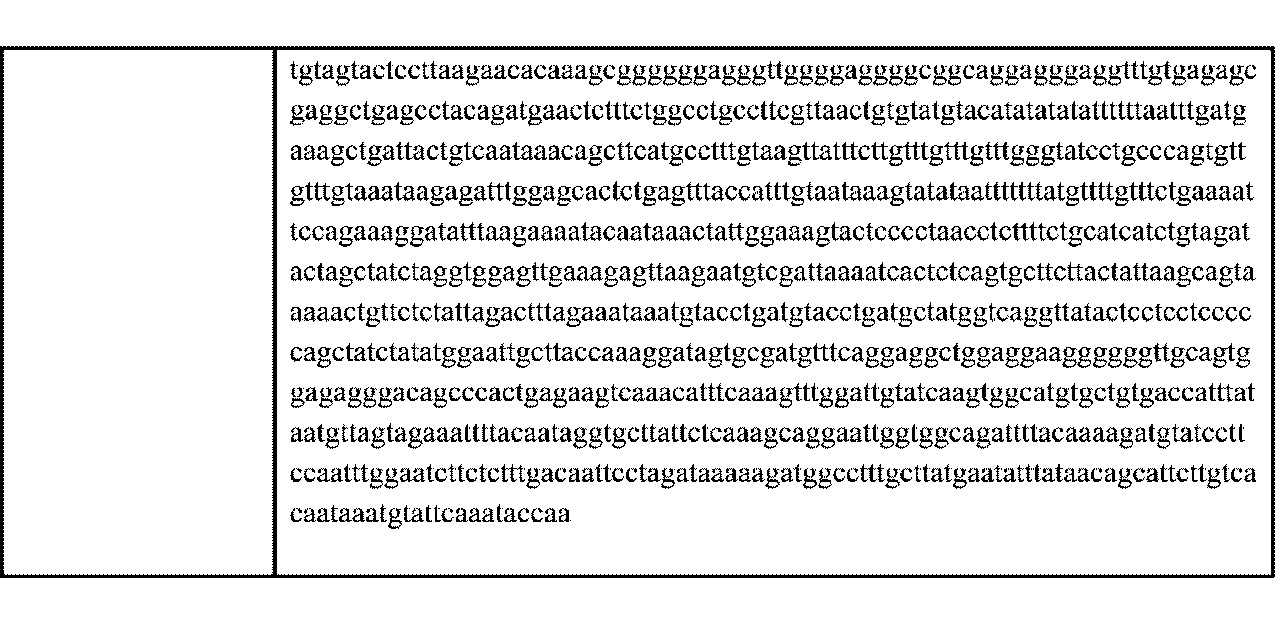
別途示されない限り、本開示のために有用であるc-Junタンパク質は、野生型ヒトc-Junタンパク質及びその任意のバリアントまたは変異体の両方を含む。いくつかの態様では、c-Junタンパク質は、変異体c-Junタンパク質が機能不全の(疲弊した)T細胞を回復させる変異体の能力に影響を及ぼさない限り、変異体ヒトc-Junタンパク質であり得る。いくつかの態様では、変異体c-Junタンパク質は、野生型c-Junタンパク質のC末端アミノ酸残基(例えば、C末端の50、75、100、150、200、または250個またはそれを超える残基)、C末端部分(例えば、4分の1、3分の1、または半分)またはC末端ドメイン(例えば、イプシロン、bZIP、及びそのアミノ酸C末端)と少なくとも約70%(例えば、少なくとも約75%、少なくとも約80%、少なくとも約85%、少なくとも約90%、少なくとも約95%、少なくとも約96%、少なくとも約97%、少なくとも約98%、または少なくとも約99%)の配列同一性を含む。いくつかの態様では、野生型c-Junタンパク質のN末端アミノ酸残基(例えば、N末端の50、75、100、または150個またはそれを超える)、N末端部分(例えば、4分の1、3分の1、または半分)またはN末端ドメイン(例えば、デルタ、トランス活性化ドメイン、及びそのアミノ酸N末端)は、欠失させられ、変異させられ、またはそうでなければ不活性化される。
Unless otherwise indicated, c-Jun proteins useful for the present disclosure include both wild-type human c-Jun protein and any variants or mutants thereof. In some aspects, the c-Jun protein can be a mutant human c-Jun protein, so long as the mutant c-Jun protein does not affect the ability of the mutant to restore dysfunctional (exhausted) T cells. In some aspects, a mutant c-Jun protein comprises at least about 70% (e.g., at least about 75%, at least about 80%, at least about 85%, at least about 90%, at least about 95%, at least about 96%, at least about 97%, at least about 98%, or at least about 99%) sequence identity to the C-terminal amino acid residues (e.g., the C-
いくつかの態様では、c-Junタンパク質は、そのトランス活性化ドメイン及び/またはそのデルタドメインにおいて活性化変異(例えば、置換、欠失、または挿入)を含む。いくつかの態様では、c-Junタンパク質は、S63A及びS73A変異の一方または両方を含む。いくつかの態様では、c-Junタンパク質は、野生型ヒトc-Junと比較した場合、残基2~102または残基30~50において欠失を有する。 In some aspects, the c-Jun protein comprises an activating mutation (e.g., a substitution, deletion, or insertion) in its transactivation domain and/or its delta domain. In some aspects, the c-Jun protein comprises one or both of an S63A and an S73A mutation. In some aspects, the c-Jun protein has a deletion at residues 2-102 or residues 30-50 when compared to wild-type human c-Jun.
いくつかの態様では、本修飾された免疫細胞のために有用なc-Junポリペプチドは、WO2019/118902(その全体が参照により本明細書に明示的に組み込まれる)に開示されているように、切断型c-Junポリペプチドを含む。 In some aspects, c-Jun polypeptides useful for the present modified immune cells include truncated c-Jun polypeptides, as disclosed in WO2019/118902, which is expressly incorporated herein by reference in its entirety.
本明細書に記載されるように、いくつかの態様では、本明細書に記載の修飾された細胞(すなわち、NR4A3遺伝子及び/またはNR4A3タンパク質の低減されたレベルを有する)は、c-Junタンパク質をコードするヌクレオチド配列を含み、ヌクレオチド配列は、コドン最適化されている。したがって、いくつかの態様では、本明細書に記載のc-Junタンパク質をコードするヌクレオチド配列(本明細書で「c-Junヌクレオチド配列」とも称される)は、野生型c-Junヌクレオチド配列のもの(例えば、配列番号6)とは異なる。 As described herein, in some aspects, the modified cells described herein (i.e., having reduced levels of the NR4A3 gene and/or NR4A3 protein) comprise a nucleotide sequence encoding a c-Jun protein, where the nucleotide sequence is codon-optimized. Thus, in some aspects, the nucleotide sequence encoding the c-Jun protein described herein (also referred to herein as a "c-Jun nucleotide sequence") differs from that of a wild-type c-Jun nucleotide sequence (e.g., SEQ ID NO:6).
いくつかの態様では、c-Junタンパク質をコードするヌクレオチド配列は、配列番号7~16に示される核酸配列のうちのいずれか1つと少なくとも約50%、少なくとも約55%、少なくとも約60%、少なくとも約65%、少なくとも約70%、少なくとも約75%、少なくとも約80%、少なくとも約85%、少なくとも約90%、少なくとも約95%、少なくとも約96%、少なくとも約97%、少なくとも約98%、または少なくとも約99%の配列同一性を有する。いくつかの態様では、c-Junタンパク質をコードするヌクレオチド配列は、配列番号7~16のいずれか1つに示される核酸配列を含む。 In some embodiments, the nucleotide sequence encoding the c-Jun protein has at least about 50%, at least about 55%, at least about 60%, at least about 65%, at least about 70%, at least about 75%, at least about 80%, at least about 85%, at least about 90%, at least about 95%, at least about 96%, at least about 97%, at least about 98%, or at least about 99% sequence identity to any one of the nucleic acid sequences set forth in SEQ ID NOs: 7-16. In some embodiments, the nucleotide sequence encoding the c-Jun protein comprises any one of the nucleic acid sequences set forth in SEQ ID NOs: 7-16.
いくつかの態様では、c-Junタンパク質をコードするヌクレオチド配列は、配列番号7に示される核酸配列と少なくとも約80%、少なくとも約85%、少なくとも約90%、少なくとも約95%、少なくとも約96%、少なくとも約97%、少なくとも約98%、または少なくとも約99%の配列同一性を有する。いくつかの態様では、c-Junタンパク質をコードするヌクレオチド配列は、配列番号7に示される核酸配列と少なくとも89%、少なくとも90%、少なくとも91%、少なくとも92%、少なくとも93%、少なくとも94%、少なくとも95%、少なくとも96%、少なくとも97%、少なくとも98%、または少なくとも99%の配列同一性を有する。いくつかの態様では、ヌクレオチド配列は、配列番号7に示される核酸配列を含む。 In some embodiments, the nucleotide sequence encoding the c-Jun protein has at least about 80%, at least about 85%, at least about 90%, at least about 95%, at least about 96%, at least about 97%, at least about 98%, or at least about 99% sequence identity to the nucleic acid sequence set forth in SEQ ID NO:7. In some embodiments, the nucleotide sequence encoding the c-Jun protein has at least 89%, at least 90%, at least 91%, at least 92%, at least 93%, at least 94%, at least 95%, at least 96%, at least 97%, at least 98%, or at least 99% sequence identity to the nucleic acid sequence set forth in SEQ ID NO:7. In some embodiments, the nucleotide sequence comprises the nucleic acid sequence set forth in SEQ ID NO:7.
いくつかの態様では、c-Junタンパク質をコードするヌクレオチド配列は、配列番号8に示される核酸配列と少なくとも約80%、少なくとも約85%、少なくとも約90%、少なくとも約95%、少なくとも約96%、少なくとも約97%、少なくとも約98%、または少なくとも約99%の配列同一性を有する。いくつかの態様では、c-Junタンパク質をコードするヌクレオチド配列は、配列番号8に示される核酸配列と少なくとも90%、少なくとも91%、少なくとも92%、少なくとも93%、少なくとも94%、少なくとも95%、少なくとも96%、少なくとも97%、少なくとも98%、または少なくとも99%の配列同一性を有する。いくつかの態様では、ヌクレオチド配列は、配列番号8に示される核酸配列を含む。 In some embodiments, the nucleotide sequence encoding the c-Jun protein has at least about 80%, at least about 85%, at least about 90%, at least about 95%, at least about 96%, at least about 97%, at least about 98%, or at least about 99% sequence identity to the nucleic acid sequence set forth in SEQ ID NO:8. In some embodiments, the nucleotide sequence encoding the c-Jun protein has at least 90%, at least 91%, at least 92%, at least 93%, at least 94%, at least 95%, at least 96%, at least 97%, at least 98%, or at least 99% sequence identity to the nucleic acid sequence set forth in SEQ ID NO:8. In some embodiments, the nucleotide sequence comprises the nucleic acid sequence set forth in SEQ ID NO:8.
いくつかの態様では、c-Junタンパク質をコードするヌクレオチド配列は、配列番号9に示される核酸配列と少なくとも約80%、少なくとも約85%、少なくとも約90%、少なくとも約95%、少なくとも約96%、少なくとも約97%、少なくとも約98%、または少なくとも約99%の配列同一性を有する。いくつかの態様では、本明細書に記載のc-Junタンパク質をコードするヌクレオチド配列は、配列番号9に示される核酸配列と少なくとも87%、少なくとも88%、少なくとも89%、少なくとも90%、少なくとも91%、少なくとも92%、少なくとも93%、少なくとも94%、少なくとも95%、少なくとも96%、少なくとも97%、少なくとも98%、または少なくとも99%の配列同一性を有する。いくつかの態様では、ヌクレオチド配列は、配列番号9に示される核酸配列を含む。 In some embodiments, the nucleotide sequence encoding the c-Jun protein has at least about 80%, at least about 85%, at least about 90%, at least about 95%, at least about 96%, at least about 97%, at least about 98%, or at least about 99% sequence identity to the nucleic acid sequence set forth in SEQ ID NO:9. In some embodiments, the nucleotide sequence encoding the c-Jun protein described herein has at least 87%, at least 88%, at least 89%, at least 90%, at least 91%, at least 92%, at least 93%, at least 94%, at least 95%, at least 96%, at least 97%, at least 98%, or at least 99% sequence identity to the nucleic acid sequence set forth in SEQ ID NO:9. In some embodiments, the nucleotide sequence comprises the nucleic acid sequence set forth in SEQ ID NO:9.
いくつかの態様では、c-Junタンパク質をコードするヌクレオチド配列は、配列番号10に示される核酸配列と少なくとも約50%、少なくとも約55%、少なくとも約60%、少なくとも約65%、少なくとも約70%、少なくとも約75%、少なくとも約80%、少なくとも約85%、少なくとも約90%、少なくとも約95%、少なくとも約96%、少なくとも約97%、少なくとも約98%、または少なくとも約99%の配列同一性を有する。いくつかの態様では、ヌクレオチド配列は、配列番号10に示される核酸配列と少なくとも96%、少なくとも97%、少なくとも98%、または少なくとも99%を有する。いくつかの態様では、ヌクレオチド配列は、配列番号10に示される核酸配列を含む。 In some embodiments, the nucleotide sequence encoding the c-Jun protein has at least about 50%, at least about 55%, at least about 60%, at least about 65%, at least about 70%, at least about 75%, at least about 80%, at least about 85%, at least about 90%, at least about 95%, at least about 96%, at least about 97%, at least about 98%, or at least about 99% sequence identity to the nucleic acid sequence set forth in SEQ ID NO:10. In some embodiments, the nucleotide sequence has at least 96%, at least 97%, at least 98%, or at least 99% sequence identity to the nucleic acid sequence set forth in SEQ ID NO:10. In some embodiments, the nucleotide sequence comprises the nucleic acid sequence set forth in SEQ ID NO:10.
いくつかの態様では、c-Junタンパク質をコードするヌクレオチド配列は、配列番号11に示される核酸配列と少なくとも約70%、少なくとも約75%、少なくとも約80%、少なくとも約85%、少なくとも約90%、少なくとも約95%、少なくとも約96%、少なくとも約97%、少なくとも約98%、または少なくとも約99%の配列同一性を有する。いくつかの態様では、c-Junタンパク質をコードするヌクレオチド配列は、配列番号11に示される核酸配列と少なくとも79%、少なくとも80%、少なくとも81%、少なくとも82%、少なくとも83%、少なくとも84%、少なくとも85%、少なくとも86%、少なくとも87%、少なくとも88%、少なくとも89%、少なくとも90%、少なくとも91%、少なくとも92%、少なくとも93%、少なくとも94%、少なくとも95%、少なくとも96%、少なくとも97%、少なくとも98%、または少なくとも99%の配列同一性を有する。いくつかの態様では、ヌクレオチド配列は、配列番号11に示される核酸配列を含む。 In some embodiments, the nucleotide sequence encoding the c-Jun protein has at least about 70%, at least about 75%, at least about 80%, at least about 85%, at least about 90%, at least about 95%, at least about 96%, at least about 97%, at least about 98%, or at least about 99% sequence identity to the nucleic acid sequence set forth in SEQ ID NO:11. In some embodiments, the nucleotide sequence encoding the c-Jun protein has at least 79%, at least 80%, at least 81%, at least 82%, at least 83%, at least 84%, at least 85%, at least 86%, at least 87%, at least 88%, at least 89%, at least 90%, at least 91%, at least 92%, at least 93%, at least 94%, at least 95%, at least 96%, at least 97%, at least 98%, or at least 99% sequence identity to the nucleic acid sequence set forth in SEQ ID NO:11. In some embodiments, the nucleotide sequence comprises the nucleic acid sequence set forth in SEQ ID NO:11.
いくつかの態様では、c-Junタンパク質をコードするヌクレオチド配列は、配列番号12に示される核酸配列と少なくとも約80%、少なくとも85%、少なくとも90%、少なくとも約95%、少なくとも約96%、少なくとも約97%、少なくとも約98%、または少なくとも約99%の配列同一性を有する。いくつかの態様では、c-Junタンパク質をコードするヌクレオチド配列は、配列番号12に示される核酸配列と少なくとも88%、少なくとも89%、少なくとも90%、少なくとも91%、少なくとも92%、少なくとも93%、少なくとも94%、少なくとも95%、少なくとも96%、少なくとも97%、少なくとも98%、または少なくとも99%の配列同一性を有する。いくつかの態様では、ヌクレオチド配列は、配列番号12に示される核酸配列を含む。 In some embodiments, the nucleotide sequence encoding the c-Jun protein has at least about 80%, at least 85%, at least 90%, at least about 95%, at least about 96%, at least about 97%, at least about 98%, or at least about 99% sequence identity to the nucleic acid sequence set forth in SEQ ID NO: 12. In some embodiments, the nucleotide sequence encoding the c-Jun protein has at least 88%, at least 89%, at least 90%, at least 91%, at least 92%, at least 93%, at least 94%, at least 95%, at least 96%, at least 97%, at least 98%, or at least 99% sequence identity to the nucleic acid sequence set forth in SEQ ID NO: 12. In some embodiments, the nucleotide sequence comprises the nucleic acid sequence set forth in SEQ ID NO: 12.
いくつかの態様では、c-Junタンパク質をコードするヌクレオチド配列は、配列番号13に示される核酸配列と少なくとも約80%、少なくとも約85%、少なくとも約90%、少なくとも約95%、少なくとも約96%、少なくとも約97%、少なくとも約98%、または少なくとも約99%の配列同一性を有する。いくつかの態様では、c-Junタンパク質をコードするヌクレオチド配列は、配列番号13に示される核酸配列と少なくとも88%、少なくとも89%、少なくとも90%、少なくとも91%、少なくとも92%、少なくとも93%、少なくとも94%、少なくとも95%、少なくとも96%、少なくとも97%、少なくとも98%、または少なくとも99%の配列同一性を有する。いくつかの態様では、ヌクレオチド配列は、配列番号13に示されるヌクレオチド配列を含む。 In some embodiments, the nucleotide sequence encoding the c-Jun protein has at least about 80%, at least about 85%, at least about 90%, at least about 95%, at least about 96%, at least about 97%, at least about 98%, or at least about 99% sequence identity to the nucleic acid sequence set forth in SEQ ID NO: 13. In some embodiments, the nucleotide sequence encoding the c-Jun protein has at least 88%, at least 89%, at least 90%, at least 91%, at least 92%, at least 93%, at least 94%, at least 95%, at least 96%, at least 97%, at least 98%, or at least 99% sequence identity to the nucleic acid sequence set forth in SEQ ID NO: 13. In some embodiments, the nucleotide sequence comprises the nucleotide sequence set forth in SEQ ID NO: 13.
いくつかの態様では、c-Junタンパク質をコードするヌクレオチド配列は、配列番号14に示される核酸配列と少なくとも約80%、少なくとも約85%、少なくとも約90%、少なくとも約95%、少なくとも約96%、少なくとも約97%、少なくとも約98%、または少なくとも約99%の配列同一性を有する。いくつかの態様では、c-Junタンパク質をコードするヌクレオチド配列は、配列番号14に示される核酸配列と少なくとも90%、少なくとも91%、少なくとも92%、少なくとも93%、少なくとも94%、少なくとも95%、少なくとも96%、少なくとも97%、少なくとも98%、または少なくとも99%の配列同一性を有する。いくつかの態様では、ヌクレオチド配列は、配列番号14に示されるヌクレオチド配列を含む。 In some embodiments, the nucleotide sequence encoding the c-Jun protein has at least about 80%, at least about 85%, at least about 90%, at least about 95%, at least about 96%, at least about 97%, at least about 98%, or at least about 99% sequence identity to the nucleic acid sequence set forth in SEQ ID NO: 14. In some embodiments, the nucleotide sequence encoding the c-Jun protein has at least 90%, at least 91%, at least 92%, at least 93%, at least 94%, at least 95%, at least 96%, at least 97%, at least 98%, or at least 99% sequence identity to the nucleic acid sequence set forth in SEQ ID NO: 14. In some embodiments, the nucleotide sequence comprises the nucleotide sequence set forth in SEQ ID NO: 14.
いくつかの態様では、c-Junタンパク質をコードするヌクレオチド配列は、配列番号15に示される核酸配列と少なくとも約55%、少なくとも約60%、少なくとも約65%、少なくとも約70%、少なくとも約75%、少なくとも約80%、少なくとも約85%、少なくとも約90%、少なくとも約95%、少なくとも約96%、少なくとも約97%、少なくとも約98%、または少なくとも約99%の配列同一性を有する。いくつかの態様では、c-Junタンパク質をコードするヌクレオチド配列は、配列番号15に示される核酸配列と少なくとも88%、少なくとも89%、少なくとも90%、少なくとも91%、少なくとも92%、少なくとも93%、少なくとも94%、少なくとも95%、少なくとも96%、少なくとも97%、少なくとも98%、または少なくとも99%の配列同一性を有する。いくつかの態様では、ヌクレオチド配列は、配列番号15に示されるヌクレオチド配列を含む。 In some embodiments, the nucleotide sequence encoding the c-Jun protein has at least about 55%, at least about 60%, at least about 65%, at least about 70%, at least about 75%, at least about 80%, at least about 85%, at least about 90%, at least about 95%, at least about 96%, at least about 97%, at least about 98%, or at least about 99% sequence identity to the nucleic acid sequence set forth in SEQ ID NO: 15. In some embodiments, the nucleotide sequence encoding the c-Jun protein has at least 88%, at least 89%, at least 90%, at least 91%, at least 92%, at least 93%, at least 94%, at least 95%, at least 96%, at least 97%, at least 98%, or at least 99% sequence identity to the nucleic acid sequence set forth in SEQ ID NO: 15. In some embodiments, the nucleotide sequence comprises the nucleotide sequence set forth in SEQ ID NO: 15.
いくつかの態様では、c-Junタンパク質をコードするヌクレオチド配列は、配列番号16に示される核酸配列と少なくとも約85%、少なくとも約90%、少なくとも約95%、少なくとも約96%、少なくとも約97%、少なくとも約98%、または少なくとも約99%の配列同一性を有する。いくつかの態様では、c-Junタンパク質をコードするヌクレオチド配列は、配列番号16に示される核酸配列と少なくとも85%、少なくとも86%、少なくとも87%、少なくとも88%、少なくとも89%、少なくとも90%、少なくとも91%、少なくとも92%、少なくとも93%、少なくとも94%、少なくとも95%、少なくとも96%、少なくとも97%、少なくとも98%、または少なくとも99%の配列同一性を有する。いくつかの態様では、ヌクレオチド配列は、配列番号16に示されるヌクレオチド配列を含む。 In some embodiments, the nucleotide sequence encoding the c-Jun protein has at least about 85%, at least about 90%, at least about 95%, at least about 96%, at least about 97%, at least about 98%, or at least about 99% sequence identity to the nucleic acid sequence set forth in SEQ ID NO: 16. In some embodiments, the nucleotide sequence encoding the c-Jun protein has at least 85%, at least 86%, at least 87%, at least 88%, at least 89%, at least 90%, at least 91%, at least 92%, at least 93%, at least 94%, at least 95%, at least 96%, at least 97%, at least 98%, or at least 99% sequence identity to the nucleic acid sequence set forth in SEQ ID NO: 16. In some embodiments, the nucleotide sequence comprises the nucleotide sequence set forth in SEQ ID NO: 16.
いくつかの態様では、c-Junタンパク質をコードするヌクレオチド配列は、配列番号16に示される核酸配列と少なくとも約85%、少なくとも約90%、少なくとも約95%、少なくとも約96%、少なくとも約97%、少なくとも約98%、または少なくとも約99%の配列同一性を有する。いくつかの態様では、c-Junタンパク質をコードするヌクレオチド配列は、配列番号16に示される核酸配列と少なくとも85%、少なくとも86%、少なくとも87%、少なくとも88%、少なくとも89%、少なくとも90%、少なくとも91%、少なくとも92%、少なくとも93%、少なくとも94%、少なくとも95%、少なくとも96%、少なくとも97%、少なくとも98%、または少なくとも99%の配列同一性を有する。いくつかの態様では、ヌクレオチド配列は、配列番号16に示されるヌクレオチド配列を含む。

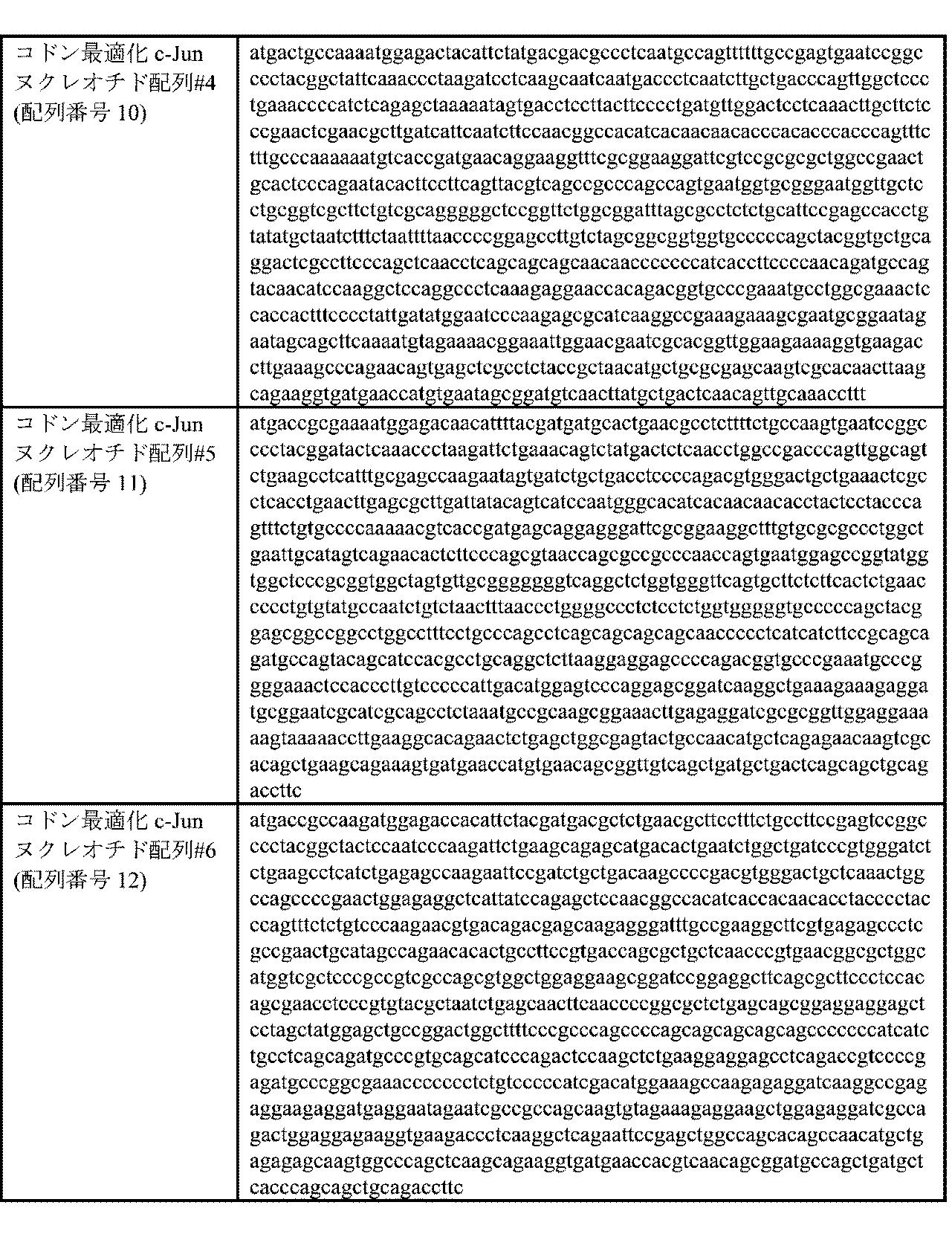


本明細書に開示されるc-Junヌクレオチド配列は、当該技術分野で知られている任意の方法を使用してコドン最適化され得る。例えば、いくつかの態様では、本明細書に開示されるc-Junヌクレオチド配列のコドンは、野生型ヌクレオチド配列(例えば、配列番号6)と比較して以下のパラメータのうちの1つ以上を修飾する(例えば、増加させるまたは減少させる)ように最適化されている:(i)コドン適応指標(すなわち、コドン使用頻度バイアス);(ii)グアニン-シトシン(GC)ヌクレオチド含有量;(iii)mRNA二次構造及び不安定モチーフ;(iv)リピート配列(例えば、ダイレクトリピート、逆位リピート、ダイアドリピート);(v)制限酵素認識部位;または(vi)それらの組み合わせ。 The c-Jun nucleotide sequences disclosed herein may be codon-optimized using any method known in the art. For example, in some aspects, the codons of the c-Jun nucleotide sequences disclosed herein are optimized to modify (e.g., increase or decrease) one or more of the following parameters compared to the wild-type nucleotide sequence (e.g., SEQ ID NO: 6): (i) codon accommodation index (i.e., codon usage bias); (ii) guanine-cytosine (GC) nucleotide content; (iii) mRNA secondary structure and instability motifs; (iv) repeat sequences (e.g., direct repeats, inverted repeats, diad repeats); (v) restriction enzyme recognition sites; or (vi) combinations thereof.
いかなる1つの理論によっても縛られることなく、いくつかの態様では、そのようなコドン最適化は、ヌクレオチド配列によってコードされるタンパク質の発現を増加させ得る。したがって、いくつかの態様では、本開示のコドン最適化されたc-Junヌクレオチド配列は、野生型ヌクレオチド配列(例えば、配列番号6)でトランスフェクションされた参照細胞と比較した場合、本明細書に記載の修飾された細胞(すなわち、NR4A3遺伝子及び/またはNR4A3タンパク質の低減されたレベルを有する)にトランスフェクションされ、形質導入されまたはそうでなければ導入された場合、コードされるc-Jun転写因子の発現を増加させることが可能である。いくつかの態様では、c-Junタンパク質の発現は、野生型ヌクレオチド配列(例えば、配列番号6)でトランスフェクションされ、形質導入され、またはそうでなければ遺伝子修飾された場合、参照細胞における対応する発現と比較して、少なくとも約1倍、少なくとも約2倍、少なくとも約3倍、少なくとも約4倍、少なくとも約5倍、少なくとも約6倍、少なくとも約7倍、少なくとも約8倍、少なくとも約9倍、少なくとも約10倍、少なくとも約11倍、少なくとも約12倍、少なくとも約13倍、少なくとも約14倍、少なくとも約15倍、少なくとも約16倍、少なくとも約17倍、少なくとも約18倍、少なくとも約19倍、少なくとも約20倍、少なくとも約25倍、少なくとも約30倍、少なくとも約35倍、少なくとも約40倍、少なくとも約45倍、少なくとも約50倍、少なくとも約75倍、少なくとも約100倍、少なくとも約200倍、少なくとも約300倍、少なくとも約400倍、少なくとも約500倍、少なくとも約750倍、または少なくとも約1,000倍またはそれを超えて増加する。 Without being bound by any one theory, in some aspects, such codon optimization can increase expression of the protein encoded by the nucleotide sequence. Thus, in some aspects, the codon-optimized c-Jun nucleotide sequences of the present disclosure, when transfected, transduced or otherwise introduced into modified cells described herein (i.e., having reduced levels of the NR4A3 gene and/or NR4A3 protein), can increase expression of the encoded c-Jun transcription factor when compared to a reference cell transfected with a wild-type nucleotide sequence (e.g., SEQ ID NO:6). In some aspects, expression of c-Jun protein is at least about 1 fold, at least about 2 fold, at least about 3 fold, at least about 4 fold, at least about 5 fold, at least about 6 fold, at least about 7 fold, at least about 8 fold, at least about 9 fold, at least about 10 fold, at least about 11 fold, at least about 12 fold, at least about 13 fold, at least about 14 fold, at least about 15 fold, at least about 16 fold, at least about 17 fold, at least about 18 fold, at least about 19 fold, at least about 20 fold, at least about 21 fold, at least about 22 fold, at least about 23 fold, at least about 24 fold, at least about 25 fold, at least about 26 fold, at least about 27 fold, at least about 28 fold, at least about 29 fold, at least about 30 fold, at least about 31 fold, at least about 32 fold, at least about 33 fold, at least about 34 fold, at least about 35 fold, at least about 36 fold, at least about 37 fold, at least about 38 fold, at least about 39 fold, at least about 40 fold, at least about 41 fold, at least about 42 fold, at least about 43 fold, at least about 44 fold, at least about 45 fold, at least about 46 fold, at least about 47 fold, at least about 48 fold, at least about 49 fold, at least about 50 fold, at least about 51 fold, at least about 52 fold, at least about 53 fold, at least about 54 fold, at least about 55 fold, at least about 56 fold, at least about at least about 14-fold, at least about 15-fold, at least about 16-fold, at least about 17-fold, at least about 18-fold, at least about 19-fold, at least about 20-fold, at least about 25-fold, at least about 30-fold, at least about 35-fold, at least about 40-fold, at least about 45-fold, at least about 50-fold, at least about 75-fold, at least about 100-fold, at least about 200-fold, at least about 300-fold, at least about 400-fold, at least about 500-fold, at least about 750-fold, or at least about 1,000-fold or more.
したがって、いくつかの態様では、本明細書に記載の修飾された細胞は、本明細書に記載されるように修飾されていない参照細胞と比較した場合、(i)NR4A3遺伝子及び/またはNR4A3タンパク質の低減されたレベル、及び(ii)c-Junタンパク質の増加したレベルを有する。いくつかの態様では、本明細書に記載の修飾された細胞は、本明細書に記載されるように修飾されていない参照細胞と比較した場合、(i)NR4A3遺伝子及び/またはNR4A3タンパク質の低減されたレベル、(ii)NR4A2遺伝子及び/またはNR4A2タンパク質の低減されたレベル、及び(iii)c-Junタンパク質の増加したレベルを有する。いくつかの態様では、本明細書に記載の修飾された細胞は、本明細書に記載されるように修飾されていない参照細胞と比較した場合、(i)NR4A3遺伝子及び/またはNR4A3タンパク質の低減されたレベル、(ii)NR4A2遺伝子及び/またはNR4A2タンパク質の低減されたレベル、(iii)NR4A1遺伝子及び/またはNR4A1タンパク質の低減されたレベル、及び(iv)c-Junタンパク質の増加したレベルを有する。 Thus, in some aspects, the modified cells described herein have (i) a reduced level of the NR4A3 gene and/or NR4A3 protein, and (ii) an increased level of c-Jun protein, when compared to a reference cell that is not modified as described herein. In some aspects, the modified cells described herein have (i) a reduced level of the NR4A3 gene and/or NR4A3 protein, (ii) a reduced level of the NR4A2 gene and/or NR4A2 protein, and (iii) an increased level of c-Jun protein, when compared to a reference cell that is not modified as described herein. In some aspects, the modified cells described herein have (i) a reduced level of the NR4A3 gene and/or NR4A3 protein, (ii) a reduced level of the NR4A2 gene and/or NR4A2 protein, (iii) a reduced level of the NR4A1 gene and/or NR4A1 protein, and (iv) an increased level of c-Jun protein, when compared to a reference cell that is not modified as described herein.
本開示から明らかなように、いくつかの態様では、本明細書に記載の修飾された細胞(すなわち、NR4A3遺伝子及び/またはNR4A3タンパク質の低減されたレベルを有する)におけるc-Junタンパク質のレベルを増加させることは、修飾された細胞の1つ以上の特性をさらに改善及び/または向上させ得る。例えば、免疫細胞が、(1)NR4A3遺伝子及び/またはNR4A3タンパク質の低減されたレベル及び(2)c-Junタンパク質の増加したレベルの両方を有するように修飾されたいくつかの態様では、免疫細胞の1つ以上の特性(例えば、以下に記載される)は、参照細胞と比較した場合、改善及び/または向上する。いくつかの態様では、参照細胞は、NR4A3遺伝子及び/またはNR4A3タンパク質の低減されたレベルのみを有するように修飾された(すなわち、c-Junを過剰発現しない)対応する免疫細胞を含む。いくつかの態様では、参照細胞は、c-Junタンパク質の増加した発現のみを有するように修飾された(すなわち、NR4A3遺伝子及び/またはNR4A3タンパク質の低減されたレベルを有しない)対応する免疫細胞を含む。いくつかの態様では、参照細胞は、(1)NR4A3遺伝子及び/またはNR4A3タンパク質の低減されたレベル及び(2)c-Junタンパク質の増加したレベルの両方を有するように修飾されていない対応する免疫細胞を含む。いくつかの態様では、参照細胞は、以下のうちの各々を含む:(a)NR4A3遺伝子及び/またはNR4A3タンパク質の低減されたレベルのみを有するように修飾された(すなわち、c-Junを過剰発現しない)対応する免疫細胞、(b)c-Junタンパク質の増加した発現のみを有するように修飾された(すなわち、NR4A3遺伝子及び/またはNR4A3タンパク質の低減されたレベルを有しない)対応する免疫細胞、及び(c)(1)NR4A3遺伝子及び/またはNR4A3タンパク質の低減されたレベル及び(2)c-Junタンパク質の増加したレベルの両方を有するように修飾されていない対応する免疫細胞。 As will be apparent from the present disclosure, in some aspects, increasing the level of c-Jun protein in a modified cell as described herein (i.e., having a reduced level of the NR4A3 gene and/or NR4A3 protein) may further improve and/or enhance one or more properties of the modified cell. For example, in some aspects where an immune cell has been modified to have both (1) a reduced level of the NR4A3 gene and/or NR4A3 protein and (2) an increased level of c-Jun protein, one or more properties of the immune cell (e.g., as described below) are improved and/or enhanced when compared to a reference cell. In some aspects, the reference cell comprises a corresponding immune cell that has been modified to have only a reduced level of the NR4A3 gene and/or NR4A3 protein (i.e., does not overexpress c-Jun). In some aspects, the reference cell comprises a corresponding immune cell that has been modified to have only an increased expression of c-Jun protein (i.e., does not have a reduced level of the NR4A3 gene and/or NR4A3 protein). In some aspects, the reference cells include corresponding immune cells that have not been modified to have both (1) a reduced level of the NR4A3 gene and/or NR4A3 protein and (2) an increased level of c-Jun protein. In some aspects, the reference cells include each of the following: (a) corresponding immune cells that have been modified to have only a reduced level of the NR4A3 gene and/or NR4A3 protein (i.e., do not overexpress c-Jun), (b) corresponding immune cells that have been modified to have only an increased expression of c-Jun protein (i.e., do not have a reduced level of the NR4A3 gene and/or NR4A3 protein), and (c) corresponding immune cells that have not been modified to have both (1) a reduced level of the NR4A3 gene and/or NR4A3 protein and (2) an increased level of c-Jun protein.
いくつかの態様では、c-Junタンパク質の増加したレベルを有する本明細書に記載の修飾された免疫細胞(すなわち、NR4A3遺伝子及び/またはNR4A3タンパク質の低減されたレベルを単独でまたはNR4Aファミリーの他のメンバーと組み合わせて有する)は、c-Junタンパク質の増加したレベルを有しない参照細胞と比較した場合、疲弊に対する増加した耐性を示す。いくつかの態様では、疲弊に対する耐性は、参照細胞(例えば、増加したc-Jun発現及び/またはNR4A遺伝子及び/またはNR4Aタンパク質の低減された発現を有するように修飾されなかった対応する細胞)と比較して、少なくとも約1倍、少なくとも約2倍、少なくとも約3倍、少なくとも約4倍、少なくとも約5倍、少なくとも約6倍、少なくとも約7倍、少なくとも約8倍、少なくとも約9倍、少なくとも約10倍、少なくとも約11倍、少なくとも約12倍、少なくとも約13倍、少なくとも約14倍、少なくとも約15倍、少なくとも約16倍、少なくとも約17倍、少なくとも約18倍、少なくとも約19倍、少なくとも約20倍、少なくとも約25倍、少なくとも約30倍、少なくとも約35倍、少なくとも約40倍、少なくとも約45倍、少なくとも約50倍、少なくとも約75倍、少なくとも約100倍、少なくとも約200倍、少なくとも約300倍、少なくとも約400倍、少なくとも約500倍、少なくとも約750倍、または少なくとも約1,000倍またはそれを超えて低下する。 In some aspects, modified immune cells described herein having increased levels of c-Jun protein (i.e., having reduced levels of the NR4A3 gene and/or NR4A3 protein, alone or in combination with other members of the NR4A family) exhibit increased resistance to exhaustion when compared to a reference cell that does not have increased levels of c-Jun protein. In some aspects, the resistance to exhaustion is at least about 1-fold, at least about 2-fold, at least about 3-fold, at least about 4-fold, at least about 5-fold, at least about 6-fold, at least about 7-fold, at least about 8-fold, at least about 9-fold, at least about 10-fold, at least about 11-fold, at least about 12-fold, at least about 13-fold, at least about 14-fold, at least about 15-fold, at least about 16-fold, at least about 17-fold, at least about 18-fold, at least about 19-fold, at least about 20-fold, at least about 21-fold, at least about 22-fold, at least about 23-fold, at least about 24-fold, at least about 25-fold, at least about 26-fold, at least about 27-fold, at least about 28-fold, at least about 29-fold, at least about 30-fold, at least about 31-fold, at least about 32-fold, at least about 33-fold, at least about 34-fold, at least about 35-fold, at least about 36-fold, at least about 37-fold, at least about 38-fold, at least about 39-fold, at least about 40-fold, at least about 40-fold, at least about 40-fold, at least about 40-fold, at least about 40-fold, at least about 45-fold, at least about 40-fold, at least about 45-fold, at least It is reduced by about 14 times, at least about 15 times, at least about 16 times, at least about 17 times, at least about 18 times, at least about 19 times, at least about 20 times, at least about 25 times, at least about 30 times, at least about 35 times, at least about 40 times, at least about 45 times, at least about 50 times, at least about 75 times, at least about 100 times, at least about 200 times, at least about 300 times, at least about 400 times, at least about 500 times, at least about 750 times, or at least about 1,000 times or more.
いくつかの態様では、c-Junタンパク質の過剰発現は、本明細書に記載の修飾された免疫細胞(すなわち、NR4A3遺伝子及び/またはNR4A3タンパク質の低減されたレベルを単独でまたはNR4Aファミリーの他のメンバーと組み合わせて有する)における疲弊をさらに低下させることを補助し得る。いくつかの態様では、疲弊は、参照細胞(例えば、増加したc-Jun発現及び/またはNR4A遺伝子及び/またはNR4Aタンパク質の低減された発現を有するように修飾されなかった対応する細胞)と比較した場合、少なくとも約1倍、少なくとも約2倍、少なくとも約3倍、少なくとも約4倍、少なくとも約5倍、少なくとも約6倍、少なくとも約7倍、少なくとも約8倍、少なくとも約9倍、少なくとも約10倍、少なくとも約11倍、少なくとも約12倍、少なくとも約13倍、少なくとも約14倍、少なくとも約15倍、少なくとも約16倍、少なくとも約17倍、少なくとも約18倍、少なくとも約19倍、少なくとも約20倍、少なくとも約25倍、少なくとも約30倍、少なくとも約35倍、少なくとも約40倍、少なくとも約45倍、少なくとも約50倍、少なくとも約75倍、少なくとも約100倍、少なくとも約200倍、少なくとも約300倍、少なくとも約400倍、少なくとも約500倍、少なくとも約750倍、または少なくとも約1,000倍低下する。 In some aspects, overexpression of c-Jun protein may help further reduce exhaustion in modified immune cells described herein (i.e., having reduced levels of the NR4A3 gene and/or NR4A3 protein, alone or in combination with other members of the NR4A family). In some aspects, exhaustion may be at least about 1-fold, at least about 2-fold, at least about 3-fold, at least about 4-fold, at least about 5-fold, at least about 6-fold, at least about 7-fold, at least about 8-fold, at least about 9-fold, at least about 10-fold, at least about 11-fold, at least about 12-fold, at least about 13-fold, or less than about 1-fold, when compared to a reference cell (e.g., a corresponding cell that has not been modified to have increased c-Jun expression and/or reduced expression of the NR4A gene and/or NR4A protein). At least about 14-fold, at least about 15-fold, at least about 16-fold, at least about 17-fold, at least about 18-fold, at least about 19-fold, at least about 20-fold, at least about 25-fold, at least about 30-fold, at least about 35-fold, at least about 40-fold, at least about 45-fold, at least about 50-fold, at least about 75-fold, at least about 100-fold, at least about 200-fold, at least about 300-fold, at least about 400-fold, at least about 500-fold, at least about 750-fold, or at least about 1,000-fold decrease.
いくつかの態様では、c-Junタンパク質の増加したレベルは、例えば、in vivoで対象に投与された場合、本明細書に記載の修飾された細胞(すなわち、単独でまたはNR4Aファミリーの他のメンバーと組み合わせてNR4A3遺伝子及び/またはNR4A3タンパク質の低減されたレベルを有する)の持続性/生存をさらに増加させることを補助し得る。いくつかの態様では、修飾された細胞の持続性/生存は、参照細胞(例えば、増加したc-Jun発現及び/またはNR4A遺伝子及び/またはNR4Aタンパク質の低減された発現を有するように修飾されなかった対応する細胞)と比較した場合、少なくとも約1倍、少なくとも約2倍、少なくとも約3倍、少なくとも約4倍、少なくとも約5倍、少なくとも約6倍、少なくとも約7倍、少なくとも約8倍、少なくとも約9倍、少なくとも約10倍、少なくとも約11倍、少なくとも約12倍、少なくとも約13倍、少なくとも約14倍、少なくとも約15倍、少なくとも約16倍、少なくとも約17倍、少なくとも約18倍、少なくとも約19倍、少なくとも約20倍、少なくとも約25倍、少なくとも約30倍、少なくとも約35倍、少なくとも約40倍、少なくとも約45倍、少なくとも約50倍、少なくとも約75倍、少なくとも約100倍、少なくとも約200倍、少なくとも約300倍、少なくとも約400倍、少なくとも約500倍、少なくとも約750倍、または少なくとも約1,000倍またはそれを超えて低下する。 In some aspects, the increased levels of c-Jun protein may, for example, help to further increase the persistence/survival of modified cells described herein (i.e., having reduced levels of the NR4A3 gene and/or NR4A3 protein, either alone or in combination with other members of the NR4A family) when administered to a subject in vivo. In some aspects, the persistence/survival of modified cells may be at least about 1-fold, at least about 2-fold, at least about 3-fold, at least about 4-fold, at least about 5-fold, at least about 6-fold, at least about 7-fold, at least about 8-fold, at least about 9-fold, at least about 10-fold, at least about 11-fold, at least about 12-fold, at least about 13-fold, at least about 14-fold, at least about 15-fold, at least about 16-fold, at least about 17-fold, at least about 18-fold, at least about 19-fold, at least about 20-fold, at least about 21-fold, at least about 22-fold, at least about 23-fold, at least about 24-fold, at least about 25-fold, at least about 26-fold, at least about 27-fold, at least about 28-fold, at least about 29-fold, at least about 30-fold, at least about 31-fold, at least about 32-fold, at least about 33-fold, at least about 34-fold, at least about 35-fold, at least about 36-fold, at least about 37-fold, at least about 38-fold, at least about 39-fold, at least about 40 ... At least about 14-fold, at least about 15-fold, at least about 16-fold, at least about 17-fold, at least about 18-fold, at least about 19-fold, at least about 20-fold, at least about 25-fold, at least about 30-fold, at least about 35-fold, at least about 40-fold, at least about 45-fold, at least about 50-fold, at least about 75-fold, at least about 100-fold, at least about 200-fold, at least about 300-fold, at least about 400-fold, at least about 500-fold, at least about 750-fold, or at least about 1,000-fold or more.
いくつかの態様では、c-Junタンパク質の増加したレベルは、本明細書に記載の修飾された細胞(すなわち、単独でまたはNR4Aファミリーの他のメンバーと組み合わせてNR4A3遺伝子及び/またはNR4A3タンパク質の低減されたレベルを有する)の増大/増殖をさらに増加させることを補助し得る。いくつかの態様では、修飾された細胞の増大/増殖は、参照細胞(例えば、増加したc-Jun発現及び/またはNR4A遺伝子及び/またはNR4Aタンパク質の低減された発現を有するように修飾されなかった対応する細胞)と比較した場合、少なくとも約1倍、少なくとも約2倍、少なくとも約3倍、少なくとも約4倍、少なくとも約5倍、少なくとも約6倍、少なくとも約7倍、少なくとも約8倍、少なくとも約9倍、少なくとも約10倍、少なくとも約11倍、少なくとも約12倍、少なくとも約13倍、少なくとも約14倍、少なくとも約15倍、少なくとも約16倍、少なくとも約17倍、少なくとも約18倍、少なくとも約19倍、少なくとも約20倍、少なくとも約25倍、少なくとも約30倍、少なくとも約35倍、少なくとも約40倍、少なくとも約45倍、少なくとも約50倍、少なくとも約75倍、少なくとも約100倍、少なくとも約200倍、少なくとも約300倍、少なくとも約400倍、少なくとも約500倍、少なくとも約750倍、または少なくとも約1,000倍またはそれを超えて低下する。 In some aspects, increased levels of c-Jun protein may help to further increase the growth/proliferation of modified cells described herein (i.e., having reduced levels of the NR4A3 gene and/or NR4A3 protein, either alone or in combination with other members of the NR4A family). In some aspects, the growth/proliferation of modified cells may be at least about 1-fold, at least about 2-fold, at least about 3-fold, at least about 4-fold, at least about 5-fold, at least about 6-fold, at least about 7-fold, at least about 8-fold, at least about 9-fold, at least about 10-fold, at least about 11-fold, at least about 12-fold, at least about 13-fold, at least about 14-fold, at least about 15-fold, at least about 16-fold, at least about 17-fold, at least about 18-fold, at least about 19-fold, at least about 20-fold, at least about 21-fold, at least about 22-fold, at least about 23-fold, at least about 24-fold, at least about 25-fold, at least about 26-fold, at least about 27-fold, at least about 28-fold, at least about 29-fold, at least about 30-fold, at least about 31-fold, at least about 32-fold, at least about 33-fold, at least about 34-fold, at least about 35-fold, at least about 36-fold, at least about 37-fold, at least about 38-fold, at least about 39-fold, at least about 40 ... At least about 14-fold, at least about 15-fold, at least about 16-fold, at least about 17-fold, at least about 18-fold, at least about 19-fold, at least about 20-fold, at least about 25-fold, at least about 30-fold, at least about 35-fold, at least about 40-fold, at least about 45-fold, at least about 50-fold, at least about 75-fold, at least about 100-fold, at least about 200-fold, at least about 300-fold, at least about 400-fold, at least about 500-fold, at least about 750-fold, or at least about 1,000-fold or more.
いくつかの態様では、c-Junタンパク質の増加したレベルは、本明細書に記載の修飾された細胞(すなわち、単独でまたはNR4Aファミリーの他のメンバーと組み合わせてNR4A3遺伝子及び/またはNR4A3タンパク質の低減されたレベルを有する)のエフェクター機能をさらに増加させることを補助し得る。そのようなエフェクター機能の非限定的な例には、サイトカイン生成(例えば、IFN-γ、TNF-α、IL-2、またはそれらの組み合わせ)、グランザイム放出、永続的抗原刺激に反応する細胞傷害性、抗原発現細胞を殺傷/溶解する能力、及びそれらの組み合わせが含まれる。いくつかの態様では、本明細書に記載の修飾された細胞のエフェクター機能は、参照細胞(例えば、増加したc-Jun発現及び/またはNR4A遺伝子及び/またはNR4Aタンパク質の低減された発現を有するように修飾されなかった対応する細胞)と比較して、少なくとも約1倍、少なくとも約2倍、少なくとも約3倍、少なくとも約4倍、少なくとも約5倍、少なくとも約6倍、少なくとも約7倍、少なくとも約8倍、少なくとも約9倍、少なくとも約10倍、少なくとも約11倍、少なくとも約12倍、少なくとも約13倍、少なくとも約14倍、少なくとも約15倍、少なくとも約16倍、少なくとも約17倍、少なくとも約18倍、少なくとも約19倍、少なくとも約20倍、少なくとも約25倍、少なくとも約30倍、少なくとも約35倍、少なくとも約40倍、少なくとも約45倍、少なくとも約50倍、少なくとも約75倍、少なくとも約100倍、少なくとも約200倍、少なくとも約300倍、少なくとも約400倍、少なくとも約500倍、少なくとも約750倍、または少なくとも約1,000倍またはそれを超えて低下する。 In some aspects, increased levels of c-Jun protein may help to further increase effector function of modified cells described herein (i.e., having reduced levels of the NR4A3 gene and/or NR4A3 protein, either alone or in combination with other members of the NR4A family). Non-limiting examples of such effector functions include cytokine production (e.g., IFN-γ, TNF-α, IL-2, or combinations thereof), granzyme release, cytotoxicity in response to persistent antigenic stimulation, the ability to kill/lyse antigen-expressing cells, and combinations thereof. In some aspects, the effector function of a cell modified as described herein is at least about 1-fold, at least about 2-fold, at least about 3-fold, at least about 4-fold, at least about 5-fold, at least about 6-fold, at least about 7-fold, at least about 8-fold, at least about 9-fold, at least about 10-fold, at least about 11-fold, at least about 12-fold, at least about 14-fold, at least about 16-fold, at least about 18-fold, at least about 19-fold, at least about 20-fold, at least about 21-fold, at least about 22-fold, at least about 23-fold, at least about 24-fold, at least about 25-fold, at least about 26-fold, at least about 27-fold, at least about 28-fold, at least about 29-fold, at least about 30-fold, at least about 31-fold, at least about 32-fold, at least about 33-fold, at least about 34-fold, at least about 35-fold, at least about 36-fold, at least about 37-fold, at least about 38-fold, at least about 39-fold, at least about 40-fold, at least about 40-fold, at least about 40-fold, at least about 41-fold, at least about 42-fold, at least about 43-fold, at least about 44-fold, at least about 45-fold, at least about 46-fold, at least about 47-fold, at least about 48-fold, at least about 49-fold, at least about 50-fold, at least about 50-fold, at least about 51-fold, at least about 52-fold, at least about 53-fold, at least about 54-fold, at least about 55-fold, at least about 56-fold, A decrease of 3-fold, at least about 14-fold, at least about 15-fold, at least about 16-fold, at least about 17-fold, at least about 18-fold, at least about 19-fold, at least about 20-fold, at least about 25-fold, at least about 30-fold, at least about 35-fold, at least about 40-fold, at least about 45-fold, at least about 50-fold, at least about 75-fold, at least about 100-fold, at least about 200-fold, at least about 300-fold, at least about 400-fold, at least about 500-fold, at least about 750-fold, or at least about 1,000-fold or more.
いくつかの態様では、c-Junタンパク質の増加したレベルを有するようにさらに修飾された本明細書に記載の修飾された免疫細胞(例えば、NR4A3遺伝子及び/またはNR4A3タンパク質の低減されたレベルを有する)は、TIGIT、PD-1及びCD39を含むがこれらに限定されない1つ以上の疲弊マーカーの低減された発現を有する。疲弊マーカーの発現は、バルクRNASeqトランスクリプトーム分析を使用して、フローサイトメトリーによってバルク集団で測定され得またはいくつかの態様では、個々の細胞トランスクリプトーム分析は、シングルセルRNASeqを使用して行われ得る。いくつかの態様では、1つ以上の疲弊マーカーの発現は、参照細胞(例えば、増加したc-Jun発現及び/またはNR4A3遺伝子及び/またはNR4A3タンパク質の低減された発現を有するように修飾されなかった対応する細胞)と比較した場合、少なくとも約1.5倍、少なくとも約2倍、少なくとも約2.5倍、少なくとも約3.0倍、少なくとも約3.5倍、少なくとも約4倍、少なくとも4.5倍、少なくとも約5倍、少なくとも約10倍、少なくとも約15倍、少なくとも約20倍、少なくとも約25倍、少なくとも約30倍、少なくとも約35倍、少なくとも約40倍、少なくとも約45倍、少なくとも約50倍、少なくとも約55倍、少なくとも約60倍、少なくとも約65倍、少なくとも約70倍、少なくとも約75倍、少なくとも約80倍、少なくとも約85倍、少なくとも約90倍、少なくとも約95倍、または少なくとも約100倍またはそれを超えて低減される。 In some aspects, the modified immune cells described herein that are further modified to have increased levels of c-Jun protein (e.g., having reduced levels of the NR4A3 gene and/or NR4A3 protein) have reduced expression of one or more exhaustion markers, including but not limited to TIGIT, PD-1, and CD39. Expression of exhaustion markers can be measured in bulk populations by flow cytometry using bulk RNASeq transcriptome analysis or in some aspects, individual cell transcriptome analysis can be performed using single cell RNASeq. In some aspects, expression of one or more exhaustion markers is reduced by at least about 1.5-fold, at least about 2-fold, at least about 2.5-fold, at least about 3.0-fold, at least about 3.5-fold, at least about 4-fold, at least about 4.5-fold, at least about 5-fold, at least about 10-fold, at least about 15-fold, at least about 20-fold, at least about 25-fold, at least about 30-fold, at least about 35-fold, at least about 40-fold, at least about 45-fold, at least about 50-fold, at least about 55-fold, at least about 60-fold, at least about 65-fold, at least about 70-fold, at least about 75-fold, at least about 80-fold, at least about 85-fold, at least about 90-fold, at least about 95-fold, or at least about 100-fold or more when compared to a reference cell (e.g., a corresponding cell that has not been modified to have increased c-Jun expression and/or reduced expression of the NR4A3 gene and/or NR4A3 protein).
したがって、少なくとも上記開示から明らかなように、いくつかの態様では、(1)NR4A3遺伝子及び/またはNR4A3タンパク質の低減されたレベル及び(2)c-Junタンパク質の増加したレベルを示すように修飾された免疫細胞は、参照細胞と比較した場合、向上したin vivo抗腫瘍活性を示す。いくつかの態様では、(1)NR4A3遺伝子及び/またはNR4A3タンパク質の低減されたレベル及び(2)c-Junタンパク質の増加したレベルを示すように修飾された免疫細胞は、参照細胞と比較した場合、in vivoでより高い生存及び/または持続性を示す。他の箇所にさらに記載されるように、いくつかの態様では、参照細胞は、以下のうちの1つ以上を含む:(a)NR4A3遺伝子及び/またはNR4A3タンパク質の低減されたレベルのみを有するように修飾された(すなわち、c-Junを過剰発現しない)対応する免疫細胞、(b)c-Junタンパク質の増加した発現のみを有するように修飾された(すなわち、NR4A3遺伝子及び/またはNR4A3タンパク質の低減されたレベルを有しない)対応する免疫細胞、及び(c)(1)NR4A3遺伝子及び/またはNR4A3タンパク質の低減されたレベル及び(2)c-Junタンパク質の増加したレベルの両方を有するように修飾されていない対応する免疫細胞。 Thus, as is apparent from at least the above disclosure, in some aspects, immune cells modified to exhibit (1) reduced levels of the NR4A3 gene and/or NR4A3 protein and (2) increased levels of c-Jun protein exhibit improved in vivo anti-tumor activity when compared to reference cells. In some aspects, immune cells modified to exhibit (1) reduced levels of the NR4A3 gene and/or NR4A3 protein and (2) increased levels of c-Jun protein exhibit greater survival and/or persistence in vivo when compared to reference cells. As further described elsewhere, in some embodiments, the reference cells include one or more of the following: (a) corresponding immune cells modified to have only reduced levels of the NR4A3 gene and/or NR4A3 protein (i.e., do not overexpress c-Jun), (b) corresponding immune cells modified to have only increased expression of c-Jun protein (i.e., do not have reduced levels of the NR4A3 gene and/or NR4A3 protein), and (c) corresponding immune cells that have not been modified to have both (1) reduced levels of the NR4A3 gene and/or NR4A3 protein and (2) increased levels of c-Jun protein.
III.A.4.リガンド結合タンパク質
いくつかの態様では、本明細書に記載の修飾された細胞(例えば、NR4A3遺伝子及び/またはNR4A3タンパク質の低減されたレベルを有する)は、リガンド結合タンパク質を発現するようにさらに修飾されている。本明細書で使用される場合、用語「リガンド結合タンパク質」は、対象となる分子(すなわち、リガンド)(例えば、腫瘍細胞上に発現する抗原またはペプチド/MHC複合体)を結合させることができる任意のタンパク質を指す。いくつかの態様では、リガンド結合タンパク質は、キメラ結合タンパク質である。本明細書で使用される場合、用語「キメラ結合タンパク質」は、1つ以上のリガンド(例えば、抗原(例えば、抗原結合部位を含む))に結合することが可能であり、かつもともと別のタンパク質をコードする2つ以上のポリヌクレオチド配列の接続によって創出されるタンパク質を指す。別途示されない限り、その用語は、本開示において互換的に使用され得る。
III.A.4. Ligand Binding Proteins In some aspects, the modified cells described herein (e.g., having reduced levels of the NR4A3 gene and/or NR4A3 protein) are further modified to express a ligand binding protein. As used herein, the term "ligand binding protein" refers to any protein that can bind a molecule of interest (i.e., a ligand) (e.g., an antigen or a peptide/MHC complex expressed on a tumor cell). In some aspects, the ligand binding protein is a chimeric binding protein. As used herein, the term "chimeric binding protein" refers to a protein that is capable of binding to one or more ligands (e.g., an antigen (e.g., comprising an antigen binding site)) and that is created by the joining of two or more polynucleotide sequences that originally code for separate proteins. Unless otherwise indicated, the terms may be used interchangeably in this disclosure.
当該技術分野で知られている任意の好適な方法は、リガンド結合タンパク質を発現させるために使用され得る。例えば、いくつかの態様では、本明細書に記載の修飾された細胞は、リガンド結合タンパク質をコードする追加のヌクレオチド配列を含むようにさらに修飾されている。いくつかの態様では、リガンド結合タンパク質をコードする追加のヌクレオチド配列は、本明細書に記載の同じポリヌクレオチド(すなわち、NR4A3遺伝子内の領域を特異的に標的とするgRNAを含む)-すなわち、ポリシストロン性ポリヌクレオチドの一部であり得る。いくつかの態様では、リガンド結合タンパク質をコードする追加のヌクレオチド配列は、別のポリヌクレオチドとして細胞に導入され得る。 Any suitable method known in the art may be used to express the ligand binding protein. For example, in some aspects, the modified cells described herein are further modified to include an additional nucleotide sequence encoding a ligand binding protein. In some aspects, the additional nucleotide sequence encoding the ligand binding protein may be part of the same polynucleotide described herein (i.e., including a gRNA that specifically targets a region within the NR4A3 gene) - i.e., a polycistronic polynucleotide. In some aspects, the additional nucleotide sequence encoding the ligand binding protein may be introduced into the cell as a separate polynucleotide.
したがって、いくつかの態様では、本明細書に記載の修飾された細胞は、参照細胞と比較した場合、(i)リガンド結合タンパク質を発現し、(ii)NR4A3遺伝子及び/またはNR4A3タンパク質の低減されたレベルを有する。いくつかの態様では、修飾された細胞は、参照細胞と比較した場合、(i)リガンド結合タンパク質を発現し、(ii)NR4A3遺伝子及び/またはNR4A3タンパク質の低減されたレベル及び(iii)c-Junタンパク質の増加したレベルを有する。いくつかの態様では、本明細書に記載の修飾された細胞は、参照細胞と比較した場合、(i)リガンド結合タンパク質を発現し、(ii)NR4A3遺伝子及び/またはNR4A3タンパク質の低減されたレベル、及び(iii)NR4A2遺伝子及び/またはNR4A2タンパク質の低減されたレベルを有する。いくつかの態様では、本明細書に記載の修飾された細胞は、参照細胞と比較した場合、(i)リガンド結合タンパク質を発現し、(ii)NR4A3遺伝子及び/またはNR4A3タンパク質の低減されたレベル、(iii)NR4A2遺伝子及び/またはNR4A2タンパク質の低減されたレベル、及び(iv)c-Junタンパク質の増加したレベルを有する。いくつかの態様では、本明細書に記載の修飾された細胞は、参照細胞と比較した場合、(i)リガンド結合タンパク質を発現し、(ii)NR4A3遺伝子及び/またはNR4A3タンパク質の低減されたレベル、(iii)NR4A2遺伝子及び/またはNR4A2タンパク質の低減されたレベル、及び(iv)NR4A1遺伝子及び/またはNR4A1タンパク質の低減されたレベルを有する。いくつかの態様では、本明細書に記載の修飾された細胞は、参照細胞と比較した場合、(i)リガンド結合タンパク質を発現し、(ii)NR4A3遺伝子及び/またはNR4A3タンパク質の低減されたレベル、(iii)NR4A2遺伝子及び/またはNR4A2タンパク質の低減されたレベル、(iv)NR4A1遺伝子及び/またはNR4A1タンパク質の低減されたレベル、及び(v)c-Junタンパク質の増加したレベルを有する。 Thus, in some aspects, the modified cells described herein express (i) a ligand binding protein and (ii) have a reduced level of the NR4A3 gene and/or NR4A3 protein when compared to a reference cell. In some aspects, the modified cells express (i) a ligand binding protein and (ii) have a reduced level of the NR4A3 gene and/or NR4A3 protein and (iii) an increased level of c-Jun protein when compared to a reference cell. In some aspects, the modified cells described herein express (i) a ligand binding protein and (ii) have a reduced level of the NR4A3 gene and/or NR4A3 protein and (iii) a reduced level of the NR4A2 gene and/or NR4A2 protein when compared to a reference cell. In some aspects, the modified cells described herein, when compared to a reference cell, (i) express a ligand binding protein, (ii) have a reduced level of the NR4A3 gene and/or NR4A3 protein, (iii) a reduced level of the NR4A2 gene and/or NR4A2 protein, and (iv) an increased level of c-Jun protein. In some aspects, the modified cells described herein, when compared to a reference cell, (i) express a ligand binding protein, (ii) have a reduced level of the NR4A3 gene and/or NR4A3 protein, (iii) a reduced level of the NR4A2 gene and/or NR4A2 protein, and (iv) a reduced level of the NR4A1 gene and/or NR4A1 protein. In some aspects, the modified cells described herein, when compared to a reference cell, (i) express a ligand binding protein, (ii) have a reduced level of the NR4A3 gene and/or NR4A3 protein, (iii) a reduced level of the NR4A2 gene and/or NR4A2 protein, (iv) a reduced level of the NR4A1 gene and/or NR4A1 protein, and (v) an increased level of c-Jun protein.
本開示のために有用なリガンド結合タンパク質(例えば、キメラ結合タンパク質)の非限定的な例は、キメラ抗原受容体(CAR)、T細胞受容体(TCR)(例えば、操作されたTCR)、キメラ抗体-T細胞受容体(caTCR)、キメラシグナル伝達受容体(CSR)、T細胞受容体模倣体(TCR模倣体)、及びそれらの組み合わせを含む。 Non-limiting examples of ligand binding proteins (e.g., chimeric binding proteins) useful for the present disclosure include chimeric antigen receptors (CARs), T cell receptors (TCRs) (e.g., engineered TCRs), chimeric antibody-T cell receptors (caTCRs), chimeric signal transduction receptors (CSRs), T cell receptor mimetics (TCR mimetics), and combinations thereof.
いくつかの態様では、キメラ結合タンパク質は、CARを含む。 In some embodiments, the chimeric binding protein comprises a CAR.
いくつかの態様では、CARは、標準的なCARとして設計される。「標準的なCAR」において、異なる成分(例えば、細胞外標的化ドメイン、膜貫通ドメイン、及び細胞内シグナル伝達/活性化ドメイン)は、単一の融合タンパク質として線状に構築されている。いくつかの態様では、CARは、第一世代CARとして設計される。「第一世代」CARは、細胞外結合ドメイン、ヒンジ領域、膜貫通ドメイン、及び1つ以上の細胞内シグナル伝達ドメインから構成される。すべての第一世代CARは、細胞内シグナル伝達ドメインとしてCD3ζ鎖ドメインを含有する。いくつかの態様では、CARは、第二世代CARとして設計される。「第二世代」CARは、共刺激ドメイン(例えば、CD28または4-1BB)を追加的に含有する。いくつかの態様では、CARは、第三世代CARとして設計される。「第三世代」CARは、それらが複数の共刺激ドメイン(例えば、CD28-4-1BBまたはCD28-OX40)を含有することを除き、第二世代CARと同様である。いくつかの態様では、CARは、第四世代CARとして設計される。「第四世代」CAR(TRUCKまたは強化型CARとしても知られている)は、機能をさらに改善し得る追加の因子を追加的に含有する。例えば、いくつかの態様では、第四世代CARは、標的とされる腫瘍組織においてCARシグナル伝達により放出され得るサイトカインを追加的に含有する。いくつかの態様では、第四世代CARは、CARの活性をさらに制御することを補助し得る、ホーミング及び自殺遺伝子等の1つ以上の追加の要素を含む。いくつかの態様では、CARは、スプリットCARとして設計される。「スプリットCAR」システムでは、CARの1つ以上の構成要素(例えば、細胞外標的ドメイン、膜貫通ドメイン、及び細胞内シグナル伝達/活性化ドメイン)は、インタクトな機能的受容体のアセンブリを促進する複数のインプットに依存するように2つ以上の部分に分けられている。いくつかの態様では、CARは、切替可能なCARとして設計される。「切替可能なCAR」を用いて、CARは、刺激物の存在下でオン(オンスイッチCAR)またはオフ(オフスイッチCAR)が(例えば、一時的に)切り替えられ得る。本開示で使用され得るCARの追加の例は、例えば、US2020/0172879A1及びUS2019/0183932A1(これらの各々は、その全体が参照により本明細書に組み込まれる)に記載されている。 In some aspects, the CAR is designed as a standard CAR. In a "standard CAR", the different components (e.g., extracellular targeting domain, transmembrane domain, and intracellular signaling/activation domain) are linearly assembled as a single fusion protein. In some aspects, the CAR is designed as a first generation CAR. "First generation" CARs are composed of an extracellular binding domain, a hinge region, a transmembrane domain, and one or more intracellular signaling domains. All first generation CARs contain a CD3ζ chain domain as the intracellular signaling domain. In some aspects, the CAR is designed as a second generation CAR. "Second generation" CARs additionally contain a costimulatory domain (e.g., CD28 or 4-1BB). In some aspects, the CAR is designed as a third generation CAR. "Third generation" CARs are similar to second generation CARs, except that they contain multiple costimulatory domains (e.g., CD28-4-1BB or CD28-OX40). In some aspects, the CAR is designed as a fourth generation CAR. A "fourth generation" CAR (also known as a TRUCK or enhanced CAR) additionally contains additional factors that may further improve function. For example, in some aspects, a fourth generation CAR additionally contains a cytokine that may be released by CAR signaling in the targeted tumor tissue. In some aspects, a fourth generation CAR includes one or more additional elements, such as homing and suicide genes, that may help further control the activity of the CAR. In some aspects, the CAR is designed as a split CAR. In a "split CAR" system, one or more components of the CAR (e.g., the extracellular targeting domain, the transmembrane domain, and the intracellular signaling/activation domain) are split into two or more parts to rely on multiple inputs to promote the assembly of an intact functional receptor. In some aspects, the CAR is designed as a switchable CAR. By "switchable CAR," the CAR can be switched (e.g., temporarily) on (on-switch CAR) or off (off-switch CAR) in the presence of a stimuli. Additional examples of CARs that can be used in the present disclosure are described, for example, in US 2020/0172879 A1 and US 2019/0183932 A1, each of which is incorporated herein by reference in its entirety.
いくつかの態様では、本明細書におけるコンストラクトは、操作されたT細胞受容体(TCR)(当該技術分野で「トランスジェニックTCR」とも称される)をコードする。TCRは、主要組織適合性複合体(MHC)分子に結合したペプチドとして抗原の断片を認識することを担う、T細胞の表面上に見られる分子である。TCRは、2つの異なるタンパク質鎖から構成されるヘテロ二量体である。いくつかの態様では、TCRは、アルファ(α)鎖及びベータ(β)鎖(TRA及びTRBによってそれぞれコードされる)からなる。いくつかの態様では、TCRは、ガンマ及びデルタ(γ/δ)鎖(TRG及びTRDによってそれぞれコードされる)からなる。TCRがMHC分子(ペプチド/MHC)によって提示される抗原性ペプチドと係合した場合、Tリンパ球は、シグナル伝達を介して活性化される。いくつかの態様では、TCRは、操作された(トランスジェニック)TCRである。本明細書で使用される場合、用語「操作されたTCR」または「操作されたT細胞受容体」は、単離された、または所望の親和性で主要組織適合遺伝子複合体(MHC)/ペプチド標的抗原と特異的に結合するように操作されたT細胞受容体(TCR)であって、免疫細胞、例えば、T細胞、NK細胞、及び/またはTILの集団に導入されたものを指す。 In some aspects, the constructs herein encode an engineered T cell receptor (TCR) (also referred to in the art as a "transgenic TCR"). The TCR is a molecule found on the surface of a T cell that is responsible for recognizing fragments of antigens as peptides bound to major histocompatibility complex (MHC) molecules. The TCR is a heterodimer composed of two different protein chains. In some aspects, the TCR consists of an alpha (α) chain and a beta (β) chain (encoded by TRA and TRB, respectively). In some aspects, the TCR consists of a gamma and delta (γ/δ) chain (encoded by TRG and TRD, respectively). When the TCR engages an antigenic peptide presented by an MHC molecule (peptide/MHC), the T lymphocyte is activated via signal transduction. In some aspects, the TCR is an engineered (transgenic) TCR. As used herein, the term "engineered TCR" or "engineered T cell receptor" refers to a T cell receptor (TCR) that has been isolated or engineered to specifically bind a major histocompatibility complex (MHC)/peptide target antigen with a desired affinity and introduced into a population of immune cells, e.g., T cells, NK cells, and/or TILs.
いくつかの態様では、キメラ結合タンパク質は、キメラ抗体-T細胞受容体(caTCR)を含む。本明細書で使用される場合、「キメラ抗体-T細胞受容体」または「caTCR」は、(i)対象となる抗原に特異的に結合する抗体部位及び(ii)少なくとも1つのTCR関連シグナル伝達分子を動員することが可能なT細胞受容体モジュールを含む。いくつかの態様では、抗体部位及びT細胞受容体モジュールは、一緒に融合される。いくつかの態様では、キメラ結合タンパク質は、キメラシグナル伝達受容体(CSR)を含む。「キメラシグナル伝達受容体」または「CSR」は、標的リガンドに特異的に結合するリガンド結合ドメイン及びCSRを発現する免疫細胞に刺激シグナルを提供することが可能な共刺激シグナル伝達ドメインを含む。caTCR及びCSRの非限定的な例は、US10,822,413B2(その全体が参照により本明細書に組み込まれる)にさらに記載されている。 In some aspects, the chimeric binding protein comprises a chimeric antibody-T cell receptor (caTCR). As used herein, a "chimeric antibody-T cell receptor" or "caTCR" comprises (i) an antibody portion that specifically binds to an antigen of interest and (ii) a T cell receptor module capable of recruiting at least one TCR-associated signaling molecule. In some aspects, the antibody portion and the T cell receptor module are fused together. In some aspects, the chimeric binding protein comprises a chimeric signaling receptor (CSR). A "chimeric signaling receptor" or "CSR" comprises a ligand binding domain that specifically binds to a target ligand and a costimulatory signaling domain that is capable of providing a stimulatory signal to an immune cell expressing the CSR. Non-limiting examples of caTCRs and CSRs are further described in US 10,822,413 B2, which is incorporated herein by reference in its entirety.
いくつかの態様では、キメラ結合タンパク質は、T細胞受容体模倣体(TCR模倣体)を含む。本明細書で使用される場合、用語「T細胞受容体模倣体」または「TCR模倣体は、腫瘍抗原を認識するように操作された抗体(またはその断片)を指し、腫瘍抗原は、HLA分子と関連して提示される。当業者に明らかになるように、これらの抗体は、TCRの特異性を模倣し得る。TCR模倣体の非限定的な例は、例えば、US2009/0226474A1及びUS2019/0092876A1(これらの各々は、その全体が参照により本明細書に組み込まれる)で提供される。 In some aspects, the chimeric binding protein comprises a T cell receptor mimic (TCR mimic). As used herein, the term "T cell receptor mimic" or "TCR mimic" refers to an antibody (or fragment thereof) that has been engineered to recognize a tumor antigen, where the tumor antigen is presented in the context of an HLA molecule. As will be apparent to one of skill in the art, these antibodies may mimic the specificity of a TCR. Non-limiting examples of TCR mimics are provided, for example, in US 2009/0226474 A1 and US 2019/0092876 A1, each of which is incorporated herein by reference in its entirety.
いくつかの態様では、キメラ結合タンパク質は、遺伝子編集ツール(例えば、CRISPR-Casシステム)に関連付けられ得、キメラ結合タンパク質の活性化は、1つ以上の遺伝子の発現及び/または活性が細胞において調節されるように、遺伝子編集ツールの活性化を誘導し得る。例えば、いくつかの態様では、本明細書に記載の細胞(例えば、T細胞)は、プロテアーゼに連結されたキメラ結合タンパク質(例えば、CAR)及び対象となる遺伝子の制御性領域(例えば、プロモーター)を標的とするシングルガイドRNAを含むように修飾される。いくつかの態様では、細胞は、例えば、リンカーを介して、遺伝子編集ツールと複合体化された、T細胞の活性化のためのリンカー(LAT)をさらに含むように修飾される。(例えば、抗原刺激を介する)キメラ結合タンパク質の活性化は、核局在化及び遺伝子発現の調節のための遺伝子編集ツールの放出を可能とする。そのようなキメラ結合タンパク質の追加の態様は、本開示における他の箇所で提供される。Pietrobon et al.,Int J Mol Sci 22(19):10828(Oct.2021)(その全体が参照により本明細書に組み込まれる)も参照されたい。 In some aspects, the chimeric binding protein can be associated with a gene editing tool (e.g., a CRISPR-Cas system), and activation of the chimeric binding protein can induce activation of the gene editing tool such that expression and/or activity of one or more genes is regulated in the cell. For example, in some aspects, a cell (e.g., a T cell) described herein is modified to include a chimeric binding protein (e.g., a CAR) linked to a protease and a single guide RNA targeting a regulatory region (e.g., a promoter) of a gene of interest. In some aspects, the cell is further modified to include a linker for activation of T cells (LAT) complexed to the gene editing tool, e.g., via a linker. Activation of the chimeric binding protein (e.g., via antigen stimulation) allows for release of the gene editing tool for nuclear localization and regulation of gene expression. Additional aspects of such chimeric binding proteins are provided elsewhere in this disclosure. Pietrobon et al. , Int J Mol Sci 22(19):10828 (Oct. 2021), which is incorporated by reference in its entirety.
本明細書に記載されるように、本開示のために有用なキメラ結合タンパク質は、抗原結合ドメイン、膜貫通ドメイン、共刺激ドメイン、細胞内シグナル伝達ドメイン、またはそれらの組み合わせを含む。いくつかの態様では、抗原結合ドメインは、抗原を認識し、特異的に結合させる。抗原の非限定的な例には、AFP(アルファ-フェトプロテイン)、αvβ6または別のインテグリン、BCMA、Braf、B7-H3、B7-H6、CA9(炭酸脱水酵素9)、CCL-1(C-Cモチーフケモカインリガンド1)、CD5、CD19、CD20、CD21、CD22、CD23、CD24、CD30、CD33、CD38、CD40、CD44、CD44v6、CD44v7/8、CD45、CD47、CD56、CD66e、CD70、CD74、CD79a、CD79b、CD98、CD123、CD138、CD171、CD352、CEA(がん胎児性抗原)、クローディン18.2、クローディン6、c-MET、DLL3(デルタ様タンパク質3)、DLL4、ENPP3(エクトヌクレオチドピロホスファターゼ/ホスホジエステラーゼファミリーメンバー3)、EpCAM、EPG-2(上皮糖タンパク質2)、EPG-40、エフリンB2、EPHa2(エフリン受容体A2)、ERBB二量体、エストロゲン受容体、ETBR(エンドセリンB受容体)、FAP-α(線維芽細胞活性化タンパク質α)、胎児AchR(胎児アセチルコリン受容体)、FBP(葉酸結合タンパク質)、FCRL5、FR-α(葉酸受容体アルファ)、GCC(グアニルシクラーゼC)、GD2、GD3、GPC2(グリピカン-2)、GPC3、gp100(糖タンパク質100)、GPNMB(糖タンパク質NMB)、GPRC5D(Gタンパク質結合受容体5D)、HER2、HER3、HER4、B型肝炎表面抗原、HLA-A1(ヒト白血球抗原Al)、HLA-A2(ヒト白血球抗原A2)、HMW-MAA(ヒト高分子量-黒色腫関連抗原)、IGF1R(インスリン様成長因子1受容体)、Igカッパ、Igラムダ、IL-22Ra(IL-22受容体アルファ)、IL-13Ra2(IL-13受容体アルファ2)、KDR(キナーゼ挿入ドメイン受容体)、LI細胞接着分子(LI-CAM)、Liv-1、LRRC8A(ロイシンリッチリピート含有8ファミリーメンバーA)、ルイスY、黒色腫関連抗原(MAGE)-A1、MAGE-A3、MAGE-A6、MART-1(メランA)、ネズミサイトメガロウイルス(MCMV)、MCSP(黒色腫関連コンドロイチンスルフェートプロテオグリカン)、メソテリン、ムチン1(MUC1)、MUC16、MHC/ペプチド複合体(例えば、AFP、KRAS、HPV(例えば、HPV E6またはE7)、NY-ESO、MAGE-A、及びWT1に由来するペプチドと複合体化されたHLA-A)、NCAM(神経細胞接着分子)、ネクチン-4、NKG2D(ナチュラルキラー群2メンバーD)リガンド、NY-ESO、がん胎児性抗原、PD-1、PD-L1、PRAME(黒色腫の優先的に発現する抗原)、プロゲステロン受容体、PSA(前立腺特異的抗原)、PSCA(前立腺幹細胞抗原)、PSMA(前立腺特異的膜抗原)、ROR1、ROR2、SIRPα(シグナル制御性タンパク質アルファ)、SLIT、SLITRK6(NTRK様タンパク質6)、STEAP1(前立腺1の6回膜貫通型上皮抗原)、スルビビン、TAG72(腫瘍関連糖タンパク質72)、TPBG(トロホブラスト糖タンパク質)、TRAC、TCRβ、Trop-2、VEGFR1(血管内皮成長因子受容体1)、VEGFR2、及びHIV、HBV、HCV、HPV、及び他の病原体からの抗原、またはそれらの組み合わせが含まれる。いくつかの態様では、本明細書に記載のキメラ結合タンパク質の抗原結合ドメインは、ROR1に特異的に結合する。いくつかの態様では、キメラ結合タンパク質の抗原結合ドメインは、GPC2に特異的に結合する。いくつかの態様では、キメラ結合タンパク質の抗原結合ドメインは、腫瘍抗原に特異的に結合し、腫瘍抗原は、アルファフェトプロテイン(AFP)、CD19、BCMA、CLL-1、CS1、CD38、CD19、TSHR、CD123、CD22、CD30、CD171、CD33、EGFRvIII、GD2、GD3、Tn Ag、PSMA、ROR1、ROR2、GPC1、GPC2、FLT3、FAP、TAG72、CD44v6、CEA、EPCAM、B7H3、KIT、IL-13Ra2、メソテリン、IL-l lRa、PSCA、PRSS21、VEGFR2、ルイスY、CD24、PDGFR-ベータ、SSEA-4、CD20、葉酸受容体アルファ、ERBB2(Her2/neu)、MUC1、MUC16、EGFR、NCAM、プロスターゼ、PAP、ELF2M、エフリンB2、IGF-I受容体、CAIX、LMP2、gplOO、bcr-abl、チロシナーゼ、EphA2、フコシルGM1、sLe、GM3、TGS5、HMWMAA、o-アセチル-GD2、葉酸受容体ベータ、TEM1/CD248、TEM7R、CLDN6、GPRC5D、CXORF61、CD97、CD179a、ALK、ポリシアル酸、PLAC1、GloboH、NY-BR-1、UPK2、HAVCR1、ADRB3、PANX3、GPR20、LY6K、OR51E2、TARP、WTl、NY-ESO-1、LAGE-la、MAGE-Al、レグマイン、HPV E6,E7、MAGE Al、ETV6-AML、精子タンパク質17、XAGE1、Tie 2、MAD-CT-1、MAD-CT-2、Fos関連抗原1、p53、p53変異体、プロステイン、サバイビング、テロメラーゼ、PCTA-1/ガレクチン8、メランA/MARTl、Ras変異体(例えば、HRAS、KRAS、NRAS)、hTERT、肉腫転座ブレークポイント、ML-IAP、ERG(TMPRSS2 ETS融合遺伝子)、NA17、PAX3、アンドロゲン受容体、サイクリンBl、MYCN、RhoC、TRP-2、CYP1B1、BORIS、SART3、PAX5、OY-TES1、LCK、AKAP-4、SSX2、RAGE-1、ヒトテロメラーゼ逆転写酵素、RU1、RU2、腸カルボキシルエステラーゼ、mut hsp70-2、CD79a、CD79b、CD72、LAIR1、FCAR、LILRA2、CD300LF、CLEC12A、BST2、EMR2、LY75、GPC3、FCRL5、IGLL1、CD2、CD3ε、CD4、CD5、CD7、APRILタンパク質の細胞外部分、ネオアンチゲン、またはそれらの任意の組み合わせに由来する。 As described herein, chimeric binding proteins useful for the present disclosure include an antigen binding domain, a transmembrane domain, a costimulatory domain, an intracellular signaling domain, or a combination thereof. In some aspects, the antigen binding domain recognizes and specifically binds an antigen. Non-limiting examples of antigens include AFP (alpha-fetoprotein), αvβ6 or another integrin, BCMA, Braf, B7-H3, B7-H6, CA9 (carbonic anhydrase 9), CCL-1 (C-C motif chemokine ligand 1), CD5, CD19, CD20, CD21, CD22, CD23, CD24, CD30, CD33, CD38, CD40, CD44, CD44v6, CD44v7/8, CD45, CD47, CD56, CD66e, CD70, CD74, CD79a, CD79b, CD98, CD123, CD138, CD171, CD352, CEA (carcinoembryonic antigen), claudin 18.2, claudin 6, c-MET, DLL3 (delta-like protein 3), DLL4, ENPP3 (ectonucleotide pyrophosphatase/phosphodiesterase family member 3), EpCAM, EPG-2 (epithelial glycoprotein 2), EPG-40, ephrin B2, EPHa2 (ephrin receptor A2), ERBB dimer, estrogen receptor, ETBR (endothelin B receptor), FAP-α (fibroblast activation protein α), fetal AchR (fetal acetylcholine receptor), FBP (folate binding protein), FCRL5, F R-α (Folate receptor alpha), GCC (Guanylyl cyclase C), GD2, GD3, GPC2 (Glypican-2), GPC3, gp100 (Glycoprotein 100), GPNMB (Glycoprotein NMB), GPRC5D (G protein-coupled receptor 5D), HER2, HER3, HER4, Hepatitis B surface antigen, HLA-A1 (Human leukocyte antigen A1), HLA-A2 (Human leukocyte antigen A2), HMW-MAA (Human high molecular weight-melanoma associated antigen), IGF1R (Insulin-like growth factor 1 receptor), Ig kappa, Ig lambda, IL-22Ra (IL-22 receptor alpha), IL-1 3Ra2 (IL-13 receptor alpha 2), KDR (kinase insert domain receptor), LI cell adhesion molecule (LI-CAM), Liv-1, LRRC8A (leucine-rich repeat-containing 8 family member A), Lewis Y, melanoma-associated antigen (MAGE)-A1, MAGE-A3, MAGE-A6, MART-1 (Melan-A), murine cytomegalovirus (MCMV), MCSP (melanoma-associated chondroitin sulfate proteoglycan), mesothelin, mucin 1 (MUC1), MUC16, MHC/peptide complex (e.g., AFP, KRAS, HPV (e.g., HPV E6 or E7), NY-ESO, MAGE-A, and HLA-A complexed with peptides derived from WT1), NCAM (neural cell adhesion molecule), Nectin-4, NKG2D (natural killer group 2 member D) ligand, NY-ESO, carcinoembryonic antigen, PD-1, PD-L1, PRAME (antigen preferentially expressed in melanoma), progesterone receptor, PSA (prostate specific antigen), PSCA (prostate stem cell antigen), PSMA (prostate specific membrane antigen), ROR1, ROR2 , SIRPα (signal regulatory protein alpha), SLIT, SLITRK6 (NTRK-like protein 6), STEAP1 (six transmembrane epithelial antigen of prostate 1), survivin, TAG72 (tumor associated glycoprotein 72), TPBG (trophoblast glycoprotein), TRAC, TCRβ, Trop-2, VEGFR1 (vascular endothelial growth factor receptor 1), VEGFR2, and antigens from HIV, HBV, HCV, HPV, and other pathogens, or combinations thereof. In some aspects, the antigen binding domain of the chimeric binding proteins described herein specifically binds to ROR1. In some aspects, the antigen binding domain of the chimeric binding proteins specifically binds to GPC2. In some aspects, the antigen binding domain of the chimeric binding protein specifically binds to a tumor antigen, the tumor antigen being selected from the group consisting of alphafetoprotein (AFP), CD19, BCMA, CLL-1, CS1, CD38, CD19, TSHR, CD123, CD22, CD30, CD171, CD33, EGFRvIII, GD2, GD3, Tn Ag, PSMA, ROR1, ROR2, GPC1, GPC2, FLT3, FAP, TAG72, CD44v6, CEA, EPCAM, B7H3, KIT, IL-13Ra2, mesothelin, IL-1 lRa, PSCA, PRSS21, VEGFR2, Lewis Y, CD24, PDGFR-beta, SSEA-4, CD20, folate receptor alpha, ERBB2 (Her2/neu), MUC1, MUC16, EGFR, NCAM, prostase, PAP, ELF2M, ephrin B2, IGF-I receptor, CAIX, LMP2, gplOO, bcr-abl, tyrosinase, EphA2, fucosyl GM1, sLe, GM3, TGS5, HMWMAA, o-acetyl-GD2, folate receptor beta, TEM1/CD248, TEM7R, CLDN6, GPRC5D, CXORF61, CD97, CD179a, ALK, polysialic acid, PLAC1, GloboH, NY-BR-1, UPK2, HAVCR1, ADRB3, PANX3, GPR20, LY6K, OR51E2, TARP, WTl, NY-ESO-1, LAGE-la, MAGE-Al, legumain, HPV E6, E7, MAGE Al, ETV6-AML, sperm protein 17, XAGE1, Tie 2, MAD-CT-1, MAD-CT-2, Fos-related antigen 1, p53, p53 mutant, prostein, surviving, telomerase, PCTA-1/galectin 8, MelanA/MARTl, Ras mutant (e.g., HRAS, KRAS, NRAS), hTERT, sarcoma translocation breakpoints, ML-IAP, ERG (TMPRSS2 ETS fusion gene), NA17, PAX3, androgen receptor, cyclin B1, MYCN, RhoC, TRP-2, CYP1B1, BORIS, SART3, PAX5, OY-TES1, LCK, AKAP-4, SSX2, RAGE-1, human telomerase reverse transcriptase, RU1, RU2, intestinal carboxylesterase, mut hsp70-2, CD79a, CD79b, CD72, LAIR1, FCAR, LILRA2, CD300LF, CLEC12A, BST2, EMR2, LY75, GPC3, FCRL5, IGLL1, CD2, CD3ε, CD4, CD5, CD7, the extracellular portion of the APRIL protein, neoantigens, or any combination thereof.
本開示における他の箇所にさらに記載されるように、キメラ結合タンパク質の抗原結合ドメインは、1つ以上の抗原を結合させることが可能な任意のポリペプチドであり得る。いくつかの態様では、抗原結合ドメインは、Ig NAR、Fab断片、Fab′断片、F(ab)′2断片、F(ab)′3断片、Fv、一本鎖可変断片(scFv)、ビス-scFv、(scFv)2、ミニボディ、ダイアボディ、トリアボディ、テトラボディ、イントラボディ、ジスルフィド安定化Fvタンパク質(dsFv)、ユニボディ、ナノボディ、及び対象となるタンパク質のいずれかに特異的に結合し得る抗体に由来する抗原結合領域、リガンド、受容体、受容体断片、ペプチドアプタマー、またはそれらの組み合わせを含み、またはそれに由来する。いくつかの態様では、抗原結合ドメインは、一本鎖Fv(scFv)である。 As further described elsewhere in this disclosure, the antigen-binding domain of the chimeric binding protein can be any polypeptide capable of binding one or more antigens. In some aspects, the antigen-binding domain comprises or is derived from an antigen-binding region derived from an antibody capable of specifically binding any of the following: Ig NAR, Fab fragment, Fab' fragment, F(ab)'2 fragment, F(ab)'3 fragment, Fv, single chain variable fragment (scFv), bis-scFv, (scFv)2, minibody, diabody, triabody, tetrabody, intrabody, disulfide stabilized Fv protein (dsFv), unibody, nanobody, and a protein of interest, a ligand, receptor, receptor fragment, peptide aptamer, or combinations thereof. In some aspects, the antigen-binding domain is a single chain Fv (scFv).
いくつかの態様では、本明細書に記載のキメラ結合タンパク質は、細胞外ドメインへの抗原の結合によりエフェクター機能シグナルを伝達し、かつキメラ結合タンパク質を発現する細胞(例えば、T細胞)が特殊機能を発揮するように仕向ける細胞内シグナル伝達ドメインを含む。細胞内シグナル伝達ドメインの非限定的な例には、CD3ゼータ、FcRガンマ、共通FcRガンマ(FCER1G)、FcガンマRIIa、FcRベータ(FcイプシロンRib)、CD3ガンマ、CD3デルタ、CD3イプシロン、CD22、CD79a、CD79b、CD278(「ICOS」)、FcεRI、CD66d、CD32、DAP10、DAP12、またはそれらの任意の組み合わせに由来する細胞内シグナル伝達ドメイン領域が含まれる。いくつかの態様では、細胞内シグナル伝達ドメインは、CD3ゼータ細胞内シグナル伝達ドメインを含む。いくつかの態様では、キメラ結合タンパク質は、本明細書に開示されるタンパク質の細胞内ドメイン全体を含む。いくつかの態様では、細胞内ドメインは、切断型である。細胞内ドメインの切断部分は、エフェクター機能シグナルを依然として伝達する限り、インタクト鎖の代わりに使用され得る。よって、細胞内ドメインという用語は、エフェクター機能シグナルを伝達するために十分な細胞内ドメインの任意の切断部分を含むことを意味する。 In some aspects, the chimeric binding proteins described herein include an intracellular signaling domain that transmits an effector function signal upon binding of an antigen to the extracellular domain and directs a cell expressing the chimeric binding protein (e.g., a T cell) to perform a specialized function. Non-limiting examples of intracellular signaling domains include intracellular signaling domain regions derived from CD3 zeta, FcR gamma, common FcR gamma (FCER1G), Fc gamma RIIa, FcR beta (Fc epsilon Rib), CD3 gamma, CD3 delta, CD3 epsilon, CD22, CD79a, CD79b, CD278 ("ICOS"), FcεRI, CD66d, CD32, DAP10, DAP12, or any combination thereof. In some aspects, the intracellular signaling domain comprises a CD3 zeta intracellular signaling domain. In some aspects, the chimeric binding protein comprises the entire intracellular domain of a protein disclosed herein. In some aspects, the intracellular domain is truncated. A truncated portion of the intracellular domain can be used in place of the intact chain so long as it still transmits the effector function signal. Thus, the term intracellular domain is meant to include any truncated portion of the intracellular domain that is sufficient to transmit the effector function signal.
いくつかの態様では、本明細書に記載の修飾された免疫細胞において発現され得るキメラ結合タンパク質(例えば、NR4A3遺伝子及び/またはNR4A3タンパク質の低減されたレベルを有する)は、膜貫通ドメインをさらに含む。いくつかの態様では、抗原結合ドメインは、膜貫通ドメインによってキメラ結合タンパク質の細胞内ドメインに連結され得る。いくつかの態様では、抗原結合ドメインは、リンカーによってキメラ結合タンパク質(例えば、CAR)の膜貫通ドメインに接続される。いくつかの態様では、抗原結合ドメインと膜貫通ドメインとの間のリンカーの包含は、抗原結合ドメインの柔軟性に影響を及ぼし得、それにより、キメラ結合タンパク質機能を改善する。 In some aspects, the chimeric binding protein that may be expressed in a modified immune cell described herein (e.g., having reduced levels of the NR4A3 gene and/or NR4A3 protein) further comprises a transmembrane domain. In some aspects, the antigen binding domain may be linked to the intracellular domain of the chimeric binding protein by a transmembrane domain. In some aspects, the antigen binding domain is connected to the transmembrane domain of the chimeric binding protein (e.g., CAR) by a linker. In some aspects, the inclusion of a linker between the antigen binding domain and the transmembrane domain may affect the flexibility of the antigen binding domain, thereby improving chimeric binding protein function.
当該技術分野で知られている任意の膜貫通ドメインは、本明細書に記載のキメラ結合タンパク質(例えば、CAR)において使用され得る。いくつかの態様では、膜貫通ドメインは、人工(例えば、操作された膜貫通ドメイン)である。いくつかの態様では、膜貫通ドメインは、天然に存在するポリペプチドに由来する。いくつかの態様では、膜貫通ドメインは、天然に存在するポリペプチドからの膜貫通ドメインを含む。膜貫通ドメインの非限定的な例には、KIRDS2、OX40、CD2、CD27、LFA-1(CD11a、CD18)、ICOS(CD278)、4-1BB(CD137)、GITR、CD40、BAFFR、HVEM(LIGHTR)、SLAMF7、NKp80(KLRF1)、NKp44、NKp30、NKp46、CD160、CD19、IL2Rベータ、IL2Rガンマ、IL7Rα、ITGA1、VLA1、CD49a、ITGA4、IA4、CD49D、ITGA6、VLA-6、CD49f、ITGAD、CD11d、ITGAE、CD103、ITGAL、CD11a、LFA-1、ITGAM、CD11b、ITGAX、CD11c、ITGB1、CD29、ITGB2、CD18、LFA-1、ITGB7、TNFR2、DNAM1(CD226)、SLAMF4(CD244、2B4)、CD84、CD96(Tactile)、CEACAM1、CRTAM、Ly9(CD229)、CD160(BY55)、PSGL1、CD100(SEMA4D)、SLAMF6(NTB-A、Ly108)、SLAM(SLAMF1、CD150、IPO-3)、BLAME(SLAMF8)、SELPLG(CD162)、LTBR、PAG/Cbp、NKG2D、NKG2C、CD19の膜貫通ドメイン領域、またはそれらの任意の組み合わせが含まれる。いくつかの態様では、膜貫通ドメインは、CD28膜貫通ドメインを含む。 Any transmembrane domain known in the art may be used in the chimeric binding proteins (e.g., CARs) described herein. In some aspects, the transmembrane domain is artificial (e.g., an engineered transmembrane domain). In some aspects, the transmembrane domain is derived from a naturally occurring polypeptide. In some aspects, the transmembrane domain comprises a transmembrane domain from a naturally occurring polypeptide. Non-limiting examples of transmembrane domains include KIRDS2, OX40, CD2, CD27, LFA-1 (CD11a, CD18), ICOS (CD278), 4-1BB (CD137), GITR, CD40, BAFFR, HVEM (LIGHTR), SLAMF7, NKp80 (KLRF1), NKp44, NKp30, NKp4 ... p46, CD160, CD19, IL2R beta, IL2R gamma, IL7R alpha, ITGA1, VLA1, CD49a, ITGA4, IA4, CD49D, ITGA6, VLA-6, CD49f, ITGAD, CD11d, ITGAE, CD103, ITGAL, CD11a, LFA-1, ITGAM, CD11b, ITG AX, CD11c, ITGB1, CD29, ITGB2, CD18, LFA-1, ITGB7, TNFR2, DNAM1 (CD226), SLAMF4 (CD244, 2B4), CD84, CD96 (Tactile), CEACAM1, CRTAM, Ly9 (CD229), CD160 (BY55), PSGL1, CD100 (SEMA4D), SLAMF6 (NTB-A, Ly108), SLAM (SLAMF1, CD150, IPO-3), BLAME (SLAMF8), SELPLG (CD162), LTBR, PAG/Cbp, NKG2D, NKG2C, the transmembrane domain region of CD19, or any combination thereof. In some embodiments, the transmembrane domain comprises a CD28 transmembrane domain.
本明細書に記載されるように、いくつかの態様では、キメラ結合タンパク質(例えば、CAR)は、1つ以上の共刺激ドメインを含む(例えば、第二及び第三世代CAR)。いかなる1つの理論によっても縛られることなく、これらの共刺激ドメインは、本明細書に記載の修飾された免疫細胞(例えば、NR4A3遺伝子及び/またはNR4A3タンパク質の低減されたレベルを有する、及びリガンド結合タンパク質を発現するように操作されている)の増大、活性化、記憶、持続性、及び/またはエフェクター機能をさらに改善し得る。いくつかの態様では、膜貫通ドメインは、共刺激ドメインに融合されており、任意に共刺激ドメインは、第2の共刺激ドメインに融合されており、共刺激ドメインは、CD3ζに限定されないシグナル伝達ドメインに融合されている。共刺激ドメインの非限定的な例には、インターロイキン-2受容体(IL-2R)、インターロイキン-12受容体(IL-12R)、IL-7、IL-21、IL-23、IL-15、CD2、CD3、CD4、CD7、CD8、CD27、CD28、CD30、CD40、4-1BB/CD137、ICOS、リンパ球機能関連抗原-1(LFA-1)、LIGHT、NKG2C、OX40、DAP10、またはそれらの任意の組み合わせが含まれる。いくつかの態様では、共刺激ドメインは、4-1BB/CD137共刺激ドメインを含む。 As described herein, in some aspects, the chimeric binding protein (e.g., CAR) comprises one or more costimulatory domains (e.g., second and third generation CARs). Without being bound by any one theory, these costimulatory domains may further improve the expansion, activation, memory, persistence, and/or effector function of modified immune cells described herein (e.g., having reduced levels of the NR4A3 gene and/or NR4A3 protein and engineered to express a ligand binding protein). In some aspects, the transmembrane domain is fused to a costimulatory domain, and optionally the costimulatory domain is fused to a second costimulatory domain, and the costimulatory domain is fused to a signaling domain, including but not limited to CD3ζ. Non-limiting examples of costimulatory domains include interleukin-2 receptor (IL-2R), interleukin-12 receptor (IL-12R), IL-7, IL-21, IL-23, IL-15, CD2, CD3, CD4, CD7, CD8, CD27, CD28, CD30, CD40, 4-1BB/CD137, ICOS, lymphocyte function-associated antigen-1 (LFA-1), LIGHT, NKG2C, OX40, DAP10, or any combination thereof. In some aspects, the costimulatory domain comprises a 4-1BB/CD137 costimulatory domain.
また、本明細書には、上述した修飾された細胞(例えば、NR4A3遺伝子及び/またはNR4A3タンパク質の低減されたレベル、及びリガンド結合タンパク質を有する)のうちの1つ以上を含む細胞の集団が開示される。いくつかの態様では、免疫細胞の集団は、純粋な集団である。いくつかの態様では、純粋な集団は、少なくとも約70%、少なくとも約75%、少なくとも約80%、少なくとも約85%、少なくとも約90%、少なくとも約95%、または少なくとも99%の、同じ免疫細胞タイプに属する細胞を含む(例えば、免疫細胞の99%は、リンパ球である)。いくつかの態様では、免疫細胞の集団は、1、2、3、4、または5つの異なる細胞タイプを含み、例えば、2つの細胞タイプを含む免疫細胞の集団は、リンパ球及び樹状細胞を含み得るであろう。 Also disclosed herein are populations of cells comprising one or more of the modified cells described above (e.g., having reduced levels of the NR4A3 gene and/or NR4A3 protein and ligand binding proteins). In some aspects, the population of immune cells is a pure population. In some aspects, a pure population comprises at least about 70%, at least about 75%, at least about 80%, at least about 85%, at least about 90%, at least about 95%, or at least 99% of cells belonging to the same immune cell type (e.g., 99% of the immune cells are lymphocytes). In some aspects, the population of immune cells comprises 1, 2, 3, 4, or 5 different cell types, e.g., a population of immune cells comprising two cell types could comprise lymphocytes and dendritic cells.
いくつかの態様では、本明細書に開示される細胞の集団は、リンパ球を含む、それからなる、またはそれから本質的になる。いくつかの態様では、本明細書に開示される修飾された免疫細胞の集団は、リンパ球を含み、リンパ球は、T細胞、腫瘍浸潤リンパ球(TIL)、リンホカイン活性化キラー細胞、ナチュラルキラー(NK)T細胞、及びそれらの任意の組み合わせからなる群から選択される。いくつかの具体的な態様では、リンパ球は、T細胞である。いくつかの具体的な態様では、リンパ球は、NK細胞である。 In some aspects, the population of cells disclosed herein comprises, consists of, or consists essentially of lymphocytes. In some aspects, the population of modified immune cells disclosed herein comprises lymphocytes, the lymphocytes being selected from the group consisting of T cells, tumor infiltrating lymphocytes (TILs), lymphokine-activated killer cells, natural killer (NK) T cells, and any combination thereof. In some specific aspects, the lymphocytes are T cells. In some specific aspects, the lymphocytes are NK cells.
当業者に明らかになるように、いくつかの態様では、本明細書に記載の細胞は、複数のアプローチの組み合わせを使用して修飾されている。例えば、いくつかの態様では、細胞は、NR4A3遺伝子及び/またはNR4A3タンパク質の低減されたレベルを有するように及び(i)1つ以上のタンパク質(例えば、リガンド結合タンパク質、例えば、CARまたはTCR)をコードする外因性ヌクレオチド配列及び(ii)内因性タンパク質(例えば、c-Jun)の発現を増加させる外因性転写活性化因子(例えば、CRISPRa)を含むように修飾されている。いくつかの態様では、細胞は、NR4A3遺伝子及び/またはNR4A3タンパク質の低減されたレベルを有するように及び(i)第1のタンパク質(例えば、リガンド結合タンパク質、例えば、CARまたはTCR)をコードする外因性ヌクレオチド配列及び(ii)第2のタンパク質(例えば、c-Junタンパク質を含む)をコードする外因性ヌクレオチド配列を含むように修飾されている。いくつかの態様では、細胞は、NR4A3遺伝子及び/またはNR4A3タンパク質の低減されたレベルを有するように及び(i)1つ以上のタンパク質(例えば、リガンド結合タンパク質、例えば、CARまたはTCR)をコードする外因性ヌクレオチド配列、(ii)内因性タンパク質(例えば、c-Jun)の発現を増加させる外因性転写活性化因子(例えば、CRISPRa)、及び(iii)第2のタンパク質(c-Junタンパク質)をコードする外因性ヌクレオチド配列を含むように修飾されている。本明細書に記載されるように、いくつかの態様では、第1及び第2のタンパク質をコードする外因性ヌクレオチド配列は、単一のポリシストロン性ベクターの一部であり得る。 As will be apparent to one of skill in the art, in some aspects, the cells described herein are modified using a combination of approaches. For example, in some aspects, the cells are modified to have reduced levels of the NR4A3 gene and/or NR4A3 protein and to include (i) an exogenous nucleotide sequence encoding one or more proteins (e.g., a ligand binding protein, e.g., CAR or TCR) and (ii) an exogenous transcriptional activator (e.g., CRISPRa) that increases expression of an endogenous protein (e.g., c-Jun). In some aspects, the cells are modified to have reduced levels of the NR4A3 gene and/or NR4A3 protein and to include (i) an exogenous nucleotide sequence encoding a first protein (e.g., a ligand binding protein, e.g., CAR or TCR) and (ii) an exogenous nucleotide sequence encoding a second protein (e.g., including a c-Jun protein). In some aspects, the cells are modified to have a reduced level of the NR4A3 gene and/or NR4A3 protein and to include (i) an exogenous nucleotide sequence encoding one or more proteins (e.g., a ligand binding protein, e.g., CAR or TCR), (ii) an exogenous transcriptional activator (e.g., CRISPRa) that increases expression of an endogenous protein (e.g., c-Jun), and (iii) an exogenous nucleotide sequence encoding a second protein (a c-Jun protein). As described herein, in some aspects, the exogenous nucleotide sequences encoding the first and second proteins can be part of a single polycistronic vector.
いくつかの態様では、本明細書に開示される修飾された免疫細胞は、T細胞である。いくつかの態様では、T細胞は、CARを含む。いくつかの態様では、CARを発現するように調製され得る修飾されたT細胞(CAR T細胞)は、例えば、CD8+T細胞またはCD4+T細胞である。いくつかの態様では、本明細書に開示されるCAR発現細胞は、CAR T細胞、例えば、モノCAR T細胞、ゲノム編集CAR T細胞、二重CAR T細胞、またはタンデムCAR T細胞である。いくつかの態様では、本明細書に開示される修飾された細胞は、NK細胞である。いくつかの態様では、NK細胞は、CARを含む。いくつかの態様では、CAR NK細胞は、モノCAR NK細胞、二重CAR NK細胞、またはタンデムCAR NKT細胞である。いくつかの態様では、本開示の修飾された細胞は、T細胞及びNK細胞の両方を含む。いくつかの態様では、T細胞及びNK細胞の両方は、CARを含む。そのようなCAR T細胞及びCAR NK細胞の例は、国際出願番号PCT/US2019/044195(WO2020028400A1として公開されている)(その全体が参照により本明細書に組み込まれる)で提供される。 In some aspects, the modified immune cells disclosed herein are T cells. In some aspects, the T cells comprise a CAR. In some aspects, the modified T cells that can be prepared to express a CAR (CAR T cells) are, for example, CD8 + T cells or CD4 + T cells. In some aspects, the CAR-expressing cells disclosed herein are CAR T cells, e.g., mono-CAR T cells, genome-edited CAR T cells, dual-CAR T cells, or tandem CAR T cells. In some aspects, the modified cells disclosed herein are NK cells. In some aspects, the NK cells comprise a CAR. In some aspects, the CAR NK cells are mono-CAR NK cells, dual-CAR NK cells, or tandem CAR NKT cells. In some aspects, the modified cells of the present disclosure comprise both T cells and NK cells. In some aspects, both the T cells and the NK cells comprise a CAR. Examples of such CAR T cells and CAR NK cells are provided in International Application No. PCT/US2019/044195 (published as WO2020028400A1), which is incorporated by reference in its entirety.
いくつかの態様では、修飾された免疫細胞は、任意の免疫細胞タイプであり得る。いくつかの態様では、細胞は、任意の養子細胞移入(ACT)療法(養子細胞療法としても知られている)のための修飾された免疫細胞である。ACT療法は、自己療法または同種療法であり得る。いくつかの態様では、ACT療法には、CAR T療法、腫瘍浸潤リンパ球(TIL)療法、NK細胞療法、またはそれらの任意の組み合わせが含まれる。 In some aspects, the modified immune cells can be any immune cell type. In some aspects, the cells are modified immune cells for any adoptive cell transfer (ACT) therapy (also known as adoptive cell therapy). ACT therapy can be an autologous or allogeneic therapy. In some aspects, ACT therapy includes CAR T therapy, tumor infiltrating lymphocyte (TIL) therapy, NK cell therapy, or any combination thereof.
いくつかの態様では、修飾された免疫細胞は、TIL療法のためのTILである。がんを処置するための養子細胞移入療法としてのTILの使用は、黒色腫のためのTIL養子細胞療法を使用して20年を超える間、研究されてきた。Rosenberg SA et al.,(July 2011).Clinical Cancer Research 17(13):4550-7(July 2011)。養子T細胞移入療法では、TILは、小さな断片に切断された外科的に切除された腫瘍からまたは腫瘍断片から単離された単一細胞懸濁液からex vivoで増大させられる。複数の個々の培養物が確立され、別々に成長させられ、特異的腫瘍認識についてアッセイされる。TILは、数週の過程にわたって増大させられる。最も良好な腫瘍反応性を提示した選択されたTIL株は次いで、2週の典型的な期間で抗CD3活性化を使用する「急速増大プロトコル」(REP)でさらに増大させられる。培養物中で成長したTILは、NR4A3遺伝子及び/またはNR4A3タンパク質の発現が(単独でまたはNR4Aファミリーの他のメンバー、例えば、NR4A1及び/またはNR4A2と組み合わせて)低減されるように、ex vivoプロセス中に任意の時間で修飾され得る。REP後の最終的なTILは、患者に注入して戻される。そのプロセスはまた、養子移入されたTILに腫瘍部位を包囲するための十分なアクセスを提供するために内因性リンパ球を枯渇させるための予備化学療法レジメンを伴い得る。 In some aspects, the modified immune cells are TILs for TIL therapy. The use of TILs as adoptive cell transfer therapy to treat cancer has been studied for over 20 years using TIL adoptive cell therapy for melanoma. Rosenberg SA et al., (July 2011). Clinical Cancer Research 17(13):4550-7 (July 2011). In adoptive T cell transfer therapy, TILs are expanded ex vivo from surgically resected tumors cut into small pieces or from single cell suspensions isolated from tumor fragments. Multiple individual cultures are established and grown separately and assayed for specific tumor recognition. TILs are expanded over the course of several weeks. Selected TIL lines that exhibited the best tumor reactivity are then further expanded in a "rapid expansion protocol" (REP) using anti-CD3 activation for a typical period of 2 weeks. TILs grown in culture can be modified at any time during the ex vivo process such that expression of the NR4A3 gene and/or NR4A3 protein is reduced (either alone or in combination with other members of the NR4A family, e.g., NR4A1 and/or NR4A2). The final TILs after REP are infused back into the patient. The process can also involve a preparatory chemotherapy regimen to deplete endogenous lymphocytes to provide sufficient access for the adoptively transferred TILs to surround the tumor site.
いくつかの態様では、本明細書に開示される修飾された免疫細胞、例えば、T細胞は、T細胞受容体(TCR)、例えば、操作されたT細胞受容体を含む。いくつかの態様では、本明細書に開示される修飾された免疫細胞、例えば、T細胞は、腫瘍抗原に特異的に結合するキメラ抗原受容体(CAR)を含み得る。いくつかの態様では、修飾された免疫細胞、例えば、リンパ球は、T細胞受容体、例えば、操作されたTCRを有するT細胞である。本明細書で使用される場合、用語「操作されたTCR」または「操作されたT細胞受容体」は、選択され、クローニングされ、及び/または後にT細胞の集団に導入される主要組織適合性複合体(MHC)/ペプチド標的抗原に所望の親和性で特異的に結合するように操作されたT細胞受容体(TCR)を指す。 In some aspects, the modified immune cells, e.g., T cells, disclosed herein, include a T cell receptor (TCR), e.g., an engineered T cell receptor. In some aspects, the modified immune cells, e.g., T cells, disclosed herein, may include a chimeric antigen receptor (CAR) that specifically binds to a tumor antigen. In some aspects, the modified immune cells, e.g., lymphocytes, are T cells having a T cell receptor, e.g., an engineered TCR. As used herein, the term "engineered TCR" or "engineered T cell receptor" refers to a T cell receptor (TCR) that has been selected, cloned, and/or engineered to specifically bind with a desired affinity to a major histocompatibility complex (MHC)/peptide target antigen that is then introduced into a population of T cells.
いくつかの態様では、本明細書に開示される修飾された細胞上で発現し得るCARまたはTCRは、腫瘍細胞、例えば、悪性B細胞、悪性T細胞、または悪性形質細胞上で発現する1つ以上の抗原を特異的に結合させる(すなわち、標的とする)。 In some aspects, the CAR or TCR that may be expressed on the modified cells disclosed herein specifically binds (i.e., targets) one or more antigens expressed on tumor cells, e.g., malignant B cells, malignant T cells, or malignant plasma cells.
いくつかの態様では、本開示の修飾された細胞は、抗原を標的とするT細胞受容体(TCR)を発現し得る。T細胞受容体は、2つの異なる膜貫通ポリペプチド鎖:α鎖及びβ鎖から構成されるヘテロ二量体であり、各々は、鎖をT細胞表面膜内に固定する定常領域、及びMHCによって提示される抗原を認識し、それに結合する可変領域からなる。TCR複合体は、2つのヘテロ二量体(CD3γε及びCD3δε)、及び1つのホモ二量体(CD3ζ)を形成する6つのポリペプチドと関連しており、これらはCD3複合体を一緒に形成する。T細胞受容体で操作されたT細胞療法は、特定の腫瘍細胞によって発現される抗原を特異的に標的とするためにこれらの複合体を保持するT細胞の修飾を利用する。 In some aspects, the modified cells of the present disclosure may express a T cell receptor (TCR) that targets antigens. T cell receptors are heterodimers composed of two different transmembrane polypeptide chains: an α chain and a β chain, each consisting of a constant region that anchors the chain in the T cell surface membrane, and a variable region that recognizes and binds to antigens presented by MHC. The TCR complex is associated with six polypeptides that form two heterodimers (CD3γε and CD3δε) and one homodimer (CD3ζ), which together form the CD3 complex. T cell receptor engineered T cell therapy utilizes the modification of T cells bearing these complexes to specifically target antigens expressed by certain tumor cells.
いくつかの態様では、修飾されたTCR操作された細胞は、主要なタイプ:共有腫瘍関連抗原(共有TAA)及び独自の腫瘍関連抗原(独自のTAA)、または腫瘍特異的抗原を標的とし得る。前者には、限定されないが、がん精巣(CT)抗原、過剰発現抗原、及び分化抗原が含まれ得るのに対し、後者には、限定されないが、ネオアンチゲン及びオンコウイルス抗原が含まれ得る。ヒトパピローマウイルス(HPV)E6タンパク質及びHPV E7タンパク質は、オンコウイルス抗原のカテゴリに属する。 In some aspects, the modified TCR engineered cells may target major types: shared tumor associated antigens (shared TAAs) and unique tumor associated antigens (unique TAAs), or tumor specific antigens. The former may include, but are not limited to, cancer testis (CT) antigens, overexpressed antigens, and differentiation antigens, whereas the latter may include, but are not limited to, neoantigens and oncoviral antigens. Human papillomavirus (HPV) E6 and HPV E7 proteins belong to the category of oncoviral antigens.
いくつかの態様では、修飾されたTCR操作された細胞は、CT抗原、例えば、MAGE-A1、MAGE-A2、MAGE-A3、MAGE-A4、MAGE-A6、MAGE-A8、MAGE-A9.23、MAGE-A10、及びMAGE-A12を含むがこれらに限定されない黒色腫関連抗原(MAGE)を標的とし得る。いくつかの態様では、修飾されたTCR操作された細胞は、糖タンパク質(gp100)、T細胞によって認識される黒色腫抗原(MART-1)、及び/またはチロシナーゼ(これらは黒色腫及び正常なメラノサイトにおいて主に見られる)を標的とし得る。いくつかの態様では、修飾されたTCR操作された細胞は、ウィルムス腫瘍1(WT1)、すなわち、ほとんどの急性骨髄性白血病(AML)、急性リンパ性白血病、ほとんどすべてのタイプの固形腫瘍及びいくつかの重要な組織、例えば、心臓組織において高度に発現する過剰発現抗原の一種を標的とし得る。いくつかの態様では、修飾されたTCR操作された細胞は、中皮腫において高度に発現するが、気管を含むいくつかの組織の中皮細胞上にも存在する過剰発現抗原の別の種類であるメソテリンを標的とし得る。 In some aspects, the modified TCR engineered cells may target CT antigens, such as melanoma associated antigens (MAGE), including but not limited to MAGE-A1, MAGE-A2, MAGE-A3, MAGE-A4, MAGE-A6, MAGE-A8, MAGE-A9.23, MAGE-A10, and MAGE-A12. In some aspects, the modified TCR engineered cells may target glycoprotein (gp100), melanoma antigen recognized by T cells (MART-1), and/or tyrosinase, which are found primarily in melanomas and normal melanocytes. In some aspects, the modified TCR engineered cells may target Wilms' tumor 1 (WT1), a type of overexpressed antigen that is highly expressed in most acute myeloid leukemias (AML), acute lymphoblastic leukemias, almost all types of solid tumors, and several important tissues, such as cardiac tissue. In some aspects, the modified TCR engineered cells can target mesothelin, another type of overexpressed antigen that is highly expressed in mesotheliomas but is also present on mesothelial cells of some tissues, including the trachea.
IV.修飾された細胞を生成する方法
本開示はまた、本明細書に記載の修飾された細胞(すなわち、NR4A3遺伝子及び/またはNR4A3タンパク質の低減されたレベルを有する)を生成または調製する方法を提供する。いくつかの態様では、そのような方法は、細胞(例えば、免疫細胞)を遺伝子編集ツールと接触させることを含み、遺伝子編集ツール(例えば、NR4A3遺伝子内の配列を特異的に標的とし得るgRNAを含む本開示のポリヌクレオチドを含む)は、NR4A3遺伝子及び/またはNR4A3タンパク質の発現を低減することが可能である。いくつかの態様では、接触させた後、NR4A3遺伝子及び/またはNR4A3タンパク質のレベルは、細胞において少なくとも約5%、少なくとも約10%、少なくとも約20%、少なくとも約30%、少なくとも約40%、少なくとも約50%、少なくとも約60%、少なくとも約70%、少なくとも約80%、少なくとも約90%または約100%低減される。いくつかの態様では、接触させた後、細胞は、いかなるレベルのNR4A3遺伝子及び/またはNR4A3タンパク質も発現しない。いくつかの態様では、修飾された細胞は、(i)NR4A1遺伝子及び/またはNR4A1タンパク質の低減されたレベル、(ii)NR4A2遺伝子及び/またはNR4A2タンパク質の低減されたレベル、または(iii)(i)及び(ii)の両方を有するようにさらに修飾され得る。
IV. Methods of Generating Modified Cells The present disclosure also provides methods of generating or preparing modified cells described herein (i.e., having reduced levels of NR4A3 gene and/or NR4A3 protein). In some aspects, such methods include contacting a cell (e.g., an immune cell) with a gene editing tool, where the gene editing tool (e.g., comprising a polynucleotide of the present disclosure, including a gRNA that can specifically target a sequence within the NR4A3 gene) is capable of reducing expression of the NR4A3 gene and/or NR4A3 protein. In some aspects, after contacting, the level of the NR4A3 gene and/or NR4A3 protein is reduced in the cell by at least about 5%, at least about 10%, at least about 20%, at least about 30%, at least about 40%, at least about 50%, at least about 60%, at least about 70%, at least about 80%, at least about 90% or about 100%. In some aspects, after contacting, the cells do not express any levels of the NR4A3 gene and/or NR4A3 protein. In some aspects, the modified cells may be further modified to have (i) reduced levels of the NR4A1 gene and/or NR4A1 protein, (ii) reduced levels of the NR4A2 gene and/or NR4A2 protein, or (iii) both (i) and (ii).
したがって、いくつかの態様では、本明細書に記載の修飾された細胞は、NR4A3遺伝子及び/またはNR4A3タンパク質の低減されたレベルを有するが、NR4A1遺伝子及び/またはNR4A1タンパク質及びNR4A2遺伝子及び/またはNR4A2タンパク質の両方の内因性レベルを有する。いくつかの態様では、本明細書に記載の修飾された細胞は、(i)NR4A3遺伝子及び/またはNR4A3タンパク質の低減されたレベル、(ii)NR4A1遺伝子及び/またはNR4A1タンパク質の低減されたレベル、及び(iii)NR4A2遺伝子及び/またはNR4A2タンパク質の内因性レベルを有する。いくつかの態様では、参照細胞(例えば、修飾されていない、例えば、NR4A3遺伝子及び/またはNR4A3タンパク質及びNR4A1遺伝子の内因性レベル及び/またはNR4A1タンパク質の内因性レベルを有する対応する細胞)と比較して、(i)NR4A3遺伝子及び/またはNR4A3タンパク質のレベルは、少なくとも約5%、少なくとも約10%、少なくとも約15%、少なくとも約20%、少なくとも約25%、少なくとも約30%、少なくとも約35%、少なくとも約40%、少なくとも約45%、少なくとも約50%、少なくとも約55%、少なくとも約60%、少なくとも約65%、少なくとも約70%、少なくとも約75%、少なくとも約80%、少なくとも約85%、少なくとも約90%、少なくとも約95%、または約100%低減され、(ii)NR4A1遺伝子及び/またはNR4A1タンパク質のレベルは、少なくとも約5%、少なくとも約10%、少なくとも約15%、少なくとも約20%、少なくとも約25%、少なくとも約30%、少なくとも約35%、少なくとも約40%、少なくとも約45%、少なくとも約50%、少なくとも約55%、少なくとも約60%、少なくとも約65%、少なくとも約70%、少なくとも約75%、少なくとも約80%、少なくとも約85%、少なくとも約90%、少なくとも約95%、または約100%低減される。いくつかの態様では、上記方法を使用して生成される修飾された細胞は、NR4A3遺伝子及び/またはNR4A3タンパク質もNR4A1遺伝子及び/またはNR4A1タンパク質も発現しない。 Thus, in some aspects, the modified cells described herein have reduced levels of the NR4A3 gene and/or NR4A3 protein, but have endogenous levels of both the NR4A1 gene and/or NR4A1 protein and the NR4A2 gene and/or NR4A2 protein. In some aspects, the modified cells described herein have (i) reduced levels of the NR4A3 gene and/or NR4A3 protein, (ii) reduced levels of the NR4A1 gene and/or NR4A1 protein, and (iii) endogenous levels of the NR4A2 gene and/or NR4A2 protein. In some aspects, compared to a reference cell (e.g., a corresponding cell that is not modified, e.g., has endogenous levels of the NR4A3 gene and/or NR4A3 protein and NR4A1 gene and/or NR4A1 protein), (i) the level of the NR4A3 gene and/or NR4A3 protein is at least about 5%, at least about 10%, at least about 15%, at least about 20%, at least about 25%, at least about 30%, at least about 35%, at least about 40%, at least about 45%, at least about 50%, at least about 55%, at least about 60%, at least about 65%, at least about 70%, at least about 75%, at least about 76%, at least about 78%, at least about 80%, at least about 82%, at least about 84%, at least about 86%, at least about 88%, at least about 89%, at least about 90%, at least about 92%, at least about 94%, at least about 96%, at least about 98%, at least about 99%, at least about 100%, at least about 102%, at least about 104%, at least about 106%, at least about 108%, at least about 109%, at least about 200%, at least about 201%, at least about 201. (ii) the level of the NR4A1 gene and/or NR4A1 protein is reduced by at least about 5%, at least about 10%, at least about 15%, at least about 20%, at least about 25%, at least about 30%, at least about 35%, at least about 40%, at least about 45%, at least about 50%, at least about 55%, at least about 60%, at least about 65%, at least about 70%, at least about 75%, at least about 80%, at least about 85%, at least about 90%, at least about 95%, or about 100%. In some aspects, the modified cells produced using the above methods do not express the NR4A3 gene and/or NR4A3 protein or the NR4A1 gene and/or NR4A1 protein.
いくつかの態様では、本明細書に記載の修飾された細胞は、(i)NR4A3遺伝子及び/またはNR4A3タンパク質の低減されたレベル、(ii)NR4A2遺伝子及び/またはNR4A2タンパク質の低減されたレベル、及び(iii)NR4A1遺伝子及び/またはNR4A1タンパク質の内因性レベルを有する。いくつかの態様では、参照細胞(例えば、修飾されていない、例えば、NR4A3遺伝子及び/またはNR4A3タンパク質及びNR4A2遺伝子の内因性レベル及び/またはNR4A2タンパク質の内因性レベルを有する対応する細胞)と比較して、(i)NR4A3遺伝子及び/またはNR4A3タンパク質のレベルは、少なくとも約5%、少なくとも約10%、少なくとも約15%、少なくとも約20%、少なくとも約25%、少なくとも約30%、少なくとも約35%、少なくとも約40%、少なくとも約45%、少なくとも約50%、少なくとも約55%、少なくとも約60%、少なくとも約65%、少なくとも約70%、少なくとも約75%、少なくとも約80%、少なくとも約85%、少なくとも約90%、少なくとも約95%、または約100%低減され、(ii)NR4A2遺伝子及び/またはNR4A2タンパク質のレベルは、少なくとも約5%、少なくとも約10%、少なくとも約15%、少なくとも約20%、少なくとも約25%、少なくとも約30%、少なくとも約35%、少なくとも約40%、少なくとも約45%、少なくとも約50%、少なくとも約55%、少なくとも約60%、少なくとも約65%、少なくとも約70%、少なくとも約75%、少なくとも約80%、少なくとも約85%、少なくとも約90%、少なくとも約95%、または約100%低減される。いくつかの態様では、上記方法を使用して生成される修飾された細胞は、NR4A3遺伝子及び/またはNR4A3タンパク質もNR4A2遺伝子及び/またはNR4A2タンパク質も発現しない。 In some aspects, the modified cells described herein have (i) reduced levels of the NR4A3 gene and/or NR4A3 protein, (ii) reduced levels of the NR4A2 gene and/or NR4A2 protein, and (iii) endogenous levels of the NR4A1 gene and/or NR4A1 protein. In some aspects, compared to a reference cell (e.g., a corresponding cell that is not modified, e.g., has endogenous levels of the NR4A3 gene and/or NR4A3 protein and NR4A2 gene and/or NR4A2 protein), (i) the level of the NR4A3 gene and/or NR4A3 protein is at least about 5%, at least about 10%, at least about 15%, at least about 20%, at least about 25%, at least about 30%, at least about 35%, at least about 40%, at least about 45%, at least about 50%, at least about 55%, at least about 60%, at least about 65%, at least about 70%, at least about 7 ... (ii) the level of the NR4A2 gene and/or NR4A2 protein is reduced by at least about 5%, at least about 10%, at least about 15%, at least about 20%, at least about 25%, at least about 30%, at least about 35%, at least about 40%, at least about 45%, at least about 50%, at least about 55%, at least about 60%, at least about 65%, at least about 70%, at least about 75%, at least about 80%, at least about 85%, at least about 90%, at least about 95%, or about 100%. In some aspects, the modified cells produced using the above methods do not express the NR4A3 gene and/or NR4A3 protein or the NR4A2 gene and/or NR4A2 protein.
いくつかの態様では、本明細書に記載の修飾された細胞は、(i)NR4A3遺伝子及び/またはNR4A3タンパク質の低減されたレベル、(ii)NR4A1遺伝子及び/またはNR4A1タンパク質の低減されたレベル、及び(iii)NR4A2遺伝子及び/またはNR4A2タンパク質の低減されたレベルを有する。いくつかの態様では、参照細胞(例えば、修飾されていない、例えば、NR4Aファミリーのすべてのメンバーの内因性レベルを有する対応する細胞)と比較して、(i)NR4A3遺伝子及び/またはNR4A3タンパク質のレベルは、少なくとも約5%、少なくとも約10%、少なくとも約15%、少なくとも約20%、少なくとも約25%、少なくとも約30%、少なくとも約35%、少なくとも約40%、少なくとも約45%、少なくとも約50%、少なくとも約55%、少なくとも約60%、少なくとも約65%、少なくとも約70%、少なくとも約75%、少なくとも約80%、少なくとも約85%、少なくとも約90%、少なくとも約95%、または約100%低減され、(ii)(i)NR4A1遺伝子及び/またはNR4A1タンパク質のレベルは、少なくとも約5%、少なくとも約10%、少なくとも約15%、少なくとも約20%、少なくとも約25%、少なくとも約30%、少なくとも約35%、少なくとも約40%、少なくとも約45%、少なくとも約50%、少なくとも約55%、少なくとも約60%、少なくとも約65%、少なくとも約70%、少なくとも約75%、少なくとも約80%、少なくとも約85%、少なくとも約90%、少なくとも約95%、または約100%低減され、(iii)NR4A2遺伝子及び/またはNR4A2タンパク質のレベルは、少なくとも約5%、少なくとも約10%、少なくとも約15%、少なくとも約20%、少なくとも約25%、少なくとも約30%、少なくとも約35%、少なくとも約40%、少なくとも約45%、少なくとも約50%、少なくとも約55%、少なくとも約60%、少なくとも約65%、少なくとも約70%、少なくとも約75%、少なくとも約80%、少なくとも約85%、少なくとも約90%、少なくとも約95%、または約100%低減される。 In some aspects, the modified cells described herein have (i) reduced levels of the NR4A3 gene and/or NR4A3 protein, (ii) reduced levels of the NR4A1 gene and/or NR4A1 protein, and (iii) reduced levels of the NR4A2 gene and/or NR4A2 protein. In some aspects, (i) the level of the NR4A3 gene and/or NR4A3 protein is reduced by at least about 5%, at least about 10%, at least about 15%, at least about 20%, at least about 25%, at least about 30%, at least about 35%, at least about 40%, at least about 45%, at least about 50%, at least about 55%, at least about 60%, at least about 65%, at least about 70%, at least about 75%, at least about 80%, at least about 85%, at least about 90%, at least about 95%, or about 100%, as compared to a reference cell (e.g., a corresponding cell that is not modified, e.g., has endogenous levels of all members of the NR4A family). %, at least about 30%, at least about 35%, at least about 40%, at least about 45%, at least about 50%, at least about 55%, at least about 60%, at least about 65%, at least about 70%, at least about 75%, at least about 80%, at least about 85%, at least about 90%, at least about 95%, or about 100%; and (iii) the level of the NR4A2 gene and/or NR4A2 protein is reduced by at least about 5%, at least about 10%, at least about 15%, at least about 20%, at least about 25%, at least about 30%, at least about 35%, at least about 40%, at least about 45%, at least about 50%, at least about 55%, at least about 60%, at least about 65%, at least about 70%, at least about 75%, at least about 80%, at least about 85%, at least about 90%, at least about 95%, or about 100%.
NR4Aファミリーの複数のメンバーのレベルが低減される場合、いくつかの態様では、レベルは、同じ遺伝子編集ツールで低減され得る(例えば、異なるNR4Aファミリーメンバーのレベルは、CRISPR/Casシステムによって低減される)。NR4Aファミリーの複数のメンバーのレベルが低減される場合、いくつかの態様では、レベルは、異なる遺伝子編集ツールで低減され得る(例えば、NR4A3遺伝子及び/またはNR4A3タンパク質のレベルは、CRISPR/Casを使用して低減され、NR4A2遺伝子及び/またはNR4A2タンパク質のレベルは、アンチセンスオリゴヌクレオチドを使用して低減される)。 When the levels of multiple members of the NR4A family are reduced, in some embodiments, the levels may be reduced with the same gene editing tool (e.g., levels of different NR4A family members are reduced by a CRISPR/Cas system). When the levels of multiple members of the NR4A family are reduced, in some embodiments, the levels may be reduced with different gene editing tools (e.g., levels of the NR4A3 gene and/or NR4A3 protein are reduced using CRISPR/Cas and levels of the NR4A2 gene and/or NR4A2 protein are reduced using antisense oligonucleotides).
遺伝子編集、例えば、塩基編集は、当該技術分野で知られている任意の編集ツールを使用して行われ得る。例えば、いくつかの態様では、細胞(例えば、免疫細胞)は、CRISPR/Cas、TALEN、ジンクフィンガーヌクレアーゼ(ZFN)、メガヌクレアーゼ、制限エンドヌクレアーゼ、干渉RNA(RNAi)、アンチセンスオリゴヌクレオチド、またはそれらの組み合わせ等の技術を使用して修飾され得る。いくつかの態様では、NR4A3遺伝子及び/または発現はまた、shRNA、siRNA、またはmiRNAを使用して修飾され得る。すべてのこれらの例示的な技術は、以下でより詳細に論述される。いくつかの態様では、NR4A3遺伝子及び/またはNR4A3タンパク質の発現を低減するために使用される方法は、1つ以上の遺伝子編集ツール(例えば、2つ、3つ、またはそれを超えるツール)を使用することを含む。いくつかの態様では、NR4A3遺伝子及び/またはNR4A3タンパク質の発現を低減するために使用される方法は、NR4A3 DNAに対して作用する少なくとも1つの方法(例えば、CRISPR)またはNR4A3 RNAに対して作用する少なくとも1つの方法(例えば、アンチセンスオリゴヌクレオチド)及びNR4A3タンパク質に対して作用する少なくとも1つの方法(例えば、細胞シグナル伝達パートナーまたは翻訳後修飾に結合する阻害)を含む。 Gene editing, e.g., base editing, can be performed using any editing tool known in the art. For example, in some aspects, cells (e.g., immune cells) can be modified using techniques such as CRISPR/Cas, TALENs, zinc finger nucleases (ZFNs), meganucleases, restriction endonucleases, interfering RNA (RNAi), antisense oligonucleotides, or combinations thereof. In some aspects, the NR4A3 gene and/or expression can also be modified using shRNA, siRNA, or miRNA. All these exemplary techniques are discussed in more detail below. In some aspects, the methods used to reduce expression of the NR4A3 gene and/or NR4A3 protein include using one or more gene editing tools (e.g., two, three, or more tools). In some aspects, the methods used to reduce expression of the NR4A3 gene and/or NR4A3 protein include at least one method acting on NR4A3 DNA (e.g., CRISPR) or at least one method acting on NR4A3 RNA (e.g., antisense oligonucleotides) and at least one method acting on NR4A3 protein (e.g., inhibition of binding to a cell signaling partner or post-translational modification).
いくつかの態様では、上記方法を使用して生成される修飾された細胞は、リガンド結合タンパク質(例えば、CARまたはトランスジェニックTCR)を発現するようにさらに修飾され得る。例えば、いくつかの態様では、本明細書で提供される修飾された細胞を生成する方法は、細胞(例えば、免疫細胞)を、NR4A3遺伝子及び/またはNR4A3タンパク質のレベルを低減することが可能な遺伝子編集ツール(例えば、本開示のポリヌクレオチドを含む)及びリガンド結合タンパク質をコードするヌクレオチド配列と接触させることを含む。いくつかの態様では、遺伝子編集ツール及びリガンド結合タンパク質をコードするヌクレオチド配列は、同時に細胞と接触させられる。例えば、いくつかの態様では、細胞は、遺伝子編集ツール及びリガンド結合タンパク質をコードするヌクレオチド配列の両方を含む単一のポリヌクレオチドと接触させられる。いくつかの態様では、細胞は、遺伝子編集ツールを含む第1のポリヌクレオチド及びリガンド結合タンパク質をコードするヌクレオチド配列を含む第2のポリヌクレオチドと同時に接触させられる。いくつかの態様では、遺伝子編集ツール及びリガンド結合タンパク質をコードするヌクレオチド配列は、逐次に細胞と接触させられる。 In some aspects, the modified cells generated using the above methods can be further modified to express a ligand binding protein (e.g., a CAR or a transgenic TCR). For example, in some aspects, the methods of generating modified cells provided herein include contacting a cell (e.g., an immune cell) with a gene editing tool (e.g., comprising a polynucleotide of the present disclosure) capable of reducing the level of the NR4A3 gene and/or NR4A3 protein and a nucleotide sequence encoding the ligand binding protein. In some aspects, the gene editing tool and the nucleotide sequence encoding the ligand binding protein are contacted with the cell simultaneously. For example, in some aspects, the cell is contacted with a single polynucleotide comprising both a gene editing tool and a nucleotide sequence encoding the ligand binding protein. In some aspects, the cell is contacted with a first polynucleotide comprising a gene editing tool and a second polynucleotide comprising a nucleotide sequence encoding the ligand binding protein simultaneously. In some aspects, the gene editing tool and the nucleotide sequence encoding the ligand binding protein are contacted with the cell sequentially.
いくつかの態様では、修飾された細胞を生成する上述した方法は、細胞をc-Junタンパク質をコードするヌクレオチド配列と接触させることをさらに含み得る。本明細書に記載されるように、細胞をc-Junタンパク質をコードするヌクレオチド配列と接触させることは、細胞によるc-Junタンパク質の発現を増加させ得る。細胞がc-Junタンパク質を天然に発現することが可能である場合、いくつかの態様では、上記方法は、内因性c-Junタンパク質の発現が増加するように、細胞を転写活性化因子(例えば、CRISPR/Casシステムベースの転写活性化因子、例えば、CRISPRa)と接触させることを含み得る。本明細書に記載されるように、いくつかの態様では、細胞は、c-Junタンパク質をコードするヌクレオチド配列及び内因性c-Junタンパク質発現を増加させることが可能な転写活性化因子(例えば、CRISPR/Casシステムベースの転写活性化因子、例えば、CRISPRa)の両方と接触させられ得る。いくつかの態様では、c-Junタンパク質をコードするヌクレオチド配列及び/または転写活性化因子は、遺伝子編集ツールと同時に細胞と接触させられる。例えば、いくつかの態様では、細胞は、(i)c-Junタンパク質をコードするヌクレオチド配列及び/または転写活性化因子及び(ii)遺伝子編集ツールの両方を含む単一のポリヌクレオチドと接触させられる。いくつかの態様では、細胞は、c-Junタンパク質及び/または転写活性化因子をコードするヌクレオチド配列を含む第1のポリヌクレオチド及び遺伝子編集ツールを含む第2のポリヌクレオチドと同時に接触させられる。いくつかの態様では、遺伝子編集ツールならびにc-Junタンパク質及び/または転写活性化因子をコードするヌクレオチド配列は、逐次に細胞と接触させられる。 In some aspects, the above-described methods of generating a modified cell may further include contacting the cell with a nucleotide sequence encoding a c-Jun protein. As described herein, contacting the cell with a nucleotide sequence encoding a c-Jun protein may increase expression of the c-Jun protein by the cell. If the cell is capable of naturally expressing a c-Jun protein, in some aspects, the method may include contacting the cell with a transcription activator (e.g., a CRISPR/Cas system-based transcription activator, e.g., CRISPRa) such that expression of endogenous c-Jun protein is increased. As described herein, in some aspects, the cell may be contacted with both a nucleotide sequence encoding a c-Jun protein and a transcription activator (e.g., a CRISPR/Cas system-based transcription activator, e.g., CRISPRa) capable of increasing endogenous c-Jun protein expression. In some aspects, the nucleotide sequence encoding a c-Jun protein and/or the transcription activator are contacted with the cell simultaneously with the gene editing tool. For example, in some embodiments, a cell is contacted with a single polynucleotide that includes both (i) a nucleotide sequence encoding a c-Jun protein and/or a transcriptional activator and (ii) a gene editing tool. In some embodiments, a cell is contacted simultaneously with a first polynucleotide that includes a nucleotide sequence encoding a c-Jun protein and/or a transcriptional activator and a second polynucleotide that includes a gene editing tool. In some embodiments, the gene editing tool and the nucleotide sequence encoding a c-Jun protein and/or a transcriptional activator are contacted sequentially with the cell.
したがって、いくつかの態様では、本明細書では、本開示の修飾された細胞を生成する方法であって、細胞を(i)NR4A3遺伝子及び/またはNR4A3タンパク質のレベルを低減することが可能な遺伝子編集ツール(例えば、本明細書に記載のポリヌクレオチド)、(ii)リガンド結合タンパク質をコードするヌクレオチド配列、及び(iii)c-Junタンパク質及び/または本明細書に記載の転写活性化因子をコードするヌクレオチドと接触させることを含む、方法が提供される。いくつかの態様では、遺伝子編集ツール、リガンド結合タンパク質をコードするヌクレオチド配列、及びc-Junタンパク質及び/または転写活性化因子をコードするヌクレオチドは、同時に細胞と接触させられる。例えば、いくつかの態様では、細胞は、(i)遺伝子編集ツール、(ii)リガンド結合タンパク質をコードするヌクレオチド配列、及び(iii)c-Junタンパク質及び/または転写活性化因子をコードするヌクレオチドを含む単一のポリヌクレオチドと接触させられる。いくつかの態様では、細胞は、(i)遺伝子編集ツールを含む第1のヌクレオチド、(ii)リガンド結合タンパク質をコードする第2のヌクレオチド配列、及び(iii)c-Junタンパク質及び/または転写活性化因子をコードする第3のヌクレオチド配列と同時に接触させられる。いくつかの態様では、以下のうちの少なくとも2つは、逐次に細胞と接触させられる:(i)遺伝子編集ツール、(ii)リガンド結合タンパク質をコードするヌクレオチド配列、及び(iii)c-Junタンパク質及び/または転写活性化因子をコードするヌクレオチド配列。 Thus, in some aspects, provided herein are methods of generating modified cells of the present disclosure, comprising contacting the cell with (i) a gene editing tool (e.g., a polynucleotide described herein) capable of reducing levels of the NR4A3 gene and/or NR4A3 protein, (ii) a nucleotide sequence encoding a ligand binding protein, and (iii) a nucleotide sequence encoding a c-Jun protein and/or a transcriptional activator described herein. In some aspects, the gene editing tool, the nucleotide sequence encoding the ligand binding protein, and the nucleotide sequence encoding the c-Jun protein and/or transcriptional activator are contacted with the cell simultaneously. For example, in some aspects, the cell is contacted with a single polynucleotide comprising (i) the gene editing tool, (ii) a nucleotide sequence encoding a ligand binding protein, and (iii) a nucleotide sequence encoding a c-Jun protein and/or a transcriptional activator. In some aspects, the cell is contacted simultaneously with (i) a first nucleotide sequence comprising a gene editing tool, (ii) a second nucleotide sequence encoding a ligand binding protein, and (iii) a third nucleotide sequence encoding a c-Jun protein and/or a transcriptional activator. In some aspects, at least two of the following are contacted sequentially with the cell: (i) a gene editing tool, (ii) a nucleotide sequence encoding a ligand binding protein, and (iii) a nucleotide sequence encoding a c-Jun protein and/or a transcriptional activator.
本明細書に記載されるように、いくつかの態様では、本明細書で提供される方法を使用して生成され得る修飾された細胞は、免疫細胞を含む。いくつかの態様では、免疫細胞は、リンパ球、好中球、単球、マクロファージ、樹状細胞、またはそれらの組み合わせを含む。いくつかの態様では、リンパ球は、T細胞、腫瘍浸潤リンパ球(TIL)、リンホカイン活性化キラー細胞、天然(NK)細胞、またはそれらの組み合わせを含む。いくつかの態様では、リンパ球は、T細胞、例えば、CD4+T細胞またはCD8+T細胞である。いくつかの態様では、リンパ球は、キメラ抗原受容体(例えば、CAR発現CD8+T細胞及び/またはCAR発現CD4+T細胞)を発現する。いくつかの態様では、リンパ球は、操作されたTCR(例えば、操作されたTCR発現CD8+T細胞及び/または操作されたTCR発現CD4+T細胞)を発現する。いくつかの態様では、リンパ球は、腫瘍浸潤リンパ球(TIL)である。いくつかの態様では、TILは、CD8+TILである。いくつかの態様では、TILは、CD4+TILである。 As described herein, in some aspects, modified cells that can be generated using the methods provided herein include immune cells. In some aspects, immune cells include lymphocytes, neutrophils, monocytes, macrophages, dendritic cells, or combinations thereof. In some aspects, lymphocytes include T cells, tumor infiltrating lymphocytes (TILs), lymphokine-activated killer cells, natural (NK) cells, or combinations thereof. In some aspects, lymphocytes are T cells, e.g., CD4 + T cells or CD8 + T cells. In some aspects, lymphocytes express chimeric antigen receptors (e.g., CAR-expressing CD8+ T cells and/or CAR-expressing CD4+ T cells). In some aspects, lymphocytes express engineered TCRs (e.g., engineered TCR-expressing CD8+ T cells and/or engineered TCR-expressing CD4+ T cells). In some aspects, lymphocytes are tumor infiltrating lymphocytes (TILs). In some aspects, the TILs are CD8 + TILs. In some aspects, the TILs are CD4 + TILs.
細胞(例えば、免疫細胞)を以下のいずれかと接触させることを含む、本開示において上で提供されるまたは他の箇所に記載される方法のいずれかについて、接触させることは、in vivo、ex vivo、またはin vitroで行われ得る:(i)NR4Aファミリーの1つ以上のメンバーを特異的に標的とし得る遺伝子編集ツール(例えば、NR4A3遺伝子及び/またはNR4A3タンパク質を特異的に標的とするgRNAを含む本明細書に記載のポリヌクレオチド)、(ii)c-Junタンパク質及び/または本明細書に記載の転写活性化因子をコードするヌクレオチド配列、(iii)リガンド結合タンパク質をコードするヌクレオチド配列、または(iv)それらの任意の組み合わせ。いくつかの態様では、接触させることは、in vivo(例えば、遺伝子療法)で行われる。いくつかの態様では、接触させることは、in vitroで行われる。いくつかの態様では、接触させることは、ex vivoで行われる。いくつかの態様では、細胞は、自己細胞である。いくつかの態様では、細胞は、異種細胞である。 For any of the methods provided above or described elsewhere in this disclosure that include contacting a cell (e.g., an immune cell) with any of the following, the contacting can be performed in vivo, ex vivo, or in vitro: (i) a gene editing tool that can specifically target one or more members of the NR4A family (e.g., a polynucleotide described herein that includes a gRNA that specifically targets the NR4A3 gene and/or NR4A3 protein), (ii) a nucleotide sequence encoding a c-Jun protein and/or a transcriptional activator described herein, (iii) a nucleotide sequence encoding a ligand binding protein, or (iv) any combination thereof. In some aspects, the contacting is performed in vivo (e.g., gene therapy). In some aspects, the contacting is performed in vitro. In some aspects, the contacting is performed ex vivo. In some aspects, the cell is an autologous cell. In some aspects, the cell is a heterologous cell.
本開示から明らかなように、その意図される効果を有する(例えば、NR4A3遺伝子及び/またはNR4A3タンパク質のレベルを低減する)ための本明細書に記載の遺伝子編集ツールのため、遺伝子編集ツールは、細胞に侵入し、対象となる遺伝子に結合することができなければならない。いくつかの態様では、細胞に対象となる分子を送達するための当該技術分野で知られている任意の送達ビヒクルが使用され得る。例えば、米国特許番号10,047,355B2(その全体が参照により本明細書に組み込まれる)を参照されたい。使用され得るベクターに関する追加の開示は、本開示における他の箇所で提供される。 As is apparent from this disclosure, for the gene editing tools described herein to have their intended effect (e.g., reducing the levels of the NR4A3 gene and/or NR4A3 protein), the gene editing tool must be able to enter a cell and bind to a gene of interest. In some aspects, any delivery vehicle known in the art for delivering a molecule of interest to a cell may be used. See, e.g., U.S. Patent No. 10,047,355 B2, which is incorporated by reference in its entirety. Additional disclosure regarding vectors that may be used is provided elsewhere in this disclosure.
いくつかの態様では、本開示のために有用な遺伝子編集ツールは、対象となるタンパク質(例えば、NR4A3タンパク質)をコードする遺伝子全体を除去し得る。いくつかの態様では、遺伝子編集ツールは、対象となるタンパク質(例えば、NR4A3タンパク質)をコードするゲノムの一部分(例えば、1つ以上のエクソン)を除去する。いくつかの態様では、遺伝子編集ツール、例えば、塩基編集剤は、インデルを生成することなく特定のヌクレオチド塩基を修飾する。本明細書で使用される場合、用語「インデル」は、遺伝子のコード領域内のフレームシフト変異をもたらし得る核酸内のヌクレオチド塩基の挿入または欠失を指す。塩基編集剤の非限定的な例は、2017年5月4日に公開された米国公開番号2017/0121693(その全体が参照により本明細書に組み込まれる)に開示されている。 In some aspects, gene editing tools useful for the present disclosure may remove an entire gene encoding a protein of interest (e.g., an NR4A3 protein). In some aspects, the gene editing tool removes a portion of the genome (e.g., one or more exons) encoding a protein of interest (e.g., an NR4A3 protein). In some aspects, the gene editing tool, e.g., a base editor, modifies a specific nucleotide base without generating an indel. As used herein, the term "indel" refers to the insertion or deletion of a nucleotide base in a nucleic acid that can result in a frameshift mutation in the coding region of a gene. Non-limiting examples of base editors are disclosed in U.S. Publication No. 2017/0121693, published May 4, 2017, which is incorporated by reference in its entirety.
IV.A.遺伝子編集ツール
本開示で使用され得る例示的な遺伝子編集ツールが以下に提供される。
IV.A. Gene Editing Tools Exemplary gene editing tools that can be used in the present disclosure are provided below.
IV.A.1.CRISPR/Casシステム
いくつかの態様では、本開示において使用され得る遺伝子編集ツールは、CRISPR/Casシステムを含む。そのようなシステムは、例えば、Cas9ヌクレアーゼまたはCas9ヌクレアーゼをコードする核酸分子を用い得、これは、いくつかの例では、それが発現させられる所望の細胞タイプ(例えば、T細胞、例えば、CAR発現T細胞)のためにコドン最適化される。本明細書にさらに記載されるように、いくつかの態様では、そのようなシステムは、Cas9ヌクレアーゼタンパク質を含み得る。
IV.A.1. CRISPR/Cas Systems In some aspects, gene editing tools that may be used in the present disclosure include CRISPR/Cas systems. Such systems may, for example, use a Cas9 nuclease or a nucleic acid molecule encoding a Cas9 nuclease, which in some instances is codon-optimized for the desired cell type in which it is expressed (e.g., a T cell, e.g., a CAR-expressing T cell). As further described herein, in some aspects, such systems may include a Cas9 nuclease protein.
CRISPR/Casシステムは、Casヌクレアーゼ、例えば、Cas9ヌクレアーゼを使用し、これは、Casヌクレアーゼ、例えば、Cas9によって認識されるNGGモチーフの直前の標的DNA配列にハイブリダイズするガイドRNA(例えば、合成ガイドRNA)(gRNA)と複合体化することによってゲノム部位に標的化される。これは、NGGモチーフの3ヌクレオチド上流で二重鎖破断をもたらす。CRISPR/Cas9システムの独自の能力は、単一のCas9タンパク質を2つ以上のgRNA(例えば、少なくとも1、2、3、4、5、6、7、8、9または10個のgRNA)と共に共発現させることによって複数の区別可能なゲノム遺伝子座を同時に標的とする能力である。そのようなシステムはまた、2つの別々の分子を含むガイドRNAを用い得る。いくつかの態様では、2分子gRNAは、crRNA様(「CRISPR RNA」または「ターゲッター-RNA」または「crRNA」または「crRNAリピート」)分子及び対応するtracrRNA様(「トランス作用性CRISPR RNA」または「活性化因子-RNA」または「tracrRNA」または「骨格」)分子を含む。 The CRISPR/Cas system uses a Cas nuclease, e.g., Cas9 nuclease, which is targeted to a genomic site by complexing with a guide RNA (e.g., synthetic guide RNA) (gRNA) that hybridizes to a target DNA sequence immediately preceding the NGG motif recognized by the Cas nuclease, e.g., Cas9. This results in a double-strand break three nucleotides upstream of the NGG motif. A unique capability of the CRISPR/Cas9 system is the ability to simultaneously target multiple distinct genomic loci by co-expressing a single Cas9 protein with two or more gRNAs (e.g., at least 1, 2, 3, 4, 5, 6, 7, 8, 9, or 10 gRNAs). Such systems may also use guide RNAs that comprise two separate molecules. In some embodiments, the bimolecular gRNA comprises a crRNA-like ("CRISPR RNA" or "targeter-RNA" or "crRNA" or "crRNA repeat") molecule and a corresponding tracrRNA-like ("trans-acting CRISPR RNA" or "activator-RNA" or "tracrRNA" or "backbone") molecule.
crRNAは、gRNAのDNA標的化セグメント(一本鎖)及びgRNAのタンパク質結合セグメントの二本鎖RNA(dsRNA)二重鎖の一方の半分を形成するヌクレオチドの伸長部の両方を含む。対応するtracrRNA(活性化因子-RNA)は、gRNAのタンパク質結合セグメントのdsRNA二重鎖の他方の半分を形成するヌクレオチドの伸長部である。よって、crRNAのヌクレオチドの伸長部は、tracrRNAのヌクレオチドの伸長部に相補的であり、それとハイブリダイズして、gRNAのタンパク質結合ドメインのdsRNA二重鎖を形成する。このように、各crRNAは、対応するtracrRNAを有すると言われ得る。crRNAは、一本鎖DNA標的化セグメントを追加的に提供する。したがって、gRNAは、標的配列(例えば、NR4A3 mRNA)にハイブリダイズする配列、及びtracrRNAを含む。よって、crRNA及びtracrRNAは(対応する対として)、ハイブリダイズしてgRNAを形成する。細胞内での修飾のために使用される場合、所与のcrRNAまたはtracrRNA分子の正確な配列及び/または長さは、RNA分子が使用されるであろう種(例えば、ヒト)に特異的となるように設計され得る。 The crRNA comprises both the DNA targeting segment of the gRNA (single strand) and a stretch of nucleotides that forms one half of the double-stranded RNA (dsRNA) duplex of the protein-binding segment of the gRNA. The corresponding tracrRNA (activator-RNA) is the stretch of nucleotides that forms the other half of the dsRNA duplex of the protein-binding segment of the gRNA. Thus, the stretch of nucleotides of the crRNA is complementary to and hybridizes with the stretch of nucleotides of the tracrRNA to form the dsRNA duplex of the protein-binding domain of the gRNA. In this way, each crRNA can be said to have a corresponding tracrRNA. The crRNA additionally provides a single-stranded DNA targeting segment. Thus, the gRNA comprises a sequence that hybridizes to the target sequence (e.g., NR4A3 mRNA) and the tracrRNA. Thus, the crRNA and tracrRNA (as a corresponding pair) hybridize to form the gRNA. When used for modification in a cell, the exact sequence and/or length of a given crRNA or tracrRNA molecule can be designed to be specific to the species (e.g., human) in which the RNA molecule will be used.
3つの要素(Cas9、tracrRNA及びcrRNA)をコードする天然に存在する遺伝子は、典型的には、オペロン(複数可)に構築される。天然に存在するCRISPR RNAは、Cas9システム及び生物に応じて異なるが、しばしば、21~46ヌクレオチドの長さの2つのダイレクトリピート(DR)によって挟まれた21~72ヌクレオチド長の標的化セグメントを含有する(例えば、WO2014/131833を参照されたい)。S.pyogenesの場合、DRは、36ヌクレオチド長であり、標的化セグメントは、30ヌクレオチド長である。3’に位置するDRは、対応するtracrRNAに相補的であり、それとハイブリダイズし、これはひいてはCas9タンパク質に結合する。 Naturally occurring genes encoding the three elements (Cas9, tracrRNA and crRNA) are typically organized into an operon(s). Naturally occurring CRISPR RNAs vary depending on the Cas9 system and organism, but often contain a targeting segment of 21-72 nucleotides in length flanked by two direct repeats (DRs) of 21-46 nucleotides in length (see, e.g., WO2014/131833). In S. pyogenes, the DR is 36 nucleotides in length and the targeting segment is 30 nucleotides in length. The 3'-located DR is complementary to and hybridizes with the corresponding tracrRNA, which in turn binds to the Cas9 protein.
代替的には、本明細書で使用されるCRISPRシステムは、コドン最適化Cas9と共に機能する融合crRNA-tracrRNAコンストラクト(すなわち、単一の転写産物)をさらに用い得る。この単一のRNAは、しばしばガイドRNAまたはgRNAと称される。gRNA内で、crRNA部分は、所与の認識部位のための「標的配列」として特定され、tracrRNAは、しばしば「骨格」と称される簡潔には、標的配列を含有する短いDNA断片は、ガイドRNA発現プラスミドに挿入される。gRNA発現プラスミドは、標的配列(いくつかの態様では約20ヌクレオチド)、tracrRNA配列(骨格)の形態ならびに細胞において活性である好適なプロモーター及び真核細胞における適切なプロセシングのための必要な要素を含む。システムの多くは、二本鎖DNAを形成するためにアニーリングされ、次いでgRNA発現プラスミドにクローニングされるカスタム相補的オリゴに依存する。 Alternatively, the CRISPR system used herein may further use a fusion crRNA-tracrRNA construct (i.e., a single transcript) that functions with codon-optimized Cas9. This single RNA is often referred to as the guide RNA or gRNA. Within the gRNA, the crRNA portion is specified as the "target sequence" for a given recognition site, and the tracrRNA is often referred to as the "backbone." Briefly, a short DNA fragment containing the target sequence is inserted into a guide RNA expression plasmid. The gRNA expression plasmid contains the target sequence (approximately 20 nucleotides in some embodiments), the form of the tracrRNA sequence (backbone) as well as a suitable promoter that is active in the cell and the necessary elements for proper processing in eukaryotic cells. Many of the systems rely on custom complementary oligos that are annealed to form double-stranded DNA and then cloned into the gRNA expression plasmid.
次いでgRNA発現カセット及びCas9発現カセットは、細胞に導入される。例えば、Mali P et al.,(2013)Science 2013 Feb.15;339(6121):823-6;Jinek M et al.,Science 2012 Aug.17;337(6096):816-21;Hwang W Y et al.,Nat Biotechnol 2013 March;31(3):227-9;Jiang W et al.,Nat Biotechnol 2013 March;31(3):233-9;及びCong L et al.,Science 2013 Feb.15;339(6121):819-23(これらの各々は、その全体が参照により本明細書に組み込まれる)を参照されたい。例えば、WO/2013/176772A1、WO/2014/065596A1、WO/2014/089290A1、WO/2014/093622A2、WO/2014/099750A2、及びWO/2013142578A1(これらの各々は、その全体が参照により本明細書に組み込まれる)も参照されたい。 The gRNA expression cassette and the Cas9 expression cassette are then introduced into the cells. For example, see Mali P et al., (2013) Science 2013 Feb. 15; 339(6121): 823-6; Jinek M et al., Science 2012 Aug. 17; 337(6096): 816-21; Hwang W Y et al., Nat Biotechnol 2013 March; 31(3): 227-9; Jiang W et al., Nat Biotechnol 2013 March; 31(3): 233-9; and Cong L et al. , Science 2013 Feb. 15;339(6121):819-23, each of which is incorporated herein by reference in its entirety. See also, e.g., WO/2013/176772A1, WO/2014/065596A1, WO/2014/089290A1, WO/2014/093622A2, WO/2014/099750A2, and WO/2013142578A1, each of which is incorporated herein by reference in its entirety.
いくつかの態様では、Cas9ヌクレアーゼは、タンパク質の形態で提供され得る。例えば、いくつかの態様では、本開示のために有用な細胞(例えば、CARまたはTCR発現免疫細胞)は、Cas9ヌクレアーゼタンパク質及びgRNAを含む核酸分子を導入することによって(例えば、低減されたレベルのNR4A遺伝子及び/またはNR4Aタンパク質を有するように)修飾され得る。いくつかの態様では、Cas9ヌクレアーゼタンパク質及びgRNAを含む核酸分子は、逐次に細胞に導入され得る。いくつかの態様では、Cas9ヌクレアーゼタンパク質及びgRNAを含む核酸分子は、同時に細胞に導入され得る。例えば、いくつかの態様では、同時投与は、Cas9ヌクレアーゼタンパク質及びgRNAを含む核酸分子を同時ではあるが別々の組成物として導入することを含む。いくつかの態様では、Cas9タンパク質は、gRNAを含む核酸分子との複合体の形態で(すなわち、単一の組成物として)提供され得る。 In some aspects, the Cas9 nuclease may be provided in the form of a protein. For example, in some aspects, a cell useful for the present disclosure (e.g., a CAR- or TCR-expressing immune cell) may be modified (e.g., to have reduced levels of the NR4A gene and/or NR4A protein) by introducing a nucleic acid molecule comprising a Cas9 nuclease protein and a gRNA. In some aspects, the Cas9 nuclease protein and the nucleic acid molecule comprising a gRNA may be introduced into the cell sequentially. In some aspects, the Cas9 nuclease protein and the nucleic acid molecule comprising a gRNA may be introduced into the cell simultaneously. For example, in some aspects, the simultaneous administration includes introducing the Cas9 nuclease protein and the nucleic acid molecule comprising a gRNA simultaneously but as separate compositions. In some aspects, the Cas9 protein may be provided in the form of a complex with the nucleic acid molecule comprising a gRNA (i.e., as a single composition).
いくつかの態様では、Cas9ヌクレアーゼは、タンパク質をコードする核酸の形態で提供され得る。したがって、いくつかの態様では、本開示のために有用な細胞(例えば、CARまたはTCR発現免疫細胞)は、Cas9ヌクレアーゼタンパク質をコードする第1の核酸分子及びgRNAを含む第2の核酸分子を導入することによって(例えば、NR4A遺伝子及び/またはNR4Aタンパク質の低減されたレベルを有するように)修飾され得る。いくつかの態様では、第1及び第2の核酸分子は、逐次に細胞に導入され得る。いくつかの態様では、第1及び第2の核酸分子は、同時に細胞に導入され得る。例えば、いくつかの態様では、第1及び第2の核酸分子は、同時ではあるが別々の組成物として細胞に導入され得る。いくつかの態様では、第1及び第2の核酸分子は、単一のポリヌクレオチドの一部であり得、細胞は、単一のポリヌクレオチドを含むように修飾される。いくつかの態様では、遺伝子編集ツールを含む核酸分子は、ガイドRNA(例えば、本明細書に開示される合成ガイドRNA)及びCasヌクレアーゼ、例えば、Cas9ヌクレアーゼをコードする核酸をさらに含む。 In some aspects, the Cas9 nuclease may be provided in the form of a nucleic acid encoding the protein. Thus, in some aspects, a cell useful for the present disclosure (e.g., a CAR- or TCR-expressing immune cell) may be modified (e.g., to have a reduced level of the NR4A gene and/or NR4A protein) by introducing a first nucleic acid molecule encoding a Cas9 nuclease protein and a second nucleic acid molecule comprising a gRNA. In some aspects, the first and second nucleic acid molecules may be introduced into the cell sequentially. In some aspects, the first and second nucleic acid molecules may be introduced into the cell simultaneously. For example, in some aspects, the first and second nucleic acid molecules may be introduced into the cell simultaneously but as separate compositions. In some aspects, the first and second nucleic acid molecules may be part of a single polynucleotide and the cell is modified to contain the single polynucleotide. In some aspects, the nucleic acid molecule comprising the gene editing tool further comprises a nucleic acid encoding a guide RNA (e.g., a synthetic guide RNA disclosed herein) and a Cas nuclease, e.g., a Cas9 nuclease.
Cas9ヌクレアーゼをコードする核酸は、RNA(例えば、メッセンジャーRNA(mRNA))またはDNAであり得る。いくつかの態様では、gRNAは、RNAの形態で提供され得る。いくつかの態様では、gRNAは、RNAをコードするDNAの形態で提供され得る。いくつかの態様では、gRNAは、別々のcrRNA及びtracrRNA分子、またはcrRNA及びtracrRNAをそれぞれコードする別々のDNA分子の形態で提供され得る。 The nucleic acid encoding the Cas9 nuclease can be RNA (e.g., messenger RNA (mRNA)) or DNA. In some aspects, the gRNA can be provided in the form of RNA. In some aspects, the gRNA can be provided in the form of DNA that encodes the RNA. In some aspects, the gRNA can be provided in the form of separate crRNA and tracrRNA molecules, or separate DNA molecules that each encode the crRNA and tracrRNA.
いくつかの態様では、gRNAは、クラスター化され規則的に間隔が空いている短い回文の反復(CRISPR)RNA(crRNA)及びトランス活性化CRISPR RNA(tracrRNA)をコードする第3の核酸配列を含む。いくつかの態様では、Casタンパク質は、I型Casタンパク質である。いくつかの態様では、Casタンパク質は、II型Casタンパク質である。いくつかの態様では、II型Casタンパク質は、Cas9である。いくつかの態様では、II型Cas、例えば、Cas9は、ヒトコドン最適化Casである。 In some aspects, the gRNA comprises a third nucleic acid sequence encoding a clustered regularly interspaced short palindromic repeats (CRISPR) RNA (crRNA) and a transactivating CRISPR RNA (tracrRNA). In some aspects, the Cas protein is a type I Cas protein. In some aspects, the Cas protein is a type II Cas protein. In some aspects, the type II Cas protein is Cas9. In some aspects, the type II Cas, e.g., Cas9, is a human codon-optimized Cas.
いくつかの態様では、Casタンパク質は、二本鎖DNA(dsDNA)の両方の鎖を切断することなく標的核酸配列内に一本鎖破断(すなわち、「ニック」)を創出し得る「ニッカーゼ」である。Cas9は、例えば、2つのヌクレアーゼドメイン(RuvC様ヌクレアーゼドメイン及びHNH様ヌクレアーゼドメイン)を含み、これらは、対向するDNA鎖の切断を担う。これらのドメインのいずれかにおける変異は、ニッカーゼを創出し得る。ニッカーゼを創出する変異の例は、例えば、WO/2013/176772A1及びWO/2013/142578A1(これらの各々は、参照により本明細書に組み込まれる)に見られ得る。 In some aspects, the Cas protein is a "nickase" that can create a single-stranded break (i.e., a "nick") in a target nucleic acid sequence without cleaving both strands of double-stranded DNA (dsDNA). Cas9, for example, contains two nuclease domains (a RuvC-like nuclease domain and an HNH-like nuclease domain) that are responsible for cleaving opposing DNA strands. Mutations in either of these domains can create a nickase. Examples of mutations that create nickases can be found, for example, in WO/2013/176772A1 and WO/2013/142578A1, each of which is incorporated herein by reference.
いくつかの態様では、dsDNAの各鎖上の標的部位に特異的な2つの別々のCasタンパク質(例えば、ニッカーゼ)は、別の核酸、または同じ核酸上の別々の領域上のオーバーハング配列に相補的なオーバーハング配列を創出し得る。核酸を、dsDNAの両方の鎖上の標的部位に特異的な2つのニッカーゼと接触させることによって創出されるオーバーハング末端は、5’または3’のいずれかのオーバーハング末端であり得る。例えば、第1のニッカーゼは、dsDNAの第1の鎖に一本鎖破断を創出し得るのに対し、第2のニッカーゼは、dsDNAの第2の鎖に一本鎖破断を創出し得、これによりオーバーハング配列が創出される。一本鎖破断を創出する各ニッカーゼの標的部位は、創出されるオーバーハング末端の配列が異なる核酸分子のオーバーハング末端の配列と相補的となるように選択され得る。2つの異なる核酸分子の相補的なオーバーハング末端は、本明細書に開示される方法によってアニーリングされ得る。いくつかの態様では、第1の鎖上のニッカーゼの標的部位は、第2の鎖上のニッカーゼの標的部位とは異なる。 In some aspects, two separate Cas proteins (e.g., nickases) specific for target sites on each strand of dsDNA can create an overhang sequence that is complementary to an overhang sequence on another nucleic acid, or on separate regions on the same nucleic acid. The overhang end created by contacting a nucleic acid with two nickases specific for target sites on both strands of the dsDNA can be either a 5' or 3' overhang end. For example, a first nickase can create a single-stranded break in the first strand of the dsDNA, while a second nickase can create a single-stranded break in the second strand of the dsDNA, thereby creating an overhang sequence. The target site of each nickase that creates a single-stranded break can be selected such that the sequence of the created overhang end is complementary to the sequence of the overhang end of a different nucleic acid molecule. The complementary overhang ends of two different nucleic acid molecules can be annealed by the methods disclosed herein. In some embodiments, the target site for the nickase on the first strand is different from the target site for the nickase on the second strand.
いくつかの態様では、NR4A3遺伝子、及びそのコードされるNR4A3タンパク質の発現は、細胞を、例えば、NR4A3遺伝子に特異的なCRISPR(例えば、CRISPR-Cas9システム)と接触させることによって低減される。本開示における他の箇所にさらに記載されるように、いくつかの態様では、本明細書に記載の細胞(例えば、CARまたはTCRを発現する及び/またはc-Junタンパク質の増加したレベルを有する免疫細胞)は、(i)NR4A1遺伝子及び/またはタンパク質、(ii)NR4A2遺伝子及び/またはタンパク質、または(iii)(i)及び(ii)の両方のレベルを低減するようにさらに修飾されていた。したがって、いくつかの態様では、CRISPRは、NR4A1遺伝子に特異的である。したがって、いくつかの態様では、CRISPRと接触させた後、細胞(例えば、CARまたはTCR発現免疫細胞)は、(i)NR4A1遺伝子及び/またはタンパク質の低減されたレベル、(ii)NR4A2遺伝子及び/またはタンパク質の内因性レベル、及び(iii)NR4A3遺伝子及び/またはタンパク質の内因性レベルを有する。いくつかの態様では、CRISPRは、NR4A2遺伝子に特異的である。したがって、いくつかの態様では、CRISPRと接触させた後、細胞(例えば、CARまたはTCR発現免疫細胞)は、(i)NR4A1遺伝子及び/またはタンパク質の内因性レベル、(ii)NR4A2遺伝子及び/またはタンパク質の低減されたレベル、及び(iii)NR4A3遺伝子及び/またはタンパク質の内因性レベルを有する。いくつかの態様では、CRISPRは、NR4A3遺伝子に特異的である。したがって、いくつかの態様では、CRISPRと接触させた後、細胞(例えば、CARまたはTCR発現免疫細胞)は、(i)NR4A1遺伝子及び/またはタンパク質の内因性レベル、(ii)NR4A2遺伝子及び/またはタンパク質の内因性レベル、及び(iii)NR4A3遺伝子及び/またはタンパク質の低減されたレベルを有する。 In some aspects, expression of the NR4A3 gene, and its encoded NR4A3 protein, is reduced by contacting the cells with, for example, a CRISPR (e.g., a CRISPR-Cas9 system) specific for the NR4A3 gene. As further described elsewhere in this disclosure, in some aspects, the cells described herein (e.g., immune cells expressing a CAR or TCR and/or having increased levels of c-Jun protein) have been further modified to reduce levels of (i) the NR4A1 gene and/or protein, (ii) the NR4A2 gene and/or protein, or (iii) both (i) and (ii). Thus, in some aspects, the CRISPR is specific for the NR4A1 gene. Thus, in some aspects, after contacting with CRISPR, the cell (e.g., a CAR- or TCR-expressing immune cell) has (i) a reduced level of the NR4A1 gene and/or protein, (ii) an endogenous level of the NR4A2 gene and/or protein, and (iii) an endogenous level of the NR4A3 gene and/or protein. In some aspects, the CRISPR is specific for the NR4A2 gene. Thus, in some aspects, after contacting with CRISPR, the cell (e.g., a CAR- or TCR-expressing immune cell) has (i) an endogenous level of the NR4A1 gene and/or protein, (ii) a reduced level of the NR4A2 gene and/or protein, and (iii) an endogenous level of the NR4A3 gene and/or protein. In some aspects, the CRISPR is specific for the NR4A3 gene. Thus, in some aspects, after contact with CRISPR, the cell (e.g., a CAR- or TCR-expressing immune cell) has (i) an endogenous level of the NR4A1 gene and/or protein, (ii) an endogenous level of the NR4A2 gene and/or protein, and (iii) a reduced level of the NR4A3 gene and/or protein.
いくつかの態様では、CRISPRは、複数のNR4A遺伝子を標的とする。例えば、いくつかの態様では、CRISPRは、NR4A1遺伝子及びNR4A2遺伝子の両方を標的とすることが可能である。したがって、いくつかの態様では、CRISPRと接触させた後、細胞(例えば、CARまたはTCR発現免疫細胞)は、(i)NR4A1遺伝子及び/またはタンパク質の低減されたレベル、(ii)NR4A2遺伝子及び/またはタンパク質の低減されたレベル、及び(iii)NR4A3遺伝子及び/またはタンパク質の内因性レベルを有する。いくつかの態様では、CRISPRは、NR4A1遺伝子及びNR4A3遺伝子の両方を標的とすることが可能である。したがって、いくつかの態様では、CRISPRと接触させた後、細胞(例えば、CARまたはTCR発現免疫細胞)は、(i)NR4A1遺伝子及び/またはタンパク質の低減されたレベル、(ii)NR4A2遺伝子及び/またはタンパク質の内因性レベル、及び(iii)NR4A3遺伝子及び/またはタンパク質の低減されたレベルを有する。いくつかの態様では、CRISPRは、NR4A2遺伝子及び/またはNR4A3遺伝子の両方を標的とすることが可能である。いくつかの態様では、CRISPRと接触させた後、細胞(例えば、CARまたはTCR発現免疫細胞)は、(i)NR4A1遺伝子及び/またはタンパク質の内因性レベル、(ii)NR4A2遺伝子及び/またはタンパク質の低減されたレベル、及び(iii)NR4A3遺伝子及び/またはタンパク質の低減されたレベルを有する。いくつかの態様では、CRISPRは、NR4A1遺伝子、NR4A2遺伝子、及びNR4A3遺伝子を標的とすることが可能である。したがって、いくつかの態様では、CRISPRと接触させた後、細胞(例えば、CARまたはTCR発現免疫細胞)は、(i)NR4A1遺伝子及び/またはタンパク質の低減されたレベル、(ii)NR4A2遺伝子及び/またはタンパク質の低減されたレベル、及び(iii)NR4A3遺伝子及び/またはタンパク質の低減されたレベルを有する。 In some aspects, the CRISPR targets multiple NR4A genes. For example, in some aspects, the CRISPR can target both the NR4A1 gene and the NR4A2 gene. Thus, in some aspects, after contact with the CRISPR, the cell (e.g., a CAR- or TCR-expressing immune cell) has (i) a reduced level of the NR4A1 gene and/or protein, (ii) a reduced level of the NR4A2 gene and/or protein, and (iii) an endogenous level of the NR4A3 gene and/or protein. In some aspects, the CRISPR can target both the NR4A1 gene and the NR4A3 gene. Thus, in some aspects, after contacting with CRISPR, the cell (e.g., a CAR- or TCR-expressing immune cell) has (i) a reduced level of the NR4A1 gene and/or protein, (ii) an endogenous level of the NR4A2 gene and/or protein, and (iii) a reduced level of the NR4A3 gene and/or protein. In some aspects, the CRISPR can target both the NR4A2 gene and/or the NR4A3 gene. In some aspects, after contacting with CRISPR, the cell (e.g., a CAR- or TCR-expressing immune cell) has (i) an endogenous level of the NR4A1 gene and/or protein, (ii) a reduced level of the NR4A2 gene and/or protein, and (iii) a reduced level of the NR4A3 gene and/or protein. In some aspects, the CRISPR can target the NR4A1 gene, the NR4A2 gene, and the NR4A3 gene. Thus, in some aspects, after contact with the CRISPR, the cell (e.g., a CAR- or TCR-expressing immune cell) has (i) a reduced level of the NR4A1 gene and/or protein, (ii) a reduced level of the NR4A2 gene and/or protein, and (iii) a reduced level of the NR4A3 gene and/or protein.
いくつかの態様では、CRISPRを使用した遺伝子編集は、NR4A3遺伝子レベルを参照細胞(例えば、CRISPRを使用した遺伝子編集に供されていない対応する細胞)において観察されるNR4A3遺伝子レベルに対して少なくとも約10%、少なくとも約15%、少なくとも約20%、少なくとも約25%、少なくとも約30%、少なくとも約35%、少なくとも約40%、少なくとも約45%、少なくとも約50%、少なくとも約55%、少なくとも約60%、少なくとも約65%、少なくとも70%、少なくとも約75%、少なくとも約80%、少なくとも約85%、少なくとも約90%、少なくとも約95%、または約100%低減する。いくつかの態様では、NR4A3遺伝子レベルは、例えば、デジタルドロップレットPCRによって、当該技術分野で知られている任意の技術を使用して測定され得る。 In some aspects, gene editing using CRISPR reduces NR4A3 gene levels by at least about 10%, at least about 15%, at least about 20%, at least about 25%, at least about 30%, at least about 35%, at least about 40%, at least about 45%, at least about 50%, at least about 55%, at least about 60%, at least about 65%, at least about 70%, at least about 75%, at least about 80%, at least about 85%, at least about 90%, at least about 95%, or about 100% relative to the NR4A3 gene levels observed in a reference cell (e.g., a corresponding cell that has not been subjected to gene editing using CRISPR). In some aspects, NR4A3 gene levels can be measured using any technique known in the art, for example, by digital droplet PCR.
いくつかの態様では、本明細書に開示されるgRNA及び/またはCas9をコードする核酸は、RNAまたはDNAである。Inいくつかの態様、本明細書に開示されるgRNA及び/またはCas9をコードするRNAまたはDNAは、それぞれ合成RNAまたは合成DNAである。いくつかの態様では、合成RNAまたはDNAは、少なくとも1つの非天然核酸塩基を含む。いくつかの態様では、所定のクラスのすべての核酸塩基は、非天然核酸塩基で置き換えられている(例えば、本明細書に開示されるポリヌクレオチドにおけるすべてのウリジンは、非天然核酸塩基、例えば、5-メトキシウリジンまたはシュードウリジンで置き換えられ得る)。いくつかの態様では、ポリヌクレオチド(例えば、合成RNAまたは合成DNA)は、天然核酸塩基のみ、すなわち、合成DNAの場合はA、C、T及びU、または合成RNAもしくは合成DNAの場合はA、C、T、及びUを含む。 In some aspects, the nucleic acid encoding the gRNA and/or Cas9 disclosed herein is RNA or DNA. In some aspects, the RNA or DNA encoding the gRNA and/or Cas9 disclosed herein is synthetic RNA or DNA, respectively. In some aspects, the synthetic RNA or DNA includes at least one unnatural nucleobase. In some aspects, all nucleobases of a given class are replaced with an unnatural nucleobase (e.g., all uridines in a polynucleotide disclosed herein can be replaced with an unnatural nucleobase, e.g., 5-methoxyuridine or pseudouridine). In some aspects, the polynucleotide (e.g., synthetic RNA or DNA) includes only natural nucleobases, i.e., A, C, T, and U in the case of synthetic DNA, or A, C, T, and U in the case of synthetic RNA or DNA.
通常、本明細書に開示されるCRISPR遺伝子編集方法は、細胞、例えば、免疫細胞をin vivo、in vitro、またはex vivoで
(i)Cas9またはCas9をコードする核酸;及び,
(ii)少なくとも1つのNR4A3遺伝子ガイドRNA(gRNA)またはgRNAをコードする核酸、
と接触させることを含み、gRNAは、NR4A3遺伝子における配列(例えば、イントロン及び/またはエクソン配列)を標的とし、細胞をCas9及び少なくとも1つのgRNAと接触させることは、NR4A3遺伝子及び/またはNR4A3タンパク質の発現の低減をもたらす。
Generally, the CRISPR gene editing methods disclosed herein involve transfecting a cell, e.g., an immune cell, in vivo, in vitro, or ex vivo with (i) Cas9 or a nucleic acid encoding Cas9; and
(ii) at least one NR4A3 gene guide RNA (gRNA) or a nucleic acid encoding a gRNA;
wherein the gRNA targets a sequence in the NR4A3 gene (e.g., an intron and/or exon sequence), and contacting the cell with Cas9 and the at least one gRNA results in reduced expression of the NR4A3 gene and/or NR4A3 protein.
いくつかの態様では、細胞(例えば、免疫細胞)のNR4A3遺伝子のレベルを低減するために使用され得るgRNAは、表C及びDで提供されるgRNAのうちの任意の1つ以上を含む。例えば、いくつかの態様では、NR4A3遺伝子を標的とするために使用され得るgRNAは、配列番号30、52~57、58、61、65、67、68、70、71、75、76、82、83、86、94、及び96に示される配列のうちの任意の1つ以上を含む、それからなる、またはそれから本質的になる。いくつかの態様では、NR4A3遺伝子を標的とするために使用され得るgRNAは、配列番号30に示される配列を含む、それからなる、またはそれから本質的になる。いくつかの態様では、NR4A3遺伝子を標的とするために使用され得るgRNAは、配列番号30に示される配列を含む。いくつかの態様では、NR4A3遺伝子を標的とするために使用され得るgRNAは、配列番号30に示される配列からなる。いくつかの態様では、NR4A3遺伝子を標的とするために使用され得るgRNAは、配列番号30に示される配列から本質的になる。いくつかの態様では、NR4A3遺伝子を標的とするために使用され得るgRNAは、配列番号52に示される配列を含む、それからなる、またはそれから本質的になる。いくつかの態様では、NR4A3遺伝子を標的とするために使用され得るgRNAは、配列番号52に示される配列を含む。いくつかの態様では、NR4A3遺伝子を標的とするために使用され得るgRNAは、配列番号52に示される配列からなる。いくつかの態様では、NR4A3遺伝子を標的とするために使用され得るgRNAは、配列番号52に示される配列から本質的になる。いくつかの態様では、NR4A3遺伝子を標的とするために使用され得るgRNAは、配列番号53に示される配列を含む、それからなる、またはそれから本質的になる。いくつかの態様では、NR4A3遺伝子を標的とするために使用され得るgRNAは、配列番号53に示される配列を含む。いくつかの態様では、NR4A3遺伝子を標的とするために使用され得るgRNAは、配列番号53に示される配列からなる。いくつかの態様では、NR4A3遺伝子を標的とするために使用され得るgRNAは、配列番号53に示される配列から本質的になる。いくつかの態様では、NR4A3遺伝子を標的とするために使用され得るgRNAは、配列番号54に示される配列を含む、それからなる、またはそれから本質的になる。いくつかの態様では、NR4A3遺伝子を標的とするために使用され得るgRNAは、配列番号54に示される配列を含む。いくつかの態様では、NR4A3遺伝子を標的とするために使用され得るgRNAは、配列番号54に示される配列からなる。いくつかの態様では、NR4A3遺伝子を標的とするために使用され得るgRNAは、配列番号54に示される配列から本質的になる。いくつかの態様では、NR4A3遺伝子を標的とするために使用され得るgRNAは、配列番号55に示される配列を含む、それからなる、またはそれから本質的になる。いくつかの態様では、NR4A3遺伝子を標的とするために使用され得るgRNAは、配列番号55に示される配列を含む。いくつかの態様では、NR4A3遺伝子を標的とするために使用され得るgRNAは、配列番号55に示される配列からなる。いくつかの態様では、NR4A3遺伝子を標的とするために使用され得るgRNAは、配列番号55に示される配列から本質的になる。いくつかの態様では、NR4A3遺伝子を標的とするために使用され得るgRNAは、配列番号56に示される配列を含む、それからなる、またはそれから本質的になる。いくつかの態様では、NR4A3遺伝子を標的とするために使用され得るgRNAは、配列番号56に示される配列を含む。いくつかの態様では、NR4A3遺伝子を標的とするために使用され得るgRNAは、配列番号56に示される配列からなる。いくつかの態様では、NR4A3遺伝子を標的とするために使用され得るgRNAは、配列番号56に示される配列から本質的になる。いくつかの態様では、NR4A3遺伝子を標的とするために使用され得るgRNAは、配列番号57に示される配列を含む、それからなる、またはそれから本質的になる。いくつかの態様では、NR4A3遺伝子を標的とするために使用され得るgRNAは、配列番号57に示される配列を含む。いくつかの態様では、NR4A3遺伝子を標的とするために使用され得るgRNAは、配列番号57に示される配列からなる。いくつかの態様では、NR4A3遺伝子を標的とするために使用され得るgRNAは、配列番号57に示される配列から本質的になる。いくつかの態様では、NR4A3遺伝子を標的とするために使用され得るgRNAは、配列番号58に示される配列を含む、それからなる、またはそれから本質的になる。いくつかの態様では、NR4A3遺伝子を標的とするために使用され得るgRNAは、配列番号58に示される配列を含む。いくつかの態様では、NR4A3遺伝子を標的とするために使用され得るgRNAは、配列番号58に示される配列からなる。いくつかの態様では、NR4A3遺伝子を標的とするために使用され得るgRNAは、配列番号58に示される配列から本質的になる。いくつかの態様では、NR4A3遺伝子を標的とするために使用され得るgRNAは、配列番号59に示される配列を含む、それからなる、またはそれから本質的になる。いくつかの態様では、NR4A3遺伝子を標的とするために使用され得るgRNAは、配列番号59に示される配列を含む。いくつかの態様では、NR4A3遺伝子を標的とするために使用され得るgRNAは、配列番号59に示される配列からなる。いくつかの態様では、NR4A3遺伝子を標的とするために使用され得るgRNAは、配列番号59に示される配列から本質的になる。いくつかの態様では、NR4A3遺伝子を標的とするために使用され得るgRNAは、配列番号60に示される配列を含む、それからなる、またはそれから本質的になる。いくつかの態様では、NR4A3遺伝子を標的とするために使用され得るgRNAは、配列番号60に示される配列を含む。いくつかの態様では、NR4A3遺伝子を標的とするために使用され得るgRNAは、配列番号60に示される配列からなる。いくつかの態様では、NR4A3遺伝子を標的とするために使用され得るgRNAは、配列番号60に示される配列から本質的になる。いくつかの態様では、NR4A3遺伝子を標的とするために使用され得るgRNAは、配列番号61に示される配列を含む、それからなる、またはそれから本質的になる。いくつかの態様では、NR4A3遺伝子を標的とするために使用され得るgRNAは、配列番号61に示される配列を含む。いくつかの態様では、NR4A3遺伝子を標的とするために使用され得るgRNAは、配列番号61に示される配列からなる。いくつかの態様では、NR4A3遺伝子を標的とするために使用され得るgRNAは、配列番号61に示される配列から本質的になる。いくつかの態様では、NR4A3遺伝子を標的とするために使用され得るgRNAは、配列番号62に示される配列を含む、それからなる、またはそれから本質的になる。いくつかの態様では、NR4A3遺伝子を標的とするために使用され得るgRNAは、配列番号62に示される配列を含む。いくつかの態様では、NR4A3遺伝子を標的とするために使用され得るgRNAは、配列番号62に示される配列からなる。いくつかの態様では、NR4A3遺伝子を標的とするために使用され得るgRNAは、配列番号62に示される配列から本質的になる。いくつかの態様では、NR4A3遺伝子を標的とするために使用され得るgRNAは、配列番号63に示される配列を含む、それからなる、またはそれから本質的になる。いくつかの態様では、NR4A3遺伝子を標的とするために使用され得るgRNAは、配列番号63に示される配列を含む。いくつかの態様では、NR4A3遺伝子を標的とするために使用され得るgRNAは、配列番号63に示される配列からなる。いくつかの態様では、NR4A3遺伝子を標的とするために使用され得るgRNAは、配列番号63に示される配列から本質的になる。いくつかの態様では、NR4A3遺伝子を標的とするために使用され得るgRNAは、配列番号64に示される配列を含む、それからなる、またはそれから本質的になる。いくつかの態様では、NR4A3遺伝子を標的とするために使用され得るgRNAは、配列番号64に示される配列を含む。いくつかの態様では、NR4A3遺伝子を標的とするために使用され得るgRNAは、配列番号64に示される配列からなる。いくつかの態様では、NR4A3遺伝子を標的とするために使用され得るgRNAは、配列番号64に示される配列から本質的になる。いくつかの態様では、NR4A3遺伝子を標的とするために使用され得るgRNAは、配列番号65に示される配列を含む、それからなる、またはそれから本質的になる。いくつかの態様では、NR4A3遺伝子を標的とするために使用され得るgRNAは、配列番号65に示される配列を含む。いくつかの態様では、NR4A3遺伝子を標的とするために使用され得るgRNAは、配列番号65に示される配列からなる。いくつかの態様では、NR4A3遺伝子を標的とするために使用され得るgRNAは、配列番号65に示される配列から本質的になる。いくつかの態様では、NR4A3遺伝子を標的とするために使用され得るgRNAは、配列番号66に示される配列を含む、それからなる、またはそれから本質的になる。いくつかの態様では、NR4A3遺伝子を標的とするために使用され得るgRNAは、配列番号66に示される配列を含む。いくつかの態様では、NR4A3遺伝子を標的とするために使用され得るgRNAは、配列番号66に示される配列からなる。いくつかの態様では、NR4A3遺伝子を標的とするために使用され得るgRNAは、配列番号66に示される配列から本質的になる。いくつかの態様では、NR4A3遺伝子を標的とするために使用され得るgRNAは、配列番号67に示される配列を含む、それからなる、またはそれから本質的になる。いくつかの態様では、NR4A3遺伝子を標的とするために使用され得るgRNAは、配列番号67に示される配列を含む。いくつかの態様では、NR4A3遺伝子を標的とするために使用され得るgRNAは、配列番号67に示される配列からなる。いくつかの態様では、NR4A3遺伝子を標的とするために使用され得るgRNAは、配列番号67に示される配列から本質的になる。いくつかの態様では、NR4A3遺伝子を標的とするために使用され得るgRNAは、配列番号68に示される配列を含む、それからなる、またはそれから本質的になる。いくつかの態様では、NR4A3遺伝子を標的とするために使用され得るgRNAは、配列番号68に示される配列を含む。いくつかの態様では、NR4A3遺伝子を標的とするために使用され得るgRNAは、配列番号68に示される配列からなる。いくつかの態様では、NR4A3遺伝子を標的とするために使用され得るgRNAは、配列番号68に示される配列から本質的になる。いくつかの態様では、NR4A3遺伝子を標的とするために使用され得るgRNAは、配列番号69に示される配列を含む、それからなる、またはそれから本質的になる。いくつかの態様では、NR4A3遺伝子を標的とするために使用され得るgRNAは、配列番号69に示される配列を含む。いくつかの態様では、NR4A3遺伝子を標的とするために使用され得るgRNAは、配列番号69に示される配列からなる。いくつかの態様では、NR4A3遺伝子を標的とするために使用され得るgRNAは、配列番号69に示される配列から本質的になる。いくつかの態様では、NR4A3遺伝子を標的とするために使用され得るgRNAは、配列番号70に示される配列を含む、それからなる、またはそれから本質的になる。いくつかの態様では、NR4A3遺伝子を標的とするために使用され得るgRNAは、配列番号70に示
される配列を含む。いくつかの態様では、NR4A3遺伝子を標的とするために使用され得るgRNAは、配列番号70に示される配列からなる。いくつかの態様では、NR4A3遺伝子を標的とするために使用され得るgRNAは、配列番号70に示される配列から本質的になる。いくつかの態様では、NR4A3遺伝子を標的とするために使用され得るgRNAは、配列番号71に示される配列を含む、それからなる、またはそれから本質的になる。いくつかの態様では、NR4A3遺伝子を標的とするために使用され得るgRNAは、配列番号71に示される配列を含む。いくつかの態様では、NR4A3遺伝子を標的とするために使用され得るgRNAは、配列番号71に示される配列からなる。いくつかの態様では、NR4A3遺伝子を標的とするために使用され得るgRNAは、配列番号71に示される配列から本質的になる。いくつかの態様では、NR4A3遺伝子を標的とするために使用され得るgRNAは、配列番号72に示される配列を含む、それからなる、またはそれから本質的になる。いくつかの態様では、NR4A3遺伝子を標的とするために使用され得るgRNAは、配列番号72に示される配列を含む。いくつかの態様では、NR4A3遺伝子を標的とするために使用され得るgRNAは、配列番号72に示される配列からなる。いくつかの態様では、NR4A3遺伝子を標的とするために使用され得るgRNAは、配列番号72に示される配列から本質的になる。いくつかの態様では、NR4A3遺伝子を標的とするために使用され得るgRNAは、配列番号73に示される配列を含む、それからなる、またはそれから本質的になる。いくつかの態様では、NR4A3遺伝子を標的とするために使用され得るgRNAは、配列番号73に示される配列を含む。いくつかの態様では、NR4A3遺伝子を標的とするために使用され得るgRNAは、配列番号73に示される配列からなる。いくつかの態様では、NR4A3遺伝子を標的とするために使用され得るgRNAは、配列番号73に示される配列から本質的になる。いくつかの態様では、NR4A3遺伝子を標的とするために使用され得るgRNAは、配列番号74に示される配列を含む、それからなる、またはそれから本質的になる。いくつかの態様では、NR4A3遺伝子を標的とするために使用され得るgRNAは、配列番号74に示される配列を含む。いくつかの態様では、NR4A3遺伝子を標的とするために使用され得るgRNAは、配列番号74に示される配列からなる。いくつかの態様では、NR4A3遺伝子を標的とするために使用され得るgRNAは、配列番号74に示される配列から本質的になる。いくつかの態様では、NR4A3遺伝子を標的とするために使用され得るgRNAは、配列番号75に示される配列を含む、それからなる、またはそれから本質的になる。いくつかの態様では、NR4A3遺伝子を標的とするために使用され得るgRNAは、配列番号75に示される配列を含む。いくつかの態様では、NR4A3遺伝子を標的とするために使用され得るgRNAは、配列番号75に示される配列からなる。いくつかの態様では、NR4A3遺伝子を標的とするために使用され得るgRNAは、配列番号75に示される配列から本質的になる。いくつかの態様では、NR4A3遺伝子を標的とするために使用され得るgRNAは、配列番号76に示される配列を含む、それからなる、またはそれから本質的になる。いくつかの態様では、NR4A3遺伝子を標的とするために使用され得るgRNAは、配列番号76に示される配列を含む。いくつかの態様では、NR4A3遺伝子を標的とするために使用され得るgRNAは、配列番号76に示される配列からなる。いくつかの態様では、NR4A3遺伝子を標的とするために使用され得るgRNAは、配列番号76に示される配列から本質的になる。いくつかの態様では、NR4A3遺伝子を標的とするために使用され得るgRNAは、配列番号77に示される配列を含む、それからなる、またはそれから本質的になる。いくつかの態様では、NR4A3遺伝子を標的とするために使用され得るgRNAは、配列番号77に示される配列を含む。いくつかの態様では、NR4A3遺伝子を標的とするために使用され得るgRNAは、配列番号77に示される配列からなる。いくつかの態様では、NR4A3遺伝子を標的とするために使用され得るgRNAは、配列番号77に示される配列から本質的になる。いくつかの態様では、NR4A3遺伝子を標的とするために使用され得るgRNAは、配列番号78に示される配列を含む、それからなる、またはそれから本質的になる。いくつかの態様では、NR4A3遺伝子を標的とするために使用され得るgRNAは、配列番号78に示される配列を含む。いくつかの態様では、NR4A3遺伝子を標的とするために使用され得るgRNAは、配列番号78に示される配列からなる。いくつかの態様では、NR4A3遺伝子を標的とするために使用され得るgRNAは、配列番号78に示される配列から本質的になる。いくつかの態様では、NR4A3遺伝子を標的とするために使用され得るgRNAは、配列番号79に示される配列を含む、それからなる、またはそれから本質的になる。いくつかの態様では、NR4A3遺伝子を標的とするために使用され得るgRNAは、配列番号79に示される配列を含む。いくつかの態様では、NR4A3遺伝子を標的とするために使用され得るgRNAは、配列番号79に示される配列からなる。いくつかの態様では、NR4A3遺伝子を標的とするために使用され得るgRNAは、配列番号79に示される配列から本質的になる。いくつかの態様では、NR4A3遺伝子を標的とするために使用され得るgRNAは、配列番号80に示される配列を含む、それからなる、またはそれから本質的になる。いくつかの態様では、NR4A3遺伝子を標的とするために使用され得るgRNAは、配列番号80に示される配列を含む。いくつかの態様では、NR4A3遺伝子を標的とするために使用され得るgRNAは、配列番号80に示される配列からなる。いくつかの態様では、NR4A3遺伝子を標的とするために使用され得るgRNAは、配列番号80に示される配列から本質的になる。いくつかの態様では、NR4A3遺伝子を標的とするために使用され得るgRNAは、配列番号81に示される配列を含む、それからなる、またはそれから本質的になる。いくつかの態様では、NR4A3遺伝子を標的とするために使用され得るgRNAは、配列番号81に示される配列を含む。いくつかの態様では、NR4A3遺伝子を標的とするために使用され得るgRNAは、配列番号81に示される配列からなる。いくつかの態様では、NR4A3遺伝子を標的とするために使用され得るgRNAは、配列番号81に示される配列から本質的になる。いくつかの態様では、NR4A3遺伝子を標的とするために使用され得るgRNAは、配列番号82に示される配列を含む、それからなる、またはそれから本質的になる。いくつかの態様では、NR4A3遺伝子を標的とするために使用され得るgRNAは、配列番号82に示される配列を含む。いくつかの態様では、NR4A3遺伝子を標的とするために使用され得るgRNAは、配列番号82に示される配列からなる。いくつかの態様では、NR4A3遺伝子を標的とするために使用され得るgRNAは、配列番号82に示される配列から本質的になる。いくつかの態様では、NR4A3遺伝子を標的とするために使用され得るgRNAは、配列番号83に示される配列を含む、それからなる、またはそれから本質的になる。いくつかの態様では、NR4A3遺伝子を標的とするために使用され得るgRNAは、配列番号83に示される配列を含む。いくつかの態様では、NR4A3遺伝子を標的とするために使用され得るgRNAは、配列番号83に示される配列からなる。いくつかの態様では、NR4A3遺伝子を標的とするために使用され得るgRNAは、配列番号83に示される配列から本質的になる。いくつかの態様では、NR4A3遺伝子を標的とするために使用され得るgRNAは、配列番号84に示される配列を含む、それからなる、またはそれから本質的になる。いくつかの態様では、NR4A3遺伝子を標的とするために使用され得るgRNAは、配列番号84に示される配列を含む。いくつかの態様では、NR4A3遺伝子を標的とするために使用され得るgRNAは、配列番号84に示される配列からなる。いくつかの態様では、NR4A3遺伝子を標的とするために使用され得るgRNAは、配列番号84に示される配列から本質的になる。いくつかの態様では、NR4A3遺伝子を標的とするために使用され得るgRNAは、配列番号85に示される配列を含む、それからなる、またはそれから本質的になる。いくつかの態様では、NR4A3遺伝子を標的とするために使用され得るgRNAは、配列番号85に示される配列を含む。いくつかの態様では、NR4A3遺伝子を標的とするために使用され得るgRNAは、配列番号85に示される配列からなる。いくつかの態様では、NR4A3遺伝子を標的とするために使用され得るgRNAは、配列番号85に示される配列から本質的になる。いくつかの態様では、NR4A3遺伝子を標的とするために使用され得るgRNAは、配列番号86に示される配列を含む、それからなる、またはそれから本質的になる。いくつかの態様では、NR4A3遺伝子を標的とするために使用され得るgRNAは、配列番号86に示される配列を含む。いくつかの態様では、NR4A3遺伝子を標的とするために使用され得るgRNAは、配列番号86に示される配列からなる。いくつかの態様では、NR4A3遺伝子を標的とするために使用され得るgRNAは、配列番号86に示される配列から本質的になる。いくつかの態様では、NR4A3遺伝子を標的とするために使用され得るgRNAは、配列番号87に示される配列を含む、それからなる、またはそれから本質的になる。いくつかの態様では、NR4A3遺伝子を標的とするために使用され得るgRNAは、配列番号87に示される配列を含む。いくつかの態様では、NR4A3遺伝子を標的とするために使用され得るgRNAは、配列番号87に示される配列からなる。いくつかの態様では、NR4A3遺伝子を標的とするために使用され得るgRNAは、配列番号87に示される配列から本質的になる。いくつかの態様では、NR4A3遺伝子を標的とするために使用され得るgRNAは、配列番号88に示される配列を含む、それからなる、またはそれから本質的になる。いくつかの態様では、NR4A3遺伝子を標的とするために使用され得るgRNAは、配列番号88に示される配列を含む。いくつかの態様では、NR4A3遺伝子を標的とするために使用され得るgRNAは、配列番号88に示される配列からなる。いくつかの態様では、NR4A3遺伝子を標的とするために使用され得るgRNAは、配列番号88に示される配列から本質的になる。いくつかの態様では、NR4A3遺伝子を標的とするために使用され得るgRNAは、配列番号89に示される配列を含む、それからなる、またはそれから本質的になる。いくつかの態様では、NR4A3遺伝子を標的とするために使用され得るgRNAは、配列番号89に示される配列を含む。いくつかの態様では、NR4A3遺伝子を標的とするために使用され得るgRNAは、配列番号89に示される配列からなる。いくつかの態様では、NR4A3遺伝子を標的とするために使用され得るgRNAは、配列番号89に示される配列から本質的になる。いくつかの態様では、NR4A3遺伝子を標的とするために使用され得るgRNAは、配列番号90に示される配列を含む、それからなる、またはそれから本質的になる。いくつかの態様では、NR4A3遺伝子を標的とするために使用され得るgRNAは、配列番号90に示される配列を含む。いくつかの態様では、NR4A3遺伝子を標的とするために使用され得るgRNAは、配列番号90に示される配列からなる。いくつかの態様では、NR4A3遺伝子を標的とするために使用され得るgR
NAは、配列番号90に示される配列から本質的になる。いくつかの態様では、NR4A3遺伝子を標的とするために使用され得るgRNAは、配列番号91に示される配列を含む、それからなる、またはそれから本質的になる。いくつかの態様では、NR4A3遺伝子を標的とするために使用され得るgRNAは、配列番号91に示される配列を含む。いくつかの態様では、NR4A3遺伝子を標的とするために使用され得るgRNAは、配列番号91に示される配列からなる。いくつかの態様では、NR4A3遺伝子を標的とするために使用され得るgRNAは、配列番号91に示される配列から本質的になる。いくつかの態様では、NR4A3遺伝子を標的とするために使用され得るgRNAは、配列番号92に示される配列を含む、それからなる、またはそれから本質的になる。いくつかの態様では、NR4A3遺伝子を標的とするために使用され得るgRNAは、配列番号92に示される配列を含む。いくつかの態様では、NR4A3遺伝子を標的とするために使用され得るgRNAは、配列番号92に示される配列からなる。いくつかの態様では、NR4A3遺伝子を標的とするために使用され得るgRNAは、配列番号92に示される配列から本質的になる。いくつかの態様では、NR4A3遺伝子を標的とするために使用され得るgRNAは、配列番号93に示される配列を含む、それからなる、またはそれから本質的になる。いくつかの態様では、NR4A3遺伝子を標的とするために使用され得るgRNAは、配列番号93に示される配列を含む。いくつかの態様では、NR4A3遺伝子を標的とするために使用され得るgRNAは、配列番号93に示される配列からなる。いくつかの態様では、NR4A3遺伝子を標的とするために使用され得るgRNAは、配列番号93に示される配列から本質的になる。いくつかの態様では、NR4A3遺伝子を標的とするために使用され得るgRNAは、配列番号94に示される配列を含む、それからなる、またはそれから本質的になる。いくつかの態様では、NR4A3遺伝子を標的とするために使用され得るgRNAは、配列番号94に示される配列を含む。いくつかの態様では、NR4A3遺伝子を標的とするために使用され得るgRNAは、配列番号94に示される配列からなる。いくつかの態様では、NR4A3遺伝子を標的とするために使用され得るgRNAは、配列番号94に示される配列から本質的になる。いくつかの態様では、NR4A3遺伝子を標的とするために使用され得るgRNAは、配列番号95に示される配列を含む、それからなる、またはそれから本質的になる。いくつかの態様では、NR4A3遺伝子を標的とするために使用され得るgRNAは、配列番号95に示される配列を含む。いくつかの態様では、NR4A3遺伝子を標的とするために使用され得るgRNAは、配列番号95に示される配列からなる。いくつかの態様では、NR4A3遺伝子を標的とするために使用され得るgRNAは、配列番号95に示される配列から本質的になる。いくつかの態様では、NR4A3遺伝子を標的とするために使用され得るgRNAは、配列番号96に示される配列を含む、それからなる、またはそれから本質的になる。いくつかの態様では、NR4A3遺伝子を標的とするために使用され得るgRNAは、配列番号96に示される配列を含む。いくつかの態様では、NR4A3遺伝子を標的とするために使用され得るgRNAは、配列番号96に示される配列からなる。いくつかの態様では、NR4A3遺伝子を標的とするために使用され得るgRNAは、配列番号96に示される配列から本質的になる。いくつかの態様では、NR4A3遺伝子を標的とするために使用され得るgRNAは、配列番号97に示される配列を含む、それからなる、またはそれから本質的になる。いくつかの態様では、NR4A3遺伝子を標的とするために使用され得るgRNAは、配列番号97に示される配列を含む。いくつかの態様では、NR4A3遺伝子を標的とするために使用され得るgRNAは、配列番号97に示される配列からなる。いくつかの態様では、NR4A3遺伝子を標的とするために使用され得るgRNAは、配列番号97に示される配列から本質的になる。いくつかの態様では、NR4A3遺伝子を標的とするために使用され得るgRNAは、配列番号98に示される配列を含む、それからなる、またはそれから本質的になる。いくつかの態様では、NR4A3遺伝子を標的とするために使用され得るgRNAは、配列番号98に示される配列を含む。いくつかの態様では、NR4A3遺伝子を標的とするために使用され得るgRNAは、配列番号98に示される配列からなる。いくつかの態様では、NR4A3遺伝子を標的とするために使用され得るgRNAは、配列番号98に示される配列から本質的になる。いくつかの態様では、NR4A3遺伝子を標的とするために使用され得るgRNAは、配列番号99に示される配列を含む、それからなる、またはそれから本質的になる。いくつかの態様では、NR4A3遺伝子を標的とするために使用され得るgRNAは、配列番号99に示される配列を含む。いくつかの態様では、NR4A3遺伝子を標的とするために使用され得るgRNAは、配列番号99に示される配列からなる。いくつかの態様では、NR4A3遺伝子を標的とするために使用され得るgRNAは、配列番号99に示される配列から本質的になる。
In some aspects, gRNAs that may be used to reduce the level of the NR4A3 gene in a cell (e.g., an immune cell) comprise any one or more of the gRNAs provided in Tables C and D. For example, in some aspects, gRNAs that may be used to target the NR4A3 gene comprise, consist of, or consist essentially of any one or more of the sequences set forth in SEQ ID NOs: 30, 52-57, 58, 61, 65, 67, 68, 70, 71, 75, 76, 82, 83, 86, 94, and 96. In some aspects, gRNAs that may be used to target the NR4A3 gene comprise, consist of, or consist essentially of the sequence set forth in SEQ ID NO: 30. In some aspects, gRNAs that may be used to target the NR4A3 gene comprise the sequence set forth in SEQ ID NO: 30. In some aspects, gRNAs that may be used to target the NR4A3 gene consist of the sequence set forth in SEQ ID NO: 30. In some aspects, a gRNA that may be used to target the NR4A3 gene consists essentially of the sequence set forth in SEQ ID NO: 30. In some aspects, a gRNA that may be used to target the NR4A3 gene comprises, consists of, or consists essentially of the sequence set forth in SEQ ID NO: 52. In some aspects, a gRNA that may be used to target the NR4A3 gene comprises the sequence set forth in SEQ ID NO: 52. In some aspects, a gRNA that may be used to target the NR4A3 gene consists essentially of the sequence set forth in SEQ ID NO: 52. In some aspects, a gRNA that may be used to target the NR4A3 gene comprises, consists of, or consists essentially of the sequence set forth in SEQ ID NO: 53. In some aspects, a gRNA that may be used to target the NR4A3 gene comprises the sequence set forth in SEQ ID NO: 53. In some aspects, a gRNA that may be used to target the NR4A3 gene consists of the sequence set forth in SEQ ID NO: 53. In some aspects, a gRNA that may be used to target the NR4A3 gene consists essentially of the sequence set forth in SEQ ID NO: 53. In some aspects, a gRNA that may be used to target the NR4A3 gene comprises, consists of, or consists essentially of the sequence set forth in SEQ ID NO: 54. In some aspects, a gRNA that may be used to target the NR4A3 gene comprises the sequence set forth in SEQ ID NO: 54. In some aspects, a gRNA that may be used to target the NR4A3 gene consists essentially of the sequence set forth in SEQ ID NO: 54. In some aspects, a gRNA that may be used to target the NR4A3 gene comprises, consists of, or consists essentially of the sequence set forth in SEQ ID NO: 55. In some aspects, a gRNA that may be used to target the NR4A3 gene comprises the sequence set forth in SEQ ID NO: 55. In some aspects, a gRNA that may be used to target the NR4A3 gene consists of the sequence set forth in SEQ ID NO: 55. In some aspects, a gRNA that may be used to target the NR4A3 gene consists essentially of the sequence set forth in SEQ ID NO: 55. In some aspects, a gRNA that may be used to target the NR4A3 gene comprises, consists of, or consists essentially of the sequence set forth in SEQ ID NO: 56. In some aspects, a gRNA that may be used to target the NR4A3 gene comprises the sequence set forth in SEQ ID NO: 56. In some aspects, a gRNA that may be used to target the NR4A3 gene consists essentially of the sequence set forth in SEQ ID NO: 56. In some aspects, a gRNA that may be used to target the NR4A3 gene comprises, consists of, or consists essentially of the sequence set forth in SEQ ID NO: 57. In some aspects, a gRNA that may be used to target the NR4A3 gene comprises the sequence set forth in SEQ ID NO: 57. In some aspects, a gRNA that may be used to target the NR4A3 gene consists of the sequence set forth in SEQ ID NO: 57. In some aspects, a gRNA that may be used to target the NR4A3 gene consists essentially of the sequence set forth in SEQ ID NO: 57. In some aspects, a gRNA that may be used to target the NR4A3 gene comprises, consists of, or consists essentially of the sequence set forth in SEQ ID NO: 58. In some aspects, a gRNA that may be used to target the NR4A3 gene comprises the sequence set forth in SEQ ID NO: 58. In some aspects, a gRNA that may be used to target the NR4A3 gene consists essentially of the sequence set forth in SEQ ID NO: 58. In some aspects, a gRNA that may be used to target the NR4A3 gene comprises, consists of, or consists essentially of the sequence set forth in SEQ ID NO: 59. In some aspects, a gRNA that may be used to target the NR4A3 gene comprises the sequence set forth in SEQ ID NO: 59. In some aspects, a gRNA that may be used to target the NR4A3 gene consists of the sequence set forth in SEQ ID NO: 59. In some aspects, a gRNA that may be used to target the NR4A3 gene consists essentially of the sequence set forth in SEQ ID NO: 59. In some aspects, a gRNA that may be used to target the NR4A3 gene comprises, consists of, or consists essentially of the sequence set forth in SEQ ID NO: 60. In some aspects, a gRNA that may be used to target the NR4A3 gene comprises the sequence set forth in SEQ ID NO: 60. In some aspects, a gRNA that may be used to target the NR4A3 gene consists essentially of the sequence set forth in SEQ ID NO: 60. In some aspects, a gRNA that may be used to target the NR4A3 gene comprises, consists of, or consists essentially of the sequence set forth in SEQ ID NO: 61. In some aspects, a gRNA that may be used to target the NR4A3 gene comprises the sequence set forth in SEQ ID NO: 61. In some aspects, a gRNA that may be used to target the NR4A3 gene consists of the sequence set forth in SEQ ID NO: 61. In some aspects, a gRNA that may be used to target the NR4A3 gene consists essentially of the sequence set forth in SEQ ID NO:61. In some aspects, a gRNA that may be used to target the NR4A3 gene comprises, consists of, or consists essentially of the sequence set forth in SEQ ID NO:62. In some aspects, a gRNA that may be used to target the NR4A3 gene comprises the sequence set forth in SEQ ID NO:62. In some aspects, a gRNA that may be used to target the NR4A3 gene consists essentially of the sequence set forth in SEQ ID NO:62. In some aspects, a gRNA that may be used to target the NR4A3 gene comprises, consists of, or consists essentially of the sequence set forth in SEQ ID NO:63. In some aspects, a gRNA that may be used to target the NR4A3 gene comprises the sequence set forth in SEQ ID NO:63. In some aspects, a gRNA that may be used to target the NR4A3 gene consists of the sequence set forth in SEQ ID NO:63. In some aspects, a gRNA that may be used to target the NR4A3 gene consists essentially of the sequence set forth in SEQ ID NO: 63. In some aspects, a gRNA that may be used to target the NR4A3 gene comprises, consists of, or consists essentially of the sequence set forth in SEQ ID NO: 64. In some aspects, a gRNA that may be used to target the NR4A3 gene comprises the sequence set forth in SEQ ID NO: 64. In some aspects, a gRNA that may be used to target the NR4A3 gene consists essentially of the sequence set forth in SEQ ID NO: 64. In some aspects, a gRNA that may be used to target the NR4A3 gene comprises, consists of, or consists essentially of the sequence set forth in SEQ ID NO: 65. In some aspects, a gRNA that may be used to target the NR4A3 gene comprises the sequence set forth in SEQ ID NO: 65. In some aspects, a gRNA that may be used to target the NR4A3 gene consists of the sequence set forth in SEQ ID NO: 65. In some aspects, a gRNA that may be used to target the NR4A3 gene consists essentially of the sequence set forth in SEQ ID NO: 65. In some aspects, a gRNA that may be used to target the NR4A3 gene comprises, consists of, or consists essentially of the sequence set forth in SEQ ID NO: 66. In some aspects, a gRNA that may be used to target the NR4A3 gene comprises the sequence set forth in SEQ ID NO: 66. In some aspects, a gRNA that may be used to target the NR4A3 gene consists essentially of the sequence set forth in SEQ ID NO: 66. In some aspects, a gRNA that may be used to target the NR4A3 gene comprises, consists of, or consists essentially of the sequence set forth in SEQ ID NO: 67. In some aspects, a gRNA that may be used to target the NR4A3 gene comprises the sequence set forth in SEQ ID NO: 67. In some aspects, a gRNA that may be used to target the NR4A3 gene consists of the sequence set forth in SEQ ID NO: 67. In some aspects, a gRNA that may be used to target the NR4A3 gene consists essentially of the sequence set forth in SEQ ID NO:67. In some aspects, a gRNA that may be used to target the NR4A3 gene comprises, consists of, or consists essentially of the sequence set forth in SEQ ID NO:68. In some aspects, a gRNA that may be used to target the NR4A3 gene comprises the sequence set forth in SEQ ID NO:68. In some aspects, a gRNA that may be used to target the NR4A3 gene consists essentially of the sequence set forth in SEQ ID NO:68. In some aspects, a gRNA that may be used to target the NR4A3 gene comprises, consists of, or consists essentially of the sequence set forth in SEQ ID NO:69. In some aspects, a gRNA that may be used to target the NR4A3 gene comprises the sequence set forth in SEQ ID NO:69. In some aspects, a gRNA that may be used to target the NR4A3 gene consists of the sequence set forth in SEQ ID NO:69. In some aspects, a gRNA that may be used to target the NR4A3 gene consists essentially of the sequence set forth in SEQ ID NO: 69. In some aspects, a gRNA that may be used to target the NR4A3 gene comprises, consists of, or consists essentially of the sequence set forth in SEQ ID NO: 70. In some aspects, a gRNA that may be used to target the NR4A3 gene comprises the sequence set forth in SEQ ID NO: 70. In some aspects, a gRNA that may be used to target the NR4A3 gene consists essentially of the sequence set forth in SEQ ID NO: 70. In some aspects, a gRNA that may be used to target the NR4A3 gene comprises, consists of, or consists essentially of the sequence set forth in SEQ ID NO: 71. In some aspects, a gRNA that may be used to target the NR4A3 gene comprises the sequence set forth in SEQ ID NO: 71. In some aspects, a gRNA that may be used to target the NR4A3 gene consists of the sequence set forth in SEQ ID NO: 71. In some aspects, a gRNA that may be used to target the NR4A3 gene consists essentially of the sequence set forth in SEQ ID NO: 71. In some aspects, a gRNA that may be used to target the NR4A3 gene comprises, consists of, or consists essentially of the sequence set forth in SEQ ID NO: 72. In some aspects, a gRNA that may be used to target the NR4A3 gene comprises the sequence set forth in SEQ ID NO: 72. In some aspects, a gRNA that may be used to target the NR4A3 gene consists essentially of the sequence set forth in SEQ ID NO: 72. In some aspects, a gRNA that may be used to target the NR4A3 gene comprises, consists of, or consists essentially of the sequence set forth in SEQ ID NO: 73. In some aspects, a gRNA that may be used to target the NR4A3 gene comprises the sequence set forth in SEQ ID NO: 73. In some aspects, a gRNA that may be used to target the NR4A3 gene consists of the sequence set forth in SEQ ID NO: 73. In some aspects, a gRNA that may be used to target the NR4A3 gene consists essentially of the sequence set forth in SEQ ID NO: 73. In some aspects, a gRNA that may be used to target the NR4A3 gene comprises, consists of, or consists essentially of the sequence set forth in SEQ ID NO: 74. In some aspects, a gRNA that may be used to target the NR4A3 gene comprises the sequence set forth in SEQ ID NO: 74. In some aspects, a gRNA that may be used to target the NR4A3 gene consists essentially of the sequence set forth in SEQ ID NO: 74. In some aspects, a gRNA that may be used to target the NR4A3 gene comprises, consists of, or consists essentially of the sequence set forth in SEQ ID NO: 75. In some aspects, a gRNA that may be used to target the NR4A3 gene comprises the sequence set forth in SEQ ID NO: 75. In some aspects, a gRNA that may be used to target the NR4A3 gene consists of the sequence set forth in SEQ ID NO: 75. In some aspects, a gRNA that may be used to target the NR4A3 gene consists essentially of the sequence set forth in SEQ ID NO: 75. In some aspects, a gRNA that may be used to target the NR4A3 gene comprises, consists of, or consists essentially of the sequence set forth in SEQ ID NO: 76. In some aspects, a gRNA that may be used to target the NR4A3 gene comprises the sequence set forth in SEQ ID NO: 76. In some aspects, a gRNA that may be used to target the NR4A3 gene consists essentially of the sequence set forth in SEQ ID NO: 76. In some aspects, a gRNA that may be used to target the NR4A3 gene comprises, consists of, or consists essentially of the sequence set forth in SEQ ID NO: 77. In some aspects, a gRNA that may be used to target the NR4A3 gene comprises the sequence set forth in SEQ ID NO: 77. In some aspects, a gRNA that may be used to target the NR4A3 gene consists of the sequence set forth in SEQ ID NO: 77. In some aspects, a gRNA that may be used to target the NR4A3 gene consists essentially of the sequence set forth in SEQ ID NO: 77. In some aspects, a gRNA that may be used to target the NR4A3 gene comprises, consists of, or consists essentially of the sequence set forth in SEQ ID NO: 78. In some aspects, a gRNA that may be used to target the NR4A3 gene comprises the sequence set forth in SEQ ID NO: 78. In some aspects, a gRNA that may be used to target the NR4A3 gene consists essentially of the sequence set forth in SEQ ID NO: 78. In some aspects, a gRNA that may be used to target the NR4A3 gene comprises, consists of, or consists essentially of the sequence set forth in SEQ ID NO: 79. In some aspects, a gRNA that may be used to target the NR4A3 gene comprises the sequence set forth in SEQ ID NO: 79. In some aspects, a gRNA that may be used to target the NR4A3 gene consists of the sequence set forth in SEQ ID NO: 79. In some aspects, a gRNA that may be used to target the NR4A3 gene consists essentially of the sequence set forth in SEQ ID NO: 79. In some aspects, a gRNA that may be used to target the NR4A3 gene comprises, consists of, or consists essentially of the sequence set forth in SEQ ID NO: 80. In some aspects, a gRNA that may be used to target the NR4A3 gene comprises the sequence set forth in SEQ ID NO: 80. In some aspects, a gRNA that may be used to target the NR4A3 gene consists essentially of the sequence set forth in SEQ ID NO: 80. In some aspects, a gRNA that may be used to target the NR4A3 gene comprises, consists of, or consists essentially of the sequence set forth in SEQ ID NO: 81. In some aspects, a gRNA that may be used to target the NR4A3 gene comprises the sequence set forth in SEQ ID NO: 81. In some aspects, a gRNA that may be used to target the NR4A3 gene consists of the sequence set forth in SEQ ID NO: 81. In some aspects, a gRNA that may be used to target the NR4A3 gene consists essentially of the sequence set forth in SEQ ID NO: 81. In some aspects, a gRNA that may be used to target the NR4A3 gene comprises, consists of, or consists essentially of the sequence set forth in SEQ ID NO: 82. In some aspects, a gRNA that may be used to target the NR4A3 gene comprises the sequence set forth in SEQ ID NO: 82. In some aspects, a gRNA that may be used to target the NR4A3 gene consists essentially of the sequence set forth in SEQ ID NO: 82. In some aspects, a gRNA that may be used to target the NR4A3 gene comprises, consists of, or consists essentially of the sequence set forth in SEQ ID NO: 83. In some aspects, a gRNA that may be used to target the NR4A3 gene comprises the sequence set forth in SEQ ID NO: 83. In some aspects, a gRNA that may be used to target the NR4A3 gene consists of the sequence set forth in SEQ ID NO: 83. In some aspects, a gRNA that may be used to target the NR4A3 gene consists essentially of the sequence set forth in SEQ ID NO: 83. In some aspects, a gRNA that may be used to target the NR4A3 gene comprises, consists of, or consists essentially of the sequence set forth in SEQ ID NO: 84. In some aspects, a gRNA that may be used to target the NR4A3 gene comprises the sequence set forth in SEQ ID NO: 84. In some aspects, a gRNA that may be used to target the NR4A3 gene consists essentially of the sequence set forth in SEQ ID NO: 84. In some aspects, a gRNA that may be used to target the NR4A3 gene comprises, consists of, or consists essentially of the sequence set forth in SEQ ID NO: 85. In some aspects, a gRNA that may be used to target the NR4A3 gene comprises the sequence set forth in SEQ ID NO: 85. In some aspects, a gRNA that may be used to target the NR4A3 gene consists of the sequence set forth in SEQ ID NO: 85. In some aspects, a gRNA that may be used to target the NR4A3 gene consists essentially of the sequence set forth in SEQ ID NO: 85. In some aspects, a gRNA that may be used to target the NR4A3 gene comprises, consists of, or consists essentially of the sequence set forth in SEQ ID NO: 86. In some aspects, a gRNA that may be used to target the NR4A3 gene comprises the sequence set forth in SEQ ID NO: 86. In some aspects, a gRNA that may be used to target the NR4A3 gene consists essentially of the sequence set forth in SEQ ID NO: 86. In some aspects, a gRNA that may be used to target the NR4A3 gene comprises, consists of, or consists essentially of the sequence set forth in SEQ ID NO: 87. In some aspects, a gRNA that may be used to target the NR4A3 gene comprises the sequence set forth in SEQ ID NO: 87. In some aspects, a gRNA that may be used to target the NR4A3 gene consists of the sequence set forth in SEQ ID NO: 87. In some aspects, a gRNA that may be used to target the NR4A3 gene consists essentially of the sequence set forth in SEQ ID NO: 87. In some aspects, a gRNA that may be used to target the NR4A3 gene comprises, consists of, or consists essentially of the sequence set forth in SEQ ID NO: 88. In some aspects, a gRNA that may be used to target the NR4A3 gene comprises the sequence set forth in SEQ ID NO: 88. In some aspects, a gRNA that may be used to target the NR4A3 gene consists essentially of the sequence set forth in SEQ ID NO: 88. In some aspects, a gRNA that may be used to target the NR4A3 gene comprises, consists of, or consists essentially of the sequence set forth in SEQ ID NO: 89. In some aspects, a gRNA that may be used to target the NR4A3 gene comprises the sequence set forth in SEQ ID NO: 89. In some aspects, a gRNA that may be used to target the NR4A3 gene consists of the sequence set forth in SEQ ID NO: 89. In some aspects, a gRNA that may be used to target the NR4A3 gene consists essentially of the sequence set forth in SEQ ID NO: 89. In some aspects, a gRNA that may be used to target the NR4A3 gene comprises, consists of, or consists essentially of the sequence set forth in SEQ ID NO: 90. In some aspects, a gRNA that may be used to target the NR4A3 gene comprises the sequence set forth in SEQ ID NO: 90. In some aspects, a gRNA that may be used to target the NR4A3 gene consists of the sequence set forth in SEQ ID NO: 90. In some aspects, a gRNA that may be used to target the NR4A3 gene comprises the sequence set forth in SEQ ID NO: 90.
The gRNA consists essentially of the sequence set forth in SEQ ID NO: 90. In some aspects, the gRNA that may be used to target the NR4A3 gene comprises, consists of, or consists essentially of the sequence set forth in SEQ ID NO: 91. In some aspects, the gRNA that may be used to target the NR4A3 gene comprises the sequence set forth in SEQ ID NO: 91. In some aspects, the gRNA that may be used to target the NR4A3 gene consists essentially of the sequence set forth in SEQ ID NO: 91. In some aspects, the gRNA that may be used to target the NR4A3 gene comprises, consists of, or consists essentially of the sequence set forth in SEQ ID NO: 92. In some aspects, the gRNA that may be used to target the NR4A3 gene comprises the sequence set forth in SEQ ID NO: 92. In some aspects, the gRNA that may be used to target the NR4A3 gene consists of the sequence set forth in SEQ ID NO: 92. In some aspects, a gRNA that may be used to target the NR4A3 gene consists essentially of the sequence set forth in SEQ ID NO: 92. In some aspects, a gRNA that may be used to target the NR4A3 gene comprises, consists of, or consists essentially of the sequence set forth in SEQ ID NO: 93. In some aspects, a gRNA that may be used to target the NR4A3 gene comprises the sequence set forth in SEQ ID NO: 93. In some aspects, a gRNA that may be used to target the NR4A3 gene consists essentially of the sequence set forth in SEQ ID NO: 93. In some aspects, a gRNA that may be used to target the NR4A3 gene comprises, consists of, or consists essentially of the sequence set forth in SEQ ID NO: 94. In some aspects, a gRNA that may be used to target the NR4A3 gene comprises the sequence set forth in SEQ ID NO: 94. In some aspects, a gRNA that may be used to target the NR4A3 gene consists of the sequence set forth in SEQ ID NO: 94. In some aspects, a gRNA that may be used to target the NR4A3 gene consists essentially of the sequence set forth in SEQ ID NO: 94. In some aspects, a gRNA that may be used to target the NR4A3 gene comprises, consists of, or consists essentially of the sequence set forth in SEQ ID NO: 95. In some aspects, a gRNA that may be used to target the NR4A3 gene comprises the sequence set forth in SEQ ID NO: 95. In some aspects, a gRNA that may be used to target the NR4A3 gene consists essentially of the sequence set forth in SEQ ID NO: 95. In some aspects, a gRNA that may be used to target the NR4A3 gene comprises, consists of, or consists essentially of the sequence set forth in SEQ ID NO: 96. In some aspects, a gRNA that may be used to target the NR4A3 gene comprises the sequence set forth in SEQ ID NO: 96. In some aspects, a gRNA that may be used to target the NR4A3 gene consists of the sequence set forth in SEQ ID NO: 96. In some aspects, a gRNA that may be used to target the NR4A3 gene consists essentially of the sequence set forth in SEQ ID NO: 96. In some aspects, a gRNA that may be used to target the NR4A3 gene comprises, consists of, or consists essentially of the sequence set forth in SEQ ID NO: 97. In some aspects, a gRNA that may be used to target the NR4A3 gene comprises the sequence set forth in SEQ ID NO: 97. In some aspects, a gRNA that may be used to target the NR4A3 gene consists essentially of the sequence set forth in SEQ ID NO: 97. In some aspects, a gRNA that may be used to target the NR4A3 gene comprises, consists of, or consists essentially of the sequence set forth in SEQ ID NO: 98. In some aspects, a gRNA that may be used to target the NR4A3 gene comprises the sequence set forth in SEQ ID NO: 98. In some aspects, a gRNA that may be used to target the NR4A3 gene consists of the sequence set forth in SEQ ID NO: 98. In some aspects, a gRNA that may be used to target the NR4A3 gene consists essentially of the sequence set forth in SEQ ID NO: 98. In some aspects, a gRNA that may be used to target the NR4A3 gene comprises, consists of, or consists essentially of the sequence set forth in SEQ ID NO: 99. In some aspects, a gRNA that may be used to target the NR4A3 gene comprises the sequence set forth in SEQ ID NO: 99. In some aspects, a gRNA that may be used to target the NR4A3 gene consists of the sequence set forth in SEQ ID NO: 99. In some aspects, a gRNA that may be used to target the NR4A3 gene consists essentially of the sequence set forth in SEQ ID NO: 99.
本明細書に記載されるように、いくつかの態様では、遺伝子編集方法は、(i)NR4A1遺伝子及び/またはNR4A1タンパク質、(ii)NR4A2遺伝子及び/またはNR4A2タンパク質、または(iii)(i)及び(ii)の両方のレベルを低減することをさらに含み得る。いくつかの態様では、NR4A1遺伝子を標的とするために使用され得るgRNAは、配列番号25に示される配列を含む、それからなる、またはそれから本質的になる。いくつかの態様では、NR4A1遺伝子を標的とするために使用され得るgRNAは、配列番号25に示される配列を含む。いくつかの態様では、NR4A1遺伝子を標的とするために使用され得るgRNAは、配列番号25に示される配列からなる。いくつかの態様では、NR4A1遺伝子を標的とするために使用され得るgRNAは、配列番号25に示される配列から本質的になる。いくつかの態様では、NR4A1遺伝子を標的とするために使用され得るgRNAは、配列番号26に示される配列を含む、それからなる、またはそれから本質的になる。いくつかの態様では、NR4A1遺伝子を標的とするために使用され得るgRNAは、配列番号26に示される配列を含む。いくつかの態様では、NR4A1遺伝子を標的とするために使用され得るgRNAは、配列番号26に示される配列からなる。いくつかの態様では、NR4A1遺伝子を標的とするために使用され得るgRNAは、配列番号26に示される配列から本質的になる。いくつかの態様では、NR4A2遺伝子を標的とするために使用され得るgRNAは、配列番号27に示される配列を含む、それからなる、またはそれから本質的になる。いくつかの態様では、NR4A2遺伝子を標的とするために使用され得るgRNAは、配列番号27に示される配列を含む。いくつかの態様では、NR4A1遺伝子を標的とするために使用され得るgRNAは、配列番号27に示される配列からなる。いくつかの態様では、NR4A1遺伝子を標的とするために使用され得るgRNAは、配列番号27に示される配列から本質的になる。いくつかの態様では、NR4A2遺伝子を標的とするために使用され得るgRNAは、配列番号28に示される配列を含む、それからなる、またはそれから本質的になる。いくつかの態様では、NR4A2遺伝子を標的とするために使用され得るgRNAは、配列番号28に示される配列を含む。いくつかの態様では、NR4A1遺伝子を標的とするために使用され得るgRNAは、配列番号28に示される配列からなる。いくつかの態様では、NR4A1遺伝子を標的とするために使用され得るgRNAは、配列番号28に示される配列から本質的になる。いくつかの態様では、NR4A2遺伝子を標的とするために使用され得るgRNAは、配列番号29に示される配列を含む、それからなる、またはそれから本質的になる。いくつかの態様では、NR4A2遺伝子を標的とするために使用され得るgRNAは、配列番号29に示される配列を含む。いくつかの態様では、NR4A1遺伝子を標的とするために使用され得るgRNAは、配列番号29に示される配列からなる。いくつかの態様では、NR4A1遺伝子を標的とするために使用され得るgRNAは、配列番号29に示される配列から本質的になる。 As described herein, in some aspects, the gene editing method may further include reducing the levels of (i) the NR4A1 gene and/or NR4A1 protein, (ii) the NR4A2 gene and/or NR4A2 protein, or (iii) both (i) and (ii). In some aspects, a gRNA that may be used to target the NR4A1 gene comprises, consists of, or consists essentially of the sequence set forth in SEQ ID NO:25. In some aspects, a gRNA that may be used to target the NR4A1 gene comprises the sequence set forth in SEQ ID NO:25. In some aspects, a gRNA that may be used to target the NR4A1 gene consists essentially of the sequence set forth in SEQ ID NO:25. In some aspects, a gRNA that may be used to target the NR4A1 gene consists essentially of the sequence set forth in SEQ ID NO:26. In some aspects, a gRNA that may be used to target the NR4A1 gene comprises the sequence set forth in SEQ ID NO:26. In some aspects, a gRNA that may be used to target the NR4A1 gene consists of the sequence set forth in SEQ ID NO:26. In some aspects, a gRNA that may be used to target the NR4A1 gene consists essentially of the sequence set forth in SEQ ID NO:26. In some aspects, a gRNA that may be used to target the NR4A2 gene comprises, consists of, or consists essentially of the sequence set forth in SEQ ID NO:27. In some aspects, a gRNA that may be used to target the NR4A2 gene comprises the sequence set forth in SEQ ID NO:27. In some aspects, a gRNA that may be used to target the NR4A1 gene consists essentially of the sequence set forth in SEQ ID NO:27. In some aspects, a gRNA that may be used to target the NR4A2 gene comprises, consists of, or consists essentially of the sequence set forth in SEQ ID NO:28. In some aspects, a gRNA that can be used to target the NR4A2 gene comprises the sequence set forth in SEQ ID NO:28. In some aspects, a gRNA that can be used to target the NR4A1 gene consists of the sequence set forth in SEQ ID NO:28. In some aspects, a gRNA that can be used to target the NR4A1 gene consists essentially of the sequence set forth in SEQ ID NO:28. In some aspects, a gRNA that can be used to target the NR4A2 gene comprises, consists of, or consists essentially of the sequence set forth in SEQ ID NO:29. In some aspects, a gRNA that can be used to target the NR4A2 gene comprises the sequence set forth in SEQ ID NO:29. In some aspects, a gRNA that can be used to target the NR4A1 gene consists of the sequence set forth in SEQ ID NO:29. In some aspects, a gRNA that can be used to target the NR4A1 gene consists essentially of the sequence set forth in SEQ ID NO:29.
本明細書で使用される場合、用語「接触させること」(例えば、細胞、例えば、免疫細胞を少なくとも1つのgRNA及び少なくとも1つのCas9と接触させること)は、少なくとも1つのgRNA及び少なくとも1つのCasタンパク質、例えば、Cas9をin vitroで一緒に細胞においてインキュベートすること(例えば、gRNA及び/またはCasタンパク質、またはgRNA(複数可)及び/またはCas9タンパク質(複数可)をコードする核酸(複数可)を培養中の細胞に添加すること)またはin vivoもしくはex vivoで細胞を接触させることを含むことが意図される。 As used herein, the term "contacting" (e.g., contacting a cell, e.g., an immune cell, with at least one gRNA and at least one Cas9) is intended to include incubating at least one gRNA and at least one Cas protein, e.g., Cas9, together in a cell in vitro (e.g., adding gRNA and/or Cas protein, or nucleic acid(s) encoding gRNA(s) and/or Cas9 protein(s) to a cell in culture) or contacting a cell in vivo or ex vivo.
NR4A3遺伝子標的配列を本明細書に開示される少なくとも1つのgRNA及び少なくとも1つのCasタンパク質、例えば、Cas9(またはそれらをコードする少なくとも1つの核酸)と接触させる工程は、任意の好適な様式で行われ得る。例えば、細胞、例えば、免疫細胞は、細胞培養条件で処置され得る。本明細書に開示される少なくとも1つのgRNA及び少なくとも1つのCasタンパク質、例えば、Cas9タンパク質(またはそれらをコードする少なくとも1つの核酸)と接触させられる細胞はまた、別の薬剤、例えば、CARまたはTCRをコードする少なくとも1つの核酸配列を含むベクターと同時にまたは後に接触させられ得ることが理解される。いくつかの態様では、細胞がin vitroまたはex vivoで接触させられた後、方法は、細胞を対象に導入することをさらに含み、それにより疾患または病態、例えば、がんの症状を処置または改善する。 The step of contacting the NR4A3 gene target sequence with at least one gRNA and at least one Cas protein, e.g., Cas9 (or at least one nucleic acid encoding them), disclosed herein, can be performed in any suitable manner. For example, the cells, e.g., immune cells, can be treated in cell culture conditions. It is understood that the cells contacted with at least one gRNA and at least one Cas protein, e.g., Cas9 protein (or at least one nucleic acid encoding them), disclosed herein, can also be contacted simultaneously or subsequently with another agent, e.g., a vector comprising at least one nucleic acid sequence encoding a CAR or TCR. In some aspects, after the cells are contacted in vitro or ex vivo, the method further includes introducing the cells into a subject, thereby treating or ameliorating a disease or condition, e.g., a symptom of cancer.
ex vivo方法のため、細胞には、自己細胞、すなわち、細胞(複数可)における標的ポリヌクレオチド配列(例えば、NR4A3遺伝子)を改変することを必要とする対象から取得された免疫細胞(複数可)が含まれ得る(すなわち、ドナー及びレシピエントは、同じ個体である)。自己細胞は、細胞の任意の免疫ベースの拒絶を回避する利点を有し得る。代替的には、細胞は、異種であり得、例えば、ドナーから取得される。典型的には、細胞がドナーに由来する場合、それらは、レシピエントと十分に免疫学的に適合するドナーからのものであり、すなわち、移植拒絶反応に供されず、免疫抑制の必要性を低減または除去するであろう。いくつかの態様では、細胞は、異種源、すなわち、レシピエント、またはレシピエント’の種と十分に免疫学的に適合するように遺伝子的に操作された非ヒト哺乳動物から取得される。免疫学的適合性を決定するための方法は当該技術分野で知られており、それには、HLA及びABO決定基についてのドナー-レシピエント適合性を評価するための組織タイピングが含まれる。例えば、Transplantation Immunology,Bach and Auchincloss,Eds.(Wiley,John & Sons,Incorporated 1994)を参照されたい。 For ex vivo methods, the cells may include autologous cells, i.e., immune cell(s) obtained from the subject in need of modifying the target polynucleotide sequence (e.g., NR4A3 gene) in the cell(s) (i.e., the donor and recipient are the same individual). Autologous cells may have the advantage of avoiding any immune-based rejection of the cells. Alternatively, the cells may be xenogeneic, e.g., obtained from a donor. Typically, when the cells are derived from a donor, they will be from a donor that is sufficiently immunologically compatible with the recipient, i.e., will not be subject to transplant rejection, reducing or eliminating the need for immunosuppression. In some aspects, the cells are obtained from a xenogeneic source, i.e., a non-human mammal genetically engineered to be sufficiently immunologically compatible with the recipient or the recipient's species. Methods for determining immunological compatibility are known in the art and include tissue typing to assess donor-recipient compatibility for HLA and ABO determinants. See, e.g., Transplantation Immunology, Bach and Auchincross, Eds. (Wiley, John & Sons, Incorporated 1994).
いくつかの態様では、本開示は、修飾された免疫細胞を生成する方法であって、細胞におけるNR4A3遺伝子配列をCas9タンパク質(またはそのようなCas9タンパク質をコードする核酸)及びNR4A3遺伝子におけるモチーフ(例えば、gRNAがCas9タンパク質を標的遺伝子に仕向け、標的モチーフにハイブリダイズし、NR4A3遺伝子が部分的または全体的に切断され、切断の効率が約10%~約100%であるモチーフ)を標的とする1つのgRNAと接触させることによって、細胞、例えば、免疫細胞(例えば、T細胞)におけるNR4A3遺伝子配列をex vivoで改変することを含む、方法を提供する。そのようなgRNAの非限定的な例は、本明細書で提供される(例えば、表A、C及びDを参照されたい)。本明細書に記載されるように、いくつかの態様では、本明細書に記載の修飾された免疫細胞を生成する方法は、細胞をCas9タンパク質をコードする第1の核酸分子及びNR4A遺伝子ファミリーの1つ以上のメンバーを標的とするgRNAを含む第2の核酸分子と接触させることによってNR4A遺伝子配列を改変することを含む。いくつかの態様では、第1の及び核酸分子は、逐次に細胞と接触させられる。いくつかの態様では、第1の及び核酸分子は、同時に細胞と接触させられる。例えば、いくつかの態様では、細胞は、Cas9タンパク質をコードする第1の核酸分子及びgRNAを含む第2の核酸分子を含む単一のポリヌクレオチドと接触させられる。 In some aspects, the disclosure provides a method of generating a modified immune cell, comprising modifying the NR4A3 gene sequence in a cell, e.g., an immune cell (e.g., a T cell), ex vivo by contacting the NR4A3 gene sequence in the cell with a Cas9 protein (or a nucleic acid encoding such a Cas9 protein) and a gRNA that targets a motif in the NR4A3 gene (e.g., a motif where the gRNA directs the Cas9 protein to the target gene, hybridizes to the target motif, and the NR4A3 gene is partially or fully cleaved, with an efficiency of cleavage of about 10% to about 100%). Non-limiting examples of such gRNAs are provided herein (see, e.g., Tables A, C, and D). As described herein, in some aspects, the method of generating a modified immune cell described herein includes modifying the NR4A gene sequence by contacting the cell with a first nucleic acid molecule encoding a Cas9 protein and a second nucleic acid molecule comprising a gRNA that targets one or more members of the NR4A gene family. In some aspects, the first and nucleic acid molecules are contacted with the cell sequentially. In some aspects, the first and nucleic acid molecules are contacted with the cell simultaneously. For example, in some aspects, the cell is contacted with a single polynucleotide comprising a first nucleic acid molecule encoding a Cas9 protein and a second nucleic acid molecule comprising a gRNA.
いくつかの態様では、細胞は、上述した改変工程の前に、後に、または同時にCARまたはTCRをコードする核酸(例えば、ベクター)で修飾されている(例えば、トランスフェクションされている)。 In some embodiments, the cells are modified (e.g., transfected) with a nucleic acid (e.g., a vector) encoding a CAR or TCR before, after, or simultaneously with the modification steps described above.
いくつかの態様では、切断の効率は、少なくとも約10%、少なくとも約15%、少なくとも約20%、少なくとも約25%、少なくとも約30%、少なくとも約35%、少なくとも約40%、少なくとも約45%、少なくとも約50%、少なくとも約55%、少なくとも約60%、少なくとも約65%、少なくとも約70%、少なくとも約75%、少なくとも約80%、少なくとも約85%、少なくとも約90%、少なくとも約95%、または約100%である。 In some embodiments, the efficiency of cleavage is at least about 10%, at least about 15%, at least about 20%, at least about 25%, at least about 30%, at least about 35%, at least about 40%, at least about 45%, at least about 50%, at least about 55%, at least about 60%, at least about 65%, at least about 70%, at least about 75%, at least about 80%, at least about 85%, at least about 90%, at least about 95%, or about 100%.
本開示のCRISPR/Casシステムは、使用されるCas、例えば、Cas9に応じて、様々な長さのgRNAスペーサー配列を使用し得る。異なる種からのCas9は、機能的リボヌクレオタンパク質(RNP)複合体を形成するためにそれらの対応するgRNAと対合されなければならない。すなわち、異なる細菌種から操作されたキメラgRNAフレームは、スペーサー配列及びキメラフレーム配列における差に起因して異なる長さを有し得る。 The CRISPR/Cas system of the present disclosure may use gRNA spacer sequences of various lengths depending on the Cas used, e.g., Cas9. Cas9 from different species must pair with their corresponding gRNA to form a functional ribonucleoprotein (RNP) complex. That is, chimeric gRNA frames engineered from different bacterial species may have different lengths due to differences in the spacer sequence and the chimeric frame sequence.
いくつかの態様では、gRNAスペーサー配列は、少なくとも18ヌクレオチド(例えば、18、19、20、21、または22ヌクレオチド)長であり得る。例えば、S.pyogenes Cas9に結合するgRNAにおけるS.pyogenes gRNAスペーサー配列の長さは、20ヌクレオチドであるのに対し、S.aureus Cas9に結合するgRNAにおけるS.aureus gRNAスペーサー配列の長さは、21ヌクレオチドである。いくつかの態様では、gRNAスペーサー配列は、10、11、12、13、14、15、16、17、18、19、20、21、22、23、24、25、26、27、28、29、30、31、32、33、34または35ヌクレオチドを含み得る。特定の態様では、gRNAは、NR4A3遺伝子のエクソン3のサブ配列に対応する18~22個の連続ヌクレオチド(例えば、20個)からなるスペーサー配列を含む。いくつかの態様では、gRNAは、NR4A3遺伝子のエクソン4のサブ配列に対応する18~22個の連続ヌクレオチド(例えば、20個)からなるスペーサー配列を含む。いくつかの態様では、gRNAは、NR4A3遺伝子のエクソン3またはエクソン4のサブ配列に対応する18~22個の連続ヌクレオチド(例えば、20個)からなるスペーサー配列を含む。
In some embodiments, the gRNA spacer sequence may be at least 18 nucleotides (e.g., 18, 19, 20, 21, or 22 nucleotides) in length. For example, the length of the S. pyogenes gRNA spacer sequence in a gRNA that binds to S. pyogenes Cas9 is 20 nucleotides, whereas the length of the S. aureus gRNA spacer sequence in a gRNA that binds to S. aureus Cas9 is 21 nucleotides. In some embodiments, the gRNA spacer sequence may include 10, 11, 12, 13, 14, 15, 16, 17, 18, 19, 20, 21, 22, 23, 24, 25, 26, 27, 28, 29, 30, 31, 32, 33, 34, or 35 nucleotides. In certain embodiments, the gRNA comprises a spacer sequence of 18-22 contiguous nucleotides (e.g., 20 nucleotides) corresponding to a subsequence of
NR4A3遺伝子上で結合するgRNAスペーサー配列とDNA鎖との間の完全マッチが好ましいが、NR4A3遺伝子レベルの低減またはNR4A3遺伝子機能の低下を依然としてもたらす限り、gRNAスペーサー配列とNR4A3標的配列との間のミスマッチも許容される。標的NR4A3配列と完全に相補的なgRNA上の8~12個の連続ヌクレオチドの「シード」配列は、NR4A3遺伝子上の標的配列の適切な認識のために好ましい。gRNAスペーサー配列の残りは、1つ以上のミスマッチを含み得る。 While a perfect match between the gRNA spacer sequence and the DNA strand that binds on the NR4A3 gene is preferred, mismatches between the gRNA spacer sequence and the NR4A3 target sequence are also tolerated as long as they still result in reduced NR4A3 gene levels or reduced NR4A3 gene function. A "seed" sequence of 8-12 contiguous nucleotides on the gRNA that is perfectly complementary to the target NR4A3 sequence is preferred for proper recognition of the target sequence on the NR4A3 gene. The remainder of the gRNA spacer sequence may contain one or more mismatches.
通常、gRNA活性は、ミスマッチの数に逆相関する。好ましくは、本開示のgRNAスペーサー配列は、7個未満のミスマッチを含む。いくつかの態様では、gRNAスペーサー配列は、NR4A3遺伝子標的配列と7個のミスマッチ、6個のミスマッチ、5個のミスマッチ、4個のミスマッチ、3個のミスマッチ、より好ましくは2個のミスマッチ、またはそれ未満を含み、さらにより好ましくはミスマッチを含まない。gRNAにおけるヌクレオチドの数が少ないほど、認容されるミスマッチの数が少ない。結合親和性は、一致するgRNA-DNAの組み合わせの合計に依存すると考えられる。 Typically, gRNA activity is inversely correlated with the number of mismatches. Preferably, the gRNA spacer sequence of the present disclosure contains fewer than seven mismatches. In some embodiments, the gRNA spacer sequence contains seven mismatches, six mismatches, five mismatches, four mismatches, three mismatches, more preferably two mismatches or less, and even more preferably no mismatches, with the NR4A3 gene target sequence. The fewer the number of nucleotides in the gRNA, the fewer the number of mismatches that are tolerated. Binding affinity is believed to depend on the total number of matching gRNA-DNA combinations.
本開示のgRNAスペーサー配列は、CRISPR/Cas編集システムのオフターゲット効果を最小化するように選択され得る。したがって、いくつかの態様では、gRNAスペーサー配列は、細胞におけるすべての他のゲノムヌクレオチド配列と比較された場合に少なくとも2つのミスマッチを含むように選択される。いくつかの態様では、gRNAスペーサー配列は、細胞におけるすべての他のゲノムヌクレオチド配列と比較された場合に少なくとも1つのミスマッチを含むように選択される。当業者は、多様な技術が、オフターゲット効果を最小化するために好適なgRNAスペーサー配列を選択するために使用され得ることを理解するであろう(例えば、バイオインフォマティクス分析)。 The gRNA spacer sequences of the present disclosure may be selected to minimize off-target effects of the CRISPR/Cas editing system. Thus, in some aspects, the gRNA spacer sequence is selected to contain at least two mismatches when compared to all other genomic nucleotide sequences in the cell. In some aspects, the gRNA spacer sequence is selected to contain at least one mismatch when compared to all other genomic nucleotide sequences in the cell. One of skill in the art will appreciate that a variety of techniques can be used to select suitable gRNA spacer sequences to minimize off-target effects (e.g., bioinformatics analysis).
いくつかの態様では、gRNAスペーサー配列は、配列番号31~42のスペーサー配列を含む、それからなる、またはそれから本質的になる。 In some embodiments, the gRNA spacer sequence comprises, consists of, or consists essentially of a spacer sequence of SEQ ID NOs: 31-42.
いくつかの態様では、gRNAスペーサー配列は、配列番号31~42のいずれか1つのDNA配列と比較して少なくとも1、2、3、4または5個のヌクレオチドミスマッチを含むスペーサー配列を含む、それからなる、またはそれから本質的になる。 In some embodiments, the gRNA spacer sequence comprises, consists of, or consists essentially of a spacer sequence that comprises at least 1, 2, 3, 4, or 5 nucleotide mismatches compared to the DNA sequence of any one of SEQ ID NOs: 31-42.
いくつかの態様では、編集有効性は、複数の位置を標的とすることによって増加し得る。したがって、いくつかの態様では、本明細書に開示される方法は、NR4A3遺伝子のエクソン1から上流の位置を標的とする1つのgRNAを使用することを含む。いくつかの態様では、本明細書に開示される方法は、NR4A3遺伝子のエクソン1から上流の位置を標的とする2、3、4、5、6、7、8、9または10個のgRNAを使用することを含む。また、いくつかの態様では、本明細書に開示される方法は、NR4A3遺伝子のエクソン4から下流の位置を標的とする1つのgRNAを使用することを含む。いくつかの態様では、本明細書に開示される方法は、NR4A3遺伝子のエクソン4から下流の位置を標的とする2、3、4、5、6、7、8、9または10個のgRNAを使用することを含む。
In some aspects, editing efficacy may be increased by targeting multiple locations. Thus, in some aspects, the methods disclosed herein include using one gRNA that targets a location upstream from
いくつかの態様では、2つのgRNAは、NR4A3遺伝子の同じ鎖上の配列に相補的であり、及び/またはハイブリダイズする。いくつかの態様では、2つのgRNAは、NR4A3遺伝子の反対の鎖上の配列に相補的であり、及び/またはハイブリダイズする。いくつかの態様において、2つのgRNAは、NR4A3遺伝子の反対の鎖上の配列に相補的ではなく、及び/またはハイブリダイズしない。いくつかの態様では、2つのgRNAは、NR4A3遺伝子の重複標的モチーフに相補的であり、及び/またはハイブリダイズする。いくつかの態様では、2つのgRNAは、NR4A3遺伝子のオフセット標的モチーフに相補的であり、及び/またはハイブリダイズする。 In some aspects, the two gRNAs are complementary and/or hybridize to sequences on the same strand of the NR4A3 gene. In some aspects, the two gRNAs are complementary and/or hybridize to sequences on opposite strands of the NR4A3 gene. In some aspects, the two gRNAs are not complementary and/or hybridize to sequences on opposite strands of the NR4A3 gene. In some aspects, the two gRNAs are complementary and/or hybridize to overlapping target motifs of the NR4A3 gene. In some aspects, the two gRNAs are complementary and/or hybridize to offset target motifs of the NR4A3 gene.
通常、本開示のgRNAは、標的配列への対応するCasタンパク質、例えば、Cas9タンパク質の結合、及び後のNR4A3遺伝子の切除(全体的または部分的)を可能とする限り、その配列または化学的修飾の任意のバリアントを含み得る。 In general, the gRNA of the present disclosure may include any variant of its sequence or chemical modification, so long as it allows binding of the corresponding Cas protein, e.g., Cas9 protein, to the target sequence and subsequent excision (full or partial) of the NR4A3 gene.
本明細書に開示される方法において使用されるCasタンパク質、例えば、Cas9は、核酸を切断するエンドヌクレアーゼであり、多数の細菌ゲノムのCRISPR遺伝子座によってコードされ、II型CRISPRシステムに関与する。Cas9タンパク質は、Streptococcus pyogenes、Staphylococcus aureus、Streptococcus thermophilus、Neisseria meningitidis等を含む細菌の多数の種によって生成される。したがって、本開示のために有用なCas9タンパク質は、当該技術分野で知られている任意の好適な細菌に由来し得る。そのような細菌の非限定的な例には、Streptococcus pyogenes、Streptococcus mutans、Streptococcus pneumonia、Streptococcus aureus、Streptococcus thermophilus、Campylobacter jejuni、Neisseria meningitidis、Pasteurella multocida、Listeria innocua、及びFrancisella novicidaが含まれる。本明細書に開示される方法は、当該技術分野で知られている任意のCas9で実施され得る。いくつかの態様では、Cas9は、野生型Cas9である。いくつかの態様では、Cas9は、向上した酵素活性を有する変異Cas9またはCas9部位を含む融合タンパク質である。いくつかの態様では、Cas9ヌクレアーゼタンパク質は、Streptococcus pyogenesのCas9タンパク質である。 The Cas proteins used in the methods disclosed herein, e.g., Cas9, are nucleic acid cleaving endonucleases that are encoded by the CRISPR loci of many bacterial genomes and are involved in the type II CRISPR system. Cas9 proteins are produced by many species of bacteria, including Streptococcus pyogenes, Staphylococcus aureus, Streptococcus thermophilus, Neisseria meningitidis, and others. Thus, Cas9 proteins useful for the present disclosure can be derived from any suitable bacterium known in the art. Non-limiting examples of such bacteria include Streptococcus pyogenes, Streptococcus mutans, Streptococcus pneumonia, Streptococcus aureus, Streptococcus thermophilus, Campylobacter jejuni, Neisseria meningitidis, Pasteurella multocida, Listeria innocua, and Francisella novicida. The methods disclosed herein can be performed with any Cas9 known in the art. In some aspects, the Cas9 is a wild-type Cas9. In some embodiments, the Cas9 is a mutant Cas9 with improved enzymatic activity or a fusion protein containing a Cas9 site. In some embodiments, the Cas9 nuclease protein is a Streptococcus pyogenes Cas9 protein.
Cas9ヌクレアーゼタンパク質は通常、細菌において発現するので、Cas9組換えタンパク質を設計及び調製する場合に真核細胞(例えば、哺乳類細胞)における最適な発現のためにそれらの核酸配列を修飾することが有利であり得る。したがって、いくつかの態様では、本明細書に開示される方法において使用されるCas9をコードする核酸は、真核細胞における発現のために、例えば、それを必要とするヒト対象の細胞における発現のために、コドン最適化されている。 Because Cas9 nuclease proteins are typically expressed in bacteria, it may be advantageous to modify their nucleic acid sequences for optimal expression in eukaryotic cells (e.g., mammalian cells) when designing and preparing Cas9 recombinant proteins. Thus, in some aspects, nucleic acids encoding Cas9 used in the methods disclosed herein are codon-optimized for expression in eukaryotic cells, e.g., for expression in cells of a human subject in need thereof.
いくつかの態様では、本明細書に開示される方法において使用されるCas9タンパク質は、1つ以上のアミノ酸置換または修飾を含む。いくつかの態様では、1つ以上のアミノ酸置換は、保存的アミノ酸置換を含む。いくつかの例では、置換及び/または修飾は、タンパク質分解を防止または低減し、及び/または細胞におけるポリペプチドの半減期を延長し得る。いくつかの態様では、Cas9タンパク質は、ペプチド結合置き換え(例えば、ウレア、チオウレア、カルバメート、スルホニルウレア等)を含み得る。いくつかの態様では、Cas9タンパク質は、天然に存在するアミノ酸を含み得る。いくつかの態様では、Cas9タンパク質は、代替的アミノ酸(例えば、D-アミノ酸、ベータ-アミノ酸、ホモシステイン、ホスホセリン等)を含み得る。いくつかの態様では、Cas9タンパク質は、異種部位(例えば、PEG化、グリコシル化、脂質化、アセチル化、エンドキャッピング等)を含めるための修飾を含み得る。 In some aspects, the Cas9 protein used in the methods disclosed herein comprises one or more amino acid substitutions or modifications. In some aspects, the one or more amino acid substitutions comprise conservative amino acid substitutions. In some examples, the substitutions and/or modifications may prevent or reduce proteolysis and/or extend the half-life of the polypeptide in a cell. In some aspects, the Cas9 protein may comprise peptide bond replacements (e.g., urea, thiourea, carbamate, sulfonylurea, etc.). In some aspects, the Cas9 protein may comprise naturally occurring amino acids. In some aspects, the Cas9 protein may comprise alternative amino acids (e.g., D-amino acids, beta-amino acids, homocysteine, phosphoserine, etc.). In some aspects, the Cas9 protein may comprise modifications to include heterologous sites (e.g., PEGylation, glycosylation, lipidation, acetylation, end-capping, etc.).
本明細書に開示される方法は通常、Cas9タンパク質を使用して実施されるが、いくつかの態様では、Casタンパク質は、Casl、Cas2、Cas3、Cas4、Cas5、Cas6、Cas7、またはCas8であり得ることが想定される。いくつかの態様では、Casタンパク質は、任意の細菌種からのCas9タンパク質またはその機能的部分である。いくつかの具体的な態様では、本明細書に開示される方法において使用されるCas9タンパク質は、Streptococcus pyogenesまたはStaphylococcus aureusのCas9タンパク質もしくはその機能的部分、またはそのようなCas9もしくはその機能的部分をコードする核酸である。使用され得る他のCasヌクレアーゼの非限定的な例は、当該技術分野で知られており、例えば、US9,970,001B2;US10,221,398B2;及びUS2020/0190487A1(これらの各々は、その全体が参照により本明細書に組み込まれる)に記載されている。いくつかの態様では、本開示のために有用なCasヌクレアーゼは、I型Casタンパク質を含む。I型Casタンパク質の非限定的な例には、Cas3、Cas5、Cas6、Cas7、Cas8a、Cas8b、Cas8c、Cas10d、Cse1、Cse2、Csy1、Csy2、Csy3、及びそのバリアントが含まれる。いくつかの態様では、本開示のために有用なCasヌクレアーゼは、II型Casタンパク質を含む。II型Casタンパク質の非限定的な例には、Cas9、Csn2、Cas4、及びそのバリアントが含まれる。いくつかの態様では、本開示のために有用なCasヌクレアーゼは、III型Casタンパク質を含む。非限定的な例には、Cas10、Csm2、Cmr5、Csx10、Csx11、及びそのバリアントが含まれる。いくつかの態様では、本開示のために有用なCasヌクレアーゼは、IV型Casタンパク質を含む。そのようなCasタンパク質の非限定的な例には、Csf1が含まれる。いくつかの態様では、本開示のために有用なCasヌクレアーゼは、V型Casタンパク質を含む。非限定的な例には、Cas12、Cas12a(Cpf1)、Cas12b(C2c1)、Cas12c(C2c3)、Cas12d(CasY)、Cas12e(CasX)、Cas12f(Cas14、C2c10)、Cas12g、Cas12h、Cas12i、Cas12k(C2c5)、C2c4、C2c8、C2c9、及びそのバリアントが含まれる。いくつかの態様では、本開示のために有用なCasヌクレアーゼは、VI型Casタンパク質を含む。VI型Casタンパク質の非限定的な例には、Cas13、Cas13a(C2c2)、Cas13b、Cas13c、Cas13d、及びそのバリアントが含まれる。 The methods disclosed herein are typically performed using a Cas9 protein, although in some aspects it is contemplated that the Cas protein may be Casl, Cas2, Cas3, Cas4, Cas5, Cas6, Cas7, or Cas8. In some aspects, the Cas protein is a Cas9 protein or functional portion thereof from any bacterial species. In some specific aspects, the Cas9 protein used in the methods disclosed herein is a Streptococcus pyogenes or Staphylococcus aureus Cas9 protein or functional portion thereof, or a nucleic acid encoding such a Cas9 or functional portion thereof. Non-limiting examples of other Cas nucleases that can be used are known in the art and are described, for example, in US9,970,001B2; US10,221,398B2; and US2020/0190487A1 (each of which is incorporated herein by reference in its entirety). In some aspects, Cas nucleases useful for the present disclosure include type I Cas proteins. Non-limiting examples of type I Cas proteins include Cas3, Cas5, Cas6, Cas7, Cas8a, Cas8b, Cas8c, Cas10d, Cse1, Cse2, Csy1, Csy2, Csy3, and variants thereof. In some aspects, Cas nucleases useful for the present disclosure include type II Cas proteins. Non-limiting examples of type II Cas proteins include Cas9, Csn2, Cas4, and variants thereof. In some aspects, Cas nucleases useful for the present disclosure include type III Cas proteins. Non-limiting examples include Cas10, Csm2, Cmr5, Csx10, Csx11, and variants thereof. In some aspects, Cas nucleases useful for the present disclosure include type IV Cas proteins. Non-limiting examples of such Cas proteins include Csf1. In some aspects, Cas nucleases useful for the present disclosure include type V Cas proteins. Non-limiting examples include Cas12, Cas12a (Cpf1), Cas12b (C2c1), Cas12c (C2c3), Cas12d (CasY), Cas12e (CasX), Cas12f (Cas14, C2c10), Cas12g, Cas12h, Cas12i, Cas12k (C2c5), C2c4, C2c8, C2c9, and variants thereof. In some aspects, Cas nucleases useful for the present disclosure include type VI Cas proteins. Non-limiting examples of type VI Cas proteins include Cas13, Cas13a (C2c2), Cas13b, Cas13c, Cas13d, and variants thereof.
いくつかの場合では、本開示のために有用なCasタンパク質は、上記Casタンパク質のオルソログまたはホモログを含む。用語「オルソログ」(本明細書で「オルソログ」とも称される)及び「ホモログ」(本明細書で「ホモログ」とも称される)は、当該技術分野でよく知られている。さらなる指針によれば、タンパク質の「ホモログ」は、本明細書で使用される場合、そのホモログであるタンパク質と同じまたは同様の機能を果たす同じ種のタンパク質である。ホモログタンパク質は、構造的に関連し得が、関連している必要はなく、または部分的にのみ構造的に関連し得る。タンパク質の「オルソログ」は、本明細書で使用される場合、そのオルソログであるタンパク質と同じまたは同様の機能を果たす異なる種のタンパク質である。オルソログタンパク質は、構造的に関連し得るが、関連している必要はなく、または部分的にのみ構造的に関連する。 In some cases, Cas proteins useful for the present disclosure include orthologs or homologs of the Cas proteins. The terms "ortholog" (also referred to herein as "ortholog") and "homolog" (also referred to herein as "homolog") are well known in the art. By further guidance, a "homolog" of a protein, as used herein, is a protein of the same species that performs the same or similar function as the protein that is its homolog. Homolog proteins may, but need not, be structurally related, or may be only partially structurally related. An "ortholog" of a protein, as used herein, is a protein of a different species that performs the same or similar function as the protein that is its ortholog. Ortholog proteins may, but need not, be structurally related, or may be only partially structurally related.
本明細書で使用される場合、「機能的部分」は、少なくとも1つのgRNAと複合体化し、標的配列を切断し、NR4A3遺伝子及び/またはNR4A3タンパク質の低減された発現をもたらすその能力を保持するペプチド、例えば、Cas9の一部分を指す。いくつかの態様では、機能的部分は、DNA結合ドメイン、少なくとも1つのRNA結合ドメイン、ヘリカーゼドメイン、及びエンドヌクレアーゼドメインからなる群から選択される機能可能に連結されたCas9タンパク質機能的ドメインの組み合わせを含む。いくつかの態様では、機能的ドメインは、非共有結合性複合体を形成する。いくつかの態様では、機能的ドメインは、融合複合体(例えば、融合タンパク質)を形成する。いくつかの態様では、機能的ドメインは、(例えば、1つ以上のスペーサーまたはリンカーを介して)化学的に連結される。いくつかの態様では、機能的ドメインは、コンジュゲートされる。 As used herein, a "functional portion" refers to a peptide, e.g., a portion of Cas9, that retains its ability to complex with at least one gRNA, cleave a target sequence, and result in reduced expression of the NR4A3 gene and/or NR4A3 protein. In some aspects, the functional portion comprises a combination of operably linked Cas9 protein functional domains selected from the group consisting of a DNA binding domain, at least one RNA binding domain, a helicase domain, and an endonuclease domain. In some aspects, the functional domains form a non-covalent complex. In some aspects, the functional domains form a fusion complex (e.g., a fusion protein). In some aspects, the functional domains are chemically linked (e.g., via one or more spacers or linkers). In some aspects, the functional domains are conjugated.
本開示は、NR4A3遺伝子を少なくとも1つのgRNA及び少なくとも1つのCasタンパク質、例えば、Cas9と接触させる様々な方法を企図することが理解されるべきである。いくつかの態様では、外因性Casタンパク質、例えば、Cas9は、ポリペプチド形態で細胞に導入され得る。いくつかの態様では、Casタンパク質、例えば、Cas9は、細胞浸透性ポリペプチドまたは細胞浸透性ペプチドにコンジュゲートまたは融合され得る。本明細書で使用される場合、「細胞浸透性ポリペプチド」及び「細胞浸透性ペプチド」は、それぞれ、細胞への分子の取り込みを容易化するポリペプチドまたはペプチドを指す。細胞浸透性ポリペプチドは、検出可能な標識を含有し得る。 It should be understood that the present disclosure contemplates various methods of contacting the NR4A3 gene with at least one gRNA and at least one Cas protein, e.g., Cas9. In some aspects, an exogenous Cas protein, e.g., Cas9, can be introduced into a cell in a polypeptide form. In some aspects, a Cas protein, e.g., Cas9, can be conjugated or fused to a cell-penetrating polypeptide or cell-penetrating peptide. As used herein, "cell-penetrating polypeptide" and "cell-penetrating peptide" refer to a polypeptide or peptide, respectively, that facilitates uptake of a molecule into a cell. A cell-penetrating polypeptide can contain a detectable label.
いくつかの態様では、Casタンパク質、例えば、Cas9は、荷電タンパク質、例えば、正、負または全体的に中性の電荷を保有するタンパク質にコンジュゲートまたは融合され得る。そのような連結は、共有結合性であり得る。いくつかの態様では、Casタンパク質、例えば、Cas9は、Casタンパク質、例えば、Cas9が細胞に浸透する能力を有意に増加させるために非常に正に荷電したペプチドに融合され得る。Cronican et al.ACS Chem.Biol.5(8):747-52(2010)を参照されたい。いくつかの態様では、Casタンパク質、例えば、Cas9は、細胞へのその侵入を容易化するためにタンパク質形質導入ドメイン(PTD)に融合され得る。例示的なPTDには、Tat、オリゴアルギニン、及びペネトラチンが含まれるがこれらに限定されない。よって、いくつかの特定の態様では、本明細書に開示される方法は、細胞浸透性ペプチドに融合されたCasタンパク質、PTDに融合されたCasタンパク質、tatドメインに融合されたCasタンパク質、オリゴアルギニンドメインに融合されたCasタンパク質、ペネトラチンドメインに融合されたCasタンパク質、またはそれらの組み合わせを含むCasタンパク質、例えば、Cas9タンパク質を使用して実施され得る。 In some aspects, the Cas protein, e.g., Cas9, can be conjugated or fused to a charged protein, e.g., a protein carrying a positive, negative, or overall neutral charge. Such linkages can be covalent. In some aspects, the Cas protein, e.g., Cas9, can be fused to a highly positively charged peptide to significantly increase the ability of the Cas protein, e.g., Cas9, to penetrate cells. See Cronican et al. ACS Chem. Biol. 5(8):747-52 (2010). In some aspects, the Cas protein, e.g., Cas9, can be fused to a protein transduction domain (PTD) to facilitate its entry into cells. Exemplary PTDs include, but are not limited to, Tat, oligoarginine, and penetratin. Thus, in some particular aspects, the methods disclosed herein may be performed using a Cas protein, such as a Cas9 protein, including a Cas protein fused to a cell-penetrating peptide, a Cas protein fused to a PTD, a Cas protein fused to a tat domain, a Cas protein fused to an oligoarginine domain, a Cas protein fused to a penetratin domain, or a combination thereof.
いくつかの態様では、Casタンパク質、例えば、Cas9は、CARまたはTCRを発現する及び/またはc-Junタンパク質の増加したレベルを有する、標的ポリヌクレオチド配列、すなわち、NR4A3遺伝子を含有する細胞、例えば、本明細書に開示される免疫細胞にCasタンパク質、例えば、Cas9をコードする核酸の形態で導入され得る。核酸を細胞に導入するプロセスは、任意の好適な技術によって達成され得る。好適な技術には、リン酸カルシウムまたは脂質媒介トランスフェクション、エレクトロポレーション、及び形質導入またはウイルスベクターを使用する感染が含まれる。いくつかの態様では、核酸は、DNAを含む。いくつかの態様では、核酸は、本明細書に記載される修飾されたDNAを含む。いくつかの態様では、核酸は、mRNAを含む。いくつかの態様では、核酸は、本明細書に記載される修飾されたmRNA(例えば、修飾された合成mRNA)を含む。 In some aspects, the Cas protein, e.g., Cas9, can be introduced in the form of a nucleic acid encoding the Cas protein, e.g., Cas9, into a cell containing a target polynucleotide sequence, i.e., the NR4A3 gene, e.g., an immune cell disclosed herein, that expresses a CAR or TCR and/or has increased levels of c-Jun protein. The process of introducing the nucleic acid into the cell can be accomplished by any suitable technique. Suitable techniques include calcium phosphate or lipid-mediated transfection, electroporation, and transduction or infection using a viral vector. In some aspects, the nucleic acid comprises DNA. In some aspects, the nucleic acid comprises a modified DNA as described herein. In some aspects, the nucleic acid comprises an mRNA. In some aspects, the nucleic acid comprises a modified mRNA as described herein (e.g., a modified synthetic mRNA).
本明細書に開示される方法において使用されるgRNA配列及び/またはCas9をコードする核酸配列は、例えば、それらの安定性を向上させるために(例えば、それを必要とする対象への投与後にそれらの血漿半減期を延長させるために)化学的に修飾され得る。本明細書に開示されるgRNA及び/または例えば、Cas9をコードする核酸配列に対する可能性のある化学的修飾は、本明細書において以下に詳細に論述される。 The gRNA sequences and/or nucleic acid sequences encoding Cas9 used in the methods disclosed herein may be chemically modified, for example, to improve their stability (e.g., to extend their plasma half-life after administration to a subject in need thereof). Possible chemical modifications to the gRNAs and/or nucleic acid sequences encoding, for example, Cas9, disclosed herein are discussed in detail herein below.
いくつかの態様では、gRNA全体が、化学的に修飾される。いくつかの態様では、gRNAスペーサーのみが、化学的に修飾される。いくつかの態様では、gRNAスペーサー及びgRNAフレーム配列は、化学的に修飾される。特異的化学的修飾の非限定的な例は、以下に詳細に開示される。 In some embodiments, the entire gRNA is chemically modified. In some embodiments, only the gRNA spacer is chemically modified. In some embodiments, the gRNA spacer and the gRNA frame sequence are chemically modified. Non-limiting examples of specific chemical modifications are disclosed in detail below.
したがって、本明細書に開示される方法のいくつかの態様では、Casタンパク質(例えば、Cas9)及び1つ以上のgRNAは、それをコードする1つ以上の送達ベクターからの発現を介して標的細胞に提供される。いくつかの態様では、標的細胞においてgRNA(複数可)及びCas9を導入するための上記ベクター(複数可)は、ウイルスベクターである。いくつかの態様では、標的細胞においてgRNA(複数可)及びCas9を導入するための上記ベクター(複数可)は、非ウイルスベクターである。いくつかの態様では、ウイルスベクターは、アデノ随伴ベクター(AAV)、レンチウイルスベクター(LV)、レトロウイルスベクター、アデノウイルスベクター、ヘルペスウイルスベクター、またはそれらの組み合わせである。AAVベクターまたはベクターは、AAVI、AAV2、AAV5、AAV6、AAV8、及びAAV9を含むいくつかのカプシドタイプのうちの1つ以上に基づき得る。いくつかの態様では、AAVベクターは、AAVDJ-8、AAV2DJ9、またはそれらの組み合わせである。 Thus, in some aspects of the methods disclosed herein, the Cas protein (e.g., Cas9) and one or more gRNAs are provided to a target cell via expression from one or more delivery vectors encoding same. In some aspects, the vector(s) for introducing the gRNA(s) and Cas9 in the target cell are viral vectors. In some aspects, the vector(s) for introducing the gRNA(s) and Cas9 in the target cell are non-viral vectors. In some aspects, the viral vector is an adeno-associated vector (AAV), a lentiviral vector (LV), a retroviral vector, an adenoviral vector, a herpes viral vector, or a combination thereof. The AAV vector or vectors may be based on one or more of several capsid types, including AAVI, AAV2, AAV5, AAV6, AAV8, and AAV9. In some aspects, the AAV vector is AAVDJ-8, AAV2DJ9, or a combination thereof.
上で開示される方法に加えて、本開示は、開示される方法を実施するための組成物をさらに提供する。したがって、本開示は、少なくとも1つの上記gRNAをコードする核酸を提供する。 In addition to the methods disclosed above, the present disclosure further provides compositions for carrying out the disclosed methods. Thus, the present disclosure provides a nucleic acid encoding at least one of the gRNAs.
また、組成物及び/または少なくとも1つのCas9が提供される。いくつかの態様では、Cas9をコードする核酸は、(i)S.aureusからのCas9、(ii)S.pyogenesからのCas9(iii)S.aureusからのCas9またはS.pyogenesからのCas9に由来する変異体Cas9であって、変異体タンパク質がCas9活性を保持するもの、(iv)Cas9部位を含む融合タンパク質、または(v)それらの組み合わせをコードする。 Also provided are compositions and/or at least one Cas9. In some aspects, the nucleic acid encoding Cas9 encodes (i) Cas9 from S. aureus, (ii) Cas9 from S. pyogenes, (iii) a mutant Cas9 derived from Cas9 from S. aureus or Cas9 from S. pyogenes, where the mutant protein retains Cas9 activity, (iv) a fusion protein comprising a Cas9 site, or (v) a combination thereof.
いくつかの態様では、1つ以上の遺伝子編集ツール(例えば、本明細書に開示されるもの)は、本開示の細胞を修飾するために使用され得る。 In some aspects, one or more gene editing tools (e.g., those disclosed herein) can be used to modify the cells of the present disclosure.
IV.A.2.TALEN
いくつかの態様では、NR4A3遺伝子及び/またはNR4A3タンパク質の発現を編集する(例えば、低減するまたは阻害する)ために使用され得る遺伝子編集ツールは、ヌクレアーゼ剤、例えば、転写活性化因子様エフェクターヌクレアーゼ(TALEN)である。TALエフェクターヌクレアーゼは、原核生物または真核生物のゲノムにおける特定の標的配列で二本鎖破断を行うために使用され得る配列特異的ヌクレアーゼのクラスである。TALエフェクターヌクレアーゼは、ネイティブまたは操作された転写活性化因子様(TAL)エフェクター、またはその機能的部分をエンドヌクレアーゼ、例えば、FokI等の触媒ドメインに融合することによって創出される。
IV. A. 2. TALEN
In some aspects, the gene editing tool that can be used to edit (e.g., reduce or inhibit) the expression of NR4A3 gene and/or NR4A3 protein is a nuclease agent, such as a transcription activator-like effector nuclease (TALEN). TAL effector nuclease is a class of sequence-specific nuclease that can be used to create double-strand breaks at specific target sequences in the genome of prokaryotes or eukaryotes. TAL effector nucleases are created by fusing native or engineered transcription activator-like (TAL) effectors, or functional parts thereof, to endonucleases, such as catalytic domains of FokI, for example.
独自のモジュール型TALエフェクターDNA結合ドメインは、潜在的に任意の所与のDNA認識特異性を有するタンパク質の設計を可能とする。よって、TALエフェクターヌクレアーゼのDNA結合ドメインは、特定のDNA標的部位を認識するように設計され、よって、所望の標的配列で二本鎖破断を行うために使用され得る。WO2010/079430;Morbitzer et al.,(2010)PNAS 10.1073/pnas.1013133107;Scholze & Boch(2010)Virulence 1:428-432;Christian et al.,Genetics(2010)186:757-761;Li et al.,(2010)Nuc.Acids Res.(2010)doi:10.1093/nar/gkq704;及びMiller et al.,(2011)Nature Biotechnology 29:143-148(これらのすべては、それらの全体が参照により本明細書に組み込まれる)を参照されたい。 The unique modular TAL effector DNA binding domain allows the design of proteins with potentially any given DNA recognition specificity. Thus, the DNA binding domain of a TAL effector nuclease can be designed to recognize a specific DNA target site and thus used to perform a double-strand break at a desired target sequence. WO2010/079430; Morbitzer et al., (2010) PNAS 10.1073/pnas. 1013133107; Scholze & Boch (2010) Virulence 1:428-432; Christian et al., Genetics (2010) 186:757-761; Li et al., (2010) Nuc. Acids Res. (2010) doi:10.1093/nar/gkq704; and Miller et al., (2011) Nature Biotechnology 29:143-148, all of which are incorporated by reference in their entirety.
好適なTALヌクレアーゼの非限定的な例、及び好適なTALヌクレアーゼを調製するための方法は、例えば、米国特許出願番号2011/0239315A1、2011/0269234A1、2011/0145940A1、2003/0232410A1、2005/0208489A1、2005/0026157A1、2005/0064474A1、2006/0188987A1、及び2006/0063231A1(それぞれ参照により本明細書に組み込まれる)に開示されている。 Non-limiting examples of suitable TAL nucleases and methods for preparing suitable TAL nucleases are disclosed, for example, in U.S. Patent Application Nos. 2011/0239315A1, 2011/0269234A1, 2011/0145940A1, 2003/0232410A1, 2005/0208489A1, 2005/0026157A1, 2005/0064474A1, 2006/0188987A1, and 2006/0063231A1, each of which is incorporated herein by reference.
様々な態様では、TALエフェクターヌクレアーゼは、例えば、対象となるゲノム遺伝子座における標的核酸配列でまたはその近傍で切断するように操作され、標的核酸配列は、標的化ベクターによって修飾される配列またはその近傍にある。本明細書で提供される様々な方法及び組成物で使用するために好適なTALヌクレアーゼには、本明細書に記載される標的化ベクターによって修飾される標的核酸配列でまたはその近傍で結合するように特異的に設計されたものが含まれる。 In various aspects, the TAL effector nuclease is engineered to cleave, for example, at or near a target nucleic acid sequence in a genomic locus of interest, where the target nucleic acid sequence is at or near a sequence modified by a targeting vector. TAL nucleases suitable for use in the various methods and compositions provided herein include those specifically designed to bind at or near a target nucleic acid sequence modified by a targeting vector described herein.
いくつかの態様では、TALENの各モノマーは、12~25個のTALリピートを含み、各TALリピートは、1bpのサブ部位を結合させる。いくつかの態様では、ヌクレアーゼ剤は、独立したヌクレアーゼに機能可能に連結されたTALリピートベースのDNA結合ドメインを含むキメラタンパク質である。いくつかの態様では、独立したヌクレアーゼは、FokIエンドヌクレアーゼである。いくつかの態様では、ヌクレアーゼ剤は、第1のTALリピートベースのDNA結合ドメイン及び第2のTALリピートベースのDNA結合ドメインを含み、第1及び第2のTALリピートベースのDNA結合ドメインの各々は、FokIヌクレアーゼに機能可能に連結されており、第1及び第2のTALリピートベースのDNA結合ドメインは、約6bp~約40bpの切断部位によって隔てられた標的DNA配列の各鎖における2つの隣接する標的DNA配列を認識し、FokIヌクレアーゼは、二量体化し、標的配列で二本鎖破断を行う。 In some aspects, each monomer of the TALEN comprises 12-25 TAL repeats, with each TAL repeat binding a 1 bp subsite. In some aspects, the nuclease agent is a chimeric protein comprising a TAL repeat-based DNA binding domain operably linked to an independent nuclease. In some aspects, the independent nuclease is a FokI endonuclease. In some aspects, the nuclease agent comprises a first TAL repeat-based DNA binding domain and a second TAL repeat-based DNA binding domain, each of the first and second TAL repeat-based DNA binding domains being operably linked to a FokI nuclease, the first and second TAL repeat-based DNA binding domains recognizing two adjacent target DNA sequences on each strand of the target DNA sequence separated by a cleavage site of about 6 bp to about 40 bp, and the FokI nuclease dimerizing and making a double-stranded break in the target sequence.
いくつかの態様では、ヌクレアーゼ剤は、第1のTALリピートベースのDNA結合ドメイン及び第2のTALリピートベースのDNA結合ドメインを含み、第1及び第2のTALリピートベースのDNA結合ドメインの各々は、FokIヌクレアーゼに機能可能に連結されており、第1及び第2のTALリピートベースのDNA結合ドメインは、約5bpまたは約6bpの切断部位によって隔てられた標的DNA配列の各鎖における2つの隣接する標的DNA配列を認識し、FokIヌクレアーゼは、二量体化し、二本鎖破断を行う。 In some aspects, the nuclease agent comprises a first TAL repeat-based DNA binding domain and a second TAL repeat-based DNA binding domain, each of the first and second TAL repeat-based DNA binding domains operably linked to a FokI nuclease, the first and second TAL repeat-based DNA binding domains recognize two adjacent target DNA sequences on each strand of the target DNA sequence separated by about 5 bp or about 6 bp cleavage sites, and the FokI nuclease dimerizes and performs a double-strand break.
V.A.3.ジンクフィンガーヌクレアーゼ(ZFN)
いくつかの態様では、本開示のために有用な遺伝子編集ツールには、ヌクレアーゼ剤、例えば、ジンクフィンガーヌクレアーゼ(ZFN)システムが含まれる。ジンクフィンガーベースのシステムは、2つのタンパク質ドメイン:ジンクフィンガーDNA結合ドメイン及び酵素ドメインを含む融合タンパク質を含む。「ジンクフィンガーDNA結合ドメイン」、「ジンクフィンガータンパク質」、または「ZFP」は、亜鉛イオンの配位を介して構造が安定化される結合ドメイン内のアミノ酸配列の領域である1つ以上のジンクフィンガーを介して配列特異的様式でDNAを結合させるタンパク質またはより大きなタンパク質内のドメインである。ジンクフィンガードメインは、標的DNA配列(例えば、NR4A3)に結合することによって、酵素ドメインの活性を配列の近傍に仕向け、よって、標的配列の近傍の内因性標的遺伝子の修飾を誘導する。ジンクフィンガードメインは、事実上任意の所望の配列に結合するように操作され得る。本明細書に開示されるように、いくつかの態様では、ジンクフィンガードメインは、NR4A3タンパク質をコードする配列DNAを結合させる。したがって、切断または組換えが所望される標的DNA配列を含有する標的遺伝子座(例えば、表1において参照される標的遺伝子における標的遺伝子座)を特定した後、1つ以上のジンクフィンガー結合ドメインが、標的遺伝子座における1つの以上の標的DNA配列に結合するように操作され得る。細胞におけるジンクフィンガー結合ドメイン及び酵素ドメインを含む融合タンパク質の発現は、標的遺伝座における修飾をもたらす。
V.A.3. Zinc finger nucleases (ZFNs)
In some aspects, gene editing tools useful for the present disclosure include nuclease agents, such as zinc finger nuclease (ZFN) systems. Zinc finger-based systems include fusion proteins that include two protein domains: a zinc finger DNA binding domain and an enzymatic domain. A "zinc finger DNA binding domain", "zinc finger protein", or "ZFP" is a protein or a domain within a larger protein that binds DNA in a sequence-specific manner through one or more zinc fingers, which are regions of amino acid sequence within the binding domain whose structure is stabilized through the coordination of a zinc ion. The zinc finger domain binds to a target DNA sequence (e.g., NR4A3) thereby directing the activity of the enzymatic domain to the vicinity of the sequence, thus inducing modification of an endogenous target gene in the vicinity of the target sequence. The zinc finger domain can be engineered to bind virtually any desired sequence. As disclosed herein, in some aspects, the zinc finger domain binds the sequence DNA that encodes the NR4A3 protein. Thus, after identifying a target locus (e.g., a target locus in a target gene referenced in Table 1) that contains a target DNA sequence for which cleavage or recombination is desired, one or more zinc finger binding domains can be engineered to bind to the one or more target DNA sequences in the target locus. Expression of a fusion protein comprising the zinc finger binding domain and the enzyme domain in a cell results in modification at the target locus.
いくつかの態様では、ジンクフィンガー結合ドメインは、1つ以上のジンクフィンガーを含む。Miller et al.,(1985)EMBO J.4:1609-1614;Rhodes(1993)Scientific American February:56-65;米国特許番号6,453,242。典型的には、単一のジンクフィンガードメインは、長さが約30アミノ酸である。個々のジンクフィンガーは、3ヌクレオチド(すなわち、トリプレット)配列(または隣接するジンクフィンガーの4ヌクレオチド結合部位と1ヌクレオチドが重複し得る4ヌクレオチド配列)に結合する。したがって、ジンクフィンガー結合ドメインが配列に結合するように操作される配列(例えば、標的配列)の長さは、操作されるジンクフィンガー結合ドメインのジンクフィンガーの数を決定するであろう。例えば、重複するサブサイトにフィンガーモチーフが結合しないZFPでは、6ヌクレオチド標的配列には2フィンガー結合ドメインが結合し、9ヌクレオチド標的配列には3フィンガー結合ドメインが結合する、等ということである。標的部位における個々のジンクフィンガーの結合部位(すなわち、サブサイト)は、隣接している必要はなく、複数フィンガー結合ドメインにおけるジンクフィンガー間のアミノ酸配列(すなわち、フィンガー間リンカー)の長さ及び性質に応じて、1つまたは数個のヌクレオチドによって分離していてもよい。いくつかの態様では、個々のZFNのDNA結合ドメインは、3~6個の個々のジンクフィンガーリピートを含み、それぞれ9~18個の塩基対を認識し得る。 In some aspects, a zinc finger binding domain comprises one or more zinc fingers. Miller et al., (1985) EMBO J. 4:1609-1614; Rhodes (1993) Scientific American February:56-65; U.S. Patent No. 6,453,242. Typically, a single zinc finger domain is about 30 amino acids in length. Each zinc finger binds to a three-nucleotide (i.e., triplet) sequence (or a four-nucleotide sequence that may overlap by one nucleotide with the four-nucleotide binding site of an adjacent zinc finger). Thus, the length of the sequence (e.g., the target sequence) to which the zinc finger binding domain is engineered to bind will determine the number of zinc fingers of the engineered zinc finger binding domain. For example, in a ZFP where the finger motifs do not bind to overlapping subsites, a 2-finger binding domain will bind to a 6-nucleotide target sequence, a 3-finger binding domain will bind to a 9-nucleotide target sequence, and so on. The binding sites (i.e., subsites) of individual zinc fingers in a target site need not be contiguous, but may be separated by one or several nucleotides, depending on the length and nature of the amino acid sequence between the zinc fingers (i.e., the inter-finger linker) in the multi-finger binding domain. In some aspects, the DNA binding domain of an individual ZFN may contain 3-6 individual zinc finger repeats, each recognizing 9-18 base pairs.
ジンクフィンガー結合ドメインは、選定された配列に結合するように操作され得る。例えば、Beerli et al.,(2002)Nature Biotechnol.20:135-141;Pabo et al.,(2001)Ann.Rev.Biochem.70:313-340;Isalan et al.,(2001)Nature Biotechnol.19:656-660;Segal et al.,(2001)Curr.Opin.Biotechnol.12:632-637;Choo et al.,(2000)Curr.Opin.Struct.Biol.10:411-416を参照されたい。操作されたジンクフィンガー結合ドメインは、天然に存在するジンクフィンガータンパク質と比較して、新規な結合特異性を有し得る。操作する方法には、合理的な設計及び様々なタイプの選択が含まれるがこれらに限定されない。 Zinc finger binding domains can be engineered to bind to a selected sequence. See, e.g., Beerli et al., (2002) Nature Biotechnol. 20:135-141; Pabo et al., (2001) Ann. Rev. Biochem. 70:313-340; Isalan et al., (2001) Nature Biotechnol. 19:656-660; Segal et al., (2001) Curr. Opin. Biotechnol. 12:632-637; Choo et al., (2000) Curr. Opin. Struct. Biol. 10:411-416. Engineered zinc finger binding domains can have novel binding specificities compared to naturally occurring zinc finger proteins. Engineering methods include, but are not limited to, rational design and various types of selection.
ジンクフィンガードメインによる結合についての標的DNA配列の選択は、例えば、米国特許番号6,453,242に開示される方法に従って、達成され得る。ヌクレオチド配列の単純な目視検査もまた、標的DNA配列の選択のために使用され得ることが当業者に明らかになる。したがって、標的DNA配列選択のための任意の手段は、本明細書に記載の方法において使用され得る。標的部位は通常、少なくとも9ヌクレオチドの長さを有し、したがって、少なくとも3つのジンクフィンガーを含むジンクフィンガー結合ドメインによって結合される。しかしながら、例えば、12ヌクレオチド標的部位への4フィンガー結合ドメインの結合、15ヌクレオチド標的部位への5フィンガー結合ドメインの結合または18ヌクレオチド標的部位への6フィンガー結合ドメインの結合も可能である。明らかになるように、より長い標的部位へのより大きな結合ドメイン(例えば、7、8、9フィンガー以上)の結合もまた、可能である。 Selection of target DNA sequences for binding by zinc finger domains can be accomplished, for example, according to the methods disclosed in U.S. Patent No. 6,453,242. It will be apparent to one of skill in the art that simple visual inspection of nucleotide sequences can also be used for selection of target DNA sequences. Thus, any means for target DNA sequence selection can be used in the methods described herein. Target sites are usually bound by zinc finger binding domains that have a length of at least 9 nucleotides and thus contain at least three zinc fingers. However, binding of, for example, a 4-finger binding domain to a 12-nucleotide target site, a 5-finger binding domain to a 15-nucleotide target site, or a 6-finger binding domain to an 18-nucleotide target site is also possible. As will become apparent, binding of larger binding domains (e.g., 7, 8, 9 fingers or more) to longer target sites is also possible.
ジンクフィンガー融合タンパク質の酵素ドメイン部分は、任意のエンドまたはエキソヌクレアーゼから得られ得る。酵素ドメインの由来となり得る例示的なエンドヌクレアーゼには、制限エンドヌクレアーゼ及びホーミングエンドヌクレアーゼが含まれるがこれらに限定されない。例えば、2002-2003 Catalogue,New England Biolabs,Beverly,Mass.;及びBelfort et al.,(1997)Nucleic Acids Res.25:3379-3388を参照されたい。DNAを切断する追加の酵素は知られている(例えば、51ヌクレアーゼ;マングビーンヌクレアーゼ;膵臓DNaseI;ミクロコッカスヌクレアーゼ;酵母HOエンドヌクレアーゼ;Linn et al.,(eds.)Nucleases,Cold Spring Harbor Laboratory Press,1993も参照されたい)。これらの酵素(またはその機能的断片)のうちの1つ以上は、切断ドメインの源として使用され得る。
本明細書に記載のZFPの酵素ドメインとして使用するために好適な例示的な制限エンドヌクレアーゼ(制限酵素)は、多くの種に存在し、(認識部位で)DNAに配列特異的に結合すること及び結合の部位でまたはその近傍でDNAを切断することが可能である。所定の制限酵素(例えば、IIS型)は、認識部位から除去された部位でDNAを切断し、分離可能な結合及び切断ドメインを有する。例えば、IIS型酵素FokIは、一方の鎖上ではその認識部位から9ヌクレオチドで及び他方の鎖上ではその認識部位から13ヌクレオチドで、DNAの二本鎖切断を触媒する。例えば、米国特許番号5,356,802;5,436,150及び5,487,994;ならびにLi et al.,(1992)Proc.Natl.Acad.Sci.USA 89:4275-4279;Li et al.,(1993)Proc.Natl.Acad.Sci.USA 90:2764-2768;Kim et al.,(1994a)Proc.Natl.Acad.Sci.USA 91:883-887;Kim et al.,(1994b)J.Biol.Chem.269:31,978-31,982を参照されたい。よって、いくつかの態様では、融合タンパク質は、少なくとも1つのIIS型制限酵素からの酵素ドメイン及び1つ以上のジンクフィンガー結合ドメインを含む。
The enzyme domain portion of a zinc finger fusion protein can be derived from any endo- or exonuclease. Exemplary endonucleases from which the enzyme domain can be derived include, but are not limited to, restriction endonucleases and homing endonucleases. See, e.g., 2002-2003 Catalogue, New England Biolabs, Beverly, Mass.; and Belfort et al., (1997) Nucleic Acids Res. 25:3379-3388. Additional enzymes that cleave DNA are known (e.g., 51 nuclease; mung bean nuclease; pancreatic DNase I; micrococcal nuclease; yeast HO endonuclease; see also Linn et al., (eds.) Nucleases, Cold Spring Harbor Laboratory Press, 1993). One or more of these enzymes (or functional fragments thereof) can be used as the source of the cleavage domain.
Exemplary restriction endonucleases (restriction enzymes) suitable for use as the enzymatic domain of the ZFPs described herein exist in many species and are capable of sequence-specific binding to DNA (at a recognition site) and cleaving the DNA at or near the site of binding. Certain restriction enzymes (e.g., type IIS) cleave DNA at a site removed from the recognition site and have separable binding and cleavage domains. For example, the type IIS enzyme FokI catalyzes double-stranded cleavage of
切断ドメインが結合ドメインから分離可能である例示的なIIS型制限酵素は、FokIである。この特定の酵素は、二量体として活性である。Bitinaite et al.,(1998)Proc.Natl.Acad.Sci.USA 95:10,570-10,575。よって、ジンクフィンガー-FokI融合体を使用する標的化二本鎖DNA切断について、2つの融合タンパク質(各々がFokI酵素ドメインを含む)が、触媒活性切断ドメインを再構成するために使用され得る。代替的には、ジンクフィンガー結合ドメイン及び2つのFokI酵素ドメインを含む単一のポリペプチド分子も使用され得る。FokI酵素ドメインを含む例示的なZFPは、米国特許番号9,782,437に記載されている。 An exemplary type IIS restriction enzyme in which the cleavage domain is separable from the binding domain is FokI. This particular enzyme is active as a dimer. Bitinaite et al., (1998) Proc. Natl. Acad. Sci. USA 95:10,570-10,575. Thus, for targeted double-stranded DNA cleavage using zinc finger-FokI fusions, two fusion proteins, each containing a FokI enzymatic domain, can be used to reconstitute a catalytically active cleavage domain. Alternatively, a single polypeptide molecule containing a zinc finger binding domain and two FokI enzymatic domains can be used. An exemplary ZFP containing a FokI enzymatic domain is described in U.S. Patent No. 9,782,437.
IV.A.3.メガヌクレアーゼ
いくつかの態様では、細胞におけるNR4A3発現を制御するために使用され得る遺伝子編集ツールには、ヌクレアーゼ剤、例えば、メガヌクレアーゼシステムが含まれる。メガヌクレアーゼは、保存された配列モチーフに基づいて4つのファミリーに分類されており、ファミリーは、「LAGLIDADG」、「GIY-YIG」、「H-N-H」、及び「His-Cysボックス」ファミリーである。これらのモチーフは、金属イオンの配位及びホスホジエステル結合の加水分解に関与する。
IV.A.3. Meganucleases In some aspects, gene editing tools that can be used to control NR4A3 expression in cells include nuclease agents, e.g., meganuclease systems. Meganucleases have been classified into four families based on conserved sequence motifs, the families being the "LAGLIDADG", "GIY-YIG", "H-N-H", and "His-Cys box" families. These motifs are involved in metal ion coordination and phosphodiester bond hydrolysis.
HEアーゼは、それらの長い認識部位、及びそれらのDNA基質におけるいくつかの配列多型を許容する点で有名である。メガヌクレアーゼのドメイン、構造及び機能は知られており、例えば、Guhan and Muniyappa(2003)Crit Rev Biochem Mol Biol 38:199-248;Lucas et al.,(2001)Nucleic Acids Res 29:960-9;Jurica and Stoddard,(1999)Cell Mol Life Sci 55:1304-26;Stoddard,(2006)Q Rev Biophys 38:49-95;及びMoure et al.,(2002)Nat Struct Biol 9:764を参照されたい。 HEases are notable for their long recognition sites and for tolerating several sequence polymorphisms in their DNA substrates. The domains, structures and functions of meganucleases are known and have been described, for example, in Guhan and Muniyappa (2003) Crit Rev Biochem Mol Biol 38:199-248; Lucas et al., (2001) Nucleic Acids Res 29:960-9; Jurica and Stoddard, (1999) Cell Mol Life Sci 55:1304-26; Stoddard, (2006) Q Rev Biophys 38:49-95; and Moure et al. , (2002) Nat Struct Biol 9:764.
いくつかの例では、天然に存在するバリアント、及び/または操作された誘導体メガヌクレアーゼが使用される。動態、補因子相互作用、発現、最適条件、及び/または認識部位特異性を修飾する方法、及び活性についてのスクリーニングは知られており、例えば、Epinat et al.,(2003)Nucleic Acids Res 31:2952-62;Chevalier et al.,(2002)Mol Cell 10:895-905;Gimble et al.,(2003)Mol Biol 334:993-1008;Seligman et al.,(2002)Nucleic Acids Res 30:3870-9;Sussman et al.,(2004)J Mol Biol 342:31-41;Rosen et al.,(2006)Nucleic Acids Res 34:4791-800;Chames et al.,(2005)Nucleic Acids Res 33:e178;Smith et al.,(2006)Nucleic Acids Res 34:e149;Gruen et al.,(2002)Nucleic Acids Res 30:e29;Chen and Zhao,(2005)Nucleic Acids Res 33:e154;WO2005105989;WO2003078619;WO2006097854;WO2006097853;WO2006097784;及びWO2004031346(これらの各々は、その全体が参照により本明細書に組み込まれる)を参照されたい。 In some examples, naturally occurring variants and/or engineered derivative meganucleases are used. Methods for modifying kinetics, cofactor interactions, expression, optimum conditions, and/or recognition site specificity, and screening for activity are known, see, e.g., Epinat et al., (2003) Nucleic Acids Res 31:2952-62; Chevalier et al., (2002) Mol Cell 10:895-905; Gimble et al., (2003) Mol Biol 334:993-1008; Seligman et al., (2002) Nucleic Acids Res 30:3870-9; Sussman et al. , (2004) J Mol Biol 342:31-41; Rosen et al. , (2006) Nucleic Acids Res 34:4791-800; Chames et al. , (2005) Nucleic Acids Res 33:e178; Smith et al. , (2006) Nucleic Acids Res 34:e149; Gruen et al. , (2002) Nucleic Acids Res 30:e29; Chen and Zhao, (2005) Nucleic Acids Res 33:e154; WO2005105989; WO2003078619; WO2006097854; WO2006097853; WO2006097784; and WO2004031346, each of which is incorporated herein by reference in its entirety.
I-SceI、I-SceII、I-SceIII、I-SceIV、I-SceV、I-SecVI、I-SceVII、I-CeuI、I-CeuAIIP、I-CreI、I-CrepsbIP、I-CrepsbIIP、I-CrepsbIIIP、I-CrepsbIVP、I-TliI、I-PpoI、PI-PspI、F-SceI、F-SceII、F-SuvI、F-TevI、F-TevII、I-AmaI、I-AniI、I-ChuI、I-CmoeI、I-CpaI、I-CpaII、I-CsmI、I-CvuI、I-CvuAIP、I-DdiI、I-DdiII、I-DirI、I-DmoI、I-HmuI、I-HmuII、I-HsNIP、I-LlaI、I-MsoI、I-NaaI、I-NanI、I-NcIIP、I-NgrIP、I-NitI、I-NjaI、I-Nsp236IP、I-PakI、I-PboIP、I-PcuIP、I-PcuAI、I-PcuVI、I-PgrIP、I-PobIP、I-PorIIP、I-PbpIP、I-SpBetaIP、I-ScaI、I-SexIP、I-SneIP、I-SpomI、I-SpomCP、I-SpomIP、I-SpomIIP、I-SquIP、I-Ssp6803I、I-SthPhiJP、I-SthPhiST3P、I-SthPhiSTe3bP、I-TdeIP、I-TevI、I-TevII、I-TevIII、I-UarAP、I-UarHGPAIP、I-UarHGPA13P、I-VinIP、I-ZbiIP、PI-MtuI、PI-MtuHIP、PI-MtuHIIP、PI-PfuI、PI-PfuII、PI-PkoI、PI-PkoII、PI-Rma43812IP、PI-SpBetaIP、PI-SceI、PI-TfuI、PI-TfuII、PI-ThyI、PI-TliI、PI-TliII、またはその任意の活性バリアントもしくは断片を含むがこれらに限定されない任意のメガヌクレアーゼが本明細書において使用され得る。 I-SceI, I-SceII, I-SceIII, I-SceIV, I-SceV, I-SecVI, I-SceVII, I-CeuI, I-CeuAIIP, I-CreI, I-CrepsbIP, I-CrepsbIIP, I-Cr epsbIIIP, I-CrepsbIVP, I-TliI, I-PpoI, PI-PspI, F-SceI, F-SceII, F-SuvI, F-TevI, F-TevII, I-AmaI, I-AniI, I-ChuI, I-Cmoe I, I-CpaI, I-CpaII, I-CsmI, I-CvuI, I-CvuAIP, I-DdiI, I-DdiII, I-DirI, I-DmoI, I-HmuI, I-HmuII, I-HsNIP, I-LlaI, I-MsoI, I -NaaI, I-NanI, I-NcIIP, I-NgrIP, I-NitI, I-NjaI, I-Nsp236IP, I-PakI, I-PboIP, I-PcuIP, I-PcuAI, I-PcuVI, I-PgrIP, I-PobI P, I-PorIIP, I-PbpIP, I-SpBetaIP, I-ScaI, I-SexIP, I-SneIP, I-SpomI, I-SpomCP, I-SpomIP, I-SpomIIP, I-SquIP, I-Ssp6803I , I-SthPhiJP, I-SthPhiST3P, I-SthPhiSTe3bP, I-TdeIP, I-TevI, I-TevII, I-TevIII, I-UarAP, I-UarHGPAIP, I-UarHGPA13P, I- Any meganuclease may be used herein, including, but not limited to, VinIP, I-ZbiIP, PI-MtuI, PI-MtuHIP, PI-MtuHIIP, PI-PfuI, PI-PfuII, PI-PkoI, PI-PkoII, PI-Rma43812IP, PI-SpBetaIP, PI-SceI, PI-TfuI, PI-TfuII, PI-ThyI, PI-TliI, PI-TliII, or any active variant or fragment thereof.
いくつかの態様では、メガヌクレアーゼは、12~40塩基対の二本鎖DNA配列を認識する。いくつかの態様では、メガヌクレアーゼは、ゲノムにおける1つの完全に一致した標的配列を認識する。いくつかの態様では、メガヌクレアーゼは、ホーミングヌクレアーゼである。いくつかの態様では、ホーミングヌクレアーゼは、ホーミングヌクレアーゼの「LAGLIDADG」ファミリーである。いくつかの態様では、ホーミングヌクレアーゼの「LAGLIDADG」ファミリーは、I-SceI、I-CreI、I-Dmol、またはそれらの組み合わせから選択される。 In some aspects, the meganuclease recognizes a double-stranded DNA sequence of 12-40 base pairs. In some aspects, the meganuclease recognizes one perfectly matched target sequence in the genome. In some aspects, the meganuclease is a homing nuclease. In some aspects, the homing nuclease is the "LAGLIDADG" family of homing nucleases. In some aspects, the "LAGLIDADG" family of homing nucleases is selected from I-SceI, I-CreI, I-Dmol, or combinations thereof.
IV.A.4.制限エンドヌクレアーゼ
いくつかの態様では、本開示のために有用な遺伝子編集ツールには、ヌクレアーゼ剤、例えば、制限エンドヌクレアーゼが含まれ、これには、I型、II型、III型、及びIV型エンドヌクレアーゼが含まれる。I型及びIII型制限エンドヌクレアーゼは、特定の認識部位を認識するが、典型的には、ヌクレアーゼ結合部位から様々な位置で切断し、これは、切断部位(認識部位)から数百塩基対離れている場合がある。II型システムでは、制限活性は、i任意のメチラーゼ活性とは独立しており、切断は、典型的には、結合部位内またはその近傍の特定の部位で生じる。ほとんどのII型酵素は、回文配列を切断するが、II型a酵素は、非回文認識部位を認識し、認識部位の外側を切断し、II型b酵素は、認識部位の外側の両方の部位で2回配列を切断し、IIs型酵素は、非対称識部位を認識し、一方の側で認識部位から約1~20ヌクレオチドの規定の距離で切断する。IV型制限酵素は、メチル化DNAを標的とする。制限酵素は、例えば、REBASEデータベース(rebase.neb.comのウェブページ;Roberts et al.,(2003)Nucleic Acids Res 31:418-20),Roberts et al.,(2003)Nucleic Acids Res 31:1805-12、及びBelfort et al.,(2002)in Mobile DNA II,pp.761-783,Eds.Craigie et al.,(ASM Press,Washington,D.C.)においてさらに記載され、分類されている。
IV.A.4. Restriction Endonucleases In some aspects, gene editing tools useful for the present disclosure include nuclease agents, e.g., restriction endonucleases, including type I, type II, type III, and type IV endonucleases. Type I and type III restriction endonucleases recognize specific recognition sites but typically cleave at various positions from the nuclease binding site, which may be several hundred base pairs away from the cleavage site (recognition site). In type II systems, the restriction activity is independent of any methylase activity, and cleavage typically occurs at a specific site within or near the binding site. Most type II enzymes cleave palindromic sequences, while type II a enzymes recognize non-palindromic recognition sites and cleave outside the recognition site, type II b enzymes cleave the sequence twice, at both sites outside the recognition site, and type IIs enzymes recognize asymmetric recognition sites and cleave at a defined distance of about 1-20 nucleotides from the recognition site on one side. Type IV restriction enzymes target methylated DNA. Restriction enzymes are further described and classified, for example, in the REBASE database (web page at rebase.neb.com; Roberts et al., (2003) Nucleic Acids Res 31:418-20), Roberts et al., (2003) Nucleic Acids Res 31:1805-12, and Belfort et al., (2002) in Mobile DNA II, pp. 761-783, Eds. Craigie et al., (ASM Press, Washington, D.C.).
本明細書に記載されるように、いくつかの態様では、遺伝子編集ツール(例えば、CRISPR、TALEN、メガヌクレアーゼ、制限エンドヌクレアーゼ、RNAi、アンチセンスオリゴヌクレオチド)は、当該技術分野で知られている任意の手段によって細胞に導入され得る。いくつかの態様では、特定の遺伝子編集ツールをコードするポリペプチドは、細胞に直接的に導入され得る。代替的には、遺伝子編集ツールをコードするポリヌクレオチドは、細胞に導入され得る。いくつかの態様では、遺伝子編集ツールをコードするポリヌクレオチドが細胞に導入される場合、遺伝子編集ツールは、細胞内で一時的に、条件付きでまたは構成的に発現し得る。よって、遺伝子編集ツールをコードするポリヌクレオチドは、発現カセットに含有され得、条件付きプロモーター、誘導性プロモーター、構成的プロモーター、または組織特異的プロモーターに機能可能に連結され得る。代替的には、遺伝子編集ツールは、遺伝子編集ツールをコードするまたは含むmRNAとして細胞に導入される。 As described herein, in some aspects, a gene editing tool (e.g., CRISPR, TALEN, meganuclease, restriction endonuclease, RNAi, antisense oligonucleotide) may be introduced into a cell by any means known in the art. In some aspects, a polypeptide encoding a particular gene editing tool may be directly introduced into a cell. Alternatively, a polynucleotide encoding a gene editing tool may be introduced into a cell. In some aspects, when a polynucleotide encoding a gene editing tool is introduced into a cell, the gene editing tool may be expressed transiently, conditionally or constitutively in the cell. Thus, a polynucleotide encoding a gene editing tool may be contained in an expression cassette and operably linked to a conditional promoter, an inducible promoter, a constitutive promoter, or a tissue-specific promoter. Alternatively, a gene editing tool is introduced into a cell as an mRNA encoding or containing the gene editing tool.
ヌクレアーゼ剤の活性バリアント及び断片(すなわち、操作されたヌクレアーゼ剤)も提供される。そのような活性バリアントは、ネイティブヌクレアーゼ剤と少なくとも65%、70%、75%、80%、85%、90%、91%、92%、93%、94%、95%、96%、97%、98%、99%またはそれを超える配列同一性を含み得、活性バリアントは、所望の認識部位で切断する能力を保持し、よって、ニックまたは二重鎖破断誘導活性を保持する。例えば、本明細書に記載のヌクレアーゼ剤のいずれかは、ネイティブエンドヌクレアーゼ配列から修飾され、ネイティブヌクレアーゼ剤によって認識されなかった認識部位を認識し、ニックまたは二本鎖破断を誘導するように設計され得る。よって、いくつかの態様では、操作されたヌクレアーゼは、対応するネイティブヌクレアーゼ剤認識部位とは異なる認識部位でニックまたは二本鎖破断を誘導するための特異性を有する。ニックまたは二本鎖破断を誘導する活性についてのアッセイは知られており、認識部位を含有するDNA基質に対するエンドヌクレアーゼの全体的活性及び特異性を測定する。 Active variants and fragments of nuclease agents (i.e., engineered nuclease agents) are also provided. Such active variants may comprise at least 65%, 70%, 75%, 80%, 85%, 90%, 91%, 92%, 93%, 94%, 95%, 96%, 97%, 98%, 99% or more sequence identity with the native nuclease agent, and the active variants retain the ability to cleave at a desired recognition site and thus retain nick or double-strand break inducing activity. For example, any of the nuclease agents described herein may be modified from the native endonuclease sequence and designed to recognize a recognition site not recognized by the native nuclease agent and induce a nick or double-strand break. Thus, in some aspects, an engineered nuclease has specificity for inducing a nick or double-strand break at a recognition site that is distinct from the corresponding native nuclease agent recognition site. Assays for nick or double-strand break inducing activity are known and measure the overall activity and specificity of an endonuclease toward a DNA substrate that contains a recognition site.
ヌクレアーゼ剤がヌクレアーゼ剤をコードするポリヌクレオチドの導入を介して細胞に提供される場合、ヌクレアーゼ剤をコードするそのようなポリヌクレオチドは、ヌクレアーゼ剤をコードする天然に存在するポリヌクレオチド配列と比較した場合、対象となる細胞においてより高い使用頻度を有するコドンを置換するように修飾され得る。例えば、ヌクレアーゼ剤をコードするポリヌクレオチドは、対象となる所与の細胞においてより高い使用頻度を有するコドンを置換するように修飾され得る。 When a nuclease agent is provided to a cell via introduction of a polynucleotide encoding the nuclease agent, such polynucleotide encoding the nuclease agent can be modified to replace codons that have a higher frequency of usage in a given cell of interest when compared to a naturally occurring polynucleotide sequence encoding the nuclease agent. For example, a polynucleotide encoding a nuclease agent can be modified to replace codons that have a higher frequency of usage in a given cell of interest.
IV.A.5.干渉RNA(RNAi)
いくつかの態様では、細胞におけるNR4A3の発現を低減するために使用され得る遺伝子編集ツールには、RNA干渉分子(「RNAi」)が含まれる。本明細書で使用される場合、RNAiは、内因性遺伝子サイレンシング経路を介する標的mRNAの分解によって内因性標的遺伝子産物発現減少を媒介するRNAポリヌクレオチド(例えば、ダイサー及びRNA誘導サイレンシング複合体(RISC))である。RNAi剤の非限定的な例には、マイクロRNA(本明細書で「miRNA」とも称される)、短ヘアピンRNA(shRNA)、低分子干渉RNA(siRNA)、RNAアプタマー、またはそれらの組み合わせが含まれる。
IV.A.5. Interfering RNA (RNAi)
In some aspects, gene editing tools that can be used to reduce the expression of NR4A3 in cells include RNA interference molecules ("RNAi"). As used herein, RNAi is an RNA polynucleotide that mediates the reduction of endogenous target gene product expression by degradation of the target mRNA via endogenous gene silencing pathways (e.g., dicer and RNA-induced silencing complex (RISC)). Non-limiting examples of RNAi agents include microRNAs (also referred to herein as "miRNAs"), short hairpin RNAs (shRNAs), small interfering RNAs (siRNAs), RNA aptamers, or combinations thereof.
いくつかの態様では、本開示のために有用な遺伝子編集ツールは、1つ以上のmiRNAを含む。「miRNA」は、長さが約21~25ヌクレオチドの天然に存在する小さな非コードRNA分子を指す。いくつかの態様では、本開示のために有用なmiRNAは、NR4A3 mRNA分子に少なくとも部分的に相補的である。miRNAは、翻訳抑制、mRNAの切断、及び/または脱アデニル化を介して内因性標的遺伝子産物(すなわち、NR4A3タンパク質)の発現を下方制御し得る(例えば、減少させ得る)。 In some aspects, gene editing tools useful for the present disclosure include one or more miRNAs. "miRNA" refers to a naturally occurring small non-coding RNA molecule of about 21-25 nucleotides in length. In some aspects, miRNAs useful for the present disclosure are at least partially complementary to an NR4A3 mRNA molecule. The miRNA may downregulate (e.g., decrease) expression of an endogenous target gene product (i.e., NR4A3 protein) through translational repression, mRNA cleavage, and/or deadenylation.
いくつかの態様では、本開示で使用され得る遺伝子編集ツールは、1つ以上のshRNAを含む。「shRNA」(または「短ヘアピンRNA」分子)は、ヘアピンループを形成する一端で二本鎖領域及びループ領域を含むRNA配列を指し、これは、遺伝子発現を低減するまたはサイレンシングするために使用され得る。二本鎖領域は、典型的には、ステムの各側で約19ヌクレオチド~約29ヌクレオチド長であり、ループ領域は、典型的には、約3~約10ヌクレオチド長である(3′または5′末端一本鎖オーバーハングヌクレオチドは任意である)。shRNAは、プラスミドまたは非複製性組換えウイルスベクターにクローニングされて細胞内に導入され、ゲノムへのshRNAコード配列の組み込みをもたらし得る。このように、shRNAは、内因性標的遺伝子(すなわち、NR4A3)翻訳及び発現の安定かつ一貫した抑制を提供し得る。 In some aspects, gene editing tools that may be used in the present disclosure include one or more shRNAs. "shRNA" (or "short hairpin RNA" molecule) refers to an RNA sequence that includes a double-stranded region and a loop region at one end that forms a hairpin loop, which may be used to reduce or silence gene expression. The double-stranded region is typically about 19 to about 29 nucleotides long on each side of the stem, and the loop region is typically about 3 to about 10 nucleotides long (3' or 5' terminal single-stranded overhanging nucleotides are optional). shRNAs can be cloned into plasmids or non-replicating recombinant viral vectors and introduced into cells, resulting in the incorporation of the shRNA coding sequence into the genome. In this way, shRNAs can provide stable and consistent suppression of endogenous target gene (i.e., NR4A3) translation and expression.
いくつかの態様では、本明細書に開示される遺伝子編集ツールは、1つ以上のsiRNAを含む。「siRNA」は、典型的には、長さが約21~23ヌクレオチドの二本鎖RNA分子を指す。siRNAは、RNA誘導サイレンシング複合体(RISC)と呼ばれる多タンパク質複合体と会合し、その間に「パッセンジャー」センス鎖が酵素的に切断される。次いで活性化されたRISCに含有されるアンチセンス「ガイド」鎖は、配列相同性によりRISCを対応するmRNAにガイドし、同じヌクレアーゼは、標的mRNA(すなわち、NR4A3 mRNA)を切断し、特異的遺伝子サイレンシングをもたらす。いくつかの態様では、siRNAは、長さが18、19、20、21、22、23または24ヌクレオチドであり、その3’末端で2塩基のオーバーハングを有する。siRNAは、個々の細胞及び/または培養系に導入され、標的mRNA配列(すなわち、NR4A3 mRNA)の分解をもたらし得る。siRNA及びshRNAは、Fire et al.,Nature 391:19,1998ならびに米国特許番号7,732,417;8,202,846;及び8,383,599(これらの各々は、その全体が参照により本明細書に組み込まれる)にさらに記載されている。 In some aspects, the gene editing tools disclosed herein include one or more siRNAs. "siRNA" refers to a double-stranded RNA molecule, typically about 21-23 nucleotides in length. The siRNA associates with a multiprotein complex called the RNA-induced silencing complex (RISC), during which the "passenger" sense strand is enzymatically cleaved. The antisense "guide" strand contained in the activated RISC then guides the RISC to the corresponding mRNA by sequence homology, and the same nuclease cleaves the target mRNA (i.e., NR4A3 mRNA), resulting in specific gene silencing. In some aspects, the siRNA is 18, 19, 20, 21, 22, 23, or 24 nucleotides in length and has a two-base overhang at its 3' end. The siRNA can be introduced into individual cells and/or culture systems to result in degradation of the target mRNA sequence (i.e., NR4A3 mRNA). siRNAs and shRNAs are further described in Fire et al., Nature 391:19, 1998 and U.S. Patent Nos. 7,732,417; 8,202,846; and 8,383,599, each of which is incorporated by reference in its entirety.
IV.A.6.アンチセンスオリゴヌクレオチド(ASO)
いくつかの態様では、細胞におけるNR4A3遺伝子及び/またはNR4A3タンパク質の発現を低減するために使用され得る遺伝子編集ツールには、アンチセンスオリゴヌクレオチドが含まれる。本明細書で使用される場合、「アンチセンスオリゴヌクレオチド」または「ASO」は、標的核酸、特に標的核酸上の隣接配列にハイブリダイズすることによって標的遺伝子(すなわち、NR4A3)の発現を調節することが可能なオリゴヌクレオチドを指す。アンチセンスオリゴヌクレオチドは、本質的に二本鎖ではなく、そのため、siRNAでもshRNAでもない。
IV.A.6. Antisense Oligonucleotides (ASOs)
In some aspects, gene editing tools that can be used to reduce the expression of NR4A3 gene and/or NR4A3 protein in cells include antisense oligonucleotides.As used herein, "antisense oligonucleotide" or "ASO" refers to an oligonucleotide that can regulate the expression of a target gene (i.e., NR4A3) by hybridizing to a target nucleic acid, particularly an adjacent sequence on the target nucleic acid.Antisense oligonucleotides are not double-stranded in nature, and therefore are not siRNAs or shRNAs.
いくつかの態様では、本開示のために有用なASOは、一本鎖である。本開示の一本鎖オリゴヌクレオチドは、自己内または自己間の相補性の程度がオリゴヌクレオチドの全長にわたっておよそ50%未満である限り、ヘアピンまたは分子間二重鎖構造(同じオリゴヌクレオチドの2つの分子間の二重鎖)を形成し得ることが理解される。いくつかの態様では、本開示のために有用なASOは、1つ以上の修飾ヌクレオシドまたはヌクレオチド、例えば、2’糖修飾ヌクレオシドを含み得る。ASOに対して行われ得る追加の修飾(例えば、NR4A3遺伝子発現を阻害するまたは低減するように使用され得るもの等)は、例えば、米国公開番号2019/0275148A1で提供される。. In some aspects, ASOs useful for the present disclosure are single stranded. It is understood that single stranded oligonucleotides of the present disclosure may form hairpin or intermolecular duplex structures (duplexes between two molecules of the same oligonucleotide) so long as the degree of intra- or inter-self complementarity is less than approximately 50% over the entire length of the oligonucleotide. In some aspects, ASOs useful for the present disclosure may contain one or more modified nucleosides or nucleotides, e.g., 2' sugar modified nucleosides. Additional modifications that can be made to ASOs (e.g., such as those that can be used to inhibit or reduce NR4A3 gene expression) are provided, for example, in U.S. Publication No. 2019/0275148A1. .
いくつかの態様では、ASOがヌクレアーゼ、例えば、RNase H1等のRNase Hを動員することが可能な場合、ASOは、NR4A3転写産物(例えば、mRNA)のヌクレアーゼ媒介分解を介してNR4A3タンパク質の発現を低減し得る。RNase Hは、RNA/DNA二重鎖のRNA鎖を加水分解する遍在性酵素である。したがって、いくつかの態様では、標的配列(例えば、NR4A3 mRNA)に結合すると、ASOは、NR4A3 mRNAの分解を誘導し得、それにより、NR4A3タンパク質の発現を低減する。 In some aspects, if the ASO is capable of recruiting a nuclease, e.g., an RNase H, such as RNase H1, the ASO may reduce expression of NR4A3 protein through nuclease-mediated degradation of the NR4A3 transcript (e.g., mRNA). RNase H is a ubiquitous enzyme that hydrolyzes the RNA strand of an RNA/DNA duplex. Thus, in some aspects, upon binding to a target sequence (e.g., NR4A3 mRNA), the ASO may induce degradation of the NR4A3 mRNA, thereby reducing expression of the NR4A3 protein.
本明細書に開示されるように、遺伝子編集ツールの上記例は、限定することは意図されておらず、当該技術分野で利用可能な任意の遺伝子編集ツールは、NR4A3遺伝子及び/またはNR4A3タンパク質の発現を低減するまたは阻害するために使用され得る。また、本明細書に記載されるように、(i)NR4A1遺伝子及び/またはNR4A1タンパク質、(ii)NR4A2遺伝子及び/またはNR4A2タンパク質、または(iii)(i)及び(ii)の両方のレベルも低減される場合、いくつかの態様では、NR4A1及び/またはNR4A2遺伝子を特異的に標的とする上述した遺伝子編集ツールのいずれかも使用され得る。 As disclosed herein, the above examples of gene editing tools are not intended to be limiting, and any gene editing tool available in the art may be used to reduce or inhibit expression of the NR4A3 gene and/or NR4A3 protein. Also, as described herein, in some embodiments, any of the above-mentioned gene editing tools may be used that specifically target the NR4A1 and/or NR4A2 genes, where the levels of (i) the NR4A1 gene and/or NR4A1 protein, (ii) the NR4A2 gene and/or NR4A2 protein, or (iii) both (i) and (ii) are also reduced.
IV.A.7.リプレッサー
いくつかの態様では、(例えば、NR4A1、NR4A2、及び/またはNR4A3遺伝子及び/またはタンパク質の発現を低減するために)本開示で使用され得る遺伝子編集ツールは、リプレッサーを含む。本明細書で使用される場合、用語「リプレッサー」は、転写を活性化することなく以下のNR4A反応要素:(i)NGFI-B反応要素(NBRE)、(ii)Nur-反応要素(NurRE)、または(iii(i)及び(ii)の両方に結合することが可能な任意の薬剤を指す。したがって、NBRE及び/またはNurREに結合することによって、本明細書に記載のリプレッサーは、細胞(例えば、CARまたはTCRを発現する免疫細胞)における1つ以上のNR4Aファミリーメンバーのレベルを抑制する(または低減するまたは阻害する)ことが可能である。いくつかの態様では、NBRE及び/またはNurREへのリプレッサーの結合は、細胞がリプレッサーと接触させられた場合、細胞におけるNR4A1遺伝子及び/またはNR4A1タンパク質のレベルを低減する。いくつかの態様では、NBRE及び/またはNurREへのリプレッサーの結合は、細胞がリプレッサーと接触させられた場合、細胞におけるNR4A2遺伝子及び/またはNR4A2タンパク質のレベルを低減する。いくつかの態様では、NBRE及び/またはNurREへのリプレッサーの結合は、細胞がリプレッサーと接触させられた場合、細胞におけるNR4A3遺伝子及び/またはNR4A3タンパク質のレベルを低減する。いくつかの態様では、NBRE及び/またはNurREへのリプレッサーの結合は、(i)NR4A1遺伝子及び/またはNR4A1タンパク質及び(ii)NR4A2遺伝子及び/またはNR4A2タンパク質の両方のレベルを低減する。いくつかの態様では、NBRE及び/またはNurREへのリプレッサーの結合は、(i)NR4A1遺伝子及び/またはNR4A1タンパク質及び(ii)NR4A3遺伝子及び/またはNR4A3タンパク質の両方のレベルを低減する。いくつかの態様では、NBRE及び/またはNurREへのリプレッサーの結合は、(i)NR4A2遺伝子及び/またはNR4A2タンパク質及び(ii)NR4A3遺伝子及び/またはNR4A3タンパク質の両方のレベルを低減する。いくつかの態様では、NBRE及び/またはNurREへのリプレッサーの結合は、以下:(i)NR4A1遺伝子及び/またはNR4A1タンパク質、(ii)NR4A2遺伝子及び/またはNR4A2タンパク質、及び(iii)NR4A3遺伝子及び/またはNR4A3タンパク質の各々のレベルを低減する。NR4Aファミリーのすべてのメンバー(すなわち、NR4A1、NR4A2、及びNR4A3)のレベルを低減することが可能なリプレッサーは、「NR4Aスーパーリプレッサー」としても知られている。例えば、WO2020237040A1(その全体が参照により本明細書に組み込まれる)を参照されたい。
IV.A.7. Repressors In some aspects, gene editing tools that may be used in the present disclosure (e.g., to reduce expression of NR4A1, NR4A2, and/or NR4A3 genes and/or proteins) include repressors. As used herein, the term "repressor" refers to any agent capable of binding to the following NR4A response elements without activating transcription: (i) the NGFI-B response element (NBRE), (ii) the Nur-response element (NurRE), or (iii) both (i) and (ii). Thus, by binding to the NBRE and/or NurRE, the repressors described herein are capable of suppressing (or reducing or inhibiting) the levels of one or more NR4A family members in a cell (e.g., an immune cell expressing a CAR or TCR). In some aspects, the repressor to the NBRE and/or NurRE is capable of suppressing (or reducing or inhibiting) the levels of one or more NR4A family members in a cell (e.g., an immune cell expressing a CAR or TCR). In some aspects, binding of the repressor to the NBRE and/or NurRE reduces the level of the NR4A1 gene and/or NR4A1 protein in a cell when the cell is contacted with the repressor. In some aspects, binding of the repressor to the NBRE and/or NurRE reduces the level of the NR4A2 gene and/or NR4A2 protein in a cell when the cell is contacted with the repressor. In some aspects, binding of the repressor to the NBRE and/or NurRE reduces the level of the NR4A3 gene and/or NR4A3 protein in a cell when the cell is contacted with the repressor. In some aspects, binding of the repressor to the NBRE and/or NurRE reduces the level of the NR4A3 gene and/or NR4A3 protein in a cell when the cell is contacted with the repressor. In some embodiments, binding of a repressor to the NBRE and/or NurRE reduces the levels of both (i) the NR4A1 gene and/or NR4A1 protein and (ii) the NR4A2 gene and/or NR4A2 protein. In some embodiments, binding of a repressor to the NBRE and/or NurRE reduces the levels of both (i) the NR4A1 gene and/or NR4A1 protein and (ii) the NR4A3 gene and/or NR4A3 protein. In some embodiments, binding of a repressor to the NBRE and/or NurRE reduces the levels of both (i) the NR4A2 gene and/or NR4A2 protein and (ii) the NR4A3 gene and/or NR4A3 protein. In some aspects, binding of the repressor to the NBRE and/or NurRE reduces the levels of each of the following: (i) the NR4A1 gene and/or NR4A1 protein, (ii) the NR4A2 gene and/or NR4A2 protein, and (iii) the NR4A3 gene and/or NR4A3 protein. Repressors capable of reducing the levels of all members of the NR4A family (i.e., NR4A1, NR4A2, and NR4A3) are also known as "NR4A super-repressors." See, e.g., WO2020237040A1, which is incorporated herein by reference in its entirety.
少なくとも上記開示から明らかなように、本開示のために有用であるリプレッサーは、NBRE及び/またはNurRE反応要素に結合することが可能なDNA結合ドメインを含む。いくつかの態様では、そのようなリプレッサーは、追加のドメインを含む。そのような追加のドメインの非限定的な例には、NR4Aリガンド結合ドメイン、FLAGドメイン、Kruppel関連ボックス(KRAB)ドメイン、NCORドメイン、T2Aドメイン、自己切断ドメイン、核局在化シグナル、二量体化ドメイン(例えば、diZIP二量体化ドメイン)、転写リプレッサードメイン、クロマチン圧縮ドメイン、エピトープタグ、またはそれらの任意の組み合わせが含まれる。そのような追加のドメインに関する追加の開示は、例えば、WO2020237040A1(その全体が参照により本明細書に組み込まれる)に見られ得る。いくつかの態様では、追加のドメインは、転写活性化ドメインを含まない。 As is apparent from at least the above disclosure, repressors useful for the present disclosure include a DNA binding domain capable of binding to an NBRE and/or NurRE response element. In some aspects, such repressors include additional domains. Non-limiting examples of such additional domains include an NR4A ligand binding domain, a FLAG domain, a Kruppel-associated box (KRAB) domain, an NCOR domain, a T2A domain, a self-cleavage domain, a nuclear localization signal, a dimerization domain (e.g., a diZIP dimerization domain), a transcriptional repressor domain, a chromatin compaction domain, an epitope tag, or any combination thereof. Additional disclosure regarding such additional domains can be found, for example, in WO2020237040A1, which is incorporated herein by reference in its entirety. In some aspects, the additional domain does not include a transcriptional activation domain.
本明細書に記載されるように、いくつかの態様では、NR4Aファミリーの1つ以上のメンバーのレベルを低減する際に、細胞は、本明細書に記載のNR4Aリプレッサータンパク質と接触させられ得る。いくつかの態様では、細胞は、NR4Aリプレッサーをコードする核酸配列と接触させられる。 As described herein, in some aspects, in reducing the level of one or more members of the NR4A family, the cell can be contacted with an NR4A repressor protein as described herein. In some aspects, the cell is contacted with a nucleic acid sequence encoding an NR4A repressor.
V.ベクター
いくつかの態様では、本明細書では、本明細書に記載のポリヌクレオチド(例えば、NR4A3遺伝子及び/またはNR4A3タンパク質内の標的配列に特異的に結合することが可能なgRNA)を含むベクター(例えば、発現ベクター)が提供される。いくつかの態様では、本明細書に記載のベクターは、複数の(例えば、2、3、または4個またはそれを超える)ポリヌクレオチドを含み、複数のポリヌクレオチドは、遺伝子編集ツール(例えば、NR4A3遺伝子及び/またはNR4A3タンパク質を特異的に標的とすることが可能である)及び/または対象となるタンパク質、例えば、本明細書に記載のもの(例えば、c-Junタンパク質またはリガンド結合タンパク質)をコードする。したがって、いくつかの態様では、ベクターは、ポリシストロン性ベクター(例えば、バイシストロン性ベクター、トリシストロン性ベクター、またはマルチシストロン性ベクター)を含む。いくつかの態様では、複数のポリヌクレオチドが、1つ以上の別々のベクター上で提供される。
V. Vectors In some aspects, provided herein are vectors (e.g., expression vectors) that comprise a polynucleotide described herein (e.g., a gRNA capable of specifically binding to a target sequence within the NR4A3 gene and/or NR4A3 protein). In some aspects, the vectors described herein comprise a plurality (e.g., two, three, or four or more) of polynucleotides, where the plurality of polynucleotides encodes a gene editing tool (e.g., capable of specifically targeting the NR4A3 gene and/or NR4A3 protein) and/or a protein of interest, such as those described herein (e.g., a c-Jun protein or a ligand binding protein). Thus, in some aspects, the vector comprises a polycistronic vector (e.g., a bicistronic, tricistronic, or multicistronic vector). In some aspects, the plurality of polynucleotides are provided on one or more separate vectors.
本開示のための好適なベクターには、発現ベクター、ウイルスベクター、及びプラスミドベクターが含まれる。いくつかの態様では、ベクターは、ウイルスベクターである。本明細書に記載されるように、そのようなベクターは、宿主細胞及び治療的介入のために標的とされる細胞における組換え発現のために有用である。用語「ベクター」は、本明細書で使用される場合、それが連結された別の核酸を輸送することが可能な核酸分子;または別の核酸を輸送することが可能なそのような核酸分子を含む実体を指すことが意図される。いくつかの態様では、ベクターは、追加のDNAセグメントがライゲーションされ得る環状二本鎖DNAループを指す「プラスミド」である。いくつかの態様では、ベクターは、追加のDNAセグメントがウイルスゲノムにライゲーションされ得るウイルスベクターである。所定のベクター、またはベクターの一部であるポリヌクレオチドは、それらが導入される宿主細胞において自己複製が可能である(例えば、細菌複製起点を有する細菌ベクター、及びエピソーム性哺乳動物ベクター)。他のベクター(例えば、非エピソーム性哺乳動物ベクター)は、宿主細胞への導入により宿主細胞のゲノムに組み込まれ得、それにより宿主ゲノムと共に複製される。その上、所定のベクターは、機能可能に連結された遺伝子の発現を指示することが可能である。そのようなベクターは、本明細書で「組換え発現ベクター」(または単に、「発現ベクター」)と称される。通常、組換えDNA技術において利用される発現ベクターは、しばしばプラスミドの形態である。プラスミドは、最も一般的に使用される形態のベクターであるため、本開示では、「プラスミド」及び「ベクター」は、文脈に応じて、時に互換的に使用され得る。しかしながら、また、本明細書には、他の形態の発現ベクター、例えば、ウイルスベクター(例えば、レンチウイルス、複製欠損レトロウイルス、ポックスウイルス、ヘルペスウイルス、バキュロウイルス、アデノウイルス、及びアデノ随伴ウイルス)が開示され、これらは同等の機能を果たす。 Suitable vectors for the present disclosure include expression vectors, viral vectors, and plasmid vectors. In some aspects, the vector is a viral vector. As described herein, such vectors are useful for recombinant expression in host cells and cells targeted for therapeutic intervention. The term "vector" as used herein is intended to refer to a nucleic acid molecule capable of transporting another nucleic acid to which it is linked; or an entity that contains such a nucleic acid molecule capable of transporting another nucleic acid. In some aspects, the vector is a "plasmid," which refers to a circular double-stranded DNA loop into which additional DNA segments can be ligated. In some aspects, the vector is a viral vector into which additional DNA segments can be ligated into the viral genome. Certain vectors, or polynucleotides that are part of a vector, are capable of autonomous replication in a host cell into which they are introduced (e.g., bacterial vectors with a bacterial origin of replication, and episomal mammalian vectors). Other vectors (e.g., non-episomal mammalian vectors) can be integrated into the genome of the host cell upon introduction into the host cell, thereby replicating along with the host genome. Moreover, certain vectors are capable of directing the expression of genes to which they are operably linked. Such vectors are referred to herein as "recombinant expression vectors" (or simply, "expression vectors"). In general, expression vectors utilized in recombinant DNA techniques are often in the form of plasmids. Because plasmids are the most commonly used form of vector, in this disclosure, "plasmid" and "vector" may sometimes be used interchangeably, depending on the context. However, other forms of expression vectors are also disclosed herein, such as viral vectors (e.g., lentiviruses, replication defective retroviruses, poxviruses, herpes viruses, baculoviruses, adenoviruses, and adeno-associated viruses), which serve equivalent functions.
いくつかの態様では、ベクターは、ウイルスベクター、哺乳動物ベクター、または細菌ベクターである。いくつかの態様では、ベクターは、アデノウイルスベクター、レンチウイルス、センダイウイルスベクター、バキュロウイルスベクター、エプスタインバーウイルスベクター、パボバウイルスベクター、ワクシニアウイルスベクター、単純ヘルペスウイルスベクター、ハイブリッドベクター、及びアデノ随伴ウイルス(AAV)ベクターからなる群から選択される。 In some aspects, the vector is a viral vector, a mammalian vector, or a bacterial vector. In some aspects, the vector is selected from the group consisting of an adenovirus vector, a lentivirus, a Sendai virus vector, a baculovirus vector, an Epstein-Barr virus vector, a papovavirus vector, a vaccinia virus vector, a herpes simplex virus vector, a hybrid vector, and an adeno-associated virus (AAV) vector.
いくつかの態様では、本明細書に開示されるポリヌクレオチド(例えば、コドン最適化AP-1ヌクレオチド配列を含む)は、DNA(例えば、DNA分子またはそれらの組み合わせ)、RNA(例えば、RNA分子またはそれらの組み合わせ)、またはそれらの任意の組み合わせである。いくつかの態様では、本明細書に開示されるポリヌクレオチドは、ゲノムまたはcDNA形態の一本鎖または二本鎖RNAまたはDNA(例えば、ssDNAまたはdsDNA)、またはDNA-RNAハイブリッドを含む核酸配列を含み、これらの各々には、化学的にまたは生化学的に修飾された、非天然の、または誘導体化されたヌクレオチド塩基が含まれ得る。本明細書に記載されるように、そのような核酸配列は、ポリA配列、修飾されたKozak配列、ならびにエピトープタグ、搬出シグナル、及び分泌シグナル、核局在化シグナル、及び細胞膜局在化シグナルをコードする配列を含むがこれらに限定されない、コードされるポリペプチドの発現及び/または精製を促進するために有用な追加の配列を含み得る。本明細書における教示に基づいて、どのヌクレオチド配列が本明細書に記載の様々なポリペプチド(例えば、AP-1転写因子またはキメラ結合タンパク質)をコードするのかが当業者に明らかになる。 In some aspects, the polynucleotides disclosed herein (e.g., including codon-optimized AP-1 nucleotide sequences) are DNA (e.g., DNA molecules or combinations thereof), RNA (e.g., RNA molecules or combinations thereof), or any combination thereof. In some aspects, the polynucleotides disclosed herein include nucleic acid sequences including single-stranded or double-stranded RNA or DNA (e.g., ssDNA or dsDNA) in genomic or cDNA form, or DNA-RNA hybrids, each of which may include chemically or biochemically modified, non-natural, or derivatized nucleotide bases. As described herein, such nucleic acid sequences may include additional sequences useful for facilitating expression and/or purification of the encoded polypeptide, including, but not limited to, polyA sequences, modified Kozak sequences, and sequences encoding epitope tags, export and secretion signals, nuclear localization signals, and cell membrane localization signals. Based on the teachings herein, it will be clear to one of skill in the art which nucleotide sequences encode the various polypeptides described herein (e.g., AP-1 transcription factors or chimeric binding proteins).
本開示は、本明細書に開示される核酸、例えば、gRNA及びgRNAをコードする核酸、Cas9をコードする核酸、少なくとも1つのgRNAもしくは少なくとも1つのgRNA及びCas9をコードする核酸を含むベクター、CARもしくはTCRをコードする核酸、本明細書に開示される任意のゲノム編集ツールをコードする核酸、RNAiをコードする核酸、またはアンチセンスオリゴヌクレオチドを修飾するために当業者に利用可能な任意の核酸修飾の使用を企図する。 The present disclosure contemplates the use of any nucleic acid modification available to one of skill in the art to modify a nucleic acid disclosed herein, e.g., a gRNA and a nucleic acid encoding a gRNA, a nucleic acid encoding Cas9, a vector comprising at least one gRNA or at least one gRNA and a nucleic acid encoding Cas9, a nucleic acid encoding a CAR or a TCR, a nucleic acid encoding any genome editing tool disclosed herein, a nucleic acid encoding an RNAi, or an antisense oligonucleotide.
本明細書で使用される場合、「非修飾」または「天然」ヌクレオシドまたは核酸塩基には、プリン塩基アデニン(A)及びグアニン(G)、ならびにピリミジン塩基チミン(T)、シトシン(C)及びウラシル(U)が含まれる。いくつかの態様では、合成、修飾されたgRNAは、少なくとも1つのヌクレオシド(「塩基」)修飾または置換を含む。 As used herein, "unmodified" or "natural" nucleosides or nucleobases include the purine bases adenine (A) and guanine (G), and the pyrimidine bases thymine (T), cytosine (C) and uracil (U). In some aspects, synthetic, modified gRNAs contain at least one nucleoside ("base") modification or substitution.
本出願に開示される核酸(例えば、gRNA及びそのようなgRNAをコードする核酸、ならびにCas9をコードする核酸)は、1つ以上の修飾を含み得る。いくつかの態様では、本明細書に開示されるヌクレオチド配列は、少なくとも1つのヌクレオチドアナログを含む。いくつかの態様では、in vitro翻訳(IVT)または化学合成を使用することによって導入される少なくとも1つのヌクレオチドアナログは、2’-O-メトキシエチル-RNA(2’-MOE-RNA)モノマー、2’-フルオロ-DNAモノマー、2’-O-アルキル-RNAモノマー、2’-アミノ-DNAモノマー、ロック核酸(LNA)モノマー、cEtモノマー、cMOEモノマー、5’-Me-LNAモノマー、2’-(3-ヒドロキシ)プロピル-RNAモノマー、アラビノ核酸(ANA)モノマー、2’-フルオロ-ANAモノマー、アンヒドロヘキシトール核酸(HNA)モノマー、インターカレート核酸(INA)モノマー、及び前記ヌクレオチドアナログの2つ以上の組み合わせからなる群から選択される。いくつかの態様では、最適化された核酸分子、例えば、gRNAは、少なくとも1つの骨格修飾、例えば、ホスホロチオエートヌクレオチド間連結を含む。 Nucleic acids disclosed in the present application (e.g., gRNAs and nucleic acids encoding such gRNAs, as well as nucleic acids encoding Cas9) may include one or more modifications. In some aspects, the nucleotide sequences disclosed herein include at least one nucleotide analog. In some aspects, the at least one nucleotide analog introduced by using in vitro translation (IVT) or chemical synthesis is selected from the group consisting of 2'-O-methoxyethyl-RNA (2'-MOE-RNA) monomers, 2'-fluoro-DNA monomers, 2'-O-alkyl-RNA monomers, 2'-amino-DNA monomers, locked nucleic acid (LNA) monomers, cEt monomers, cMOE monomers, 5'-Me-LNA monomers, 2'-(3-hydroxy)propyl-RNA monomers, arabinonucleic acid (ANA) monomers, 2'-fluoro-ANA monomers, anhydrohexitol nucleic acid (HNA) monomers, intercalating nucleic acid (INA) monomers, and combinations of two or more of the nucleotide analogs. In some embodiments, the optimized nucleic acid molecule, e.g., gRNA, comprises at least one backbone modification, e.g., a phosphorothioate internucleotide linkage.
いくつかの態様では、本出願に開示される核酸(例えば、gRNA及びそのようなgRNAをコードする核酸、ならびにCas9をコードする核酸)は、末端位置で、例えば、5’及び/または3’末端に対して位置1、2、3でM(2′-O-メチル)、MS(2′-O-メチル3′ホスホロチオエート)、またはMSP(2′-O-メチル3’チオPACE、ホスホノアセテート)修飾、またはそれらの組み合わせを導入することによって化学的に修飾され得る。例えば、1つの態様では、本開示のgRNAは、3つの5’ヌクレオチドで3つのM修飾及び3つの3’ヌクレオチドで3つのM修飾を含み得る。いくつかの態様では、本開示のgRNAは、3つの5’ヌクレオチドで3つのMS修飾及び3つの3’ヌクレオチドで3つのMS修飾を含み得る。いくつかの態様では、本開示のgRNAは、3つの5’ヌクレオチドで3つのMSP修飾及び3つの3’ヌクレオチドで3つのMSP修飾を含み得る。
In some aspects, the nucleic acids disclosed in the present application (e.g., gRNAs and nucleic acids encoding such gRNAs, as well as nucleic acids encoding Cas9) can be chemically modified at terminal positions, e.g., by introducing M (2'-O-methyl), MS (2'-O-methyl 3' phosphorothioate), or MSP (2'-O-methyl 3' thioPACE, phosphonoacetate) modifications, or combinations thereof, at
いくつかの態様では、本明細書に開示されるヌクレオチド配列、例えば、gRNAにおけるウリジン、アデノシン、グアノシン、シチジンヌクレオシドの少なくとも5%、10%、15%、20%、25%、30%、35%、40%、45%、50%、55%、60%、65%、70%、75%、80%、85%、90%、もしくは95%、または100%は、ヌクレオシドで置き換えられている。 In some embodiments, at least 5%, 10%, 15%, 20%, 25%, 30%, 35%, 40%, 45%, 50%, 55%, 60%, 65%, 70%, 75%, 80%, 85%, 90%, or 95%, or 100% of the uridine, adenosine, guanosine, cytidine nucleosides in a nucleotide sequence disclosed herein, e.g., a gRNA, are replaced with a nucleoside.
いくつかの態様では、本出願に開示される核酸(例えば、gRNA)は、IVTまたは化学的合成によって生成されるヌクレオチドを含み、
(i)野生型ヌクレオチド配列における少なくとも1つのウリジンが置き換えられており;及び/または、
(ii)野生型ヌクレオチド配列における少なくとも1つのアデノシンが置き換えられており;及び/または、
(iii)野生型ヌクレオチド配列における少なくとも1つのグアノシンが置き換えられており;及び/または、
(iv)野生型ヌクレオチド配列における少なくとも1つのシチジンが置き換えられている。
In some aspects, the nucleic acids (e.g., gRNAs) disclosed in the present application comprise nucleotides generated by IVT or chemical synthesis;
(i) at least one uridine in the wild-type nucleotide sequence has been replaced; and/or
(ii) at least one adenosine in the wild-type nucleotide sequence has been replaced; and/or
(iii) at least one guanosine in the wild-type nucleotide sequence has been replaced; and/or
(iv) at least one cytidine in the wild-type nucleotide sequence has been replaced;
本開示の修飾された核酸(例えば、gRNA)は、分子の長さ全体に沿って均一に修飾されている必要はない。異なるヌクレオチド修飾及び/または骨格構造は、核酸における様々な位置で存在し得る。当業者は、ヌクレオチドアナログまたは他の修飾(複数可)が、核酸の機能が実質的に低下しないように核酸の任意の位置(複数可)に位置し得ることを理解するであろう。修飾はまた、5’または3’末端修飾であり得る。核酸は、最小で1%及び最大で100%修飾されたヌクレオチド、または任意の介在パーセンテージ、例えば、少なくとも約20%、少なくとも約25%、少なくとも約30%、少なくとも約35%、少なくとも約40%、少なくとも約45%、少なくとも約50%、少なくとも約55%、少なくとも約60%、少なくとも約65%、少なくとも約70%、少なくとも約75%、少なくとも約80%、少なくとも約85%、少なくとも約90%、少なくとも約95%、または少なくとも約99%修飾されたヌクレオチドを含有し得る。 The modified nucleic acids (e.g., gRNAs) of the present disclosure need not be uniformly modified along the entire length of the molecule. Different nucleotide modifications and/or backbone structures can be present at various positions in the nucleic acid. One of skill in the art will understand that the nucleotide analogs or other modification(s) can be located at any position(s) in the nucleic acid such that the function of the nucleic acid is not substantially diminished. The modifications can also be 5' or 3' terminal modifications. The nucleic acid can contain a minimum of 1% and a maximum of 100% modified nucleotides, or any intervening percentage, e.g., at least about 20%, at least about 25%, at least about 30%, at least about 35%, at least about 40%, at least about 45%, at least about 50%, at least about 55%, at least about 60%, at least about 65%, at least about 70%, at least about 75%, at least about 80%, at least about 85%, at least about 90%, at least about 95%, or at least about 99% modified nucleotides.
いくつかの態様では、本明細書で提供される核酸は、RNA(例えば、gRNA)及び/またはポリペプチド(例えば、Cas9)をコードする修飾された合成DNA分子であり、修飾された合成DNA分子は、1つ以上の修飾を含む。 In some aspects, the nucleic acids provided herein are modified synthetic DNA molecules that encode an RNA (e.g., gRNA) and/or a polypeptide (e.g., Cas9), and the modified synthetic DNA molecules include one or more modifications.
本明細書に記載の修飾された合成核酸(例えば、gRNA)には、エンド及びエキソヌクレアーゼによる急速分解を防止するための修飾が含まれる。修飾には、例えば、(a)末端修飾、例えば、5’末端修飾(リン酸化、脱リン酸化、コンジュゲーション、反転連結等)、3’末端修飾(コンジュゲーション、DNAヌクレオチド、反転連結等)、(b)塩基修飾、例えば、修飾塩基、安定化塩基、不安定化塩基、または広範なパートナーのレパートリーと塩基対合する塩基、またはコンジュゲーション塩基での置き換え、(c)糖修飾(例えば、2’位または4’位におけるもの)または糖の置き換え、ならびに(d)ホスホジエステル結合の修飾または置き換えを含む、ヌクレオシド間連結修飾が含まれるがこれらに限定されない。 The modified synthetic nucleic acids (e.g., gRNAs) described herein include modifications to prevent rapid degradation by endo- and exonucleases. Modifications include, but are not limited to, (a) end modifications, e.g., 5' end modifications (phosphorylation, dephosphorylation, conjugation, inverted linkages, etc.), 3' end modifications (conjugation, DNA nucleotides, inverted linkages, etc.), (b) base modifications, e.g., replacement with modified bases, stabilizing bases, destabilizing bases, or bases that base pair with a broad repertoire of partners, or conjugated bases, (c) sugar modifications (e.g., at the 2' or 4' position) or sugar replacement, and (d) internucleoside linkage modifications, including modification or replacement of phosphodiester bonds.
本明細書に記載の方法で有用な修飾された合成核酸(例えば、gRNA)組成物の具体的な例には、修飾されたまたは非天然のヌクレオシド間連結を含有する修飾された核酸(例えば、gRNA)が含まれるがこれらに限定されない。修飾されたヌクレオシド間連結を有する修飾された合成核酸(例えば、gRNA)には、とりわけ、ヌクレオシド間連結においてリン原子を有しないものが含まれる。いくつかの態様では、修飾された合成核酸(例えば、gRNA)は、そのヌクレオシド間連結(複数可)においてリン原子を有する。 Specific examples of modified synthetic nucleic acid (e.g., gRNA) compositions useful in the methods described herein include, but are not limited to, modified nucleic acids (e.g., gRNA) containing modified or non-natural internucleoside linkages. Modified synthetic nucleic acids (e.g., gRNA) with modified internucleoside linkages include, among others, those that do not have a phosphorus atom in the internucleoside linkage. In some aspects, the modified synthetic nucleic acid (e.g., gRNA) has a phosphorus atom in its internucleoside linkage(s).
修飾されたヌクレオシド間連結の非限定的な例には、ホスホロチオエート、キラルホスホロチオエート、ホスホロジチオエート、ホスホトリエステル、アミノアルキルホスホトリエステル、メチル及び他のアルキルホスホネート(3’-アルキレンホスホネート及びキラルホスホネートを含む)、ホスフィネート、ホスホルアミデート(3’-アミノホスホルアミデート及びアミノアルキルホスホルアミデート、チオノホスホルアミデートを含む)、チオノアルキルホスホネート、チオノアルキルホスホトリエステル、及び通常の3’-5’結合を有するボラノホスフェート、これらのT-5’結合アナログ、ならびに逆転した極性を有するもの(ヌクレオシド単位の隣接対が、3’-5’から5’-3’またはT-5’から5’-Tに連結されている)が含まれる。様々な塩、混合塩及び遊離酸形態も含まれる。 Non-limiting examples of modified internucleoside linkages include phosphorothioates, chiral phosphorothioates, phosphorodithioates, phosphotriesters, aminoalkyl phosphotriesters, methyl and other alkyl phosphonates (including 3'-alkylene phosphonates and chiral phosphonates), phosphinates, phosphoramidates (including 3'-amino phosphoramidates and aminoalkyl phosphoramidates, thionophosphoramidates), thionoalkyl phosphonates, thionoalkyl phosphotriesters, and boranophosphates with normal 3'-5' linkages, their T-5' linked analogs, as well as those with reversed polarity (adjacent pairs of nucleoside units are linked 3'-5' to 5'-3' or T-5' to 5'-T). Various salts, mixed salts, and free acid forms are also included.
修飾されたヌクレオシド間連結(その中にリン原子を含まない)は、短鎖アルキルもしくはシクロアルキルヌクレオシド間連結、混合ヘテロ原子及びアルキルもしくはシクロアルキルヌクレオシド間連結、または1つ以上の短鎖ヘテロ原子もしくは複素環式ヌクレオシド間連結によってによって形成されるヌクレオシド間連結を有する。これらには、モルホリノ連結(ヌクレオシドの糖部分から部分的に形成される);シロキサン骨格;スルフィド、スルホキシド及びスルホン骨格;ホルムアセチル及びスルファメート骨格;メチレンホルムアセチル及びスルファメート骨格;アルケン含有骨格;スルファメート骨格;メチレンイミノ及びメチレンヒドラジノ骨格;スルホネート及びスルホンアミド骨格;アミド骨格;及び混合されたN、O、S及びCH2構成要素部分を有する他のものを有するものが含まれる。 Modified internucleoside linkages (not containing a phosphorus atom therein) have short chain alkyl or cycloalkyl internucleoside linkages, mixed heteroatom and alkyl or cycloalkyl internucleoside linkages, or internucleoside linkages formed by one or more short chain heteroatom or heterocyclic internucleoside linkages. These include those having morpholino linkages (formed in part from the sugar portion of the nucleoside); siloxane backbones; sulfide, sulfoxide and sulfone backbones; formacetyl and sulfamate backbones; methyleneformacetyl and sulfamate backbones; alkene-containing backbones; sulfamate backbones; methyleneimino and methylenehydrazino backbones; sulfonate and sulfonamide backbones; amide backbones; and others having mixed N, O, S and CH2 constituent moieties.
本明細書に記載の修飾された合成核酸(例えば、gRNA)のいくつかの態様には、ホスホロチオエートヌクレオシド間連結を有する核酸及びヘテロ原子ヌクレオシド間連結を有するオリゴヌクレオシド、ならびに特に米国特許番号5,489,677の-CH2-NH-CH2-、-CH2-N(CH3)-O-CH2-[メチレン(メチルイミノ)またはMMIとして知られている]、-CH2-O-N(CH3)-CH2-、-CH2-N(CH3)-N(CH3)-CH2-及び-N(CH3)-CH2-CH2-[ネイティブホスホジエステルヌクレオシド間連結は、-O-P-O-CH2-として表される]、及び米国特許番号5,602,240のアミド骨格が含まれ、これらの両方は、それらの全体が参照により本明細書に組み込まれる。いくつかの態様では、本明細書において特徴となる核酸配列は、米国特許番号5,034,506(その全体が参照により本明細書に組み込まれる)のモルホリノ骨格構造を有する。 Some aspects of the modified synthetic nucleic acids (e.g., gRNAs) described herein include nucleic acids with phosphorothioate internucleoside linkages and oligonucleosides with heteroatom internucleoside linkages, as well as oligonucleosides having heteroatom internucleoside linkages, particularly those of U.S. Pat. No. 5,489,677 such as -CH 2 -NH-CH 2 -, -CH 2 -N(CH 3 )-O-CH 2 - [known as methylene (methylimino) or MMI], -CH 2 -O-N(CH 3 )-CH 2 -, -CH 2 -N(CH 3 )-N(CH 3 )-CH 2 - and -N(CH 3 )-CH 2 -CH 2 - [native phosphodiester internucleoside linkages are -O-P-O-CH 2 -], and the amide backbone of U.S. Patent No. 5,602,240, both of which are incorporated by reference in their entireties. In some aspects, the nucleic acid sequences featured herein have the morpholino backbone structures of U.S. Patent No. 5,034,506, which is incorporated by reference in its entirety.
本明細書に記載の修飾された合成核酸(例えば、gRNA)はまた、1つ以上の置換された糖部位を含有し得る。本明細書において特徴となる核酸配列には、2’位で以下のもの:H(デオキシリボース);OH(リボース);F;O-、S-、またはN-アルキル;O-、S-、またはN-アルケニル;O-、S-またはN-アルキニル;またはO-アルキル-O-アルキルのうちの1つが含まれ得、アルキル、アルケニル及びアルキニルは、置換または非置換C1~C10アルキルまたはC2~C10アルケニル及びアルキニルであり得る。例示的な修飾には、O[(CH2)nO]mCH3、O(CH2)nOCH3、O(CH2)nNH2、O(CH2)nCH3、O(CH2)nONH2、及びO(CH2)nON[(CH2)nCH3)]2(式中、n及びmは、1~約10である)が含まれる。いくつかの態様では、修飾された合成RNAには、2’位で以下のうちの1つが含まれる:C1~C10低級アルキル、置換された低級アルキル、アルカリール、アラルキル、O-アルカリールまたはO-アラルキル、SH、SCH3、OCN、Cl、Br、CN、CF3、OCF3、SOCH3、SO2CH3、ONO2、NO2、N3、NH2、ヘテロシクロアルキル、ヘテロシクロアルカリール、アミノアルキルアミノ、ポリアルキルアミノ、置換されたシリル、レポーター基、インターカレーター、所定の核酸(例えば、gRNA)の薬物動態特性を改善するための基、または修飾された合成核酸(例えば、gRNA)の薬力学的特性を改善するための基、及び同様の特性を有する他の置換基。いくつかの態様では、修飾には、2’メトキシエトキシ(2’-O-(2-メトキシエチル)または-MOEとしても知られている2’-O-CH2CH2OCH3)(Martin et al,Helv.Chim.Acta,1995,78:486-504)、すなわち、アルコキシ-アルコキシ基が含まれる。別の例示的な修飾は、2’-ジメチルアミノオキシエトキシ、すなわち、2’-DMAOEOとしても知られている(CH2)2ON(CH3)2基、及び2’-ジメチルアミノエトキシエトキシ(当該技術分野で2’-O-ジメチルアミノエトキシエチルまたは2’-DMAEOEとしても知られている)、すなわち、2’-O-CH2-O-CH2-N(CH2)2である。
Modified synthetic nucleic acids (e.g., gRNAs) described herein can also contain one or more substituted sugar moieties. Nucleic acid sequences featured herein can include one of the following at the 2' position: H (deoxyribose); OH (ribose); F; O-, S-, or N-alkyl; O-, S-, or N-alkenyl; O-, S-, or N-alkynyl; or O-alkyl-O-alkyl, where alkyl, alkenyl, and alkynyl can be substituted or unsubstituted C1 - C10 alkyl or C2 - C10 alkenyl and alkynyl. Exemplary modifications include O[(CH 2 )nO]mCH 3 , O(CH 2 )nOCH 3 , O(CH 2 )nNH 2 , O(CH 2 )nCH 3 , O(CH 2 )nONH 2 , and O(CH 2 )nON[(CH 2 )nCH 3 )] 2 , where n and m are from 1 to about 10. In some aspects, the modified synthetic RNA includes one of the following at the 2' position: C1 - C10 lower alkyl, substituted lower alkyl, alkaryl, aralkyl, O-alkaryl or O-aralkyl, SH, SCH3 , OCN, Cl, Br, CN, CF3 , OCF3 , SOCH3 , SO2CH3 , ONO2 , NO2 , N3 , NH2 , heterocycloalkyl, heterocycloalkaryl, aminoalkylamino, polyalkylamino , substituted silyl, reporter groups, intercalators, groups for improving the pharmacokinetic properties of a given nucleic acid (e.g., gRNA), or groups for improving the pharmacodynamic properties of the modified synthetic nucleic acid (e.g., gRNA), and other substituents with similar properties. In some aspects, modifications include 2'methoxyethoxy (2'-O-
他の修飾には、2’-メトキシ(2’-OCH3)、2’-アミノプロポキシ(2’-OCH2CH2CH2NH2)及び2’-フルオロ(2’-F)が含まれる。同様の修飾はまた、該核酸配列の他の位置、特に3’末端ヌクレオチドまたは2’-5’結合オリゴヌクレオチド中の糖の3’位、及び5’末端ヌクレオチドの5’位で行われ得る。修飾された合成gRNAはまた、ペントフラノシル糖の代わりにシクロブチル部位等の糖模倣体を有し得る。 Other modifications include 2'-methoxy (2'-OCH 3 ), 2'-aminopropoxy (2'-OCH 2 CH 2 CH 2 NH 2 ), and 2'-fluoro (2'-F). Similar modifications can also be made at other positions in the nucleic acid sequence, particularly the 3' position of the sugar on the 3' terminal nucleotide or in 2'-5' linked oligonucleotides, and the 5' position of 5' terminal nucleotide. Modified synthetic gRNAs can also have sugar mimetics such as a cyclobutyl moiety in place of the pentofuranosyl sugar.
非限定的な例として、本明細書に記載される修飾された合成gRNAには、2’-O-メチル修飾ヌクレオシド、5’ホスホロチオエート基を含むヌクレオシド、2’-アミノ修飾ヌクレオシド、2’-アルキル修飾ヌクレオシド、モルホリノヌクレオシド、ホスホルアミデートもしくは非天然塩基を含むヌクレオシド、またはそれらの任意の組み合わせを含む少なくとも1つの修飾されたヌクレオシドが含まれ得る。 As a non-limiting example, the modified synthetic gRNAs described herein can include at least one modified nucleoside, including a 2'-O-methyl modified nucleoside, a nucleoside containing a 5' phosphorothioate group, a 2'-amino modified nucleoside, a 2'-alkyl modified nucleoside, a morpholino nucleoside, a nucleoside containing a phosphoramidate or non-natural base, or any combination thereof.
いくつかの態様では、少なくとも1つの修飾されたヌクレオシドは、5-メチルシチジン(5mC)、N6-メチルアデノシン(m6A)、3,2’-O-ジメチルウリジン(m4U)、2-チオウリジン(s2U)、2’フルオロウリジン、シュードウリジン、2’-O-メチルウリジン(Um)、2’デオキシウリジン(2’dU)、4-チオウリジン(s4U)、5-メチルウリジン(m5U)、2’-O-メチルアデノシン(m6A)、N6,2’-O-ジメチルアデノシン(m6Am)、N6,N6,2’-O-トリメチルアデノシン(m62Am)、2’-O-メチルシチジン(Cm)、7-メチルグアノシン(m7G)、2’-O-メチルグアノシン(Gm)、N2,7-ジメチルグアノシン(m2,7G)、N2,N2,7-トリメチルグアノシン(m2,2,7G)、及びイノシン(I)からなる群から選択される。 In some embodiments, the at least one modified nucleoside is 5-methylcytidine (5mC), N6-methyladenosine (m6A), 3,2'-O-dimethyluridine (m4U), 2-thiouridine (s2U), 2'fluorouridine, pseudouridine, 2'-O-methyluridine (Um), 2'deoxyuridine (2'dU), 4-thiouridine (s4U), 5-methyluridine (m5U), 2'-O-methyluridine (Um), 2' ... Selected from the group consisting of N6,2'-O-dimethyl adenosine (m6Am), N6,N6,2'-O-trimethyl adenosine (m62Am), 2'-O-methyl cytidine (Cm), 7-methyl guanosine (m7G), 2'-O-methyl guanosine (Gm), N2,7-dimethyl guanosine (m2,7G), N2,N2,7-trimethyl guanosine (m2,2,7G), and inosine (I).
代替的には、修飾された合成gRNAは、少なくとも2、少なくとも3、少なくとも4、少なくとも5、少なくとも6、少なくとも7、少なくとも8、少なくとも9、少なくとも10、少なくとも15、少なくとも20個またはそれを超え、最大でヌクレオチドの長さ全体の修飾されたヌクレオシドを含み得る。最小、少なくとも1つの修飾されたヌクレオシドを含む修飾された合成gRNA分子は、本明細書に記載される修飾を有する単一のヌクレオシドを含む。所与の修飾された合成gRNAにおけるすべての位置が、均一に修飾されている必要はなく、実際、複数の前述した修飾が、単一の修飾された合成gRNAに組み込まれ得、またはさらに修飾された合成gRNA内の単一のヌクレオシドで組み込まれ得る。しかしながら、不可欠ではないが、分子に含まれる所与のヌクレオシドの各存在が修飾される(例えば、各シトシンは、修飾されたシトシン、例えば、5mCである)ことが好ましい。しかしながら、同じヌクレオシドの異なる存在は、所与の修飾された合成gRNA分子において異なる様式で修飾され得ることも企図される(例えば、一部のシトシンは5mCとして修飾されており、他のものは2’-O-メチルシチジンまたは他のシトシンアナログとして修飾される)。修飾は、修飾された合成gRNAにおける複数の修飾されたヌクレオシドの各々について同じである必要はない。さらに、本明細書に記載の態様のいくつかの態様では、修飾された合成gRNAは、少なくとも2つの異なる修飾されたヌクレオシドを含む。本明細書に記載のいくつかの態様では、少なくとも2つの異なる修飾されたヌクレオシドは、5-メチルシチジン及びシュードウリジンである。修飾された合成gRNAはまた、修飾されたヌクレオシド及び非修飾ヌクレオシドの両方の混合物を含有し得る。 Alternatively, the modified synthetic gRNA may contain at least 2, at least 3, at least 4, at least 5, at least 6, at least 7, at least 8, at least 9, at least 10, at least 15, at least 20 or more modified nucleosides, up to the entire length of the nucleotides. At a minimum, a modified synthetic gRNA molecule containing at least one modified nucleoside contains a single nucleoside having the modification described herein. It is not necessary that all positions in a given modified synthetic gRNA be uniformly modified, and in fact multiple aforementioned modifications may be incorporated into a single modified synthetic gRNA, or even at a single nucleoside within a modified synthetic gRNA. However, although not essential, it is preferred that each occurrence of a given nucleoside contained in the molecule is modified (e.g., each cytosine is a modified cytosine, e.g., 5mC). However, it is also contemplated that different occurrences of the same nucleoside may be modified in different ways in a given modified synthetic gRNA molecule (e.g., some cytosines are modified as 5mC, others as 2'-O-methylcytidine or other cytosine analogs). The modifications need not be the same for each of multiple modified nucleosides in a modified synthetic gRNA. Additionally, in some aspects of the aspects described herein, the modified synthetic gRNA comprises at least two different modified nucleosides. In some aspects described herein, the at least two different modified nucleosides are 5-methylcytidine and pseudouridine. The modified synthetic gRNA may also contain a mixture of both modified and unmodified nucleosides.
本明細書に開示されるgRNA及び他の核酸、例えば、CRISPR遺伝子編集のために使用される核酸、またはCARもしくはTCRをコードするポリヌクレオチドもしくはポリヌクレオチドのセットは、オリゴヌクレオチド合成機を使用する化学的合成、宿主細胞発現、in vitro翻訳(IVT)、または当該技術分野で知られている任意の他の方法を使用して生成され得る。全体的または部分的に天然に存在するヌクレオシドを置き換える天然に存在するヌクレオシド、天然に存在しないヌクレオシド、またはそれらの組み合わせ。ポリヌクレオチドまたは核酸合成反応は、ポリメラーゼを利用する酵素法によって行われ得る。ポリメラーゼは、ポリヌクレオチドまたは核酸鎖におけるヌクレオチド間のホスホジエステル結合の創出を触媒する。 The gRNA and other nucleic acids disclosed herein, e.g., nucleic acids used for CRISPR gene editing, or polynucleotides or sets of polynucleotides encoding CAR or TCR, can be produced using chemical synthesis using an oligonucleotide synthesizer, host cell expression, in vitro translation (IVT), or any other method known in the art. Naturally occurring nucleosides, non-naturally occurring nucleosides, or combinations thereof, that replace naturally occurring nucleosides in whole or in part. Polynucleotide or nucleic acid synthesis reactions can be performed by enzymatic methods that utilize polymerases. Polymerases catalyze the creation of phosphodiester bonds between nucleotides in a polynucleotide or nucleic acid chain.
遺伝子操作における様々なツールは、鋳型として作用する標的核酸の酵素的増幅に基づく。対象となる個々の遺伝子または特定の領域の配列の研究及び他の研究ニーズのため、ポリヌクレオチドまたは核酸の小さなサンプルから標的核酸の複数のコピーを生成することが必要である。そのような方法は、本明細書に開示されるgRNA及び他の核酸(例えば、RNAi、ASO、Casをコードするポリヌクレオチド、またはCARまたはTCRをコードするポリヌクレオチドまたはポリヌクレオチドのセット)の製造において適用され得る。 Various tools in genetic engineering are based on the enzymatic amplification of a target nucleic acid that acts as a template. For the study of the sequence of individual genes or specific regions of interest and other research needs, it is necessary to generate multiple copies of the target nucleic acid from a small sample of polynucleotide or nucleic acid. Such methods can be applied in the manufacture of gRNAs and other nucleic acids disclosed herein (e.g., polynucleotides encoding RNAi, ASO, Cas, or polynucleotides or sets of polynucleotides encoding CAR or TCR).
ポリメラーゼ連鎖反応(PCR)は、標的遺伝子の急速増幅、ならびにゲノムマッピング及びシーケンシングにおいて広い用途を有する。DNAを合成するための重要な成分は、鋳型としての標的DNA分子、標的DNA鎖の末端に相補的なプライマー、構成ブロックとしてのデオキシヌクレオシド三リン酸(dNTP)、及びDNAポリメラーゼを含む。PCRは、変性、アニーリング及び伸長工程を介して進行するので、新しく生成されるDNA分子は、複製の次のサークルのための鋳型として作用し得、標的DNAの指数関数的増幅を達成する。PCRは、変性及びアニーリングのための加熱及び冷却のサイクルを必要とする。基礎的PCRのバリエーションには、非対称PCR(Innis et al.,PNAS 85,9436-9440(1988))、逆PCR(Ochman et al.,Genetics 120(3),621-623,(1988))、及び逆転写PCR(RT-PCR)(Freeman et al.,BioTechniques 26(1),112-22,124-5(1999))が含まれ、これらの内容は、それらの全体が参照により本明細書に組み込まれる。RT-PCRでは、一本鎖RNAが所望の標的であり、最初に逆転写酵素によって二本鎖DNAに変換される。前述の方法は、本開示のポリヌクレオチド(例えば、gRNA、Casをコードするポリヌクレオチド、またはCARまたはTCRをコードするポリヌクレオチドまたはポリヌクレオチドのセット)の1つ以上の領域の製造において利用され得る。
Polymerase chain reaction (PCR) has wide applications in rapid amplification of target genes, as well as genome mapping and sequencing. The key components for synthesizing DNA include a target DNA molecule as a template, a primer complementary to the end of the target DNA strand, deoxynucleoside triphosphates (dNTPs) as building blocks, and DNA polymerase. As PCR proceeds through denaturation, annealing and extension steps, the newly generated DNA molecule can act as a template for the next circle of replication, achieving exponential amplification of the target DNA. PCR requires cycles of heating and cooling for denaturation and annealing. Variations of basic PCR include asymmetric PCR (Innis et al.,
リガーゼによってポリヌクレオチドまたは核酸をアセンブルすることもまた、広く使用されている。DNAまたはRNAリガーゼは、ホスホジエステル結合の形成を介してポリヌクレオチド鎖の5’及び3’末端の分子間ライゲーションを促進する。したがって、RNAリガーゼは、例えば、gRNAスペーサー配列及びgRNAフレーム配列の3’から5’への分子間ライゲーションによってgRNAを生成するために使用され得る。 Assembling polynucleotides or nucleic acids with ligases is also widely used. DNA or RNA ligases promote intermolecular ligation of the 5' and 3' ends of a polynucleotide chain through the formation of a phosphodiester bond. Thus, RNA ligases can be used, for example, to generate gRNAs by 3' to 5' intermolecular ligation of gRNA spacer sequences and gRNA frame sequences.
対象となる単離されたポリペプチドをコードする単離されたポリヌクレオチド配列を合成するために標準的な方法が適用され得る。例えば、特定の単離されたポリペプチドをコードするコドン最適化ヌクレオチド配列を含有する単一のDNAまたはRNAオリゴマーが合成され得る。いくつかの態様では、所望のポリペプチドの部分をコードするいくつかの小さなオリゴヌクレオチドが合成され、次いでライゲーションされ得る。いくつかの態様では、個々のオリゴヌクレオチドは、典型的には、相補的アセンブリのための5’または3’オーバーハングを含有する。 Standard methods can be applied to synthesize isolated polynucleotide sequences encoding isolated polypeptides of interest. For example, a single DNA or RNA oligomer can be synthesized containing a codon-optimized nucleotide sequence encoding a particular isolated polypeptide. In some aspects, several small oligonucleotides encoding portions of the desired polypeptide can be synthesized and then ligated. In some aspects, the individual oligonucleotides typically contain 5' or 3' overhangs for complementary assembly.
本明細書に開示されるポリヌクレオチド(例えば、gRNA、Casをコードするポリヌクレオチド、またはCARもしくはTCRをコードするポリヌクレオチドもしくはポリヌクレオチドのセット)は、当該技術分野で知られている化学的合成方法及び潜在的核酸塩基置換を使用して化学的に合成され得る。例えば、国際公開番号WO2014093924、WO2013052523;WO2013039857、WO2012135805、WO2013151671;米国公開番号US20130115272;または米国特許番号US8999380、US8710200(これらのすべては、それらの全体が参照により本明細書に組み込まれる)を参照されたい。 The polynucleotides disclosed herein (e.g., polynucleotides encoding gRNA, Cas, or polynucleotides or sets of polynucleotides encoding CAR or TCR) can be chemically synthesized using chemical synthesis methods and potential nucleobase substitutions known in the art. See, e.g., International Publication Nos. WO2014093924, WO2013052523; WO2013039857, WO2012135805, WO2013151671; U.S. Publication No. US20130115272; or U.S. Patent Nos. US8999380, US8710200, all of which are incorporated herein by reference in their entirety.
VI.薬学的組成物
いくつかの態様では、本開示は、本明細書に記載のポリヌクレオチド、ベクター、または細胞のいずれかを含む組成物(例えば、薬学的組成物)をさらに提供する。いくつかの態様では、組成物は、参照細胞(例えば、そのように修飾されていない対応する細胞)と比較した場合、NR4A3遺伝子及び/またはNR4A3タンパク質の低減されたレベルを有するように修飾された細胞(例えば、免疫細胞、例えば、T細胞)を含む。本明細書に記載されるように、いくつかの態様では、組成物に存在する細胞は、(i)NR4A1遺伝子及び/またはNR4A1タンパク質の低減されたレベルを有するように、(ii)NR4A2遺伝子及び/またはNR4A2タンパク質の低減されたレベルを有するように、(iii)c-Junタンパク質の増加したレベルを有するように、(iv)リガンド結合タンパク質(例えば、CAR及び/または操作されたTCR)を発現するように、または(v)(i)~(iv)の任意の組み合わせとなるようにさらに修飾されている。より具体的には、いくつかの態様では、本明細書では、(i)結合分子(例えば、CARまたはTCR)を発現し、(ii)NR4A3遺伝子及び/またはNR4A3タンパク質の低減されたレベルを有し、(iii)NR4A1遺伝子及び/またはNR4A1タンパク質の内因性レベルを有し、(iv)NR4A2遺伝子及び/またはNR4A2タンパク質の内因性レベルを有する修飾された細胞(例えば、修飾された免疫細胞)を含む組成物が提供される。いくつかの態様では、本明細書で提供される組成物は、(i)結合分子(例えば、CARまたはTCR)を発現し、(ii)NR4A3遺伝子及び/またはNR4A3タンパク質の低減されたレベルを有し、(iii)NR4A1遺伝子及び/またはNR4A1タンパク質の低減されたレベルを有し、(iv)NR4A2遺伝子及び/またはNR4A2タンパク質の内因性レベルを有する修飾された細胞(例えば、修飾された免疫細胞)が提供される。いくつかの態様では、本明細書で提供される組成物は、(i)結合分子(例えば、CARまたはTCR)を発現し、(ii)NR4A3遺伝子及び/またはNR4A3タンパク質の低減されたレベルを有し、(iii)NR4A1遺伝子及び/またはNR4A1タンパク質の低減されたレベルを有し、(iv)NR4A2遺伝子及び/またはNR4A2タンパク質の低減されたレベルを有する修飾された細胞(例えば、修飾された免疫細胞)が提供される。
VI. Pharmaceutical Compositions In some aspects, the disclosure further provides compositions (e.g., pharmaceutical compositions) comprising any of the polynucleotides, vectors, or cells described herein. In some aspects, the composition comprises a cell (e.g., an immune cell, e.g., a T cell) that has been modified to have a reduced level of the NR4A3 gene and/or NR4A3 protein when compared to a reference cell (e.g., a corresponding cell that has not been so modified). As described herein, in some aspects, the cell present in the composition has been further modified to (i) have a reduced level of the NR4A1 gene and/or NR4A1 protein, (ii) have a reduced level of the NR4A2 gene and/or NR4A2 protein, (iii) have an increased level of c-Jun protein, (iv) express a ligand binding protein (e.g., a CAR and/or an engineered TCR), or (v) any combination of (i)-(iv). More specifically, in some aspects, provided herein are compositions comprising modified cells (e.g., modified immune cells) that (i) express a binding molecule (e.g., CAR or TCR), (ii) have reduced levels of the NR4A3 gene and/or NR4A3 protein, (iii) have endogenous levels of the NR4A1 gene and/or NR4A1 protein, and (iv) have endogenous levels of the NR4A2 gene and/or NR4A2 protein. In some aspects, provided herein are compositions comprising modified cells (e.g., modified immune cells) that (i) express a binding molecule (e.g., CAR or TCR), (ii) have reduced levels of the NR4A3 gene and/or NR4A3 protein, (iii) have reduced levels of the NR4A1 gene and/or NR4A1 protein, and (iv) have endogenous levels of the NR4A2 gene and/or NR4A2 protein. In some aspects, compositions provided herein provide modified cells (e.g., modified immune cells) that (i) express a binding molecule (e.g., a CAR or a TCR), (ii) have reduced levels of the NR4A3 gene and/or NR4A3 protein, (iii) have reduced levels of the NR4A1 gene and/or NR4A1 protein, and (iv) have reduced levels of the NR4A2 gene and/or NR4A2 protein.
いくつかの態様では、上述した組成物のいずれかについて、NR4A3遺伝子のレベルは、本明細書に記載の遺伝子編集ツールのいずれかを使用して低減され得る。例えば、いくつかの態様では、NR4A3遺伝子を標的とし得る本明細書に記載されるgRNAのいずれかは、NR4A3遺伝子のレベルを低減する(及びそれにより、コードされるNR4A3タンパク質のレベルを低減する)ために使用され得る。 In some aspects, for any of the compositions described above, the level of the NR4A3 gene can be reduced using any of the gene editing tools described herein. For example, in some aspects, any of the gRNAs described herein that can target the NR4A3 gene can be used to reduce the level of the NR4A3 gene (and thereby reduce the level of the encoded NR4A3 protein).
したがって、いくつかの態様では、本開示のために有用な組成物は、(i)NR4A3遺伝子を標的とし得るgRNAで修飾された細胞(例えば、免疫細胞)を含み、gRNAは、配列番号30及び52~99のいずれか1つに示される配列を含む、それからなる、またはそれから本質的になる。いくつかの態様では、本明細書に記載の組成物は、(i)NR4A3遺伝子を標的とし得るgRNAで修飾された細胞(例えば、免疫細胞)を含み、gRNAは、配列番号30に示される配列を含む、それからなる、またはそれから本質的になる。いくつかの態様では、本明細書に記載の組成物は、NR4A3遺伝子を標的とし得るgRNAで修飾された細胞(例えば、免疫細胞)を含み、gRNAは、配列番号52に示される配列を含む、それからなる、またはそれから本質的になる。いくつかの態様では、本明細書に記載の組成物は、NR4A3遺伝子を標的とし得るgRNAで修飾された細胞(例えば、免疫細胞)を含み、gRNAは、配列番号53に示される配列を含む、それからなる、またはそれから本質的になる。いくつかの態様では、本明細書に記載の組成物は、NR4A3遺伝子を標的とし得るgRNAで修飾された細胞(例えば、免疫細胞)を含み、gRNAは、配列番号54に示される配列を含む、それからなる、またはそれから本質的になる。いくつかの態様では、本明細書に記載の組成物は、NR4A3遺伝子を標的とし得るgRNAで修飾された細胞(例えば、免疫細胞)を含み、gRNAは、配列番号55に示される配列を含む、それからなる、またはそれから本質的になる。いくつかの態様では、本明細書に記載の組成物は、NR4A3遺伝子を標的とし得るgRNAで修飾された細胞(例えば、免疫細胞)を含み、gRNAは、配列番号56に示される配列を含む、それからなる、またはそれから本質的になる。いくつかの態様では、本明細書に記載の組成物は、NR4A3遺伝子を標的とし得るgRNAで修飾された細胞(例えば、免疫細胞)を含み、gRNAは、配列番号57に示される配列を含む、それからなる、またはそれから本質的になる。いくつかの態様では、本明細書に記載の組成物は、NR4A3遺伝子を標的とし得るgRNAで修飾された細胞(例えば、免疫細胞)を含み、gRNAは、配列番号58に示される配列を含む、それからなる、またはそれから本質的になる。いくつかの態様では、本明細書に記載の組成物は、NR4A3遺伝子を標的とし得るgRNAで修飾された細胞(例えば、免疫細胞)を含み、gRNAは、配列番号59に示される配列を含む、それからなる、またはそれから本質的になる。いくつかの態様では、本明細書に記載の組成物は、NR4A3遺伝子を標的とし得るgRNAで修飾された細胞(例えば、免疫細胞)を含み、gRNAは、配列番号60に示される配列を含む、それからなる、またはそれから本質的になる。いくつかの態様では、本明細書に記載の組成物は、NR4A3遺伝子を標的とし得るgRNAで修飾された細胞(例えば、免疫細胞)を含み、gRNAは、配列番号61に示される配列を含む、それからなる、またはそれから本質的になる。いくつかの態様では、本明細書に記載の組成物は、NR4A3遺伝子を標的とし得るgRNAで修飾された細胞(例えば、免疫細胞)を含み、gRNAは、配列番号62に示される配列を含む、それからなる、またはそれから本質的になる。いくつかの態様では、本明細書に記載の組成物は、NR4A3遺伝子を標的とし得るgRNAで修飾された細胞(例えば、免疫細胞)を含み、gRNAは、配列番号63に示される配列を含む、それからなる、またはそれから本質的になる。いくつかの態様では、本明細書に記載の組成物は、NR4A3遺伝子を標的とし得るgRNAで修飾された細胞(例えば、免疫細胞)を含み、gRNAは、配列番号64に示される配列を含む、それからなる、またはそれから本質的になる。いくつかの態様では、本明細書に記載の組成物は、NR4A3遺伝子を標的とし得るgRNAで修飾された細胞(例えば、免疫細胞)を含み、gRNAは、配列番号65に示される配列を含む、それからなる、またはそれから本質的になる。いくつかの態様では、本明細書に記載の組成物は、NR4A3遺伝子を標的とし得るgRNAで修飾された細胞(例えば、免疫細胞)を含み、gRNAは、配列番号66に示される配列を含む、それからなる、またはそれから本質的になる。いくつかの態様では、本明細書に記載の組成物は、NR4A3遺伝子を標的とし得るgRNAで修飾された細胞(例えば、免疫細胞)を含み、gRNAは、配列番号67に示される配列を含む、それからなる、またはそれから本質的になる。いくつかの態様では、本明細書に記載の組成物は、NR4A3遺伝子を標的とし得るgRNAで修飾された細胞(例えば、免疫細胞)を含み、gRNAは、配列番号68に示される配列を含む、それからなる、またはそれから本質的になる。いくつかの態様では、本明細書に記載の組成物は、NR4A3遺伝子を標的とし得るgRNAで修飾された細胞(例えば、免疫細胞)を含み、gRNAは、配列番号69に示される配列を含む、それからなる、またはそれから本質的になる。いくつかの態様では、本明細書に記載の組成物は、NR4A3遺伝子を標的とし得るgRNAで修飾された細胞(例えば、免疫細胞)を含み、gRNAは、配列番号70に示される配列を含む、それからなる、またはそれから本質的になる。いくつかの態様では、本明細書に記載の組成物は、NR4A3遺伝子を標的とし得るgRNAで修飾された細胞(例えば、免疫細胞)を含み、gRNAは、配列番号71に示される配列を含む、それからなる、またはそれから本質的になる。いくつかの態様では、本明細書に記載の組成物は、NR4A3遺伝子を標的とし得るgRNAで修飾された細胞(例えば、免疫細胞)を含み、gRNAは、配列番号72に示される配列を含む、それからなる、またはそれから本質的になる。いくつかの態様では、本明細書に記載の組成物は、NR4A3遺伝子を標的とし得るgRNAで修飾された細胞(例えば、免疫細胞)を含み、gRNAは、配列番号73に示される配列を含む、それからなる、またはそれから本質的になる。いくつかの態様では、本明細書に記載の組成物は、NR4A3遺伝子を標的とし得るgRNAで修飾された細胞(例えば、免疫細胞)を含み、gRNAは、配列番号74に示される配列を含む、それからなる、またはそれから本質的になる。いくつかの態様では、本明細書に記載の組成物は、NR4A3遺伝子を標的とし得るgRNAで修飾された細胞(例えば、免疫細胞)を含み、gRNAは、配列番号75に示される配列を含む、それからなる、またはそれから本質的になる。いくつかの態様では、本明細書に記載の組成物は、NR4A3遺伝子を標的とし得るgRNAで修飾された細胞(例えば、免疫細胞)を含み、gRNAは、配列番号76に示される配列を含む、それからなる、またはそれから本質的になる。いくつかの態様では、本明細書に記載の組成物は、NR4A3遺伝子を標的とし得るgRNAで修飾された細胞(例えば、免疫細胞)を含み、gRNAは、配列番号77に示される配列を含む、それからなる、またはそれから本質的になる。いくつかの態様では、本明細書に記載の組成物は、NR4A3遺伝子を標的とし得るgRNAで修飾された細胞(例えば、免疫細胞)を含み、gRNAは、配列番号78に示される配列を含む、それからなる、またはそれから本質的になる。いくつかの態様では、本明細書に記載の組成物は、NR4A3遺伝子を標的とし得るgRNAで修飾された細胞(例えば、免疫細胞)を含み、gRNAは、配列番号79に示される配列を含む、それからなる、またはそれから本質的になる。いくつかの態様では、本明細書に記載の組成物は、NR4A3遺伝子を標的とし得るgRNAで修飾された細胞(例えば、免疫細胞)を含み、gRNAは、配列番号80に示される配列を含む、それからなる、またはそれから本質的になる。いくつかの態様では、本明細書に記載の組成物は、NR4A3遺伝子を標的とし得るgRNAで修飾された細胞(例えば、免疫細胞)を含み、gRNAは、配列番号81に示される配列を含む、それからなる、またはそれから本質的になる。いくつかの態様では、本明細書に記載の組成物は、NR4A3遺伝子を標的とし得るgRNAで修飾された細胞(例えば、免疫細胞)を含み、gRNAは、配列番号82に示される配列を含む、それからなる、またはそれから本質的になる。いくつかの態様では、本明細書に記載の組成物は、NR4A3遺伝子を標的とし得るgRNAで修飾された細胞(例えば、免疫細胞)を含み、gRNAは、配列番号83に示される配列を含む、それからなる、またはそれから本質的になる。いくつかの態様では、本明細書に記載の組成物は、NR4A3遺伝子を標的とし得るgRNAで修飾された細胞(例えば、免疫細胞)を含み、gRNAは、配列番号84に示される配列を含む、それからなる、またはそれから本質的になる。いくつかの態様では、本明細書に記載の組成物は、NR4A3遺伝子を標的とし得るgRNAで修飾された細胞(例えば、免疫細胞)を含み、gRNAは、配列番号85に示される配列を含む、それからなる、またはそれから本質的になる。いくつかの態様では、本明細書に記載の組成物は、NR4A3遺伝子を標的とし得るgRNAで修飾された細胞(例えば、免疫細胞)を含み、gRNAは、配列番号86に示される配列を含む、それからなる、またはそれから本質的になる。いくつかの態様では、本明細書に記載の組成物は、NR4A3遺伝子を標的とし得るgRNAで修飾された細胞(例えば、免疫細胞)を含み、gRNAは、配列番号87に示される配列を含む、それからなる、またはそれから本質的になる。いくつかの態様では、本明細書に記載の組成物は、NR4A3遺伝子を標的とし得るgRNAで修飾された細胞(例えば、免疫細胞)を含み、gRNAは、配列番号88に示される配列を含む、それからなる、またはそれから本質的になる。いくつかの態様では、本明細書に記載の組成物は、NR4A3遺伝子を標的とし得るgRNAで修飾された細胞(例えば、免疫細胞)を含み、gRNAは、配列番号89に示される配列を含む、それからなる、またはそれから本質的になる。いくつかの態様では、本明細書に記載の組成物は、NR4A3遺伝子を標的とし得るgRNAで修飾された細胞(例えば、免疫細胞)を含み、gRNAは、配列番号90に示される配列を含む、それからなる、またはそれから本質的になる。いくつかの態様では、本明細書に記載の組成物は、NR4A3遺伝子を標的とし得るgRNAで修飾された細胞(例えば、免疫細胞)を含み、gRNAは、配列番号91に示される配列を含む、それからなる、またはそれから本質的になる。いくつかの態様では、本明細書に記載の組成物は、NR4A3遺伝子を標的とし得るgRNAで修飾された細胞(例えば、免疫細胞)を含み、gRNAは、配列番号92に示される配列を含む、それからなる、またはそれから本質的になる。いくつかの態様では、本明細書に記載の組成物は、NR4A3遺伝子を標的とし得るgRNAで修飾された細胞(例えば、免疫細胞)を含み、gRNAは、配列番号93に示される配列を含む、それからなる、またはそれから本質的になる。いくつかの態様では、本明細書に記載の組成物は、NR4A3遺伝子を標的とし得るgRNAで修飾された細胞(例えば、免疫細胞)を含み、gRNAは、配列番号94に示される配列を含む、それからなる、またはそれから本質的になる。いくつかの態様では、本明細書に記載の組成物は、NR4A3遺伝子を標的とし得るgRNAで修飾された細胞(例えば、免疫細胞)を含み、gRNAは、配列番号95に示される配列を含む、それからなる、またはそれから本質的になる。いくつかの態様では、本明細書に記載の組成物は、NR4A3遺伝子を標的とし得るgRNAで修飾された細胞(例えば、免疫細胞)を含み、gRNAは、配列番号96に示される配列を含む、それからなる、またはそれから本質的になる。いくつかの態様では、本明細書に記
載の組成物は、NR4A3遺伝子を標的とし得るgRNAで修飾された細胞(例えば、免疫細胞)を含み、gRNAは、配列番号97に示される配列を含む、それからなる、またはそれから本質的になる。いくつかの態様では、本明細書に記載の組成物は、NR4A3遺伝子を標的とし得るgRNAで修飾された細胞(例えば、免疫細胞)を含み、gRNAは、配列番号98に示される配列を含む、それからなる、またはそれから本質的になる。いくつかの態様では、本明細書に記載の組成物は、NR4A3遺伝子を標的とし得るgRNAで修飾された細胞(例えば、免疫細胞)を含み、gRNAは、配列番号99に示される配列を含む、それからなる、またはそれから本質的になる。
Thus, in some aspects, compositions useful for the present disclosure include (i) a cell (e.g., an immune cell) modified with a gRNA capable of targeting the NR4A3 gene, wherein the gRNA comprises, consists of, or consists essentially of a sequence set forth in any one of SEQ ID NOs: 30 and 52-99. In some aspects, compositions described herein include (i) a cell (e.g., an immune cell) modified with a gRNA capable of targeting the NR4A3 gene, wherein the gRNA comprises, consists of, or consists essentially of a sequence set forth in SEQ ID NO: 30. In some aspects, compositions described herein include a cell (e.g., an immune cell) modified with a gRNA capable of targeting the NR4A3 gene, wherein the gRNA comprises, consists of, or consists essentially of a sequence set forth in SEQ ID NO: 52. In some aspects, compositions described herein include a cell (e.g., an immune cell) modified with a gRNA capable of targeting the NR4A3 gene, wherein the gRNA comprises, consists of, or consists essentially of a sequence set forth in SEQ ID NO: 53. In some aspects, the compositions described herein include cells (e.g., immune cells) modified with a gRNA that can target the NR4A3 gene, where the gRNA comprises, consists of, or consists essentially of the sequence set forth in SEQ ID NO: 54. In some aspects, the compositions described herein include cells (e.g., immune cells) modified with a gRNA that can target the NR4A3 gene, where the gRNA comprises, consists of, or consists essentially of the sequence set forth in SEQ ID NO: 55. In some aspects, the compositions described herein include cells (e.g., immune cells) modified with a gRNA that can target the NR4A3 gene, where the gRNA comprises, consists of, or consists essentially of the sequence set forth in SEQ ID NO: 56. In some aspects, the compositions described herein include cells (e.g., immune cells) modified with a gRNA that can target the NR4A3 gene, where the gRNA comprises, consists of, or consists essentially of the sequence set forth in SEQ ID NO: 57. In some aspects, the compositions described herein include cells (e.g., immune cells) modified with a gRNA that can target the NR4A3 gene, where the gRNA comprises, consists of, or consists essentially of the sequence set forth in SEQ ID NO: 58. In some aspects, the compositions described herein include cells (e.g., immune cells) modified with a gRNA that can target the NR4A3 gene, where the gRNA comprises, consists of, or consists essentially of the sequence set forth in SEQ ID NO: 59. In some aspects, the compositions described herein include cells (e.g., immune cells) modified with a gRNA that can target the NR4A3 gene, where the gRNA comprises, consists of, or consists essentially of the sequence set forth in SEQ ID NO: 60. In some aspects, the compositions described herein include cells (e.g., immune cells) modified with a gRNA that can target the NR4A3 gene, where the gRNA comprises, consists of, or consists essentially of the sequence set forth in SEQ ID NO: 61. In some aspects, the compositions described herein include cells (e.g., immune cells) modified with a gRNA capable of targeting the NR4A3 gene, wherein the gRNA comprises, consists of, or consists essentially of the sequence set forth in SEQ ID NO: 62. In some aspects, the compositions described herein include cells (e.g., immune cells) modified with a gRNA capable of targeting the NR4A3 gene, wherein the gRNA comprises, consists of, or consists essentially of the sequence set forth in SEQ ID NO: 63. In some aspects, the compositions described herein include cells (e.g., immune cells) modified with a gRNA capable of targeting the NR4A3 gene, wherein the gRNA comprises, consists of, or consists essentially of the sequence set forth in SEQ ID NO: 64. In some aspects, the compositions described herein include cells (e.g., immune cells) modified with a gRNA capable of targeting the NR4A3 gene, wherein the gRNA comprises, consists of, or consists essentially of the sequence set forth in SEQ ID NO: 65. In some aspects, the compositions described herein include cells (e.g., immune cells) modified with a gRNA capable of targeting the NR4A3 gene, wherein the gRNA comprises, consists of, or consists essentially of the sequence set forth in SEQ ID NO: 66. In some aspects, the compositions described herein include cells (e.g., immune cells) modified with a gRNA capable of targeting the NR4A3 gene, wherein the gRNA comprises, consists of, or consists essentially of the sequence set forth in SEQ ID NO: 67. In some aspects, the compositions described herein include cells (e.g., immune cells) modified with a gRNA capable of targeting the NR4A3 gene, wherein the gRNA comprises, consists of, or consists essentially of the sequence set forth in SEQ ID NO: 68. In some aspects, the compositions described herein include cells (e.g., immune cells) modified with a gRNA capable of targeting the NR4A3 gene, wherein the gRNA comprises, consists of, or consists essentially of the sequence set forth in SEQ ID NO: 69. In some aspects, the compositions described herein include cells (e.g., immune cells) modified with a gRNA capable of targeting the NR4A3 gene, wherein the gRNA comprises, consists of, or consists essentially of the sequence set forth in SEQ ID NO: 70. In some aspects, the compositions described herein include cells (e.g., immune cells) modified with a gRNA capable of targeting the NR4A3 gene, wherein the gRNA comprises, consists of, or consists essentially of the sequence set forth in SEQ ID NO: 71. In some aspects, the compositions described herein include cells (e.g., immune cells) modified with a gRNA capable of targeting the NR4A3 gene, wherein the gRNA comprises, consists of, or consists essentially of the sequence set forth in SEQ ID NO: 72. In some aspects, the compositions described herein include cells (e.g., immune cells) modified with a gRNA capable of targeting the NR4A3 gene, wherein the gRNA comprises, consists of, or consists essentially of the sequence set forth in SEQ ID NO: 73. In some aspects, the compositions described herein include cells (e.g., immune cells) modified with a gRNA capable of targeting the NR4A3 gene, wherein the gRNA comprises, consists of, or consists essentially of the sequence set forth in SEQ ID NO: 74. In some aspects, the compositions described herein include cells (e.g., immune cells) modified with a gRNA capable of targeting the NR4A3 gene, wherein the gRNA comprises, consists of, or consists essentially of the sequence set forth in SEQ ID NO: 75. In some aspects, the compositions described herein include cells (e.g., immune cells) modified with a gRNA capable of targeting the NR4A3 gene, wherein the gRNA comprises, consists of, or consists essentially of the sequence set forth in SEQ ID NO: 76. In some aspects, the compositions described herein include cells (e.g., immune cells) modified with a gRNA capable of targeting the NR4A3 gene, wherein the gRNA comprises, consists of, or consists essentially of the sequence set forth in SEQ ID NO: 77. In some aspects, the compositions described herein include cells (e.g., immune cells) modified with a gRNA that can target the NR4A3 gene, where the gRNA comprises, consists of, or consists essentially of the sequence set forth in SEQ ID NO: 78. In some aspects, the compositions described herein include cells (e.g., immune cells) modified with a gRNA that can target the NR4A3 gene, where the gRNA comprises, consists of, or consists essentially of the sequence set forth in SEQ ID NO: 79. In some aspects, the compositions described herein include cells (e.g., immune cells) modified with a gRNA that can target the NR4A3 gene, where the gRNA comprises, consists of, or consists essentially of the sequence set forth in SEQ ID NO: 80. In some aspects, the compositions described herein include cells (e.g., immune cells) modified with a gRNA that can target the NR4A3 gene, where the gRNA comprises, consists of, or consists essentially of the sequence set forth in SEQ ID NO: 81. In some aspects, the compositions described herein include cells (e.g., immune cells) modified with a gRNA capable of targeting the NR4A3 gene, wherein the gRNA comprises, consists of, or consists essentially of the sequence set forth in SEQ ID NO: 82. In some aspects, the compositions described herein include cells (e.g., immune cells) modified with a gRNA capable of targeting the NR4A3 gene, wherein the gRNA comprises, consists of, or consists essentially of the sequence set forth in SEQ ID NO: 83. In some aspects, the compositions described herein include cells (e.g., immune cells) modified with a gRNA capable of targeting the NR4A3 gene, wherein the gRNA comprises, consists of, or consists essentially of the sequence set forth in SEQ ID NO: 84. In some aspects, the compositions described herein include cells (e.g., immune cells) modified with a gRNA capable of targeting the NR4A3 gene, wherein the gRNA comprises, consists of, or consists essentially of the sequence set forth in SEQ ID NO: 85. In some aspects, the compositions described herein include cells (e.g., immune cells) modified with a gRNA that can target the NR4A3 gene, where the gRNA comprises, consists of, or consists essentially of the sequence set forth in SEQ ID NO: 86. In some aspects, the compositions described herein include cells (e.g., immune cells) modified with a gRNA that can target the NR4A3 gene, where the gRNA comprises, consists of, or consists essentially of the sequence set forth in SEQ ID NO: 87. In some aspects, the compositions described herein include cells (e.g., immune cells) modified with a gRNA that can target the NR4A3 gene, where the gRNA comprises, consists of, or consists essentially of the sequence set forth in SEQ ID NO: 88. In some aspects, the compositions described herein include cells (e.g., immune cells) modified with a gRNA that can target the NR4A3 gene, where the gRNA comprises, consists of, or consists essentially of the sequence set forth in SEQ ID NO: 89. In some aspects, the compositions described herein include cells (e.g., immune cells) modified with a gRNA capable of targeting the NR4A3 gene, wherein the gRNA comprises, consists of, or consists essentially of the sequence set forth in SEQ ID NO: 90. In some aspects, the compositions described herein include cells (e.g., immune cells) modified with a gRNA capable of targeting the NR4A3 gene, wherein the gRNA comprises, consists of, or consists essentially of the sequence set forth in SEQ ID NO: 91. In some aspects, the compositions described herein include cells (e.g., immune cells) modified with a gRNA capable of targeting the NR4A3 gene, wherein the gRNA comprises, consists of, or consists essentially of the sequence set forth in SEQ ID NO: 92. In some aspects, the compositions described herein include cells (e.g., immune cells) modified with a gRNA capable of targeting the NR4A3 gene, wherein the gRNA comprises, consists of, or consists essentially of the sequence set forth in SEQ ID NO: 93. In some aspects, the compositions described herein include cells (e.g., immune cells) modified with a gRNA that can target the NR4A3 gene, where the gRNA comprises, consists of, or consists essentially of the sequence set forth in SEQ ID NO:94. In some aspects, the compositions described herein include cells (e.g., immune cells) modified with a gRNA that can target the NR4A3 gene, where the gRNA comprises, consists of, or consists essentially of the sequence set forth in SEQ ID NO:95. In some aspects, the compositions described herein include cells (e.g., immune cells) modified with a gRNA that can target the NR4A3 gene, where the gRNA comprises, consists of, or consists essentially of the sequence set forth in SEQ ID NO:96. In some aspects, the compositions described herein include cells (e.g., immune cells) modified with a gRNA that can target the NR4A3 gene, where the gRNA comprises, consists of, or consists essentially of the sequence set forth in SEQ ID NO:97. In some aspects, the compositions described herein comprise a cell (e.g., an immune cell) modified with a gRNA capable of targeting the NR4A3 gene, wherein the gRNA comprises, consists of, or consists essentially of the sequence set forth in SEQ ID NO: 98. In some aspects, the compositions described herein comprise a cell (e.g., an immune cell) modified with a gRNA capable of targeting the NR4A3 gene, wherein the gRNA comprises, consists of, or consists essentially of the sequence set forth in SEQ ID NO: 99.
いくつかの態様では、本開示のために有用な組成物は、(i)結合分子(例えば、CARまたはTCR)を発現し、(ii)NR4A3遺伝子を標的とし得るgRNAで修飾されている細胞(例えば、免疫細胞)を含み、gRNAは、配列番号30及び52~99のいずれか1つに示される配列を含む、それからなる、またはそれから本質的になる。いくつかの態様では、本明細書に記載の組成物は、(i)結合分子(例えば、CARまたはTCR)を発現し、(ii)NR4A3遺伝子を標的とし得るgRNAで修飾されている細胞(例えば、免疫細胞)を含み、gRNAは、配列番号30に示される配列を含む、それからなる、またはそれから本質的になる。いくつかの態様では、本明細書に記載の組成物は、(i)結合分子(例えば、CARまたはTCR)を発現し、(ii)NR4A3遺伝子を標的とし得るgRNAで修飾されている細胞(例えば、免疫細胞)を含み、gRNAは、配列番号52に示される配列を含む、それからなる、またはそれから本質的になる。いくつかの態様では、本明細書に記載の組成物は、(i)結合分子(例えば、CARまたはTCR)を発現し、(ii)NR4A3遺伝子を標的とし得るgRNAで修飾されている細胞(例えば、免疫細胞)を含み、gRNAは、配列番号53に示される配列を含む、それからなる、またはそれから本質的になる。いくつかの態様では、本明細書に記載の組成物は、(i)結合分子(例えば、CARまたはTCR)を発現し、(ii)NR4A3遺伝子を標的とし得るgRNAで修飾されている細胞(例えば、免疫細胞)を含み、gRNAは、配列番号54に示される配列を含む、それからなる、またはそれから本質的になる。いくつかの態様では、本明細書に記載の組成物は、(i)結合分子(例えば、CARまたはTCR)を発現し、(ii)NR4A3遺伝子を標的とし得るgRNAで修飾されている細胞(例えば、免疫細胞)を含み、gRNAは、配列番号55に示される配列を含む、それからなる、またはそれから本質的になる。いくつかの態様では、本明細書に記載の組成物は、(i)結合分子(例えば、CARまたはTCR)を発現し、(ii)NR4A3遺伝子を標的とし得るgRNAで修飾されている細胞(例えば、免疫細胞)を含み、gRNAは、配列番号56に示される配列を含む、それからなる、またはそれから本質的になる。いくつかの態様では、本明細書に記載の組成物は、(i)結合分子(例えば、CARまたはTCR)を発現し、(ii)NR4A3遺伝子を標的とし得るgRNAで修飾されている細胞(例えば、免疫細胞)を含み、gRNAは、配列番号57に示される配列を含む、それからなる、またはそれから本質的になる。いくつかの態様では、本明細書に記載の組成物は、(i)結合分子(例えば、CARまたはTCR)を発現し、(ii)NR4A3遺伝子を標的とし得るgRNAで修飾されている細胞(例えば、免疫細胞)を含み、gRNAは、配列番号58に示される配列を含む、それからなる、またはそれから本質的になる。いくつかの態様では、本明細書に記載の組成物は、(i)結合分子(例えば、CARまたはTCR)を発現し、(ii)NR4A3遺伝子を標的とし得るgRNAで修飾されている細胞(例えば、免疫細胞)を含み、gRNAは、配列番号59に示される配列を含む、それからなる、またはそれから本質的になる。いくつかの態様では、本明細書に記載の組成物は、(i)結合分子(例えば、CARまたはTCR)を発現し、(ii)NR4A3遺伝子を標的とし得るgRNAで修飾されている細胞(例えば、免疫細胞)を含み、gRNAは、配列番号60に示される配列を含む、それからなる、またはそれから本質的になる。いくつかの態様では、本明細書に記載の組成物は、(i)結合分子(例えば、CARまたはTCR)を発現し、(ii)NR4A3遺伝子を標的とし得るgRNAで修飾されている細胞(例えば、免疫細胞)を含み、gRNAは、配列番号61に示される配列を含む、それからなる、またはそれから本質的になる。いくつかの態様では、本明細書に記載の組成物は、(i)結合分子(例えば、CARまたはTCR)を発現し、(ii)NR4A3遺伝子を標的とし得るgRNAで修飾されている細胞(例えば、免疫細胞)を含み、gRNAは、配列番号62に示される配列を含む、それからなる、またはそれから本質的になる。いくつかの態様では、本明細書に記載の組成物は、(i)結合分子(例えば、CARまたはTCR)を発現し、(ii)NR4A3遺伝子を標的とし得るgRNAで修飾されている細胞(例えば、免疫細胞)を含み、gRNAは、配列番号63に示される配列を含む、それからなる、またはそれから本質的になる。いくつかの態様では、本明細書に記載の組成物は、(i)結合分子(例えば、CARまたはTCR)を発現し、(ii)NR4A3遺伝子を標的とし得るgRNAで修飾されている細胞(例えば、免疫細胞)を含み、gRNAは、配列番号64に示される配列を含む、それからなる、またはそれから本質的になる。いくつかの態様では、本明細書に記載の組成物は、(i)結合分子(例えば、CARまたはTCR)を発現し、(ii)NR4A3遺伝子を標的とし得るgRNAで修飾されている細胞(例えば、免疫細胞)を含み、gRNAは、配列番号65に示される配列を含む、それからなる、またはそれから本質的になる。いくつかの態様では、本明細書に記載の組成物は、(i)結合分子(例えば、CARまたはTCR)を発現し、(ii)NR4A3遺伝子を標的とし得るgRNAで修飾されている細胞(例えば、免疫細胞)を含み、gRNAは、配列番号66に示される配列を含む、それからなる、またはそれから本質的になる。いくつかの態様では、本明細書に記載の組成物は、(i)結合分子(例えば、CARまたはTCR)を発現し、(ii)NR4A3遺伝子を標的とし得るgRNAで修飾されている細胞(例えば、免疫細胞)を含み、gRNAは、配列番号67に示される配列を含む、それからなる、またはそれから本質的になる。いくつかの態様では、本明細書に記載の組成物は、(i)結合分子(例えば、CARまたはTCR)を発現し、(ii)NR4A3遺伝子を標的とし得るgRNAで修飾されている細胞(例えば、免疫細胞)を含み、gRNAは、配列番号68に示される配列を含む、それからなる、またはそれから本質的になる。いくつかの態様では、本明細書に記載の組成物は、(i)結合分子(例えば、CARまたはTCR)を発現し、(ii)NR4A3遺伝子を標的とし得るgRNAで修飾されている細胞(例えば、免疫細胞)を含み、gRNAは、配列番号69に示される配列を含む、それからなる、またはそれから本質的になる。いくつかの態様では、本明細書に記載の組成物は、(i)結合分子(例えば、CARまたはTCR)を発現し、(ii)NR4A3遺伝子を標的とし得るgRNAで修飾されている細胞(例えば、免疫細胞)を含み、gRNAは、配列番号70に示される配列を含む、それからなる、またはそれから本質的になる。いくつかの態様では、本明細書に記載の組成物は、(i)結合分子(例えば、CARまたはTCR)を発現し、(ii)NR4A3遺伝子を標的とし得るgRNAで修飾されている細胞(例えば、免疫細胞)を含み、gRNAは、配列番号71に示される配列を含む、それからなる、またはそれから本質的になる。いくつかの態様では、本明細書に記載の組成物は、(i)結合分子(例えば、CARまたはTCR)を発現し、(ii)NR4A3遺伝子を標的とし得るgRNAで修飾されている細胞(例えば、免疫細胞)を含み、gRNAは、配列番号72に示される配列を含む、それからなる、またはそれから本質的になる。いくつかの態様では、本明細書に記載の組成物は、(i)結合分子(例えば、CARまたはTCR)を発現し、(ii)NR4A3遺伝子を標的とし得るgRNAで修飾されている細胞(例えば、免疫細胞)を含み、gRNAは、配列番号73に示される配列を含む、それからなる、またはそれから本質的になる。いくつかの態様では、本明細書に記載の組成物は、(i)結合分子(例えば、CARまたはTCR)を発現し、(ii)NR4A3遺伝子を標的とし得るgRNAで修飾されている細胞(例えば、免疫細胞)を含み、gRNAは、配列番号74に示される配列を含む、それからなる、またはそれから本質的になる。いくつかの態様では、本明細書に記載の組成物は、(i)結合分子(例えば、CARまたはTCR)を発現し、(ii)NR4A3遺伝子を標的とし得るgRNAで修飾されている細胞(例えば、免疫細胞)を含み、gRNAは、配列番号75に示される配列を含む、それからなる、またはそれから本質的になる。いくつかの態様では、本明細書に記載の組成物は、(i)結合分子(例えば、CARまたはTCR)を発現し、(ii)NR4A3遺伝子を標的とし得るgRNAで修飾されている細胞(例えば、免疫細胞)を含み、gRNAは、配列番号76に示される配列を含む、それからなる、またはそれから本質的になる。いくつかの態様では、本明細書に記載の組成物は、(i)結合分子(例えば、CARまたはTCR)を発現し、(ii)NR4A3遺伝子を標的とし得るgRNAで修飾されている細胞(例えば、免疫細胞)を含み、gRNAは、配列番号77に示される配列を含む、それからなる、またはそれから本質的になる。いくつかの態様では、本明細書に記載の組成物は、(i)結合分子(例えば、CARまたはTCR)を発現し、(ii)NR4A3遺伝子を標的とし得るgRNAで修飾されている細胞(例えば、免疫細胞)を含み、gRNAは、配列番号78に示される配列を含む、それからなる、またはそれから本質的になる。いくつかの態様では、本明細書に記載の組成物は、(i)結合分子(例えば、CARまたはTCR)を発現し、(ii)NR4A3遺伝子を標的とし得るgRNAで修飾されている細胞(例えば、免疫細胞)を含み、gRNAは、配列番号79に示される配列を含む、それからなる、またはそれから本質的になる。いくつかの態様では、本明細書に記載の組成物は、(i)結合分子(例えば、CARまたはTCR)を発現し、(ii)NR4A3遺伝子を標的とし得るgRNAで修飾されている細胞(例えば、免疫細胞)を含み、gRNAは、配列番号80に示される配列を含む、それからなる、またはそれから本質的になる。いくつかの態様では、本明細書に記載の組成物は、(i)結合分子(例えば、CARまたはTCR)を発現し、(ii)NR4A3遺伝子を標的とし得るgRNAで修飾されている細胞(例えば、免疫細胞)を含み、gRNAは、配列番号81に示される配列を含む、それからなる、またはそれから本質的になる。いくつかの態様では、本明細書に記載の組成物は、(i)結合分子(例えば、CARまたはTCR)を発現し、(ii)NR4A3遺伝子を標的とし得るgRNAで修飾されている細胞(例えば、免疫細胞)を含み、gRNAは、配列番号82に示される配列を含む、それからなる、またはそれから本質的になる。いくつかの態様では、本明細書に記載の組成物は、(i)結合分子(例えば、CARまたはTCR)を発現し、(ii)NR4A3遺伝子を標的とし得るgRNAで修飾されている細胞(例えば、免疫細胞)を含み、gRNAは、配列番号83に示される配列を含む、それからなる、またはそれから本質的になる。いくつかの態様では、本明細書に記載の組成物は、(i)結合分子(例えば、CARまたはTCR)を発現し、(ii)NR4A3遺伝子を標的とし得るgRNAで修飾されている細胞(例えば、免疫細胞)を含み、gRNAは、配列番号84に示される配列を含む、それからなる、またはそれから本質的になる。いくつかの態様では、本明細書に記載の組成物は、(i)結合分子(例えば、CARまたはTCR)を発現し、(ii)NR4A3遺伝子を標的とし得るgRNAで修飾されている細胞(例えば、免疫細胞)を含み、gRNAは、配列番号85に示される配列を含む、それからなる、またはそれから本質的になる。いくつかの態様では、本明細書に記載の組成物は、(i)結合
分子(例えば、CARまたはTCR)を発現し、(ii)NR4A3遺伝子を標的とし得るgRNAで修飾されている細胞(例えば、免疫細胞)を含み、gRNAは、配列番号86に示される配列を含む、それからなる、またはそれから本質的になる。いくつかの態様では、本明細書に記載の組成物は、(i)結合分子(例えば、CARまたはTCR)を発現し、(ii)NR4A3遺伝子を標的とし得るgRNAで修飾されている細胞(例えば、免疫細胞)を含み、gRNAは、配列番号87に示される配列を含む、それからなる、またはそれから本質的になる。いくつかの態様では、本明細書に記載の組成物は、(i)結合分子(例えば、CARまたはTCR)を発現し、(ii)NR4A3遺伝子を標的とし得るgRNAで修飾されている細胞(例えば、免疫細胞)を含み、gRNAは、配列番号88に示される配列を含む、それからなる、またはそれから本質的になる。いくつかの態様では、本明細書に記載の組成物は、(i)結合分子(例えば、CARまたはTCR)を発現し、(ii)NR4A3遺伝子を標的とし得るgRNAで修飾されている細胞(例えば、免疫細胞)を含み、gRNAは、配列番号89に示される配列を含む、それからなる、またはそれから本質的になる。いくつかの態様では、本明細書に記載の組成物は、(i)結合分子(例えば、CARまたはTCR)を発現し、(ii)NR4A3遺伝子を標的とし得るgRNAで修飾されている細胞(例えば、免疫細胞)を含み、gRNAは、配列番号90に示される配列を含む、それからなる、またはそれから本質的になる。いくつかの態様では、本明細書に記載の組成物は、(i)結合分子(例えば、CARまたはTCR)を発現し、(ii)NR4A3遺伝子を標的とし得るgRNAで修飾されている細胞(例えば、免疫細胞)を含み、gRNAは、配列番号91に示される配列を含む、それからなる、またはそれから本質的になる。いくつかの態様では、本明細書に記載の組成物は、(i)結合分子(例えば、CARまたはTCR)を発現し、(ii)NR4A3遺伝子を標的とし得るgRNAで修飾されている細胞(例えば、免疫細胞)を含み、gRNAは、配列番号92に示される配列を含む、それからなる、またはそれから本質的になる。いくつかの態様では、本明細書に記載の組成物は、(i)結合分子(例えば、CARまたはTCR)を発現し、(ii)NR4A3遺伝子を標的とし得るgRNAで修飾されている細胞(例えば、免疫細胞)を含み、gRNAは、配列番号93に示される配列を含む、それからなる、またはそれから本質的になる。いくつかの態様では、本明細書に記載の組成物は、(i)結合分子(例えば、CARまたはTCR)を発現し、(ii)NR4A3遺伝子を標的とし得るgRNAで修飾されている細胞(例えば、免疫細胞)を含み、gRNAは、配列番号94に示される配列を含む、それからなる、またはそれから本質的になる。いくつかの態様では、本明細書に記載の組成物は、(i)結合分子(例えば、CARまたはTCR)を発現し、(ii)NR4A3遺伝子を標的とし得るgRNAで修飾されている細胞(例えば、免疫細胞)を含み、gRNAは、配列番号95に示される配列を含む、それからなる、またはそれから本質的になる。いくつかの態様では、本明細書に記載の組成物は、(i)結合分子(例えば、CARまたはTCR)を発現し、(ii)NR4A3遺伝子を標的とし得るgRNAで修飾されている細胞(例えば、免疫細胞)を含み、gRNAは、配列番号96に示される配列を含む、それからなる、またはそれから本質的になる。いくつかの態様では、本明細書に記載の組成物は、(i)結合分子(例えば、CARまたはTCR)を発現し、(ii)NR4A3遺伝子を標的とし得るgRNAで修飾されている細胞(例えば、免疫細胞)を含み、gRNAは、配列番号97に示される配列を含む、それからなる、またはそれから本質的になる。いくつかの態様では、本明細書に記載の組成物は、(i)結合分子(例えば、CARまたはTCR)を発現し、(ii)NR4A3遺伝子を標的とし得るgRNAで修飾されている細胞(例えば、免疫細胞)を含み、gRNAは、配列番号98に示される配列を含む、それからなる、またはそれから本質的になる。いくつかの態様では、本明細書に記載の組成物は、(i)結合分子(例えば、CARまたはTCR)を発現し、(ii)NR4A3遺伝子を標的とし得るgRNAで修飾されている細胞(例えば、免疫細胞)を含み、gRNAは、配列番号99に示される配列を含む、それからなる、またはそれから本質的になる。
In some aspects, compositions useful for the present disclosure include a cell (e.g., immune cell) that (i) expresses a binding molecule (e.g., CAR or TCR) and (ii) has been modified with a gRNA that can target the NR4A3 gene, where the gRNA comprises, consists of, or consists essentially of a sequence set forth in any one of SEQ ID NOs: 30 and 52-99. In some aspects, compositions described herein include a cell (e.g., immune cell) that (i) expresses a binding molecule (e.g., CAR or TCR) and (ii) has been modified with a gRNA that can target the NR4A3 gene, where the gRNA comprises, consists of, or consists essentially of a sequence set forth in SEQ ID NO: 30. In some aspects, compositions described herein include a cell (e.g., immune cell) that (i) expresses a binding molecule (e.g., CAR or TCR) and (ii) has been modified with a gRNA that can target the NR4A3 gene, where the gRNA comprises, consists of, or consists essentially of a sequence set forth in SEQ ID NO: 52. In some aspects, compositions described herein include cells (e.g., immune cells) that (i) express a binding molecule (e.g., CAR or TCR) and (ii) have been modified with a gRNA capable of targeting the NR4A3 gene, where the gRNA comprises, consists of, or consists essentially of the sequence set forth in SEQ ID NO: 53. In some aspects, compositions described herein include cells (e.g., immune cells) that (i) express a binding molecule (e.g., CAR or TCR) and (ii) have been modified with a gRNA capable of targeting the NR4A3 gene, where the gRNA comprises, consists of, or consists essentially of the sequence set forth in SEQ ID NO: 54. In some aspects, compositions described herein include cells (e.g., immune cells) that (i) express a binding molecule (e.g., CAR or TCR) and (ii) have been modified with a gRNA capable of targeting the NR4A3 gene, where the gRNA comprises, consists of, or consists essentially of the sequence set forth in SEQ ID NO: 55. In some aspects, compositions described herein include a cell (e.g., immune cell) that (i) expresses a binding molecule (e.g., CAR or TCR) and (ii) has been modified with a gRNA that can target the NR4A3 gene, where the gRNA comprises, consists of, or consists essentially of the sequence set forth in SEQ ID NO: 56. In some aspects, compositions described herein include a cell (e.g., immune cell) that (i) expresses a binding molecule (e.g., CAR or TCR) and (ii) has been modified with a gRNA that can target the NR4A3 gene, where the gRNA comprises, consists of, or consists essentially of the sequence set forth in SEQ ID NO: 57. In some aspects, compositions described herein include a cell (e.g., immune cell) that (i) expresses a binding molecule (e.g., CAR or TCR) and (ii) has been modified with a gRNA that can target the NR4A3 gene, where the gRNA comprises, consists of, or consists essentially of the sequence set forth in SEQ ID NO: 58. In some aspects, compositions described herein include a cell (e.g., immune cell) that (i) expresses a binding molecule (e.g., CAR or TCR) and (ii) has been modified with a gRNA capable of targeting the NR4A3 gene, wherein the gRNA comprises, consists of, or consists essentially of the sequence set forth in SEQ ID NO: 59. In some aspects, compositions described herein include a cell (e.g., immune cell) that (i) expresses a binding molecule (e.g., CAR or TCR) and (ii) has been modified with a gRNA capable of targeting the NR4A3 gene, wherein the gRNA comprises, consists of, or consists essentially of the sequence set forth in SEQ ID NO: 60. In some aspects, compositions described herein include a cell (e.g., immune cell) that (i) expresses a binding molecule (e.g., CAR or TCR) and (ii) has been modified with a gRNA capable of targeting the NR4A3 gene, wherein the gRNA comprises, consists of, or consists essentially of the sequence set forth in SEQ ID NO: 61. In some aspects, compositions described herein include a cell (e.g., immune cell) that (i) expresses a binding molecule (e.g., CAR or TCR) and (ii) has been modified with a gRNA capable of targeting the NR4A3 gene, where the gRNA comprises, consists of, or consists essentially of the sequence set forth in SEQ ID NO: 62. In some aspects, compositions described herein include a cell (e.g., immune cell) that (i) expresses a binding molecule (e.g., CAR or TCR) and (ii) has been modified with a gRNA capable of targeting the NR4A3 gene, where the gRNA comprises, consists of, or consists essentially of the sequence set forth in SEQ ID NO: 63. In some aspects, compositions described herein include a cell (e.g., immune cell) that (i) expresses a binding molecule (e.g., CAR or TCR) and (ii) has been modified with a gRNA capable of targeting the NR4A3 gene, where the gRNA comprises, consists of, or consists essentially of the sequence set forth in SEQ ID NO: 64. In some aspects, compositions described herein include a cell (e.g., immune cell) that (i) expresses a binding molecule (e.g., CAR or TCR) and (ii) has been modified with a gRNA capable of targeting the NR4A3 gene, where the gRNA comprises, consists of, or consists essentially of the sequence set forth in SEQ ID NO: 65. In some aspects, compositions described herein include a cell (e.g., immune cell) that (i) expresses a binding molecule (e.g., CAR or TCR) and (ii) has been modified with a gRNA capable of targeting the NR4A3 gene, where the gRNA comprises, consists of, or consists essentially of the sequence set forth in SEQ ID NO: 66. In some aspects, compositions described herein include a cell (e.g., immune cell) that (i) expresses a binding molecule (e.g., CAR or TCR) and (ii) has been modified with a gRNA capable of targeting the NR4A3 gene, where the gRNA comprises, consists of, or consists essentially of the sequence set forth in SEQ ID NO: 67. In some aspects, compositions described herein include a cell (e.g., immune cell) that (i) expresses a binding molecule (e.g., CAR or TCR) and (ii) has been modified with a gRNA that can target the NR4A3 gene, where the gRNA comprises, consists of, or consists essentially of the sequence set forth in SEQ ID NO: 68. In some aspects, compositions described herein include a cell (e.g., immune cell) that (i) expresses a binding molecule (e.g., CAR or TCR) and (ii) has been modified with a gRNA that can target the NR4A3 gene, where the gRNA comprises, consists of, or consists essentially of the sequence set forth in SEQ ID NO: 69. In some aspects, compositions described herein include a cell (e.g., immune cell) that (i) expresses a binding molecule (e.g., CAR or TCR) and (ii) has been modified with a gRNA that can target the NR4A3 gene, where the gRNA comprises, consists of, or consists essentially of the sequence set forth in SEQ ID NO: 70. In some aspects, compositions described herein include a cell (e.g., immune cell) that (i) expresses a binding molecule (e.g., CAR or TCR) and (ii) has been modified with a gRNA capable of targeting the NR4A3 gene, where the gRNA comprises, consists of, or consists essentially of the sequence set forth in SEQ ID NO: 71. In some aspects, compositions described herein include a cell (e.g., immune cell) that (i) expresses a binding molecule (e.g., CAR or TCR) and (ii) has been modified with a gRNA capable of targeting the NR4A3 gene, where the gRNA comprises, consists of, or consists essentially of the sequence set forth in SEQ ID NO: 72. In some aspects, compositions described herein include a cell (e.g., immune cell) that (i) expresses a binding molecule (e.g., CAR or TCR) and (ii) has been modified with a gRNA capable of targeting the NR4A3 gene, where the gRNA comprises, consists of, or consists essentially of the sequence set forth in SEQ ID NO: 73. In some aspects, compositions described herein include a cell (e.g., immune cell) that (i) expresses a binding molecule (e.g., CAR or TCR) and (ii) has been modified with a gRNA capable of targeting the NR4A3 gene, where the gRNA comprises, consists of, or consists essentially of the sequence set forth in SEQ ID NO: 74. In some aspects, compositions described herein include a cell (e.g., immune cell) that (i) expresses a binding molecule (e.g., CAR or TCR) and (ii) has been modified with a gRNA capable of targeting the NR4A3 gene, where the gRNA comprises, consists of, or consists essentially of the sequence set forth in SEQ ID NO: 75. In some aspects, compositions described herein include a cell (e.g., immune cell) that (i) expresses a binding molecule (e.g., CAR or TCR) and (ii) has been modified with a gRNA capable of targeting the NR4A3 gene, where the gRNA comprises, consists of, or consists essentially of the sequence set forth in SEQ ID NO: 76. In some aspects, compositions described herein include a cell (e.g., immune cell) that (i) expresses a binding molecule (e.g., CAR or TCR) and (ii) has been modified with a gRNA capable of targeting the NR4A3 gene, where the gRNA comprises, consists of, or consists essentially of the sequence set forth in SEQ ID NO: 77. In some aspects, compositions described herein include a cell (e.g., immune cell) that (i) expresses a binding molecule (e.g., CAR or TCR) and (ii) has been modified with a gRNA capable of targeting the NR4A3 gene, where the gRNA comprises, consists of, or consists essentially of the sequence set forth in SEQ ID NO: 78. In some aspects, compositions described herein include a cell (e.g., immune cell) that (i) expresses a binding molecule (e.g., CAR or TCR) and (ii) has been modified with a gRNA capable of targeting the NR4A3 gene, where the gRNA comprises, consists of, or consists essentially of the sequence set forth in SEQ ID NO: 79. In some aspects, compositions described herein include a cell (e.g., immune cell) that (i) expresses a binding molecule (e.g., CAR or TCR) and (ii) has been modified with a gRNA capable of targeting the NR4A3 gene, where the gRNA comprises, consists of, or consists essentially of the sequence set forth in SEQ ID NO: 80. In some aspects, compositions described herein include a cell (e.g., immune cell) that (i) expresses a binding molecule (e.g., CAR or TCR) and (ii) has been modified with a gRNA capable of targeting the NR4A3 gene, where the gRNA comprises, consists of, or consists essentially of the sequence set forth in SEQ ID NO: 81. In some aspects, compositions described herein include a cell (e.g., immune cell) that (i) expresses a binding molecule (e.g., CAR or TCR) and (ii) has been modified with a gRNA capable of targeting the NR4A3 gene, where the gRNA comprises, consists of, or consists essentially of the sequence set forth in SEQ ID NO: 82. In some aspects, compositions described herein include a cell (e.g., immune cell) that (i) expresses a binding molecule (e.g., CAR or TCR) and (ii) has been modified with a gRNA capable of targeting the NR4A3 gene, where the gRNA comprises, consists of, or consists essentially of the sequence set forth in SEQ ID NO: 83. In some aspects, compositions described herein include a cell (e.g., immune cell) that (i) expresses a binding molecule (e.g., CAR or TCR) and (ii) has been modified with a gRNA capable of targeting the NR4A3 gene, where the gRNA comprises, consists of, or consists essentially of the sequence set forth in SEQ ID NO: 84. In some aspects, compositions described herein include a cell (e.g., immune cell) that (i) expresses a binding molecule (e.g., CAR or TCR) and (ii) has been modified with a gRNA capable of targeting the NR4A3 gene, where the gRNA comprises, consists of, or consists essentially of the sequence set forth in SEQ ID NO: 85. In some aspects, compositions described herein include a cell (e.g., immune cell) that (i) expresses a binding molecule (e.g., CAR or TCR) and (ii) has been modified with a gRNA capable of targeting the NR4A3 gene, where the gRNA comprises, consists of, or consists essentially of the sequence set forth in SEQ ID NO: 86. In some aspects, compositions described herein include a cell (e.g., immune cell) that (i) expresses a binding molecule (e.g., CAR or TCR) and (ii) has been modified with a gRNA capable of targeting the NR4A3 gene, where the gRNA comprises, consists of, or consists essentially of the sequence set forth in SEQ ID NO: 87. In some aspects, compositions described herein include a cell (e.g., immune cell) that (i) expresses a binding molecule (e.g., CAR or TCR) and (ii) has been modified with a gRNA capable of targeting the NR4A3 gene, where the gRNA comprises, consists of, or consists essentially of the sequence set forth in SEQ ID NO: 88. In some aspects, compositions described herein include a cell (e.g., immune cell) that (i) expresses a binding molecule (e.g., CAR or TCR) and (ii) has been modified with a gRNA capable of targeting the NR4A3 gene, wherein the gRNA comprises, consists of, or consists essentially of the sequence set forth in SEQ ID NO: 89. In some aspects, compositions described herein include a cell (e.g., immune cell) that (i) expresses a binding molecule (e.g., CAR or TCR) and (ii) has been modified with a gRNA capable of targeting the NR4A3 gene, wherein the gRNA comprises, consists of, or consists essentially of the sequence set forth in SEQ ID NO: 90. In some aspects, compositions described herein include a cell (e.g., immune cell) that (i) expresses a binding molecule (e.g., CAR or TCR) and (ii) has been modified with a gRNA capable of targeting the NR4A3 gene, wherein the gRNA comprises, consists of, or consists essentially of the sequence set forth in SEQ ID NO: 91. In some aspects, compositions described herein include cells (e.g., immune cells) that (i) express a binding molecule (e.g., CAR or TCR) and (ii) have been modified with a gRNA capable of targeting the NR4A3 gene, where the gRNA comprises, consists of, or consists essentially of the sequence set forth in SEQ ID NO: 92. In some aspects, compositions described herein include cells (e.g., immune cells) that (i) express a binding molecule (e.g., CAR or TCR) and (ii) have been modified with a gRNA capable of targeting the NR4A3 gene, where the gRNA comprises, consists of, or consists essentially of the sequence set forth in SEQ ID NO: 93. In some aspects, compositions described herein include cells (e.g., immune cells) that (i) express a binding molecule (e.g., CAR or TCR) and (ii) have been modified with a gRNA capable of targeting the NR4A3 gene, where the gRNA comprises, consists of, or consists essentially of the sequence set forth in SEQ ID NO: 94. In some aspects, compositions described herein include cells (e.g., immune cells) that (i) express a binding molecule (e.g., CAR or TCR) and (ii) have been modified with a gRNA capable of targeting the NR4A3 gene, where the gRNA comprises, consists of, or consists essentially of the sequence set forth in SEQ ID NO: 95. In some aspects, compositions described herein include cells (e.g., immune cells) that (i) express a binding molecule (e.g., CAR or TCR) and (ii) have been modified with a gRNA capable of targeting the NR4A3 gene, where the gRNA comprises, consists of, or consists essentially of the sequence set forth in SEQ ID NO: 96. In some aspects, compositions described herein include cells (e.g., immune cells) that (i) express a binding molecule (e.g., CAR or TCR) and (ii) have been modified with a gRNA capable of targeting the NR4A3 gene, where the gRNA comprises, consists of, or consists essentially of the sequence set forth in SEQ ID NO: 97. In some aspects, compositions described herein comprise a cell (e.g., immune cell) that (i) expresses a binding molecule (e.g., CAR or TCR) and (ii) has been modified with a gRNA capable of targeting the NR4A3 gene, wherein the gRNA comprises, consists of, or consists essentially of the sequence set forth in SEQ ID NO: 98. In some aspects, compositions described herein comprise a cell (e.g., immune cell) that (i) expresses a binding molecule (e.g., CAR or TCR) and (ii) has been modified with a gRNA capable of targeting the NR4A3 gene, wherein the gRNA comprises, consists of, or consists essentially of the sequence set forth in SEQ ID NO: 99.
いくつかの態様では、上述した組成物のいずれかは、薬学的に許容可能な担体、賦形剤、または安定化剤をさらに含む。当業者に明らかになるように、別途示されない限り、用語「組成物」及び「薬学的組成物」は、互換的に使用され得る。したがって、薬学的組成物に関連する任意の好適な開示は、組成物に同等に適用され得る。同様に、組成物に関連する任意の好適な開示は、薬学的組成物に同等に適用され得る。 In some aspects, any of the compositions described above further comprises a pharma- ceutically acceptable carrier, excipient, or stabilizer. As will be apparent to one of skill in the art, unless otherwise indicated, the terms "composition" and "pharmaceutical composition" may be used interchangeably. Thus, any suitable disclosure related to pharmaceutical compositions may be equally applied to compositions. Similarly, any suitable disclosure related to compositions may be equally applied to pharmaceutical compositions.
本明細書に記載されるように、本明細書に記載の薬学的組成物は、疾患または障害(例えば、がん)を予防及び/または処置するために使用され得る。いくつかの態様では、本明細書に開示される薬学的組成物に存在する修飾された細胞は、T細胞(例えば、CARまたは操作されたTCR発現T細胞)である。いくつかの態様では、本明細書に記載の薬学的組成物に存在する修飾された細胞は、NK細胞(例えば、CARまたは操作されたTCR発現T細胞)である。他の好適な細胞タイプの非限定的な例は、本開示における他の箇所に記載される。 As described herein, the pharmaceutical compositions described herein can be used to prevent and/or treat a disease or disorder (e.g., cancer). In some aspects, the modified cells present in the pharmaceutical compositions disclosed herein are T cells (e.g., CAR or engineered TCR-expressing T cells). In some aspects, the modified cells present in the pharmaceutical compositions described herein are NK cells (e.g., CAR or engineered TCR-expressing T cells). Non-limiting examples of other suitable cell types are described elsewhere in this disclosure.
許容可能な担体、賦形剤、または安定化剤は、用いられる投薬量及び濃度でレシピエントに対して非毒性であり、それには、緩衝液、例えば、ホスフェート、シトレート、及び他の有機酸;アスコルビン酸及びメチオニンを含む抗酸化剤;防腐剤(例えば、オクタデシルジメチルベンジルアンモニウムクロリド;塩化ヘキサメトニウム;塩化ベンザルコニウム、塩化ベンゼトニウム;フェノール、ブチルまたはベンジルアルコール;アルキルパラベン、例えば、メチルまたはプロピルパラベン;カテコール;レゾルシノール;シクロヘキサノール;3-ペンタノール;及びm-クレゾール);低分子量(約10残基未満)ポリペプチド;タンパク質、例えば、血清アルブミン、ゼラチン、または免疫グロブリン;親水性ポリマー、例えば、ポリビニルピロリドン;アミノ酸、例えば、グリシン、グルタミン、アスパラギン、ヒスチジン、アルギニン、またはリジン;グルコース、マンノース、またはデキストリンを含む、単糖、二糖、及び他の炭水化物;キレート剤、例えば、EDTA;糖類、例えば、スクロース、マンニトール、トレハロースまたはソルビトール;塩形成対イオン、例えば、ナトリウム;金属複合体(例えば、Zn-タンパク質複合体);及び/または非イオン性界面活性剤、例えば、TWEEN(登録商標)、PLURONICS(登録商標)またはポリエチレングリコール(PEG)が含まれる。 Acceptable carriers, excipients, or stabilizers are nontoxic to recipients at the dosages and concentrations employed and include, but are not limited to, buffers, such as phosphates, citrates, and other organic acids; antioxidants, including ascorbic acid and methionine; preservatives (e.g., octadecyldimethylbenzyl ammonium chloride; hexamethonium chloride; benzalkonium chloride, benzethonium chloride; phenol, butyl or benzyl alcohol; alkyl parabens, such as methyl or propyl paraben; catechol; resorcinol; cyclohexanol; 3-pentanol; and m-cresol); low molecular weight (less than about 10 residues) polypeptides; proteins, such as blood serum albumin, gelatin, or immunoglobulin; hydrophilic polymers such as polyvinylpyrrolidone; amino acids such as glycine, glutamine, asparagine, histidine, arginine, or lysine; monosaccharides, disaccharides, and other carbohydrates, including glucose, mannose, or dextrin; chelating agents such as EDTA; sugars such as sucrose, mannitol, trehalose, or sorbitol; salt-forming counterions such as sodium; metal complexes (e.g., Zn-protein complexes); and/or non-ionic surfactants such as TWEEN®, PLURONICS®, or polyethylene glycol (PEG).
薬学的組成物は、対象への任意の投与経路のために製剤化され得る。投与経路の具体的な例には、筋肉内、皮下、眼、静脈内、腹腔内、皮内、眼窩内、脳内、頭蓋内、脊髄内、心室内、髄腔内、嚢内、関節包内、または腫瘍内が含まれる。皮下、筋肉内または静脈内注射のいずれかによって特性化される非経口投与も本明細書で企図される。注射剤は、液体溶液もしくは懸濁液、注射前の液体への溶解もしくは懸濁のために好適な固体形態として、またはエマルションとしてのいずれかの従来の形態で調製され得る。注射剤、溶液及びエマルションはまた、1つ以上の賦形剤を含有する。好適な賦形剤は、例えば、水、生理食塩水、デキストロース、グリセロールまたはエタノールである。また、所望の場合、投与される薬学的組成物はまた、少量の非毒性補助物質、例えば、浸潤または乳化剤、pH緩衝剤、安定化剤、溶解性向上剤、及び他のそのような薬剤、例えば、酢酸ナトリウム、ソルビタンモノラウレート、トリエタノールアミンオレエート及びシクロデキストリン等を含有し得る。 The pharmaceutical composition may be formulated for any route of administration to a subject. Specific examples of routes of administration include intramuscular, subcutaneous, ocular, intravenous, intraperitoneal, intradermal, intraorbital, intracerebral, intracranial, intraspinal, intraventricular, intrathecal, intracapsular, intraarticular, or intratumoral. Parenteral administration, characterized by either subcutaneous, intramuscular, or intravenous injection, is also contemplated herein. Injectables may be prepared in any conventional form, either as liquid solutions or suspensions, solid forms suitable for dissolution or suspension in liquid prior to injection, or as emulsions. Injectables, solutions, and emulsions also contain one or more excipients. Suitable excipients are, for example, water, saline, dextrose, glycerol, or ethanol. If desired, the pharmaceutical composition to be administered may also contain small amounts of non-toxic auxiliary substances, such as wetting or emulsifying agents, pH buffers, stabilizers, solubility enhancers, and other such agents, such as sodium acetate, sorbitan monolaurate, triethanolamine oleate, and cyclodextrins.
非経口調製物において使用される薬学的に許容可能な担体には、水性ビヒクル、非水性ビヒクル、抗菌剤、等張剤、緩衝液、抗酸化剤、局所麻酔剤、懸濁及び分散剤、乳化剤、封鎖またはキレート剤及び他の薬学的に許容可能な物質が含まれる。水性ビヒクルの例には、塩化ナトリウム注射液、リンゲル注射液、等張性デキストロース注射液、滅菌水注射液、デキストロース及び乳酸リンゲル注射液が含まれる。非水性非経口ビヒクルには、植物由来の不揮発性油、綿実油、コーン油、ゴマ油及びピーナッツ油が含まれる。静菌性または静真菌性濃縮物における抗菌剤は、フェノール類またはクレゾール類、水銀、ベンジルアルコール、クロロブタノール、メチル及びプロピルp-ヒドロキシ安息香酸エステル、チメロサール、塩化ベンザルコニウム及び塩化ベンゼトニウムを含む複数用量容器内に包装された非経口調製物に添加され得る。等張剤には、塩化ナトリウム及びデキストロースが含まれる。緩衝液には、ホスフェート及びシトレートが含まれる。抗酸化剤には、重硫酸ナトリウムが含まれる。局所麻酔剤には、塩酸プロカインが含まれる。懸濁及び分散剤には、カルボキシメチルセルロースナトリウム、ヒドロキシプロピルメチルセルロース及びポリビニルピロリドンが含まれる。乳化剤には、ポリソルベート80(TWEEN(登録商標)80)が含まれる。金属イオンの封鎖またはキレート剤には、EDTAが含まれる。薬学的担体にはまた、水混和性ビヒクルのためのエチルアルコール、ポリエチレングリコール及びプロピレングリコール;ならびにpH調整のための水酸化ナトリウム、塩酸、クエン酸または乳酸が含まれる。 Pharmaceutically acceptable carriers used in parenteral preparations include aqueous vehicles, non-aqueous vehicles, antimicrobial agents, isotonic agents, buffers, antioxidants, local anesthetics, suspending and dispersing agents, emulsifying agents, sequestering or chelating agents, and other pharma- ceutically acceptable substances. Examples of aqueous vehicles include sodium chloride injection, Ringer's injection, isotonic dextrose injection, sterile water injection, dextrose and lactated Ringer's injection. Non-aqueous parenteral vehicles include fixed oils of vegetable origin, cottonseed oil, corn oil, sesame oil, and peanut oil. Antimicrobial agents in bacteriostatic or fungistatic concentrates may be added to parenteral preparations packaged in multi-dose containers including phenols or cresols, mercury, benzyl alcohol, chlorobutanol, methyl and propyl p-hydroxybenzoic acid esters, thimerosal, benzalkonium chloride, and benzethonium chloride. Isotonic agents include sodium chloride and dextrose. Buffers include phosphates and citrates. Antioxidants include sodium bisulfate. Local anesthetics include procaine hydrochloride. Suspending and dispersing agents include sodium carboxymethylcellulose, hydroxypropyl methylcellulose and polyvinylpyrrolidone. Emulsifying agents include polysorbate 80 (TWEEN® 80). Sequestering or chelating agents for metal ions include EDTA. Pharmaceutical carriers also include ethyl alcohol, polyethylene glycol and propylene glycol for water miscible vehicles; and sodium hydroxide, hydrochloric acid, citric acid or lactic acid for pH adjustment.
非経口投与のための調製物には、注射の準備ができた滅菌溶液、皮下錠剤を含む、使用直前に溶媒と組み合わされる準備ができた凍結乾燥粉末等の滅菌乾燥可溶性生成物、注射の準備ができた滅菌懸濁液、使用直前にビヒクルと組み合わされる準備ができた滅菌乾燥不溶性生成物及び滅菌エマルションが含まれる。溶液は、水性または非水性のいずれかであり得る。 Preparations for parenteral administration include sterile solutions ready for injection, sterile dry soluble products such as lyophilized powders ready to be combined with a solvent immediately prior to use, including subcutaneous tablets, sterile suspensions ready for injection, sterile dry insoluble products ready to be combined with a vehicle immediately prior to use, and sterile emulsions. Solutions can be either aqueous or non-aqueous.
静脈内に投与される場合、好適な担体には、生理学的生理食塩水またはリン酸緩衝生理食塩水(PBS)、ならびに増粘及び可溶化剤、例えば、グルコース、ポリエチレングリコール、及びポリプロピレングリコール及びそれらの混合物を含有する溶液が含まれる。 If administered intravenously, suitable carriers include physiological saline or phosphate buffered saline (PBS), as well as solutions containing viscosity enhancing and solubilizing agents, such as glucose, polyethylene glycol, and polypropylene glycol and mixtures thereof.
本明細書で提供される薬学的組成物はまた、処置される対象の身体の特定の組織、受容体、または他の他の領域に標的化されるように製剤化され得る。多くのそのような標的化方法は、当業者によく知られている。すべてのそのような標的化方法は、本組成物において使用するために本明細書で企図される。標的化方法の非限定的な例について、例えば、米国特許番号6,316,652、6,274,552、6,271,359、6,253,872、6,139,865、6,131,570、6,120,751、6,071,495、6,060,082、6,048,736、6,039,975、6,004,534、5,985,307、5,972,366、5,900,252、5,840,674、5,759,542及び5,709,874(これらの各々は、その全体が参照により本明細書に組み込まれる)を参照されたい。 The pharmaceutical compositions provided herein may also be formulated to be targeted to specific tissues, receptors, or other areas of the body of the subject being treated. Many such targeting methods are familiar to those of skill in the art. All such targeting methods are contemplated herein for use in the present compositions. For non-limiting examples of targeting methods, see, e.g., U.S. Patent Nos. 6,316,652, 6,274,552, 6,271,359, 6,253,872, 6,139,865, 6,131,570, 6,120,751, 6,071,495, 6,060,082, 6,048,736, 6,039,975, 6,004,534, 5,985,307, 5,972,366, 5,900,252, 5,840,674, 5,759,542, and 5,709,874, each of which is incorporated herein by reference in its entirety.
in vivo投与のために使用される組成物は、無菌であり得る。これは、例えば、滅菌濾過膜を介する濾過によって容易に達成される。 Compositions used for in vivo administration can be sterile. This is readily accomplished, for example, by filtration through sterile filtration membranes.
VII.キット
本開示はまた、本開示の方法のいずれかを実施するためのキットを提供する。いくつかの態様では、本開示は、(i)NR4A3遺伝子及び/またはNR4A3タンパク質の発現を(単独でまたはNR4A1遺伝子及び/またはNR4A1タンパク質及び/またはNR4A2遺伝子及び/またはNR4A2タンパク質と組み合わせて)低減するための遺伝子編集ツール(例えば、配列番号30及び52~99のいずれか1つに示される配列を含む、それからなる、またはそれから本質的になるgRNAを含む)、または(ii)それらの組み合わせ、及び本明細書に開示される方法のいずれかに従って腫瘍を処置するための任意に指示書を含むキットを提供する。また、(i)NR4A3遺伝子及び/またはNR4A3タンパク質の発現を(単独でまたはNR4A1遺伝子及び/またはNR4A1タンパク質及び/またはNR4A2遺伝子及び/またはNR4A2タンパク質と組み合わせて)低減するための遺伝子編集ツール(例えば、配列番号30及び52~99のいずれか1つに示される配列を含む、それからなる、またはそれから本質的になるgRNAを含む)、または(ii)それらの組み合わせ、及び任意に本明細書に開示される方法に従って細胞組成物を調製するための指示書を含むキットが提供される。
VII. Kits The present disclosure also provides kits for carrying out any of the methods of the present disclosure. In some aspects, the present disclosure provides kits comprising (i) a gene editing tool (e.g., comprising a gRNA comprising, consisting of, or consisting essentially of a sequence set forth in any one of SEQ ID NOs: 30 and 52-99) for reducing expression of the NR4A3 gene and/or NR4A3 protein (alone or in combination with the NR4A1 gene and/or NR4A1 protein and/or the NR4A2 gene and/or NR4A2 protein), or (ii) a combination thereof, and optionally instructions for treating a tumor according to any of the methods disclosed herein. Also provided are kits comprising (i) gene editing tools (e.g., comprising a gRNA comprising, consisting of, or consisting essentially of a sequence set forth in any one of SEQ ID NOs:30 and 52-99) for reducing expression of the NR4A3 gene and/or NR4A3 protein (either alone or in combination with the NR4A1 gene and/or NR4A1 protein and/or NR4A2 gene and/or NR4A2 protein), or (ii) combinations thereof, and optionally instructions for preparing a cellular composition according to the methods disclosed herein.
本開示はまた、本開示の方法のいずれかを実施するためのキットを提供する。いくつかの態様では、本開示は、(i)NR4A3遺伝子及び/またはNR4A3タンパク質のレベルを(単独でまたはNR4A1遺伝子及び/またはNR4A1タンパク質及び/またはNR4A2遺伝子及び/またはNR4A2タンパク質と組み合わせて)低減することが可能な遺伝子編集ツール(例えば、配列番号30及び52~99のいずれか1つに示される配列を含む、それからなる、またはそれから本質的になるgRNAを含む)(例えば、NR4A3遺伝子内の配列を特異的に標的とし得るgRNAを含む本開示のポリヌクレオチドを含む)、(ii)リガンド結合タンパク質(例えば、CARまたはTCR)をコードする核酸配列を含むベクター、または(iii)(i)及び(ii)の両方、及び任意に使用するための指示書を含むキットを提供する。例えば、いくつかの態様では、指示書は、本明細書に開示される方法のいずれかに従って腫瘍を処置するためのものである。いくつかの態様では、指示書は、本明細書に開示される方法に従って細胞組成物を調製するためのものである。 The present disclosure also provides kits for carrying out any of the methods of the present disclosure. In some aspects, the present disclosure provides kits that include (i) a gene editing tool (e.g., comprising a gRNA comprising, consisting of, or consisting essentially of a sequence set forth in any one of SEQ ID NOs: 30 and 52-99) capable of reducing the level of the NR4A3 gene and/or NR4A3 protein (alone or in combination with the NR4A1 gene and/or NR4A1 protein and/or the NR4A2 gene and/or NR4A2 protein) (e.g., comprising a polynucleotide of the present disclosure comprising a gRNA that can specifically target a sequence within the NR4A3 gene), (ii) a vector comprising a nucleic acid sequence encoding a ligand binding protein (e.g., a CAR or a TCR), or (iii) both (i) and (ii), and optionally instructions for use. For example, in some aspects, the instructions are for treating a tumor according to any of the methods disclosed herein. In some aspects, the instructions are for preparing a cell composition according to the methods disclosed herein.
いくつかの態様では、本開示は、本明細書に開示される組成物、例えば、(i)NR4A3遺伝子及び/またはNR4A3タンパク質(単独でまたはNR4Aファミリーメンバーの他のメンバーと組み合わせて)の低減されたレベルを有する細胞(例えば、免疫細胞)、(ii)NR4A3遺伝子を標的とする少なくとも1つのgRNA、(iii)少なくとも1つのgRNAをコードする核酸(例えば、ベクター)、(iv)少なくとも1つのgRNA及びCasタンパク質(例えば、Cas9)、(v)gRNAをコードする少なくとも1つの核酸(例えば、ベクター)及びCasタンパク質(例えば、Cas9)、(vi)gRNAをコードする少なくとも1つの核酸(例えば、第1のベクター)及びCasタンパク質、例えば、Cas9をコードする核酸(例えば、第2のベクター)、(vii)少なくとも1つのgRNA及び少なくとも1つのCasタンパク質、例えば、Cas9をコードする核酸を含む単一のベクター、(vii)リガンド結合タンパク質(例えば、CARまたはTCR)をコードするベクターまたはベクターのセットを含むキットを提供する。いくつかの態様では、キットは、NR4A3を標的とするCas9 RNPを含む。いくつかの態様では、Cas9 RNPは、配列番号30及び52~99のいずれか1つに示されるsgRNAを含む。本明細書に記載されるように、キットは、NR4Aファミリーメンバーの他のメンバーを標的とする遺伝子編集ツール(例えば、sgRNA)をコードするポリヌクレオチドをさらに含み得る。そのようなポリヌクレオチドの非限定的な例は、本開示における他の箇所に提供される(例えば、表A、C及びDを参照されたい)。いくつかの態様では、キットは、それらの使用のための指示書をさらに含む。 In some aspects, the disclosure provides compositions disclosed herein, e.g., kits comprising: (i) a cell (e.g., an immune cell) having reduced levels of the NR4A3 gene and/or NR4A3 protein (alone or in combination with other members of the NR4A family); (ii) at least one gRNA targeting the NR4A3 gene; (iii) a nucleic acid (e.g., a vector) encoding at least one gRNA; (iv) at least one gRNA and a Cas protein (e.g., Cas9); (v) at least one nucleic acid (e.g., a vector) encoding a gRNA and a Cas protein (e.g., Cas9); (vi) at least one nucleic acid (e.g., a first vector) encoding a gRNA and a nucleic acid (e.g., a second vector) encoding a Cas protein, e.g., Cas9; (vii) a single vector comprising a nucleic acid encoding at least one gRNA and at least one Cas protein, e.g., Cas9; (vii) a vector or set of vectors encoding a ligand binding protein (e.g., CAR or TCR). In some aspects, the kit comprises a Cas9 RNP that targets NR4A3. In some aspects, the Cas9 RNP comprises an sgRNA set forth in any one of SEQ ID NOs: 30 and 52-99. As described herein, the kit may further comprise a polynucleotide encoding a gene editing tool (e.g., an sgRNA) that targets other members of the NR4A family members. Non-limiting examples of such polynucleotides are provided elsewhere in this disclosure (see, e.g., Tables A, C, and D). In some aspects, the kit further comprises instructions for their use.
本開示は、本明細書に開示される修飾された細胞(例えば、免疫細胞)を含むがんの処置のためのキットであって、細胞は、NR4A3遺伝子及び/またはNR4A3タンパク質の低減された発現を(単独でまたはNR4A1遺伝子及び/またはNR4A1タンパク質及び/またはNR4A2遺伝子及び/またはNR4A2タンパク質の低減されたレベルと組み合わせて)示す、キットを提供する。本開示は、本明細書に開示される修飾された細胞(例えば、免疫細胞)を含むがんの処置のためのキットであって、細胞は、NR4A3遺伝子及び/またはNR4A3タンパク質の低減された発現を(単独でまたはNR4A1遺伝子及び/またはNR4A1タンパク質及び/またはNR4A2遺伝子及び/またはNR4A2タンパク質の低減されたレベルと組み合わせて)示し、細胞は、(i)リガンド結合タンパク質(例えば、CAR及び/またはTCR)、(ii)c-Junタンパク質の増加したレベル、または(iii)(i)及び(ii)の両方を発現する、キットを提供する。 The present disclosure provides kits for the treatment of cancer comprising modified cells (e.g., immune cells) as disclosed herein, wherein the cells exhibit reduced expression of the NR4A3 gene and/or NR4A3 protein (alone or in combination with reduced levels of the NR4A1 gene and/or NR4A1 protein and/or NR4A2 gene and/or NR4A2 protein). The present disclosure provides a kit for the treatment of cancer comprising a modified cell (e.g., an immune cell) as disclosed herein, wherein the cell exhibits reduced expression of the NR4A3 gene and/or NR4A3 protein (alone or in combination with reduced levels of the NR4A1 gene and/or NR4A1 protein and/or NR4A2 gene and/or NR4A2 protein), and the cell expresses (i) a ligand binding protein (e.g., CAR and/or TCR), (ii) increased levels of c-Jun protein, or (iii) both (i) and (ii).
いくつかの態様では、キットは、本明細書に開示される少なくとも1つのgRNA、本明細書に開示されるgRNAをコードする少なくとも1つの単離されたポリヌクレオチド、本明細書に開示されるgRNAをコードする少なくとも1つのベクター、本明細書に開示されるgRNAをコードする少なくとも1つのベクターを含む細胞、またはそれらの組み合わせを含む。いくつかの態様では、キットは、Cas9タンパク質、Cas9タンパク質をコードする単離されたポリヌクレオチド、またはCas9タンパク質をコードするポリヌクレオチドを含むベクターをさらに含む。 In some aspects, the kit comprises at least one gRNA disclosed herein, at least one isolated polynucleotide encoding a gRNA disclosed herein, at least one vector encoding a gRNA disclosed herein, a cell comprising at least one vector encoding a gRNA disclosed herein, or a combination thereof. In some aspects, the kit further comprises a Cas9 protein, an isolated polynucleotide encoding a Cas9 protein, or a vector comprising a polynucleotide encoding a Cas9 protein.
本開示は、キットまたはパッケージであって、上記gRNA、Cas9;ベクター、細胞、またはそれらの組み合わせのうちの少なくとも1つがその中に配置された少なくとも1つの容器手段を、NR4A3遺伝子及び/またはNR4A3タンパク質の発現を(単独でまたはNR4A1遺伝子及び/またはNR4A1タンパク質及び/またはNR4A2遺伝子及び/またはNR4A2タンパク質の低減されたレベルと組み合わせて)低減するための指示書と一緒に含む、キットまたはパッケージをさらに提供する。 The present disclosure further provides a kit or package comprising at least one container means having disposed therein at least one of the gRNA, Cas9; vector, cell, or combination thereof, together with instructions for reducing expression of the NR4A3 gene and/or NR4A3 protein (alone or in combination with reduced levels of the NR4A1 gene and/or NR4A1 protein and/or NR4A2 gene and/or NR4A2 protein).
いくつかの態様では、キットは、少なくとも1つの上流gRNA及び下流gRNAを含む。したがって、一部では、キットは、(i)配列番号31~38のいずれか1つのスペーサー配列を含む少なくとも1つのgRNA、及び(ii)配列番号38~40のいずれか1つのスペーサー配列を含む少なくとも1つのgRNAを含む。 In some aspects, the kit includes at least one upstream gRNA and a downstream gRNA. Thus, in some cases, the kit includes (i) at least one gRNA that includes a spacer sequence of any one of SEQ ID NOs: 31-38, and (ii) at least one gRNA that includes a spacer sequence of any one of SEQ ID NOs: 38-40.
特定の態様では、キットは、S.aureusキメラフレーム、例えば、配列番号39の配列に機能可能に連結された配列番号31~38のS.pyogenesスペーサー配列を含むgRNAを含む。 In certain aspects, the kit includes a gRNA that includes an S. aureus chimeric frame, e.g., an S. pyogenes spacer sequence of SEQ ID NO: 31-38 operably linked to a sequence of SEQ ID NO: 39.
いくつかの態様では、特定の細菌種Cas9(例えば、S.pyogenes Cas9)のためのgRNAを含む各キットは、そのようなCas9をさらに含む。 In some embodiments, each kit that includes a gRNA for a particular bacterial species Cas9 (e.g., S. pyogenes Cas9) further includes such Cas9.
いくつかの態様では、キットは、がん抗原を標的とするCAR及び/またはTCRを発現する1つ以上の細胞、培養物、または細胞の集団を含む。 In some embodiments, the kit includes one or more cells, cultures, or populations of cells that express a CAR and/or a TCR that targets a cancer antigen.
VIII.治療方法
本開示のいくつかの態様は、疾患または障害を処置することを必要とする対象における疾患または障害を処置する方法であって、本明細書に記載のポリヌクレオチド、ベクター、細胞、または薬学的組成物のいずれかを対象に投与することを含む、方法を対象とする。例えば、いくつかの態様では、本明細書には、疾患または障害を処置することを必要とする対象における疾患または障害を処置する方法であって、参照細胞(例えば、そのように修飾されなかった対応する細胞)と比較した場合、NR4A3遺伝子及び/またはNR4A3タンパク質の低減されたレベルを有する修飾された細胞を対象に投与することを含む、方法が開示される。本明細書に記載されるように、いくつかの態様では、対象に投与される修飾された細胞は、1つ以上の追加の修飾を有する。例えば、いくつかの態様では、本明細書で提供される疾患または障害(例えば、がん)を処置する方法は、(i)NR4A3遺伝子及び/またはNR4A3タンパク質の低減されたレベルを有し、(ii)リガンド結合タンパク質(例えば、CAR及び/または操作されたTCR)を発現する修飾された細胞を対象に投与することを含む。例えば、いくつかの態様では、本明細書で提供される疾患または障害(例えば、がん)を処置する方法は、参照細胞(例えば、そのように修飾されなかった対応する細胞)と比較した場合、(i)NR4A3遺伝子及び/またはNR4A3タンパク質の低減されたレベルを有し、(ii)リガンド結合タンパク質(例えば、CAR及び/または操作されたTCR)を発現し、(iii)c-Junタンパク質の増加したレベルを有する修飾された細胞を対象に投与することを含む。本開示から明らかなように、いくつかの態様では、対象に投与される修飾された細胞は、本明細書に記載の1つ以上の追加の修飾、例えば、(i)NR4A1遺伝子及び/またはNR4A1タンパク質の低減されたレベル、(ii)NR4A2遺伝子及び/またはNR4A2タンパク質の低減されたレベル、または(iii)(i)及び(ii)の両方を有し得る。
VIII. Methods of Treatment Some aspects of the present disclosure are directed to a method of treating a disease or disorder in a subject in need of such treatment, comprising administering to the subject any of the polynucleotides, vectors, cells, or pharmaceutical compositions described herein. For example, in some aspects, disclosed herein is a method of treating a disease or disorder in a subject in need of such treatment, comprising administering to the subject modified cells having a reduced level of the NR4A3 gene and/or NR4A3 protein when compared to a reference cell (e.g., a corresponding cell that has not been so modified). As described herein, in some aspects, the modified cells administered to the subject have one or more additional modifications. For example, in some aspects, the methods of treating a disease or disorder (e.g., cancer) provided herein comprise administering to the subject modified cells that (i) have a reduced level of the NR4A3 gene and/or NR4A3 protein and (ii) express a ligand binding protein (e.g., CAR and/or engineered TCR). For example, in some aspects, the methods of treating a disease or disorder (e.g., cancer) provided herein comprise administering to a subject modified cells that (i) have a reduced level of the NR4A3 gene and/or NR4A3 protein, (ii) express a ligand binding protein (e.g., a CAR and/or an engineered TCR), and (iii) have an increased level of c-Jun protein, when compared to a reference cell (e.g., a corresponding cell that has not been so modified). As will be apparent from the present disclosure, in some aspects, the modified cells administered to the subject may have one or more additional modifications as described herein, e.g., (i) a reduced level of the NR4A1 gene and/or NR4A1 protein, (ii) a reduced level of the NR4A2 gene and/or NR4A2 protein, or (iii) both (i) and (ii).
いくつかの態様では、本開示で処置され得る疾患または障害は、腫瘍、すなわち、がんを含む。いくつかの態様では、腫瘍は、固形腫瘍である。したがって、いくつかの態様では、本明細書に記載のポリヌクレオチド、ベクター、細胞、又薬学的組成物のいずれかを投与することは、参照腫瘍体積と比較した場合、対象における腫瘍体積を低減する。いくつかの態様では、参照腫瘍体積は、投与前の対象における腫瘍体積である。いくつかの態様では、参照腫瘍体積は投与を受けなかった対応する対象における腫瘍体積である。いくつかの態様では、対象における腫瘍体積は、参照腫瘍体積と比較した場合、投与後に少なくとも約5%、少なくとも約10%、少なくとも約15%、少なくとも約30%、少なくとも約40%、少なくとも約50%、少なくとも約60%、少なくとも約70%、少なくとも約80%、少なくとも約90%、または少なくとも約100%低減される。 In some embodiments, the disease or disorder that may be treated with the present disclosure includes tumors, i.e., cancer. In some embodiments, the tumor is a solid tumor. Thus, in some embodiments, administering any of the polynucleotides, vectors, cells, or pharmaceutical compositions described herein reduces tumor volume in a subject when compared to a reference tumor volume. In some embodiments, the reference tumor volume is the tumor volume in the subject prior to administration. In some embodiments, the reference tumor volume is the tumor volume in a corresponding subject that did not receive administration. In some embodiments, the tumor volume in the subject is reduced by at least about 5%, at least about 10%, at least about 15%, at least about 30%, at least about 40%, at least about 50%, at least about 60%, at least about 70%, at least about 80%, at least about 90%, or at least about 100% after administration when compared to the reference tumor volume.
いくつかの態様では、腫瘍を処置することは、対象における腫瘍重量を低減することを含む。いくつかの態様では、本明細書に記載のポリヌクレオチド、ベクター、細胞、または薬学的組成物のいずれかを投与することは、対象における腫瘍重量を低減し得る。いくつかの態様では、腫瘍重量は、参照腫瘍重量と比較して投与後に少なくとも約5%、少なくとも約10%、少なくとも約15%、少なくとも約30%、少なくとも約40%、少なくとも約50%、少なくとも約60%、少なくとも約70%、少なくとも約80%、少なくとも約90%、または少なくとも約100%低減される。いくつかの態様では、参照腫瘍重量は、修飾された細胞の投与前の対象における腫瘍重量である。いくつかの態様では、参照腫瘍重量は、投与を受けなかった対応する対象における腫瘍重量である。 In some embodiments, treating the tumor includes reducing tumor weight in the subject. In some embodiments, administering any of the polynucleotides, vectors, cells, or pharmaceutical compositions described herein may reduce tumor weight in the subject. In some embodiments, the tumor weight is reduced by at least about 5%, at least about 10%, at least about 15%, at least about 30%, at least about 40%, at least about 50%, at least about 60%, at least about 70%, at least about 80%, at least about 90%, or at least about 100% after administration compared to a reference tumor weight. In some embodiments, the reference tumor weight is the tumor weight in the subject prior to administration of the modified cells. In some embodiments, the reference tumor weight is the tumor weight in a corresponding subject that did not receive administration.
いくつかの態様では、本明細書に記載のポリヌクレオチド、ベクター、細胞、または薬学的組成物のいずれかを、例えば、腫瘍に罹患している対象に投与することは、対象の腫瘍及び/またはTMEにおけるTIL(例えば、CD4+またはCD8+)の数及び/またはパーセンテージを増加させ得る。いくつかの態様では、腫瘍及び/またはTMEにおけるTILの数及び/またはパーセンテージは、参照(例えば、投与を受けなかった対象または投与前の同じ対象における対応する値)と比較した場合、少なくとも約5%、少なくとも約10%、少なくとも約15%、少なくとも約20%、少なくとも約25%、少なくとも約30%、少なくとも約35%、少なくとも約40%、少なくとも約45%、少なくとも約50%、少なくとも約55%、少なくとも約60%、少なくとも約65%、少なくとも約70%、少なくとも約75%、少なくとも約80%、少なくとも約85%、少なくとも約90%、少なくとも約95%、少なくとも約100%、少なくとも約110%、少なくとも約120%、少なくとも約130%、少なくとも約140%、少なくとも約150%、少なくとも約160%、少なくとも約170%、少なくとも約180%、少なくとも約190%、少なくとも約200%、少なくとも約210%、少なくとも220%、少なくとも約230%、少なくとも約240%、少なくとも約250%、少なくとも約260%、少なくとも約270%、少なくとも約280%、少なくとも約290%、または少なくとも約300%またはそれを超えて増加する。 In some aspects, administering any of the polynucleotides, vectors, cells, or pharmaceutical compositions described herein, e.g., to a subject suffering from a tumor, may increase the number and/or percentage of TILs (e.g., CD4 + or CD8 + ) in the tumor and/or TME of the subject. In some aspects, the number and/or percentage of TILs in the tumor and/or TME may be increased by at least about 5%, at least about 10%, at least about 15%, at least about 20%, at least about 25%, at least about 30%, at least about 35%, at least about 40%, at least about 45%, at least about 50%, at least about 55%, at least about 60%, at least about 65%, at least about 70%, at least about 75%, at least about 80%, at least about 85%, at least about 90%, at least about 95 ... In some embodiments, the increase is at least about 90%, at least about 95%, at least about 100%, at least about 110%, at least about 120%, at least about 130%, at least about 140%, at least about 150%, at least about 160%, at least about 170%, at least about 180%, at least about 190%, at least about 200%, at least about 210%, at least about 220%, at least about 230%, at least about 240%, at least about 250%, at least about 260%, at least about 270%, at least about 280%, at least about 290%, or at least about 300% or more.
いくつかの態様では、本明細書に記載のポリヌクレオチド、ベクター、細胞、または薬学的組成物のいずれかを投与することは、対象の腫瘍及び/またはTMEにおける制御性T細胞の数及び/またはパーセンテージを低減し得る。いくつかの態様では、腫瘍及び/またはTMEにおける制御性T細胞の数及び/またはパーセンテージは、参照(例えば、投与を受けなかった対象における対応する数及び/またはパーセンテージ)と比較した場合、少なくとも約5%、少なくとも約10%、少なくとも約15%、少なくとも約30%、少なくとも約40%、少なくとも約50%、少なくとも約60%、少なくとも約70%、少なくとも約80%、少なくとも約90%、または約100%減少する。 In some aspects, administering any of the polynucleotides, vectors, cells, or pharmaceutical compositions described herein may reduce the number and/or percentage of regulatory T cells in the tumor and/or TME of a subject. In some aspects, the number and/or percentage of regulatory T cells in the tumor and/or TME is reduced by at least about 5%, at least about 10%, at least about 15%, at least about 30%, at least about 40%, at least about 50%, at least about 60%, at least about 70%, at least about 80%, at least about 90%, or about 100% when compared to a reference (e.g., a corresponding number and/or percentage in a subject not receiving the administration).
いくつかの態様では、本開示の細胞組成物を投与することは、対象の腫瘍及び/またはTMEにおける骨髄由来サプレッサー細胞(MDSC)の数及び/またはパーセンテージを減少させ得る。いくつかの態様では、MDSCは、単球性MDSC(M-MDSC)である。いくつかの態様では、MDSCは、多形核MDSC(PMN-MDSC)である。いくつかの態様では、MDSCは、M-MDSC及びPMN-MDSCの両方を含む。いくつかの態様では、腫瘍及び/またはTMEにおけるMDSCの数及び/またはパーセンテージは、参照(例えば、修飾された細胞の投与を受けなかった対応する対象における値)と比較して少なくとも約5%、少なくとも約10%、少なくとも約15%、少なくとも約30%、少なくとも約40%、少なくとも約50%、少なくとも約60%、少なくとも約70%、少なくとも約80%、少なくとも約90%、または約100%減少する。 In some aspects, administering a cell composition of the present disclosure may reduce the number and/or percentage of myeloid-derived suppressor cells (MDSCs) in the tumor and/or TME of a subject. In some aspects, the MDSCs are monocytic MDSCs (M-MDSCs). In some aspects, the MDSCs are polymorphonuclear MDSCs (PMN-MDSCs). In some aspects, the MDSCs include both M-MDSCs and PMN-MDSCs. In some aspects, the number and/or percentage of MDSCs in the tumor and/or TME is reduced by at least about 5%, at least about 10%, at least about 15%, at least about 30%, at least about 40%, at least about 50%, at least about 60%, at least about 70%, at least about 80%, at least about 90%, or about 100% compared to a reference (e.g., a value in a corresponding subject that did not receive the modified cells).
上記に加えて、本開示の細胞組成物を投与することは、腫瘍の処置に貢献する他の効果を有し得る。そのような効果は、以下にさらに記載される。 In addition to the above, administering the cell compositions of the present disclosure may have other effects that contribute to the treatment of tumors. Such effects are further described below.
本明細書に記載されるように、本開示の細胞組成物(すなわち、NR4A3遺伝子及び/またはNR4A3タンパク質の低減されたレベル及びROR1に特異的に結合する結合分子を発現し、かつ(i)NR4A1及びNR4A2遺伝子及びNR4A1及びNR4A2タンパク質の内因性発現、(ii)NR4A1遺伝子及び/またはNR4A1タンパク質の低減されたレベル、(iii)NR4A2遺伝子及び/またはNR4A2タンパク質の低減されたレベル、または(iv)NR4A1遺伝子及び/またはNR4A1タンパク質及びNR4A2遺伝子及び/またはNR4A2タンパク質の両方の低減されたレベルを有する)は、様々ながんタイプ、例えば、乳癌、頭頸部癌、子宮癌、脳癌、皮膚癌、腎臓癌、肺癌、大腸癌、前立腺癌、肝臓癌、膀胱癌、腎臓癌、膵臓癌、甲状腺癌、食道癌、眼癌、胃(stomach)(胃(gastric))癌、消化器癌、卵巣癌、子宮頸癌、がん、肉腫、白血病、リンパ腫、骨髄腫、またはそれらの組み合わせを含むがんに由来する腫瘍を処置するために使用され得る。がん適応症の包括的かつ非限定的リストが、本出願の適応症セクションに提供される。 As described herein, the cell compositions of the present disclosure (i.e., cells expressing a binding molecule that specifically binds to ROR1 and that have reduced levels of the NR4A3 gene and/or NR4A3 protein and have reduced endogenous expression of the NR4A1 and NR4A2 genes and NR4A1 and NR4A2 proteins, (ii) reduced levels of the NR4A1 gene and/or NR4A1 protein, (iii) reduced levels of the NR4A2 gene and/or NR4A2 protein, or (iv) reduced levels of the NR4A1 gene and/or or having reduced levels of both NR4A1 and NR4A2 genes and/or NR4A2 proteins, may be used to treat tumors derived from various cancer types, including breast cancer, head and neck cancer, uterine cancer, brain cancer, skin cancer, kidney cancer, lung cancer, colon cancer, prostate cancer, liver cancer, bladder cancer, kidney cancer, pancreatic cancer, thyroid cancer, esophageal cancer, eye cancer, stomach (gastric) cancer, gastrointestinal cancer, ovarian cancer, cervical cancer, carcinoma, sarcoma, leukemia, lymphoma, myeloma, or combinations thereof. A comprehensive and non-limiting list of cancer indications is provided in the Indications section of this application.
いくつかの態様では、本開示の細胞組成物は、他の治療剤(例えば、抗がん剤及び/または免疫調節剤)と組み合わせて使用され得る。したがって、いくつかの態様では、本明細書に開示される腫瘍を処置する方法は、1つ以上の追加の治療剤と組み合わせて本開示の細胞組成物を投与することを含む。いくつかの態様では、本開示の細胞組成物は、免疫経路の複数の要素が標的とされ得るように、1つ以上の抗がん剤と組み合わせて使用され得る。いくつかの態様では、抗がん剤は、免疫チェックポイント阻害因子(すなわち、特定の免疫チェックポイント経路を介してシグナル伝達を遮断する)を含む。本方法において使用され得る免疫チェックポイント阻害剤の非限定的な例は、CTLA-4アンタゴニスト(例えば、抗CTLA-4抗体)、PD-1アンタゴニスト(例えば、抗PD-1抗体、抗PD-L1抗体)、TIM-3アンタゴニスト(例えば、抗TIM-3抗体)、またはそれらの組み合わせを含む。組み合わせ処置の包括的かつ非限定的なリストが、本出願の組み合わせ処置セクションにおいて詳細に開示される。 In some aspects, the cell compositions of the present disclosure may be used in combination with other therapeutic agents (e.g., anti-cancer agents and/or immunomodulatory agents). Thus, in some aspects, the methods of treating tumors disclosed herein include administering the cell compositions of the present disclosure in combination with one or more additional therapeutic agents. In some aspects, the cell compositions of the present disclosure may be used in combination with one or more anti-cancer agents such that multiple elements of the immune pathway may be targeted. In some aspects, the anti-cancer agent comprises an immune checkpoint inhibitor (i.e., blocks signaling through a specific immune checkpoint pathway). Non-limiting examples of immune checkpoint inhibitors that may be used in the present methods include CTLA-4 antagonists (e.g., anti-CTLA-4 antibodies), PD-1 antagonists (e.g., anti-PD-1 antibodies, anti-PD-L1 antibodies), TIM-3 antagonists (e.g., anti-TIM-3 antibodies), or combinations thereof. A comprehensive and non-limiting list of combination treatments is disclosed in detail in the Combination Treatments section of this application.
いくつかの態様では、本開示の細胞組成物は、追加の治療剤の投与の前または後に対象に投与される。いくつかの態様では、本開示の細胞組成物は、追加の治療剤と同時に対象に投与される。いくつかの態様では、本開示の細胞組成物及び追加の治療剤は、薬学的に許容可能な担体における単一の組成物として同時に投与され得る。いくつかの態様では、本開示の細胞組成物及び追加の治療剤は、別々の組成物として同時に投与される。 In some aspects, the cell composition of the present disclosure is administered to a subject before or after administration of an additional therapeutic agent. In some aspects, the cell composition of the present disclosure is administered to a subject simultaneously with the additional therapeutic agent. In some aspects, the cell composition of the present disclosure and the additional therapeutic agent may be administered simultaneously as a single composition in a pharma- ceutically acceptable carrier. In some aspects, the cell composition of the present disclosure and the additional therapeutic agent are administered simultaneously as separate compositions.
いくつかの態様では、本開示で処置され得る対象は、非ヒト動物、例えば、ラットまたはマウスである。いくつかの態様では、処置され得る対象は、ヒトである。 In some embodiments, the subject that may be treated with the present disclosure is a non-human animal, e.g., a rat or a mouse. In some embodiments, the subject that may be treated is a human.
いくつかの態様では、例えば、本明細書に開示される方法において、腫瘍を処置することは、T細胞(例えば、腫瘍特異的T細胞)の活性化を向上させることを含む。本明細書で使用される場合、用語「T細胞の活性化を向上させること」は、T細胞記憶の保持を促進するために活性化中の細胞シグナル伝達を改変することを指す。 In some aspects, for example, in the methods disclosed herein, treating a tumor includes improving activation of T cells (e.g., tumor-specific T cells). As used herein, the term "improving T cell activation" refers to modifying cell signaling during activation to promote retention of T cell memory.
したがって、いくつかの態様では、本開示は、細胞におけるNR4A3遺伝子及び/またはNR4A3タンパク質の発現レベルを(単独でまたはNR4A1遺伝子及び/またはNR4A1タンパク質及び/またはNR4A2遺伝子及び/またはNR4A2タンパク質の低減されたレベルと組み合わせて)低減することによってT細胞の活性化を向上させる方法に関する。細胞の活性化状態は、当該技術分野で知られている任意の方法によって、例えば、細胞の1つ以上の機能的特性(例えば、増殖、細胞傷害性、サイトカイン生成)を分析することによってまたは細胞の表現型発現を分析することによって決定され得る。いくつかの態様では、T細胞(例えば、腫瘍特異的T細胞)の活性化を向上させることは、細胞における以下の改善された特性:(i)向上した増大、(ii)向上した細胞傷害性、(iii)向上したサイトカイン発現、または(iv)それらの任意の組み合わせのうちの1つ以上をもたらし得る。 Thus, in some aspects, the present disclosure relates to methods of improving activation of T cells by reducing the expression level of the NR4A3 gene and/or NR4A3 protein in a cell (alone or in combination with reduced levels of the NR4A1 gene and/or NR4A1 protein and/or NR4A2 gene and/or NR4A2 protein). The activation state of a cell can be determined by any method known in the art, for example, by analyzing one or more functional properties of the cell (e.g., proliferation, cytotoxicity, cytokine production) or by analyzing the phenotypic expression of the cell. In some aspects, improving activation of T cells (e.g., tumor-specific T cells) can result in one or more of the following improved properties in the cell: (i) improved expansion, (ii) improved cytotoxicity, (iii) improved cytokine expression, or (iv) any combination thereof.
いくつかの態様では、T細胞(例えば、腫瘍特異的T細胞)の活性化を向上させることは、細胞の向上した増大をもたらす。いくつかの態様では、T細胞の増大は、参照(例えば、NR4A3遺伝子及び/またはNR4A3タンパク質のより低いレベルを発現するように修飾されていない対応するT細胞の増大)と比較して少なくとも約5%、少なくとも約10%、少なくとも約15%、少なくとも約20%、少なくとも約25%、少なくとも約30%、少なくとも約35%、少なくとも約40%、少なくとも約45%、少なくとも約50%、少なくとも約55%、少なくとも約60%、少なくとも約65%、少なくとも約70%、少なくとも約75%、少なくとも約80%、少なくとも約85%、少なくとも約90%、少なくとも約95%、少なくとも約100%、少なくとも約110%、少なくとも約120%、少なくとも約130%、少なくとも約140%、少なくとも約150%、少なくとも約160%、少なくとも約170%、少なくとも約180%、少なくとも約190%、少なくとも約200%、少なくとも約210%、少なくとも220%、少なくとも約230%、少なくとも約240%、少なくとも約250%、少なくとも約260%、少なくとも約270%、少なくとも約280%、少なくとも約290%、または少なくとも約300%またはそれを超えて向上する(すなわち、増加する)。いくつかの態様では、T細胞の増大は、約5、10、15、20、25、30、35、40、45、50、55、60、65、70、75、80、85、90、95、または約100倍増加する。いくつかの態様では、T細胞の増大は、約2倍~約100、150、200、250、300、350、400、450、500倍またはそれを超えて増加する。いくつかの態様では、免疫細胞のT増大は、約10倍~約500倍、約20倍~約400倍、約25倍~約250倍、約10倍~約50倍、約20倍~約300倍増加する。いくつかの態様では、向上した増大は、例えば、対象における、修飾されたT細胞(すなわち、NR4A3遺伝子及び/またはNR4A3タンパク質の低減されたレベルを発現する)の数の増加をもたらし得る。いくつかの態様では、修飾されたT細胞の数は、参照(例えば、NR4A3遺伝子及び/またはNR4A3タンパク質のより低いレベルを発現するように修飾されていない対応するT細胞の数)と比較して少なくとも約5%、少なくとも約10%、少なくとも約15%、少なくとも約20%、少なくとも約25%、少なくとも約30%、少なくとも約35%、少なくとも約40%、少なくとも約45%、少なくとも約50%、少なくとも約55%、少なくとも約60%、少なくとも約65%、少なくとも約70%、少なくとも約75%、少なくとも約80%、少なくとも約85%、少なくとも約90%、少なくとも約95%、少なくとも約100%、少なくとも約110%、少なくとも約120%、少なくとも約130%、少なくとも約140%、少なくとも約150%、少なくとも約160%、少なくとも約170%、少なくとも約180%、少なくとも約190%、少なくとも約200%、少なくとも約210%、少なくとも220%、少なくとも約230%、少なくとも約240%、少なくとも約250%、少なくとも約260%、少なくとも約270%、少なくとも約280%、少なくとも約290%、または少なくとも約300%またはそれを超えて増加する。 In some aspects, improving activation of T cells (e.g., tumor-specific T cells) results in improved expansion of the cells. In some aspects, the expansion of T cells is at least about 5%, at least about 10%, at least about 15%, at least about 20%, at least about 25%, at least about 30%, at least about 35%, at least about 40%, at least about 45%, at least about 50%, at least about 55%, at least about 60%, at least about 65%, at least about 70%, at least about 75%, at least about 80%, at least about 85%, at least about 90% compared to a reference (e.g., the expansion of a corresponding T cell that has not been modified to express a lower level of the NR4A3 gene and/or NR4A3 protein). , at least about 95%, at least about 100%, at least about 110%, at least about 120%, at least about 130%, at least about 140%, at least about 150%, at least about 160%, at least about 170%, at least about 180%, at least about 190%, at least about 200%, at least about 210%, at least about 220%, at least about 230%, at least about 240%, at least about 250%, at least about 260%, at least about 270%, at least about 280%, at least about 290%, or at least about 300% or more. In some aspects, the expansion of T cells is increased by about 5, 10, 15, 20, 25, 30, 35, 40, 45, 50, 55, 60, 65, 70, 75, 80, 85, 90, 95, or about 100 fold. In some aspects, the expansion of T cells is from about 2 fold to about 100, 150, 200, 250, 300, 350, 400, 450, 500 fold or more increased. In some aspects, the T expansion of immune cells is from about 10 fold to about 500 fold, from about 20 fold to about 400 fold, from about 25 fold to about 250 fold, from about 10 fold to about 50 fold, from about 20 fold to about 300 fold increased. In some aspects, the improved expansion can result, for example, in an increased number of modified T cells (i.e., expressing reduced levels of the NR4A3 gene and/or NR4A3 protein) in a subject. In some aspects, the number of modified T cells is at least about 5%, at least about 10%, at least about 15%, at least about 20%, at least about 25%, at least about 30%, at least about 35%, at least about 40%, at least about 45%, at least about 50%, at least about 55%, at least about 60%, at least about 65%, at least about 70%, at least about 75%, at least about 80%, at least about 85%, at least about 90%, at least about 95 ... at least about 90%, at least about 95%, at least about 100%, at least about 110%, at least about 120%, at least about 130%, at least about 140%, at least about 150%, at least about 160%, at least about 170%, at least about 180%, at least about 190%, at least about 200%, at least about 210%, at least about 220%, at least about 230%, at least about 240%, at least about 250%, at least about 260%, at least about 270%, at least about 280%, at least about 290%, or at least about 300% or more.
いくつかの態様では、T細胞(例えば、腫瘍特異的T細胞)の活性化を向上させることは、細胞の向上した細胞傷害性をもたらす。本明細書で使用される場合、用語「細胞傷害性」は、本開示の細胞組成物(例えば、腫瘍特異的T細胞)が、腫瘍細胞を攻撃し、その損傷を誘導する能力を指す。本開示の細胞組成物(例えば、腫瘍特異的T細胞)は、当該技術分野で知られている任意の方法によって、例えば、細胞傷害性分子(例えば、パーフォリン、グランザイム、及びグラニュリシン)の放出を介してまたはFas-Fasリガンド相互作用を介して腫瘍細胞におけるアポトーシスを誘導することによって、腫瘍細胞を攻撃し、その損傷を誘導し得る。いくつかの態様では、T細胞の細胞傷害性は、参照(例えば、NR4A3遺伝子及び/またはNR4A3タンパク質のより低いレベルを発現するように修飾されていない対応するT細胞の細胞傷害性)と比較して少なくとも約5%、少なくとも約10%、少なくとも約15%、少なくとも約20%、少なくとも約25%、少なくとも約30%、少なくとも約35%、少なくとも約40%、少なくとも約45%、少なくとも約50%、少なくとも約55%、少なくとも約60%、少なくとも約65%、少なくとも約70%、少なくとも約75%、少なくとも約80%、少なくとも約85%、少なくとも約90%、少なくとも約95%、少なくとも約100%、少なくとも約110%、少なくとも約120%、少なくとも約130%、少なくとも約140%、少なくとも約150%、少なくとも約160%、少なくとも約170%、少なくとも約180%、少なくとも約190%、少なくとも約200%、少なくとも約210%、少なくとも220%、少なくとも約230%、少なくとも約240%、少なくとも約250%、少なくとも約260%、少なくとも約270%、少なくとも約280%、少なくとも約290%、または少なくとも約300%またはそれを超えて向上する(すなわち、増加する)。いくつかの態様では、T細胞の細胞傷害性(または殺傷活性)は、約5、10、15、20、25、30、35、40、45、50、55、60、65、70、75、80、85、90、95、または約100倍増加する。いくつかの態様では、T細胞の細胞傷害性は、約2倍~約100、150、200、250、300、350、400、450、500倍またはそれを超えて増加する。いくつかの態様では、T細胞の細胞傷害性は、参照(例えば、NR4A3遺伝子及び/またはNR4A3タンパク質のより低いレベルを発現するように修飾されていない対応するT細胞の細胞傷害性)と比較した場合約10倍~約500倍、約20倍~約400倍、約25倍~約250倍、約10倍~約50倍、約20倍~約300倍、またはそれを超えて増加する。 In some aspects, improving the activation of T cells (e.g., tumor-specific T cells) results in improved cytotoxicity of the cells. As used herein, the term "cytotoxicity" refers to the ability of the cell compositions of the present disclosure (e.g., tumor-specific T cells) to attack and induce damage to tumor cells. The cell compositions of the present disclosure (e.g., tumor-specific T cells) may attack and induce damage to tumor cells by any method known in the art, for example, by inducing apoptosis in tumor cells via the release of cytotoxic molecules (e.g., perforin, granzymes, and granulysin) or via Fas-Fas ligand interactions. In some aspects, the cytotoxicity of the T cells is at least about 5%, at least about 10%, at least about 15%, at least about 20%, at least about 25%, at least about 30%, at least about 35%, at least about 40%, at least about 45%, at least about 50%, at least about 55%, at least about 60%, at least about 65%, at least about 70%, at least about 75%, at least about 80%, at least about 85%, at least about improved (i.e., increased) by 90%, at least about 95%, at least about 100%, at least about 110%, at least about 120%, at least about 130%, at least about 140%, at least about 150%, at least about 160%, at least about 170%, at least about 180%, at least about 190%, at least about 200%, at least about 210%, at least 220%, at least about 230%, at least about 240%, at least about 250%, at least about 260%, at least about 270%, at least about 280%, at least about 290%, or at least about 300% or more. In some aspects, the cytotoxicity (or killing activity) of the T cells is increased by about 5, 10, 15, 20, 25, 30, 35, 40, 45, 50, 55, 60, 65, 70, 75, 80, 85, 90, 95, or about 100 fold. In some aspects, the cytotoxicity of the T cells is increased by about 2 fold to about 100, 150, 200, 250, 300, 350, 400, 450, 500 fold or more. In some aspects, the cytotoxicity of the T cells is increased by about 10 fold to about 500 fold, about 20 fold to about 400 fold, about 25 fold to about 250 fold, about 10 fold to about 50 fold, about 20 fold to about 300 fold, or more when compared to a reference (e.g., the cytotoxicity of a corresponding T cell that has not been modified to express a lower level of the NR4A3 gene and/or protein).
いくつかの態様では、T細胞(例えば、腫瘍特異的T細胞)の活性化を向上させることは、細胞において向上したサイトカイン発現をもたらす。いくつかの態様では、サイトカイン発現は、参照(例えば、NR4A3遺伝子及び/またはNR4A3タンパク質のより低いレベルを発現するように修飾されていない対応するT細胞におけるサイトカイン発現)と比較して少なくとも約少なくとも約1.1倍、少なくとも約1.2倍、少なくとも約1.3倍、少なくとも約1.4倍、少なくとも約1.5倍、少なくとも約1.6倍、少なくとも約1.7倍、少なくとも約1.8倍、少なくとも約1.9倍、少なくとも約2倍、少なくとも約2.5倍、少なくとも約3倍、少なくとも約4倍、少なくとも約5倍、少なくとも約6倍、少なくとも約7倍、少なくとも約8倍、少なくとも約9倍、少なくとも約10倍またはそれを超えて向上する(すなわち、増加する)。いくつかの態様では、T細胞におけるサイトカイン発現は、約5、10、15、20、25、30、35、40、45、50、55、60、65、70、75、80、85、90、95、または約100倍増加する。いくつかの態様では、T細胞におけるサイトカイン発現は、約2倍~約100、150、200、250、300、350、400、450、500倍またはそれを超えて増加する。いくつかの態様では、T細胞におけるサイトカイン発現は、参照(例えば、NR4A3遺伝子及び/またはNR4A3タンパク質のより低いレベルを発現するように修飾されていない対応するT細胞のサイトカイン発現)と比較した場合、約10倍~約500倍、約20倍~約400倍、約25倍~約250倍、約10倍~約50倍、約20倍~約300倍、またはそれを超えて増加する。本明細書で使用される場合、用語「サイトカイン」は、がんの処置において有用であり得る任意のサイトカインを指す。そのようなサイトカインの非限定的な例には、IFN-γ、TNF-α、IL-2、及びそれらの任意の組み合わせが含まれる。 In some aspects, improving activation of T cells (e.g., tumor-specific T cells) results in improved cytokine expression in the cells. In some aspects, cytokine expression is improved (i.e., increased) by at least about at least about 1.1-fold, at least about 1.2-fold, at least about 1.3-fold, at least about 1.4-fold, at least about 1.5-fold, at least about 1.6-fold, at least about 1.7-fold, at least about 1.8-fold, at least about 1.9-fold, at least about 2-fold, at least about 2.5-fold, at least about 3-fold, at least about 4-fold, at least about 5-fold, at least about 6-fold, at least about 7-fold, at least about 8-fold, at least about 9-fold, at least about 10-fold or more compared to a reference (e.g., cytokine expression in a corresponding T cell that has not been modified to express a lower level of the NR4A3 gene and/or NR4A3 protein). In some aspects, cytokine expression in the T cells is increased by about 5, 10, 15, 20, 25, 30, 35, 40, 45, 50, 55, 60, 65, 70, 75, 80, 85, 90, 95, or about 100 fold. In some aspects, cytokine expression in the T cells is increased by about 2 fold to about 100, 150, 200, 250, 300, 350, 400, 450, 500 fold or more. In some aspects, cytokine expression in the T cells is increased by about 10 fold to about 500 fold, about 20 fold to about 400 fold, about 25 fold to about 250 fold, about 10 fold to about 50 fold, about 20 fold to about 300 fold, or more when compared to a reference (e.g., cytokine expression of a corresponding T cell that has not been modified to express a lower level of the NR4A3 gene and/or protein). As used herein, the term "cytokine" refers to any cytokine that may be useful in the treatment of cancer. Non-limiting examples of such cytokines include IFN-γ, TNF-α, IL-2, and any combination thereof.
いくつかの態様では、T細胞の増大及び/または増殖及び/または細胞傷害性(または殺傷活性)及び/またはサイトカイン発現は、約5、10、15、20、25、30、35、40、45、50、55、60、65、70、75、80、85、90、95、または約100倍増加する。いくつかの態様では、T細胞の増大及び/または増殖及び/または細胞傷害性(または殺傷活性)及び/またはサイトカイン発現は、約2倍~約100、150、200、250、300、350、400、450、500倍またはそれを超えて増加する。いくつかの態様では、T細胞の増大及び/または増殖及び/または細胞傷害性(または殺傷活性)及び/またはサイトカイン発現は、参照(例えば、NR4A3遺伝子及び/またはNR4A3タンパク質のより低いレベルを発現するように修飾されていない対応するT細胞の増大及び/または増殖及び/または細胞傷害性(または殺傷活性)及び/またはサイトカイン発現)と比較した場合、約10倍~約500倍、約20倍~約400倍、約25倍~約250倍、約10倍~約50倍、約20倍~約300倍、またはそれを超えて増加する。いくつかの態様では、免疫細胞の増大及び/または増殖、免疫細胞の細胞傷害性、または免疫細胞のサイトカイン発現は、参照細胞(例えば、NR4A3遺伝子及び/またはNR4A3タンパク質のより低いレベルを発現するように修飾されていない対応する免疫細胞)と比較して少なくとも約1.1倍、少なくとも約1.2倍、少なくとも約1.3倍、少なくとも約1.4倍、少なくとも約1.5倍、少なくとも約1.6倍、少なくとも約1.7倍、少なくとも約1.8倍、少なくとも約1.9倍、少なくとも約2倍、少なくとも約2.5倍、少なくとも約3倍、少なくとも約4倍、少なくとも約5倍、少なくとも約6倍、少なくとも約7倍、少なくとも約8倍、少なくとも約9倍、少なくとも約10倍またはそれを超えて増加する。 In some aspects, T cell expansion and/or proliferation and/or cytotoxicity (or killing activity) and/or cytokine expression is increased by about 5, 10, 15, 20, 25, 30, 35, 40, 45, 50, 55, 60, 65, 70, 75, 80, 85, 90, 95, or about 100 fold. In some aspects, T cell expansion and/or proliferation and/or cytotoxicity (or killing activity) and/or cytokine expression is increased by about 2 fold to about 100, 150, 200, 250, 300, 350, 400, 450, 500 fold or more. In some aspects, the expansion and/or proliferation and/or cytotoxic (or killing activity) and/or cytokine expression of T cells is increased by about 10-fold to about 500-fold, about 20-fold to about 400-fold, about 25-fold to about 250-fold, about 10-fold to about 50-fold, about 20-fold to about 300-fold, or more, when compared to a reference (e.g., the expansion and/or proliferation and/or cytotoxic (or killing activity) and/or cytokine expression of a corresponding T cell that has not been modified to express a lower level of the NR4A3 gene and/or NR4A3 protein). In some aspects, the expansion and/or proliferation of immune cells, the cytotoxicity of immune cells, or the cytokine expression of immune cells is increased by at least about 1.1-fold, at least about 1.2-fold, at least about 1.3-fold, at least about 1.4-fold, at least about 1.5-fold, at least about 1.6-fold, at least about 1.7-fold, at least about 1.8-fold, at least about 1.9-fold, at least about 2-fold, at least about 2.5-fold, at least about 3-fold, at least about 4-fold, at least about 5-fold, at least about 6-fold, at least about 7-fold, at least about 8-fold, at least about 9-fold, at least about 10-fold or more compared to a reference cell (e.g., a corresponding immune cell that has not been modified to express a lower level of the NR4A3 gene and/or NR4A3 protein).
いくつかの態様では、本開示による修飾された免疫細胞は、参照細胞に対して増加したサイトカイン発現を示す。いくつかの態様では、サイトカインは、インターロイキン-2(IL-2)、インターフェロン-γ(IFN-γ)、腫瘍壊死因子-α(TNF-α)、またはそれらの任意の組み合わせである。 In some aspects, the modified immune cells according to the present disclosure exhibit increased cytokine expression relative to a reference cell. In some aspects, the cytokine is interleukin-2 (IL-2), interferon-gamma (IFN-γ), tumor necrosis factor-alpha (TNF-α), or any combination thereof.
いくつかの態様では、修飾された免疫細胞におけるIL-2の発現レベルは、参照免疫細胞におけるIL-2の発現レベルと比較して少なくとも約1.1倍、少なくとも約1.2倍、少なくとも約1.3倍、少なくとも約1.4倍、少なくとも約1.5倍、少なくとも約1.6倍、少なくとも約1.7倍、少なくとも約1.8倍、少なくとも約1.9倍、少なくとも約2倍、少なくとも約2.5倍、少なくとも約3倍、少なくとも約4倍、少なくとも約5倍、少なくとも約6倍、少なくとも約7倍、少なくとも約8倍、少なくとも約9倍、少なくとも約10倍、またはそれを超えて増加する。 In some embodiments, the expression level of IL-2 in the modified immune cells is increased by at least about 1.1-fold, at least about 1.2-fold, at least about 1.3-fold, at least about 1.4-fold, at least about 1.5-fold, at least about 1.6-fold, at least about 1.7-fold, at least about 1.8-fold, at least about 1.9-fold, at least about 2-fold, at least about 2.5-fold, at least about 3-fold, at least about 4-fold, at least about 5-fold, at least about 6-fold, at least about 7-fold, at least about 8-fold, at least about 9-fold, at least about 10-fold, or more, compared to the expression level of IL-2 in a reference immune cell.
いくつかの態様では、修飾された免疫細胞におけるIFN-γの発現レベルは、参照免疫細胞におけるIFN-γの発現レベルと比較して少なくとも約1.1倍、少なくとも約1.2倍、少なくとも約1.3倍、少なくとも約1.4倍、少なくとも約1.5倍、少なくとも約1.6倍、少なくとも約1.7倍、少なくとも約1.8倍、少なくとも約1.9倍、少なくとも約2倍、少なくとも約2.5倍、少なくとも約3倍、少なくとも約4倍、少なくとも約5倍、少なくとも約6倍、少なくとも約7倍、少なくとも約8倍、少なくとも約9倍、少なくとも約10倍、またはそれを超えて増加する。 In some embodiments, the expression level of IFN-γ in the modified immune cells is increased by at least about 1.1-fold, at least about 1.2-fold, at least about 1.3-fold, at least about 1.4-fold, at least about 1.5-fold, at least about 1.6-fold, at least about 1.7-fold, at least about 1.8-fold, at least about 1.9-fold, at least about 2-fold, at least about 2.5-fold, at least about 3-fold, at least about 4-fold, at least about 5-fold, at least about 6-fold, at least about 7-fold, at least about 8-fold, at least about 9-fold, at least about 10-fold, or more, compared to the expression level of IFN-γ in a reference immune cell.
いくつかの態様では、修飾された免疫細胞におけるTNF-αの発現レベルは、参照免疫細胞におけるTNF-αの発現レベルと比較して少なくとも約1.1倍、少なくとも約1.2倍、少なくとも約1.3倍、少なくとも約1.4倍、少なくとも約1.5倍、少なくとも約1.6倍、少なくとも約1.7倍、少なくとも約1.8倍、少なくとも約1.9倍、少なくとも約2倍、少なくとも約2.5倍、少なくとも約3倍、少なくとも約4倍、少なくとも約5倍、少なくとも約6倍、少なくとも約7倍、少なくとも約8倍、少なくとも約9倍、少なくとも約10倍、またはそれを超えて増加する。 In some embodiments, the expression level of TNF-α in the modified immune cells is increased by at least about 1.1-fold, at least about 1.2-fold, at least about 1.3-fold, at least about 1.4-fold, at least about 1.5-fold, at least about 1.6-fold, at least about 1.7-fold, at least about 1.8-fold, at least about 1.9-fold, at least about 2-fold, at least about 2.5-fold, at least about 3-fold, at least about 4-fold, at least about 5-fold, at least about 6-fold, at least about 7-fold, at least about 8-fold, at least about 9-fold, at least about 10-fold, or more, compared to the expression level of TNF-α in a reference immune cell.
いくつかの態様では、本明細書に開示されるCARまたはTCR発現細胞(すなわち、NR4A3遺伝子及び/またはNR4A3タンパク質の低減されたレベルを単独でまたはNR4A1遺伝子及び/またはNR4A1タンパク質及び/またはNR4A2遺伝子及び/またはNR4A2タンパク質の低減されたレベルと組み合わせて発現する)は、抗原、例えば、同種抗原(例えば、腫瘍抗原)で刺激、例えば、逐次刺激及び/または慢性された場合、増加した量のIL-2を生成する。いくつかの態様では、CARまたはTCR発現細胞において生成されるIL-2の量は、参照細胞(例えば、NR4A3遺伝子及び/またはNR4A3タンパク質のより低いレベルを発現するように修飾されていないCARまたはTCR発現細胞)と比較して少なくとも約1.1倍、少なくとも約1.2倍、少なくとも約1.3倍、少なくとも約1.4倍、少なくとも約1.5倍、少なくとも約1.6倍、少なくとも約1.7倍、少なくとも約1.8倍、少なくとも約1.9倍、少なくとも約2倍、少なくとも約2.5倍、少なくとも約3倍、少なくとも約4倍、少なくとも約5倍、少なくとも約6倍、少なくとも約7倍、少なくとも約8倍、少なくとも約9倍、少なくとも約10倍またはそれを超えて増加する。 In some aspects, a CAR- or TCR-expressing cell disclosed herein (i.e., expressing reduced levels of the NR4A3 gene and/or NR4A3 protein, alone or in combination with reduced levels of the NR4A1 gene and/or NR4A1 protein and/or NR4A2 gene and/or NR4A2 protein) produces increased amounts of IL-2 when stimulated, e.g., sequentially stimulated and/or chronically, with an antigen, e.g., an alloantigen (e.g., a tumor antigen). In some aspects, the amount of IL-2 produced in the CAR- or TCR-expressing cell is increased by at least about 1.1-fold, at least about 1.2-fold, at least about 1.3-fold, at least about 1.4-fold, at least about 1.5-fold, at least about 1.6-fold, at least about 1.7-fold, at least about 1.8-fold, at least about 1.9-fold, at least about 2-fold, at least about 2.5-fold, at least about 3-fold, at least about 4-fold, at least about 5-fold, at least about 6-fold, at least about 7-fold, at least about 8-fold, at least about 9-fold, at least about 10-fold or more compared to a reference cell (e.g., a CAR- or TCR-expressing cell that has not been modified to express a lower level of the NR4A3 gene and/or NR4A3 protein).
いくつかの態様では、本明細書に開示されるCARまたはTCR発現細胞(すなわち、NR4A3遺伝子及び/またはNR4A3タンパク質の低減されたレベルを単独でまたはNR4A1遺伝子及び/またはNR4A1タンパク質及び/またはNR4A2遺伝子及び/またはNR4A2タンパク質の低減されたレベルと組み合わせて発現する)は、抗原、例えば、同種抗原(例えば、腫瘍抗原)で刺激、例えば、逐次刺激及び/または慢性された場合、増加した量のIFN-γを生成する。いくつかの態様では、CARまたはTCR発現細胞において生成されるIFN-γの量は、参照細胞(例えば、NR4A3遺伝子及び/またはNR4A3タンパク質のより低いレベルを発現するように修飾されていないCARまたはTCR発現細胞)と比較して少なくとも約1.1倍、少なくとも約1.2倍、少なくとも約1.3倍、少なくとも約1.4倍、少なくとも約1.5倍、少なくとも約1.6倍、少なくとも約1.7倍、少なくとも約1.8倍、少なくとも約1.9倍、少なくとも約2倍、少なくとも約2.5倍、少なくとも約3倍、少なくとも約4倍、少なくとも約5倍、少なくとも約6倍、少なくとも約7倍、少なくとも約8倍、少なくとも約9倍、少なくとも約10倍またはそれを超えて増加する。 In some aspects, a CAR- or TCR-expressing cell disclosed herein (i.e., expressing reduced levels of the NR4A3 gene and/or NR4A3 protein, alone or in combination with reduced levels of the NR4A1 gene and/or NR4A1 protein and/or NR4A2 gene and/or NR4A2 protein) produces increased amounts of IFN-γ when stimulated, e.g., sequentially stimulated and/or chronically, with an antigen, e.g., an alloantigen (e.g., a tumor antigen). In some aspects, the amount of IFN-γ produced in a CAR- or TCR-expressing cell is increased by at least about 1.1-fold, at least about 1.2-fold, at least about 1.3-fold, at least about 1.4-fold, at least about 1.5-fold, at least about 1.6-fold, at least about 1.7-fold, at least about 1.8-fold, at least about 1.9-fold, at least about 2-fold, at least about 2.5-fold, at least about 3-fold, at least about 4-fold, at least about 5-fold, at least about 6-fold, at least about 7-fold, at least about 8-fold, at least about 9-fold, at least about 10-fold or more compared to a reference cell (e.g., a CAR- or TCR-expressing cell that has not been modified to express a lower level of the NR4A3 gene and/or NR4A3 protein).
いくつかの態様では、本明細書に開示されるCARまたはTCR発現細胞(すなわち、NR4A3遺伝子及び/またはNR4A3タンパク質の低減されたレベルを単独でまたはNR4A1遺伝子及び/またはNR4A1タンパク質及び/またはNR4A2遺伝子及び/またはNR4A2タンパク質の低減されたレベルと組み合わせて発現する)は、抗原、例えば、同種抗原(例えば、腫瘍抗原)で刺激、例えば、逐次刺激及び/または慢性された場合、増加した量のTNF-αを生成する。いくつかの態様では、CARまたはTCR発現細胞において生成されるTNF-αの量は、参照細胞(例えば、NR4A3遺伝子及び/またはNR4A3タンパク質のより低いレベルを発現するように修飾されていないCARまたはTCR発現細胞)と比較して少なくとも約1.1倍、少なくとも約1.2倍、少なくとも約1.3倍、少なくとも約1.4倍、少なくとも約1.5倍、少なくとも約1.6倍、少なくとも約1.7倍、少なくとも約1.8倍、少なくとも約1.9倍、少なくとも約2倍、少なくとも約2.5倍、少なくとも約3倍、少なくとも約4倍、少なくとも約5倍、少なくとも約6倍、少なくとも約7倍、少なくとも約8倍、少なくとも約9倍、少なくとも約10倍またはそれを超えて増加する。 In some aspects, a CAR- or TCR-expressing cell disclosed herein (i.e., expressing reduced levels of the NR4A3 gene and/or NR4A3 protein, alone or in combination with reduced levels of the NR4A1 gene and/or NR4A1 protein and/or NR4A2 gene and/or NR4A2 protein) produces increased amounts of TNF-α when stimulated, e.g., sequentially stimulated and/or chronically, with an antigen, e.g., an alloantigen (e.g., a tumor antigen). In some aspects, the amount of TNF-α produced in a CAR- or TCR-expressing cell is increased by at least about 1.1-fold, at least about 1.2-fold, at least about 1.3-fold, at least about 1.4-fold, at least about 1.5-fold, at least about 1.6-fold, at least about 1.7-fold, at least about 1.8-fold, at least about 1.9-fold, at least about 2-fold, at least about 2.5-fold, at least about 3-fold, at least about 4-fold, at least about 5-fold, at least about 6-fold, at least about 7-fold, at least about 8-fold, at least about 9-fold, at least about 10-fold or more compared to a reference cell (e.g., a CAR- or TCR-expressing cell that has not been modified to express a lower level of the NR4A3 gene and/or NR4A3 protein).
いくつかの態様では、本明細書に開示される修飾された免疫細胞(例えば、本明細書に記載のCARまたはTCR発現細胞)は、参照免疫細胞(すなわち、低減されたNR4A3活性遺伝子レベル及び/または低減されたNR4A3タンパク質発現レベルを有するように修飾されていない免疫細胞)と比較して増加した細胞増大及び/または細胞増殖を示す。いくつかの態様では、修飾された免疫細胞における細胞増大及び/または細胞増殖は、参照細胞(例えば、NR4A3遺伝子及び/またはNR4A3タンパク質のより低いレベルを発現するように修飾されていないCARまたはTCR発現細胞)と比較して少なくとも約1.1倍、少なくとも約1.2倍、少なくとも約1.3倍、少なくとも約1.4倍、少なくとも約1.5倍、少なくとも約1.6倍、少なくとも約1.7倍、少なくとも約1.8倍、少なくとも約1.9倍、少なくとも約2倍、少なくとも約2.5倍、少なくとも約3倍、少なくとも約4倍、少なくとも約5倍、少なくとも約6倍、少なくとも約7倍、少なくとも約8倍、少なくとも約9倍、少なくとも約10倍またはそれを超えて増加する。 In some aspects, the modified immune cells disclosed herein (e.g., CAR- or TCR-expressing cells described herein) exhibit increased cell expansion and/or cell proliferation compared to reference immune cells (i.e., immune cells that have not been modified to have reduced NR4A3 activity gene levels and/or reduced NR4A3 protein expression levels). In some aspects, cell expansion and/or cell proliferation in the modified immune cells is increased by at least about 1.1 fold, at least about 1.2 fold, at least about 1.3 fold, at least about 1.4 fold, at least about 1.5 fold, at least about 1.6 fold, at least about 1.7 fold, at least about 1.8 fold, at least about 1.9 fold, at least about 2 fold, at least about 2.5 fold, at least about 3 fold, at least about 4 fold, at least about 5 fold, at least about 6 fold, at least about 7 fold, at least about 8 fold, at least about 9 fold, at least about 10 fold or more compared to a reference cell (e.g., a CAR- or TCR-expressing cell that has not been modified to express a lower level of the NR4A3 gene and/or NR4A3 protein).
いくつかの態様では、本明細書に開示される修飾された免疫細胞(例えば、本明細書に記載のCARまたはTCR発現細胞)は、参照免疫細胞(すなわち、低減されたNR4A3活性遺伝子レベル及び/または低減されたNR4A3タンパク質発現レベルを有するように修飾されていない免疫細胞)と比較して増加した持続性及び/または生存を示す。いくつかの態様では、T細胞の持続性は、約5、10、15、20、25、30、35、40、45、50、55、60、65、70、75、80、85、90、95、または約100倍増加する。いくつかの態様では、T細胞の持続性は、約2倍~約100、150、200、250、300、350、400、450、500倍またはそれを超えて増加する。いくつかの態様では、T細胞の持続性は、参照(例えば、NR4A3遺伝子及び/またはNR4A3タンパク質のより低いレベルを発現するように修飾されていない対応するT細胞)の持続性と比較した場合、約10倍~約500倍、約20倍~約400倍、約25倍~約250倍、約10倍~約50倍、約20倍~約300倍、またはそれを超えて増加する。いくつかの態様では、修飾された免疫細胞における持続性及び/または生存は、参照細胞(例えば、NR4A3遺伝子及び/またはNR4A3タンパク質のより低いレベルを発現するように修飾されていないCARまたはTCR発現細胞)と比較して少なくとも約1.1倍、少なくとも約1.2倍、少なくとも約1.3倍、少なくとも約1.4倍、少なくとも約1.5倍、少なくとも約1.6倍、少なくとも約1.7倍、少なくとも約1.8倍、少なくとも約1.9倍、少なくとも約2倍、少なくとも約2.5倍、少なくとも約3倍、少なくとも約4倍、少なくとも約5倍、少なくとも約6倍、少なくとも約7倍、少なくとも約8倍、少なくとも約9倍、少なくとも約10倍またはそれを超えて増加する。 In some aspects, the modified immune cells disclosed herein (e.g., CAR- or TCR-expressing cells described herein) exhibit increased persistence and/or survival compared to a reference immune cell (i.e., an immune cell that has not been modified to have a reduced NR4A3 activation gene level and/or reduced NR4A3 protein expression level). In some aspects, T cell persistence is increased by about 5, 10, 15, 20, 25, 30, 35, 40, 45, 50, 55, 60, 65, 70, 75, 80, 85, 90, 95, or about 100 fold. In some aspects, T cell persistence is increased by about 2 fold to about 100, 150, 200, 250, 300, 350, 400, 450, 500 fold or more. In some aspects, the persistence of a T cell is increased by about 10-fold to about 500-fold, about 20-fold to about 400-fold, about 25-fold to about 250-fold, about 10-fold to about 50-fold, about 20-fold to about 300-fold, or more, when compared to the persistence of a reference (e.g., a corresponding T cell that has not been modified to express a lower level of the NR4A3 gene and/or NR4A3 protein). In some aspects, the persistence and/or survival in the modified immune cells is increased by at least about 1.1 fold, at least about 1.2 fold, at least about 1.3 fold, at least about 1.4 fold, at least about 1.5 fold, at least about 1.6 fold, at least about 1.7 fold, at least about 1.8 fold, at least about 1.9 fold, at least about 2 fold, at least about 2.5 fold, at least about 3 fold, at least about 4 fold, at least about 5 fold, at least about 6 fold, at least about 7 fold, at least about 8 fold, at least about 9 fold, at least about 10 fold or more compared to a reference cell (e.g., a CAR- or TCR-expressing cell that has not been modified to express a lower level of the NR4A3 gene and/or NR4A3 protein).
いくつかの態様では、本明細書に開示される修飾された免疫細胞(例えば、本明細書に記載のCARまたはTCR発現細胞)は、参照免疫細胞(すなわち、低減されたNR4A3遺伝子レベル及び/または低減されたNR4A3タンパク質発現レベルを有するように修飾されていない免疫細胞)と比較して増加した抗腫瘍活性を示す。いくつかの態様では、修飾された免疫細胞における抗腫瘍活性は、参照細胞(例えば、NR4A3遺伝子及び/またはNR4A3タンパク質のより低いレベルを発現するように修飾されていないCARまたはTCR発現細胞)と比較して少なくとも約1.1倍、少なくとも約1.2倍、少なくとも約1.3倍、少なくとも約1.4倍、少なくとも約1.5倍、少なくとも約1.6倍、少なくとも約1.7倍、少なくとも約1.8倍、少なくとも約1.9倍、少なくとも約2倍、少なくとも約2.5倍、少なくとも約3倍、少なくとも約4倍、少なくとも約5倍、少なくとも約6倍、少なくとも約7倍、少なくとも約8倍、少なくとも約9倍、少なくとも約10倍またはそれを超えて増加する。 In some aspects, the modified immune cells disclosed herein (e.g., CAR- or TCR-expressing cells described herein) exhibit increased anti-tumor activity compared to reference immune cells (i.e., immune cells that have not been modified to have reduced NR4A3 gene levels and/or reduced NR4A3 protein expression levels). In some aspects, the anti-tumor activity in the modified immune cells is increased by at least about 1.1-fold, at least about 1.2-fold, at least about 1.3-fold, at least about 1.4-fold, at least about 1.5-fold, at least about 1.6-fold, at least about 1.7-fold, at least about 1.8-fold, at least about 1.9-fold, at least about 2-fold, at least about 2.5-fold, at least about 3-fold, at least about 4-fold, at least about 5-fold, at least about 6-fold, at least about 7-fold, at least about 8-fold, at least about 9-fold, at least about 10-fold or more compared to a reference cell (e.g., a CAR- or TCR-expressing cell that has not been modified to express a lower level of the NR4A3 gene and/or NR4A3 protein).
いくつかの態様では、本明細書に開示される修飾された免疫細胞(例えば、本明細書に記載のCARまたはTCR発現細胞)は、参照免疫細胞(すなわち、低減されたNR4A3遺伝子レベル及び/または低減されたNR4A3タンパク質発現レベルを有するように修飾されていない免疫細胞)と比較して低減された疲弊または機能不全を示す。いくつかの態様では、修飾された免疫細胞における疲弊または機能不全は、参照細胞(例えば、NR4A3遺伝子及び/またはNR4A3タンパク質のより低いレベルを発現するように修飾されていないCARまたはTCR発現細胞)と比較して少なくとも約5%、少なくとも約10%、少なくとも約15%、少なくとも約20%、少なくとも約25%、少なくとも約30%、少なくとも約35%、少なくとも約40%、少なくとも約45%、少なくとも約50%、少なくとも約55%、少なくとも約60%、少なくとも約65%、少なくとも約70%、少なくとも約75%、少なくとも約80%、少なくとも約85%、少なくとも約90%、少なくとも約95%、または約100%低下する。 In some aspects, the modified immune cells disclosed herein (e.g., CAR- or TCR-expressing cells described herein) exhibit reduced exhaustion or dysfunction compared to a reference immune cell (i.e., an immune cell that has not been modified to have a reduced NR4A3 gene level and/or reduced NR4A3 protein expression level). In some aspects, exhaustion or dysfunction in the modified immune cells is reduced by at least about 5%, at least about 10%, at least about 15%, at least about 20%, at least about 25%, at least about 30%, at least about 35%, at least about 40%, at least about 45%, at least about 50%, at least about 55%, at least about 60%, at least about 65%, at least about 70%, at least about 75%, at least about 80%, at least about 85%, at least about 90%, at least about 95%, or about 100% compared to a reference cell (e.g., a CAR- or TCR-expressing cell that has not been modified to express a lower level of the NR4A3 gene and/or NR4A3 protein).
いくつかの態様では、本明細書に開示される修飾された細胞は、他の治療剤(例えば、抗がん剤及び/または免疫調節剤)と組み合わせて使用され得る。したがって、いくつかの態様では、本明細書に開示される腫瘍を処置する方法は、本開示の修飾された細胞を1つ以上の追加の治療剤と組み合わせて対象に投与することを含む。そのような薬剤には、例えば、化学療法薬、標的化抗がん療法、腫瘍溶解性薬物、細胞傷害剤、免疫ベースの療法、サイトカイン、手術処置、放射線処置、共刺激分子の活性化因子、免疫チェックポイント阻害剤、ワクチン、細胞免疫療法、またはそれらの任意の組み合わせが含まれ得る。いくつかの態様では、本明細書に開示される修飾された細胞(すなわち、NR4A3遺伝子及び/またはNR4A3タンパク質の低減されたレベルを単独でまたはNR4A1遺伝子及び/またはNR4A1タンパク質及び/またはNR4A2遺伝子及び/またはNR4A2タンパク質の低減されたレベルと組み合わせて発現する)は、ケア処置(例えば、手術、放射線、及び化学療法)の標準と組み合わせて使用され得る。本明細書に記載の方法はまた、維持療法、例えば、腫瘍の発生または再発を予防することが意図される療法として使用され得る。 In some aspects, the modified cells disclosed herein may be used in combination with other therapeutic agents (e.g., anti-cancer agents and/or immunomodulatory agents). Thus, in some aspects, the methods of treating a tumor disclosed herein include administering to a subject the modified cells of the present disclosure in combination with one or more additional therapeutic agents. Such agents may include, for example, chemotherapeutic agents, targeted anti-cancer therapies, oncolytic drugs, cytotoxic agents, immune-based therapies, cytokines, surgical procedures, radiation treatments, activators of costimulatory molecules, immune checkpoint inhibitors, vaccines, cellular immunotherapy, or any combination thereof. In some aspects, the modified cells disclosed herein (i.e., expressing reduced levels of the NR4A3 gene and/or NR4A3 protein alone or in combination with reduced levels of the NR4A1 gene and/or NR4A1 protein and/or NR4A2 gene and/or NR4A2 protein) may be used in combination with standard of care treatments (e.g., surgery, radiation, and chemotherapy). The methods described herein can also be used as maintenance therapy, e.g., therapy intended to prevent the development or recurrence of tumors.
いくつかの態様では、本開示の修飾された細胞は、免疫経路の複数の要素が標的とされ得るように、1つ以上の抗がん剤と組み合わせて使用され得る。非限定的なそのような組み合わせには、腫瘍抗原提示を向上させる療法(例えば、樹状細胞ワクチン、GM-CSF分泌型細胞ワクチン、CpGオリゴヌクレオチド、イミキモド);負の免疫調節を、例えば、CTLA-4及び/またはP1/PD-L1/PD-L2経路を阻害すること及び/またはTregもしくは他の免疫抑制細胞(例えば、骨髄由来サプレッサー細胞)を枯渇もしくは遮断することによって阻害する療法;正の免疫調節を、例えば、CD-137、OX-40、及び/またはCD40またはGITR経路を刺激する及び/またはT細胞エフェクター機能を刺激するアゴニストで刺激する療法;抗腫瘍T細胞の頻度を全身的に増加させる療法;Treg、例えば、腫瘍のTregを、例えば、CD25のアゴニスト(例えば、ダクリズマブ)を使用して、もしくはex vivo抗CD25ビーズ枯渇によって枯渇もしくは阻害する療法;腫瘍におけるサプレッサー骨髄細胞の機能に影響を及ぼす療法;腫瘍細胞の免疫原性を向上させる療法(例えば、アントラサイクリン);遺伝子操作された細胞、例えば、キメラ抗原受容体によって改変された細胞(CAR-T療法)を含む養子T細胞もしくはNK細胞移入;代謝酵素、例えば、インドールアミンジオキシゲナーゼ(IDO)、ジオキシゲナーゼ、アルギナーゼ、もしくは酸化窒素シンターゼを阻害する療法;T細胞アネルギーもしくは疲弊を逆行/防止する療法;腫瘍部位での自然免疫活性化及び/または炎症を誘発させる療法;免疫刺激サイトカインの投与;免疫抑制サイトカインの遮断;またはそれらの任意の組み合わせが含まれる。 In some aspects, the modified cells of the present disclosure may be used in combination with one or more anti-cancer drugs, such that multiple elements of the immune pathway can be targeted. Non-limiting such combinations include therapies that enhance tumor antigen presentation (e.g., dendritic cell vaccines, GM-CSF-secreting cellular vaccines, CpG oligonucleotides, imiquimod); therapies that inhibit negative immune regulation, e.g., by inhibiting the CTLA-4 and/or P1/PD-L1/PD-L2 pathways and/or by depleting or blocking T regs or other immune suppressive cells (e.g., myeloid-derived suppressor cells); therapies that stimulate positive immune regulation, e.g., with agonists that stimulate the CD-137, OX-40, and/or CD40 or GITR pathways and/or stimulate T cell effector function; therapies that systemically increase the frequency of anti-tumor T cells; therapies that increase T regs , e.g., tumor T regs , e.g., with agonists of CD25 (e.g., daclizumab) or ex vivo. These include therapies that deplete or inhibit by in vivo anti-CD25 bead depletion; therapies that affect the function of suppressor myeloid cells in the tumor; therapies that improve the immunogenicity of tumor cells (e.g., anthracyclines); adoptive T cell or NK cell transfer, including genetically engineered cells, e.g., cells modified with chimeric antigen receptors (CAR-T therapies); therapies that inhibit metabolic enzymes, e.g., indoleamine dioxygenase (IDO), dioxygenase, arginase, or nitric oxide synthase; therapies that reverse/prevent T cell anergy or exhaustion; therapies that induce innate immune activation and/or inflammation at the tumor site; administration of immune stimulatory cytokines; blockade of immune suppressive cytokines; or any combination thereof.
いくつかの態様では、抗がん剤は、免疫チェックポイント阻害因子(すなわち、特定の免疫チェックポイント経路を介してシグナル伝達を遮断する)を含む。本方法において使用され得る免疫チェックポイント阻害剤の非限定的な例は、CTLA-4アンタゴニスト(例えば、抗CTLA-4抗体)、PD-1アンタゴニスト(例えば、抗PD-1抗体、抗PD-L1抗体)、TIM-3アンタゴニスト(例えば、抗TIM-3抗体)、またはそれらの組み合わせを含む。そのような免疫チェックポイント阻害剤の非限定的な例には、以下:抗PD1抗体(例えば、ニボルマブ(OPDIVO(登録商標))、ペムブロリズマブ(KEYTRUDA(登録商標);MK-3475)、ピジリズマブ(CT-011)、PDR001、MEDI0680(AMP-514)、TSR-042、REGN2810、JS001、AMP-224(GSK-2661380)、PF-06801591、BGB-A317、BI 754091、SHR-1210、及びそれらの組み合わせ);抗PD-L1抗体(例えば、アテゾリズマブ(TECENTRIQ(登録商標);RG7446;MPDL3280A;RO5541267)、デュルバルマブ(MEDI4736、IMFINZI(登録商標))、BMS-936559、アベルマブ(BAVENCIO(登録商標))、LY3300054、CX-072(Proclaim-CX-072)、FAZ053、KN035、MDX-1105、及びそれらの組み合わせ);ならびに抗CTLA-4抗体(例えば、イピリムマブ(YERVOY(登録商標))、トレメリムマブ(チシリムマブ;CP-675,206)、AGEN-1884、ATOR-1015、及びそれらの組み合わせ)が含まれる。 In some aspects, the anti-cancer agent comprises an immune checkpoint inhibitor (i.e., blocks signaling through a specific immune checkpoint pathway). Non-limiting examples of immune checkpoint inhibitors that may be used in the present methods include CTLA-4 antagonists (e.g., anti-CTLA-4 antibodies), PD-1 antagonists (e.g., anti-PD-1 antibodies, anti-PD-L1 antibodies), TIM-3 antagonists (e.g., anti-TIM-3 antibodies), or combinations thereof. Non-limiting examples of such immune checkpoint inhibitors include the following: anti-PD1 antibodies (e.g., nivolumab (OPDIVO®), pembrolizumab (KEYTRUDA®; MK-3475), pidilizumab (CT-011), PDR001, MEDI0680 (AMP-514), TSR-042, REGN2810, JS001, AMP-224 (GSK-2661380), PF-06801591, BGB-A317, BI 754091, SHR-1210, and combinations thereof); anti-PD-L1 antibodies (e.g., atezolizumab (TECENTRIQ®; RG7446; MPDL3280A; RO5541267), durvalumab (MEDI4736, IMFINZI®), BMS-936559, avelumab (BAVENCIO®), LY33000 54, CX-072 (Proclaim-CX-072), FAZ053, KN035, MDX-1105, and combinations thereof); and anti-CTLA-4 antibodies (e.g., ipilimumab (YERVOY®), tremelimumab (ticilimumab; CP-675,206), AGEN-1884, ATOR-1015, and combinations thereof).
いくつかの態様では、抗がん剤は、免疫チェックポイント活性化因子(すなわち、特定の免疫チェックポイント経路を介してシグナル伝達を促進する)を含む。いくつかの態様では、免疫チェックポイント活性化因子は、OX40アゴニスト(例えば、抗OX40抗体)、LAG-3アゴニスト(例えば、抗LAG-3抗体)、4-1BB(CD137)アゴニスト(例えば、抗CD137抗体)、GITRアゴニスト(例えば、抗GITR抗体)、TIM3アゴニスト(例えば、抗TIM3抗体)、またはそれらの組み合わせを含む。 In some embodiments, the anti-cancer agent comprises an immune checkpoint activator (i.e., promotes signaling through a particular immune checkpoint pathway). In some embodiments, the immune checkpoint activator comprises an OX40 agonist (e.g., an anti-OX40 antibody), a LAG-3 agonist (e.g., an anti-LAG-3 antibody), a 4-1BB (CD137) agonist (e.g., an anti-CD137 antibody), a GITR agonist (e.g., an anti-GITR antibody), a TIM3 agonist (e.g., an anti-TIM3 antibody), or a combination thereof.
いくつかの態様では、本明細書に開示される修飾された細胞は、追加の治療剤の投与の前または後に対象に投与される。いくつかの態様では、修飾された細胞は、追加の治療剤と同時に対象に投与される。いくつかの態様では、修飾された細胞及び追加の治療剤は、薬学的に許容可能な担体における単一の組成物として同時に投与され得る。いくつかの態様では、修飾された細胞及び追加の治療剤は、別々の組成物として同時に投与される。いくつかの態様では、追加の治療剤及び修飾された免疫細胞は、逐次に投与される。 In some aspects, the modified cells disclosed herein are administered to a subject before or after administration of an additional therapeutic agent. In some aspects, the modified cells are administered to a subject simultaneously with the additional therapeutic agent. In some aspects, the modified cells and the additional therapeutic agent may be administered simultaneously as a single composition in a pharma- ceutically acceptable carrier. In some aspects, the modified cells and the additional therapeutic agent are administered simultaneously as separate compositions. In some aspects, the additional therapeutic agent and the modified immune cells are administered sequentially.
VIII.A.疲弊/機能不全を低減する方法
本開示はまた、細胞の疲弊または機能不全を低減する、改善する、または阻害する方法であって、細胞を、NR4A3遺伝子及び/またはNR4A3タンパク質の低減されたレベルを発現するように(例えば、細胞を、NR4A3遺伝子内の領域を特異的に標的とするgRNAを含む本明細書に記載のポリヌクレオチドと接触させることによって)修飾することを含む、方法を提供する。本明細書に記載されるように、いくつかの態様では、そのような細胞(すなわち、NR4A3遺伝子及び/またはNR4A3タンパク質の低減されたレベルを有するように修飾されている)は、(i)NR4A1遺伝子及び/またはNR4A1タンパク質、(ii)NR4A2遺伝子及び/またはNR4A2タンパク質、または(iii)(i)及び(ii)の両方の低減されたレベルを有するようにさらに修飾され得る。いくつかの態様では、そのような細胞はまた、リガンド結合タンパク質(例えば、CARまたはTCR)を発現するように修飾され得る。いくつかの態様では、そのような細胞はまた、c-Junタンパク質の修飾された増加したレベルを有するように修飾されなかった対応する細胞と比較した場合、c-Junタンパク質の増加したレベルを有するように修飾され得る。
VIII. A. Methods for Reducing Exhaustion/Dysfunction The present disclosure also provides methods for reducing, ameliorating, or inhibiting cellular exhaustion or dysfunction, comprising modifying a cell to express reduced levels of the NR4A3 gene and/or NR4A3 protein (e.g., by contacting the cell with a polynucleotide described herein comprising a gRNA that specifically targets a region within the NR4A3 gene). As described herein, in some aspects, such cells (i.e., modified to have reduced levels of the NR4A3 gene and/or NR4A3 protein) may be further modified to have reduced levels of (i) the NR4A1 gene and/or NR4A1 protein, (ii) the NR4A2 gene and/or NR4A2 protein, or (iii) both (i) and (ii). In some aspects, such cells may also be modified to express a ligand binding protein (e.g., a CAR or a TCR). In some aspects, such cells may also be modified to have increased levels of c-Jun protein when compared to corresponding cells that have not been modified to have the modified increased levels of c-Jun protein.
腫瘍細胞が宿主免疫反応を回避し得る様々な方法のうちの1つは、腫瘍特異的免疫細胞、例えば、T細胞の疲弊を引き起こすことによる。本明細書で使用される場合、用語「疲弊」、またはより具体的には、「T細胞疲弊」は、感染症または疾患(例えば、がん)の結果として生じ得るT細胞機能の喪失を指す。T細胞疲弊は、本開示において「T細胞機能不全」または「T細胞アネルギー」と互換的に使用され得る。いくつかの態様では、T細胞疲弊は、様々な免疫チェックポイント阻害性分子(例えば、PD-1、TIM-3、及びLAG-3)の増加した発現、アポトーシス、及び低減されたエフェクター機能(例えば、サイトカイン生成及び細胞傷害性分子、例えば、パーフォリン及びグランザイムの発現)に関連する。したがって、用語「T細胞疲弊を低減する」、「T細胞疲弊を改善する」、「T細胞疲弊を阻害する」等は、以下のうちの1つ以上によって特性化されるT細胞の回復した機能性の状態を指す:(i)1つ以上の免疫チェックポイント阻害性分子(例えば、PD-1、TIM-3、及びLAG-3)の減少した発現、(ii)増加した記憶形成及び/または記憶マーカー(例えば、CD45RO、CD62L、及び/またはCCR7)の維持、(iii)アポトーシスの防止、(iv)増加したサイトカイン生成(例えば、IL-2、IFN-γ、及び/またはTNF-α)、(v)向上した殺傷能力、(vi)表面抗原が少ない腫瘍標的の増加した認識、(vii)抗原に反応して向上した増殖及び(viii)それらの任意の組み合わせ。 One of the various ways that tumor cells can evade the host immune response is by causing exhaustion of tumor-specific immune cells, e.g., T cells. As used herein, the term "exhaustion," or more specifically, "T cell exhaustion," refers to the loss of T cell function that can occur as a result of infection or disease (e.g., cancer). T cell exhaustion may be used interchangeably with "T cell dysfunction" or "T cell anergy" in this disclosure. In some aspects, T cell exhaustion is associated with increased expression of various immune checkpoint inhibitory molecules (e.g., PD-1, TIM-3, and LAG-3), apoptosis, and reduced effector function (e.g., cytokine production and expression of cytotoxic molecules, e.g., perforin and granzymes). Thus, the terms "reducing T cell exhaustion," "ameliorating T cell exhaustion," "inhibiting T cell exhaustion," and the like refer to a restored functional state of T cells characterized by one or more of the following: (i) decreased expression of one or more immune checkpoint inhibitory molecules (e.g., PD-1, TIM-3, and LAG-3), (ii) increased memory formation and/or maintenance of memory markers (e.g., CD45RO, CD62L, and/or CCR7), (iii) prevention of apoptosis, (iv) increased cytokine production (e.g., IL-2, IFN-γ, and/or TNF-α), (v) improved killing capacity, (vi) increased recognition of tumor targets with low surface antigens, (vii) improved proliferation in response to antigen, and (viii) any combination thereof.
いくつかの態様では、例えば、本明細書に開示される方法において、細胞を修飾することは、免疫細胞、例えば、T細胞を、疲弊に対する耐性または忍容性を有するように修飾することを含む。したがって、いくつかの態様では、本開示は、細胞におけるNR4A3遺伝子及び/またはNR4A3タンパク質の発現レベルを(単独でまたはNR4A1遺伝子及び/またはNR4A1タンパク質及び/またはNR4A2遺伝子及び/またはNR4A2タンパク質の低減されたレベルと組み合わせて)低減することによって免疫細胞、例えば、T細胞(例えば、腫瘍特異的T細胞)における疲弊を低減する方法に関する。いくつかの態様では、免疫細胞、例えば、T細胞の疲弊を低減することは、免疫細胞、例えば、T細胞においてすでに生じた機能不全を逆行させること(すなわち、疲弊したT細胞をより疲弊していないようにすること)を含む。いくつかの態様では、免疫細胞、例えば、T細胞の疲弊を低減することは、新しく活性化された免疫細胞、例えば、T細胞が疲弊することを防止することを含む。本開示から明らかなように、いくつかの態様では、免疫細胞は、(i)リガンド結合タンパク質(例えば、CARまたはTCR)を発現するように;(ii)c-Junタンパク質の増加したレベルを有するように;または(iii)(i)及び(ii)の両方となるように先行して、同時にまたは後に修飾される。 In some aspects, e.g., in the methods disclosed herein, modifying the cells includes modifying the immune cells, e.g., T cells, to be resistant or tolerant to exhaustion. Thus, in some aspects, the present disclosure relates to methods of reducing exhaustion in immune cells, e.g., T cells (e.g., tumor-specific T cells), by reducing the expression level of the NR4A3 gene and/or NR4A3 protein in the cells (alone or in combination with reduced levels of the NR4A1 gene and/or NR4A1 protein and/or NR4A2 gene and/or NR4A2 protein). In some aspects, reducing exhaustion of immune cells, e.g., T cells, includes reversing an already occurring dysfunction in immune cells, e.g., T cells (i.e., making exhausted T cells less exhausted). In some aspects, reducing exhaustion of immune cells, e.g., T cells, includes preventing newly activated immune cells, e.g., T cells, from becoming exhausted. As will be apparent from the present disclosure, in some aspects, immune cells are prior to, simultaneously with, or subsequently modified to (i) express a ligand binding protein (e.g., CAR or TCR); (ii) have increased levels of c-Jun protein; or (iii) both (i) and (ii).
いくつかの態様では、免疫細胞、例えば、T細胞の疲弊を低減することは、免疫細胞、例えば、T細胞における疲弊を逆行させること及び防止することの両方を含む。 In some aspects, reducing exhaustion of immune cells, e.g., T cells, includes both reversing and preventing exhaustion in immune cells, e.g., T cells.
免疫細胞、例えば、T細胞の疲弊状態は、当該技術分野で知られている様々な方法によって決定され得る。いくつかの態様では、免疫細胞、例えば、T細胞の疲弊状態は、アポトーシスに対する免疫細胞、例えば、T細胞の耐性を評価することによって測定され得る。したがって、いくつかの態様では、本明細書で提供される修飾された免疫細胞は、アポトーシスに対する増加した耐性を示す。いくつかの態様では、本開示の細胞組成物におけるアポトーシスに対する耐性は、参照細胞(例えば、NR4A3遺伝子及び/またはNR4A3タンパク質のより低いレベルを発現するように修飾されていない対応する細胞、免疫細胞、例えば、T細胞のアポトーシス)と比較して少なくとも約1.1倍、少なくとも約1.2倍、少なくとも約1.3倍、少なくとも約1.4倍、少なくとも約1.5倍、少なくとも約1.6倍、少なくとも約1.7倍、少なくとも約1.8倍、少なくとも約1.9倍、少なくとも約2倍、少なくとも約2.5倍、少なくとも約3倍、少なくとも約4倍、少なくとも約5倍、少なくとも約6倍、少なくとも約7倍、少なくとも約8倍、少なくとも約9倍、少なくとも約10倍またはそれを超えて増加する。いくつかの態様では、アポトーシスに対する増加した耐性は、T細胞の長期持続性または生存を促進し得る。そのため、いくつかの態様では、本開示の細胞組成物(すなわち、NR4A3遺伝子及び/またはNR4A3タンパク質の低減されたレベルを単独でまたはNR4A1遺伝子及び/またはNR4A1タンパク質及び/またはNR4A2遺伝子及び/またはNR4A2タンパク質の低減されたレベルと組み合わせて発現する)は、参照細胞(例えば、NR4A3遺伝子及び/またはNR4A3タンパク質の低減されたレベルを発現するように修飾されていない対応する細胞、例えば、免疫細胞、例えば、T細胞)と比較して向上した持続性または生存を示す。 The exhaustion state of an immune cell, e.g., a T cell, can be determined by various methods known in the art. In some aspects, the exhaustion state of an immune cell, e.g., a T cell, can be measured by assessing the resistance of the immune cell, e.g., a T cell, to apoptosis. Thus, in some aspects, the modified immune cells provided herein exhibit increased resistance to apoptosis. In some aspects, resistance to apoptosis in the cell compositions of the present disclosure is increased by at least about 1.1 fold, at least about 1.2 fold, at least about 1.3 fold, at least about 1.4 fold, at least about 1.5 fold, at least about 1.6 fold, at least about 1.7 fold, at least about 1.8 fold, at least about 1.9 fold, at least about 2 fold, at least about 2.5 fold, at least about 3 fold, at least about 4 fold, at least about 5 fold, at least about 6 fold, at least about 7 fold, at least about 8 fold, at least about 9 fold, at least about 10 fold or more compared to a reference cell (e.g., apoptosis of a corresponding cell, immune cell, e.g., T cell, that has not been modified to express lower levels of the NR4A3 gene and/or protein). In some aspects, the increased resistance to apoptosis may promote long-term persistence or survival of T cells. Thus, in some aspects, the cell compositions of the present disclosure (i.e., expressing reduced levels of the NR4A3 gene and/or NR4A3 protein, alone or in combination with reduced levels of the NR4A1 gene and/or NR4A1 protein and/or NR4A2 gene and/or NR4A2 protein) exhibit improved persistence or survival compared to a reference cell (e.g., a corresponding cell, e.g., an immune cell, e.g., a T cell, that has not been modified to express reduced levels of the NR4A3 gene and/or NR4A3 protein).
いくつかの態様では、本開示の細胞組成物における持続性または生存は、少なくとも約2倍~約100倍増加する。所定の態様では、本開示の細胞組成物における持続性または生存は、参照細胞(例えば、NR4A3遺伝子及び/またはNR4A3タンパク質の低減されたレベルを発現するように修飾されていない対応する細胞、例えば、免疫細胞、例えば、T細胞)と比較して少なくとも約1.1倍、少なくとも約1.2倍、少なくとも約1.3倍、少なくとも約1.4倍、少なくとも約1.5倍、少なくとも約1.6倍、少なくとも約1.7倍、少なくとも約1.8倍、少なくとも約1.9倍、少なくとも約2倍、少なくとも約2.5倍、少なくとも約3倍、少なくとも約4倍、少なくとも約5倍、少なくとも約6倍、少なくとも約7倍、少なくとも約8倍、少なくとも約9倍、少なくとも約10倍またはそれを超えて増加する。 In some aspects, persistence or survival in the cell compositions of the present disclosure is increased by at least about 2-fold to about 100-fold. In certain aspects, persistence or survival in the cell compositions of the present disclosure is increased by at least about 1.1-fold, at least about 1.2-fold, at least about 1.3-fold, at least about 1.4-fold, at least about 1.5-fold, at least about 1.6-fold, at least about 1.7-fold, at least about 1.8-fold, at least about 1.9-fold, at least about 2-fold, at least about 2.5-fold, at least about 3-fold, at least about 4-fold, at least about 5-fold, at least about 6-fold, at least about 7-fold, at least about 8-fold, at least about 9-fold, at least about 10-fold or more, as compared to a reference cell (e.g., a corresponding cell, e.g., an immune cell, e.g., a T cell, that has not been modified to express a reduced level of the NR4A3 gene and/or protein).
いくつかの態様では、免疫細胞、例えば、T細胞の疲弊状態は、免疫チェックポイント分子に対する免疫細胞、例えば、T細胞の耐性を評価することによって測定され得る。いくつかの態様では、免疫チェックポイント分子に対する耐性は、本開示の細胞組成物において参照細胞(例えば、NR4A3遺伝子及び/またはNR4A3タンパク質の低減されたレベルを発現するように修飾されていない対応する細胞、例えば、免疫細胞、例えば、T細胞における耐性)と比較して少なくとも1.1倍、少なくとも約1.2倍、少なくとも約1.3倍、少なくとも約1.4倍、少なくとも約1.5倍、少なくとも約1.6倍、少なくとも約1.7倍、少なくとも約1.8倍、少なくとも約1.9倍、少なくとも約2倍、少なくとも約2.5倍、少なくとも約3倍、少なくとも約4倍、少なくとも約5倍、少なくとも約6倍、少なくとも約7倍、少なくとも約8倍、少なくとも約9倍、少なくとも約10倍またはそれを超えて増加する。 In some aspects, the exhaustion state of an immune cell, e.g., a T cell, can be measured by assessing the resistance of the immune cell, e.g., a T cell, to an immune checkpoint molecule. In some aspects, the resistance to an immune checkpoint molecule is increased by at least 1.1-fold, at least about 1.2-fold, at least about 1.3-fold, at least about 1.4-fold, at least about 1.5-fold, at least about 1.6-fold, at least about 1.7-fold, at least about 1.8-fold, at least about 1.9-fold, at least about 2-fold, at least about 2.5-fold, at least about 3-fold, at least about 4-fold, at least about 5-fold, at least about 6-fold, at least about 7-fold, at least about 8-fold, at least about 9-fold, at least about 10-fold or more in a cell composition of the present disclosure compared to a reference cell (e.g., resistance in a corresponding cell, e.g., an immune cell, e.g., a T cell, that has not been modified to express a reduced level of the NR4A3 gene and/or protein).
いかなる1つの理論によっても縛られることなく、いくつかの態様では、免疫チェックポイント分子に対する増加した耐性は、免疫細胞、例えば、T細胞上の1つ以上の免疫チェックポイント分子の減少した発現に起因する。したがって、いくつかの態様では、本開示の細胞組成物は、参照細胞(例えば、NR4A3遺伝子及び/またはNR4A3タンパク質の低減されたレベルを発現するように修飾されていない対応する細胞、例えば、免疫細胞、例えば、T細胞)と比較して1つ以上の免疫チェックポイント分子の低減されたレベルを発現する。いくつかの態様では、免疫チェックポイント分子の発現レベルは、本開示の細胞組成物において参照細胞と比較して少なくとも約5%、少なくとも約10%、少なくとも約15%、少なくとも約30%、少なくとも約40%、少なくとも約50%、少なくとも約60%、少なくとも約70%、少なくとも約80%、少なくとも約90%、または少なくとも約100%低減される。免疫チェックポイント分子の例は、当該技術分野で知られており、それには、PD-1、TIM-3、LAG-3、BTLA、SIGLEC7、CD200R、TIGIT、VISTA、及びそれらの任意の組み合わせが含まれるがこれらに限定されない。 Without being bound by any one theory, in some aspects, the increased resistance to immune checkpoint molecules results from a decreased expression of one or more immune checkpoint molecules on immune cells, e.g., T cells. Thus, in some aspects, the cell compositions of the present disclosure express a decreased level of one or more immune checkpoint molecules compared to a reference cell (e.g., a corresponding cell, e.g., an immune cell, e.g., a T cell, that has not been modified to express a decreased level of the NR4A3 gene and/or NR4A3 protein). In some aspects, the expression level of an immune checkpoint molecule is reduced by at least about 5%, at least about 10%, at least about 15%, at least about 30%, at least about 40%, at least about 50%, at least about 60%, at least about 70%, at least about 80%, at least about 90%, or at least about 100% in the cell compositions of the present disclosure compared to the reference cell. Examples of immune checkpoint molecules are known in the art and include, but are not limited to, PD-1, TIM-3, LAG-3, BTLA, SIGLEC7, CD200R, TIGIT, VISTA, and any combination thereof.
いくつかの態様では、免疫細胞、例えば、T細胞の疲弊状態は、免疫細胞、例えば、T細胞が刺激、例えば、T細胞受容体(TCR)刺激によりサイトカインを生成する能力を評価することによって測定され得る。したがって、いくつかの態様では、本開示の細胞組成物(すなわち、NR4A3遺伝子及び/またはNR4A3タンパク質の低減されたレベルを単独でまたはNR4A1遺伝子及び/またはNR4A1タンパク質及び/またはNR4A2遺伝子及び/またはNR4A2タンパク質の低減されたレベルと組み合わせて発現する)は、参照細胞(例えば、NR4A3遺伝子及び/またはNR4A3タンパク質の低減されたレベルを発現するように修飾されていない対応する細胞、例えば、免疫細胞、例えば、T細胞におけるサイトカイン生成)と比較して増加したサイトカイン生成を示す。 In some aspects, the exhaustion state of an immune cell, e.g., a T cell, can be measured by assessing the ability of the immune cell, e.g., a T cell, to produce cytokines upon stimulation, e.g., T cell receptor (TCR) stimulation. Thus, in some aspects, the cell compositions of the present disclosure (i.e., expressing reduced levels of the NR4A3 gene and/or NR4A3 protein, alone or in combination with reduced levels of the NR4A1 gene and/or NR4A1 protein and/or NR4A2 gene and/or NR4A2 protein) exhibit increased cytokine production compared to a reference cell (e.g., cytokine production in a corresponding cell, e.g., an immune cell, e.g., a T cell, that has not been modified to express reduced levels of the NR4A3 gene and/or NR4A3 protein).
いくつかの態様では、本開示の細胞組成物におけるサイトカイン生成は、少なくとも約2倍、8倍、10倍、15倍、20倍、25倍、30倍、35倍、40倍、45倍、50倍、100倍またはそれを超えて増加する。いくつかの態様では、本開示の細胞組成物におけるサイトカイン生成は、参照細胞(例えば、NR4A3遺伝子及び/またはNR4A3タンパク質の低減されたレベルを発現するように修飾されていない対応する細胞、例えば、免疫細胞、例えば、T細胞におけるサイトカイン生成)と比較して少なくとも約1.1倍、少なくとも約1.2倍、少なくとも約1.3倍、少なくとも約1.4倍、少なくとも約1.5倍、少なくとも約1.6倍、少なくとも約1.7倍、少なくとも約1.8倍、少なくとも約1.9倍、少なくとも約2倍、少なくとも約2.5倍、少なくとも約3倍、少なくとも約4倍、少なくとも約5倍、少なくとも約6倍、少なくとも約7倍、少なくとも約8倍、少なくとも約9倍、少なくとも約10倍またはそれを超えて増加する。サイトカインの非限定的な例には、IFN-γ、IL-2、TNF-α、GM-CSF、IL-6、IL-10、IL-4、IL-5、IL-8、IL-9、IL-13、IL-17、IL-22、CCL2、CCL3、及びそれらの任意の組み合わせが含まれる。 In some aspects, cytokine production in the cell compositions of the present disclosure is increased by at least about 2-fold, 8-fold, 10-fold, 15-fold, 20-fold, 25-fold, 30-fold, 35-fold, 40-fold, 45-fold, 50-fold, 100-fold or more. In some aspects, cytokine production in the cell compositions of the present disclosure is increased by at least about 1.1 fold, at least about 1.2 fold, at least about 1.3 fold, at least about 1.4 fold, at least about 1.5 fold, at least about 1.6 fold, at least about 1.7 fold, at least about 1.8 fold, at least about 1.9 fold, at least about 2 fold, at least about 2.5 fold, at least about 3 fold, at least about 4 fold, at least about 5 fold, at least about 6 fold, at least about 7 fold, at least about 8 fold, at least about 9 fold, at least about 10 fold or more as compared to a reference cell (e.g., cytokine production in a corresponding cell, e.g., an immune cell, e.g., a T cell, that has not been modified to express a reduced level of the NR4A3 gene and/or protein). Non-limiting examples of cytokines include IFN-γ, IL-2, TNF-α, GM-CSF, IL-6, IL-10, IL-4, IL-5, IL-8, IL-9, IL-13, IL-17, IL-22, CCL2, CCL3, and any combination thereof.
いくつかの態様では、免疫細胞、例えば、T細胞の疲弊状態は、免疫細胞、例えば、T細胞が繰り返しの腫瘍負荷後に腫瘍細胞を殺傷する能力を評価することによって測定され得る。いくつかの態様では、本開示の細胞組成物は、2回の腫瘍負荷後に参照細胞(例えば、NR4A3遺伝子及び/またはNR4A3タンパク質の低減されたレベルを発現するように修飾されていない対応する細胞、例えば、免疫細胞、例えば、T細胞)と比較して増加した腫瘍細胞殺傷を示す。いくつかの態様では、本開示の細胞組成物は、3回の腫瘍負荷後に参照細胞(例えば、NR4A3遺伝子及び/またはNR4A3タンパク質の低減されたレベルを発現するように修飾されていない対応する細胞、例えば、免疫細胞、例えば、T細胞)と比較して増加した腫瘍細胞殺傷を示す。いくつかの態様では、本開示の細胞組成物は、4回の腫瘍負荷後に参照細胞(例えば、NR4A3遺伝子及び/またはNR4A3タンパク質の低減されたレベルを発現するように修飾されていない対応する細胞、例えば、免疫細胞、例えば、T細胞)と比較して増加した腫瘍細胞殺傷を示す。いくつかの態様では、本開示の細胞組成物は、5回の腫瘍負荷後に参照細胞(例えば、NR4A3遺伝子及び/またはNR4A3タンパク質の低減されたレベルを発現するように修飾されていない対応する細胞、例えば、免疫細胞、例えば、T細胞)と比較して増加した腫瘍細胞殺傷を示す。いくつかの態様では、殺傷腫瘍細胞は、腫瘍細胞の副産物を防止すること含む。 In some aspects, the exhaustion state of immune cells, e.g., T cells, can be measured by assessing the ability of immune cells, e.g., T cells, to kill tumor cells after repeated tumor challenge. In some aspects, the cell compositions of the present disclosure show increased tumor cell killing after two tumor challenges compared to a reference cell (e.g., a corresponding cell, e.g., an immune cell, e.g., a T cell, that has not been modified to express a reduced level of the NR4A3 gene and/or NR4A3 protein). In some aspects, the cell compositions of the present disclosure show increased tumor cell killing after three tumor challenges compared to a reference cell (e.g., a corresponding cell, e.g., an immune cell, e.g., a T cell, that has not been modified to express a reduced level of the NR4A3 gene and/or NR4A3 protein). In some aspects, the cell compositions of the present disclosure show increased tumor cell killing after four tumor challenges compared to a reference cell (e.g., a corresponding cell, e.g., an immune cell, e.g., a T cell, that has not been modified to express a reduced level of the NR4A3 gene and/or NR4A3 protein). In some aspects, the cell compositions of the present disclosure exhibit increased tumor cell killing after five tumor challenges compared to a reference cell (e.g., a corresponding cell, e.g., an immune cell, e.g., a T cell, that has not been modified to express a reduced level of the NR4A3 gene and/or NR4A3 protein). In some aspects, killing tumor cells includes preventing tumor cell by-products.
いくつかの態様では、腫瘍負荷の各々の後、本開示の細胞組成物の腫瘍細胞を殺傷する能力は、約2倍、8倍、10倍、15倍、20倍、25倍、30倍、35倍、40倍、45倍、50倍、100倍またはそれを超えて増加する。いくつかの態様では、腫瘍細胞を殺傷する能力は、参照(例えば、NR4A3遺伝子及び/またはNR4A3タンパク質の低減されたレベルを発現するように修飾されていない対応する細胞、例えば、免疫細胞、例えば、T細胞における腫瘍細胞殺傷)と比較して少なくとも約1.1倍、少なくとも約1.2倍、少なくとも約1.3倍、少なくとも約1.4倍、少なくとも約1.5倍、少なくとも約1.6倍、少なくとも約1.7倍、少なくとも約1.8倍、少なくとも約1.9倍、少なくとも約2倍、少なくとも約2.5倍、少なくとも約3倍、少なくとも約4倍、少なくとも約5倍、少なくとも約6倍、少なくとも約7倍、少なくとも約8倍、少なくとも約9倍、少なくとも約10倍またはそれを超えて増加する。 In some aspects, after each tumor challenge, the ability of the cell composition of the present disclosure to kill tumor cells increases by about 2-fold, 8-fold, 10-fold, 15-fold, 20-fold, 25-fold, 30-fold, 35-fold, 40-fold, 45-fold, 50-fold, 100-fold or more. In some aspects, the ability to kill tumor cells is increased by at least about 1.1-fold, at least about 1.2-fold, at least about 1.3-fold, at least about 1.4-fold, at least about 1.5-fold, at least about 1.6-fold, at least about 1.7-fold, at least about 1.8-fold, at least about 1.9-fold, at least about 2-fold, at least about 2.5-fold, at least about 3-fold, at least about 4-fold, at least about 5-fold, at least about 6-fold, at least about 7-fold, at least about 8-fold, at least about 9-fold, at least about 10-fold or more compared to a reference (e.g., tumor cell killing in a corresponding cell, e.g., an immune cell, e.g., a T cell, that has not been modified to express a reduced level of the NR4A3 gene and/or NR4A3 protein).
VIII.B.腫瘍微小環境における抗腫瘍機能を維持する方法
腫瘍形成(すなわち、腫瘍の生成または形成)は、3つの段階:開始、進行、及び転移からなる複雑で動的なプロセスである。これらの段階の各々は、腫瘍微小環境(TME)によって緊密に制御される。Wang,M.,et al.,J Cancer 8(5):761-773(2017)を参照されたい。本明細書で使用される場合、用語「腫瘍微小環境」または「TME」は、周囲の血管、免疫細胞、線維芽細胞、シグナル伝達分子、及び細胞外マトリックスを含む、腫瘍の周りの環境を指す。以下にさらに記載されるように、腫瘍は、細胞外シグナルを放出すること、腫瘍血管形成を促進すること、及び末梢免疫寛容を誘導することによって微小環境に影響を及ぼし得るのに対し、微小環境における免疫細胞は、腫瘍細胞の成長及び進化に影響を及ぼし得る。
VIII. B. Methods of Maintaining Antitumor Function in the Tumor Microenvironment Tumor formation (i.e., the generation or formation of a tumor) is a complex and dynamic process consisting of three stages: initiation, progression, and metastasis. Each of these stages is tightly controlled by the tumor microenvironment (TME). See Wang, M., et al., J Cancer 8(5):761-773 (2017). As used herein, the term "tumor microenvironment" or "TME" refers to the environment around a tumor, including surrounding blood vessels, immune cells, fibroblasts, signaling molecules, and extracellular matrix. As further described below, tumors can affect the microenvironment by releasing extracellular signals, promoting tumor angiogenesis, and inducing peripheral immune tolerance, whereas immune cells in the microenvironment can affect the growth and evolution of tumor cells.
腫瘍細胞は通常、極めて速いスピードで成長するため、腫瘍微小環境への血液供給が不十分になる。Gouirand,V.,et al.,Front Oncol 8:117(2018)を参照されたい。これにより、腫瘍微小環境は低酸素状態になり、反応性酸素種(ROS)の生成が増加する。低酸素状態及びROSは、免疫細胞機能に悪影響を及ぼし得、それにより、対象における抗腫瘍免疫反応を阻害する。 Tumor cells typically grow at an extremely fast rate, resulting in an insufficient blood supply to the tumor microenvironment. See Gouirand, V., et al., Front Oncol 8:117 (2018). This leads to hypoxia in the tumor microenvironment and increased production of reactive oxygen species (ROS). Hypoxia and ROS can adversely affect immune cell function, thereby inhibiting antitumor immune responses in subjects.
いくつかの態様では、例えば、本明細書に開示される方法において、細胞を修飾することは、低酸素環境、例えば、腫瘍微小環境に見られるものにおける免疫細胞(例えば、腫瘍特異的T細胞)の抗腫瘍機能を向上させることをもたらす。本明細書で使用される場合、用語「抗腫瘍機能」は、免疫細胞(例えば、腫瘍特異的T細胞)が、腫瘍細胞の根絶及び/または制御をもたらす免疫反応を組み込む能力を指す。抗腫瘍機能の非限定的な例は、サイトカイン生成、増殖、低減された疲弊、長期生存、細胞傷害性(例えば、腫瘍細胞を殺傷する能力)、またはそれらの組み合わせを含む。 In some aspects, e.g., in the methods disclosed herein, modifying cells results in improving the anti-tumor function of immune cells (e.g., tumor-specific T cells) in a hypoxic environment, e.g., one found in a tumor microenvironment. As used herein, the term "anti-tumor function" refers to the ability of immune cells (e.g., tumor-specific T cells) to mount an immune response that results in the eradication and/or control of tumor cells. Non-limiting examples of anti-tumor function include cytokine production, proliferation, reduced exhaustion, long-term survival, cytotoxicity (e.g., ability to kill tumor cells), or a combination thereof.
いくつかの態様では、本開示の細胞組成物(すなわち、NR4A3遺伝子及び/またはNR4A3タンパク質の低減されたレベルを単独でまたはNR4A1遺伝子及び/またはNR4A1タンパク質及び/またはNR4A2遺伝子及び/またはNR4A2タンパク質の低減されたレベルと組み合わせて有する修飾された細胞を含む)の抗腫瘍機能は、参照細胞(例えば、NR4A3遺伝子及び/またはNR4A3タンパク質の低減されたレベルを発現するように修飾されていない対応する細胞、例えば、免疫細胞、例えば、T細胞)と比較して低酸素環境において向上する(すなわち、増加する)。 In some aspects, the anti-tumor function of the cell compositions of the present disclosure (i.e., including modified cells having reduced levels of the NR4A3 gene and/or NR4A3 protein, alone or in combination with reduced levels of the NR4A1 gene and/or NR4A1 protein and/or NR4A2 gene and/or NR4A2 protein) is enhanced (i.e., increased) in a hypoxic environment compared to a reference cell (e.g., a corresponding cell, e.g., an immune cell, e.g., a T cell, that has not been modified to express reduced levels of the NR4A3 gene and/or NR4A3 protein).
腫瘍細胞の急速増殖はまた、腫瘍微小環境内の様々な栄養素(例えば、グルコース)の枯渇をもたらし得る。Gouirand(上掲)を参照されたい。本明細書で論述されるように、栄養素、例えば、グルコースは、正常な免疫細胞機能及び発達のために必須である。いくつかの態様では、本開示の細胞組成物の抗腫瘍機能は、参照細胞(例えば、NR4A3遺伝子及び/またはNR4A3タンパク質の低減されたレベルを発現するように修飾されていない対応する細胞、例えば、免疫細胞、例えば、T細胞)と比較して低栄養素環境において向上する(すなわち、増加する)。 Rapid proliferation of tumor cells can also result in the depletion of various nutrients (e.g., glucose) within the tumor microenvironment. See Gouirand, supra. As discussed herein, nutrients, e.g., glucose, are essential for normal immune cell function and development. In some aspects, the anti-tumor function of the cell compositions of the present disclosure is enhanced (i.e., increased) in a low nutrient environment compared to a reference cell (e.g., a corresponding cell, e.g., an immune cell, e.g., a T cell, that has not been modified to express a reduced level of the NR4A3 gene and/or NR4A3 protein).
本明細書に記載されるように、腫瘍細胞が宿主免疫反応を抑制するメカニズムのうちの1つは、様々な免疫抑制性代謝産物及び/またはサイトカインを腫瘍微小環境に放出することによる。腫瘍微小環境内のそのような代謝産物及び/またはサイトカインの蓄積は、免疫細胞(例えば、腫瘍浸潤リンパ球)の正常な機能を阻害し得る。そのような免疫抑制性代謝産物及び/またはサイトカインの非限定的な例には、インドールアミン-2-3-ジオキシゲナーゼ(IDO)、アルギナーゼ、誘導性酸化窒素シンテターゼ(iNOS)、乳酸脱水素酵素(LDH)-A、TGF-β、IL-10、VEGF、反応性酸素種(ROS)、アデノシン、アルギナーゼ、プロスタグランジンE2、及びそれらの組み合わせが含まれる。 As described herein, one of the mechanisms by which tumor cells suppress host immune responses is by releasing a variety of immunosuppressive metabolites and/or cytokines into the tumor microenvironment. Accumulation of such metabolites and/or cytokines within the tumor microenvironment can inhibit normal function of immune cells (e.g., tumor-infiltrating lymphocytes). Non-limiting examples of such immunosuppressive metabolites and/or cytokines include indoleamine-2-3-dioxygenase (IDO), arginase, inducible nitric oxide synthase (iNOS), lactate dehydrogenase (LDH)-A, TGF-β, IL-10, VEGF, reactive oxygen species (ROS), adenosine, arginase, prostaglandin E2, and combinations thereof.
いくつかの態様では、本開示の細胞組成物(すなわち、NR4A3遺伝子及び/またはNR4A3タンパク質の低減されたレベルを単独でまたはNR4A1遺伝子及び/またはNR4A1タンパク質及び/またはNR4A2遺伝子及び/またはNR4A2タンパク質の低減されたレベルと組み合わせて有する修飾された細胞を含む)の抗腫瘍機能は、免疫抑制性代謝産物及び/またはサイトカインの存在下で少なくとも約2倍、8倍、10倍、15倍、20倍、25倍、30倍、35倍、40倍、45倍、50倍、100倍またはそれを超えて向上する(すなわち、増加する)。いくつかの態様では、抗腫瘍機能は、参照細胞(例えば、NR4A3遺伝子及び/またはNR4A3タンパク質の低減されたレベルを発現するように修飾されていない対応する細胞、例えば、免疫細胞、例えば、T細胞)と比較して少なくとも約1.1倍、少なくとも約1.2倍、少なくとも約1.3倍、少なくとも約1.4倍、少なくとも約1.5倍、少なくとも約1.6倍、少なくとも約1.7倍、少なくとも約1.8倍、少なくとも約1.9倍、少なくとも約2倍、少なくとも約2.5倍、少なくとも約3倍、少なくとも約4倍、少なくとも約5倍、少なくとも約6倍、少なくとも約7倍、少なくとも約8倍、少なくとも約9倍、少なくとも約10倍またはそれを超えて増加する。 In some aspects, the anti-tumor function of the cell compositions of the present disclosure (i.e., including modified cells having reduced levels of the NR4A3 gene and/or NR4A3 protein, alone or in combination with reduced levels of the NR4A1 gene and/or NR4A1 protein and/or NR4A2 gene and/or NR4A2 protein) is enhanced (i.e., increased) by at least about 2-fold, 8-fold, 10-fold, 15-fold, 20-fold, 25-fold, 30-fold, 35-fold, 40-fold, 45-fold, 50-fold, 100-fold or more in the presence of immunosuppressive metabolites and/or cytokines. In some aspects, the anti-tumor function is increased by at least about 1.1-fold, at least about 1.2-fold, at least about 1.3-fold, at least about 1.4-fold, at least about 1.5-fold, at least about 1.6-fold, at least about 1.7-fold, at least about 1.8-fold, at least about 1.9-fold, at least about 2-fold, at least about 2.5-fold, at least about 3-fold, at least about 4-fold, at least about 5-fold, at least about 6-fold, at least about 7-fold, at least about 8-fold, at least about 9-fold, at least about 10-fold or more compared to a reference cell (e.g., a corresponding cell, e.g., an immune cell, e.g., a T cell, that has not been modified to express a reduced level of the NR4A3 gene and/or NR4A3 protein).
腫瘍微小環境が抗腫瘍免疫反応を阻害し得る別のメカニズムは、免疫抑制性細胞、例えば、骨髄由来サプレッサー細胞(MDSC)及び制御性T(Treg)細胞を介する。 Another mechanism by which the tumor microenvironment may inhibit antitumor immune responses is via immunosuppressive cells, such as myeloid-derived suppressor cells (MDSCs) and regulatory T (Treg) cells.
本明細書で使用される場合、用語「骨髄由来サプレッサー細胞」または「MDSC」は、それらの骨髄起源、未成熟状態、及T細胞反応を強力に抑制する能力によって定義される免疫細胞の不均一集団を指す。MDSCsは、骨髄において生成され、腫瘍保有宿主において、生成され、末梢リンパ器官及び腫瘍に移行して腫瘍微小環境の形成に寄与する。いくつかの態様では、MDSCは、単球性MDSC(M-MDSC)であり、これは形態学的及び表現型的に単球と同様である。いくつかの態様では、MDSCは、多形核MDSC(PMN-MDSC)であり、これは形態学的及び表現型的に好中球と同様である。いくつかの態様では、MDSCは、M-MDSC及びPMN-MDSCの両方を含む。腫瘍微小環境内に存在するMDSCは通常、不十分な食作用活性、反応性酸素種(ROS)、酸化窒素(NO)、及び大抵は抗炎症性サイトカイン(例えば、IL-10及びTGF-β)の継続的生成を示す。 As used herein, the term "myeloid-derived suppressor cells" or "MDSC" refers to a heterogeneous population of immune cells defined by their myeloid origin, immature state, and ability to potently suppress T cell responses. MDSCs are generated in the bone marrow and tumor-bearing hosts and migrate to peripheral lymphoid organs and tumors to contribute to the formation of the tumor microenvironment. In some aspects, the MDSC is a monocytic MDSC (M-MDSC), which is morphologically and phenotypically similar to monocytes. In some aspects, the MDSC is a polymorphonuclear MDSC (PMN-MDSC), which is morphologically and phenotypically similar to neutrophils. In some aspects, the MDSC includes both M-MDSC and PMN-MDSC. MDSCs present within the tumor microenvironment typically exhibit poor phagocytic activity, continuous production of reactive oxygen species (ROS), nitric oxide (NO), and mostly anti-inflammatory cytokines (e.g., IL-10 and TGF-β).
本明細書で使用される場合、用語「制御性T細胞」または「Treg細胞」は、他のT細胞(例えば、腫瘍浸潤リンパ球)の増殖及び/または機能を抑制する能力を有するT細胞の特定の集団を指す。いくつかの態様では、制御性T細胞は、CD4+制御性T細胞である。いくつかの態様では、制御性T細胞は、Foxp3+である。制御性T細胞は、異なる接触依存性及び非依存性メカニズムを介してそれらの免疫抑制活性を発揮し得る。そのようなメカニズムの非限定的な例には、(i)抑制性サイトカイン(例えば、TGF-β、IL-10、及びIL-35)の生成;(ii)免疫チェックポイント及び阻害性受容体(例えば、CTLA-4、PD-L1、アルギナーゼ、LAG-3、TIM-3、ICOS、TIGIT、IDO)の発現;(iii)直接的細胞傷害性(パーフォリン/グランザイム媒介またはFasL媒介);(iv)エフェクターT細胞活性の代謝破壊(例えば、IL-2消費);(v)T細胞疲弊を促進し得る寛容原性樹状細胞の誘導;(vi)アデノシン生成、及び(vii)それらの任意の組み合わせが含まれる。 As used herein, the term "regulatory T cells" or "Treg cells" refers to a specific population of T cells that have the ability to suppress the proliferation and/or function of other T cells (e.g., tumor infiltrating lymphocytes). In some aspects, regulatory T cells are CD4 + regulatory T cells. In some aspects, regulatory T cells are Foxp3 + . Regulatory T cells can exert their immunosuppressive activity through different contact-dependent and -independent mechanisms. Non-limiting examples of such mechanisms include: (i) production of inhibitory cytokines (e.g., TGF-β, IL-10, and IL-35); (ii) expression of immune checkpoints and inhibitory receptors (e.g., CTLA-4, PD-L1, arginase, LAG-3, TIM-3, ICOS, TIGIT, IDO); (iii) direct cytotoxicity (perforin/granzyme-mediated or FasL-mediated); (iv) metabolic disruption of effector T cell activity (e.g., IL-2 consumption); (v) induction of tolerogenic dendritic cells that can promote T cell exhaustion; (vi) adenosine generation, and (vii) any combination thereof.
いくつかの態様では、本開示の細胞組成物(すなわち、NR4A3遺伝子及び/またはNR4A3タンパク質の低減されたレベルを単独でまたはNR4A1遺伝子及び/またはNR4A1タンパク質及び/またはNR4A2遺伝子及び/またはNR4A2タンパク質の低減されたレベルと組み合わせて有する修飾された細胞を含む)の抗腫瘍機能は、参照細胞(例えば、NR4A3遺伝子及び/またはNR4A3タンパク質の低減されたレベルを発現するように修飾されていない対応する細胞、例えば、免疫細胞、例えば、T細胞)と比較して抑制性細胞の存在下で向上する(すなわち、増加する)。いくつかの態様では、抑制性細胞は、MDSCである。いくつかの態様では、抑制性細胞は、Treg細胞である。いくつかの態様では、抑制性細胞は、MDSC及びTreg細胞の両方を含む。 In some aspects, the anti-tumor function of the cell compositions of the present disclosure (i.e., including modified cells having reduced levels of the NR4A3 gene and/or NR4A3 protein, alone or in combination with reduced levels of the NR4A1 gene and/or NR4A1 protein and/or NR4A2 gene and/or NR4A2 protein) is improved (i.e., increased) in the presence of suppressive cells compared to a reference cell (e.g., a corresponding cell, e.g., an immune cell, e.g., a T cell, that has not been modified to express reduced levels of the NR4A3 gene and/or NR4A3 protein). In some aspects, the suppressive cells are MDSCs. In some aspects, the suppressive cells are Treg cells. In some aspects, the suppressive cells include both MDSCs and Treg cells.
上記開示は、T細胞(例えば、腫瘍浸潤リンパ球)との関連で概ね提供されているが、当業者は、上記開示がまた、他のタイプの免疫細胞に適用され得ることを認識するであろう。したがって、いくつかの態様では、本明細書に開示される方法は、活性化を向上させ、疲弊/機能不全を低減し、または腫瘍の処置のために有用な任意の免疫細胞の抗腫瘍機能を維持するために使用され得る。そのような免疫細胞の非限定的な例には、リンパ球、好中球、単球、マクロファージ、樹状細胞、またはそれらの組み合わせが含まれる。いくつかの態様では、リンパ球は、T細胞、腫瘍浸潤リンパ球(TIL)、リンホカイン活性化キラー細胞、天然(NK)細胞、またはそれらの組み合わせを含む。いくつかの態様では、リンパ球は、T細胞、例えば、CD4+T細胞またはCD8+T細胞である。いくつかの態様では、リンパ球は、腫瘍浸潤リンパ球(TIL)である。いくつかの態様では、TILは、CD8+TILである。いくつかの態様では、TILは、CD4+TILである。本明細書に記載されるように、いくつかの態様では、本開示の免疫細胞は、キメラ抗原受容体(CAR)、例えば、CAR T細胞またはCAR NK細胞を含む。 While the disclosure above has been provided generally in the context of T cells (e.g., tumor infiltrating lymphocytes), one of skill in the art will recognize that the disclosure above may also be applied to other types of immune cells. Thus, in some aspects, the methods disclosed herein may be used to improve activation, reduce exhaustion/dysfunction, or maintain anti-tumor function of any immune cell useful for the treatment of a tumor. Non-limiting examples of such immune cells include lymphocytes, neutrophils, monocytes, macrophages, dendritic cells, or combinations thereof. In some aspects, the lymphocytes include T cells, tumor infiltrating lymphocytes (TILs), lymphokine-activated killer cells, natural (NK) cells, or combinations thereof. In some aspects, the lymphocytes are T cells, e.g., CD4 + T cells or CD8 + T cells. In some aspects, the lymphocytes are tumor infiltrating lymphocytes (TILs). In some aspects, the TILs are CD8 + TILs. In some aspects, the TILs are CD4 + TILs. As described herein, in some aspects, the immune cells of the disclosure comprise a chimeric antigen receptor (CAR), e.g., a CAR T cell or a CAR NK cell.
実施例1-ガイドRNAスクリーニング及び修飾されたT細胞の生成 Example 1 - Guide RNA screening and generation of modified T cells
ヒトT細胞疲弊に打ち勝つ際の各NR4Aメンバーの役割を調べるために、ROR1-R12キメラ抗原受容体(CAR)T細胞及びNY-ESO-1 T細胞受容体(TCR)T細胞モデルを使用した。ROR1 CARまたはNY-ESO-1 TCRが形質導入されたヒトT細胞における各NR4Aファミリーメンバーのタンパク質発現を特異的に低減したCRISPR-Cas9ガイドRNA(gRNA)を特定した。 To investigate the role of each NR4A member in overcoming human T cell exhaustion, we used ROR1-R12 chimeric antigen receptor (CAR) T cell and NY-ESO-1 T cell receptor (TCR) T cell models. We identified CRISPR-Cas9 guide RNAs (gRNAs) that specifically reduced protein expression of each NR4A family member in human T cells transduced with ROR1 CAR or NY-ESO-1 TCR.
NR4A1及びNR4A2のためのCRISPR-Cas9ガイドRNAが表Aに示されている。実施例2~7に記載の実験において、NR4A1 sgRNA5及び6を組み合わせて使用し、NR4A2 sgRNA1、2、及び3を組み合わせて使用した。

NR4A3に特異的なシングルgRNAを設計し、スクリーニングして、3つの独立した実験(v0、v1、及びv2)における最大編集効率及び最大タンパク質低減を有するgRNAを特定した。すべてのgRNAスクリーニングのため、単離されたドナーCD4+及びCD8+T細胞をAllCellsから購入した。CD4+及びCD8+T細胞を解凍し、活性化のために1%(v/v)TransAct(Miltenyi)と1:1の比で24時間混合した。活性化したT細胞を抗ROR1 CARをコードするバイシストロン性(v0)またはトリシストロン性レンチウイルスベクター(v2)で24時間後に形質導入し、または形質導入しないままとした(v1)。次いでT細胞を、修飾されたガイドRNA(Synthego;v0-表B、v1-表C及びv2-表D)及びLonza 4D Nucleofector単位を利用してヒトNR4A3を標的とするCas9 RNPでエレクトロポレーションした。エレクトロポレーションされたT細胞を増殖のためにG-Rex培養プレートに移してから、CryoStor培地中で7日目に凍結保存した。1つのドナーを実験v0及びv1において使用した一方で、2つの独立したドナーを実験v2において使用した。7日目でフローサイトメトリーによってタンパク質低減の効率を評価するために、3×10⁵個のNR4A3編集又対照(RNPを用いずにエレクトロポレーションした)T細胞を96ウェル丸底プレート(Corning)において200uLのRPMI-1640(Gibco)+10%ウシ胎仔血清(Gibco)+1%ペニシリン/ストレプトマイシン中でCD3/CD28 Dynabeads(v0及びv1)またはPMA+イオノマイシン(v2)で2時間37℃で刺激して最大のNR4A3発現を誘導した。刺激後、細胞を上述される表面マーカーで染色した。次いで細胞を固定し、FoxP3転写因子染色緩衝液キット(eBiosciences)で製造業者の指示書に従って透過処理し、細胞内染色をカスタムフルオロフォアコンジュゲートNR4A3抗体(R&D Systems)を使用して実施した。 A single gRNA specific for NR4A3 was designed and screened to identify the gRNA with the highest editing efficiency and highest protein reduction in three independent experiments (v0, v1, and v2). For all gRNA screening, isolated donor CD4+ and CD8+ T cells were purchased from AllCells. CD4+ and CD8+ T cells were thawed and mixed with 1% (v/v) TransAct (Miltenyi) at a 1:1 ratio for 24 hours for activation. Activated T cells were transduced 24 hours later with bicistronic (v0) or tricistronic lentiviral vectors (v2) encoding anti-ROR1 CARs or left untransduced (v1). T cells were then electroporated with modified guide RNA (Synthego; v0-Table B, v1-Table C and v2-Table D) and Cas9 RNP targeting human NR4A3 utilizing Lonza 4D Nucleofector units. Electroporated T cells were transferred to G-Rex culture plates for expansion and then cryopreserved in CryoStor medium on day 7. One donor was used in experiments v0 and v1, while two independent donors were used in experiment v2. To assess efficiency of protein reduction by flow cytometry on day 7, 3x10⁵ NR4A3 edited or control (electroporated without RNP) T cells were stimulated with CD3/CD28 Dynabeads (v0 and v1) or PMA + ionomycin (v2) in 200uL of RPMI-1640 (Gibco) + 10% fetal bovine serum (Gibco) + 1% penicillin/streptomycin in 96-well round bottom plates (Corning) for 2 hours at 37°C to induce maximal NR4A3 expression. After stimulation, cells were stained for surface markers as described above. Cells were then fixed and permeabilized with FoxP3 Transcription Factor Staining Buffer Kit (eBiosciences) according to the manufacturer's instructions, and intracellular staining was performed using a custom fluorophore-conjugated NR4A3 antibody (R&D Systems).
v0におけるgRNAのいずれも、対照非編集細胞と比較してNR4A3タンパク質発現を低減しなかった(表B)。NGSによる確認的ゲノム編集効率は実施しなかった。v1において、7つすべてのgRNAが非編集対照と比較してNR4A3タンパク質発現を低減し、NGS編集効率を実施した。2つのガイド(g4及びg8)は、最も高いゲノム編集を有していた(総パーセントT細胞バリアントによって測定された場合)。高い編集効率にもかかわらず、ゲノムバリアントのインデル特性化は、g8が高い頻度の望ましくないインフレーム欠失をもたらしたことを明らかにした(表C)。v2において、上位14個のgRNAを、NR4A3タンパク質発現が非編集対照と比較して低下し、及び/または両方のドナーについて基準のg4と同様/より良好であったKO条件に基づいて選択した(表D)。選択された条件を、ゲノム編集効率を確認するためにNGS分析によってさらに評価した。


以下の実施例においてより詳細に記載されるように、NR4A3編集ROR1 CAR T細胞は、最も高い機能的利益を示し、対照ROR1 CAR T細胞と比較してROR1抗原曝露後に有意に長期細胞傷害性、サイトカイン生成、T細胞持続性、及び改善された表現型を実証した。NR4A3編集NY-ESO-1 TCR T細胞はまた、最も高い機能的利益を示し、対照NY-ESO-1 TCR T細胞と比較して連続的NY-ESO-1抗原曝露後に長期細胞傷害性及びサイトカイン生成を実証した。 As described in more detail in the Examples below, NR4A3-edited ROR1 CAR T cells showed the greatest functional benefit, demonstrating significantly longer-term cytotoxicity, cytokine production, T cell persistence, and improved phenotype following ROR1 antigen exposure compared to control ROR1 CAR T cells. NR4A3-edited NY-ESO-1 TCR T cells also showed the greatest functional benefit, demonstrating longer-term cytotoxicity and cytokine production following continuous NY-ESO-1 antigen exposure compared to control NY-ESO-1 TCR T cells.
実施例2-低減されたNR4A3発現
NR4Aタンパク質発現の低減をフローサイトメトリーによってNR4A編集ROR1 CAR T細胞において検証した。CD3/CD28 Dynabeadsでの刺激を使用して最大のNR4A発現を誘導した。フローサイトメトリー分析のため、NR4A編集ROR1 CAR T細胞を、生死色素で10分間室温(RT)で染色し、TruStain FcX(Biolegend)で5分間室温でブロッキングし、CCR7で15分間37℃で染色し、次いで表面マーカー抗体で10分間室温で染色した。すべての染色をBiolegend細胞染色緩衝液中で実施した。
Example 2 - Reduced NR4A3 Expression Reduction of NR4A protein expression was verified in NR4A edited ROR1 CAR T cells by flow cytometry. Stimulation with CD3/CD28 Dynabeads was used to induce maximum NR4A expression. For flow cytometry analysis, NR4A edited ROR1 CAR T cells were stained with live/dead dye for 10 minutes at room temperature (RT), blocked with TruStain FcX (Biolegend) for 5 minutes at room temperature, stained with CCR7 for 15 minutes at 37°C, and then stained with surface marker antibodies for 10 minutes at room temperature. All staining was performed in Biolegend cell staining buffer.
3×10⁵個のNR4A編集または対照ROR1 CAR T細胞を96ウェル丸底プレート(Corning)において200uLのRPMI-1640(Gibco)+10%ウシ胎仔血清(Gibco)+1%ペニシリン/ストレプトマイシン中でCD3/CD28 Dynabeads(Thermo Fisher)で3:1のビーズ対細胞比で2時間37Cで刺激して最大のNR4A発現を誘導した。刺激後、Dynabeadsを除去し、細胞を上述したように表面マーカーで染色した。次いで細胞を固定し、製造業者の指示書に従ってFoxP3転写因子染色緩衝液キット(eBiosciences)で透過処理した。カスタムフルオロフォアコンジュゲートNR4A抗体(R&D Systems)を染色のために使用した。 3x10⁵ NR4A edited or control ROR1 CAR T cells were stimulated with CD3/CD28 Dynabeads (Thermo Fisher) in 200uL RPMI-1640 (Gibco) + 10% fetal bovine serum (Gibco) + 1% penicillin/streptomycin in 96-well round-bottom plates (Corning) at a 3:1 bead-to-cell ratio for 2 hours at 37C to induce maximal NR4A expression. After stimulation, the Dynabeads were removed and cells were stained with surface markers as described above. Cells were then fixed and permeabilized with FoxP3 Transcription Factor Staining Buffer Kit (eBiosciences) according to the manufacturer's instructions. A custom fluorophore-conjugated NR4A antibody (R&D Systems) was used for staining.
NR4A3タンパク質発現は、非編集対照と比較してNR4A3編集ROR1 CD4+及びCD8+CAR T細胞において有意に低減された(図1A及び1B)。同様に、NR4A1及びNR4A2遺伝子に特異的なCRISPR-Cas9 gRNAを使用して高い効率のNR4A1及びNR4A2タンパク質低減が達成された(データは示されていない)。ROR1 CAR(EGFR+R12+として特定される)の発現は、試験された5つのドナーにわたって同様であり、NR4A編集によって影響を受けなかった(図2)。 NR4A3 protein expression was significantly reduced in NR4A3-edited ROR1 CD4 + and CD8 + CAR T cells compared to non-edited controls (Figures 1A and 1B). Similarly, highly efficient NR4A1 and NR4A2 protein reduction was achieved using CRISPR-Cas9 gRNAs specific for the NR4A1 and NR4A2 genes (data not shown). Expression of the ROR1 CAR (identified as EGFR + R12 + ) was similar across the five donors tested and was not affected by NR4A editing (Figure 2).
実施例3-逐次刺激における持続した細胞傷害性及びサイトカイン生成
CAR T細胞が抗原に逐次にまたは慢性的に曝露される2つのin vitro疲弊アッセイにおいてNR4A編集ROR1 CAR T細胞の機能を評価した。
Example 3 - Sustained cytotoxicity and cytokine production upon sequential stimulation The function of NR4A-edited ROR1 CAR T cells was evaluated in two in vitro exhaustion assays in which CAR T cells were sequentially or chronically exposed to antigen.
逐次刺激アッセイにおいて、NR4A編集ROR1 CAR T細胞をH1975 NSCLC ROR1を発現する腫瘍細胞株を用いて5回の連続刺激に供した。特に、凍結保存されたNR4A編集または対照ROR1 CAR T細胞を解凍し、フラット24ウェルアッセイプレート(Eppendorf)において三連でRPMI-1640(Gibco)+10%ウシ胎仔血清(Gibco)+1%ペニシリン/ストレプトマイシン中でH1975-NLR腫瘍細胞と1:1のE:T比で直ちに培養した。3日間の共培養後に、ウェルを再懸濁し、培養物の25%をウェル当たり同じ初期数の新たな腫瘍細胞を有する新たなプレートに移した。これを合計で5回の刺激について繰り返した。細胞傷害性をIncucyteにおいてアッセイ中に連続的に測定し、各々の新たな刺激を設定してから24時間後に上清を収集してサイトカインレベルを測定した。三連の共培養ウェルからの残りの細胞を、上述したように表現型フロー分析のために組み合わせた。NR4A3編集ROR1 CAR T細胞は、H1975腫瘍細胞に対してより高い細胞傷害性を保持し、NR4A1、NR4A2、または対照非編集ROR1 CAR T細胞と比較して3~5ラウンドの刺激後に標的細胞を溶解する持続的能力を実証した(図3)。 In sequential stimulation assays, NR4A-edited ROR1 CAR T cells were subjected to five consecutive stimulations with the H1975 NSCLC ROR1-expressing tumor cell line. In particular, cryopreserved NR4A-edited or control ROR1 CAR T cells were thawed and immediately cultured with H1975-NLR tumor cells at a 1:1 E:T ratio in RPMI-1640 (Gibco) + 10% fetal bovine serum (Gibco) + 1% penicillin/streptomycin in triplicate in flat 24-well assay plates (Eppendorf). After 3 days of coculture, wells were resuspended and 25% of the cultures were transferred to a new plate with the same initial number of new tumor cells per well. This was repeated for a total of five stimulations. Cytotoxicity was measured continuously during the assay in Incucyte, and supernatants were collected 24 hours after each new stimulation to measure cytokine levels. The remaining cells from triplicate co-culture wells were combined for phenotypic flow analysis as described above. NR4A3-edited ROR1 CAR T cells retained higher cytotoxicity against H1975 tumor cells and demonstrated a sustained ability to lyse target cells after 3-5 rounds of stimulation compared to NR4A1, NR4A2, or control non-edited ROR1 CAR T cells (Figure 3).
持続した細胞傷害性に加えて、NR4A3編集ROR1 CAR T細胞は、H1975 NSCLC ROR1を発現する腫瘍細胞で刺激した場合、NR4A1、NR4A2、または対照非編集ROR1 CAR T細胞と比較してより高いレベルのIFN-γ、IL-2、及びTNF-αを生成した(図4A、4B、4C)。サイトカインレベルを、Meso Scale Discovery V-Plex炎症誘発パネル1ヒトキットまたはカスタムヒトIFN-g、IL-2、及びTNF-aサイトカインキットを使用して製造業者の指示書に従って測定した。
In addition to sustained cytotoxicity, NR4A3-edited ROR1 CAR T cells produced higher levels of IFN-γ, IL-2, and TNF-α compared to NR4A1, NR4A2, or control non-edited ROR1 CAR T cells when stimulated with H1975 NSCLC ROR1-expressing tumor cells (Figures 4A, 4B, 4C). Cytokine levels were measured using the Meso Scale Discovery V-Plex
サイトカイン生成の差は、後のラウンドの刺激後に最も顕著であり、NR4A3ノックアウトが、長期抗原刺激後に持続した機能的活性及び/または改善されたCAR T細胞生存に寄与することを示唆している。実際に、逐次刺激アッセイからのNR4A3編集T細胞は、いくつかのラウンドの刺激後にNR4A1、NR4A2、または対照非編集T細胞よりも高い頻度のROR1 CAR発現T細胞を維持した(図5A)。結果的に、これは、刺激ラウンド2~3で総NR4A3編集ROR1 CAR T細胞数の増加した持続性に相関する(図5B)。NR4A3編集ROR1 CAR T細胞はまた、H1975腫瘍細胞に対する第2の逐次刺激後にNR4A1、NR4A2、または対照非編集CAR T細胞よりも有意に少ないLAG3及びCD39の発現を有していた(図6)。 The differences in cytokine production were most pronounced after later rounds of stimulation, suggesting that NR4A3 knockout contributes to sustained functional activity and/or improved CAR T cell survival after prolonged antigen stimulation. Indeed, NR4A3-edited T cells from sequential stimulation assays maintained a higher frequency of ROR1 CAR-expressing T cells than NR4A1, NR4A2, or control non-edited T cells after several rounds of stimulation (Figure 5A). Consequently, this correlates with increased persistence of total NR4A3-edited ROR1 CAR T cell numbers at stimulation rounds 2-3 (Figure 5B). NR4A3-edited ROR1 CAR T cells also had significantly less expression of LAG3 and CD39 than NR4A1, NR4A2, or control non-edited CAR T cells after a second sequential stimulation against H1975 tumor cells (Figure 6).
T細胞疲弊のin vitro逐次刺激モデルは、NR4A3編集ROR1 CAR T細胞が、5つの独立したドナーにおいてROR1を発現するH1975腫瘍細胞に対する向上した及び持続した細胞傷害性及びサイトカイン生成を示すことを明らかにした。後のラウンドの刺激での増加した機能的活性は、少なくとも部分的に、アッセイ全体を通してNR4A3編集T細胞の増加した持続性によるものである可能性が高い。 An in vitro sequential stimulation model of T cell exhaustion revealed that NR4A3-edited ROR1 CAR T cells exhibited enhanced and sustained cytotoxicity and cytokine production against ROR1-expressing H1975 tumor cells in five independent donors. The increased functional activity with subsequent rounds of stimulation is likely due, at least in part, to the increased persistence of NR4A3-edited T cells throughout the assay.
これらの結果は、第2のROR1+腫瘍細胞株A549を使用して確認され、NR4A3編集ROR1 CAR T細胞が、後の刺激で持続した細胞傷害性及びサイトカイン生成を実証した(データは示されていない)。A549-NucLight Red(NLR)及びH1975-NLR腫瘍細胞株を、アッセイを設定する前にRPMI-1640(Gibco)+10%ウシ胎仔血清(Gibco)+1%ペニシリン/ストレプトマイシン中で2~3継代培養した。細胞をTrypLE Express酵素(Gibco)でトリプシン処理した。 These results were confirmed using a second ROR1 + tumor cell line, A549, where NR4A3-edited ROR1 CAR T cells demonstrated sustained cytotoxicity and cytokine production upon subsequent stimulation (data not shown). A549-NucLight Red (NLR) and H1975-NLR tumor cell lines were cultured for 2-3 passages in RPMI-1640 (Gibco) + 10% fetal bovine serum (Gibco) + 1% penicillin/streptomycin prior to setting up the assay. Cells were trypsinized with TrypLE Express enzyme (Gibco).
実施例4-慢性刺激における持続した細胞傷害性及びサイトカイン生成
細胞固有の機能的容量に対するNR4A3ノックアウトの影響をより直接的に測定するために、7日間の慢性刺激アッセイを、NR4A編集ROR1 CAR T細胞が疲弊に打ち勝つ能力を調べるために開発した。このアッセイでは、各再設定時点及び機能的アッセイの前にすべての群にわたってE:T比を再正規化して、機能的リードアウトに対するCAR T細胞数の差の影響を除去した。
Example 4 - Sustained Cytotoxicity and Cytokine Production upon Chronic Stimulation To more directly measure the impact of NR4A3 knockout on the intrinsic functional capacity of cells, a 7-day chronic stimulation assay was developed to examine the ability of NR4A-edited ROR1 CAR T cells to overcome exhaustion, in which E:T ratios were re-normalized across all groups at each reset time point and prior to functional assays to remove the effect of differences in CAR T cell numbers on functional readouts.
凍結保存されたNR4A編集または対照ROR1 CAR T細胞を解凍し、TCMにおいて3日間放置し、次いでRPMI-1640(Gibco)+10%ウシ胎仔血清(Gibco)+1%ペニシリン/ストレプトマイシン中でH1975-NLR腫瘍細胞と1:1のエフェクター対標的(E:T)比で培養した。生存CAR T細胞を回収し、回収された活性カスパーゼ3-CD3+EGFR+R12+細胞の数についてフローサイトメトリーによって定量し、合計で7日間、2~3日毎に新たな腫瘍細胞を1:1のE:T比で再播種した。NR4A編集ROR1 CAR T細胞を、生死色素で10分間室温(RT)で染色し、TruStain FcX(Biolegend)で5分間室温でブロッキングし、CCR7で15分間37Cで染色し、次いで表面マーカー抗体で10分間室温で染色した。NR4A編集ROR1 CAR T細胞をさらに固定し、BD Cytofix/CytoPermキットで製造業者の指示書に従って透過処理し、活性カスパーゼ3で染色した。すべての染色をBiolegend細胞染色緩衝液中で実施した。
Cryopreserved NR4A-edited or control ROR1 CAR T cells were thawed and left in TCM for 3 days, then cultured with H1975-NLR tumor cells at a 1:1 effector to target (E:T) ratio in RPMI-1640 (Gibco) + 10% fetal bovine serum (Gibco) + 1% penicillin/streptomycin. Viable CAR T cells were harvested, quantified by flow cytometry for the number of recovered
機能的細胞傷害性及びサイトカイン生成を、慢性刺激を開始した0日目及び慢性刺激の終了時の7日目に評価した。細胞傷害性を、A549-NLR腫瘍細胞の場合1:1のE:T比及びH1975-NLR腫瘍細胞の場合1:5のE:Tでフラット96ウェルアッセイプレート(Eppendorf)においてIncucyteを使用して72時間測定した。サイトカインレベルを測定するためにIncucyteアッセイプレートを設定してから24時間後に上清を収集した。
Functional cytotoxicity and cytokine production were assessed on
逐次刺激アッセイと同様に、NR4A3編集ROR1 CAR T細胞は、NR4A1、NR4A2、または対照非編集CAR T細胞と比較してH1975腫瘍細胞からの7日間の慢性ROR1抗原曝露後により高いレベルのIFN-γ、IL-2、及びTNF-αを生成した(図7A~7C)。同様の知見は、A549腫瘍細胞を使用した7日間の慢性刺激アッセイにおいて観察され、NR4A3編集ROR1 CAR T細胞は、NR4A1、NR4A2、または対照非編集CAR T細胞と比較して増加したサイトカイン生成を維持した(データは示されていない)。EGFR+R12+CARを発現する細胞の割合の小さな増加が、H1975慢性刺激中に他のCAR T細胞と比較してNR4A3編集ROR1 CAR T細胞間で観察され(図8A)、総NR4A3編集ROR1 CAR T細胞数は、7日目にほとんどのドナーにおいてわずかに改善された(図8B)。さらに、NR4A3編集ROR1 CAR T細胞は、7日間の慢性ROR1抗原曝露後に対照非編集ROR1 CAR T細胞よりも少ない阻害性マーカー発現を有する傾向にあった(統計的に非有意)(図9)。 Similar to the sequential stimulation assays, NR4A3-edited ROR1 CAR T cells produced higher levels of IFN-γ, IL-2, and TNF-α after 7 days of chronic ROR1 antigen exposure from H1975 tumor cells compared to NR4A1, NR4A2, or control non-edited CAR T cells (Figures 7A-7C). Similar findings were observed in 7-day chronic stimulation assays using A549 tumor cells, where NR4A3-edited ROR1 CAR T cells maintained increased cytokine production compared to NR4A1, NR4A2, or control non-edited CAR T cells (data not shown). A small increase in the percentage of cells expressing EGFR + R12 + CAR was observed among NR4A3-edited ROR1 CAR T cells compared to other CAR T cells during H1975 chronic stimulation (Figure 8A), and total NR4A3-edited ROR1 CAR T cell numbers were slightly improved in most donors at day 7 (Figure 8B). Furthermore, NR4A3-edited ROR1 CAR T cells tended to have less inhibitory marker expression (statistically non-significant) than control non-edited ROR1 CAR T cells after 7 days of chronic ROR1 antigen exposure (Figure 9).
実施例5-抗腫瘍有効性
最後に、in vitroアッセイからのNR4A3編集ROR1 CAR T細胞の表現型及び改善された機能が再現されるかどうかを決定するためにin vivo H1975異種移植モデルを使用した。
Example 5 - Anti-Tumor Efficacy Finally, an in vivo H1975 xenograft model was used to determine whether the phenotype and improved function of NR4A3-edited ROR1 CAR T cells from the in vitro assays could be recapitulated.
親H1975腫瘍細胞を、6~8週齢のNSG HLA二重ノックアウトマウス(Jackson Labs)への埋込前にRPMI-1640(Gibco)+10%ウシ胎仔血清(Gibco)中で3継代培養した。細胞をTrypLE Select酵素でトリプシン処理し、HBSS(Gibco)に再懸濁し、マトリゲル(Corning)と1:1比で混合した。5百万個のH1975腫瘍細胞を各マウスの側腹部に移植した。腫瘍が80~120mm3のサイズに到達したときに、T細胞を無作為化された腫瘍保有マウスに養子移入した。 Parental H1975 tumor cells were cultured for three passages in RPMI-1640 (Gibco) + 10% fetal bovine serum (Gibco) before implantation into 6-8 week old NSG HLA double knockout mice (Jackson Labs). Cells were trypsinized with TrypLE Select enzyme, resuspended in HBSS (Gibco) and mixed with Matrigel (Corning) in a 1:1 ratio. Five million H1975 tumor cells were implanted into the flank of each mouse. When tumors reached a size of 80-120 mm3 , T cells were adoptively transferred into randomized tumor-bearing mice.
腫瘍体積及び体重を、腫瘍の>2000mm3への到達、>20%の体重減少、潰瘍、呼吸困難、重度に制限された可動性もしくは直立不能、またはT細胞移入から60日後までのエンドポイントまで週2回測定した。 Tumor volumes and body weights were measured twice weekly until the endpoint of tumor reaching >2000 mm3 , >20% body weight loss, ulceration, dyspnea, severely restricted mobility or inability to stand, or up to 60 days after T cell transfer.
養子移入のためのT細胞を調製するために、凍結保存されたNR4A編集または対照ROR1 CAR T細胞を解凍し、腫瘍保有マウスに養子移入する前にRPMI-1640(Gibco)+25mM HEPES(Gibco)で洗浄した。マウスに100uLの0.6百万個(低用量)または2百万個(高用量)の活性カスパーゼ3-CD3+EGFR+R12+T細胞を尾静脈を介して静脈内注射した。n=処置群当たり5匹のマウス。 To prepare T cells for adoptive transfer, cryopreserved NR4A-edited or control ROR1 CAR T cells were thawed and washed with RPMI-1640 (Gibco) + 25 mM HEPES (Gibco) before adoptive transfer into tumor-bearing mice. Mice were injected intravenously via the tail vein with 100 uL of 0.6 million (low dose) or 2 million (high dose) active caspase3 - CD3 + EGFR + R12 + T cells. n = 5 mice per treatment group.
GraphPad Prismの対応のないt検定、対応のあるt検定、及びログ・ランク(Mantel-Cox)検定を統計分析のために使用した。*p<0.05、**p<0.005、***p<0.001、****p<0.0001。 GraphPad Prism unpaired t-test, paired t-test, and log-rank (Mantel-Cox) test were used for statistical analysis. *p<0.05, **p<0.005, ***p<0.001, ***p<0.0001.
NR4A3編集ROR1 CAR T細胞は、2つの異なる用量レベルのROR1 CAR T細胞で強力で改善された抗腫瘍有効性を示した(図10A)。その上、NR4A3編集ROR1 CAR T細胞が養子移入されたマウスは、他のT細胞群と比較してT細胞注射から60日後に増加した生存を有していた(図10B)。
NR4A3-edited ROR1 CAR T cells showed potent and improved antitumor efficacy at two different dose levels of ROR1 CAR T cells (Figure 10A). Moreover, mice adoptively transferred with NR4A3-edited ROR1 CAR T cells had increased
NR4A3編集ROR1 CAR T細胞は、2つのin vitroアッセイ(例えば、逐次及び慢性刺激)及びin vivo H1975異種移植モデルによって実証されるように、ROR1 CAR T細胞の頑強な細胞傷害性及びサイトカイン生成、より良好な維持及び持続性を示し、低減した疲弊傾向にある表現型を示した。そのため、ROR1-R12 CAR T細胞との関連でNR4A3を編集することは、ROR1を発現する固形腫瘍に対する細胞免疫療法を改善し得る。 NR4A3-edited ROR1 CAR T cells exhibited robust cytotoxicity and cytokine production, better maintenance and persistence of ROR1 CAR T cells, and a reduced exhaustion-prone phenotype, as demonstrated by two in vitro assays (e.g., sequential and chronic stimulation) and an in vivo H1975 xenograft model. Therefore, editing NR4A3 in the context of ROR1-R12 CAR T cells may improve cellular immunotherapy against ROR1-expressing solid tumors.
実施例6-逐次刺激における持続した細胞傷害性及びサイトカイン生成
低減したNR4AレベルがCAR T細胞機能に対して(特に慢性抗原刺激との関連で)有する効果をさらに評価するために、NR4Aファミリーの複数のメンバーの低減されたレベルを有する抗ROR1 CAR T細胞を、実施例1に提供される方法及びsgRNAを使用して生成した。具体的には、以下のNR4Aファミリーメンバーの低減したレベルを有する抗ROR1 CAR T細胞を生成した:(1)NR4A1及びNR4A2の両方(NR4A1+2二重ノックアウト)、(2)NR4A1及びNR4A3の両方(NR4A1+3二重ノックアウト)、(3)NR4A2及びNR4A3の両方(NR4A2+3二重ノックアウト)、及び(4)NR4A1、NR4A2、及びNR4A3(NR4A三重ノックアウト)。非NR4A編集抗ROR1 CAR T細胞ならびに低減したレベルのNR4A1単独、NR4A2単独、及びNR4A3単独を有する抗ROR1 CAR T細胞(実施例1及び2を参照されたい)も比較目的のために使用した。異なる抗ROR1 CAR T細胞を実施例3に記載されているように逐次刺激アッセイにおいて抗原(A549-NLRまたはH1975-NLR細胞のいずれか)で刺激した。細胞傷害性をアッセイ中にIncucyteにおいて連続的に測定し、上清をサイトカインレベルを測定するために各々の新たな刺激を設定してから24時間後に収集した。
Example 6 - Sustained Cytotoxicity and Cytokine Production upon Sequential Stimulation To further evaluate the effect that reduced NR4A levels have on CAR T cell function, particularly in the context of chronic antigen stimulation, anti-ROR1 CAR T cells with reduced levels of multiple members of the NR4A family were generated using the methods and sgRNAs provided in Example 1. Specifically, anti-ROR1 CAR T cells were generated with reduced levels of the following NR4A family members: (1) both NR4A1 and NR4A2 (NR4A1+2 double knockout), (2) both NR4A1 and NR4A3 (NR4A1+3 double knockout), (3) both NR4A2 and NR4A3 (NR4A2+3 double knockout), and (4) NR4A1, NR4A2, and NR4A3 (NR4A triple knockout). Non-NR4A edited anti-ROR1 CAR T cells as well as anti-ROR1 CAR T cells with reduced levels of NR4A1 alone, NR4A2 alone, and NR4A3 alone (see Examples 1 and 2) were also used for comparison purposes. The different anti-ROR1 CAR T cells were stimulated with antigen (either A549-NLR or H1975-NLR cells) in sequential stimulation assays as described in Example 3. Cytotoxicity was measured continuously in Incucyte during the assay and supernatants were collected 24 hours after each new stimulation was set up to measure cytokine levels.
図11A及び11Bに示されているように、繰り返しの抗原刺激の後であっても、異なる抗ROR1 NR4A二重及び三重ノックアウトCAR T細胞は、モック抗ROR1 CAR T細胞と比較してROR1+腫瘍細胞を有効に溶解するそれらの能力を維持することができた。持続した細胞傷害性に加えて、NR4A二重及び三重KO抗ROR1 CAR T細胞はまた、繰り返しの抗原刺激後に異なるサイトカイン(IFN-γ、IL-2、及びTNF-α)を生成するそれらの能力を維持した(図12A~12C及び13A~13C)。特に、NR4A3 KOを含有するKO組み合わせ(NR4A1/NR4A3 DKO、NR4A2/NR4A3 DKO及びTKO)は、最も大きな影響を示し、修飾された細胞の向上した活性におけるNR4A3 KOの重要性を確認する。 As shown in Figures 11A and 11B, even after repeated antigen stimulation, the different anti-ROR1 NR4A double and triple knockout CAR T cells were able to maintain their ability to effectively lyse ROR1+ tumor cells compared to mock anti-ROR1 CAR T cells. In addition to sustained cytotoxicity, the NR4A double and triple KO anti-ROR1 CAR T cells also maintained their ability to produce different cytokines (IFN-γ, IL-2, and TNF-α) after repeated antigen stimulation (Figures 12A-12C and 13A-13C). In particular, the KO combinations containing NR4A3 KO (NR4A1/NR4A3 DKO, NR4A2/NR4A3 DKO and TKO) showed the greatest impact, confirming the importance of NR4A3 KO in the improved activity of modified cells.
これらの結果はさらに、免疫細胞(例えば、CAR T細胞)においてNR4Aレベルを低減する治療的利益を、特に慢性抗原刺激との関連で実証する。 These results further demonstrate the therapeutic benefit of reducing NR4A levels in immune cells (e.g., CAR T cells), particularly in the context of chronic antigen stimulation.
実施例7-逐次刺激における操作されたTCR T細胞の持続した細胞傷害性及びサイトカイン生成
単一のNR4A編集NY-ESO-1 TCR T細胞(TCR T細胞がNR4A1、NR4A2、またはNR4A3のいずれかで編集されている)の機能を、TCR T細胞が逐次抗原に曝露されるin vitro疲弊アッセイにおいて評価した。アッセイを設定する前に、A375-NucLight Red(NLR)腫瘍細胞株を、RPMI-1640(Gibco)+10%ウシ胎仔血清(Gibco)+1%ペニシリン/ストレプトマイシン中で2~3継代培養した。細胞をアキュターゼ酵素(StemCell Technologies)でトリプシン処理した。
Example 7 - Sustained Cytotoxicity and Cytokine Production of Engineered TCR T Cells upon Sequential Stimulation The function of single NR4A edited NY-ESO-1 TCR T cells (TCR T cells edited with either NR4A1, NR4A2, or NR4A3) was assessed in an in vitro exhaustion assay in which TCR T cells were exposed to sequential antigens. Prior to setting up the assay, A375-NucLight Red (NLR) tumor cell line was cultured for 2-3 passages in RPMI-1640 (Gibco) + 10% fetal bovine serum (Gibco) + 1% penicillin/streptomycin. Cells were trypsinized with Accutase enzyme (StemCell Technologies).
逐次刺激アッセイにおいて、対照及びNR4A編集NY-ESO-1 TCR T細胞をA375黒色腫NY-ESO-1/LAGE-1a発現腫瘍細胞株を用いて4回の連続刺激に供した。特に、凍結保存されたNY-ESO-1 TCR T細胞を解凍し、フラット96ウェルアッセイプレート(Eppendorf)において三連でRPMI-1640(Gibco)+10%ウシ胎仔血清(Gibco)+1%ペニシリン/ストレプトマイシン中でcParp-CD3+TCRvβ13.1+TCR T細胞とA375-NLR腫瘍細胞との1:1のE:T比で直ちに培養した。3日または4日間の共培養後に、ウェルを再懸濁し、培養物の25%をウェル当たり同じ初期数の新たな腫瘍細胞を有する新たなプレートに移した。これを合計で4回の刺激について繰り返した。細胞傷害性をIncucyteにおいてアッセイ中に連続的に測定し、各々の新たな刺激を設定してから24時間後に上清を収集してサイトカインレベルを測定した。ROR1-CAR-T細胞の状況と同様に、NR4A3 KO NY-ESO-1 TCR T細胞は、A375腫瘍細胞に対して最も高い細胞傷害性を保持し、3つの異なるドナーにおける対照と比較して2または3ラウンドの刺激後に標的細胞を溶解するより持続した能力を実証した(図14)。 In sequential stimulation assays, control and NR4A-edited NY-ESO-1 TCR T cells were subjected to four consecutive stimulations with the A375 melanoma NY-ESO-1/LAGE-1a expressing tumor cell line. In particular, cryopreserved NY-ESO-1 TCR T cells were thawed and immediately cultured with cParp − CD3 + TCRvβ13.1 + TCR T cells and A375-NLR tumor cells at a 1:1 E:T ratio in RPMI-1640 (Gibco ) + 10% fetal bovine serum (Gibco) + 1% penicillin/streptomycin in triplicate in flat 96-well assay plates (Eppendorf). After 3 or 4 days of co-culture, wells were resuspended and 25% of the cultures were transferred to new plates with the same initial number of fresh tumor cells per well. This was repeated for a total of four stimulations. Cytotoxicity was measured continuously during the assay in Incucyte, with supernatants collected 24 hours after each new stimulation was set up to measure cytokine levels. Similar to the situation with ROR1-CAR-T cells, NR4A3 KO NY-ESO-1 TCR T cells retained the highest cytotoxicity against A375 tumor cells and demonstrated a more sustained ability to lyse target cells after two or three rounds of stimulation compared to controls in three different donors (Figure 14).
持続した細胞傷害性に加えて、NR4A3 KO NY-ESO-1 TCR T細胞はまた、測定されたほとんどの時点でほとんどのドナーにおいてA375黒色腫NY-ESO-1/LAGE-1aを発現する腫瘍細胞で刺激された場合、非編集対照NY-ESO-1 TCR T細胞と比較してより高いIFN-γ、IL-2、及びTNF-αを生成した(図15A~15C及び表7~9)。T細胞を第2のNY-ESO-1/LAGE-1a発現腫瘍細胞株H1703を使用して順次刺激した場合、同様の結果が観察された(データは示されていない)。サイトカインレベルを、Meso Scale Discovery V-Plex炎症誘発パネル1ヒトキットまたはカスタムヒトIFN-g、IL-2、及びTNF-αサイトカインキットを使用して製造業者の指示書に従って測定した。サイトカイン生成の差は、後のラウンドの刺激後に最も顕著であった。


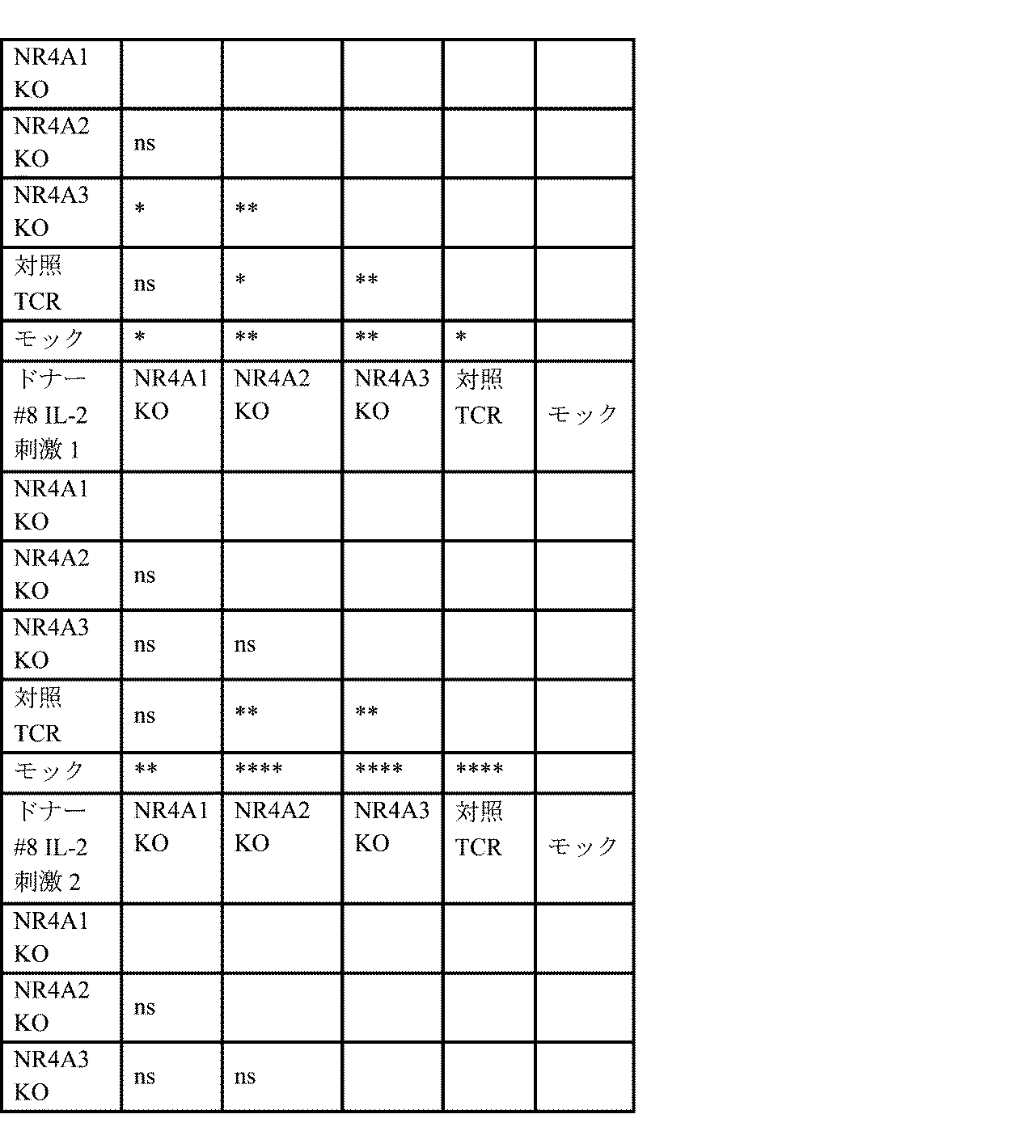


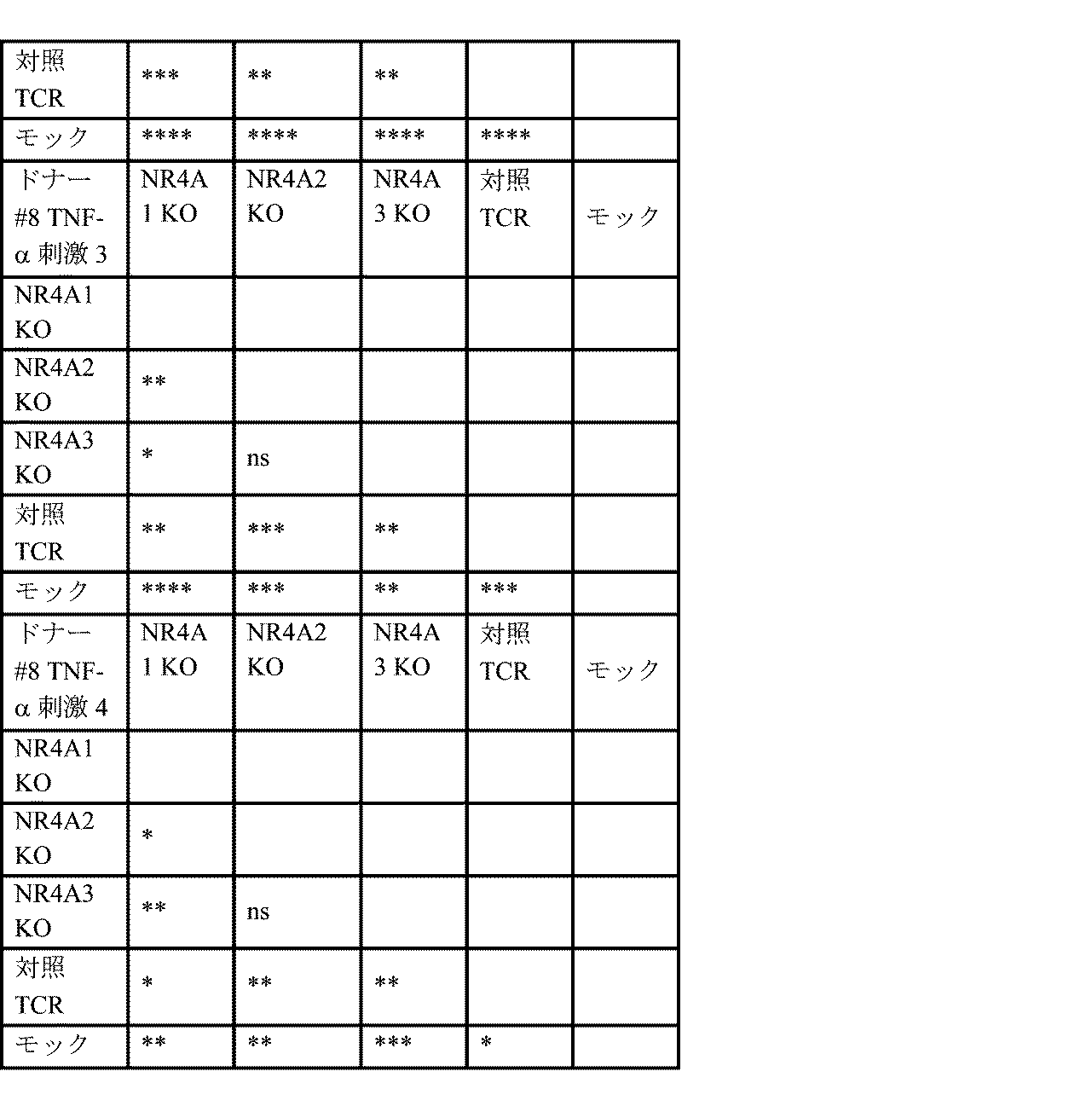
実施例8-修飾されたT細胞の生成
低減されたNR4A3ファミリー遺伝子及び/またはNR4A3ファミリータンパク質発現及びc-Jun過剰発現が、疲弊及び機能不全を低減することに対するそれらの効果に不必要であるかまたは相加的であるかを評価するために、ROR1-R12キメラ抗原受容体(CAR)T細胞モデルを使用した。c-Junタンパク質を過剰発現するROR1 CARで形質導入されたヒトT細胞においてNR4A3タンパク質発現を低減するために実施例1(表B~Dを参照されたい)において特定されたNR4A3標的化CRISPR-Cas9ガイドRNA(gRNA)を使用した。
Example 8 - Generation of Modified T Cells A ROR1-R12 chimeric antigen receptor (CAR) T cell model was used to assess whether reduced NR4A3 family gene and/or protein expression and c-Jun overexpression were unnecessary or additive in their effects on reducing exhaustion and dysfunction. The NR4A3-targeted CRISPR-Cas9 guide RNA (gRNA) identified in Example 1 (see Tables B-D) was used to reduce NR4A3 protein expression in human T cells transduced with the ROR1 CAR, which overexpresses the c-Jun protein.
具体的には、単離されたドナーCD4+及びCD8+T細胞をAllCellsから購入した。CD4+及びCD8+T細胞を解凍し、1%(v/v)TransAct(Miltenyi)が補充された代謝再プログラム化培地(MRM)中で活性化のために1:1の比で24時間混合した。活性化したT細胞を24時間後に抗ROR1 CAR(R12 scFv、IgG4ヒンジ、CD28tm、及び41BB及びCD3Z細胞内シグナル伝達ドメインを含有する)、切断型EGFRt形質導入マーカー、及び転写因子c-Junをコードするトリシストロン性レンチウイルスベクターで形質導入した。対照ROR1 CARベクターでは、c-Jun遺伝子を切断型非シグナル伝達CD19遺伝子で置き換えた。次いで形質導入されたT細胞を、Lonza 4D Nucleofectorユニットを使用して修飾されたガイドRNA(Synthego;表1及び2)を利用してヒトNR4A3または対照CD19を標的とするCas9 RNPでエレクトロポレーションした。エレクトロポレーションされたT細胞を増大のためにG-Rex培養プレートに移してから、7日目にCryoStor培地中で凍結保存した。

実施例9-低減されたNR4A3発現
NR4A3タンパク質の低減をフローサイトメトリーによってNR4A3編集及び対照CD19編集ROR1 CAR T細胞(c-Jun過剰発現を有する)において検証した。3×10⁵個のNR4A3編集及び対照CD19編集ROR1 CAR T細胞(c-Jun過剰発現を有する)を、96ウェル丸底プレート(Corning)において200uLのRPMI-1640(Gibco)+10%ウシ胎仔血清(Gibco)+1%ペニシリン/ストレプトマイシン中でPMA+イオノマイシン(BioLegend)で2時間37Cで刺激して最大NR4A3発現を誘導した。刺激後、細胞を生死色素及び表面マーカー抗体で25分間室温で染色した。すべての染色をBiolegend細胞染色緩衝液中で実施した。次いで細胞を固定し、製造業者の指示書に従ってFoxP3転写因子染色緩衝液キット(eBiosciences)で透過処理した。細胞を10%正常マウス血清で10分間室温でブロッキングし、次いでカスタム蛍光色素コンジュゲートNR4A3抗体(R&D Systems)で染色した。フローサイトメトリー分析のため、NR4A3編集及び対照CD19編集ROR1 CAR T細胞を上記のように表面染色し、固定し、透過処理した。細胞を10%正常マウス及びウサギ血清で10分間室温でブロッキングし、次いでcParp(逐次刺激の0日目のみ)及びc-Junで染色した。
Example 9 - Reduced NR4A3 Expression Reduction of NR4A3 protein was verified in NR4A3 edited and control CD19 edited ROR1 CAR T cells (with c-Jun overexpression) by flow cytometry. 3x10⁵ NR4A3 edited and control CD19 edited ROR1 CAR T cells (with c-Jun overexpression) were stimulated with PMA + ionomycin (BioLegend) in 200uL RPMI-1640 (Gibco) + 10% fetal bovine serum (Gibco) + 1% penicillin/streptomycin in 96-well round bottom plates (Corning) for 2 hours at 37C to induce maximum NR4A3 expression. After stimulation, cells were stained with live/dead dye and surface marker antibodies for 25 minutes at room temperature. All staining was performed in Biolegend cell staining buffer. Cells were then fixed and permeabilized with FoxP3 Transcription Factor Staining Buffer Kit (eBiosciences) according to the manufacturer's instructions. Cells were blocked with 10% normal mouse serum for 10 minutes at room temperature and then stained with custom fluorochrome-conjugated NR4A3 antibody (R&D Systems). For flow cytometry analysis, NR4A3-edited and control CD19-edited ROR1 CAR T cells were surface stained, fixed, and permeabilized as described above. Cells were blocked with 10% normal mouse and rabbit serum for 10 minutes at room temperature and then stained with cParp (
NR4A3タンパク質発現は、CD19編集対照と比較してNR4A3編集ROR1 CD4+及びCD8+CAR T細胞において有意に低減された(図16)。ROR1 CAR T細胞の形質導入効率(%EGFR+R12+として特定される)及びROR1-R12 CARの平均幾何蛍光(gMFI)は、試験された3つのドナーにわたってNR4A3編集及び対照CD19編集ROR1 CAR T細胞の間で同様であった。これは、CAR形質導入及び発現がNR4A3編集によって影響を受けなかったことを示唆している(図17)。 NR4A3 protein expression was significantly reduced in NR4A3-edited ROR1 CD4 + and CD8 + CAR T cells compared to CD19-edited controls (Figure 16). Transduction efficiency of ROR1 CAR T cells (identified as %EGFR + R12 + ) and mean geometric fluorescence (gMFI) of ROR1-R12 CAR were similar between NR4A3-edited and control CD19-edited ROR1 CAR T cells across the three donors tested, suggesting that CAR transduction and expression were not affected by NR4A3 editing (Figure 17).
実施例10-逐次刺激における持続した細胞傷害性及びサイトカイン生成
c-Jun過剰発現を有するNR4A3編集ROR1 CAR T細胞の機能を、CAR T細胞が逐次に抗原に曝露されるin vitro疲弊アッセイにおいて評価した。アッセイを設定する前に、H1975-NucLight Red(NLR)腫瘍細胞株を、RPMI-1640(Gibco)+10%ウシ胎仔血清(Gibco)+1%ペニシリン/ストレプトマイシン中で2~3回継代培養した。細胞をTrypLE Express酵素(Gibco)でトリプシン処理した。
Example 10 - Sustained Cytotoxicity and Cytokine Production upon Sequential Stimulation The function of NR4A3-edited ROR1 CAR T cells with c-Jun overexpression was assessed in an in vitro exhaustion assay in which CAR T cells were sequentially exposed to antigen. Prior to setting up the assay, H1975-NucLight Red (NLR) tumor cell line was passaged 2-3 times in RPMI-1640 (Gibco) + 10% fetal bovine serum (Gibco) + 1% penicillin/streptomycin. Cells were trypsinized with TrypLE Express enzyme (Gibco).
逐次刺激アッセイにおいて、NR4A3編集及び対照CD19編集ROR1 CAR T細胞(c-Jun過剰発現を有する)をH1975 NSCLC ROR1を発現する腫瘍細胞株で6回の連続刺激に供した。特に、凍結保存されたROR1 CAR T細胞を解凍し、フラット24ウェルアッセイプレート(Eppendorf)において三連でRPMI-1640(Gibco)+10%ウシ胎仔血清(Gibco)+1%ペニシリン/ストレプトマイシン中で1:1のE:T比のcParp-CD3+EGFR+R12+CAR T細胞とH1975-NLR腫瘍細胞を直ちに培養した。3日間の共培養後に、ウェルを再懸濁し、培養物の25%をウェル当たり同じ初期数の新たな腫瘍細胞を有する新たなプレートに移した。これを合計で6回の刺激について繰り返した。細胞傷害性をIncucyteにおいてアッセイ中に連続的に測定し、各々の新たな刺激を設定してから24時間後に上清を収集してサイトカインレベルを測定した。三連の共培養ウェルからの残りの細胞を、上述したように表現型フロー分析のために組み合わせた。 In sequential stimulation assays, NR4A3-edited and control CD19-edited ROR1 CAR T cells (with c-Jun overexpression) were subjected to six consecutive stimulations with H1975 NSCLC ROR1-expressing tumor cell lines. In particular, cryopreserved ROR1 CAR T cells were thawed and immediately cultured with cParp − CD3 + EGFR + R12 + CAR T cells and H1975-NLR tumor cells at a 1:1 E:T ratio in RPMI - 1640 (Gibco) + 10% fetal bovine serum (Gibco) + 1% penicillin/streptomycin in triplicate in flat 24-well assay plates (Eppendorf). After 3 days of co-culture, wells were resuspended and 25 % of the cultures were transferred to new plates with the same initial number of fresh tumor cells per well. This was repeated for a total of six stimulations. Cytotoxicity was measured continuously during the assay in the Incucyte, and supernatants were collected 24 hours after each new stimulation was set up to measure cytokine levels. The remaining cells from triplicate co-culture wells were combined for phenotypic flow analysis as described above.
異なるNR4A3 gRNA間でH1975(図20)腫瘍細胞に対する細胞傷害性のわずかな差が存在したが、NR4A3編集されたc-Junを過剰発現するROR1 CAR T細胞は、最も細胞傷害性が高いままであり、3つの異なるドナーにおいて対照のCD19編集されたc-Junを過剰発現するROR1 CAR T細胞と比較して標的細胞を溶解する持続した能力を実証した。 While there were slight differences in cytotoxicity against H1975 (Figure 20) tumor cells between the different NR4A3 gRNAs, NR4A3-edited c-Jun-overexpressing ROR1 CAR T cells remained the most cytotoxic, demonstrating a sustained ability to lyse target cells compared to control CD19-edited c-Jun-overexpressing ROR1 CAR T cells in three different donors.
持続した細胞傷害性に加えて、NR4A3編集されたc-Junを過剰発現するROR1 CAR T細胞はまた、H1975 NSCLC ROR1を発現する腫瘍細胞で刺激された場合、対照CD19編集c-Jun ROR1 CAR T細胞と比較してより高いレベルのIFN-γ、IL-2、及びTNF-αを生成した(図19A~19C及び表11~13)。サイトカインレベルを、Meso Scale Discovery V-Plex炎症誘発パネル1ヒトキットまたはカスタムヒトIFN-g、IL-2、及びTNF-αサイトカインキットを使用して製造業者の指示書に従って測定した。
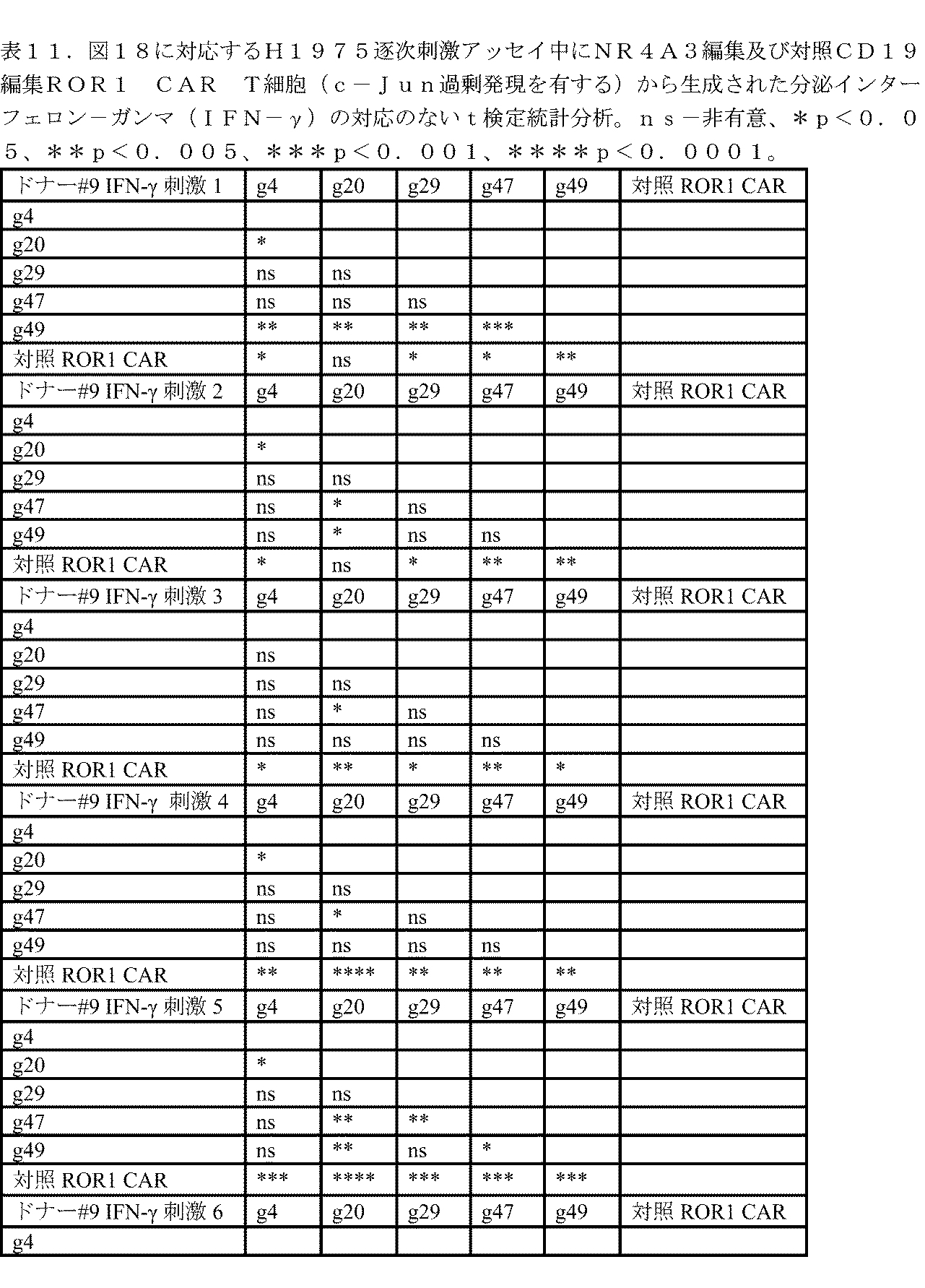


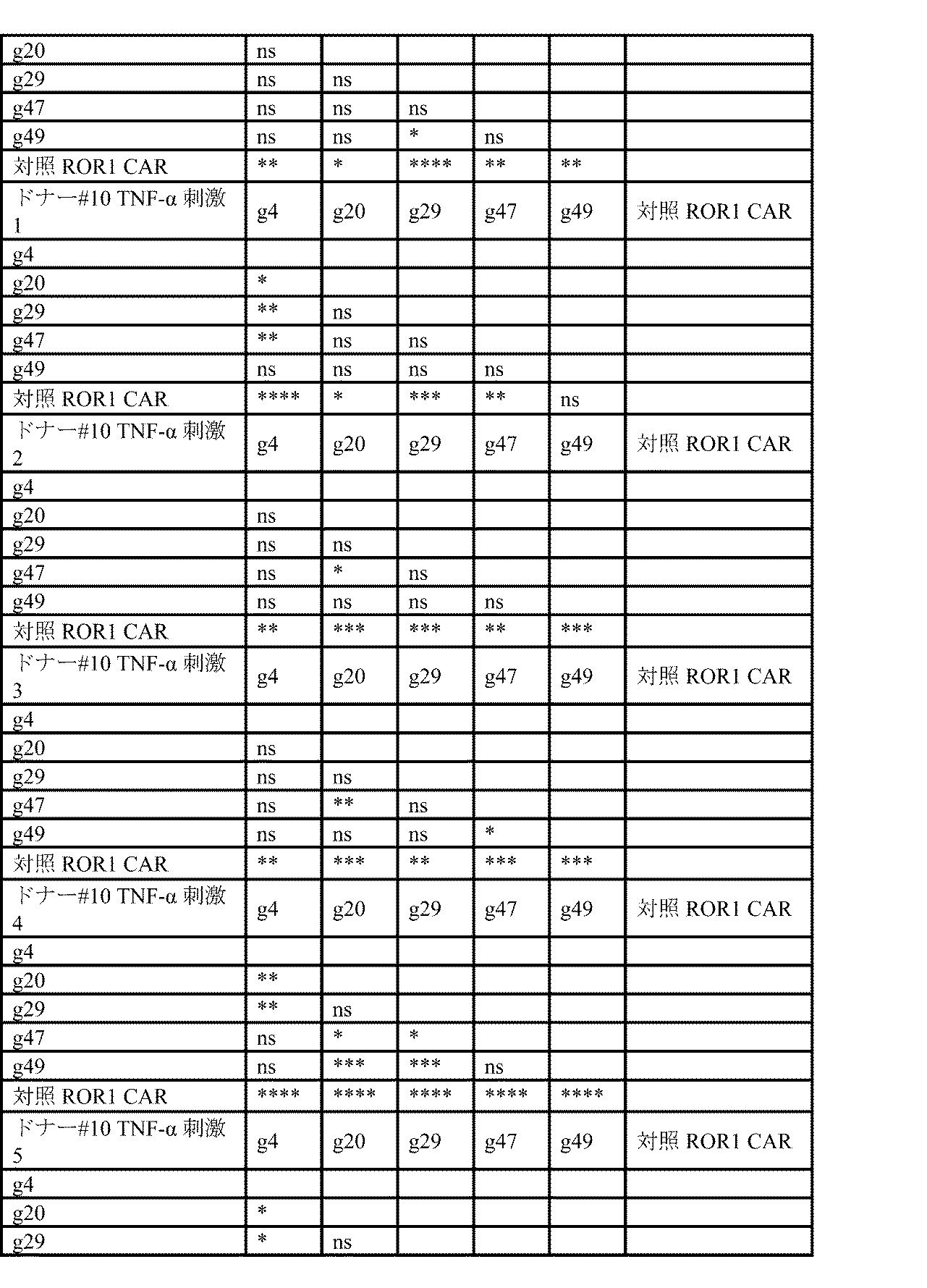


サイトカイン生成の差は、より後のラウンドの刺激後に最も顕著であり、NR4A3ノックアウト及びc-Jun過剰発現が、長期抗原刺激後に持続した機能的活性及び/または改善されたCAR T細胞生存に寄与することを示唆している。NR4A3 gRNA間のサイトカインレベルのわずかな差が存在したが、すべてのgRNAは、対照のCD19編集されたc-Junを過剰発現するROR1 CAR T細胞と比較してより高いサイトカインレベルを生成した。 Differences in cytokine production were most pronounced after later rounds of stimulation, suggesting that NR4A3 knockout and c-Jun overexpression contribute to sustained functional activity and/or improved CAR T cell survival after prolonged antigen stimulation. Although there were minor differences in cytokine levels between NR4A3 gRNAs, all gRNAs produced higher cytokine levels compared to control CD19-edited c-Jun-overexpressing ROR1 CAR T cells.
T細胞疲弊のin vitro逐次刺激モデルは、NR4A3編集されたc-Junを過剰発現するROR1 CAR T細胞が、3つの独立したドナーにおいてROR1を発現するH1975腫瘍細胞に対する最大の向上及び持続した細胞傷害性及びサイトカイン生成を示すことを明らかにした。これは、NR4A3を標的とする複数のgRNAにわたって確認される。そのため、ROR1-R12 CAR T細胞との関連でc-Jun過剰発現と組み合わせてNR4A3を編集することは、ROR1を発現する固形腫瘍に対する細胞免疫療法を改善し得る。
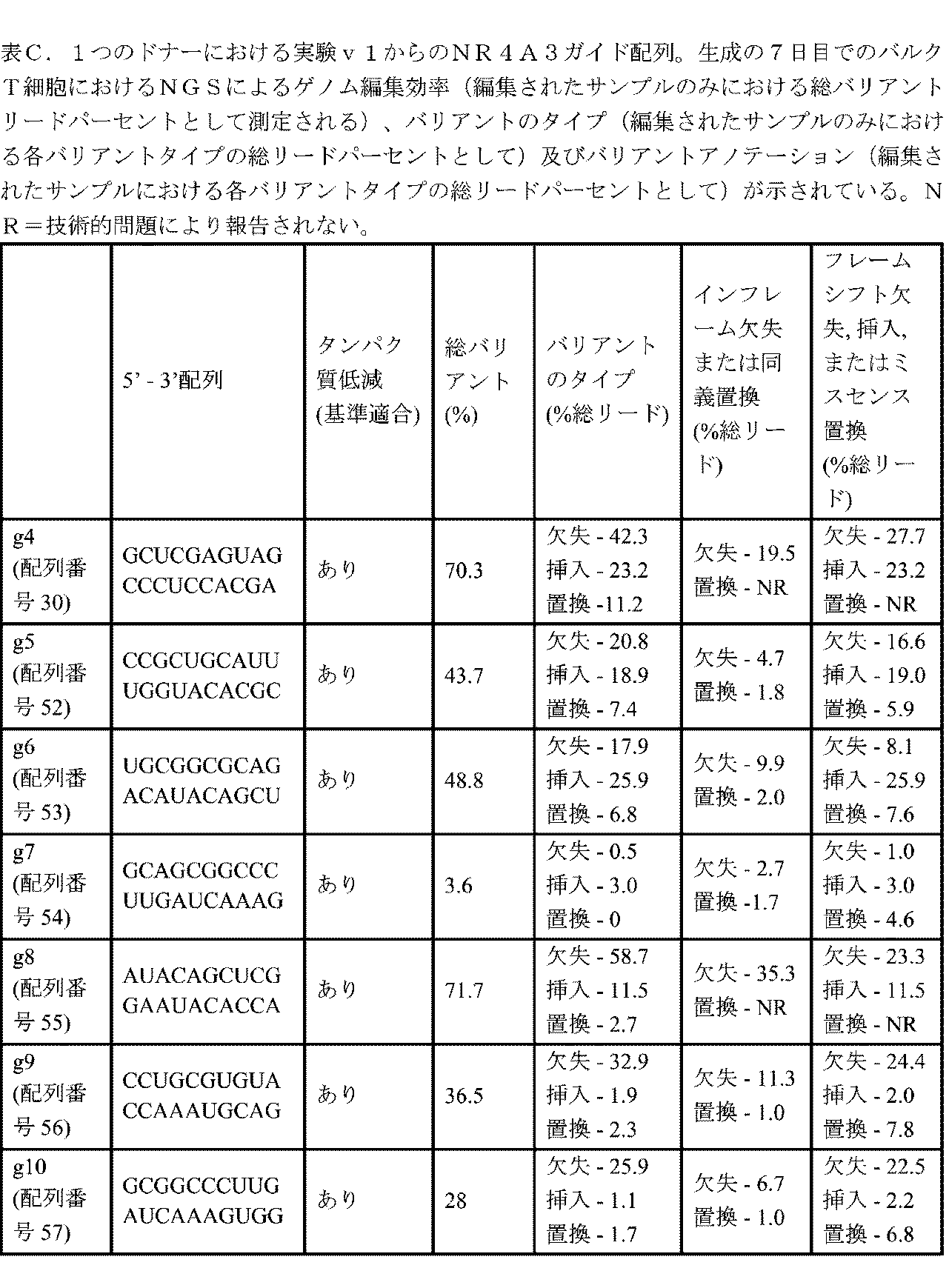


実施例11-抗腫瘍有効性
T細胞疲弊は、A549腫瘍細胞によって急速に誘導され、そのため、処置困難in vivo異種移植モデルと考えられる。NR4A3編集されたc-Junを過剰発現するROR1 CAR T細胞の抗腫瘍活性を評価するために、in vivo A549異種移植モデルを使用した。親A549腫瘍細胞を、13週齢のNSG HLA二重ノックアウトマウス(Jackson Labs)への埋込前にRPMI-1640(Gibco)+10%ウシ胎仔血清(Gibco)中で3継代培養した。細胞をTrypLE Express酵素でトリプシン処理し、HBSS(Gibco)に再懸濁し、マトリゲル(Corning)と1:1比で混合した。5百万個のA549腫瘍細胞を各マウスの側腹部に移植した。腫瘍が80~120mm3のサイズに到達したときに、T細胞を無作為化された腫瘍保有マウスに養子移入した。腫瘍体積及び体重を、腫瘍の>2000mm3への到達、>20%の体重減少、潰瘍、呼吸困難、重度に制限された可動性もしくは直立不能、またはT細胞移入から60日後までのエンドポイントまで週2回測定した。
Example 11 - Anti-Tumor Efficacy T cell exhaustion is rapidly induced by A549 tumor cells, which is therefore considered a difficult to treat in vivo xenograft model. To evaluate the anti-tumor activity of ROR1 CAR T cells overexpressing NR4A3-edited c-Jun, an in vivo A549 xenograft model was used. Parental A549 tumor cells were cultured for three passages in RPMI-1640 (Gibco) + 10% fetal bovine serum (Gibco) before implantation into 13-week-old NSG HLA double knockout mice (Jackson Labs). Cells were trypsinized with TrypLE Express enzyme, resuspended in HBSS (Gibco), and mixed with Matrigel (Corning) at a 1:1 ratio. Five million A549 tumor cells were implanted into the flank of each mouse. When tumors reached a size of 80-120 mm3 , T cells were adoptively transferred into randomized tumor-bearing mice. Tumor volume and body weight were measured twice weekly until tumors reached >2000 mm3 , >20% body weight loss, ulceration, respiratory distress, severely restricted mobility or inability to stand, or endpoints up to 60 days after T cell transfer.
養子移入のためのT細胞を調製するために、凍結保存されたNR4A3編集または対照CD19編集ROR1 CAR T細胞(c-Jun過剰発現を有する)(実施例8生成したに記載されているように)を解凍し、腫瘍保有マウスに養子移入する前にRPMI-1640(Gibco)+25mM HEPES(Gibco)で洗浄した。マウスに100uLの1千万個のcParp-CD3+EGFR+R12+T細胞を尾静脈を介して静脈内注射した。n=処置群当たり5匹のマウス。GraphPad Prismのテューキーの一元配置ANOVA及び対応のないt検定を統計分析のために使用した。*p<0.05、**p<0.005、***p<0.001、****p<0.0001。 To prepare T cells for adoptive transfer, cryopreserved NR4A3-edited or control CD19-edited ROR1 CAR T cells (with c-Jun overexpression) (generated as described in Example 8) were thawed and washed with RPMI-1640 (Gibco) + 25 mM HEPES (Gibco) before adoptive transfer into tumor-bearing mice. Mice were injected intravenously via the tail vein with 100 uL of 10 million cParp − CD3 + EGFR + R12 + T cells. n = 5 mice per treatment group. Tukey's one-way ANOVA and unpaired t-test in GraphPad Prism were used for statistical analysis. *p<0.05, **p<0.005, ***p<0.001, ***p<0.0001.
NR4A3編集された及び対照のCD19編集されたc-Junを過剰発現するROR1 CAR T細胞は、モック非形質導入T細胞と比較して有意に強力な及び改善された抗腫瘍有効性を示した(図20A)。c-Jun過剰発現を有する対照CD19編集ROR1 CAR T細胞は、モック非形質導入T細胞で処置された動物と比較して腫瘍成長を遅延させたが、NR4A3 KO及びc-Jun過剰発現を有するROR1 CAR T細胞は、研究期間を通してそれらの抗腫瘍活性をさらに向上させ、腫瘍体積を維持した。その上、NR4A3編集されたc-Junを過剰発現するROR1 CAR T細胞が養子移入されたマウスは、T細胞注射後の13日目に末梢血CD3+CAR+T細胞数の有意により高い増大倍率を有していた。重要なことに、NR4A3編集されたc-Junを過剰発現するROR1 CAR T細胞は減少した(図20B、表14)。T細胞疲弊を誘導するこのA549異種移植モデルでは、ROR1 CAR T細胞においてNR4A3 KO及びc-Jun過剰発現を組み合わせることの相乗的利益は、in vivoで持続した頑強な抗腫瘍活性を提供した。

本明細書で提供されるNR4A3編集T細胞のin vivo有効性をさらに確認するために、本明細書で提供される2つの異なるgRNA(すなわち、g4及びg47)をNR4A3発現を低減するために使用した。T細胞を、実施例8に記載されているように、ROR1 CARを発現するように及びc-Junタンパク質を過剰発現するようにさらに修飾した。次いで、実施例5のように、in vivo H1975異種移植腫瘍モデルを抗腫瘍活性を測定するために使用した。 To further confirm the in vivo efficacy of the NR4A3-edited T cells provided herein, two different gRNAs (i.e., g4 and g47) provided herein were used to reduce NR4A3 expression. The T cells were further modified to express the ROR1 CAR and to overexpress c-Jun protein as described in Example 8. An in vivo H1975 xenograft tumor model was then used to measure antitumor activity as in Example 5.
簡潔には、腫瘍が80~120mm3のサイズに到達したときにNR4A3編集T細胞を無作為化された腫瘍保有マウスに養子移入した。NR4A3編集T細胞を低用量(0.4×10⁶細胞/マウス)または高用量(2×106細胞/マウス)で動物に投与した。CD19編集抗ROR1 CAR T細胞を対照として使用した。腫瘍体積及び体重を、腫瘍の>2000mm3への到達、>20%の体重減少、潰瘍、呼吸困難、重度に制限された可動性もしくは直立不能、またはT細胞移入から90日後までのエンドポイントまで週2回測定した。 Briefly, NR4A3 edited T cells were adoptively transferred into randomized tumor-bearing mice when tumors reached a size of 80-120 mm3 . Animals were administered low dose ( 0.4x10⁶ cells/mouse) or high dose ( 2x10⁶ cells/mouse) of NR4A3 edited T cells. CD19 edited anti-ROR1 CAR T cells were used as a control. Tumor volume and body weight were measured twice weekly until tumors reached >2000 mm3 , >20% body weight loss, ulceration, respiratory distress, severely restricted mobility or inability to stand, or endpoints up to 90 days after T cell transfer.
低及び高CAR T細胞用量で、試験されたすべてのNR4A3編集ROR1 CAR T細胞は、モック非形質導入T細胞と比較して強力な活性及び有意に改善された抗腫瘍有効性を有していた。後の時点で、低用量でのNR4A3編集+c-Jun ROR1 CAR T細胞は、対照CD19編集+c-Jun ROR1 CAR T細胞と比較してより良好な長期腫瘍制御を維持することができた(図21A)。また、NR4A3 g4編集またはNR4A3編集g47+c-Jun ROR1 CAR T細胞が養子移入されたマウスは、T細胞注射後14日目及び21日目で対照CD19編集+c-Jun ROR1 CAR T細胞と比較して有意により高い末梢血CD3+CAR+T細胞数を有していた。いずれの時点においてもNR4A3 g4編集及びg47編集ROR1 CAR T細胞(c-Jun過剰発現を有する)の間にCD3+CAR+T細胞数の有意な差はなかった(図21B、表15及び16)。重要なことに、NR4A3編集+c-Jun ROR1 CAR T細胞の数は、その後減少し、制御されないin vivo増大を実証しなかった。 At low and high CAR T cell doses, all NR4A3-edited ROR1 CAR T cells tested had potent activity and significantly improved antitumor efficacy compared to mock untransduced T cells. At later time points, NR4A3-edited+c-Jun ROR1 CAR T cells at low doses were able to maintain better long-term tumor control compared to control CD19-edited+c-Jun ROR1 CAR T cells (FIG. 21A). Mice adoptively transferred with NR4A3 g4-edited or NR4A3-edited g47+c-Jun ROR1 CAR T cells also had significantly higher peripheral blood CD3 + CAR + T cell counts compared to control CD19-edited+c-Jun ROR1 CAR T cells at days 14 and 21 after T cell injection. There was no significant difference in CD3 + CAR + T cell numbers between NR4A3 g4-edited and g47-edited ROR1 CAR T cells (with c-Jun overexpression) at any time point ( FIG. 21B , Tables 15 and 16). Importantly, the number of NR4A3-edited+c-Jun ROR1 CAR T cells subsequently declined and did not demonstrate uncontrolled in vivo expansion.
これらの結果はさらに、T細胞におけるNR4A3発現を低減する際の本明細書で提供されるgRNAの能力、及びそのような修飾されたT細胞の治療的潜在性を確認する。


発明の概要及び要約のセクションではなく、発明を実施するための形態のセクションが、特許請求の範囲を解釈するために使用されることが意図されていることを理解されたい。発明の概要及び要約のセクションは、本発明者(複数可)が企図する本開示の例示的な態様のすべてではなく1つ以上を記載し得るものであり、したがって、本開示及び添付の特許請求の範囲を決して限定するものではない。 It is understood that the Detailed Description section, and not the Summary and Abstract sections, is intended to be used to interpret the claims. The Summary and Abstract sections may describe one or more, but not all, exemplary aspects of the disclosure contemplated by the inventor(s) and therefore are not intended to limit the scope of the disclosure and the appended claims in any way.
本開示を、特定の機能及びそれらの関係の実施を示す機能的な構成要素を用いて上記で説明してきた。これらの機能構成単位の境界は、便宜上説明のために、本明細書では適宜定義されている。該特定の機能及びそれらの関係が適切に行われる限り、別の境界が定義される場合もある。 The present disclosure has been described above using functional building blocks that illustrate the implementation of certain functions and relationships thereof. The boundaries of these functional building blocks have been appropriately defined herein for the convenience of explanation. Other boundaries may be defined so long as the certain functions and relationships thereof are appropriately performed.
該特定の態様の前述の説明は、本開示の一般的な性質を完全に明らかにすることから、当業者の知識を適用することにより、必要以上の実験をすることなく、本開示の一般概念から逸脱することなく、かかる特定の態様を容易に修正すること、及び/または様々な用途に適合させることができる。したがって、かかる適合及び修正は、本明細書に含まれる教示及び手引きに基づいて、本開示の態様の意義及び均等物の範囲内であることが意図される。本明細書における表現または専門用語は、本明細書の専門用語または表現が、該教示及び手引きに照らして当業者に解釈されるように、限定ではなく説明を目的とするものであることを理解されたい。 The foregoing description of the specific embodiments fully reveals the general nature of the present disclosure, and by applying the knowledge of those skilled in the art, such specific embodiments may be readily modified and/or adapted for various uses without undue experimentation and without departing from the general concept of the present disclosure. Such adaptations and modifications are therefore intended to be within the meaning and equivalents of the embodiments of the present disclosure, based on the teachings and guidance contained herein. It should be understood that the expressions or terminology used herein are intended to be descriptive and not limiting, as the terminology or terminology used herein would be interpreted by one skilled in the art in light of the teachings and guidance.
本開示の広がり及び範囲は、上記の例示的な態様のいずれによっても限定されるべきでなく、以下の特許請求の範囲及びそれらの均等物によってのみ定義されるべきである。 The breadth and scope of the present disclosure should not be limited by any of the above-described exemplary aspects, but should be defined only in accordance with the following claims and their equivalents.
本出願全体を通して引用されるすべての引用参考文献(参考文献、米国または外国特許または特許出願、及びウェブサイトを含む)の内容は、任意の目的のためにそれらの全体が本明細書に記載されているものとして、そこで引用される参考文献も同様に、参照により明示的に本明細書に組み込まれる。何らかの矛盾が生じた場合、本明細書に文章で開示される内容が優先する。 The contents of all cited references (including literature references, U.S. or foreign patents or patent applications, and websites) cited throughout this application are expressly incorporated herein by reference as if set forth herein in their entirety for any purpose, as well as the references cited therein. In the event of any conflict, the textual disclosure herein will control.
Claims (107)
(a)配列番号7に示される核酸配列と少なくとも89%、少なくとも90%、少なくとも約95%、少なくとも約96%、少なくとも約97%、少なくとも約98%、少なくとも約99%、または約100%の配列同一性を有する核酸配列;
(b)配列番号8に示される核酸配列と少なくとも90%、少なくとも約95%、少なくとも約96%、少なくとも約97%、少なくとも約98%、少なくとも約99%、または約100%の配列同一性を有する核酸配列;
(c)配列番号10に示される核酸配列と少なくとも約30%、少なくとも約40%、少なくとも約50%、少なくとも約60%、少なくとも約70%、少なくとも約80%、少なくとも約90%、少なくとも約95%、少なくとも約96%、少なくとも約97%、少なくとも約98%、少なくとも約99%、または約100%の配列同一性を有する核酸配列;
(d)配列番号11に示される核酸配列と少なくとも79%、少なくとも80%、少なくとも81%、少なくとも82%、少なくとも83%、少なくとも84%、少なくとも85%、少なくとも86%、少なくとも87%、少なくとも88%、少なくとも89%、少なくとも90%、少なくとも約95%、少なくとも約96%、少なくとも約97%、少なくとも約98%、少なくとも約99%、または約100%の配列同一性を有する核酸配列;
(e)配列番号12に示される核酸配列と少なくとも88%、少なくとも89%、少なくとも90%、少なくとも約95%、少なくとも約96%、少なくとも約97%、少なくとも約98%、少なくとも約99%、または約100%の配列同一性を有する核酸配列;
(f)配列番号13に示される核酸配列と少なくとも82%、少なくとも83%、少なくとも84%、少なくとも85%、少なくとも90%、少なくとも約95%、少なくとも約96%、少なくとも約97%、少なくとも約98%、少なくとも約99%、または約100%の配列同一性を有する核酸配列;
(g)配列番号14に示される核酸配列と少なくとも90%、少なくとも約95%、少なくとも約96%、少なくとも約97%、少なくとも約98%、少なくとも約99%、または約100%の配列同一性を有する核酸配列;
(h)配列番号15に示される核酸配列と少なくとも55%、少なくとも約55%、少なくとも約60%、少なくとも約65%、少なくとも約70%、少なくとも約75%、少なくとも約80%、少なくとも約85%、少なくとも約90%、少なくとも約95%、少なくとも約96%、少なくとも約97%、少なくとも約98%、少なくとも約99%、または約100%の配列同一性を有する核酸配列;または
(i)配列番号16に示される核酸配列と少なくとも85%、少なくとも86%、少なくとも87%、少なくとも88%、少なくとも89%、少なくとも約90%、少なくとも約95%、少なくとも約96%、少なくとも約97%、少なくとも約98%、少なくとも約99%、または約100%の配列同一性を有する核酸配列
を含む、請求項41に記載の方法。 The nucleotide sequence encoding the c-Jun protein is
(a) a nucleic acid sequence having at least 89%, at least 90%, at least about 95%, at least about 96%, at least about 97%, at least about 98%, at least about 99%, or about 100% sequence identity to the nucleic acid sequence set forth in SEQ ID NO:7;
(b) a nucleic acid sequence having at least 90%, at least about 95%, at least about 96%, at least about 97%, at least about 98%, at least about 99%, or about 100% sequence identity to the nucleic acid sequence set forth in SEQ ID NO:8;
(c) a nucleic acid sequence having at least about 30%, at least about 40%, at least about 50%, at least about 60%, at least about 70%, at least about 80%, at least about 90%, at least about 95%, at least about 96%, at least about 97%, at least about 98%, at least about 99%, or about 100% sequence identity to the nucleic acid sequence set forth in SEQ ID NO:10;
(d) a nucleic acid sequence having at least 79%, at least 80%, at least 81%, at least 82%, at least 83%, at least 84%, at least 85%, at least 86%, at least 87%, at least 88%, at least 89%, at least 90%, at least about 95%, at least about 96%, at least about 97%, at least about 98%, at least about 99%, or about 100% sequence identity to the nucleic acid sequence set forth in SEQ ID NO:11;
(e) a nucleic acid sequence having at least 88%, at least 89%, at least 90%, at least about 95%, at least about 96%, at least about 97%, at least about 98%, at least about 99%, or about 100% sequence identity to the nucleic acid sequence set forth in SEQ ID NO:12;
(f) a nucleic acid sequence having at least 82%, at least 83%, at least 84%, at least 85%, at least 90%, at least about 95%, at least about 96%, at least about 97%, at least about 98%, at least about 99%, or about 100% sequence identity to the nucleic acid sequence set forth in SEQ ID NO:13;
(g) a nucleic acid sequence having at least 90%, at least about 95%, at least about 96%, at least about 97%, at least about 98%, at least about 99%, or about 100% sequence identity to the nucleic acid sequence set forth in SEQ ID NO:14;
42. The method of claim 41, comprising: (h) a nucleic acid sequence having at least 55%, at least about 55%, at least about 60%, at least about 65%, at least about 70%, at least about 75%, at least about 80%, at least about 85%, at least about 90%, at least about 95%, at least about 96%, at least about 97%, at least about 98%, at least about 99%, or about 100% sequence identity to the nucleic acid sequence set forth in SEQ ID NO:15; or (i) a nucleic acid sequence having at least 85%, at least 86%, at least 87%, at least 88%, at least 89%, at least about 90%, at least about 95%, at least about 96%, at least about 97%, at least about 98%, at least about 99%, or about 100% sequence identity to the nucleic acid sequence set forth in SEQ ID NO:16.
Applications Claiming Priority (7)
| Application Number | Priority Date | Filing Date | Title |
|---|---|---|---|
| US202263365025P | 2022-05-19 | 2022-05-19 | |
| US63/365,025 | 2022-05-19 | ||
| US202263382705P | 2022-11-07 | 2022-11-07 | |
| US63/382,705 | 2022-11-07 | ||
| US202363482984P | 2023-02-02 | 2023-02-02 | |
| US63/482,984 | 2023-02-02 | ||
| PCT/US2023/067260 WO2023225665A1 (en) | 2022-05-19 | 2023-05-19 | Polynucleotides targeting nr4a3 and uses thereof |
Publications (1)
| Publication Number | Publication Date |
|---|---|
| JP2025516823A true JP2025516823A (en) | 2025-05-30 |
Family
ID=86903929
Family Applications (1)
| Application Number | Title | Priority Date | Filing Date |
|---|---|---|---|
| JP2024568570A Pending JP2025516823A (en) | 2022-05-19 | 2023-05-19 | Polynucleotides targeting NR4A3 and uses thereof |
Country Status (7)
| Country | Link |
|---|---|
| EP (1) | EP4525892A1 (en) |
| JP (1) | JP2025516823A (en) |
| KR (1) | KR20250027283A (en) |
| CN (1) | CN119947735A (en) |
| AU (1) | AU2023273885A1 (en) |
| CA (1) | CA3253951A1 (en) |
| WO (1) | WO2023225665A1 (en) |
Families Citing this family (2)
| Publication number | Priority date | Publication date | Assignee | Title |
|---|---|---|---|---|
| WO2024064958A1 (en) * | 2022-09-23 | 2024-03-28 | Lyell Immunopharma, Inc. | Methods for culturing nr4a-deficient cells |
| WO2024077174A1 (en) * | 2022-10-05 | 2024-04-11 | Lyell Immunopharma, Inc. | Methods for culturing nr4a-deficient cells |
Family Cites Families (76)
| Publication number | Priority date | Publication date | Assignee | Title |
|---|---|---|---|---|
| US5034506A (en) | 1985-03-15 | 1991-07-23 | Anti-Gene Development Group | Uncharged morpholino-based polymers having achiral intersubunit linkages |
| US5585112A (en) | 1989-12-22 | 1996-12-17 | Imarx Pharmaceutical Corp. | Method of preparing gas and gaseous precursor-filled microspheres |
| IT1246382B (en) | 1990-04-17 | 1994-11-18 | Eurand Int | METHOD FOR THE TARGETED AND CONTROLLED DELIVERY OF DRUGS IN THE INTESTINE AND PARTICULARLY IN THE COLON |
| US5602240A (en) | 1990-07-27 | 1997-02-11 | Ciba Geigy Ag. | Backbone modified oligonucleotide analogs |
| US5489677A (en) | 1990-07-27 | 1996-02-06 | Isis Pharmaceuticals, Inc. | Oligonucleoside linkages containing adjacent oxygen and nitrogen atoms |
| US5543390A (en) | 1990-11-01 | 1996-08-06 | State Of Oregon, Acting By And Through The Oregon State Board Of Higher Education, Acting For And On Behalf Of The Oregon Health Sciences University | Covalent microparticle-drug conjugates for biological targeting |
| US5436150A (en) | 1992-04-03 | 1995-07-25 | The Johns Hopkins University | Functional domains in flavobacterium okeanokoities (foki) restriction endonuclease |
| US5356802A (en) | 1992-04-03 | 1994-10-18 | The Johns Hopkins University | Functional domains in flavobacterium okeanokoites (FokI) restriction endonuclease |
| US5487994A (en) | 1992-04-03 | 1996-01-30 | The Johns Hopkins University | Insertion and deletion mutants of FokI restriction endonuclease |
| US6274552B1 (en) | 1993-03-18 | 2001-08-14 | Cytimmune Sciences, Inc. | Composition and method for delivery of biologically-active factors |
| US5523092A (en) | 1993-04-14 | 1996-06-04 | Emory University | Device for local drug delivery and methods for using the same |
| US5985307A (en) | 1993-04-14 | 1999-11-16 | Emory University | Device and method for non-occlusive localized drug delivery |
| US6004534A (en) | 1993-07-23 | 1999-12-21 | Massachusetts Institute Of Technology | Targeted polymerized liposomes for improved drug delivery |
| US5759542A (en) | 1994-08-05 | 1998-06-02 | New England Deaconess Hospital Corporation | Compositions and methods for the delivery of drugs by platelets for the treatment of cardiovascular and other diseases |
| US5660854A (en) | 1994-11-28 | 1997-08-26 | Haynes; Duncan H | Drug releasing surgical implant or dressing material |
| US6316652B1 (en) | 1995-06-06 | 2001-11-13 | Kosta Steliou | Drug mitochondrial targeting agents |
| US6039975A (en) | 1995-10-17 | 2000-03-21 | Hoffman-La Roche Inc. | Colon targeted delivery system |
| TW345603B (en) | 1996-05-29 | 1998-11-21 | Gmundner Fertigteile Gmbh | A noise control device for tracks |
| US6139865A (en) | 1996-10-01 | 2000-10-31 | Eurand America, Inc. | Taste-masked microcapsule compositions and methods of manufacture |
| US6131570A (en) | 1998-06-30 | 2000-10-17 | Aradigm Corporation | Temperature controlling device for aerosol drug delivery |
| US6120751A (en) | 1997-03-21 | 2000-09-19 | Imarx Pharmaceutical Corp. | Charged lipids and uses for the same |
| US6060082A (en) | 1997-04-18 | 2000-05-09 | Massachusetts Institute Of Technology | Polymerized liposomes targeted to M cells and useful for oral or mucosal drug delivery |
| US6048736A (en) | 1998-04-29 | 2000-04-11 | Kosak; Kenneth M. | Cyclodextrin polymers for carrying and releasing drugs |
| US6453242B1 (en) | 1999-01-12 | 2002-09-17 | Sangamo Biosciences, Inc. | Selection of sites for targeting by zinc finger proteins and methods of designing zinc finger proteins to bind to preselected sites |
| US6271359B1 (en) | 1999-04-14 | 2001-08-07 | Musc Foundation For Research Development | Tissue-specific and pathogen-specific toxic agents and ribozymes |
| JP2003526367A (en) | 2000-03-16 | 2003-09-09 | ジェネティカ インコーポレイテッド | RNA interference method and RNA interference composition |
| US8202846B2 (en) | 2000-03-16 | 2012-06-19 | Cold Spring Harbor Laboratory | Methods and compositions for RNA interference |
| US8106255B2 (en) | 2002-01-23 | 2012-01-31 | Dana Carroll | Targeted chromosomal mutagenasis using zinc finger nucleases |
| ATE372379T1 (en) | 2002-03-15 | 2007-09-15 | Cellectis | HYBRID AND SINGLE CHAIN MEGANUCLEASES AND THEIR APPLICATIONS |
| EP1504092B2 (en) | 2002-03-21 | 2014-06-25 | Sangamo BioSciences, Inc. | Methods and compositions for using zinc finger endonucleases to enhance homologous recombination |
| JP2006502748A (en) | 2002-09-05 | 2006-01-26 | カリフォルニア インスティテュート オブ テクノロジー | Methods of using chimeric nucleases to induce gene targeting |
| AU2003290518A1 (en) | 2002-09-06 | 2004-04-23 | Fred Hutchinson Cancer Research Center | Methods and compositions concerning designed highly-specific nucleic acid binding proteins |
| US8409861B2 (en) | 2003-08-08 | 2013-04-02 | Sangamo Biosciences, Inc. | Targeted deletion of cellular DNA sequences |
| US7888121B2 (en) | 2003-08-08 | 2011-02-15 | Sangamo Biosciences, Inc. | Methods and compositions for targeted cleavage and recombination |
| EP1591521A1 (en) | 2004-04-30 | 2005-11-02 | Cellectis | I-Dmo I derivatives with enhanced activity at 37 degrees C and use thereof |
| US20090226474A1 (en) | 2004-05-27 | 2009-09-10 | Weidanz Jon A | Antibodies as T cell receptor mimics, methods of production and uses thereof |
| US20070059711A1 (en) * | 2004-07-30 | 2007-03-15 | Andrzej Slominski | Microarray for evaluation of stress-related genes in skin |
| KR20070060115A (en) | 2004-09-16 | 2007-06-12 | 상가모 바이오사이언스 인코포레이티드 | Compositions and Methods for Protein Production |
| WO2006097784A1 (en) | 2005-03-15 | 2006-09-21 | Cellectis | I-crei meganuclease variants with modified specificity, method of preparation and uses thereof |
| EP2327773A1 (en) | 2005-03-15 | 2011-06-01 | Cellectis | I-crel meganuclease variants with modified specificity, method of preparation and uses thereof |
| US20110239315A1 (en) | 2009-01-12 | 2011-09-29 | Ulla Bonas | Modular dna-binding domains and methods of use |
| EP2206723A1 (en) | 2009-01-12 | 2010-07-14 | Bonas, Ulla | Modular DNA-binding domains |
| US8772008B2 (en) | 2009-05-18 | 2014-07-08 | Sangamo Biosciences, Inc. | Methods and compositions for increasing nuclease activity |
| TR201815882T4 (en) | 2009-12-10 | 2018-11-21 | Univ Iowa State Res Found Inc | Tal effector mediated DNA modification. |
| US8710200B2 (en) | 2011-03-31 | 2014-04-29 | Moderna Therapeutics, Inc. | Engineered nucleic acids encoding a modified erythropoietin and their expression |
| EP2755986A4 (en) | 2011-09-12 | 2015-05-20 | Moderna Therapeutics Inc | MODIFIED NUCLEIC ACIDS AND METHODS OF USE |
| BR112014007852B1 (en) | 2011-10-03 | 2021-11-03 | Moderna Therapeutics, Inc | MODIFIED ISOLATED POLYNUCLEOTIDE AND PHARMACEUTICAL COMPOSITION |
| US9637739B2 (en) | 2012-03-20 | 2017-05-02 | Vilnius University | RNA-directed DNA cleavage by the Cas9-crRNA complex |
| HK1206779A1 (en) | 2012-04-02 | 2016-01-15 | Modernatx, Inc. | Modified polynucleotides for the production of nuclear proteins |
| PT3241902T (en) | 2012-05-25 | 2018-05-28 | Univ California | METHODS AND COMPOSITIONS FOR MODIFICATION OF TARGETED TARGET DNA BY RNA AND FOR MODULATION DIRECTED BY TRANSCRIPTION RNA |
| WO2014093924A1 (en) | 2012-12-13 | 2014-06-19 | Moderna Therapeutics, Inc. | Modified nucleic acid molecules and uses thereof |
| WO2014065596A1 (en) | 2012-10-23 | 2014-05-01 | Toolgen Incorporated | Composition for cleaving a target dna comprising a guide rna specific for the target dna and cas protein-encoding nucleic acid or cas protein, and use thereof |
| CN108715602A (en) | 2012-12-06 | 2018-10-30 | 西格马-奥尔德里奇有限责任公司 | Genomic modification based on CRISPR and regulation and control |
| SG10201707569YA (en) | 2012-12-12 | 2017-10-30 | Broad Inst Inc | Delivery, Engineering and Optimization of Systems, Methods and Compositions for Sequence Manipulation and Therapeutic Applications |
| DK3553174T3 (en) | 2012-12-17 | 2025-08-04 | Harvard College | RNA-GUIDED MODIFICATION OF THE HUMAN GENOME |
| EP2922393B2 (en) | 2013-02-27 | 2022-12-28 | Helmholtz Zentrum München - Deutsches Forschungszentrum für Gesundheit und Umwelt (GmbH) | Gene editing in the oocyte by cas9 nucleases |
| WO2015048690A1 (en) | 2013-09-27 | 2015-04-02 | The Regents Of The University Of California | Optimized small guide rnas and methods of use |
| EP3152319A4 (en) | 2014-06-05 | 2017-12-27 | Sangamo BioSciences, Inc. | Methods and compositions for nuclease design |
| WO2015191693A2 (en) | 2014-06-10 | 2015-12-17 | Massachusetts Institute Of Technology | Method for gene editing |
| EP3234136B1 (en) | 2014-12-16 | 2024-08-21 | C3J Therapeutics, Inc. | Compositions of and methods for in vitro viral genome engineering |
| GB201515351D0 (en) | 2015-08-28 | 2015-10-14 | Cancer Res Technology | Antibody |
| US10167457B2 (en) | 2015-10-23 | 2019-01-01 | President And Fellows Of Harvard College | Nucleobase editors and uses thereof |
| GB201621889D0 (en) | 2016-12-21 | 2017-02-01 | Autolus Ltd | Cell |
| US11629340B2 (en) | 2017-03-03 | 2023-04-18 | Obsidian Therapeutics, Inc. | DHFR tunable protein regulation |
| SG10201913656TA (en) | 2017-04-26 | 2020-03-30 | Eureka Therapeutics Inc | Cells expressing chimeric activating receptors and chimeric stimulating receptors and uses thereof |
| WO2019118202A1 (en) * | 2017-12-11 | 2019-06-20 | The Regents Of The University Of California | Stabilization of glucagon by trehalose glycopolymer nanogels |
| AU2018385706B2 (en) | 2017-12-15 | 2025-04-24 | The Board Of Trustees Of The Leland Stanford Junior University | Compositions and methods for inhibiting T cell exhaustion |
| CN112020559A (en) | 2018-02-21 | 2020-12-01 | 百时美施贵宝公司 | CAMK2D antisense oligonucleotides and uses thereof |
| BR112020018658A2 (en) * | 2018-03-15 | 2020-12-29 | KSQ Therapeutics, Inc. | GENE REGULATION COMPOSITIONS AND METHODS FOR IMPROVED IMU-NOTERAPY |
| CN112040987A (en) * | 2018-03-15 | 2020-12-04 | Ksq治疗公司 | Gene regulatory compositions and methods for improved immunotherapy |
| US20210299223A1 (en) | 2018-07-31 | 2021-09-30 | Washington University | Use of interleukin-7 and chimeric antigen receptor (car)-bearing immune effector cells for treating tumor |
| CA3124110A1 (en) | 2018-12-17 | 2020-06-25 | The Broad Institute, Inc. | Crispr-associated transposase systems and methods of use thereof |
| WO2020237040A1 (en) | 2019-05-22 | 2020-11-26 | KSQ Therapeutics, Inc. | Nr4a super-repressors and methods of use thereof |
| AU2020355222A1 (en) * | 2019-09-27 | 2022-03-24 | Beam Therapeutics Inc. | Compositions and methods for treatment of liquid cancers |
| WO2022251644A1 (en) * | 2021-05-28 | 2022-12-01 | Lyell Immunopharma, Inc. | Nr4a3-deficient immune cells and uses thereof |
| EP4347826A1 (en) * | 2021-06-02 | 2024-04-10 | Lyell Immunopharma, Inc. | Nr4a3-deficient immune cells and uses thereof |
-
2023
- 2023-05-19 JP JP2024568570A patent/JP2025516823A/en active Pending
- 2023-05-19 AU AU2023273885A patent/AU2023273885A1/en active Pending
- 2023-05-19 EP EP23733555.9A patent/EP4525892A1/en active Pending
- 2023-05-19 WO PCT/US2023/067260 patent/WO2023225665A1/en not_active Ceased
- 2023-05-19 CN CN202380053542.2A patent/CN119947735A/en active Pending
- 2023-05-19 CA CA3253951A patent/CA3253951A1/en active Pending
- 2023-05-19 KR KR1020247042111A patent/KR20250027283A/en active Pending
Also Published As
| Publication number | Publication date |
|---|---|
| EP4525892A1 (en) | 2025-03-26 |
| CA3253951A1 (en) | 2023-11-23 |
| AU2023273885A1 (en) | 2024-12-05 |
| CN119947735A (en) | 2025-05-06 |
| KR20250027283A (en) | 2025-02-25 |
| WO2023225665A1 (en) | 2023-11-23 |
Similar Documents
| Publication | Publication Date | Title |
|---|---|---|
| JP7037577B2 (en) | High affinity MAGE-A1-specific TCR and its use | |
| US20230052243A1 (en) | Nr4a-deficient cells expressing c-jun and uses thereof | |
| EP3634465A1 (en) | Lymphocyte antigen cd5like (cd5l) monomer, homodimer, and interleukin 12b (p40) heterodimer antagonists and methods of use thereof | |
| KR20170032406A (en) | Engineered cells for adoptive cell therapy | |
| CN111263808B (en) | gRNA of target HPK1 and method for editing HPK1 gene | |
| JP2023502780A (en) | Method for activating and proliferating tumor-infiltrating lymphocytes | |
| KR20200079312A (en) | CRISPR-CAS9 editing method, composition and components of CBLB in T cells for immunotherapy | |
| WO2022251644A1 (en) | Nr4a3-deficient immune cells and uses thereof | |
| JP2025516823A (en) | Polynucleotides targeting NR4A3 and uses thereof | |
| AU2016355178B2 (en) | Lymphocyte antigen CD5-like (CD5L)-interleukin 12B (p40) heterodimers in immunity | |
| EP3630156A1 (en) | Lymphocyte antigen cd5-like (cd5l) monomer, homodimer, and interleukin 12b (p40) heterodimer agonists and methods of use thereof | |
| WO2023147486A1 (en) | Tumor infiltrating lymphocytes engineered to express payloads | |
| US20240374725A1 (en) | Nr4a3-deficient immune cells and uses thereof | |
| CN118076735A (en) | NR4A3-deficient immune cells and uses thereof | |
| CN118119709A (en) | NR4A3 defective cells and uses thereof | |
| EP3893900A1 (en) | Nrf-2 deficient cells and uses thereof | |
| WO2025101484A1 (en) | Treatment of endometrial cancers with tumor infiltrating lymphocyte therapies |