EP3269738A1 - Subtypes of humanized antibody against interleukin-6 receptor - Google Patents
Subtypes of humanized antibody against interleukin-6 receptor Download PDFInfo
- Publication number
- EP3269738A1 EP3269738A1 EP17175580.4A EP17175580A EP3269738A1 EP 3269738 A1 EP3269738 A1 EP 3269738A1 EP 17175580 A EP17175580 A EP 17175580A EP 3269738 A1 EP3269738 A1 EP 3269738A1
- Authority
- EP
- European Patent Office
- Prior art keywords
- antibody
- subtype
- humanized
- shows
- chain
- Prior art date
- Legal status (The legal status is an assumption and is not a legal conclusion. Google has not performed a legal analysis and makes no representation as to the accuracy of the status listed.)
- Withdrawn
Links
Images


Classifications
-
- C—CHEMISTRY; METALLURGY
- C07—ORGANIC CHEMISTRY
- C07K—PEPTIDES
- C07K16/00—Immunoglobulins [IGs], e.g. monoclonal or polyclonal antibodies
- C07K16/18—Immunoglobulins [IGs], e.g. monoclonal or polyclonal antibodies against material from animals or humans
- C07K16/28—Immunoglobulins [IGs], e.g. monoclonal or polyclonal antibodies against material from animals or humans against receptors, cell surface antigens or cell surface determinants
- C07K16/2866—Immunoglobulins [IGs], e.g. monoclonal or polyclonal antibodies against material from animals or humans against receptors, cell surface antigens or cell surface determinants against receptors for cytokines, lymphokines, interferons
-
- A—HUMAN NECESSITIES
- A61—MEDICAL OR VETERINARY SCIENCE; HYGIENE
- A61K—PREPARATIONS FOR MEDICAL, DENTAL OR TOILETRY PURPOSES
- A61K39/00—Medicinal preparations containing antigens or antibodies
- A61K39/395—Antibodies; Immunoglobulins; Immune serum, e.g. antilymphocytic serum
- A61K39/39533—Antibodies; Immunoglobulins; Immune serum, e.g. antilymphocytic serum against materials from animals
- A61K39/3955—Antibodies; Immunoglobulins; Immune serum, e.g. antilymphocytic serum against materials from animals against proteinaceous materials, e.g. enzymes, hormones, lymphokines
-
- A—HUMAN NECESSITIES
- A61—MEDICAL OR VETERINARY SCIENCE; HYGIENE
- A61P—SPECIFIC THERAPEUTIC ACTIVITY OF CHEMICAL COMPOUNDS OR MEDICINAL PREPARATIONS
- A61P1/00—Drugs for disorders of the alimentary tract or the digestive system
- A61P1/04—Drugs for disorders of the alimentary tract or the digestive system for ulcers, gastritis or reflux esophagitis, e.g. antacids, inhibitors of acid secretion, mucosal protectants
-
- A—HUMAN NECESSITIES
- A61—MEDICAL OR VETERINARY SCIENCE; HYGIENE
- A61P—SPECIFIC THERAPEUTIC ACTIVITY OF CHEMICAL COMPOUNDS OR MEDICINAL PREPARATIONS
- A61P1/00—Drugs for disorders of the alimentary tract or the digestive system
- A61P1/18—Drugs for disorders of the alimentary tract or the digestive system for pancreatic disorders, e.g. pancreatic enzymes
-
- A—HUMAN NECESSITIES
- A61—MEDICAL OR VETERINARY SCIENCE; HYGIENE
- A61P—SPECIFIC THERAPEUTIC ACTIVITY OF CHEMICAL COMPOUNDS OR MEDICINAL PREPARATIONS
- A61P13/00—Drugs for disorders of the urinary system
- A61P13/12—Drugs for disorders of the urinary system of the kidneys
-
- A—HUMAN NECESSITIES
- A61—MEDICAL OR VETERINARY SCIENCE; HYGIENE
- A61P—SPECIFIC THERAPEUTIC ACTIVITY OF CHEMICAL COMPOUNDS OR MEDICINAL PREPARATIONS
- A61P17/00—Drugs for dermatological disorders
- A61P17/06—Antipsoriatics
-
- A—HUMAN NECESSITIES
- A61—MEDICAL OR VETERINARY SCIENCE; HYGIENE
- A61P—SPECIFIC THERAPEUTIC ACTIVITY OF CHEMICAL COMPOUNDS OR MEDICINAL PREPARATIONS
- A61P19/00—Drugs for skeletal disorders
- A61P19/02—Drugs for skeletal disorders for joint disorders, e.g. arthritis, arthrosis
-
- A—HUMAN NECESSITIES
- A61—MEDICAL OR VETERINARY SCIENCE; HYGIENE
- A61P—SPECIFIC THERAPEUTIC ACTIVITY OF CHEMICAL COMPOUNDS OR MEDICINAL PREPARATIONS
- A61P29/00—Non-central analgesic, antipyretic or antiinflammatory agents, e.g. antirheumatic agents; Non-steroidal antiinflammatory drugs [NSAID]
-
- A—HUMAN NECESSITIES
- A61—MEDICAL OR VETERINARY SCIENCE; HYGIENE
- A61P—SPECIFIC THERAPEUTIC ACTIVITY OF CHEMICAL COMPOUNDS OR MEDICINAL PREPARATIONS
- A61P31/00—Antiinfectives, i.e. antibiotics, antiseptics, chemotherapeutics
- A61P31/04—Antibacterial agents
-
- A—HUMAN NECESSITIES
- A61—MEDICAL OR VETERINARY SCIENCE; HYGIENE
- A61P—SPECIFIC THERAPEUTIC ACTIVITY OF CHEMICAL COMPOUNDS OR MEDICINAL PREPARATIONS
- A61P31/00—Antiinfectives, i.e. antibiotics, antiseptics, chemotherapeutics
- A61P31/12—Antivirals
- A61P31/14—Antivirals for RNA viruses
- A61P31/18—Antivirals for RNA viruses for HIV
-
- A—HUMAN NECESSITIES
- A61—MEDICAL OR VETERINARY SCIENCE; HYGIENE
- A61P—SPECIFIC THERAPEUTIC ACTIVITY OF CHEMICAL COMPOUNDS OR MEDICINAL PREPARATIONS
- A61P35/00—Antineoplastic agents
-
- A—HUMAN NECESSITIES
- A61—MEDICAL OR VETERINARY SCIENCE; HYGIENE
- A61P—SPECIFIC THERAPEUTIC ACTIVITY OF CHEMICAL COMPOUNDS OR MEDICINAL PREPARATIONS
- A61P37/00—Drugs for immunological or allergic disorders
- A61P37/02—Immunomodulators
-
- A—HUMAN NECESSITIES
- A61—MEDICAL OR VETERINARY SCIENCE; HYGIENE
- A61P—SPECIFIC THERAPEUTIC ACTIVITY OF CHEMICAL COMPOUNDS OR MEDICINAL PREPARATIONS
- A61P37/00—Drugs for immunological or allergic disorders
- A61P37/02—Immunomodulators
- A61P37/06—Immunosuppressants, e.g. drugs for graft rejection
-
- C—CHEMISTRY; METALLURGY
- C07—ORGANIC CHEMISTRY
- C07K—PEPTIDES
- C07K2317/00—Immunoglobulins specific features
- C07K2317/10—Immunoglobulins specific features characterized by their source of isolation or production
- C07K2317/14—Specific host cells or culture conditions, e.g. components, pH or temperature
-
- C—CHEMISTRY; METALLURGY
- C07—ORGANIC CHEMISTRY
- C07K—PEPTIDES
- C07K2317/00—Immunoglobulins specific features
- C07K2317/20—Immunoglobulins specific features characterized by taxonomic origin
- C07K2317/24—Immunoglobulins specific features characterized by taxonomic origin containing regions, domains or residues from different species, e.g. chimeric, humanized or veneered
-
- C—CHEMISTRY; METALLURGY
- C07—ORGANIC CHEMISTRY
- C07K—PEPTIDES
- C07K2317/00—Immunoglobulins specific features
- C07K2317/40—Immunoglobulins specific features characterized by post-translational modification
-
- C—CHEMISTRY; METALLURGY
- C07—ORGANIC CHEMISTRY
- C07K—PEPTIDES
- C07K2317/00—Immunoglobulins specific features
- C07K2317/50—Immunoglobulins specific features characterized by immunoglobulin fragments
- C07K2317/52—Constant or Fc region; Isotype
-
- C—CHEMISTRY; METALLURGY
- C07—ORGANIC CHEMISTRY
- C07K—PEPTIDES
- C07K2317/00—Immunoglobulins specific features
- C07K2317/70—Immunoglobulins specific features characterized by effect upon binding to a cell or to an antigen
- C07K2317/76—Antagonist effect on antigen, e.g. neutralization or inhibition of binding
-
- C—CHEMISTRY; METALLURGY
- C07—ORGANIC CHEMISTRY
- C07K—PEPTIDES
- C07K2317/00—Immunoglobulins specific features
- C07K2317/90—Immunoglobulins specific features characterized by (pharmaco)kinetic aspects or by stability of the immunoglobulin
- C07K2317/92—Affinity (KD), association rate (Ka), dissociation rate (Kd) or EC50 value
Definitions
- the present invention relates to novel subtypes of the humanized PM-1 antibody which is an antibody against interleukin-6 receptor (IL-6R).
- IL-6R interleukin-6 receptor
- proteins produced by gene recombinant technology should have an amino acid sequence predicted from the gene sequence, a number of variants may actually be produced. This is due to known or novel in vivo (post-transcription) modification or naturally occurring (non-enzymatic) proteolysis ( R.J. Harris, J. Chromatogr. A 705 (1995) 129-134 ). Since proteins for use as ingredients of pharmaceutical drugs are produced by gene recombinant technology utilizing in vivo biosynthetic processes, there is a possibility that subtypes having different molecular structures may be produced. The kinds and contents of subtypes define the quality of pharmaceutical drugs, and therefore it is important to characterize the subtype profiles and assure their usefulness as pharmaceutical compositions.
- IL-6 is a cytokine which is also called B cell stimulating factor 2 (BSF2) or interferon ⁇ 2.
- BSF2 B cell stimulating factor 2
- IL-6 was discovered as a differentiation factor involved in the activation of B-lymphatic cells ( Hirano, T. et al., Nature (1986) 324, 73-76 ). Thereafter, it was found to be a multifunctional cytokine that influences various functions of the cell ( Akira, S. et al., Adv. in Immunology (1993) 54, 1-78 ). IL-6 has been reported to induce the maturation of T-lymphatic cells ( Lotz, M. et al., J. Exp. Med. (1988) 167, 1253-1258 ).
- IL-6 transmits its biological activity through two types of proteins on the cell.
- One type is interleukin-6 receptor (IL-6R), a ligand-biding protein with a molecular weight of about 80 kD, to which IL-6 binds ( Taga, T. et al., J. Exp. Med. (1987) 166, 967-981 ; Yamasaki, K. et al., Science (1987) 241, 825-828 ).
- IL-6R occurs not only in the membrane-bound form that penetrates through and is expressed on the cell membrane but also as a soluble IL-6R consisting mainly of the extracellular region.
- Anti-IL-6R antibody has been described in several reports ( Novick D. et al., Hybridoma (1991) 10, 137-146 , Huang; Y. W. et al., Hybridoma (1993) 12, 621-630 ; International Patent Publication WO 95-09873 ; French Patent Application FR 2694767 ; United States Patent US 521628 ).
- a known Humanized PM-1 antibody was obtained by transplanting the complementarity determining region (CDR) of a mouse antibody PM-1 ( Hirata, Y. et al., J. Immunol. (1989) 143, 2900-2906 ), to a human antibody (International Patent Publication WO 92-19759 ).
- the present invention relates to novel subtypes of the humanized PM-1 antibody and a pharmaceutical composition comprising said subtypes.
- the present inventors After careful separation of the recombinantly produced humanized PM-1 antibody, the present inventors have found that there is a molecular species in which Gly at the C-terminal (position 448) of the constant region constituting the heavy chain of the humanized PM-1 antibody is lost and Pro at position 447 has been amidated, as well as an antibody subtype (referred to as subtype 1) in which only one of the two heavy chains constituting the antibody has been amidated and an antibody subtype (referred to as subtype 2) in which both have been amidated. Furthermore, the present inventors have found that both of the above subtypes retain the same antigen-binding activity and cell growth-inhibiting activity as the native antibody in which the C-terminal is Gly (448), and have thus completed the present invention.
- the present invention provides an antibody subtype (1) which is a subtype of the humanized PM-1 antibody against interleukin-6 receptor (IL-6R) and in which one C-terminal of the heavy chain is Pro-NH 2 (447), and an antibody subtype (2) which is a subtype of the humanized PM-1 antibody against interleukin-6 receptor (IL-6R) and in which both C-terminals of the heavy chain are Pro-NH 2 (447).
- the native heavy chain C-terminal of the humanized PM-1 antibody corresponding to both of the above subtypes is Gly (448).
- the native heavy chain corresponding to the amidated heavy chain subtype has the amino acid sequence set forth in SEQ ID NO: 1.
- glutamine (Gln) at the heavy chain N-terminal has been replaced with pyroglutamic acid (pGlu).
- pGlu pyroglutamic acid
- the light chain constituting the antibody subtype of the present invention has the amino acid sequence set forth in SEQ ID NO: 2.
- the present invention also provides a pharmaceutical composition comprising either subtype (1) or subtype (2) described above, or both subtypes (1) and (2).
- the native humanized PM-1 antibody corresponding to the antibody subtype of the present invention is an antibody in which the complementarity determining region (CDR) in the variable region (V region) constituting the heavy chain (H chain) and the light chain (L chain) of a mouse monoclonal antibody termed PM-1 against IL-6R has been replaced with the corresponding CDR region of the human antibody V region.
- CDR complementarity determining region
- the amino acid sequence of the CDR of the L chain V region of the above mouse anti-IL-6R antibody is described in CDR 1, CDR 2 and CDR 3 on the line of L V PM-1 in Table 2 of International Patent Application WO 92/19759
- the amino acid sequence of the CDR of the H chain V region of the above mouse anti-IL-6R antibody is described in CDR 1, CDR 2 and CDR 3 on the line of H V PM-1 in Table 3 of International Patent Application WO 92/19759 .
- the framework region (FR) of the L chain V region of the above humanized PM-1 antibody is preferably derived from a human antibody REI, and the amino acid sequence is described in the FR1, FR2, FR3 and FR4 on the line of REI in Table 2 of International Patent Application WO 92/19759 .
- the framework region (FR) of the H chain V region of the above humanized PM-1 antibody is preferably derived from a human antibody NEW, and the amino acid sequence is described in the FR1, FR2, FR3 and FR4 on the line of NEW in Table 3 of International Patent Application WO 92/19759 .
- the FR region may be modified in various manners to improve antigen-binding activity and neutralization activity.
- the L chain V region is described in the FR1, FR2, FR3 and FR4 on the line of RV L a and RV L b in Table 2 of International Patent Application WO 92/19759 (termed version a to version b)
- the H chain V region is described in the FR1, FR2, FR3 and FR4 on the line of RV H a to RV H f in Table 3 of International Patent Application WO 92/19759 (termed version a to version f).
- the L chain of the humanized PM-1 antibody is composed of the L chain V region mentioned above and the constant region (C region) of a human antibody L chain
- the H chain of the humanized PM-1 antibody is composed of the H chain V region mentioned above and the constant region (C region) of a human antibody H chain.
- the C region constituting the L chain human ⁇ -IC region is preferred
- the C region constituting the H chain human ⁇ C region is preferred.
- Glutamine an N-terminal amino acid of a monoclonal antibody
- the N-terminal glutamine of the heavy chain may be pyroglutamylated
- the subtypes 1 and 2 of the humanized PM-1 antibody of the present invention may be antibody subtypes in which the N-terminal glutamine (Gln) of the heavy chain is pyroglutamic acid (pGlu).
- Escherichia coli (E. coli) DH5 ⁇ pPM-k3 containing a plasmid pPM-k3 comprising DNA encoding the L chain V region of the monoclonal antibody PM-1 has been internationally deposited as NCIMB 40366 and E. coli DH5 ⁇ pPM-h1 containing a plasmid pPM-h1 comprising DNA encoding the H chain V region of the monoclonal antibody PM-1 has been internationally deposited as NCIMB 40362, under the provisions of the Budapest Treaty on February 12, 1991, with the National Collections of Industrial and Marine Bacteria Limited (Ferguson Building, Craibstone Estate, Bucksburn, Aberdeen AB 21 9YA, United Kingdom).
- the hybridoma PM1 producing the monoclonal antibody PM-1 has been internationally deposited as FERM BP-2998 under the provisions of the Budapest Treaty on July 12, 1989 with the Patent Microorganism Depository of the National Institute of Industrial Science and Technology ( Chuo 6, 1-1, Higashi 1-chome, Tsukuba city, Ibaraki pref., Japan ).
- DNA encoding the L chain or the H chain having the amino acid sequence as described above may be constructed according to a standard method. Specifically, a DNA sequence which was designed to ligate the CDR of a mouse antibody with the framework region (FR) of a human antibody is synthesized by the PCR method from several divided oligonucleotides having sections overlapping with one another at the ends thereof. The DNA thus obtained is ligated to a DNA encoding the C region of a human antibody and then is integrated into an expression vector, which is introduced into a host for antibody production (see European Patent Application EP 239400 and International Patent Publication WO 92-19759 ).
- FR of a human antibody ligated through CDR those in which the complementarity determining region that forms a favorable antigen binding site are selected.
- amino acids in the framework region of the antibody variable region may be substituted so that the complementarity determining region of a reshaped human antibody may form an appropriate antigen biding site ( Sato, K. et al., Cancer Res. (1993) 53, 851-856 ).
- the C region of a human antibody is used.
- the C region of a human antibody there can be mentioned C ⁇ , and C ⁇ 1, C ⁇ 2, C ⁇ 3, and C ⁇ 4, for example, can be used.
- Antibody genes constructed as described above may be expressed and obtained in a known method. In the case of mammalian cells, expression may be accomplished using a vector containing a commonly used useful promoter, the antibody gene to be expressed, DNA in which the poly A signal has been operably linked at 3' downstream thereof or a vector containing said DNA.
- the promoter/enhancer include human cytomegalovirus immediate early promoter/enhancer.
- promoter/enhancer which can be used for expression of antibody for use in the present invention
- viral promoters/enhancers such as retrovirus, polyoma virus, adenovirus, and simian virus 40 (SV40), and promoters/enhancers derived from mammalian cells such as human elongation factor 1 ⁇ (HEF1 ⁇ ).
- expression may be readily accomplished by the method of Mulligan et al. ( Mulligan, R. C. et al., Nature (1979) 277, 108-114 ) when SV40 promoter/enhancer is used, or by the method of Mizushima et al. ( Mizushima, S. and Nagata, S., Nucleic Acids Res. (1990) 18, 5322 ) when HEF1 ⁇ promoter/enhancer is used.
- expression may be conducted by operably linking a commonly used useful promoter, a signal sequence for antibody secretion, and the antibody gene to be expressed, followed by expression thereof.
- a commonly used useful promoter for example, there can be mentioned lacZ promoter and araB promoter.
- lacZ promoter for example, lacZ promoter and araB promoter.
- the method of Ward et al. Ward, E.S. et al., Nature (1989) 341, 544-546 ; Ward, E.S. et al., FASEB J. (1992) 6, 2422-2427
- the method of Better et al. Better, M. et al., Science (1988) 240, 1041-1043 ) may be used when araB promoter is used.
- the pelB signal sequence Lei, S. P. et al., J. Bacteriol. (1987) 169, 4379-4383 ) can be used. After separating the antibody produced in the periplasm, the structure of the antibody is appropriately refolded before use (see, for example, WO 96/30394 ).
- expression vectors can include, as selectable markers, the aminoglycoside phosphotransferase (APH) gene, the thymidine kinase (TK) gene, E. coli xanthine guanine phosphoribosyl transferase (Ecogpt) gene, the dihydrofolate reductase (dhfr) gene and the like.
- APH aminoglycoside phosphotransferase
- TK thymidine kinase
- Ecogpt E. coli xanthine guanine phosphoribosyl transferase
- dhfr dihydrofolate reductase
- the production system for antibody preparation comprises an in vitro or an in vivo production system.
- the in vitro production system there can be mentioned a production system which employs eukaryotic cells and a production system which employs prokaryotic cells.
- animal cells include (1) mammalian cells such as CHO cells, COS cells, myeloma cells, baby hamster kidney (BHK) cells, HeLa cells, and Vero cells, (2) amphibian cells such as Xenopus oocytes, or (3) insect cells such as sf9, sf21, and Tn5.
- Known plant cells include, for example, those derived from Nicotiana tabacum, which may be subjected to callus culture.
- Known fungal cells include yeasts such as the genus Saccharomyces, more specifically Saccharomyces cereviceae, or filamentous fungi such as the genus Aspergillus, more specifically Aspergillus niger.
- bacterial cells When the prokaryotic cells are used, there are production systems which employ bacterial cells.
- Known bacterial cells include Escherichia coli (E. coli), and Bacillus subtilis.
- the antibody By introducing, via transformation, the gene of the desired antibody into these cells and culturing the transformed cells in vitro, the antibody can be obtained. Culturing is conducted in the known methods. For example, as the culture liquid, DMEM, MEM, RPMI1640, and IMDM can be used, and serum supplements such as fetal calf serum (FCS) may be used in combination.
- FCS fetal calf serum
- antibodies may be produced in vivo by implanting cells, into which the antibody gene has been introduced, into the abdominal cavity of an animal and the like.
- Antibody genes are introduced into these animals or plants, and the antibodies are produced in such animals or plants and recovered.
- an antibody gene is inserted into the middle of the gene encoding protein which is inherently produced in the milk such as goat ⁇ casein to prepare a fusion gene.
- the DNA fragment containing the fusion gene into which the antibody gene has been inserted is injected into a goat embryo, and the embryo is introduced into a female goat.
- the desired antibody is obtained from the milk produced by the transgenic goat borne to the goat who received the embryo or offsprings thereof.
- hormones may be given to the transgenic goat as appropriate. ( Ebert, K.M. et al., Bio/Technology (1994) 12, 699-702 ).
- baculovirus into which the desired antibody gene has been inserted is infected to the silkworm, and the desired antibody can be obtained from the body fluid of the silkworm ( Maeda, S. et al., Nature (1985) 315, 592-594 ).
- the desired antibody gene is inserted into an expression vector for plants, for example pMON 530, and then the vector is introduced into a bacterium such as Agrobacterium tumefaciens. The bacterium is then infected to tobacco such as Nicotiana tabacum to obtain the desired antibody from the leaves of the tobacco ( Julian, K.-C. Ma et al., Eur. J. Immunol. (1994) 24, 131-138 ).
- DNA encoding the heavy chain (H chain) or the light chain (L chain) of antibody may be separately integrated into an expression vector and the hosts are transformed simultaneously, or DNA encoding the H chain and the L chain may be integrated into a single expression vector, and the host is transformed therewith (see International Patent Publication WO 94-11523 ).
- cultured cells most preferably CHO cells
- the host may be used as the host, and cultured in a culture medium for animal cells.
- the medium preferably contains peptone, a hydrolyzate of protein, and thus there can be used peptone derived from beef, pork, soy beans, rice, fish meat etc.
- peptone a hydrolyzate of protein
- animal-derived peptone has a high expression activity
- fish meat-derived peptone for example, bonito
- a medium containing a mammalian peptone is used to produce the humanized PM-1 antibody, little production of the subtypes 1 and 2 is observed, and when a medium containing a fish meat-derived peptone or a vegetable peptone is used to produce the humanized PM-1 antibody, the ratio of the subtypes 1 and 2 becomes higher.
- a cultured animal cell of the present invention most preferably CHO cells, is used as the host, and it is cultured in a medium containing a fish meat-derived peptone or a vegetable peptone.
- Antibodies produced and expressed as described above can be separated from the inside or outside of the host cell and then may be purified to homogeneity. Separation and purification of the antibody for use in the present invention may be accomplished by affinity chromatography.
- affinity chromatography As the column used for such affinity chromatography, there can be mentioned Protein A column and Protein G column. Examples of the carriers used in the Protein A column are Hyper D, POROS, Sepharose F. F. and the like. Alternatively, methods for separation and purification conventionally used for proteins can be used without any limitation.
- chromatographies other than the above-mentioned affinity chromatography such as commonly used chromatographies, for example, a combination of general column chromatographies such as ion exchange chromatography, hydrophobic chromatography, hydroxyapatite chromatography, gel-filtration and the like.
- the antibody for use in the present invention can be separated and purified.
- chromatographies can be applied into fast protein liquid chromatography (FPLC) or high performance liquid chromatography (HPLC).
- FPLC fast protein liquid chromatography
- HPLC high performance liquid chromatography
- reverse-phase HPLC can be used.
- the concentration of antibody obtained in the above can be determined by the measurement of absorbance or by ELISA and the like.
- absorbance measurement a sample is appropriately diluted with PBS(-) and then the absorbance is measured at 280 nm, followed by calculation with 1.35 OD as 1 mg/ml.
- ELISA method measurement is conducted as follows.
- the subtype of the humanized PM-1 antibody of the present invention has substantially the same antigen-binding activity as the native humanized PM-1 antibody, it can be used similarly to the native humanized PM-1 antibody for the treatment or prevention of various diseases in which IL-6 is involved.
- IL-6-related diseases include acute and chronic inflammatory diseases, autoimmune diseases such as nephritis, mesangial proliferative nephritis, Crohn's disease, ulcerative colitis, pancreatitis, infantile chronic arthritis or systemic juvenile idipathic arthritis, vasculitis, Kawasaki disease, rheumatoid arthritis, systemic lupus erythematosus, psoriasis, Sjogren's syndrome and adult Still's disease; neoplastic diseases such as multiple myeloma, Castleman's disease, malignant lymphoma and renal cancer; infectious diseases such as HIV infection and EBV infection; cachexia; plasmacytosis, hyperimmunoglobul
- the pharmaceutical composition of the present invention may be administered, either orally or parenterally, systemically or locally.
- intravenous injection such as drip infusion, intramuscular injection, intrapleural injection, intraperitoneal injection, subcutaneous injection, suppositories, intestinal lavage, oral enteric coated tablets, and the like can be selected, and the method of administration may be chosen, as appropriate, depending on the age and the conditions of the patient.
- the effective dosage is chosen from the range of 0.01 mg to 100 mg per kg of body weight per administration. Alternatively, the dosage in the range of 1 to 1000 mg, preferably 5 to 50 mg per patient may be chosen.
- Preferred dosages and preferred methods of administration are such that, in the case of anti-IL-6 receptor antibody, the amounts wherein free antibody is present in the blood are effective dosages.
- 0.5 mg to 40 mg per kg of body weight, preferably 1 mg to 20 mg, per month (4 weeks) are administered in one to several divided doses, for example in the administration schedule of twice per week, once per week, once every two weeks, once every four weeks and the like by intravenous injection such as drip infusion and subcutaneous injection.
- the administration schedule can be adjusted by observing the disease conditions and blood levels of laboratory tests by, for example, extending the administration interval from twice per week or once per week to once per two weeks, once per three weeks, once per four weeks, and the like.
- the pharmaceutical composition of the present invention may contain pharmaceutically acceptable carriers or additives depending on the route of administration.
- carriers or additives include water, a pharmaceutical acceptable organic solvent, collagen, polyvinyl alcohol, polyvinylpyrrolidone, a carboxyvinyl polymer, carboxymethylcellulose sodium, polyacrylic sodium, sodium alginate, water-soluble dextran, carboxymethyl starch sodium, pectin, methyl cellulose, ethyl cellulose, xanthan gum, gum Arabic, casein, gelatin, agar, diglycerin, propylene glycol, polyethylene glycol, Vaseline, paraffin, stearyl alcohol, stearic acid, human serum albumin (HSA), mannitol, sorbitol, lactose, a pharmaceutically acceptable surfactant and the like.
- Additives used are chosen from, but not limited to, the above or combinations thereof depending on the dosage form.
- Example 1 The expression of an antibody composition containing the native humanized PM-1 antibody/subtype 1/subtype 2
- Anti-IL-6R antibody MT18 prepared by the method of Hirata et al. (J. Immunol., (1989) 143:2900-2906 ) was bound to CNBr-activated Sepharose 4B (manufactured by Pharmacia Fine Chemicals, Piscataway, NJ) according to the attached regimen, and IL-6R ( Yamasaki, K. et al., Science (1988) 241:825-828 ) was purified.
- a human myeloma cell line U266 was solubilized with 1 mM p-paraaminophenyl methane sulfonyl fluoride hydrochloride (manufactured by Wako Chemicals) (digitonin buffer) containing 1% digitonin (manufactured by Wako Chemicals), 10 mM triethanolamine (pH 7.8) and 0.15 M NaCl, and mixed with the MT18 antibody bound to Sepharose 4B beads. Then, the beads were washed six times with the digitonin buffer to prepare the partially purified IL-6R to be used for immunization.
- mice were immunized four times every ten days with the above partially purified IL-6R obtained from 3 ⁇ 10 9 U266 cells, and then a hybridoma was prepared using a standard method. The culture supernatant of the hybridoma from the growth-positive well was tested for its activity of binding to IL-6R according to the method described below. 5 ⁇ 10 7 U266 cells were labeled with 35 S-methionine (2.5 mCi) and were solubilized with the above digitonin buffer.
- the solubilized U266 cells were mixed with a 0.04 ml volume of MT18 antibody bound to Sepharose 4B beads, and then were washed six times with the digitonin buffer.
- 35 S-methionine-labeled IL-6R was eluted with 0.25 ml of the digitonin buffer (pH 3.4) and was neutralized in 0.025 ml of 1M Tris (pH 7.4).
- 0.05 ml of the hybridoma culture supernatant was mixed with 0.01 ml of Protein G Sepharose (manufactured by Pharmacia).
- the IL-6R antibody PM-1 produced from the hybridoma PM-1 has a subtype of IgG1 ⁇ .
- the inhibitory activity of the antibody produced by the hybridoma PM-1 on the binding of IL-6 to human IL-6R was studied using the human myeloma cell line U266.
- a human recombinant IL-6 was prepared from E. coli ( Hirano et al., Immunol. Lett., (1988) 17:41 ), and was labeled with 125 I using the Bolton-Hunter reagent (New England Nuclear, Boston, MA) ( Taga, T. et al., J. Exp. Med. (1987) 166:967 ).
- a single expression vector containing both the L chain and H chain genes was constructed, and was investigated using CHO cells that produce the humanized PM-1 antibody (anti-human IL-6 receptor antibody), said cells being prepared by inserting the expression vector into CHO cells.
- the ability of the humanized antibody obtained to bind to human IL-6R was confirmed by ELISA.
- hPM-1 inhibited the binding of human IL-6 to human IL-6R in a similar manner to a mouse antibody or a chimeric antibody.
- the expressing cells were cultured in a commercially available serum-free medium and a modified medium.
- the culture condition was an environment suitable for the culturing of CHO cells.
- various additives may be added to the medium.
- peptones are widely used. Peptones derived from beef, pork, soy beans, rice, fish meat etc. are widely commercially available. The effect depends on the compatibility with the cell line. Generally, the effect of expression is high for animal-derived peptones. In the course of investigating the effect of various peptones, the use of a peptone derived from fish meat (bonito) was found to be effective for the amount expressed.
- the purification of the antibody expressed was accomplished by combinations of commonly used column chromatographies, for example, affinity chromatography, ion exchange chromatography, hydrophobic chromatography, hydroxyapatite chromatography, gel-filtration and the like.
- affinity chromatography affinity chromatography
- ion exchange chromatography hydrophobic chromatography
- hydroxyapatite chromatography gel-filtration and the like.
- a molecular species of the humanized PM-1 antibody that was expressed by culturing CHO cells using a peptone derived from fish meat there was observed a molecular species that was present in scarce amounts when beef-derived peptone was used. This molecular species was also seen when a vegetable-derived peptone was used.
- the native humanized PM-1 antibody (sometimes referred to as Main), the subtypes 1 and 2 of said antibody, and, as the reference peptides, a peptide Ser-Leu-Ser-Leu-Ser-Pro (SLSLSP) that is present at the C-terminal of the humanized PM-1 antibody and in which Gly at the C-terminal has been removed and a peptide SLSLSP-NH 2 in which the C-terminal Pro has been amidated were used.
- the peptide SLSLSP and the amidated peptide SLSLSP-NH 2 were chemically synthesized.
- the humanized PM-1 antibody Main and the subtypes 1 and 2 of said antibody were obtained by subjecting the humanized PM-1 antibody obtained in Example 1 to a column chromatography and collecting and purifying it by the following method.
- the column used was the Poly CAT A (100x4.6 mm) manufactured by Poly LC, and the guard column used was the Poly CAT A Javelin guard (10x4.0 mm) manufactured by Poly LC.
- the mobile phases used were the mobile phase A (25 mM 2-[N-morpholino]ethanesulfonic acid buffer, pH 6.1, containing 0.05% NaN 3 ) and the mobile phase B (25 mM 2-[N-morpholino]ethanesulfonic acid buffer, pH 6.1, containing 250 mM sodium acetate and 0.05% NaN 3 ).
- the ratio of the mobile phase B was 0 min/35%, 5 min/35%, 59 min/60%, and 60 min/100%.
- the flow rate was 1 ml/min and detected by UV/VIS absorbance at 280 nm.
- the subtype 1 and the subtype 2 were placed in a simple ultrafiltration cartridge (Minicent, manufactured by Toso), into which a denaturant solution (100 mM 2-amino-2-hydroxymethyl-1,3-propanediol-hydrochloric acid buffer, pH 8.3, containing 7 M guanidine and 1 mM ethylenediaminetetraacetic acid) was added to a liquid volume of 500 ⁇ l.
- a denaturant solution 100 mM 2-amino-2-hydroxymethyl-1,3-propanediol-hydrochloric acid buffer, pH 8.3, containing 7 M guanidine and 1 mM ethylenediaminetetraacetic acid
- the cartridge was centrifuged at 5°C to a liquid volume of about 50 ⁇ l.
- the sample was collected into a microtube, to which a denaturant solution (the same composition as above) was added to make a total volume of 300 ⁇ l.
- a DTT solution (a denaturant solution containing 162 mM dithiothreitol) was added and the head space was replaced with N 2 , and allowed to stand in an incubating block at 37°C for 1 hour. Furthermore, 45 ⁇ l of the IAA solution (0.2 N sodium hydroxide solution containing 417 mM iodoacetic acid) was added and allowed to stand in the dark at 37°C for 30 minutes.
- the dialyzed samples were recovered and to each of them, 20 ⁇ l of the trypsin solution (trypsin is dissolved in the Tris-HCl buffer (the same composition as above) to make 250 ng/ ⁇ l) was added and allowed to stand at 37°C for 16 hours.
- the condition for the liquid chromatography-mass spectrometry was as follows.
- the column used was the YMC-Pack ODS (250 ⁇ 2.0 mm, 5 ⁇ m, 300 Angstrom) manufactured by YMC.
- the mobile phase used was the mobile phase A (5% acetonitrile solution containing 0.1% trifluoroacetic acid) and the mobile phase B (95% acetonitrile solution containing 0.1% trifluoroacetic acid).
- the ratio of the mobile phase B was 0 min/0%, 10 min/0%, 120 min/35%, and 140 min/35%.
- the flow rate was 0.2 ml/min and detection was by UV/VIS absorbance at 215 nm.
- Fig. 1 to Fig. 3 show the result of liquid chromatography (LC)-mass spectrometry (MS) of the peptide fragment SLSLSP.
- the top of Fig. 1 shows a chromatogram detected with a UV at 215 nm, and the bottom shows a chromatogram of a base peak chromatogram.
- Fig. 2 shows a mass spectrum, and Fig. 3 shows a zoom scan spectrum.
- the molecular weight (602.2) obtained was in close agreement with the theoretical value (602.3; monoisotopic molecular weight) ( Fig. 2 and Fig. 3 ).
- Fig. 4 to Fig. 6 show the result of liquid chromatography (LC)-mass spectrometry (MS) of the peptide fragment SLSLSP.
- the top of Fig. 4 shows a chromatogram detected with a UV at 215 nm, and the bottom shows a chromatogram of a base peak chromatogram.
- Fig. 5 shows a mass spectrum
- Fig. 6 shows a zoom scan spectrum.
- the molecular weight (601.2) obtained was in close agreement with the theoretical value (601.3; monoisotopic molecular weight) ( Fig. 5 and Fig. 6 ).
- Fig. 7 to Fig. 9 show the result of liquid chromatography (LC)-mass spectrometry (MS) of the mixture of the peptide fragment SLSLSP and SLSLSP-NH 2 .
- the top of Fig. 7 shows a chromatogram detected with a UV at 215 nm, and the bottom shows a chromatogram of a base peak chromatogram.
- Fig. 8 shows the mass spectrum of a peak at a retention time of 44 minutes in Fig. 7
- Fig. 9 shows the mass spectrum of a peak at a retention time of 51 minutes in Fig. 7 .
- the both peptide fragments were completely separated under the condition of the above liquid chromatography.
- Fig. 10A shows a peptide map of peptides obtained by the reduction/carboxymethylation of the humanized PM-1 antibody (Main) followed by trypsin digestion.
- the MS chromatogram of SLSLSPG is shown in Fig. 10B
- that of SLSLSP-NH 2 is shown in Fig. 10C
- that of SLSLSP is selective monitoring at m/z 603.3 ⁇ 0.5
- a peak corresponding to SLSLSPG was detected at 49.7 minutes, but no peptide fragments having the molecular weight of SLSLSP-NH 2 and SLSLSP were found.
- Fig. 11 to Fig. 13 show the result of LC-MS/MS analysis of a peptide obtained by the reduction/carboxymethylation of the humanized PM-1 antibody (Main) followed by trypsin digestion.
- the top in Fig. 11 shows a chromatogram detected by a UV at 215 nm and the bottom shows a base peak chromatogram.
- Fig. 12 shows a mass spectrum of the peak at a retention time of 50 minutes in Fig. 11
- Fig. 13 shows a zoom scan spectrum of the same peak as in Fig. 11 . From these results, the detected peak was shown to have the amino acid sequence SLSLSPG.
- both C-terminals of the H chain of the humanized PM-1 antibody (Main) have the -SLSLSPG sequence.
- Fig. 14A shows a peptide map of peptides obtained by the reduction/carboxymethylation of the humanized PM-1 antibody subtype 1 followed by trypsin digestion.
- Fig. 14B shows the MS chromatogram of molecular weight of SLSLSPG (selective monitoring at m/z 660.3 ⁇ 0.5).
- Fig. 14C shows that of SLSLSP-NH 2 (selective monitoring at m/z 602.3 ⁇ 0.5), and
- Fig. 14D shows that of SLSLSP (selective monitoring at m/z 603.3 ⁇ 0.5).
- Fig. 15 to Fig. 17 show the result (on the peak in Fig. 14 B) of LC-MS/MS analysis of a peptide obtained by the reduction/carboxymethylation of the humanized PM-1 antibody subtype 1 followed by trypsin digestion.
- the top is a chromatogram detected by a UV at 215 nm and the bottom is a base peak chromatogram.
- Fig. 16 shows a mass spectrum of the peak at a retention time of 48 minutes in Fig. 15
- Fig. 17 shows a zoom scan spectrum of the same peak as in Fig. 16 .
- Fig. 18 to Fig. 20 show the result (on the peak in Fig. 14 C) of LC-MS/MS analysis of a peptide obtained by the reduction/carboxymethylation of the humanized PM-1 antibody subtype 1 followed by trypsin digestion.
- the top is a chromatogram detected by a UV at 215 nm and the bottom is a base peak chromatogram.
- Fig. 19 shows a mass spectrum of the peak at a retention time of 46 minutes in Fig. 18
- Fig. 20 shows a zoom scan spectrum of the same peak as in Fig. 19 .
- the detected peak was shown to have the amino acid sequences SLSLSPG and SLSLSP-NH 2 .
- one of the H chain C-terminals of the humanized PM-1 antibody subtype 1 has the -SLSLSPG sequence, and the other has the -SLSLSPG-NH 2 sequence.
- Fig. 21A shows a peptide map of peptides obtained by the reduction/carboxymethylation of the humanized PM-1 antibody subtype 2 followed by trypsin digestion.
- Fig. 21B shows the MS chromatogram of molecular weight of SLSLSPG (selective monitoring at m/z 660.3 ⁇ 0.5)
- Fig. 21C shows that of SLSLSP-NH 2 (selective monitoring at m/z 602.3 ⁇ 0.5)
- Fig. 21D shows that of SLSLSP (selective monitoring at m/z 603.3 ⁇ 0.5).
- Fig. 22 to Fig. 24 show the result of LC-MS/MS analysis of a peptide obtained by the reduction/carboxymethylation of the humanized PM-1 antibody subtype 2 followed by trypsin digestion.
- the top is a chromatogram detected by a UV at 215 nm and the bottom is a base peak chromatogram.
- Fig. 23 shows a mass spectrum of the peak at a retention time of 45 minutes in Fig. 22
- Fig. 24 shows a zoom scan spectrum of the same peak as in Fig. 23 . From these results, the detected peak was shown to have the amino acid sequence SLSLSP-NH 2 .
- both of the H chain C-terminals of the humanized PM-1 antibody subtype 2 have the -SLSLSPG-NH 2 sequence.
- the method of determination is as described in the following steps.
- Table 1 Antigen-binding activity of humanized PM-1 antibody subtypes Subtype Activity Specific activity Native (Main) 1.04 ⁇ 10 3 100% Subtype 1 1.13 ⁇ 10 3 109% Subtype 2 1.12 ⁇ 10 3 108%
- the method of determination is as described in the following steps.
- Table 2 Activity of inhibiting cell growth of humanized PM-1 antibody subtypes Subtype Activity Specific activity Native (Main) 1.00 ⁇ 10 3 100% Subtype 1 1.02 ⁇ 10 3 102% Subtype 2 1.01 ⁇ 10 3 101%
- the invention also relates to the following aspects as defined in the following numbered paragraphs:
Landscapes
- Health & Medical Sciences (AREA)
- Chemical & Material Sciences (AREA)
- Life Sciences & Earth Sciences (AREA)
- Medicinal Chemistry (AREA)
- Organic Chemistry (AREA)
- General Health & Medical Sciences (AREA)
- Animal Behavior & Ethology (AREA)
- Pharmacology & Pharmacy (AREA)
- Public Health (AREA)
- Veterinary Medicine (AREA)
- Immunology (AREA)
- General Chemical & Material Sciences (AREA)
- Nuclear Medicine, Radiotherapy & Molecular Imaging (AREA)
- Chemical Kinetics & Catalysis (AREA)
- Bioinformatics & Cheminformatics (AREA)
- Engineering & Computer Science (AREA)
- Molecular Biology (AREA)
- Biochemistry (AREA)
- Proteomics, Peptides & Aminoacids (AREA)
- Genetics & Genomics (AREA)
- Biophysics (AREA)
- Oncology (AREA)
- Communicable Diseases (AREA)
- Virology (AREA)
- Rheumatology (AREA)
- Epidemiology (AREA)
- Endocrinology (AREA)
- Mycology (AREA)
- Microbiology (AREA)
- Pain & Pain Management (AREA)
- Transplantation (AREA)
- Tropical Medicine & Parasitology (AREA)
- Physical Education & Sports Medicine (AREA)
- Orthopedic Medicine & Surgery (AREA)
- Urology & Nephrology (AREA)
- AIDS & HIV (AREA)
- Dermatology (AREA)
- Peptides Or Proteins (AREA)
- Medicines Containing Antibodies Or Antigens For Use As Internal Diagnostic Agents (AREA)
- Preparation Of Compounds By Using Micro-Organisms (AREA)
Abstract
Description
- The present invention relates to novel subtypes of the humanized PM-1 antibody which is an antibody against interleukin-6 receptor (IL-6R).
- Though proteins produced by gene recombinant technology should have an amino acid sequence predicted from the gene sequence, a number of variants may actually be produced. This is due to known or novel in vivo (post-transcription) modification or naturally occurring (non-enzymatic) proteolysis (R.J. Harris, J. Chromatogr. A 705 (1995) 129-134). Since proteins for use as ingredients of pharmaceutical drugs are produced by gene recombinant technology utilizing in vivo biosynthetic processes, there is a possibility that subtypes having different molecular structures may be produced. The kinds and contents of subtypes define the quality of pharmaceutical drugs, and therefore it is important to characterize the subtype profiles and assure their usefulness as pharmaceutical compositions.
- IL-6 is a cytokine which is also called B cell stimulating factor 2 (BSF2) or interferon β2. IL-6 was discovered as a differentiation factor involved in the activation of B-lymphatic cells (Hirano, T. et al., Nature (1986) 324, 73-76). Thereafter, it was found to be a multifunctional cytokine that influences various functions of the cell (Akira, S. et al., Adv. in Immunology (1993) 54, 1-78). IL-6 has been reported to induce the maturation of T-lymphatic cells (Lotz, M. et al., J. Exp. Med. (1988) 167, 1253-1258).
- IL-6 transmits its biological activity through two types of proteins on the cell. One type is interleukin-6 receptor (IL-6R), a ligand-biding protein with a molecular weight of about 80 kD, to which IL-6 binds (Taga, T. et al., J. Exp. Med. (1987) 166, 967-981; Yamasaki, K. et al., Science (1987) 241, 825-828). IL-6R occurs not only in the membrane-bound form that penetrates through and is expressed on the cell membrane but also as a soluble IL-6R consisting mainly of the extracellular region.
- Anti-IL-6R antibody has been described in several reports (Novick D. et al., Hybridoma (1991) 10, 137-146, Huang; Y. W. et al., Hybridoma (1993) 12, 621-630; International Patent Publication
WO 95-09873 FR 2694767 US 521628 ). A known Humanized PM-1 antibody was obtained by transplanting the complementarity determining region (CDR) of a mouse antibody PM-1 (Hirata, Y. et al., J. Immunol. (1989) 143, 2900-2906), to a human antibody (International Patent PublicationWO 92-19759 - However, subtypes of the humanized PM-1 antibody are not known.
- Patent document 1:
WO 92/19759 - Patent document 2: Japanese Unexamined Patent Publication (Kokai) No.
8-99902 - Patent document 3: French Patent Publication
FR 2694767 - Patent document 4: U.S. Pat. No.
US 521628 - Non-patent document 1: R.J. Harris, J. Chromatogr. A 705 (1995) 129-134
- Non-patent document 2: Hirano, T. et al., Nature (1986) 324, 73-76
- Non-patent document 3: Akira, S. et al., Adv. in Immunology (1993) 54, 1-78
- Non-patent document 4: Lotz, M. et al., J. Exp. Med. (1988) 167, 1253-1258
- Non-patent document 5: Taga, J. Exp. Med. (1987) 166, 967-981
- Non-patent document 6: Yamasaki, K. et al., Science (1987) 241, 825-828
- Non-patent document 7: Novick, D. et al., Hybridoma (1991) 10, 137-146
- Non-patent document 8: Huang, Y.W. et al., Hybridoma (1993) 12, 621-630
- Non-patent document 9: Hirata, Y. et al., J. Immunol. (1989) 143, 2900-2906
- Thus, the present invention relates to novel subtypes of the humanized PM-1 antibody and a pharmaceutical composition comprising said subtypes.
- After careful separation of the recombinantly produced humanized PM-1 antibody, the present inventors have found that there is a molecular species in which Gly at the C-terminal (position 448) of the constant region constituting the heavy chain of the humanized PM-1 antibody is lost and Pro at position 447 has been amidated, as well as an antibody subtype (referred to as subtype 1) in which only one of the two heavy chains constituting the antibody has been amidated and an antibody subtype (referred to as subtype 2) in which both have been amidated. Furthermore, the present inventors have found that both of the above subtypes retain the same antigen-binding activity and cell growth-inhibiting activity as the native antibody in which the C-terminal is Gly (448), and have thus completed the present invention.
- Thus, the present invention provides an antibody subtype (1) which is a subtype of the humanized PM-1 antibody against interleukin-6 receptor (IL-6R) and in which one C-terminal of the heavy chain is Pro-NH2 (447), and an antibody subtype (2) which is a subtype of the humanized PM-1 antibody against interleukin-6 receptor (IL-6R) and in which both C-terminals of the heavy chain are Pro-NH2 (447). The native heavy chain C-terminal of the humanized PM-1 antibody corresponding to both of the above subtypes is Gly (448). In a preferred embodiment, the native heavy chain corresponding to the amidated heavy chain subtype has the amino acid sequence set forth in SEQ ID NO: 1. In a preferred embodiment, glutamine (Gln) at the heavy chain N-terminal has been replaced with pyroglutamic acid (pGlu). Also, in a preferred embodiment, the light chain constituting the antibody subtype of the present invention has the amino acid sequence set forth in SEQ ID NO: 2.
- The present invention also provides a pharmaceutical composition comprising either subtype (1) or subtype (2) described above, or both subtypes (1) and (2).
-
-
Fig. 1 shows the result of liquid chromatography in the liquid chromatography (LC)-mass spectrometry (MS) of the peptide fragment SLSLSP, in which the top graph is a chromatogram detected by a UV at 215 nm and the bottom graph is a base peak chromatogram. -
Fig. 2 shows a mass spectrum in the liquid chromatography (LC)-mass spectrometry (MS) of the peptide fragment SLSLSP. -
Fig. 3 shows a zoom scan spectrum in the liquid chromatography (LC)-mass spectrometry (MS) of the peptide fragment SLSLSP. -
Fig. 4 shows the result of liquid chromatography in the liquid chromatography (LC)-mass spectrometry (MS) of the peptide fragment SLSLSP-NH2, in which the top graph is a chromatogram detected by a UV at 215 nm and the bottom graph is a base peak chromatogram. -
Fig. 5 shows a mass spectrum in the liquid chromatography (LC)-mass spectrometry (MS) of the peptide fragment SLSLSP-NH2. -
Fig. 6 shows a zoom scan spectrum in the liquid chromatography (LC)-mass spectrometry (MS) of the peptide fragment SLSLSP-NH2. -
Fig. 7 shows the result of liquid chromatography in the liquid chromatography (LC)-mass spectrometry (MS) of the mixture of the peptide fragments SLSLSP and SLSLSP-NH2, in which the top graph is a chromatogram detected by a UV at 215 nm and the bottom graph is a base peak chromatogram. -
Fig. 8 shows a mass spectrum of the peak at a retention time of 44 minutes inFig. 7 . -
Fig. 9 shows a mass spectrum of the peak at a retention time of 51 minutes inFig. 7 . -
Fig. 10A shows a peptide map of peptides obtained by the reduction/carboxymethylation of the humanized PM-1 antibody (Main) followed by trypsin digestion;Fig. 10 B shows the MS chromatogram of molecular weight of SLSLSPG (selective monitoring at m/z 660.3 ± 0.5),Fig. 10 C shows that of SLSLSP-NH2 (selective monitoring at m/z 602.3 ± 0.5), andFig. 10D shows that of SLSLSP (selective monitoring at m/z 603.3 ± 0.5). -
Fig. 11 shows the result of LC-MS/MS analysis of a peptide obtained by the reduction/carboxymethylation of the humanized PM-1 antibody (Main) followed by trypsin digestion, in which the top is a chromatogram detected by a UV at 215 nm and the bottom is a base peak chromatogram. -
Fig. 12 shows a mass spectrum of the peak at a retention time of 50 minutes inFig. 11 . -
Fig. 13 shows a zoom scan spectrum of the same peak as inFig. 11 . -
Fig. 14A shows a peptide map of peptides obtained by the reduction/carboxymethylation of the humanized PM-1antibody subtype 1 followed by trypsin digestion;Fig. 14 B shows the MS chromatogram of molecular weight of SLSLSPG (selective monitoring at m/z 660.3 ± 0.5),Fig. 14C shows that of SLSLSP-NH2 (selective monitoring at m/z 602.3 ± 0.5), andFig. 14D shows that of SLSLSP (selective monitoring at m/z 603.3 ± 0.5). -
Fig. 15 shows the result (on the peak inFig. 17B ) of liquid chromatography in the LC-MS/MS analysis of a peptide obtained by the reduction/carboxymethylation of the humanized PM-1antibody subtype 1 followed by trypsin digestion, in which the top is a chromatogram detected by a UV at 215 nm and the bottom is a base peak chromatogram. -
Fig. 16 shows a mass spectrum of the peak at a retention time of 48 minutes inFig. 15 . -
Fig. 17 shows a zoom scan spectrum of the same peak as inFig. 16 . -
Fig. 18 shows the result (on the peak inFig. 17 C ) of liquid chromatography in the LC-MS/MS analysis of a peptide obtained by the reduction/carboxymethylation of the humanized PM-1antibody subtype 1 followed by trypsin digestion, in which the top is a chromatogram detected by a UV at 215 nm and the bottom is a base peak chromatogram. -
Fig. 19 shows a mass spectrum of the peak at a retention time of 46 minutes inFig. 18 . -
Fig. 20 shows a zoom scan spectrum of the same peak as inFig. 19 . -
Fig. 21A shows a peptide map of peptides obtained by the reduction/carboxymethylation of the humanized PM-1 antibody subtype 2 followed by trypsin digestion;Fig. 21 B shows the MS chromatogram of molecular weight of SLSLSPG (selective monitoring at m/z 660.3 ± 0.5),Fig. 21C shows that of SLSLSP-NH2 (selective monitoring at m/z 602.3 ± 0.5), andFig. 21D shows that of SLSLSP (selective monitoring at m/z 603.3 ± 0.5). -
Fig. 22 shows the result of liquid chromatography in the LC-MS/MS analysis of a peptide obtained by the reduction/carboxymethylation of the humanized PM-1 antibody subtype 2 followed by trypsin digestion, in which the top is a chromatogram detected by a UV at 215 nm and the bottom is a base peak chromatogram. -
Fig. 23 shows a mass spectrum of the peak at a retention time of 45 minutes inFig. 22 . -
Fig. 24 shows a zoom scan spectrum of the same peak as inFig. 23 . - The native humanized PM-1 antibody corresponding to the antibody subtype of the present invention is an antibody in which the complementarity determining region (CDR) in the variable region (V region) constituting the heavy chain (H chain) and the light chain (L chain) of a mouse monoclonal antibody termed PM-1 against IL-6R has been replaced with the corresponding CDR region of the human antibody V region. The amino acid sequence of the CDR of the L chain V region of the above mouse anti-IL-6R antibody is described in
CDR 1, CDR 2 and CDR 3 on the line of LVPM-1 in Table 2 of International Patent ApplicationWO 92/19759 CDR 1, CDR 2 and CDR 3 on the line of HVPM-1 in Table 3 of International Patent ApplicationWO 92/19759 - The framework region (FR) of the L chain V region of the above humanized PM-1 antibody is preferably derived from a human antibody REI, and the amino acid sequence is described in the FR1, FR2, FR3 and FR4 on the line of REI in Table 2 of International Patent Application
WO 92/19759 WO 92/19759 - Furthermore, among the above V chains composed of the FR of a human antibody and the CDR of the mouse PM-1 antibody, the FR region may be modified in various manners to improve antigen-binding activity and neutralization activity. For example, the L chain V region is described in the FR1, FR2, FR3 and FR4 on the line of RVLa and RVLb in Table 2 of International Patent Application
WO 92/19759 WO 92/19759 - The L chain of the humanized PM-1 antibody is composed of the L chain V region mentioned above and the constant region (C region) of a human antibody L chain, and the H chain of the humanized PM-1 antibody is composed of the H chain V region mentioned above and the constant region (C region) of a human antibody H chain. As the C region constituting the L chain, human γ-IC region is preferred, and as the C region constituting the H chain, human κC region is preferred.
- Glutamine, an N-terminal amino acid of a monoclonal antibody, is known to be pyroglutamylated, and in the
subtypes 1 and 2 of the humanized PM-1 antibody of the present invention the N-terminal glutamine of the heavy chain may be pyroglutamylated. Thus thesubtypes 1 and 2 of the humanized PM-1 antibody of the present invention may be antibody subtypes in which the N-terminal glutamine (Gln) of the heavy chain is pyroglutamic acid (pGlu). - As the L chain and the H chain of the thus constructed humanized PM-1 antibody, as described above, there are various versions present by the modification of the FR region, and as a preferred example, there can be mentioned a H chain having the amino acid sequence set forth in SEQ ID NO: 1 and a L chain having the amino acid sequence set forth in SEQ ID NO: 2.
- Incidentally, Escherichia coli (E. coli) DH5 α pPM-k3 containing a plasmid pPM-k3 comprising DNA encoding the L chain V region of the monoclonal antibody PM-1 has been internationally deposited as NCIMB 40366 and E. coli DH5 α pPM-h1 containing a plasmid pPM-h1 comprising DNA encoding the H chain V region of the monoclonal antibody PM-1 has been internationally deposited as NCIMB 40362, under the provisions of the Budapest Treaty on February 12, 1991, with the National Collections of Industrial and Marine Bacteria Limited (Ferguson Building, Craibstone Estate, Bucksburn,
Aberdeen AB 21 9YA, United Kingdom). The hybridoma PM1 producing the monoclonal antibody PM-1 has been internationally deposited as FERM BP-2998 under the provisions of the Budapest Treaty on July 12, 1989 with the Patent Microorganism Depository of the National Institute of Industrial Science and Technology (Chuo 6, 1-1, Higashi 1-chome, Tsukuba city, Ibaraki pref., Japan). - DNA encoding the L chain or the H chain having the amino acid sequence as described above may be constructed according to a standard method. Specifically, a DNA sequence which was designed to ligate the CDR of a mouse antibody with the framework region (FR) of a human antibody is synthesized by the PCR method from several divided oligonucleotides having sections overlapping with one another at the ends thereof. The DNA thus obtained is ligated to a DNA encoding the C region of a human antibody and then is integrated into an expression vector, which is introduced into a host for antibody production (see European Patent Application
EP 239400 WO 92-19759 - For the FR of a human antibody ligated through CDR, those in which the complementarity determining region that forms a favorable antigen binding site are selected. When desired, amino acids in the framework region of the antibody variable region may be substituted so that the complementarity determining region of a reshaped human antibody may form an appropriate antigen biding site (Sato, K. et al., Cancer Res. (1993) 53, 851-856).
- For humanized antibody, the C region of a human antibody is used. As the C region of a human antibody, there can be mentioned Cγ, and Cγ1, Cγ2, Cγ3, and Cγ4, for example, can be used.
- Antibody genes constructed as described above may be expressed and obtained in a known method. In the case of mammalian cells, expression may be accomplished using a vector containing a commonly used useful promoter, the antibody gene to be expressed, DNA in which the poly A signal has been operably linked at 3' downstream thereof or a vector containing said DNA. Examples of the promoter/enhancer include human cytomegalovirus immediate early promoter/enhancer.
- Additionally, as the promoter/enhancer which can be used for expression of antibody for use in the present invention, there can be used viral promoters/enhancers such as retrovirus, polyoma virus, adenovirus, and simian virus 40 (SV40), and promoters/enhancers derived from mammalian cells such as human elongation factor 1α (HEF1α).
- For example, expression may be readily accomplished by the method of Mulligan et al. (Mulligan, R. C. et al., Nature (1979) 277, 108-114) when SV40 promoter/enhancer is used, or by the method of Mizushima et al. (Mizushima, S. and Nagata, S., Nucleic Acids Res. (1990) 18, 5322) when HEF1α promoter/enhancer is used.
- In the case of E. coli, expression may be conducted by operably linking a commonly used useful promoter, a signal sequence for antibody secretion, and the antibody gene to be expressed, followed by expression thereof. As the promoter, for example, there can be mentioned lacZ promoter and araB promoter. The method of Ward et al. (Ward, E.S. et al., Nature (1989) 341, 544-546; Ward, E.S. et al., FASEB J. (1992) 6, 2422-2427) may be used when lacz promoter is used, and the method of Better et al. (Better, M. et al., Science (1988) 240, 1041-1043) may be used when araB promoter is used.
- As the signal sequence for antibody secretion, when produced in the periplasm of E. coli, the pelB signal sequence (Lei, S. P. et al., J. Bacteriol. (1987) 169, 4379-4383) can be used. After separating the antibody produced in the periplasm, the structure of the antibody is appropriately refolded before use (see, for example,
WO 96/30394 - As the origin of replication, there can be used those derived from SV40, polyoma virus, adenovirus, bovine papilloma virus (BPV) and the like. Furthermore, for the amplification of the gene copy number in the host cell system, expression vectors can include, as selectable markers, the aminoglycoside phosphotransferase (APH) gene, the thymidine kinase (TK) gene, E. coli xanthine guanine phosphoribosyl transferase (Ecogpt) gene, the dihydrofolate reductase (dhfr) gene and the like.
- For the production of antibody for use in the present invention, any production system can be used. The production system for antibody preparation comprises an in vitro or an in vivo production system. As the in vitro production system, there can be mentioned a production system which employs eukaryotic cells and a production system which employs prokaryotic cells.
- When the eukaryotic cells are used, there are production systems which employ animal cells, plant cells, or fungal cells. Known animal cells include (1) mammalian cells such as CHO cells, COS cells, myeloma cells, baby hamster kidney (BHK) cells, HeLa cells, and Vero cells, (2) amphibian cells such as Xenopus oocytes, or (3) insect cells such as sf9, sf21, and Tn5. Known plant cells include, for example, those derived from Nicotiana tabacum, which may be subjected to callus culture. Known fungal cells include yeasts such as the genus Saccharomyces, more specifically Saccharomyces cereviceae, or filamentous fungi such as the genus Aspergillus, more specifically Aspergillus niger.
- When the prokaryotic cells are used, there are production systems which employ bacterial cells. Known bacterial cells include Escherichia coli (E. coli), and Bacillus subtilis.
- By introducing, via transformation, the gene of the desired antibody into these cells and culturing the transformed cells in vitro, the antibody can be obtained. Culturing is conducted in the known methods. For example, as the culture liquid, DMEM, MEM, RPMI1640, and IMDM can be used, and serum supplements such as fetal calf serum (FCS) may be used in combination. In addition, antibodies may be produced in vivo by implanting cells, into which the antibody gene has been introduced, into the abdominal cavity of an animal and the like.
- As in vivo production systems, there can be mentioned those which employ animals and those which employ plants. When animals are used, there are the production systems which employ mammals and insects.
- As mammals, goats, pigs, sheep, mice, and cattle can be used (Vicki Glaser, SPECTRUM Biotechnology Applications, 1993). Also as insects, silkworms can be used. When plants are used, tobacco, for example, can be used.
- Antibody genes are introduced into these animals or plants, and the antibodies are produced in such animals or plants and recovered. For example, an antibody gene is inserted into the middle of the gene encoding protein which is inherently produced in the milk such as goat β casein to prepare a fusion gene. The DNA fragment containing the fusion gene into which the antibody gene has been inserted is injected into a goat embryo, and the embryo is introduced into a female goat. The desired antibody is obtained from the milk produced by the transgenic goat borne to the goat who received the embryo or offsprings thereof. In order to increase the amount of milk containing the desired antibody produced by the transgenic goat, hormones may be given to the transgenic goat as appropriate. (Ebert, K.M. et al., Bio/Technology (1994) 12, 699-702).
- When silkworms are used, baculovirus into which the desired antibody gene has been inserted is infected to the silkworm, and the desired antibody can be obtained from the body fluid of the silkworm (Maeda, S. et al., Nature (1985) 315, 592-594). Moreover, when tobacco is used, the desired antibody gene is inserted into an expression vector for plants, for example pMON 530, and then the vector is introduced into a bacterium such as Agrobacterium tumefaciens. The bacterium is then infected to tobacco such as Nicotiana tabacum to obtain the desired antibody from the leaves of the tobacco (Julian, K.-C. Ma et al., Eur. J. Immunol. (1994) 24, 131-138).
- When antibody is produced in the in vitro or the in vivo production systems, as described above, DNA encoding the heavy chain (H chain) or the light chain (L chain) of antibody may be separately integrated into an expression vector and the hosts are transformed simultaneously, or DNA encoding the H chain and the L chain may be integrated into a single expression vector, and the host is transformed therewith (see International Patent Publication
WO 94-11523 - In order to produce the
subtypes 1 and 2 of the humanized PM-1 antibody of the present invention, preferably cultured cells, most preferably CHO cells, of an animal may be used as the host, and cultured in a culture medium for animal cells. Also the medium preferably contains peptone, a hydrolyzate of protein, and thus there can be used peptone derived from beef, pork, soy beans, rice, fish meat etc. Generally, animal-derived peptone has a high expression activity, and the use of fish meat-derived peptone (for example, bonito) has an effect on the amount expressed. In this case, when a medium containing a mammalian peptone is used to produce the humanized PM-1 antibody, little production of thesubtypes 1 and 2 is observed, and when a medium containing a fish meat-derived peptone or a vegetable peptone is used to produce the humanized PM-1 antibody, the ratio of thesubtypes 1 and 2 becomes higher. Thus, in order to produce thesubtypes 1 or 2 of the humanized PM-1 antibody of the present invention, preferably a cultured animal cell of the present invention, most preferably CHO cells, is used as the host, and it is cultured in a medium containing a fish meat-derived peptone or a vegetable peptone. - Antibodies produced and expressed as described above can be separated from the inside or outside of the host cell and then may be purified to homogeneity. Separation and purification of the antibody for use in the present invention may be accomplished by affinity chromatography. As the column used for such affinity chromatography, there can be mentioned Protein A column and Protein G column. Examples of the carriers used in the Protein A column are Hyper D, POROS, Sepharose F. F. and the like. Alternatively, methods for separation and purification conventionally used for proteins can be used without any limitation.
- It can also be attained by chromatographies other than the above-mentioned affinity chromatography, such as commonly used chromatographies, for example, a combination of general column chromatographies such as ion exchange chromatography, hydrophobic chromatography, hydroxyapatite chromatography, gel-filtration and the like.
- Furthermore", by combining, as appropriate, filtration, ultrafiltration, salting-out, dialysis and the like, the antibody for use in the present invention can be separated and purified. These chromatographies can be applied into fast protein liquid chromatography (FPLC) or high performance liquid chromatography (HPLC). Alternatively, reverse-phase HPLC can be used.
- The concentration of antibody obtained in the above can be determined by the measurement of absorbance or by ELISA and the like. Thus, when absorbance measurement is employed, a sample is appropriately diluted with PBS(-) and then the absorbance is measured at 280 nm, followed by calculation with 1.35 OD as 1 mg/ml. When the ELISA method is used, measurement is conducted as follows. Thus, 100 µl of goat anti-human IgG (manufactured by TAG) diluted to 1 µg/ml in 0.1 M bicarbonate buffer, pH 9.6, is added to a 96-well plate (manufactured by Nunc), and is incubated overnight at 4 °C to immobilize the antibody. After blocking, 100 µl each of appropriately diluted antibody of the present invention or a sample containing the antibody, or 100 µl of human IgG (manufactured by CAPPEL) as the standard is added, and incubated at room temperature for 1 hour.
- After washing, 100 µl of 5000-fold diluted alkaline phosphatase-labeled anti-human IgG antibody (manufactured by BIO SOURCE) is added, and incubated at room temperature for 1 hour. After washing, the substrate solution is added and incubated, followed by the measurement of absorbance at 405 nm using the MICROPLATE READER Model 3550 (manufactured by Bio-Rad) to calculate the concentration of the desired antibody.
- Since the subtype of the humanized PM-1 antibody of the present invention has substantially the same antigen-binding activity as the native humanized PM-1 antibody, it can be used similarly to the native humanized PM-1 antibody for the treatment or prevention of various diseases in which IL-6 is involved. Examples of IL-6-related diseases include acute and chronic inflammatory diseases, autoimmune diseases such as nephritis, mesangial proliferative nephritis, Crohn's disease, ulcerative colitis, pancreatitis, infantile chronic arthritis or systemic juvenile idipathic arthritis, vasculitis, Kawasaki disease, rheumatoid arthritis, systemic lupus erythematosus, psoriasis, Sjogren's syndrome and adult Still's disease; neoplastic diseases such as multiple myeloma, Castleman's disease, malignant lymphoma and renal cancer; infectious diseases such as HIV infection and EBV infection; cachexia; plasmacytosis, hyperimmunoglobulin disease, anemia and the like, and preferably rheumatoid arthritis, plasmacytosis, hyperimmunoglobulin disease, anemia, nephritis, cachexia, multiple myeloma, Castleman's disease, mesangial proliferative nephritis, systemic lupus erythematosus, Crohn's disease, pancreatitis, psoriasis, and infantile chronic arthritis or systemic juvenile idipathic arthritis.
- The pharmaceutical composition of the present invention may be administered, either orally or parenterally, systemically or locally. For example, intravenous injection such as drip infusion, intramuscular injection, intrapleural injection, intraperitoneal injection, subcutaneous injection, suppositories, intestinal lavage, oral enteric coated tablets, and the like can be selected, and the method of administration may be chosen, as appropriate, depending on the age and the conditions of the patient. The effective dosage is chosen from the range of 0.01 mg to 100 mg per kg of body weight per administration. Alternatively, the dosage in the range of 1 to 1000 mg, preferably 5 to 50 mg per patient may be chosen.
- Preferred dosages and preferred methods of administration are such that, in the case of anti-IL-6 receptor antibody, the amounts wherein free antibody is present in the blood are effective dosages. In specific examples, 0.5 mg to 40 mg per kg of body weight, preferably 1 mg to 20 mg, per month (4 weeks) are administered in one to several divided doses, for example in the administration schedule of twice per week, once per week, once every two weeks, once every four weeks and the like by intravenous injection such as drip infusion and subcutaneous injection. The administration schedule can be adjusted by observing the disease conditions and blood levels of laboratory tests by, for example, extending the administration interval from twice per week or once per week to once per two weeks, once per three weeks, once per four weeks, and the like.
- The pharmaceutical composition of the present invention may contain pharmaceutically acceptable carriers or additives depending on the route of administration. Examples of such carriers or additives include water, a pharmaceutical acceptable organic solvent, collagen, polyvinyl alcohol, polyvinylpyrrolidone, a carboxyvinyl polymer, carboxymethylcellulose sodium, polyacrylic sodium, sodium alginate, water-soluble dextran, carboxymethyl starch sodium, pectin, methyl cellulose, ethyl cellulose, xanthan gum, gum Arabic, casein, gelatin, agar, diglycerin, propylene glycol, polyethylene glycol, Vaseline, paraffin, stearyl alcohol, stearic acid, human serum albumin (HSA), mannitol, sorbitol, lactose, a pharmaceutically acceptable surfactant and the like. Additives used are chosen from, but not limited to, the above or combinations thereof depending on the dosage form.
- The present invention will now be explained in more detail with reference to the working examples and reference examples. It should be noted, however, that the present invention is not limited to them in any way.
- Anti-IL-6R antibody MT18 prepared by the method of Hirata et al. (J. Immunol., (1989) 143:2900-2906) was bound to CNBr-activated Sepharose 4B (manufactured by Pharmacia Fine Chemicals, Piscataway, NJ) according to the attached regimen, and IL-6R (Yamasaki, K. et al., Science (1988) 241:825-828) was purified.
- Thus, a human myeloma cell line U266 was solubilized with 1 mM p-paraaminophenyl methane sulfonyl fluoride hydrochloride (manufactured by Wako Chemicals) (digitonin buffer) containing 1% digitonin (manufactured by Wako Chemicals), 10 mM triethanolamine (pH 7.8) and 0.15 M NaCl, and mixed with the MT18 antibody bound to Sepharose 4B beads. Then, the beads were washed six times with the digitonin buffer to prepare the partially purified IL-6R to be used for immunization.
- BALB/c mice were immunized four times every ten days with the above partially purified IL-6R obtained from 3 × 10⁹ U266 cells, and then a hybridoma was prepared using a standard method. The culture supernatant of the hybridoma from the growth-positive well was tested for its activity of binding to IL-6R according to the method described below. 5 × 10⁷ U266 cells were labeled with 35S-methionine (2.5 mCi) and were solubilized with the above digitonin buffer.
- The solubilized U266 cells were mixed with a 0.04 ml volume of MT18 antibody bound to Sepharose 4B beads, and then were washed six times with the digitonin buffer. 35S-methionine-labeled IL-6R was eluted with 0.25 ml of the digitonin buffer (pH 3.4) and was neutralized in 0.025 ml of 1M Tris (pH 7.4). 0.05 ml of the hybridoma culture supernatant was mixed with 0.01 ml of Protein G Sepharose (manufactured by Pharmacia).
- After washing, Sepharose was incubated with 0.005 ml of 35S-labeled IL-6R solution prepared as described above. The immunoprecipitate was analyzed by SDS-PAGE to investigate the hybridoma culture supernatant that reacts with IL-6R. As a result, a reaction-positive hybridoma clone PM-1 was established. The IL-6R antibody PM-1 produced from the hybridoma PM-1 has a subtype of IgG1κ.
- The inhibitory activity of the antibody produced by the hybridoma PM-1 on the binding of IL-6 to human IL-6R was studied using the human myeloma cell line U266. A human recombinant IL-6 was prepared from E. coli (Hirano et al., Immunol. Lett., (1988) 17:41), and was labeled with 125I using the Bolton-Hunter reagent (New England Nuclear, Boston, MA) (Taga, T. et al., J. Exp. Med. (1987) 166:967). 4 × 10⁵ U266 cells were cultured together with the culture supernatant of 70% (v/v) hybridoma PM-1 and 14,000 cpm of 125I-labeled IL-6 in the presence of a 100-fold excessive amount of nonlabelled IL-6 at room temperature for 1 hour. Seventy µl of the sample was layered on 300 µl FCS in a 400 µl microfuge polyethylene tube. After centrifugation, the radioactivity of the cell was determined. The result revealed that the antibody produced by the hybridoma PM-1 inhibits the binding of IL-6 to IL-6R.
- Using a human elongation factor Iα promoter described in Example 10 of International Patent Publication
WO 92/19759 8-99902 - In order to obtain a large quantity of humanized PM-1 antibody, the expressing cells were cultured in a commercially available serum-free medium and a modified medium. The culture condition was an environment suitable for the culturing of CHO cells. In order to increase the amount expressed of the desired antibody, various additives may be added to the medium. Among them, various types of peptones are widely used. Peptones derived from beef, pork, soy beans, rice, fish meat etc. are widely commercially available. The effect depends on the compatibility with the cell line. Generally, the effect of expression is high for animal-derived peptones. In the course of investigating the effect of various peptones, the use of a peptone derived from fish meat (bonito) was found to be effective for the amount expressed.
- The purification of the antibody expressed was accomplished by combinations of commonly used column chromatographies, for example, affinity chromatography, ion exchange chromatography, hydrophobic chromatography, hydroxyapatite chromatography, gel-filtration and the like. In a molecular species of the humanized PM-1 antibody that was expressed by culturing CHO cells using a peptone derived from fish meat, there was observed a molecular species that was present in scarce amounts when beef-derived peptone was used. This molecular species was also seen when a vegetable-derived peptone was used.
- As the materials, the native humanized PM-1 antibody (sometimes referred to as Main), the
subtypes 1 and 2 of said antibody, and, as the reference peptides, a peptide Ser-Leu-Ser-Leu-Ser-Pro (SLSLSP) that is present at the C-terminal of the humanized PM-1 antibody and in which Gly at the C-terminal has been removed and a peptide SLSLSP-NH2 in which the C-terminal Pro has been amidated were used. The peptide SLSLSP and the amidated peptide SLSLSP-NH2 were chemically synthesized. The humanized PM-1 antibody Main and thesubtypes 1 and 2 of said antibody were obtained by subjecting the humanized PM-1 antibody obtained in Example 1 to a column chromatography and collecting and purifying it by the following method. - The column used was the Poly CAT A (100x4.6 mm) manufactured by Poly LC, and the guard column used was the Poly CAT A Javelin guard (10x4.0 mm) manufactured by Poly LC. The mobile phases used were the mobile phase A (25 mM 2-[N-morpholino]ethanesulfonic acid buffer, pH 6.1, containing 0.05% NaN3) and the mobile phase B (25 mM 2-[N-morpholino]ethanesulfonic acid buffer, pH 6.1, containing 250 mM sodium acetate and 0.05% NaN3). As the gradient condition, the ratio of the mobile phase B was 0 min/35%, 5 min/35%, 59 min/60%, and 60 min/100%. The flow rate was 1 ml/min and detected by UV/VIS absorbance at 280 nm.
- 200 µg equivalents of the humanized PM-1 antibody Main, the
subtype 1 and the subtype 2 were placed in a simple ultrafiltration cartridge (Minicent, manufactured by Toso), into which a denaturant solution (100 mM 2-amino-2-hydroxymethyl-1,3-propanediol-hydrochloric acid buffer, pH 8.3, containing 7 M guanidine and 1 mM ethylenediaminetetraacetic acid) was added to a liquid volume of 500 µl. The cartridge was centrifuged at 5°C to a liquid volume of about 50 µl. The sample was collected into a microtube, to which a denaturant solution (the same composition as above) was added to make a total volume of 300 µl. - To each solution, 50 µl of a DTT solution (a denaturant solution containing 162 mM dithiothreitol) was added and the head space was replaced with N2, and allowed to stand in an incubating block at 37°C for 1 hour. Furthermore, 45 µl of the IAA solution (0.2 N sodium hydroxide solution containing 417 mM iodoacetic acid) was added and allowed to stand in the dark at 37°C for 30 minutes. The reaction mixture was recovered, and each sample was dialyzed, using dialysis tubing, against 500 ml of the Tris-HCl buffer (100 mM 2-amino-2-hydroxymethyl-1,3-propanediol-hydrochloric acid buffer, pH 8.0, containing 2 M urea) at 5°C for 20 hours (dialysis membrane: M.W.=8000, manufactured by Spectrum). The dialyzed samples were recovered and to each of them, 20 µl of the trypsin solution (trypsin is dissolved in the Tris-HCl buffer (the same composition as above) to make 250 ng/µl) was added and allowed to stand at 37°C for 16 hours.
- Forty µl of each sample treated as above was subjected to the liquid chromatography-mass spectrometry (LC-MS/MS). For the reference peptide solutions, i.e. the SLSLSP solution (SLSLSP is dissolved in water to make 4 µM) and the SLSLSP-NH2 solution (SLSLSP-NH2 is dissolved in water to make 4 µM), 50 µl is subjected to the liquid chromatography-mass spectrometry.
- The condition for the liquid chromatography-mass spectrometry was as follows. Thus, the column used was the YMC-Pack ODS (250×2.0 mm, 5 µm, 300 Angstrom) manufactured by YMC. The mobile phase used was the mobile phase A (5% acetonitrile solution containing 0.1% trifluoroacetic acid) and the mobile phase B (95% acetonitrile solution containing 0.1% trifluoroacetic acid). As the gradient condition, the ratio of the mobile phase B was 0 min/0%, 10 min/0%, 120 min/35%, and 140 min/35%. The flow rate was 0.2 ml/min and detection was by UV/VIS absorbance at 215 nm.
-
Fig. 1 to Fig. 3 show the result of liquid chromatography (LC)-mass spectrometry (MS) of the peptide fragment SLSLSP. The top ofFig. 1 shows a chromatogram detected with a UV at 215 nm, and the bottom shows a chromatogram of a base peak chromatogram.Fig. 2 shows a mass spectrum, andFig. 3 shows a zoom scan spectrum. The molecular weight (602.2) obtained was in close agreement with the theoretical value (602.3; monoisotopic molecular weight) (Fig. 2 andFig. 3 ). -
Fig. 4 to Fig. 6 show the result of liquid chromatography (LC)-mass spectrometry (MS) of the peptide fragment SLSLSP. The top ofFig. 4 shows a chromatogram detected with a UV at 215 nm, and the bottom shows a chromatogram of a base peak chromatogram.Fig. 5 shows a mass spectrum, andFig. 6 shows a zoom scan spectrum. The molecular weight (601.2) obtained was in close agreement with the theoretical value (601.3; monoisotopic molecular weight) (Fig. 5 andFig. 6 ). -
Fig. 7 to Fig. 9 show the result of liquid chromatography (LC)-mass spectrometry (MS) of the mixture of the peptide fragment SLSLSP and SLSLSP-NH2. The top ofFig. 7 shows a chromatogram detected with a UV at 215 nm, and the bottom shows a chromatogram of a base peak chromatogram.Fig. 8 shows the mass spectrum of a peak at a retention time of 44 minutes inFig. 7 , andFig. 9 shows the mass spectrum of a peak at a retention time of 51 minutes inFig. 7 . The both peptide fragments were completely separated under the condition of the above liquid chromatography. -
Fig. 10A shows a peptide map of peptides obtained by the reduction/carboxymethylation of the humanized PM-1 antibody (Main) followed by trypsin digestion. In order to investigate the structure of the C-terminal fragment of the H chain, the MS chromatogram of SLSLSPG (selective monitoring at m/z 660.3±0.5) is shown inFig. 10B , that of SLSLSP-NH2 (selective monitoring at m/z 602.3±0.5) inFig. 10C , and that of SLSLSP (selective monitoring at m/z 603.3±0.5) inFig. 10D . A peak corresponding to SLSLSPG was detected at 49.7 minutes, but no peptide fragments having the molecular weight of SLSLSP-NH2 and SLSLSP were found. -
Fig. 11 to Fig. 13 show the result of LC-MS/MS analysis of a peptide obtained by the reduction/carboxymethylation of the humanized PM-1 antibody (Main) followed by trypsin digestion. The top inFig. 11 shows a chromatogram detected by a UV at 215 nm and the bottom shows a base peak chromatogram.Fig. 12 shows a mass spectrum of the peak at a retention time of 50 minutes inFig. 11 , andFig. 13 shows a zoom scan spectrum of the same peak as inFig. 11 . From these results, the detected peak was shown to have the amino acid sequence SLSLSPG. Thus, it was demonstrated that both C-terminals of the H chain of the humanized PM-1 antibody (Main) have the -SLSLSPG sequence. -
Fig. 14A shows a peptide map of peptides obtained by the reduction/carboxymethylation of the humanized PM-1antibody subtype 1 followed by trypsin digestion. In order to investigate the structure of the C-terminal fragment of the H chain,Fig. 14B shows the MS chromatogram of molecular weight of SLSLSPG (selective monitoring at m/z 660.3 ± 0.5).Fig. 14C shows that of SLSLSP-NH2 (selective monitoring at m/z 602.3 ± 0.5), andFig. 14D shows that of SLSLSP (selective monitoring at m/z 603.3 ± 0.5). In addition to a peak corresponding to SLSLSPG at 47.7 minutes, a peak corresponding to SLSLSP-NH2 at 46.2 minutes was noted (though a peak with a molecular weight of 603.3 was noted at about 46 minutes inFig. 14D , it is not SLSLSP, based on the retention time). -
Fig. 15 to Fig. 17 show the result (on the peak inFig. 14 B) of LC-MS/MS analysis of a peptide obtained by the reduction/carboxymethylation of the humanized PM-1antibody subtype 1 followed by trypsin digestion. InFig. 15 , the top is a chromatogram detected by a UV at 215 nm and the bottom is a base peak chromatogram.Fig. 16 shows a mass spectrum of the peak at a retention time of 48 minutes inFig. 15 , andFig. 17 shows a zoom scan spectrum of the same peak as inFig. 16 . -
Fig. 18 to Fig. 20 show the result (on the peak inFig. 14 C) of LC-MS/MS analysis of a peptide obtained by the reduction/carboxymethylation of the humanized PM-1antibody subtype 1 followed by trypsin digestion. InFig. 18 , the top is a chromatogram detected by a UV at 215 nm and the bottom is a base peak chromatogram.Fig. 19 shows a mass spectrum of the peak at a retention time of 46 minutes inFig. 18 , andFig. 20 shows a zoom scan spectrum of the same peak as inFig. 19 . - From these results, the detected peak was shown to have the amino acid sequences SLSLSPG and SLSLSP-NH2. Thus, it was demonstrated that one of the H chain C-terminals of the humanized PM-1
antibody subtype 1 has the -SLSLSPG sequence, and the other has the -SLSLSPG-NH2 sequence. -
Fig. 21A shows a peptide map of peptides obtained by the reduction/carboxymethylation of the humanized PM-1 antibody subtype 2 followed by trypsin digestion. In order to investigate the structure of the C-terminal fragment of the H chain,Fig. 21B shows the MS chromatogram of molecular weight of SLSLSPG (selective monitoring at m/z 660.3 ± 0.5),Fig. 21C shows that of SLSLSP-NH2 (selective monitoring at m/z 602.3 ± 0.5), andFig. 21D shows that of SLSLSP (selective monitoring at m/z 603.3 ± 0.5). Though a peak corresponding to SLSLSPG was slightly detected, a peak corresponding to SLSLSP-NH2 was more strongly noted (though a peak with a molecular weight of 603.3 was noted at about 45 minutes inFig. 21 D, it is not SLSLSP, based on the retention time). -
Fig. 22 to Fig. 24 show the result of LC-MS/MS analysis of a peptide obtained by the reduction/carboxymethylation of the humanized PM-1 antibody subtype 2 followed by trypsin digestion. InFig. 22 , the top is a chromatogram detected by a UV at 215 nm and the bottom is a base peak chromatogram.Fig. 23 shows a mass spectrum of the peak at a retention time of 45 minutes inFig. 22 , andFig. 24 shows a zoom scan spectrum of the same peak as inFig. 23 . From these results, the detected peak was shown to have the amino acid sequence SLSLSP-NH2. Thus, it was demonstrated that both of the H chain C-terminals of the humanized PM-1 antibody subtype 2 have the -SLSLSPG-NH2 sequence. - The method of determination is as described in the following steps.
- 1) One hundred µl of anti-IL-6 receptor antibody diluted to 5 µg/ml with a sodium carbonate buffer, pH 9.6, is added to each well of an immunoplate, and allowed to stand in a cold place overnight or longer.
- 2) Each well is washed three times with 300 µl of a phosphate buffered saline (hereinafter referred to as RB) containing 0.05
% polysorbate 20. - 3) To each well, 200 µl of a Tris-HCl buffer, pH 8.1 (hereinafter referred to as DB), containing 1% bovine serum albumin is added, and allowed to stand at room temperature for 2 hours or longer.
- 4) After the liquid in the well is discarded, 100 µl of a soluble IL-6 receptor diluted to 0.1 µg/ml with DB is added to each well, and allowed to stand at room temperature for 2 hours.
- 5) Each well is washed three times with 300 µl of RB.
- 6) To each well, 100 µl of a sample solution serially diluted with a DB containing a given amount of biotinylated MRA is added, and allowed to stand at room temperature for 1 hour.
- 7) Each well is washed three times with 300 µl of RB.
- 8) To each well, 100 µl of a alkaline phosphatase-labelled streptoavidin diluted to 0.5 µg/ml with DB is added, and allowed to stand at room temperature for 1 hour.
- 9) Each well of the immunoplate is washed five times with 300 µl of RB.
- 10) A chromogenic reagent (SIGMA FAST p-nitrophenyl phosphate) is dissolved with water, and 100 µl of it is added to each well, and allowed to stand at room temperature for 30 minutes.
- 11) The difference in absorbance at 405 nm and that at 655 nm of the reaction in each well is determined.
- 12) From the absorbance obtained, the binding activity of each sample is calculated using a parallel line test (3+3).
- The result is shown in Table 1.
Table 1 Antigen-binding activity of humanized PM-1 antibody subtypes Subtype Activity Specific activity Native (Main) 1.04 × 10³ 100 % Subtype 1 1.13 × 10³ 109% Subtype 2 1.12 × 10³ 108% - The result in Table 1 reveals that the humanized PM-1 antibody (Main),
Subtype 1, and Subtype 2 have substantially the same antigen-binding activity. - The method of determination is as described in the following steps.
- 1) To each well of a microplate, 50 µl of an IL-6 solution diluted to 2 ng/ml with a RPMI medium is added, and then 50 µl of a sample solution serially diluted with a RPMI medium is added. To a blank well, 50 µl of the RPMI medium is added.
- 2) Furthermore, 100 µl of a KT-3 cell suspension adjusted to 5×10⁴ cells/ml with the RPMI medium is added to each well, and cultured in a CO2 incubator for 3 days.
- 3) To each well, 50 µl of a 3H-thymidine solution appropriately diluted with the RPMI medium is added, and cultured in the CO2 incubator for 6 days.
- 4) The cells in the microplate are collected on a glass filter using a cell harvester.
- 5) After drying the glass filter in a microwave oven for 10 minutes, a solid scintillator is impregnated into the glass filter under heating with a hot plate etc.
- 6) Using a liquid scintillation counter, radioactivity (cpm) is measured.
- 7) From the radioactivity obtained, the biological activity of each sample is calculated by a parallel line test (4+4).
- The result is shown in Table 2.
Table 2 Activity of inhibiting cell growth of humanized PM-1 antibody subtypes Subtype Activity Specific activity Native (Main) 1.00 × 10³ 100 % Subtype 1 1.02 × 10³ 102% Subtype 2 1.01 × 10³ 101% - The result in Table 2 reveals that the humanized PM-1 antibody (Main),
Subtype 1, and Subtype 2 have substantially the same activity of inhibiting cell growth. - The invention also relates to the following aspects as defined in the following numbered paragraphs:
- 1. An antibody subtype (1) which is a subtype of the humanized PM-1 antibody against interleukin-6 receptor (IL-6R) and in which one C-terminal of the heavy chain is Pro-NH2 (447).
- 2. An antibody subtype (2) which is a subtype of the humanized PM-1 antibody against interleukin-6 receptor (IL-6R) and in which both C-terminals of the heavy chain are Pro-NH2 (447).
- 3. The antibody subtype according to
paragraph 1 or 2 wherein the heavy chain of the native humanized PM-1 antibody corresponding to the subtype according toparagraph 1 or 2 has an amino acid sequence set forth in SEQ ID NO: 1. - 4. The antibody subtype according to paragraph 3 wherein glutamine (Gin) at the heavy chain N-terminal is pyroglutamic acid (pGlu).
- 5. The antibody subtype according to any one of
paragraphs 1 to 4 wherein the light chain of the above humanized PM-1 antibody subtype has an amino acid sequence set forth in SEQ ID NO: 2. - 6. A pharmaceutical composition comprising either the subtype (1) or the subtype (2) described in any one of paragraphs 1-5, or both of the subtypes (1) and (2).

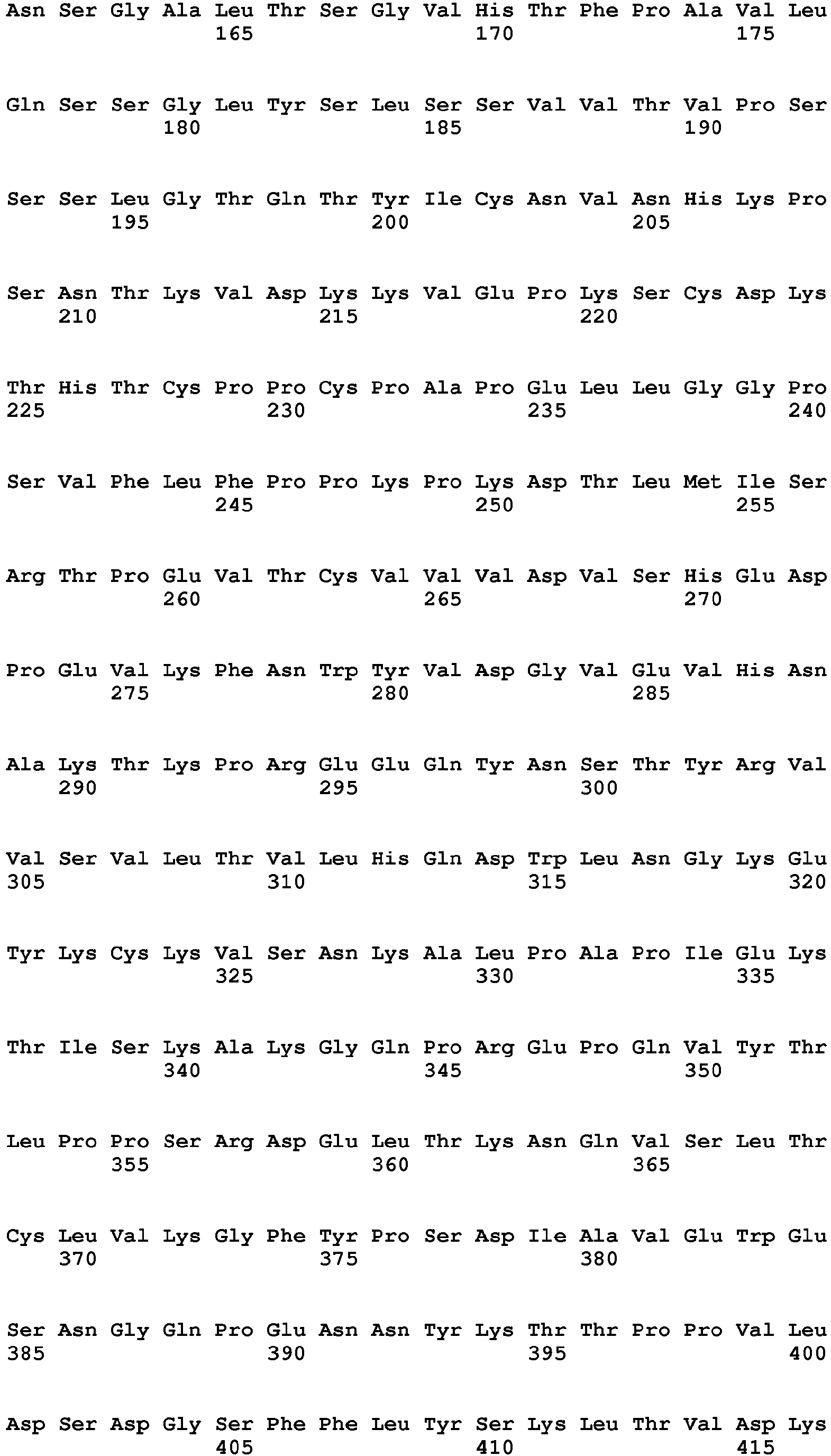

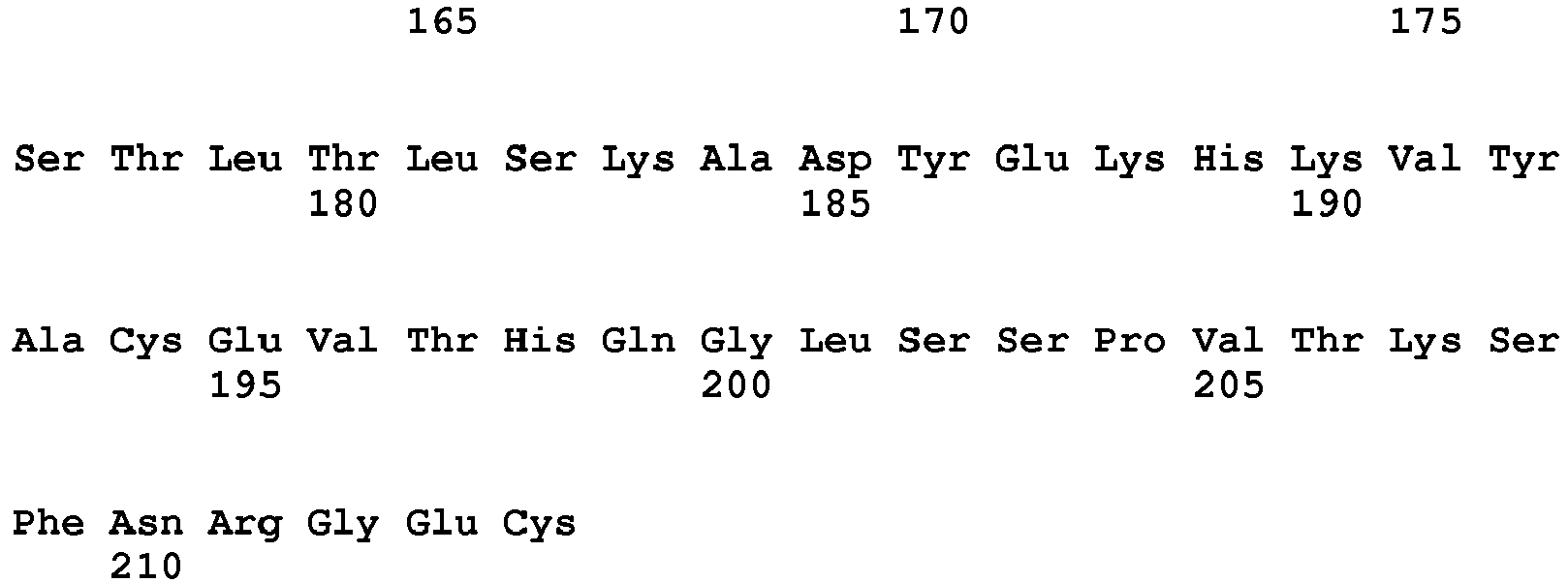
Claims (6)
- An antibody subtype (1) which is a subtype the humanized PM-1 antibody against interleukin-6 receptor (IL-6R) and in which one C-terminal of the heavy chain is Pro-NH2 (447).
- An antibody subtype (2) which is a subtype of the humanized PM-1 antibody against interleukin-6 receptor (IL-6R) and in which both C-terminals of the heavy chain are Pro-NH2 (447).
- The antibody subtype according to claim 1 or 2 wherein the heavy chain of the native humanized PM-1 antibody corresponding to the subtype according to claim 1 or 2 has an amino acid sequence set forth in SEQ ID NO: 1.
- The antibody subtype according to claim 3 wherein glutamine (Gln) at the heavy chain N-terminal is pyroglutamic acid (pGlu).
- The antibody subtype according to any one of claims 1 to 4 wherein the light chain of the above humanized PM-1 antibody subtype has an amino acid sequence set forth in SEQ ID NO: 2.
- A pharmaceutical composition comprising either the subtype (1) or the subtype (2) described in any one of claims 1-5, or both of the subtypes (1) and (2).
Priority Applications (1)
| Application Number | Priority Date | Filing Date | Title |
|---|---|---|---|
| EP20180347.5A EP3736295A1 (en) | 2004-03-24 | 2005-03-24 | Subtypes of humanized antibody against interleukin-6 receptor |
Applications Claiming Priority (2)
| Application Number | Priority Date | Filing Date | Title |
|---|---|---|---|
| JP2004087578 | 2004-03-24 | ||
| EP05727379A EP1728801A4 (en) | 2004-03-24 | 2005-03-24 | HUMANIZED ANTIBODY SUBTYPE AGAINST AN INTERLEUKIN-6 RECEPTOR |
Related Parent Applications (1)
| Application Number | Title | Priority Date | Filing Date |
|---|---|---|---|
| EP05727379A Division EP1728801A4 (en) | 2004-03-24 | 2005-03-24 | HUMANIZED ANTIBODY SUBTYPE AGAINST AN INTERLEUKIN-6 RECEPTOR |
Related Child Applications (1)
| Application Number | Title | Priority Date | Filing Date |
|---|---|---|---|
| EP20180347.5A Division EP3736295A1 (en) | 2004-03-24 | 2005-03-24 | Subtypes of humanized antibody against interleukin-6 receptor |
Publications (1)
| Publication Number | Publication Date |
|---|---|
| EP3269738A1 true EP3269738A1 (en) | 2018-01-17 |
Family
ID=34993643
Family Applications (3)
| Application Number | Title | Priority Date | Filing Date |
|---|---|---|---|
| EP17175580.4A Withdrawn EP3269738A1 (en) | 2004-03-24 | 2005-03-24 | Subtypes of humanized antibody against interleukin-6 receptor |
| EP20180347.5A Pending EP3736295A1 (en) | 2004-03-24 | 2005-03-24 | Subtypes of humanized antibody against interleukin-6 receptor |
| EP05727379A Ceased EP1728801A4 (en) | 2004-03-24 | 2005-03-24 | HUMANIZED ANTIBODY SUBTYPE AGAINST AN INTERLEUKIN-6 RECEPTOR |
Family Applications After (2)
| Application Number | Title | Priority Date | Filing Date |
|---|---|---|---|
| EP20180347.5A Pending EP3736295A1 (en) | 2004-03-24 | 2005-03-24 | Subtypes of humanized antibody against interleukin-6 receptor |
| EP05727379A Ceased EP1728801A4 (en) | 2004-03-24 | 2005-03-24 | HUMANIZED ANTIBODY SUBTYPE AGAINST AN INTERLEUKIN-6 RECEPTOR |
Country Status (4)
| Country | Link |
|---|---|
| US (6) | US8398980B2 (en) |
| EP (3) | EP3269738A1 (en) |
| JP (1) | JPWO2005090405A1 (en) |
| WO (1) | WO2005090405A1 (en) |
Families Citing this family (59)
| Publication number | Priority date | Publication date | Assignee | Title |
|---|---|---|---|---|
| WO1998042377A1 (en) | 1997-03-21 | 1998-10-01 | Chugai Seiyaku Kabushiki Kaisha | Preventives or remedies for sensitized t cell-related diseases containing il-6 antagonists as the active ingredient |
| UA80091C2 (en) | 2001-04-02 | 2007-08-27 | Chugai Pharmaceutical Co Ltd | Remedies for infant chronic arthritis-relating diseases and still's disease which contain an interleukin-6 (il-6) antagonist |
| PL213311B1 (en) | 2002-02-14 | 2013-02-28 | Chugai Pharmaceutical Co Ltd | Antibody-containing solution pharmaceuticals |
| GB2401040A (en) | 2003-04-28 | 2004-11-03 | Chugai Pharmaceutical Co Ltd | Method for treating interleukin-6 related diseases |
| EP3269738A1 (en) | 2004-03-24 | 2018-01-17 | Chugai Seiyaku Kabushiki Kaisha | Subtypes of humanized antibody against interleukin-6 receptor |
| DK2006381T3 (en) | 2006-03-31 | 2016-02-22 | Chugai Pharmaceutical Co Ltd | PROCEDURE FOR REGULATING ANTIBODIES BLOOD PHARMACOKINETICS |
| EP1878747A1 (en) | 2006-07-11 | 2008-01-16 | greenovation Biotech GmbH | Glyco-engineered antibodies |
| DK2202245T3 (en) * | 2007-09-26 | 2016-11-21 | Chugai Pharmaceutical Co Ltd | A method of modifying an antibody isoelectric point VIA amino acid substitution in CDR |
| PE20140132A1 (en) * | 2007-09-26 | 2014-02-14 | Chugai Pharmaceutical Co Ltd | IL-6 ANTI-RECEPTOR ANTIBODY |
| ES2566957T3 (en) * | 2007-09-26 | 2016-04-18 | Chugai Seiyaku Kabushiki Kaisha | Constant region of modified antibody |
| PE20091174A1 (en) * | 2007-12-27 | 2009-08-03 | Chugai Pharmaceutical Co Ltd | LIQUID FORMULATION WITH HIGH CONCENTRATION OF ANTIBODY CONTENT |
| UA121453C2 (en) * | 2008-04-11 | 2020-06-10 | Чугей Сейяку Кабусікі Кайся | METHOD OF PREPARATION OF PHARMACEUTICAL COMPOSITION CONTAINING ANTIBODY |
| TWI440469B (en) | 2008-09-26 | 2014-06-11 | Chugai Pharmaceutical Co Ltd | Improved antibody molecules |
| EP2409991B1 (en) | 2009-03-19 | 2017-05-03 | Chugai Seiyaku Kabushiki Kaisha | Antibody constant region variant |
| TWI682995B (en) | 2009-03-19 | 2020-01-21 | 日商中外製藥股份有限公司 | Antibody constant region alteration |
| MX2012004682A (en) * | 2009-10-26 | 2012-09-07 | Hoffmann La Roche | Method for the production of a glycosylated immunoglobulin. |
| EP2600901B1 (en) | 2010-08-06 | 2019-03-27 | ModernaTX, Inc. | A pharmaceutical formulation comprising engineered nucleic acids and medical use thereof |
| CN104531812A (en) | 2010-10-01 | 2015-04-22 | 现代治疗公司 | Engineered nucleic acids and methods of use thereof |
| EP4029881A1 (en) | 2010-11-08 | 2022-07-20 | F. Hoffmann-La Roche AG | Subcutaneously administered anti-il-6 receptor antibody |
| KR102385507B1 (en) | 2010-11-30 | 2022-04-12 | 추가이 세이야쿠 가부시키가이샤 | Antigen-binding molecule capable of binding to plurality of antigen molecules repeatedly |
| US8710200B2 (en) | 2011-03-31 | 2014-04-29 | Moderna Therapeutics, Inc. | Engineered nucleic acids encoding a modified erythropoietin and their expression |
| US10323081B2 (en) * | 2011-07-06 | 2019-06-18 | Genmag A/S | Modulation of complement-dependent cytotoxicity through modifications of the C-terminus of antibody heavy chains |
| US9464124B2 (en) | 2011-09-12 | 2016-10-11 | Moderna Therapeutics, Inc. | Engineered nucleic acids and methods of use thereof |
| BR112014007852B1 (en) | 2011-10-03 | 2021-11-03 | Moderna Therapeutics, Inc | MODIFIED ISOLATED POLYNUCLEOTIDE AND PHARMACEUTICAL COMPOSITION |
| PL2791160T3 (en) | 2011-12-16 | 2022-06-20 | Modernatx, Inc. | Modified mrna compositions |
| HK1206779A1 (en) | 2012-04-02 | 2016-01-15 | Modernatx, Inc. | Modified polynucleotides for the production of nuclear proteins |
| US9283287B2 (en) | 2012-04-02 | 2016-03-15 | Moderna Therapeutics, Inc. | Modified polynucleotides for the production of nuclear proteins |
| US10501512B2 (en) | 2012-04-02 | 2019-12-10 | Modernatx, Inc. | Modified polynucleotides |
| US9572897B2 (en) | 2012-04-02 | 2017-02-21 | Modernatx, Inc. | Modified polynucleotides for the production of cytoplasmic and cytoskeletal proteins |
| WO2014052462A2 (en) * | 2012-09-25 | 2014-04-03 | Cytomx Therapeutics, Inc. | Activatable antibodies that bind interleukin-6 receptor and methods of use thereof |
| DK2922554T3 (en) | 2012-11-26 | 2022-05-23 | Modernatx Inc | Terminalt modificeret rna |
| US8980864B2 (en) | 2013-03-15 | 2015-03-17 | Moderna Therapeutics, Inc. | Compositions and methods of altering cholesterol levels |
| JP6442404B2 (en) | 2013-06-11 | 2018-12-19 | 国立研究開発法人国立精神・神経医療研究センター | Method for predicting treatment prognosis in patients with relapsing-remitting multiple sclerosis (RRMS), and method for determining new treatment indication |
| EP3017303B1 (en) | 2013-07-04 | 2018-01-03 | F.Hoffmann-La Roche Ag | Interference-suppressed immunoassay to detect anti-drug antibodies in serum samples |
| US10023626B2 (en) | 2013-09-30 | 2018-07-17 | Modernatx, Inc. | Polynucleotides encoding immune modulating polypeptides |
| WO2015051214A1 (en) | 2013-10-03 | 2015-04-09 | Moderna Therapeutics, Inc. | Polynucleotides encoding low density lipoprotein receptor |
| EP3865563B1 (en) | 2014-11-25 | 2023-08-23 | Corning Incorporated | Cell culture media extending materials and methods |
| WO2016136933A1 (en) | 2015-02-27 | 2016-09-01 | 中外製薬株式会社 | Composition for treating il-6-related diseases |
| AR104050A1 (en) | 2015-03-26 | 2017-06-21 | Chugai Pharmaceutical Co Ltd | PRODUCTION PROCESS WITH CONTROLLED COPPER IONS |
| WO2016186154A1 (en) | 2015-05-19 | 2016-11-24 | 国立研究開発法人国立精神・神経医療研究センター | Method for determining application of novel therapy to multiple sclerosis (ms) patient |
| US10266590B2 (en) | 2015-09-04 | 2019-04-23 | Momenta Pharmaceuticals, Inc. | Methods related to biologics |
| WO2017147169A1 (en) | 2016-02-22 | 2017-08-31 | Ohio State Innovation Foundation | Chemoprevention using controlled-release formulations of anti-interleukin 6 agents, synthetic vitamin a analogues or metabolites, and estradiol metabolites |
| WO2017201731A1 (en) | 2016-05-27 | 2017-11-30 | Beijing Vdjbio Co., Ltd. | Antibodies, composition and kits comprising same, and methods of use thereof |
| EP3554541B1 (en) | 2016-12-14 | 2023-06-07 | Biora Therapeutics, Inc. | Treatment of a disease of the gastrointestinal tract with a chemokine/chemokine receptor inhibitor |
| EP3554540B1 (en) | 2016-12-14 | 2023-08-02 | Biora Therapeutics, Inc. | Treatment of a disease of the gastrointestinal tract with an il-12/il-23 inhibitor released using an ingestible device |
| WO2018112237A1 (en) | 2016-12-14 | 2018-06-21 | Progenity Inc. | Treatment of a disease of the gastrointestinal tract with an il-6r inhibitor |
| WO2018170405A1 (en) | 2017-03-17 | 2018-09-20 | Ohio State Innovation Foundation | Nanoparticles for delivery of chemopreventive agents |
| EP3600416B1 (en) | 2017-03-30 | 2023-06-07 | Biora Therapeutics, Inc. | Treatment of a disease of the gastrointestinal tract with an immune modulatory agent released using an ingestible device |
| US11851486B2 (en) | 2017-05-02 | 2023-12-26 | National Center Of Neurology And Psychiatry | Method for predicting and evaluating therapeutic effect in diseases related to IL-6 and neutrophils |
| EP3698808B1 (en) | 2017-10-20 | 2025-01-01 | Hyogo College Of Medicine | Anti-il-6 receptor antibody-containing medicinal composition for preventing post-surgical adhesion |
| BR112020010761A2 (en) * | 2017-11-30 | 2020-11-24 | Bio-Thera Solutions, Ltd. | liquid formulation of humanized antibody for the treatment of il-6 related diseases |
| US20230041197A1 (en) | 2018-06-20 | 2023-02-09 | Progenity, Inc. | Treatment of a disease of the gastrointestinal tract with an immunomodulator |
| WO2019246317A1 (en) | 2018-06-20 | 2019-12-26 | Progenity, Inc. | Treatment of a disease or condition in a tissue originating from the endoderm |
| EP3810268A1 (en) | 2018-06-20 | 2021-04-28 | Progenity, Inc. | Treatment of a disease of the gastrointestinal tract with an il-12/il-23 inhibitor |
| US20210355199A1 (en) | 2018-06-28 | 2021-11-18 | University Of Virginia Patent Foundation | Compositions and methods for detecting and regulating fibronectin-integrin interaction and signaling |
| EP3924464A4 (en) | 2019-02-11 | 2022-11-23 | University of Virginia Patent Foundation | Selection and blockade of fertilization competent male and female gametes |
| WO2020186247A1 (en) | 2019-03-13 | 2020-09-17 | University Of Virginia Patent Foundation | Compositions and methods for promoting islet viability and enhancing insulin secretion |
| WO2020201362A2 (en) | 2019-04-02 | 2020-10-08 | INSERM (Institut National de la Santé et de la Recherche Médicale) | Methods of predicting and preventing cancer in patients having premalignant lesions |
| EP4634214A1 (en) | 2022-12-15 | 2025-10-22 | Aarhus Universitet | Synthetic activation of multimeric transmembrane receptors |
Citations (9)
| Publication number | Priority date | Publication date | Assignee | Title |
|---|---|---|---|---|
| US521628A (en) | 1894-06-19 | Housekeeping-cabinet | ||
| EP0239400A2 (en) | 1986-03-27 | 1987-09-30 | Medical Research Council | Recombinant antibodies and methods for their production |
| US5126250A (en) * | 1988-09-28 | 1992-06-30 | Eli Lilly And Company | Method for the reduction of heterogeneity of monoclonal antibodies |
| WO1992019759A1 (en) | 1991-04-25 | 1992-11-12 | Chugai Seiyaku Kabushiki Kaisha | Reconstituted human antibody against human interleukin 6 receptor |
| FR2694767A1 (en) | 1992-08-13 | 1994-02-18 | Innotherapie Lab Sa | Monoclonal antibody against interleukin-6 receptor - for treating and preventing interleukin-6 related diseases, e.g. multiple myeloma, and for receptor assays |
| WO1994011523A2 (en) | 1992-11-13 | 1994-05-26 | Idec Pharmaceuticals Corporation | Fully impaired consensus kozac sequences for mammalian expression |
| WO1995009873A1 (en) | 1993-10-06 | 1995-04-13 | Board Of Regents, The University Of Texas System | A monoclonal anti-human il-6 receptor antibody |
| JPH0899902A (en) | 1994-09-30 | 1996-04-16 | Chugai Pharmaceut Co Ltd | Immature type myeloma cell therapeutic agent containing IL-6 receptor antibody as an active ingredient |
| WO1996030394A1 (en) | 1995-03-31 | 1996-10-03 | Jakob Bohr | Method for protein folding |
Family Cites Families (66)
| Publication number | Priority date | Publication date | Assignee | Title |
|---|---|---|---|---|
| US6428979B1 (en) | 1988-01-22 | 2002-08-06 | Tadamitsu Kishimoto | Receptor protein for human B cell stimulatory factor-2 |
| US5670373A (en) | 1988-01-22 | 1997-09-23 | Kishimoto; Tadamitsu | Antibody to human interleukin-6 receptor |
| US5171840A (en) | 1988-01-22 | 1992-12-15 | Tadamitsu Kishimoto | Receptor protein for human B cell stimulatory factor-2 |
| DE68925401T2 (en) | 1988-09-27 | 1996-09-12 | Omron Tateisi Electronics Co | Device for "fuzzy" inference |
| US5216128A (en) | 1989-06-01 | 1993-06-01 | Yeda Research And Development Co., Ltd. | IFN-β2/IL-6 receptor its preparation and pharmaceutical compositions containing it |
| JPH05227970A (en) * | 1992-02-19 | 1993-09-07 | Chugai Pharmaceut Co Ltd | Reconstituted human antibody against human interleukin-6 receptor |
| JPH06319396A (en) * | 1993-05-07 | 1994-11-22 | Japan Tobacco Inc | Plant for production antiviral antibody and method for creating the same plant |
| US5888510A (en) | 1993-07-21 | 1999-03-30 | Chugai Seiyaku Kabushiki Kaisha | Chronic rheumatoid arthritis therapy containing IL-6 antagonist as effective component |
| JPH07188056A (en) | 1993-07-21 | 1995-07-25 | Chuzo Kishimoto | Suppressor for bone resorption containing antibody against interleukin 6 receptor as active ingredient |
| US8017121B2 (en) | 1994-06-30 | 2011-09-13 | Chugai Seiyaku Kabushika Kaisha | Chronic rheumatoid arthritis therapy containing IL-6 antagonist as effective component |
| CZ296979B6 (en) | 1994-10-21 | 2006-08-16 | Chugai Seiyaku Kabushiki Kaisha | Pharmaceutical composition for prevention or treatment of Castleman's disease |
| DE69525971T3 (en) | 1994-12-29 | 2013-01-10 | Chugai Seiyaku K.K. | USE OF A PM-1 ANTIBODY OR AN MH 166 ANTIBODY FOR REINFORCING THE ANTI-TUMOR EFFECT OF CISPLATINE OR CARBOPLATIN |
| AU693318B2 (en) | 1995-02-13 | 1998-06-25 | Chugai Seiyaku Kabushiki Kaisha | Muscle protein decomposition inhibitor containing IL-6 receptor antibody |
| AU3276297A (en) | 1996-06-27 | 1998-01-14 | Chugai Seiyaku Kabushiki Kaisha | Remedies for myeloma to be used together with nitrogen mustard antitumor agents |
| WO1998042377A1 (en) | 1997-03-21 | 1998-10-01 | Chugai Seiyaku Kabushiki Kaisha | Preventives or remedies for sensitized t cell-related diseases containing il-6 antagonists as the active ingredient |
| US5994511A (en) | 1997-07-02 | 1999-11-30 | Genentech, Inc. | Anti-IgE antibodies and methods of improving polypeptides |
| US20020187150A1 (en) | 1997-08-15 | 2002-12-12 | Chugai Seiyaku Kabushiki Kaisha | Preventive and/or therapeutic agent for systemic lupus erythematosus comprising anti-IL-6 receptor antibody as an active ingredient |
| ES2299241T3 (en) | 1998-03-17 | 2008-05-16 | Chugai Seiyaku Kabushiki Kaisha | PREVENTIVES OR REMEDIES FOR INFLAMMATORY INTESTINAL DISEASES CONTAINING ANTAGONIST ANTIBODIES OF THE IL-6 RECEIVER. |
| US6537782B1 (en) | 1998-06-01 | 2003-03-25 | Chugai Seiyaku Kabushiki Kaisha | Media for culturing animal cells and process for producing protein by using the same |
| US6406909B1 (en) | 1998-07-10 | 2002-06-18 | Chugai Seiyaku Kabushiki Kaisha | Serum-free medium for culturing animal cells |
| PT1108435E (en) | 1998-08-24 | 2007-04-30 | Chugai Pharmaceutical Co Ltd | Preventives or remedies for pancreatitis containing anti-il-6 receptor antibodies as the active ingredient |
| US6365154B1 (en) * | 1998-09-28 | 2002-04-02 | Smithkline Beecham Corporation | Tie2 agonist antibodies |
| JP3763698B2 (en) | 1998-10-22 | 2006-04-05 | 株式会社日本自動車部品総合研究所 | Design method of fuel supply system that can relieve pressure pulsation |
| JP4812228B2 (en) | 2000-08-10 | 2011-11-09 | 中外製薬株式会社 | Method for suppressing aggregate formation or cloudiness of antibody-containing solution |
| EP1314437B1 (en) | 2000-08-11 | 2014-06-25 | Chugai Seiyaku Kabushiki Kaisha | Stabilized antibody-containing preparations |
| EP1334731B1 (en) | 2000-10-25 | 2008-02-27 | Chugai Seiyaku Kabushiki Kaisha | Preventives or remedies for psoriasis containing as the active ingredient il-6 antagonist |
| AU2000279625A1 (en) | 2000-10-27 | 2002-05-15 | Chugai Seiyaku Kabushiki Kaisha | Blood mmp-3 level-lowering agent containing il-6 antgonist as the active ingredient |
| AU2000279624A1 (en) | 2000-10-27 | 2002-05-15 | Chugai Seiyaku Kabushiki Kaisha | Blooe vegf level-lowering agent containing il-6 antagonist as the active ingredient |
| JP4391086B2 (en) | 2001-03-09 | 2009-12-24 | 中外製薬株式会社 | Protein purification method |
| UA80091C2 (en) | 2001-04-02 | 2007-08-27 | Chugai Pharmaceutical Co Ltd | Remedies for infant chronic arthritis-relating diseases and still's disease which contain an interleukin-6 (il-6) antagonist |
| PL213311B1 (en) | 2002-02-14 | 2013-02-28 | Chugai Pharmaceutical Co Ltd | Antibody-containing solution pharmaceuticals |
| EP2261230B1 (en) | 2002-09-11 | 2017-05-10 | Chugai Seiyaku Kabushiki Kaisha | Protein purification method |
| JP4555924B2 (en) | 2003-02-24 | 2010-10-06 | 中外製薬株式会社 | Spinal cord injury therapeutic agent containing interleukin-6 antagonist |
| GB2401040A (en) | 2003-04-28 | 2004-11-03 | Chugai Pharmaceutical Co Ltd | Method for treating interleukin-6 related diseases |
| MXPA06003768A (en) | 2003-10-17 | 2006-06-23 | Chugai Pharmaceutical Co Ltd | Therapeutic agent for mesothelioma. |
| US8617550B2 (en) | 2003-12-19 | 2013-12-31 | Chugai Seiyaku Kabushiki Kaisha | Treatment of vasculitis with IL-6 antagonist |
| EP3269738A1 (en) | 2004-03-24 | 2018-01-17 | Chugai Seiyaku Kabushiki Kaisha | Subtypes of humanized antibody against interleukin-6 receptor |
| AR048335A1 (en) | 2004-03-24 | 2006-04-19 | Chugai Pharmaceutical Co Ltd | THERAPEUTIC AGENTS FOR INTERNAL EAR DISORDERS CONTAINING AN IL-6 ANTAGONIST AS AN ACTIVE INGREDIENT |
| EP1753455A2 (en) | 2004-06-04 | 2007-02-21 | Genentech, Inc. | Method for treating multiple sclerosis |
| ES2535230T3 (en) | 2005-01-05 | 2015-05-06 | Chugai Seiyaku Kabushiki Kaisha | Method of cell culture and use thereof |
| US8470316B2 (en) | 2005-10-14 | 2013-06-25 | Chugai Seiyaku Kabushiki Kaisha | Agents for suppressing damage to transplanted islets after islet transplantation |
| CA2626688C (en) | 2005-10-21 | 2017-10-03 | Chugai Seiyaku Kabushiki Kaisha | Agents for treating cardiopathy |
| AR057582A1 (en) | 2005-11-15 | 2007-12-05 | Nat Hospital Organization | AGENTS TO DELETE INDUCTION OF CYTOTOXIC T LYMPHOCYTES |
| JPWO2007061029A1 (en) | 2005-11-25 | 2009-05-07 | 学校法人慶應義塾 | Prostate cancer treatment |
| JP5231810B2 (en) | 2005-12-28 | 2013-07-10 | 中外製薬株式会社 | Antibody-containing stabilized preparation |
| CN101370521A (en) | 2006-01-27 | 2009-02-18 | 学校法人庆应义塾 | Therapeutic agent for diseases accompanied by choroidal angiogenesis |
| US9260516B2 (en) | 2006-04-07 | 2016-02-16 | Osaka University | Method for promoting muscle regeneration by administering an antibody to the IL-6 receptor |
| JP5330829B2 (en) | 2006-08-04 | 2013-10-30 | 憲弘 西本 | Prediction method for treatment prognosis in patients with rheumatoid arthritis |
| JP2010095445A (en) | 2006-12-27 | 2010-04-30 | Tokyo Medical & Dental Univ | Therapeutic agent for inflammatory myopathy containing il-6 antagonist as active ingredient |
| WO2008090901A1 (en) | 2007-01-23 | 2008-07-31 | Shinshu University | Chronic rejection inhibitor |
| JP5424330B2 (en) | 2007-07-26 | 2014-02-26 | 国立大学法人大阪大学 | A therapeutic agent for ocular inflammatory diseases comprising an interleukin 6 receptor inhibitor as an active ingredient |
| PE20140132A1 (en) | 2007-09-26 | 2014-02-14 | Chugai Pharmaceutical Co Ltd | IL-6 ANTI-RECEPTOR ANTIBODY |
| AU2008308163B2 (en) | 2007-10-02 | 2013-03-21 | Chugai Seiyaku Kabushiki Kaisha | Therapeutic agents for graft-versus-host disease comprising interleukin 6 receptor inhibitor as active ingredient |
| JP2009092508A (en) | 2007-10-09 | 2009-04-30 | Norihiro Nishimoto | Prediction method for the effect of rheumatic agents |
| EP2223118B1 (en) | 2007-12-15 | 2013-02-27 | F. Hoffmann-La Roche AG | Distinguishing assay |
| PE20091174A1 (en) | 2007-12-27 | 2009-08-03 | Chugai Pharmaceutical Co Ltd | LIQUID FORMULATION WITH HIGH CONCENTRATION OF ANTIBODY CONTENT |
| CN104906581A (en) | 2008-06-05 | 2015-09-16 | 国立研究开发法人国立癌症研究中心 | Neuroinvasion inhibitor |
| JP5259353B2 (en) | 2008-11-20 | 2013-08-07 | 富士フイルム株式会社 | Projection lens and projection display device using the same |
| MY161541A (en) | 2009-07-31 | 2017-04-28 | Shin Maeda | Cancer metastasis inhibitor |
| MX2012004682A (en) | 2009-10-26 | 2012-09-07 | Hoffmann La Roche | Method for the production of a glycosylated immunoglobulin. |
| WO2011128096A1 (en) | 2010-04-16 | 2011-10-20 | Roche Diagnostics Gmbh | Polymorphism markers for predicting response to interleukin-6 receptor-inhibiting monoclonal antibody drug treatment |
| EP2578233B1 (en) | 2010-05-28 | 2017-04-26 | National Cancer Center | Therapeutic agent for pancreatic cancer |
| US9539322B2 (en) | 2010-05-28 | 2017-01-10 | National University Corporation Hokkaido University | Method of enhancing an antitumor T cell response by administering an anti-IL-6 receptor antibody |
| JP2013529089A (en) | 2010-06-07 | 2013-07-18 | エフ.ホフマン−ラ ロシュ アーゲー | Gene expression markers for predicting response to drug treatment with monoclonal antibodies that inhibit interleukin-6 receptor |
| EP4029881A1 (en) | 2010-11-08 | 2022-07-20 | F. Hoffmann-La Roche AG | Subcutaneously administered anti-il-6 receptor antibody |
| WO2012064327A1 (en) | 2010-11-11 | 2012-05-18 | Hewlett-Packard Development Company, L.P. | Blemish detection and notification in an image capture device |
-
2005
- 2005-03-24 EP EP17175580.4A patent/EP3269738A1/en not_active Withdrawn
- 2005-03-24 EP EP20180347.5A patent/EP3736295A1/en active Pending
- 2005-03-24 US US10/593,786 patent/US8398980B2/en active Active
- 2005-03-24 JP JP2006511350A patent/JPWO2005090405A1/en active Pending
- 2005-03-24 EP EP05727379A patent/EP1728801A4/en not_active Ceased
- 2005-03-24 WO PCT/JP2005/006229 patent/WO2005090405A1/en not_active Ceased
-
2012
- 2012-12-20 US US13/722,919 patent/US8734800B2/en not_active Expired - Lifetime
-
2014
- 2014-04-14 US US14/252,648 patent/US20140377254A1/en not_active Abandoned
-
2015
- 2015-08-26 US US14/836,813 patent/US9902777B2/en not_active Expired - Lifetime
-
2018
- 2018-01-11 US US15/868,892 patent/US20180230222A1/en not_active Abandoned
-
2019
- 2019-06-12 US US16/439,349 patent/US20200148775A1/en not_active Abandoned
Patent Citations (10)
| Publication number | Priority date | Publication date | Assignee | Title |
|---|---|---|---|---|
| US521628A (en) | 1894-06-19 | Housekeeping-cabinet | ||
| EP0239400A2 (en) | 1986-03-27 | 1987-09-30 | Medical Research Council | Recombinant antibodies and methods for their production |
| US5126250A (en) * | 1988-09-28 | 1992-06-30 | Eli Lilly And Company | Method for the reduction of heterogeneity of monoclonal antibodies |
| WO1992019759A1 (en) | 1991-04-25 | 1992-11-12 | Chugai Seiyaku Kabushiki Kaisha | Reconstituted human antibody against human interleukin 6 receptor |
| EP0628639A1 (en) * | 1991-04-25 | 1994-12-14 | Chugai Seiyaku Kabushiki Kaisha | Reconstituted human antibody against human interleukin 6 receptor |
| FR2694767A1 (en) | 1992-08-13 | 1994-02-18 | Innotherapie Lab Sa | Monoclonal antibody against interleukin-6 receptor - for treating and preventing interleukin-6 related diseases, e.g. multiple myeloma, and for receptor assays |
| WO1994011523A2 (en) | 1992-11-13 | 1994-05-26 | Idec Pharmaceuticals Corporation | Fully impaired consensus kozac sequences for mammalian expression |
| WO1995009873A1 (en) | 1993-10-06 | 1995-04-13 | Board Of Regents, The University Of Texas System | A monoclonal anti-human il-6 receptor antibody |
| JPH0899902A (en) | 1994-09-30 | 1996-04-16 | Chugai Pharmaceut Co Ltd | Immature type myeloma cell therapeutic agent containing IL-6 receptor antibody as an active ingredient |
| WO1996030394A1 (en) | 1995-03-31 | 1996-10-03 | Jakob Bohr | Method for protein folding |
Non-Patent Citations (32)
| Title |
|---|
| AKIRA, S ET AL., ADV. IN IMMUNOLOGY, vol. 54, 1993, pages 1 - 78 |
| ANTES ET AL: "Analysis of lysine clipping of a humanized Lewis-Y specific IgG antibody and its relation to Fc-mediated effector function", JOURNAL OF CHROMATOGRAPHY B: BIOMEDICAL SCIENCES & APPLICATIONS, ELSEVIER, AMSTERDAM, NL, vol. 852, no. 1-2, 31 May 2007 (2007-05-31), pages 250 - 256, XP022099894, ISSN: 1570-0232, DOI: 10.1016/J.JCHROMB.2007.01.024 * |
| BETTER, M ET AL., SCIENCE, vol. 240, 1988, pages 1041 - 1043 |
| EBERT, K.M ET AL., BIO/TECHNOLOGY, vol. 12, 1994, pages 699 - 702 |
| HIRANO ET AL., IMMUNOL. LETT., vol. 17, 1988, pages 41 |
| HIRANO, T ET AL., NATURE, vol. 324, 1986, pages 73 - 76 |
| HIRATA ET AL., J. IMMUNOL., vol. 143, 1989, pages 2900 - 2906 |
| HIRATA, Y ET AL., J. IMMUNOL, vol. 143, 1989, pages 2900 - 2906 |
| HIRATA, Y ET AL., J. IMMUNOL., vol. 143, 1989, pages 2900 - 2906 |
| HUANG, Y.W ET AL., HYBRIDOMA, vol. 12, 1993, pages 621 - 630 |
| HUANG; Y. W ET AL., HYBRIDOMA, vol. 12, 1993, pages 621 - 630 |
| JOHNSON ET AL: "Cation exchange-HPLC and mass spectrometry reveal C-terminal amidation of an IgG1 heavy chain", ANALYTICAL BIOCHEMISTRY, ELSEVIER, AMSTERDAM, NL, vol. 360, no. 1, 14 December 2006 (2006-12-14), pages 75 - 83, XP005725305, ISSN: 0003-2697, DOI: 10.1016/J.AB.2006.10.012 * |
| JULIAN, K.-C; MA ET AL., EUR. J. IMMUNOL., vol. 24, 1994, pages 131 - 138 |
| LEI, S. P ET AL., J. BACTERIOL, vol. 169, 1987, pages 4379 - 4383 |
| LOTZ, M ET AL., J. EXP. MED., vol. 167, 1988, pages 1253 - 1258 |
| MAEDA, S ET AL., NATURE, vol. 315, 1985, pages 592 - 594 |
| MIZUSHIMA, S; NAGATA, S., NUCLEIC ACIDS RES, vol. 18, 1990, pages 5322 |
| MULLIGAN, R. C ET AL., NATURE, vol. 277, 1979, pages 108 - 114 |
| NOVICK D ET AL., HYBRIDOMA, vol. 10, 1991, pages 137 - 146 |
| NOVICK, D ET AL., HYBRIDOMA, vol. 10, 1991, pages 137 - 146 |
| R.J. HARRIS, J. CHROMATOGR, vol. 705, 1995, pages 129 - 134 |
| R.J. HARRIS, J. CHROMATOGR. A, vol. 705, 1995, pages 129 - 134 |
| SATO, K ET AL., CANCER RES, vol. 53, 1993, pages 851 - 856 |
| TAGA, J. EXP. MED., vol. 166, 1987, pages 967 - 981 |
| TAGA, T ET AL., J. EXP. MED, vol. 166, 1987, pages 967 - 981 |
| TAGA, T ET AL., J. EXP. MED., vol. 166, 1987, pages 967 |
| UNKNOWN: "Guidance for Industry: Q6B specifications: Test procedures and acceptance criteria for Biotechnological/biological products", August 1999 (1999-08-01), XP002544046, Retrieved from the Internet <URL:http://www.fda.gov/downloads/Drugs/GuidanceComplianceRegulatoryInformation/Guidances/ucm073488.pdf> [retrieved on 20090903] * |
| VICKI GLASER, SPECTRUM BIOTECHNOLOGY APPLICATIONS, 1993 |
| WARD, E.S ET AL., NATURE, vol. 341, 1989, pages 544 - 546 |
| WARD; E.S ET AL., FASEB J, vol. 6, 1992, pages 2422 - 2427 |
| YAMASAKI, K ET AL., SCIENCE, vol. 241, 1987, pages 825 - 828 |
| YAMASAKI, K ET AL., SCIENCE, vol. 241, 1988, pages 825 - 828 |
Also Published As
| Publication number | Publication date |
|---|---|
| US8398980B2 (en) | 2013-03-19 |
| US20130209456A1 (en) | 2013-08-15 |
| EP1728801A4 (en) | 2009-10-21 |
| US20180230222A1 (en) | 2018-08-16 |
| WO2005090405A1 (en) | 2005-09-29 |
| US20140377254A1 (en) | 2014-12-25 |
| EP3736295A1 (en) | 2020-11-11 |
| JPWO2005090405A1 (en) | 2008-04-17 |
| US8734800B2 (en) | 2014-05-27 |
| EP1728801A1 (en) | 2006-12-06 |
| US20160152714A1 (en) | 2016-06-02 |
| US20200148775A1 (en) | 2020-05-14 |
| US20100247523A1 (en) | 2010-09-30 |
| US9902777B2 (en) | 2018-02-27 |
Similar Documents
| Publication | Publication Date | Title |
|---|---|---|
| US9902777B2 (en) | Methods for producing subtypes of humanized antibody against interleukin-6 receptor | |
| US6692742B1 (en) | Remedies for myeloma to be used together with nitrogen mustard antitumor agents | |
| AU2019276486B2 (en) | Anti-interleukin-17A antibody, pharmaceutical composition thereof and use thereof | |
| CN105617387B (en) | Methods of treating interleukin-6 related diseases | |
| EP2754671B1 (en) | Anti MIF antibodies | |
| CZ297083B6 (en) | Agent for prevention and treatment of inflammatory intestinal disease containing IL-6 antagonist as active component | |
| WO2002036165A1 (en) | Blood mmp-3 level-lowering agent containing il-6 antgonist as the active ingredient | |
| JP2010077133A (en) | Recombinant il-5 antagonist useful in treatment of il-5 mediated disorder | |
| CN114053403A (en) | Use of fusion protein in preparation of vaccine adjuvant or medicament for preventing and treating virus infection | |
| CN113667015A (en) | Antibodies targeting PSGL-1 protein and uses thereof | |
| HK40019620A (en) | Methods for treating interleukin-6 related diseases | |
| HK40019620B (en) | Methods for treating interleukin-6 related diseases | |
| CN120623352A (en) | Anti-human IgG antibody, preparation method and use thereof | |
| CN120665199A (en) | Antibody against human IgG, preparation method and application thereof | |
| HK40046787A (en) | Anti-interleukin-17a antibody, pharmaceutical composition thereof and use thereof | |
| CN121226552A (en) | Anti-CD25 antibodies and their applications | |
| HK1096859B (en) | Methods for treating interleukin-6 related diseases | |
| HK1158078A (en) | Methods for treating interleukin-6 related diseases | |
| HK1122308A (en) | Recombinant il-18 antibodies useful in treatment of il-18 mediated disorders | |
| JPH1045622A (en) | A therapeutic agent for rheumatoid arthritis containing an anti-IL-8 antibody as an active ingredient |
Legal Events
| Date | Code | Title | Description |
|---|---|---|---|
| PUAI | Public reference made under article 153(3) epc to a published international application that has entered the european phase |
Free format text: ORIGINAL CODE: 0009012 |
|
| STAA | Information on the status of an ep patent application or granted ep patent |
Free format text: STATUS: THE APPLICATION HAS BEEN PUBLISHED |
|
| AC | Divisional application: reference to earlier application |
Ref document number: 1728801 Country of ref document: EP Kind code of ref document: P |
|
| AK | Designated contracting states |
Kind code of ref document: A1 Designated state(s): AT BE BG CH CY CZ DE DK EE ES FI FR GB GR HU IE IS IT LI LT LU MC NL PL PT RO SE SI SK TR |
|
| STAA | Information on the status of an ep patent application or granted ep patent |
Free format text: STATUS: REQUEST FOR EXAMINATION WAS MADE |
|
| 17P | Request for examination filed |
Effective date: 20180717 |
|
| RBV | Designated contracting states (corrected) |
Designated state(s): AT BE BG CH CY CZ DE DK EE ES FI FR GB GR HU IE IS IT LI LT LU MC NL PL PT RO SE SI SK TR |
|
| STAA | Information on the status of an ep patent application or granted ep patent |
Free format text: STATUS: EXAMINATION IS IN PROGRESS |
|
| 17Q | First examination report despatched |
Effective date: 20190304 |
|
| RBV | Designated contracting states (corrected) |
Designated state(s): AT BE BG CH CY CZ DE DK EE ES FI FR GR HU IE IS IT LI LT LU MC NL PL PT RO SE SI SK TR |
|
| STAA | Information on the status of an ep patent application or granted ep patent |
Free format text: STATUS: THE APPLICATION IS DEEMED TO BE WITHDRAWN |
|
| 18D | Application deemed to be withdrawn |
Effective date: 20210413 |