CN101420984B - Block degradable polymer and conjugate prepared therefrom - Google Patents
Block degradable polymer and conjugate prepared therefrom Download PDFInfo
- Publication number
- CN101420984B CN101420984B CN2007800134860A CN200780013486A CN101420984B CN 101420984 B CN101420984 B CN 101420984B CN 2007800134860 A CN2007800134860 A CN 2007800134860A CN 200780013486 A CN200780013486 A CN 200780013486A CN 101420984 B CN101420984 B CN 101420984B
- Authority
- CN
- China
- Prior art keywords
- polymer
- poly
- peg
- group
- lysine
- Prior art date
- Legal status (The legal status is an assumption and is not a legal conclusion. Google has not performed a legal analysis and makes no representation as to the accuracy of the status listed.)
- Active
Links
- 0 CC=IO[N+](**)[O-] Chemical compound CC=IO[N+](**)[O-] 0.000 description 2
Classifications
-
- A—HUMAN NECESSITIES
- A61—MEDICAL OR VETERINARY SCIENCE; HYGIENE
- A61K—PREPARATIONS FOR MEDICAL, DENTAL OR TOILETRY PURPOSES
- A61K47/00—Medicinal preparations characterised by the non-active ingredients used, e.g. carriers or inert additives; Targeting or modifying agents chemically bound to the active ingredient
- A61K47/50—Medicinal preparations characterised by the non-active ingredients used, e.g. carriers or inert additives; Targeting or modifying agents chemically bound to the active ingredient the non-active ingredient being chemically bound to the active ingredient, e.g. polymer-drug conjugates
-
- A—HUMAN NECESSITIES
- A61—MEDICAL OR VETERINARY SCIENCE; HYGIENE
- A61K—PREPARATIONS FOR MEDICAL, DENTAL OR TOILETRY PURPOSES
- A61K47/00—Medicinal preparations characterised by the non-active ingredients used, e.g. carriers or inert additives; Targeting or modifying agents chemically bound to the active ingredient
- A61K47/50—Medicinal preparations characterised by the non-active ingredients used, e.g. carriers or inert additives; Targeting or modifying agents chemically bound to the active ingredient the non-active ingredient being chemically bound to the active ingredient, e.g. polymer-drug conjugates
- A61K47/51—Medicinal preparations characterised by the non-active ingredients used, e.g. carriers or inert additives; Targeting or modifying agents chemically bound to the active ingredient the non-active ingredient being chemically bound to the active ingredient, e.g. polymer-drug conjugates the non-active ingredient being a modifying agent
- A61K47/56—Medicinal preparations characterised by the non-active ingredients used, e.g. carriers or inert additives; Targeting or modifying agents chemically bound to the active ingredient the non-active ingredient being chemically bound to the active ingredient, e.g. polymer-drug conjugates the non-active ingredient being a modifying agent the modifying agent being an organic macromolecular compound, e.g. an oligomeric, polymeric or dendrimeric molecule
- A61K47/59—Medicinal preparations characterised by the non-active ingredients used, e.g. carriers or inert additives; Targeting or modifying agents chemically bound to the active ingredient the non-active ingredient being chemically bound to the active ingredient, e.g. polymer-drug conjugates the non-active ingredient being a modifying agent the modifying agent being an organic macromolecular compound, e.g. an oligomeric, polymeric or dendrimeric molecule obtained otherwise than by reactions only involving carbon-to-carbon unsaturated bonds, e.g. polyureas or polyurethanes
- A61K47/60—Medicinal preparations characterised by the non-active ingredients used, e.g. carriers or inert additives; Targeting or modifying agents chemically bound to the active ingredient the non-active ingredient being chemically bound to the active ingredient, e.g. polymer-drug conjugates the non-active ingredient being a modifying agent the modifying agent being an organic macromolecular compound, e.g. an oligomeric, polymeric or dendrimeric molecule obtained otherwise than by reactions only involving carbon-to-carbon unsaturated bonds, e.g. polyureas or polyurethanes the organic macromolecular compound being a polyoxyalkylene oligomer, polymer or dendrimer, e.g. PEG, PPG, PEO or polyglycerol
Landscapes
- Health & Medical Sciences (AREA)
- Animal Behavior & Ethology (AREA)
- Public Health (AREA)
- Chemical & Material Sciences (AREA)
- Medicinal Chemistry (AREA)
- Pharmacology & Pharmacy (AREA)
- Epidemiology (AREA)
- Bioinformatics & Cheminformatics (AREA)
- Life Sciences & Earth Sciences (AREA)
- General Health & Medical Sciences (AREA)
- Engineering & Computer Science (AREA)
- Veterinary Medicine (AREA)
- Medicinal Preparation (AREA)
- Medicines That Contain Protein Lipid Enzymes And Other Medicines (AREA)
- Polyesters Or Polycarbonates (AREA)
- Peptides Or Proteins (AREA)
- Polyethers (AREA)
Abstract
除了别的以外,本发明提供了适用于与生物活性剂反应而形成轭合物的嵌段可降解聚合物试剂,所述聚合物试剂包含一个或多个聚合物链,所述聚合物链被一个或多个可降解的键分开或分隔成具有适于肾清除的分子量的聚合物链段。所述聚合物试剂可以具有大体上线性的结构、分支结构或多臂结构。每种结构包括一个或多个在体内能降解的键。Among other things, the present invention provides block degradable polymer reagents suitable for reacting with bioactive agents to form conjugates, the polymer reagents comprising one or more polymer chains that are bounded by The one or more degradable linkages separate or segregate into polymer segments having a molecular weight suitable for renal clearance. The polymeric reagent can have a substantially linear structure, a branched structure, or a multi-armed structure. Each structure includes one or more linkages that degrade in vivo.
Description
技术领域 technical field
除了别的以外,本发明涉及水溶性和非肽聚合物及由其制备的轭合物,每种都具有线性、分支或多臂构型(configuration),且由一个或多个可降解的键表征。在给药后,本文所述的轭合物在一个或多个可降解的键处降解由此导致更小的物质(species),所述物质可以比相应的非降解轭合物被更有效地消除。Among other things, the present invention relates to water-soluble and non-peptidic polymers and conjugates prepared therefrom, each having a linear, branched or multi-arm configuration (configuration), and consisting of one or more degradable linkages characterization. After administration, the conjugates described herein degrade at one or more degradable linkages thereby resulting in smaller species that can be more efficiently processed than corresponding non-degradable conjugates. eliminate.
背景技术 Background technique
亲水性聚合物、聚(乙二醇)(缩写为"PEG")与分子和表面的共价连接在如生物技术和药学的领域中有重要的用途。PEG是具有很多有益的性质的聚合物。例如,PEG在水中和很多有机溶剂中可溶,且是非毒性和非免疫原性的,且当与表面连接时,PEG提供了生物相容的保护性涂层。PEG通常的应用或用途包括:(i)共价连接至蛋白质,例如延长血浆半衰期和减少通过肾的清除;(ii)连接至表面,如在动脉替换物(replacement)、血液接触装置和生物传感器中;(iii)用作合成生物聚合物的可溶的载体;以及(iv)用作在制备水凝胶中的试剂。Covalent attachment of hydrophilic polymers, poly(ethylene glycol) (abbreviated "PEG") to molecules and surfaces has important uses in fields such as biotechnology and pharmaceuticals. PEG is a polymer with many beneficial properties. For example, PEG is soluble in water and many organic solvents, is non-toxic and non-immunogenic, and when attached to surfaces, PEG provides a biocompatible protective coating. Common applications or uses of PEG include: (i) covalent attachment to proteins, such as prolonging plasma half-life and reducing clearance through the kidney; (ii) attachment to surfaces, such as in arterial replacements, blood-contacting devices, and biosensors (iii) as a soluble carrier for the synthesis of biopolymers; and (iv) as a reagent in the preparation of hydrogels.
即使不是在上文所述的所有用途也是在很多用途中,首先通过将PEG羟基末端转换至能容易地与在期望的靶分子或表面内存在的官能团(如存在于蛋白质的表面上的官能团)反应的官能团来激活PEG是必需的。对于蛋白质,典型的官能团包括与赖氨酸、半胱氨酸、组氨酸、精氨酸、门冬氨酸、谷氨酸、丝氨酸、苏氨酸和酪氨酸的侧链缔合的官能团、和N-末端氨基官能团和C-末端羧酸官能团。In many if not all of the uses described above, the PEG hydroxyl terminus is first converted to a functional group that can readily interact with a desired target molecule or surface (such as a functional group present on the surface of a protein) Reactive functional groups are required to activate PEG. For proteins, typical functional groups include those associated with side chains of lysine, cysteine, histidine, arginine, aspartate, glutamate, serine, threonine, and tyrosine , and an N-terminal amino functional group and a C-terminal carboxylic acid functional group.
用作大多数PEG激活反应的起始材料的PEG通常是封端PEG。封端PEG是其中通常位于聚合物的末端的一个或多个羟基被转换至非活性基团如甲氧基、乙氧基或苯甲氧基的PEG。最常用的是甲氧基PEG(缩写为mPEG)。通常优选封端PEG如mPEG,因为这种封端PEG通常对交联和聚集更有抵抗性。两个常用的封端PEG醇、mPEG和单苄基PEG(又称为bPEG)的结构如下所示:The PEG used as the starting material for most PEG activation reactions is usually a capped PEG. End-capped PEGs are PEGs in which one or more hydroxyl groups, usually at the termini of the polymer, are converted to inactive groups such as methoxy, ethoxy, or benzyloxy. The most commonly used is methoxy PEG (abbreviated mPEG). End-capped PEGs such as mPEG are generally preferred because such end-capped PEGs are generally more resistant to cross-linking and aggregation. The structures of two commonly used capped PEG alcohols, mPEG and monobenzyl PEG (also known as bPEG) are shown below:

其中n通常范围在约10至约2,000。where n typically ranges from about 10 to about 2,000.
虽然多数成功,但是聚合物共轭至活性剂经常具有挑战性。例如,已知的是,与活性剂连接相对长的聚(乙二醇)分子比连接更短的聚(乙二醇)分子通常赋予更高的水溶性。然而,一些具有这种长聚(乙二醇)部分的轭合物的一个缺点是这种轭合物在体内可能基本上为非活性的可能性。已经假设,这些轭合物基本上为非活性是因为聚(乙二醇)链的长度,这有效地使其"缠绕"在整个活性剂的周围,由此限制接近对于药理学活性所需要的配体。While mostly successful, conjugation of polymers to active agents is often challenging. For example, it is known that linking relatively long poly(ethylene glycol) molecules to active agents generally confers higher water solubility than shorter poly(ethylene glycol) molecules. However, one disadvantage of some conjugates with such long poly(ethylene glycol) moieties is the possibility that such conjugates may be substantially inactive in vivo. It has been hypothesized that these conjugates are essentially inactive because of the length of the poly(ethylene glycol) chain, which effectively "wraps" it around the entire active agent, thereby limiting access to Ligand.
部分通过使用与所述活性剂共轭的聚合物的"分支"形式,已经解决了与具有相对大的聚(乙二醇)部分的相对非活性轭合物相关的难题。聚(乙二醇)衍生物的分支形式的例子通常是指"mPEG2-N-羟基琥珀酰亚胺"和"mPEG2-醛",如下所示:The difficulties associated with relatively inactive conjugates having relatively large poly(ethylene glycol) moieties have been solved in part by using "branched" forms of polymers conjugated to the active agent. Examples of branched forms of poly(ethylene glycol) derivatives are generally referred to as "mPEG2-N-hydroxysuccinimide" and "mPEG2-aldehyde", as follows:

mPEG2-N-羟基琥珀酰亚胺mPEG2-N-hydroxysuccinimide

mPEG2-醛mPEG2-aldehyde
其中n表示重复环氧乙烷单体单元的数目。其他分支聚合物结构包含多元醇核,如甘油低聚物,所述多元醇核具有多个在羟基部位共价连接的聚合物臂。示例性的具有多元醇核的分支聚合物结构在美国专利第6,730,334号中描述。where n represents the number of repeating oxirane monomer units. Other branched polymer structures comprise a polyol core, such as glycerol oligomers, with multiple polymer arms covalently attached at hydroxyl sites. Exemplary branched polymer structures having a polyol core are described in US Patent No. 6,730,334.
使用分支结构(如上文在轭合物的合成中的结构)的另一个原因涉及增加药物在体内的循环时间的期望。已知更大的聚合物比更小的聚合物具有更长的循环时间。因此,连接至更高分子量聚合物的药物具有更长的循环时间,因此减少必须经常注射的药物的给药频率。Another reason for using branched structures (as above in the synthesis of conjugates) relates to the desire to increase the circulation time of the drug in the body. Larger polymers are known to have longer cycle times than smaller polymers. Thus, drugs attached to higher molecular weight polymers have longer circulation times, thus reducing the frequency of dosing of drugs that must be injected frequently.
尽管提出了一些与相对大的聚合物尺寸相关的缺点,但是分支聚合物结构与其自身的缺点相关。例如,尽管连接至活性剂的分支聚合物可以具有令人满意的药理学活性,但是分支聚合物仍要经受来自机体不充分的清除。因此,虽然期望通过形成药物聚合物轭合物来增加药物的循环时间,但是有竞争性的期望是,确保所述轭合物对来自机体的消除保持敏感性。Branched polymer structures are associated with their own disadvantages, although some disadvantages associated with relatively large polymer sizes have been suggested. For example, although branched polymers linked to active agents may have satisfactory pharmacological activity, branched polymers are still subject to inadequate clearance from the body. Thus, while it is desirable to increase the circulation time of drugs by forming drug-polymer conjugates, there is a competing desire to ensure that the conjugates remain susceptible to elimination from the body.
因此,在具有必需的分子量的线性、分支或多臂聚合物衍生物的领域中,有迫切需要来提供在体内具有期望的循环时间的轭合物,而且所述轭合物还显示从机体中的及时清除。本发明提出了在本领域中的这种和其他需要。Therefore, in the field of linear, branched or multi-armed polymer derivatives with the requisite molecular weight, there is an urgent need to provide conjugates with desired circulation times in vivo, which also show timely removal. The present invention addresses this and other needs in the art.
发明内容 Contents of the invention
本发明提供了适用于与生物活性剂反应而形成轭合物的嵌段可降解聚合物试剂,所述聚合物试剂包含一个或多个聚合物链,所述聚合物链被一个或多个可降解的键分开或分隔成具有适于肾清除的分子量的聚合物链段。本发明的聚合物试剂可以具有大体上线性的结构,尽管也包含分支或多臂结构。本发明适用于其中期望使用高分子量聚合物的应用,如线性聚合物至少约30,000Da和多臂聚合物20,000Da的总聚合物数均分子量。每种结构包括一个或多个在体内能降解的键。The present invention provides block degradable polymeric reagents suitable for reacting with biologically active agents to form conjugates, said polymeric reagents comprising one or more polymer chains bounded by one or more degradable The degraded bonds separate or segregate into polymer segments with molecular weights suitable for renal clearance. The polymeric reagents of the present invention may have a substantially linear structure, although branched or multi-armed structures are also included. The present invention is suitable for applications where it is desired to use high molecular weight polymers, such as a total polymer number average molecular weight of at least about 30,000 Da for linear polymers and 20,000 Da for multi-armed polymers. Each structure includes one or more linkages that degrade in vivo.
在一个方面中,本发明提供了包含大体上线性的水溶性和非肽聚合物的组合物,所述聚合物具有以下结构:In one aspect, the invention provides compositions comprising a substantially linear water-soluble and non-peptidic polymer having the following structure:
Z-[(X1)a-POLY1-(X2)b-L1-(X3)c]m-(X4)d-POLY2-Z 式(Ia)Z-[(X 1 ) a -POLY 1 -(X 2 ) b -L 1 -(X 3 ) c ] m -(X 4 ) d -POLY 2 -Z formula (Ia)
其中:in:
每个相同或不同的POLY1和POLY2是水溶性和非肽聚合物,优选具有少于约22,000Da、更优选少于约15,000Da、最优选少于约8,000Da的数均分子量;Each of POLY 1 and POLY 2 , the same or different, is a water-soluble and non-peptidic polymer, preferably having a number average molecular weight of less than about 22,000 Da, more preferably less than about 15,000 Da, most preferably less than about 8,000 Da;
每个相同或不同的X1、X2、X3和X4是间隔基部分;each of X 1 , X 2 , X 3 and X 4 , which may be the same or different, is a spacer moiety;
每个L1是在体内可断裂的键;Each L1 is a bond that is cleavable in vivo;
每个相同或不同的Z是封端基团或官能团,且可以任选包括间隔基部分(其中至少一个Z是官能团);Each Z, same or different, is a capping group or a functional group, and may optionally include a spacer moiety (wherein at least one Z is a functional group);
每个相同或不同的a、b、c和d是零或1;且each of a, b, c and d, the same or different, is zero or one; and
m是在1-10(优选1-5)的范围内的整数,且表示串联共价连接的聚合物链段POLY1的数目;m is an integer in the range of 1-10 (preferably 1-5) and represents the number of polymer segments POLY 1 covalently linked in series;
其中至少一个L1是缺失碳酸酯基团的键,并且其中所述组合物不是水凝胶的形式。wherein at least one L is a bond missing a carbonate group, and wherein the composition is not in the form of a hydrogel.
上述聚合物结构可以用于形成与生物活性剂的轭合物,如具有以下结构的轭合物:The polymer structures described above can be used to form conjugates with biologically active agents, such as conjugates having the following structures:
Y1-[(X1)a-POLY1-(X2)b-L1-(X3)c]m-(X4)d-POLY2-Y2 式(Ib)Y 1 -[(X 1 ) a -POLY 1 -(X 2 ) b -L 1 -(X 3 ) c ] m -(X 4 ) d -POLY 2 -Y 2 formula (Ib)
其中:in:
每个Y1和Y2是-L2-药物或-Z,条件是Y1和Y2的至少一个是-L2-药物;each of Y1 and Y2 is -L2 -drug or -Z, with the proviso that at least one of Y1 and Y2 is -L2 -drug;
L2是在体内任选可断裂的键; L is an optionally cleavable bond in vivo;
药物是生物活性剂的残基;且the drug is the residue of a biologically active agent; and
X1、X2、X3、X4、POLY1、POLY2、L1、a、b、c、d和m如先前关于式(Ia)所定义。通常,L2由式(Ia)的聚合物的官能团与生物活性剂的反应而形成。X 1 , X 2 , X 3 , X 4 , POLY 1 , POLY 2 , L 1 , a, b, c, d and m are as defined previously for formula (Ia). Typically, L2 is formed from the reaction of a functional group of the polymer of formula (Ia) with a bioactive agent.
在另一个方面中,本发明提供了分支聚合物试剂,如包含具有以下结构的分支聚合物的组合物:In another aspect, the invention provides a branched polymer reagent, such as a composition comprising a branched polymer having the structure:

其中:in:
每个相同或不同的POLY1和POLY2是水溶性和非肽聚合物,优选具有少于约15,000Da、更优选少于约10,000Da、最优选少于约8,000Da的数均分子量;Each of POLY 1 and POLY 2 , the same or different, is a water-soluble and non-peptidic polymer, preferably having a number average molecular weight of less than about 15,000 Da, more preferably less than about 10,000 Da, most preferably less than about 8,000 Da;
每个相同或不同的X1、X2、X3、X4、X5、X6和X7是间隔基部分;each of X 1 , X 2 , X 3 , X 4 , X 5 , X 6 and X 7 , which may be the same or different, is a spacer moiety;
每个L1是在体内可断裂的键;Each L1 is a bond that is cleavable in vivo;
每个L3是在体内任选可断裂的键;each L is an optionally cleavable bond in vivo;
L4是不可降解的键;L 4 is a non-degradable bond;
每个相同或不同的Z1是封端基团,且可以任选包括间隔基部分;each Z , the same or different, is a capping group and may optionally include a spacer moiety;
Z2是官能团,优选适用于与生物活性剂上互补的官能团反应而形成键的官能团; Z is a functional group, preferably a functional group suitable for reacting with a complementary functional group on the bioactive agent to form a bond;
每个相同或不同的a、b、c、d、e、f和g是零或1;each of the same or different a, b, c, d, e, f and g is zero or one;
m是在1-10(优选1-5)的范围内的整数,且表示串联共价连接的聚合物链段POLY1的数目;且m is an integer in the range of 1-10 (preferably 1-5) and represents the number of polymer segments POLY 1 covalently linked in series; and
o是在1-10(优选1-5)的范围内的整数,且表示串联共价连接的聚合物链段POLY2的数目;o is an integer in the range of 1-10 (preferably 1-5) and represents the number of polymer segments POLY 2 covalently linked in series;
其中至少一个L1是缺失碳酸酯基团的键,并且其中所述组合物不是水凝胶的形式。wherein at least one L is a bond missing a carbonate group, and wherein the composition is not in the form of a hydrogel.
本发明还提供了式(IIa)的分支聚合物的轭合物,如具有以下结构的轭合物:The present invention also provides conjugates of branched polymers of formula (IIa), such as conjugates having the following structure:

其中:in:
L5是在体内任选可断裂的键; L is an optionally cleavable bond in vivo;
药物是生物活性剂的残基;且the drug is the residue of a biologically active agent; and
每个Z1、X1、X2、X3、X4、X5、X6、X7、L1、L3、a、b、c、d、e、f、g、m和。如先前关于式(Ia)所定义。通常,L5由式(IIa)的聚合物的官能团与生物活性剂的反应而形成。Each of Z 1 , X 1 , X 2 , X 3 , X 4 , X 5 , X 6 , X 7 , L 1 , L 3 , a, b, c, d, e, f, g, m, and . As previously defined for formula (Ia). Typically, L5 is formed from the reaction of a functional group of a polymer of formula (IIa) with a bioactive agent.
在本发明的又一个方面中,提供了多臂聚合物及由其制备的轭合物。所述多臂聚合物特征在于存在核分子(如多元醇),多重聚合物臂从所述核分子延伸。本发明包括包含具有以下结构的聚合物的组合物:In yet another aspect of the present invention, multi-armed polymers and conjugates prepared therefrom are provided. The multi-armed polymers are characterized by the presence of a core molecule (such as a polyol) from which multiple polymer arms extend. The present invention includes compositions comprising polymers having the following structures:

其中:in:
A不存在或是-(X8)h-(L6)j-(X9)i-POLY2-Z3或-(X8)h-(L7)j-(X9)i-Z3;A does not exist or -(X 8 ) h -(L 6 ) j -(X 9 ) i -POLY 2 -Z 3 or -(X 8 ) h -(L 7 ) j -(X 9 ) i -Z 3 ;
每个相同或不同的POLY1和POLY2是水溶性和非肽聚合物,优选具有少于约15,000Da、更优选少于约10,000Da、最优选少于约8,000Da的数均分子量;Each of POLY 1 and POLY 2 , the same or different, is a water-soluble and non-peptidic polymer, preferably having a number average molecular weight of less than about 15,000 Da, more preferably less than about 10,000 Da, most preferably less than about 8,000 Da;
每个相同或不同的X1、X2、X3、X8和X9是间隔基部分;each of X 1 , X 2 , X 3 , X 8 and X 9 , which may be the same or different, is a spacer moiety;
每个相同或不同的L3、L6和L7是在体内任选可断裂的键;each of L 3 , L 6 and L 7 , the same or different, is an optionally cleavable bond in vivo;
每个相同或不同的Z1是封端基团或官能团(包括多臂活性基团),且任选包括所述官能团或封端基团和聚合物链段之间的间隔基部分;Each Z , the same or different, is a capping group or functional group (including multi-arm reactive groups), and optionally includes a spacer moiety between the functional group or capping group and the polymer segment;
Z3是通过间隔基部分任选连接的可电离的官能团; Z is an ionizable functional group optionally attached via a spacer moiety;
每个相同或不同的a、b、c、h、i和j是零或1;each of a, b, c, h, i, and j, the same or different, is zero or one;
R是单体或低聚多臂核分子,其从包含至少p+1个用于聚合物连接的部位的分子得到;且R is a monomeric or oligomeric multi-armed core molecule derived from a molecule comprising at least p+1 sites for polymer attachment; and
p是在2-32的范围内的整数,其中R和L3中的至少一个包含在体内可断裂的键。p is an integer in the range of 2-32, wherein at least one of R and L3 comprises a bond that is cleavable in vivo.
本发明还提供了上文所述的多臂聚合物的轭合物,如具有以下结构的轭合物:The present invention also provides conjugates of the multi-armed polymers described above, such as conjugates having the structure:

其中:in:
B是A、-(X8)h-(L6)j-(X9)i-POLY2-L9-药物或-(X8)h-(L7)j-(X9)i-L9-药物;B is A, -(X 8 ) h -(L 6 ) j -(X 9 ) i -POLY 2 -L 9 -drug or -(X 8 ) h -(L 7 ) j -(X 9 ) i - L 9 - drug;
每个相同或不同的D是Z1或L8-药物;each of the same or different D is a Z 1 or L 8 -drug;
相同或不同的L8和L9是键,其中所述键在体内任选可断裂; L8 and L9 , the same or different, are bonds, wherein the bond is optionally cleavable in vivo;
药物是生物活性剂的残基;The drug is the residue of a bioactive agent;
每个X1、X2、X3、X8、X9、L3、L6、L7、A、Z1、a、b、c、h、i、j和p如先前关于式(IIIa)所定义。通常,L8和L9由式(IIIa)的聚合物的官能团(分别为Z1和Z3)与生物活性剂的反应而形成。Each of X 1 , X 2 , X 3 , X 8 , X 9 , L 3 , L 6 , L 7 , A, Z 1 , a, b, c, h, i, j and p is as previously described with respect to formula (IIIa ) as defined. Typically, L 8 and L 9 are formed from the reaction of functional groups (Z 1 and Z 3 , respectively) of the polymer of formula (Ilia) with a bioactive agent.
发明详述Detailed description of the invention
在详细描述本发明之前,应理解,本发明并不限于具体的聚合物、合成技术、活性剂等,同样,其也可以改变。还应理解,本文所用的术语是仅用来描述具体的实施方案,并不旨在限制。Before the present invention is described in detail, it is to be understood that this invention is not limited to particular polymers, synthesis techniques, active agents, etc., as such may vary. It is also to be understood that the terminology used herein is for describing particular embodiments only and is not intended to be limiting.
必须认识到,如在本说明书中所用的单数形式"一个"、"一种"和"该"包括复数对象,除非上下文另外清楚地指出。因此,例如,所提及的"聚合物"包括单个聚合物和两个或更多个相同或不同的聚合物,所提及的"轭合物"是指一种轭合物和两种或更多种相同或不同的轭合物,所提及的"赋形剂"包括一种赋形剂和两种或更多种相同或不同的赋形剂等。It must be recognized that as used in this specification the singular forms "a", "an" and "the" include plural referents unless the context clearly dictates otherwise. Thus, for example, reference to "a polymer" includes a single polymer and two or more polymers, the same or different, and reference to a "conjugate" refers to a conjugate and two or more polymers. For more identical or different conjugates, the "excipient" mentioned includes one excipient and two or more identical or different excipients, etc.
I.定义I. Definition
在描述和要求保护本发明时,根据下文所述的定义使用以下术语。In describing and claiming the present invention, the following terminology will be used in accordance with the definitions set forth below.
本文所用的"PEG"、"聚乙二醇"和"聚(乙二醇)"表示任何水溶性聚(环氧乙烷)。通常,在本发明中所用的PEG将包括以下两种结构中的一种:"-O(CH2CH2O)n-"或"-CH2CH2O(CH2CH2O)n-CH2CH2-",其中n是3至3000,且整个PEG的末端基团和结构可以改变。"PEG"表示包含大多数、也就是说大于50%的-CH2CH2O-亚基的聚合物。"PEG", "polyethylene glycol" and "poly(ethylene glycol)" as used herein mean any water-soluble poly(ethylene oxide). Typically, the PEG used in the present invention will comprise one of the following two structures: "-O( CH2CH2O ) n- " or " -CH2CH2O ( CH2CH2O ) n- CH2CH2- ", where n is 3 to 3000, and the end groups and structures of the overall PEG can vary. "PEG" means a polymer comprising a majority, that is to say greater than 50%, of -CH2CH2O- subunits.
一种常用的PEG是封端PEG。当PEG被定义为"-O(CH2CH2O)n-"时,所述封端基团通常是含碳的基团,所述含碳的基团通常由1-20个碳组成且优选为烷基(例如甲基、乙基或苄基)(无论其饱和与不饱和的形式)和芳基、杂芳基、环基、杂环基,且还包含任何前述的取代形式。当PEG被定义为"-CH2CH2O(CH2CH2O)n-CH2CH2-"时,所述封端基团通常是含碳的基团,所述含碳的基团通常由1-20个碳原子和一个共价键合至所述基团的氧原子组成,且用于共价键合至PEG的一个末端。在此情况下,所述基团通常是烷氧基(例如甲氧基、乙氧基或苄氧基)(关于含碳的基团可以任选饱和与不饱和的)和芳基、杂芳基、环基、杂环基,以及任何前述的取代形式。当PEG被定义为"-CH2CH2O(CH2CH2O)n-CH2CH2-"时,其他("非封端")末端通常是可以经受进一步化学修饰的羟基、胺或活化的基团。此外,所述封端基团还可以是硅烷。One commonly used PEG is capped PEG. When PEG is defined as "-O(CH 2 CH 2 O) n -", the capping group is usually a carbon-containing group, and the carbon-containing group is usually composed of 1-20 carbons and Preferred are alkyl (eg methyl, ethyl or benzyl) (in either saturated or unsaturated form) and aryl, heteroaryl, cyclic, heterocyclyl, and also include any of the foregoing substituted forms. When PEG is defined as "-CH 2 CH 2 O(CH 2 CH 2 O) n -CH 2 CH 2 -", the capping group is usually a carbon-containing group, and the carbon-containing group Typically consists of 1-20 carbon atoms and one oxygen atom covalently bonded to the group and is used for covalent bonding to one end of the PEG. In this case, the groups are typically alkoxy (for example methoxy, ethoxy or benzyloxy) (which may optionally be saturated and unsaturated with regard to carbon-containing groups) and aryl, heteroaryl group, cyclic group, heterocyclic group, and any of the foregoing substitution forms. When PEG is defined as " -CH2CH2O ( CH2CH2O ) n - CH2CH2- ", the other ("non-capped") ends are usually hydroxyl, amine or activated group. In addition, the capping group can also be silane.
在本发明中所用的特定的PEG形式包括下文更为详细描述的具有多种分子量、结构或几何结构(如分支、线性、多臂及类似结构)的PEG。Particular forms of PEG useful in the present invention include PEGs having a variety of molecular weights, structures, or geometries (eg, branched, linear, multiarmed, and the like), as described in more detail below.
所述封端基团还可以有利地包含可检测的标记物(label)。当聚合物具有包含可检测的标记物的封端基团时,聚合物和/或所述聚合物偶合的目标部分(例如活性剂)的量或位置可以通过使用适合的检测器来检测。这样的标记物包括但不限于荧光剂、化学发光剂、用于酶标记的部分、比色剂(例如染料)、金属离子、放射性部分,及类似物。Said capping group may also advantageously comprise a detectable label. When the polymer has a capping group comprising a detectable label, the amount or location of the polymer and/or the polymer-coupled target moiety (eg, active agent) can be detected by use of a suitable detector. Such labels include, but are not limited to, fluorescent agents, chemiluminescent agents, moieties for enzymatic labeling, colorimetric agents (eg, dyes), metal ions, radioactive moieties, and the like.
用于本文所述的方法的聚合物通常是多分散的(即,聚合物的数均分子量和重均分子量并不相等)。但是,根据本文所述的方法制备的聚合物具有低多分散性值-表示为重均分子量(Mw)对数均分子量(Mn)的比率(Mw/Mn),所述低多分散性值通常少于约1.2,优选少于约1.15,更优选少于约1.10,更优选少于约1.05,更优选少于约1.03,及最优选少于约1.025。The polymers used in the methods described herein are typically polydisperse (ie, the number and weight average molecular weights of the polymers are not equal). However, polymers prepared according to the methods described herein have low polydispersity values - expressed as the ratio (Mw/Mn) of weight average molecular weight (Mw) to number average molecular weight (Mn), which typically Less than about 1.2, preferably less than about 1.15, more preferably less than about 1.10, more preferably less than about 1.05, more preferably less than about 1.03, and most preferably less than about 1.025.
本文所用的术语"可电离的官能团"及其变化形式是可以通过在水性或其他极性介质中与另一个可电离物质的官能团相互作用而获得或丢失质子的官能团。可电离的官能团包括但不限于胺、羧酸、水合醛、酮水合物、酰胺、肼、硫醇、苯酚、肟、二硫代吡啶和乙烯吡啶。As used herein, the term "ionizable functional group" and variations thereof are functional groups that can gain or lose protons by interacting with the functional group of another ionizable species in aqueous or other polar media. Ionizable functional groups include, but are not limited to, amines, carboxylic acids, aldehyde hydrates, ketohydrates, amides, hydrazines, thiols, phenols, oximes, dithiopyridines, and vinylpyridines.
本文所用的术语"羧酸"是具有The term "carboxylic acid" as used herein is a

官能团[也表示为"-COOH"或-C(O)OH]的部分和羧酸衍生物部分,这种衍生物包括,例如受保护的羧酸。因此,除非上下文另外清楚地指出,否则术语羧酸不仅包括酸形式,而且也包括相应的酯和受保护的形式。参考Greene等的"PROTECTIVE GROUPS IN ORGANICSYNTHESIS(有机合成的保护基)"第三版,John Wiley和Sons,Inc.,New York,1999。Moieties of functional groups [also denoted "-COOH" or -C(O)OH] and carboxylic acid derivatives, such derivatives include, for example, protected carboxylic acids. Thus, unless the context clearly dictates otherwise, the term carboxylic acid includes not only the acid form, but also the corresponding ester and protected forms. Reference is made to "PROTECTIVE GROUPS IN ORGANICS SYNTHESIS" by Greene et al., Third Edition, John Wiley and Sons, Inc., New York, 1999.
"活化的羧酸"表示羧酸的官能衍生物,其比母体羧酸更有活性,特别是关于亲核酰基取代。活化的羧酸包括但不限于酸卤化物(如酸氯化物)、酐、酰胺和酯。"Activated carboxylic acid" means a functional derivative of a carboxylic acid that is more reactive than the parent carboxylic acid, especially with regard to nucleophilic acyl substitution. Activated carboxylic acids include, but are not limited to, acid halides (eg, acid chlorides), anhydrides, amides, and esters.
当与特定官能团结合使用时,术语"活性"或"活化的"是指容易与在另一个分子上的亲电体或亲核体反应的活性官能团。这与那些为了反应需要强催化剂或高度不实际反应条件的基团(即"非活性"或"惰性"基团)不同。The terms "reactive" or "activated" when used in conjunction with a specific functional group refer to a reactive functional group that readily reacts with an electrophile or nucleophile on another molecule. This is in contrast to groups that require strong catalysts or highly impractical reaction conditions for the reaction (ie, "non-reactive" or "inert" groups).
术语"受保护"或"保护基团"或"保护性基团"是指所存在的在某种反应条件下预防或阻断分子的特定化学活性官能团反应的部分(即保护基团)。保护基团的变化取决于受保护的化学活性基团的类型和待使用的反应条件与分子中存在的另外的活性或保护基团(如果有)。本领域已知的保护基团可以在上述Greene等的著作中发现。The term "protected" or "protecting group" or "protecting group" refers to the presence of a moiety (ie, a protecting group) that prevents or blocks the reaction of a specific chemically active functional group of a molecule under certain reaction conditions. Protecting groups vary depending on the type of chemically reactive group being protected and the reaction conditions to be used and the presence of additional reactive or protecting groups in the molecule, if any. Protecting groups known in the art can be found in Greene et al., supra.
本文所用的术语"官能团"或其任何同义词意欲包含其受保护的形式。As used herein, the term "functional group" or any synonym thereof is intended to include protected forms thereof.
本文所用的术语"间隔基"或"间隔基部分"是指任选用于链接互相连接的部分(如水溶性聚合物的末端和官能团)的原子或原子的集合。本发明的间隔基部分可以是水解稳定的,或可以包括生理可水解的或酶可降解的键。The term "spacer" or "spacer moiety" as used herein refers to an atom or collection of atoms optionally used to link interconnected moieties such as termini and functional groups of water soluble polymers. The spacer moieties of the present invention may be hydrolytically stable, or may include physiologically hydrolyzable or enzymatically degradable linkages.
"烷基"是指通常长度范围从约1至20个原子的烃链。这种烃链优选但不必须是饱和的,且可以是支链或直链,即使通常优选直链。示例性的烷基包括乙基、丙基、丁基、戊基、1-甲基丁基、1-乙基丙基、3-甲基戊基,及类似基团。当烷基可以包括三个或更多个碳原子时,本文所用的"烷基"包括环烷基。"Alkyl" means a hydrocarbon chain generally ranging in length from about 1 to 20 atoms. Such hydrocarbon chains are preferably but not necessarily saturated, and may be branched or straight, even though straight chains are generally preferred. Exemplary alkyl groups include ethyl, propyl, butyl, pentyl, 1-methylbutyl, 1-ethylpropyl, 3-methylpentyl, and the like. "Alkyl" as used herein includes cycloalkyl when the alkyl group may include three or more carbon atoms.
"低级烷基"是指包含1至6个碳原子的烷基,且可以是直链或支链的,例如甲基、乙基、正丁基、异丁基、叔丁基。"Lower alkyl" refers to an alkyl group containing 1 to 6 carbon atoms, and may be straight or branched, such as methyl, ethyl, n-butyl, isobutyl, tert-butyl.
"环烷基"是指饱和或不饱和环状烃链,其包括优选由3个至约12个碳原子、更优选3个至约8个碳原子组成的桥接、稠合或螺环化合物。"Cycloalkyl" means a saturated or unsaturated cyclic hydrocarbon chain including bridged, fused or spiro compounds preferably consisting of 3 to about 12 carbon atoms, more preferably 3 to about 8 carbon atoms.
"无干扰取代基"是当其存在于分子中时通常与其他包含在分子内的官能团不起反应的那些基团。"Noninterfering substituents" are those groups that, when present in a molecule, are generally unreactive with other functional groups contained within the molecule.
例如在"取代的烷基"中的术语"取代的"是指被一个或多个无干扰取代基取代的部分(例如烷基),所述无干扰取代基例如但不限于:C3-C8环烷基,例如环丙基、环丁基及类似基团;卤素,例如氟、氯、溴和碘;氰基;烷氧基,低级苯基(例如0-2个取代的苯基);取代的苯基及类似基团。For example in "substituted alkyl" the term "substituted" refers to a moiety (eg alkyl) substituted with one or more non-interfering substituents such as but not limited to: C 3 -C 8Cycloalkyl , such as cyclopropyl, cyclobutyl and similar groups; halogen, such as fluorine, chlorine, bromine and iodine; cyano; alkoxy, lower phenyl (such as 0-2 substituted phenyl) ; Substituted phenyl groups and the like.
"取代的芳基"是具有一个或多个作为取代基的无干扰基团的芳基。对于在苯环上的取代基,所述取代基可以在任何方向(即邻位、间位或对位)。A "substituted aryl" is an aryl group having one or more non-interfering groups as substituents. For substituents on the benzene ring, the substituents may be in any orientation (ie, ortho, meta or para).
"烷氧基"是指-O-R基团,其中R是烷基或取代的烷基,优选C1-C20烷基(例如甲氧基、乙氧基、丙氧基、苄氧基等),更优选C1-C8烷基。"Alkoxy" means an -OR group where R is alkyl or substituted alkyl, preferably C 1 -C 20 alkyl (eg methoxy, ethoxy, propoxy, benzyloxy, etc.) , more preferably C 1 -C 8 alkyl.
"芳基"是指一个或多个芳环,每个芳环具有5个或6个核碳原子。芳基包括多个芳基环,所述芳基环可以是稠合的(如萘基)或未稠合的(如二苯基)。芳基环还可以与一个或多个环烃、杂芳基或杂环稠合或未稠合。本文所用的"芳基"包括杂芳基。"Aryl" means one or more aromatic rings each having 5 or 6 nuclear carbon atoms. Aryl includes multiple aryl rings which may be fused (eg, naphthyl) or unfused (eg, diphenyl). Aryl rings may also be fused or unfused to one or more cyclic hydrocarbon, heteroaryl or heterocyclic rings. As used herein, "aryl" includes heteroaryl.
"杂芳基"是包含1至4个杂原子的芳基,所述杂原子优选N、O或S或其组合。杂芳环还可以与一个或多个环烃、杂环、芳基或杂芳环稠合。"Heteroaryl" is an aryl group containing 1 to 4 heteroatoms, preferably N, O or S or combinations thereof. Heteroaryl rings may also be fused to one or more cyclic hydrocarbon, heterocyclic, aryl or heteroaromatic rings.
"亲电体"是指离子或原子或原子的集合,所述亲电体可以是离子的,且具有亲电子的中心(即寻找电子的中心)或能与亲核体反应。"Electrophile" means an ion or an atom or collection of atoms, which may be ionic and have an electrophilic center (ie, an electron-seeking center) or be capable of reacting with a nucleophile.
"亲核体"是指离子或原子或原子的集合,所述亲核体可以是离子的,且具有亲核的中心(即寻找亲电子中心的中心)或能与亲电体反应。"Nucleophile" means an ion or an atom or collection of atoms, which may be ionic and have a nucleophilic center (ie, a center that seeks an electrophilic center) or is capable of reacting with an electrophile.
"在体内可断裂的"键是指当在体内循环时能被水解过程、酶过程、化学过程或上述过程的组合断裂的键。换句话说,在体内可断裂的键是那些在生理条件(即,在血清或其他体液的存在下于约pH7至7.5和约37℃的温度)下可以断裂分开的键。所述键的降解半衰期在生理条件下可以变化,但是通常在约0.1至约10天的范围内。"In vivo cleavable" bonds refer to bonds that can be broken by hydrolytic processes, enzymatic processes, chemical processes, or a combination of the above processes while circulating in the body. In other words, in vivo cleavable bonds are those that can break apart under physiological conditions (ie, in the presence of serum or other body fluids at about pH 7 to 7.5 and a temperature of about 37°C). The degradation half-life of the linkage can vary under physiological conditions, but generally ranges from about 0.1 to about 10 days.
"水解可断裂的"或"可水解的"或"水解可降解的"键是在生理条件下与水反应(即,被水解)的相对弱的键。键在水中水解的趋势将不仅取决于连接两个中心原子的键的一般类型,而且取决于连接至这些中心原子的取代基。适当的水解不稳定的或弱键包括但不限于羧酸酯、磷酸酯、酐、缩醛、缩酮、酰氧烷基醚、亚胺、原酸酯和寡核苷酸。A "hydrolytically cleavable" or "hydrolyzable" or "hydrolytically degradable" bond is a relatively weak bond that reacts with water (ie, is hydrolyzed) under physiological conditions. The tendency of a bond to hydrolyze in water will depend not only on the general type of bond connecting two central atoms, but also on the substituents attached to these central atoms. Suitable hydrolytically labile or weak linkages include, but are not limited to, carboxylate esters, phosphate esters, anhydrides, acetals, ketals, acyloxyalkyl ethers, imines, orthoesters, and oligonucleotides.
"酶可降解的键"表示在生理条件下经受一种或多种酶的降解的键。酶降解过程还可以包括水解反应。酶可降解的键可以包括某些酰胺(-C(O)-NH-)和聚氨酯(-O-C(O)-NH-)键,尤其当在邻近其他原子团的排列中时,所述键可以提供降解的活化或吸引酶所需要的其他部位。例如,与某些酰胺位置邻近的聚氨酯是酶可降解的,所述聚氨酯例如-O-C(O)-NH-CHY-C(O)-NH-Y′,其中Y是H、烷基、取代的烷基(例如芳烷基、羟烷基、硫烷基等)或芳基,且Y′是烷基或取代的烷基。本文所定义的"聚氨酯"键包括具有上述结构的键。"Enzymatically degradable bond" means a bond that is subject to degradation by one or more enzymes under physiological conditions. Enzymatic degradation processes may also include hydrolysis reactions. Enzyme-degradable linkages can include certain amide (-C(O)-NH-) and polyurethane (-O-C(O)-NH-) linkages, which can provide Other sites required for activation or attraction of enzymes for degradation. For example, polyurethanes adjacent to certain amide positions are enzymatically degradable, such as -O-C(O)-NH-CHY-C(O)-NH-Y', where Y is H, alkyl, substituted Alkyl (eg, aralkyl, hydroxyalkyl, sulfanyl, etc.) or aryl, and Y' is alkyl or substituted alkyl. "Polyurethane" linkages as defined herein include linkages having the above structures.
本文所用的"化学可降解的"键是在体内生理条件下通过化学反应降解的键。例如,二硫键(-S-S-)可以通过与谷胱甘肽的化学反应在体内降解。As used herein, a "chemically degradable" bond is a bond that degrades by chemical reactions under physiological conditions in vivo. For example, disulfide bonds (-S-S-) can be degraded in vivo by chemical reactions with glutathione.
"水解稳定的"或"不可降解的"键(linkage)或键(bond)是指化学键(通常是共价键),其在水中大体上稳定,这意味着它在生理条件下在延长的时段内不会经受水解的或酶的断裂至任何可评价的程度。水解稳定的键的例子包括但不限于下述:碳碳键(例如在脂族链中)、醚及类似的键。通常来说,水解稳定的键是显示在生理条件下每天少于约1-2%的水解速率的键。可以在大多数标准化学教科书中发现代表性的化学键的水解速率。A "hydrolytically stable" or "nondegradable" linkage or bond refers to a chemical bond (usually covalent) that is substantially stable in water, meaning that it is stable under physiological conditions for extended periods of time. does not undergo hydrolytic or enzymatic cleavage to any appreciable extent. Examples of hydrolytically stable linkages include, but are not limited to, the following: carbon-carbon linkages (eg, in aliphatic chains), ethers, and the like. Generally, a hydrolytically stable bond is one that exhibits a rate of hydrolysis of less than about 1-2% per day under physiological conditions. Hydrolysis rates for representative chemical bonds can be found in most standard chemistry textbooks.
在上下文的聚合物或多元醇中的"多官能"或"多取代的"表示聚合物或多元醇具有2个或更多个包含在该聚合物或多元醇中的官能团,其中所述官能团可以是相同或不同的。本发明的多官能聚合物或多元醇通常包含许多满足一种或多种下述范围的官能团:约2-100个官能团、2-50个官能团、2-25个官能团、2-15个官能团,3至10个官能团。因此,聚合物骨架或多元醇中官能团的数目可以是2、3、4、5、6、7、8、9或10个官能团中的任何一个。"Multifunctional" or "multisubstituted" in the context of a polymer or polyol means that the polymer or polyol has 2 or more functional groups contained in the polymer or polyol, wherein the functional groups can be the same or different. The multifunctional polymers or polyols of the present invention typically contain a number of functional groups that meet one or more of the following ranges: about 2-100 functional groups, 2-50 functional groups, 2-25 functional groups, 2-15 functional groups, 3 to 10 functional groups. Thus, the number of functional groups in the polymer backbone or polyol can be any of 2, 3, 4, 5, 6, 7, 8, 9 or 10 functional groups.
"双官能"或"双取代的"聚合物或多元醇是指具有两个包含在其中的官能团的聚合物或多元醇,所述两个官能团相同(即同型双官能(homodifunctional))或不同(即异型双官能(heterodifunctional))。A "difunctional" or "disubstituted" polymer or polyol refers to a polymer or polyol having contained therein two functional groups that are the same (i.e., homodifunctional) or different ( That is heterodifunctional (heterodifunctional)).
"单官能"或"单取代的"聚合物表示具有一个包含在该聚合物中的官能团的聚合物(例如,基于mPEG的聚合物)。A "monofunctional" or "monosubstituted" polymer means a polymer that has one functional group contained within the polymer (eg, an mPEG-based polymer).
本文所述的碱性或酸性反应物包括中性、荷电及其任何相应的盐形式。Basic or acidic reactants described herein include neutral, charged and any corresponding salt forms thereof.
术语"患者"是指遭受或易于遭受可以通过施用轭合物来预防或治疗的病症的活有机体,且包括人和动物。The term "patient" refers to a living organism suffering from or susceptible to a condition that can be prevented or treated by administering a conjugate, and includes humans and animals.
"任选"或"任选地"是指随后描述的情况可以出现或可以不出现,以使该描述包括其中情况出现的例子和情况不出现的例子。"Optional" or "optionally" means that the subsequently described circumstance may or may not occur such that the description includes instances where the circumstance occurs and instances where it does not.
除非另有指示,分子量在本文表示为数均分子量(Mn),其定义为
术语"药物"、"生物活性分子"、"生物活性部分"、"活性剂"和"生物活性剂"中的每一个在本文使用时,表示任何能影响生物有机体的任何机体(physical)或生物化学特性的物质,所述生物有机体包括但不限于:病毒、细菌、真菌、植物、动物和人。特别是,如本文所用的生物活性分子包括任何预期用来诊断、治愈、缓解、治疗或预防人或其他动物中的疾病、或用于另外促进人或动物的身体或精神正常的物质。生物活性分子的例子包括但不限于:肽、蛋白质、酶、小分子药物、染料、脂质、核苷、寡核苷酸、多核苷酸、核酸、细胞、病毒、脂质体、微粒和胶束。适于在本发明使用的生物活性剂的类别包括但不限于:抗生素、杀菌剂、抗病毒剂、抗炎剂、抗肿瘤剂、心血管剂、抗焦虑剂、激素、生长因子、甾体试剂及类似试剂。The terms "drug", "bioactive molecule", "bioactive moiety", "active agent" and "bioactive agent" as used herein mean any physical or biological Chemically identifiable substances, such biological organisms include, but are not limited to: viruses, bacteria, fungi, plants, animals, and humans. In particular, a biologically active molecule as used herein includes any substance intended for the diagnosis, cure, mitigation, treatment or prevention of disease in humans or other animals, or for otherwise promoting physical or mental well-being in humans or animals. Examples of biologically active molecules include, but are not limited to: peptides, proteins, enzymes, small molecule drugs, dyes, lipids, nucleosides, oligonucleotides, polynucleotides, nucleic acids, cells, viruses, liposomes, microparticles, and gums bundle. Classes of bioactive agents suitable for use in the present invention include, but are not limited to: antibiotics, bactericides, antivirals, anti-inflammatory agents, antineoplastic agents, cardiovascular agents, anxiolytics, hormones, growth factors, steroidal agents and similar reagents.
本文所用的"非肽"是指基本上不含肽键的聚合物骨架。然而,所述聚合物骨架可以包括较少数目的沿着所述骨架的长度间隔开的肽键,例如,每约50个单体单位不超过约1个肽键。As used herein, "non-peptide" refers to a polymer backbone substantially free of peptide bonds. However, the polymer backbone may include a smaller number of peptide bonds spaced along the length of the backbone, eg, no more than about 1 peptide bond for every about 50 monomer units.
术语"轭合物"意指因分子(例如生物活性分子)与活性聚合物分子(优选含有一个或多个活性基团的聚(乙二醇))的共价连接而形成的实体。The term "conjugate" means an entity formed as a result of the covalent attachment of a molecule (eg, a biologically active molecule) to an active polymer molecule, preferably poly(ethylene glycol) containing one or more reactive groups.
II.嵌段可降解的聚合物及由其制备的轭合物II. Block degradable polymers and conjugates prepared therefrom
在一个方面中,本发明提供了聚合物试剂及使用所述聚合物试剂制备的与生物活性剂的轭合物,其特征在于存在一个或多个在体内降解的可断裂或可降解的键。所述可降解的键沿着聚合物链或在中心核分子内间隔开,以使在体内通过降解键释放的聚合物试剂的每个链段具有不会阻碍所述链段的肾清除的分子量。由于它们可以用于制备轭合物,因此本发明的聚合物试剂特别有利,其中期望相对高的聚合物分子量和所述聚合物从机体中大体上完全消除。例如,聚合物试剂(及由其制备的轭合物)的总聚合物数均分子量通常为至少约30,000Da,如约30,000至约150,000Da的分子量(例如,约30,000Da、35,000Da、40,000Da、45,000Da、50,000Da、55,000Da、60,000Da、65,000Da、70,000Da及类似的总分子量)。由可降解的键降解而释放的每个聚合物链段的数均分子量优选少于或等于约22,000Da,更优选少于或等于约20,000Da,甚至更优选少于或等于约15,000Da,且最优选少于或等于约8,000Da。在一些实施方案中,聚合物链段具有不超过约5,000Da或不超过约2,500Da的分子量。由可降解的键断裂产生的聚合物链段的数目可以从2个至约40个变化,但通常在2个至约10个(例如2、3、4、5、6、7、8、9或10个聚合物链段)的范围内。In one aspect, the present invention provides polymeric reagents and conjugates with biologically active agents prepared using said polymeric reagents, characterized by the presence of one or more cleavable or degradable linkages that degrade in vivo. The degradable linkages are spaced along the polymer chain or within the central core molecule such that each segment of the polymeric agent released in vivo by degrading the linkages has a molecular weight that does not impede renal clearance of the segment . The polymeric reagents of the present invention are particularly advantageous because they can be used to prepare conjugates where relatively high polymer molecular weights are desired and where the polymers are substantially completely eliminated from the body. For example, polymer reagents (and conjugates made therefrom) typically have an overall polymer number average molecular weight of at least about 30,000 Da, such as a molecular weight of from about 30,000 to about 150,000 Da (e.g., about 30,000 Da, 35,000 Da, 40,000 Da, 45,000Da, 50,000Da, 55,000Da, 60,000Da, 65,000Da, 70,000Da and similar total molecular weight). The number average molecular weight of each polymer segment released by degradation of the degradable linkage is preferably less than or equal to about 22,000 Da, more preferably less than or equal to about 20,000 Da, even more preferably less than or equal to about 15,000 Da, and Most preferably less than or equal to about 8,000 Da. In some embodiments, the polymer segments have a molecular weight of no greater than about 5,000 Da or no greater than about 2,500 Da. The number of polymer segments resulting from degradable bond breaking can vary from 2 to about 40, but typically ranges from 2 to about 10 (e.g., 2, 3, 4, 5, 6, 7, 8, 9 or 10 polymer segments).
本发明的聚合物试剂(及由其制备的轭合物)的结构构型可以变化。所述聚合物试剂可以具有大体上线性的形式。该聚合物还可以具有分支结构,所述结构特征在于一个共轭至活性剂的活性部位和两个通过连接基团与所述活性部位共价连接的聚合物臂。在分支聚合物形式的又一个实施方案中,本发明的聚合物试剂可以具有包含两个或更多个(优选三个或更多个)聚合物臂的"多臂"构型,所述聚合物臂从共同的多官能核分子如多元醇或二肽延伸。本发明的聚合物的优选实施方案不是水凝胶的形式,这意味着聚合物试剂(及由其制备的轭合物)没有被交联至与其他为水可溶胀基质的聚合物实质一致的程度。The structural configuration of the polymer reagents of the invention (and conjugates prepared therefrom) can vary. The polymeric reagent may have a substantially linear form. The polymer may also have a branched structure characterized by one active site conjugated to the active agent and two polymer arms covalently linked to the active site by linking groups. In yet another embodiment in the form of branched polymers, the polymeric reagents of the present invention may have a "multi-armed" configuration comprising two or more (preferably three or more) polymer arms that The object arms extend from a common multifunctional core molecule such as a polyol or a dipeptide. Preferred embodiments of the polymers of the present invention are not in the form of hydrogels, meaning that the polymer reagents (and conjugates prepared therefrom) are not cross-linked to substantially conform to other polymers that are water-swellable matrices. degree.
在聚合物试剂(及由其制备的轭合物)内的可降解的键可以变化。优选使用在体内可断裂的、且在生理条件下(即在7-7.5的pH和约37℃的温度下)具有约0.1至约10天半衰期的可降解的键。键的降解速率可以使用气体渗透色谱法("GPC")通过经释放的聚合物链段的分析检测来测量。尽管本发明的聚合物试剂可以包括一个或多个作为可降解的键的碳酸酯基团,但是对于聚合物试剂包括至少一个不包含碳酸酯基团的可降解的键是优选的,且包含没有任何碳酸酯基团的聚合物试剂。The degradable linkages within the polymer reagent (and conjugates made therefrom) can vary. Preference is given to using degradable linkages which are cleavable in vivo and have a half-life of about 0.1 to about 10 days under physiological conditions (ie at a pH of 7-7.5 and a temperature of about 37°C). The rate of bond degradation can be measured by analytical detection of liberated polymer segments using gas permeation chromatography ("GPC"). Although the polymeric reagents of the present invention may include one or more carbonate groups as degradable linkages, it is preferred for the polymeric reagents to include at least one degradable linkage that does not contain a carbonate group, and contains no Any polymeric reagent with carbonate groups.
示例性的可降解的键包括但不限于:酯键;碳酸酯键;聚氨酯;酰亚胺;二硫化物;二肽、三肽或四肽;例如由胺与醛反应(参见例如Ouchi等,Polymer Preprints,38(1):582-3(1997),其通过引用并入本文)而产生的亚胺键;例如通过使醇与磷酸基反应而形成的磷酸酯键;通常由酰肼和醛的反应而形成的腙键;通常由醛与醇的反应而形成的缩醛键;例如由甲酸酯和醇之间的反应而形成的原酸酯键;以及例如在聚合物末端的亚磷酰胺基和寡核苷酸的5′羟基形成的寡核苷酸键。Exemplary degradable linkages include, but are not limited to: ester linkages; carbonate linkages; polyurethanes; imides; disulfides; dipeptides, tripeptides, or tetrapeptides; Polymer Preprints, 38(1):582-3 (1997), which is incorporated herein by reference); for example, phosphate ester linkages formed by reacting alcohols with phosphoric acid groups; usually formed from hydrazides and aldehydes Hydrazone linkages formed by the reaction of aldehydes; acetal linkages, usually formed by the reaction of aldehydes with alcohols; orthoester linkages, such as those formed by the reaction between formate esters and alcohols; and, for example, phosphorous An oligonucleotide bond formed by an amide group and the 5' hydroxyl of an oligonucleotide.
酰胺或聚氨酯键通常被认为是用于结合PEG至蛋白质(如干扰素)的稳定基团,例如K.R.Reddy,M.W.Modi和S.Pedder,Adv.DrugDelivery Rev.54(2002)571-586。但是,这些稳定的基团的一些断裂可以在体内发生。例如,在PEG干扰素(以"
关于酰胺键合(bound),有特殊的例子,其中酰胺键(如存在于肽键中的酰胺键)对酶断裂敏感。Suzawa等(Bioorg.Med.Chem.8(8)2000,2175-84)发现键合L-丙氨酸-缬氨酸二肽键的聚(乙二醇)在模型酶嗜热菌蛋白酶的存在下断裂。可以在本发明中使用的肽键的其他例子(例如二肽键或三肽键)可以在美国专利第5,286,637号和第6,103,236号;Goff和Carroll(Bioconjugate Chem.1990,1,381-386);和Huang等(Bioconjugate Chem.1998,9,612-617)中发现。因此,在某些实施方案中,包含在聚合物试剂(及由其形成的轭合物)内的可降解的键可以包括酰胺或聚氨酯键。With regard to amide bounds, there are special cases in which amide bonds, such as those found in peptide bonds, are susceptible to enzymatic cleavage. Suzawa et al. (Bioorg. Med. Chem. 8(8) 2000, 2175-84) found poly(ethylene glycol) bound L-alanine-valine dipeptide bonds in the presence of the model enzyme thermolysin Lower break. Other examples of peptide bonds that can be used in the present invention (e.g., dipeptide or tripeptide bonds) can be found in U.S. Patent Nos. 5,286,637 and 6,103,236; Goff and Carroll (Bioconjugate Chem. 1990, 1, 381-386); and Huang et al. (Bioconjugate Chem. 1998, 9, 612-617). Thus, in certain embodiments, the degradable linkages comprised within the polymeric reagents (and conjugates formed therefrom) may comprise amide or polyurethane linkages.
虽然酯比酰胺和聚氨酯对水解断裂更敏感,但是酯通过酶过程也容易断裂,因此使酯在体内成为特别不稳定的键。如果它们在空间阻断酶靠近的官能团的附近具有基团,则酯对酶断裂更有抵抗性。因此,包括该类型的空间位阻的酯官能,可能使得酯基团成为用于应用的有吸引力的连接体(linker),而在所述应用中期望聚合物在几个小时至几天内经水解或酶破坏。Although esters are more susceptible to hydrolytic cleavage than amides and polyurethanes, esters are also susceptible to cleavage by enzymatic processes, thus making esters particularly unstable bonds in vivo. Esters are more resistant to enzyme cleavage if they have groups in the vicinity of functional groups that sterically block the access of the enzyme. Thus, the inclusion of this type of sterically hindered ester functionality may make the ester group an attractive linker for applications where it is desired that the polymer undergoes aging within hours to days. hydrolysis or enzymatic destruction.
通过空间位阻最有助于稳定性的基团是位于酯的羰基碳α位的基团(例如烷基),如下述两个含酯的聚合物(其中"POLY"是水溶性和非肽聚合物)的例子。在选择对酶断裂呈现出空间位阻的结构中,优选不包括对羰基具有吸电子效应的基团。然而不希望受限于理论,这样的吸电子基团将易加速酸或碱催化的水解。The groups most contributing to stability through steric hindrance are those located alpha to the carbonyl carbon of the ester (e.g., an alkyl group), as in the two ester-containing polymers described below (where "POLY" is water-soluble and non-peptidic) polymers) example. In choosing a structure that presents steric hindrance to enzymatic cleavage, groups that have an electron-withdrawing effect on the carbonyl group are preferably not included. While not wishing to be bound by theory, such electron withdrawing groups would readily accelerate acid or base catalyzed hydrolysis.

在酯的烷基部分(例如依次连接至羰基碳的与氧原子邻近的部分或原子)中的空间位阻还可以减慢酯的酶断裂。因此,当期望空间位阻影响酶断裂的速率时,预期增加相对羰基碳和/或氧原子的α和/或β位的空间位阻,所述α和/或β位依次与酯基的羰基碳连接。然而,重要的是,增加空间拥挤和电子给予的组合以便通过SN1途径促进酯的亲电子断裂。进一步,通过取代对于碱催化水解有利的吸电子基团而使得烷基部分不是如此优良的离去基团是重要的。平衡可以通过在氧原子的α和β位(其依次与酯基的羰基碳连接)引入轻微的空间位滞来实现,如下述结构所示:Steric hindrance in the alkyl moiety of the ester (eg, the moiety or atom adjacent to the oxygen atom that is in turn attached to the carbonyl carbon) can also slow down enzymatic cleavage of the ester. Thus, when steric hindrance is expected to affect the rate of enzyme cleavage, it is expected to increase the steric hindrance of the alpha and/or beta positions relative to the carbonyl carbon and/or oxygen atom, which in turn are in contact with the carbonyl of the ester group. carbon connection. However, it is important to increase the combination of steric crowding and electron donation in order to promote electrophilic cleavage of esters via the S N1 pathway. Further, it is important that the alkyl moiety is not such a good leaving group by substituting an electron-withdrawing group that is favorable for base-catalyzed hydrolysis. Equilibrium can be achieved by introducing slight steric hysteresis at the α and β positions of the oxygen atom, which in turn are attached to the carbonyl carbon of the ester group, as shown in the following structure:

其中L是间隔基部分或由POLY与含酯部分的反应而生成的键,且POLY是水溶性和非肽聚合物。where L is a spacer moiety or a linkage resulting from the reaction of POLY with an ester-containing moiety, and POLY is a water-soluble and non-peptidic polymer.
因此,优选空间位阻基团包括烷基(例如C1-C10烷基)或芳基(例如C6-C10芳基),其位于邻近羰基碳和/或邻近与酯的羰基连接的氧原子(即在α或β位),且最优选邻近羰基碳。Accordingly, preferred steric hindering groups include alkyl (e.g. C1-C10 alkyl) or aryl (e.g. C6-C10 aryl) positions adjacent to the carbonyl carbon and/or adjacent to the oxygen atom attached to the carbonyl of the ester (i.e. at the alpha or beta position), and most preferably adjacent to the carbonyl carbon.
确定任何给定的建议基团是否适于通过用所述建议基团制备聚合物试剂而提供期望的空间位阻是可能的。从建议的聚合物试剂形成轭合物后,所述轭合物随后被施用至患者或加至适合的模型。在施用至患者(或加至合适的模型)后,轭合物内的每个可降解的键的降解速率可以通过例如采集血样(或从适合的模型中得到的等分试样或液体)及经由色谱技术鉴别轭合物的降解组份而测定。如果总降解速率落入在期望的范围内和/或比在相同的条件下测试的对照聚合物试剂得到改进,该建议的基团适于提供期望的空间位阻。It is possible to determine whether any given proposed group is suitable to provide the desired steric hindrance by preparing a polymeric reagent with said proposed group. After formation of the conjugate from the proposed polymer reagent, the conjugate is then administered to the patient or added to an appropriate model. After administration to a patient (or addition to a suitable model), the rate of degradation of each degradable bond within the conjugate can be measured, for example, by taking a blood sample (or an aliquot or fluid from a suitable model) and Determined by chromatographic techniques to identify degraded components of the conjugate. If the overall degradation rate falls within the desired range and/or is improved over a control polymer reagent tested under the same conditions, the proposed group is suitable to provide the desired steric hindrance.
构成本发明聚合物试剂一部分的水溶性和非肽聚合物(如POLY1、POLY2等等)应是非毒性和生物相容的,这表示该聚合物能与活组织或有机体共存而不会引起伤害。应理解,所述聚合物可以是许多水溶性和非肽聚合物中的任一种。优选地,聚(乙二醇)(即PEG)是用于形成本文描述的聚合物试剂的聚合物。其他适合的聚合物的例子包括但不限于:如在美国专利第5,629,384号(其全部内容通过引用并入本文)中描述的其他聚(亚烷基二醇)、乙二醇和丙二醇的共聚物、聚(烯醇)、聚(乙烯吡咯烷酮)、聚(羟烷基甲基丙酰胺)、聚(羟烷基甲基丙烯酸酯)、多(糖)、聚(α-羟酸)、聚(丙烯酸)、聚(乙烯醇)、聚磷腈、聚噁唑啉、聚(N-丙烯酰基吗啉),及其共聚物、三聚物和混合物。不同的聚合物可以并入同一聚合物骨架中。任何水溶性和非肽聚合物的组合被包含在本发明内。每个聚合物链段(例如每个POLY1或POLY2)还可以包括两个或更多个由可断裂或稳定的键连接的聚合物链段。The water-soluble and non-peptidic polymers (such as POLY 1 , POLY 2, etc.) forming part of the polymer reagents of the present invention should be non-toxic and biocompatible, which means that the polymer can coexist with living tissue or organisms without causing harm. It is understood that the polymer can be any of a number of water-soluble and non-peptidic polymers. Preferably, poly(ethylene glycol) (ie, PEG) is the polymer used to form the polymer reagents described herein. Examples of other suitable polymers include, but are not limited to: other poly(alkylene glycols), copolymers of ethylene glycol and propylene glycol, as described in U.S. Patent No. 5,629,384 (the entire contents of which are incorporated herein by reference), Poly(enol), poly(vinylpyrrolidone), poly(hydroxyalkylmethacrylamide), poly(hydroxyalkylmethacrylate), poly(saccharide), poly(alpha-hydroxyacid), poly(acrylic acid ), poly(vinyl alcohol), polyphosphazene, polyoxazoline, poly(N-acryloylmorpholine), and copolymers, terpolymers, and mixtures thereof. Different polymers can be incorporated into the same polymer backbone. Any combination of water soluble and non-peptidic polymers is encompassed within the invention. Each polymer segment (eg, each POLY 1 or POLY 2 ) can also include two or more polymer segments connected by cleavable or stable bonds.
聚合物可以是大体上线性的形式或多臂或分支形式,如在美国专利第5,932,462号列出的分支PEG分子,所述专利的全部内容通过引用并入本文。一般来说,多臂或分支聚合物具有两个或更多个从中心支点延伸的聚合物"臂"。例如,示例性的分支PEG聚合物具有以下结构:The polymer can be in substantially linear form or multi-armed or branched, such as the branched PEG molecules listed in US Patent No. 5,932,462, the entire contents of which are incorporated herein by reference. Generally, multi-armed or branched polymers have two or more polymer "arms" extending from a central fulcrum. For example, an exemplary branched PEG polymer has the following structure:

式IVFormula IV
其中PEG1和PEG2是本文所述的任何形式或几何结构的PEG聚合物,且两者可以相同或不同,且L′是水解稳定的键。示例性的式I的分支PEG具有以下结构:Wherein PEG 1 and PEG 2 are PEG polymers of any form or geometry described herein, and both may be the same or different, and L' is a hydrolytically stable bond. Exemplary branched PEGs of Formula I have the following structures:

式IVaFormula IVa
其中:polya和polyb是PEG骨架,如甲氧基聚(乙二醇);R"是非活性部分,如H、甲基或PEG骨架;且P和Q是非活性键。在优选的实施方案中,所述分支PEG聚合物是甲氧基聚(乙二醇)二取代的赖氨酸。Wherein: poly a and poly b are PEG backbones, such as methoxy poly(ethylene glycol); R " is an inactive moiety, such as H, methyl or PEG backbone; and P and Q are inactive bonds. In preferred embodiments In, the branched PEG polymer is methoxypoly(ethylene glycol) disubstituted lysine.
式IV的分支PEG结构可以连接至第三低聚物或聚合物链,如下述所示:The branched PEG structure of formula IV can be attached to a third oligomer or polymer chain as shown below:

式VFormula V
其中PEG3是第三PEG低聚物或聚合物链,其与PEG1和PEG2相同或不同。wherein PEG 3 is a third PEG oligomer or polymer chain which is the same as or different from PEG 1 and PEG 2 .
在另一个实施方案中,用于本发明的分支PEG具有以下结构:In another embodiment, a branched PEG useful in the invention has the following structure:


其中每个POLY是水溶性和非肽聚合物或低聚物链段(例如PEG链段),且每个Z是封端基团或官能团。wherein each POLY is a water-soluble and non-peptidic polymer or oligomer segment (eg, a PEG segment), and each Z is a capping group or a functional group.
如在下述示例性的聚合物结构所证实,本发明的聚合物试剂通常包括一种或多种官能团,所述官能团适用于与生物活性剂上的互补官能团反应以便形成所述聚合物试剂和所述活性剂之间的共价键(其可以在体内任选可断裂)。合适的官能团的例子包括羟基、活性酯(例如N-羟基琥珀酰亚胺酯和1-苯并三唑酯)、活性碳酸酯(例如N-羟基琥珀酰亚胺碳酸酯、1-苯并三唑碳酸酯和对硝基苯基碳酸酯)、缩醛、具有1至25个碳的碳长度的醛(例如乙醛、丙醛和丁醛)、水合醛、烯基、丙烯酸酯、甲基丙烯酸酯、丙烯酰胺、活性砜、胺、酰肼、硫醇、具有1至约25个碳原子的碳长度(包括羰基碳)的链烷酸(例如羧酸、羧甲基、丙酸和丁酸)、酸卤化物、异氰酸酯、异硫氰酸酯、马来酰亚胺、乙烯砜、二硫代吡啶、乙烯吡啶、碘乙酰胺、环氧化物、乙二醛、二酮、甲磺酸酯(mesylate)、甲苯磺酸酯和三氟乙基磺酸酯(tresylate)。示例性的官能团在下述的参考文献中论述:N-琥珀酰亚胺碳酸酯(参见例如美国专利第5,281,698号、第5,468,478号)、胺(参见例如Buckmann等.Makromol.Chem.182:1379(1981);Zalipsky等.Eur.Polym.J.19:1177(1983))、酰肼(参见例如Andresz等.Makromol.Chem.179:301(1978))、丙酸琥珀酰亚胺酯和丁酸琥珀酰亚胺酯(参见例如Olson等.in Poly(ethyleneglycol)Chemistry&BiologicalApplications(聚(乙二醇)在化学和生物学中的应用),第170-181页,Harris和Zalipsky编,ACS,Washington,DC,1997;还参见美国专利第5,672,662号)、琥珀酰亚胺琥珀酸酯(参见例如Abuchowski等.Cancer Biochem.Biophys.7:175(1984)和Joppich等,Makromol.Chem.180:1381(1979))、琥珀酰亚胺酯(参见例如美国专利第4,670,417号)、苯并三唑碳酸酯(参见例如美国专利第5,650,234号)、缩水甘油醚(参见例如Pitha等.Eur.J.Biochem.94:11(1979),Elling等,Biotech.Appl.Biochem.13:354(1991))、氧代羰基咪唑(参见例如Beauchamp等,Anal.Biochem.131:25(1983),Tondelli等.J.Controlled Release1:251(1985))、对硝基苯基碳酸酯(参见例如Veronese等,Appl.Biochem.Biotech.,11:141(1985);和Sartore等,Appl.Biochem.Biotech.,27:45(1991))、醛(参见例如Harris等.J.Polym.Sci.Chem.Ed.22:341(1984),美国专利第5,824,784号、美国专利5,252,714)、马来酰亚胺(参见例如Goodson等.Bio/Technology8:343(1990),Romani等.in Chemistry of Peptides and Proteins2:29(1984),和Kogan,Synthetic Comm.22:2417(1992))、二硫化正吡啶(参见例如Woghiren等.Bioconj.Chem.4:314(1993))、丙烯酰(acrylol)(参见例如Sawhney等,Macromolecules,26:581(1993))、乙烯砜(参见例如美国专利第5,900,461号)。所有上述的参考文献通过引用并入本文。As demonstrated in the exemplary polymer structures described below, the polymeric reagents of the present invention generally include one or more functional groups suitable for reacting with complementary functional groups on biologically active agents to form the polymeric reagents and the polymeric reagents. A covalent bond (which may optionally be cleavable in vivo) between the active agents. Examples of suitable functional groups include hydroxyl, active esters (e.g. N-hydroxysuccinimide ester and 1-benzotriazole ester), active carbonates (e.g. N-hydroxysuccinimide carbonate, 1-benzotriazole oxazole carbonate and p-nitrophenyl carbonate), acetals, aldehydes with a carbon length of 1 to 25 carbons (such as acetaldehyde, propionaldehyde and butyraldehyde), hydrated aldehydes, alkenyls, acrylates, methyl Acrylates, acrylamides, active sulfones, amines, hydrazides, thiols, alkanoic acids (e.g., carboxylic, carboxymethyl, propionic, and butyric) having a carbon length (including the carbonyl carbon) of 1 to about 25 carbon atoms acid), acid halide, isocyanate, isothiocyanate, maleimide, vinylsulfone, dithiopyridine, vinylpyridine, iodoacetamide, epoxide, glyoxal, diketone, methanesulfonic acid Mesylate, tosylate and tresylate. Exemplary functional groups are discussed in the following references: N-succinimide carbonate (see, e.g., U.S. Patent Nos. 5,281,698, 5,468,478), amines (see, e.g., Buckmann et al. ); Zalipsky et al. Eur.Polym.J.19:1177 (1983)), hydrazides (see for example Andresz et al. Imidoesters (see e.g. Olson et al. in Poly(ethyleneglycol) Chemistry & Biological Applications (poly(ethylene glycol) in chemical and biological applications), pp. 170-181, Harris and Zalipsky eds., ACS, Washington, DC, 1997; see also U.S. Patent No. 5,672,662), succinimide succinate (see, e.g., Abuchowski et al. Cancer Biochem. Biophys. 7:175 (1984) and Joppich et al., Makromol. Chem. 180:1381 (1979)) , succinimidyl esters (see, e.g., U.S. Patent No. 4,670,417), benzotriazole carbonates (see, e.g., U.S. Patent No. 5,650,234), glycidyl ethers (see, e.g., Pitha et al. Eur. J. Biochem. 94:11 (1979), Elling et al., Biotech.Appl.Biochem.13:354 (1991)), oxocarbonylimidazoles (see e.g. Beauchamp et al., Anal.Biochem.131:25 (1983), Tondelli et al. J. Controlled Release 1: 251 (1985)), p-nitrophenyl carbonate (see for example Veronese et al., Appl. Biochem. Biotech., 11: 141 (1985); and Sartore et al., Appl. Biochem. Biotech., 27: 45 (1991) ), aldehydes (see for example Harris et al. J.Polym.Sci.Chem.Ed.22:341 (1984), U.S. Pat. Technology8:343(1990), Romani et al.in Chemistry of Peptides and Proteins2:29(1984), and Kogan, Synthetic Com m.22:2417 (1992)), orthopyridine disulfide (see for example Woghiren et al. )), vinyl sulfone (see eg US Pat. No. 5,900,461). All of the aforementioned references are incorporated herein by reference.
在某些实施方案中,聚合物试剂(及由其形成的轭合物)的封端基团或官能团("Z"部分如Z1、Z2、Z3等等)具有多臂的结构。例如,所述"Z"部分可以是包含2个至约6个官能团(例如2、3、4、5或6个官能团)的多臂活性结构。示例性的多臂基团包括具有以下结构的那些基团:In certain embodiments, the capping groups or functional groups ("Z" moieties such as Z1 , Z2 , Z3, etc.) of the polymeric reagents (and conjugates formed therefrom) have a multi-armed structure. For example, the "Z" moiety can be a multi-armed living structure comprising 2 to about 6 functional groups (eg, 2, 3, 4, 5 or 6 functional groups). Exemplary multi-armed groups include those having the following structures:

和
其中每个相同或不同的Z是任选包括间隔基部分的官能团,且m是在1至约10、优选1至约4的范围内的整数。wherein each same or different Z is a functional group optionally including a spacer moiety, and m is an integer in the range of 1 to about 10, preferably 1 to about 4.
聚合物试剂(及由其形成的轭合物)可以包括一个或多个间隔基部分("X"部分如X1、X2、X3、X4、X5、X6、X7、X8、X9等等),特别是位于可降解或稳定的键的任一侧,所述键由两个聚合物物质反应或聚合物与生物活性剂反应而生成。示例性的间隔基部分包括-C(O)-、-C(O)-NH-、-NH-C(O)-NH-、-O-C(O)-NH-、-C(S)-、-CH2-、-CH2-CH2-、-CH2-CH2-CH2-、-CH2-CH2-CH2-CH2-、-O-CH2-、-CH2-O-、-O-CH2-CH2-、-CH2-O-CH2-、-CH2-CH2-O-、-O-CH2-CH2-CH2-、-CH2-O-CH2-CH2-、-CH2-CH2-O-CH2-、-CH2-CH2-CH2-O-、-O-CH2-CH2-CH2-CH2-、-CH2-O-CH2-CH2-CH2-、-CH2-CH2-O-CH2-CH2-、-CH2-CH2-CH2-O-CH2-、-CH2-CH2-CH2-CH2-O-、-C(O)-NH-CH2-、-C(O)-NH-CH2-CH2-、-CH2-C(O)-NH-CH2-、-CH2-CH2-C(O)-NH-、-C(O)-NH-CH2-CH2-CH2-、-CH2-C(O)-NH-CH2-CH2-、-CH2-CH2-C(O)-NH-CH2-、-CH2-CH2-CH2-C(O)-NH-、-C(O)-NH-CH2-CH2-CH2-CH2-、-CH2-C(O)-NH-CH2-CH2-CH2-、-CH2-CH2-C(O)-NH-CH2-CH2-、-CH2-CH2-CH2-C(O)-NH-CH2-、-CH2-CH2-CH2-C(O)-NH-CH2-CH2-、-CH2-CH2-CH2-CH2-C(O)-NH-、-C(O)-O-CH2-、-CH2-C(O)-O-CH2-、-CH2-CH2-C(O)-O-CH2-、-C(O)-O-CH2-CH2-、-NH-C(O)-CH2-、-CH2-NH-C(O)-CH2-、-CH2-CH2-NH-C(O)-CH2-、-NH-C(O)-CH2-CH2-、-CH2-NH-C(O)-CH2-CH2-、-CH2-CH2-NH-C(O)-CH2-CH2-、-C(O)-NH-CH2-、-C(O)-NH-CH2-CH2-、-O-C(O)-NH-CH2-、-O-C(O)-NH-CH2-CH2-、-NH-CH2-、-NH-CH2-CH2-、-CH2-NH-CH2-、-CH2-CH2-NH-CH2-、-C(O)-CH2-、-C(O)-CH2-CH2-、-CH2-C(O)-CH2-、-CH2-CH2-C(O)-CH2-、-CH2-CH2-C(O)-CH2-CH2-、-CH2-CH2-C(O)-、-CH2-CH2-CH2-C(O)-NH-CH2-CH2-NH-、-CH2-CH2-CH2-C(O)-NH-CH2-CH2-NH-C(O)-、-CH2-CH2-CH2-C(O)-NH-CH2-CH2-NH-C(O)-CH2-、-CH2-CH2-CH2-C(O)-NH-CH2-CH2-NH-C(O)-CH2-CH2-、-O-C(O)-NH-[CH2]h-(OCH2CH2)j-、-NH-C(O)-O-[CH2]h-(OCH2CH2)j-、二价环烷基、-O-、-S-、氨基酸、二肽或三肽、-N(R6)-及任一上述的两个或更多个的组合,其中R6是H或选自由烷基、取代的烷基、烯基、取代的烯基、炔基、取代的炔基、芳基和取代的芳基组成的组的有机基,(h)是零至6,且(j)是零至20。其他具体的间隔基部分具有下述的结构:-C(O)-NH-(CH2)1-6-NH-C(O)-、-NH-C(O)-NH-(CH2)1-6-NH-C(O)-和-O-C(O)-NH-(CH2)1-6-NH-C(O)-,其中跟随每个亚甲基的下标值表示包含在结构中的亚甲基的数目,例如(CH2)1-6表示所述结构可以包含1、2、3、4、5或6个亚甲基。除上文所述的间隔基部分或代替其的部分之外,间隔基部分还可以包含含有1个至25个环氧乙烷单体单元[即-(CH2CH2O)1-25]的环氧乙烷低聚物/聚合物链。除了另外的间隔基部分之外,当使用环氧乙烷低聚物链时,该环氧乙烷低聚物链可以在间隔基部分之前或之后出现,且任选在由两个或更多个原子组成的间隔基部分的任何两个原子之间。The polymer reagent (and conjugates formed therefrom) may include one or more spacer moieties ("X" moieties such as X1 , X2 , X3 , X4 , X5 , X6 , X7 , X 8 , X 9, etc.), especially on either side of a degradable or stable bond that results from the reaction of two polymer species or from the reaction of a polymer with a bioactive agent. Exemplary spacer moieties include -C(O)-, -C(O)-NH-, -NH-C(O)-NH-, -OC(O)-NH-, -C(S)-, -CH 2 -, -CH 2 -CH 2 -, -CH 2 -CH 2 -CH 2 -, -CH 2 -CH 2 -CH 2 -CH 2 -, -O-CH 2 -, -CH 2 -O -, -O-CH 2 -CH 2 -, -CH 2 -O-CH 2 -, -CH 2 -CH 2 -O-, -O-CH 2 -CH 2 -CH 2 -, -CH 2 -O -CH 2 -CH 2 -, -CH 2 -CH 2 -O-CH 2 -, -CH 2 -CH 2 -CH 2 -O-, -O-CH 2 -CH 2 -CH 2 -CH 2 -, -CH 2 -O-CH 2 -CH 2 -CH 2 -, -CH 2 -CH 2 -O-CH 2 -CH 2 -, -CH 2 -CH 2 -CH 2 -O-CH 2 -, -CH 2 -CH 2 -CH 2 -CH 2 -O-, -C(O)-NH-CH 2 -, -C(O)-NH-CH 2 -CH 2 -, -CH 2 -C(O)- NH-CH 2 -, -CH 2 -CH 2 -C(O)-NH-, -C(O)-NH-CH 2 -CH 2 -CH 2 -, -CH 2 -C(O)-NH- CH 2 -CH 2 -, -CH 2 -CH 2 -C(O)-NH-CH 2 -, -CH 2 -CH 2 -CH 2 -C(O)-NH-, -C(O)-NH -CH 2 -CH 2 -CH 2 -CH 2 -, -CH 2 -C(O)-NH-CH 2 -CH 2 -CH 2 -, -CH 2 -CH 2 -C(O)-NH-CH 2 -CH 2 -, -CH 2 -CH 2 -CH 2 -C(O)-NH-CH 2 -, -CH 2 -CH 2 -CH 2 -C(O)-NH-CH 2 -CH 2 - , -CH 2 -CH 2 -CH 2 -CH 2 -C(O)-NH-, -C(O)-O-CH 2 -, -CH 2 -C(O)-O-CH 2 -, - CH 2 -CH 2 -C(O)-O-CH 2 -, -C(O)-O-CH 2 -CH 2 -, -NH-C(O)-CH 2 -, -CH 2 -NH- C(O)-CH 2 -, -CH 2 -CH 2 -NH-C(O)-CH 2 -, -NH-C(O)-CH 2 -CH 2 -, - CH 2 -NH-C(O)-CH 2 -CH 2 -, -CH 2 -CH 2 -NH-C(O)-CH 2 -CH 2 -, -C(O)-NH-CH 2 -, -C(O)-NH-CH 2 -CH 2 -, -OC(O)-NH-CH 2 -, -OC(O)-NH-CH 2 -CH 2 -, -NH-CH 2 -, - NH-CH 2 -CH 2 -, -CH 2 -NH-CH 2 -, -CH 2 -CH 2 -NH-CH 2 -, -C(O)-CH 2 -, -C(O)-CH 2 -CH 2 -, -CH 2 -C(O)-CH 2 -, -CH 2 -CH 2 -C(O)-CH 2 -, -CH 2 -CH 2 -C(O)-CH 2 -CH 2 -, -CH 2 -CH 2 -C(O)-, -CH 2 -CH 2 -CH 2 -C(O)-NH-CH 2 -CH 2 -NH-, -CH 2 -CH 2 -CH 2 -C(O)-NH-CH 2 -CH 2 -NH-C(O)-, -CH 2 -CH 2 -CH 2 -C(O)-NH-CH 2 -CH 2 -NH-C( O)-CH 2 -, -CH 2 -CH 2 -CH 2 -C(O)-NH-CH 2 -CH 2 -NH-C(O)-CH 2 -CH 2 -, -OC(O)- NH-[CH 2 ] h -(OCH 2 CH 2 ) j -, -NH-C(O)-O-[CH 2 ] h -(OCH 2 CH 2 ) j -, divalent cycloalkyl, -O -, -S-, amino acid, dipeptide or tripeptide, -N(R 6 )- and any combination of two or more of the above, wherein R 6 is H or selected from alkyl, substituted alkyl , alkenyl, substituted alkenyl, alkynyl, substituted alkynyl, aryl and substituted aryl, (h) is zero to 6, and (j) is zero to 20. Other specific spacer moieties have the structure: -C(O)-NH-( CH2 ) 1-6 -NH-C(O)-, -NH-C(O)-NH-( CH2 ) 1-6 -NH-C(O)- and -OC(O)-NH-(CH 2 ) 1-6 -NH-C(O)-, where the subscript value following each methylene group indicates the inclusion in The number of methylene groups in the structure eg ( CH2 ) 1-6 means that the structure may contain 1, 2, 3, 4, 5 or 6 methylene groups. In addition to, or in place of, the spacer moieties described above, the spacer moiety may also comprise from 1 to 25 ethylene oxide monomer units [ie -(CH 2 CH 2 O) 1-25 ] ethylene oxide oligomer/polymer chains. In addition to additional spacer moieties, when ethylene oxide oligomer chains are used, the ethylene oxide oligomer chains may appear before or after the spacer moieties, and optionally between two or more between any two atoms of the spacer moiety consisting of atoms.
特别优选用于本发明的轭合物的生物活性剂包括具有相对低水溶性的活性剂,如某些蛋白质、肽和小分子药物。可以与本发明的聚合物试剂共价连接的相对疏水的活性剂的例子包括但不限于松香酸、醋葡醛内酯、苊、苊香豆醇(acenocournarol)、醋磺己脲、乙酰汞辛酚、甘草次酸醋酸酯、乙酰洋地黄毒苷、二溴乙烯、二氯乙烯、乙酰水杨酸、土木香内酯、艾氏剂、铝糖醇钠、丙烯除虫菊酯、烯丙雌醇、烯丙基硫醚、阿普唑仑、双(二乙酰水杨酸)铝、氨布醋胺、氨氯苯噁嗪(aminochlothenoxazin)、氨鲁米特、氯戊烷、雄烯二醇、茴三硫(anethole trithone)、敌菌灵、蒽林、抗霉素A、除疟霉素、偶砷醋酸、积雪草苷、阿司咪唑(asternizole)、奥迪霉素、金硫醋苯胺、8-氮杂鸟嘌呤、偶氮苯、黄芩黄素、秘鲁香脂、吐鲁香脂、燕麦灵、东菱克栓酶(baxtrobin)、苄达酸、地巴唑、苄氟噻嗪、苯菌灵、苄星青霉素、苯雌酚、苯佐替派、苯甲酰喹酮(benzoxiquinone)、苄非他明、苄噻嗪、苯甲酸苄酯、肉桂酸苄酯、铋溴酚、甲羧除草醚(bifenox)、乐杀螨、除虫菊酯、没药醇、比沙可啶、二(氯苯氧基)甲烷、碘式没食子酸碘铋、碱式没食子酸铋、鞣酸铋、双酚A、硫氯酚、龙脑基、溴异戊酰脲、氯化龙脑、异戊酸龙脑酯、水杨酸龙脑酯、溴鼠隆、溴甲胺、溴羟喹啉、丁苯羟酸、布他米酯、正丁巴比妥、丁赛特、丁羟基茴香醚、丁羟甲苯、碘硬脂酸钙、糖二酸钙、硬脂酸钙、卡泊酸、克菌丹、卡马西平、卡波氯醛、三硫磷、卡波醌、胡萝卜素、香芹酚、吐根酚碱、脑磷脂、大风子油酸、鹅脱氧胆酸、甲壳质、氯丹、伐草克、杀螨醇、四氯二氰苯、氯烯雌醚、氯普噻吨、氯喹那多、卡波罗孟、西洛他唑、金鸡尼丁、柠檬醛、克利贝特、氯法齐明、氯贝特、氯氟苯脲、氯硝酯、氯吡多、氯茚二酮、氯噁唑仑、香豆磷、皮质酮、氯杀鼠灵(cournachlor)、香豆磷、醋酸环毒硫磷甲酚酯(coumithoatecresyl acetate)、杀鼠嘧啶、克芦磷脂、福美酮氯、氰美马嗪、环扁桃酯、环拉氨酯磁麻苷(cyclarbamate cymarin)、环孢霉素A、氯氰菊酯、氨苯砜、磷氨氮芥、溴氰菊酯、醋酸脱氧皮质酮(deoxycorticocosterone acetate)、去羟米松、右吗拉胺、双醋佐托、氯亚磷(dialifor)、地百里砜、异氯磷(decapthon)、抑菌灵、双氯酚、二氯磺胺、三氯杀螨醇、地快乐(dicryl)、双香豆素、双烯雌酚、己烯雌酚、二苯米唑、乙酰二氢可待因酮、二氢麦角胺、二氢吗啡、二氢速甾醇、甲己烯雌酚、地美炔酮、敌噁磷、地芬南、N-(1,2-二苯基乙基)尼克酰胺、3,4-二-[1-甲基6-硝基-3-吲哚基]-1H-吡咯-2,5-二酮(MNIPD)、地匹乙酯、二磺法胺、二硫二氰蒽醌、去氧苯妥英、腙菌酮、羟磷灰石、克瘟散、布洛芬、苯乙氨茴酸、抑草蓬、麦角异柯宁碱、赤藓醇四硝酸酯、红霉素硬脂酸酯、雌三醇、依沙维林、炔孕酮、双香豆素乙酸乙酯(ethyl biscournacetate)、乙氢去甲奎宁、乙基薄荷烷甲酰胺、丁香酚、尤普罗辛、依沙酰胺、非巴氨酯、非那拉胺、芬苯达唑、非尼戊醇、杀螟松、非诺贝特、芬喹唑、倍硫磷、非普拉宗、非律平(flilpin)、黄绵马酸、夫洛非宁、氟阿尼酮、氟甲喹、氟考丁酯、氟甲睾酮、三氟乙醚、氟他唑仑、烟曲霉素、5-糠基(furftiryl)-5-异丙基巴比妥酸、夫沙芬净;格拉非宁、高血糖素、格鲁米特、格列噻唑、灰黄霉素、愈创木酚碳酸酯、愈创木酚磷酸酯;哈西奈德、血卟啉、六氯酚、己烷雌酚、海克替啶、海索比妥、氢氯噻嗪、氢可酮、异丁普生、艾地苯醌、吲哚美辛、烟酸肌醇酯、碘苯扎酸、碘西他酸、胆影酸、碘美拉酸、碘泊酸盐、异美汀、异尼辛(isonoxin)、2-异戊酰茚满-1,3-二酮、交沙霉素、11-酮孕酮、月桂氮卓酮、3-O-月桂酰吡哆醇双乙酸酯、利多卡因、林旦、亚麻酸、碘塞罗宁、鲁斯霉素、代森锰锌、扁桃酸、异戊酯、马吲哚、甲苯达唑、美海屈林(mebhydroline)、甲铋喹、美拉胂醇、美法仑、甲萘醌、戊酸薄荷酯、美芬诺酮、美芬丁胺、美芬妥英、美普卡因、美他诺龙、美雌醇、甲硫芬、甲麦角林、美沙拉妥、美雄醇、甲喹酮、甲基胆蒽、哌甲酯、17-甲睾酮、美替洛尔、苯哒吗啉、金硫乙酸钙、萘酞磷、萘哌地尔、萘、乳酸2-萘酯、2-(2-萘氧基)乙醇、水杨酸萘酯、萘普生、尼阿比妥、奈马克丁、氯硝柳胺、尼克氯酯、尼克吗啡、硝呋罗喹、硝呋齐特、二胺硝吖啶、硝甲酚汞、诺加霉素、去甲西泮、诺乙雄龙、诺孕烯酮、奥他维林、夹竹桃苷、油酸、奥沙西泮、奥沙唑仑、奥昔拉定、奥昔卡因(oxwthazaine)、羟考酮、羟甲睾酮、双醋酚丁(oxyphenistan acetate,)、紫杉醇、副梅花状青霉酰胺(paraherquamide)、对硫磷、匹莫林、四硝基季戊四醇酯、戊基苯酚、奋乃静、芬卡米特、非尼拉敏、2-苯基-6-氯苯酚、苯乙基巴比妥酸(phenthnethylbarbituric acid)、苯妥英、伏杀硫磷、O-酞磺胺噻唑、叶绿醌、哌嗪荒酸、哌法宁、吡酮洛芬(piketopfen)、哌普唑林、吡扎地尔、丁酸新戊酰氧甲酯、普拉贝脲、普拉诺托、聚普瑞锌、泊利噻嗪、丙磺舒、黄体酮、普美孕酮、丙泮尼地、克螨特、苯胺灵、普罗喹宗、丙硫异烟胺、乙胺嘧啶、嘧啶磷、扑蛲灵、槲皮素、奎勃龙、喹禾灵(quizalofo-ethyl)、雷复尼特、瑞西那明、罗西维林、皮蝇磷、沙仑(salen)、猩红、西卡宁、西玛津、西美曲特、辛伐他汀、索布佐生、蔬草灭、螺内酯、角鲨烯、二氢睾酮、硫糖铝、磺胺苯、磺胺胍诺、柳氮磺吡啶、亚砜、舒必利、琥布宗、他布比妥、特麦角脲、睾酮、四溴甲酚、粉防己碱、氨硫脲、硫代秋水仙碱、硫辛酸、三硫喹噁啉、甲硫哒嗪、塞仑、N-异戊基氨基甲酸百里酯、噻昔达唑、噻克索酮、生育酚、托西拉酯、托萘酯、三氯生、三氟柳、曲帕拉醇、熊果酸、缬氨霉素、维拉怕米、长春碱、维生素A、维生素D、维生素E、联苯丁酸、甲苯噻嗪、扎托洛芬和玉米赤霉烯酮。Particularly preferred bioactive agents for use in the conjugates of the invention include those with relatively low water solubility, such as certain proteins, peptides, and small molecule drugs. Examples of relatively hydrophobic active agents that can be covalently attached to the polymeric reagents of the present invention include, but are not limited to, abietic acid, aceglucuron, acenaphthene, acenocoumarol, acetohexamide, acetoheximide Phenol, glycyrrhetinic acid acetate, acetyl digoxigenin, dibromoethylene, dichloroethylene, acetylsalicylic acid, inulin, aldrin, sodium aluminum sugar alcoholate, allethrin, allyl estradiol, Allyl sulfide, alprazolam, aluminum bis(diacetylsalicylate), aminobutamide, aminochlothenoxazin, aminoglutethimide, chloropentane, androstenediol, anise Anethole trithone, anthralin, anthralin, antimycin A, malariacin, arsenoacetic acid, asiaticoside, astemizole, odithromycin, gold thioacetaniline, 8 -Azaguanine, azobenzene, baicalein, Peru balsam, tolu balsam, avenatine, baxtrobin, benzacic acid, dimethazole, benzflumethiazide, benomyl, Benzathine Penicillin, Diethylstilbestrol, Benzotepa, Benzoxiquinone, Benzfetamine, Benzothiazine, Benzyl Benzoate, Benzyl Cinnamate, Bismuth Bromophenol, Carboxyben ( bifenox), Lexa, pyrethrin, bisabolol, bisacodyl, bis(chlorophenoxy)methane, iodobismuth iodogallate, bismuth subgallate, bismuth tannate, bisphenol A, sulfur chloride Phenol, bornyl, bromisovaleryl urea, borneol chloride, bornyl isovalerate, bornyl salicylate, brodimuron, methyl bromide, bromoxyquinoline, butylbenzene hydroxy acid, cloth Tamilate, n-butyrobarbital, Dingsaite, butylated hydroxyanisole, butylated hydroxytoluene, calcium iodostearate, calcium saccharate, calcium stearate, carboic acid, captan, carbamazepine , carbochloral, trithion, carboquinone, carotene, carvacrol, epecoline, cephalin, eucalyptus oleic acid, chenodeoxycholic acid, chitin, chlordane, vazor, Acaridol, tetrachlorodicyanobenzene, chlorphenetraether, chlorprothixene, chloroquinaldol, carbolomon, cilostazol, cinchonidin, citral, Clibet, clofazimine, chlorine Fibrate, chlorofluben, clonitrate, clopidogrel, chlorindione, cloxazolam, coumarin, corticosterone, cournachlor, coumarin, cyclothion acetate Cresyl ester (coumithoatecresyl acetate), rodentimidine, krulipin, formone chloride, cyanomemazine, cyclomandelate, cyclamate cymarin (cyclarbamate cymarin), cyclosporine A, cypermethrin, ammonia Phenylsulfone, phosphamustine, deltamethrin, deoxycorticocosterone acetate, deoxymethasone, dextromethoramide, diacetate, dialifor, dithyrone, isochlorphos (decapthon), diclofenac, dichlorophen, dichlorosulfonamide, dicofol, dicryl, dicoumarin, dienestrol, diethylstilbestrol Phenol, dibendizole, acetyl dihydrocodone, dihydroergotamine, dihydromorphine, dihydrotachysterol, diethylstilbestrol, demethynone, dioxafos, difenam, N-(1, 2-diphenylethyl) nicotinamide, 3,4-bis-[1-methyl 6-nitro-3-indolyl]-1H-pyrrole-2,5-dione (MNIPD), dipyrone Ethyl esters, disulfonamides, dithiodicyanoanthraquinones, hexaphenytoin, hydrazone, hydroxyapatite, Kewensan, ibuprofen, phenylethylanthranilic acid, syringa, ergot isokonine Alkali, erythritol tetranitrate, erythromycin stearate, estriol, exavulin, progesterone, dicoumarin ethyl acetate (ethyl biscournacetate), ethylhydronorquinine, ethyl Menthane carboxamide, eugenol, euprosin, esamide, febabamate, finaramide, fenbendazole, feniprol, fenitrothion, fenofibrate, fenquinazole, Fenthion, fiprazone, flilpin, fumaric acid, flofenine, fluanone, flumequine, flucodyl, fluoxymesterone, trifluoroethyl ether, fluta Azolam, fumagillin, 5-furfuryl (furftiryl)-5-isopropylbarbituric acid, fusafengin; glafenine, glucagon, glutimide, glithiazole, sallow Mycin, guaiacol carbonate, guaiacol phosphate; halcinonide, hematoporphyrin, hexachlorophene, hexestrol, hexetidine, hexobital, hydrochlorothiazide, hydrocodone, Ibuproxen, Idebenone, Indomethacin, Inositol Niacinate, Iobenzakic Acid, Iocetac Acid, Ciliary Acid, Iomelatic Acid, Ipodate, Isometheptene, Isotheptene (isonoxin), 2-isovalerylindan-1,3-dione, josamycin, 11-ketoprogesterone, lauroazepine, 3-O-lauroyl pyridoxine diacetate, lidocaine Caine, lindane, linolenic acid, liothyronine, rusamicin, mancozeb, mandelic acid, isoamyl ester, mazindol, mebendazole, mebhydroline, bismuquine, Melarsoprol, melphalan, menadione, menthyl valerate, mefenolone, mephentermine, mephenytoin, meprocaine, metanolone, mestranol, methiophene , methylergoline, mesaladol, metandritol, methaqualone, methylcholanthracene, methylphenidate, 17-methyltestosterone, metyrolol, phendamorph, calcium gold thioacetate, naphthalene phosphine, naphthalene Pidil, naphthalene, 2-naphthyl lactate, 2-(2-naphthyloxy)ethanol, naphthyl salicylate, naproxen, niarbital, nemadectin, niclosamide, niclosamide , Nicomorphine, Nifuroquine, Nifurazide, Diamine Niacridine, Nicresol Mercury, Nogamycin, Norazepam, Norethandrolone, Norgestrel, Otavirine, Phyllostachys Atherin, oleic acid, oxazepam, oxazolam, oxiridine, oxwthazaine, oxycodone, oxymethyltestosterone, oxyphenistan acetate, paclitaxel, paracetamol Penicillamide (paraherquamide), parathion, pemoline, tetranitropentaerythritol ester, amylphenol, perphenazine, fencamid, fenib Lamin, 2-phenyl-6-chlorophenol, phenthethylbarbituric acid (phenthethylbarbituric acid), phenytoin, chlorthion, O-phthalosulfathiazole, phylloquinone, piperazine, pephanine , pirketoprofen (piketopfen), paprazoline, pizadil, pivaloyloxymethyl butyrate, prabyl urea, pranotop, polyprezinc, polithiazide, propanesulfone Shu, progesterone, pulmegestone, propanide, clofenate, aniline, proquinezone, prothionamide, pyrimethamine, pyrimiphos, protoprolone, quercetin, quibolone , quizalofo-ethyl (quizalofo-ethyl), rafoxanide, risinamin, rosiverine, phosphophos, salen (salen), scarlet, sikkanin, simazine, simetret, Simvastatin, sobuzoxan, acetium, spironolactone, squalene, dihydrotestosterone, sucralfate, sulfabenz, sulfaguanox, sulfasalazine, sulfoxide, sulpiride, sulbuzone, tabuberine Tuol, terguride, testosterone, tetrabromocresol, tetrandrine, thiosemicarbazide, thiocolchicine, lipoic acid, trithioquinoxaline, thioridazine, sialen, N-isoamylamino thymol formate, thiaxidazole, thixolone, tocopherol, toxilate, tolnaftate, triclosan, triflusal, tripalarol, ursolic acid, valinomycin, vitamin Lapamil, vinblastine, vitamin A, vitamin D, vitamin E, bifenac, xylazine, zaltoprofen, and zearalenone.
A.线性聚合物试剂及由其制备的轭合物A. Linear polymeric reagents and conjugates prepared therefrom
本发明提供了大体上线性的水溶性和非肽聚合物及由其制备的轭合物,其特别良好地适用于其中期望高分子量聚合物的应用,如其中聚合物的总分子量为至少约30,000Da、更优选为至少约40,000Da、最优选为至少约50,000Da的应用。在这个实施方案中,大分子量聚合物的益处(如增加循环时间)可以与因存在一个或多个沿着所述聚合物骨架隔开的可断裂的键而改善的聚合物肾清除率组合。The present invention provides substantially linear water-soluble and non-peptidic polymers and conjugates prepared therefrom, which are particularly well suited for applications where high molecular weight polymers are desired, such as where the total molecular weight of the polymers is at least about 30,000 Da, more preferably at least about 40,000 Da, most preferably at least about 50,000 Da. In this embodiment, the benefits of higher molecular weight polymers, such as increased circulation time, may be combined with improved renal clearance of the polymer due to the presence of one or more cleavable bonds spaced along the polymer backbone.
例如,本发明提供了包含大体上线性的水溶性和非肽聚合物的组合物,所述聚合物具有以下结构:For example, the invention provides compositions comprising a substantially linear water-soluble and non-peptidic polymer having the following structure:
Z-[(X1)a-POLY1-(X2)b-L1-(X3)c]m-(X4)d-POLY2-Z 式(Ia)Z-[(X 1 ) a -POLY 1 -(X 2 ) b -L 1 -(X 3 ) c ] m -(X 4 ) d -POLY 2 -Z formula (Ia)
其中:in:
每个相同或不同的POLY1和POLY2是线性或分支的水溶性和非肽聚合物,优选具有少于约15,000Da、更优选少于约10,000Da、最优选少于约8,000Da的数均分子量;Each of the same or different POLY 1 and POLY 2 is a linear or branched water-soluble and non-peptidic polymer, preferably having a number average of less than about 15,000 Da, more preferably less than about 10,000 Da, most preferably less than about 8,000 Da Molecular weight;
每个相同或不同的X1、X2、X3和X4是间隔基部分;each of X 1 , X 2 , X 3 and X 4 , which may be the same or different, is a spacer moiety;
每个L1是在体内可断裂的键;Each L1 is a bond that is cleavable in vivo;
每个相同或不同的Z是封端基团或官能团(包括多臂活性基团),且可以任选包括间隔基部分;Each Z, same or different, is a capping group or a functional group (including multi-arm active groups), and may optionally include a spacer moiety;
每个相同或不同的a、b、c和d是零或1;且each of a, b, c and d, the same or different, is zero or one; and
m是在1-10、优选1-5(如1、2、4、5或5)的范围内的整数,且表示串联共价连接的聚合物链段POLY1的数目;m is an integer in the range of 1-10, preferably 1-5 (such as 1, 2, 4, 5 or 5), and represents the number of polymer segments POLY 1 covalently linked in series;
其中至少一个L1是缺失碳酸酯基团的键,并且其中所述组合物不是水凝胶的形式。wherein at least one L is a bond missing a carbonate group, and wherein the composition is not in the form of a hydrogel.
在某些式(Ia)的实施方案中,每个X1、X2、X3和X4存在时,选自由下述基团组成的组:-C(O)-、-C(O)-NH-、-NH-C(O)-NH-、-O-C(O)-NH-、-C(S)-、-CH2-、-CH2-CH2-、-CH2-CH2-CH2-、-CH2-CH2-CH2-CH2-、-O-CH2-、-CH2-O-、-O-CH2-CH2-、-CH2-O-CH2-、-CH2-CH2-O-、-O-CH2-CH2-CH2-、-CH2-O-CH2-CH2-、-CH2-CH2-O-CH2-、-CH2-CH2-CH2-O-、-O-CH2-CH2-CH2-CH2-、-CH2-O-CH2-CH2-CH2-、-CH2-CH2-O-CH2-CH2-、-CH2-CH2-CH2-O-CH2-、-CH2-CH2-CH2-CH2-O-、-C(O)-NH-CH2-、-C(O)-NH-CH2-CH2-、-CH2-C(O)-NH-CH2-、-CH2-CH2-C(O)-NH-、-C(O)-NH-CH2-CH2-CH2-、-CH2-C(O)-NH-CH2-CH2-、-CH2-CH2-C(O)-NH-CH2-、-CH2-CH2-CH2-C(O)-NH-、-C(O)-NH-CH2-CH2-CH2-CH2-、-CH2-C(O)-NH-CH2-CH2-CH2-、-CH2-CH2-C(O)-NH-CH2-CH2-、-CH2-CH2-CH2-C(O)-NH-CH2-、-CH2-CH2-CH2-C(O)-NH-CH2-CH2-、-CH2-CH2-CH2-CH2-C(O)-NH-、-C(O)-O-CH2-、-CH2-C(O)-O-CH2-、-CH2-CH2-C(O)-O-CH2-、-C(O)-O-CH2-CH2-、-NH-C(O)-CH2-、-CH2-NH-C(O)-CH2-、-CH2-CH2-NH-C(O)-CH2-、-NH-C(O)-CH2-CH2-、-CH2-NH-C(O)-CH2-CH2-、-CH2-CH2-NH-C(O)-CH2-CH2-、-C(O)-NH-CH2-、-C(O)-NH-CH2-CH2-、-O-C(O)-NH-CH2-、-O-C(O)-NH-CH2-CH2-、-NH-CH2-、-NH-CH2-CH2-、-CH2-NH-CH2-、-CH2-CH2-NH-CH2-、-C(O)-CH2-、-C(O)-CH2-CH2-、-CH2-C(O)-CH2-、-CH2-CH2-C(O)-CH2-、-CH2-CH2-C(O)-CH2-CH2-、-CH2-CH2-C(O)-、-CH2-CH2-CH2-C(O)-NH-CH2-CH2-NH-、-CH2-CH2-CH2-C(O)-NH-CH2-CH2-NH-C(O)-、-CH2-CH2-CH2-C(O)-NH-CH2-CH2-NH-C(O)-CH2-、-CH2-CH2-CH2-C(O)-NH-CH2-CH2-NH-C(O)-CH2-CH2-、-C(O)-NH-(CH2)1-6-NH-C(O)-、-NH-C(O)-NH-(CH2)1-6-NH-C(O)-和-O-C(O)-NH-(CH2)1-6-NH-C(O)-、-O-C(O)-NH-[CH2]h-(OCH2CH2)j-、-NH-C(O)-O-[CH2]h-(OCH2CH2)j-、二价环烷基、-O-、-S-、-N(R6)-及其组合,其中R6是H或选自由烷基、取代的烷基、烯基、取代的烯基、炔基、取代的炔基、芳基和取代的芳基组成的组的有机基,(h)是零至6,且(j)是零至20。In certain embodiments of formula (Ia), each of X 1 , X 2 , X 3 and X 4 , when present, is selected from the group consisting of: -C(O)-, -C(O) -NH-, -NH-C(O)-NH-, -OC(O)-NH-, -C(S)-, -CH 2 -, -CH 2 -CH 2 -, -CH 2 -CH 2 -CH 2 -, -CH 2 -CH 2 -CH 2 -CH 2 -, -O-CH 2 -, -CH 2 -O-, -O-CH 2 -CH 2 -, -CH 2 -O-CH 2 -, -CH 2 -CH 2 -O-, -O-CH 2 -CH 2 -CH 2 -, -CH 2 -O-CH 2 -CH 2 -, -CH 2 -CH 2 -O-CH 2 -, -CH 2 -CH 2 -CH 2 -O-, -O-CH 2 -CH 2 -CH 2 -CH 2 -, -CH 2 -O-CH 2 -CH 2 -CH 2 -, -CH 2 -CH 2 -O-CH 2 -CH 2 -, -CH 2 -CH 2 -CH 2 -O-CH 2 -, -CH 2 -CH 2 -CH 2 -CH 2 -O-, -C(O) -NH-CH 2 -, -C(O)-NH-CH 2 -CH 2 -, -CH 2 -C(O)-NH-CH 2 -, -CH 2 -CH 2 -C(O)-NH -, -C(O)-NH-CH 2 -CH 2 -CH 2 -, -CH 2 -C(O)-NH-CH 2 -CH 2 -, -CH 2 -CH 2 -C(O)- NH-CH 2 -, -CH 2 -CH 2 -CH 2 -C(O)-NH-, -C(O)-NH-CH 2 -CH 2 -CH 2 -CH 2 -, -CH 2 -C (O)-NH-CH 2 -CH 2 -CH 2 -, -CH 2 -CH 2 -C(O)-NH-CH 2 -CH 2 -, -CH 2 -CH 2 -CH 2 -C(O )-NH-CH 2 -, -CH 2 -CH 2 -CH 2 -C(O)-NH-CH 2 -CH 2 -, -CH 2 -CH 2 -CH 2 -CH 2 -C(O)- NH-, -C(O)-O-CH 2 -, -CH 2 -C(O)-O-CH 2 -, -CH 2 -CH 2 -C(O)-O-CH 2 -, -C (O)-O-CH 2 -CH 2 -, -NH-C(O)-CH 2 -, -CH 2 -NH-C(O)-CH 2 -, -CH 2 -CH 2 -NH-C(O)-CH 2 -, -NH-C(O)-CH 2 -CH 2 -, -CH 2 -NH-C(O)-CH 2 -CH 2 -, -CH 2 -CH 2 -NH-C(O)-CH 2 -CH 2 -, -C(O)-NH-CH 2 -, -C(O)-NH-CH 2 -CH 2 -, -OC(O)-NH -CH 2 -, -OC(O)-NH-CH 2 -CH 2 -, -NH-CH 2 -, -NH-CH 2 -CH 2 -, -CH 2 -NH-CH 2 -, -CH 2 -CH 2 -NH-CH 2 -, -C(O)-CH 2 -, -C(O)-CH 2 -CH 2 -, -CH 2 -C(O)-CH 2 -, -CH 2 - CH 2 -C(O)-CH 2 -, -CH 2 -CH 2 -C(O)-CH 2 -CH 2 -, -CH 2 -CH 2 -C(O)-, -CH 2 -CH 2 -CH 2 -C(O)-NH-CH 2 -CH 2 -NH-, -CH 2 -CH 2 -CH 2 -C(O)-NH-CH 2 -CH 2 -NH-C(O)- , -CH 2 -CH 2 -CH 2 -C(O)-NH-CH 2 -CH 2 -NH-C(O)-CH 2 -, -CH 2 -CH 2 -CH 2 -C(O)- NH-CH 2 -CH 2 -NH-C(O)-CH 2 -CH 2 -, -C(O)-NH-(CH 2 ) 1-6 -NH-C(O)-, -NH-C (O)-NH-(CH 2 ) 1-6 -NH-C(O)- and -OC(O)-NH-(CH 2 ) 1-6 -NH-C(O)-, -OC(O )-NH-[CH 2 ] h -(OCH 2 CH 2 ) j -, -NH-C(O)-O-[CH 2 ] h -(OCH 2 CH 2 ) j -, divalent cycloalkyl, -O-, -S-, -N(R 6 )- and combinations thereof, wherein R 6 is H or is selected from the group consisting of alkyl, substituted alkyl, alkenyl, substituted alkenyl, alkynyl, substituted alkynyl , aryl and substituted aryl, (h) is zero to 6, and (j) is zero to 20.
在某些式(Ia)的实施方案中,L1选自由酰胺键、聚氨酯键、二硫键、二肽键、三肽键和四肽键组成的组,和/或POLY1和POLY2都是分支聚(乙二醇)分子,其包含多元醇核和至少两个从多元醇核延伸的聚合物臂。在进一步的实施方案中,在式(Ia)中的每个聚合物臂可以包括两个或更多个通过在体内可断裂的键链接的聚合物链段,所述键如酰胺键、聚氨酯键、二硫键、二肽键、三肽键和四肽键。优选式(Ia)中的L1的聚氨酯键具有O-C(O)-NH-CHY-C(O)-NH-Y′-的结构,其中Y和Y'独立地选自H、烷基、取代的烷基和芳基。In certain embodiments of formula (Ia), L is selected from the group consisting of amide bonds, polyurethane bonds, disulfide bonds, dipeptide bonds, tripeptide bonds, and tetrapeptide bonds, and/or both POLY 1 and POLY 2 is a branched poly(ethylene glycol) molecule comprising a polyol core and at least two polymer arms extending from the polyol core. In a further embodiment, each polymer arm in formula (Ia) may comprise two or more polymer segments linked by in vivo cleavable bonds such as amide bonds, polyurethane bonds , disulfide, dipeptide, tripeptide, and tetrapeptide bonds. Preferably the polyurethane bond of L in formula (Ia) has the structure of OC(O)-NH-CHY-C(O)-NH-Y'-, wherein Y and Y' are independently selected from H, alkyl, substituted Alkyl and aryl groups.
一个优选的式(Ia)的实施方案具有以下结构:A preferred embodiment of formula (Ia) has the following structure:

其中:in:
POLYa和POLYb是聚(乙二醇)链段;POLYa and POLYb are poly(ethylene glycol) segments;
L是键;L is the key;
L'是在体内可断裂的键(例如酰胺键、聚氨酯键、二硫键、二肽键、三肽键和四肽键);且L' is a bond that is cleavable in vivo (such as an amide bond, a polyurethane bond, a disulfide bond, a dipeptide bond, a tripeptide bond, and a tetrapeptide bond); and
R是氢、烷基、取代的烷基或羧酸。R is hydrogen, alkyl, substituted alkyl or carboxylic acid.
在任何上文所述的实施方案中,每个a、b、c和d可以是零或1,且a、b、c和d的值的所有变换被明确地包含在本文中。例如,本发明的实施方案包括其中所有a、b、c和d都是零或所有都是1、a是1和所有其他值是零、b是1和所有其他值是零等的实施方案。In any of the above-described embodiments, each of a, b, c, and d may be zero or 1, and all permutations of the values of a, b, c, and d are expressly included herein. For example, embodiments of the invention include those wherein a, b, c, and d are all zero or all one, a is one and all other values are zero, b is one and all other values are zero, and so on.
上文聚合物结构可以用于与生物活性剂形成轭合物,如具有以下结构的轭合物:The above polymer structures can be used to form conjugates with biologically active agents, such as conjugates having the following structures:
Y1-[(X1)a-POLY1-(X2)b-L1-(X3)c]m-(X4)d-POLY2-Y2 式(Ib)Y 1 -[(X 1 ) a -POLY 1 -(X 2 ) b -L 1 -(X 3 ) c ] m -(X 4 ) d -POLY 2 -Y 2 formula (Ib)
其中:in:
每个Y1和Y2是-L2-药物或-Z,条件是Y1和Y2的至少一个是-L2-药物;each of Y1 and Y2 is -L2 -drug or -Z, with the proviso that at least one of Y1 and Y2 is -L2 -drug;
L2是由聚合物的末端官能团(即Z)与生物活性剂的反应而生成的键,其中所述键是在体内任选可断裂的; L is a bond generated by the reaction of a terminal functional group (i.e., Z) of the polymer with a bioactive agent, wherein the bond is optionally cleavable in vivo;
药物是生物活性剂的残基;且the drug is the residue of a biologically active agent; and
X1、X2、X3、X4、POLY1、POLY2、L1、a、b、c、d和m如先前关于式(Ia)所定义。通常,L2由式(Ia)的聚合物的官能团与生物活性剂的反应而形成。X 1 , X 2 , X 3 , X 4 , POLY 1 , POLY 2 , L 1 , a, b, c, d and m are as defined previously for formula (Ia). Typically, L2 is formed from the reaction of a functional group of the polymer of formula (Ia) with a bioactive agent.
上文线性聚合物实施方案可以通过多个具有互补的末端官能团的聚合物链段的共价连接而形成,所述末端官能团能反应生成期望的键。该轭合物可以通过一个或多个在嵌段可降解聚合物上的官能团与在生物活性剂上的互补官能团反应而形成。The linear polymer embodiments above may be formed by the covalent linkage of multiple polymer segments with complementary terminal functional groups that are capable of reacting to form the desired linkage. The conjugate can be formed by reacting one or more functional groups on the block degradable polymer with complementary functional groups on the bioactive agent.
B.分支聚合物试剂及由其制备的轭合物B. Branched polymer reagents and conjugates prepared therefrom
本发明还提供了分支水溶性和非肽聚合物,其特征在于两个嵌段可降解聚合物链和一个用于连接生物活性剂的官能团。这种聚合物结构将分支聚合物的官能益处(如可以降低穿透至在生物活性剂(例如蛋白质)上的活性部位的可能性的空间松散性)与改善的肾清除率的附加益处结合。此类型的聚合物可以用作商业上可得的单官能分支聚合物(如从Nektar Therapeutics AL of Huntsville,AL获得的聚合物)的替代物。The present invention also provides branched water-soluble and non-peptidic polymers characterized by two block degradable polymer chains and a functional group for attachment of bioactive agents. This polymer structure combines the functional benefits of branched polymers, such as steric bulkiness that can reduce the likelihood of penetration to active sites on bioactive agents such as proteins, with the added benefit of improved renal clearance. Polymers of this type can be used as replacements for commercially available monofunctional branched polymers such as those obtained from Nektar Therapeutics AL of Huntsville, AL.
在一个实施方案中,本发明提供了包含具有以下结构的分支聚合物的组合物:In one embodiment, the present invention provides compositions comprising a branched polymer having the following structure:

其中:in:
每个相同或不同的POLY1和POLY2是线性或分支的水溶性和非肽聚合物,优选具有少于约15,000Da、更优选少于约10,000Da、最优选少于约8,000Da的数均分子量;Each of the same or different POLY 1 and POLY 2 is a linear or branched water-soluble and non-peptidic polymer, preferably having a number average of less than about 15,000 Da, more preferably less than about 10,000 Da, most preferably less than about 8,000 Da Molecular weight;
每个相同或不同的X1、X2、X3、X4、X5、X6和X7是间隔基部分;each of X 1 , X 2 , X 3 , X 4 , X 5 , X 6 and X 7 , which may be the same or different, is a spacer moiety;
每个L1是在体内可断裂的键;Each L1 is a bond that is cleavable in vivo;
每个L3是在体内任选可断裂的键;each L is an optionally cleavable bond in vivo;
L4是不可降解的键(例如C1-C12脂族碳链);L 4 is a non-degradable bond (eg C1-C12 aliphatic carbon chain);
每个相同或不同的Z1是封端基团或官能团(包括多臂活性基团),且可以任选包括间隔基部分;Each Z , same or different, is a capping group or a functional group (including multi-arm active groups), and may optionally include a spacer moiety;
Z2是官能团,优选适用于与生物活性剂上互补的官能团反应而形成键的官能团; Z is a functional group, preferably a functional group suitable for reacting with a complementary functional group on the bioactive agent to form a bond;
每个相同或不同的a、b、c、d、e、f和g是零或1;且each of a, b, c, d, e, f, and g, the same or different, is zero or one; and
m是在1-10的范围内的整数,且表示串联共价连接的聚合物链段POLY1的数目;m is an integer in the range of 1-10 and represents the number of polymer segments POLY 1 covalently linked in series;
o是在1-10的范围内的整数,且表示串联共价连接的聚合物链段POLY2的数目;o is an integer in the range of 1-10 and represents the number of polymer segments POLY 2 covalently linked in series;
其中至少一个L1是缺失碳酸酯基团的键,并且其中所述组合物不是水凝胶的形式。应指出,当POLY(例如POLY1和POLY2)是线性时,生成"一个"分支结构,其中分支点是L4。当达到一个或多个POLY(例如POLY1)都是分支的程度时,多个分支得到实现。wherein at least one L is a bond missing a carbonate group, and wherein the composition is not in the form of a hydrogel. It should be noted that when POLYs (eg, POLY 1 and POLY 2 ) are linear, a "one" branching structure is generated, where the branching point is L 4 . When a point is reached where one or more POLYs (eg, POLY 1 ) are branches, multiple branches are realized.
在某些式(IIa)的实施方案中,每个X1、X2、X3、X4、X5、X6和X7存在时,选自由下述基团组成的组:-C(O)-、-C(O)-NH-、-NH-C(O)-NH-、-O-C(O)-NH-、-C(S)-、-CH2-、-CH2-CH2-、-CH2-CH2-CH2-、-CH2-CH2-CH2-CH2-、-O-CH2-、-CH2-O-、-O-CH2-CH2-、-CH2-O-CH2-、-CH2-CH2-O-、-O-CH2-CH2-CH2-、-CH2-O-CH2-CH2-、-CH2-CH2-O-CH2-、-CH2-CH2-CH2-O-、-O-CH2-CH2-CH2-CH2-、-CH2-O-CH2-CH2-CH2-、-CH2-CH2-O-CH2-CH2-、-CH2-CH2-CH2-O-CH2-、-CH2-CH2-CH2-CH2-O-、-C(O)-NH-CH2-、-C(O)-NH-CH2-CH2-、-CH2-C(O)-NH-CH2-、-CH2-CH2-C(O)-NH-、-C(O)-NH-CH2-CH2-CH2-、-CH2-C(O)-NH-CH2-CH2-、-CH2-CH2-C(O)-NH-CH2-、-CH2-CH2-CH2-C(O)-NH-、-C(O)-NH-CH2-CH2-CH2-CH2-、-CH2-C(O)-NH-CH2-CH2-CH2-、-CH2-CH2-C(O)-NH-CH2-CH2-、-CH2-CH2-CH2-C(O)-NH-CH2-、-CH2-CH2-CH2-C(O)-NH-CH2-CH2-、-CH2-CH2-CH2-CH2-C(O)-NH-、-C(O)-O-CH2-、-CH2-C(O)-O-CH2-、-CH2-CH2-C(O)-O-CH2-、-C(O)-O-CH2-CH2-、-NH-C(O)-CH2-、-CH2-NH-C(O)-CH2-、-CH2-CH2-NH-C(O)-CH2-、-NH-C(O)-CH2-CH2-、-CH2-NH-C(O)-CH2-CH2-、-CH2-CH2-NH-C(O)-CH2-CH2-、-C(O)-NH-CH2-、-C(O)-NH-CH2-CH2-、-O-C(O)-NH-CH2-、-O-C(O)-NH-CH2-CH2-、-NH-CH2-、-NH-CH2-CH2-、-CH2-NH-CH2-、-CH2-CH2-NH-CH2-、-C(O)-CH2-、-C(O)-CH2-CH2-、-CH2-C(O)-CH2-、-CH2-CH2-C(O)-CH2-、-CH2-CH2-C(O)-CH2-CH2-、-CH2-CH2-C(O)-、-CH2-CH2-CH2-C(O)-NH-CH2-CH2-NH-、-CH2-CH2-CH2-C(O)-NH-CH2-CH2-NH-C(O)-、-CH2-CH2-CH2-C(O)-NH-CH2-CH2-NH-C(O)-CH2-、-CH2-CH2-CH2-C(O)-NH-CH2-CH2-NH-C(O)-CH2-CH2-、-C(O)-NH-(CH2)1-6-NH-C(O)-、-NH-C(O)-NH-(CH2)1-6-NH-C(O)-和-O-C(O)-NH-(CH2)1-6-NH-C(O)-、-O-C(O)-NH-[CH2]h-(OCH2CH2)j-、-NH-C(O)-O-[CH2]h-(OCH2CH2)j-、二价环烷基、-O-、-S-、-N(R6)-及其组合,其中R6是H或选自由烷基、取代的烷基、烯基、取代的烯基、炔基、取代的炔基、芳基和取代的芳基组成的组的有机基,(h)是零至6,且(j)是零至20。In certain embodiments of formula (IIa), each X 1 , X 2 , X 3 , X 4 , X 5 , X 6 and X 7 , when present, is selected from the group consisting of: -C( O)-, -C(O)-NH-, -NH-C(O)-NH-, -OC(O)-NH-, -C(S)-, -CH 2 -, -CH 2 -CH 2 -, -CH 2 -CH 2 -CH 2 -, -CH 2 -CH 2 -CH 2 -CH 2 -, -O-CH 2 -, -CH 2 -O- , -O-CH 2 -CH 2 -, -CH 2 -O-CH 2 -, -CH 2 -CH 2 -O-, -O-CH 2 -CH 2 -CH 2 -, -CH 2 -O-CH 2 -CH 2 -, -CH 2 -CH 2 -O-CH 2 -, -CH 2 -CH 2 -CH 2 -O-, -O-CH 2 -CH 2 -CH 2 -CH 2 -, -CH 2 -O-CH 2 -CH 2 -CH 2 -, -CH 2 -CH 2 -O-CH 2 -CH 2 -, -CH 2 -CH 2 -CH 2 -O-CH 2 -, -CH 2 -CH 2 -CH 2 -CH 2 -O-, -C(O)-NH-CH 2 -, -C(O)-NH-CH 2 -CH 2 -, -CH 2 -C(O)-NH-CH 2 -, -CH 2 - CH 2 -C(O)-NH-, -C(O)-NH-CH 2 -CH 2 -CH 2 -, -CH 2 -C(O)-NH-CH 2 -CH 2 -, -CH 2 -CH 2 -C(O)-NH-CH 2 -, -CH 2 -CH 2 -CH 2 -C(O)-NH-, -C(O)-NH-CH 2 -CH 2 -CH 2 - CH 2 -, -CH 2 -C(O)-NH-CH 2 -CH 2 -CH 2 -, -CH 2 -CH 2 -C(O)-NH-CH 2 -CH 2 -, -CH 2 - CH 2 -CH 2 -C(O)-NH-CH 2 -, -CH 2 -CH 2 -CH 2 -C(O)-NH-CH 2 -CH 2 -, -CH 2 -CH 2 -CH 2 -CH 2 -C(O)-NH-, -C(O)-O-CH 2 -, -CH 2 -C(O)-O-CH 2 -, -CH 2 -CH 2 -C(O) -O-CH 2 -, -C(O)-O-CH 2 -CH 2 -, -NH-C(O)-CH 2 -, -CH 2 -NH-C(O)-CH 2 -, -CH 2 -CH 2 -NH-C(O)-CH 2 -, -NH-C(O)-CH 2 -CH 2 -, -CH 2 -NH-C(O)-CH 2 - CH 2 -, -CH 2 -CH 2 -NH-C(O)-CH 2 -CH 2 -, -C(O)-NH-CH 2 -, -C(O)-NH-CH 2 -CH 2 -, -OC(O)-NH-CH 2 -, -OC(O)-NH-CH 2 -CH 2 -, -NH-CH 2 -, -NH-CH 2 -CH 2 -, -CH 2 - NH-CH 2 -, -CH 2 -CH 2 -NH-CH 2 -, -C(O)-CH 2 -, -C(O)-CH 2 -CH 2 -, -CH 2 -C(O) -CH 2 -, -CH 2 -CH 2 -C(O)-CH 2 -, -CH 2 -CH 2 -C(O)-CH 2 -CH 2 -, -CH 2 -CH 2 -C(O )-, -CH 2 -CH 2 -CH 2 -C(O)-NH-CH 2 -CH 2 -NH-, -CH 2 -CH 2 -CH 2 -C(O)-NH-CH 2 -CH 2 -NH-C(O)-, -CH 2 -CH 2 -CH 2 -C(O)-NH-CH 2 -CH 2 -NH-C(O)-CH 2 -, -CH 2 -CH 2 -CH 2 -C(O)-NH-CH 2 -CH 2 -NH-C(O)-CH 2 -CH 2 -, -C(O)-NH-(CH 2 ) 1-6 -NH-C (O)-, -NH-C(O)-NH-(CH 2 ) 1-6 -NH-C(O)- and -OC(O)-NH-(CH 2 ) 1-6 -NH-C (O)-, -OC(O)-NH-[CH 2 ] h -(OCH 2 CH 2 ) j -, -NH-C(O)-O-[CH 2 ] h -(OCH 2 CH 2 ) j- , divalent cycloalkyl, -O-, -S-, -N(R 6 )- and combinations thereof, wherein R 6 is H or selected from alkyl, substituted alkyl, alkenyl, substituted alkenyl (h) is zero to 6, and (j) is zero to 20.
此外,在某些式(IIa)的实施方案中,每个Z1是包含2个至约6个末端官能团的多臂活性基团,如下文所列出的多臂基团:Furthermore, in certain embodiments of Formula (IIa), each Z is a multi-armed reactive group comprising 2 to about 6 terminal functional groups, such as the multi-armed groups listed below:
和
其中每个相同或不同的Z是任选包括间隔基部分的官能团,且m是在1至约10的范围内的整数。wherein each same or different Z is a functional group optionally including a spacer moiety, and m is an integer ranging from 1 to about 10.
在某些式(IIa)的实施方案中,每个POLY1和POLY2包含聚(乙二醇),m和o都是2或更大(例如2、3、4、5、6、7、8、9、或10),且每个L1和L3在体内可断裂,如酰胺键、聚氨酯键、二硫键、二肽键、三肽键和四肽键。In certain embodiments of Formula (IIa), each of POLY 1 and POLY 2 comprises poly(ethylene glycol), m and o are both 2 or greater (e.g., 2, 3, 4, 5, 6, 7, 8, 9, or 10), and each L1 and L3 are cleavable in vivo, such as amide bonds, polyurethane bonds, disulfide bonds, dipeptide bonds, tripeptide bonds, and tetrapeptide bonds.
在某些式(IIa)的实施方案中,POLY1和POLY2都是聚(乙二醇)聚合物,L1选自由酰胺键、聚氨酯键、二硫键、二肽键、三肽键和四肽键组成的组,且m和o都为1。优选式(IIa)中的L1的聚氨酯键具有In certain embodiments of formula (IIa), POLY 1 and POLY 2 are both poly(ethylene glycol) polymers, and L is selected from the group consisting of amide bonds, polyurethane bonds, disulfide bonds, dipeptide bonds, tripeptide bonds, and A group consisting of tetrapeptide bonds, and m and o are both 1. The polyurethane bond of L in preferred formula (IIa) has
O-C(O)-NH-CHY-C(O)-NH-Y'-的结构,其中Y选自H、烷基、取代的烷基和芳基,且Y'是烷基或取代的烷基。The structure of O-C(O)-NH-CHY-C(O)-NH-Y'-, where Y is selected from H, alkyl, substituted alkyl and aryl, and Y' is alkyl or substituted alkyl .
在任何上文所述的实施方案中,每个a、b、c、d、e、f和g可以是零或1,且a、b、c、d、e、f和g的值的所有变换被明确地包含在本文中。例如,本发明的实施方案包括其中所有a、b、c、d、e、f和g都是零或所有都是1、a是1和所有其他值是零、b是1和所有其他值是零等的实施方案。In any of the above-described embodiments, each of a, b, c, d, e, f, and g may be zero or 1, and all values of a, b, c, d, e, f, and g Transformations are expressly included in this document. For example, embodiments of the invention include wherein all a, b, c, d, e, f, and g are zero or all ones, a is one and all other values are zero, b is one and all other values are Zero and other implementations.
示例性的根据式(IIa)的分支聚合物如下文所示:Exemplary branched polymers according to formula (IIa) are shown below:

其中每个POLY是水溶性和非肽聚合物链段,且每个U是聚氨酯键。中央的羧酸基表示Z2官能团。应了解,在此实施方案中,每个Z1是在活性基(在这种情况下是聚氨酯基)的聚合物侧上具有任选的间隔基部分的多臂活性基。末端羟基可以被替代或以其他方式进一步修饰来提供其他官能团(例如羧酸、活性酯等)而不偏离本发明。wherein each POLY is a water-soluble and non-peptidic polymer segment, and each U is a polyurethane bond. The central carboxylic acid group represents the Z2 functional group. It will be appreciated that in this embodiment each Z is a multi-armed reactive group with an optional spacer moiety on the polymer side of the reactive group (in this case a polyurethane group). The terminal hydroxyl groups may be substituted or otherwise further modified to provide other functional groups (eg, carboxylic acid, active ester, etc.) without departing from the invention.
在另一个示例性的式(IIa)的实施方案中,m和o都是1,c和d是1,且X3和X4是环氧乙烷低聚物链(例如,1至约25个单体单元的短PEG链)。在此实施方案中,两个聚合物臂中的每一个包含两个PEG链段,一个通常大于另一个,较小的由X3或X4来表示。两个PEG链段之间的键可以变化,但优选的键是聚氨酯键。In another exemplary embodiment of formula (IIa), m and o are both 1, c and d are 1, and X and X are oxirane oligomer chains ( e.g., 1 to about 25 short PEG chains of monomer units). In this embodiment, each of the two polymer arms contains two PEG segments, one generally larger than the other, the smaller represented by X3 or X4 . The linkage between the two PEG segments can vary, but the preferred linkage is a polyurethane linkage.
本发明还提供了式(IIa)的分支聚合物的轭合物,如具有以下结构的轭合物:The present invention also provides conjugates of branched polymers of formula (IIa), such as conjugates having the following structure:
式(IIb) Formula (IIb)
其中:in:
L5是由聚合物的末端官能团(即Z2)与生物活性剂的反应而生成的键,其中所述键是任选经水解或酶可断裂的; L5 is a bond generated by the reaction of a terminal functional group of the polymer (i.e. Z2 ) with a bioactive agent, wherein the bond is optionally hydrolytically or enzymatically cleavable;
药物是生物活性剂的残基;且the drug is the residue of a biologically active agent; and
每个Z1、X1、X2、X3、X4、X5、X6、X7、L1、L3、a、b、c、d、e、f、g、m和o如先前关于式(IIa)所定义。通常,L5由式(IIa)的聚合物的官能团与生物活性剂的反应而形成。Each of Z 1 , X 1 , X 2 , X 3 , X 4 , X 5 , X 6 , X 7 , L 1 , L 3 , a, b, c, d, e, f, g, m, and o such as previously defined for formula (IIa). Typically, L5 is formed from the reaction of a functional group of a polymer of formula (IIa) with a bioactive agent.
C.多臂聚合物试剂及由其制备的轭合物C. Multi-Armed Polymer Reagents and Conjugates Prepared Therefrom
在本发明的又一个方面中,提供了多臂聚合物及由其制备的轭合物。所述多臂聚合物特征在于存在核分子(如多元醇、二硫化物、二肽、三肽或四肽),多个聚合物臂从所述核分子延伸。本发明包括含有聚合物的组合物,所述聚合物具有以下结构:In yet another aspect of the present invention, multi-armed polymers and conjugates prepared therefrom are provided. The multi-armed polymers are characterized by the presence of a core molecule (such as a polyol, disulfide, dipeptide, tripeptide, or tetrapeptide) from which multiple polymer arms extend. The present invention includes compositions comprising polymers having the following structures:

其中:in:
A不存在或是-(X8)h-(L6)j-(X9)i-POLY2-Z3或-(X8)h-(L7)j-(X9)i-Z3(例如Z3可以包含羧酸基,且h、j和i可以是0);A does not exist or -(X 8 ) h -(L 6 ) j -(X 9 ) i -POLY 2 -Z 3 or -(X 8 ) h -(L 7 ) j -(X 9 ) i -Z 3 (for example Z 3 can comprise a carboxylic acid group, and h, j and i can be 0);
每个相同或不同的POLY1和POLY2是线性或分支的水溶性和非肽聚合物,优选具有少于约15,000Da、更优选少于约10,000Da、最优选少于约8,000Da的数均分子量;Each of the same or different POLY 1 and POLY 2 is a linear or branched water-soluble and non-peptidic polymer, preferably having a number average of less than about 15,000 Da, more preferably less than about 10,000 Da, most preferably less than about 8,000 Da Molecular weight;
每个相同或不同的X1、X2、X3、X8和X9是间隔基部分;each of X 1 , X 2 , X 3 , X 8 and X 9 , which may be the same or different, is a spacer moiety;
每个相同或不同的L3、L6和L7是在体内任选可断裂的键(例如,优选L3选自在体内可断裂的键,如酰胺键、聚氨酯键、二硫键、二肽键、三肽键和四肽键);Each of the same or different L 3 , L 6 and L 7 is an optionally cleavable bond in vivo (for example, preferably L 3 is selected from a bond cleavable in vivo such as an amide bond, a polyurethane bond, a disulfide bond, a disulfide bond, peptide bonds, tripeptide bonds and tetrapeptide bonds);
每个相同或不同的Z1是封端基团或官能团(包括多臂活性基团),且任选包括所述官能团或封端基团和聚合物链段之间的间隔基部分;Each Z , the same or different, is a capping group or functional group (including multi-arm reactive groups), and optionally includes a spacer moiety between the functional group or capping group and the polymer segment;
Z3是通过间隔基部分任选连接的可电离的官能团; Z is an ionizable functional group optionally attached via a spacer moiety;
每个相同或不同的a、b、c、h、i和j是零或1;each of a, b, c, h, i, and j, the same or different, is zero or one;
R是单体或低聚多臂核分子,其从包含至少p+1个用于聚合物连接的部位的分子(例如多元醇、二硫化物、二肽、三肽、其组合,及类似分子)得到,且任选包括在体内可降解的键(例如酰胺键、聚氨酯键、二硫键、二肽键、三肽键和四肽键);且R is a monomeric or oligomeric multi-armed core molecule derived from molecules comprising at least p+1 sites for polymer attachment (e.g., polyols, disulfides, dipeptides, tripeptides, combinations thereof, and the like. ) obtained, and optionally includes in vivo degradable bonds (such as amide bonds, polyurethane bonds, disulfide bonds, dipeptide bonds, tripeptide bonds and tetrapeptide bonds); and
p是在2-32、优选2至约12、更优选2至约8(例如2、3、4、5、6、7或8)的范围内的整数。R和L3中的至少一个包含在体内可断裂的键。p is an integer in the range of 2-32, preferably 2 to about 12, more preferably 2 to about 8 (eg 2, 3, 4, 5, 6, 7 or 8). At least one of R and L3 contains a bond that is cleavable in vivo.
所述可电离的官能团Z3用作可以在分子的操作和纯化中利用的活性处理基(handle)。示例性的可电离的官能团包括胺和羧酸基。其他合适的官能团的例子包括水合醛、酮水合物、酰胺、肼、酰肼、硫醇、磺酸、酰胺化物、羟胺、苯酚、肟、具有1至约25个碳原子的碳长度(包括羰基碳)的链烷酸(例如羧甲基、丙酸和丁酸)、二硫代吡啶、乙烯吡啶、2-取代-1,3-噁唑啉、2-取代-1,3-(4H)-二氢噁嗪、2-取代-1,3-噻唑啉和2-取代-1,3-(4H)-二氢噻嗪。The ionizable functional group Z3 serves as an active handle that can be utilized in the manipulation and purification of the molecule. Exemplary ionizable functional groups include amine and carboxylic acid groups. Examples of other suitable functional groups include aldehyde hydrates, ketone hydrates, amides, hydrazines, hydrazides, thiols, sulfonic acids, amidates, hydroxylamines, phenols, oximes, carbons having a length of from 1 to about 25 carbon atoms (including carbonyl carbon) alkanoic acids (such as carboxymethyl, propionic acid and butyric acid), dithiopyridine, vinylpyridine, 2-substituted-1,3-oxazoline, 2-substituted-1,3-(4H) -dihydrooxazines, 2-substituted-1,3-thiazolines and 2-substituted-1,3-(4H)-dihydrothiazines.
所述核分子R可以是任何单体或低聚物分子(假如有三个或更多个用于连接聚合物链段的活性部位),且通常包括3至约32个之间的活性部位,更优选3至约25个之间的活性部位,最优选3至约10个之间的活性部位(例如3、4、5、6、7、8、9或10个活性部位)。应了解,在所述核分子上的活性部位的数目可以大于实际上用于与聚合物链段连接的部位的数目(例如活性部位的数目可以大于p)。所述活性部位包括用于与官能化的聚合物链段反应的末端官能团,且可以包括多于一种类型的官能团。例如,某些二肽或三肽核分子将包含一个或多个羧酸基和一个或多个胺基。如上所述,所述R核分子可以是形成多臂核分子的多肽(例如二肽或三肽)或二硫化物与多元醇的组合,聚合物臂可以与所述多臂核分子在多元醇的羟基的部位和/或多肽或二硫化物的任何游离活性基的部位连接。此类型的核分子在下文反应方案VII中列出。应了解,R核分子并不必须在连接所述聚合物臂之前预先形成。而是,所述核分子可以在已经将聚合物臂与一个组份连接之后产生,所述组份将形成最终的核分子。例如,如在反应方案VII中列出,聚合物臂在通过二硫化物或二肽连接体将两个聚合物修饰的多元醇分子连接在一起之前,可以与多元醇分子连接。The core molecule R can be any monomeric or oligomeric molecule (provided there are three or more active sites for linking polymer segments), and typically includes between 3 and about 32 active sites, more preferably Between 3 and about 25 active sites are preferred, and between 3 and about 10 active sites are most preferred (eg 3, 4, 5, 6, 7, 8, 9 or 10 active sites). It will be appreciated that the number of active sites on the core molecule may be greater than the number of sites actually available for attachment to polymer segments (eg, the number of active sites may be greater than p). The reactive sites include terminal functional groups for reacting with functionalized polymer segments, and may include more than one type of functional group. For example, certain dipeptide or tripeptide core molecules will contain one or more carboxylic acid groups and one or more amine groups. As mentioned above, the R core molecule can be a polypeptide (such as a dipeptide or tripeptide) or a combination of a disulfide and a polyol forming a multi-arm core molecule, and the polymer arms can be combined with the multi-arm core molecule in a polyol The site of the hydroxyl group and/or the site of any free active group of the polypeptide or disulfide is attached. A nuclear molecule of this type is set forth in Reaction Scheme VII below. It will be appreciated that the R core molecule does not have to be pre-formed prior to attachment of the polymer arms. Rather, the core molecule can be created after the polymer arms have been linked to a component that will form the final core molecule. For example, as outlined in Reaction Scheme VII, a polymer arm can be attached to a polyol molecule prior to linking two polymer-modified polyol molecules together via a disulfide or dipeptide linker.
用作核分子的多元醇包括多个可用的羟基。取决于期望的聚合物臂的数目,所述多元醇通常包含3至约25个羟基,优选约3至约22个羟基、最优选约5至约12个羟基。尽管羟基之间的间距在多元醇与多元醇之间不同,但是在每个羟基之间通常有1至约20个原子(如碳原子),优选1至约5个。具体多元醇的选择取决于期望的、聚合物臂连接部位所需的羟基的数目。多元醇起始材料的重均分子量通常在约100至约2,000Da之间。所述多元醇通常具有分支结构,这意味着在多元醇的烃核结构中的一个或多个碳原子与三个或四个原子共价连接,所述原子选自碳原子和连接醚的氧原子(即,与两个碳原子连接的氧原子)。Polyols used as core molecules include a plurality of available hydroxyl groups. Depending on the desired number of polymer arms, the polyol typically contains from 3 to about 25 hydroxyl groups, preferably from about 3 to about 22 hydroxyl groups, most preferably from about 5 to about 12 hydroxyl groups. There are generally 1 to about 20 atoms (eg, carbon atoms), preferably 1 to about 5, between each hydroxyl group, although the spacing between the hydroxyl groups varies from polyol to polyol. The choice of a particular polyol depends on the desired number of hydroxyl groups required for the attachment sites of the polymer arms. The polyol starting material typically has a weight average molecular weight between about 100 and about 2,000 Da. The polyols generally have a branched structure, which means that one or more carbon atoms in the hydrocarbon core structure of the polyol are covalently linked to three or four atoms selected from the group consisting of carbon atoms and ether-linked oxygen atom (ie, an oxygen atom bonded to two carbon atoms).
优选用作核分子的多元醇包括甘油低聚物或聚合物,如六甘油、季戊四醇及其低聚物或聚合物(例如二季戊四醇、三季戊四醇和四季戊四醇);和糖衍生的醇,如山梨醇、阿拉伯糖醇(arabanitol)和甘露醇。同时,很多商业可得的包含可电离基团的多元醇是适当的起始材料,所述可电离基团如2-氨基-2-(羟甲基)-1,3-丙二醇(TRIS)、2-[二(2-羟乙基)氨基]-2-(羟甲基)-1,3-丙二醇、{[2-羟基-1,1-二(羟甲基)乙基]氨基}乙酸(Tricine)、2-[(3-{[2-羟基-1,1-二(羟甲基)乙基]氨基}丙基)氨基]-2-(羟甲基)-1,3-丙二醇、2-{[2-羟基-1,1-二(羟甲基)乙基]氨基}乙磺酸(TES)、4-{[2-羟基-1,1-二(羟甲基)乙基]氨基}-1-丁磺酸和2-[二(2-羟乙基)氨基]-2-(羟甲基)-1,3-丙二醇盐酸盐。通常,本发明所用的聚合物多元醇包括不超过约25个单体单元。下文一起提供二季戊四醇和三季戊四醇的结构和六甘油一种可能的结构。Polyols preferred for use as core molecules include glycerol oligomers or polymers such as hexaglycerol, pentaerythritol and oligomers or polymers thereof (e.g. dipentaerythritol, tripentaerythritol and tetraerythritol); and sugar-derived alcohols such as sorbitol Alcohol, arabanitol and mannitol. Also, many commercially available polyols containing ionizable groups such as 2-amino-2-(hydroxymethyl)-1,3-propanediol (TRIS), 2-[bis(2-hydroxyethyl)amino]-2-(hydroxymethyl)-1,3-propanediol, {[2-hydroxy-1,1-bis(hydroxymethyl)ethyl]amino}acetic acid (Tricine), 2-[(3-{[2-Hydroxy-1,1-bis(hydroxymethyl)ethyl]amino}propyl)amino]-2-(hydroxymethyl)-1,3-propanediol , 2-{[2-hydroxyl-1,1-bis(hydroxymethyl)ethyl]amino}ethanesulfonic acid (TES), 4-{[2-hydroxyl-1,1-bis(hydroxymethyl)ethyl] Base]amino}-1-butanesulfonic acid and 2-[bis(2-hydroxyethyl)amino]-2-(hydroxymethyl)-1,3-propanediol hydrochloride. Typically, the polymer polyols used in the present invention comprise no more than about 25 monomeric units. The structures of dipentaerythritol and tripentaerythritol together with one possible structure of hexaglycerol are provided below.
具有21个可用的羟基的羟丙基-β-环糊精是另一个示例性的多元醇。又一个示例性的多元醇是从Hyperpolymers GmbH of Freiburg,Germany获得的高支化聚甘油,其在下文显示。Hydroxypropyl-β-cyclodextrin, which has 21 available hydroxyl groups, is another exemplary polyol. Yet another exemplary polyol is a hyperbranched polyglycerol obtained from Hyperpolymers GmbH of Freiburg, Germany, which is shown below.

多元醇可以包括与多元醇核连接的PEG低聚物或聚合物链段。所述多元醇起始材料通常是产物混合物的形式,如多元醇低聚物或不同分子量的聚合物的混合物、或不同分子量的乙氧基化多元醇结构的混合物,所述混合物可能进一步包括残留量的原始的多元醇单体单元(如甘油)。但是,在起始混合物中的至少一种多元醇通常是根据式R(OH)p具有至少三个可用的羟基的分支多元醇,其中R是分支烃,任选包括一个或多个醚键,且p是至少3,通常是3至约25,且优选3至约10。The polyol may include PEG oligomer or polymer segments attached to the polyol core. The polyol starting material is usually in the form of a product mixture, such as a mixture of polyol oligomers or polymers of different molecular weights, or a mixture of ethoxylated polyol structures of different molecular weights, which may further include residual Amount of original polyol monomer units (such as glycerol). However, at least one polyol in the starting mixture is generally a branched polyol having at least three available hydroxyl groups according to the formula R(OH)p, wherein R is a branched hydrocarbon, optionally comprising one or more ether linkages, And p is at least 3, usually 3 to about 25, and preferably 3 to about 10.
在本发明的某些实施方案中,特别优选具有紧密间隔的羟基的多元醇,其促进作为羟基保护基团的环缩醛基或环缩酮基的使用。在多元醇结构内的羟基之间的两个或三个碳原子的间隔使某些优选的杂环保护基团能够形成。例如,使用本领域已知的技术,季戊四醇低聚物或聚合物的羟基之间的紧密间隔使环缩醛基或环缩酮基能够形成。所述环缩醛基或环缩酮基可以通过使多元醇与醛试剂(如具有式R'-CHO的试剂,其中R’是烷基、取代的烷基、芳基或取代的芳基)或酮试剂(如环己酮)反应而形成。示例性的醛试剂是苯甲醛。例如,使用季戊四醇低聚物或聚合物核,由与醛试剂反应而生成的结构如下所示。In certain embodiments of the present invention, polyols having closely spaced hydroxyl groups are particularly preferred, which facilitates the use of cyclic acetal or cyclic ketal groups as hydroxyl protecting groups. The two or three carbon atom spacing between hydroxyl groups within the polyol structure enables the formation of certain preferred heterocyclic protecting groups. For example, the close spacing between the hydroxyl groups of pentaerythritol oligomers or polymers enables the formation of cyclic acetal or ketal groups using techniques known in the art. The cyclic acetal group or cyclic ketal group can be obtained by combining a polyol with an aldehyde reagent (such as a reagent having the formula R'-CHO, wherein R' is an alkyl, substituted alkyl, aryl or substituted aryl) Or ketone reagents (such as cyclohexanone) reaction to form. An exemplary aldehyde reagent is benzaldehyde. For example, using a pentaerythritol oligomer or polymer core, the structure resulting from reaction with an aldehyde reagent is shown below.

通过以受保护的形式安置大部分的多元醇的羟基,所述多元醇核可以与包括可电离的官能团Z3的试剂反应以产生多种由其中存在的Z3基团的数目区别的产物。通常,所述反应产生单官能化的产物、双官能化的产物和残留的未反应的多元醇。离子交换色谱法系统可以用于根据电荷差异而分离每种产物部分,因而允许期望的单官能产物的纯化。用于根据电荷差异而纯化PEG聚合物物质的方法在美国专利申请公布第2005/0054816号中列出,所述专利申请的全部内容通过引用并入本文。By placing a majority of the polyol's hydroxyl groups in protected form, the polyol core can react with reagents comprising ionizable functional groups Z3 to produce a variety of products distinguished by the number of Z3 groups present therein. Typically, the reaction produces monofunctionalized products, difunctionalized products, and residual unreacted polyol. An ion exchange chromatography system can be used to separate each product fraction based on charge difference, thus allowing purification of the desired monofunctional product. Methods for purifying PEG polymer species based on charge differences are set forth in US Patent Application Publication No. 2005/0054816, which is incorporated herein by reference in its entirety.
在纯化方法中利用的离子交换柱可以是任何离子交换柱,所述离子交换柱按常规用于分离基于电荷的混合物(Ion ExchangeChromatography.Principles and Method.Pharmacia Biotech1994;"Chromatography:a laboratory handbook of chromatographic andelectrophoretic techniques(色谱法:色谱法和电泳技术的实验室手册)."Hef tman,E(编),Van Nostrand Rheinhold Co.,New York,1975)。每根柱包括离子交换介质和经过该离子交换介质的流动相或洗脱液。适合在本发明中使用的离子交换柱包括由Applied Biosystems制备的离子交换介质和由Pha rmacia制备的离子交换介质。The ion exchange column utilized in the purification process may be any ion exchange column conventionally used to separate mixtures based on charge (Ion Exchange Chromatography. Principles and Method. Pharmacia Biotech 1994; "Chromatography: a laboratory handbook of chromatographic and electrophoretic techniques (chromatography: a laboratory manual for chromatographic and electrophoretic techniques). "Heftman, E (ed.), Van Nostrand Rheinhold Co., New York, 1975). Each column includes an ion exchange medium and a mobile phase or eluent that passes over the ion exchange medium. Ion exchange columns suitable for use in the present invention include those made by Applied Biosystems Ion exchange media and prepared from Pharmacia ion exchange medium.
在某些式(IIIa)的实施方案中,每个X1、X2和X3存在时,选自由下述基团组成的组:-C(O)-、-C(O)-NH-、-NH-C(O)-NH-、-O-C(O)-NH-、-C(S)-、-CH2-、-CH2-CH2-、-CH2-CH2-CH2-、-CH2-CH2-CH2-CH2-、-O-CH2-、-CH2-O-、-O-CH2-CH2-、-CH2-O-CH2-、-CH2-CH2-O-、-O-CH2-CH2-CH2-、-CH2-O-CH2-CH2-、-CH2-CH2-O-CH2-、-CH2-CH2-CH2-O-、-O-CH2-CH2-CH2-CH2-、-CH2-O-CH2-CH2-CH2-、-CH2-CH2-O-CH2-CH2-、-CH2-CH2-CH2-O-CH2-、-CH2-CH2-CH2-CH2-O-、-C(O)-NH-CH2-、-C(O)-NH-CH2-CH2-、-CH2-C(O)-NH-CH2-、-CH2-CH2-C(O)-NH-、-C(O)-NH-CH2-CH2-CH2-、-CH2-C(O)-NH-CH2-CH2-、-CH2-CH2-C(O)-NH-CH2-、-CH2-CH2-CH2-C(O)-NH-、-C(O)-NH-CH2-CH2-CH2-CH2-、-CH2-C(O)-NH-CH2-CH2-CH2-、-CH2-CH2-C(O)-NH-CH2-CH2-、-CH2-CH2-CH2-C(O)-NH-CH2-、-CH2-CH2-CH2-C(O)-NH-CH2-CH2-、-CH2-CH2-CH2-CH2-C(O)-NH-、-C(O)-O-CH2-、-CH2-C(O)-O-CH2-、-CH2-CH2-C(O)-O-CH2-、-C(O)-O-CH2-CH2-、-NH-C(O)-CH2-、-CH2-NH-C(O)-CH2-、-CH2-CH2-NH-C(O)-CH2-、-NH-C(O)-CH2-CH2-、-CH2-NH-C(O)-CH2-CH2-、-CH2-CH2-NH-C(O)-CH2-CH2-、-C(O)-NH-CH2-、-C(O)-NH-CH2-CH2-、-O-C(O)-NH-CH2-、-O-C(O)-NH-CH2-CH2-、-NH-CH2-、-NH-CH2-CH2-、-CH2-NH-CH2-、-CH2-CH2-NH-CH2-、-C(O)-CH2-、-C(O)-CH2-CH2-、-CH2-C(O)-CH2-、-CH2-CH2-C(O)-CH2-、-CH2-CH2-C(O)-CH2-CH2-、-CH2-CH2-C(O)-、-CH2-CH2-CH2-C(O)-NH-CH2-CH2-NH-、-CH2-CH2-CH2-C(O)-NH-CH2-CH2-NH-C(O)-、-CH2-CH2-CH2-C(O)-NH-CH2-CH2-NH-C(O)-CH2-、-CH2-CH2-CH2-C(O)-NH-CH2-CH2-NH-C(O)-CH2-CH2-、-C(O)-NH-(CH2)1-6-NH-C(O)-、-NH-C(O)-NH-(CH2)1-6-NH-C(O)-和-O-C(O)-NH-(CH2)1-6-NH-C(O)-、-O-C(O)-NH-[CH2]h-(OCH2CH2)j-、-NH-C(O)-O-[CH2]h-(OCH2CH2)j-、二价环烷基、-O-、-S-、-N(R6)-及其组合,其中R6是H或选自由烷基、取代的烷基、烯基、取代的烯基、炔基、取代的炔基、芳基和取代的芳基组成的组的有机基,(h)是零至6,且(j)是零至20。In certain embodiments of formula (IIIa), each of X 1 , X 2 and X 3 , when present, is selected from the group consisting of: -C(O)-, -C(O)-NH- , -NH-C(O)-NH-, -OC(O)-NH-, -C(S)-, -CH 2 -, -CH 2 -CH 2 -, -CH 2 -CH 2 -CH 2 -, -CH 2 -CH 2 -CH 2 -CH 2 -, -O-CH 2 -, -CH 2 -O-, -O-CH 2 -CH 2 -, -CH 2 -O-CH 2 -, -CH 2 -CH 2 -O-, -O-CH 2 -CH 2 -CH 2 -, -CH 2 -O-CH 2 -CH 2 -, -CH 2 -CH 2 -O-CH 2 -, - CH 2 -CH 2 -CH 2 -O-, -O-CH 2 -CH 2 -CH 2 -CH 2 -, -CH 2 -O-CH 2 -CH 2 -CH 2 -, -CH 2 -CH 2 -O-CH 2 -CH 2 -, -CH 2 -CH 2 -CH 2 -O-CH 2 -, -CH 2 -CH 2 -CH 2 -CH 2 -O-, -C(O)-NH- CH 2 -, -C(O)-NH-CH 2 -CH 2 -, -CH 2 -C(O)-NH-CH 2 -, -CH 2 -CH 2 -C(O)-NH-, - C(O)-NH-CH 2 -CH 2 -CH 2 -, -CH 2 -C(O)-NH-CH 2 -CH 2 -, -CH 2 -CH 2 -C(O)-NH-CH 2 -, -CH 2 -CH 2 -CH 2 -C(O)-NH-, -C(O)-NH-CH 2 -CH 2 -CH 2 -CH 2 -, -CH 2 -C(O) -NH-CH 2 -CH 2 -CH 2 -, -CH 2 -CH 2 -C(O)-NH-CH 2 -CH 2 -, -CH 2 -CH 2 -CH 2 -C(O)-NH -CH 2 -, -CH 2 -CH 2 -CH 2 -C(O)-NH-CH 2 -CH 2 -, -CH 2 -CH 2 -CH 2 -CH 2 -C(O)-NH-, -C(O)-O-CH 2 -, -CH 2 -C(O)-O-CH 2 -, -CH 2 -CH 2 -C(O)-O-CH 2 -, -C(O) -O-CH 2 -CH 2 -, -NH-C(O)-CH 2 -, -CH 2 -NH-C(O)-CH 2 -, -CH 2 -CH 2 -NH -C(O)-CH 2 -, -NH-C(O)-CH 2 -CH 2 -, -CH 2 -NH-C(O)-CH 2 -CH 2 -, -CH 2 -CH 2 - NH-C(O)-CH 2 -CH 2 -, -C(O)-NH-CH 2 -, -C(O)-NH-CH 2 -CH 2 -, -OC(O)-NH-CH 2 -, -OC(O)-NH-CH 2 -CH 2 -, -NH-CH 2 -, -NH-CH 2 -CH 2 -, -CH 2 -NH-CH 2 -, -CH 2 -CH 2 -NH-CH 2 -, -C(O)-CH 2 -, -C(O)-CH 2 -CH 2 -, -CH 2 -C(O)-CH 2 -, -CH 2 -CH 2 -C(O)-CH 2 -, -CH 2 -CH 2 -C (O)-CH 2 -CH 2 -, -CH 2 -CH 2 -C(O)-, -CH 2 -CH 2 -CH 2 -C(O)-NH-CH 2 -CH 2 -NH-, -CH 2 -CH 2 -CH 2 -C(O)-NH-CH 2 -CH 2 -NH-C(O)-, - CH 2 -CH 2 -CH 2 -C(O)-NH-CH 2 -CH 2 -NH-C(O)-CH 2 -, -CH 2 -CH 2 -CH 2 -C(O)-NH- CH 2 -CH 2 -NH-C(O)-CH 2 -CH 2 -, -C(O)-NH-(CH 2 ) 1-6 -NH-C(O)-, -NH-C(O )-NH-(CH 2 ) 1-6 -NH-C(O)- and -OC(O)-NH-(CH 2 ) 1-6 -NH-C(O)-, -OC(O)- NH-[CH 2 ] h -(OCH 2 CH 2 ) j -, -NH-C(O)-O-[CH 2 ] h -(OCH 2 CH 2 ) j -, divalent cycloalkyl, -O -, -S-, -N(R 6 )- and combinations thereof, wherein R 6 is H or is selected from the group consisting of alkyl, substituted alkyl, alkenyl, substituted alkenyl, alkynyl, substituted alkynyl, aryl (h) is zero to 6, and (j) is zero to 20.
在某些式(IIIa)的实施方案中,每个POLY1是聚(乙二醇)聚合物,且R是二硫化物连接体、二肽、三肽或四肽,其表示R部分将包括至少一个二硫键(来自二硫化物连接体)或酰胺键(例如肽残基之间的键)。优选R基包括含有至少一个赖氨酸残基的那些基团。适合的二硫化物连接体包括各种含有-S-S-键且链长度共有4-25个原子的连接体,且优选具有4-8个可用于连接聚合物链段的官能团的二硫化物分子。In certain embodiments of formula (IIIa), each POLY 1 is a poly(ethylene glycol) polymer, and R is a disulfide linker, dipeptide, tripeptide, or tetrapeptide, which means that the R moiety will include At least one disulfide bond (from a disulfide linker) or amide bond (eg, a bond between peptide residues). Preferred R groups include those containing at least one lysine residue. Suitable disulfide linkers include a variety of linkers containing -SS- linkages with a total chain length of 4-25 atoms, and preferably disulfide molecules with 4-8 functional groups available for linking polymer segments.
在某些式(IIIa)的实施方案中,每个POLY1和POLY2是分支聚(乙二醇)聚合物。In certain embodiments of formula (Ilia), each of POLY 1 and POLY 2 is a branched poly(ethylene glycol) polymer.
式(IIIa)的聚合物试剂可以包括从具有以下结构的二硫化物分子得到的R部分:Polymer reagents of formula (IIIa) may include an R moiety derived from a disulfide molecule having the following structure:

在某些式(IIIa)的实施方案中,每个POLY1包含两个或更多个通过在体内可断裂的键(例如,酰胺键、聚氨酯键、二硫键、二肽键、三肽键和四肽键)连接的聚(乙二醇)链段,A是-(X8)h-(L6)j-(X9)i-POLY2-Z3,POLY2是聚(乙二醇)聚合物,且R从多元醇得到。In certain embodiments of formula (IIIa), each POLY 1 comprises two or more bonds that are cleavable in vivo (e.g., amide bonds, polyurethane bonds, disulfide bonds, dipeptide bonds, tripeptide bonds and tetrapeptide bonds), A is -(X 8 ) h -(L 6 ) j -(X 9 ) i -POLY 2 -Z 3 , POLY 2 is poly(ethylene glycol) alcohol) polymer, and R is derived from a polyol.
在式(IIIa)的又一实施方案中,每个POLY1包含聚(乙二醇)聚合物,A不存在,且R包含至少一个肽残基。R部分可以进一步包含二硫键。在某些实施方案中,R包含至少两个通过酰胺键连接至连接体的赖氨酸残基,所述连接体选自由脂族碳链、包含二硫键的脂族碳链和聚(乙二醇)低聚物(例如含有1-25个单体单元的低聚物)组成的组。In yet another embodiment of formula (Ilia), each POLY 1 comprises a poly(ethylene glycol) polymer, A is absent, and R comprises at least one peptide residue. The R moiety may further comprise disulfide bonds. In certain embodiments, R comprises at least two lysine residues linked by an amide bond to a linker selected from the group consisting of an aliphatic carbon chain, an aliphatic carbon chain comprising a disulfide bond, and a poly(ethyl) The group consisting of diol) oligomers (eg, oligomers containing 1-25 monomer units).
在式(IIIa)的又一实施方案中,每个POLY1包含聚(乙二醇)聚合物,A不存在,且R包含含有至少一个二硫键和至少两个酰胺键的非肽部分。"非肽"是指所述R分子不包括肽残基(即,酰胺和二硫键不是肽分子的一部分)。如此,因R核分子包含酰胺键,故R核分子可以用来模拟肽分子的结构,但其实质技术上不是肽。In yet another embodiment of formula (Ilia), each POLY 1 comprises a poly(ethylene glycol) polymer, A is absent, and R comprises a non-peptide moiety comprising at least one disulfide bond and at least two amide bonds. "Non-peptide" means that the R molecule does not include peptide residues (ie, amides and disulfide bonds are not part of the peptide molecule). Thus, the R core molecule can be used to mimic the structure of a peptide molecule because the R core molecule contains an amide bond, but is not technically a peptide in nature.
本发明的多臂聚合物的两个例子包括含有实质上非肽的部分的核分子,但所述核分子包括在聚氨酯键的特定邻近处的酰胺键,如下所示。如在这些示例性的结构中所示出的,所述核分子的中心部分包括在聚氨酯键的特定邻近处的酰胺键。如下所示的核分子的外侧分支部分可以从肽分子(如赖氨酸残基)得到。下述的Poly1和Poly2可以具有如在式(IIIa)中对于POLY1所述的相同的定义。在这些示例性的结构中的L1和L2可以表示间隔基部分,如在式(IIIa)中的X2。n的值取决于PEG链段的期望的分子量,但通常范围为1-25。这种核分子可以通过使二胺连接体(如H2N-(CH2)4-NH2或H2N-(OCH2CH2)n-NH2)与两个赖氨酸残基反应来制备。然后所述赖氨酸残基的可用的官能团可以与聚合物试剂反应以形成最后的聚合物分子。Two examples of multi-armed polymers of the invention include core molecules that contain portions that are substantially non-peptidic, but that include amide linkages in specific proximity to polyurethane linkages, as shown below. As shown in these exemplary structures, the central portion of the core molecule includes an amide bond in specific proximity to a polyurethane bond. The outer branch portion of the core molecule shown below can be derived from a peptide molecule such as a lysine residue. Poly1 and Poly2 described below may have the same definitions as described for POLY 1 in formula (Ilia). L 1 and L 2 in these exemplary structures may represent a spacer moiety, such as X 2 in formula (Ilia). The value of n depends on the desired molecular weight of the PEG segment, but typically ranges from 1-25. This core molecule can be reacted with two lysine residues by reacting a diamine linker such as H 2 N-(CH 2 ) 4 -NH 2 or H 2 N-(OCH 2 CH 2 ) n -NH 2 to prepare. The available functional groups of the lysine residues can then react with polymer reagents to form the final polymer molecule.
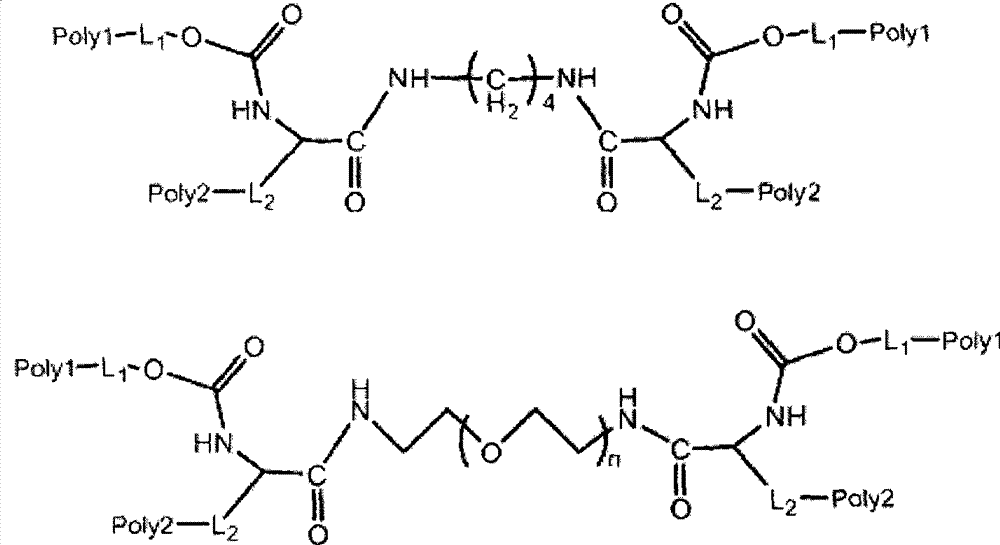
在任何上文所述的实施方案中,每个a、b、c、h、i和j可以是零或1,且a、b、c、h、i和j的值的所有变换被明确地包含在本文中。例如,本发明的实施方案包括其中所有a、b、c、h、i和j都是零或所有都是1、a是1和所有其他值是零、b是1和所有其他值是零等的实施方案。In any of the above-described embodiments, each of a, b, c, h, i, and j may be zero or 1, and all transformations of the values of a, b, c, h, i, and j are explicitly included in this article. For example, embodiments of the invention include wherein all a, b, c, h, i, and j are zero or all ones, a is one and all other values are zero, b is one and all other values are zero, etc. implementation plan.
优选作为L3键使用的或可以形成式(IIIa)的R核部分的一部份的聚氨酯键具有-O-C(O)-NH-CHY-C(O)-NH-Y′-结构,其中Y和Y′独立地选自H、烷基、取代的烷基和芳基。Preferred polyurethane linkages used as L bonds or which may form part of the R core moiety of formula (IIIa) have the structure -OC(O)-NH-CHY-C(O)-NH-Y'-wherein Y and Y' are independently selected from H, alkyl, substituted alkyl and aryl.
一个示例性的本发明的多臂聚合物试剂具有以下结构:An exemplary multi-armed polymer reagent of the invention has the following structure:

其相应于式(IIIa)的聚合物试剂,其中p是2且每个POLY1是多臂聚合物。该末端羟基可以被其他官能团替代而不偏离本发明。It corresponds to a polymer reagent of formula (IIIa) wherein p is 2 and each POLY 1 is a multi-armed polymer. The terminal hydroxyl groups may be replaced by other functional groups without departing from the invention.
另一个本发明的多臂聚合物试剂如下示例。所示的多臂试剂具有双赖氨酸核和三个聚合物臂。分子中的肽键通过一些本领域普通技术人员已知的酶(如哺乳动物枯草溶菌素样丝氨酸内切蛋白酶PC2,参见Eskeland等(1996)J.Clin.Invest.98(1):148-156)易于断裂,因而使其在某些体内条件下不稳定。在下述反应方案I中,mPEG-BTC与二肽反应来形成具有活性羧酸单元的聚合物,所述活性羧酸单元可以通过离子交换色谱法用于纯化聚合物。Another multi-armed polymer reagent of the invention is exemplified below. The multi-armed reagent shown has a double lysine core and three polymer arms. The peptide bonds in the molecule are passed through some enzymes known to those of ordinary skill in the art (such as mammalian subtilisin-like serine endoprotease PC2, see Eskeland et al. (1996) J.Clin.Invest.98 (1): 148-156 ) are prone to fragmentation, thus making them unstable under certain in vivo conditions. In Reaction Scheme I below, mPEG-BTC is reacted with a dipeptide to form a polymer with activated carboxylic acid units that can be used to purify the polymer by ion exchange chromatography.
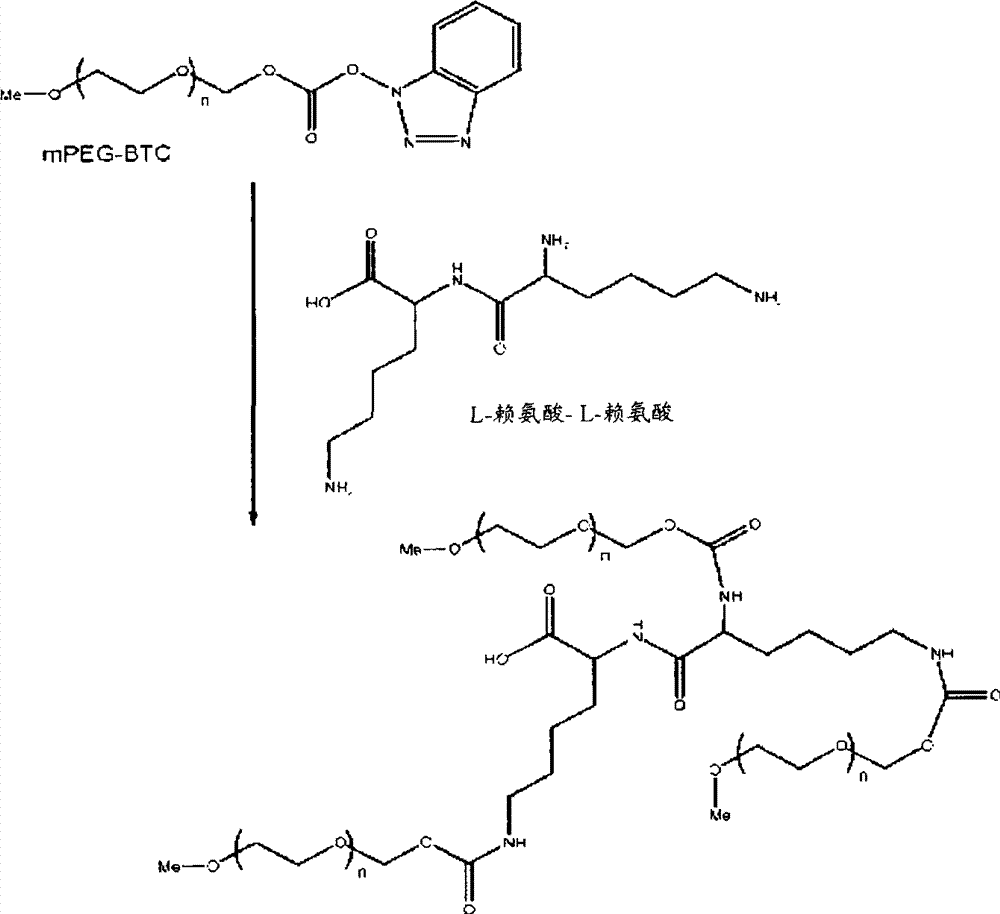
反应方案IReaction Scheme I
其中分支或多臂聚合物替代上文利用的线性聚合物的类似的例子如下述反应方案II中列出。另一方面,可降解的二肽键的断裂产生两个片段,所述片段约为原始轭合物的一半大小,这取决于活性物(药物)组分的大小。Similar examples in which branched or multi-armed polymers are substituted for the linear polymers utilized above are set forth in Reaction Scheme II below. On the other hand, cleavage of the degradable dipeptide bond produces two fragments that are approximately half the size of the original conjugate, depending on the size of the active (drug) component.
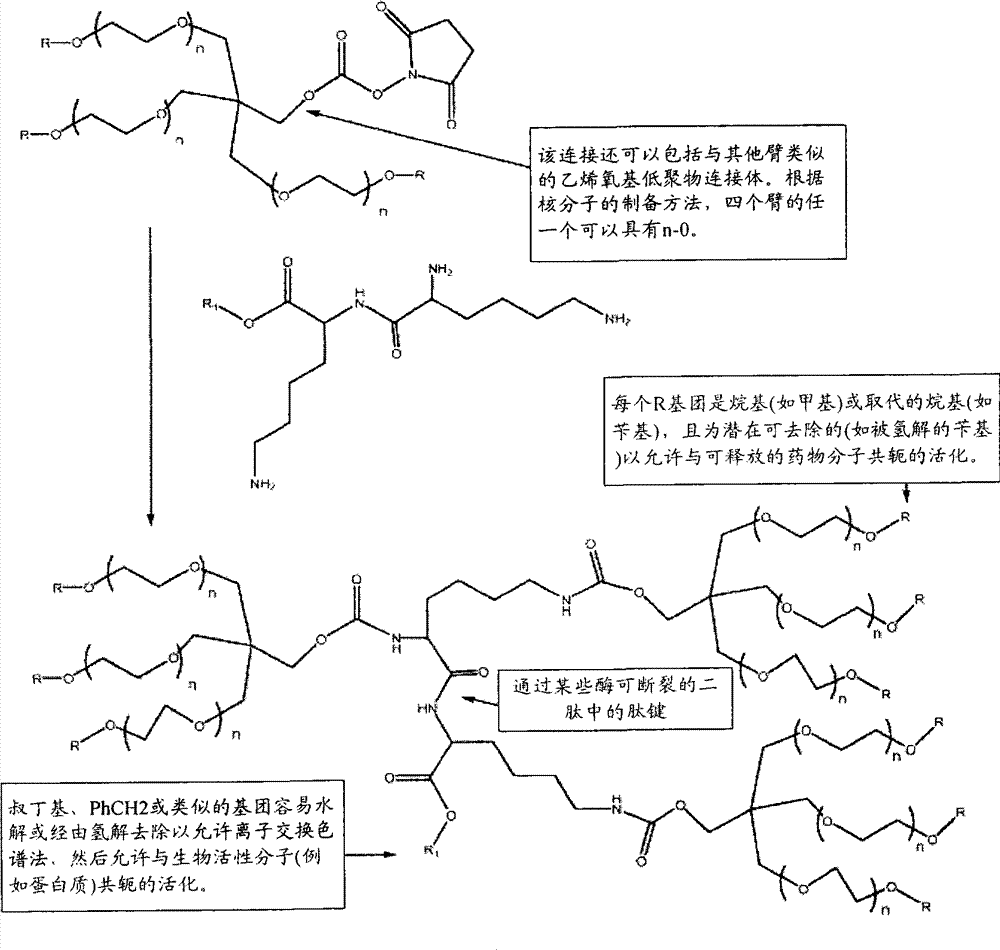
反应方案IIReaction Scheme II
使用类似于上文所述的那些方法的方法,二硫化物连接体可以用于代替二肽连接体。二硫键在某些酶的存在下不稳定,因此提供可以有助于药物和/或聚合物清除的可降解的键。这样分子的合成方法在下述反应方案III中所示。Using methods similar to those described above, disulfide linkers can be used in place of dipeptide linkers. Disulfide bonds are unstable in the presence of certain enzymes, thus providing degradable linkages that can aid in drug and/or polymer clearance. The synthesis of such molecules is shown in Reaction Scheme III below.

反应方案IIIReaction Scheme III
本发明还提供了上文所述的多臂聚合物的轭合物,如具有以下结构的轭合物:The present invention also provides conjugates of the multi-armed polymers described above, such as conjugates having the structure:

其中:in:
B是A、-(X8)h-(L6)j-(X9)i-POLY2-L9-药物或-(X8)h-(L7)j-(X9)i-L9-药物;B is A, -(X 8 ) h -(L 6 ) j -(X 9 ) i -POLY 2 -L 9 -drug or -(X 8 ) h -(L 7 ) j -(X 9 ) i - L 9 - drug;
每个相同或不同的D是Z1或L8-药物;each of the same or different D is a Z 1 or L 8 -drug;
相同或不同的L8和L9是在体内任选可断裂的键:The same or different L8 and L9 are bonds that are optionally cleavable in vivo:
药物是生物活性剂的残基;The drug is the residue of a bioactive agent;
每个X1、X2、X3、X8、X9、L3、L6、L7、A、Z1、a、b、c、h、i、j和p如先前关于式(IIIa)所定义。通常,L8和L9由式(IIIa)的聚合物的官能团(分别为Z1和Z3)与生物活性剂的反应而形成。Each of X 1 , X 2 , X 3 , X 8 , X 9 , L 3 , L 6 , L 7 , A, Z 1 , a, b, c, h, i, j and p is as previously described with respect to formula (IIIa ) as defined. Typically, L 8 and L 9 are formed from the reaction of functional groups (Z 1 and Z 3 , respectively) of the polymer of formula (Ilia) with a bioactive agent.
示例性的本发明的轭合物在下文显示,所述轭合物由多肽活性剂与示例性的包含可降解的酰胺键的聚合物试剂的反应而生成。所述聚合物试剂共轭至药物分子。当PEG单元的分子量是相对高时,则可降解的酰胺连接体的重要性变得明确。如果每个PEG链段的分子量是20,000道尔顿,那么所述聚合物具有略微超过60,000道尔顿的分子量。如果添加具有8,000道尔顿的分子量的多肽而制备轭合物(下文所述,通过硫醇基与聚合物的马来酰亚胺共轭),则聚合物的最终分子量立刻超过68,000道尔顿。该大小的分子的清除非常困难,且通常不会被施用。然而,经由本文所述的一个实施方案,证明本发明的优点是可能的。Exemplary conjugates of the invention are shown below that result from the reaction of a polypeptide active agent with an exemplary polymer reagent comprising a degradable amide bond. The polymer reagent is conjugated to a drug molecule. The importance of the degradable amide linker becomes clear when the molecular weight of the PEG unit is relatively high. If the molecular weight of each PEG segment is 20,000 Daltons, then the polymer has a molecular weight of slightly over 60,000 Daltons. If the conjugate is prepared by adding a polypeptide having a molecular weight of 8,000 Daltons (described below, via thiol group conjugation to the maleimide of the polymer), the final molecular weight of the polymer immediately exceeds 68,000 Daltons . Molecules of this size are very difficult to clear and are not usually administered. However, it is possible to demonstrate the advantages of the present invention via an embodiment described herein.
例如,下文所示的轭合物(从如本文所述的聚合物试剂制备)可以在二肽的中心的肽键处(如下述虚线所示)断裂,从而具有约40,000道尔顿和28,000道尔顿的分子量的轭合物的片段生成。因此,该药物的清除率由于可降解的键的存在而提高。For example, the conjugate shown below (prepared from polymeric reagents as described herein) can be cleaved at the peptide bond in the center of the dipeptide (as shown by the dashed line below), thereby having approximately 40,000 Daltons and 28,000 channel Fragments of the conjugate with a molecular weight of 100 were generated. Therefore, the clearance of the drug is enhanced due to the presence of degradable linkages.

另一个示例性的产生本发明多臂轭合物的反应方案如下文反应方案IV所示。如图所示,具有可用的酰胺基的药物分子与以核分子中的不稳定二硫键为特征的多臂聚合物试剂反应。Another exemplary reaction scheme for producing multi-armed conjugates of the invention is shown in Reaction Scheme IV below. As shown, a drug molecule with an available amide group is reacted with a multi-armed polymeric reagent characterized by a labile disulfide bond in the core molecule.

其中R通常是相对惰性的封端基团,如烷基或取代的烷基(如苄基)。Wherein R is usually a relatively inert capping group, such as alkyl or substituted alkyl (such as benzyl).
反应方案IVReaction Scheme IV
下述的反应方案(指定的反应方案V)提供了方法的其他的实施例,在所述方法中本发明可以提供可降解的共轭结构。将包含受保护的酯基团的活性聚合物基团加至核聚合物分子的一个臂。此后,将可降解的连接体(在二肽连接体的情况下)加至多臂核的三个聚合物臂。然后,酯水解释放由色谱法纯化的羧酸基团。随后,进行处理,通过添加可以与药物分子连接的官能团(例如NHS酯)而允许所有四个臂的活化,所述四个臂还可以根据需要被进一步官能化。The following reaction scheme (designated Reaction Scheme V) provides additional examples of methods in which the present invention can provide degradable conjugated structures. A living polymer group comprising a protected ester group is added to one arm of the core polymer molecule. Thereafter, a degradable linker (in the case of a dipeptide linker) is added to the three polymer arms of the multi-armed core. Ester hydrolysis then liberates the carboxylic acid group purified by chromatography. Subsequently, processing is performed to allow activation of all four arms, which can be further functionalized as desired, by adding functional groups that can be attached to drug molecules (eg NHS esters).
反应方案VReaction Scheme V
当同时给定实际用于药物递送的最后的总分子量时,各种聚合物链段的分子量可以是可变的以进行实际分子的构建。因此,较小的核分子的PEG连接体(即在反应方案V中以n表示)通常是短连接体。相比较,主链PEG连接体(即在反应方案V中以m表示)通常是大的聚合物链。The molecular weights of the various polymer segments can be varied for actual molecular construction while simultaneously given the final overall molecular weight that is actually used for drug delivery. Thus, PEG linkers of smaller core molecules (ie, denoted by n in Reaction Scheme V) are generally short linkers. In comparison, backbone PEG linkers (ie, represented by m in Reaction Scheme V) are typically large polymer chains.
与在上述聚合物试剂的每个末端处的药物分子反应后,生成的轭合物可以以下述通用结构来表示:After reaction with drug molecules at each terminus of the polymeric reagents described above, the resulting conjugates can be represented by the following general structures:

其中POLY1-POLY3是如上文所述的水溶性和非肽聚合物,L1、L2和L3是稳定的连接体,优选L4是可以释放药物分子的可降解的连接体,且L5是经水解或酶可降解的键,其允许将所述轭合物分子断裂成更小的聚合物链段。wherein POLY 1 -POLY 3 are water-soluble and non-peptidic polymers as described above, L 1 , L 2 and L 3 are stable linkers, preferably L 4 is a degradable linker that can release drug molecules, and L5 is a hydrolytic or enzymatically degradable linkage that allows the fragmentation of the conjugate molecule into smaller polymer segments.
因此,根据如下述反应方案VI所示的断裂反应,整个方法最终形成下述的用于清除的剩余组分。新基团G1、G2和G3是由可降解连接体断裂而生成的新的末端基团。Thus, according to the cleavage reaction as shown in Reaction Scheme VI below, the overall process culminates in the remaining components for removal described below. The new groups G 1 , G 2 and G 3 are new terminal groups generated by breaking the degradable linker.

反应方案VIReaction scheme VI
上述反应的全部结果是提供在药物递送后断裂成组分的多臂聚合物,所述组分包括多臂核和若干个较小的大体上线性的聚合物单元。因此该方法避免可以抵抗肾清除的高度球形多臂聚合物的清除。The overall result of the above reactions is to provide a multi-armed polymer that, after drug delivery, breaks down into components comprising a multi-armed core and several smaller, substantially linear polymer units. This approach therefore avoids the clearance of highly spherical multi-armed polymers that can resist renal clearance.
在另一个示例性的多臂聚合物的实施方案中,用于药物递送的四臂试剂在下文反应方案VII中描述。该合成具有若干个点,其中中间体可以使用离子交换色谱法来纯化。在第一步骤中,商业上可得的以酯基团为特征的分支多元醇与二琥珀酰亚胺碳酸酯反应以使羟基转化成琥珀酰亚胺碳酸酯基团。在任选的第二步骤中,相对小的PEG连接体(可以是商业上可得的单保护的二胺)与核分子反应以形成具有两个乙二醇低聚物/聚合物间隔基的核,所述间隔基与末端受保护的胺基连接(参见下文的反应方案VII(a))。In another exemplary multi-armed polymer embodiment, a four-armed agent for drug delivery is depicted in Reaction Scheme VII below. The synthesis has several points where intermediates can be purified using ion exchange chromatography. In a first step, commercially available branched polyols featuring ester groups are reacted with disuccinimidyl carbonate to convert hydroxyl groups to succinimidyl carbonate groups. In an optional second step, a relatively small PEG linker (which can be a commercially available monoprotected diamine) reacts with the core molecule to form a core, the spacer is attached to a terminal protected amine group (see Reaction Scheme VII(a) below).
反应方案VII(a)Reaction Scheme VII(a)
BOC保护基的脱保护和与单保护的PEG-BTC的反应导致在PEG臂和分支碳原子之间具有聚氨酯键的分支PEG结构的形成(参见下文反应方案VII(b))。聚合物衍生物可以在连接PEG-BTC分子之前或之后,通过离子交换色谱法来纯化。应了解,在VII(b)中的分支PEG结构被式IIa的分支聚合物结构所包含。乙二醇单体m1和m2的数目可以变化。但是,来自单保护的二胺分子的乙二醇链通常具有约2至约80之间的单体单元(即m1在约2至约80之间),更优选约40至约80单体单元。Deprotection of the BOC protecting group and reaction with mono-protected PEG-BTC leads to the formation of branched PEG structures with polyurethane linkages between the PEG arms and the branching carbon atoms (see Reaction Scheme VII(b) below). The polymer derivatives can be purified by ion exchange chromatography either before or after attachment of PEG-BTC molecules. It will be appreciated that the branched PEG structure in VII(b) is subsumed by the branched polymer structure of Formula IIa. The number of glycol monomers m1 and m2 can vary. However, the ethylene glycol chain from the mono-protected diamine molecule typically has between about 2 and about 80 monomer units (i.e., m1 between about 2 and about 80), more preferably about 40 to about 80 monomer units .
在下文VII(b)中连接的第二聚合物链通常更长,如包含约100至约450之间的单体单元(即m2是约100至约450)、更优选约150至约250单体单元的聚合物链。The second polymer chain attached in VII(b) below is typically longer, such as comprising between about 100 and about 450 monomer units (i.e. m2 is about 100 to about 450), more preferably about 150 to about 250 monomer units A polymer chain of units.

反应方案VII(b)Reaction Scheme VII(b)
酸向N-羟基琥珀酰亚胺活性酯的转化和活性酯与氨烷基二硫化物的偶合产生具有四臂结构的二硫化物,如下文反应方案VII(c)中所示。可以在包含所述二硫化物的连接体的任何碳上的R基可以变化,但是示例性的R基包括羧酸和低级烷基,如甲基、乙基、丙基、异丙基、正丁基及类似基团。并且,出于增强的纯化的目的,羧酸基团还可以通过间隔基基团从连接体中去除,所述间隔基有助于从连接体的核使酸基团留出间隔,以允许更好地结合至色谱柱。在没有还原二硫键下,氢解苄基而使羟基的形成发生。Conversion of the acid to the N-hydroxysuccinimide active ester and coupling of the active ester to the aminoalkyl disulfide produces a disulfide with a four-armed structure as shown in Reaction Scheme VII(c) below. The R groups that may be on any carbon of the linker comprising the disulfide may vary, but exemplary R groups include carboxylic acids and lower alkyls such as methyl, ethyl, propyl, isopropyl, n- Butyl and similar groups. Also, for the purpose of enhanced purification, the carboxylic acid group can also be removed from the linker by a spacer group that helps to space the acid group from the linker's core to allow more Binds well to the column. Hydrogenolysis of the benzyl group allows formation of the hydroxyl group to occur without reduction of the disulfide bond.

反应方案VII(c)Reaction Scheme VII(c)
VII(c)的产物的末端羟基与二琥珀酰亚胺碳酸酯的活化在聚合物链的四个末端处形成活性的琥珀酰亚胺酯。羟基还可以被转化成其他本领域已知的官能团。因此,活化的多臂聚合物可以在每个聚合物链的末端处与药物分子共轭。期望所生成的轭合物随时间经受酶的二硫化物断裂而允许两个分子的清除,每个基本上是具有两个PEG链的分支PEG分子。示例性的药物轭合物结构如下所示。Activation of the terminal hydroxyl groups of the product of VII(c) with disuccinimidyl carbonate forms reactive succinimidyl esters at the four termini of the polymer chain. Hydroxyl groups can also be converted to other functional groups known in the art. Thus, activated multi-armed polymers can be conjugated with drug molecules at the end of each polymer chain. The resulting conjugate is expected to undergo enzymatic disulfide cleavage over time allowing clearance of two molecules, each essentially a branched PEG molecule with two PEG chains. Exemplary drug conjugate structures are shown below.

如果需要更高的最后轭合物的分子量,那么它可能必需地提供除上文结构的二硫键之外的聚合物断裂的部位。例如,如果在上述的第一反应序列中利用分子量3,400道尔顿的PEG二胺,那么产物二胺(BOC还受保护)具有约6,800道尔顿的分子量。如果使用具有10,000道尔顿的分子量的PEG-BTC片段,制成作为药物轭合物的与上文所示相同的最终结构,那么最终的聚合物具有超过53,600道尔顿的分子量。If a higher molecular weight of the final conjugate is desired, it may be necessary to provide a site for polymer cleavage other than the disulfide bond of the above structure. For example, if a PEG diamine with a molecular weight of 3,400 Daltons is utilized in the first reaction sequence described above, the product diamine (BOC also protected) has a molecular weight of about 6,800 Daltons. If the same final structure as shown above is made as a drug conjugate using a PEG-BTC fragment with a molecular weight of 10,000 Daltons, the final polymer has a molecular weight in excess of 53,600 Daltons.
可以有益地提供这样具有其他降解点的高分支结构,以允许在合理的时间范围内使分子清除。这通过在每个臂的两个PEG链段的连接点中添加第二酶可断裂的链段来实现。在与二胺连接体反应前,使用与PEG-BTC组分预先连接的二肽连接体在下述反应方案VIII中对此进行示例。在合成的最后步骤后,获得试剂。最终的聚合物降解的五个点以虚线显示。因此,如果所有的酶过程在清除之前发生,那么不大于约7,000道尔顿的聚合物链段将清除。下文列出的R2和R3基团可以是,例如羧基烷基、烷基等。It may be beneficial to provide such a highly branched structure with additional degradation points to allow clearance of the molecule within a reasonable time frame. This is achieved by adding a second enzymatically cleavable segment at the junction of the two PEG segments in each arm. This is exemplified in Reaction Scheme VIII below using a dipeptide linker pre-attached to the PEG-BTC component prior to reaction with the diamine linker. After the last step of the synthesis, the reagents are obtained. The five points of final polymer degradation are shown in dashed lines. Thus, if all enzymatic processes occur prior to clearance, polymer segments no larger than about 7,000 Daltons will be cleared. The R2 and R3 groups listed below may be, for example, carboxyalkyl, alkyl, and the like.

反应方案VIIIReaction Scheme VIII
作为选择,二硫化物可以包含用于纯化的酸基团。例如,可以使用二肽、胱氨酸,其将提供两个用于在随后阶段纯化聚合物的羧酸基。然后酸基团可以任选被活化以形成六臂聚合物。Alternatively, the disulfides may contain acid groups for purification. For example, a dipeptide, cystine, can be used, which will provide two carboxylic acid groups for purification of the polymer at a later stage. The acid groups can then optionally be activated to form a six-armed polymer.
同时,可以使用任选具有游离的羧酸基的二肽、三肽或四肽,来代替在反应方案VII和VIII的多臂结构中主连接体的二硫化物。例如,示例性的二肽连接体可以包括谷氨酸残基和另一个氨基酸(例如下文所示的丙氨酸),这被胺基(例如,添加以形成具有下文所示的丙氨酸的游离胺基的酰胺的四亚乙基二胺)进一步封端。示例性的二肽(与四亚乙基二胺偶合的Glu-Ala)在下文所示。At the same time, dipeptides, tripeptides or tetrapeptides, optionally with free carboxylic acid groups, can be used instead of the disulfides of the main linker in the multi-arm structures of reaction schemes VII and VIII. For example, an exemplary dipeptide linker can include a glutamic acid residue and another amino acid (e.g., alanine shown below), which is added by an amine group (e.g., to form a residue with alanine shown below). Tetraethylenediamine of the amide of the free amine group) is further capped. An exemplary dipeptide (Glu-Ala coupled with tetraethylenediamine) is shown below.

本文所参考的所有论文、书籍、专利、专利出版物及其他出版物,其全部内容通过引用并入本文。All papers, books, patents, patent publications, and other publications referenced herein are hereby incorporated by reference in their entirety.
III.实验性III. Experimental
应理解,虽然已经结合某些优选的具体实施方案描述了本发明,但前述的描述和随后的实施例旨在解释,而不是限制本发明的范围。在本发明的范围内的其他方面,优点和修改对本发明所属领域的技术人员是显而易见的。例如,在某些应用中,可以期望利用根据上式的任一的聚合物试剂,其中所有的键是稳定的而不是可降解的。It should be understood that while the invention has been described in connection with certain preferred embodiments, the foregoing description and the following examples are intended to illustrate, not to limit the scope of the invention. Other aspects, advantages and modifications within the scope of the invention will be apparent to those skilled in the art to which the invention pertains. For example, in certain applications it may be desirable to utilize a polymer reagent according to any of the above formulas, wherein all bonds are stable rather than degradable.
在附加的实施例中,除非另有指出,所指的所有PEG试剂是商业上可用的,例如从Nektar Therapeutics,Huntsville,AL获得。所有1HNMR数据通过由Bruker制造的300或400MHz NMR波谱仪而产生。使用Agilent1100HPLC system(Agilent)、凝胶渗透或离子交换柱、作为流动相的含水磷酸盐缓冲液和折射率(RI)检测器,进行高效液相色谱法(HPLC)。In the appended examples, unless otherwise indicated, all PEG reagents referred to are commercially available, eg, from Nektar Therapeutics, Huntsville, AL. All 1 H NMR data were generated by 300 or 400 MHz NMR spectrometers manufactured by Bruker. High performance liquid chromatography (HPLC) was performed using an Agilent 1100 HPLC system (Agilent), a gel permeation or ion exchange column, aqueous phosphate buffer as a mobile phase, and a refractive index (RI) detector.
具体实施方式 Detailed ways
实施例1:具有三个带二硫键的臂的4臂-PEG(20KDa)-单-丁Example 1: 4-arm-PEG(20KDa)-mono-butyl with three disulfide-bonded arms 酸acid
A.季戊四醇乙氧基化-单-PEG(5KDa)-丁酸甲酯A. Pentaerythritol Ethoxylate-Mono-PEG(5KDa)-Butyric Acid Methyl Ester

季戊四醇乙氧基化物(3/4EO/OH)(25g,0.370OH当量)在甲苯(100ml)中的溶液在减压下通过蒸馏出甲苯而共沸干燥。经干燥的季戊四醇乙氧基化物溶解于无水乙腈(100ml)中,并加入无水吡啶(4.2ml)和二琥珀酰亚胺碳酸酯(9.5g,0.037摩尔),在氩气氛下于室温搅拌混合物过夜。然后,加入PEG(5KDa)-α-胺-ω-丁酸甲酯(20g,0.0040摩尔)和三乙胺(1.5ml),且在氩气氛下于室温将反应混合物搅拌过夜。在减压下蒸馏出溶剂。将粗产物溶解于二氯甲烷(20ml)中,然后在室温下加入异丙醇(700ml)。过滤沉淀的产物,在真空下干燥,得到19g白色固体。A solution of pentaerythritol ethoxylate (3/4EO/OH) (25 g, 0.370 OH equivalents) in toluene (100 ml) was azeotropically dried under reduced pressure by distilling off the toluene. Dissolve the dried pentaerythritol ethoxylate in anhydrous acetonitrile (100ml), add anhydrous pyridine (4.2ml) and disuccinimide carbonate (9.5g, 0.037mol), stir at room temperature under an argon atmosphere The mixture was left overnight. Then, PEG (5 KDa)-α-amine-ω-butyric acid methyl ester (20 g, 0.0040 mol) and triethylamine (1.5 ml) were added, and the reaction mixture was stirred overnight at room temperature under argon atmosphere. The solvent was distilled off under reduced pressure. The crude product was dissolved in dichloromethane (20ml), then isopropanol (700ml) was added at room temperature. The precipitated product was filtered and dried under vacuum to yield 19 g of a white solid.
NMR(d6-DMSO):1.71ppm(q,CH 2 -CH2-COO-)2.24ppm(t,-CH2-C00-),3.25ppm(s,-C-CH2-O-),3.51ppm(s,PEG骨架)。NMR (d 6 -DMSO): 1.71ppm (q, CH 2 -CH 2 -COO-) 2.24ppm (t, -CH 2 -C00-), 3.25ppm (s, -C-CH2-O-), 3.51 ppm(s, PEG backbone).
GPC分析显示产物包含95.7%具有-5KDa分子量的想要的产物和4.3%具有-10KDa分子量的二聚物。GPC analysis showed that the product contained 95.7% of the desired product with a molecular weight of -5KDa and 4.3% of a dimer with a molecular weight of -10KDa .
B.季戊四醇乙氧基化-单-PEG(5KDa)-丁酸甲酯三琥珀酰亚胺碳B. Pentaerythritol Ethoxylation-Mono-PEG(5KDa)-Butyric Acid Methyl Trisuccinimide Carbon 酸酯Ester

将季戊四醇乙氧基化-单-PEG(5KDa)-丁酸甲酯(5.0g,0.0030-OH当量)溶解于无水甲苯(100ml)中。在减压下蒸馏出甲苯。将干燥的产物溶解于无水乙腈(25ml)中,并将无水吡啶(0.34ml)和二琥珀酰亚胺碳酸酯(0.85g,0.0033摩尔)加至溶液中。在氩气氛下于室温搅拌混合物过夜。NMR分析显示所有羟基转化为琥珀酰亚胺碳酸酯且该混合物还包含残留的二琥珀酰亚胺碳酸酯(0.000317摩尔)。加入水(0.005ml),并在氩气氛下于室温搅拌混合物过夜。连续的NMR分析显示产物仍被100%取代,但是残留的二琥珀酰亚胺碳酸酯全部水解。所生成的溶液直接用于合成的下一步骤。Pentaerythritol ethoxylated-mono-PEG (5KDa)-butyric acid methyl ester (5.0 g, 0.0030-OH equiv.) was dissolved in anhydrous toluene (100 ml). Toluene was distilled off under reduced pressure. The dried product was dissolved in anhydrous acetonitrile (25ml), and anhydrous pyridine (0.34ml) and disuccinimide carbonate (0.85g, 0.0033mol) were added to the solution. The mixture was stirred overnight at room temperature under an atmosphere of argon. NMR analysis showed conversion of all hydroxyl groups to succinimide carbonate and the mixture also contained residual disuccinimide carbonate (0.000317 moles). Water (0.005ml) was added, and the mixture was stirred overnight at room temperature under an atmosphere of argon. Sequential NMR analysis showed that the product was still 100% substituted, but the residual disuccinimide carbonate was fully hydrolyzed. The resulting solution was used directly in the next step of the synthesis.
NMR(CDCl3):1.88ppm(q,CH 2 -CH2-COO-,每摩尔产物1当量),2.37ppm(t,-CH2-COO-,每摩尔产物1当量),2.69ppm(s,游离N-羟基琥珀酰亚胺峰),2.82ppm(s,-O-(C=O)O-NHS,每摩尔产物三当量),3.33ppm(s,-C-CH2-O-),3.63ppm(bm,-C-CH2-O-,-OCH3和PEG骨架),3.77ppm(m,-CH 2 CH2O-琥珀酰亚胺碳酸酯,每摩尔产物三当量),4.44ppm(m,-CH2 CH 2 O-琥珀酰亚胺碳酸酯,每摩尔产物三当量)。NMR (CDCl 3 ): 1.88ppm (q, CH 2 -CH 2 -COO-, 1 equivalent per mole of product), 2.37ppm (t, -CH 2 -COO-, 1 equivalent per mole of product), 2.69ppm (s , free N-hydroxysuccinimide peak), 2.82ppm (s, -O-(C=O)O-NHS, three equivalents per mole of product), 3.33ppm (s, -C-CH 2 -O-) , 3.63ppm (bm, -C- CH2 -O-, -OCH3 and PEG backbone ) , 3.77ppm (m , -CH2CH2O -succinimide carbonate, three equivalents per mole of product), 4.44 ppm (m, -CH2CH2O - succinimide carbonate, three equivalents per mole of product).
C.HO-PEG(5KDa)-胱胺C.HO-PEG(5KDa)-cystamine

将三乙胺(2.8ml,0.0200摩尔)加至胱胺二盐酸盐(2.3g,0.0100摩尔)在无水乙腈(50ml)中的悬浮液,且在氩气氛下于室温将混合物搅拌30分钟。然后在20分钟内加入溶解于无水乙腈(50ml)的HO-PEG(5KDa)-琥珀酰亚胺碳酸酯(5.0g,0.0010摩尔),且在氩气氛下于室温搅拌混合物过夜。在减压下蒸馏出溶剂,并将粗产物溶解于二氯甲烷中,在0-5℃下用异丙醇沉淀两次。收获4.7g。Triethylamine (2.8 ml, 0.0200 mol) was added to a suspension of cystamine dihydrochloride (2.3 g, 0.0100 mol) in anhydrous acetonitrile (50 ml), and the mixture was stirred at room temperature under argon atmosphere for 30 minutes . HO-PEG (5 KDa)-succinimide carbonate (5.0 g, 0.0010 mol) dissolved in anhydrous acetonitrile (50 ml) was then added over 20 minutes and the mixture was stirred at room temperature under argon atmosphere overnight. The solvent was distilled off under reduced pressure, and the crude product was dissolved in dichloromethane and precipitated twice with isopropanol at 0-5°C. 4.7g were harvested.
NMR(d6-DMSO):2.70ppm(t,-CH 2 -S-),3.01ppm(t,-CH 2 -NH2),3.11ppm(t,-CH2-NH(C=O)-O-),3.51ppm(s,PEG骨架),4.04ppm(m,-CH2-O(C=O)-),4.57ppm(-OH),7.11ppm(t,-(C=O)-NH-)。NMR (d 6 -DMSO): 2.70ppm (t, -CH 2 -S-), 3.01ppm (t, -CH 2 -NH 2 ), 3.11ppm (t, -CH 2 -NH(C=O)- O-), 3.51ppm(s, PEG backbone), 4.04ppm(m, -CH 2 -O(C=O)-), 4.57ppm(-OH), 7.11ppm(t, -(C=O)- NH-).
D.具有三个带二硫键的臂的4臂-PEG(20KDa)-单-丁酸D. 4arm-PEG(20KDa)-mono-butyric acid with three disulfide-bonded arms

HO-PEG(5KDa)-胱胺(3.8g,0.00076摩尔)在甲苯(50ml)中的溶液在减压下通过蒸馏出甲苯而共沸干燥。经干燥的产物溶解于无水乙腈(50ml)中,并加入三乙胺(0.30ml)。然后加入包含1.2g固体化合物(0.00072琥珀酰亚胺碳酸酯当量)的季戊四醇乙氧基化-单-PEG(5KDa)-丁酸甲酯三琥珀酰亚胺碳酸酯的溶液,并在氩气氛下于室温搅拌混合物过夜。在减压下蒸馏出溶剂。使产物溶解于100ml去离子水,并通过加入5%NaOH水溶液将溶液的pH调节至12.1。在pH12.0+/-0.1下搅拌溶液2小时。然后加入NaCl(10g),并用5%H3PO4调节pH至3.0。用二氯甲烷(40、20和15ml)萃取产物。用无水MgSO4干燥萃取液,并在减压下蒸馏出溶剂,得到4.6g白色固体产物。A solution of HO-PEG (5 KDa)-cystamine (3.8 g, 0.00076 mol) in toluene (50 ml) was azeotropically dried under reduced pressure by distilling off the toluene. The dried product was dissolved in anhydrous acetonitrile (50ml), and triethylamine (0.30ml) was added. A solution of pentaerythritol ethoxylated-mono-PEG (5KDa)-butyric acid methyl ester trisuccinimide carbonate containing 1.2 g of solid compound (0.00072 succinimide carbonate equivalents) was then added and heated under an argon atmosphere. The mixture was stirred overnight at room temperature. The solvent was distilled off under reduced pressure. The product was dissolved in 100 ml deionized water and the pH of the solution was adjusted to 12.1 by adding 5% aqueous NaOH. The solution was stirred at pH 12.0 +/- 0.1 for 2 hours. NaCl (10 g) was then added and the pH was adjusted to 3.0 with 5% H3PO4 . The product was extracted with dichloromethane (40, 20 and 15 ml). The extract was dried with anhydrous MgSO 4 , and the solvent was distilled off under reduced pressure to obtain 4.6 g of a white solid product.
HPLC分析显示,产物纯度为66.8%,并被高分子量杂质(8.2wt%)和低分子量杂质(25.0wt%)污染。HPLC analysis showed that the product was 66.8% pure and was contaminated with high molecular weight impurities (8.2 wt%) and low molecular weight impurities (25.0 wt%).
使用DEAE Sepharose FF介质通过离子交换色谱法来纯化产物,得到2.1g100%纯度的4臂-PEG(20KDa)-单-丁酸。凝胶渗透色谱法显示产物的分子量为18,626Da。The product was purified by ion exchange chromatography using DEAE Sepharose FF media to afford 2.1 g of 4arm-PEG(20KDa)-mono-butyric acid in 100% purity. Gel permeation chromatography showed the product to have a molecular weight of 18,626 Da.
实施例2:基于三赖氨酸的4臂-PEGExample 2: Trilysine-based 4-arm-PEG
A.基干三赖氨酸的4臂-苄氧基-PEG(20KDa)-酸A. The 4-arm-benzyloxy-PEG(20KDa)-acid of the backbone tri-lysine
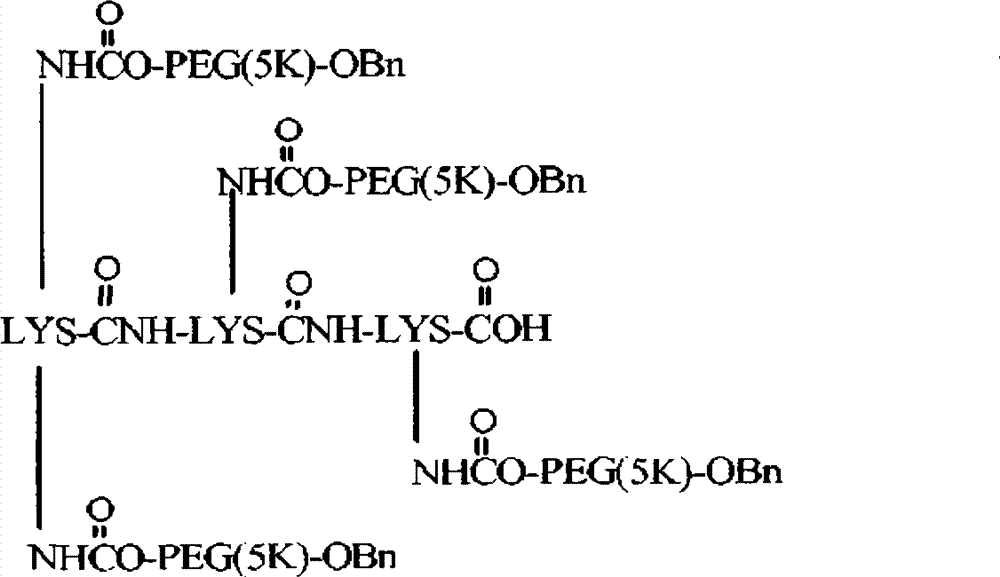
将三赖氨酸(1.0g,0.00151摩尔)溶解于100ml0.1M硼酸盐缓冲液,并用0.1M NaOH将pH调节至8.5。将BnO-PEG(5KDa)-BTC(Nektar Therapeutics,40.0g,0.00800摩尔)在30分钟内加至所得的溶液中,并通过加入0.1M NaOH使pH保持在8.5。将所得的溶液搅拌3小时后,加入NaC l(10g),并用10%磷酸调节pH至3.0。用二氯甲烷萃取产物,MgSO4干燥萃取液。然后在减压下蒸馏出溶剂。在真空下干燥湿产物,收获39.5g为白色固体的产物。HPLC分析显示产物:四-N-PEG化三赖氨酸(MW约20KDa)纯度为86.4%,并被高分子量副产物(3.1wt%)和低分子量(10.5wt%)副产物污染。Trilysine (1.0 g, 0.00151 mol) was dissolved in 100 ml 0.1 M borate buffer and the pH was adjusted to 8.5 with 0.1 M NaOH. BnO-PEG (5 KDa)-BTC (Nektar Therapeutics, 40.0 g, 0.00800 mol) was added to the resulting solution within 30 minutes, and the pH was maintained at 8.5 by adding 0.1 M NaOH. After the resulting solution was stirred for 3 hours, NaCl (10 g) was added and the pH was adjusted to 3.0 with 10% phosphoric acid. The product was extracted with dichloromethane and the extract was dried over MgSO 4 . The solvent was then distilled off under reduced pressure. The wet product was dried under vacuum yielding 39.5 g of product as a white solid. HPLC analysis showed that the product: tetra-N-PEGylated trilysine (MW about 20 KDa) was 86.4% pure and was contaminated by high molecular weight by-products (3.1 wt%) and low molecular weight (10.5 wt%) by-products.
使用DEAE Sepharose FF介质通过离子交换色谱法纯化产物,得到22.8g100%纯度的基于三赖氨酸的4臂-苄氧基-PEG(20KDa)酸。MALDI分析显示产物的分子量(Mn)为20,661Da。The product was purified by ion-exchange chromatography using DEAE Sepharose FF medium to afford 22.8 g of 100% pure trilysine-based 4-arm-benzyloxy-PEG (20 KDa) acid. MALDI analysis showed the product to have a molecular weight (Mn) of 20,661 Da.
NMR(d6-DMSO):1.35ppm(bm,-CH-(CH 2 )3-CH2-NH-,赖氨酸,18H),2.92ppm(q,-CH2-NH-,赖氨酸,6H),3.51ppm(s,聚合物骨架),3.95ppm(m,-CH-COOH,赖氨酸,1H),4.02ppm(m,-OCH2-CH 2 -O-(C=O)NH-,8H),4.49ppm(s,-CH2-,苄基,8H),7.32ppm(m,苄基的芳族质子,20H)。NMR(d6-DMSO): 1.35ppm (bm, -CH-( CH 2 ) 3 -CH 2 -NH-, lysine, 18H), 2.92ppm (q, -CH 2 -NH-, lysine, 6H), 3.51ppm (s, polymer backbone), 3.95ppm (m, -CH -COOH, lysine, 1H), 4.02ppm (m, -OCH2 - CH2 - O-(C=O)NH -, 8H), 4.49 ppm (s, -CH2- , benzyl, 8H), 7.32 ppm (m, aromatic proton of benzyl, 20H).
B.基干三赖氨酸的4臂-苄氧基-PEG(20KDa)-酸乙酯B. 4-arm-benzyloxy-PEG(20KDa)-acid ethyl ester of tri-lysine

将N-羟基琥珀酰亚胺(0.144g,0.00125摩尔)和N,N′-二环己基碳二亚胺(0.270g,0.00131摩尔)加至基于三赖氨酸的4臂-苄氧基-PEG(20KDa)-酸(22.8g,0.00114摩尔)在无水二氯甲烷(228ml)中的溶液,并在氩气氛下于室温搅拌混合物过夜。然后加入无水乙醇(30ml)、1-羟基苯并三唑(0.500g)和4-二甲氨基吡啶(2.5g),并在氩气氛下于室温搅拌混合物过夜。在减压下蒸馏出溶剂。使产物溶解于35ml二氯甲烷,并用600ml异丙醇沉淀,干燥后得到20.6g白色固体。N-Hydroxysuccinimide (0.144 g, 0.00125 moles) and N, N'-dicyclohexylcarbodiimide (0.270 g, 0.00131 moles) were added to the trilysine-based 4-arm-benzyloxy- A solution of PEG (20 KDa)-acid (22.8 g, 0.00114 mol) in anhydrous dichloromethane (228 ml) and the mixture was stirred overnight at room temperature under an atmosphere of argon. Then absolute ethanol (30ml), 1-hydroxybenzotriazole (0.500g) and 4-dimethylaminopyridine (2.5g) were added, and the mixture was stirred at room temperature overnight under an argon atmosphere. The solvent was distilled off under reduced pressure. The product was dissolved in 35 ml of dichloromethane and precipitated with 600 ml of isopropanol to give 20.6 g of a white solid after drying.
NMR(d6-DMSO):1.29ppm(t,CH3-,乙基,3H),1.35ppm(bm,-CH-(CH 2 )3-CH2-NH-,赖氨酸,18H),2.92ppm(q,-CH2-NH-,赖氨酸,6H),3.51ppm(s,聚合物骨架),3.98ppm(m,-CH-COOEt,赖氨酸,1H),4.02ppm(m,-OCH2-CH 2 -O-(C=O)NH-,8H),4.49ppm(s,-CH2-,苄基,8H),7.32ppm(m,苄基的芳族质子,20H)。NMR (d6-DMSO): 1.29ppm (t, CH 3 -, ethyl, 3H), 1.35ppm (bm, -CH-( CH 2 ) 3 -CH 2 -NH-, lysine, 18H), 2.92 ppm (q, -CH 2 -NH-, lysine, 6H), 3.51ppm (s, polymer backbone), 3.98ppm (m, -CH -COOEt, lysine, 1H), 4.02ppm (m, -OCH2 - CH2 - O-(C=O)NH-, 8H), 4.49ppm (s, -CH2- , benzyl, 8H), 7.32ppm (m, aromatic proton of benzyl, 20H) .
C.基于三赖氨酸的4臂-羟基-PEG(20KDa)-酸乙酯C. Trilysine-based 4arm-hydroxy-PEG(20KDa)-acid ethyl ester

将在炭上的氢氧化钯(1.5g,20%Pd,-50%水)加至基于三赖氨酸的4臂-苄氧基-PEG(20KDa)-酸乙酯(20.0g)在乙醇(200ml)中的溶液,并在45psi氢气下将混合物氢化过夜。过滤混合物,并在减压下蒸馏出溶剂,得到19.5g白色固体产物。Palladium hydroxide on charcoal (1.5 g, 20% Pd, - 50% water) was added to trilysine-based 4arm-benzyloxy-PEG (20 KDa)-acid ethyl ester (20.0 g) in ethanol (200ml), and the mixture was hydrogenated overnight under 45 psi of hydrogen. The mixture was filtered, and the solvent was distilled off under reduced pressure to obtain 19.5 g of a white solid product.
NMR(d6-DMSO):1.29ppm(t,CH3-,乙基,3H),1.35ppm(bm,-CH-(CH 2 )3-CH2-NH-,赖氨酸,18H),2.92ppm(q,-CH2-NH-,赖氨酸,6H),3.51ppm(s,聚合物骨架),3.98ppm(m,-CH-COOEt,赖氨酸,1H),4.02ppm(m,-OCH2-CH 2 -O-(C=O)NH-,8H),4.57ppm(t,-OH,4H)。NMR (d6-DMSO): 1.29ppm (t, CH 3 -, ethyl, 3H), 1.35ppm (bm, -CH-( CH 2 ) 3 -CH 2 -NH-, lysine, 18H), 2.92 ppm (q, -CH 2 -NH-, lysine, 6H), 3.51ppm (s, polymer backbone), 3.98ppm (m, -CH -COOEt, lysine, 1H), 4.02ppm (m, -OCH 2 -CH 2 -O-(C=O)NH-, 8H), 4.57 ppm (t, -OH, 4H).
D.基于三赖氨酸的4臂-琥珀酰亚胺碳酸酯-PEG(20KDa)-酸乙酯D. Trilysine-based 4-arm-succinimide carbonate-PEG (20KDa)-acid ethyl ester

将基于三赖氨酸的4臂-羟基-PEG(20KDa)-酸乙酯(19.5g,0.0039OH当量)在无水乙腈(200ml)中的溶液在减压下通过蒸馏出乙腈而共沸干燥。经干燥的产物溶解于无水乙腈(200ml)中,并加入无水吡啶(0.56ml)和二琥珀酰亚胺碳酸酯(1.44g,0.056摩尔),在氩气氛下于室温搅拌混合物过夜。然后过滤混合物,在减压下蒸馏溶剂。将粗产物溶解于二氯甲烷(20ml)中,然后在室温下加入异丙醇(600ml)。过滤出沉淀的产物,在真空下干燥,得到18.4g白色固体。A solution of trilysine-based 4arm-hydroxy-PEG (20 KDa)-acid ethyl ester (19.5 g, 0.0039 OH equivalents) in anhydrous acetonitrile (200 ml) was azeotropically dried under reduced pressure by distilling off the acetonitrile . The dried product was dissolved in anhydrous acetonitrile (200ml), and anhydrous pyridine (0.56ml) and disuccinimide carbonate (1.44g, 0.056mol) were added, and the mixture was stirred overnight at room temperature under an argon atmosphere. The mixture was then filtered, and the solvent was distilled off under reduced pressure. The crude product was dissolved in dichloromethane (20ml), then isopropanol (600ml) was added at room temperature. The precipitated product was filtered off and dried under vacuum to yield 18.4 g of a white solid.
NMR(d6-DMSO):NMR(d6-DMSO):1.29ppm(t,CH3-,乙基,3H),1.35ppm(bm,-CH-(CH 2 ),-CH2-NH-,赖氨酸,18H),2.84ppm(s,-CH2CH2-琥珀酰亚胺,16H),2.92ppm(q,-CH2-NH-,赖氨酸,6H),3.51ppm(s,聚合物骨架),3.98ppm(m,-CH-COOEt,赖氨酸,1H),4.02ppm(m,-OCH2-CH 2 -O-(C=O)NH-,8H),4.46ppm(m,-OCH2-CH 2 -O-(C=O)NHS,8H)。NMR (d 6 -DMSO): NMR (d6-DMSO): 1.29ppm (t, CH 3 -, ethyl, 3H), 1.35ppm (bm, -CH-( CH 2 ), -CH 2 -NH-, Lysine, 18H), 2.84ppm (s, -CH2CH2-succinimide, 16H), 2.92ppm (q, -CH2- NH-, lysine, 6H), 3.51ppm (s, polymer backbone ), 3.98ppm (m, -CH -COOEt, lysine, 1H), 4.02ppm (m, -OCH 2 -CH 2 -O-(C=O)NH-, 8H), 4.46ppm (m, - OCH2 - CH2 - O-(C=O)NHS, 8H).
实施例3:具有一个二硫键的4臂PEG(20K)-单-丁酸Example 3: 4-arm PEG(20K)-mono-butyric acid with one disulfide bond
A.PEG(5KDa)-α-琥珀酰亚胺碳酸酯-ω-丁酸甲酯A. PEG(5KDa)-α-succinimide carbonate-ω-methyl butyrate
将PEG(5KDa)-α-羟基-ω-丁酸甲酯(58.8g,0.0.0118摩尔)在甲苯(500ml)的溶液在减压下通过蒸馏出甲苯而共沸干燥。经干燥的产物溶解于无水乙腈(300ml)中,并加入无水吡啶(1.52ml)和二琥珀酰亚胺碳酸酯(3.92g,0.0153摩尔),且在氩气氛下于室温搅拌混合物过夜。在减压下蒸馏出溶剂。将粗产物溶解于二氯甲烷(100ml)中,然后在室温下加入异丙醇(1500ml)。过滤出沉淀的产物,在真空下干燥,得到57.0g白色固体。A solution of PEG (5 KDa)-α-hydroxy-ω-butyric acid methyl ester (58.8 g, 0.0.0118 mol) in toluene (500 ml) was azeotropically dried under reduced pressure by distilling off the toluene. The dried product was dissolved in anhydrous acetonitrile (300ml), and anhydrous pyridine (1.52ml) and disuccinimide carbonate (3.92g, 0.0153mol) were added, and the mixture was stirred at room temperature under argon atmosphere overnight. The solvent was distilled off under reduced pressure. The crude product was dissolved in dichloromethane (100ml), then isopropanol (1500ml) was added at room temperature. The precipitated product was filtered off and dried under vacuum to yield 57.0 g of a white solid.
NMR(CDCl3):1.82ppm(q,CH 2 -CH2-COO-,2H),2.34ppm(t,-CH2-COO-,2H),2.77ppm(s,-CH2CH2-,琥珀酰亚胺基,4H),3.58ppm(s,PEG骨架),4.40ppm(m,-CH2-(C=O)-,2H)。纯度-100%。NMR (CDCl 3 ): 1.82ppm (q, CH 2 -CH 2 -COO-, 2H), 2.34ppm (t, -CH 2 -COO-, 2H), 2.77ppm (s, -CH 2 CH 2 -, Succinimidyl, 4H), 3.58 ppm (s, PEG backbone), 4.40 ppm (m, -CH 2 -(C=O)-, 2H). Purity - 100%.
B.PEG(5KDa)-α-(ε-Boc-赖氨酸)-ω-丁酸甲酯B. PEG(5KDa)-α-(ε-Boc-lysine)-ω-butyric acid methyl ester

在搅拌下将三乙胺(0.35ml)加至ε-Boc-赖氨酸(0.296g,0.0012摩尔)在无水乙腈(50ml)的分散液中,然后在10分钟后加入PEG(5KDa)-α-琥珀酰亚胺碳酸酯-ω-丁酸甲酯(5.0g,0.0010摩尔),在氩气氛下于室温将反应混合物搅拌过夜。过滤混合物,并在减压下蒸馏出溶剂。在真空下干燥湿产物,得到4.8g白色固体。Triethylamine (0.35ml) was added to a dispersion of ε-Boc-lysine (0.296g, 0.0012mol) in anhydrous acetonitrile (50ml) with stirring, followed by PEG (5KDa) after 10 minutes- α-Succinimidyl carbonate-omega-butyric acid methyl ester (5.0 g, 0.0010 mol), the reaction mixture was stirred overnight at room temperature under an atmosphere of argon. The mixture was filtered, and the solvent was distilled off under reduced pressure. The wet product was dried under vacuum to yield 4.8 g of a white solid.
NMR(d6-DMSO):1.35-1.50ppm(bm,-CH-(CH 2 )3-CH2-NH-,赖氨酸,6H),1.37ppm(s,-C(CH3)3,9H),1.75ppm(q,CH 2 -CH2-COO-,2H),2.34ppm(t,-CH2-COO-,2H),2.87ppm(q,-CH2-NH,赖氨酸,2H),3.51ppm(s,PEG骨架),3.58ppm(s,CH3O-,3H),4.04ppm(m,-CH 2 -(C=O)NH-,2H),6.75ppm(t,-CH2 NH-,1H),7.27ppm(d,-CHNH-,1H)。HPLC分析显示产物含有92.1%想要的结构。NMR (d 6 -DMSO): 1.35-1.50ppm (bm, -CH-( CH 2 ) 3 -CH 2 -NH-, lysine, 6H), 1.37ppm (s, -C(CH 3 ) 3 , 9H), 1.75ppm (q, CH 2 -CH 2 -COO-, 2H), 2.34ppm (t, -CH 2 -COO-, 2H), 2.87ppm (q, -CH 2 -NH, lysine, 2H), 3.51ppm (s, PEG backbone), 3.58ppm (s, CH 3 O-, 3H), 4.04ppm (m, -CH 2 -(C=O)NH-, 2H), 6.75ppm (t, -CH2NH- , 1H), 7.27 ppm (d, -CHNH- , 1H). HPLC analysis showed the product contained 92.1% of the desired structure.
C.PEG(5KDa)-α-(ε-Boc-赖氨酸-胱胺)-ω-丁酸甲酯C.PEG(5KDa)-α-(ε-Boc-lysine-cystamine)-ω-butyric acid methyl ester

将N-羟基琥珀酰亚胺(0.113g,0.00098摩尔)、1-羟基苯并三唑(0.025g,0.00018摩尔)和N,N′-二环己基碳二亚胺(0.213g,0.00103摩尔)加至PEG(5KDa)-α-(ε-Boc-赖氨酸)-ω-丁酸甲酯(4.69g,0.00094摩尔)在无水二氯甲烷(50ml)的溶液中,并在氩气氛下于室温将反应混合物搅拌过夜。过滤混合物,并在减压下蒸馏出溶剂。将残渣溶解于无水乙腈(50ml)中,并在搅拌下将溶液缓慢加至胱胺二盐酸盐(4.6g,0.02摩尔)和三乙胺(5.6ml,0.04摩尔)在无水乙腈(100ml)中的悬浮液。在氩气氛下于室温搅拌混合物过夜。然后过滤溶液,并在减压下蒸馏出溶剂。将含有粗产物的残渣溶解于二氯甲烷,用异丙醇沉淀。干燥后收获3.79g。N-hydroxysuccinimide (0.113g, 0.00098 moles), 1-hydroxybenzotriazole (0.025g, 0.00018 moles) and N, N'-dicyclohexylcarbodiimide (0.213g, 0.00103 moles) Add to a solution of PEG (5 KDa)-α-(ε-Boc-lysine)-ω-butyric acid methyl ester (4.69 g, 0.00094 mol) in anhydrous dichloromethane (50 ml) and under argon atmosphere The reaction mixture was stirred overnight at room temperature. The mixture was filtered, and the solvent was distilled off under reduced pressure. The residue was dissolved in anhydrous acetonitrile (50ml), and the solution was slowly added to cystamine dihydrochloride (4.6g, 0.02mol) and triethylamine (5.6ml, 0.04mol) in anhydrous acetonitrile ( 100ml). The mixture was stirred overnight at room temperature under an atmosphere of argon. The solution was then filtered, and the solvent was distilled off under reduced pressure. The residue containing the crude product was dissolved in dichloromethane and precipitated with isopropanol. 3.79 g were harvested after drying.
NMR(d6-DMSO):1.35-1.50ppm(bm,-CH-(CH 2 )3-CH2-NH-,赖氨酸,6H),1.37ppm(s,-C(CH3)3,9H),1.75ppm(q,CH 2 -CH2-COO-,2H),2.34ppm(t,-CH2-COO-,2H),2.78ppm(t,S-CH 2 CH2NH2.2H),2.87ppm(bm,-CH2-NH,赖氨酸,2H和-CH 2 S-CH2CH2NH2,2H),(t,S-CH2 CH 2 NH2,2H),3.51ppm(s,PEG骨架),3.58ppm(s,CH3O-,3H),3.85ppm(m,-CH-,赖氨酸,1H),4.04ppm(m,-CH 2 -(C=O)NH-,2H),6.75ppm(t,-CH2 NH(C=O)-,赖氨酸,1H),7.27ppm(d,-CHNH(C=O)-,赖氨酸,1H),8.08ppm(t,-CH2NH(C=O)-,胱胺,1H)。NMR (d 6 -DMSO): 1.35-1.50ppm (bm, -CH-( CH 2 ) 3 -CH 2 -NH-, lysine, 6H), 1.37ppm (s, -C(CH 3 ) 3 , 9H), 1.75ppm (q, CH 2 -CH 2 -COO-, 2H), 2.34ppm (t, -CH 2 -COO-, 2H), 2.78ppm (t, S- CH 2 CH 2 NH 2 .2H ), 2.87ppm (bm, -CH2- NH , lysine, 2H and -CH2S - CH2CH2NH2 , 2H), ( t, S - CH2CH2NH2 , 2H), 3.51 ppm(s, PEG backbone), 3.58ppm(s, CH 3 O-, 3H), 3.85ppm(m, -CH-, lysine, 1H), 4.04ppm(m, -CH 2 -(C=O )NH-, 2H), 6.75ppm (t, -CH 2 NH (C=O)-, lysine, 1H), 7.27ppm (d, -CH NH (C=O)-, lysine, 1H ), 8.08 ppm (t, -CH 2 NH(C=O)-, cystamine, 1H).
D.PEG(5KDa)-α-(赖氨酸-胱胺-赖氨酸)-ω-丁酸甲酯D.PEG(5KDa)-α-(lysine-cystamine-lysine)-ω-butyric acid methyl ester

将三乙胺(0.21ml)和N,N-二-Boc-赖氨酸羟基琥珀酰亚胺(0.437g,0.00098摩尔)加至PEG(5KDa)-α-(ε-Boc-赖氨酸-胱胺)-ω-丁酸甲酯(3.79g,0.00076摩尔)在无水二氯甲烷(50ml)的溶液中,并在氩气氛下于室温搅拌混合物过夜。在减压下蒸馏出溶剂。将残渣溶解于二氯甲烷,并用异丙醇沉淀产物,在真空下干燥。将产物(PEG(5KDa)-α-(ε-Boc-赖氨酸-胱胺-二-Boc-赖氨酸)-ω-丁酸甲酯)溶解于二氯甲烷和三氟乙酸(40ml)(1:1)的混合物中,并在室温下搅拌1.5小时。在减压下蒸馏溶剂,且通过用异丙醇沉淀纯化产物,得到3.75g白色固体。Add triethylamine (0.21ml) and N,N-di-Boc-lysine hydroxysuccinimide (0.437g, 0.00098 mol) to PEG (5KDa)-α-(ε-Boc-lysine- Cystamine)-omega-butyric acid methyl ester (3.79 g, 0.00076 mol) was dissolved in anhydrous dichloromethane (50 ml), and the mixture was stirred at room temperature under argon atmosphere overnight. The solvent was distilled off under reduced pressure. The residue was dissolved in dichloromethane and the product was precipitated with isopropanol and dried under vacuum. The product (PEG(5KDa)-α-(ε-Boc-lysine-cystamine-di-Boc-lysine)-omega-butyric acid methyl ester) was dissolved in dichloromethane and trifluoroacetic acid (40ml) (1:1) mixture and stirred at room temperature for 1.5 hours. The solvent was distilled under reduced pressure, and the product was purified by precipitation with isopropanol to give 3.75 g of a white solid.
NMR(d6-DMSO):1.20-1.50ppm(bm,-CH-(CH 2 )3-CH2-NH-,赖氨酸,12H),1.75ppm(q,CH 2 -CH2-COO-,2H),2.34ppm(t,-CH2-COO-,2H),2.77ppm(bm,S-CH 2 CH 2 NH-赖氨酸,8H),3.51ppm(s,PEG骨架),3.58ppm(s,CH3O-,3H),3.85ppm(m,-CH-,赖氨酸,1H),4.04ppm(m,-CH 2 -(C=O)NH-,2H),7.27ppm(d,-CHNH(C=O)-,赖氨酸,1H),8.08ppm(t,-CH2NH(C=O)-,胱胺,2H)。没有检测到Boc基。NMR (d 6 -DMSO): 1.20-1.50ppm (bm, -CH-( CH 2 ) 3 -CH 2 -NH-, lysine, 12H), 1.75ppm (q, CH 2 -CH 2 -COO- , 2H), 2.34ppm (t, -CH 2 -COO-, 2H), 2.77ppm (bm, S- CH 2 CH 2 NH-lysine, 8H), 3.51ppm (s, PEG backbone), 3.58ppm (s, CH 3 O-, 3H), 3.85ppm (m, -CH-, lysine, 1H), 4.04ppm (m, -CH 2 -(C=O)NH-, 2H), 7.27ppm ( d, -CHNH (C=O)-, lysine, 1H), 8.08 ppm (t, -CH2NH (C=O)-, cystamine, 2H). No Boc groups were detected.
E.具有一个二硫键的4臂PEG(20K)-单-丁酸E. 4-arm PEG(20K)-mono-butyric acid with one disulfide bond

将三乙胺(0.37ml)和PEG(5KDa)-α-羟基-ω-琥珀酰亚胺碳酸酯(Nektar Therapeutics,6.6g,0.00132摩尔)加至PEG(5KDa)-α-(ε-Boc-赖氨酸-胱胺)-ω-丁酸甲酯(2.0g,0.00040摩尔)在无水二氯甲烷(80ml)中的溶液,并在氩气氛下于室温搅拌混合物过夜。在减压下蒸馏出溶剂。将残渣溶解于去离子水(200ml)中,并用0.1MNaOH调节溶液的pH至12。搅拌溶液2小时,并通过周期性加入0.1MNaOH使pH保持在12.0-12.2。然后加入NaCl(20g),并用5%H3PO4调节pH至3.0。用二氯甲烷萃取产物。用无水MgSO4干燥萃取液,并在减压下蒸馏出溶剂。在真空下干燥湿产物,得到8.2g白色固体。Triethylamine (0.37ml) and PEG (5KDa)-α-hydroxy-ω-succinimide carbonate (Nektar Therapeutics, 6.6g, 0.00132 moles) were added to PEG (5KDa)-α-(ε-Boc- Lysine-cystamine)-omega-butyrate methyl ester (2.0 g, 0.00040 mol) in anhydrous dichloromethane (80 ml), and the mixture was stirred at room temperature under argon atmosphere overnight. The solvent was distilled off under reduced pressure. The residue was dissolved in deionized water (200ml) and the pH of the solution was adjusted to 12 with 0.1M NaOH. The solution was stirred for 2 hours and the pH was maintained at 12.0-12.2 by periodic addition of 0.1M NaOH. NaCl (20 g) was then added and the pH was adjusted to 3.0 with 5% H3PO4 . The product was extracted with dichloromethane. The extract was dried over anhydrous MgSO 4 , and the solvent was distilled off under reduced pressure. The wet product was dried under vacuum to yield 8.2 g of a white solid.
使用DEAE Sepharose FF介质通过离子交换色谱法来纯化产物,得到5.1g100%纯度的4臂-PEG(20KDa)-单-丁酸。凝胶渗透色谱法显示产物的分子量为17,493Da。The product was purified by ion exchange chromatography using DEAE Sepharose FF medium to give 5.1 g of 4arm-PEG(20KDa)-mono-butyric acid in 100% purity. Gel permeation chromatography showed the product to have a molecular weight of 17,493 Da.
NMR(d6-DMSO):1.20-1.50ppm(bm,-CH-(CH 2 )3-CH2-NH-,赖氨酸,12H),1.72ppm(q,CH 2 -CH2-COO-,2H)2.44ppm(t,-CH2-COO-,2H),2.77ppm(bm,S-CH 2 CH 2 NH-赖氨酸,8H),3.51ppm(s,PEG骨架),4.04ppm(m,-CH 2 -(C=O)NH-,8H),4.56ppm(t,-OH,3H),7.16ppm(t,-CH2 NH(C=O)-,赖氨酸,2H),7.27ppm(d,-CHNH(C=O)-,赖氨酸,2H),8.03ppm(t,-CH2NH(C=O)-,胱胺,2H)。NMR(d 6 -DMSO): 1.20-1.50ppm (bm, -CH-( CH 2 ) 3 -CH 2 -NH-, lysine, 12H), 1.72ppm (q, CH 2 -CH 2 -COO- , 2H) 2.44ppm (t, -CH 2 -COO-, 2H), 2.77ppm (bm, S- CH 2 CH 2 NH-lysine, 8H), 3.51ppm (s, PEG backbone), 4.04ppm ( m, -CH 2 -(C=O)NH-, 8H), 4.56ppm (t, -OH, 3H), 7.16ppm (t, -CH 2 NH (C=O)-, lysine, 2H) , 7.27 ppm (d, -CH NH (C=O)-, lysine, 2H), 8.03 ppm (t, -CH 2 NH (C=O)-, cystamine, 2H).
实施例4.具有一个二硫键的4臂PEG(20K)Example 4. 4-arm PEG (20K) with one disulfide bond
A.HO-PEG2(10K)-丁酸N-羟基琥珀酰亚胺酯A.HO-PEG2(10K)-butyric acid N-hydroxysuccinimide ester

本文所用的BnO-PEG(5K)表示具有5,000道尔顿的分子量的苄氧基-PEG。As used herein, BnO-PEG (5K) means benzyloxy-PEG having a molecular weight of 5,000 Daltons.
苄氧基-PEG2(10KDa)-丁酸甲酯Benzyloxy-PEG2(10KDa)-methyl butyrate
将化合物9-02(该活性前体的制备在我们的专利申请US2005/0009988中描述;0.675g,0.00284当量)加至BnO-PEG(5K)-胺(15.0g,0.00300摩尔)(Nektar Therapeutics,Huntsville,AL)、乙腈(75ml)和三乙胺(1.0ml)的混合物。在氩气氛下于室温搅拌混合物12小时。然后,在减压下蒸馏出溶剂。Compound 9-02 (the preparation of this reactive precursor is described in our patent application US2005/0009988; 0.675 g, 0.00284 equivalents) was added to BnO-PEG(5K)-amine (15.0 g, 0.00300 moles) (Nektar Therapeutics, Huntsville, AL), a mixture of acetonitrile (75 mL) and triethylamine (1.0 mL). The mixture was stirred at room temperature under argon atmosphere for 12 hours. Then, the solvent was distilled off under reduced pressure.
用示意图,该反应如下述表示:Schematically, the reaction is represented as follows:
苄氧基-PEG2(10KDa)-丁酸Benzyloxy-PEG2(10KDa)-butyric acid
将在此获得的化合物(称为BnO-PEG2(10K)-丁酸甲酯)溶解于150ml蒸馏水中,并用5%NaOH溶液调节溶液的pH至12.2。在范围为12.0-12.2的pH下搅拌溶液1.5小时。然后,加入NaCl(10g),并用5%H3PO4溶液调节pH至2.5。用CH2Cl2处理来萃取产物。干燥萃取液(MgSO4),并在减压下蒸馏出溶剂,得到14.5g固体产物。离子交换色谱法:BnO-PEG2(10K)-丁酸89.7%,BnO-PEG(5K)胺-6%。通过在美国专利第5,932,462号中描述的离子交换色谱法纯化产物,得到100%纯度的产物。The compound obtained here (called BnO-PEG2(10K)-methyl butyrate) was dissolved in 150 ml of distilled water, and the pH of the solution was adjusted to 12.2 with 5% NaOH solution. The solution was stirred for 1.5 hours at a pH ranging from 12.0-12.2. Then, NaCl (10 g) was added and the pH was adjusted to 2.5 with 5% H3PO4 solution. The product was extracted by treatment with CH2Cl2 . The extract was dried (MgSO 4 ), and the solvent was distilled off under reduced pressure to obtain 14.5 g of a solid product. Ion exchange chromatography: BnO-PEG2(10K)-butyric acid 89.7%, BnO-PEG(5K)amine - 6%. The product was purified by ion exchange chromatography as described in US Patent No. 5,932,462 to give the product in 100% purity.
NMR(d6-DMSO):1.72ppm(q,CH 2 -CH2-COO-,2H),2.24ppm(t,-CH2-COO-,2H),3.24ppm(q,-CH2NH(C=O)-,4H),3.51ppm(s,PEG骨架),3.99ppm(m,-CH 2 -(C=O)NH-,4H),4.49ppm(s,-CH2-,苄基,4H),7.19ppm(t,-CH2 NH(C=O)-,2H),7.32ppm(m,苄基的芳族质子,10H)。NMR (d 6 -DMSO): 1.72ppm (q, CH 2 -CH 2 -COO-, 2H), 2.24ppm (t, -CH 2 -COO-, 2H), 3.24ppm (q, -CH 2 NH( C=O)-, 4H), 3.51ppm ( s, PEG backbone), 3.99ppm (m, -CH2- (C=O)NH-, 4H), 4.49ppm (s, -CH2- , benzyl , 4H), 7.19 ppm (t, -CH 2 NH (C=O)-, 2H), 7.32 ppm (m, aromatic proton of benzyl group, 10H).
BnO-PEG2(10KDa)-丁酸N-羟基琥珀酰亚胺酯BnO-PEG2(10KDa)-N-hydroxysuccinimide butyrate

将BnO-PEG2(10KDa)-丁酸(7.7g,0.000770摩尔)(如上所述制备)溶解于无水二氯甲烷(100ml)中,并加入N-羟基琥珀酰亚胺(0.096g,0.000834摩尔)和N,N′-二环己基碳二亚胺(0.180g,0.000872摩尔)。在氩气氛下于室温搅拌混合物过夜。然后,在减压下蒸馏出部分溶剂,并在室温下用异丙醇沉淀产物,在真空下干燥,得到6.6g白色粉末。BnO-PEG2 (10KDa)-butyric acid (7.7 g, 0.000770 mol) (prepared as described above) was dissolved in anhydrous dichloromethane (100 ml), and N-hydroxysuccinimide (0.096 g, 0.000834 mol ) and N,N'-dicyclohexylcarbodiimide (0.180 g, 0.000872 moles). The mixture was stirred overnight at room temperature under an atmosphere of argon. Then, part of the solvent was distilled off under reduced pressure, and the product was precipitated with isopropanol at room temperature and dried under vacuum to obtain 6.6 g of white powder.
NMR(d6-DMSO):1.81ppm(q,CH 2 -CH2-COO-,2H),2.70ppm(t,-CH2-COO-,2H),2.81ppm(s,-CH2CH2-,琥珀酰亚胺,4H),3.24ppm(q,-CH2NH(C=O)-,4H),3.51ppm(s,PEG骨架),3.99ppm(m,-CH 2 -(C=O)NH-,4H),4.49ppm(s,-CH2-,苄基,4H),7.22ppm(t,-CH2 NH(C=O)-,2H),7.32ppm(m,苄基的芳族质子,10H)。NMR (d 6 -DMSO): 1.81ppm (q, CH 2 -CH 2 -COO-, 2H), 2.70ppm (t, -CH 2 -COO-, 2H), 2.81ppm (s, -CH 2 CH 2 -, succinimide, 4H), 3.24ppm (q, -CH 2 NH(C=O)-, 4H), 3.51ppm (s, PEG backbone), 3.99ppm (m, -CH 2 -(C= O)NH-, 4H), 4.49ppm (s, -CH2- , benzyl, 4H), 7.22ppm (t, -CH2NH (C=O)-, 2H), 7.32ppm ( m, benzyl aromatic protons, 10H).
HO-PEG2(10KDa)-丁酸N-羟基琥珀酰亚胺酯HO-PEG2(10KDa)-N-hydroxysuccinimide butyrate
将BnO-PEG2(10KDa)-丁酸N-羟基琥珀酰亚胺酯(6.6g,0.000660摩尔)溶解于无水甲醇(130ml)中,并加入在活性炭上的Pd(OH)2(0.5g,20%Pd;56%癸烷)。在45psi氢气下于室温将混合物氢化过夜。然后,在减压下蒸馏出溶剂,并在真空下干燥产物,得到6.0g白色固体。BnO-PEG2 (10KDa)-butyric acid N-hydroxysuccinimide ester (6.6 g, 0.000660 mol) was dissolved in anhydrous methanol (130 ml), and Pd (OH) on charcoal (0.5 g, 20% Pd; 56% decane). The mixture was hydrogenated overnight at room temperature under 45 psi of hydrogen. Then, the solvent was distilled off under reduced pressure, and the product was dried under vacuum to obtain 6.0 g of a white solid.
NMR(d6-DMSO):1.81ppm(q,CH 2 -CH2-(COO-,2H),2.70ppm(t,-CH2-COO-,2H),2.81ppm(s,-CH2CH2-,琥珀酰亚胺,4H),3.24ppm(q,-CH2NH(C=O)-,4H),3.51ppm(s,PEG骨架),3.99ppm(m,-CH 2 -(C=O)NH-,4H),4.57ppm(t,-OH,2H),7.22ppm(t,-CH2 NH(C=O)-,2H)。NMR (d 6 -DMSO): 1.81ppm (q, CH 2 -CH 2 -(COO-, 2H), 2.70ppm (t, -CH 2 -COO-, 2H), 2.81ppm (s, -CH 2 CH 2 -, succinimide, 4H), 3.24ppm (q, -CH 2 NH(C=O)-, 4H), 3.51ppm (s, PEG backbone), 3.99ppm (m, -CH 2 -(C =O)NH-, 4H), 4.57ppm (t, -OH, 2H), 7.22ppm (t, -CH2NH (C=O)- , 2H).
B.不具有酸基团且具有一个二硫键的4臂PEG(20K)B. 4-arm PEG with no acid groups and one disulfide bond (20K)

将HO-PEG2(10KDa)-丁酸N-羟基琥珀酰亚胺酯(5.6g,0.00056摩尔)在无水乙腈(60ml)中的溶液加至胱胺二盐酸盐(0.056g,0.00025摩尔)、三乙胺(0.2ml)和无水乙腈(30ml)的混合物中,并在氩气氛下于室温搅拌混合物过夜。过滤混合物,并在减压下蒸馏出溶剂。在真空下干燥湿产物,得到5.2g白色固体。使产物溶解于去离子水中,并使过量的HO-PEG2(10KDa)-丁酸N-羟基琥珀酰亚胺酯水解成HO-PEG2(10KDa)-丁酸。然后使用DEAE Sepharose FF介质通过离子交换色谱法去除HO-PEG2(10KDa)-丁酸,得到4.7g纯的具有一个二硫键的4臂-PEG(20KDa)。A solution of HO-PEG2 (10 KDa)-N-hydroxysuccinimide butyrate (5.6 g, 0.00056 mol) in anhydrous acetonitrile (60 ml) was added to cystamine dihydrochloride (0.056 g, 0.00025 mol) , triethylamine (0.2ml) and anhydrous acetonitrile (30ml), and the mixture was stirred overnight at room temperature under an argon atmosphere. The mixture was filtered, and the solvent was distilled off under reduced pressure. The wet product was dried under vacuum to yield 5.2 g of a white solid. The product was dissolved in deionized water and excess HO-PEG2(10KDa)-butyric acid N-hydroxysuccinimide ester was hydrolyzed to HO-PEG2(10KDa)-butyric acid. HO-PEG2 (10KDa)-butyric acid was then removed by ion-exchange chromatography using DEAE Sepharose FF media to obtain 4.7 g of pure 4arm-PEG (20KDa) with one disulfide bond.
NMR(d6-DMSO):1.72ppm(q,CH 2 -CH2-(C=O)NH-,4H),2.44ppm(t,-CH2-(CO)NH-,4H),2.77ppm(bm,-S-CH 2 CH 2 NH-,8H),3.24ppm(q,-CH2NH(C=O)-,8H),3.51ppm(s,PEG骨架),3.99ppm(m,-CH 2 -(C=O)NH-,8H),4.56ppm(t,-OH,4H),7.22ppm(t,-CH2NH(C=O)-,4H),8.03ppm(t,-CH2NH(C=O)-,胱胺,2H)。NMR (d 6 -DMSO): 1.72ppm (q, CH 2 -CH 2 -(C=O)NH-, 4H), 2.44ppm (t, -CH 2 -(CO)NH-, 4H), 2.77ppm (bm, -S- CH 2 CH 2 NH-, 8H), 3.24ppm (q, -CH 2 NH(C=O)-, 8H), 3.51ppm (s, PEG backbone), 3.99ppm (m, - CH 2 -(C=O)NH-, 8H), 4.56ppm (t, -OH, 4H), 7.22ppm (t, -CH 2 NH(C=O)-, 4H), 8.03ppm (t, - CH2NH (C=O)-, cystamine, 2H).
实施例5.由基干赖氨酸的PEG2和1,4-二氨基丁烷制备4臂-PEGExample 5. Preparation of 4-arm-PEG from Lysine-based PEG2 and 1,4-diaminobutane

A.基于赖氨酸的苄氧基-PEG2(10KDa)-酸A. Lysine-based benzyloxy-PEG2(10KDa)-acid

将赖氨酸单盐酸盐(0.80g,0.00438摩尔)溶解于200ml0.1M硼酸盐缓冲液中,并用0.1M NaOH调节pH至8.5。在30分钟内将BnO-PEG(5KDa)-BTC(Nektar Therapeutics,50.0g,0.01000摩尔)加至所得的溶液,并通过加入0.1M NaOH使pH保持在8.5。搅拌所得的溶液3小时后,加入NaCl(20g),并用10%磷酸调节pH至3.0。用二氯甲烷萃取产物,并用MgSO4干燥萃取液。然后在减压下蒸馏出溶剂。在真空下干燥湿产物,收获47.5g为白色固体的产物。HPLC分析显示产物:二-N-PEG化赖氨酸(MW约10KDa)纯度为83.3%,且被高分子量副产物(2.1wt%)和低分子量副产物(14.6wt%)污染。使用DEAE Sepharose FF介质通过离子交换色谱法纯化产物,得到34.8g100%纯度的基于赖氨酸的苄氧基-PEG2(10KDa)-酸。Lysine monohydrochloride (0.80 g, 0.00438 mol) was dissolved in 200 ml of 0.1 M borate buffer and the pH was adjusted to 8.5 with 0.1 M NaOH. BnO-PEG(5KDa)-BTC (Nektar Therapeutics, 50.0 g, 0.01000 mol) was added to the resulting solution within 30 minutes, and the pH was maintained at 8.5 by adding 0.1 M NaOH. After stirring the resulting solution for 3 hours, NaCl (20 g) was added and the pH was adjusted to 3.0 with 10% phosphoric acid. The product was extracted with dichloromethane, and the extract was dried over MgSO4 . The solvent was then distilled off under reduced pressure. The wet product was dried under vacuum yielding 47.5 g of product as a white solid. HPLC analysis showed that the product: di-N-PEGylated lysine (MW about 10 KDa) was 83.3% pure and was contaminated with high molecular weight by-products (2.1 wt%) and low molecular weight by-products (14.6 wt%). The product was purified by ion exchange chromatography using DEAE Sepharose FF medium to afford 34.8 g of lysine-based benzyloxy-PEG2 (10 KDa)-acid in 100% purity.
NMR(d6-DMSO):1.35ppm(bm,-CH-(CH 2 )3-CH2-NH-,赖氨酸,6H),2.92ppm(q,-CH 2 -NH-,赖氨酸,2H),3.51ppm(s,聚合物骨架),3.95ppm(m,-CH-COOH,赖氨酸,1H),4.02ppm(m,-OCH2-CH 2 -O-(C=O)NH-,4H)4.49ppm(s,-CH2-,苄基,4H),6.75ppm(t,-CH2 NH(C=O)-,赖氨酸,1H),7.32ppm(m,苄基的芳族质子,10H)。NMR (d 6 -DMSO): 1.35ppm (bm, -CH-( CH 2 ) 3 -CH 2 -NH-, lysine, 6H), 2.92ppm (q, -CH 2 -NH-, lysine , 2H), 3.51ppm (s, polymer backbone), 3.95ppm (m, -CH -COOH, lysine, 1H), 4.02ppm (m, -OCH 2 -CH 2 -O-(C=O) NH-, 4H) 4.49ppm (s, -CH 2 -, benzyl, 4H), 6.75ppm (t, -CH 2 NH (C=O)-, lysine, 1H), 7.32ppm (m, benzyl Aromatic protons of the group, 10H).
B.基于赖氨酸的苄氧基-PEG2(10KDa)-酸N-羟基琥珀酰亚胺酯B. Lysine-based benzyloxy-PEG2(10KDa)-acid N-hydroxysuccinimide ester

将基于赖氨酸的苄氧基-PEG2(10KDa)-酸(30.0g,0.00300摩尔)(如上所述制备)溶解于无水二氯甲烷(500ml)中,并加入N-羟基琥珀酰亚胺(0.363g,0.00315摩尔)和N,N′-二环己基碳二亚胺(0.681g,0.00330摩尔)。在氩气氛下于室温搅拌混合物过夜。然后,在减压下蒸馏出部分溶剂,并在室温下用异丙醇沉淀产物,在真空下干燥,得到27.1g白色粉末。Lysine-based benzyloxy-PEG2 (10KDa)-acid (30.0 g, 0.00300 mol) (prepared as described above) was dissolved in anhydrous dichloromethane (500 ml) and N-hydroxysuccinimide was added (0.363 g, 0.00315 moles) and N,N'-dicyclohexylcarbodiimide (0.681 g, 0.00330 moles). The mixture was stirred overnight at room temperature under an atmosphere of argon. Then, part of the solvent was distilled off under reduced pressure, and the product was precipitated with isopropanol at room temperature and dried under vacuum to obtain 27.1 g of white powder.
NMR(d6-DMSO):1.35ppm(bm,-CH-(CH 2 )3-CH2-NH-,赖氨酸,6H),2.81ppm(s,-CH2CH2-,琥珀酰亚胺,4H),2.92ppm(q,-CH 2 -NH-,赖氨酸,2H),3.51ppm(s,聚合物骨架),4.02ppm(m,-OCH2-CH 2 -O-(C=O)NH-,4H),4.36ppm(m,-CH-COO-,赖氨酸,1H),4.49ppm(s,-CH2-,苄基,4H),6.75ppm(t,-CH2 NH(C=O)-,赖氨酸,1H),7.32ppm(m,苄基的芳族质子,10H)。NMR (d 6 -DMSO): 1.35ppm (bm, -CH-( CH 2 ) 3 -CH 2 -NH-, lysine, 6H), 2.81ppm (s, -CH 2 CH 2 -, succinyl amine, 4H), 2.92ppm (q, -CH 2 -NH-, lysine, 2H), 3.51ppm (s, polymer backbone), 4.02ppm (m, -OCH 2 -CH 2 -O-(C =O)NH-, 4H), 4.36ppm (m, -CH -COO-, lysine, 1H), 4.49ppm (s, -CH2-, benzyl, 4H), 6.75ppm ( t , -CH 2 NH (C=O)-, lysine, 1H), 7.32 ppm (m, aromatic proton of benzyl group, 10H).
C.基于赖氨酸的HO-PEG2(10KDa)-酸N-羟基琥珀酰亚胺酯C. Lysine-based HO-PEG2 (10KDa)-acid N-hydroxysuccinimide ester
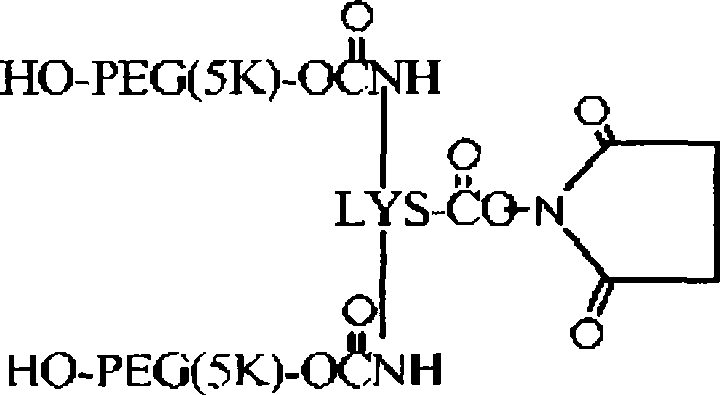
将基于赖氨酸的苄氧基-PEG2(10KDa)-酸N-羟基琥珀酰亚胺酯(27.0g,0.00270摩尔)溶解于无水甲醇(500ml)中,并加入在活性炭上的Pd(OH)2(2.7g,20%Pd;56%癸烷)。在45psi氢气下于室温将混合物氢化过夜。然后在减压下蒸馏出溶剂,并在真空下干燥产物,得到24.6g白色固体。Lysine-based benzyloxy-PEG2(10KDa)-acid N-hydroxysuccinimide ester (27.0 g, 0.00270 mol) was dissolved in anhydrous methanol (500 ml) and added to Pd(OH) on charcoal ) 2 (2.7 g, 20% Pd; 56% decane). The mixture was hydrogenated overnight at room temperature under 45 psi of hydrogen. The solvent was then distilled off under reduced pressure, and the product was dried under vacuum to obtain 24.6 g of a white solid.
NMR(d6-DMSO):1.35ppm(bm,-CH-(CH 2 )3-CH2-NH-,赖氨酸,6H),2.81ppm(s,-CH2CH2-,琥珀酰亚胺,4H),2.92ppm(q,-CH 2 -NH-,赖氨酸,2H),3.51ppm(s,聚合物骨架),3.95ppm(m,-CH-COOH,赖氨酸,1H),4.02ppm(m,-OCH2-CH 2 -O-(C=O)NH-,4H),4.36ppm(m,-CH-COO-,赖氨酸,1H),4.57ppm(t,-OH,2H),6.75ppm(t,-CH2 NH(C=O)-,赖氨酸,1H),7.21ppm(d,-CHNH(C=O)-,赖氨酸,1H)。NMR (d 6 -DMSO): 1.35ppm (bm, -CH-( CH 2 ) 3 -CH 2 -NH-, lysine, 6H), 2.81ppm (s, -CH 2 CH 2 -, succinyl Amine, 4H), 2.92ppm (q, -CH2 - NH-, lysine, 2H), 3.51ppm (s, polymer backbone), 3.95ppm (m, -CH -COOH, lysine, 1H) , 4.02ppm (m, -OCH 2 -CH 2 -O-(C=O)NH-, 4H), 4.36ppm (m, -CH -COO-, lysine, 1H), 4.57ppm (t, - OH, 2H), 6.75 ppm (t, -CH 2 NH (C=O)-, lysine, 1H), 7.21 ppm (d, -CH NH (C=O)-, lysine, 1H).
D.由基于赖氨酸的PEG2和1,4-二氨基丁烷制备4臂-PEGD. Preparation of 4arm-PEG from lysine-based PEG2 and 1,4-diaminobutane
将基于赖氨酸的HO-PEG2(10KDa)-酸N-羟基琥珀酰亚胺酯(20.0g,0.00200摩尔)在无水乙腈(200ml)中的溶液加至1,4-二氨基丁烷(0.083g,0.00188当量)和三乙胺(0.3ml)在无水乙腈(50ml)中的溶液,并在氩气氛下于室温搅拌混合物过夜。在减压下蒸馏出溶剂。在真空下干燥湿产物,得到18.8g白色固体。使产物溶解于去离子水中,并使过量的基于赖氨酸的HO-PEG2(10KDa)-酸N-羟基琥珀酰亚胺酯水解成基于赖氨酸的HO-PEG2(10KDa)-酸。然后使用DEAESepharose FF介质通过离子交换色谱法去除HO-PEG2(10KDa)-酸,得到15.7g纯的4臂-PEG(20KDa)。A solution of lysine-based HO-PEG2 (10 KDa)-acid N-hydroxysuccinimide ester (20.0 g, 0.00200 mol) in anhydrous acetonitrile (200 ml) was added to 1,4-diaminobutane ( 0.083 g, 0.00188 equiv) and triethylamine (0.3 ml) in anhydrous acetonitrile (50 ml), and the mixture was stirred overnight at room temperature under argon atmosphere. The solvent was distilled off under reduced pressure. The wet product was dried under vacuum to yield 18.8 g of a white solid. The product was dissolved in deionized water and excess lysine-based HO-PEG2(10KDa)-acid N-hydroxysuccinimide ester was hydrolyzed to lysine-based HO-PEG2(10KDa)-acid. The HO-PEG2 (10KDa)-acid was then removed by ion-exchange chromatography using DEAESepharose FF media to obtain 15.7 g of pure 4Arm-PEG (20KDa).
NMR(d6-DMSO):1.35-1.50ppm(bm,-CH-(CH 2 )3-CH2-NH-,赖氨酸,12H,和-NH-CH2-(CH 2 )2-CH2-NH-,4H),2.92ppm(q,-CH 2 -NH-,赖氨酸,4H),3.51ppm(s,聚合物骨架),3.95ppm(m,-CH-(C=O)NH-,赖氨酸,2H),4.02ppm(m,-OCH2-CH 2 -O-(C=O)NH-,8H),4.57ppm(t,-OH,4H),6.75ppm(t,-CH2 NH(C=O)-,赖氨酸,2H),7.21ppm(d,-CHNH(C=O)-,赖氨酸,2H),7.60ppm(t,-CH2 NH(C=O)-,1,4-二氨基丁烷,2H)。NMR (d 6 -DMSO): 1.35-1.50 ppm (bm, -CH-( CH 2 ) 3 -CH 2 -NH-, lysine, 12H, and -NH-CH 2 -( CH 2 ) 2 -CH 2 -NH-, 4H), 2.92ppm (q, -CH2 - NH-, lysine, 4H), 3.51ppm (s, polymer backbone), 3.95ppm (m, -CH- (C=O) NH-, lysine, 2H), 4.02ppm (m, -OCH 2 -CH 2 -O-(C=O)NH-, 8H), 4.57ppm (t, -OH, 4H), 6.75ppm (t , -CH 2 NH (C=O)-, lysine, 2H), 7.21ppm (d, -CH NH (C=O)-, lysine, 2H), 7.60ppm (t, -CH 2 NH (C=O)-, 1,4-diaminobutane, 2H).
实施例6.基于Lys-Gly-Lys的4臂-PEG(20KDa)Example 6. Lys-Gly-Lys-based 4-arm-PEG (20KDa)
A.基于Lys-Gly-Lys的3臂-苄氧基-PEG(15KDa)-酸A. Lys-Gly-Lys-based 3arm-benzyloxy-PEG(15KDa)-acid

将Lys-Gly-Lys二盐酸盐(1.0g,0.00227摩尔)溶解于100ml0.1M硼酸盐缓冲液中,并用0.1M NaOH调节pH至8.5。在30分钟内将BnO-PEG(5KDa)-BTC(Nektar Therapeutics,38.0g,0.00760摩尔)加至所得的溶液中,并通过加入0.1M NaOH使pH保持在8.5。搅拌所得的溶液3小时后,加入NaCl(10g),并用10%磷酸调节pH至3.0。用二氯甲烷萃取产物,并用MgSO4干燥萃取液。然后在减压下蒸馏出溶剂。在真空下干燥湿产物,收获35.5g为白色固体的产物。HPLC分析显示产物:3臂-苄氧基-PEG(15KDa)-酸(MW约15KDa)纯度为91.1%,且被高分子量副产物(2.4wt%)和低分子量副产物(6.5wt%)污染。Lys-Gly-Lys dihydrochloride (1.0 g, 0.00227 mol) was dissolved in 100 ml of 0.1 M borate buffer and the pH was adjusted to 8.5 with 0.1 M NaOH. BnO-PEG(5KDa)-BTC (Nektar Therapeutics, 38.0 g, 0.00760 mol) was added to the resulting solution within 30 minutes, and the pH was maintained at 8.5 by adding 0.1 M NaOH. After stirring the resulting solution for 3 hours, NaCl (10 g) was added and the pH was adjusted to 3.0 with 10% phosphoric acid. The product was extracted with dichloromethane, and the extract was dried over MgSO4 . The solvent was then distilled off under reduced pressure. The wet product was dried under vacuum yielding 35.5 g of product as a white solid. HPLC analysis showed the product: 3arm-benzyloxy-PEG (15KDa)-acid (MW about 15KDa) was 91.1% pure and was contaminated with high molecular weight by-products (2.4 wt%) and low molecular weight by-products (6.5 wt%) .
使用DEAE Sepharose FF介质通过离子交换色谱法来纯化产物,得到27.1g100%纯度的基于Lys-Gly-Lys的3臂-苄氧基-PEG(15KDa)-酸。The product was purified by ion exchange chromatography using DEAE Sepharose FF medium to afford 27.1 g of Lys-Gly-Lys based 3arm-benzyloxy-PEG(15KDa)-acid in 100% purity.
NMR(d6-DMSO):1.35ppm(bm,-CH-(CH 2 )3-CH2-NH-,赖氨酸,12H),2.92ppm(q,-CH2-NH-,赖氨酸,4H),3.51ppm(s,聚合物骨架),3.95ppm(m,-CH-COOH,赖氨酸,1H),4.02ppm(m,-OCH2-CH 2 -O-(C=O)NH-,6H),4.49ppm(s,-CH2-,苄基,6H),7.32ppm(m,苄基的芳族质子,15H)。NMR (d 6 -DMSO): 1.35ppm (bm, -CH-( CH 2 ) 3 -CH 2 -NH-, lysine, 12H), 2.92ppm (q, -CH 2 -NH-, lysine , 4H), 3.51ppm (s, polymer backbone), 3.95ppm (m, -CH -COOH, lysine, 1H), 4.02ppm (m, -OCH 2 -CH 2 -O-(C=O) NH-, 6H), 4.49 ppm (s, -CH2- , benzyl, 6H), 7.32 ppm (m, aromatic proton of benzyl, 15H).
B.基干Lys-Gly-Lys的4臂-苄氧基-PEG(20KDa)-酸NHS酯B. 4-arm-benzyloxy-PEG(20KDa)-acid NHS ester of Lys-Gly-Lys

将N-羟基琥珀酰亚胺(0.202g,0.00175摩尔)和N,N′-二环己基碳二亚胺(0.379g,0.00184摩尔)加至基于Lys-Gly-Lys的3臂-苄氧基-PEG(15KDa)-酸(25.0g,0.00167摩尔)在无水二氯甲烷(250ml)中的溶液,并在氩气氛下于室温搅拌混合物过夜。在减压下蒸馏出溶剂。将产物溶解于40ml二氯甲烷中,并用600ml异丙醇沉淀,干燥后得到22.6g白色固体。N-Hydroxysuccinimide (0.202 g, 0.00175 moles) and N,N'-dicyclohexylcarbodiimide (0.379 g, 0.00184 moles) were added to a Lys-Gly-Lys based 3-arm-benzyloxy - A solution of PEG (15 KDa)-acid (25.0 g, 0.00167 mol) in anhydrous dichloromethane (250 ml), and the mixture was stirred overnight at room temperature under an atmosphere of argon. The solvent was distilled off under reduced pressure. The product was dissolved in 40 ml of dichloromethane and precipitated with 600 ml of isopropanol to give 22.6 g of a white solid after drying.
NMR(d6-DMSO):1.35ppm(bm,-CH-(CH 2 )3-CH2-NH-,赖氨酸,12H),2.81ppm(s,-CH2CH2-,琥珀酰亚胺,4H),2.92ppm(q,-CH 2 -NH-,赖氨酸,4H),3.51ppm(s,聚合物骨架),4.02ppm(m,-OCH2-CH 2 -O-(C=O)NH-,6H),4.36ppm(m,-CH-COO-,赖氨酸,1H),4.49ppm(s,-CH2-,苄基,6H),7.32ppm(m,苄基的芳族质子,15H)。NMR (d 6 -DMSO): 1.35ppm (bm, -CH-( CH 2 ) 3 -CH 2 -NH-, lysine, 12H), 2.81ppm (s, -CH 2 CH 2 -, succinyl amine, 4H), 2.92ppm (q, -CH 2 -NH-, lysine, 4H), 3.51ppm (s, polymer backbone), 4.02ppm (m, -OCH 2 -CH 2 -O-(C =O)NH-, 6H), 4.36ppm (m, -CH -COO-, lysine, 1H ), 4.49ppm (s, -CH2-, benzyl, 6H), 7.32ppm (m, benzyl aromatic protons, 15H).
C.基于Lys-Gly-Lys的4臂-苄氧基-PEG(20KDa)C. Lys-Gly-Lys-based 4-arm-benzyloxy-PEG (20KDa)
将三乙胺(0.37ml)加至基于Lys-Gly-Lys的4臂-苄氧基-PEG(20KDa)-酸NHS酯(20.0g,0.00133摩尔)在无水二氯甲烷(200ml)中的溶液,然后加入BnO-PEG(5K)-胺(Nektar Therapeutics,7.5g,0.00150摩尔),并在氩气氛下于室温搅拌混合物过夜。在减压下蒸馏出溶剂,得到27.5g白色固体产物。使产物溶解于去离子水,并使用DEAE Sepharose介质通过离子交换色谱法来去除过量的BnO-PEG(5K)-胺,得到21.7g纯的基于Lys-Gly-Lys的4臂-苄氧基-PEG(20KDa)。Triethylamine (0.37ml) was added to Lys-Gly-Lys based 4arm-benzyloxy-PEG (20KDa)-acid NHS ester (20.0g, 0.00133mol) in anhydrous dichloromethane (200ml) solution, then BnO-PEG(5K)-amine (Nektar Therapeutics, 7.5 g, 0.00150 mol) was added, and the mixture was stirred overnight at room temperature under an argon atmosphere. The solvent was distilled off under reduced pressure to obtain 27.5 g of a white solid product. The product was dissolved in deionized water and excess BnO-PEG(5K)-amine was removed by ion-exchange chromatography using DEAE Sepharose media to obtain 21.7 g of pure Lys-Gly-Lys-based 4-arm-benzyloxy- PEG (20KDa).
NMR(d6-DMSO):1.35ppm(bm,-CH-(CH 2 )3-CH2-NH-,赖氨酸,12H),2.92ppm(bm,-CH 2 -NH-,赖氨酸和CH 2 -NH-,PEG,6H),3.51ppm(s,聚合物骨架),3.95ppm(m,-CH-(C=O)NH-,赖氨酸,1H),4.02ppm(m,-OCH2-CH 2 -O-(C=O)NH-,6H),4.49ppm(s,-CH2-,苄基,8H),7.32ppm(m,苄基的芳族质子,20H)。NMR (d 6 -DMSO): 1.35ppm (bm, -CH-( CH 2 ) 3 -CH 2 -NH-, lysine, 12H), 2.92ppm (bm, -CH 2 -NH-, lysine and CH 2 -NH-, PEG, 6H), 3.51ppm (s, polymer backbone), 3.95ppm (m, -CH- (C=O)NH-, lysine, 1H), 4.02ppm (m, -OCH2 - CH2 - O-(C=O)NH-, 6H), 4.49ppm (s, -CH2- , benzyl, 8H), 7.32ppm (m, aromatic proton of benzyl, 20H) .
D.基于Lys-Gly-Lys的4臂-羟基-PEG(20KDa)D. Lys-Gly-Lys-based 4-arm-hydroxy-PEG (20KDa)
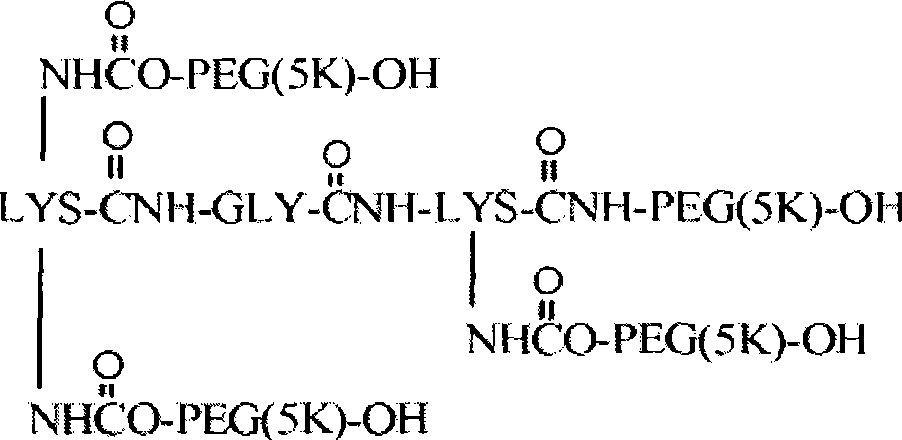
将基于Lys-Gly-Lys的4臂-苄氧基-PEG(20KDa)(20.0g,0.00100摩尔)溶解于无水甲醇(200ml)中,并加入在活性炭上的Pd(OH)2(1.0g,20%Pd;56%癸烷)。在45psi氢气下于室温将混合物氢化过夜。然后在减压下蒸馏出溶剂,并在真空下干燥产物,得到18.2g白色固体。Lys-Gly-Lys based 4arm-benzyloxy-PEG (20 KDa) (20.0 g, 0.00100 mol) was dissolved in anhydrous methanol (200 ml) and Pd (OH) on charcoal (1.0 g , 20% Pd; 56% decane). The mixture was hydrogenated overnight at room temperature under 45 psi of hydrogen. The solvent was then distilled off under reduced pressure, and the product was dried under vacuum to obtain 18.2 g of a white solid.
NMR(d6-DMSO):1.35ppm(bm,-CH-(CH 2 )3-CH2-NH-,赖氨酸,12H),2.92ppm(bm,-CH 2 -NH-,赖氨酸和CH 2 -NH-,PEG,6H),3.51ppm(s,聚合物骨架),3.95ppm(m,-CH-(C=O)NH-,赖氨酸,1H),4.02ppm(m,-OCH2-CH 2 -O-(C=O)NH-,6H),4.57ppm(t,-OH,4H)。NMR (d 6 -DMSO): 1.35ppm (bm, -CH-( CH 2 ) 3 -CH 2 -NH-, lysine, 12H), 2.92ppm (bm, -CH 2 -NH-, lysine and CH 2 -NH-, PEG, 6H), 3.51ppm (s, polymer backbone), 3.95ppm (m, -CH- (C=O)NH-, lysine, 1H), 4.02ppm (m, -OCH 2 -CH 2 -O-(C=O)NH-, 6H), 4.57 ppm (t, -OH, 4H).
Claims (6)
Priority Applications (1)
| Application Number | Priority Date | Filing Date | Title |
|---|---|---|---|
| CN201210547772.8A CN103030801B (en) | 2006-02-21 | 2007-02-21 | Segmented degradable polymers and conjugates made therefrom |
Applications Claiming Priority (3)
| Application Number | Priority Date | Filing Date | Title |
|---|---|---|---|
| US77550706P | 2006-02-21 | 2006-02-21 | |
| US60/775,507 | 2006-02-21 | ||
| PCT/US2007/062488 WO2007098466A2 (en) | 2006-02-21 | 2007-02-21 | Segmented degradable polymers and conjugates made therefrom |
Related Child Applications (1)
| Application Number | Title | Priority Date | Filing Date |
|---|---|---|---|
| CN201210547772.8A Division CN103030801B (en) | 2006-02-21 | 2007-02-21 | Segmented degradable polymers and conjugates made therefrom |
Publications (2)
| Publication Number | Publication Date |
|---|---|
| CN101420984A CN101420984A (en) | 2009-04-29 |
| CN101420984B true CN101420984B (en) | 2013-01-02 |
Family
ID=38198209
Family Applications (2)
| Application Number | Title | Priority Date | Filing Date |
|---|---|---|---|
| CN2007800134860A Active CN101420984B (en) | 2006-02-21 | 2007-02-21 | Block degradable polymer and conjugate prepared therefrom |
| CN201210547772.8A Active CN103030801B (en) | 2006-02-21 | 2007-02-21 | Segmented degradable polymers and conjugates made therefrom |
Family Applications After (1)
| Application Number | Title | Priority Date | Filing Date |
|---|---|---|---|
| CN201210547772.8A Active CN103030801B (en) | 2006-02-21 | 2007-02-21 | Segmented degradable polymers and conjugates made therefrom |
Country Status (9)
| Country | Link |
|---|---|
| US (2) | US8309680B2 (en) |
| EP (2) | EP1986695B1 (en) |
| JP (1) | JP5312050B2 (en) |
| KR (1) | KR101513732B1 (en) |
| CN (2) | CN101420984B (en) |
| AU (1) | AU2007216998B8 (en) |
| CA (1) | CA2642905C (en) |
| MX (1) | MX2008010841A (en) |
| WO (1) | WO2007098466A2 (en) |
Families Citing this family (108)
| Publication number | Priority date | Publication date | Assignee | Title |
|---|---|---|---|---|
| CN101420984B (en) | 2006-02-21 | 2013-01-02 | 尼克塔治疗公司 | Block degradable polymer and conjugate prepared therefrom |
| AU2007296190A1 (en) * | 2006-09-15 | 2008-03-20 | Enzon Pharmaceuticals, Inc. | Lysine-based polymeric linkers |
| US20090171455A1 (en) * | 2007-12-31 | 2009-07-02 | Boston Scientific Scimed, Inc. | Biodegradable polymers |
| US8637466B2 (en) | 2008-08-11 | 2014-01-28 | Nektar Therapeutics | Multi-arm polymeric alkanoate conjugates |
| EP2387421A1 (en) * | 2009-01-14 | 2011-11-23 | SKU Asset Management GmbH | Compounds comprising n-formyl-methionine residues and tumor-targeting peptides |
| US8722732B2 (en) | 2009-09-29 | 2014-05-13 | Nektar Therapeutics | Oligomer-calcimimetic conjugates and related compounds |
| EP2544701B1 (en) * | 2010-03-08 | 2019-08-14 | University of Utah Research Foundation | Polymeric drug delivery conjugates and methods of making and using thereof |
| EP2600901B1 (en) | 2010-08-06 | 2019-03-27 | ModernaTX, Inc. | A pharmaceutical formulation comprising engineered nucleic acids and medical use thereof |
| CN104531812A (en) | 2010-10-01 | 2015-04-22 | 现代治疗公司 | Engineered nucleic acids and methods of use thereof |
| WO2012083197A1 (en) | 2010-12-17 | 2012-06-21 | Nektar Therapeutics | Water-soluble polymer conjugates of topotecan |
| JP5899241B2 (en) | 2010-12-21 | 2016-04-06 | ネクター セラピューティクス | Multi-arm polymer prodrug conjugates of pemetrexed-based compounds |
| WO2012088422A1 (en) | 2010-12-22 | 2012-06-28 | Nektar Therapeutics | Multi-arm polymeric prodrug conjugates of taxane-based compounds |
| US10894087B2 (en) | 2010-12-22 | 2021-01-19 | Nektar Therapeutics | Multi-arm polymeric prodrug conjugates of cabazitaxel-based compounds |
| JP6009457B2 (en) | 2010-12-23 | 2016-10-19 | ネクター セラピューティクス | Polymer-desethylsunitinib conjugate |
| US9827326B2 (en) | 2010-12-23 | 2017-11-28 | Nektar Therapeutics | Polymer-sunitinib conjugates |
| US8440309B2 (en) * | 2011-01-31 | 2013-05-14 | Confluent Surgical, Inc. | Crosslinked polymers with the crosslinker as therapeutic for sustained release |
| US8710200B2 (en) | 2011-03-31 | 2014-04-29 | Moderna Therapeutics, Inc. | Engineered nucleic acids encoding a modified erythropoietin and their expression |
| WO2012166555A1 (en) | 2011-05-27 | 2012-12-06 | Nektar Therapeutics | Water - soluble polymer - linked binding moiety and drug compounds |
| US9464124B2 (en) | 2011-09-12 | 2016-10-11 | Moderna Therapeutics, Inc. | Engineered nucleic acids and methods of use thereof |
| BR112014007852B1 (en) | 2011-10-03 | 2021-11-03 | Moderna Therapeutics, Inc | MODIFIED ISOLATED POLYNUCLEOTIDE AND PHARMACEUTICAL COMPOSITION |
| PL2791160T3 (en) | 2011-12-16 | 2022-06-20 | Modernatx, Inc. | Modified mrna compositions |
| HK1206779A1 (en) | 2012-04-02 | 2016-01-15 | Modernatx, Inc. | Modified polynucleotides for the production of nuclear proteins |
| US9283287B2 (en) | 2012-04-02 | 2016-03-15 | Moderna Therapeutics, Inc. | Modified polynucleotides for the production of nuclear proteins |
| US9572897B2 (en) | 2012-04-02 | 2017-02-21 | Modernatx, Inc. | Modified polynucleotides for the production of cytoplasmic and cytoskeletal proteins |
| US10501512B2 (en) | 2012-04-02 | 2019-12-10 | Modernatx, Inc. | Modified polynucleotides |
| DK2922554T3 (en) | 2012-11-26 | 2022-05-23 | Modernatx Inc | Terminalt modificeret rna |
| EP2971010B1 (en) | 2013-03-14 | 2020-06-10 | ModernaTX, Inc. | Formulation and delivery of modified nucleoside, nucleotide, and nucleic acid compositions |
| US8980864B2 (en) | 2013-03-15 | 2015-03-17 | Moderna Therapeutics, Inc. | Compositions and methods of altering cholesterol levels |
| US20160194625A1 (en) | 2013-09-03 | 2016-07-07 | Moderna Therapeutics, Inc. | Chimeric polynucleotides |
| EP3041938A1 (en) | 2013-09-03 | 2016-07-13 | Moderna Therapeutics, Inc. | Circular polynucleotides |
| WO2015051214A1 (en) | 2013-10-03 | 2015-04-09 | Moderna Therapeutics, Inc. | Polynucleotides encoding low density lipoprotein receptor |
| AU2015289583A1 (en) | 2014-07-16 | 2017-02-02 | Modernatx, Inc. | Chimeric polynucleotides |
| WO2016014846A1 (en) | 2014-07-23 | 2016-01-28 | Moderna Therapeutics, Inc. | Modified polynucleotides for the production of intrabodies |
| CN104861176B (en) * | 2015-04-14 | 2018-08-24 | 青岛中科润唐新材料科技有限公司 | A kind of preparation method of degradable polyurethane hydrogel |
| CN105288646A (en) * | 2015-10-09 | 2016-02-03 | 东南大学 | Photosensitizer phospholipid compound as well as pharmaceutical composition and application of photosensitizer phospholipid compound |
| WO2017070623A1 (en) | 2015-10-22 | 2017-04-27 | Modernatx, Inc. | Herpes simplex virus vaccine |
| EP4349404A3 (en) | 2015-10-22 | 2024-06-19 | ModernaTX, Inc. | Respiratory virus vaccines |
| MX2018004917A (en) | 2015-10-22 | 2019-04-01 | Modernatx Inc | Respiratory syncytial virus vaccine. |
| WO2017070620A2 (en) | 2015-10-22 | 2017-04-27 | Modernatx, Inc. | Broad spectrum influenza virus vaccine |
| MA46316A (en) | 2015-10-22 | 2021-03-24 | Modernatx Inc | HUMAN CYTOMEGALOVIRUS VACCINE |
| MA46080A (en) | 2015-10-22 | 2019-07-10 | Modernatx Inc | NUCLEIC ACID VACCINES AGAINST VARICELLA ZONA VIRUS (VZV) |
| CN105348157B (en) * | 2015-12-18 | 2018-01-16 | 苏州大学 | Cystamine diisocyanate monomer, polymer based on the monomer and its preparation method and application |
| SI3394093T1 (en) | 2015-12-23 | 2022-05-31 | Modernatx, Inc. | Methods of using ox40 ligand encoding polynucleotides |
| US20190241658A1 (en) | 2016-01-10 | 2019-08-08 | Modernatx, Inc. | Therapeutic mRNAs encoding anti CTLA-4 antibodies |
| CN107469407B (en) * | 2016-06-14 | 2019-11-08 | 青岛大学 | Anti-protein adsorption capillary column and preparation method thereof |
| WO2018181048A1 (en) * | 2017-03-30 | 2018-10-04 | 日油株式会社 | Degradable polyethylene glycol derivative having disulfide linker |
| US11421011B2 (en) | 2017-05-18 | 2022-08-23 | Modernatx, Inc. | Polynucleotides encoding tethered interleukin-12 (IL12) polypeptides and uses thereof |
| WO2018213789A1 (en) | 2017-05-18 | 2018-11-22 | Modernatx, Inc. | Modified messenger rna comprising functional rna elements |
| US20200268666A1 (en) | 2017-06-14 | 2020-08-27 | Modernatx, Inc. | Polynucleotides encoding coagulation factor viii |
| EP3714045A1 (en) | 2017-11-22 | 2020-09-30 | Modernatx, Inc. | Polynucleotides encoding propionyl-coa carboxylase alpha and beta subunits for the treatment of propionic acidemia |
| JP7423522B2 (en) | 2017-11-22 | 2024-01-29 | モダーナティエックス・インコーポレイテッド | Polynucleotide encoding ornithine transcarbamylase for the treatment of urea cycle disorders |
| US11939601B2 (en) | 2017-11-22 | 2024-03-26 | Modernatx, Inc. | Polynucleotides encoding phenylalanine hydroxylase for the treatment of phenylketonuria |
| CN107880271B (en) * | 2017-12-27 | 2020-11-03 | 闽江学院 | A kind of acid-base reversible cross-linking silicone resin and preparation method and application thereof |
| MA51523A (en) | 2018-01-05 | 2020-11-11 | Modernatx Inc | POLYNUCLEOTIDES CODING ANTI-BODY ANTI-CHIKUNGUNYA VIRUS |
| KR102668424B1 (en) | 2018-03-29 | 2024-05-23 | 니치유 가부시키가이샤 | Degradable polyethylene glycol derivatives |
| JP7249591B2 (en) | 2018-03-29 | 2023-03-31 | 日油株式会社 | Degradable polyethylene glycol conjugate |
| US20210163928A1 (en) | 2018-04-11 | 2021-06-03 | Modernatx, Inc. | Messenger rna comprising functional rna elements |
| EP3796893A1 (en) | 2018-05-23 | 2021-03-31 | Modernatx, Inc. | Delivery of dna |
| US20220184185A1 (en) | 2018-07-25 | 2022-06-16 | Modernatx, Inc. | Mrna based enzyme replacement therapy combined with a pharmacological chaperone for the treatment of lysosomal storage disorders |
| WO2020047201A1 (en) | 2018-09-02 | 2020-03-05 | Modernatx, Inc. | Polynucleotides encoding very long-chain acyl-coa dehydrogenase for the treatment of very long-chain acyl-coa dehydrogenase deficiency |
| US20220054610A1 (en) | 2018-09-12 | 2022-02-24 | University Of Florida Research Foundation, Inc. | Slow-cycling cell-rna based nanoparticle vaccine to treat cancer |
| MA53608A (en) | 2018-09-13 | 2021-07-21 | Modernatx Inc | POLYNUCLEOTIDES ENCODED FOR THE E1-ALPHA, E1-BETA AND E2 SUBUNITS OF THE BRANCHED-CHAIN ALPHA-KETOACID DEHYDROGENASE COMPLEX FOR THE TREATMENT OF LEUCINOSIS |
| MX2021003015A (en) | 2018-09-13 | 2021-07-15 | Modernatx Inc | Polynucleotides encoding glucose-6-phosphatase for the treatment of glycogen storage disease. |
| EP3850102A1 (en) | 2018-09-14 | 2021-07-21 | ModernaTX, Inc. | Polynucleotides encoding uridine diphosphate glycosyltransferase 1 family, polypeptide a1 for the treatment of crigler-najjar syndrome |
| US20220152225A1 (en) | 2018-09-27 | 2022-05-19 | Modernatx, Inc. | Polynucleotides encoding arginase 1 for the treatment of arginase deficiency |
| US20220001026A1 (en) | 2018-11-08 | 2022-01-06 | Modernatx, Inc. | Use of mrna encoding ox40l to treat cancer in human patients |
| CA3135346A1 (en) | 2019-03-29 | 2020-10-08 | Nof Corporation | Branched and degradable polyethylene glycol derivative |
| CN113646323A (en) | 2019-03-29 | 2021-11-12 | 日油株式会社 | Branched degradable polyethylene glycol conjugate |
| EP3965806A1 (en) | 2019-05-08 | 2022-03-16 | Modernatx, Inc. | Polynucleotides encoding methylmalonyl-coa mutase for the treatment of methylmalonic acidemia |
| US20220226438A1 (en) | 2019-05-08 | 2022-07-21 | Astrazeneca Ab | Compositions for skin and wounds and methods of use thereof |
| MA56517A (en) | 2019-06-24 | 2022-04-27 | Modernatx Inc | MESSENGER RNA COMPRISING FUNCTIONAL RNA ELEMENTS AND THEIR USES |
| MA56539A (en) | 2019-06-24 | 2022-04-27 | Modernatx Inc | ENDONUCLEASE RESISTANT MESSENGER RNA AND USES THEREOF |
| US12403199B2 (en) | 2019-09-26 | 2025-09-02 | Nof Corporation | Asymmetrically branched degradable polyethylene glycol derivative |
| US12404367B2 (en) | 2019-09-26 | 2025-09-02 | Nof Corporation | Degradable multi-arm polyethylene glycol derivative |
| JP2023527875A (en) | 2020-06-01 | 2023-06-30 | モダーナティエックス・インコーポレイテッド | Phenylalanine hydroxylase variants and uses thereof |
| US20230272378A1 (en) | 2020-06-12 | 2023-08-31 | University Of Rochester | ENCODING AND EXPRESSION OF ACE-tRNAs |
| US12161777B2 (en) | 2020-07-02 | 2024-12-10 | Davol Inc. | Flowable hemostatic suspension |
| US11739166B2 (en) | 2020-07-02 | 2023-08-29 | Davol Inc. | Reactive polysaccharide-based hemostatic agent |
| IL302625A (en) | 2020-11-13 | 2023-07-01 | Modernatx Inc | Cystic fibrosis-encoding polynucleotides transmembrane conductance regulator for the treatment of cystic fibrosis |
| US12151045B2 (en) | 2020-12-28 | 2024-11-26 | Davol Inc. | Reactive dry powdered hemostatic materials comprising a protein and a multifunctionalized modified polyethylene glycol based crosslinking agent |
| US11524023B2 (en) | 2021-02-19 | 2022-12-13 | Modernatx, Inc. | Lipid nanoparticle compositions and methods of formulating the same |
| US20240207444A1 (en) | 2021-03-24 | 2024-06-27 | Modernatx, Inc. | Lipid nanoparticles containing polynucleotides encoding phenylalanine hydroxylase and uses thereof |
| WO2022204371A1 (en) | 2021-03-24 | 2022-09-29 | Modernatx, Inc. | Lipid nanoparticles containing polynucleotides encoding glucose-6-phosphatase and uses thereof |
| WO2022204369A1 (en) | 2021-03-24 | 2022-09-29 | Modernatx, Inc. | Polynucleotides encoding methylmalonyl-coa mutase for the treatment of methylmalonic acidemia |
| WO2022204380A1 (en) | 2021-03-24 | 2022-09-29 | Modernatx, Inc. | Lipid nanoparticles containing polynucleotides encoding propionyl-coa carboxylase alpha and beta subunits and uses thereof |
| JP2024512026A (en) | 2021-03-24 | 2024-03-18 | モデルナティエックス インコーポレイテッド | Lipid nanoparticles and polynucleotide encoding ornithine transcarbamylase for the treatment of ornithine transcarbamylase deficiency |
| US20240384277A1 (en) | 2021-06-15 | 2024-11-21 | Modernatx, Inc. | Engineered polynucleotides for cell-type or microenvironment-specific expression |
| WO2022271776A1 (en) | 2021-06-22 | 2022-12-29 | Modernatx, Inc. | Polynucleotides encoding uridine diphosphate glycosyltransferase 1 family, polypeptide a1 for the treatment of crigler-najjar syndrome |
| US20250017867A1 (en) | 2021-10-01 | 2025-01-16 | Modernatx, Inc. | Polynucleotides encoding relaxin for the treatment of fibrosis and/or cardiovascular disease |
| US20250134919A1 (en) | 2022-02-07 | 2025-05-01 | University Of Rochester | OPTIMIZED SEQUENCES FOR ENHANCED tRNA EXPRESSION OR/AND NONSENSE MUTATION SUPPRESSION |
| JP2025508467A (en) | 2022-02-24 | 2025-03-26 | アイオー バイオテック エーピーエス | Nucleotide Delivery for Cancer Therapy |
| WO2023177904A1 (en) | 2022-03-18 | 2023-09-21 | Modernatx, Inc. | Sterile filtration of lipid nanoparticles and filtration analysis thereof for biological applications |
| WO2023183909A2 (en) | 2022-03-25 | 2023-09-28 | Modernatx, Inc. | Polynucleotides encoding fanconi anemia, complementation group proteins for the treatment of fanconi anemia |
| WO2023196399A1 (en) | 2022-04-06 | 2023-10-12 | Modernatx, Inc. | Lipid nanoparticles and polynucleotides encoding argininosuccinate lyase for the treatment of argininosuccinic aciduria |
| WO2023215498A2 (en) | 2022-05-05 | 2023-11-09 | Modernatx, Inc. | Compositions and methods for cd28 antagonism |
| WO2024026254A1 (en) | 2022-07-26 | 2024-02-01 | Modernatx, Inc. | Engineered polynucleotides for temporal control of expression |
| EP4577519A1 (en) | 2022-08-23 | 2025-07-02 | ModernaTX, Inc. | Methods for purification of ionizable lipids |
| WO2024097639A1 (en) | 2022-10-31 | 2024-05-10 | Modernatx, Inc. | Hsa-binding antibodies and binding proteins and uses thereof |
| WO2024118866A1 (en) | 2022-12-01 | 2024-06-06 | Modernatx, Inc. | Gpc3-specific antibodies, binding domains, and related proteins and uses thereof |
| WO2024197033A1 (en) | 2023-03-21 | 2024-09-26 | Modernatx, Inc. | Polynucleotides encoding relaxin for the treatment of heart failure |
| AU2024265267A1 (en) | 2023-05-03 | 2025-11-20 | Modernatx, Inc. | Polynucleotides encoding cystic fibrosis transmembrane conductance regulator for the treatment of cystic fibrosis |
| JP7784786B2 (en) * | 2023-07-26 | 2025-12-12 | トモイケ バイオ リミテッド | Branched multi-hydroxyl-protected oligomer, a linker bonded thereto, and a branched multi-hydroxyl-protected oligomer obtained by deprotecting the linker |
| EP4520345A1 (en) | 2023-09-06 | 2025-03-12 | Myneo Nv | Product |
| WO2025072482A1 (en) | 2023-09-27 | 2025-04-03 | Modernatx, Inc. | Immunoglobulin a protease polypeptides, polynucleotides, and uses thereof |
| WO2025101685A1 (en) | 2023-11-09 | 2025-05-15 | University Of Rochester | Suppression of nonsense mutations using anticodon engineered (ace)-trnas |
| WO2025128916A1 (en) * | 2023-12-13 | 2025-06-19 | Cellanome, Inc. | Devices and methods for analyzing biological samples |
| WO2025255199A1 (en) | 2024-06-05 | 2025-12-11 | Modernatx, Inc. | Argininosuccinate synthase 1 and argininosuccinate lyase polypeptides and polynucleotides and uses thereof |
| CN120965983A (en) * | 2025-10-20 | 2025-11-18 | 华东理工大学 | Photo-crosslinking bio-based degradable polymer and preparation method thereof |
Citations (1)
| Publication number | Priority date | Publication date | Assignee | Title |
|---|---|---|---|---|
| WO2001085180A1 (en) * | 2000-05-11 | 2001-11-15 | Wm. Marsh Rice University | Biocompatible macromers |
Family Cites Families (46)
| Publication number | Priority date | Publication date | Assignee | Title |
|---|---|---|---|---|
| US4179337A (en) | 1973-07-20 | 1979-12-18 | Davis Frank F | Non-immunogenic polypeptides |
| DE3675588D1 (en) | 1985-06-19 | 1990-12-20 | Ajinomoto Kk | HAEMOGLOBIN TIED TO A POLY (ALKENYLENE OXIDE). |
| US4766106A (en) | 1985-06-26 | 1988-08-23 | Cetus Corporation | Solubilization of proteins for pharmaceutical compositions using polymer conjugation |
| US5080891A (en) | 1987-08-03 | 1992-01-14 | Ddi Pharmaceuticals, Inc. | Conjugates of superoxide dismutase coupled to high molecular weight polyalkylene glycols |
| US5286637A (en) | 1989-08-07 | 1994-02-15 | Debiopharm, S.A. | Biologically active drug polymer derivatives and method for preparing same |
| US5372807A (en) | 1990-05-14 | 1994-12-13 | University Of Medicine And Dentistry Of New Jersey | Polymers containing antifibrotic agents, compositions containing such polymers, and methods of preparation and use |
| US5252714A (en) | 1990-11-28 | 1993-10-12 | The University Of Alabama In Huntsville | Preparation and use of polyethylene glycol propionaldehyde |
| US5281698A (en) | 1991-07-23 | 1994-01-25 | Cetus Oncology Corporation | Preparation of an activated polymer ester for protein conjugation |
| JP2589435B2 (en) * | 1991-09-17 | 1997-03-12 | 株式会社ディ・ディ・エス研究所 | Sugar-modified polylysine derivative |
| ZA933926B (en) | 1992-06-17 | 1994-01-03 | Amgen Inc | Polyoxymethylene-oxyethylene copolymers in conjuction with blomolecules |
| US5464933A (en) * | 1993-06-07 | 1995-11-07 | Duke University | Synthetic peptide inhibitors of HIV transmission |
| US5840900A (en) | 1993-10-20 | 1998-11-24 | Enzon, Inc. | High molecular weight polymer-based prodrugs |
| US5446090A (en) | 1993-11-12 | 1995-08-29 | Shearwater Polymers, Inc. | Isolatable, water soluble, and hydrolytically stable active sulfones of poly(ethylene glycol) and related polymers for modification of surfaces and molecules |
| US5629384A (en) | 1994-05-17 | 1997-05-13 | Consiglio Nazionale Delle Ricerche | Polymers of N-acryloylmorpholine activated at one end and conjugates with bioactive materials and surfaces |
| US5730990A (en) | 1994-06-24 | 1998-03-24 | Enzon, Inc. | Non-antigenic amine derived polymers and polymer conjugates |
| US5650234A (en) | 1994-09-09 | 1997-07-22 | Surface Engineering Technologies, Division Of Innerdyne, Inc. | Electrophilic polyethylene oxides for the modification of polysaccharides, polypeptides (proteins) and surfaces |
| US5824784A (en) | 1994-10-12 | 1998-10-20 | Amgen Inc. | N-terminally chemically modified protein compositions and methods |
| US5738846A (en) | 1994-11-10 | 1998-04-14 | Enzon, Inc. | Interferon polymer conjugates and process for preparing the same |
| US5932462A (en) | 1995-01-10 | 1999-08-03 | Shearwater Polymers, Inc. | Multiarmed, monofunctional, polymer for coupling to molecules and surfaces |
| CA2220339C (en) | 1995-05-10 | 2009-10-13 | Kyowa Hakko Kogyo Co., Ltd. | Toxin conjugates having a spacer comprising polyalkylene glycol and peptide |
| US5672662A (en) | 1995-07-07 | 1997-09-30 | Shearwater Polymers, Inc. | Poly(ethylene glycol) and related polymers monosubstituted with propionic or butanoic acids and functional derivatives thereof for biotechnical applications |
| US6214966B1 (en) | 1996-09-26 | 2001-04-10 | Shearwater Corporation | Soluble, degradable poly(ethylene glycol) derivatives for controllable release of bound molecules into solution |
| US6258351B1 (en) | 1996-11-06 | 2001-07-10 | Shearwater Corporation | Delivery of poly(ethylene glycol)-modified molecules from degradable hydrogels |
| US20050158273A1 (en) | 1997-09-25 | 2005-07-21 | Harris J. M. | Soluble, degradable polyethylene glycol) derivatives for controllable release of bound molecules into solution |
| US6348558B1 (en) | 1999-12-10 | 2002-02-19 | Shearwater Corporation | Hydrolytically degradable polymers and hydrogels made therefrom |
| US7074878B1 (en) | 1999-12-10 | 2006-07-11 | Harris J Milton | Hydrolytically degradable polymers and hydrogels made therefrom |
| US6413507B1 (en) | 1999-12-23 | 2002-07-02 | Shearwater Corporation | Hydrolytically degradable carbamate derivatives of poly (ethylene glycol) |
| US6756037B2 (en) * | 2000-03-31 | 2004-06-29 | Enzon, Inc. | Polymer conjugates of biologically active agents and extension moieties for facilitating conjugation of biologically active agents to polymeric terminal groups |
| US7053150B2 (en) | 2000-12-18 | 2006-05-30 | Nektar Therapeutics Al, Corporation | Segmented polymers and their conjugates |
| TW593427B (en) * | 2000-12-18 | 2004-06-21 | Nektar Therapeutics Al Corp | Synthesis of high molecular weight non-peptidic polymer derivatives |
| TWI246524B (en) | 2001-01-19 | 2006-01-01 | Shearwater Corp | Multi-arm block copolymers as drug delivery vehicles |
| CA2452923C (en) * | 2001-07-10 | 2012-02-07 | Amersham Health As | Peptide-based compounds for targeting integrin receptors |
| JP4123856B2 (en) | 2001-07-31 | 2008-07-23 | 日油株式会社 | Bio-related substance modifier and method for producing polyoxyalkylene derivative |
| CN1176137C (en) | 2002-01-15 | 2004-11-17 | 泛亚生物技术有限公司 | Multi-arm fork type functional polyethylene glycol preparation method and its application in medicine |
| EP1476489B8 (en) | 2002-02-15 | 2008-10-08 | Nektar Therapeutics Al, Corporation | Hydrolytically degradable alkylene oxide based polymers |
| US7376902B2 (en) * | 2002-10-25 | 2008-05-20 | Sap Ag | User interface for alerts |
| ATE444984T1 (en) | 2002-12-31 | 2009-10-15 | Nektar Therapeutics Al Corp | HYDROLYSIS-STABLE POLYMERS CONTAINING MALEIMIDE END GROUPS |
| KR101177340B1 (en) * | 2003-01-06 | 2012-08-30 | 넥타르 테라퓨틱스 | Thiol-selective water-soluble polymer derivatives |
| NZ542094A (en) * | 2003-03-14 | 2008-12-24 | Neose Technologies Inc | Branched polymer conjugates comprising a peptide and water-soluble polymer chains |
| SE525080C2 (en) | 2003-03-21 | 2004-11-23 | Perstorp Specialty Chem Ab | Process for preparing an allyl ether |
| HUE043911T2 (en) * | 2003-05-23 | 2019-09-30 | Nektar Therapeutics | PEG derivatives containing two PEG chains |
| ES2341960T3 (en) | 2003-07-22 | 2010-06-30 | Nektar Therapeutics | PROCEDURES FOR PREPARING FUNCTIONALIZED POLYMERS FROM POLYMERIC ALCOHOLS. |
| AU2005222641B2 (en) | 2004-03-15 | 2011-04-07 | Nektar Therapeutics | Polymer-based compositions and conjugates of HIV entry inhibitors |
| KR101330338B1 (en) * | 2004-07-16 | 2013-11-15 | 넥타르 테라퓨틱스 | Conjugates of a gm-csf moiety and a polymer |
| WO2007011802A1 (en) | 2005-07-18 | 2007-01-25 | Nektar Therapeutics Al, Corporation | Method for preparing branched functionalized polymers using branched polyol cores |
| CN101420984B (en) | 2006-02-21 | 2013-01-02 | 尼克塔治疗公司 | Block degradable polymer and conjugate prepared therefrom |
-
2007
- 2007-02-21 CN CN2007800134860A patent/CN101420984B/en active Active
- 2007-02-21 EP EP07757267.5A patent/EP1986695B1/en active Active
- 2007-02-21 JP JP2008556522A patent/JP5312050B2/en active Active
- 2007-02-21 KR KR1020087022874A patent/KR101513732B1/en not_active Expired - Fee Related
- 2007-02-21 WO PCT/US2007/062488 patent/WO2007098466A2/en not_active Ceased
- 2007-02-21 MX MX2008010841A patent/MX2008010841A/en active IP Right Grant
- 2007-02-21 EP EP10193376.0A patent/EP2319542B1/en active Active
- 2007-02-21 CA CA2642905A patent/CA2642905C/en active Active
- 2007-02-21 CN CN201210547772.8A patent/CN103030801B/en active Active
- 2007-02-21 AU AU2007216998A patent/AU2007216998B8/en active Active
- 2007-02-21 US US12/224,201 patent/US8309680B2/en active Active
-
2012
- 2012-11-12 US US13/674,854 patent/US8835599B2/en active Active
Patent Citations (1)
| Publication number | Priority date | Publication date | Assignee | Title |
|---|---|---|---|---|
| WO2001085180A1 (en) * | 2000-05-11 | 2001-11-15 | Wm. Marsh Rice University | Biocompatible macromers |
Also Published As
| Publication number | Publication date |
|---|---|
| WO2007098466A2 (en) | 2007-08-30 |
| CA2642905C (en) | 2015-04-28 |
| JP2009527581A (en) | 2009-07-30 |
| EP2319542B1 (en) | 2018-03-21 |
| KR101513732B1 (en) | 2015-04-21 |
| WO2007098466A3 (en) | 2008-09-04 |
| EP1986695A2 (en) | 2008-11-05 |
| US8835599B2 (en) | 2014-09-16 |
| US8309680B2 (en) | 2012-11-13 |
| CN101420984A (en) | 2009-04-29 |
| AU2007216998A1 (en) | 2007-08-30 |
| AU2007216998A8 (en) | 2013-12-19 |
| AU2007216998B8 (en) | 2013-12-19 |
| CA2642905A1 (en) | 2007-08-30 |
| US20100010158A1 (en) | 2010-01-14 |
| US20130072709A1 (en) | 2013-03-21 |
| EP2319542A2 (en) | 2011-05-11 |
| EP2319542A3 (en) | 2011-08-03 |
| EP1986695B1 (en) | 2015-06-03 |
| JP5312050B2 (en) | 2013-10-09 |
| KR20080094961A (en) | 2008-10-27 |
| CN103030801A (en) | 2013-04-10 |
| AU2007216998B2 (en) | 2013-11-07 |
| CN103030801B (en) | 2015-07-22 |
| MX2008010841A (en) | 2008-10-27 |
Similar Documents
| Publication | Publication Date | Title |
|---|---|---|
| CN101420984B (en) | Block degradable polymer and conjugate prepared therefrom | |
| CN101835496B (en) | The multiarm polymers of hydroxyapatite-targeting and the conjugate by its manufacture | |
| US6461603B2 (en) | Water-soluble polymer conjugates of artelinic acid | |
| US8183338B2 (en) | Sterically hindered poly(ethylene glycol) alkanoic acids and derivatives thereof |
Legal Events
| Date | Code | Title | Description |
|---|---|---|---|
| C06 | Publication | ||
| PB01 | Publication | ||
| C10 | Entry into substantive examination | ||
| SE01 | Entry into force of request for substantive examination | ||
| C14 | Grant of patent or utility model | ||
| GR01 | Patent grant |