WO2018181048A1 - Degradable polyethylene glycol derivative having disulfide linker - Google Patents
Degradable polyethylene glycol derivative having disulfide linker Download PDFInfo
- Publication number
- WO2018181048A1 WO2018181048A1 PCT/JP2018/011859 JP2018011859W WO2018181048A1 WO 2018181048 A1 WO2018181048 A1 WO 2018181048A1 JP 2018011859 W JP2018011859 W JP 2018011859W WO 2018181048 A1 WO2018181048 A1 WO 2018181048A1
- Authority
- WO
- WIPO (PCT)
- Prior art keywords
- group
- formula
- polyethylene glycol
- glycol derivative
- represented
- Prior art date
- Legal status (The legal status is an assumption and is not a legal conclusion. Google has not performed a legal analysis and makes no representation as to the accuracy of the status listed.)
- Ceased
Links
- 0 CCC(CCCC(C)CC(**C(*)C1*C(C)C1)C1CCCC1)*C Chemical compound CCC(CCCC(C)CC(**C(*)C1*C(C)C1)C1CCCC1)*C 0.000 description 8
- JAPMJSVZDUYFKL-UHFFFAOYSA-N C1C2C1CCC2 Chemical compound C1C2C1CCC2 JAPMJSVZDUYFKL-UHFFFAOYSA-N 0.000 description 1
- GDOPTJXRTPNYNR-UHFFFAOYSA-N CC1CCCC1 Chemical compound CC1CCCC1 GDOPTJXRTPNYNR-UHFFFAOYSA-N 0.000 description 1
- DCEHVBLXWODXCW-UHFFFAOYSA-N CCC(C)C1CCCC1 Chemical compound CCC(C)C1CCCC1 DCEHVBLXWODXCW-UHFFFAOYSA-N 0.000 description 1
Images


Classifications
-
- C—CHEMISTRY; METALLURGY
- C08—ORGANIC MACROMOLECULAR COMPOUNDS; THEIR PREPARATION OR CHEMICAL WORKING-UP; COMPOSITIONS BASED THEREON
- C08G—MACROMOLECULAR COMPOUNDS OBTAINED OTHERWISE THAN BY REACTIONS ONLY INVOLVING UNSATURATED CARBON-TO-CARBON BONDS
- C08G75/00—Macromolecular compounds obtained by reactions forming a linkage containing sulfur with or without nitrogen, oxygen, or carbon in the main chain of the macromolecule
-
- C—CHEMISTRY; METALLURGY
- C08—ORGANIC MACROMOLECULAR COMPOUNDS; THEIR PREPARATION OR CHEMICAL WORKING-UP; COMPOSITIONS BASED THEREON
- C08G—MACROMOLECULAR COMPOUNDS OBTAINED OTHERWISE THAN BY REACTIONS ONLY INVOLVING UNSATURATED CARBON-TO-CARBON BONDS
- C08G65/00—Macromolecular compounds obtained by reactions forming an ether link in the main chain of the macromolecule
- C08G65/02—Macromolecular compounds obtained by reactions forming an ether link in the main chain of the macromolecule from cyclic ethers by opening of the heterocyclic ring
- C08G65/32—Polymers modified by chemical after-treatment
- C08G65/329—Polymers modified by chemical after-treatment with organic compounds
- C08G65/334—Polymers modified by chemical after-treatment with organic compounds containing sulfur
-
- C—CHEMISTRY; METALLURGY
- C08—ORGANIC MACROMOLECULAR COMPOUNDS; THEIR PREPARATION OR CHEMICAL WORKING-UP; COMPOSITIONS BASED THEREON
- C08G—MACROMOLECULAR COMPOUNDS OBTAINED OTHERWISE THAN BY REACTIONS ONLY INVOLVING UNSATURATED CARBON-TO-CARBON BONDS
- C08G65/00—Macromolecular compounds obtained by reactions forming an ether link in the main chain of the macromolecule
- C08G65/02—Macromolecular compounds obtained by reactions forming an ether link in the main chain of the macromolecule from cyclic ethers by opening of the heterocyclic ring
- C08G65/26—Macromolecular compounds obtained by reactions forming an ether link in the main chain of the macromolecule from cyclic ethers by opening of the heterocyclic ring from cyclic ethers and other compounds
- C08G65/2636—Macromolecular compounds obtained by reactions forming an ether link in the main chain of the macromolecule from cyclic ethers by opening of the heterocyclic ring from cyclic ethers and other compounds the other compounds containing sulfur
-
- C—CHEMISTRY; METALLURGY
- C08—ORGANIC MACROMOLECULAR COMPOUNDS; THEIR PREPARATION OR CHEMICAL WORKING-UP; COMPOSITIONS BASED THEREON
- C08G—MACROMOLECULAR COMPOUNDS OBTAINED OTHERWISE THAN BY REACTIONS ONLY INVOLVING UNSATURATED CARBON-TO-CARBON BONDS
- C08G65/00—Macromolecular compounds obtained by reactions forming an ether link in the main chain of the macromolecule
- C08G65/02—Macromolecular compounds obtained by reactions forming an ether link in the main chain of the macromolecule from cyclic ethers by opening of the heterocyclic ring
- C08G65/32—Polymers modified by chemical after-treatment
- C08G65/329—Polymers modified by chemical after-treatment with organic compounds
- C08G65/334—Polymers modified by chemical after-treatment with organic compounds containing sulfur
- C08G65/3342—Polymers modified by chemical after-treatment with organic compounds containing sulfur having sulfur bound to carbon and hydrogen
-
- C—CHEMISTRY; METALLURGY
- C08—ORGANIC MACROMOLECULAR COMPOUNDS; THEIR PREPARATION OR CHEMICAL WORKING-UP; COMPOSITIONS BASED THEREON
- C08G—MACROMOLECULAR COMPOUNDS OBTAINED OTHERWISE THAN BY REACTIONS ONLY INVOLVING UNSATURATED CARBON-TO-CARBON BONDS
- C08G75/00—Macromolecular compounds obtained by reactions forming a linkage containing sulfur with or without nitrogen, oxygen, or carbon in the main chain of the macromolecule
- C08G75/14—Polysulfides
Definitions
- the present invention relates to a degradable polyethylene glycol derivative in which polyethylene glycol chains are linked by a disulfide linker that can be decomposed in a reducing environment, and are divided into low molecular weight polyethylene glycol chains that can be more effectively cleared from the living body in vivo.
- the polyethylene glycol derivatives described herein are used for chemical modification of bioactive molecules such as bioactive proteins, peptides, antibodies, nucleic acids and small molecule drugs, and drug carriers such as liposomes and polymer micelles.
- polyethylene glycol having a large molecular weight is long due to insufficient clearance from the living body. May remain in the body for a period of time.
- An approach to split into glycol chains has been performed. Many of the strategies use the environment in the living body such as the pH in the living body and the action of degrading enzymes for the degradation of the linker, and one of them is a technique that uses the reducing environment in the cell.
- Patent Document 1 discloses a plurality of polyethylene glycol derivatives in which two polyethylene glycol chains are bonded via a linker containing a disulfide bond as shown in the following chemical formula.
- a disulfide bond is decomposed in a living body and a polyethylene glycol chain is divided into two low molecular weight polyethylene glycol chains.
- no evaluation data on the decomposition rate of the disulfide bond is shown, and there is no description about the relationship between the structure around the disulfide bond and the decomposition rate.
- polyethylene glycol derivatives in which polyethylene glycol chains are linked by a disulfide linker capable of reductive degradation
- polyethylene glycol in which the degradation rate of the disulfide linker, that is, the separation rate of the polyethylene glycol chain is precisely controlled There are no examples of derivatives so far.
- the reducing environment in the living body is controlled by the concentration of glutathione, which is a tripeptide composed of glutamic acid, cysteine, and glycine.
- the glutathione concentration varies depending on the site in the living body, and is present in cells, particularly in the liver, kidney, lens, erythrocytes, and leukocytes, at a relatively high concentration of 0.5 to 10 mm, while the extracellular concentration is several ⁇ to several tens. ⁇ M. Since the disulfide bond is reduced and cleaved by the thiol group of glutathione, the decomposition rate of the disulfide bond is greatly influenced by the glutathione concentration.
- biodegradability is further improved while demonstrating the conventional advantages of polyethylene glycol modification such as water solubility, increased bioavailability, and prolonged circulation time in blood.
- polyethylene glycol modification such as water solubility, increased bioavailability, and prolonged circulation time in blood.
- it is necessary to precisely control the degradability in these different reducing environments.
- the problem of the present invention is that the polyethylene glycol chain is linked by a disulfide linker capable of precisely controlling the degradation rate in different reducing environments in the living body, and the rate of splitting into low molecular weight polyethylene glycol chains in the living body is accurately controlled. It is to provide a possible degradable polyethylene glycol derivative.
- the present inventor has linked polyethylene glycol chains with disulfide linkers capable of accurately controlling the degradation rate in different reducing environments in the living body.
- the feature of the present invention is that a plurality of polyethylene glycol chains are bonded via a disulfide linker having a substituent.
- a disulfide linker having a substituent By appropriately selecting substituents on adjacent carbons of the disulfide bond, the degree of steric hindrance around the disulfide bond that affects the degradation rate of the disulfide linker can be adjusted. Due to this feature, it is possible to impart a desired degradation rate to the disulfide linker.
- the drug or the like to which the degradable polyethylene glycol derivative is bound is transported to the target tissue or cell and exhibits its medicinal effects, Under the reducing environment of the site, the polyethylene glycol chain can be divided into low molecular weight polyethylene glycol chains at an arbitrary rate.
- X 1 is an active ester group, active carbonate group, aldehyde group, isocyanate group, isothiocyanate group, epoxy group, maleimide group, vinyl sulfone group, acrylic group, sulfonyloxy group, carboxy group, thiol group, dithiopyridyl group , ⁇ -haloacetyl group, alkynyl group, allyl group, vinyl group, amino group, oxyamino group, hydrazide group, and azide group, the degradable polyethylene glycol according to any one of [1] to [10] Derivative.
- Z 1 , Z 2 and Z 3 are each independently an ether bond, an ester bond, a carbonate bond, a urethane bond, an amide bond, a secondary amino group or an alkylene group containing these, a single bond or an alkylene group.
- Degradable polyethylene glycol derivatives according to any one of [1] to [11].
- X 2 is an active ester group, active carbonate group, aldehyde group, isocyanate group, isothiocyanate group, epoxy group, maleimide group, vinyl sulfone group, acrylic group, sulfonyloxy group, carboxy group, thiol group, dithiopyridyl group , ⁇ -haloacetyl group, alkynyl group, allyl group, vinyl group, amino group, oxyamino group, hydrazide group, methoxy group and azide group, [5], [7] or [8] Degradable polyethylene glycol derivative.
- the degradable polyethylene glycol derivative having a disulfide linker according to the present invention can adjust the degradation rate of the linker under different reducing environments in vivo. Therefore, after the drug or the like to which the degradable polyethylene glycol derivative is bound is transported to the target tissue or cell to express its medicinal effect, the polyethylene glycol chain is lowered at an arbitrary rate in the reducing environment of each site. It can be split into molecular weight polyethylene glycol chains. As a result, it is possible to fundamentally eliminate the problem that polyethylene glycol having a large molecular weight, which has been a disadvantage of conventional polyethylene glycol modification, remains in the body for a long time due to insufficient clearance from the living body.
- the degradable polyethylene glycol derivative for chemical modification of drugs, the advantages of polyethylene glycol modification such as water solubility, increased bioavailability and prolongation of blood circulation time can be used.
- the advantage that polyethylene glycol is excellent in the clearance from the living body can be provided.
- Glutathione has a reduced form (GSH) and an oxidized form (GSSG).
- the oxidized form is a molecule in which two molecules of reduced glutathione are connected by a disulfide bond.
- glutathione refers to reduced glutathione (GSH).
- the degradable polyethylene glycol derivative having a disulfide linker of the present invention has a glutathione concentration in order to achieve both an increase in blood circulation time when used for chemical modification of drugs and the like and clearance from the living body. It is preferably stable in low blood and rapidly degraded in cells with a high glutathione concentration.
- the degradation half-life (t 1/2 ) in a buffer solution at 37 ° C. is 1 hour or more, preferably 24 hours or more, more preferably 48 hours or more
- the degradation half-life (t 1/2 ) at 10 mM glutathione assuming a reducing environment is within 6 months, more preferably within 3 months, and even more preferably within 1 month.
- the degradable polyethylene glycol derivative having a disulfide linker of the present invention can appropriately control the decomposition rate by controlling the degree of steric hindrance by selecting a hydrocarbon group to be introduced into carbon adjacent to the disulfide bond. It is known that the degree of steric hindrance is greater for a straight-chain hydrocarbon group as the number of carbon atoms increases, such as a methyl group, an ethyl group, and a propyl group. It is known that a hydrogen group has a larger steric hindrance.
- R 1 , R 2 , R 3 and R 4 in the formula (1) of the present invention are each independently a hydrogen atom or a hydrocarbon group having 1 to 6 carbon atoms, but they are not all hydrogen atoms.
- the degree of steric hindrance can be controlled by the carbon chain length of R 1 , R 2 , R 3 , and R 4 , the presence or absence of branching, and the combination of these selections.
- hydrocarbon group having 1 to 6 carbon atoms examples include methyl group, ethyl group, propyl group, isopropyl group, butyl group, isobutyl group, sec-butyl group, t-butyl group, pentyl group, isopentyl group, neopentyl group, t -Pentyl group, 1,2-dimethylpropyl group, hexyl group, 2-methylpentyl group, 3-methylpentyl group, 2,2-dimethylbutyl group, 2,3-dimethylbutyl group, cyclohexyl group are preferable, Are a methyl group, an ethyl group, and a propyl group.
- the sum of the carbon numbers of R 1 , R 2 , R 3 and R 4 is 1 to 24, preferably 1 to 12, and more preferably 1 to 6.
- X 1 in the formula (1) of the present invention is present in biologically active proteins, peptides, antibodies, nucleic acids and low-molecular-weight drugs that are subject to chemical modification, and drug carriers such as liposomes and polymer micelles.
- Any functional group that reacts with a functional group to form a covalent bond is not particularly limited. For example, “Harris, J. M. Poly (Ethylene Glycol ) Chemistry; Plenum Press: New York, 1992 ", "Hermanson, G. T.
- Preferred examples of X 1 include active ester group, active carbonate group, aldehyde group, isocyanate group, isothiocyanate group, epoxy group, maleimide group, vinyl sulfone group, acrylic group, sulfonyloxy group, carboxy group, thiol group, A dithiopyridyl group, an ⁇ -haloacetyl group, an alkynyl group, an allyl group, a vinyl group, an amino group, an oxyamino group, a hydrazide group and an azide group.
- the functional group capable of reacting with an amino group of a biofunctional molecule to form a covalent bond includes an active ester group, an active carbonate group, an aldehyde group, an isocyanate group, an isothiocyanate group, an epoxy group.
- a maleimide group, a vinylsulfone group, an acrylic group, a sulfonyloxy group, or a carboxy group, and a functional group that can react with a thiol group of a biofunctional molecule to form a covalent bond includes an active ester group, an active carbonate group Group, aldehyde group, isocyanate group, isothiocyanate group, epoxy group, maleimide group, vinyl sulfone group, acrylic group, sulfonyloxy group, carboxy group, thiol group, dithiopyridyl group, ⁇ -haloacetyl group, alkynyl group, allyl group or It is a vinyl group and is an aldehyde group or carboxyl group of a biofunctional molecule.
- Functional groups that can react with a boxy group to form a covalent bond are a thiol group, an amino group, an oxyamino group, or a hydrazide group, and react with an alkynyl group of a biofunctional molecule to form a covalent bond.
- Possible functional groups are thiol groups, amino groups, azide groups, and functional groups capable of reacting with azide groups of biofunctional molecules to form covalent bonds are alkynyl groups.
- active ester represents an activated carboxy group represented by the formula: —C ( ⁇ O) —L, and L represents a leaving group.
- Examples of the leaving group represented by L include succinimidyloxy, phthalimidyloxy, 4-nitrophenoxy, 1-imidazolyl, pentafluorophenoxy, benzotriazol-1-yloxy and 7-aza. And benzotriazol-1-yloxy group.
- Activated carbonate refers to an activated carbonate group represented by the formula: —O—C ( ⁇ O) —L, and L represents a leaving group as described above.
- X 1 is a group represented by group (I), group (II), group (III), group (IV) or group (V).
- Group (I) Functional group capable of reacting with an amino group of a biofunctional molecule to form a covalent bond
- Group (II) Functional group capable of reacting with a thiol group of a biofunctional molecule to form a covalent bond
- Group (III) Functional group capable of reacting with an aldehyde group or carboxy group of a biofunctional molecule to form a covalent bond (g), (k), (l) and (m) below
- Group (IV) Functional group capable of reacting with an alkynyl group of a biofunctional molecule to form a covalent bond
- R 5 is a hydrogen atom or a sulfo group, and specific examples of the sulfo group include sodium sulfonate and potassium sulfonate, with a hydrogen atom being preferred.
- R 6 and R 9 are a hydrogen atom or a hydrocarbon group having 1 to 5 carbon atoms. Specific hydrocarbon groups include methyl, ethyl, propyl, isopropyl, butyl, t-butyl and pentyl. Group and the like.
- R 7 is a hydrocarbon group having 1 to 10 carbon atoms which may contain a halogen atom.
- hydrocarbon groups include methyl, ethyl, propyl, isopropyl, butyl, t-butyl, pentyl Group, isopentyl group, hexyl group, benzyl group, 4-methylphenyl group, trifluoromethyl group, 2,2,2-trifluoroethyl group, 4- (trifluoromethoxy) phenyl group, vinyl group, chloroethyl group, bromoethyl Group, iodoethyl group, and the like, and a methyl group, vinyl group, 4-methylphenyl group, or 2,2,2-trifluoroethyl group is preferable.
- R 8 is a halogen atom selected from the group consisting of a chlorine atom, a bromine atom and an iodine atom.
- Z 1 and Z 2 in the formula (1) of the present invention are divalent spacers between the disulfide linker and the polyethylene glycol chain, and Z 3 is a divalent spacer between X 1 and the polyethylene glycol chain. is there.
- These are constituted by covalent bonds, and are not particularly limited as long as they are more stable than disulfide bonds, but preferably ether bonds, ester bonds, carbonate bonds, urethane bonds, amide bonds, secondary amino groups or alkylene groups containing these, A single bond or an alkylene group.
- the alkylene group preferably has 1 to 24 carbon atoms.
- preferred examples of the alkylene group include structures such as (z1).
- Preferable examples of the alkylene group having an ether bond include structures such as (z2) or (z3).
- Preferable examples of the alkylene group having an ester bond include a structure such as (z4).
- a preferred example of the alkylene group having a carbonate bond is a structure such as (z5).
- Preferable examples of the alkylene group having a urethane bond include structures such as (z6).
- a preferred example of the alkylene group having an amide bond is a structure such as (z7).
- Preferable examples of the alkylene group having a secondary amino group include a structure such as (z8).
- p and q are independently integers from 1 to 12.
- Z 1 , Z 2 or Z 3 is an ether bond, an ester bond, a carbonate bond, a urethane bond, an amide bond, a secondary amino group or an alkylene group containing these, and a plurality of the same structural units are The number of structural units in the case of bonding is 2 or less.
- P 1 in the formula (1) of the present invention is a linear or branched polyethylene glycol chain having 3 or more ethylene glycol units
- P 2 is a linear chain having 3 or more ethylene glycol units.
- the number of ethylene glycol units constituting P 1 and P 2 is more preferably 10 or more, and particularly preferably 20 or more. Further, the number of ethylene glycol units constituting P 1 and P 2 is more preferably 2000 or less, and particularly preferably 1000 or less.
- polyethylene glycol refers to both polyethylene glycol having a molecular weight distribution obtained by polymerization of ethylene oxide and monodisperse polyethylene glycol obtained by coupling single molecular weight oligoethylene glycols in a coupling reaction. means.
- a degradable polyethylene glycol derivative having w of 1 in formula (1) is provided.
- P 1 in the formula (1) is a linear polyethylene glycol chain having a methoxy group or a chemically reactive functional group at the terminal.
- P 1 is a linear polyethylene glycol chain having a chemically reactive functional group or a methoxy group.
- n is the number of repeating units per polyethylene glycol chain, and for polyethylene glycol chains having a molecular weight distribution, various theoretical calculations are performed based on the number average molecular weight (Mn) of the compound. It is defined as calculating by
- X 2 is a chemically reactive functional group or methoxy group different from X 1
- Z 4 is a divalent spacer between the functional group X 2 and the polyethylene glycol chain. Since the degradable polyethylene glycol derivative has two different chemically reactive functional groups, X 1 and X 2 , for example, a drug is bound to X 1 and X 2 has a biological function with targeting By attaching molecules, a polyethylene glycol-drug conjugate with targeting performance can be provided.
- Preferred examples of X 2 include active ester group, active carbonate group, aldehyde group, isocyanate group, isothiocyanate group, epoxy group, maleimide group, vinyl sulfone group, acrylic group, sulfonyloxy group, carboxy group, thiol group, And dithiopyridyl group, ⁇ -haloacetyl group, alkynyl group, allyl group, vinyl group, amino group, oxyamino group, hydrazide group, azide group and methoxy group.
- the functional group capable of reacting with an amino group of a biofunctional molecule to form a covalent bond includes an active ester group, an active carbonate group, an aldehyde group, an isocyanate group, an isothiocyanate group, an epoxy group.
- a maleimide group, a vinylsulfone group, an acrylic group, a sulfonyloxy group, or a carboxy group, and a functional group that can react with a thiol group of a biofunctional molecule to form a covalent bond includes an active ester group, an active carbonate group Group, aldehyde group, isocyanate group, isothiocyanate group, epoxy group, maleimide group, vinyl sulfone group, acrylic group, sulfonyloxy group, carboxy group, thiol group, dithiopyridyl group, ⁇ -haloacetyl group, alkynyl group, allyl group or It is a vinyl group and is an aldehyde group or carboxyl group of a biofunctional molecule.
- Functional groups that can react with a boxy group to form a covalent bond are a thiol group, an amino group, an oxyamino group, or a hydrazide group, and react with an alkynyl group of a biofunctional molecule to form a covalent bond.
- Possible functional groups are thiol groups or azide groups and functional groups capable of reacting with azide groups of biofunctional molecules to form covalent bonds are alkynyl groups.
- X 2 is a group represented by group (I), group (II), group (III), group (IV) or group (V).
- Group (I) Functional group capable of reacting with an amino group of a biofunctional molecule to form a covalent bond
- Group (II) Functional group capable of reacting with a thiol group of a biofunctional molecule to form a covalent bond
- Group (III) Functional group capable of reacting with an aldehyde group or carboxy group of a biofunctional molecule to form a covalent bond (g), (k), (l) and (m) below
- R 5 is a hydrogen atom or a sulfo group, and specific examples of the sulfo group include sodium sulfonate and potassium sulfonate, with a hydrogen atom being preferred.
- R 6 and R 9 are a hydrogen atom or a hydrocarbon group having 1 to 5 carbon atoms. Specific hydrocarbon groups include methyl, ethyl, propyl, isopropyl, butyl, t-butyl and pentyl. Group and the like.
- R 7 is a hydrocarbon group having 1 to 10 carbon atoms which may contain a halogen atom.
- hydrocarbon groups include methyl, ethyl, propyl, isopropyl, butyl, t-butyl, pentyl Group, isopentyl group, hexyl group, benzyl group, 4-methylphenyl group, trifluoromethyl group, 2,2,2-trifluoroethyl group, 4- (trifluoromethoxy) phenyl group, vinyl group, chloroethyl group, bromoethyl Group, iodoethyl group, and the like, and a methyl group, vinyl group, 4-methylphenyl group, or 2,2,2-trifluoroethyl group is preferable.
- R 8 is a halogen atom selected from the group consisting of a chlorine atom, a bromine atom and an iodine atom.
- X 2 is required to be different from the X 1, as preferred combinations of X 1 and X 2, when X 1 is active ester or active carbonate group, X 2 is a maleimide group, a vinylsulfone group, alpha -A group selected from a haloacetyl group, an alkynyl group and an azide group, and when X 1 is an aldehyde group, X 2 is a group selected from a maleimide group, a vinylsulfone group, an alkynyl group and an azide group; When 1 is a maleimide group, a vinyl sulfone group or an ⁇ -haloacetyl group, X 2 is a group selected from an active ester group, an active carbonate group, an alkynyl group, and an azide group, and X 1 is an alkynyl group or an azide group.
- X 2 is a group selected from a maleimide group, a vinyl sulfone group, an ⁇ -haloacetyl group, an active ester group, an active carbonate group, an amino group and an oxyamino group
- X 1 is an amino group or an oxyamino group
- X 2 is a group selected from an alkynyl group, an azide group, a thiol group and a carboxy group
- X 1 is a thiol group
- X 2 is It is a group selected from an amino group, an oxyamino group, an azide group and a carboxy group.
- X 1 is an active ester group or an active carbonate group
- X 2 is a group selected from a maleimide group, an ⁇ -haloacetyl group, an alkynyl group and an azide group
- X 1 is an aldehyde group
- X 2 is a group selected from a maleimide group, an ⁇ -haloacetyl group, an alkynyl group and an azide group
- X 1 is a maleimide group or an ⁇ -haloacetyl group
- X 2 is an active ester group, an active carbonate group, An alkynyl group or an azide group
- X 1 is an alkynyl group or an azide group
- X 2 is a maleimide group, an ⁇ -haloacetyl group, an active ester group, an active carbonate group, an amino group, and an oxyamino group a group selected from, when X 1 is an amino group or an an amino group or an
- Z 4 is composed of a covalent bond and is not particularly limited as long as it is more stable than a disulfide bond, but preferably an ether bond, an ester bond, a carbonate bond, a urethane bond, an amide bond, a secondary amino group or an alkylene group containing these, A single bond or an alkylene group.
- the alkylene group preferably has 1 to 24 carbon atoms.
- preferred examples of the alkylene group include structures such as (z1).
- Preferable examples of the alkylene group having an ether bond include structures such as (z2) or (z3).
- Preferable examples of the alkylene group having an ester bond include a structure such as (z4).
- a preferred example of the alkylene group having a carbonate bond is a structure such as (z5).
- Preferable examples of the alkylene group having a urethane bond include structures such as (z6).
- a preferred example of the alkylene group having an amide bond is a structure such as (z7).
- Preferable examples of the alkylene group having a secondary amino group include a structure such as (z8).
- p and q are independently integers from 1 to 12.
- the structural unit is a combination of a plurality of the same structural units Is less than or equal to 2.
- P 1 in the formula (1) is a branched polyethylene glycol chain having a methoxy group or a chemically reactive functional group at the terminal.
- P 1 is a branched polyethylene glycol chain having a methoxy group or a chemically reactive functional group at the terminal is represented by Formula (3).
- a is 0 or 2
- X 2 is a chemically reactive functional group or methoxy group different from X 1
- Z 4 is a divalent group between the functional group X 2 and the polyethylene glycol chain. It is a spacer.
- the polyethylene glycol derivative in which P 1 is represented by the formula (3) has one X 1 and two or four X 2 , for example, a drug is bound to X 1 and X 2 has a target directivity.
- a biofunctional molecule is bound, a drug complex having high target-directing performance can be provided.
- a biodegradable polyethylene glycol derivative having w of 2 to 8 in formula (1) is provided.
- P 1 in formula (1) is represented by formula (4).
- X 2 is the functional group capable of chemical reaction different from X 1
- Z 4 is the divalent spacer
- a is 0 or 2.
- polyethylene glycol derivatives P 1 is represented by the formula (4) may be coupled to two or four of X 1 and anticancer agent has one of X 2, for example, a gun in X 1 in ADC that target , if coupling antibodies to X 2, without increasing the point of attachment to the antibody, it is possible to improve the transportation efficiency of anti-cancer agents.
- P 1 in the formula (1) is a polyethylene glycol chain having 2 to 8 terminals, and all the terminals of the polyethylene glycol chain constituting P 1 are each with respect to Z 1 And w is equal to the number of terminals of the polyethylene glycol chain.
- P 1 in formula (1) is selected from the group consisting of formula (r), formula (s), formula (t), formula (u), and formula (v). .
- P 1 in formula (1) is selected from the group consisting of formula (r), formula (s), formula (t), formula (u), and formula (v).
- n is an integer of 3 to 2000, more preferably an integer of 20 to 1000, and still more preferably an integer of 40 to 500.
- formula (3), formula (4), formula (s), formula (t), formula (u) and formula (v) the preferred range of n is an integer of 3 to 1000, preferably 10 to An integer of 500, more preferably an integer of 20 to 250.
- P 2 in formula (1) is represented by formula (5).
- m is the number of repeating units per polyethylene glycol chain, and for polyethylene glycol chains having a molecular weight distribution, calculated by performing various theoretical calculations based on the number average molecular weight (Mn) of the compound. It is defined as to do.
- a preferable range of m in the formula (5) of the present invention is an integer of 3 to 2000, more preferably an integer of 20 to 1000, and still more preferably an integer of 40 to 500.
- a preferable range of m in the formula (5) is an integer of 3 to 1000, preferably an integer of 10 to 500, and more preferably an integer of 20 to 250.
- u is the number in which a structural unit consisting of a disulfide linker and P 2 is bonded in series.
- a preferable range of u is an integer of 1 to 10, preferably an integer of 1 to 5, and more preferably an integer of 1 or 2.
- Degradable polyethylene glycol derivative of the present invention can be synthesized by coupled to polyethylene glycol intermediate comprising a P 1, via a disulfide linker having a substituent, a polyethylene glycol intermediate comprising a P 2.
- the bond resulting from this linkage is determined by the combination of functional groups used in the reaction, and is an ether bond, ester bond, carbonate bond, urethane bond, amide contained in the divalent spacers Z 1 and Z 2.
- the synthesized biodegradable polyethylene glycol derivative chemically converts the terminal functional group as necessary.
- a conventionally known method can be used, but the disulfide group of the formula (1) and the bonds contained in the divalent spacers Z 1 , Z 2 , Z 3 and Z 4 are combined. The conditions that do not decompose must be selected appropriately.
- a disulfide linker compound for introducing a disulfide linker is bonded to a polyethylene glycol intermediate consisting of P 1 and then bonded to a polyethylene glycol intermediate consisting of P 2.
- it may be bonded to a polyethylene glycol intermediate consisting of P 2 and then bonded to a polyethylene glycol intermediate consisting of P 1 .
- Typical examples of synthesizing the biodegradable polyethylene glycol derivative include the following steps.
- the polyethylene glycol derivative having a disulfide bond of the present invention can be obtained by coupling polyethylene glycol derivatives having corresponding thiol groups to each other or by derivatizing appropriately from a linker having a disulfide bond.
- a method for appropriately derivatizing from a disulfide linker will be described, but the present invention is not limited thereto.
- R 1 , R 2 , R 3 and R 4 are each independently a hydrogen atom or a hydrocarbon group having 1 to 6 carbon atoms, but not all hydrogen atoms
- the disulfide linker of formula (6) is a compound of the following formula (7) having a hydroxyl group and a thiol group, which are chemically reactive functional groups, and a protic solvent such as water, methanol or ethanol, or acetonitrile, tetrahydrofuran, dimethyl It can be obtained by coupling with iodine or hydrogen peroxide in an aprotic solvent such as sulfoxide, dimethylformamide or dimethylacetamide, or in the absence of a solvent.
- aprotic solvent such as sulfoxide, dimethylformamide or dimethylacetamide
- a compound of the formula (6) in which the combination of R 1 , R 2 and R 3 , R 4 is different can be obtained by coupling another compound of the formula (7) in which the combination of R 1 and R 2 is different. I can do it.
- the obtained compound may be purified by a purification means such as extraction, recrystallization, adsorbent treatment, reprecipitation, column chromatography or supercritical extraction.
- R 1 and R 2 are each independently a hydrogen atom or a hydrocarbon group having 1 to 6 carbon atoms, but not all hydrogen atoms
- the hydroxy group and di (N-succinimidyl) carbonate of the compound of formula (6) are toluene, benzene, xylene, acetonitrile, ethyl acetate, diethyl ether, t-butyl methyl ether, tetrahydrofuran, chloroform, dichloromethane, dimethyl sulfoxide, dimethylformamide or Organic bases such as pyridine, triethylamine, N-methylmorpholine, t-butoxypotassium or hexamethyldisilazane sodium, or potassium carbonate, potassium hydroxide or sodium hydride in an aprotic solvent such as dimethylacetamide or in the absence of solvent By reacting in the presence of an inorganic base, a compound of formula (8) is obtained.
- the ratio of the organic base and inorganic base used is not particularly limited, but is preferably equimolar or more with respect to the functional group capable of chemically reacting with the compound of formula (6).
- An organic base may be used as a solvent.
- the obtained compound may be purified by the aforementioned purification means.
- a functional group other than a hydroxy group can also be used. Specific examples include hydroxyalkyl groups, amino groups, aminoalkyl groups, carboxy groups, and carboxyalkyl groups.
- the functional group may be protected with a protecting group that can be deprotected under reaction conditions in which the disulfide group does not decompose. Examples of protecting groups can be found in many common books, such as “Wuts, P. G. M .; Greene, T. W. Protective Groups in Organic Synthesis, 4th ed .; Wiley-Interscience: New York, 2007 ”.
- the functional group protected with a protecting group can be reprotected by deprotection using a reaction condition suitable for each protecting group, that is, a chemical reaction, thereby regenerating the original functional group. Therefore, in this specification, the functional group which is protected with a protecting group and can be deprotected by various reactions is included in the “chemically reactive functional group”. Specific types of protecting groups and typical deprotection conditions are described in the above-mentioned literature, and reaction conditions suitable for each protecting group are selected, and deprotection is performed before the reaction with the hydrophilic polymer intermediate. It can be carried out.
- the initiator is preferably an alcohol having a hydrocarbon group having 1 to 24 carbon atoms, and specifically includes methanol, ethanol, propanol, isopropanol, butanol, t-butanol, phenol and benzyl alcohol. Since the polyethylene glycol has a hydroxy group that is a chemically reactive functional group, it can also be used as it is for the reaction with a disulfide linker compound.
- the polyethylene glycol intermediate of formula (10) is obtained by converting the hydroxy group of polyethylene glycol of formula (9) into a functional group by a known method.
- the obtained compound may be purified by a purification means such as extraction, recrystallization, adsorbent treatment, reprecipitation, column chromatography or supercritical extraction.
- Other functional groups can be used as the chemically reactive functional group in the polyethylene glycol intermediate of formula (10).
- the chemically reactive functional group include an ether bond, an ester bond, and a carbonate bond in which the bond generated by the reaction of the polyethylene glycol intermediate and the disulfide linker compound is contained in the divalent spacer Z 1 of the formula (1).
- the compound of formula (12) is efficiently obtained by using equimolar or more of the polyethylene glycol intermediate of formula (10) with respect to the chemically reactive functional group of the disulfide linker compound of formula (8).
- the disulfide linker compound of (8) is used in excess relative to the polyethylene glycol intermediate of formula (10), the production ratio of the compound of formula (12) increases.
- the equivalent ratio of the disulfide linker compound of the formula (8) to the intermediate of the formula (10) polyethylene glycol is preferably 2 times or more, more preferably 10 times or more, still more preferably Is more than 100 times.
- the obtained compound may be purified by the aforementioned purification means.
- the polyethylene glycol intermediate consisting of P 2 has a functional group capable of chemically reacting at two ends of polyethylene glycol, and preferred examples of this functional group include: Active ester group, active carbonate group, aldehyde group, isocyanate group, isothiocyanate group, epoxy group, maleimide group, vinyl sulfone group, acrylic group, sulfonyloxy group, carboxy group, thiol group, dithiopyridyl group, ⁇ -haloacetyl group, Alkynyl group, allyl group, vinyl group, amino group, oxyamino group, hydrazide group, azide group and hydroxy group.
- the functional group capable of reacting with the amino group of the disulfide linker to form a covalent bond includes an active ester group, an active carbonate group, an aldehyde group, an isocyanate group, an isothiocyanate group, an epoxy group, and a maleimide group.
- vinyl sulfone group, acrylic group, sulfonyloxy group or carboxy group, which can react with the thiol group of the disulfide linker to form a covalent bond includes an active ester group, an active carbonate group, an aldehyde group , Isocyanate group, isothiocyanate group, epoxy group, maleimide group, vinyl sulfone group, acrylic group, sulfonyloxy group, carboxy group, thiol group, dithiopyridyl group, ⁇ -haloacetyl group, alkynyl group, allyl group or vinyl group
- a disulfide linker Functional groups that can react with a dehydride group or a carboxy group to form a covalent bond are a thiol group, an amino group, an oxyamino group, a hydrazide group, or a hydroxy group, and react with the alkynyl group of the disulfide linker to share it.
- the chemically reactive functional group in the polyethylene glycol intermediate composed of P 2 may be the same or different, and is preferably a combination of two different functional groups.
- the other when one is an active ester group or an active carbonate group, the other is a group selected from a maleimide group, a vinylsulfone group, an ⁇ -haloacetyl group, an alkynyl group, and an azide group.
- the other when one is an aldehyde group, the other is a group selected from a maleimide group, a vinylsulfone group, an alkynyl group and an azide group
- the other when one is a maleimide group, a vinylsulfone group or an ⁇ -haloacetyl group
- the other is a group selected from an active ester group, an active carbonate group, an alkynyl group, and an azide group.
- the other is a maleimide group, a vinylsulfone group, an ⁇ -haloacetyl group, Active ester group, active carbonate group, amino group, oxyamino group and hydro
- one is an amino group or an oxyamino group the other is an alkynyl group, an azide group, a thiol group, a hydroxy group or a carboxy group, and one is a thiol group or a hydroxy group
- the other is a group selected from an amino group, an oxyamino group, an azide group and a carboxy group.
- the other when one is an active ester group or an activated carbonate group, the other is a group selected from a maleimide group, an ⁇ -haloacetyl group, an alkynyl group and an azide group, and when one is an aldehyde group, One is a group selected from a maleimide group, an ⁇ -haloacetyl group, an alkynyl group and an azide group, and when one is a maleimide group or an ⁇ -haloacetyl group, the other is an active ester group, an active carbonate group, an alkynyl group, A group selected from an azide group, when one is an alkynyl group or an azide group, the other is a maleimide group, an ⁇ -haloacetyl group, an active ester group, an active carbonate group, an amino group, an oxyamino group, and a hydroxy group When one is an amino group or an oxyamino group, the other is an Kini
- a linear polyethylene glycol will be described using a compound of formula (13) having an amino group protected with a t-butoxycarbonyl group (Boc group) at one end and an amino group at the other end.
- Boc group t-butoxycarbonyl group
- a suitable example of polyethylene glycol having a combination of two different functional groups is described in, for example, NOF Corporation (Tokyo, Japan; see www.nof.co.jp/english: Catalog Ver. 15). It is not limited to them.
- reaction conditions for the reaction with polyethylene glycol intermediate comprising a polyethylene glycol intermediate with P 2 consisting of P 1, the polyethylene glycol intermediate comprising a chemical functional group capable of reacting and P 2 of polyethylene glycol intermediate comprising a P 1 It is determined by a combination of chemically reactive functional groups, and a conventionally known method can be used, but it is included in the disulfide group of formula (1) and the divalent spacers Z 1 , Z 2 and Z 3 It is necessary to appropriately select the conditions that do not break the bond.
- the compound obtained here may be purified by a purification means such as extraction, recrystallization, adsorbent treatment, reprecipitation, column chromatography or supercritical extraction.
- a purification means such as extraction, recrystallization, adsorbent treatment, reprecipitation, column chromatography or supercritical extraction.
- Terminal functional group conversion of a degradable polyethylene glycol derivative having a disulfide linker A compound of formula (14) is converted into a protic solvent such as water, methanol or ethanol, or acetonitrile, tetrahydrofuran, dimethyl sulfoxide, dimethylformamide or dimethylacetamide.
- a protic solvent such as water, methanol or ethanol, or acetonitrile, tetrahydrofuran, dimethyl sulfoxide, dimethylformamide or dimethylacetamide.
- the acid catalyst may be either an organic acid or an inorganic acid, and is not particularly limited, but specific examples include p-toluenesulfonic acid, p-toluenesulfonic acid pyridinium, and methanesulfonic acid.
- the ratio is not particularly limited, but is preferably equimolar or more with respect to the functional group capable of chemically reacting with the compound of formula (14).
- the obtained compound may be purified by the aforementioned purification means.
- amino group of the compound of formula (14-1) may be functionally converted by a known method.
- the obtained compound may be purified by the aforementioned purification means.
- JNM-ECP400 or JNM-ECA600 manufactured by JEOL Datum was used.
- a ⁇ 5 mm tube was used for the measurement, CDCl 3 was used as a deuterated solvent, and tetramethylsilane (TMS) was used as an internal standard substance.
- TMS tetramethylsilane
- a 0.1 M aqueous sodium thiosulfate solution was prepared, 100 g was added to the reaction solution and stirred, and it was visually confirmed that the color of iodine disappeared and became colorless. After adding 100 g of chloroform and stirring, the mixture was allowed to stand still and the upper layer was removed. The lower layer was washed twice with 100 g of ion-exchanged water, and then the lower layer was desolvated with an evaporator. Ethanol 100g was added to the concentrate and azeotropic dehydration was performed twice, and then nitrogen bubbling was performed to obtain a compound of formula (19).
- a 0.1 M aqueous sodium thiosulfate solution was prepared, 100 g was added to the reaction solution and stirred, and it was visually confirmed that the color of iodine disappeared and became colorless. After adding 100 g of chloroform and stirring, the mixture was allowed to stand still and the upper layer was removed. The lower layer was washed twice with 100 g of ion-exchanged water, and then the lower layer was desolvated with an evaporator. Ethanol 100g was added to the concentrate and azeotropic dehydration was performed twice, and then nitrogen bubbling was performed to obtain a compound of formula (20).
- a 0.1 M aqueous sodium thiosulfate solution was prepared, 100 g was added to the reaction solution and stirred, and it was visually confirmed that the color of iodine disappeared and became colorless. After adding 100 g of chloroform and stirring, the mixture was allowed to stand still and the upper layer was removed. The lower layer was washed twice with 100 g of ion-exchanged water, and then the lower layer was desolvated with an evaporator. Ethanol 100g was added to the concentrate and azeotropic dehydration was performed twice, followed by nitrogen bubbling. The concentrate was separated and purified by silica gel column chromatography to obtain the compound of formula (21).
- Example 4 After adding 0.500 g of the compound of formula (19), 5.00 g of chloroform, 0.498 g of pyridine, and 1.13 g of di (N-succinimidyl) carbonate to a three-necked 100 ml flask equipped with a thermometer, nitrogen blowing tube, stirrer, and condenser The mixture was stirred in a hot water bath at 40 ° C. for 24 hours. The reaction solution was filtered with 5A filter paper and washed 3 times with 5 g of ion exchange water. The chloroform layer was dehydrated with magnesium sulfate and filtered, and after removing the solvent with an evaporator, nitrogen bubbling was confirmed in a 70 ° C. hot water bath for 2 hours, and disappearance of the pyridine odor was confirmed to obtain a compound of formula (22).
- Example 5 After adding 0.500 g of the compound of formula (20), 5.00 g of chloroform, 0.445 g of pyridine, and 1.01 g of di (N-succinimidyl) carbonate to a 3-neck 100 ml flask equipped with a thermometer, nitrogen blowing tube, stirrer, and condenser The mixture was stirred for 2 hours in a 40 ° C. hot water bath and then washed 3 times with 5 g of ion-exchanged water. The chloroform layer was dehydrated and filtered with magnesium sulfate, and after removing the solvent with an evaporator, nitrogen bubbling was confirmed in a 70 ° C. hot water bath for 2 hours, and disappearance of the pyridine odor was confirmed to obtain a compound of formula (23).
- Example 6 After adding 0.500 g of the compound of formula (21), 5.00 g of chloroform, 056 g of pyridine, 1.27 g of di (N-succinimidyl) carbonate to a three-necked 100 ml flask equipped with a thermometer, nitrogen blowing tube, stirrer, and condenser, The mixture was stirred for 2 hours in a 40 ° C. water bath and then washed 3 times with 5 g of ion-exchanged water. The chloroform layer was dehydrated and filtered with magnesium sulfate, and after removing the solvent with an evaporator, nitrogen bubbling was confirmed in a 70 ° C. hot water bath for 2 hours, and disappearance of the pyridine odor was confirmed to obtain a compound of formula (24).
- Example 7 Add 50.0 mg of the compound of formula (22), 0.961 g of the compound of formula (25), and 3 g of chloroform to a 100 ml three-necked flask equipped with a thermometer, nitrogen blowing tube, and stirrer, and stir at room temperature for 1 hour. The solvent was removed and the crystallization with 6 g of ethyl acetate and 3 g of hexane was repeated three times. Then, the crystal was washed with 10 g of hexane and dried to obtain the compound of the formula (26).
- Example 8 Add 50.0 mg of the compound of formula (23), 0.912 g of the compound of formula (25) and 3 g of chloroform to a 100 ml three-necked flask equipped with a thermometer, nitrogen blowing tube, and stirrer, and stir at room temperature for 1 hour. The solvent was removed and the crystallization with 6 g of ethyl acetate and 3 g of hexane was repeated three times. Then, the crystal was washed with 10 g of hexane and dried to obtain the compound of the formula (27).
- Example 9 Add 50.0 mg of the compound of formula (24), 1.02 g of the compound of formula (25) and 3 g of chloroform to a 100 ml three-necked flask equipped with a thermometer, nitrogen blowing tube, and stirrer, and stir at room temperature for 1 hour. The solvent was removed and the crystallization with 6 g of ethyl acetate and 3 g of hexane was repeated three times. Then, the crystal was washed with 10 g of hexane and dried to obtain the compound of the formula (28).
- Example 10 In a 100 ml three-necked flask equipped with a thermometer, nitrogen blowing tube and stirrer, 0.0421 g of 2,2'-dithiodipropionic acid, 0.138 g of N-hydroxysuccinimide, 1.0 g of dehydrated DMF, 0.248 g of dicyclohexylcarbodiimide After stirring for 1 hour at room temperature, 2.00 g of the compound of formula (25) (raw material of Example 7) was added and further stirred for 1 hour at room temperature. The solvent was removed by an evaporator, and crystallization with 6 g of ethyl acetate and 3 g of hexane was repeated three times. Then, the crystal was washed with 10 g of hexane and dried to obtain a compound of the formula (29).
- Example 11 Add 2.74 g of the compound of formula (23), 1.0 g of the compound of formula (30) and 3 g of chloroform to a 100 ml three-necked flask equipped with a thermometer, nitrogen blowing tube, and stirrer, and stir at room temperature for 1 hour. The solvent was removed and the crystallization with 6 g of ethyl acetate and 3 g of hexane was repeated three times. Then, the crystal was washed with 10 g of hexane and dried to obtain the compound of formula (31).
- Example 12 Add 0.5 g of the compound of formula (31), 0.5 g of the compound of formula (32) and 3 g of chloroform to a 100 ml three-necked flask equipped with a thermometer, nitrogen blowing tube, and stirrer, and stir at room temperature for 1 hour. The solvent was removed and the crystallization with 6 g of ethyl acetate and 3 g of hexane was repeated three times. Then, the crystal was washed with 10 g of hexane and dried to obtain the compound of the formula (33).
- Example 13 Add 0.5 g of the compound of formula (33), 5 g of dichloromethane, and 0.24 g of methanesulfonic acid to a 100 ml three-necked flask equipped with a thermometer, nitrogen blowing tube, and stirrer, stir at room temperature for 1 hour, and then react with ion-exchanged water. After extracting and washing the liquid, the chloroform layer was dehydrated with magnesium carbonate, concentrated with an evaporator, crystallized with 6 g of ethyl acetate and 3 g of hexane repeatedly, washed with 10 g of hexane, dried, and then the formula (34) To give a compound.
- Example 14 Using the compounds synthesized in Comparative Examples 1 and 2 and Examples 7 to 10 and 13, a degradation test at 37 ° C. was conducted at a glutathione concentration of 10 ⁇ M and a glutathione concentration of 10 mM.
- the implementation conditions were as follows.
- each polyethylene glycol derivative in phosphate buffered saline (PBS) containing glutathione at each concentration to a concentration of 0.1 mg / mL, then dialyze membrane: Slide-A-Lyzer G2 dialysis cassette (3 mL, 2k) And dialyzed at 37 ° C. in phosphate buffered saline (PBS) containing glutathione at each concentration.
- the solution of the polyethylene glycol derivative was sampled at each time, filtered through a syringe filter (cellulose acetate, 0.45 ⁇ m), and subjected to HPLC analysis under the following conditions.
- the polyethylene glycol chain is linked by a disulfide linker capable of accurately controlling the degradation rate under different reducing environments in the living body, and the rate of splitting into a low molecular weight polyethylene glycol chain in the living body.
- a disulfide linker capable of accurately controlling the degradation rate under different reducing environments in the living body, and the rate of splitting into a low molecular weight polyethylene glycol chain in the living body.
- Example 15 Add a compound of formula (23) 715mg, m-dPEG8-amine 100mg and chloroform 5g to a 100ml three-necked flask equipped with a thermometer, nitrogen blowing tube and stirrer. Stir at room temperature for 1 hour, then remove the solvent with an evaporator. And purified by silica gel column chromatography to obtain a compound of formula (35).
- Example 16 Add 100 mg of the compound of formula (35), 66 mg of Amino-dPEG8-acid and 5 g of chloroform to a 100 ml three-necked flask equipped with a thermometer, nitrogen blowing tube and stirrer, stir at room temperature for 1 hour, and then add 1 mol / L hydrochloric acid. Washed 3 times with 5 g of water. The chloroform layer was dehydrated with magnesium sulfate, filtered, desolvated with an evaporator, and purified by silica gel column chromatography to obtain a compound of formula (36).
Landscapes
- Chemical & Material Sciences (AREA)
- Health & Medical Sciences (AREA)
- Chemical Kinetics & Catalysis (AREA)
- Medicinal Chemistry (AREA)
- Polymers & Plastics (AREA)
- Organic Chemistry (AREA)
- General Chemical & Material Sciences (AREA)
- Medicinal Preparation (AREA)
- Polyethers (AREA)
- Organic Low-Molecular-Weight Compounds And Preparation Thereof (AREA)
Abstract
Description
本発明は、ポリエチレングリコール鎖が還元環境下で分解可能なジスルフィドリンカーで連結され、生体内において、生体内からより効果的にクリアランスされ得る低分子量のポリエチレングリコール鎖に分割される分解性ポリエチレングリコール誘導体に関する。本明細書に記載されるポリエチレングリコール誘導体は、生理活性タンパク質、ペプチド、抗体、核酸および低分子薬物などの生体機能性分子、並びにリポソームやポリマーミセルなどの薬物キャリアの化学修飾に用いられる。 The present invention relates to a degradable polyethylene glycol derivative in which polyethylene glycol chains are linked by a disulfide linker that can be decomposed in a reducing environment, and are divided into low molecular weight polyethylene glycol chains that can be more effectively cleared from the living body in vivo. About. The polyethylene glycol derivatives described herein are used for chemical modification of bioactive molecules such as bioactive proteins, peptides, antibodies, nucleic acids and small molecule drugs, and drug carriers such as liposomes and polymer micelles.
ドラッグデリバリーシステムにおいて、抗原性の低い親水性ポリマーであるポリエチレングリコールによる生体機能性分子や薬物キャリアの化学修飾は、これら薬物等の水溶解性およびバイオアベイラビリティーを増大させ、血中循環時間を延長させる有効な手法である。 In drug delivery systems, chemical modification of biofunctional molecules and drug carriers with polyethylene glycol, a hydrophilic polymer with low antigenicity, increases the water solubility and bioavailability of these drugs and prolongs blood circulation time. This is an effective technique.
一方で、これらポリエチレングリコール誘導体を結合させた薬物等が、ターゲットとする組織や部位に輸送されて薬効を発現した後、分子量の大きなポリエチレングリコールは、生体内からのクリアランスが不十分なために長期間体内に残留する場合がある。 On the other hand, after a drug or the like to which these polyethylene glycol derivatives are bound is transported to a target tissue or site and develops a medicinal effect, polyethylene glycol having a large molecular weight is long due to insufficient clearance from the living body. May remain in the body for a period of time.
このような問題に対して、ポリエチレングリコール鎖を分解性のリンカーで連結し、生体内でこのリンカーを分解させることで、ポリエチレングリコール鎖を、生体内からより効果的にクリアランスされ得る低分子量のポリエチレングリコール鎖に分割させるアプローチが行なわれている。その戦略の多くは、リンカーの分解に生体内のpHや分解酵素の作用といった、生体内の環境を利用するものであり、その中の1つが細胞内の還元的環境を利用する手法である。 In response to such a problem, a polyethylene glycol chain having a low molecular weight that can be more effectively cleared from the living body by linking the polyethylene glycol chain with a degradable linker and decomposing the linker in the living body. An approach to split into glycol chains has been performed. Many of the strategies use the environment in the living body such as the pH in the living body and the action of degrading enzymes for the degradation of the linker, and one of them is a technique that uses the reducing environment in the cell.
生体内の還元的環境下において、ポリエチレングリコール鎖を、低分子量のポリエチレングリコール鎖に分割させることを目的として、ポリエチレングリコール鎖を還元的に分解可能なジスルフィドリンカーで連結した、分割型のポリエチレングリコール誘導体の合成例が報告されている。 Split-type polyethylene glycol derivatives in which polyethylene glycol chains are linked with a disulfide linker that can be reductively degraded for the purpose of splitting polyethylene glycol chains into low-molecular-weight polyethylene glycol chains in a reducing environment in vivo. A synthesis example of has been reported.
例えば特許文献1では、下記化学式のように、ジスルフィド結合を含むリンカーを介してポリエチレングリコール鎖が2本結合した複数のポリエチレングリコール誘導体が開示されている。ここでは、生体内でジスルフィド結合が分解し、ポリエチレングリコール鎖が2本の低分子量のポリエチレングリコール鎖に分割されるとの記載がある。しかし、ジスルフィド結合の分解速度の評価データは全く示されておらず、ジスルフィド結合周辺の構造と分解速度の関連性についての記載もない。 For example, Patent Document 1 discloses a plurality of polyethylene glycol derivatives in which two polyethylene glycol chains are bonded via a linker containing a disulfide bond as shown in the following chemical formula. Here, there is a description that a disulfide bond is decomposed in a living body and a polyethylene glycol chain is divided into two low molecular weight polyethylene glycol chains. However, no evaluation data on the decomposition rate of the disulfide bond is shown, and there is no description about the relationship between the structure around the disulfide bond and the decomposition rate.

このように、ポリエチレングリコール鎖が還元的に分解可能なジスルフィドリンカーで連結されたポリエチレングリコール誘導体の例はあるものの、ジスルフィドリンカーの分解速度、即ちポリエチレングリコール鎖の分割速度が的確に制御されたポリエチレングリコール誘導体に関しては、今までその例は無い。 As described above, although there are examples of polyethylene glycol derivatives in which polyethylene glycol chains are linked by a disulfide linker capable of reductive degradation, polyethylene glycol in which the degradation rate of the disulfide linker, that is, the separation rate of the polyethylene glycol chain is precisely controlled. There are no examples of derivatives so far.
生体内の還元的環境はグルタミン酸、システイン、グリシンから成るトリペプチドであるグルタチオンの濃度によってコントロールされている。グルタチオン濃度は、生体内の部位によって異なり、細胞内、特に肝臓、腎臓、水晶体、赤血球、白血球では0.5~10 mMという比較的高濃度で存在する一方で、細胞外の濃度は数μ~数十μMである。ジスルフィド結合は、グルタチオンのチオール基によって還元されて切断するため、ジスルフィド結合の分解速度はグルタチオン濃度に大きく影響される。 The reducing environment in the living body is controlled by the concentration of glutathione, which is a tripeptide composed of glutamic acid, cysteine, and glycine. The glutathione concentration varies depending on the site in the living body, and is present in cells, particularly in the liver, kidney, lens, erythrocytes, and leukocytes, at a relatively high concentration of 0.5 to 10 mm, while the extracellular concentration is several μ to several tens. μM. Since the disulfide bond is reduced and cleaved by the thiol group of glutathione, the decomposition rate of the disulfide bond is greatly influenced by the glutathione concentration.
ポリエチレングリコールによる生体機能性分子や薬物キャリアの化学修飾という用途において、水溶解性、バイオアベイラビリティーの増大および血中循環時間の延長といったポリエチレングリコール修飾による従来の利点を発揮しつつ、さらに分解性を付与して生体内からのクリアランスを高めるためには、これらの異なる還元環境下における分解性を的確に制御する必要がある。 In applications such as the chemical modification of biofunctional molecules and drug carriers with polyethylene glycol, the biodegradability is further improved while demonstrating the conventional advantages of polyethylene glycol modification such as water solubility, increased bioavailability, and prolonged circulation time in blood. In order to increase the clearance from the living body, it is necessary to precisely control the degradability in these different reducing environments.
本発明の課題は、生体内の異なる還元環境下における分解速度が的確に制御可能なジスルフィドリンカーでポリエチレングリコール鎖が連結され、生体内での低分子量のポリエチレングリコール鎖への分割速度が的確に制御可能な分解性ポリエチレングリコール誘導体を提供することである。 The problem of the present invention is that the polyethylene glycol chain is linked by a disulfide linker capable of precisely controlling the degradation rate in different reducing environments in the living body, and the rate of splitting into low molecular weight polyethylene glycol chains in the living body is accurately controlled. It is to provide a possible degradable polyethylene glycol derivative.
本発明者は、上記の課題を解決すべく鋭意研究を重ねた結果、生体内の異なる還元環境下における分解速度が的確に制御可能なジスルフィドリンカーでポリエチレングリコール鎖が連結され、生体内での低分子量のポリエチレングリコール鎖への分割速度が的確に制御可能な分解性ポリエチレングリコール誘導体を開発した。 As a result of intensive studies to solve the above-mentioned problems, the present inventor has linked polyethylene glycol chains with disulfide linkers capable of accurately controlling the degradation rate in different reducing environments in the living body. We have developed degradable polyethylene glycol derivatives that can precisely control the rate of molecular weight splitting into polyethylene glycol chains.
本発明の特徴は、複数のポリエチレングリコール鎖が、置換基を有するジスルフィドリンカーを介して結合していることにある。ジスルフィド結合の隣接炭素上における置換基を適切に選択することで、ジスルフィドリンカーの分解速度に影響を与えるジスルフィド結合周辺の立体障害の度合いを調節できる。この特長により、ジスルフィドリンカーに所望の分解速度を付与することができ、当該分解性ポリエチレングリコール誘導体を結合させた薬物等がターゲットとする組織や細胞に輸送されて薬効を発現した後、これらの各部位の還元環境下において、任意の速度でポリエチレングリコール鎖を低分子量のポリエチレングリコール鎖に分割させることが可能となる。 The feature of the present invention is that a plurality of polyethylene glycol chains are bonded via a disulfide linker having a substituent. By appropriately selecting substituents on adjacent carbons of the disulfide bond, the degree of steric hindrance around the disulfide bond that affects the degradation rate of the disulfide linker can be adjusted. Due to this feature, it is possible to impart a desired degradation rate to the disulfide linker. After the drug or the like to which the degradable polyethylene glycol derivative is bound is transported to the target tissue or cell and exhibits its medicinal effects, Under the reducing environment of the site, the polyethylene glycol chain can be divided into low molecular weight polyethylene glycol chains at an arbitrary rate.
即ち、本発明は以下のものである。
[1] 式(1)で示されることを特徴とする、分解性ポリエチレングリコール誘導体。

R1、R2、R3、R4は、それぞれ独立して、水素原子または炭素数1~6の炭化水素基を示し、R1、R2、R3、R4のうち少なくとも一つが前記炭化水素基であり;
P1は、エチレングリコール単位の数が3以上の直鎖型または分岐型のポリエチレングリコール鎖であり;
P2は、エチレングリコール単位の数が3以上の直鎖型のポリエチレングリコール鎖であり;
wは1~8の整数であり;
uは1~10の整数であり;
X1は、化学反応可能な官能基であり;および
Z1、Z2およびZ3は、それぞれ独立して選択された2価のスペーサーである。)
That is, the present invention is as follows.
[1] A degradable polyethylene glycol derivative represented by the formula (1):
R 1 , R 2 , R 3 and R 4 each independently represent a hydrogen atom or a hydrocarbon group having 1 to 6 carbon atoms, and at least one of R 1 , R 2 , R 3 and R 4 is the above-mentioned A hydrocarbon group;
P 1 is a linear or branched polyethylene glycol chain having 3 or more ethylene glycol units;
P 2 is a linear polyethylene glycol chain having 3 or more ethylene glycol units;
w is an integer from 1 to 8;
u is an integer from 1 to 10;
X 1 is a chemically reactive functional group; and Z 1 , Z 2 and Z 3 are each independently selected divalent spacers. )
[2] R1、R2、R3およびR4の炭素数の和が1~6である、[1]の分解性ポリエチレングリコール誘導体。 [2] The degradable polyethylene glycol derivative according to [1], wherein the sum of carbon numbers of R 1 , R 2 , R 3 and R 4 is 1 to 6.
[3] wが1である、[1]または「2」の分解性ポリエチレングリコール誘導体。 [3] The degradable polyethylene glycol derivative according to [1] or “2”, wherein w is 1.
[4] P1が、末端に炭化水素基または化学反応可能な官能基を有する直鎖型のポリエチレングリコール鎖である、[3]の分解性ポリエチレングリコール誘導体。 [4] The degradable polyethylene glycol derivative according to [3], wherein P 1 is a linear polyethylene glycol chain having a hydrocarbon group or a chemically reactive functional group at the terminal.
[5] P1が下記式(2)で示される、[4]の分解性ポリエチレングリコール誘導体。

X2は、X1と異なる化学反応可能な官能基またはメトキシ基であり;
Z4は2価のスペーサーであり;および
nは3~2000の整数である。)
[5] The degradable polyethylene glycol derivative of [4], wherein P 1 is represented by the following formula (2).
X 2 is a chemically reactive functional group or methoxy group different from X 1 ;
Z 4 is a divalent spacer; and n is an integer from 3 to 2000. )
[6] wが2~8である、[1]または[2]のいずれかの分解性ポリエチレングリコール誘導体。 [6] The degradable polyethylene glycol derivative according to either [1] or [2], wherein w is 2 to 8.
[7] P1が式(3)で示される、[4]の分解性ポリエチレングリコール誘導体。

X2は、X1と異なる化学反応可能な官能基またはメトキシ基であり;
Z4は2価のスペーサーであり;
nは3~1000の整数であり;および
aは0または2である。)
[7] The degradable polyethylene glycol derivative of [4], wherein P 1 is represented by formula (3).
X 2 is a chemically reactive functional group or methoxy group different from X 1 ;
Z 4 is a divalent spacer;
n is an integer from 3 to 1000; and a is 0 or 2. )
[8] P1が式(4)で示される、[6]の分解性ポリエチレングリコール誘導体。
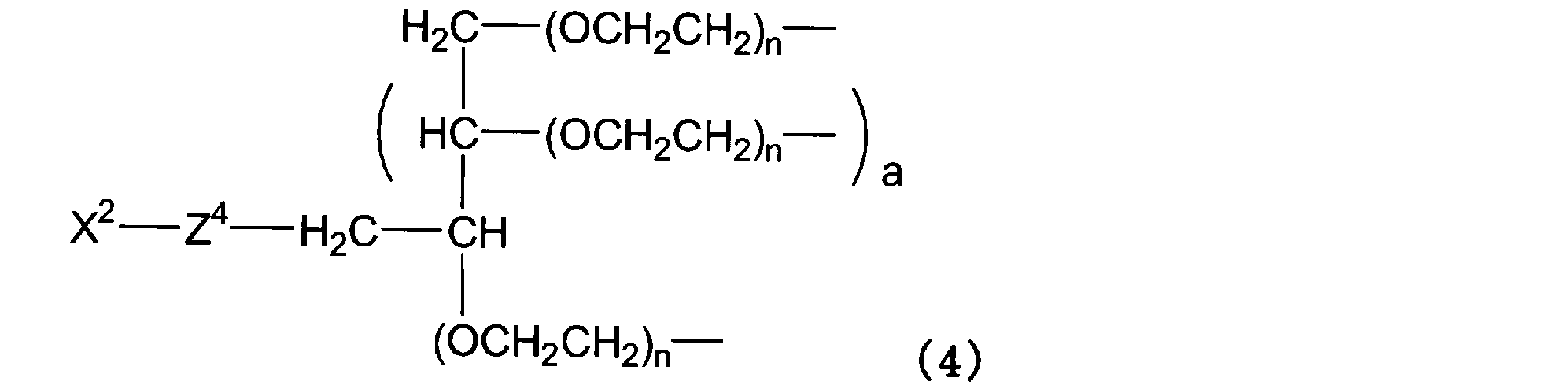
X2は、X1と異なる化学反応可能な官能基またはメトキシ基であり;
Z4は2価のスペーサーであり;および
nは3~1000の整数であり;および
aは0または2である。)
[8] The degradable polyethylene glycol derivative of [6], wherein P 1 is represented by formula (4).
X 2 is a chemically reactive functional group or methoxy group different from X 1 ;
Z 4 is a divalent spacer; and n is an integer from 3 to 1000; and a is 0 or 2. )
[9] P1が、式(r)、式(s)、式(t)、式(u)および式(v)からなる群から選択される、[6]の分解性ポリエチレングリコール誘導体。
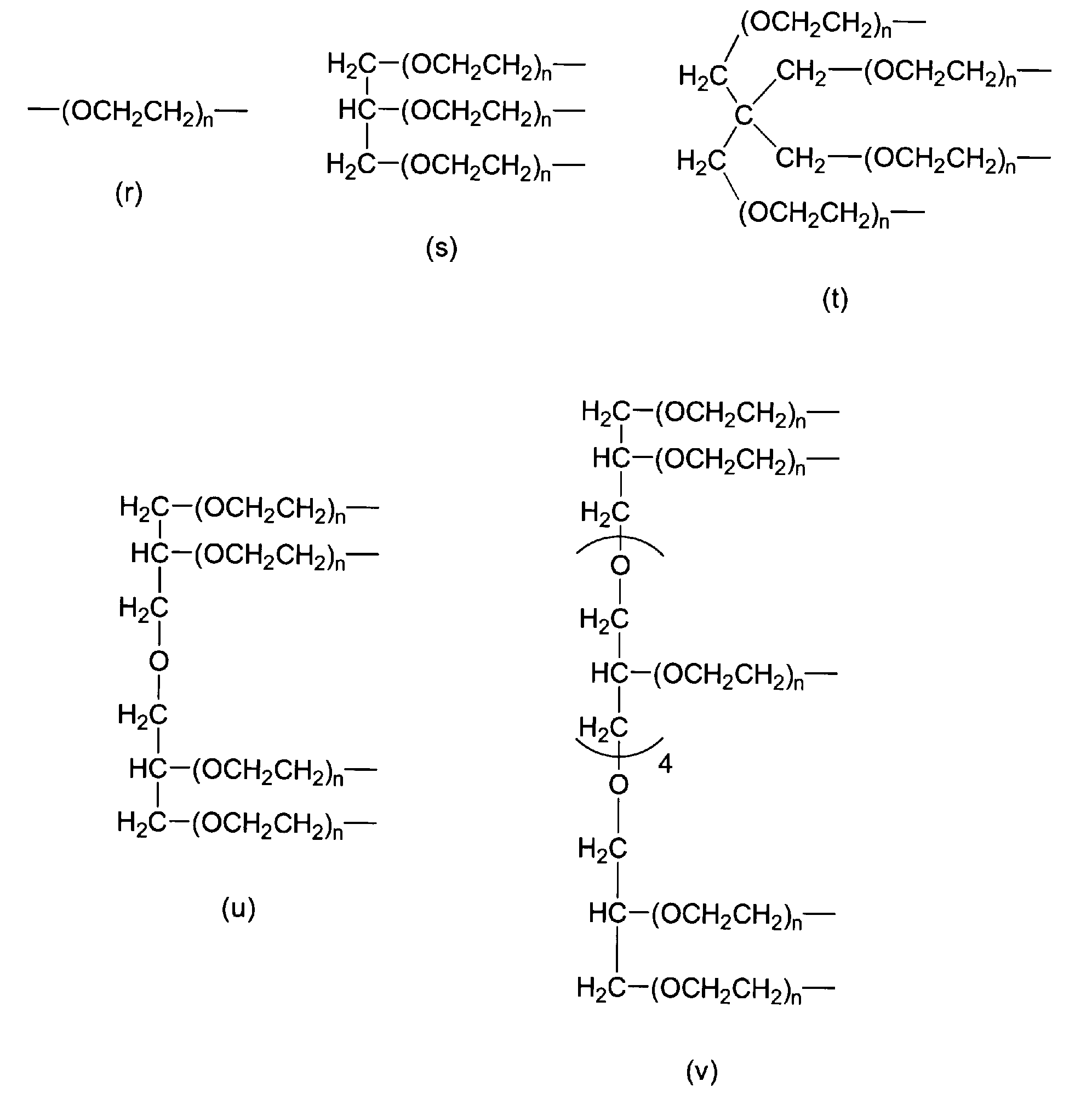
nは3~2000の整数であり、
ここで、P1が式(r)で表される場合にはwが2であり、P1が式(s)で表される場合にはwが3であり、P1が式(t)で表される場合にはwが4であり、P1が式(u)で表される場合にはwが4であり、P1が式(v)で表される場合にはwが8である。)
[9] The degradable polyethylene glycol derivative according to [6], wherein P 1 is selected from the group consisting of formula (r), formula (s), formula (t), formula (u), and formula (v).
n is an integer from 3 to 2000,
Here, when P 1 is represented by formula (r), w is 2, when P 1 is represented by formula (s), w is 3, and P 1 is represented by formula (t). When w is 4, w is 4 when P 1 is represented by formula (u), and w is 8 when P 1 is represented by formula (v). It is. )
[10] P2が式(5)で示される、[1]~[9]のいずれかの分解性ポリエチレングリコール誘導体。

[11] X1が活性エステル基、活性カーボネート基、アルデヒド基、イソシアネート基、イソチオシアネート基、エポキシ基、マレイミド基、ビニルスルホン基、アクリル基、スルホニルオキシ基、カルボキシ基、チオール基、ジチオピリジル基、α-ハロアセチル基、アルキニル基、アリル基、ビニル基、アミノ基、オキシアミノ基、ヒドラジド基およびアジド基よりなる群から選択される、[1]~[10]のいずれかの分解性ポリエチレングリコール誘導体。 [11] X 1 is an active ester group, active carbonate group, aldehyde group, isocyanate group, isothiocyanate group, epoxy group, maleimide group, vinyl sulfone group, acrylic group, sulfonyloxy group, carboxy group, thiol group, dithiopyridyl group , Α-haloacetyl group, alkynyl group, allyl group, vinyl group, amino group, oxyamino group, hydrazide group, and azide group, the degradable polyethylene glycol according to any one of [1] to [10] Derivative.
[12] Z1、Z2およびZ3が、それぞれ独立してエーテル結合、エステル結合、カーボネート結合、ウレタン結合、アミド結合、2級アミノ基もしくはこれらを含むアルキレン基、単結合またはアルキレン基である、[1]~[11]のいずれかの分解性ポリエチレングリコール誘導体。 [12] Z 1 , Z 2 and Z 3 are each independently an ether bond, an ester bond, a carbonate bond, a urethane bond, an amide bond, a secondary amino group or an alkylene group containing these, a single bond or an alkylene group. Degradable polyethylene glycol derivatives according to any one of [1] to [11].
[13] X2が活性エステル基、活性カーボネート基、アルデヒド基、イソシアネート基、イソチオシアネート基、エポキシ基、マレイミド基、ビニルスルホン基、アクリル基、スルホニルオキシ基、カルボキシ基、チオール基、ジチオピリジル基、α-ハロアセチル基、アルキニル基、アリル基、ビニル基、アミノ基、オキシアミノ基、ヒドラジド基、メトキシ基およびアジド基よりなる群から選択される、[5]、[7]または[8]の分解性ポリエチレングリコール誘導体。 [13] X 2 is an active ester group, active carbonate group, aldehyde group, isocyanate group, isothiocyanate group, epoxy group, maleimide group, vinyl sulfone group, acrylic group, sulfonyloxy group, carboxy group, thiol group, dithiopyridyl group , Α-haloacetyl group, alkynyl group, allyl group, vinyl group, amino group, oxyamino group, hydrazide group, methoxy group and azide group, [5], [7] or [8] Degradable polyethylene glycol derivative.
本発明によるジスルフィドリンカーを有する分解性ポリエチレングリコール誘導体は、生体内の異なる還元環境下においてリンカーの分解速度を調節できる。したがって、当該分解性ポリエチレングリコール誘導体を結合させた薬物等がターゲットとする組織や細胞に輸送されて薬効を発現した後、これらの各部位の還元環境下において、任意の速度でポリエチレングリコール鎖を低分子量のポリエチレングリコール鎖に分割させることが可能である。これにより、従来ポリエチレングリコール修飾の欠点であった、分子量の大きなポリエチレングリコールが、生体内からのクリアランスが不十分なために長期間体内に残留する問題を、根本的に排除することができる。即ち、当該分解性ポリエチレングリコール誘導体を薬物等の化学修飾に使用することで、水溶解性、バイオアベイラビリティーの増大および血中循環時間の延長といったポリエチレングリコール修飾による利点は元より、薬物等が薬効を発現した後、ポリエチレングリコールが生体内からのクリアランスに優れるという利点も付与することができる。 The degradable polyethylene glycol derivative having a disulfide linker according to the present invention can adjust the degradation rate of the linker under different reducing environments in vivo. Therefore, after the drug or the like to which the degradable polyethylene glycol derivative is bound is transported to the target tissue or cell to express its medicinal effect, the polyethylene glycol chain is lowered at an arbitrary rate in the reducing environment of each site. It can be split into molecular weight polyethylene glycol chains. As a result, it is possible to fundamentally eliminate the problem that polyethylene glycol having a large molecular weight, which has been a disadvantage of conventional polyethylene glycol modification, remains in the body for a long time due to insufficient clearance from the living body. That is, by using the degradable polyethylene glycol derivative for chemical modification of drugs, the advantages of polyethylene glycol modification such as water solubility, increased bioavailability and prolongation of blood circulation time can be used. After the expression, the advantage that polyethylene glycol is excellent in the clearance from the living body can be provided.
以下、本発明を詳細に説明する。
グルタチオンには還元型(GSH)と酸化型(GSSG)があり、酸化型は、2分子の還元型グルタチオンがジスルフィド結合によってつながった分子である。本明細書においてグルタチオンは還元型グルタチオン(GSH)を指す。
Hereinafter, the present invention will be described in detail.
Glutathione has a reduced form (GSH) and an oxidized form (GSSG). The oxidized form is a molecule in which two molecules of reduced glutathione are connected by a disulfide bond. As used herein, glutathione refers to reduced glutathione (GSH).
本発明のジスルフィドルリンカーを有する分解性ポリエチレングリコール誘導体は、薬物等の化学修飾に使用した際の血中循環時間の延長と、生体内からのクリアランスされることを両立させるために、グルタチオン濃度が低い血中では安定であり、グルタチオン濃度が高い細胞内では速やかに分解されることが好ましい。 The degradable polyethylene glycol derivative having a disulfide linker of the present invention has a glutathione concentration in order to achieve both an increase in blood circulation time when used for chemical modification of drugs and the like and clearance from the living body. It is preferably stable in low blood and rapidly degraded in cells with a high glutathione concentration.
即ち、血中の還元環境を想定したグルタチオン 10μM、37℃の緩衝液中における分解半減期(t1/2)が1時間以上、好ましくは24時間以上、さらに好ましくは48時間以上であり、細胞内の還元環境を想定したグルタチオン10mMでの分解半減期(t1/2)、6ヶ月以内、より好ましくは3ヶ月以内、さらに好ましくは1ヶ月以内である。
That is,
本発明のジスルフィドルリンカーを有する分解性ポリエチレングリコール誘導体はジスルフィド結合に隣接する炭素へ導入する炭化水素基の選択によって立体障害の度合いをコントロールすることで適切に分解速度を制御することが出来る。立体障害の度合いは、直鎖の炭化水素基であれば、メチル基、エチル基、プロピル基と炭素数が多いほど大きいことが知られており、プロピル基よりもイソプロピル基のように分岐の炭化水素基のほうが立体障害が大きくなることが知られている。 The degradable polyethylene glycol derivative having a disulfide linker of the present invention can appropriately control the decomposition rate by controlling the degree of steric hindrance by selecting a hydrocarbon group to be introduced into carbon adjacent to the disulfide bond. It is known that the degree of steric hindrance is greater for a straight-chain hydrocarbon group as the number of carbon atoms increases, such as a methyl group, an ethyl group, and a propyl group. It is known that a hydrogen group has a larger steric hindrance.
本発明の式(1)におけるR1 、R2、R3、R4は、それぞれ独立して水素原子または炭素数1~6の炭化水素基であるが、全て水素原子ではない。R1 、R2、R3、R4のそれぞれの炭素鎖長や分岐の有無やこれらの選択の組み合わせによって立体障害の度合いをコントロールすることができる。炭素数1~6の炭化水素基としては、メチル基、エチル基、プロピル基、イソプロピル基、ブチル基、イソブチル基、sec-ブチル基、t-ブチル基、ペンチル基、イソペンチル基、ネオペンチル基、t-ペンチル基、1,2-ジメチルプロピル基、ヘキシル基、2-メチルペンチル基、3-メチルペンチル基、2,2-ジメチルブチル基、2,3-ジメチルブチル基、シクロヘキシル基が挙げられ、好ましくはメチル基、エチル基、プロピル基である。R1 、R2、R3、R4の炭素数の和は1~24であり、好ましくは1~12であり、さらに好ましくは1~6である。 R 1 , R 2 , R 3 and R 4 in the formula (1) of the present invention are each independently a hydrogen atom or a hydrocarbon group having 1 to 6 carbon atoms, but they are not all hydrogen atoms. The degree of steric hindrance can be controlled by the carbon chain length of R 1 , R 2 , R 3 , and R 4 , the presence or absence of branching, and the combination of these selections. Examples of the hydrocarbon group having 1 to 6 carbon atoms include methyl group, ethyl group, propyl group, isopropyl group, butyl group, isobutyl group, sec-butyl group, t-butyl group, pentyl group, isopentyl group, neopentyl group, t -Pentyl group, 1,2-dimethylpropyl group, hexyl group, 2-methylpentyl group, 3-methylpentyl group, 2,2-dimethylbutyl group, 2,3-dimethylbutyl group, cyclohexyl group are preferable, Are a methyl group, an ethyl group, and a propyl group. The sum of the carbon numbers of R 1 , R 2 , R 3 and R 4 is 1 to 24, preferably 1 to 12, and more preferably 1 to 6.
本発明の式(1)におけるX1は、化学修飾の対象となる生理活性タンパク質、ペプチド、抗体、核酸および低分子薬物などの生体機能性分子、並びにリポソームやポリマーミセルなどの薬物キャリアに存在する官能基と反応して共有結合を形成する官能基であれば特に制限されない。例えば、「Harris, J. M. Poly(Ethylene Glycol) Chemistry; Plenum Press: New York, 1992」、「Hermanson, G. T. Bioconjugate Techniques, 2nd ed.; Academic Press: San Diego, CA, 2008」および「PEGylated Protein Drugs: Basic Science and Clinical Applications; Veronese, F. M., Ed.; Birkhauser: Basel, Switzerland, 2009」などに記載されている官能基が挙げられる。 X 1 in the formula (1) of the present invention is present in biologically active proteins, peptides, antibodies, nucleic acids and low-molecular-weight drugs that are subject to chemical modification, and drug carriers such as liposomes and polymer micelles. Any functional group that reacts with a functional group to form a covalent bond is not particularly limited. For example, "Harris, J. M. Poly (Ethylene Glycol ) Chemistry; Plenum Press: New York, 1992 ", "Hermanson, G. T. Bioconjugate Techniques, 2 nd ed .; Academic Press: San Diego, CA, 2008 " and "PEGylated Protein Drugs: Basic Science and Clinical Applications; Veronese, FM, Ed .; Birkhauser: Basel, Switzerland, 2009 ”and the like.
X1の好ましい例を挙げれば、活性エステル基、活性カーボネート基、アルデヒド基、イソシアネート基、イソチオシアネート基、エポキシ基、マレイミド基、ビニルスルホン基、アクリル基、スルホニルオキシ基、カルボキシ基、チオール基、ジチオピリジル基、α-ハロアセチル基、アルキニル基、アリル基、ビニル基、アミノ基、オキシアミノ基、ヒドラジド基およびアジド基である。 Preferred examples of X 1 include active ester group, active carbonate group, aldehyde group, isocyanate group, isothiocyanate group, epoxy group, maleimide group, vinyl sulfone group, acrylic group, sulfonyloxy group, carboxy group, thiol group, A dithiopyridyl group, an α-haloacetyl group, an alkynyl group, an allyl group, a vinyl group, an amino group, an oxyamino group, a hydrazide group and an azide group.
更に具体的には、生体機能性分子のアミノ基と反応して共有結合を形成することが可能な官能基は、活性エステル基、活性カーボネート基、アルデヒド基、イソシアネート基、イソチオシアネート基、エポキシ基、マレイミド基、ビニルスルホン基、アクリル基、スルホニルオキシ基またはカルボキシ基であり、生体機能性分子のチオール基と反応して共有結合を形成することが可能な官能基は、活性エステル基、活性カーボネート基、アルデヒド基、イソシアネート基、イソチオシアネート基、エポキシ基、マレイミド基、ビニルスルホン基、アクリル基、スルホニルオキシ基、カルボキシ基、チオール基、ジチオピリジル基、α-ハロアセチル基、アルキニル基、アリル基またはビニル基であり、生体機能性分子のアルデヒド基またはカルボキシ基と反応して共有結合を形成することが可能な官能基は、チオール基、アミノ基、オキシアミノ基またはヒドラジド基であり、生体機能性分子のアルキニル基と反応して共有結合を形成することが可能な官能基は、チオール基、アミノ基、アジド基であり、生体機能性分子のアジド基と反応して共有結合を形成することが可能な官能基はアルキニル基である。 More specifically, the functional group capable of reacting with an amino group of a biofunctional molecule to form a covalent bond includes an active ester group, an active carbonate group, an aldehyde group, an isocyanate group, an isothiocyanate group, an epoxy group. , A maleimide group, a vinylsulfone group, an acrylic group, a sulfonyloxy group, or a carboxy group, and a functional group that can react with a thiol group of a biofunctional molecule to form a covalent bond includes an active ester group, an active carbonate group Group, aldehyde group, isocyanate group, isothiocyanate group, epoxy group, maleimide group, vinyl sulfone group, acrylic group, sulfonyloxy group, carboxy group, thiol group, dithiopyridyl group, α-haloacetyl group, alkynyl group, allyl group or It is a vinyl group and is an aldehyde group or carboxyl group of a biofunctional molecule. Functional groups that can react with a boxy group to form a covalent bond are a thiol group, an amino group, an oxyamino group, or a hydrazide group, and react with an alkynyl group of a biofunctional molecule to form a covalent bond. Possible functional groups are thiol groups, amino groups, azide groups, and functional groups capable of reacting with azide groups of biofunctional molecules to form covalent bonds are alkynyl groups.
ここで「活性エステル」とは、式:-C(=O)-Lで表わされる活性化されたカルボキシ基を示し、Lは脱離基を示す。 Here, “active ester” represents an activated carboxy group represented by the formula: —C (═O) —L, and L represents a leaving group.
Lで表わされる脱離基としては、スクシンイミジルオキシ基、フタルイミジルオキシ基、4-ニトロフェノキシ基、1-イミダゾリル基、ペンタフルオロフェノキシ基、ベンゾトリアゾール-1-イルオキシ基および7-アザベンゾトリアゾール-1-イルオキシ基などが挙げられる。「活性カーボネート」とは、式:-O-C(=O)-Lで表わされる活性化されたカーボネート基を示し、Lは上記と同様の脱離基を示す。 Examples of the leaving group represented by L include succinimidyloxy, phthalimidyloxy, 4-nitrophenoxy, 1-imidazolyl, pentafluorophenoxy, benzotriazol-1-yloxy and 7-aza. And benzotriazol-1-yloxy group. “Activated carbonate” refers to an activated carbonate group represented by the formula: —O—C (═O) —L, and L represents a leaving group as described above.
本発明の好適な実施形態において、X1は群(I)、群(II)、群(III)、群(IV)または群(V)で示される基である。
群(I):生体機能性分子のアミノ基と反応して共有結合を形成することが可能な官能基
下記の(a)、(b) 、(b-1)、(c)、(d)、(e)および(f)
群(II):生体機能性分子のチオール基と反応して共有結合を形成することが可能な官能基 下記の(a)、(b)、(b-1)、(c)、(d)、(e)、(f)、(g)、(h)、(i)および(j)
群(III):生体機能性分子のアルデヒド基またはカルボキシ基と反応して共有結合を形成することが可能な官能基
下記の(g)、(k)、(l)および(m)
群(IV):生体機能性分子のアルキニル基と反応して共有結合を形成することが可能な官能基
下記の(g)、(k)、(l)、(m)および(n)
群(V):生体機能性分子のアジド基と反応して共有結合を形成することが可能な官能基
下記の(j)

Group (I): Functional group capable of reacting with an amino group of a biofunctional molecule to form a covalent bond The following (a), (b), (b-1), (c), (d) , (E) and (f)
Group (II): Functional group capable of reacting with a thiol group of a biofunctional molecule to form a covalent bond The following (a), (b), (b-1), (c), (d) , (E), (f), (g), (h), (i) and (j)
Group (III): Functional group capable of reacting with an aldehyde group or carboxy group of a biofunctional molecule to form a covalent bond (g), (k), (l) and (m) below
Group (IV): Functional group capable of reacting with an alkynyl group of a biofunctional molecule to form a covalent bond (g), (k), (l), (m) and (n) below
Group (V): Functional group capable of reacting with an azide group of a biofunctional molecule to form a covalent bond (j)
式中、R5は水素原子またはスルホ基であり、スルホ基として具体的にはスルホン酸ナトリウムおよびスルホン酸カリウムが挙げられるが、好ましくは水素原子である。R6、R9は水素原子または炭素数1~5の炭化水素基であり、具体的な炭化水素基としてはメチル基、エチル基、プロピル基、イソプロピル基、ブチル基、t-ブチル基およびペンチル基などが挙げられる。R7はハロゲン原子を含んでもよい炭素数1~10の炭化水素基であり、具体的な炭化水素基としてはメチル基、エチル基、プロピル基、イソプロピル基、ブチル基、t-ブチル基、ペンチル基、イソペンチル基、ヘキシル基、ベンジル基、4-メチルフェニル基、トリフルオロメチル基、2,2,2-トリフルオロエチル基、4-(トリフルオロメトキシ)フェニル基、ビニル基、クロロエチル基、ブロモエチル基およびヨードエチル基などが挙げられるが、好ましくはメチル基、ビニル基、4-メチルフェニル基または2,2,2-トリフルオロエチル基である。R8は塩素原子、臭素原子およびヨウ素原子からなる群より選択されるハロゲン原子である。 In the formula, R 5 is a hydrogen atom or a sulfo group, and specific examples of the sulfo group include sodium sulfonate and potassium sulfonate, with a hydrogen atom being preferred. R 6 and R 9 are a hydrogen atom or a hydrocarbon group having 1 to 5 carbon atoms. Specific hydrocarbon groups include methyl, ethyl, propyl, isopropyl, butyl, t-butyl and pentyl. Group and the like. R 7 is a hydrocarbon group having 1 to 10 carbon atoms which may contain a halogen atom. Specific hydrocarbon groups include methyl, ethyl, propyl, isopropyl, butyl, t-butyl, pentyl Group, isopentyl group, hexyl group, benzyl group, 4-methylphenyl group, trifluoromethyl group, 2,2,2-trifluoroethyl group, 4- (trifluoromethoxy) phenyl group, vinyl group, chloroethyl group, bromoethyl Group, iodoethyl group, and the like, and a methyl group, vinyl group, 4-methylphenyl group, or 2,2,2-trifluoroethyl group is preferable. R 8 is a halogen atom selected from the group consisting of a chlorine atom, a bromine atom and an iodine atom.
本発明の式(1)におけるZ1、Z2は、ジスルフィドリンカーとポリエチレングリコール鎖との間の2価のスペーサーであり、Z3はX1とポリエチレングリコール鎖との間の2価のスペーサーである。これらは共有結合で構成され、ジスルフィド結合よりも安定であれば特に制限は無いが、好ましくはエーテル結合、エステル結合、カーボネート結合、ウレタン結合、アミド結合、2級アミノ基もしくはこれらを含むアルキレン基、単結合またはアルキレン基である。アルキレン基の炭素数は、好ましくは1~24である。説明のためであって、制限するものではないが、アルキレン基の好ましい例としては、(z1)のような構造が挙げられる。エーテル結合を有するアルキレン基の好ましい例としては、(z2)または(z3)のような構造が挙げられる。エステル結合を有するアルキレン基の好ましい例としては、(z4)のような構造が挙げられる。カーボネート結合を有するアルキレン基の好ましい例としては、(z5)のような構造が挙げられる。ウレタン結合を有するアルキレン基の好ましい例としては、(z6)のような構造が挙げられる。アミド結合を有するアルキレン基の好ましい例としては、(z7)のような構造が挙げられる。2級アミノ基を有するアルキレン基の好ましい例としては、(z8)のような構造が挙げられる。好ましい実施形態において、pおよびqは独立して1~12の整数である。ただし、Z1、Z2またはZ3の少なくとも一つが、エーテル結合、エステル結合、カーボネート結合、ウレタン結合、アミド結合、2級アミノ基もしくはこれらを含むアルキレン基であって、複数の同一構造単位が結合している場合における前記構造単位の数は2以下である。 Z 1 and Z 2 in the formula (1) of the present invention are divalent spacers between the disulfide linker and the polyethylene glycol chain, and Z 3 is a divalent spacer between X 1 and the polyethylene glycol chain. is there. These are constituted by covalent bonds, and are not particularly limited as long as they are more stable than disulfide bonds, but preferably ether bonds, ester bonds, carbonate bonds, urethane bonds, amide bonds, secondary amino groups or alkylene groups containing these, A single bond or an alkylene group. The alkylene group preferably has 1 to 24 carbon atoms. For the purpose of illustration and not limitation, preferred examples of the alkylene group include structures such as (z1). Preferable examples of the alkylene group having an ether bond include structures such as (z2) or (z3). Preferable examples of the alkylene group having an ester bond include a structure such as (z4). A preferred example of the alkylene group having a carbonate bond is a structure such as (z5). Preferable examples of the alkylene group having a urethane bond include structures such as (z6). A preferred example of the alkylene group having an amide bond is a structure such as (z7). Preferable examples of the alkylene group having a secondary amino group include a structure such as (z8). In preferred embodiments, p and q are independently integers from 1 to 12. Provided that at least one of Z 1 , Z 2 or Z 3 is an ether bond, an ester bond, a carbonate bond, a urethane bond, an amide bond, a secondary amino group or an alkylene group containing these, and a plurality of the same structural units are The number of structural units in the case of bonding is 2 or less.

本発明の式(1)におけるP1は、エチレングリコール単位の数が3以上の直鎖型または分岐型のポリエチレングリコール鎖であり、P2はエチレングリコール単位の数が3以上の直鎖型のポリエチレングリコール鎖である。P1、P2を構成するエチレングリコール単位の数は、10以上が更に好ましく、20以上が特に好ましい。また、P1、P2を構成するエチレングリコール単位の数は、2000以下が更に好ましく、1000以下が特に好ましい。 P 1 in the formula (1) of the present invention is a linear or branched polyethylene glycol chain having 3 or more ethylene glycol units, and P 2 is a linear chain having 3 or more ethylene glycol units. Polyethylene glycol chain. The number of ethylene glycol units constituting P 1 and P 2 is more preferably 10 or more, and particularly preferably 20 or more. Further, the number of ethylene glycol units constituting P 1 and P 2 is more preferably 2000 or less, and particularly preferably 1000 or less.
本明細書で使用する用語「ポリエチレングリコール」は、エチレンオキシドの重合で得られる分子量分布を有するポリエチレングリコール、並びに単一分子量のオリゴエチレングリコール類をカップリング反応で結合した単分散のポリエチレングリコールの両方を意味する。 As used herein, the term “polyethylene glycol” refers to both polyethylene glycol having a molecular weight distribution obtained by polymerization of ethylene oxide and monodisperse polyethylene glycol obtained by coupling single molecular weight oligoethylene glycols in a coupling reaction. means.
本発明の一態様では、式(1)におけるwが1の分解性ポリエチレングリコール誘導体を与える。 In one embodiment of the present invention, a degradable polyethylene glycol derivative having w of 1 in formula (1) is provided.
この態様の好ましい実施形態では、式(1)におけるP1は、末端にメトキシ基または化学反応可能な官能基を有する直鎖型のポリエチレングリコール鎖である。 In a preferred embodiment of this aspect, P 1 in the formula (1) is a linear polyethylene glycol chain having a methoxy group or a chemically reactive functional group at the terminal.
P1が、化学反応可能な官能基またはメトキシ基を有する直鎖型のポリエチレングリコール鎖である具体的な例は、式(2)で示される。

式(2)中、nはポリエチレングリコール鎖1本あたりの繰り返しユニット数であり、分子量分布を有するポリエチレングリコール鎖においては、化合物の数平均分子量(Mn)に基づいて、各種理論的な計算をすることにより算出することと定義する。 In formula (2), n is the number of repeating units per polyethylene glycol chain, and for polyethylene glycol chains having a molecular weight distribution, various theoretical calculations are performed based on the number average molecular weight (Mn) of the compound. It is defined as calculating by
式(2)中、X2は、X1と異なる化学反応可能な官能基またはメトキシ基であり、Z4は、官能基X2とポリエチレングリコール鎖との間の2価のスペーサーである。当該分解性ポリエチレングリコール誘導体は、X1とX2の2つの異なる化学反応可能な官能基を有しているため、例えばX1に薬物を結合させ、X2に標的指向性を有する生体機能性分子を結合させることで、標的指向性能を持つポリエチレングリコール-薬物結合体を提供することができる。 In formula (2), X 2 is a chemically reactive functional group or methoxy group different from X 1, and Z 4 is a divalent spacer between the functional group X 2 and the polyethylene glycol chain. Since the degradable polyethylene glycol derivative has two different chemically reactive functional groups, X 1 and X 2 , for example, a drug is bound to X 1 and X 2 has a biological function with targeting By attaching molecules, a polyethylene glycol-drug conjugate with targeting performance can be provided.
X2の好ましい例を挙げれば、活性エステル基、活性カーボネート基、アルデヒド基、イソシアネート基、イソチオシアネート基、エポキシ基、マレイミド基、ビニルスルホン基、アクリル基、スルホニルオキシ基、カルボキシ基、チオール基、ジチオピリジル基、α-ハロアセチル基、アルキニル基、アリル基、ビニル基、アミノ基、オキシアミノ基、ヒドラジド基、アジド基およびメトキシ基である。 Preferred examples of X 2 include active ester group, active carbonate group, aldehyde group, isocyanate group, isothiocyanate group, epoxy group, maleimide group, vinyl sulfone group, acrylic group, sulfonyloxy group, carboxy group, thiol group, And dithiopyridyl group, α-haloacetyl group, alkynyl group, allyl group, vinyl group, amino group, oxyamino group, hydrazide group, azide group and methoxy group.
更に具体的には、生体機能性分子のアミノ基と反応して共有結合を形成することが可能な官能基は、活性エステル基、活性カーボネート基、アルデヒド基、イソシアネート基、イソチオシアネート基、エポキシ基、マレイミド基、ビニルスルホン基、アクリル基、スルホニルオキシ基またはカルボキシ基であり、生体機能性分子のチオール基と反応して共有結合を形成することが可能な官能基は、活性エステル基、活性カーボネート基、アルデヒド基、イソシアネート基、イソチオシアネート基、エポキシ基、マレイミド基、ビニルスルホン基、アクリル基、スルホニルオキシ基、カルボキシ基、チオール基、ジチオピリジル基、α-ハロアセチル基、アルキニル基、アリル基またはビニル基であり、生体機能性分子のアルデヒド基またはカルボキシ基と反応して共有結合を形成することが可能な官能基は、チオール基、アミノ基、オキシアミノ基またはヒドラジド基であり、生体機能性分子のアルキニル基と反応して共有結合を形成することが可能な官能基は、チオール基またはアジド基であり、生体機能性分子のアジド基と反応して共有結合を形成することが可能な官能基はアルキニル基である。 More specifically, the functional group capable of reacting with an amino group of a biofunctional molecule to form a covalent bond includes an active ester group, an active carbonate group, an aldehyde group, an isocyanate group, an isothiocyanate group, an epoxy group. , A maleimide group, a vinylsulfone group, an acrylic group, a sulfonyloxy group, or a carboxy group, and a functional group that can react with a thiol group of a biofunctional molecule to form a covalent bond includes an active ester group, an active carbonate group Group, aldehyde group, isocyanate group, isothiocyanate group, epoxy group, maleimide group, vinyl sulfone group, acrylic group, sulfonyloxy group, carboxy group, thiol group, dithiopyridyl group, α-haloacetyl group, alkynyl group, allyl group or It is a vinyl group and is an aldehyde group or carboxyl group of a biofunctional molecule. Functional groups that can react with a boxy group to form a covalent bond are a thiol group, an amino group, an oxyamino group, or a hydrazide group, and react with an alkynyl group of a biofunctional molecule to form a covalent bond. Possible functional groups are thiol groups or azide groups and functional groups capable of reacting with azide groups of biofunctional molecules to form covalent bonds are alkynyl groups.
本発明の好適な実施形態において、X2は群(I)、群(II)、群(III)、群(IV)または群(V)で示される基である。
群(I):生体機能性分子のアミノ基と反応して共有結合を形成することが可能な官能基
下記の(a)、(b)、(b-1)、(c)、(d)、(e)および(f)
群(II):生体機能性分子のチオール基と反応して共有結合を形成することが可能な官能基
下記の(a)、(b)、(b-1)、(c)、(d)、(e)、(f)、(g)、(h)、(i)および(j)
群(III):生体機能性分子のアルデヒド基またはカルボキシ基と反応して共有結合を形成することが可能な官能基
下記の(g)、(k)、(l)および(m)
群(IV):生体機能性分子のアルキニル基と反応して共有結合を形成することが可能な官能基
下記の(g)、(k)、(l)、(m)および(n)
群(V):生体機能性分子のアジド基と反応して共有結合を形成することが可能な官能基
下記の(j)
In a preferred embodiment of the present invention, X 2 is a group represented by group (I), group (II), group (III), group (IV) or group (V).
Group (I): Functional group capable of reacting with an amino group of a biofunctional molecule to form a covalent bond The following (a), (b), (b-1), (c), (d) , (E) and (f)
Group (II): Functional group capable of reacting with a thiol group of a biofunctional molecule to form a covalent bond The following (a), (b), (b-1), (c), (d) , (E), (f), (g), (h), (i) and (j)
Group (III): Functional group capable of reacting with an aldehyde group or carboxy group of a biofunctional molecule to form a covalent bond (g), (k), (l) and (m) below
Group (IV): Functional group capable of reacting with an alkynyl group of a biofunctional molecule to form a covalent bond (g), (k), (l), (m) and (n) below
Group (V): Functional group capable of reacting with an azide group of a biofunctional molecule to form a covalent bond (j)

式中、R5は水素原子またはスルホ基であり、スルホ基として具体的にはスルホン酸ナトリウムおよびスルホン酸カリウムが挙げられるが、好ましくは水素原子である。R6、R9は水素原子または炭素数1~5の炭化水素基であり、具体的な炭化水素基としてはメチル基、エチル基、プロピル基、イソプロピル基、ブチル基、t-ブチル基およびペンチル基などが挙げられる。R7はハロゲン原子を含んでもよい炭素数1~10の炭化水素基であり、具体的な炭化水素基としてはメチル基、エチル基、プロピル基、イソプロピル基、ブチル基、t-ブチル基、ペンチル基、イソペンチル基、ヘキシル基、ベンジル基、4-メチルフェニル基、トリフルオロメチル基、2,2,2-トリフルオロエチル基、4-(トリフルオロメトキシ)フェニル基、ビニル基、クロロエチル基、ブロモエチル基およびヨードエチル基などが挙げられるが、好ましくはメチル基、ビニル基、4-メチルフェニル基または2,2,2-トリフルオロエチル基である。R8は塩素原子、臭素原子およびヨウ素原子からなる群より選択されるハロゲン原子である。 In the formula, R 5 is a hydrogen atom or a sulfo group, and specific examples of the sulfo group include sodium sulfonate and potassium sulfonate, with a hydrogen atom being preferred. R 6 and R 9 are a hydrogen atom or a hydrocarbon group having 1 to 5 carbon atoms. Specific hydrocarbon groups include methyl, ethyl, propyl, isopropyl, butyl, t-butyl and pentyl. Group and the like. R 7 is a hydrocarbon group having 1 to 10 carbon atoms which may contain a halogen atom. Specific hydrocarbon groups include methyl, ethyl, propyl, isopropyl, butyl, t-butyl, pentyl Group, isopentyl group, hexyl group, benzyl group, 4-methylphenyl group, trifluoromethyl group, 2,2,2-trifluoroethyl group, 4- (trifluoromethoxy) phenyl group, vinyl group, chloroethyl group, bromoethyl Group, iodoethyl group, and the like, and a methyl group, vinyl group, 4-methylphenyl group, or 2,2,2-trifluoroethyl group is preferable. R 8 is a halogen atom selected from the group consisting of a chlorine atom, a bromine atom and an iodine atom.
X2はX1と異なっていることが必要であり、X1と X2の好ましい組み合わせとして、X1が活性エステル基または活性カーボネート基のときは、X2はマレイミド基、ビニルスルホン基、α-ハロアセチル基、アルキニル基およびアジド基から選択される基であり、X1がアルデヒド基のときは、X2はマレイミド基、ビニルスルホン基、アルキニル基およびアジド基から選択される基であり、X1がマレイミド基、ビニルスルホン基またはα-ハロアセチル基のときは、X2は活性エステル基、活性カーボネート基、アルキニル基、アジド基から選択される基であり、X1がアルキニル基またはアジド基のときは、X2はマレイミド基、ビニルスルホン基、α-ハロアセチル基、活性エステル基、活性カーボネート基、アミノ基およびオキシアミノ基から選択される基であり、X1がアミノ基またはオキシアミノ基のときは、X2はアルキニル基、アジド基、チオール基およびカルボキシ基から選択される基であり、X1がチオール基のときは、X2はアミノ基、オキシアミノ基、アジド基およびカルボキシ基から選択される基である。 X 2 is required to be different from the X 1, as preferred combinations of X 1 and X 2, when X 1 is active ester or active carbonate group, X 2 is a maleimide group, a vinylsulfone group, alpha -A group selected from a haloacetyl group, an alkynyl group and an azide group, and when X 1 is an aldehyde group, X 2 is a group selected from a maleimide group, a vinylsulfone group, an alkynyl group and an azide group; When 1 is a maleimide group, a vinyl sulfone group or an α-haloacetyl group, X 2 is a group selected from an active ester group, an active carbonate group, an alkynyl group, and an azide group, and X 1 is an alkynyl group or an azide group. When X 2 is a group selected from a maleimide group, a vinyl sulfone group, an α-haloacetyl group, an active ester group, an active carbonate group, an amino group and an oxyamino group And when X 1 is an amino group or an oxyamino group, X 2 is a group selected from an alkynyl group, an azide group, a thiol group and a carboxy group, and when X 1 is a thiol group, X 2 is It is a group selected from an amino group, an oxyamino group, an azide group and a carboxy group.
より好ましくは、X1が活性エステル基または活性カーボネート基のときは、X2はマレイミド基、α-ハロアセチル基、アルキニル基およびアジド基から選択される基であり、X1がアルデヒド基のときは、X2はマレイミド基、α-ハロアセチル基、アルキニル基およびアジド基から選択される基であり、X1がマレイミド基またはα-ハロアセチル基のときは、X2は活性エステル基、活性カーボネート基、アルキニル基、アジド基から選択される基であり、X1がアルキニル基またはアジド基のときは、X2はマレイミド基、α-ハロアセチル基、活性エステル基、活性カーボネート基、アミノ基およびオキシアミノ基から選択される基であり、X1がアミノ基またはオキシアミノ基のときは、X2はアルキニル基、アジド基およびチオール基から選択される基であり、X1がチオール基のときは、X2はアミノ基、オキシアミノ基およびアジド基から選択される基である。 More preferably, when X 1 is an active ester group or an active carbonate group, X 2 is a group selected from a maleimide group, an α-haloacetyl group, an alkynyl group and an azide group, and when X 1 is an aldehyde group , X 2 is a group selected from a maleimide group, an α-haloacetyl group, an alkynyl group and an azide group, and when X 1 is a maleimide group or an α-haloacetyl group, X 2 is an active ester group, an active carbonate group, An alkynyl group or an azide group, and when X 1 is an alkynyl group or an azide group, X 2 is a maleimide group, an α-haloacetyl group, an active ester group, an active carbonate group, an amino group, and an oxyamino group a group selected from, when X 1 is an amino group or an oxy amino group, X 2 is a group selected from an alkynyl group, an azide group and a thiol group Ri, when X 1 is a thiol group, X 2 is a group selected from an amino group, hydroxyamino group and azide group.
Z4は共有結合で構成され、ジスルフィド結合より安定であれば特に制限は無いが、好ましくはエーテル結合、エステル結合、カーボネート結合、ウレタン結合、アミド結合、2級アミノ基もしくはこれらを含むアルキレン基、単結合またはアルキレン基である。アルキレン基の炭素数は、好ましくは1~24である。説明のためであって、制限するものではないが、アルキレン基の好ましい例としては、(z1)のような構造が挙げられる。エーテル結合を有するアルキレン基の好ましい例としては、(z2)または(z3)のような構造が挙げられる。エステル結合を有するアルキレン基の好ましい例としては、(z4)のような構造が挙げられる。 Z 4 is composed of a covalent bond and is not particularly limited as long as it is more stable than a disulfide bond, but preferably an ether bond, an ester bond, a carbonate bond, a urethane bond, an amide bond, a secondary amino group or an alkylene group containing these, A single bond or an alkylene group. The alkylene group preferably has 1 to 24 carbon atoms. For the purpose of illustration and not limitation, preferred examples of the alkylene group include structures such as (z1). Preferable examples of the alkylene group having an ether bond include structures such as (z2) or (z3). Preferable examples of the alkylene group having an ester bond include a structure such as (z4).
カーボネート結合を有するアルキレン基の好ましい例としては、(z5)のような構造が挙げられる。ウレタン結合を有するアルキレン基の好ましい例としては、(z6)のような構造が挙げられる。アミド結合を有するアルキレン基の好ましい例としては、(z7)のような構造が挙げられる。2級アミノ基を有するアルキレン基の好ましい例としては、(z8)のような構造が挙げられる。好ましい実施形態において、pおよびqは独立して1~12の整数である。ただし、Z3が、エーテル結合、エステル結合、カーボネート結合、ウレタン結合、アミド結合、2級アミノ基もしくはこれらを含むアルキレン基であって、複数の同一構造単位が結合している場合における前記構造単位の数は2以下である。 A preferred example of the alkylene group having a carbonate bond is a structure such as (z5). Preferable examples of the alkylene group having a urethane bond include structures such as (z6). A preferred example of the alkylene group having an amide bond is a structure such as (z7). Preferable examples of the alkylene group having a secondary amino group include a structure such as (z8). In preferred embodiments, p and q are independently integers from 1 to 12. However, when Z 3 is an ether bond, an ester bond, a carbonate bond, a urethane bond, an amide bond, a secondary amino group or an alkylene group containing these, the structural unit is a combination of a plurality of the same structural units Is less than or equal to 2.
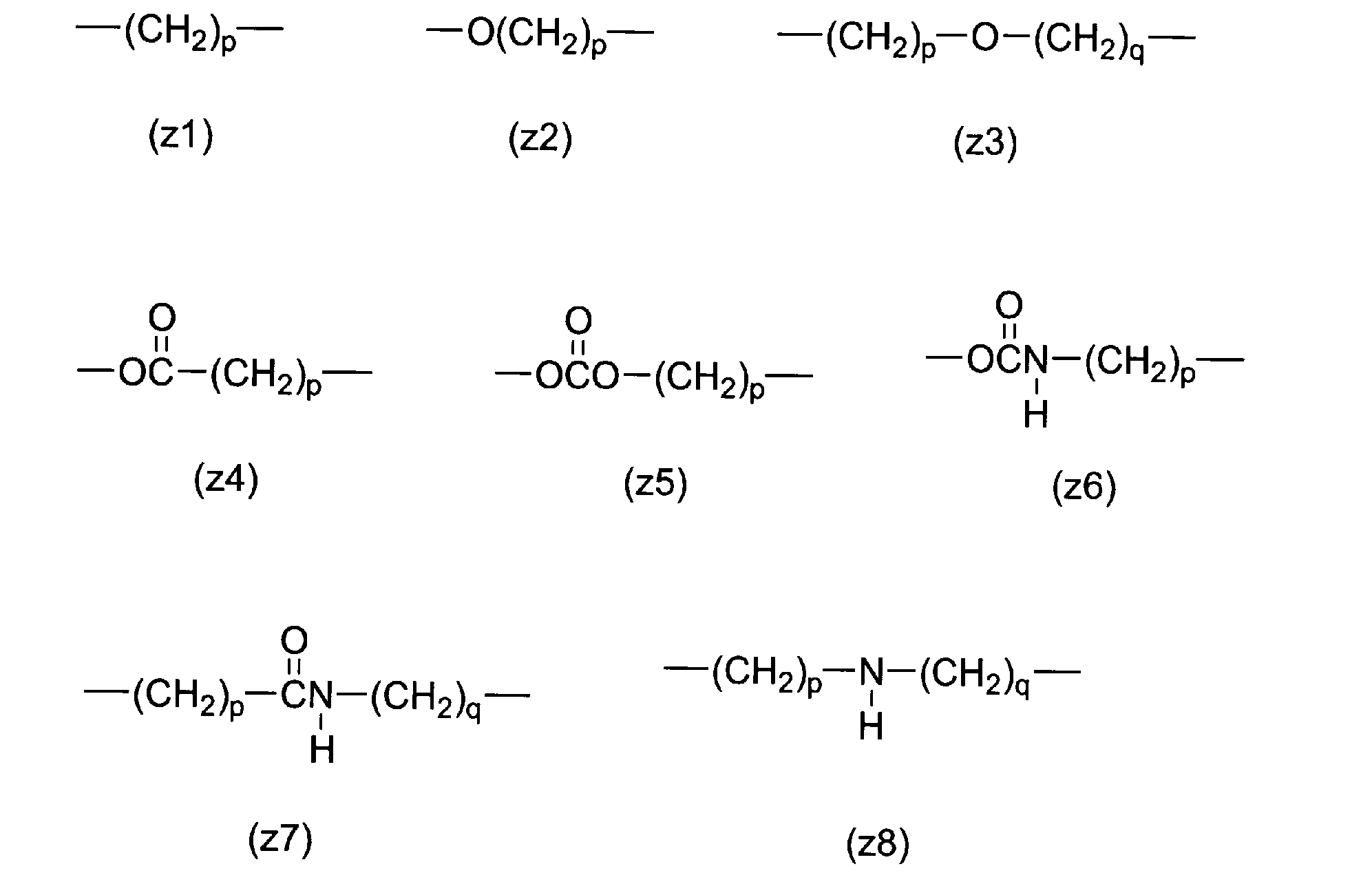
この態様のもう1つの好ましい実施形態では、式(1)におけるP1は、末端にメトキシ基または化学反応可能な官能基を有する分岐型のポリエチレングリコール鎖である。 In another preferred embodiment of this aspect, P 1 in the formula (1) is a branched polyethylene glycol chain having a methoxy group or a chemically reactive functional group at the terminal.
P1が末端にメトキシ基または化学反応可能な官能基を有する分岐型のポリエチレングリコール鎖である具体的な例は、式(3)で示される。 A specific example in which P 1 is a branched polyethylene glycol chain having a methoxy group or a chemically reactive functional group at the terminal is represented by Formula (3).

式中、aは0または2であり、X2は、X1と異なる化学反応可能な官能基またはメトキシ基であり、Z4は、官能基X2とポリエチレングリコール鎖との間の2価のスペーサーである。 In the formula, a is 0 or 2, X 2 is a chemically reactive functional group or methoxy group different from X 1, and Z 4 is a divalent group between the functional group X 2 and the polyethylene glycol chain. It is a spacer.
aが0の場合は2本のポリエチレングリコール鎖を有し、aが2の場合は4本のポリエチレングリコール鎖を有する。一般にポリエチレングリコールによる生体関連物質の化学修飾では、必要以上にポリエチレングリコールとの結合点を導入すると生体関連物質の活性点を潰し、その機能を低下させるため、ポリエチレングリコールの分子量を大きくして効果を高める試みが行われている。しかし、分子量の増大にともなって粘度も増大するため、例えば注射製剤のような水溶液製剤での取り扱いが困難となる。当該ポリエチレングリコール誘導体は分岐型構造であるため、同一分子量の直鎖型のポリエチレングリコール誘導体と比較して粘度が低く、水溶液製剤などの用途で有用である。 When a is 0, it has 2 polyethylene glycol chains, and when a is 2, it has 4 polyethylene glycol chains. In general, in chemical modification of bio-related substances with polyethylene glycol, introduction of bonding points with polyethylene glycol more than necessary will destroy the active sites of the bio-related substances and reduce their functions. There are attempts to increase it. However, since the viscosity increases as the molecular weight increases, it becomes difficult to handle in an aqueous solution preparation such as an injection preparation. Since the polyethylene glycol derivative has a branched structure, it has a lower viscosity than a linear polyethylene glycol derivative having the same molecular weight, and is useful in applications such as aqueous solution preparations.
P1が式(3)で示されるポリエチレングリコール誘導体は、1つのX1と2つまたは4つのX2を有しており、例えばX1に薬物を結合させ、X2に標的指向性を有する生体機能性分子を結合させれば、高い標的指向性能を持つ薬物複合体を提供することができる。 The polyethylene glycol derivative in which P 1 is represented by the formula (3) has one X 1 and two or four X 2 , for example, a drug is bound to X 1 and X 2 has a target directivity. When a biofunctional molecule is bound, a drug complex having high target-directing performance can be provided.
本発明の別の一態様では、式(1)におけるwが2~8の生分解性ポリエチレングリコール誘導体を与える。 In another embodiment of the present invention, a biodegradable polyethylene glycol derivative having w of 2 to 8 in formula (1) is provided.
この態様の好ましい実施形態では、式(1)におけるP1は、式(4)で示される。

式中、X2はX1と異なる化学反応可能な前記官能基であり、Z4は前記2価のスペーサーであり、aは0または2である。 In the formula, X 2 is the functional group capable of chemical reaction different from X 1 , Z 4 is the divalent spacer, and a is 0 or 2.
抗体-薬物複合体(ADC)関連分野においては、薬物の運搬効率を上げるために抗体に対して複数の薬物を結合させることが好ましいが、抗体に複数の結合点を導入すると抗原との親和性の低下が問題となる。P1が式(4)で示されるポリエチレングリコール誘導体は、2つまたは4つのX1と1つのX2を有しており、例えばガンを標的としたADCでX1に抗ガン剤を結合させ、X2に抗体を結合させれば、抗体との結合点を増加させずに、抗ガン剤の運搬効率を向上させることができる。 In the antibody-drug complex (ADC) -related field, it is preferable to bind a plurality of drugs to the antibody in order to increase the drug delivery efficiency. However, when a plurality of binding points are introduced into the antibody, the affinity for the antigen is increased. This is a problem. Polyethylene glycol derivatives P 1 is represented by the formula (4) may be coupled to two or four of X 1 and anticancer agent has one of X 2, for example, a gun in X 1 in ADC that target , if coupling antibodies to X 2, without increasing the point of attachment to the antibody, it is possible to improve the transportation efficiency of anti-cancer agents.
この態様のもう1つの好ましい実施形態では、式(1)におけるP1が末端数2~8のポリエチレングリコール鎖であり、P1を構成するポリエチレングリコール鎖の全ての末端がそれぞれ、Z1に対して結合しており、wが前記ポリエチレングリコール鎖の末端数に等しい。 In another preferred embodiment of this aspect, P 1 in the formula (1) is a polyethylene glycol chain having 2 to 8 terminals, and all the terminals of the polyethylene glycol chain constituting P 1 are each with respect to Z 1 And w is equal to the number of terminals of the polyethylene glycol chain.
この実施形態の具体的な例は、式(1)におけるP1が、式(r)、式(s)、式(t)、式(u)および式(v)からなる群から選択される。P1が式(r)で表される場合にはwが2であり、P1が式(s)で表される場合にはwが3であり、P1が式(t)で表される場合にはwが4であり、P1が式(u)で表される場合にはwが4であり、P1が式(v)で表される場合にはwが8である。 In a specific example of this embodiment, P 1 in formula (1) is selected from the group consisting of formula (r), formula (s), formula (t), formula (u), and formula (v). . When P 1 is represented by formula (r), w is 2, when P 1 is represented by formula (s), w is 3, and P 1 is represented by formula (t). W is 4, w is 4 when P 1 is represented by formula (u), and w is 8 when P 1 is represented by formula (v).
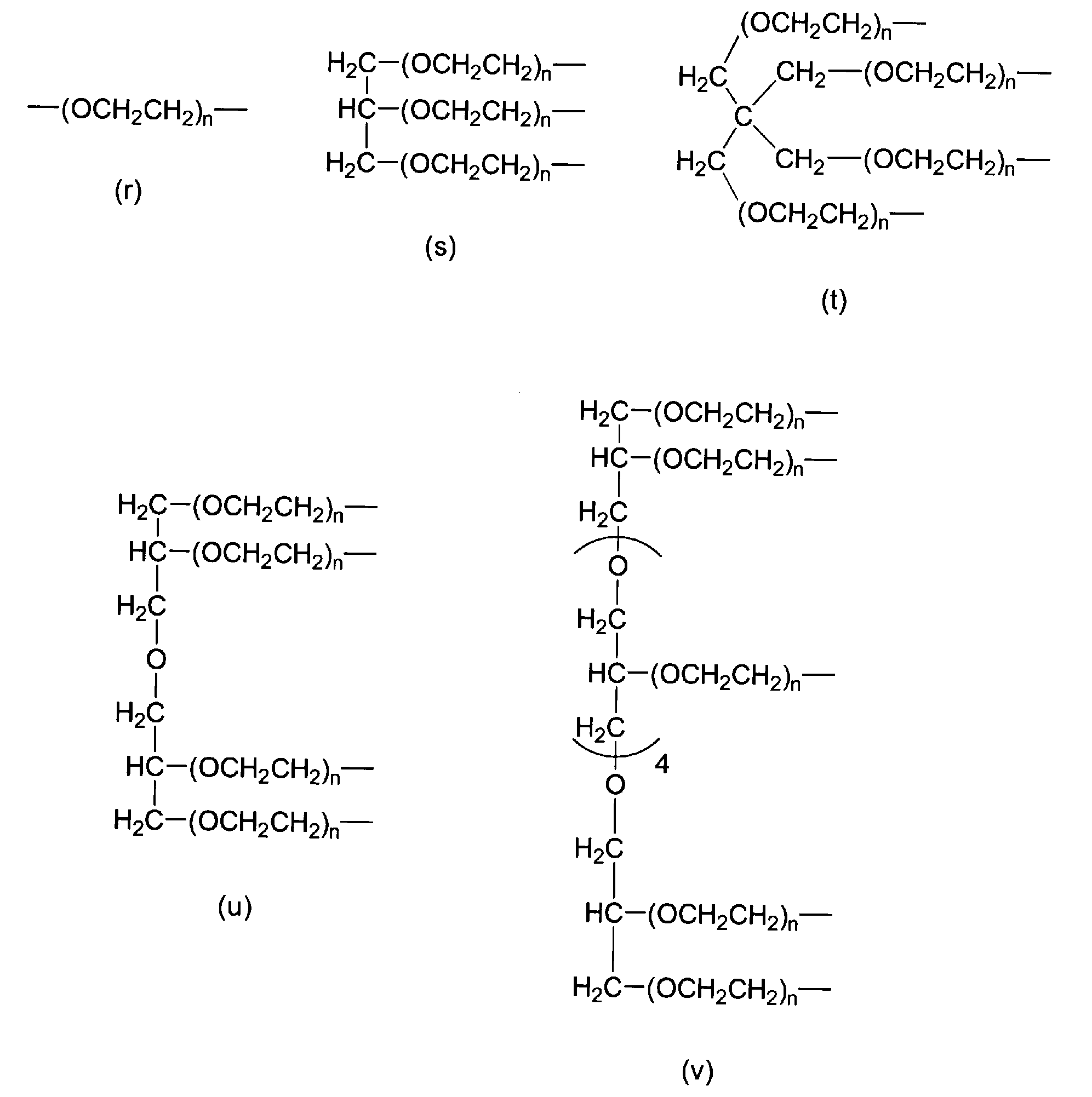
本発明の式(2)および式(r)におけるnの好適な範囲は3~2000の整数であり、より好ましくは20~1000の整数であり、更に好ましくは40~500の整数である。また、式(3)、式(4)、式(s)、式(t)、式(u)および式(v)におけるnの好適な範囲は3~1000の整数であり、好ましくは10~500の整数であり、更に好ましくは20~250の整数である。 In the formulas (2) and (r) of the present invention, a preferable range of n is an integer of 3 to 2000, more preferably an integer of 20 to 1000, and still more preferably an integer of 40 to 500. In the formula (3), formula (4), formula (s), formula (t), formula (u) and formula (v), the preferred range of n is an integer of 3 to 1000, preferably 10 to An integer of 500, more preferably an integer of 20 to 250.
本発明の一態様では、式(1)におけるP2は、式(5)で示される。

式中、mはポリエチレングリコール鎖1本あたりの繰り返しユニット数であり、分子量分布を有するポリエチレングリコール鎖においては、化合物の数平均分子量(Mn)に基づいて、各種理論的な計算をすることにより算出することと定義する。 In the formula, m is the number of repeating units per polyethylene glycol chain, and for polyethylene glycol chains having a molecular weight distribution, calculated by performing various theoretical calculations based on the number average molecular weight (Mn) of the compound. It is defined as to do.
本発明の式(5)におけるmの好適な範囲は3~2000の整数であり、より好ましくは20~1000の整数であり、更に好ましくは40~500の整数である。また、式(5)におけるmの好適な範囲は3~1000の整数であり、好ましくは10~500の整数であり、更に好ましくは20~250の整数である。
本発明の式(1)におけるuは、ジスルフィドリンカーとP2からなる構造単位が直列に結合している数である。uの好適な範囲は1~10の整数であり、好ましくは1~5の整数であり、更に好ましくは1または2の整数である。
A preferable range of m in the formula (5) of the present invention is an integer of 3 to 2000, more preferably an integer of 20 to 1000, and still more preferably an integer of 40 to 500. In addition, a preferable range of m in the formula (5) is an integer of 3 to 1000, preferably an integer of 10 to 500, and more preferably an integer of 20 to 250.
In the formula (1) of the present invention, u is the number in which a structural unit consisting of a disulfide linker and P 2 is bonded in series. A preferable range of u is an integer of 1 to 10, preferably an integer of 1 to 5, and more preferably an integer of 1 or 2.
本発明の分解性ポリエチレングリコール誘導体は、P1からなるポリエチレングリコール中間体に対して、置換基を有するジスルフィドリンカーを介して、P2からなるポリエチレングリコール中間体を連結することにより合成できる。この連結によって生じる結合は、反応に使用される官能基の組み合わせによって決定されるものであり、前記2価のスペーサーZ1およびZ2に含まれるエーテル結合、エステル結合、カーボネート結合、ウレタン結合、アミド結合、2級アミノ基もしくはこれらを含むアルキレン基、単結合またはアルキレン基である。 Degradable polyethylene glycol derivative of the present invention can be synthesized by coupled to polyethylene glycol intermediate comprising a P 1, via a disulfide linker having a substituent, a polyethylene glycol intermediate comprising a P 2. The bond resulting from this linkage is determined by the combination of functional groups used in the reaction, and is an ether bond, ester bond, carbonate bond, urethane bond, amide contained in the divalent spacers Z 1 and Z 2. A bond, a secondary amino group or an alkylene group containing these, a single bond or an alkylene group;
合成した当該生分解性ポリエチレングリコール誘導体は、必要に応じて末端官能基を化学変換する。この官能基変換に用いられる反応は、従来公知の方法を用いることができるが、式(1)のジスルフィド基、前記2価のスペーサーZ1、Z2、Z3およびZ4に含まれる結合を分解しない条件を適切に選択しなければならない。なお、当該分解性ポリエチレングリコール誘導体の合成において、ジスルフィドリンカーを導入するためのジスルフィドリンカー化合物は、P1からなるポリエチレングリコール中間体と結合させた後、P2からなるポリエチレングリコール中間体と結合させても、P2からなるポリエチレングリコール中間体と結合させた後、P1からなるポリエチレングリコール中間体と結合させてもいずれでもよい。当該生分解性ポリエチレングリコール誘導体を合成する典型的な例としては、以下のような工程が挙げられる。 The synthesized biodegradable polyethylene glycol derivative chemically converts the terminal functional group as necessary. For the reaction used for this functional group conversion, a conventionally known method can be used, but the disulfide group of the formula (1) and the bonds contained in the divalent spacers Z 1 , Z 2 , Z 3 and Z 4 are combined. The conditions that do not decompose must be selected appropriately. In the synthesis of the degradable polyethylene glycol derivative, a disulfide linker compound for introducing a disulfide linker is bonded to a polyethylene glycol intermediate consisting of P 1 and then bonded to a polyethylene glycol intermediate consisting of P 2. Alternatively, it may be bonded to a polyethylene glycol intermediate consisting of P 2 and then bonded to a polyethylene glycol intermediate consisting of P 1 . Typical examples of synthesizing the biodegradable polyethylene glycol derivative include the following steps.
ジスルフィドリンカー化合物
本発明のジスルフィド結合を有するポリエチレングリコール誘導体は対応するチオール基を有するポリエチレングリコール誘導体同士をカップリングすることや、ジスルフィド結合を有するリンカーから適宜誘導体化することで得られる。ここではジスルフィドリンカーから適宜誘導体化する方法について説明するがこれに限定されない。

式(6)のジスルフィドリンカーは、化学反応可能な官能基であるヒドロキシ基とチオール基を有する下記の式(7)の化合物を水、メタノールまたはエタノールなどのプロトン性溶媒、もしくはアセトニトリル、テトラヒドロフラン、ジメチルスルホキシド、ジメチルホルムアミドまたはジメチルアセトアミドなどの非プロトン性溶媒、もしくは無溶媒中で、ヨウ素や過酸化水素水などでカップリングさせることで得られる。 The disulfide linker of formula (6) is a compound of the following formula (7) having a hydroxyl group and a thiol group, which are chemically reactive functional groups, and a protic solvent such as water, methanol or ethanol, or acetonitrile, tetrahydrofuran, dimethyl It can be obtained by coupling with iodine or hydrogen peroxide in an aprotic solvent such as sulfoxide, dimethylformamide or dimethylacetamide, or in the absence of a solvent.
式(7)中のR1、R2が異なる組み合わせの2つの式(7)の化合物をカップリングさせることや、式(7)化合物のチオール基をメトキシカルボニルスルフェニルクロリド等で保護した後に、R1 、R2が異なる組み合わせが異なる別の式(7)の化合物をカップリングさせることで、R1、R2とR3、R4の組み合わせが異なる式(6)の化合物を得ることが出来る。得られた化合物は、抽出、再結晶、吸着剤処理、再沈殿、カラムクロマトグラフィーまたは超臨界抽出等の精製手段にて精製してもよい。 After coupling two compounds of the formula (7) having different combinations of R 1 and R 2 in the formula (7), or protecting the thiol group of the formula (7) compound with methoxycarbonylsulfenyl chloride or the like, A compound of the formula (6) in which the combination of R 1 , R 2 and R 3 , R 4 is different can be obtained by coupling another compound of the formula (7) in which the combination of R 1 and R 2 is different. I can do it. The obtained compound may be purified by a purification means such as extraction, recrystallization, adsorbent treatment, reprecipitation, column chromatography or supercritical extraction.

式(6)の化合物のヒドロキシ基と炭酸ジ(N-スクシンイミジル)をトルエン、ベンゼン、キシレン、アセトニトリル、酢酸エチル、ジエチルエーテル、t-ブチルメチルエーテル、テトラヒドロフラン、クロロホルム、ジクロロメタン、ジメチルスルホキシド、ジメチルホルムアミドまたはジメチルアセトアミドなどの非プロトン性溶媒、もしくは無溶媒中、ピリジン、トリエチルアミン、N-メチルモルホリン、t-ブトキシカリウムまたはヘキサメチルジシラザンナトリウムなどの有機塩基、もしくは炭酸カリウム、水酸化カリウムまたは水素化ナトリウムなどの無機塩基の存在下、反応させることで、式(8)の化合物を得る。有機塩基、無機塩基の使用割合は、特に制限はないが、式(6)の化合物の化学反応可能な官能基に対して等モル以上が好ましい。また、有機塩基を溶媒として用いてもよい。得られた化合物は、前述の精製手段にて精製してもよい。 The hydroxy group and di (N-succinimidyl) carbonate of the compound of formula (6) are toluene, benzene, xylene, acetonitrile, ethyl acetate, diethyl ether, t-butyl methyl ether, tetrahydrofuran, chloroform, dichloromethane, dimethyl sulfoxide, dimethylformamide or Organic bases such as pyridine, triethylamine, N-methylmorpholine, t-butoxypotassium or hexamethyldisilazane sodium, or potassium carbonate, potassium hydroxide or sodium hydride in an aprotic solvent such as dimethylacetamide or in the absence of solvent By reacting in the presence of an inorganic base, a compound of formula (8) is obtained. The ratio of the organic base and inorganic base used is not particularly limited, but is preferably equimolar or more with respect to the functional group capable of chemically reacting with the compound of formula (6). An organic base may be used as a solvent. The obtained compound may be purified by the aforementioned purification means.

式(6)の化合物の化学反応可能な官能基は、ヒドロキシ基以外の官能基も用いることができる。具体的な例としては、ヒドロキシアルキル基、アミノ基、アミノアルキル基、カルボキシ基およびカルボキシアルキル基などが挙げられる。また、上記官能基はジスルフィド基が分解しない反応条件で脱保護可能な保護基で保護されていてもよい。保護基の例は多くの一般的な成書に見出すことができるが、例えば「Wuts, P. G. M.; Greene, T. W. Protective Groups in Organic Synthesis, 4th ed.; Wiley-Interscience: New York, 2007」に記載されている。また、保護基で保護された官能基は、それぞれの保護基に適した反応条件を用いて脱保護、すなわち化学反応させることで、元の官能基を再生させることができる。したがって、本明細書では、保護基で保護されており、各種反応によって脱保護が可能な官能基は「化学反応可能な官能基」に含む。具体的な保護基の種類および代表的な脱保護条件は前述の文献に記載されており、それぞれの保護基に適した反応条件を選択し、親水性ポリマー中間体との反応前に脱保護を行うことができる。 As the functional group capable of chemically reacting with the compound of formula (6), a functional group other than a hydroxy group can also be used. Specific examples include hydroxyalkyl groups, amino groups, aminoalkyl groups, carboxy groups, and carboxyalkyl groups. The functional group may be protected with a protecting group that can be deprotected under reaction conditions in which the disulfide group does not decompose. Examples of protecting groups can be found in many common books, such as “Wuts, P. G. M .; Greene, T. W. Protective Groups in Organic Synthesis, 4th ed .; Wiley-Interscience: New York, 2007 ”. In addition, the functional group protected with a protecting group can be reprotected by deprotection using a reaction condition suitable for each protecting group, that is, a chemical reaction, thereby regenerating the original functional group. Therefore, in this specification, the functional group which is protected with a protecting group and can be deprotected by various reactions is included in the “chemically reactive functional group”. Specific types of protecting groups and typical deprotection conditions are described in the above-mentioned literature, and reaction conditions suitable for each protecting group are selected, and deprotection is performed before the reaction with the hydrophilic polymer intermediate. It can be carried out.
(B) P1からなるポリエチレングリコール中間体
開始剤であるメタノールをトルエン中もしくは無溶媒で、金属ナトリウム、金属カリウム、水素化ナトリウムまたは水素化カリウムなどのアルカリ条件下、エチレンオキシドをメタノールに対して3~2000モル当量重合させ、式(9)のポリエチレングリコールを得る。開始剤としては炭素数1~24の炭化水素基を有するアルコールが好ましく、具体的にはメタノール、エタノール、プロパノール、イソプロパノール、ブタノール、t-ブタノール、フェノールおよびベンジルアルコールなどが挙げられる。当該ポリエチレングリコールは、化学反応可能な官能基であるヒドロキシ基を有するため、そのままジスルフィドリンカー化合物との反応に用いることもできる。
(B) Polyethylene glycol intermediate consisting of P 1 Methanol, which is an initiator, in toluene or in the absence of solvent and ethylene oxide with respect to methanol under alkaline conditions such as metallic sodium, metallic potassium, sodium hydride or potassium hydride. Polymerization of ˜2000 molar equivalents gives polyethylene glycol of formula (9). The initiator is preferably an alcohol having a hydrocarbon group having 1 to 24 carbon atoms, and specifically includes methanol, ethanol, propanol, isopropanol, butanol, t-butanol, phenol and benzyl alcohol. Since the polyethylene glycol has a hydroxy group that is a chemically reactive functional group, it can also be used as it is for the reaction with a disulfide linker compound.

式(9)のポリエチレングリコールのヒドロキシ基を公知の方法で官能基変換することで、式(10)のポリエチレングリコール中間体を得る。得られた化合物は、抽出、再結晶、吸着剤処理、再沈殿、カラムクロマトグラフィーまたは超臨界抽出等の精製手段にて精製してもよい。 The polyethylene glycol intermediate of formula (10) is obtained by converting the hydroxy group of polyethylene glycol of formula (9) into a functional group by a known method. The obtained compound may be purified by a purification means such as extraction, recrystallization, adsorbent treatment, reprecipitation, column chromatography or supercritical extraction.

式(10)のポリエチレングリコール中間体における化学反応可能な官能基は他の官能基も用いることができる。化学反応可能な官能基の好ましい例としては、当該ポリエチレングリコール中間体とジスルフィドリンカー化合物の反応によって生じる結合が、式(1)の2価のスペーサーZ1に含まれるエーテル結合、エステル結合、カーボネート結合、ウレタン結合、アミド結合、2級アミノ基もしくはこれらを含むアルキレン基、単結合またはアルキレン基となる官能基であり、具体的にはハロゲン原子、活性エステル、活性カーボネート、アルデヒド基、アミノ基、ヒドロキシ基およびカルボキシ基などが挙げられる。 Other functional groups can be used as the chemically reactive functional group in the polyethylene glycol intermediate of formula (10). Preferable examples of the chemically reactive functional group include an ether bond, an ester bond, and a carbonate bond in which the bond generated by the reaction of the polyethylene glycol intermediate and the disulfide linker compound is contained in the divalent spacer Z 1 of the formula (1). , Urethane bond, amide bond, secondary amino group or an alkylene group containing these, a single bond or a functional group that becomes an alkylene group, specifically a halogen atom, an active ester, an active carbonate, an aldehyde group, an amino group, a hydroxy group Group and carboxy group.
(C) ジスルフィドリンカー化合物とP1からなるポリエチレングリコール中間体の反応
式(8)のジスルフィドリンカー化合物と式(10)のポリエチレングリコール中間体をトルエン、ベンゼン、キシレン、アセトニトリル、酢酸エチル、ジエチルエーテル、t-ブチルメチルエーテル、テトラヒドロフラン、クロロホルム、ジクロロメタン、ジメチルスルホキシド、ジメチルホルムアミドまたはジメチルアセトアミドなどの非プロトン性溶媒で反応させることで、式(11)または式(12)の化合物を得る。このとき、式(8)のジスルフィドリンカー化合物の化学反応可能な官能基に対して式(10)のポリエチレングリコール中間体を等モル以上用いることで式(12)の化合物が効率よく得られ、式(8)のジスルフィドリンカー化合物を式(10)のポリエチレングリコール中間体に対して過剰量用いることで式(12)の化合物の生成割合が増加する。式(12)の化合物を効率よく得るための、式(8)のジスルフィドリンカー化合物の式(10)ポリエチレングリコール中間体に対する当量比は、好ましくは2倍以上、より好ましくは10倍以上、さらに好ましくは100倍以上である。
得られた化合物は、前述の精製手段にて精製してもよい。
(C) toluene polyethylene glycol intermediate disulfide linker compound and Formula Scheme polyethylene glycol intermediate comprising a disulfide linker compound and P 1 (8) (10) , benzene, xylene, acetonitrile, ethyl acetate, diethyl ether, By reacting with an aprotic solvent such as t-butyl methyl ether, tetrahydrofuran, chloroform, dichloromethane, dimethyl sulfoxide, dimethylformamide or dimethylacetamide, a compound of formula (11) or formula (12) is obtained. At this time, the compound of formula (12) is efficiently obtained by using equimolar or more of the polyethylene glycol intermediate of formula (10) with respect to the chemically reactive functional group of the disulfide linker compound of formula (8). When the disulfide linker compound of (8) is used in excess relative to the polyethylene glycol intermediate of formula (10), the production ratio of the compound of formula (12) increases. In order to efficiently obtain the compound of the formula (12), the equivalent ratio of the disulfide linker compound of the formula (8) to the intermediate of the formula (10) polyethylene glycol is preferably 2 times or more, more preferably 10 times or more, still more preferably Is more than 100 times.
The obtained compound may be purified by the aforementioned purification means.


(D) P2からなるポリエチレングリコール中間体
P2からなるポリエチレングリコール中間体は、ポリエチレングリコールの2つの末端に化学反応可能な官能基を有しており、この官能基の好ましい例を挙げれば、活性エステル基、活性カーボネート基、アルデヒド基、イソシアネート基、イソチオシアネート基、エポキシ基、マレイミド基、ビニルスルホン基、アクリル基、スルホニルオキシ基、カルボキシ基、チオール基、ジチオピリジル基、α-ハロアセチル基、アルキニル基、アリル基、ビニル基、アミノ基、オキシアミノ基、ヒドラジド基、アジド基およびヒドロキシ基である。
(D) Polyethylene glycol intermediate consisting of P 2 The polyethylene glycol intermediate consisting of P 2 has a functional group capable of chemically reacting at two ends of polyethylene glycol, and preferred examples of this functional group include: Active ester group, active carbonate group, aldehyde group, isocyanate group, isothiocyanate group, epoxy group, maleimide group, vinyl sulfone group, acrylic group, sulfonyloxy group, carboxy group, thiol group, dithiopyridyl group, α-haloacetyl group, Alkynyl group, allyl group, vinyl group, amino group, oxyamino group, hydrazide group, azide group and hydroxy group.
更に具体的には、ジスルフィドリンカーのアミノ基と反応して共有結合を形成することが可能な官能基は、活性エステル基、活性カーボネート基、アルデヒド基、イソシアネート基、イソチオシアネート基、エポキシ基、マレイミド基、ビニルスルホン基、アクリル基、スルホニルオキシ基またはカルボキシ基であり、ジスルフィドリンカーのチオール基と反応して共有結合を形成することが可能な官能基は、活性エステル基、活性カーボネート基、アルデヒド基、イソシアネート基、イソチオシアネート基、エポキシ基、マレイミド基、ビニルスルホン基、アクリル基、スルホニルオキシ基、カルボキシ基、チオール基、ジチオピリジル基、α-ハロアセチル基、アルキニル基、アリル基またはビニル基であり、ジスルフィドリンカーのアルデヒド基またはカルボキシ基と反応して共有結合を形成することが可能な官能基は、チオール基、アミノ基、オキシアミノ基、ヒドラジド基またはヒドロキシ基であり、ジスルフィドリンカーのアルキニル基と反応して共有結合を形成することが可能な官能基は、チオール基またはアジド基であり、ジスルフィドリンカーのアジド基と反応して共有結合を形成することが可能な官能基はアルキニル基である。 More specifically, the functional group capable of reacting with the amino group of the disulfide linker to form a covalent bond includes an active ester group, an active carbonate group, an aldehyde group, an isocyanate group, an isothiocyanate group, an epoxy group, and a maleimide group. Group, vinyl sulfone group, acrylic group, sulfonyloxy group or carboxy group, which can react with the thiol group of the disulfide linker to form a covalent bond includes an active ester group, an active carbonate group, an aldehyde group , Isocyanate group, isothiocyanate group, epoxy group, maleimide group, vinyl sulfone group, acrylic group, sulfonyloxy group, carboxy group, thiol group, dithiopyridyl group, α-haloacetyl group, alkynyl group, allyl group or vinyl group A disulfide linker Functional groups that can react with a dehydride group or a carboxy group to form a covalent bond are a thiol group, an amino group, an oxyamino group, a hydrazide group, or a hydroxy group, and react with the alkynyl group of the disulfide linker to share it. The functional group capable of forming a bond is a thiol group or an azide group, and the functional group capable of reacting with the azide group of the disulfide linker to form a covalent bond is an alkynyl group.
P2からなるポリエチレングリコール中間体における化学反応可能な官能基は、同一でも異なっていてもよく、好ましくは2種類の異なる官能基の組み合わせである。 The chemically reactive functional group in the polyethylene glycol intermediate composed of P 2 may be the same or different, and is preferably a combination of two different functional groups.
2種類の異なる官能基の好ましい組み合わせとして、一方が活性エステル基または活性カーボネート基のときは、もう一方はマレイミド基、ビニルスルホン基、α-ハロアセチル基、アルキニル基およびアジド基から選択される基であり、一方がアルデヒド基のときは、もう一方はマレイミド基、ビニルスルホン基、アルキニル基およびアジド基から選択される基であり、一方がマレイミド基、ビニルスルホン基またはα-ハロアセチル基のときは、もう一方は活性エステル基、活性カーボネート基、アルキニル基、アジド基から選択される基であり、一方がアルキニル基またはアジド基のときは、もう一方はマレイミド基、ビニルスルホン基、α-ハロアセチル基、活性エステル基、活性カーボネート基、アミノ基、オキシアミノ基およびヒドロキシ基から選択される基であり、一方がアミノ基またはオキシアミノ基のときは、もう一方はアルキニル基、アジド基、チオール基、ヒドロキシ基またはカルボキシ基であり、一方がチオール基またはヒドロキシ基のときは、もう一方はアミノ基、オキシアミノ基、アジド基およびカルボキシ基から選択される基である。より好ましくは、一方が活性エステル基または活性カーボネート基のときは、もう一方はマレイミド基、α-ハロアセチル基、アルキニル基およびアジド基から選択される基であり、一方がアルデヒド基のときは、もう一方はマレイミド基、α-ハロアセチル基、アルキニル基およびアジド基から選択される基であり、一方がマレイミド基またはα-ハロアセチル基のときは、もう一方は活性エステル基、活性カーボネート基、アルキニル基、アジド基から選択される基であり、一方がアルキニル基またはアジド基のときは、もう一方はマレイミド基、α-ハロアセチル基、活性エステル基、活性カーボネート基、アミノ基、オキシアミノ基およびヒドロキシ基から選択される基であり、一方がアミノ基またはオキシアミノ基のときは、もう一方はアルキニル基、アジド基、ヒドロキシ基およびチオール基から選択される基であり、一方がチオール基またはヒドロキシ基のときは、もう一方はアミノ基、オキシアミノ基およびアジド基から選択される基である。 As a preferred combination of two different functional groups, when one is an active ester group or an active carbonate group, the other is a group selected from a maleimide group, a vinylsulfone group, an α-haloacetyl group, an alkynyl group, and an azide group. Yes, when one is an aldehyde group, the other is a group selected from a maleimide group, a vinylsulfone group, an alkynyl group and an azide group, and when one is a maleimide group, a vinylsulfone group or an α-haloacetyl group, The other is a group selected from an active ester group, an active carbonate group, an alkynyl group, and an azide group. When one is an alkynyl group or an azide group, the other is a maleimide group, a vinylsulfone group, an α-haloacetyl group, Active ester group, active carbonate group, amino group, oxyamino group and hydro When one is an amino group or an oxyamino group, the other is an alkynyl group, an azide group, a thiol group, a hydroxy group or a carboxy group, and one is a thiol group or a hydroxy group Sometimes the other is a group selected from an amino group, an oxyamino group, an azide group and a carboxy group. More preferably, when one is an active ester group or an activated carbonate group, the other is a group selected from a maleimide group, an α-haloacetyl group, an alkynyl group and an azide group, and when one is an aldehyde group, One is a group selected from a maleimide group, an α-haloacetyl group, an alkynyl group and an azide group, and when one is a maleimide group or an α-haloacetyl group, the other is an active ester group, an active carbonate group, an alkynyl group, A group selected from an azide group, when one is an alkynyl group or an azide group, the other is a maleimide group, an α-haloacetyl group, an active ester group, an active carbonate group, an amino group, an oxyamino group, and a hydroxy group When one is an amino group or an oxyamino group, the other is an Kiniru group, a group selected from an azide group, hydroxy group and thiol group, and when one is a thiol group or a hydroxy group, the other is a group selected from an amino group, hydroxyamino group and azide group.
また、P2からなるポリエチレングリコール中間体における化学反応可能な官能基のうち、ジスルフィドリンカーと反応させる官能基以外の官能基は、ジスルフィドリンカーとの反応の反応条件で安定な保護基で保護されていてもよい。保護基の代表的な脱保護条件は前述の文献に記載されており、それぞれの保護基に適した反応条件を選択することができる。ただし、化学反応可能な官能基が、保護基で保護されていなくてもジスルフィドリンカーとの反応を阻害しない官能基の場合は、保護基を使用する必要は無い。 In addition, among the functional groups capable of reacting with the polyethylene glycol intermediate consisting of P 2 , functional groups other than the functional group to be reacted with the disulfide linker are protected with a protective group that is stable under the reaction conditions for the reaction with the disulfide linker. May be. Typical deprotection conditions for the protecting groups are described in the above-mentioned literature, and reaction conditions suitable for each protecting group can be selected. However, when the functional group capable of chemical reaction is a functional group that does not inhibit the reaction with the disulfide linker even if it is not protected with a protective group, it is not necessary to use a protective group.
ここでは、直鎖型のポリエチレングリコールの一方の末端にt-ブトキシカルボニル基(Boc基)で保護されたアミノ基、もう一方の末端にアミノ基を有する式(13)の化合物を用いて説明する。2種類の異なる官能基の組み合わせを有するポリエチレングリコールの好適な例は、例えばNOF Corporation (Tokyo, Japan; see www.nof.co.jp/english: Catalogue Ver. 15).に記載されているが、それらに限定されない。 Here, a linear polyethylene glycol will be described using a compound of formula (13) having an amino group protected with a t-butoxycarbonyl group (Boc group) at one end and an amino group at the other end. . A suitable example of polyethylene glycol having a combination of two different functional groups is described in, for example, NOF Corporation (Tokyo, Japan; see www.nof.co.jp/english: Catalog Ver. 15). It is not limited to them.

(E) ジスルフィドリンカーを有するP1からなるポリエチレングリコール中間体とP2からなるポリエチレングリコール中間体の反応
式(11)のジスルフィドリンカー化合物と式(13)のポリエチレングリコール中間体をトルエン、ベンゼン、キシレン、アセトニトリル、酢酸エチル、ジエチルエーテル、t-ブチルメチルエーテル、テトラヒドロフラン、クロロホルム、ジクロロメタン、ジメチルスルホキシド、ジメチルホルムアミドまたはジメチルアセトアミドなどの非プロトン性溶媒で反応させることで、式(14)の化合物を得る。使用割合は、式(11)のジスルフィドリンカー化合物と式(13)のポリエチレングリコール中間体が好ましい。
(E) Reaction of polyethylene glycol intermediate consisting of P 1 having a disulfide linker and polyethylene glycol intermediate consisting of P 2 A disulfide linker compound of formula (11) and a polyethylene glycol intermediate of formula (13) are converted into toluene, benzene, xylene. , Acetonitrile, ethyl acetate, diethyl ether, t-butyl methyl ether, tetrahydrofuran, chloroform, dichloromethane, dimethyl sulfoxide, dimethylformamide, dimethylacetamide and the like to obtain a compound of formula (14). The use ratio is preferably a disulfide linker compound of formula (11) and a polyethylene glycol intermediate of formula (13).

P1からなるポリエチレングリコール中間体とP2からなるポリエチレングリコール中間体との反応の反応条件は、P1からなるポリエチレングリコール中間体の化学反応可能な官能基およびP2からなるポリエチレングリコール中間体の化学反応可能な官能基の組み合わせによって決定されるものであり、従来公知の方法を用いることができるが、式(1)のジスルフィド基、前記2価のスペーサーZ1、Z2およびZ3に含まれる結合を分解しない条件を適切に選択する必要がある。 The reaction conditions for the reaction with polyethylene glycol intermediate comprising a polyethylene glycol intermediate with P 2 consisting of P 1, the polyethylene glycol intermediate comprising a chemical functional group capable of reacting and P 2 of polyethylene glycol intermediate comprising a P 1 It is determined by a combination of chemically reactive functional groups, and a conventionally known method can be used, but it is included in the disulfide group of formula (1) and the divalent spacers Z 1 , Z 2 and Z 3 It is necessary to appropriately select the conditions that do not break the bond.
ここで得られた化合物は、抽出、再結晶、吸着剤処理、再沈殿、カラムクロマトグラフィーまたは超臨界抽出等の精製手段にて精製してもよい。 The compound obtained here may be purified by a purification means such as extraction, recrystallization, adsorbent treatment, reprecipitation, column chromatography or supercritical extraction.
(F) ジスルフィドリンカーを有する分解性ポリエチレングリコール誘導体の末端官能基変換
式(14)の化合物を水、メタノールまたはエタノールなどのプロトン性溶媒、もしくはアセトニトリル、テトラヒドロフラン、ジメチルスルホキシド、ジメチルホルムアミドまたはジメチルアセトアミドなどの非プロトン性溶媒、酸触媒を用いて処理することで、t-ブトキシカルボニル基が脱保護されてアミノ基に変換された式(14-1)の化合物を得る。酸触媒は有機酸または無機酸のいずれでもよく、特に制限は無いが、具体的な例を挙げればp-トルエンスルホン酸、p-トルエンスルホン酸ピリジニウム、メタンスルホン酸であり、酸性性化合物の使用割合は、特に制限はないが、式(14)の化合物の化学反応可能な官能基に対して等モル以上が好ましい。得られた化合物は、前述の精製手段にて精製してもよい。
(F) Terminal functional group conversion of a degradable polyethylene glycol derivative having a disulfide linker A compound of formula (14) is converted into a protic solvent such as water, methanol or ethanol, or acetonitrile, tetrahydrofuran, dimethyl sulfoxide, dimethylformamide or dimethylacetamide. By treating with an aprotic solvent and an acid catalyst, the compound of formula (14-1) in which the t-butoxycarbonyl group is deprotected and converted to an amino group is obtained. The acid catalyst may be either an organic acid or an inorganic acid, and is not particularly limited, but specific examples include p-toluenesulfonic acid, p-toluenesulfonic acid pyridinium, and methanesulfonic acid. The ratio is not particularly limited, but is preferably equimolar or more with respect to the functional group capable of chemically reacting with the compound of formula (14). The obtained compound may be purified by the aforementioned purification means.

更に、式(14-1)の化合物のアミノ基を公知の方法で官能基変換してもよい。得られた化合物は、前述の精製手段にて精製してもよい。 Furthermore, the amino group of the compound of formula (14-1) may be functionally converted by a known method. The obtained compound may be purified by the aforementioned purification means.
以下に実施例を挙げて本発明を更に具体的に説明するが、本発明はこれに限定されるものではない。 Hereinafter, the present invention will be described in more detail with reference to examples, but the present invention is not limited thereto.
1H-NMR分析は日本電子データム(株)製JNM-ECP400またはJNM-ECA600を使用した。測定にはφ5mmチューブを用い、重水素化溶媒としてCDCl3、内部標準物質としてテトラメチルシラン(TMS)を使用した。 For 1 H-NMR analysis, JNM-ECP400 or JNM-ECA600 manufactured by JEOL Datum was used. A φ5 mm tube was used for the measurement, CDCl 3 was used as a deuterated solvent, and tetramethylsilane (TMS) was used as an internal standard substance.
(比較例1)
温度計、窒素吹き込み管、攪拌機を装備した100ml三つ口フラスコに、式(15)の化合物 1.00g、ジクロロメタン 5.0g、ヨウ素31mg、炭酸ナトリウム28mgを添加し室温で1時間攪拌した。
0.01Mチオ硫酸ナトリウム水溶液5gとメタノール5gを添加、攪拌し、ヨウ素の色が消失し無色になったことを目視確認した。さらにイオン交換水5gを加え、攪拌、静置後、下層をエバポレーターで脱溶剤した。濃縮物を酢酸エチル5gに溶解し、ヘキサン10gを加えて結晶を析出させた後、濾別して式(16)の化合物を得た。
(Comparative Example 1)
To a 100 ml three-necked flask equipped with a thermometer, a nitrogen blowing tube and a stirrer, 1.00 g of the compound of formula (15), 5.0 g of dichloromethane, 31 mg of iodine and 28 mg of sodium carbonate were added and stirred at room temperature for 1 hour.
After adding 5 g of 0.01M sodium thiosulfate aqueous solution and 5 g of methanol and stirring, it was visually confirmed that the color of iodine disappeared and became colorless. Furthermore, 5 g of ion-exchanged water was added, and after stirring and standing, the lower layer was desolvated with an evaporator. The concentrate was dissolved in 5 g of ethyl acetate, 10 g of hexane was added to precipitate crystals, and then filtered to obtain a compound of formula (16).


2.89 (4H,t,-CH
2 -S-S-CH
2 -),
3.38 (6H, s, CH
3 O-),
3.52-4.25 (904H, m, -(OCH
2 CH
2 )n-O-)
2.89 (4H, t, -C H 2 -SSC H 2- ),
3.38 (6H, s, C H 3 O-),
3.52-4.25 (904H, m,-(OC H 2 C H 2 ) n -O-)
(比較例2)
温度計、窒素吹き込み管、攪拌機を装備した100ml三つ口フラスコに、シスタミン二塩酸塩5.63mg、メタノール5g、トリエチルアミン 6.07mg、式(17)の化合物1.0gを加え室温にて1時間攪拌後、エバポレーターで脱溶剤し、酢酸エチル6g、ヘキサン3gでの晶析を3回繰りかえした後、ヘキサン10gで結晶洗浄を行い、乾燥後、式(18)の化合物を得た。

To a 100 ml three-necked flask equipped with a thermometer, nitrogen blowing tube, and stirrer was added cystamine dihydrochloride 5.63 mg, methanol 5 g, triethylamine 6.07 mg, compound 1.0 g of formula (17) and stirred at room temperature for 1 hour. The solvent was removed by an evaporator, and crystallization with 6 g of ethyl acetate and 3 g of hexane was repeated three times. Then, the crystal was washed with 10 g of hexane and dried to obtain a compound of formula (18).

2.89 (4H, t, -CH
2 -S-S-CH
2 -),
3.38 (6H, s, CH
3 O-),
3.52-4.25 (904H, m, -(OCH
2 CH
2 )n-O-)
2.89 (4H, t, -C H 2 -SSC H 2- ),
3.38 (6H, s, C H 3 O-),
3.52-4.25 (904H, m,-(OC H 2 C H 2 ) n -O-)
(実施例1)
温度計、窒素吹き込み管、攪拌機を装備した100ml三つ口フラスコに、3-メルカプト-3-メチル-1-ブタノール 4.00g、メタノール 40.0g、炭酸ナトリウム1.76gを加えた後、攪拌しながらヨウ素5.08gを少量ずつ分割投入した。室温にて1時間攪拌後、TLC(クロロホルム/メタノール=9/1 v/v、ヨウ素発色)にて分析し、原料スポットの消失を確認した。
(Example 1)
After adding 4.00 g of 3-mercapto-3-methyl-1-butanol, 40.0 g of methanol, and 1.76 g of sodium carbonate to a 100 ml three-necked flask equipped with a thermometer, nitrogen blowing tube and stirrer, iodine 5.08 was added while stirring. g was added in small portions. After stirring at room temperature for 1 hour, analysis by TLC (chloroform / methanol = 9/1 v / v, iodine color development) confirmed the disappearance of the raw material spots.
0.1Mチオ硫酸ナトリウム水溶液を調製し、100gを反応液に添加、攪拌し、ヨウ素の色が消失し無色になったことを目視確認した。クロロホルム100gを加えて攪拌後、静置分層させ上層を除去した。下層をイオン交換水100gで二回洗浄した後、下層をエバポレーターで脱溶剤した。濃縮物にエタノール100gを加えて共沸脱水を2回行った後、窒素バブリングを行い、式(19)の化合物を得た。 A 0.1 M aqueous sodium thiosulfate solution was prepared, 100 g was added to the reaction solution and stirred, and it was visually confirmed that the color of iodine disappeared and became colorless. After adding 100 g of chloroform and stirring, the mixture was allowed to stand still and the upper layer was removed. The lower layer was washed twice with 100 g of ion-exchanged water, and then the lower layer was desolvated with an evaporator. Ethanol 100g was added to the concentrate and azeotropic dehydration was performed twice, and then nitrogen bubbling was performed to obtain a compound of formula (19).

1.25 (12H, s, (CH
3)2C<),
1.78 (4H, t, OH-CH2-CH
2 -),
3.67 (4H, t, OH-CH
2 -)
1.25 (12H, s, (C H 3 ) 2 C <),
1.78 (4H, t, OH-CH 2 -C H 2- ),
3.67 (4H, t, OH- CH 2- )
(実施例2)
温度計、窒素吹き込み管、攪拌機を装備した100ml三つ口フラスコに、3-メルカプト-1-ヘキサノール 3.00g、メタノール 30.0g、炭酸ナトリウム1.18gを加えた後、攪拌しながらヨウ素3.39gを少量ずつ分割投入した。室温にて1時間攪拌後、TLC(クロロホルム/メタノール=9/1 v/v、ヨウ素発色)にて分析し、原料スポットの消失を確認した。
(Example 2)
To a 100 ml three-necked flask equipped with a thermometer, nitrogen blowing tube and stirrer, add 3.00 g of 3-mercapto-1-hexanol, 30.0 g of methanol, and 1.18 g of sodium carbonate, and then add 3.39 g of iodine in small portions while stirring. Divided into parts. After stirring at room temperature for 1 hour, analysis by TLC (chloroform / methanol = 9/1 v / v, iodine color development) confirmed the disappearance of the raw material spots.
0.1Mチオ硫酸ナトリウム水溶液を調製し、100gを反応液に添加、攪拌し、ヨウ素の色が消失し無色になったことを目視確認した。クロロホルム100gを加えて攪拌後、静置分層させ上層を除去した。下層をイオン交換水100gで二回洗浄した後、下層をエバポレーターで脱溶剤した。濃縮物にエタノール100gを加えて共沸脱水を2回行った後、窒素バブリングを行い、式(20)の化合物を得た。 A 0.1 M aqueous sodium thiosulfate solution was prepared, 100 g was added to the reaction solution and stirred, and it was visually confirmed that the color of iodine disappeared and became colorless. After adding 100 g of chloroform and stirring, the mixture was allowed to stand still and the upper layer was removed. The lower layer was washed twice with 100 g of ion-exchanged water, and then the lower layer was desolvated with an evaporator. Ethanol 100g was added to the concentrate and azeotropic dehydration was performed twice, and then nitrogen bubbling was performed to obtain a compound of formula (20).

0.901(6H, s, CH
3-CH2-), 1.35-1.69(8H, m, CH3-CH
2 -CH
2 -),
1.78(4H, t, OH-CH2-CH
2 -), 2.81(2H, m, -S-CH< ),
3.67(4H, t, OH-CH
2 -)
0.901 (6H, s, C H 3 -CH 2- ), 1.35-1.69 (8H, m, CH 3 -C H 2 -C H 2- ),
1.78 (4H, t, OH-CH 2 -C H 2- ), 2.81 (2H, m, -SC H <),
3.67 (4H, t, OH- CH 2- )
(実施例3)
温度計、窒素吹き込み管、攪拌機を装備した100ml三つ口フラスコに、3-メルカプト-2-ブタノール 0.50g、3-メルカプト-1-プロパノール 0.38gメタノール 10.0g、炭酸ナトリウム0.50gを加えた後、攪拌しながらヨウ素1.43gを少量ずつ分割投入した。室温にて1時間攪拌後、TLC(クロロホルム/メタノール=9/1 v/v、ヨウ素発色)にて分析し、原料スポットの消失を確認した。
Example 3
After adding 0.50 g of 3-mercapto-2-butanol, 0.38 g of 3-mercapto-1-propanol, 10.0 g of methanol, and 0.50 g of sodium carbonate to a 100 ml three-necked flask equipped with a thermometer, nitrogen blowing tube and stirrer, While stirring, 1.43 g of iodine was added in small portions. After stirring at room temperature for 1 hour, analysis by TLC (chloroform / methanol = 9/1 v / v, iodine color development) confirmed the disappearance of the raw material spots.
0.1Mチオ硫酸ナトリウム水溶液を調製し、100gを反応液に添加、攪拌し、ヨウ素の色が消失し無色になったことを目視確認した。クロロホルム100gを加えて攪拌後、静置分層させ上層を除去した。下層をイオン交換水100gで二回洗浄した後、下層をエバポレーターで脱溶剤した。濃縮物にエタノール100gを加えて共沸脱水を2回行った後、窒素バブリングを行った。濃縮物をシリカゲルカラムクロマトグラフィーで分離精製し、式(21)の化合物を得た。 A 0.1 M aqueous sodium thiosulfate solution was prepared, 100 g was added to the reaction solution and stirred, and it was visually confirmed that the color of iodine disappeared and became colorless. After adding 100 g of chloroform and stirring, the mixture was allowed to stand still and the upper layer was removed. The lower layer was washed twice with 100 g of ion-exchanged water, and then the lower layer was desolvated with an evaporator. Ethanol 100g was added to the concentrate and azeotropic dehydration was performed twice, followed by nitrogen bubbling. The concentrate was separated and purified by silica gel column chromatography to obtain the compound of formula (21).

1.25(6H, s, (CH
3)2C<), 1.78(4H, t, OH-CH2-CH
2 -),
2.81(2H, m, -S-CH
2
-), 3.67(4H, t, OH-CH
2 -)
1.25 (6H, s, (C H 3 ) 2 C <), 1.78 (4H, t, OH-CH 2 -C H 2- ),
2.81 (2H, m, -SC H 2 -), 3.67 (4H, t, OH- CH 2 -)
(実施例4)
温度計、窒素吹き込み管、攪拌機、および冷却管を装備した3つ口100mlフラスコに、式(19)の化合物 0.500g、クロロホルム5.00g、ピリジン0.498g、炭酸ジ(N-スクシンイミジル) 1.13g添加後、40℃の湯浴中で24時間攪拌した。反応液を5A濾紙で濾過、イオン交換水5gにて3回洗浄した。クロロホルム層を硫酸マグネシウムで脱水、濾過し、エバポレーターで脱溶剤後、70℃の湯浴中で2時間窒素バブリング、ピリジン臭の消失を確認し、式(22)の化合物を得た。
Example 4
After adding 0.500 g of the compound of formula (19), 5.00 g of chloroform, 0.498 g of pyridine, and 1.13 g of di (N-succinimidyl) carbonate to a three-necked 100 ml flask equipped with a thermometer, nitrogen blowing tube, stirrer, and condenser The mixture was stirred in a hot water bath at 40 ° C. for 24 hours. The reaction solution was filtered with 5A filter paper and washed 3 times with 5 g of ion exchange water. The chloroform layer was dehydrated with magnesium sulfate and filtered, and after removing the solvent with an evaporator, nitrogen bubbling was confirmed in a 70 ° C. hot water bath for 2 hours, and disappearance of the pyridine odor was confirmed to obtain a compound of formula (22).

1.25 (12H, s, (CH
3)2C<),
1.78 (4H, t, -COO-CH2-CH
2 -),
2.84 (4H, s, -succinimide),
4.4 (4H, t, -COO -CH
2 -)
1.25 (12H, s, (C H 3 ) 2 C <),
1.78 (4H, t, -COO-CH 2 -C H 2- ),
2.84 (4H, s, -succinimide ),
4.4 (4H, t, -COO- CH 2- )
(実施例5)
温度計、窒素吹き込み管、攪拌機、および冷却管を装備した3つ口100mlフラスコに、式(20)の化合物 0.500g、クロロホルム5.00g、ピリジン0.445g、炭酸ジ(N-スクシンイミジル) 1.01g添加後、40℃の湯浴中で2時間攪拌した後、イオン交換水5gにて3回洗浄した。クロロホルム層を硫酸マグネシウムで脱水、濾過し、エバポレーターで脱溶剤後、70℃の湯浴中で2時間窒素バブリング、ピリジン臭の消失を確認し、式(23)の化合物を得た。
(Example 5)
After adding 0.500 g of the compound of formula (20), 5.00 g of chloroform, 0.445 g of pyridine, and 1.01 g of di (N-succinimidyl) carbonate to a 3-

0.901(6H, s, CH
3-CH2-), 1.35-1.69(8H, m, CH3-CH
2 -CH
2 -),
2.05 (4H, m, -COO-CH2-CH
2 -),
2.81-2.84 (6H, m, -succinimide, -S-CH<),
4.4 (4H, t, -COO -CH
2 -)
0.901 (6H, s, C H 3 -CH 2- ), 1.35-1.69 (8H, m, CH 3 -C H 2 -C H 2- ),
2.05 (4H, m, -COO- CH 2 - CH 2 -),
2.81-2.84 (6H, m, - succinimide , -SC H <),
4.4 (4H, t, -COO- CH 2- )
(実施例6)
温度計、窒素吹き込み管、攪拌機、および冷却管を装備した3つ口100mlフラスコに、式(21)の化合物 0.500g、クロロホルム5.00g、ピリジン056g、炭酸ジ(N-スクシンイミジル) 1.27g添加後、40℃の湯浴中で2時間攪拌した後、イオン交換水5gにて3回洗浄した。クロロホルム層を硫酸マグネシウムで脱水、濾過し、エバポレーターで脱溶剤後、70℃の湯浴中で2時間窒素バブリング、ピリジン臭の消失を確認し、式(24)の化合物を得た。
Example 6
After adding 0.500 g of the compound of formula (21), 5.00 g of chloroform, 056 g of pyridine, 1.27 g of di (N-succinimidyl) carbonate to a three-necked 100 ml flask equipped with a thermometer, nitrogen blowing tube, stirrer, and condenser, The mixture was stirred for 2 hours in a 40 ° C. water bath and then washed 3 times with 5 g of ion-exchanged water. The chloroform layer was dehydrated and filtered with magnesium sulfate, and after removing the solvent with an evaporator, nitrogen bubbling was confirmed in a 70 ° C. hot water bath for 2 hours, and disappearance of the pyridine odor was confirmed to obtain a compound of formula (24).

1.25 (6H, s, (CH
3)2C<),
1.78 (4H, t, -COO-CH2-CH
2 -),
2.81-2.84 (6H, m, -succinimide, -S-CH
2
-),
4.4 (4H, t, -COO-CH
2 -)
1.25 (6H, s, (C H 3 ) 2 C <),
1.78 (4H, t, -COO-CH 2 -C H 2- ),
2.81-2.84 (6H, m, - succinimide , -SC H 2 -),
4.4 (4H, t, -COO- CH 2- )
(実施例7)
温度計、窒素吹き込み管、攪拌機を装備した100ml三つ口フラスコに、式(22)の化合物 50.0mg、式(25)の化合物 0.961g、クロロホルム3gを加え、室温にて1時間攪拌後、エバポレーターで脱溶剤し、酢酸エチル6g、ヘキサン3gでの晶析を3回繰りかえした後、ヘキサン10gで結晶洗浄を行い、乾燥後、式(26)の化合物を得た。
(Example 7)
Add 50.0 mg of the compound of formula (22), 0.961 g of the compound of formula (25), and 3 g of chloroform to a 100 ml three-necked flask equipped with a thermometer, nitrogen blowing tube, and stirrer, and stir at room temperature for 1 hour. The solvent was removed and the crystallization with 6 g of ethyl acetate and 3 g of hexane was repeated three times. Then, the crystal was washed with 10 g of hexane and dried to obtain the compound of the formula (26).

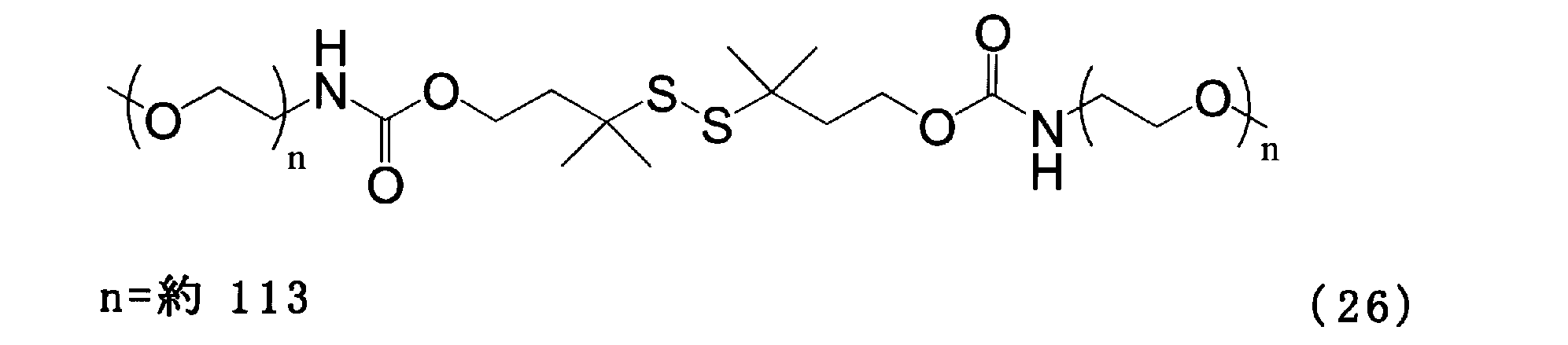
1.25(12H, s,(CH
3)2C<), 1.78(4H, t,-COO-CH2-CH
2 -),
3.38(6H, s, CH
3 O-), 3.52-4.25(904H, m, -(OCH
2 CH
2 )n-O-),
4.4 (4H, t, -COO -CH
2 -)
1.25 (12H, s, (C H 3 ) 2 C <), 1.78 (4H, t, -COO-CH 2 -C H 2- ),
3.38 (6H, s, C H 3 O-), 3.52-4.25 (904H, m,-(OC H 2 C H 2 ) n -O-),
4.4 (4H, t, -COO- CH 2- )
(実施例8)
温度計、窒素吹き込み管、攪拌機を装備した100ml三つ口フラスコに、式(23)の化合物 50.0mg、式(25)の化合物 0.912g、クロロホルム3gを加え、室温にて1時間攪拌後、エバポレーターで脱溶剤し、酢酸エチル6g、ヘキサン3gでの晶析を3回繰りかえした後、ヘキサン10gで結晶洗浄を行い、乾燥後、式(27)の化合物を得た。
(Example 8)
Add 50.0 mg of the compound of formula (23), 0.912 g of the compound of formula (25) and 3 g of chloroform to a 100 ml three-necked flask equipped with a thermometer, nitrogen blowing tube, and stirrer, and stir at room temperature for 1 hour. The solvent was removed and the crystallization with 6 g of ethyl acetate and 3 g of hexane was repeated three times. Then, the crystal was washed with 10 g of hexane and dried to obtain the compound of the formula (27).

0.901 (6H, s, CH
3-CH2-),
1.35-1.69 (8H, m, CH3-CH
2 -CH
2 -),
2.05 (4H, m, -COO-CH2-CH
2 -),
2.81-2.84 (2H, m, -S-CH<),
3.38 (6H, s, CH
3 O-),
3.52-4.25 (904H, m, -(OCH
2 CH
2 )n-O-),
4.4 (4H, t, -COO -CH
2 -)
0.901 (6H, s, C H 3 -CH 2- ),
1.35-1.69 (8H, m, CH 3 -C H 2 -C H 2- ),
2.05 (4H, m, -COO- CH 2 - CH 2 -),
2.81-2.84 (2H, m, -SC H <),
3.38 (6H, s, C H 3 O-),
3.52-4.25 (904H, m,-(OC H 2 C H 2 ) n -O-),
4.4 (4H, t, -COO- CH 2- )
(実施例9)
温度計、窒素吹き込み管、攪拌機を装備した100ml三つ口フラスコに、式(24)の化合物 50.0mg、式(25)の化合物 1.02g、クロロホルム3gを加え、室温にて1時間攪拌後、エバポレーターで脱溶剤し、酢酸エチル6g、ヘキサン3gでの晶析を3回繰りかえした後、ヘキサン10gで結晶洗浄を行い、乾燥後、式(28)の化合物を得た。
Example 9
Add 50.0 mg of the compound of formula (24), 1.02 g of the compound of formula (25) and 3 g of chloroform to a 100 ml three-necked flask equipped with a thermometer, nitrogen blowing tube, and stirrer, and stir at room temperature for 1 hour. The solvent was removed and the crystallization with 6 g of ethyl acetate and 3 g of hexane was repeated three times. Then, the crystal was washed with 10 g of hexane and dried to obtain the compound of the formula (28).
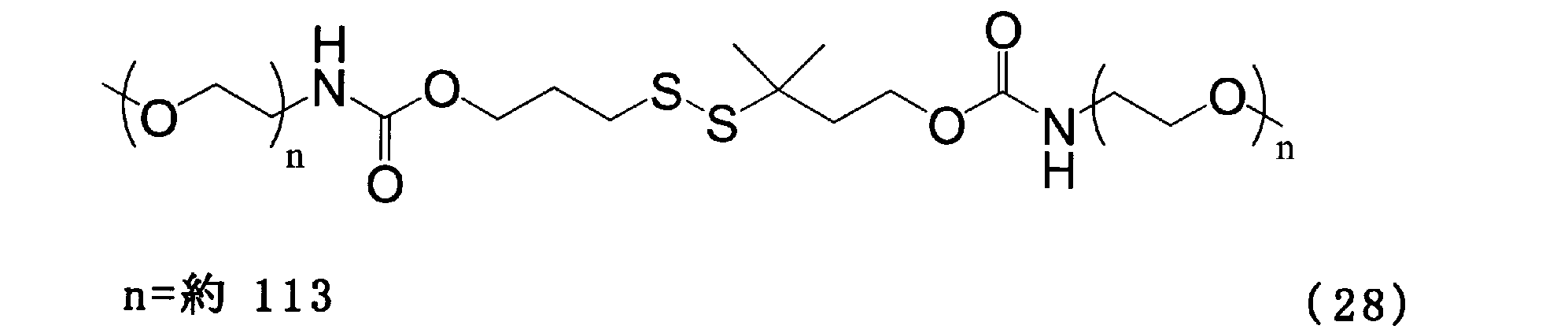
1.25(6H, s,(CH
3)2C<), 1.78(4H, t, -COO-CH2-CH
2 -),
2.81(2H, m, -S-CH
2
-), 3.38(6H, s, CH
3 O-),
3.52-4.25 (904H, m, -(OCH
2 CH
2 )n-O-),
4.4 (4H, t, -COO -CH
2 -)
1.25 (6H, s, (C H 3 ) 2 C <), 1.78 (4H, t, -COO-CH 2 -C H 2- ),
2.81 (2H, m, -SC H 2 -), 3.38 (6H, s, C H 3 O-),
3.52-4.25 (904H, m,-(OC H 2 C H 2 ) n -O-),
4.4 (4H, t, -COO- CH 2- )
(実施例10)
温度計、窒素吹き込み管、攪拌機を装備した100ml三つ口フラスコに、2,2‘-ジチオジプロピオン酸0.0421g、N-ヒドロキシコハク酸イミド 0.138g、脱水DMF1.0g、ジシクロヘキシクカルボジイミド 0.248gを加え1時間室温で攪拌後に、式(25)の化合物(実施例7の原料) 2.00gを加えさらに1時間室温で攪拌した。エバポレーターで脱溶剤し、酢酸エチル6g、ヘキサン3gでの晶析を3回繰りかえした後、ヘキサン10gで結晶洗浄を行い、乾燥後、式(29)の化合物を得た。
(Example 10)
In a 100 ml three-necked flask equipped with a thermometer, nitrogen blowing tube and stirrer, 0.0421 g of 2,2'-dithiodipropionic acid, 0.138 g of N-hydroxysuccinimide, 1.0 g of dehydrated DMF, 0.248 g of dicyclohexylcarbodiimide After stirring for 1 hour at room temperature, 2.00 g of the compound of formula (25) (raw material of Example 7) was added and further stirred for 1 hour at room temperature. The solvent was removed by an evaporator, and crystallization with 6 g of ethyl acetate and 3 g of hexane was repeated three times. Then, the crystal was washed with 10 g of hexane and dried to obtain a compound of the formula (29).

0.901 (6H, s, CH
3-CH2-),
1.35-1.69 (8H, m, CH3-CH
2 -CH
2 -),
2.05 (4H, m, -COO-CH2- -CH
2 -),
2.81-2.84 (2H, m, -S-CH<),
3.38 (6H, s, CH
3 O-),
3.52-4.25 (904H, m, -(OCH
2 CH
2 )n-O-),
4.4 (2H, d, -COO -CH(CH3)-)
0.901 (6H, s, C H 3 -CH 2- ),
1.35-1.69 (8H, m, CH 3 -C H 2 -C H 2- ),
2.05 (4H, m, -COO-CH 2 -- CH 2- ),
2.81-2.84 (2H, m, -SC H <),
3.38 (6H, s, C H 3 O-),
3.52-4.25 (904H, m,-(OC H 2 C H 2 ) n -O-),
4.4 (2H, d, -COO -C H (CH 3 )-)
(実施例11)
温度計、窒素吹き込み管、攪拌機を装備した100ml三つ口フラスコに、式(23)の化合物 2.74g、式(30)の化合物 1.0g、クロロホルム3gを加え、室温にて1時間攪拌後、エバポレーターで脱溶剤し、酢酸エチル6g、ヘキサン3gでの晶析を3回繰りかえした後、ヘキサン10gで結晶洗浄を行い、乾燥後、式(31)の化合物を得た。
(Example 11)
Add 2.74 g of the compound of formula (23), 1.0 g of the compound of formula (30) and 3 g of chloroform to a 100 ml three-necked flask equipped with a thermometer, nitrogen blowing tube, and stirrer, and stir at room temperature for 1 hour. The solvent was removed and the crystallization with 6 g of ethyl acetate and 3 g of hexane was repeated three times. Then, the crystal was washed with 10 g of hexane and dried to obtain the compound of formula (31).


0.901(6H, s, CH
3-CH2-), 1.35-1.69(8H, m, CH3-CH
2 -CH
2 -),
2.05 (4H, m, -COO-CH2-CH
2 -),
2.81-2.84 (4H, m, -S-CH<, -succinimide),
3.38 (6H, s, CH
3 O-),
3.52-4.25 (904H, m, -(OCH
2 CH
2 )n-O-),
4.4 (4H, t, -COO -CH
2 -)
0.901 (6H, s, C H 3 -CH 2- ), 1.35-1.69 (8H, m, CH 3 -C H 2 -C H 2- ),
2.05 (4H, m, -COO- CH 2 - CH 2 -),
2.81-2.84 (4H, m, -SC H <,- succinimide ),
3.38 (6H, s, C H 3 O-),
3.52-4.25 (904H, m,-(OC H 2 C H 2 ) n -O-),
4.4 (4H, t, -COO- CH 2- )
(実施例12)
温度計、窒素吹き込み管、攪拌機を装備した100ml三つ口フラスコに、式(31)の化合物0.5g、式(32)の化合物 0.5g、クロロホルム3gを加え、室温にて1時間攪拌後、エバポレーターで脱溶剤し、酢酸エチル6g、ヘキサン3gでの晶析を3回繰りかえした後、ヘキサン10gで結晶洗浄を行い、乾燥後、式(33)の化合物を得た。
(Example 12)
Add 0.5 g of the compound of formula (31), 0.5 g of the compound of formula (32) and 3 g of chloroform to a 100 ml three-necked flask equipped with a thermometer, nitrogen blowing tube, and stirrer, and stir at room temperature for 1 hour. The solvent was removed and the crystallization with 6 g of ethyl acetate and 3 g of hexane was repeated three times. Then, the crystal was washed with 10 g of hexane and dried to obtain the compound of the formula (33).


0.901 (6H, s, CH
3-CH2-),
1.35-1.69 (17H, m, CH3-CH
2 -CH
2 -, Boc),
2.05 (4H, m, -COO-CH2-CH
2 -),
2.81-2.84 (2H, m, -S-CH<),
3.38 (6H, s, CH
3 O-),
3.52-4.25 (1808H, m, -(OCH
2 CH
2 )n-O-),
4.4 (4H, t, -COO -CH
2 -)
0.901 (6H, s, C H 3 -CH 2- ),
1.35-1.69 (17H, m, CH 3 -C H 2 -C H 2- , Boc ),
2.05 (4H, m, -COO- CH 2 - CH 2 -),
2.81-2.84 (2H, m, -SC H <),
3.38 (6H, s, C H 3 O-),
3.52-4.25 (1808H, m,-(OC H 2 C H 2 ) n -O-),
4.4 (4H, t, -COO- CH 2- )
(実施例13)
温度計、窒素吹き込み管、攪拌機を装備した100ml三つ口フラスコに、式(33)の化合物0.5g、ジクロロメタン5g、メタンスルホン酸0.24gを加えて室温で1時間攪拌後、イオン交換水で反応液を抽出洗浄後、クロロホルム層を炭酸マグネシウムで脱水、エバポレーターで濃縮後、酢酸エチル6g、ヘキサン3gでの晶析を3回繰りかえした、ヘキサン10gで結晶洗浄を行い、乾燥後、式(34)の化合物を得た。
(Example 13)
Add 0.5 g of the compound of formula (33), 5 g of dichloromethane, and 0.24 g of methanesulfonic acid to a 100 ml three-necked flask equipped with a thermometer, nitrogen blowing tube, and stirrer, stir at room temperature for 1 hour, and then react with ion-exchanged water. After extracting and washing the liquid, the chloroform layer was dehydrated with magnesium carbonate, concentrated with an evaporator, crystallized with 6 g of ethyl acetate and 3 g of hexane repeatedly, washed with 10 g of hexane, dried, and then the formula (34) To give a compound.

0.901(6H, s, CH
3-CH2-), 1.35-1.69(8H, m, CH3-CH
2 -CH
2 -),
2.05(4H, m, -COO-CH2-CH
2 -), 2.65 (2H, m, -CH
2 -NH2),
2.81-2.84(2H, m, -S-CH<), 3.38(6H,s,CH
3 O-),
3.52-4.25 (1808H, m, -(OCH
2 CH
2 )n-O-),
4.4 (4H, t, -COO -CH
2 -)
0.901 (6H, s, C H 3 -CH 2- ), 1.35-1.69 (8H, m, CH 3 -C H 2 -C H 2- ),
2.05 (4H, m, -COO- CH 2 - CH 2 -), 2.65 (2H, m, -C H 2 -NH 2),
2.81-2.84 (2H, m, -SC H <), 3.38 (6H, s, C H 3 O-),
3.52-4.25 (1808H, m,-(OC H 2 C H 2 ) n -O-),
4.4 (4H, t, -COO- CH 2- )
(実施例14)
比較例1および2、実施例7~10および13で合成した化合物を用いて、グルタチオン濃度10μM、グルタチオン濃度10mMそれぞれでの37℃における分解試験を実施した。実施条件を下記のようにした。
(Example 14)
Using the compounds synthesized in Comparative Examples 1 and 2 and Examples 7 to 10 and 13, a degradation test at 37 ° C. was conducted at a glutathione concentration of 10 μM and a glutathione concentration of 10 mM. The implementation conditions were as follows.
各濃度のグルタチオンを含むリン酸緩衝生理食塩水(PBS)に、各ポリエチレングリコール誘導体の濃度が0.1mg/mL となるよう溶解し、透析膜:Slide-A-Lyzer G2透析カセット (3mL, 2k)にセットし、各濃度のグルタチオンを含むリン酸緩衝生理食塩水(PBS)中、37℃で透析した。各時間でポリエチレングリコール誘導体の溶液をサンプリングし、シリンジフィルター(酢酸セルロース, 0.45μm)でろ過し、下記の条件でHPLC分析を行った。 Dissolve each polyethylene glycol derivative in phosphate buffered saline (PBS) containing glutathione at each concentration to a concentration of 0.1 mg / mL, then dialyze membrane: Slide-A-Lyzer G2 dialysis cassette (3 mL, 2k) And dialyzed at 37 ° C. in phosphate buffered saline (PBS) containing glutathione at each concentration. The solution of the polyethylene glycol derivative was sampled at each time, filtered through a syringe filter (cellulose acetate, 0.45 μm), and subjected to HPLC analysis under the following conditions.
・分析条件
カラム: Ultrahydrogel500+250 (7.8 x 300mm)
温度: 30℃
流速: 0.5mL/min
注入量: 100μL
検出器: RI
移動相(1): 100mM酢酸緩衝液+0.02%NaN3 (pH5.2)
移動相(2): H2O/アセトニトリル=8/2
移動相(3): PBS/アセトニトリル=8/2
・ Analysis conditions Column: Ultrahydrogel500 + 250 (7.8 x 300mm)
Temperature: 30 ℃
Flow rate: 0.5mL / min
Injection volume: 100μL
Detector: RI
Mobile phase (1): 100 mM acetate buffer + 0.02% NaN 3 (pH 5.2)
Mobile phase (2): H 2 O / acetonitrile = 8/2
Mobile phase (3): PBS / acetonitrile = 8/2
比較例1および2、実施例7~10で合成した化合物について、分割されていないポリエチレングリコール誘導体(分子量約10,000)のピーク面積をA2、リンカーの分解によって分割されたポリエチレングリコール誘導体(分子量約5,000)のピーク面積をA1として下記の式で残存率を算出した。
残存率(%)=[A2/(A1+A2)]×100
For the compounds synthesized in Comparative Examples 1 and 2 and Examples 7 to 10, the peak area of the undivided polyethylene glycol derivative (molecular weight about 10,000) was A2, and the polyethylene glycol derivative (molecular weight about The residual ratio was calculated by the following formula, assuming that the peak area of 5,000) was A1.
Residual rate (%) = [A 2 / (A 1 + A 2 )] × 100
実施例13で合成した化合物について、分割されていないポリエチレングリコール誘導体(分子量約20,000)のピーク面積をA2、リンカーの分解によって分割されたポリエチレングリコール誘導体(分子量約10,000)のピーク面積をA1として下記の式で残存率を算出した。
残存率(%)=[A2/(A1+A2)]×100
For the compound synthesized in Example 13, the peak area of the undivided polyethylene glycol derivative (molecular weight about 20,000) is A2, and the peak area of the polyethylene glycol derivative (molecular weight about 10,000) divided by the decomposition of the linker is The residual rate was calculated by the following formula as A1.
Residual rate (%) = [A 2 / (A 1 + A 2 )] × 100
グルタチオン濃度10μMでの結果を図1に、グルタチオン濃度10mMでの結果を図2に示した。 The results at a glutathione concentration of 10 μM are shown in FIG. 1, and the results at a glutathione concentration of 10 mM are shown in FIG.
このように、本発明によれば、生体内の異なる還元環境下における分解速度が的確に制御可能なジスルフィドリンカーでポリエチレングリコール鎖が連結され、生体内での低分子量のポリエチレングリコール鎖への分割速度が的確に制御可能な分解性ポリエチレングリコール誘導体を提供できた。 Thus, according to the present invention, the polyethylene glycol chain is linked by a disulfide linker capable of accurately controlling the degradation rate under different reducing environments in the living body, and the rate of splitting into a low molecular weight polyethylene glycol chain in the living body. Was able to provide a degradable polyethylene glycol derivative that can be precisely controlled.
(実施例15)
温度計、窒素吹き込み管、攪拌機を装備した100ml三つ口フラスコに、式(23)の化合物 715mg、m-dPEG8-amine 100mg、クロロホルム5gを加え、室温にて1時間攪拌後、エバポレーターで脱溶剤し、シリカゲルカラムクロマトグラフィーにて精製することで、式(35)の化合物を得た。
(Example 15)
Add a compound of formula (23) 715mg, m-dPEG8-amine 100mg and chloroform 5g to a 100ml three-necked flask equipped with a thermometer, nitrogen blowing tube and stirrer. Stir at room temperature for 1 hour, then remove the solvent with an evaporator. And purified by silica gel column chromatography to obtain a compound of formula (35).

1H-NMR (CDCl3, 内部標準TMS); δ(ppm):
0.901(6H, s, CH
3 -CH2-), 1.35-1.69(8H, m, CH3-CH
2 -CH
2 -),
2.05 (4H, m, -COO-CH
2 -CH2-),
2.81-2.84 (6H, m, -S-CH<, -succinimide),
3.38 (3H, s, CH
3 O-),
3.40-3.43 (2H, m, -O-CH2-CH
2 -NH-)
3.60-3.70 (28H, m, -(OCH
2 CH
2 )7-),
3.78 (2H, t, -O-CH
2 -CH2-NH-)
4.4 (4H, t, -COO -CH
2 -)
1 H-NMR (CDCl 3 , internal standard TMS); δ (ppm):
0.901 (6H, s, C H 3 -CH 2- ), 1.35-1.69 (8H, m, CH 3 -C H 2 -C H 2- ),
2.05 (4H, m, -COO-C H 2 -CH 2- ),
2.81-2.84 (6H, m, -SC H <, -succinimide),
3.38 (3H, s, C H 3 O-),
3.40-3.43 (2H, m, -O-CH 2 -C H 2 -NH-)
3.60-3.70 (28H, m, - ( OC H 2 C H 2) 7 -),
3.78 (2H, t, -OC H 2 -CH 2 -NH-)
4.4 (4H, t, -COO -C H 2- )
(実施例16)
温度計、窒素吹き込み管、攪拌機を装備した100ml三つ口フラスコに、式(35)の化合物100mg、Amino-dPEG8-acid 66mg、クロロホルム5gを加え、室温にて1時間攪拌後、1mol/L塩酸水5gにて3回洗浄した。クロロホルム層を硫酸マグネシウムで脱水、濾過し、エバポレーターで脱溶剤し、シリカゲルカラムクロマトグラフィーにて精製することで、式(36)の化合物を得た。
(Example 16)
Add 100 mg of the compound of formula (35), 66 mg of Amino-dPEG8-acid and 5 g of chloroform to a 100 ml three-necked flask equipped with a thermometer, nitrogen blowing tube and stirrer, stir at room temperature for 1 hour, and then add 1 mol / L hydrochloric acid. Washed 3 times with 5 g of water. The chloroform layer was dehydrated with magnesium sulfate, filtered, desolvated with an evaporator, and purified by silica gel column chromatography to obtain a compound of formula (36).

0.901(6H, s, CH
3 -CH2-), 1.35-1.69(8H, m, CH3-CH
2 -CH
2 -),
2.05 (4H, m, -COO-CH2-CH
2 -),
2.61 (2H, t, -O-CH2-CH
2 -CO2H)
2.81 (2H, t, -S-CH<),
3.38 (3H, s, CH
3 O-),
3.40-3.43 (4H, m, -O-CH2-CH
2 -NH-)
3.60-3.70 (56H, m, -(OCH
2 CH
2 )7-),
3.78 (4H, t, -O-CH
2 -CH2-NH-)
3.85 (2H, t, -O-CH
2 -CH2-CO2H)
4.4 (4H, t, -COO -CH
2 -)
0.901 (6H, s, C H 3 -CH 2- ), 1.35-1.69 (8H, m, CH 3 -C H 2 -C H 2- ),
2.05 (4H, m, -COO-CH 2 -C H 2- ),
2.61 (2H, t, -O-CH 2 -C H 2 -CO 2 H)
2.81 (2H, t, -SC H <),
3.38 (3H, s, C H 3 O-),
3.40-3.43 (4H, m, -O-CH 2 -C H 2 -NH-)
3.60-3.70 (56H, m, - ( OC H 2 C H 2) 7 -),
3.78 (4H, t, -OC H 2 -CH 2 -NH-)
3.85 (2H, t, -OC H 2 -CH 2 -CO 2 H)
4.4 (4H, t, -COO -C H 2- )
本発明を特定の態様を参照して詳細に説明したが、本発明の精神と範囲を離れることなく様々な変更および修正が可能であることは、当業者にとって明らかである。
なお、本願は、2017年3月30日付で出願された日本国特許出願(2017-066942)に基づいており、その全体が引用により援用される。また、ここに引用されるすべての参照は全体として取り込まれる。
Although the invention has been described in detail with reference to specific embodiments, it will be apparent to those skilled in the art that various changes and modifications can be made without departing from the spirit and scope of the invention.
The present application is based on a Japanese patent application (2017-066692) filed on March 30, 2017, which is incorporated by reference in its entirety. Also, all references cited herein are incorporated as a whole.
Claims (13)

R1、R2、R3、R4は、それぞれ独立して、水素原子または炭素数1~6の炭化水素基を示し、R1、R2、R3、R4のうち少なくとも一つが前記炭化水素基であり;
P1は、エチレングリコール単位の数が3以上の直鎖型または分岐型のポリエチレングリコール鎖であり;
P2は、エチレングリコール単位の数が3以上の直鎖型のポリエチレングリコール鎖であり;
wは1~8の整数であり;
uは1~10の整数であり;
X1は、化学反応可能な官能基であり;および
Z1、Z2およびZ3は、それぞれ独立して選択された2価のスペーサーである。) A degradable polyethylene glycol derivative, which is represented by the formula (1):
R 1 , R 2 , R 3 and R 4 each independently represent a hydrogen atom or a hydrocarbon group having 1 to 6 carbon atoms, and at least one of R 1 , R 2 , R 3 and R 4 is the above-mentioned A hydrocarbon group;
P 1 is a linear or branched polyethylene glycol chain having 3 or more ethylene glycol units;
P 2 is a linear polyethylene glycol chain having 3 or more ethylene glycol units;
w is an integer from 1 to 8;
u is an integer from 1 to 10;
X 1 is a chemically reactive functional group; and Z 1 , Z 2 and Z 3 are each independently selected divalent spacers. )
X2は、X1と異なる化学反応可能な官能基またはメトキシ基であり;
Z4は2価のスペーサーであり;および
nは3~2000の整数である。) The degradable polyethylene glycol derivative according to claim 4, wherein P 1 is represented by the following formula (2).
X 2 is a chemically reactive functional group or methoxy group different from X 1 ;
Z 4 is a divalent spacer; and n is an integer from 3 to 2000. )

X2は、X1と異なる化学反応可能な官能基またはメトキシ基であり;
Z4は2価のスペーサーであり;
nは3~1000の整数であり;および
aは0または2である。) The degradable polyethylene glycol derivative according to claim 4, wherein P 1 is represented by the formula (3).
X 2 is a chemically reactive functional group or methoxy group different from X 1 ;
Z 4 is a divalent spacer;
n is an integer from 3 to 1000; and a is 0 or 2. )

X2は、X1と異なる化学反応可能な官能基またはメトキシ基であり;
Z4は2価のスペーサーであり;
nは3~1000の整数であり;および
aは0または2である。) The degradable polyethylene glycol derivative according to claim 6, wherein P 1 is represented by the formula (4).
X 2 is a chemically reactive functional group or methoxy group different from X 1 ;
Z 4 is a divalent spacer;
n is an integer from 3 to 1000; and a is 0 or 2. )
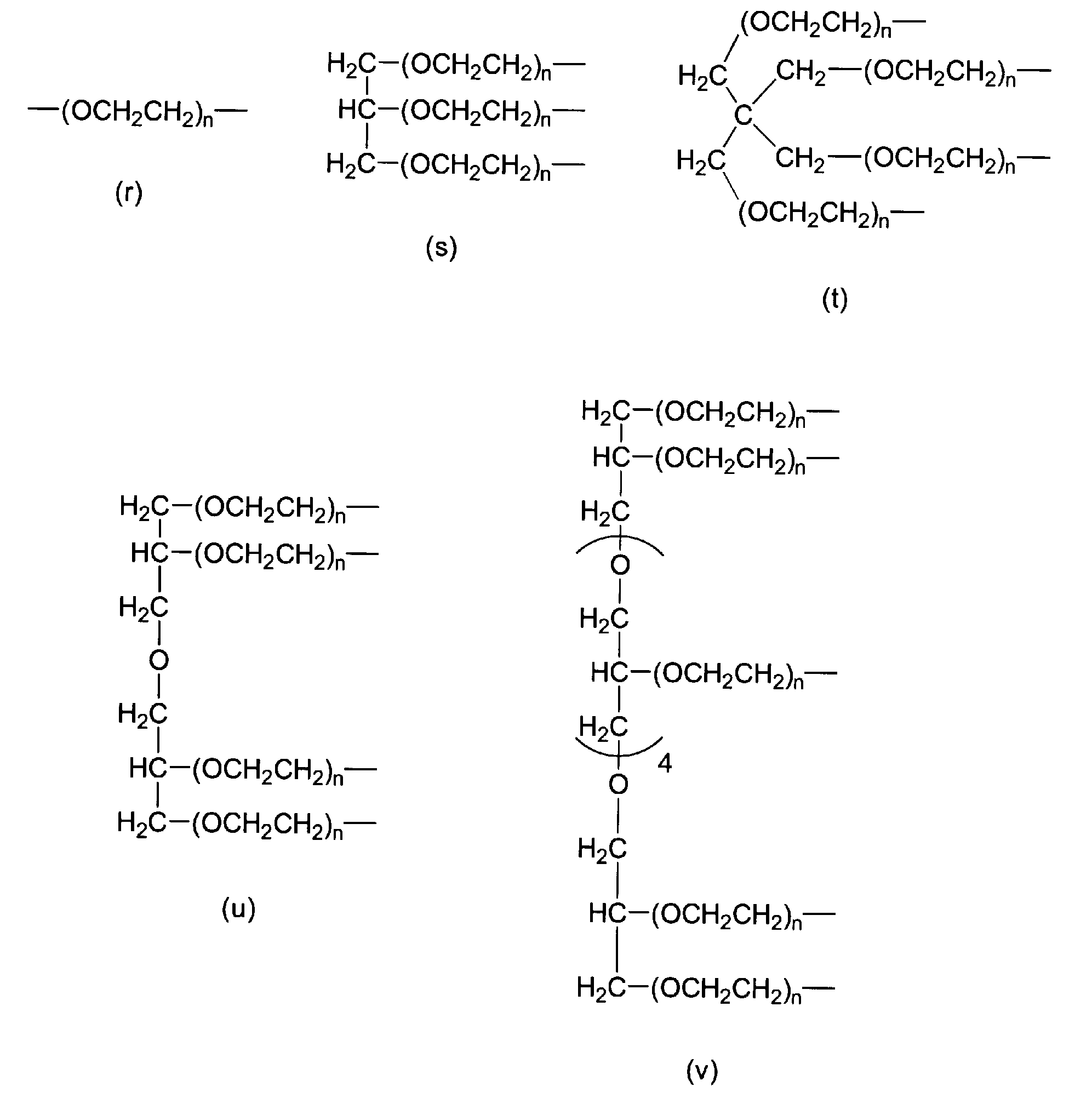
nは3~2000の整数であり、
ここで、P1が式(r)で表される場合にはwが2であり、P1が式(s)で表される場合にはwが3であり、P1が式(t)で表される場合にはwが4であり、P1が式(u)で表される場合にはwが4であり、P1が式(v)で表される場合にはwが8である。) The degradable polyethylene glycol derivative according to claim 6, wherein P 1 is selected from the group consisting of formula (r), formula (s), formula (t), formula (u) and formula (v).
n is an integer from 3 to 2000,
Here, when P 1 is represented by formula (r), w is 2, when P 1 is represented by formula (s), w is 3, and P 1 is represented by formula (t). When w is 4, w is 4 when P 1 is represented by formula (u), and w is 8 when P 1 is represented by formula (v). It is. )

X 2 is an active ester group, active carbonate group, aldehyde group, isocyanate group, isothiocyanate group, epoxy group, maleimide group, vinyl sulfone group, acrylic group, sulfonyloxy group, carboxy group, thiol group, dithiopyridyl group, α- The degradable polyethylene glycol derivative according to claim 5, 7 or 8, which is selected from the group consisting of a haloacetyl group, an alkynyl group, an allyl group, a vinyl group, an amino group, an oxyamino group, a hydrazide group, a methoxy group and an azide group.
Priority Applications (2)
| Application Number | Priority Date | Filing Date | Title |
|---|---|---|---|
| EP18777284.3A EP3604386B1 (en) | 2017-03-30 | 2018-03-23 | Degradable polyethylene glycol derivative having disulfide linker |
| US16/493,909 US11220576B2 (en) | 2017-03-30 | 2018-03-23 | Degradable polyethylene glycol derivative having disulfide linker |
Applications Claiming Priority (2)
| Application Number | Priority Date | Filing Date | Title |
|---|---|---|---|
| JP2017-066942 | 2017-03-30 | ||
| JP2017066942 | 2017-03-30 |
Publications (1)
| Publication Number | Publication Date |
|---|---|
| WO2018181048A1 true WO2018181048A1 (en) | 2018-10-04 |
Family
ID=63677661
Family Applications (1)
| Application Number | Title | Priority Date | Filing Date |
|---|---|---|---|
| PCT/JP2018/011859 Ceased WO2018181048A1 (en) | 2017-03-30 | 2018-03-23 | Degradable polyethylene glycol derivative having disulfide linker |
Country Status (4)
| Country | Link |
|---|---|
| US (1) | US11220576B2 (en) |
| EP (1) | EP3604386B1 (en) |
| JP (1) | JP7101939B2 (en) |
| WO (1) | WO2018181048A1 (en) |
Citations (6)
| Publication number | Priority date | Publication date | Assignee | Title |
|---|---|---|---|---|
| JP2006517600A (en) * | 2003-01-06 | 2006-07-27 | ネクター セラピューティクス アラバマ,コーポレイション | Thiol-selective water-soluble polymer derivatives |
| JP2007303832A (en) * | 2006-05-08 | 2007-11-22 | Seiko Epson Corp | SUBSTRATE FOR ELECTRONIC DEVICE, PROCESS FOR PRODUCING THE SAME, COMPOUND USED FOR THEM, PROCESS FOR PRODUCING THE COMPOUND AND POLYMERIZATION INITIATOR CONTAINING COMPOUND USED FOR SUBSTRATE FOR ELECTRONIC DEVICE |
| JP2009527581A (en) * | 2006-02-21 | 2009-07-30 | ネクター セラピューティックス エイエル,コーポレイション | Split-type degradable polymers and composites produced therefrom |
| JP2011500939A (en) * | 2007-10-23 | 2011-01-06 | ネクター セラピューティックス | Hydroxyapatite targeted multi-arm polymer and conjugates made from this polymer |
| JP2013245254A (en) * | 2012-05-24 | 2013-12-09 | Yokohama Rubber Co Ltd:The | Modified diene polymer |
| JP2017066942A (en) | 2015-09-29 | 2017-04-06 | マツダ株式会社 | Canister structure |
Family Cites Families (3)
| Publication number | Priority date | Publication date | Assignee | Title |
|---|---|---|---|---|
| JP2005281845A (en) * | 2004-03-28 | 2005-10-13 | Yukio Nagasaki | Dispersion of metal colloid, and method for producing dispersion of metal colloid |
| CN1997399A (en) | 2004-04-21 | 2007-07-11 | 阿尔扎公司 | Polymer conjugate releasable under mild thiolytic conditions |
| JP2007533750A (en) | 2004-04-21 | 2007-11-22 | アルザ コーポレイション | Polymer conjugates releasable under mild thiol degradation conditions |
-
2018
- 2018-03-23 WO PCT/JP2018/011859 patent/WO2018181048A1/en not_active Ceased
- 2018-03-23 US US16/493,909 patent/US11220576B2/en active Active
- 2018-03-23 JP JP2018055587A patent/JP7101939B2/en active Active
- 2018-03-23 EP EP18777284.3A patent/EP3604386B1/en active Active
Patent Citations (7)
| Publication number | Priority date | Publication date | Assignee | Title |
|---|---|---|---|---|
| JP2006517600A (en) * | 2003-01-06 | 2006-07-27 | ネクター セラピューティクス アラバマ,コーポレイション | Thiol-selective water-soluble polymer derivatives |
| JP2009527581A (en) * | 2006-02-21 | 2009-07-30 | ネクター セラピューティックス エイエル,コーポレイション | Split-type degradable polymers and composites produced therefrom |
| US8309680B2 (en) | 2006-02-21 | 2012-11-13 | Nektar Therapeutics | Segmented degradable polymers and conjugates made therefrom |
| JP2007303832A (en) * | 2006-05-08 | 2007-11-22 | Seiko Epson Corp | SUBSTRATE FOR ELECTRONIC DEVICE, PROCESS FOR PRODUCING THE SAME, COMPOUND USED FOR THEM, PROCESS FOR PRODUCING THE COMPOUND AND POLYMERIZATION INITIATOR CONTAINING COMPOUND USED FOR SUBSTRATE FOR ELECTRONIC DEVICE |
| JP2011500939A (en) * | 2007-10-23 | 2011-01-06 | ネクター セラピューティックス | Hydroxyapatite targeted multi-arm polymer and conjugates made from this polymer |
| JP2013245254A (en) * | 2012-05-24 | 2013-12-09 | Yokohama Rubber Co Ltd:The | Modified diene polymer |
| JP2017066942A (en) | 2015-09-29 | 2017-04-06 | マツダ株式会社 | Canister structure |
Non-Patent Citations (5)
| Title |
|---|
| "PEGylated Protein Drugs: Basic Science and Clinical Applications", 2009, BIRKHAUSER |
| HARRIS, J. M.: "Poly(Ethylene Glycol) Chemistry", 1992, PLENUM PRESS |
| HERMANSON, G. T.: "Bioconjugate Techniques", 2008, ACADEMIC PRESS |
| See also references of EP3604386A4 |
| WUTS, P. G M.GREENE, T. W.: "Protective Groups in Organic Synthesis", 2007, WILEY-INTERSCIENCE |
Also Published As
| Publication number | Publication date |
|---|---|
| EP3604386A1 (en) | 2020-02-05 |
| EP3604386B1 (en) | 2022-04-06 |
| US11220576B2 (en) | 2022-01-11 |
| JP7101939B2 (en) | 2022-07-19 |
| JP2018172651A (en) | 2018-11-08 |
| EP3604386A4 (en) | 2020-10-28 |
| US20200024391A1 (en) | 2020-01-23 |
Similar Documents
| Publication | Publication Date | Title |
|---|---|---|
| US6294697B1 (en) | Discrete-length polyethylene glycols | |
| Goswami et al. | Efficient synthesis of diverse heterobifunctionalized clickable oligo (ethylene glycol) linkers: potential applications in bioconjugation and targeted drug delivery | |
| KR100653153B1 (en) | Hindered derivatives of water-soluble polymers | |
| JP6631827B2 (en) | Hydrophilic polymer derivative having cyclic benzylidene acetal linker | |
| JP6784932B2 (en) | Biodegradable polyethylene glycol derivative for chemical modification of biofunctional molecules or drug carriers | |
| WO2014157150A1 (en) | Hydrophilic polymer derivative having benzylidene acetal linker | |
| JP2005514505A (en) | Preparation and use of multi-arm dendritic and functional PEG | |
| EP2554565B1 (en) | Multifunctional polyoxyalkylene compound, method for producing same and intermediate of same | |
| JP7216332B2 (en) | Branched Monodisperse Polyethylene Glycol, Intermediate and Method for Producing Same | |
| JP7101939B2 (en) | Degradable polyethylene glycol derivative with disulfide linker | |
| JP7205827B2 (en) | Degradable polyethylene glycol derivative | |
| CN100420671C (en) | A kind of maleimide derivative and its preparation method and application | |
| WO2017057612A1 (en) | Lipid derivative in which hydrophilic polymers are bound via cyclic benzylidene acetal linkers | |
| KR102923259B1 (en) | Asymmetric branched decomposable polyethylene glycol derivatives | |
| WO2020203625A1 (en) | Branched and degradable polyethylene glycol derivative | |
| US11053185B2 (en) | Dendritic polyethylene glycol derivative, and preparation method and application thereof | |
| KR20220069994A (en) | Asymmetric branched degradable polyethylene glycol derivatives | |
| KR100291828B1 (en) | Polyethylene Glycol-Succinimidyl Propionate | |
| CN121471303A (en) | Folate receptor mediated triptolide targeted coupling medicine (FTC), and preparation method and application thereof | |
| WO2019001473A1 (en) | Dendritic polyglycol derivative, preparation method therefor, and application thereof | |
| KR20000065550A (en) | Polyethylene glycol-amine | |
| KR20000065551A (en) | Polyethylene glycol-acrylate and polyethylene glycol-methacrylate | |
| KR20050017774A (en) | Novel Y-PEG Derivatives and the preparation method thereof |
Legal Events
| Date | Code | Title | Description |
|---|---|---|---|
| 121 | Ep: the epo has been informed by wipo that ep was designated in this application |
Ref document number: 18777284 Country of ref document: EP Kind code of ref document: A1 |
|
| NENP | Non-entry into the national phase |
Ref country code: DE |
|
| ENP | Entry into the national phase |
Ref document number: 2018777284 Country of ref document: EP Effective date: 20191030 |