WO2024102730A1 - Lipids and nanoparticle compositions for delivering polynucleotides - Google Patents
Lipids and nanoparticle compositions for delivering polynucleotides Download PDFInfo
- Publication number
- WO2024102730A1 WO2024102730A1 PCT/US2023/078946 US2023078946W WO2024102730A1 WO 2024102730 A1 WO2024102730 A1 WO 2024102730A1 US 2023078946 W US2023078946 W US 2023078946W WO 2024102730 A1 WO2024102730 A1 WO 2024102730A1
- Authority
- WO
- WIPO (PCT)
- Prior art keywords
- lipid
- ionizable lipid
- alkyl
- peg
- ionizable
- Prior art date
- Legal status (The legal status is an assumption and is not a legal conclusion. Google has not performed a legal analysis and makes no representation as to the accuracy of the status listed.)
- Ceased
Links
Classifications
-
- C—CHEMISTRY; METALLURGY
- C07—ORGANIC CHEMISTRY
- C07C—ACYCLIC OR CARBOCYCLIC COMPOUNDS
- C07C229/00—Compounds containing amino and carboxyl groups bound to the same carbon skeleton
- C07C229/02—Compounds containing amino and carboxyl groups bound to the same carbon skeleton having amino and carboxyl groups bound to acyclic carbon atoms of the same carbon skeleton
- C07C229/04—Compounds containing amino and carboxyl groups bound to the same carbon skeleton having amino and carboxyl groups bound to acyclic carbon atoms of the same carbon skeleton the carbon skeleton being acyclic and saturated
- C07C229/22—Compounds containing amino and carboxyl groups bound to the same carbon skeleton having amino and carboxyl groups bound to acyclic carbon atoms of the same carbon skeleton the carbon skeleton being acyclic and saturated the carbon skeleton being further substituted by oxygen atoms
-
- A—HUMAN NECESSITIES
- A61—MEDICAL OR VETERINARY SCIENCE; HYGIENE
- A61K—PREPARATIONS FOR MEDICAL, DENTAL OR TOILETRY PURPOSES
- A61K9/00—Medicinal preparations characterised by special physical form
- A61K9/0012—Galenical forms characterised by the site of application
- A61K9/0019—Injectable compositions; Intramuscular, intravenous, arterial, subcutaneous administration; Compositions to be administered through the skin in an invasive manner
-
- A—HUMAN NECESSITIES
- A61—MEDICAL OR VETERINARY SCIENCE; HYGIENE
- A61K—PREPARATIONS FOR MEDICAL, DENTAL OR TOILETRY PURPOSES
- A61K9/00—Medicinal preparations characterised by special physical form
- A61K9/10—Dispersions; Emulsions
- A61K9/127—Synthetic bilayered vehicles, e.g. liposomes or liposomes with cholesterol as the only non-phosphatidyl surfactant
- A61K9/1271—Non-conventional liposomes, e.g. PEGylated liposomes or liposomes coated or grafted with polymers
- A61K9/1272—Non-conventional liposomes, e.g. PEGylated liposomes or liposomes coated or grafted with polymers comprising non-phosphatidyl surfactants as bilayer-forming substances, e.g. cationic lipids or non-phosphatidyl liposomes coated or grafted with polymers
-
- A—HUMAN NECESSITIES
- A61—MEDICAL OR VETERINARY SCIENCE; HYGIENE
- A61K—PREPARATIONS FOR MEDICAL, DENTAL OR TOILETRY PURPOSES
- A61K9/00—Medicinal preparations characterised by special physical form
- A61K9/48—Preparations in capsules, e.g. of gelatin, of chocolate
- A61K9/50—Microcapsules having a gas, liquid or semi-solid filling; Solid microparticles or pellets surrounded by a distinct coating layer, e.g. coated microspheres, coated drug crystals
- A61K9/51—Nanocapsules; Nanoparticles
- A61K9/5107—Excipients; Inactive ingredients
- A61K9/5123—Organic compounds, e.g. fats, sugars
-
- C—CHEMISTRY; METALLURGY
- C07—ORGANIC CHEMISTRY
- C07C—ACYCLIC OR CARBOCYCLIC COMPOUNDS
- C07C229/00—Compounds containing amino and carboxyl groups bound to the same carbon skeleton
- C07C229/02—Compounds containing amino and carboxyl groups bound to the same carbon skeleton having amino and carboxyl groups bound to acyclic carbon atoms of the same carbon skeleton
- C07C229/04—Compounds containing amino and carboxyl groups bound to the same carbon skeleton having amino and carboxyl groups bound to acyclic carbon atoms of the same carbon skeleton the carbon skeleton being acyclic and saturated
- C07C229/06—Compounds containing amino and carboxyl groups bound to the same carbon skeleton having amino and carboxyl groups bound to acyclic carbon atoms of the same carbon skeleton the carbon skeleton being acyclic and saturated having only one amino and one carboxyl group bound to the carbon skeleton
- C07C229/10—Compounds containing amino and carboxyl groups bound to the same carbon skeleton having amino and carboxyl groups bound to acyclic carbon atoms of the same carbon skeleton the carbon skeleton being acyclic and saturated having only one amino and one carboxyl group bound to the carbon skeleton the nitrogen atom of the amino group being further bound to acyclic carbon atoms or to carbon atoms of rings other than six-membered aromatic rings
- C07C229/12—Compounds containing amino and carboxyl groups bound to the same carbon skeleton having amino and carboxyl groups bound to acyclic carbon atoms of the same carbon skeleton the carbon skeleton being acyclic and saturated having only one amino and one carboxyl group bound to the carbon skeleton the nitrogen atom of the amino group being further bound to acyclic carbon atoms or to carbon atoms of rings other than six-membered aromatic rings to carbon atoms of acyclic carbon skeletons
Definitions
- nucleic acid therapeutics has rapidly expanded and has become the basis for treating a wide variety of diseases.
- Nucleic acid therapies available include, but are not limited to, the use of DNA or viral vectors for insertion of desired genetic information into the host cell, and/or RNA constructed to encode for a therapeutic protein. DNA and viral vector deliveries carry their own setbacks and challenges that make them less favorable to RNA therapeutics.
- RNA is substantially safer and more effective gene therapy agent due to its ability to encode for the protein outside of the nucleus to perform its function. With this, the RNA does not involve the risk of being stably integrated into the genome of the transfected cell.
- RNA therapeutics conventionally has consisted of engineering linear messenger RNAs (mRNA).
- linear mRNAs Although more effective than DNA or viral vectors, linear mRNAs have their own set of challenges regarding stability, immunogenicity, translation efficiency, and delivery. Some of these challenges may lead to size restraints and/or destruction of the linear mRNA due to the challenges present with linear mRNAs’ caps.
- circular polynucleotides or circular RNAs may be used. Due to being covalently closed continuous loops, circular RNAs are useful in the design and production of stable forms of RNA. The circularization of an RNA molecule provides an advantage to the study of RNA structure and function, especially in the case of molecules that are prone to folding in an inactive conformation (Wang and Ruffner, 1998).
- Circular RNA can also be particularly interesting and useful for in vivo applications, especially in the research area of RNA-based control of gene expression and therapeutics, including protein replacement therapy and vaccination.
- nanoparticles delivery systems can be used.
- the present disclosure provides a robust therapeutic using engineered polynucleotides and lipid nanoparticle compositions, comprising novel lipids.
- SUMMARY [4] The present application provides ionizable lipids and related transfer vehicles, compositions, and methods.
- the transfer vehicles can comprise ionizable lipid (e.g., ionizable lipids described herein), PEG-modified lipid, and/or structural lipid, thereby forming lipid nanoparticles encapsulating therapeutic agents (e.g., RNA polynucleotides such as circular RNAs).
- therapeutic agents e.g., RNA polynucleotides such as circular RNAs.
- Pharmaceutical compositions comprising such circular RNAs and transfer vehicles are particularly suitable for efficient protein expression in immune cells in vivo.
- the present application also provides methods of treating or preventing a disease, disorder, or condition with the pharmaceutical compositions described herein.
- ionizable lipids of Formula (15) are provided herein: , Formula (15) or a pharmaceutically acceptable salt thereof, wherein: n * is an integer from 1 to 7; R a is hydrogen or hydroxyl; R h is hydrogen or C1-C6 alkyl; R 1 is C 1 -C 30 alkyl or R 1* ; R 2 is C1-C30 alkyl or R 2* ; R 1* and R 2* are independently selected from: –(CH2)qC(O)O(CH2)rC(R 8 )(R 9 )(R 10 ), –(CH 2 ) q OC(O)(CH 2 ) r C(R 8 )(R 9 )(R 10 ), and –(CH2)qOC(O)O(CH2)rC(R 8 )(R 9 )(R 10 ); wherein: q is an integer from 0 to 12, r is an integer from 0 to 6, wherein at least one occurrence of
- the present disclosure provides a pharmaceutical composition
- a pharmaceutical composition comprising a transfer vehicle, wherein the transfer vehicle comprises an ionizable lipid described above.
- the pharmaceutical composition further comprises an RNA polynucleotide.
- the RNA polynucleotide is a linear or circular RNA polynucleotide.
- the RNA polynucleotide is a circular RNA polynucleotide.
- the present disclosure provides a pharmaceutical composition comprising: a. an RNA polynucleotide, wherein the RNA polynucleotide is a circular RNA polynucleotide, and b.
- the transfer vehicle comprises a nanoparticle, such as a lipid nanoparticle, a core-shell nanoparticle, a biodegradable nanoparticle, a biodegradable lipid nanoparticle, a polymer nanoparticle, or a biodegradable polymer nanoparticle.
- the RNA polynucleotide is encapsulated in the transfer vehicle. In some embodiments, the RNA polynucleotide is encapsulated in the transfer vehicle with an encapsulation efficiency of at least 80%.
- the circular RNA polynucleotide comprises a expression sequence.
- the expression sequence encodes a therapeutic protein. In some embodiments, the expression sequence encodes a cytokine or a functional fragment thereof. In other embodiments, the expression sequence encodes a transcription factor. In other embodiments, the expression sequence encodes an immune checkpoint inhibitor. In other embodiments, the expression sequence encodes a chimeric antigen receptor (CAR).
- the circular RNA polynucleotide comprises, in the following order: (a) a 5’ enhanced exon element, (b) a core functional element, and (c) a 3’ enhanced exon element.
- the core functional element comprises a translation initiation element (TIE).
- the TIE comprises an untranslated region (UTR) or fragment thereof.
- the UTR or fragment thereof comprises a IRES or eukaryotic IRES.
- the TIE comprises an aptamer complex, optionally wherein the aptamer complex comprises at least two aptamers.
- the core functional element comprises a coding region.
- the coding region encodes for a therapeutic protein.
- the therapeutic protein is a chimeric antigen receptor (CAR).
- the core functional element comprises a noncoding region.
- the RNA polynucleotide comprised in a pharmaceutical composition described herein is from about 100nt to about 10,000nt in length. In some embodiments, the RNA polynucleotide is from about 100nt to about 15,000nt in length.
- the transfer vehicle in a pharmaceutical composition described herein further comprises a structural lipid and a PEG-modified lipid.
- the structural lipid binds to C1q and/or promotes the binding of the transfer vehicle comprising said lipid to C1q compared to a control transfer vehicle lacking the structural lipid and/or increases uptake of C1q-bound transfer vehicle into an immune cell compared to a control transfer vehicle lacking the structural lipid.
- the immune cell is a T cell, an NK cell, an NKT cell, a macrophage, or a neutrophil.
- the structural lipid is cholesterol.
- the structural lipid is beta-sitosterol. In some embodiments, the structural lipid is not beta-sitosterol.
- the PEG-modified lipid is DSPE-PEG, DMG-PEG, PEG-DAG, PEG-S-DAG, PEG-PE, PEG-S-DMG, PEG-cer, PEG-dialkoxypropylcarbamate, PEG-OR, PEG-OH, PEG-c-DOMG, or PEG-1.
- the PEG-modified lipid is DSPE-PEG(2000).
- the transfer vehicle further comprises a helper lipid.
- the helper lipid is DSPC or DOPE.
- the transfer vehicle comprised in a pharmaceutical composition described herein comprises DSPC, cholesterol, and DMG-PEG(2000).
- the transfer vehicle comprises about 0.5% to about 4% PEG- modified lipids by molar ratio. In some embodiments, the transfer vehicle comprises about 1% to about 2% PEG-modified lipids by molar ratio.
- the transfer vehicle comprises: a. an ionizable lipid described herein, b. a helper lipid selected from DOPE or DSPC, c. cholesterol, and d. a PEG-lipid selected from DSPE-PEG(2000) or DMG-PEG(2000).
- the transfer vehicle comprises ionizable lipid, helper lipid, cholesterol, and PEG-lipid at the molar ratio of ionizable lipid:helper lipid:cholesterol:PEG-lipid of about 45:9:44:2, about 50:10:38.5:1.5, about 41:12:45:2, about 62:4:33:1, or about 53:5:41:1.
- the molar ratio of each of the ionizable lipid, helper lipid, cholesterol, and PEG-lipid is within 10%, 9%, 8%, 7%, 6%, 5%, 4%, 3%, 2%, 1%, 0.9%, 0.8%, 0.7%, 0.6%, 0.5%, 0.4%, 0.3%, 0.2%, 0.1%, 0.09%, 0.08%, 0.07%, 0.06%, 0.05%, 0.04%, 0.03%, 0.02%, or 0.01% of the stated value.
- the transfer vehicle comprises the helper lipid of DOPE and the PEG-lipid of DMG-PEG(2000), wherein the molar ratio of ionizable lipid:DOPE:cholesterol:DMG- PEG(2000) is about 45:9:44:2, about 50:10:38.5:1.5, about 41:12:45:2, about 62:4:33:1, or about 53:5:41:1.
- the molar ratio of ionizable lipid:DOPE:cholesterol:DSPE- PEG(2000) is about 62:4:33:1.
- the molar ratio of ionizable lipid:DOPE:cholesterol:DSPE-PEG(2000) is about 53:5:41:1.
- the transfer vehicle comprises the helper lipid of DSPC and the PEG-lipid of DMG-PEG(2000), wherein the molar ratio of ionizable lipid:DSPC:cholesterol:DMG- PEG(2000) is about 45:9:44:2, about 50:10:38.5:1.5, about 41:12:45:2, about 62:4:33:1, or about 53:5:41:1. In some embodiments, the molar ratio of ionizable lipid:DSPC:cholesterol:DMG- PEG(2000) is about 50:10:38.5:1.5.
- the molar ratio of ionizable lipid:DSPC:cholesterol:DMG-PEG(2000) is about 41:12:45:2. In some embodiments, the molar ratio of ionizable lipid:DSPC:cholesterol:DMG-PEG(2000) is about 45:9:44:2.
- the transfer vehicle comprises the helper lipid of DSPC and the PEG-lipid of DSPE-PEG(2000), wherein the molar ratio of ionizable lipid: DSPC:cholesterol:DSPE- PEG(2000) is about 45:9:44:2, about 50:10:38.5:1.5, about 41:12:45:2, about 62:4:33:1, or about 53:5:41:1.
- the transfer vehicle comprises the helper lipid of DOPE and the PEG-lipid is C14-PEG(2000), wherein the molar ratio of ionizable lipid:DOPE:cholesterol:C14- PEG(2000) is about 45:9:44:2, about 50:10:38.5:1.5, about 41:12:45:2, about 62:4:33:1, or about 53:5:41:1.
- the transfer vehicle comprises the helper lipid of DOPE and the PEG-lipid of DMG-PEG(2000), wherein the molar ratio of ionizable lipid:DOPE:cholesterol:DMG- PEG(2000) is about 45:9:44:2, about 50:10:38.5:1.5, about 41:12:45:2, about 62:4:33:1, or about 53:5:41:1.
- a pharmaceutical composition of the present disclosure has a lipid to phosphate (IL:P) molar ratio of about 3 to about 9, such as about 3, about 4, about 4.5, about 5, about 5.4, about 5.7, about 6, about 6.2, about 6.5, or about 7.
- the transfer vehicle is formulated for endosomal release of the RNA polynucleotide.
- the transfer vehicle is capable of binding to apolipoprotein E (APOE) or is substantially free of APOE binding sites.
- the transfer vehicle is capable of low density lipoprotein receptor (LDLR) dependent uptake or LDLR independent uptake into a cell.
- the transfer vehicle has a diameter of less than about 120 nm and/or does not form aggregates with a diameter of more than 300 nm.
- a pharmaceutical composition of the present disclosure is substantially free of linear RNA.
- the transfer vehicle further comprises an operably connected targeting moiety.
- the targeting moiety specifically or indirectly binds an immune cell antigen, wherein the immune cell antigen is a T cell antigen selected from the group consisting of CD2, CD3, CD5, CD7, CD8, CD4, beta7 integrin, beta2 integrin, and C1qR.
- the targeting moiety is a small molecule.
- the small molecule is mannose, a lectin, acivicin, biotin, or digoxigenin.
- the small molecule binds to an ectoenzyme on an immune cell, wherein the ectoenzyme is selected from the group consisting of CD38, CD73, adenosine 2a receptor, and adenosine 2b receptor.
- the targeting moiety is a single chain Fv (scFv) fragment, nanobody, peptide, peptide-based macrocycle, minibody, small molecule ligand such as folate, arginylglycylaspartic acid (RGD), or phenol-soluble modulin alpha 1 peptide (PSMA1), heavy chain variable region, light chain variable region or fragment thereof.
- the polynucleotides of the pharmaceutical composition of the present disclosure have less than 1%, by weight, double stranded RNA, DNA splints, or triphosphorylated RNA. In some embodiments, the polynucleotides and proteins of the pharmaceutical composition have less than 1%, by weight, double stranded RNA, DNA splints, triphosphorylated RNA, phosphatase proteins, protein ligases, or capping enzymes. [36] In another aspect, provided herein is a method of treating or preventing a disease, disorder, or condition, comprising administering an effective amount of a pharmaceutical composition described above and herein.
- FIG.1 depicts splenic expression of firefly luciferase delivered via LNPs formulated with various ionizable lipids from Table 5 (post intravenous administration. Splenic expression was measured based on total luciferase flux (p/s) from ex vivo IVIS analysis.
- FIG. 2A-2C depict B cell depletion within mice when treated with a circular RNA encoding a CD19 chimeric antigen receptor (CAR) protein encapsulated in mice.
- CAR chimeric antigen receptor
- the circular RNA was delivered via an LNP comprising an ionizable lipid from Table 1.
- B cell aplasia was observed in blood cells post-delivery of said circRNA-LNPs.
- the dotted line on the figure indicates Wasabi control B cell aplasia.
- % B cell was normalized to the Wasabi control.
- FIG.2B and FIG.2C exemplify the B cell killing for each of the LNP-circRNA encoding aCD19-CARs compared to the LNP-circRNA encoding mWasabi equivalent construct comprising the same ionizable lipid.
- oWasabi on the figure refers to the data associated with a circular RNA encoding mWasabi.
- FIG. 3A and FIG. 3B depict the rate of lipid clearance for LNPs comprising various ionizable lipids described herein compared to a control (Comparative Lipid 1). Lipid clearance was measured based on percent lipid remaining in the liver (FIG.3A) and spleen (FIG.3B) at 48- and 168- hour time points.
- FIG. 4. depicts expression within various organs post in vitro administration of circular RNAs encoding for firefly luciferase delivered via LNPs formulated with various ionizable lipids from Table 1 post intraperitoneal injection.
- FIG.5. depicts expression of circular RNA encoding firefly luciferase delivered via LNPs formulated with various ionizable lipids from Table 1 post intraperitoneal injection. Splenic expression was measured based on total luciferase flux (p/s) from ex vivo IVIS analysis.
- FIGs.6A and 6B depict B cell depletion in mice treated with a circular RNA encoding a CD19 chimeric antigen receptor (CAR) protein encapsulated in LNP. The circular RNA was delivered via an LNP comprising an ionizable lipid from Table 1.
- CAR chimeric antigen receptor
- FIG.6A B cell aplasia was observed in blood cells post-delivery of said circRNA-LNPs.
- FIG.6B B cell aplasia was observed in splenic cells post-delivery of said circRNA-LNPs.
- Wasabi refers to circular RNA encoding mWasabi.
- muCD19-CAR refers circular RNA encoding an antiCD19-CAR.
- FIGs.7A-7D show tumor growth kinetics in a Nalm6 model post administration of LNP- oRNA constructs comprising lipids from Table 1 or 2.
- FIGs.7A and 7B show tumor growth kinetics of LNP-oRNAs dosed at 0.1 mg/kg from two separate donors.
- FIGs.7C and 7D show tumor growth kinetics of LNP-oRNAs dosed at 0.3 mg/kg from two separate donors. Total flux of the tested mice was measured.
- the present disclosure provides, among other things, ionizable lipids as well as transfer vehicles and pharmaceutical compositions comprising the ionizable lipids described herein.
- the transfer vehicles comprise ionizable lipid (e.g., ionizable lipids described herein), PEG-modified lipid, and/or structural lipid, thereby forming lipid nanoparticles suitable for delivering polynucleotides/nucleic acids.
- the nucleic acid may be RNA, such as siRNA, mRNA or circular RNA.
- the nucleic acids may encode therapeutic agents.
- the nucleic acids are encapsulated in the transfer vehicles.
- RNA therapy along with associated compositions and methods.
- the RNA therapy allows for increased RNA stability, expression, and prolonged half-life, among other things.
- methods comprising administration of pharmaceutical compositions comprising the ionizable lipids described herein and RNA polynucleotides into cells for therapy or production of useful proteins.
- the RNA polynucleotide is a circular RNA polynucleotide, (circRNA).
- the method is advantageous in providing the production of a desired polypeptide inside eukaryotic cells with a longer half-life than linear RNA, due to the resistance of the circular RNA to ribonucleases.
- lipid nanoparticles comprising the ionizable lipids described herein and RNA polynucleotides, in particular circRNA, provide improved clearance in certain organs, e.g., the liver and spleen.
- Circular RNA polynucleotides lack the free ends necessary for exonuclease-mediated degradation, causing them to be resistant to several mechanisms of RNA degradation and granting extended half-lives when compared to an equivalent linear RNA. Circularization may allow for the stabilization of RNA polynucleotides that generally suffer from short half-lives and may improve the overall efficacy of exogenous mRNA in a variety of applications.
- the functional half-life of the circular RNA polynucleotides provided herein in eukaryotic cells (e.g., mammalian cells, such as human cells) as assessed by protein synthesis is at least 20 hours (e.g., at least 80 hours).
- DNA template refers to a DNA sequence capable of transcribing a linear RNA polynucleotide.
- a DNA template may include a DNA vector, PCR product or plasmid.
- 3’ group I intron fragment refers to a sequence with 75% or higher similarity to the 3’-proximal end of a natural group I intron including the splice site dinucleotide and optionally a stretch of natural exon sequence.
- a circular RNA comprises a post splicing 3’ group I intron fragment.
- the post splicing 3’ group I intron fragment in the circular RNA is a post splicing stretch of exon sequence.
- the circular RNA further comprises a desired expression sequence, and the post splicing stretch of exon sequence is (e.g., designed) to be a portion of the desired expression sequence, contiguous with the desired expression sequence, and/or in frame with the desired expression sequence.
- the term “5’ group I intron fragment” refers to a sequence with 75% or higher similarity to the 5’-proximal end of a natural group I intron including the splice site dinucleotide and optionally a stretch of natural exon sequence.
- a circular RNA comprises a post splicing 5’ group I intron fragment.
- the post splicing 5’ group I intron fragment in the circular RNA is a post splicing stretch of exon sequence.
- the circular RNA further comprises a desired expression sequence, and the post splicing stretch of exon sequence is (e.g., designed) to be a portion of the desired expression sequence, contiguous with the desired expression sequence, and/or in frame with the desired expression sequence.
- the term “permutation site” refers to the site in a group I intron where a cut is made prior to permutation of the intron.
- splice site refers to a dinucleotide that is partially or fully included in a group I intron and between which a phosphodiester bond is cleaved during RNA circularization. (As used herein, “splice site” refers to the dinucleotide or dinucleotides between which cleavage of the phosphodiester bond occurs during a splicing reaction.
- a “5’ splice site” refers to the natural 5’ dinucleotide of the intron e.g., group I intron, while a “3’ splice site” refers to the natural 3’ dinucleotide of the intron).
- expression sequence refers to a nucleic acid sequence that encodes a product, e.g., a peptide or polypeptide, regulatory nucleic acid, or non-coding nucleic acid.
- An exemplary expression sequence that codes for a peptide or polypeptide can comprise a plurality of nucleotide triads, each of which can code for an amino acid and is termed as a “codon.”
- “coding element” or “coding region” is region located within the expression sequence and encodings for one or more proteins or polypeptides (e.g., therapeutic protein).
- a “noncoding element” or “non-coding nucleic acid” is a region located within the expression sequence.
- the term “therapeutic protein” refers to any protein that, when administered to a subject directly or indirectly in the form of a translated nucleic acid, has a therapeutic, diagnostic, and/or prophylactic effect and/or elicits a desired biological and/or pharmacological effect.
- the term “immunogenic” refers to a potential to induce an immune response to a substance.
- an immune response may be induced when an immune system of an organism or a certain type of immune cells is exposed to an immunogenic substance.
- non-immunogenic refers to a lack of or absence of an immune response above a detectable threshold to a substance. No immune response is detected when an immune system of an organism or a certain type of immune cells is exposed to a non-immunogenic substance.
- a non-immunogenic circular polyribonucleotide as provided herein does not induce an immune response above a pre-determined threshold when measured by an immunogenicity assay.
- no innate immune response is detected when an immune system of an organism or a certain type of immune cells is exposed to a non-immunogenic circular polyribonucleotide as provided herein.
- no adaptive immune response is detected when an immune system of an organism or a certain type of immune cell is exposed to a non-immunogenic circular polyribonucleotide as provided herein.
- the term “circularization efficiency” refers to a measurement of resultant circular polyribonucleotide as compared to its linear starting material.
- the term “translation efficiency” refers to a rate or amount of protein or peptide production from a ribonucleotide transcript.
- translation efficiency can be expressed as amount of protein or peptide produced per given amount of transcript that codes for the protein or peptide.
- nucleotide refers to a ribonucleotide, a deoxyribonucleotide, a modified form thereof, or an analog thereof. Nucleotides include species that comprise purines, e.g., adenine, hypoxanthine, guanine, and their derivatives and analogs, as well as pyrimidines, e.g., cytosine, uracil, thymine, and their derivatives and analogs.
- Nucleotide analogs include nucleotides having modifications in the chemical structure of the base, sugar and/or phosphate, including, but not limited to, 5’-position pyrimidine modifications, 8’-position purine modifications, modifications at cytosine exocyclic amines, and substitution of 5-bromo-uracil; and 2’-position sugar modifications, including but not limited to, sugar-modified ribonucleotides in which the 2’-OH is replaced by a group such as an H, OR, R, halo, SH, SR, NH2, NHR, NR2, or CN, wherein R is an alkyl moiety as defined herein.
- Nucleotide analogs are also meant to include nucleotides with bases such as inosine, queuosine, xanthine; sugars such as 2’-methyl ribose; non-natural phosphodiester linkages such as methylphosphonate, phosphorothioate and peptide linkages. Nucleotide analogs include 5- methoxyuridine, 1-methylpseudouridine, and 6-methyladenosine.
- nucleic acid and “polynucleotide” are used interchangeably herein to describe a polymer of any length, e.g., greater than about 2 bases, greater than about 10 bases, greater than about 100 bases, greater than about 500 bases, greater than 1000 bases, or up to about 10,000 or more bases, composed of nucleotides, e.g., deoxyribonucleotides or ribonucleotides, and may be produced enzymatically or synthetically (e.g., as described in U.S. Pat. No.
- Naturally occurring nucleic acids are comprised of nucleotides including guanine, cytosine, adenine, thymine, and uracil (G, C, A, T, and U respectively).
- ribonucleic acid and RNA as used herein mean a polymer composed of ribonucleotides.
- deoxyribonucleic acid and “DNA” as used herein mean a polymer composed of deoxyribonucleotides.
- isolated generally refers to isolation of a substance (for example, in some embodiments, a compound, a polynucleotide, a protein, a polypeptide, a polynucleotide composition, or a polypeptide composition) such that the substance comprises a significant percent (e.g., greater than 1%, greater than 2%, greater than 5%, greater than 10%, greater than 20%, greater than 50%, or more, usually up to about 90%-100%) of the sample in which it resides.
- a substantially purified component comprises at least 50%, 80%-85%, or 90%-95% of the sample.
- unstructured with regard to RNA refers to an RNA sequence that is not predicted by the RNAFold software or similar predictive tools to form a structure (e.g., a hairpin loop) with itself or other sequences in the same RNA molecule.
- unstructured RNA can be functionally characterized using nuclease protection assays.
- structured with regard to RNA refers to an RNA sequence that is predicted by the RNAFold software or similar predictive tools to form a structure (e.g., a hairpin loop) with itself or other sequences in the same RNA molecule.
- two “duplex sequences,” “duplex region,” “duplex regions,” “homology arms,” or “homology regions” may be any two regions that are thermodynamically favored to cross- pair in a sequence specific interaction.
- two duplex sequences, duplex regions, homology arms, or homology regions share a sufficient level of sequence identity to one another’s reverse complement to act as substrates for a hybridization reaction.
- polynucleotide sequences have “homology” when they are either identical or share sequence identity to a reverse complement or “complementary” sequence.
- the percent sequence identity between a homology region and a counterpart homology region’s reverse complement can be any percent of sequence identity that allows for hybridization to occur.
- an internal duplex region of an inventive polynucleotide is capable of forming a duplex with another internal duplex region and does not form a duplex with an external duplex region.
- an “affinity sequence” or “affinity tag” is a region of polynucleotide sequences polynucleotide sequence ranging from 1 nucleotide to hundreds or thousands of nucleotides containing a repeated set of nucleotides for the purposes of aiding purification of a polynucleotide sequence.
- an affinity sequence may comprise, but is not limited to, a polyA or polyAC sequence.
- a “spacer” refers to a region of a polynucleotide sequence ranging from 1 nucleotide to hundreds or thousands of nucleotides separating two other elements along a polynucleotide sequence. The sequences can be defined or can be random. A spacer is typically non- coding. In some embodiments, spacers include duplex regions. [74] Linear nucleic acid molecules are said to have a “5’-terminus” (5’ end) and a “3’-terminus” (3’ end) because nucleic acid phosphodiester linkages occur at the 5’ carbon and 3’ carbon of the sugar moieties of the substituent mononucleotides.
- a “leading untranslated sequence” is a region of polynucleotide sequences ranging from 1 nucleotide to hundreds of nucleotides located at the upmost 5' end of a polynucleotide sequence.
- sequences can be defined or can be random.
- a leading untranslated sequence is non- coding.
- a “leading untranslated sequence” is a region of polynucleotide sequences ranging from 1 nucleotide to hundreds of nucleotides located at the downmost 3' end of a polynucleotide sequence.
- the sequences can be defined or can be random.
- a leading untranslated sequence is non- coding.
- “Transcription” means the formation or synthesis of an RNA molecule by an RNA polymerase using a DNA molecule as a template. The present disclosure is not limited with respect to the RNA polymerase that is used for transcription.
- RNA polymerase for example, in some embodiments, a T7-type RNA polymerase can be used.
- Translation means the formation of a polypeptide molecule by a ribosome based upon an RNA template.
- the term “or” is understood to be inclusive. Unless defined herein and below in the reminder of the specification, all technical and scientific terms used herein have the same meaning as commonly understood by one of ordinary skill in the art to which the present disclosure pertains. [80] Unless specifically stated or obvious from context, as used herein, the term “about,” is understood as within a range of normal tolerance in the art. Unless otherwise clear from the context, all numerical values provided herein are modified by the term “about.” [81] As used herein, the term “encode” refers broadly to any process whereby the information in a polymeric macromolecule is used to direct the production of a second molecule that is different from the first.
- the second molecule may have a chemical structure that is different from the chemical nature of the first molecule.
- co-administering is meant administering a therapeutic agent provided herein in conjunction with one or more additional therapeutic agents sufficiently close in time such that the therapeutic agent provided herein can enhance the effect of the one or more additional therapeutic agents, or vice versa.
- the terms “treat,” and “prevent” as well as words stemming therefrom, as used herein, do not necessarily imply 100% or complete treatment or prevention. Rather, there are varying degrees of treatment or prevention of which one of ordinary skill in the art recognizes as having a potential benefit or therapeutic effect.
- the treatment or prevention provided by the method described herein can include treatment or prevention of one or more conditions or symptoms of the disease.
- an “internal ribosome entry site” or “IRES” refers to an RNA sequence or structural element ranging in size from 10 nt to 1000 nt or more, capable of initiating translation of a polypeptide in the absence of a typical RNA cap structure.
- An IRES is typically about 500 nt to about 700 nt in length.
- aptamer refers in general to either an oligonucleotide of a single defined sequence or a mixture of said nucleotides, wherein the mixture retains the properties of binding specifically to the target molecule (e.g., eukaryotic initiation factor, 40S ribosome, polyC binding protein, polyA binding protein, polypyrimidine tract-binding protein, argonaute protein family, Heterogeneous nuclear ribonucleoprotein K and La and related RNA-binding protein).
- target molecule e.g., eukaryotic initiation factor, 40S ribosome, polyC binding protein, polyA binding protein, polypyrimidine tract-binding protein, argonaute protein family, Heterogeneous nuclear ribonucleoprotein K and La and related RNA-binding protein.
- aptamer is meant to refer to a single- or double-stranded nucleic acid which is capable of binding to a protein or other molecule.
- aptamers preferably comprise about 10 to about 100 nucleotides, preferably about 15 to about 40 nucleotides, more preferably about 20 to about 40 nucleotides, in that oligonucleotides of a length that falls within these ranges are readily prepared by conventional techniques.
- aptamers can further comprise a minimum of approximately 6 nucleotides, preferably 10, and more preferably 14 or 15 nucleotides, that are necessary to effect specific binding.
- an “eukaryotic initiation factor” or “eIF” refers to a protein or protein complex used in assembling an initiator tRNA, 40S and 60S ribosomal subunits required for initiating eukaryotic translation.
- an “internal ribosome entry site” or “IRES” refers to an RNA sequence or structural element ranging in size from 10 nt to 1000 nt or more that is capable of initiating translation of a polypeptide in the absence of a typical RNA cap structure.
- An IRES is typically about 500 nt to about 700 nt in length.
- a “miRNA site” refers to a stretch of nucleotides within a polynucleotide that is capable of forming a duplex with at least 8 nucleotides of a natural miRNA sequence.
- an “endonuclease site” refers to a stretch of nucleotides within a polynucleotide that is capable of being recognized and cleaved by an endonuclease protein.
- “bicistronic RNA” refers to a polynucleotide that includes two expression sequences coding for two distinct proteins.
- ribosomal skipping element refers to a nucleotide sequence encoding a short peptide sequence capable of causing generation of two peptide chains from translation of one RNA molecule.
- ribosomal skipping elements function by (1) terminating translation of the first peptide chain and re-initiating translation of the second peptide chain; or (2) cleavage of a peptide bond in the peptide sequence encoded by the ribosomal skipping element by an intrinsic protease activity of the encoded peptide, or by another protease in the environment (e.g., cytosol).
- co-formulate refers to a nanoparticle formulation comprising two or more nucleic acids or a nucleic acid and other active drug substance.
- the ratios are equimolar or defined in the ratiometric amount of the two or more nucleic acids or the nucleic acid and other active drug substance.
- “transfer vehicle” includes any of the standard pharmaceutical carriers, diluents, excipients, and the like, which are generally intended for use in connection with the administration of biologically active agents, including nucleic acids.
- the phrase “lipid nanoparticle” refers to a transfer vehicle comprising one or more lipids (e.g., in some embodiments, cationic lipids, non-cationic lipids, and PEG-modified lipids).
- ionizable lipid refers to any of a number of lipid species that carry a net positive charge at a selected pH, such as physiological pH 4 and a neutral charge at other pHs such as physiological pH 7.
- a lipid e.g., an ionizable lipid, described herein comprises one or more cleavable groups.
- cleave and “cleavable” are used herein to mean that one or more chemical bonds (e.g., one or more of covalent bonds, hydrogen-bonds, van der Waals forces and/or ionic interactions) between atoms in or adjacent to the subject functional group are broken (e.g., hydrolyzed) or are capable of being broken upon exposure to selected conditions (e.g., upon exposure to enzymatic conditions).
- bonds e.g., one or more of covalent bonds, hydrogen-bonds, van der Waals forces and/or ionic interactions
- the cleavable group is an ester functional group that is capable of being cleaved upon exposure to selected biological conditions Upon cleavage of such functional group, the one or more functional moieties or groups (e.g., one or more of a head-group and/or a tail-group) that are bound thereto may be liberated.
- exemplary cleavable groups may include, but are not limited to, ester groups, ether groups, carbonate groups, and any derivatives thereof (e.g., alkyl and aryl esters).
- the cleavable group is not an ester group or an ether group.
- a cleavable group is bound (e.g., bound by one or more of hydrogen- bonds, van der Waals forces, ionic interactions and covalent bonds) to one or more functional moieties or groups (e.g., at least one head-group and at least one tail-group).
- at least one of the functional moieties or groups is hydrophilic (e.g., a hydrophilic head-group comprising one or more of imidazole, guanidinium, amino, imine, enamine, optionally-substituted alkyl amino and pyridyl).
- hydrophilic is used to indicate in qualitative terms that a functional group is water-preferring, and typically such groups are water-soluble.
- a functional group is water-preferring, and typically such groups are water-soluble.
- described herein are compounds that comprise a cleavable ester or carbonate functional group bound to one or more hydrophilic groups (e.g., a hydrophilic head-group), wherein such hydrophilic groups are alkyl hydroxyl.
- at least one of the functional groups of moieties that comprise the compounds described herein is hydrophobic in nature (e.g., a hydrophobic tail-group comprising a naturally occurring lipid such as cholesterol).
- H may be in any isotopic form, including 1 H, 2 H (D or deuterium), and 3 H (T or tritium); C may be in any isotopic form, including 12 C, 13 C, and 14 C; and O may be in any isotopic form, including 16 O and 18 O.
- C1–6 alkyl is intended to encompass, C1, C2, C3, C4, C5, C6, C1–6, C1– 5, C1–4, C1–3, C1–2, C2–6, C2–5, C2–4, C2–3, C3–6, C3–5, C3–4, C4–6, C4–5, and C5–6 alkyl.
- the compounds described herein comprise, for example, at least one hydrophilic head-group and at least one hydrophobic tail-group, each bound to at least one cleavable group, thereby rendering such compounds amphiphilic.
- the term “amphiphilic” means the ability to dissolve in both polar (e.g., water) and non- polar (e.g., lipid) environments.
- the compounds described herein comprise at least one lipophilic tail-group (e.g., a C 6 -C 20 alkyl) and at least one hydrophilic head-group (e.g., hydroxyalkyl), each bound to a cleavable group (e.g., ester).
- head-group and tail-group as used describe the compounds of the present disclosure, and in particular functional groups that comprise such compounds, are used for ease of reference to describe the orientation of one or more functional groups relative to other functional groups.
- a hydrophilic head-group is bound (e.g., by one or more of hydrogen-bonds, van der Waals forces, ionic interactions and covalent bonds) to a cleavable functional group, which in turn is bound to a hydrophobic tail-group.
- alkyl refers to both straight and branched chain C1-C30 hydrocarbons, and include both saturated and unsaturated hydrocarbons.
- C1-C20 refers to an alkyl (e.g., straight or branched chain and inclusive of alkenes and alkyls) having the recited range carbon atoms.
- an alkyl group has 1 to 10 carbon atoms (“C1–10 alkyl”).
- an alkyl group has 1 to 9 carbon atoms (“C 1 – 9 alkyl”).
- an alkyl group has 1 to 8 carbon atoms (“C 1 – 8 alkyl”).
- an alkyl group has 1 to 7 carbon atoms (“C 1 – 7 alkyl”).
- an alkyl group has 1 to 6 carbon atoms (“C1–6 alkyl”). In some embodiments, an alkyl group has 1 to 5 carbon atoms (“C1–5 alkyl”). In some embodiments, an alkyl group has 1 to 4 carbon atoms (“C1–4 alkyl”). In some embodiments, an alkyl group has 1 to 3 carbon atoms (“C1–3 alkyl”). In some embodiments, an alkyl group has 1 to 2 carbon atoms (“C1-2 alkyl”). In some embodiments, an alkyl group has 1 carbon atom (“C 1 alkyl”).
- alkenyl refers to a radical of a straight–chain or branched hydrocarbon group having from 2 to 20 carbon atoms, one or more carbon–carbon double bonds (e.g., 1, 2, 3, or 4 carbon–carbon double bonds), and optionally one or more carbon–carbon triple bonds (e.g., 1, 2, 3, or 4 carbon–carbon triple bonds) (“C 2 – 20 alkenyl”). In certain embodiments, alkenyl does not contain any triple bonds.
- an alkenyl group has 2 to 10 carbon atoms (“C2–10 alkenyl”). In some embodiments, an alkenyl group has 2 to 9 carbon atoms (“C2–9 alkenyl”). In some embodiments, an alkenyl group has 2 to 8 carbon atoms (“C2–8 alkenyl”). In some embodiments, an alkenyl group has 2 to 7 carbon atoms (“C2–7 alkenyl”). In some embodiments, an alkenyl group has 2 to 6 carbon atoms (“C 2 – 6 alkenyl”). In some embodiments, an alkenyl group has 2 to 5 carbon atoms (“C 2 – 5 alkenyl”).
- an alkenyl group has 2 to 4 carbon atoms (“C 2 – 4 alkenyl”). In some embodiments, an alkenyl group has 2 to 3 carbon atoms (“C2–3 alkenyl”). In some embodiments, an alkenyl group has 2 carbon atoms (“C2 alkenyl”).
- the one or more carbon–carbon double bonds can be internal (such as in 2–butenyl) or terminal (such as in 1–butenyl).
- Examples of C2–4 alkenyl groups include ethenyl (C 2 ), 1–propenyl (C 3 ), 2–propenyl (C 3 ), 1–butenyl (C 4 ), 2–butenyl (C 4 ), butadienyl (C 4 ), and the like.
- Examples of C 2 – 6 alkenyl groups include the aforementioned C 2 – 4 alkenyl groups as well as pentenyl (C 5 ), pentadienyl (C 5 ), hexenyl (C 6 ), and the like. Additional examples of alkenyl include heptenyl (C7), octenyl (C8), octatrienyl (C8), and the like.
- alkylene and alkenylene refer to a divalent radical of an alkyl or alkenyl group, respectively. When a range or number of carbons is provided for a particular “alkylene” or “alkenylene”, it is understood that the range or number refers to the range or number of carbons in the linear carbon divalent chain. “Alkylene” and “alkenylene,” groups may be substituted or unsubstituted with one or more substituents as described herein. [107] As used herein, the term “aryl” refers to aromatic groups (e.g., monocyclic, bicyclic and tricyclic structures) containing six to ten carbons in the ring portion.
- the aryl groups may be optionally substituted through available carbon atoms and in certain embodiments may include one or more heteroatoms such as oxygen, nitrogen or sulfur.
- an aryl group has six ring carbon atoms (“C6 aryl”; e.g., phenyl).
- an aryl group has ten ring carbon atoms (“C10 aryl”; e.g., naphthyl such as 1–naphthyl and 2–naphthyl).
- heteroalkyl refers to a non-cyclic stable straight or branched chain, or combinations thereof, including at least one carbon atom and at least one heteroatom selected from the group consisting of O, N, P, Si, and S, and wherein the nitrogen and sulfur atoms may optionally be oxidized, and the nitrogen heteroatom may optionally be quaternized.
- the heteroatom(s) O, N, P, S, and Si may be placed at any interior position of the heteroalkyl group or at the position at which the alkyl group is attached to the remainder of the molecule.
- heteroalkyl Up to two or three heteroatoms may be consecutive, such as, for example, -CH 2 -NH-OCH 3 and -CH 2 -O-Si(CH 3 ) 3 .
- heteroalkyl is recited, followed by recitations of specific heteroalkyl groups, such as –CH 2 O, –NR B R C , or the like, it will be understood that the terms heteroalkyl and –CH 2 O or –NR B R C are not redundant or mutually exclusive. Rather, the specific heteroalkyl groups are recited to add clarity.
- heteroalkyl should not be interpreted herein as excluding specific heteroalkyl groups, such as –CH2O, –NR B R C , or the like.
- heteroaryl refers to a radical of a 5–10 membered monocyclic or bicyclic 4n+2 aromatic ring system (e.g., having 6 or 10 electrons shared in a cyclic array) having ring carbon atoms and 1–4 ring heteroatoms provided in the aromatic ring system, wherein each heteroatom is independently selected from nitrogen, oxygen and sulfur (“5–10 membered heteroaryl”).
- heteroaryl groups that contain one or more nitrogen atoms
- the point of attachment can be a carbon or nitrogen atom, as valency permits.
- Heteroaryl bicyclic ring systems can include one or more heteroatoms in one or both rings.
- “Heteroaryl” includes ring systems wherein the heteroaryl ring, as defined above, is fused with one or more carbocyclyl or heterocyclyl groups wherein the point of attachment is on the heteroaryl ring, and in such instances, the number of ring members continue to designate the number of ring members in the heteroaryl ring system.
- Heteroaryl also includes ring systems wherein the heteroaryl ring, as defined above, is fused with one or more aryl groups wherein the point of attachment is either on the aryl or heteroaryl ring, and in such instances, the number of ring members designates the number of ring members in the fused (aryl/heteroaryl) ring system.
- Bicyclic heteroaryl groups wherein one ring does not contain a heteroatom e.g., indolyl, quinolinyl, carbazolyl, and the like
- the point of attachment can be on either ring, i.e., either the ring bearing a heteroatom (e.g., 2–indolyl) or the ring that does not contain a heteroatom (e.g., 5–indolyl).
- heterocyclyl refers to a radical of a 3– to 10–membered non–aromatic ring system having ring carbon atoms and 1 to 4 ring heteroatoms, wherein each heteroatom is independently selected from nitrogen, oxygen, sulfur, boron, phosphorus, and silicon (“3– 10 membered heterocyclyl”).
- the point of attachment can be a carbon or nitrogen atom, as valency permits.
- a heterocyclyl group can either be monocyclic (“monocyclic heterocyclyl”) or a fused, bridged or spiro ring system such as a bicyclic system (“bicyclic heterocyclyl”), and can be saturated or can be partially unsaturated.
- Heterocyclyl bicyclic ring systems can include one or more heteroatoms in one or both rings.
- Heterocyclyl also includes ring systems wherein the heterocyclyl ring, as defined above, is fused with one or more carbocyclyl groups wherein the point of attachment is either on the carbocyclyl or heterocyclyl ring, or ring systems wherein the heterocyclyl ring, as defined above, is fused with one or more aryl or heteroaryl groups, wherein the point of attachment is on the heterocyclyl ring, and in such instances, the number of ring members continue to designate the number of ring members in the heterocyclyl ring system.
- heterocycle refers to -CN.
- halo refers to an atom selected from fluorine (fluoro, F), chlorine (chloro, Cl), bromine (bromo, Br), and iodine (iodo, I). In certain embodiments, the halo group is either fluoro or chloro.
- alkoxy refers to an alkyl group which is attached to another moiety via an oxygen atom (—O(alkyl)).
- Non-limiting examples include e.g., methoxy, ethoxy, propoxy, and butoxy.
- substituted means that at least one hydrogen present on a group (e.g., a hydrogen attached to a carbon or nitrogen atom of a group) is replaced with a permissible substituent, e.g., a substituent which upon substitution results in a stable compound, e.g., a compound which does not spontaneously undergo transformation such as by rearrangement, cyclization, elimination, or other reaction.
- a “substituted” group has a substituent at one or more substitutable positions of the group, and when more than one position in any given structure is substituted, the substituent is either the same or different at each position.
- “pharmaceutically acceptable salt” refers to those salts which are, within the scope of sound medical judgment, suitable for use in contact with the tissues of humans and lower animals without undue toxicity, irritation, allergic response and the like, and are commensurate with a reasonable benefit/risk ratio.
- Pharmaceutically acceptable salts are well known in the art. For example, Berge et al., describes pharmaceutically acceptable salts in detail in J. Pharmaceutical Sciences (1977) 66:1–19.
- Pharmaceutically acceptable salts of the compounds of this disclosure include those derived from suitable inorganic and organic acids and bases.
- Examples of pharmaceutically acceptable, nontoxic acid addition salts are salts of an amino group formed with inorganic acids such as hydrochloric acid, hydrobromic acid, phosphoric acid, sulfuric acid and perchloric acid or with organic acids such as acetic acid, oxalic acid, maleic acid, tartaric acid, citric acid, succinic acid or malonic acid or by using other methods used in the art such as ion exchange.
- inorganic acids such as hydrochloric acid, hydrobromic acid, phosphoric acid, sulfuric acid and perchloric acid
- organic acids such as acetic acid, oxalic acid, maleic acid, tartaric acid, citric acid, succinic acid or malonic acid or by using other methods used in the art such as ion exchange.
- salts include adipate, alginate, ascorbate, aspartate, benzenesulfonate, benzoate, bisulfate, borate, butyrate, camphorate, camphorsulfonate, citrate, cyclopentanepropionate, digluconate, dodecylsulfate, ethanesulfonate, formate, fumarate, glucoheptonate, glycerophosphate, gluconate, hemisulfate, heptanoate, hexanoate, hydroiodide, 2–hydroxy–ethanesulfonate, lactobionate, lactate, laurate, lauryl sulfate, malate, maleate, malonate, methanesulfonate, 2–naphthalenesulfonate, nicotinate, nitrate, oleate, oxalate, palmitate, pamoate, pect
- Pharmaceutically acceptable salts derived from appropriate bases include alkali metal, alkaline earth metal, ammonium and N+(C1–4alkyl)4 salts.
- Representative alkali or alkaline earth metal salts include sodium, lithium, potassium, calcium, magnesium, and the like.
- Further pharmaceutically acceptable salts include, when appropriate, nontoxic ammonium, quaternary ammonium, and amine cations formed using counterions such as halide, hydroxide, carboxylate, sulfate, phosphate, nitrate, lower alkyl sulfonate, and aryl sulfonate.
- the present disclosure is intended to encompass the compounds described herein, and the pharmaceutically acceptable salts, pharmaceutically acceptable esters, tautomeric forms, polymorphs, and prodrugs of such compounds.
- the present disclosure includes a pharmaceutically acceptable addition salt, a pharmaceutically acceptable ester, a solvate (e.g., hydrate) of an addition salt, a tautomeric form, a polymorph, an enantiomer, a mixture of enantiomers, a stereoisomer or mixture of stereoisomers (pure or as a racemic or non-racemic mixture) of a compound described herein.
- Compounds described herein can comprise one or more asymmetric centers, and thus can exist in various isomeric forms, e.g., enantiomers and/or diastereomers.
- the compounds described herein can be in the form of an individual enantiomer, diastereomer or geometric isomer, or can be in the form of a mixture of stereoisomers, including racemic mixtures and mixtures enriched in one or more stereoisomer.
- Isomers can be isolated from mixtures by methods known to those skilled in the art, including chiral high pressure liquid chromatography (HPLC) and the formation and crystallization of chiral salts; or preferred isomers can be prepared by asymmetric syntheses.
- HPLC high pressure liquid chromatography
- the compounds and the transfer vehicles of which such compounds are a component exhibit an enhanced (e.g., increased) ability to transfect one or more target cells.
- methods of transfecting one or more target cells generally comprise the step of contacting the one or more target cells with the compounds and/or pharmaceutical compositions described herein such that the one or more target cells are transfected with the circular RNA encapsulated therein.
- the terms “transfect” or “transfection” refer to the intracellular introduction of one or more encapsulated materials (e.g., nucleic acids and/or polynucleotides) into a cell, or preferably into a target cell.
- transfection efficiency refers to the relative amount of such encapsulated material (e.g., polynucleotides) up-taken by, introduced into and/or expressed by the target cell which is subject to transfection. In some embodiments, transfection efficiency may be estimated by the amount of a reporter polynucleotide product produced by the target cells following transfection. In some embodiments, a transfer vehicle has high transfection efficiency. In some embodiments, a transfer vehicle has at least about 10%, 20%, 30%, 40%, 50%, 60%, 70%, 80%, or 90% transfection efficiency.
- the term “liposome” generally refers to a vesicle composed of lipids (e.g., amphiphilic lipids) arranged in one or more spherical bilayer or bilayers.
- the liposome is a lipid nanoparticle (e.g., a lipid nanoparticle comprising one or more of the ionizable lipid compounds described herein).
- Such liposomes may be unilamellar or multilamellar vesicles which have a membrane formed from a lipophilic material and an aqueous interior that contains the encapsulated circRNA to be delivered to one or more target cells, tissues and organs.
- compositions described herein comprise one or more lipid nanoparticles.
- suitable lipids e.g., ionizable lipids
- suitable lipids include one or more of the compounds described herein and/or those known in the art (e.g., HGT4001, HGT4002, HGT4003, HGT4004 and/or HGT4005).
- Such liposomes and lipid nanoparticles may also comprise additional ionizable lipids such as C12-200, DLin-KC2-DMA, and/or HGT5001, helper lipids, structural lipids, PEG-modified lipids, MC3, DLinDMA, DLinkC2DMA, cKK-E12, ICE, HGT5000, DODAC, DDAB, DMRIE, DOSPA, DOGS, DODAP, DODMA, DMDMA, DODAC, DLenDMA, DMRIE, CLinDMA, CpLinDMA, DMOBA, DOcarbDAP, DLinDAP, DLincarbDAP, DLinCDAP, KLin-K-DMA, DLin-K-XTC2-DMA, HGT4003, and combinations thereof.
- additional ionizable lipids such as C12-200, DLin-KC2-DMA, and/or HGT5001, helper lipids, structural lipids
- non-cationic lipid As used herein, the phrases “non-cationic lipid”, “non-cationic helper lipid”, and “helper lipid” are used interchangeably and refer to any neutral, zwitterionic or anionic lipid.
- anionic lipid refers to any of a number of lipid species that carry a net negative charge at a selected pH, such as physiological pH.
- biodegradable lipid or “degradable lipid” refers to any of several lipid species that are broken down in a host environment on the order of minutes, hours, or days ideally making them less toxic and unlikely to accumulate in a host over time.
- lipids include ester bonds, and disulfide bonds among others to increase the biodegradability of a lipid.
- biodegradable PEG lipid or “degradable PEG lipid” refers to any of a number of lipid species where the PEG molecules are cleaved from the lipid in a host environment on the order of minutes, hours, or days ideally making them less immunogenic.
- Common modifications to PEG lipids include ester bonds, and disulfide bonds among others to increase the biodegradability of a lipid.
- the transfer vehicles are prepared to encapsulate one or more materials or therapeutic agents (e.g., circRNA).
- a desired therapeutic agent e.g., circRNA
- the transfer vehicle-loaded or -encapsulated materials may be completely or partially located in the interior space of the transfer vehicle, within a bilayer membrane of the transfer vehicle, or associated with the exterior surface of the transfer vehicle.
- structural lipid refers to sterols and also to lipids containing sterol moieties.
- sterols are a subgroup of steroids consisting of steroid alcohols.
- PEG means any polyethylene glycol or other polyalkylene ether polymer.
- a “PEG-OH lipid” is a PEGylated lipid having one or more hydroxyl (–OH) groups on the lipid.
- a “phospholipid” is a lipid that includes a phosphate moiety and one or more carbon chains, such as unsaturated fatty acid chains.
- All nucleotide sequences described herein can represent an RNA sequence or a corresponding DNA sequence. It is understood that deoxythymidine (dT or T) in a DNA is transcribed into a uridine (U) in an RNA. As such, “T” and “U” are used interchangeably herein in nucleotide sequences.
- sequence identity or, for example, comprising a “sequence 50% identical to,” as used herein, refer to the extent that sequences are identical on a nucleotide-by-nucleotide basis or an amino acid-by-amino acid basis over a window of comparison.
- a “percentage of sequence identity” may be calculated by comparing two optimally aligned sequences over the window of comparison, determining the number of positions at which the identical nucleic acid base (e.g., A, T, C, G, I) or the identical amino acid residue (e.g., Ala, Pro, Ser, Thr, Gly, Val, Leu, Ile, Phe, Tyr, Trp, Lys, Arg, His, Asp, Glu, Asn, Gln, Cys and Met) occurs in both sequences to yield the number of matched positions, dividing the number of matched positions by the total number of positions in the window of comparison (i.e., the window size), and multiplying the result by 100 to yield the percentage of sequence identity.
- the identical nucleic acid base e.g., A, T, C, G, I
- the identical amino acid residue e.g., Ala, Pro, Ser, Thr, Gly, Val, Leu, Ile, Phe, Tyr, Trp, Lys
- nucleotides and polypeptides having at least about 50%, 55%, 60%, 65%, 70%, 75%, 80%, 85%, 90%, 95%, 96%, 97%, 98%, 99% or 100% sequence identity to any of the reference sequences described herein, typically where the polypeptide variant maintains at least one biological activity of the reference polypeptide.
- the expression sequences in the polynucleotide construct may be separated by a “cleavage site” sequence which enables polypeptides encoded by the expression sequences, once translated, to be expressed separately by the cell.
- a “self-cleaving peptide” refers to a peptide which is translated without a peptide bond between two adjacent amino acids, or functions such that when the polypeptide comprising the proteins and the self-cleaving peptide is produced, it is immediately cleaved or separated into distinct and discrete first and second polypeptides without the need for any external cleavage activity.
- the ⁇ and ⁇ chains of ⁇ TCRs are generally regarded as each having two domains or regions, namely variable and constant domains/regions. The variable domain consists of a concatenation of variable regions and joining regions.
- TCR alpha variable domain therefore refers to the concatenation of TRAV and TRAJ regions
- TCR alpha constant domain refers to the extracellular TRAC region, or to a C-terminal truncated TRAC sequence
- TCR beta variable domain refers to the concatenation of TRBV and TRBD/TRBJ regions
- TCR beta constant domain refers to the extracellular TRBC region, or to a C-terminal truncated TRBC sequence.
- duplexed double-stranded
- hybridized refers to nucleic acids formed by hybridization of two single strands of nucleic acids containing complementary sequences. In most cases, genomic DNA is double-stranded. Sequences can be fully complementary or partially complementary.
- autoimmunity is defined as persistent and progressive immune reactions to non-infectious self-antigens, as distinct from infectious non self-antigens from bacterial, viral, fungal, or parasitic organisms which invade and persist within mammals and humans.
- Autoimmune conditions include scleroderma, Grave's disease, Crohn's disease, Sjorgen's disease, multiple sclerosis, Hashimoto's disease, psoriasis, myasthenia gravis, autoimmune polyendocrinopathy syndromes, Type I diabetes mellitus (TIDM), autoimmune gastritis, autoimmune uveoretinitis, polymyositis, colitis, and thyroiditis, as well as in the generalized autoimmune diseases typified by human Lupus.
- TIDM Type I diabetes mellitus
- autoimmune gastritis autoimmune uveoretinitis
- polymyositis polymyositis
- colitis colitis
- thyroiditis as well as in the generalized autoimmune diseases typified by human Lupus.
- Autoantigen” or self-antigen refers to an antigen or epitope that is native to the mammal and is immunogenic in said mammal.
- cationic lipid refers to any of a number of lipid species that carry a net positive charge at a selected pH, such as physiological pH.
- antibody includes, without limitation, a glycoprotein immunoglobulin which binds specifically to an antigen.
- an antibody may comprise at least two heavy (H) chains and two light (L) chains interconnected by disulfide bonds, or an antigen-binding molecule thereof.
- Each H chain may comprise a heavy chain variable region (abbreviated herein as VH) and a heavy chain constant region.
- VH heavy chain variable region
- the heavy chain constant region can comprise three constant domains, CH1, CH2 and CH3.
- Each light chain can comprise a light chain variable region (abbreviated herein as VL) and a light chain constant region.
- the light chain constant region can comprise one constant domain, CL.
- the VH and VL regions may be further subdivided into regions of hypervariability, termed complementarity determining regions (CDRs), interspersed with regions that are more conserved, termed framework regions (FR).
- CDRs complementarity determining regions
- FR framework regions
- Each VH and VL may comprise three CDRs and four FRs, arranged from amino-terminus to carboxy-terminus in the following order: FR1, CDR1, FR2, CDR2, FR3, CDR3, and FR4.
- the variable regions of the heavy and light chains contain a binding domain that interacts with an antigen.
- the constant regions of the Abs may mediate the binding of the immunoglobulin to host tissues or factors, including various cells of the immune system (e.g., effector cells) and the first component of the classical complement system.
- Antibodies may include, for example, monoclonal antibodies, recombinantly produced antibodies, monospecific antibodies, multispecific antibodies (including bispecific antibodies), human antibodies, engineered antibodies, humanized antibodies, chimeric antibodies, immunoglobulins, synthetic antibodies, tetrameric antibodies comprising two heavy chain and two light chain molecules, an antibody light chain monomer, an antibody heavy chain monomer, an antibody light chain dimer, an antibody heavy chain dimer, an antibody light chain- antibody heavy chain pair, intrabodies, antibody fusions (sometimes referred to herein as “antibody conjugates”), heteroconjugate antibodies, single domain antibodies, monovalent antibodies, single chain antibodies or single-chain variable fragments (scFv), camelized antibodies, affybodies, Fab fragments, F(ab’)2 fragments, disulfide-
- antibodies described herein refer to polyclonal antibody populations.
- An immunoglobulin may derive from any of the commonly known isotypes, including but not limited to IgA, secretory IgA, IgG and IgM.
- IgG subclasses are also well known to those in the art and include but are not limited to human IgG1, IgG2, IgG3 and IgG4.
- “Isotype” refers to the Ab class or subclass (e.g., IgM or IgG1) that is encoded by the heavy chain constant region genes.
- antibody includes, by way of example, both naturally occurring and non-naturally occurring Abs; monoclonal and polyclonal Abs; chimeric and humanized Abs; human or nonhuman Abs; wholly synthetic Abs; and single chain Abs.
- a nonhuman Ab may be humanized by recombinant methods to reduce its immunogenicity in humans.
- the term “antibody” also includes an antigen-binding fragment or an antigen-binding portion of any of the aforementioned immunoglobulins, and includes a monovalent and a divalent fragment or portion, and a single chain Ab.
- an “antigen binding molecule,” “antigen binding portion,” or “antibody fragment” refers to any molecule that comprises the antigen binding parts (e.g., CDRs) of the antibody from which the molecule is derived.
- An antigen binding molecule may include the antigenic complementarity determining regions (CDRs).
- Examples of antibody fragments include, but are not limited to, Fab, Fab', F(ab')2, Fv fragments, dAb, linear antibodies, scFv antibodies, and multispecific antibodies formed from antigen binding molecules.
- Peptibodies i.e., Fc fusion molecules comprising peptide binding domains are another example of suitable antigen binding molecules.
- the antigen binding molecule binds to an antigen on a tumor cell. In some embodiments, the antigen binding molecule binds to an antigen on a cell involved in a hyperproliferative disease or to a viral or bacterial antigen. In some embodiments, the antigen binding molecule binds to BCMA. In further embodiments, the antigen binding molecule is an antibody fragment, including one or more of the complementarity determining regions (CDRs) thereof, that specifically binds to the antigen. In further embodiments, the antigen binding molecule is a single chain variable fragment (scFv). In some embodiments, the antigen binding molecule comprises or consists of avimers.
- variable region typically refers to a portion of an antibody, generally, a portion of a light or heavy chain, typically about the amino-terminal 110 to 120 amino acids in the mature heavy chain and about 90 to 115 amino acids in the mature light chain, which differ extensively in sequence among antibodies and are used in the binding and specificity of a particular antibody for its particular antigen.
- CDRs complementarity determining regions
- FR framework regions
- variable region is a human variable region.
- variable region comprises rodent or murine CDRs and human framework regions (FRs).
- FRs human framework regions
- the variable region is a primate (e.g., non-human primate) variable region.
- the variable region comprises rodent or murine CDRs and primate (e.g., non-human primate) framework regions (FRs).
- VL and “VL domain” are used interchangeably to refer to the light chain variable region of an antibody or an antigen-binding molecule thereof.
- VH and “VH domain” are used interchangeably to refer to the heavy chain variable region of an antibody or an antigen-binding molecule thereof.
- CDRs are commonly in use: Kabat numbering, Chothia numbering, AbM numbering, or contact numbering.
- the AbM definition is a compromise between the two used by Oxford Molecular’s AbM antibody modelling software.
- the contact definition is based on an analysis of the available complex crystal structures.
- Kabat numbering and like terms are recognized in the art and refer to a system of numbering amino acid residues in the heavy and light chain variable regions of an antibody, or an antigen-binding molecule thereof.
- the CDRs of an antibody may be determined according to the Kabat numbering system (see, e.g., Kabat EA & Wu TT (1971) Ann NY Acad Sci 190: 382-391 and Kabat EA et al., (1991) Sequences of Proteins of Immunological Interest, Fifth Edition, U.S. Department of Health and Human Services, NIH Publication No.91-3242).
- CDRs within an antibody heavy chain molecule are typically present at amino acid positions 31 to 35, which optionally may include one or two additional amino acids, following 35 (referred to in the Kabat numbering scheme as 35A and 35B) (CDR1), amino acid positions 50 to 65 (CDR2), and amino acid positions 95 to 102 (CDR3).
- CDRs within an antibody light chain molecule are typically present at amino acid positions 24 to 34 (CDR1), amino acid positions 50 to 56 (CDR2), and amino acid positions 89 to 97 (CDR3).
- the CDRs of the antibodies described herein have been determined according to the Kabat numbering scheme.
- the CDRs of an antibody may be determined according to the Chothia numbering scheme, which refers to the location of immunoglobulin structural loops (see, e.g., Chothia C & Lesk AM, (1987), J Mol Biol 196: 901-917; Al-Lazikani B et al, (1997) J Mol Biol 273: 927-948; Chothia C et al., (1992) J Mol Biol 227: 799-817; Tramontano A et al, (1990) J Mol Biol 215(1): 175- 82; and U.S. Patent No. 7,709,226).
- Chothia numbering scheme refers to the location of immunoglobulin structural loops
- the Chothia CDR-H1 loop is present at heavy chain amino acids 26 to 32, 33, or 34
- the Chothia CDR-H2 loop is present at heavy chain amino acids 52 to 56
- the Chothia CDR-H3 loop is present at heavy chain amino acids 95 to 102
- the Chothia CDR-L1 loop is present at light chain amino acids 24 to 34
- the Chothia CDR-L2 loop is present at light chain amino acids 50 to 56
- the Chothia CDR-L3 loop is present at light chain amino acids 89 to 97.
- the end of the Chothia CDR-HI loop when numbered using the Kabat numbering convention varies between H32 and H34 depending on the length of the loop (this is because the Kabat numbering scheme places the insertions at H35A and H35B; if neither 35A nor 35B is present, the loop ends at 32; if only 35A is present, the loop ends at 33; if both 35A and 35B are present, the loop ends at 34).
- the CDRs of the antibodies described herein have been determined according to the Chothia numbering scheme.
- the terms “constant region” and “constant domain” are interchangeable and have a meaning common in the art.
- the constant region is an antibody portion, e.g., a carboxyl terminal portion of a light and/or heavy chain that is not directly involved in binding of an antibody to antigen but which may exhibit various effector functions, such as interaction with the Fc receptor.
- the constant region of an immunoglobulin molecule generally has a more conserved amino acid sequence relative to an immunoglobulin variable domain.
- Binding affinity generally refers to the strength of the sum total of non-covalent interactions between a single binding site of a molecule (e.g., an antibody) and its binding partner (e.g., an antigen).
- binding affinity refers to intrinsic binding affinity which reflects a 1 : 1 interaction between members of a binding pair (e.g., antibody and antigen).
- the affinity of a molecule X for its partner Y may generally be represented by the dissociation constant (KD or Kd). Affinity may be measured and/or expressed in several ways known in the art, including, but not limited to, equilibrium dissociation constant (KD), and equilibrium association constant (KA or Ka).
- KD equilibrium dissociation constant
- KA equilibrium association constant
- koff refers to the dissociation of, e.g., an antibody to an antigen.
- the kon and koff may be determined by techniques known to one of ordinary skill in the art, such as BIACORE® or KinExA.
- a “conservative amino acid substitution” is one in which the amino acid residue is replaced with an amino acid residue having a similar side chain. Families of amino acid residues having similar side chains have been defined in the art.
- amino acids with basic side chains e.g., lysine, arginine, histidine
- acidic side chains e.g., aspartic acid, glutamic acid
- uncharged polar side chains e.g., glycine, asparagine, glutamine, serine, threonine, tyrosine, cysteine, tryptophan
- nonpolar side chains e.g., alanine, valine, leucine, isoleucine, proline, phenylalanine, methionine
- beta-branched side chains e.g., threonine, valine, isoleucine
- aromatic side chains e.g., tyrosine, phenylalanine, tryptophan, histidine
- one or more amino acid residues within a CDR(s) or within a framework region(s) of an antibody or antigen-binding molecule thereof may be replaced with an amino acid residue with a similar side chain.
- heterologous means from any source other than naturally occurring sequences.
- an “epitope” is a term in the art and refers to a localized region of an antigen to which an antibody may specifically bind.
- An epitope may be, for example, contiguous amino acids of a polypeptide (linear or contiguous epitope) or an epitope can, for example, come together from two or more non-contiguous regions of a polypeptide or polypeptides (conformational, non-linear, discontinuous, or non-contiguous epitope).
- the epitope to which an antibody binds may be determined by, e.g., NMR spectroscopy, X-ray diffraction crystallography studies, ELISA assays, hydrogen/deuterium exchange coupled with mass spectrometry (e.g., liquid chromatography electrospray mass spectrometry), array -based oligo-peptide scanning assays, and/or mutagenesis mapping (e.g., site- directed mutagenesis mapping).
- NMR spectroscopy e.g., NMR spectroscopy, X-ray diffraction crystallography studies, ELISA assays, hydrogen/deuterium exchange coupled with mass spectrometry (e.g., liquid chromatography electrospray mass spectrometry), array -based oligo-peptide scanning assays, and/or mutagenesis mapping (e.g., site- directed mutagenesis mapping).
- crystallization may be accomplished using any of the known methods in the art (e.g., Giege R et al., (1994) Acta Crystallogr D Biol Crystallogr 50(Pt 4): 339-350; McPherson A (1990) Eur J Biochem 189: 1-23; Chayen NE (1997) Structure 5: 1269- 1274; McPherson A (1976) J Biol Chem 251: 6300-6303).
- Antibody antigen crystals may be studied using well known X-ray diffraction techniques and may be refined using computer software such as X- PLOR (Yale University, 1992, distributed by Molecular Simulations, Inc.; see e.g.
- an antigen binding molecule, an antibody, or an antigen binding molecule thereof “cross-competes” with a reference antibody or an antigen binding molecule thereof if the interaction between an antigen and the first binding molecule, an antibody, or an antigen binding molecule thereof blocks, limits, inhibits, or otherwise reduces the ability of the reference binding molecule, reference antibody, or an antigen binding molecule thereof to interact with the antigen.
- Cross competition may be complete, e.g., binding of the binding molecule to the antigen completely blocks the ability of the reference binding molecule to bind the antigen, or it may be partial, e.g., binding of the binding molecule to the antigen reduces the ability of the reference binding molecule to bind the antigen.
- an antigen binding molecule that cross-competes with a reference antigen binding molecule binds the same or an overlapping epitope as the reference antigen binding molecule. In other embodiments, the antigen binding molecule that cross-competes with a reference antigen binding molecule binds a different epitope as the reference antigen binding molecule.
- RIA solid phase direct or indirect radioimmunoassay
- EIA solid phase direct or indirect enzyme immunoassay
- sandwich competition assay Stahli et al., 1983, Methods in Enzymology 9:242-253
- solid phase direct biotin-avidin EIA Karlin et al., 1986, J. Immunol.
- solid phase direct labeled assay solid phase direct labeled sandwich assay (Harlow and Lane, 1988, Antibodies, A Laboratory Manual, Cold Spring Harbor Press); solid phase direct label RIA using 1-125 label (Morel et al., 1988, Molec. Immunol.25:7-15); solid phase direct biotin-avidin EIA (Cheung, et al., 1990, Virology 176:546-552); and direct labeled RIA (Moldenhauer et al., 1990, Scand. J. Immunol.32:77-82).
- the terms “immunospecifically binds,” “immunospecifically recognizes,” “specifically binds,” and “specifically recognizes” are analogous terms in the context of antibodies and refer to molecules that bind to an antigen (e.g., epitope or immune complex) as such binding is understood by one skilled in the art.
- a molecule that specifically binds to an antigen may bind to other peptides or polypeptides, generally with lower affinity as determined by, e.g., immunoassays, BIACORE®, KinExA 3000 instrument (Sapidyne Instruments, Boise, ID), or other assays known in the art.
- molecules that specifically bind to an antigen bind to the antigen with a KA that is at least 2 logs, 2.5 logs, 3 logs, 4 logs or greater than the KA when the molecules bind to another antigen.
- An “antigen” refers to any molecule that provokes an immune response or is capable of being bound by an antibody or an antigen binding molecule. The immune response may involve either antibody production, or the activation of specific immunologically-competent cells, or both.
- any macromolecule, including virtually all proteins or peptides may serve as an antigen.
- An antigen may be endogenously expressed, i.e., expressed by genomic DNA, or may be recombinantly expressed.
- an antigen may be specific to a certain tissue, such as a cancer cell, or it may be broadly expressed. In addition, fragments of larger molecules may act as antigens. In some embodiments, antigens are tumor antigens.
- autologous refers to any material derived from the same individual to which it is later to be re-introduced.
- eACTTM engineered autologous cell therapy
- allogeneic refers to any material derived from one individual which is then introduced to another individual of the same species, e.g., allogeneic T cell transplantation.
- a “cancer” refers to a broad group of various diseases characterized by the uncontrolled growth of abnormal cells in the body. Unregulated cell division and growth results in the formation of malignant tumors that invade neighboring tissues and may also metastasize to distant parts of the body through the lymphatic system or bloodstream.
- a “cancer” or “cancer tissue” may include a tumor. The particular cancer may be responsive to chemo- or radiation therapy or the cancer may be refractory.
- a refractory cancer refers to a cancer that is not amenable to surgical intervention and the cancer is either initially unresponsive to chemo- or radiation therapy or the cancer becomes unresponsive over time.
- An “anti-tumor effect” as used herein refers to a biological effect that may present as a decrease in tumor volume, a decrease in the number of tumor cells, a decrease in tumor cell proliferation, a decrease in the number of metastases, an increase in overall or progression-free survival, an increase in life expectancy, or amelioration of various physiological symptoms associated with the tumor.
- An anti-tumor effect may also refer to the prevention of the occurrence of a tumor, e.g., a vaccine.
- a “cytokine,” as used herein, refers to a non-antibody protein that is released by one cell in response to contact with a specific antigen, wherein the cytokine interacts with a second cell to mediate a response in the second cell.
- Cytokine as used herein is meant to refer to proteins released by one cell population that act on another cell as intercellular mediators.
- a cytokine may be endogenously expressed by a cell or administered to a subject. Cytokines may be released by immune cells, including macrophages, B cells, T cells, neutrophils, dendritic cells, eosinophils and mast cells to propagate an immune response. Cytokines may induce various responses in the recipient cell.
- Cytokines may include homeostatic cytokines, chemokines, pro- inflammatory cytokines, effectors, and acute- phase proteins.
- homeostatic cytokines including interleukin (IL) 7 and IL-15, promote immune cell survival and proliferation, and pro- inflammatory cytokines may promote an inflammatory response.
- homeostatic cytokines include, but are not limited to, IL-2, IL-4, IL-5, IL-7, IL- 10, IL-12p40, IL-12p70, IL-15, and interferon (IFN) gamma.
- pro-inflammatory cytokines include, but are not limited to, IL-la, IL-lb, IL- 6, IL-13, IL-17a, IL-23, IL-27, tumor necrosis factor (TNF)-alpha, TNF-beta, fibroblast growth factor (FGF) 2, granulocyte macrophage colony-stimulating factor (GM-CSF), soluble intercellular adhesion molecule 1 (sICAM-1), soluble vascular adhesion molecule 1 (sVCAM-1), vascular endothelial growth factor (VEGF), VEGF-C, VEGF-D, and placental growth factor (PLGF).
- TNF tumor necrosis factor
- FGF fibroblast growth factor
- GM-CSF granulocyte macrophage colony-stimulating factor
- sICAM-1 soluble intercellular adhesion molecule 1
- sVCAM-1 soluble vascular adhesion molecule 1
- VEGF vascular endothelial growth factor
- effectors include, but are not limited to, granzyme A, granzyme B, soluble Fas ligand (sFasL), TGF-beta, IL-35, and perforin.
- acute phase-proteins include, but are not limited to, C-reactive protein (CRP) and serum amyloid A (SAA).
- NK cells include natural killer (NK) cells, T cells, or B cells. NK cells are a type of cytotoxic (cell toxic) lymphocyte that represent a major component of the innate immune system. NK cells reject tumors and cells infected by viruses. It works through the process of apoptosis or programmed cell death.
- T cells play a major role in cell-mediated-immunity (no antibody involvement).
- T cell receptors differentiate T cells from other lymphocyte types.
- the thymus a specialized organ of the immune system, is the primary site for T cell maturation.
- T cells There are numerous types of T cells, including: helper T cells (e.g., CD4+ cells), cytotoxic T cells (also known as TC, cytotoxic T lymphocytes, CTL, T-killer cells, cytolytic T cells, CD8+ T cells or killer T cells), memory T cells ((i) stem memory cells (TSCM), like naive cells, are CD45RO-, CCR7+, CD45RA+, CD62L+ (L- selectin), CD27+, CD28+ and IL-7Ra+, but also express large amounts of CD95, IL-2R, CXCR3, and LFA-1, and show numerous functional attributes distinctive of memory cells); (ii) central memory cells (TCM) express L-selectin and CCR7, they secrete IL-2, but not IFN ⁇ or IL-4, and (iii) effector memory cells (TEM), however, do not express L-selectin or CCR7 but produce effector cytokines like IFN ⁇ and IL-4), regulatory T
- B-cells play a principal role in humoral immunity (with antibody involvement). B-cells make antibodies, are capable of acting as antigen-presenting cells (APCs) and turn into memory B-cells and plasma cells, both short-lived and long-lived, after activation by antigen interaction. In mammals, immature B-cells are formed in the bone marrow.
- APCs antigen-presenting cells
- immature B-cells are formed in the bone marrow.
- the term “genetically engineered” or “engineered” refers to a method of modifying the genome of a cell, including, but not limited to, deleting a coding or non-coding region or a portion thereof or inserting a coding region or a portion thereof.
- the cell that is modified is a lymphocyte, e.g., a T cell, which may either be obtained from a patient or a donor.
- the cell may be modified to express an exogenous construct, such as, e.g., a chimeric antigen receptor (CAR) or a T cell receptor (TCR), which is incorporated into the cell's genome.
- CAR chimeric antigen receptor
- TCR T cell receptor
- An “immune response” refers to the action of a cell of the immune system (for example, T lymphocytes, B lymphocytes, natural killer (NK) cells, macrophages, eosinophils, mast cells, dendritic cells and neutrophils) and soluble macromolecules produced by any of these cells or the liver (including Abs, cytokines, and complement) that results in selective targeting, binding to, damage to, destruction of, and/or elimination from a vertebrate's body of invading pathogens, cells or tissues infected with pathogens, cancerous or other abnormal cells, or, in cases of autoimmunity or pathological inflammation, normal human cells or tissues.
- a cell of the immune system for example, T lymphocytes, B lymphocytes, natural killer (NK) cells, macrophages, eosinophils, mast cells, dendritic cells and neutrophils
- soluble macromolecules produced by any of these cells or the liver (including Abs, cytokines, and complement) that results
- a “costimulatory signal,” as used herein, refers to a signal, which in combination with a primary signal, such as TCR/CD3 ligation, leads to a T cell response, such as, but not limited to, proliferation and/or upregulation or down regulation of key molecules.
- a “costimulatory ligand,” as used herein, includes a molecule on an antigen presenting cell that specifically binds a cognate co-stimulatory molecule on a T cell. Binding of the costimulatory ligand provides a signal that mediates a T cell response, including, but not limited to, proliferation, activation, differentiation, and the like.
- a costimulatory ligand induces a signal that is in addition to the primary signal provided by a stimulatory molecule, for instance, by binding of a T cell receptor (TCR)/CD3 complex with a major histocompatibility complex (MHC) molecule loaded with peptide.
- TCR T cell receptor
- MHC major histocompatibility complex
- a co-stimulatory ligand may include, but is not limited to, 3/TR6, 4-IBB ligand, agonist or antibody that binds Toll-like receptor, B7-1 (CD80), B7-2 (CD86), CD30 ligand, CD40, CD7, CD70, CD83, herpes virus entry mediator (HVEM), human leukocyte antigen G (HLA-G), ILT4, immunoglobulin- like transcript (ILT) 3, inducible costimulatory ligand (ICOS-L), intercellular adhesion molecule (ICAM), ligand that specifically binds with B7-H3, lymphotoxin beta receptor, MHC class I chain- related protein A (MICA), MHC class I chain-related protein B (MICB), OX40 ligand, PD-L2, or programmed death (PD) LI.
- HVEM herpes virus entry mediator
- HLA-G human leukocyte antigen G
- ILT4 immunoglobulin- like transcript
- ILT immunoglobulin
- a co-stimulatory ligand includes, without limitation, an antibody that specifically binds with a co-stimulatory molecule present on a T cell, such as, but not limited to, 4-1BB, B7-H3, CD2, CD27, CD28, CD30, CD40, CD7, ICOS, ligand that specifically binds with CD83, lymphocyte function- associated antigen-1 (LFA-1), natural killer cell receptor C (NKG2C), OX40, PD-1, or tumor necrosis factor superfamily member 14 (TNFSF14 or LIGHT).
- LFA-1 lymphocyte function- associated antigen-1
- NSG2C natural killer cell receptor C
- OX40 PD-1
- TNFSF14 or LIGHT tumor necrosis factor superfamily member 14
- costimulatory molecule is a cognate binding partner on a T cell that specifically binds with a costimulatory ligand, thereby mediating a costimulatory response by the T cell, such as, but not limited to, proliferation.
- Costimulatory molecules include, but are not limited to, 4-1BB/CD137, B7- H3, BAFFR, BLAME (SLAMF8), BTLA, CD 33, CD 45, CD100 (SEMA4D), CD103, CD134, CD137, CD154, CD16, CD160 (BY55), CD 18, CD19, CD19a, CD2, CD22, CD247, CD27, CD276 (B7-H3), CD28, CD29, CD3 (alpha; beta; delta; epsilon; gamma; zeta), CD30, CD37, CD4, CD4, CD40, CD49a, CD49D, CD49f, CD5, CD64, CD69, CD7, CD80, CD83 ligand, CD84, CD86, CD8alpha, CD8beta, CD9, CD96 (Tactile), CD1- la, CDl-lb, CDl-lc, CDl-ld, CDS, CEACAM1, CRT AM, DAP-10, DNAM
- a “vaccine” refers to a composition for generating immunity for the prophylaxis and/or treatment of diseases. Accordingly, vaccines are medicaments which comprise antigens and are intended to be used in humans or animals for generating specific defense and protective substances upon administration to the human or animal.
- a “neoantigen” refers to a class of tumor antigens which arises from tumor- specific mutations in an expressed protein.
- a “fusion protein” is a protein with at least two domains that are encoded by separate genes that have been joined to transcribe for a single peptide. 2.
- an ionizable lipid that may be used as a component of a transfer vehicle to facilitate or enhance the delivery and release of circular RNA to one or more target cells (e.g., by permeating or fusing with the lipid membranes of such target cells).
- an ionizable lipid comprises one or more cleavable functional groups that allow, for example, a hydrophilic functional head-group to dissociate from a lipophilic functional tail-group of the compound (e.g., upon exposure to oxidative, reducing or acidic conditions), thereby facilitating a phase transition in the lipid bilayer of the one or more target cells.
- an ionizable lipid of the present disclosure is a compound of Formula (15): , Formula (15) or is a pharmaceutically acceptable salt thereof, wherein: n * is an integer from 1 to 7; R a is hydrogen or hydroxyl; R h is hydrogen or C1-C6 alkyl; R 1 is C1-C30 alkyl or R 1* ; R 2 is C 1 -C 30 alkyl or R 2* ; R 1* and R 2* are independently selected from: –(CH2)qC(O)O(CH2)rC(R 8 )(R 9 )(R 10 ), –(CH2)qOC(O)(CH2)rC(R 8 )(R 9 )(R 10 ), and –(CH2)qOC(O)O(CH2)rC(R 8 )(R 9 )(R 10 ); wherein: q is an integer from 0 to 12, r is an integer from 0 to 6, wherein at least one occurrence of
- R h is C 1 -C 6 alkyl. In some embodiments of Formula (15), R h is methyl. In some embodiments of Formula (15), R h is ethyl. [170] In some embodiments of Formula (15), R a is hydrogen and the ionizable lipid is of Formula (16): .
- n* is from 1 to 6. In some embodiments of Formula (16), n* is from 1 to 5. In some embodiments of Formula (16), n* is from 1 to 4. In some embodiments of Formula (16), n* is from 1 to 3. In some embodiments of Formula (16), n* is from 1 to 2. In some embodiments of Formula (16), n* is 1, 2, 3, 4, 5, 6, or 7. [172] In some embodiments of Formula (16), R h is hydrogen. In some embodiments of Formula (16), R h is linear or branched C1-C6 alkyl. In some embodiments of Formula (16), R h is methyl. In some embodiments of Formula (16), R h is ethyl.
- R h is propyl (straight or branched). In some embodiments of Formula (16), R h is butyl (straight or branched). [173] In some embodiments of Formula (16), R 1 and R 2 are independently a linear or branched C1-C20 alkyl. In some embodiments of Formula (16), R 1 and R 2 are independently a linear or branched C 1 -C 12 alkyl. In some embodiments of Formula (16), R 1 and R 2 are independently a linear or branched C 1 -C 10 alkyl. In some embodiments of Formula (16), R 1 and R 2 are independently a linear or branched C 1 -C 8 alkyl.
- R 1 and R 2 are independently a linear or branched C1-C6 alkyl.
- R 1 is linear or branched C 1 -C 30 alkyl and R 2 is R 2* .
- R 1 is R 1* and is R 2 is linear or branched C 1 -C 30 alkyl.
- R 1 is R 1* and R 2 is R 2* .
- R 1* is –(CH2)qC(O)O(CH2)rC(R 8 )(R 9 )(R 10 ).
- R 1* is –(CH 2 ) q OC(O)(CH 2 ) r C(R 8 )(R 9 )(R 10 ). In some embodiments of Formula (16), R 1* is –(CH2)qOC(O)O(CH2)rC(R 8 )(R 9 )(R 10 ). [176] In some embodiments of Formula (16), R 2* is –(CH 2 ) q C(O)O(CH 2 ) r C(R 8 )(R 9 )(R 10 ). In some embodiments of Formula (16), R 2* is –(CH2)qOC(O)(CH2)rC(R 8 )(R 9 )(R 10 ).
- R 2* is –(CH2)qOC(O)O(CH2)rC(R 8 )(R 9 )(R 10 ). [177] In some embodiments of Formula (16), R 2* is the same as R 1* (“same” referring to identical substituents). In some embodiments of Formula (16), R 1* and R 2* are – (CH2)qC(O)O(CH2)rC(R 8 )(R 9 )(R 10 ), where q, r, R 8 , R 9 , and R 10 are the same.
- R 1* and R 2* are ––(CH2)qOC(O)(CH2)rC(R 8 )(R 9 )(R 10 ), where q, r, R 8 , R 9 , and R 10 are the same.
- R 1* and R 2* are –(CH2)qOC(O)O(CH2)rC(R 8 )(R 9 )(R 10 ), where q, r, R 8 , R 9 , and R 10 are the same. [178] In some embodiments of Formula (16), R 1* and R 2* are different.
- “Different” refers to any non-equivalence between R 1* and R 2* , i.e., the chemical identity of R 1* /R 2* and the identity of the substituents (q, r, R 8 , R 9 , and R 10 ).
- R 1* and R 2* are different if R 1* and R 2* are both – (CH 2 ) q C(O)O(CH 2 ) r C(R 8 )(R 9 )(R 10 ), but q of R 1* is 5 and q of R 2* is 4 (where r, R 8 , R 9 , and R 10 of R 1* and R 2* are identical).
- R 1* and R 2* are – (CH2)qC(O)O(CH2)rC(R 8 )(R 9 )(R 10 ).
- R 1* is – (CH 2 ) q C(O)O(CH 2 ) r C(R 8 )(R 9 )(R 10 ) and R 2* is –(CH 2 ) q OC(O)(CH 2 ) r C(R 8 )(R 9 )(R 10 ).
- R 1* is –(CH 2 ) q C(O)O(CH 2 ) r C(R 8 )(R 9 )(R 10 ) and R 2* is – (CH2)qOC(O)O(CH2)rC(R 8 )(R 9 )(R 10 ).
- R 1* and R 2* are – (CH 2 ) q OC(O)(CH 2 ) r C(R 8 )(R 9 )(R 10 ).
- R 1* is – (CH 2 ) q OC(O)(CH 2 ) r C(R 8 )(R 9 )(R 10 ) and R 2* is –(CH 2 ) q C(O)O(CH 2 ) r C(R 8 )(R 9 )(R 10 ).
- R 1* is –(CH2)qOC(O)(CH2)rC(R 8 )(R 9 )(R 10 ) and R 2* is – (CH2)qOC(O)O(CH2)rC(R 8 )(R 9 )(R 10 ).
- R 1* and R 2* are– (CH2)qOC(O)O(CH2)rC(R 8 )(R 9 )(R 10 ).
- R 1* is – (CH2)qOC(O)O(CH2)rC(R 8 )(R 9 )(R 10 ) and R 2* is –(CH2)qC(O)O(CH2)rC(R 8 )(R 9 )(R 10 ).
- R 1* is CH2)qOC(O)O(CH2)rC(R 8 )(R 9 )(R 10 ) and R 2* is – (CH 2 ) q OC(O)(CH 2 ) r C(R 8 )(R 9 )(R 10 ).
- q of R 1* and q of R 2* are different integers.
- r of R 1* and r of R 2* are different integers.
- R 8 , R 9 , and R 10 of R 1* collectively, are different than R 8 , R 9 , and R 10 of R 2* , collectively.
- “Collectively different” refers to any non-equivalence between the entire grouping of R 8 , R 9 , and R 10 .
- R 1* R 8 is hydrogen, R 9 is C10 alkyl, and R 10 is C8 alkyl; and, for R 2* , R 8 is hydrogen, R 9 is C8 alkyl, and R 10 is C10 alkyl; R 1* and R 2* are not collectively different.
- q is from 1 to 12. In some embodiments of Formula (16), q is from 1 to 10. In some embodiments of Formula (16), q is from 1 to 8. In some embodiments of Formula (16), q is from 1 to 6.
- q is from 3 to 6. In some embodiments of Formula (16), q is 4. In some embodiments of Formula (16), q is 5. In some embodiments of Formula (16), q is 6. [185] In some embodiments of Formula (16), r is from 0 to 6, wherein at least one occurrence of r is not 0 (i.e., when R 1 is R 1* and R 2 is R 2* ). In some embodiments of Formula (16), r is from 1 to 6. In some embodiments of Formula (16), r is 1. In some embodiments of Formula (16), r is 2. In some embodiments of Formula (16), r is 3. In some embodiments of Formula (16), r is 4. In some embodiments of Formula (16), r is 5.
- R 8 is hydrogen. In some embodiments of Formula (16), R 8 is linear or branched C1-C20 alkyl. In some embodiments of Formula (16), R 8 is linear or branched C 2 -C 20 -alkenyl. [187] In some embodiments of Formula (16), R 9 is linear or branched C1-C20 alkyl. In some embodiments of Formula (16), R 9 is linear or branched C1-C15 alkyl. In some embodiments of Formula (16), R 9 is linear or branched C1-C10 alkyl. In some embodiments of Formula (16), R 9 is linear or branched C 1 -C 8 alkyl.
- R 9 is linear or branched C 1 -C 6 alkyl. In some embodiments of Formula (16), R 9 is linear or branched C 3 -C 15 alkyl. In some embodiments of Formula (16), R 9 is linear or branched C3-C10 alkyl. In some embodiments of Formula (16), R 9 is linear or branched C3-C8 alkyl. In some embodiments of Formula (16), R 9 is linear or branched C3-C6 alkyl. [188] In some embodiments of Formula (16), R 10 is linear or branched C 1 -C 20 alkyl. In some embodiments of Formula (16), R 10 is linear or branched C 1 -C 15 alkyl.
- R 10 is linear or branched C 1 -C 10 alkyl. In some embodiments of Formula (16), R 10 is linear or branched C1-C8 alkyl. In some embodiments of Formula (16), R 10 is linear or branched C1-C6 alkyl. In some embodiments of Formula (16), R 10 is linear or branched C3-C15 alkyl. In some embodiments of Formula (16), R 10 is linear or branched C3-C10 alkyl. In some embodiments of Formula (16), R 10 is linear or branched C 3 -C 8 alkyl. In some embodiments of Formula (16), R 10 is linear or branched C 3 -C 6 alkyl.
- R 8 is hydrogen, R 9 is linear or branched C1-C20 alkyl and R 10 is linear or branched C1-C20 alkyl. In some embodiments of Formula (16), R 8 is hydrogen, R 9 is linear or branched C1-C10 alkyl and linear or branched R 10 is C1-C10 alkyl. In some embodiments of Formula (16), R 8 is hydrogen, R 9 is linear or branched C4 alkyl and R 10 is linear or branched C6 alkyl. In some embodiments of Formula (16), R 8 is hydrogen, R 9 is linear or branched C 5 alkyl and R 10 is linear or branched C 7 alkyl.
- R 8 is hydrogen, R 9 is C 6 linear or branched alkyl and R 10 is linear or branched C8 alkyl.
- n* is from 1 to 5;
- R h is hydrogen;
- R 1 is -(CH 2 ) q C(O)O(CH 2 ) r C(R 8 )(R 9 )(R 10 ), wherein R 8 is hydrogen, R 9 is linear or branched C 1 -C 10 alkyl, and R 9 is linear or branched C 1 -C 10 alkyl, q is from 1 to 6, r is from 1 to 6; and
- R 2 is -(CH2)qC(O)O(CH2)rC(R 8 )(R 9 )(R 10 ), wherein R 8 is hydrogen, R 9 is linear or branched C1-C10 alkyl, and R 9 is linear or branched C1-C10 alkyl, q is from 1 to 6, r is from 1
- n* is from 1 to 5;
- R h is hydrogen;
- R 1 is -(CH 2 ) q OC(O)(CH 2 ) r C(R 8 )(R 9 )(R 10 ), wherein R 8 is hydrogen, R 9 is linear or branched C 1 -C 10 alkyl, and R 9 is linear or branched C1-C10 alkyl, q is from 1 to 6, r is from 1 to 6; and
- R 2 is -(CH2)qOC(O)(CH2)rC(R 8 )(R 9 )(R 10 ), wherein R 8 is hydrogen, R 9 is linear or branched C1-C10 alkyl, and R 9 is linear or branched C1-C10 alkyl, q is from 1 to 6, r is from 1 to 6.
- n* is from 1 to 5; R h is hydrogen; R 1 is -(CH2)qOC(O)O(CH2)rC(R 8 )(R 9 )(R 10 ), wherein R 8 is hydrogen, R 9 is linear or branched C1-C10 alkyl, and R 9 is linear or branched C1-C10 alkyl, q is from 1 to 6, r is from 1 to 6; and R 2 is -(CH2)qOC(O)O(CH2)rC(R 8 )(R 9 )(R 10 ), wherein R 8 is hydrogen, R 9 is linear or branched C1-C10 alkyl, and R 9 is linear or branched C 1 -C 10 alkyl, q is from 1 to 6, r is from 1 to 6.
- the ionizable lipid is of Formula (17): Formula (17) or is a pharmaceutically acceptable salt thereof, wherein: R h is hydrogen or C 1 -C 6 alkyl; n is an integer from 1 to 7; q and q’ are each independently integers from 0 to 12; r and r’ are each independently integers from 0 to 6, wherein at least one of r or r’ is not 0; Z A and Z B are each independently selected from ⁇ -C(O)O-, ⁇ -OC(O), and -OC(O)O-; where ⁇ denotes the attachment point to -(CH2)q- or -(CH2)q’-; and R 9A , R 9B , R 10A , and R 10B are each independently C 1 -C 20 alkyl or C 2 -C 20 alkenyl.
- Z A is ⁇ -C(O)O- and Z B is ⁇ -C(O)O-. In some embodiments of Formula (17), Z A is ⁇ -C(O)O- and Z B is ⁇ -OC(O)-. In some embodiments of Formula (17), Z A is ⁇ -C(O)O- and Z B is -OC(O)O-. In some embodiments of Formula (17), Z A is ⁇ -OC(O)- and Z B is ⁇ -C(O)O -. In some embodiments of Formula (17), Z A is ⁇ -OC(O)- and Z B is ⁇ -OC(O)-.
- Z A is ⁇ -OC(O)- and Z B is -OC(O)O-. In some embodiments of Formula (17), Z A is -OC(O)O- and Z B is ⁇ -C(O)O -. In some embodiments of Formula (17), Z A is -OC(O)O- and Z B is ⁇ -OC(O)-. In some embodiments of Formula (17), Z A is -OC(O)O- and Z B is -OC(O)O-. [195] In some embodiments of Formula (17), Z A and Z B are ⁇ -C(O)O-, and the ionizable lipid is of Formula (17a-1) .
- Formula (17a-1) [196] In some embodiments of Formula (17), Z A and Z B are ⁇ -OC(O)-, and the ionizable lipid is of Formula (17a-2) .
- Formula (17a-2) [197] In some embodiments of Formula (17), Z A and Z B are -O(C)(O)O-, and the ionizable lipid is of Formula (17a-3): .
- Formula (17a-3) [198]
- R h is hydrogen.
- R h is linear or branched C1-C6 alkyl.
- R h is methyl.
- R h is ethyl. In some embodiments of Formulas (17)-(17a-3), R h is propyl (straight or branched). In some embodiments of Formulas (17)-(17a-3), R h is butyl (straight or branched). [199] In some embodiments of Formulas (17)-(17a-3), R 9A is linear or branched C1-C20 alkyl. In some embodiments of Formulas (17)-(17a-3), R 9A is linear or branched C1-C15 alkyl. In some embodiments of Formulas (17)-(17a-3), R 9A is linear or branched C 1 -C 10 alkyl.
- R 9A is linear or branched C 1 -C 8 alkyl. In some embodiments of Formulas (17)-(17a-3), R 9A is linear or branched C 1 -C 6 alkyl. In some embodiments of Formulas (17)-(17a-3), R 9A is linear or branched C3-C15 alkyl. In some embodiments of Formulas (17)-(17a-3), R 9A is linear or branched C3-C10 alkyl. In some embodiments of Formulas (17)-(17a-3), R 9A is linear or branched C3-C8 alkyl.
- R 9A is linear or branched C3-C6 alkyl.
- R 10A is linear or branched C1-C20 alkyl.
- R 10A is linear or branched C1-C15 alkyl.
- R 10A is linear or branched C1-C10 alkyl.
- R 10A is linear or branched C1-C8 alkyl.
- R 10A is linear or branched C 1 -C 6 alkyl. In some embodiments of Formulas (17)-(17a-3), R 10A is linear or branched C 3 -C 15 alkyl. In some embodiments of Formulas (17)-(17a-3), R 10A is linear or branched C3-C10 alkyl. In some embodiments of Formulas (17)-(17a-3), R 10A is linear or branched C3-C8 alkyl. In some embodiments of Formulas (17)-(17a-3), R 10A is linear or branched C3-C6 alkyl.
- R 9B is linear or branched C 1 -C 20 alkyl. In some embodiments of Formulas (17)-(17a-3), R 9B is linear or branched C 1 -C 15 alkyl. In some embodiments of Formulas (17)-(17a-3), R 9B is linear or branched C1-C10 alkyl. In some embodiments of Formulas (17)-(17a-3), R 9B is linear or branched C1-C8 alkyl. In some embodiments of Formulas (17)-(17a-3), R 9B is linear or branched C1-C6 alkyl.
- R 9B is linear or branched C3-C15 alkyl. In some embodiments of Formulas (17)-(17a-3), R 9B is linear or branched C 3 -C 10 alkyl. In some embodiments of Formulas (17)-(17a-3), R 9B is linear or branched C 3 -C 8 alkyl. In some embodiments of Formulas (17)-(17a-3), R 9B is linear or branched C3-C6 alkyl. [202] In some embodiments of Formulas (17)-(17a-3), R 10B is linear or branched C 1 -C 20 alkyl.
- R 10B is linear or branched C 1 -C 15 alkyl. In some embodiments of Formulas (17)-(17a-3), R 10B is linear or branched C1-C10 alkyl. In some embodiments of Formulas (17)-(17a-3), R 10B is linear or branched C1-C8 alkyl. In some embodiments of Formulas (17)-(17a-3), R 10B is linear or branched C1-C6 alkyl. In some embodiments of Formulas (17)-(17a-3), R 10B is linear or branched C3-C15 alkyl.
- R 10B is linear or branched C3-C10 alkyl. In some embodiments of Formulas (17)-(17a-3), R 10B is linear or branched C 3 -C 8 alkyl. In some embodiments of Formulas (17)-(17a-3), R 10B is linear or branched C 3 -C 6 alkyl. [203] In some embodiments of Formulas (17)-(17a-3), R 9B and R 10B are different. In some embodiments of Formulas (17)-(17a-3), R 9A and R 10A are different. In some embodiments of Formulas (17)-(17a-3), R 9B and R 10B are different, and R 9A and R 10A are different.
- R 9A is Cs and R 10A is Cs+2, wherein s is the number of carbons in the C1-C20 alkyl or C2-C20 alkenyl group.
- R 9B is Cs and R 10B is Cs+2, wherein s is the number of carbons in the C1-C20 alkyl or C2-C20 alkenyl group.
- (i) R 9A is C s and R 10A is C s+2 and (ii) R 9B is C s and R 10B is C s+2 .
- s is an integer from 3 to 12. In some embodiments of Formulas (17)-(17a-3), s is 4. In some embodiments of Formulas (17)-(17a- 3), s is 5. In some embodiments of Formulas (17)-(17a-3), s is 6. In some embodiments of Formulas (17)-(17a-3), s is 7. In some embodiments of Formulas (17)-(17a-3), s is 8. In some embodiments of Formulas (17)-(17a-3), s is 9. In some embodiments of Formulas (17)-(17a-3), s is 10. In some embodiments of Formulas (17)-(17a-3), s is 11.
- n is from 2 to 6. In some embodiments of Formulas (17)-(17a-3), n is 2. In some embodiments of Formulas (17)-(17a-3), n is 3. In some embodiments of Formulas (17)-(17a-3), n is 4. In some embodiments of Formulas (17)-(17a-3), n is 5. In some embodiments of Formulas (17)-(17a-3), n is 6. [206] In some embodiments of Formulas (17)-(17a-3), q is from 1 to 12. In some embodiments of Formulas (17)-(17a-3), q is from 1 to 10. In some embodiments of Formulas (17)-(17a-3), q is from 1 to 6.
- q is from 1 to 4. In some embodiments of Formulas (17)-(17a-3), q is 2. In some embodiments of Formulas (17)-(17a-3), q is 3. In some embodiments of Formulas (17)-(17a-3), q is 4. In some embodiments of Formulas (17)-(17a-3), q is 5. [207] In some embodiments of Formulas (17)-(17a-3), q’ is from 1 to 12. In some embodiments of Formulas (17)-(17a-3), q’ is from 1 to 10. In some embodiments of Formulas (17)-(17a-3), q’ is from 1 to 6.
- q’ is from 1 to 4. In some embodiments of Formulas (17)-(17a-3), q’ is 2. In some embodiments of Formulas (17)-(17a-3), q’ is 3. In some embodiments of Formulas (17)-(17a-3), q’ is 4. In some embodiments of Formulas (17)-(17a-3), q’ is 5. [208] In some embodiments of Formulas (17)-(17a-3), r is 0. In some embodiments of Formulas (17)-(17a-3), r is from 1 to 6. In some embodiments of Formulas (17)-(17a-3), r is from 1 to 4. In some embodiments of Formulas (17)-(17a-3), r is 1.
- r is 2. In some embodiments of Formulas (17)-(17a-3), r is 3. In some embodiments of Formulas (17)-(17a- 3), r is 4. [209] In some embodiments of Formulas (17)-(17a-3), r’ is 0. In some embodiments of Formulas (17)-(17a-3), r’ is from 1 to 6. In some embodiments of Formulas (17)-(17a-3), r’ is from 1 to 4. In some embodiments of Formulas (17)-(17a-3), r’ is 1. In some embodiments of Formulas (17)-(17a-3), r’ is 2. In some embodiments of Formulas (17)-(17a-3), r’ is 3.
- r’ is 4. [210] In some embodiments of Formulas (17)-(17a-3), r and r’ are different. In some embodiments of Formulas (17)-(17a-3), (a) r is 0 and r’ is 1, 2, 3 or 4; (b) r is 1 and r’ is 0, 2, 3, or 4; (c) r is 2 and r’ is 0, 1, 3, or 4; (d) r is 3 and r’ is 0, 1, 2, or 4; or (e) r is 4 and r’ is 0, 1, 2, or 3.
- r’ is 0 and r is 1, 2, 3, or 4;
- r’ is 1 and r is 0, 2, 3, or 4;
- r’ is 2 and r is 0, 1, 3, or 4;
- r’ is 3 and r is 0, 1, 2, or 4; or
- r’ is 4 and r is 0, 1, 2, or 3.
- n is from 1 to 7;
- R h is hydrogen;
- R 9A , R 10A , R 9B , and R 10B are each independently linear or branched C 1 -C 10 alkyl;
- q is from 1 to 6;
- q’ is from 1 to 6;
- r is from 1 to 4; and
- r’ is from 1 to 4.
- n is from 1 to 7;
- R h is hydrogen;
- R 9A , R 10A , R 9B , and R 10B are each independently linear or branched C1-C10 alkyl, wherein R 9B and R 10B are different, and R 9A and R 10A are different;
- q is from 1 to 6;
- q’ is from 1 to 6;
- r is from 1 to 4; and
- r’ is from 1 to 4.
- n is from 1 to 7;
- R h is hydrogen;
- R 9A , R 10A , R 9B , and R 10B are each independently linear or branched C1-C10 alkyl, wherein R 9A is Cs and R 10A is Cs+2, and R 9B is Cs and R 10B is Cs+2,wherein s is the number of carbons in the C1-C10 alkyl group;
- q is from 1 to 6;
- q’ is from 1 to 6;
- r is from 1 to 4; and
- r’ is from 1 to 4.
- R a is hydroxyl and the ionizable lipid is of Formula (18): , Formula (18) or is a pharmaceutically acceptable salt thereof, wherein: n * is an integer from 1 to 7; R h is hydrogen or C1-C6 alkyl; R 1 is C 1 -C 30 alkyl or R 1* ; R 2 is C1-C30 alkyl or R 2* ; R 1* and R 2* are independently selected from: –(CH2)qC(O)O(CH2)rC(R 8 )(R 9 )(R 10 ), –(CH 2 ) q OC(O)(CH 2 ) r C(R 8 )(R 9 )(R 10 ), and –(CH2)qOC(O)O(CH2)rC(R 8 )(R 9 )(R 10 ); wherein: q is an integer from 0 to 12, r is an integer from 0 to 6, wherein at least one occurrence of
- n* is from 1 to 6. In some embodiments of Formula (18), n* is from 1 to 5. In some embodiments of Formula (18), n* is from 1 to 4. In some embodiments of Formula (18), n* is from 1 to 3. In some embodiments of Formula (18), n* is from 1 to 2. In some embodiments of Formula (18), n* is 1, 2, 3, 4, 5, 6, or 7. [216] In some embodiments of Formula (18), R h is hydrogen. In some embodiments of Formula (18), R h is C1-C6 alkyl. In some embodiments of Formula (18), R h is methyl. In some embodiments of Formula (18), R h is ethyl.
- R h is propyl (straight or branched). In some embodiments of Formula (18), R h is butyl (straight or branched). [217] In some embodiments of Formula (18), R 1 and R 2 are independently a linear or branched C1-C20 alkyl. In some embodiments of Formula (18), R 1 and R 2 are independently a linear or branched C1-C12 alkyl. In some embodiments of Formula (18), R 1 and R 2 are independently a linear or branched C1-C10 alkyl. In some embodiments of Formula (18), R 1 and R 2 are independently a linear or branched C 1 -C 8 alkyl.
- R 1 and R 2 are independently a linear or branched C 1 -C 6 alkyl.
- R 1 is linear or branched C1-C30 alkyl and R 2 is R 2* .
- R 1 is R 1* and is R 2 is linear or branched C1-C30 alkyl.
- R 1 is R 1* and R 2 is R 2* .
- R 1* is –(CH2)qC(O)O(CH2)rC(R 8 )(R 9 )(R 10 ).
- R 1* is –(CH 2 ) q OC(O)(CH 2 ) r C(R 8 )(R 9 )(R 10 ). In some embodiments of Formula (18), R 1* is –(CH 2 ) q OC(O)O(CH 2 ) r C(R 8 )(R 9 )(R 10 ). [220] In some embodiments of Formula (18), R 2* is –(CH2)qC(O)O(CH2)rC(R 8 )(R 9 )(R 10 ).
- R 2* is –(CH 2 ) q OC(O)(CH 2 ) r C(R 8 )(R 9 )(R 10 ). In some embodiments of Formula (18), R 2* is –(CH 2 ) q OC(O)O(CH 2 ) r C(R 8 )(R 9 )(R 10 ). [221] In some embodiments of Formula (18), R 1* and R 2* are different. “Different” refers to any non-equivalence between R 1* and R 2* , i.e., the identity of R 1* /R 2* and the identity of the substituents (q, r, R 8 , R 9 , and R 10 ).
- R 1* and R 2* are different if R 1* and R 2* are both – (CH 2 ) q C(O)O(CH 2 ) r C(R 8 )(R 9 )(R 10 ), but q of R 1* is 5 and q of R 2* is 4 (where r, R 8 , R 9 , and R 10 of R 1* and R 2* are identical).
- R 1* and R 2* are – (CH 2 ) q C(O)O(CH 2 ) r C(R 8 )(R 9 )(R 10 ).
- R 1* is – (CH2)qC(O)O(CH2)rC(R 8 )(R 9 )(R 10 ) and R 2* is –(CH2)qOC(O)(CH2)rC(R 8 )(R 9 )(R 10 ).
- R 1* is –(CH2)qC(O)O(CH2)rC(R 8 )(R 9 )(R 10 ) and R 2* is – (CH2)qOC(O)O(CH2)rC(R 8 )(R 9 )(R 10 ).
- R 1* and R 2* are – (CH2)qOC(O)(CH2)rC(R 8 )(R 9 )(R 10 ).
- R 1* is – (CH2)qOC(O)(CH2)rC(R 8 )(R 9 )(R 10 ) and R 2* is –(CH2)qC(O)O(CH2)rC(R 8 )(R 9 )(R 10 ).
- R 1* is –(CH2)qOC(O)(CH2)rC(R 8 )(R 9 )(R 10 ) and R 2* is – (CH2)qOC(O)O(CH2)rC(R 8 )(R 9 )(R 10 ).
- R 1* and R 2* are – (CH2)qOC(O)O(CH2)rC(R 8 )(R 9 )(R 10 ).
- R 1* is – (CH2)qOC(O)O(CH2)rC(R 8 )(R 9 )(R 10 ) and R 2* is –(CH2)qC(O)O(CH2)rC(R 8 )(R 9 )(R 10 ).
- R 1* is –(CH 2 ) q OC(O)O(CH 2 ) r C(R 8 )(R 9 )(R 10 ) and R 2* is – (CH2)qOC(O)(CH2)rC(R 8 )(R 9 )(R 10 ).
- q is from 1 to 12.
- q is from 1 to 10. In some embodiments of Formula (18), q is from 1 to 8. In some embodiments of Formula (18), q is from 1 to 6. In some embodiments of Formula (18), q is from 3 to 6. In some embodiments of Formula (18), q is 4. In some embodiments of Formula (18), q is 5. In some embodiments of Formula (18), q is 6. [226] In some embodiments of Formula (18), q of R 1* and q of R 2* are different integers. In some embodiments of Formula (18), q of R 1* is 0 and q of R 2* is 1, 2, 3, 4, or 5. In some embodiments of Formula (18), q of R 1* is 1 and q of R 2* is 0, 2, 3, 4, or 5.
- q of R 1* is 2 and q of R 2* is 0, 1, 3, 4, or 5. In some embodiments of Formula (18), q of R 1* is 3 and q of R 2* is 1, 2, 4, or 5. In some embodiments of Formula (18), q of R 1* is 4 and q of R 2* is 0, 1, 2, 3, or 5. In some embodiments of Formula (18), q of R 1* is 5 and q of R 2* is 0, 12, 3, or 4. In some embodiments of Formula (18), q of R 2* is 0 and q of R 1* is 1, 2, 3, 4, or 5. In some embodiments of Formula (18), q of R 2* is 1 and q of R 1* is 0, 2, 3, 4, or 5. In some embodiments of Formula (18), q of R 2* is 1 and q of R 1* is 0, 2, 3, 4, or 5.
- q of R 2* is 2 and q of R 1* is 0, 1, 3, 4, or 5. In some embodiments of Formula (18), q of R 2* is 3 and q of R 1* is 1, 2, 4, or 5. In some embodiments of Formula (18), q of R 2* is 4 and q of R 1* is 0, 1, 2, 3, or 5. In some embodiments of Formula (18), q of R 2* is 5 and q of R 1* is 0, 12, 3, or 4. [227] In some embodiments of Formula (18), r of R 1* and r of R 2* are different integers. In some embodiments of Formula (18), r of R 1* is 0 and r of R 2* is 1, 2, 3, 4, or 5.
- r of R 1* is 1 and r of R 2* is 0, 2, 3, 4, or 5. In some embodiments of Formula (18), r of R 1* is 2 and r of R 2* is 0, 1, 3, 4, or 5. In some embodiments of Formula (18), r of R 1* is 3 and r of R 2* is 1, 2, 4, or 5. In some embodiments of Formula (18), r of R 1* is 4 and r of R 2* is 0, 1, 2, 3, or 5. In some embodiments of Formula (18), r of R 1* is 5 and r of R 2* is 0, 12, 3, or 4. In some embodiments of Formula (18), r of R 2* is 0 and r of R 1* is 1, 2, 3, 4, or 5.
- r of R 2* is 1 and r of R 1* is 0, 2, 3, 4, or 5. In some embodiments of Formula (18), r of R 2* is 2 and r of R 1* is 0, 1, 3, 4, or 5. In some embodiments of Formula (18), r of R 2* is 3 and r of R 1* is 1, 2, 4, or 5. In some embodiments of Formula (18), r of R 2* is 4 and r of R 1* is 0, 1, 2, 3, or 5. In some embodiments of Formula (18), r of R 2* is 5 and r of R 1* is 0, 12, 3, or 4. [228] In some embodiments of Formula (18), R 8 is hydrogen. In some embodiments of Formula (18), R 8 is linear or branched C1-C20 alkyl.
- R 8 is linear or branched C2-C20 alkenyl.
- R 9 is linear or branched C 1 -C 20 alkyl. In some embodiments of Formula (18), R 9 is linear or branched C1-C15 alkyl. In some embodiments of Formula (18), R 9 is linear or branched C1-C10 alkyl. In some embodiments of Formula (18), R 9 is linear or branched C 1 -C 8 alkyl. In some embodiments of Formula (18), R 9 is C 1 -C 6 linear or branched alkyl. In some embodiments of Formula (18), R 9 is linear or branched C3-C15 alkyl.
- R 9 is linear or branched C3-C10 alkyl. In some embodiments of Formula (18), R 9 is linear or branched C3-C8 alkyl. In some embodiments of Formula (18), R 9 is linear or branched C3-C6 alkyl. [230] In some embodiments of Formula (18), R 10 is linear or branched C1-C20 alkyl. In some embodiments of Formula (18), R 10 is linear or branched C1-C15 alkyl. In some embodiments of Formula (18), R 10 is linear or branched C1-C10 alkyl. In some embodiments of Formula (18), R 10 is linear or branched C1-C8 alkyl.
- R 10 is linear or branched C1-C6 alkyl. In some embodiments of Formula (18), R 10 is linear or branched C3-C15 alkyl. In some embodiments of Formula (18), R 10 is linear or branched C 3 -C 10 alkyl. In some embodiments of Formula (18), R 10 is linear or branched C 3 -C 8 alkyl. In some embodiments of Formula (18), R 10 is linear or branched C 3 -C 6 alkyl. [231] In some embodiments of Formula (18), R 8 is hydrogen, R 9 is linear or branched C1-C20 alkyl and R 10 is linear or branched C 1 -C 20 alkyl.
- R 8 is hydrogen, R 9 is linear or branched C 1 -C 10 alkyl and R 10 is linear or branched C 1 -C 10 alkyl. In some embodiments of Formula (18), R 8 is hydrogen, R 9 is linear or branched C 4 alkyl and R 10 is linear or branched C 6 alkyl. In some embodiments of Formula (18), R 8 is hydrogen, R 9 is linear or branched C5 alkyl and R 10 is linear or branched C7 alkyl. In some embodiments of Formula (18), R 8 is hydrogen, R 9 is linear or branched C6 alkyl and R 10 is linear or branched C8 alkyl.
- R 8 , R 9 , and R 10 of R 1* , collectively, are different than R 8 , R 9 , and R 10 of R 2* , collectively.
- R 9 and R 10 have different numbers of carbon atoms for at least one of R 1* and R 2* .
- R 9 is C s and R 10 is C s+ 2, wherein s is an integer from 3 to 12, wherein s is the number of carbons in the C 1 -C 20 alkyl or C 2 -C 20 alkenyl group.
- s is 4. In some embodiments of Formula (18), s is 5.
- s is 6. In some embodiments of Formula (18), s is 7. In some embodiments of Formula (18), s is 8. In some embodiments of Formula (18), s is 9. In some embodiments of Formula (18), s is 10. In some embodiments of Formula (18), s is 11.
- the ionizable lipid of is of Formula (19): , Formula (19) or is a pharmaceutically acceptable salt thereof, wherein: n is an integer from 1 to 7; q and q’ are each independently integers from 0 to 12; r and r’ are each independently integers from 0 to 6, wherein at least one of r or r’ is not 0; Z A and Z B are each independently selected from ⁇ -C(O)O-, ⁇ -OC(O), and -OC(O)O-; where ⁇ denotes the attachment point to -(CH 2 ) q - or -(CH 2 ) q’ ;-and R 9A , R 9B , R 10A , and R 10B are each independently C1-C20 alkyl or C2-C20 alkenyl.
- Z A is ⁇ -C(O)O- and Z B is ⁇ -C(O)O-. In some embodiments of Formula (19), Z A is ⁇ -C(O)O- and Z B is ⁇ -OC(O)-. In some embodiments of Formula (19), Z A is ⁇ -C(O)O- and Z B is -OC(O)O-. In some embodiments of Formula (19), Z A is ⁇ -OC(O)- and Z B is ⁇ -C(O)O -. In some embodiments of Formula (19). Z A is ⁇ -OC(O)- and Z B is ⁇ -OC(O)-.
- Z A is ⁇ -OC(O)- and Z B is -OC(O)O-. In some embodiments of Formula (19), Z A is -OC(O)O- and Z B is ⁇ -C(O)O -. In some embodiments of Formula (19), Z A is -OC(O)O- and Z B is ⁇ -OC(O)-. In some embodiments of Formula (19), Z A is -OC(O)O- and Z B is -OC(O)O-. [236] In some embodiments of Formula (19), Z A and Z B are ⁇ -C(O)O-, and the ionizable lipid is of Formula (19a-1): .
- Formula (19a-1) [237] In some embodiments of Formula (19), Z A and Z B are ⁇ -OC(O)-, and the ionizable lipid is of Formula (19a-2): .
- Formula (19a-2) [238] In some embodiments of Formula (19), Z A and Z B are -O(C)(O)O-, and the ionizable lipid is of Formula (19a-3): .
- Formula (19a-3) [239]
- R h is hydrogen.
- R h is C 1 -C 6 alkyl.
- R h is methyl.
- R h is ethyl. In some embodiments of Formulas (19)- (19a-3), R h is propyl (19)-(19a-3). In some embodiments of Formulas (19)-(19a-3), R h is butyl (straight or branched). [240] In some embodiments of Formulas (19)-(19a-3), R 9A is linear or branched C 1 -C 20 alkyl. In some embodiments of Formulas (19)-(19a-3), R 9A is linear or branched C1-C15 alkyl. In some embodiments of Formulas (19)-(19a-3), R 9A is linear or branched C1-C10 alkyl.
- R 9A is linear or branched C1-C8 alkyl. In some embodiments of Formulas (19)-(19a-3), R 9A is linear or branched C1-C6 alkyl. In some embodiments of Formulas (19)-(19a-3), R 9A is linear or branched C 3 -C 15 alkyl. In some embodiments of Formulas (19)-(19a-3), R 9A is linear or branched C 3 -C 10 alkyl. In some embodiments of Formulas (19)-(19a-3), R 9A is linear or branched C 3 -C 8 alkyl.
- R 9A is linear or branched C 3 -C 6 alkyl.
- R 10A is linear or branched C1-C20 alkyl.
- R 10A is linear or branched C 1 -C 15 alkyl.
- R 10A is linear or branched C 1 -C 10 alkyl.
- R 10A is linear or branched C 1 -C 8 alkyl.
- R 10A is linear or branched C1-C6 alkyl. In some embodiments of Formulas (19)-(19a-3), R 10A is linear or branched C3-C15 alkyl. In some embodiments of Formulas (19)-(19a-3), R 10A is linear or branched C3-C10 alkyl. In some embodiments of Formulas (19)-(19a-3), R 10A is linear or branched C 3 -C 8 alkyl. In some embodiments of Formulas (19)-(19a-3), R 10A is linear or branched C 3 -C 6 alkyl.
- R 9B is linear or branched C1-C20 alkyl. In some embodiments of Formulas (19)-(19a-3), R 9B is linear or branched C1-C15 alkyl. In some embodiments of Formulas (19)-(19a-3), R 9B is linear or branched C1-C10 alkyl. In some embodiments of Formulas (19)-(19a-3), R 9B is linear or branched C 1 -C 8 alkyl. In some embodiments of Formulas (19)-(19a-3), R 9B is linear or branched C 1 -C 6 alkyl.
- R 9B is linear or branched C 3 -C 15 alkyl. In some embodiments of Formulas (19)-(19a-3), R 9B is linear or branched C3-C10 alkyl. In some embodiments of Formulas (19)-(19a-3), R 9B is linear or branched C3-C8 alkyl. In some embodiments of Formulas (19)-(19a-3), R 9B is linear or branched C3-C6 alkyl. [243] In some embodiments of Formulas (19)-(19a-3), R 10B is linear or branched C 1 -C 20 alkyl.
- R 10B is linear or branched C1-C15 alkyl. In some embodiments of Formulas (19)-(19a-3), R 10B is linear or branched C1-C10 alkyl. In some embodiments of Formulas (19)-(19a-3), R 10B is linear or branched C1-C8 alkyl. In some embodiments of Formulas (19)-(19a-3), R 10B is linear or branched C 1 -C 6 alkyl. In some embodiments of Formulas (19)-(19a-3), R 10B is linear or branched C 3 -C 15 alkyl.
- R 10B is linear or branched C 3 -C 10 alkyl. In some embodiments of Formulas (19)-(19a-3), R 10B is linear or branched C3-C8 alkyl. In some embodiments of Formulas (19)-(19a-3), R 10B is linear or branched C3-C6 alkyl. [244] In some embodiments of Formulas (19)-(19a-3), R 9B and R 10B have different numbers of carbon atoms. In some embodiments of Formulas (19)-(19a-3), R 9A and R 10A have different numbers of carbon atoms.
- R 9B and R 10B have different numbers of carbon atoms, and R 9A and R 10A have different numbers of carbon atoms.
- R 9A is C s and R 10A is C s+2 , wherein s is the number of carbons in the C 1 -C 20 alkyl or C 2 -C 20 alkenyl group.
- R 9B is C s and R 10B is C s+2 , wherein s is the number of carbons in the C 1 -C 20 alkyl or C 2 -C 20 alkenyl group.
- R 9A is Cs and R 10A is Cs+2 and (ii) R 9B is Cs and R 10B is Cs+2.
- s is an integer from 3 to 12.
- s is 4.
- s is 5.
- s is 6.
- s is 7.
- s is 8.
- s is 9.
- s is 10. In some embodiments of Formulas (19)-(19a-3), s is 11. [246] In some embodiments of Formulas (19)-(19a-3), n is from 2 to 6. In some embodiments of Formulas (19)-(19a-3), n is 2. In some embodiments of Formulas (19)-(19a-3), n is 3. In some embodiments of Formulas (19)-(19a-3), n is 4. In some embodiments of Formulas (19)-(19a-3), n is 5. In some embodiments of Formulas (19)-(19a-3), n is 6. [247] In some embodiments of Formulas (19)-(19a-3), q is from 1 to 12.
- q is from 1 to 10. In some embodiments of Formulas (19)-(19a-3), q is from 1 to 6. In some embodiments of Formulas (19)-(19a-3), q is from 1 to 4. In some embodiments of Formulas (19)-(19a-3), q is 2. In some embodiments of Formulas (19)-(19a-3), q is 3. In some embodiments of Formulas (19)-(19a-3), q is 4. In some embodiments of Formulas (19)-(19a-3), q is 5. [248] In some embodiments of Formulas (19)-(19a-3), q’ is from 1 to 12. In some embodiments of Formulas (19)-(19a-3), q’ is from 1 to 10.
- q’ is from 1 to 6. In some embodiments of Formulas (19)-(19a-3), q’ is from 1 to 4. In some embodiments of Formulas (19)-(19a-3), q’ is 2. In some embodiments of Formulas (19)-(19a-3), q’ is 3. In some embodiments of Formulas (19)-(19a-3), q’ is 4. In some embodiments of Formulas (19)-(19a-3), q’ is 5. [249] In some embodiments of Formulas (19)-(19a-3), r is 0. In some embodiments of Formulas (19)-(19a-3), r is from 1 to 6.
- r is from 1 to 4. In some embodiments of Formulas (19)-(19a-3), r is 1. In some embodiments of Formulas (19)-(19a-3), r is 2. In some embodiments of Formulas (19)-(19a-3), r is 3. In some embodiments of Formulas (19)-(19a- 3), r is 4. [250] In some embodiments of Formulas (19)-(19a-3), r’ is 0. In some embodiments of Formulas (19)-(19a-3), r’ is from 1 to 6. In some embodiments of Formulas (19)-(19a-3), r’ is from 1 to 4. In some embodiments of Formulas (19)-(19a-3), r’ is 1.
- r’ is 2. In some embodiments of Formulas (19)-(19a-3), r’ is 3. In some embodiments of Formulas (19)- (19a-3), r’ is 4. [251] In some embodiments of Formulas (19)-(19a-3), r and r’ are different.
- r’ is 0 and r is 1, 2, 3, or 4;
- r’ is 1 and r is 0, 2, 3, or 4;
- r’ is 2 and r is 0, 1, 3, or 4;
- r’ is 3 and r is 0, 1, 2, or 4; or
- r’ is 4 and r is 0, 1, 2, or 3.
- R 1 is C1-C30 alkyl
- the ionizable lipid is of Formula (20): , Formula (20) or is a pharmaceutically acceptable salt thereof, wherein: Z A is selected from ⁇ -C(O)O-, ⁇ -OC(O)-, and -OC(O)O-; where ⁇ denotes the attachment point to -(CH 2 ) q -; R 9A and R 10A are each independently C1-C20 alkyl or C2-C20 alkenyl; n is an integer from 1 to 7; q is an integer from 0 to 12; and r is an integer from 1 to 6.
- Z A is ⁇ -C(O)O-, and the ionizable lipid is of Formula (20a-1): .
- Formula (20a-1) [254] In some embodiments of Formula (20), Z A is ⁇ -OC(O)-, and the ionizable lipid is of Formula (20a-2): .
- Formula (20a-2) [255] In some embodiments of Formula (20), Z A is -OC(O)O-, and the ionizable lipid is of Formula (20a-3): .
- Formula (20a-3) [256] In some embodiments of Formulas (20)-(20a-3), R a is hydrogen. In some embodiments of Formulas (20)-(20a-3), R a is hydroxyl.
- R h is hydrogen. In some embodiments of Formulas (20)-(20a-3), R h is C1-C6 alkyl. In some embodiments of Formulas (20)-(20a-3), R h is methyl. In some embodiments of Formulas (20)-(20a-3), R h is ethyl. In some embodiments of Formulas (20)- (20a-3), R h is propyl (straight or branched). In some embodiments of Formulas (20)-(20a-3), R h is butyl (straight or branched).
- R 1 is a linear or branched C1-C20 alkyl. In some embodiments of Formulas (20)-(20a-3), R 1 is a linear or branched C1-C12 alkyl. In some embodiments of Formulas (20)-(20a-3), R 1 is a linear or branched C1-C10 alkyl. In some embodiments of Formulas (20)-(20a-3), R 1 is a linear or branched C 1 -C 8 alkyl. In some embodiments of Formulas (20)-(20a-3), R 1 is a linear or branched C 1 -C 6 alkyl.
- R 9A is a linear or branched C 1 -C 20 alkyl. In some embodiments of Formulas (20)-(20a-3), R 9A is a linear or branched C1-C15 alkyl. In some embodiments of Formulas (20)-(20a-3), R 9A is a linear or branched C1-C10 alkyl. In some embodiments of Formulas (20)-(20a-3), R 9A is a linear or branched C1-C8 alkyl. In some embodiments of Formulas (20)-(20a-3), R 9A is a linear or branched C 1 -C 6 alkyl.
- R 9A is a linear or branched C 3 -C 15 alkyl. In some embodiments of Formulas (20)-(20a-3), R 9A is a linear or branched C 3 -C 10 alkyl. In some embodiments of Formulas (20)-(20a-3), R 9A is a linear or branched C3-C8 alkyl. In some embodiments of Formulas (20)-(20a-3), R 9A is a linear or branched C3-C6 alkyl. [260] In some embodiments of Formulas (20)-(20a-3), R 10A is a linear or branched C1-C20 alkyl.
- R 10A is a linear or branched C 1 -C 15 alkyl. In some embodiments of Formulas (20)-(20a-3), R 10A is a linear or branched C 1 -C 10 alkyl. In some embodiments of Formulas (20)-(20a-3), R 10A is a linear or branched C1-C8 alkyl. In some embodiments of Formulas (20)-(20a-3), R 10A is a linear or branched C1-C6 alkyl. In some embodiments of Formulas (20)-(20a-3), R 10A is a linear or branched C3-C15 alkyl.
- R 10A is a linear or branched C3-C10 alkyl. In some embodiments of Formulas (20)-(20a-3), R 10A is a linear or branched C 3 -C 8 alkyl. In some embodiments of Formulas (20)-(20a-3), R 10A is a linear or branched C 3 - C 6 alkyl. [261] In some embodiments of (20)-(20a-3), R 9A and R 10A are different.
- R 9A is C s and R 10A is C s+2 , wherein s is the number of carbons in the C 1 -C 20 alkyl or C 2 - C 20 alkenyl group.
- s is an integer from 3 to 12.
- s is 4.
- s is 5.
- s is 6.
- s is 7.
- s is 8.
- n is from 2 to 6. In some embodiments of Formulas (20)-(20a-3), n is 2. In some embodiments of Formulas (20)-(20a-3), n is 3. In some embodiments of Formulas (20)-(20a-3), n is 4. In some embodiments of Formulas (20)-(20a-3), n is 5. In some embodiments of Formulas (20)-(20a-3), n is 6.
- q is from 1 to 12. In some embodiments of Formulas (20)-(20a-3), q is from 1 to 10. In some embodiments of Formulas (20)-(20a-3), q is from 1 to 6. In some embodiments of Formulas (20)-(20a-3), q is from 1 to 4. In some embodiments of Formulas (20)-(20a-3), q is 2. In some embodiments of Formulas (20)-(20a-3), q is 3. In some embodiments of Formulas (20)-(20a-3), q is 4. In some embodiments of Formulas (20)-(20a-3), q is 5. [264] In some embodiments of Formulas (20)-(20a-3), r is 0.
- Formulasof Formulas (20)-(20a-3), r is from 1 to 6. In some embodiments of Formulas (20)-(20a-3), r is from 1 to 4. In some embodiments of Formulas (20)-(20a-3), r is 1. In some embodiments of Formulas (20)-(20a- 3), r is 2. In some embodiments of Formulas (20)-(20a-3), r is 3. In some embodiments of Formulas (20)-(20a-3), r is 4.
- R 2 is C1-C30 alkyl
- the ionizable lipid is of Formula (21): , Formula (21) or is a pharmaceutically acceptable salt thereof, wherein: Z B is selected from ⁇ -C(O)O-, ⁇ -OC(O)-, and -OC(O)O-; where ⁇ denotes the attachment point to -(CH 2 ) q’ -; R 9B and R 10B are each independently C1-C20 alkyl or C2-C20 alkenyl; n is an integer from 1 to 7; q’ is an integer from 0 to 12; and r’ is an integer from 1 to 6.
- Z B is ⁇ -C(O)O-, and the ionizable lipid is of Formula (21a-1): .
- Formula (21a-1) [267] In some embodiments of Formula (21), Z B is ⁇ -OC(O)-, and the ionizable lipid is of Formula (21a-2): .
- Formula (21a-2) [268] In some embodiments of Formula (21), Z B is -OC(O)O-, and the ionizable lipid is of Formula (21a-3): .
- Formula (21a-3) [269] In some embodiments of Formulas (21)-(21a-3), R a is hydrogen.
- R a is hydroxyl.
- R h is hydrogen.
- R h is C 1 -C 6 alkyl.
- R h is methyl.
- R h is ethyl.
- R h is propyl (straight or branched).
- R h is butyl (straight or branched).
- R 2 is a linear or branched C 1 -C 20 alkyl. In some embodiments of Formulas (21)-(21a-3), R 2 is a linear or branched C1-C12 alkyl. In some embodiments of Formulas (21)-(21a-3), R 2 is a linear or branched C1-C10 alkyl. In some embodiments of Formulas (21)-(21a-3), R 2 is a linear or branched C1-C8 alkyl. In some embodiments of Formulas (21)-(21a-3), R 2 is a linear or branched C1-C6 alkyl.
- R 9B is a linear or branched C1-C20 alkyl. In some embodiments of Formulas (21)-(21a-3), R 9B is a linear or branched C1-C15 alkyl. In some embodiments of Formulas (21)-(21a-3), R 9B is a linear or branched C1-C10 alkyl. In some embodiments of Formulas (21)-(21a-3), R 9B is a linear or branched C1-C8 alkyl. In some embodiments of Formulas (21)-(21a-3), R 9B is a linear or branched C 1 -C 6 alkyl.
- R 9B is a linear or branched C 3 -C 15 alkyl. In some embodiments of Formulas (21)-(21a-3), R 9B is a linear or branched C 3 -C 10 alkyl. In some embodiments of Formulas (21)-(21a-3), R 9B is a linear or branched C3-C8 alkyl. In some embodiments of Formulas (21)-(21a-3), R 9B is a linear or branched C3-C6 alkyl. [273] In some embodiments of Formulas (21)-(21a-3), R 10B is a linear or branched C 1 -C 20 alkyl.
- R 10B is a linear or branched C1-C15 alkyl. In some embodiments of Formulas (21)-(21a-3), R 10B is a linear or branched C1-C10 alkyl. In some embodiments of Formulas (21)-(21a-3), R 10B is a linear or branched C1-C8 alkyl. In some embodiments of Formulas (21)-(21a-3), R 10B is a linear or branched C 1 -C 6 alkyl. In some embodiments of Formulas (21)-(21a-3), R 10B is a linear or branched C 3 -C 15 alkyl.
- R 10B is a linear or branched C 3 -C 10 alkyl. In some embodiments of Formulas (21)-(21a-3), R 10B is a linear or branched C3-C8 alkyl. In some embodiments of Formulas (21)-(21a-3), R 10B is a linear or branched C3- C6 alkyl. [274] In some embodiments of (21)-(21a-3), R 9B and R 10B are different.
- R 9B is C s and R 10B is C s+2 , wherein s is the number of carbons in the C 1 -C 20 alkyl or C 2 -C 20 alkenyl group.
- s is an integer from 3 to 12.
- s is 4.
- s is 5.
- s is 6.
- s is 7.
- s is 8.
- n is from 2 to 6. In some embodiments of Formulas (21)-(21a-3), n is 2. In some embodiments of Formulas (21)-(21a-3), n is 3. In some embodiments of Formulas (21)-(21a-3), n is 4. In some embodiments of Formulas (21)-(21a-3), n is 5. In some embodiments of Formulas (21)-(21a-3), n is 6.
- q’ is from 1 to 12. In some embodiments of Formulas (21)-(21a-3), q’ is from 1 to 10. In some embodiments of Formulas (21)-(21a-3), q’ is from 1 to 6. In some embodiments of Formulas (21)-(21a-3), q’ is from 1 to 4. In some embodiments of Formulas (21)-(21a-3), q’ is 2. In some embodiments of Formulas (21)-(21a-3), q’ is 3. In some embodiments of Formulas (21)-(21a-3), q’ is 4. In some embodiments of Formulas (21)-(21a-3), q’ is 5.
- r’ is 0. In some embodiments Formulasof Formulas (21)-(21a-3), r’ is from 1 to 6. In some embodiments of Formulas (21)-(21a-3), r’ is from 1 to 4. In some embodiments of Formulas (21)-(21a-3), r is 1. In some embodiments of Formulas (21)- (21a-3), r’ is 2. In some embodiments of Formulas (21)-(21a-3), r’ is 3. In some embodiments of Formulas (21)-(21a-3), r’ is 4. [278] In some embodiments, an ionizable lipid of the present disclosure is selected from Table 1, below. Table 1
- compositions comprising the at least one of the lipids described herein.
- lipids described herein are component(s) of a transfer vehicle to facilitate or enhance the delivery and release of a polynucleotide (e.g., circular RNA) to one or more target cells (e.g., by permeating or fusing with the lipid membranes of such target cells).
- a polynucleotide e.g., circular RNA
- an ionizable lipid comprises one or more cleavable functional groups that allow, for example, a hydrophilic functional head-group to dissociate from a lipophilic functional tail-group of the compound (e.g., upon exposure to oxidative, reducing, or acidic conditions), thereby facilitating a phase transition in the lipid bilayer of the one or more target cells.
- a pharmaceutical composition comprises at least one lipid described herein and a therapeutic agent.
- the therapeutic agent is a polynucleotide.
- the therapeutic agent is a circular RNA polynucleotide.
- the therapeutic agent is a vector.
- the therapeutic agent is a cell comprising a circular RNA or vector (e.g., a human cell, such as a human T cell).
- the composition further comprises a pharmaceutically acceptable carrier.
- the compositions provided herein comprise a therapeutic agent provided herein in combination with other pharmaceutically active agents or drugs, such as anti-inflammatory drugs or antibodies capable of targeting B cell antigens, e.g., anti-CD20 antibodies, e.g., rituximab.
- the pharmaceutically acceptable carrier can be any of those conventionally used and is limited only by chemico-physical considerations, such as solubility and lack of reactivity with the active agent(s), and by the route of administration.
- the pharmaceutically acceptable carriers described herein, for example, vehicles, adjuvants, excipients, and diluents, are well-known to those skilled in the art and are readily available to the public.
- the pharmaceutically acceptable carrier be chemically inert to the therapeutic agent(s) and has no detrimental side effects or toxicity under the conditions of use.
- the choice of carrier will be determined in part by the particular therapeutic agent, as well as by the particular method used to administer the therapeutic agent.
- the pharmaceutical composition comprises a preservative.
- suitable preservatives may include, for example, methylparaben, propylparaben, sodium benzoate, and benzalkonium chloride.
- a mixture of two or more preservatives may be used.
- the preservative or mixtures thereof are typically present in an amount of about 0.0001% to about 2% by weight of the total composition.
- the pharmaceutical composition comprises a buffering agent.
- suitable buffering agents may include, for example, citric acid, sodium citrate, phosphoric acid, potassium phosphate, and various other acids and salts.
- a mixture of two or more buffering agents optionally may be used.
- the buffering agent or mixtures thereof are typically present in an amount of about 0.001% to about 4% by weight of the total composition.
- the concentration of therapeutic agent in the pharmaceutical composition can vary, e.g., less than about 1%, or at least about 1%, 2%, 3%, 4%, 5%, 6%, 7%, 8%, 9% 10%, 15%, 20%, 25%, 30%, 35%, 40%, 45%, or about 50% or more by weight, and can be selected primarily by fluid volumes, and viscosities, in accordance with the particular mode of administration selected.
- the formulations are administered parenterally (e.g., subcutaneous, intravenous, intraarterial, intramuscular, intradermal, intraperitoneal, and intrathecal).
- parenteral administration include aqueous and nonaqueous isotonic sterile injection solutions, which can contain antioxidants, buffers, bacteriostats, and solutes that render the formulation isotonic with the blood of the intended recipient, and aqueous and nonaqueous sterile suspensions that can include suspending agents, solubilizers, thickening agents, stabilizers, and preservatives.
- the therapeutic agents provided herein can be administered in a physiologically acceptable diluent in a pharmaceutical carrier, such as a sterile liquid or mixture of liquids including water, saline, aqueous dextrose and related sugar solutions, an alcohol such as ethanol or hexadecyl alcohol, a glycol such as propylene glycol or polyethylene glycol, dimethylsulfoxide, glycerol, ketals such as 2,2-dimethyl-1,3-dioxolane-4-methanol, ethers, poly(ethyleneglycol) 400, oils, fatty acids, fatty acid esters or glycerides, or acetylated fatty acid glycerides with or without the addition of a pharmaceutically acceptable surfactant such as a soap or a detergent, suspending agent such as pectin, carbomers, methylcellulose, hydroxypropylmethylcellulose, or carboxymethylcellulose, or emulsifying agents and other pharmaceutical adjuvants.
- Oils which can be used in parenteral formulations in some embodiments, include petroleum, animal oils, vegetable oils, or synthetic oils. Specific examples of oils include peanut, soybean, sesame, cottonseed, corn, olive, petrolatum, and mineral oil.
- Suitable fatty acids for use in parenteral formulations include oleic acid, stearic acid, and isostearic acid. Ethyl oleate and isopropyl myristate are examples of suitable fatty acid esters.
- Suitable soaps for use in certain embodiments of parenteral formulations include fatty alkali metal, ammonium, and triethanolamine salts, and suitable detergents include (a) cationic detergents such as, for example, dimethyl dialkyl ammonium halides.
- anionic detergents such as, for example, alkyl, aryl, and olefin sulfonates, alky, olefin, ether, and monoglyceride sulfates, and sulfosuccinates
- nonionic detergents such as, for example, fatty amine oxides, fatty acid alkanolamides, and polyoxyethylenepolypropylene copolymers
- amphoteric detergents such as, for example, alkyl- ⁇ -aminopropionates, and 2-alkyl-imidazoline quaternary ammonium salts, and (e) mixtures thereof.
- the parenteral formulations will contain, for example, from about 0.5% to about 25% by weight of the therapeutic agent in solution. Preservatives and buffers may be used. In order to minimize or eliminate irritation at the site of injection, such compositions may contain one or more nonionic surfactants having, for example, a hydrophile-lipophile balance (HLB) of from about 12 to about 17. The quantity of surfactant in such formulations will typically range, for example, from about 5% to about 15% by weight.
- HLB hydrophile-lipophile balance
- Suitable surfactants include polyethylene glycol, sorbitan, fatty acid esters such as sorbitan monooleate, and high molecular weight adducts of ethylene oxide with a hydrophobic base formed by the condensation of propylene oxide with propylene glycol.
- the parenteral formulations can be presented in unit-dose or multi-dose sealed containers, such as ampoules or vials, and can be stored in a freeze-dried (lyophilized) condition requiring only the addition of a sterile liquid excipient, for example, water for injections, immediately prior to use. Extemporaneous injection solutions and suspensions can be prepared from sterile powders, granules, and tablets of the kind previously described.
- injectable formulations are provided herein.
- the requirements for effective pharmaceutical carriers for injectable compositions are well-known to those of ordinary skill in the art (see, e.g., Pharmaceutics and Pharmacy Practice, J.B. Lippincott Company, Philadelphia, PA, Banker and Chalmers, eds., pages 238-250 (1982), and ASHP Handbook on Injectable Drugs, Toissel, 4th ed, pages 622-630 (1986)).
- the therapeutic agents provided herein are formulated in time-released, delayed release, or sustained release delivery systems such that the delivery of the composition occurs prior to, and with sufficient time to, cause sensitization of the site to be treated.
- compositions of the present disclosure are formulated such that they are suitable for extended-release of the polynucleotide (e.g., circRNA) contained therein.
- extended-release compositions may be conveniently administered to a subject at extended dosing intervals.
- the compositions of the present disclosure are administered to a subject twice a day, daily or every other day.
- compositions of the present disclosure are administered to a subject twice a week, once a week, every ten days, every two weeks, every three weeks, every four weeks, once a month, every six weeks, every eight weeks, every three months, every four months, every six months, every eight months, every nine months or annually.
- a protein encoded by a polynucleotide is produced by a target cell for sustained amounts of time.
- the protein may be produced for more than one hour, more than four, more than six, more than 12, more than 24, more than 48 hours, or more than 72 hours after administration.
- the protein is expressed at a peak level about six hours after administration.
- the expression of the protein is sustained at least at a therapeutic level.
- the protein is expressed at least at a therapeutic level for more than one, more than four, more than six, more than 12, more than 24, more than 48, or more than 72 hours after administration.
- the protein is detectable at a therapeutic level in patient tissue (e.g., liver or lung).
- the level of detectable protein is from continuous expression from the polynucleotide (e.g., circRNA) over periods of time of more than one, more than four, more than six, more than 12, more than 24, more than 48, or more than 72 hours after administration of the composition described herein.
- a protein encoded by a polynucleotide is produced at levels above normal physiological levels.
- the level of protein may be increased as compared to a control.
- the control is the baseline physiological level of the protein in a normal individual or in a population of normal individuals.
- the control is the baseline physiological level of the protein in an individual having a deficiency in the relevant protein or polypeptide or in a population of individuals having a deficiency in the relevant protein or polypeptide.
- the control can be the normal level of the relevant protein or polypeptide in the individual to whom the composition is administered.
- the control is the expression level of the protein upon other therapeutic intervention, e.g., upon direct injection of the corresponding polypeptide, at one or more comparable time points.
- the levels of a protein encoded by a polynucleotide are detectable at 3 days, 4 days, 5 days, or 1 week or more after administration of a pharmaceutical composition described herein. Increased levels of protein may be observed in a tissue (e.g., liver or lung).
- the present compositions when administered to a patient yield a sustained circulation half-life of a protein encoded by a polynucleotide.
- the protein may be detected for hours or days longer than the half-life observed via subcutaneous injection of the protein or mRNA encoding the protein.
- the half-life of the protein is 1 day, 2 days, 3 days, 4 days, 5 days, or 1 week or more.
- release delivery systems include polymer-based systems such as poly(lactide-glycolide), copolyoxalates, polycaprolactones, polyesteramides, polyorthoesters, polyhydroxybutyric acid, and polyanhydrides. Microcapsules of the foregoing polymers containing drugs are described in, for example, U.S. Patent 5,075,109.
- Delivery systems also include non-polymer systems that are lipids including sterols such as cholesterol, cholesterol esters, and fatty acids or neutral fats such as mono-di-and tri-glycerides; hydrogel release systems; sylastic systems; peptide based systems: wax coatings; compressed tablets using conventional binders and excipients; partially fused implants; and the like.
- lipids including sterols such as cholesterol, cholesterol esters, and fatty acids or neutral fats such as mono-di-and tri-glycerides
- hydrogel release systems such as those described in U.S. Patents 4,452,775, 4,667,014, 4,748,034, and 5,239,660
- diffusional systems in which an active component permeates at a controlled rate from a polymer such as described in U.S.
- the therapeutic agent can be conjugated either directly or indirectly through a linking moiety to a targeting moiety.
- Methods for conjugating therapeutic agents to targeting moieties is known in the art. See, for instance, Wadwa et al., J, Drug Targeting 3:111 (1995) and U.S. Patent 5,087,616.
- the therapeutic agents provided herein are formulated into a depot form, such that the manner in which the therapeutic agent is released into the body to which it is administered is controlled with respect to time and location within the body (see, for example, U.S.
- Depot forms of therapeutic agents can be, for example, an implantable composition comprising the therapeutic agents and a porous or non-porous material, such as a polymer, wherein the therapeutic agents are encapsulated by or diffused throughout the material and/or degradation of the non-porous material.
- the depot is then implanted into the desired location within the body and the therapeutic agents are released from the implant at a predetermined rate.
- A. TRANSFER VEHICLE & OTHER DELIVERY MECHANISMS i.
- Other Ionizable Lipids [302]
- one or more (e.g., two or more, or three or more) ionizable lipids are utilized in the transfer vehicles of this disclosure.
- the transfer vehicle includes a first ionizable lipid (e.g., as described herein, such as a lipid of Formula (15-21)), and one or more additional ionizable lipids.
- a first ionizable lipid e.g., as described herein, such as a lipid of Formula (15-21)
- additional ionizable lipids e.g., additional ionizable lipids.
- Lipids of interest including ionizable lipids that can be used in combination with a first ionizable lipid as described herein, such as by being incorporated into the transfer vehicles of this disclosure, include, but are not limited to, lipids as described in: international application PCT/US2018/058555, international application PCT/US2020/038678, US publication US2019/0314524, WO2019/152848, international application PCT/US2010/061058, international application PCT/US2017/028981, WO2015/095340, WO2014/1
- tail groups as used in the lipids may be as described in.
- the ionizable lipid N-[1-(2,3-dioleyloxy)propyl]-N,N,N- trimethylammonium chloride or “DOTMA” is used. (Felgner et al. Proc. Nat'l Acad. Sci. 84, 7413 (1987); U.S. Pat. No.4,897,355).
- DOTMA can be formulated with an ionizable lipid (e.g., as described herein), and/or can be combined with a neutral lipid, dioleoylphosphatidylethanolamine or “DOPE” or other cationic or non-cationic lipids into a lipid nanoparticle.
- DOPE dioleoylphosphatidylethanolamine
- lipids include, for example, ionizable cationic lipids, such as, e.g., (15Z,18Z)-N,N-dimethyl-6-(9Z,12Z)-octadeca-9,12-dien-1-yl)tetracosa-15,18-dien-1-amine (HGT5000), (15Z,18Z)-N,N-dimethyl-6-((9Z,12Z)-octadeca-9,12-dien-1-yl)tetracosa-4,15,18-trien-1- amine (HGT5001), and (15Z,18Z)-N,N-dimethyl-6-((9Z,12Z)-octadeca-9,12-dien-1-yl)tetracosa- 5,15,18-trien-1-amine (HGT5002), C12-200 (described in WO 2010/053572), 2-(2,2-di((9Z,
- DODAP 1,2-Dioleoyl-3-Dimethylammonium-Propane
- DOTAP 1,2-Dioleoyl-3-Trimethylammonium-Propane
- Contemplated ionizable lipids also include 1,2-distcaryloxy-N,N-dimethyl-3-aminopropane (DSDMA), 1,2-dioleyloxy-N,N- dimethyl-3-aminopropane (DODMA), 1,2-dilinoleyloxy-N,N-dimethyl-3-aminopropane (DLinDMA), 1,2-dilinolenyloxy-N,N-dimethyl-3-aminopropane (DLenDMA), N-dioleyl-N,N-dimethylammonium chloride (DODAC), N,N-distearyl-N,N-dimethylammonium bromide (DDAB), N-(1,2- dimyristyloxyprop-3-yl)-N,N-dimethyl-N-hydroxyethyl ammonium bromide (DMRIE), 3- dimethylamino-2-(cholest-5-en-3-beta-oxybutan-4-oxy
- cholesterol-based ionizable lipids to formulate the transfer vehicles (e.g., lipid nanoparticles) is also contemplated by the present disclosure.
- Such cholesterol- based ionizable lipids can be used, either alone or in combination with other lipids.
- Suitable cholesterol- based ionizable lipids include, for example, DC-Cholesterol (N,N-dimethyl-N- ethylcarboxamidocholesterol), and 1,4-bis(3-N-oleylamino-propyl)piperazine (Gao, et al., Biochem. Biophys. Res. Comm. 179, 280 (1991); Wolf et al. BioTechniques 23, 139 (1997); U.S. Pat. No. 5,744,335).
- cationic lipids such as dialkylamino-based, imidazole-based, and guanidinium-based lipids.
- the transfer vehicle comprises an amine lipid as the one or more additional lipid.
- an amine lipid is described in international patent application PCT/US2018/053569.
- the amine lipid is Lipid E, which is (9Z, 12Z)-3-((4,4- bis(octyloxy)butanoyl)oxy)-2-((((3-(diethylamino)propoxy)carbonyl)oxy)methyl)propyl octadeca-9, 12-dienoate.
- an amine lipid is an analog of Lipid E.
- a Lipid E analog is an acetal analog of Lipid E.
- the acetal analog is a C 4 -C 12 acetal analog.
- the acetal analog is a C 5 -C 12 acetal analog. In additional embodiments, the acetal analog is a C5-C10 acetal analog. In further embodiments, the acetal analog is chosen from a C4, C5, C6, C7, C9, C10, C11 and C12 acetal analog.
- Amine lipids and other biodegradable lipids suitable for use in the transfer vehicles, e.g., lipid nanoparticles, described herein are biodegradable in vivo. The amine lipids described herein have low toxicity (e.g., are tolerated in animal models without adverse effect in amounts of greater than or equal to 10 mg/kg).
- transfer vehicles composing an amine lipid include those where at least 75% of the amine lipid is cleared from the plasma within 8, 10, 12, 24, or 48 hours, or 3, 4, 5, 6, 7, or 10 days.
- Biodegradable lipids include, for example, the biodegradable lipids of WO2017/173054, WO2015/095340 , and WO2014/136086.
- Lipid clearance may be measured by methods known by persons of skill in the art. See, for example, Maier, M.A., et al. Biodegradable Lipids Enabling Rapidly Eliminated Lipid Nanoparticles for Systemic Delivery of RNAi Therapeutics. Mol. Ther.2013, 21(8), 1570-78.
- Transfer vehicle compositions comprising an amine lipid can lead to an increased clearance rate.
- the clearance rate is a lipid clearance rate, for example the rate at which a lipid is cleared from the blood, serum, or plasma.
- the clearance rate is an RNA clearance rate, for example the rate at which a circRNA is cleared from the blood, serum, or plasma.
- the clearance rate is the rate at which transfer vehicles are cleared from the blood, serum, or plasma.
- the clearance rate is the rate at which transfer vehicles are cleared from a tissue, such as liver tissue or spleen tissue. In certain embodiments, a high rate of clearance leads to a safety profile with no substantial adverse effects.
- the amine lipids and biodegradable lipids may reduce transfer vehicle accumulation in circulation and in tissues. In some embodiments, a reduction in transfer vehicle accumulation in circulation and in tissues leads to a safety profile with no substantial adverse effects. In some embodiments, the lipids described herein (e.g., having reversed ester orientation and/or shifted branch point from the ester), increase the clearance (e.g., lipid clearance rate).
- Lipids may be ionizable depending upon the pH of the medium they are in. For example, in a slightly acidic medium, the lipid, such as an amine lipid, may be protonated and thus bear a positive charge.
- the lipid such as an amine lipid
- the lipid may not be protonated and thus bear no charge.
- the ability of a lipid to bear a charge is related to its intrinsic pKa.
- the amine lipids of the present disclosure may each, independently, have a pKa in the range of from about 5.1 to about 7.4.
- the bioavailable lipids of the present disclosure may each, independently, have a pKa in the range of from about 5.1 to about 7.4.
- the amine lipids of the present disclosure may each, independently, have a pKa in the range of from about 5.8 to about 6.5.
- Lipids with a pKa ranging from about 5.1 to about 7.4 are effective for delivery of cargo in vivo, e.g.,to the liver. Further, it has been found that lipids with a pKa ranging from about 5.3 to about 6.4 are effective for delivery in vivo, e.g.,into tumors. See, e.g., WO2014/136086.
- Lipids described herein can be prepared using suitable starting materials through synthetic routes known in the art. The method can include an additional step(s) to add or remove suitable protecting groups in order to ultimately allow synthesis of the lipid-like compounds. In addition, various synthetic steps can be performed in an alternate sequence or order to give the desired material.
- Synthetic chemistry transformations and protecting group methodologies useful in synthesizing applicable lipid-like compounds are known in the art, including, for example, R. Larock, Comprehensive Organic Transformations (2nd Ed., VCH Publishers 1999); P. G. M. Wuts and T. W. Greene, Greene's Protective Groups in Organic Synthesis (4th Ed., John Wiley and Sons 2007); L. Fieser and M. Fieser, Fieser and Fieser' s Reagents for Organic Synthesis (John Wiley and Sons 1994); and L. Paquette, ed., Encyclopedia of Reagents for Organic Synthesis (2nd ed., John Wiley and Sons 2009) and subsequent editions thereof.
- Certain lipid-like compounds may contain a non-aromatic double bond and one or more asymmetric centers. Thus, they can occur as racemates and racemic mixtures, single enantiomers, individual diastereomers, diastereomeric mixtures, and cis- or trans- isomeric forms. All such isomeric forms are contemplated. [318] Preparation methods for the above compounds and compositions are described herein below and/or known in the art. [319] It will be appreciated by those skilled in the art that in the process described herein the functional groups of intermediate compounds may need to be protected by suitable protecting groups. Such functional groups include, e.g., hydroxyl, amino, mercapto, and carboxylic acid.
- Suitable protecting groups for hydroxyl include, e.g., trialkylsilyl or diarylalkylsilyl (for example, t- butyldimethylsilyl, t-butyldiphenylsilyl or trimethylsilyl), tetrahydropyranyl, benzyl, and the like.
- Suitable protecting groups for amino, amidino, and guanidino include, e.g., t-butoxycarbonyl, benzyloxycarbonyl, and the like.
- Suitable protecting groups for mercapto include, e.g., -C(O)-R’’ (where R’’ is alkyl, aryl, or arylalkyl), p-methoxybenzyl, trityl, and the like.
- Suitable protecting groups for carboxylic acid include, e.g., alkyl, aryl, or arylalkyl esters.
- Protecting groups may be added or removed in accordance with standard techniques, which are known to one skilled in the art and as described herein. The use of protecting groups is described in detail in, e.g., Green, T. W. and P. G. M. Wutz, Protective Groups in Organic Synthesis (1999), 3rd Ed., Wiley.
- the protecting group may also be a polymer resin such as a Wang resin, Rink resin, or a 2- chlorotrityl-chloride resin.
- all compounds of the present disclosure which exist in free base or acid form can be converted to their pharmaceutically acceptable salts by treatment with the appropriate inorganic or organic base or acid by methods known to one skilled in the art. Salts of the compounds of the present disclosure can also be converted to their free base or acid form by standard techniques.
- Salts of the compounds of the present disclosure can also be converted to their free base or acid form by standard techniques.
- starting materials may be obtained from sources such as Sigma Aldrich, Lancaster Synthesis, Inc., Maybridge, Matrix Scientific, TCI, and Fluorochem USA, etc. or synthesized according to sources known to those skilled in the art (see, e.g., Advanced Organic Chemistry: Reactions, Mechanisms, and Structure, 5th edition (Wiley, December 2000)) or prepared as described in this disclosure.
- sources such as Sigma Aldrich, Lancaster Synthesis, Inc., Maybridge, Matrix Scientific, TCI, and Fluorochem USA, etc. or synthesized according to sources known to those skilled in the art (see, e.g., Advanced Organic Chemistry: Reactions, Mechanisms, and Structure, 5th edition (Wiley, December 2000)) or prepared as described in this disclosure.
- the presently described lipids are useful for delivery of pharmaceutical agents.
- the lipids of this disclosure can facilitate delivery of pharmaceutical agents by forming complexes, e.g., nanocomplexes and microparticles.
- the hydrophilic head of such a lipid-like compound positively or negatively charged, binds to a moiety of a pharmaceutical agent that is oppositely charged and its hydrophobic moiety binds to a hydrophobic moiety of the pharmaceutical agent. Either binding can be covalent or non-covalent.
- the above-described complexes can be prepared using procedures described in publications such as Wang et al., ACS Synthetic Biology, 1, 403-07 (2012). Generally, they are obtained by incubating a lipid-like compound and a pharmaceutical agent in a buffer such as a sodium acetate buffer or a phosphate buffered saline ("PBS").
- a buffer such as a sodium acetate buffer or a phosphate buffered saline (“PBS").
- PBS phosphate buffered saline
- the selected hydrophilic functional group or moiety may alter or otherwise impart properties to the compound or to the transfer vehicle of which such compound is a component (e.g., by improving the transfection efficiencies of a lipid nanoparticle of which the compound is a component).
- the incorporation of hydroxyl as a hydrophilic head-group in the compounds described herein may promote the fusogenicity of such compounds (or of the transfer vehicle of which such compounds are a component) with the cell membrane of one or more target cells, thereby enhancing, for example, the transfection efficiencies of such compounds.
- the beta hydroxyl substituent is expected to modulate the amino group pKa.
- Exemplary ionizable and/or cationic lipids are described in International PCT patent publications WO2015/095340, WO2015/199952, WO2018/011633, WO2017/049245, WO2015/061467, WO2012/040184, WO2012/000104, WO2015/074085, WO2016/081029, WO2017/004 143, WO2017/075531, WO2017/117528, WO2011/022460, WO2013/148541, WO2013/116126, WO2011/153120, WO2012/044638, WO2012/054365, WO2011/090965, WO2013/016058, WO2012/162210, WO2008/042973, WO2010/129709, WO2010/144740 , WO20 12/099755, WO2013/049328, WO2013/086322, WO2013/086373, WO2011/071860, WO2009/132131
- an ionizable lipid is as described in international patent application PCT/US2020/038678.
- iii. Targeting The present disclosure also contemplates the discriminatory targeting of target cells and tissues by both passive and active targeting means. The phenomenon of passive targeting exploits the natural distributions patterns of a transfer vehicle in vivo without relying upon the use of additional excipients or means to enhance recognition of the transfer vehicle by target cells.
- transfer vehicles which are subject to phagocytosis by the cells of the reticulo-endothelial system are likely to accumulate in the liver or spleen, and accordingly may provide a means to passively direct the delivery of the compositions to such target cells.
- active targeting involves the use of targeting moieties that may be bound (either covalently or non-covalently) to the transfer vehicle to encourage localization of such transfer vehicle at certain target cells or target tissues.
- targeting may be mediated by the inclusion of one or more endogenous targeting moieties in or on the transfer vehicle to encourage distribution to the target cells or tissues.
- the composition can comprise a moiety capable of enhancing affinity of the composition to the target cell.
- Targeting moieties may be linked to the outer bilayer of the lipid particle during formulation or post- formulation. These methods are well known in the art.
- some lipid particle formulations may employ fusogenic polymers such as PEAA, hemagluttinin, other lipopeptides (see U.S.
- compositions of the present disclosure demonstrate improved transfection efficacies, and/or demonstrate enhanced selectivity towards target cells or tissues of interest.
- Contemplated therefore are compositions which comprise one or more moieties (e.g., peptides, aptamers, oligonucleotides, vitamins or other molecules) that are capable of enhancing the affinity of the compositions and their nucleic acid contents for the target cells or tissues.
- moieties may optionally be bound or linked to the surface of the transfer vehicle.
- the targeting moiety may span the surface of a transfer vehicle or be encapsulated within the transfer vehicle.
- Suitable moieties are selected based upon their physical, chemical or biological properties (e.g., selective affinity and/or recognition of target cell surface markers or features). Cell-specific target sites and their corresponding targeting ligand can vary widely. Suitable targeting moieties are selected such that the unique characteristics of a target cell are exploited, thus allowing the composition to discriminate between target and non-target cells.
- compositions of the present disclosure may include surface markers (e.g., apolipoprotein-B (APOB) or apolipoprotein-E (APOE)) that selectively enhance recognition of, or affinity to hepatocytes (e.g., by receptor-mediated recognition of and binding to such surface markers).
- surface markers e.g., apolipoprotein-B (APOB) or apolipoprotein-E (APOE)
- APOB apolipoprotein-B
- APOE apolipoprotein-E
- the use of galactose as a targeting moiety would be expected to direct the compositions of the present disclosure to parenchymal hepatocytes, or alternatively the use of mannose containing sugar residues as a targeting ligand would be expected to direct the compositions of the present disclosure to liver endothelial cells (e.g., mannose containing sugar residues that may bind preferentially to the asialoglycoprotein receptor present in hepatocytes).
- liver endothelial cells e.g., mannose containing sugar residues that may bind preferentially to the asialoglycoprotein receptor present in hepatocytes.
- a transfer vehicle comprises a targeting moiety.
- the targeting moiety mediates receptor-mediated endocytosis selectively into a specific population of cells.
- the targeting moiety is operably connected, or linked, to the transfer vehicle.
- the targeting moiety is capable of binding to an immune cell antigen. In some embodiments, the targeting moiety is capable of binding to a T cell antigen. Exemplary T cell antigens include, but are not limited to, CD2, CD3, CD5, CD7, CD8, CD4, beta7 integrin, beta2ingetrin, and C1qR. In some embodiments, the targeting moiety is capable of binding to a NK, NKT, or macrophage antigen. In some embodiments, the targeting moiety is capable of binding to a protein selected from the group CD3, CD4, CD8, PD-1, 4-1BB, and CD2.
- the targeting moiety is a single chain Fv (scFv) fragment, nanobody, peptide, peptide-based macrocycle, minibody, heavy chain variable region, light chain variable region or fragment thereof.
- the targeting moiety is selected from T-cell receptor motif antibodies, T-cell ⁇ chain antibodies, T-cell ⁇ chain antibodies, T-cell ⁇ chain antibodies, T-cell ⁇ chain antibodies, CCR7 antibodies, CD3 antibodies, CD4 antibodies, CD5 antibodies, CD7 antibodies, CD8 antibodies, CD11b antibodies, CD11c antibodies, CD16 antibodies, CD19 antibodies, CD20 antibodies, CD21 antibodies, CD22 antibodies, CD25 antibodies, CD28 antibodies, CD34 antibodies, CD35 antibodies, CD40 antibodies, CD45RA antibodies, CD45RO antibodies, CD52 antibodies, CD56 antibodies, CD62L antibodies, CD68 antibodies, CD80 antibodies, CD95 antibodies, CD117 antibodies, CD127 antibodies, CD133 antibodies, CD137 (4-1BB) antibodies, CD163 antibodies, F4/80 antibodies, IL-4R ⁇ antibodies, Sc
- the targeting moiety is a small molecule binder of an ectoenzyme on lymphocytes.
- Small molecule binders of ectoenzymes include A2A inhibitors CD73 inhibitors, CD39 or adesines receptors A2aR and A2bR.
- Potential small molecules include AB928.
- transfer vehicles are formulated and/or targeted as described in Shobaki N, Sato Y, Harashima H. Mixing lipids to manipulate the ionization status of lipid nanoparticles for specific tissue targeting. Int J Nanomedicine.2018; 13:8395–8410. Published 2018 Dec 10.
- the immune cell represents the target cell.
- the compositions of the present disclosure transfect the target cells on a discriminatory basis (i.e., do not transfect non-target cells).
- the compositions of the present disclosure may also be prepared to preferentially target a variety of target cells, which include, but are not limited to, T cells, B cells, macrophages, and dendritic cells.
- the target cells are deficient in a protein or enzyme of interest. For example, where it is desired to deliver a nucleic acid to a hepatocyte, the hepatocyte represents the target cell.
- the compositions of the present disclosure transfect the target cells on a discriminatory basis (i.e., do not transfect non-target cells).
- the compositions of the present disclosure may also be prepared to preferentially target a variety of target cells, which include, but are not limited to, hepatocytes, epithelial cells, hematopoietic cells, epithelial cells, endothelial cells, lung cells, bone cells, stem cells, mesenchymal cells, neural cells (e.g., meninges, astrocytes, motor neurons, cells of the dorsal root ganglia and anterior horn motor neurons), photoreceptor cells (e.g., rods and cones), retinal pigmented epithelial cells, secretory cells, cardiac cells, adipocytes, vascular smooth muscle cells, cardiomyocytes, skeletal muscle cells, beta cells, pituitary cells, synovial lining cells, ovarian cells, testicular cells, fibroblasts, B cells, T cells,
- compositions of the present disclosure may be prepared to preferentially distribute to target cells such as in the heart, lungs, kidneys, liver, and spleen.
- the compositions of the present disclosure distribute into the cells of the liver or spleen to facilitate the delivery and the subsequent expression of the circRNA comprised therein by the cells of the liver (e.g., hepatocytes) or the cells of spleen (e.g., immune cells).
- the targeted cells may function as a biological “reservoir” or “depot” capable of producing, and systemically excreting a functional protein or enzyme.
- the transfer vehicle may target hepatocytes or immune cells and/or preferentially distribute to the cells of the liver or spleen upon delivery.
- the circRNA loaded in the vehicle are translated and a functional protein product is produced, excreted and systemically distributed.
- cells other than hepatocytes e.g., lung, spleen, heart, ocular, or cells of the central nervous system
- the compositions of the present disclosure facilitate a subject's endogenous production of one or more functional proteins and/or enzymes.
- the transfer vehicles comprise circRNA which encode a deficient protein or enzyme.
- the exogenous circRNA loaded into the transfer vehicle e.g., a lipid nanoparticle
- the exogenous circRNA loaded into the transfer vehicle may be translated in vivo to produce a functional protein or enzyme encoded by the exogenously administered circRNA (e.g., a protein or enzyme in which the subject is deficient).
- the compositions of the present disclosure exploit a subject's ability to translate exogenously- or recombinantly-prepared circRNA to produce an endogenously-translated protein or enzyme, and thereby produce (and where applicable excrete) a functional protein or enzyme.
- the expressed or translated proteins or enzymes may also be characterized by the in vivo inclusion of native post-translational modifications which may often be absent in recombinantly-prepared proteins or enzymes, thereby further reducing the immunogenicity of the translated protein or enzyme.
- the administration of circRNA encoding a deficient protein or enzyme avoids the need to deliver the nucleic acids to specific organelles within a target cell. Rather, upon transfection of a target cell and delivery of the nucleic acids to the cytoplasm of the target cell, the circRNA contents of a transfer vehicle may be translated and a functional protein or enzyme expressed.
- a circular RNA comprises one or more miRNA binding sites.
- a circular RNA comprises one or more miRNA binding sites recognized by miRNA present in one or more non-target cells or non-target cell types (e.g., Kupffer cells or hepatic cells) and not present in one or more target cells or target cell types (e.g., hepatocytes or T cells).
- a circular RNA comprises one or more miRNA binding sites recognized by miRNA present in an increased concentration in one or more non-target cells or non-target cell types (e.g., Kupffer cells or hepatic cells) compared to one or more target cells or target cell types (e.g., hepatocytes or T cells).
- compositions of the present disclosure transfect or distribute to target cells on a discriminatory basis (i.e., do not transfect non-target cells).
- compositions of the present disclosure may also be prepared to preferentially target a variety of target cells, which include, but are not limited to, hepatocytes, epithelial cells, hematopoietic cells, epithelial cells, endothelial cells, lung cells, bone cells, stem cells, mesenchymal cells, neural cells (e.g., meninges, astrocytes, motor neurons, cells of the dorsal root ganglia and anterior horn motor neurons), photoreceptor cells (e.g., rods and cones), retinal pigmented epithelial cells, secretory cells, cardiac cells, adipocytes, vascular smooth muscle cells, cardiomyocytes, skeletal muscle cells, beta cells, pituitary cells, synovial lining cells, ovarian cells, testicular cells, fibroblasts, B cells, T cells, reticulocytes, leukocytes, granulocytes and tumor cells.
- target cells include, but are not limited to, hepatocytes,
- LNP LIPID NANOPARTICLE
- the LNP formulation may be prepared by, e.g., the methods described in International Pat. Pub. No. WO 2011/127255 or WO 2008/103276, the contents of each of which are herein incorporated by reference in their entirety.
- LNP formulations described herein may comprise a polycationic composition.
- the polycationic composition may be a composition selected from Formulae 1-60 of U.S. Pat. Pub. No. US2005/0222064 A1, the content of which is herein incorporated by reference in its entirety.
- the lipid nanoparticle may be formulated by the methods described in U.S. Pat. Pub. No. US2013/0156845 A1, and International Pat. Pub. No. WO2013/093648 A2 or WO2012/024526 A2, each of which is herein incorporated by reference in its entirety.
- the lipid nanoparticles described herein may be made in a sterile environment by the system and/or methods described in U.S. Pat. Pub. No. US2013/0164400 A1, which is incorporated herein by reference in its entirety.
- the LNP formulation may be formulated in a nanoparticle such as a nucleic acid-lipid particle described in U.S. Pat.
- a nanoparticle composition may optionally comprise one or more coatings.
- a nanoparticle composition may be formulated in a capsule, film, or tablet having a coating.
- a capsule, film, or tablet including a composition described herein may have any useful size, tensile strength, hardness, or density.
- the lipid nanoparticles described herein may be synthesized using methods comprising microfluidic mixers.
- Exemplary microfluidic mixers may include, but are not limited to, a slit interdigitial micromixer including, but not limited to, those manufactured by Precision Nanosystems (Vancouver, BC, Canada), Microinnova (Allerheiligen bei Wildon, Austria) and/or a staggered herringbone micromixer (SHM) (Zhigaltsev, I.V. et al. (2012) Langmuir. 28:3633-40; Belliveau, N.M. et al. Mol. Ther. Nucleic. Acids. (2012) 1:e37; Chen, D. et al. J. Am. Chem. Soc.
- a slit interdigitial micromixer including, but not limited to, those manufactured by Precision Nanosystems (Vancouver, BC, Canada), Microinnova (Allerheiligen bei Wildon, Austria) and/or a staggered herringbone micromixer (SHM) (Zhigaltsev, I.V.
- methods of LNP generation comprising SHM, further comprise the mixing of at least two input streams wherein mixing occurs by microstructure-induced chaotic advection (MICA).
- MICA microstructure-induced chaotic advection
- fluid streams flow through channels that are present in a herringbone pattern causing rotational flow and folding the fluids around each other.
- This method may also comprise a surface for fluid mixing wherein the surface changes orientations during fluid cycling.
- Methods of generating LNPs using SHM include those disclosed in U.S. Pat. Pub. Nos. US2004/0262223 A1 and US2012/0276209 A1, each of which is incorporated herein by reference in their entirety.
- the lipid nanoparticles may be formulated using a micromixer such as, but not limited to, a Slit Interdigital Microstructured Mixer (SIMM-V2) or a Standard Slit Interdigital Micro Mixer (SSIMM) or Caterpillar (CPMM) or Impinging-jet (IJMM)from the Institut fur Mikrotechnik Mainz GmbH, Mainz Germany).
- a micromixer such as, but not limited to, a Slit Interdigital Microstructured Mixer (SIMM-V2) or a Standard Slit Interdigital Micro Mixer (SSIMM) or Caterpillar (CPMM) or Impinging-jet (IJMM)from the Institut fur Mikrotechnik Mainz GmbH, Mainz Germany).
- the lipid nanoparticles are created using microfluidic technology (see, Whitesides (2006) Nature.442: 368-373; and Abraham et al. (2002) Science.295: 647-651; each of which is herein incorporated by reference in its entirety).
- controlled microfluidic formulation includes a passive method for mixing streams of steady pressure-driven flows in micro channels at a low Reynolds number (see, e.g., Abraham et al. (2002) Science.295: 647651; which is herein incorporated by reference in its entirety).
- the polynucleotide (e.g., circRNA) of the present disclosure may be formulated in lipid nanoparticles created using a micromixer chip such as, but not limited to, those from Harvard Apparatus (Holliston, MA), Dolomite Microfluidics (Royston, UK), or Precision Nanosystems (Van Couver, BC, Canada).
- the LNP of the present disclosure comprises a molar ratio of from about 40% to about 60 % ionizable lipid, a molar ratio of from about 3.5% to about 14% helper lipid, a molar ratio of from about 28% to about 50% structural lipid, and a molar ratio of from about 0.5% to about 5% PEG-lipid, inclusive of all endpoints.
- the total molar percentage of the ionizable lipid, the helper lipid, the structural lipid, and the PEG-lipid is 100% in the LNP.
- the molar ratio of the ionizable lipid in the LNP is from about 40 to about 60% of the total lipid present in the LNP. In some embodiments, the molar ratio of the ionizable lipid in the LNP is about 40%, about 41%, about 42%, about 43%, about 44%, about 45%, about 46%, about 47%, about 48%, about 49%, about 50%, about 51%, about 52%, about 53%, about 54%, about 55%, about 56%, about 57%, about 58%, about 59%, or about 60% of the total lipid present in the LNP. All values are inclusive of all endpoints.
- the molar ratio of the helper lipid in the LNP is from about 3.5% to about 14% of the total lipid present in the LNP. In some embodiments, the molar ratio of the helper lipid in the LNP is about 3, about 4%, about 5%, about 6%, about 7%, about 8%, about 9%, about 10%, about 11%, about 12%, about 13%, or about 14% of the total lipid present in the LNP.
- the helper lipid is DSPC. In some embodiments, the helper lipid is DOPE. All values are inclusive of all endpoints.
- the molar ratio of the structural lipid in the LNP is from about 28% to about 50% of the total lipid present in the LNP. In some embodiments, the molar ratio of the structural lipid in the LNP is about 28%, about 29%, about 30%, about 31%, about 32%, about 33%, about 34%, about 35%, about 36%, about 37%, about 38%, about 39%, about 40%, about 41%, about 42%, about 43%, about 44%, about 45%, about 46%, about 47%, about 48%, about 49%, or about 50% of the total lipid present in the LNP. In some embodiments, the structural lipid is cholesterol. All values are inclusive of all endpoints.
- the molar ratio of the PEG-lipid in the LNP is from about 0.5% to about 5% of the total lipid present in the LNP. In some embodiments, the molar ratio of the PEG-lipid in the LNP is about 0.5%, about 0.6%, about 0.7%, about 0.8%, about 0.9%, about 1.0%, about 1.1%, about 1.2%, about 1.3%, about 1.4%, about 1.5%, about 1.6%, about 1.7%, about 1.8%, about 1.9%, about 2.0%, about 2.1%, about 2.2%, about 2.3%, about 2.4%, about 2.5%, about 2.6%, about 2.7%, about 2.8%, about 2.9%, about 3.0%, about 3.1%, about 3.2%, about 3.3%, 3.4%, about 3.5%, about 4.0%, about 4.5%, or about 5% of the total lipid present in the LNP.
- the PEG- lipid is DSPE-PEG(2000). In some embodiments, the PEG-lipid is DMG-PEG(2000). All values are inclusive of all endpoints. [355] In some embodiments, the molar ratio of ionizable lipid:helper lipid: structural lipid:PEG- lipid in the LNP is about 45:9:44:2. In some embodiments, the molar ratio of ionizable lipid:helper lipid:structural lipid:PEG-lipid in the LNP is about 50:10:38.5:1.5. In some embodiments, the molar ratio of ionizable lipid:helper lipid:structural lipid:PEG-lipid in the LNP is about 41:12:45:2.
- the molar ratio of ionizable lipid:helper lipid:structural lipid:PEG-lipid in the LNP is about 62:4:33:1. In some embodiments, the molar ratio of ionizable lipid:helper lipid:structural lipid:PEG-lipid in the LNP is about 53:5:41:1.
- the molar ratio of each of the ionizable lipid, helper lipid, structural lipid, and PEG-lipid is within 10%, 9%, 8%, 7%, 6%, 5%, 4%, 3%, 2%, 1%, 0.9%, 0.8%, 0.7%, 0.6%, 0.5%, 0.4%, 0.3%, 0.2%, 0.1%, 0.09%, 0.08%, 0.07%, 0.06%, 0.05%, 0.04%, 0.03%, 0.02%, or 0.01% of the stated value.
- the lipid nanoparticles may have a diameter from about 10 to about 100 nm such as, but not limited to, about 10 to about 20 nm, about 10 to about 30 nm, about 10 to about 40 nm, about 10 to about 50 nm, about 10 to about 60 nm, about 10 to about 70 nm, about 10 to about 80 nm, about 10 to about 90 nm, about 20 to about 30 nm, about 20 to about 40 nm, about 20 to about 50 nm, about 20 to about 60 nm, about 20 to about 70 nm, about 20 to about 80 nm, about 20 to about 90 nm, about 20 to about 100 nm, about 30 to about 40 nm, about 30 to about 50 nm, about 30 to about 60 nm, about 30 to about 70 nm, about 30 to about 80 nm, about 30 to about 90 nm, about 30 to about 100 nm, about 40 to about 50 nm, about 40 to about 50 nm,
- the lipid nanoparticles may have a diameter from about 10 to 500 nm. In one embodiment, the lipid nanoparticle may have a diameter greater than 100 nm, greater than 150 nm, greater than 200 nm, greater than 250 nm, greater than 300 nm, greater than 350 nm, greater than 400 nm, greater than 450 nm, greater than 500 nm, greater than 550 nm, greater than 600 nm, greater than 650 nm, greater than 700 nm, greater than 750 nm, greater than 800 nm, greater than 850 nm, greater than 900 nm, greater than 950 nm or greater than 1000 nm.
- Each possibility represents a separate embodiment of the present disclosure.
- a nanoparticle e.g., a lipid nanoparticle
- a nanoparticle has a mean diameter of 10- 500 nm, 20-400 nm, 30-300 nm, or 40-200 nm.
- a nanoparticle e.g., a lipid nanoparticle
- the lipid nanoparticles described herein can have a diameter from below 0.1 ⁇ m to up to 1 mm such as, but not limited to, less than 0.1 ⁇ m, less than 1.0 ⁇ m, less than 5 ⁇ m, less than 10 ⁇ m, less than 15 ⁇ m, less than 20 ⁇ m, less than 25 ⁇ m, less than 30 ⁇ m, less than 35 ⁇ m, less than 40 ⁇ m, less than 50 ⁇ m, less than 55 ⁇ m, less than 60 ⁇ m, less than 65 ⁇ m, less than 70 ⁇ m, less than 75 ⁇ m, less than 80 ⁇ m, less than 85 ⁇ m, less than 90 ⁇ m, less than 95 ⁇ m, less than 100 ⁇ m, less than 125 ⁇ m, less than 150 ⁇ m, less than 175 ⁇ m, less than 200 ⁇ m, less than 225 ⁇ m, less than 250 ⁇ m, less than 275 ⁇ m, less than 300 ⁇ m, less than 0.1 ⁇ m, less
- LNPs may have a diameter from about 1 nm to about 100 nm, from about 1 nm to about 10 nm, about 1 nm to about 20 nm, from about 1 nm to about 30 nm, from about 1 nm to about 40 nm, from about 1 nm to about 50 nm, from about 1 nm to about 60 nm, from about 1 nm to about 70 nm, from about 1 nm to about 80 nm, from about 1 nm to about 90 nm, from about 5 nm to about from 100 nm, from about 5 nm to about 10 nm, about 5 nm to about 20 nm, from about 5 nm to about 30 nm, from about 5 nm to about 40 nm, from about 5 nm to about 50 nm, from about 5 nm to about 60 nm, from about 5 nm to about 70 nm, from about 5 nm
- a nanoparticle composition may be relatively homogenous.
- a polydispersity index may be used to indicate the homogeneity of a nanoparticle composition, e.g., the particle size distribution of the nanoparticle compositions.
- a small (e.g., less than 0.3) polydispersity index generally indicates a narrow particle size distribution.
- a nanoparticle composition may have a polydispersity index from about 0 to about 0.25, such as 0.01, 0.02, 0.03, 0.04, 0.05, 0.06, 0.07, 0.08, 0.09, 0.10, 0.11, 0.12, 0.13, 0.14, 0.15, 0.16, 0.17, 0.18, 0.19, 0.20, 0.21, 0.22, 0.23, 0.24, or 0.25.
- the polydispersity index of a nanoparticle composition may be from about 0.10 to about 0.20.
- Each possibility represents a separate embodiment of the present disclosure.
- the zeta potential of a nanoparticle composition may be used to indicate the electrokinetic potential of the composition.
- the zeta potential may describe the surface charge of a nanoparticle composition.
- Nanoparticle compositions with relatively low charges, positive or negative, are generally desirable, as more highly charged species may interact undesirably with cells, tissues, and other elements in the body.
- the zeta potential of a nanoparticle composition may be from about -20 mV to about +20 mV, from about -20 mV to about +15 mV, from about -20 mV to about +10 mV, from about -20 mV to about +5 mV, from about -20 mV to about 0 mV, from about -20 mV to about -5 mV, from about -20 mV to about -10 mV, from about -20 mV to about -15 mV from about -20 mV to about +20 mV, from about -20 mV to about +15 mV, from about -20 mV to about +10 mV, from about -20 mV to about +5 mV, from about -20 mV to about 0 mV, from about 0 mV to about +20 mV, from about 0 mV to about +15 mV, from about 0 mV to about +10 mV,
- the efficiency of encapsulation of a therapeutic agent describes the amount of therapeutic agent that is encapsulated or otherwise associated with a nanoparticle composition after preparation, relative to the initial amount provided.
- the encapsulation efficiency is desirably high (e.g., close to 100%).
- the encapsulation efficiency may be measured, for example, by comparing the amount of therapeutic agent in a solution containing the nanoparticle composition before and after breaking up the nanoparticle composition with one or more organic solvents or detergents. Fluorescence may be used to measure the amount of free therapeutic agent (e.g., nucleic acids) in a solution.
- the encapsulation efficiency of a therapeutic agent may be at least 50%, for example 50%, 55%, 60%, 65%, 70%, 75%, 80%, 85%, 90%, 91%, 92%, 93%, 94%, 95%, 96%, 97%, 98%, 99%, or 100%.
- the encapsulation efficiency may be at least 80%.
- the encapsulation efficiency may be at least 90%.
- the lipid nanoparticle has a polydiversity value of less than 0.4.
- the lipid nanoparticle has a net neutral charge at a neutral pH.
- the lipid nanoparticle has a mean diameter of 50-200nm.
- the properties of a lipid nanoparticle formulation may be influenced by factors including, but not limited to, the selection of the cationic lipid component, the degree of cationic lipid saturation, the selection of the non-cationic lipid component, the degree of noncationic lipid saturation, the selection of the structural lipid component, the nature of the PEGylation, ratio of all components and biophysical parameters such as size. As described herein, the purity of a PEG lipid component is also important to an LNP’s properties and performance. i.
- a lipid nanoparticle formulation may be prepared by the methods described in International Publication Nos. WO2011127255 or WO2008103276, each of which is herein incorporated by reference in their entirety.
- lipid nanoparticle formulations may be as described in International Publication No. WO2019131770, which is herein incorporated by reference in its entirety.
- circular RNA is formulated according to a process described in US patent application 15/809,680.
- the present disclosure provides a process of encapsulating circular RNA in transfer vehicles comprising the steps of forming lipids into pre-formed transfer vehicles (i.e., formed in the absence of RNA) and then combining the pre-formed transfer vehicles with RNA.
- the novel formulation process results in an RNA formulation with higher potency (peptide or protein expression) and higher efficacy (improvement of a biologically relevant endpoint) both in vitro and in vivo with potentially better tolerability as compared to the same RNA formulation prepared without the step of preforming the lipid nanoparticles (e.g., combining the lipids directly with the RNA).
- the RNA in buffer e.g., citrate buffer
- the heating is required to occur before the formulation process (i.e., heating the separate components) as heating post-formulation (post-formation of nanoparticles) does not increase the encapsulation efficiency of the RNA in the lipid nanoparticles.
- the order of heating of RNA does not appear to affect the RNA encapsulation percentage.
- RNA may be provided in a solution to be mixed with a lipid solution such that the RNA may be encapsulated in lipid nanoparticles.
- a suitable RNA solution may be any aqueous solution containing RNA to be encapsulated at various concentrations.
- a suitable RNA solution may contain an RNA at a concentration of or greater than about 0.01 mg/ml, 0.05 mg/ml, 0.06 mg/ml, 0.07 mg/ml, 0.08 mg/ml, 0.09 mg/ml, 0.1 mg/ml, 0.15 mg/ml, 0.2 mg/ml, 0.3 mg/ml, 0.4 mg/ml, 0.5 mg/ml, 0.6 mg/ml, 0.7 mg/ml, 0.8 mg/ml, 0.9 mg/ml, or 1.0 mg/ml.
- a suitable RNA solution may contain an RNA at a concentration in a range from about 0.01-1.0 mg/ml, 0.01-0.9 mg/ml, 0.01-0.8 mg/ml, 0.01-0.7 mg/ml, 0.01-0.6 mg/ml, 0.01-0.5 mg/ml, 0.01-0.4 mg/ml, 0.01-0.3 mg/ml, 0.01-0.2 mg/ml, 0.01-0.1 mg/ml, 0.05-1.0 mg/ml, 0.05-0.9 mg/ml, 0.05-0.8 mg/ml, 0.05-0.7 mg/ml, 0.05-0.6 mg/ml, 0.05-0.5 mg/ml, 0.05-0.4 mg/ml, 0.05-0.3 mg/ml, 0.05-0.2 mg/ml, 0.05-0.1 mg/ml, 0.1-1.0 mg/ml, 0.2-0.9 mg/ml, 0.3-0.8 mg/ml, 0.4-0.7 mg/ml, or 0.5-0.6
- RNA solution may also contain a buffering agent and/or salt.
- buffering agents can include HEPES, Tris, ammonium sulfate, sodium bicarbonate, sodium citrate, sodium acetate, potassium phosphate or sodium phosphate.
- suitable concentration of the buffering agent may be in a range from about 0.1 mM to 100 mM, 0.5 mM to 90 mM, 1.0 mM to 80 mM, 2 mM to 70 mM, 3 mM to 60 mM, 4 mM to 50 mM, 5 mM to 40 mM, 6 mM to 30 mM, 7 mM to 20 mM, 8 mM to 15 mM, or 9 to 12 mM.
- Exemplary salts can include sodium chloride, magnesium chloride, and potassium chloride.
- suitable concentration of salts in an RNA solution may be in a range from about 1 mM to 500 mM, 5 mM to 400 mM, 10 mM to 350 mM, 15 mM to 300 mM, 20 mM to 250 mM, 30 mM to 200 mM, 40 mM to 190 mM, 50 mM to 180 mM, 50 mM to 170 mM, 50 mM to 160 mM, 50 mM to 150 mM, or 50 mM to 100 mM.
- a suitable RNA solution may have a pH in a range from about 3.5- 6.5, 3.5-6.0, 3.5-5.5, 3.5-5.0, 3.5-4.5, 4.0-5.5, 4.0-5.0, 4.0-4.9, 4.0-4.8, 4.0-4.7, 4.0-4.6, or 4.0-4.5.
- RNA may be directly dissolved in a buffer solution described herein.
- an RNA solution may be generated by mixing an RNA stock solution with a buffer solution prior to mixing with a lipid solution for encapsulation.
- an RNA solution may be generated by mixing an RNA stock solution with a buffer solution immediately before mixing with a lipid solution for encapsulation.
- a lipid solution contains a mixture of lipids suitable to form transfer vehicles for encapsulation of RNA.
- a suitable lipid solution is ethanol based.
- a suitable lipid solution may contain a mixture of desired lipids dissolved in pure ethanol (i.e., 100% ethanol).
- a suitable lipid solution is isopropyl alcohol based.
- a suitable lipid solution is dimethylsulfoxide-based.
- a suitable lipid solution is a mixture of suitable solvents including, but not limited to, ethanol, isopropyl alcohol and dimethylsulfoxide. [373]
- a suitable lipid solution may contain a mixture of desired lipids at various concentrations.
- a suitable lipid solution may contain a mixture of desired lipids at a total concentration in a range from about 0.1-100 mg/ml, 0.5-90 mg/ml, 1.0-80 mg/ml, 1.0-70 mg/ml, 1.0- 60 mg/ml, 1.0-50 mg/ml, 1.0-40 mg/ml, 1.0-30 mg/ml, 1.0-20 mg/ml, 1.0-15 mg/ml, 1.0-10 mg/ml, 1.0- 9 mg/ml, 1.0-8 mg/ml, 1.0-7 mg/ml, 1.0-6 mg/ml, or 1.0-5 mg/ml. ii.
- liposomes or other lipid bilayer vesicles are described herein and may be used as a component or as the whole transfer vehicle to facilitate or enhance the delivery and release of circular RNA to one or more target cells.
- Liposomes are usually characterized by having an interior space sequestered from an outer medium by a membrane of one or more bilayers forming a microscopic sack or vesicle.
- Bilayer membranes of liposomes are typically formed by lipids (e.g., the lipids described herein) (Lasic, D, and Papahadjopoulos, D., eds. Medical Applications of Liposomes. Elsevier, Amsterdam, 1998).
- the circular RNA is encapsulated, or the liposome can be prepared using various methods, including but not limited to mechanical dispersion, solvent dispersion, and or detergent removal. Each of these methods include the steps of drying the lipids from organic solvents, dispersing the lipid in aqueous media, resizing the liposomes and purifying the/liposome suspension (Gomez et al., ACS Omega.2019.4(6): 10866-10876). Various other methods of liposome preparation can be found in Akbarzadeh et al., Nanoscale Res Lett.2013; 8(1): 102.
- the circular RNA may be loaded passively (i.e., the circular RNA is encapsulated during liposome formation) or actively (i.e., after liposome formation).
- the liposome described herein may comprise one or more bilayers.
- the liposome may comprise a multilamellar vesicle or a unilamellar vesicle.
- the liposome as described herein comprises of naturally derived or engineered phospholipids.
- the liposomes may further comprise PEG-lipids that aid with stability of the overall liposome structure.
- the transfer vehicle for transporting the circular RNA comprises a dendrimer.
- dendrimer describes the architectural motif of the transfer vehicle.
- the dendrimer includes but is not limited to containing an interior core and one or more layers (i.e., generations) that extend or attach out from the interior core.
- the generations may contain one or more branching points and an exterior surface of terminal groups that attach to the outermost generation.
- the branching points in certain embodiments, may be mostly monodispersed and contain symmetric branching units built around the interior core.
- the transfer vehicle for the circular RNA polynucleotide comprises a polymer nanoparticle.
- the polymer nanoparticle includes nanocapsules and nanospheres. Nanocapsules, in some embodiments, are composed of an oily core surrounded by a polymeric shell.
- the circular RNA is contained within the core and the polymeric shell controls the release of the circular RNA.
- nanospheres comprise a continuous polymeric network in which the circular RNA is retained or absorbed onto the surface.
- cationic polymers are used to encapsulate the circular RNA due to the favorable electrostatic interaction of the cations to the negatively charged nucleic acids and cell membrane.
- the polymer nanoparticle may be prepared by various methods. In some embodiments, the polymer nanoparticle may be prepared by nanoprecipitation, emulsion techniques, solvent evaporation, solvent diffusion, reverse salting-out or other methods available in the art. v.
- the transfer vehicle for the circular RNA polynucleotide comprises a polymer-lipid hybrid nanoparticle (LPHNP).
- LPHNP polymer-lipid hybrid nanoparticle
- the LPHNP comprises a polymer core enveloped within a lipid bilayer.
- the polymer core encapsulates the circular RNA polynucleotide.
- the LPHNP further comprises an outer lipid bilayer.
- this outer lipid bilayer comprises a PEG- lipid, helper lipid, cholesterol or other molecule as known in the art to help with stability in a lipid- based nanoparticle.
- the lipid bilayer closest to the polymer core mitigates the loss of the entrapped circular RNA during LPHNP formation and protects from degradation of the polymer core by preventing diffusion of water from outside of the transfer vehicle into the polymer core (Mukherjee et al., In J. Nanomedicine.2019; 14: 1937-1952).
- the LPHNP is developed using a one-step or a two-step method available in the art.
- the one-step method for forming an LPHNP is through nanoprecipitation or emulsification-solvent evaporation.
- the two-step method includes nanoprecipitation, emulsification-solvent evaporation, high-pressure homogenization, or other method available in the art.
- the circular RNA can be transported using a peptide-based delivery mechanism.
- the peptide-based delivery mechanism comprises a lipoprotein.
- the lipoprotein may be either a low-density (LDL) or high- density lipoprotein (HDL).
- LDL low-density
- the lipid component includes cholesterol. In more particular embodiments, the lipid component includes a combination of cholesterol and cholesterol oleate.
- the HDL-nucleic acid particle can be of any size, but in particular embodiments the particle has a molecular size of from about 100 Angstroms to about 500 Angstroms. In more particular embodiments, the particle has a molecular size of from about 100 Angstroms to about 300 Angstroms. The size may be dependent on the size of the nucleic acid component incorporated into the particle. [387] The HDL-nucleic acid particle can have a broad range in molecular weight. The weight is dependent on the size of the nucleic acid incorporated into the particle.
- the particle has a molecular weight of from about 100,000 Daltons to about 1,000,000 Daltons. In more particular embodiments, the particle has a molecular weight of from about 100,000 Daltons to about 500,000 Daltons. In specific embodiments, the particle has a molecular weight of from about 100,000 Daltons to about 300,000 Daltons.
- a nucleic acid e.g., siRNA
- amino acid sequences may include 2 or more contiguous lysine residues.
- the nucleic acid can then be encapsulated in an HDL particle using a method as described in Lacko et al. (2002). vii. Carbohydrate Carrier [389]
- the circular RNA polynucleotide can be transported using a carbohydrate carrier or a sugar-nanocapsule.
- the carbohydrate carrier comprises a sugar-decorated nanoparticle, peptide- and saccharide-conjugated dendrimer, nanoparticles based on polysaccharides, and other carbohydrate-based carriers available in the art. As described herein, the incorporation of carbohydrate molecules may be through synthetic means.
- the carbohydrate carrier comprises polysaccharides. These polysaccharides may be made from the microbial cell wall of the target cell.
- carbohydrate carriers comprise of mannan carbohydrates have been shown to successfully deliver mRNA (Son et al., Nano Lett.2020.20(3): 1499-1509).
- Glycan-Decorated Nanoparticles/Glyconanoparticles [391]
- the transfer vehicle for the circular RNA is a glyconanoparticle (GlycoNP).
- glyconanoparticles comprise a core comprising gold, iron oxide, semiconductor nanoparticles or a combination thereof.
- the glyconanoparticle is functionalized using carbohydrates.
- the glyconanoparticle comprises a carbon nanotube or graphene.
- the glyconanoparticle comprises a polysaccharide-based GlycoNP (e.g., chitosan-based GlycoNP).
- the glyconanoparticle is a glycodendrimer.
- the transfer vehicle (e.g., LNP) described herein comprises one or more PEG lipids.
- PEG-modified phospholipids and derivatized lipids such as derivatized ceramides (PEG-CER), including N-Octanoyl-Sphingosine-1- [Succinyl(Methoxy Polyethylene Glycol)-2000] (C8 PEG-2000 ceramide) in the pharmaceutical compositions described herein is contemplated, preferably in combination with one or more of the lipids described herein.
- Contemplated PEG-modified lipids include, but are not limited to, a polyethylene glycol chain of up to 5 kDa in length covalently attached to a lipid with alkyl chain(s) of C6-C20 length.
- the PEG-modified lipid employed in the compositions and methods of the present disclosure is 1,2-dimyristoyl-sn-glycerol, methoxypolyethylene Glycol (2000 MW PEG) “DMG-PEG2000.”
- the addition of PEG-modified lipids to the lipid delivery vehicle may prevent complex aggregation and may also provide a means for increasing circulation lifetime and increasing the delivery of the lipid-polynucleotide composition to the target tissues, (Klibanov et al. (1990) FEBS Letters, 268 (1): 235-237), or they may be selected to rapidly exchange out of the formulation in vivo (see U.S. Pat. No.5,885,613).
- Particularly useful exchangeable lipids are PEG-ceramides having shorter acyl chains (e.g., C14 or C18).
- the PEG-modified phospholipid and derivatized lipids of the present disclosure may comprise a molar ratio from about 0% to about 20%, about 0.5% to about 20%, about 1% to about 15%, about 4% to about 10%, or about 2% of the total lipid present in a liposomal lipid nanoparticle.
- a PEG-modified lipid is described in International Pat. Appl. No. PCT/US2019/015913 or PCT/US2020/046407, which are incorporated herein by reference in their entirety.
- a transfer vehicle comprises one or more PEG-modified lipids.
- PEG-modified lipids include PEG-modified phosphatidylethanolamines and phosphatidic acids, PEG-ceramide conjugates (e.g., PEG-CerC14 or PEG-CerC20), PEG-modified dialkylamines and PEG-modified 1,2-diacyloxypropan-3-amines.
- a PEG-modified lipid may be, e,g,, PEG-c-DOMG, PEG-DMG, PEG- DLPE, PEG-DMPE, PEG-DPPC, or a PEG-DSPE.
- the PEG-modified lipid includes, but is not limited to 1,2-dimyristoyl-sn-glycerol methoxypolyethylene glycol (PEG-DMG), 1,2-distearoyl-sn-glycero-3- phosphoethanolamine-N-[amino(polyethylene glycol)] (PEG-DSPE), PEG-disteryl glycerol (PEG- DSG), PEG-dipalmetoleyl, PEG-dioleyl, PEG-distearyl, PEG-diacylglycamide (PEG-DAG), PEG- dipalmitoyl phosphatidylethanolamine (PEG-DPPE), PEG-l,2-dimyristyloxlpropyl-3-amine (PEG-c- DMA).
- PEG-DMG 1,2-dimyristoyl-sn-glycerol methoxypolyethylene glycol
- PEG-DSPE 1,2-distearoyl
- the PEG-modified lipid is DSPE-PEG, DMG-PEG, PEG-DAG, PEG-S-DAG, PEG-PE, PEG-S-DMG, PEG-cer, PEG-dialkoxypropylcarbamate, PEG-OR, PEG-OH, PEG-c-DOMG, or PEG-1.
- the PEG-modified lipid is DSPE- PEG(2000).
- the PEG-modified lipid comprises a PEG moiety comprising 10-70 (e.g., 30-60) oxyethylene ( ⁇ O ⁇ CH 2 ⁇ CH 2 ⁇ ) units or portions thereof.
- the PEG- modified lipid comprises (OCH 2 CH 2 ) v –OR w , and v is an integer from 0 to 70 (inclusive) (e.g., an integer from 30 to 60), w is hydrogen or alkyl.
- a PEG-modified lipid may also be referred to as “PEGylated lipid” or “PEG-lipid.”
- the PEG-lipid is selected from the group consisting of a PEG-modified phosphatidylethanolamine, a PEG-modified phosphatidic acid, a PEG-modified ceramide, a PEG- modified dialkylamine, a PEG-modified diacylglycerol, a PEG-modified dialkylglycerol, and mixtures thereof.
- the lipid moiety of the PEG-lipids includes those having lengths of from about C14 to about C22, such as from about C14 to about C16.
- a PEG moiety for example a mPEG-NH 2 , has a size of about 1000, about 2000, about 5000, about 10,000, about 15,000 or about 20,000 daltons.
- the PEG-lipid is PEG2k-DMG.
- the lipid nanoparticles described herein can comprise a lipid modified with a non-diffusible PEG.
- Non-limiting examples of non-diffusible PEGs include PEG-DSG and PEG- DSPE.
- PEG-lipids are known in the art, such as those described in U.S. Pat. No.8,158,601 and International Pat. Publ. No. WO2015/130584 A2, which are incorporated herein by reference in their entirety.
- lipids e.g., PEG-lipids
- the lipid component of a lipid nanoparticle composition may include one or more molecules comprising polyethylene glycol, such as PEG or PEG-modified lipids. Such species may be alternately referred to as PEGylated lipids.
- a PEG lipid is a lipid modified with polyethylene glycol.
- a PEG lipid may be selected from the non-limiting group including PEG-modified phosphatidylethanolamines, PEG-modified phosphatidic acids, PEG-modified ceramides, PEG- modified dialkylamines, PEG-modified diacylglycerols, PEG-modified dialkylglycerols, and mixtures thereof.
- a PEG lipid may be PEG-c-DOMG, PEG-DMG, PEG-DLPE, PEG-DMPE, PEG- DPPC, or a PEG-DSPE lipid.
- the PEG-modified lipids are a modified form of PEG-DMG.
- PEG- DMG has the following structure: .
- the PEG-modified lipids are a modified form of PEG-C18, or PEG- 1.
- PEG-1 has the following structure: .
- PEG lipids useful in the present disclosure can be PEGylated lipids described in International Publication No. WO2012099755, the contents of which is herein incorporated by reference in its entirety. Any of these exemplary PEG lipids described herein may be modified to comprise a hydroxyl group on the PEG chain.
- the PEG lipid is a PEG-OH lipid.
- the PEG-OH lipid includes one or more hydroxyl groups on the PEG chain.
- a PEG-OH or hydroxy-PEGylated lipid comprises an –OH group at the terminus of the PEG chain.
- the PEG lipid is a compound of Formula (P1): or a salt or isomer thereof, wherein: r is an integer from 1 to 100; R is C10-40 alkyl, C10-40 alkenyl, or C10-40 alkynyl; and optionally one or more methylene groups of R are independently replaced with C3-10 carbocyclylene, 4 to 10 membered heterocyclylene, C6- 10 arylene, 4 to 10 membered heteroarylene, –N(R N )–, –O–, –S–, –C(O)–,–C(O)N(R N )–, –NR N C(O)–, –NR N C(O)N(R N )–, –C(O)O–, –OC(O)–, –OC(O)O– , —OC(O)N(R N )–, –NR N C(O)S–,
- R is C 17 alkyl.
- the PEG lipid is a compound of Formula (P1-a): . or a salt or isomer thereof, wherein r is an integer from 1 to 100.
- the PEG lipid is a compound of the following formula: . D. HELPER LIPIDS
- the transfer vehicle (e.g., LNP) described herein comprises one or more non-cationic helper lipids.
- the helper lipid is a phospholipid.
- the helper lipid is a phospholipid substitute or replacement.
- the phospholipid or phospholipid substitute can be, for example, one or more saturated or (poly)unsaturated phospholipids, or phospholipid substitutes, or a combination thereof.
- phospholipids comprise a phospholipid moiety and one or more fatty acid moieties.
- a phospholipid moiety can be selected, for example, from the non-limiting group consisting of phosphatidyl choline, phosphatidyl ethanolamine, phosphatidyl glycerol, phosphatidyl serine, phosphatidic acid, 2-lysophosphatidyl choline, and a sphingomyelin.
- a fatty acid moiety can be selected, for example, from the non-limiting group consisting of lauric acid, myristic acid, myristoleic acid, palmitic acid, palmitoleic acid, stearic acid, oleic acid, linoleic acid, alpha-linolenic acid, erucic acid, phytanoic acid, arachidic acid, arachidonic acid, eicosapentaenoic acid, behenic acid, docosapentaenoic acid, and docosahexaenoic acid.
- Phospholipids include, but are not limited to, glycerophospholipids such as phosphatidylcholines, phosphatidylethanolamines, phosphatidylserines, phosphatidylinositols, phosphatidy glycerols, and phosphatidic acids. Phospholipids also include phosphosphingolipid, such as sphingomyelin.
- the helper lipid is a 1,2-distearoyl-177-glycero-3-phosphocholine (DSPC) analog, a DSPC substitute, oleic acid, or an oleic acid analog.
- DSPC 1,2-distearoyl-177-glycero-3-phosphocholine
- a helper lipid is a non-phosphatidyl choline (PC) zwitterionic lipid, a DSPC analog, oleic acid, an oleic acid analog, or a DSPC substitute.
- a helper lipid is described in PCT/US2018/053569.
- Helper lipids suitable for use in a lipid composition of the disclosure include, for example, a variety of neutral, uncharged or zwitterionic lipids. Such helper lipids are preferably used in combination with one or more of the compounds and lipids described herein.
- helper lipids include, but are not limited to, 5-heptadecylbenzene-1,3-diol (resorcinol), dipalmitoylphosphatidylcholine (DPPC), distearoylphosphatidylcholine (DSPC), dioleoylphosphatidylcholine (DOPC), dimyristoylphosphatidylcholine (DMPC), phosphatidylcholine (PLPC), 1,2-distearoylsn-glycero-3- phosphocholine (DAPC), phosphatidylethanolamine (PE), egg phosphatidylcholine (EPC), dilauryloylphosphatidylcholine (DLPC), dimyristoylphosphatidylcholine (DMPC), 1-myristoyl-2- palmitoyl phosphatidylcholine (MPPC), 1-paimitoyl-2-myristoyl phosphatidylcholine (PMPC), 1- palmito
- the helper lipid may be distearoylphosphatidylcholine (DSPC) or dimyristoyl phosphatidyl ethanolamine (DMPE). In another embodiment, the helper lipid may be distearoylphosphatidylcholine (DSPC).
- Helper lipids function to stabilize and improve processing of the transfer vehicles. Such helper lipids are preferably used in combination with other excipients, for example, one or more of the ionizable lipids described herein. In some embodiments, when used in combination with an ionizable lipid, the helper lipid may comprise a molar ratio of 5% to about 90%, or about 10% to about 70% of the total lipid present in the lipid nanoparticle.
- the transfer vehicle e.g., LNP
- the transfer vehicle comprises one or more structural lipids. Incorporation of structural lipid(s) in the lipid nanoparticle may help mitigate aggregation of other lipids in the particle.
- Structural lipids can include, but are not limited to, cholesterol, fecosterol, ergosterol, bassicasterol, tomatidine, tomatine, ursolic, alpha-tocopherol, and mixtures thereof.
- the structural lipid is cholesterol.
- the structural lipid includes cholesterol and a corticosteroid (such as, for example, prednisolone, dexamethasone, prednisone, and hydrocortisone), or a combination thereof.
- a structural lipid is described in international patent application PCT/US2019/015913.
- the structural lipid is a sterol.
- the structural lipid is a steroid.
- the structural lipid is cholesterol.
- the structural lipid is an analog of cholesterol.
- the structural lipid is alpha- tocopherol.
- the transfer vehicles described herein comprise one or more structural lipids.
- the structural lipid includes cholesterol and a corticosteroid (such as, for example, prednisolone, dexamethasone, prednisone, and hydrocortisone), or a combination thereof.
- a corticosteroid such as, for example, prednisolone, dexamethasone, prednisone, and hydrocortisone
- the structural lipid is a sterol.
- Structural lipids can include, but are not limited to, sterols (e.g., phytosterols or zoosterols).
- the structural lipid is a steroid.
- sterols can include, but are not limited to, cholesterol, ⁇ -sitosterol, fecosterol, ergosterol, sitosterol, campesterol, stigmasterol, brassicasterol, ergosterol, tomatidine, tomatine, ursolic acid, or alpha-tocopherol.
- a transfer vehicle includes an effective amount of an immune cell delivery potentiating lipid, e.g., a cholesterol analog or an amino lipid or combination thereof, that, when present in a transfer vehicle, e.g., an lipid nanoparticle, may function by enhancing cellular association and/or uptake, internalization, intracellular trafficking and/or processing, and/or endosomal escape and/or may enhance recognition by and/or binding to immune cells, relative to a transfer vehicle lacking the immune cell delivery potentiating lipid.
- an immune cell delivery potentiating lipid e.g., a cholesterol analog or an amino lipid or combination thereof
- a structural lipid or other immune cell delivery potentiating lipid of the disclosure binds to C1q or promotes the binding of a transfer vehicle comprising such lipid to C1q.
- culture conditions that include C1q are used (e.g., use of culture media that includes serum or addition of exogenous C1q to serum-free media).
- the requirement for C1q is supplied by endogenous C1q.
- the structural lipid is cholesterol.
- the structural lipid is an analog of cholesterol.
- the structural lipid is a lipid in the Table below:
- the pharmaceutical compositions described herein comprise a polynucleotide.
- the pharmaceutical composition comprises (i) a transfer vehicle described hereinabove and (ii) a polynucleotide.
- the polynucleotide is DNA.
- the polynucleotide is RNA.
- the polynucleotide is linear RNA.
- the polynucleotide is circular RNA.
- a DNA template e.g., comprising a 3’ enhanced intron element, 3’ enhanced exon element, a core functional element, a 5’ enhanced exon element, and a 5’ enhanced intron element
- this DNA template comprises a vector, PCR product, plasmid, minicircle DNA, cosmid, artificial chromosome, complementary DNA (cDNA), extrachromosomal DNA (ecDNA), or a fragment therein.
- the minicircle DNA may be linearized or non-linearized.
- the plasmid may be linearized or non-linearized.
- the DNA template may be single-stranded. In other embodiments, the DNA template may be double-stranded. In some embodiments, the DNA template comprises in whole or in part from a viral, bacterial or eukaryotic vector. [428]
- the present disclosure comprises a DNA template that shares the same sequence as the precursor linear RNA polynucleotide prior to splicing of the precursor linear RNA polynucleotide (e.g., a 3’ enhanced intron element, a 3’ enhanced exon element, a core functional element, and a 5’ enhanced exon element, a 5’ enhanced intron element).
- said linear precursor RNA polynucleotide undergoes splicing leading to the removal of the 3’ enhanced intron element and 5’ enhanced intron element during the process of circularization.
- the resulting circular RNA polynucleotide lacks a 3’ enhanced intron fragment and a 5’ enhanced intron fragment, but maintains a 3’ enhanced exon fragment, a core functional element, and a 5’ enhanced exon element.
- the precursor linear RNA polynucleotide circularizes when incubated in the presence of one or more guanosine nucleotides or nucleoside (e.g., GTP) and a divalent cation (e.g., Mg 2+ ).
- the 3’ enhanced exon element, 5’ enhanced exon element, and/or core functional element in whole or in part promotes the circularization of the precursor linear RNA polynucleotide to form the circular RNA polynucleotide provided herein.
- circular RNA provided herein is produced inside a cell.
- precursor RNA is transcribed using a DNA template (e.g., in some embodiments, using a vector provided herein) in the cytoplasm by a bacteriophage RNA polymerase, or in the nucleus by host RNA polymerase II and then circularized.
- a DNA template e.g., in some embodiments, using a vector provided herein
- the circular RNA provided herein is injected into an animal (e.g., a human), such that a polypeptide encoded by the circular RNA molecule is expressed inside the animal.
- the DNA e.g., vector
- linear RNA e.g., precursor RNA
- circular RNA polynucleotide is from 300 to 10000, from 400 to 9000, from 500 to 8000, from 600 to 7000, from 700 to 6000, from 800 to 5000, from 900 to 5000, from 1000 to 5000, from 1100 to 5000, from 1200 to 5000, from 1300 to 5000, from 1400 to 5000, and/or from1500 to 5000 nucleotides in length.
- the polynucleotide is at least 300 nt, 400 nt, 500 nt, 600 nt, 700 nt, 800 nt, 900 nt, 1000 nt, 1100 nt, 1200 nt, 1300 nt, 1400 nt, 1500 nt, 2000 nt, 2500 nt, 3000 nt, 3500 nt, 4000 nt, 4500 nt, or 5000 nt in length.
- the polynucleotide is no more than 3000 nt, 3500 nt, 4000 nt, 4500 nt, 5000 nt, 6000 nt, 7000 nt, 8000 nt, 9000 nt, or 10000 nt in length.
- the length of a DNA, linear RNA, and/or circular RNA polynucleotide provided herein is about 300 nt, 400 nt, 500 nt, 600 nt, 700 nt, 800 nt, 900 nt, 1000 nt, 1100 nt, 1200 nt, 1300 nt, 1400 nt, 1500 nt, 2000 nt, 2500 nt, 3000 nt, 3500 nt, 4000 nt, 4500 nt, 5000 nt, 6000 nt, 7000 nt, 8000 nt, 9000 nt, or 10000 nt.
- the circular RNA provided herein has higher functional stability than mRNA comprising the same expression sequence. In some embodiments, the circular RNA provided herein has higher functional stability than mRNA comprising the same expression sequence, 5moU modifications, an optimized UTR, a cap, and/or a polyA tail. [434] In some embodiments, the circular RNA polynucleotide provided herein has a functional half-life of at least 5 hours, 10 hours, 15 hours, 20 hours, 30 hours, 40 hours, 50 hours, 60 hours, 70 hours or 80 hours. In some embodiments, the circular RNA polynucleotide provided herein has a functional half-life of 5-80, 10-70, 15-60, and/or 20-50 hours.
- the circular RNA polynucleotide provided herein has a functional half-life greater than (e.g., at least 1.5-fold greater than, at least 2-fold greater than) that of an equivalent linear RNA polynucleotide encoding the same protein. In some embodiments, functional half-life can be assessed through the detection of functional protein synthesis. [435] In some embodiments, the circular RNA polynucleotide provided herein has a half-life of at least 5 hours, 10 hours, 15 hours, 20 hours, 30 hours, 40 hours, 50 hours, 60 hours, 70 hours or 80 hours.
- the circular RNA polynucleotide provided herein has a half-life of 5-80, 10-70, 15-60, and/or 20-50 hours. In some embodiments, the circular RNA polynucleotide provided herein has a half-life greater than (e.g., at least 1.5-fold greater than, at least 2-fold greater than) that of an equivalent linear RNA polynucleotide encoding the same protein. In some embodiments, the circular RNA polynucleotide, or pharmaceutical composition thereof, has a functional half-life in a human cell greater than or equal to that of a pre-determined threshold value. In some embodiments the functional half-life is determined by a functional protein assay.
- the functional half-life is determined by an in vitro luciferase assay, wherein the activity of Gaussia luciferase (GLuc) is measured in the media of human cells (e.g., HepG2) expressing the circular RNA polynucleotide every 1, 2, 6, 12, or 24 hours over 1, 2, 3, 4, 5, 6, 7, or 14 days.
- the functional half-life is determined by an in vivo assay, wherein levels of a protein encoded by the expression sequence of the circular RNA polynucleotide are measured in patient serum or tissue samples every 1, 2, 6, 12, or 24 hours over 1, 2, 3, 4, 5, 6, 7, or 14 days.
- the pre-determined threshold value is the functional half-life of a reference linear RNA polynucleotide comprising the same expression sequence as the circular RNA polynucleotide.
- the circular RNA provided herein may have a higher magnitude of expression than equivalent linear mRNA, e.g., a higher magnitude of expression 24 hours after administration of RNA to cells.
- the circular RNA provided herein has a higher magnitude of expression than mRNA comprising the same expression sequence, 5moU modifications, an optimized UTR, a cap, and/or a polyA tail.
- the circular RNA provided herein may be less immunogenic than an equivalent mRNA when exposed to an immune system of an organism or a certain type of immune cell.
- the circular RNA provided herein is associated with modulated production of cytokines when exposed to an immune system of an organism or a certain type of immune cell.
- the circular RNA provided herein is associated with reduced production of IFN- ⁇ 1, RIG-I, IL-2, IL-6, IFN ⁇ , and/or TNF ⁇ when exposed to an immune system of an organism or a certain type of immune cell as compared to mRNA comprising the same expression sequence.
- the circular RNA provided herein is associated with less IFN- ⁇ 1, RIG-I, IL-2, IL-6, IFN ⁇ , and/or TNF ⁇ transcript induction when exposed to an immune system of an organism or a certain type of immune cell as compared to mRNA comprising the same expression sequence.
- the circular RNA provided herein is less immunogenic than mRNA comprising the same expression sequence.
- the circular RNA provided herein is less immunogenic than mRNA comprising the same expression sequence, 5moU modifications, an optimized UTR, a cap, and/or a polyA tail.
- the circular RNA provided herein can be transfected into a cell as is, or can be transfected in DNA vector form and transcribed in the cell. Transcription of circular RNA from a transfected DNA vector can be via added polymerases or polymerases encoded by nucleic acids transfected into the cell, or preferably via endogenous polymerases.
- Enhanced Intron Elements & Enhanced Exon Elements [439] The enhanced intron elements and enhanced exon elements may comprise spacers, duplex regions, affinity sequences, intron fragments, exon fragments and various untranslated elements. These sequences within the enhanced intron elements or enhanced exon elements are arranged to optimize circularization or protein expression.
- the DNA template, precursor linear RNA polynucleotide and circular RNA provided herein comprise a first (5’) and/or a second (3’) spacer.
- the DNA template or precursor linear RNA polynucleotide comprises one or more spacers in the enhanced intron elements.
- the DNA template, precursor linear RNA polynucleotide comprises one or more spacers in the enhanced exon elements.
- the DNA template or linear RNA polynucleotide comprises a spacer in the 3’ enhanced intron fragment and a spacer in the 5’ enhanced intron fragment.
- DNA template, precursor linear RNA polynucleotide, or circular RNA comprises a spacer in the 3’ enhanced exon fragment and another spacer in the 5’ enhanced exon fragment to aid with circularization or protein expression due to symmetry created in the overall sequence.
- including a spacer between the 3’ group I intron fragment and the core functional element may conserve secondary structures in those regions by preventing them from interacting, thus increasing splicing efficiency.
- the first (between 3’ group I intron fragment and core functional element) and second (between the two expression sequences and core functional element) spacers comprise additional base pairing regions that are predicted to base pair with each other and not to the first and second duplex regions.
- the first (between 3’ group I intron fragment and core functional element) and second (between the one of the core functional element and 5’ group I intron fragment) spacers comprise additional base pairing regions that are predicted to base pair with each other and not to the first and second duplex regions.
- such spacer base pairing brings the group I intron fragments in close proximity to each other, further increasing splicing efficiency.
- the combination of base pairing between the first and second duplex regions, and separately, base pairing between the first and second spacers promotes the formation of a splicing bubble containing the group I intron fragments flanked by adjacent regions of base pairing.
- Typical spacers are contiguous sequences with one or more of the following qualities: 1) predicted to avoid interfering with proximal structures, for example, the IRES, expression sequence, aptamer, or intron; 2) is at least 7 nt long and no longer than 100 nt; 3) is located after and adjacent to the 3’ intron fragment and/or before and adjacent to the 5’ intron fragment; and 4) contains one or more of the following: a) an unstructured region at least 5 nt long, b) a region of base pairing at least 5 nt long to a distal sequence, including another spacer, and c) a structured region at least 7 nt long limited in scope to the sequence of the spacer.
- Spacers may have several regions, including an unstructured region, a base pairing region, a hairpin/structured region, and combinations thereof.
- the spacer has a structured region with high GC content.
- a spacer comprises one or more hairpin structures.
- a spacer comprises one or more hairpin structures with a stem of 4 to 12 nucleotides and a loop of 2 to 10 nucleotides.
- this additional spacer prevents the structured regions of the IRES or aptamer of a TIE from interfering with the folding of the 3’ group I intron fragment or reduces the extent to which this occurs.
- the 5’ spacer sequence is at least 7, 8, 9, 10, 11, 12, 13, 14, 15, 16, 17, 18, 19, 20, 25 or 30 nucleotides in length. In some embodiments, the 5’ spacer sequence is no more than 100, 90, 80, 70, 60, 50, 45, 40, 35 or 30 nucleotides in length. In some embodiments the 5’ spacer sequence is from 5 to 50, from 10 to 50, from 20 to 50, from 20 to 40, and/or from 25 to 35 nucleotides in length.
- the 5’ spacer sequence is 10, 11, 12, 13, 14, 15, 16, 17, 18, 19, 20, 21, 22, 23, 24, 25, 26, 27, 28, 29, 30, 31, 32, 33, 34, 35, 36, 37, 38, 39, 40, 41, 42, 43, 44, 45, 46, 47, 48, 49 or 50 nucleotides in length.
- the 5’ spacer sequence is a polyA sequence.
- the 5’ spacer sequence is a polyAC sequence.
- a spacer comprises about 10%, 20%, 30%, 40%, 50%, 60%, 70%, 80%, 90%, or 100% polyAC content.
- a spacer comprises about 10%, 20%, 30%, 40%, 50%, 60%, 70%, 80%, 90%, or 100% polypyrimidine (C/T or C/U) content.
- the DNA template and precursor linear RNA polynucleotides and circular RNA polynucleotide provided herein comprise a first (5’) duplex region and a second (3’) duplex region.
- the DNA template and precursor linear RNA polynucleotide comprises a 5’ external duplex region located within the 3’ enhanced intron fragment and a 3’ external duplex region located within the 5’ enhanced intron fragment.
- the DNA template, precursor linear RNA polynucleotide and circular RNA polynucleotide comprise a 5’ internal duplex region located within the 3’ enhanced exon fragment and a 3’ internal duplex region located within the 5’ enhanced exon fragment.
- the DNA polynucleotide and precursor linear RNA polynucleotide comprises a 5’ external duplex region, 5’ internal duplex region, a 3’ internal duplex region, and a 3’ external duplex region.
- the first and second duplex regions may form perfect or imperfect duplexes.
- the duplex regions are predicted to have less than 50% (e.g., less than 45%, less than 40%, less than 35%, less than 30%, less than 25%) base pairing with unintended sequences in the RNA (e.g., non-duplex region sequences).
- RNA e.g., non-duplex region sequences.
- including such duplex regions on the ends of the precursor RNA strand, and adjacent or very close to the group I intron fragment bring the group I intron fragments in close proximity to each other, increasing splicing efficiency.
- the duplex regions are 3 to 100 nucleotides in length (e.g., 3-75 nucleotides in length, 3-50 nucleotides in length, 20-50 nucleotides in length, 35-50 nucleotides in length, 5-25 nucleotides in length, 9-19 nucleotides in length). In some embodiments, the duplex regions are about 3, 4, 5, 6, 7, 8, 9, 10, 11, 12, 13, 14, 15, 16, 17, 18, 19, 20, 21, 22, 23, 24, 25, 26, 27, 28, 29, 30, 31, 32, 33, 34, 35, 36, 37, 38, 39, 40, 41, 42, 43, 44, 45, 46, 47, 48, 49 or 50 nucleotides in length.
- the duplex regions have a length of about 9 to about 50 nucleotides. In one embodiment, the duplex regions have a length of about 9 to about 19 nucleotides. In some embodiments, the duplex regions have a length of about 20 to about 40 nucleotides. In certain embodiments, the duplex regions have a length of about 30 nucleotides. [444] In other embodiments, the DNA template, precursor linear RNA polynucleotide, or circular RNA polynucleotide does not comprise of any duplex regions to optimize translation or circularization. [445] As provided herein, the DNA template or precursor linear RNA polynucleotide may comprise an affinity tag.
- the affinity tag is located in the 3’ enhanced intron element. In some embodiments, the affinity tag is located in the 5’ enhanced intron element. In some embodiments, both (3’ and 5’) enhanced intron elements each comprise an affinity tag. In one embodiment, an affinity tag of the 3’ enhanced intron element is the length as an affinity tag in the 5’ enhanced intron element. In some embodiments, an affinity tag of the 3’ enhanced intron element is the same sequence as an affinity tag in the 5’ enhanced intron element. In some embodiments, the affinity sequence is placed to optimize oligo-dT purification. [446] In some embodiments, an affinity tag comprises a polyA region. In some embodiments the polyA region is at least 15, 30, or 60 nucleotides long.
- one or both polyA regions is 15-50 nucleotides long. In some embodiments, one or both polyA regions is 20-25 nucleotides long.
- the polyA sequence is removed upon circularization.
- an oligonucleotide hybridizing with the polyA sequence such as a deoxythymine oligonucleotide (oligo(dT)) conjugated to a solid surface (e.g., a resin), can be used to separate circular RNA from its precursor RNA.
- oligo(dT) deoxythymine oligonucleotide conjugated to a solid surface (e.g., a resin)
- the 3’ enhanced intron element comprises a leading untranslated sequence. In some embodiments, the leading untranslated sequence is a the 5’ end of the 3’ enhanced intron fragment.
- the leading untranslated sequence comprises of the last nucleotide of a transcription start site (TSS).
- TSS is chosen from a viral, bacterial, or eukaryotic DNA template.
- the leading untranslated sequence comprise the last nucleotide of a TSS and 0 to 100 additional nucleotides.
- the TSS is a terminal spacer.
- the leading untranslated sequence contains a guanosine at the 5’ end upon translation of an RNA T7 polymerase.
- the 5’ enhanced intron element comprises a trailing untranslated sequence.
- the 5’ trailing untranslated sequence is located at the 3’ end of the 5’ enhanced intron element.
- the trailing untranslated sequence is a partial restriction digest sequence.
- the trailing untranslated sequence is in whole or in part a restriction digest site used to linearize the DNA template.
- the restriction digest site is in whole or in part from a natural viral, bacterial or eukaryotic DNA template.
- the trailing untranslated sequence is a terminal restriction site fragment.
- a 3’ intron fragment is a contiguous sequence at least 75% homologous (e.g., at least 80%, 85%, 90%, 91%, 92%, 93%, 94%, 95%, 96%, 97%, 98%, 99% or 100% homologous) to a 3’ proximal fragment of a natural group I intron including the 3’ splice site dinucleotide.
- a 5’ intron fragment is a contiguous sequence at least 75% homologous (e.g., at least 80%, 85%, 90%, 91%, 92%, 93%, 94%, 95%, 96%, 97%, 98%, 99% or 100% homologous) to a 5’ proximal fragment of a natural group I intron including the 5’ splice site dinucleotide.
- the 3’ intron fragment includes the first nucleotide of a 3’ group I splice site dinucleotide.
- the 5’ intron fragment includes the first nucleotide of a 5’ group I splice site dinucleotide.
- the 3’ intron fragment includes the first and second nucleotides of a 3’ group I intron fragment splice site dinucleotide; and the 5’ intron fragment includes the first and second nucleotides of a 3’ group I intron fragment dinucleotide.
- Enhanced Exon Fragments [450]
- the DNA template, linear precursor RNA polynucleotide, and circular RNA polynucleotide each comprise an enhanced exon fragment.
- the 3’ enhanced exon element is located upstream to core functional element.
- the 5’ enhanced intron element is located downstream to the core functional element.
- the 3’ enhanced exon element and 5’ enhanced exon element each comprise an exon fragment.
- the 3’ enhanced exon element comprises a 3’ exon fragment.
- the 5’ enhanced exon element comprises a 5’ exon fragment.
- the 3’ exon fragment and 5’ exon fragment each comprises a group I intron fragment and 1 to 100 nucleotides of an exon sequence.
- a 3’ intron fragment is a contiguous sequence at least 75% homologous (e.g., at least 80%, 85%, 90%, 91%, 92%, 93%, 94%, 95%, 96%, 97%, 98%, 99% or 100% homologous) to a 3’ proximal fragment of a natural group I intron including the 3’ splice site dinucleotide.
- a 5’ group I intron fragment is a contiguous sequence at least 75% homologous (e.g., at least 80%, 85%, 90%, 91%, 92%, 93%, 94%, 95%, 96%, 97%, 98%, 99% or 100% homologous) to a 5’ proximal fragment of a natural group I intron including the 5’ splice site dinucleotide.
- the 3’ exon fragment comprises a second nucleotide of a 3’ group I intron splice site dinucleotide and 1 to 100 nucleotides of an exon sequence.
- the 5’ exon fragment comprises the first nucleotide of a 5’ group I intron splice site dinucleotide and 1 to 100 nucleotides of an exon sequence.
- the exon sequence comprises in part or in whole from a naturally occurring exon sequence from a virus, bacterium or eukaryotic DNA vector.
- the exon sequence further comprises a synthetic, genetically modified (e.g., containing modified nucleotide), or other engineered exon sequence.
- the exon fragments located within the 5’ enhanced exon element and 3’ enhanced exon element does not comprise of a group I splice site dinucleotide.
- a 3’ enhanced intron element comprises in the following 5’ to 3’ order: a leading untranslated sequence, a 5’ affinity tag, an optional 5’ external duplex region, a 5’ external spacer, and a 3’ intron fragment.
- the 3’ enhanced exon element comprises in the following 5’ to 3’ order: a 3’ exon fragment, an optional 5’ internal duplex region, an optional 5’ internal duplex region, and a 5’ internal spacer.
- the 5’ enhanced exon element comprises in the following 5’ to 3’ order: a 3’ internal spacer, an optional 3’ internal duplex region, and a 5’ exon fragment.
- the 3’ enhanced intron element comprises in the following 5’ to 3’ order: a 5’ intron fragment, a 3’ external spacer, an optional 3’ external duplex region, a 3’ affinity tag, and a trailing untranslated sequence.
- the DNA template, linear precursor RNA polynucleotide, and circular RNA polynucleotide comprise a core functional element.
- the core functional element comprises a coding or noncoding element.
- the core functional element may contain both a coding and noncoding element.
- the core functional element further comprises translation initiation element (TIE) upstream to the coding or noncoding element.
- TIE translation initiation element
- the core functional element comprises a termination element.
- the termination element is located downstream to the TIE and coding element.
- the termination element is located downstream to the coding element but upstream to the TIE.
- a core functional element lacks a TIE and/or a termination element.
- the polynucleotides herein comprise a coding element, a noncoding element, or a combination of both.
- the coding element comprises an expression sequence.
- the coding element encodes at least one therapeutic protein.
- the circular RNA encodes two or more polypeptides.
- the circular RNA is a bicistronic RNA.
- the sequences encoding the two or more polypeptides can be separated by a ribosomal skipping element or a nucleotide sequence encoding a protease cleavage site.
- the ribosomal skipping element encodes thosea-asigna virus 2A peptide (T2A), porcine teschovirus-12 A peptide (P2A), foot-and-mouth disease virus 2 A peptide (F2A), equine rhinitis A vims 2A peptide (E2A), cytoplasmic polyhedrosis vims 2A peptide (BmCPV 2A), or flacherie vims of B. mori 2A peptide (BmIFV 2A).
- TIE Translation Initiation Element
- the core functional element comprises at least one translation initiation element (TIE).
- TIEs are designed to allow translation efficiency of an encoded protein. Thus, optimal core functional elements comprising only of noncoding elements lack any TIEs. In some embodiments, core functional elements comprising one or more coding element will further comprise one or more TIEs.
- a TIE comprises an untranslated region (UTR).
- the TIE provided herein comprise an internal ribosome entry site (IRES). Inclusion of an IRES permits the translation of one or more open reading frames from a circular RNA (e.g., open reading frames that form the expression sequences). The IRES element attracts a eukaryotic ribosomal translation initiation complex and promotes translation initiation.
- RNA polynucleotide As described in this disclosure, the circular RNA polynucleotide, linear RNA polynucleotide, and/or DNA template may further comprise of accessory elements.
- these accessory elements may be included within the sequences of the circular RNA, linear RNA polynucleotide and/or DNA template for enhancing circularization, translation or both.
- Accessory elements are sequences, in certain embodiments that are located with specificity between or within the enhanced intron elements, enhanced exon elements, or core functional element of the respective polynucleotide.
- an accessory element includes, a IRES transacting factor region, a miRNA binding site, a restriction site, an RNA editing region, a structural or sequence element, a granule site, a zip code element, an RNA trafficking element or another specialized sequence as found in the art that enhances promotes circularization and/or translation of the protein encoded within the circular RNA polynucleotide.
- the accessory element comprises an IRES transacting factor (ITAF) region.
- the IRES transacting factor region modulates the initiation of translation through binding to PCBP1 - PCBP4 (polyC binding protein), PABP1 (polyA binding protein), PTB (polyprimidine tract binding), Argonaute protein family, HNRNPK (Heterogeneous nuclear ribonucleoprotein K protein), or La protein.
- the IRES transacting factor region comprises a polyA, polyC, polyAC, or polyprimidine track.
- the ITAF region is located within the core functional element. In some embodiments, the ITAF region is located within the TIE.
- the accessory element comprises a miRNA binding site.
- the miRNA binding site is located within the 5’ enhanced intron element, 5’ enhanced exon element, core functional element, 3’ enhanced exon element, and/or 3’ enhanced intron element. [463] In some embodiments, wherein the miRNA binding site is located within the spacer within the enhanced intron element or enhanced exon element. In certain embodiments, the miRNA binding site comprises the entire spacer regions. [464] In some embodiments, the 5’ enhanced intron element and 3’ enhanced intron elements each comprise identical miRNA binding sites. In another embodiment, the miRNA binding site of the 5’ enhanced intron element comprises a different, in length or nucleotides, miRNA binding site than the 3’ enhanced intron element.
- the 5’ enhanced exon element and 3’ enhanced exon element comprise identical miRNA binding sites. In other embodiments, the 5’ enhanced exon element and 3’ enhanced exon element comprises different, in length or nucleotides, miRNA binding sites.
- the miRNA binding sites are located adjacent to each other within the circular RNA polynucleotide, linear RNA polynucleotide precursor, and/or DNA template. In certain embodiments, the first nucleotide of one of the miRNA binding sites follows the first nucleotide last nucleotide of the second miRNA binding site.
- the miRNA binding site is located within a translation initiation element (TIE) of a core functional element.
- TIE translation initiation element
- the miRNA binding site is located before, trailing or within an internal ribosome entry site (IRES). In another embodiment, the miRNA binding site is located before, trailing, or within an aptamer complex.
- IRS internal ribosome entry site
- the miRNA binding site is located before, trailing, or within an aptamer complex.
- IRES Viral & Eukaryotic/Cellular Internal Ribosome Entry Sites
- a multitude of IRES sequences are available and include sequences derived from a wide variety of viruses, such as from leader sequences of picornaviruses such as the encephalomyocarditis virus (EMCV) UTR (Jang et al., J. Virol. (1989) 63: 1651-1660), the polio leader sequence, the hepatitis A virus leader, the hepatitis C virus IRES, human rhinovirus type 2 IRES (Dobrikova et al., Proc. Natl. Acad. Sci.
- EMCV encephalomyocarditis virus
- the circular RNA comprises an IRES operably linked to a protein coding sequence.
- IRES and accessory sequences are described herein to increase or reduce IRES activities, for example, by truncating the 5’ and/or 3’ ends of the IRES, adding a spacer 5’ to the IRES, modifying the 6 nucleotides 5’ to the translation initiation site (Kozak sequence), modification of alternative translation initiation sites, and creating chimeric/hybrid IRES sequences.
- the IRES sequence in the circular RNA described herein comprises one or more of these modifications relative to a native IRES.
- the IRES is an IRES sequence of Taura syndrome virus, Triatoma virus, Theiler's encephalomyelitis virus, Simian Virus 40, Solenopsis invicta virus 1, Rhopalosiphum padi virus, Reticuloendotheliosis virus, Human poliovirus 1, Plautia stali intestine virus, Kashmir bee virus, Human rhinovirus 2, Homalodisca coagulata virus- 1, Human Immunodeficiency Virus type 1, , Himetobi P virus, Hepatitis C virus, Hepatitis A virus, Hepatitis GB virus , Foot and mouth disease virus, Human enterovirus 71, Equine rhinitis virus, Ectropis obliqua picorna-like virus, Encephalomyocarditis virus, Drosophila C Virus, Human coxsackievirus B3, Crucifer tobamovirus, Cricket paralysis virus, Bovine viral diarrhea virus 1, Black Queen Cell Virus, Aphid le
- the IRES comprises in whole or in part from a eukaryotic or cellular IRES.
- the IRES is from a human gene, where the human gene is ABCF1, ABCG1, ACAD10, ACOT7, ACSS3, ACTG2, ADCYAP1, ADK, AGTR1, AHCYL2, AHI1, AKAP8L, AKR1A1, ALDH3A1, ALDOA, ALG13, AMMECR1L, ANGPTL4, ANK3, AOC3, AP4B1, AP4E1, APAF1, APBB1, APC, APH1A, APOBEC3D, APOM, APP, AQP4, ARHGAP36, ARL13B, ARMC8, ARMCX6, ARPC1A, ARPC2, ARRDC3, ASAP1, ASB3, ASB5, ASCL1, ASMTL, ATF2, ATF3, ATG4A, ATP5B, ATP6V0A1, ATXN3, AURKA, AURKA
- a translation initiation element comprises a synthetic TIE.
- a synthetic TIE comprises aptamer complexes, synthetic IRES or other engineered TIES capable of initiating translation of a linear RNA or circular RNA polynucleotide.
- one or more aptamer sequences is capable of binding to a component of a eukaryotic initiation factor to either enhance or initiate translation.
- aptamer may be used to enhance translation in vivo and in vitro by promoting specific eukaryotic initiation factors (eIF) (e.g., aptamer in WO2019081383A1 is capable of binding to eukaryotic initiation factor 4F (eIF4F).
- eIF eukaryotic initiation factor
- the aptamer or a complex of aptamers may be capable of binding to EIF4G, EIF4E, EIF4A, EIF4B, EIF3, EIF2, EIF5, EIF1, EIF1A, 40S ribosome, PCBP1 (polyC binding protein), PCBP2, PCBP3, PCBP4, PABP1 (polyA binding protein), PTB, Argonaute protein family, HNRNPK (heterogeneous nuclear ribonucleoprotein K), or La protein.
- the core functional element comprises a termination sequence.
- the termination sequence comprises a stop codon.
- the termination sequence comprises a stop cassette.
- the stop cassette comprises at least 2 stop codons. In some embodiments, the stop cassette comprises at least 2 frames of stop codons. In the same embodiment, the frames of the stop codons in a stop cassette each comprise 1, 2 or more stop codons. In some embodiments, the stop cassette comprises a LoxP or a RoxStopRox, or frt-flanked stop cassette. In the same embodiment, the stop cassette comprises a lox-stop-lox stop cassette. ix. Variants [475] In certain embodiments, a circular RNA polynucleotide provided herein comprises modified RNA nucleotides and/or modified nucleosides. In some embodiments, the modified nucleoside is m 5 C (5-methylcytidine).
- the modified nucleoside is m 5 U (5- methyluridine). In another embodiment, the modified nucleoside is m 6 A (N 6 -methyladenosine). In another embodiment, the modified nucleoside is s 2 U (2-thiouridine). In another embodiment, the modified nucleoside is ⁇ (pseudouridine). In another embodiment, the modified nucleoside is Um (2′- O-methyluridine).
- the modified nucleoside is m 1 A (1-methyladenosine); m 2 A (2-methyladenosine); Am (2’-O-methyladenosine); ms 2 m 6 A (2-methylthio-N 6 -methyladenosine); i 6 A (N 6 -isopentenyladenosine); ms 2 i6A (2-methylthio-N 6 isopentenyladenosine); io 6 A (N 6 -(cis- hydroxyisopentenyl)adenosine); ms 2 io 6 A (2-methylthio-N 6 -(cis-hydroxyisopentenyl)adenosine); g 6 A (N 6 -glycinylcarbamoyladenosine); t 6 A (N 6 -threonylcarbamoyladenosine); ms 2 t 6 A (2-methylthio-N 6 - threony
- the modified nucleoside may include a compound selected from the group of: pyridin-4-one ribonucleoside, 5-aza-uridine, 2-thio-5-aza-uridine, 2-thiouridine, 4-thio- pseudouridine, 2-thio-pseudouridine, 5-hydroxyuridine, 3-methyluridine, 5-carboxymethyl-uridine, 1- carboxymethyl-pseudouridine, 5-propynyl-uridine, 1-propynyl-pseudouridine, 5-taurinomethyluridine, 1-taurinomethyl-pseudouridine, 5-taurinomethyl-2-thio-uridine, 1-taurinomethyl-4-thio-uridine, 5- methyl-uridine, 1-methyl-pseudouridine, 4-thio-1-methyl-pseudouridine, 2-thio-1-methyl- pseudouridine, 1-methyl-1-deaza-pseudouridine, 2-
- the modifications are independently selected from the group consisting of 5-methylcytosine, pseudouridine and 1-methylpseudouridine.
- the modified ribonucleosides include 5-methylcytidine, 5- methoxyuridine, 1-methyl-pseudouridine, N6-methyladenosine, and/or pseudouridine.
- such modified nucleosides provide additional stability and resistance to immune activation.
- polynucleotides may be codon-optimized.
- a codon optimized sequence may be one in which codons in a polynucleotide encoding a polypeptide have been substituted in order to increase the expression, stability and/or activity of the polypeptide.
- Factors that influence codon optimization include, but are not limited to one or more of: (i) variation of codon biases between two or more organisms or genes or synthetically constructed bias tables, (ii) variation in the degree of codon bias within an organism, gene, or set of genes, (iii) systematic variation of codons including context, (iv) variation of codons according to their decoding tRNAs, (v) variation of codons according to GC %, either overall or in one position of the triplet, (vi) variation in degree of similarity to a reference sequence for example a naturally occurring sequence, (vii) variation in the codon frequency cutoff, (viii) structural properties of mRNAs transcribed from the DNA sequence, (ix) prior knowledge about the function of the DNA sequences upon which design of the cod
- a codon optimized polynucleotide may minimize ribozyme collisions and/or limit structural interference between the expression sequence and the core functional element.
- the polynucleotide e.g., RNA polynucleotide or circRNA
- expression sequence encodes a therapeutic protein.
- the expression sequence encodes a cytokine, e.g., IL-12p70, IL-15, IL-2, IL-18, IL-21, IFN- ⁇ , IFN- ⁇ , IL-10, TGF-beta, IL-4, or IL-35, or a functional fragment thereof.
- the expression sequence encodes an immune checkpoint inhibitor.
- the expression sequence encodes an agonist (e.g., a TNFR family member such as CD137L, OX40L, ICOSL, LIGHT, or CD70).
- the expression sequence encodes a chimeric antigen receptor.
- the expression sequence encodes an inhibitory receptor agonist (e.g., PDL1, PDL2, Galectin-9, VISTA, B7H4, or MHCII) or inhibitory receptor (e.g., PD1, CTLA4, TIGIT, LAG3, or TIM3).
- the expression sequence encodes an inhibitory receptor antagonist.
- the expression sequence encodes one or more TCR chains (alpha and beta chains or gamma and delta chains).
- the expression sequence encodes a secreted T cell or immune cell engager (e.g., a bispecific antibody such as BiTE, targeting, e.g., CD3, CD137, or CD28 and a tumor-expressed protein e.g., CD19, CD20, or BCMA etc.).
- a transcription factor e.g., FOXP3, HELIOS, TOX1, or TOX2.
- the expression sequence encodes an immunosuppressive enzyme (e.g., IDO or CD39/CD73).
- the expression sequence encodes a GvHD (e.g., anti-HLA- A2 CAR-Tregs).
- a polynucleotide encodes a protein that is made up of subunits that are encoded by more than one gene.
- the protein may be a heterodimer, wherein each chain or subunit of the protein is encoded by a separate gene. It is possible that more than one circRNA molecule is delivered in the transfer vehicle and each circRNA encodes a separate subunit of the protein. Alternatively, a single circRNA may be engineered to encode more than one subunit. In certain embodiments, separate circRNA molecules encoding the individual subunits may be administered in separate transfer vehicles.
- Chimeric Antigen Receptors [482] Chimeric antigen receptors (CARs or CAR-Ts) are genetically-engineered receptors. These engineered receptors may be inserted into and expressed by immune cells, including T cells via circular RNA as described herein. With a CAR, a single receptor may be programmed to both recognize a specific antigen and, when bound to that antigen, activate the immune cell to attack and destroy the cell bearing that antigen. When these antigens exist on tumor cells, an immune cell that expresses the CAR may target and kill the tumor cell.
- CARS Chimeric Antigen Receptors
- the CAR encoded by the polynucleotide comprises (i) an antigen-binding molecule that specifically binds to a target antigen, (ii) a hinge domain, a transmembrane domain, and an intracellular domain, and (iii) an activating domain.
- an orientation of the CARs in accordance with the disclosure comprises an antigen binding domain (such as an scFv) in tandem with a costimulatory domain and an activating domain.
- the costimulatory domain may comprise one or more of an extracellular portion, a transmembrane portion, and an intracellular portion. In other embodiments, multiple costimulatory domains may be utilized in tandem.
- CARs may be engineered to bind to an antigen (such as a cell-surface antigen) by incorporating an antigen binding molecule that interacts with that targeted antigen.
- the antigen binding molecule is an antibody fragment thereof, e.g., one or more single chain antibody fragment (scFv).
- scFv is a single chain antibody fragment having the variable regions of the heavy and light chains of an antibody linked together. See U.S. Patent Nos. 7,741,465, and 6,319,494 as well as Eshhar et al., Cancer Immunol Immunotherapy (1997) 45: 131-136.
- An scFv retains the parent antibody's ability to specifically interact with target antigen.
- scFvs are useful in chimeric antigen receptors because they may be engineered to be expressed as part of a single chain along with the other CAR components. Id. See also Krause et al., J. Exp. Med., Volume 188, No.4, 1998 (619-626); Finney et al., Journal of Immunology, 1998, 161 : 2791-2797. It will be appreciated that the antigen binding molecule is typically contained within the extracellular portion of the CAR such that it is capable of recognizing and binding to the antigen of interest. Bispecific and multispecific CARs are contemplated within the scope of the present disclosure, with specificity to more than one target of interest.
- the antigen binding molecule comprises a single chain, wherein the heavy chain variable region and the light chain variable region are connected by a linker.
- the VH is located at the N terminus of the linker and the VL is located at the C terminus of the linker. In other embodiments, the VL is located at the N terminus of the linker and the VH is located at the C terminus of the linker.
- the linker comprises at least about 5, at least about 8, at least about 10, at least about 13, at least about 15, at least about 18, at least about 20, at least about 25, at least about 30, at least about 35, at least about 40, at least about 45, at least about 50, at least about 60, at least about 70, at least about 80, at least about 90, or at least about 100 amino acids.
- the antigen binding molecule comprises a nanobody.
- the antigen binding molecule comprises a DARPin.
- the antigen binding molecule comprises an anticalin or other synthetic protein capable of specific binding to target protein.
- the CAR comprises an antigen binding domain specific for an antigen selected from the group CD19, CD123, CD22, CD30, CD171, CS-1, C-type lectin-like molecule-1, CD33, epidermal growth factor receptor variant III (EGFRvIII), ganglioside G2 (GD2), ganglioside GD3, TNF receptor family member B cell maturation (BCMA), Tn antigen ((Tn Ag) or (GaINAca-Ser/Thr)), prostate-specific membrane antigen (PSMA), Receptor tyrosine kinase-like orphan receptor 1 (ROR1), Fms-Like Tyrosine Kinase 3 (FLT3), Tumor-associated glycoprotein 72 (TAG72), CD38, CD44v6, Carcinoembryonic antigen (CEA), Epithelial cell adhesion molecule (EPCAM), B7H3 (CD276), KIT (CD117), Interleukin-13 receptor subunit alpha-2,
- an antigen selected from the
- an antigen binding domain comprises SEQ ID NO: 321 and/or 322.
- a CAR comprises a hinge or spacer domain.
- the hinge/spacer domain may comprise a truncated hinge/spacer domain (THD) the THD domain is a truncated version of a complete hinge/spacer domain (“CHD”).
- THD truncated hinge/spacer domain
- an extracellular domain is from or derived from (e.g., comprises all or a fragment of) ErbB2, glycophorin A (GpA), CD2, CD3 delta, CD3 epsilon, CD3 gamma, CD4, CD7, CD8a, CD8[T CDl la (IT GAL), CDl lb (IT GAM), CDl lc (ITGAX), CDl ld (IT GAD), CD18 (ITGB2), CD19 (B4), CD27 (TNFRSF7), CD28, CD28T, CD29 (ITGB1), CD30 (TNFRSF8), CD40 (TNFRSF5), CD48 (SLAMF2), CD49a (ITGA1), CD49d (ITGA4), CD49f (ITGA6), CD66a (CEACAM1), CD66b (CEACAM8), CD66c (CEACAM6), CD66d (CEACAM3), CD66e (CEACAM5), CD69 (CLEC2), CD79A (B
- a hinge or spacer domain may be derived either from a natural or from a synthetic source.
- a hinge or spacer domain is positioned between an antigen binding molecule (e.g., an scFv) and a transmembrane domain. In this orientation, the hinge/spacer domain provides distance between the antigen binding molecule and the surface of a cell membrane on which the CAR is expressed.
- a hinge or spacer domain is from or derived from an immunoglobulin.
- a hinge or spacer domain is selected from the hinge/spacer regions of IgGl, IgG2, IgG3, IgG4, IgA, IgD, IgE, IgM, or a fragment thereof.
- a hinge or spacer domain comprises, is from, or is derived from the hinge/spacer region of CD8 alpha. In some embodiments, a hinge or spacer domain comprises, is from, or is derived from the hinge/spacer region of CD28. In some embodiments, a hinge or spacer domain comprises a fragment of the hinge/spacer region of CD8 alpha or a fragment of the hinge/spacer region of CD28, wherein the fragment is anything less than the whole hinge/spacer region.
- the fragment of the CD8 alpha hinge/spacer region or the fragment of the CD28 hinge/spacer region comprises an amino acid sequence that excludes at least 1, at least 2, at least 3, at least 4, at least 5, at least 6, at least 7, at least 8, at least 9, at least 10, at least 11, at least 12, at least 13, at least 14, at least 15, at least 16, at least 17, at least 18, at least 19, or at least 20 amino acids at the N-terminus or C-Terminus, or both, of the CD8 alpha hinge/spacer region, or of the CD28 hinge/spacer region.
- the CAR may further comprise a transmembrane domain and/or an intracellular signaling domain.
- the transmembrane domain may be designed to be fused to the extracellular domain of the CAR.
- the transmembrane domain that naturally is associated with one of the domains in a CAR is used.
- the transmembrane domain may be selected or modified ( e.g., by an amino acid substitution) to avoid binding of such domains to the transmembrane domains of the same or different surface membrane proteins to minimize interactions with other members of the receptor complex.
- the transmembrane domain may be derived either from a natural or from a synthetic source. Where the source is natural, the domain may be derived from any membrane-bound or transmembrane protein.
- Transmembrane regions may be derived from (i.e., comprise) a receptor tyrosine kinase (e.g., ErbB2), glycophorin A (GpA), 4-1BB/CD137, activating NK cell receptors, an immunoglobulin protein, B7-H3, BAFFR, BFAME (SEAMF8), BTEA, CD100 (SEMA4D), CD103, CD160 (BY55), CD18, CD19, CD19a, CD2, CD247, CD27, CD276 (B7-H3), CD28, CD29, CD3 delta, CD3 epsilon, CD3 gamma, CD30, CD4, CD40, CD49a, CD49D, CD49f, CD69, CD7, CD84, CD8alpha, CD8beta, CD96 (Tactile), CD1 la, CD1 lb, CD1 lc, CD1 Id, CDS, CEACAM1, CRT AM, cytokine
- suitable intracellular signaling domain include, but are not limited to, activating Macrophage/Myeloid cell receptors CSFR1, MYD88, CD14, TIE2, TLR4, CR3, CD64, TREM2, DAP10, DAP12, CD169, DECTIN1, CD206, CD47, CD163, CD36, MARCO, TIM4, MERTK, F4/80, CD91, C1QR, LOX-1, CD68, SRA, BAI-1, ABCA7, CD36, CD31, Lactoferrin, or a fragment, truncation, or combination thereof.
- a receptor tyrosine kinase may be derived from (e.g., comprise) Insulin receptor (InsR), Insulin-like growth factor I receptor (IGF1R), Insulin receptor-related receptor (IRR), platelet derived growth factor receptor alpha (PDGFRa), platelet derived growth factor receptor beta (PDGFRfi).
- Insulin receptor Insulin receptor
- IGF1R Insulin-like growth factor I receptor
- IRR Insulin receptor-related receptor
- PDGFRa platelet derived growth factor receptor alpha
- PDGFRfi platelet derived growth factor receptor beta
- KIT proto-oncogene receptor tyrosine kinase Kit
- colony stimulating factor 1 receptor CSFR
- fms related tyrosine kinase 3 FLT3
- fms related tyrosine kinase 1 VFGFR-1
- kinase insert domain receptor VAGFR-2
- fms related tyrosine kinase 4 VGFR-3
- FGFR1 fibroblast growth factor receptor 1
- FGFR2 fibroblast growth factor receptor 2
- FGFR3 fibroblast growth factor receptor 4
- FGFR4 protein tyrosine kinase 7
- trkA neurotrophic receptor tyrosine kinase 1
- trkB neurotrophic receptor tyrosine kinase 2
- trkC neurotrophic receptor tyrosine kinase like orphan receptor
- the CAR comprises a costimulatory domain.
- the costimulatory domain comprises 4-1BB (CD137), CD28, or both, and/or an intracellular T cell signaling domain.
- the costimulatory domain is human CD28, human 4-1BB, or both, and the intracellular T cell signaling domain is human CD3 zeta ( ⁇ ).4- 1BB, CD28, CD3 zeta may comprise less than the whole 4-1BB, CD28 or CD3 zeta, respectively.
- Chimeric antigen receptors may incorporate costimulatory (signaling) domains to increase their potency. See U.S. Patent Nos.
- a costimulatory domain comprises the amino acid sequence of SEQ ID NO: 318 or 320.
- the intracellular (signaling) domain of the engineered T cells described herein may provide signaling to an activating domain, which then activates at least one of the normal effector functions of the immune cell.
- Effector function of a T cell for example, may be cytolytic activity or helper activity including the secretion of cytokines.
- suitable intracellular signaling domain include (e.g., comprise), but are not limited to 4-1BB/CD137, activating NK cell receptors, an Immunoglobulin protein, B7-H3, BAFFR, BLAME (SLAMF8), BTLA, CD100 (SEMA4D), CD103, CD160 (BY55), CD18, CD19, CD 19a, CD2, CD247, CD27, CD276 (B7-H3), CD28, CD29, CD3 delta, CD3 epsilon, CD3 gamma, CD30, CD4, CD40, CD49a, CD49D, CD49f, CD69, CD7, CD84, CD8alpha, CD8beta, CD96 (Tactile), CD1 la, CD1 lb, CD1 lc, CD1 1d, CDS, CEACAM1, CRT AM, cytokine receptor, DAP-10, DNAM1 (CD226), Fc gamma receptor, GADS,
- CD3 is an element of the T cell receptor on native T cells, and has been shown to be an important intracellular activating element in CARs.
- the CD3 is CD3 zeta.
- the activating domain comprises an amino acid sequence at least about 60%, at least about 65%, at least about 70%, at least about 75%, at least about 80%, at least about 85%, at least about 90%, at least about 95%, at least about 96%, at least about 97%, at least about 98%, at least about 99%, or about 100% identical to the polypeptide sequence of SEQ ID NO: 319.
- TCRs are described using the International Immunogenetics (IMGT) TCR nomenclature, and links to the IMGT public database of TCR sequences.
- Native alpha-beta heterodimeric TCRs have an alpha chain and a beta chain.
- each chain may comprise variable, joining and constant regions, and the beta chain also usually contains a short diversity region between the variable and joining regions, but this diversity region is often considered as part of the joining region.
- Each variable region may comprise three CDRs (Complementarity Determining Regions) embedded in a framework sequence, one being the hypervariable region named CDR3.
- V ⁇ alpha chain variable
- V ⁇ beta chain variable
- TRAV21 defines a TCR V ⁇ region having unique framework and CDR1 and CDR2 sequences, and a CDR3 sequence which is partly defined by an amino acid sequence which is preserved from TCR to TCR but which also includes an amino acid sequence which varies from TCR to TCR.
- TRBV5-1 defines a TCR V ⁇ region having unique framework and CDR1 and CDR2 sequences, but with only a partly defined CDR3 sequence.
- the joining regions of the TCR are similarly defined by the unique IMGT TRAJ and TRBJ nomenclature, and the constant regions by the IMGT TRAC and TRBC nomenclature.
- the beta chain diversity region is referred to in IMGT nomenclature by the abbreviation TRBD, and, as mentioned, the concatenated TRBD/TRBJ regions are often considered together as the joining region.
- TRBD abbreviation TRBD
- the unique sequences defined by the IMGT nomenclature are widely known and accessible to those working in the TCR field.
- TCRs exist in heterodimeric ⁇ or ⁇ forms. However, recombinant TCRs consisting of ⁇ or ⁇ homodimers have previously been shown to bind to peptide MHC molecules. Therefore, the TCR of the present disclosure may be a heterodimeric ⁇ TCR or may be an ⁇ or ⁇ homodimeric TCR.
- an ⁇ heterodimeric TCR may, for example, be transfected as full length chains having both cytoplasmic and transmembrane domains.
- TCRs of the present disclosure may have an introduced disulfide bond between residues of the respective constant domains, as described, for example, in WO 2006/000830.
- TCRs of the present disclosure particularly alpha-beta heterodimeric TCRs, may comprise an alpha chain TRAC constant domain sequence and/or a beta chain TRBC1 or TRBC2 constant domain sequence.
- the alpha and beta chain constant domain sequences may be modified by truncation or substitution to delete the native disulfide bond between Cys4 of exon 2 of TRAC and Cys2 of exon 2 of TRBC1 or TRBC2.
- the alpha and/or beta chain constant domain sequence(s) may also be modified by substitution of cysteine residues for Thr 48 of TRAC and Ser 57 of TRBC1 or TRBC2, the said cysteines forming a disulfide bond between the alpha and beta constant domains of the TCR.
- T1 ⁇ 2 is calculated as ln 2 divided by the off-rate (koff). So doubling of T1 ⁇ 2 results in a halving in koff.
- KD and koff values for TCRs are usually measured for soluble forms of the TCR, i.e., those forms which are truncated to remove cytoplasmic and transmembrane domain residues. Therefore it is to be understood that a given TCR has an improved binding affinity for, and/or a binding half-life for the parental TCR if a soluble form of that TCR has the said characteristics.
- the binding affinity or binding half-life of a given TCR is measured several times, for example 3 or more times, using the same assay protocol, and an average of the results is taken.
- the present disclosure includes a non-naturally occurring and/or purified and/or or engineered cell, especially a T- cell, presenting a TCR of the present disclosure.
- nucleic acid such as DNA, cDNA or RNA
- T cells expressing the TCRs of the present disclosure will be suitable for use in adoptive therapy-based treatment of cancers such as those of the pancreas and liver.
- adoptive therapy can be carried out (see for example Rosenberg et al., (2008) Nat Rev Cancer 8(4): 299-308).
- TCRs of the present disclosure may be subject to post- translational modifications when expressed by transfected cells. Glycosylation is one such modification, which may comprise the covalent attachment of oligosaccharide moieties to defined amino acids in the TCR chain.
- glycosylation status of a particular protein depends on a number of factors, including protein sequence, protein conformation and the availability of certain enzymes. Furthermore, glycosylation status (i.e oligosaccharide type, covalent linkage and total number of attachments) can influence protein function. Therefore, when producing recombinant proteins, controlling glycosylation is often desirable.
- Glycosylation of transfected TCRs may be controlled by mutations of the transfected gene (Kuball J et al. (2009), J Exp Med 206(2):463-475). Such mutations are also encompassed in this disclosure.
- a TCR may be specific for an antigen in the group MAGE-A1, MAGE-A2, MAGE-A3, MAGE-A4, MAGE-A5, MAGE-A6, MAGE-A7, MAGE-A8, MAGE-A9, MAGE-A10, MAGE-A11, MAGE-A12, MAGE-A13, GAGE-1, GAGE-2, GAGE-3, GAGE-4, GAGE-5, GAGE-6, GAGE-7, GAGE-8, BAGE-1, RAGE-1, LB33/MUM-1, PRAME, NAG, MAGE-Xp2 (MAGE-B2), MAGE-Xp3 (MAGE-B3), MAGE-Xp4 (AGE-B4), tyrosinase, brain glycogen phosphorylase, Melan-A, MAGE-C1, MAGE-C2, NY-ESO-1, LAGE-1, SSX-1, SSX-2(HOM-MEL-40), SSX-1, SSX-4, SSX-5, S
- B-cell Receptors B-cell receptors (BCRs) or B-cell antigen receptors are immunoglobulin molecules that form a type I transmembrane protein on the surface of a B cell.
- a BCR is capable of transmitting activatory signal into a B cell following recognition of a specific antigen. Prior to binding of a B cell to an antigen, the BCR will remain in an unstimulated or “resting” stage. Binding of an antigen to a BCR leads to signaling that initiates a humoral immune response.
- a BCR is expressed by mature B cells. These B cells work with immunoglobulins (Igs) in recognizing and tagging pathogens.
- the typical BCR comprises a membrane-bound immunoglobulin (e.g., mIgA, mIgD, mIgE, mIgG, and mIgM), along with associated and Ig ⁇ /Ig ⁇ (CD79a/CD79b) heterodimers ( ⁇ / ⁇ ).
- membrane-bound immunoglobulins are tetramers consisting of two identical heavy and two light chains.
- the membrane bound immunoglobulins is capable of responding to antigen binding by signal transmission across the plasma membrane leading to B cell activation and consequently clonal expansion and specific antibody production (Friess M et al. (2016), Front. Immunol.2947(9)).
- Ig ⁇ /Ig ⁇ heterodimers is responsible for transducing signals to the cell interior.
- a Ig ⁇ /Ig ⁇ heterodimer signaling relies on the presence of immunoreceptor tyrosine-based activation motifs (ITAMs) located on each of the cytosolic tails of the heterodimers.
- ITAMs comprise two tyrosine residues separated by 9-12 amino acids (e.g., tyrosine, leucine, and/or valine).
- the tyrosine of the BCR’s ITAMs Upon binding of an antigen, the tyrosine of the BCR’s ITAMs become phosphorylated by Src-family tyrosine kinases Blk, Fyn, or Lyn (Janeway C et al., Immunobiology: The Immune System in Health and Disease (Garland Science, 5th ed.2001)).
- Src-family tyrosine kinases Blk, Fyn, or Lyn Src-family tyrosine kinases Blk, Fyn, or Lyn
- Other Chimeric Proteins [512]
- the circular RNA polynucleotide may encode for a various number of other chimeric proteins available in the art.
- the chimeric proteins may include recombinant fusion proteins, chimeric mutant protein, or other fusion proteins.
- the circular RNA polynucleotide encodes for an immune modulatory ligand.
- the immune modulatory ligand may be immunostimulatory; while in other embodiments, the immune modulatory ligand may be immunosuppressive.
- the circular RNA polynucleotide encodes for a cytokine.
- the cytokine comprises a chemokine, interferon, interleukin, lymphokine, and tumor necrosis factor. Chemokines are chemotactic cytokine produced by a variety of cell types in acute and chronic inflammation that mobilizes and activates white blood cells.
- An interferon comprises a family of secreted ⁇ -helical cytokines induced in response to specific extracellular molecules through stimulation of TLRs (Borden, Molecular Basis of Cancer (Fourth Edition) 2015). Interleukins are cytokines expressed by leukocytes.
- the circular RNA polynucleotide may encode for a transcription factor.
- Treg Regulatory T cells
- Tregs are important in maintaining homeostasis, controlling the magnitude and duration of the inflammatory response, and in preventing autoimmune and allergic responses.
- Tregs are thought to be mainly involved in suppressing immune responses, functioning in part as a “self-check” for the immune system to prevent excessive reactions.
- Tregs are involved in maintaining tolerance to self-antigens, harmless agents such as pollen or food, and abrogating autoimmune disease.
- Tregs are found throughout the body including, without limitation, the gut, skin, lung, and liver. Additionally, Treg cells may also be found in certain compartments of the body that are not directly exposed to the external environment such as the spleen, lymph nodes, and even adipose tissue.
- Treg cell populations are known or suspected to have one or more unique features and additional information may be found in Lehtimaki and Lahesmaa, Regulatory T cells control immune responses through their non-redundant tissue specific features, 2013, FRONTIERS IN IMMUNOL., 4(294): 1-10, the disclosure of which is hereby incorporated in its entirety.
- Tregs are known to require TGF- ⁇ and IL-2 for proper activation and development.
- Tregs, expressing abundant amounts of the IL-2 receptor (IL-2R) are reliant on IL-2 produced by activated T cells.
- Tregs are known to produce both IL-10 and TGF- ⁇ , both potent immune suppressive cytokines.
- Tregs are known to inhibit the ability of antigen presenting cells (APCs) to stimulate T cells.
- APCs antigen presenting cells
- CTLA-4 is expressed by Foxp3+ Tregs. It is thought that CTLA-4 may bind to B7 molecules on APCs and either block these molecules or remove them by causing internalization resulting in reduced availability of B7 and an inability to provide adequate co-stimulation for immune responses. Additional discussion regarding the origin, differentiation and function of Tregs may be found in Dhamne et al., Peripheral and thymic Foxp3+ regulatory T cells in search of origin, distinction, and function, 2013, Frontiers in Immunol., 4 (253): 1-11, the disclosure of which is hereby incorporated in its entirety.
- the coding element of the circular RNA polynucleotide encodes for one or more checkpoint inhibitors or agonists.
- the immune checkpoint inhibitor is an inhibitor of Programmed Death-Ligand 1 (PD-L1, also known as B7-H1, CD274), Programmed Death 1 (PD-1), CTLA-4, PD- L2 (B7-DC, CD273), LAG3, TIM3, 2B4, A2aR, B7H1, B7H3, B7H4, BTLA, CD2, CD27, CD28, CD30, CD40, CD70, CD80, CD86, CD137, CD160, CD226, CD276, DR3, GAL9, GITR, HAVCR2, HVEM, IDO1, IDO2, ICOS (inducible T cell costimulator), KIR, LAIR1, LIGHT, MARCO (macrophage receptor with collageneous structure), PS (phosphatidylserine), O
- the immune checkpoint inhibitor is an inhibitor of IDO1, CTLA4, PD-1, LAG3, PD-L1, TIM3, or combinations thereof. In some embodiments, the immune checkpoint inhibitor is an inhibitor of PD-L1. In some embodiments, the immune checkpoint inhibitor is an inhibitor of PD-1. In some embodiments, the immune checkpoint inhibitor is an inhibitor of CTLA-4. In some embodiments, the immune checkpoint inhibitor is an inhibitor of LAG3. In some embodiments, the immune checkpoint inhibitor is an inhibitor of TIM3. In some embodiments, the immune checkpoint inhibitor is an inhibitor of IDO1. [522] As described herein, at least in one aspect, the present disclosure encompasses the use of immune checkpoint antagonists.
- Such immune checkpoint antagonists include antagonists of immune checkpoint molecules such as Cytotoxic T-Lymphocyte Antigen 4 (CTLA-4), Programmed Cell Death Protein 1 (PD-1), Programmed Death-Ligand 1 (PDL-1), Lymphocyte- activation gene 3 (LAG-3), and T-cell immunoglobulin and mucin domain 3 (TIM-3).
- CTLA-4 Cytotoxic T-Lymphocyte Antigen 4
- PD-1 Programmed Cell Death Protein 1
- PDL-1 Programmed Death-Ligand 1
- LAG-3 Lymphocyte- activation gene 3
- TIM-3 T-cell immunoglobulin and mucin domain 3
- An antagonist of CTLA-4, PD-1, PDL-1, LAG-3, or TIM-3 interferes with CTLA-4, PD-1, PDL-1, LAG-3, or TIM-3 function, respectively.
- Such antagonists of CTLA-4, PD-1, PDL-1, LAG-3, and TIM-3 can include antibodies which specifically bind to CTLA-4, PD-1, PDL-1, LAG-3, and TIM-3, respectively and inhibit and/or block biological activity and function.
- the payload encoded within one or more of the coding elements is a hormone, FC fusion protein, anticoagulant, blood clotting factor, protein associated with deficiencies and genetic disease, a chaperone protein, an antimicrobial protein, an enzyme (e.g., metabolic enzyme), a structural protein (e.g., a channel or nuclear pore protein), protein variant, small molecule, antibody, nanobody, an engineered non-body antibody, or a combination thereof. 4.
- a method of treating and/or preventing a condition comprising administering an effective amount of a pharmaceutical composition described herein comprising at least one lipid described herein.
- the pharmaceutical composition comprises a transfer vehicle comprising an ionizable lipid described herein and a RNA polynucleotide, such as a circular RNA.
- the pharmaceutical compositions described herein are co-administered with one or more additional therapeutic agents (e.g., in the same pharmaceutical composition or in separate pharmaceutical compositions).
- the pharmaceutical compositions provided herein can be administered first and the one or more additional therapeutic agents can be administered second, or vice versa. Alternatively, the pharmaceutical compositions provided herein and the one or more additional therapeutic agents can be administered simultaneously.
- the subject is a mammal.
- the mammal referred to herein can be any mammal, including, but not limited to, mammals of the order Rodentia, such as mice and hamsters, or mammals of the order Logomorpha, such as rabbits.
- the mammals may be from the order Carnivora, including Felines (cats) and Canines (dogs).
- the mammals may be from the order Artiodactyla, including Bovines (cows) and Swines (pigs), or of the order Perssodactyla, including Equines (horses).
- the mammals may be of the order Primates, Ceboids, or Simoids (monkeys) or of the order Anthropoids (humans and apes).
- the mammal is a human. 5.
- PRODUCTION OF POLYNUCLEOTIDES [527] DNA templates can be made using standard techniques of molecular biology.
- the various elements of the vectors provided herein can be obtained using recombinant methods, such as by screening cDNA and genomic libraries from cells, or by deriving the polynucleotides from a DNA template known to include the same.
- the various elements of the DNA template can also be produced synthetically, rather than cloned, based on the known sequences.
- the complete sequence can be assembled from overlapping oligonucleotides prepared by standard methods and assembled into the complete sequence. See, e.g., Edge, Nature (1981) 292:756; Nambair et al., Science (1984) 223 : 1299; and Jay et al., J. Biol. Chem. (1984) 259:6311.
- nucleotide sequences can be obtained from DNA template harboring the desired sequences or synthesized completely, or in part, using various oligonucleotide synthesis techniques known in the art, such as site-directed mutagenesis and polymerase chain reaction (PCR) techniques where appropriate.
- oligonucleotide synthesis techniques known in the art, such as site-directed mutagenesis and polymerase chain reaction (PCR) techniques where appropriate.
- PCR polymerase chain reaction
- One method of obtaining nucleotide sequences encoding the desired DNA template elements is by annealing complementary sets of overlapping synthetic oligonucleotides produced in a conventional, automated polynucleotide synthesizer, followed by ligation with an appropriate DNA ligase and amplification of the ligated nucleotide sequence via PCR. See, e.g., Jayaraman et al., Proc. Natl.
- oligonucleotide- directed synthesis Jones et al., Nature (1986) 54:75-82
- oligonucleotide directed mutagenesis of preexisting nucleotide regions Riechmann et al., Nature (1988) 332:323-327 and Verhoeyen et al., Science (1988) 239: 1534-1536
- enzymatic filling-in of gapped oligonucleotides using T4 DNA polymerase Queen et al., Proc. Natl. Acad. Sci. USA (1989) 86: 10029-10033
- the precursor RNA can be generated by incubating a DNA template under conditions permissive of transcription of the precursor RNA encoded by the DNA template.
- a precursor RNA is synthesized by incubating a DNA template provided herein that comprises an RNA polymerase promoter upstream of its 5’ duplex sequence and/or expression sequences with a compatible RNA polymerase enzyme under conditions permissive of in vitro transcription.
- the DNA template is incubated inside of a cell by a bacteriophage RNA polymerase or in the nucleus of a cell by host RNA polymerase II.
- Example 1.1 Synthesis of 6-((6-((3-hexylundecanoyl)oxy)-2-hydroxyhexyl)(5- hydroxypentyl)amino)hexyl 3-hexylundecanoate (1-a)
- Example 1.1.1 Synthesis of 7-pentyldecanone (2) [533] Pyridinium chlorochromate (PCC) (17 g, 78.8 mmol, 1.5 eq), silica gel (17 g) and DCM (200 mL) were added to a 500 mL round-bottom flask under N2.
- PCC Pyridinium chlorochromate
- silica gel 17 g
- DCM 200 mL
- Pentyldecan-7-ol 1 (12.0 g, 52.5 mmol, 1 eq.) in CH2Cl2 (50 mL) was added to the orange slurry and stirred at room temperature until reaction was complete (TLC). The reaction mixture was filtered through a pad of celite, and the pad was washed with DCM (200 mL). The filtrate was washed with saturated aqueous NaHCO 3 (2 x 200 mL), H 2 O (2 x 200 mL), and brine (200 mL).
- Example 1.1.2 Synthesis of 7-pentyldecanone 2 [535] A 1L round bottom flask was charged with NaH (60% in mineral oil) (13.3 g, 331.3 mmol, 6 eq.) and THF (500 mL) under N2 and cooled to 0 °C. Triethylphosphonoacetate (74.3 g, 331.3 mmol, 6 eq.) was added dropwise to the cooled solution and then stirred at room temperature for 1 h. 7- pentyldecanone 2 (12.5 g, 55.2 mmol, 1 eq.) in THF (50 mL) was added dropwise to the orange reaction mixture and the solution was refluxed overnight.
- Example 1.1.4 Synthesis of 3-hexylundecanoic acid 5 [541] Ethyl 3-hexylundecanoate 4 (10.0 g, 33.5 mmol, 1 eq.) and ethanol (100 mL) were added to a round bottom flask under N2. KOH (18.8 g, 335 mmol, 10 eq.) in H2O (50 mL) was added to the solution and stirred at room temperature overnight.1N HCl was added dropwise to the reaction mixture until the pH reached 1-2. Ethyl acetate (500 mL) was added to the solution and washed with H2O (200 mL) and brine (200 mL).
- DMAP dimethylaminopyridine
- DIPEA N,N-diisopropylethylamine
- EDC 1-ethyl-3-(3-dimethylaminopropyl)carbodiimide
- DMAP dimethylaminopyridine
- DIPEA N,N-diisopropylethylamine
- EDC 1-ethyl-3-(3-dimethylaminopropyl)carbodiimide
- 6-Bromo-1-hexyl 3-hexylundecanoate 8 (4.0 g, 9.2 mmol, 1 eq.), 5-amino-1-pentanol (4.8 g, 46.1 mmol, 5 eq.), and EtOH (100 mL) were added to a 250 mL round-bottom flask and the reaction mixture was refluxed overnight. The solution was cooled to room temperature, concentrated, and then diluted with methyl-t-butyl-ether (MTBE) (100 mL). The organic layer was washed with saturated aqueous NaHCO 3 (100 mL), H 2 O (100 mL), and brine (100 mL).
- MTBE methyl-t-butyl-ether
- DMAP 4- Dimethylaminopyridine
- DIPEA N,N-diisopropylethylamine
- EDC 1-Ethyl-3-(3-dimethylaminopropyl)carbodiimide
- DMAP 4- Dimethylaminopyridine
- DIPEA N,N-diisopropylethylamine
- EDC 1-Ethyl-3-(3-dimethylaminopropyl)carbodiimide
- Example 1.3.1 Synthesis of tridecan-6-ol 2 [561] A solution of pentylmagnesium bromide (2.0 M in ether, 53 mL, 106.5 mmol) was cooled in an ice/water bath. A solution of 1-octanal 1 (13 g, 101.3 mmol) in THF (200 mL) was added dropwise and the resulting reaction mixture was stirred at room temperature overnight.
- reaction mixture was filtered through a pad of celite, and the pad was washed with DCM (200 mL). The filtrate was washed with saturated aqueous NaHCO3 (2 x 200 mL), H2O (2 x 200 mL), and brine (200 mL). The organic extract was dried (Na2SO4), filtered, concentrated, and purified on silica gel by flash chromatography (hexanes:EtOAc 100:0-80:20) to yield tridecan-6-one 3 as a clear oil (8.4 g, 81%).
- reaction mixture was pooled into saturated NH 4 Cl solution (200 mL). Ethyl acetate (500 mL) was added to the mixture and layers separated. The organic layer was washed with H2O (200 mL), brine (200 mL), dried (Na2SO4), filtered, concentrated, and purified on silica gel by flash chromatography (hexanes:EtOAc 100:0-80:20) to yield (E)-4-pentylundec-2-enoate 6 as a clear oil (6 g, 83%).
- Ethyl (E)- 4-pentylundec-2-enoate 6 (7.7 g, 27.3 mmol, 1 eq.) and ethyl acetate (200 mL) were then added.
- the reaction mixture was degassed and backfilled with N2 (3x) and then H2 (3x).
- the reaction mixture was stirred at room temperature overnight.
- the reaction was degassed and backfilled with N 2 (3x) and filtered through a pad of celite.
- the celite pad was washed with ethyl acetate (3 x 100 mL) and the filtrate was concentrated to yield ethyl 4-pentylundecanoate 7 as a clear oil (7.8 g, 98%).
- Example 1.3.8 Synthesis of 6-bromohexyl 4-pentylundecanoate 9 [575] To a mixture of 4-pentylundecanoic acid 8 (3.5 g, 13.6 mmol, 1 eq.) and 6-bromo-1- hexanol (3 g, 16.3 mmol, 1.2 eq.) in CH 2 Cl 2 (100 mL) was added 4-Dimethylaminopyridine (DMAP) (333.5 mg, 2.73 mmol, 0.2 eq.), N,N-diisopropylethylamine (DIPEA) (9.5 mL, 54.6 mmol, 4 eq.), and 1-Ethyl-3-(3-dimethylaminopropyl)carbodiimide (EDC) (2.6 g, 13.65 mmol, 1 eq.) sequentially.
- DMAP 4-Dimethylaminopyridine
- DIPEA N,N-diisopropy
- the reaction mixture was stirred at room temperature overnight.
- the reaction mixture was concentrated and then diluted with ethyl acetate (200 mL).
- the organic layer was washed with aqueous 1N HCl (100 mL), saturated aqueous NaHCO 3 (100 mL), H 2 O (100 mL), and brine (100 mL).
- the organic extract was dried (Na2SO4), filtered, concentrated, and purified on silica gel by flash chromatography (hexanes:EtOAc 100:0-80:20) to yield 6-bromohexyl 4-pentylundecanoate 9 as a clear oil (3.2 g, 56%).
- Example 1.3.9 Synthesis of hex-5-en-1-yl 4-pentyldecanoate 10 [577] To a mixture of 4-pentylundecanoic acid 8 (3.5 g, 13.6 mmol, 1 eq.) and hex-5-en-1-ol (1.6 g, 16.3 mmol, 1.2 eq.) in CH2Cl2 (100 mL) was added 4-Dimethylaminopyridine (DMAP) (333.5 mg, 2.73 mmol, 0.2 eq.), N,N-diisopropylethylamine (DIPEA) (9.5 mL, 54.6 mmol, 4 eq.), and 1-Ethyl- 3-(3-dimethylaminopropyl)carbodiimide (EDC) (2.6 g, 13.65 mmol, 1 eq.) sequentially.
- DMAP 4-Dimethylaminopyridine
- DIPEA N,N-diisoprop
- the reaction mixture was stirred at room temperature overnight.
- the reaction mixture was concentrated and then diluted with ethyl acetate (200 mL).
- the organic layer was washed with aqueous 1N HCl (100 mL), saturated aqueous NaHCO3 (100 mL), H2O (100 mL), and brine (100 mL).
- the organic extract was dried (Na2SO4), filtered, concentrated, and purified on silica gel by flash chromatography (hexanes:EtOAc 100:0-80:20) to yield hex-5-en-1-yl 4-pentyldecanoate 10 as a clear oil (3.5 g, 79%).
- the white reaction mixture was filtered and the solid was washed with CH2Cl2 (2 x 100 mL).
- the filtrate was diluted with CH 2 Cl 2 (300 mL) and washed with 10% Na 2 S 2 O 3 (100 mL), saturated aqueous NaHCO 3 (100 mL), H 2 O (100 mL), and brine (100 mL).
- Example 1.3.12 Synthesis of 6-((2-hydroxy-6-((4-pentylundecanoyl)oxy)hexyl)(5- hydroxypentyl)amino)hexyl 4-pentylundecanoate (1-c) [583] To a 250 mL round-bottom flask was added 6-((5-hydroxypentyl)amino)hexyl 4- pentylundecanoate 12 (2.5 g, 5.65 mmol, 1 eq.), 4-(oxiran-2-yl)butyl 4-pentylundecanoate 11 (2.4 g, 6.79 mmol, 1.2 eq.) and i-PrOH (50 mL).
- Example 1.4 Synthesis of 3-pentyldecyl 6-hydroxy-7-((5-hydroxypentyl)(7-oxo-7-((3- pentyldecyl)oxy)heptyl)amino)heptanoate (1-d)
- Example 1.4.1 Synthesis of tridecan-6-ol 2 [585] A solution of pentylmagnesium bromide (2.0 M in ether, 53 mL, 106.5 mmol) was cooled in an ice/water bath. A solution of 1-octanal 1 (13 g, 101.3 mmol) in THF (200 mL) was added dropwise and the resulting reaction mixture was stirred at room temperature overnight.
- reaction mixture was filtered through a pad of celite, and the pad was washed with DCM (200 mL). The filtrate was washed with saturated aqueous NaHCO3 (2 x 200 mL), H2O (2 x 200 mL), and brine (200 mL). The organic extract was dried (Na2SO4), filtered, concentrated, and purified on silica gel by flash chromatography (hexanes:EtOAc 100:0-80:20) to yield tridecan-6-one 3 as a clear oil (8.4 g, 81%).
- Triethylphosphonoacetate (203.3 g, 907.4 mmol, 6 eq.) was added dropwise to the cooled solution and then stirred at room temperature for 1 h.
- 6- Tridecanone 3 (30 g, 151.2 mmol, 1 eq.) in THF (50 mL) was added dropwise to the orange reaction mixture and the solution was refluxed overnight.
- the reaction mixture was cooled to room temperature and diluted with H2O (500 mL). Ethyl acetate (700 mL) was added to the mixture and layers separated.
- Ethyl 3-hexylundec-2- enoate 4 (20.7 g, 69.8 mmol, 1 eq.) and ethyl acetate (150 mL) was then added.
- the reaction mixture was degassed and backfilled with N2 (3x) and H2 (3x) and then the vessel was charged with 40 psi of H2.
- the reaction was shaken on a Parr hydrogenator at room temperature overnight.
- the reaction was degassed and backfilled with N 2 (3x) and filtered through a pad of celite.
- DMAP 4- Dimethylaminopyridine
- DIPEA N,N-diisopropylethylamine
- EDC 1-Ethyl-3-(3-dimethylaminopropyl)carbodiimide
- DMAP dimethylaminopyridine
- DIPEA N,N-diisopropylethylamine
- EDC 1-Ethyl-3-(3-dimethylaminopropyl)carbodiimide
- the white reaction mixture was filtered and the solid was washed with CH2Cl2 (2 x 100 mL).
- the filtrate was diluted with CH2Cl2 (300 mL) and washed with 10% Na 2 S 2 O 3 (500 mL), H 2 O (500 mL), and brine (500 mL).
- the organic extract was dried (MgSO 4 ), filtered, concentrated, and purified on silica gel by flash chromatography (hexanes:EtOAc 100:0-80:20) to yield 3-pentyldecyl-6-(oxiran-2-yl)heptanoate 9 as a clear oil (23.8 g, 86%).
- Example 1.5.1 Synthesis of nonyl oct-7-enoate 3 [605] To a mixture of 7-octenoic acid 1 (9.2 g, 64.7 mmol) and 1-nonanol 2 (9.3 g, 64.7 mmol) in CH 2 Cl 2 (500 mL) was added DMAP (1.58 g, 13 mmol), DIPEA (22.5 mL, 129.4 mmol), and EDC (18.6 g, 97 mmol). The reaction was stirred at room temperature overnight. The reaction mixture was washed with Brine. The organic layer was dried over anhydrous Na2SO4 and the solvent was evaporated.
- Example 1.5.2 Synthesis of nonyl 6-(oxiran-2-yl) hexanoate 4 [607] To a solution of nonyl oct-7-enoate 3 (15.3 g, 57 mmol) in CH2Cl2 (300 mL) was added meta-chloroperoxybenzoic acid (mCPBA, ⁇ 77%) (16.6 g, 74 mmol) in one portion at 0 oC (ice-water bath). The reaction was stirred at room temperature overnight. Na 2 S 2 O 3 (1.2M, 600 mL), sat. NaHCO 3 (600 mL), and CH 2 Cl 2 (600 mL) were added to the reaction mixture.
- mCPBA meta-chloroperoxybenzoic acid
- Example 1.5.3 Synthesis of nonyl 7-hydroxy-8-((3-hydroxypropyl)amino)octanoate 5
- the reaction mixture was then washed with H2O (200 mL) and brine (200 mL).
- the organic extract as dried (MgSO4) and filtered.9-Heptadecanol 7 (28.33 g, 110.48 mmol, 4 eq.), pyridine (4.45 mL, 55.24 mmol, 2 eq.), and DMAP (1.01 g, 8.28 mmol, 0.3 eq.) were added to the solution sequentially.
- the reaction was left to stir overnight.
- the reaction mixture was diluted with DCM (200 mL).
- the organic layer was washed with H2O (2 x 200 mL) and brine (200 mL).
- the organic extract was dried (MgSO4), filtered and concentrated.
- Example 1.6.1 Synthesis of tridecan-6-ol 2 [607] A solution of pentylmagnesium bromide (2.0 M in ether, 53 mL, 106.5 mmol) was cooled in an ice/water bath. A solution of 1-octanal 1 (13 g, 101.3 mmol) in THF (200 mL) was added dropwise and the resulting reaction mixture was stirred at room temperature overnight. The reaction was quenched with 1N HCl and diluted with methyl-t-butyl-ether (MTBE) (200 mL) and was washed with sat. NaHCO 3 (200 mL), water (200 mL), and brine (200 mL).
- MTBE methyl-t-butyl-ether
- Example 1.6.2 Synthesis of tridecan-6-one 3 [608] In a 500 mL round-bottom flask, to a mixture of tridecan-6-ol 2 (10.4 g, 51.9 mmol, 1 eq.) in CH 2 Cl 2 (500 mL) under N 2 was added pyridinium chlorochromate (PCC) (22.4 g, 103.8 mmol, 2 eq) and silica gel (10 g). The orange slurry was stirred at room temperature until the reaction was complete (TLC). The reaction mixture was filtered through a pad of celite, and the pad was washed with DCM (200 mL).
- PCC pyridinium chlorochromate
- reaction mixture was cooled to room temperature and diluted with H2O (500 mL). Ethyl acetate (700 mL) was added to the mixture and layers separated. The organic layer was washed with brine (500 mL), dried (MgSO4), filtered, concentrated, and purified on silica gel by flash chromatography (hexanes:EtOAc 100:0-95:5) to yield ethyl 3-pentyldec-2-enoate 4 as a clear oil (35 g, 86%) .
- ethyl 3-pentyldec-2-enoate 4 (20.7 g, 69.8 mmol, 1 eq.) and ethyl acetate (150 mL) was then added.
- the reaction mixture was degassed and backfilled with N 2 (3x) and H 2 (3x) and then the vessel was charged with 40 psi of H 2 .
- the reaction was shaken on a Parr hydrogenator at room temperature overnight.
- the reaction was degassed and backfilled with N2 (3x) and filtered through a pad of celite.
- the reaction mixture was stirred at room temperature overnight.
- the reaction mixture was concentrated and then diluted with ethyl acetate (500 mL).
- the organic layer was washed with aqueous 1N HCl (300 mL), saturated aqueous NaHCO3 (300 mL), H2O (300 mL), and brine.
- the organic extract was dried (MgSO4), filtered, concentrated, and purified on silica gel by flash chromatography (hexanes:EtOAc 100:0-95:5) to yield 3-pentyldecyl-hept-6-enoate 8 as a clear oil (26.4 g, 99%).
- the white reaction mixture was filtered and the solid was washed with CH 2 Cl 2 (2 x 100 mL).
- the filtrate was diluted with CH2Cl2 (300 mL) and washed with 10% Na2S2O3 (500 mL), H2O (500 mL), and brine (500 mL).
- the organic extract was dried (MgSO4), filtered, concentrated, and purified on silica gel by flash chromatography (hexanes:EtOAc 100:0-80:20) to yield 3-pentyldecyl-6-(oxiran-2-yl)heptanoate 9 as a clear oil (23.8 g, 86%).
- Example 1.7.1 Synthesis of tridecan-6-ol 2 [617] A solution of pentylmagnesium bromide (2.0 M in ether, 53 mL, 106.5 mmol) was cooled in an ice/water bath. A solution of 1-octanal 1 (13 g, 101.3 mmol) in THF (200 mL) was added dropwise and the resulting reaction mixture was stirred at room temperature overnight.
- Example 1.7.2 Synthesis of tridecan-6-one 3 [618] In a 500 mL round-bottom flask, to a mixture of tridecan-6-ol 2 (10.4 g, 51.9 mmol, 1 eq.) in CH 2 Cl 2 (500 mL) under N 2 was added pyridinium chlorochromate (PCC) (22.4 g, 103.8 mmol, 2 eq) and silica gel (10 g). The orange slurry was stirred at room temperature until the reaction was complete (TLC). The reaction mixture was filtered through a pad of celite, and the pad was washed with DCM (200 mL).
- PCC pyridinium chlorochromate
- Example 1.7.3 Synthesis of Ethyl 3-pentyldec-2-enoate 4 [619] A 1L round bottom flask was charged with NaH (60% in mineral oil) (36.3 g, 907.4 mmol, 6 eq.) and THF (800 mL) under N2 and cooled to 0 °C. Triethylphosphonoacetate (203.3 g, 907.4 mmol, 6 eq.) was added dropwise to the cooled solution and then stirred at room temperature for 1 hour. Tridecan-6-one 3 (30 g, 151.2 mmol, 1 eq.) in THF (50 mL) was added dropwise to the orange reaction mixture and the solution was refluxed overnight.
- reaction mixture was cooled to room temperature and diluted with H2O (500 mL). Ethyl acetate (700 mL) was added to the mixture and layers separated. The organic layer was washed with brine (500 mL), dried (MgSO4), filtered, concentrated, and purified on silica gel by flash chromatography (hexanes:EtOAc 100:0-95:5) to yield ethyl 3-pentyldec-2-enoate 4 as a clear oil (35 g, 86%).
- Ethyl 3-pentyldec-2-enoate 4 (20.7 g, 69.8 mmol, 1 eq.) and ethyl acetate (150 mL) was then added.
- the reaction mixture was degassed and backfilled with N 2 (3x) and H 2 (3x) and then the vessel was charged with 40 psi of H 2 .
- the reaction was shaken on a Parr hydrogenator at room temperature overnight.
- the reaction was degassed and backfilled with N2 (3x) and filtered through a pad of celite.
- the reaction mixture was stirred at room temperature overnight.
- the reaction mixture was concentrated and then diluted with ethyl acetate (500 mL).
- the organic layer was washed with aqueous 1N HCl (300 mL), saturated aqueous NaHCO3 (300 mL), H2O (300 mL), and brine.
- the organic extract was dried (MgSO4), filtered, concentrated, and purified on silica gel by flash chromatography (hexanes:EtOAc 100:0-95:5) to yield 3-pentyldecyl-hept-6-enoate 8 as a clear oil (26.4 g, 99%).
- the white reaction mixture was filtered and the solid was washed with CH 2 Cl 2 (2 x 100 mL).
- the filtrate was diluted with CH2Cl2 (300 mL) and washed with 10% Na2S2O3 (500 mL), H2O (500 mL), and brine (500 mL).
- the organic extract was dried (MgSO4), filtered, concentrated, and purified on silica gel by flash chromatography (hexanes:EtOAc 100:0-80:20) to yield 3-pentyldecyl-6-(oxiran-2-yl)heptanoate 9 as a clear oil (23.8 g, 86%).
- Example 1.8.6 Synthesis of (((5-butylundec-3-en-1-yl)oxy)methyl)benzene 6 [631] (3-benzyloxypropyl)triphenylphosphonium bromide B (75.8 g, 154.6 mmol, 3 eq.) and THF (150 mL) were added to a 1 L round-bottom flask under N 2 and cooled to 0 °C. KOtBu (1M in THF, 154.6 mL, 154.6 mmol, 3 eq.) was added dropwise via addition funnel and the resulting orange slurry was stirred at 0 °C for 1 hour.
- Example 1.8.7 Synthesis of 5-butylundecan-1-ol 7 [632] Pd/C (10% carbon) (2 g), (((5-butylundec-3-en-1-yl)oxy)methyl)-benzene 6 (11.15 g, 35.23 mmol, 1 eq.) and methanol (200 mL) was added to a Parr vessel sequentially. The reaction mixture was degassed and backfilled with H2 (3x) and then the vessel was charged with 40 psi of H2. The reaction was shaken on a Parr hydrogenator at room temperature overnight. The reaction was degassed and backfilled with N 2 (3x) and filtered through a pad of celite.
- the reaction mixture was stirred at room temperature overnight.
- the reaction mixture was concentrated and then diluted with ethyl acetate (250 mL).
- the organic layer was washed with aqueous 1N HCl (100 mL), saturated aqueous NaHCO3 (100 mL), H2O (100 mL), and brine (100 mL).
- the organic extract was dried (MgSO4), filtered, concentrated, and purified on silica gel by flash chromatography (hexanes:EtOAc 100:0-95:5) to yield 6-bromohexyl-5-butylundecanoate 9 as a clear oil (2.61 g, 50%).
- the reaction mixture was stirred at room temperature overnight.
- the reaction mixture was concentrated and then diluted with ethyl acetate (250 mL).
- the organic layer was washed with aqueous 1N HCl (100 mL), saturated aqueous NaHCO3 (100 mL), H2O (100 mL), and brine (100 mL).
- the organic extract was dried (MgSO4), filtered, concentrated, and purified on silica gel by flash chromatography (hexanes:EtOAc 100:0-95:5) to yield hex-5-en-1-yl 5-butylundecanoate 10 as a clear oil (3.08 g, 73%).
- the reaction mixture was diluted with CH 2 Cl 2 (100 mL) and washed with 10% Na 2 S 2 O 3 (200 mL).
- the organic layer was added to an Erlenmeyer flask with saturated aqueous NaHCO 3 (200 mL).
- Na 2 CO 3 was added portion wise until the bubbling subsided.
- the organic layer was separated and washed with H2O (500 mL), and brine (500 mL).
- Example 1.9.1 Synthesis of undecan-5-ol 2 [639] Butylmagnesium chloride (2M in THF, 230 mL, 460 mmol, 1.05 eq.) and THF (500 mL) was added to a 2 L round-bottom flask and cooled to 0 °C under N2.
- Example 1.9.5 Synthesis of ethyl 6-butyldodeca-2,4-dienoate 6 [643] A 1 L round bottom flask was charged with NaH (60% in mineral oil) (6.2 g, 154.6 mmol, 3 eq.) and THF (250 mL) under N 2 and cooled to 0 °C. Triethyl 4-phosphonocrotonate (38.7 g, 154.6 mmol, 3 eq.) was added dropwise to the cooled solution and then stirred at room temperature for 1 hour.2-butyloctanal 5 (9.5 g, 51.5 mmol, 1 eq.
- Example 1.9.6 Synthesis of ethyl 6-butyldodecanoate 7 [644] Pd/C (10% carbon) (3 g), Ethyl 6-butyldodeca-2,4-dienoate 6 (11.26 g, 40.15 mmol, 1 eq.) and EtOAc (150 mL) were added to a Parr vessel sequentially. The reaction mixture was degassed and backfilled with H 2 (3x) and then the vessel was charged with 40 psi of H 2 . The reaction was shaken on a Parr hydrogenator at room temperature for 4 hour. The reaction was degassed and backfilled with N 2 (3x) and filtered through a pad of celite.
- the reaction mixture was stirred at room temperature overnight.
- the reaction mixture was concentrated and then diluted with ethyl acetate (250 mL).
- the organic layer was washed with aqueous 1N HCl (100 mL), saturated aqueous NaHCO3 (100 mL), H2O (100 mL), and brine (100 mL).
- the organic extract was dried (MgSO4), filtered, concentrated, and purified on silica gel by flash chromatography (hexanes:EtOAc 100:0- 90:10) to yield 6-bromohexyl 6-butyldodecanoate 9 as a clear oil (2.61 g, 50%).
- the reaction mixture was stirred at room temperature overnight.
- the reaction mixture was concentrated and then diluted with ethyl acetate (250 mL).
- the organic layer was washed with aqueous 1N HCl (100 mL), saturated aqueous NaHCO3 (100 mL), H2O (100 mL), and brine (100 mL).
- the organic extract was dried (MgSO4), filtered, concentrated, and purified on silica gel by flash chromatography (hexanes:EtOAc 100:0-95:5) to yield hex-5-en-1- yl 6-butyldodecanoate 10 as a clear oil (4.13 g, 70%).
- the reaction mixture was diluted with CH2Cl2 (100 mL) and washed with 10% Na2S2O3 (200 mL).
- the organic layer was added to an Erlenmeyer flask with saturated aqueous NaHCO3 (200 mL).
- Na 2 CO 3 was added portion wise until the bubbling subsided.
- the organic layer was separated and washed with H 2 O (500 mL), and brine (500 mL).
- Example 1.9.12 Synthesis of 6-((5-hydroxypropyl)(6-((6-butyldodecanoyl)oxy)-2-hydroxy- hexyl)amino)-hexyl 6-butyldodecanoate (1-v) [650] 6-((5-hydroxypentyl)amino)hexyl 6-butyl-dodecanoate 12 (3.01 g, 6.81 mmol, 1 eq.), 4- (oxiran-2-yl)butyl 5-butylundecanoate 11 (2.90 g, 8.18 mmol, 1.2 eq.), and i-PrOH (50 mL) was added to a 250 mL round-bottom flask and the reaction mixture was refluxed overnight.
- Triethyl phosphonoacetate (31.75 g, 141.62 mmol, 3 eq.) was added dropwise to the cooled solution and then stirred at room temperature for 1 hour.2-butyloctanal 5 (8.7 g, 47.20 mmol, 1 eq., in THF (50 mL)) was added dropwise to the orange reaction mixture and the solution was refluxed overnight. The reaction mixture was diluted with H2O (500 mL), diluted with ethyl acetate (500 mL) and the layers separated.
- Example 1.10.6 Synthesis of ethyl 4-butyldecanoate 7 [656] Pd/C (10% carbon) (2 g), Ethyl 4-butyldec-2-enoate 6 (11.26 g, 40.15 mmol, 1 eq.), and EtOAc (250 mL) was added to a Parr vessel sequentially. The reaction mixture was degassed and backfilled with H2 (3x) and then the vessel was charged with 40 psi of H2. The reaction was shaken on a Parr hydrogenator overnight. The reaction was degassed and backfilled with N2 (3x) and filtered through a pad of celite.
- the reaction mixture was stirred at room temperature overnight.
- the reaction mixture was concentrated and then diluted with ethyl acetate (250 mL).
- the organic layer was washed with aqueous 1N HCl (200 mL), saturated aqueous NaHCO3 (200 mL), H2O (200 mL), and brine (100 mL).
- the organic extract was dried (MgSO4), filtered, concentrated, and purified on silica gel by flash chromatography (hexanes:EtOAc 100:0- 90:10) to yield 4-butyldecyl 7-bromoheptanoate 9 as a clear oil (4.60 g, 68%).
- the reaction mixture was stirred at room temperature overnight.
- the reaction mixture was concentrated and then diluted with ethyl acetate (250 mL).
- the organic layer was washed with aqueous 1N HCl (200 mL), saturated aqueous NaHCO3 (200 mL), H2O (200 mL), and brine (100 mL).
- the organic extract was dried (MgSO4), filtered, concentrated, and purified on silica gel by flash chromatography (hexanes:EtOAc 100:0- 90:10) to yield 4-butyldecyl hept-6-enoate 10 as a clear oil (5.14 g, 95%).
- the reaction mixture was diluted with CH 2 Cl 2 (100 mL) and washed with 10% Na 2 S 2 O 3 (200 mL).
- the organic layer was added to an Erlenmeyer flask with saturated aqueous NaHCO 3 (200 mL).
- Na 2 CO 3 was added portion wise until the bubbling subsided.
- the organic layer was separated and washed with H2O (500 mL), and brine (500 mL).
- Example 1.11.2 Synthesis of 7-ethyl-2-methylundecan-4-yl 7-((5-hydroxypentyl)amino)heptanoate 4 [664] 7-Ethyl-2-methylundecan-4-yl 7-bromoheptanoate 3 (5.8 g, 14.3 mmol, 1 eq.), 5-amino-1- pentanol (7.4 g, 71.5 mmol, 5 eq.), and EtOH (200 mL) was added to a 500 mL round-bottom flask and the reaction mixture was refluxed overnight.
- Example 1.11.3 Synthesis of 3-pentyldecyl 7-((7-((7-ethyl-2-methylundecan-4-yl)oxy)-7- oxoheptyl)(5-hydroxypentyl)amino)-6-hydroxyheptanoate (1-al) [665] 7-ethyl-2-methylundecan-4-yl 7-((5-hydroxypentyl)amino)heptanoate 4 (3.1 g, 7.25 mmol, 1 eq.), 3-pentyldecyl-6-(oxiran-2-yl)heptanoate 5 (3.1 g, 8.69 mmol, 1.2 eq.; exemplary synthesis of 3- pentyldecyl-6-(oxiran-2-yl)heptanoate is shown in Example 1.1.1-1.1.8), and i-PrOH (100 mL) was added to a 250 mL round-bottom flask and the reaction mixture was reflux
- LNPs in the table below were prepared by combining an ionizable lipid, a helper lipid (DSPC), a PEG lipid (1,2-dimyristoyl-sn-glycerol methoxypolyethylene glycol, also known as PEG- DMG, obtainable from Avanti Polar Lipids, Alabaster, AL), and a structural lipid (cholesterol) at concentrations of about, e.g., 40 or 50 mM in a solvent, e.g., ethanol (the ionizable lipid: helper lipid: cholesterol: PEG-lipid molar ratio of these LNPs was 50:10:38.5:1.5.
- a solvent e.g., ethanol
- Nanoparticles can be made in a 1 fluid stream or with mixing processes such as microfluidics and T-junction mixing of two fluid streams, one of which contains the circular RNA and the other has the lipid components.
- Solutions should be refrigerated for storage. Lipids are diluted with ethanol (optionally in combination with water) to a final lipid concentration of e.g., between about 10 mM and about 200 mM.
- a Zetasizer Nano ZS (Malvern Instruments Ltd, Malvern, Worcestershire, UK) was used to determine the particle size, the polydispersity index (PDI), and zeta potential of the nanoparticle compositions in 1 ⁇ PBS in determining particle size and 0.1X PBS in determining zeta potential.
- RNA assay for transfer vehicle compositions including RNA, a QUANT-ITTM RIBOGREEN® RNA assay (Invitrogen Corporation Carlsbad, CA) was used to evaluate the encapsulation of RNA by the transfer vehicle composition.
- Nanoparticle solutions were diluted in tris-ethylenediaminetetraacetic acid (TE) buffer at a theoretical oRNA concentration of 2 ⁇ g/mL.
- Standard oRNA solutions diluted in TE buffer were made ranging from 2 ⁇ g/mL to 0.125 ⁇ g/mL.
- the particles and standards were plated in a black 96-well plate with both TE buffer and 4% Triton-X separately (Triton-X was used as a surfactant to lyse the nanoparticles).
- EXAMPLE 3 Mouse splenic protein expression post-treatment of LNP-circular RNAs encoding for firefly luciferase [619]
- mice were injected intravenously with 0.5 mg/kg circular RNA encoding for firefly luciferase encapsulated in LNPs.
- the LNPs were formulated with different ionizable lipids formulated as described Example 2. After 6 hr, mice were injected intraperitoneally with D-luciferin (200 ⁇ L at 15 mg/mL). After 10 minutes, mice were euthanized and their spleens were collected.
- EXAMPLE 4 Level of B Cell Depletion post treatment of LNP-circular RNAs encoding for aCD19-CAR
- the LNPs were formed with different ionizable lipids (shown in the table below).
- LNPs were formulated with circular RNA at an ionizable lipid to phosphate ratio (IL:P) of 5.4 and an ionizable lipid: helper lipid: cholesterol: PEG-lipid ratio of 50:0:38.5:1.5.
- mice were euthanized, and their spleens were collected and manually processed into single cell suspensions. Cardiac punctures were performed to collect blood, and blood was fixed and lysed with BD FACS Lysis Solution per the manufacturer’s protocol.
- B cells in the blood and spleen single cell suspensions were stained for dead cells (Live/Dead Near IR, Invitrogen) and stained with anti-mouse antibodies (CD45, 30-F11, BUV395 [spleen] or BUV563 [blood], BD; CD3, 17A2, AF700, Biolegend; B220, RA3-6B2, APC, Biolegend; CD11b M1/70, BV421, Biolegend) at 1:200.
- Flow cytometry was performed using a BD FACSSymphony flow cytometer. B cell depletion was defined by the percentage of B220+ B cells of live, CD45+ immune cells.
- FIG.s 2A and 2B provides the resulting B cell aplasia from the LNP-circular RNA constructs.
- the LNP-circular RNA encoding aCD19-CAR constructs showed aCD19-CAR killing in the blood and the spleen.
- Table 3 EXAMPLE 5 LNPs comprising ionizable lipids with modified esters tails improve lipid clearance in the liver and spleen
- Plasma, spleen, and liver were collected from dosed animals at 2, 12, 48, 72 and 168 hours post injection. Lipids were extracted from tissue homogenates and the concentration of each lipid was determined using LC-MS/MS. Percent of lipid remaining at 48 hr and 168 hr was determined relative to the maximum tissue concentration (Cmax). LNPs were formulated with ionizable lipids comprising at least one reversed and/or shifted ester tails from a table (1-a, 1-b, 1-c, 1-d, and 1-e) or lacking a spacer between the ester and the tail (Comparative Lipid 1 (control)).
- a reference lipid lacking a reversed and/or shifted ester tail (ALC-0315) estimated rate of lipid at 48-hour and 168-hour clearance was calculated by fitting publicly available data from Pfizer/BioNTech’s EUA to an exponential decay function (not shown in FIG.3A or 3B).
- the reference lipid’s estimated 48-hour and 168-hour clearance was calculated to be 82% and 50% respectively.
- introducing the spacer between the ester and the tail of the lipid improved clearance levels of the LNP-oRNA constructs compared to the reference lipid that lacks these modifications.
- Circular RNAs were designed to encode firefly luciferase and diluted in 10mM sodium acetate buffer to reach a final mass of 800 ⁇ g.
- Lipid nanoparticles were formed from dissolving lipid (1-a, 1-h, 1-c, 1-b, 1-i, 1-d, 1-f, 1-g, 1-p, 1-r, 1-u, 1-w, 1-x, 1-v, or 1-t) from Table 1 in an ethanol solution with a molar ratio of 10% DSPC / 38.5% cholesterol / 50% ionizable lipid / 1.5% DMG-PEG- 2000.
- the circular RNAs were formulated into the lipid nanoparticles at 800 ⁇ g/mL using a commercially available LNP mixer (e.g., NanoAssembler Ignite System). ⁇ The solutions were loaded into a syringe and formulated on the NanoAssembler Ignite system at a 3:1 ethanol:aqueous phase ratio to achieve a final ionizable lipid : RNA (N : P) ratio of 5.4. The resulting nanoprecipitate was loaded into 3 mL 20kDa dialysis cassettes and dialyzed in 3L of 1X PBS overnight at 4 °C.
- LNP mixer e.g., NanoAssembler Ignite System
- RNA concentration was determined using a Ribogreen assay according to manufacturer instructions.
- LNP-circular RNA constructs were diluted to 50 ⁇ g/mL in 1X PBS. LNP-circular RNA constructs were then dosed at 200 ⁇ L via intravenous tail vein injection into female, 6-8 week old C57BL6 mice. Six hours later, the mice were administered with 200 ⁇ L of 15mg/mL D-luciferin via intraperitoneal injection. Fifteen minutes later, mice were euthanized via CO 2 asphyxiation then cervical dislocation. Organs were harvested and arranged on black paper and then imaged on auto-exposure with an In Vivo Imaging System. Total flux values for each organ were analyzed using Living Image software as shown in FIGs.4 and 5. Table 4
- EXAMPLE 7 Level of B cell depletion post treatment of LNP-circular RNAs encoding for aCD19-CAR [627]
- the LNPs were formed with different ionizable lipids (shown in the table below).
- LNPs were formulated with circular RNA at an ionizable lipid to phosphate ratio (IL:P) of 5.4 and an ionizable lipid: helper lipid: cholesterol: PEG-lipid ratio of 50:10:38.5:1.5.
- mice were euthanized, and their spleens were collected and processed into single cell suspensions with the Miltenyi gentleMACS Octo Dissociator, per the manufacturer’s protocol, followed by ACK Lysis, per the manufacturer’s protocol. Cardiac punctures were performed to collect blood, and blood was fixed and lysed with BD FACS Lysis Solution per the manufacturer’s protocol after staining.
- B cells in the blood and spleen were stained for dead cells (Live/Dead Near IR, Invitrogen) and stained with anti-mouse antibodies (CD45, 30-F11, BUV395, BD; CD3, 17A2, AF700, Biolegend; B220, RA3-6B2, APC, Biolegend; CD11b, M1/70, BV421, Biolegend) at 1:200.
- Flow cytometry was performed using a BD FACS Symphony flow cytometer. B cell depletion was defined by the percentage of B220+ B cells of live, CD45+ immune cells and is shown in FIG.6A and FIG.6B in the blood and spleen respectively.
- mice were engrafted with Nalm6-luciferase tumor cells and 4 days later were engrafted with human PBMCs. Starting the following day, the mice were treated every other day for a total of 4 doses with vehicle (PBS) or anti-CD19 LNP-oCAR compounds at a dose of 0.1 mg/kg or 0.3 mg/kg.
- LNPs were formulated with circular RNA at a ionizable lipid to phosphate ratio (IL:P) of 5.4 and a ionizable lipid:helper lipid: cholesterol: PEG-lipid ratio of 50:10:38.5:1.5.
- IL:P ionizable lipid to phosphate ratio
Landscapes
- Health & Medical Sciences (AREA)
- Chemical & Material Sciences (AREA)
- Organic Chemistry (AREA)
- Life Sciences & Earth Sciences (AREA)
- Veterinary Medicine (AREA)
- Medicinal Chemistry (AREA)
- Pharmacology & Pharmacy (AREA)
- Epidemiology (AREA)
- Animal Behavior & Ethology (AREA)
- General Health & Medical Sciences (AREA)
- Public Health (AREA)
- Bioinformatics & Cheminformatics (AREA)
- Engineering & Computer Science (AREA)
- Dispersion Chemistry (AREA)
- Physics & Mathematics (AREA)
- Molecular Biology (AREA)
- Biophysics (AREA)
- Biomedical Technology (AREA)
- Nanotechnology (AREA)
- Optics & Photonics (AREA)
- Dermatology (AREA)
- Pharmaceuticals Containing Other Organic And Inorganic Compounds (AREA)
- Medicines That Contain Protein Lipid Enzymes And Other Medicines (AREA)
- Medicinal Preparation (AREA)
Abstract
Described herein are novel lipids that can be used in combination with other lipid components, such as helper lipids, structural lipids, and cholesterols, to form lipid nanoparticles for delivery of therapeutic agents, such as nucleic acids (e.g., circular polynucleotides), both in vitro and in vivo.
Description
LIPIDS AND NANOPARTICLE COMPOSITIONS FOR DELIVERING POLYNUCLEOTIDES BACKGROUND [1] In the past few decades, nucleic acid therapeutics has rapidly expanded and has become the basis for treating a wide variety of diseases. Nucleic acid therapies available include, but are not limited to, the use of DNA or viral vectors for insertion of desired genetic information into the host cell, and/or RNA constructed to encode for a therapeutic protein. DNA and viral vector deliveries carry their own setbacks and challenges that make them less favorable to RNA therapeutics. For example, the introduced DNA in some cases may be unintentionally inserted into an intact gene and result in a mutation that impede or even wholly eliminate the function of the endogenous gene leading to an elimination or deleteriously reduced production of an essential enzyme or interruption of a gene critical for the regulating cell growth. Viral vector-based therapies can result in an adverse immune response. Compared to DNA or viral vectors, RNA is substantially safer and more effective gene therapy agent due to its ability to encode for the protein outside of the nucleus to perform its function. With this, the RNA does not involve the risk of being stably integrated into the genome of the transfected cell. [2] RNA therapeutics conventionally has consisted of engineering linear messenger RNAs (mRNA). Although more effective than DNA or viral vectors, linear mRNAs have their own set of challenges regarding stability, immunogenicity, translation efficiency, and delivery. Some of these challenges may lead to size restraints and/or destruction of the linear mRNA due to the challenges present with linear mRNAs’ caps. To overcome these limitations, circular polynucleotides or circular RNAs may be used. Due to being covalently closed continuous loops, circular RNAs are useful in the design and production of stable forms of RNA. The circularization of an RNA molecule provides an advantage to the study of RNA structure and function, especially in the case of molecules that are prone to folding in an inactive conformation (Wang and Ruffner, 1998). Circular RNA can also be particularly interesting and useful for in vivo applications, especially in the research area of RNA-based control of gene expression and therapeutics, including protein replacement therapy and vaccination. [3] To further promote effective delivery of the RNA polynucleotides, nanoparticles delivery systems can be used. The present disclosure provides a robust therapeutic using engineered polynucleotides and lipid nanoparticle compositions, comprising novel lipids. SUMMARY [4] The present application provides ionizable lipids and related transfer vehicles, compositions, and methods. The transfer vehicles can comprise ionizable lipid (e.g., ionizable lipids described herein), PEG-modified lipid, and/or structural lipid, thereby forming lipid nanoparticles encapsulating therapeutic agents (e.g., RNA polynucleotides such as circular RNAs). Pharmaceutical
compositions comprising such circular RNAs and transfer vehicles are particularly suitable for efficient protein expression in immune cells in vivo. The present application also provides methods of treating or preventing a disease, disorder, or condition with the pharmaceutical compositions described herein. [5] In one aspect, ionizable lipids of Formula (15) are provided herein:
 , Formula (15) or a pharmaceutically acceptable salt thereof, wherein: n* is an integer from 1 to 7; Ra is hydrogen or hydroxyl; Rh is hydrogen or C1-C6 alkyl; R1is C1-C30 alkyl or R1* ; R2 is C1-C30 alkyl or R2*; R1* and R2* are independently selected from: –(CH2)qC(O)O(CH2)rC(R8)(R9)(R10), –(CH2)qOC(O)(CH2)rC(R8)(R9)(R10), and –(CH2)qOC(O)O(CH2)rC(R8)(R9)(R10); wherein: q is an integer from 0 to 12, r is an integer from 0 to 6, wherein at least one occurrence of r is not 0; R8 is hydrogen or R11; R9, R10, and R11 are each independently C1-C20 alkyl or C2-C20 alkenyl; and wherein (i) R1 is R1*, (ii) R2 is R2*, or (iii) R1 is R1* and R2 is R2*. [6] In another aspect, the present disclosure provides a pharmaceutical composition comprising a transfer vehicle, wherein the transfer vehicle comprises an ionizable lipid described above.
[7] In some embodiments, the pharmaceutical composition further comprises an RNA polynucleotide. In some embodiments, the RNA polynucleotide is a linear or circular RNA polynucleotide. In some embodiments, the RNA polynucleotide is a circular RNA polynucleotide. [8] In another aspect, the present disclosure provides a pharmaceutical composition comprising: a. an RNA polynucleotide, wherein the RNA polynucleotide is a circular RNA polynucleotide, and b. a transfer vehicle comprising an ionizable lipid described herein. [9] In some embodiments, the transfer vehicle comprises a nanoparticle, such as a lipid nanoparticle, a core-shell nanoparticle, a biodegradable nanoparticle, a biodegradable lipid nanoparticle, a polymer nanoparticle, or a biodegradable polymer nanoparticle. [10] In some embodiments, the RNA polynucleotide is encapsulated in the transfer vehicle. In some embodiments, the RNA polynucleotide is encapsulated in the transfer vehicle with an encapsulation efficiency of at least 80%. [11] In some embodiments, the circular RNA polynucleotide comprises a expression sequence. In some embodiments, the expression sequence encodes a therapeutic protein. In some embodiments, the expression sequence encodes a cytokine or a functional fragment thereof. In other embodiments, the expression sequence encodes a transcription factor. In other embodiments, the expression sequence encodes an immune checkpoint inhibitor. In other embodiments, the expression sequence encodes a chimeric antigen receptor (CAR). [12] In some embodiments, the circular RNA polynucleotide comprises, in the following order: (a) a 5’ enhanced exon element, (b) a core functional element, and (c) a 3’ enhanced exon element. In some embodiments, the core functional element comprises a translation initiation element (TIE). In some embodiments, the TIE comprises an untranslated region (UTR) or fragment thereof. In some embodiments, the UTR or fragment thereof comprises a IRES or eukaryotic IRES. In some embodiments, the TIE comprises an aptamer complex, optionally wherein the aptamer complex comprises at least two aptamers. [13] In some embodiments, the core functional element comprises a coding region. In some embodiments, the coding region encodes for a therapeutic protein. In some embodiments, the therapeutic protein is a chimeric antigen receptor (CAR). [14] In some embodiments, the core functional element comprises a noncoding region.
[15] In some embodiments, the RNA polynucleotide comprised in a pharmaceutical composition described herein is from about 100nt to about 10,000nt in length. In some embodiments, the RNA polynucleotide is from about 100nt to about 15,000nt in length. [16] In some embodiments, the transfer vehicle in a pharmaceutical composition described herein further comprises a structural lipid and a PEG-modified lipid. [17] In some embodiments, the structural lipid binds to C1q and/or promotes the binding of the transfer vehicle comprising said lipid to C1q compared to a control transfer vehicle lacking the structural lipid and/or increases uptake of C1q-bound transfer vehicle into an immune cell compared to a control transfer vehicle lacking the structural lipid. In some embodiments, wherein the immune cell is a T cell, an NK cell, an NKT cell, a macrophage, or a neutrophil. In some embodiments, the structural lipid is cholesterol. In some embodiments, the structural lipid is beta-sitosterol. In some embodiments, the structural lipid is not beta-sitosterol. [18] In some embodiments, the PEG-modified lipid is DSPE-PEG, DMG-PEG, PEG-DAG, PEG-S-DAG, PEG-PE, PEG-S-DMG, PEG-cer, PEG-dialkoxypropylcarbamate, PEG-OR, PEG-OH, PEG-c-DOMG, or PEG-1. In some embodiments, the PEG-modified lipid is DSPE-PEG(2000). [19] In some embodiments, the transfer vehicle further comprises a helper lipid. In some embodiments, the helper lipid is DSPC or DOPE. [20] In some embodiments, the transfer vehicle comprised in a pharmaceutical composition described herein comprises DSPC, cholesterol, and DMG-PEG(2000). [21] In some embodiments, the transfer vehicle comprises about 0.5% to about 4% PEG- modified lipids by molar ratio. In some embodiments, the transfer vehicle comprises about 1% to about 2% PEG-modified lipids by molar ratio. [22] In some embodiments, the transfer vehicle comprises: a. an ionizable lipid described herein, b. a helper lipid selected from DOPE or DSPC, c. cholesterol, and d. a PEG-lipid selected from DSPE-PEG(2000) or DMG-PEG(2000). [23] In some embodiments, the transfer vehicle comprises ionizable lipid, helper lipid, cholesterol, and PEG-lipid at the molar ratio of ionizable lipid:helper lipid:cholesterol:PEG-lipid of about 45:9:44:2, about 50:10:38.5:1.5, about 41:12:45:2, about 62:4:33:1, or about 53:5:41:1. In some embodiments, the molar ratio of each of the ionizable lipid, helper lipid, cholesterol, and PEG-lipid is within 10%, 9%, 8%, 7%, 6%, 5%, 4%, 3%, 2%, 1%, 0.9%, 0.8%, 0.7%, 0.6%, 0.5%, 0.4%, 0.3%, 0.2%, 0.1%, 0.09%, 0.08%, 0.07%, 0.06%, 0.05%, 0.04%, 0.03%, 0.02%, or 0.01% of the stated value.
[24] In some embodiments, the transfer vehicle comprises the helper lipid of DOPE and the PEG-lipid of DMG-PEG(2000), wherein the molar ratio of ionizable lipid:DOPE:cholesterol:DMG- PEG(2000) is about 45:9:44:2, about 50:10:38.5:1.5, about 41:12:45:2, about 62:4:33:1, or about 53:5:41:1. In some embodiments, the molar ratio of ionizable lipid:DOPE:cholesterol:DSPE- PEG(2000) is about 62:4:33:1. In some embodiments, the molar ratio of ionizable lipid:DOPE:cholesterol:DSPE-PEG(2000) is about 53:5:41:1. [25] In some embodiments, the transfer vehicle comprises the helper lipid of DSPC and the PEG-lipid of DMG-PEG(2000), wherein the molar ratio of ionizable lipid:DSPC:cholesterol:DMG- PEG(2000) is about 45:9:44:2, about 50:10:38.5:1.5, about 41:12:45:2, about 62:4:33:1, or about 53:5:41:1. In some embodiments, the molar ratio of ionizable lipid:DSPC:cholesterol:DMG- PEG(2000) is about 50:10:38.5:1.5. In some embodiments, the molar ratio of ionizable lipid:DSPC:cholesterol:DMG-PEG(2000) is about 41:12:45:2. In some embodiments, the molar ratio of ionizable lipid:DSPC:cholesterol:DMG-PEG(2000) is about 45:9:44:2. [26] In some embodiments, the transfer vehicle comprises the helper lipid of DSPC and the PEG-lipid of DSPE-PEG(2000), wherein the molar ratio of ionizable lipid: DSPC:cholesterol:DSPE- PEG(2000) is about 45:9:44:2, about 50:10:38.5:1.5, about 41:12:45:2, about 62:4:33:1, or about 53:5:41:1. [27] In some embodiments, the transfer vehicle comprises the helper lipid of DOPE and the PEG-lipid is C14-PEG(2000), wherein the molar ratio of ionizable lipid:DOPE:cholesterol:C14- PEG(2000) is about 45:9:44:2, about 50:10:38.5:1.5, about 41:12:45:2, about 62:4:33:1, or about 53:5:41:1. [28] In some embodiments, the transfer vehicle comprises the helper lipid of DOPE and the PEG-lipid of DMG-PEG(2000), wherein the molar ratio of ionizable lipid:DOPE:cholesterol:DMG- PEG(2000) is about 45:9:44:2, about 50:10:38.5:1.5, about 41:12:45:2, about 62:4:33:1, or about 53:5:41:1. [29] In some embodiments, a pharmaceutical composition of the present disclosure has a lipid to phosphate (IL:P) molar ratio of about 3 to about 9, such as about 3, about 4, about 4.5, about 5, about 5.4, about 5.7, about 6, about 6.2, about 6.5, or about 7. [30] In some embodiments, the transfer vehicle is formulated for endosomal release of the RNA polynucleotide. In some embodiments, the transfer vehicle is capable of binding to apolipoprotein E (APOE) or is substantially free of APOE binding sites. In some embodiments, the transfer vehicle is capable of low density lipoprotein receptor (LDLR) dependent uptake or LDLR independent uptake into a cell.
[31] In some embodiments, the transfer vehicle has a diameter of less than about 120 nm and/or does not form aggregates with a diameter of more than 300 nm. [32] In some embodiments, a pharmaceutical composition of the present disclosure is substantially free of linear RNA. [33] In some embodiments, the transfer vehicle further comprises an operably connected targeting moiety. In some embodiments, the targeting moiety specifically or indirectly binds an immune cell antigen, wherein the immune cell antigen is a T cell antigen selected from the group consisting of CD2, CD3, CD5, CD7, CD8, CD4, beta7 integrin, beta2 integrin, and C1qR. [34] In some embodiments, the targeting moiety is a small molecule. In some embodiments, the small molecule is mannose, a lectin, acivicin, biotin, or digoxigenin. In some embodiments, the small molecule binds to an ectoenzyme on an immune cell, wherein the ectoenzyme is selected from the group consisting of CD38, CD73, adenosine 2a receptor, and adenosine 2b receptor. In some embodiments, the targeting moiety is a single chain Fv (scFv) fragment, nanobody, peptide, peptide-based macrocycle, minibody, small molecule ligand such as folate, arginylglycylaspartic acid (RGD), or phenol-soluble modulin alpha 1 peptide (PSMA1), heavy chain variable region, light chain variable region or fragment thereof. [35] In some embodiments, the polynucleotides of the pharmaceutical composition of the present disclosure have less than 1%, by weight, double stranded RNA, DNA splints, or triphosphorylated RNA. In some embodiments, the polynucleotides and proteins of the pharmaceutical composition have less than 1%, by weight, double stranded RNA, DNA splints, triphosphorylated RNA, phosphatase proteins, protein ligases, or capping enzymes. [36] In another aspect, provided herein is a method of treating or preventing a disease, disorder, or condition, comprising administering an effective amount of a pharmaceutical composition described above and herein. [37] In another aspect, provided herein is a method of treating a subject in need thereof comprising administering a therapeutically effective amount of the pharmaceutical composition described above and herein. BRIEF DESCRIPTION OF THE DRAWINGS [38] FIG.1 depicts splenic expression of firefly luciferase delivered via LNPs formulated with various ionizable lipids from Table 5 (post intravenous administration. Splenic expression was measured based on total luciferase flux (p/s) from ex vivo IVIS analysis. [39] FIG. 2A-2C depict B cell depletion within mice when treated with a circular RNA encoding a CD19 chimeric antigen receptor (CAR) protein encapsulated in mice. The circular RNA
was delivered via an LNP comprising an ionizable lipid from Table 1. In FIG.2A, B cell aplasia was observed in blood cells post-delivery of said circRNA-LNPs. The dotted line on the figure indicates Wasabi control B cell aplasia. % B cell was normalized to the Wasabi control. FIG.2B and FIG.2C exemplify the B cell killing for each of the LNP-circRNA encoding aCD19-CARs compared to the LNP-circRNA encoding mWasabi equivalent construct comprising the same ionizable lipid. oWasabi on the figure refers to the data associated with a circular RNA encoding mWasabi. omuCD191-CAR refers to the data associated with a circular RNA encoding an antiCD19-CAR. [40] FIG. 3A and FIG. 3B depict the rate of lipid clearance for LNPs comprising various ionizable lipids described herein compared to a control (Comparative Lipid 1). Lipid clearance was measured based on percent lipid remaining in the liver (FIG.3A) and spleen (FIG.3B) at 48- and 168- hour time points. [41] FIG. 4. depicts expression within various organs post in vitro administration of circular RNAs encoding for firefly luciferase delivered via LNPs formulated with various ionizable lipids from Table 1 post intraperitoneal injection. Expression was measured for each of the organs based on total luciferase (p/s) from ex vivo IVIS analysis. [42] FIG.5. depicts expression of circular RNA encoding firefly luciferase delivered via LNPs formulated with various ionizable lipids from Table 1 post intraperitoneal injection. Splenic expression was measured based on total luciferase flux (p/s) from ex vivo IVIS analysis. [43] FIGs.6A and 6B depict B cell depletion in mice treated with a circular RNA encoding a CD19 chimeric antigen receptor (CAR) protein encapsulated in LNP. The circular RNA was delivered via an LNP comprising an ionizable lipid from Table 1. In FIG.6A, B cell aplasia was observed in blood cells post-delivery of said circRNA-LNPs. In FIG.6B, B cell aplasia was observed in splenic cells post-delivery of said circRNA-LNPs. Wasabi refers to circular RNA encoding mWasabi. muCD19-CAR refers circular RNA encoding an antiCD19-CAR. [44] FIGs.7A-7D show tumor growth kinetics in a Nalm6 model post administration of LNP- oRNA constructs comprising lipids from Table 1 or 2. FIGs.7A and 7B show tumor growth kinetics of LNP-oRNAs dosed at 0.1 mg/kg from two separate donors. FIGs.7C and 7D show tumor growth kinetics of LNP-oRNAs dosed at 0.3 mg/kg from two separate donors. Total flux of the tested mice was measured. DETAILED DESCRIPTION [45] The present disclosure provides, among other things, ionizable lipids as well as transfer vehicles and pharmaceutical compositions comprising the ionizable lipids described herein. In some embodiments, the transfer vehicles comprise ionizable lipid (e.g., ionizable lipids described herein), PEG-modified lipid, and/or structural lipid, thereby forming lipid nanoparticles suitable for delivering
polynucleotides/nucleic acids. In certain embodiments, the nucleic acid may be RNA, such as siRNA, mRNA or circular RNA. The nucleic acids may encode therapeutic agents. In some embodiments, the nucleic acids are encapsulated in the transfer vehicles. [46] Also described herein is RNA therapy, along with associated compositions and methods. In some embodiments, the RNA therapy allows for increased RNA stability, expression, and prolonged half-life, among other things. [47] In some embodiments, provided herein are methods comprising administration of pharmaceutical compositions comprising the ionizable lipids described herein and RNA polynucleotides into cells for therapy or production of useful proteins. In some embodiments, the RNA polynucleotide is a circular RNA polynucleotide, (circRNA). In some embodiments, the method is advantageous in providing the production of a desired polypeptide inside eukaryotic cells with a longer half-life than linear RNA, due to the resistance of the circular RNA to ribonucleases. In some embodiments, lipid nanoparticles comprising the ionizable lipids described herein and RNA polynucleotides, in particular circRNA, provide improved clearance in certain organs, e.g., the liver and spleen. [48] Circular RNA polynucleotides lack the free ends necessary for exonuclease-mediated degradation, causing them to be resistant to several mechanisms of RNA degradation and granting extended half-lives when compared to an equivalent linear RNA. Circularization may allow for the stabilization of RNA polynucleotides that generally suffer from short half-lives and may improve the overall efficacy of exogenous mRNA in a variety of applications. In an embodiment, the functional half-life of the circular RNA polynucleotides provided herein in eukaryotic cells (e.g., mammalian cells, such as human cells) as assessed by protein synthesis is at least 20 hours (e.g., at least 80 hours). [49] Various aspects of the present disclosure are described in detail in the following sections. The use of sections is not meant to limit the described embodiments of the present disclosure. Rather, each section can apply to any aspect of the present disclosure. In this application, the use of “or” means “and/or” unless stated otherwise. 1. DEFINITIONS [50] As used herein, the terms “circRNA” or “circular polyribonucleotide” or “circular RNA” or “oRNA” are used interchangeably and refer to a single-stranded RNA polynucleotide wherein the 3’ and 5’ ends that are normally present in a linear RNA polynucleotide have been joined together. [51] As used herein, the term “DNA template” refers to a DNA sequence capable of transcribing a linear RNA polynucleotide. For example, but not intending to be limiting, a DNA template may include a DNA vector, PCR product or plasmid.
[52] As used herein, the term “3’ group I intron fragment” refers to a sequence with 75% or higher similarity to the 3’-proximal end of a natural group I intron including the splice site dinucleotide and optionally a stretch of natural exon sequence. In some embodiments, a circular RNA comprises a post splicing 3’ group I intron fragment. In some embodiments, the post splicing 3’ group I intron fragment in the circular RNA is a post splicing stretch of exon sequence. In some embodiments, the circular RNA further comprises a desired expression sequence, and the post splicing stretch of exon sequence is (e.g., designed) to be a portion of the desired expression sequence, contiguous with the desired expression sequence, and/or in frame with the desired expression sequence. [53] As used herein, the term “5’ group I intron fragment” refers to a sequence with 75% or higher similarity to the 5’-proximal end of a natural group I intron including the splice site dinucleotide and optionally a stretch of natural exon sequence. In some embodiments, a circular RNA comprises a post splicing 5’ group I intron fragment. In some embodiments, the post splicing 5’ group I intron fragment in the circular RNA is a post splicing stretch of exon sequence. In some embodiments, the circular RNA further comprises a desired expression sequence, and the post splicing stretch of exon sequence is (e.g., designed) to be a portion of the desired expression sequence, contiguous with the desired expression sequence, and/or in frame with the desired expression sequence. [54] As used herein, the term “permutation site” refers to the site in a group I intron where a cut is made prior to permutation of the intron. This cut generates 3’ and 5’ group I intron fragments that are permuted to be on either side of a stretch of precursor RNA to be circularized. [55] As used herein, the term “splice site” refers to a dinucleotide that is partially or fully included in a group I intron and between which a phosphodiester bond is cleaved during RNA circularization. (As used herein, “splice site” refers to the dinucleotide or dinucleotides between which cleavage of the phosphodiester bond occurs during a splicing reaction. A “5’ splice site” refers to the natural 5’ dinucleotide of the intron e.g., group I intron, while a “3’ splice site” refers to the natural 3’ dinucleotide of the intron). [56] As used herein, the term “expression sequence” refers to a nucleic acid sequence that encodes a product, e.g., a peptide or polypeptide, regulatory nucleic acid, or non-coding nucleic acid. An exemplary expression sequence that codes for a peptide or polypeptide can comprise a plurality of nucleotide triads, each of which can code for an amino acid and is termed as a “codon.” [57] As used herein, “coding element” or “coding region” is region located within the expression sequence and encodings for one or more proteins or polypeptides (e.g., therapeutic protein). [58] As used herein, a “noncoding element” or “non-coding nucleic acid” is a region located within the expression sequence. This sequence, but itself does not encode for a protein or polypeptide, but may have other regulatory functions, including but not limited, allow the overall polynucleotide to act as a biomarker or adjuvant to a specific cell.
[59] As used herein, the term “therapeutic protein” refers to any protein that, when administered to a subject directly or indirectly in the form of a translated nucleic acid, has a therapeutic, diagnostic, and/or prophylactic effect and/or elicits a desired biological and/or pharmacological effect. [60] As used herein, the term “immunogenic” refers to a potential to induce an immune response to a substance. An immune response may be induced when an immune system of an organism or a certain type of immune cells is exposed to an immunogenic substance. The term “non-immunogenic” refers to a lack of or absence of an immune response above a detectable threshold to a substance. No immune response is detected when an immune system of an organism or a certain type of immune cells is exposed to a non-immunogenic substance. In some embodiments, a non-immunogenic circular polyribonucleotide as provided herein, does not induce an immune response above a pre-determined threshold when measured by an immunogenicity assay. In some embodiments, no innate immune response is detected when an immune system of an organism or a certain type of immune cells is exposed to a non-immunogenic circular polyribonucleotide as provided herein. In some embodiments, no adaptive immune response is detected when an immune system of an organism or a certain type of immune cell is exposed to a non-immunogenic circular polyribonucleotide as provided herein. [61] As used herein, the term “circularization efficiency” refers to a measurement of resultant circular polyribonucleotide as compared to its linear starting material. [62] As used herein, the term “translation efficiency” refers to a rate or amount of protein or peptide production from a ribonucleotide transcript. In some embodiments, translation efficiency can be expressed as amount of protein or peptide produced per given amount of transcript that codes for the protein or peptide. [63] The term “nucleotide” refers to a ribonucleotide, a deoxyribonucleotide, a modified form thereof, or an analog thereof. Nucleotides include species that comprise purines, e.g., adenine, hypoxanthine, guanine, and their derivatives and analogs, as well as pyrimidines, e.g., cytosine, uracil, thymine, and their derivatives and analogs. Nucleotide analogs include nucleotides having modifications in the chemical structure of the base, sugar and/or phosphate, including, but not limited to, 5’-position pyrimidine modifications, 8’-position purine modifications, modifications at cytosine exocyclic amines, and substitution of 5-bromo-uracil; and 2’-position sugar modifications, including but not limited to, sugar-modified ribonucleotides in which the 2’-OH is replaced by a group such as an H, OR, R, halo, SH, SR, NH2, NHR, NR2, or CN, wherein R is an alkyl moiety as defined herein. Nucleotide analogs are also meant to include nucleotides with bases such as inosine, queuosine, xanthine; sugars such as 2’-methyl ribose; non-natural phosphodiester linkages such as methylphosphonate, phosphorothioate and peptide linkages. Nucleotide analogs include 5- methoxyuridine, 1-methylpseudouridine, and 6-methyladenosine.
[64] The term “nucleic acid” and “polynucleotide” are used interchangeably herein to describe a polymer of any length, e.g., greater than about 2 bases, greater than about 10 bases, greater than about 100 bases, greater than about 500 bases, greater than 1000 bases, or up to about 10,000 or more bases, composed of nucleotides, e.g., deoxyribonucleotides or ribonucleotides, and may be produced enzymatically or synthetically (e.g., as described in U.S. Pat. No. 5,948,902 and the references cited therein), which can hybridize with naturally occurring nucleic acids in a sequence specific manner analogous to that of two naturally occurring nucleic acids, e.g., can participate in Watson-Crick base pairing interactions. Naturally occurring nucleic acids are comprised of nucleotides including guanine, cytosine, adenine, thymine, and uracil (G, C, A, T, and U respectively). [65] The terms “ribonucleic acid” and “RNA” as used herein mean a polymer composed of ribonucleotides. [66] The terms “deoxyribonucleic acid” and “DNA” as used herein mean a polymer composed of deoxyribonucleotides. [67] “Isolated” or “purified” generally refers to isolation of a substance (for example, in some embodiments, a compound, a polynucleotide, a protein, a polypeptide, a polynucleotide composition, or a polypeptide composition) such that the substance comprises a significant percent (e.g., greater than 1%, greater than 2%, greater than 5%, greater than 10%, greater than 20%, greater than 50%, or more, usually up to about 90%-100%) of the sample in which it resides. In certain embodiments, a substantially purified component comprises at least 50%, 80%-85%, or 90%-95% of the sample. Techniques for purifying polynucleotides and polypeptides of interest are well-known in the art and include, for example, ion-exchange chromatography, affinity chromatography and sedimentation according to density. Generally, a substance is purified when it exists in a sample in an amount, relative to other components of the sample, that is more than as it is found naturally. [68] The terms “duplexed,” “double-stranded,” or “hybridized” as used herein refer to nucleic acids formed by hybridization of two single strands of nucleic acids containing complementary sequences. In most cases, genomic DNA is double-stranded. Sequences can be fully complementary or partially complementary. [69] As used herein, “unstructured” with regard to RNA refers to an RNA sequence that is not predicted by the RNAFold software or similar predictive tools to form a structure (e.g., a hairpin loop) with itself or other sequences in the same RNA molecule. In some embodiments, unstructured RNA can be functionally characterized using nuclease protection assays. [70] As used herein, “structured” with regard to RNA refers to an RNA sequence that is predicted by the RNAFold software or similar predictive tools to form a structure (e.g., a hairpin loop) with itself or other sequences in the same RNA molecule.
[71] As used herein, two “duplex sequences,” “duplex region,” “duplex regions,” “homology arms,” or “homology regions” may be any two regions that are thermodynamically favored to cross- pair in a sequence specific interaction. In some embodiments, two duplex sequences, duplex regions, homology arms, or homology regions, share a sufficient level of sequence identity to one another’s reverse complement to act as substrates for a hybridization reaction. As used herein polynucleotide sequences have “homology” when they are either identical or share sequence identity to a reverse complement or “complementary” sequence. The percent sequence identity between a homology region and a counterpart homology region’s reverse complement can be any percent of sequence identity that allows for hybridization to occur. In some embodiments, an internal duplex region of an inventive polynucleotide is capable of forming a duplex with another internal duplex region and does not form a duplex with an external duplex region. [72] As used herein, an “affinity sequence” or “affinity tag” is a region of polynucleotide sequences polynucleotide sequence ranging from 1 nucleotide to hundreds or thousands of nucleotides containing a repeated set of nucleotides for the purposes of aiding purification of a polynucleotide sequence. For example, an affinity sequence may comprise, but is not limited to, a polyA or polyAC sequence. [73] As used herein, a “spacer” refers to a region of a polynucleotide sequence ranging from 1 nucleotide to hundreds or thousands of nucleotides separating two other elements along a polynucleotide sequence. The sequences can be defined or can be random. A spacer is typically non- coding. In some embodiments, spacers include duplex regions. [74] Linear nucleic acid molecules are said to have a “5’-terminus” (5’ end) and a “3’-terminus” (3’ end) because nucleic acid phosphodiester linkages occur at the 5’ carbon and 3’ carbon of the sugar moieties of the substituent mononucleotides. The end nucleotide of a polynucleotide at which a new linkage would be to a 5’ carbon is its 5’ terminal nucleotide. The end nucleotide of a polynucleotide at which a new linkage would be to a 3’ carbon is its 3’ terminal nucleotide. A terminal nucleotide, as used herein, is the nucleotide at the end position of the 3’- or 5’-terminus. [75] As used herein, a “leading untranslated sequence” is a region of polynucleotide sequences ranging from 1 nucleotide to hundreds of nucleotides located at the upmost 5' end of a polynucleotide sequence. The sequences can be defined or can be random. A leading untranslated sequence is non- coding. [76] As used herein, a “leading untranslated sequence” is a region of polynucleotide sequences ranging from 1 nucleotide to hundreds of nucleotides located at the downmost 3' end of a polynucleotide sequence. The sequences can be defined or can be random. A leading untranslated sequence is non- coding.
[77] “Transcription” means the formation or synthesis of an RNA molecule by an RNA polymerase using a DNA molecule as a template. The present disclosure is not limited with respect to the RNA polymerase that is used for transcription. For example, in some embodiments, a T7-type RNA polymerase can be used. [78] “Translation” means the formation of a polypeptide molecule by a ribosome based upon an RNA template. [79] It is to be understood that the terminology used herein is for the purpose of describing particular embodiments only and is not intended to be limiting. As used in this specification and the appended claims, the singular forms “a,” “an,” and “the” include plural referents unless the content clearly dictates otherwise. Thus, for example, reference to “a cell” includes combinations of two or more cells, or entire cultures of cells; reference to “a polynucleotide” includes, as a practical matter, many copies of that polynucleotide. Unless specifically stated or obvious from context, as used herein, the term “or” is understood to be inclusive. Unless defined herein and below in the reminder of the specification, all technical and scientific terms used herein have the same meaning as commonly understood by one of ordinary skill in the art to which the present disclosure pertains. [80] Unless specifically stated or obvious from context, as used herein, the term “about,” is understood as within a range of normal tolerance in the art. Unless otherwise clear from the context, all numerical values provided herein are modified by the term “about.” [81] As used herein, the term “encode” refers broadly to any process whereby the information in a polymeric macromolecule is used to direct the production of a second molecule that is different from the first. The second molecule may have a chemical structure that is different from the chemical nature of the first molecule. [82] By “co-administering” is meant administering a therapeutic agent provided herein in conjunction with one or more additional therapeutic agents sufficiently close in time such that the therapeutic agent provided herein can enhance the effect of the one or more additional therapeutic agents, or vice versa. [83] The terms “treat,” and “prevent” as well as words stemming therefrom, as used herein, do not necessarily imply 100% or complete treatment or prevention. Rather, there are varying degrees of treatment or prevention of which one of ordinary skill in the art recognizes as having a potential benefit or therapeutic effect. The treatment or prevention provided by the method described herein can include treatment or prevention of one or more conditions or symptoms of the disease. Also, for purposes herein, “prevention” can encompass delaying the onset of the disease, or a symptom or condition thereof.
[84] As used herein, an “internal ribosome entry site” or “IRES” refers to an RNA sequence or structural element ranging in size from 10 nt to 1000 nt or more, capable of initiating translation of a polypeptide in the absence of a typical RNA cap structure. An IRES is typically about 500 nt to about 700 nt in length. [85] As used herein, “aptamer” refers in general to either an oligonucleotide of a single defined sequence or a mixture of said nucleotides, wherein the mixture retains the properties of binding specifically to the target molecule (e.g., eukaryotic initiation factor, 40S ribosome, polyC binding protein, polyA binding protein, polypyrimidine tract-binding protein, argonaute protein family, Heterogeneous nuclear ribonucleoprotein K and La and related RNA-binding protein). Thus, as used herein “aptamer” denotes both singular and plural sequences of nucleotides, as defined hereinabove. The term “aptamer” is meant to refer to a single- or double-stranded nucleic acid which is capable of binding to a protein or other molecule. In general, aptamers preferably comprise about 10 to about 100 nucleotides, preferably about 15 to about 40 nucleotides, more preferably about 20 to about 40 nucleotides, in that oligonucleotides of a length that falls within these ranges are readily prepared by conventional techniques. Optionally, aptamers can further comprise a minimum of approximately 6 nucleotides, preferably 10, and more preferably 14 or 15 nucleotides, that are necessary to effect specific binding. [86] An “eukaryotic initiation factor” or “eIF” refers to a protein or protein complex used in assembling an initiator tRNA, 40S and 60S ribosomal subunits required for initiating eukaryotic translation. [87] As used herein, an “internal ribosome entry site” or “IRES” refers to an RNA sequence or structural element ranging in size from 10 nt to 1000 nt or more that is capable of initiating translation of a polypeptide in the absence of a typical RNA cap structure. An IRES is typically about 500 nt to about 700 nt in length. [88] As used herein, a “miRNA site” refers to a stretch of nucleotides within a polynucleotide that is capable of forming a duplex with at least 8 nucleotides of a natural miRNA sequence. [89] As used herein, an “endonuclease site” refers to a stretch of nucleotides within a polynucleotide that is capable of being recognized and cleaved by an endonuclease protein. [90] As used herein, “bicistronic RNA” refers to a polynucleotide that includes two expression sequences coding for two distinct proteins. These expression sequences can be separated by a nucleotide sequence encoding a cleavable peptide such as a protease cleavage site. They can also be separated by a ribosomal skipping element. [91] As used herein, the term “ribosomal skipping element” refers to a nucleotide sequence encoding a short peptide sequence capable of causing generation of two peptide chains from translation
of one RNA molecule. While not wishing to be bound by theory, it is hypothesized that ribosomal skipping elements function by (1) terminating translation of the first peptide chain and re-initiating translation of the second peptide chain; or (2) cleavage of a peptide bond in the peptide sequence encoded by the ribosomal skipping element by an intrinsic protease activity of the encoded peptide, or by another protease in the environment (e.g., cytosol). [92] As used herein, the term “co-formulate” refers to a nanoparticle formulation comprising two or more nucleic acids or a nucleic acid and other active drug substance. Typically, the ratios are equimolar or defined in the ratiometric amount of the two or more nucleic acids or the nucleic acid and other active drug substance. [93] As used herein, “transfer vehicle” includes any of the standard pharmaceutical carriers, diluents, excipients, and the like, which are generally intended for use in connection with the administration of biologically active agents, including nucleic acids. [94] As used herein, the phrase “lipid nanoparticle” refers to a transfer vehicle comprising one or more lipids (e.g., in some embodiments, cationic lipids, non-cationic lipids, and PEG-modified lipids). [95] As used herein, the phrase “ionizable lipid” refers to any of a number of lipid species that carry a net positive charge at a selected pH, such as physiological pH 4 and a neutral charge at other pHs such as physiological pH 7. [96] In some embodiments, a lipid, e.g., an ionizable lipid, described herein comprises one or more cleavable groups. The terms “cleave” and “cleavable” are used herein to mean that one or more chemical bonds (e.g., one or more of covalent bonds, hydrogen-bonds, van der Waals forces and/or ionic interactions) between atoms in or adjacent to the subject functional group are broken (e.g., hydrolyzed) or are capable of being broken upon exposure to selected conditions (e.g., upon exposure to enzymatic conditions). In certain embodiments, the cleavable group is an ester functional group that is capable of being cleaved upon exposure to selected biological conditions Upon cleavage of such functional group, the one or more functional moieties or groups (e.g., one or more of a head-group and/or a tail-group) that are bound thereto may be liberated. Exemplary cleavable groups may include, but are not limited to, ester groups, ether groups, carbonate groups, and any derivatives thereof (e.g., alkyl and aryl esters). In certain embodiments, the cleavable group is not an ester group or an ether group. In some embodiments, a cleavable group is bound (e.g., bound by one or more of hydrogen- bonds, van der Waals forces, ionic interactions and covalent bonds) to one or more functional moieties or groups (e.g., at least one head-group and at least one tail-group). In certain embodiments, at least one of the functional moieties or groups is hydrophilic (e.g., a hydrophilic head-group comprising one or more of imidazole, guanidinium, amino, imine, enamine, optionally-substituted alkyl amino and pyridyl).
[97] As used herein, the term “hydrophilic” is used to indicate in qualitative terms that a functional group is water-preferring, and typically such groups are water-soluble. For example, described herein are compounds that comprise a cleavable ester or carbonate functional group bound to one or more hydrophilic groups (e.g., a hydrophilic head-group), wherein such hydrophilic groups are alkyl hydroxyl. [98] In certain embodiments, at least one of the functional groups of moieties that comprise the compounds described herein is hydrophobic in nature (e.g., a hydrophobic tail-group comprising a naturally occurring lipid such as cholesterol). As used herein, the term “hydrophobic” is used to indicate in qualitative terms that a functional group is water-avoiding, and typically such groups are not water soluble. [99] Compounds described herein may also comprise one or more isotopic substitutions. For example, H may be in any isotopic form, including 1H, 2H (D or deuterium), and 3H (T or tritium); C may be in any isotopic form, including 12C, 13C, and 14C; and O may be in any isotopic form, including 16O and 18O. [100] When describing the embodiments of the present disclosure, which may include compounds and pharmaceutically acceptable salts thereof, pharmaceutical compositions containing such compounds and methods of using such compounds and compositions, the following terms, if present, have the following meanings unless otherwise indicated. It should also be understood that when described herein any of the moieties defined forth below may be substituted with a variety of substituents, and that the respective definitions are intended to include such substituted moieties within their scope as set out below. Unless otherwise stated, the term “substituted” is to be defined as set out below. It should be further understood that the terms “groups” and “radicals” can be considered interchangeable when used herein. [101] When a range of values is listed, it is intended to encompass each value and sub–range within the range. For example, “C1–6 alkyl” is intended to encompass, C1, C2, C3, C4, C5, C6, C1–6, C1– 5, C1–4, C1–3, C1–2, C2–6, C2–5, C2–4, C2–3, C3–6, C3–5, C3–4, C4–6, C4–5, and C5–6 alkyl. [102] In certain embodiments, the compounds described herein comprise, for example, at least one hydrophilic head-group and at least one hydrophobic tail-group, each bound to at least one cleavable group, thereby rendering such compounds amphiphilic. As used herein to describe a compound or composition, the term “amphiphilic” means the ability to dissolve in both polar (e.g., water) and non- polar (e.g., lipid) environments. For example, in certain embodiments, the compounds described herein comprise at least one lipophilic tail-group (e.g., a C6-C20 alkyl) and at least one hydrophilic head-group (e.g., hydroxyalkyl), each bound to a cleavable group (e.g., ester). [103] It should be noted that the terms “head-group” and “tail-group” as used describe the compounds of the present disclosure, and in particular functional groups that comprise such compounds,
are used for ease of reference to describe the orientation of one or more functional groups relative to other functional groups. For example, in certain embodiments a hydrophilic head-group is bound (e.g., by one or more of hydrogen-bonds, van der Waals forces, ionic interactions and covalent bonds) to a cleavable functional group, which in turn is bound to a hydrophobic tail-group. [104] As used herein, the term “alkyl” refers to both straight and branched chain C1-C30 hydrocarbons, and include both saturated and unsaturated hydrocarbons. The use of designations such as, for example, “C1-C20” is intended to refer to an alkyl (e.g., straight or branched chain and inclusive of alkenes and alkyls) having the recited range carbon atoms. In some embodiments, an alkyl group has 1 to 10 carbon atoms (“C1–10 alkyl”). In some embodiments, an alkyl group has 1 to 9 carbon atoms (“C1–9 alkyl”). In some embodiments, an alkyl group has 1 to 8 carbon atoms (“C1–8 alkyl”). In some embodiments, an alkyl group has 1 to 7 carbon atoms (“C1–7 alkyl”). In some embodiments, an alkyl group has 1 to 6 carbon atoms (“C1–6 alkyl”). In some embodiments, an alkyl group has 1 to 5 carbon atoms (“C1–5 alkyl”). In some embodiments, an alkyl group has 1 to 4 carbon atoms (“C1–4 alkyl”). In some embodiments, an alkyl group has 1 to 3 carbon atoms (“C1–3 alkyl”). In some embodiments, an alkyl group has 1 to 2 carbon atoms (“C1-2 alkyl”). In some embodiments, an alkyl group has 1 carbon atom (“C1 alkyl”). Examples of C1–6 alkyl groups include methyl, ethyl, propyl, isopropyl, butyl, isobutyl, pentyl, hexyl, and the like. [105] As used herein, “alkenyl” refers to a radical of a straight–chain or branched hydrocarbon group having from 2 to 20 carbon atoms, one or more carbon–carbon double bonds (e.g., 1, 2, 3, or 4 carbon–carbon double bonds), and optionally one or more carbon–carbon triple bonds (e.g., 1, 2, 3, or 4 carbon–carbon triple bonds) (“C2–20 alkenyl”). In certain embodiments, alkenyl does not contain any triple bonds. In some embodiments, an alkenyl group has 2 to 10 carbon atoms (“C2–10 alkenyl”). In some embodiments, an alkenyl group has 2 to 9 carbon atoms (“C2–9 alkenyl”). In some embodiments, an alkenyl group has 2 to 8 carbon atoms (“C2–8 alkenyl”). In some embodiments, an alkenyl group has 2 to 7 carbon atoms (“C2–7 alkenyl”). In some embodiments, an alkenyl group has 2 to 6 carbon atoms (“C2–6 alkenyl”). In some embodiments, an alkenyl group has 2 to 5 carbon atoms (“C2–5 alkenyl”). In some embodiments, an alkenyl group has 2 to 4 carbon atoms (“C2–4 alkenyl”). In some embodiments, an alkenyl group has 2 to 3 carbon atoms (“C2–3 alkenyl”). In some embodiments, an alkenyl group has 2 carbon atoms (“C2 alkenyl”). The one or more carbon–carbon double bonds can be internal (such as in 2–butenyl) or terminal (such as in 1–butenyl). Examples of C2–4 alkenyl groups include ethenyl (C2), 1–propenyl (C3), 2–propenyl (C3), 1–butenyl (C4), 2–butenyl (C4), butadienyl (C4), and the like. Examples of C2–6 alkenyl groups include the aforementioned C2–4 alkenyl groups as well as pentenyl (C5), pentadienyl (C5), hexenyl (C6), and the like. Additional examples of alkenyl include heptenyl (C7), octenyl (C8), octatrienyl (C8), and the like. [106] As used herein, “alkylene” and “alkenylene” refer to a divalent radical of an alkyl or alkenyl group, respectively. When a range or number of carbons is provided for a particular “alkylene” or
“alkenylene”, it is understood that the range or number refers to the range or number of carbons in the linear carbon divalent chain. “Alkylene” and “alkenylene,” groups may be substituted or unsubstituted with one or more substituents as described herein. [107] As used herein, the term “aryl” refers to aromatic groups (e.g., monocyclic, bicyclic and tricyclic structures) containing six to ten carbons in the ring portion. The aryl groups may be optionally substituted through available carbon atoms and in certain embodiments may include one or more heteroatoms such as oxygen, nitrogen or sulfur. In some embodiments, an aryl group has six ring carbon atoms (“C6 aryl”; e.g., phenyl). In some embodiments, an aryl group has ten ring carbon atoms (“C10 aryl”; e.g., naphthyl such as 1–naphthyl and 2–naphthyl). [108] The term “heteroalkyl” refers to a non-cyclic stable straight or branched chain, or combinations thereof, including at least one carbon atom and at least one heteroatom selected from the group consisting of O, N, P, Si, and S, and wherein the nitrogen and sulfur atoms may optionally be oxidized, and the nitrogen heteroatom may optionally be quaternized. The heteroatom(s) O, N, P, S, and Si may be placed at any interior position of the heteroalkyl group or at the position at which the alkyl group is attached to the remainder of the molecule. Exemplary heteroalkyl groups include, but are not limited to: -CH2-CH2-O-CH3, -CH2-CH2-NH-CH3, -CH2-CH2-N(CH3)-CH3, -CH2-S-CH2-CH3, - CH2-CH2, -S(O)2, -S(O)-CH3, -S(O)2-CH2, -CH2-CH2-S(O)2-CH3, -CH=CH-O-CH3, -Si(CH3)3, -CH2- CH=N-OCH3, -CH=CH-N(CH3)-CH3, -O-CH3, and -O-CH2-CH3. Up to two or three heteroatoms may be consecutive, such as, for example, -CH2-NH-OCH3 and -CH2-O-Si(CH3)3. Where “heteroalkyl” is recited, followed by recitations of specific heteroalkyl groups, such as –CH2O, –NRBRC, or the like, it will be understood that the terms heteroalkyl and –CH2O or –NRBRC are not redundant or mutually exclusive. Rather, the specific heteroalkyl groups are recited to add clarity. Thus, the term “heteroalkyl” should not be interpreted herein as excluding specific heteroalkyl groups, such as –CH2O, –NRBRC, or the like. [109] As used herein, “heteroaryl” refers to a radical of a 5–10 membered monocyclic or bicyclic 4n+2 aromatic ring system (e.g., having 6 or 10 electrons shared in a cyclic array) having ring carbon atoms and 1–4 ring heteroatoms provided in the aromatic ring system, wherein each heteroatom is independently selected from nitrogen, oxygen and sulfur (“5–10 membered heteroaryl”). In heteroaryl groups that contain one or more nitrogen atoms, the point of attachment can be a carbon or nitrogen atom, as valency permits. Heteroaryl bicyclic ring systems can include one or more heteroatoms in one or both rings. “Heteroaryl” includes ring systems wherein the heteroaryl ring, as defined above, is fused with one or more carbocyclyl or heterocyclyl groups wherein the point of attachment is on the heteroaryl ring, and in such instances, the number of ring members continue to designate the number of ring members in the heteroaryl ring system. “Heteroaryl” also includes ring systems wherein the heteroaryl ring, as defined above, is fused with one or more aryl groups wherein the point of attachment is either on the aryl or heteroaryl ring, and in such instances, the number of ring members designates the number
of ring members in the fused (aryl/heteroaryl) ring system. Bicyclic heteroaryl groups wherein one ring does not contain a heteroatom (e.g., indolyl, quinolinyl, carbazolyl, and the like) the point of attachment can be on either ring, i.e., either the ring bearing a heteroatom (e.g., 2–indolyl) or the ring that does not contain a heteroatom (e.g., 5–indolyl). [110] As used herein, “heterocyclyl” or “heterocyclic” refers to a radical of a 3– to 10–membered non–aromatic ring system having ring carbon atoms and 1 to 4 ring heteroatoms, wherein each heteroatom is independently selected from nitrogen, oxygen, sulfur, boron, phosphorus, and silicon (“3– 10 membered heterocyclyl”). In heterocyclyl groups that contain one or more nitrogen atoms, the point of attachment can be a carbon or nitrogen atom, as valency permits. A heterocyclyl group can either be monocyclic (“monocyclic heterocyclyl”) or a fused, bridged or spiro ring system such as a bicyclic system (“bicyclic heterocyclyl”), and can be saturated or can be partially unsaturated. Heterocyclyl bicyclic ring systems can include one or more heteroatoms in one or both rings. “Heterocyclyl” also includes ring systems wherein the heterocyclyl ring, as defined above, is fused with one or more carbocyclyl groups wherein the point of attachment is either on the carbocyclyl or heterocyclyl ring, or ring systems wherein the heterocyclyl ring, as defined above, is fused with one or more aryl or heteroaryl groups, wherein the point of attachment is on the heterocyclyl ring, and in such instances, the number of ring members continue to designate the number of ring members in the heterocyclyl ring system. The terms “heterocycle,” “heterocyclyl,” “heterocyclyl ring,” “heterocyclic group,” “heterocyclic moiety,” and “heterocyclic radical,” may be used interchangeably. [111] As used herein, “cyano” refers to -CN. [112] The terms “halo” and “halogen” as used herein refer to an atom selected from fluorine (fluoro, F), chlorine (chloro, Cl), bromine (bromo, Br), and iodine (iodo, I). In certain embodiments, the halo group is either fluoro or chloro. [113] The term “alkoxy,” as used herein, refers to an alkyl group which is attached to another moiety via an oxygen atom (–O(alkyl)). Non-limiting examples include e.g., methoxy, ethoxy, propoxy, and butoxy. [114] In general, the term “substituted”, whether preceded by the term “optionally” or not, means that at least one hydrogen present on a group (e.g., a hydrogen attached to a carbon or nitrogen atom of a group) is replaced with a permissible substituent, e.g., a substituent which upon substitution results in a stable compound, e.g., a compound which does not spontaneously undergo transformation such as by rearrangement, cyclization, elimination, or other reaction. Unless otherwise indicated, a “substituted” group has a substituent at one or more substitutable positions of the group, and when more than one position in any given structure is substituted, the substituent is either the same or different at each position.
[115] As used herein, “pharmaceutically acceptable salt” refers to those salts which are, within the scope of sound medical judgment, suitable for use in contact with the tissues of humans and lower animals without undue toxicity, irritation, allergic response and the like, and are commensurate with a reasonable benefit/risk ratio. Pharmaceutically acceptable salts are well known in the art. For example, Berge et al., describes pharmaceutically acceptable salts in detail in J. Pharmaceutical Sciences (1977) 66:1–19. Pharmaceutically acceptable salts of the compounds of this disclosure include those derived from suitable inorganic and organic acids and bases. Examples of pharmaceutically acceptable, nontoxic acid addition salts are salts of an amino group formed with inorganic acids such as hydrochloric acid, hydrobromic acid, phosphoric acid, sulfuric acid and perchloric acid or with organic acids such as acetic acid, oxalic acid, maleic acid, tartaric acid, citric acid, succinic acid or malonic acid or by using other methods used in the art such as ion exchange. Other pharmaceutically acceptable salts include adipate, alginate, ascorbate, aspartate, benzenesulfonate, benzoate, bisulfate, borate, butyrate, camphorate, camphorsulfonate, citrate, cyclopentanepropionate, digluconate, dodecylsulfate, ethanesulfonate, formate, fumarate, glucoheptonate, glycerophosphate, gluconate, hemisulfate, heptanoate, hexanoate, hydroiodide, 2–hydroxy–ethanesulfonate, lactobionate, lactate, laurate, lauryl sulfate, malate, maleate, malonate, methanesulfonate, 2–naphthalenesulfonate, nicotinate, nitrate, oleate, oxalate, palmitate, pamoate, pectinate, persulfate, 3–phenylpropionate, phosphate, picrate, pivalate, propionate, stearate, succinate, sulfate, tartrate, thiocyanate, p–toluenesulfonate, undecanoate, valerate salts, and the like. Pharmaceutically acceptable salts derived from appropriate bases include alkali metal, alkaline earth metal, ammonium and N+(C1–4alkyl)4 salts. Representative alkali or alkaline earth metal salts include sodium, lithium, potassium, calcium, magnesium, and the like. Further pharmaceutically acceptable salts include, when appropriate, nontoxic ammonium, quaternary ammonium, and amine cations formed using counterions such as halide, hydroxide, carboxylate, sulfate, phosphate, nitrate, lower alkyl sulfonate, and aryl sulfonate. [116] In typical embodiments, the present disclosure is intended to encompass the compounds described herein, and the pharmaceutically acceptable salts, pharmaceutically acceptable esters, tautomeric forms, polymorphs, and prodrugs of such compounds. In some embodiments, the present disclosure includes a pharmaceutically acceptable addition salt, a pharmaceutically acceptable ester, a solvate (e.g., hydrate) of an addition salt, a tautomeric form, a polymorph, an enantiomer, a mixture of enantiomers, a stereoisomer or mixture of stereoisomers (pure or as a racemic or non-racemic mixture) of a compound described herein. [117] Compounds described herein can comprise one or more asymmetric centers, and thus can exist in various isomeric forms, e.g., enantiomers and/or diastereomers. For example, the compounds described herein can be in the form of an individual enantiomer, diastereomer or geometric isomer, or can be in the form of a mixture of stereoisomers, including racemic mixtures and mixtures enriched in one or more stereoisomer. Isomers can be isolated from mixtures by methods known to those skilled
in the art, including chiral high pressure liquid chromatography (HPLC) and the formation and crystallization of chiral salts; or preferred isomers can be prepared by asymmetric syntheses. See, for example, Jacques et al., Enantiomers, Racemates and Resolutions (Wiley Interscience, New York, 1981); Wilen et al., Tetrahedron 33:2725 (1977); Eliel, Stereochemistry of Carbon Compounds (McGraw–Hill, NY, 1962); and Wilen, Tables of Resolving Agents and Optical Resolutions p. 268 (E.L. Eliel, Ed., Univ. of Notre Dame Press, Notre Dame, IN 1972). The present disclosure additionally encompasses compounds described herein as individual isomers substantially free of other isomers, and alternatively, as mixtures of various isomers. [118] In certain embodiments the compounds and the transfer vehicles of which such compounds are a component (e.g., lipid nanoparticles) exhibit an enhanced (e.g., increased) ability to transfect one or more target cells. Accordingly, also provided herein are methods of transfecting one or more target cells. Such methods generally comprise the step of contacting the one or more target cells with the compounds and/or pharmaceutical compositions described herein such that the one or more target cells are transfected with the circular RNA encapsulated therein. As used herein, the terms “transfect” or “transfection” refer to the intracellular introduction of one or more encapsulated materials (e.g., nucleic acids and/or polynucleotides) into a cell, or preferably into a target cell. The term “transfection efficiency” refers to the relative amount of such encapsulated material (e.g., polynucleotides) up-taken by, introduced into and/or expressed by the target cell which is subject to transfection. In some embodiments, transfection efficiency may be estimated by the amount of a reporter polynucleotide product produced by the target cells following transfection. In some embodiments, a transfer vehicle has high transfection efficiency. In some embodiments, a transfer vehicle has at least about 10%, 20%, 30%, 40%, 50%, 60%, 70%, 80%, or 90% transfection efficiency. [119] As used herein, the term “liposome” generally refers to a vesicle composed of lipids (e.g., amphiphilic lipids) arranged in one or more spherical bilayer or bilayers. In certain embodiments, the liposome is a lipid nanoparticle (e.g., a lipid nanoparticle comprising one or more of the ionizable lipid compounds described herein). Such liposomes may be unilamellar or multilamellar vesicles which have a membrane formed from a lipophilic material and an aqueous interior that contains the encapsulated circRNA to be delivered to one or more target cells, tissues and organs. In certain embodiments, the compositions described herein comprise one or more lipid nanoparticles. Examples of suitable lipids (e.g., ionizable lipids) that may be used to form the liposomes and lipid nanoparticles contemplated include one or more of the compounds described herein and/or those known in the art (e.g., HGT4001, HGT4002, HGT4003, HGT4004 and/or HGT4005). Such liposomes and lipid nanoparticles may also comprise additional ionizable lipids such as C12-200, DLin-KC2-DMA, and/or HGT5001, helper lipids, structural lipids, PEG-modified lipids, MC3, DLinDMA, DLinkC2DMA, cKK-E12, ICE, HGT5000, DODAC, DDAB, DMRIE, DOSPA, DOGS, DODAP, DODMA, DMDMA, DODAC,
DLenDMA, DMRIE, CLinDMA, CpLinDMA, DMOBA, DOcarbDAP, DLinDAP, DLincarbDAP, DLinCDAP, KLin-K-DMA, DLin-K-XTC2-DMA, HGT4003, and combinations thereof. [120] As used herein, the phrases “non-cationic lipid”, “non-cationic helper lipid”, and “helper lipid” are used interchangeably and refer to any neutral, zwitterionic or anionic lipid. [121] As used herein, the phrase “anionic lipid” refers to any of a number of lipid species that carry a net negative charge at a selected pH, such as physiological pH. [122] As used herein, the phrase “biodegradable lipid” or “degradable lipid” refers to any of several lipid species that are broken down in a host environment on the order of minutes, hours, or days ideally making them less toxic and unlikely to accumulate in a host over time. Common modifications to lipids include ester bonds, and disulfide bonds among others to increase the biodegradability of a lipid. [123] As used herein, the phrase “biodegradable PEG lipid” or “degradable PEG lipid” refers to any of a number of lipid species where the PEG molecules are cleaved from the lipid in a host environment on the order of minutes, hours, or days ideally making them less immunogenic. Common modifications to PEG lipids include ester bonds, and disulfide bonds among others to increase the biodegradability of a lipid. [124] In certain embodiments of the present disclosure, the transfer vehicles (e.g., lipid nanoparticles) are prepared to encapsulate one or more materials or therapeutic agents (e.g., circRNA). The process of incorporating a desired therapeutic agent (e.g., circRNA) into a transfer vehicle is referred to herein as or “loading” or “encapsulating” (Lasic, et al., FEBS Lett., 312: 255-258, 1992). The transfer vehicle-loaded or -encapsulated materials (e.g., circRNA) may be completely or partially located in the interior space of the transfer vehicle, within a bilayer membrane of the transfer vehicle, or associated with the exterior surface of the transfer vehicle. [125] As used herein, the term “structural lipid” refers to sterols and also to lipids containing sterol moieties. [126] As defined herein, “sterols” are a subgroup of steroids consisting of steroid alcohols. [127] As used herein, the term “PEG” means any polyethylene glycol or other polyalkylene ether polymer. [128] As generally defined herein, a “PEG-OH lipid” (also referred to herein as “hydroxy- PEGylated lipid”) is a PEGylated lipid having one or more hydroxyl (–OH) groups on the lipid. [129] As used herein, a “phospholipid” is a lipid that includes a phosphate moiety and one or more carbon chains, such as unsaturated fatty acid chains.
[130] All nucleotide sequences described herein can represent an RNA sequence or a corresponding DNA sequence. It is understood that deoxythymidine (dT or T) in a DNA is transcribed into a uridine (U) in an RNA. As such, “T” and “U” are used interchangeably herein in nucleotide sequences. [131] The recitations “sequence identity” or, for example, comprising a “sequence 50% identical to,” as used herein, refer to the extent that sequences are identical on a nucleotide-by-nucleotide basis or an amino acid-by-amino acid basis over a window of comparison. Thus, a “percentage of sequence identity” may be calculated by comparing two optimally aligned sequences over the window of comparison, determining the number of positions at which the identical nucleic acid base (e.g., A, T, C, G, I) or the identical amino acid residue (e.g., Ala, Pro, Ser, Thr, Gly, Val, Leu, Ile, Phe, Tyr, Trp, Lys, Arg, His, Asp, Glu, Asn, Gln, Cys and Met) occurs in both sequences to yield the number of matched positions, dividing the number of matched positions by the total number of positions in the window of comparison (i.e., the window size), and multiplying the result by 100 to yield the percentage of sequence identity. Included are nucleotides and polypeptides having at least about 50%, 55%, 60%, 65%, 70%, 75%, 80%, 85%, 90%, 95%, 96%, 97%, 98%, 99% or 100% sequence identity to any of the reference sequences described herein, typically where the polypeptide variant maintains at least one biological activity of the reference polypeptide. [132] The expression sequences in the polynucleotide construct may be separated by a “cleavage site” sequence which enables polypeptides encoded by the expression sequences, once translated, to be expressed separately by the cell. [133] A “self-cleaving peptide” refers to a peptide which is translated without a peptide bond between two adjacent amino acids, or functions such that when the polypeptide comprising the proteins and the self-cleaving peptide is produced, it is immediately cleaved or separated into distinct and discrete first and second polypeptides without the need for any external cleavage activity. [134] The α and β chains of αβ TCRs are generally regarded as each having two domains or regions, namely variable and constant domains/regions. The variable domain consists of a concatenation of variable regions and joining regions. In the present specification and claims, the term “TCR alpha variable domain” therefore refers to the concatenation of TRAV and TRAJ regions, and the term TCR alpha constant domain refers to the extracellular TRAC region, or to a C-terminal truncated TRAC sequence. Likewise, the term “TCR beta variable domain” refers to the concatenation of TRBV and TRBD/TRBJ regions, and the term TCR beta constant domain refers to the extracellular TRBC region, or to a C-terminal truncated TRBC sequence. [135] The terms “duplexed,” “double-stranded,” or “hybridized” as used herein refer to nucleic acids formed by hybridization of two single strands of nucleic acids containing complementary
sequences. In most cases, genomic DNA is double-stranded. Sequences can be fully complementary or partially complementary. [136] As used herein, “autoimmunity” is defined as persistent and progressive immune reactions to non-infectious self-antigens, as distinct from infectious non self-antigens from bacterial, viral, fungal, or parasitic organisms which invade and persist within mammals and humans. Autoimmune conditions include scleroderma, Grave's disease, Crohn's disease, Sjorgen's disease, multiple sclerosis, Hashimoto's disease, psoriasis, myasthenia gravis, autoimmune polyendocrinopathy syndromes, Type I diabetes mellitus (TIDM), autoimmune gastritis, autoimmune uveoretinitis, polymyositis, colitis, and thyroiditis, as well as in the generalized autoimmune diseases typified by human Lupus. “Autoantigen” or “self-antigen” as used herein refers to an antigen or epitope that is native to the mammal and is immunogenic in said mammal. [137] As used herein, the phrase “cationic lipid” refers to any of a number of lipid species that carry a net positive charge at a selected pH, such as physiological pH. [138] The term “antibody” (Ab) includes, without limitation, a glycoprotein immunoglobulin which binds specifically to an antigen. In general, an antibody may comprise at least two heavy (H) chains and two light (L) chains interconnected by disulfide bonds, or an antigen-binding molecule thereof. Each H chain may comprise a heavy chain variable region (abbreviated herein as VH) and a heavy chain constant region. The heavy chain constant region can comprise three constant domains, CH1, CH2 and CH3. Each light chain can comprise a light chain variable region (abbreviated herein as VL) and a light chain constant region. The light chain constant region can comprise one constant domain, CL. The VH and VL regions may be further subdivided into regions of hypervariability, termed complementarity determining regions (CDRs), interspersed with regions that are more conserved, termed framework regions (FR). Each VH and VL may comprise three CDRs and four FRs, arranged from amino-terminus to carboxy-terminus in the following order: FR1, CDR1, FR2, CDR2, FR3, CDR3, and FR4. The variable regions of the heavy and light chains contain a binding domain that interacts with an antigen. The constant regions of the Abs may mediate the binding of the immunoglobulin to host tissues or factors, including various cells of the immune system (e.g., effector cells) and the first component of the classical complement system. Antibodies may include, for example, monoclonal antibodies, recombinantly produced antibodies, monospecific antibodies, multispecific antibodies (including bispecific antibodies), human antibodies, engineered antibodies, humanized antibodies, chimeric antibodies, immunoglobulins, synthetic antibodies, tetrameric antibodies comprising two heavy chain and two light chain molecules, an antibody light chain monomer, an antibody heavy chain monomer, an antibody light chain dimer, an antibody heavy chain dimer, an antibody light chain- antibody heavy chain pair, intrabodies, antibody fusions (sometimes referred to herein as “antibody conjugates”), heteroconjugate antibodies, single domain antibodies, monovalent antibodies, single chain antibodies or single-chain variable fragments (scFv), camelized
antibodies, affybodies, Fab fragments, F(ab’)2 fragments, disulfide-linked variable fragments (sdFv), anti-idiotypic (anti-id) antibodies (including, e.g., anti-anti-Id antibodies), minibodies, domain antibodies, synthetic antibodies (sometimes referred to herein as “antibody mimetics”), and antigen- binding fragments of any of the above. In some embodiments, antibodies described herein refer to polyclonal antibody populations. [139] An immunoglobulin may derive from any of the commonly known isotypes, including but not limited to IgA, secretory IgA, IgG and IgM. IgG subclasses are also well known to those in the art and include but are not limited to human IgG1, IgG2, IgG3 and IgG4. “Isotype” refers to the Ab class or subclass (e.g., IgM or IgG1) that is encoded by the heavy chain constant region genes. The term “antibody” includes, by way of example, both naturally occurring and non-naturally occurring Abs; monoclonal and polyclonal Abs; chimeric and humanized Abs; human or nonhuman Abs; wholly synthetic Abs; and single chain Abs. A nonhuman Ab may be humanized by recombinant methods to reduce its immunogenicity in humans. Where not expressly stated, and unless the context indicates otherwise, the term “antibody” also includes an antigen-binding fragment or an antigen-binding portion of any of the aforementioned immunoglobulins, and includes a monovalent and a divalent fragment or portion, and a single chain Ab. [140] An “antigen binding molecule,” “antigen binding portion,” or “antibody fragment” refers to any molecule that comprises the antigen binding parts (e.g., CDRs) of the antibody from which the molecule is derived. An antigen binding molecule may include the antigenic complementarity determining regions (CDRs). Examples of antibody fragments include, but are not limited to, Fab, Fab', F(ab')2, Fv fragments, dAb, linear antibodies, scFv antibodies, and multispecific antibodies formed from antigen binding molecules. Peptibodies (i.e., Fc fusion molecules comprising peptide binding domains) are another example of suitable antigen binding molecules. In some embodiments, the antigen binding molecule binds to an antigen on a tumor cell. In some embodiments, the antigen binding molecule binds to an antigen on a cell involved in a hyperproliferative disease or to a viral or bacterial antigen. In some embodiments, the antigen binding molecule binds to BCMA. In further embodiments, the antigen binding molecule is an antibody fragment, including one or more of the complementarity determining regions (CDRs) thereof, that specifically binds to the antigen. In further embodiments, the antigen binding molecule is a single chain variable fragment (scFv). In some embodiments, the antigen binding molecule comprises or consists of avimers. [141] As used herein, the term “variable region” or “variable domain” is used interchangeably and are common in the art. The variable region typically refers to a portion of an antibody, generally, a portion of a light or heavy chain, typically about the amino-terminal 110 to 120 amino acids in the mature heavy chain and about 90 to 115 amino acids in the mature light chain, which differ extensively in sequence among antibodies and are used in the binding and specificity of a particular antibody for its particular antigen. The variability in sequence is concentrated in those regions called complementarity
determining regions (CDRs) while the more highly conserved regions in the variable domain are called framework regions (FR). Without wishing to be bound by any particular mechanism or theory, it is believed that the CDRs of the light and heavy chains are primarily responsible for the interaction and specificity of the antibody with antigen. In some embodiments, the variable region is a human variable region. In some embodiments, the variable region comprises rodent or murine CDRs and human framework regions (FRs). In particular embodiments, the variable region is a primate (e.g., non-human primate) variable region. In some embodiments, the variable region comprises rodent or murine CDRs and primate (e.g., non-human primate) framework regions (FRs). [142] The terms “VL” and “VL domain” are used interchangeably to refer to the light chain variable region of an antibody or an antigen-binding molecule thereof. [143] The terms “VH” and “VH domain” are used interchangeably to refer to the heavy chain variable region of an antibody or an antigen-binding molecule thereof. [144] Several definitions of the CDRs are commonly in use: Kabat numbering, Chothia numbering, AbM numbering, or contact numbering. The AbM definition is a compromise between the two used by Oxford Molecular’s AbM antibody modelling software. The contact definition is based on an analysis of the available complex crystal structures. The term “Kabat numbering” and like terms are recognized in the art and refer to a system of numbering amino acid residues in the heavy and light chain variable regions of an antibody, or an antigen-binding molecule thereof. In certain aspects, the CDRs of an antibody may be determined according to the Kabat numbering system (see, e.g., Kabat EA & Wu TT (1971) Ann NY Acad Sci 190: 382-391 and Kabat EA et al., (1991) Sequences of Proteins of Immunological Interest, Fifth Edition, U.S. Department of Health and Human Services, NIH Publication No.91-3242). Using the Kabat numbering system, CDRs within an antibody heavy chain molecule are typically present at amino acid positions 31 to 35, which optionally may include one or two additional amino acids, following 35 (referred to in the Kabat numbering scheme as 35A and 35B) (CDR1), amino acid positions 50 to 65 (CDR2), and amino acid positions 95 to 102 (CDR3). Using the Kabat numbering system, CDRs within an antibody light chain molecule are typically present at amino acid positions 24 to 34 (CDR1), amino acid positions 50 to 56 (CDR2), and amino acid positions 89 to 97 (CDR3). In a specific embodiment, the CDRs of the antibodies described herein have been determined according to the Kabat numbering scheme. In certain aspects, the CDRs of an antibody may be determined according to the Chothia numbering scheme, which refers to the location of immunoglobulin structural loops (see, e.g., Chothia C & Lesk AM, (1987), J Mol Biol 196: 901-917; Al-Lazikani B et al, (1997) J Mol Biol 273: 927-948; Chothia C et al., (1992) J Mol Biol 227: 799-817; Tramontano A et al, (1990) J Mol Biol 215(1): 175- 82; and U.S. Patent No. 7,709,226). Typically, when using the Kabat numbering convention, the Chothia CDR-H1 loop is present at heavy chain amino acids 26 to 32, 33, or 34, the Chothia CDR-H2 loop is present at heavy chain amino acids 52 to 56, and the Chothia CDR-H3 loop is present at heavy chain amino acids 95 to 102, while the Chothia CDR-L1
loop is present at light chain amino acids 24 to 34, the Chothia CDR-L2 loop is present at light chain amino acids 50 to 56, and the Chothia CDR-L3 loop is present at light chain amino acids 89 to 97. The end of the Chothia CDR-HI loop when numbered using the Kabat numbering convention varies between H32 and H34 depending on the length of the loop (this is because the Kabat numbering scheme places the insertions at H35A and H35B; if neither 35A nor 35B is present, the loop ends at 32; if only 35A is present, the loop ends at 33; if both 35A and 35B are present, the loop ends at 34). In a specific embodiment, the CDRs of the antibodies described herein have been determined according to the Chothia numbering scheme. [145] As used herein, the terms “constant region” and “constant domain” are interchangeable and have a meaning common in the art. The constant region is an antibody portion, e.g., a carboxyl terminal portion of a light and/or heavy chain that is not directly involved in binding of an antibody to antigen but which may exhibit various effector functions, such as interaction with the Fc receptor. The constant region of an immunoglobulin molecule generally has a more conserved amino acid sequence relative to an immunoglobulin variable domain. [146] “Binding affinity” generally refers to the strength of the sum total of non-covalent interactions between a single binding site of a molecule (e.g., an antibody) and its binding partner (e.g., an antigen). Unless indicated otherwise, as used herein, “binding affinity” refers to intrinsic binding affinity which reflects a 1 : 1 interaction between members of a binding pair (e.g., antibody and antigen). The affinity of a molecule X for its partner Y may generally be represented by the dissociation constant (KD or Kd). Affinity may be measured and/or expressed in several ways known in the art, including, but not limited to, equilibrium dissociation constant (KD), and equilibrium association constant (KA or Ka). The KD is calculated from the quotient of koff/kon, whereas KA is calculated from the quotient of kon/koff. kon refers to the association rate constant of, e.g., an antibody to an antigen, and koff refers to the dissociation of, e.g., an antibody to an antigen. The kon and koff may be determined by techniques known to one of ordinary skill in the art, such as BIACORE® or KinExA. [147] As used herein, a “conservative amino acid substitution” is one in which the amino acid residue is replaced with an amino acid residue having a similar side chain. Families of amino acid residues having similar side chains have been defined in the art. These families include amino acids with basic side chains (e.g., lysine, arginine, histidine), acidic side chains (e.g., aspartic acid, glutamic acid), uncharged polar side chains (e.g., glycine, asparagine, glutamine, serine, threonine, tyrosine, cysteine, tryptophan), nonpolar side chains (e.g., alanine, valine, leucine, isoleucine, proline, phenylalanine, methionine), beta-branched side chains (e.g., threonine, valine, isoleucine) and aromatic side chains (e.g., tyrosine, phenylalanine, tryptophan, histidine). In some embodiments, one or more amino acid residues within a CDR(s) or within a framework region(s) of an antibody or antigen-binding molecule thereof may be replaced with an amino acid residue with a similar side chain.
[148] As, used herein, the term “heterologous” means from any source other than naturally occurring sequences. [149] As used herein, an “epitope” is a term in the art and refers to a localized region of an antigen to which an antibody may specifically bind. An epitope may be, for example, contiguous amino acids of a polypeptide (linear or contiguous epitope) or an epitope can, for example, come together from two or more non-contiguous regions of a polypeptide or polypeptides (conformational, non-linear, discontinuous, or non-contiguous epitope). In some embodiments, the epitope to which an antibody binds may be determined by, e.g., NMR spectroscopy, X-ray diffraction crystallography studies, ELISA assays, hydrogen/deuterium exchange coupled with mass spectrometry (e.g., liquid chromatography electrospray mass spectrometry), array -based oligo-peptide scanning assays, and/or mutagenesis mapping (e.g., site- directed mutagenesis mapping). For X-ray crystallography, crystallization may be accomplished using any of the known methods in the art (e.g., Giege R et al., (1994) Acta Crystallogr D Biol Crystallogr 50(Pt 4): 339-350; McPherson A (1990) Eur J Biochem 189: 1-23; Chayen NE (1997) Structure 5: 1269- 1274; McPherson A (1976) J Biol Chem 251: 6300-6303). Antibody: antigen crystals may be studied using well known X-ray diffraction techniques and may be refined using computer software such as X- PLOR (Yale University, 1992, distributed by Molecular Simulations, Inc.; see e.g. Meth Enzymol (1985) volumes 114 & 115, eds Wyckoff HW et al.; U.S. Patent Publication No.2004/0014194), and BUSTER (Bricogne G (1993) Acta Crystallogr D Biol Crystallogr 49(Pt 1): 37-60; Bricogne G (1997) Meth Enzymol 276A: 361-423, ed Carter CW; Roversi P et al., (2000) Acta Crystallogr D Biol Crystallogr 56(Pt 10): 1316-1323). [150] As used herein, an antigen binding molecule, an antibody, or an antigen binding molecule thereof “cross-competes” with a reference antibody or an antigen binding molecule thereof if the interaction between an antigen and the first binding molecule, an antibody, or an antigen binding molecule thereof blocks, limits, inhibits, or otherwise reduces the ability of the reference binding molecule, reference antibody, or an antigen binding molecule thereof to interact with the antigen. Cross competition may be complete, e.g., binding of the binding molecule to the antigen completely blocks the ability of the reference binding molecule to bind the antigen, or it may be partial, e.g., binding of the binding molecule to the antigen reduces the ability of the reference binding molecule to bind the antigen. In some embodiments, an antigen binding molecule that cross-competes with a reference antigen binding molecule binds the same or an overlapping epitope as the reference antigen binding molecule. In other embodiments, the antigen binding molecule that cross-competes with a reference antigen binding molecule binds a different epitope as the reference antigen binding molecule. Numerous types of competitive binding assays may be used to determine if one antigen binding molecule competes with another, for example: solid phase direct or indirect radioimmunoassay (RIA); solid phase direct or indirect enzyme immunoassay (EIA); sandwich competition assay (Stahli et al., 1983, Methods in Enzymology 9:242-253); solid phase direct biotin-avidin EIA (Kirkland et al., 1986, J. Immunol.
137:3614-3619); solid phase direct labeled assay, solid phase direct labeled sandwich assay (Harlow and Lane, 1988, Antibodies, A Laboratory Manual, Cold Spring Harbor Press); solid phase direct label RIA using 1-125 label (Morel et al., 1988, Molec. Immunol.25:7-15); solid phase direct biotin-avidin EIA (Cheung, et al., 1990, Virology 176:546-552); and direct labeled RIA (Moldenhauer et al., 1990, Scand. J. Immunol.32:77-82). [151] As used herein, the terms “immunospecifically binds,” “immunospecifically recognizes,” “specifically binds,” and “specifically recognizes” are analogous terms in the context of antibodies and refer to molecules that bind to an antigen (e.g., epitope or immune complex) as such binding is understood by one skilled in the art. For example, a molecule that specifically binds to an antigen may bind to other peptides or polypeptides, generally with lower affinity as determined by, e.g., immunoassays, BIACORE®, KinExA 3000 instrument (Sapidyne Instruments, Boise, ID), or other assays known in the art. In a specific embodiment, molecules that specifically bind to an antigen bind to the antigen with a KA that is at least 2 logs, 2.5 logs, 3 logs, 4 logs or greater than the KA when the molecules bind to another antigen. [152] An “antigen” refers to any molecule that provokes an immune response or is capable of being bound by an antibody or an antigen binding molecule. The immune response may involve either antibody production, or the activation of specific immunologically-competent cells, or both. A person of skill in the art would readily understand that any macromolecule, including virtually all proteins or peptides, may serve as an antigen. An antigen may be endogenously expressed, i.e., expressed by genomic DNA, or may be recombinantly expressed. An antigen may be specific to a certain tissue, such as a cancer cell, or it may be broadly expressed. In addition, fragments of larger molecules may act as antigens. In some embodiments, antigens are tumor antigens. [153] The term “autologous” refers to any material derived from the same individual to which it is later to be re-introduced. For example, the engineered autologous cell therapy (eACT™) method described herein involves collection of lymphocytes from a patient, which are then engineered to express, e.g., a CAR construct, and then administered back to the same patient. [154] The term “allogeneic” refers to any material derived from one individual which is then introduced to another individual of the same species, e.g., allogeneic T cell transplantation. [155] A “cancer” refers to a broad group of various diseases characterized by the uncontrolled growth of abnormal cells in the body. Unregulated cell division and growth results in the formation of malignant tumors that invade neighboring tissues and may also metastasize to distant parts of the body through the lymphatic system or bloodstream. A “cancer” or “cancer tissue” may include a tumor. The particular cancer may be responsive to chemo- or radiation therapy or the cancer may be refractory. A refractory cancer refers to a cancer that is not amenable to surgical intervention and the cancer is either initially unresponsive to chemo- or radiation therapy or the cancer becomes unresponsive over time.
[156] An “anti-tumor effect” as used herein, refers to a biological effect that may present as a decrease in tumor volume, a decrease in the number of tumor cells, a decrease in tumor cell proliferation, a decrease in the number of metastases, an increase in overall or progression-free survival, an increase in life expectancy, or amelioration of various physiological symptoms associated with the tumor. An anti-tumor effect may also refer to the prevention of the occurrence of a tumor, e.g., a vaccine. [157] A “cytokine,” as used herein, refers to a non-antibody protein that is released by one cell in response to contact with a specific antigen, wherein the cytokine interacts with a second cell to mediate a response in the second cell. “Cytokine” as used herein is meant to refer to proteins released by one cell population that act on another cell as intercellular mediators. A cytokine may be endogenously expressed by a cell or administered to a subject. Cytokines may be released by immune cells, including macrophages, B cells, T cells, neutrophils, dendritic cells, eosinophils and mast cells to propagate an immune response. Cytokines may induce various responses in the recipient cell. Cytokines may include homeostatic cytokines, chemokines, pro- inflammatory cytokines, effectors, and acute- phase proteins. For example, homeostatic cytokines, including interleukin (IL) 7 and IL-15, promote immune cell survival and proliferation, and pro- inflammatory cytokines may promote an inflammatory response. Examples of homeostatic cytokines include, but are not limited to, IL-2, IL-4, IL-5, IL-7, IL- 10, IL-12p40, IL-12p70, IL-15, and interferon (IFN) gamma. Examples of pro-inflammatory cytokines include, but are not limited to, IL-la, IL-lb, IL- 6, IL-13, IL-17a, IL-23, IL-27, tumor necrosis factor (TNF)-alpha, TNF-beta, fibroblast growth factor (FGF) 2, granulocyte macrophage colony-stimulating factor (GM-CSF), soluble intercellular adhesion molecule 1 (sICAM-1), soluble vascular adhesion molecule 1 (sVCAM-1), vascular endothelial growth factor (VEGF), VEGF-C, VEGF-D, and placental growth factor (PLGF). Examples of effectors include, but are not limited to, granzyme A, granzyme B, soluble Fas ligand (sFasL), TGF-beta, IL-35, and perforin. Examples of acute phase-proteins include, but are not limited to, C-reactive protein (CRP) and serum amyloid A (SAA). [158] The term “lymphocyte” as used herein includes natural killer (NK) cells, T cells, or B cells. NK cells are a type of cytotoxic (cell toxic) lymphocyte that represent a major component of the innate immune system. NK cells reject tumors and cells infected by viruses. It works through the process of apoptosis or programmed cell death. They were termed “natural killers” because they do not require activation in order to kill cells. T cells play a major role in cell-mediated-immunity (no antibody involvement). T cell receptors (TCR) differentiate T cells from other lymphocyte types. The thymus, a specialized organ of the immune system, is the primary site for T cell maturation. There are numerous types of T cells, including: helper T cells (e.g., CD4+ cells), cytotoxic T cells (also known as TC, cytotoxic T lymphocytes, CTL, T-killer cells, cytolytic T cells, CD8+ T cells or killer T cells), memory T cells ((i) stem memory cells (TSCM), like naive cells, are CD45RO-, CCR7+, CD45RA+, CD62L+ (L- selectin), CD27+, CD28+ and IL-7Ra+, but also express large amounts of CD95, IL-2R, CXCR3, and LFA-1, and show numerous functional attributes distinctive of memory cells); (ii) central memory
cells (TCM) express L-selectin and CCR7, they secrete IL-2, but not IFNγ or IL-4, and (iii) effector memory cells (TEM), however, do not express L-selectin or CCR7 but produce effector cytokines like IFNγ and IL-4), regulatory T cells (Tregs, suppressor T cells, or CD4+CD25+ or CD4+ FoxP3+ regulatory T cells), natural killer T cells (NKT) and gamma delta T cells. B-cells, on the other hand, play a principal role in humoral immunity (with antibody involvement). B-cells make antibodies, are capable of acting as antigen-presenting cells (APCs) and turn into memory B-cells and plasma cells, both short-lived and long-lived, after activation by antigen interaction. In mammals, immature B-cells are formed in the bone marrow. [159] The term “genetically engineered” or “engineered” refers to a method of modifying the genome of a cell, including, but not limited to, deleting a coding or non-coding region or a portion thereof or inserting a coding region or a portion thereof. In some embodiments, the cell that is modified is a lymphocyte, e.g., a T cell, which may either be obtained from a patient or a donor. The cell may be modified to express an exogenous construct, such as, e.g., a chimeric antigen receptor (CAR) or a T cell receptor (TCR), which is incorporated into the cell's genome. [160] An “immune response” refers to the action of a cell of the immune system (for example, T lymphocytes, B lymphocytes, natural killer (NK) cells, macrophages, eosinophils, mast cells, dendritic cells and neutrophils) and soluble macromolecules produced by any of these cells or the liver (including Abs, cytokines, and complement) that results in selective targeting, binding to, damage to, destruction of, and/or elimination from a vertebrate's body of invading pathogens, cells or tissues infected with pathogens, cancerous or other abnormal cells, or, in cases of autoimmunity or pathological inflammation, normal human cells or tissues. [161] A “costimulatory signal,” as used herein, refers to a signal, which in combination with a primary signal, such as TCR/CD3 ligation, leads to a T cell response, such as, but not limited to, proliferation and/or upregulation or down regulation of key molecules. [162] A “costimulatory ligand,” as used herein, includes a molecule on an antigen presenting cell that specifically binds a cognate co-stimulatory molecule on a T cell. Binding of the costimulatory ligand provides a signal that mediates a T cell response, including, but not limited to, proliferation, activation, differentiation, and the like. A costimulatory ligand induces a signal that is in addition to the primary signal provided by a stimulatory molecule, for instance, by binding of a T cell receptor (TCR)/CD3 complex with a major histocompatibility complex (MHC) molecule loaded with peptide. A co-stimulatory ligand may include, but is not limited to, 3/TR6, 4-IBB ligand, agonist or antibody that binds Toll-like receptor, B7-1 (CD80), B7-2 (CD86), CD30 ligand, CD40, CD7, CD70, CD83, herpes virus entry mediator (HVEM), human leukocyte antigen G (HLA-G), ILT4, immunoglobulin- like transcript (ILT) 3, inducible costimulatory ligand (ICOS-L), intercellular adhesion molecule (ICAM), ligand that specifically binds with B7-H3, lymphotoxin beta receptor, MHC class I chain-
related protein A (MICA), MHC class I chain-related protein B (MICB), OX40 ligand, PD-L2, or programmed death (PD) LI. A co-stimulatory ligand includes, without limitation, an antibody that specifically binds with a co-stimulatory molecule present on a T cell, such as, but not limited to, 4-1BB, B7-H3, CD2, CD27, CD28, CD30, CD40, CD7, ICOS, ligand that specifically binds with CD83, lymphocyte function- associated antigen-1 (LFA-1), natural killer cell receptor C (NKG2C), OX40, PD-1, or tumor necrosis factor superfamily member 14 (TNFSF14 or LIGHT). [163] A “costimulatory molecule” is a cognate binding partner on a T cell that specifically binds with a costimulatory ligand, thereby mediating a costimulatory response by the T cell, such as, but not limited to, proliferation. Costimulatory molecules include, but are not limited to, 4-1BB/CD137, B7- H3, BAFFR, BLAME (SLAMF8), BTLA, CD 33, CD 45, CD100 (SEMA4D), CD103, CD134, CD137, CD154, CD16, CD160 (BY55), CD 18, CD19, CD19a, CD2, CD22, CD247, CD27, CD276 (B7-H3), CD28, CD29, CD3 (alpha; beta; delta; epsilon; gamma; zeta), CD30, CD37, CD4, CD4, CD40, CD49a, CD49D, CD49f, CD5, CD64, CD69, CD7, CD80, CD83 ligand, CD84, CD86, CD8alpha, CD8beta, CD9, CD96 (Tactile), CD1- la, CDl-lb, CDl-lc, CDl-ld, CDS, CEACAM1, CRT AM, DAP-10, DNAM1 (CD226), Fc gamma receptor, GADS, GITR, HVEM (LIGHTR), IA4, ICAM-1, ICAM-1, ICOS, Ig alpha (CD79a), IL2R beta, IL2R gamma, IL7R alpha, integrin, ITGA4, ITGA4, ITGA6, IT GAD, ITGAE, ITGAL, ITGAM, ITGAX, ITGB2, ITGB7, ITGB1, KIRDS2, LAT, LFA-1, LFA-1, LIGHT, LIGHT (tumor necrosis factor superfamily member 14; TNFSF14), LTBR, Ly9 (CD229), lymphocyte function-associated antigen-1 (LFA-1 (CD1 la/CD18), MHC class I molecule, NKG2C, NKG2D, NKp30, NKp44, NKp46, NKp80 (KLRF1), OX40, PAG/Cbp, PD-1, PSGL1, SELPLG (CD162), signaling lymphocytic activation molecule, SLAM (SLAMF1; CD150; IPO-3), SLAMF4 (CD244; 2B4), SLAMF6 (NTB-A; Lyl08), SLAMF7, SLP-76, TNF, TNFr, TNFR2, Toll ligand receptor, TRANCE/RANKL, VLA1, or VLA-6, or fragments, truncations, or combinations thereof. [164] As used herein, a “vaccine” refers to a composition for generating immunity for the prophylaxis and/or treatment of diseases. Accordingly, vaccines are medicaments which comprise antigens and are intended to be used in humans or animals for generating specific defense and protective substances upon administration to the human or animal. [165] As used herein, a “neoantigen” refers to a class of tumor antigens which arises from tumor- specific mutations in an expressed protein. [166] As used herein, a “fusion protein” is a protein with at least two domains that are encoded by separate genes that have been joined to transcribe for a single peptide. 2. IONIZABLE LIPIDS [167] In certain embodiments described herein are ionizable lipids that may be used as a component of a transfer vehicle to facilitate or enhance the delivery and release of circular RNA to one or more target cells (e.g., by permeating or fusing with the lipid membranes of such target cells). In
certain embodiments, an ionizable lipid comprises one or more cleavable functional groups that allow, for example, a hydrophilic functional head-group to dissociate from a lipophilic functional tail-group of the compound (e.g., upon exposure to oxidative, reducing or acidic conditions), thereby facilitating a phase transition in the lipid bilayer of the one or more target cells. [168] In various embodiments, an ionizable lipid of the present disclosure is a compound of Formula (15):
, Formula (15) or a pharmaceutically acceptable salt thereof, wherein: n* is an integer from 1 to 7; Ra is hydrogen or hydroxyl; Rh is hydrogen or C1-C6 alkyl; R1is C1-C30 alkyl or R1* ; R2 is C1-C30 alkyl or R2*; R1* and R2* are independently selected from: –(CH2)qC(O)O(CH2)rC(R8)(R9)(R10), –(CH2)qOC(O)(CH2)rC(R8)(R9)(R10), and –(CH2)qOC(O)O(CH2)rC(R8)(R9)(R10); wherein: q is an integer from 0 to 12, r is an integer from 0 to 6, wherein at least one occurrence of r is not 0; R8 is hydrogen or R11; R9, R10, and R11 are each independently C1-C20 alkyl or C2-C20 alkenyl; and wherein (i) R1 is R1*, (ii) R2 is R2*, or (iii) R1 is R1* and R2 is R2*. [6] In another aspect, the present disclosure provides a pharmaceutical composition comprising a transfer vehicle, wherein the transfer vehicle comprises an ionizable lipid described above.
[7] In some embodiments, the pharmaceutical composition further comprises an RNA polynucleotide. In some embodiments, the RNA polynucleotide is a linear or circular RNA polynucleotide. In some embodiments, the RNA polynucleotide is a circular RNA polynucleotide. [8] In another aspect, the present disclosure provides a pharmaceutical composition comprising: a. an RNA polynucleotide, wherein the RNA polynucleotide is a circular RNA polynucleotide, and b. a transfer vehicle comprising an ionizable lipid described herein. [9] In some embodiments, the transfer vehicle comprises a nanoparticle, such as a lipid nanoparticle, a core-shell nanoparticle, a biodegradable nanoparticle, a biodegradable lipid nanoparticle, a polymer nanoparticle, or a biodegradable polymer nanoparticle. [10] In some embodiments, the RNA polynucleotide is encapsulated in the transfer vehicle. In some embodiments, the RNA polynucleotide is encapsulated in the transfer vehicle with an encapsulation efficiency of at least 80%. [11] In some embodiments, the circular RNA polynucleotide comprises a expression sequence. In some embodiments, the expression sequence encodes a therapeutic protein. In some embodiments, the expression sequence encodes a cytokine or a functional fragment thereof. In other embodiments, the expression sequence encodes a transcription factor. In other embodiments, the expression sequence encodes an immune checkpoint inhibitor. In other embodiments, the expression sequence encodes a chimeric antigen receptor (CAR). [12] In some embodiments, the circular RNA polynucleotide comprises, in the following order: (a) a 5’ enhanced exon element, (b) a core functional element, and (c) a 3’ enhanced exon element. In some embodiments, the core functional element comprises a translation initiation element (TIE). In some embodiments, the TIE comprises an untranslated region (UTR) or fragment thereof. In some embodiments, the UTR or fragment thereof comprises a IRES or eukaryotic IRES. In some embodiments, the TIE comprises an aptamer complex, optionally wherein the aptamer complex comprises at least two aptamers. [13] In some embodiments, the core functional element comprises a coding region. In some embodiments, the coding region encodes for a therapeutic protein. In some embodiments, the therapeutic protein is a chimeric antigen receptor (CAR). [14] In some embodiments, the core functional element comprises a noncoding region.
[15] In some embodiments, the RNA polynucleotide comprised in a pharmaceutical composition described herein is from about 100nt to about 10,000nt in length. In some embodiments, the RNA polynucleotide is from about 100nt to about 15,000nt in length. [16] In some embodiments, the transfer vehicle in a pharmaceutical composition described herein further comprises a structural lipid and a PEG-modified lipid. [17] In some embodiments, the structural lipid binds to C1q and/or promotes the binding of the transfer vehicle comprising said lipid to C1q compared to a control transfer vehicle lacking the structural lipid and/or increases uptake of C1q-bound transfer vehicle into an immune cell compared to a control transfer vehicle lacking the structural lipid. In some embodiments, wherein the immune cell is a T cell, an NK cell, an NKT cell, a macrophage, or a neutrophil. In some embodiments, the structural lipid is cholesterol. In some embodiments, the structural lipid is beta-sitosterol. In some embodiments, the structural lipid is not beta-sitosterol. [18] In some embodiments, the PEG-modified lipid is DSPE-PEG, DMG-PEG, PEG-DAG, PEG-S-DAG, PEG-PE, PEG-S-DMG, PEG-cer, PEG-dialkoxypropylcarbamate, PEG-OR, PEG-OH, PEG-c-DOMG, or PEG-1. In some embodiments, the PEG-modified lipid is DSPE-PEG(2000). [19] In some embodiments, the transfer vehicle further comprises a helper lipid. In some embodiments, the helper lipid is DSPC or DOPE. [20] In some embodiments, the transfer vehicle comprised in a pharmaceutical composition described herein comprises DSPC, cholesterol, and DMG-PEG(2000). [21] In some embodiments, the transfer vehicle comprises about 0.5% to about 4% PEG- modified lipids by molar ratio. In some embodiments, the transfer vehicle comprises about 1% to about 2% PEG-modified lipids by molar ratio. [22] In some embodiments, the transfer vehicle comprises: a. an ionizable lipid described herein, b. a helper lipid selected from DOPE or DSPC, c. cholesterol, and d. a PEG-lipid selected from DSPE-PEG(2000) or DMG-PEG(2000). [23] In some embodiments, the transfer vehicle comprises ionizable lipid, helper lipid, cholesterol, and PEG-lipid at the molar ratio of ionizable lipid:helper lipid:cholesterol:PEG-lipid of about 45:9:44:2, about 50:10:38.5:1.5, about 41:12:45:2, about 62:4:33:1, or about 53:5:41:1. In some embodiments, the molar ratio of each of the ionizable lipid, helper lipid, cholesterol, and PEG-lipid is within 10%, 9%, 8%, 7%, 6%, 5%, 4%, 3%, 2%, 1%, 0.9%, 0.8%, 0.7%, 0.6%, 0.5%, 0.4%, 0.3%, 0.2%, 0.1%, 0.09%, 0.08%, 0.07%, 0.06%, 0.05%, 0.04%, 0.03%, 0.02%, or 0.01% of the stated value.
[24] In some embodiments, the transfer vehicle comprises the helper lipid of DOPE and the PEG-lipid of DMG-PEG(2000), wherein the molar ratio of ionizable lipid:DOPE:cholesterol:DMG- PEG(2000) is about 45:9:44:2, about 50:10:38.5:1.5, about 41:12:45:2, about 62:4:33:1, or about 53:5:41:1. In some embodiments, the molar ratio of ionizable lipid:DOPE:cholesterol:DSPE- PEG(2000) is about 62:4:33:1. In some embodiments, the molar ratio of ionizable lipid:DOPE:cholesterol:DSPE-PEG(2000) is about 53:5:41:1. [25] In some embodiments, the transfer vehicle comprises the helper lipid of DSPC and the PEG-lipid of DMG-PEG(2000), wherein the molar ratio of ionizable lipid:DSPC:cholesterol:DMG- PEG(2000) is about 45:9:44:2, about 50:10:38.5:1.5, about 41:12:45:2, about 62:4:33:1, or about 53:5:41:1. In some embodiments, the molar ratio of ionizable lipid:DSPC:cholesterol:DMG- PEG(2000) is about 50:10:38.5:1.5. In some embodiments, the molar ratio of ionizable lipid:DSPC:cholesterol:DMG-PEG(2000) is about 41:12:45:2. In some embodiments, the molar ratio of ionizable lipid:DSPC:cholesterol:DMG-PEG(2000) is about 45:9:44:2. [26] In some embodiments, the transfer vehicle comprises the helper lipid of DSPC and the PEG-lipid of DSPE-PEG(2000), wherein the molar ratio of ionizable lipid: DSPC:cholesterol:DSPE- PEG(2000) is about 45:9:44:2, about 50:10:38.5:1.5, about 41:12:45:2, about 62:4:33:1, or about 53:5:41:1. [27] In some embodiments, the transfer vehicle comprises the helper lipid of DOPE and the PEG-lipid is C14-PEG(2000), wherein the molar ratio of ionizable lipid:DOPE:cholesterol:C14- PEG(2000) is about 45:9:44:2, about 50:10:38.5:1.5, about 41:12:45:2, about 62:4:33:1, or about 53:5:41:1. [28] In some embodiments, the transfer vehicle comprises the helper lipid of DOPE and the PEG-lipid of DMG-PEG(2000), wherein the molar ratio of ionizable lipid:DOPE:cholesterol:DMG- PEG(2000) is about 45:9:44:2, about 50:10:38.5:1.5, about 41:12:45:2, about 62:4:33:1, or about 53:5:41:1. [29] In some embodiments, a pharmaceutical composition of the present disclosure has a lipid to phosphate (IL:P) molar ratio of about 3 to about 9, such as about 3, about 4, about 4.5, about 5, about 5.4, about 5.7, about 6, about 6.2, about 6.5, or about 7. [30] In some embodiments, the transfer vehicle is formulated for endosomal release of the RNA polynucleotide. In some embodiments, the transfer vehicle is capable of binding to apolipoprotein E (APOE) or is substantially free of APOE binding sites. In some embodiments, the transfer vehicle is capable of low density lipoprotein receptor (LDLR) dependent uptake or LDLR independent uptake into a cell.
[31] In some embodiments, the transfer vehicle has a diameter of less than about 120 nm and/or does not form aggregates with a diameter of more than 300 nm. [32] In some embodiments, a pharmaceutical composition of the present disclosure is substantially free of linear RNA. [33] In some embodiments, the transfer vehicle further comprises an operably connected targeting moiety. In some embodiments, the targeting moiety specifically or indirectly binds an immune cell antigen, wherein the immune cell antigen is a T cell antigen selected from the group consisting of CD2, CD3, CD5, CD7, CD8, CD4, beta7 integrin, beta2 integrin, and C1qR. [34] In some embodiments, the targeting moiety is a small molecule. In some embodiments, the small molecule is mannose, a lectin, acivicin, biotin, or digoxigenin. In some embodiments, the small molecule binds to an ectoenzyme on an immune cell, wherein the ectoenzyme is selected from the group consisting of CD38, CD73, adenosine 2a receptor, and adenosine 2b receptor. In some embodiments, the targeting moiety is a single chain Fv (scFv) fragment, nanobody, peptide, peptide-based macrocycle, minibody, small molecule ligand such as folate, arginylglycylaspartic acid (RGD), or phenol-soluble modulin alpha 1 peptide (PSMA1), heavy chain variable region, light chain variable region or fragment thereof. [35] In some embodiments, the polynucleotides of the pharmaceutical composition of the present disclosure have less than 1%, by weight, double stranded RNA, DNA splints, or triphosphorylated RNA. In some embodiments, the polynucleotides and proteins of the pharmaceutical composition have less than 1%, by weight, double stranded RNA, DNA splints, triphosphorylated RNA, phosphatase proteins, protein ligases, or capping enzymes. [36] In another aspect, provided herein is a method of treating or preventing a disease, disorder, or condition, comprising administering an effective amount of a pharmaceutical composition described above and herein. [37] In another aspect, provided herein is a method of treating a subject in need thereof comprising administering a therapeutically effective amount of the pharmaceutical composition described above and herein. BRIEF DESCRIPTION OF THE DRAWINGS [38] FIG.1 depicts splenic expression of firefly luciferase delivered via LNPs formulated with various ionizable lipids from Table 5 (post intravenous administration. Splenic expression was measured based on total luciferase flux (p/s) from ex vivo IVIS analysis. [39] FIG. 2A-2C depict B cell depletion within mice when treated with a circular RNA encoding a CD19 chimeric antigen receptor (CAR) protein encapsulated in mice. The circular RNA
was delivered via an LNP comprising an ionizable lipid from Table 1. In FIG.2A, B cell aplasia was observed in blood cells post-delivery of said circRNA-LNPs. The dotted line on the figure indicates Wasabi control B cell aplasia. % B cell was normalized to the Wasabi control. FIG.2B and FIG.2C exemplify the B cell killing for each of the LNP-circRNA encoding aCD19-CARs compared to the LNP-circRNA encoding mWasabi equivalent construct comprising the same ionizable lipid. oWasabi on the figure refers to the data associated with a circular RNA encoding mWasabi. omuCD191-CAR refers to the data associated with a circular RNA encoding an antiCD19-CAR. [40] FIG. 3A and FIG. 3B depict the rate of lipid clearance for LNPs comprising various ionizable lipids described herein compared to a control (Comparative Lipid 1). Lipid clearance was measured based on percent lipid remaining in the liver (FIG.3A) and spleen (FIG.3B) at 48- and 168- hour time points. [41] FIG. 4. depicts expression within various organs post in vitro administration of circular RNAs encoding for firefly luciferase delivered via LNPs formulated with various ionizable lipids from Table 1 post intraperitoneal injection. Expression was measured for each of the organs based on total luciferase (p/s) from ex vivo IVIS analysis. [42] FIG.5. depicts expression of circular RNA encoding firefly luciferase delivered via LNPs formulated with various ionizable lipids from Table 1 post intraperitoneal injection. Splenic expression was measured based on total luciferase flux (p/s) from ex vivo IVIS analysis. [43] FIGs.6A and 6B depict B cell depletion in mice treated with a circular RNA encoding a CD19 chimeric antigen receptor (CAR) protein encapsulated in LNP. The circular RNA was delivered via an LNP comprising an ionizable lipid from Table 1. In FIG.6A, B cell aplasia was observed in blood cells post-delivery of said circRNA-LNPs. In FIG.6B, B cell aplasia was observed in splenic cells post-delivery of said circRNA-LNPs. Wasabi refers to circular RNA encoding mWasabi. muCD19-CAR refers circular RNA encoding an antiCD19-CAR. [44] FIGs.7A-7D show tumor growth kinetics in a Nalm6 model post administration of LNP- oRNA constructs comprising lipids from Table 1 or 2. FIGs.7A and 7B show tumor growth kinetics of LNP-oRNAs dosed at 0.1 mg/kg from two separate donors. FIGs.7C and 7D show tumor growth kinetics of LNP-oRNAs dosed at 0.3 mg/kg from two separate donors. Total flux of the tested mice was measured. DETAILED DESCRIPTION [45] The present disclosure provides, among other things, ionizable lipids as well as transfer vehicles and pharmaceutical compositions comprising the ionizable lipids described herein. In some embodiments, the transfer vehicles comprise ionizable lipid (e.g., ionizable lipids described herein), PEG-modified lipid, and/or structural lipid, thereby forming lipid nanoparticles suitable for delivering
polynucleotides/nucleic acids. In certain embodiments, the nucleic acid may be RNA, such as siRNA, mRNA or circular RNA. The nucleic acids may encode therapeutic agents. In some embodiments, the nucleic acids are encapsulated in the transfer vehicles. [46] Also described herein is RNA therapy, along with associated compositions and methods. In some embodiments, the RNA therapy allows for increased RNA stability, expression, and prolonged half-life, among other things. [47] In some embodiments, provided herein are methods comprising administration of pharmaceutical compositions comprising the ionizable lipids described herein and RNA polynucleotides into cells for therapy or production of useful proteins. In some embodiments, the RNA polynucleotide is a circular RNA polynucleotide, (circRNA). In some embodiments, the method is advantageous in providing the production of a desired polypeptide inside eukaryotic cells with a longer half-life than linear RNA, due to the resistance of the circular RNA to ribonucleases. In some embodiments, lipid nanoparticles comprising the ionizable lipids described herein and RNA polynucleotides, in particular circRNA, provide improved clearance in certain organs, e.g., the liver and spleen. [48] Circular RNA polynucleotides lack the free ends necessary for exonuclease-mediated degradation, causing them to be resistant to several mechanisms of RNA degradation and granting extended half-lives when compared to an equivalent linear RNA. Circularization may allow for the stabilization of RNA polynucleotides that generally suffer from short half-lives and may improve the overall efficacy of exogenous mRNA in a variety of applications. In an embodiment, the functional half-life of the circular RNA polynucleotides provided herein in eukaryotic cells (e.g., mammalian cells, such as human cells) as assessed by protein synthesis is at least 20 hours (e.g., at least 80 hours). [49] Various aspects of the present disclosure are described in detail in the following sections. The use of sections is not meant to limit the described embodiments of the present disclosure. Rather, each section can apply to any aspect of the present disclosure. In this application, the use of “or” means “and/or” unless stated otherwise. 1. DEFINITIONS [50] As used herein, the terms “circRNA” or “circular polyribonucleotide” or “circular RNA” or “oRNA” are used interchangeably and refer to a single-stranded RNA polynucleotide wherein the 3’ and 5’ ends that are normally present in a linear RNA polynucleotide have been joined together. [51] As used herein, the term “DNA template” refers to a DNA sequence capable of transcribing a linear RNA polynucleotide. For example, but not intending to be limiting, a DNA template may include a DNA vector, PCR product or plasmid.
[52] As used herein, the term “3’ group I intron fragment” refers to a sequence with 75% or higher similarity to the 3’-proximal end of a natural group I intron including the splice site dinucleotide and optionally a stretch of natural exon sequence. In some embodiments, a circular RNA comprises a post splicing 3’ group I intron fragment. In some embodiments, the post splicing 3’ group I intron fragment in the circular RNA is a post splicing stretch of exon sequence. In some embodiments, the circular RNA further comprises a desired expression sequence, and the post splicing stretch of exon sequence is (e.g., designed) to be a portion of the desired expression sequence, contiguous with the desired expression sequence, and/or in frame with the desired expression sequence. [53] As used herein, the term “5’ group I intron fragment” refers to a sequence with 75% or higher similarity to the 5’-proximal end of a natural group I intron including the splice site dinucleotide and optionally a stretch of natural exon sequence. In some embodiments, a circular RNA comprises a post splicing 5’ group I intron fragment. In some embodiments, the post splicing 5’ group I intron fragment in the circular RNA is a post splicing stretch of exon sequence. In some embodiments, the circular RNA further comprises a desired expression sequence, and the post splicing stretch of exon sequence is (e.g., designed) to be a portion of the desired expression sequence, contiguous with the desired expression sequence, and/or in frame with the desired expression sequence. [54] As used herein, the term “permutation site” refers to the site in a group I intron where a cut is made prior to permutation of the intron. This cut generates 3’ and 5’ group I intron fragments that are permuted to be on either side of a stretch of precursor RNA to be circularized. [55] As used herein, the term “splice site” refers to a dinucleotide that is partially or fully included in a group I intron and between which a phosphodiester bond is cleaved during RNA circularization. (As used herein, “splice site” refers to the dinucleotide or dinucleotides between which cleavage of the phosphodiester bond occurs during a splicing reaction. A “5’ splice site” refers to the natural 5’ dinucleotide of the intron e.g., group I intron, while a “3’ splice site” refers to the natural 3’ dinucleotide of the intron). [56] As used herein, the term “expression sequence” refers to a nucleic acid sequence that encodes a product, e.g., a peptide or polypeptide, regulatory nucleic acid, or non-coding nucleic acid. An exemplary expression sequence that codes for a peptide or polypeptide can comprise a plurality of nucleotide triads, each of which can code for an amino acid and is termed as a “codon.” [57] As used herein, “coding element” or “coding region” is region located within the expression sequence and encodings for one or more proteins or polypeptides (e.g., therapeutic protein). [58] As used herein, a “noncoding element” or “non-coding nucleic acid” is a region located within the expression sequence. This sequence, but itself does not encode for a protein or polypeptide, but may have other regulatory functions, including but not limited, allow the overall polynucleotide to act as a biomarker or adjuvant to a specific cell.
[59] As used herein, the term “therapeutic protein” refers to any protein that, when administered to a subject directly or indirectly in the form of a translated nucleic acid, has a therapeutic, diagnostic, and/or prophylactic effect and/or elicits a desired biological and/or pharmacological effect. [60] As used herein, the term “immunogenic” refers to a potential to induce an immune response to a substance. An immune response may be induced when an immune system of an organism or a certain type of immune cells is exposed to an immunogenic substance. The term “non-immunogenic” refers to a lack of or absence of an immune response above a detectable threshold to a substance. No immune response is detected when an immune system of an organism or a certain type of immune cells is exposed to a non-immunogenic substance. In some embodiments, a non-immunogenic circular polyribonucleotide as provided herein, does not induce an immune response above a pre-determined threshold when measured by an immunogenicity assay. In some embodiments, no innate immune response is detected when an immune system of an organism or a certain type of immune cells is exposed to a non-immunogenic circular polyribonucleotide as provided herein. In some embodiments, no adaptive immune response is detected when an immune system of an organism or a certain type of immune cell is exposed to a non-immunogenic circular polyribonucleotide as provided herein. [61] As used herein, the term “circularization efficiency” refers to a measurement of resultant circular polyribonucleotide as compared to its linear starting material. [62] As used herein, the term “translation efficiency” refers to a rate or amount of protein or peptide production from a ribonucleotide transcript. In some embodiments, translation efficiency can be expressed as amount of protein or peptide produced per given amount of transcript that codes for the protein or peptide. [63] The term “nucleotide” refers to a ribonucleotide, a deoxyribonucleotide, a modified form thereof, or an analog thereof. Nucleotides include species that comprise purines, e.g., adenine, hypoxanthine, guanine, and their derivatives and analogs, as well as pyrimidines, e.g., cytosine, uracil, thymine, and their derivatives and analogs. Nucleotide analogs include nucleotides having modifications in the chemical structure of the base, sugar and/or phosphate, including, but not limited to, 5’-position pyrimidine modifications, 8’-position purine modifications, modifications at cytosine exocyclic amines, and substitution of 5-bromo-uracil; and 2’-position sugar modifications, including but not limited to, sugar-modified ribonucleotides in which the 2’-OH is replaced by a group such as an H, OR, R, halo, SH, SR, NH2, NHR, NR2, or CN, wherein R is an alkyl moiety as defined herein. Nucleotide analogs are also meant to include nucleotides with bases such as inosine, queuosine, xanthine; sugars such as 2’-methyl ribose; non-natural phosphodiester linkages such as methylphosphonate, phosphorothioate and peptide linkages. Nucleotide analogs include 5- methoxyuridine, 1-methylpseudouridine, and 6-methyladenosine.
[64] The term “nucleic acid” and “polynucleotide” are used interchangeably herein to describe a polymer of any length, e.g., greater than about 2 bases, greater than about 10 bases, greater than about 100 bases, greater than about 500 bases, greater than 1000 bases, or up to about 10,000 or more bases, composed of nucleotides, e.g., deoxyribonucleotides or ribonucleotides, and may be produced enzymatically or synthetically (e.g., as described in U.S. Pat. No. 5,948,902 and the references cited therein), which can hybridize with naturally occurring nucleic acids in a sequence specific manner analogous to that of two naturally occurring nucleic acids, e.g., can participate in Watson-Crick base pairing interactions. Naturally occurring nucleic acids are comprised of nucleotides including guanine, cytosine, adenine, thymine, and uracil (G, C, A, T, and U respectively). [65] The terms “ribonucleic acid” and “RNA” as used herein mean a polymer composed of ribonucleotides. [66] The terms “deoxyribonucleic acid” and “DNA” as used herein mean a polymer composed of deoxyribonucleotides. [67] “Isolated” or “purified” generally refers to isolation of a substance (for example, in some embodiments, a compound, a polynucleotide, a protein, a polypeptide, a polynucleotide composition, or a polypeptide composition) such that the substance comprises a significant percent (e.g., greater than 1%, greater than 2%, greater than 5%, greater than 10%, greater than 20%, greater than 50%, or more, usually up to about 90%-100%) of the sample in which it resides. In certain embodiments, a substantially purified component comprises at least 50%, 80%-85%, or 90%-95% of the sample. Techniques for purifying polynucleotides and polypeptides of interest are well-known in the art and include, for example, ion-exchange chromatography, affinity chromatography and sedimentation according to density. Generally, a substance is purified when it exists in a sample in an amount, relative to other components of the sample, that is more than as it is found naturally. [68] The terms “duplexed,” “double-stranded,” or “hybridized” as used herein refer to nucleic acids formed by hybridization of two single strands of nucleic acids containing complementary sequences. In most cases, genomic DNA is double-stranded. Sequences can be fully complementary or partially complementary. [69] As used herein, “unstructured” with regard to RNA refers to an RNA sequence that is not predicted by the RNAFold software or similar predictive tools to form a structure (e.g., a hairpin loop) with itself or other sequences in the same RNA molecule. In some embodiments, unstructured RNA can be functionally characterized using nuclease protection assays. [70] As used herein, “structured” with regard to RNA refers to an RNA sequence that is predicted by the RNAFold software or similar predictive tools to form a structure (e.g., a hairpin loop) with itself or other sequences in the same RNA molecule.
[71] As used herein, two “duplex sequences,” “duplex region,” “duplex regions,” “homology arms,” or “homology regions” may be any two regions that are thermodynamically favored to cross- pair in a sequence specific interaction. In some embodiments, two duplex sequences, duplex regions, homology arms, or homology regions, share a sufficient level of sequence identity to one another’s reverse complement to act as substrates for a hybridization reaction. As used herein polynucleotide sequences have “homology” when they are either identical or share sequence identity to a reverse complement or “complementary” sequence. The percent sequence identity between a homology region and a counterpart homology region’s reverse complement can be any percent of sequence identity that allows for hybridization to occur. In some embodiments, an internal duplex region of an inventive polynucleotide is capable of forming a duplex with another internal duplex region and does not form a duplex with an external duplex region. [72] As used herein, an “affinity sequence” or “affinity tag” is a region of polynucleotide sequences polynucleotide sequence ranging from 1 nucleotide to hundreds or thousands of nucleotides containing a repeated set of nucleotides for the purposes of aiding purification of a polynucleotide sequence. For example, an affinity sequence may comprise, but is not limited to, a polyA or polyAC sequence. [73] As used herein, a “spacer” refers to a region of a polynucleotide sequence ranging from 1 nucleotide to hundreds or thousands of nucleotides separating two other elements along a polynucleotide sequence. The sequences can be defined or can be random. A spacer is typically non- coding. In some embodiments, spacers include duplex regions. [74] Linear nucleic acid molecules are said to have a “5’-terminus” (5’ end) and a “3’-terminus” (3’ end) because nucleic acid phosphodiester linkages occur at the 5’ carbon and 3’ carbon of the sugar moieties of the substituent mononucleotides. The end nucleotide of a polynucleotide at which a new linkage would be to a 5’ carbon is its 5’ terminal nucleotide. The end nucleotide of a polynucleotide at which a new linkage would be to a 3’ carbon is its 3’ terminal nucleotide. A terminal nucleotide, as used herein, is the nucleotide at the end position of the 3’- or 5’-terminus. [75] As used herein, a “leading untranslated sequence” is a region of polynucleotide sequences ranging from 1 nucleotide to hundreds of nucleotides located at the upmost 5' end of a polynucleotide sequence. The sequences can be defined or can be random. A leading untranslated sequence is non- coding. [76] As used herein, a “leading untranslated sequence” is a region of polynucleotide sequences ranging from 1 nucleotide to hundreds of nucleotides located at the downmost 3' end of a polynucleotide sequence. The sequences can be defined or can be random. A leading untranslated sequence is non- coding.
[77] “Transcription” means the formation or synthesis of an RNA molecule by an RNA polymerase using a DNA molecule as a template. The present disclosure is not limited with respect to the RNA polymerase that is used for transcription. For example, in some embodiments, a T7-type RNA polymerase can be used. [78] “Translation” means the formation of a polypeptide molecule by a ribosome based upon an RNA template. [79] It is to be understood that the terminology used herein is for the purpose of describing particular embodiments only and is not intended to be limiting. As used in this specification and the appended claims, the singular forms “a,” “an,” and “the” include plural referents unless the content clearly dictates otherwise. Thus, for example, reference to “a cell” includes combinations of two or more cells, or entire cultures of cells; reference to “a polynucleotide” includes, as a practical matter, many copies of that polynucleotide. Unless specifically stated or obvious from context, as used herein, the term “or” is understood to be inclusive. Unless defined herein and below in the reminder of the specification, all technical and scientific terms used herein have the same meaning as commonly understood by one of ordinary skill in the art to which the present disclosure pertains. [80] Unless specifically stated or obvious from context, as used herein, the term “about,” is understood as within a range of normal tolerance in the art. Unless otherwise clear from the context, all numerical values provided herein are modified by the term “about.” [81] As used herein, the term “encode” refers broadly to any process whereby the information in a polymeric macromolecule is used to direct the production of a second molecule that is different from the first. The second molecule may have a chemical structure that is different from the chemical nature of the first molecule. [82] By “co-administering” is meant administering a therapeutic agent provided herein in conjunction with one or more additional therapeutic agents sufficiently close in time such that the therapeutic agent provided herein can enhance the effect of the one or more additional therapeutic agents, or vice versa. [83] The terms “treat,” and “prevent” as well as words stemming therefrom, as used herein, do not necessarily imply 100% or complete treatment or prevention. Rather, there are varying degrees of treatment or prevention of which one of ordinary skill in the art recognizes as having a potential benefit or therapeutic effect. The treatment or prevention provided by the method described herein can include treatment or prevention of one or more conditions or symptoms of the disease. Also, for purposes herein, “prevention” can encompass delaying the onset of the disease, or a symptom or condition thereof.
[84] As used herein, an “internal ribosome entry site” or “IRES” refers to an RNA sequence or structural element ranging in size from 10 nt to 1000 nt or more, capable of initiating translation of a polypeptide in the absence of a typical RNA cap structure. An IRES is typically about 500 nt to about 700 nt in length. [85] As used herein, “aptamer” refers in general to either an oligonucleotide of a single defined sequence or a mixture of said nucleotides, wherein the mixture retains the properties of binding specifically to the target molecule (e.g., eukaryotic initiation factor, 40S ribosome, polyC binding protein, polyA binding protein, polypyrimidine tract-binding protein, argonaute protein family, Heterogeneous nuclear ribonucleoprotein K and La and related RNA-binding protein). Thus, as used herein “aptamer” denotes both singular and plural sequences of nucleotides, as defined hereinabove. The term “aptamer” is meant to refer to a single- or double-stranded nucleic acid which is capable of binding to a protein or other molecule. In general, aptamers preferably comprise about 10 to about 100 nucleotides, preferably about 15 to about 40 nucleotides, more preferably about 20 to about 40 nucleotides, in that oligonucleotides of a length that falls within these ranges are readily prepared by conventional techniques. Optionally, aptamers can further comprise a minimum of approximately 6 nucleotides, preferably 10, and more preferably 14 or 15 nucleotides, that are necessary to effect specific binding. [86] An “eukaryotic initiation factor” or “eIF” refers to a protein or protein complex used in assembling an initiator tRNA, 40S and 60S ribosomal subunits required for initiating eukaryotic translation. [87] As used herein, an “internal ribosome entry site” or “IRES” refers to an RNA sequence or structural element ranging in size from 10 nt to 1000 nt or more that is capable of initiating translation of a polypeptide in the absence of a typical RNA cap structure. An IRES is typically about 500 nt to about 700 nt in length. [88] As used herein, a “miRNA site” refers to a stretch of nucleotides within a polynucleotide that is capable of forming a duplex with at least 8 nucleotides of a natural miRNA sequence. [89] As used herein, an “endonuclease site” refers to a stretch of nucleotides within a polynucleotide that is capable of being recognized and cleaved by an endonuclease protein. [90] As used herein, “bicistronic RNA” refers to a polynucleotide that includes two expression sequences coding for two distinct proteins. These expression sequences can be separated by a nucleotide sequence encoding a cleavable peptide such as a protease cleavage site. They can also be separated by a ribosomal skipping element. [91] As used herein, the term “ribosomal skipping element” refers to a nucleotide sequence encoding a short peptide sequence capable of causing generation of two peptide chains from translation
of one RNA molecule. While not wishing to be bound by theory, it is hypothesized that ribosomal skipping elements function by (1) terminating translation of the first peptide chain and re-initiating translation of the second peptide chain; or (2) cleavage of a peptide bond in the peptide sequence encoded by the ribosomal skipping element by an intrinsic protease activity of the encoded peptide, or by another protease in the environment (e.g., cytosol). [92] As used herein, the term “co-formulate” refers to a nanoparticle formulation comprising two or more nucleic acids or a nucleic acid and other active drug substance. Typically, the ratios are equimolar or defined in the ratiometric amount of the two or more nucleic acids or the nucleic acid and other active drug substance. [93] As used herein, “transfer vehicle” includes any of the standard pharmaceutical carriers, diluents, excipients, and the like, which are generally intended for use in connection with the administration of biologically active agents, including nucleic acids. [94] As used herein, the phrase “lipid nanoparticle” refers to a transfer vehicle comprising one or more lipids (e.g., in some embodiments, cationic lipids, non-cationic lipids, and PEG-modified lipids). [95] As used herein, the phrase “ionizable lipid” refers to any of a number of lipid species that carry a net positive charge at a selected pH, such as physiological pH 4 and a neutral charge at other pHs such as physiological pH 7. [96] In some embodiments, a lipid, e.g., an ionizable lipid, described herein comprises one or more cleavable groups. The terms “cleave” and “cleavable” are used herein to mean that one or more chemical bonds (e.g., one or more of covalent bonds, hydrogen-bonds, van der Waals forces and/or ionic interactions) between atoms in or adjacent to the subject functional group are broken (e.g., hydrolyzed) or are capable of being broken upon exposure to selected conditions (e.g., upon exposure to enzymatic conditions). In certain embodiments, the cleavable group is an ester functional group that is capable of being cleaved upon exposure to selected biological conditions Upon cleavage of such functional group, the one or more functional moieties or groups (e.g., one or more of a head-group and/or a tail-group) that are bound thereto may be liberated. Exemplary cleavable groups may include, but are not limited to, ester groups, ether groups, carbonate groups, and any derivatives thereof (e.g., alkyl and aryl esters). In certain embodiments, the cleavable group is not an ester group or an ether group. In some embodiments, a cleavable group is bound (e.g., bound by one or more of hydrogen- bonds, van der Waals forces, ionic interactions and covalent bonds) to one or more functional moieties or groups (e.g., at least one head-group and at least one tail-group). In certain embodiments, at least one of the functional moieties or groups is hydrophilic (e.g., a hydrophilic head-group comprising one or more of imidazole, guanidinium, amino, imine, enamine, optionally-substituted alkyl amino and pyridyl).
[97] As used herein, the term “hydrophilic” is used to indicate in qualitative terms that a functional group is water-preferring, and typically such groups are water-soluble. For example, described herein are compounds that comprise a cleavable ester or carbonate functional group bound to one or more hydrophilic groups (e.g., a hydrophilic head-group), wherein such hydrophilic groups are alkyl hydroxyl. [98] In certain embodiments, at least one of the functional groups of moieties that comprise the compounds described herein is hydrophobic in nature (e.g., a hydrophobic tail-group comprising a naturally occurring lipid such as cholesterol). As used herein, the term “hydrophobic” is used to indicate in qualitative terms that a functional group is water-avoiding, and typically such groups are not water soluble. [99] Compounds described herein may also comprise one or more isotopic substitutions. For example, H may be in any isotopic form, including 1H, 2H (D or deuterium), and 3H (T or tritium); C may be in any isotopic form, including 12C, 13C, and 14C; and O may be in any isotopic form, including 16O and 18O. [100] When describing the embodiments of the present disclosure, which may include compounds and pharmaceutically acceptable salts thereof, pharmaceutical compositions containing such compounds and methods of using such compounds and compositions, the following terms, if present, have the following meanings unless otherwise indicated. It should also be understood that when described herein any of the moieties defined forth below may be substituted with a variety of substituents, and that the respective definitions are intended to include such substituted moieties within their scope as set out below. Unless otherwise stated, the term “substituted” is to be defined as set out below. It should be further understood that the terms “groups” and “radicals” can be considered interchangeable when used herein. [101] When a range of values is listed, it is intended to encompass each value and sub–range within the range. For example, “C1–6 alkyl” is intended to encompass, C1, C2, C3, C4, C5, C6, C1–6, C1– 5, C1–4, C1–3, C1–2, C2–6, C2–5, C2–4, C2–3, C3–6, C3–5, C3–4, C4–6, C4–5, and C5–6 alkyl. [102] In certain embodiments, the compounds described herein comprise, for example, at least one hydrophilic head-group and at least one hydrophobic tail-group, each bound to at least one cleavable group, thereby rendering such compounds amphiphilic. As used herein to describe a compound or composition, the term “amphiphilic” means the ability to dissolve in both polar (e.g., water) and non- polar (e.g., lipid) environments. For example, in certain embodiments, the compounds described herein comprise at least one lipophilic tail-group (e.g., a C6-C20 alkyl) and at least one hydrophilic head-group (e.g., hydroxyalkyl), each bound to a cleavable group (e.g., ester). [103] It should be noted that the terms “head-group” and “tail-group” as used describe the compounds of the present disclosure, and in particular functional groups that comprise such compounds,
are used for ease of reference to describe the orientation of one or more functional groups relative to other functional groups. For example, in certain embodiments a hydrophilic head-group is bound (e.g., by one or more of hydrogen-bonds, van der Waals forces, ionic interactions and covalent bonds) to a cleavable functional group, which in turn is bound to a hydrophobic tail-group. [104] As used herein, the term “alkyl” refers to both straight and branched chain C1-C30 hydrocarbons, and include both saturated and unsaturated hydrocarbons. The use of designations such as, for example, “C1-C20” is intended to refer to an alkyl (e.g., straight or branched chain and inclusive of alkenes and alkyls) having the recited range carbon atoms. In some embodiments, an alkyl group has 1 to 10 carbon atoms (“C1–10 alkyl”). In some embodiments, an alkyl group has 1 to 9 carbon atoms (“C1–9 alkyl”). In some embodiments, an alkyl group has 1 to 8 carbon atoms (“C1–8 alkyl”). In some embodiments, an alkyl group has 1 to 7 carbon atoms (“C1–7 alkyl”). In some embodiments, an alkyl group has 1 to 6 carbon atoms (“C1–6 alkyl”). In some embodiments, an alkyl group has 1 to 5 carbon atoms (“C1–5 alkyl”). In some embodiments, an alkyl group has 1 to 4 carbon atoms (“C1–4 alkyl”). In some embodiments, an alkyl group has 1 to 3 carbon atoms (“C1–3 alkyl”). In some embodiments, an alkyl group has 1 to 2 carbon atoms (“C1-2 alkyl”). In some embodiments, an alkyl group has 1 carbon atom (“C1 alkyl”). Examples of C1–6 alkyl groups include methyl, ethyl, propyl, isopropyl, butyl, isobutyl, pentyl, hexyl, and the like. [105] As used herein, “alkenyl” refers to a radical of a straight–chain or branched hydrocarbon group having from 2 to 20 carbon atoms, one or more carbon–carbon double bonds (e.g., 1, 2, 3, or 4 carbon–carbon double bonds), and optionally one or more carbon–carbon triple bonds (e.g., 1, 2, 3, or 4 carbon–carbon triple bonds) (“C2–20 alkenyl”). In certain embodiments, alkenyl does not contain any triple bonds. In some embodiments, an alkenyl group has 2 to 10 carbon atoms (“C2–10 alkenyl”). In some embodiments, an alkenyl group has 2 to 9 carbon atoms (“C2–9 alkenyl”). In some embodiments, an alkenyl group has 2 to 8 carbon atoms (“C2–8 alkenyl”). In some embodiments, an alkenyl group has 2 to 7 carbon atoms (“C2–7 alkenyl”). In some embodiments, an alkenyl group has 2 to 6 carbon atoms (“C2–6 alkenyl”). In some embodiments, an alkenyl group has 2 to 5 carbon atoms (“C2–5 alkenyl”). In some embodiments, an alkenyl group has 2 to 4 carbon atoms (“C2–4 alkenyl”). In some embodiments, an alkenyl group has 2 to 3 carbon atoms (“C2–3 alkenyl”). In some embodiments, an alkenyl group has 2 carbon atoms (“C2 alkenyl”). The one or more carbon–carbon double bonds can be internal (such as in 2–butenyl) or terminal (such as in 1–butenyl). Examples of C2–4 alkenyl groups include ethenyl (C2), 1–propenyl (C3), 2–propenyl (C3), 1–butenyl (C4), 2–butenyl (C4), butadienyl (C4), and the like. Examples of C2–6 alkenyl groups include the aforementioned C2–4 alkenyl groups as well as pentenyl (C5), pentadienyl (C5), hexenyl (C6), and the like. Additional examples of alkenyl include heptenyl (C7), octenyl (C8), octatrienyl (C8), and the like. [106] As used herein, “alkylene” and “alkenylene” refer to a divalent radical of an alkyl or alkenyl group, respectively. When a range or number of carbons is provided for a particular “alkylene” or
“alkenylene”, it is understood that the range or number refers to the range or number of carbons in the linear carbon divalent chain. “Alkylene” and “alkenylene,” groups may be substituted or unsubstituted with one or more substituents as described herein. [107] As used herein, the term “aryl” refers to aromatic groups (e.g., monocyclic, bicyclic and tricyclic structures) containing six to ten carbons in the ring portion. The aryl groups may be optionally substituted through available carbon atoms and in certain embodiments may include one or more heteroatoms such as oxygen, nitrogen or sulfur. In some embodiments, an aryl group has six ring carbon atoms (“C6 aryl”; e.g., phenyl). In some embodiments, an aryl group has ten ring carbon atoms (“C10 aryl”; e.g., naphthyl such as 1–naphthyl and 2–naphthyl). [108] The term “heteroalkyl” refers to a non-cyclic stable straight or branched chain, or combinations thereof, including at least one carbon atom and at least one heteroatom selected from the group consisting of O, N, P, Si, and S, and wherein the nitrogen and sulfur atoms may optionally be oxidized, and the nitrogen heteroatom may optionally be quaternized. The heteroatom(s) O, N, P, S, and Si may be placed at any interior position of the heteroalkyl group or at the position at which the alkyl group is attached to the remainder of the molecule. Exemplary heteroalkyl groups include, but are not limited to: -CH2-CH2-O-CH3, -CH2-CH2-NH-CH3, -CH2-CH2-N(CH3)-CH3, -CH2-S-CH2-CH3, - CH2-CH2, -S(O)2, -S(O)-CH3, -S(O)2-CH2, -CH2-CH2-S(O)2-CH3, -CH=CH-O-CH3, -Si(CH3)3, -CH2- CH=N-OCH3, -CH=CH-N(CH3)-CH3, -O-CH3, and -O-CH2-CH3. Up to two or three heteroatoms may be consecutive, such as, for example, -CH2-NH-OCH3 and -CH2-O-Si(CH3)3. Where “heteroalkyl” is recited, followed by recitations of specific heteroalkyl groups, such as –CH2O, –NRBRC, or the like, it will be understood that the terms heteroalkyl and –CH2O or –NRBRC are not redundant or mutually exclusive. Rather, the specific heteroalkyl groups are recited to add clarity. Thus, the term “heteroalkyl” should not be interpreted herein as excluding specific heteroalkyl groups, such as –CH2O, –NRBRC, or the like. [109] As used herein, “heteroaryl” refers to a radical of a 5–10 membered monocyclic or bicyclic 4n+2 aromatic ring system (e.g., having 6 or 10 electrons shared in a cyclic array) having ring carbon atoms and 1–4 ring heteroatoms provided in the aromatic ring system, wherein each heteroatom is independently selected from nitrogen, oxygen and sulfur (“5–10 membered heteroaryl”). In heteroaryl groups that contain one or more nitrogen atoms, the point of attachment can be a carbon or nitrogen atom, as valency permits. Heteroaryl bicyclic ring systems can include one or more heteroatoms in one or both rings. “Heteroaryl” includes ring systems wherein the heteroaryl ring, as defined above, is fused with one or more carbocyclyl or heterocyclyl groups wherein the point of attachment is on the heteroaryl ring, and in such instances, the number of ring members continue to designate the number of ring members in the heteroaryl ring system. “Heteroaryl” also includes ring systems wherein the heteroaryl ring, as defined above, is fused with one or more aryl groups wherein the point of attachment is either on the aryl or heteroaryl ring, and in such instances, the number of ring members designates the number
of ring members in the fused (aryl/heteroaryl) ring system. Bicyclic heteroaryl groups wherein one ring does not contain a heteroatom (e.g., indolyl, quinolinyl, carbazolyl, and the like) the point of attachment can be on either ring, i.e., either the ring bearing a heteroatom (e.g., 2–indolyl) or the ring that does not contain a heteroatom (e.g., 5–indolyl). [110] As used herein, “heterocyclyl” or “heterocyclic” refers to a radical of a 3– to 10–membered non–aromatic ring system having ring carbon atoms and 1 to 4 ring heteroatoms, wherein each heteroatom is independently selected from nitrogen, oxygen, sulfur, boron, phosphorus, and silicon (“3– 10 membered heterocyclyl”). In heterocyclyl groups that contain one or more nitrogen atoms, the point of attachment can be a carbon or nitrogen atom, as valency permits. A heterocyclyl group can either be monocyclic (“monocyclic heterocyclyl”) or a fused, bridged or spiro ring system such as a bicyclic system (“bicyclic heterocyclyl”), and can be saturated or can be partially unsaturated. Heterocyclyl bicyclic ring systems can include one or more heteroatoms in one or both rings. “Heterocyclyl” also includes ring systems wherein the heterocyclyl ring, as defined above, is fused with one or more carbocyclyl groups wherein the point of attachment is either on the carbocyclyl or heterocyclyl ring, or ring systems wherein the heterocyclyl ring, as defined above, is fused with one or more aryl or heteroaryl groups, wherein the point of attachment is on the heterocyclyl ring, and in such instances, the number of ring members continue to designate the number of ring members in the heterocyclyl ring system. The terms “heterocycle,” “heterocyclyl,” “heterocyclyl ring,” “heterocyclic group,” “heterocyclic moiety,” and “heterocyclic radical,” may be used interchangeably. [111] As used herein, “cyano” refers to -CN. [112] The terms “halo” and “halogen” as used herein refer to an atom selected from fluorine (fluoro, F), chlorine (chloro, Cl), bromine (bromo, Br), and iodine (iodo, I). In certain embodiments, the halo group is either fluoro or chloro. [113] The term “alkoxy,” as used herein, refers to an alkyl group which is attached to another moiety via an oxygen atom (–O(alkyl)). Non-limiting examples include e.g., methoxy, ethoxy, propoxy, and butoxy. [114] In general, the term “substituted”, whether preceded by the term “optionally” or not, means that at least one hydrogen present on a group (e.g., a hydrogen attached to a carbon or nitrogen atom of a group) is replaced with a permissible substituent, e.g., a substituent which upon substitution results in a stable compound, e.g., a compound which does not spontaneously undergo transformation such as by rearrangement, cyclization, elimination, or other reaction. Unless otherwise indicated, a “substituted” group has a substituent at one or more substitutable positions of the group, and when more than one position in any given structure is substituted, the substituent is either the same or different at each position.
[115] As used herein, “pharmaceutically acceptable salt” refers to those salts which are, within the scope of sound medical judgment, suitable for use in contact with the tissues of humans and lower animals without undue toxicity, irritation, allergic response and the like, and are commensurate with a reasonable benefit/risk ratio. Pharmaceutically acceptable salts are well known in the art. For example, Berge et al., describes pharmaceutically acceptable salts in detail in J. Pharmaceutical Sciences (1977) 66:1–19. Pharmaceutically acceptable salts of the compounds of this disclosure include those derived from suitable inorganic and organic acids and bases. Examples of pharmaceutically acceptable, nontoxic acid addition salts are salts of an amino group formed with inorganic acids such as hydrochloric acid, hydrobromic acid, phosphoric acid, sulfuric acid and perchloric acid or with organic acids such as acetic acid, oxalic acid, maleic acid, tartaric acid, citric acid, succinic acid or malonic acid or by using other methods used in the art such as ion exchange. Other pharmaceutically acceptable salts include adipate, alginate, ascorbate, aspartate, benzenesulfonate, benzoate, bisulfate, borate, butyrate, camphorate, camphorsulfonate, citrate, cyclopentanepropionate, digluconate, dodecylsulfate, ethanesulfonate, formate, fumarate, glucoheptonate, glycerophosphate, gluconate, hemisulfate, heptanoate, hexanoate, hydroiodide, 2–hydroxy–ethanesulfonate, lactobionate, lactate, laurate, lauryl sulfate, malate, maleate, malonate, methanesulfonate, 2–naphthalenesulfonate, nicotinate, nitrate, oleate, oxalate, palmitate, pamoate, pectinate, persulfate, 3–phenylpropionate, phosphate, picrate, pivalate, propionate, stearate, succinate, sulfate, tartrate, thiocyanate, p–toluenesulfonate, undecanoate, valerate salts, and the like. Pharmaceutically acceptable salts derived from appropriate bases include alkali metal, alkaline earth metal, ammonium and N+(C1–4alkyl)4 salts. Representative alkali or alkaline earth metal salts include sodium, lithium, potassium, calcium, magnesium, and the like. Further pharmaceutically acceptable salts include, when appropriate, nontoxic ammonium, quaternary ammonium, and amine cations formed using counterions such as halide, hydroxide, carboxylate, sulfate, phosphate, nitrate, lower alkyl sulfonate, and aryl sulfonate. [116] In typical embodiments, the present disclosure is intended to encompass the compounds described herein, and the pharmaceutically acceptable salts, pharmaceutically acceptable esters, tautomeric forms, polymorphs, and prodrugs of such compounds. In some embodiments, the present disclosure includes a pharmaceutically acceptable addition salt, a pharmaceutically acceptable ester, a solvate (e.g., hydrate) of an addition salt, a tautomeric form, a polymorph, an enantiomer, a mixture of enantiomers, a stereoisomer or mixture of stereoisomers (pure or as a racemic or non-racemic mixture) of a compound described herein. [117] Compounds described herein can comprise one or more asymmetric centers, and thus can exist in various isomeric forms, e.g., enantiomers and/or diastereomers. For example, the compounds described herein can be in the form of an individual enantiomer, diastereomer or geometric isomer, or can be in the form of a mixture of stereoisomers, including racemic mixtures and mixtures enriched in one or more stereoisomer. Isomers can be isolated from mixtures by methods known to those skilled
in the art, including chiral high pressure liquid chromatography (HPLC) and the formation and crystallization of chiral salts; or preferred isomers can be prepared by asymmetric syntheses. See, for example, Jacques et al., Enantiomers, Racemates and Resolutions (Wiley Interscience, New York, 1981); Wilen et al., Tetrahedron 33:2725 (1977); Eliel, Stereochemistry of Carbon Compounds (McGraw–Hill, NY, 1962); and Wilen, Tables of Resolving Agents and Optical Resolutions p. 268 (E.L. Eliel, Ed., Univ. of Notre Dame Press, Notre Dame, IN 1972). The present disclosure additionally encompasses compounds described herein as individual isomers substantially free of other isomers, and alternatively, as mixtures of various isomers. [118] In certain embodiments the compounds and the transfer vehicles of which such compounds are a component (e.g., lipid nanoparticles) exhibit an enhanced (e.g., increased) ability to transfect one or more target cells. Accordingly, also provided herein are methods of transfecting one or more target cells. Such methods generally comprise the step of contacting the one or more target cells with the compounds and/or pharmaceutical compositions described herein such that the one or more target cells are transfected with the circular RNA encapsulated therein. As used herein, the terms “transfect” or “transfection” refer to the intracellular introduction of one or more encapsulated materials (e.g., nucleic acids and/or polynucleotides) into a cell, or preferably into a target cell. The term “transfection efficiency” refers to the relative amount of such encapsulated material (e.g., polynucleotides) up-taken by, introduced into and/or expressed by the target cell which is subject to transfection. In some embodiments, transfection efficiency may be estimated by the amount of a reporter polynucleotide product produced by the target cells following transfection. In some embodiments, a transfer vehicle has high transfection efficiency. In some embodiments, a transfer vehicle has at least about 10%, 20%, 30%, 40%, 50%, 60%, 70%, 80%, or 90% transfection efficiency. [119] As used herein, the term “liposome” generally refers to a vesicle composed of lipids (e.g., amphiphilic lipids) arranged in one or more spherical bilayer or bilayers. In certain embodiments, the liposome is a lipid nanoparticle (e.g., a lipid nanoparticle comprising one or more of the ionizable lipid compounds described herein). Such liposomes may be unilamellar or multilamellar vesicles which have a membrane formed from a lipophilic material and an aqueous interior that contains the encapsulated circRNA to be delivered to one or more target cells, tissues and organs. In certain embodiments, the compositions described herein comprise one or more lipid nanoparticles. Examples of suitable lipids (e.g., ionizable lipids) that may be used to form the liposomes and lipid nanoparticles contemplated include one or more of the compounds described herein and/or those known in the art (e.g., HGT4001, HGT4002, HGT4003, HGT4004 and/or HGT4005). Such liposomes and lipid nanoparticles may also comprise additional ionizable lipids such as C12-200, DLin-KC2-DMA, and/or HGT5001, helper lipids, structural lipids, PEG-modified lipids, MC3, DLinDMA, DLinkC2DMA, cKK-E12, ICE, HGT5000, DODAC, DDAB, DMRIE, DOSPA, DOGS, DODAP, DODMA, DMDMA, DODAC,
DLenDMA, DMRIE, CLinDMA, CpLinDMA, DMOBA, DOcarbDAP, DLinDAP, DLincarbDAP, DLinCDAP, KLin-K-DMA, DLin-K-XTC2-DMA, HGT4003, and combinations thereof. [120] As used herein, the phrases “non-cationic lipid”, “non-cationic helper lipid”, and “helper lipid” are used interchangeably and refer to any neutral, zwitterionic or anionic lipid. [121] As used herein, the phrase “anionic lipid” refers to any of a number of lipid species that carry a net negative charge at a selected pH, such as physiological pH. [122] As used herein, the phrase “biodegradable lipid” or “degradable lipid” refers to any of several lipid species that are broken down in a host environment on the order of minutes, hours, or days ideally making them less toxic and unlikely to accumulate in a host over time. Common modifications to lipids include ester bonds, and disulfide bonds among others to increase the biodegradability of a lipid. [123] As used herein, the phrase “biodegradable PEG lipid” or “degradable PEG lipid” refers to any of a number of lipid species where the PEG molecules are cleaved from the lipid in a host environment on the order of minutes, hours, or days ideally making them less immunogenic. Common modifications to PEG lipids include ester bonds, and disulfide bonds among others to increase the biodegradability of a lipid. [124] In certain embodiments of the present disclosure, the transfer vehicles (e.g., lipid nanoparticles) are prepared to encapsulate one or more materials or therapeutic agents (e.g., circRNA). The process of incorporating a desired therapeutic agent (e.g., circRNA) into a transfer vehicle is referred to herein as or “loading” or “encapsulating” (Lasic, et al., FEBS Lett., 312: 255-258, 1992). The transfer vehicle-loaded or -encapsulated materials (e.g., circRNA) may be completely or partially located in the interior space of the transfer vehicle, within a bilayer membrane of the transfer vehicle, or associated with the exterior surface of the transfer vehicle. [125] As used herein, the term “structural lipid” refers to sterols and also to lipids containing sterol moieties. [126] As defined herein, “sterols” are a subgroup of steroids consisting of steroid alcohols. [127] As used herein, the term “PEG” means any polyethylene glycol or other polyalkylene ether polymer. [128] As generally defined herein, a “PEG-OH lipid” (also referred to herein as “hydroxy- PEGylated lipid”) is a PEGylated lipid having one or more hydroxyl (–OH) groups on the lipid. [129] As used herein, a “phospholipid” is a lipid that includes a phosphate moiety and one or more carbon chains, such as unsaturated fatty acid chains.
[130] All nucleotide sequences described herein can represent an RNA sequence or a corresponding DNA sequence. It is understood that deoxythymidine (dT or T) in a DNA is transcribed into a uridine (U) in an RNA. As such, “T” and “U” are used interchangeably herein in nucleotide sequences. [131] The recitations “sequence identity” or, for example, comprising a “sequence 50% identical to,” as used herein, refer to the extent that sequences are identical on a nucleotide-by-nucleotide basis or an amino acid-by-amino acid basis over a window of comparison. Thus, a “percentage of sequence identity” may be calculated by comparing two optimally aligned sequences over the window of comparison, determining the number of positions at which the identical nucleic acid base (e.g., A, T, C, G, I) or the identical amino acid residue (e.g., Ala, Pro, Ser, Thr, Gly, Val, Leu, Ile, Phe, Tyr, Trp, Lys, Arg, His, Asp, Glu, Asn, Gln, Cys and Met) occurs in both sequences to yield the number of matched positions, dividing the number of matched positions by the total number of positions in the window of comparison (i.e., the window size), and multiplying the result by 100 to yield the percentage of sequence identity. Included are nucleotides and polypeptides having at least about 50%, 55%, 60%, 65%, 70%, 75%, 80%, 85%, 90%, 95%, 96%, 97%, 98%, 99% or 100% sequence identity to any of the reference sequences described herein, typically where the polypeptide variant maintains at least one biological activity of the reference polypeptide. [132] The expression sequences in the polynucleotide construct may be separated by a “cleavage site” sequence which enables polypeptides encoded by the expression sequences, once translated, to be expressed separately by the cell. [133] A “self-cleaving peptide” refers to a peptide which is translated without a peptide bond between two adjacent amino acids, or functions such that when the polypeptide comprising the proteins and the self-cleaving peptide is produced, it is immediately cleaved or separated into distinct and discrete first and second polypeptides without the need for any external cleavage activity. [134] The α and β chains of αβ TCRs are generally regarded as each having two domains or regions, namely variable and constant domains/regions. The variable domain consists of a concatenation of variable regions and joining regions. In the present specification and claims, the term “TCR alpha variable domain” therefore refers to the concatenation of TRAV and TRAJ regions, and the term TCR alpha constant domain refers to the extracellular TRAC region, or to a C-terminal truncated TRAC sequence. Likewise, the term “TCR beta variable domain” refers to the concatenation of TRBV and TRBD/TRBJ regions, and the term TCR beta constant domain refers to the extracellular TRBC region, or to a C-terminal truncated TRBC sequence. [135] The terms “duplexed,” “double-stranded,” or “hybridized” as used herein refer to nucleic acids formed by hybridization of two single strands of nucleic acids containing complementary
sequences. In most cases, genomic DNA is double-stranded. Sequences can be fully complementary or partially complementary. [136] As used herein, “autoimmunity” is defined as persistent and progressive immune reactions to non-infectious self-antigens, as distinct from infectious non self-antigens from bacterial, viral, fungal, or parasitic organisms which invade and persist within mammals and humans. Autoimmune conditions include scleroderma, Grave's disease, Crohn's disease, Sjorgen's disease, multiple sclerosis, Hashimoto's disease, psoriasis, myasthenia gravis, autoimmune polyendocrinopathy syndromes, Type I diabetes mellitus (TIDM), autoimmune gastritis, autoimmune uveoretinitis, polymyositis, colitis, and thyroiditis, as well as in the generalized autoimmune diseases typified by human Lupus. “Autoantigen” or “self-antigen” as used herein refers to an antigen or epitope that is native to the mammal and is immunogenic in said mammal. [137] As used herein, the phrase “cationic lipid” refers to any of a number of lipid species that carry a net positive charge at a selected pH, such as physiological pH. [138] The term “antibody” (Ab) includes, without limitation, a glycoprotein immunoglobulin which binds specifically to an antigen. In general, an antibody may comprise at least two heavy (H) chains and two light (L) chains interconnected by disulfide bonds, or an antigen-binding molecule thereof. Each H chain may comprise a heavy chain variable region (abbreviated herein as VH) and a heavy chain constant region. The heavy chain constant region can comprise three constant domains, CH1, CH2 and CH3. Each light chain can comprise a light chain variable region (abbreviated herein as VL) and a light chain constant region. The light chain constant region can comprise one constant domain, CL. The VH and VL regions may be further subdivided into regions of hypervariability, termed complementarity determining regions (CDRs), interspersed with regions that are more conserved, termed framework regions (FR). Each VH and VL may comprise three CDRs and four FRs, arranged from amino-terminus to carboxy-terminus in the following order: FR1, CDR1, FR2, CDR2, FR3, CDR3, and FR4. The variable regions of the heavy and light chains contain a binding domain that interacts with an antigen. The constant regions of the Abs may mediate the binding of the immunoglobulin to host tissues or factors, including various cells of the immune system (e.g., effector cells) and the first component of the classical complement system. Antibodies may include, for example, monoclonal antibodies, recombinantly produced antibodies, monospecific antibodies, multispecific antibodies (including bispecific antibodies), human antibodies, engineered antibodies, humanized antibodies, chimeric antibodies, immunoglobulins, synthetic antibodies, tetrameric antibodies comprising two heavy chain and two light chain molecules, an antibody light chain monomer, an antibody heavy chain monomer, an antibody light chain dimer, an antibody heavy chain dimer, an antibody light chain- antibody heavy chain pair, intrabodies, antibody fusions (sometimes referred to herein as “antibody conjugates”), heteroconjugate antibodies, single domain antibodies, monovalent antibodies, single chain antibodies or single-chain variable fragments (scFv), camelized
antibodies, affybodies, Fab fragments, F(ab’)2 fragments, disulfide-linked variable fragments (sdFv), anti-idiotypic (anti-id) antibodies (including, e.g., anti-anti-Id antibodies), minibodies, domain antibodies, synthetic antibodies (sometimes referred to herein as “antibody mimetics”), and antigen- binding fragments of any of the above. In some embodiments, antibodies described herein refer to polyclonal antibody populations. [139] An immunoglobulin may derive from any of the commonly known isotypes, including but not limited to IgA, secretory IgA, IgG and IgM. IgG subclasses are also well known to those in the art and include but are not limited to human IgG1, IgG2, IgG3 and IgG4. “Isotype” refers to the Ab class or subclass (e.g., IgM or IgG1) that is encoded by the heavy chain constant region genes. The term “antibody” includes, by way of example, both naturally occurring and non-naturally occurring Abs; monoclonal and polyclonal Abs; chimeric and humanized Abs; human or nonhuman Abs; wholly synthetic Abs; and single chain Abs. A nonhuman Ab may be humanized by recombinant methods to reduce its immunogenicity in humans. Where not expressly stated, and unless the context indicates otherwise, the term “antibody” also includes an antigen-binding fragment or an antigen-binding portion of any of the aforementioned immunoglobulins, and includes a monovalent and a divalent fragment or portion, and a single chain Ab. [140] An “antigen binding molecule,” “antigen binding portion,” or “antibody fragment” refers to any molecule that comprises the antigen binding parts (e.g., CDRs) of the antibody from which the molecule is derived. An antigen binding molecule may include the antigenic complementarity determining regions (CDRs). Examples of antibody fragments include, but are not limited to, Fab, Fab', F(ab')2, Fv fragments, dAb, linear antibodies, scFv antibodies, and multispecific antibodies formed from antigen binding molecules. Peptibodies (i.e., Fc fusion molecules comprising peptide binding domains) are another example of suitable antigen binding molecules. In some embodiments, the antigen binding molecule binds to an antigen on a tumor cell. In some embodiments, the antigen binding molecule binds to an antigen on a cell involved in a hyperproliferative disease or to a viral or bacterial antigen. In some embodiments, the antigen binding molecule binds to BCMA. In further embodiments, the antigen binding molecule is an antibody fragment, including one or more of the complementarity determining regions (CDRs) thereof, that specifically binds to the antigen. In further embodiments, the antigen binding molecule is a single chain variable fragment (scFv). In some embodiments, the antigen binding molecule comprises or consists of avimers. [141] As used herein, the term “variable region” or “variable domain” is used interchangeably and are common in the art. The variable region typically refers to a portion of an antibody, generally, a portion of a light or heavy chain, typically about the amino-terminal 110 to 120 amino acids in the mature heavy chain and about 90 to 115 amino acids in the mature light chain, which differ extensively in sequence among antibodies and are used in the binding and specificity of a particular antibody for its particular antigen. The variability in sequence is concentrated in those regions called complementarity
determining regions (CDRs) while the more highly conserved regions in the variable domain are called framework regions (FR). Without wishing to be bound by any particular mechanism or theory, it is believed that the CDRs of the light and heavy chains are primarily responsible for the interaction and specificity of the antibody with antigen. In some embodiments, the variable region is a human variable region. In some embodiments, the variable region comprises rodent or murine CDRs and human framework regions (FRs). In particular embodiments, the variable region is a primate (e.g., non-human primate) variable region. In some embodiments, the variable region comprises rodent or murine CDRs and primate (e.g., non-human primate) framework regions (FRs). [142] The terms “VL” and “VL domain” are used interchangeably to refer to the light chain variable region of an antibody or an antigen-binding molecule thereof. [143] The terms “VH” and “VH domain” are used interchangeably to refer to the heavy chain variable region of an antibody or an antigen-binding molecule thereof. [144] Several definitions of the CDRs are commonly in use: Kabat numbering, Chothia numbering, AbM numbering, or contact numbering. The AbM definition is a compromise between the two used by Oxford Molecular’s AbM antibody modelling software. The contact definition is based on an analysis of the available complex crystal structures. The term “Kabat numbering” and like terms are recognized in the art and refer to a system of numbering amino acid residues in the heavy and light chain variable regions of an antibody, or an antigen-binding molecule thereof. In certain aspects, the CDRs of an antibody may be determined according to the Kabat numbering system (see, e.g., Kabat EA & Wu TT (1971) Ann NY Acad Sci 190: 382-391 and Kabat EA et al., (1991) Sequences of Proteins of Immunological Interest, Fifth Edition, U.S. Department of Health and Human Services, NIH Publication No.91-3242). Using the Kabat numbering system, CDRs within an antibody heavy chain molecule are typically present at amino acid positions 31 to 35, which optionally may include one or two additional amino acids, following 35 (referred to in the Kabat numbering scheme as 35A and 35B) (CDR1), amino acid positions 50 to 65 (CDR2), and amino acid positions 95 to 102 (CDR3). Using the Kabat numbering system, CDRs within an antibody light chain molecule are typically present at amino acid positions 24 to 34 (CDR1), amino acid positions 50 to 56 (CDR2), and amino acid positions 89 to 97 (CDR3). In a specific embodiment, the CDRs of the antibodies described herein have been determined according to the Kabat numbering scheme. In certain aspects, the CDRs of an antibody may be determined according to the Chothia numbering scheme, which refers to the location of immunoglobulin structural loops (see, e.g., Chothia C & Lesk AM, (1987), J Mol Biol 196: 901-917; Al-Lazikani B et al, (1997) J Mol Biol 273: 927-948; Chothia C et al., (1992) J Mol Biol 227: 799-817; Tramontano A et al, (1990) J Mol Biol 215(1): 175- 82; and U.S. Patent No. 7,709,226). Typically, when using the Kabat numbering convention, the Chothia CDR-H1 loop is present at heavy chain amino acids 26 to 32, 33, or 34, the Chothia CDR-H2 loop is present at heavy chain amino acids 52 to 56, and the Chothia CDR-H3 loop is present at heavy chain amino acids 95 to 102, while the Chothia CDR-L1
loop is present at light chain amino acids 24 to 34, the Chothia CDR-L2 loop is present at light chain amino acids 50 to 56, and the Chothia CDR-L3 loop is present at light chain amino acids 89 to 97. The end of the Chothia CDR-HI loop when numbered using the Kabat numbering convention varies between H32 and H34 depending on the length of the loop (this is because the Kabat numbering scheme places the insertions at H35A and H35B; if neither 35A nor 35B is present, the loop ends at 32; if only 35A is present, the loop ends at 33; if both 35A and 35B are present, the loop ends at 34). In a specific embodiment, the CDRs of the antibodies described herein have been determined according to the Chothia numbering scheme. [145] As used herein, the terms “constant region” and “constant domain” are interchangeable and have a meaning common in the art. The constant region is an antibody portion, e.g., a carboxyl terminal portion of a light and/or heavy chain that is not directly involved in binding of an antibody to antigen but which may exhibit various effector functions, such as interaction with the Fc receptor. The constant region of an immunoglobulin molecule generally has a more conserved amino acid sequence relative to an immunoglobulin variable domain. [146] “Binding affinity” generally refers to the strength of the sum total of non-covalent interactions between a single binding site of a molecule (e.g., an antibody) and its binding partner (e.g., an antigen). Unless indicated otherwise, as used herein, “binding affinity” refers to intrinsic binding affinity which reflects a 1 : 1 interaction between members of a binding pair (e.g., antibody and antigen). The affinity of a molecule X for its partner Y may generally be represented by the dissociation constant (KD or Kd). Affinity may be measured and/or expressed in several ways known in the art, including, but not limited to, equilibrium dissociation constant (KD), and equilibrium association constant (KA or Ka). The KD is calculated from the quotient of koff/kon, whereas KA is calculated from the quotient of kon/koff. kon refers to the association rate constant of, e.g., an antibody to an antigen, and koff refers to the dissociation of, e.g., an antibody to an antigen. The kon and koff may be determined by techniques known to one of ordinary skill in the art, such as BIACORE® or KinExA. [147] As used herein, a “conservative amino acid substitution” is one in which the amino acid residue is replaced with an amino acid residue having a similar side chain. Families of amino acid residues having similar side chains have been defined in the art. These families include amino acids with basic side chains (e.g., lysine, arginine, histidine), acidic side chains (e.g., aspartic acid, glutamic acid), uncharged polar side chains (e.g., glycine, asparagine, glutamine, serine, threonine, tyrosine, cysteine, tryptophan), nonpolar side chains (e.g., alanine, valine, leucine, isoleucine, proline, phenylalanine, methionine), beta-branched side chains (e.g., threonine, valine, isoleucine) and aromatic side chains (e.g., tyrosine, phenylalanine, tryptophan, histidine). In some embodiments, one or more amino acid residues within a CDR(s) or within a framework region(s) of an antibody or antigen-binding molecule thereof may be replaced with an amino acid residue with a similar side chain.
[148] As, used herein, the term “heterologous” means from any source other than naturally occurring sequences. [149] As used herein, an “epitope” is a term in the art and refers to a localized region of an antigen to which an antibody may specifically bind. An epitope may be, for example, contiguous amino acids of a polypeptide (linear or contiguous epitope) or an epitope can, for example, come together from two or more non-contiguous regions of a polypeptide or polypeptides (conformational, non-linear, discontinuous, or non-contiguous epitope). In some embodiments, the epitope to which an antibody binds may be determined by, e.g., NMR spectroscopy, X-ray diffraction crystallography studies, ELISA assays, hydrogen/deuterium exchange coupled with mass spectrometry (e.g., liquid chromatography electrospray mass spectrometry), array -based oligo-peptide scanning assays, and/or mutagenesis mapping (e.g., site- directed mutagenesis mapping). For X-ray crystallography, crystallization may be accomplished using any of the known methods in the art (e.g., Giege R et al., (1994) Acta Crystallogr D Biol Crystallogr 50(Pt 4): 339-350; McPherson A (1990) Eur J Biochem 189: 1-23; Chayen NE (1997) Structure 5: 1269- 1274; McPherson A (1976) J Biol Chem 251: 6300-6303). Antibody: antigen crystals may be studied using well known X-ray diffraction techniques and may be refined using computer software such as X- PLOR (Yale University, 1992, distributed by Molecular Simulations, Inc.; see e.g. Meth Enzymol (1985) volumes 114 & 115, eds Wyckoff HW et al.; U.S. Patent Publication No.2004/0014194), and BUSTER (Bricogne G (1993) Acta Crystallogr D Biol Crystallogr 49(Pt 1): 37-60; Bricogne G (1997) Meth Enzymol 276A: 361-423, ed Carter CW; Roversi P et al., (2000) Acta Crystallogr D Biol Crystallogr 56(Pt 10): 1316-1323). [150] As used herein, an antigen binding molecule, an antibody, or an antigen binding molecule thereof “cross-competes” with a reference antibody or an antigen binding molecule thereof if the interaction between an antigen and the first binding molecule, an antibody, or an antigen binding molecule thereof blocks, limits, inhibits, or otherwise reduces the ability of the reference binding molecule, reference antibody, or an antigen binding molecule thereof to interact with the antigen. Cross competition may be complete, e.g., binding of the binding molecule to the antigen completely blocks the ability of the reference binding molecule to bind the antigen, or it may be partial, e.g., binding of the binding molecule to the antigen reduces the ability of the reference binding molecule to bind the antigen. In some embodiments, an antigen binding molecule that cross-competes with a reference antigen binding molecule binds the same or an overlapping epitope as the reference antigen binding molecule. In other embodiments, the antigen binding molecule that cross-competes with a reference antigen binding molecule binds a different epitope as the reference antigen binding molecule. Numerous types of competitive binding assays may be used to determine if one antigen binding molecule competes with another, for example: solid phase direct or indirect radioimmunoassay (RIA); solid phase direct or indirect enzyme immunoassay (EIA); sandwich competition assay (Stahli et al., 1983, Methods in Enzymology 9:242-253); solid phase direct biotin-avidin EIA (Kirkland et al., 1986, J. Immunol.
137:3614-3619); solid phase direct labeled assay, solid phase direct labeled sandwich assay (Harlow and Lane, 1988, Antibodies, A Laboratory Manual, Cold Spring Harbor Press); solid phase direct label RIA using 1-125 label (Morel et al., 1988, Molec. Immunol.25:7-15); solid phase direct biotin-avidin EIA (Cheung, et al., 1990, Virology 176:546-552); and direct labeled RIA (Moldenhauer et al., 1990, Scand. J. Immunol.32:77-82). [151] As used herein, the terms “immunospecifically binds,” “immunospecifically recognizes,” “specifically binds,” and “specifically recognizes” are analogous terms in the context of antibodies and refer to molecules that bind to an antigen (e.g., epitope or immune complex) as such binding is understood by one skilled in the art. For example, a molecule that specifically binds to an antigen may bind to other peptides or polypeptides, generally with lower affinity as determined by, e.g., immunoassays, BIACORE®, KinExA 3000 instrument (Sapidyne Instruments, Boise, ID), or other assays known in the art. In a specific embodiment, molecules that specifically bind to an antigen bind to the antigen with a KA that is at least 2 logs, 2.5 logs, 3 logs, 4 logs or greater than the KA when the molecules bind to another antigen. [152] An “antigen” refers to any molecule that provokes an immune response or is capable of being bound by an antibody or an antigen binding molecule. The immune response may involve either antibody production, or the activation of specific immunologically-competent cells, or both. A person of skill in the art would readily understand that any macromolecule, including virtually all proteins or peptides, may serve as an antigen. An antigen may be endogenously expressed, i.e., expressed by genomic DNA, or may be recombinantly expressed. An antigen may be specific to a certain tissue, such as a cancer cell, or it may be broadly expressed. In addition, fragments of larger molecules may act as antigens. In some embodiments, antigens are tumor antigens. [153] The term “autologous” refers to any material derived from the same individual to which it is later to be re-introduced. For example, the engineered autologous cell therapy (eACT™) method described herein involves collection of lymphocytes from a patient, which are then engineered to express, e.g., a CAR construct, and then administered back to the same patient. [154] The term “allogeneic” refers to any material derived from one individual which is then introduced to another individual of the same species, e.g., allogeneic T cell transplantation. [155] A “cancer” refers to a broad group of various diseases characterized by the uncontrolled growth of abnormal cells in the body. Unregulated cell division and growth results in the formation of malignant tumors that invade neighboring tissues and may also metastasize to distant parts of the body through the lymphatic system or bloodstream. A “cancer” or “cancer tissue” may include a tumor. The particular cancer may be responsive to chemo- or radiation therapy or the cancer may be refractory. A refractory cancer refers to a cancer that is not amenable to surgical intervention and the cancer is either initially unresponsive to chemo- or radiation therapy or the cancer becomes unresponsive over time.
[156] An “anti-tumor effect” as used herein, refers to a biological effect that may present as a decrease in tumor volume, a decrease in the number of tumor cells, a decrease in tumor cell proliferation, a decrease in the number of metastases, an increase in overall or progression-free survival, an increase in life expectancy, or amelioration of various physiological symptoms associated with the tumor. An anti-tumor effect may also refer to the prevention of the occurrence of a tumor, e.g., a vaccine. [157] A “cytokine,” as used herein, refers to a non-antibody protein that is released by one cell in response to contact with a specific antigen, wherein the cytokine interacts with a second cell to mediate a response in the second cell. “Cytokine” as used herein is meant to refer to proteins released by one cell population that act on another cell as intercellular mediators. A cytokine may be endogenously expressed by a cell or administered to a subject. Cytokines may be released by immune cells, including macrophages, B cells, T cells, neutrophils, dendritic cells, eosinophils and mast cells to propagate an immune response. Cytokines may induce various responses in the recipient cell. Cytokines may include homeostatic cytokines, chemokines, pro- inflammatory cytokines, effectors, and acute- phase proteins. For example, homeostatic cytokines, including interleukin (IL) 7 and IL-15, promote immune cell survival and proliferation, and pro- inflammatory cytokines may promote an inflammatory response. Examples of homeostatic cytokines include, but are not limited to, IL-2, IL-4, IL-5, IL-7, IL- 10, IL-12p40, IL-12p70, IL-15, and interferon (IFN) gamma. Examples of pro-inflammatory cytokines include, but are not limited to, IL-la, IL-lb, IL- 6, IL-13, IL-17a, IL-23, IL-27, tumor necrosis factor (TNF)-alpha, TNF-beta, fibroblast growth factor (FGF) 2, granulocyte macrophage colony-stimulating factor (GM-CSF), soluble intercellular adhesion molecule 1 (sICAM-1), soluble vascular adhesion molecule 1 (sVCAM-1), vascular endothelial growth factor (VEGF), VEGF-C, VEGF-D, and placental growth factor (PLGF). Examples of effectors include, but are not limited to, granzyme A, granzyme B, soluble Fas ligand (sFasL), TGF-beta, IL-35, and perforin. Examples of acute phase-proteins include, but are not limited to, C-reactive protein (CRP) and serum amyloid A (SAA). [158] The term “lymphocyte” as used herein includes natural killer (NK) cells, T cells, or B cells. NK cells are a type of cytotoxic (cell toxic) lymphocyte that represent a major component of the innate immune system. NK cells reject tumors and cells infected by viruses. It works through the process of apoptosis or programmed cell death. They were termed “natural killers” because they do not require activation in order to kill cells. T cells play a major role in cell-mediated-immunity (no antibody involvement). T cell receptors (TCR) differentiate T cells from other lymphocyte types. The thymus, a specialized organ of the immune system, is the primary site for T cell maturation. There are numerous types of T cells, including: helper T cells (e.g., CD4+ cells), cytotoxic T cells (also known as TC, cytotoxic T lymphocytes, CTL, T-killer cells, cytolytic T cells, CD8+ T cells or killer T cells), memory T cells ((i) stem memory cells (TSCM), like naive cells, are CD45RO-, CCR7+, CD45RA+, CD62L+ (L- selectin), CD27+, CD28+ and IL-7Ra+, but also express large amounts of CD95, IL-2R, CXCR3, and LFA-1, and show numerous functional attributes distinctive of memory cells); (ii) central memory
cells (TCM) express L-selectin and CCR7, they secrete IL-2, but not IFNγ or IL-4, and (iii) effector memory cells (TEM), however, do not express L-selectin or CCR7 but produce effector cytokines like IFNγ and IL-4), regulatory T cells (Tregs, suppressor T cells, or CD4+CD25+ or CD4+ FoxP3+ regulatory T cells), natural killer T cells (NKT) and gamma delta T cells. B-cells, on the other hand, play a principal role in humoral immunity (with antibody involvement). B-cells make antibodies, are capable of acting as antigen-presenting cells (APCs) and turn into memory B-cells and plasma cells, both short-lived and long-lived, after activation by antigen interaction. In mammals, immature B-cells are formed in the bone marrow. [159] The term “genetically engineered” or “engineered” refers to a method of modifying the genome of a cell, including, but not limited to, deleting a coding or non-coding region or a portion thereof or inserting a coding region or a portion thereof. In some embodiments, the cell that is modified is a lymphocyte, e.g., a T cell, which may either be obtained from a patient or a donor. The cell may be modified to express an exogenous construct, such as, e.g., a chimeric antigen receptor (CAR) or a T cell receptor (TCR), which is incorporated into the cell's genome. [160] An “immune response” refers to the action of a cell of the immune system (for example, T lymphocytes, B lymphocytes, natural killer (NK) cells, macrophages, eosinophils, mast cells, dendritic cells and neutrophils) and soluble macromolecules produced by any of these cells or the liver (including Abs, cytokines, and complement) that results in selective targeting, binding to, damage to, destruction of, and/or elimination from a vertebrate's body of invading pathogens, cells or tissues infected with pathogens, cancerous or other abnormal cells, or, in cases of autoimmunity or pathological inflammation, normal human cells or tissues. [161] A “costimulatory signal,” as used herein, refers to a signal, which in combination with a primary signal, such as TCR/CD3 ligation, leads to a T cell response, such as, but not limited to, proliferation and/or upregulation or down regulation of key molecules. [162] A “costimulatory ligand,” as used herein, includes a molecule on an antigen presenting cell that specifically binds a cognate co-stimulatory molecule on a T cell. Binding of the costimulatory ligand provides a signal that mediates a T cell response, including, but not limited to, proliferation, activation, differentiation, and the like. A costimulatory ligand induces a signal that is in addition to the primary signal provided by a stimulatory molecule, for instance, by binding of a T cell receptor (TCR)/CD3 complex with a major histocompatibility complex (MHC) molecule loaded with peptide. A co-stimulatory ligand may include, but is not limited to, 3/TR6, 4-IBB ligand, agonist or antibody that binds Toll-like receptor, B7-1 (CD80), B7-2 (CD86), CD30 ligand, CD40, CD7, CD70, CD83, herpes virus entry mediator (HVEM), human leukocyte antigen G (HLA-G), ILT4, immunoglobulin- like transcript (ILT) 3, inducible costimulatory ligand (ICOS-L), intercellular adhesion molecule (ICAM), ligand that specifically binds with B7-H3, lymphotoxin beta receptor, MHC class I chain-
related protein A (MICA), MHC class I chain-related protein B (MICB), OX40 ligand, PD-L2, or programmed death (PD) LI. A co-stimulatory ligand includes, without limitation, an antibody that specifically binds with a co-stimulatory molecule present on a T cell, such as, but not limited to, 4-1BB, B7-H3, CD2, CD27, CD28, CD30, CD40, CD7, ICOS, ligand that specifically binds with CD83, lymphocyte function- associated antigen-1 (LFA-1), natural killer cell receptor C (NKG2C), OX40, PD-1, or tumor necrosis factor superfamily member 14 (TNFSF14 or LIGHT). [163] A “costimulatory molecule” is a cognate binding partner on a T cell that specifically binds with a costimulatory ligand, thereby mediating a costimulatory response by the T cell, such as, but not limited to, proliferation. Costimulatory molecules include, but are not limited to, 4-1BB/CD137, B7- H3, BAFFR, BLAME (SLAMF8), BTLA, CD 33, CD 45, CD100 (SEMA4D), CD103, CD134, CD137, CD154, CD16, CD160 (BY55), CD 18, CD19, CD19a, CD2, CD22, CD247, CD27, CD276 (B7-H3), CD28, CD29, CD3 (alpha; beta; delta; epsilon; gamma; zeta), CD30, CD37, CD4, CD4, CD40, CD49a, CD49D, CD49f, CD5, CD64, CD69, CD7, CD80, CD83 ligand, CD84, CD86, CD8alpha, CD8beta, CD9, CD96 (Tactile), CD1- la, CDl-lb, CDl-lc, CDl-ld, CDS, CEACAM1, CRT AM, DAP-10, DNAM1 (CD226), Fc gamma receptor, GADS, GITR, HVEM (LIGHTR), IA4, ICAM-1, ICAM-1, ICOS, Ig alpha (CD79a), IL2R beta, IL2R gamma, IL7R alpha, integrin, ITGA4, ITGA4, ITGA6, IT GAD, ITGAE, ITGAL, ITGAM, ITGAX, ITGB2, ITGB7, ITGB1, KIRDS2, LAT, LFA-1, LFA-1, LIGHT, LIGHT (tumor necrosis factor superfamily member 14; TNFSF14), LTBR, Ly9 (CD229), lymphocyte function-associated antigen-1 (LFA-1 (CD1 la/CD18), MHC class I molecule, NKG2C, NKG2D, NKp30, NKp44, NKp46, NKp80 (KLRF1), OX40, PAG/Cbp, PD-1, PSGL1, SELPLG (CD162), signaling lymphocytic activation molecule, SLAM (SLAMF1; CD150; IPO-3), SLAMF4 (CD244; 2B4), SLAMF6 (NTB-A; Lyl08), SLAMF7, SLP-76, TNF, TNFr, TNFR2, Toll ligand receptor, TRANCE/RANKL, VLA1, or VLA-6, or fragments, truncations, or combinations thereof. [164] As used herein, a “vaccine” refers to a composition for generating immunity for the prophylaxis and/or treatment of diseases. Accordingly, vaccines are medicaments which comprise antigens and are intended to be used in humans or animals for generating specific defense and protective substances upon administration to the human or animal. [165] As used herein, a “neoantigen” refers to a class of tumor antigens which arises from tumor- specific mutations in an expressed protein. [166] As used herein, a “fusion protein” is a protein with at least two domains that are encoded by separate genes that have been joined to transcribe for a single peptide. 2. IONIZABLE LIPIDS [167] In certain embodiments described herein are ionizable lipids that may be used as a component of a transfer vehicle to facilitate or enhance the delivery and release of circular RNA to one or more target cells (e.g., by permeating or fusing with the lipid membranes of such target cells). In
certain embodiments, an ionizable lipid comprises one or more cleavable functional groups that allow, for example, a hydrophilic functional head-group to dissociate from a lipophilic functional tail-group of the compound (e.g., upon exposure to oxidative, reducing or acidic conditions), thereby facilitating a phase transition in the lipid bilayer of the one or more target cells. [168] In various embodiments, an ionizable lipid of the present disclosure is a compound of Formula (15):
 , Formula (15) or is a pharmaceutically acceptable salt thereof, wherein: n* is an integer from 1 to 7; Ra is hydrogen or hydroxyl; Rh is hydrogen or C1-C6 alkyl; R1is C1-C30 alkyl or R1*; R2 is C1-C30 alkyl or R2*; R1* and R2* are independently selected from: –(CH2)qC(O)O(CH2)rC(R8)(R9)(R10), –(CH2)qOC(O)(CH2)rC(R8)(R9)(R10), and –(CH2)qOC(O)O(CH2)rC(R8)(R9)(R10); wherein: q is an integer from 0 to 12, r is an integer from 0 to 6, wherein at least one occurrence of r is not 0; R8 is H or R11; R9, R10, and R11 are each independently C1-C20 alkyl or C2-C20 alkenyl; and wherein (i) R1 is R1*, (ii) R2 is R2*, or (iii) R1 is R1* and R2 is R2*. [169] In some embodiments of Formula (15), Rh is C1-C6 alkyl. In some embodiments of Formula (15), Rh is methyl. In some embodiments of Formula (15), Rh is ethyl. [170] In some embodiments of Formula (15), Ra is hydrogen and the ionizable lipid is of Formula (16):
 . Formula (16) or is a pharmaceutically acceptable salt thereof, wherein: n* is an integer from 1 to 7; Rh is hydrogen or C1-C6 alkyl; R1is C1-C30 alkyl or R1* ; R2 is C1-C30 alkyl or R2*; R1* and R2* are independently selected from: –(CH2)qC(O)O(CH2)rC(R8)(R9)(R10), –(CH2)qOC(O)(CH2)rC(R8)(R9)(R10), and –(CH2)qOC(O)O(CH2)rC(R8)(R9)(R10); wherein: q is an integer from 0 to 12, r is an integer from 0 to 6, wherein at least one occurrence of r is not 0; R8 is H or R11; R9, R10, and R11 are each independently C1-C20 alkyl or C2-C20 alkenyl; and wherein (i) R1 is R1*, (ii) R2 is R2*, or (iii) R1 is R1* and R2 is R2*. [171] In some embodiments of Formula (16), n* is from 1 to 6. In some embodiments of Formula (16), n* is from 1 to 5. In some embodiments of Formula (16), n* is from 1 to 4. In some embodiments of Formula (16), n* is from 1 to 3. In some embodiments of Formula (16), n* is from 1 to 2. In some embodiments of Formula (16), n* is 1, 2, 3, 4, 5, 6, or 7. [172] In some embodiments of Formula (16), Rh is hydrogen. In some embodiments of Formula (16), Rh is linear or branched C1-C6 alkyl. In some embodiments of Formula (16), Rh is methyl. In some embodiments of Formula (16), Rh is ethyl. In some embodiments of Formula (16), Rh is propyl (straight or branched). In some embodiments of Formula (16), Rh is butyl (straight or branched). [173] In some embodiments of Formula (16), R1 and R2 are independently a linear or branched C1-C20 alkyl. In some embodiments of Formula (16), R1 and R2 are independently a linear or branched C1-C12 alkyl. In some embodiments of Formula (16), R1 and R2 are independently a linear or branched C1-C10 alkyl. In some embodiments of Formula (16), R1 and R2 are independently a linear or branched
C1-C8 alkyl. In some embodiments of Formula (16), R1 and R2 are independently a linear or branched C1-C6 alkyl. [174] In some embodiments of Formula (16), R1 is linear or branched C1-C30 alkyl and R2 is R2*. In some embodiments of Formula (16), R1 is R1* and is R2 is linear or branched C1-C30 alkyl. In some embodiments of Formula (16), R1 is R1* and R2 is R2*. [175] In some embodiments of Formula (16), R1* is –(CH2)qC(O)O(CH2)rC(R8)(R9)(R10). In some embodiments of Formula (16), R1* is –(CH2)qOC(O)(CH2)rC(R8)(R9)(R10). In some embodiments of Formula (16), R1* is –(CH2)qOC(O)O(CH2)rC(R8)(R9)(R10). [176] In some embodiments of Formula (16), R2* is –(CH2)qC(O)O(CH2)rC(R8)(R9)(R10). In some embodiments of Formula (16), R2* is –(CH2)qOC(O)(CH2)rC(R8)(R9)(R10). In some embodiments of Formula (16), R2* is –(CH2)qOC(O)O(CH2)rC(R8)(R9)(R10). [177] In some embodiments of Formula (16), R2* is the same as R1* (“same” referring to identical substituents). In some embodiments of Formula (16), R1* and R2* are – (CH2)qC(O)O(CH2)rC(R8)(R9)(R10), where q, r, R8, R9, and R10 are the same. In some embodiments of Formula (16), R1* and R2* are ––(CH2)qOC(O)(CH2)rC(R8)(R9)(R10), where q, r, R8, R9, and R10 are the same. In some embodiments of Formula (16), R1* and R2* are –(CH2)qOC(O)O(CH2)rC(R8)(R9)(R10), where q, r, R8, R9, and R10 are the same. [178] In some embodiments of Formula (16), R1* and R2* are different. “Different” refers to any non-equivalence between R1* and R2*, i.e., the chemical identity of R1*/R2* and the identity of the substituents (q, r, R8, R9, and R10). For example, R1* and R2* are different if R1* and R2* are both – (CH2)qC(O)O(CH2)rC(R8)(R9)(R10), but q of R1* is 5 and q of R2* is 4 (where r, R8, R9, and R10 of R1* and R2* are identical). [179] In some embodiments of Formula (16), R1* and R2* are – (CH2)qC(O)O(CH2)rC(R8)(R9)(R10). In some embodiments of Formula (16), R1* is – (CH2)qC(O)O(CH2)rC(R8)(R9)(R10) and R2* is –(CH2)qOC(O)(CH2)rC(R8)(R9)(R10). In some embodiments of Formula (16), R1* is –(CH2)qC(O)O(CH2)rC(R8)(R9)(R10) and R2* is – (CH2)qOC(O)O(CH2)rC(R8)(R9)(R10). [180] In some embodiments of Formula (16), R1* and R2* are – (CH2)qOC(O)(CH2)rC(R8)(R9)(R10). In some embodiments of Formula (16), R1* is – (CH2)qOC(O)(CH2)rC(R8)(R9)(R10) and R2* is –(CH2)qC(O)O(CH2)rC(R8)(R9)(R10). In some embodiments of Formula (16), R1* is –(CH2)qOC(O)(CH2)rC(R8)(R9)(R10) and R2* is – (CH2)qOC(O)O(CH2)rC(R8)(R9)(R10).
[181] In some embodiments of Formula (16), R1* and R2* are– (CH2)qOC(O)O(CH2)rC(R8)(R9)(R10). In some embodiments of Formula (16), R1* is – (CH2)qOC(O)O(CH2)rC(R8)(R9)(R10) and R2* is –(CH2)qC(O)O(CH2)rC(R8)(R9)(R10). In some embodiments of Formula (16), R1* is CH2)qOC(O)O(CH2)rC(R8)(R9)(R10) and R2* is – (CH2)qOC(O)(CH2)rC(R8)(R9)(R10). [182] In some embodiments of Formula (16), q of R1* and q of R2* are different integers. In some embodiments of Formula (16), r of R1* and r of R2* are different integers. [183] In some embodiments of Formula (16), R8, R9, and R10 of R1*, collectively, are different than R8, R9, and R10 of R2*, collectively. “Collectively different” refers to any non-equivalence between the entire grouping of R8, R9, and R10. For example, if, for R1*, R8 is hydrogen, R9 is C10 alkyl, and R10 is C8 alkyl; and, for R2*, R8 is hydrogen, R9 is C8 alkyl, and R10 is C10 alkyl; R1* and R2* are not collectively different. [184] In some embodiments of Formula (16), q is from 1 to 12. In some embodiments of Formula (16), q is from 1 to 10. In some embodiments of Formula (16), q is from 1 to 8. In some embodiments of Formula (16), q is from 1 to 6. In some embodiments of Formula (16), q is from 3 to 6. In some embodiments of Formula (16), q is 4. In some embodiments of Formula (16), q is 5. In some embodiments of Formula (16), q is 6. [185] In some embodiments of Formula (16), r is from 0 to 6, wherein at least one occurrence of r is not 0 (i.e., when R1 is R1* and R2 is R2*). In some embodiments of Formula (16), r is from 1 to 6. In some embodiments of Formula (16), r is 1. In some embodiments of Formula (16), r is 2. In some embodiments of Formula (16), r is 3. In some embodiments of Formula (16), r is 4. In some embodiments of Formula (16), r is 5. [186] In some embodiments of Formula (16), R8 is hydrogen. In some embodiments of Formula (16), R8 is linear or branched C1-C20 alkyl. In some embodiments of Formula (16), R8 is linear or branched C2-C20-alkenyl. [187] In some embodiments of Formula (16), R9 is linear or branched C1-C20 alkyl. In some embodiments of Formula (16), R9 is linear or branched C1-C15 alkyl. In some embodiments of Formula (16), R9 is linear or branched C1-C10 alkyl. In some embodiments of Formula (16), R9 is linear or branched C1-C8 alkyl. In some embodiments of Formula (16), R9 is linear or branched C1-C6 alkyl. In some embodiments of Formula (16), R9 is linear or branched C3-C15 alkyl. In some embodiments of Formula (16), R9 is linear or branched C3-C10 alkyl. In some embodiments of Formula (16), R9 is linear or branched C3-C8 alkyl. In some embodiments of Formula (16), R9 is linear or branched C3-C6 alkyl. [188] In some embodiments of Formula (16), R10 is linear or branched C1-C20 alkyl. In some embodiments of Formula (16), R10 is linear or branched C1-C15 alkyl. In some embodiments of Formula
(16), R10 is linear or branched C1-C10 alkyl. In some embodiments of Formula (16), R10 is linear or branched C1-C8 alkyl. In some embodiments of Formula (16), R10 is linear or branched C1-C6 alkyl. In some embodiments of Formula (16), R10 is linear or branched C3-C15 alkyl. In some embodiments of Formula (16), R10 is linear or branched C3-C10 alkyl. In some embodiments of Formula (16), R10 is linear or branched C3-C8 alkyl. In some embodiments of Formula (16), R10 is linear or branched C3-C6 alkyl. [189] In some embodiments of Formula (16), R8 is hydrogen, R9 is linear or branched C1-C20 alkyl and R10 is linear or branched C1-C20 alkyl. In some embodiments of Formula (16), R8 is hydrogen, R9 is linear or branched C1-C10 alkyl and linear or branched R10 is C1-C10 alkyl. In some embodiments of Formula (16), R8 is hydrogen, R9 is linear or branched C4 alkyl and R10 is linear or branched C6 alkyl. In some embodiments of Formula (16), R8 is hydrogen, R9 is linear or branched C5 alkyl and R10 is linear or branched C7 alkyl. In some embodiments of Formula (16), R8 is hydrogen, R9 is C6 linear or branched alkyl and R10 is linear or branched C8 alkyl. [190] In some embodiments of Formula (16), n* is from 1 to 5; Rh is hydrogen; R1 is -(CH2)qC(O)O(CH2)rC(R8)(R9)(R10), wherein R8 is hydrogen, R9 is linear or branched C1-C10 alkyl, and R9 is linear or branched C1-C10 alkyl, q is from 1 to 6, r is from 1 to 6; and R2 is -(CH2)qC(O)O(CH2)rC(R8)(R9)(R10), wherein R8 is hydrogen, R9 is linear or branched C1-C10 alkyl, and R9 is linear or branched C1-C10 alkyl, q is from 1 to 6, r is from 1 to 6. [191] In some embodiments of Formula (16), n* is from 1 to 5; Rh is hydrogen; R1 is -(CH2)qOC(O)(CH2)rC(R8)(R9)(R10), wherein R8 is hydrogen, R9 is linear or branched C1-C10 alkyl, and R9 is linear or branched C1-C10 alkyl, q is from 1 to 6, r is from 1 to 6; and R2 is -(CH2)qOC(O)(CH2)rC(R8)(R9)(R10), wherein R8 is hydrogen, R9 is linear or branched C1-C10 alkyl, and R9 is linear or branched C1-C10 alkyl, q is from 1 to 6, r is from 1 to 6. [192] In some embodiments of Formula (16), n* is from 1 to 5; Rh is hydrogen; R1 is -(CH2)qOC(O)O(CH2)rC(R8)(R9)(R10), wherein R8 is hydrogen, R9 is linear or branched C1-C10 alkyl, and R9 is linear or branched C1-C10 alkyl, q is from 1 to 6, r is from 1 to 6; and R2 is -(CH2)qOC(O)O(CH2)rC(R8)(R9)(R10), wherein R8 is hydrogen, R9 is linear or branched C1-C10 alkyl, and R9 is linear or branched C1-C10 alkyl, q is from 1 to 6, r is from 1 to 6. [193] In some embodiments of Formula (16), the ionizable lipid is of Formula (17):
. Formula (16) or is a pharmaceutically acceptable salt thereof, wherein: n* is an integer from 1 to 7; Rh is hydrogen or C1-C6 alkyl; R1is C1-C30 alkyl or R1* ; R2 is C1-C30 alkyl or R2*; R1* and R2* are independently selected from: –(CH2)qC(O)O(CH2)rC(R8)(R9)(R10), –(CH2)qOC(O)(CH2)rC(R8)(R9)(R10), and –(CH2)qOC(O)O(CH2)rC(R8)(R9)(R10); wherein: q is an integer from 0 to 12, r is an integer from 0 to 6, wherein at least one occurrence of r is not 0; R8 is H or R11; R9, R10, and R11 are each independently C1-C20 alkyl or C2-C20 alkenyl; and wherein (i) R1 is R1*, (ii) R2 is R2*, or (iii) R1 is R1* and R2 is R2*. [171] In some embodiments of Formula (16), n* is from 1 to 6. In some embodiments of Formula (16), n* is from 1 to 5. In some embodiments of Formula (16), n* is from 1 to 4. In some embodiments of Formula (16), n* is from 1 to 3. In some embodiments of Formula (16), n* is from 1 to 2. In some embodiments of Formula (16), n* is 1, 2, 3, 4, 5, 6, or 7. [172] In some embodiments of Formula (16), Rh is hydrogen. In some embodiments of Formula (16), Rh is linear or branched C1-C6 alkyl. In some embodiments of Formula (16), Rh is methyl. In some embodiments of Formula (16), Rh is ethyl. In some embodiments of Formula (16), Rh is propyl (straight or branched). In some embodiments of Formula (16), Rh is butyl (straight or branched). [173] In some embodiments of Formula (16), R1 and R2 are independently a linear or branched C1-C20 alkyl. In some embodiments of Formula (16), R1 and R2 are independently a linear or branched C1-C12 alkyl. In some embodiments of Formula (16), R1 and R2 are independently a linear or branched C1-C10 alkyl. In some embodiments of Formula (16), R1 and R2 are independently a linear or branched
C1-C8 alkyl. In some embodiments of Formula (16), R1 and R2 are independently a linear or branched C1-C6 alkyl. [174] In some embodiments of Formula (16), R1 is linear or branched C1-C30 alkyl and R2 is R2*. In some embodiments of Formula (16), R1 is R1* and is R2 is linear or branched C1-C30 alkyl. In some embodiments of Formula (16), R1 is R1* and R2 is R2*. [175] In some embodiments of Formula (16), R1* is –(CH2)qC(O)O(CH2)rC(R8)(R9)(R10). In some embodiments of Formula (16), R1* is –(CH2)qOC(O)(CH2)rC(R8)(R9)(R10). In some embodiments of Formula (16), R1* is –(CH2)qOC(O)O(CH2)rC(R8)(R9)(R10). [176] In some embodiments of Formula (16), R2* is –(CH2)qC(O)O(CH2)rC(R8)(R9)(R10). In some embodiments of Formula (16), R2* is –(CH2)qOC(O)(CH2)rC(R8)(R9)(R10). In some embodiments of Formula (16), R2* is –(CH2)qOC(O)O(CH2)rC(R8)(R9)(R10). [177] In some embodiments of Formula (16), R2* is the same as R1* (“same” referring to identical substituents). In some embodiments of Formula (16), R1* and R2* are – (CH2)qC(O)O(CH2)rC(R8)(R9)(R10), where q, r, R8, R9, and R10 are the same. In some embodiments of Formula (16), R1* and R2* are ––(CH2)qOC(O)(CH2)rC(R8)(R9)(R10), where q, r, R8, R9, and R10 are the same. In some embodiments of Formula (16), R1* and R2* are –(CH2)qOC(O)O(CH2)rC(R8)(R9)(R10), where q, r, R8, R9, and R10 are the same. [178] In some embodiments of Formula (16), R1* and R2* are different. “Different” refers to any non-equivalence between R1* and R2*, i.e., the chemical identity of R1*/R2* and the identity of the substituents (q, r, R8, R9, and R10). For example, R1* and R2* are different if R1* and R2* are both – (CH2)qC(O)O(CH2)rC(R8)(R9)(R10), but q of R1* is 5 and q of R2* is 4 (where r, R8, R9, and R10 of R1* and R2* are identical). [179] In some embodiments of Formula (16), R1* and R2* are – (CH2)qC(O)O(CH2)rC(R8)(R9)(R10). In some embodiments of Formula (16), R1* is – (CH2)qC(O)O(CH2)rC(R8)(R9)(R10) and R2* is –(CH2)qOC(O)(CH2)rC(R8)(R9)(R10). In some embodiments of Formula (16), R1* is –(CH2)qC(O)O(CH2)rC(R8)(R9)(R10) and R2* is – (CH2)qOC(O)O(CH2)rC(R8)(R9)(R10). [180] In some embodiments of Formula (16), R1* and R2* are – (CH2)qOC(O)(CH2)rC(R8)(R9)(R10). In some embodiments of Formula (16), R1* is – (CH2)qOC(O)(CH2)rC(R8)(R9)(R10) and R2* is –(CH2)qC(O)O(CH2)rC(R8)(R9)(R10). In some embodiments of Formula (16), R1* is –(CH2)qOC(O)(CH2)rC(R8)(R9)(R10) and R2* is – (CH2)qOC(O)O(CH2)rC(R8)(R9)(R10).
[181] In some embodiments of Formula (16), R1* and R2* are– (CH2)qOC(O)O(CH2)rC(R8)(R9)(R10). In some embodiments of Formula (16), R1* is – (CH2)qOC(O)O(CH2)rC(R8)(R9)(R10) and R2* is –(CH2)qC(O)O(CH2)rC(R8)(R9)(R10). In some embodiments of Formula (16), R1* is CH2)qOC(O)O(CH2)rC(R8)(R9)(R10) and R2* is – (CH2)qOC(O)(CH2)rC(R8)(R9)(R10). [182] In some embodiments of Formula (16), q of R1* and q of R2* are different integers. In some embodiments of Formula (16), r of R1* and r of R2* are different integers. [183] In some embodiments of Formula (16), R8, R9, and R10 of R1*, collectively, are different than R8, R9, and R10 of R2*, collectively. “Collectively different” refers to any non-equivalence between the entire grouping of R8, R9, and R10. For example, if, for R1*, R8 is hydrogen, R9 is C10 alkyl, and R10 is C8 alkyl; and, for R2*, R8 is hydrogen, R9 is C8 alkyl, and R10 is C10 alkyl; R1* and R2* are not collectively different. [184] In some embodiments of Formula (16), q is from 1 to 12. In some embodiments of Formula (16), q is from 1 to 10. In some embodiments of Formula (16), q is from 1 to 8. In some embodiments of Formula (16), q is from 1 to 6. In some embodiments of Formula (16), q is from 3 to 6. In some embodiments of Formula (16), q is 4. In some embodiments of Formula (16), q is 5. In some embodiments of Formula (16), q is 6. [185] In some embodiments of Formula (16), r is from 0 to 6, wherein at least one occurrence of r is not 0 (i.e., when R1 is R1* and R2 is R2*). In some embodiments of Formula (16), r is from 1 to 6. In some embodiments of Formula (16), r is 1. In some embodiments of Formula (16), r is 2. In some embodiments of Formula (16), r is 3. In some embodiments of Formula (16), r is 4. In some embodiments of Formula (16), r is 5. [186] In some embodiments of Formula (16), R8 is hydrogen. In some embodiments of Formula (16), R8 is linear or branched C1-C20 alkyl. In some embodiments of Formula (16), R8 is linear or branched C2-C20-alkenyl. [187] In some embodiments of Formula (16), R9 is linear or branched C1-C20 alkyl. In some embodiments of Formula (16), R9 is linear or branched C1-C15 alkyl. In some embodiments of Formula (16), R9 is linear or branched C1-C10 alkyl. In some embodiments of Formula (16), R9 is linear or branched C1-C8 alkyl. In some embodiments of Formula (16), R9 is linear or branched C1-C6 alkyl. In some embodiments of Formula (16), R9 is linear or branched C3-C15 alkyl. In some embodiments of Formula (16), R9 is linear or branched C3-C10 alkyl. In some embodiments of Formula (16), R9 is linear or branched C3-C8 alkyl. In some embodiments of Formula (16), R9 is linear or branched C3-C6 alkyl. [188] In some embodiments of Formula (16), R10 is linear or branched C1-C20 alkyl. In some embodiments of Formula (16), R10 is linear or branched C1-C15 alkyl. In some embodiments of Formula
(16), R10 is linear or branched C1-C10 alkyl. In some embodiments of Formula (16), R10 is linear or branched C1-C8 alkyl. In some embodiments of Formula (16), R10 is linear or branched C1-C6 alkyl. In some embodiments of Formula (16), R10 is linear or branched C3-C15 alkyl. In some embodiments of Formula (16), R10 is linear or branched C3-C10 alkyl. In some embodiments of Formula (16), R10 is linear or branched C3-C8 alkyl. In some embodiments of Formula (16), R10 is linear or branched C3-C6 alkyl. [189] In some embodiments of Formula (16), R8 is hydrogen, R9 is linear or branched C1-C20 alkyl and R10 is linear or branched C1-C20 alkyl. In some embodiments of Formula (16), R8 is hydrogen, R9 is linear or branched C1-C10 alkyl and linear or branched R10 is C1-C10 alkyl. In some embodiments of Formula (16), R8 is hydrogen, R9 is linear or branched C4 alkyl and R10 is linear or branched C6 alkyl. In some embodiments of Formula (16), R8 is hydrogen, R9 is linear or branched C5 alkyl and R10 is linear or branched C7 alkyl. In some embodiments of Formula (16), R8 is hydrogen, R9 is C6 linear or branched alkyl and R10 is linear or branched C8 alkyl. [190] In some embodiments of Formula (16), n* is from 1 to 5; Rh is hydrogen; R1 is -(CH2)qC(O)O(CH2)rC(R8)(R9)(R10), wherein R8 is hydrogen, R9 is linear or branched C1-C10 alkyl, and R9 is linear or branched C1-C10 alkyl, q is from 1 to 6, r is from 1 to 6; and R2 is -(CH2)qC(O)O(CH2)rC(R8)(R9)(R10), wherein R8 is hydrogen, R9 is linear or branched C1-C10 alkyl, and R9 is linear or branched C1-C10 alkyl, q is from 1 to 6, r is from 1 to 6. [191] In some embodiments of Formula (16), n* is from 1 to 5; Rh is hydrogen; R1 is -(CH2)qOC(O)(CH2)rC(R8)(R9)(R10), wherein R8 is hydrogen, R9 is linear or branched C1-C10 alkyl, and R9 is linear or branched C1-C10 alkyl, q is from 1 to 6, r is from 1 to 6; and R2 is -(CH2)qOC(O)(CH2)rC(R8)(R9)(R10), wherein R8 is hydrogen, R9 is linear or branched C1-C10 alkyl, and R9 is linear or branched C1-C10 alkyl, q is from 1 to 6, r is from 1 to 6. [192] In some embodiments of Formula (16), n* is from 1 to 5; Rh is hydrogen; R1 is -(CH2)qOC(O)O(CH2)rC(R8)(R9)(R10), wherein R8 is hydrogen, R9 is linear or branched C1-C10 alkyl, and R9 is linear or branched C1-C10 alkyl, q is from 1 to 6, r is from 1 to 6; and R2 is -(CH2)qOC(O)O(CH2)rC(R8)(R9)(R10), wherein R8 is hydrogen, R9 is linear or branched C1-C10 alkyl, and R9 is linear or branched C1-C10 alkyl, q is from 1 to 6, r is from 1 to 6. [193] In some embodiments of Formula (16), the ionizable lipid is of Formula (17):
 Formula (17) or is a pharmaceutically acceptable salt thereof, wherein:
Rh is hydrogen or C1-C6 alkyl; n is an integer from 1 to 7; q and q’ are each independently integers from 0 to 12; r and r’ are each independently integers from 0 to 6, wherein at least one of r or r’ is not 0; ZA and ZB are each independently selected from ^-C(O)O-, ^-OC(O), and -OC(O)O-; where ^ denotes the attachment point to -(CH2)q- or -(CH2)q’-; and R9A, R9B, R10A , and R10B are each independently C1-C20 alkyl or C2-C20 alkenyl. [194] In some embodiments of Formula (17), ZA is ^-C(O)O- and ZB is ^-C(O)O-. In some embodiments of Formula (17), ZA is ^-C(O)O- and ZB is ^-OC(O)-. In some embodiments of Formula (17), ZA is ^-C(O)O- and ZB is -OC(O)O-. In some embodiments of Formula (17), ZA is ^-OC(O)- and ZB is ^-C(O)O -. In some embodiments of Formula (17), ZA is ^-OC(O)- and ZB is ^-OC(O)-. In some embodiments of Formula (17), ZA is ^-OC(O)- and ZB is -OC(O)O-. In some embodiments of Formula (17), ZA is -OC(O)O- and ZB is ^-C(O)O -. In some embodiments of Formula (17), ZA is -OC(O)O- and ZB is ^-OC(O)-. In some embodiments of Formula (17), ZA is -OC(O)O- and ZB is -OC(O)O-. [195] In some embodiments of Formula (17), ZA and ZB are ^-C(O)O-, and the ionizable lipid is of Formula (17a-1)
Formula (17) or is a pharmaceutically acceptable salt thereof, wherein:
Rh is hydrogen or C1-C6 alkyl; n is an integer from 1 to 7; q and q’ are each independently integers from 0 to 12; r and r’ are each independently integers from 0 to 6, wherein at least one of r or r’ is not 0; ZA and ZB are each independently selected from ^-C(O)O-, ^-OC(O), and -OC(O)O-; where ^ denotes the attachment point to -(CH2)q- or -(CH2)q’-; and R9A, R9B, R10A , and R10B are each independently C1-C20 alkyl or C2-C20 alkenyl. [194] In some embodiments of Formula (17), ZA is ^-C(O)O- and ZB is ^-C(O)O-. In some embodiments of Formula (17), ZA is ^-C(O)O- and ZB is ^-OC(O)-. In some embodiments of Formula (17), ZA is ^-C(O)O- and ZB is -OC(O)O-. In some embodiments of Formula (17), ZA is ^-OC(O)- and ZB is ^-C(O)O -. In some embodiments of Formula (17), ZA is ^-OC(O)- and ZB is ^-OC(O)-. In some embodiments of Formula (17), ZA is ^-OC(O)- and ZB is -OC(O)O-. In some embodiments of Formula (17), ZA is -OC(O)O- and ZB is ^-C(O)O -. In some embodiments of Formula (17), ZA is -OC(O)O- and ZB is ^-OC(O)-. In some embodiments of Formula (17), ZA is -OC(O)O- and ZB is -OC(O)O-. [195] In some embodiments of Formula (17), ZA and ZB are ^-C(O)O-, and the ionizable lipid is of Formula (17a-1)
 . Formula (17a-1) [196] In some embodiments of Formula (17), ZA and ZB are ^-OC(O)-, and the ionizable lipid is of Formula (17a-2)
 . Formula (17a-2) [197] In some embodiments of Formula (17), ZA and ZB are -O(C)(O)O-, and the ionizable lipid
is of Formula (17a-3):
. Formula (17a-2) [197] In some embodiments of Formula (17), ZA and ZB are -O(C)(O)O-, and the ionizable lipid
is of Formula (17a-3):
 . Formula (17a-3) [198] In some embodiments of Formulas (17)-(17a-3), Rh is hydrogen. In some embodiments of Formulas (17)-(17a-3), Rh is linear or branched C1-C6 alkyl. In some embodiments of Formulas (17)- (17a-3), Rh is methyl. In some embodiments of Formulas (17)-(17a-3), Rh is ethyl. In some embodiments of Formulas (17)-(17a-3), Rh is propyl (straight or branched). In some embodiments of Formulas (17)-(17a-3), Rh is butyl (straight or branched). [199] In some embodiments of Formulas (17)-(17a-3), R9A is linear or branched C1-C20 alkyl. In some embodiments of Formulas (17)-(17a-3), R9A is linear or branched C1-C15 alkyl. In some embodiments of Formulas (17)-(17a-3), R9A is linear or branched C1-C10 alkyl. In some embodiments of Formulas (17)-(17a-3), R9A is linear or branched C1-C8 alkyl. In some embodiments of Formulas (17)-(17a-3), R9A is linear or branched C1-C6 alkyl. In some embodiments of Formulas (17)-(17a-3), R9A is linear or branched C3-C15 alkyl. In some embodiments of Formulas (17)-(17a-3), R9A is linear or branched C3-C10 alkyl. In some embodiments of Formulas (17)-(17a-3), R9A is linear or branched C3-C8 alkyl. In some embodiments of Formulas (17)-(17a-3), R9A is linear or branched C3-C6 alkyl. [200] In some embodiments of Formulas (17)-(17a-3), R10A is linear or branched C1-C20 alkyl. In some embodiments of Formulas (17)-(17a-3), R10A is linear or branched C1-C15 alkyl. In some embodiments of Formulas (17)-(17a-3), R10A is linear or branched C1-C10 alkyl. In some embodiments of Formulas (17)-(17a-3), R10A is linear or branched C1-C8 alkyl. In some embodiments of Formulas (17)-(17a-3), R10A is linear or branched C1-C6 alkyl. In some embodiments of Formulas (17)-(17a-3), R10A is linear or branched C3-C15 alkyl. In some embodiments of Formulas (17)-(17a-3), R10A is linear or branched C3-C10 alkyl. In some embodiments of Formulas (17)-(17a-3), R10A is linear or branched C3-C8 alkyl. In some embodiments of Formulas (17)-(17a-3), R10A is linear or branched C3-C6 alkyl. [201] In some embodiments of Formulas (17)-(17a-3), R9B is linear or branched C1-C20 alkyl. In some embodiments of Formulas (17)-(17a-3), R9B is linear or branched C1-C15 alkyl. In some embodiments of Formulas (17)-(17a-3), R9B is linear or branched C1-C10 alkyl. In some embodiments of Formulas (17)-(17a-3), R9B is linear or branched C1-C8 alkyl. In some embodiments of Formulas (17)-(17a-3), R9B is linear or branched C1-C6 alkyl. In some embodiments of Formulas (17)-(17a-3), R9B is linear or branched C3-C15 alkyl. In some embodiments of Formulas (17)-(17a-3), R9B is linear or
branched C3-C10 alkyl. In some embodiments of Formulas (17)-(17a-3), R9B is linear or branched C3-C8 alkyl. In some embodiments of Formulas (17)-(17a-3), R9B is linear or branched C3-C6 alkyl. [202] In some embodiments of Formulas (17)-(17a-3), R10B is linear or branched C1-C20 alkyl. In some embodiments of Formulas (17)-(17a-3), R10B is linear or branched C1-C15 alkyl. In some embodiments of Formulas (17)-(17a-3), R10B is linear or branched C1-C10 alkyl. In some embodiments of Formulas (17)-(17a-3), R10B is linear or branched C1-C8 alkyl. In some embodiments of Formulas (17)-(17a-3), R10B is linear or branched C1-C6 alkyl. In some embodiments of Formulas (17)-(17a-3), R10B is linear or branched C3-C15 alkyl. In some embodiments of Formulas (17)-(17a-3), R10B is linear or branched C3-C10 alkyl. In some embodiments of Formulas (17)-(17a-3), R10B is linear or branched C3-C8 alkyl. In some embodiments of Formulas (17)-(17a-3), R10B is linear or branched C3-C6 alkyl. [203] In some embodiments of Formulas (17)-(17a-3), R9B and R10B are different. In some embodiments of Formulas (17)-(17a-3), R9A and R10A are different. In some embodiments of Formulas (17)-(17a-3), R9B and R10B are different, and R9A and R10A are different. [204] In some embodiments of Formulas (17)-(17a-3), R9A is Cs and R10A is Cs+2, wherein s is the number of carbons in the C1-C20 alkyl or C2-C20 alkenyl group. In some embodiments of Formulas (17)- (17a-3), R9B is Cs and R10B is Cs+2, wherein s is the number of carbons in the C1-C20 alkyl or C2-C20 alkenyl group. In some embodiments of Formulas (17)-(17a-3), (i) R9A is Cs and R10A is Cs+2 and (ii) R9B is Cs and R10B is Cs+2. In some embodiments of Formulas (17)-(17a-3), s is an integer from 3 to 12. In some embodiments of Formulas (17)-(17a-3), s is 4. In some embodiments of Formulas (17)-(17a- 3), s is 5. In some embodiments of Formulas (17)-(17a-3), s is 6. In some embodiments of Formulas (17)-(17a-3), s is 7. In some embodiments of Formulas (17)-(17a-3), s is 8. In some embodiments of Formulas (17)-(17a-3), s is 9. In some embodiments of Formulas (17)-(17a-3), s is 10. In some embodiments of Formulas (17)-(17a-3), s is 11. [205] In some embodiments of Formulas (17)-(17a-3), n is from 2 to 6. In some embodiments of Formulas (17)-(17a-3), n is 2. In some embodiments of Formulas (17)-(17a-3), n is 3. In some embodiments of Formulas (17)-(17a-3), n is 4. In some embodiments of Formulas (17)-(17a-3), n is 5. In some embodiments of Formulas (17)-(17a-3), n is 6. [206] In some embodiments of Formulas (17)-(17a-3), q is from 1 to 12. In some embodiments of Formulas (17)-(17a-3), q is from 1 to 10. In some embodiments of Formulas (17)-(17a-3), q is from 1 to 6. In some embodiments of Formulas (17)-(17a-3), q is from 1 to 4. In some embodiments of Formulas (17)-(17a-3), q is 2. In some embodiments of Formulas (17)-(17a-3), q is 3. In some embodiments of Formulas (17)-(17a-3), q is 4. In some embodiments of Formulas (17)-(17a-3), q is 5. [207] In some embodiments of Formulas (17)-(17a-3), q’ is from 1 to 12. In some embodiments of Formulas (17)-(17a-3), q’ is from 1 to 10. In some embodiments of Formulas (17)-(17a-3), q’ is from 1 to 6. In some embodiments of Formulas (17)-(17a-3), q’ is from 1 to 4. In some embodiments of
Formulas (17)-(17a-3), q’ is 2. In some embodiments of Formulas (17)-(17a-3), q’ is 3. In some embodiments of Formulas (17)-(17a-3), q’ is 4. In some embodiments of Formulas (17)-(17a-3), q’ is 5. [208] In some embodiments of Formulas (17)-(17a-3), r is 0. In some embodiments of Formulas (17)-(17a-3), r is from 1 to 6. In some embodiments of Formulas (17)-(17a-3), r is from 1 to 4. In some embodiments of Formulas (17)-(17a-3), r is 1. In some embodiments of Formulas (17)-(17a-3), r is 2. In some embodiments of Formulas (17)-(17a-3), r is 3. In some embodiments of Formulas (17)-(17a- 3), r is 4. [209] In some embodiments of Formulas (17)-(17a-3), r’ is 0. In some embodiments of Formulas (17)-(17a-3), r’ is from 1 to 6. In some embodiments of Formulas (17)-(17a-3), r’ is from 1 to 4. In some embodiments of Formulas (17)-(17a-3), r’ is 1. In some embodiments of Formulas (17)-(17a-3), r’ is 2. In some embodiments of Formulas (17)-(17a-3), r’ is 3. In some embodiments of Formulas (17)- (17a-3), r’ is 4. [210] In some embodiments of Formulas (17)-(17a-3), r and r’ are different. In some embodiments of Formulas (17)-(17a-3), (a) r is 0 and r’ is 1, 2, 3 or 4; (b) r is 1 and r’ is 0, 2, 3, or 4; (c) r is 2 and r’ is 0, 1, 3, or 4; (d) r is 3 and r’ is 0, 1, 2, or 4; or (e) r is 4 and r’ is 0, 1, 2, or 3. In some embodiments of Formulas (17)-(17a-3), (a) r’ is 0 and r is 1, 2, 3, or 4; (b) r’ is 1 and r is 0, 2, 3, or 4; (c) r’ is 2 and r is 0, 1, 3, or 4; (d) r’ is 3 and r is 0, 1, 2, or 4; or (e) r’ is 4 and r is 0, 1, 2, or 3. [211] In some embodiments of Formulas (17)-(17a-3), n is from 1 to 7; Rh is hydrogen; R9A, R10A, R9B, and R10B are each independently linear or branched C1-C10 alkyl; q is from 1 to 6; q’ is from 1 to 6; r is from 1 to 4; and r’ is from 1 to 4. [212] In some embodiments of Formulas (17)-(17a-3), n is from 1 to 7; Rh is hydrogen; R9A, R10A, R9B, and R10B are each independently linear or branched C1-C10 alkyl, wherein R9B and R10B are different, and R9A and R10A are different; q is from 1 to 6; q’ is from 1 to 6; r is from 1 to 4; and r’ is from 1 to 4. [213] In some embodiments of Formulas (17)-(17a-3), n is from 1 to 7; Rh is hydrogen; R9A, R10A, R9B, and R10B are each independently linear or branched C1-C10 alkyl, wherein R9A is Cs and R10A is Cs+2, and R9B is Cs and R10B is Cs+2,wherein s is the number of carbons in the C1-C10 alkyl group; q is from 1 to 6; q’ is from 1 to 6; r is from 1 to 4; and r’ is from 1 to 4. [214] In some embodiments of Formula (15), Ra is hydroxyl and the ionizable lipid is of Formula (18):
. Formula (17a-3) [198] In some embodiments of Formulas (17)-(17a-3), Rh is hydrogen. In some embodiments of Formulas (17)-(17a-3), Rh is linear or branched C1-C6 alkyl. In some embodiments of Formulas (17)- (17a-3), Rh is methyl. In some embodiments of Formulas (17)-(17a-3), Rh is ethyl. In some embodiments of Formulas (17)-(17a-3), Rh is propyl (straight or branched). In some embodiments of Formulas (17)-(17a-3), Rh is butyl (straight or branched). [199] In some embodiments of Formulas (17)-(17a-3), R9A is linear or branched C1-C20 alkyl. In some embodiments of Formulas (17)-(17a-3), R9A is linear or branched C1-C15 alkyl. In some embodiments of Formulas (17)-(17a-3), R9A is linear or branched C1-C10 alkyl. In some embodiments of Formulas (17)-(17a-3), R9A is linear or branched C1-C8 alkyl. In some embodiments of Formulas (17)-(17a-3), R9A is linear or branched C1-C6 alkyl. In some embodiments of Formulas (17)-(17a-3), R9A is linear or branched C3-C15 alkyl. In some embodiments of Formulas (17)-(17a-3), R9A is linear or branched C3-C10 alkyl. In some embodiments of Formulas (17)-(17a-3), R9A is linear or branched C3-C8 alkyl. In some embodiments of Formulas (17)-(17a-3), R9A is linear or branched C3-C6 alkyl. [200] In some embodiments of Formulas (17)-(17a-3), R10A is linear or branched C1-C20 alkyl. In some embodiments of Formulas (17)-(17a-3), R10A is linear or branched C1-C15 alkyl. In some embodiments of Formulas (17)-(17a-3), R10A is linear or branched C1-C10 alkyl. In some embodiments of Formulas (17)-(17a-3), R10A is linear or branched C1-C8 alkyl. In some embodiments of Formulas (17)-(17a-3), R10A is linear or branched C1-C6 alkyl. In some embodiments of Formulas (17)-(17a-3), R10A is linear or branched C3-C15 alkyl. In some embodiments of Formulas (17)-(17a-3), R10A is linear or branched C3-C10 alkyl. In some embodiments of Formulas (17)-(17a-3), R10A is linear or branched C3-C8 alkyl. In some embodiments of Formulas (17)-(17a-3), R10A is linear or branched C3-C6 alkyl. [201] In some embodiments of Formulas (17)-(17a-3), R9B is linear or branched C1-C20 alkyl. In some embodiments of Formulas (17)-(17a-3), R9B is linear or branched C1-C15 alkyl. In some embodiments of Formulas (17)-(17a-3), R9B is linear or branched C1-C10 alkyl. In some embodiments of Formulas (17)-(17a-3), R9B is linear or branched C1-C8 alkyl. In some embodiments of Formulas (17)-(17a-3), R9B is linear or branched C1-C6 alkyl. In some embodiments of Formulas (17)-(17a-3), R9B is linear or branched C3-C15 alkyl. In some embodiments of Formulas (17)-(17a-3), R9B is linear or
branched C3-C10 alkyl. In some embodiments of Formulas (17)-(17a-3), R9B is linear or branched C3-C8 alkyl. In some embodiments of Formulas (17)-(17a-3), R9B is linear or branched C3-C6 alkyl. [202] In some embodiments of Formulas (17)-(17a-3), R10B is linear or branched C1-C20 alkyl. In some embodiments of Formulas (17)-(17a-3), R10B is linear or branched C1-C15 alkyl. In some embodiments of Formulas (17)-(17a-3), R10B is linear or branched C1-C10 alkyl. In some embodiments of Formulas (17)-(17a-3), R10B is linear or branched C1-C8 alkyl. In some embodiments of Formulas (17)-(17a-3), R10B is linear or branched C1-C6 alkyl. In some embodiments of Formulas (17)-(17a-3), R10B is linear or branched C3-C15 alkyl. In some embodiments of Formulas (17)-(17a-3), R10B is linear or branched C3-C10 alkyl. In some embodiments of Formulas (17)-(17a-3), R10B is linear or branched C3-C8 alkyl. In some embodiments of Formulas (17)-(17a-3), R10B is linear or branched C3-C6 alkyl. [203] In some embodiments of Formulas (17)-(17a-3), R9B and R10B are different. In some embodiments of Formulas (17)-(17a-3), R9A and R10A are different. In some embodiments of Formulas (17)-(17a-3), R9B and R10B are different, and R9A and R10A are different. [204] In some embodiments of Formulas (17)-(17a-3), R9A is Cs and R10A is Cs+2, wherein s is the number of carbons in the C1-C20 alkyl or C2-C20 alkenyl group. In some embodiments of Formulas (17)- (17a-3), R9B is Cs and R10B is Cs+2, wherein s is the number of carbons in the C1-C20 alkyl or C2-C20 alkenyl group. In some embodiments of Formulas (17)-(17a-3), (i) R9A is Cs and R10A is Cs+2 and (ii) R9B is Cs and R10B is Cs+2. In some embodiments of Formulas (17)-(17a-3), s is an integer from 3 to 12. In some embodiments of Formulas (17)-(17a-3), s is 4. In some embodiments of Formulas (17)-(17a- 3), s is 5. In some embodiments of Formulas (17)-(17a-3), s is 6. In some embodiments of Formulas (17)-(17a-3), s is 7. In some embodiments of Formulas (17)-(17a-3), s is 8. In some embodiments of Formulas (17)-(17a-3), s is 9. In some embodiments of Formulas (17)-(17a-3), s is 10. In some embodiments of Formulas (17)-(17a-3), s is 11. [205] In some embodiments of Formulas (17)-(17a-3), n is from 2 to 6. In some embodiments of Formulas (17)-(17a-3), n is 2. In some embodiments of Formulas (17)-(17a-3), n is 3. In some embodiments of Formulas (17)-(17a-3), n is 4. In some embodiments of Formulas (17)-(17a-3), n is 5. In some embodiments of Formulas (17)-(17a-3), n is 6. [206] In some embodiments of Formulas (17)-(17a-3), q is from 1 to 12. In some embodiments of Formulas (17)-(17a-3), q is from 1 to 10. In some embodiments of Formulas (17)-(17a-3), q is from 1 to 6. In some embodiments of Formulas (17)-(17a-3), q is from 1 to 4. In some embodiments of Formulas (17)-(17a-3), q is 2. In some embodiments of Formulas (17)-(17a-3), q is 3. In some embodiments of Formulas (17)-(17a-3), q is 4. In some embodiments of Formulas (17)-(17a-3), q is 5. [207] In some embodiments of Formulas (17)-(17a-3), q’ is from 1 to 12. In some embodiments of Formulas (17)-(17a-3), q’ is from 1 to 10. In some embodiments of Formulas (17)-(17a-3), q’ is from 1 to 6. In some embodiments of Formulas (17)-(17a-3), q’ is from 1 to 4. In some embodiments of
Formulas (17)-(17a-3), q’ is 2. In some embodiments of Formulas (17)-(17a-3), q’ is 3. In some embodiments of Formulas (17)-(17a-3), q’ is 4. In some embodiments of Formulas (17)-(17a-3), q’ is 5. [208] In some embodiments of Formulas (17)-(17a-3), r is 0. In some embodiments of Formulas (17)-(17a-3), r is from 1 to 6. In some embodiments of Formulas (17)-(17a-3), r is from 1 to 4. In some embodiments of Formulas (17)-(17a-3), r is 1. In some embodiments of Formulas (17)-(17a-3), r is 2. In some embodiments of Formulas (17)-(17a-3), r is 3. In some embodiments of Formulas (17)-(17a- 3), r is 4. [209] In some embodiments of Formulas (17)-(17a-3), r’ is 0. In some embodiments of Formulas (17)-(17a-3), r’ is from 1 to 6. In some embodiments of Formulas (17)-(17a-3), r’ is from 1 to 4. In some embodiments of Formulas (17)-(17a-3), r’ is 1. In some embodiments of Formulas (17)-(17a-3), r’ is 2. In some embodiments of Formulas (17)-(17a-3), r’ is 3. In some embodiments of Formulas (17)- (17a-3), r’ is 4. [210] In some embodiments of Formulas (17)-(17a-3), r and r’ are different. In some embodiments of Formulas (17)-(17a-3), (a) r is 0 and r’ is 1, 2, 3 or 4; (b) r is 1 and r’ is 0, 2, 3, or 4; (c) r is 2 and r’ is 0, 1, 3, or 4; (d) r is 3 and r’ is 0, 1, 2, or 4; or (e) r is 4 and r’ is 0, 1, 2, or 3. In some embodiments of Formulas (17)-(17a-3), (a) r’ is 0 and r is 1, 2, 3, or 4; (b) r’ is 1 and r is 0, 2, 3, or 4; (c) r’ is 2 and r is 0, 1, 3, or 4; (d) r’ is 3 and r is 0, 1, 2, or 4; or (e) r’ is 4 and r is 0, 1, 2, or 3. [211] In some embodiments of Formulas (17)-(17a-3), n is from 1 to 7; Rh is hydrogen; R9A, R10A, R9B, and R10B are each independently linear or branched C1-C10 alkyl; q is from 1 to 6; q’ is from 1 to 6; r is from 1 to 4; and r’ is from 1 to 4. [212] In some embodiments of Formulas (17)-(17a-3), n is from 1 to 7; Rh is hydrogen; R9A, R10A, R9B, and R10B are each independently linear or branched C1-C10 alkyl, wherein R9B and R10B are different, and R9A and R10A are different; q is from 1 to 6; q’ is from 1 to 6; r is from 1 to 4; and r’ is from 1 to 4. [213] In some embodiments of Formulas (17)-(17a-3), n is from 1 to 7; Rh is hydrogen; R9A, R10A, R9B, and R10B are each independently linear or branched C1-C10 alkyl, wherein R9A is Cs and R10A is Cs+2, and R9B is Cs and R10B is Cs+2,wherein s is the number of carbons in the C1-C10 alkyl group; q is from 1 to 6; q’ is from 1 to 6; r is from 1 to 4; and r’ is from 1 to 4. [214] In some embodiments of Formula (15), Ra is hydroxyl and the ionizable lipid is of Formula (18):
 , Formula (18) or is a pharmaceutically acceptable salt thereof, wherein: n* is an integer from 1 to 7; Rh is hydrogen or C1-C6 alkyl; R1is C1-C30 alkyl or R1* ; R2 is C1-C30 alkyl or R2*; R1* and R2* are independently selected from: –(CH2)qC(O)O(CH2)rC(R8)(R9)(R10), –(CH2)qOC(O)(CH2)rC(R8)(R9)(R10), and –(CH2)qOC(O)O(CH2)rC(R8)(R9)(R10); wherein: q is an integer from 0 to 12, r is an integer from 0 to 6, wherein at least one occurrence of r is not 0; R8 is hydrogen or R11; R9, R10, and R11 are each independently C1-C20 alkyl or C2-C20 alkenyl; wherein (i) R1 is R1*, (ii) R2 is R2*, or (iii) R1 is R1* and R2 is R2*; and wherein, for (iii), (a) R1* and R2* are different or (b) R9 and R10 have different numbers of carbon atoms for at least one of R1* and R2* . [215] In some embodiments of Formula (18), n* is from 1 to 6. In some embodiments of Formula (18), n* is from 1 to 5. In some embodiments of Formula (18), n* is from 1 to 4. In some embodiments of Formula (18), n* is from 1 to 3. In some embodiments of Formula (18), n* is from 1 to 2. In some embodiments of Formula (18), n* is 1, 2, 3, 4, 5, 6, or 7. [216] In some embodiments of Formula (18), Rh is hydrogen. In some embodiments of Formula (18), Rh is C1-C6 alkyl. In some embodiments of Formula (18), Rh is methyl. In some embodiments of Formula (18), Rh is ethyl. In some embodiments of Formula (18), Rh is propyl (straight or branched). In some embodiments of Formula (18), Rh is butyl (straight or branched).
[217] In some embodiments of Formula (18), R1 and R2 are independently a linear or branched C1-C20 alkyl. In some embodiments of Formula (18), R1 and R2 are independently a linear or branched C1-C12 alkyl. In some embodiments of Formula (18), R1 and R2 are independently a linear or branched C1-C10 alkyl. In some embodiments of Formula (18), R1 and R2 are independently a linear or branched C1-C8 alkyl. In some embodiments of Formula (18), R1 and R2 are independently a linear or branched C1-C6 alkyl. [218] In some embodiments of Formula (18), R1 is linear or branched C1-C30 alkyl and R2 is R2*. In some embodiments of Formula (18), R1 is R1* and is R2 is linear or branched C1-C30 alkyl. In some embodiments of Formula (18), R1 is R1* and R2 is R2*. [219] In some embodiments of Formula (18), R1* is –(CH2)qC(O)O(CH2)rC(R8)(R9)(R10). In some embodiments of Formula (18), R1* is –(CH2)qOC(O)(CH2)rC(R8)(R9)(R10). In some embodiments of Formula (18), R1* is –(CH2)qOC(O)O(CH2)rC(R8)(R9)(R10). [220] In some embodiments of Formula (18), R2* is –(CH2)qC(O)O(CH2)rC(R8)(R9)(R10). In some embodiments of Formula (18), R2* is –(CH2)qOC(O)(CH2)rC(R8)(R9)(R10). In some embodiments of Formula (18), R2* is –(CH2)qOC(O)O(CH2)rC(R8)(R9)(R10). [221] In some embodiments of Formula (18), R1* and R2* are different. “Different” refers to any non-equivalence between R1* and R2*, i.e., the identity of R1*/R2* and the identity of the substituents (q, r, R8, R9, and R10). For example, R1* and R2* are different if R1* and R2* are both – (CH2)qC(O)O(CH2)rC(R8)(R9)(R10), but q of R1* is 5 and q of R2* is 4 (where r, R8, R9, and R10 of R1* and R2* are identical). [222] In some embodiments of Formula (18), R1* and R2* are – (CH2)qC(O)O(CH2)rC(R8)(R9)(R10). In some embodiments of Formula (18), R1* is – (CH2)qC(O)O(CH2)rC(R8)(R9)(R10) and R2* is –(CH2)qOC(O)(CH2)rC(R8)(R9)(R10). In some embodiments of Formula (18), R1* is –(CH2)qC(O)O(CH2)rC(R8)(R9)(R10) and R2* is – (CH2)qOC(O)O(CH2)rC(R8)(R9)(R10). [223] In some embodiments of Formula (18), R1* and R2* are – (CH2)qOC(O)(CH2)rC(R8)(R9)(R10). In some embodiments of Formula (18), R1* is – (CH2)qOC(O)(CH2)rC(R8)(R9)(R10) and R2* is –(CH2)qC(O)O(CH2)rC(R8)(R9)(R10). In some embodiments of Formula (18), R1* is –(CH2)qOC(O)(CH2)rC(R8)(R9)(R10) and R2* is – (CH2)qOC(O)O(CH2)rC(R8)(R9)(R10). [224] In some embodiments of Formula (18), R1* and R2* are – (CH2)qOC(O)O(CH2)rC(R8)(R9)(R10). In some embodiments of Formula (18), R1* is – (CH2)qOC(O)O(CH2)rC(R8)(R9)(R10) and R2* is –(CH2)qC(O)O(CH2)rC(R8)(R9)(R10). In some
embodiments of Formula (18), R1* is –(CH2)qOC(O)O(CH2)rC(R8)(R9)(R10) and R2* is – (CH2)qOC(O)(CH2)rC(R8)(R9)(R10). [225] In some embodiments of Formula (18), q is from 1 to 12. In some embodiments of Formula (18), q is from 1 to 10. In some embodiments of Formula (18), q is from 1 to 8. In some embodiments of Formula (18), q is from 1 to 6. In some embodiments of Formula (18), q is from 3 to 6. In some embodiments of Formula (18), q is 4. In some embodiments of Formula (18), q is 5. In some embodiments of Formula (18), q is 6. [226] In some embodiments of Formula (18), q of R1* and q of R2* are different integers. In some embodiments of Formula (18), q of R1* is 0 and q of R2* is 1, 2, 3, 4, or 5. In some embodiments of Formula (18), q of R1* is 1 and q of R2* is 0, 2, 3, 4, or 5. In some embodiments of Formula (18), q of R1* is 2 and q of R2* is 0, 1, 3, 4, or 5. In some embodiments of Formula (18), q of R1* is 3 and q of R2* is 1, 2, 4, or 5. In some embodiments of Formula (18), q of R1* is 4 and q of R2* is 0, 1, 2, 3, or 5. In some embodiments of Formula (18), q of R1* is 5 and q of R2* is 0, 12, 3, or 4. In some embodiments of Formula (18), q of R2* is 0 and q of R1* is 1, 2, 3, 4, or 5. In some embodiments of Formula (18), q of R2* is 1 and q of R1* is 0, 2, 3, 4, or 5. In some embodiments of Formula (18), q of R2* is 2 and q of R1* is 0, 1, 3, 4, or 5. In some embodiments of Formula (18), q of R2* is 3 and q of R1* is 1, 2, 4, or 5. In some embodiments of Formula (18), q of R2* is 4 and q of R1* is 0, 1, 2, 3, or 5. In some embodiments of Formula (18), q of R2* is 5 and q of R1* is 0, 12, 3, or 4. [227] In some embodiments of Formula (18), r of R1* and r of R2* are different integers. In some embodiments of Formula (18), r of R1* is 0 and r of R2* is 1, 2, 3, 4, or 5. In some embodiments of Formula (18), r of R1* is 1 and r of R2* is 0, 2, 3, 4, or 5. In some embodiments of Formula (18), r of R1* is 2 and r of R2* is 0, 1, 3, 4, or 5. In some embodiments of Formula (18), r of R1* is 3 and r of R2* is 1, 2, 4, or 5. In some embodiments of Formula (18), r of R1* is 4 and r of R2* is 0, 1, 2, 3, or 5. In some embodiments of Formula (18), r of R1* is 5 and r of R2* is 0, 12, 3, or 4. In some embodiments of Formula (18), r of R2* is 0 and r of R1* is 1, 2, 3, 4, or 5. In some embodiments of Formula (18), r of R2* is 1 and r of R1* is 0, 2, 3, 4, or 5. In some embodiments of Formula (18), r of R2* is 2 and r of R1* is 0, 1, 3, 4, or 5. In some embodiments of Formula (18), r of R2* is 3 and r of R1* is 1, 2, 4, or 5. In some embodiments of Formula (18), r of R2* is 4 and r of R1* is 0, 1, 2, 3, or 5. In some embodiments of Formula (18), r of R2* is 5 and r of R1* is 0, 12, 3, or 4. [228] In some embodiments of Formula (18), R8 is hydrogen. In some embodiments of Formula (18), R8 is linear or branched C1-C20 alkyl. In some embodiments of Formula (18), R8 is linear or branched C2-C20 alkenyl. [229] In some embodiments of Formula (18), R9 is linear or branched C1-C20 alkyl. In some embodiments of Formula (18), R9 is linear or branched C1-C15 alkyl. In some embodiments of Formula (18), R9 is linear or branched C1-C10 alkyl. In some embodiments of Formula (18), R9 is linear or
branched C1-C8 alkyl. In some embodiments of Formula (18), R9 is C1-C6 linear or branched alkyl. In some embodiments of Formula (18), R9 is linear or branched C3-C15 alkyl. In some embodiments of Formula (18), R9 is linear or branched C3-C10 alkyl. In some embodiments of Formula (18), R9 is linear or branched C3-C8 alkyl. In some embodiments of Formula (18), R9 is linear or branched C3-C6 alkyl. [230] In some embodiments of Formula (18), R10 is linear or branched C1-C20 alkyl. In some embodiments of Formula (18), R10 is linear or branched C1-C15 alkyl. In some embodiments of Formula (18), R10 is linear or branched C1-C10 alkyl. In some embodiments of Formula (18), R10 is linear or branched C1-C8 alkyl. In some embodiments of Formula (18), R10 is linear or branched C1-C6 alkyl. In some embodiments of Formula (18), R10 is linear or branched C3-C15 alkyl. In some embodiments of Formula (18), R10 is linear or branched C3-C10 alkyl. In some embodiments of Formula (18), R10 is linear or branched C3-C8 alkyl. In some embodiments of Formula (18), R10 is linear or branched C3-C6 alkyl. [231] In some embodiments of Formula (18), R8 is hydrogen, R9 is linear or branched C1-C20 alkyl and R10 is linear or branched C1-C20 alkyl. In some embodiments of Formula (18), R8 is hydrogen, R9 is linear or branched C1-C10 alkyl and R10 is linear or branched C1-C10 alkyl. In some embodiments of Formula (18), R8 is hydrogen, R9 is linear or branched C4 alkyl and R10 is linear or branched C6 alkyl. In some embodiments of Formula (18), R8 is hydrogen, R9 is linear or branched C5 alkyl and R10 is linear or branched C7 alkyl. In some embodiments of Formula (18), R8 is hydrogen, R9 is linear or branched C6 alkyl and R10 is linear or branched C8 alkyl. [232] In some embodiments of Formula (18), R8, R9, and R10 of R1*, collectively, are different than R8, R9, and R10 of R2*, collectively. [233] In some embodiments of Formula (18), R9 and R10 have different numbers of carbon atoms for at least one of R1* and R2*. In some embodiments of Formula (18), R9 is Cs and R10 is Cs+2, wherein s is an integer from 3 to 12, wherein s is the number of carbons in the C1-C20 alkyl or C2-C20 alkenyl group. In some embodiments of Formula (18), s is 4. In some embodiments of Formula (18), s is 5. In some embodiments of Formula (18), s is 6. In some embodiments of Formula (18), s is 7. In some embodiments of Formula (18), s is 8. In some embodiments of Formula (18), s is 9. In some embodiments of Formula (18), s is 10. In some embodiments of Formula (18), s is 11. [234] In some embodiments of Formula (18), the ionizable lipid of is of Formula (19):
, Formula (18) or is a pharmaceutically acceptable salt thereof, wherein: n* is an integer from 1 to 7; Rh is hydrogen or C1-C6 alkyl; R1is C1-C30 alkyl or R1* ; R2 is C1-C30 alkyl or R2*; R1* and R2* are independently selected from: –(CH2)qC(O)O(CH2)rC(R8)(R9)(R10), –(CH2)qOC(O)(CH2)rC(R8)(R9)(R10), and –(CH2)qOC(O)O(CH2)rC(R8)(R9)(R10); wherein: q is an integer from 0 to 12, r is an integer from 0 to 6, wherein at least one occurrence of r is not 0; R8 is hydrogen or R11; R9, R10, and R11 are each independently C1-C20 alkyl or C2-C20 alkenyl; wherein (i) R1 is R1*, (ii) R2 is R2*, or (iii) R1 is R1* and R2 is R2*; and wherein, for (iii), (a) R1* and R2* are different or (b) R9 and R10 have different numbers of carbon atoms for at least one of R1* and R2* . [215] In some embodiments of Formula (18), n* is from 1 to 6. In some embodiments of Formula (18), n* is from 1 to 5. In some embodiments of Formula (18), n* is from 1 to 4. In some embodiments of Formula (18), n* is from 1 to 3. In some embodiments of Formula (18), n* is from 1 to 2. In some embodiments of Formula (18), n* is 1, 2, 3, 4, 5, 6, or 7. [216] In some embodiments of Formula (18), Rh is hydrogen. In some embodiments of Formula (18), Rh is C1-C6 alkyl. In some embodiments of Formula (18), Rh is methyl. In some embodiments of Formula (18), Rh is ethyl. In some embodiments of Formula (18), Rh is propyl (straight or branched). In some embodiments of Formula (18), Rh is butyl (straight or branched).
[217] In some embodiments of Formula (18), R1 and R2 are independently a linear or branched C1-C20 alkyl. In some embodiments of Formula (18), R1 and R2 are independently a linear or branched C1-C12 alkyl. In some embodiments of Formula (18), R1 and R2 are independently a linear or branched C1-C10 alkyl. In some embodiments of Formula (18), R1 and R2 are independently a linear or branched C1-C8 alkyl. In some embodiments of Formula (18), R1 and R2 are independently a linear or branched C1-C6 alkyl. [218] In some embodiments of Formula (18), R1 is linear or branched C1-C30 alkyl and R2 is R2*. In some embodiments of Formula (18), R1 is R1* and is R2 is linear or branched C1-C30 alkyl. In some embodiments of Formula (18), R1 is R1* and R2 is R2*. [219] In some embodiments of Formula (18), R1* is –(CH2)qC(O)O(CH2)rC(R8)(R9)(R10). In some embodiments of Formula (18), R1* is –(CH2)qOC(O)(CH2)rC(R8)(R9)(R10). In some embodiments of Formula (18), R1* is –(CH2)qOC(O)O(CH2)rC(R8)(R9)(R10). [220] In some embodiments of Formula (18), R2* is –(CH2)qC(O)O(CH2)rC(R8)(R9)(R10). In some embodiments of Formula (18), R2* is –(CH2)qOC(O)(CH2)rC(R8)(R9)(R10). In some embodiments of Formula (18), R2* is –(CH2)qOC(O)O(CH2)rC(R8)(R9)(R10). [221] In some embodiments of Formula (18), R1* and R2* are different. “Different” refers to any non-equivalence between R1* and R2*, i.e., the identity of R1*/R2* and the identity of the substituents (q, r, R8, R9, and R10). For example, R1* and R2* are different if R1* and R2* are both – (CH2)qC(O)O(CH2)rC(R8)(R9)(R10), but q of R1* is 5 and q of R2* is 4 (where r, R8, R9, and R10 of R1* and R2* are identical). [222] In some embodiments of Formula (18), R1* and R2* are – (CH2)qC(O)O(CH2)rC(R8)(R9)(R10). In some embodiments of Formula (18), R1* is – (CH2)qC(O)O(CH2)rC(R8)(R9)(R10) and R2* is –(CH2)qOC(O)(CH2)rC(R8)(R9)(R10). In some embodiments of Formula (18), R1* is –(CH2)qC(O)O(CH2)rC(R8)(R9)(R10) and R2* is – (CH2)qOC(O)O(CH2)rC(R8)(R9)(R10). [223] In some embodiments of Formula (18), R1* and R2* are – (CH2)qOC(O)(CH2)rC(R8)(R9)(R10). In some embodiments of Formula (18), R1* is – (CH2)qOC(O)(CH2)rC(R8)(R9)(R10) and R2* is –(CH2)qC(O)O(CH2)rC(R8)(R9)(R10). In some embodiments of Formula (18), R1* is –(CH2)qOC(O)(CH2)rC(R8)(R9)(R10) and R2* is – (CH2)qOC(O)O(CH2)rC(R8)(R9)(R10). [224] In some embodiments of Formula (18), R1* and R2* are – (CH2)qOC(O)O(CH2)rC(R8)(R9)(R10). In some embodiments of Formula (18), R1* is – (CH2)qOC(O)O(CH2)rC(R8)(R9)(R10) and R2* is –(CH2)qC(O)O(CH2)rC(R8)(R9)(R10). In some
embodiments of Formula (18), R1* is –(CH2)qOC(O)O(CH2)rC(R8)(R9)(R10) and R2* is – (CH2)qOC(O)(CH2)rC(R8)(R9)(R10). [225] In some embodiments of Formula (18), q is from 1 to 12. In some embodiments of Formula (18), q is from 1 to 10. In some embodiments of Formula (18), q is from 1 to 8. In some embodiments of Formula (18), q is from 1 to 6. In some embodiments of Formula (18), q is from 3 to 6. In some embodiments of Formula (18), q is 4. In some embodiments of Formula (18), q is 5. In some embodiments of Formula (18), q is 6. [226] In some embodiments of Formula (18), q of R1* and q of R2* are different integers. In some embodiments of Formula (18), q of R1* is 0 and q of R2* is 1, 2, 3, 4, or 5. In some embodiments of Formula (18), q of R1* is 1 and q of R2* is 0, 2, 3, 4, or 5. In some embodiments of Formula (18), q of R1* is 2 and q of R2* is 0, 1, 3, 4, or 5. In some embodiments of Formula (18), q of R1* is 3 and q of R2* is 1, 2, 4, or 5. In some embodiments of Formula (18), q of R1* is 4 and q of R2* is 0, 1, 2, 3, or 5. In some embodiments of Formula (18), q of R1* is 5 and q of R2* is 0, 12, 3, or 4. In some embodiments of Formula (18), q of R2* is 0 and q of R1* is 1, 2, 3, 4, or 5. In some embodiments of Formula (18), q of R2* is 1 and q of R1* is 0, 2, 3, 4, or 5. In some embodiments of Formula (18), q of R2* is 2 and q of R1* is 0, 1, 3, 4, or 5. In some embodiments of Formula (18), q of R2* is 3 and q of R1* is 1, 2, 4, or 5. In some embodiments of Formula (18), q of R2* is 4 and q of R1* is 0, 1, 2, 3, or 5. In some embodiments of Formula (18), q of R2* is 5 and q of R1* is 0, 12, 3, or 4. [227] In some embodiments of Formula (18), r of R1* and r of R2* are different integers. In some embodiments of Formula (18), r of R1* is 0 and r of R2* is 1, 2, 3, 4, or 5. In some embodiments of Formula (18), r of R1* is 1 and r of R2* is 0, 2, 3, 4, or 5. In some embodiments of Formula (18), r of R1* is 2 and r of R2* is 0, 1, 3, 4, or 5. In some embodiments of Formula (18), r of R1* is 3 and r of R2* is 1, 2, 4, or 5. In some embodiments of Formula (18), r of R1* is 4 and r of R2* is 0, 1, 2, 3, or 5. In some embodiments of Formula (18), r of R1* is 5 and r of R2* is 0, 12, 3, or 4. In some embodiments of Formula (18), r of R2* is 0 and r of R1* is 1, 2, 3, 4, or 5. In some embodiments of Formula (18), r of R2* is 1 and r of R1* is 0, 2, 3, 4, or 5. In some embodiments of Formula (18), r of R2* is 2 and r of R1* is 0, 1, 3, 4, or 5. In some embodiments of Formula (18), r of R2* is 3 and r of R1* is 1, 2, 4, or 5. In some embodiments of Formula (18), r of R2* is 4 and r of R1* is 0, 1, 2, 3, or 5. In some embodiments of Formula (18), r of R2* is 5 and r of R1* is 0, 12, 3, or 4. [228] In some embodiments of Formula (18), R8 is hydrogen. In some embodiments of Formula (18), R8 is linear or branched C1-C20 alkyl. In some embodiments of Formula (18), R8 is linear or branched C2-C20 alkenyl. [229] In some embodiments of Formula (18), R9 is linear or branched C1-C20 alkyl. In some embodiments of Formula (18), R9 is linear or branched C1-C15 alkyl. In some embodiments of Formula (18), R9 is linear or branched C1-C10 alkyl. In some embodiments of Formula (18), R9 is linear or
branched C1-C8 alkyl. In some embodiments of Formula (18), R9 is C1-C6 linear or branched alkyl. In some embodiments of Formula (18), R9 is linear or branched C3-C15 alkyl. In some embodiments of Formula (18), R9 is linear or branched C3-C10 alkyl. In some embodiments of Formula (18), R9 is linear or branched C3-C8 alkyl. In some embodiments of Formula (18), R9 is linear or branched C3-C6 alkyl. [230] In some embodiments of Formula (18), R10 is linear or branched C1-C20 alkyl. In some embodiments of Formula (18), R10 is linear or branched C1-C15 alkyl. In some embodiments of Formula (18), R10 is linear or branched C1-C10 alkyl. In some embodiments of Formula (18), R10 is linear or branched C1-C8 alkyl. In some embodiments of Formula (18), R10 is linear or branched C1-C6 alkyl. In some embodiments of Formula (18), R10 is linear or branched C3-C15 alkyl. In some embodiments of Formula (18), R10 is linear or branched C3-C10 alkyl. In some embodiments of Formula (18), R10 is linear or branched C3-C8 alkyl. In some embodiments of Formula (18), R10 is linear or branched C3-C6 alkyl. [231] In some embodiments of Formula (18), R8 is hydrogen, R9 is linear or branched C1-C20 alkyl and R10 is linear or branched C1-C20 alkyl. In some embodiments of Formula (18), R8 is hydrogen, R9 is linear or branched C1-C10 alkyl and R10 is linear or branched C1-C10 alkyl. In some embodiments of Formula (18), R8 is hydrogen, R9 is linear or branched C4 alkyl and R10 is linear or branched C6 alkyl. In some embodiments of Formula (18), R8 is hydrogen, R9 is linear or branched C5 alkyl and R10 is linear or branched C7 alkyl. In some embodiments of Formula (18), R8 is hydrogen, R9 is linear or branched C6 alkyl and R10 is linear or branched C8 alkyl. [232] In some embodiments of Formula (18), R8, R9, and R10 of R1*, collectively, are different than R8, R9, and R10 of R2*, collectively. [233] In some embodiments of Formula (18), R9 and R10 have different numbers of carbon atoms for at least one of R1* and R2*. In some embodiments of Formula (18), R9 is Cs and R10 is Cs+2, wherein s is an integer from 3 to 12, wherein s is the number of carbons in the C1-C20 alkyl or C2-C20 alkenyl group. In some embodiments of Formula (18), s is 4. In some embodiments of Formula (18), s is 5. In some embodiments of Formula (18), s is 6. In some embodiments of Formula (18), s is 7. In some embodiments of Formula (18), s is 8. In some embodiments of Formula (18), s is 9. In some embodiments of Formula (18), s is 10. In some embodiments of Formula (18), s is 11. [234] In some embodiments of Formula (18), the ionizable lipid of is of Formula (19):
 , Formula (19) or is a pharmaceutically acceptable salt thereof, wherein:
n is an integer from 1 to 7; q and q’ are each independently integers from 0 to 12; r and r’ are each independently integers from 0 to 6, wherein at least one of r or r’ is not 0; ZA and ZB are each independently selected from ^-C(O)O-, ^-OC(O), and -OC(O)O-; where ^ denotes the attachment point to -(CH2)q- or -(CH2)q’;-and R9A, R9B, R10A, and R10B are each independently C1-C20 alkyl or C2-C20 alkenyl. [235] In some embodiments of Formula (19), ZA is ^-C(O)O- and ZB is ^-C(O)O-. In some embodiments of Formula (19), ZA is ^-C(O)O- and ZB is ^-OC(O)-. In some embodiments of Formula (19), ZA is ^-C(O)O- and ZB is -OC(O)O-. In some embodiments of Formula (19), ZA is ^-OC(O)- and ZB is ^-C(O)O -. In some embodiments of Formula (19). ZA is ^-OC(O)- and ZB is ^-OC(O)-. In some embodiments of Formula (19), ZA is ^-OC(O)- and ZB is -OC(O)O-. In some embodiments of Formula (19), ZA is -OC(O)O- and ZB is ^-C(O)O -. In some embodiments of Formula (19), ZA is -OC(O)O- and ZB is ^-OC(O)-. In some embodiments of Formula (19), ZA is -OC(O)O- and ZB is -OC(O)O-. [236] In some embodiments of Formula (19), ZA and ZB are ^-C(O)O-, and the ionizable lipid is of Formula (19a-1):
, Formula (19) or is a pharmaceutically acceptable salt thereof, wherein:
n is an integer from 1 to 7; q and q’ are each independently integers from 0 to 12; r and r’ are each independently integers from 0 to 6, wherein at least one of r or r’ is not 0; ZA and ZB are each independently selected from ^-C(O)O-, ^-OC(O), and -OC(O)O-; where ^ denotes the attachment point to -(CH2)q- or -(CH2)q’;-and R9A, R9B, R10A, and R10B are each independently C1-C20 alkyl or C2-C20 alkenyl. [235] In some embodiments of Formula (19), ZA is ^-C(O)O- and ZB is ^-C(O)O-. In some embodiments of Formula (19), ZA is ^-C(O)O- and ZB is ^-OC(O)-. In some embodiments of Formula (19), ZA is ^-C(O)O- and ZB is -OC(O)O-. In some embodiments of Formula (19), ZA is ^-OC(O)- and ZB is ^-C(O)O -. In some embodiments of Formula (19). ZA is ^-OC(O)- and ZB is ^-OC(O)-. In some embodiments of Formula (19), ZA is ^-OC(O)- and ZB is -OC(O)O-. In some embodiments of Formula (19), ZA is -OC(O)O- and ZB is ^-C(O)O -. In some embodiments of Formula (19), ZA is -OC(O)O- and ZB is ^-OC(O)-. In some embodiments of Formula (19), ZA is -OC(O)O- and ZB is -OC(O)O-. [236] In some embodiments of Formula (19), ZA and ZB are ^-C(O)O-, and the ionizable lipid is of Formula (19a-1):
 . Formula (19a-1) [237] In some embodiments of Formula (19), ZA and ZB are ^-OC(O)-, and the ionizable lipid is of Formula (19a-2):
 . Formula (19a-2) [238] In some embodiments of Formula (19), ZA and ZB are -O(C)(O)O-, and the ionizable lipid is of Formula (19a-3):
 . Formula (19a-3) [239] In some embodiments of Formulas (19)-(19a-3), Rh is hydrogen. In some embodiments of Formulas (19)-(19a-3), Rh is C1-C6 alkyl. In some embodiments of Formulas (19)-(19a-3), Rh is methyl. In some embodiments of Formulas (19)-(19a-3), Rh is ethyl. In some embodiments of Formulas (19)- (19a-3), Rh is propyl (19)-(19a-3). In some embodiments of Formulas (19)-(19a-3), Rh is butyl (straight or branched). [240] In some embodiments of Formulas (19)-(19a-3), R9A is linear or branched C1-C20 alkyl. In some embodiments of Formulas (19)-(19a-3), R9A is linear or branched C1-C15 alkyl. In some embodiments of Formulas (19)-(19a-3), R9A is linear or branched C1-C10 alkyl. In some embodiments of Formulas (19)-(19a-3), R9A is linear or branched C1-C8 alkyl. In some embodiments of Formulas (19)-(19a-3), R9A is linear or branched C1-C6 alkyl. In some embodiments of Formulas (19)-(19a-3), R9A is linear or branched C3-C15 alkyl. In some embodiments of Formulas (19)-(19a-3), R9A is linear or branched C3-C10 alkyl. In some embodiments of Formulas (19)-(19a-3), R9A is linear or branched C3-C8 alkyl. In some embodiments of Formulas (19)-(19a-3), R9A is linear or branched C3-C6 alkyl. [241] In some embodiments of Formulas (19)-(19a-3), R10A is linear or branched C1-C20 alkyl. In some embodiments of Formulas (19)-(19a-3), R10A is linear or branched C1-C15 alkyl. In some embodiments of Formulas (19)-(19a-3), R10A is linear or branched C1-C10 alkyl. In some embodiments of Formulas (19)-(19a-3), R10A is linear or branched C1-C8 alkyl. In some embodiments of Formulas (19)-(19a-3), R10A is linear or branched C1-C6 alkyl. In some embodiments of Formulas (19)-(19a-3), R10A is linear or branched C3-C15 alkyl. In some embodiments of Formulas (19)-(19a-3), R10A is linear or branched C3-C10 alkyl. In some embodiments of Formulas (19)-(19a-3), R10A is linear or branched C3-C8 alkyl. In some embodiments of Formulas (19)-(19a-3), R10A is linear or branched C3-C6 alkyl. [242] In some embodiments of Formulas (19)-(19a-3), R9B is linear or branched C1-C20 alkyl. In some embodiments of Formulas (19)-(19a-3), R9B is linear or branched C1-C15 alkyl. In some embodiments of Formulas (19)-(19a-3), R9B is linear or branched C1-C10 alkyl. In some embodiments of Formulas (19)-(19a-3), R9B is linear or branched C1-C8 alkyl. In some embodiments of Formulas (19)-(19a-3), R9B is linear or branched C1-C6 alkyl. In some embodiments of Formulas (19)-(19a-3), R9B is linear or branched C3-C15 alkyl. In some embodiments of Formulas (19)-(19a-3), R9B is linear or branched C3-C10 alkyl. In some embodiments of Formulas (19)-(19a-3), R9B is linear or branched C3-C8 alkyl. In some embodiments of Formulas (19)-(19a-3), R9B is linear or branched C3-C6 alkyl.
[243] In some embodiments of Formulas (19)-(19a-3), R10B is linear or branched C1-C20 alkyl. In some embodiments of Formulas (19)-(19a-3), R10B is linear or branched C1-C15 alkyl. In some embodiments of Formulas (19)-(19a-3), R10B is linear or branched C1-C10 alkyl. In some embodiments of Formulas (19)-(19a-3), R10B is linear or branched C1-C8 alkyl. In some embodiments of Formulas (19)-(19a-3), R10B is linear or branched C1-C6 alkyl. In some embodiments of Formulas (19)-(19a-3), R10B is linear or branched C3-C15 alkyl. In some embodiments of Formulas (19)-(19a-3), R10B is linear or branched C3-C10 alkyl. In some embodiments of Formulas (19)-(19a-3), R10B is linear or branched C3-C8 alkyl. In some embodiments of Formulas (19)-(19a-3), R10B is linear or branched C3-C6 alkyl. [244] In some embodiments of Formulas (19)-(19a-3), R9B and R10B have different numbers of carbon atoms. In some embodiments of Formulas (19)-(19a-3), R9A and R10A have different numbers of carbon atoms. In some embodiments of Formulas (19)-(19a-3), R9B and R10B have different numbers of carbon atoms, and R9A and R10A have different numbers of carbon atoms. [245] In some embodiments of Formulas (19)-(19a-3), R9A is Cs and R10A is Cs+2, wherein s is the number of carbons in the C1-C20 alkyl or C2-C20 alkenyl group. In some embodiments of Formulas (19)- (19a-3), R9B is Cs and R10B is Cs+2, wherein s is the number of carbons in the C1-C20 alkyl or C2-C20 alkenyl group. In some embodiments of Formulas (19)-(19a-3), (i) R9A is Cs and R10A is Cs+2 and (ii) R9B is Cs and R10B is Cs+2. In some embodiments of Formulas (19)-(19a-3), s is an integer from 3 to 12. In some embodiments of Formulas (19)-(19a-3), s is 4. In some embodiments of Formulas (19)-(19a- 3), s is 5. In some embodiments of Formulas (19)-(19a-3), s is 6. In some embodiments of Formulas (19)-(19a-3), s is 7. In some embodiments of Formulas (19)-(19a-3), s is 8. In some embodiments of Formulas (19)-(19a-3), s is 9. In some embodiments of Formulas (19)-(19a-3), s is 10. In some embodiments of Formulas (19)-(19a-3), s is 11. [246] In some embodiments of Formulas (19)-(19a-3), n is from 2 to 6. In some embodiments of Formulas (19)-(19a-3), n is 2. In some embodiments of Formulas (19)-(19a-3), n is 3. In some embodiments of Formulas (19)-(19a-3), n is 4. In some embodiments of Formulas (19)-(19a-3), n is 5. In some embodiments of Formulas (19)-(19a-3), n is 6. [247] In some embodiments of Formulas (19)-(19a-3), q is from 1 to 12. In some embodiments of Formulas (19)-(19a-3), q is from 1 to 10. In some embodiments of Formulas (19)-(19a-3), q is from 1 to 6. In some embodiments of Formulas (19)-(19a-3), q is from 1 to 4. In some embodiments of Formulas (19)-(19a-3), q is 2. In some embodiments of Formulas (19)-(19a-3), q is 3. In some embodiments of Formulas (19)-(19a-3), q is 4. In some embodiments of Formulas (19)-(19a-3), q is 5. [248] In some embodiments of Formulas (19)-(19a-3), q’ is from 1 to 12. In some embodiments of Formulas (19)-(19a-3), q’ is from 1 to 10. In some embodiments of Formulas (19)-(19a-3), q’ is from 1 to 6. In some embodiments of Formulas (19)-(19a-3), q’ is from 1 to 4. In some embodiments of Formulas (19)-(19a-3), q’ is 2. In some embodiments of Formulas (19)-(19a-3), q’ is 3. In some
embodiments of Formulas (19)-(19a-3), q’ is 4. In some embodiments of Formulas (19)-(19a-3), q’ is 5. [249] In some embodiments of Formulas (19)-(19a-3), r is 0. In some embodiments of Formulas (19)-(19a-3), r is from 1 to 6. In some embodiments of Formulas (19)-(19a-3), r is from 1 to 4. In some embodiments of Formulas (19)-(19a-3), r is 1. In some embodiments of Formulas (19)-(19a-3), r is 2. In some embodiments of Formulas (19)-(19a-3), r is 3. In some embodiments of Formulas (19)-(19a- 3), r is 4. [250] In some embodiments of Formulas (19)-(19a-3), r’ is 0. In some embodiments of Formulas (19)-(19a-3), r’ is from 1 to 6. In some embodiments of Formulas (19)-(19a-3), r’ is from 1 to 4. In some embodiments of Formulas (19)-(19a-3), r’ is 1. In some embodiments of Formulas (19)-(19a-3), r’ is 2. In some embodiments of Formulas (19)-(19a-3), r’ is 3. In some embodiments of Formulas (19)- (19a-3), r’ is 4. [251] In some embodiments of Formulas (19)-(19a-3), r and r’ are different. In some embodiments of Formulas (19)-(19a-3), (a) r is 0 and r’ is 1, 2, 3 or 4; (b) r is 1 and r’ is 0, 2, 3, or 4; (c) r is 2 and r’ is 0, 1, 3, or 4; (d) r is 3 and r’ is 0, 1, 2, or 4; or (e) r is 4 and r’ is 0, 1, 2, or 3. In some embodiments of Formulas (19)-(19a-3), (a) r’ is 0 and r is 1, 2, 3, or 4; (b) r’ is 1 and r is 0, 2, 3, or 4; (c) r’ is 2 and r is 0, 1, 3, or 4; (d) r’ is 3 and r is 0, 1, 2, or 4; or (e) r’ is 4 and r is 0, 1, 2, or 3. [252] In some embodiments of Formulas (15), R1 is C1-C30 alkyl, and the ionizable lipid is of Formula (20):
. Formula (19a-3) [239] In some embodiments of Formulas (19)-(19a-3), Rh is hydrogen. In some embodiments of Formulas (19)-(19a-3), Rh is C1-C6 alkyl. In some embodiments of Formulas (19)-(19a-3), Rh is methyl. In some embodiments of Formulas (19)-(19a-3), Rh is ethyl. In some embodiments of Formulas (19)- (19a-3), Rh is propyl (19)-(19a-3). In some embodiments of Formulas (19)-(19a-3), Rh is butyl (straight or branched). [240] In some embodiments of Formulas (19)-(19a-3), R9A is linear or branched C1-C20 alkyl. In some embodiments of Formulas (19)-(19a-3), R9A is linear or branched C1-C15 alkyl. In some embodiments of Formulas (19)-(19a-3), R9A is linear or branched C1-C10 alkyl. In some embodiments of Formulas (19)-(19a-3), R9A is linear or branched C1-C8 alkyl. In some embodiments of Formulas (19)-(19a-3), R9A is linear or branched C1-C6 alkyl. In some embodiments of Formulas (19)-(19a-3), R9A is linear or branched C3-C15 alkyl. In some embodiments of Formulas (19)-(19a-3), R9A is linear or branched C3-C10 alkyl. In some embodiments of Formulas (19)-(19a-3), R9A is linear or branched C3-C8 alkyl. In some embodiments of Formulas (19)-(19a-3), R9A is linear or branched C3-C6 alkyl. [241] In some embodiments of Formulas (19)-(19a-3), R10A is linear or branched C1-C20 alkyl. In some embodiments of Formulas (19)-(19a-3), R10A is linear or branched C1-C15 alkyl. In some embodiments of Formulas (19)-(19a-3), R10A is linear or branched C1-C10 alkyl. In some embodiments of Formulas (19)-(19a-3), R10A is linear or branched C1-C8 alkyl. In some embodiments of Formulas (19)-(19a-3), R10A is linear or branched C1-C6 alkyl. In some embodiments of Formulas (19)-(19a-3), R10A is linear or branched C3-C15 alkyl. In some embodiments of Formulas (19)-(19a-3), R10A is linear or branched C3-C10 alkyl. In some embodiments of Formulas (19)-(19a-3), R10A is linear or branched C3-C8 alkyl. In some embodiments of Formulas (19)-(19a-3), R10A is linear or branched C3-C6 alkyl. [242] In some embodiments of Formulas (19)-(19a-3), R9B is linear or branched C1-C20 alkyl. In some embodiments of Formulas (19)-(19a-3), R9B is linear or branched C1-C15 alkyl. In some embodiments of Formulas (19)-(19a-3), R9B is linear or branched C1-C10 alkyl. In some embodiments of Formulas (19)-(19a-3), R9B is linear or branched C1-C8 alkyl. In some embodiments of Formulas (19)-(19a-3), R9B is linear or branched C1-C6 alkyl. In some embodiments of Formulas (19)-(19a-3), R9B is linear or branched C3-C15 alkyl. In some embodiments of Formulas (19)-(19a-3), R9B is linear or branched C3-C10 alkyl. In some embodiments of Formulas (19)-(19a-3), R9B is linear or branched C3-C8 alkyl. In some embodiments of Formulas (19)-(19a-3), R9B is linear or branched C3-C6 alkyl.
[243] In some embodiments of Formulas (19)-(19a-3), R10B is linear or branched C1-C20 alkyl. In some embodiments of Formulas (19)-(19a-3), R10B is linear or branched C1-C15 alkyl. In some embodiments of Formulas (19)-(19a-3), R10B is linear or branched C1-C10 alkyl. In some embodiments of Formulas (19)-(19a-3), R10B is linear or branched C1-C8 alkyl. In some embodiments of Formulas (19)-(19a-3), R10B is linear or branched C1-C6 alkyl. In some embodiments of Formulas (19)-(19a-3), R10B is linear or branched C3-C15 alkyl. In some embodiments of Formulas (19)-(19a-3), R10B is linear or branched C3-C10 alkyl. In some embodiments of Formulas (19)-(19a-3), R10B is linear or branched C3-C8 alkyl. In some embodiments of Formulas (19)-(19a-3), R10B is linear or branched C3-C6 alkyl. [244] In some embodiments of Formulas (19)-(19a-3), R9B and R10B have different numbers of carbon atoms. In some embodiments of Formulas (19)-(19a-3), R9A and R10A have different numbers of carbon atoms. In some embodiments of Formulas (19)-(19a-3), R9B and R10B have different numbers of carbon atoms, and R9A and R10A have different numbers of carbon atoms. [245] In some embodiments of Formulas (19)-(19a-3), R9A is Cs and R10A is Cs+2, wherein s is the number of carbons in the C1-C20 alkyl or C2-C20 alkenyl group. In some embodiments of Formulas (19)- (19a-3), R9B is Cs and R10B is Cs+2, wherein s is the number of carbons in the C1-C20 alkyl or C2-C20 alkenyl group. In some embodiments of Formulas (19)-(19a-3), (i) R9A is Cs and R10A is Cs+2 and (ii) R9B is Cs and R10B is Cs+2. In some embodiments of Formulas (19)-(19a-3), s is an integer from 3 to 12. In some embodiments of Formulas (19)-(19a-3), s is 4. In some embodiments of Formulas (19)-(19a- 3), s is 5. In some embodiments of Formulas (19)-(19a-3), s is 6. In some embodiments of Formulas (19)-(19a-3), s is 7. In some embodiments of Formulas (19)-(19a-3), s is 8. In some embodiments of Formulas (19)-(19a-3), s is 9. In some embodiments of Formulas (19)-(19a-3), s is 10. In some embodiments of Formulas (19)-(19a-3), s is 11. [246] In some embodiments of Formulas (19)-(19a-3), n is from 2 to 6. In some embodiments of Formulas (19)-(19a-3), n is 2. In some embodiments of Formulas (19)-(19a-3), n is 3. In some embodiments of Formulas (19)-(19a-3), n is 4. In some embodiments of Formulas (19)-(19a-3), n is 5. In some embodiments of Formulas (19)-(19a-3), n is 6. [247] In some embodiments of Formulas (19)-(19a-3), q is from 1 to 12. In some embodiments of Formulas (19)-(19a-3), q is from 1 to 10. In some embodiments of Formulas (19)-(19a-3), q is from 1 to 6. In some embodiments of Formulas (19)-(19a-3), q is from 1 to 4. In some embodiments of Formulas (19)-(19a-3), q is 2. In some embodiments of Formulas (19)-(19a-3), q is 3. In some embodiments of Formulas (19)-(19a-3), q is 4. In some embodiments of Formulas (19)-(19a-3), q is 5. [248] In some embodiments of Formulas (19)-(19a-3), q’ is from 1 to 12. In some embodiments of Formulas (19)-(19a-3), q’ is from 1 to 10. In some embodiments of Formulas (19)-(19a-3), q’ is from 1 to 6. In some embodiments of Formulas (19)-(19a-3), q’ is from 1 to 4. In some embodiments of Formulas (19)-(19a-3), q’ is 2. In some embodiments of Formulas (19)-(19a-3), q’ is 3. In some
embodiments of Formulas (19)-(19a-3), q’ is 4. In some embodiments of Formulas (19)-(19a-3), q’ is 5. [249] In some embodiments of Formulas (19)-(19a-3), r is 0. In some embodiments of Formulas (19)-(19a-3), r is from 1 to 6. In some embodiments of Formulas (19)-(19a-3), r is from 1 to 4. In some embodiments of Formulas (19)-(19a-3), r is 1. In some embodiments of Formulas (19)-(19a-3), r is 2. In some embodiments of Formulas (19)-(19a-3), r is 3. In some embodiments of Formulas (19)-(19a- 3), r is 4. [250] In some embodiments of Formulas (19)-(19a-3), r’ is 0. In some embodiments of Formulas (19)-(19a-3), r’ is from 1 to 6. In some embodiments of Formulas (19)-(19a-3), r’ is from 1 to 4. In some embodiments of Formulas (19)-(19a-3), r’ is 1. In some embodiments of Formulas (19)-(19a-3), r’ is 2. In some embodiments of Formulas (19)-(19a-3), r’ is 3. In some embodiments of Formulas (19)- (19a-3), r’ is 4. [251] In some embodiments of Formulas (19)-(19a-3), r and r’ are different. In some embodiments of Formulas (19)-(19a-3), (a) r is 0 and r’ is 1, 2, 3 or 4; (b) r is 1 and r’ is 0, 2, 3, or 4; (c) r is 2 and r’ is 0, 1, 3, or 4; (d) r is 3 and r’ is 0, 1, 2, or 4; or (e) r is 4 and r’ is 0, 1, 2, or 3. In some embodiments of Formulas (19)-(19a-3), (a) r’ is 0 and r is 1, 2, 3, or 4; (b) r’ is 1 and r is 0, 2, 3, or 4; (c) r’ is 2 and r is 0, 1, 3, or 4; (d) r’ is 3 and r is 0, 1, 2, or 4; or (e) r’ is 4 and r is 0, 1, 2, or 3. [252] In some embodiments of Formulas (15), R1 is C1-C30 alkyl, and the ionizable lipid is of Formula (20):
 , Formula (20) or is a pharmaceutically acceptable salt thereof, wherein: ZA is selected from ^-C(O)O-, ^-OC(O)-, and -OC(O)O-; where ^ denotes the attachment point to -(CH2)q-; R9A and R10A are each independently C1-C20 alkyl or C2-C20 alkenyl; n is an integer from 1 to 7; q is an integer from 0 to 12; and r is an integer from 1 to 6. [253] In some embodiments of Formula (20), ZA is ^-C(O)O-, and the ionizable lipid is of
Formula (20a-1):
, Formula (20) or is a pharmaceutically acceptable salt thereof, wherein: ZA is selected from ^-C(O)O-, ^-OC(O)-, and -OC(O)O-; where ^ denotes the attachment point to -(CH2)q-; R9A and R10A are each independently C1-C20 alkyl or C2-C20 alkenyl; n is an integer from 1 to 7; q is an integer from 0 to 12; and r is an integer from 1 to 6. [253] In some embodiments of Formula (20), ZA is ^-C(O)O-, and the ionizable lipid is of
Formula (20a-1):
 . Formula (20a-1) [254] In some embodiments of Formula (20), ZA is ^-OC(O)-, and the ionizable lipid is of Formula (20a-2):
 . Formula (20a-2) [255] In some embodiments of Formula (20), ZA is -OC(O)O-, and the ionizable lipid is of Formula (20a-3):
 . Formula (20a-3) [256] In some embodiments of Formulas (20)-(20a-3), Ra is hydrogen. In some embodiments of Formulas (20)-(20a-3), Ra is hydroxyl. [257] In some embodiments of Formulas (20)-(20a-3), Rh is hydrogen. In some embodiments of Formulas (20)-(20a-3), Rh is C1-C6 alkyl. In some embodiments of Formulas (20)-(20a-3), Rh is methyl. In some embodiments of Formulas (20)-(20a-3), Rh is ethyl. In some embodiments of Formulas (20)- (20a-3), Rh is propyl (straight or branched). In some embodiments of Formulas (20)-(20a-3), Rh is butyl (straight or branched). [258] In some embodiments of Formulas (20)-(20a-3), R1 is a linear or branched C1-C20 alkyl. In some embodiments of Formulas (20)-(20a-3), R1 is a linear or branched C1-C12 alkyl. In some embodiments of Formulas (20)-(20a-3), R1 is a linear or branched C1-C10 alkyl. In some embodiments of Formulas (20)-(20a-3), R1 is a linear or branched C1-C8 alkyl. In some embodiments of Formulas (20)-(20a-3), R1 is a linear or branched C1-C6 alkyl.
[259] In some embodiments of Formulas (20)-(20a-3), R9A is a linear or branched C1-C20 alkyl. In some embodiments of Formulas (20)-(20a-3), R9A is a linear or branched C1-C15 alkyl. In some embodiments of Formulas (20)-(20a-3), R9A is a linear or branched C1-C10 alkyl. In some embodiments of Formulas (20)-(20a-3), R9A is a linear or branched C1-C8 alkyl. In some embodiments of Formulas (20)-(20a-3), R9A is a linear or branched C1-C6 alkyl. In some embodiments of Formulas (20)-(20a-3), R9A is a linear or branched C3-C15 alkyl. In some embodiments of Formulas (20)-(20a-3), R9A is a linear or branched C3-C10 alkyl. In some embodiments of Formulas (20)-(20a-3), R9A is a linear or branched C3-C8 alkyl. In some embodiments of Formulas (20)-(20a-3), R9A is a linear or branched C3-C6 alkyl. [260] In some embodiments of Formulas (20)-(20a-3), R10A is a linear or branched C1-C20 alkyl. In some embodiments of Formulas (20)-(20a-3), R10A is a linear or branched C1-C15 alkyl. In some embodiments of Formulas (20)-(20a-3), R10A is a linear or branched C1-C10 alkyl. In some embodiments of Formulas (20)-(20a-3), R10A is a linear or branched C1-C8 alkyl. In some embodiments of Formulas (20)-(20a-3), R10A is a linear or branched C1-C6 alkyl. In some embodiments of Formulas (20)-(20a-3), R10A is a linear or branched C3-C15 alkyl. In some embodiments of Formulas (20)-(20a-3), R10A is a linear or branched C3-C10 alkyl. In some embodiments of Formulas (20)-(20a-3), R10A is a linear or branched C3-C8 alkyl. In some embodiments of Formulas (20)-(20a-3), R10A is a linear or branched C3- C6 alkyl. [261] In some embodiments of (20)-(20a-3), R9A and R10A are different. In some embodiments of (20)-(20a-3), R9A is Cs and R10A is Cs+2, wherein s is the number of carbons in the C1-C20 alkyl or C2- C20 alkenyl group. In some embodiments of (20)-(20a-3), s is an integer from 3 to 12. In some embodiments of Formulas (20)-(20a-3), s is 4. In some embodiments of Formulas (20)-(20a-3), s is 5. In some embodiments of Formulas (20)-(20a-3), s is 6. In some embodiments of Formulas (20)-(20a- 3), s is 7. In some embodiments of Formulas (20)-(20a-3), s is 8. In some embodiments of Formulas (20)-(20a-3), s is 9. In some embodiments of Formulas (20)-(20a-3), s is 10. In some embodiments of Formulas (20)-(20a-3), s is 11. [262] In some embodiments of Formulas (20)-(20a-3), n is from 2 to 6. In some embodiments of Formulas (20)-(20a-3), n is 2. In some embodiments of Formulas (20)-(20a-3), n is 3. In some embodiments of Formulas (20)-(20a-3), n is 4. In some embodiments of Formulas (20)-(20a-3), n is 5. In some embodiments of Formulas (20)-(20a-3), n is 6. [263] In some embodiments of Formulas (20)-(20a-3), q is from 1 to 12. In some embodiments of Formulas (20)-(20a-3), q is from 1 to 10. In some embodiments of Formulas (20)-(20a-3), q is from 1 to 6. In some embodiments of Formulas (20)-(20a-3), q is from 1 to 4. In some embodiments of Formulas (20)-(20a-3), q is 2. In some embodiments of Formulas (20)-(20a-3), q is 3. In some embodiments of Formulas (20)-(20a-3), q is 4. In some embodiments of Formulas (20)-(20a-3), q is 5.
[264] In some embodiments of Formulas (20)-(20a-3), r is 0. In some embodiments Formulasof Formulas (20)-(20a-3), r is from 1 to 6. In some embodiments of Formulas (20)-(20a-3), r is from 1 to 4. In some embodiments of Formulas (20)-(20a-3), r is 1. In some embodiments of Formulas (20)-(20a- 3), r is 2. In some embodiments of Formulas (20)-(20a-3), r is 3. In some embodiments of Formulas (20)-(20a-3), r is 4. [265] In some embodiments of Formula (15), R2 is C1-C30 alkyl, and the ionizable lipid is of Formula (21):
. Formula (20a-3) [256] In some embodiments of Formulas (20)-(20a-3), Ra is hydrogen. In some embodiments of Formulas (20)-(20a-3), Ra is hydroxyl. [257] In some embodiments of Formulas (20)-(20a-3), Rh is hydrogen. In some embodiments of Formulas (20)-(20a-3), Rh is C1-C6 alkyl. In some embodiments of Formulas (20)-(20a-3), Rh is methyl. In some embodiments of Formulas (20)-(20a-3), Rh is ethyl. In some embodiments of Formulas (20)- (20a-3), Rh is propyl (straight or branched). In some embodiments of Formulas (20)-(20a-3), Rh is butyl (straight or branched). [258] In some embodiments of Formulas (20)-(20a-3), R1 is a linear or branched C1-C20 alkyl. In some embodiments of Formulas (20)-(20a-3), R1 is a linear or branched C1-C12 alkyl. In some embodiments of Formulas (20)-(20a-3), R1 is a linear or branched C1-C10 alkyl. In some embodiments of Formulas (20)-(20a-3), R1 is a linear or branched C1-C8 alkyl. In some embodiments of Formulas (20)-(20a-3), R1 is a linear or branched C1-C6 alkyl.
[259] In some embodiments of Formulas (20)-(20a-3), R9A is a linear or branched C1-C20 alkyl. In some embodiments of Formulas (20)-(20a-3), R9A is a linear or branched C1-C15 alkyl. In some embodiments of Formulas (20)-(20a-3), R9A is a linear or branched C1-C10 alkyl. In some embodiments of Formulas (20)-(20a-3), R9A is a linear or branched C1-C8 alkyl. In some embodiments of Formulas (20)-(20a-3), R9A is a linear or branched C1-C6 alkyl. In some embodiments of Formulas (20)-(20a-3), R9A is a linear or branched C3-C15 alkyl. In some embodiments of Formulas (20)-(20a-3), R9A is a linear or branched C3-C10 alkyl. In some embodiments of Formulas (20)-(20a-3), R9A is a linear or branched C3-C8 alkyl. In some embodiments of Formulas (20)-(20a-3), R9A is a linear or branched C3-C6 alkyl. [260] In some embodiments of Formulas (20)-(20a-3), R10A is a linear or branched C1-C20 alkyl. In some embodiments of Formulas (20)-(20a-3), R10A is a linear or branched C1-C15 alkyl. In some embodiments of Formulas (20)-(20a-3), R10A is a linear or branched C1-C10 alkyl. In some embodiments of Formulas (20)-(20a-3), R10A is a linear or branched C1-C8 alkyl. In some embodiments of Formulas (20)-(20a-3), R10A is a linear or branched C1-C6 alkyl. In some embodiments of Formulas (20)-(20a-3), R10A is a linear or branched C3-C15 alkyl. In some embodiments of Formulas (20)-(20a-3), R10A is a linear or branched C3-C10 alkyl. In some embodiments of Formulas (20)-(20a-3), R10A is a linear or branched C3-C8 alkyl. In some embodiments of Formulas (20)-(20a-3), R10A is a linear or branched C3- C6 alkyl. [261] In some embodiments of (20)-(20a-3), R9A and R10A are different. In some embodiments of (20)-(20a-3), R9A is Cs and R10A is Cs+2, wherein s is the number of carbons in the C1-C20 alkyl or C2- C20 alkenyl group. In some embodiments of (20)-(20a-3), s is an integer from 3 to 12. In some embodiments of Formulas (20)-(20a-3), s is 4. In some embodiments of Formulas (20)-(20a-3), s is 5. In some embodiments of Formulas (20)-(20a-3), s is 6. In some embodiments of Formulas (20)-(20a- 3), s is 7. In some embodiments of Formulas (20)-(20a-3), s is 8. In some embodiments of Formulas (20)-(20a-3), s is 9. In some embodiments of Formulas (20)-(20a-3), s is 10. In some embodiments of Formulas (20)-(20a-3), s is 11. [262] In some embodiments of Formulas (20)-(20a-3), n is from 2 to 6. In some embodiments of Formulas (20)-(20a-3), n is 2. In some embodiments of Formulas (20)-(20a-3), n is 3. In some embodiments of Formulas (20)-(20a-3), n is 4. In some embodiments of Formulas (20)-(20a-3), n is 5. In some embodiments of Formulas (20)-(20a-3), n is 6. [263] In some embodiments of Formulas (20)-(20a-3), q is from 1 to 12. In some embodiments of Formulas (20)-(20a-3), q is from 1 to 10. In some embodiments of Formulas (20)-(20a-3), q is from 1 to 6. In some embodiments of Formulas (20)-(20a-3), q is from 1 to 4. In some embodiments of Formulas (20)-(20a-3), q is 2. In some embodiments of Formulas (20)-(20a-3), q is 3. In some embodiments of Formulas (20)-(20a-3), q is 4. In some embodiments of Formulas (20)-(20a-3), q is 5.
[264] In some embodiments of Formulas (20)-(20a-3), r is 0. In some embodiments Formulasof Formulas (20)-(20a-3), r is from 1 to 6. In some embodiments of Formulas (20)-(20a-3), r is from 1 to 4. In some embodiments of Formulas (20)-(20a-3), r is 1. In some embodiments of Formulas (20)-(20a- 3), r is 2. In some embodiments of Formulas (20)-(20a-3), r is 3. In some embodiments of Formulas (20)-(20a-3), r is 4. [265] In some embodiments of Formula (15), R2 is C1-C30 alkyl, and the ionizable lipid is of Formula (21):
 , Formula (21) or is a pharmaceutically acceptable salt thereof, wherein: ZB is selected from ^-C(O)O-, ^-OC(O)-, and -OC(O)O-; where ^ denotes the attachment point to -(CH2)q’-; R9B and R10B are each independently C1-C20 alkyl or C2-C20 alkenyl; n is an integer from 1 to 7; q’ is an integer from 0 to 12; and r’ is an integer from 1 to 6. [266] In some embodiments of Formula (21), ZB is ^-C(O)O-, and the ionizable lipid is of Formula (21a-1):
 . Formula (21a-1) [267] In some embodiments of Formula (21), ZB is ^-OC(O)-, and the ionizable lipid is of Formula (21a-2):
 . Formula (21a-2) [268] In some embodiments of Formula (21), ZB is -OC(O)O-, and the ionizable lipid is of Formula (21a-3):
 . Formula (21a-3) [269] In some embodiments of Formulas (21)-(21a-3), Ra is hydrogen. In some embodiments of Formulas (21)-(21a-3), Ra is hydroxyl. [270] In some embodiments of Formulas (21)-(21a-3), Rh is hydrogen. In some embodiments of Formulas (21)-(21a-3), Rh is C1-C6 alkyl. In some embodiments of Formulas (21)-(21a-3), Rh is methyl. In some embodiments of Formulas (21)-(21a-3), Rh is ethyl. In some embodiments of Formulas (21)- (21a-3), Rh is propyl (straight or branched). In some embodiments of Formulas (21)-(21a-3), Rh is butyl (straight or branched). [271] In some embodiments of Formulas (21)-(21a-3), R2 is a linear or branched C1-C20 alkyl. In some embodiments of Formulas (21)-(21a-3), R2 is a linear or branched C1-C12 alkyl. In some embodiments of Formulas (21)-(21a-3), R2 is a linear or branched C1-C10 alkyl. In some embodiments of Formulas (21)-(21a-3), R2 is a linear or branched C1-C8 alkyl. In some embodiments of Formulas (21)-(21a-3), R2 is a linear or branched C1-C6 alkyl. [272] In some embodiments of Formulas (21)-(21a-3), R9B is a linear or branched C1-C20 alkyl. In some embodiments of Formulas (21)-(21a-3), R9B is a linear or branched C1-C15 alkyl. In some embodiments of Formulas (21)-(21a-3), R9B is a linear or branched C1-C10 alkyl. In some embodiments of Formulas (21)-(21a-3), R9B is a linear or branched C1-C8 alkyl. In some embodiments of Formulas (21)-(21a-3), R9B is a linear or branched C1-C6 alkyl. In some embodiments of Formulas (21)-(21a-3), R9B is a linear or branched C3-C15 alkyl. In some embodiments of Formulas (21)-(21a-3), R9B is a linear or branched C3-C10 alkyl. In some embodiments of Formulas (21)-(21a-3), R9B is a linear or branched C3-C8 alkyl. In some embodiments of Formulas (21)-(21a-3), R9B is a linear or branched C3-C6 alkyl.
[273] In some embodiments of Formulas (21)-(21a-3), R10B is a linear or branched C1-C20 alkyl. In some embodiments of Formulas (21)-(21a-3), R10B is a linear or branched C1-C15 alkyl. In some embodiments of Formulas (21)-(21a-3), R10B is a linear or branched C1-C10 alkyl. In some embodiments of Formulas (21)-(21a-3), R10B is a linear or branched C1-C8 alkyl. In some embodiments of Formulas (21)-(21a-3), R10B is a linear or branched C1-C6 alkyl. In some embodiments of Formulas (21)-(21a-3), R10B is a linear or branched C3-C15 alkyl. In some embodiments of Formulas (21)-(21a-3), R10B is a linear or branched C3-C10 alkyl. In some embodiments of Formulas (21)-(21a-3), R10B is a linear or branched C3-C8 alkyl. In some embodiments of Formulas (21)-(21a-3), R10B is a linear or branched C3- C6 alkyl. [274] In some embodiments of (21)-(21a-3), R9B and R10B are different. In some embodiments of (21)-(21a-3), R9B is Cs and R10B is Cs+2, wherein s is the number of carbons in the C1-C20 alkyl or C2-C20 alkenyl group. In some embodiments of (21)-(21a-3), s is an integer from 3 to 12. In some embodiments of Formulas (21)-(21a-3), s is 4. In some embodiments of Formulas (21)-(21a-3), s is 5. In some embodiments of Formulas (21)-(21a-3), s is 6. In some embodiments of Formulas (21)-(21a-3), s is 7. In some embodiments of Formulas (21)-(21a-3), s is 8. In some embodiments of Formulas (21)-(21a- 3), s is 9. In some embodiments of Formulas (21)-(21a-3), s is 10. In some embodiments of Formulas (21)-(21a-3), s is 11. [275] In some embodiments of Formulas (21)-(21a-3), n is from 2 to 6. In some embodiments of Formulas (21)-(21a-3), n is 2. In some embodiments of Formulas (21)-(21a-3), n is 3. In some embodiments of Formulas (21)-(21a-3), n is 4. In some embodiments of Formulas (21)-(21a-3), n is 5. In some embodiments of Formulas (21)-(21a-3), n is 6. [276] In some embodiments of Formulas (21)-(21a-3), q’ is from 1 to 12. In some embodiments of Formulas (21)-(21a-3), q’ is from 1 to 10. In some embodiments of Formulas (21)-(21a-3), q’ is from 1 to 6. In some embodiments of Formulas (21)-(21a-3), q’ is from 1 to 4. In some embodiments of Formulas (21)-(21a-3), q’ is 2. In some embodiments of Formulas (21)-(21a-3), q’ is 3. In some embodiments of Formulas (21)-(21a-3), q’ is 4. In some embodiments of Formulas (21)-(21a-3), q’ is 5. [277] In some embodiments of Formulas (21)-(21a-3), r’ is 0. In some embodiments Formulasof Formulas (21)-(21a-3), r’ is from 1 to 6. In some embodiments of Formulas (21)-(21a-3), r’ is from 1 to 4. In some embodiments of Formulas (21)-(21a-3), r is 1. In some embodiments of Formulas (21)- (21a-3), r’ is 2. In some embodiments of Formulas (21)-(21a-3), r’ is 3. In some embodiments of Formulas (21)-(21a-3), r’ is 4. [278] In some embodiments, an ionizable lipid of the present disclosure is selected from Table 1, below.
Table 1
. Formula (21a-3) [269] In some embodiments of Formulas (21)-(21a-3), Ra is hydrogen. In some embodiments of Formulas (21)-(21a-3), Ra is hydroxyl. [270] In some embodiments of Formulas (21)-(21a-3), Rh is hydrogen. In some embodiments of Formulas (21)-(21a-3), Rh is C1-C6 alkyl. In some embodiments of Formulas (21)-(21a-3), Rh is methyl. In some embodiments of Formulas (21)-(21a-3), Rh is ethyl. In some embodiments of Formulas (21)- (21a-3), Rh is propyl (straight or branched). In some embodiments of Formulas (21)-(21a-3), Rh is butyl (straight or branched). [271] In some embodiments of Formulas (21)-(21a-3), R2 is a linear or branched C1-C20 alkyl. In some embodiments of Formulas (21)-(21a-3), R2 is a linear or branched C1-C12 alkyl. In some embodiments of Formulas (21)-(21a-3), R2 is a linear or branched C1-C10 alkyl. In some embodiments of Formulas (21)-(21a-3), R2 is a linear or branched C1-C8 alkyl. In some embodiments of Formulas (21)-(21a-3), R2 is a linear or branched C1-C6 alkyl. [272] In some embodiments of Formulas (21)-(21a-3), R9B is a linear or branched C1-C20 alkyl. In some embodiments of Formulas (21)-(21a-3), R9B is a linear or branched C1-C15 alkyl. In some embodiments of Formulas (21)-(21a-3), R9B is a linear or branched C1-C10 alkyl. In some embodiments of Formulas (21)-(21a-3), R9B is a linear or branched C1-C8 alkyl. In some embodiments of Formulas (21)-(21a-3), R9B is a linear or branched C1-C6 alkyl. In some embodiments of Formulas (21)-(21a-3), R9B is a linear or branched C3-C15 alkyl. In some embodiments of Formulas (21)-(21a-3), R9B is a linear or branched C3-C10 alkyl. In some embodiments of Formulas (21)-(21a-3), R9B is a linear or branched C3-C8 alkyl. In some embodiments of Formulas (21)-(21a-3), R9B is a linear or branched C3-C6 alkyl.
[273] In some embodiments of Formulas (21)-(21a-3), R10B is a linear or branched C1-C20 alkyl. In some embodiments of Formulas (21)-(21a-3), R10B is a linear or branched C1-C15 alkyl. In some embodiments of Formulas (21)-(21a-3), R10B is a linear or branched C1-C10 alkyl. In some embodiments of Formulas (21)-(21a-3), R10B is a linear or branched C1-C8 alkyl. In some embodiments of Formulas (21)-(21a-3), R10B is a linear or branched C1-C6 alkyl. In some embodiments of Formulas (21)-(21a-3), R10B is a linear or branched C3-C15 alkyl. In some embodiments of Formulas (21)-(21a-3), R10B is a linear or branched C3-C10 alkyl. In some embodiments of Formulas (21)-(21a-3), R10B is a linear or branched C3-C8 alkyl. In some embodiments of Formulas (21)-(21a-3), R10B is a linear or branched C3- C6 alkyl. [274] In some embodiments of (21)-(21a-3), R9B and R10B are different. In some embodiments of (21)-(21a-3), R9B is Cs and R10B is Cs+2, wherein s is the number of carbons in the C1-C20 alkyl or C2-C20 alkenyl group. In some embodiments of (21)-(21a-3), s is an integer from 3 to 12. In some embodiments of Formulas (21)-(21a-3), s is 4. In some embodiments of Formulas (21)-(21a-3), s is 5. In some embodiments of Formulas (21)-(21a-3), s is 6. In some embodiments of Formulas (21)-(21a-3), s is 7. In some embodiments of Formulas (21)-(21a-3), s is 8. In some embodiments of Formulas (21)-(21a- 3), s is 9. In some embodiments of Formulas (21)-(21a-3), s is 10. In some embodiments of Formulas (21)-(21a-3), s is 11. [275] In some embodiments of Formulas (21)-(21a-3), n is from 2 to 6. In some embodiments of Formulas (21)-(21a-3), n is 2. In some embodiments of Formulas (21)-(21a-3), n is 3. In some embodiments of Formulas (21)-(21a-3), n is 4. In some embodiments of Formulas (21)-(21a-3), n is 5. In some embodiments of Formulas (21)-(21a-3), n is 6. [276] In some embodiments of Formulas (21)-(21a-3), q’ is from 1 to 12. In some embodiments of Formulas (21)-(21a-3), q’ is from 1 to 10. In some embodiments of Formulas (21)-(21a-3), q’ is from 1 to 6. In some embodiments of Formulas (21)-(21a-3), q’ is from 1 to 4. In some embodiments of Formulas (21)-(21a-3), q’ is 2. In some embodiments of Formulas (21)-(21a-3), q’ is 3. In some embodiments of Formulas (21)-(21a-3), q’ is 4. In some embodiments of Formulas (21)-(21a-3), q’ is 5. [277] In some embodiments of Formulas (21)-(21a-3), r’ is 0. In some embodiments Formulasof Formulas (21)-(21a-3), r’ is from 1 to 6. In some embodiments of Formulas (21)-(21a-3), r’ is from 1 to 4. In some embodiments of Formulas (21)-(21a-3), r is 1. In some embodiments of Formulas (21)- (21a-3), r’ is 2. In some embodiments of Formulas (21)-(21a-3), r’ is 3. In some embodiments of Formulas (21)-(21a-3), r’ is 4. [278] In some embodiments, an ionizable lipid of the present disclosure is selected from Table 1, below.
Table 1

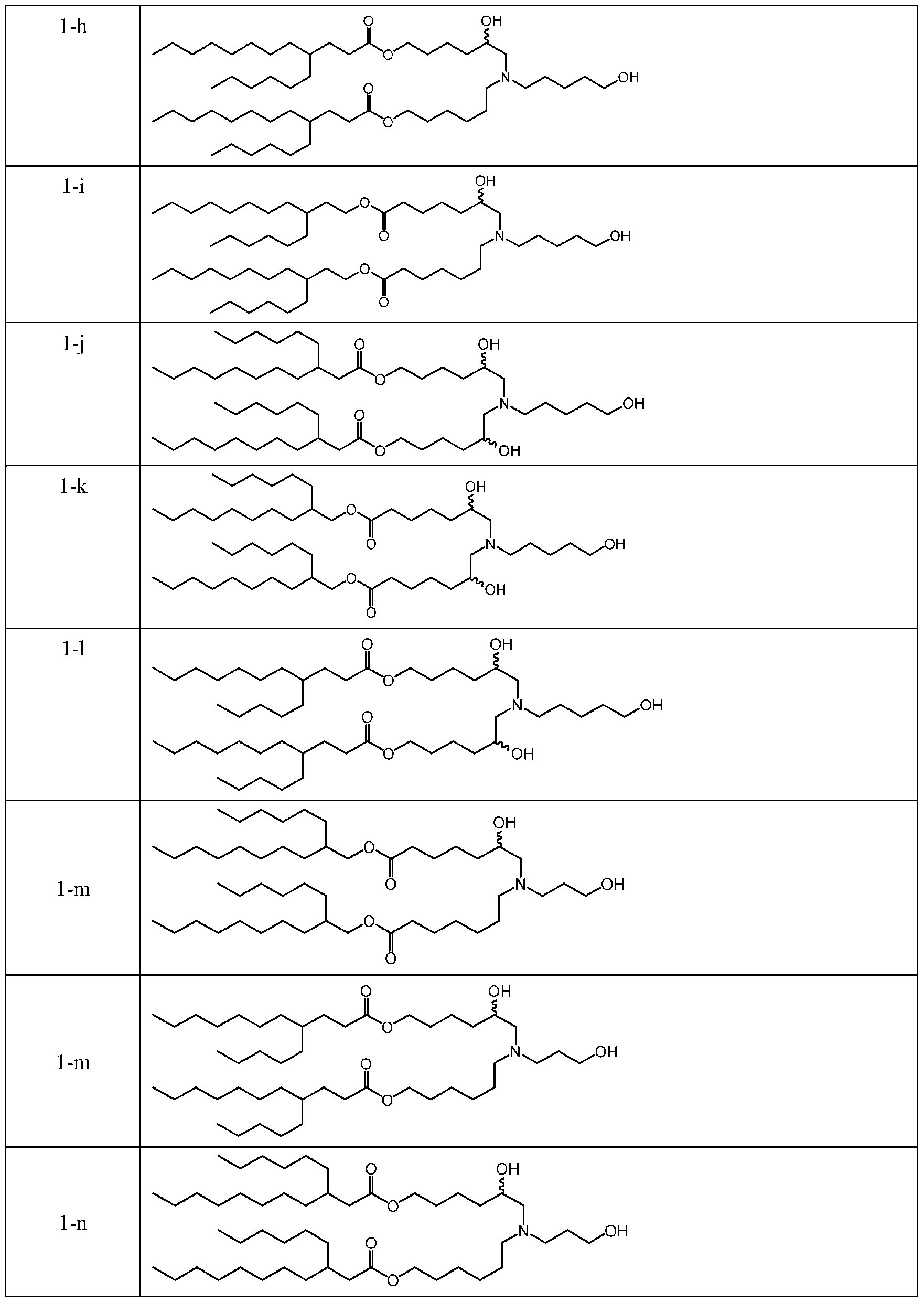


EXAMPLE 1 Example 1.1 – Synthesis of 6-((6-((3-hexylundecanoyl)oxy)-2-hydroxyhexyl)(5- hydroxypentyl)amino)hexyl 3-hexylundecanoate (1-a)
 Example 1.1.1 Synthesis of 7-pentyldecanone (2)
 [533] Pyridinium chlorochromate (PCC) (17 g, 78.8 mmol, 1.5 eq), silica gel (17 g) and DCM (200 mL) were added to a 500 mL round-bottom flask under N2. Pentyldecan-7-ol 1 (12.0 g, 52.5 mmol, 1 eq.) in CH2Cl2 (50 mL) was added to the orange slurry and stirred at room temperature until reaction was complete (TLC). The reaction mixture was filtered through a pad of celite, and the pad was washed with DCM (200 mL). The filtrate was washed with saturated aqueous NaHCO3 (2 x 200 mL), H2O (2 x 200 mL), and brine (200 mL). The organic extract was dried (MgSO4), filtered, concentrated, and purified on silica gel by flash chromatography (hexanes:EtOAc 100:0-90:10) to yield 7-pentyldecanone 2 as a clear oil (9.7 g, 81%).
[534] 1H NMR (300 MHz, CDCl3): δ ppm 2.38 (t, J = 7.4 Hz, 4H), 1.60-1.49 (m, 5H), 1.40-1.08 (broad s, 15 H), 0.87 (t, J = 6.1 Hz, 6H). Example 1.1.2 Synthesis of 7-pentyldecanone 2
[533] Pyridinium chlorochromate (PCC) (17 g, 78.8 mmol, 1.5 eq), silica gel (17 g) and DCM (200 mL) were added to a 500 mL round-bottom flask under N2. Pentyldecan-7-ol 1 (12.0 g, 52.5 mmol, 1 eq.) in CH2Cl2 (50 mL) was added to the orange slurry and stirred at room temperature until reaction was complete (TLC). The reaction mixture was filtered through a pad of celite, and the pad was washed with DCM (200 mL). The filtrate was washed with saturated aqueous NaHCO3 (2 x 200 mL), H2O (2 x 200 mL), and brine (200 mL). The organic extract was dried (MgSO4), filtered, concentrated, and purified on silica gel by flash chromatography (hexanes:EtOAc 100:0-90:10) to yield 7-pentyldecanone 2 as a clear oil (9.7 g, 81%).
[534] 1H NMR (300 MHz, CDCl3): δ ppm 2.38 (t, J = 7.4 Hz, 4H), 1.60-1.49 (m, 5H), 1.40-1.08 (broad s, 15 H), 0.87 (t, J = 6.1 Hz, 6H). Example 1.1.2 Synthesis of 7-pentyldecanone 2
 [535] A 1L round bottom flask was charged with NaH (60% in mineral oil) (13.3 g, 331.3 mmol, 6 eq.) and THF (500 mL) under N2 and cooled to 0 °C. Triethylphosphonoacetate (74.3 g, 331.3 mmol, 6 eq.) was added dropwise to the cooled solution and then stirred at room temperature for 1 h. 7- pentyldecanone 2 (12.5 g, 55.2 mmol, 1 eq.) in THF (50 mL) was added dropwise to the orange reaction mixture and the solution was refluxed overnight. The reaction mixture was cooled to room temperature and diluted with H2O (500 mL). Ethyl acetate (700 mL) was added to the mixture and layers separated. The organic layer was washed with brine (500 mL), dried (MgSO4), filtered, concentrated, and purified on silica gel by flash chromatography (hexanes:EtOAc 100:0-95:5) to yield ethyl 3-hexylundec-2- enoate 3 as a clear oil (13.7 g, 84%) [536] 1H NMR (300 MHz, CDCl3): δ ppm 5.60 (s, 1H), 4.15-4.08 (m, 2H), 2.59-2.53 (m, 2H), 2.14-2.09 (m, 2H) 1.51-1.35 (m, 4H) 1.34-1.11 (m, 20H) 0.95-0.75 (m, 6H). Synthesis of ethyl 3-hexylundec-2-enoate 3
 [537] A 1L round bottom flask was charged with NaH (60% in mineral oil) (13.3 g, 331.3 mmol, 6 eq.) and THF (500 mL) under N2 and cooled to 0 °C. Triethylphosphonoacetate (74.3 g, 331.3 mmol, 6 eq.) was added dropwise to the cooled solution and then stirred at room temperature for 1 h. 7- pentyldecanone 2 (12.5 g, 55.2 mmol, 1 eq.) in THF (50 mL) was added dropwise to the orange reaction mixture and the solution was refluxed overnight. The reaction mixture was cooled to room temperature and diluted with H2O (500 mL). Ethyl acetate (700 mL) was added to the mixture and layers separated. The organic layer was washed with brine (500 mL), dried (MgSO4), filtered, concentrated, and purified on silica gel by flash chromatography (hexanes:EtOAc 100:0-95:5) to yield ethyl 3-hexylundec-2- enoate 3 as a clear oil (13.7 g, 84%) [538] 1H NMR (300 MHz, CDCl3): δ ppm 5.60 (s, 1H), 4.15-4.08 (m, 2H), 2.59-2.53 (m, 2H), 2.14-2.09 (m, 2H) 1.51-1.35 (m, 4H) 1.34-1.11 (m, 20H) 0.95-0.75 (m, 6H).
Example 1.1.3 Synthesis of ethyl 3-hexylundecanoate 4
[537] A 1L round bottom flask was charged with NaH (60% in mineral oil) (13.3 g, 331.3 mmol, 6 eq.) and THF (500 mL) under N2 and cooled to 0 °C. Triethylphosphonoacetate (74.3 g, 331.3 mmol, 6 eq.) was added dropwise to the cooled solution and then stirred at room temperature for 1 h. 7- pentyldecanone 2 (12.5 g, 55.2 mmol, 1 eq.) in THF (50 mL) was added dropwise to the orange reaction mixture and the solution was refluxed overnight. The reaction mixture was cooled to room temperature and diluted with H2O (500 mL). Ethyl acetate (700 mL) was added to the mixture and layers separated. The organic layer was washed with brine (500 mL), dried (MgSO4), filtered, concentrated, and purified on silica gel by flash chromatography (hexanes:EtOAc 100:0-95:5) to yield ethyl 3-hexylundec-2- enoate 3 as a clear oil (13.7 g, 84%) [538] 1H NMR (300 MHz, CDCl3): δ ppm 5.60 (s, 1H), 4.15-4.08 (m, 2H), 2.59-2.53 (m, 2H), 2.14-2.09 (m, 2H) 1.51-1.35 (m, 4H) 1.34-1.11 (m, 20H) 0.95-0.75 (m, 6H).
Example 1.1.3 Synthesis of ethyl 3-hexylundecanoate 4
 [539] Pd/C (10% carbon) (5 g) was added to a round bottom flask under N2. Ethyl 3-hexylundec- 2-enoate 3 (20.7 g, 69.8 mmol, 1 eq.) and ethyl acetate (500 mL) was then added. The reaction mixture was degassed and backfilled with N2 (3x) and then H2 (3x). The reaction mixture was stirred at room temperature overnight. The reaction was degassed and backfilled with N2 (3x) and filtered through a pad of celite. The celite pad was washed with ethyl acetate (3 x 100 mL) and the filtrate was concentrated to yield ethyl 3-hexylundecanoate 4 as a clear oil (20 g, 96%). [540] 1H NMR (300 MHz, CDCl3): δ ppm 4.11 (q, J = 7.1 Hz, 2H), 2.20 (d, J = 6.9 Hz, 2H), 1.90-1.77 (m, 1H), 1.42-1.02 (broad s, 28H), 0.93-0.83 (m, 6H). Example 1.1.4 Synthesis of 3-hexylundecanoic acid 5
 [541] Ethyl 3-hexylundecanoate 4 (10.0 g, 33.5 mmol, 1 eq.) and ethanol (100 mL) were added to a round bottom flask under N2. KOH (18.8 g, 335 mmol, 10 eq.) in H2O (50 mL) was added to the solution and stirred at room temperature overnight.1N HCl was added dropwise to the reaction mixture until the pH reached 1-2. Ethyl acetate (500 mL) was added to the solution and washed with H2O (200 mL) and brine (200 mL). The organic extract was dried (MgSO4), filtered, and concentrated to yield 3- hexylundecanoic acid 5 as a colorless oil and used in the next reaction without further purification (8.7 g, 96%). [542] 1H NMR (300 MHz, CDCl3): δ ppm 2.27 (d, J = 6.9 Hz, 2H), 1.90-1.80 (m, 1H), 1.40-1.02 (broad s, 24H), 0.90-0.83 (m, 6H). Example 1.1.5 Synthesis of Hex-5-en-1-yl 3-hexylundecanoate 6
 [543] 3-hexylundecanoic acid 5 (4.3 g, 15.90 mmol, 1 eq.), hex-5-en-1-ol (1.9 g, 19.08 mmol, 1.2 eq.), and CH2Cl2 (150 mL) were added to a 500 mL round-bottom flask under N2. 4-
Dimethylaminopyridine (DMAP) (389 mg, 3.2 mmol, 0.2 eq.), N,N-diisopropylethylamine (DIPEA) (11.1 mL, 63.6 mmol, 4 eq.), and 1-ethyl-3-(3-dimethylaminopropyl)carbodiimide (EDC) ( g, 49.5 mmol, 1.2 eq.) were added to the solution sequentially. The reaction mixture was stirred at room temperature overnight. The reaction mixture was concentrated and then diluted with ethyl acetate (200 mL). The organic layer was washed with aqueous 1N HCl (200 mL), saturated aqueous NaHCO3 (200 mL), H2O (200 mL), and brine (200 mL). The organic extract was dried (MgSO4), filtered, concentrated, and purified on silica gel by flash chromatography (hexanes:EtOAc 100:0-95:5) to yield hex-5-en-1-yl 3-hexylundecanoate 6 as a clear oil (4.1 g, 73%) [544] 1H NMR (300 MHz, CDCl3): δ ppm 5.89-5.71 (m, 1H), 5.18-4.92 (m, 2H), 4.06 (t, J = 6.6 Hz, 2H), 2.22 (d, J = 7.1 Hz, 2H), 2.12-2.03 (m, 2H), 1.90-1.76 (m, 1H), 1.70-1.58 (m, 2H), 1.49-1.40 (m, 2H), 1.38-1.02 (broad s, 22H), 0.92-0.76 (m, 6H).
[543] 3-hexylundecanoic acid 5 (4.3 g, 15.90 mmol, 1 eq.), hex-5-en-1-ol (1.9 g, 19.08 mmol, 1.2 eq.), and CH2Cl2 (150 mL) were added to a 500 mL round-bottom flask under N2. 4-
Dimethylaminopyridine (DMAP) (389 mg, 3.2 mmol, 0.2 eq.), N,N-diisopropylethylamine (DIPEA) (11.1 mL, 63.6 mmol, 4 eq.), and 1-ethyl-3-(3-dimethylaminopropyl)carbodiimide (EDC) ( g, 49.5 mmol, 1.2 eq.) were added to the solution sequentially. The reaction mixture was stirred at room temperature overnight. The reaction mixture was concentrated and then diluted with ethyl acetate (200 mL). The organic layer was washed with aqueous 1N HCl (200 mL), saturated aqueous NaHCO3 (200 mL), H2O (200 mL), and brine (200 mL). The organic extract was dried (MgSO4), filtered, concentrated, and purified on silica gel by flash chromatography (hexanes:EtOAc 100:0-95:5) to yield hex-5-en-1-yl 3-hexylundecanoate 6 as a clear oil (4.1 g, 73%) [544] 1H NMR (300 MHz, CDCl3): δ ppm 5.89-5.71 (m, 1H), 5.18-4.92 (m, 2H), 4.06 (t, J = 6.6 Hz, 2H), 2.22 (d, J = 7.1 Hz, 2H), 2.12-2.03 (m, 2H), 1.90-1.76 (m, 1H), 1.70-1.58 (m, 2H), 1.49-1.40 (m, 2H), 1.38-1.02 (broad s, 22H), 0.92-0.76 (m, 6H).
 [545] Hex-5-en-1-yl 3-hexylundecanoate 6 (4.1 g, 11.6 mmol, 1 eq) and CH2Cl2 (100 mL) were added to a 500 mL round-bottom flask, and the reaction mixture was cooled to 0 °C. Meta- chloroperoxybenzoic acid (m-CPBA, <75%) (6.7 g, 29.1 mmol, 2.5 eq) was added to the reaction mixture in one portion at 0 ºC. The reaction was left in ice bath to slowly warm to room temperature overnight. The white reaction mixture was filtered and the solid was washed with CH2Cl2 (2 x 10 mL). The filtrate was diluted with CH2Cl2 (100 mL) and washed with 10% Na2S2O3 (100 mL), H2O (100 mL), and brine (100 mL). The organic extract was dried (MgSO4), filtered, concentrated, and purified on silica gel by flash chromatography (hexanes:EtOAc 100:0-80:20) to yield 4-(oxiran-2-yl)butyl 3- hexylundecanoate 7 as a clear oil (3.1 g, 73%) [546] 1H NMR (300 MHz, CDCl3): δ ppm 4.07 (t, J = 6.3 Hz, 2H), 2.95-2.85 (m, 1H), 2.78-2.73 (m, 1H), 2.49-2.45 (m, 1H), 2.22 (d, J = 6.9 Hz, 2H), 1.90-1.77 (m, 1H), 1.70-1.40 (m, 8H), 1.38-1.05 (broad s, 28H), 0.92-0.76 (m, 6H).
 [547] 3-Hexylundecanoic acid 5 (4.3 g, 15.90 mmol, 1 eq.), 6-bromo-1-hexanol (3.5 g, 19.08 mmol, 1.2 eq.), and CH2Cl2 (150 mL) were added to a 500 mL round-bottom flask under N2. 4-
Dimethylaminopyridine (DMAP) (389 mg, 3.2 mmol, 0.2 eq.), N,N-diisopropylethylamine (DIPEA) (11.1 mL, 63.6 mmol, 4 eq.), and 1-ethyl-3-(3-dimethylaminopropyl)carbodiimide (EDC) (7.68 g, 49.5 mmol, 1.2 eq.) were added to the solution sequentially. The reaction mixture was stirred at room temperature overnight. The reaction mixture was concentrated and then diluted with ethyl acetate (200 mL). The organic layer was washed with aqueous 1N HCl (200 mL), saturated aqueous NaHCO3 (200 mL), H2O (200 mL), and brine (200 mL). The organic extract was dried (MgSO4), filtered, concentrated, and purified on silica gel by flash chromatography (hexanes:EtOAc 100:0-95:5) to yield 6-bromo-1- hexyl 3-hexylundecanoate 8 as a clear oil (4.0 g, 58%). [548] 1H NMR (300 MHz, CDCl3): δ ppm 4.06 (t, J = 6.6 Hz, 2H), 3.40 (t, J = 6.6 Hz, 2H), 2.22 (d, J = 6.9 Hz, 2H), 1.91-1.77 (m, 3H), 1.69-1.58 (m, 2H), 1.52-1.35 (m, 4H), 1.35-1.1 (broad s, 26H), 0.95-0.77 (m, 6H).
[547] 3-Hexylundecanoic acid 5 (4.3 g, 15.90 mmol, 1 eq.), 6-bromo-1-hexanol (3.5 g, 19.08 mmol, 1.2 eq.), and CH2Cl2 (150 mL) were added to a 500 mL round-bottom flask under N2. 4-
Dimethylaminopyridine (DMAP) (389 mg, 3.2 mmol, 0.2 eq.), N,N-diisopropylethylamine (DIPEA) (11.1 mL, 63.6 mmol, 4 eq.), and 1-ethyl-3-(3-dimethylaminopropyl)carbodiimide (EDC) (7.68 g, 49.5 mmol, 1.2 eq.) were added to the solution sequentially. The reaction mixture was stirred at room temperature overnight. The reaction mixture was concentrated and then diluted with ethyl acetate (200 mL). The organic layer was washed with aqueous 1N HCl (200 mL), saturated aqueous NaHCO3 (200 mL), H2O (200 mL), and brine (200 mL). The organic extract was dried (MgSO4), filtered, concentrated, and purified on silica gel by flash chromatography (hexanes:EtOAc 100:0-95:5) to yield 6-bromo-1- hexyl 3-hexylundecanoate 8 as a clear oil (4.0 g, 58%). [548] 1H NMR (300 MHz, CDCl3): δ ppm 4.06 (t, J = 6.6 Hz, 2H), 3.40 (t, J = 6.6 Hz, 2H), 2.22 (d, J = 6.9 Hz, 2H), 1.91-1.77 (m, 3H), 1.69-1.58 (m, 2H), 1.52-1.35 (m, 4H), 1.35-1.1 (broad s, 26H), 0.95-0.77 (m, 6H).
 [549] 6-Bromo-1-hexyl 3-hexylundecanoate 8 (4.0 g, 9.2 mmol, 1 eq.), 5-amino-1-pentanol (4.8 g, 46.1 mmol, 5 eq.), and EtOH (100 mL) were added to a 250 mL round-bottom flask and the reaction mixture was refluxed overnight. The solution was cooled to room temperature, concentrated, and then diluted with methyl-t-butyl-ether (MTBE) (100 mL). The organic layer was washed with saturated aqueous NaHCO3 (100 mL), H2O (100 mL), and brine (100 mL). The organic extract was dried (MgSO4), filtered, concentrated, and purified on silica gel by flash chromatography (CH2Cl2:MeOH:NH4OH 100:0:0-89:10:1) to yield 6-((5-hydroxypentyl)amino)hexyl 3- hexylundecanoate 9 as a clear oil (3.0 g, 71%). [550] 1H NMR (300 MHz, CDCl3): δ ppm 4.04 (t, J = 6.6 Hz, 2H), 3.64 (t, J = 6.3 Hz, 2H), 2.72- 2.45 (m, 4H), 2.21 (d, J = 6.9 Hz, 2H), 1.90-1.49 (m, 12H), 1.48-1.10 (broad s, 26H), 0.95-0.77 (m, 6H).
 [551] 6-((5-Hydroxyhexyl)amino)hexyl 3-hexylundecanoate 9 (3.01 g, 6.60 mmol, 1 eq.), 4- (oxiran-2-yl)butyl 3-hexylundecanoate 7 (2.92 g, 7.92 mmol, 1.2 eq.), and i-PrOH (100 mL) were added to a 250 mL round-bottom flask and the reaction mixture was refluxed overnight. The solution was cooled to room temperature, concentrated, and purified on silica gel by flash chromatography
(hexanes:EtOAc 100:0-0:100) to yield 6-((6-((3-hexylundecanoyl)oxy)-2-hydroxyhexyl)(5- hydroxypentyl)amino)hexyl 3-hexylundecanoate 1-a as a colorless oil (2.45 g, 45%). [552] 1H NMR (300 MHz, CDCl3): δ ppm 4.10-3.95 (m, 4H), 3.63 (t, J = 6.6 Hz, 4H), 3.58-3.48 (m, 1H), 2.60-2.46 (m, 2H), 2.42-2.32 (m, 3H), 2.21 (d, J = 6.9 Hz, 2H), 1.87-1.75 (m, 2H), 1.71-1.52 (m, 8H), 1.50-1.03 (m, 66H), 0.87 (t, J = 6.3 Hz, 12H). MS (APCI+): 824.7 (M+1). Example 1.2 – Synthesis of 2-hexadecyl-7-((5-hydroxylpentyl)(7-((2-hexadecyl)oxy-6- oxoheptyl)amino)-6-hydroxyheptanoate (1-b)
[551] 6-((5-Hydroxyhexyl)amino)hexyl 3-hexylundecanoate 9 (3.01 g, 6.60 mmol, 1 eq.), 4- (oxiran-2-yl)butyl 3-hexylundecanoate 7 (2.92 g, 7.92 mmol, 1.2 eq.), and i-PrOH (100 mL) were added to a 250 mL round-bottom flask and the reaction mixture was refluxed overnight. The solution was cooled to room temperature, concentrated, and purified on silica gel by flash chromatography
(hexanes:EtOAc 100:0-0:100) to yield 6-((6-((3-hexylundecanoyl)oxy)-2-hydroxyhexyl)(5- hydroxypentyl)amino)hexyl 3-hexylundecanoate 1-a as a colorless oil (2.45 g, 45%). [552] 1H NMR (300 MHz, CDCl3): δ ppm 4.10-3.95 (m, 4H), 3.63 (t, J = 6.6 Hz, 4H), 3.58-3.48 (m, 1H), 2.60-2.46 (m, 2H), 2.42-2.32 (m, 3H), 2.21 (d, J = 6.9 Hz, 2H), 1.87-1.75 (m, 2H), 1.71-1.52 (m, 8H), 1.50-1.03 (m, 66H), 0.87 (t, J = 6.3 Hz, 12H). MS (APCI+): 824.7 (M+1). Example 1.2 – Synthesis of 2-hexadecyl-7-((5-hydroxylpentyl)(7-((2-hexadecyl)oxy-6- oxoheptyl)amino)-6-hydroxyheptanoate (1-b)
 [553] 2-Hexyldecan-1-ol 1 (10.0 g, 41.3 mmol, 1 eq.), 6-heptenoic acid 2 (6.7 mL, 49.5 mmol, 1.2 eq.), and CH2Cl2 (500 mL) were added to an 1L round-bottom flask under N2. 4- Dimethylaminopyridine (DMAP) (1.0 g, 8.3 mmol, 0.2 eq.), N,N-diisopropylethylamine (DIPEA) (29.0 mL, 165.0 mmol, 4 eq.), and 1-Ethyl-3-(3-dimethylaminopropyl)carbodiimide (EDC) (9.5 g, 49.5 mmol, 1.2 eq.) were added to the solution sequentially. The reaction mixture was stirred at room temperature overnight. The reaction mixture was concentrated and then diluted with ethyl acetate (300 mL). The organic layer was washed with aqueous 1N HCl (300 mL), saturated aqueous NaHCO3 (300 mL), H2O (300 mL), and brine. The organic extract was dried (MgSO4), filtered, concentrated, and purified on silica gel by flash chromatography (hexanes:EtOAc 100:0-95:5) to yield 2-hexyldecyl-hept- 6-enoate 3 as a clear oil (8.0 g, 55%).
[554] 1H NMR (300 MHz, CDCl3): δ ppm 5.82-5.72 (m, 1H), 5.02-4.91 (m, 2H), 3.95 (d, J = 5.7 Hz, 2H), 2.29 (t, J = 7.4 Hz, 2H), 2.09-2.01 (m, 2H), 1.63-1.57 (m, 3H), 1.46-1.38 (m, 2H), 1.37-1.00 (broad s, 26 H), 0.84 (t, J = 7.1 Hz, 6H). Example 1.2.2 Synthesis of 2-Hexyldecyl-6-(oxiran-2-yl)heptanoate 4
[553] 2-Hexyldecan-1-ol 1 (10.0 g, 41.3 mmol, 1 eq.), 6-heptenoic acid 2 (6.7 mL, 49.5 mmol, 1.2 eq.), and CH2Cl2 (500 mL) were added to an 1L round-bottom flask under N2. 4- Dimethylaminopyridine (DMAP) (1.0 g, 8.3 mmol, 0.2 eq.), N,N-diisopropylethylamine (DIPEA) (29.0 mL, 165.0 mmol, 4 eq.), and 1-Ethyl-3-(3-dimethylaminopropyl)carbodiimide (EDC) (9.5 g, 49.5 mmol, 1.2 eq.) were added to the solution sequentially. The reaction mixture was stirred at room temperature overnight. The reaction mixture was concentrated and then diluted with ethyl acetate (300 mL). The organic layer was washed with aqueous 1N HCl (300 mL), saturated aqueous NaHCO3 (300 mL), H2O (300 mL), and brine. The organic extract was dried (MgSO4), filtered, concentrated, and purified on silica gel by flash chromatography (hexanes:EtOAc 100:0-95:5) to yield 2-hexyldecyl-hept- 6-enoate 3 as a clear oil (8.0 g, 55%).
[554] 1H NMR (300 MHz, CDCl3): δ ppm 5.82-5.72 (m, 1H), 5.02-4.91 (m, 2H), 3.95 (d, J = 5.7 Hz, 2H), 2.29 (t, J = 7.4 Hz, 2H), 2.09-2.01 (m, 2H), 1.63-1.57 (m, 3H), 1.46-1.38 (m, 2H), 1.37-1.00 (broad s, 26 H), 0.84 (t, J = 7.1 Hz, 6H). Example 1.2.2 Synthesis of 2-Hexyldecyl-6-(oxiran-2-yl)heptanoate 4
 [555] 2-hexyldecyl-hept-6-enoate 3 (8.0 g, 22.7 mmol, 1 eq) and CH2Cl2 (100 mL) were added to a 500mL round-bottom flask and the reaction mixture was cooled to 0 °C. Meta-chloroperoxybenzoic acid (m-CPBA, <75%) (7.8 g, 34.0 mmol, 1.5 eq) was added to the reaction mixture in one portion at 0 ºC. The reaction was left in ice bath to slowly warm to room temperature overnight. The white reaction mixture was filtered and the solid was washed with CH2Cl2 (2 x 10 mL). The filtrate was diluted with CH2Cl2 (100 mL) and washed with 10% Na2S2O3 (100 mL), H2O (100 mL), and brine (100 mL). The organic extract was dried (MgSO4), filtered, concentrated, and purified on silica gel by flash chromatography (hexanes:EtOAc 100:0-80:20) to yield 2-hexyldecyl-6-(oxiran-2-yl)heptanoate 4 as a clear oil (6.5 g, 77%). Example 1.2.3 Synthesis of 2-Hexyldecyl-7-bromo-heptanoate 6
 [556] 2-Hexyldecan-1-ol 1 (10.0 g, 41.3 mmol, 1 eq.), 7-bromo-heptanoic acid 5 (10.5 g, 49.5 mmol, 1.2 eq.), and CH2Cl2 (500 mL) were added to an 1L round-bottom flask under N2. 4- Dimethylaminopyridine (DMAP) (1.0 g, 8.3 mmol, 0.2 eq.), N,N-diisopropylethylamine (DIPEA) (29.0 mL, 165.0 mmol, 4 eq.), and 1-Ethyl-3-(3-dimethylaminopropyl)carbodiimide (EDC) (9.5 g, 49.5 mmol, 1.2 eq.) were added to the solution sequentially. The reaction mixture was stirred at room temperature overnight. The reaction mixture was concentrated and then diluted with ethyl acetate (300 mL). The organic layer was washed with aqueous 1N HCl (300 mL), saturated aqueous NaHCO3 (300 mL), H2O (300 mL), and brine. The organic extract was dried (MgSO4), filtered, concentrated, and purified on silica gel by flash chromatography (hexanes:EtOAc 100:0-95:5) to yield 2-hexyldecyl-7- bromo-heptanoate 6 as a clear oil (9.0 g, 50%).
[557] 1H NMR (300 MHz, CDCl3): δ ppm 3.96 (d, J = 5.8 Hz, 2H), 3.40 (t, J = 6.9 Hz, 2H), 2.31 (t, J = 6.9 Hz, 2H), 1.90-1.80 (m, 2H), 2.09-2.01 (m, 2H), 1.68-1.56 (m, 3H), 1.50-1.08 (m, 26H), 0.88 (t, J = 6.3 Hz, 6H). Example 1.2.4 Synthesis of 2-Hexyldecyl-7-((5-hydroxypentyl)amino) heptanoate 8
[556] 2-Hexyldecan-1-ol 1 (10.0 g, 41.3 mmol, 1 eq.), 7-bromo-heptanoic acid 5 (10.5 g, 49.5 mmol, 1.2 eq.), and CH2Cl2 (500 mL) were added to an 1L round-bottom flask under N2. 4- Dimethylaminopyridine (DMAP) (1.0 g, 8.3 mmol, 0.2 eq.), N,N-diisopropylethylamine (DIPEA) (29.0 mL, 165.0 mmol, 4 eq.), and 1-Ethyl-3-(3-dimethylaminopropyl)carbodiimide (EDC) (9.5 g, 49.5 mmol, 1.2 eq.) were added to the solution sequentially. The reaction mixture was stirred at room temperature overnight. The reaction mixture was concentrated and then diluted with ethyl acetate (300 mL). The organic layer was washed with aqueous 1N HCl (300 mL), saturated aqueous NaHCO3 (300 mL), H2O (300 mL), and brine. The organic extract was dried (MgSO4), filtered, concentrated, and purified on silica gel by flash chromatography (hexanes:EtOAc 100:0-95:5) to yield 2-hexyldecyl-7- bromo-heptanoate 6 as a clear oil (9.0 g, 50%).
[557] 1H NMR (300 MHz, CDCl3): δ ppm 3.96 (d, J = 5.8 Hz, 2H), 3.40 (t, J = 6.9 Hz, 2H), 2.31 (t, J = 6.9 Hz, 2H), 1.90-1.80 (m, 2H), 2.09-2.01 (m, 2H), 1.68-1.56 (m, 3H), 1.50-1.08 (m, 26H), 0.88 (t, J = 6.3 Hz, 6H). Example 1.2.4 Synthesis of 2-Hexyldecyl-7-((5-hydroxypentyl)amino) heptanoate 8
 [558] 2-hexyldecyl-7-bromo-heptanoate 6 (9.0 g, 20.8 mmol, 1 eq.), 5-amino-1-pentanol 7 (21.5 g, 208.2 mmol, 10 eq.), and EtOH (200 mL) were added to a 500 mL round-bottom flask and the reaction mixture was refluxed overnight. The solution was cooled to room temperature, concentrated, and then diluted with methyl-t-butyl-ether (MTBE) (200 mL). The organic layer was washed with saturated aqueous NaHCO3 (200 mL), H2O (200 mL), and brine (200 mL). The organic extract was dried (MgSO4), filtered, concentrated, and purified on silica gel by flash chromatography (CH2Cl2:MeOH:NH4OH 100:0:0-89:10:1) to yield 2-hexyldecyl-7-((5-hydroxy-pentyl)amino)- heptanoate 8 as a clear oil (5.23 g, 55%). Example 1.2.5 Synthesis of 2-hexadecyl-7-((5-hydroxylpentyl)(7-((2-hexadecyl)oxy-6- oxoheptyl)amino)-6-hydroxyheptanoate (1-b)
 [559] 2-hexyldecyl-7-((5-hydroxypentyl)amino)heptanoate 8 (5.23 g, 11.63 mmol, 1 eq.), 2- hexyldecyl-6-(oxiran-2-yl)heptanoate 4 (5.14 g, 13.95 mmol, 1.2 eq.), and i-PrOH (150 mL) was added to a 500 mL round-bottom flask and the reaction mixture was refluxed overnight. The solution was cooled to room temperature, concentrated, and purified on silica gel by flash chromatography (hexanes:EtOAc 100:0-0:100) to yield 2-hexadecyl-7-((5-hydroxylpentyl)(7-((2-hexadecyl)oxy-6- oxoheptyl)amino)-6-hydroxyheptanoate 1-b as a colorless oil (3.81 g, 40%). [560] 1H NMR (300 MHz, CDCl3): δ ppm 3.95 (d, J = 2.9 Hz, 4H), 3.63 (t, J = 6.3 Hz, 2H), 3.58- 3.48 (m, 1H), 2.54-2.47 (m, 2H), 2.40-2.15 (m, 8H), 1.71-1.52 (m, 8H), 1.50-1.03 (m, 58H), 0.85 (t, J = 6.9 Hz, 12H). MS (APCI+): 824.7 (M+1).
Example 1.3 – Synthesis of 6-((2-hydroxy-6-((4-pentylundecanoyl)oxy)hexyl)(5- hydroxypentyl)amino)hexyl 4-pentylundecanoate (1-c)
[559] 2-hexyldecyl-7-((5-hydroxypentyl)amino)heptanoate 8 (5.23 g, 11.63 mmol, 1 eq.), 2- hexyldecyl-6-(oxiran-2-yl)heptanoate 4 (5.14 g, 13.95 mmol, 1.2 eq.), and i-PrOH (150 mL) was added to a 500 mL round-bottom flask and the reaction mixture was refluxed overnight. The solution was cooled to room temperature, concentrated, and purified on silica gel by flash chromatography (hexanes:EtOAc 100:0-0:100) to yield 2-hexadecyl-7-((5-hydroxylpentyl)(7-((2-hexadecyl)oxy-6- oxoheptyl)amino)-6-hydroxyheptanoate 1-b as a colorless oil (3.81 g, 40%). [560] 1H NMR (300 MHz, CDCl3): δ ppm 3.95 (d, J = 2.9 Hz, 4H), 3.63 (t, J = 6.3 Hz, 2H), 3.58- 3.48 (m, 1H), 2.54-2.47 (m, 2H), 2.40-2.15 (m, 8H), 1.71-1.52 (m, 8H), 1.50-1.03 (m, 58H), 0.85 (t, J = 6.9 Hz, 12H). MS (APCI+): 824.7 (M+1).
Example 1.3 – Synthesis of 6-((2-hydroxy-6-((4-pentylundecanoyl)oxy)hexyl)(5- hydroxypentyl)amino)hexyl 4-pentylundecanoate (1-c)
 Example 1.3.1 Synthesis of tridecan-6-ol 2
 [561] A solution of pentylmagnesium bromide (2.0 M in ether, 53 mL, 106.5 mmol) was cooled in an ice/water bath. A solution of 1-octanal 1 (13 g, 101.3 mmol) in THF (200 mL) was added dropwise and the resulting reaction mixture was stirred at room temperature overnight. The reaction was quenched with 1N HCl and diluted with methyl-t-butyl-ether (MTBE) (200 mL), and was washed with sat. NaHCO3 (200 mL), water (200 mL), and brine (200 mL). The organic layer was dried over anhydrous Na2SO4 and the solvent was evaporated. The crude residue was purified by flash chromatography (hexanes:EtOAc 100:0-80:20) to yield tridecan-6-ol 2 as a clear oil (10.4 g, 51%). [562] 1H NMR (300 MHz, CDCl3): δ ppm 3.57 (bs, 1H), 1.44-1.11 (m, 21H), 0.88-0.85 (m, 6H). Example 1.3.2 Synthesis of tridecan-6-one 3
 [563] In a 500 mL round-bottom flask, to a mixture of tridecan-6-ol 2 (10.4 g, 51.9 mmol, 1 eq.) in CH2Cl2 (500 mL) under N2 was added pyridinium chlorochromate (PCC) (22.4 g, 103.8 mmol, 2 eq) and silica gel (10 g). The orange slurry was stirred at room temperature until reaction was complete (TLC). The reaction mixture was filtered through a pad of celite, and the pad was washed with DCM (200 mL). The filtrate was washed with saturated aqueous NaHCO3 (2 x 200 mL), H2O (2 x 200 mL), and brine (200 mL). The organic extract was dried (Na2SO4), filtered, concentrated, and purified on silica gel by flash chromatography (hexanes:EtOAc 100:0-80:20) to yield tridecan-6-one 3 as a clear oil (8.4 g, 81%). [564] 1H NMR (300 MHz, CDCl3): δ ppm 2.37 (t, J = 7.4 Hz, 4H), 1.61-1.44 (m, 4H), 1.41-1.12 (m, 12H), 0.87 (t, J = 6.8 Hz, 6H). Example 1.3.3 Synthesis of 6-(methoxymethylene)tridecane 4
 [565] A 500 mL round bottom flask was charged with (Methoxymethyl)triphenylphosphonium chloride (28 g, 81.6 mmol, 3 eq.) and THF (300 mL) under N2 and cooled to 0 °C. Potassium tert- butoxide (tBuOK) (1.0 M in THF, 82 mL, 81.6 mmol) was added dropwise to the cooled solution and
the dark red mixture was stirred for 1h. Tridecan-6-one 3 (5.4 g, 27.2 mmol, 1 eq.) in THF (50 mL) was added dropwise to the mixture and the solution was stirred at room temperature overnight. The reaction mixture was quenched with H2O. Ethyl acetate (500 mL) was added to the mixture and layers separated. The organic layer was washed with H2O (200 mL), brine (200 mL), dried (Na2SO4), filtered, concentrated. The crude residue was mixed with Hexane (100 mL) and the precipitate was filtered. The filtrate was concentrated and purified on silica gel by flash chromatography (hexanes:EtOAc 100:0- 80:20) to yield 6-(methoxymethylene)tridecane 4 as a clear oil (5.6 g, 90%). [566] 1H NMR (300 MHz, CDCl3): δ ppm 5.73 (s, 1H), 3.51 (s, 3H), 2.02 (t, J = 6.6 Hz, 2H), 1.83 (t, J = 7.4 Hz, 2H), 1.44-1.11 (m, 16H), 0.87 (t, J = 7.1 Hz, 6H). Example 1.3.4 Synthesis of 2-pentylnonanal 5
[565] A 500 mL round bottom flask was charged with (Methoxymethyl)triphenylphosphonium chloride (28 g, 81.6 mmol, 3 eq.) and THF (300 mL) under N2 and cooled to 0 °C. Potassium tert- butoxide (tBuOK) (1.0 M in THF, 82 mL, 81.6 mmol) was added dropwise to the cooled solution and
the dark red mixture was stirred for 1h. Tridecan-6-one 3 (5.4 g, 27.2 mmol, 1 eq.) in THF (50 mL) was added dropwise to the mixture and the solution was stirred at room temperature overnight. The reaction mixture was quenched with H2O. Ethyl acetate (500 mL) was added to the mixture and layers separated. The organic layer was washed with H2O (200 mL), brine (200 mL), dried (Na2SO4), filtered, concentrated. The crude residue was mixed with Hexane (100 mL) and the precipitate was filtered. The filtrate was concentrated and purified on silica gel by flash chromatography (hexanes:EtOAc 100:0- 80:20) to yield 6-(methoxymethylene)tridecane 4 as a clear oil (5.6 g, 90%). [566] 1H NMR (300 MHz, CDCl3): δ ppm 5.73 (s, 1H), 3.51 (s, 3H), 2.02 (t, J = 6.6 Hz, 2H), 1.83 (t, J = 7.4 Hz, 2H), 1.44-1.11 (m, 16H), 0.87 (t, J = 7.1 Hz, 6H). Example 1.3.4 Synthesis of 2-pentylnonanal 5
 [567] To a mixture of 6-(methoxymethylene)tridecane 4 (5.6 g, 24.7 mmol, 1 eq.) in CH3CN (100 mL) was added HCl solution (1 M aqueous, 49.5 mL, 49.5 mmol), and the reaction mixture was stirred under reflux overnight. The reaction mixture was slowly poured into saturated aqueous NaHCO3 (200 mL), then diluted with ethyl acetate (200 mL). The organic layer was washed with H2O (100 mL) and brine (100 mL). The organic extract was dried (Na2SO4), filtered, concentrated to yield 2- pentylnonanal 5 as a colorless oil and used in the next reaction without further purification (5.4 g, 98%). [568] 1H NMR (300 MHz, CDCl3): δ ppm 9.54 (d, J = 3.0 Hz, 1H), 2.22-2.19 (m, 1H), 1.65-1.56 (m, 2H), 1.48-1.39 (m, 2H), 1.26-1.1 (m, 16H), 0.87 (t, J = 6.6 Hz, 6H). Example 1.3.5 Synthesis of ethyl (E)-4-pentylundec-2-enoate 6
 [569] A 500 mL round bottom flask was charged with NaH (60% in mineral oil) (3 g, 76.2 mmol, 3 eq.) and THF (200 mL) under N2 and cooled to 0 °C. Triethylphosphonoacetate (17.1 g, 76.2 mmol, 3 eq.) was added dropwise to the cooled solution. After addition, 2-pentylnonanal 5 (5.4 g, 25.4 mmol, 1 eq.) in THF (50 mL) was added dropwise to the orange reaction mixture and the solution was stirred at room temperature overnight. The reaction mixture was pooled into saturated NH4Cl solution (200 mL). Ethyl acetate (500 mL) was added to the mixture and layers separated. The organic layer was washed with H2O (200 mL), brine (200 mL), dried (Na2SO4), filtered, concentrated, and purified on
silica gel by flash chromatography (hexanes:EtOAc 100:0-80:20) to yield (E)-4-pentylundec-2-enoate 6 as a clear oil (6 g, 83%). [570] 1H NMR (300 MHz, CDCl3): δ ppm 6.72 (dd, J = 15.6, 9.3 Hz, 1H), 5.74 (d, J = 15.6 Hz, 1H), 4.17 (q, J = 7.1 Hz, 2H), 1.44-1.11 (m, 24H), 0.87 (t, J = 6.6 Hz, 6H). Example 1.3.6 Synthesis of ethyl 4-pentylundecanoate 7
[569] A 500 mL round bottom flask was charged with NaH (60% in mineral oil) (3 g, 76.2 mmol, 3 eq.) and THF (200 mL) under N2 and cooled to 0 °C. Triethylphosphonoacetate (17.1 g, 76.2 mmol, 3 eq.) was added dropwise to the cooled solution. After addition, 2-pentylnonanal 5 (5.4 g, 25.4 mmol, 1 eq.) in THF (50 mL) was added dropwise to the orange reaction mixture and the solution was stirred at room temperature overnight. The reaction mixture was pooled into saturated NH4Cl solution (200 mL). Ethyl acetate (500 mL) was added to the mixture and layers separated. The organic layer was washed with H2O (200 mL), brine (200 mL), dried (Na2SO4), filtered, concentrated, and purified on
silica gel by flash chromatography (hexanes:EtOAc 100:0-80:20) to yield (E)-4-pentylundec-2-enoate 6 as a clear oil (6 g, 83%). [570] 1H NMR (300 MHz, CDCl3): δ ppm 6.72 (dd, J = 15.6, 9.3 Hz, 1H), 5.74 (d, J = 15.6 Hz, 1H), 4.17 (q, J = 7.1 Hz, 2H), 1.44-1.11 (m, 24H), 0.87 (t, J = 6.6 Hz, 6H). Example 1.3.6 Synthesis of ethyl 4-pentylundecanoate 7
 [571] Pd/C (10% carbon) (2.5 g) was added to a 250 mL round bottom flask under N2. Ethyl (E)- 4-pentylundec-2-enoate 6 (7.7 g, 27.3 mmol, 1 eq.) and ethyl acetate (200 mL) were then added. The reaction mixture was degassed and backfilled with N2 (3x) and then H2 (3x). The reaction mixture was stirred at room temperature overnight. The reaction was degassed and backfilled with N2 (3x) and filtered through a pad of celite. The celite pad was washed with ethyl acetate (3 x 100 mL) and the filtrate was concentrated to yield ethyl 4-pentylundecanoate 7 as a clear oil (7.8 g, 98%). [572] 1H NMR (300 MHz, CDCl3): δ ppm 4.11 (q, J = 7.1 Hz, 2H), 2.26 (t, J = 8.2 Hz, 2H), 1.71- 1.57 (m, 2H), 1.42-1.02 (broad s, 24H), 0.87 (t, J = 6.6 Hz, 6H). Example 1.3.7 Synthesis of 4-pentylundecanoic acid 8
 [573] Ethyl 4-pentylundecanoate 7 (7.8 g, 27.4 mmol, 1 eq.) and ethanol (80 mL) were added to a 250 mL round bottom flask under N2. KOH (15.4 g, 274.2 mmol, 10 eq.) in H2O (40 mL) was added to the solution and stirred under reflux for 3 hrs. The reaction mixture was cooled to room temperature and 1N HCl was added dropwise to the reaction mixture until the pH reached 1-2. Ethyl acetate (300 mL) was added to the solution and washed with H2O (200 mL) and brine (200 mL). The organic extract was dried (Na2SO4), filtered, and concentrated to yield 4-pentylundecanoic acid 8 as a colorless oil and used in the next reaction without further purification (7 g, 96%). [574] 1H NMR (300 MHz, CDCl3): δ ppm 2.32 (d, J = 7.7 Hz, 2H), 1.63-1.55 (m, 2H), 1.27-1.02 (broad s, 21H), 0.90-0.83 (m, 6H). MS (APCI-): 255.2 (M-1).
Example 1.3.8 Synthesis of 6-bromohexyl 4-pentylundecanoate 9
[573] Ethyl 4-pentylundecanoate 7 (7.8 g, 27.4 mmol, 1 eq.) and ethanol (80 mL) were added to a 250 mL round bottom flask under N2. KOH (15.4 g, 274.2 mmol, 10 eq.) in H2O (40 mL) was added to the solution and stirred under reflux for 3 hrs. The reaction mixture was cooled to room temperature and 1N HCl was added dropwise to the reaction mixture until the pH reached 1-2. Ethyl acetate (300 mL) was added to the solution and washed with H2O (200 mL) and brine (200 mL). The organic extract was dried (Na2SO4), filtered, and concentrated to yield 4-pentylundecanoic acid 8 as a colorless oil and used in the next reaction without further purification (7 g, 96%). [574] 1H NMR (300 MHz, CDCl3): δ ppm 2.32 (d, J = 7.7 Hz, 2H), 1.63-1.55 (m, 2H), 1.27-1.02 (broad s, 21H), 0.90-0.83 (m, 6H). MS (APCI-): 255.2 (M-1).
Example 1.3.8 Synthesis of 6-bromohexyl 4-pentylundecanoate 9
 [575] To a mixture of 4-pentylundecanoic acid 8 (3.5 g, 13.6 mmol, 1 eq.) and 6-bromo-1- hexanol (3 g, 16.3 mmol, 1.2 eq.) in CH2Cl2 (100 mL) was added 4-Dimethylaminopyridine (DMAP) (333.5 mg, 2.73 mmol, 0.2 eq.), N,N-diisopropylethylamine (DIPEA) (9.5 mL, 54.6 mmol, 4 eq.), and 1-Ethyl-3-(3-dimethylaminopropyl)carbodiimide (EDC) (2.6 g, 13.65 mmol, 1 eq.) sequentially. The reaction mixture was stirred at room temperature overnight. The reaction mixture was concentrated and then diluted with ethyl acetate (200 mL). The organic layer was washed with aqueous 1N HCl (100 mL), saturated aqueous NaHCO3 (100 mL), H2O (100 mL), and brine (100 mL). The organic extract was dried (Na2SO4), filtered, concentrated, and purified on silica gel by flash chromatography (hexanes:EtOAc 100:0-80:20) to yield 6-bromohexyl 4-pentylundecanoate 9 as a clear oil (3.2 g, 56%). [576] 1H NMR (300 MHz, CDCl3): δ ppm 4.05 (t, J = 6.4 Hz, 2H), 3.40 (t, J = 6.8 Hz, 2H), 2.26 (t, J = 7.1 Hz, 2H), 1.91-1.83 (m, 2H), 1.65-1.1 (m, 29H), 0.87 (t, J = 6.8 Hz, 6H). Example 1.3.9 Synthesis of hex-5-en-1-yl 4-pentyldecanoate 10
 [577] To a mixture of 4-pentylundecanoic acid 8 (3.5 g, 13.6 mmol, 1 eq.) and hex-5-en-1-ol (1.6 g, 16.3 mmol, 1.2 eq.) in CH2Cl2 (100 mL) was added 4-Dimethylaminopyridine (DMAP) (333.5 mg, 2.73 mmol, 0.2 eq.), N,N-diisopropylethylamine (DIPEA) (9.5 mL, 54.6 mmol, 4 eq.), and 1-Ethyl- 3-(3-dimethylaminopropyl)carbodiimide (EDC) (2.6 g, 13.65 mmol, 1 eq.) sequentially. The reaction mixture was stirred at room temperature overnight. The reaction mixture was concentrated and then diluted with ethyl acetate (200 mL). The organic layer was washed with aqueous 1N HCl (100 mL), saturated aqueous NaHCO3 (100 mL), H2O (100 mL), and brine (100 mL). The organic extract was dried (Na2SO4), filtered, concentrated, and purified on silica gel by flash chromatography (hexanes:EtOAc 100:0-80:20) to yield hex-5-en-1-yl 4-pentyldecanoate 10 as a clear oil (3.5 g, 79%). [578] 1H NMR (300 MHz, CDCl3): δ ppm 5.86-5.70 (m, 1H), 5.06-4.97 (m, 2H), 4.05 (t, J = 6.4 Hz, 2H), 2.26 (t, J = 7.8 Hz, 2H), 2.06 (dd, J = 14.2, 7.1 Hz, 2H), 1.75-1.51 (m, 7H), 1.45-1.1 (m, 18H), 0.87 (t, J = 6.8 Hz, 6H).
Example 1.3.10 Synthesis of 4-(oxiran-2-yl)butyl 4-pentylundecanoate 11
[577] To a mixture of 4-pentylundecanoic acid 8 (3.5 g, 13.6 mmol, 1 eq.) and hex-5-en-1-ol (1.6 g, 16.3 mmol, 1.2 eq.) in CH2Cl2 (100 mL) was added 4-Dimethylaminopyridine (DMAP) (333.5 mg, 2.73 mmol, 0.2 eq.), N,N-diisopropylethylamine (DIPEA) (9.5 mL, 54.6 mmol, 4 eq.), and 1-Ethyl- 3-(3-dimethylaminopropyl)carbodiimide (EDC) (2.6 g, 13.65 mmol, 1 eq.) sequentially. The reaction mixture was stirred at room temperature overnight. The reaction mixture was concentrated and then diluted with ethyl acetate (200 mL). The organic layer was washed with aqueous 1N HCl (100 mL), saturated aqueous NaHCO3 (100 mL), H2O (100 mL), and brine (100 mL). The organic extract was dried (Na2SO4), filtered, concentrated, and purified on silica gel by flash chromatography (hexanes:EtOAc 100:0-80:20) to yield hex-5-en-1-yl 4-pentyldecanoate 10 as a clear oil (3.5 g, 79%). [578] 1H NMR (300 MHz, CDCl3): δ ppm 5.86-5.70 (m, 1H), 5.06-4.97 (m, 2H), 4.05 (t, J = 6.4 Hz, 2H), 2.26 (t, J = 7.8 Hz, 2H), 2.06 (dd, J = 14.2, 7.1 Hz, 2H), 1.75-1.51 (m, 7H), 1.45-1.1 (m, 18H), 0.87 (t, J = 6.8 Hz, 6H).
Example 1.3.10 Synthesis of 4-(oxiran-2-yl)butyl 4-pentylundecanoate 11
 [579] Hex-5-en-1-yl 4-pentyldecanoate 10 (3.5 g, 10.34 mmol, 1 eq) in CH2Cl2 (100 mL) was added to a 250 mL round-bottom flask and the solution was cooled to 0 °C. Meta-chloroperoxybenzoic acid (m-CPBA, <75%) (3.5 g, 15.5 mmol, 1.5 eq) was added to the reaction mixture in one portion at 0 ºC. The reaction was left in ice bath to slowly warm to room temperature overnight. The white reaction mixture was filtered and the solid was washed with CH2Cl2 (2 x 100 mL). The filtrate was diluted with CH2Cl2 (300 mL) and washed with 10% Na2S2O3 (100 mL), saturated aqueous NaHCO3 (100 mL), H2O (100 mL), and brine (100 mL). The organic extract was dried (Na2SO4), filtered, concentrated, and purified on silica gel by flash chromatography (hexanes:EtOAc 100:0-60:40) to yield 4-(oxiran-2- yl)butyl 4-pentylundecanoate 11 as a clear oil (3.6 g, 98%) [580] 1H NMR (300 MHz, CDCl3): δ ppm 4.07 (t, J = 6.3 Hz.2H), 2.91-2.90 (m, 1H), 2.75 (t, J = 4.9 Hz, 1H), 2.47 (dd, J = 5.0, 2.7 Hz, 1H), 2.29-2.24 (m, 2H), 1.75-1.53 (m, 5H), 1.27-1.11 (m, 24H), 0.87 (t, J = 6.8 Hz, 6H). Example 1.3.11 Synthesis of 6-((5-hydroxypentyl)amino)hexyl 4-pentylundecanoate 12
 [581] 6-Bromohexyl 4-pentylundecanoate 9 (3.2 g, 7.63 mmol, 1 eq.), 5-amino-1-pentanol (3.9 g, 38.14 mmol, 5 eq.), and EtOH (100 mL) were added to a 250 mL round-bottom flask and the reaction mixture was refluxed overnight. The solution was cooled to room temperature, concentrated, and then diluted with methyl-t-butyl-ether (MTBE) (200 mL). The organic layer was washed with saturated aqueous NaHCO3 (100 mL), H2O (100 mL), and brine (100 mL). The organic extract was dried (Na2SO4), filtered, concentrated, and purified on silica gel by flash chromatography (CH2Cl2:MeOH:NH4OH 100:0:0-89:10:1) to yield 6-((5-hydroxypentyl)amino)hexyl 4- pentylundecanoate 12 as a clear oil (2.5 g, 74%). [582] 1H NMR (300 MHz, CDCl3): δ ppm 4.02 (t, J = 6.9 Hz, 2H), 3.64 (t, J = 6.3 Hz, 2H), 2.75- 2.55 (m, 4H), 2.26 (t, J = 6.3 Hz, 2H), 1.90-1.49 (m, 14H), 1.48-1.10 (broad s, 24H), 0.95-0.77 (m, 6H). MS (APCI+): 442.4 (M+1).
Example 1.3.12 Synthesis of 6-((2-hydroxy-6-((4-pentylundecanoyl)oxy)hexyl)(5- hydroxypentyl)amino)hexyl 4-pentylundecanoate (1-c)
[581] 6-Bromohexyl 4-pentylundecanoate 9 (3.2 g, 7.63 mmol, 1 eq.), 5-amino-1-pentanol (3.9 g, 38.14 mmol, 5 eq.), and EtOH (100 mL) were added to a 250 mL round-bottom flask and the reaction mixture was refluxed overnight. The solution was cooled to room temperature, concentrated, and then diluted with methyl-t-butyl-ether (MTBE) (200 mL). The organic layer was washed with saturated aqueous NaHCO3 (100 mL), H2O (100 mL), and brine (100 mL). The organic extract was dried (Na2SO4), filtered, concentrated, and purified on silica gel by flash chromatography (CH2Cl2:MeOH:NH4OH 100:0:0-89:10:1) to yield 6-((5-hydroxypentyl)amino)hexyl 4- pentylundecanoate 12 as a clear oil (2.5 g, 74%). [582] 1H NMR (300 MHz, CDCl3): δ ppm 4.02 (t, J = 6.9 Hz, 2H), 3.64 (t, J = 6.3 Hz, 2H), 2.75- 2.55 (m, 4H), 2.26 (t, J = 6.3 Hz, 2H), 1.90-1.49 (m, 14H), 1.48-1.10 (broad s, 24H), 0.95-0.77 (m, 6H). MS (APCI+): 442.4 (M+1).
Example 1.3.12 Synthesis of 6-((2-hydroxy-6-((4-pentylundecanoyl)oxy)hexyl)(5- hydroxypentyl)amino)hexyl 4-pentylundecanoate (1-c)
 [583] To a 250 mL round-bottom flask was added 6-((5-hydroxypentyl)amino)hexyl 4- pentylundecanoate 12 (2.5 g, 5.65 mmol, 1 eq.), 4-(oxiran-2-yl)butyl 4-pentylundecanoate 11 (2.4 g, 6.79 mmol, 1.2 eq.) and i-PrOH (50 mL). The reaction mixture was refluxed overnight. The solution was cooled to room temperature, concentrated, and purified on silica gel by flash chromatography (hexanes:EtOAc 100:0-0:100) to yield 6-((2-hydroxy-6-((4-pentylundecanoyl)oxy)hexyl)(5- hydroxypentyl)amino)hexyl 4-pentylundecanoate 1-c as a colorless oil (3 g, 66%). [584] 1H NMR (300 MHz, CDCl3): δ ppm 4.05 (dd, J = 11.6, 6.3 Hz, 4H), 3.64 (t, J = 6.4 Hz, 2H), 3.58-3.50 (m, 1H), 2.60-2.47 (m, 2H), 2.45-2.21 (m, 8H), 1.71-1.52 (m, 12H), 1.50-1.03 (m, 55H), 0.88 (t, J = 6.6 Hz, 12H). MS (APCI+): 796.7 (M+1). Example 1.4 – Synthesis of 3-pentyldecyl 6-hydroxy-7-((5-hydroxypentyl)(7-oxo-7-((3- pentyldecyl)oxy)heptyl)amino)heptanoate (1-d)
 Example 1.4.1 Synthesis of tridecan-6-ol 2
 [585] A solution of pentylmagnesium bromide (2.0 M in ether, 53 mL, 106.5 mmol) was cooled in an ice/water bath. A solution of 1-octanal 1 (13 g, 101.3 mmol) in THF (200 mL) was added dropwise and the resulting reaction mixture was stirred at room temperature overnight. The reaction was quenched with 1N HCl and diluted with methyl-t-butyl-ether (MTBE) (200 mL), and was washed with sat. NaHCO3 (200 mL), water (200 mL), and brine (200 mL). The organic layer was dried over anhydrous Na2SO4 and the solvent was evaporated. The crude residue was purified by flash chromatography (hexanes:EtOAc 100:0-80:20) to yield tridecan-6-ol 2 as a clear oil (10.4 g, 51%). [586] 1H NMR (300 MHz, CDCl3): δ ppm 3.57 (bs, 1H), 1.44-1.11 (m, 21H), 0.88-0.85 (m, 6H). Example 1.4.2 Synthesis of tridecan-6-one 3
 [587] In a 500 mL round-bottom flask, to a mixture of tridecan-6-ol 2 (10.4 g, 51.9 mmol, 1 eq.) in CH2Cl2 (500 mL) under N2 was added pyridinium chlorochromate (PCC) (22.4 g, 103.8 mmol, 2 eq) and silica gel (10 g). The orange slurry was stirred at room temperature until reaction was complete (TLC). The reaction mixture was filtered through a pad of celite, and the pad was washed with DCM (200 mL). The filtrate was washed with saturated aqueous NaHCO3 (2 x 200 mL), H2O (2 x 200 mL), and brine (200 mL). The organic extract was dried (Na2SO4), filtered, concentrated, and purified on silica gel by flash chromatography (hexanes:EtOAc 100:0-80:20) to yield tridecan-6-one 3 as a clear oil (8.4 g, 81%). [588] 1H NMR (300 MHz, CDCl3): δ ppm 2.37 (t, J = 7.4 Hz, 4H), 1.61-1.44 (m, 4H), 1.41-1.12 (m, 12H), 0.87 (t, J = 6.8 Hz, 6H). Example 1.4.3 Synthesis of ethyl 3-pentyldec-2-enoate 4
 [589] A 1L round bottom flask was charged with NaH (60% in mineral oil) (36.3 g, 907.4 mmol, 6 eq.) and THF (800 mL) under N2 and cooled to 0 °C. Triethylphosphonoacetate (203.3 g, 907.4 mmol,
6 eq.) was added dropwise to the cooled solution and then stirred at room temperature for 1 h. 6- Tridecanone 3 (30 g, 151.2 mmol, 1 eq.) in THF (50 mL) was added dropwise to the orange reaction mixture and the solution was refluxed overnight. The reaction mixture was cooled to room temperature and diluted with H2O (500 mL). Ethyl acetate (700 mL) was added to the mixture and layers separated. The organic layer was washed with brine (500 mL), dried (MgSO4), filtered, concentrated, and purified on silica gel by flash chromatography (hexanes:EtOAc 100:0-95:5) to yield ethyl 3-pentyldec-2-enoate 4 as a clear oil (35 g, 86%). [590] 1H NMR (300 MHz, CDCl3): δ ppm 5.60 (s, 1H), 4.16-4.09 (q, J = 6.9 Hz, 2H), 2.65-2.53 (m, 2H), 2.18-2.09 (m, 2H) 1.53-1.38 (m, 4H) 1.33-1.15 (m, 17H) 0.95-0.75 (m, 6H). Example 1.4.4 Synthesis of ethyl 3-pentyldecanoate 5
[589] A 1L round bottom flask was charged with NaH (60% in mineral oil) (36.3 g, 907.4 mmol, 6 eq.) and THF (800 mL) under N2 and cooled to 0 °C. Triethylphosphonoacetate (203.3 g, 907.4 mmol,
6 eq.) was added dropwise to the cooled solution and then stirred at room temperature for 1 h. 6- Tridecanone 3 (30 g, 151.2 mmol, 1 eq.) in THF (50 mL) was added dropwise to the orange reaction mixture and the solution was refluxed overnight. The reaction mixture was cooled to room temperature and diluted with H2O (500 mL). Ethyl acetate (700 mL) was added to the mixture and layers separated. The organic layer was washed with brine (500 mL), dried (MgSO4), filtered, concentrated, and purified on silica gel by flash chromatography (hexanes:EtOAc 100:0-95:5) to yield ethyl 3-pentyldec-2-enoate 4 as a clear oil (35 g, 86%). [590] 1H NMR (300 MHz, CDCl3): δ ppm 5.60 (s, 1H), 4.16-4.09 (q, J = 6.9 Hz, 2H), 2.65-2.53 (m, 2H), 2.18-2.09 (m, 2H) 1.53-1.38 (m, 4H) 1.33-1.15 (m, 17H) 0.95-0.75 (m, 6H). Example 1.4.4 Synthesis of ethyl 3-pentyldecanoate 5
 [591] Pd/C (10% carbon) (3 g) was added to a reaction vessel under N2. Ethyl 3-hexylundec-2- enoate 4 (20.7 g, 69.8 mmol, 1 eq.) and ethyl acetate (150 mL) was then added. The reaction mixture was degassed and backfilled with N2 (3x) and H2 (3x) and then the vessel was charged with 40 psi of H2. The reaction was shaken on a Parr hydrogenator at room temperature overnight. The reaction was degassed and backfilled with N2 (3x) and filtered through a pad of celite. The celite pad was washed with ethyl acetate (3 x 100 mL) and the filtrate was concentrated to yield ethyl 3-pentyldecanoate 5 as a clear oil (35 g, >99%). [592] 1H NMR (300 MHz, CDCl3): δ ppm 4.10 (q, J = 7.1 Hz, 2H), 2.02 (d, J = 6.5 Hz, 2H), 1.90-1.77 (m, 1H), 1.38-1.10 (broad s, 22H), 0.87 (t, J = 6.3 Hz, 6H). Example 1.4.5 Synthesis of 3-pentyldecan-1-ol 6
 [593] Ethyl 3-pentyldecanoate 5 (35 g, mmol, eq.) and THF (400 mL) was added to a round bottom flask under N2 and cooled to 0 °C. LiAlH4 (2M in THF) (97 mL, mmol, 1.5 eq.) was dropwise added via addition funnel and then stirred at room temperature for 1 h. reaction mixture was cooled to 0 °C and diluted with Et2O (200 mL). Reaction was quenched via addition of H2O (7.37 mL), 15% NaOH (7.37 mL) and H2O (14.74 mL) sequentially. The mixture was stirred at room temperature for 15 min, dried (MgSO4), filtered, concentrated and purified on silica gel by flash chromatography (hexanes:EtOAc 100:0-80:20) to yield 3-pentyldecan-1-ol 6 as a clear oil (26.3 g, 89%).
[594] 1H NMR (300 MHz, CDCl3): δ ppm 3.75-3.58 (m, 2H), 1.65-1.38 (m, J = 6.5 Hz, 3H), 1.37-1.10 (broad s, 19H), 0.87 (t, J = 6.3 Hz, 6H). Example 1.4.6 Synthesis of 3-Pentyldecyl-7-bromo-heptanoate 7
[593] Ethyl 3-pentyldecanoate 5 (35 g, mmol, eq.) and THF (400 mL) was added to a round bottom flask under N2 and cooled to 0 °C. LiAlH4 (2M in THF) (97 mL, mmol, 1.5 eq.) was dropwise added via addition funnel and then stirred at room temperature for 1 h. reaction mixture was cooled to 0 °C and diluted with Et2O (200 mL). Reaction was quenched via addition of H2O (7.37 mL), 15% NaOH (7.37 mL) and H2O (14.74 mL) sequentially. The mixture was stirred at room temperature for 15 min, dried (MgSO4), filtered, concentrated and purified on silica gel by flash chromatography (hexanes:EtOAc 100:0-80:20) to yield 3-pentyldecan-1-ol 6 as a clear oil (26.3 g, 89%).
[594] 1H NMR (300 MHz, CDCl3): δ ppm 3.75-3.58 (m, 2H), 1.65-1.38 (m, J = 6.5 Hz, 3H), 1.37-1.10 (broad s, 19H), 0.87 (t, J = 6.3 Hz, 6H). Example 1.4.6 Synthesis of 3-Pentyldecyl-7-bromo-heptanoate 7
 [595] 2-Hexyldecan-1-ol 6 (8.0 g, 35.3 mmol, 1 eq.), 7-bromo-heptanoic acid 7 (11.0 g, 52.5 mmol, 1.5 eq.), and CH2Cl2 (250 mL) were added to an 1L round-bottom flask under N2. 4- Dimethylaminopyridine (DMAP) (855 mg, 7.0 mmol, 0.2 eq.), N,N-diisopropylethylamine (DIPEA) (36.3 mL, 140.0 mmol, 4 eq.), and 1-Ethyl-3-(3-dimethylaminopropyl)carbodiimide (EDC) (10.1 g, 52.5 mmol, 1.5 eq.) were added to the solution sequentially. The reaction mixture was stirred at room temperature overnight. The reaction mixture was concentrated and then diluted with ethyl acetate (250 mL). The organic layer was washed with aqueous 1N HCl (100 mL), saturated aqueous NaHCO3 (100 mL), H2O (100 mL), and brine (100 mL). The organic extract was dried (MgSO4), filtered, concentrated, and purified on silica gel by flash chromatography (hexanes:EtOAc 100:0-95:5) to yield 3-pentyldecyl- 7-bromo-heptanoate 5 as a clear oil (11.3 g, 77%). [596] 1H NMR (300 MHz, CDCl3): δ ppm 4.08 (t, J = 6.9 Hz, 2H), 3.40 (t, J = 6.6 Hz, 2H), 2.29 (t, J = 7.4 Hz, 2H), 1.92-1.78 (m, 2H), 1.69-1.52 (m, 4H), 1.50-1.05 (m, 24H), 0.88 (t, J = 6.3 Hz, 6H). Example 1.4.7 Synthesis of 3-pentyldecyl-hept-6-enoate 8
 [597] 3-Pentyldecan-1-ol 6 (18.0 g, 78.8 mmol, 1 eq.), 6-heptenoic acid (15.2 g, 118.2 mmol, 1.5 eq.), and CH2Cl2 (500 mL) were added to an 1L round-bottom flask under N2. 4- Dimethylaminopyridine (DMAP) (1.9 g, 15.8 mmol, 0.2 eq.), N,N-diisopropylethylamine (DIPEA) (81.7 mL, 315.2 mmol, 4 eq.), and 1-Ethyl-3-(3-dimethylaminopropyl)carbodiimide (EDC) (22.7 g, 118.2 mmol, 1.5 eq.) were added to the solution sequentially. The reaction mixture was stirred at room temperature overnight. The reaction mixture was concentrated and then diluted with ethyl acetate (500 mL). The organic layer was washed with aqueous 1N HCl (300 mL), saturated aqueous NaHCO3 (300 mL), H2O (300 mL), and brine. The organic extract was dried (MgSO4), filtered, concentrated, and purified on silica gel by flash chromatography (hexanes:EtOAc 100:0-95:5) to yield 3-pentyldecyl- hept-6-enoate 8 as a clear oil (26.4 g, 99%)
[598] 1H NMR (300 MHz, CDCl3): δ ppm 5.86-5.70 (m, 1H), 5.06-4.92 (m, 2H), 4.08 (t, J = 7.1 Hz, 2H), 2.29 (t, J = 7.2 Hz, 2H), 2.06 (q, J = 7.1 Hz, 2H), 1.75-1.51 (m, 6H), 1.45-1.1 (m, 29H), 0.84 (t, J = 7.1 Hz, 6H). Example 1.4.8 Synthesis of 3-pentyldecyl-6-(oxiran-2-yl)heptanoate 9
[597] 3-Pentyldecan-1-ol 6 (18.0 g, 78.8 mmol, 1 eq.), 6-heptenoic acid (15.2 g, 118.2 mmol, 1.5 eq.), and CH2Cl2 (500 mL) were added to an 1L round-bottom flask under N2. 4- Dimethylaminopyridine (DMAP) (1.9 g, 15.8 mmol, 0.2 eq.), N,N-diisopropylethylamine (DIPEA) (81.7 mL, 315.2 mmol, 4 eq.), and 1-Ethyl-3-(3-dimethylaminopropyl)carbodiimide (EDC) (22.7 g, 118.2 mmol, 1.5 eq.) were added to the solution sequentially. The reaction mixture was stirred at room temperature overnight. The reaction mixture was concentrated and then diluted with ethyl acetate (500 mL). The organic layer was washed with aqueous 1N HCl (300 mL), saturated aqueous NaHCO3 (300 mL), H2O (300 mL), and brine. The organic extract was dried (MgSO4), filtered, concentrated, and purified on silica gel by flash chromatography (hexanes:EtOAc 100:0-95:5) to yield 3-pentyldecyl- hept-6-enoate 8 as a clear oil (26.4 g, 99%)
[598] 1H NMR (300 MHz, CDCl3): δ ppm 5.86-5.70 (m, 1H), 5.06-4.92 (m, 2H), 4.08 (t, J = 7.1 Hz, 2H), 2.29 (t, J = 7.2 Hz, 2H), 2.06 (q, J = 7.1 Hz, 2H), 1.75-1.51 (m, 6H), 1.45-1.1 (m, 29H), 0.84 (t, J = 7.1 Hz, 6H). Example 1.4.8 Synthesis of 3-pentyldecyl-6-(oxiran-2-yl)heptanoate 9
 [599] 3-Pentyldecyl-hept-6-enoate 8 (26.4 g, 78.0 mmol, 1 eq) and CH2Cl2 (500 mL) was added to a 1L round-bottom flask and the solution was cooled to 0 °C. Meta-chloroperoxybenzoic acid (m- CPBA, <75%) (36.0 g, 156.0 mmol, 2 eq) was added to the reaction mixture in one portion at 0 ºC. The reaction was left in ice bath to slowly warm to room temperature overnight. The white reaction mixture was filtered and the solid was washed with CH2Cl2 (2 x 100 mL). The filtrate was diluted with CH2Cl2 (300 mL) and washed with 10% Na2S2O3 (500 mL), H2O (500 mL), and brine (500 mL). The organic extract was dried (MgSO4), filtered, concentrated, and purified on silica gel by flash chromatography (hexanes:EtOAc 100:0-80:20) to yield 3-pentyldecyl-6-(oxiran-2-yl)heptanoate 9 as a clear oil (23.8 g, 86%). [600] 1H NMR (300 MHz, CDCl3): δ ppm 4.07 (t, J = 7.1 Hz, 2H), 2.94-2.83 (m, 1H), 2.78-2.73 (m, 1H), 2.49-2.45 (m, 1H), 2.31 (t, J = 7.4 Hz, 2H), 1.78-1.64 (m, 2H), 1.62-1.40 (m, 7H), 1.38-1.05 (broad s, 22H), 0.92-0.78 (m, 6H). Example 1.4.9 Synthesis of 3-Pentyldecyl-7-((5-hydroxypentyl)amino)heptanoate 10
 [601] 3-Pentyldecyl-7-bromo-heptanoate 7 (3.9 g, 9.30 mmol, 1 eq.), 5-amino-1-pentanol (4.8 g, 46.5 mmol, 5 eq.), and EtOH (100 mL) were added to a 250 mL round-bottom flask and the reaction mixture was refluxed overnight. The solution was cooled to room temperature, concentrated, and then diluted with methyl-t-butyl-ether (MTBE) (200 mL). The organic layer was washed with saturated aqueous NaHCO3 (100 mL), H2O (100 mL), and brine (100 mL). The organic extract was dried (MgSO4), filtered, concentrated, and purified on silica gel by flash chromatography (CH2Cl2:MeOH:NH4OH 100:0:0-89:10:1) to yield 3-pentyldecyl-7-((5-hydroxy-pentyl)amino)- heptanoate 10 as a clear oil (2.7 g, 66%). [602] 1H NMR (300 MHz, CDCl3): δ ppm 4.07 (t, J = 6.9 Hz, 2H), 3.64 (t, J = 6.3 Hz, 2H), 2.75- 2.55 (m, 4H), 2.40-2.21 (m, 6H), 1.90-1.49 (m, 14H), 1.48-1.10 (broad s, 27H), 0.95-0.77 (m, 6H).
Example 1.4.10 Synthesis of 3-pentyldecyl 6-hydroxy-7-((5-hydroxypentyl)(7-oxo-7-((3- pentyldecyl)oxy)-heptyl)amino)heptanoate (1-d) [603] 3-Pentyldecyl-7-((5-hydroxy-pentyl)amino)-heptanoate 10 (2.70 g, 6.11 mmol, 1 eq.), 3- pentyldecyl-6-(oxiran-2-yl)heptanoate 9 (2.81 g, 7.33 mmol, 1.2 eq.), and i-PrOH (50 mL) were added to a 250 mL round-bottom flask and the reaction mixture was refluxed overnight. The solution was cooled to room temperature, concentrated, and purified on silica gel by flash chromatography (hexanes:EtOAc 100:0-0:100) to yield 3-pentyldecyl 6-hydroxy-7-((5-hydroxypentyl)(7-oxo-7-((3- pentyldecyl)oxy)-heptyl)amino)heptanoate 1-d as a colorless oil (2.48 g, 51%). [604] 1H NMR (300 MHz, CDCl3): δ ppm 4.07 (d, J = 7.1 Hz, 4H), 3.64 (t, J = 6.3 Hz, 2H), 3.58- 3.50 (m, 1H), 2.60-2.47 (m, 2H), 2.45-2.21 (m, 8H), 1.71-1.52 (m, 10H), 1.50-1.03 (m, 52H), 0.88 (t, J = 6.6 Hz, 12H). MS (APCI+): 796.6 (M+1). Example 1.5 – Synthesis of nonyl 8-((6-(((heptadecan-9-yloxy)carbonyl)oxy)hexyl)(3- hydroxypropyl)amino)-7-hydroxyoctanoate (1-e)
[601] 3-Pentyldecyl-7-bromo-heptanoate 7 (3.9 g, 9.30 mmol, 1 eq.), 5-amino-1-pentanol (4.8 g, 46.5 mmol, 5 eq.), and EtOH (100 mL) were added to a 250 mL round-bottom flask and the reaction mixture was refluxed overnight. The solution was cooled to room temperature, concentrated, and then diluted with methyl-t-butyl-ether (MTBE) (200 mL). The organic layer was washed with saturated aqueous NaHCO3 (100 mL), H2O (100 mL), and brine (100 mL). The organic extract was dried (MgSO4), filtered, concentrated, and purified on silica gel by flash chromatography (CH2Cl2:MeOH:NH4OH 100:0:0-89:10:1) to yield 3-pentyldecyl-7-((5-hydroxy-pentyl)amino)- heptanoate 10 as a clear oil (2.7 g, 66%). [602] 1H NMR (300 MHz, CDCl3): δ ppm 4.07 (t, J = 6.9 Hz, 2H), 3.64 (t, J = 6.3 Hz, 2H), 2.75- 2.55 (m, 4H), 2.40-2.21 (m, 6H), 1.90-1.49 (m, 14H), 1.48-1.10 (broad s, 27H), 0.95-0.77 (m, 6H).
Example 1.4.10 Synthesis of 3-pentyldecyl 6-hydroxy-7-((5-hydroxypentyl)(7-oxo-7-((3- pentyldecyl)oxy)-heptyl)amino)heptanoate (1-d) [603] 3-Pentyldecyl-7-((5-hydroxy-pentyl)amino)-heptanoate 10 (2.70 g, 6.11 mmol, 1 eq.), 3- pentyldecyl-6-(oxiran-2-yl)heptanoate 9 (2.81 g, 7.33 mmol, 1.2 eq.), and i-PrOH (50 mL) were added to a 250 mL round-bottom flask and the reaction mixture was refluxed overnight. The solution was cooled to room temperature, concentrated, and purified on silica gel by flash chromatography (hexanes:EtOAc 100:0-0:100) to yield 3-pentyldecyl 6-hydroxy-7-((5-hydroxypentyl)(7-oxo-7-((3- pentyldecyl)oxy)-heptyl)amino)heptanoate 1-d as a colorless oil (2.48 g, 51%). [604] 1H NMR (300 MHz, CDCl3): δ ppm 4.07 (d, J = 7.1 Hz, 4H), 3.64 (t, J = 6.3 Hz, 2H), 3.58- 3.50 (m, 1H), 2.60-2.47 (m, 2H), 2.45-2.21 (m, 8H), 1.71-1.52 (m, 10H), 1.50-1.03 (m, 52H), 0.88 (t, J = 6.6 Hz, 12H). MS (APCI+): 796.6 (M+1). Example 1.5 – Synthesis of nonyl 8-((6-(((heptadecan-9-yloxy)carbonyl)oxy)hexyl)(3- hydroxypropyl)amino)-7-hydroxyoctanoate (1-e)
Example 1.5.1 Synthesis of nonyl oct-7-enoate 3 [605] To a mixture of 7-octenoic acid 1 (9.2 g, 64.7 mmol) and 1-nonanol 2 (9.3 g, 64.7 mmol) in CH2Cl2 (500 mL) was added DMAP (1.58 g, 13 mmol), DIPEA (22.5 mL, 129.4 mmol), and EDC (18.6 g, 97 mmol). The reaction was stirred at room temperature overnight. The reaction mixture was washed with Brine. The organic layer was dried over anhydrous Na2SO4 and the solvent was evaporated. The crude residue was purified by flash chromatography (SiO2: Hexane to 30% of EtOAc in Hexane) and a colorless oil product 3 was obtained (15.3 g, 88%). [606] 1H NMR (300 MHz, CDCl3): δ ppm 5.9-5.7 (m, 1H), 5.05-4.9 (m, 2H), 4.07 (t, J = 6.3 Hz. 2H), 2.38-2.24 (m, 2), 2.14-2.02 (m, 2H), 1.7-1.2 (m, 20H), 0.87 (t, J = 7.4 Hz, 3H). Example 1.5.2 Synthesis of nonyl 6-(oxiran-2-yl) hexanoate 4 [607] To a solution of nonyl oct-7-enoate 3 (15.3 g, 57 mmol) in CH2Cl2 (300 mL) was added meta-chloroperoxybenzoic acid (mCPBA, <77%) (16.6 g, 74 mmol) in one portion at 0 ºC (ice-water bath). The reaction was stirred at room temperature overnight. Na2S2O3 (1.2M, 600 mL), sat. NaHCO3 (600 mL), and CH2Cl2 (600 mL) were added to the reaction mixture. The organic phase was separated and washed with Brine (300 mL). The organic layer was dried over anhydrous Na2SO4. The solvent was evaporated and the crude residue was purified by flash chromatography (SiO2: Hexane to 30% of EtOAc in Hexane) and a colorless oil product 4 was obtained (15.1 g, 93%). [608] 1H NMR (300 MHz, CDCl3): δ ppm 4.07 (t, J = 6.6 Hz.2H), 2.96-2.86 (m, 1H), 2.74 (t, J = 4.1 Hz, 1H), 2.46 (dd, J = 5.0, 2.3 Hz, 1H), 2.36-2.24 (m, 2H), 1.75-1.1 (m, 20 H), 0.87 (t, J = 7.4 Hz, 3H). Example 1.5.3 Synthesis of nonyl 7-hydroxy-8-((3-hydroxypropyl)amino)octanoate 5 [609] A solution of nonyl 6-(oxiran-2-yl) hexanoate 4 (4.84 g, 17 mmol, 1 eq.) and 3-amino-1- propanol (7.86 g, 105 mmol, 6.2 eq.) in IPA (60 mL) was heated at reflux temperature overnight. The solution was cooled to room temperature, the solvent was evaporated, and the residue was purified on silica gel by flash chromatography (CH2Cl2:MeOH:NH4OH 100:0:0-89:10:1) to yield 7-hydroxy-8-((3- hydroxypropyl)amino)octanoate 5 as a clear oil (4.76 g, 78%).
[610] 1H NMR (300 MHz, CDCl3): δ ppm 4.04 (t, J = 6.7 Hz, 2H), 3.78 (t, J = 5.8 Hz, 2H), 3.7- 3.6 (m, 1H), 2.9-2.6 (m, 6H), 2.55-2.4 (m, 1H), 2.28 (t, J = 7.4 Hz, 2H), 1.8-1.1 (m, 24H), 0.87 (t, J = 6.6 Hz, 3H). MS (APCI+): 360.3 (M+1). Example 1.5.4 Synthesis of 6-bromohexyl 9-heptadecyl carbonate 8 [611] 6-Bromo-hexanol 6 (5.00 g, 27.62 mmol, 1 eq) and CH2Cl2 (100 mL) were added to a 250 mL round-bottom flask at room temperature under N2. 4-Nitrophenyl chloroformate (6.78 g, 33.14 mmol, 1.2 eq.) was added followed by dropwise addition of pyridine (3.28 g, 41.43 mmol, 1.5 eq.) and addition of DMAP (1.10 g, 8.28 mmol, 0.3 eq.). The reaction was monitored by TLC. The reaction mixture was then washed with H2O (200 mL) and brine (200 mL). The organic extract as dried (MgSO4) and filtered.9-Heptadecanol 7 (28.33 g, 110.48 mmol, 4 eq.), pyridine (4.45 mL, 55.24 mmol, 2 eq.), and DMAP (1.01 g, 8.28 mmol, 0.3 eq.) were added to the solution sequentially. The reaction was left to stir overnight. The reaction mixture was diluted with DCM (200 mL). The organic layer was washed with H2O (2 x 200 mL) and brine (200 mL). The organic extract was dried (MgSO4), filtered and concentrated. The crude was used in the next reaction without further purification. Example 1.5.5 Synthesis of nonyl 8-((6-(((heptadecan-9-yloxy)carbonyl)oxy)hexyl)(3- hydroxypropyl)amino)-7-hydroxyoctanoate (1-e) [612] A 100 mL round bottom flask was charged with 5 (1.0 g, 2.78 mmol, 1 eq) 6-Bromohexyl 9-heptadecyl carbonate 8 (2.0 g, 4.17 mmol, 1.5 eq.) and EtOH (10 mL). Potassium Iodide (KI) (46.1 mg, 0.28 mmol, 0.1 eq.) and DIPEA (1.06 mL, 6.11 mmol, 2.2 eq.) was added to the reaction mixture and refluxed at 90 °C overnight. The solution was cooled to room temperature, concentrated, and purified on silica gel by flash chromatography (hexanes:EtOAc 100:0-0:100) to yield nonyl 8-((6- (((heptadecan-9-yloxy)carbonyl)oxy)hexyl)(3-hydroxypropyl)amino)-7-hydroxyoctanoate 1-e as a colorless oil (300 mg, 15%). [613] 1H NMR (300 MHz, CDCl3): δ ppm 4.72-4.62 (m, 1H), 4.14-4.02 (m, 4H), 3.75 (t, J = 5.4 Hz, 2H), 3.73-3.62 (m, 1H), 2.81-2.70 (m, 1H), 2.63-2.51 (m, 2H), 2.45-2.26 (m, 5H), 1.80-1.47 (m, 14H), 1.42-1.11 (m, 47H), 0.93-0.80 (m, 9H). MS (APCI+): 742.6 (M+1). Example 1.6 - Synthesis of 3-pentadecyl-7-((3-hydroxylpropyl)(7-((3-pentadecyl)oxy-6- oxoheptyl)amino)-6-hydroxyheptanoate (1-g)
Example 1.6.1 Synthesis of tridecan-6-ol 2 [607] A solution of pentylmagnesium bromide (2.0 M in ether, 53 mL, 106.5 mmol) was cooled in an ice/water bath. A solution of 1-octanal 1 (13 g, 101.3 mmol) in THF (200 mL) was added dropwise and the resulting reaction mixture was stirred at room temperature overnight. The reaction was quenched with 1N HCl and diluted with methyl-t-butyl-ether (MTBE) (200 mL) and was washed with sat. NaHCO3 (200 mL), water (200 mL), and brine (200 mL). The organic layer was dried over anhydrous Na2SO4 and the solvent evaporated. The crude residue was purified by flash chromatography (hexanes:EtOAc 100:0-80:20) to yield tridecan-6-ol 2 as a clear oil (10.4 g, 51%).1H NMR (300 MHz, CDCl3): δ ppm 3.57 (bs, 1H), 1.44-1.11 (m, 21H), 0.88-0.85 (m, 6H).
Example 1.6.2 Synthesis of tridecan-6-one 3 [608] In a 500 mL round-bottom flask, to a mixture of tridecan-6-ol 2 (10.4 g, 51.9 mmol, 1 eq.) in CH2Cl2 (500 mL) under N2 was added pyridinium chlorochromate (PCC) (22.4 g, 103.8 mmol, 2 eq) and silica gel (10 g). The orange slurry was stirred at room temperature until the reaction was complete (TLC). The reaction mixture was filtered through a pad of celite, and the pad was washed with DCM (200 mL). The filtrate was washed with saturated aqueous NaHCO3 (2 x 200 mL), H2O (2 x 200 mL), and brine (200 mL). The organic extract was dried (Na2SO4), filtered, concentrated, and purified on silica gel by flash chromatography (hexanes:EtOAc 100:0-80:20) to yield tridecan-6-one 3 as a clear oil (8.4 g, 81%).1H NMR (300 MHz, CDCl3): δ ppm 2.37 (t, J = 7.4 Hz, 4H), 1.61-1.44 (m, 4H), 1.41-1.12 (m, 12H), 0.87 (t, J = 6.8 Hz, 6H). Example 1.6.3 Synthesis of Ethyl 3-pentyldec-2-enoate 4 [609] A 1L round bottom flask was charged with NaH (60% in mineral oil) (36.3 g, 907.4 mmol, 6 eq.) and THF (800 mL) under N2 and cooled to 0 °C. Triethylphosphonoacetate (203.3 g, 907.4 mmol, 6 eq.) was added dropwise to the cooled solution and then stirred at room temperature for 1 hour. Tridecan-6-one 3 (30 g, 151.2 mmol, 1 eq.) in THF (50 mL) was added dropwise to the orange reaction mixture and the solution was refluxed overnight. The reaction mixture was cooled to room temperature and diluted with H2O (500 mL). Ethyl acetate (700 mL) was added to the mixture and layers separated. The organic layer was washed with brine (500 mL), dried (MgSO4), filtered, concentrated, and purified on silica gel by flash chromatography (hexanes:EtOAc 100:0-95:5) to yield ethyl 3-pentyldec-2-enoate 4 as a clear oil (35 g, 86%). 1H NMR (300 MHz, CDCl3): δ ppm 5.60 (s, 1H), 4.16-4.09 (q, J = 6.9 Hz, 2H), 2.65-2.53 (m, 2H), 2.18-2.09 (m, 2H) 1.53-1.38 (m, 4H) 1.33-1.15 (m, 17H) 0.95-0.75 (m, 6H).
Example 1.6.4 Synthesis of Ethyl 3-pentyldecanoate 5
 [610] Pd/C (10% carbon) (3 g) was added to a reaction vessel under N2. ethyl 3-pentyldec-2-enoate 4 (20.7 g, 69.8 mmol, 1 eq.) and ethyl acetate (150 mL) was then added. The reaction mixture was degassed and backfilled with N2 (3x) and H2 (3x) and then the vessel was charged with 40 psi of H2. The reaction was shaken on a Parr hydrogenator at room temperature overnight. The reaction was degassed and backfilled with N2 (3x) and filtered through a pad of celite. The celite pad was washed with ethyl acetate (3 x 100 mL) and the filtrate was concentrated to yield ethyl 3-pentyldecanoate 5 as a clear oil (35 g, >99%).1H NMR (300 MHz, CDCl3): δ ppm 4.10 (q, J = 7.1 Hz, 2H), 2.02 (d, J = 6.5 Hz, 2H), 1.90-1.77 (m, 1H), 1.38-1.10 (broad s, 22H), 0.87 (t, J = 6.3 Hz, 6H). Example 1.6.5 Synthesis of 3-pentyldecan-1-ol 6
 [611] Ethyl 3-pentyldecanoate 5 (35 g, mmol, eq.) and THF (400 mL) was added to a round bottom flask under N2 and cooled to 0 °C. LiAlH4 (2M in THF) (97 mL, mmol, 1.5 eq.) was dropwise added via addition funnel and then stirred at room temperature for 1 hour. reaction mixture was cooled to 0 °C and diluted with Et2O (200 mL). Reaction was quenched via addition of H2O (7.37 mL), 15% NaOH (7.37 mL) and H2O (14.74 mL) sequentially. The mixture was stirred at room temperature for 15 min, dried (MgSO4), filtered, concentrated and purified on silica gel by flash chromatography (hexanes:EtOAc 100:0-80:20) to yield 3-pentyldecan-1-ol 6 as a clear oil (26.3 g, 89%).1H NMR (300 MHz, CDCl3): δ ppm 3.75-3.58 (m, 2H), 1.65-1.38 (m, J = 6.5 Hz, 3H), 1.37-1.10 (broad s, 19H), 0.87 (t, J = 6.3 Hz, 6H). Example 1.6.6 Synthesis of 3-Pentyldecyl-7-bromo-heptanoate 7
 [612] 3-pentyldecan-1-ol 6 (8.0 g, 35.3 mmol, 1 eq.), 7-bromo-heptanoic acid (11.0 g, 52.5 mmol, 1.5 eq.), and CH2Cl2 (250 mL) was added to an 1L round-bottom flask under N2.4-
Dimethylaminopyridine (DMAP) (855 mg, 7.0 mmol, 0.2 eq.), N,N-diisopropylethylamine (DIPEA) (36.3 mL, 140.0 mmol, 4 eq.), and 1-Ethyl-3-(3-dimethylaminopropyl)carbodiimide (EDC) (10.1 g, 52.5 mmol, 1.5 eq.) were added to the solution sequentially. The reaction mixture was stirred at room temperature overnight. The reaction mixture was concentrated and then diluted with ethyl acetate (250 mL). The organic layer was washed with aqueous 1N HCl (100 mL), saturated aqueous NaHCO3 (100 mL), H2O (100 mL), and brine (100 mL). The organic extract was dried (MgSO4), filtered, concentrated, and purified on silica gel by flash chromatography (hexanes:EtOAc 100:0-95:5) to yield 3-pentyldecyl-7-bromo-heptanoate 7 as a clear oil (11.3 g, 77%).1H NMR (300 MHz, CDCl3): δ ppm 4.08 (t, J = 6.9 Hz, 2H), 3.40 (t, J = 6.6 Hz, 2H), 2.29 (t, J = 7.4 Hz, 2H), 1.92-1.78 (m, 2H), 1.69- 1.52 (m, 4H), 1.50-1.05 (m, 24H), 0.88 (t, J = 6.3 Hz, 6H). Example 1.6.7 Synthesis of 3-pentyldecyl-hept-6-enoate 8
[612] 3-pentyldecan-1-ol 6 (8.0 g, 35.3 mmol, 1 eq.), 7-bromo-heptanoic acid (11.0 g, 52.5 mmol, 1.5 eq.), and CH2Cl2 (250 mL) was added to an 1L round-bottom flask under N2.4-
Dimethylaminopyridine (DMAP) (855 mg, 7.0 mmol, 0.2 eq.), N,N-diisopropylethylamine (DIPEA) (36.3 mL, 140.0 mmol, 4 eq.), and 1-Ethyl-3-(3-dimethylaminopropyl)carbodiimide (EDC) (10.1 g, 52.5 mmol, 1.5 eq.) were added to the solution sequentially. The reaction mixture was stirred at room temperature overnight. The reaction mixture was concentrated and then diluted with ethyl acetate (250 mL). The organic layer was washed with aqueous 1N HCl (100 mL), saturated aqueous NaHCO3 (100 mL), H2O (100 mL), and brine (100 mL). The organic extract was dried (MgSO4), filtered, concentrated, and purified on silica gel by flash chromatography (hexanes:EtOAc 100:0-95:5) to yield 3-pentyldecyl-7-bromo-heptanoate 7 as a clear oil (11.3 g, 77%).1H NMR (300 MHz, CDCl3): δ ppm 4.08 (t, J = 6.9 Hz, 2H), 3.40 (t, J = 6.6 Hz, 2H), 2.29 (t, J = 7.4 Hz, 2H), 1.92-1.78 (m, 2H), 1.69- 1.52 (m, 4H), 1.50-1.05 (m, 24H), 0.88 (t, J = 6.3 Hz, 6H). Example 1.6.7 Synthesis of 3-pentyldecyl-hept-6-enoate 8
 [613] 3-Pentyldecan-1-ol 6 (18.0 g, 78.8 mmol, 1 eq.), 6-heptenoic acid (15.2 g, 118.2 mmol, 1.5 eq.), and CH2Cl2 (500 mL) was added to an 1L round-bottom flask under N2.4- Dimethylaminopyridine (DMAP) (1.9 g, 15.8 mmol, 0.2 eq.), N,N-diisopropylethylamine (DIPEA) (81.7 mL, 315.2 mmol, 4 eq.), and 1-Ethyl-3-(3-dimethylaminopropyl)carbodiimide (EDC) (22.7 g, 118.2 mmol, 1.5 eq.) were added to the solution sequentially. The reaction mixture was stirred at room temperature overnight. The reaction mixture was concentrated and then diluted with ethyl acetate (500 mL). The organic layer was washed with aqueous 1N HCl (300 mL), saturated aqueous NaHCO3 (300 mL), H2O (300 mL), and brine. The organic extract was dried (MgSO4), filtered, concentrated, and purified on silica gel by flash chromatography (hexanes:EtOAc 100:0-95:5) to yield 3-pentyldecyl-hept-6-enoate 8 as a clear oil (26.4 g, 99%).1H NMR (300 MHz, CDCl3): δ ppm 5.86- 5.70 (m, 1H), 5.06-4.92 (m, 2H), 4.08 (t, J = 7.1 Hz, 2H), 2.29 (t, J = 7.2 Hz, 2H), 2.06 (q, J = 7.1 Hz, 2H), 1.75-1.51 (m, 6H), 1.45-1.1 (m, 29H), 0.84 (t, J = 7.1 Hz, 6H). Example 1.6.8 Synthesis of 3-pentyldecyl-6-(oxiran-2-yl)heptanoate 9
 [614] 3-Pentyldecyl-hept-6-enoate 8 (26.4 g, 78.0 mmol, 1 eq) and CH2Cl2 (500 mL) was added to a 1L round-bottom flask and the solution was cooled to 0 °C. Meta-chloroperoxybenzoic acid (m- CPBA, <75%) (36.0 g, 156.0 mmol, 2 eq) was added to the reaction mixture in one portion at 0 ºC. The reaction was left in ice bath to slowly warm to room temperature overnight. The white reaction
mixture was filtered and the solid was washed with CH2Cl2 (2 x 100 mL). The filtrate was diluted with CH2Cl2 (300 mL) and washed with 10% Na2S2O3 (500 mL), H2O (500 mL), and brine (500 mL). The organic extract was dried (MgSO4), filtered, concentrated, and purified on silica gel by flash chromatography (hexanes:EtOAc 100:0-80:20) to yield 3-pentyldecyl-6-(oxiran-2-yl)heptanoate 9 as a clear oil (23.8 g, 86%).1H NMR (300 MHz, CDCl3): δ ppm 4.07 (t, J = 7.1 Hz, 2H), 2.94-2.83 (m, 1H), 2.78-2.73 (m, 1H), 2.49-2.45 (m, 1H), 2.31 (t, J = 7.4 Hz, 2H), 1.78-1.64 (m, 2H), 1.62-1.40 (m, 7H), 1.38-1.05 (broad s, 22H), 0.92-0.78 (m, 6H). Example 1.6.9 Synthesis of 3-pentyldecyl 7-((3-hydroxypropyl)amino)heptanoate 10
[614] 3-Pentyldecyl-hept-6-enoate 8 (26.4 g, 78.0 mmol, 1 eq) and CH2Cl2 (500 mL) was added to a 1L round-bottom flask and the solution was cooled to 0 °C. Meta-chloroperoxybenzoic acid (m- CPBA, <75%) (36.0 g, 156.0 mmol, 2 eq) was added to the reaction mixture in one portion at 0 ºC. The reaction was left in ice bath to slowly warm to room temperature overnight. The white reaction
mixture was filtered and the solid was washed with CH2Cl2 (2 x 100 mL). The filtrate was diluted with CH2Cl2 (300 mL) and washed with 10% Na2S2O3 (500 mL), H2O (500 mL), and brine (500 mL). The organic extract was dried (MgSO4), filtered, concentrated, and purified on silica gel by flash chromatography (hexanes:EtOAc 100:0-80:20) to yield 3-pentyldecyl-6-(oxiran-2-yl)heptanoate 9 as a clear oil (23.8 g, 86%).1H NMR (300 MHz, CDCl3): δ ppm 4.07 (t, J = 7.1 Hz, 2H), 2.94-2.83 (m, 1H), 2.78-2.73 (m, 1H), 2.49-2.45 (m, 1H), 2.31 (t, J = 7.4 Hz, 2H), 1.78-1.64 (m, 2H), 1.62-1.40 (m, 7H), 1.38-1.05 (broad s, 22H), 0.92-0.78 (m, 6H). Example 1.6.9 Synthesis of 3-pentyldecyl 7-((3-hydroxypropyl)amino)heptanoate 10
 [615] 3-Pentyldecyl-7-bromo-heptanoate 7 (11.28 g, 26.89 mmol, 1 eq.), 3-amino-1-propanol (41.13 mL, 537.80 mmol, 20 eq.), and EtOH (250 mL) was added to a 1 L round-bottom flask and the reaction mixture was refluxed overnight. The reaction mixture was cooled to room temperature, concentrated, and then diluted with methyl-t-butyl-ether (MTBE) (250 mL). The organic layer was washed with saturated aqueous NaHCO3 (200 mL), H2O (200 mL), and brine (200 mL). The organic extract was dried (MgSO4), filtered, concentrated, and purified on silica gel by flash chromatography (CH2Cl2:MeOH:NH4OH 100:0:0-89:10:1) to yield 3-pentyldecyl-7-(3-hydroxy-propyl)amino)- heptanoate 10 as a clear oil (6.8 g, 61%).1H NMR (300 MHz, CDCl3): δ ppm 4.06 (t, J = 7.0 Hz, 2H), 3.81 (t, J = 5.1 Hz, 2H), 2.87 (t, J = 5.5 Hz, 2H), 2.59 (t, J = 7.1 Hz, 2H), 2.27 (t, J = 7.6 Hz, 2H), 1.75-1.1 (m, 40H), 0.87 (t, J = 6.6 Hz, 6H). Example 1.6.10 Synthesis of 3-pentyldecyl 6-hydroxy-7-((3-hydroxy-propyl)(7-oxo-7-((3- pentyldecyl)oxy)heptyl)amino)heptanoate (1-g)
 [616] 3-Pentyldecyl-7-((3-hydroxy-propyl)amino)-heptanoate 10 (6.80 g, 16.44 mmol, 1 eq.), 3- pentyldecyl-6-(oxiran-2-yl)heptanoate 9 (7.00 g, 19.73 mmol, 1.2 eq.), and i-PrOH (100 mL) was added to a 250 mL round-bottom flask and the reaction mixture was refluxed overnight. The solution was cooled to room temperature, concentrated, and purified on silica gel by flash chromatography (hexanes:EtOAc 100:0-0:100) to yield 3-pentyldecyl 6-hydroxy-7-((3-hydroxy-propyl)(7-oxo-7-((3- pentyldecyl)oxy)-heptyl)amino)heptanoate Lipid 1-g as a colorless oil (6.5 g, 51%).1H NMR (300 MHz, CDCl3): δ ppm 4.07 (d, J = 6.9 Hz, 4H), 3.75 (t, J = 5.5 Hz, 2H), 3.71-3.60 (m, 1H), 3.45-3.27
(m, 1H), 2.78-2.66 (m, 1H), 2.57-2.47 (m, 2H), 2.40-2.12 (m, 7H), 1.81-1.52 (m, 12H), 1.50-1.03 (m, 54H), 0.87 (t, J = 5.8 Hz, 12H). MS (APCI+): 768.7 (M+1). Example 1.7- Synthesis of Di(3-pentadecyl) 7,7'-((5-hydroxypentyl)azanediyl)bis(6- hydroxyheptanoate) (1-f)
[616] 3-Pentyldecyl-7-((3-hydroxy-propyl)amino)-heptanoate 10 (6.80 g, 16.44 mmol, 1 eq.), 3- pentyldecyl-6-(oxiran-2-yl)heptanoate 9 (7.00 g, 19.73 mmol, 1.2 eq.), and i-PrOH (100 mL) was added to a 250 mL round-bottom flask and the reaction mixture was refluxed overnight. The solution was cooled to room temperature, concentrated, and purified on silica gel by flash chromatography (hexanes:EtOAc 100:0-0:100) to yield 3-pentyldecyl 6-hydroxy-7-((3-hydroxy-propyl)(7-oxo-7-((3- pentyldecyl)oxy)-heptyl)amino)heptanoate Lipid 1-g as a colorless oil (6.5 g, 51%).1H NMR (300 MHz, CDCl3): δ ppm 4.07 (d, J = 6.9 Hz, 4H), 3.75 (t, J = 5.5 Hz, 2H), 3.71-3.60 (m, 1H), 3.45-3.27
(m, 1H), 2.78-2.66 (m, 1H), 2.57-2.47 (m, 2H), 2.40-2.12 (m, 7H), 1.81-1.52 (m, 12H), 1.50-1.03 (m, 54H), 0.87 (t, J = 5.8 Hz, 12H). MS (APCI+): 768.7 (M+1). Example 1.7- Synthesis of Di(3-pentadecyl) 7,7'-((5-hydroxypentyl)azanediyl)bis(6- hydroxyheptanoate) (1-f)
 Example 1.7.1 Synthesis of tridecan-6-ol 2
 [617] A solution of pentylmagnesium bromide (2.0 M in ether, 53 mL, 106.5 mmol) was cooled in an ice/water bath. A solution of 1-octanal 1 (13 g, 101.3 mmol) in THF (200 mL) was added dropwise and the resulting reaction mixture was stirred at room temperature overnight. The reaction was quenched with 1N HCl and diluted with methyl-t-butyl-ether (MTBE) (200 mL) and was washed with sat. NaHCO3 (200 mL), water (200 mL), and brine (200 mL). The organic layer was dried over anhydrous Na2SO4 and the solvent evaporated. The crude residue was purified by flash chromatography (hexanes:EtOAc 100:0-80:20) to yield tridecan-6-ol 2 as a clear oil (10.4 g, 51%).1H NMR (300 MHz, CDCl3): δ ppm 3.57 (bs, 1H), 1.44-1.11 (m, 21H), 0.88-0.85 (m, 6H).
Example 1.7.2 Synthesis of tridecan-6-one 3
[617] A solution of pentylmagnesium bromide (2.0 M in ether, 53 mL, 106.5 mmol) was cooled in an ice/water bath. A solution of 1-octanal 1 (13 g, 101.3 mmol) in THF (200 mL) was added dropwise and the resulting reaction mixture was stirred at room temperature overnight. The reaction was quenched with 1N HCl and diluted with methyl-t-butyl-ether (MTBE) (200 mL) and was washed with sat. NaHCO3 (200 mL), water (200 mL), and brine (200 mL). The organic layer was dried over anhydrous Na2SO4 and the solvent evaporated. The crude residue was purified by flash chromatography (hexanes:EtOAc 100:0-80:20) to yield tridecan-6-ol 2 as a clear oil (10.4 g, 51%).1H NMR (300 MHz, CDCl3): δ ppm 3.57 (bs, 1H), 1.44-1.11 (m, 21H), 0.88-0.85 (m, 6H).
Example 1.7.2 Synthesis of tridecan-6-one 3
 [618] In a 500 mL round-bottom flask, to a mixture of tridecan-6-ol 2 (10.4 g, 51.9 mmol, 1 eq.) in CH2Cl2 (500 mL) under N2 was added pyridinium chlorochromate (PCC) (22.4 g, 103.8 mmol, 2 eq) and silica gel (10 g). The orange slurry was stirred at room temperature until the reaction was complete (TLC). The reaction mixture was filtered through a pad of celite, and the pad was washed with DCM (200 mL). The filtrate was washed with saturated aqueous NaHCO3 (2 x 200 mL), H2O (2 x 200 mL), and brine (200 mL). The organic extract was dried (Na2SO4), filtered, concentrated, and purified on silica gel by flash chromatography (hexanes:EtOAc 100:0-80:20) to yield tridecan-6-one 3 as a clear oil (8.4 g, 81%).1H NMR (300 MHz, CDCl3): δ ppm 2.37 (t, J = 7.4 Hz, 4H), 1.61-1.44 (m, 4H), 1.41-1.12 (m, 12H), 0.87 (t, J = 6.8 Hz, 6H). Example 1.7.3 Synthesis of Ethyl 3-pentyldec-2-enoate 4
 [619] A 1L round bottom flask was charged with NaH (60% in mineral oil) (36.3 g, 907.4 mmol, 6 eq.) and THF (800 mL) under N2 and cooled to 0 °C. Triethylphosphonoacetate (203.3 g, 907.4 mmol, 6 eq.) was added dropwise to the cooled solution and then stirred at room temperature for 1 hour. Tridecan-6-one 3 (30 g, 151.2 mmol, 1 eq.) in THF (50 mL) was added dropwise to the orange reaction mixture and the solution was refluxed overnight. The reaction mixture was cooled to room temperature and diluted with H2O (500 mL). Ethyl acetate (700 mL) was added to the mixture and layers separated. The organic layer was washed with brine (500 mL), dried (MgSO4), filtered, concentrated, and purified on silica gel by flash chromatography (hexanes:EtOAc 100:0-95:5) to yield ethyl 3-pentyldec-2-enoate 4 as a clear oil (35 g, 86%).1H NMR (300 MHz, CDCl3): δ ppm 5.60 (s, 1H), 4.16-4.09 (q, J = 6.9 Hz, 2H), 2.65-2.53 (m, 2H), 2.18-2.09 (m, 2H) 1.53-1.38 (m, 4H) 1.33-1.15 (m, 17H) 0.95-0.75 (m, 6H).
Example 1.7.4 Synthesis of Ethyl 3-pentyldecanoate 5
[619] A 1L round bottom flask was charged with NaH (60% in mineral oil) (36.3 g, 907.4 mmol, 6 eq.) and THF (800 mL) under N2 and cooled to 0 °C. Triethylphosphonoacetate (203.3 g, 907.4 mmol, 6 eq.) was added dropwise to the cooled solution and then stirred at room temperature for 1 hour. Tridecan-6-one 3 (30 g, 151.2 mmol, 1 eq.) in THF (50 mL) was added dropwise to the orange reaction mixture and the solution was refluxed overnight. The reaction mixture was cooled to room temperature and diluted with H2O (500 mL). Ethyl acetate (700 mL) was added to the mixture and layers separated. The organic layer was washed with brine (500 mL), dried (MgSO4), filtered, concentrated, and purified on silica gel by flash chromatography (hexanes:EtOAc 100:0-95:5) to yield ethyl 3-pentyldec-2-enoate 4 as a clear oil (35 g, 86%).1H NMR (300 MHz, CDCl3): δ ppm 5.60 (s, 1H), 4.16-4.09 (q, J = 6.9 Hz, 2H), 2.65-2.53 (m, 2H), 2.18-2.09 (m, 2H) 1.53-1.38 (m, 4H) 1.33-1.15 (m, 17H) 0.95-0.75 (m, 6H).
Example 1.7.4 Synthesis of Ethyl 3-pentyldecanoate 5
 [620] Pd/C (10% carbon) (3 g) was added to a reaction vessel under N2. Ethyl 3-pentyldec-2-enoate 4 (20.7 g, 69.8 mmol, 1 eq.) and ethyl acetate (150 mL) was then added. The reaction mixture was degassed and backfilled with N2 (3x) and H2 (3x) and then the vessel was charged with 40 psi of H2. The reaction was shaken on a Parr hydrogenator at room temperature overnight. The reaction was degassed and backfilled with N2 (3x) and filtered through a pad of celite. The celite pad was washed with ethyl acetate (3 x 100 mL) and the filtrate was concentrated to yield ethyl 3-pentyldecanoate 5 as a clear oil (35 g, >99%).1H NMR (300 MHz, CDCl3): δ ppm 4.10 (q, J = 7.1 Hz, 2H), 2.02 (d, J = 6.5 Hz, 2H), 1.90-1.77 (m, 1H), 1.38-1.10 (broad s, 22H), 0.87 (t, J = 6.3 Hz, 6H). Example 1.7.5 Synthesis of 3-pentyldecan-1-ol 6
 [621] Ethyl 3-pentyldecanoate 5 (35 g, mmol, eq.) and THF (400 mL) was added to a round bottom flask under N2 and cooled to 0 °C. LiAlH4 (2M in THF) (97 mL, mmol, 1.5 eq.) was dropwise added via addition funnel and then stirred at room temperature for 1 hour. Reaction mixture was cooled to 0 °C and diluted with Et2O (200 mL). Reaction was quenched via addition of H2O (7.37 mL), 15% NaOH (7.37 mL) and H2O (14.74 mL) sequentially. The mixture was stirred at room temperature for 15 min, dried (MgSO4), filtered, concentrated and purified on silica gel by flash chromatography (hexanes:EtOAc 100:0-80:20) to yield 3-pentyldecan-1-ol 6 as a clear oil (26.3 g, 89%).1H NMR (300 MHz, CDCl3): δ ppm 3.75-3.58 (m, 2H), 1.65-1.38 (m, J = 6.5 Hz, 3H), 1.37-1.10 (broad s, 19H), 0.87 (t, J = 6.3 Hz, 6H). Example 1.7.6 Synthesis of 3-Pentyldecyl-7-bromo-heptanoate 7
 [622] 3-pentyldecan-1-ol 6 (8.0 g, 35.3 mmol, 1 eq.), 7-bromo-heptanoic acid (11.0 g, 52.5 mmol, 1.5 eq.), and CH2Cl2 (250 mL) was added to an 1L round-bottom flask under N2.4-
Dimethylaminopyridine (DMAP) (855 mg, 7.0 mmol, 0.2 eq.), N,N-diisopropylethylamine (DIPEA) (36.3 mL, 140.0 mmol, 4 eq.), and 1-Ethyl-3-(3-dimethylaminopropyl)carbodiimide (EDC) (10.1 g, 52.5 mmol, 1.5 eq.) were added to the solution sequentially. The reaction mixture was stirred at room temperature overnight. The reaction mixture was concentrated and then diluted with ethyl acetate (250 mL). The organic layer was washed with aqueous 1N HCl (100 mL), saturated aqueous NaHCO3 (100 mL), H2O (100 mL), and brine (100 mL). The organic extract was dried (MgSO4), filtered, concentrated, and purified on silica gel by flash chromatography (hexanes:EtOAc 100:0-95:5) to yield 3-pentyldecyl-7-bromo-heptanoate 7 as a clear oil (11.3 g, 77%).1H NMR (300 MHz, CDCl3): δ ppm 4.08 (t, J = 6.9 Hz, 2H), 3.40 (t, J = 6.6 Hz, 2H), 2.29 (t, J = 7.4 Hz, 2H), 1.92-1.78 (m, 2H), 1.69- 1.52 (m, 4H), 1.50-1.05 (m, 24H), 0.88 (t, J = 6.3 Hz, 6H). Example 1.7.7 Synthesis of 3-pentyldecyl-hept-6-enoate 8
[622] 3-pentyldecan-1-ol 6 (8.0 g, 35.3 mmol, 1 eq.), 7-bromo-heptanoic acid (11.0 g, 52.5 mmol, 1.5 eq.), and CH2Cl2 (250 mL) was added to an 1L round-bottom flask under N2.4-
Dimethylaminopyridine (DMAP) (855 mg, 7.0 mmol, 0.2 eq.), N,N-diisopropylethylamine (DIPEA) (36.3 mL, 140.0 mmol, 4 eq.), and 1-Ethyl-3-(3-dimethylaminopropyl)carbodiimide (EDC) (10.1 g, 52.5 mmol, 1.5 eq.) were added to the solution sequentially. The reaction mixture was stirred at room temperature overnight. The reaction mixture was concentrated and then diluted with ethyl acetate (250 mL). The organic layer was washed with aqueous 1N HCl (100 mL), saturated aqueous NaHCO3 (100 mL), H2O (100 mL), and brine (100 mL). The organic extract was dried (MgSO4), filtered, concentrated, and purified on silica gel by flash chromatography (hexanes:EtOAc 100:0-95:5) to yield 3-pentyldecyl-7-bromo-heptanoate 7 as a clear oil (11.3 g, 77%).1H NMR (300 MHz, CDCl3): δ ppm 4.08 (t, J = 6.9 Hz, 2H), 3.40 (t, J = 6.6 Hz, 2H), 2.29 (t, J = 7.4 Hz, 2H), 1.92-1.78 (m, 2H), 1.69- 1.52 (m, 4H), 1.50-1.05 (m, 24H), 0.88 (t, J = 6.3 Hz, 6H). Example 1.7.7 Synthesis of 3-pentyldecyl-hept-6-enoate 8
 [623] 3-Pentyldecan-1-ol 6 (18.0 g, 78.8 mmol, 1 eq.), 6-heptenoic acid (15.2 g, 118.2 mmol, 1.5 eq.), and CH2Cl2 (500 mL) was added to an 1L round-bottom flask under N2.4- Dimethylaminopyridine (DMAP) (1.9 g, 15.8 mmol, 0.2 eq.), N,N-diisopropylethylamine (DIPEA) (81.7 mL, 315.2 mmol, 4 eq.), and 1-Ethyl-3-(3-dimethylaminopropyl)carbodiimide (EDC) (22.7 g, 118.2 mmol, 1.5 eq.) were added to the solution sequentially. The reaction mixture was stirred at room temperature overnight. The reaction mixture was concentrated and then diluted with ethyl acetate (500 mL). The organic layer was washed with aqueous 1N HCl (300 mL), saturated aqueous NaHCO3 (300 mL), H2O (300 mL), and brine. The organic extract was dried (MgSO4), filtered, concentrated, and purified on silica gel by flash chromatography (hexanes:EtOAc 100:0-95:5) to yield 3-pentyldecyl-hept-6-enoate 8 as a clear oil (26.4 g, 99%).1H NMR (300 MHz, CDCl3): δ ppm 5.86- 5.70 (m, 1H), 5.06-4.92 (m, 2H), 4.08 (t, J = 7.1 Hz, 2H), 2.29 (t, J = 7.2 Hz, 2H), 2.06 (q, J = 7.1 Hz, 2H), 1.75-1.51 (m, 6H), 1.45-1.1 (m, 29H), 0.84 (t, J = 7.1 Hz, 6H). Example 1.7.8 Synthesis of 3-pentyldecyl-6-(oxiran-2-yl)heptanoate 9
 [624] 3-Pentyldecyl-hept-6-enoate 8 (26.4 g, 78.0 mmol, 1 eq) and CH2Cl2 (500 mL) was added to a 1L round-bottom flask and the solution was cooled to 0 °C. Meta-chloroperoxybenzoic acid (m- CPBA, <75%) (36.0 g, 156.0 mmol, 2 eq) was added to the reaction mixture in one portion at 0 ºC. The reaction was left in ice bath to slowly warm to room temperature overnight. The white reaction
mixture was filtered and the solid was washed with CH2Cl2 (2 x 100 mL). The filtrate was diluted with CH2Cl2 (300 mL) and washed with 10% Na2S2O3 (500 mL), H2O (500 mL), and brine (500 mL). The organic extract was dried (MgSO4), filtered, concentrated, and purified on silica gel by flash chromatography (hexanes:EtOAc 100:0-80:20) to yield 3-pentyldecyl-6-(oxiran-2-yl)heptanoate 9 as a clear oil (23.8 g, 86%).1H NMR (300 MHz, CDCl3): δ ppm 4.07 (t, J = 7.1 Hz, 2H), 2.94-2.83 (m, 1H), 2.78-2.73 (m, 1H), 2.49-2.45 (m, 1H), 2.31 (t, J = 7.4 Hz, 2H), 1.78-1.64 (m, 2H), 1.62-1.40 (m, 7H), 1.38-1.05 (broad s, 22H), 0.92-0.78 (m, 6H). Example 1.7.9 Synthesis of Di(3-pentadecyl) 7,7'-((5-hydroxypentyl)azanediyl)bis(6- hydroxyheptanoate) (1-f)
[624] 3-Pentyldecyl-hept-6-enoate 8 (26.4 g, 78.0 mmol, 1 eq) and CH2Cl2 (500 mL) was added to a 1L round-bottom flask and the solution was cooled to 0 °C. Meta-chloroperoxybenzoic acid (m- CPBA, <75%) (36.0 g, 156.0 mmol, 2 eq) was added to the reaction mixture in one portion at 0 ºC. The reaction was left in ice bath to slowly warm to room temperature overnight. The white reaction
mixture was filtered and the solid was washed with CH2Cl2 (2 x 100 mL). The filtrate was diluted with CH2Cl2 (300 mL) and washed with 10% Na2S2O3 (500 mL), H2O (500 mL), and brine (500 mL). The organic extract was dried (MgSO4), filtered, concentrated, and purified on silica gel by flash chromatography (hexanes:EtOAc 100:0-80:20) to yield 3-pentyldecyl-6-(oxiran-2-yl)heptanoate 9 as a clear oil (23.8 g, 86%).1H NMR (300 MHz, CDCl3): δ ppm 4.07 (t, J = 7.1 Hz, 2H), 2.94-2.83 (m, 1H), 2.78-2.73 (m, 1H), 2.49-2.45 (m, 1H), 2.31 (t, J = 7.4 Hz, 2H), 1.78-1.64 (m, 2H), 1.62-1.40 (m, 7H), 1.38-1.05 (broad s, 22H), 0.92-0.78 (m, 6H). Example 1.7.9 Synthesis of Di(3-pentadecyl) 7,7'-((5-hydroxypentyl)azanediyl)bis(6- hydroxyheptanoate) (1-f)
 [625] 3-pentyldecyl-6-(oxiran-2-yl)heptanoate 9 (3.63 g, 10.24 mmol, 2.5 eq), 5-amino-1-pentanol (422 mg, 4.1 mmol, 1 eq.), and i-PrOH (20 mL) was added to a 100 mL round-bottom flask and the reaction mixture was refluxed overnight. The solution was cooled to room temperature, concentrated, and purified on silica gel by flash chromatography (hexanes:EtOAc 100:0-0:100) to yield Di(3- pentadecyl)-7,7'-((5-hydroxy-pentyl)azanediyl)bis(6-hydroxyheptanoate) Lipid 1-f as a colorless oil (1.07 g, 32%).1H NMR (300 MHz, CDCl3): δ ppm 4.07 (t, J = 6.9 Hz, 4H), 3.64 (t, J = 6.3 Hz, 4H), 2.63-2.52 (m, 3H), 2.46-2.35 (m, 3H), 2.32-2.26 (m, 4H), 1.71-1.32 (m, 22H), 1.30-1.02 (m, 40H), 0.87 (t, J = 6.6 Hz, 12H). MS (APCI+): 812.7 (M+1).
Example 1.8- Synthesis of 6-((6-((5-butylundecanoyl)oxy)-2-hydroxyhexyl)(5-hydroxy- pentyl)amino)hexyl 5-butylundecanoate (1-t)
 Example 1.8.1 Synthesis of undecan-5-ol 2
 [626] Butylmagnesium chloride (2M in THF, 230 mL, 460 mmol, 1.05 eq.) and THF (500 mL) was added to a 2 L round-bottom flask and cooled to 0 °C under N2. A solution of heptaldehyde (50 g, 438 mmol, 1 eq.) in THF (50 mL) was added dropwise via addition funnel. The reaction was stirred at room temperature overnight. The reaction mixture was quenched with saturated aqueous NH4Cl (500 mL) and EtOAc (500 mL) was added. The organic layer was separated and washed with H2O (500 mL) and brine (500 mL). The organic extract was dried (MgSO4), filtered, concentrated, and purified on silica gel by flash chromatography (hexanes:EtOAc 100:0:-95:5) to yield undecane-5-ol 2 as a
clear oil (42 g, 55%).1H NMR (400 MHz, CDCl3): δ ppm 3.57 (br m, 1H), 1.50-1.19 (m, 17H), 0.88- 0.85 (m, 6H) Example 1.8.2 Synthesis of undecan-5-one 3
[626] Butylmagnesium chloride (2M in THF, 230 mL, 460 mmol, 1.05 eq.) and THF (500 mL) was added to a 2 L round-bottom flask and cooled to 0 °C under N2. A solution of heptaldehyde (50 g, 438 mmol, 1 eq.) in THF (50 mL) was added dropwise via addition funnel. The reaction was stirred at room temperature overnight. The reaction mixture was quenched with saturated aqueous NH4Cl (500 mL) and EtOAc (500 mL) was added. The organic layer was separated and washed with H2O (500 mL) and brine (500 mL). The organic extract was dried (MgSO4), filtered, concentrated, and purified on silica gel by flash chromatography (hexanes:EtOAc 100:0:-95:5) to yield undecane-5-ol 2 as a
clear oil (42 g, 55%).1H NMR (400 MHz, CDCl3): δ ppm 3.57 (br m, 1H), 1.50-1.19 (m, 17H), 0.88- 0.85 (m, 6H) Example 1.8.2 Synthesis of undecan-5-one 3
 [627] PCC (78.8 g, 365.6 mmol, 1.5 eq.), silica, and DCM (500 mL) were added to a 2 L round bottom flask at room temperature under N2. A solution of undecane-5-ol 2 (42.0 g, 243.7 mmol, 1 eq.) in DCM (50 mL) was added dropwise via addition funnel to the reaction mixture which turned the orange slurry to black. The reaction was stirred for 1.5 hour. The black mixture was filtered through a pad of celite and washed with Et2O (2 x 500 mL). The filtrate was washed with saturated aqueous NaHCO3 (2 x 500 mL), H2O (2 x 500 mL), and brine (500 mL). The organic extract was dried (MgSO4), filtered, concentrated, and purified on silica gel by flash chromatography (hexanes:EtOAc 100:0:-90:10) to yield undecan-5-one 3 as a clear oil (27.7 g, 71%).1H NMR (300 MHz, CDCl3): δ ppm 2.38 (t, J = 7.4 Hz, 4H), 1.60-1.48 (m, 4H), 1.36-1.18 (m, 8H), 0.87 (t, J = 6.8 Hz, 6H). Example 1.8.3 Synthesis of 5-(methoxymethylene)undecane 4
 [628] (Methoxymethyl)triphenylphosphonium chloride (132.7 g, 387.0 mmol, 3 eq.) and THF (350 mL) were added to a 2 L round-bottom flask under N2 and cooled to 0 °C. KOtBu (1M in THF, 387 mL, 387 mmol, 3 eq.) was added dropwise via addition funnel and the resulting orange slurry was stirred at 0 °C for 1 hour. A solution of undecan-5-one 3 (22.0 g, 129.1 mmol, 1 eq.) in THF (50 mL) was added dropwise via addition funnel to the reaction mixture and the reaction mixture was stirred at room temperature overnight. H2O (1 L) was added to reaction and extracted with EtOAc (1 L). The organic layer was washed with H2O (500 mL) and brine (500 mL). The organic extract was dried (MgSO4), filtered, concentrated. The white crude was stirred with hexanes (500 mL) for 15 mins and the white solid was filtered. The filtrate was concentrated purified on silica gel by flash chromatography (Hexanes:EtOAc 100:0:-95:5) to yield 5-(methoxymethylene)undecane 4 as a clear oil (20.7 g, 80%).1H NMR (300 MHz, CDCl3): δ ppm 5.73 (s, 1H), 3.51 (s, 3H), 2.07-1.98 (m, 2H), 1.88-1.80 (m, 2H), 1.39-1.16 (m, 12H), 0.92-0.84 (m, 6H).
Example 1.8.4 Synthesis of 2-Butyloctanal 5
[628] (Methoxymethyl)triphenylphosphonium chloride (132.7 g, 387.0 mmol, 3 eq.) and THF (350 mL) were added to a 2 L round-bottom flask under N2 and cooled to 0 °C. KOtBu (1M in THF, 387 mL, 387 mmol, 3 eq.) was added dropwise via addition funnel and the resulting orange slurry was stirred at 0 °C for 1 hour. A solution of undecan-5-one 3 (22.0 g, 129.1 mmol, 1 eq.) in THF (50 mL) was added dropwise via addition funnel to the reaction mixture and the reaction mixture was stirred at room temperature overnight. H2O (1 L) was added to reaction and extracted with EtOAc (1 L). The organic layer was washed with H2O (500 mL) and brine (500 mL). The organic extract was dried (MgSO4), filtered, concentrated. The white crude was stirred with hexanes (500 mL) for 15 mins and the white solid was filtered. The filtrate was concentrated purified on silica gel by flash chromatography (Hexanes:EtOAc 100:0:-95:5) to yield 5-(methoxymethylene)undecane 4 as a clear oil (20.7 g, 80%).1H NMR (300 MHz, CDCl3): δ ppm 5.73 (s, 1H), 3.51 (s, 3H), 2.07-1.98 (m, 2H), 1.88-1.80 (m, 2H), 1.39-1.16 (m, 12H), 0.92-0.84 (m, 6H).
Example 1.8.4 Synthesis of 2-Butyloctanal 5
 [629] 5-(Methoxymethylene)undecane 4 (20.65 g, 104.1 mmol, 1 eq.) and ACN (416.4 mL) were added to a 2 L round-bottom flask under N2. HCl (1M in H2O, 208.2 mL, 208.2 mmol, 2 eq.) was added and the reaction mixture was refluxed overnight. The reaction was cooled to room temperature and slowly poured into beaker of saturated aqueous NaHCO3 (1 L) and EtOAc (500 mL). The organic layer was washed with H2O (500 mL) and brine (500 mL). The organic extract was dried (MgSO4), filtered, concentrated to yield 2-butyloctanal 5 as a clear oil (19.1 g, quant). This was used without further purification.1H NMR (300 MHz, CDCl3) δ 9.54 (d, J = 3.2 Hz, 1H), 2.28 – 2.16 (m, 1H), 1.70 – 1.55 (m, 2H), 1.50 – 1.37 (m, 2H), 1.36 – 1.14 (m, 12H), 0.94 – 0.81 (m, 6H). Example 1.8.5 Synthesis of (3-Benzyloxypropyl)triphenylphosphonium bromide B

 [630] Triphenylphosphine (57.2 g, 218.2 mmol, 1 eq.), benzyl 3-bromopropyl ether A (50.0 g, 218.2 mmol, 1 eq.), and toluene (500 mL) was added to a 2 L round-bottom flask and the reaction mixture was refluxed overnight. The solution was cooled to room temperature and concentrated. The crude was diluted with ACN (100 mL), heated to 100 °C, and diluted with EtOAc until the white precipitate barely persists. The milky solution was placed in the freezer overnight. The solid was then filtered and washed with cold EtOAc (3x 100 mL) and dried to yield (3- benzyloxypropyl)triphenylphosphonium bromide B as a white solid (66.5 g, 62%).1H NMR (400 MHz, CDCl3): δ ppm 7.82-7.58 (m, 15H), 7.31-7.19 (m, 5H), 4.44 (s, 2H), 3.94-3.84 (m, 2H), 3.79 (t, J = 5.7 Hz, 2H), 1.98-1.89 (m, 2H). Example 1.8.6 Synthesis of (((5-butylundec-3-en-1-yl)oxy)methyl)benzene 6
 [631] (3-benzyloxypropyl)triphenylphosphonium bromide B (75.8 g, 154.6 mmol, 3 eq.) and THF (150 mL) were added to a 1 L round-bottom flask under N2 and cooled to 0 °C. KOtBu (1M in THF, 154.6 mL, 154.6 mmol, 3 eq.) was added dropwise via addition funnel and the resulting orange slurry
was stirred at 0 °C for 1 hour. A solution of 2-butyloctanal 5 (9.5 g, 51.5 mmol, 1 eq.) in THF (25 mL) was added dropwise via addition funnel to the reaction mixture and the reaction mixture was stirred for 30 min. H2O (500 mL) was added to reaction and extracted with EtOAc (500 mL). The organic layer was washed with H2O (500 mL) and brine (500 mL). The organic extract was dried (MgSO4), filtered, concentrated. The white crude was stirred with hexanes (500 mL) for 15 mins and the white solid was filtered. The filtrate was concentrated and purified on silica gel by flash chromatography (Hexanes:EtOAc 100:0:-95:5) to yield (((5-butylundec-3-en-1-yl)oxy)methyl)- benzene 6 as a clear oil (11.1 g, 68%).1H NMR (400 MHz, CDCl3): δ ppm 7.37-7.23 (m, 5H), 5.42- 5.34 (m, 1H), 5.16-5.08 (m, 1H), 4.51 (s, 2H), 3.49-3.43 (m, 2H), 2.36 (q, J = 7.5 Hz, 2H) 2.30-2.19 (m, 1H), 1.40-1.05 (m, 16H), 0.88-0.81 (m, 6H). Example 1.8.7 Synthesis of 5-butylundecan-1-ol 7
[631] (3-benzyloxypropyl)triphenylphosphonium bromide B (75.8 g, 154.6 mmol, 3 eq.) and THF (150 mL) were added to a 1 L round-bottom flask under N2 and cooled to 0 °C. KOtBu (1M in THF, 154.6 mL, 154.6 mmol, 3 eq.) was added dropwise via addition funnel and the resulting orange slurry
was stirred at 0 °C for 1 hour. A solution of 2-butyloctanal 5 (9.5 g, 51.5 mmol, 1 eq.) in THF (25 mL) was added dropwise via addition funnel to the reaction mixture and the reaction mixture was stirred for 30 min. H2O (500 mL) was added to reaction and extracted with EtOAc (500 mL). The organic layer was washed with H2O (500 mL) and brine (500 mL). The organic extract was dried (MgSO4), filtered, concentrated. The white crude was stirred with hexanes (500 mL) for 15 mins and the white solid was filtered. The filtrate was concentrated and purified on silica gel by flash chromatography (Hexanes:EtOAc 100:0:-95:5) to yield (((5-butylundec-3-en-1-yl)oxy)methyl)- benzene 6 as a clear oil (11.1 g, 68%).1H NMR (400 MHz, CDCl3): δ ppm 7.37-7.23 (m, 5H), 5.42- 5.34 (m, 1H), 5.16-5.08 (m, 1H), 4.51 (s, 2H), 3.49-3.43 (m, 2H), 2.36 (q, J = 7.5 Hz, 2H) 2.30-2.19 (m, 1H), 1.40-1.05 (m, 16H), 0.88-0.81 (m, 6H). Example 1.8.7 Synthesis of 5-butylundecan-1-ol 7
 [632] Pd/C (10% carbon) (2 g), (((5-butylundec-3-en-1-yl)oxy)methyl)-benzene 6 (11.15 g, 35.23 mmol, 1 eq.) and methanol (200 mL) was added to a Parr vessel sequentially. The reaction mixture was degassed and backfilled with H2 (3x) and then the vessel was charged with 40 psi of H2. The reaction was shaken on a Parr hydrogenator at room temperature overnight. The reaction was degassed and backfilled with N2 (3x) and filtered through a pad of celite. The celite pad was washed with ethyl acetate (3 x 100 mL) and the filtrate was concentrated purified on silica gel by flash chromatography (Hexanes:EtOAc 100:0:-80:20) to yield 5-butylundecan-1-ol 7 as a clear oil (6.23 g, 77%).1H NMR (400 MHz, CDCl3): δ ppm 3.63 (t, J = 5.8 Hz, 2H), 1.59-1.48 (m, 2H), 1.35-1.16 (broad m, 22H), 0.87 (t, J = 6.4 Hz, 6H). Example 1.8.8 Synthesis of 5-butylundecanoic acid 8
 [633] 5-butylundecan-1-ol 7 (6.23 g, 27.27 mmol, 1 eq.) and acetone (200 mL) was added to a 500 mL round-bottom flask and cooled to 0 °C. Jones reagent was added dropwise until the orange-brown slurry persists and the reaction mixture was stirred at room temperature for 30 min. H2O (500 mL) was added and extracted with EtOAc (3 x 200 mL). The combined organic extracts were washed with H2O (2 x 200 mL), dried (MSO4), filtered and concentrated to yield 5-butylundecanoic acid 8 as a light blue-green crude (6.34 g, 96%). The crude was used without further purification.1H NMR (400 MHz, CDCl3): δ ppm 2.32 (t, J = 7.0 Hz, 2H), 1.65-1.54 (m, 2H), 1.33-1.16 (broad m, 20H), 0.87 (t, J = 6.8 Hz, 6H).
Example 1.8.9 Synthesis of 6-bromohexyl-5-butylundecanoate 9
[633] 5-butylundecan-1-ol 7 (6.23 g, 27.27 mmol, 1 eq.) and acetone (200 mL) was added to a 500 mL round-bottom flask and cooled to 0 °C. Jones reagent was added dropwise until the orange-brown slurry persists and the reaction mixture was stirred at room temperature for 30 min. H2O (500 mL) was added and extracted with EtOAc (3 x 200 mL). The combined organic extracts were washed with H2O (2 x 200 mL), dried (MSO4), filtered and concentrated to yield 5-butylundecanoic acid 8 as a light blue-green crude (6.34 g, 96%). The crude was used without further purification.1H NMR (400 MHz, CDCl3): δ ppm 2.32 (t, J = 7.0 Hz, 2H), 1.65-1.54 (m, 2H), 1.33-1.16 (broad m, 20H), 0.87 (t, J = 6.8 Hz, 6H).
Example 1.8.9 Synthesis of 6-bromohexyl-5-butylundecanoate 9
 [634] 5-butylundecanoic acid 8 (3.17 g, 13.08 mmol, 1 eq.), 6-bromo-hexanol (3.55 g, 19.62 mmol, 1.5 eq.), and CH2Cl2 (100 mL) was added to a 250 mL round-bottom flask under N2.4- Dimethylaminopyridine (DMAP) (320 mg, 2.62 mmol, 0.2 eq.), N,N-diisopropylethylamine (DIPEA) (9.11 mL, 52.31 mmol, 4 eq.), and 1-Ethyl-3-(3-dimethylaminopropyl)carbodiimide (EDC) (3.77 g, 19.62 mmol, 1.5 eq.) were added to the solution sequentially. The reaction mixture was stirred at room temperature overnight. The reaction mixture was concentrated and then diluted with ethyl acetate (250 mL). The organic layer was washed with aqueous 1N HCl (100 mL), saturated aqueous NaHCO3 (100 mL), H2O (100 mL), and brine (100 mL). The organic extract was dried (MgSO4), filtered, concentrated, and purified on silica gel by flash chromatography (hexanes:EtOAc 100:0-95:5) to yield 6-bromohexyl-5-butylundecanoate 9 as a clear oil (2.61 g, 50%).1H NMR (400 MHz, CDCl3): δ ppm 4.05 (t, J = 6.7 Hz, 2H), 3.39 (t, J = 6.8 Hz, 2H), 2.26 (t, J = 7.6 Hz, 2H), 1.91-1.80 (m, 2H), 1.68-1.52 (m, 5H), 1.50-1.05 (m, 22H), 0.90-0.83 (m, 6H). Example 1.8.10 Synthesis of hex-5-en-1-yl 5-butylundecanoate 10
 [635] 5-butylundecanoic acid 8 (3.17 g, 13.08 mmol, 1 eq.), 5-hexenol (1.97 g, 19.62 mmol, 1.5 eq.), and CH2Cl2 (100 mL) was added to a 250 mL round-bottom flask under N2.4- Dimethylaminopyridine (DMAP) (320 mg, 2.62 mmol, 0.2 eq.), N,N-diisopropylethylamine (DIPEA) (9.11 mL, 52.31 mmol, 4 eq.), and 1-Ethyl-3-(3-dimethylaminopropyl)carbodiimide (EDC) (3.77 g, 19.62 mmol, 1.5 eq.) were added to the solution sequentially. The reaction mixture was stirred at room temperature overnight. The reaction mixture was concentrated and then diluted with ethyl acetate (250 mL). The organic layer was washed with aqueous 1N HCl (100 mL), saturated aqueous NaHCO3 (100 mL), H2O (100 mL), and brine (100 mL). The organic extract was dried (MgSO4), filtered, concentrated, and purified on silica gel by flash chromatography (hexanes:EtOAc 100:0-95:5) to yield hex-5-en-1-yl 5-butylundecanoate 10 as a clear oil (3.08 g, 73%).1H NMR (400 MHz, CDCl3): δ ppm 5.86-5.70 (m, 1H), 5.04-4.92 (m, 2H), 4.08 (m, 2H), 2.30 (t, J = 8.1 Hz, 2H), 2.07 (q, J = 7.2 Hz, 2H), 1.68-1.52 (m, 4H), 1.50-1.39 (m, 2H) 1.33-1.15 (m, 19H), 0.90-0.83 (m, 6H).
Example 1.8.11 Synthesis of 4-(oxiran-2-yl)butyl 5-butylundecanoate 11
[635] 5-butylundecanoic acid 8 (3.17 g, 13.08 mmol, 1 eq.), 5-hexenol (1.97 g, 19.62 mmol, 1.5 eq.), and CH2Cl2 (100 mL) was added to a 250 mL round-bottom flask under N2.4- Dimethylaminopyridine (DMAP) (320 mg, 2.62 mmol, 0.2 eq.), N,N-diisopropylethylamine (DIPEA) (9.11 mL, 52.31 mmol, 4 eq.), and 1-Ethyl-3-(3-dimethylaminopropyl)carbodiimide (EDC) (3.77 g, 19.62 mmol, 1.5 eq.) were added to the solution sequentially. The reaction mixture was stirred at room temperature overnight. The reaction mixture was concentrated and then diluted with ethyl acetate (250 mL). The organic layer was washed with aqueous 1N HCl (100 mL), saturated aqueous NaHCO3 (100 mL), H2O (100 mL), and brine (100 mL). The organic extract was dried (MgSO4), filtered, concentrated, and purified on silica gel by flash chromatography (hexanes:EtOAc 100:0-95:5) to yield hex-5-en-1-yl 5-butylundecanoate 10 as a clear oil (3.08 g, 73%).1H NMR (400 MHz, CDCl3): δ ppm 5.86-5.70 (m, 1H), 5.04-4.92 (m, 2H), 4.08 (m, 2H), 2.30 (t, J = 8.1 Hz, 2H), 2.07 (q, J = 7.2 Hz, 2H), 1.68-1.52 (m, 4H), 1.50-1.39 (m, 2H) 1.33-1.15 (m, 19H), 0.90-0.83 (m, 6H).
Example 1.8.11 Synthesis of 4-(oxiran-2-yl)butyl 5-butylundecanoate 11
 [636] Hex-5-en-1-yl 5-butylundecanoate 10 (3.08 g, 9.49 mmol, 1 eq) and CH2Cl2 (100 mL) was added to a 250 mL round-bottom flask and the solution was cooled to 0 °C. Meta- chloroperoxybenzoic acid (m-CPBA, 50%) (6.56 g, 18.98 mmol, 2 eq) was added to the reaction mixture in one portion at 0 ºC. The reaction was left in ice bath to slowly warm to room temperature overnight. The reaction mixture was diluted with CH2Cl2 (100 mL) and washed with 10% Na2S2O3 (200 mL). The organic layer was added to an Erlenmeyer flask with saturated aqueous NaHCO3 (200 mL). To the mixture, Na2CO3 was added portion wise until the bubbling subsided. The organic layer was separated and washed with H2O (500 mL), and brine (500 mL). The organic extract was dried (MgSO4), filtered, concentrated, and purified on silica gel by flash chromatography (hexanes:EtOAc 100:0-80:20) to yield 4-(oxiran-2-yl)butyl 5-butylundecanoate 11 as a clear oil (2.34 g, 72%).1H NMR (400 MHz, CDCl3): δ ppm 4.07 (t, J = 6.7 Hz, 2H), 2.93-2.87 (m, 1H), 2.76-2.72 (m, 1H), 2.48- 2.44 (m, 1H), 2.26 (t, J = 7.4 Hz, 2H), 1.75-1.46 (m, 9H), 1.33-1.15 (broad s, 18H), 0.91-0.82 (m, 6H). Example 1.8.12 Synthesis of 6-((5-hydroxypentyl)amino)hexyl 5-butylundecanoate 12
 [637] 6-bromohexyl-5-butylundecanoate 9 (2.61 g, 6.44 mmol, 1 eq.), 5-amino-1-pentanol (3.32 g, 32.19 mmol, 5 eq.), and EtOH (50 mL) were added to a 250 mL round-bottom flask and the reaction mixture was refluxed overnight. The solution was cooled to room temperature, concentrated, and then diluted with methyl-t-butyl-ether (MTBE) (200 mL). The organic layer was washed with saturated aqueous NaHCO3 (2 x 100 mL), H2O (100 mL), and brine (100 mL). The organic extract was dried (MgSO4), filtered, concentrated, and purified on silica gel by flash chromatography (CH2Cl2:MeOH:NH4OH 100:0:0-89:10:1) to yield 6-((5-hydroxypentyl)amino)hexyl-5-butyl- undecanoate 12 as a clear oil (1.73 g, 63%).1H NMR (300 MHz, CDCl3): δ ppm 4.04 (t, J = 6.8 Hz, 2H), 3.63 (t, J = 6.4 Hz, 2H), 2.63-2.54 (m, 4H), 2.25-2.21 (t, J = 7.4 Hz, 2H), 1.65-1.31 (m, 18H), 1.30-1.16 (broad s, 20H), 0.90-0.83 (m, 6H).
Example 1.8.13 Synthesis of 6-((6-((5-butylundecanoyl)oxy)-2-hydroxyhexyl)(5-hydroxy- pentyl)amino)hexyl 5-butylundecanoate (1-t)
[637] 6-bromohexyl-5-butylundecanoate 9 (2.61 g, 6.44 mmol, 1 eq.), 5-amino-1-pentanol (3.32 g, 32.19 mmol, 5 eq.), and EtOH (50 mL) were added to a 250 mL round-bottom flask and the reaction mixture was refluxed overnight. The solution was cooled to room temperature, concentrated, and then diluted with methyl-t-butyl-ether (MTBE) (200 mL). The organic layer was washed with saturated aqueous NaHCO3 (2 x 100 mL), H2O (100 mL), and brine (100 mL). The organic extract was dried (MgSO4), filtered, concentrated, and purified on silica gel by flash chromatography (CH2Cl2:MeOH:NH4OH 100:0:0-89:10:1) to yield 6-((5-hydroxypentyl)amino)hexyl-5-butyl- undecanoate 12 as a clear oil (1.73 g, 63%).1H NMR (300 MHz, CDCl3): δ ppm 4.04 (t, J = 6.8 Hz, 2H), 3.63 (t, J = 6.4 Hz, 2H), 2.63-2.54 (m, 4H), 2.25-2.21 (t, J = 7.4 Hz, 2H), 1.65-1.31 (m, 18H), 1.30-1.16 (broad s, 20H), 0.90-0.83 (m, 6H).
Example 1.8.13 Synthesis of 6-((6-((5-butylundecanoyl)oxy)-2-hydroxyhexyl)(5-hydroxy- pentyl)amino)hexyl 5-butylundecanoate (1-t)
 [638] 6-((5-hydroxypentyl)amino)hexyl-5-butyl-undecanoate 12 (1.73 g, 4.04 mmol, 1 eq.), 4- (oxiran-2-yl)butyl 5-butylundecanoate 11 (1.65 g, 4.85 mmol, 1.2 eq.), and i-PrOH (25 mL) was added to a 100 mL round-bottom flask and the reaction mixture was refluxed overnight. The solution was cooled to room temperature, concentrated, and purified on silica gel by flash chromatography (hexanes:EtOAc 100:0-0:100) to yield 6-((6-((5-butylundecanoyl)oxy)-2-hydroxyhexyl)(5- hydroxypentyl)amino)-hexyl 5-butylundecanoate Lipid 1-t as a pale yellow oil (2.1 g, 68%).1H NMR (400 MHz, CDCl3): δ ppm 4.10-4.01 (m, 4H), 3.67-3.60 (m, 2H), 3.58-3.50 (m, 1H), 2.57-2.45 (m, 2H), 2.41-2.30 (m, 3H), 2.30-2.18 (m, 5H), 1.71-1.52 (m, 12H), 1.50-1.12 (m, 55H), 0.92-0.82 (m, 12H). MS (APCI+): 768.7 (M+1). Example 1.9- Synthesis of 6-((5-hydroxypropyl)(6-((6-butyldodecanoyl)oxy)-2-hydroxy- hexyl)amino)-hexyl 6-butyldodecanoate (1-v)
 Example 1.9.1 Synthesis of undecan-5-ol 2
 [639] Butylmagnesium chloride (2M in THF, 230 mL, 460 mmol, 1.05 eq.) and THF (500 mL) was added to a 2 L round-bottom flask and cooled to 0 °C under N2. A solution of heptaldehyde 1 (50 g, 438 mmol, 1 eq.) in THF (50 mL) was added dropwise via addition funnel. The reaction was stirred at room temperature overnight. The reaction mixture was quenched with saturated aqueous NH4Cl (500 mL) and EtOAc (500 mL) was added. The organic layer was separated and washed with H2O (500 mL) and brine (500 mL). The organic extract was dried (MgSO4), filtered, concentrated, and purified on silica gel by flash chromatography (hexanes:EtOAc 100:0:-95:5) to yield undecane-5-ol 2 as a clear oil (42 g, 55%).1H NMR (400 MHz, CDCl3): δ ppm 3.57 (br m, 1H), 1.50-1.19 (m, 17H), 0.88- 0.85 (m, 6H) Example 1.9.2 Synthesis of undecan-5-one 3
 [640] PCC (78.8 g, 365.6 mmol, 1.5 eq.), silica, and DCM (500 mL) were added to a 2 L round bottom flask at room temperature under N2. A solution of undecane-5-ol 2 (42.0 g, 243.7 mmol, 1 eq.) in DCM (50 mL) was added dropwise via addition funnel to the reaction mixture which turned the orange slurry to black. The reaction was stirred for 1.5 hours. The black mixture was filtered through a pad of celite and washed with Et2O (2 x 500 mL). The filtrate was washed with saturated aqueous NaHCO3 (2 x 500 mL), H2O (2 x 500 mL), and brine (500 mL). The organic extract was dried (MgSO4), filtered, concentrated, and purified on silica gel by flash chromatography (hexanes:EtOAc 100:0:-90:10) to yield undecan-5-one 3 as a clear oil (27.7 g, 71%).1H NMR (300 MHz, CDCl3): δ ppm 2.38 (t, J = 7.4 Hz, 4H), 1.60-1.48 (m, 4H), 1.36-1.18 (m, 8H), 0.87 (t, J = 6.8 Hz, 6H). Example 1.9.3 Synthesis of 5-(methoxymethylene)undecane 4
 [641] (Methoxymethyl)triphenylphosphonium chloride (132.7 g, 387.0 mmol, 3 eq.) and THF (350 mL) were added to a 2 L round-bottom flask under N2 and cooled to 0 °C. KOtBu (1M in THF, 387 mL, 387 mmol, 3 eq.) was added dropwise via addition funnel and the resulting orange slurry was stirred at 0 °C for 1 hour. A solution of undecan-5-one 3 (22.0 g, 129.1 mmol, 1 eq.) in THF (50 mL)
was added dropwise via addition funnel to the reaction mixture and the reaction mixture was stirred at room temperature overnight. H2O (1 L) was added to reaction and extracted with EtOAc (1 L). The organic layer was washed with H2O (500 mL) and brine (500 mL). The organic extract was dried (MgSO4), filtered, concentrated. The white crude was stirred with hexanes (500 mL) for 15 mins and the white solid was filtered. The filtrate was concentrated purified on silica gel by flash chromatography (Hexanes:EtOAc 100:0:-95:5) to yield 5-(methoxymethylene)undecane 4 as a clear oil (20.7 g, 80%).1H NMR (300 MHz, CDCl3): δ ppm 5.73 (s, 1H), 3.51 (s, 3H), 2.07-1.98 (m, 2H), 1.88-1.80 (m, 2H), 1.39-1.16 (m, 12H), 0.92-0.84 (m, 6H). Example 1.9.4 Synthesis of 2-Butyloctanal 5
[641] (Methoxymethyl)triphenylphosphonium chloride (132.7 g, 387.0 mmol, 3 eq.) and THF (350 mL) were added to a 2 L round-bottom flask under N2 and cooled to 0 °C. KOtBu (1M in THF, 387 mL, 387 mmol, 3 eq.) was added dropwise via addition funnel and the resulting orange slurry was stirred at 0 °C for 1 hour. A solution of undecan-5-one 3 (22.0 g, 129.1 mmol, 1 eq.) in THF (50 mL)
was added dropwise via addition funnel to the reaction mixture and the reaction mixture was stirred at room temperature overnight. H2O (1 L) was added to reaction and extracted with EtOAc (1 L). The organic layer was washed with H2O (500 mL) and brine (500 mL). The organic extract was dried (MgSO4), filtered, concentrated. The white crude was stirred with hexanes (500 mL) for 15 mins and the white solid was filtered. The filtrate was concentrated purified on silica gel by flash chromatography (Hexanes:EtOAc 100:0:-95:5) to yield 5-(methoxymethylene)undecane 4 as a clear oil (20.7 g, 80%).1H NMR (300 MHz, CDCl3): δ ppm 5.73 (s, 1H), 3.51 (s, 3H), 2.07-1.98 (m, 2H), 1.88-1.80 (m, 2H), 1.39-1.16 (m, 12H), 0.92-0.84 (m, 6H). Example 1.9.4 Synthesis of 2-Butyloctanal 5
 [642] 5-(Methoxymethylene)undecane 4 (20.65 g, 104.1 mmol, 1 eq.) and ACN (416.4 mL) were added to a 2 L round-bottom flask under N2. HCl (1M in H2O, 208.2 mL, 208.2 mmol, 2 eq.) was added and the reaction mixture was refluxed overnight. The reaction was cooled to room temperature and slowly poured into beaker of saturated aqueous NaHCO3 (1 L) and EtOAc (500 mL). The organic layer was washed with H2O (500 mL) and brine (500 mL). The organic extract was dried (MgSO4), filtered, concentrated to yield 2-butyloctanal 5 as a clear oil (19.1 g, quant). This was used without further purification.1H NMR (300 MHz, CDCl3) δ 9.54 (d, J = 3.2 Hz, 1H), 2.28 – 2.16 (m, 1H), 1.70 – 1.55 (m, 2H), 1.50 – 1.37 (m, 2H), 1.36 – 1.14 (m, 12H), 0.94 – 0.81 (m, 6H). Example 1.9.5 Synthesis of ethyl 6-butyldodeca-2,4-dienoate 6
 [643] A 1 L round bottom flask was charged with NaH (60% in mineral oil) (6.2 g, 154.6 mmol, 3 eq.) and THF (250 mL) under N2 and cooled to 0 °C. Triethyl 4-phosphonocrotonate (38.7 g, 154.6 mmol, 3 eq.) was added dropwise to the cooled solution and then stirred at room temperature for 1 hour.2-butyloctanal 5 (9.5 g, 51.5 mmol, 1 eq. in THF (50 mL)) was added dropwise to the orange reaction mixture and the reaction mixture was stirred at room temperature overnight. The reaction mixture was diluted with H2O (500 mL). Ethyl acetate (500 mL) was added to the mixture and layers separated. The organic layer was washed with brine (500 mL), dried (MgSO4), filtered, concentrated, and purified on silica gel by flash chromatography (hexanes:EtOAc 100:0-95:5) to yield ethyl 6- butyldodeca-2,4-dienoate 6 as a pale-yellow oil (11.3 g, 77%).1H NMR (400 MHz, CDCl3): δ ppm 7.25 (dd, J = 10.8, 15.1 Hz, 1H), 6.10 (dd, J = 10.7, 15.1, 1H), 5.86 (dd, J = 9.0, 15.1 Hz, 1H), 5.77
(d, J = 15.4 Hz, 1H), 4.18 (q, J = 7.1 Hz, 2H), 2.10-1.98 (m, 1H), 1.44-1.34 (m, 2H) 1.31-1.13 (m, 17H), 0.86 (t, J = 6.5 Hz, 6H). Example 1.9.6 Synthesis of ethyl 6-butyldodecanoate 7
[643] A 1 L round bottom flask was charged with NaH (60% in mineral oil) (6.2 g, 154.6 mmol, 3 eq.) and THF (250 mL) under N2 and cooled to 0 °C. Triethyl 4-phosphonocrotonate (38.7 g, 154.6 mmol, 3 eq.) was added dropwise to the cooled solution and then stirred at room temperature for 1 hour.2-butyloctanal 5 (9.5 g, 51.5 mmol, 1 eq. in THF (50 mL)) was added dropwise to the orange reaction mixture and the reaction mixture was stirred at room temperature overnight. The reaction mixture was diluted with H2O (500 mL). Ethyl acetate (500 mL) was added to the mixture and layers separated. The organic layer was washed with brine (500 mL), dried (MgSO4), filtered, concentrated, and purified on silica gel by flash chromatography (hexanes:EtOAc 100:0-95:5) to yield ethyl 6- butyldodeca-2,4-dienoate 6 as a pale-yellow oil (11.3 g, 77%).1H NMR (400 MHz, CDCl3): δ ppm 7.25 (dd, J = 10.8, 15.1 Hz, 1H), 6.10 (dd, J = 10.7, 15.1, 1H), 5.86 (dd, J = 9.0, 15.1 Hz, 1H), 5.77
(d, J = 15.4 Hz, 1H), 4.18 (q, J = 7.1 Hz, 2H), 2.10-1.98 (m, 1H), 1.44-1.34 (m, 2H) 1.31-1.13 (m, 17H), 0.86 (t, J = 6.5 Hz, 6H). Example 1.9.6 Synthesis of ethyl 6-butyldodecanoate 7
 [644] Pd/C (10% carbon) (3 g), Ethyl 6-butyldodeca-2,4-dienoate 6 (11.26 g, 40.15 mmol, 1 eq.) and EtOAc (150 mL) were added to a Parr vessel sequentially. The reaction mixture was degassed and backfilled with H2 (3x) and then the vessel was charged with 40 psi of H2. The reaction was shaken on a Parr hydrogenator at room temperature for 4 hour. The reaction was degassed and backfilled with N2 (3x) and filtered through a pad of celite. The celite pad was washed with ethyl acetate (3 x 100 mL) and the filtrate was concentrated purified on silica gel by flash chromatography (Hexanes:EtOAc 100:0:-95:5) to yield ethyl 6-butyldodecanoate 7 as a clear oil (10.3 g, 90%).1H NMR (300 MHz, CDCl3): δ ppm 4.11 (q, J = 7.1 Hz, 2H), 2.29 (t, J = 7.4 Hz, 2H), 1.65-1.51 (m, 1H), 1.34-1. (Broad s, 25H), 0.87 (t, J = 6.3 Hz, 6H). Example 1.9.7 Synthesis of 6-butyldodecanoic acid 8
 [645] Ethyl 6-butyldodecanoate 7 (11.26 g, 40.15 mmol, 1 eq.) and EtOH (150 mL) was then added to a 250 mL round-bottom flask. A solution of KOH in H2O was added to the reaction solution and stirred at room temperature overnight. HCl (1M in H2O) was added until the reaction mixture was between pH of 1-2. The solution was extracted with EtOAc (500 mL) and washed with H2O (200 mL) and brine (200 mL). The organic layer was then dried (MgSO4), filtered, and concentrated to yield 6- butyldodecanoic acid 8 as a colorless oil (9.05 g, 98%). The crude was used without further purification.1H NMR (400 MHz, CDCl3): δ ppm 2.34 (t, J = 7.5 Hz, 2H), 1.65-1.55 (m, 2H), 1.35- 1.14 (broad m, 22H), 0.87 (t, J = 6.6 Hz, 6H). Example 1.9.8 Synthesis of 6-bromohexyl 6-butyldodecanoate 9
 [646] 6-butyldodecanoic acid 8 (4.5 g, 17.55 mmol, 1 eq.), 6-bromo-hexanol (4.77 g, 26.33 mmol, 1.5 eq.), and CH2Cl2 (100 mL) was added to a 250 mL round-bottom flask under N2.4- Dimethylaminopyridine (DMAP) (429 mg, 3.51 mmol, 0.2 eq.), N,N-diisopropylethylamine (DIPEA) (12.20 mL, 70.19 mmol, 4 eq.), and 1-Ethyl-3-(3-dimethylaminopropyl)carbodiimide (EDC) (5.05 g, 26.33 mmol, 1.5 eq.) were added to the solution sequentially. The reaction mixture was stirred at room temperature overnight. The reaction mixture was concentrated and then diluted with ethyl acetate (250 mL). The organic layer was washed with aqueous 1N HCl (100 mL), saturated aqueous NaHCO3 (100 mL), H2O (100 mL), and brine (100 mL). The organic extract was dried (MgSO4), filtered, concentrated, and purified on silica gel by flash chromatography (hexanes:EtOAc 100:0- 90:10) to yield 6-bromohexyl 6-butyldodecanoate 9 as a clear oil (2.61 g, 50%).1H NMR (400 MHz, CDCl3): δ ppm 4.05 (t, J = 6.7 Hz, 2H), 3.39 (t, J = 6.8 Hz, 2H), 2.28 (t, J = 7.7 Hz, 2H), 1.91-1.80 (m, 2H), 1.67-1.53 (m, 4H), 1.50-1.33 (m, 4H), 1.32-1.14 (broad m, 21H), 0.90-0.83 (m, 6H). Example 1.9.9 Synthesis of hex-5-en-1-yl 6-butyldodecanoate 10
 [647] 6-butyldodecanoic acid 8 (4.5 g, 17.55 mmol, 1 eq.), 5-hexenol (2.64 g, 26.32 mmol, 1.5 eq.), and CH2Cl2 (100 mL) was added to a 250 mL round-bottom flask under N2.4-Dimethylaminopyridine (DMAP) (429 mg, 3.51 mmol, 0.2 eq.), N,N-diisopropylethylamine (DIPEA) (12.20 mL, 70.19 mmol, 4 eq.), and 1-Ethyl-3-(3-dimethylaminopropyl)carbodiimide (EDC) (5.05 g, 26.32 mmol, 1.5 eq.) were added to the solution sequentially. The reaction mixture was stirred at room temperature overnight. The reaction mixture was concentrated and then diluted with ethyl acetate (250 mL). The organic layer was washed with aqueous 1N HCl (100 mL), saturated aqueous NaHCO3 (100 mL), H2O (100 mL), and brine (100 mL). The organic extract was dried (MgSO4), filtered, concentrated, and purified on silica gel by flash chromatography (hexanes:EtOAc 100:0-95:5) to yield hex-5-en-1- yl 6-butyldodecanoate 10 as a clear oil (4.13 g, 70%).1H NMR (400 MHz, CDCl3): δ ppm 5.84-5.72 (m, 1H), 5.04-4.92 (m, 2H), 4.05 (t, J = 6.6 Hz, 2H), 2.28 (t, J = 8.9 Hz, 2H), 2.07 (q, J = 7.1 Hz, 2H), 1.66-1.54 (m, 4H), 1.48-1.39 (m, 2H) 1.33-1.15 (m, 19H), 0.90-0.84 (m, 6H). Example 1.9.10 Synthesis of 4-(oxiran-2-yl)butyl 6-butyldodecanoate 11
 [648] Hex-5-en-1-yl 6-butyldodecanoate 10 (3.08 g, 9.49 mmol, 1 eq) and CH2Cl2 (100 mL) was added to a 250 mL round-bottom flask and the solution was cooled to 0 °C. Meta-
chloroperoxybenzoic acid (m-CPBA, 50%) (6.56 g, 18.98 mmol, 2 eq) was added to the reaction mixture in one portion at 0 ºC. The reaction was left in ice bath to slowly warm to room temperature overnight. The reaction mixture was diluted with CH2Cl2 (100 mL) and washed with 10% Na2S2O3 (200 mL). The organic layer was added to an Erlenmeyer flask with saturated aqueous NaHCO3 (200 mL). To the mixture, Na2CO3 was added portion wise until the bubbling subsided. The organic layer was separated and washed with H2O (500 mL), and brine (500 mL). The organic extract was dried (MgSO4), filtered, concentrated, and purified on silica gel by flash chromatography (hexanes:EtOAc 100:0-80:20) to yield 4-(oxiran-2-yl)butyl 5-butylundecanoate 11 as a clear oil (2.34 g, 72%).1H NMR (400 MHz, CDCl3): δ ppm 4.06 (t, J = 6.6 Hz, 2H), 2.92-2.87 (m, 1H), 2.76-2.72 (m, 1H), 2.48- 2.44 (m, 1H), 2.28 (t, J = 7.5 Hz, 2H), 1.72-1.63 (m, 2H), 1.63-1.47 (m, 6H), 1.33-1.13 (broad s, 21H), 0.91-0.82 (m, 6H). Example 1.9.11 Synthesis of 6-((5-hydroxypentyl)amino)hexyl 6-butyldodecanoate 12
[648] Hex-5-en-1-yl 6-butyldodecanoate 10 (3.08 g, 9.49 mmol, 1 eq) and CH2Cl2 (100 mL) was added to a 250 mL round-bottom flask and the solution was cooled to 0 °C. Meta-
chloroperoxybenzoic acid (m-CPBA, 50%) (6.56 g, 18.98 mmol, 2 eq) was added to the reaction mixture in one portion at 0 ºC. The reaction was left in ice bath to slowly warm to room temperature overnight. The reaction mixture was diluted with CH2Cl2 (100 mL) and washed with 10% Na2S2O3 (200 mL). The organic layer was added to an Erlenmeyer flask with saturated aqueous NaHCO3 (200 mL). To the mixture, Na2CO3 was added portion wise until the bubbling subsided. The organic layer was separated and washed with H2O (500 mL), and brine (500 mL). The organic extract was dried (MgSO4), filtered, concentrated, and purified on silica gel by flash chromatography (hexanes:EtOAc 100:0-80:20) to yield 4-(oxiran-2-yl)butyl 5-butylundecanoate 11 as a clear oil (2.34 g, 72%).1H NMR (400 MHz, CDCl3): δ ppm 4.06 (t, J = 6.6 Hz, 2H), 2.92-2.87 (m, 1H), 2.76-2.72 (m, 1H), 2.48- 2.44 (m, 1H), 2.28 (t, J = 7.5 Hz, 2H), 1.72-1.63 (m, 2H), 1.63-1.47 (m, 6H), 1.33-1.13 (broad s, 21H), 0.91-0.82 (m, 6H). Example 1.9.11 Synthesis of 6-((5-hydroxypentyl)amino)hexyl 6-butyldodecanoate 12
 [649] 6-bromohexyl 6-butyldodecanoate 9 (4.62 g, 11.01 mmol, 1 eq.), 5-amino-1-pentanol (5.68 g, 55.07 mmol, 5 eq.), and EtOH (150 mL) was added to a 500 mL round-bottom flask and the reaction mixture was refluxed overnight. The solution was cooled to room temperature, concentrated, and then diluted with methyl-t-butyl-ether (MTBE) (200 mL). The organic layer was washed with saturated aqueous NaHCO3 (2 x 100 mL), H2O (100 mL), and brine (100 mL). The organic extract was dried (MgSO4), filtered, concentrated, and purified on silica gel by flash chromatography (CH2Cl2:MeOH:NH4OH 100:0:0-89:10:1) to yield 6-((5-hydroxypentyl)amino)hexyl 6-butyl- dodecanoate 12 as a clear oil (3.01 g, 62%).1H NMR (300 MHz, CDCl3): δ ppm 4.03 (t, J = 6.8 Hz, 2H), 3.61 (t, J = 6.5 Hz, 2H), 2.62-2.54 (m, 4H), 2.27 (t, J = 7.4 Hz, 2H), 1.65-1.31 (m, 18H), 1.30- 1.16 (broad s, 22H), 0.90-0.83 (m, 6H). Example 1.9.12 Synthesis of 6-((5-hydroxypropyl)(6-((6-butyldodecanoyl)oxy)-2-hydroxy- hexyl)amino)-hexyl 6-butyldodecanoate (1-v)
 [650] 6-((5-hydroxypentyl)amino)hexyl 6-butyl-dodecanoate 12 (3.01 g, 6.81 mmol, 1 eq.), 4- (oxiran-2-yl)butyl 5-butylundecanoate 11 (2.90 g, 8.18 mmol, 1.2 eq.), and i-PrOH (50 mL) was added to a 250 mL round-bottom flask and the reaction mixture was refluxed overnight. The solution
was cooled to room temperature, concentrated, and purified on silica gel by flash chromatography (hexanes:EtOAc 100:0-0:100) to yield 6-((5-hydroxypropyl)(6-((6-butyldodecanoyl)oxy)-2-hydroxy- hexyl)-amino)-hexyl 6-butyldodecanoate Lipid 1-v as a colorless oil (2.35 g, 43%).1H NMR (400 MHz, CDCl3): δ ppm 4.04 (q, J = 6.4 Hz, 4H), 3.62(t, J = 6.5 Hz, 2H), 3.58-3.50 (m, 1H), 2.57-2.45 (m, 2H), 2.40-2.20 (m, 8H), 1.71-1.52 (m, 12H), 1.50-1.12 (m, 57H), 0.92-0.82 (m, 12H). MS (APCI+): 796.7 (M+1). Example 1.10- Synthesis of 4-tetradecyl-7-((5-hydroxylpentyl)(7-((4-tetradecyl)oxy-6- oxoheptyl)amino)-6-hydroxyheptanoate (1-x)
[650] 6-((5-hydroxypentyl)amino)hexyl 6-butyl-dodecanoate 12 (3.01 g, 6.81 mmol, 1 eq.), 4- (oxiran-2-yl)butyl 5-butylundecanoate 11 (2.90 g, 8.18 mmol, 1.2 eq.), and i-PrOH (50 mL) was added to a 250 mL round-bottom flask and the reaction mixture was refluxed overnight. The solution
was cooled to room temperature, concentrated, and purified on silica gel by flash chromatography (hexanes:EtOAc 100:0-0:100) to yield 6-((5-hydroxypropyl)(6-((6-butyldodecanoyl)oxy)-2-hydroxy- hexyl)-amino)-hexyl 6-butyldodecanoate Lipid 1-v as a colorless oil (2.35 g, 43%).1H NMR (400 MHz, CDCl3): δ ppm 4.04 (q, J = 6.4 Hz, 4H), 3.62(t, J = 6.5 Hz, 2H), 3.58-3.50 (m, 1H), 2.57-2.45 (m, 2H), 2.40-2.20 (m, 8H), 1.71-1.52 (m, 12H), 1.50-1.12 (m, 57H), 0.92-0.82 (m, 12H). MS (APCI+): 796.7 (M+1). Example 1.10- Synthesis of 4-tetradecyl-7-((5-hydroxylpentyl)(7-((4-tetradecyl)oxy-6- oxoheptyl)amino)-6-hydroxyheptanoate (1-x)
 Example 1.10.1 Synthesis of undecan-5-ol 2
 [651] Butylmagnesium chloride (2M in THF, 230 mL, 460 mmol, 1.05 eq.) and THF (500 mL) was added to a 2 L round-bottom flask and cooled to 0 °C under N2. A solution of heptaldehyde 1 (50 g, 438 mmol, 1 eq.) in THF (50 mL) was added dropwise via addition funnel. The reaction was stirred at room temperature overnight. The reaction mixture was quenched with saturated aqueous NH4Cl (500 mL) and EtOAc (500 mL) was added. The organic layer was separated and washed with H2O (500 mL) and brine (500 mL). The organic extract was dried (MgSO4), filtered, concentrated, and purified on silica gel by flash chromatography (hexanes:EtOAc 100:0:-95:5) to yield undecane-5-ol 2 as a clear oil (42 g, 55%).1H NMR (400 MHz, CDCl3): δ ppm 3.57 (br m, 1H), 1.50-1.19 (m, 17H), 0.88- 0.85 (m, 6H) Example 1.10.2 Synthesis of undecan-5-one 3
 [652] PCC (78.8 g, 365.6 mmol, 1.5 eq.), silica, and DCM (500 mL) were added to a 2 L round bottom flask at room temperature under N2. A solution of undecane-5-ol 2 (42.0 g, 243.7 mmol, 1 eq.) in DCM (50 mL) was added dropwise via addition funnel to the reaction mixture which turned the orange slurry to black. The reaction was stirred for 1.5 hour. The black mixture was filtered through a pad of celite and washed with Et2O (2 x 500 mL). The filtrate was washed with saturated aqueous NaHCO3 (2 x 500 mL), H2O (2 x 500 mL), and brine (500 mL). The organic extract was dried (MgSO4), filtered, concentrated, and purified on silica gel by flash chromatography (hexanes:EtOAc 100:0:-90:10) to yield undecan-5-one 3 as a clear oil (27.7 g, 71%).1H NMR (300 MHz, CDCl3): δ ppm 2.38 (t, J = 7.4 Hz, 4H), 1.60-1.48 (m, 4H), 1.36-1.18 (m, 8H), 0.87 (t, J = 6.8 Hz, 6H). Example 1.10.3 Synthesis of 5-(methoxymethylene)undecane 4
 [653] (Methoxymethyl)triphenylphosphonium chloride (132.7 g, 387.0 mmol, 3 eq.) and THF (350 mL) were added to a 2 L round-bottom flask under N2 and cooled to 0 °C. KOtBu (1M in THF, 387 mL, 387 mmol, 3 eq.) was added dropwise via addition funnel and the resulting orange slurry was
stirred at 0 °C for 1 hour. A solution of undecan-5-one 3 (22.0 g, 129.1 mmol, 1 eq.) in THF (50 mL) was added dropwise via addition funnel to the reaction mixture and the reaction mixture was stirred at room temperature overnight. H2O (1 L) was added to reaction and extracted with EtOAc (1 L). The organic layer was washed with H2O (500 mL) and brine (500 mL). The organic extract was dried (MgSO4), filtered, concentrated. The white crude was stirred with hexanes (500 mL) for 15 mins and the white solid was filtered. The filtrate was concentrated purified on silica gel by flash chromatography (Hexanes:EtOAc 100:0:-95:5) to yield 5-(methoxymethylene)undecane 4 as a clear oil (20.7 g, 80%).1H NMR (300 MHz, CDCl3): δ ppm 5.73 (s, 1H), 3.51 (s, 3H), 2.07-1.98 (m, 2H), 1.88-1.80 (m, 2H), 1.39-1.16 (m, 12H), 0.92-0.84 (m, 6H). Example 1.10.4 Synthesis of 2-Butyloctanal 5
[653] (Methoxymethyl)triphenylphosphonium chloride (132.7 g, 387.0 mmol, 3 eq.) and THF (350 mL) were added to a 2 L round-bottom flask under N2 and cooled to 0 °C. KOtBu (1M in THF, 387 mL, 387 mmol, 3 eq.) was added dropwise via addition funnel and the resulting orange slurry was
stirred at 0 °C for 1 hour. A solution of undecan-5-one 3 (22.0 g, 129.1 mmol, 1 eq.) in THF (50 mL) was added dropwise via addition funnel to the reaction mixture and the reaction mixture was stirred at room temperature overnight. H2O (1 L) was added to reaction and extracted with EtOAc (1 L). The organic layer was washed with H2O (500 mL) and brine (500 mL). The organic extract was dried (MgSO4), filtered, concentrated. The white crude was stirred with hexanes (500 mL) for 15 mins and the white solid was filtered. The filtrate was concentrated purified on silica gel by flash chromatography (Hexanes:EtOAc 100:0:-95:5) to yield 5-(methoxymethylene)undecane 4 as a clear oil (20.7 g, 80%).1H NMR (300 MHz, CDCl3): δ ppm 5.73 (s, 1H), 3.51 (s, 3H), 2.07-1.98 (m, 2H), 1.88-1.80 (m, 2H), 1.39-1.16 (m, 12H), 0.92-0.84 (m, 6H). Example 1.10.4 Synthesis of 2-Butyloctanal 5
 [654] 5-(Methoxymethylene)undecane 4 (20.65 g, 104.1 mmol, 1 eq.) and ACN (416.4 mL) were added to a 2 L round-bottom flask under N2. HCl (1M in H2O, 208.2 mL, 208.2 mmol, 2 eq.) was added and the reaction mixture was refluxed overnight. The reaction was cooled to room temperature and slowly poured into beaker of saturated aqueous NaHCO3 (1 L) and EtOAc (500 mL). The organic layer was washed with H2O (500 mL) and brine (500 mL). The organic extract was dried (MgSO4), filtered, concentrated to yield 2-butyloctanal 5 as a clear oil (19.1 g, quant). This was used without further purification.1H NMR (300 MHz, CDCl3) δ 9.54 (d, J = 3.2 Hz, 1H), 2.28 – 2.16 (m, 1H), 1.70 – 1.55 (m, 2H), 1.50 – 1.37 (m, 2H), 1.36 – 1.14 (m, 12H), 0.94 – 0.81 (m, 6H). Example 1.10.5 Synthesis of ethyl 4-butyldec-2-enoate 6
 [655] A 1 L round bottom flask was charged with NaH (60% in mineral oil) (5.67 g, 141.62 mmol, 3 eq.) and THF (200 mL) under N2 and cooled to 0 °C. Triethyl phosphonoacetate (31.75 g, 141.62 mmol, 3 eq.) was added dropwise to the cooled solution and then stirred at room temperature for 1 hour.2-butyloctanal 5 (8.7 g, 47.20 mmol, 1 eq., in THF (50 mL)) was added dropwise to the orange reaction mixture and the solution was refluxed overnight. The reaction mixture was diluted with H2O (500 mL), diluted with ethyl acetate (500 mL) and the layers separated. The organic layer was washed with brine (500 mL), dried (MgSO4), filtered, concentrated, and purified on silica gel by flash chromatography (hexanes:EtOAc 100:0-90:10) to yield ethyl 4-butyldec-2-enoate 6 as a pale-yellow
oil (10.68 g, 89%).1H NMR (300 MHz, CDCl3): δ 6.72 (dd, J = 15.6, 9.3 Hz, 1H), 5.75 (d, J = 15.7 Hz, 1H), 4.18 (q, J = 7.2 Hz, 2H), 2.18-2.03 (m, 1H), 1.51 – 1.10 (m, 19H), 0.91 – 0.82 (m, 6H). Example 1.10.6 Synthesis of ethyl 4-butyldecanoate 7
[655] A 1 L round bottom flask was charged with NaH (60% in mineral oil) (5.67 g, 141.62 mmol, 3 eq.) and THF (200 mL) under N2 and cooled to 0 °C. Triethyl phosphonoacetate (31.75 g, 141.62 mmol, 3 eq.) was added dropwise to the cooled solution and then stirred at room temperature for 1 hour.2-butyloctanal 5 (8.7 g, 47.20 mmol, 1 eq., in THF (50 mL)) was added dropwise to the orange reaction mixture and the solution was refluxed overnight. The reaction mixture was diluted with H2O (500 mL), diluted with ethyl acetate (500 mL) and the layers separated. The organic layer was washed with brine (500 mL), dried (MgSO4), filtered, concentrated, and purified on silica gel by flash chromatography (hexanes:EtOAc 100:0-90:10) to yield ethyl 4-butyldec-2-enoate 6 as a pale-yellow
oil (10.68 g, 89%).1H NMR (300 MHz, CDCl3): δ 6.72 (dd, J = 15.6, 9.3 Hz, 1H), 5.75 (d, J = 15.7 Hz, 1H), 4.18 (q, J = 7.2 Hz, 2H), 2.18-2.03 (m, 1H), 1.51 – 1.10 (m, 19H), 0.91 – 0.82 (m, 6H). Example 1.10.6 Synthesis of ethyl 4-butyldecanoate 7
 [656] Pd/C (10% carbon) (2 g), Ethyl 4-butyldec-2-enoate 6 (11.26 g, 40.15 mmol, 1 eq.), and EtOAc (250 mL) was added to a Parr vessel sequentially. The reaction mixture was degassed and backfilled with H2 (3x) and then the vessel was charged with 40 psi of H2. The reaction was shaken on a Parr hydrogenator overnight. The reaction was degassed and backfilled with N2 (3x) and filtered through a pad of celite. The celite pad was washed with ethyl acetate (3 x 100 mL) and the filtrate was concentrated purified on silica gel by flash chromatography (Hexanes:EtOAc 100:0:-95:5) to yield ethyl 4-butyldecanoate 7 as a clear oil (10.7 g, >99%).1H NMR (300 MHz, CDCl3) δ 4.11 (q, J = 7.1 Hz, 2H), 2.32 – 2.21 (m, 2H), 1.64 – 1.51 (m, 2H), 1.32 – 1.17 (m, 20H), 0.88 (td, J = 6.7, 2.2 Hz, 6H). Example 1.10.7 Synthesis of 4-butyldecan-1-ol 8
 [657] Ethyl 4-butyldecanoate 7 (10.7 g, 41.7 mmol, eq.) and THF (150 mL) was added to a round bottom flask under N2 and cooled to 0 °C. LiAlH4 (2M in THF) (31.3 mL, 62.6 mmol, 1.5 eq.) was dropwise added via addition funnel and then stirred at room temperature for 1 hour. Reaction mixture was cooled to 0 °C and quenched via addition of H2O (2.38 mL), 15% NaOH (2.38 mL) and H2O (4.76 mL) sequentially. The mixture was stirred at room temperature for 15 min, dried (MgSO4), filtered, concentrated, and purified on silica gel by flash chromatography (hexanes:EtOAc 100:0- 80:20) to yield 4-butyldecan-1-ol 8 as a clear oil (7.16 g, 80%).1H NMR (300 MHz, CDCl3) δ 3.62 (t, J = 6.0 Hz, 2H), 1.61 – 1.46 (m, 2H), 1.33 – 1.22 (m, 20H), 0.92-0.88 (m, 6H). Example 1.10.8 Synthesis of 4-butyldecyl 7-bromoheptanoate 9
 [658] 4-Butyldecan-1-ol 8 (3.58 g, 16.70 mmol, 1 eq.), 7-bromo-heptanoic acid (5.24 g, 25.04 mmol, 1.5 eq.), and CH2Cl2 (100 mL) was added to a 250 mL round-bottom flask under N2.4- Dimethylaminopyridine (DMAP) (408 mg, 3.34 mmol, 0.2 eq.), N,N-diisopropylethylamine (DIPEA) (11.64 mL, 66.80 mmol, 4 eq.), and 1-Ethyl-3-(3-dimethylaminopropyl)carbodiimide (EDC) (4.81 g, 25.04 mmol, 1.5 eq.) were added to the solution sequentially. The reaction mixture was stirred at room temperature overnight. The reaction mixture was concentrated and then diluted with ethyl acetate (250 mL). The organic layer was washed with aqueous 1N HCl (200 mL), saturated aqueous NaHCO3 (200 mL), H2O (200 mL), and brine (100 mL). The organic extract was dried (MgSO4), filtered, concentrated, and purified on silica gel by flash chromatography (hexanes:EtOAc 100:0- 90:10) to yield 4-butyldecyl 7-bromoheptanoate 9 as a clear oil (4.60 g, 68%).1H NMR (300 MHz, CDCl3) δ 4.04 (t, J = 6.7 Hz, 2H), 3.40 (t, J = 6.8 Hz, 2H), 2.30 (t, J = 7.4 Hz, 2H), 1.85 (m, 2H), 1.72-1.51 (m, 4H), 1.51 – 1.07 (m, 23H), 0.92-0.82 (m, 6H). Example 1.10.9 Synthesis of 4-butyldecyl hept-6-enoate 10
 [659] 4-Butyldecan-1-ol 8 (3.58 g, 16.70 mmol, 1 eq.), 6-heptenoic acid (3.21 g, 25.04 mmol, 1.5 eq.), and CH2Cl2 (100 mL) was added to a 250 mL round-bottom flask under N2.4- Dimethylaminopyridine (DMAP) (408 mg, 3.34 mmol, 0.2 eq.), N,N-diisopropylethylamine (DIPEA) (11.64 mL, 66.80 mmol, 4 eq.), and 1-Ethyl-3-(3-dimethylaminopropyl)carbodiimide (EDC) (4.81 g, 25.04 mmol, 1.5 eq.) were added to the solution sequentially. The reaction mixture was stirred at room temperature overnight. The reaction mixture was concentrated and then diluted with ethyl acetate (250 mL). The organic layer was washed with aqueous 1N HCl (200 mL), saturated aqueous NaHCO3 (200 mL), H2O (200 mL), and brine (100 mL). The organic extract was dried (MgSO4), filtered, concentrated, and purified on silica gel by flash chromatography (hexanes:EtOAc 100:0- 90:10) to yield 4-butyldecyl hept-6-enoate 10 as a clear oil (5.14 g, 95%).1H NMR (300 MHz, CDCl3): δ ppm 5.86-5.70 (m, 1H), 5.06-4.89 (m, 2H), 4.08 (t, J = 7.0 Hz, 2H), 2.30 (t, J = 7.7 Hz, 2H), 2.06 (q, J = 7.1 Hz, 2H), 1.75-1.51 (m, 4H), 1.45-1.35 (m, 2H), 1.34-1.14 (broad s, 19H) 0.91- 0.84 (m, 6H). Example 1.10.10 Synthesis of 4-butyldecyl 5-(oxiran-2-yl)pentanoate 11
 [660] 4-Butyldecyl hept-6-enoate 10 (5.14 g, 15.84 mmol, 1 eq) and CH2Cl2 (100 mL) was added to a 250 mL round-bottom flask and the solution was cooled to 0 °C. Meta-chloroperoxybenzoic acid (m-CPBA, 75%) (7.30 g, 31.67 mmol, 2 eq) was added to the reaction mixture in one portion at 0 ºC. The reaction was left in ice bath to slowly warm to room temperature overnight. The reaction mixture was diluted with CH2Cl2 (100 mL) and washed with 10% Na2S2O3 (200 mL). The organic layer was added to an Erlenmeyer flask with saturated aqueous NaHCO3 (200 mL). To the mixture, Na2CO3 was added portion wise until the bubbling subsided. The organic layer was separated and washed with H2O (500 mL), and brine (500 mL). The organic extract was dried (MgSO4), filtered, concentrated, and purified on silica gel by flash chromatography (hexanes:EtOAc 100:0-80:20) to yield 4- butyldecyl 5-(oxiran-2-yl)pentanoate 11 as a clear oil (4.64 g, 86%).1H NMR (300 MHz, CDCl3) δ 4.04 (t, J = 6.8 Hz, 2H), 2.90 (p, J = 4.1 Hz, 1H), 2.79 – 2.70 (m, 1H), 2.46 (dd, J = 5.0, 2.7 Hz, 1H), 2.32 (t, J = 7.4 Hz, 2H), 1.75-1.38 (m, 9H), 1.32 – 1.18 (m, 18H), 0.88 (td, J = 6.7, 1.9 Hz, 6H). Example 1.10.11 Synthesis of 4-butyldecyl 7-((5-hydroxypentyl)amino)heptanoate 12
 [661] 4-Butyldecyl 7-bromoheptanoate 9 (4.6 g, 11.35 mmol, 1 eq.), 5-amino-1-pentanol (5.85 g, 56.73 mmol, 5 eq.), and EtOH (100 mL) was added to a 500 mL round-bottom flask and the reaction mixture was refluxed overnight. The solution was cooled to room temperature, concentrated, and then diluted with methyl-t-butyl-ether (MTBE) (200 mL). The organic layer was washed with saturated aqueous NaHCO3 (2 x 100 mL), H2O (100 mL), and brine (100 mL). The organic extract was dried (MgSO4), filtered, concentrated, and purified on silica gel by flash chromatography (CH2Cl2:MeOH:NH4OH 100:0:0-89:10:1) to yield 4-butyldecyl 7-((5-hydroxypentyl)amino)- heptanoate 12 as a pale yellow oil (3.06 g, 63%).1H NMR (301 MHz, CDCl3) δ 4.02 (t, J = 6.8 Hz, 2H), 3.62 (t, J = 6.4 Hz, 2H), 2.58 (q, J = 7.1 Hz, 4H), 2.28 (t, J = 7.5 Hz, 2H), 1.70-1.36 (m, 14H), 1.35-1.10 (broad s, 23H), 0.92-0.82 (m, 6H).
Example 1.10.12 Synthesis of 4-butyldecyl 7-((7-((4-butyldecyl)oxy)-7-oxoheptyl)(5- hydroxypentyl)amino)-6-hydroxyheptanoate (1-x)
[661] 4-Butyldecyl 7-bromoheptanoate 9 (4.6 g, 11.35 mmol, 1 eq.), 5-amino-1-pentanol (5.85 g, 56.73 mmol, 5 eq.), and EtOH (100 mL) was added to a 500 mL round-bottom flask and the reaction mixture was refluxed overnight. The solution was cooled to room temperature, concentrated, and then diluted with methyl-t-butyl-ether (MTBE) (200 mL). The organic layer was washed with saturated aqueous NaHCO3 (2 x 100 mL), H2O (100 mL), and brine (100 mL). The organic extract was dried (MgSO4), filtered, concentrated, and purified on silica gel by flash chromatography (CH2Cl2:MeOH:NH4OH 100:0:0-89:10:1) to yield 4-butyldecyl 7-((5-hydroxypentyl)amino)- heptanoate 12 as a pale yellow oil (3.06 g, 63%).1H NMR (301 MHz, CDCl3) δ 4.02 (t, J = 6.8 Hz, 2H), 3.62 (t, J = 6.4 Hz, 2H), 2.58 (q, J = 7.1 Hz, 4H), 2.28 (t, J = 7.5 Hz, 2H), 1.70-1.36 (m, 14H), 1.35-1.10 (broad s, 23H), 0.92-0.82 (m, 6H).
Example 1.10.12 Synthesis of 4-butyldecyl 7-((7-((4-butyldecyl)oxy)-7-oxoheptyl)(5- hydroxypentyl)amino)-6-hydroxyheptanoate (1-x)
 [662] 4-butyldecyl 7-((5-hydroxypentyl)amino)-heptanoate 12 (3.06 g, 7.16 mmol, 1 eq.), 4- butyldecyl 5-(oxiran-2-yl)pentanoate 11 (2.93 g, 8.60 mmol, 1.2 eq.), and i-PrOH (50 mL) was added to a 250 mL round-bottom flask and the reaction mixture was refluxed overnight. The solution was cooled to room temperature, concentrated, and purified on silica gel by flash chromatography (hexanes:EtOAc 100:0-0:100) to yield 4-butyldecyl 7-((7-((4-butyldecyl)oxy)-7-oxoheptyl)(5- hydroxypentyl)-amino)-6-hydroxyheptanoate Lipid 1-x as a colorless oil (3.59 g, 67%).1H NMR (400 MHz, CDCl3): δ ppm 4.03 (t, J = 6.6 Hz, 4H), 3.64 (t, J = 6.6 Hz, 2H), 3.58-3.50 (m, 1H), 2.57-2.45 (m, 2H), 2.40-2.20 (m, 8H), 1.71-1.52 (m, 8H), 1.50-1.12 (m, 56H), 0.92-0.82 (m, 12H). MS (APCI+): 768.7 (M+1).
Example 1.11- Synthesis of 3-pentyldecyl 7-((7-((7-ethyl-2-methylundecan-4-yl)oxy)-7- oxoheptyl)(5-hydroxypentyl)amino)-6-hydroxyheptanoate (1-al)
 Example 1.11.1 Synthesis of 7-ethyl-2-methylundecan-4-yl 7-bromoheptanoate 3
 [663] To a mixture of 7-bromoheptanoic acid 2 (9.4 g, 44.8 mmol) and 7-ethyl-2-methylundecan-4- ol 1 (6.4 g, 29.8 mmol) in CH2Cl2 (250 mL) was added DMAP (0.7 g, 6 mmol), DIPEA (10.4 mL, 60 mmol) and EDC (9.2 g, 48 mmol). The reaction was stirred at room temperature for two days. The reaction mixture was diluted with CH2Cl2 (250 mL) and washed with brine. The organic layer was dried over anhydrous Na2SO4. The solvent was evaporated, and the crude residue was purified by flash chromatography (SiO2: Hexane = 100% to 30% of EtOAc in Hexane) and colorless oil product, 7-ethyl-2-methylundecan-4-yl 7-bromoheptanoate 3 was obtained (5.8 g, 48%, mixture of Br and Cl analogs).1H NMR (400 MHz, CDCl3): δ ppm 4.98-4.92 (m, 1H), 3.53 (t, J = 6.4 Hz, 0.4H), 3.40 (t, J = 6.4 Hz, 1.6H), 2.29 (t, J = 7.6 Hz, 2.2H), 1.9-1.1 (m, 24H), 0.92-0.78 (m, 12H). Example 1.11.2: Synthesis of 7-ethyl-2-methylundecan-4-yl 7-((5-hydroxypentyl)amino)heptanoate 4
 [664] 7-Ethyl-2-methylundecan-4-yl 7-bromoheptanoate 3 (5.8 g, 14.3 mmol, 1 eq.), 5-amino-1- pentanol (7.4 g, 71.5 mmol, 5 eq.), and EtOH (200 mL) was added to a 500 mL round-bottom flask and the reaction mixture was refluxed overnight. The solution was cooled to room temperature, concentrated, and then diluted with methyl-t-butyl-ether (MTBE) (200 mL). The organic layer was washed with saturated aqueous NaHCO3 (100 mL), H2O (100 mL), and brine (100 mL). The organic extract was dried (MgSO4), filtered, concentrated, and purified on silica gel by flash chromatography (CH2Cl2:MeOH:NH4OH 100:0:0-89:10:1) to yield 7-ethyl-2-methylundecan-4-yl 7-((5- hydroxypentyl)amino)heptanoate 4 as a clear oil (3.1 g, 51%).1H NMR (400 MHz, CDCl3): δ ppm 4.97-4.91 (m, 1H), 3.64 (t, J = 6.4 Hz, 2H), 2.62-2.56 (m, 4H), 2.27 (t, J = 7.2 Hz, 2H), 1.70-1.12 (m, 30H), 0.92-0.86 (m, 9H), 0.82 (t, J = 7.2 Hz, 3H). MS (APCI+): 428.4 (M+1). Example 1.11.3: Synthesis of 3-pentyldecyl 7-((7-((7-ethyl-2-methylundecan-4-yl)oxy)-7- oxoheptyl)(5-hydroxypentyl)amino)-6-hydroxyheptanoate (1-al)
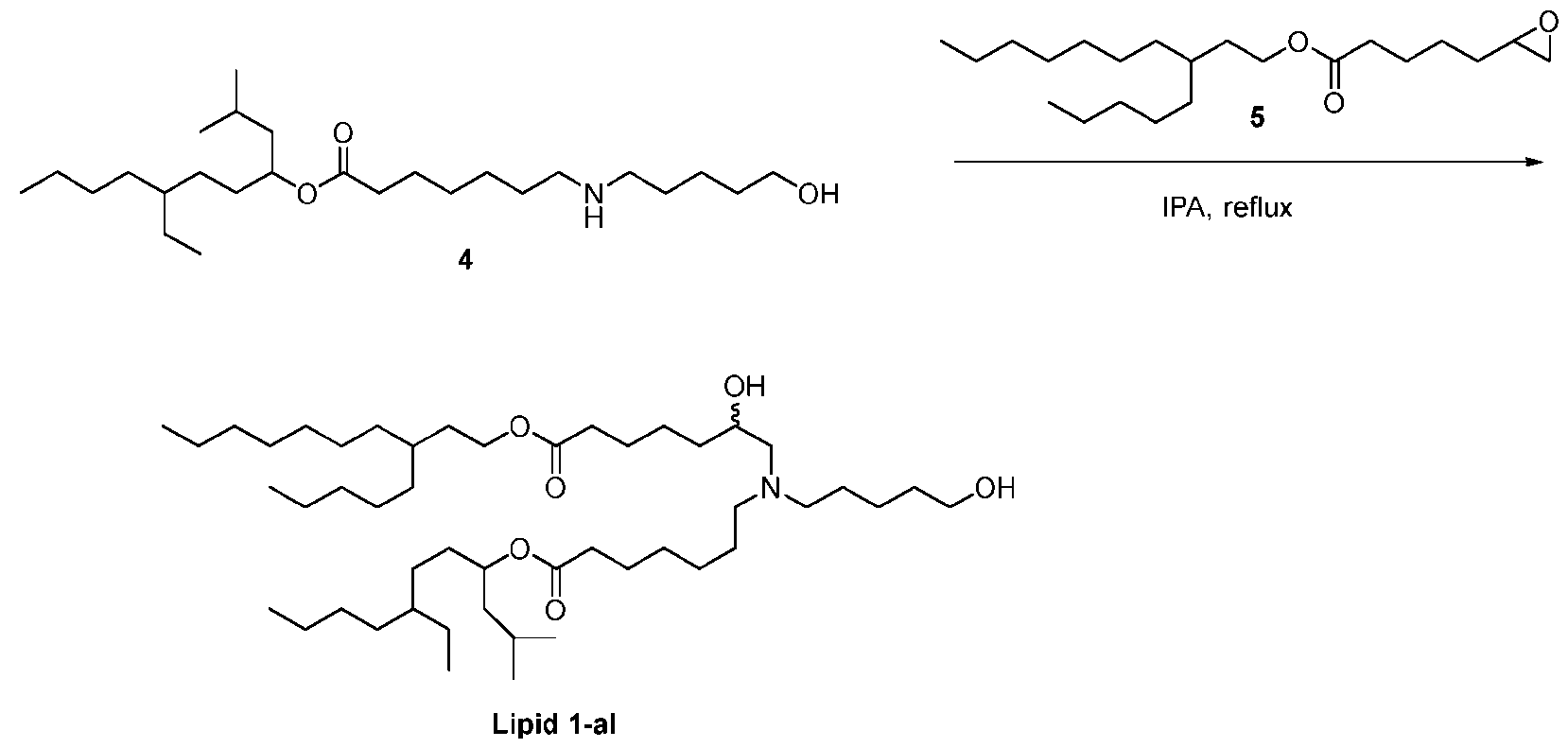 [665] 7-ethyl-2-methylundecan-4-yl 7-((5-hydroxypentyl)amino)heptanoate 4 (3.1 g, 7.25 mmol, 1 eq.), 3-pentyldecyl-6-(oxiran-2-yl)heptanoate 5 (3.1 g, 8.69 mmol, 1.2 eq.; exemplary synthesis of 3- pentyldecyl-6-(oxiran-2-yl)heptanoate is shown in Example 1.1.1-1.1.8), and i-PrOH (100 mL) was added to a 250 mL round-bottom flask and the reaction mixture was refluxed overnight. The solution was cooled to room temperature, concentrated, and purified on silica gel by flash chromatography (hexanes:EtOAc 100:0-0:100) to yield 3-pentyldecyl 7-((7-((7-ethyl-2-methylundecan-4-yl)oxy)-7- oxoheptyl)(5-hydroxypentyl)amino)-6-hydroxyheptanoate, Lipid 1-al as a colorless oil (2.3 g, 40%). 1H NMR (400 MHz, CDCl3): δ ppm 4.96-4.93 (m, 1H), 4.07 (t, J = 7.2 Hz, 2H), 3.64 (t, J = 7.2 Hz, 2H), 3.58-3.53 (m, 1H), 2.55-2.47 (m, 2H), 2.37-2.25 (m, 8 H), 1.71-1.12 (m, 60H), 0.91-0.86 (m, 15H), 0.82 (t, J = 7.2 Hz, 3H). MS (APCI+): 782.7 (M+1).
EXAMPLE 2 Production of lipid nanoparticle compositions and characterization [614] LNPs in the table below were prepared by combining an ionizable lipid, a helper lipid (DSPC), a PEG lipid (1,2-dimyristoyl-sn-glycerol methoxypolyethylene glycol, also known as PEG- DMG, obtainable from Avanti Polar Lipids, Alabaster, AL), and a structural lipid (cholesterol) at concentrations of about, e.g., 40 or 50 mM in a solvent, e.g., ethanol (the ionizable lipid: helper lipid: cholesterol: PEG-lipid molar ratio of these LNPs was 50:10:38.5:1.5. LNPs were formulated with circular RNA encoding firefly luciferase at an ionizable lipid to phosphate ratio (IL:P) of 5.4. [615] Nanoparticles can be made in a 1 fluid stream or with mixing processes such as microfluidics and T-junction mixing of two fluid streams, one of which contains the circular RNA and the other has the lipid components. [616] Solutions should be refrigerated for storage. Lipids are diluted with ethanol (optionally in combination with water) to a final lipid concentration of e.g., between about 10 mM and about 200 mM. [617] A Zetasizer Nano ZS (Malvern Instruments Ltd, Malvern, Worcestershire, UK) was used to determine the particle size, the polydispersity index (PDI), and zeta potential of the nanoparticle compositions in 1×PBS in determining particle size and 0.1X PBS in determining zeta potential. A cuvette with 1 mL of 20 µg/mL LNPs in PBS (pH 7.4) was measured for Z-average using the Malvern Panalytical Zetasizer Pro. The z-average diameter and polydispersity index were recorded. LNP sizes were determined by dynamic light scattering. [618] For transfer vehicle compositions including RNA, a QUANT-IT™ RIBOGREEN® RNA assay (Invitrogen Corporation Carlsbad, CA) was used to evaluate the encapsulation of RNA by the transfer vehicle composition. Nanoparticle solutions were diluted in tris-ethylenediaminetetraacetic acid (TE) buffer at a theoretical oRNA concentration of 2 µg/mL. Standard oRNA solutions diluted in TE buffer were made ranging from 2 µg/mL to 0.125 µg/mL. The particles and standards were plated in a black 96-well plate with both TE buffer and 4% Triton-X separately (Triton-X was used as a surfactant to lyse the nanoparticles). After an incubation (37 ℃ at 350 rpm for 15 minutes), an equal volume of diluted Quant-iT™ RiboGreen™ RNA reagent was added to all wells and a second incubation was performed (37 ℃ at 350 rpm for 3 minutes). Fluorescence was measured using a SPECTRAmax® GEMINI XS microplate spectrofluorometer (Molecular Devices Corporation Sunnyvale, CA). The concentration of oRNA in each particle solution was calculated using the standard curve. The encapsulation efficiency was calculated from the ratio of circRNA detected between lysed and unlysed particles.
Table 2
[665] 7-ethyl-2-methylundecan-4-yl 7-((5-hydroxypentyl)amino)heptanoate 4 (3.1 g, 7.25 mmol, 1 eq.), 3-pentyldecyl-6-(oxiran-2-yl)heptanoate 5 (3.1 g, 8.69 mmol, 1.2 eq.; exemplary synthesis of 3- pentyldecyl-6-(oxiran-2-yl)heptanoate is shown in Example 1.1.1-1.1.8), and i-PrOH (100 mL) was added to a 250 mL round-bottom flask and the reaction mixture was refluxed overnight. The solution was cooled to room temperature, concentrated, and purified on silica gel by flash chromatography (hexanes:EtOAc 100:0-0:100) to yield 3-pentyldecyl 7-((7-((7-ethyl-2-methylundecan-4-yl)oxy)-7- oxoheptyl)(5-hydroxypentyl)amino)-6-hydroxyheptanoate, Lipid 1-al as a colorless oil (2.3 g, 40%). 1H NMR (400 MHz, CDCl3): δ ppm 4.96-4.93 (m, 1H), 4.07 (t, J = 7.2 Hz, 2H), 3.64 (t, J = 7.2 Hz, 2H), 3.58-3.53 (m, 1H), 2.55-2.47 (m, 2H), 2.37-2.25 (m, 8 H), 1.71-1.12 (m, 60H), 0.91-0.86 (m, 15H), 0.82 (t, J = 7.2 Hz, 3H). MS (APCI+): 782.7 (M+1).
EXAMPLE 2 Production of lipid nanoparticle compositions and characterization [614] LNPs in the table below were prepared by combining an ionizable lipid, a helper lipid (DSPC), a PEG lipid (1,2-dimyristoyl-sn-glycerol methoxypolyethylene glycol, also known as PEG- DMG, obtainable from Avanti Polar Lipids, Alabaster, AL), and a structural lipid (cholesterol) at concentrations of about, e.g., 40 or 50 mM in a solvent, e.g., ethanol (the ionizable lipid: helper lipid: cholesterol: PEG-lipid molar ratio of these LNPs was 50:10:38.5:1.5. LNPs were formulated with circular RNA encoding firefly luciferase at an ionizable lipid to phosphate ratio (IL:P) of 5.4. [615] Nanoparticles can be made in a 1 fluid stream or with mixing processes such as microfluidics and T-junction mixing of two fluid streams, one of which contains the circular RNA and the other has the lipid components. [616] Solutions should be refrigerated for storage. Lipids are diluted with ethanol (optionally in combination with water) to a final lipid concentration of e.g., between about 10 mM and about 200 mM. [617] A Zetasizer Nano ZS (Malvern Instruments Ltd, Malvern, Worcestershire, UK) was used to determine the particle size, the polydispersity index (PDI), and zeta potential of the nanoparticle compositions in 1×PBS in determining particle size and 0.1X PBS in determining zeta potential. A cuvette with 1 mL of 20 µg/mL LNPs in PBS (pH 7.4) was measured for Z-average using the Malvern Panalytical Zetasizer Pro. The z-average diameter and polydispersity index were recorded. LNP sizes were determined by dynamic light scattering. [618] For transfer vehicle compositions including RNA, a QUANT-IT™ RIBOGREEN® RNA assay (Invitrogen Corporation Carlsbad, CA) was used to evaluate the encapsulation of RNA by the transfer vehicle composition. Nanoparticle solutions were diluted in tris-ethylenediaminetetraacetic acid (TE) buffer at a theoretical oRNA concentration of 2 µg/mL. Standard oRNA solutions diluted in TE buffer were made ranging from 2 µg/mL to 0.125 µg/mL. The particles and standards were plated in a black 96-well plate with both TE buffer and 4% Triton-X separately (Triton-X was used as a surfactant to lyse the nanoparticles). After an incubation (37 ℃ at 350 rpm for 15 minutes), an equal volume of diluted Quant-iT™ RiboGreen™ RNA reagent was added to all wells and a second incubation was performed (37 ℃ at 350 rpm for 3 minutes). Fluorescence was measured using a SPECTRAmax® GEMINI XS microplate spectrofluorometer (Molecular Devices Corporation Sunnyvale, CA). The concentration of oRNA in each particle solution was calculated using the standard curve. The encapsulation efficiency was calculated from the ratio of circRNA detected between lysed and unlysed particles.
Table 2


Claims
WHAT IS CLAIMED IS 1. An ionizable lipid, wherein the ionizable lipid is represented by Formula (15):
 , Formula (15) or is a pharmaceutically acceptable salt thereof, wherein: n* is an integer from 1 to 7; Ra is hydrogen or hydroxyl; Rh is hydrogen or C1-C6 alkyl; R1is C1-C30 alkyl or R1*; R2 is C1-C30 alkyl or R2*; R1* and R2* are independently selected from: –(CH2)qC(O)O(CH2)rC(R8)(R9)(R10), –(CH2)qOC(O)(CH2)rC(R8)(R9)(R10), and –(CH2)qOC(O)O(CH2)rC(R8)(R9)(R10); wherein: q is an integer from 0 to 12, r is an integer from 0 to 6, wherein at least one occurrence of r is not 0; R8 is hydrogen or R11; wherein (i) R1 is R1*, (ii) R2 is R2*, or (iii) R1 is R1* and R2 is R2*.
2. The ionizable lipid of claim 1, wherein Ra is hydrogen and the ionizable lipid is represented by Formula (16):
 Formula (16) or is a pharmaceutically acceptable salt thereof, wherein: n* is an integer from 1 to 7;
Rh is hydrogen or C1-C6 alkyl; R1is C1-C30 alkyl or R1*; R2 is C1-C30 alkyl or R2*; R1* and R2* are independently selected from: –(CH2)qC(O)O(CH2)rC(R8)(R9)(R10), –(CH2)qOC(O)(CH2)rC(R8)(R9)(R10), and –(CH2)qOC(O)O(CH2)rC(R8)(R9)(R10); wherein: q is an integer from 0 to 12, r is an integer from 0 to 6, wherein at least one occurrence of r is not 0; R8 is hydrogen or R11; R9, R10, and R11 are each independently C1-C20 alkyl or C2-C20-alkenyl; and wherein (i) R1 is R1*, (ii) R2 is R2*, or (iii) R1 is R1* and R2 is R2*.
Formula (16) or is a pharmaceutically acceptable salt thereof, wherein: n* is an integer from 1 to 7;
Rh is hydrogen or C1-C6 alkyl; R1is C1-C30 alkyl or R1*; R2 is C1-C30 alkyl or R2*; R1* and R2* are independently selected from: –(CH2)qC(O)O(CH2)rC(R8)(R9)(R10), –(CH2)qOC(O)(CH2)rC(R8)(R9)(R10), and –(CH2)qOC(O)O(CH2)rC(R8)(R9)(R10); wherein: q is an integer from 0 to 12, r is an integer from 0 to 6, wherein at least one occurrence of r is not 0; R8 is hydrogen or R11; R9, R10, and R11 are each independently C1-C20 alkyl or C2-C20-alkenyl; and wherein (i) R1 is R1*, (ii) R2 is R2*, or (iii) R1 is R1* and R2 is R2*.
3. The ionizable lipid of claim 1 or 2, wherein Rh is C1-C6 alkyl.
4. The ionizable lipid of claim 1 or 2, wherein Rh is hydrogen.
5. The ionizable lipid of claim 1 or 2, wherein R1 is C1-C30 alkyl.
6. The ionizable lipid of claim 5, wherein R1 is C1-C20 alkyl.
7. The ionizable lipid of claim 1, wherein R1 is R1*.
8. The ionizable lipid of claim 7, wherein R1* is –(CH2)qC(O)O(CH2)rC(R8)(R9)(R10).
9. The ionizable lipid of claim 7, wherein R1* is –(CH2)qOC(O)(CH2)rC(R8)(R9)(R10).
10. The ionizable lipid of claim 7, wherein R1* is –(CH2)qOC(O)O(CH2)rC(R8)(R9)(R10).
11. The ionizable lipid of claim 1 or 2, wherein R2 is C1-C30 alkyl.
12. The ionizable lipid of claim 1 or 2, wherein R2 is R2*.
13. The ionizable lipid of claim 12, wherein R2* is –(CH2)qC(O)O(CH2)rC(R8)(R9)(R10).
14. The ionizable lipid of claim 12, wherein R2* is –(CH2)qOC(O)(CH2)rC(R8)(R9)(R10).
15. The ionizable lipid of claim 12, wherein R2* is –(CH2)qOC(O)O(CH2)rC(R8)(R9)(R10).
16. The ionizable lipid of any one of claims 1-15, wherein R8 is hydrogen.
17. The ionizable lipid of any one of claims 1-15, wherein R9 and R10 are each independently C1- C20 alkyl.
18. The ionizable lipid of claim 17, wherein R9 and R10 are each independently C1-C10 alkyl.
19. The ionizable lipid of claim 1 or 2, wherein R1 is R1* and R2 is R2*.
20. The ionizable lipid of claim 19, wherein R1* and R2* are different.
21. The ionizable lipid of claim 20, wherein q of R1* and q of R2* are different integers.
22. The ionizable lipid of claim 20, wherein r of R1* and r of R2* are different integers.
23. The ionizable lipid of claim 20, wherein R8, R9, and R10 of R1*, collectively, are different than R8, R9, and R10 of R2*, collectively.
24. The ionizable lipid of any one of claims 20-23, wherein R1* and R2* are both – (CH2)qC(O)O(CH2)rC(R8)(R9)(R10).
25. The ionizable lipid of any one of claims 20-23, wherein R1* and R2* are both – (CH2)qOC(O)(CH2)rC(R8)(R9)(R10).
26. The ionizable lipid of any one of claims 20-23, wherein R1* and R2* are both – (CH2)qOC(O)O(CH2)rC(R8)(R9)(R10).
27. The ionizable lipid of claim 2, wherein the ionizable lipid is represented by Formula (17):
 Formula (17) or is a pharmaceutically acceptable salt thereof, wherein: n is an integer from 1 to 7; q and q’ are each independently integers from 0 to 12; r and r’ are each independently integers from 0 to 6, wherein at least one of r or r’ is not 0;
ZA and ZB are each independently selected from ^-C(O)O-, ^-OC(O), and -OC(O)O-; where ^ denotes the attachment point to -(CH2)q- or -(CH2)q’-; and R9A, R9B, R10A , and R10B are each independently C1-C20 alkyl or C2-C20 alkenyl.
Formula (17) or is a pharmaceutically acceptable salt thereof, wherein: n is an integer from 1 to 7; q and q’ are each independently integers from 0 to 12; r and r’ are each independently integers from 0 to 6, wherein at least one of r or r’ is not 0;
ZA and ZB are each independently selected from ^-C(O)O-, ^-OC(O), and -OC(O)O-; where ^ denotes the attachment point to -(CH2)q- or -(CH2)q’-; and R9A, R9B, R10A , and R10B are each independently C1-C20 alkyl or C2-C20 alkenyl.
28. The ionizable lipid of claim 27, wherein ZA is ^-C(O)O- and ZB is ^-C(O)O-.
29. The ionizable lipid of claim 27, wherein ZA is ^-C(O)O- and ZB is ^-OC(O)-.
30. The ionizable lipid of claim 27, wherein ZA is ^-C(O)O- and ZB is -OC(O)O-.
31. The ionizable lipid of claim 27, wherein ZA is ^-OC(O)- and ZB is ^-C(O)O -.
32. The ionizable lipid of claim 27, wherein ZA is ^-OC(O)- and ZB is ^-OC(O)-.
33. The ionizable lipid of claim 27, wherein ZA is ^-OC(O)- and ZB is -OC(O)O-.
34. The ionizable lipid of claim 27, wherein ZA is -OC(O)O- and ZB is ^-C(O)O -.
35. The ionizable lipid of claim 27, wherein ZA is -OC(O)O- and ZB is ^-OC(O)-.
36. The ionizable lipid of claim 27, wherein ZA is -OC(O)O- and ZB is -OC(O)O-.
37. The ionizable lipid of claim 27, wherein ZA and ZB are different.
38. The ionizable lipid of claim 27, wherein ZA and ZB are ^-C(O)O-, and the ionizable lipid is represented by Formula (17a-1):
 . Formula (17a-1)
39. The ionizable lipid of claim 27, wherein ZA and ZB are ^-OC(O)-, and the ionizable lipid is represented by Formula (17a-2)
 .
Formula (17a-2)
.
Formula (17a-2)
40. The ionizable lipid of claim 27, wherein ZA and ZB are -O(C)(O)O-, and the ionizable lipid is represented by Formula (17a-3):
 . Formula (17a-3)
41. The ionizable lipid of any one of claims 27-40, wherein Rh is hydrogen.
42. The ionizable lipid of any one of claims 27-40, wherein Rh is C1-C6 alkyl.
43. The ionizable lipid of any one of claims 27-42, wherein R9B and R10B are independently linear or branched C1-C20 alkyl.
44. The ionizable lipid of any one of claims 27-43, wherein R9B and R10B are different, and R9A and R10A are different.
45. The ionizable lipid of claim 44, wherein (i) R9A is Cs and R10A is Cs+2 or (ii) R9B is Cs and R10B is Cs+2, wherein s is the number of carbons in the C1-C20 alkyl or C2-C20 alkenyl group.
46. The ionizable lipid of claim 45, wherein (i) R9A is Cs and R10A is Cs+2 and (ii) R9B is Cs and R10B is Cs+2.
47. The ionizable lipid of claim 45, wherein s is an integer from 3 to 12.
48. The ionizable lipid of any one of claims 27-47, wherein n is 2 or 4.
49. The ionizable lipid of any one of claims 27-48, wherein q’ is 4 or 5.
50. The ionizable lipid of any one of claims 27-49, wherein r’ is 1, 2, or 3.
51. The ionizable lipid of any one of claims 27-50, wherein q is 4 or 5.
52. The ionizable lipid of any one of claims 27-51, wherein r is 1, 2, or 3.
53. The ionizable lipid of any one of claims 27-52, wherein r and r’ are different.
54. The ionizable lipid of claim 53, wherein (a) r is 0 and r’ is 1, 2, 3 or 4; (b) r is 1 and r’ is 0, 2, 3, or 4; (c) r is 2 and r’ is 0, 1, 3, or 4; (d) r is 3 and r’ is 0, 1, 2, or 4; or (e) r is 4 and r’ is 0, 1, 2, or 3.
55. The ionizable lipid of claim 53, wherein (a) r’ is 0 and r is 1, 2, 3, or 4; (b) r’ is 1 and r is 0, 2, 3, or 4; (c) r’ is 2 and r is 0, 1, 3, or 4; (d) r’ is 3 and r is 0, 1, 2, or 4; or (e) r’ is 4 and r is 0, 1, 2, or 3.
56. The ionizable lipid of claim 38, wherein the ionizable lipid is selected from:


57. The ionizable lipid of claim 39, wherein the ionizable lipid is selected from:


58. The ionizable lipid of claim 1, wherein Ra is hydroxyl and the ionizable lipid is represented by Formula (18):
 Formula (18) or is a pharmaceutically acceptable salt thereof, wherein: n* is an integer from 1 to 7; Rh is hydrogen or C1-C6 alkyl;
R1is C1-C30 alkyl or R1* ; R2 is C1-C30 alkyl or R2*; R1* and R2* are independently selected from: –(CH2)qC(O)O(CH2)rC(R8)(R9)(R10), –(CH2)qOC(O)(CH2)rC(R8)(R9)(R10), and –(CH2)qOC(O)O(CH2)rC(R8)(R9)(R10); wherein: q is an integer from 0 to 12, r is an integer from 0 to 6, wherein at least one occurrence of r is not 0; R8 is hydrogen or R11; R9, R10, and R11 are each independently C1-C20 alkyl or C2-C20 alkenyl; wherein (i) R1 is R1*, (ii) R2 is R2*, or (iii) R1 is R1* and R2 is R2*; and wherein, for (iii), (a) R1* and R2* are different or (b) R9 and R10 have different numbers of carbon atoms for at least one of R1* and R2* .
Formula (18) or is a pharmaceutically acceptable salt thereof, wherein: n* is an integer from 1 to 7; Rh is hydrogen or C1-C6 alkyl;
R1is C1-C30 alkyl or R1* ; R2 is C1-C30 alkyl or R2*; R1* and R2* are independently selected from: –(CH2)qC(O)O(CH2)rC(R8)(R9)(R10), –(CH2)qOC(O)(CH2)rC(R8)(R9)(R10), and –(CH2)qOC(O)O(CH2)rC(R8)(R9)(R10); wherein: q is an integer from 0 to 12, r is an integer from 0 to 6, wherein at least one occurrence of r is not 0; R8 is hydrogen or R11; R9, R10, and R11 are each independently C1-C20 alkyl or C2-C20 alkenyl; wherein (i) R1 is R1*, (ii) R2 is R2*, or (iii) R1 is R1* and R2 is R2*; and wherein, for (iii), (a) R1* and R2* are different or (b) R9 and R10 have different numbers of carbon atoms for at least one of R1* and R2* .
59. The ionizable lipid of claim 58, wherein Rh is C1-C6 alkyl.
60. The ionizable lipid of claim 58, wherein Rh is hydrogen.
61. The ionizable lipid of claim 58, wherein R1 is C1-C30 alkyl.
62. The ionizable lipid of claim 61, wherein R1 is C1-C20 alkyl.
63. The ionizable lipid of claim 58, wherein R1 is R1*.
64. The ionizable lipid of claim 63, wherein R1* is –(CH2)qC(O)O(CH2)rC(R8)(R9)(R10).
65. The ionizable lipid of claim 63, wherein R1* is –(CH2)qOC(O)(CH2)rC(R8)(R9)(R10).
66. The ionizable lipid of claim 63, wherein R1* is –(CH2)qOC(O)O(CH2)rC(R8)(R9)(R10).
67. The ionizable lipid of claim 58, wherein R2 is C1-C30 alkyl.
68. The ionizable lipid of claim 58, wherein R2 is R2*.
69. The ionizable lipid of claim 68, wherein R2* is –(CH2)qC(O)O(CH2)rC(R8)(R9)(R10).
70. The ionizable lipid of claim 68, wherein R2* is –(CH2)qOC(O)(CH2)rC(R8)(R9)(R10).
71. The ionizable lipid of claim 68, wherein R2* is –(CH2)qOC(O)O(CH2)rC(R8)(R9)(R10).
72. The ionizable lipid of any one of claims 58-71, wherein R8 is hydrogen.
73. The ionizable lipid of any one of claims 58-71, wherein R9 and R10 are each independently C1- C20 alkyl.
74. The ionizable lipid of claim 73 wherein R9 and R10 are each independently C1-C10 alkyl.
75. The ionizable lipid of claim 58, wherein R1 is R1* and R2 is R2*.
76. The ionizable lipid of claim 75, wherein R1* and R2* are different.
77. The ionizable lipid of claim 76, wherein q of R1* and q of R2* are different integers.
78. The ionizable lipid of claim 76, wherein r of R1* and r of R2* are different integers.
79. The ionizable lipid of claim 76, wherein R8, R9 and R10 of R1*, collectively, are different than R8, R9 and R10 of R2*, collectively.
80. The ionizable lipid of claim 75, wherein R9 and R10 have different numbers of carbon atoms for at least one of R1* and R2*.
81. The ionizable lipid of claim 80, wherein R9 is Cs and R10 is Cs+2, wherein s is the number of carbons in the C1-C20 alkyl or C2-C20 alkenyl group.
82. The ionizable lipid of claim 81, wherein s is an integer from 3 to 12.
83. The ionizable lipid of any one of claims 75-82, wherein R1* and R2* are both – (CH2)qC(O)O(CH2)rC(R8)(R9)(R10).
84. The ionizable lipid of any one of claims 75-82, wherein R1* and R2* are both – (CH2)qOC(O)(CH2)rC(R8)(R9)(R10).
85. The ionizable lipid of any one of claims 75-82, wherein R1* and R2* are both – (CH2)qOC(O)O(CH2)rC(R8)(R9)(R10).
86. The ionizable lipid of claim 58, wherein the ionizable lipid is represented by Formula (19):
 , Formula (19)
or is a pharmaceutically acceptable salt thereof, wherein: n is an integer from 1 to 7; q and q’ are each independently integers from 0 to 12; r and r’ are each independently integers from 0 to 6, wherein at least one of r or r’ is not 0; ZA and ZB are each independently selected from ^-C(O)O-, ^-OC(O), and -OC(O)O-; and R9A, R9B, R10A, and R10B are each independently C1-C20 alkyl or C2-C20 alkenyl.
, Formula (19)
or is a pharmaceutically acceptable salt thereof, wherein: n is an integer from 1 to 7; q and q’ are each independently integers from 0 to 12; r and r’ are each independently integers from 0 to 6, wherein at least one of r or r’ is not 0; ZA and ZB are each independently selected from ^-C(O)O-, ^-OC(O), and -OC(O)O-; and R9A, R9B, R10A, and R10B are each independently C1-C20 alkyl or C2-C20 alkenyl.
87. The ionizable lipid of claim 86, wherein ZA is ^-C(O)O- and ZB is ^-C(O)O -.
88. The ionizable lipid of claim 86, wherein ZA is ^-C(O)O- and ZB is ^-OC(O)-.
89. The ionizable lipid of claim 86, wherein ZA is ^-C(O)O- and ZB is -OC(O)O-.
90. The ionizable lipid of claim 86, wherein ZA is ^-OC(O)- and ZB is ^-C(O)O -.
91. The ionizable lipid of claim 86, wherein ZA is ^-OC(O)- and ZB is ^-OC(O)-.
92. The ionizable lipid of claim 86, wherein ZA is ^-OC(O)- and ZB is -OC(O)O-.
93. The ionizable lipid of claim 86, wherein ZA is -OC(O)O- and ZB is ^-C(O)O -.
94. The ionizable lipid of claim 86, wherein ZA is -OC(O)O- and ZB is ^-OC(O)-.
95. The ionizable lipid of claim 86, wherein ZA is -OC(O)O- and ZB is -OC(O)O-.
96. The ionizable lipid of claim 86, wherein ZA and ZB are different.
97. The ionizable lipid of claim 86, wherein ZA and ZB are ^-C(O)O-, and the ionizable lipid is represented by Formula (19a-1):
 . Formula (19a-1)
98. The ionizable lipid of claim 86, wherein ZA and ZB are ^-OC(O)-, and the ionizable lipid is represented by Formula (19a-2):

99. The ionizable lipid of claim 86, wherein ZA and ZB are -O(C)(O)O-, and the ionizable lipid is represented by Formula (19a-3):
 . Formula (19a-3)
100. The ionizable lipid of any one of claims 86-99, wherein Rh is hydrogen.
101. The ionizable lipid of any one of claims 86-99, wherein Rh is C1-C6 alkyl.
102. The ionizable lipid of any one of claims 86-101, wherein R9B and R10B have different numbers of carbon atoms, or R9A and R10A have different numbers of carbon atoms.
103. The ionizable lipid of claim 102, wherein (i) R9A is Cs and R10A is Cs+2 or (ii) R9B is Cs and R10B is Cs+2, wherein s is the number of carbons in the C1-C20 alkyl or C2-C20 alkenyl group.
104. The ionizable lipid of claim 102, wherein (i) R9A is Cs and R10A is Cs+2 and (ii) R9B is Cs and R10B is Cs+2, wherein s is the number of carbons in the C1-C20 alkyl or C2-C20 alkenyl group.
105. The ionizable lipid of claim 103 or 104, wherein s is an integer from 3 to 12.
106. The ionizable lipid of any one of claims 86-105, wherein n is 2 or 4.
107. The ionizable lipid of any one of claims 86-106, wherein q’ is 4 or 5.
108. The ionizable lipid of any one of claims 86-107, wherein r’ is 1, 2, or 3.
109. The ionizable lipid of any one of claims 86-108, wherein q is 4 or 5.
110. The ionizable lipid of any one of claims 86-109, wherein r is 1, 2, or 3.
111. The ionizable lipid of any one of claims 86-110, wherein r and r’ are different.
112. The ionizable lipid of claim 111, wherein (a) r is 0 and r’ is 1, 2, 3 or 4; (b) r is 1 and r’ is 0, 2, 3, or 4; (c) r is 2 and r’ is 0, 1, 3, or 4; (d) r is 3 and r’ is 0, 1, 2, or 4; or (e) r is 4 and r’ is 0, 1, 2, or 3.
113. The ionizable lipid of claim 111, wherein (a) r’ is 0 and r is 1, 2, 3, or 4; (b) r’ is 1 and r is 0, 2, 3, or 4; (c) r’ is 2 and r is 0, 1, 3, or 4; (d) r’ is 3 and r is 0, 1, 2, or 4; or (e) r’ is 4 and r is 0, 1, 2, or 3.
114. The ionizable lipid of claim 97, wherein the ionizable lipid is selected from:

115. The ionizable lipid of claim 98, wherein the ionizable lipid is selected from:


116. The ionizable lipid of claim 1, wherein R1is C1-C30 alkyl, and the ionizable lipid is represented by Formula (20):
 , Formula (20) or is a pharmaceutically acceptable salt thereof, wherein: ZA is selected from ^-C(O)O-, ^-OC(O)-, and -OC(O)O-; where ^ denotes the attachment point to -(CH2)q-; R9A and R10A are each independently C1-C20 alkyl or C2-C20 alkenyl; n is an integer from 1 to 7; q is an integer from 0 to 12; and r is an integer from 1 to 6.
117. The ionizable lipid of claim 116, wherein ZA is ^-C(O)O-, and the ionizable lipid is represented by Formula (20a-1):
 . Formula (20a-1)
118. The ionizable lipid of claim 116, wherein ZA is ^-OC(O)-, and the ionizable lipid is represented by Formula (20a-2):

119. The ionizable lipid of claim 116, wherein ZA is -OC(O)O-, and the ionizable lipid is represented by Formula (20a-3):
 , Formula (20a-3)
120. The ionizable lipid of any one of claims 116-119, wherein R9A and R10A are each independently C1-C20 alkyl.
121. The ionizable lipid of claim 120, wherein R9A and R10A are each independently linear C1-C10 alkyl.
122. The ionizable lipid of any one of claims 116-121, wherein R9A and R10A are different.
123. The ionizable lipid of any one of claims 116-121, wherein R9A and R10A are the same.
124. The ionizable lipid of claim 122, wherein R9A is Cs and R10A is Cs+2, wherein s is the number of carbons in the C1-C20 alkyl or C2-C20 alkenyl group.
125. The ionizable lipid of claim 124, wherein s is an integer from 3 to 12.
126. The ionizable lipid of any one of claims 116-125, wherein q is 4 or 5.
127. The ionizable lipid of any one of claims 116-126, wherein r is 1, 2, or 3.
128. The ionizable lipid of any one of claims 116-127, wherein Rh is hydrogen.
129. The ionizable lipid of any one of claims 116-128, wherein Rh is C1-C6 alkyl.
130. The ionizable lipid of claim 117, wherein the ionizable lipid is selected from:

131. The ionizable lipid of claim 1, wherein R2is C1-C30 alkyl, and the ionizable lipid is represented by Formula (21):
 , Formula (21) or is a pharmaceutically acceptable salt thereof, wherein: ZB is selected from ^-C(O)O-, ^-OC(O)-, and -OC(O)O-; where ^ denotes the attachment point to -(CH2)q’-; R9B and R10B are each independently C1-C20 alkyl or C2-C20 alkenyl; n is an integer from 1 to 7; q' is an integer from 0 to 12; and r’ is an integer from 1 to 6.
132. The ionizable lipid of claim 131, wherein ZB is ^-C(O)O-, and the ionizable lipid is represented by Formula (21a-1):

133. The ionizable lipid of claim 131, wherein ZB is ^-OC(O)O-, and the ionizable lipid is represented by Formula (21a-2):
 . Formula (21a-2)
134. The ionizable lipid of claim 131, wherein ZB is -OC(O)O-, and the ionizable lipid is represented by Formula (21a-3):
 . Formula (21a-3)
135. The ionizable lipid of any one of claims 131-134, wherein Rh is hydrogen.
136. The ionizable lipid of any one of claims 131-134, wherein Rh is C1-C6 alkyl.
137. The ionizable lipid of any one of claims 131-134, wherein R9B and R10B are each independently linear C1-C20 alkyl.
138. The ionizable lipid of claim 137, wherein R9B and R10B are each independently linear C1-C10 alkyl.
139. The ionizable lipid of any one of claims 131-138, wherein and R9B and R10B are different.
140. The ionizable lipid of any one of claims 131-138, wherein R9B and R10B are the same.
141. The ionizable lipid of claim 139, wherein R9B is Cs and R10B is Cs+2, wherein s is the number of carbons in the C1-C20 alkyl or C2-C20 alkenyl group.
142. The ionizable lipid of claim 141, wherein s is an integer from 3 to 12.
143. The ionizable lipid of any one of claims 131-142, wherein q’ is 4 or 5.
144. The ionizable lipid of any one of claims 131-143, wherein r’ is 1, 2, or 3.
145. The ionizable lipids of any one of claims 131-144, wherein Ra is hydrogen.
146. The ionizable lipids of any one of claims 131-144, wherein Ra is hydroxyl.
147. A pharmaceutical composition comprising an ionizable lipid of any one of claims 1-146.
148. The pharmaceutical composition of claim 147, further comprising a transfer vehicle.
149. The pharmaceutical composition of claim 148, wherein the pharmaceutical composition further comprises a RNA polynucleotide.
150. The pharmaceutical composition of claim 149, wherein the RNA polynucleotide is a linear or circular RNA polynucleotide.
151. The pharmaceutical composition of claim 149 or 150, wherein the RNA polynucleotide is a circular RNA polynucleotide, optionally comprising a translation initiation element (TIE).
152. A pharmaceutical composition comprising: a. an RNA polynucleotide, wherein the RNA polynucleotide is a circular RNA polynucleotide, optionally comprising a translation initiation element (TIE), and b. a transfer vehicle comprising an ionizable lipid of claim 1-146.
153. The pharmaceutical composition of any one of claims 148-152, wherein the transfer vehicle comprises a nanoparticle, such as a lipid nanoparticle, a core-shell nanoparticle, a biodegradable nanoparticle, a biodegradable lipid nanoparticle, a polymer nanoparticle, or a biodegradable polymer nanoparticle.
154. The pharmaceutical composition of any one of claims 149-153, wherein the RNA polynucleotide is encapsulated in the transfer vehicle, optionally wherein the encapsulation efficiency is at least about 80%.
155. The pharmaceutical composition of any one of claims 149-154, wherein the RNA polynucleotide comprises an expression sequence.
156. The pharmaceutical composition of claim 155, wherein the expression sequence encodes a therapeutic protein.
157. The pharmaceutical composition of claim 156, wherein the expression sequence encodes a cytokine or a functional fragment thereof, a transcription factor, an immune checkpoint inhibitor, or a chimeric antigen receptor (CAR).
158. The pharmaceutical composition of any one of claims 149-157, wherein the RNA polynucleotide comprises, in the following order: a. a 5’ enhanced exon element, b. a core functional element, and c. a 3’ enhanced exon element.
159. The pharmaceutical composition of claim 158, wherein the core functional element comprises a translation initiation element (TIE).
160. The pharmaceutical composition of claim 159, wherein the TIE comprises an untranslated region (UTR) or fragment thereof.
161. The pharmaceutical composition of claim 160, wherein the UTR or fragment thereof comprises a IRES or eukaryotic IRES.
162. The pharmaceutical composition of any one of claims 149-161, wherein the TIE comprises an aptamer complex, optionally wherein the aptamer complex comprises at least two aptamers.
163. The pharmaceutical composition of any one of claims 158-162, wherein the core functional element comprises a coding region.
164. The pharmaceutical composition of claim 163, wherein the coding region encodes for a therapeutic protein.
165. The pharmaceutical composition of claim 164, wherein the therapeutic protein is a chimeric antigen receptor (CAR).
166. The pharmaceutical composition of any one of claims 158-165, wherein the core functional element comprises a noncoding region.
167. The pharmaceutical composition of any one of claims 158-166, wherein the 3’ enhanced exon element comprises a 5’ exon fragment, and optionally a 3’ internal spacer and/or a 3’ internal duplex element, wherein the 3’ internal spacer and/or 3’ internal duplex element are each independently located upstream to the 5’ exon fragment, optionally wherein the 3’ internal spacer is a polyA or polyA-C sequence of about 10 to about 60 nucleotides in length.
168. The pharmaceutical composition of any one of claims 158-167, wherein the RNA polynucleotide is made via circularization of a RNA polynucleotide comprising, in the following order: a. a 5’ enhanced intron element, b. a 5’ enhanced exon element, c. a core functional element, d. a 3’ enhanced exon element, and e. a 3’ enhanced intron element.
169. The pharmaceutical composition of claim 168, wherein the 5’enhanced intron element comprises: a 3’ intron fragment, comprising a first or a first and a second nucleotides of a 3’ group I intron splice site dinucleotide; and optionally a 5’ affinity tag located upstream to the 3’ intron fragment, a 5’ external spacer located upstream to the 3’ intron fragment, and/or a leading untranslated sequence located at the 5’ end of the said 5’ enhanced intron element.
170. The pharmaceutical composition of any one of claims 149-169, wherein the RNA polynucleotide is from about 100nt to about 10,000nt in length, such as about 100nt to about 15,000nt in length.
171. The pharmaceutical composition of any one of claims 149-170, wherein the RNA polynucleotide is a circular RNA polynucleotide, and wherein the composition has a duration of therapeutic effect in a human cell or in vivo in humans greater than or equal to that of a reference composition,
wherein the reference comprises (1) instead of the circular RNA polynucleotide, a reference linear RNA polynucleotide having the same expression sequence as the circular RNA polynucleotide; and/or (2) an ionizable lipid that is not an ionizable lipid of any one of claims 1-146.
172. The pharmaceutical composition of claim 147 wherein the pharmaceutical composition has a duration of therapeutic effect in vivo in humans of at least about 10, at least about 20, at least about 30, at least about 40, at least about 50, at least about 60, at least about 70, at least about 80, at least about 90, or at least about 100 hours.
173. The pharmaceutical composition of any one of claims 149-172, wherein the RNA polynucleotide is a circular RNA polynucleotide, and wherein the composition has a functional half- life in a human cell or in vivo in human greater than or equal to that of a pre-determined threshold value.
174. The pharmaceutical composition of claim 173, wherein the composition has a functional half- life of at least about 20 hours.
175. The pharmaceutical composition of any one of claims 149-174, wherein the transfer vehicle further comprises a structural lipid and a PEG-modified lipid.
176. The pharmaceutical composition of claim 175, wherein the structural lipid binds to C1q and/or promotes the binding of the transfer vehicle comprising said lipid to C1q compared to a control transfer vehicle lacking the structural lipid and/or increases uptake of C1q-bound transfer vehicle into an immune cell compared to a control transfer vehicle lacking the structural lipid.
177. The pharmaceutical composition of claim 176, wherein the immune cell is a T cell, an NK cell, an NKT cell, a macrophage, or a neutrophil.
178. The pharmaceutical composition of any one of claims 175-177, wherein the structural lipid is cholesterol.
179. The pharmaceutical composition of any one of claims 175-177, wherein the structural lipid is beta-sitosterol.
180. The pharmaceutical composition of any one of claims 175-177, wherein the structural lipid is not beta-sitosterol.
181. The pharmaceutical composition of any one of claims 175-180, wherein the PEG-modified lipid is DSPE-PEG, DMG-PEG, PEG-DAG, PEG-S-DAG, PEG-PE, PEG-S-DMG, PEG-cer, PEG- dialkoxypropylcarbamate, PEG-OR, PEG-OH, PEG-c-DOMG, or PEG-1.
182. The pharmaceutical composition of claim 181, wherein the PEG modified lipid is DSPE- PEG(2000).
183. The pharmaceutical composition of any one of claims 147-182, wherein the transfer vehicle further comprises a helper lipid.
184. The pharmaceutical composition of claim 183, wherein the helper lipid is DSPC or DOPE.
185. The pharmaceutical composition of any one of claims 148-184, wherein the transfer vehicle comprises DSPC, cholesterol, and DMG-PEG(2000).
186. The pharmaceutical composition of any one of claims 175-185, wherein the transfer vehicle comprises about 0.5% to about 4% PEG-modified lipids by molar ratio.
187. The pharmaceutical composition of any one of claims 175-186, wherein the transfer vehicle comprises about 1% to about 2% PEG-modified lipids by molar ratio.
188. The pharmaceutical composition of any one of claims 148-187, wherein the transfer vehicle comprises: a. an ionizable lipid of claim 1-146, b. a helper lipid selected from DOPE or DSPC, c. cholesterol, and d. a PEG-lipid selected from DSPE-PEG(2000) or DMG-PEG(2000).
189. The pharmaceutical composition of any one of claims 183-188, wherein the molar ratio of ionizable lipid:helper lipid:cholesterol:PEG-lipid is about 45:9:44:2, about 50:10:38.5:1.5, about 41:12:45:2, about 62:4:33:1, or about 53:5:41:1.
190. The pharmaceutical composition of any one of claims 183-189, wherein the transfer vehicle comprises the helper lipid of DOPE and the PEG-lipid of DMG-PEG(2000), and wherein the molar ratio of ionizable lipid:DOPE:cholesterol:DMG-PEG(2000) is about 45:9:44:2, about 50:10:38.5:1.5, about 41:12:45:2, about 62:4:33:1, or about 53:5:41:1.
191. The pharmaceutical composition of claim 190, wherein the transfer vehicle comprises the helper lipid of DOPE and the PEG-lipid of DSPE-PEG(2000), and wherein the molar ratio of ionizable lipid:DOPE:cholesterol:DSPE-PEG(2000) is about 62:4:33:1.
192. The pharmaceutical composition of claim 190, wherein the transfer vehicle comprises the helper lipid of DOPE and the PEG-lipid of DSPE-PEG(2000), and wherein the molar ratio of ionizable lipid:DOPE:cholesterol:DSPE-PEG(2000) is about 53:5:41:1.
193. The pharmaceutical composition of any one of claims 183-189, wherein the transfer vehicle comprises the helper lipid of DSPC and the PEG-lipid of DMG-PEG(2000), and wherein the molar ratio of ionizable lipid:DSPC:cholesterol:DMG-PEG(2000) is about 45:9:44:2, about 50:10:38.5:1.5, about 41:12:45:2, about 62:4:33:1, or about 53:5:41:1.
194. The pharmaceutical composition of claim 193, wherein the transfer vehicle comprises the helper lipid of DSPC and the PEG-lipid of DMG-PEG(2000), and wherein the molar ratio of ionizable lipid:DSPC:cholesterol:DMG-PEG(2000) is about 50:10:38.5:1.5.
195. The pharmaceutical composition of claim 193, wherein the transfer vehicle comprises the helper lipid of DSPC and the PEG-lipid of DMG-PEG(2000), and wherein the molar ratio of ionizable lipid:DSPC:cholesterol:DMG-PEG(2000) is about 41:12:45:2.
196. The pharmaceutical composition of claim 193, wherein the transfer vehicle comprises the helper lipid of DSPC and the PEG-lipid of DMG-PEG(2000), and wherein the molar ratio of ionizable lipid:DSPC:cholesterol:DMG-PEG(2000) is about 45:9:44:2.
197. The pharmaceutical composition of any one of claims 183-189, wherein the transfer vehicle comprises the helper lipid of DSPC and the PEG-lipid of DSPE-PEG(2000), and wherein the molar ratio of ionizable lipid: DSPC:cholesterol:DSPE-PEG(2000) is about 45:9:44:2, about 50:10:38.5:1.5, about 41:12:45:2, about 62:4:33:1, or about 53:5:41:1.
198. The pharmaceutical composition of any one of claims 183-189, wherein the transfer vehicle comprises the helper lipid of DOPE and the PEG-lipid is C14-PEG(2000), and wherein the molar ratio of ionizable lipid:DOPE:cholesterol:C14-PEG(2000) is about 45:9:44:2, about 50:10:38.5:1.5, about 41:12:45:2, about 62:4:33:1, or about 53:5:41:1.
199. The pharmaceutical composition of any one of claims 183-189, wherein the transfer vehicle comprises the helper lipid of DOPE and the PEG-lipid of DMG-PEG(2000), wherein the molar ratio of ionizable lipid:DOPE:cholesterol:DMG-PEG(2000) is about 45:9:44:2, about 50:10:38.5:1.5, about 41:12:45:2, about 62:4:33:1, or about 53:5:41:1.
200. The pharmaceutical composition of any one of claims 149-199, having a lipid to phosphate (IL:P) molar ratio of about 3 to about 9, such as about 3, about 4, about 4.5, about 5, about 5.4, about 5.7, about 6, about 6.2, about 6.5, or about 7.
201. The pharmaceutical composition of any one of claims 149-200, wherein the transfer vehicle is formulated for endosomal release of the RNA polynucleotide.
202. The pharmaceutical composition of any one of claims 148-201, wherein the transfer vehicle is capable of binding to apolipoprotein E (APOE) or is substantially free of APOE binding sites.
203. The pharmaceutical composition of any one of claims 148-202, wherein the transfer vehicle is capable of low density lipoprotein receptor (LDLR) dependent uptake or LDLR independent uptake into a cell.
204. The pharmaceutical composition of any one of claims 148-203, wherein the transfer vehicle has a diameter of less than about 120 nm and/or does not form aggregates with a diameter of more than 300 nm.
205. The pharmaceutical composition of any one of claims 147-204, wherein the pharmaceutical composition is substantially free of linear RNA.
206. The pharmaceutical composition of any one of claims 148-205, further comprising a targeting moiety operably connected to the transfer vehicle.
207. The pharmaceutical composition of claim 206, wherein the targeting moiety specifically or indirectly binds an immune cell antigen, wherein the immune cell antigen is a T cell antigen selected from the group consisting of CD2, CD3, CD5, CD7, CD8, CD4, beta7 integrin, beta2 integrin, and C1qR.
208. The pharmaceutical composition of claim 207, further comprising an adapter molecule comprising a transfer vehicle binding moiety and a cell binding moiety, wherein the targeting moiety specifically binds the transfer vehicle binding moiety, and the cell binding moiety specifically binds a target cell antigen, optionally wherein the target cell antigen is an immune cell antigen selected from a T cell antigen, an NK cell antigen, an NKT cell antigen, a macrophage antigen, or a neutrophil antigen.
209. The pharmaceutical composition of any one of claims 206-208, wherein the targeting moiety is a small molecule (e.g., mannose, a lectin, acivicin, biotin, or digoxigenin), and/or the targeting moiety is a single chain Fv (scFv) fragment, nanobody, peptide, peptide-based macrocycle, minibody, small molecule ligand such as folate, arginylglycylaspartic acid (RGD), or phenol-soluble modulin alpha 1 peptide (PSMA1), heavy chain variable region, light chain variable region or fragment thereof.
210. The pharmaceutical composition of any one of claims 149-209, wherein less than 1%, by weight, of the polynucleotides in the composition are double stranded RNA, DNA splints, or triphosphorylated RNA.
211. The pharmaceutical composition of any one of claims 149-210, wherein less than 1%, by weight, of the polynucleotides and proteins in the pharmaceutical composition are double stranded RNA, DNA splints, triphosphorylated RNA, phosphatase proteins, protein ligases, and capping enzymes.
212. A method of treating or preventing a disease, disorder, or condition, comprising administering an effective amount of a pharmaceutical composition of any one of claims 147-211.
213. A method of treating a subject in need thereof comprising administering a therapeutically effective amount of the pharmaceutical composition of any one of claims 147-211.
Applications Claiming Priority (6)
| Application Number | Priority Date | Filing Date | Title |
|---|---|---|---|
| US202263382816P | 2022-11-08 | 2022-11-08 | |
| US63/382,816 | 2022-11-08 | ||
| US202363492988P | 2023-03-29 | 2023-03-29 | |
| US202363492971P | 2023-03-29 | 2023-03-29 | |
| US63/492,971 | 2023-03-29 | ||
| US63/492,988 | 2023-03-29 |
Publications (1)
| Publication Number | Publication Date |
|---|---|
| WO2024102730A1 true WO2024102730A1 (en) | 2024-05-16 |
Family
ID=89222835
Family Applications (1)
| Application Number | Title | Priority Date | Filing Date |
|---|---|---|---|
| PCT/US2023/078946 Ceased WO2024102730A1 (en) | 2022-11-08 | 2023-11-07 | Lipids and nanoparticle compositions for delivering polynucleotides |
Country Status (2)
| Country | Link |
|---|---|
| TW (1) | TW202425959A (en) |
| WO (1) | WO2024102730A1 (en) |
Citations (108)
| Publication number | Priority date | Publication date | Assignee | Title |
|---|---|---|---|---|
| US3832253A (en) | 1973-03-21 | 1974-08-27 | Baxter Laboratories Inc | Method of making an inflatable balloon catheter |
| US3854480A (en) | 1969-04-01 | 1974-12-17 | Alza Corp | Drug-delivery system |
| US4450150A (en) | 1973-05-17 | 1984-05-22 | Arthur D. Little, Inc. | Biodegradable, implantable drug delivery depots, and method for preparing and using the same |
| US4452775A (en) | 1982-12-03 | 1984-06-05 | Syntex (U.S.A.) Inc. | Cholesterol matrix delivery system for sustained release of macromolecules |
| US4667014A (en) | 1983-03-07 | 1987-05-19 | Syntex (U.S.A.) Inc. | Nonapeptide and decapeptide analogs of LHRH, useful as LHRH antagonists |
| US4748034A (en) | 1983-05-13 | 1988-05-31 | Nestec S.A. | Preparing a heat stable aqueous solution of whey proteins |
| US4897355A (en) | 1985-01-07 | 1990-01-30 | Syntex (U.S.A.) Inc. | N[ω,(ω-1)-dialkyloxy]- and N-[ω,(ω-1)-dialkenyloxy]-alk-1-yl-N,N,N-tetrasubstituted ammonium lipids and uses therefor |
| US5075109A (en) | 1986-10-24 | 1991-12-24 | Southern Research Institute | Method of potentiating an immune response |
| US5087616A (en) | 1986-08-07 | 1992-02-11 | Battelle Memorial Institute | Cytotoxic drug conjugates and their delivery to tumor cells |
| US5171678A (en) | 1989-04-17 | 1992-12-15 | Centre National De La Recherche Scientifique | Lipopolyamines, their preparation and their use |
| US5239660A (en) | 1990-10-31 | 1993-08-24 | Nec Corporation | Vector processor which can be formed by an integrated circuit of a small size |
| US5334761A (en) | 1992-08-28 | 1994-08-02 | Life Technologies, Inc. | Cationic lipids |
| US5744335A (en) | 1995-09-19 | 1998-04-28 | Mirus Corporation | Process of transfecting a cell with a polynucleotide mixed with an amphipathic compound and a DNA-binding protein |
| US5885613A (en) | 1994-09-30 | 1999-03-23 | The University Of British Columbia | Bilayer stabilizing components and their use in forming programmable fusogenic liposomes |
| US5948902A (en) | 1997-11-20 | 1999-09-07 | South Alabama Medical Science Foundation | Antisense oligonucleotides to human serine/threonine protein phosphatase genes |
| US6319494B1 (en) | 1990-12-14 | 2001-11-20 | Cell Genesys, Inc. | Chimeric chains for receptor-associated signal transduction pathways |
| US20030022649A1 (en) | 2001-05-03 | 2003-01-30 | Mitsubishi Denki Kabushiki Kaisha | Signal reception method and device |
| US20040014194A1 (en) | 2002-03-27 | 2004-01-22 | Schering Corporation | Beta-secretase crystals and methods for preparing and using the same |
| US20040262223A1 (en) | 2001-07-27 | 2004-12-30 | President And Fellows Of Harvard College | Laminar mixing apparatus and methods |
| US20050222064A1 (en) | 2002-02-20 | 2005-10-06 | Sirna Therapeutics, Inc. | Polycationic compositions for cellular delivery of polynucleotides |
| WO2005121348A1 (en) | 2004-06-07 | 2005-12-22 | Protiva Biotherapeutics, Inc. | Lipid encapsulated interfering rna |
| WO2005120152A2 (en) | 2004-06-07 | 2005-12-22 | Protiva Biotherapeutics, Inc. | Cationic lipids and methods of use |
| WO2006000830A2 (en) | 2004-06-29 | 2006-01-05 | Avidex Ltd | Cells expressing a modified t cell receptor |
| WO2006007712A1 (en) | 2004-07-19 | 2006-01-26 | Protiva Biotherapeutics, Inc. | Methods comprising polyethylene glycol-lipid conjugates for delivery of therapeutic agents |
| WO2006069782A2 (en) | 2004-12-27 | 2006-07-06 | Silence Therapeutics Ag. | Lipid complexes coated with peg and their use |
| WO2008042973A2 (en) | 2006-10-03 | 2008-04-10 | Alnylam Pharmaceuticals, Inc. | Lipid containing formulations |
| WO2008103276A2 (en) | 2007-02-16 | 2008-08-28 | Merck & Co., Inc. | Compositions and methods for potentiated activity of biologicaly active molecules |
| WO2009086558A1 (en) | 2008-01-02 | 2009-07-09 | Tekmira Pharmaceuticals Corporation | Improved compositions and methods for the delivery of nucleic acids |
| WO2009127060A1 (en) | 2008-04-15 | 2009-10-22 | Protiva Biotherapeutics, Inc. | Novel lipid formulations for nucleic acid delivery |
| WO2009132131A1 (en) | 2008-04-22 | 2009-10-29 | Alnylam Pharmaceuticals, Inc. | Amino lipid based improved lipid formulation |
| WO2010042877A1 (en) | 2008-10-09 | 2010-04-15 | Tekmira Pharmaceuticals Corporation | Improved amino lipids and methods for the delivery of nucleic acids |
| WO2010048536A2 (en) | 2008-10-23 | 2010-04-29 | Alnylam Pharmaceuticals, Inc. | Processes for preparing lipids |
| US7709226B2 (en) | 2001-07-12 | 2010-05-04 | Arrowsmith Technology Licensing Llc | Method of humanizing antibodies by matching canonical structure types CDRs |
| WO2010054405A1 (en) | 2008-11-10 | 2010-05-14 | Alnylam Pharmaceuticals, Inc. | Novel lipids and compositions for the delivery of therapeutics |
| WO2010053572A2 (en) | 2008-11-07 | 2010-05-14 | Massachusetts Institute Of Technology | Aminoalcohol lipidoids and uses thereof |
| WO2010054384A1 (en) | 2008-11-10 | 2010-05-14 | Alnylam Pharmaceuticals, Inc. | Lipids and compositions for the delivery of therapeutics |
| US7741465B1 (en) | 1992-03-18 | 2010-06-22 | Zelig Eshhar | Chimeric receptor genes and cells transformed therewith |
| WO2010088537A2 (en) | 2009-01-29 | 2010-08-05 | Alnylam Pharmaceuticals, Inc. | Improved lipid formulation |
| WO2010129709A1 (en) | 2009-05-05 | 2010-11-11 | Alnylam Pharmaceuticals, Inc. | Lipid compositions |
| WO2010144740A1 (en) | 2009-06-10 | 2010-12-16 | Alnylam Pharmaceuticals, Inc. | Improved lipid formulation |
| WO2011000107A1 (en) | 2009-07-01 | 2011-01-06 | Protiva Biotherapeutics, Inc. | Novel lipid formulations for delivery of therapeutic agents to solid tumors |
| WO2011000106A1 (en) | 2009-07-01 | 2011-01-06 | Protiva Biotherapeutics, Inc. | Improved cationic lipids and methods for the delivery of therapeutic agents |
| WO2011022460A1 (en) | 2009-08-20 | 2011-02-24 | Merck Sharp & Dohme Corp. | Novel cationic lipids with various head groups for oligonucleotide delivery |
| WO2011038160A2 (en) | 2009-09-23 | 2011-03-31 | Protiva Biotherapeutics, Inc. | Compositions and methods for silencing genes expressed in cancer |
| WO2011066651A1 (en) | 2009-12-01 | 2011-06-09 | Protiva Biotherapeutics, Inc. | Snalp formulations containing antioxidants |
| WO2011071860A2 (en) | 2009-12-07 | 2011-06-16 | Alnylam Pharmaceuticals, Inc. | Compositions for nucleic acid delivery |
| WO2011090965A1 (en) | 2010-01-22 | 2011-07-28 | Merck Sharp & Dohme Corp. | Novel cationic lipids for oligonucleotide delivery |
| WO2011127255A1 (en) | 2010-04-08 | 2011-10-13 | Merck Sharp & Dohme Corp. | Preparation of lipid nanoparticles |
| WO2011141705A1 (en) | 2010-05-12 | 2011-11-17 | Protiva Biotherapeutics, Inc. | Novel cationic lipids and methods of use thereof |
| WO2011141704A1 (en) | 2010-05-12 | 2011-11-17 | Protiva Biotherapeutics, Inc | Novel cyclic cationic lipids and methods of use |
| US8071082B2 (en) | 2006-07-21 | 2011-12-06 | Massachusetts Institute Of Technology | End-modified poly(beta-amino esters) and uses thereof |
| WO2011153120A1 (en) | 2010-06-04 | 2011-12-08 | Merck Sharp & Dohme Corp. | Novel low molecular weight cationic lipids for oligonucleotide delivery |
| WO2012000104A1 (en) | 2010-06-30 | 2012-01-05 | Protiva Biotherapeutics, Inc. | Non-liposomal systems for nucleic acid delivery |
| WO2012016184A2 (en) | 2010-07-30 | 2012-02-02 | Alnylam Pharmaceuticals, Inc. | Methods and compositions for delivery of active agents |
| WO2012024526A2 (en) | 2010-08-20 | 2012-02-23 | Cerulean Pharma Inc. | Conjugates, particles, compositions, and related methods |
| WO2012031043A1 (en) | 2010-08-31 | 2012-03-08 | Novartis Ag | Pegylated liposomes for delivery of immunogen-encoding rna |
| WO2012040184A2 (en) | 2010-09-20 | 2012-03-29 | Merck Sharp & Dohme Corp. | Novel low molecular weight cationic lipids for oligonucleotide delivery |
| WO2012044638A1 (en) | 2010-09-30 | 2012-04-05 | Merck Sharp & Dohme Corp. | Low molecular weight cationic lipids for oligonucleotide delivery |
| WO2012054365A2 (en) | 2010-10-21 | 2012-04-26 | Merck Sharp & Dohme Corp. | Novel low molecular weight cationic lipids for oligonucleotide delivery |
| US20120178702A1 (en) | 1995-01-23 | 2012-07-12 | University Of Pittsburgh | Stable lipid-comprising drug delivery complexes and methods for their production |
| WO2012099755A1 (en) | 2011-01-11 | 2012-07-26 | Alnylam Pharmaceuticals, Inc. | Pegylated lipids and their use for drug delivery |
| US20120276209A1 (en) | 2009-11-04 | 2012-11-01 | The University Of British Columbia | Nucleic acid-containing lipid particles and related methods |
| WO2012162210A1 (en) | 2011-05-26 | 2012-11-29 | Merck Sharp & Dohme Corp. | Ring constrained cationic lipids for oligonucleotide delivery |
| WO2013006825A1 (en) | 2011-07-06 | 2013-01-10 | Novartis Ag | Liposomes having useful n:p ratio for delivery of rna molecules |
| WO2013016058A1 (en) | 2011-07-22 | 2013-01-31 | Merck Sharp & Dohme Corp. | Novel bis-nitrogen containing cationic lipids for oligonucleotide delivery |
| WO2013033563A1 (en) | 2011-08-31 | 2013-03-07 | Novartis Ag | Pegylated liposomes for delivery of immunogen-encoding rna |
| WO2013049328A1 (en) | 2011-09-27 | 2013-04-04 | Alnylam Pharmaceuticals, Inc. | Di-aliphatic substituted pegylated lipids |
| WO2013086373A1 (en) | 2011-12-07 | 2013-06-13 | Alnylam Pharmaceuticals, Inc. | Lipids for the delivery of active agents |
| WO2013086354A1 (en) | 2011-12-07 | 2013-06-13 | Alnylam Pharmaceuticals, Inc. | Biodegradable lipids for the delivery of active agents |
| WO2013086322A1 (en) | 2011-12-07 | 2013-06-13 | Alnylam Pharmaceuticals, Inc. | Branched alkyl and cycloalkyl terminated biodegradable lipids for the delivery of active agents |
| WO2013089151A1 (en) | 2011-12-12 | 2013-06-20 | 協和発酵キリン株式会社 | Lipid nanoparticles for drug delivery system containing cationic lipids |
| US20130156845A1 (en) | 2010-04-29 | 2013-06-20 | Alnylam Pharmaceuticals, Inc. | Lipid formulated single stranded rna |
| US20130164400A1 (en) | 2011-11-04 | 2013-06-27 | Nitto Denko Corporation | Single use system for sterilely producing lipid-nucleic acid particles |
| WO2013116126A1 (en) | 2012-02-01 | 2013-08-08 | Merck Sharp & Dohme Corp. | Novel low molecular weight, biodegradable cationic lipids for oligonucleotide delivery |
| WO2013126803A1 (en) | 2012-02-24 | 2013-08-29 | Protiva Biotherapeutics Inc. | Trialkyl cationic lipids and methods of use thereof |
| WO2013148541A1 (en) | 2012-03-27 | 2013-10-03 | Merck Sharp & Dohme Corp. | DIETHER BASED BIODEGRADABLE CATIONIC LIPIDS FOR siRNA DELIVERY |
| US8734853B2 (en) | 2008-11-17 | 2014-05-27 | University Of North Texas Health Science Center At Fort Worth | HDL particles for delivery of nucleic acids |
| WO2014136086A1 (en) | 2013-03-08 | 2014-09-12 | Novartis Ag | Lipids and lipid compositions for the delivery of active agents |
| WO2015061467A1 (en) | 2013-10-22 | 2015-04-30 | Shire Human Genetic Therapies, Inc. | Lipid formulations for delivery of messenger rna |
| US20150141678A1 (en) | 2013-11-18 | 2015-05-21 | Arcturus Therapeutics, Inc. | Ionizable cationic lipid for rna delivery |
| WO2015095346A1 (en) | 2013-12-19 | 2015-06-25 | Novartis Ag | Lipids and lipid compositions for the delivery of active agents |
| WO2015095340A1 (en) | 2013-12-19 | 2015-06-25 | Novartis Ag | Lipids and lipid compositions for the delivery of active agents |
| US20150239926A1 (en) | 2013-11-18 | 2015-08-27 | Arcturus Therapeutics, Inc. | Asymmetric ionizable cationic lipid for rna delivery |
| WO2015130584A2 (en) | 2014-02-25 | 2015-09-03 | Merck Sharp & Dohme Corp. | Lipid nanoparticle vaccine adjuvants and antigen delivery systems |
| WO2015199952A1 (en) | 2014-06-25 | 2015-12-30 | Acuitas Therapeutics Inc. | Novel lipids and lipid nanoparticle formulations for delivery of nucleic acids |
| WO2016081029A1 (en) | 2014-11-18 | 2016-05-26 | Arcturus Therapeutics, Inc. | Ionizable cationic lipid for rna delivery |
| US20160151284A1 (en) | 2013-07-23 | 2016-06-02 | Protiva Biotherapeutics, Inc. | Compositions and methods for delivering messenger rna |
| US20160376224A1 (en) | 2015-06-29 | 2016-12-29 | Acuitas Therapeutics, Inc. | Lipids and lipid nanoparticle formulations for delivery of nucleic acids |
| WO2017049245A2 (en) | 2015-09-17 | 2017-03-23 | Modernatx, Inc. | Compounds and compositions for intracellular delivery of therapeutic agents |
| US20170119904A1 (en) | 2015-10-28 | 2017-05-04 | Acuitas Therapeutics, Inc. | Novel lipids and lipid nanoparticle formulations for delivery of nucleic acids |
| WO2017099823A1 (en) | 2015-12-10 | 2017-06-15 | Modernatx, Inc. | Compositions and methods for delivery of therapeutic agents |
| US20170190661A1 (en) | 2015-12-30 | 2017-07-06 | Arcturus Therapeutics, Inc. | Aromatic Ionizable Cationic Lipid |
| WO2017117528A1 (en) | 2015-12-30 | 2017-07-06 | Acuitas Therapeutics, Inc. | Lipids and lipid nanoparticle formulations for delivery of nucleic acids |
| US9708628B2 (en) | 2011-11-18 | 2017-07-18 | Nof Corporation | Cationic lipid having improved intracellular kinetics |
| US9765022B2 (en) | 2013-02-28 | 2017-09-19 | Tufts University | Disulfide compounds for delivery of pharmaceutical agents |
| WO2017173054A1 (en) | 2016-03-30 | 2017-10-05 | Intellia Therapeutics, Inc. | Lipid nanoparticle formulations for crispr/cas components |
| US20180005363A1 (en) | 2015-01-30 | 2018-01-04 | Hitachi High-Technologies Corporation | Pattern Matching Device and Computer Program for Pattern Matching |
| WO2018011633A1 (en) | 2016-07-13 | 2018-01-18 | Alcatel Lucent | Underlying recessed component placement |
| WO2019081383A1 (en) | 2017-10-25 | 2019-05-02 | Universität Zürich | Eukaryotic initiation factor 4 recruiting aptamers for enhancing translation |
| WO2019131770A1 (en) | 2017-12-27 | 2019-07-04 | 武田薬品工業株式会社 | Nucleic acid-containing lipid nano-particle and use thereof |
| WO2019152557A1 (en) | 2018-01-30 | 2019-08-08 | Modernatx, Inc. | Compositions and methods for delivery of agents to immune cells |
| WO2019152848A1 (en) | 2018-02-01 | 2019-08-08 | Trustees Of Tufts College | Lipid-like nanocomplexes and uses thereof |
| US20190314284A1 (en) | 2011-06-08 | 2019-10-17 | Translate Bio, Inc. | Cleavable Lipids |
| US20190321489A1 (en) | 2011-06-08 | 2019-10-24 | Translate Bio, Inc. | Lipid nanoparticle compositions and methods for mrna delivery |
| WO2020061367A1 (en) * | 2018-09-19 | 2020-03-26 | Modernatx, Inc. | Compounds and compositions for intracellular delivery of therapeutic agents |
| WO2020257611A1 (en) * | 2019-06-21 | 2020-12-24 | Translate Bio, Inc. | Cationic lipids comprising an hydroxy moiety |
| WO2021142280A1 (en) * | 2020-01-10 | 2021-07-15 | Modernatx, Inc. | Methods of making tolerogenic dendritic cells |
| WO2023081526A1 (en) * | 2021-11-08 | 2023-05-11 | Orna Therapeutics, Inc. | Lipid nanoparticle compositions for delivering circular polynucleotides |
-
2023
- 2023-11-07 WO PCT/US2023/078946 patent/WO2024102730A1/en not_active Ceased
- 2023-11-07 TW TW112142912A patent/TW202425959A/en unknown
Patent Citations (160)
| Publication number | Priority date | Publication date | Assignee | Title |
|---|---|---|---|---|
| US3854480A (en) | 1969-04-01 | 1974-12-17 | Alza Corp | Drug-delivery system |
| US3832253A (en) | 1973-03-21 | 1974-08-27 | Baxter Laboratories Inc | Method of making an inflatable balloon catheter |
| US4450150A (en) | 1973-05-17 | 1984-05-22 | Arthur D. Little, Inc. | Biodegradable, implantable drug delivery depots, and method for preparing and using the same |
| US4452775A (en) | 1982-12-03 | 1984-06-05 | Syntex (U.S.A.) Inc. | Cholesterol matrix delivery system for sustained release of macromolecules |
| US4667014A (en) | 1983-03-07 | 1987-05-19 | Syntex (U.S.A.) Inc. | Nonapeptide and decapeptide analogs of LHRH, useful as LHRH antagonists |
| US4748034A (en) | 1983-05-13 | 1988-05-31 | Nestec S.A. | Preparing a heat stable aqueous solution of whey proteins |
| US4897355A (en) | 1985-01-07 | 1990-01-30 | Syntex (U.S.A.) Inc. | N[ω,(ω-1)-dialkyloxy]- and N-[ω,(ω-1)-dialkenyloxy]-alk-1-yl-N,N,N-tetrasubstituted ammonium lipids and uses therefor |
| US5087616A (en) | 1986-08-07 | 1992-02-11 | Battelle Memorial Institute | Cytotoxic drug conjugates and their delivery to tumor cells |
| US5075109A (en) | 1986-10-24 | 1991-12-24 | Southern Research Institute | Method of potentiating an immune response |
| US5171678A (en) | 1989-04-17 | 1992-12-15 | Centre National De La Recherche Scientifique | Lipopolyamines, their preparation and their use |
| US5239660A (en) | 1990-10-31 | 1993-08-24 | Nec Corporation | Vector processor which can be formed by an integrated circuit of a small size |
| US6319494B1 (en) | 1990-12-14 | 2001-11-20 | Cell Genesys, Inc. | Chimeric chains for receptor-associated signal transduction pathways |
| US7741465B1 (en) | 1992-03-18 | 2010-06-22 | Zelig Eshhar | Chimeric receptor genes and cells transformed therewith |
| US5334761A (en) | 1992-08-28 | 1994-08-02 | Life Technologies, Inc. | Cationic lipids |
| US5885613A (en) | 1994-09-30 | 1999-03-23 | The University Of British Columbia | Bilayer stabilizing components and their use in forming programmable fusogenic liposomes |
| US20120178702A1 (en) | 1995-01-23 | 2012-07-12 | University Of Pittsburgh | Stable lipid-comprising drug delivery complexes and methods for their production |
| US5744335A (en) | 1995-09-19 | 1998-04-28 | Mirus Corporation | Process of transfecting a cell with a polynucleotide mixed with an amphipathic compound and a DNA-binding protein |
| US5948902A (en) | 1997-11-20 | 1999-09-07 | South Alabama Medical Science Foundation | Antisense oligonucleotides to human serine/threonine protein phosphatase genes |
| US20030022649A1 (en) | 2001-05-03 | 2003-01-30 | Mitsubishi Denki Kabushiki Kaisha | Signal reception method and device |
| US7709226B2 (en) | 2001-07-12 | 2010-05-04 | Arrowsmith Technology Licensing Llc | Method of humanizing antibodies by matching canonical structure types CDRs |
| US20040262223A1 (en) | 2001-07-27 | 2004-12-30 | President And Fellows Of Harvard College | Laminar mixing apparatus and methods |
| US20050222064A1 (en) | 2002-02-20 | 2005-10-06 | Sirna Therapeutics, Inc. | Polycationic compositions for cellular delivery of polynucleotides |
| US20040014194A1 (en) | 2002-03-27 | 2004-01-22 | Schering Corporation | Beta-secretase crystals and methods for preparing and using the same |
| WO2005121348A1 (en) | 2004-06-07 | 2005-12-22 | Protiva Biotherapeutics, Inc. | Lipid encapsulated interfering rna |
| US20060083780A1 (en) | 2004-06-07 | 2006-04-20 | Protiva Biotherapeutics, Inc. | Cationic lipids and methods of use |
| WO2005120152A2 (en) | 2004-06-07 | 2005-12-22 | Protiva Biotherapeutics, Inc. | Cationic lipids and methods of use |
| US20060008910A1 (en) | 2004-06-07 | 2006-01-12 | Protiva Biotherapeuties, Inc. | Lipid encapsulated interfering RNA |
| WO2006000830A2 (en) | 2004-06-29 | 2006-01-05 | Avidex Ltd | Cells expressing a modified t cell receptor |
| US20060051405A1 (en) | 2004-07-19 | 2006-03-09 | Protiva Biotherapeutics, Inc. | Compositions for the delivery of therapeutic agents and uses thereof |
| WO2006007712A1 (en) | 2004-07-19 | 2006-01-26 | Protiva Biotherapeutics, Inc. | Methods comprising polyethylene glycol-lipid conjugates for delivery of therapeutic agents |
| WO2006069782A2 (en) | 2004-12-27 | 2006-07-06 | Silence Therapeutics Ag. | Lipid complexes coated with peg and their use |
| US20100062967A1 (en) | 2004-12-27 | 2010-03-11 | Silence Therapeutics Ag | Coated lipid complexes and their use |
| US8071082B2 (en) | 2006-07-21 | 2011-12-06 | Massachusetts Institute Of Technology | End-modified poly(beta-amino esters) and uses thereof |
| WO2008042973A2 (en) | 2006-10-03 | 2008-04-10 | Alnylam Pharmaceuticals, Inc. | Lipid containing formulations |
| US20090023673A1 (en) | 2006-10-03 | 2009-01-22 | Muthiah Manoharan | Lipid containing formulations |
| WO2008103276A2 (en) | 2007-02-16 | 2008-08-28 | Merck & Co., Inc. | Compositions and methods for potentiated activity of biologicaly active molecules |
| WO2009086558A1 (en) | 2008-01-02 | 2009-07-09 | Tekmira Pharmaceuticals Corporation | Improved compositions and methods for the delivery of nucleic acids |
| US20110117125A1 (en) | 2008-01-02 | 2011-05-19 | Tekmira Pharmaceuticals Corporation | Compositions and methods for the delivery of nucleic acids |
| WO2009127060A1 (en) | 2008-04-15 | 2009-10-22 | Protiva Biotherapeutics, Inc. | Novel lipid formulations for nucleic acid delivery |
| US8492359B2 (en) | 2008-04-15 | 2013-07-23 | Protiva Biotherapeutics, Inc. | Lipid formulations for nucleic acid delivery |
| US20100130588A1 (en) | 2008-04-15 | 2010-05-27 | Protiva Biotherapeutics, Inc. | Novel lipid formulations for nucleic acid delivery |
| WO2009132131A1 (en) | 2008-04-22 | 2009-10-29 | Alnylam Pharmaceuticals, Inc. | Amino lipid based improved lipid formulation |
| US20110256175A1 (en) | 2008-10-09 | 2011-10-20 | The University Of British Columbia | Amino lipids and methods for the delivery of nucleic acids |
| WO2010042877A1 (en) | 2008-10-09 | 2010-04-15 | Tekmira Pharmaceuticals Corporation | Improved amino lipids and methods for the delivery of nucleic acids |
| WO2010048536A2 (en) | 2008-10-23 | 2010-04-29 | Alnylam Pharmaceuticals, Inc. | Processes for preparing lipids |
| WO2010053572A2 (en) | 2008-11-07 | 2010-05-14 | Massachusetts Institute Of Technology | Aminoalcohol lipidoids and uses thereof |
| US20120058144A1 (en) | 2008-11-10 | 2012-03-08 | Alnylam Pharmaceuticals, Inc. | Lipids and compositions for the delivery of therapeutics |
| WO2010054384A1 (en) | 2008-11-10 | 2010-05-14 | Alnylam Pharmaceuticals, Inc. | Lipids and compositions for the delivery of therapeutics |
| US20120027796A1 (en) | 2008-11-10 | 2012-02-02 | Alnylam Pharmaceuticals, Inc. | Novel lipids and compositions for the delivery of therapeutics |
| WO2010054401A1 (en) | 2008-11-10 | 2010-05-14 | Alnylam Pharmaceuticals, Inc. | Novel lipids and compositions for the delivery of therapeutics |
| WO2010054406A1 (en) | 2008-11-10 | 2010-05-14 | Alnylam Pharmaceuticals, Inc. | Novel lipids and compositions for the delivery of therapeutics |
| WO2010054405A1 (en) | 2008-11-10 | 2010-05-14 | Alnylam Pharmaceuticals, Inc. | Novel lipids and compositions for the delivery of therapeutics |
| US8734853B2 (en) | 2008-11-17 | 2014-05-27 | University Of North Texas Health Science Center At Fort Worth | HDL particles for delivery of nucleic acids |
| US20120101148A1 (en) | 2009-01-29 | 2012-04-26 | Alnylam Pharmaceuticals, Inc. | lipid formulation |
| WO2010088537A2 (en) | 2009-01-29 | 2010-08-05 | Alnylam Pharmaceuticals, Inc. | Improved lipid formulation |
| US20120128760A1 (en) | 2009-05-05 | 2012-05-24 | Alnylam Pharmaceuticals, Inc. | Lipid compositions |
| WO2010129709A1 (en) | 2009-05-05 | 2010-11-11 | Alnylam Pharmaceuticals, Inc. | Lipid compositions |
| US20100324120A1 (en) | 2009-06-10 | 2010-12-23 | Jianxin Chen | Lipid formulation |
| WO2010144740A1 (en) | 2009-06-10 | 2010-12-16 | Alnylam Pharmaceuticals, Inc. | Improved lipid formulation |
| US8158601B2 (en) | 2009-06-10 | 2012-04-17 | Alnylam Pharmaceuticals, Inc. | Lipid formulation |
| US20110076335A1 (en) | 2009-07-01 | 2011-03-31 | Protiva Biotherapeutics, Inc. | Novel lipid formulations for delivery of therapeutic agents to solid tumors |
| US20120202871A1 (en) | 2009-07-01 | 2012-08-09 | Protiva Biotherapeutics, Inc. | Cationic lipids and methods for the delivery of therapeutic agents |
| WO2011000106A1 (en) | 2009-07-01 | 2011-01-06 | Protiva Biotherapeutics, Inc. | Improved cationic lipids and methods for the delivery of therapeutic agents |
| WO2011000107A1 (en) | 2009-07-01 | 2011-01-06 | Protiva Biotherapeutics, Inc. | Novel lipid formulations for delivery of therapeutic agents to solid tumors |
| WO2011022460A1 (en) | 2009-08-20 | 2011-02-24 | Merck Sharp & Dohme Corp. | Novel cationic lipids with various head groups for oligonucleotide delivery |
| US20120149894A1 (en) | 2009-08-20 | 2012-06-14 | Mark Cameron | Novel cationic lipids with various head groups for oligonucleotide delivery |
| US20130065939A1 (en) | 2009-09-23 | 2013-03-14 | Protiva Biotherapeutics, Inc. | Compositions and methods for silencing genes expressed in cancer |
| WO2011038160A2 (en) | 2009-09-23 | 2011-03-31 | Protiva Biotherapeutics, Inc. | Compositions and methods for silencing genes expressed in cancer |
| US20120276209A1 (en) | 2009-11-04 | 2012-11-01 | The University Of British Columbia | Nucleic acid-containing lipid particles and related methods |
| WO2011066651A1 (en) | 2009-12-01 | 2011-06-09 | Protiva Biotherapeutics, Inc. | Snalp formulations containing antioxidants |
| US20130338210A1 (en) | 2009-12-07 | 2013-12-19 | Alnylam Pharmaceuticals, Inc. | Compositions for nucleic acid delivery |
| WO2011071860A2 (en) | 2009-12-07 | 2011-06-16 | Alnylam Pharmaceuticals, Inc. | Compositions for nucleic acid delivery |
| WO2011090965A1 (en) | 2010-01-22 | 2011-07-28 | Merck Sharp & Dohme Corp. | Novel cationic lipids for oligonucleotide delivery |
| WO2011127255A1 (en) | 2010-04-08 | 2011-10-13 | Merck Sharp & Dohme Corp. | Preparation of lipid nanoparticles |
| US20130156845A1 (en) | 2010-04-29 | 2013-06-20 | Alnylam Pharmaceuticals, Inc. | Lipid formulated single stranded rna |
| US20130123338A1 (en) | 2010-05-12 | 2013-05-16 | Protiva Biotherapeutics, Inc. | Novel cationic lipids and methods of use thereof |
| WO2011141704A1 (en) | 2010-05-12 | 2011-11-17 | Protiva Biotherapeutics, Inc | Novel cyclic cationic lipids and methods of use |
| WO2011141705A1 (en) | 2010-05-12 | 2011-11-17 | Protiva Biotherapeutics, Inc. | Novel cationic lipids and methods of use thereof |
| US20130116307A1 (en) | 2010-05-12 | 2013-05-09 | Protiva Biotherapeutics Inc. | Novel cyclic cationic lipids and methods of use |
| WO2011153120A1 (en) | 2010-06-04 | 2011-12-08 | Merck Sharp & Dohme Corp. | Novel low molecular weight cationic lipids for oligonucleotide delivery |
| US20130090372A1 (en) | 2010-06-04 | 2013-04-11 | Brian W. Budzik | Novel Low Molecular Weight Cationic Lipids for Oligonucleotide Delivery |
| US20130303587A1 (en) | 2010-06-30 | 2013-11-14 | Protiva Biotherapeutics, Inc. | Non-liposomal systems for nucleic acid delivery |
| WO2012000104A1 (en) | 2010-06-30 | 2012-01-05 | Protiva Biotherapeutics, Inc. | Non-liposomal systems for nucleic acid delivery |
| WO2012016184A2 (en) | 2010-07-30 | 2012-02-02 | Alnylam Pharmaceuticals, Inc. | Methods and compositions for delivery of active agents |
| US20130323269A1 (en) | 2010-07-30 | 2013-12-05 | Muthiah Manoharan | Methods and compositions for delivery of active agents |
| WO2012024526A2 (en) | 2010-08-20 | 2012-02-23 | Cerulean Pharma Inc. | Conjugates, particles, compositions, and related methods |
| WO2012031043A1 (en) | 2010-08-31 | 2012-03-08 | Novartis Ag | Pegylated liposomes for delivery of immunogen-encoding rna |
| US20130202684A1 (en) | 2010-08-31 | 2013-08-08 | Lichtstrasse | Pegylated liposomes for delivery of immunogen encoding rna |
| US20130178541A1 (en) | 2010-09-20 | 2013-07-11 | Matthew G. Stanton | Novel low molecular weight cationic lipids for oligonucleotide delivery |
| WO2012040184A2 (en) | 2010-09-20 | 2012-03-29 | Merck Sharp & Dohme Corp. | Novel low molecular weight cationic lipids for oligonucleotide delivery |
| US20130274523A1 (en) | 2010-09-30 | 2013-10-17 | John A. Bawiec, III | Low molecular weight cationic lipids for oligonucleotide delivery |
| WO2012044638A1 (en) | 2010-09-30 | 2012-04-05 | Merck Sharp & Dohme Corp. | Low molecular weight cationic lipids for oligonucleotide delivery |
| US20130274504A1 (en) | 2010-10-21 | 2013-10-17 | Steven L. Colletti | Novel Low Molecular Weight Cationic Lipids For Oligonucleotide Delivery |
| WO2012054365A2 (en) | 2010-10-21 | 2012-04-26 | Merck Sharp & Dohme Corp. | Novel low molecular weight cationic lipids for oligonucleotide delivery |
| US20140200257A1 (en) | 2011-01-11 | 2014-07-17 | Alnylam Pharmaceuticals, Inc. | Pegylated lipids and their use for drug delivery |
| WO2012099755A1 (en) | 2011-01-11 | 2012-07-26 | Alnylam Pharmaceuticals, Inc. | Pegylated lipids and their use for drug delivery |
| WO2012162210A1 (en) | 2011-05-26 | 2012-11-29 | Merck Sharp & Dohme Corp. | Ring constrained cationic lipids for oligonucleotide delivery |
| US20190314284A1 (en) | 2011-06-08 | 2019-10-17 | Translate Bio, Inc. | Cleavable Lipids |
| US20190321489A1 (en) | 2011-06-08 | 2019-10-24 | Translate Bio, Inc. | Lipid nanoparticle compositions and methods for mrna delivery |
| US20140141070A1 (en) | 2011-07-06 | 2014-05-22 | Andrew Geall | Liposomes having useful n:p ratio for delivery of rna molecules |
| WO2013006825A1 (en) | 2011-07-06 | 2013-01-10 | Novartis Ag | Liposomes having useful n:p ratio for delivery of rna molecules |
| WO2013016058A1 (en) | 2011-07-22 | 2013-01-31 | Merck Sharp & Dohme Corp. | Novel bis-nitrogen containing cationic lipids for oligonucleotide delivery |
| US20140255472A1 (en) | 2011-08-31 | 2014-09-11 | Andrew Geall | Pegylated liposomes for delivery of immunogen-encoding rna |
| WO2013033563A1 (en) | 2011-08-31 | 2013-03-07 | Novartis Ag | Pegylated liposomes for delivery of immunogen-encoding rna |
| US20150203446A1 (en) | 2011-09-27 | 2015-07-23 | Takeda Pharmaceutical Company Limited | Di-aliphatic substituted pegylated lipids |
| WO2013049328A1 (en) | 2011-09-27 | 2013-04-04 | Alnylam Pharmaceuticals, Inc. | Di-aliphatic substituted pegylated lipids |
| WO2013093648A2 (en) | 2011-11-04 | 2013-06-27 | Nitto Denko Corporation | Method of producing lipid nanoparticles for drug delivery |
| US20130164400A1 (en) | 2011-11-04 | 2013-06-27 | Nitto Denko Corporation | Single use system for sterilely producing lipid-nucleic acid particles |
| US9708628B2 (en) | 2011-11-18 | 2017-07-18 | Nof Corporation | Cationic lipid having improved intracellular kinetics |
| WO2013086354A1 (en) | 2011-12-07 | 2013-06-13 | Alnylam Pharmaceuticals, Inc. | Biodegradable lipids for the delivery of active agents |
| WO2013086322A1 (en) | 2011-12-07 | 2013-06-13 | Alnylam Pharmaceuticals, Inc. | Branched alkyl and cycloalkyl terminated biodegradable lipids for the delivery of active agents |
| WO2013086373A1 (en) | 2011-12-07 | 2013-06-13 | Alnylam Pharmaceuticals, Inc. | Lipids for the delivery of active agents |
| US20140308304A1 (en) | 2011-12-07 | 2014-10-16 | Alnylam Pharmaceuticals, Inc. | Lipids for the delivery of active agents |
| US20130195920A1 (en) | 2011-12-07 | 2013-08-01 | Alnylam Pharmaceuticals, Inc. | Biodegradable lipids for the delivery of active agents |
| WO2013089151A1 (en) | 2011-12-12 | 2013-06-20 | 協和発酵キリン株式会社 | Lipid nanoparticles for drug delivery system containing cationic lipids |
| US20140039032A1 (en) | 2011-12-12 | 2014-02-06 | Kyowa Hakko Kirin Co., Ltd. | Lipid nano particles comprising cationic lipid for drug delivery system |
| WO2013116126A1 (en) | 2012-02-01 | 2013-08-08 | Merck Sharp & Dohme Corp. | Novel low molecular weight, biodegradable cationic lipids for oligonucleotide delivery |
| US20150064242A1 (en) | 2012-02-24 | 2015-03-05 | Protiva Biotherapeutics, Inc. | Trialkyl cationic lipids and methods of use thereof |
| WO2013126803A1 (en) | 2012-02-24 | 2013-08-29 | Protiva Biotherapeutics Inc. | Trialkyl cationic lipids and methods of use thereof |
| US20150057373A1 (en) | 2012-03-27 | 2015-02-26 | Sirna Therapeutics, Inc | DIETHER BASED BIODEGRADABLE CATIONIC LIPIDS FOR siRNA DELIVERY |
| WO2013148541A1 (en) | 2012-03-27 | 2013-10-03 | Merck Sharp & Dohme Corp. | DIETHER BASED BIODEGRADABLE CATIONIC LIPIDS FOR siRNA DELIVERY |
| US9765022B2 (en) | 2013-02-28 | 2017-09-19 | Tufts University | Disulfide compounds for delivery of pharmaceutical agents |
| WO2014136086A1 (en) | 2013-03-08 | 2014-09-12 | Novartis Ag | Lipids and lipid compositions for the delivery of active agents |
| US20160151284A1 (en) | 2013-07-23 | 2016-06-02 | Protiva Biotherapeutics, Inc. | Compositions and methods for delivering messenger rna |
| US20150140070A1 (en) | 2013-10-22 | 2015-05-21 | Shire Human Genetic Therapies, Inc. | Lipid formulations for delivery of messenger rna |
| WO2015061467A1 (en) | 2013-10-22 | 2015-04-30 | Shire Human Genetic Therapies, Inc. | Lipid formulations for delivery of messenger rna |
| US20150141678A1 (en) | 2013-11-18 | 2015-05-21 | Arcturus Therapeutics, Inc. | Ionizable cationic lipid for rna delivery |
| WO2015074085A1 (en) | 2013-11-18 | 2015-05-21 | Arcturus Therapeutics, Inc. | Ionizable cationic lipid for rna delivery |
| US20150239926A1 (en) | 2013-11-18 | 2015-08-27 | Arcturus Therapeutics, Inc. | Asymmetric ionizable cationic lipid for rna delivery |
| US20170114010A1 (en) | 2013-11-18 | 2017-04-27 | Arcturus Therapeutics, Inc. | Ionizable cationic lipid for rna delivery |
| WO2015095340A1 (en) | 2013-12-19 | 2015-06-25 | Novartis Ag | Lipids and lipid compositions for the delivery of active agents |
| US20160311759A1 (en) | 2013-12-19 | 2016-10-27 | Luis Brito | Lipids and Lipid Compositions for the Delivery of Active Agents |
| US20160317458A1 (en) | 2013-12-19 | 2016-11-03 | Luis Brito | Lipids and Lipid Compositions for the Delivery of Active Agents |
| WO2015095346A1 (en) | 2013-12-19 | 2015-06-25 | Novartis Ag | Lipids and lipid compositions for the delivery of active agents |
| WO2015130584A2 (en) | 2014-02-25 | 2015-09-03 | Merck Sharp & Dohme Corp. | Lipid nanoparticle vaccine adjuvants and antigen delivery systems |
| US20150376115A1 (en) | 2014-06-25 | 2015-12-31 | Acuitas Therapeutics Inc. | Novel lipids and lipid nanoparticle formulations for delivery of nucleic acids |
| WO2015199952A1 (en) | 2014-06-25 | 2015-12-30 | Acuitas Therapeutics Inc. | Novel lipids and lipid nanoparticle formulations for delivery of nucleic acids |
| WO2016081029A1 (en) | 2014-11-18 | 2016-05-26 | Arcturus Therapeutics, Inc. | Ionizable cationic lipid for rna delivery |
| US20180005363A1 (en) | 2015-01-30 | 2018-01-04 | Hitachi High-Technologies Corporation | Pattern Matching Device and Computer Program for Pattern Matching |
| WO2017004143A1 (en) | 2015-06-29 | 2017-01-05 | Acuitas Therapeutics Inc. | Lipids and lipid nanoparticle formulations for delivery of nucleic acids |
| US20160376224A1 (en) | 2015-06-29 | 2016-12-29 | Acuitas Therapeutics, Inc. | Lipids and lipid nanoparticle formulations for delivery of nucleic acids |
| US20170210697A1 (en) | 2015-09-17 | 2017-07-27 | Modernatx, Inc. | Compounds and compositions for intracellular delivery of therapeutic agents |
| WO2017049245A2 (en) | 2015-09-17 | 2017-03-23 | Modernatx, Inc. | Compounds and compositions for intracellular delivery of therapeutic agents |
| US20190314524A1 (en) | 2015-10-28 | 2019-10-17 | Acuitas Therapeutics, Inc. | Novel lipids and lipid nanoparticle formulations for delivery of nucleic acids |
| WO2017075531A1 (en) | 2015-10-28 | 2017-05-04 | Acuitas Therapeutics, Inc. | Novel lipids and lipid nanoparticle formulations for delivery of nucleic acids |
| US20170119904A1 (en) | 2015-10-28 | 2017-05-04 | Acuitas Therapeutics, Inc. | Novel lipids and lipid nanoparticle formulations for delivery of nucleic acids |
| WO2017099823A1 (en) | 2015-12-10 | 2017-06-15 | Modernatx, Inc. | Compositions and methods for delivery of therapeutic agents |
| US20180028664A1 (en) | 2015-12-10 | 2018-02-01 | Modernatx, Inc. | Compositions and methods for delivery of agents |
| WO2017117528A1 (en) | 2015-12-30 | 2017-07-06 | Acuitas Therapeutics, Inc. | Lipids and lipid nanoparticle formulations for delivery of nucleic acids |
| US20170190661A1 (en) | 2015-12-30 | 2017-07-06 | Arcturus Therapeutics, Inc. | Aromatic Ionizable Cationic Lipid |
| WO2017173054A1 (en) | 2016-03-30 | 2017-10-05 | Intellia Therapeutics, Inc. | Lipid nanoparticle formulations for crispr/cas components |
| WO2018011633A1 (en) | 2016-07-13 | 2018-01-18 | Alcatel Lucent | Underlying recessed component placement |
| WO2019081383A1 (en) | 2017-10-25 | 2019-05-02 | Universität Zürich | Eukaryotic initiation factor 4 recruiting aptamers for enhancing translation |
| WO2019131770A1 (en) | 2017-12-27 | 2019-07-04 | 武田薬品工業株式会社 | Nucleic acid-containing lipid nano-particle and use thereof |
| WO2019152557A1 (en) | 2018-01-30 | 2019-08-08 | Modernatx, Inc. | Compositions and methods for delivery of agents to immune cells |
| WO2019152848A1 (en) | 2018-02-01 | 2019-08-08 | Trustees Of Tufts College | Lipid-like nanocomplexes and uses thereof |
| WO2020061367A1 (en) * | 2018-09-19 | 2020-03-26 | Modernatx, Inc. | Compounds and compositions for intracellular delivery of therapeutic agents |
| WO2020257611A1 (en) * | 2019-06-21 | 2020-12-24 | Translate Bio, Inc. | Cationic lipids comprising an hydroxy moiety |
| WO2021142280A1 (en) * | 2020-01-10 | 2021-07-15 | Modernatx, Inc. | Methods of making tolerogenic dendritic cells |
| WO2023081526A1 (en) * | 2021-11-08 | 2023-05-11 | Orna Therapeutics, Inc. | Lipid nanoparticle compositions for delivering circular polynucleotides |
Non-Patent Citations (84)
| Title |
|---|
| "Advanced Organic Chemistry: Reactions, Mechanisms, and Structure", December 2000, WILEY |
| "Molecular Simulations", 1992, YALE UNIVERSITY |
| "Pharmaceutics and Pharmacy Practice", 1982, J.B. LIPPINCOTT COMPANY, pages: 238 - 250 |
| ABRAHAM ET AL., SCIENCE, vol. 295, 2002, pages 647651 - 651 |
| AKBARZADEH ET AL., NANOSCALE RES LETT., vol. 8, no. 1, 2013, pages 102 |
| AL-LAZIKANI B ET AL., J MOL BIOL, vol. 273, 1997, pages 927 - 948 |
| BEHR ET AL., PROC. NAT.'1 ACAD. SCI., vol. 86, 1989, pages 6982 |
| BELLIVEAU, N.M. ET AL., MOL. THER. NUCLEIC. ACIDS., vol. 1, 2012, pages e37 |
| BERGE ET AL., J. PHARMACEUTICAL SCIENCES, vol. 66, 1977, pages 1 - 19 |
| BORDEN: "Molecular Basis of Cancer", 2015 |
| BRICOGNE G, ACTA CRYSTALLOGR D BIOL CRYSTALLOGR, vol. 49, no. 1, 1993, pages 37 - 60 |
| CHAYEN NE, STRUCTURE, vol. 5, 1997, pages 1269 - 1274 |
| CHEN, D. ET AL., J. AM. CHEM. SOC., vol. 134, no. 16, 2012, pages 6948 - 51 |
| CHEUNG ET AL., VIROLOGY, vol. 176, 1990, pages 546 - 552 |
| CHOTHIA C ET AL., J MOL BIOL, vol. 227, 1992, pages 799 - 817 |
| CHOTHIA CLESK AM, J MOL BIOL, vol. 196, 1987, pages 901 - 917 |
| DHAMNE ET AL.: "Peripheral and thymic Foxp3+ regulatory T cells in search of origin, distinction, and function", FRONTIERS IN IMMUNOL., vol. 4, no. 253, 2013, pages 1 - 11 |
| DOBRIKOVA ET AL., PROC. NATL. ACAD. SCI., vol. 100, no. 25, 2003, pages 15125 - 15130 |
| EDGE, NATURE, vol. 292, 1981, pages 756 |
| ELIEL: "Stereochemistry of Carbon Compounds", 1962, MCGRAW-HILL |
| ESHHAR ET AL., CANCER IMMUNOL IMMUNOTHERAPY, vol. 45, 1997, pages 131 - 136 |
| FELGNER ET AL., PROC. NAT'L ACAD. SCI., vol. 84, 1987, pages 7413 |
| FINNEY ET AL., JOURNAL OF IMMUNOLOGY, vol. 161, 1998, pages 2791 - 2797 |
| FRIESS M ET AL., FRONT. IMMUNOL., vol. 2947, no. 9, 2018 |
| GAO ET AL., BIOCHEM. BIOPHYS. RES. COMM., vol. 179, 1991, pages 280 |
| GARLAPATI ET AL., J. BIOL. CHEM., vol. 279, no. 5, 2004, pages 3389 - 3397 |
| GIEGE R ET AL., ACTA CRYSTALLOGR D BIOL CRYSTALLOGR, vol. 50, 1994, pages 339 - 350 |
| GOMEZ ET AL., ACS OMEGA, vol. 4, no. 6, 2019, pages 10866 - 10876 |
| GREEN, T. W.P. G. M. WUTZ: "Protective Groups in Organic Synthesis", 1999, VCH PUBLISHERS |
| GROSS ET AL., AMUR. REV. PHARMACOL. TOXICOL., vol. 56, 2016, pages 59 - 83 |
| GURTU ET AL., BIOCHEM. BIOPHYS. RES. COMM., vol. 229, 1996, pages 295 - 298 |
| HEYES, J. ET AL., J CONTROLLED RELEASE, vol. 107, 2005, pages 276 - 287 |
| JANEWAY C ET AL.: "Immunobiology: The Immune System in Health and Disease", 2001, GARLAND SCIENCE |
| JANG ET AL., J. VIROL., vol. 63, 1989, pages 1651 - 1660 |
| JAY ET AL., J. BIOL. CHEM., vol. 259, 1984, pages 631 - 1 |
| JAYARAMA ET AL., ANGEW. CHEM. INT. ED., vol. 51, 2012, pages 8529 - 8533 |
| JAYARAMAN ET AL., PROC. NATL. ACAD. SCI. USA, vol. 88, 1991, pages 4084 - 4088 |
| JONES ET AL., NATURE, vol. 54, 1986, pages 622 - 630 |
| KABAT EAWU TT, ANN NY ACAD SCI, vol. 190, 1971, pages 382 - 391 |
| KALOS ET AL., SCI TRANSL. MED., vol. 3, 2011, pages 95 |
| KAUFMAN ET AL., NUC. ACIDS RES., vol. 19, 1991, pages 4485 - 4490 |
| KIRKLAND ET AL., J. IMMUNOL., vol. 137, 1986, pages 3614 - 3619 |
| KLIBANOV ET AL., FEBS LETTERS, vol. 268, no. 1, 1990, pages 235 - 237 |
| KOBAYASHI ET AL., BIOTECHNIQUES, vol. 21, 1996, pages 399 - 402 |
| KRAUSE ET AL., J. EXP. MED., vol. 188, no. 4, 1998, pages 619 - 626 |
| KUBALL J ET AL., J EXP MED, vol. 206, no. 2, 2009, pages 463 - 475 |
| L. FIESERM. FIESER: "Fieser and Fieser's Reagents for Organic Synthesis", 1994, JOHN WILEY AND SONS |
| LASIC ET AL., FEBS LETT., vol. 312, 1992, pages 255 - 258 |
| LEHTIMAKILAHESMAA: "Regulatory T cells control immune responses through their non-redundant tissue specific features", FRONTIERS IN IMMUNOL., vol. 4, no. 294, 2013, pages 1 - 10 |
| MAIER ET AL., MOLECULAR THERAPY, vol. 21, 2013, pages 1570 - 1578 |
| MAIER, M.A. ET AL.: "Biodegradable Lipids Enabling Rapidly Eliminated Lipid Nanoparticles for Systemic Delivery of RNAi Therapeutics", MOL. THER., vol. 21, no. 8, 2013, pages 1570 - 78, XP055237159, DOI: 10.1038/mt.2013.124 |
| MCPHERSON A, EUR J BIOCHEM, vol. 189, 1990, pages 1 - 23 |
| MCPHERSON A, J BIOL CHEM, vol. 251, 1976, pages 6300 - 6303 |
| MENDES L. ET AL., MOLECULES, vol. 22, no. 9, 2017, pages 1401 |
| MOLDENHAUER ET AL., SCAND. J. IMMUNOL., vol. 32, 1990, pages 77 - 82 |
| MOREL ET AL., MOLEC. IMMUNOL., vol. 25, 1988, pages 7 - 15 |
| MORRISSEY, D V. ET AL., NAT. BIOTECHNOL., vol. 23, no. 8, 2005, pages 1003 - 1007 |
| MOSSER ET AL., BIOTECHNIQUES, vol. 114, 115, 1997, pages 150 - 161 |
| MUKHERJEE ET AL., IN J. NANOMEDICINE., vol. 14, 2019, pages 1937 - 1952 |
| NAMBAIR ET AL., SCIENCE, vol. 223, 1984, pages 1299 |
| P. G. M. WUTST. W. GREENE: "Greene's Protective Groups in Organic Synthesis", 2007, JOHN WILEY AND SONS |
| PORTER ET AL., N. ENGL. J. MED., vol. 365, 2011, pages 725 - 33 |
| QUEEN ET AL., PROC. NATL. ACAD. SCI. USA, vol. 86, 1989, pages 10029 - 10033 |
| RAMESH ET AL., NUCL. ACID RES., vol. 24, 1996, pages 2697 - 2700 |
| RIECHMANN ET AL., NATURE, vol. 332, 1988, pages 323 - 327 |
| ROBBINS ET AL., J IMMUNOL., vol. 180, 2008, pages 6116 - 6131 |
| ROSENBERG ET AL., NAT REV CANCER, vol. 8, no. 4, 2008, pages 299 - 308 |
| ROVERSI P ET AL., ACTA CRYSTALLOGR D BIOL CRYSTALLOGR, vol. 56, 2000, pages 1316 - 1323 |
| SEMPLE ET AL., NAT. BIOTECHNOL., vol. 28, 2010, pages 172 - 176 |
| SEMPLE ET AL., NATURE BIOTECH., vol. 28, 2010, pages 172 - 176 |
| SHOBAKI NSATO YHARASHIMA H: "Mixing lipids to manipulate the ionization status of lipid nanoparticles for specific tissue targeting", INT J NANOMEDICINE, vol. 13, 10 December 2018 (2018-12-10), pages 8395 - 8410, XP055924551, DOI: 10.2147/IJN.S188016 |
| SON ET AL., NANO LETT., vol. 20, no. 3, 2020, pages 1499 - 1509 |
| SONG ET AL., BLOOD, vol. 119, 2012, pages 696 - 706 |
| STAHLI ET AL., METHODS IN ENZYMOLOGY, vol. 9, 1983, pages 242 - 253 |
| TRAMONTANO A ET AL., J MOL BIOL, vol. 215, no. 1, 1990, pages 175 - 82 |
| VERHOEYEN ET AL., SCIENCE, vol. 239, 1988, pages 1534 - 1536 |
| WADWA ET AL., J, DRUG TARGETING, vol. 3, 1995, pages 111 |
| WANG ET AL., ACS SYNTHETIC BIOLOGY, vol. 1, 2012, pages 403 - 07 |
| WESSELHOEFT ET AL.: "Engineering circular RNA for Potent and Stable Translation in Eukaryotic Cells", NATURE COMMUNICATIONS, vol. 9, 2018, pages 2629, XP055622155, DOI: 10.1038/s41467-018-05096-6 |
| WESSELHOEFT ET AL.: "RNA Circularization Diminishes Immunogenicity and Can Extend Translation Duration In vivo", MOLECULAR CELL, vol. 74, no. 3, 2019, pages 508 - 520 |
| WHITESIDES, NATURE, vol. 442, 2006, pages 368 - 373 |
| WILEN ET AL., TETRAHEDRON, vol. 33, 1977, pages 2725 |
| WILEN: "Tables of Resolving Agents and Optical Resolutions", 1972, UNIV. OF NOTRE DAME PRESS, pages: 268 |
| ZHIGALTSEV, I.V. ET AL., LANGMUIR, vol. 28, 2012, pages 3633 - 40 |
Also Published As
| Publication number | Publication date |
|---|---|
| TW202425959A (en) | 2024-07-01 |
Similar Documents
| Publication | Publication Date | Title |
|---|---|---|
| US12415776B2 (en) | Lipid nanoparticle compositions for delivering circular polynucleotides | |
| US20250268828A1 (en) | Lipid Nanoparticle Compositions for Delivering Circular Polynucleotides | |
| US20250283073A1 (en) | Circular RNA Compositions and Methods | |
| WO2021189059A2 (en) | Circular rna compositions and methods | |
| US12297285B2 (en) | Circular RNA encoding chimeric antigen receptors targeting BCMA | |
| WO2024102762A1 (en) | Lipids and lipid nanoparticle compositions for delivering polynucleotides | |
| AU2023398825A1 (en) | Circular rna compositions and methods | |
| WO2024205657A2 (en) | Lipids and lipid nanoparticle compositions for delivering polynucleotides | |
| WO2024102730A1 (en) | Lipids and nanoparticle compositions for delivering polynucleotides | |
| HK40115968A (en) | Lipid nanoparticle compositions for delivering circular polynucleotides | |
| WO2026006593A1 (en) | Synthetic internal ribosome entry sites | |
| CN118103514A (en) | Cyclic RNA compositions and methods |
Legal Events
| Date | Code | Title | Description |
|---|---|---|---|
| 121 | Ep: the epo has been informed by wipo that ep was designated in this application |
Ref document number: 23825019 Country of ref document: EP Kind code of ref document: A1 |
|
| NENP | Non-entry into the national phase |
Ref country code: DE |
|
| 122 | Ep: pct application non-entry in european phase |
Ref document number: 23825019 Country of ref document: EP Kind code of ref document: A1 |