DE102008056688A1 - Materials for organic electroluminescent devices - Google Patents
Materials for organic electroluminescent devices Download PDFInfo
- Publication number
- DE102008056688A1 DE102008056688A1 DE102008056688A DE102008056688A DE102008056688A1 DE 102008056688 A1 DE102008056688 A1 DE 102008056688A1 DE 102008056688 A DE102008056688 A DE 102008056688A DE 102008056688 A DE102008056688 A DE 102008056688A DE 102008056688 A1 DE102008056688 A1 DE 102008056688A1
- Authority
- DE
- Germany
- Prior art keywords
- aromatic
- substituted
- atoms
- group
- radicals
- Prior art date
- Legal status (The legal status is an assumption and is not a legal conclusion. Google has not performed a legal analysis and makes no representation as to the accuracy of the status listed.)
- Withdrawn
Links
Classifications
-
- C—CHEMISTRY; METALLURGY
- C07—ORGANIC CHEMISTRY
- C07F—ACYCLIC, CARBOCYCLIC OR HETEROCYCLIC COMPOUNDS CONTAINING ELEMENTS OTHER THAN CARBON, HYDROGEN, HALOGEN, OXYGEN, NITROGEN, SULFUR, SELENIUM OR TELLURIUM
- C07F7/00—Compounds containing elements of Groups 4 or 14 of the Periodic Table
- C07F7/003—Compounds containing elements of Groups 4 or 14 of the Periodic Table without C-Metal linkages
-
- C—CHEMISTRY; METALLURGY
- C07—ORGANIC CHEMISTRY
- C07F—ACYCLIC, CARBOCYCLIC OR HETEROCYCLIC COMPOUNDS CONTAINING ELEMENTS OTHER THAN CARBON, HYDROGEN, HALOGEN, OXYGEN, NITROGEN, SULFUR, SELENIUM OR TELLURIUM
- C07F7/00—Compounds containing elements of Groups 4 or 14 of the Periodic Table
- C07F7/02—Silicon compounds
- C07F7/025—Silicon compounds without C-silicon linkages
-
- C—CHEMISTRY; METALLURGY
- C07—ORGANIC CHEMISTRY
- C07F—ACYCLIC, CARBOCYCLIC OR HETEROCYCLIC COMPOUNDS CONTAINING ELEMENTS OTHER THAN CARBON, HYDROGEN, HALOGEN, OXYGEN, NITROGEN, SULFUR, SELENIUM OR TELLURIUM
- C07F7/00—Compounds containing elements of Groups 4 or 14 of the Periodic Table
- C07F7/02—Silicon compounds
- C07F7/08—Compounds having one or more C—Si linkages
- C07F7/10—Compounds having one or more C—Si linkages containing nitrogen having a Si-N linkage
-
- C—CHEMISTRY; METALLURGY
- C07—ORGANIC CHEMISTRY
- C07F—ACYCLIC, CARBOCYCLIC OR HETEROCYCLIC COMPOUNDS CONTAINING ELEMENTS OTHER THAN CARBON, HYDROGEN, HALOGEN, OXYGEN, NITROGEN, SULFUR, SELENIUM OR TELLURIUM
- C07F7/00—Compounds containing elements of Groups 4 or 14 of the Periodic Table
- C07F7/02—Silicon compounds
- C07F7/08—Compounds having one or more C—Si linkages
- C07F7/12—Organo silicon halides
-
- C—CHEMISTRY; METALLURGY
- C07—ORGANIC CHEMISTRY
- C07F—ACYCLIC, CARBOCYCLIC OR HETEROCYCLIC COMPOUNDS CONTAINING ELEMENTS OTHER THAN CARBON, HYDROGEN, HALOGEN, OXYGEN, NITROGEN, SULFUR, SELENIUM OR TELLURIUM
- C07F7/00—Compounds containing elements of Groups 4 or 14 of the Periodic Table
- C07F7/22—Tin compounds
- C07F7/2284—Compounds with one or more Sn-N linkages
-
- C—CHEMISTRY; METALLURGY
- C07—ORGANIC CHEMISTRY
- C07F—ACYCLIC, CARBOCYCLIC OR HETEROCYCLIC COMPOUNDS CONTAINING ELEMENTS OTHER THAN CARBON, HYDROGEN, HALOGEN, OXYGEN, NITROGEN, SULFUR, SELENIUM OR TELLURIUM
- C07F7/00—Compounds containing elements of Groups 4 or 14 of the Periodic Table
- C07F7/30—Germanium compounds
-
- C—CHEMISTRY; METALLURGY
- C09—DYES; PAINTS; POLISHES; NATURAL RESINS; ADHESIVES; COMPOSITIONS NOT OTHERWISE PROVIDED FOR; APPLICATIONS OF MATERIALS NOT OTHERWISE PROVIDED FOR
- C09B—ORGANIC DYES OR CLOSELY-RELATED COMPOUNDS FOR PRODUCING DYES, e.g. PIGMENTS; MORDANTS; LAKES
- C09B57/00—Other synthetic dyes of known constitution
-
- C—CHEMISTRY; METALLURGY
- C09—DYES; PAINTS; POLISHES; NATURAL RESINS; ADHESIVES; COMPOSITIONS NOT OTHERWISE PROVIDED FOR; APPLICATIONS OF MATERIALS NOT OTHERWISE PROVIDED FOR
- C09B—ORGANIC DYES OR CLOSELY-RELATED COMPOUNDS FOR PRODUCING DYES, e.g. PIGMENTS; MORDANTS; LAKES
- C09B57/00—Other synthetic dyes of known constitution
- C09B57/007—Squaraine dyes
-
- C—CHEMISTRY; METALLURGY
- C09—DYES; PAINTS; POLISHES; NATURAL RESINS; ADHESIVES; COMPOSITIONS NOT OTHERWISE PROVIDED FOR; APPLICATIONS OF MATERIALS NOT OTHERWISE PROVIDED FOR
- C09B—ORGANIC DYES OR CLOSELY-RELATED COMPOUNDS FOR PRODUCING DYES, e.g. PIGMENTS; MORDANTS; LAKES
- C09B57/00—Other synthetic dyes of known constitution
- C09B57/008—Triarylamine dyes containing no other chromophores
-
- C—CHEMISTRY; METALLURGY
- C09—DYES; PAINTS; POLISHES; NATURAL RESINS; ADHESIVES; COMPOSITIONS NOT OTHERWISE PROVIDED FOR; APPLICATIONS OF MATERIALS NOT OTHERWISE PROVIDED FOR
- C09B—ORGANIC DYES OR CLOSELY-RELATED COMPOUNDS FOR PRODUCING DYES, e.g. PIGMENTS; MORDANTS; LAKES
- C09B57/00—Other synthetic dyes of known constitution
- C09B57/10—Metal complexes of organic compounds not being dyes in uncomplexed form
-
- C—CHEMISTRY; METALLURGY
- C09—DYES; PAINTS; POLISHES; NATURAL RESINS; ADHESIVES; COMPOSITIONS NOT OTHERWISE PROVIDED FOR; APPLICATIONS OF MATERIALS NOT OTHERWISE PROVIDED FOR
- C09K—MATERIALS FOR MISCELLANEOUS APPLICATIONS, NOT PROVIDED FOR ELSEWHERE
- C09K11/00—Luminescent, e.g. electroluminescent, chemiluminescent materials
- C09K11/06—Luminescent, e.g. electroluminescent, chemiluminescent materials containing organic luminescent materials
-
- H—ELECTRICITY
- H10—SEMICONDUCTOR DEVICES; ELECTRIC SOLID-STATE DEVICES NOT OTHERWISE PROVIDED FOR
- H10K—ORGANIC ELECTRIC SOLID-STATE DEVICES
- H10K50/00—Organic light-emitting devices
- H10K50/10—OLEDs or polymer light-emitting diodes [PLED]
- H10K50/11—OLEDs or polymer light-emitting diodes [PLED] characterised by the electroluminescent [EL] layers
-
- H—ELECTRICITY
- H10—SEMICONDUCTOR DEVICES; ELECTRIC SOLID-STATE DEVICES NOT OTHERWISE PROVIDED FOR
- H10K—ORGANIC ELECTRIC SOLID-STATE DEVICES
- H10K50/00—Organic light-emitting devices
- H10K50/10—OLEDs or polymer light-emitting diodes [PLED]
- H10K50/14—Carrier transporting layers
-
- H—ELECTRICITY
- H10—SEMICONDUCTOR DEVICES; ELECTRIC SOLID-STATE DEVICES NOT OTHERWISE PROVIDED FOR
- H10K—ORGANIC ELECTRIC SOLID-STATE DEVICES
- H10K50/00—Organic light-emitting devices
- H10K50/10—OLEDs or polymer light-emitting diodes [PLED]
- H10K50/17—Carrier injection layers
-
- H—ELECTRICITY
- H10—SEMICONDUCTOR DEVICES; ELECTRIC SOLID-STATE DEVICES NOT OTHERWISE PROVIDED FOR
- H10K—ORGANIC ELECTRIC SOLID-STATE DEVICES
- H10K50/00—Organic light-emitting devices
- H10K50/10—OLEDs or polymer light-emitting diodes [PLED]
- H10K50/18—Carrier blocking layers
-
- H—ELECTRICITY
- H10—SEMICONDUCTOR DEVICES; ELECTRIC SOLID-STATE DEVICES NOT OTHERWISE PROVIDED FOR
- H10K—ORGANIC ELECTRIC SOLID-STATE DEVICES
- H10K85/00—Organic materials used in the body or electrodes of devices covered by this subclass
- H10K85/30—Coordination compounds
-
- H—ELECTRICITY
- H10—SEMICONDUCTOR DEVICES; ELECTRIC SOLID-STATE DEVICES NOT OTHERWISE PROVIDED FOR
- H10K—ORGANIC ELECTRIC SOLID-STATE DEVICES
- H10K85/00—Organic materials used in the body or electrodes of devices covered by this subclass
- H10K85/40—Organosilicon compounds, e.g. TIPS pentacene
-
- H—ELECTRICITY
- H10—SEMICONDUCTOR DEVICES; ELECTRIC SOLID-STATE DEVICES NOT OTHERWISE PROVIDED FOR
- H10K—ORGANIC ELECTRIC SOLID-STATE DEVICES
- H10K85/00—Organic materials used in the body or electrodes of devices covered by this subclass
- H10K85/60—Organic compounds having low molecular weight
- H10K85/649—Aromatic compounds comprising a hetero atom
- H10K85/654—Aromatic compounds comprising a hetero atom comprising only nitrogen as heteroatom
-
- C—CHEMISTRY; METALLURGY
- C09—DYES; PAINTS; POLISHES; NATURAL RESINS; ADHESIVES; COMPOSITIONS NOT OTHERWISE PROVIDED FOR; APPLICATIONS OF MATERIALS NOT OTHERWISE PROVIDED FOR
- C09K—MATERIALS FOR MISCELLANEOUS APPLICATIONS, NOT PROVIDED FOR ELSEWHERE
- C09K2211/00—Chemical nature of organic luminescent or tenebrescent compounds
- C09K2211/10—Non-macromolecular compounds
- C09K2211/1003—Carbocyclic compounds
- C09K2211/1007—Non-condensed systems
-
- C—CHEMISTRY; METALLURGY
- C09—DYES; PAINTS; POLISHES; NATURAL RESINS; ADHESIVES; COMPOSITIONS NOT OTHERWISE PROVIDED FOR; APPLICATIONS OF MATERIALS NOT OTHERWISE PROVIDED FOR
- C09K—MATERIALS FOR MISCELLANEOUS APPLICATIONS, NOT PROVIDED FOR ELSEWHERE
- C09K2211/00—Chemical nature of organic luminescent or tenebrescent compounds
- C09K2211/10—Non-macromolecular compounds
- C09K2211/1003—Carbocyclic compounds
- C09K2211/1011—Condensed systems
-
- C—CHEMISTRY; METALLURGY
- C09—DYES; PAINTS; POLISHES; NATURAL RESINS; ADHESIVES; COMPOSITIONS NOT OTHERWISE PROVIDED FOR; APPLICATIONS OF MATERIALS NOT OTHERWISE PROVIDED FOR
- C09K—MATERIALS FOR MISCELLANEOUS APPLICATIONS, NOT PROVIDED FOR ELSEWHERE
- C09K2211/00—Chemical nature of organic luminescent or tenebrescent compounds
- C09K2211/10—Non-macromolecular compounds
- C09K2211/1003—Carbocyclic compounds
- C09K2211/1014—Carbocyclic compounds bridged by heteroatoms, e.g. N, P, Si or B
-
- C—CHEMISTRY; METALLURGY
- C09—DYES; PAINTS; POLISHES; NATURAL RESINS; ADHESIVES; COMPOSITIONS NOT OTHERWISE PROVIDED FOR; APPLICATIONS OF MATERIALS NOT OTHERWISE PROVIDED FOR
- C09K—MATERIALS FOR MISCELLANEOUS APPLICATIONS, NOT PROVIDED FOR ELSEWHERE
- C09K2211/00—Chemical nature of organic luminescent or tenebrescent compounds
- C09K2211/10—Non-macromolecular compounds
- C09K2211/1018—Heterocyclic compounds
- C09K2211/1025—Heterocyclic compounds characterised by ligands
- C09K2211/1044—Heterocyclic compounds characterised by ligands containing two nitrogen atoms as heteroatoms
-
- C—CHEMISTRY; METALLURGY
- C09—DYES; PAINTS; POLISHES; NATURAL RESINS; ADHESIVES; COMPOSITIONS NOT OTHERWISE PROVIDED FOR; APPLICATIONS OF MATERIALS NOT OTHERWISE PROVIDED FOR
- C09K—MATERIALS FOR MISCELLANEOUS APPLICATIONS, NOT PROVIDED FOR ELSEWHERE
- C09K2211/00—Chemical nature of organic luminescent or tenebrescent compounds
- C09K2211/18—Metal complexes
- C09K2211/183—Metal complexes of the refractory metals, i.e. Ti, V, Cr, Zr, Nb, Mo, Hf, Ta or W
-
- C—CHEMISTRY; METALLURGY
- C09—DYES; PAINTS; POLISHES; NATURAL RESINS; ADHESIVES; COMPOSITIONS NOT OTHERWISE PROVIDED FOR; APPLICATIONS OF MATERIALS NOT OTHERWISE PROVIDED FOR
- C09K—MATERIALS FOR MISCELLANEOUS APPLICATIONS, NOT PROVIDED FOR ELSEWHERE
- C09K2211/00—Chemical nature of organic luminescent or tenebrescent compounds
- C09K2211/18—Metal complexes
- C09K2211/188—Metal complexes of other metals not provided for in one of the previous groups
-
- H—ELECTRICITY
- H10—SEMICONDUCTOR DEVICES; ELECTRIC SOLID-STATE DEVICES NOT OTHERWISE PROVIDED FOR
- H10K—ORGANIC ELECTRIC SOLID-STATE DEVICES
- H10K2101/00—Properties of the organic materials covered by group H10K85/00
- H10K2101/10—Triplet emission
-
- H—ELECTRICITY
- H10—SEMICONDUCTOR DEVICES; ELECTRIC SOLID-STATE DEVICES NOT OTHERWISE PROVIDED FOR
- H10K—ORGANIC ELECTRIC SOLID-STATE DEVICES
- H10K50/00—Organic light-emitting devices
- H10K50/10—OLEDs or polymer light-emitting diodes [PLED]
- H10K50/18—Carrier blocking layers
- H10K50/181—Electron blocking layers
-
- Y—GENERAL TAGGING OF NEW TECHNOLOGICAL DEVELOPMENTS; GENERAL TAGGING OF CROSS-SECTIONAL TECHNOLOGIES SPANNING OVER SEVERAL SECTIONS OF THE IPC; TECHNICAL SUBJECTS COVERED BY FORMER USPC CROSS-REFERENCE ART COLLECTIONS [XRACs] AND DIGESTS
- Y02—TECHNOLOGIES OR APPLICATIONS FOR MITIGATION OR ADAPTATION AGAINST CLIMATE CHANGE
- Y02E—REDUCTION OF GREENHOUSE GAS [GHG] EMISSIONS, RELATED TO ENERGY GENERATION, TRANSMISSION OR DISTRIBUTION
- Y02E10/00—Energy generation through renewable energy sources
- Y02E10/50—Photovoltaic [PV] energy
- Y02E10/549—Organic PV cells
-
- Y—GENERAL TAGGING OF NEW TECHNOLOGICAL DEVELOPMENTS; GENERAL TAGGING OF CROSS-SECTIONAL TECHNOLOGIES SPANNING OVER SEVERAL SECTIONS OF THE IPC; TECHNICAL SUBJECTS COVERED BY FORMER USPC CROSS-REFERENCE ART COLLECTIONS [XRACs] AND DIGESTS
- Y10—TECHNICAL SUBJECTS COVERED BY FORMER USPC
- Y10S—TECHNICAL SUBJECTS COVERED BY FORMER USPC CROSS-REFERENCE ART COLLECTIONS [XRACs] AND DIGESTS
- Y10S428/00—Stock material or miscellaneous articles
- Y10S428/917—Electroluminescent
Landscapes
- Chemical & Material Sciences (AREA)
- Organic Chemistry (AREA)
- Engineering & Computer Science (AREA)
- Materials Engineering (AREA)
- Physics & Mathematics (AREA)
- Optics & Photonics (AREA)
- Spectroscopy & Molecular Physics (AREA)
- Inorganic Chemistry (AREA)
- Electroluminescent Light Sources (AREA)
- Nitrogen Condensed Heterocyclic Rings (AREA)
Abstract
Die vorliegende Erfindung betrifft Verbindungen mit einer Teilstruktur gemäß der Formel (1) und deren Verwendung in organischen Elektrolumineszenzvorrichtungen sowie organische Elektrolumineszenzvorrichtungen, welche derartige Verbindungen enthalten.The present invention relates to compounds having a partial structure according to the formula (1) and their use in organic electroluminescent devices, and to organic electroluminescent devices containing such compounds.
Description
Die vorliegende Erfindung betrifft neue Materialien für organische Elektrolumineszenzvorrichtungen sowie organische Elektrolumineszenzvorrichtungen enthaltend derartige Materialien.The The present invention relates to new materials for organic Electroluminescent devices and organic electroluminescent devices containing such materials.
Der
Aufbau organischer Elektrolumineszenzvorrichtungen (OLEDs), in denen
organische Halbleiter als funktionelle Materialien eingesetzt werden,
ist beispielsweise in
Gemäß dem Stand der Technik werden in phosphoreszierenden OLEDs als Triplettemitter insbesondere Iridiumkomplexe eingesetzt. Die Eigenschaften von phosphoreszierenden OLEDs werden nicht nur von den eingesetzten Triplettemittern bestimmt. Hier sind insbesondere auch die anderen verwendeten Materialien, wie Matrixmaterialien, Lochblockiermaterialien, Lochtransportmaterialien und Elektronen- bzw. Exzitonenblockiermaterialien von besonderer Bedeutung. Verbesserungen dieser Materialien können somit auch zu deutlichen Verbesserungen der OLED- Eigenschaften führen. Auch für fluoreszierende OLEDs gibt es bei diesen Materialien noch Verbesserungsbedarf.According to the State of the art in phosphorescent OLEDs as triplet emitter especially Iridiumkomplexe used. The properties of phosphorescent OLEDs are not only determined by the triplet emitters used. Here are in particular the other materials used, such as matrix materials, hole blocking materials, hole transport materials and electron or exciton blocking materials of particular Importance. Improvements of these materials can thus also lead to significant improvements in OLED properties. Fluorescent OLEDs are also available for these materials still room for improvement.
In
der
Die
Die
Die
Aus
der
Aufgabe der vorliegenden Erfindung ist die Bereitstellung von Verbindungen, welche sich für den Einsatz in einer fluoreszierenden oder phosphoreszierenden OLED, insbesondere einer phosphoreszierenden OLED, eignen, beispielsweise als Matrixmaterial oder als Lochtransport-/Elektronenblockiermaterial bzw. Exzitonenblockiermaterial. Insbesondere ist die Aufgabe, Exzitonenblockiermaterialien bzw. Elektronenblockiermaterialien und Matrixmaterialien bereitzustellen, welche sich für blau und grün phosphoreszierende OLEDs eignen.task the present invention is the provision of compounds, which are suitable for use in a fluorescent or phosphorescent OLED, in particular a phosphorescent OLED, are suitable, for example as matrix material or as hole transport / electron blocking material or exciton blocking material. In particular, the object is exciton blocking materials or to provide electron blocking materials and matrix materials, which are phosphorescent for blue and green OLEDs are suitable.
Überraschend wurde gefunden, dass bestimmte, unten näher beschriebene Verbindungen diese Aufgabe lösen und zu deutlichen Verbesserungen der organischen Elektrolumineszenzvorrichtung führen, insbesondere hinsichtlich der Lebensdauer, der Effizienz und der Betriebsspannung. Dies gilt insbesondere für blau und grün phosphoreszierende Elektrolumineszenzvorrichtungen. Diese Verbindungen und organische Elektrolumineszenzvorrichtungen, welche derartige Verbindungen enthalten, sind daher der Gegenstand der vorliegenden Erfindung.Surprised was found that certain, described in more detail below Connections solve this task and make significant improvements lead the organic electroluminescent device, in particular in terms of service life, efficiency and operating voltage. This is especially true for blue and green phosphorescent Electroluminescent devices. These compounds and organic Electroluminescent devices containing such compounds, are therefore the subject of the present invention.
Gegenstand
der vorliegenden Erfindung sind somit Verbindungen enthaltend mindestens
eine Teilstruktur gemäß Formel (1), 
M ausgewählt ist aus der Gruppe
bestehend aus Si, Ge oder Sn;
q 0 oder 1 ist;
A, B, D
und E jeweils ein C-Atom ist; dabei liegt zwischen A und B eine
Doppelbindung bzw. eine aromatische Bindung vor, wenn A nicht mit
N ein aromatisches System aufspannt, und es liegt zwischen A und
B eine Einfachbindung vor, wenn A mit N ein aromatisches System
aufspannt; weiterhin liegt zwischen D und E eine Doppelbindung bzw.
eine aromatische Bindung vor, wenn E nicht mit Y ein aromatisches
System aufspannt, und es liegt zwischen D und E eine Einfachbindung
vor, wenn E mit Y ein aromatisches System aufspannt;
Y ausgewählt
ist aus der Gruppe bestehend aus NR2, O und S;
R1 ausgewählt
ist aus der Gruppe bestehend aus H, D, F, Cl, Br, I, CN, NO2, N(R3)2, einer
geradkettigen Alkyl-, Alkoxy- oder Thioalkylgruppe mit 1 bis 40
C-Atomen oder einer verzweigten oder cyclischen Alkyl-, Alkoxy- oder
Thioalkylgruppe mit 3 bis 40 C-Atomen oder eine Alkenylgruppe mit
2 bis 40 C-Atomen, die jeweils mit einem oder mehreren Resten R3
substituiert sein kann, wobei eine oder mehrere nicht-benachbarte
CH2-Gruppen durch R3C=CR3, C≡C,
Si(R3)2, Ge(R3)2,
Sn(R3)2, C=O, C=S, C=Se, C=NR3, P(=O)(R3),
SO, SO2, NR3, O, S oder CONR3 ersetzt sein
können und wobei ein oder mehrere H-Atome durch D, F, Cl,
Br, I, CN oder NO2 ersetzt sein können,
einem aromatischen oder heteroaromatischen Ringsystem mit 5 bis
60 aromatischen Ringatomen, das jeweils mit einem oder mehreren
Resten R3 substituiert sein kann, einer Aryloxy- oder Heteroaryloxygruppe
mit 5 bis 60 aromatischen Ringatomen, die mit einem oder mehreren
Resten R3 substituiert sein können, und einer Kombination
dieser Systeme, wobei optional zwei oder mehr benachbarte Substituenten
R1 ein monocyclisches oder polycyclisches, gerade oder angular anelliertes,
aliphatisches, aromatisches oder heteroaromatisches Ringsystem bilden
können, das mit einem oder mehreren Resten R3 substituiert
sein kann;
R2 ausgewählt ist aus der Gruppe bestehend
aus einer geradkettigen Alkylgruppe mit 1 bis 40 C-Atomen oder einer
verzweigten oder cyclischen Alkylgruppe mit 3 bis 40 C-Atomen, die
jeweils mit einem oder mehreren Resten R3 substituiert sein kann,
wobei eine oder mehrere nicht-benachbarte CH2-Gruppen
durch R3C=CR3, C≡C oder C=O ersetzt sein können
und wobei ein oder mehrere H-Atome durch F, Cl, Br, I, CN oder NO2 ersetzt sein können, einem aromatischen
oder heteroaromatischen Ringsystem mit 5 bis 60 aromatischen Ringatomen,
das jeweils mit einem oder mehreren Resten R3 substituiert sein
kann, und einer Kombination dieser Systeme; mit der Maßgabe,
dass in der Struktur gemäß Formel (1) mindestens
eine Gruppe R2 vorhanden ist, welche ein aromatisches oder heteroaromatisches
Ringsystem darstellt, das jeweils mit einem oder mehreren Resten
R3 substituiert sein kann; dabei können optional solche
R1 und R2, die in der Teilstruktur gemäß Formel
(1) in 1,2-Position zueinander benachbart stehen, ein monocyclisches
oder polycyclisches, gerade oder angular anelliertes, aliphatisches,
aromatisches oder heteroaromatisches Ringsystem bilden, das mit
einem oder mehreren Resten R3 substituiert sein kann;
R3 ausgewählt
ist aus der Gruppe bestehend aus H, D, aliphatischem Kohlenwasserstoffrest
mit 1 bis 20 C-Atomen, aromatischem oder heteroaromatischem Ringsystem
mit 5 bis 30 aromatischen Ringatomen, in dem ein oder mehrere H-Atome
durch D, F, Cl, Br, I, CN oder NO2 ersetzt
sein können, wobei zwei oder mehr benachbarte Substituenten
R2 miteinander ein mono- oder polycyclisches, gerade oder angular
anelliertes, aliphatisches, aromatisches oder heteroaromatisches
Ringsystem bilden können;
dabei sind die folgenden
Verbindungen von der Erfindung ausgeschlossen: 

M is selected from the group consisting of Si, Ge or Sn;
q is 0 or 1;
A, B, D and E are each a C atom; a double bond or an aromatic bond exists between A and B if A does not span an aromatic system with N, and there is a single bond between A and B when A spans an aromatic system with N; furthermore, there is a double bond or an aromatic bond between D and E when E does not span an aromatic system with Y, and there is a single bond between D and E when E with Y spans an aromatic system;
Y is selected from the group consisting of NR2, O and S;
R 1 is selected from the group consisting of H, D, F, Cl, Br, I, CN, NO 2 , N (R 3) 2 , a straight-chain alkyl, alkoxy or thioalkyl group having 1 to 40 carbon atoms or one branched one or cyclic alkyl, alkoxy or thioalkyl group having from 3 to 40 carbon atoms or an alkenyl group having from 2 to 40 carbon atoms, each of which may be substituted with one or more R 3 groups, wherein one or more non-adjacent CH 2 groups where R3C = CR3, C≡C, Si (R3) 2 , Ge (R3) 2 , Sn (R3) 2 , C = O, C = S, C = Se, C = NR3, P (= O) (R3 ), SO, SO 2 , NR 3, O, S or CONR 3 and wherein one or more H atoms may be replaced by D, F, Cl, Br, I, CN or NO 2 , an aromatic or heteroaromatic ring system with From 5 to 60 aromatic ring atoms, each of which may be substituted with one or more R3 groups, an aryloxy or heteroaryloxy group having from 5 to 60 aromatic ring atoms, which may be substituted with one or more R3 groups, and a combination these systems, where optionally two or more adjacent substituents R1 can form a monocyclic or polycyclic, straight or angularly fused, aliphatic, aromatic or heteroaromatic ring system which may be substituted with one or more R3 radicals;
R 2 is selected from the group consisting of a straight-chain alkyl group having 1 to 40 C atoms or a branched or cyclic alkyl group having 3 to 40 C atoms, each of which may be substituted by one or more R 3 radicals, one or more non- adjacent CH 2 groups may be replaced by R 3 C =CR 3, C≡C or C =O and where one or more H atoms may be replaced by F, Cl, Br, I, CN or NO 2 , an aromatic or heteroaromatic ring system with 5 to 60 aromatic ring atoms, each of which may be substituted with one or more R3 radicals, and a combination of these systems; with the proviso that in the structure according to formula (1) at least one group R2 is present, which represents an aromatic or heteroaromatic ring system, which may be substituted in each case with one or more radicals R3; In this case, optionally those R1 and R2 which are adjacent to one another in the partial structure of the formula (1) in 1,2-position to form a monocyclic or polycyclic, straight or angularly fused, aliphatic, aromatic or heteroaromatic ring system containing one or more R3 radicals may be substituted;
R 3 is selected from the group consisting of H, D, aliphatic hydrocarbon radical having 1 to 20 C atoms, aromatic or heteroaromatic ring system having 5 to 30 aromatic ring atoms in which one or more H atoms are represented by D, F, Cl, Br, I, CN or NO 2 may be replaced, wherein two or more adjacent substituents R 2 may together form a mono- or polycyclic, straight or angularly fused, aliphatic, aromatic or heteroaromatic ring system;
The following compounds are excluded from the invention:
Dabei kann die Bindung zwischen M und N bzw. Y entweder koordinativ, also wie in einem Ligandenfeld, oder kovalent sein, wobei die Bindungsart durch das Metall bzw. Halbmetall M bestimmt wird.there can the bond between M and N or Y either coordinatively, ie as in a ligand field, or be covalent, with the type of binding is determined by the metal or semi-metal M.
Bevorzugt ist der Ligand bzw. die Gruppe, die an M bindet bzw. koordiniert, nicht Teil einer Porphinstruktur bzw. eines Porphyrinderivats. Bevorzugt enthält diese Struktur also keine vier Pyrrolgruppen bzw. Pyrrolderivate, welche zu einer cyclischen Struktur gebunden sind.Prefers is the ligand or the group which binds to M or coordinates, not part of a porphine structure or a porphyrin derivative. Prefers Thus, this structure contains no four pyrrole groups or Pyrrole derivatives bonded to a cyclic structure.
Eine Arylgruppe im Sinne dieser Erfindung enthält 6 bis 60 C-Atome; eine Heteroarylgruppe im Sinne dieser Erfindung enthält 2 bis 60 C-Atome und mindestens ein Heteroatom, mit der Maßgabe, dass die Summe aus C-Atomen und Heteroatomen mindestens 5 ergibt. Die Heteroatome sind bevorzugt ausgewählt aus N, O und/oder S. Dabei wird unter einer Arylgruppe bzw. Heteroarylgruppe entweder ein einfacher aromatischer Cyclus, also Benzol, bzw. ein einfacher heteroaromatischer Cyclus, beispielsweise Pyridin, Pyrimidin, Thiophen, etc., oder eine kondensierte (anellierte) Aryl- oder Heteroarylgruppe, beispielsweise Naphthalin, Anthracen, Phenanthren, Chinolin, Isochinolin, etc., verstanden.A Aryl group for the purposes of this invention contains 6 to 60 carbon atoms; contains a heteroaryl group in the context of this invention 2 to 60 C atoms and at least one heteroatom, with the proviso the sum of C atoms and heteroatoms is at least 5. The heteroatoms are preferably selected from N, O and / or S. Here, either an aryl group or heteroaryl group a simple aromatic cycle, ie benzene, or a simpler one heteroaromatic cycle, for example pyridine, pyrimidine, thiophene, etc., or a fused (fused) aryl or heteroaryl group, for example, naphthalene, anthracene, phenanthrene, quinoline, isoquinoline, etc., understood.
Ein aromatisches Ringsystem im Sinne dieser Erfindung enthält 6 bis 60 C-Atome im Ringsystem. Ein heteroaromatisches Ringsystem im Sinne dieser Erfindung enthält 2 bis 60 C-Atome und mindestens ein Heteroatom im Ringsystem, mit der Maßgabe, dass die Summe aus C-Atomen und Heteroatomen mindestens 5 ergibt. Die Heteroatome sind bevorzugt ausgewählt aus N, O und/oder S. Unter einem aromatischen oder heteroaromatischen Ringsystem im Sinne dieser Erfindung soll ein System verstanden werden, das nicht notwendigerweise nur Aryl- oder Heteroarylgruppen enthält, sondern in dem auch mehrere Aryl- oder Heteroarylgruppen durch eine nicht-aromatische Einheit (bevorzugt weniger als 10 % der von H verschiedenen Atome), wie z. B. ein sp3-hybridisiertes C-, N- oder O-Atom, unterbrochen sein können. So sollen beispielsweise auch Systeme wie 9,9'-Spirobifluoren, 9,9-Diarylfluoren, Triarylamin, Diarylether, Stilben, etc. als aromatische Ringsysteme im Sinne dieser Erfindung verstanden werden, und ebenso Systeme, in denen zwei oder mehrere Arylgruppen beispielsweise durch eine lineare oder cyclische Alkylgruppe oder durch eine Silylgruppe unterbrochen sind.An aromatic ring system in the sense of this invention contains 6 to 60 carbon atoms in the ring system. A heteroaromatic ring system in the sense of this invention contains 2 to 60 C atoms and at least one heteroatom in the ring system, with the proviso that the sum of C atoms and heteroatoms gives at least 5. The heteroatoms are preferably selected from N, O and / or S. An aromatic or heteroaromatic ring system in the sense of this invention is to be understood as meaning a system which does not necessarily contain only aryl or heteroaryl groups but in which also several aryl or heteroaryl groups a non-aromatic moiety (preferably less than 10% of the atoms other than H), such as e.g. As an sp 3 -hybridized C, N or O atom, may be interrupted. For example, systems such as 9,9'-spirobifluorene, 9,9-diarylfluorene, triarylamine, diaryl ethers, stilbene, etc. are to be understood as aromatic ring systems in the context of this invention, and also systems in which two or more aryl groups, for example by a linear or cyclic alkyl group or interrupted by a silyl group.
Im Rahmen der vorliegenden Erfindung werden unter einem aliphatischem Kohlenwasserstoffrest bzw. einer Alkylgruppe, die typischerweise 1 bis 40 oder auch 1 bis 20 C-Atome enthalten kann, und in der auch einzelne H-Atome oder CH2-Gruppen durch die oben genannten Gruppen substituiert sein können, bevorzugt die Reste Methyl, Ethyl, n-Propyl, i-Propyl, n-Butyl, i-Butyl, s-Butyl, t-Butyl, 2-Methylbutyl, n-Pentyl, s-Pentyl, Cyclopentyl, n-Hexyl, Cyclohexyl, n-Heptyl, Cycloheptyl, n-Octyl, Cyclooctyl, 2-Ethylhexyl, Trifluormethyl, Pentafluorethyl, 2,2,2-Trifluorethyl, Ethenyl, Propenyl, Butenyl, Pentenyl, Cyclopentenyl, Hexenyl, Cyclohexenyl, Heptenyl, Cycloheptenyl, Octenyl, Cyclooctenyl, Ethinyl, Propinyl, Butinyl, Pentinyl, Hexinyl, Heptinyl oder Octinyl verstanden. Unter einer Alkoxygruppe mit 1 bis 40 C-Atomen werden bevorzugt Methoxy, Trifluormethoxy, Ethoxy, n-Propoxy, i-Propoxy, n-Butoxy, i-Butoxy, s-Butoxy, t-Butoxy, n-Pentoxy, s-Pentoxy, 2-Methylbutoxy, n-Hexoxy, Cyclohexyloxy, n-Heptoxy, Cycloheptyloxy, n-Octyloxy, Cyclooctyloxy, 2-Ethylhexyloxy, Pentafluorethoxy und 2,2,2-Trifluorethoxy verstanden. Unter einer Thioalkylgruppe mit 1 bis 40 C-Atomen werden insbesondere Methylthio, Ethylthio, n-Propylthio, i-Propylthio, n-Butylthio, i-Butylthio, s-Butylthio, t-Butylthio, n-Pentylthio, s-Pentylthio, n-Hexylthio, Cyclohexylthio, n-Heptylthio, Cycloheptylthio, n-Octylthio, Cyclooctylthio, 2-Ethylhexylthio, Trifluormethylthio, Pentafluorethylthio, 2,2,2-Trifluorethylthio, Ethenylthio, Propenylthio, Butenylthio, Pentenylthio, Cyclopentenylthio, Hexenylthio, Cyclohexenylthio, Heptenylthio, Cycloheptenylthio, Octenylthio, Cyclooctenylthio, Ethinylthio, Propinylthio, Butinylthio, Pentinylthio, Hexinylthio, Heptinylthio oder Octinylthio verstanden. Allgemein können Alkyl-, Alkoxy- oder Thioalkylgruppen gemäß der vorliegenden Erfindung geradkettig, verzweigt oder cyclisch sein, wobei eine oder mehrere nicht-benachbarte CH2-Gruppen durch R3C=CR3, C≡C, Si(R3)2, Ge(R3)2, Sn(R3)2, C=O, C=S, C=Se, C=NR3, P(=O)(R3), SO, SO2, NR3, O, S oder CONR3 ersetzt sein können; weiterhin können auch ein oder mehrere H-Atome durch F, Cl, Br, I, CN oder NO2, bevorzugt F, Cl oder CN, weiter bevorzugt F oder Cl, besonders bevorzugt F ersetzt sein. Unter einem aromatischen oder heteroaromatischen Ringsystem mit 5–60 aromatischen Ringatomen, welches noch jeweils mit den oben genannten Resten R2 oder einem Kohlenwasserstoffrest substituiert sein kann und welches über beliebige Positionen am Aromaten bzw. Heteroaromaten verknüpft sein kann, werden insbesondere Gruppen verstanden, die abgeleitet sind von Benzol, Naphthalin, Anthracen, Benzanthracen, Phenanthren, Pyren, Chrysen, Perylen, Fluoranthen, Naphthacen, Pentacen, Benzpyren, Biphenyl, Biphenylen, Terphenyl, Terphenylen, Fluoren, Spirobifluoren, Dihydrophenanthren, Dihydropyren, Tetrahydropyren, cis- oder trans-Indenofluoren, Truxen, Isotruxen, Spirotruxen, Spiroisotruxen, Furan, Benzofuran, Isobenzofuran, Dibenzofuran, Thiophen, Benzothiophen, Isobenzothiophen, Dibenzothiophen, Pyrrol, Indol, Isoindol, Carbazol, Pyridin, Chinolin, Isochinolin, Acridin, Phenanthridin, Benzo-5,6-chinolin, Benzo-6,7-chinolin, Benzo-7,8-chinolin, Phenothiazin, Phenoxazin, Pyrazol, Indazol, Imidazol, Benzimidazol, Naphthimidazol, Phenanthrimidazol, Pyridimidazol, Pyrazinimidazol, Chinoxalinimidazol, Oxazol, Benzoxazol, Naphthoxazol, Anthroxazol, Phenanthroxazol, Isoxazol, 1,2-Thiazol, 1,3-Thiazol, Benzothiazol, Pyridazin, Benzopyridazin, Pyrimidin, Benzpyrimidin, Chinoxalin, 1,5-Diazaanthracen, 2,7-Diazapyren, 2,3-Diazapyren, 1,6-Diazapyren, 1,8-Diazapyren, 4,5-Diazapyren, 4,5,9,10-Tetraazaperylen, Pyrazin, Phenazin, Phenoxazin, Phenothiazin, Fluorubin, Naphthyridin, Azacarbazol, Benzocarbolin, Phenanthrolin, 1,2,3-Triazol, 1,2,4-Triazol, Benzotriazol, 1,2,3-Oxadiazol, 1,2,4-Oxadiazol, 1,2,5-Oxadiazol, 1,3,4-Oxadiazol, 1,2,3-Thiadiazol, 1,2,4-Thiadiazol, 1,2,5-Thiadiazol, 1,3,4-Thiadiazol, 1,3,5-Triazin, 1,2,4-Triazin, 1,2,3-Triazin, Tetrazol, 1,2,4,5-Tetrazin, 1,2,3,4-Tetrazin, 1,2,3,5-Tetrazin, Purin, Pteridin, Indolizin und Benzothiadiazol.In the context of the present invention, an aliphatic hydrocarbon radical or an alkyl group which may typically contain from 1 to 40 or also from 1 to 20 carbon atoms and in which also individual hydrogen atoms or CH 2 groups are substituted by the abovementioned groups prefers the radicals methyl, ethyl, n-propyl, i-propyl, n-butyl, i-butyl, s-butyl, t-butyl, 2-methylbutyl, n-pentyl, s-pentyl, cyclopentyl, n- Hexyl, cyclohexyl, n-heptyl, cycloheptyl, n-octyl, cyclooctyl, 2-ethylhexyl, trifluoromethyl, pentafluoroethyl, 2,2,2-trifluoroethyl, ethenyl, propenyl, butenyl, pentenyl, cyclopentenyl, hexenyl, cyclohexenyl, heptenyl, cycloheptenyl, Octenyl, cyclooctenyl, ethynyl, propynyl, butynyl, pentynyl, hexynyl, heptynyl or octynyl understood. Among an alkoxy group having 1 to 40 carbon atoms, methoxy, trifluoromethoxy, ethoxy, n-propoxy, i-propoxy, n-butoxy, i-butoxy, s-butoxy, t-butoxy, n-pentoxy, s-pentoxy, 2-methylbutoxy, n-hexoxy, cyclohexyloxy, n-heptoxy, cycloheptyloxy, n-octyloxy, cyclooctyloxy, 2-ethylhexyloxy, pentafluoroethoxy and 2,2,2-trifluoroethoxy understood. In particular, methylthio, ethylthio, n-propylthio, isopropylthio, n-butylthio, isobutylthio, s-butylthio, t-butylthio, n-pentylthio, s-pentylthio, n-butylthio, n-butylthio, n-butylthio, n-butylthio Hexylthio, cyclohexylthio, n-heptylthio, cycloheptylthio, n-octylthio, cyclooctylthio, 2-ethylhexylthio, trifluoromethylthio, pentafluoroethylthio, 2,2,2-trifluoroethylthio, ethenylthio, propenylthio, butenylthio, pentenylthio, cyclopentenylthio, hexenylthio, cyclohexenylthio, heptenylthio, cycloheptenylthio, Octenylthio, cyclooctenylthio, ethynylthio, propynylthio, butynylthio, pentynylthio, hexynylthio, heptynylthio or octynylthio understood. In general, alkyl, alkoxy or thioalkyl groups according to the present invention can be straight-chain, branched or cyclic, wherein one or more non-adjacent CH 2 groups are represented by R 3 C =CR 3, C≡C, Si (R 3) 2 , Ge (R 3) 2, Sn (R3) 2, C = O, C = S, C = Se, C = NR3, P (= O) (R 3), SO, SO 2, NR 3, O, S or CONR3 may be replaced; Furthermore, one or more H atoms can also be replaced by F, Cl, Br, I, CN or NO 2 , preferably F, Cl or CN, more preferably F or Cl, particularly preferably F. Under an aromatic or heteroaromatic ring system with 5-60 aromatic ring atoms, which may be substituted in each case with the abovementioned radicals R 2 or a hydrocarbon radical and which may be linked via any position on the aromatic or heteroaromatic, are understood in particular groups which are derived of benzene, naphthalene, anthracene, benzanthracene, phenanthrene, pyrene, chrysene, perylene, fluoranthene, naphthacene, pentacene, benzpyrene, biphenyl, biphenylene, terphenyl, terphenyls, fluorene, spirobifluorene, dihydrophenanthrene, dihydropyrene, tetrahydropyrene, cis- or trans-indenofluorene, Truxen, isotruxene, spirotruxene, spiroisotruxene, furan, benzofuran, isobenzofuran, dibenzofuran, thiophene, benzothiophene, isobenzothiophene, dibenzothiophene, pyrrole, indole, isoindole, carbazole, pyridine, quinoline, isoquinoline, acridine, phenanthridine, benzo-5,6-quinoline, Benzo-6,7-quinoline, benzo-7,8-quinoline, phenothiazine, phenoxazine, pyrazole, indazole, imi dazol, benzimidazole, naphthimidazole, phenanthrimidazole, pyridimidazole, pyrazine imidazole, quinoxaline imidazole, oxazole, benzoxazole, naphthoxazole, An throxazole, phenanthroxazole, isoxazole, 1,2-thiazole, 1,3-thiazole, benzothiazole, pyridazine, benzopyridazine, pyrimidine, benzpyrimidine, quinoxaline, 1,5-diazaanthracene, 2,7-diazapyrene, 2,3-diazapyrene, 1, 6-diazapyrene, 1,8-diazapyrene, 4,5-diazapyrene, 4,5,9,10-tetraazaperylene, pyrazine, phenazine, phenoxazine, phenothiazine, fluorubin, naphthyridine, azacarbazole, benzocarboline, phenanthroline, 1,2,3- Triazole, 1,2,4-triazole, benzotriazole, 1,2,3-oxadiazole, 1,2,4-oxadiazole, 1,2,5-oxadiazole, 1,3,4-oxadiazole, 1,2,3- Thiadiazole, 1,2,4-thiadiazole, 1,2,5-thiadiazole, 1,3,4-thiadiazole, 1,3,5-triazine, 1,2,4-triazine, 1,2,3-triazine, Tetrazole, 1,2,4,5-tetrazine, 1,2,3,4-tetrazine, 1,2,3,5-tetrazine, purine, pteridine, indolizine and benzothiadiazole.
Bevorzugt sind erfindungsgemäße Verbindungen, die nicht geladen, d. h. elektrisch neutral, sind. Dies wird auf einfache Weise dadurch erreicht, dass die Ladung der an M koordinierenden oder kovalent bindenden Reste bzw. Liganden so gewählt wird, dass sie die Ladung von M kompensieren.Prefers are compounds of the invention which are not loaded, d. H. electrically neutral, are. This is going to be easy Achieved by the charge of the coordinating at M or covalently bonding residues or ligands selected will compensate for the charge of M.
In den Verbindungen der vorliegenden Erfindung können R1, R2, R3 und Y jeweils unabhängig voneinander bei jedem Auftreten in einer Struktur oder Teilstruktur entweder gleich oder verschieden sein. Insbesondere können solche R1 und R2, die in der Teilstruktur gemäß Formel (1) in 1,2-Position zueinander benachbart stehen, ein monocyclisches oder poly cyclisches, gerade oder angular anelliertes, aliphatisches, aromatisches oder heteroaromatisches Ringsystem bilden. Bevorzugt bilden in diesen Fällen in 1,2-Position zueinander benachbart stehende R1 dann miteinander kein Ringsystem.In The compounds of the present invention may be R1, R2, R3 and Y are each independently at each occurrence in a structure or substructure either the same or different be. In particular, those R1 and R2 which are described in the Substructure according to formula (1) in 1,2-position adjacent to each other, a monocyclic or polycyclic, straight or angular fused, aliphatic, aromatic or form heteroaromatic ring system. Preferably form in these Cases in 1,2 position adjacent to each other R1 then no ring system with each other.
Durch die vorliegende Erfindung werden insbesondere Verbindungen bereitgestellt, enthaltend die oben aufgeführte Teilstruktur der Formel (1), wobei q = 0 ist, zwischen A und B eine Einfachbindung besteht, solche R1 und R2, die in der Teilstruktur gemäß Formel (1) in 1,2-Position zueinander benachbart stehen, ein monocyclisches oder polycyclisches, aromatisches oder heteroaromatisches Ringsystem bilden.By the present invention in particular compounds are provided containing the above-listed partial structure of the formula (1), where q = 0, between A and B is a single bond, such R1 and R2, which are in the substructure according to formula (1) adjacent to each other in 1,2-position, a monocyclic or polycyclic, aromatic or heteroaromatic ring system form.
Durch die vorliegende Erfindung werden weiterhin insbesondere Verbindungen bereitgestellt, enthaltend die oben aufgeführte Teilstruktur der Formel (1), wobei q = 0 ist, zwischen A und B eine Doppelbindung besteht, und die zwei in der Teilstruktur gemäß Formel (1) zueinander benachbart stehenden Substituenten R1 ein monocyclisches oder polycyclisches, gerade oder angular anelliertes, aliphatisches, aromatisches oder heteroaromatisches Ringsystem, insbesondere ein aromatisches bzw. heteroaromatisches Ringsystem, bilden.By The present invention furthermore relates in particular to compounds provided comprising the above-listed substructure of the formula (1) wherein q = 0, A has a double bond between A and B, and the two in the substructure according to the formula (1) adjacent substituents R1 is a monocyclic or polycyclic, straight or angularly fused, aliphatic, aromatic or heteroaromatic ring system, in particular a aromatic or heteroaromatic ring system.
Durch die vorliegende Erfindung werden weiterhin insbesondere Verbindungen bereitgestellt, enthaltend die oben aufgeführte Teilstruktur der Formel (1), wobei q = 1 ist, zwischen A und B eine Doppelbindung besteht, zwischen D und E eine Doppelbindung besteht, zwei oder jeweils zwei in der Teilstruktur gemäß Formel (1) in 1,2-Stellung zueinander benachbart stehende Substituenten R1 ein monocyclisches oder polycyclisches, gerade oder angular anelliertes, aliphatisches, aromatisches oder heteroaromatisches Ringsystem, insbesondere ein aromatisches bzw. heteroaromatisches Ringsystem bilden.By The present invention furthermore relates in particular to compounds provided comprising the above-listed substructure of the formula (1) wherein q = 1, A has a double bond between A and B, there is a double bond between D and E, two or two each in the partial structure according to formula (1) in the 1,2-position adjacent substituents R1 a monocyclic or polycyclic, straight or angularly fused, aliphatic, aromatic or heteroaromatic ring system, in particular a form aromatic or heteroaromatic ring system.
Bevorzugt
sind insbesondere Verbindungen gemäß den oben
aufgeführten Ausführungsformen, enthaltend eine
Teilstruktur gemäß Formel (2) bis (8), 
Bevorzugt
sind weiterhin Verbindungen gemäß einer oder mehrerer
der oben aufgeführten Ausführungsformen mit einer
Struktur gemäß Formel (9), 
M1 ist Si, Ge oder Sn;
R4
ist bei jedem Auftreten gleich oder verschieden und ist ausgewählt
aus der Gruppe bestehend aus F, Cl, Br, I, N(R3)2,
einer geradkettigen Alkyl-, Alkoxy- oder Thioalkylgruppe mit 1 bis
40 C-Atomen oder einer verzweigten oder cyclischen Alkyl-, Alkoxy-
oder Thioalkylgruppe mit 3 bis 40 C-Atomen oder Alkenylgruppe mit 2
bis 40 C-Atomen, die jeweils mit einem oder mehreren Resten R3 substituiert
sein kann, wobei eine oder mehrere nicht-benachbarte CH2-Gruppen
durch R3C=CR3, C≡C, Si(R3)2, Ge(R3)2, Sn(R3)2, C=O,
C=S, C=Se, C=NR3, P(=O)(R3), SO, SO2, NR3,
O, S oder CONR3 ersetzt sein können und wobei ein oder
mehrere H-Atome durch D, F, Cl, Br, I, CN oder NO2 ersetzt
sein können, einem aromatischen oder heteroaromatischen Ringsystem
mit 5 bis 60 aromatischen Ringatomen, das jeweils mit einem oder
mehreren Resten R3 substituiert sein kann, einer Aryloxy- oder Heteroaryloxygruppe
mit 5 bis 60 aromatischen Ringatomen, die mit einem oder mehreren
Resten R3 substituiert sein können, und einer Kombination
dieser Systeme, wobei optional zwei oder mehr Substituenten R4 ein
monocyclisches oder polycyclisches, gerade oder angular anelliertes,
aliphatisches, aromatisches oder heteroaromatisches Ringsystem bilden
können, das mit einem oder mehreren Resten R3 substituiert
sein kann;
m ist 1 oder 2;
n ist (2 – m).Preference is furthermore given to compounds according to one or more of the abovementioned embodiments having a structure of the formula (9),
M1 is Si, Ge or Sn;
R4 is the same or different at each occurrence and is selected from the group consisting of F, Cl, Br, I, N (R3) 2 , a straight-chain alkyl, alkoxy or thioalkyl group having 1 to 40 carbon atoms or a branched or cyclic alkyl, alkoxy or thioalkyl group having 3 to 40 carbon atoms or alkenyl group having 2 to 40 carbon atoms, each of which may be substituted with one or more R3 radicals, wherein one or more non-adjacent CH2 groups represented by R3C = CR3, C≡C, Si (R3) 2 , Ge (R3) 2 , Sn (R3) 2 , C = O, C = S, C = Se, C = NR3, P (= O) (R3), SO , SO 2 , NR 3, O, S or CONR 3 may be replaced and wherein one or more H atoms may be replaced by D, F, Cl, Br, I, CN or NO 2 , an aromatic or heteroaromatic ring system having 5 to 60 aromatic ring atoms which may each be substituted by one or more radicals R3, an aryloxy or heteroaryloxy group having 5 to 60 aromatic ring atoms which may be substituted by one or more radicals R3 k can, and a combination of these systems, optionally wherein two or more substituents may form a monocyclic or polycyclic, straight or angularly fused, aliphatic, aromatic or heteroaromatic ring system R4, which may be substituted with one or more groups R3;
m is 1 or 2;
n is (2 - m).
In einer bevorzugten Ausführungsform der Formel (9) ist q = 0.In a preferred embodiment of the formula (9) is q = 0.
Bevorzugte
Verbindungen der Formel (9) sind weiterhin die Verbindungen gemäß einer
der Formeln (10) bis (17), 

In einer bevorzugten Ausführungsform der Verbindungen gemäß Formel (9) bis (17) ist m = 2 und n = 0.In a preferred embodiment of the compounds of the formula (9) to (17) is m = 2 and n = 0.
Bevorzugt sind Verbindungen gemäß Formel (9) bis (17), in denen M1 für Si oder Ge steht, insbesondere Si.Prefers are compounds according to formula (9) to (17), in where M1 is Si or Ge, in particular Si.
Bevorzugt sind weiterhin Verbindungen gemäß Formel (9) bis (17), in denen Y für NR2 oder O steht, insbesondere NR2.Prefers are furthermore compounds according to formula (9) to (17) in which Y is NR2 or O, in particular NR2.
Bevorzugt sind weiterhin Verbindungen gemäß Formel (9) bis (17), in denen X für CR1 steht.Prefers are furthermore compounds according to formula (9) to (17) in which X stands for CR1.
Bevorzugt sind weiterhin Verbindungen gemäß Formel (9) bis (17), in denen R4 bei jedem Auftreten gleich oder verschieden ausgewählt ist aus der Gruppe bestehend aus einer geradkettigen Alkylgruppe mit 1 bis 20 C-Atomen oder einer verzweigten oder cyclischen Alkylgruppe mit 3 bis 20 C-Atomen, die jeweils mit einem oder mehreren Resten R3 substituiert sein kann, wobei eine oder mehrere nicht-benachbarte CH2-Gruppen durch R3C=CR3, C≡C, Si(R3)2, Ge(R3)2, Sn(R3)2, C=O, C=S, C=Se, C=NR3, P(=O)(R3), SO, SO2, NR3, O, S oder CONR3 ersetzt sein können und wobei ein oder mehrere H-Atome durch F, Cl, Br, I, CN oder NO2 ersetzt sein können, einem aromatischen oder heteroaromatischen Ringsystem mit 5 bis 60 aromatischen Ringatomen, das jeweils mit einem oder mehreren Resten R3 substituiert sein kann, und einer Kombination dieser Systeme, wobei optional zwei oder mehr Substituenten R4 ein monocyclisches oder polycyclisches, gerade oder angular anelliertes, aliphatisches, aromatisches oder heteroaromatisches Ringsystem bilden können, das mit einem oder mehreren Resten R3 substituiert sein kann.Preference is furthermore given to compounds of the formulas (9) to (17) in which R4 on each occurrence is identically or differently selected from the group consisting of a straight-chain alkyl group having 1 to 20 carbon atoms or a branched or cyclic alkyl group having 3 to 20 C atoms each of which may be substituted by one or more R 3 radicals, one or more non-adjacent CH 2 groups being represented by R 3 C =CR 3, C≡C, Si (R 3) 2 , Ge (R 3) 2 , Sn ( R3) 2, C = O, C = S, C = Se, C = NR3, P (= O) (R 3), SO, SO 2, NR 3, O, S or CONR3 may be substituted and wherein one or more H Atoms can be replaced by F, Cl, Br, I, CN or NO 2 , an aromatic or heteroaromatic ring system having 5 to 60 aromatic ring atoms, each of which may be substituted by one or more R 3 radicals, and a combination of these systems, wherein optionally two or more substituents R4 a monocyclic or polycyclic, straight or angularly fused, aliphatic, aromatic s or heteroaromatic ring system which may be substituted with one or more R3 radicals.
Bevorzugt sind Verbindungen gemäß Formel (9) bis (17), wobei
- (i) q = 0 ist und zwischen A und B ein Einfachbindung besteht;
- (ii) M1 ausgewählt ist aus der Gruppe bestehend aus Si, Ge, Sn, bevorzugt ausgewählt ist aus der Gruppe bestehend aus Si, Ge, am meisten bevorzugt Si ist;
- (iii) Y gleich NR2 ist;
- (iv) R1 und R2, die in der Struktur gemäß Formel (1) in 1,2-Position zueinander benachbart stehen, bevorzugt zusammen mit dem zu R1 sich in 1-Stellung befindlichen C-Atom und dem zu R2 sich in 1-Stellung befindlichen N-Atom, ein monocyclisches oder polycyclisches, gerade oder angular anelliertes, aliphatisches, aromatisches oder heteroaromatisches Ringsystem bilden, weiter bevorzugt zusammen mit dem zu R1 sich in 1-Stellung befindlichen C-Atom und dem zu R2 sich in 1-Stellung befindlichen N-Atom ein monocyclisches heteroaromatisches Ringsystem, am meisten bevorzugt einen Pyrrolring bilden, wobei das Ringsystem mit einem oder mehreren Kohlenwasserstoffresten mit 1 bis 20 C-Atomen, in dem ein oder mehrere H-Atome durch F, Cl oder CN, bevorzugt F oder Cl, am meisten bevorzugt F ersetzt sein können, substituiert sein kann, wobei das Ringsystem bevorzugt unsubstituiert ist; und
- (v) m 1 oder 2 und n = (2 – m), bevorzugt m = 2 und n = 0 ist.
- (i) q = 0 and between A and B is a single bond;
- (ii) M1 is selected from the group consisting of Si, Ge, Sn, preferably selected from the group consisting of Si, Ge, most preferably Si;
- (iii) Y is NR2;
- (iv) R1 and R2 which are in the structure of the formula (1) in the 1,2-position adjacent to each other, preferably together with the R1 to the 1-position C-atom and that to R2 in the 1-position N-atom present, a monocyclic or polycyclic, straight or angularly fused, aliphatic, aromatic or heteroaromatic ring system, more preferably together with the R1 to 1-position C-atom and the N-located to R2 in N position Atom is a monocyclic heteroaromatic ring system, most preferably form a pyrrole ring, wherein the ring system with one or more hydrocarbon radicals having 1 to 20 carbon atoms, in which one or more H atoms by F, Cl or CN, preferably F or Cl, most preferably F may be substituted, the ring system being preferably unsubstituted; and
- (v) m is 1 or 2 and n = (2 - m), preferably m = 2 and n = 0.
Bevorzugte Ausführungsformen sind weiterhin Verbindungen gemäß einer der oben genannten Formeln, wobei
- (i) q = 1 ist, zwischen A und B eine Doppelbindung bzw. aromatische Bindung besteht und zwischen D und E eine Doppelbindung bzw. aromatische Bindung besteht;
- (ii) M1 ausgewählt ist aus der Gruppe bestehend aus Si, Ge, Sn, bevorzugt bestehend aus Si oder Ge, am meisten bevorzugt Si ist;
- (iii) Y gleich NR2 ist;
- (iv) R2 ausgewählt ist aus der Gruppe bestehend aus aliphatischem Kohlenwasserstoffrest mit 1 bis 20 C-Atomen, aromatischem oder heteroaromatischem Ringsystem mit 5 bis 30 aromatischen Ringatomen, in dem ein oder mehrere H-Atome durch F-Atome ersetzt sein können, wobei zwei oder mehr benachbarte Substituenten R2 miteinander ein mono- oder polycyclisches, gerade oder angular anelliertes, aliphatisches, aromatisches oder heteroaromatisches Ringsystem bilden können, bevorzugt R2 ausgewählt ist aus der Gruppe bestehend aus aromatischem Ringsystem mit 5 bis 30 aromatischen Ringatomen, in dem ein oder mehrere H-Atome durch F-Atome ersetzt sein können, am meisten bevorzugt R2 ein Phenylring ist, wobei das Ringsystem mit einem oder mehreren Kohlenwasserstoffresten mit 1 bis 20 C-Atomen, in dem ein oder mehrere H-Atome durch F, Cl oder CN, bevorzugt F oder Cl, am meisten bevorzugt F ersetzt sein können, substituiert sein kann, wobei das Ringsystem bevorzugt unsubstituiert ist;
- (v) die zwei an A und B benachbarten Substituenten R1, bevorzugt zusammen mit A und B, und die zwei an D und E benachbarten Substituenten R1, bevorzugt zusammen mit D und E, jeweils ein monocyclisches oder polycyclisches, gerade oder angular anelliertes, aliphatisches, aromatisches oder heteroaromatisches Ringsystem bilden, weiter bevorzugt die zwei an A und B benachbarten Substituenten R1 zusammen mit A und B, und die zwei an D und E benachbarten Substituenten R1 zusammen mit D und E, jeweils ein monocyclisches aromatisches Ringsystem, am meisten bevorzugt jeweils einen Phenylenring bilden, wobei das Ringsystem mit einem oder mehreren Kohlenwasserstoffresten mit 1 bis 20 C-Atomen, in dem ein oder mehrere H-Atome durch F, Cl oder CN, bevorzugt F oder Cl, am meisten bevorzugt F ersetzt sein können, substituiert sein kann, wobei das Ringsystem bevorzugt unsubstituiert ist; und
- (vi) m 1 oder 2 und n = (2 – m), bevorzugt m = 2 und n = 0 ist.
- (i) q = 1, between A and B is a double bond or aromatic bond and between D and E is a double bond or aromatic bond;
- (ii) M1 is selected from the group consisting of Si, Ge, Sn, preferably Si or Ge, most preferably Si;
- (iii) Y is NR2;
- (iv) R2 is selected from the group consisting of aliphatic hydrocarbon radical having 1 to 20 carbon atoms, aromatic or heteroaromatic ring system having 5 to 30 aromatic ring atoms, in which one or more H atoms may be replaced by F atoms, wherein two or more adjacent substituents R 2 can together form a mono- or polycyclic, straight or angularly fused, aliphatic, aromatic or heteroaromatic ring system, preferably R 2 is selected from the group consisting of aromatic ring system having 5 to 30 aromatic ring atoms, in which one or more H Atoms may be replaced by F atoms, most preferably R2 is a phenyl ring, the ring system having one or more hydrocarbon radicals having 1 to 20 carbon atoms, in which one or more H atoms by F, Cl or CN, preferably F or Cl, most preferably F may be substituted, may be substituted, wherein the ring system is preferably unsubstituted;
- (v) the two substituents R1 adjacent to A and B, preferably together with A and B, and the two substituents R1 adjacent to D and E, preferably together with D and E, each represent a monocyclic or polycyclic, straight or angularly fused, aliphatic one , aromatic or heteroaromatic ring system, more preferably the two substituents R1 adjacent to A and B together with A and B, and the two substituents R1 adjacent to D and E together with D and E each represents a monocyclic aromatic ring system, most preferably each form a phenylene ring, wherein the ring system with one or more hydrocarbon radicals having 1 to 20 carbon atoms, in which one or more H atoms may be replaced by F, Cl or CN, preferably F or Cl, most preferably F substituted can, wherein the ring system is preferably unsubstituted; and
- (vi) m is 1 or 2 and n = (2-m), preferably m = 2 and n = 0.
Bevorzugt
sind weiterhin Verbindungen der oben aufgeführten Formeln,
in denen:
M1 ausgewählt ist aus der Gruppe bestehend
aus Si, Ge, bevorzugt Si;
R1 definiert wie oben definiert ist;
R2
ein aromatisches oder heteroaromatisches Ringsystem mit 5 bis 30
aromatischen Ringatomen ist, in dem optional ein oder mehrere H-Atome
durch F-Atome ersetzt sind, welches jeweils durch einen oder mehrere Reste
R3 substituiert sein kann;
X gleich CR1 ist;
Y gleich
NR2 ist.Preference is furthermore given to compounds of the abovementioned formulas in which:
M1 is selected from the group consisting of Si, Ge, preferably Si;
R1 defined as defined above;
R 2 is an aromatic or heteroaromatic ring system having from 5 to 30 aromatic ring atoms in which optionally one or more H atoms are replaced by F atoms, each of which may be substituted by one or more R 3 radicals;
X is CR1;
Y is NR2.
In einer besonders bevorzugten Ausführungsform der Erfindung steht R2 für Phenyl, Naphthyl oder Biphenyl, welches jeweils mit einem oder mehreren Resten R3 substituiert sein kann.In a particularly preferred embodiment of the invention R2 is phenyl, naphthyl or biphenyl, each of which may be substituted with one or more R3 radicals.
Bevorzugt sind weiterhin Verbindungen, welche symmetrisch aufgebaut sind und gleich substituiert sind. Diese Bevorzugung lässt sich durch die leichtere synthetische Zugänglichkeit dieser Verbindungen begründen.Prefers are still compounds which are symmetrical and are equally substituted. This preference can be due to the easier synthetic accessibility of these Justify connections.
Zur Herstellung der erfindungsgemäßen Verbindungen hat sich das im Folgenden beschriebene Verfahren als besonders gut geeignet herausgestellt. Dazu wird eine Verbindung M(Hal)2m(R4)2n, insbesondere eine Verbindung M(Hal)4, wobei Hal für Cl, Br oder I steht, mit einem entsprechenden Diamin, einem Aminoalkohol oder der jeweiligen deprotonierten Verbindung umgesetzt.For the preparation of the compounds according to the invention, the process described below has been found to be particularly suitable. For this purpose, a compound M (Hal) 2m (R4) 2n , in particular a compound M (Hal) 4 , wherein Hal is Cl, Br or I, reacted with a corresponding diamine, an aminoalcohol or the respective deprotonated compound.
Ein weiterer Gegenstand der vorliegenden Erfindung ist daher ein Verfahren zur Herstellung der oben aufgeführten erfindungsgemäßen Verbindungen durch Umsetzung von M(Hal)2m(R4)2n, insbesondere MHal4, wobei M, m und n die oben genannte Bedeutung haben und Hal für Cl, Br oder I steht, mit einem entsprechenden Diamin, einem Aminoalkohol, einem Aminothiol oder der jeweiligen deprotonierten Verbindung.A further subject of the present invention is therefore a process for preparing the abovementioned compounds according to the invention by reacting M (Hal) 2m (R4) 2n , in particular MHal 4 , where M, m and n have the abovementioned meaning and Hal represents Cl, Br or I, with a corresponding diamine, an aminoalcohol, an aminothiol or the respective deprotonated compound.
Die oben beschriebenen erfindungsgemäßen Verbindungen, insbesondere Verbindungen, welche mit reaktiven Abgangsgruppen, wie Brom, Iod, Boronsäure oder Boronsäureester, oder mit polymerisierbaren Gruppen, wie Olefinen oder Oxetanen, substituiert sind, können als Monomere zur Erzeugung entsprechender Oligomere, Dendrimere oder Polymere Verwendung finden. Die Oligomerisation bzw. Polymerisation erfolgt dabei bevorzugt über die Halogenfunktionalität bzw. die Boronsäurefunktionalität.The above-described compounds of the invention, in particular compounds which react with reactive leaving groups, such as bromine, iodine, boronic acid or boronic acid ester, or with polymerizable groups, such as olefins or oxetanes, may be substituted as monomers to produce corresponding oligomers, Dendrimers or polymers find use. The oligomerization or polymerization is preferably carried out via the halogen functionality or the boronic acid functionality.
Eine weitere Möglichkeit der Polymerisation besteht in der Umsetzung einer Verbindung MHal4, wobei Hal für Cl, Br oder I steht, beispielsweise SiCl4, mit einem Tetramin, welches dann den Liganden bildet.Another possibility of the polymerization is the reaction of a compound MHal 4 , Hal being Cl, Br or I, for example SiCl 4 , with a tetramine, which then forms the ligand.
Eine weitere Möglichkeit zur Polymerisation besteht darin, die oben genannten erfindungsgemäßen Verbindungen mit reaktiven, polymerisierbaren Gruppen zu funktionalisieren und diese dann zu polymerisieren. Beispiele für solche funktionellen Gruppen sind Alkene bzw. Alkenderivate oder Oxetane. Es ist weiterhin möglich, die Polymere über derartige Gruppen zu vernetzen.A Another possibility for the polymerization is the above-mentioned compounds of the invention to functionalize with reactive, polymerizable groups and then polymerize them. Examples of such functional Groups are alkenes or alkene derivatives or oxetanes. It is still possible to crosslink the polymers via such groups.
Die erfindungsgemäßen Polymere können als vernetzte oder unvernetzte Schicht eingesetzt werden.The Polymers of the invention can be used as crosslinked or uncrosslinked layer can be used.
Weiterer Gegenstand der Erfindung sind daher Oligomere, Polymere oder Dendrimere enthaltend eine oder mehrere der oben aufgeführten erfindungsgemäßen Verbindungen, wobei ein oder mehrere Bindungen der erfindungsgemäßen Verbindung zum Polymer, Oligomer oder Dendrimer vorhanden sind. Je nach Verknüpfung der erfindungsgemäßen Verbindung bildet diese daher eine Seitenkette des Oligomers oder Polymers oder ist in der Hauptkette verknüpft. Die Polymere, Oligomere oder Dendrimere können konjugiert, teilkonjugiert oder nicht-konjugiert sein. Die Oligomere oder Polymere können linear, verzweigt oder dendritisch sein. Für die Wiederholeinheiten der erfindungsgemäßen Verbindungen in Oligomeren, Dendrimeren und Polymeren gelten dieselben Bevorzugungen, wie oben beschrieben.Another The invention therefore relates to oligomers, polymers or dendrimers containing one or more of the invention listed above Compounds wherein one or more bonds of the invention Compound to the polymer, oligomer or dendrimer are present. Depending on the linkage of the invention Therefore, this compound forms a side chain of the oligomer or Polymer or is linked in the main chain. The polymers, Oligomers or dendrimers can be conjugated, partially conjugated or non-conjugated. The oligomers or polymers can be linear, branched or dendritic. For the repeat units the compounds according to the invention in oligomers, Dendrimers and polymers have the same preferences as above described.
Zur
Herstellung der Oligomere oder Polymere werden die erfindungsgemäßen
Monomere homopolymerisiert oder mit weiteren Monomeren copolymerisiert.
Bevorzugt sind Homopolymere oder Copolymere, wobei die Einheiten
gemäß Formel (1) bis (17) zu 0.01 bis 99.9 mol%,
bevorzugt 5 bis 90 mol%, besonders bevorzugt 20 bis 80 mol% vorhanden
sind. Geeignete und bevorzugte Comonomere, welche das Polymergrundgerüst
bilden, sind gewählt aus Fluorenen (z. B. gemäß
Weiterhin können die erfindungsgemäßen Verbindungen auch weiter funktionalisiert werden und so zu erweiterten Strukturen umgesetzt werden. Hier ist als Beispiel die Funktionalisierung mit Arylboronsäuren gemäß SUZUKI oder mit primären oder sekundären Aminen gemäß HARTWIG-BUCHWALD zu nennen.Farther can the compounds of the invention be further functionalized and thus to extended structures be implemented. Here is as an example the functionalization with Arylboronic acids according to SUZUKI or with primary or secondary amines according to HARTWIG-BUCHWALD to call.
Verbindungen, in welchen ein Hauptgruppenelement oder ein Übergangsmetall mit einem oder mehreren Substituenten bzw. Liganden, wie oben beschrieben, substituiert bzw. koordiniert ist, insbesondere die oben aufgeführten erfindungsgemäßen Verbindungen, eignen sich besonders für die Verwendung in einem organischen elektronischen Bauteil. Dabei wird unter einem organischen elektronischen Bauteil eine Vorrichtung verstanden, welche mindestens eine Schicht enthält, die mindestens eine organische Verbindung enthält. Das Bauteil kann dabei aber auch anorganische Materialien enthalten.Links, in which a main group element or a transition metal with one or more substituents or ligands, as described above, substituted or coordinated, in particular those listed above Compounds of the invention are particularly suitable for use in an organic electronic Component. It is under an organic electronic component understood a device which contains at least one layer, containing at least one organic compound. The component but may also contain inorganic materials.
Ein
weiterer Gegenstand der vorliegenden Erfindung ist daher die Verwendung
einer Verbindung enthaltend mindestens eine Teilstruktur gemäß Formel
(1*) 
M ist ausgewählt aus
der Gruppe bestehend aus Si, Ge, Sn, P, P=O, P=S, As, Sb, Bi, Ti,
Zr, Hf, Cr, Mo und W;
R2 ist bei jedem Auftreten gleich oder
verschieden eine geradkettige Alkylgruppe mit 1 bis 40 C-Atomen
oder eine verzweigten oder cyclische Alkylgruppe mit 3 bis 40 C-Atomen,
die jeweils mit einem oder mehreren Resten R3 substituiert sein
kann, wobei eine oder mehrere nicht-benachbarte CH2-Gruppen
durch R3C=CR3, C≡C oder C=O ersetzt sein können
und wobei ein oder mehrere H-Atome durch D, F, Cl, Br, I, CN oder
NO2 ersetzt sein können, ein aromatisches
oder heteroaromatisches Ringsystem mit 5 bis 60 aromatischen Ringatomen, das
jeweils mit einem oder mehreren Resten R3 substituiert sein kann,
und einer Kombination dieser Systeme; dabei können optional
solche R1 und R2, die in der Teilstruktur gemäß Formel
(1*) in 1,2-Position zueinander benachbart stehen, ein monocyclisches
oder polycyclisches, gerade oder angular anelliertes, aliphatisches, aromatisches
oder heteroaromatisches Ringsystem bilden, das mit einem oder mehreren
Resten R3 substituiert sein kann;
die weiteren verwendeten
Symbole und Indizes haben die oben genannten Bedeutungen;
oder
eines Oligomers, Polymers oder Dendrimers enthaltend diese Teilstruktur
in organischen elektronischen Bauteilen.Another object of the present invention is therefore the use of a compound containing at least one partial structure according to formula (1 *)
M is selected from the group consisting of Si, Ge, Sn, P, P = O, P = S, As, Sb, Bi, Ti, Zr, Hf, Cr, Mo and W;
R 2 is the same or different and is a straight-chain alkyl group having 1 to 40 C atoms at each occurrence a branched or cyclic alkyl group having 3 to 40 C-atoms which may be substituted by one or more radicals R 3, wherein one or more non-adjacent CH 2 groups may be replaced by R3C = CR3, C≡C or C = O and wherein one or more H atoms can be replaced by D, F, Cl, Br, I, CN or NO 2 , an aromatic or heteroaromatic ring system having 5 to 60 aromatic ring atoms, which are each substituted by one or more R 3 radicals can, and a combination of these systems; Optionally, those R1 and R2 which are adjacent to one another in the partial structure according to formula (1 *) in the 1,2-position may form a monocyclic or polycyclic, straight or angularly fused, aliphatic, aromatic or heteroaromatic ring system which may be reacted with one or more a plurality of R3 may be substituted;
the other symbols and indices used have the meanings given above;
or an oligomer, polymer or dendrimer containing this partial structure in organic electronic components.
Nochmals
ein weiterer Gegenstand der Erfindung sind organische elektronische
Bauteile, insbesondere organische integrierte Schaltungen (I-ICs),
organische Feld-Effekt-Transistoren (O-FETs), organische Dünnfilmtransistoren
(O-TFTs), organische lichtemittierende Transistoren (O-LETs), organische
Solarzellen (O-SCs), organische optische Detektoren, organische
Photorezeptoren, organische Feld-Quench-Devices (O-FQDs), lichtemittierende
elektrochemische Zellen (LECs), organische Laserdioden (O-Laser)
und „organic plasmon emitting device” (
Besonders
bevorzugt sind organische elektronische Vorrichtungen, enthaltend
Verbindungen der Formel (9*) bzw. (18*), 


m
ist 1 oder 2 für M1 = Si, Ge, Sn, Ti, Zr oder Hf, und 1,
2 oder 3 für M1 = Cr, Mo oder W;
n ist (2 – m)
für M1 = Si, Ge, Sn, Ti, Zr oder Hf, und (3 – m)
für M1 = Cr, Mo oder W.Particularly preferred are organic electronic devices containing compounds of the formula (9 *) or (18 *),
m is 1 or 2 for M1 = Si, Ge, Sn, Ti, Zr or Hf, and 1, 2 or 3 for M1 = Cr, Mo or W;
n is (2 - m) for M1 = Si, Ge, Sn, Ti, Zr or Hf, and (3 - m) for M1 = Cr, Mo or W.
Für die verwendeten Symbole gilt dieselbe Bevorzugung, wie oben beim Stoffschutz ausgeführt.For the symbols used have the same preference as above Fabric protection executed.
Bevorzugt sind daher Verbindungen gemäß den Formeln (9*) bis (26*) mit m = 2 und n = 0.Prefers are therefore compounds according to the formulas (9 *) to (26 *) with m = 2 and n = 0.
Bevorzugt sind weiterhin Verbindungen gemäß Formel (9*) bis (17*), in denen M1 für Si oder Ge steht, insbesondere Si.Prefers are furthermore compounds according to formula (9 *) to (17 *), in which M1 stands for Si or Ge, in particular Si.
Außerdem sind Verbindungen gemäß Formel (18*) bzw. (19*) bis (26*) bevorzugt, in denen M2 für P oder P=O steht, insbesondere P.Furthermore are compounds according to formula (18 *) or (19 *) bis (26 *) in which M2 is P or P = O, in particular P.
Bevorzugt sind weiterhin Verbindungen gemäß Formel (9*) bis (26*), in denen Y für NR2 oder O steht, insbesondere NR2.Prefers are furthermore compounds according to formula (9 *) to (26 *), in which Y is NR 2 or O, in particular NO. 2.
Bevorzugt sind weiterhin Verbindungen gemäß Formel (9*) bis (26*), in denen X für CR1 steht.Prefers are furthermore compounds according to formula (9 *) to (26 *), where X stands for CR1.
Bevorzugt sind weiterhin Verbindungen gemäß Formel (9*) bis (26*), in denen R4 bei jedem Auftreten gleich oder verschieden ausgewählt ist aus der Gruppe bestehend aus einer geradkettigen Alkylgruppe mit 1 bis 20 C-Atomen oder einer verzweigten oder cyclischen Alkylgruppe mit 3 bis 20 C-Atomen, die jeweils mit einem oder mehreren Resten R3 substituiert sein kann, wobei eine oder mehrere nicht-benachbarte CH2-Gruppen durch R3C=CR3, C≡C, Si(R3)2, Ge(R3)2, Sn(R3)2, C=O, C=S, C=Se, C=NR3, P(=O)(R3), SO, SO2, NR3, O, S oder CONR3 ersetzt sein können und wobei ein oder mehrere H-Atome durch F, Cl, Br, I, CN oder NO2 ersetzt sein können, einem aromatischen oder heteroaromatischen Ringsystem mit 5 bis 60 aromatischen Ringatomen, das jeweils mit einem oder mehreren Resten R3 substituiert sein kann, und einer Kombination dieser Systeme, wobei optional zwei oder mehr Substituenten R4 ein monocyclisches oder polycyclisches, gerade oder angular anelliertes, aliphatisches, aromatisches oder heteroaromatisches Ringsystem bilden können, das mit einem oder mehreren Resten R3 substituiert sein kann.Preference is furthermore given to compounds of the formulas (9 *) to (26 *) in which R4 on each occurrence is identically or differently selected from the group consisting of a straight-chain alkyl group having 1 to 20 C atoms or a branched or cyclic alkyl group having 3 up to 20 carbon atoms, which may each be substituted by one or more radicals R3, where one or more non-adjacent CH 2 groups are represented by R 3 C =CR 3, C≡C, Si (R 3) 2 , Ge (R 3) 2 , Sn (R3) 2, C = O, C = S, C = Se, C = NR3, P (= O) (R3) CONR3 may be replaced, SO, SO 2, NR 3, O, S or and where one or multiple H atoms may be replaced by F, Cl, Br, I, CN or NO 2 , an aromatic or heteroaromatic ring system having from 5 to 60 aromatic ring atoms, each of which may be substituted with one or more R 3 radicals, and a combination of these systems where optionally two or more substituents R4 is a monocyclic or polycyclic, straight or angularly fused, aliphatic, aromatisc hes or heteroaromatic ring system which may be substituted with one or more R3 radicals.
Bevorzugt
sind weiterhin Verbindungen gemäß Formel (9*)
bis (26*), in denen:
M1 ausgewählt ist aus der Gruppe
bestehend aus Si und Ge, bevorzugt Si;
M2 ausgewählt
ist aus der Gruppe bestehend aus P und P=O, bevorzugt P;
R1
definiert wie oben definiert ist;
R2 ein aromatisches oder
heteroaromatisches Ringsystem mit 5 bis 30 aromatischen Ringatomen
ist, in dem optional ein oder mehrere H-Atome durch F-Atome ersetzt
sind, welches jeweils durch einen oder mehrere Reste R3 substituiert
sein kann;
X gleich CR1 ist;
Y gleich NR2 ist.Preference is furthermore given to compounds of the formulas (9 *) to (26 *) in which:
M1 is selected from the group consisting of Si and Ge, preferably Si;
M2 is selected from the group consisting of P and P = O, preferably P;
R1 defined as defined above;
R 2 is an aromatic or heteroaromatic ring system having from 5 to 30 aromatic ring atoms in which optionally one or more H atoms are replaced by F atoms, each of which may be substituted by one or more R 3 radicals;
X is CR1;
Y is NR2.
In einer besonders bevorzugten Ausführungsform der Verbindungen gemäß Formel (9*) bis (26*) steht R2 für Phenyl, Naphthyl oder Biphenyl, welches jeweils mit einem oder mehreren Resten R3 substituiert sein kann.In a particularly preferred embodiment of the compounds according to formula (9 *) to (26 *) R2 stands for Phenyl, naphthyl or biphenyl, each containing one or more R3 radicals can be substituted.
Die
organische Elektrolumineszenzvorrichtung enthält Kathode,
Anode und mindestens eine emittierende Schicht. Außer diesen
Schichten kann sie noch weitere Schichten enthalten, beispielsweise
jeweils eine oder mehrere Lochinjektionsschichten, Lochtransportschichten,
Lochblockierschichten, Elektronentransportschichten, Elektroneninjektionsschichten,
Exzitonenblockierschichten und/oder Ladungserzeugungsschichten (
Die Verbindung gemäß den oben aufgeführten Ausführungsformen kann dabei in unterschiedlichen Schichten eingesetzt werden, je nach genauer Struktur. Bevorzugt ist eine organische Elektrolumineszenzvorrichtung, enthaltend eine erfindungsgemäße Verbindung in einer elektronenblockierenden bzw. exzitonenblockierenden Schicht und/oder in einer Lochtransportschicht und/oder als Matrixmaterial für fluoreszierende oder phosphoreszierende Emitter. In einer bevorzugten Ausführungsform der Erfindung werden die Verbindungen gemäß den Formeln (9*) bis (26*) in einer elektronenblockierenden bzw. exzitonenblockierenden Schicht in einer phosphoreszierenden OLED oder in einer emittierenden Schicht als Matrix für phosphoreszierende Emitter eingesetzt. Dabei gelten die oben aufgeführten bevorzugten Ausführungsformen für die Verbindungen auch für die Verwendung der Materialien in organischen elektronischen Vorrichtungen. Besonders bevorzugt ist die Verwendung der erfindungsgemäßen Verbindungen gemäß den Formeln (9) bis (17).The Compound according to the above Embodiments may be in different layers be used, depending on the exact structure. Preferred is a organic electroluminescent device containing a novel Compound in an electron-blocking or exciton-blocking Layer and / or in a hole transport layer and / or as a matrix material for fluorescent or phosphorescent emitters. In a preferred embodiment of the invention the compounds according to the formulas (9 *) to (26 *) in an electron-blocking or exciton-blocking layer in a phosphorescent OLED or in an emitting layer used as a matrix for phosphorescent emitters. there the above-mentioned preferred embodiments apply for the compounds also for the use of Materials in organic electronic devices. Especially preferred is the use of the invention Compounds according to the formulas (9) to (17).
In einer bevorzugten Ausführungsform der Erfindung wird die Verbindung gemäß Formel (1*) bzw. gemäß Formel (9*) bis (26*) als Matrixmaterial für eine fluoreszierende oder phosphoreszierende Verbindung in einer emittierenden Schicht eingesetzt. Dabei kann die organische Elektrolumineszenzvorrichtung eine emittierende Schicht enthalten, oder sie kann mehrere emittierende Schichten enthalten, wobei mindestens eine emittierende Schicht mindestens eine Verbindung gemäß Formel (9*) bis (26*) als Matrixmaterial enthält. Wenn mehrere Emissionsschichten vorhanden sind, gilt hierfür das oben ausgeführte.In A preferred embodiment of the invention is the Compound according to formula (1 *) or according to formula (9 *) to (26 *) as a matrix material for a fluorescent or phosphorescent compound in an emitting layer used. In this case, the organic electroluminescent device contain an emitting layer, or it may have multiple emitting Layers containing at least one emitting layer at least one compound according to formula (9 *) to (26 *) as matrix material. If multiple emission layers are present, the above applies.
Wenn die Verbindung gemäß Formel (1*) bzw. (9*) bis (26*) als Matrixmaterial für eine emittierende Verbindung in einer emittierenden Schicht eingesetzt wird, wird sie bevorzugt in Kombination mit einem oder mehreren phosphoreszierenden Materialien (Triplettemitter) eingesetzt. Unter Phosphoreszenz im Sinne dieser Erfindung wird die Lumineszenz aus einem angeregten Zustand mit höherer Spinmultiplizität verstanden, also einem Spinzustand > 1, insbesondere aus einem angeregten Triplettzustand. Im Sinne dieser Anmeldung sollen alle lumineszierenden iridium- und Platinkomplexe als phosphoreszierende Verbindungen angesehen werden. Die Mischung aus der Verbindung gemäß Formel (1*) bzw. (9*) bis (26*) und der emittierenden Verbindung enthält dann zwischen 99 und 1 Gew.-%, vorzugsweise zwischen 98 und 10 Gew.-%, besonders bevorzugt zwischen 97 und 60 Gew.-%, insbesondere zwischen 95 und 85 Gew.-% der Verbindung gemäß Formel (1*) bzw. (9*) bis (26*) bezogen auf die Gesamtmischung aus Emitter und Matrixmaterial. Entsprechend enthält die Mischung zwischen 1 und 99 Gew.-%, vorzugsweise zwischen 2 und 90 Gew.-%, besonders bevorzugt zwischen 3 und 40 Gew.-%, insbesondere zwischen 5 und 15 Gew.-% des Emitters bezogen auf die Gesamtmischung aus Emitter und Matrixmaterial.When the compound according to formula (1 *) or (9 *) to (26 *) is used as the matrix material for an emitting compound in an emitting layer, it is preferably used in combination with one or more phosphorescent materials (triplet emitters). In the context of this invention, phosphorescence is understood as meaning the luminescence from an excited state with a higher spin multiplicity, ie a spin state> 1, in particular from an excited triplet state. For the purposes of this application, all luminescent iridium and platinum complexes are to be regarded as phosphorescent compounds. The mixture of the compound according to formula (1 *) or (9 *) to (26 *) and the emitting compound then contains between 99 and 1 wt .-%, preferably between 98 and 10 wt .-%, particularly preferably between 97 and 60 wt .-%, in particular between 95 and 85 wt .-% of the compound of formula (1 *) or (9 *) to (26 *) based on the total mixture of emitter and matrix material. Accordingly, the mixture contains between 1 and 99 wt .-%, preferably between 2 and 90 wt .-%, more preferably between 3 and 40 wt .-%, in particular between 5 and 15 wt .-% of the emitter based on the Ge velvet mixture of emitter and matrix material.
Eine
weitere bevorzugte Ausführungsform der vorliegenden Erfindung
ist der Einsatz der erfindungsgemäßen Verbindung
als Matrixmaterial für einen phosphoreszierenden Emitter
in Kombination mit einem weiteren Matrixmaterial. Besonders geeignete
Matrixmaterialien, welche in Kombination mit den erfindungsgemäßen
Verbindungen eingesetzt werden können, sind aromatische
Ketone, beispielsweise gemäß
Als phosphoreszierende Verbindungen (= Triplettemitter) eignen sich insbesondere Verbindungen, die bei geeigneter Anregung Licht, vorzugsweise im sichtbaren Bereich, emittieren und außerdem mindestens ein Atom der Ordnungszahl größer 20, bevorzugt größer 38 und kleiner 84, besonders bevorzugt größer 56 und kleiner 80 enthalten. Bevorzugt werden als Phosphoreszenzemitter Verbindungen, die Kupfer, Molybdän, Wolfram, Rhenium, Ruthenium, Osmium, Rhodium, Iridium, Palladium, Platin, Silber, Gold oder Europium enthalten, verwendet, insbesondere Verbindungen, die Iridium oder Platin enthalten.When Phosphorescent compounds (= triplet emitters) are suitable in particular compounds which, with suitable excitation light, preferably in the visible range, emit and also at least an atom of atomic number greater than 20, preferably greater than 38 and less than 84, more preferably greater 56 and less than 80 included. Prefers are called phosphorescence emitters compounds that are copper, molybdenum, tungsten, Rhenium, ruthenium, osmium, rhodium, iridium, palladium, platinum, Containing silver, gold or europium, in particular compounds, containing iridium or platinum.
Beispiele
der oben beschriebenen Emitter können den Anmeldungen
In einer weiteren bevorzugten Ausführungsform der Erfindung wird die Verbindung gemäß Formel (1*) bzw. (9*) bis (26*) als Lochtransportmaterial in einer Lochtransport- oder Lochinjektionsschicht eingesetzt. Dabei wird unter einer Lochinjektionsschicht eine Schicht verstanden, welche direkt an eine elektrisch leitfähige Schicht angrenzt. Unter einer Lochtransportschicht wird eine Schicht verstanden, welche zwischen einer Lochinjektionsschicht und der emittierenden Schicht bzw. einer Elektronenblockierschicht bzw. Exzitonenblockierschicht liegt. Dabei kann die emittierende Schicht fluoreszierend oder phosphoreszierend sein.In a further preferred embodiment of the invention is the compound according to formula (1 *) or (9 *) bis (26 *) as a hole transport material in a hole transport or Hole injection layer used. It is under a hole injection layer a layer understood which directly to an electrically conductive layer borders. A hole transport layer is understood as meaning a layer which between a hole injection layer and the emitting Layer or an electron blocking layer or exciton blocking layer lies. The emitting layer may be fluorescent or phosphorescent be.
In nochmals einer weiteren bevorzugten Ausführungsform der Erfindung wird die Verbindung gemäß Formel (1*) bzw. (9*) bis (26*) in einer Elektronenblockierschicht bzw. einer Exzitonenblockierschicht eingesetzt. Unter einer Elektronenblockierschicht wird eine Schicht verstancen, welche auf Anodenseite direkt an eine emittierende Schicht angrenzt. Diese kann auch Exzitonen-blockierende Eigenschaften aufweisen. Durch die Lage von HOMO und LUMO des Materials der Elektronenblockierschicht wird der Übertritt von Elektronen aus der emittierenden Schicht in die Lochtransportschicht verringert. Insbesondere bei phosphoreszierenden OLEDs kann die Verwendung einer solchen Elektronenblockierschicht zu Vorteilen führen.In Yet another preferred embodiment of Invention is the compound according to formula (1 *) or (9 *) to (26 *) in an electron-blocking layer or a Exzitonenblockierschicht used. Under an electron blocking layer is a layer verstancen, which on the anode side directly to a emissive layer adjacent. This can also be excitatory-blocking Have properties. Due to the location of HOMO and LUMO of the material the electron blocking layer becomes the transfer of electrons the emitting layer is reduced in the hole transport layer. Especially with phosphorescent OLEDs, the use of a lead to advantages of such electron blocking layer.
Es ist weiterhin möglich, die erfindungsgemäße Verbindung sowohl in einer Elektronenblockierschicht bzw. Exzitonenblockierschicht als auch als Matrix in einer emittierenden Schicht zu verwenden.It is still possible, the inventive Compound in both an electron blocking layer and exciton blocking layer and to use as a matrix in an emitting layer.
Weiterhin bevorzugt ist eine organische Elektrolumineszenzvorrichtung, dadurch gekennzeichnet, dass eine oder mehrere Schichten mit einem Sublimationsverfahren beschichtet werden. Dabei werden die Materialien in Vakuum-Sublimationsanlagen bei einem Druck kleiner 10–5 mbar, bevorzugt kleiner 10–6 mbar, besonders bevorzugt kleiner 10–7 mbar aufgedampft.Further preferred is an organic electroluminescent device, characterized in that one or more layers are coated with a sublimation process. The materials are vapor-deposited in vacuum sublimation systems at a pressure of less than 10 -5 mbar, preferably less than 10 -6 mbar, particularly preferably less than 10 -7 mbar.
Bevorzugt
ist ebenfalls eine organische Elektrolumineszenzvorrichtung, dadurch
gekennzeichnet, dass eine oder mehrere Schichten mit dem OVPD (Organic
Vapour Phase Deposition) Verfahren oder mit Hilfe einer Trägergassublimation
beschichtet werden. Dabei werden die Materialien bei einem Druck
zwischen 10–5 mbar und 1 bar aufgebracht.
Ein Spezialfall dieses Verfahrens ist das OVJP (Organic Vapour Jet
Printing) Verfahren, bei dem die Materialien direkt durch eine Düse
aufgebracht und so strukturiert werden (z. B.
Weiterhin bevorzugt ist eine organische Elektrolumineszenzvorrichtung, dadurch gekennzeichnet, dass eine oder mehrere Schichten aus Lösung, wie z. B. durch Spincoating, oder mit einem beliebigen Druckverfahren, wie z. B. Siebdruck, Flexodruck oder Offsetdruck, besonders bevorzugt aber LITI (Light Induced Thermal Imaging, Thermotransferdruck) oder Ink-Jet Druck (Tintenstrahldruck), hergestellt werden. Hierfür sind lösliche Verbindungen nötig, welche beispielsweise durch geeignete Substitution erhalten werden.Farther preferred is an organic electroluminescent device, characterized characterized in that one or more layers of solution, such as B. by spin coating, or with any printing process, such as As screen printing, flexographic printing or offset printing, particularly preferred but LITI (Light Induced Thermal Imaging, Thermal Transfer Printing) or Ink-jet printing (inkjet printing) can be produced. For this are Soluble compounds necessary, for example can be obtained by suitable substitution.
Diese Verfahren sind dem Fachmann generell bekannt und können von ihm ohne Probleme auf organische Elektrolumineszenzvorrichtungen enthaltend die erfindungsgemäßen Verbindungen angewandt werden.These Methods are generally known to the person skilled in the art and can from him without problems to organic electroluminescent devices containing the compounds according to the invention be applied.
Beispiele
für bevorzugte erfindungsgemäße Verbindungen
gemäß den oben aufgeführten Ausführungsformen
bzw. Verbindungen, wie sie bevorzugt in organischen elektronischen
Vorrichtungen eingesetzt werden können, sind die Verbindungen
der folgenden Strukturen (1) bis (344). 


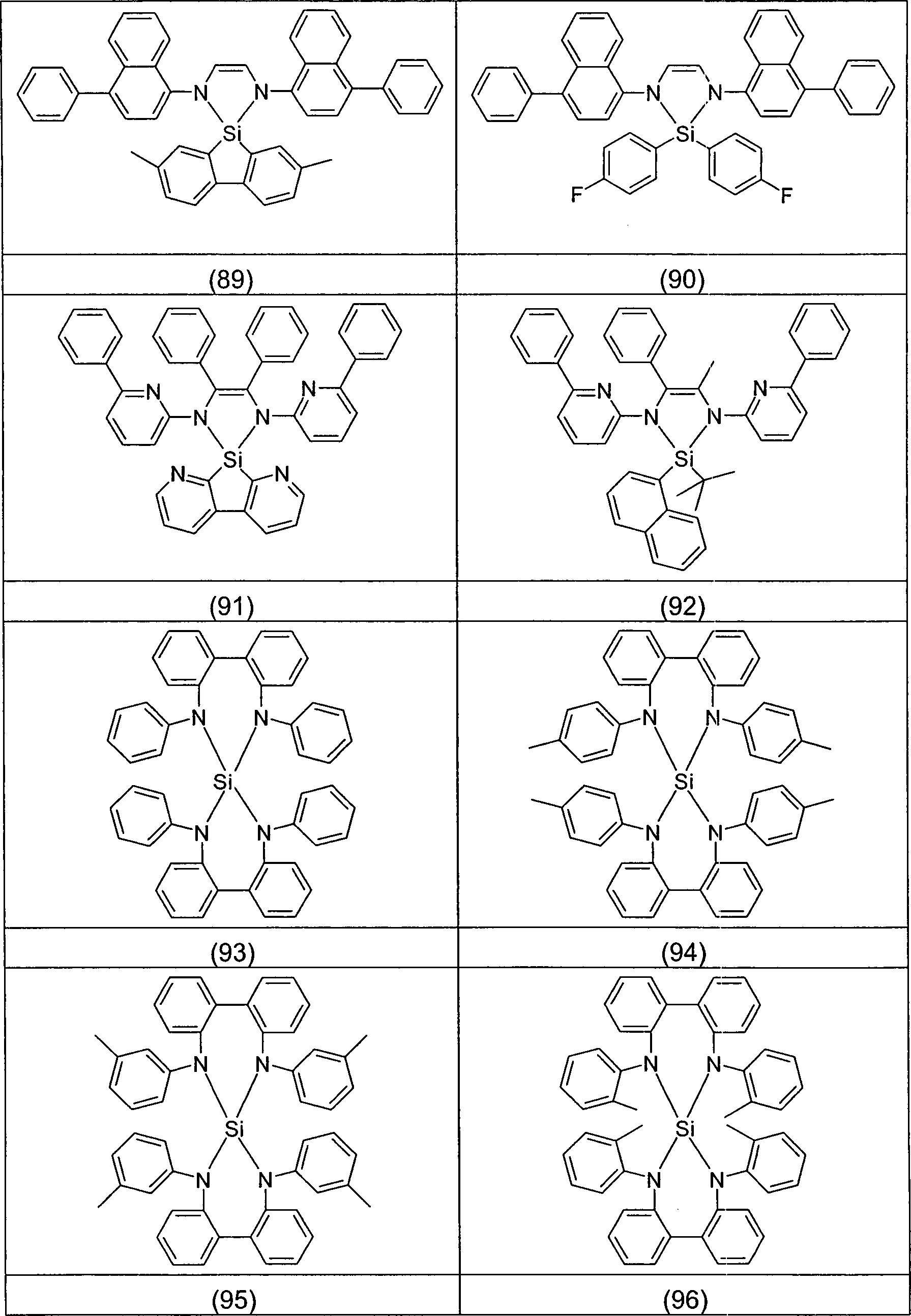


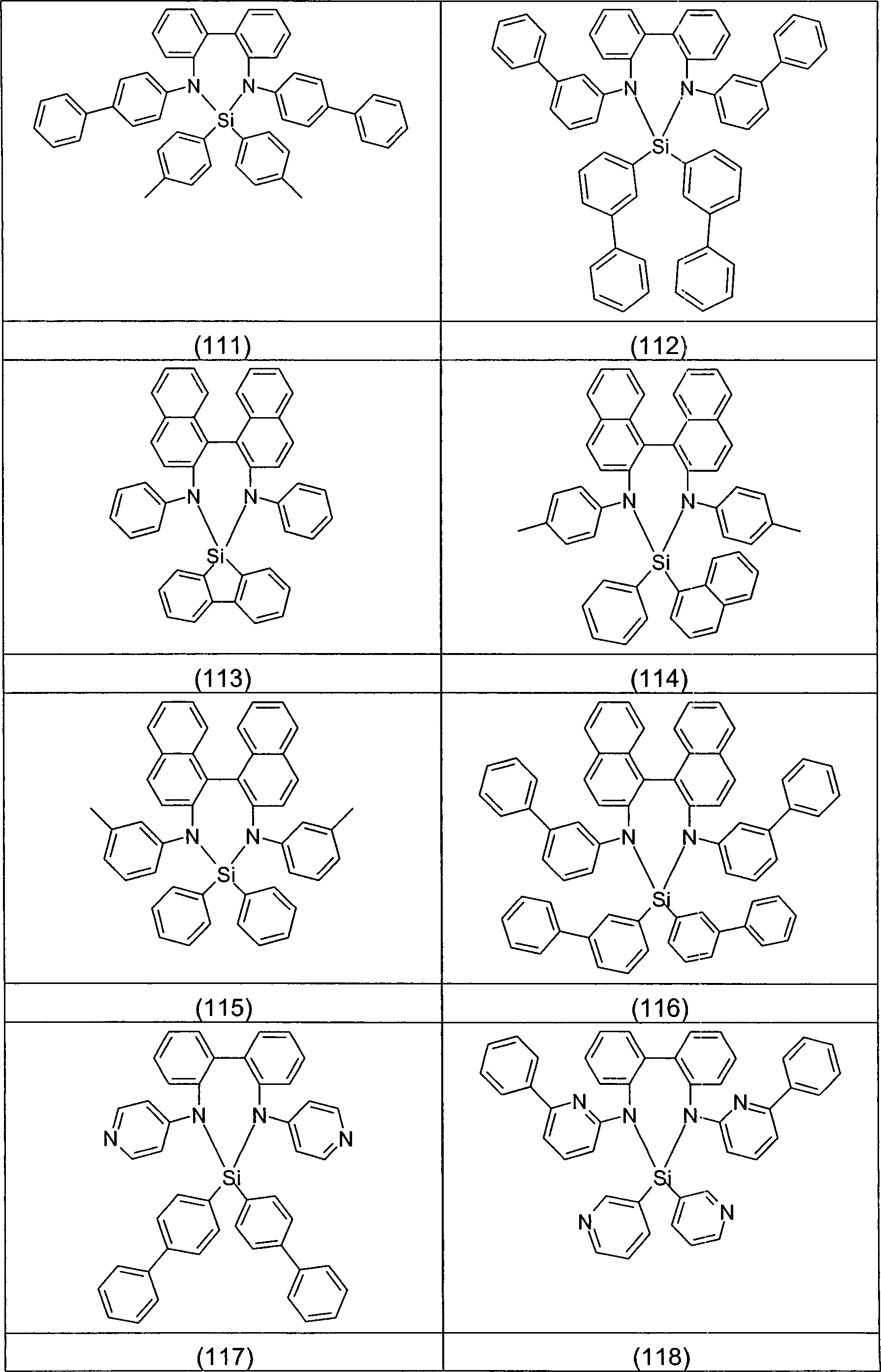
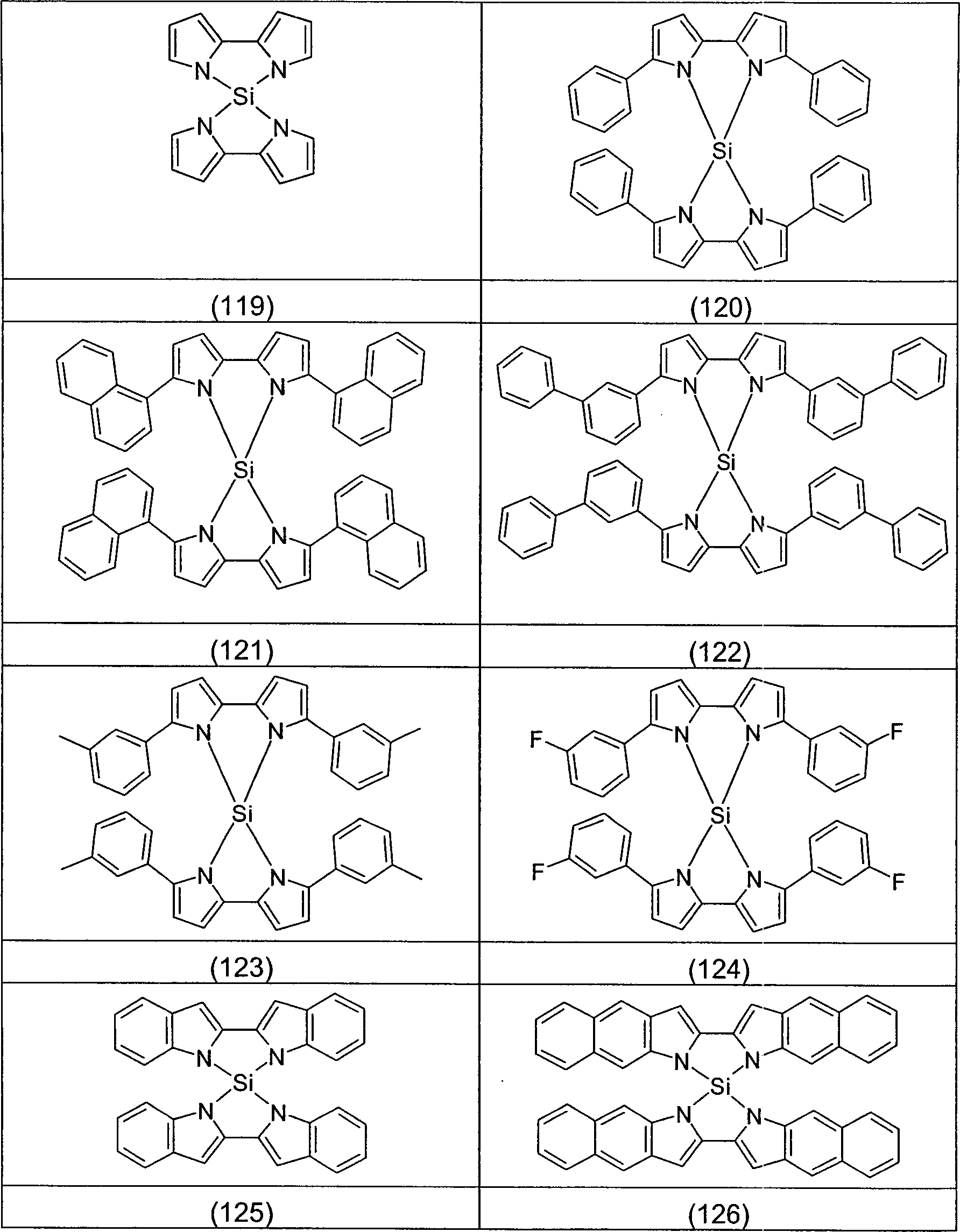


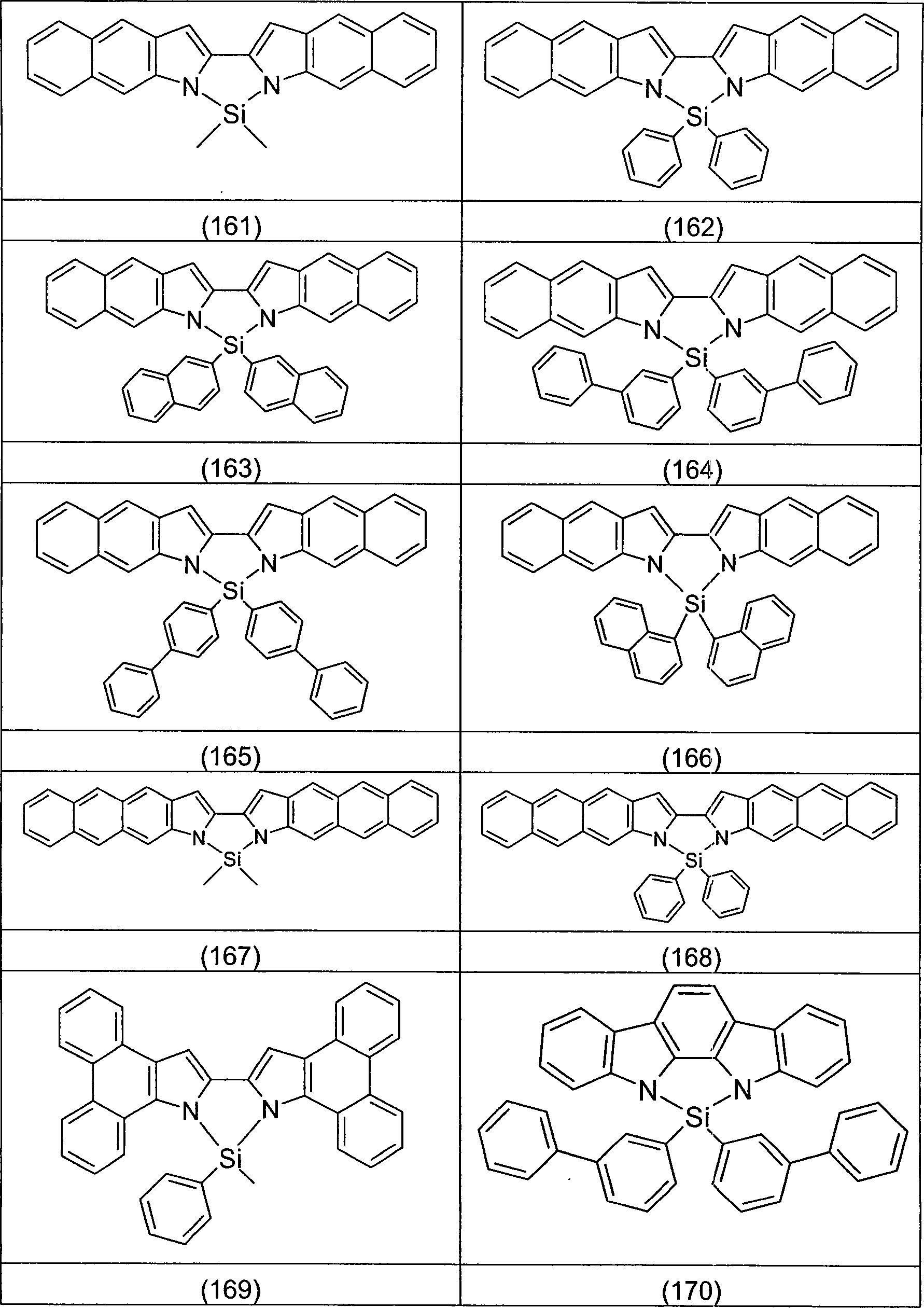
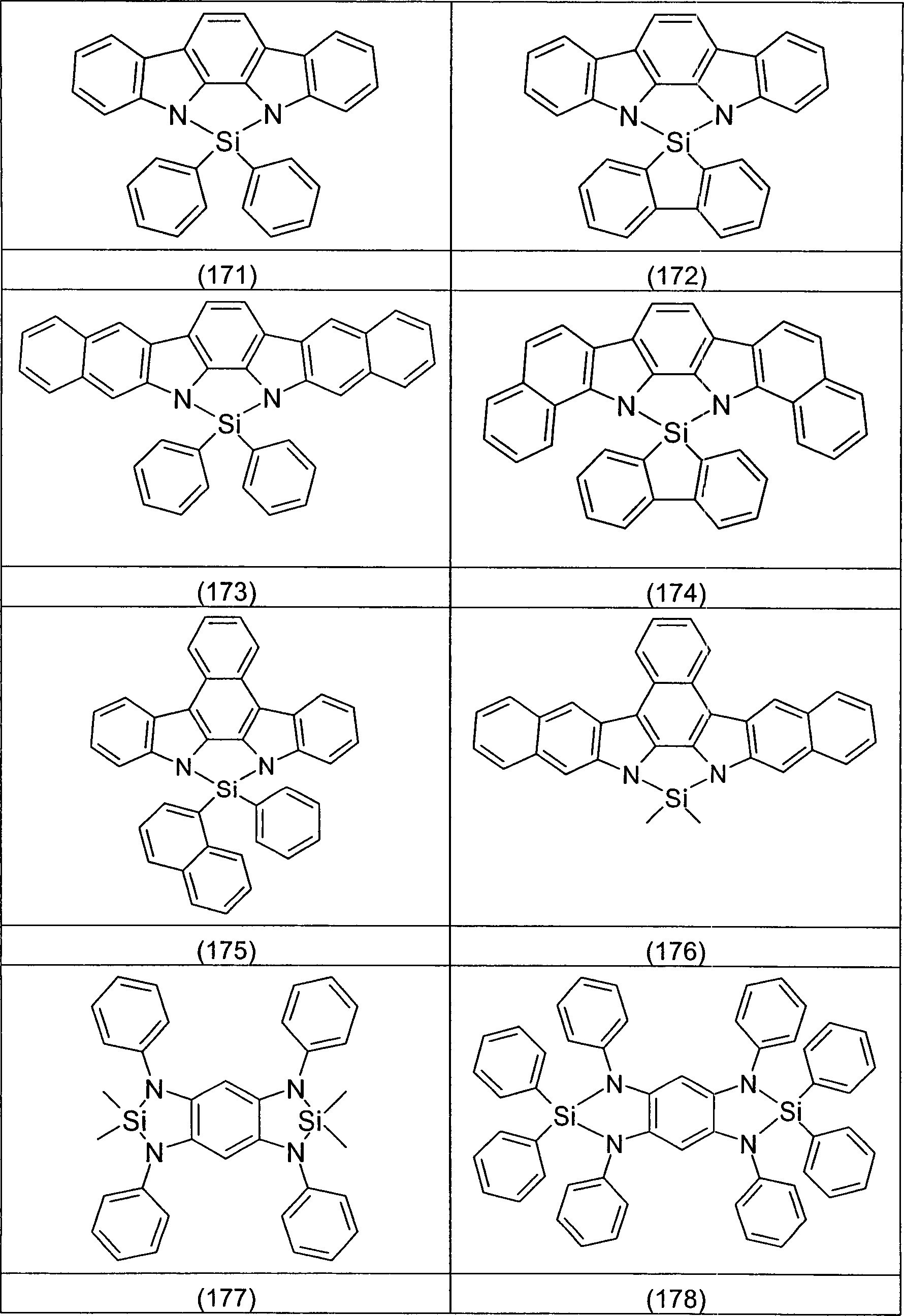


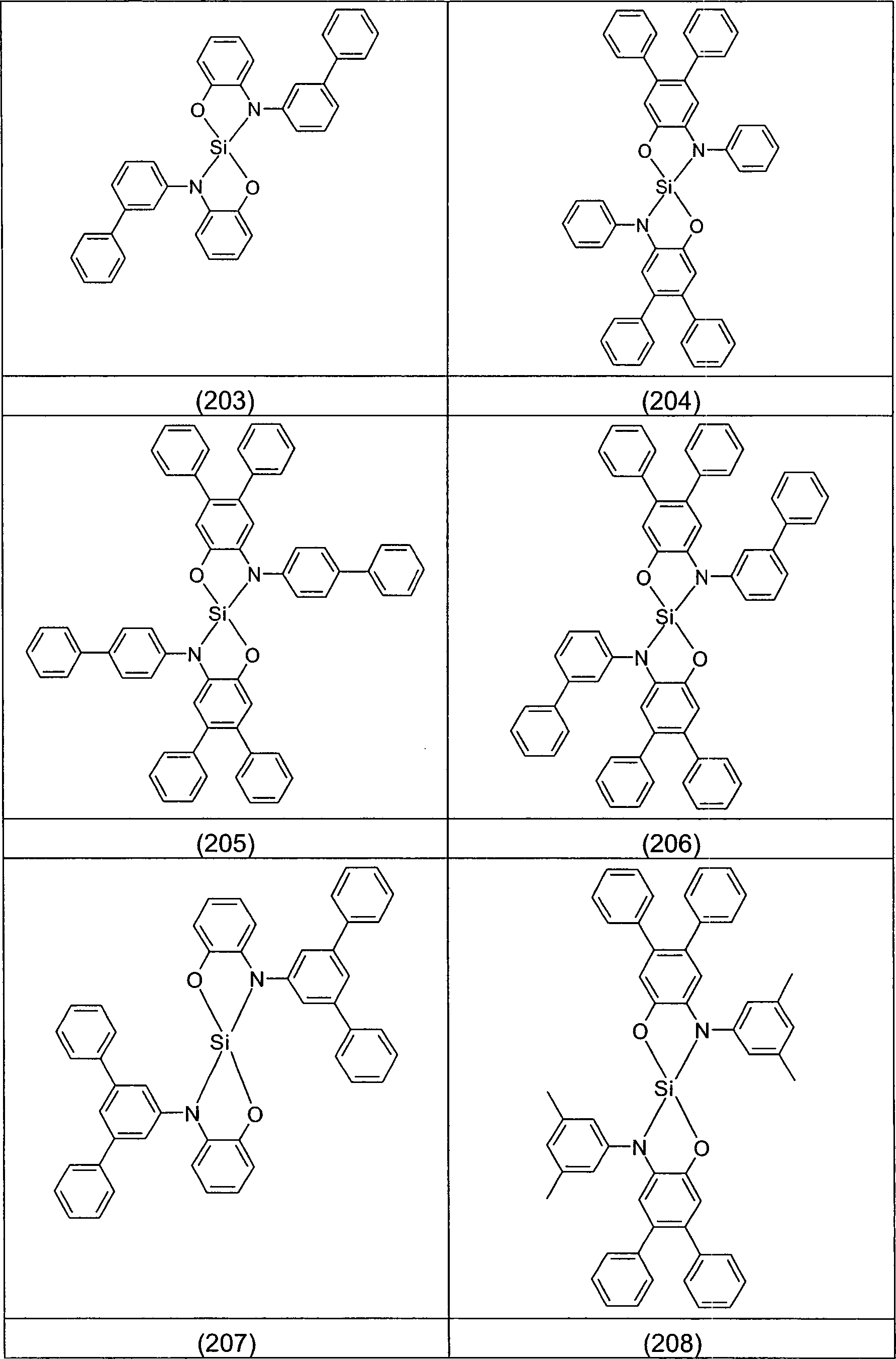


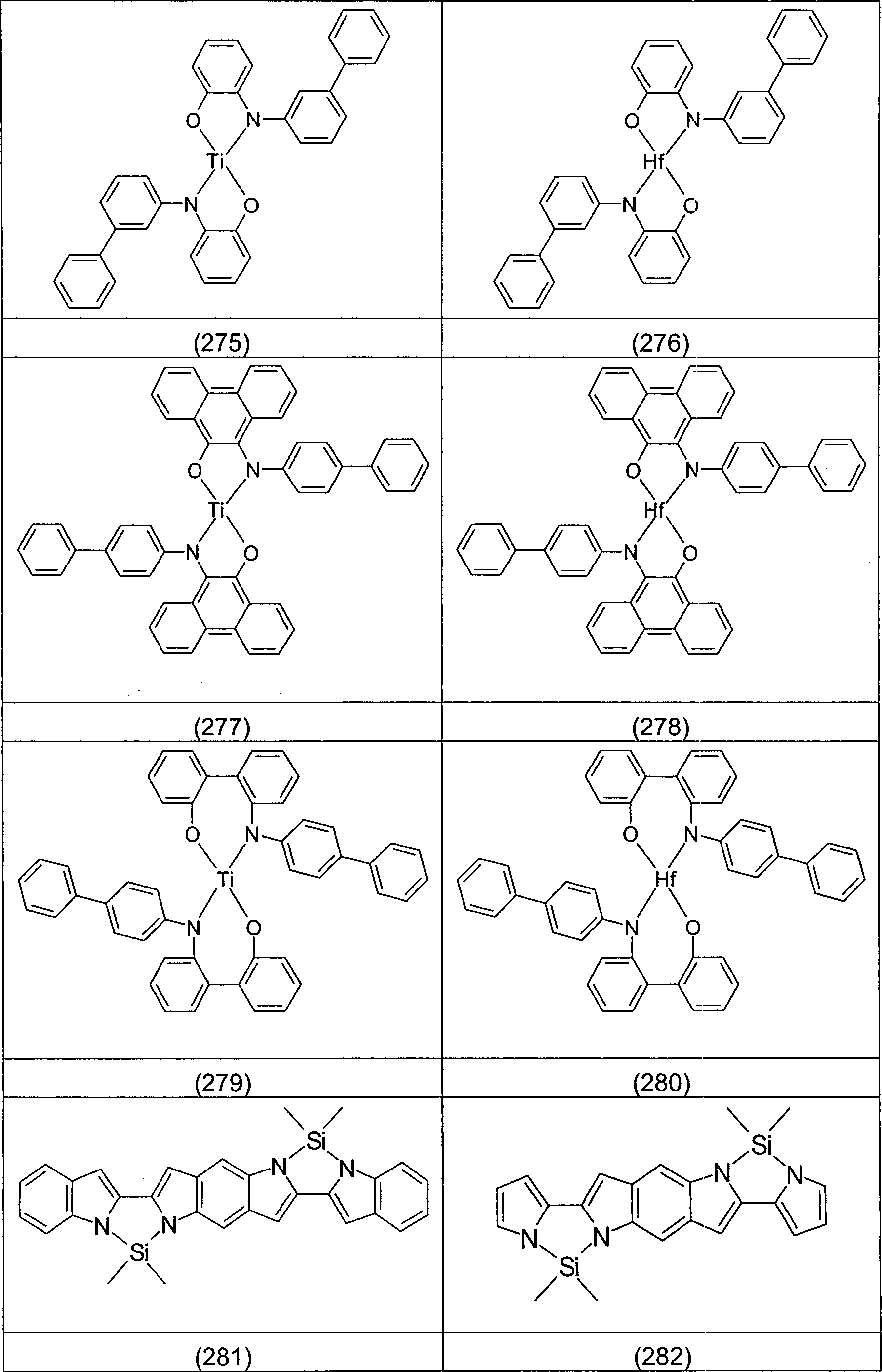


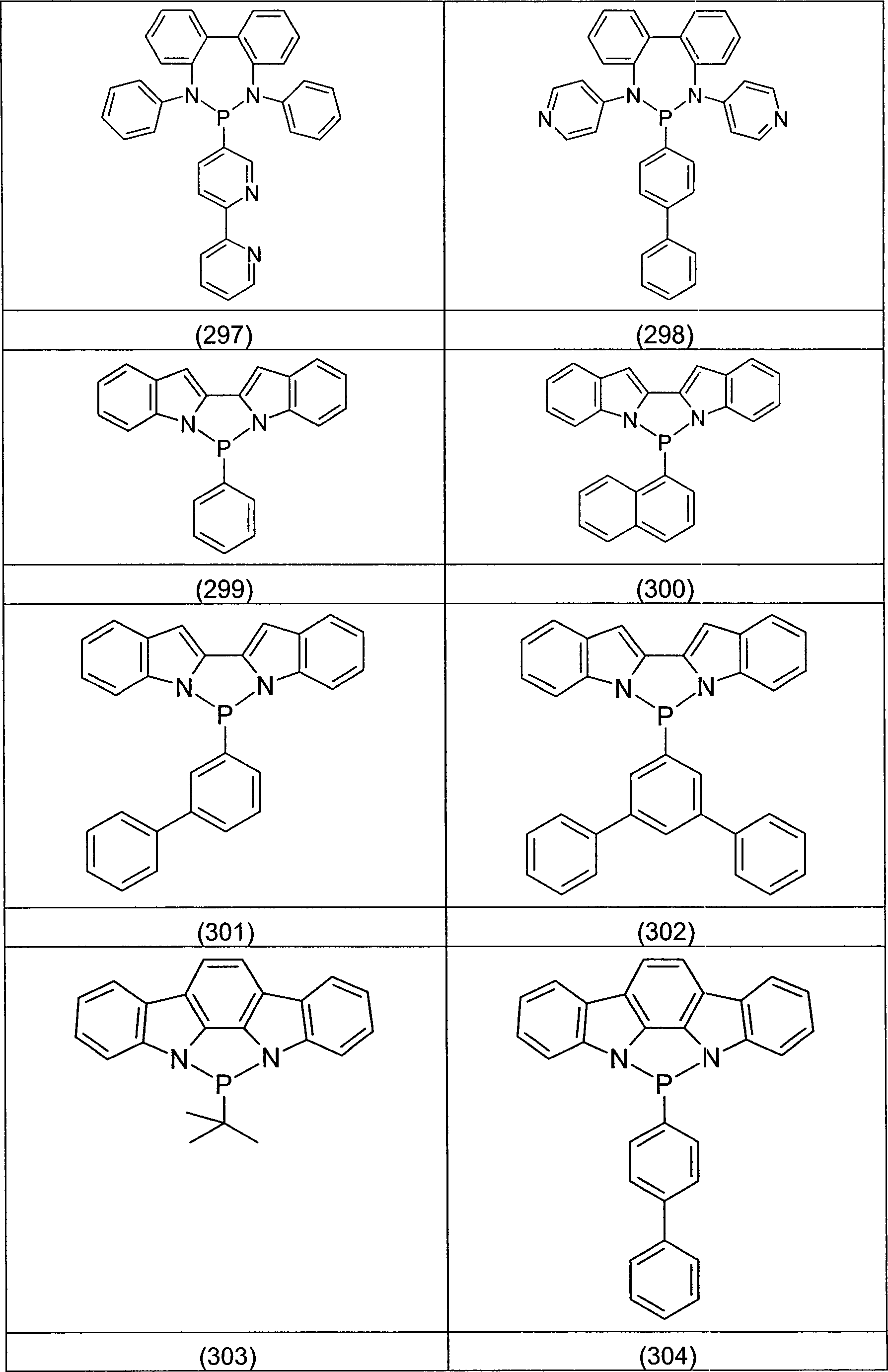


Die erfindungsgemäßen Verbindungen und die damit hergestellten organischen Elektrolumineszenzvorrichtungen zeichnen sich durch folgende überraschende Vorteile gegenüber dem Stand der Technik aus:
- 1. Im Gegensatz zu vielen Verbindungen gemäß dem Stand der Technik, die der teilweisen oder vollständigen pyrolytischen Zersetzung bei Sublimation unterliegen, weisen die erfindungsgemäßen Verbindungen bzw. die Verbindungen gemäß Formel (9*) bis (26*) eine hohe thermische Stabilität auf.
- 2. Die erfindungsgemäßen Verbindungen bzw. die Verbindungen gemäß Formel (9*) bis (26*), eingesetzt in organischen Elektrolumineszenzvorrichtungen, führen zu hohen Effizienzen und zu steilen Strom-Spannungs-Kurven mit niedrigen Einsatzspannungen.
- 3. Die erfindungsgemäßen Verbindungen bzw. die Verbindungen gemäß Formel (9*) bis (26*), eingesetzt in der elektronenblockierenden bzw. exzitonenblockierenden Schicht einer organischen Elektrolumineszenzvorrichtungen, führen insbesondere zu sehr hohen Effizienzen von phosphoreszierenden OLEDs.
- 4. Die erfindungsgemäßen Verbindungen bzw. die Verbindungen gemäß Formel (9*) bis (26*), eingesetzt als Matrixmaterial für fluoreszierende oder phosphoreszierende Emitter, führen zu hohen Effizienzen sowie zu langen Lebensdauern. Dies gilt insbesondere, wenn die Verbindungen in Kombination mit einem weiteren Hostmaterial und einem phosphoreszierenden Emitter eingesetzt werden.
- 1. In contrast to many compounds according to the prior art, which are subject to the partial or complete pyrolytic decomposition on sublimation, the compounds of the invention or the compounds of formula (9 *) to (26 *) have a high thermal stability.
- 2. The compounds of the invention or the compounds of the formula (9 *) to (26 *) used in organic electroluminescent devices lead to high efficiencies and steep current-voltage curves with low threshold voltages.
- 3. The compounds according to the invention or the compounds of the formula (9 *) to (26 *) used in the electron-blocking or exciton-blocking layer of an organic electroluminescent device lead in particular to very high efficiencies of phosphorescent OLEDs.
- 4. The compounds according to the invention or the compounds of the formula (9 *) to (26 *) used as matrix material for fluorescent or phosphorescent emitters lead to high efficiencies and to long lifetimes. This is especially true when the compounds are used in combination with another host material and a phosphorescent emitter.
Diese oben genannten Vorteile gehen nicht mit einer Verschlechterung der weiteren elektronischen Eigenschaften einher.These above advantages do not go with a worsening of the accompanied by other electronic properties.
Die Erfindung wird durch die nachfolgenden Beispiele näher erläutert, ohne sie dadurch einschränken zu wollen. Der Fachmann kann aus den Schilderungen ohne erfinderisches Zutun weitere erfindungsgemäße Komplexe herstellen und diese in organischen elektronischen Vorrichtungen verwenden bzw. das erfindungsgemäße Verfahren anwenden.The Invention will be more apparent from the following examples explained without wishing to restrict it. The expert can from the descriptions without inventive step produce further complexes of the invention and use these in organic electronic devices or apply the method according to the invention.
Beispiele:Examples:
Die nachfolgenden Synthesen werden, sofern nicht anders angegeben, unter einer Schutzgasatmosphäre in getrockneten Lösungsmitteln durchgeführt. Die Lösungsmittel und Reagenzien können von ALDRICH bzw. ABCR bezogen werden.The subsequent syntheses are, unless otherwise stated, below a protective gas atmosphere in dried solvents carried out. The solvents and reagents can be obtained from ALDRICH or ABCR.
Beispiel 1–9: Synthese der DiamineExample 1-9: Synthesis of diamines
Die
nachfolgend aufgeführten Diamine können aus den
entsprechenden Dibrom-Aromaten durch Umsetzung mit den entsprechenden
Arylaminen analog zu 


Beispiel 10–18: Synthese von erfindungsgemäßen VerbindungenExample 10-18: Synthesis of Compounds of the invention
Eine
Lösung von 300 mmol des entsprechenden Diamins gemäß Beispiel
1 bis 9 in 2000 ml Diethylether wird bei Raumtemperatur unter Rühren
mit 240 ml (600 mmol) n-Buthyllitium, 2.5 molar in n-Hexan versetzt.
Nach vollendeter Zugabe und Abklingen der exothermen Reaktion wird
1 h nachgerührt und dann tropfenweise mit einem Gemisch
von 25.5 g (150 mmol) Siliciumtetrachlorid und 100 ml Diethylether
versetzt. Nach vollendeter Zugabe und Abklingen der exothermen Reaktion
wird 1 h nachgerührt, dann wird der Diethylether im Vakuum
entfernt, der Rückstand wird in ca. 300 ml Toluol aufgenommen
und an Aluminiumoxid, basisch, Aktivitätsstufe 1 chromatographiert.
Das so erhaltene Rohprodukt wird anschließend viermal aus
Toluol/Ethanol (1:2, ca. 6 ml/g) umkristallisiert und dann zweimal
im Hochvakuum (p = 10–5 mbar) sublimiert. 


Beispiel 19–22: Synthese von erfindungsgemäßen VerbindungenExample 19-22: Synthesis of Compounds of the invention
Eine Lösung von 300 mmol des entsprechenden Diamins gemäß Beispiel 1 bzw. 5 in 2000 ml Diethylether wird bei Raumtemperatur unter Rühren mit 240 ml (600 mmol) n-Buthyllitium, 2.5 molar in n-Hexan versetzt. Nach vollendeter Zugabe und Abklingen der exothermen Reaktion wird 1 h nachgerührt und dann tropfenweise mit einem Gemisch von 150 mmol des entsprechenden Dichior-diarylsilans bzw. -dialkylsilans und 100 ml Diethylether versetzt. Nach vollendeter Zugabe und Abklingen der exothermen Reaktion wird 1 h nachgerührt, dann wird der Diethylether im Vakuum entfernt, der Rückstand wird in ca. 300 ml Toluol aufgenommen und an Aluminiumoxid, basisch, Aktivitätsstufe 1 chromatographiert. Das so erhaltene Rohprodukt wird anschließend viermal aus Toluol/Ethanol (1:2, ca. 6 ml/g) umkristallisiert und dann zweimal im Hochvakuum (p = 10–5 mbar) sublimiert.A solution of 300 mmol of the corresponding diamine according to Example 1 or 5 in 2000 ml of diethyl ether is added at room temperature with stirring with 240 ml (600 mmol) of n-butyllithium, 2.5 molar in n-hexane. After completion of the addition and decay of the exothermic reaction is stirred for 1 h and then treated dropwise with a mixture of 150 mmol of the corresponding dichloro-diarylsilans or -dialkylsilans and 100 ml of diethyl ether. After completion of the addition and decay of the exothermic reaction is stirred for 1 h, then the diethyl ether is removed in vacuo, the residue is taken up in about 300 ml of toluene and chromatographed on alumina, basic, activity level 1. The crude product thus obtained is then recrystallized four times from toluene / ethanol (1: 2, about 6 ml / g) and then sublimed twice in a high vacuum (p = 10 -5 mbar).

Herstellung und Charakterisierung von organischen Elektrolumineszenzvorrichtungen, enthaltend die erfindungsgemäßen Verbindungen:Production and characterization of organic electroluminescent devices containing the inventive Links:
Erfindungsgemäße
Elektrolumineszenzvorrichtungen können, wie beispielsweise
in
Analog
dem o. g. allgemeinen Verfahren, werden OLEDs mit folgendem Aufbau
1 erzeugt (dabei steht HIM für „hole injection
material” = Lochinjektionsmaterial, EBM für „electron
blocking material” = Elektronenblockiermaterial und TMM
für Triplettmatrixmaterial):
HIM 20 nm 2,2',7,7'-Tetrakis(di-p-tolylamino)-spiro-9,9'-bifluoren
EBM
20 nm NPB 4,4'-Bis(1-naphthyl-phenyl-amino)biphenyl als Vergleichsbeispiel
oder
10
nm NPB 4,4'-Bis(1-naphthyl-phenyl-amino)biphenyl und darauf 10 nm
gemäß erfindungsgemäßem Bsp.
(s. Tabelle)
TMM 40 nm Bis-[1,3';1',1'';3'',1''';3''',1'''']quinqephenyl-5''-yl-methanone
gemäß
dotiert mit 15 % fac-Tris(2-(2-pyridinyl)phenyl)iridium
AlQ3 20 nm
Li/Al 1 nm LiF, darauf 100
nm Al als Kathode.Analogously to the above-mentioned general method, OLEDs are produced with the following structure 1 (where HIM stands for "hole injection material" = hole injection material, EBM for "electron blocking material" and TMM for triplet matrix material):
HIM 20 nm 2,2 ', 7,7'-tetrakis (di-p-tolylamino) -spiro-9,9'-bifluorene
EBM 20 nm NPB 4,4'-bis (1-naphthyl-phenyl-amino) biphenyl as a comparative example
or
10 nm NPB 4,4'-bis (1-naphthyl-phenyl-amino) biphenyl and then 10 nm according to the inventive example (see table)
TMM 40 nm bis- [1,3 ', 1', 1 '', 3 '', 1 ''',3''', 1 ''''] quinquephenyl-5 '' - yl-methanones according to
doped with 15% fac-tris (2- (2-pyridinyl) phenyl) iridium AlQ 3 20 nm
Li / Al 1 nm LiF, then 100 nm Al as the cathode.
Diese
noch nicht optimierte OLED wird standardmäßig
charakterisiert. In Tabelle 1 sind die Effizienz und die Spannung
bei 1000 cd/m2 sowie die Farbe und die Lebensdauer
(LT50) aufgeführt. Tabelle 1:
Analog
dem o. g. allgemeinen Verfahren, werden weiterhin OLEDs mit folgendem
Aufbau 2 erzeugt:
HIM 20 nm 2,2',7,7'-Tetrakis(di-p-tolylamino)-spiro-9,9'-bifluoren
EBM
20 nm NPB (4,4'-Bis(1-naphthyl-phenyl-amino)biphenyl) als Vergleichsbeispiel
oder
10
nm NPB (4,4'-Bis(1-naphthyl-phenyl-amino)biphenyl) und darauf 10
nm gemäß erfindungsgemäßem Bsp. (s.
Tabelle)
TMM 40 nm Bis-[1,3';1',1'';3'',1''';3''',1'''']quinqephenyl-5''-yl-methanone
gemäß
dotiert
mit 15% fac-Tris[2-(2-pyridinyl)(5-cyanophenyl)]iridium(III)
AlQ3 20 nm
Li/Al 1 nm LiF, darauf 100 nm
Al als Kathode.Analogously to the above-mentioned general method, OLEDs with the following structure 2 are furthermore produced:
HIM 20 nm 2,2 ', 7,7'-tetrakis (di-p-tolylamino) -spiro-9,9'-bifluorene
EBM 20 nm NPB (4,4'-bis (1-naphthyl-phenyl-amino) biphenyl) as a comparative example
or
10 nm NPB (4,4'-bis (1-naphthyl-phenyl-amino) biphenyl) and then 10 nm according to the inventive example (see table)
TMM 40 nm bis- [1,3 ', 1', 1 '', 3 '', 1 ''',3''', 1 ''''] quinquephenyl-5 '' - yl-methanones according to
doped with 15% fac-tris [2- (2-pyridinyl) (5-cyanophenyl)] iridium (III)
AlQ 3 20 nm
Li / Al 1 nm LiF, then 100 nm Al as the cathode.
Diese
noch nicht optimierte OLED wird standardmäßig
charakterisiert. In Tabelle 2 sind die Effizienz und die Spannung
bei 1000 cd/m2 sowie die Farbe aufgeführt. Tabelle 2:
Wie aus den oben aufgeführten Beispielen deutlich zu erkennen ist, eignen sich die erfindungsgemäßen Materialien besonders gut für die Verwendung als Elektronenblockiermaterialien bzw. Exzitonenblockiermaterialien. In dieser Funktion führen sie in einer phosphoreszierenden OLED zu einer deutlichen Effizienzsteigerung sowie bei blau phosphoreszierenden Emittern zu einer niedrigeren Betriebsspannung.As clearly seen from the examples above is, the materials of the invention are suitable especially good for use as electron blocking materials or exciton blocking materials. In this function lead They in a phosphorescent OLED to a significant increase in efficiency and at blue phosphorescent emitters to a lower Operating voltage.
ZITATE ENTHALTEN IN DER BESCHREIBUNGQUOTES INCLUDE IN THE DESCRIPTION
Diese Liste der vom Anmelder aufgeführten Dokumente wurde automatisiert erzeugt und ist ausschließlich zur besseren Information des Lesers aufgenommen. Die Liste ist nicht Bestandteil der deutschen Patent- bzw. Gebrauchsmusteranmeldung. Das DPMA übernimmt keinerlei Haftung für etwaige Fehler oder Auslassungen.This list The documents listed by the applicant have been automated generated and is solely for better information recorded by the reader. The list is not part of the German Patent or utility model application. The DPMA takes over no liability for any errors or omissions.
Zitierte PatentliteraturCited patent literature
- - US 4539507 [0002] US 4539507 [0002]
- - US 5151629 [0002] US 5151629 [0002]
- - EP 0676461 [0002] EP 0676461 [0002]
- - WO 98/27136 [0002] WO 98/27136 [0002]
- - US 2004/0048101 [0004] US 2004/0048101 [0004]
- - US 2008/0093988 [0005] US 2008/0093988 [0005]
- - WO 04/084260 [0006] WO 04/084260 [0006]
- - WO 07/120788 [0007] WO 07/120788 [0007]
- - WO 08/034758 [0008] WO 08/034758 [0008]
- - EP 842208 [0043] - EP 842208 [0043]
- - WO 00/22026 [0043] WO 00/22026 [0043]
- - EP 707020 [0043] - EP 707020 [0043]
- - EP 894107 [0043] - EP 894107 [0043]
- - WO 06/061181 [0043] WO 06/061181 [0043]
- - WO 92/18552 [0043] WO 92/18552 [0043]
- - WO 04/070772 [0043] WO 04/070772 [0043]
- - WO 04/113468 [0043] WO 04/113468 [0043]
- - EP 1028136 [0043] - EP 1028136 [0043]
- - WO 05/014689 [0043] WO 05/014689 [0043]
- - WO 04/041901 [0043] WO 04/041901 [0043]
- - WO 04/113412 [0043] WO 04/113412 [0043]
- - WO 05/040302 [0043] WO 05/040302 [0043]
- - WO 05/104264 [0043] WO 05/104264 [0043]
- - WO 07/017066 [0043] WO 07/017066 [0043]
- - WO 05/011013 [0058] WO 05/011013 [0058]
- - WO 04/093207 [0062] WO 04/093207 [0062]
- - DE 102008033943 [0062, 0081, 0083] - DE 102008033943 [0062, 0081, 0083]
- - DE 102008036982 [0062] - DE 102008036982 [0062]
- - DE 102007053771 [0062] - DE 102007053771 [0062]
- - WO 00/70655 [0064] WO 00/70655 [0064]
- - WO 01/41512 [0064] WO 01/41512 [0064]
- - WO 02/02714 [0064] WO 02/02714 [0064]
- - WO 02/15645 [0064] WO 02/15645 [0064]
- - EP 1191613 [0064] - EP 1191613 [0064]
- - EP 1191612 [0064] - EP 1191612 [0064]
- - EP 1191614 [0064] - EP 1191614 [0064]
- - WO 05/033244 [0064] WO 05/033244 [0064]
- - WO 05/019373 [0064] WO 05/019373 [0064]
- - US 2005/0258742 [0064] US 2005/0258742 [0064]
- - WO 05/003253 [0080] WO 05/003253 [0080]
Zitierte Nicht-PatentliteraturCited non-patent literature
- - M. A. Baldo et al., Appl. Phys. Lett. 1999, 75, 4–6 [0002] - MA Baldo et al., Appl. Phys. Lett. 1999, 75, 4-6 [0002]
- - D. M. Koller et al., Nature Photonics 2008, 1–4 [0047] Koller et al., Nature Photonics 2008, 1-4 [0047]
- - Charge-Generation Lagers, IDMC 2003, Taiwan; Session 21 OLED (5), T. Matsumoto, T. Nakada, J. Endo, K. Mori, N. Kawamura, A. Yokoi, J. Kido, Multiphoton Organic EL Device Having Charge Generation Lager [0058] - Batch Generation Warehouse, IDMC 2003, Taiwan; Session 21 OLED (5), T. Matsumoto, T. Nakada, J. Endo, K. Mori, N. Kawamura, A. Yokoi, J. Kido, Multiphoton Organic EL Device Having Charge Generation Bearing [0058]
- - M. S. Arnold et al., Appl. Phys. Lett. 2008, 92, 053301 [0069] MS Arnold et al., Appl. Phys. Lett. 2008, 92, 053301 [0069]
- - T. Wenderski et al., Tetrahedron Letters, 45(37), 2004, 6851 [0077] T Wenderski et al., Tetrahedron Letters, 45 (37), 2004, 6851 [0077]
Claims (16)


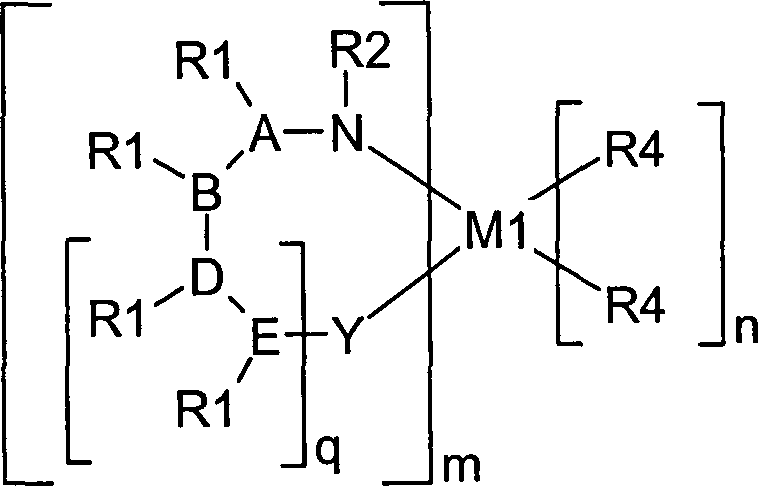


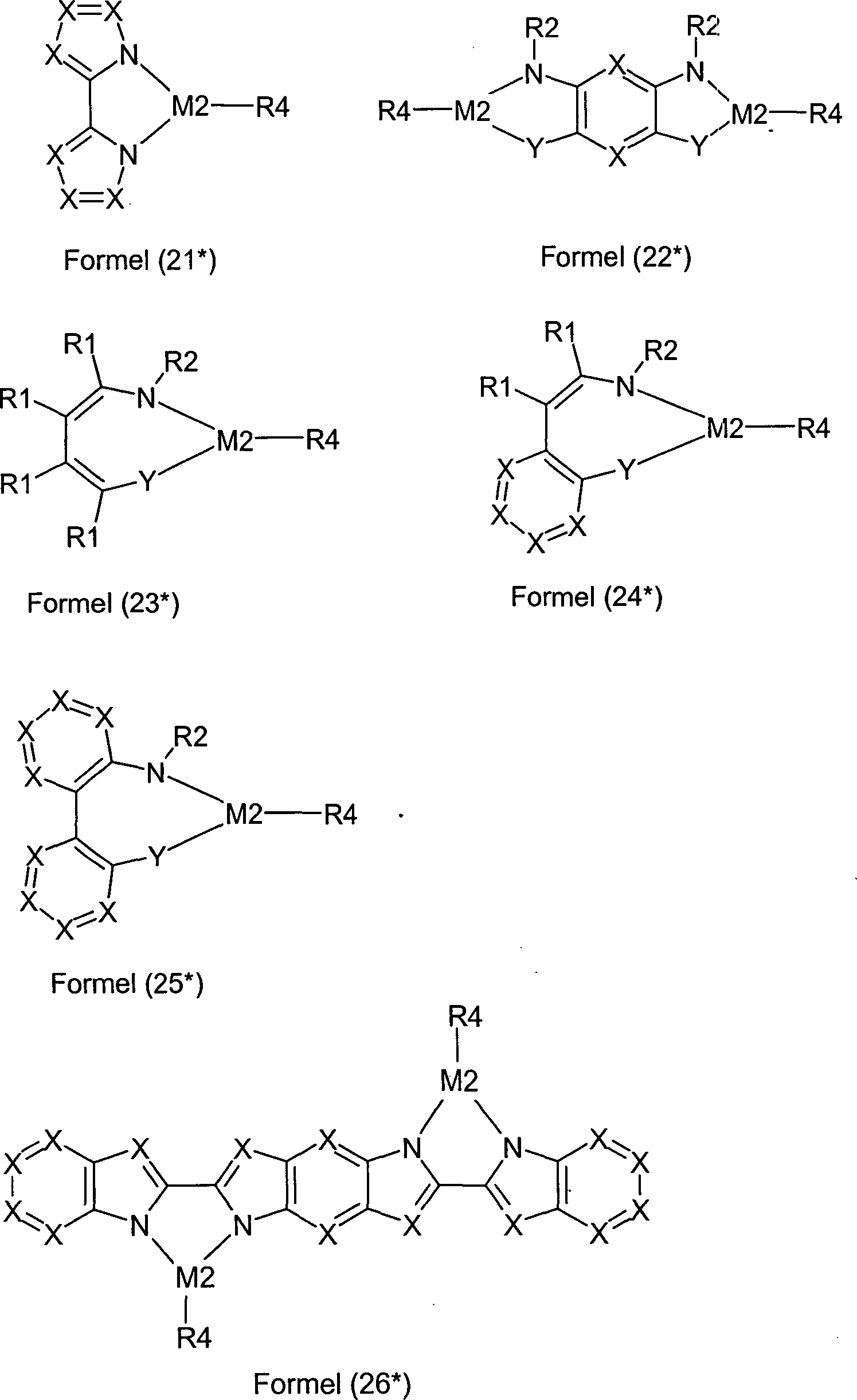
Priority Applications (16)
| Application Number | Priority Date | Filing Date | Title |
|---|---|---|---|
| DE102008056688A DE102008056688A1 (en) | 2008-11-11 | 2008-11-11 | Materials for organic electroluminescent devices |
| JP2011535022A JP5722226B2 (en) | 2008-11-11 | 2009-10-14 | Materials for organic electroluminescent devices |
| US13/001,657 US8809566B2 (en) | 2008-11-11 | 2009-10-14 | Materials for organic electroluminescence devices |
| EP09778889.7A EP2344609B1 (en) | 2008-11-11 | 2009-10-14 | Materials for organic electroluminescence devices |
| CN200980125173.3A CN102076819B (en) | 2008-11-11 | 2009-10-14 | Material for organic electroluminescent device |
| KR1020107027726A KR101702139B1 (en) | 2008-11-11 | 2009-10-14 | Materials for organic electroluminescence devices |
| PCT/EP2009/007361 WO2010054729A2 (en) | 2008-11-11 | 2009-10-14 | Materials for organic electroluminescence devices |
| PCT/EP2009/007406 WO2010054730A1 (en) | 2008-11-11 | 2009-10-15 | Organic electroluminescent devices |
| CN200980125117.XA CN102076813B (en) | 2008-11-11 | 2009-10-15 | Organic Electroluminescent Devices |
| JP2011535023A JP5701766B2 (en) | 2008-11-11 | 2009-10-15 | Organic electroluminescent device |
| US13/001,731 US8865321B2 (en) | 2008-11-11 | 2009-10-15 | Organic electroluminescent devices |
| KR1020107028316A KR20110097612A (en) | 2008-11-11 | 2009-10-15 | Organic electroluminescent devices |
| EP09736571.2A EP2344607B1 (en) | 2008-11-11 | 2009-10-15 | Organic electroluminescent devices |
| TW98137828A TWI466893B (en) | 2008-11-11 | 2009-11-06 | Organic electroluminescent device |
| TW098137826A TWI447121B (en) | 2008-11-11 | 2009-11-06 | Material for organic electroluminescent device |
| KR1020090108055A KR101763422B1 (en) | 2008-11-11 | 2009-11-10 | Organic electroluminescent devices |
Applications Claiming Priority (1)
| Application Number | Priority Date | Filing Date | Title |
|---|---|---|---|
| DE102008056688A DE102008056688A1 (en) | 2008-11-11 | 2008-11-11 | Materials for organic electroluminescent devices |
Publications (1)
| Publication Number | Publication Date |
|---|---|
| DE102008056688A1 true DE102008056688A1 (en) | 2010-05-12 |
Family
ID=41651503
Family Applications (1)
| Application Number | Title | Priority Date | Filing Date |
|---|---|---|---|
| DE102008056688A Withdrawn DE102008056688A1 (en) | 2008-11-11 | 2008-11-11 | Materials for organic electroluminescent devices |
Country Status (8)
| Country | Link |
|---|---|
| US (1) | US8809566B2 (en) |
| EP (1) | EP2344609B1 (en) |
| JP (1) | JP5722226B2 (en) |
| KR (1) | KR101702139B1 (en) |
| CN (1) | CN102076819B (en) |
| DE (1) | DE102008056688A1 (en) |
| TW (1) | TWI447121B (en) |
| WO (1) | WO2010054729A2 (en) |
Cited By (51)
| Publication number | Priority date | Publication date | Assignee | Title |
|---|---|---|---|---|
| DE102008063490A1 (en) | 2008-12-17 | 2010-06-24 | Merck Patent Gmbh | Organic electroluminescent device |
| DE102009012346A1 (en) | 2009-03-09 | 2010-09-16 | Merck Patent Gmbh | Organic electroluminescent device |
| DE102009013041A1 (en) | 2009-03-13 | 2010-09-16 | Merck Patent Gmbh | Materials for organic electroluminescent devices |
| DE102009017064A1 (en) | 2009-04-09 | 2010-10-14 | Merck Patent Gmbh | Organic electroluminescent device |
| DE102009031021A1 (en) | 2009-06-30 | 2011-01-05 | Merck Patent Gmbh | Materials for organic electroluminescent devices |
| DE102009032922A1 (en) | 2009-07-14 | 2011-01-20 | Merck Patent Gmbh | Materials for organic electroluminescent devices |
| DE102009041414A1 (en) | 2009-09-16 | 2011-03-17 | Merck Patent Gmbh | metal complexes |
| DE102009041289A1 (en) | 2009-09-16 | 2011-03-17 | Merck Patent Gmbh | Organic electroluminescent device |
| DE102009042693A1 (en) | 2009-09-23 | 2011-03-24 | Merck Patent Gmbh | Materials for electronic devices |
| DE102009048791A1 (en) | 2009-10-08 | 2011-04-14 | Merck Patent Gmbh | Materials for organic electroluminescent devices |
| DE102009049587A1 (en) | 2009-10-16 | 2011-04-21 | Merck Patent Gmbh | metal complexes |
| DE102009053645A1 (en) | 2009-11-17 | 2011-05-19 | Merck Patent Gmbh | Materials for organic electroluminescent device |
| DE102009053644A1 (en) | 2009-11-17 | 2011-05-19 | Merck Patent Gmbh | Materials for organic electroluminescent devices |
| DE102009053382A1 (en) | 2009-11-14 | 2011-05-19 | Merck Patent Gmbh | Materials for electronic devices |
| DE102009053836A1 (en) | 2009-11-18 | 2011-05-26 | Merck Patent Gmbh | Materials for organic electroluminescent devices |
| DE102009057167A1 (en) | 2009-12-05 | 2011-06-09 | Merck Patent Gmbh | Electronic device containing metal complexes |
| DE102010004803A1 (en) | 2010-01-16 | 2011-07-21 | Merck Patent GmbH, 64293 | Materials for organic electroluminescent devices |
| DE102010005697A1 (en) | 2010-01-25 | 2011-07-28 | Merck Patent GmbH, 64293 | Connections for electronic devices |
| DE102010010481A1 (en) | 2010-03-06 | 2011-09-08 | Merck Patent Gmbh | Organic electroluminescent device |
| DE102010009903A1 (en) | 2010-03-02 | 2011-09-08 | Merck Patent Gmbh | Connections for electronic devices |
| DE102010012738A1 (en) | 2010-03-25 | 2011-09-29 | Merck Patent Gmbh | Materials for organic electroluminescent devices |
| DE102010013068A1 (en) | 2010-03-26 | 2011-09-29 | Merck Patent Gmbh | Connections for electronic devices |
| DE102010014933A1 (en) | 2010-04-14 | 2011-10-20 | Merck Patent Gmbh | Materials for electronic devices |
| DE102010018321A1 (en) | 2010-04-27 | 2011-10-27 | Merck Patent Gmbh | Organic electroluminescent device |
| DE102010019306A1 (en) | 2010-05-04 | 2011-11-10 | Merck Patent Gmbh | Organic electroluminescent devices |
| DE102010020044A1 (en) | 2010-05-11 | 2011-11-17 | Merck Patent Gmbh | Organic electroluminescent device |
| DE102010020567A1 (en) | 2010-05-14 | 2011-11-17 | Merck Patent Gmbh | metal complexes |
| DE102009022858A1 (en) | 2009-05-27 | 2011-12-15 | Merck Patent Gmbh | Organic electroluminescent devices |
| DE102010024335A1 (en) | 2010-06-18 | 2011-12-22 | Merck Patent Gmbh | Connections for electronic devices |
| WO2012007103A1 (en) | 2010-07-15 | 2012-01-19 | Merck Patent Gmbh | Metal complexes with organic ligands and use thereof in oleds |
| WO2012038029A1 (en) | 2010-09-24 | 2012-03-29 | Merck Patent Gmbh | Phosphorus-containing metal complexes |
| DE102010054316A1 (en) | 2010-12-13 | 2012-06-14 | Merck Patent Gmbh | Substituted tetraarylbenzenes |
| EP2482159A2 (en) | 2011-01-28 | 2012-08-01 | Honeywell International, Inc. | Methods and reconfigurable systems to optimize the performance of a condition based health maintenance system |
| WO2012107163A1 (en) | 2011-02-12 | 2012-08-16 | Merck Patent Gmbh | Substituted dibenzonaphthacene |
| WO2012107158A1 (en) | 2011-02-10 | 2012-08-16 | Merck Patent Gmbh | 1,3-dioxan-5-one compounds |
| DE102011116165A1 (en) | 2011-10-14 | 2013-04-18 | Merck Patent Gmbh | Benzodioxepin-3-one compounds |
| WO2013097920A1 (en) | 2011-12-27 | 2013-07-04 | Merck Patent Gmbh | Metal complexes comprising 1,2,3-triazoles |
| WO2013107487A1 (en) | 2012-01-16 | 2013-07-25 | Merck Patent Gmbh | Organic metal complexes |
| WO2013174471A1 (en) | 2012-05-24 | 2013-11-28 | Merck Patent Gmbh | Metal complexes comprising condensed heteroaromatic rings |
| US8597798B2 (en) | 2008-11-13 | 2013-12-03 | Merck Patent Gmbh | Materials for organic electroluminescent devices |
| US8618317B2 (en) | 2008-07-17 | 2013-12-31 | Merck Patent Gmbh | Organic electroluminescence device |
| EP2712000A1 (en) | 2008-09-22 | 2014-03-26 | Merck Patent GmbH | Materials for Organic Electroluminescent Devices |
| US8865321B2 (en) | 2008-11-11 | 2014-10-21 | Merck Patent Gmbh | Organic electroluminescent devices |
| US9169282B2 (en) | 2009-02-02 | 2015-10-27 | Merck Patent Gmbh | Metal complexes |
| WO2018114744A1 (en) | 2016-12-20 | 2018-06-28 | Merck Patent Gmbh | A white light emitting solid state light source |
| CN115052865A (en) * | 2020-01-29 | 2022-09-13 | 默克专利有限公司 | Benzimidazole Derivatives |
| WO2024132993A1 (en) * | 2022-12-19 | 2024-06-27 | Merck Patent Gmbh | Materials for electronic devices |
| WO2025045843A1 (en) * | 2023-08-30 | 2025-03-06 | Merck Patent Gmbh | Materials for organic light-emitting devices |
| WO2025045842A1 (en) * | 2023-08-30 | 2025-03-06 | Merck Patent Gmbh | Materials for organic light-emitting devices |
| WO2025045851A1 (en) * | 2023-08-30 | 2025-03-06 | Merck Patent Gmbh | Materials for organic light-emitting devices |
| WO2025195961A1 (en) * | 2024-03-19 | 2025-09-25 | Merck Patent Gmbh | Organic light-emitting devices |
Families Citing this family (308)
| Publication number | Priority date | Publication date | Assignee | Title |
|---|---|---|---|---|
| JP4775865B2 (en) * | 2009-01-14 | 2011-09-21 | 東芝モバイルディスプレイ株式会社 | Organic EL display device and manufacturing method thereof |
| DE112011102008B4 (en) | 2010-06-15 | 2022-04-21 | Merck Patent Gmbh | metal complexes |
| DE102010024542A1 (en) | 2010-06-22 | 2011-12-22 | Merck Patent Gmbh | Materials for electronic devices |
| DE102010024897A1 (en) | 2010-06-24 | 2011-12-29 | Merck Patent Gmbh | Materials for organic electroluminescent devices |
| DE102010027317A1 (en) | 2010-07-16 | 2012-01-19 | Merck Patent Gmbh | metal complexes |
| DE102010027319A1 (en) | 2010-07-16 | 2012-01-19 | Merck Patent Gmbh | metal complexes |
| DE102010027316A1 (en) | 2010-07-16 | 2012-01-19 | Merck Patent Gmbh | metal complexes |
| US9236578B2 (en) | 2010-07-30 | 2016-01-12 | Merck Patent Gmbh | Organic electroluminescent device |
| DE102010033548A1 (en) | 2010-08-05 | 2012-02-09 | Merck Patent Gmbh | Materials for electronic devices |
| DE102010045405A1 (en) | 2010-09-15 | 2012-03-15 | Merck Patent Gmbh | Materials for organic electroluminescent devices |
| DE102010048074A1 (en) | 2010-10-09 | 2012-04-12 | Merck Patent Gmbh | Materials for electronic devices |
| DE102010048607A1 (en) | 2010-10-15 | 2012-04-19 | Merck Patent Gmbh | Connections for electronic devices |
| DE102010048608A1 (en) | 2010-10-15 | 2012-04-19 | Merck Patent Gmbh | Materials for organic electroluminescent devices |
| CN103228647B (en) | 2010-11-24 | 2017-02-15 | 默克专利有限公司 | Materials for organic electroluminescent devices |
| DE102011106849A1 (en) | 2010-12-15 | 2012-06-21 | Merck Patent Gmbh | Process for the synthesis of N-N linked and around the N-N bond of rotation-inhibited bis-N-heterocyclic carbenes and their use as ligands for metal complexes |
| DE102012000064B4 (en) | 2011-01-21 | 2026-01-22 | Merck Patent Gmbh | Materials for organic electroluminescence devices |
| DE102011011539A1 (en) | 2011-02-17 | 2012-08-23 | Merck Patent Gmbh | Connections for electronic devices |
| JP5996628B2 (en) | 2011-04-04 | 2016-09-21 | メルク パテント ゲーエムベーハー | Metal complex |
| US9385335B2 (en) | 2011-04-05 | 2016-07-05 | Merck Patent Gmbh | Organic electroluminescent device |
| CN103476774B (en) | 2011-04-13 | 2017-02-15 | 默克专利有限公司 | Materials for Electronic Devices |
| EP2697226B1 (en) | 2011-04-13 | 2017-01-18 | Merck Patent GmbH | Compounds for electronic devices |
| KR101979469B1 (en) | 2011-04-18 | 2019-05-16 | 메르크 파텐트 게엠베하 | Materials for organic electroluminescent devices |
| EP2699641B1 (en) | 2011-04-18 | 2017-05-17 | Merck Patent GmbH | Compounds for electronic devices |
| WO2012149992A1 (en) | 2011-05-04 | 2012-11-08 | Merck Patent Gmbh | Device for preserving fresh goods |
| JP6195823B2 (en) | 2011-05-05 | 2017-09-13 | メルク パテント ゲーエムベーハー | Compounds for electronic devices |
| KR101884496B1 (en) | 2011-05-05 | 2018-08-01 | 메르크 파텐트 게엠베하 | Compounds for electronic devices |
| DE102012007810A1 (en) | 2011-05-16 | 2012-11-22 | Merck Patent Gmbh | Electronic device, preferably organic electroluminescent device comprises a transition metal compound exhibiting a transition metal-tin bond |
| CN103619986B (en) | 2011-06-03 | 2017-02-08 | 默克专利有限公司 | Organic electroluminescence device |
| KR101972184B1 (en) | 2011-06-03 | 2019-04-24 | 메르크 파텐트 게엠베하 | Metal complexes |
| KR101943676B1 (en) | 2011-06-28 | 2019-01-29 | 메르크 파텐트 게엠베하 | Metal complexes |
| US9780311B2 (en) | 2011-07-29 | 2017-10-03 | Merck Patent Gmbh | Compounds for electronic devices |
| WO2013017192A1 (en) | 2011-08-03 | 2013-02-07 | Merck Patent Gmbh | Materials for electronic devices |
| KR101967014B1 (en) | 2011-08-10 | 2019-04-08 | 메르크 파텐트 게엠베하 | Metal complexes |
| DE102012016192A1 (en) | 2011-08-19 | 2013-02-21 | Merck Patent Gmbh | New compounds capable of forming hydrogen bonds are useful in electronic device, e.g. organic electroluminescent device, organic light-emitting transistor and organic light-emitting electrochemical cell |
| KR102051790B1 (en) | 2011-08-22 | 2019-12-04 | 메르크 파텐트 게엠베하 | Organic electroluminescence device |
| CA2849087A1 (en) | 2011-09-21 | 2013-03-28 | Merck Patent Gmbh | Carbazole derivatives for organic electroluminescent devices |
| EP2768808B1 (en) | 2011-10-20 | 2017-11-15 | Merck Patent GmbH | Materials for organic electroluminescent devices |
| JP6223984B2 (en) | 2011-10-27 | 2017-11-01 | メルク パテント ゲーエムベーハー | Materials for electronic devices |
| EP2773721B1 (en) | 2011-11-01 | 2015-11-25 | Merck Patent GmbH | Organic electroluminescent device |
| CN103946215B (en) | 2011-11-17 | 2016-09-28 | 默克专利有限公司 | Spiroacridine derivatives and their use as materials for organic electroluminescent devices |
| EP2791105B1 (en) | 2011-12-12 | 2020-03-18 | Merck Patent GmbH | Compounds for electronic devices |
| DE102012022880B4 (en) | 2011-12-22 | 2024-12-24 | Merck Patent Gmbh | Electronic devices containing organic layers |
| KR102357439B1 (en) | 2012-02-14 | 2022-02-08 | 메르크 파텐트 게엠베하 | Spirobifluorene compounds for organic electroluminescent devices |
| CN104205390B (en) | 2012-03-15 | 2017-08-25 | 默克专利有限公司 | Electronic device |
| JP6105040B2 (en) | 2012-03-23 | 2017-03-29 | メルク パテント ゲーエムベーハー | 9,9'-spirobixanthene derivatives for electroluminescent devices |
| DE102012011335A1 (en) | 2012-06-06 | 2013-12-12 | Merck Patent Gmbh | Connections for Organic Electronic Devices |
| CN104471020B (en) | 2012-07-10 | 2017-03-08 | 默克专利有限公司 | Material for organic electroluminescence device |
| EP2872590B1 (en) | 2012-07-13 | 2018-11-14 | Merck Patent GmbH | Metal complexes |
| KR102125199B1 (en) | 2012-07-23 | 2020-06-22 | 메르크 파텐트 게엠베하 | Materials for organic electroluminescent devices |
| KR20210076207A (en) | 2012-07-23 | 2021-06-23 | 메르크 파텐트 게엠베하 | Fluorenes and electronic devices containing them |
| CN110444694B (en) | 2012-07-23 | 2023-04-07 | 默克专利有限公司 | Compound and organic electroluminescent device |
| CN108054293B (en) | 2012-07-23 | 2020-05-22 | 默克专利有限公司 | Derivatives of 2-diarylaminofluorene and organic electronic complexes containing said 2-diarylaminofluorene derivatives |
| JP6363075B2 (en) | 2012-08-07 | 2018-07-25 | メルク パテント ゲーエムベーハー | Metal complex |
| WO2014023388A1 (en) | 2012-08-10 | 2014-02-13 | Merck Patent Gmbh | Materials for organic electroluminescence devices |
| KR102184852B1 (en) | 2012-09-18 | 2020-12-01 | 메르크 파텐트 게엠베하 | Materials for electronic devices |
| WO2014044347A1 (en) | 2012-09-20 | 2014-03-27 | Merck Patent Gmbh | Metal complexes |
| US9741942B2 (en) | 2012-10-11 | 2017-08-22 | Merck Patent Gmbh | Materials for organic electroluminescent devices |
| DE102012020167A1 (en) | 2012-10-13 | 2014-04-17 | Eberhard Karls Universität Tübingen | metal complexes |
| KR101963104B1 (en) | 2012-10-31 | 2019-03-28 | 메르크 파텐트 게엠베하 | Electronic device |
| DE102012021650A1 (en) | 2012-11-03 | 2014-05-08 | Eberhard Karls Universität Tübingen | metal complexes |
| WO2014072017A1 (en) | 2012-11-12 | 2014-05-15 | Merck Patent Gmbh | Materials for electronic devices |
| EP2923391A1 (en) | 2012-11-20 | 2015-09-30 | Merck Patent GmbH | Formulation in high-purity solvent for producing electronic devices |
| KR102173856B1 (en) | 2012-11-30 | 2020-11-04 | 메르크 파텐트 게엠베하 | Electronic device |
| US20150340627A1 (en) | 2013-01-03 | 2015-11-26 | Merck Patent Gmbh | Materials for electronic devices |
| EP2941472B1 (en) | 2013-01-03 | 2018-07-25 | Merck Patent GmbH | Materials for electronic devices |
| DE102013008189A1 (en) | 2013-05-14 | 2014-12-04 | Eberhard Karls Universität Tübingen | metal complexes |
| WO2015014435A1 (en) | 2013-07-30 | 2015-02-05 | Merck Patent Gmbh | Materials for electronic devices |
| WO2015014434A1 (en) | 2013-07-30 | 2015-02-05 | Merck Patent Gmbh | Materials for electronic devices |
| DE102013215342B4 (en) | 2013-08-05 | 2023-05-04 | Novaled Gmbh | Process for the production of organic phosphorescent layers with the addition of heavy main group metal complexes, layer produced therewith, their use and organic semiconductor component comprising these |
| CN105612164A (en) | 2013-10-02 | 2016-05-25 | 默克专利有限公司 | Boron-containing compounds for use in OLEDs |
| WO2015082056A1 (en) | 2013-12-06 | 2015-06-11 | Merck Patent Gmbh | Compounds and organic electronic devices |
| KR102380808B1 (en) | 2013-12-06 | 2022-03-30 | 메르크 파텐트 게엠베하 | Substituted oxepines |
| EP3080229B1 (en) | 2013-12-12 | 2018-01-17 | Merck Patent GmbH | Materials for electronic devices |
| KR102618668B1 (en) | 2013-12-19 | 2023-12-27 | 메르크 파텐트 게엠베하 | Heterocyclic spiro compounds |
| CN106255687B (en) | 2014-04-30 | 2020-06-05 | 默克专利有限公司 | Material for electronic devices |
| EP3140302B1 (en) | 2014-05-05 | 2019-08-21 | Merck Patent GmbH | Materials for organic light emitting devices |
| DE102015006708A1 (en) | 2014-06-12 | 2015-12-17 | Merck Patent Gmbh | metal complexes |
| DE102014008722B4 (en) | 2014-06-18 | 2024-08-22 | Merck Patent Gmbh | Compositions for electronic devices, formulation containing them, use of the composition, use of the formulation and organic electronic device containing the composition |
| JP6556764B2 (en) | 2014-06-25 | 2019-08-07 | メルク パテント ゲーエムベーハー | Materials for organic electroluminescent devices |
| JP6629291B2 (en) | 2014-07-21 | 2020-01-15 | メルク、パテント、ゲゼルシャフト、ミット、ベシュレンクテル、ハフツングMerck Patent GmbH | Materials for electronic devices |
| DE102014012818A1 (en) | 2014-08-28 | 2016-03-03 | Eberhard Karls Universität Tübingen | metal complexes |
| JP2017537085A (en) | 2014-11-11 | 2017-12-14 | メルク パテント ゲーエムベーハー | Materials for organic electroluminescent devices |
| EP3230403B1 (en) | 2014-12-12 | 2019-10-09 | Merck Patent GmbH | Organic compounds with soluble groups |
| EP3250658B1 (en) | 2015-01-30 | 2019-06-19 | Merck Patent GmbH | Materials for electronic devices |
| JP6772188B2 (en) | 2015-02-03 | 2020-10-21 | メルク、パテント、ゲゼルシャフト、ミット、ベシュレンクテル、ハフツングMerck Patent GmbH | Metal complex |
| JP2018525331A (en) | 2015-06-10 | 2018-09-06 | メルク パテント ゲーエムベーハー | Materials for organic electroluminescent devices |
| US20180219156A1 (en) | 2015-07-22 | 2018-08-02 | Merck Patent Gmbh | Materials for organic electroluminescent devices |
| GB201513037D0 (en) | 2015-07-23 | 2015-09-09 | Merck Patent Gmbh | Phenyl-derived compound for use in organic electronic devices |
| WO2017016632A1 (en) | 2015-07-29 | 2017-02-02 | Merck Patent Gmbh | Materials for organic electroluminescent devices |
| CN107922359A (en) | 2015-07-30 | 2018-04-17 | 默克专利有限公司 | Material for organic electroluminescence device |
| JP6862420B2 (en) | 2015-08-13 | 2021-04-21 | メルク パテント ゲーエムベーハー | Hexamethyl indane |
| JP6786591B2 (en) | 2015-08-14 | 2020-11-18 | メルク、パテント、ゲゼルシャフト、ミット、ベシュレンクテル、ハフツングMerck Patent GmbH | Phenoxazine derivatives for organic electroluminescence devices |
| US20180327339A1 (en) | 2015-08-28 | 2018-11-15 | Merck Patent Gmbh | Compounds for electronic devices |
| DE102015013381A1 (en) | 2015-10-14 | 2017-04-20 | Eberhard Karls Universität Tübingen | metal complexes |
| GB2545626A (en) * | 2015-10-16 | 2017-06-28 | Lomox Ltd | Cross-linkable charge transport materials |
| EP3368520B1 (en) | 2015-10-27 | 2023-04-26 | Merck Patent GmbH | Materials for organic electroluminescent devices |
| DE102015016016A1 (en) | 2015-12-10 | 2017-06-14 | Eberhard Karls Universität Tübingen | metal complexes |
| WO2017133829A1 (en) | 2016-02-05 | 2017-08-10 | Merck Patent Gmbh | Materials for electronic devices |
| KR102851400B1 (en) | 2016-03-03 | 2025-08-29 | 메르크 파텐트 게엠베하 | Materials for organic electroluminescent devices |
| TWI745361B (en) | 2016-03-17 | 2021-11-11 | 德商麥克專利有限公司 | Compounds having spirobifluorene structures |
| CN108884087A (en) | 2016-04-11 | 2018-11-23 | 默克专利有限公司 | Heterocyclic compound comprising dibenzofurans and/or dibenzothiophenes structure |
| WO2017186760A1 (en) | 2016-04-29 | 2017-11-02 | Merck Patent Gmbh | Materials for organic electroluminescent devices |
| US12486230B2 (en) | 2016-06-03 | 2025-12-02 | Merck Patent Gmbh | Materials for organic electroluminescent devices |
| US11192909B2 (en) | 2016-06-30 | 2021-12-07 | Merck Patent Gmbh | Method for the separation of enantiomeric mixtures from metal complexes |
| US11365167B2 (en) | 2016-07-08 | 2022-06-21 | Merck Patent Gmbh | Materials for organic electroluminescent devices |
| JP7039549B2 (en) | 2016-07-14 | 2022-03-22 | メルク パテント ゲゼルシャフト ミット ベシュレンクテル ハフツング | Metal complex |
| CN116987124A (en) | 2016-07-25 | 2023-11-03 | 默克专利有限公司 | Metal complexes as luminophores in organic electroluminescent devices |
| TW201817738A (en) | 2016-07-25 | 2018-05-16 | 德商麥克專利有限公司 | Metal complexes |
| WO2018041769A1 (en) | 2016-08-30 | 2018-03-08 | Merck Patent Gmbh | Binuclear and trinuclear metal complexes composed of two inter-linked tripodal hexadentate ligands for use in electroluminescent devices |
| TW201827425A (en) | 2016-09-14 | 2018-08-01 | 德商麥克專利有限公司 | Compound having a carbazole structure |
| US11447464B2 (en) | 2016-09-14 | 2022-09-20 | Merck Patent Gmbh | Compounds with spirobifluorene-structures |
| CN109715642A (en) | 2016-09-21 | 2019-05-03 | 默克专利有限公司 | PROCESS FOR PRODUCTION OF BINUCLEAR as the illuminator in organic electroluminescence device |
| TWI766884B (en) | 2016-09-30 | 2022-06-11 | 德商麥克專利有限公司 | Compounds having diazadibenzofuran or diazadibenzothiophene structures, process for preparing the same and use thereof |
| US20200028091A1 (en) | 2016-09-30 | 2020-01-23 | Merck Patent Gmbh | Carbazoles with diazadibenzofurane or diazadibenzothiophene structures |
| TWI764942B (en) | 2016-10-10 | 2022-05-21 | 德商麥克專利有限公司 | Electronic device |
| WO2018069197A1 (en) | 2016-10-12 | 2018-04-19 | Merck Patent Gmbh | Metal complexes |
| WO2018069196A1 (en) | 2016-10-12 | 2018-04-19 | Merck Patent Gmbh | Binuclear metal complexes and electronic devices, in particular organic electroluminescent devices containing said metal complexes |
| JP7023946B2 (en) | 2016-10-13 | 2022-02-22 | メルク パテント ゲゼルシャフト ミット ベシュレンクテル ハフツング | Metal complex |
| DE102017008794A1 (en) | 2016-10-17 | 2018-04-19 | Merck Patent Gmbh | Materials for use in electronic devices |
| US20190280220A1 (en) | 2016-10-25 | 2019-09-12 | Merck Patent Gmbh | Metal complexes |
| JP2020512273A (en) | 2016-11-02 | 2020-04-23 | メルク パテント ゲーエムベーハー | Materials for electronic devices |
| JP7073388B2 (en) | 2016-11-08 | 2022-05-23 | メルク パテント ゲーエムベーハー | Compounds for electronic devices |
| US11345687B2 (en) | 2016-11-09 | 2022-05-31 | Merck Patent Gmbh | Materials for organic electroluminescent devices |
| TWI756292B (en) | 2016-11-14 | 2022-03-01 | 德商麥克專利有限公司 | Compounds having an acceptor group and a donor group |
| EP3541890B1 (en) | 2016-11-17 | 2020-10-28 | Merck Patent GmbH | Materials for organic electroluminescent devices |
| TW201833118A (en) | 2016-11-22 | 2018-09-16 | 德商麥克專利有限公司 | Materials for electronic devices |
| TW201829385A (en) | 2016-11-30 | 2018-08-16 | 德商麥克專利有限公司 | a compound having a valeramine structure |
| KR20190086028A (en) | 2016-12-05 | 2019-07-19 | 메르크 파텐트 게엠베하 | Materials for organic electroluminescent devices |
| TW201831468A (en) | 2016-12-05 | 2018-09-01 | 德商麥克專利有限公司 | Nitrogen-containing heterocyclic compound |
| EP3548486B1 (en) | 2016-12-05 | 2021-10-27 | Merck Patent GmbH | Materials for organic electroluminescent devices |
| KR102504432B1 (en) | 2016-12-22 | 2023-02-27 | 메르크 파텐트 게엠베하 | A mixture comprising at least two organo-functional compounds |
| US11261291B2 (en) | 2016-12-22 | 2022-03-01 | Merck Patent Gmbh | Materials for electronic devices |
| WO2018127465A1 (en) | 2017-01-04 | 2018-07-12 | Merck Patent Gmbh | Materials for organic electroluminescent devices |
| TW201833300A (en) | 2017-01-25 | 2018-09-16 | 德商麥克專利有限公司 | Carbazole derivatives |
| US11407766B2 (en) | 2017-01-30 | 2022-08-09 | Merck Patent Gmbh | Materials for organic electroluminescent devices |
| CN110291064B (en) | 2017-02-02 | 2023-04-28 | 默克专利有限公司 | Materials for Electronic Devices |
| TW201835075A (en) | 2017-02-14 | 2018-10-01 | 德商麥克專利有限公司 | Material for organic electroluminescent device |
| KR20190126097A (en) | 2017-03-01 | 2019-11-08 | 메르크 파텐트 게엠베하 | Organic electroluminescent devices |
| CN110325524A (en) | 2017-03-02 | 2019-10-11 | 默克专利有限公司 | Material for organic electronic device |
| TW201843143A (en) | 2017-03-13 | 2018-12-16 | 德商麥克專利有限公司 | Compound containing an arylamine structure |
| JP7155142B2 (en) | 2017-03-15 | 2022-10-18 | メルク パテント ゲーエムベーハー | Materials for organic electroluminescent devices |
| KR102597731B1 (en) | 2017-03-29 | 2023-11-02 | 메르크 파텐트 게엠베하 | aromatic compounds |
| WO2018189134A1 (en) | 2017-04-13 | 2018-10-18 | Merck Patent Gmbh | Composition for organic electronic devices |
| CN110573515B (en) | 2017-04-25 | 2023-07-25 | 默克专利有限公司 | Compounds for electronic devices |
| EP3621970B1 (en) | 2017-05-11 | 2021-01-13 | Merck Patent GmbH | Organoboron complexes for organic electroluminescent devices |
| KR102592390B1 (en) | 2017-05-11 | 2023-10-20 | 메르크 파텐트 게엠베하 | Carbazole-based bodypiece for organic electroluminescent devices |
| JP2020520970A (en) | 2017-05-22 | 2020-07-16 | メルク パテント ゲーエムベーハー | Hexacyclic heteroaromatic compounds for electronic devices |
| TW201920343A (en) | 2017-06-21 | 2019-06-01 | 德商麥克專利有限公司 | Materials for electronic devices |
| US11767299B2 (en) | 2017-06-23 | 2023-09-26 | Merck Patent Gmbh | Materials for organic electroluminescent devices |
| CN110770363A (en) | 2017-06-26 | 2020-02-07 | 默克专利有限公司 | Homogeneous mixture |
| KR102354302B1 (en) * | 2017-06-28 | 2022-01-25 | 덕산네오룩스 주식회사 | Compound for organic electric element, organic electric element comprising the same and electronic device thereof |
| TW201920070A (en) | 2017-06-28 | 2019-06-01 | 德商麥克專利有限公司 | Material for electronic devices |
| WO2019007867A1 (en) | 2017-07-05 | 2019-01-10 | Merck Patent Gmbh | COMPOSITION FOR ORGANIC ELECTRONIC DEVICES |
| CN110785415A (en) | 2017-07-05 | 2020-02-11 | 默克专利有限公司 | Composition for organic electronic device |
| TWI776926B (en) | 2017-07-25 | 2022-09-11 | 德商麥克專利有限公司 | Metal complexes |
| TWI779067B (en) | 2017-07-28 | 2022-10-01 | 德商麥克專利有限公司 | Materials for electronic devices |
| CN118405981A (en) | 2017-09-08 | 2024-07-30 | 默克专利有限公司 | Materials for electronic devices |
| CN111065640B (en) | 2017-09-12 | 2023-04-18 | 默克专利有限公司 | Material for organic electroluminescent device |
| KR102418331B1 (en) * | 2017-09-25 | 2022-07-08 | 삼성디스플레이 주식회사 | Silicone contaiing compound and organic electroluminescence device including the same |
| KR102671945B1 (en) | 2017-10-06 | 2024-06-03 | 메르크 파텐트 게엠베하 | Materials for organic electroluminescent devices |
| CN108675975A (en) | 2017-10-17 | 2018-10-19 | 默克专利有限公司 | Material for organic electroluminescence device |
| KR102653073B1 (en) | 2017-10-24 | 2024-03-29 | 메르크 파텐트 게엠베하 | Materials for organic electroluminescent devices |
| TWI785142B (en) | 2017-11-14 | 2022-12-01 | 德商麥克專利有限公司 | Composition for organic electronic devices |
| EP4242286A3 (en) | 2017-11-23 | 2023-10-04 | Merck Patent GmbH | Materials for electronic devices |
| TWI820057B (en) | 2017-11-24 | 2023-11-01 | 德商麥克專利有限公司 | Materials for organic electroluminescent devices |
| TWI838352B (en) | 2017-11-24 | 2024-04-11 | 德商麥克專利有限公司 | Materials for organic electroluminescent devices |
| TWI791701B (en) | 2017-12-13 | 2023-02-11 | 德商麥克專利有限公司 | Metal complexes |
| KR102638811B1 (en) | 2017-12-15 | 2024-02-21 | 메르크 파텐트 게엠베하 | Substituted aromatic amines for organic electroluminescent devices |
| TW201938562A (en) | 2017-12-19 | 2019-10-01 | 德商麥克專利有限公司 | Heterocyclic compounds |
| KR20200100699A (en) | 2017-12-20 | 2020-08-26 | 메르크 파텐트 게엠베하 | Heteroaromatic compounds |
| TWI811290B (en) | 2018-01-25 | 2023-08-11 | 德商麥克專利有限公司 | Materials for organic electroluminescent devices |
| JP7422668B2 (en) | 2018-02-13 | 2024-01-26 | ユー・ディー・シー アイルランド リミテッド | metal complex |
| TW201938761A (en) | 2018-03-06 | 2019-10-01 | 德商麥克專利有限公司 | Materials for organic electroluminescent devices |
| TWI802656B (en) | 2018-03-06 | 2023-05-21 | 德商麥克專利有限公司 | Materials for organic electroluminescent devices |
| US20210020843A1 (en) | 2018-03-16 | 2021-01-21 | Merck Patent Gmbh | Materials for organic electroluminescent devices |
| TWI828664B (en) | 2018-03-19 | 2024-01-11 | 愛爾蘭商Udc愛爾蘭責任有限公司 | Metal complexes |
| EP3802520A1 (en) | 2018-05-30 | 2021-04-14 | Merck Patent GmbH | Composition for organic electronic devices |
| JP7322075B2 (en) | 2018-06-07 | 2023-08-07 | メルク パテント ゲーエムベーハー | organic electroluminescent device |
| WO2020011686A1 (en) | 2018-07-09 | 2020-01-16 | Merck Patent Gmbh | Materials for organic electroluminescent devices |
| EP3823958B1 (en) | 2018-07-20 | 2023-08-23 | Merck Patent GmbH | Materials for organic electroluminescent devices |
| TWI823993B (en) | 2018-08-28 | 2023-12-01 | 德商麥克專利有限公司 | Materials for organic electroluminescent devices |
| TWI837167B (en) | 2018-08-28 | 2024-04-01 | 德商麥克專利有限公司 | Materials for organic electroluminescent devices |
| KR20210052487A (en) | 2018-08-28 | 2021-05-10 | 메르크 파텐트 게엠베하 | Materials for organic electroluminescent devices |
| JP7459065B2 (en) | 2018-09-12 | 2024-04-01 | メルク パテント ゲーエムベーハー | Materials for organic electroluminescent devices |
| TWI826522B (en) | 2018-09-12 | 2023-12-21 | 德商麥克專利有限公司 | Electroluminescent devices |
| TW202030902A (en) | 2018-09-12 | 2020-08-16 | 德商麥克專利有限公司 | Electroluminescent devices |
| WO2020064662A2 (en) | 2018-09-27 | 2020-04-02 | Merck Patent Gmbh | Method for producing sterically hindered, nitrogen-containing heteroaromatic compounds |
| US12178124B2 (en) | 2018-09-27 | 2024-12-24 | Merck Kgaa | Compounds that can be used in an organic electronic device as active compounds |
| KR20210088597A (en) | 2018-10-31 | 2021-07-14 | 메르크 파텐트 게엠베하 | Materials for organic electroluminescent devices |
| EP3877369A1 (en) | 2018-11-05 | 2021-09-15 | Merck Patent GmbH | Compounds that can be used in an organic electronic device |
| KR20210089205A (en) | 2018-11-06 | 2021-07-15 | 메르크 파텐트 게엠베하 | 5,6-diphenyl-5,6-dihydrodibenz[C,E][1,2]azaphosphorine and 6-phenyl-6H-dibenzo[C,E][ as organic electroluminescent materials for OLEDs 1,2]thiazine-5,5-dioxide derivatives and similar compounds |
| WO2020099349A1 (en) | 2018-11-14 | 2020-05-22 | Merck Patent Gmbh | Compounds that can be used for producing an organic electronic device |
| CN113195500B (en) | 2018-11-15 | 2024-05-17 | 默克专利有限公司 | Material for organic electroluminescent device |
| TW202039493A (en) | 2018-12-19 | 2020-11-01 | 德商麥克專利有限公司 | Materials for organic electroluminescent devices |
| KR102853461B1 (en) | 2019-01-16 | 2025-09-02 | 메르크 파텐트 게엠베하 | Materials for organic electroluminescent devices |
| TWI850329B (en) | 2019-02-11 | 2024-08-01 | 愛爾蘭商Udc愛爾蘭責任有限公司 | Metal complexes |
| US20230080974A1 (en) | 2019-02-18 | 2023-03-16 | Merck Patent Gmbh | Composition for organic electronic devices |
| US20220127286A1 (en) | 2019-03-04 | 2022-04-28 | Merck Patent Gmbh | Ligands for nano-sized materials |
| US20220162205A1 (en) | 2019-03-12 | 2022-05-26 | Merck Patent Gmbh | Materials for organic electroluminescent devices |
| KR20210141593A (en) | 2019-03-20 | 2021-11-23 | 메르크 파텐트 게엠베하 | Materials for organic electroluminescent devices |
| WO2020193447A1 (en) | 2019-03-25 | 2020-10-01 | Merck Patent Gmbh | Materials for organic electroluminescent devices |
| WO2020208051A1 (en) | 2019-04-11 | 2020-10-15 | Merck Patent Gmbh | Materials for organic electroluminescent devices |
| WO2020212296A1 (en) | 2019-04-15 | 2020-10-22 | Merck Patent Gmbh | Metal complexes |
| CN114222738B (en) | 2019-08-26 | 2024-05-17 | 默克专利有限公司 | Materials for organic electroluminescent devices |
| US12108665B2 (en) | 2019-09-02 | 2024-10-01 | Merck Kgaa | Materials for organic electroluminescent devices |
| TW202122558A (en) | 2019-09-03 | 2021-06-16 | 德商麥克專利有限公司 | Materials for organic electroluminescent devices |
| EP4031546A1 (en) | 2019-09-16 | 2022-07-27 | Merck Patent GmbH | Materials for organic electroluminescent devices |
| CN114342103B (en) | 2019-09-19 | 2025-12-23 | 默克专利有限公司 | A mixture of two host materials and an organic electroluminescent device containing the mixture |
| CN114401945A (en) | 2019-09-20 | 2022-04-26 | 默克专利有限公司 | Peri-condensed heterocyclic compounds as materials for electronic devices |
| WO2021078710A1 (en) | 2019-10-22 | 2021-04-29 | Merck Patent Gmbh | Materials for organic electroluminescent devices |
| WO2021078831A1 (en) | 2019-10-25 | 2021-04-29 | Merck Patent Gmbh | Compounds that can be used in an organic electronic device |
| CN114641482A (en) | 2019-11-04 | 2022-06-17 | 默克专利有限公司 | Material for organic electroluminescent device |
| TW202134252A (en) | 2019-11-12 | 2021-09-16 | 德商麥克專利有限公司 | Materials for organic electroluminescent devices |
| TW202136181A (en) | 2019-12-04 | 2021-10-01 | 德商麥克專利有限公司 | Materials for organic electroluminescent devices |
| KR20220110534A (en) | 2019-12-04 | 2022-08-08 | 메르크 파텐트 게엠베하 | metal complex |
| TW202136471A (en) | 2019-12-17 | 2021-10-01 | 德商麥克專利有限公司 | Materials for organic electroluminescent devices |
| JP7620631B2 (en) | 2019-12-18 | 2025-01-23 | メルク パテント ゲゼルシャフト ミット ベシュレンクテル ハフツング | Aromatic Compounds for Organic Electroluminescent Devices |
| KR20220116008A (en) | 2019-12-19 | 2022-08-19 | 메르크 파텐트 게엠베하 | Polycyclic compound for organic electroluminescent device |
| EP4110884B1 (en) | 2020-02-25 | 2024-11-20 | Merck Patent GmbH | Use of heterocyclic compounds in an organic electronic device |
| WO2021175706A1 (en) | 2020-03-02 | 2021-09-10 | Merck Patent Gmbh | Use of sulfone compounds in an organic electronic device |
| WO2021185712A1 (en) | 2020-03-17 | 2021-09-23 | Merck Patent Gmbh | Heteroaromatic compounds for organic electroluminescent devices |
| KR20220154751A (en) | 2020-03-17 | 2022-11-22 | 메르크 파텐트 게엠베하 | Heterocyclic compounds for organic electroluminescent devices |
| EP4126884B1 (en) | 2020-03-23 | 2025-07-09 | Merck Patent GmbH | Materials for organic electroluminescent devices |
| KR20220158017A (en) | 2020-03-24 | 2022-11-29 | 메르크 파텐트 게엠베하 | Materials for Electronic Devices |
| US20230157171A1 (en) | 2020-03-26 | 2023-05-18 | Merck Patent Gmbh | Cyclic compounds for organic electroluminescent devices |
| WO2021198213A1 (en) | 2020-04-02 | 2021-10-07 | Merck Patent Gmbh | Materials for organic electroluminescent devices |
| US20230183269A1 (en) | 2020-04-06 | 2023-06-15 | Merck Patent Gmbh | Polycyclic compounds for organic electroluminescent devices |
| TW202208594A (en) | 2020-05-27 | 2022-03-01 | 德商麥克專利有限公司 | Materials for electronic devices |
| US20230234937A1 (en) | 2020-06-18 | 2023-07-27 | Merck Patent Gmbh | Indenoazanaphthalenes |
| JP2023531470A (en) | 2020-06-29 | 2023-07-24 | メルク パテント ゲゼルシャフト ミット ベシュレンクテル ハフツング | Heteroaromatic compounds for organic electroluminescent devices |
| CN115916794A (en) | 2020-06-29 | 2023-04-04 | 默克专利有限公司 | Heterocyclic Compounds for Organic Electroluminescent Devices |
| WO2022017997A1 (en) | 2020-07-22 | 2022-01-27 | Merck Patent Gmbh | Materials for organic electroluminescent devices |
| EP4192832A1 (en) | 2020-08-06 | 2023-06-14 | Merck Patent GmbH | Materials for organic electroluminescent devices |
| EP4196486B1 (en) | 2020-08-13 | 2025-07-09 | UDC Ireland Limited | Metal complexes |
| US12433160B2 (en) | 2020-08-18 | 2025-09-30 | Merck Patent Gmbh | Materials for organic electroluminescent devices |
| EP4200289A1 (en) | 2020-08-19 | 2023-06-28 | Merck Patent GmbH | Materials for organic electroluminescent devices |
| CN116368957A (en) | 2020-09-18 | 2023-06-30 | 三星显示有限公司 | Organic Electroluminescent Devices |
| KR20230074754A (en) | 2020-09-29 | 2023-05-31 | 메르크 파텐트 게엠베하 | Mononuclear tripodal hexadentate iridium complexes for use in OLEDs |
| TW202229215A (en) | 2020-09-30 | 2022-08-01 | 德商麥克專利有限公司 | Compounds for structuring of functional layers of organic electroluminescent devices |
| TW202222748A (en) | 2020-09-30 | 2022-06-16 | 德商麥克專利有限公司 | Compounds usable for structuring of functional layers of organic electroluminescent devices |
| EP4229145B1 (en) | 2020-10-16 | 2025-07-23 | Merck Patent GmbH | Compounds comprising heteroatoms for organic electroluminescent devices |
| US20230389423A1 (en) | 2020-10-16 | 2023-11-30 | Merck Patent Gmbh | Heterocyclic compounds for organic electroluminescent devices |
| EP4244228A1 (en) | 2020-11-10 | 2023-09-20 | Merck Patent GmbH | Sulfurous compounds for organic electroluminescent devices |
| KR20230116023A (en) | 2020-12-02 | 2023-08-03 | 메르크 파텐트 게엠베하 | Heterocyclic compounds for organic electroluminescent devices |
| WO2022122682A2 (en) | 2020-12-10 | 2022-06-16 | Merck Patent Gmbh | Materials for organic electroluminescent devices |
| US20240124769A1 (en) | 2020-12-18 | 2024-04-18 | Merck Patent Gmbh | Nitrogenous compounds for organic electroluminescent devices |
| KR20230122094A (en) | 2020-12-18 | 2023-08-22 | 메르크 파텐트 게엠베하 | Indolo[3.2.1-JK]carbazole-6-carbonitrile derivatives as blue fluorescent emitters for use in OLEDs |
| EP4263746B1 (en) | 2020-12-18 | 2025-10-01 | Merck Patent GmbH | Nitrogenous heteroaromatic compounds for organic electroluminescent devices |
| EP4274827A1 (en) | 2021-01-05 | 2023-11-15 | Merck Patent GmbH | Materials for organic electroluminescent devices |
| WO2022157343A1 (en) | 2021-01-25 | 2022-07-28 | Merck Patent Gmbh | Nitrogenous compounds for organic electroluminescent devices |
| US20240188429A1 (en) | 2021-03-02 | 2024-06-06 | Merck Patent Gmbh | Compounds for organic electroluminescent devices |
| KR20230158657A (en) | 2021-03-18 | 2023-11-21 | 메르크 파텐트 게엠베하 | Heteroaromatic compounds for organic electroluminescent devices |
| EP4079742A1 (en) | 2021-04-14 | 2022-10-26 | Merck Patent GmbH | Metal complexes |
| KR20240005782A (en) | 2021-04-29 | 2024-01-12 | 메르크 파텐트 게엠베하 | Materials for organic electroluminescent devices |
| CN117279902A (en) | 2021-04-29 | 2023-12-22 | 默克专利有限公司 | Materials for organic electroluminescent devices |
| WO2022229234A1 (en) | 2021-04-30 | 2022-11-03 | Merck Patent Gmbh | Nitrogenous heterocyclic compounds for organic electroluminescent devices |
| DE112022003409A5 (en) | 2021-07-06 | 2024-05-23 | MERCK Patent Gesellschaft mit beschränkter Haftung | MATERIALS FOR ORGANIC ELECTROLUMINESCENCE DEVICES |
| WO2023041454A1 (en) | 2021-09-14 | 2023-03-23 | Merck Patent Gmbh | Boronic heterocyclic compounds for organic electroluminescent devices |
| WO2023052313A1 (en) | 2021-09-28 | 2023-04-06 | Merck Patent Gmbh | Materials for electronic devices |
| WO2023052275A1 (en) | 2021-09-28 | 2023-04-06 | Merck Patent Gmbh | Materials for electronic devices |
| KR20240075872A (en) | 2021-09-28 | 2024-05-29 | 메르크 파텐트 게엠베하 | Materials for Electronic Devices |
| KR20240075888A (en) | 2021-09-28 | 2024-05-29 | 메르크 파텐트 게엠베하 | Materials for Electronic Devices |
| CN118159623A (en) | 2021-10-27 | 2024-06-07 | 默克专利有限公司 | Boron- and nitrogen-containing heterocyclic compounds for organic electroluminescent devices |
| EP4437814A1 (en) | 2021-11-25 | 2024-10-02 | Merck Patent GmbH | Materials for electronic devices |
| WO2023099543A1 (en) | 2021-11-30 | 2023-06-08 | Merck Patent Gmbh | Compounds having fluorene structures |
| EP4448527A1 (en) | 2021-12-13 | 2024-10-23 | Merck Patent GmbH | Materials for organic electroluminescent devices |
| KR20240127395A (en) | 2021-12-21 | 2024-08-22 | 메르크 파텐트 게엠베하 | Electronic devices |
| KR20240128020A (en) | 2021-12-21 | 2024-08-23 | 메르크 파텐트 게엠베하 | Method for producing deuterated organic compounds |
| EP4453128A1 (en) | 2021-12-21 | 2024-10-30 | Merck Patent GmbH | Electronic devices |
| US20250163035A1 (en) | 2022-02-09 | 2025-05-22 | Merck Patent Gmbh | Materials for organic electroluminescent devices |
| US20250160204A1 (en) | 2022-02-14 | 2025-05-15 | Merck Patent Gmbh | Materials for electronic devices |
| CN118696106A (en) | 2022-02-23 | 2024-09-24 | 默克专利有限公司 | Nitrogen-containing heterocyclic compounds for organic electroluminescent devices |
| EP4482843A1 (en) | 2022-02-23 | 2025-01-01 | Merck Patent GmbH | Aromatic hetreocycles for organic electroluminescent devices |
| EP4519383B1 (en) | 2022-05-06 | 2026-01-14 | Merck Patent GmbH | Cyclic compounds for organic electroluminescent devices |
| EP4526279A1 (en) | 2022-05-18 | 2025-03-26 | Merck Patent GmbH | Process for preparing deuterated organic compounds |
| CN119325755A (en) | 2022-06-20 | 2025-01-17 | 默克专利有限公司 | Organic heterocyclic compounds for optoelectronic devices |
| CN119325756A (en) | 2022-06-20 | 2025-01-17 | 默克专利有限公司 | Heterocyclic compounds for optoelectronic devices |
| KR20250037489A (en) | 2022-07-11 | 2025-03-17 | 메르크 파텐트 게엠베하 | Materials for electronic devices |
| EP4311849B1 (en) | 2022-07-27 | 2025-01-29 | UDC Ireland Limited | Metal complexes |
| CN119894856A (en) | 2022-09-22 | 2025-04-25 | 默克专利有限公司 | Nitrogen-containing compounds for organic electroluminescent devices |
| WO2024061948A1 (en) | 2022-09-22 | 2024-03-28 | Merck Patent Gmbh | Nitrogen-containing hetreocycles for organic electroluminescent devices |
| CN120152954A (en) | 2022-11-01 | 2025-06-13 | 默克专利有限公司 | Nitrogen-containing heterocyclic compounds for organic electroluminescent devices |
| WO2024105066A1 (en) | 2022-11-17 | 2024-05-23 | Merck Patent Gmbh | Materials for organic electroluminescent devices |
| TW202438505A (en) | 2022-12-19 | 2024-10-01 | 德商麥克專利有限公司 | Materials for organic electroluminescent devices |
| WO2024133048A1 (en) | 2022-12-20 | 2024-06-27 | Merck Patent Gmbh | Method for preparing deuterated aromatic compounds |
| WO2024149694A1 (en) | 2023-01-10 | 2024-07-18 | Merck Patent Gmbh | Nitrogenous heterocycles for organic electroluminescent devices |
| CN120569385A (en) | 2023-01-17 | 2025-08-29 | 默克专利有限公司 | Heterocyclic compounds for organic electroluminescent devices |
| WO2024170605A1 (en) | 2023-02-17 | 2024-08-22 | Merck Patent Gmbh | Materials for organic electroluminescent devices |
| WO2024184050A1 (en) | 2023-03-07 | 2024-09-12 | Merck Patent Gmbh | Cyclic nitrogen compounds for organic electroluminescent devices |
| EP4683925A1 (en) | 2023-03-20 | 2026-01-28 | Merck Patent GmbH | Materials for organic electroluminescent devices |
| WO2024218109A1 (en) | 2023-04-20 | 2024-10-24 | Merck Patent Gmbh | Materials for electronic devices |
| WO2024240725A1 (en) | 2023-05-25 | 2024-11-28 | Merck Patent Gmbh | Tris[1,2,4]triazolo[1,5-a:1',5'-c:1'',5''-e][1,3,5]triazine derivatives for use in organic electroluminescent devices |
| CN121264197A (en) | 2023-06-12 | 2026-01-02 | 默克专利有限公司 | Organic heterocyclic compounds for optoelectronic devices |
| WO2025003084A1 (en) | 2023-06-28 | 2025-01-02 | Merck Patent Gmbh | Dicyanoaryl compounds for organic electroluminescent devices |
| WO2025012253A1 (en) | 2023-07-12 | 2025-01-16 | Merck Patent Gmbh | Materials for electronic devices |
| WO2025021855A1 (en) | 2023-07-27 | 2025-01-30 | Merck Patent Gmbh | Materials for organic light-emitting devices and organic sensors |
| WO2025045935A1 (en) | 2023-08-31 | 2025-03-06 | Merck Patent Gmbh | Cyano group-containing aromatic compounds for organic electroluminescent devices |
| WO2025109056A1 (en) | 2023-11-24 | 2025-05-30 | Merck Patent Gmbh | Oxygen-containing heterocycles for organic electroluminescent devices |
| WO2025119821A1 (en) * | 2023-12-05 | 2025-06-12 | Merck Patent Gmbh | Material composition for organic electroluminescent devices |
| WO2025132547A1 (en) | 2023-12-21 | 2025-06-26 | Merck Patent Gmbh | Mechanochemical method for deuterating organic compounds |
| WO2025132551A1 (en) | 2023-12-22 | 2025-06-26 | Merck Patent Gmbh | Materials for electronic devices |
| WO2025181044A1 (en) | 2024-02-29 | 2025-09-04 | Merck Patent Gmbh | Nitrogen-containing compounds for organic electroluminescent devices |
| WO2025181097A1 (en) | 2024-02-29 | 2025-09-04 | Merck Patent Gmbh | Nitrogen-containing hetreocycles for organic electroluminescent devices |
| WO2025181124A1 (en) | 2024-03-01 | 2025-09-04 | Merck Patent Gmbh | Materials for organic electroluminescent devices |
| WO2025196145A1 (en) | 2024-03-22 | 2025-09-25 | Merck Patent Gmbh | Materials for organic light emitting devices |
| WO2025210013A1 (en) | 2024-04-04 | 2025-10-09 | Merck Patent Gmbh | Compounds for electronic devices, in particular compounds for oleds |
| WO2026008710A1 (en) | 2024-07-05 | 2026-01-08 | Merck Patent Gmbh | Cyclic silicon compounds for organic electroluminescent devices |
| WO2026022016A1 (en) | 2024-07-22 | 2026-01-29 | Merck Patent Gmbh | Materials for organic light-emitting devices |
Citations (40)
| Publication number | Priority date | Publication date | Assignee | Title |
|---|---|---|---|---|
| US4539507A (en) | 1983-03-25 | 1985-09-03 | Eastman Kodak Company | Organic electroluminescent devices having improved power conversion efficiencies |
| US5151629A (en) | 1991-08-01 | 1992-09-29 | Eastman Kodak Company | Blue emitting internal junction organic electroluminescent device (I) |
| WO1992018552A1 (en) | 1991-04-11 | 1992-10-29 | Wacker-Chemie Gmbh | Conductive polymers with conjugated double bonds |
| EP0676461A2 (en) | 1994-04-07 | 1995-10-11 | Hoechst Aktiengesellschaft | Spiro compounds and their application as electroluminescence materials |
| EP0707020A2 (en) | 1994-10-14 | 1996-04-17 | Hoechst Aktiengesellschaft | Conjugated polymers with a spiro atom and their use as electroluminescent materials |
| EP0842208A1 (en) | 1995-07-28 | 1998-05-20 | The Dow Chemical Company | 2,7-aryl-9-substituted fluorenes and 9-substituted fluorene oligomers and polymers |
| WO1998027136A1 (en) | 1996-12-16 | 1998-06-25 | Aventis Research & Technologies Gmbh & Co Kg | ARYL-SUBSTITUTED POLY(p-ARYLENE VINYLENES), METHOD FOR THE PRODUCTION AND USE THEREOF IN ELECTROLUMINESCENT COMPONENTS |
| EP0894107A1 (en) | 1996-04-17 | 1999-02-03 | Hoechst Research & Technology Deutschland GmbH & Co. KG | Polymers with spiro atoms and their use as electroluminescent materials |
| WO2000022026A1 (en) | 1998-10-10 | 2000-04-20 | Celanese Ventures Gmbh | Conjugated polymers containing special fluorene structural elements with improved properties |
| EP1028136A2 (en) | 1999-02-10 | 2000-08-16 | Carnegie-Mellon University | A method of forming poly-(3-substituted) thiophenes |
| WO2000070655A2 (en) | 1999-05-13 | 2000-11-23 | The Trustees Of Princeton University | Very high efficiency organic light emitting devices based on electrophosphorescence |
| WO2001041512A1 (en) | 1999-12-01 | 2001-06-07 | The Trustees Of Princeton University | Complexes of form l2mx as phosphorescent dopants for organic leds |
| WO2002002714A2 (en) | 2000-06-30 | 2002-01-10 | E.I. Du Pont De Nemours And Company | Electroluminescent iridium compounds with fluorinated phenylpyridines, phenylpyrimidines, and phenylquinolines and devices made with such compounds |
| WO2002015645A1 (en) | 2000-08-11 | 2002-02-21 | The Trustees Of Princeton University | Organometallic compounds and emission-shifting organic electrophosphorescence |
| EP1191614A2 (en) | 2000-09-26 | 2002-03-27 | Canon Kabushiki Kaisha | Luminescence device and metal coordination compound therefor |
| EP1191613A2 (en) | 2000-09-26 | 2002-03-27 | Canon Kabushiki Kaisha | Luminescence device, display apparatus and metal coordination compound |
| EP1191612A2 (en) | 2000-09-26 | 2002-03-27 | Canon Kabushiki Kaisha | Luminescence device, display apparatus and metal coordination compound |
| US20040048101A1 (en) | 2002-03-29 | 2004-03-11 | Thompson Mark E. | Organic light emitting devices with electron blocking layers |
| WO2004041901A1 (en) | 2002-11-08 | 2004-05-21 | Covion Organic Semiconductors Gmbh | Aryl-substituted polyindenofluorenes for use in organic electroluminiscent devices |
| WO2004070772A2 (en) | 2003-02-06 | 2004-08-19 | Covion Organic Semiconductors Gmbh | Conjugated polymers and blends containing carbazole, representation and use thereof |
| WO2004084260A2 (en) | 2003-03-20 | 2004-09-30 | Cambridge Display Technology Limited | Electroluminescent device |
| WO2004093207A2 (en) | 2003-04-15 | 2004-10-28 | Covion Organic Semiconductors Gmbh | Mixtures of matrix materials and organic semiconductors capable of emission, use of the same and electronic components containing said mixtures |
| WO2004113468A1 (en) | 2003-06-26 | 2004-12-29 | Covion Organic Semiconductors Gmbh | Novel materials for electroluminescence |
| WO2004113412A2 (en) | 2003-06-23 | 2004-12-29 | Covion Organic Semiconductors Gmbh | Polymer |
| WO2005003253A2 (en) | 2003-07-07 | 2005-01-13 | Covion Organic Semiconductors Gmbh | Mixtures of organic emissive semiconductors and matrix materials, their use and electronic components comprising said materials |
| WO2005011013A1 (en) | 2003-07-21 | 2005-02-03 | Covion Organic Semiconductors Gmbh | Organic electroluminescent element |
| WO2005014689A2 (en) | 2003-08-12 | 2005-02-17 | Covion Organic Semiconductors Gmbh | Conjugated polymers containing dihydrophenanthrene units and use thereof |
| WO2005019373A2 (en) | 2003-08-19 | 2005-03-03 | Basf Aktiengesellschaft | Transition metal complexes comprising carbene ligands serving as emitters for organic light-emitting diodes (oled's) |
| WO2005033244A1 (en) | 2003-09-29 | 2005-04-14 | Covion Organic Semiconductors Gmbh | Metal complexes |
| WO2005040302A1 (en) | 2003-10-22 | 2005-05-06 | Merck Patent Gmbh | New materials for electroluminescence and the utilization thereof |
| WO2005104264A1 (en) | 2004-04-26 | 2005-11-03 | Merck Patent Gmbh | Electroluminescent polymers and use therof |
| US20050258742A1 (en) | 2004-05-18 | 2005-11-24 | Yui-Yi Tsai | Carbene containing metal complexes as OLEDs |
| WO2006061181A1 (en) | 2004-12-06 | 2006-06-15 | Merck Patent Gmbh | Partially conjugated polymers, their representation and their use |
| WO2007017066A1 (en) | 2005-08-10 | 2007-02-15 | Merck Patent Gmbh | Electroluminescent polymers and use thereof |
| WO2007120788A1 (en) | 2006-04-13 | 2007-10-25 | The University Of Southern California | Organic electronic devices using phthalimide compounds |
| WO2008034758A2 (en) | 2006-09-21 | 2008-03-27 | Basf Se | Oled display with extended lifetime |
| US20080093988A1 (en) | 2006-09-28 | 2008-04-24 | Fujifilm Corporation | Organic electroluminescent element |
| DE102007053771A1 (en) | 2007-11-12 | 2009-05-14 | Merck Patent Gmbh | Organic electroluminescent devices |
| DE102008033943A1 (en) | 2008-07-18 | 2010-01-21 | Merck Patent Gmbh | New materials for organic electroluminescent devices |
| DE102008036982A1 (en) | 2008-08-08 | 2010-02-11 | Merck Patent Gmbh | Organic electroluminescent device |
Family Cites Families (24)
| Publication number | Priority date | Publication date | Assignee | Title |
|---|---|---|---|---|
| US3532728A (en) | 1965-01-27 | 1970-10-06 | Monsanto Co | Process for preparing high temperature resistant 1,3 - diaza-2-sila-cycloalkane derivatives |
| FR2314263A1 (en) | 1975-06-13 | 1977-01-07 | Anvar | Vacuum vapour deposition of metals or metalloids - by thermal decomposition of their coordination cpds. with (2,2')-bipyridyl |
| US5358788A (en) * | 1992-04-02 | 1994-10-25 | Idemitsu Kosan Company Limited | Organic electroluminescence device containing a silanamine compound |
| JP3465423B2 (en) | 1995-07-21 | 2003-11-10 | 東洋インキ製造株式会社 | Organic electroluminescent device material and organic electroluminescent device using the same |
| AU7095496A (en) | 1995-09-26 | 1997-04-17 | Nippon Soda Co., Ltd. | Pyrazole compounds, process for preparing the same, and agrohorticultural bactericide |
| US5866471A (en) * | 1995-12-26 | 1999-02-02 | Kabushiki Kaisha Toshiba | Method of forming semiconductor thin film and method of fabricating solar cell |
| JPH09237927A (en) * | 1995-12-26 | 1997-09-09 | Toshiba Corp | Semiconductor thin film forming method and solar cell manufacturing method |
| JPH09241255A (en) | 1996-03-08 | 1997-09-16 | Nippon Soda Co Ltd | Imidazole derivative |
| DE19711154A1 (en) | 1996-03-29 | 1997-10-30 | Hoechst Ag | Preparation of heterocyclic silane compounds used to make e.g. silylene compounds for metal complex catalysts |
| JP3302945B2 (en) | 1998-06-23 | 2002-07-15 | ネースディスプレイ・カンパニー・リミテッド | Novel organometallic luminescent material and organic electroluminescent device containing the same |
| US6800380B2 (en) | 1998-06-23 | 2004-10-05 | Nessdisplay Co., Ltd. | Organometallic luminescent materials and organic electroluminescent device containing same |
| JP2001278889A (en) * | 2000-03-28 | 2001-10-10 | Fuji Photo Film Co Ltd | New silicon compound, organic luminescent element material and organic luminescent element using the same |
| JP4504512B2 (en) | 2000-05-30 | 2010-07-14 | 三井化学株式会社 | Organic electroluminescence device |
| JP2003007471A (en) | 2001-04-13 | 2003-01-10 | Semiconductor Energy Lab Co Ltd | Organic light emitting element and luminescence equipment using the element |
| EP1386953B1 (en) | 2001-04-13 | 2012-07-25 | Semiconductor Energy Laboratory Co., Ltd. | Organic light-emitting device and light-emitting apparatus comprising the device |
| ATE472550T1 (en) | 2001-07-02 | 2010-07-15 | Technion Res & Dev Foundation | METHOD FOR PRODUCING SELECTIVELY SUBSTITUTED CORROLES AND NEW SUBSTITUTED CORROLES |
| JP2003105206A (en) | 2001-09-28 | 2003-04-09 | Mitsui Chemicals Inc | Light absorber and its use |
| AU2003237700A1 (en) | 2002-05-31 | 2003-12-19 | Humboldt-Universitat Zu Berlin | Silicon polyazides and a method for their production |
| WO2004046275A1 (en) | 2002-11-21 | 2004-06-03 | Semiconductor Energy Laboratory Co., Ltd | Electroluminescent device and light-emitting device |
| TW200617138A (en) * | 2004-11-29 | 2006-06-01 | Au Optronics Corp | Organic electroluminescent device |
| TWI256855B (en) * | 2005-02-16 | 2006-06-11 | Au Optronics Corp | Silane compound, organic electroluminescent device and displaying panel using the same |
| JP2007096102A (en) | 2005-09-29 | 2007-04-12 | Fujifilm Corp | Organic electroluminescence device |
| JP2007096086A (en) | 2005-09-29 | 2007-04-12 | Fujifilm Corp | Organic electroluminescence device |
| US7772415B2 (en) | 2005-11-23 | 2010-08-10 | Milliken & Company | Radiation absorbing compositions, methods and articles incorporating such compositions |
-
2008
- 2008-11-11 DE DE102008056688A patent/DE102008056688A1/en not_active Withdrawn
-
2009
- 2009-10-14 US US13/001,657 patent/US8809566B2/en active Active
- 2009-10-14 KR KR1020107027726A patent/KR101702139B1/en active Active
- 2009-10-14 WO PCT/EP2009/007361 patent/WO2010054729A2/en not_active Ceased
- 2009-10-14 CN CN200980125173.3A patent/CN102076819B/en active Active
- 2009-10-14 EP EP09778889.7A patent/EP2344609B1/en active Active
- 2009-10-14 JP JP2011535022A patent/JP5722226B2/en active Active
- 2009-11-06 TW TW098137826A patent/TWI447121B/en not_active IP Right Cessation
Patent Citations (40)
| Publication number | Priority date | Publication date | Assignee | Title |
|---|---|---|---|---|
| US4539507A (en) | 1983-03-25 | 1985-09-03 | Eastman Kodak Company | Organic electroluminescent devices having improved power conversion efficiencies |
| WO1992018552A1 (en) | 1991-04-11 | 1992-10-29 | Wacker-Chemie Gmbh | Conductive polymers with conjugated double bonds |
| US5151629A (en) | 1991-08-01 | 1992-09-29 | Eastman Kodak Company | Blue emitting internal junction organic electroluminescent device (I) |
| EP0676461A2 (en) | 1994-04-07 | 1995-10-11 | Hoechst Aktiengesellschaft | Spiro compounds and their application as electroluminescence materials |
| EP0707020A2 (en) | 1994-10-14 | 1996-04-17 | Hoechst Aktiengesellschaft | Conjugated polymers with a spiro atom and their use as electroluminescent materials |
| EP0842208A1 (en) | 1995-07-28 | 1998-05-20 | The Dow Chemical Company | 2,7-aryl-9-substituted fluorenes and 9-substituted fluorene oligomers and polymers |
| EP0894107A1 (en) | 1996-04-17 | 1999-02-03 | Hoechst Research & Technology Deutschland GmbH & Co. KG | Polymers with spiro atoms and their use as electroluminescent materials |
| WO1998027136A1 (en) | 1996-12-16 | 1998-06-25 | Aventis Research & Technologies Gmbh & Co Kg | ARYL-SUBSTITUTED POLY(p-ARYLENE VINYLENES), METHOD FOR THE PRODUCTION AND USE THEREOF IN ELECTROLUMINESCENT COMPONENTS |
| WO2000022026A1 (en) | 1998-10-10 | 2000-04-20 | Celanese Ventures Gmbh | Conjugated polymers containing special fluorene structural elements with improved properties |
| EP1028136A2 (en) | 1999-02-10 | 2000-08-16 | Carnegie-Mellon University | A method of forming poly-(3-substituted) thiophenes |
| WO2000070655A2 (en) | 1999-05-13 | 2000-11-23 | The Trustees Of Princeton University | Very high efficiency organic light emitting devices based on electrophosphorescence |
| WO2001041512A1 (en) | 1999-12-01 | 2001-06-07 | The Trustees Of Princeton University | Complexes of form l2mx as phosphorescent dopants for organic leds |
| WO2002002714A2 (en) | 2000-06-30 | 2002-01-10 | E.I. Du Pont De Nemours And Company | Electroluminescent iridium compounds with fluorinated phenylpyridines, phenylpyrimidines, and phenylquinolines and devices made with such compounds |
| WO2002015645A1 (en) | 2000-08-11 | 2002-02-21 | The Trustees Of Princeton University | Organometallic compounds and emission-shifting organic electrophosphorescence |
| EP1191614A2 (en) | 2000-09-26 | 2002-03-27 | Canon Kabushiki Kaisha | Luminescence device and metal coordination compound therefor |
| EP1191613A2 (en) | 2000-09-26 | 2002-03-27 | Canon Kabushiki Kaisha | Luminescence device, display apparatus and metal coordination compound |
| EP1191612A2 (en) | 2000-09-26 | 2002-03-27 | Canon Kabushiki Kaisha | Luminescence device, display apparatus and metal coordination compound |
| US20040048101A1 (en) | 2002-03-29 | 2004-03-11 | Thompson Mark E. | Organic light emitting devices with electron blocking layers |
| WO2004041901A1 (en) | 2002-11-08 | 2004-05-21 | Covion Organic Semiconductors Gmbh | Aryl-substituted polyindenofluorenes for use in organic electroluminiscent devices |
| WO2004070772A2 (en) | 2003-02-06 | 2004-08-19 | Covion Organic Semiconductors Gmbh | Conjugated polymers and blends containing carbazole, representation and use thereof |
| WO2004084260A2 (en) | 2003-03-20 | 2004-09-30 | Cambridge Display Technology Limited | Electroluminescent device |
| WO2004093207A2 (en) | 2003-04-15 | 2004-10-28 | Covion Organic Semiconductors Gmbh | Mixtures of matrix materials and organic semiconductors capable of emission, use of the same and electronic components containing said mixtures |
| WO2004113412A2 (en) | 2003-06-23 | 2004-12-29 | Covion Organic Semiconductors Gmbh | Polymer |
| WO2004113468A1 (en) | 2003-06-26 | 2004-12-29 | Covion Organic Semiconductors Gmbh | Novel materials for electroluminescence |
| WO2005003253A2 (en) | 2003-07-07 | 2005-01-13 | Covion Organic Semiconductors Gmbh | Mixtures of organic emissive semiconductors and matrix materials, their use and electronic components comprising said materials |
| WO2005011013A1 (en) | 2003-07-21 | 2005-02-03 | Covion Organic Semiconductors Gmbh | Organic electroluminescent element |
| WO2005014689A2 (en) | 2003-08-12 | 2005-02-17 | Covion Organic Semiconductors Gmbh | Conjugated polymers containing dihydrophenanthrene units and use thereof |
| WO2005019373A2 (en) | 2003-08-19 | 2005-03-03 | Basf Aktiengesellschaft | Transition metal complexes comprising carbene ligands serving as emitters for organic light-emitting diodes (oled's) |
| WO2005033244A1 (en) | 2003-09-29 | 2005-04-14 | Covion Organic Semiconductors Gmbh | Metal complexes |
| WO2005040302A1 (en) | 2003-10-22 | 2005-05-06 | Merck Patent Gmbh | New materials for electroluminescence and the utilization thereof |
| WO2005104264A1 (en) | 2004-04-26 | 2005-11-03 | Merck Patent Gmbh | Electroluminescent polymers and use therof |
| US20050258742A1 (en) | 2004-05-18 | 2005-11-24 | Yui-Yi Tsai | Carbene containing metal complexes as OLEDs |
| WO2006061181A1 (en) | 2004-12-06 | 2006-06-15 | Merck Patent Gmbh | Partially conjugated polymers, their representation and their use |
| WO2007017066A1 (en) | 2005-08-10 | 2007-02-15 | Merck Patent Gmbh | Electroluminescent polymers and use thereof |
| WO2007120788A1 (en) | 2006-04-13 | 2007-10-25 | The University Of Southern California | Organic electronic devices using phthalimide compounds |
| WO2008034758A2 (en) | 2006-09-21 | 2008-03-27 | Basf Se | Oled display with extended lifetime |
| US20080093988A1 (en) | 2006-09-28 | 2008-04-24 | Fujifilm Corporation | Organic electroluminescent element |
| DE102007053771A1 (en) | 2007-11-12 | 2009-05-14 | Merck Patent Gmbh | Organic electroluminescent devices |
| DE102008033943A1 (en) | 2008-07-18 | 2010-01-21 | Merck Patent Gmbh | New materials for organic electroluminescent devices |
| DE102008036982A1 (en) | 2008-08-08 | 2010-02-11 | Merck Patent Gmbh | Organic electroluminescent device |
Non-Patent Citations (5)
| Title |
|---|
| Charge-Generation Lagers, IDMC 2003, Taiwan; Session 21 OLED (5), T. Matsumoto, T. Nakada, J. Endo, K. Mori, N. Kawamura, A. Yokoi, J. Kido, Multiphoton Organic EL Device Having Charge Generation Lager |
| D. M. Koller et al., Nature Photonics 2008, 1-4 |
| M. A. Baldo et al., Appl. Phys. Lett. 1999, 75, 4-6 |
| M. S. Arnold et al., Appl. Phys. Lett. 2008, 92, 053301 |
| T. Wenderski et al., Tetrahedron Letters, 45(37), 2004, 6851 |
Cited By (67)
| Publication number | Priority date | Publication date | Assignee | Title |
|---|---|---|---|---|
| US8618317B2 (en) | 2008-07-17 | 2013-12-31 | Merck Patent Gmbh | Organic electroluminescence device |
| US8835021B2 (en) | 2008-09-22 | 2014-09-16 | Merck Patent Gmbh | Materials for organic electroluminescence devices |
| EP2712001A1 (en) | 2008-09-22 | 2014-03-26 | Merck Patent GmbH | Materials for Organic Electroluminescent Devices |
| EP2712000A1 (en) | 2008-09-22 | 2014-03-26 | Merck Patent GmbH | Materials for Organic Electroluminescent Devices |
| US8865321B2 (en) | 2008-11-11 | 2014-10-21 | Merck Patent Gmbh | Organic electroluminescent devices |
| US8597798B2 (en) | 2008-11-13 | 2013-12-03 | Merck Patent Gmbh | Materials for organic electroluminescent devices |
| DE102008063490A1 (en) | 2008-12-17 | 2010-06-24 | Merck Patent Gmbh | Organic electroluminescent device |
| DE102008063490B4 (en) | 2008-12-17 | 2023-06-15 | Merck Patent Gmbh | Organic electroluminescent device and method for adjusting the color locus of a white-emitting electroluminescent device |
| US9169282B2 (en) | 2009-02-02 | 2015-10-27 | Merck Patent Gmbh | Metal complexes |
| DE102009012346A1 (en) | 2009-03-09 | 2010-09-16 | Merck Patent Gmbh | Organic electroluminescent device |
| DE102009012346B4 (en) | 2009-03-09 | 2024-02-15 | Merck Patent Gmbh | Organic electroluminescent device and method for producing the same |
| DE102009013041A1 (en) | 2009-03-13 | 2010-09-16 | Merck Patent Gmbh | Materials for organic electroluminescent devices |
| US9085579B2 (en) | 2009-03-13 | 2015-07-21 | Merck Patent Gmbh | Materials for organic electroluminescent devices |
| DE102009017064A1 (en) | 2009-04-09 | 2010-10-14 | Merck Patent Gmbh | Organic electroluminescent device |
| DE102009022858A1 (en) | 2009-05-27 | 2011-12-15 | Merck Patent Gmbh | Organic electroluminescent devices |
| WO2011000455A1 (en) | 2009-06-30 | 2011-01-06 | Merck Patent Gmbh | Materials for organic electroluminescence devices |
| DE102009031021A1 (en) | 2009-06-30 | 2011-01-05 | Merck Patent Gmbh | Materials for organic electroluminescent devices |
| DE102009032922A1 (en) | 2009-07-14 | 2011-01-20 | Merck Patent Gmbh | Materials for organic electroluminescent devices |
| DE102009032922B4 (en) | 2009-07-14 | 2024-04-25 | Merck Patent Gmbh | Materials for organic electroluminescent devices, processes for their preparation, their use and electronic device |
| WO2011006574A1 (en) | 2009-07-14 | 2011-01-20 | Merck Patent Gmbh | Materials for organic electroluminescent devices |
| DE102009041289A1 (en) | 2009-09-16 | 2011-03-17 | Merck Patent Gmbh | Organic electroluminescent device |
| DE102009041414A1 (en) | 2009-09-16 | 2011-03-17 | Merck Patent Gmbh | metal complexes |
| WO2011035836A1 (en) | 2009-09-23 | 2011-03-31 | Merck Patent Gmbh | Materials for electronic devices |
| DE102009042693A1 (en) | 2009-09-23 | 2011-03-24 | Merck Patent Gmbh | Materials for electronic devices |
| DE102009048791A1 (en) | 2009-10-08 | 2011-04-14 | Merck Patent Gmbh | Materials for organic electroluminescent devices |
| DE102009049587A1 (en) | 2009-10-16 | 2011-04-21 | Merck Patent Gmbh | metal complexes |
| DE102009053382A1 (en) | 2009-11-14 | 2011-05-19 | Merck Patent Gmbh | Materials for electronic devices |
| DE102009053644A1 (en) | 2009-11-17 | 2011-05-19 | Merck Patent Gmbh | Materials for organic electroluminescent devices |
| DE102009053645A1 (en) | 2009-11-17 | 2011-05-19 | Merck Patent Gmbh | Materials for organic electroluminescent device |
| DE102009053836A1 (en) | 2009-11-18 | 2011-05-26 | Merck Patent Gmbh | Materials for organic electroluminescent devices |
| DE102009057167A1 (en) | 2009-12-05 | 2011-06-09 | Merck Patent Gmbh | Electronic device containing metal complexes |
| DE102010004803A1 (en) | 2010-01-16 | 2011-07-21 | Merck Patent GmbH, 64293 | Materials for organic electroluminescent devices |
| DE102010005697A1 (en) | 2010-01-25 | 2011-07-28 | Merck Patent GmbH, 64293 | Connections for electronic devices |
| DE102010009903A1 (en) | 2010-03-02 | 2011-09-08 | Merck Patent Gmbh | Connections for electronic devices |
| DE102010010481A1 (en) | 2010-03-06 | 2011-09-08 | Merck Patent Gmbh | Organic electroluminescent device |
| DE102010012738A1 (en) | 2010-03-25 | 2011-09-29 | Merck Patent Gmbh | Materials for organic electroluminescent devices |
| DE102010013068A1 (en) | 2010-03-26 | 2011-09-29 | Merck Patent Gmbh | Connections for electronic devices |
| DE102010014933A1 (en) | 2010-04-14 | 2011-10-20 | Merck Patent Gmbh | Materials for electronic devices |
| DE102010018321A1 (en) | 2010-04-27 | 2011-10-27 | Merck Patent Gmbh | Organic electroluminescent device |
| DE102010019306A1 (en) | 2010-05-04 | 2011-11-10 | Merck Patent Gmbh | Organic electroluminescent devices |
| DE102010020044A1 (en) | 2010-05-11 | 2011-11-17 | Merck Patent Gmbh | Organic electroluminescent device |
| DE102010020567A1 (en) | 2010-05-14 | 2011-11-17 | Merck Patent Gmbh | metal complexes |
| DE102010024335A1 (en) | 2010-06-18 | 2011-12-22 | Merck Patent Gmbh | Connections for electronic devices |
| EP2896627A1 (en) | 2010-07-15 | 2015-07-22 | Merck Patent GmbH | Metals containing organic complexes |
| EP3121183A1 (en) | 2010-07-15 | 2017-01-25 | Merck Patent GmbH | Metals containing organic complexes |
| DE102010027218A1 (en) | 2010-07-15 | 2012-01-19 | Merck Patent Gmbh | Organic complexes containing metals |
| WO2012007103A1 (en) | 2010-07-15 | 2012-01-19 | Merck Patent Gmbh | Metal complexes with organic ligands and use thereof in oleds |
| DE102010046512A1 (en) | 2010-09-24 | 2012-03-29 | Merck Patent Gmbh | Phosphorus-containing metal complexes |
| WO2012038029A1 (en) | 2010-09-24 | 2012-03-29 | Merck Patent Gmbh | Phosphorus-containing metal complexes |
| WO2012079678A1 (en) | 2010-12-13 | 2012-06-21 | Merck Patent Gmbh | Substituted tetraarylbenzenes |
| DE102010054316A1 (en) | 2010-12-13 | 2012-06-14 | Merck Patent Gmbh | Substituted tetraarylbenzenes |
| EP2482159A2 (en) | 2011-01-28 | 2012-08-01 | Honeywell International, Inc. | Methods and reconfigurable systems to optimize the performance of a condition based health maintenance system |
| DE102011010841A1 (en) | 2011-02-10 | 2012-08-16 | Merck Patent Gmbh | (1,3) -dioxane-5-one compounds |
| WO2012107158A1 (en) | 2011-02-10 | 2012-08-16 | Merck Patent Gmbh | 1,3-dioxan-5-one compounds |
| DE102011011104A1 (en) | 2011-02-12 | 2012-08-16 | Merck Patent Gmbh | Substituted dibenzonaphthacenes |
| WO2012107163A1 (en) | 2011-02-12 | 2012-08-16 | Merck Patent Gmbh | Substituted dibenzonaphthacene |
| DE102011116165A1 (en) | 2011-10-14 | 2013-04-18 | Merck Patent Gmbh | Benzodioxepin-3-one compounds |
| WO2013097920A1 (en) | 2011-12-27 | 2013-07-04 | Merck Patent Gmbh | Metal complexes comprising 1,2,3-triazoles |
| WO2013107487A1 (en) | 2012-01-16 | 2013-07-25 | Merck Patent Gmbh | Organic metal complexes |
| WO2013174471A1 (en) | 2012-05-24 | 2013-11-28 | Merck Patent Gmbh | Metal complexes comprising condensed heteroaromatic rings |
| WO2018114744A1 (en) | 2016-12-20 | 2018-06-28 | Merck Patent Gmbh | A white light emitting solid state light source |
| CN115052865A (en) * | 2020-01-29 | 2022-09-13 | 默克专利有限公司 | Benzimidazole Derivatives |
| WO2024132993A1 (en) * | 2022-12-19 | 2024-06-27 | Merck Patent Gmbh | Materials for electronic devices |
| WO2025045843A1 (en) * | 2023-08-30 | 2025-03-06 | Merck Patent Gmbh | Materials for organic light-emitting devices |
| WO2025045842A1 (en) * | 2023-08-30 | 2025-03-06 | Merck Patent Gmbh | Materials for organic light-emitting devices |
| WO2025045851A1 (en) * | 2023-08-30 | 2025-03-06 | Merck Patent Gmbh | Materials for organic light-emitting devices |
| WO2025195961A1 (en) * | 2024-03-19 | 2025-09-25 | Merck Patent Gmbh | Organic light-emitting devices |
Also Published As
| Publication number | Publication date |
|---|---|
| JP5722226B2 (en) | 2015-05-20 |
| WO2010054729A2 (en) | 2010-05-20 |
| WO2010054729A3 (en) | 2010-09-30 |
| KR101702139B1 (en) | 2017-02-03 |
| KR20110091438A (en) | 2011-08-11 |
| US20110105778A1 (en) | 2011-05-05 |
| JP2012508201A (en) | 2012-04-05 |
| TW201033222A (en) | 2010-09-16 |
| EP2344609B1 (en) | 2015-07-15 |
| US8809566B2 (en) | 2014-08-19 |
| CN102076819A (en) | 2011-05-25 |
| EP2344609A2 (en) | 2011-07-20 |
| CN102076819B (en) | 2014-05-28 |
| TWI447121B (en) | 2014-08-01 |
Similar Documents
| Publication | Publication Date | Title |
|---|---|---|
| EP2344609B1 (en) | Materials for organic electroluminescence devices | |
| EP2344607B1 (en) | Organic electroluminescent devices | |
| EP2663567B1 (en) | Compounds for organic electroluminescent devices | |
| EP2740165B1 (en) | Materials for electronic devices | |
| EP2311111B1 (en) | Organic electroluminescence device | |
| DE102008015526B4 (en) | Metal complexes | |
| EP3027707B1 (en) | Materials for electronic devices | |
| EP2699641B1 (en) | Compounds for electronic devices | |
| DE102009022858A1 (en) | Organic electroluminescent devices | |
| DE102009053645A1 (en) | Materials for organic electroluminescent device | |
| DE102010048607A1 (en) | Connections for electronic devices | |
| WO2012149999A1 (en) | Compounds for electronic devices | |
| DE102009048791A1 (en) | Materials for organic electroluminescent devices | |
| DE102010012738A1 (en) | Materials for organic electroluminescent devices | |
| DE102007002714A1 (en) | New materials for organic electroluminescent devices | |
| WO2012048781A1 (en) | Triphenylene-based materials for organic electroluminescent devices | |
| DE102009053644A1 (en) | Materials for organic electroluminescent devices | |
| EP2344608A1 (en) | Materials for organic electroluminescent devices | |
| EP2344511A1 (en) | Materials for organic electroluminescent devices | |
| DE102008064200A1 (en) | Organic electroluminescent device | |
| WO2011160757A1 (en) | Materials for electronic devices | |
| DE102009005288A1 (en) | Materials for organic electroluminescent devices | |
| WO2011088877A1 (en) | Compounds for electronic devices | |
| EP2828266A1 (en) | 9,9'-spirobixanthene derivatives for electroluminescent devices | |
| EP2794619B1 (en) | Compounds for organic electroluminescent devices |
Legal Events
| Date | Code | Title | Description |
|---|---|---|---|
| R119 | Application deemed withdrawn, or ip right lapsed, due to non-payment of renewal fee |
Effective date: 20120601 |