WO2018069196A1 - Binuclear metal complexes and electronic devices, in particular organic electroluminescent devices containing said metal complexes - Google Patents
Binuclear metal complexes and electronic devices, in particular organic electroluminescent devices containing said metal complexes Download PDFInfo
- Publication number
- WO2018069196A1 WO2018069196A1 PCT/EP2017/075580 EP2017075580W WO2018069196A1 WO 2018069196 A1 WO2018069196 A1 WO 2018069196A1 EP 2017075580 W EP2017075580 W EP 2017075580W WO 2018069196 A1 WO2018069196 A1 WO 2018069196A1
- Authority
- WO
- WIPO (PCT)
- Prior art keywords
- group
- formula
- occurrence
- different
- atoms
- Prior art date
- Legal status (The legal status is an assumption and is not a legal conclusion. Google has not performed a legal analysis and makes no representation as to the accuracy of the status listed.)
- Ceased
Links
- 0 C*c1c(*)c(*C)c(*)c(*C)c1* Chemical compound C*c1c(*)c(*C)c(*)c(*C)c1* 0.000 description 9
Classifications
-
- C—CHEMISTRY; METALLURGY
- C07—ORGANIC CHEMISTRY
- C07F—ACYCLIC, CARBOCYCLIC OR HETEROCYCLIC COMPOUNDS CONTAINING ELEMENTS OTHER THAN CARBON, HYDROGEN, HALOGEN, OXYGEN, NITROGEN, SULFUR, SELENIUM OR TELLURIUM
- C07F15/00—Compounds containing elements of Groups 8, 9, 10 or 18 of the Periodic Table
- C07F15/0006—Compounds containing elements of Groups 8, 9, 10 or 18 of the Periodic Table compounds of the platinum group
- C07F15/0033—Iridium compounds
-
- C—CHEMISTRY; METALLURGY
- C07—ORGANIC CHEMISTRY
- C07F—ACYCLIC, CARBOCYCLIC OR HETEROCYCLIC COMPOUNDS CONTAINING ELEMENTS OTHER THAN CARBON, HYDROGEN, HALOGEN, OXYGEN, NITROGEN, SULFUR, SELENIUM OR TELLURIUM
- C07F15/00—Compounds containing elements of Groups 8, 9, 10 or 18 of the Periodic Table
- C07F15/0006—Compounds containing elements of Groups 8, 9, 10 or 18 of the Periodic Table compounds of the platinum group
- C07F15/0073—Rhodium compounds
-
- C—CHEMISTRY; METALLURGY
- C09—DYES; PAINTS; POLISHES; NATURAL RESINS; ADHESIVES; COMPOSITIONS NOT OTHERWISE PROVIDED FOR; APPLICATIONS OF MATERIALS NOT OTHERWISE PROVIDED FOR
- C09K—MATERIALS FOR MISCELLANEOUS APPLICATIONS, NOT PROVIDED FOR ELSEWHERE
- C09K11/00—Luminescent, e.g. electroluminescent, chemiluminescent materials
- C09K11/06—Luminescent, e.g. electroluminescent, chemiluminescent materials containing organic luminescent materials
-
- H—ELECTRICITY
- H10—SEMICONDUCTOR DEVICES; ELECTRIC SOLID-STATE DEVICES NOT OTHERWISE PROVIDED FOR
- H10K—ORGANIC ELECTRIC SOLID-STATE DEVICES
- H10K85/00—Organic materials used in the body or electrodes of devices covered by this subclass
- H10K85/30—Coordination compounds
- H10K85/341—Transition metal complexes, e.g. Ru(II)polypyridine complexes
- H10K85/342—Transition metal complexes, e.g. Ru(II)polypyridine complexes comprising iridium
-
- H—ELECTRICITY
- H10—SEMICONDUCTOR DEVICES; ELECTRIC SOLID-STATE DEVICES NOT OTHERWISE PROVIDED FOR
- H10K—ORGANIC ELECTRIC SOLID-STATE DEVICES
- H10K85/00—Organic materials used in the body or electrodes of devices covered by this subclass
- H10K85/30—Coordination compounds
- H10K85/361—Polynuclear complexes, i.e. complexes comprising two or more metal centers
-
- C—CHEMISTRY; METALLURGY
- C09—DYES; PAINTS; POLISHES; NATURAL RESINS; ADHESIVES; COMPOSITIONS NOT OTHERWISE PROVIDED FOR; APPLICATIONS OF MATERIALS NOT OTHERWISE PROVIDED FOR
- C09K—MATERIALS FOR MISCELLANEOUS APPLICATIONS, NOT PROVIDED FOR ELSEWHERE
- C09K2211/00—Chemical nature of organic luminescent or tenebrescent compounds
- C09K2211/18—Metal complexes
- C09K2211/185—Metal complexes of the platinum group, i.e. Os, Ir, Pt, Ru, Rh or Pd
-
- H—ELECTRICITY
- H10—SEMICONDUCTOR DEVICES; ELECTRIC SOLID-STATE DEVICES NOT OTHERWISE PROVIDED FOR
- H10K—ORGANIC ELECTRIC SOLID-STATE DEVICES
- H10K2101/00—Properties of the organic materials covered by group H10K85/00
- H10K2101/10—Triplet emission
-
- H—ELECTRICITY
- H10—SEMICONDUCTOR DEVICES; ELECTRIC SOLID-STATE DEVICES NOT OTHERWISE PROVIDED FOR
- H10K—ORGANIC ELECTRIC SOLID-STATE DEVICES
- H10K50/00—Organic light-emitting devices
- H10K50/10—OLEDs or polymer light-emitting diodes [PLED]
- H10K50/11—OLEDs or polymer light-emitting diodes [PLED] characterised by the electroluminescent [EL] layers
-
- H—ELECTRICITY
- H10—SEMICONDUCTOR DEVICES; ELECTRIC SOLID-STATE DEVICES NOT OTHERWISE PROVIDED FOR
- H10K—ORGANIC ELECTRIC SOLID-STATE DEVICES
- H10K71/00—Manufacture or treatment specially adapted for the organic devices covered by this subclass
- H10K71/10—Deposition of organic active material
- H10K71/12—Deposition of organic active material using liquid deposition, e.g. spin coating
- H10K71/15—Deposition of organic active material using liquid deposition, e.g. spin coating characterised by the solvent used
Definitions
- the present invention relates to binuclear metal complexes which are suitable for use as emitters in organic electroluminescent devices.
- bis- and tris-ortho-metallated iridium complexes with aromatic ligands are used in phosphorescent organic electroluminescent devices (OLEDs) as triplet emitters, the ligands having a negatively charged carbon atom and a neutral nitrogen atom or a negatively charged Carbon atom and a neutral carbene carbon atom to the metal.
- OLEDs organic electroluminescent devices
- Examples of such complexes are tris (phenylpyridyl) iridium (III) and derivatives thereof, wherein, for example, 1- or 3-phenylisoquinolines, 2-phenylquinolines or phenylcarbenes are used as ligands.
- these iridium complexes generally have a fairly long luminescence lifetime in the order of significantly more than 1 ⁇ .
- short luminescence lifetimes are desired in order to be able to operate the OLED at a high brightness with a low roll-off behavior.
- red-phosphorescent emitters Due to the low triplet level Ti, the photoluminescence quantum yield is often significantly below the theoretically possible value in conventional red-phosphorescent emitters, since non-radiative channels also play a greater role in small Ti, especially if the complex has a high luminescence lifetime.
- US 2003/0152802 discloses bimetallic iridium complexes with a bridging ligand which coordinates to both metals. The synthesis of these complexes takes place in several stages, which is a synthetic disadvantage. In addition, facial-meridional isomerization and ligand scrambling are possible with these complexes, which is also disadvantageous.
- the object of the present invention is therefore to provide new metal complexes which are suitable as emitters for use in OLEDs.
- the object is to provide emitters which exhibit improved properties in terms of efficiency, operating voltage and / or lifetime.
- the binuclear rhodium and iridium complexes described below show marked improvements in the photophysical properties compared with corresponding mononuclear complexes and thus also lead to improved properties when used in an organic electroluminescent device.
- the compounds according to the invention have an improved photoluminescence quantum yield and a significantly reduced luminescence lifetime. A shorter luminescence lifetime leads to an improved roll-off behavior of the organic electroluminescent device.
- rhodium is the same or different C or N on each occurrence, with the proviso that each of the two M is coordinated with a C and an N; is the same or different at each occurrence and is CR or N;
- V is the same or different at each occurrence and is a group of the following formula (2) or (3)
- two or more radicals R 1 here may also form a ring system;
- R 2 is the same or different at each occurrence, H, D, F or a
- Radical in particular a hydrocarbon radical, having 1 to 20 C atoms, in which also one or more H atoms may be replaced by F;
- Cation is identically or differently selected on each occurrence from the group consisting of proton, deuteron, alkali metal ions, alkaline earth ions, ammonium, tetraalkylammonium and tetraalkylphosphonium;
- Anion is identically or differently selected on each occurrence from the group consisting of halides, carboxylates R 2 -COO _ , cyanide, cyanate, isocyanate, thiocyanate, thioisocyanate, hydroxide, BF 4 _ , PFe " , B (C6F5) 4 " , carbonate and sulfonates.
- radicals R or R 1 together form a ring system
- this may be mono- or polycyclic, aliphatic, heteroaliphatic, aromatic or heteroaromatic.
- the radicals which together form a ring system may be adjacent, ie that these radicals are attached to the same Carbon atom or to carbon atoms which are directly bonded to each other, or they may be farther apart.
- the ring formation can take place on radicals which are bonded to carbon atoms which are bonded directly to one another, or on radicals which are bonded to carbon atoms which are more remote. Is preferred such ring formation for radicals bound to directly bonded carbon atoms or to the same carbon atom.
- An aryl group for the purposes of this invention contains 6 to 40 carbon atoms; a heteroaryl group in the context of this invention contains 2 to 40 carbon atoms and at least one heteroatom, with the proviso that the sum of
- an aryl group or heteroaryl group is either a simple aromatic cycle, ie benzene, or a simple heteroaromatic cycle, for example pyridine, pyrimidine, thiophene, etc ., or a fused aryl or heteroaryl group, for example naphthalene, anthracene,
- An aromatic ring system in the sense of this invention contains 6 to 40 carbon atoms in the ring system.
- a heteroaromatic ring system in the sense of this invention contains 1 to 40 C atoms and at least one heteroatom in the ring system, with the proviso that the sum of C atoms and heteroatoms gives at least 5.
- the heteroatoms are preferably selected from N, O and / or S.
- An aromatic or heteroaromatic ring system in the sense of this invention is to be understood as meaning a system which does not necessarily contain only aryl or heteroaryl groups, but instead also a plurality of aryl or heteroaryl groups by a non-aromatic unit (preferably less than 10% of the atoms other than H), such as.
- N or O atom or a carbonyl group may be interrupted.
- systems such as 9,9'-spirobifluorene, 9,9-diarylfluorene, triarylamine, diaryl ethers, stilbene, etc. are to be understood as aromatic ring systems in the context of this invention, and also systems in which two or more aryl groups, for example by a linear or cyclic alkyl group or interrupted by a silyl group.
- systems in which two or more aryl or heteroaryl groups are bonded directly to each other, such as.
- biphenyl, terphenyl, Quaterphenyl or bipyridine also be understood as an aromatic or heteroaromatic ring system.
- a cyclic alkyl group is understood as meaning a monocyclic, a bicyclic or a polycyclic group.
- a C 1 - to C 20 -alkyl group in which individual H atoms or CH 2 groups may be substituted by the abovementioned groups, for example the radicals methyl, ethyl, n-propyl, i-propyl, Cyclopropyl, n-butyl, i-butyl, s-butyl, t-butyl, cyclobutyl, 2-methylbutyl, n-pentyl, s-pentyl, t-pentyl, 2-pentyl, neo-pentyl, cyclopentyl, n-hexyl, s-hexyl, t -hexyl, 2-hexyl, 3-hexyl, neo-hexyl, cyclohexyl, 1-methylcyclopentyl, 2-methylpentyl, n-heptyl, 2-heptyl, 3-h
- alkenyl group is understood as meaning, for example, ethenyl, propenyl, butenyl, pentenyl, cyclopentenyl, hexenyl, cyclohexenyl, heptenyl, cycloheptenyl, octenyl, cyclooctenyl or cyclooctadienyl.
- alkynyl group is meant, for example, ethynyl, propynyl, butynyl, pentynyl, hexynyl, heptynyl or octynyl.
- a C 1 - to C 20 -alkoxy group includes, for example, methoxy, trifluoromethoxy, ethoxy, n-propoxy, isopropoxy, n-butoxy, isobutoxy, s-butoxy, Butoxy or 2-methyl butoxy understood.
- aromatic or heteroaromatic ring system with 5-40 aromatic ring atoms, which may be substituted in each case with the abovementioned radicals and which can be attached via any position on
- groups derived from benzene, naphthalene, anthracene, benzanthracene, phenanthrene, benzophenanthrene, pyrene, chrysene, perylene, fluoranthene, benzfluoranthene, naphthacene, pentacene, benzpyrene, biphenyl, biphenylene can be understood as meaning aromatic groups or heteroaromatics , Terphenyl, terphenylene, fluorene, spirobifluorene, dihydrophenanthrene, dihydropyrene, tetrahydropyrene, cis or trans indenofluorene, cis- or trans-monobenzoindenofluorene, cis- or trans-
- Benzotriazole 1, 2,3-oxadiazole, 1, 2,4-oxadiazole, 1, 2,5-oxadiazole, 1, 3,4-oxadiazole, 1, 2,3-thiadiazole, 1, 2,4-thiadiazole, 1, 2,5-thiadiazole, 1, 3,4-thiadiazole, 1, 3,5-triazine, 1, 2,4-triazine, 1, 2,3-triazine, tetrazole, 1, 2,4, 5-tetrazine, 1, 2,3,4-tetrazine, 1, 2,3,5-tetrazine, purine, pteridine, indolizine and benzothiadiazole.
- the part ligand which is coordinated to both metals M, in the present case iridium, stands for a 2-phenylpyrimidine group.
- a group of formula (2) i. H. V in this structure represents a group of formula (2).
- Each of the two metals M is thus coordinated in the structure shown above with two phenylpyridine ligands and one phenylpyrimidine ligand, wherein the phenyl group and the pyrimidine group of the phenylpyrimidine each coordinate to both metals M.
- the partial ligands are each linked by the group of formula (2) to form a polypodal system.
- the term "bidentate partial ligand" for L in the context of this application means that this moiety would be a bidentate ligand if the group of the formula (2) or (3) were not present
- formal abstraction of a hydrogen atom on this bidentate ligand and the linkage within the bridge of the formula (2) or (3) is not a separate ligand, but a part of the resulting dodecadentate ligand, ie a ligand with a total of 12 coordination sites, so that the term "partial ligand” is used for this purpose.
- the binding of the ligand to the metal M can be both a coordination bond and a covalent bond or the covalent part of the bond can vary depending on the ligand.
- the compounds of the invention are preferably not charged, i. H. they are electrically neutral. This is achieved by Rh or Ir being present in the oxidation state + III, respectively.
- Each of the metals is then composed of two monoanionic bidentate partial ligands and one
- dianionic tetradentate partially ligands, which binds to both metals, coordinated so that the partial ligands compensate for the charge of the complexed metal atom.
- the two metals M in the inventive compound can be the same or different and are preferably in the oxidation state + III. Therefore, the combinations Ir / Ir, Ir / Rh and Rh / Rh come into question. In a preferred embodiment of the invention, both metals M are Ir (III).
- the compounds of the formula (1) are selected from the compounds of the following formula (1 '),
- radicals R in the ortho position to D in each case identically or differently on each occurrence are selected from the group consisting of H, D, F, CH 3 and CD 3 and are preferably H and the other symbols used are as defined above. have.
- each of the metals is coordinated by a carbon atom and a nitrogen atom of the central partial ligand and is further coordinated by two partial ligands L, respectively.
- the compound of the formula (1) thus has a structure according to one of the following formulas (1a) or (1b) and preferably has a structure according to one of the following formulas (1a ') or (1b'),
- radicals R are each the same or different at each occurrence selected from the group consisting of H, D, F, CH 3 and CD3 and the other symbols used have the meanings given above. Particular preference is given to the radicals R shown explicitly in formulas (1 a ') and (1 b') for H. Particular preference is given to the structures (1 b) or (1 b ').
- a 2 is CR, especially if all A 2 are CR, especially when additional 0, 1, 2 or 3, especially 3, which are A 1 is CR2 if it is to say a cyclohexane
- the radicals R at A 2 can assume different positions. Preference is given to small radicals R such as H or D. It is preferred that they are either all directed away from the metal (apical) or all directed inward toward the metal (endohedral). This is illustrated below by way of example in which the groups A are each an ortho-phenylene group.
- the third part ligand which coordinates to both metals M, is not shown for the sake of clarity, but only indicated by the dashed bond. Therefore, complexes are preferred which can take at least one of the two configurations. These are complexes in which all three partial ligands are arranged equatorially on the central ring.
- Suitable embodiments of the group of formula (2) are the
- R is the same or different at each occurrence, H, D, F, CN, OR 1 , a straight-chain alkyl group having 1 to 1 C atoms or an alkenyl group having 2 to 1 C atoms or a branched or cyclic alkyl group having 3 to 1 0 C atoms, each of which may be substituted by one or more radicals R 1 , or an aromatic or heteroaromatic ring system having 5 to 24 aromatic ring atoms, each of which may be substituted by one or more radicals R 1 ;
- R 1 is the same or different H, D, F, CN, OR 2 , a straight-chain alkyl group having 1 to 1 0 C atoms or an alkenyl group having 2 to 1 0 C atoms or a branched or cyclic alkyl group with 3 at each occurrence to 1 0 C atoms, each of which may be substituted by one or more radicals R 2 , or an aromatic or heteroaromatic ring system having 5 to 24 aromatic ring atoms, each of which may be substituted by one or more radicals R 2 ; in this case, two or more adjacent radicals R 1 together form a ring system;
- R 2 is the same or different H, D, F or an aliphatic, aromatic or heteroaromatic organic radical having 1 to 20 C atoms in each occurrence, in which also one or more H atoms may be replaced by F.
- radicals R in formulas (5) to (1 3) is identical or different H, D, F, CN, a straight-chain alkyl group having 1 to 4 C-atoms or a branched or cyclic alkyl group having 3 to 6 C-atoms, each of which is substituted by one or more R 1 each occurrence may be, or an aromatic or heteroaromatic ring system having 6 to 12 aromatic ring atoms, each of which may be substituted by one or more radicals R 1 ; is identical or different at each occurrence H, D, F, CN, a straight-chain alkyl group having 1 to 4 carbon atoms or a branched or cyclic alkyl group having 3 to 6 carbon atoms, which are each substituted by one or more radicals R 2 may, or an aromatic or heteroaromatic ring system having 6 to 12 aromatic ring atoms, each of which may be substituted by one or more radicals R 2 ; in this case, two or more adjacent radicals R 1 together form a ring
- all groups X 1 in the group of the formula (2) represent CR, so that the central trivalent cycle of the formula (2) represents a benzene.
- all groups X 1 are CH or CD, in particular CH.
- all groups X 1 represent a nitrogen atom, so that the central trivalent cycle of formula (2) represents a triazine.
- Preferred embodiments of the formula (2) are thus the structures of the formulas (5) and (6) depicted above.
- the structure of the formula (5) is particularly preferably a structure of the following formula (5 '),
- all groups A 2 in the group of the formula (3) are CR. Particularly preferably, all groups A 2 are CH. Preferred embodiments of
- Formula (3) are thus the structures of formula (9) shown above.
- the structure of the formula (9) is particularly preferably a structure according to one of the following formulas (9 ') or (9 "),
- Preferred combinations for the three groups A in formulas (2) and (3) and the preferred embodiments are:
- R ' is preferably the same or different at each occurrence of a straight-chain alkyl group having 1 to 10 C atoms or a branched or cyclic alkyl group having 3 to 10 C atoms. Atoms or an aromatic or heteroaromatic ring system having 6 to 24 aromatic ring atoms, each of which may be substituted by one or more radicals R 1 .
- R ' is the same or different each occurrence of a straight-chain alkyl group having 1 to 5 carbon atoms or a branched or cyclic alkyl group having 3 to 6 carbon atoms or an aromatic or heteroaromatic ring system having 6 to 12 aromatic ring atoms, each may be substituted by one or more radicals R 1 , but is preferably unsubstituted.
- R 1 radicals
- R 1 preferred embodiments of the group of the formula (4) will be described.
- the group of the formula (4) may be a hetero-aromatic five-membered ring or an aromatic or heteroaromatic six-membered ring.
- the group of formula (4) contains a maximum of two heteroatoms in the aromatic or heteroaromatic unit, more preferably at most one heteroatom. This does not exclude that substituents which are optionally bonded to this group can also contain heteroatoms. Furthermore, this definition does not exclude that aromatic or heteroaromatic structures condensed by the ring formation of substituents arise, for example naphthalene, benzimidazole, etc.
- the fused-on groups may be fused at any position of the unit according to formula (4), as represented by the fused benzo group in formulas (14a) to (14c).
- the groups as condensed in the formulas (14d) to (14j) to the unit of the formula (4) can therefore also be condensed at other positions of the unit of the formula (4).
- the group of the formula (2) can be more preferably represented by the following formulas (2a) to (2m), and the group of the formula (3) can be particularly preferably represented by the following formulas (3a) to (3m). where the symbols have the meanings given above.
- X 2 is the same or different at each occurrence for CR.
- the group of formulas (2a) to (2m) is selected from the groups of formulas (5a ') to (5m') and the group of formula (3a) to (3m) from the groups of the formulas (9a ') to (9m'),
- X 2 is the same or different at each occurrence for CR.
- a particularly preferred embodiment of the group of the formula (2) is the group of the following formula (5a "),
- the structure of the following formulas (5a '") is therefore very particularly preferred,
- the bidentate, monoanionic partial ligands L are described below.
- the partial ligands L may be the same or different. It is preferred if in each case the two partial ligands L, which coordinate to the same metal M, are the same and also substituted the same. This preference is due to the simpler synthesis of the corresponding ligands.
- all four bidentate partial ligands L are the same and are also substituted in the same way.
- the coordinating atoms of the bidentate partial ligands L are the same or different at each occurrence selected from C, N, P, O, S and / or B, more preferably C, N and / or O and all C and / or N are particularly preferred.
- the bidentate partial ligands L are preferred
- each of the partial ligands L may be the same or they may be different.
- at least one of the two bidentate partial ligands L which coordinate to the same metal M has a carbon atom and a nitrogen atom or two carbon atoms as coordinating atoms, in particular a carbon atom and a nitrogen atom.
- At least all bidentates are particularly preferred Partial ligands comprise a carbon atom and a nitrogen atom or two carbon atoms as coordinating atoms, in particular a carbon atom and a nitrogen atom.
- the metallacycle formed from the metal M and the bidentate partial ligand L is a five-membered ring, which is especially preferred when the coordinating atoms C and N, N and N or N and O are. If the coordinating atoms are O, a metalase ring may also be preferred. This is shown schematically below:
- N is a coordinating nitrogen atom
- C is a coordinating
- At least one of the bidentate partial ligands L per metal M and particularly preferably all bidentate partial ligands are identical or different at each occurrence selected from the structures of the following formulas (L-1), (L-2) or ( L-3),
- CyC is identical or different at each occurrence a substituted or unsubstituted aryl or heteroaryl group having 5 to 14 aromatic ring atoms, which coordinates to M via a carbon atom and which is connected via a covalent bond with CyD;
- CyD is the same or different at each occurrence, a substituted or unsubstituted heteroaryl group having 5 to 14 aromatic
- Ring atoms which coordinate to M via a nitrogen atom or via a carbene carbon atom and which are linked to CyC via a covalent bond; several of the optional substituents can form a ring system with each other; furthermore, the optional radicals are preferably selected from the abovementioned radicals R.
- CyD in the part-ligands of the formulas (L-1) and (L-2) preferably coordinates via a neutral nitrogen atom or via a carbene carbon atom, in particular via a neutral nitrogen atom. Further preferably, one of the two groups coordinates CyD in the ligand of formula (L-3) via a neutral nitrogen atom and and the other of the two groups CyD via an anionic nitrogen atom. Furthermore, CyC in the partial ligands of the formulas (L-1) and (L-2) preferably coordinates via anionic carbon atoms.
- substituents in particular a plurality of radicals R, form a ring system with one another, it is possible to form a ring system of substituents which are bonded to directly adjacent carbon atoms. Furthermore, it is also possible that the substituents on CyC and CyD in the formulas (L-1) and (L-2) and the substituents on the two groups CyD in formula (L-3) form a ring with each other, whereby CyC and CyD or the two groups CyD together can form a single fused aryl or heteroaryl group as bidentate ligands.
- CyC is an aryl or heteroaryl group having 6 to 13 aromatic ring atoms, particularly preferably having 6 to 10 aromatic ring atoms, very particularly preferably having 6 aromatic ring atoms, in particular a phenyl group which is attached via a carbon atom to the Metal coordinated, which may be substituted by one or more radicals R and which is connected via a covalent bond with CyD.
- Preferred embodiments of the group CyC are the structures of the following formulas (CyC-1) to (CyC-20),
- X is the same or different CR or N on each occurrence, with the proviso that at most two symbols X per cycle stand for N;
- W is NR, O or S; with the proviso that when the partial ligand L is attached via CyC within the group of formula (2) or (3), a symbol X is C and the bridge of the formulas (2) and (3) and the preferred embodiments is bound to this carbon atom.
- the bonding preferably takes place via the position marked "o" of the formulas shown above, so that then preferably with "o marked symbol X stands for C.
- the structures depicted above, which do not contain an "X" -marked X symbol, are preferably not bound to the group of formula (2) or (3) because such a bond to the bridge is not advantageous for steric reasons.
- a maximum of two symbols X in CyC stands for N, more preferably at most one symbol X in CyC stands for N, very particularly preferably all symbols X stand for CR, with the proviso that if CyC is directly within the group is bound to the formula (2) or (3), a symbol X is C and the bridge of the formula (2) or (3) or the preferred embodiments is bonded to this carbon atom.
- CyC are the groups of the following formulas (CyC-1 a) to (CyC-20a),
- Preferred groups among the groups (CyC-1) to (CyC-20) are the groups (CyC-1), (CyC-3), (CyC-8), (CyC-10), (CyC-1 2), (CyC-13) and (CyC-1 6), and particularly preferred are the groups (CyC-1 a), (CyC-3a), (CyC-8a), (CyC-10a), (CyC-12a), (CyC-13a) and (CyC-1 6a).
- CyD is a heteroaryl group of 5 to 13 aromatic ring atoms, more preferably having 6 to 10 aromatic ring atoms, which have a neutral
- CyD Coordinates nitrogen atom or via a carbene carbon atom to the metal and which may be substituted by one or more radicals R and which is connected via a covalent bond with CyC.
- Preferred embodiments of the group CyD are the structures of the following formulas (CyD-1) to (CyD-14),
- Symbol X are preferably not directly bonded to the group of formula (2) or (3), since such a bond to the bridge for steric reasons is not advantageous.
- CyD-10 (CyD-13) and (CyD-14) via a neutral nitrogen atom
- CyD-5 and (CyD-6) via a carbene carbon atom and (CyD-1 1) and (CyD-12 ) via an anionic nitrogen atom to the metal.
- a maximum of two symbols X in CyD stands for N, more preferably at most one symbol X in CyD stands for N, in particular preferably all symbols X stand for CR, with the proviso that, if CyD directly within the group of formula ( 2) or (3) is attached, an X symbol is C and the bridge of the formulas (2) or (3) or the preferred embodiments is bonded to this carbon atom.
- CyD are the groups of the following formulas (CyD-1 a) to (CyD-14b),
- Preferred groups among the groups (CyD-1) to (CyD-14) are the groups (CyD-1), (CyD-2), (CyD-3), (CyD-4), (CyD-5) and ( CyD-6), in particular (CyD-1), (CyD-2) and (CyD-3), and particularly preferably the groups (CyD-1a), (CyD-2a), (CyD-3a), ( CyD-4a), (CyD-5a) and (CyD-6a), in particular (CyD-1a), (CyD-2a) and (CyD-3a).
- CyC is an aryl or heteroaryl group having 6 to 13 aromatic ring atoms, and at the same time CyD is a heteroaryl group having 5 to 13 aromatic ring atoms. More preferably, CyC is an aryl or heteroaryl group having 6 to 10 aromatic ring atoms, and at the same time, CyD is a heteroaryl group having 5 to 10 aromatic ring atoms. Most preferably, CyC is an aryl or heteroaryl group having 6 aromatic ring atoms, in particular phenyl, and CyD is a heteroaryl group having 6 to 10 aromatic ring atoms. In this case, CyC and CyD may be substituted by one or more radicals R.
- the above preferred groups (CyC-1) to (CyC-20) and (CyD-1) to (CyD-14) can be arbitrarily combined with each other in the partial ligands of the formulas (L-1) and (L-2), if at least one of the groups CyC or CyD has a suitable point of attachment to the group of the formula (2) or (3), suitable attachment sites in the abovementioned formulas being denoted by "o.” It is particularly preferred if the above CyC and CyD groups mentioned as being particularly preferred, ie the groups of the formulas (CyC-1 a) to (CyC-20a) and the groups of the formulas (CyD1-a) to (CyD-14b), are combined with one another if at least one of the groups preferred groups CyC or CyD has a suitable attachment site to the group of the formula (2) or (3), wherein suitable attachment sites in the above-mentioned formulas are marked with "o". Combinations in which neither CyC nor CyD has such a suitable attachment site to the
- Preferred partial ligands (L-1) are the structures of the following formulas (L-1 -1) and (L-1 -2), and preferred partial ligands (L-2) are the structures of the following formulas (L-2-1) to (L-2-3),
- Particularly preferred partial ligands (L-1) are the structures of the following formulas (L-1 -1 a) and (L-1 -2b), and particularly preferred partial ligands (L-2) are the structures of the following formulas (L-2-1 a) to (L-2-3a),
- the above-mentioned preferred groups CyD in the partial ligands of the formula (L-3) may be combined with each other as desired, wherein a neutral group CyD, that is, a group (CyD-1) to (CyD-10), (CyD-13) or (CyD-14) is combined with an anionic group CyD, ie a group (CyD-1 1) or CyD-12), if at least one of the preferred groups CyD is a suitable attachment site to the group of the formula (2) or ( 3), wherein suitable Anknüpfungs- in the above formulas with "o" are marked.
- a neutral group CyD that is, a group (CyD-1) to (CyD-10), (CyD-13) or (CyD-14) is combined with an anionic group CyD, ie a group (CyD-1 1) or CyD-12
- R 1 has the abovementioned meanings and the dashed bonds indicate the bonds to CyC or CyD.
- the unsymmetrical of the abovementioned groups can be incorporated in each of the two orientations, for example in the group of formula (48) the oxygen atom can bind to the group CyC and the carbonyl group to the group CyD, or the oxygen atom can the group CyD and the carbonyl group bind to the group CyC.
- the group of the formula (45) is particularly preferred if the ring formation thereby results in a six-membered ring, as shown for example below by the formulas (L-22) and (L-23).
- Preferred ligands which are formed by ring formation of two radicals R at the different cycles are the structures of the formulas (L-4) to (L-31) listed below,
- (L-4) to (L-31) is one of the atoms X for N, when adjacent to this nitrogen atom, a group R is bound as a substituent, which is not hydrogen or deuterium.
- this substituent R is preferably a group selected from CF 3, OR 1 where R 1 is an alkyl group having 1 to 10 carbon atoms, alkyl groups having 1 to 10 carbon atoms, in particular branched or cyclic alkyl groups having 3 to 10 C atoms, a dialkylamino group having 2 to 10 C atoms, aromatic or heteroaromatic ring systems or aralkyl or heteroaralkyl groups. These groups are sterically demanding groups. Furthermore, this radical R can also form a cycle with an adjacent radical R.
- Another suitable bidentate part ligand is the part ligand of the following formulas (L-32) or (L-33),
- R has the meanings given above, * represents the position of the coordination to the metal, "0”, the position of the linkage of the Partial ligands with the group of formula (2) or (3) and applies to the other symbols used:
- X is the same or different CR or N on each occurrence, with the proviso that at most one symbol X per cycle stands for N and furthermore with the proviso that a symbol X stands for C and the partial ligand over this carbon atom within the group of the formula ( 2) or (3) are bound.
- the dashed bonds symbolize the linking of this group in the partial ligands and Y is identical or different at each occurrence for CR 1 or N, and preferably at most one symbol Y stands for N.
- a maximum of one group of the formula (50) is present.
- a total of 0, 1 or 2 of the symbols X and, if present, Y is N. Particular preference is given to a total of 0 or 1 of the symbols X and, if present, Y for N.
- bidentate partial ligands are the structures of the following formulas (L-34) to (L-38), where preferably at most one of the two bidentate partial ligands L per metal represents one of these structures,
- Preferred partial ligands of the formulas (L-34) to (L-36) are therefore the partial ligands of the following formulas (L-34a) to (L-36a),
- R is hydrogen, where "o" indicates the position over which the partial ligand L is linked within the group of the formula (2) or (3) or the preferred embodiments is such that they are the structures of the following formulas (L-34b) to (L-36b),
- the compound according to the invention contains two substituents R which are bonded to adjacent carbon atoms and together form an aliphatic ring according to one of the formulas described below.
- the two substituents R which form this aliphatic ring can be present on the bridge of the formulas (2) or (3) or the preferred embodiments and / or can be present on one or more of the bidected partial ligands L.
- the aliphatic ring formed by the ring formation of two substituents R together is preferably described by one of the following formulas (50) to (56).
- benzylic protons protons which bind to a carbon atom, which are bonded directly to the ligand. This can be achieved by the fact that the carbon atoms of the aliphatic ring system, which bind directly to an aryl or heteroaryl group, are completely substituted and contain no hydrogen atoms bound. Thus, the absence of acidic benzylic protons in formulas (50) to (52) is achieved by defining Z 1 and Z 3 as C (R 3 ) 2 in such a way that R 3 is not hydrogen. This can also be achieved by the fact that the carbon atoms of the aliphatic ring system which bind directly to an aryl or heteroaryl group, the bridgeheads of a bi- or polycyclic structure.
- the protons attached to bridgehead carbon atoms are substantially less acidic than benzylic protons on carbon atoms that are not bonded in a bi- or polycyclic structure, and are considered non-azide protons for the purposes of the present invention considered.
- the absence of acidic benzylic protons is achieved in formulas (53) through (56) by being a bicyclic structure, whereby R 1 , if for H, significantly less azides than benzylic protons, since the corresponding anion of the bicyclic structure is not mesomerically stabilized. Even if R 1 in formulas (53) to (56) is H, it is therefore a non-acidic proton in the sense of the present invention
- At most one of the groups Z 1 , Z 2 and Z 3 is a heteroatom, in particular O or NR 3 , and the other groups are C (R 3 ) 2 or C (R 1 ) 2 or Z 1 and Z 3 are the same or different at each occurrence as O or NR 3 and Z 2 is C (R 1 ) 2.
- Z 1 and Z 3 are identical or different each time for C (R 3 ) 2 and Z 2 is C (R 1 ) 2 and particularly preferably C (R 3 ) 2 or CH 2.
- Preferred embodiments of formula (50) are thus the structures of formula (50-A), (50-B), (50-C) and (50-D), and a particularly preferred embodiment of formula (50-A ) are the structures of formula (50-E) and (50-F),
- R 1 and R 3 have the abovementioned meanings and Z 1 , Z 2 and Z 3 are identical or different in each occurrence is O or NR 3 .
- Preferred embodiments of the formula (51) are the structures of the following formulas (51 -A) to (51 -F)
- R 1 and R 3 have the abovementioned meanings and Z ⁇ Z 2 and Z 3 are identical or different at each occurrence for O or NR 3 .
- Preferred embodiments of the formula (52) are the structures of the following formulas (52-A) to (52-E),
- R 1 and R 3 have the abovementioned meanings and Z ⁇ Z 2 and Z 3 are identical or different at each occurrence for O or NR 3 .
- the radicals R 1 attached to the bridgehead are H, D, F or CH 3.
- Z 2 is preferably C (R 1 ) 2 or O, and particularly preferably C (R 3 ) 2.
- Preferred embodiments of the formula (53) are thus a structures of the formula (53-A) and (53-B), and a particularly preferred embodiment of the formula (53-A) is a structure of the formula (53-C),
- the radicals R 1 attached to the bridgehead are H, D, F or CH 3 .
- Z 2 is preferably C (R 1 ) 2.
- Preferred embodiments of the formula (54), (55) and (56) are thus the structures of the formulas (54-A), (55-A) and (56-A),
- the group G is in the formulas (53), (53-A), (53-B), (53-C), (54), (54-A), (55), (55-A) , (56) and (56-A) for a 1,2-ethylene group which may be substituted by one or more radicals R 2 , where R 2 is preferably the same or different each time H or an alkyl group having 1 to 4 carbon atoms, or an ortho-arylene group having 6 to 10 carbon atoms, which may be substituted by one or more radicals R 2 , but is preferably unsubstituted, in particular an ortho-phenylene group containing one or more radicals R 2 may be substituted, but is preferably unsubstituted.
- two radicals R 3 which are bonded to the same carbon atom, together form an aliphatic or aromatic ring system and thus form a spirosystem;
- R 3 can form an aliphatic ring system with an adjacent radical R or R 1 .
- R 3 in the groups of the formulas (50) to (56) and in the preferred embodiments is identical or different at each occurrence for F, a straight-chain alkyl group having 1 to 3 C atoms, in particular Methyl, or an aromatic or heteroaromatic ring system having 5 to 12 aromatic ring atoms, each of which may be substituted by one or more radicals R 2 , but is preferably unsubstituted;
- two radicals R 3 which are bonded to the same carbon atom, together form an aliphatic or aromatic ring system and thus form a spirosystem;
- R 3 can form an aliphatic ring system with an adjacent radical R or R 1 .
- radicals R on each occurrence are identically or differently selected from the group consisting of H, D, F, N (R 1 ) 2, a straight-chain alkyl group having 1 to 6 C atoms or a branched or cyclic alkyl group having 3 to 10 C atoms, wherein one or more H atoms may be replaced by D or F, or an aromatic or heteroaromatic ring system with 5 to 24 aromatic ring atoms, each of which may be substituted by one or more radicals R 1 ; in this case, two adjacent radicals R or R with R 1 can also form a mono- or polycyclic, aliphatic or aromatic ring system with one another.
- Preferred radicals R 1 which are bonded to R are each, identically or differently, H, D, F, N (R 2 ) 2, CN, a straight-chain alkyl group having 1 to 10 C atoms or an alkenyl group having 2 to 10 carbon atoms or a branched or cyclic alkyl group having 3 to 10 carbon atoms, where the alkyl group may be substituted by one or more radicals R 2 , or an aromatic or heteroaromatic ring system having 5 to 24 aromatic ring atoms, each of one or more radicals R 2 may be substituted; and wherein two or more adjacent radicals R 1 form a mono- or poly- cyclic aliphatic ring system.
- radicals R 1 which are bonded to R are identical or different on each occurrence, H, F, CN, a straight-chain alkyl group having 1 to 5 C atoms or a branched or cyclic alkyl group having 3 to 5 C atoms which may each be substituted by one or more radicals R 2 , or an aromatic or heteroaromatic ring system having from 5 to 13 aromatic ring atoms, each of which may be substituted by one or more radicals R 2 ; in this case, two or more adjacent radicals R 1 together form a mono- or polycyclic aliphatic ring system.
- Preferred radicals R 2 are the same or different at each occurrence, H, F or an aliphatic hydrocarbon radical having 1 to 5 carbon atoms or an aromatic hydrocarbon radical having 6 to 12 carbon atoms; two or more substituents R 2 may also together form a mono- or polycyclic, aliphatic ring system.
- the abovementioned preferred embodiments can be combined with one another as desired. In a particularly preferred embodiment of the invention, the abovementioned preferred embodiments apply simultaneously.
- the compounds according to the invention are chiral structures. Depending on the exact structure of the complexes and ligands, the formation of diastereomers and several pairs of enantiomers is possible.
- the complexes of the invention then comprise both the
- the associated bimetallic complexes typically occur as a mixture of ⁇ and ⁇ isomers and ⁇ and ⁇ isomers.
- ⁇ and ⁇ isomers form Enantiomer pair as well as the ⁇ and ⁇ isomer.
- the diastereomer pairs can be prepared by conventional methods, eg. B. chromatographically or by fractional crystallization, are separated. Depending on the symmetry of the ligands, stereocenters may coincide, so that mesoforms are also possible. So z.
- the racemate separation of the ⁇ and ⁇ isomers can be carried out via fractional crystallization of diastereomeric salt pairs or on chiral columns by customary methods.
- it is advisable to oxidize the neutral Ir (III) complexes eg with peroxides, H2O2 or electrochemically
- a reducing agent eg , Hydrazine hydrate, ascorbic acid, etc.
- Enantiomerically pure complexes can also be selectively synthesized, as shown in the following scheme.
- the diastereomer pairs formed in the ortho-metalation are separated, brominated and then reacted with a boronic acid R * AB (OH) 2 containing a chiral radical R * (preferably> 99% enantiomeric excess) via cross-coupling reaction.
- the resulting pairs of diastereomers can be separated chromatographically on silica gel or by fractional crystallization by customary methods.
- the enantiomerically enriched or enantiomerically pure complexes are obtained.
- the chiral group can optionally be split off or remain in the molecule.
- the complexes are formed in ortho-metallation as a mixture of pairs of diastereomers.
- the possibility of selectively synthesizing only one of the pairs of diastereomers since the other, depending on the ligand structure, does not form or forms only to a slight extent for steric reasons. This will be demonstrated by the following example.
- the meso compound does not form or only to a small extent.
- the racemate is preferably or exclusively formed.
- the complexes according to the invention can be prepared in particular by the route described below.
- the 12-dentate ligand is prepared and then coordinated to the metals M by an ortho-metallation reaction.
- an iridium or rhodium salt is reacted with the corresponding free ligand for this purpose. Therefore, another object of the present invention is a process for preparing the compound of the invention by reacting the corresponding free ligands with metal alcoholates of the formula (57), with metal ketoketonates of the formula (58), with metal halides of the formula (59) or with metal carboxylates of the formula (60),
- R is preferably an alkyl group having 1 to 4 C atoms.
- iridium or rhodium compounds which carry both alkoxide and / or halide and / or hydroxy as well as ketoketonate residues. These connections can also be loaded.
- Corresponding iridium compounds which are particularly suitable as starting materials are disclosed in WO 2004/085449.
- [lrCl2 (acac) 2] ⁇ for example, Na [lrCl2 (acac) 2], metal acetylacetonate complexes with derivatives as a ligand, for example, lr (acac) 3 or tris- (2,2,6,6-Tetramethylheptan- 3,5-dionato) iridium, and lrCl3-xH2O, where x is usually a number between 2 and 4.
- the synthesis of the complexes is preferably carried out as described in WO 2002/060910 and in WO 2004/085449.
- the synthesis can be activated, for example, thermally, photochemically and / or by microwave radiation.
- the synthesis can also be carried out in an autoclave at elevated pressure and / or elevated temperature.
- the reactions can be carried out without addition of solvents or melting aids in a melt of the corresponding o-metalating ligands. If necessary, solvents or melting aids may be added.
- Suitable solvents are protic or aprotic solvents, such as aliphatic and / or aromatic alcohols (methanol, ethanol, isopropanol, t-butanol, etc.), oligo- and polyalcohols (ethylene glycol, 1,2-propanediol, glycerol, etc.).
- protic or aprotic solvents such as aliphatic and / or aromatic alcohols (methanol, ethanol, isopropanol, t-butanol, etc.), oligo- and polyalcohols (ethylene glycol, 1,2-propanediol, glycerol, etc.).
- Alcohol ethers ethoxyethanol, diethylene glycol, triethylene glycol, polyethylene glycol, etc.
- ethers di- and triethylene glycol dimethyl ether, diphenyl ether, etc.
- aromatic, heteroaromatic and / or aliphatic hydrocarbons toluene, xylene, mesitylene, chlorobenzene, pyridine, lutidine, Quinoline, iso-quinoline,
- Suitable melting aids are compounds which are solid at room temperature, but which melt on heating the reaction mixture and dissolve the reactants, so that a homogeneous melt is formed.
- hydroquinone is particularly preferred.
- the compounds of the invention according to formula (1) can be obtained in high purity, preferably more than 99% (determined by means of 1 H-NMR and / or HPLC).
- the compounds according to the invention can also be made soluble by suitable substitution, for example by longer alkyl groups (about 4 to 20 C atoms), in particular branched alkyl groups, or optionally substituted aryl groups, for example xylyl, mesityl or branched terphenyl or quaterphenyl groups.
- suitable substitution for example by longer alkyl groups (about 4 to 20 C atoms), in particular branched alkyl groups, or optionally substituted aryl groups, for example xylyl, mesityl or branched terphenyl or quaterphenyl groups.
- fused aliphatic groups as shown for example by the above-disclosed formulas (50) to (56)
- Such compounds are then soluble in common organic solvents, such as toluene or xylene at room temperature in sufficient concentration to process the complexes from solution can.
- These soluble compounds are particularly suitable for processing from solution, for example by printing processes.
- formulations of the metal complexes of the invention are required. These formulations may be, for example, solutions, dispersions or emulsions. It may be preferable to use mixtures of two or more solvents for this purpose.
- Suitable and preferred solvents are, for example, toluene, anisole, o-, m- or p-xylene, methyl benzoate, mesitylene, tetralin, veratrol, THF, methyl THF, THP, chlorobenzene, dioxane, phenoxytoluene, in particular 3-phenoxytoluene, (-) -Fenchone, 1, 2,3,5-tetramethylbenzene, 1, 2,4,5-tetramethylbenzene, 1 - methylnaphthalene, 2-methylbenzothiazole, 2-phenoxyethanol, 2-pyrrolidinone, 3-methylanisole, 4-methylanisole, 3 , 4-dimethylanisole, 3,5-dimethylanisole, acetophenone, cc-terpineol, benzothiazole, butylbenzoate, cumene, cyclohexanol, cyclohexanone, cyclohexylbenzene,
- a further subject of the present invention is therefore a formulation containing at least one compound according to the invention and at least one further compound.
- the further compound may be, for example, a solvent, in particular one of the abovementioned solvents or a mixture of these solvents.
- the further But bond can also be a further organic or inorganic compound, which is also used in the electronic device, for example, a matrix material.
- This further compound may also be polymeric.
- the above-described metal complex of the present invention or the above-mentioned preferred embodiments can be used in the electronic device as the active component or as oxygen sensitizers. Another object of the present invention is thus the use of a compound of the invention in an electronic device or as an oxygen sensitizer.
- An electronic device containing at least one compound according to the invention.
- An electronic device is understood to mean a device which contains anode, cathode and at least one layer, this layer containing at least one organic or organometallic compound.
- the electronic device according to the invention thus contains anode, cathode and at least one layer which contains at least one metal complex according to the invention.
- preferred electronic devices are selected from the group consisting of organic electroluminescent devices (OLEDs, PLEDs), organic integrated circuits (O-ICs), organic field-effect transistors (O-FETs), organic thin-film transistors (O-TFTs ), organic light-emitting transistors (O-LETs), organic solar cells (O-SCs), which are understood to mean both purely organic solar cells and dye-sensitized solar cells (Grätzel cells), organic optical detectors, organic photoreceptors, organic field quench devices (O-FQDs), light-emitting electrochemical cells (LECs), oxygen sensors or organic laser diodes (O-lasers) containing at least one metal complex according to the invention in at least one layer.
- OLEDs organic electroluminescent devices
- O-ICs organic integrated circuits
- O-FETs organic field-effect transistors
- OF-TFTs organic thin-film transistors
- O-LETs organic light-emitting transistors
- O-SCs organic solar cells
- organic electroluminescent devices Particularly preferred are organic electroluminescent devices.
- Active components are generally the organic or inorganic materials which exist between anode and Cathode are introduced, for example, charge injection, charge transport or charge blocking materials, but especially emission materials and matrix materials.
- the compounds according to the invention exhibit particularly good properties as emission material in organic electroluminescent devices.
- a preferred embodiment of the invention are therefore organic electroluminescent devices.
- the compounds according to the invention can be used for the production of singlet oxygen or in photocatalysis.
- the organic electroluminescent device includes cathode, anode and at least one emitting layer.
- these layers may also contain further layers, for example one or more hole injection layers, hole transport layers, hole blocking layers, electron transport layers, electron injection layers, exciton blocking layers, electron blocking layers, charge generation layers and / or organic or inorganic p / n junctions. It is possible that one or more hole transport layers are p-doped, for example with metal oxides such as M0O3 or WO3 or with (per) fluorinated low-electron aromatics, and / or that one or more electron-transport layers are n-doped. Likewise, interlayers may be introduced between two emitting layers which, for example, have an exciton-blocking function and / or control the charge balance in the electroluminescent device. It should be noted, however, that not necessarily each of these layers must be present.
- the organic electroluminescent device may contain an emitting layer, or it may contain a plurality of emitting layers. If several emission layers are present, they preferably have a total of a plurality of emission maxima between 380 nm and 750 nm, so that overall white emission results, ie in the emitting layers different emitting compounds are used, which can fluoresce or phosphoresce. Particularly preferred are three-layer systems, wherein the three layers show blue, green and orange or red emission or systems which more have as three emitting layers. Further preferred are tandem OLEDs. It may also be a hybrid system wherein one or more layers fluoresce and one or more other layers phosphoresce. White-emitting organic electroluminescent devices can also be used for full-color displays for illumination applications or with color filters.
- the organic electroluminescent device contains the metal complex according to the invention as an emitting compound in one or more
- the metal complex according to the invention is used as the emitting compound in an emitting layer, it is preferably used in combination with one or more matrix materials.
- Mixture of the metal complex of the invention and the matrix material contains between 0.1 and 99 wt .-%, preferably between 1 and 90 wt .-%, particularly preferably between 3 and 40 wt .-%, in particular between 5 and 25 wt. -% of the metal complex according to the invention based on the total mixture of emitter and matrix material. Accordingly, the mix contains between 99.9 and 1
- Wt .-% preferably between 99 and 10 wt .-%, particularly preferably between 97 and 60 wt .-%, in particular between 95 and 75 wt .-% of the matrix material based on the total mixture of emitter and matrix material.
- the triplet level of the matrix material is higher than the triplet level of the emitter.
- Suitable matrix materials for the compounds according to the invention are ketones, phosphine oxides, sulfoxides and sulfones, for. B. according to WO 2004/013080, WO 2004/093207, WO 2006/005627 or WO
- carbazole derivatives e.g. B. CBP (N, N-bis-carbazolylbiphenyl), m-CBP or in WO 2005/039246, US 2005/0069729, JP 2004/288381, EP 1205527, WO 2008/086851 or US 2009/0134784 disclosed carbazole derivatives, indolocarbazole derivatives, z. B. according to WO 2007/063754 or WO 2008/056746, indenocarbazole derivatives, for. B. according to WO 2010/136109 or WO 201 1/000455, Azacarbazole, z. B.
- CBP N, N-bis-carbazolylbiphenyl
- m-CBP or in WO 2005/039246, US 2005/0069729, JP 2004/288381, EP 1205527, WO 2008/086851 or US 2009/0134784 disclosed carbazole derivatives, indolocarbazole derivative
- Dibenzofuran derivatives e.g. B. according to WO 2009/148015 or WO
- triazines and pyrimidines which can be used as electron-transporting matrix materials are the following
- lactams which can be used as electron-transporting matrix materials are the following compounds:
- ketones which can be used as electron-transporting matrix materials are the following compounds:
- metal complexes which can be used as electron-transporting matrix materials are the following compounds
- phosphine oxides which can be used as electron-transporting matrix materials are the following compounds:
- indolo and indenocarbazole derivatives in the broadest sense which can be used depending on the substitution pattern as hole- or electron-transporting matrix materials, are the following compounds:
- carbazole derivatives which, depending on the substitution pattern, can be used as hole- or electron-transporting matrix materials are the following compounds:
- bridged carbazole derivatives which can be used as hole-transporting matrix materials are the following compounds:
- biscarbazoles which can be used as hole-transporting matrix materials are the following compounds:
- the triplet emitter with the shorter-wave emission spectrum serves as a co-matrix for the triplet emitter with the longer-wave emission spectrum.
- the metal complexes according to the invention can be used as a co-matrix for longer-wavelength emitting triplet emitters, for example for green or red emitting triplet emitters. It may also be preferred if both the shorter wavelength as well as the longer wavelength emitting metal complex is a compound of the invention.
- a plurality of different matrix materials as a mixture, in particular at least one electron-conducting matrix material and at least one hole-conducting matrix material.
- a preferred combination is, for example, the use of an aromatic ketone, a triazine derivative or a phosphine oxide derivative with a triarylamine derivative or a carbazole derivative as a mixed matrix for the metal complex according to the invention.
- Also preferred is the use of a mixture of a charge-transporting matrix material and an electrically inert matrix material, which is not or not significantly involved in charge transport, such.
- two electron-transporting matrix materials for example triazine derivatives and lactam derivatives, such.
- the metal complexes according to the invention can be used as a co-matrix for longer-wavelength emitting triplet emitters, for example for green or red emitting triplet emitters. It may also be preferred if both the shorter wavelength as well as the longer wavelength emitting metal complex is a compound of the invention.
- metal complexes which can be used as co-matrix are the metal complexes disclosed in WO 201/124304 and WO 2017/032439.
- the metal complexes according to the invention can also be used in other functions in the electronic device, for example as hole transport material in a hole injection or transport layer, as charge generation material, as electron blocking material, as hole blocking material or as electron transport material, for example in an electron transport layer, depending on the exact structure of the electron transport layer ligands.
- the metal complexes according to the invention can be used as matrix material for other phosphorescent metal complexes in an emitting layer.
- low work function metals, metal alloys or multilayer structures of various metals are preferable, such as alkaline earth metals, alkali metals, main group metals or lanthanides (eg, Ca, Ba, Mg, Al, In, Mg, Yb, Sm, etc.).
- alkaline earth metals alkali metals, main group metals or lanthanides (eg, Ca, Ba, Mg, Al, In, Mg, Yb, Sm, etc.).
- alloys of an alkali metal or alkaline earth metal and silver for example an alloy of magnesium and silver.
- further metals which have a relatively high work function such as, for example, B. Ag, which then usually combinations of metals, such as Mg / Ag, Ca / Ag or Ba / Ag are used.
- a metallic cathode and the organic semiconductor may also be preferred to introduce between a metallic cathode and the organic semiconductor a thin intermediate layer of a material with a high dielectric constant.
- a metallic cathode and the organic semiconductor a thin intermediate layer of a material with a high dielectric constant.
- alkali metal or alkaline earth metal fluorides but also the corresponding oxides or carbonates in question (eg., LiF, L12O, BaF2, MgO, NaF, CsF, CS2CO3, etc.).
- organic alkali metal complexes for.
- Liq lithium quinolinate
- the layer thickness of this layer is preferably between 0.5 and 5 nm.
- the anode high workfunction materials are preferred.
- the anode has a work function greater than 4.5 eV. Vacuum up.
- metals with a high redox potential are suitable for this purpose, such as, for example, Ag, Pt or Au.
- metal / metal oxide electrodes eg Al / Ni / NiOx, Al / PtOx
- at least one of the electrodes must be transparent or partially transparent to allow either the irradiation of the organic material (O-SC) or the outcoupling of light (OLED / PLED, O-LASER).
- Preferred anode materials here are conductive mixed metal oxides.
- ITO indium tin oxide
- IZO indium zinc oxide
- conductive, doped organic materials in particular conductive doped polymers, for. B. PEDOT, PANI or derivatives of these polymers.
- a p-doped hole transport material is applied to the anode as a hole injection layer, suitable p-dopants being metal oxides, for example M0O3 or WO3, or (per) fluorinated electron-deficient aromatics.
- suitable p-dopants are HAT-CN (hexacyanohexaazatriphenylene) or the compound NPD9 from Novaled. Such a layer simplifies the hole injection in materials with a low HOMO, ie a HOMO of large magnitude.
- the device is structured accordingly (depending on the application), contacted and finally hermetically sealed, as the life such devices drastically shortened in the presence of water and / or air.
- an organic electroluminescent device characterized in that one or more layers are coated with a sublimation process.
- an organic electroluminescent device characterized in that one or more layers are coated with the OVPD (Organic Vapor Phase Deposition) method or with the aid of a carrier gas sublimation.
- the materials at a pressure between 10 to be "applied 5 mbar and 1 bar.
- OVJP organic vapor jet printing
- an Organic electroluminescent device characterized in that one or more layers of solution, such as, for example, by spin coating, or with any printing method, such as, for example, screen printing, flexographic printing, offset printing or nozzle printing, particularly preferably LITI ( Light Induced Thermal Imaging, thermal transfer printing) or ink-jet printing (inkjet printing) are required, which requires soluble compounds, which are obtained, for example, by suitable substitution
- any printing method such as, for example, screen printing, flexographic printing, offset printing or nozzle printing, particularly preferably LITI ( Light Induced Thermal Imaging, thermal transfer printing) or ink-jet printing (inkjet printing) are required, which requires soluble compounds, which are obtained, for example, by suitable substitution
- LITI Light Induced Thermal Imaging, thermal transfer printing
- ink-jet printing ink-jet printing
- the organic electroluminescent device can also be manufactured as a hybrid system by applying one or more layers of solution and depositing one or more other layers.
- the electronic devices according to the invention are distinguished by one or more of the following surprising advantages over the prior art:
- the compounds according to the invention have a very high photoluminescence quantum yield. This results in excellent efficiencies when used in an organic electroluminescent device.
- the compounds according to the invention have a very short luminescence lifetime. When used in an organic electroluminescent device, this leads to improved roll-off behavior and, by avoiding non-radiative relaxation channels, to a higher luminescence quantum yield.
- the dioxane is rotary evaporated on a rotary evaporator, and the black residue is worked up with 1000 ml of ethyl acetate and 500 mL of water extractively in a separating funnel.
- the organic phase is washed once with 300 ml of water and once with 150 ml of saturated sodium chloride solution and filtered through a silica gel bed.
- the silica gel is washed with 2 ⁇ 250 ml of ethyl acetate.
- the filtrate is dried over sodium sulfate and concentrated.
- the residue is mixed with 400 ml of n-heptane and the suspension is heated to reflux for 1 h.
- the solid is filtered off after cooling and washed twice with 30 ml of n-heptane. Yield: 33.1 g (81 mmol), 81%. Purity: about 98% after 1 H-NMR.
- Compound B2 can be prepared analogously to the procedure of B1, whereby 5-bromo-2- (4-bromophenyl) pyrimidine [1263061 -48-8] is used instead of 5,5'-dibromo-2,2'-bipyridine.
- the crude product is dissolved in 1000 mL dichloromethane (DCM) and filtered through a silica gel bed pre-latted with DCM.
- the silica gel is washed three times with 100 ml of ethyl acetate each time.
- the dichloromethane is on a rotary evaporator until
- compound B5 can be prepared using 1-bromo-2-chlorobenzene [694-80-4] instead of 1-bromo-2-iodobenzene.
- the purification is carried out chromatographically on a flash column automatic Torrent of Firmal Axel-Semrau. Yield: 67%.
- compound B6 can be prepared using 1-bromo-2-chlorobenzene instead of 1-bromo-2-iodobenzene.
- the purification is carried out by chromatography on a flash column automatic Torrent of Firmal Axel-Semrau. Yield: 70%
- the pyridine derivative is generally 5-bromo-2-iodopyridine
- solvents such as ethyl acetate, cyclohexane, toluene, acetonitrile, n-heptane, ethanol or methanol may be used. It can also be hot-extracted with these solvents, or the purification can be carried out chromatographically on silica gel on a column automaton (Torrent from Axel Semrau).
- the black residue is digested with 1000 ml of hot n-heptane, cyclohexane or toluene, it is filtered while hot on a bed of Celite, then concentrated to about 200 ml, whereby the product begins to crystallize. Alternatively, it can be hot-extracted with ethyl acetate. The crystallization is completed overnight in the refrigerator, the crystals are filtered off and washed with a little n-heptane. From the mother liquor, a second product fraction can be obtained.
- the following compounds can be prepared, wherein for recrystallization solvents such as ethyl acetate, cyclohexane, toluene, acetonitrile, n-heptane, ethanol or methanol can be used. It can also be hot-extracted with these solvents, or the purification can be carried out chromatographically on silica gel on a column automaton (Torrent from Axel Semrau).
- solvents such as for example, ethyl acetate, cyclohexane, toluene, acetonitrile, n-heptane, ethanol or methanol.
- the following compounds can be prepared, wherein for recrystallization solvents such as ethyl acetate, cyclohexane, toluene, acetonitrile, n-heptane, ethanol or methanol can be used. It can also be hot-extracted with these solvents, or the purification can be carried out chromatographically on silica gel on a column automatic (Torrent from Axel Semrau).
- solvents such as ethyl acetate, cyclohexane, toluene, acetonitrile, n-heptane, ethanol or methanol.
- the black residue is digested with 1000 ml of hot ethyl acetate, it is filtered while hot on a Celite bed and then concentrated to about 200 ml, whereby the product begins to crystallize. The crystallization is completed overnight in the refrigerator, the crystals are filtered off and washed with a little ethyl acetate. From the mother liquor, a second product fraction can be obtained. Yield: 31 .6 g (78 mmol) 78%. Purity: approx.
- step b) in 200 ml of di-n-butyl ether is added at 0 ⁇ 2.4 g (2.4 mmol) of anhydrous copper (l) chloride [7758-89-6] and stirred for 30 min. to. Then a solution of 40.6 g (100 mmol) of step b) is added dropwise in 200 ml of toluene for 30 min. and stirred for 5 h at 0 ° C after. The reaction mixture is quenched by careful addition of 100 ml of water and then 220 ml of 1 N hydrochloric acid.
- step d A mixture of 25.0 g (50 mmol) of step d), 2 g of Pd / C (10%), 200 ml of methanol and 300 ml of ethyl acetate is charged in the stirred autoclave with 3 bar of hydrogen and at 30 ° C until the finished hydrogen uptake hydrogenated.
- the mixture is filtered through a Celtite bed pre-filtered with ethyl acetate and the filtrate is concentrated to dryness.
- the resulting oil is flash chromatographed (Torrent CombiFlash, Fa. Axel Semrau). Yield: 17.2 g (34 mmol), 68%. Purity: about 95% after 1 H NMR (cis, cis isomer).
- the silica gel bed is washed three times with 200 mL dichloromethane / ethyl acetate 1: 1.
- the filtrate is washed twice with water and once with saturated brine and dried over sodium sulfate.
- the filtrate is concentrated to dryness.
- the residue is chromatographed on silica gel with an ethyl acetate / heptane eluent mixture (flash column automaton from Firam Axel-Semrau). Yield: 10.7 g (7.8 mmol), 52%. Purity: about 98% after 1 H-NMR.
- Palladacycle Gen.3 [1445085-55-1] 200 ml of THF and 100 ml of water are refluxed for 20 h. After cooling, the precipitated solid is filtered off with suction and washed twice with 30 ml of water each time and twice with 30 ml of ethanol each time. The purification is carried out as in variant A. described. Yield: 13.2 g (9.6 mmol), 64%. Purity: about 99% after 1 H-NMR.
- Variant A Complexes with CN or CO donor sets of the type I1-Ir2 (l_1) and l2-lr 2 (L1)
- a mixture of 13.8 g (10 mmol) of the ligand L1, 9.8 g (20 mmol) of tris-acetylacetonato-iridium (III) [15635-87-7] and 100 g of hydroquinone [123-31-9] are dissolved in a 1000 mL Two-necked round-bottomed flask with a glass-coated magnetic core submitted.
- the flask is fitted with a water separator (for media of lower density than water) and an air cooler with argon overlay and placed in a metal heating dish.
- the apparatus is the argon overlay from above for 15 min. purged with argon, wherein the argon is discharged from the side neck of the two-necked flask.
- the diastereomeric metal complex mixture containing ⁇ and ⁇ isomers (racemic) and ⁇ isomer (meso) and further low levels of meridional isomers is dissolved in 300 ml dichloromethane, drawn up on 100 g silica gel and passed over a silica gel pre-saturated with toluene ( Amount of silica gel approx. 1 .7 kg) is separated by chromatography. Toluene is first used as eluent, later toluene with small amounts of ethyl acetate.
- isomer 1 (11)
- isomer 2 (12)
- isomer 1 (11)
- isomer 2 (12)
- Isomer 1 (11) and isomer 2 (12) are further purified separately by four hot extraction with n-butyl acetate for isomer 1 and toluene for isomer 2 (initial charge of about 150 ml, extraction sleeve: standard Soxhlet sleeves made of cellulose from Fa. Whatman) with careful exclusion of air and light.
- the products are annealed in a high vacuum at 280 ° C.
- the indicated yields for isomer 1 (11) or isomer 2 (12) always refer to the amount of ligand used.
- the following illustrations of complexes usually show only one isomer.
- the isomer mixture can be separated, but can just as well be used as a mixture of isomers in the OLED device.
- the metal complexes shown below can in principle, by chromatography (typically using a column automaton (Axel Semrau torrent), recrystallization or hot extraction.) Residual solvent can be removed by annealing under high vacuum at typically 250-330 ° C.
- Variant B C-C donor complex complexes, carbene complexes
- a solution or suspension of 10 mmol of a complex carrying in para position to the iridium on the bidentate partial ligands A x CH groups (with A 1 -4), in 500 ml to 2000 ml of dichloromethane, depending on the solubility of the metal complexes, is added with exclusion of light and air at -30 to +30 ° C with A x 10.5 mmol N-halo-succinimide (halogen: Cl, Br, I) and stirred for 20 h.
- N-halo-succinimide halogen: Cl, Br, I
- DCM poorly soluble complexes can also be reacted in other solvents (TCE, THF, DMF, chlorobenzene, etc.) and at elevated temperature. Subsequently, the solvent is largely removed in vacuo.
- a suspension of 17.6 g (10 mmol) 11 -1 r2 ⁇ L1) in 2000 ml DCM is mixed all at once with 5.0 g (45 mmol) of N-bromosuccinimide and then stirred for 20 h at room temperature. 2 ml of hydrazine hydrate are added, followed by 300 ml of MeOH. After removing about 1900 ml of the DCM in vacuo, the red solid is filtered off with suction, washed three times with about 50 ml of methanol and then dried in vacuo. Yield: 18.6 g (9.0 mmol) 90%; Purity:> 98.0% by NMR.
- a suspension of 10 mmol of a brominated complex, 12-20 mmol of boronic acid or boronic acid ester per Br function and 60-100 mmol of tricalcium phosphate in a mixture of 300 ml of toluene, 100 ml of dioxane and 300 ml of water is mixed with 0.6 mmol of trifluoromethane.
- o-tolylphosphine and then treated with 0.1 mmol palladium (II) acetate and heated for 1 6 h under reflux.
- Solvents such as ethyl acetate, toluene, dioxane, acetonitrile, cyclohexane, ortho- or para-xylene, n-butyl acetate, etc. further purified. Alternatively, these solvents and high-boiling substances such as dimethylformamide, Recrystallized dimethyl sulfoxide or mesitylene.
- the metal complex is finally tempered. The annealing is carried out in a high vacuum (p about 10 "6 mbar) in the temperature range of about 200-300 ° C.
- aprotic solvent THF, dioxane, xylene, mesitylene, dimethylacetamide, NMP, DMSO, etc.
- phosphines such as triphenylphosphine, tri-tert-butylphosphine, SPhos, XPhos, RuPhos, XanthPhos, etc.
- Pd (OAc) 2 in which case the preferred phosphine to palladium ratio is 3: 1 to 1 .2: 1.
- the solvent is removed in vacuo, the product is taken up in a suitable solvent (toluene, dichloromethane, ethyl acetate, etc.) and purified as in variant A.
- the complexes according to the invention can be processed from solution and, compared to vacuum-processed OLEDs, lead to substantially simpler manufacturable OLEDs with nevertheless good properties.
- the preparation of completely solution-based OLEDs has already been described many times in the literature, eg. In WO 2004/037887.
- the production of vacuum-based OLEDs has also been described many times, i.a. in WO
- the above-described general methods are adapted and combined as follows to the conditions described here (layer thickness variation, materials).
- the general structure is as follows: Substrate / ITO (50 nm) / Hole Injection Layer (HIL) / Hole Transport Layer (HTL) / Emission Layer (EML) / Hole Blocking Layer (HBL) / Electron Transport Layer (ETL) / Cathode (Aluminum, 100nm).
- the substrate used is glass flakes coated with structured ITO (indium tin oxide) 50 nm thick.
- PEDOT poly (3,4-ethylenedioxy-2,5-thiophene): polystyrene sulfonate, obtained from Heraeus Precious Metals GmbH & Co. KG,
- PEDOT PSS is spun in air from water and then heated in air at 180 ° C for 10 minutes to remove residual water.
- the hole transport layer and the emission layer are applied to these coated glass slides.
- the hole transport layer used is crosslinkable.
- a polymer is used according to the following depicted structure which can be synthesized according to WO 2010/097155 or WO 2013/156130:
- the hole transport polymer is dissolved in toluene.
- the typical solids content of such solutions is about 5 g / l, if, as here, the typical for a device layer thickness of 20 nm is to be achieved by spin coating.
- the layers are spin-coated in an inert gas atmosphere, in this case argon, and baked at 180 ° C. for 60 minutes.
- the emission layer is always composed of at least one matrix material (host material, host material) and an emitting dopant (dopant, emitter). Furthermore, mixtures of several matrix materials and co-dopants can occur.
- the mixture for the emission layer is dissolved in toluene or optionally chlorobenzene.
- the typical solids content of such solutions is about 17 g / l, if, as here, the typical for a device layer thickness of 60 nm is to be achieved by spin coating.
- Layers are spin-coated in an inert gas atmosphere, in this case argon, and heated at 150 ° C. for 10 minutes.
- the materials used in the present case are shown in Table 1.
- the materials for the hole blocking layer and electron transport layer are thermally evaporated in a vacuum chamber. It can be z.
- the electron transport layer consists of more than one material, which are mixed with one another by co-evaporation in a certain volume fraction.
- An indication such as ETM1: ETM2 (50%: 50%) here means that the materials ETM1 and ETM2 are present in a volume fraction of 50% each in the layer.
- the materials used in the present case are shown in Table 2. Table 2: Used HBL and ETL materials
- the cathode becomes 100 nm due to the thermal evaporation
Landscapes
- Chemical & Material Sciences (AREA)
- Organic Chemistry (AREA)
- Engineering & Computer Science (AREA)
- Materials Engineering (AREA)
- Inorganic Chemistry (AREA)
- Physics & Mathematics (AREA)
- High Energy & Nuclear Physics (AREA)
- Crystallography & Structural Chemistry (AREA)
- Electroluminescent Light Sources (AREA)
- Optics & Photonics (AREA)
Abstract
Description
BINUKLEARE METALLKOMPLEXE SOWIE ELEKTRONISCHE VORRICHTUNGEN, INSBESONDERE ORGANISCHE ELEKTROLUMINESZENZVORRICHTUNGEN, ENTHALTEND DIESE METALLKOMPLEXE BINUCLEAR METAL COMPLEXES AND ELECTRONIC DEVICES, ESPECIALLY ORGANIC ELECTROLUMINESCENCE DEVICES, INCLUDE THESE METAL COMPLEXES
Die vorliegende Erfindung betrifft binukleare Metallkomplexe, welche sich für den Einsatz als Emitter in organischen Elektrolumineszenzvorrich- tungen eignen. The present invention relates to binuclear metal complexes which are suitable for use as emitters in organic electroluminescent devices.
Gemäß dem Stand der Technik werden in phosphoreszierenden orga- nischen Elektrolumineszenzvorrichtungen (OLEDs) als Triplettemitter vor allem bis- und tris-ortho-metallierte Iridiumkomplexe mit aromatischen Liganden eingesetzt, wobei die Liganden über ein negativ geladenes Kohlenstoffatom und ein neutrales Stickstoffatom oder über ein negativ geladenes Kohlenstoffatom und ein neutrales Carben-Kohlenstoffatom an das Metall binden. Beispiele für solche Komplexe sind Tris(phenylpyridyl)- iridium(lll) und Derivate davon, wobei als Liganden beispielsweise 1 - oder 3-Phenylisochinoline, 2-Phenylchinoline oder Phenylcarbene einsetzt werden. Dabei weisen diese Iridiumkomplexe im Allgemeinen eine recht lange Lumineszenzlebensdauer in der Größenordnung von deutlich mehr als 1 με auf. Für die Verwendung in OLEDs sind jedoch kurze Lumines- zenzlebensdauern gewünscht, um die OLED bei einer hohen Helligkeit mit einem geringen Roll-off-Verhalten betreiben zu können. Auch bei der Effizienz rot phosphoreszierender Emitter gibt es noch Verbesserungs- bedarf. Durch das geringe Triplettniveau Ti liegt bei üblichen rot phos- phoreszierenden Emittern die Photolumineszenzquantenausbeute häufig deutlich unter dem theoretisch möglichen Wert, da bei kleinem Ti auch nicht-radiative Kanäle eine größere Rolle spielen, insbesondere wenn der Komplex eine hohe Lumineszenzlebensdauer aufweist. Hier ist eineAccording to the prior art, bis- and tris-ortho-metallated iridium complexes with aromatic ligands are used in phosphorescent organic electroluminescent devices (OLEDs) as triplet emitters, the ligands having a negatively charged carbon atom and a neutral nitrogen atom or a negatively charged Carbon atom and a neutral carbene carbon atom to the metal. Examples of such complexes are tris (phenylpyridyl) iridium (III) and derivatives thereof, wherein, for example, 1- or 3-phenylisoquinolines, 2-phenylquinolines or phenylcarbenes are used as ligands. In this case, these iridium complexes generally have a fairly long luminescence lifetime in the order of significantly more than 1 με. For use in OLEDs, however, short luminescence lifetimes are desired in order to be able to operate the OLED at a high brightness with a low roll-off behavior. There is also room for improvement in the efficiency of red-phosphorescent emitters. Due to the low triplet level Ti, the photoluminescence quantum yield is often significantly below the theoretically possible value in conventional red-phosphorescent emitters, since non-radiative channels also play a greater role in small Ti, especially if the complex has a high luminescence lifetime. Here is one
Verbesserung durch Erhöhung der radiativen Raten wünschenswert, was wiederum durch eine Reduktion der Photolumineszenzlebensdauer erreicht werden kann. Eine Verbesserung der Stabilität der Komplexe konnte durch die Verwen- dung polypodaler Liganden erreicht werden, wie beispielsweise in WO 2004/081017, US 7,332,232 und WO 2016/124304 beschrieben. Auch wenn diese Komplexe Vorteile gegenüber Komplexen zeigen, die an- sonsten die gleiche Ligandenstruktur aufweisen, deren einzelne Liganden jedoch nicht polypodal verbrückt sind, gibt es auch noch Verbesserungs- bedarf. So sind auch bei Komplexen mit polypodalen Liganden noch Ver- besserungen in Bezug auf die Eigenschaften bei Verwendung in einer organischen Elektrolumineszenzvorrichtung, insbesondere in Bezug auf Lumineszenzlebensdauer des angeregten Zustands, Effizienz, Spannung und/oder Lebensdauer, wünschenswert. Improvement by increasing the radiative rates desirable, which in turn can be achieved by reducing the photoluminescent life. An improvement in the stability of the complexes could be achieved by the use of polypodal ligands, as described, for example, in WO 2004/081017, US Pat. No. 7,332,232 and WO 2016/124304. Although these complexes show advantages over complexes that otherwise have the same ligand structure, their individual ligands however, they are not polypodal bridged, there is still room for improvement. Thus, even in complexes with polypodal ligands, improvements in the properties when used in an organic electroluminescent device, in particular with regard to the luminescence lifetime of the excited state, efficiency, voltage and / or lifetime, are desirable.
Aus US 2003/0152802 sind bimetallische Iridiumkomplexe mit einem über- brückenden Liganden, der an beide Metalle koordiniert, bekannt. Die Syn- these dieser Komplexe erfolgt in mehreren Stufen, was einen synthe- tischen Nachteil darstellt. Außerdem ist bei diesen Komplexen facial-meri- dional-lsomerisierung sowie Ligandenscrambling möglich, was ebenfalls nachteilhaft ist. US 2003/0152802 discloses bimetallic iridium complexes with a bridging ligand which coordinates to both metals. The synthesis of these complexes takes place in several stages, which is a synthetic disadvantage. In addition, facial-meridional isomerization and ligand scrambling are possible with these complexes, which is also disadvantageous.
Aufgabe der vorliegenden Erfindung ist daher die Bereitstellung neuer Metallkomplexe, welche sich als Emitter für die Verwendung in OLEDs eignen. Insbesondere ist die Aufgabe, Emitter bereitzustellen, welche verbesserte Eigenschaften in Bezug auf Effizienz, Betriebsspannung und/oder Lebensdauer zeigen. Überraschend wurde gefunden, dass die unten beschriebenen binukle- aren Rhodium- und Iridiumkomplexe deutliche Verbesserungen der photo- physikalischen Eigenschaften zeigen gegenüber entsprechenden mono- nuklearen Komplexen und dadurch auch zu verbesserten Eigenschaften bei Verwendung in einer organischen Elektrolumineszenzvorrichtung führen. Insbesondere weisen die erfindungsgemäßen Verbindungen eine verbesserte Photolumineszenzquantenausbeute sowie eine deutlich redu- zierte Lumineszenzlebensdauer auf. Eine geringere Lumineszenzlebens- dauer führt zu einem verbesserten Roll-off- Verhalten der organischen Elektrolumineszenzvorrichtung. Diese Komplexe und organische Elektro- lumineszenzvorrichtungen, welche diese Komplexe enthalten, sind der Gegenstand der vorliegenden Erfindung. The object of the present invention is therefore to provide new metal complexes which are suitable as emitters for use in OLEDs. In particular, the object is to provide emitters which exhibit improved properties in terms of efficiency, operating voltage and / or lifetime. Surprisingly, it has been found that the binuclear rhodium and iridium complexes described below show marked improvements in the photophysical properties compared with corresponding mononuclear complexes and thus also lead to improved properties when used in an organic electroluminescent device. In particular, the compounds according to the invention have an improved photoluminescence quantum yield and a significantly reduced luminescence lifetime. A shorter luminescence lifetime leads to an improved roll-off behavior of the organic electroluminescent device. These complexes and organic electroluminescent devices containing these complexes are the subject of the present invention.
Gegenstand der Erfindung ist somit eine Verbindung gemäß der folgenden Formel (1 ), The invention thus provides a compound according to the following formula (1),

wobei für die verwendeten Symbole gilt: ist bei jedem Auftreten gleich oder verschieden Iridium oder the following applies to the symbols used: iridium or is the same or different at each occurrence
Rhodium; ist bei jedem Auftreten gleich oder verschieden C oder N mit der Maßgabe, dass an jedes der beiden M jeweils ein C und ein N koor- diniert ist; ist gleich oder verschieden bei jedem Auftreten und ist CR oder N; rhodium; is the same or different C or N on each occurrence, with the proviso that each of the two M is coordinated with a C and an N; is the same or different at each occurrence and is CR or N;
V ist bei jedem Auftreten gleich oder verschieden eine Gruppe der folgenden Formel (2) oder (3), V is the same or different at each occurrence and is a group of the following formula (2) or (3)

Formel (2) Formel (3) wobei eine der gestrichelten Bindungen die Bindung an die ent- sprechende in Formel (1 ) dargestellte 6-Ring-Aryl- bzw. Heteroaryl- gruppe darstellt und die beiden anderen gestrichelten Bindungen jeweils die Bindungen an die Teilliganden L darstellen; ist bei jedem Auftreten gleich oder verschieden ein bidentater, monoanionischer Teilligand; ist bei jedem Auftreten gleich oder verschieden CR oder N; ist bei jedem Auftreten gleich oder verschieden C(R)2 oder O; ist bei jedem Auftreten gleich oder verschieden CR, P(=O), B oder SiR, mit der Maßgabe, dass für A2 = P(=O), B oder SiR das Symbol A1 für O steht und das Symbol A, das an dieses A2 gebunden ist, nicht für -C(=O)-NR - oder -C(=O)-0- steht; ist bei jedem Auftreten gleich oder verschieden -CR=CR-, Formula (2) wherein one of the dashed bonds represents the bond to the corresponding 6-membered aryl or heteroaryl group shown in formula (1), and the two other dashed bonds each represent the bonds to the partial ligands Represent L; is identical or different at each occurrence a bidentate, monoanionic part ligand; is the same or different CR or N at each occurrence; is the same or different at each occurrence, C (R) 2 or O; is the same or different CR, P (= O), B or SiR on each occurrence, with the proviso that for A 2 = P (= O), B or SiR the symbol A 1 stands for O and the symbol A, the is attached to this A 2 , does not stand for -C (= O) -NR - or -C (= O) -O-; is the same or different at each occurrence -CR = CR-,
-C(=O)-NR -, -C(=O)-0-, -CR2-CR2-, -CR2-O- oder eine Gruppe der folgenden Formel (4), -C (= O) -NR -, -C (= O) -O-, -CR2-CR2-, -CR2-O- or a group of the following formula (4),

Formel (4) wobei die gestrichelte Bindung die Position der Bindung eines bidentaten Teilliganden L bzw. der entsprechenden in Formel (1 ) abgebildeten 6-Ring-Aryl- bzw. Heteroaryigruppe an diese Struktur darstellt und * die Position der Verknüpfung der Einheit der Formel (4) mit der zentralen cyclischen Gruppe darstellt, also der Gruppe, die explizit in Formel (2) bzw. (3) aufgeführt ist; ist bei jedem Auftreten gleich oder verschieden CR oder N oder zwei benachbarte Gruppen X2 stehen zusammen für NR, O oder S, so dass ein Fünfring entsteht, und die verbleibenden X2 stehen gleich oder verschieden bei jedem Auftreten für CR oder N; oder zwei benachbarte Gruppen X2 stehen zusammen für CR oder N, wenn in dem Cyclus eine der Gruppen X3 für N steht, so dass ein Fünfring
entsteht; mit der Maßgabe, dass maximal zwei benachbarte Gruppen X2 für N stehen; ist bei jedem Auftreten C oder eine Gruppe X3 steht für N und die andere Gruppe X3 in demselben Cyclus steht für C; mit der Maß- gabe, dass zwei benachbarte Gruppen X2 zusammen für CR oder N stehen, wenn in dem Cyclus eine der Gruppen X3 für N steht; ist bei jedem Auftreten gleich oder verschieden H, D, F, Cl, Br, I, N(R1)2, CN, N02, OR1, SR1, COOH, C(=O)N(R1)2, Si(R1)3, B(OR1)2, C(=O)R1 , P(=O)(R1)2, S(=O)R1, S(=O)2R1 , OSO2R1 , COO(Kation), SO3(Kation), OSO3(Kation), OP03(Kation)2, O(Kation), N(R1 )3(Anion), P(R1 )3(Anion), eine geradkettige Alkylgruppe mit 1 bis 20 C-Atomen oder eine Alkenyl- oder Alkinylgruppe mit 2 bis 20 C- Atomen oder eine verzweigte oder cyclische Alkylgruppe mit 3 bis 20 C-Atomen, wobei die Alkyl-, Alkenyl- oder Alkinylgruppe jeweils mit einem oder mehreren Resten R1 substituiert sein kann, wobei eine oder mehrere nicht benachbarte CH2-Gruppen durch Si(R1 )2, C=O, NR1 , O, S oder CONR1 ersetzt sein können, oder ein aromatisches oder heteroaromatisches Ringsystem mit 5 bis 40 aromatischen Ringatomen, das jeweils durch einen oder mehrere Reste R1 substituiert sein kann; dabei können zwei Reste R auch miteinander ein Ringsystem bilden; ist bei jedem Auftreten gleich oder verschieden H, D, eine gerad- kettige Alkylgruppe mit 1 bis 20 C-Atomen oder eine verzweigte oder cyclische Alkylgruppe mit 3 bis 20 C-Atomen, wobei die Alkylgruppe jeweils mit einem oder mehreren Resten R1 substituiert sein kann und wobei eine oder mehrere nicht benachbarte CH2-Gruppen durch Si(R1 )2 ersetzt sein können, oder ein aromatisches oder hetero- aromatisches Ringsystem mit 5 bis 40 aromatischen Ringatomen, das jeweils durch einen oder mehrere Reste R1 substituiert sein kann; ist bei jedem Auftreten gleich oder verschieden H, D, F, Cl, Br, I,

OS03(Kation), OP03(Kation)2, O(Kation), N(R2)3(Anion), OS0 3 (cation), OP0 3 (cation) 2, O (cation), N (R 2 ) 3 (anion),
P(R2)3(Anion), eine geradkettige Alkylgruppe mit 1 bis 20 C-Atomen oder eine Alkenyl- oder Alkinylgruppe mit 2 bis 20 C-Atomen oder eine verzweigte oder cyclische Alkylgruppe mit 3 bis 20 C-Atomen, wobei die Alkyl-, Alkenyl- oder Alkinylgruppe jeweils mit einem oder mehreren Resten R2 substituiert sein kann, wobei eine oder mehrere nicht benachbarte CH2-Gruppen durch Si(R2)2, C=O, NR2, O, S oder CONR2 ersetzt sein können, oder ein aromatisches oder hetero- aromatisches Ringsystem mit 5 bis 40 aromatischen Ringatomen, das jeweils durch einen oder mehrere Reste R2 substituiert sein kann; dabei können zwei oder mehrere Reste R1 miteinander ein Ringsystem bilden; P (R 2 ) 3 (anion), a straight-chain alkyl group having 1 to 20 C atoms or an alkenyl or alkynyl group having 2 to 20 C atoms or a branched or cyclic alkyl group having 3 to 20 C atoms, wherein the alkyl -, alkenyl or alkynyl may be substituted in each case with one or more radicals R 2 , wherein one or more non-adjacent CH 2 groups replaced by Si (R 2 ) 2 , C = O, NR 2 , O, S or CONR 2 or an aromatic or heteroaromatic ring system having 5 to 40 aromatic ring atoms, each of which may be substituted by one or more R 2 radicals; Here, two or more radicals R 1 here may also form a ring system;
R2 ist bei jedem Auftreten gleich oder verschieden H, D, F oder ein R 2 is the same or different at each occurrence, H, D, F or a
aliphatischer, aromatischer oder heteroaromatischer organischer aliphatic, aromatic or heteroaromatic organic
Rest, insbesondere ein Kohlenwasserstoffrest, mit 1 bis 20 C- Atomen, in dem auch ein oder mehrere H-Atome durch F ersetzt sein können; Kation ist bei jedem Auftreten gleich oder verschieden ausgewählt aus der Gruppe bestehend aus Proton, Deuteron, Alkaliionen, Erdalkali- ionen, Ammonium, Tetraalkylammonium und Tetraalkylphospho- nium; Anion ist bei jedem Auftreten gleich oder verschieden ausgewählt aus der Gruppe bestehend aus Halogeniden, Carboxylaten R2-COO_, Cyanid, Cyanat, Isocyanat, Thiocyanat, Thioisocyanat, Hydroxid, BF4 _, PFe", B(C6F5)4 ", Carbonat und Sulfonaten. Wenn zwei Reste R bzw. R1 miteinander ein Ringsystem bilden, so kann dieses mono- oder polycyclisch, aliphatisch, heteroaliphatisch, aromatisch oder heteroaromatisch sein. Dabei können die Reste, die miteinander ein Ringsystem bilden, benachbart sein, d. h. dass diese Reste an dasselbe Kohlenstoffatom oder an Kohlenstoffatome, die direkt aneinander gebun- den sind, gebunden sind, oder sie können weiter voneinander entfernt sein. Radical, in particular a hydrocarbon radical, having 1 to 20 C atoms, in which also one or more H atoms may be replaced by F; Cation is identically or differently selected on each occurrence from the group consisting of proton, deuteron, alkali metal ions, alkaline earth ions, ammonium, tetraalkylammonium and tetraalkylphosphonium; Anion is identically or differently selected on each occurrence from the group consisting of halides, carboxylates R 2 -COO _ , cyanide, cyanate, isocyanate, thiocyanate, thioisocyanate, hydroxide, BF 4 _ , PFe " , B (C6F5) 4 " , carbonate and sulfonates. If two radicals R or R 1 together form a ring system, this may be mono- or polycyclic, aliphatic, heteroaliphatic, aromatic or heteroaromatic. In this case, the radicals which together form a ring system may be adjacent, ie that these radicals are attached to the same Carbon atom or to carbon atoms which are directly bonded to each other, or they may be farther apart.
Unter der Formulierung, dass zwei oder mehr Reste miteinander einen Ring bilden können, soll im Rahmen der vorliegenden Beschreibung unter anderem verstanden werden, dass die beiden Reste miteinander durch eine chemische Bindung unter formaler Abspaltung von zwei Wasserstoff- atomen verknüpft sind. Dies wird durch das folgende Schema verdeutlicht. In the context of the present description, it should be understood, inter alia, that the two radicals are linked together by a chemical bond with formal cleavage of two hydrogen atoms, with the formulation that two or more radicals can form a ring with one another. This is illustrated by the following scheme.

Weiterhin soll unter der oben genannten Formulierung aber auch ver- standen werden, dass für den Fall, dass einer der beiden Reste Wasser- stoff darstellt, der zweite Rest unter Bildung eines Rings an die Position, an die das Wasserstoffatom gebunden war, bindet. Dies soll durch das folgende Schema verdeutlicht werden: Furthermore, it should also be understood from the above-mentioned formulation that, in the event that one of the two radicals is hydrogen, the second radical binds to the position to which the hydrogen atom was bonded to form a ring. This will be illustrated by the following scheme:

Die Bildung eines aromatischen Ringsystems soll durch das folgende Schema verdeutlicht werden: The formation of an aromatic ring system should be illustrated by the following scheme:
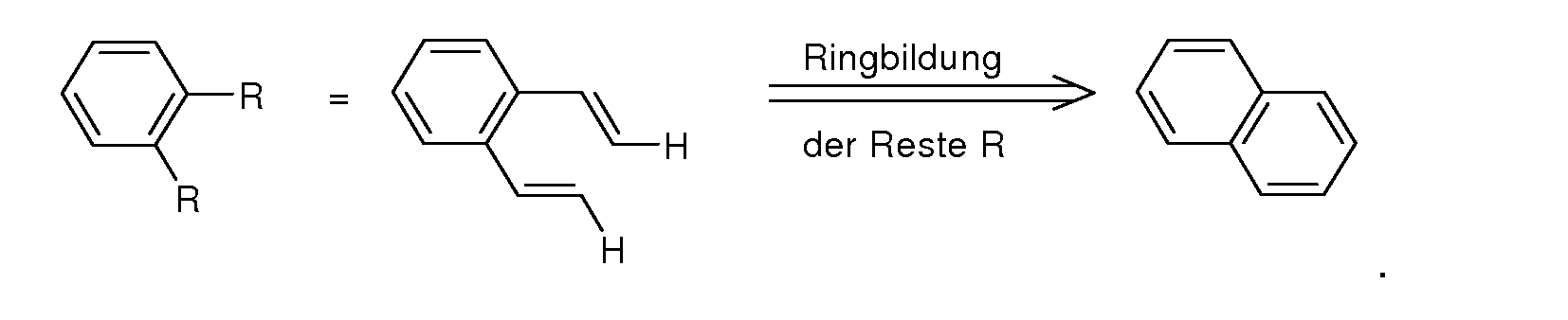
Dabei kann die Ringbildung an Resten erfolgen, die an direkt aneinander gebundene Kohlenstoffatome gebunden sind, oder an Resten, die an weiter entfernt liegende Kohlenstoffatome gebunden sind. Bevorzugt ist eine solche Ringbildung bei Resten, die an direkt aneinander gebundene Kohlenstoffatome oder an dasselbe Kohlenstoffatom gebunden sind. In this case, the ring formation can take place on radicals which are bonded to carbon atoms which are bonded directly to one another, or on radicals which are bonded to carbon atoms which are more remote. Is preferred such ring formation for radicals bound to directly bonded carbon atoms or to the same carbon atom.
Eine Arylgruppe im Sinne dieser Erfindung enthält 6 bis 40 C-Atome; eine Heteroarylgruppe im Sinne dieser Erfindung enthält 2 bis 40 C-Atome und mindestens ein Heteroatom, mit der Maßgabe, dass die Summe ausAn aryl group for the purposes of this invention contains 6 to 40 carbon atoms; a heteroaryl group in the context of this invention contains 2 to 40 carbon atoms and at least one heteroatom, with the proviso that the sum of
C-Atomen und Heteroatomen mindestens 5 ergibt. Die Heteroatome sind bevorzugt ausgewählt aus N, O und/oder S. Dabei wird unter einer Aryl- gruppe bzw. Heteroarylgruppe entweder ein einfacher aromatischer Cyclus, also Benzol, bzw. ein einfacher heteroaromatischer Cyclus, bei- spielsweise Pyridin, Pyrimidin, Thiophen, etc., oder eine kondensierte Aryl- oder Heteroarylgruppe, beispielsweise Naphthalin, Anthracen, C atoms and heteroatoms at least 5 yields. The heteroatoms are preferably selected from N, O and / or S. Here, an aryl group or heteroaryl group is either a simple aromatic cycle, ie benzene, or a simple heteroaromatic cycle, for example pyridine, pyrimidine, thiophene, etc ., or a fused aryl or heteroaryl group, for example naphthalene, anthracene,
Phenanthren, Chinolin, Isochinolin, etc., verstanden. Phenanthrene, quinoline, isoquinoline, etc., understood.
Ein aromatisches Ringsystem im Sinne dieser Erfindung enthält 6 bis 40 C-Atome im Ringsystem. Ein heteroaromatisches Ringsystem im Sinne dieser Erfindung enthält 1 bis 40 C-Atome und mindestens ein Heteroatom im Ringsystem, mit der Maßgabe, dass die Summe aus C-Atomen und Heteroatomen mindestens 5 ergibt. Die Heteroatome sind bevorzugt aus- gewählt aus N, O und/oder S. Unter einem aromatischen oder hetero- aromatischen Ringsystem im Sinne dieser Erfindung soll ein System ver- standen werden, das nicht notwendigerweise nur Aryl- oder Heteroaryl- gruppen enthält, sondern in dem auch mehrere Aryl- oder Heteroaryl- gruppen durch eine nicht-aromatische Einheit (bevorzugt weniger als 10 % der von H verschiedenen Atome), wie z. B. ein C-, N- oder O-Atom oder eine Carbonylgruppe, unterbrochen sein können. So sollen beispielsweise auch Systeme wie 9,9'-Spirobifluoren, 9,9-Diarylfluoren, Triarylamin, Diarylether, Stilben, etc. als aromatische Ringsysteme im Sinne dieser Erfindung verstanden werden, und ebenso Systeme, in denen zwei oder mehrere Arylgruppen beispielsweise durch eine lineare oder cyclische Alkylgruppe oder durch eine Silylgruppe unterbrochen sind. Weiterhin sollen Systeme, in denen zwei oder mehrere Aryl- oder Heteroarylgruppen direkt aneinander gebunden sind, wie z. B. Biphenyl, Terphenyl, Quater- phenyl oder Bipyridin, ebenfalls als aromatisches bzw. heteroaroma- tisches Ringsystem verstanden werden. Unter einer cyclischen Alkylgruppe im Sinne dieser Erfindung wird eine monocyclische, eine bicyclische oder eine polycyclische Gruppe ver- standen. An aromatic ring system in the sense of this invention contains 6 to 40 carbon atoms in the ring system. A heteroaromatic ring system in the sense of this invention contains 1 to 40 C atoms and at least one heteroatom in the ring system, with the proviso that the sum of C atoms and heteroatoms gives at least 5. The heteroatoms are preferably selected from N, O and / or S. An aromatic or heteroaromatic ring system in the sense of this invention is to be understood as meaning a system which does not necessarily contain only aryl or heteroaryl groups, but instead also a plurality of aryl or heteroaryl groups by a non-aromatic unit (preferably less than 10% of the atoms other than H), such as. As a C, N or O atom or a carbonyl group, may be interrupted. For example, systems such as 9,9'-spirobifluorene, 9,9-diarylfluorene, triarylamine, diaryl ethers, stilbene, etc. are to be understood as aromatic ring systems in the context of this invention, and also systems in which two or more aryl groups, for example by a linear or cyclic alkyl group or interrupted by a silyl group. Furthermore, systems in which two or more aryl or heteroaryl groups are bonded directly to each other, such as. B. biphenyl, terphenyl, Quaterphenyl or bipyridine, also be understood as an aromatic or heteroaromatic ring system. For the purposes of this invention, a cyclic alkyl group is understood as meaning a monocyclic, a bicyclic or a polycyclic group.
Im Rahmen der vorliegenden Erfindung werden unter einer Ci- bis C20- Alkylgruppe, in der auch einzelne H-Atome oder CH2-Gruppen durch die oben genannten Gruppen substituiert sein können, beispielsweise die Reste Methyl, Ethyl, n-Propyl, i-Propyl, Cyclopropyl, n-Butyl, i-Butyl, s-Butyl, t-Butyl, Cyclobutyl, 2-Methylbutyl, n-Pentyl, s-Pentyl, t-Pentyl, 2- Pentyl, neo-Pentyl, Cyclopentyl, n-Hexyl, s-Hexyl, t-Hexyl, 2-Hexyl, 3- Hexyl, neo-Hexyl, Cyclohexyl, 1 -Methylcyclopentyl, 2-Methylpentyl, n-Heptyl, 2-Heptyl, 3-Heptyl, 4-Heptyl, Cycloheptyl, 1 -Methylcyclohexyl, n-Octyl, 2-Ethylhexyl, Cyclooctyl, 1 -Bicyclo[2,2,2]octyl, 2-Bicyclo[2,2,2]- octyl, 2-(2,6-Dimethyl)octyl, 3-(3,7-Dimethyl)octyl, Adamantyl, Trifluor- methyl, Pentafluorethyl, 2,2,2-Trifluorethyl, 1 ,1 -Dimethyl-n-hex-1 -yl-, 1 ,1 - Dimethyl-n-hept-1 -yl-, 1 ,1 -Dimethyl-n-oct-1 -yl-, 1 , 1 -Dimethyl-n-dec-1 -yl-, 1 ,1 -Dimethyl-n-dodec-1 -yl-, 1 ,1 -Dimethyl-n-tetradec-1 -yl-, 1 ,1 -Dimethyl-n- hexadec-1 -yl-, 1 ,1 -Dimethyl-n-octadec-1 -yl-, 1 ,1 -Diethyl-n-hex-1 -yl-, 1 ,1 - Diethyl-n-hept-1 -yl-, 1 ,1 -Diethyl-n-oct-1 -yl-, 1 ,1 -Diethyl-n-dec-1 -yl-, 1 ,1 - Diethyl-n-dodec-1 -yl-, 1 ,1 -Diethyl-n-tetradec-1 -yl-, 1 ,1 -Diethyln-n-hexadec- 1 -y|-, 1 ,1 -Diethyl-n-octadec-1 -yl-, 1 -(n-Propyl)-cyclohex-l -yl-, 1 -(n-Butyl)- cyclohex-1 -yl-, 1 -(n-Hexyl)-cyclohex-1 -yl-, 1 -(n-Octyl)-cyclohex-1 -yl- und 1 - (n-Decyl)-cyclohex-l -yl- verstanden. Unter einer Alkenylgruppe werden beispielsweise Ethenyl, Propenyl, Butenyl, Pentenyl, Cyclopentenyl, Hexenyl, Cyclohexenyl, Heptenyl, Cycloheptenyl, Octenyl, Cyclooctenyl oder Cyclooctadienyl verstanden. Unter einer Alkinylgruppe werden beispielsweise Ethinyl, Propinyl, Butinyl, Pentinyl, Hexinyl, Heptinyl oder Octinyl verstanden. Unter einer C1- bis C2o-Alkoxygruppe, wie sie für OR1 bzw. OR2 vorliegt, werden beispielsweise Methoxy, Trifluormethoxy, Ethoxy, n-Propoxy, i-Propoxy, n-Butoxy, i-Butoxy, s-Butoxy, t-Butoxy oder 2-Methylbutoxy verstanden. In the context of the present invention, a C 1 - to C 20 -alkyl group in which individual H atoms or CH 2 groups may be substituted by the abovementioned groups, for example the radicals methyl, ethyl, n-propyl, i-propyl, Cyclopropyl, n-butyl, i-butyl, s-butyl, t-butyl, cyclobutyl, 2-methylbutyl, n-pentyl, s-pentyl, t-pentyl, 2-pentyl, neo-pentyl, cyclopentyl, n-hexyl, s-hexyl, t -hexyl, 2-hexyl, 3-hexyl, neo-hexyl, cyclohexyl, 1-methylcyclopentyl, 2-methylpentyl, n-heptyl, 2-heptyl, 3-heptyl, 4-heptyl, cycloheptyl, 1 - Methylcyclohexyl, n-octyl, 2-ethylhexyl, cyclooctyl, 1-bicyclo [2,2,2] octyl, 2-bicyclo [2,2,2] octyl, 2- (2,6-dimethyl) octyl, 3 (3,7-dimethyl) octyl, adamantyl, trifluoromethyl, pentafluoroethyl, 2,2,2-trifluoroethyl, 1,1-dimethyl-n-hex-1-yl, 1,1-dimethyl-n-hept- 1 -yl, 1, 1-dimethyl-n-oct-1-yl, 1, 1-dimethyl-n-dec-1-yl, 1, 1-dimethyl-n-dodec-1-ylyl, 1, 1-dimethyl-n-tetradec-1-yl, 1, 1-dimethyl-n-hexadec-1-yl, 1, 1-dimethyl -n-octadec-1 -yl, 1, 1-diethyl-n-hex-1-yl, 1, 1-diethyl-n-hept-1-yl, 1, 1-diethyl-n-octane 1 -yl, 1, 1-diethyl-n-dec-1-yl, 1, 1-diethyl-n-dodec-1-yl, 1, 1-diethyl-n-tetradec-1-ylyl, 1, 1-diethyln-n-hexadec-1-yl, -1, 1-diethyl-n-octadec-1-yl, 1 - (n-propyl) -cyclohex-1-yl, 1 - (n Butyl) - cyclohex-1-yl, 1 - (n-hexyl) -cyclohex-1-yl, 1 - (n-octyl) -cyclohex-1-yl and 1 - (n-decyl) cyclohexene -l -yl- understood. An alkenyl group is understood as meaning, for example, ethenyl, propenyl, butenyl, pentenyl, cyclopentenyl, hexenyl, cyclohexenyl, heptenyl, cycloheptenyl, octenyl, cyclooctenyl or cyclooctadienyl. By an alkynyl group is meant, for example, ethynyl, propynyl, butynyl, pentynyl, hexynyl, heptynyl or octynyl. A C 1 - to C 20 -alkoxy group, as present for OR 1 or OR 2 , includes, for example, methoxy, trifluoromethoxy, ethoxy, n-propoxy, isopropoxy, n-butoxy, isobutoxy, s-butoxy, Butoxy or 2-methyl butoxy understood.
Unter einem aromatischen oder heteroaromatischen Ringsystem mit 5 - 40 aromatischen Ringatomen, welches noch jeweils mit den oben genannten Resten substituiert sein kann und welches über beliebige Positionen am Aromaten bzw. Heteroaromaten verknüpft sein kann, werden beispiels- weise Gruppen verstanden, die abgeleitet sind von Benzol, Naphthalin, Anthracen, Benzanthracen, Phenanthren, Benzophenanthren, Pyren, Chrysen, Perylen, Fluoranthen, Benzfluoranthen, Naphthacen, Pentacen, Benzpyren, Biphenyl, Biphenylen, Terphenyl, Terphenylen, Fluoren, Spiro- bifluoren, Dihydrophenanthren, Dihydropyren, Tetrahydropyren, eis- oder trans-lndenofluoren, eis- oder trans-Monobenzoindenofluoren, eis- oder trans-Dibenzoindenofluoren, Truxen, Isotruxen, Spirotruxen, Spiroiso- truxen, Furan, Benzofuran, Isobenzofuran, Dibenzofuran, Thiophen, Benzothiophen, Isobenzothiophen, Dibenzothiophen, Pyrrol, Indol, Iso- indol, Carbazol, Indolocarbazol, Indenocarbazol, Pyridin, Chinolin, Iso- chinolin, Acridin, Phenanthridin, Benzo-5,6-chinolin, Benzo-6,7-chinolin, Benzo-7,8-chinolin, Phenothiazin, Phenoxazin, Pyrazol, Indazol, Imidazol, Benzimidazol, Naphthimidazol, Phenanthrimidazol, Pyridimidazol, Pyrazin- imidazol, Chinoxalinimidazol, Oxazol, Benzoxazol, Naphthoxazol, Under an aromatic or heteroaromatic ring system with 5-40 aromatic ring atoms, which may be substituted in each case with the abovementioned radicals and which can be attached via any position on For example, groups derived from benzene, naphthalene, anthracene, benzanthracene, phenanthrene, benzophenanthrene, pyrene, chrysene, perylene, fluoranthene, benzfluoranthene, naphthacene, pentacene, benzpyrene, biphenyl, biphenylene can be understood as meaning aromatic groups or heteroaromatics , Terphenyl, terphenylene, fluorene, spirobifluorene, dihydrophenanthrene, dihydropyrene, tetrahydropyrene, cis or trans indenofluorene, cis- or trans-monobenzoindenofluorene, cis- or trans-dibenzoindenofluorene, truxene, isotruxene, spirotruxene, spiro-isotruxene, furan, Benzofuran, isobenzofuran, dibenzofuran, thiophene, benzothiophene, isobenzothiophene, dibenzothiophene, pyrrole, indole, isoindole, carbazole, indolocarbazole, indenocarbazole, pyridine, quinoline, isoquinoline, acridine, phenanthridine, benzo-5,6-quinoline, benzoin 6,7-quinoline, benzo-7,8-quinoline, phenothiazine, phenoxazine, pyrazole, indazole, imidazole, benzimidazole, naphthimidazole, phenanthrimidazole, pyrimididazole, pyrazine imidazole, C hinoxalinimidazole, oxazole, benzoxazole, naphthoxazole,
Anthroxazol, Phenanthroxazol, Isoxazol, 1 ,2-Thiazol, 1 ,3-Thiazol, Benzo- thiazol, Pyridazin, Benzopyridazin, Pyrimidin, Benzpyrimidin, Chinoxalin, 1 ,5-Diazaanthracen, 2,7-Diazapyren, 2,3-Diazapyren, 1 ,6-Diazapyren, 1 ,8-Diazapyren, 4,5-Diazapyren, 4,5,9,10-Tetraazaperylen, Pyrazin, Phenazin, Phenoxazin, Phenothiazin, Fluorubin, Naphthyridin, Aza- carbazol, Benzocarbolin, Phenanthrolin, 1 ,2,3-Triazol, 1 ,2,4-Triazol,Anthroxazole, phenanthroxazole, isoxazole, 1, 2-thiazole, 1, 3-thiazole, benzothiazole, pyridazine, benzopyridazine, pyrimidine, benzpyrimidine, quinoxaline, 1, 5-diazaanthracene, 2,7-diazapyrene, 2,3-diazapyrene, 1, 6-diazapyrene, 1,8-diazapyrene, 4,5-diazapyrene, 4,5,9,10-tetraazaperylene, pyrazine, phenazine, phenoxazine, phenothiazine, fluorubin, naphthyridine, azacarbazole, benzocarboline, phenanthroline, 1, 2,3-triazole, 1, 2,4-triazole,
Benzotriazol, 1 ,2,3-Oxadiazol, 1 ,2,4-Oxadiazol, 1 ,2,5-Oxadiazol, 1 ,3,4- Oxadiazol, 1 ,2,3-Thiadiazol, 1 ,2,4-Thiadiazol, 1 ,2,5-Thiadiazol, 1 ,3,4-Thia- diazol, 1 ,3,5-Triazin, 1 ,2,4-Triazin, 1 ,2,3-Triazin, Tetrazol, 1 ,2,4,5-Tetrazin, 1 ,2,3,4-Tetrazin, 1 ,2,3,5-Tetrazin, Purin, Pteridin, Indolizin und Benzo- thiadiazol. Benzotriazole, 1, 2,3-oxadiazole, 1, 2,4-oxadiazole, 1, 2,5-oxadiazole, 1, 3,4-oxadiazole, 1, 2,3-thiadiazole, 1, 2,4-thiadiazole, 1, 2,5-thiadiazole, 1, 3,4-thiadiazole, 1, 3,5-triazine, 1, 2,4-triazine, 1, 2,3-triazine, tetrazole, 1, 2,4, 5-tetrazine, 1, 2,3,4-tetrazine, 1, 2,3,5-tetrazine, purine, pteridine, indolizine and benzothiadiazole.
Zur weiteren Veranschaulichung der Verbindung wird im Folgenden eine einfache Struktur gemäß Formel (1 ) vollständig dargestellt und erläutert: To further illustrate the compound, a simple structure according to formula (1) is fully illustrated and explained below:

In dieser Struktur steht der Teilligand, der an beide Metalle M, im vor- liegenden Fall Iridium, koordiniert ist, für eine 2-Phenylpyrimidingruppe. An die Phenylgruppe und an die Pyrimidingruppe sind jeweils eine Gruppe der Formel (2) gebunden, d. h. V steht in dieser Struktur für eine Gruppe der Formel (2). Darin steht der zentrale Cyclus jeweils für eine Phenyl- gruppe und die drei Gruppen A stehen jeweils für -HC=CH-, also für cis- Alkenylgruppen. An diese Gruppe der Formel (2) sind jeweils noch zwei Teilliganden L gebunden, welche in der oben abgebildeten Struktur jeweils für Phenylpyridin stehen. Jedes der beiden Metalle M ist somit in der oben abgebildeten Struktur mit jeweils zwei Phenylpyridinliganden und einem Phenylpyrimidinliganden koordiniert, wobei die Phenylgruppe und die Pyrimidingruppe des Phenylpyrimidins jeweils an beide Metalle M koordi- nieren. Dabei sind die Teilliganden jeweils durch die Gruppe der Formel (2) zu einem polypodalen System verknüpft. In this structure, the part ligand, which is coordinated to both metals M, in the present case iridium, stands for a 2-phenylpyrimidine group. To the phenyl group and to the pyrimidine group are each bound a group of formula (2), i. H. V in this structure represents a group of formula (2). Therein the central cycle stands for a phenyl group and the three groups A stand for -HC = CH-, ie for cis-alkenyl groups. To this group of formula (2) are each still two partial ligands L bound, which are in the structure shown above each phenylpyridine. Each of the two metals M is thus coordinated in the structure shown above with two phenylpyridine ligands and one phenylpyrimidine ligand, wherein the phenyl group and the pyrimidine group of the phenylpyrimidine each coordinate to both metals M. The partial ligands are each linked by the group of formula (2) to form a polypodal system.
Der Begriff „bidentater Teilligand" für L bedeutet im Sinne dieser Anmel- dung, dass es sich bei dieser Einheit um einen bidentaten Liganden han- deln würde, wenn die Gruppe der Formel (2) bzw. (3) nicht vorhanden wäre. Durch die formale Abstraktion eines Wasserstoffatoms an diesem bidentaten Liganden und die Verknüpfung innerhalb der Brücke der Formel (2) bzw. (3) ist dieser jedoch kein separater Ligand, sondern ein Teil des so entstehenden dodekadentaten Liganden, also eines Liganden mit insgesamt 12 Koordinationsstellen, so dass hierfür der Begriff „Teil- ligand" verwendet wird. Die Bindung des Liganden an das Metall M kann sowohl eine Koordina- tionsbindung als auch eine kovalente Bindung sein bzw. der kovalente An- teil an der Bindung kann je nach Ligand variieren. Wenn in der vorliegen- den Anmeldung die Rede davon ist, dass der Ligand bzw. der Teilligand an M koordiniert oder bindet, so bezeichnet dies im Sinne der vorliegen- den Anmeldung jede Art der Bindung des Liganden bzw. Teilliganden an M, unabhängig vom kovalenten Anteil der Bindung. The term "bidentate partial ligand" for L in the context of this application means that this moiety would be a bidentate ligand if the group of the formula (2) or (3) were not present However, formal abstraction of a hydrogen atom on this bidentate ligand and the linkage within the bridge of the formula (2) or (3) is not a separate ligand, but a part of the resulting dodecadentate ligand, ie a ligand with a total of 12 coordination sites, so that the term "partial ligand" is used for this purpose. The binding of the ligand to the metal M can be both a coordination bond and a covalent bond or the covalent part of the bond can vary depending on the ligand. If in the present application there is talk of the ligand or the partial ligand being coordinated or binding to M, for the purposes of the present application this refers to any type of binding of the ligand or partial ligand to M, independently of the covalent one Proportion of binding.
Die erfindungsgemäßen Verbindungen sind bevorzugt nicht geladen, d. h. sie sind elektrisch neutral. Dies wird dadurch erreicht, dass Rh bzw. Ir jeweils in der Oxidationsstufe +III vorliegen. Jedes der Metalle ist dann von zwei monoanionischen bidentaten Teilliganden sowie einem The compounds of the invention are preferably not charged, i. H. they are electrically neutral. This is achieved by Rh or Ir being present in the oxidation state + III, respectively. Each of the metals is then composed of two monoanionic bidentate partial ligands and one
dianionischen tetradentaten Teilliganden, der an beide Metalle bindet, koordiniert, so dass die Teilliganden die Ladung des komplexierten Metallatoms kompensieren. dianionic tetradentate partially ligands, which binds to both metals, coordinated so that the partial ligands compensate for the charge of the complexed metal atom.
Wie oben beschrieben, können die beiden Metalle M in der erfindungs- gemäßen gemäßen Verbindung gleich oder verschieden sein und liegen bevorzugt in der Oxidationsstufe +III vor. Es kommen daher die Kombina- tionen Ir / Ir, Ir / Rh und Rh / Rh in Frage. In einer bevorzugten Aus- führungsform der Erfindung stehen beide Metalle M für Ir(lll). As described above, the two metals M in the inventive compound can be the same or different and are preferably in the oxidation state + III. Therefore, the combinations Ir / Ir, Ir / Rh and Rh / Rh come into question. In a preferred embodiment of the invention, both metals M are Ir (III).
In einer bevorzugten Ausführungsform der Erfindung sind die Verbin- dungen der Formel (1 ) gewählt aus den Verbindungen der folgenden Formel (1 '), In a preferred embodiment of the invention, the compounds of the formula (1) are selected from the compounds of the following formula (1 '),

wobei die explizit eingezeichneten Reste R in ortho-Position zu D jeweils gleich oder verschieden bei jedem Auftreten ausgewählt sind aus der Gruppe bestehend aus H, D, F, CH3 und CD3 und bevorzugt für H stehen und die weiteren verwendeten Symbole die oben aufgeführten Bedeu- tungen aufweisen. wherein the explicitly depicted radicals R in the ortho position to D in each case identically or differently on each occurrence are selected from the group consisting of H, D, F, CH 3 and CD 3 and are preferably H and the other symbols used are as defined above. have.
Wie oben beschrieben, ist jedes der Metalle von einem Kohlenstoffatom und einem Stickstoffatom des zentralen Teilliganden koordiniert und ist weiterhin jeweils von zwei Teilliganden L koordiniert. Die Verbindung der Formel (1 ) weist also eine Struktur gemäß einer der folgenden Formeln (1 a) oder (1 b) auf und bevorzugt eine Struktur gemäß einer der folgenden Formeln (1 a') oder (1 b'), As described above, each of the metals is coordinated by a carbon atom and a nitrogen atom of the central partial ligand and is further coordinated by two partial ligands L, respectively. The compound of the formula (1) thus has a structure according to one of the following formulas (1a) or (1b) and preferably has a structure according to one of the following formulas (1a ') or (1b'),
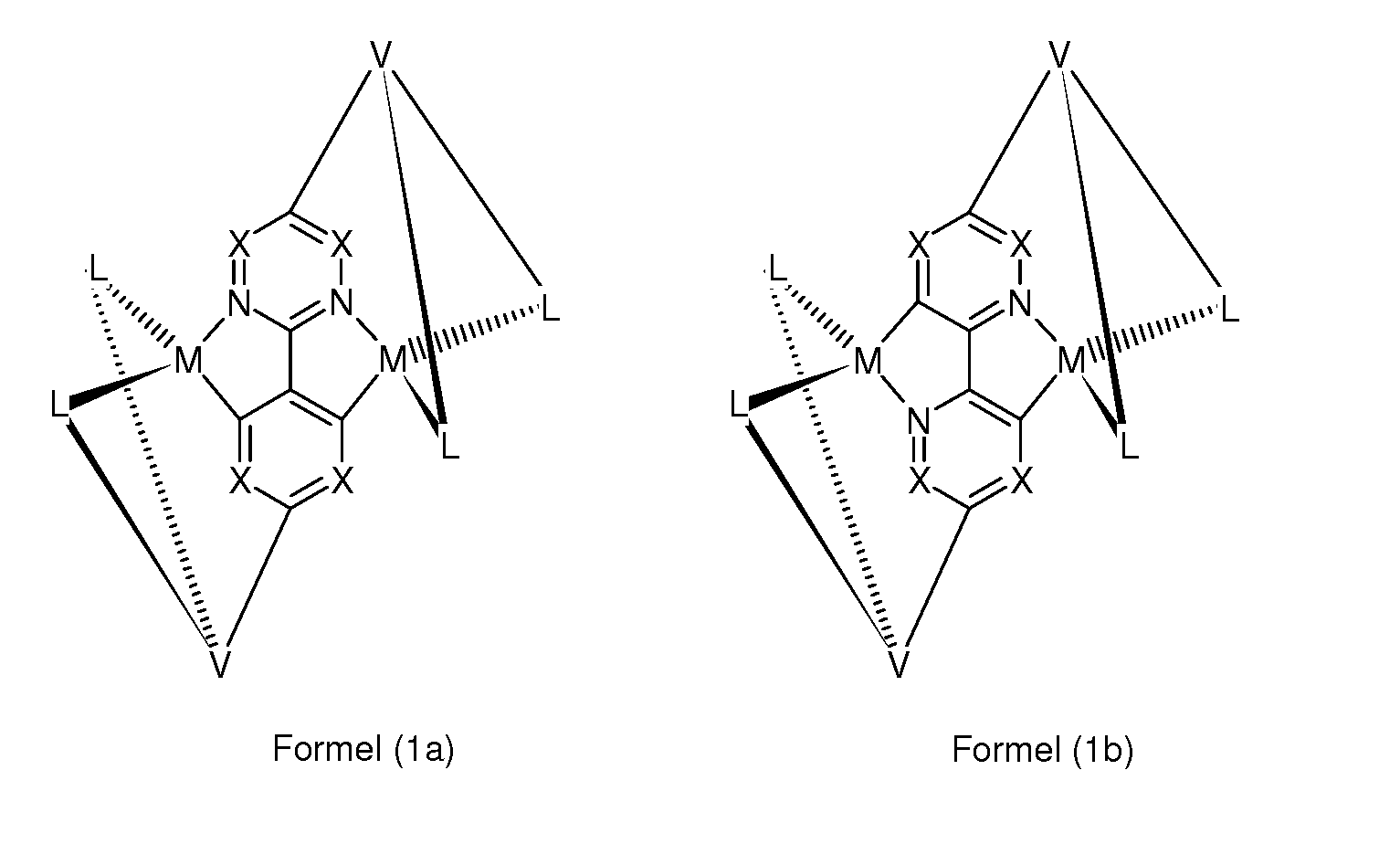
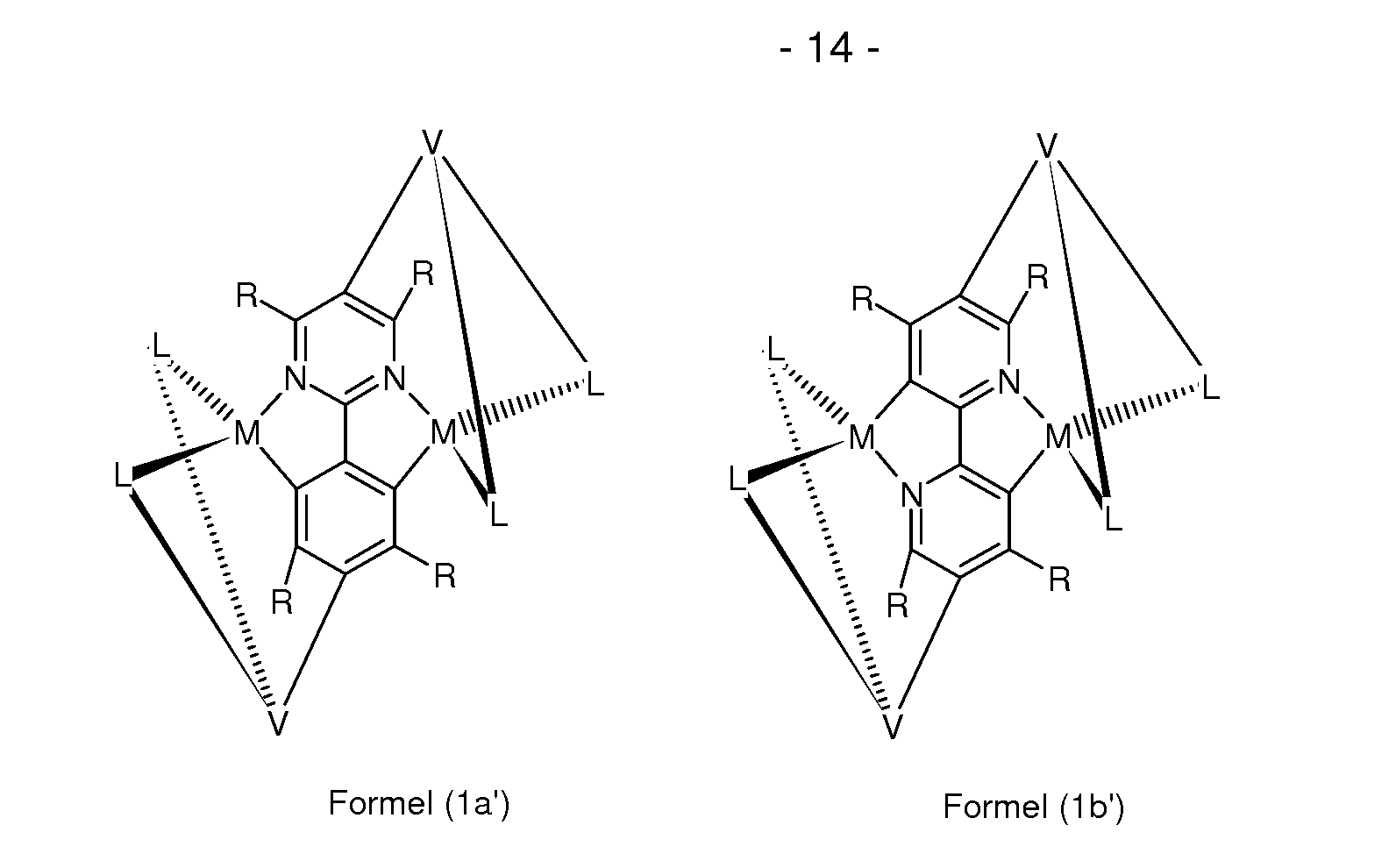
wobei die explizit eingezeichneten Reste R jeweils gleich oder verschie- den bei jedem Auftreten ausgewählt sind aus der Gruppe bestehend aus H, D, F, CH3 und CD3 und die weiteren verwendeten Symbole die oben genannten Bedeutungen aufweisen. Besonders bevorzugt stehen die explizit dargestellten Reste R in Formeln (1 a') und (1 b') für H. Besonders bevorzugt sind die Strukturen (1 b) bzw. (1 b'). wherein the explicitly drawn radicals R are each the same or different at each occurrence selected from the group consisting of H, D, F, CH 3 and CD3 and the other symbols used have the meanings given above. Particular preference is given to the radicals R shown explicitly in formulas (1 a ') and (1 b') for H. Particular preference is given to the structures (1 b) or (1 b ').
Nachfolgend werden bevorzugte Ausführungsformen für V, also die Gruppe der Formel (2) bzw. (3) ausgeführt. Hereinafter, preferred embodiments for V, ie the group of formula (2) or (3) are carried out.
Wenn in Formel (3) A2 für CR steht, insbesondere wenn alle A2 für CR stehen, ganz besonders wenn zusätzlich 0, 1 , 2 oder 3, insbesondere 3, der A1 für CR2 stehen, wenn es sich also um eine Cyclohexangruppe handelt, können die Reste R an A2 abhängig von der Konfiguration unter- schiedliche Positionen einnehmen. Bevorzugt sind dabei kleine Reste R wie H oder D. Bevorzugt ist, dass sie entweder alle weg vom Metall gerichtet sind (apical) oder alle nach innen zum Metall hin gerichtet sind (endohedral). Dies ist nachfolgend an einem Beispiel veranschaulicht, in dem die Gruppen A jeweils für eine ortho-Phenylengruppe stehen. If in formula (3) A 2 is CR, especially if all A 2 are CR, especially when additional 0, 1, 2 or 3, especially 3, which are A 1 is CR2 if it is to say a cyclohexane Depending on the configuration, the radicals R at A 2 can assume different positions. Preference is given to small radicals R such as H or D. It is preferred that they are either all directed away from the metal (apical) or all directed inward toward the metal (endohedral). This is illustrated below by way of example in which the groups A are each an ortho-phenylene group.

Geeignete Ausführungsformen der Gruppe der Formel (2) sind die Suitable embodiments of the group of formula (2) are the
Strukturen der folgenden Formeln (5) bis (8), und geeignete Ausführungs- formen der Gruppe der Formel (3) sind die Strukturen der folgenden Formeln (9) bis (13), Structures of the following formulas (5) to (8), and suitable embodiments of the group of the formula (3) are the structures of the following formulas (9) to (13)

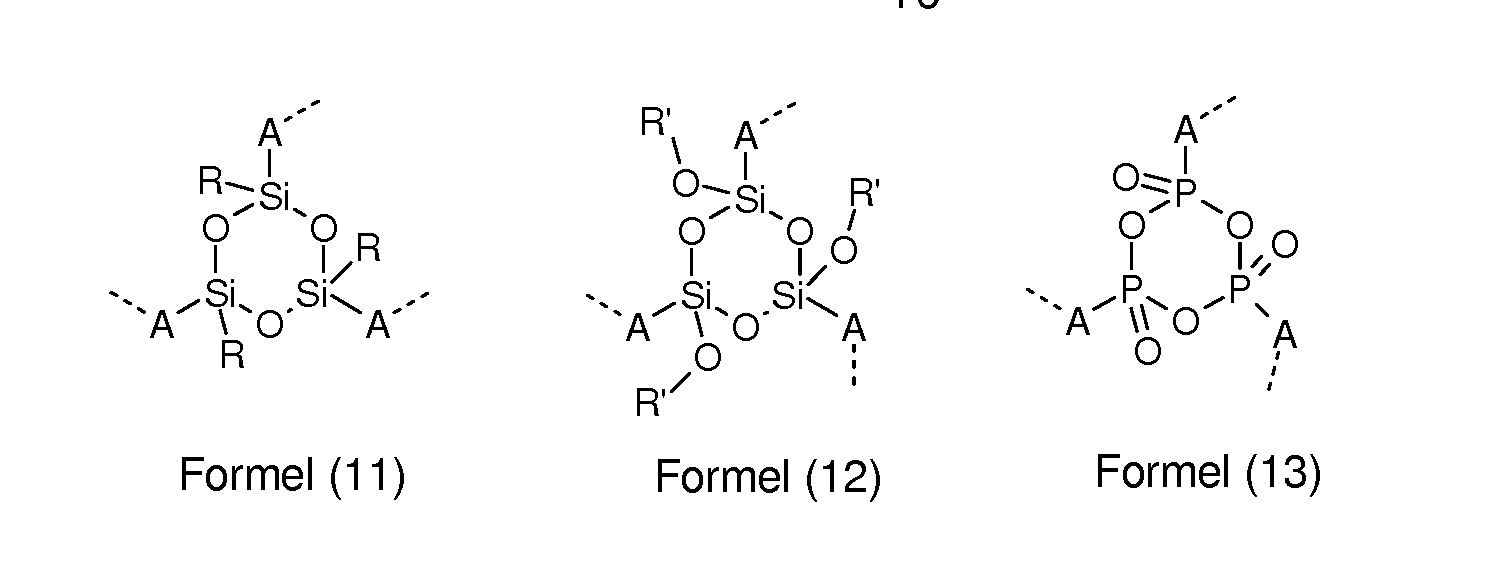
wobei die Symbole die oben genannten Bedeutungen aufweisen. Für bevorzugte Reste R in Formeln (5) bis (1 3) gilt: where the symbols have the meanings given above. For preferred radicals R in formulas (5) to (1 3):
R ist bei jedem Auftreten gleich oder verschieden H, D, F, CN, OR1 , eine geradkettige Alkylgruppe mit 1 bis 1 0 C-Atomen oder eine Alkenylgruppe mit 2 bis 1 0 C-Atomen oder eine verzweigte oder cyclische Alkylgruppe mit 3 bis 1 0 C-Atomen, die jeweils mit einem oder mehreren Resten R1 substituiert sein kann, oder ein aroma- tisches oder heteroaromatisches Ringsystem mit 5 bis 24 aroma- tischen Ringatomen, das jeweils durch einen oder mehrere Reste R1 substituiert sein kann ; R is the same or different at each occurrence, H, D, F, CN, OR 1 , a straight-chain alkyl group having 1 to 1 C atoms or an alkenyl group having 2 to 1 C atoms or a branched or cyclic alkyl group having 3 to 1 0 C atoms, each of which may be substituted by one or more radicals R 1 , or an aromatic or heteroaromatic ring system having 5 to 24 aromatic ring atoms, each of which may be substituted by one or more radicals R 1 ;
R1 ist bei jedem Auftreten gleich oder verschieden H, D, F, CN, OR2, eine geradkettige Alkylgruppe mit 1 bis 1 0 C-Atomen oder eine Alkenylgruppe mit 2 bis 1 0 C-Atomen oder eine verzweigte oder cyclische Alkylgruppe mit 3 bis 1 0 C-Atomen, die jeweils mit einem oder mehreren Resten R2 substituiert sein kann, oder ein aroma- tisches oder heteroaromatisches Ringsystem mit 5 bis 24 aroma- tischen Ringatomen, das jeweils durch einen oder mehrere Reste R2 substituiert sein kann ; dabei können zwei oder mehrere benachbarte Reste R1 miteinander ein Ringsystem bilden ; R 1 is the same or different H, D, F, CN, OR 2 , a straight-chain alkyl group having 1 to 1 0 C atoms or an alkenyl group having 2 to 1 0 C atoms or a branched or cyclic alkyl group with 3 at each occurrence to 1 0 C atoms, each of which may be substituted by one or more radicals R 2 , or an aromatic or heteroaromatic ring system having 5 to 24 aromatic ring atoms, each of which may be substituted by one or more radicals R 2 ; in this case, two or more adjacent radicals R 1 together form a ring system;
R2 ist bei jedem Auftreten gleich oder verschieden H, D, F oder ein aliphatischer, aromatischer oder heteroaromatischer organischer Rest mit 1 bis 20 C-Atomen, in dem auch ein oder mehrere H-Atome durch F ersetzt sein können. R 2 is the same or different H, D, F or an aliphatic, aromatic or heteroaromatic organic radical having 1 to 20 C atoms in each occurrence, in which also one or more H atoms may be replaced by F.
Für besonders bevorzugte Reste R in Formeln (5) bis (1 3) gilt: ist bei jedem Auftreten gleich oder verschieden H, D, F, CN, eine geradkettige Alkylgruppe mit 1 bis 4 C-Atomen oder eine verzweigte oder cyclische Alkylgruppe mit 3 bis 6 C-Atomen, die jeweils mit einem oder mehreren Resten R1 substituiert sein kann, oder ein aromatisches oder heteroaromatisches Ringsystem mit 6 bis 12 aromatischen Ringatomen, das jeweils durch einen oder mehrere Reste R1 substituiert sein kann; ist bei jedem Auftreten gleich oder verschieden H, D, F, CN, eine geradkettige Alkylgruppe mit 1 bis 4 C-Atomen oder eine verzweigte oder cyclische Alkylgruppe mit 3 bis 6 C-Atomen, die jeweils mit einem oder mehreren Resten R2 substituiert sein kann, oder ein aromatisches oder heteroaromatisches Ringsystem mit 6 bis 12 aromatischen Ringatomen, das jeweils durch einen oder mehrere Reste R2 substituiert sein kann; dabei können zwei oder mehrere benachbarte Reste R1 miteinander ein Ringsystem bilden; ist bei jedem Auftreten gleich oder verschieden H, D, F oder ein aliphatischer oder aromatischer Kohlenwasserstoffrest mit 1 bis 12 C-Atomen. For particularly preferred radicals R in formulas (5) to (1 3): is identical or different H, D, F, CN, a straight-chain alkyl group having 1 to 4 C-atoms or a branched or cyclic alkyl group having 3 to 6 C-atoms, each of which is substituted by one or more R 1 each occurrence may be, or an aromatic or heteroaromatic ring system having 6 to 12 aromatic ring atoms, each of which may be substituted by one or more radicals R 1 ; is identical or different at each occurrence H, D, F, CN, a straight-chain alkyl group having 1 to 4 carbon atoms or a branched or cyclic alkyl group having 3 to 6 carbon atoms, which are each substituted by one or more radicals R 2 may, or an aromatic or heteroaromatic ring system having 6 to 12 aromatic ring atoms, each of which may be substituted by one or more radicals R 2 ; in this case, two or more adjacent radicals R 1 together form a ring system; is identical or different at each occurrence H, D, F or an aliphatic or aromatic hydrocarbon radical having 1 to 12 C-atoms.
In einer bevorzugten Ausführungsform der Erfindung stehen alle Gruppen X1 in der Gruppe der Formel (2) für CR, so dass der zentrale trivalente Cyclus der Formel (2) ein Benzol darstellt. Besonders bevorzugt stehen alle Gruppen X1 für CH oder CD, insbesondere für CH. In einer weiteren bevorzugten Ausführungsform der Erfindung stehen alle Gruppen X1 für ein Stickstoffatom, so dass der zentrale trivalente Cyclus der Formel (2) ein Triazin darstellt. Bevorzugte Ausführungsformen der Formel (2) sind somit die Strukturen der oben abgebildeten Formeln (5) und (6). Beson- ders bevorzugt ist die Struktur der Formel (5) eine Struktur der folgenden Formel (5'),

Formel (5') wobei die Symbole die oben genannten Bedeutungen aufweisen. Formula (5 ') wherein the symbols have the meanings mentioned above.
In einer weiteren bevorzugten Ausführungsform der Erfindung stehen alle Gruppen A2 in der Gruppe der Formel (3) für CR. Besonders bevorzugt stehen alle Gruppen A2 für CH. Bevorzugte Ausführungsformen derIn a further preferred embodiment of the invention, all groups A 2 in the group of the formula (3) are CR. Particularly preferably, all groups A 2 are CH. Preferred embodiments of
Formel (3) sind somit die Strukturen der oben abgebildeten Formel (9). Besonders bevorzugt ist die Struktur der Formel (9) eine Struktur gemäß einer der folgenden Formeln (9') oder (9"), Formula (3) are thus the structures of formula (9) shown above. The structure of the formula (9) is particularly preferably a structure according to one of the following formulas (9 ') or (9 "),

Formel (9') Formel (9") wobei die Symbole die oben genannten Bedeutungen aufweisen und R bevorzugt für H steht. Formula (9 ') Formula (9 ") where the symbols have the abovementioned meanings and R is preferably H.
Im Folgenden werden bevorzugte Gruppen A beschrieben, wie sie in den Strukturen der Formeln (2) und (3) sowie (5) bis (13) vorkommen. Die Gruppe A kann gleich oder verschieden bei jedem Auftreten eine Alkenyl- gruppe, eine Amidgruppe, eine Estergruppe, eine Alkylengruppe, eine Methylenethergruppe oder eine ortho-verknüpfte Arylen- bzw. Hetero- arylengruppe der Formel (4) darstellen. Wenn A für eine Alkenylgruppe steht, dann handelt es sich um eine cis-verknüpfte Alkenylgruppe. Bei unsymmetrischen Gruppen A ist jede Orientierung der Gruppen möglich. Dies ist nachfolgend schematisch am Beispiel von A = -C(=O)-O- erläutert. Hieraus ergeben sich die folgenden möglichen Orientierungen von A, die alle von der vorliegenden Erfindung umfasst sind: In the following, preferred groups A are described as they occur in the structures of the formulas (2) and (3) and (5) to (13). The group A may be the same or different at each occurrence and may be an alkenyl group, an amide group, an ester group, an alkylene group, a methylene ether group or an ortho-linked arylene or heteroarylene group of the formula (4). If A is an alkenyl group, then it is a cis-linked alkenyl group. In asymmetric groups A, any orientation of the groups is possible. This is explained schematically below using the example of A = -C (= O) -O-. This results in the following possible orientations of A, all of which are encompassed by the present invention:
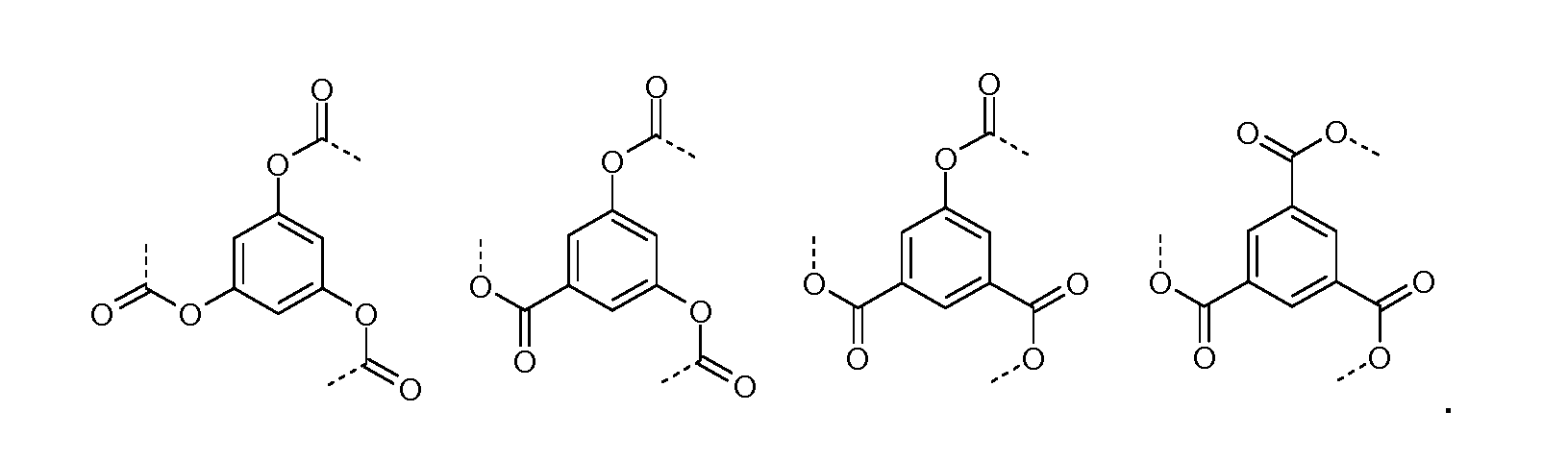
In einer bevorzugten Ausführungsform der Erfindung ist A gleich oder verschieden, bevorzugt gleich, bei jedem Auftreten ausgewählt aus der Gruppe bestehend aus -C(=O)-0-, -C(=O)-NR - oder einer Gruppe der Formel (4). Weiterhin bevorzugt sind zwei Gruppen A gleich und auch gleich substituiert, und die dritte Gruppe A ist von den ersten beiden Gruppen A verschieden, oder alle drei Gruppen A sind gleich und auch gleich substituiert. Bevorzugte Kombinationen für die drei Gruppen A in Formel (2) und (3) und den bevorzugten Ausführungsformen sind: In a preferred embodiment of the invention, A is the same or different, preferably the same, at each occurrence selected from the group consisting of -C (= O) -O-, -C (= O) -NR - or a group of the formula (4 ). Further preferably, two groups A are the same and also the same substituted, and the third group A is different from the first two groups A, or all three groups A are the same and also substituted the same. Preferred combinations for the three groups A in formulas (2) and (3) and the preferred embodiments are:

Wenn A für -C(=O)-NR - steht, dann steht R' bevorzugt gleich oder ver- schieden bei jedem Auftreten für eine geradkettige Alkylgruppe mit 1 bis 10 C-Atomen oder eine verzweigte oder cyclische Alkylgruppe mit 3 bis 10 C-Atomen oder ein aromatisches oder heteroaromatisches Ringsystem mit 6 bis 24 aromatischen Ringatomen, das jeweils durch einen oder mehrere Reste R1 substituiert sein kann. Besonders bevorzugt steht R' gleich oder verschieden bei jedem Auftreten für eine geradkettige Alkylgruppe mit 1 bis 5 C-Atomen oder eine verzweigte oder cyclische Alkylgruppe mit 3 bis 6 C-Atomen oder ein aromatisches oder heteroaromatisches Ringsystem mit 6 bis 12 aromatischen Ringatomen, das jeweils durch einen oder mehrere Reste R1 substituiert sein kann, bevorzugt aber unsubstituiert ist. lm Folgenden werden bevorzugte Ausführungsformen der Gruppe der Formel (4) beschrieben. Die Gruppe der Formel (4) kann einen hetero- aromatischen Fünfring oder einen aromatischen oder heteroaromatischen Sechsring darstellen. In einer bevorzugten Ausführungsform der Erfindung enthält die Gruppe der Formel (4) maximal zwei Heteroatome in der aromatischen bzw. heteroaromatischen Einheit, besonders bevorzugt maximal ein Heteroatom. Dies schließt nicht aus, dass Substituenten, die gegebenenfalls an dieser Gruppe gebunden sind, auch Heteroatome ent- halten können. Weiterhin schließt diese Definition nicht aus, dass durch die Ringbildung von Substituenten kondensierte aromatische oder hetero- aromatische Strukturen entstehen, wie beispielsweise Naphthalin, Benz- imidazol, etc.. When A is -C (= O) -NR -, then R 'is preferably the same or different at each occurrence of a straight-chain alkyl group having 1 to 10 C atoms or a branched or cyclic alkyl group having 3 to 10 C atoms. Atoms or an aromatic or heteroaromatic ring system having 6 to 24 aromatic ring atoms, each of which may be substituted by one or more radicals R 1 . More preferably, R 'is the same or different each occurrence of a straight-chain alkyl group having 1 to 5 carbon atoms or a branched or cyclic alkyl group having 3 to 6 carbon atoms or an aromatic or heteroaromatic ring system having 6 to 12 aromatic ring atoms, each may be substituted by one or more radicals R 1 , but is preferably unsubstituted. Hereinafter, preferred embodiments of the group of the formula (4) will be described. The group of the formula (4) may be a hetero-aromatic five-membered ring or an aromatic or heteroaromatic six-membered ring. In a preferred embodiment of the invention, the group of formula (4) contains a maximum of two heteroatoms in the aromatic or heteroaromatic unit, more preferably at most one heteroatom. This does not exclude that substituents which are optionally bonded to this group can also contain heteroatoms. Furthermore, this definition does not exclude that aromatic or heteroaromatic structures condensed by the ring formation of substituents arise, for example naphthalene, benzimidazole, etc.
Wenn beide Gruppen X3 in Formel (4) für Kohlenstoffatome stehen, sind bevorzugte Ausführungsformen der Gruppe der Formel (4) die Strukturen der folgenden Formeln (14) bis (30), und wenn eine Gruppe X3 für ein Kohlenstoffatom und die andere Gruppe X3 in demselben Cyclus für ein Stickstoffatom steht, sind bevorzugte Ausführungsformen der Gruppe der Formel (4) die Strukturen der folgenden Formeln (31 ) bis (38), When both X 3 groups in formula (4) are carbon atoms, preferred embodiments of the group of formula (4) are the structures of the following formulas (14) to (30), and when one group is X 3 for one carbon atom and the other group X 3 in the same cycle represents a nitrogen atom, preferred embodiments of the group of formula (4) are the structures of the following formulas (31) to (38),

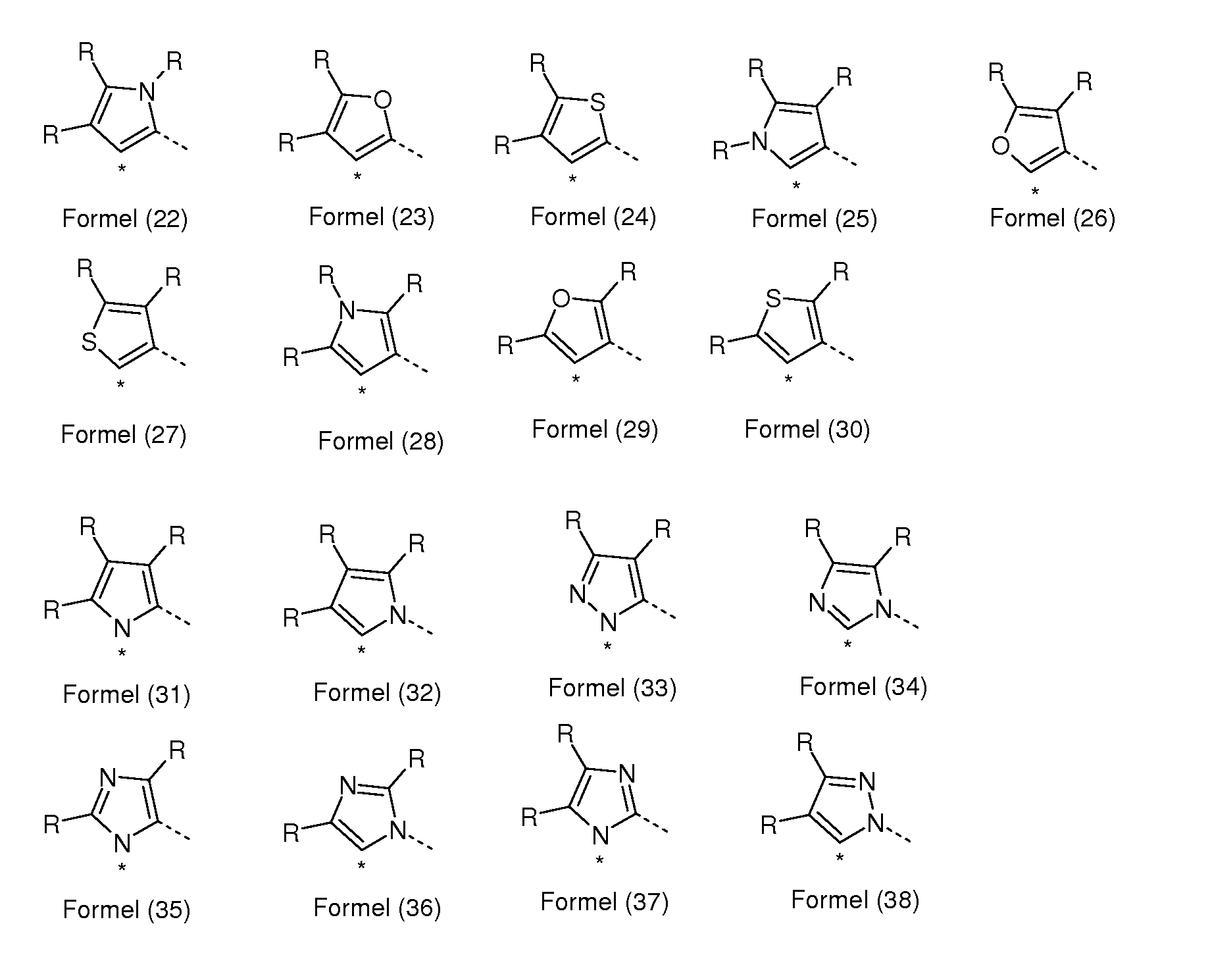
wobei die Symbole die oben genannten Bedeutungen aufweisen. where the symbols have the meanings given above.
Besonders bevorzugt sind die Sechsring-Aromaten und -Heteroaromaten der oben abgebildeten Formeln (14) bis (18). Ganz besonders bevorzugt ist ortho-Phenylen, also eine Gruppe der oben genannten Formel (14). Dabei können auch benachbarte Substituenten R miteinander ein Ring- system bilden, so dass kondensierte Strukturen, auch kondensierte Aryl- und Heteroarylgruppen, wie beispielsweise Naphthalin, Chinolin, Benz- imidazol, Carbazol, Dibenzofuran oder Dibenzothiophen, entstehen können. Eine solche Ringbildung ist im Folgenden schematisch an Gruppen der oben genannten Formel (14) aufgeführt, was beispielsweise zu Gruppen der folgenden Formeln (14a) bis (14j) führen kann, Particularly preferred are the six-membered aromatic and heteroaromatic compounds of formulas (14) to (18) depicted above. Very particular preference is given to ortho-phenylene, ie a group of the abovementioned formula (14). In this case, adjacent substituents R can also form a ring system with one another, so that condensed structures, including condensed aryl and heteroaryl groups, such as, for example, naphthalene, quinoline, benzimidazole, carbazole, dibenzofuran or dibenzothiophene, can be formed. Such a ring formation is shown schematically below in groups of the abovementioned formula (14), which may, for example, lead to groups of the following formulas (14a) to (14j),

wobei die Symbole die oben genannten Bedeutungen aufweisen. where the symbols have the meanings given above.
Generell können die ankondensierten Gruppen an jeder Position der Ein- heit gemäß Formel (4) ankondensiert sein, wie durch die ankondensierte Benzogruppe in den Formeln (14a) bis (14c) dargestellt. Die Gruppen, wie sie in den Formeln (14d) bis (14j) an die Einheit der Formel (4) ankonden- siert sind, können daher auch an anderen Positionen der Einheit der Formel (4) ankondensiert werden. In general, the fused-on groups may be fused at any position of the unit according to formula (4), as represented by the fused benzo group in formulas (14a) to (14c). The groups as condensed in the formulas (14d) to (14j) to the unit of the formula (4) can therefore also be condensed at other positions of the unit of the formula (4).
Die Gruppe der Formel (2) kann besonders bevorzugt durch die folgenden Formeln (2a) bis (2m) dargestellt werden, und die Gruppe der Formel (3) kann besonders bevorzugt durch die folgenden Formeln (3a) bis (3m) dargestellt werden,
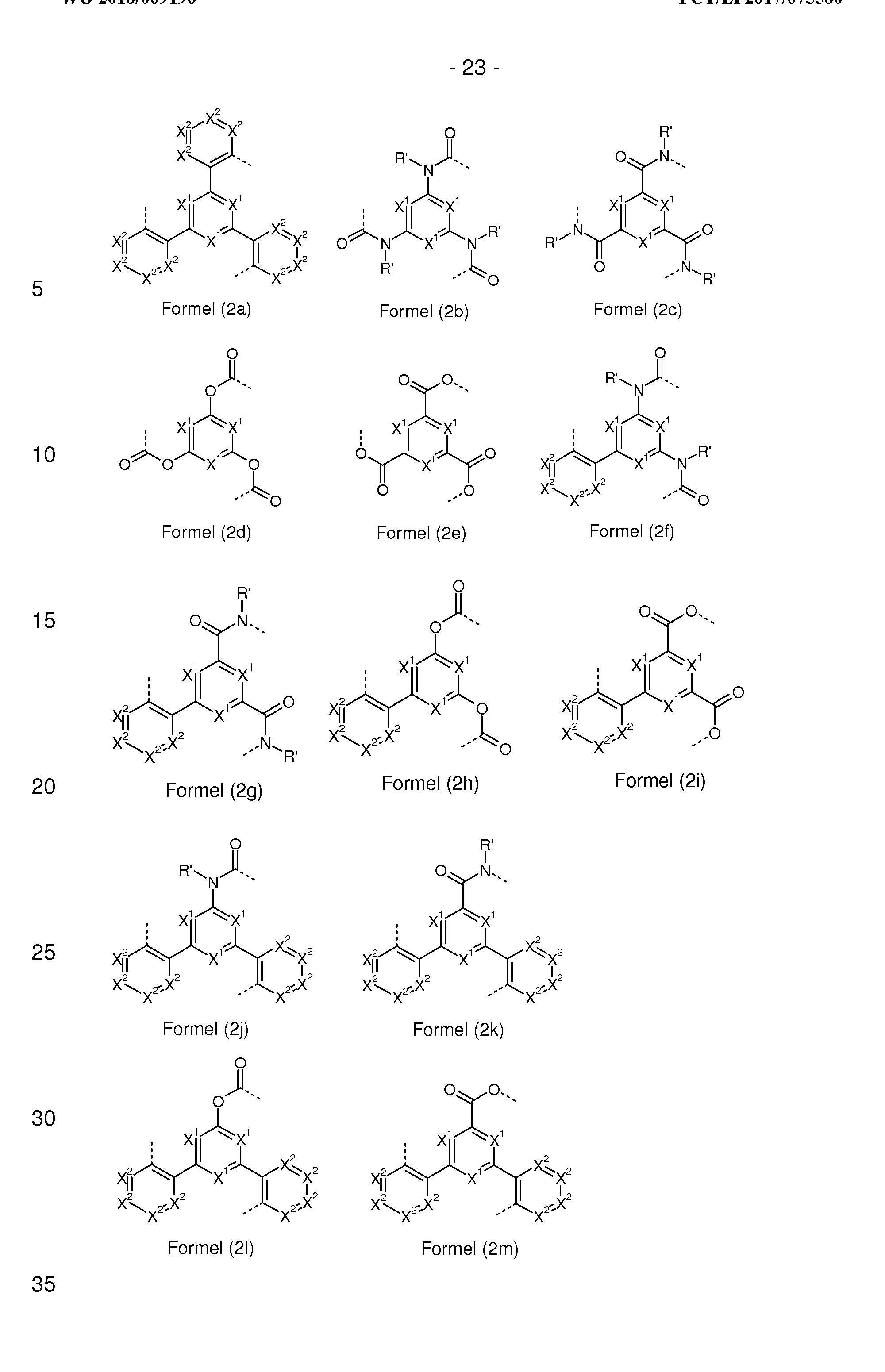

In einer bevorzugten Ausführungsform der Erfindung ist die Gruppe der Formeln (2a) bis (2m) ausgewählt aus den Gruppen der Formeln (5a') bis (5m') und die Gruppe der Formel (3a) bis (3m) aus den Gruppen der Formeln (9a') bis (9m'), In a preferred embodiment of the invention, the group of formulas (2a) to (2m) is selected from the groups of formulas (5a ') to (5m') and the group of formula (3a) to (3m) from the groups of the formulas (9a ') to (9m'),


wobei die Symbole die oben genannten Bedeutungen aufweisen. Bevor- zugt steht X2 gleich oder verschieden bei jedem Auftreten für CR. where the symbols have the meanings given above. Preferably, X 2 is the same or different at each occurrence for CR.
Eine besonders bevorzugte Ausführungsform der Gruppe der Formel (2) ist die Gruppe der folgenden Formel (5a"), A particularly preferred embodiment of the group of the formula (2) is the group of the following formula (5a "),
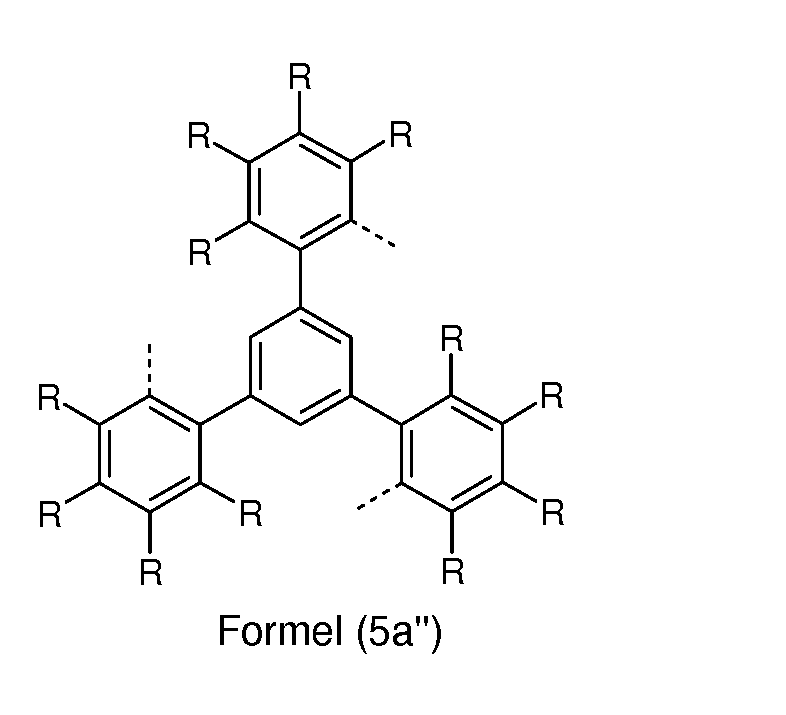
wobei die Symbole die oben genannten Bedeutungen aufweisen. where the symbols have the meanings given above.
Besonders bevorzugt sind die Gruppen R in den oben genannten Formeln gleich oder verschieden H, D oder eine Alkylgruppe mit 1 bis 4 C-Atomen. Ganz besonders bevorzugt ist R = H. Ganz besonders bevorzugt ist also die Struktur der folgenden Formeln (5a'"), The groups R in the abovementioned formulas are particularly preferably the same or different and are H, D or an alkyl group having 1 to 4 C atoms. Very particular preference is given to R = H. The structure of the following formulas (5a '") is therefore very particularly preferred,

wobei die Symbole die oben genannten Bedeutungen aufweisen. where the symbols have the meanings given above.
Im Folgenden werden die bidentaten, monoanionischen Teilliganden L beschrieben. Die Teilliganden L können gleich oder verschieden sein. Dabei ist es bevorzugt, wenn jeweils die beiden Teilliganden L, die an dasselbe Metall M koordinieren, gleich sind und auch gleich substituiert sind. Diese Bevorzugung ist durch die einfachere Synthese der ent- sprechenden Liganden begründet. The bidentate, monoanionic partial ligands L are described below. The partial ligands L may be the same or different. It is preferred if in each case the two partial ligands L, which coordinate to the same metal M, are the same and also substituted the same. This preference is due to the simpler synthesis of the corresponding ligands.
In einer weiteren bevorzugten Ausführungsform sind alle vier bidentaten Teilliganden L für gleich und sind auch gleich substituiert. In a further preferred embodiment, all four bidentate partial ligands L are the same and are also substituted in the same way.
In einer weiteren bevorzugten Ausführungsform der Erfindung sind die koordinierenden Atome der bidentaten Teilliganden L gleich oder verschie- den bei jedem Auftreten ausgewählt aus C, N, P, O, S und/oder B, besonders bevorzugt C, N und/oder O und ganz besonders bevorzugt C und/oder N. Dabei weisen die bidentaten Teilliganden L bevorzugt einIn a further preferred embodiment of the invention, the coordinating atoms of the bidentate partial ligands L are the same or different at each occurrence selected from C, N, P, O, S and / or B, more preferably C, N and / or O and all C and / or N are particularly preferred. The bidentate partial ligands L are preferred
Kohlenstoffatom und ein Stickstoffatom oder zwei Kohlenstoffatome oder zwei Stickstoffatome oder zwei Sauerstoffatome oder ein Sauerstoffatom und ein Stickstoffatom als koordinierende Atome auf. Dabei können die koordinierenden Atome von jedem der Teilliganden L gleich sein, oder sie können unterschiedlich sein. Bevorzugt weist mindestens einer der beiden bidentaten Teilliganden L, die an dasselbe Metall M koordinieren, ein Kohlenstoffatom und ein Stickstoffatom oder zwei Kohlenstoffatome als koordinierende Atome auf, insbesondere ein Kohlenstoffatom und ein Stickstoffatom. Besonders bevorzugt weisen mindestens alle bidentaten Teilliganden ein Kohlenstoffatom und ein Stickstoffatom oder zwei Kohlen- stoffatome als koordinierende Atome auf, insbesondere ein Kohlenstoff- atom und ein Stickstoffatom. Besonders bevorzugt handelt es sich somit um einen Metallkomplex, in dem alle Teilliganden ortho-metalliert sind, d. h. mit dem Metall M einen Metallacyclus bilden, in dem mindestens eine Metall-Kohlenstoff-Bindung vorliegt. Carbon atom and a nitrogen atom or two carbon atoms or two nitrogen atoms or two oxygen atoms or an oxygen atom and a nitrogen atom as coordinating atoms. Here, the coordinating atoms of each of the partial ligands L may be the same or they may be different. Preferably, at least one of the two bidentate partial ligands L which coordinate to the same metal M has a carbon atom and a nitrogen atom or two carbon atoms as coordinating atoms, in particular a carbon atom and a nitrogen atom. At least all bidentates are particularly preferred Partial ligands comprise a carbon atom and a nitrogen atom or two carbon atoms as coordinating atoms, in particular a carbon atom and a nitrogen atom. Thus, it is particularly preferable that it is a metal complex in which all the partial ligands are ortho-metallated, ie with the metal M form a metallacycle in which there is at least one metal-carbon bond.
Es ist weiterhin bevorzugt, wenn es sich bei dem Metallacyclus, der aus dem Metall M und dem bidentaten Teilliganden L aufgespannt wird, um einen Fünfring handelt, der vor allem dann bevorzugt ist, wenn die koordi- nierenden Atome C und N, N und N oder N und O sind. Wenn es sich bei den koordinierenden Atomen um O handelt, kann auch ein Metallasechs- ring bevorzugt sein. Dies wird im Folgenden schematisch dargestellt: It is further preferred if the metallacycle formed from the metal M and the bidentate partial ligand L is a five-membered ring, which is especially preferred when the coordinating atoms C and N, N and N or N and O are. If the coordinating atoms are O, a metalase ring may also be preferred. This is shown schematically below:
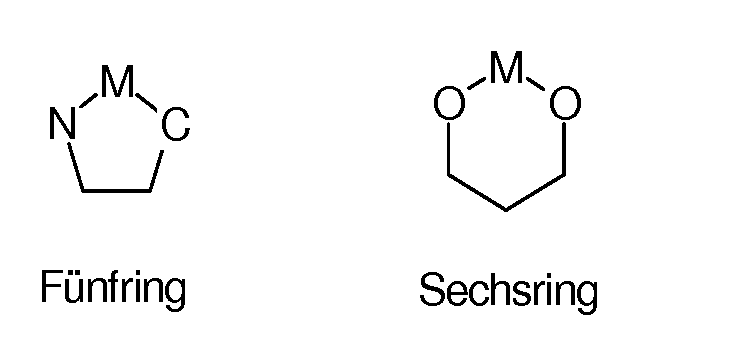
wobei N ein koordinierendes Stickstoffatom, C ein koordinierendes where N is a coordinating nitrogen atom, C is a coordinating
Kohlenstoffatom und O koordinierende Sauerstoffatome darstellen und die eingezeichneten Kohlenstoffatome Atome des bidentaten Teilliganden L darstellen. Represent the carbon atom and O-coordinating oxygen atoms and represent the marked carbon atoms of the bidentate partial ligands L.
In einer bevorzugten Ausführungsform der Erfindung ist mindestens einer der bidentaten Teilliganden L pro Metall M und besonders bevorzugt alle bidentaten Teilliganden gleich oder verschieden bei jedem Auftreten aus- gewählt aus den Strukturen der folgenden Formeln (L-1 ), (L-2) oder (L-3), In a preferred embodiment of the invention, at least one of the bidentate partial ligands L per metal M and particularly preferably all bidentate partial ligands are identical or different at each occurrence selected from the structures of the following formulas (L-1), (L-2) or ( L-3),

CyC ist gleich oder verschieden bei jedem Auftreten eine substituierte oder unsubstituierte Aryl- oder Heteroarylgruppe mit 5 bis 14 aroma- tischen Ringatomen, welche über ein Kohlenstoffatom an M koordi- niert und welche über eine kovalente Bindung mit CyD verbunden ist; CyC is identical or different at each occurrence a substituted or unsubstituted aryl or heteroaryl group having 5 to 14 aromatic ring atoms, which coordinates to M via a carbon atom and which is connected via a covalent bond with CyD;
CyD ist gleich oder verschieden bei jedem Auftreten eine substituierte oder unsubstituierte Heteroarylgruppe mit 5 bis 14 aromatischenCyD is the same or different at each occurrence, a substituted or unsubstituted heteroaryl group having 5 to 14 aromatic
Ringatomen, welche über ein Stickstoffatom oder über ein Carben- Kohlenstoffatom an M koordiniert und welche über eine kovalente Bindung mit CyC verbunden ist; dabei können mehrere der optionalen Substituenten miteinander ein Ring- system bilden; weiterhin sind die optionalen Reste bevorzugt ausgewählt aus den oben genannten Resten R. Ring atoms which coordinate to M via a nitrogen atom or via a carbene carbon atom and which are linked to CyC via a covalent bond; several of the optional substituents can form a ring system with each other; furthermore, the optional radicals are preferably selected from the abovementioned radicals R.
Dabei koordiniert CyD in den Teilliganden der Formeln (L-1 ) und (L-2) bevorzugt über ein neutrales Stickstoffatom oder über ein Carben-Kohlen- stoffatom, insbesondere über ein neutrales Stickstoffatom. Weiterhin bevorzugt koordiniert eine der beiden Gruppen CyD in dem Liganden der Formel (L-3) über ein neutrales Stickstoffatom und und die andere der beiden Gruppen CyD über ein anionisches Stickstoffatom. Weiterhin bevorzugt koordiniert CyC in den Teilliganden der Formeln (L-1 ) und (L-2) über anionische Kohlenstoffatome. In this case, CyD in the part-ligands of the formulas (L-1) and (L-2) preferably coordinates via a neutral nitrogen atom or via a carbene carbon atom, in particular via a neutral nitrogen atom. Further preferably, one of the two groups coordinates CyD in the ligand of formula (L-3) via a neutral nitrogen atom and and the other of the two groups CyD via an anionic nitrogen atom. Furthermore, CyC in the partial ligands of the formulas (L-1) and (L-2) preferably coordinates via anionic carbon atoms.
Wenn mehrere der Substituenten, insbesondere mehrere Reste R, mitein- ander ein Ringsystem bilden, so ist die Bildung eines Ringsystems aus Substituenten, die an direkt benachbarten Kohlenstoff atomen gebunden sind, möglich. Weiterhin ist es auch möglich, dass die Substituenten an CyC und CyD in den Formeln (L-1 ) und (L-2) bzw. die Substituenten an den beiden Gruppen CyD in Formel (L-3) miteinander einen Ring bilden, wodurch CyC und CyD bzw. die beiden Gruppen CyD auch zusammen eine einzige kondensierte Aryl- bzw. Heteroarylgruppe als bidentaten Liganden bilden können. If several of the substituents, in particular a plurality of radicals R, form a ring system with one another, it is possible to form a ring system of substituents which are bonded to directly adjacent carbon atoms. Furthermore, it is also possible that the substituents on CyC and CyD in the formulas (L-1) and (L-2) and the substituents on the two groups CyD in formula (L-3) form a ring with each other, whereby CyC and CyD or the two groups CyD together can form a single fused aryl or heteroaryl group as bidentate ligands.
In einer bevorzugten Ausführungsform der vorliegenden Erfindung ist CyC eine Aryl- oder Heteroarylgruppe mit 6 bis 13 aromatischen Ringatomen, besonders bevorzugt mit 6 bis 10 aromatischen Ringatomen, ganz beson- ders bevorzugt mit 6 aromatischen Ringatomen, insbesondere eine Phenylgruppe, welche über ein Kohlenstoffatom an das Metall koordiniert, welche mit einem oder mehreren Resten R substituiert sein kann und welche über eine kovalente Bindung mit CyD verbunden ist. In a preferred embodiment of the present invention, CyC is an aryl or heteroaryl group having 6 to 13 aromatic ring atoms, particularly preferably having 6 to 10 aromatic ring atoms, very particularly preferably having 6 aromatic ring atoms, in particular a phenyl group which is attached via a carbon atom to the Metal coordinated, which may be substituted by one or more radicals R and which is connected via a covalent bond with CyD.
Bevorzugte Ausführungsformen der Gruppe CyC sind die Strukturen der folgenden Formeln (CyC-1 ) bis (CyC-20), Preferred embodiments of the group CyC are the structures of the following formulas (CyC-1) to (CyC-20),
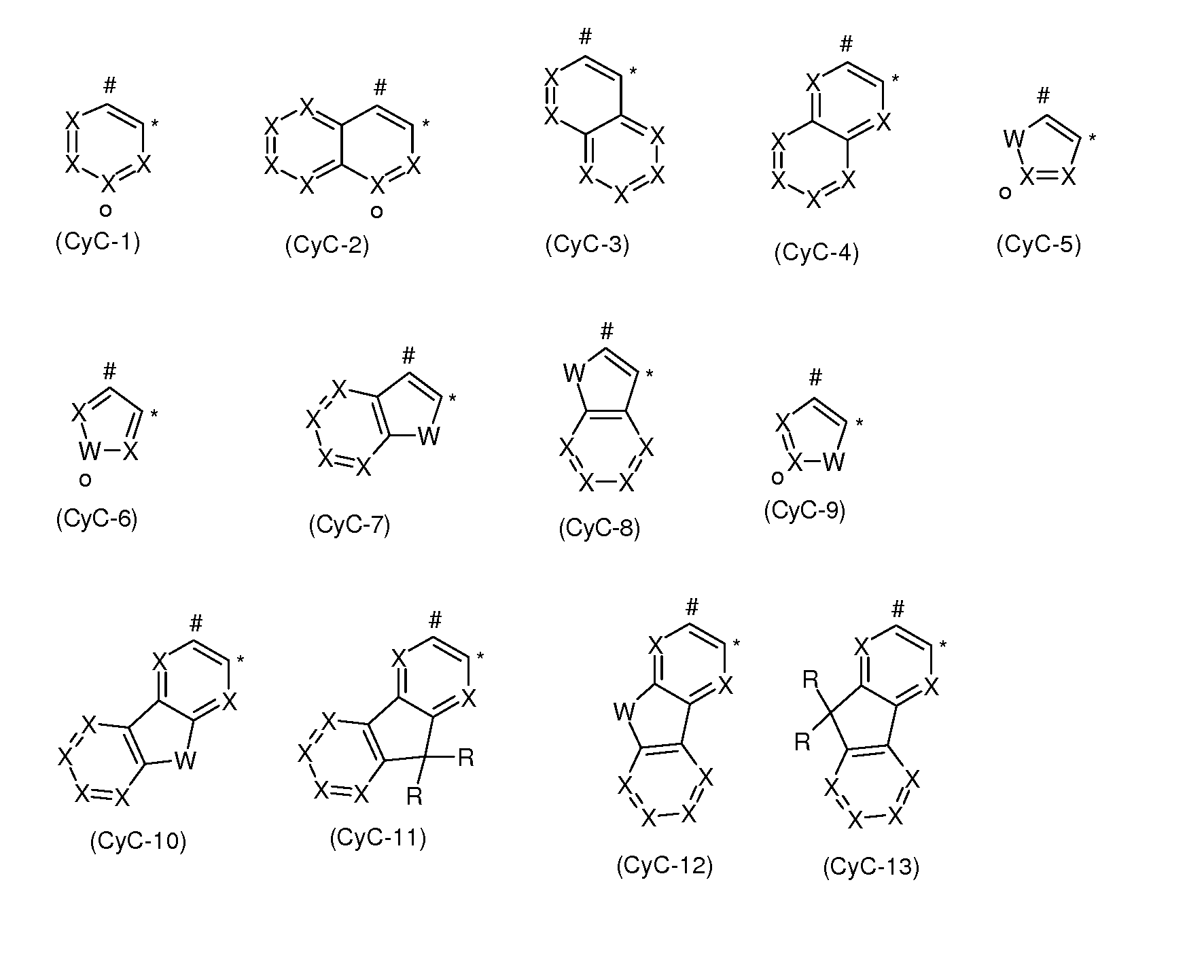

wobei CyC jeweils an der durch # gekennzeichneten Position an CyD bindet und an der durch * gekennzeichneten Position an das Metall koordiniert, R die oben genannten Bedeutungen aufweist und für die weiteren verwendeten Symbole gilt: where CyC binds to CyD at the position indicated by # and coordinates to the metal at the position indicated by * , R has the abovementioned meanings and applies to the other symbols used:
X ist bei jedem Auftreten gleich oder verschieden CR oder N mit der Maßgabe, dass maximal zwei Symbole X pro Cyclus für N stehen; X is the same or different CR or N on each occurrence, with the proviso that at most two symbols X per cycle stand for N;
W ist NR, O oder S; mit der Maßgabe, dass, wenn der Teilligand L über CyC innerhalb der Gruppe der Formel (2) bzw. (3) gebunden ist, ein Symbol X für C steht und die Brücke der Formeln (2) bzw. (3) bzw. die bevorzugten Ausführungs- formen an dieses Kohlenstoffatom gebunden ist. Wenn der Teilligand L über die Gruppe CyC an die Gruppe der Formel (2) bzw. (3) gebunden ist, so erfolgt die Bindung bevorzugt über die mit„o" markierte Position der oben abgebildeten Formeln, so dass dann bevorzugt das mit„o" markierte Symbol X für C steht. Die oben abgebildeten Strukturen, die kein mit„o" markiertes Symbol X enthalten, sind bevorzugt nicht an die Gruppe der Formel (2) bzw. (3) gebunden, da eine solche Bindung an die Brücke aus sterischen Gründen nicht vorteilhaft ist. Bevorzugt stehen insgesamt maximal zwei Symbole X in CyC für N, be- sonders bevorzugt steht maximal ein Symbol X in CyC für N, ganz beson- ders bevorzugt stehen alle Symbole X für CR, mit der Maßgabe, dass, wenn CyC direkt innerhalb der Gruppe der Formel (2) bzw. (3) gebunden ist, ein Symbol X für C steht und die Brücke der Formel (2) bzw. (3) bzw. die bevorzugten Ausführungsformen an dieses Kohlenstoffatom gebunden ist. W is NR, O or S; with the proviso that when the partial ligand L is attached via CyC within the group of formula (2) or (3), a symbol X is C and the bridge of the formulas (2) and (3) and the preferred embodiments is bound to this carbon atom. If the part ligand L is bound via the group CyC to the group of the formula (2) or (3), then the bonding preferably takes place via the position marked "o" of the formulas shown above, so that then preferably with "o marked symbol X stands for C. The structures depicted above, which do not contain an "X" -marked X symbol, are preferably not bound to the group of formula (2) or (3) because such a bond to the bridge is not advantageous for steric reasons. Preferably, a maximum of two symbols X in CyC stands for N, more preferably at most one symbol X in CyC stands for N, very particularly preferably all symbols X stand for CR, with the proviso that if CyC is directly within the group is bound to the formula (2) or (3), a symbol X is C and the bridge of the formula (2) or (3) or the preferred embodiments is bonded to this carbon atom.
Besonders bevorzugte Gruppen CyC sind die Gruppen der folgenden Formeln (CyC-1 a) bis (CyC-20a), Particularly preferred groups CyC are the groups of the following formulas (CyC-1 a) to (CyC-20a),
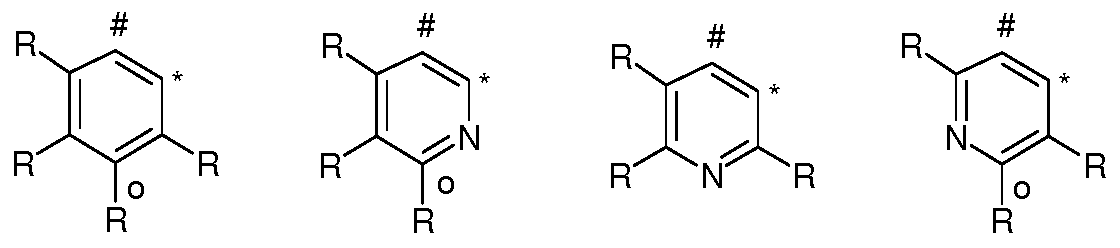
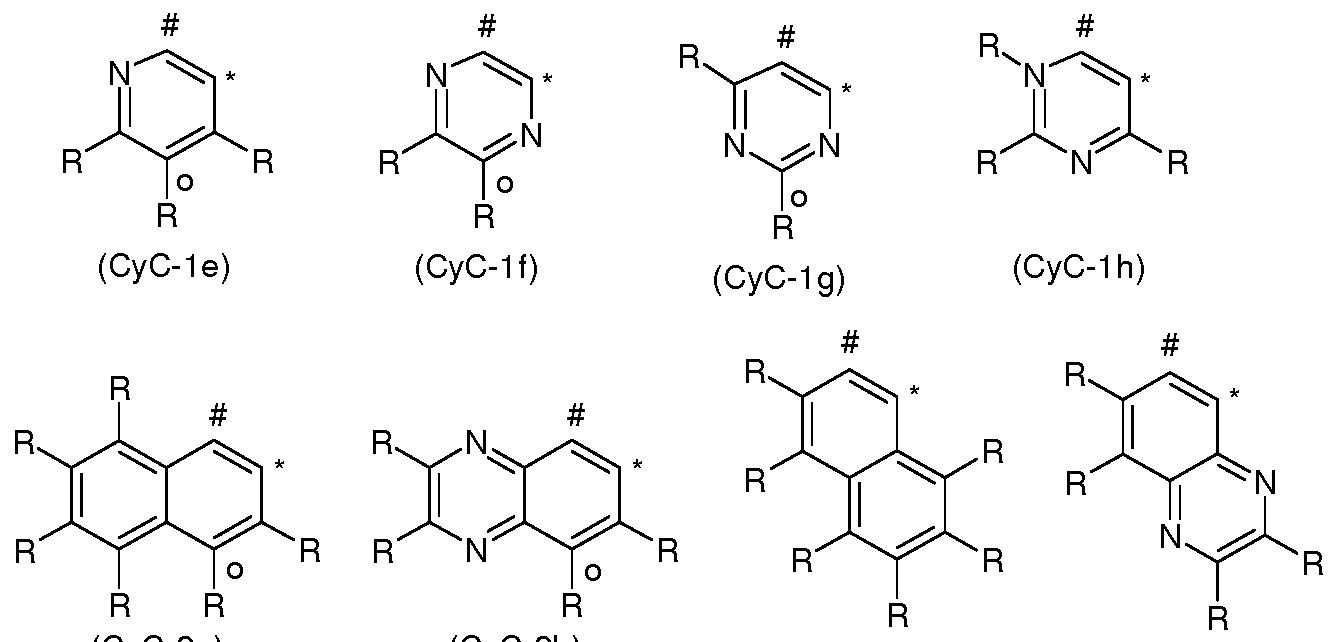
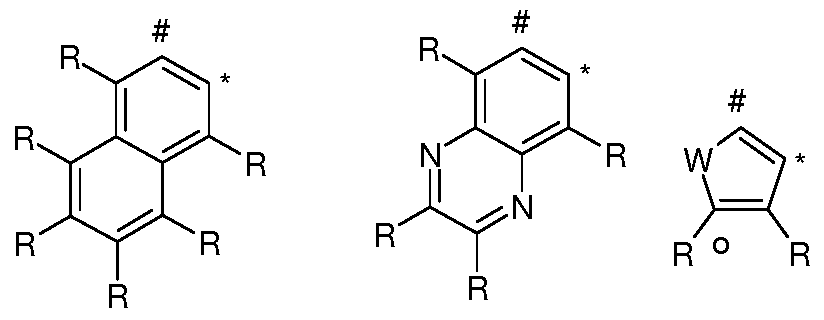


wobei die Symbole die oben genannten Bedeutungen aufweisen und, wenn CyC direkt innerhalb der Gruppe der Formel (2) bzw. (3) gebunden ist, ein Rest R nicht vorhanden ist und die Gruppe der Formel (2) bzw. (3) bzw. die bevorzugten Ausführungsformen an das entsprechende Kohlen- stoffatom gebunden ist. Wenn die Gruppe CyC direkt an die Gruppe der Formel (2) bzw. (3) gebunden ist, so erfolgt die Bindung bevorzugt über die mit„o" markierte Position der oben abgebildeten Formeln, so dass dann bevorzugt in dieser Position der Rest R nicht vorhanden ist. Die oben abgebildeten Strukturen, die kein mit„o" markiertes Kohlenstoffatom enthalten, sind bevorzugt nicht direkt an die Gruppe der Formel (2) bzw. (3) gebunden. where the symbols have the abovementioned meanings and, when CyC is bonded directly within the group of the formula (2) or (3), a radical R is absent and the group of the formula (2) or (3) or the preferred embodiment is bonded to the corresponding carbon atom. If the group CyC is bonded directly to the group of the formula (2) or (3), the bonding preferably takes place via the position marked "o" of the formulas depicted above, such that the radical R preferably does not exist in this position The above-depicted structures which do not contain a carbon atom marked with "o" are preferably not directly bonded to the group of the formula (2) or (3).
Bevorzugte Gruppen unter den Gruppen (CyC-1 ) bis (CyC-20) sind die Gruppen (CyC-1 ), (CyC-3), (CyC-8), (CyC-10), (CyC-1 2), (CyC-13) und (CyC-1 6), und besonders bevorzugt sind die Gruppen (CyC-1 a), (CyC-3a), (CyC-8a), (CyC-10a), (CyC-12a), (CyC-13a) und (CyC-1 6a). Preferred groups among the groups (CyC-1) to (CyC-20) are the groups (CyC-1), (CyC-3), (CyC-8), (CyC-10), (CyC-1 2), (CyC-13) and (CyC-1 6), and particularly preferred are the groups (CyC-1 a), (CyC-3a), (CyC-8a), (CyC-10a), (CyC-12a), (CyC-13a) and (CyC-1 6a).
In einer weiteren bevorzugten Ausführungsform der Erfindung ist CyD eine Heteroarylgruppe 5 bis 13 aromatischen Ringatomen, besonders bevor- zugt mit 6 bis 10 aromatischen Ringatomen, welche über ein neutralesIn a further preferred embodiment of the invention, CyD is a heteroaryl group of 5 to 13 aromatic ring atoms, more preferably having 6 to 10 aromatic ring atoms, which have a neutral
Stickstoffatom oder über ein Carben-Kohlenstoffatom an das Metall koor- diniert und welche mit einem oder mehreren Resten R substituiert sein kann und welche über eine kovalente Bindung mit CyC verbunden ist. Bevorzugte Ausführungsformen der Gruppe CyD sind die Strukturen der folgenden Formeln (CyD-1 ) bis (CyD-14), Coordinates nitrogen atom or via a carbene carbon atom to the metal and which may be substituted by one or more radicals R and which is connected via a covalent bond with CyC. Preferred embodiments of the group CyD are the structures of the following formulas (CyD-1) to (CyD-14),

wobei die Gruppe CyD jeweils an der durch # gekennzeichneten Position an CyC bindet und an der durch * gekennzeichneten Position an das Metall koordiniert und wobei X, W und R die oben genannten Bedeu- tungen aufweisen, mit der Maßgabe, dass, wenn CyD direkt innerhalb der Gruppe der Formel (2) bzw. (3) gebunden ist, ein Symbol X für C steht und die Brücke der Formeln (2) bzw. (3) bzw. die bevorzugten Ausführungs- formen an dieses Kohlenstoffatom gebunden ist. Wenn die Gruppe CyD direkt an die Gruppe der Formel (2) bzw. (3) gebunden ist, so erfolgt die Bindung bevorzugt über die mit„o" markierte Position der oben abgebilde- ten Formeln, so dass dann bevorzugt das mit„o" markierte Symbol X für C steht. Die oben abgebildeten Strukturen, die kein mit„o" markierteswherein the group CyD each binds to CyC at the position indicated by # and coordinates to the metal at the position indicated by * and where X, W and R have the abovementioned meanings, with the proviso that when CyD is directly inside the group of the formula (2) or (3) is bound, a symbol X is C and the bridge of the formulas (2) or (3) or the preferred embodiments is bonded to this carbon atom. If the group CyD is bonded directly to the group of the formula (2) or (3), then the bonding preferably takes place via the position marked "o" of the above-depicted formulas, so that then preferably with "o" marked symbol X stands for C. The structures shown above, not marked with "o"
Symbol X enthalten, sind bevorzugt nicht direkt an die Gruppe der Formel (2) bzw. (3) gebunden, da eine solche Bindung an die Brücke aus sterischen Gründen nicht vorteilhaft ist. Dabei koordinieren die Gruppen (CyD-1 ) bis (CyD-4), (CyD-7) bis Symbol X are preferably not directly bonded to the group of formula (2) or (3), since such a bond to the bridge for steric reasons is not advantageous. The groups (CyD-1) to (CyD-4), (CyD-7) to coordinate
(CyD-10), (CyD-13) und (CyD-14) über ein neutrales Stickstoffatom, (CyD-5) und (CyD-6) über ein Carben-Kohlenstoffatom und (CyD-1 1 ) und (CyD-12) über ein anionisches Stickstoffatom an das Metall. Bevorzugt stehen insgesamt maximal zwei Symbole X in CyD für N, besonders bevorzugt steht maximal ein Symbol X in CyD für N, insbeson- dere bevorzugt stehen alle Symbole X für CR, mit der Maßgabe, dass, wenn CyD direkt innerhalb der Gruppe der Formel (2) bzw. (3) gebunden ist, ein Symbol X für C steht und die Brücke der Formeln (2) bzw. (3) bzw. die bevorzugten Ausführungsformen an dieses Kohlenstoffatom gebunden ist. (CyD-10), (CyD-13) and (CyD-14) via a neutral nitrogen atom, (CyD-5) and (CyD-6) via a carbene carbon atom and (CyD-1 1) and (CyD-12 ) via an anionic nitrogen atom to the metal. Preferably, a maximum of two symbols X in CyD stands for N, more preferably at most one symbol X in CyD stands for N, in particular preferably all symbols X stand for CR, with the proviso that, if CyD directly within the group of formula ( 2) or (3) is attached, an X symbol is C and the bridge of the formulas (2) or (3) or the preferred embodiments is bonded to this carbon atom.
Besonders bevorzugte Gruppen CyD sind die Gruppen der folgenden Formeln (CyD-1 a) bis (CyD-14b), Particularly preferred groups CyD are the groups of the following formulas (CyD-1 a) to (CyD-14b),


Bevorzugte Gruppen unter den Gruppen (CyD-1 ) bis (CyD-14) sind die Gruppen (CyD-1 ), (CyD-2), (CyD-3), (CyD-4), (CyD-5) und (CyD-6), insbesondere (CyD-1 ), (CyD-2) und (CyD-3), und besonders bevorzugt sind die Gruppen (CyD-1 a), (CyD-2a), (CyD-3a), (CyD-4a), (CyD-5a) und (CyD-6a), insbesondere (CyD-1 a), (CyD-2a) und (CyD-3a). ln einer bevorzugten Ausführungsform der vorliegenden Erfindung ist CyC eine Aryl- oder Heteroarylgruppe mit 6 bis 13 aromatischen Ringatomen, und gleichzeitig ist CyD eine Heteroarylgruppe mit 5 bis 13 aromatischen Ringatomen. Besonders bevorzugt ist CyC eine Aryl- oder Heteroaryl- gruppe mit 6 bis 10 aromatischen Ringatomen, und gleichzeitig ist CyD eine Heteroarylgruppe mit 5 bis 10 aromatischen Ringatomen. Ganz besonders bevorzugt ist CyC eine Aryl- oder Heteroarylgruppe mit 6 aromatischen Ringatomen, insbesondere Phenyl, und CyD eine Hetero- arylgruppe mit 6 bis 10 aromatischen Ringatomen. Dabei können CyC und CyD mit einem oder mehreren Resten R substituiert sein. Preferred groups among the groups (CyD-1) to (CyD-14) are the groups (CyD-1), (CyD-2), (CyD-3), (CyD-4), (CyD-5) and ( CyD-6), in particular (CyD-1), (CyD-2) and (CyD-3), and particularly preferably the groups (CyD-1a), (CyD-2a), (CyD-3a), ( CyD-4a), (CyD-5a) and (CyD-6a), in particular (CyD-1a), (CyD-2a) and (CyD-3a). In a preferred embodiment of the present invention, CyC is an aryl or heteroaryl group having 6 to 13 aromatic ring atoms, and at the same time CyD is a heteroaryl group having 5 to 13 aromatic ring atoms. More preferably, CyC is an aryl or heteroaryl group having 6 to 10 aromatic ring atoms, and at the same time, CyD is a heteroaryl group having 5 to 10 aromatic ring atoms. Most preferably, CyC is an aryl or heteroaryl group having 6 aromatic ring atoms, in particular phenyl, and CyD is a heteroaryl group having 6 to 10 aromatic ring atoms. In this case, CyC and CyD may be substituted by one or more radicals R.
Die oben genannten bevorzugten Gruppen (CyC-1 ) bis (CyC-20) und (CyD-1 ) bis (CyD-14) können in den Teilliganden der Formeln (L-1 ) und (L-2) beliebig miteinander kombiniert werden, sofern mindestens eine der Gruppen CyC bzw. CyD eine geeignete Anknüpfungsstelle an die Gruppe der Formel (2) bzw. (3) aufweist, wobei geeignete Anknüpfungsstellen in den oben genannten Formeln mit„o" gekennzeichnet sind. Insbesondere bevorzugt ist es, wenn die oben als besonders bevorzugt genannten Gruppen CyC und CyD, also die Gruppen der Formeln (CyC-1 a) bis (CyC- 20a) und die Gruppen der Formeln (CyD1 -a) bis (CyD-14b) miteinander kombiniert werden, sofern mindestens eine der bevorzugten Gruppen CyC bzw. CyD eine geeignete Anknüpfungsstelle an die Gruppe der Formel (2) bzw. (3) aufweist, wobei geeignete Anknüpfungsstellen in den oben ge- nannten Formeln mit„o" gekennzeichnet sind. Kombinationen, in denen weder CyC noch CyD eine solche geeignete Anknüpfungsstelle an die Brücke der Formel (2) bzw. (3) aufweist, sind daher nicht bevorzugt. The above preferred groups (CyC-1) to (CyC-20) and (CyD-1) to (CyD-14) can be arbitrarily combined with each other in the partial ligands of the formulas (L-1) and (L-2), if at least one of the groups CyC or CyD has a suitable point of attachment to the group of the formula (2) or (3), suitable attachment sites in the abovementioned formulas being denoted by "o." It is particularly preferred if the above CyC and CyD groups mentioned as being particularly preferred, ie the groups of the formulas (CyC-1 a) to (CyC-20a) and the groups of the formulas (CyD1-a) to (CyD-14b), are combined with one another if at least one of the groups preferred groups CyC or CyD has a suitable attachment site to the group of the formula (2) or (3), wherein suitable attachment sites in the above-mentioned formulas are marked with "o". Combinations in which neither CyC nor CyD has such a suitable attachment site to the bridge of the formula (2) or (3) are therefore not preferred.
Ganz besonders bevorzugt ist es, wenn eine der Gruppen (CyC-1 ), (CyC-3), (CyC-8), (CyC-10), (CyC-12), (CyC-13) und (CyC-1 6), und insbe- sondere die Gruppen (CyC-1 a), (CyC-3a), (CyC-8a), (CyC-10a), It is most preferred that one of the groups (CyC-1), (CyC-3), (CyC-8), (CyC-10), (CyC-12), (CyC-13) and (CyC-1 6), and in particular the groups (CyC-1 a), (CyC-3a), (CyC-8a), (CyC-10a),
(CyC-12a), (CyC-13a) und (CyC-1 6a), mit einer der Gruppen (CyD-1 ), (CyD-2) und (CyD-3), und insbesondere mit einer der Gruppen (CyD-1 a), (CyD-2a) und (CyD-3a), kombiniert wird. Bevorzugte Teilliganden (L-1 ) sind die Strukturen der folgenden Formeln (L-1 -1 ) und (L-1 -2), und bevorzugte Teilliganden (L-2) sind die Strukturen der folgenden Formeln (L-2-1 ) bis (L-2-3), (CyC-12a), (CyC-13a) and (CyC-1 6a), with one of the groups (CyD-1), (CyD-2) and (CyD-3), and in particular with one of the groups (CyD-1) 1 a), (CyD-2a) and (CyD-3a) is combined. Preferred partial ligands (L-1) are the structures of the following formulas (L-1 -1) and (L-1 -2), and preferred partial ligands (L-2) are the structures of the following formulas (L-2-1) to (L-2-3),
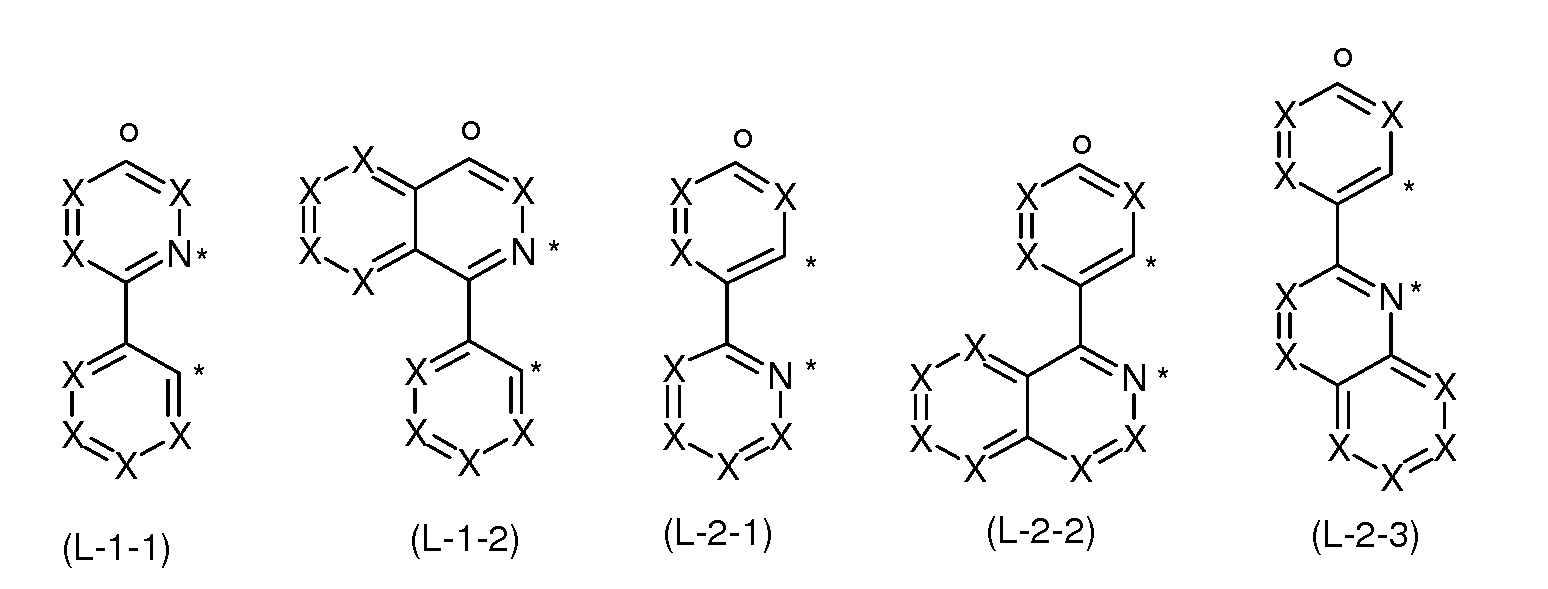
Besonders bevorzugte Teilliganden (L-1 ) sind die Strukturen der folgen- den Formeln (L-1 -1 a) und (L-1 -2b), und besonders bevorzugte Teilligan- den (L-2) sind die Strukturen der folgenden Formeln (L-2-1 a) bis (L-2-3a), Particularly preferred partial ligands (L-1) are the structures of the following formulas (L-1 -1 a) and (L-1 -2b), and particularly preferred partial ligands (L-2) are the structures of the following formulas (L-2-1 a) to (L-2-3a),

Ebenso können die oben genannten bevorzugten Gruppen CyD in den Teilliganden der Formel (L-3) beliebig miteinander kombiniert werden, wobei eine neutrale Gruppe CyD, also eine Gruppe (CyD-1 ) bis (CyD-10), (CyD-13) oder (CyD-14), mit einer anionischen Gruppe CyD, also einer Gruppe (CyD-1 1 ) oder CyD-12) kombiniert wird, sofern mindestens eine der bevorzugten Gruppen CyD eine geeignete Anknüpfungsstelle an die Gruppe der Formel (2) bzw. (3) aufweist, wobei geeignete Anknüpfungs- stellen in den oben genannten Formeln mit„o" gekennzeichnet sind. Likewise, the above-mentioned preferred groups CyD in the partial ligands of the formula (L-3) may be combined with each other as desired, wherein a neutral group CyD, that is, a group (CyD-1) to (CyD-10), (CyD-13) or (CyD-14) is combined with an anionic group CyD, ie a group (CyD-1 1) or CyD-12), if at least one of the preferred groups CyD is a suitable attachment site to the group of the formula (2) or ( 3), wherein suitable Anknüpfungs- in the above formulas with "o" are marked.
Wenn zwei Reste R, von denen einer an CyC und der andere an CyD in den Formeln (L-1 ) und (L-2) gebunden sind bzw. von denen einer an die eine Gruppe CyD und der andere an die andere Gruppe CyD in Formel (L-3) gebunden sind, miteinander ein aromatisches Ringsystem bilden, können sich überbrückte Teilliganden und auch Teilliganden ergeben, die insgesamt eine einzige größere Heteroarylgruppe darstellen, wie bei- spielsweise Benzo[h]chinolin, etc.. Die Ringbildung zwischen den Substi- tuenten an CyC und CyD in den Formeln (L-1 ) und (L-2) bzw. zwischen den Substituenten an den beiden Gruppen CyD in Formel (L-3) erfolgt dabei bevorzugt durch eine Gruppe gemäß einer der folgenden Formeln (39) bis (48), When two R radicals, one linked to CyC and the other to CyD in formulas (L-1) and (L-2), one of which is attached to one group CyD and the other to the other group CyD in Formula (L-3) are bonded together form an aromatic ring system, bridged part ligands and also partial ligands can result, which represent a single larger heteroaryl group, such as benzo [h] quinoline, etc .. The ring formation between the substituents - Tuent on CyC and CyD in the formulas (L-1) and (L-2) or between the substituents on the two groups CyD in formula (L-3) is preferably carried out by a group according to one of the following formulas (39 ) to (48),

Dabei ist die Gruppe der Formel (45) besonders dann bevorzugt, wenn sich dadurch die Ringbildung zu einem Sechsring ergibt, wie beispiels- weise unten durch die Formeln (L-22) und (L-23) dargestellt. In this case, the group of the formula (45) is particularly preferred if the ring formation thereby results in a six-membered ring, as shown for example below by the formulas (L-22) and (L-23).
Bevorzugte Liganden, die durch Ringbildung zweier Reste R an den unterschiedlichen Cyclen entstehen, sind die im Folgenden aufgeführten Strukturen der Formeln (L-4) bis (L-31 ), Preferred ligands which are formed by ring formation of two radicals R at the different cycles are the structures of the formulas (L-4) to (L-31) listed below,

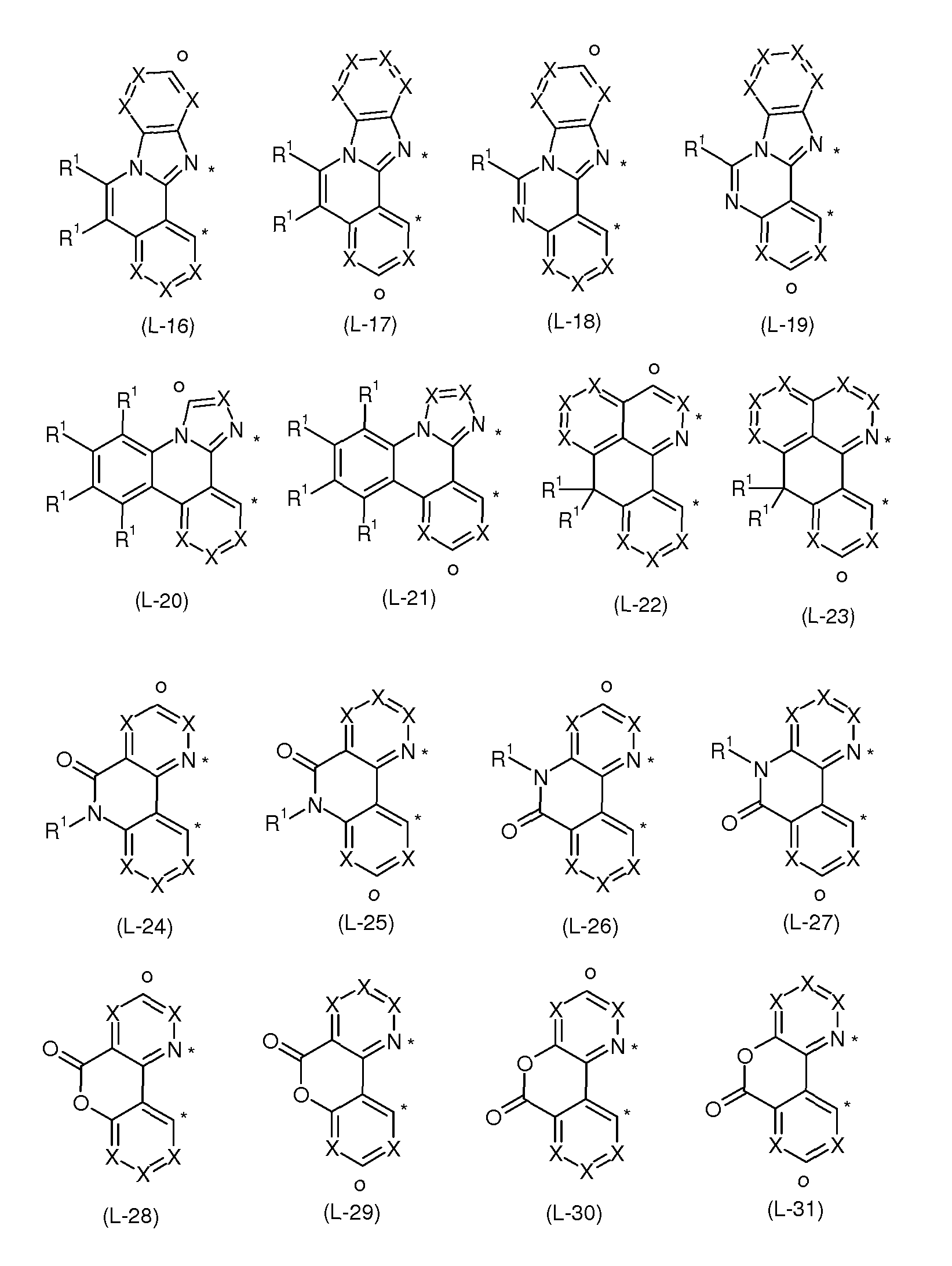
wobei die verwendeten Symbole die oben genannten Bedeutungen auf¬ weisen und„o" die Position angibt, an denen dieser Teilligand mit der Gruppe der Formel (2) bzw. (3) verknüpft ist. In einer bevorzugten Ausführungsform der Teilliganden der Formeln (L-4) bis (L-31 ) steht insgesamt ein Symbol X für N und die anderen Symbole X stehen für CR, oder alle Symbole X stehen für CR. where the symbols used have the meanings given above on ¬ and "o" indicates the position in which this part-ligand with the group of the formula (2) or (3) is associated. In a preferred embodiment of the partial ligands of the formulas (L-4) to (L-31), a total of one symbol X stands for N and the other symbols X stand for CR, or all the symbols X stand for CR.
In einer weiteren Ausführungsform der Erfindung ist es bevorzugt, falls in den Gruppen (CyC-1 ) bis (CyC-20) oder (CyD-1 ) bis (CyD-14) oder in den Teilliganden (L-1 -1 ) bis (L-2-3), (L-4) bis (L-31 ) eines der Atome X für N steht, wenn benachbart zu diesem Stickstoffatom eine Gruppe R als Sub- stituent gebunden ist, welche ungleich Wasserstoff oder Deuterium ist. Dies gilt analog für die bevorzugten Strukturen (CyC-1 a) bis (CyC-20a) oder (CyD-1 a) bis (CyD-14b), in denen bevorzugt benachbart zu einem nicht koordinierenden Stickstoffatom eine Gruppe R als Substituent gebunden ist, welche ungleich Wasserstoff oder Deuterium ist. Dabei ist dieser Substituent R bevorzugt eine Gruppe, ausgewählt aus CF3, OR1 wobei R1 für eine Alkylgruppe mit 1 bis 10 C-Atomen steht, Alkylgruppen mit 1 bis 10 C-Atomen, insbesondere verzweigten oder cyclischen Alkyl- gruppen mit 3 bis 10 C-Atomen, einer Dialkylaminogruppe mit 2 bis 10 C- Atomen, aromatischen bzw. heteroaromatischen Ringsystemen oder Aralkyl- bzw. Heteroaralkylgruppen. Es handelt sich bei diesen Gruppen um sterisch anspruchsvolle Gruppen. Weiterhin bevorzugt kann dieser Rest R auch mit einem benachbarten Rest R einen Cyclus bilden. In a further embodiment of the invention it is preferred, if in the groups (CyC-1) to (CyC-20) or (CyD-1) to (CyD-14) or in the partial ligands (L-1 -1) to ( L-2-3), (L-4) to (L-31) is one of the atoms X for N, when adjacent to this nitrogen atom, a group R is bound as a substituent, which is not hydrogen or deuterium. This applies analogously to the preferred structures (CyC-1 a) to (CyC-20a) or (CyD-1 a) to (CyD-14b) in which preferably adjacent to a non-coordinating nitrogen atom, a group R is bonded as a substituent, which is not hydrogen or deuterium. In this case, this substituent R is preferably a group selected from CF 3, OR 1 where R 1 is an alkyl group having 1 to 10 carbon atoms, alkyl groups having 1 to 10 carbon atoms, in particular branched or cyclic alkyl groups having 3 to 10 C atoms, a dialkylamino group having 2 to 10 C atoms, aromatic or heteroaromatic ring systems or aralkyl or heteroaralkyl groups. These groups are sterically demanding groups. Furthermore, this radical R can also form a cycle with an adjacent radical R.
Ein weiterer geeigneter bidentater Teilligand ist der Teilligand der folgenden Formeln (L-32) oder (L-33), Another suitable bidentate part ligand is the part ligand of the following formulas (L-32) or (L-33),

X ist bei jedem Auftreten gleich oder verschieden CR oder N mit der Maßgabe, dass maximal ein Symbol X pro Cyclus für N steht und weiterhin mit der Maßgabe, dass ein Symbol X für C steht und der Teilligand über dieses Kohlenstoffatom innerhalb der Gruppe der Formel (2) bzw. (3) gebunden sind. X is the same or different CR or N on each occurrence, with the proviso that at most one symbol X per cycle stands for N and furthermore with the proviso that a symbol X stands for C and the partial ligand over this carbon atom within the group of the formula ( 2) or (3) are bound.
Wenn zwei Reste R, die in den Teilliganden (L-32) bzw. (L-33) an benach- barten Kohlenstoffatomen gebunden sind, miteinander einen aroma- tischen Cyclus bilden, so ist dieser zusammen mit den beiden benach- barten Kohlenstoffatomen bevorzugt eine Struktur der folgenden Formel (49), If two radicals R, which are bonded to the adjacent carbon atoms in the partial ligands (L-32) or (L-33), together form an aromatic cycle, this together with the two adjacent carbon atoms is preferably one Structure of the following formula (49),

wobei die gestrichelten Bindungen die Verknüpfung dieser Gruppe im Teilliganden symbolisieren und Y gleich oder verschieden bei jedem Auf- treten für CR1 oder N steht und bevorzugt maximal ein Symbol Y für N steht. In einer bevorzugten Ausführungsform des Teilliganden (L-32) bzw. (L-33) ist maximal eine Gruppe der Formel (50) vorhanden. In einer bevorzugten Ausführungsform der Erfindung stehen im Teilliganden der Formel (L-32) und (L-33) insgesamt 0, 1 oder 2 der Symbole X und, falls vorhanden, Y für N. Besonders bevorzugt stehen insgesamt 0 oder 1 der Symbole X und, falls vorhanden, Y für N. wherein the dashed bonds symbolize the linking of this group in the partial ligands and Y is identical or different at each occurrence for CR 1 or N, and preferably at most one symbol Y stands for N. In a preferred embodiment of the partial ligand (L-32) or (L-33), a maximum of one group of the formula (50) is present. In a preferred embodiment of the invention, in the partial ligands of the formulas (L-32) and (L-33) a total of 0, 1 or 2 of the symbols X and, if present, Y is N. Particular preference is given to a total of 0 or 1 of the symbols X and, if present, Y for N.
Weitere geeignete bidentate Teilliganden sind die Strukturen der folgen- den Formeln (L-34) bis (L-38), wobei bevorzugt maximal eine der beiden bidentaten Teilliganden L pro Metall für eine dieser Strukturen steht, Further suitable bidentate partial ligands are the structures of the following formulas (L-34) to (L-38), where preferably at most one of the two bidentate partial ligands L per metal represents one of these structures,

Die oben ausgeführten bevorzugten Ausführungsformen für X sind auch bevorzugt für die Teilliganden der Formeln (L-34) bis (L-36). The preferred embodiments of X set forth above are also preferred for the partial ligands of formulas (L-34) to (L-36).
Bevorzugte Teilliganden der Formeln (L-34) bis (L-36) sind daher die Teil- liganden der folgenden Formeln (L-34a) bis (L-36a), Preferred partial ligands of the formulas (L-34) to (L-36) are therefore the partial ligands of the following formulas (L-34a) to (L-36a),

wobei die verwendeten Symbole die oben genannten Bedeutungen auf- weisen und„o" die Position angibt, über die der Teilligand L mit der Gruppe der Formel (2) bzw. (3) verknüpft ist. where the symbols used have the abovementioned meanings and "o" indicates the position via which the partial ligand L is linked to the group of the formula (2) or (3).
Besonders bevorzugt steht in diesen Formeln R für Wasserstoff, wobei„o" die Position angibt, über die der Teilligand L innerhalb der Gruppe der Formel (2) bzw. (3) bzw. den bevorzugten Ausführungsformen verknüpft ist, so dass es sich um die Strukturen der folgenden Formeln (L-34b) bis (L-36b) handelt, Particularly preferred in these formulas R is hydrogen, where "o" indicates the position over which the partial ligand L is linked within the group of the formula (2) or (3) or the preferred embodiments is such that they are the structures of the following formulas (L-34b) to (L-36b),

Im Folgenden werden bevorzugte Substituenten beschrieben, wie sie an den oben beschriebenen Teilliganden, aber auch an A, wenn A für eine Gruppe der Formel (4) steht, vorliegen können. In the following, preferred substituents are described, as may be present on the partial ligands described above, but also on A, when A is a group of the formula (4).
In einer bevorzugten Ausführungsform der Erfindung enthält die erfin- dungsgemäße Verbindung zwei Substituenten R, die an benachbarte Kohlenstoffatome gebunden sind und die miteinander einen aliphatischen Ring gemäß einer der nachfolgend beschriebenen Formeln bilden. Dabei können die beiden Substituenten R, die diesen aliphatischen Ring bilden, an der Brücke der Formeln (2) bzw. (3) bzw. den bevorzugten Aus- führungsformen vorliegen und/oder an einem oder mehreren der biden- taten Teilliganden L vorliegen. Der aliphatische Ring, der durch die Ring- bildung von zwei Substituenten R miteinander gebildet wird, wird bevor- zugt durch eine der folgenden Formeln (50) bis (56) beschrieben, In a preferred embodiment of the invention, the compound according to the invention contains two substituents R which are bonded to adjacent carbon atoms and together form an aliphatic ring according to one of the formulas described below. In this case, the two substituents R which form this aliphatic ring can be present on the bridge of the formulas (2) or (3) or the preferred embodiments and / or can be present on one or more of the bidected partial ligands L. The aliphatic ring formed by the ring formation of two substituents R together is preferably described by one of the following formulas (50) to (56).

Z2 ist C(R1)2, O, S, NR3 oder C(=O); ist eine Alkylengruppe mit 1 , 2 oder 3 C-Atomen, welche mit einem oder mehreren Resten R2 substituiert sein kann, -CR2=CR2- oder eine ortho-verknüpfte Arylen- oder Heteroarylengruppe mit 5 bis 14 aromatischen Ringatomen, welche durch einen oder mehrere Reste R2 substituiert sein kann; ist gleich oder verschieden bei jedem Auftreten H, F, eine gerad- kettige Alkyl- oder Alkoxygruppe mit 1 bis 10 C-Atomen, eine ver- zweigte oder cyclische Alkyl- oder Alkoxygruppe mit 3 bis 10 C- Atomen, wobei die Alkyl- oder Alkoxygruppe jeweils mit einem oder mehreren Resten R2 substituiert sein kann, wobei eine oder mehrere nicht benachbarte CH2-Gruppen durch R2C=CR2, C^C, Si(R2)2, C=O, NR2, O, S oder CONR2 ersetzt sein können, oder ein aromatisches oder heteroaromatisches Ringsystem mit 5 bis 24 aromatischen Ringatomen, das jeweils durch einen oder mehrere Reste R2 substituiert sein kann, oder eine Aryloxy- oder Heteroaryl- oxygruppe mit 5 bis 24 aromatischen Ringatomen, die durch einen oder mehrere Reste R2 substituiert sein kann; dabei können zwei Reste R3, welche an dasselbe Kohlenstoffatom gebunden sind, miteinander ein aliphatisches oder aromatisches Ringsystem bilden und so ein Spirosystem aufspannen; weiterhin kann R3 mit einem benachbarten Rest R oder R1 ein aliphatisches Ringsystem bilden; mit der Maßgabe, dass in diesen Gruppen nicht zwei Heteroatome direkt aneinander gebunden sind und nicht zwei Gruppen C=O direkt aneinander gebunden sind. In einer bevorzugten Ausführungsform der Erfindung ist R3 ungleich H. Z 2 is C (R 1 ) 2 , O, S, NR 3 or C (= O); is an alkylene group having 1, 2 or 3 C atoms, which may be substituted by one or more R 2 radicals, -CR 2 = CR 2 - or an ortho-linked arylene or heteroarylene group having 5 to 14 aromatic ring atoms, which by one or more radicals R 2 may be substituted; is identical or different at each occurrence H, F, a straight-chain alkyl or alkoxy group having 1 to 10 carbon atoms, a branched or cyclic alkyl or alkoxy group having 3 to 10 carbon atoms, wherein the alkyl or Alkoxy group may each be substituted by one or more R 2 radicals, one or more non-adjacent CH 2 groups denoted by R 2 C =CR 2 , C 1 -C 4, Si (R 2 ) 2, C =O, NR 2 , O, S or CONR 2 may be replaced, or an aromatic or heteroaromatic ring system having 5 to 24 aromatic ring atoms, each of which may be substituted by one or more radicals R 2 , or an aryloxy or heteroaryl oxygruppe having 5 to 24 aromatic ring atoms, the may be substituted by one or more radicals R 2 ; In this case, two radicals R 3 , which are bonded to the same carbon atom, together form an aliphatic or aromatic ring system and thus form a spiro system; Furthermore, R 3 can form an aliphatic ring system with an adjacent radical R or R 1 ; with the proviso that in these groups not two heteroatoms are directly attached to each other and not two groups C = O are directly attached to each other. In a preferred embodiment of the invention R 3 is not equal to H.
In den oben abgebildeten Strukturen der Formeln (50) bis (56) sowie den weiteren als bevorzugt genannten Ausführungsformen dieser Strukturen wird formal eine Doppelbindung zwischen den zwei Kohlenstoffatomen ab- gebildet. Dies stellt eine Vereinfachung der chemischen Struktur dar, wenn diese beiden Kohlenstoffatome in ein aromatisches oder hetero- aromatisches System eingebunden sind und somit die Bindung zwischen diesen beiden Kohlenstoffatomen formal zwischen dem Bindungsgrad einer Einfachbindung und dem einer Doppelbindung liegt. Das Ein- zeichnen der formalen Doppelbindung ist somit nicht limitierend für die Struktur auszulegen, sondern es ist für den Fachmann offensichtlich, dass es sich hier um eine aromatische Bindung handelt. Wenn benachbarte Reste in den erfindungsgemäßen Strukturen ein ali- phatisches Ringsystem bilden, dann ist es bevorzugt, wenn dieses keine aziden benzylischen Protonen aufweist. Unter benzylischen Protonen werden Protonen verstanden, die an ein Kohlenstoffatom binden, welches direkt an den Liganden gebunden sind. Dies kann dadurch erreicht werden, dass die Kohlenstoffatome des aliphatischen Ringsystems, die direkt an eine Aryl- oder Heteroarylgruppe binden, vollständig substituiert sind und keine Wasserstoffatome gebunden enthalten. So wird die Ab- wesenheit von aziden benzylischen Protonen in den Formeln (50) bis (52) dadurch erreicht, dass Z1 und Z3, wenn diese für C(R3)2 stehen, so defi- niert sind, dass R3 ungleich Wasserstoff ist. Dies kann weiterhin auch dadurch erreicht werden, dass die Kohlenstoffatome des aliphatischen Ringsystems, die direkt an eine Aryl- oder Heteroarylgruppe binden, die Brückenköpfe einer bi- oder polycyclischen Struktur sind. Die an Brücken- kopfkohlenstoffatome gebundenen Protonen sind aufgrund der räumlichen Struktur des Bi- oder Polycyclus wesentlich weniger azide als benzylische Protonen an Kohlenstoffatomen, die nicht in einer bi- oder polycyclischen Struktur gebunden sind, und werden im Sinne der vorliegenden Erfindung als nicht-azide Protonen angesehen. So wird die Abwesenheit von aziden benzylischen Protonen ist in Formeln (53) bis (56) dadurch erreicht, dass es sich dabei um eine bicyclische Struktur handelt, wodurch R1 , wenn es für H steht, deutlich weniger azide als benzylische Protonen, da das korrespondierende Anion der bicyclischen Struktur nicht mesomeriestabili- siert ist. Auch wenn R1 in Formeln (53) bis (56) für H steht, handelt es sich dabei daher um ein nicht-azides Proton im Sinne der vorliegenden In the above-depicted structures of the formulas (50) to (56) and the other preferred embodiments of these structures, a double bond between the two carbon atoms is formally formed. This represents a simplification of the chemical structure when these two carbon atoms are involved in an aromatic or heteroaromatic system and thus the bond between these two carbon atoms is formally between the degree of binding of a single bond and that of a double bond. Thus, the characterization of the formal double bond is not intended to limit the structure, but it will be apparent to those skilled in the art that this is an aromatic bond. If adjacent radicals in the structures according to the invention form an aliphatic ring system, it is preferred that this does not have acidic benzylic protons. By benzylic protons are meant protons which bind to a carbon atom, which are bonded directly to the ligand. This can be achieved by the fact that the carbon atoms of the aliphatic ring system, which bind directly to an aryl or heteroaryl group, are completely substituted and contain no hydrogen atoms bound. Thus, the absence of acidic benzylic protons in formulas (50) to (52) is achieved by defining Z 1 and Z 3 as C (R 3 ) 2 in such a way that R 3 is not hydrogen. This can also be achieved by the fact that the carbon atoms of the aliphatic ring system which bind directly to an aryl or heteroaryl group, the bridgeheads of a bi- or polycyclic structure. Because of the spatial structure of the bi or polycycle, the protons attached to bridgehead carbon atoms are substantially less acidic than benzylic protons on carbon atoms that are not bonded in a bi- or polycyclic structure, and are considered non-azide protons for the purposes of the present invention considered. Thus, the absence of acidic benzylic protons is achieved in formulas (53) through (56) by being a bicyclic structure, whereby R 1 , if for H, significantly less azides than benzylic protons, since the corresponding anion of the bicyclic structure is not mesomerically stabilized. Even if R 1 in formulas (53) to (56) is H, it is therefore a non-acidic proton in the sense of the present invention
Anmeldung. Registration.
In einer bevorzugten Ausführungsform der Struktur gemäß Formel (50) bis (56) steht maximal eine der Gruppen Z1, Z2 und Z3 für ein Heteroatom, insbesondere für O oder NR3, und die anderen Gruppen stehen für C(R3)2 bzw. C(R1 )2 oder Z1 und Z3 stehen gleich oder verschieden bei jedem Auftreten für O oder NR3 und Z2 steht für C(R1 )2. In einer besonders bevorzugten Ausführungsform der Erfindung stehen Z1 und Z3 gleich oder verschieden bei jedem Auftreten für C(R3)2 und Z2 steht für C(R1 )2 und besonders bevorzugt für C(R3)2 oder CH2. In a preferred embodiment of the structure according to formulas (50) to (56), at most one of the groups Z 1 , Z 2 and Z 3 is a heteroatom, in particular O or NR 3 , and the other groups are C (R 3 ) 2 or C (R 1 ) 2 or Z 1 and Z 3 are the same or different at each occurrence as O or NR 3 and Z 2 is C (R 1 ) 2. In a particularly preferred embodiment of the invention, Z 1 and Z 3 are identical or different each time for C (R 3 ) 2 and Z 2 is C (R 1 ) 2 and particularly preferably C (R 3 ) 2 or CH 2.
Bevorzugte Ausführungsformen der Formel (50) sind somit die Strukturen der Formel (50-A), (50-B), (50-C) und (50-D), und eine besonders bevor- zugte Ausführungsform der Formel (50-A) sind die Strukturen der Formel (50-E) und (50-F), Preferred embodiments of formula (50) are thus the structures of formula (50-A), (50-B), (50-C) and (50-D), and a particularly preferred embodiment of formula (50-A ) are the structures of formula (50-E) and (50-F),

wobei R1 und R3 die oben genannten Bedeutungen aufweisen und Z1, Z2 und Z3 gleich oder verschieden bei jedem Auftreten für O oder NR3 steht. wherein R 1 and R 3 have the abovementioned meanings and Z 1 , Z 2 and Z 3 are identical or different in each occurrence is O or NR 3 .
Bevorzugte Ausführungsformen der Formel (51 ) sind die Strukturen der folgenden Formeln (51 -A) bis (51 -F), Preferred embodiments of the formula (51) are the structures of the following formulas (51 -A) to (51 -F)
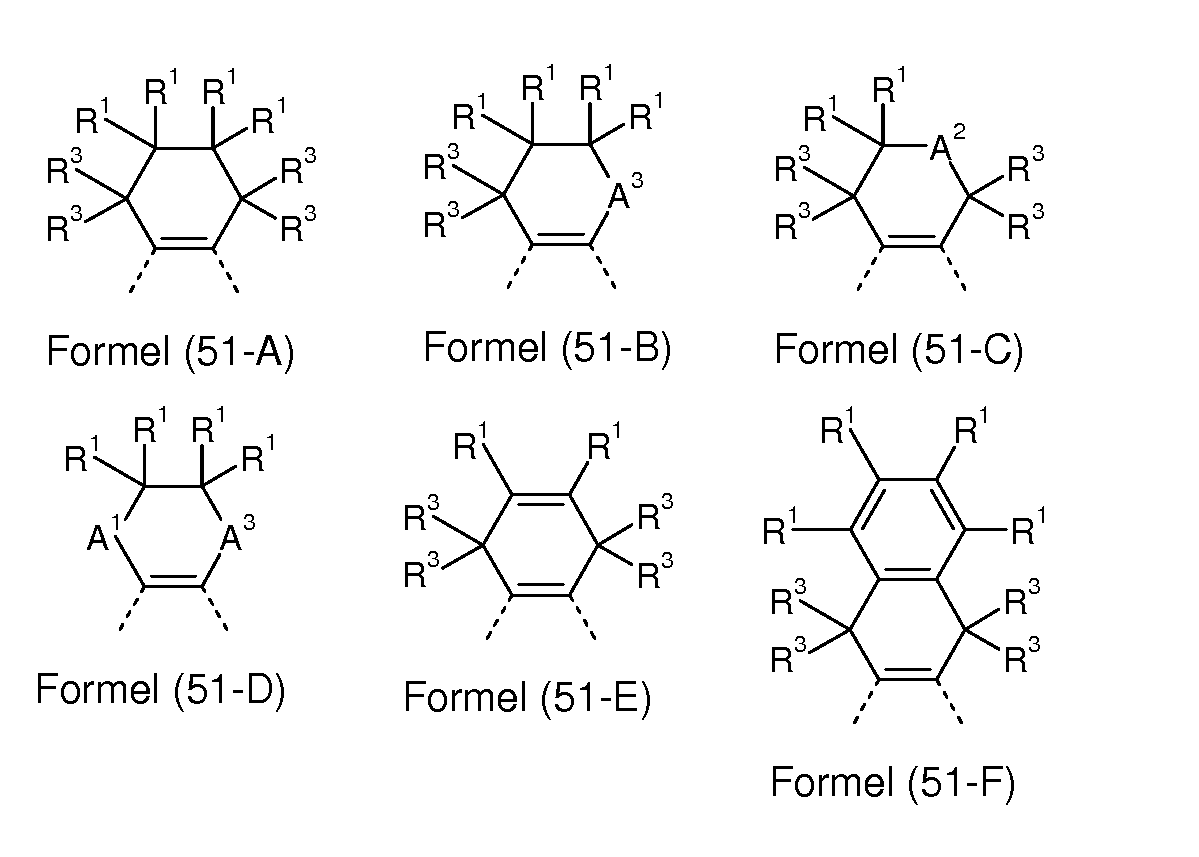
wobei R1 und R3 die oben genannten Bedeutungen aufweisen und Z\ Z2 und Z3 gleich oder verschieden bei jedem Auftreten für O oder NR3 steht. wherein R 1 and R 3 have the abovementioned meanings and Z \ Z 2 and Z 3 are identical or different at each occurrence for O or NR 3 .
Bevorzugte Ausführungsformen der Formel (52) sind die Strukturen der folgenden Formeln (52-A) bis (52-E), Preferred embodiments of the formula (52) are the structures of the following formulas (52-A) to (52-E),

wobei R1 und R3 die oben genannten Bedeutungen aufweisen und Z\ Z2 und Z3 gleich oder verschieden bei jedem Auftreten für O oder NR3 steht. wherein R 1 and R 3 have the abovementioned meanings and Z \ Z 2 and Z 3 are identical or different at each occurrence for O or NR 3 .
In einer bevorzugten Ausführungsform der Struktur gemäß Formel (53) stehen die Reste R1 , die an den Brückenkopf gebunden sind, für H, D, F oder CH3. Weiterhin bevorzugt steht Z2 für C(R1)2 oder O, und besonders bevorzugt für C(R3)2. Bevorzugte Ausführungsformen der Formel (53) sind somit eine Strukturen der Formel (53-A) und (53-B), und eine besonders bevorzugte Ausführungsform der Formel (53-A) ist eine Struktur der Formel (53-C), In a preferred embodiment of the structure of formula (53), the radicals R 1 attached to the bridgehead are H, D, F or CH 3. Furthermore, Z 2 is preferably C (R 1 ) 2 or O, and particularly preferably C (R 3 ) 2. Preferred embodiments of the formula (53) are thus a structures of the formula (53-A) and (53-B), and a particularly preferred embodiment of the formula (53-A) is a structure of the formula (53-C),

Formel (53-A) Formel (53-B) Formel (53-C) wobei die verwendeten Symbole die oben genannten Bedeutungen aufweisen. Formula (53-A) Formula (53-B) Formula (53-C) wherein the symbols used have the meanings given above.
In einer bevorzugten Ausführungsform der Struktur gemäß Formel (54), (55) und (56) stehen die Reste R1, die an den Brückenkopf gebunden sind, für H, D, F oder CH3. Weiterhin bevorzugt steht Z2 für C(R1 )2. In a preferred embodiment of the structure of formulas (54), (55) and (56), the radicals R 1 attached to the bridgehead are H, D, F or CH 3 . Furthermore, Z 2 is preferably C (R 1 ) 2.
Bevorzugte Ausführungsformen der Formel (54), (55) und (56) sind somit die Strukturen der Formeln (54-A), (55-A) und (56-A), Preferred embodiments of the formula (54), (55) and (56) are thus the structures of the formulas (54-A), (55-A) and (56-A),
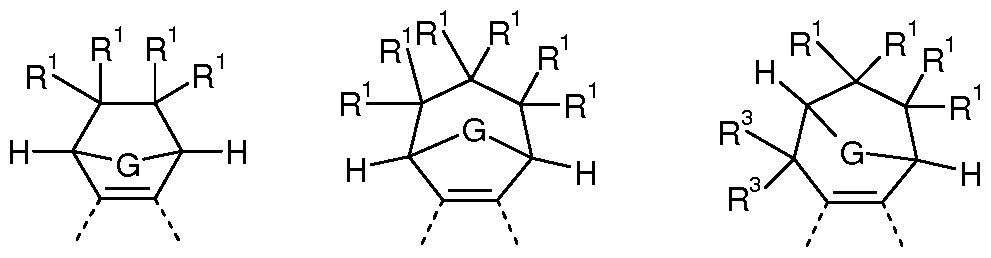
Formel (54-A) Formel (55-A) Formel (56-A) wobei die verwendeten Symbole die oben genannten Bedeutungen aufweisen. Formula (54-A) Formula (55-A) Formula (56-A) wherein the symbols used have the meanings given above.
Weiterhin bevorzugt steht die Gruppe G in den Formeln (53), (53-A), (53-B), (53-C), (54), (54-A), (55), (55-A), (56) und (56-A) für eine 1 ,2- Ethylengruppe, welche mit einem oder mehreren Resten R2 substituiert sein kann, wobei R2 bevorzugt gleich oder verschieden bei jedem Auf- treten für H oder eine Alkylgruppe mit 1 bis 4 C-Atomen steht, oder eine ortho-Arylengruppe mit 6 bis 10 C-Atomen, welche mit einem oder mehreren Resten R2 substituiert sein kann, bevorzugt aber unsubstituiert ist, insbesondere eine ortho-Phenylengruppe, welche mit einem oder mehreren Resten R2 substituiert sein kann, bevorzugt aber unsubstituiert ist. In einer weiteren bevorzugten Ausführungsform der Erfindung steht R3 in den Gruppen der Formel (50) bis (56) und in den bevorzugten Aus- führungsformen gleich oder verschieden bei jedem Auftreten für F, eine geradkettige Alkylgruppe mit 1 bis 10 C-Atomen oder eine verzweigte oder cyclische Alkylgruppe mit 3 bis 20 C-Atomen, wobei jeweils eine oder mehrere nicht benachbarte CH2-Gruppen durch R2C=CR2 ersetzt sein können und ein oder mehrere H-Atome durch D oder F ersetzt sein können, oder ein aromatisches oder heteroaromatisches Ringsystem mit 5 bis 14 aromatischen Ringatomen, das jeweils durch einen oder mehrere Reste R2 substituiert sein kann; dabei können zwei Reste R3, welche an dasselbe Kohlenstoffatom gebunden sind, miteinander ein aliphatisches oder aromatisches Ringsystem bilden und so ein Spirosystem auf- spannen; weiterhin kann R3 mit einem benachbarten Rest R oder R1 ein aliphatisches Ringsystem bilden. Further preferably, the group G is in the formulas (53), (53-A), (53-B), (53-C), (54), (54-A), (55), (55-A) , (56) and (56-A) for a 1,2-ethylene group which may be substituted by one or more radicals R 2 , where R 2 is preferably the same or different each time H or an alkyl group having 1 to 4 carbon atoms, or an ortho-arylene group having 6 to 10 carbon atoms, which may be substituted by one or more radicals R 2 , but is preferably unsubstituted, in particular an ortho-phenylene group containing one or more radicals R 2 may be substituted, but is preferably unsubstituted. In a further preferred embodiment of the invention, R 3 in the groups of the formula (50) to (56) and in the preferred embodiments is identical or different at each occurrence for F, a straight-chain alkyl group having 1 to 10 C atoms or a branched or cyclic alkyl group having 3 to 20 carbon atoms, wherein in each case one or more non-adjacent CH 2 groups may be replaced by R 2 C = CR 2 and one or more H atoms may be replaced by D or F, or an aromatic or heteroaromatic ring system having 5 to 14 aromatic ring atoms, each of which may be substituted by one or more radicals R 2 ; In this case, two radicals R 3 , which are bonded to the same carbon atom, together form an aliphatic or aromatic ring system and thus form a spirosystem; Furthermore, R 3 can form an aliphatic ring system with an adjacent radical R or R 1 .
In einer besonders bevorzugten Ausführungsform der Erfindung steht R3 in den Gruppen der Formeln (50) bis (56) und in den bevorzugten Aus- führungsformen gleich oder verschieden bei jedem Auftreten für F, eine geradkettige Alkylgruppe mit 1 bis 3 C-Atomen, insbesondere Methyl, oder ein aromatisches oder heteroaromatisches Ringsystem mit 5 bis 12 aromatischen Ringatomen, das jeweils durch einen oder mehrere Reste R2 substituiert sein kann, bevorzugt aber unsubstituiert ist; dabei können zwei Reste R3, welche an dasselbe Kohlenstoffatom gebunden sind, mit- einander ein aliphatisches oder aromatisches Ringsystem bilden und so ein Spirosystem aufspannen; weiterhin kann R3 mit einem benachbarten Rest R oder R1 ein aliphatisches Ringsystem bilden. In a particularly preferred embodiment of the invention, R 3 in the groups of the formulas (50) to (56) and in the preferred embodiments is identical or different at each occurrence for F, a straight-chain alkyl group having 1 to 3 C atoms, in particular Methyl, or an aromatic or heteroaromatic ring system having 5 to 12 aromatic ring atoms, each of which may be substituted by one or more radicals R 2 , but is preferably unsubstituted; In this case, two radicals R 3 , which are bonded to the same carbon atom, together form an aliphatic or aromatic ring system and thus form a spirosystem; Furthermore, R 3 can form an aliphatic ring system with an adjacent radical R or R 1 .
Beispiele für besonders geeignete Gruppen der Formel (50) sind die im Folgenden abgebildeten Gruppen:
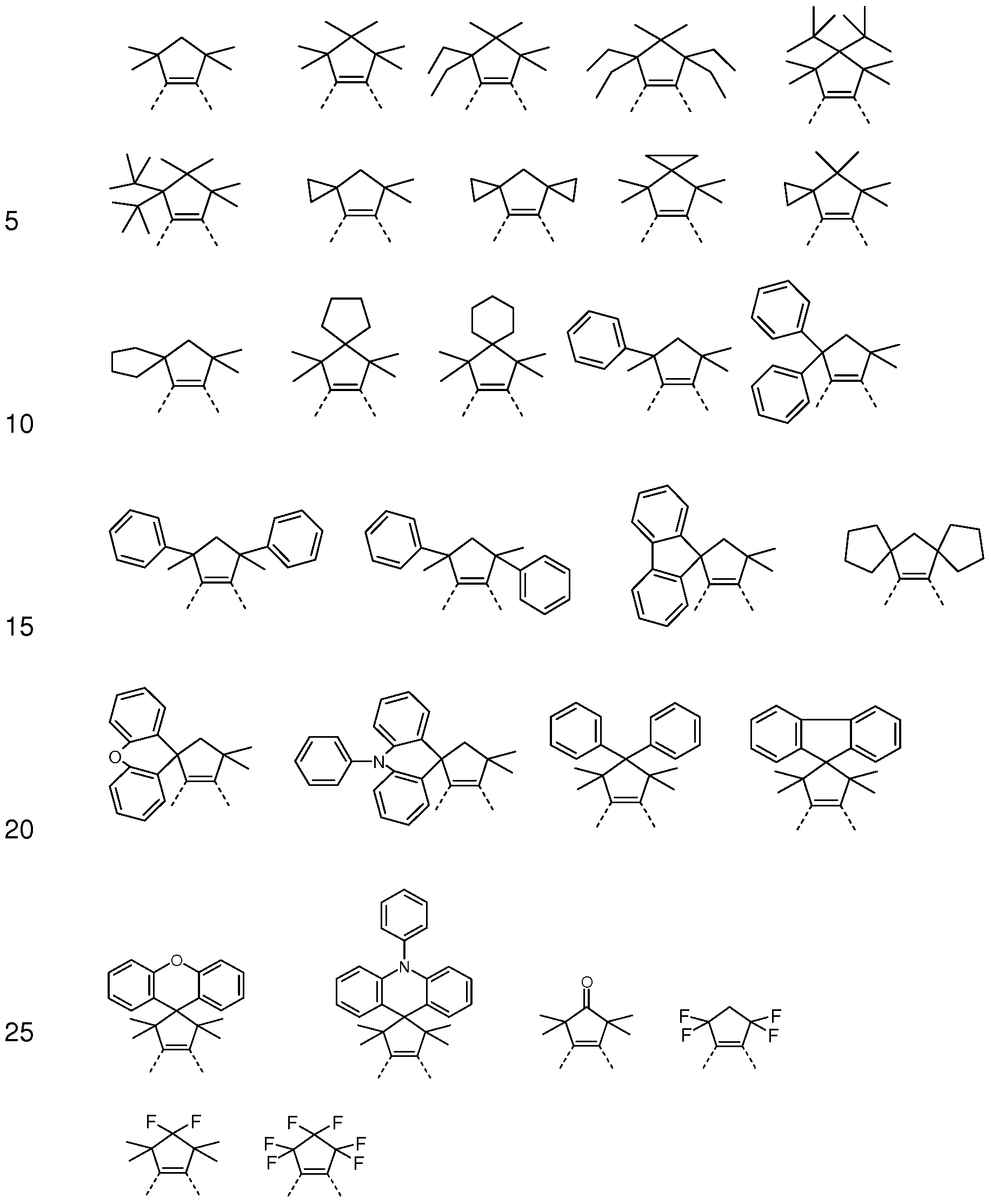
3030
35 35

Beispiele für besonders geeignete Gruppen der Formel (51 ) sind die Folgenden abgebildeten Gruppen: Examples of particularly suitable groups of the formula (51) are the following depicted groups:

Beispiele für besonders geeignete Gruppen der Formel (52), (55) und (56) sind die im Folgenden abgebildeten Gruppen: Examples of particularly suitable groups of the formulas (52), (55) and (56) are the groups depicted below:
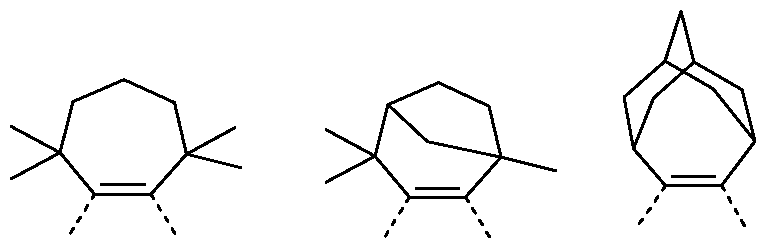
Beispiele für besonders geeignete Gruppen der Formel (53) sind die im Folgenden abgebildeten Gruppen: Examples of particularly suitable groups of the formula (53) are the groups depicted below:
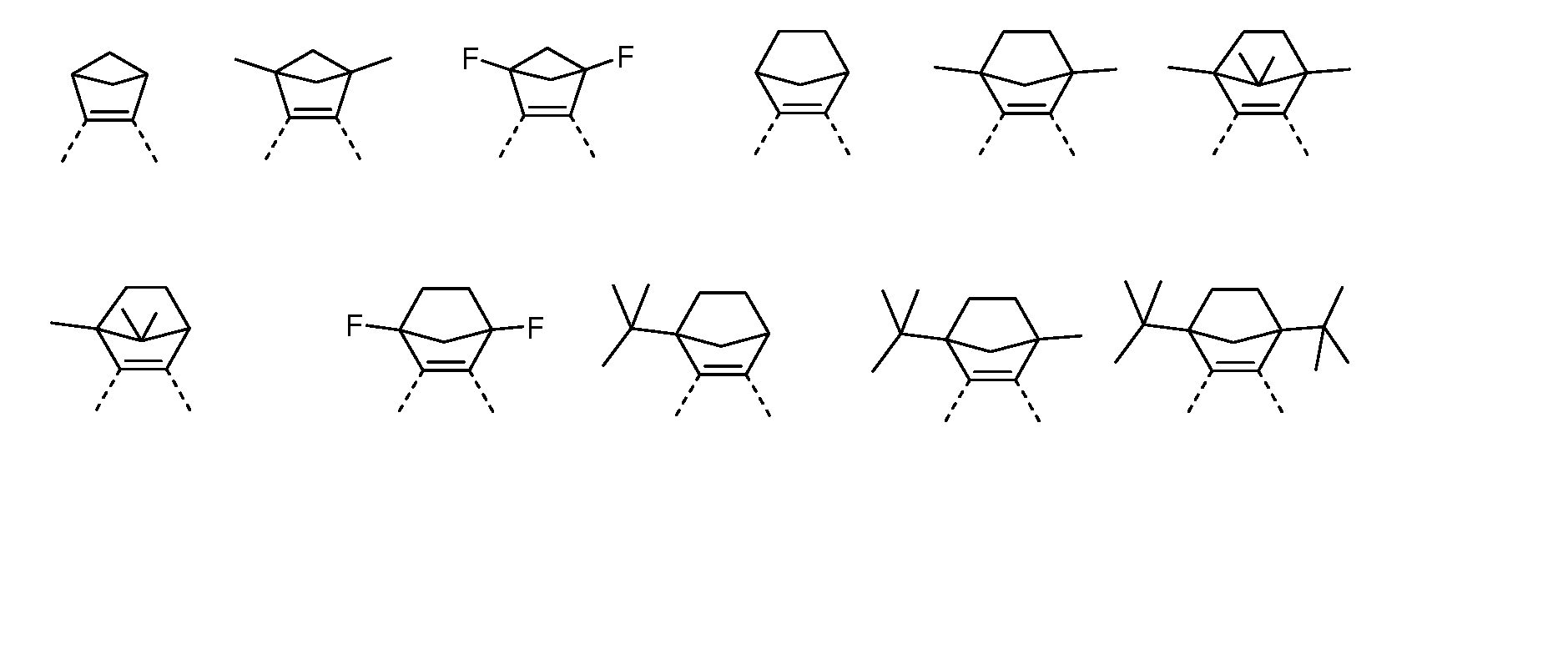
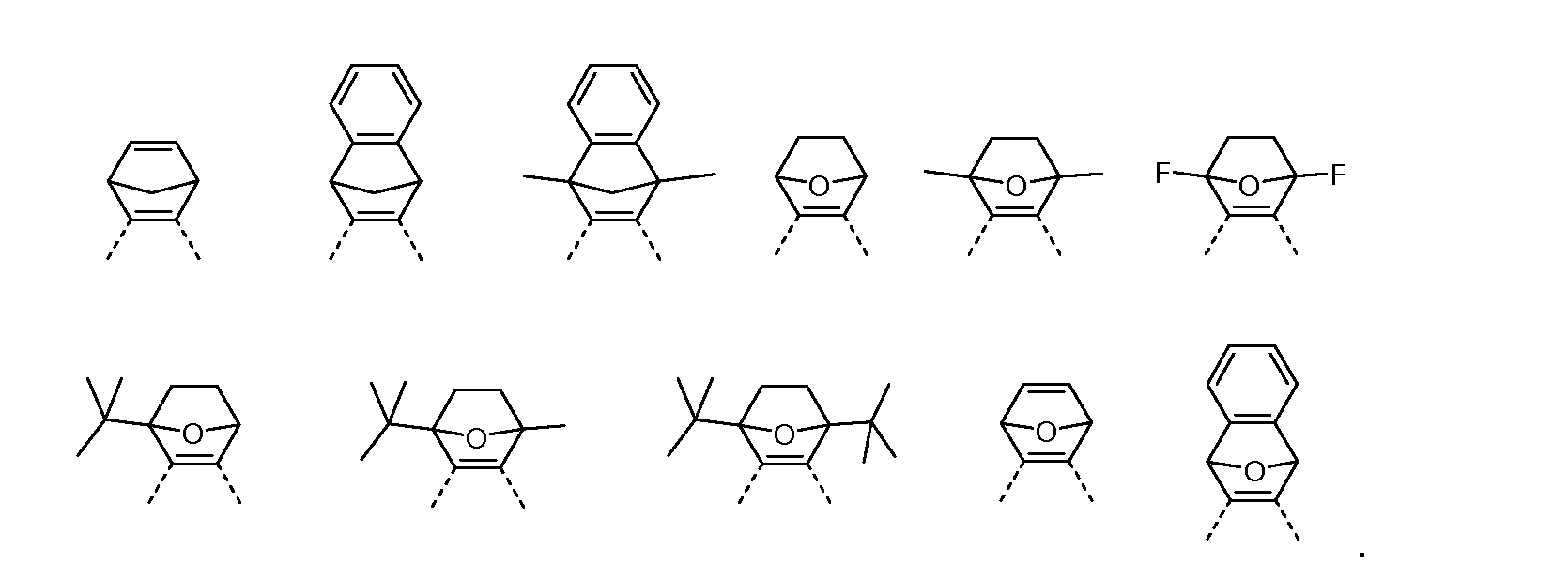
Beispiele für besonders geeignete Gruppen der Formel (54) sind die im Folgenden abgebildeten Gruppen: Examples of particularly suitable groups of the formula (54) are the groups depicted below:
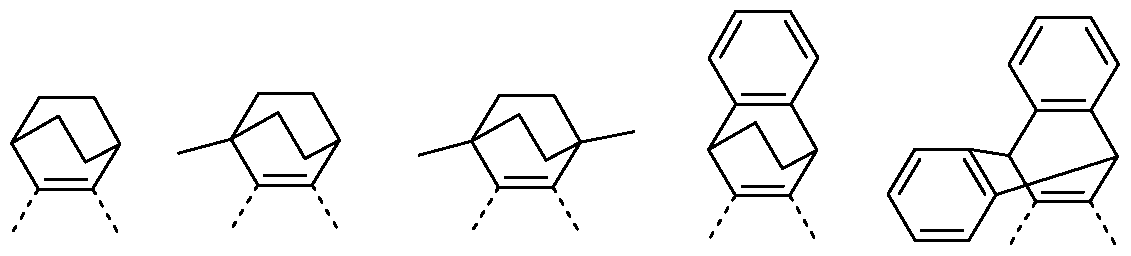
Wenn in den bidentaten Teilliganden bzw. Liganden bzw. in den bivalen- ten Arylen- bzw. Heteroarylengruppen der Formel (4), welche in den Formeln (2) bzw. (3) bzw. den bevorzugten Ausführungsformen gebunden sind, Reste R gebunden sind, so sind diese Reste R bei jedem Auftreten gleich oder verschieden bevorzugt ausgewählt aus der Gruppe bestehend aus H, D, F, Br, I, N(R1)2, CN, Si(R1)3, B(OR1)2, C(=O)R1 , einer gerad- kettigen Alkylgruppe mit 1 bis 10 C-Atomen oder einer Alkenylgruppe mit 2 bis 10 C-Atomen oder einer verzweigten oder cyclischen Alkylgruppe mit 3 bis 10 C-Atomen, wobei die Alkyl oder Alkenylgruppe jeweils mit einem oder mehreren Resten R1 substituiert sein kann, oder einem aromatischen oder heteroaromatischen Ringsystem mit 5 bis 30 aromatischen Ring- atomen, das jeweils durch einen oder mehrere Reste R1 substituiert sein kann; dabei können zwei benachbarte Rest R oder R mit R1 auch mitein- ander ein mono- oder polycyclisches, aliphatisches oder aromatisches Ringsystem bilden. Besonders bevorzugt sind diese Reste R bei jedem Auftreten gleich oder verschieden ausgewählt aus der Gruppe bestehend aus H, D, F, N(R1 )2, einer geradkettigen Alkylgruppe mit 1 bis 6 C-Atomen oder einer verzweigten oder cyclischen Alkylgruppe mit 3 bis 10 C- Atomen, wobei ein oder mehrere H-Atome durch D oder F ersetzt sein können, oder einem aromatischen oder heteroaromatischen Ringsystem mit 5 bis 24 aromatischen Ringatomen, das jeweils durch einen oder mehrere Reste R1 substituiert sein kann; dabei können zwei benachbarte Reste R oder R mit R1 auch miteinander ein mono- oder polycyclisches, aliphatisches oder aromatisches Ringsystem bilden. Bevorzugte Reste R1, die an R gebunden sind, sind bei jedem Auftreten gleich oder verschieden H, D, F, N(R2)2, CN, eine geradkettige Alkyl- gruppe mit 1 bis 10 C-Atomen oder eine Alkenylgruppe mit 2 bis 10 C- Atomen oder eine verzweigte oder cyclische Alkylgruppe mit 3 bis 10 C- Atomen, wobei die Alkylgruppe jeweils mit einem oder mehreren Resten R2 substituiert sein kann, oder ein aromatisches oder heteroaromatisches Ringsystem mit 5 bis 24 aromatischen Ringatomen, das jeweils durch einen oder mehrere Reste R2 substituiert sein kann; dabei können zwei oder mehrere benachbarte Reste R1 miteinander ein mono- oder poly- cyclisches, aliphatisches Ringsystem bilden. Besonders bevorzugte Reste R1 , die an R gebunden sind, sind bei jedem Auftreten gleich oder ver- schieden H, F, CN, eine geradkettige Alkylgruppe mit 1 bis 5 C-Atomen oder eine verzweigte oder cyclische Alkylgruppe mit 3 bis 5 C-Atomen, die jeweils mit einem oder mehreren Resten R2 substituiert sein kann, oder ein aromatisches oder heteroaromatisches Ringsystem mit 5 bis 13 aromatischen Ringatomen, das jeweils durch einen oder mehrere Reste R2 substituiert sein kann; dabei können zwei oder mehrere benachbarte Reste R1 miteinander ein mono- oder polycyclisches, aliphatisches Ringsystem bilden. Bevorzugte Reste R2 sind bei jedem Auftreten gleich oder verschieden H, F oder ein aliphatischer Kohlenwasserstoffrest mit 1 bis 5 C-Atomen oder ein aromatischer Kohlenwasserstoffrest mit 6 bis 12 C-Atomen; dabei können zwei oder mehrere Substituenten R2 auch miteinander ein mono- oder polycyclisches, aliphatisches Ringsystem bilden. If in the bidentate partial ligands or ligands or in the bivalent arylene or heteroarylene groups of the formula (4) which are bonded in the formulas (2) or (3) or the preferred embodiments, radicals R are bonded , these radicals R are the same or differently selected on each occurrence from the group consisting of H, D, F, Br, I, N (R 1 ) 2 , CN, Si (R 1 ) 3 , B (OR 1 ) 2 , C (= O) R 1 , a straight-chain alkyl group having 1 to 10 C atoms or an alkenyl group having 2 to 10 C atoms or a branched or cyclic alkyl group having 3 to 10 C atoms, where the alkyl or Alkenyl group may each be substituted by one or more radicals R 1 , or an aromatic or heteroaromatic ring system having 5 to 30 aromatic ring atoms, which may be substituted by one or more radicals R 1 in each case; In this case, two adjacent radicals R or R with R 1 can also form a mono- or polycyclic, aliphatic or aromatic ring system with one another. With particular preference, these radicals R on each occurrence are identically or differently selected from the group consisting of H, D, F, N (R 1 ) 2, a straight-chain alkyl group having 1 to 6 C atoms or a branched or cyclic alkyl group having 3 to 10 C atoms, wherein one or more H atoms may be replaced by D or F, or an aromatic or heteroaromatic ring system with 5 to 24 aromatic ring atoms, each of which may be substituted by one or more radicals R 1 ; in this case, two adjacent radicals R or R with R 1 can also form a mono- or polycyclic, aliphatic or aromatic ring system with one another. Preferred radicals R 1 which are bonded to R are each, identically or differently, H, D, F, N (R 2 ) 2, CN, a straight-chain alkyl group having 1 to 10 C atoms or an alkenyl group having 2 to 10 carbon atoms or a branched or cyclic alkyl group having 3 to 10 carbon atoms, where the alkyl group may be substituted by one or more radicals R 2 , or an aromatic or heteroaromatic ring system having 5 to 24 aromatic ring atoms, each of one or more radicals R 2 may be substituted; and wherein two or more adjacent radicals R 1 form a mono- or poly- cyclic aliphatic ring system. Particularly preferred radicals R 1 which are bonded to R are identical or different on each occurrence, H, F, CN, a straight-chain alkyl group having 1 to 5 C atoms or a branched or cyclic alkyl group having 3 to 5 C atoms which may each be substituted by one or more radicals R 2 , or an aromatic or heteroaromatic ring system having from 5 to 13 aromatic ring atoms, each of which may be substituted by one or more radicals R 2 ; in this case, two or more adjacent radicals R 1 together form a mono- or polycyclic aliphatic ring system. Preferred radicals R 2 are the same or different at each occurrence, H, F or an aliphatic hydrocarbon radical having 1 to 5 carbon atoms or an aromatic hydrocarbon radical having 6 to 12 carbon atoms; two or more substituents R 2 may also together form a mono- or polycyclic, aliphatic ring system.
Die oben genannten bevorzugten Ausführungsformen sind beliebig mitein- ander kombinierbar. In einer besonders bevorzugten Ausführungsform der Erfindung gelten die oben genannten bevorzugten Ausführungsformen gleichzeitig. Bei den erfindungsgemäßen Verbindungen handelt es sich um chirale Strukturen. Je nach genauer Struktur der Komplexe und Liganden ist die Bildung von Diastereomeren und mehreren Enantiomerenpaaren möglich. Die erfindungsgemäßen Komplexe umfassen dann sowohl die The abovementioned preferred embodiments can be combined with one another as desired. In a particularly preferred embodiment of the invention, the abovementioned preferred embodiments apply simultaneously. The compounds according to the invention are chiral structures. Depending on the exact structure of the complexes and ligands, the formation of diastereomers and several pairs of enantiomers is possible. The complexes of the invention then comprise both the
Mischungen der verschiedenen Diastereomere bzw. die entsprechenden Racemate wie auch die einzelnen isolierten Diastereomere bzw. Enan- tiomere. Mixtures of the different diastereomers or the corresponding racemates as well as the individual isolated diastereomers or enantiomers.
Beispiele für geeignete erfindungsgemäße Verbindungen sind die in der nachfolgenden Tabelle aufgeführten Strukturen. Examples of suitable compounds according to the invention are the structures listed in the table below.
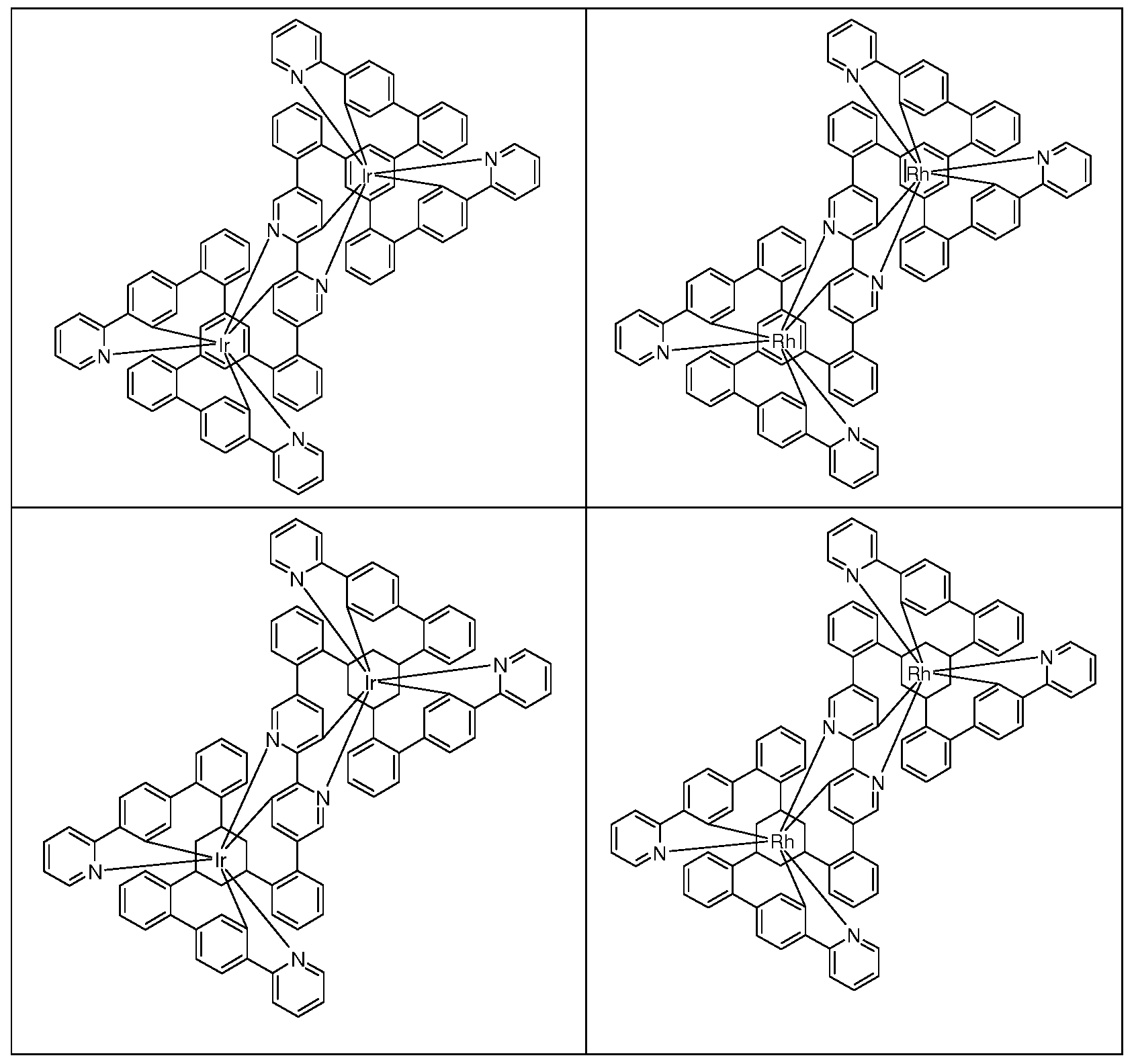


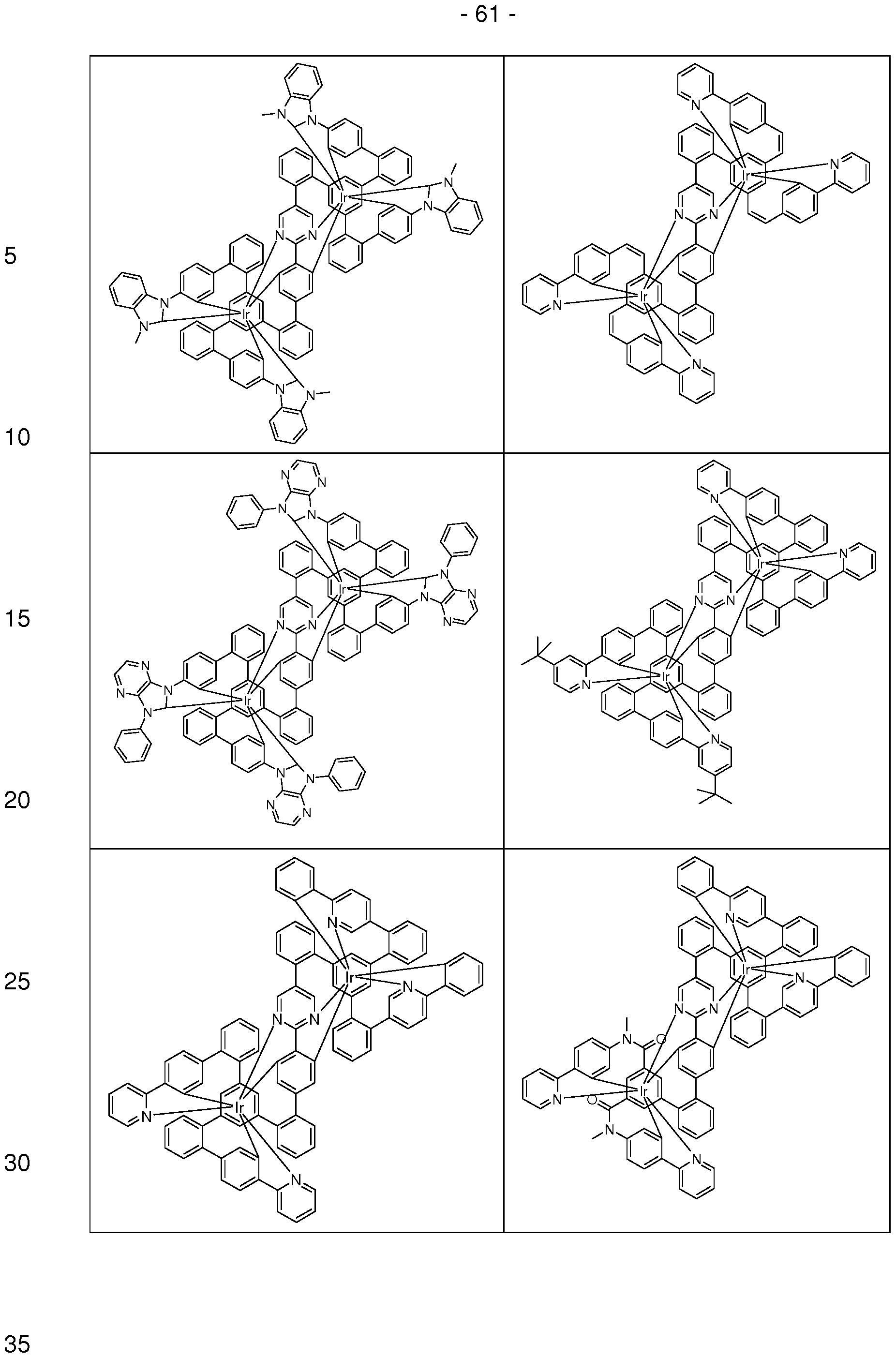
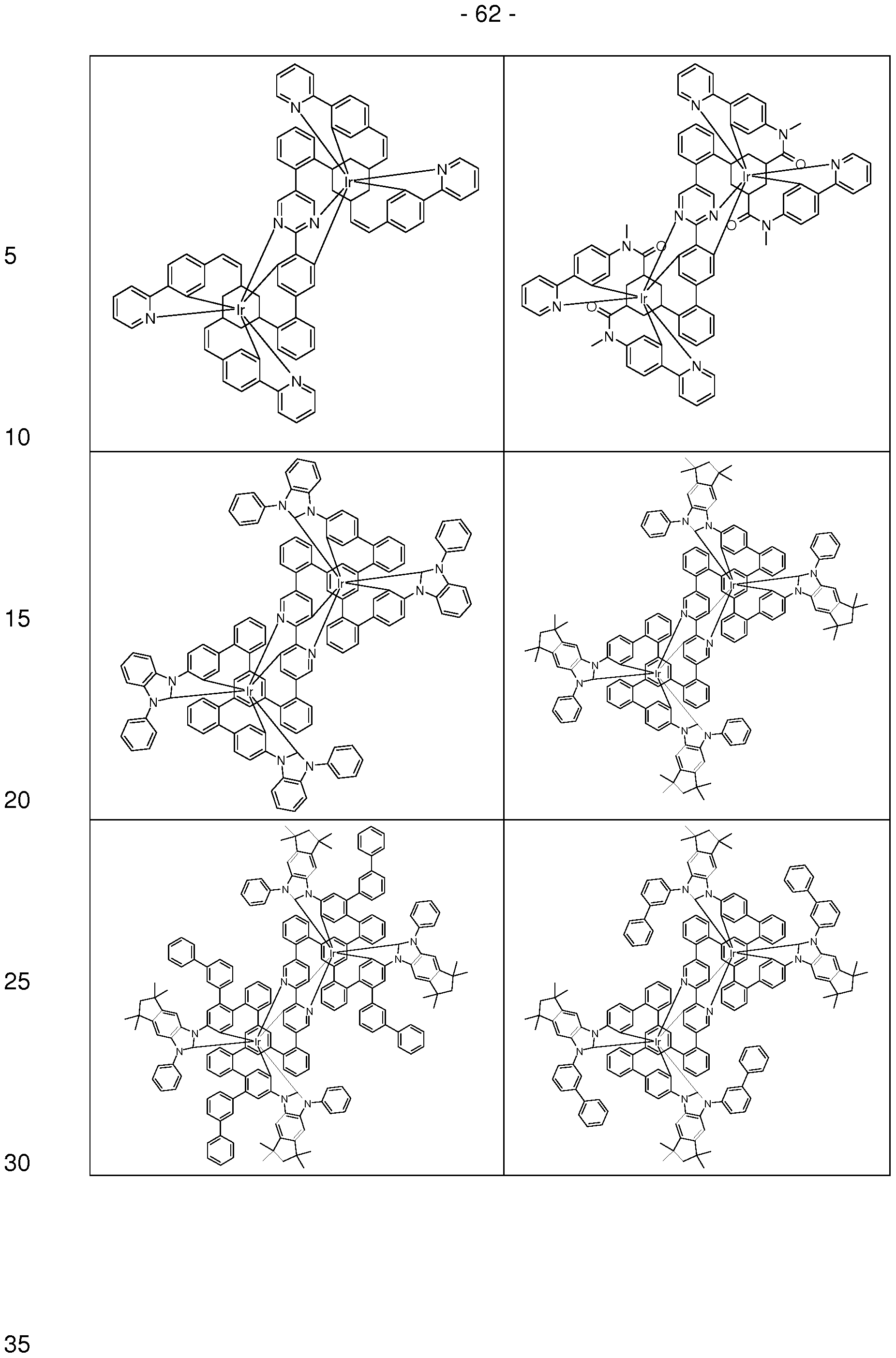


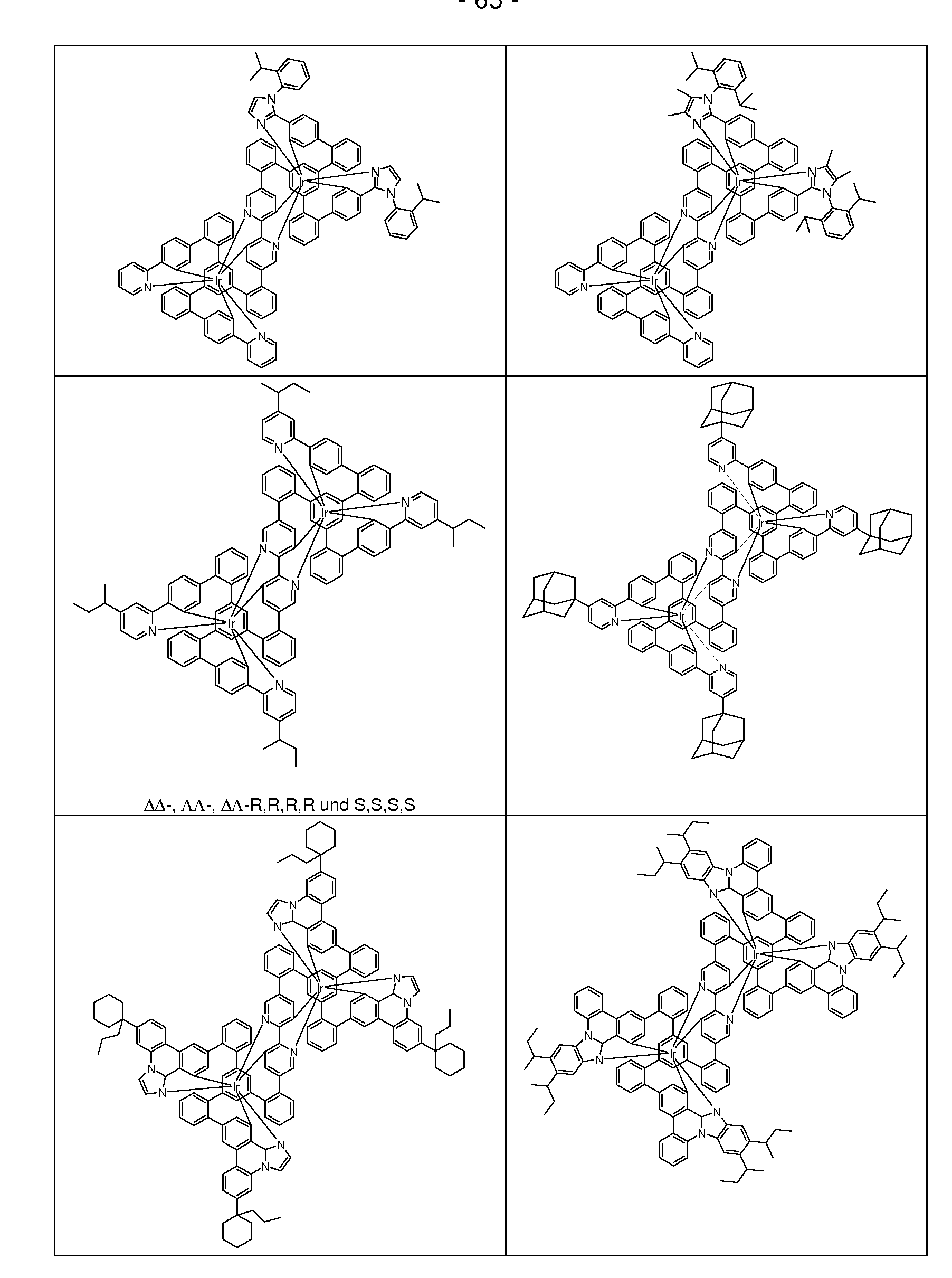
Bei der ortho-Metallierungsreaktion der Liganden fallen die zugehörigen bimetallischen Komplexe typischerweise als Gemisch aus ΛΛ- und ΔΔ- Isomeren sowie ΔΛ- und ΛΔ-lsomeren an. ΛΛ- und ΔΔ-lsomer bilden ein Enantiomerenpaar ebenso wie das ΔΛ- und ΛΔ-lsomer. Die Diastereo- merenpaare können mit herkömmlichen Methoden, z. B. chromatogra- phisch oder durch fraktionierte Kristallisation, getrennt werden. Je nach Symmetrie der Liganden können Stereozentren zusammenfallen, so dass auch Mesoformen möglich sind. So fallen z. B. bei der ortho-Metallierung von C2v- oder Cs-symmetrischen Liganden ΛΛ- und ΔΔ-lsomere (Racemat, C2-symmetrisch) und ein ΛΔ-lsomer (Mesoverbindung, Cs-symmetrisch) an. Die Darstellung sowie Trennung der Diastereomerenpaare soll an dem nachfolgenden Beispiel verdeutlicht werden. In the case of the ortho-metallation reaction of the ligands, the associated bimetallic complexes typically occur as a mixture of ΛΛ and ΔΔ isomers and ΔΛ and ΛΔ isomers. ΛΛ and ΔΔ isomers form Enantiomer pair as well as the ΔΛ and ΛΔ isomer. The diastereomer pairs can be prepared by conventional methods, eg. B. chromatographically or by fractional crystallization, are separated. Depending on the symmetry of the ligands, stereocenters may coincide, so that mesoforms are also possible. So z. As in the ortho-metallation of C2v or Cs-symmetric ligands ΛΛ- and ΔΔ isomers (racemate, C2 symmetric) and a ΛΔ isomer (meso compound, Cs-symmetric) to. The representation and separation of the pairs of diastereomers will be illustrated by the following example.
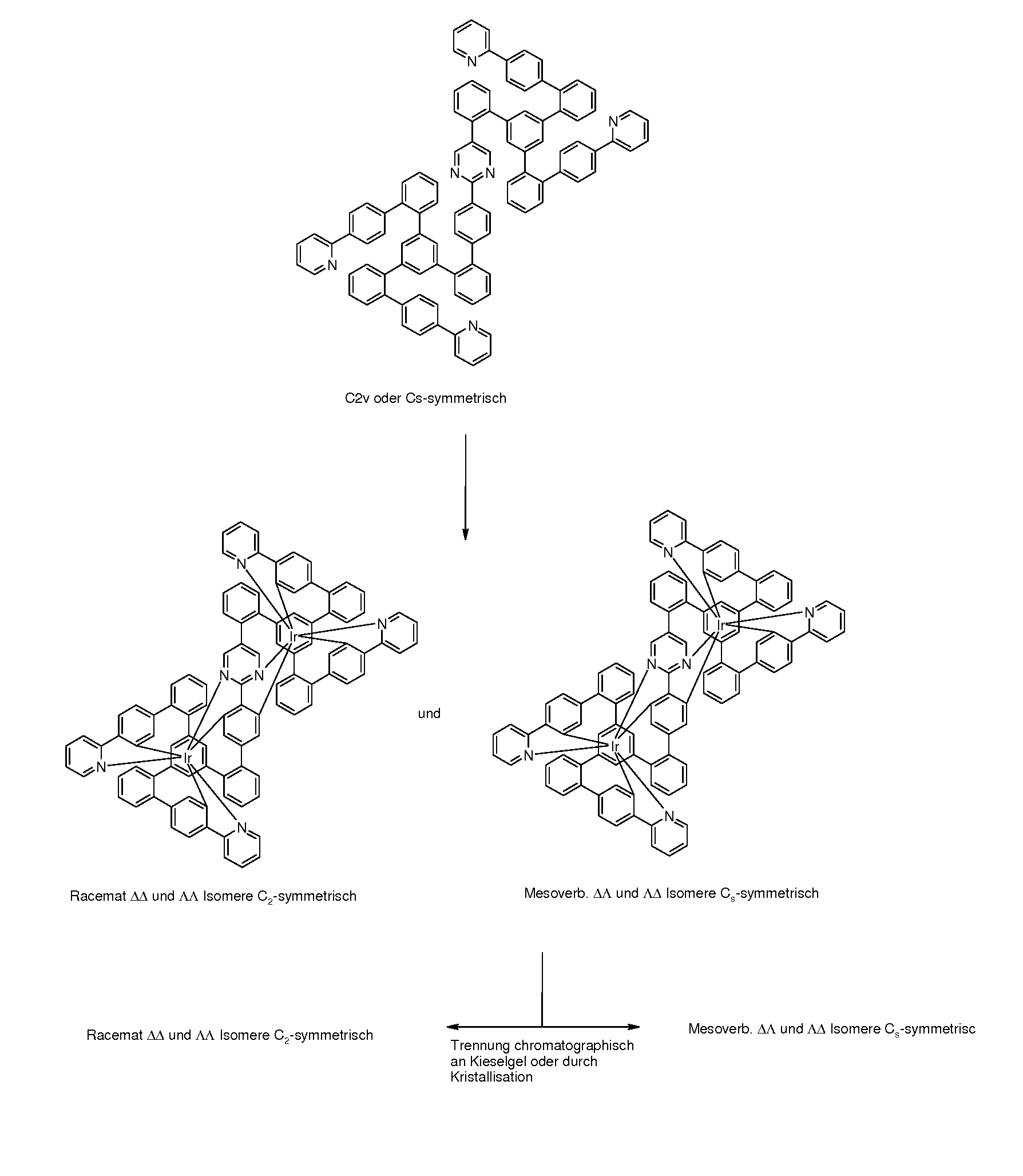
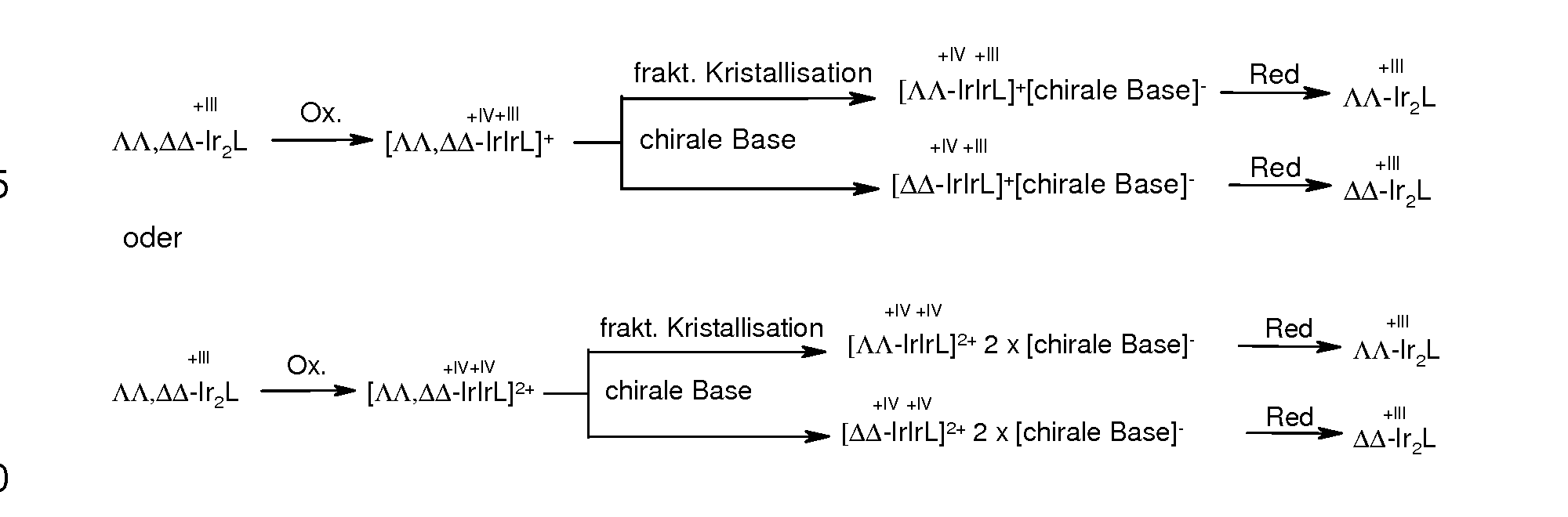
Enantiomerenreine Komplexe können auch gezielt synthetisiert werden, wie im folgenden Schema dargestellt. Dazu werden, wie oben beschrie- ben, die bei der ortho-Metallierung entstehenden Diastereomerpaare getrennt, bromiert und dann mit einer Boronsäure R*A-B(OH)2 enthaltend einen chiralen Rest R* (bevorzugt >99% Enantiomerenüberschuss) via Kreuzkupplungsreaktion umgesetzt. Die enstehenden Diastereomeren- paare können chromatographisch an Kieselgel oder durch fraktionierte Kristallisation nach üblichen Methoden getrennt werden. So werden die enantiomeren-angereicherten bzw. enantiomerenreinen Komplexe erhalten. Anschließend kann die chirale Gruppe optional abgespalten werden oder auch im Molkül verbleiben. Enantiomerically pure complexes can also be selectively synthesized, as shown in the following scheme. For this purpose, as described above, the diastereomer pairs formed in the ortho-metalation are separated, brominated and then reacted with a boronic acid R * AB (OH) 2 containing a chiral radical R * (preferably> 99% enantiomeric excess) via cross-coupling reaction. The resulting pairs of diastereomers can be separated chromatographically on silica gel or by fractional crystallization by customary methods. Thus, the enantiomerically enriched or enantiomerically pure complexes are obtained. Subsequently, the chiral group can optionally be split off or remain in the molecule.

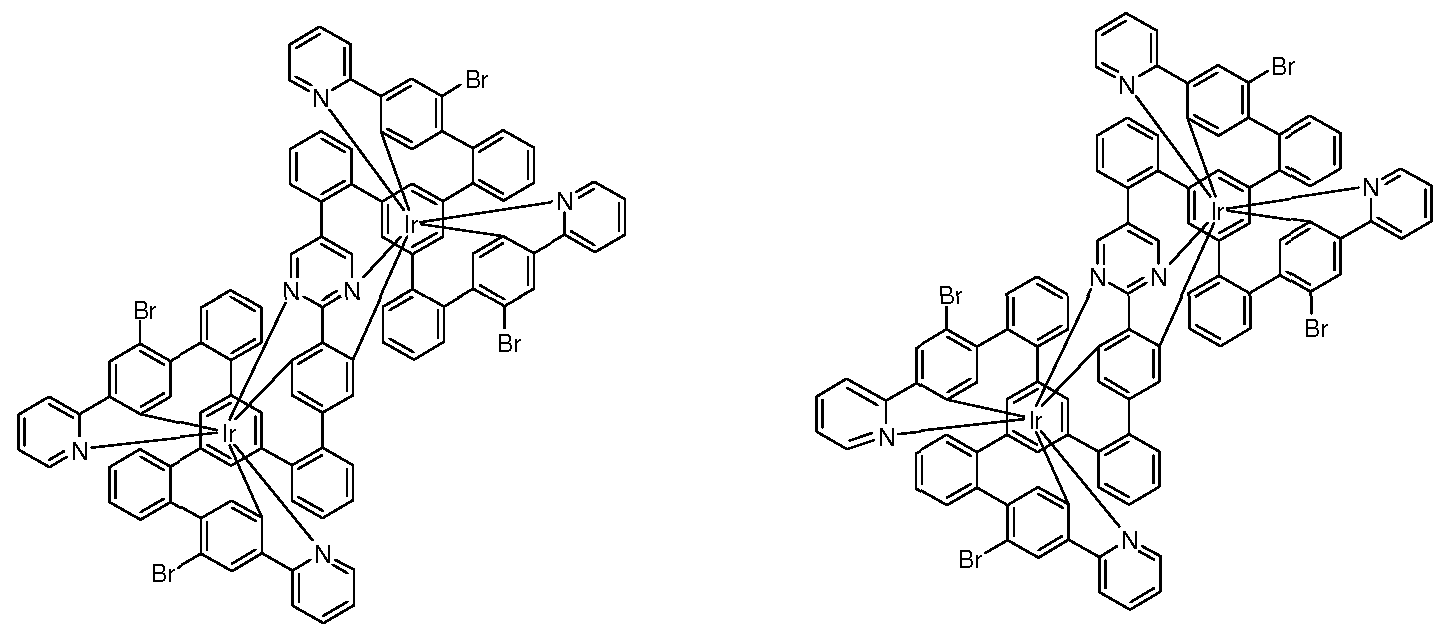


Üblicherweise fallen die Komplexe bei der ortho-Metallierung als Gemisch aus Diastereomerenpaaren an. Es gibt jedoch auch die Möglichkeit, nur eines der Diastereomerenpaare gezielt zu synthetisieren, da sich das andere, je nach Ligandenstruktur, aus sterischen Gründen nicht oder nur in geringem Maße bildet bildet. Dies soll anhand des folgenden Beispiels aufgezeigt werden. Usually, the complexes are formed in ortho-metallation as a mixture of pairs of diastereomers. However, there is also the possibility of selectively synthesizing only one of the pairs of diastereomers, since the other, depending on the ligand structure, does not form or forms only to a slight extent for steric reasons. This will be demonstrated by the following example.

Durch die ungünstige Wechselwirkung der Phenylgruppe in 5-Position am Pyridinring (rechteckig umrandet) mit der Phenylgruppe am Kopf eines der anderen Teilliganden (ebenfalls rechteckig umrandet) ensteht die Meso- verbindung nicht oder nur in geringem Maße. Das Racemat wird bevor- zugt oder ausschließlich gebildet. Due to the unfavorable interaction of the phenyl group in the 5-position on the pyridine ring (rectangular outlined) with the phenyl group at the head of one of the other partial ligands (also rectangular outlined), the meso compound does not form or only to a small extent. The racemate is preferably or exclusively formed.
Die erfindungsgemäßen Komplexe können insbesondere durch den nachfolgend beschriebenen Weg dargestellt werden. Dazu wird der 12- zähnige Ligand dargestellt und dann an die Metalle M durch eine ortho- Metallierungsreaktion koordiniert. Generell wird hierzu ein Iridium- bzw. Rhodiumsalz mit dem entsprechenden freien Liganden umgesetzt. Daher ist ein weiterer Gegenstand der vorliegenden Erfindung ein Ver- fahren zur Herstellung der erfindungsgemäßen Verbindung durch Um- setzung der entsprechenden freien Liganden mit Metallalkoholaten der Formel (57), mit Metallketoketonaten der Formel (58), mit Metallhaloge- niden der Formel (59) oder mit Metallcarboxylaten der Formel (60), The complexes according to the invention can be prepared in particular by the route described below. For this, the 12-dentate ligand is prepared and then coordinated to the metals M by an ortho-metallation reaction. In general, an iridium or rhodium salt is reacted with the corresponding free ligand for this purpose. Therefore, another object of the present invention is a process for preparing the compound of the invention by reacting the corresponding free ligands with metal alcoholates of the formula (57), with metal ketoketonates of the formula (58), with metal halides of the formula (59) or with metal carboxylates of the formula (60),

wobei M und R die oben angegebenen Bedeutungen aufweisen, Hai = F, Cl, Br oder I ist und die Iridium- bzw. Rhodiumedukte auch als die ent- sprechenden Hydrate vorliegen können. Dabei steht R bevorzugt für eine Alkylgruppe mit 1 bis 4 C-Atomen. wherein M and R have the meanings given above, Hai = F, Cl, Br or I and the iridium or Rhodiumedukte can also be present as the corresponding hydrates. In this case, R is preferably an alkyl group having 1 to 4 C atoms.
Es können ebenfalls Iridium- bzw. Rhodiumverbindungen, die sowohl Alkoholat- und/oder Halogenid- und/oder Hydroxy- wie auch Ketoketonat- reste tragen, verwendet werden. Diese Verbindungen können auch ge- laden sein. Entsprechende Iridiumverbindungen, die als Edukte besonders geeignet sind, sind in WO 2004/085449 offenbart. Besonders geeignet sind [lrCl2(acac)2]~, beispielsweise Na[lrCl2(acac)2], Metallkomplexe mit Acetylacetonat-Derivaten als Ligand, beispielsweise lr(acac)3 oder Tris- (2,2,6,6-Tetramethylheptan-3,5-dionato)iridium, und lrCl3-xH2O, wobei x üblicherweise für eine Zahl zwischen 2 und 4 steht. It is also possible to use iridium or rhodium compounds which carry both alkoxide and / or halide and / or hydroxy as well as ketoketonate residues. These connections can also be loaded. Corresponding iridium compounds which are particularly suitable as starting materials are disclosed in WO 2004/085449. Particularly suitable are [lrCl2 (acac) 2] ~, for example, Na [lrCl2 (acac) 2], metal acetylacetonate complexes with derivatives as a ligand, for example, lr (acac) 3 or tris- (2,2,6,6-Tetramethylheptan- 3,5-dionato) iridium, and lrCl3-xH2O, where x is usually a number between 2 and 4.
Die Synthese der Komplexe wird bevorzugt durchgeführt wie in WO 2002/060910 und in WO 2004/085449 beschrieben. Dabei kann die Synthese beispielsweise auch thermisch, photochemisch und/oder durch Mikrowellenstrahlung aktiviert werden. Weiterhin kann die Synthese auch im Autoklaven bei erhöhtem Druck und/oder erhöhter Temperatur durch- geführt werden. Die Reaktionen können ohne Zusatz von Lösemitteln oder Schmelzhilfen in einer Schmelze der entsprechenden zu o-metallierenden Liganden durchgeführt werden. Gegebenenfalls können Lösemittel oder Schmelz- hilfen zugesetzt werden. Geeignete Lösemittel sind protische oder aprotische Lösemittel, wie aliphatische und / oder aromatische Alkohle (Methanol, Ethanol, iso-Propanol, t-Butanol, etc.), Oligo- und Polyalkohole (Ethylenglykol, 1 ,2-Propandiol, Glycerin, etc.), Alkoholether (Ethoxy- ethanol, Diethylenglykol, Triethylenglycol, Polyethylenglykol, etc.), Ether (Di- und Triethylenglykoldimethylether, Diphenylether, etc.), aromatische, heteroaromatische und oder aliphatische Kohlenwasserstoffe (Toluol, Xylol, Mesitylen, Chlorbenzol, Pyridin, Lutidin, Chinolin, iso-Chinolin,The synthesis of the complexes is preferably carried out as described in WO 2002/060910 and in WO 2004/085449. The synthesis can be activated, for example, thermally, photochemically and / or by microwave radiation. Furthermore, the synthesis can also be carried out in an autoclave at elevated pressure and / or elevated temperature. The reactions can be carried out without addition of solvents or melting aids in a melt of the corresponding o-metalating ligands. If necessary, solvents or melting aids may be added. Suitable solvents are protic or aprotic solvents, such as aliphatic and / or aromatic alcohols (methanol, ethanol, isopropanol, t-butanol, etc.), oligo- and polyalcohols (ethylene glycol, 1,2-propanediol, glycerol, etc.). , Alcohol ethers (ethoxyethanol, diethylene glycol, triethylene glycol, polyethylene glycol, etc.), ethers (di- and triethylene glycol dimethyl ether, diphenyl ether, etc.), aromatic, heteroaromatic and / or aliphatic hydrocarbons (toluene, xylene, mesitylene, chlorobenzene, pyridine, lutidine, Quinoline, iso-quinoline,
Tridecan, Hexadecan, etc.), Amide (DMF, DMAC, etc.), Lactame (NMP), Sulfoxide (DMSO) oder Sulfone (Dimethylsulfon, Sulfolan, etc.). Geeignete Schmelzhilfen sind Verbindungen, die bei Rautemperatur fest vorliegen, jedoch beim Erwärmen der Reaktionsmischung schmelzen und die Reak- tanden lösen, so dass eine homogene Schmelze entsteht. Besonders geeignet sind Biphenyl, m-Terphenyl, Triphenylen, R- oder S-Binaphthol oder auch das entsprechende Racemat, 1 ,2-, 1 ,3-, 1 ,4-Bis-phenoxy- benzol, Triphenylphosphinoxid, 18-Krone-6, Phenol, 1 -Naphthol, Hydro- chinon, etc.. Dabei ist die Verwendung von Hydrochinon besonders bevorzugt. Tridecane, hexadecane, etc.), amides (DMF, DMAC, etc.), lactams (NMP), sulfoxides (DMSO) or sulfones (dimethylsulfone, sulfolane, etc.). Suitable melting aids are compounds which are solid at room temperature, but which melt on heating the reaction mixture and dissolve the reactants, so that a homogeneous melt is formed. Particularly suitable are biphenyl, m-terphenyl, triphenylene, R- or S-binaphthol or the corresponding racemate, 1, 2, 1, 3, 1, 4-bis-phenoxybenzene, triphenylphosphine oxide, 18-crown-6 , Phenol, 1-naphthol, hydroquinone, etc .. The use of hydroquinone is particularly preferred.
Durch diese Verfahren, gegebenenfalls gefolgt von Aufreinigung, wie z. B. Umkristallisation oder Sublimation, lassen sich die erfindungsgemäßen Verbindungen gemäß Formel (1 ) in hoher Reinheit, bevorzugt mehr als 99 % (bestimmt mittels 1H-NMR und/oder HPLC) erhalten. By these methods, optionally followed by purification, such. As recrystallization or sublimation, the compounds of the invention according to formula (1) can be obtained in high purity, preferably more than 99% (determined by means of 1 H-NMR and / or HPLC).
Die erfindungsgemäßen Verbindungen können auch durch geeignete Substitution, beispielsweise durch längere Alkylgruppen (ca. 4 bis 20 C- Atome), insbesondere verzweigte Alkylgruppen, oder gegebenenfalls substituierte Arylgruppen, beispielsweise Xylyl-, Mesityl- oder verzweigte Terphenyl- oder Quaterphenylgruppen, löslich gemacht werden. Insbeson- dere auch die Verwendung von ankondensierten aliphatischen Gruppen, wie sie beispielsweise durch die oben offenbarten Formeln (50) bis (56) dargestellt werden, führt zu einer deutlichen Verbesserung der Löslichkeit der Metallkomplexe. Solche Verbindungen sind dann in gängigen orga- nischen Lösemitteln, wie beispielsweise Toluol oder Xylol bei Raumtempe- ratur in ausreichender Konzentration löslich, um die Komplexe aus Lösung verarbeiten zu können. Diese löslichen Verbindungen eignen sich beson- ders gut für die Verarbeitung aus Lösung, beispielsweise durch Druck- verfahren. The compounds according to the invention can also be made soluble by suitable substitution, for example by longer alkyl groups (about 4 to 20 C atoms), in particular branched alkyl groups, or optionally substituted aryl groups, for example xylyl, mesityl or branched terphenyl or quaterphenyl groups. In particular, the use of fused aliphatic groups, as shown for example by the above-disclosed formulas (50) to (56), leads to a significant improvement in the solubility the metal complexes. Such compounds are then soluble in common organic solvents, such as toluene or xylene at room temperature in sufficient concentration to process the complexes from solution can. These soluble compounds are particularly suitable for processing from solution, for example by printing processes.
Für die Verarbeitung der erfindungsgemäßen Metallkomplexe aus flüssiger Phase, beispielsweise durch Spin-Coating oder durch Druck- verfahren, sind Formulierungen der erfindungsgemäßen Metallkomplexe erforderlich. Diese Formulierungen können beispielsweise Lösungen, Dispersionen oder Emulsionen sein. Es kann bevorzugt sein, hierfür Mischungen aus zwei oder mehr Lösemitteln zu verwenden. Geeignete und bevorzugte Lösemittel sind beispielsweise Toluol, Anisol, o-, m- oder p-Xylol, Methylbenzoat, Mesitylen, Tetralin, Veratrol, THF, Methyl-THF, THP, Chlorbenzol, Dioxan, Phenoxytoluol, insbesondere 3-Phenoxytoluol, (-)-Fenchon, 1 ,2,3,5-Tetramethylbenzol, 1 ,2,4,5-Tetramethylbenzol, 1 - Methylnaphthalin, 2-Methylbenzothiazol, 2-Phenoxyethanol, 2-Pyrrolidi- non, 3-Methylanisol, 4-Methylanisol, 3,4-Dimethylanisol, 3,5-Dimethyl- anisol, Acetophenon, cc-Terpineol, Benzothiazol, Butylbenzoat, Cumol, Cyclohexanol, Cyclohexanon, Cyclohexylbenzol, Decalin, Dodecylbenzol, Ethylbenzoat, Indan, Methylbenzoat, NMP, p-Cymol, Phenetol, 1 ,4-Di- isopropylbenzol, Dibenzylether, Diethylenglycolbutylmethylether, Tri- ethylenglycolbutylmethylether, Diethylenglycoldibutylether, Triethylen- glycoldimethylether, Diethylenglycolmonobutylether, Tripropyleneglycol- dimethylether, Tetraethylenglycoldimethylether, 2-lsopropylnaphthalin, Pentylbenzol, Hexylbenzol, Heptylbenzol, Octylbenzol, 1 ,1 -Bis(3,4-di- methylphenyl)ethan, Hexamethylindan oder Mischungen dieser Löse- mittel. Ein weiterer Gegenstand der vorliegenden Erfindung ist daher eine For- mulierung, enthaltend mindestens eine erfindungsgemäße Verbindung und mindestens eine weitere Verbindung. Die weitere Verbindung kann beispielsweise ein Lösemittel sein, insbesondere eines der oben ge- nannten Lösemittel oder eine Mischung dieser Lösemittel. Die weitere Ver- bindung kann aber auch eine weitere organische oder anorganische Ver- bindung sein, die ebenfalls in der elektronischen Vorrichtung eingesetzt wird, beispielsweise ein Matrixmaterial. Diese weitere Verbindung kann auch polymer sein. Der oben beschriebene erfindungsgemäße Metallkomplex bzw. die oben aufgeführten bevorzugten Ausführungsformen können in der elektroni- schen Vorrichtung als aktive Komponente oder als Sauerstoff-Sensibilisa- toren verwendet werden. Ein weiterer Gegenstand der vorliegenden Erfin- dung ist somit die Verwendung einer erfindungsgemäßen Verbindung in einer elektronischen Vorrichtung oder als Sauerstoff-Sensibilisator. Noch- mals ein weiterer Gegenstand der vorliegenden Erfindung ist eine elek- tronische Vorrichtung enthaltend mindestens eine erfindungsgemäße Ver- bindung. Unter einer elektronischen Vorrichtung wird eine Vorrichtung verstanden, welche Anode, Kathode und mindestens eine Schicht enthält, wobei diese Schicht mindestens eine organische bzw. metallorganische Verbindung enthält. Die erfindungsgemäße elektronische Vorrichtung enthält also Anode, Kathode und mindestens eine Schicht, welche mindestens einen erfindungsgemäßen Metallkomplex enthält. Dabei sind bevorzugte elek- tronische Vorrichtungen ausgewählt aus der Gruppe bestehend aus orga- nischen Elektrolumineszenzvorrichtungen (OLEDs, PLEDs), organischen integrierten Schaltungen (O-ICs), organischen Feld-Effekt-Transistoren (O-FETs), organischen Dünnfilmtransistoren (O-TFTs), organischen licht- emittierenden Transistoren (O-LETs), organischen Solarzellen (O-SCs), wobei hierunter sowohl rein organische Solarzellen wie auch farbstoff- sensibilisierte Solarzellen (Grätzel-Zellen) verstanden werden, orga- nischen optischen Detektoren, organischen Photorezeptoren, organischen Feld-Quench-Devices (O-FQDs), lichtemittierenden elektrochemischen Zellen (LECs), Sauerstoff-Sensoren oder organischen Laserdioden (O-Laser), enthaltend in mindestens einer Schicht mindestens einen erfindungsgemäßen Metallkomplex. Besonders bevorzugt sind organische Elektrolumineszenzvorrichtungen. Aktive Komponenten sind generell die organischen oder anorganischen Materialien, welche zwischen Anode und Kathode eingebracht sind, beispielsweise Ladungsinjektions-, Ladungs- transport- oder Ladungsblockiermaterialien, insbesondere aber Emissions- materialien und Matrixmaterialien. Die erfindungsgemäßen Verbindungen zeigen besonders gute Eigenschaften als Emissionsmaterial in orga- nischen Elektrolumineszenzvorrichtungen. Eine bevorzugte Ausführungs- form der Erfindung sind daher organische Elektrolumineszenzvorrich- tungen. Weiterhin können die erfindungsgemäßen Verbindungen zur Erzeugung von Singulett-Sauerstoff oder in der Photokatalyse eingesetzt werden. Die organische Elektrolumineszenzvorrichtung enthält Kathode, Anode und mindestens eine emittierende Schicht. Außer diesen Schichten kann sie noch weitere Schichten enthalten, beispielsweise jeweils eine oder mehrere Lochinjektionsschichten, Lochtransportschichten, Lochblockier- schichten, Elektronentransportschichten, Elektroneninjektionsschichten, Exzitonenblockierschichten, Elektronenblockierschichten, Ladungs- erzeugungsschichten und/oder organische oder anorganische p/n-Über- gänge. Dabei ist es möglich, dass eine oder mehrere Lochtransport- schichten p-dotiert sind, beispielsweise mit Metalloxiden, wie M0O3 oder WO3 oder mit (per)fluorierten elektronenarmen Aromaten, und/oder dass eine oder mehrere Elektronentransportschichten n-dotiert sind. Ebenso können zwischen zwei emittierende Schichten Interlayers eingebracht sein, welche beispielsweise eine Exzitonen-blockierende Funktion auf- weisen und/oder die Ladungsbalance in der Elektrolumineszenzvor- richtung steuern. Es sei aber darauf hingewiesen, dass nicht notwendiger- weise jede dieser Schichten vorhanden sein muss. For the processing of the metal complexes according to the invention from the liquid phase, for example by spin coating or by printing processes, formulations of the metal complexes of the invention are required. These formulations may be, for example, solutions, dispersions or emulsions. It may be preferable to use mixtures of two or more solvents for this purpose. Suitable and preferred solvents are, for example, toluene, anisole, o-, m- or p-xylene, methyl benzoate, mesitylene, tetralin, veratrol, THF, methyl THF, THP, chlorobenzene, dioxane, phenoxytoluene, in particular 3-phenoxytoluene, (-) -Fenchone, 1, 2,3,5-tetramethylbenzene, 1, 2,4,5-tetramethylbenzene, 1 - methylnaphthalene, 2-methylbenzothiazole, 2-phenoxyethanol, 2-pyrrolidinone, 3-methylanisole, 4-methylanisole, 3 , 4-dimethylanisole, 3,5-dimethylanisole, acetophenone, cc-terpineol, benzothiazole, butylbenzoate, cumene, cyclohexanol, cyclohexanone, cyclohexylbenzene, decalin, dodecylbenzene, ethylbenzoate, indane, methylbenzoate, NMP, p-cymene, phenetole, 1 , 4-diisopropylbenzene, dibenzyl ether, diethylene glycol butyl methyl ether, triethylene glycol butyl methyl ether, diethylene glycol dibutyl ether, triethylene glycol dimethyl ether, diethylene glycol monobutyl ether, tripropylene glycol dimethyl ether, tetraethylene glycol dimethyl ether, 2-isopropylnaphthalene, pentylbenzene, hexylbenzene, heptylbenzene, octylbenzene, 1,1-bis (3,4-dimethylphenyl) ethane, hexamethylindane or mixtures of these solvents. A further subject of the present invention is therefore a formulation containing at least one compound according to the invention and at least one further compound. The further compound may be, for example, a solvent, in particular one of the abovementioned solvents or a mixture of these solvents. The further But bond can also be a further organic or inorganic compound, which is also used in the electronic device, for example, a matrix material. This further compound may also be polymeric. The above-described metal complex of the present invention or the above-mentioned preferred embodiments can be used in the electronic device as the active component or as oxygen sensitizers. Another object of the present invention is thus the use of a compound of the invention in an electronic device or as an oxygen sensitizer. Yet another subject of the present invention is an electronic device containing at least one compound according to the invention. An electronic device is understood to mean a device which contains anode, cathode and at least one layer, this layer containing at least one organic or organometallic compound. The electronic device according to the invention thus contains anode, cathode and at least one layer which contains at least one metal complex according to the invention. In this case, preferred electronic devices are selected from the group consisting of organic electroluminescent devices (OLEDs, PLEDs), organic integrated circuits (O-ICs), organic field-effect transistors (O-FETs), organic thin-film transistors (O-TFTs ), organic light-emitting transistors (O-LETs), organic solar cells (O-SCs), which are understood to mean both purely organic solar cells and dye-sensitized solar cells (Grätzel cells), organic optical detectors, organic photoreceptors, organic field quench devices (O-FQDs), light-emitting electrochemical cells (LECs), oxygen sensors or organic laser diodes (O-lasers) containing at least one metal complex according to the invention in at least one layer. Particularly preferred are organic electroluminescent devices. Active components are generally the organic or inorganic materials which exist between anode and Cathode are introduced, for example, charge injection, charge transport or charge blocking materials, but especially emission materials and matrix materials. The compounds according to the invention exhibit particularly good properties as emission material in organic electroluminescent devices. A preferred embodiment of the invention are therefore organic electroluminescent devices. Furthermore, the compounds according to the invention can be used for the production of singlet oxygen or in photocatalysis. The organic electroluminescent device includes cathode, anode and at least one emitting layer. In addition to these layers, they may also contain further layers, for example one or more hole injection layers, hole transport layers, hole blocking layers, electron transport layers, electron injection layers, exciton blocking layers, electron blocking layers, charge generation layers and / or organic or inorganic p / n junctions. It is possible that one or more hole transport layers are p-doped, for example with metal oxides such as M0O3 or WO3 or with (per) fluorinated low-electron aromatics, and / or that one or more electron-transport layers are n-doped. Likewise, interlayers may be introduced between two emitting layers which, for example, have an exciton-blocking function and / or control the charge balance in the electroluminescent device. It should be noted, however, that not necessarily each of these layers must be present.
Dabei kann die organische Elektrolumineszenzvorrichtung eine emittieren- de Schicht enthalten, oder sie kann mehrere emittierende Schichten ent- halten. Wenn mehrere Emissionsschichten vorhanden sind, weisen diese bevorzugt insgesamt mehrere Emissionsmaxima zwischen 380 nm und 750 nm auf, so dass insgesamt weiße Emission resultiert, d. h. in den emittierenden Schichten werden verschiedene emittierende Verbindungen verwendet, die fluoreszieren oder phosphoreszieren können. Insbeson- dere bevorzugt sind Dreischichtsysteme, wobei die drei Schichten blaue, grüne und orange oder rote Emission zeigen bzw. Systeme, welche mehr als drei emittierende Schichten aufweisen. Weiterhin bevorzugt sind Tandem-OLEDs. Es kann sich auch um ein Hybrid-System handeln, wobei eine oder mehrere Schichten fluoreszieren und eine oder mehrere andere Schichten phosphoreszieren. Weiß emittierende organische Elektrolumi- neszenzvorrichtungen können für Beleuchtungsanwendungen oder mit Farbfilter auch für Vollfarb-Displays verwendet werden. In this case, the organic electroluminescent device may contain an emitting layer, or it may contain a plurality of emitting layers. If several emission layers are present, they preferably have a total of a plurality of emission maxima between 380 nm and 750 nm, so that overall white emission results, ie in the emitting layers different emitting compounds are used, which can fluoresce or phosphoresce. Particularly preferred are three-layer systems, wherein the three layers show blue, green and orange or red emission or systems which more have as three emitting layers. Further preferred are tandem OLEDs. It may also be a hybrid system wherein one or more layers fluoresce and one or more other layers phosphoresce. White-emitting organic electroluminescent devices can also be used for full-color displays for illumination applications or with color filters.
In einer bevorzugten Ausführungsform der Erfindung enthält die orga- nische Elektrolumineszenzvorrichtung den erfindungsgemäßen Metall- komplex als emittierende Verbindung in einer oder mehreren In a preferred embodiment of the invention, the organic electroluminescent device contains the metal complex according to the invention as an emitting compound in one or more
emittierenden Schichten. emitting layers.
Wenn der erfindungsgemäße Metallkomplex als emittierende Verbindung in einer emittierenden Schicht eingesetzt wird, wird er bevorzugt in Kombi- nation mit einem oder mehreren Matrixmaterialien eingesetzt. Die When the metal complex according to the invention is used as the emitting compound in an emitting layer, it is preferably used in combination with one or more matrix materials. The
Mischung aus dem erfindungsgemäßen Metallkomplex und dem Matrix- material enthält zwischen 0.1 und 99 Gew.-%, vorzugsweise zwischen 1 und 90 Gew.-%, besonders bevorzugt zwischen 3 und 40 Gew.-%, insbe- sondere zwischen 5 und 25 Gew.-% des erfindungsgemäßen Metall- komplexes bezogen auf die Gesamtmischung aus Emitter und Matrix- material. Entsprechend enthält die Mischung zwischen 99.9 und 1 Mixture of the metal complex of the invention and the matrix material contains between 0.1 and 99 wt .-%, preferably between 1 and 90 wt .-%, particularly preferably between 3 and 40 wt .-%, in particular between 5 and 25 wt. -% of the metal complex according to the invention based on the total mixture of emitter and matrix material. Accordingly, the mix contains between 99.9 and 1
Gew.-%, vorzugsweise zwischen 99 und 10 Gew.-%, besonders bevorzugt zwischen 97 und 60 Gew.-%, insbesondere zwischen 95 und 75 Gew.-% des Matrixmaterials bezogen auf die Gesamtmischung aus Emitter und Matrixmaterial. Wt .-%, preferably between 99 and 10 wt .-%, particularly preferably between 97 and 60 wt .-%, in particular between 95 and 75 wt .-% of the matrix material based on the total mixture of emitter and matrix material.
Als Matrixmaterial können generell alle Materialien eingesetzt werden, die gemäß dem Stand der Technik hierfür bekannt sind. Bevorzugt ist das Triplett-Niveau des Matrixmaterials höher als das Triplett-Niveau des Emitters. As matrix material, it is generally possible to use all materials known for this purpose according to the prior art. Preferably, the triplet level of the matrix material is higher than the triplet level of the emitter.
Geeignete Matrixmaterialien für die erfindungsgemäßen Verbindungen sind Ketone, Phosphinoxide, Sulfoxide und Sulfone, z. B. gemäß WO 2004/013080, WO 2004/093207, WO 2006/005627 oder WO Suitable matrix materials for the compounds according to the invention are ketones, phosphine oxides, sulfoxides and sulfones, for. B. according to WO 2004/013080, WO 2004/093207, WO 2006/005627 or WO
2010/006680, Triarylamine, Carbazolderivate, z. B. CBP (N,N-Bis- carbazolylbiphenyl), m-CBP oder die in WO 2005/039246, US 2005/0069729, JP 2004/288381 , EP 1205527, WO 2008/086851 oder US 2009/0134784 offenbarten Carbazolderivate, Indolocarbazolderivate, z. B. gemäß WO 2007/063754 oder WO 2008/056746, Indenocarbazolderivate, z. B. gemäß WO 2010/136109 oder WO 201 1/000455, Azacarbazole, z. B. gemäß EP 1 617710, EP 1 61771 1 , EP 1731584, JP 2005/3471 60, bipolare Matrixmaterialien, z. B. gemäß WO 2007/137725, Silane, z. B. gemäß WO 2005/1 1 1 172, Azaborole oder Boronester, z. B. gemäß WO 2006/1 17052, Diazasilolderivate, z. B. gemäß WO 2010/054729, Diazaphospholderivate, z. B. gemäß WO 2010/054730, Triazinderivate, z. B. gemäß WO 2010/015306, WO 2007/063754 oder WO 2008/056746, Zinkkomplexe, z. B. gemäß EP 652273 oder WO 2009/062578, 2010/006680, triarylamines, carbazole derivatives, e.g. B. CBP (N, N-bis-carbazolylbiphenyl), m-CBP or in WO 2005/039246, US 2005/0069729, JP 2004/288381, EP 1205527, WO 2008/086851 or US 2009/0134784 disclosed carbazole derivatives, indolocarbazole derivatives, z. B. according to WO 2007/063754 or WO 2008/056746, indenocarbazole derivatives, for. B. according to WO 2010/136109 or WO 201 1/000455, Azacarbazole, z. B. EP 1 617 710, EP 1 61771 1, EP 1731584, JP 2005/3471 60, bipolar matrix materials, eg. B. according to WO 2007/137725, silanes, z. B. according to WO 2005/1 1 1 172, azaborole or boronic esters, z. B. according to WO 2006/1 17052, diazasilol derivatives, z. B. according to WO 2010/054729, Diazaphospholderivate, z. B. according to WO 2010/054730, triazine derivatives, z. B. according to WO 2010/015306, WO 2007/063754 or WO 2008/056746, zinc complexes, for. B. according to EP 652273 or WO 2009/062578,
Dibenzofuranderivate, z. B. gemäß WO 2009/148015 oder WO Dibenzofuran derivatives, e.g. B. according to WO 2009/148015 or WO
2015/1 69412, oder verbrückte Carbazolderivate, z. B. gemäß US 2015/1 69412, or bridged carbazole derivatives, e.g. B. according to US
2009/0136779, WO 2010/050778, WO 201 1 /042107 oder WO 2009/0136779, WO 2010/050778, WO 201 1/042107 or WO
201 1 /088877. 201 1/088877.
Nachfolgend sind Beispiele für Verbindungen abgebildet, die sich als Matrixmaterialien für die erfindungsgemäßen Verbindungen eignen. The following are examples of compounds which are suitable as matrix materials for the compounds according to the invention.
Beispiele für Triazine und Pyrimidine, welche als elektronentranspor- tierende Matrixmaterialien eingesetzt werden können, sind die folgendenExamples of triazines and pyrimidines which can be used as electron-transporting matrix materials are the following
Verbindungen: Links:
OyyO OyyO
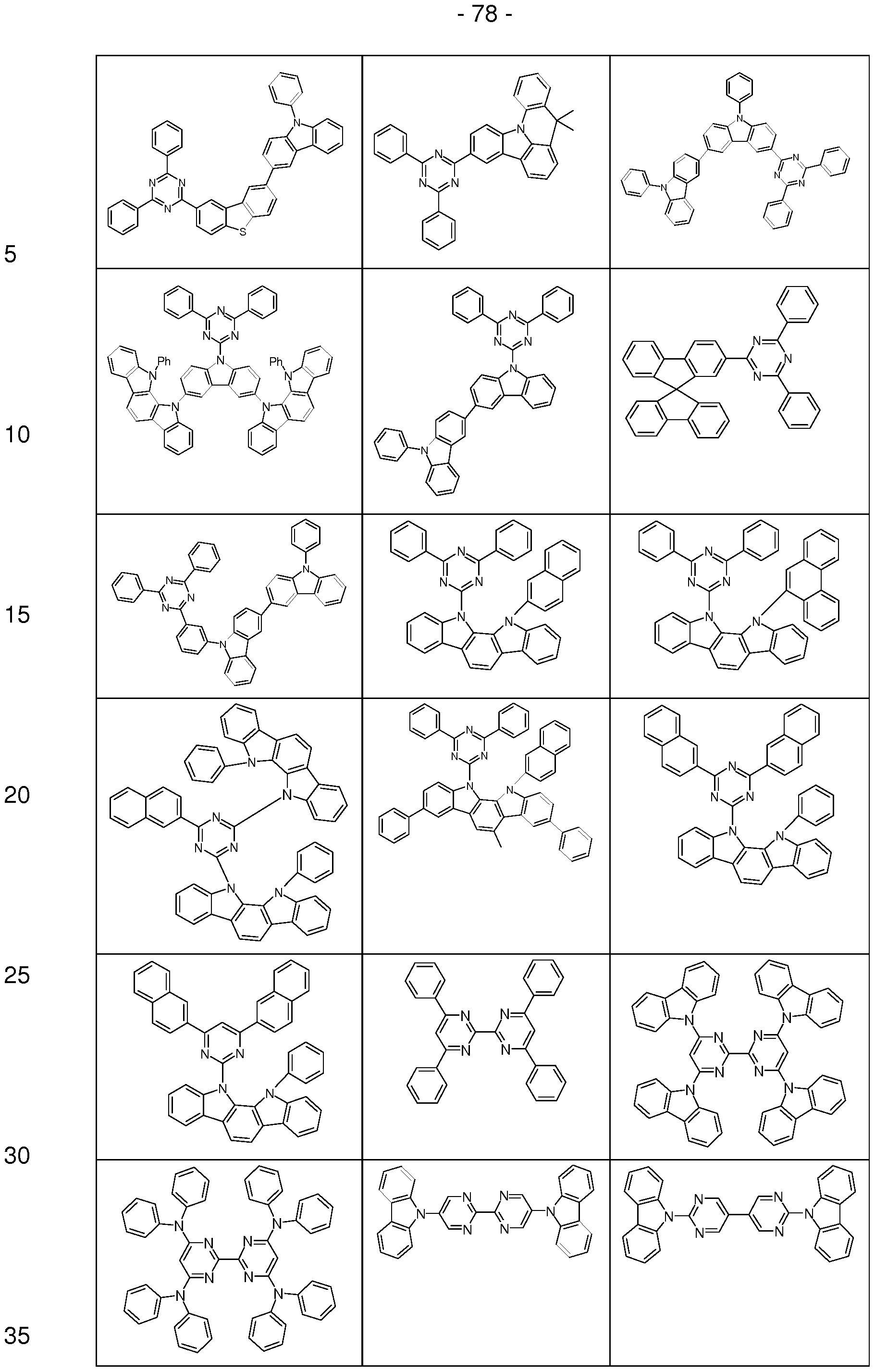

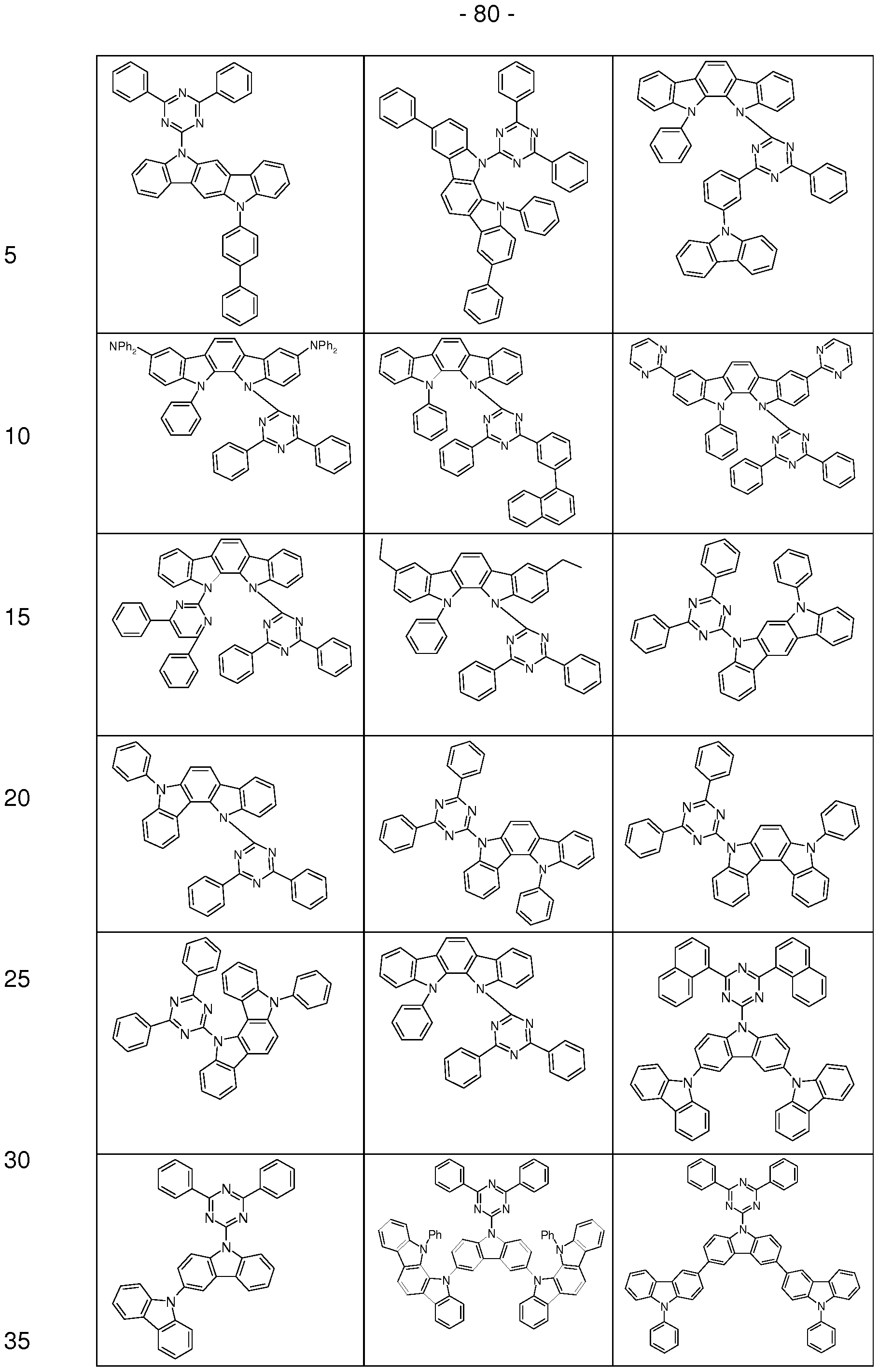
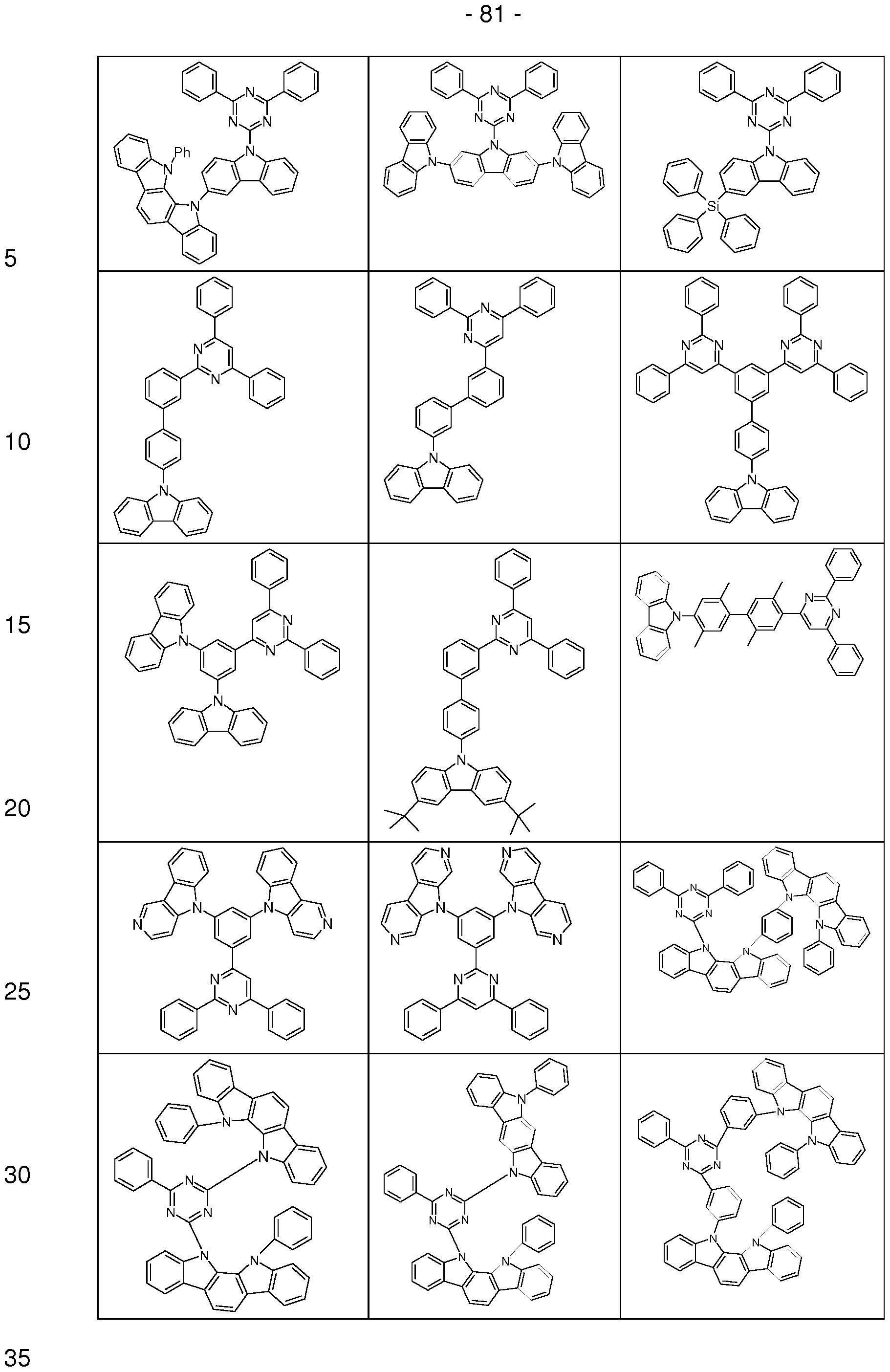
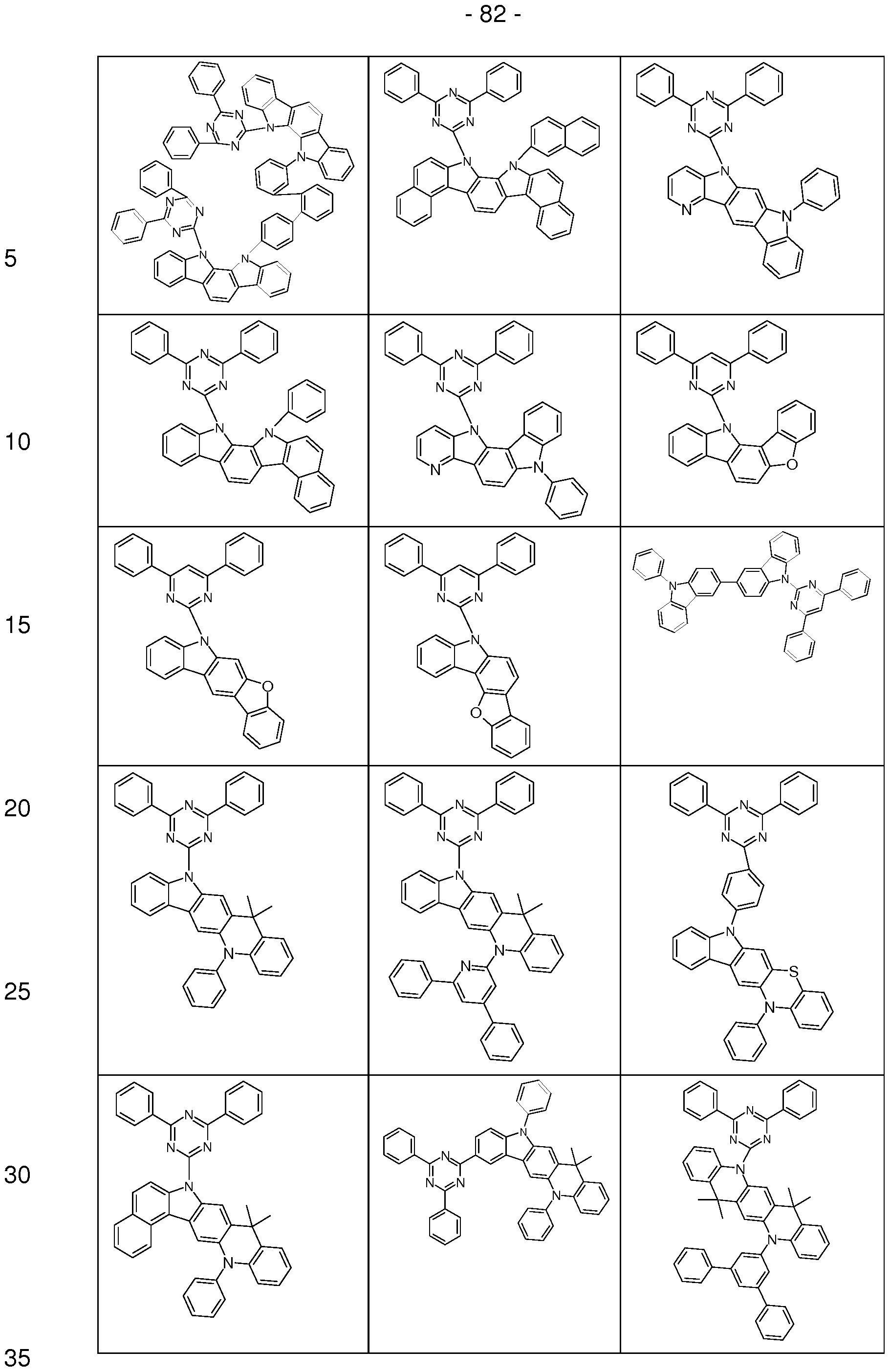

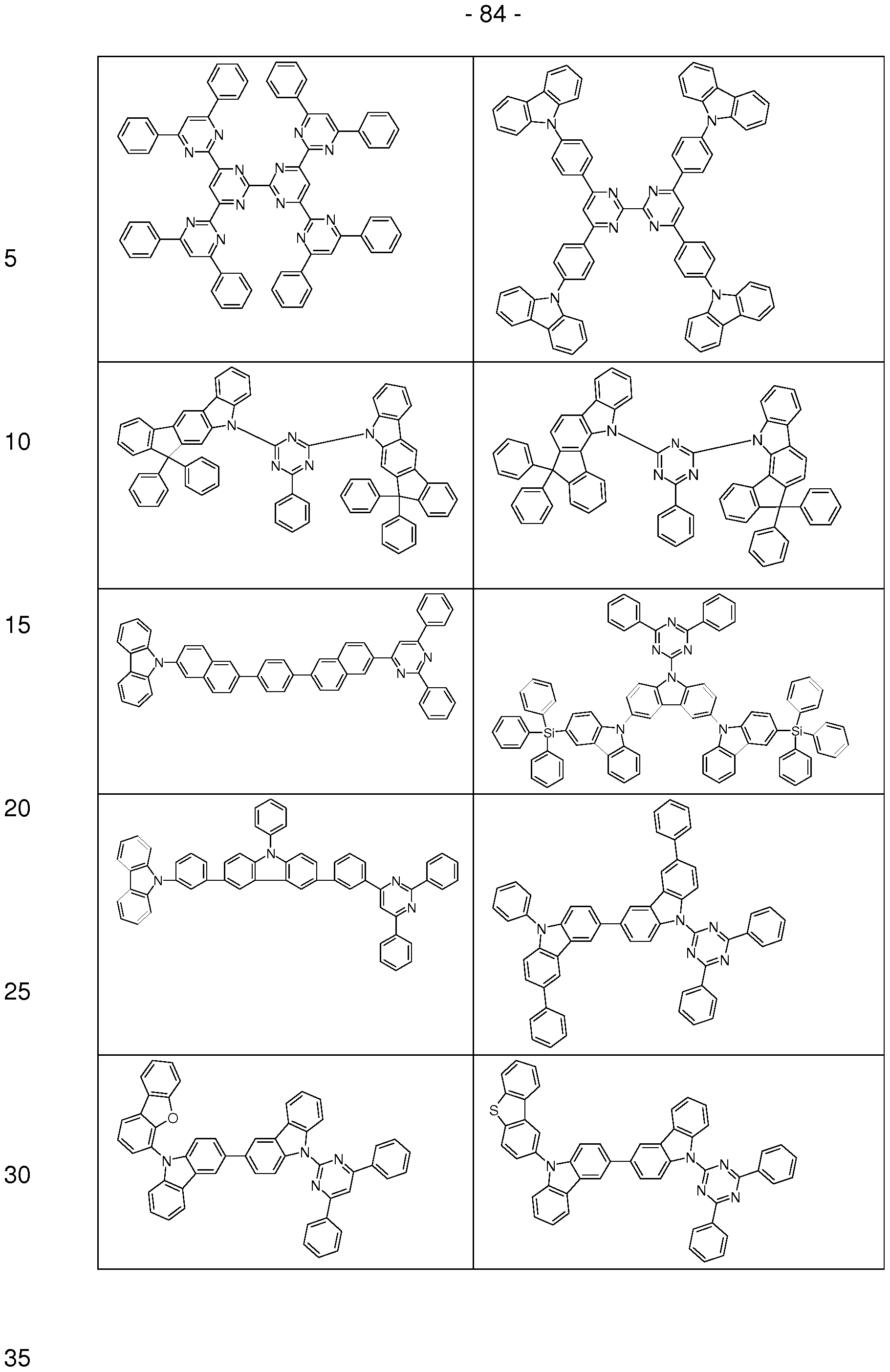
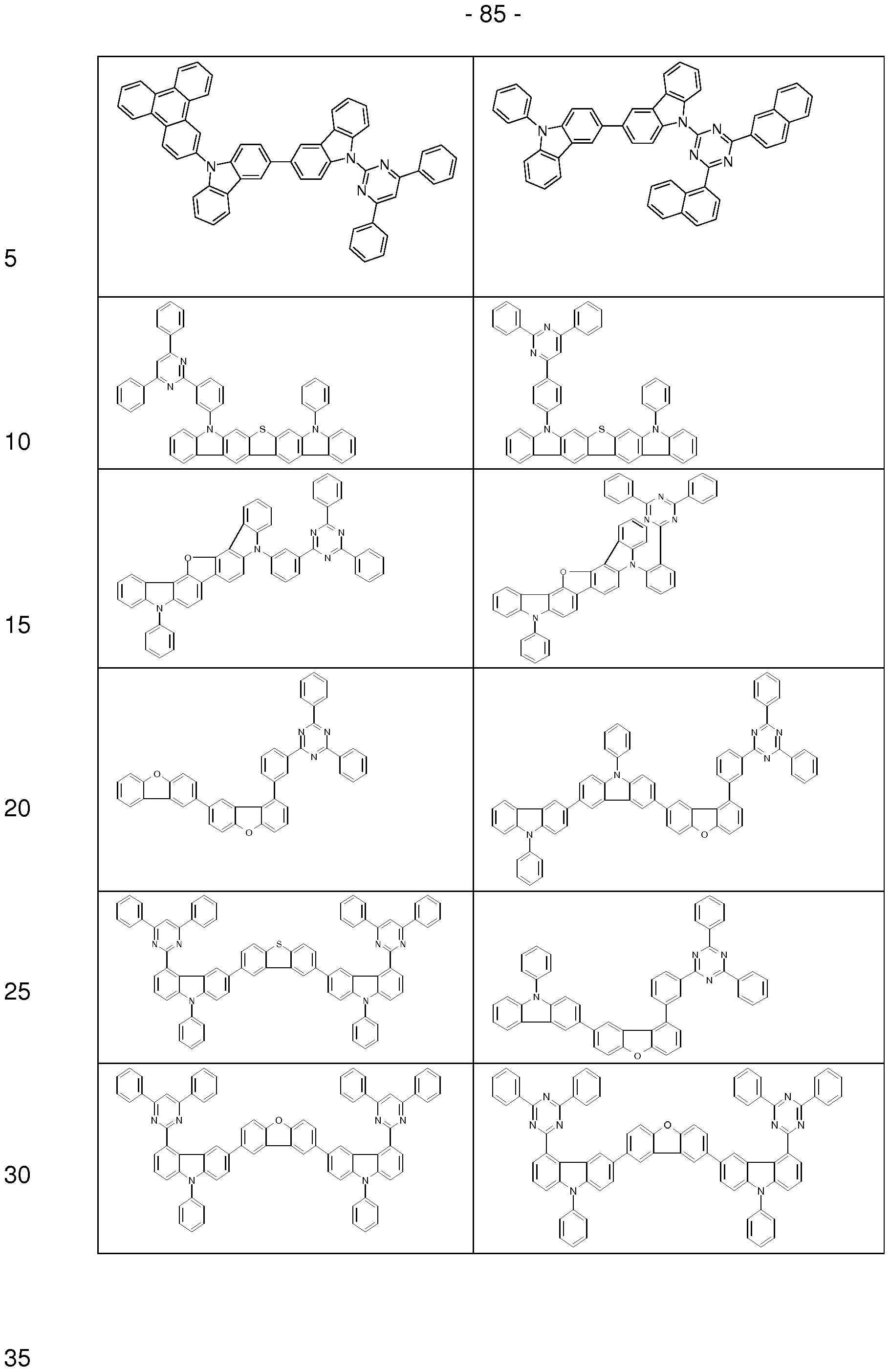
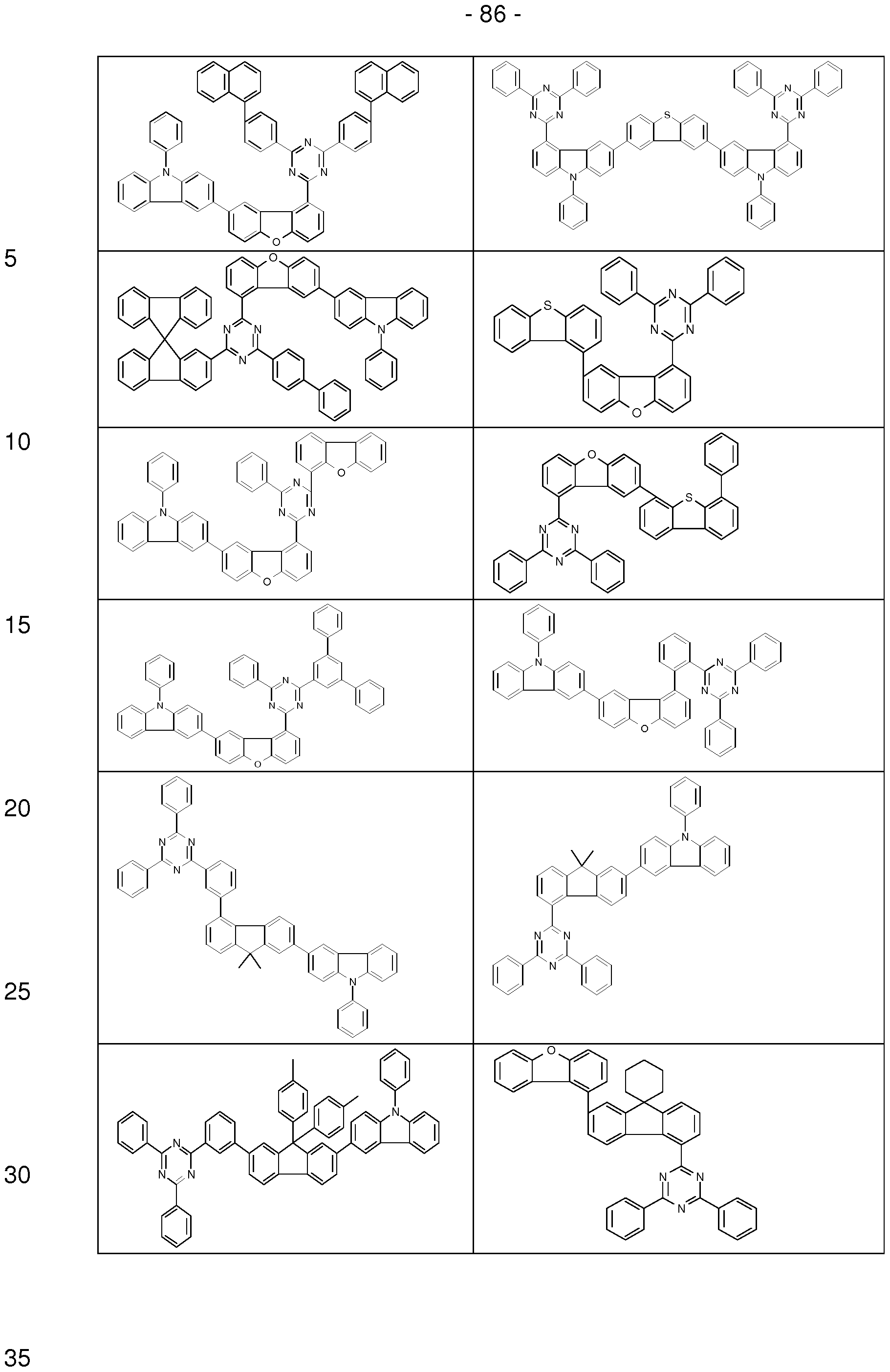
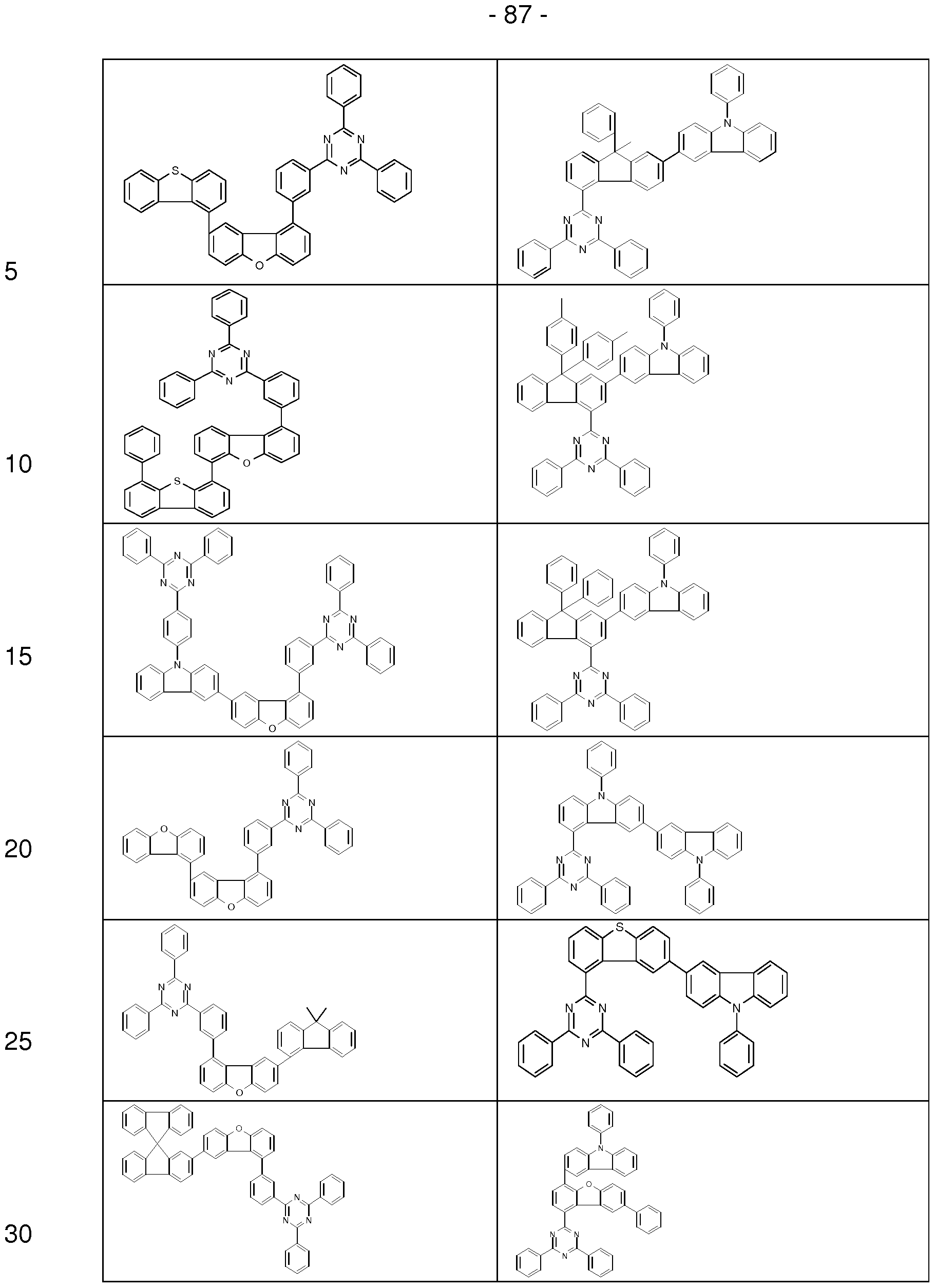


Beispiele für Lactame, welche als elektronentransportierende Matrix- materialien eingesetzt werden können, sind die folgenden Verbindungen: Examples of lactams which can be used as electron-transporting matrix materials are the following compounds:


Beispiele für Ketone, welche als elektronentransportierende Matrix- materialien eingesetzt werden können, sind die folgenden Verbindungen: Examples of ketones which can be used as electron-transporting matrix materials are the following compounds:
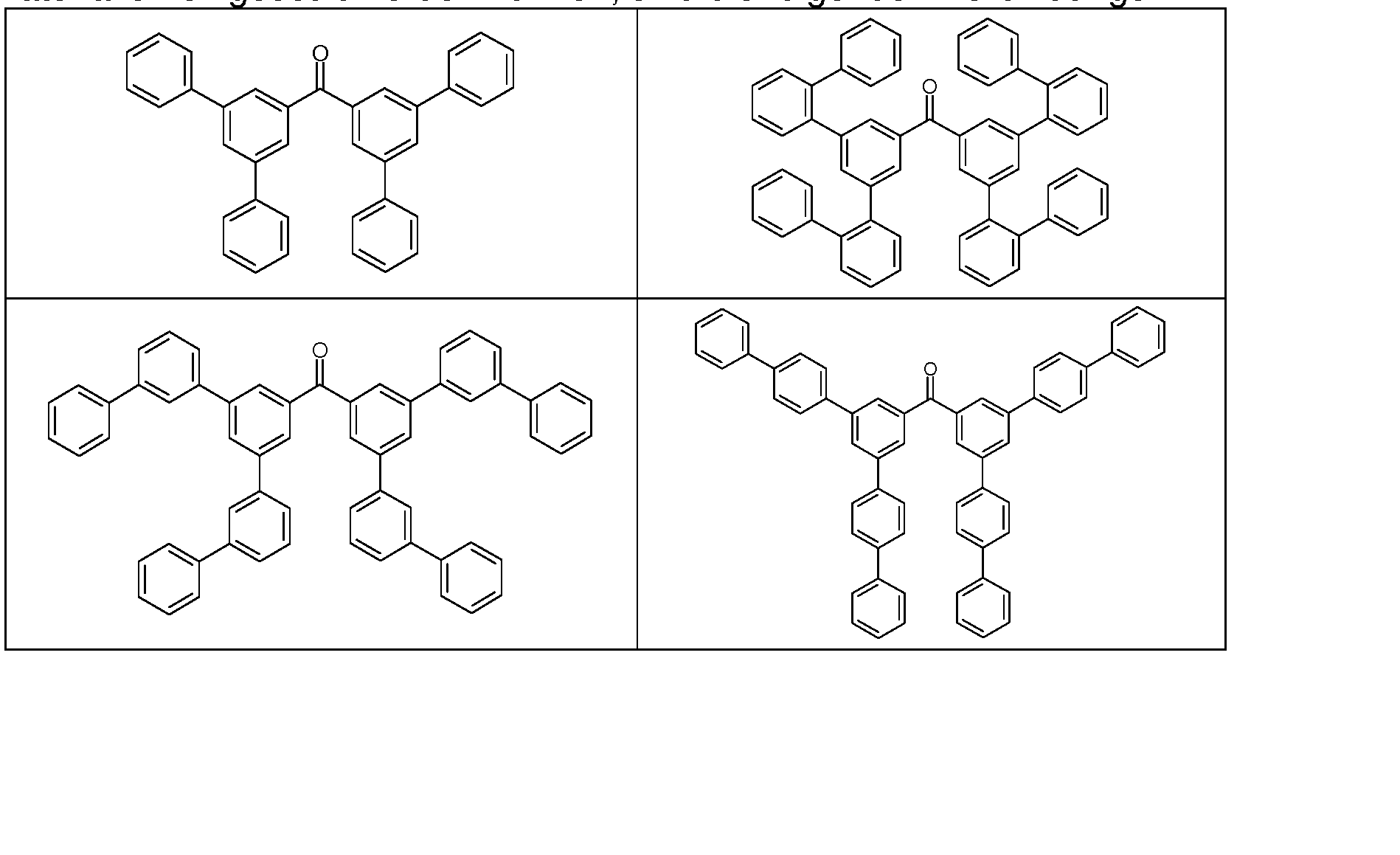


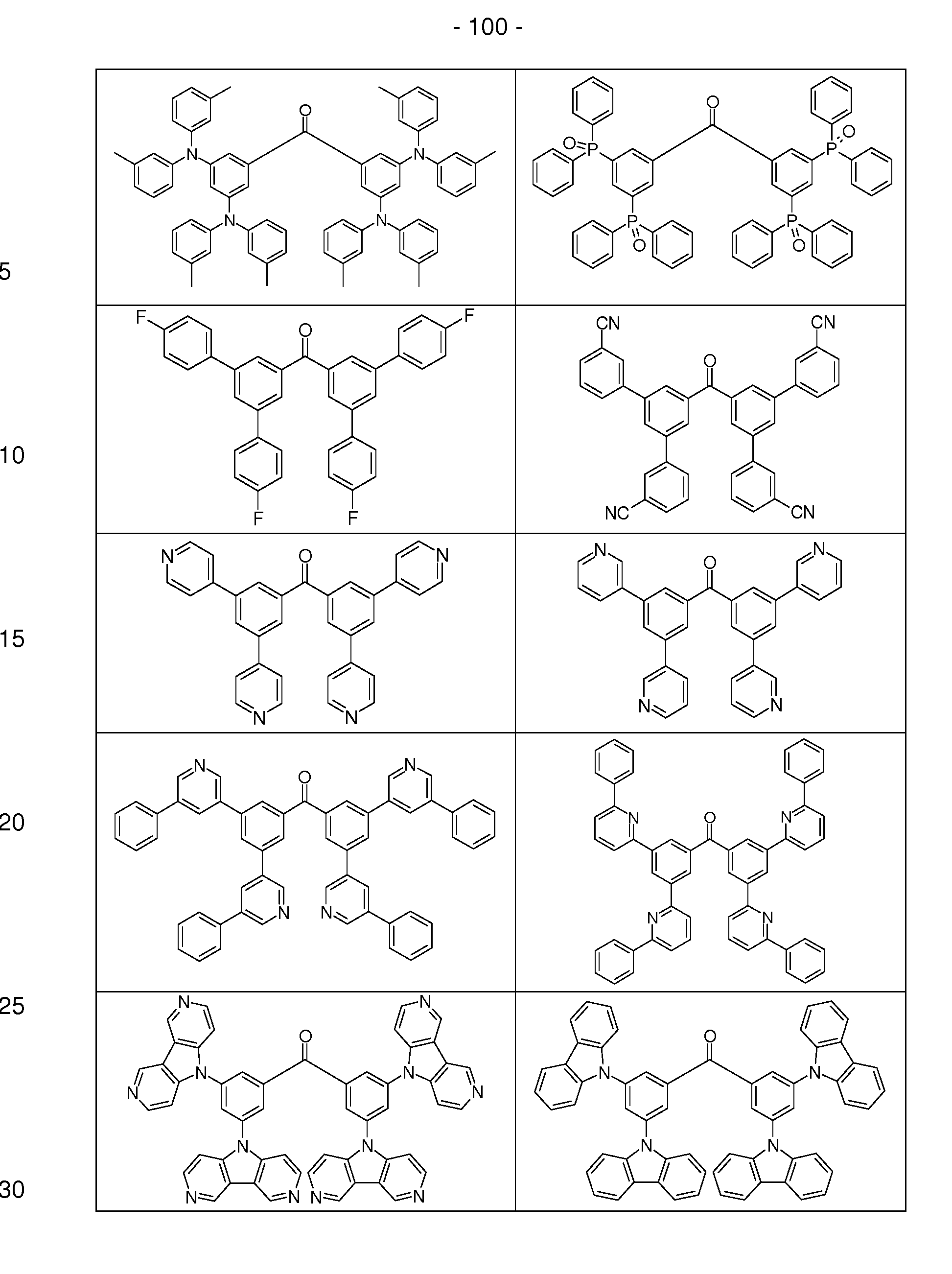
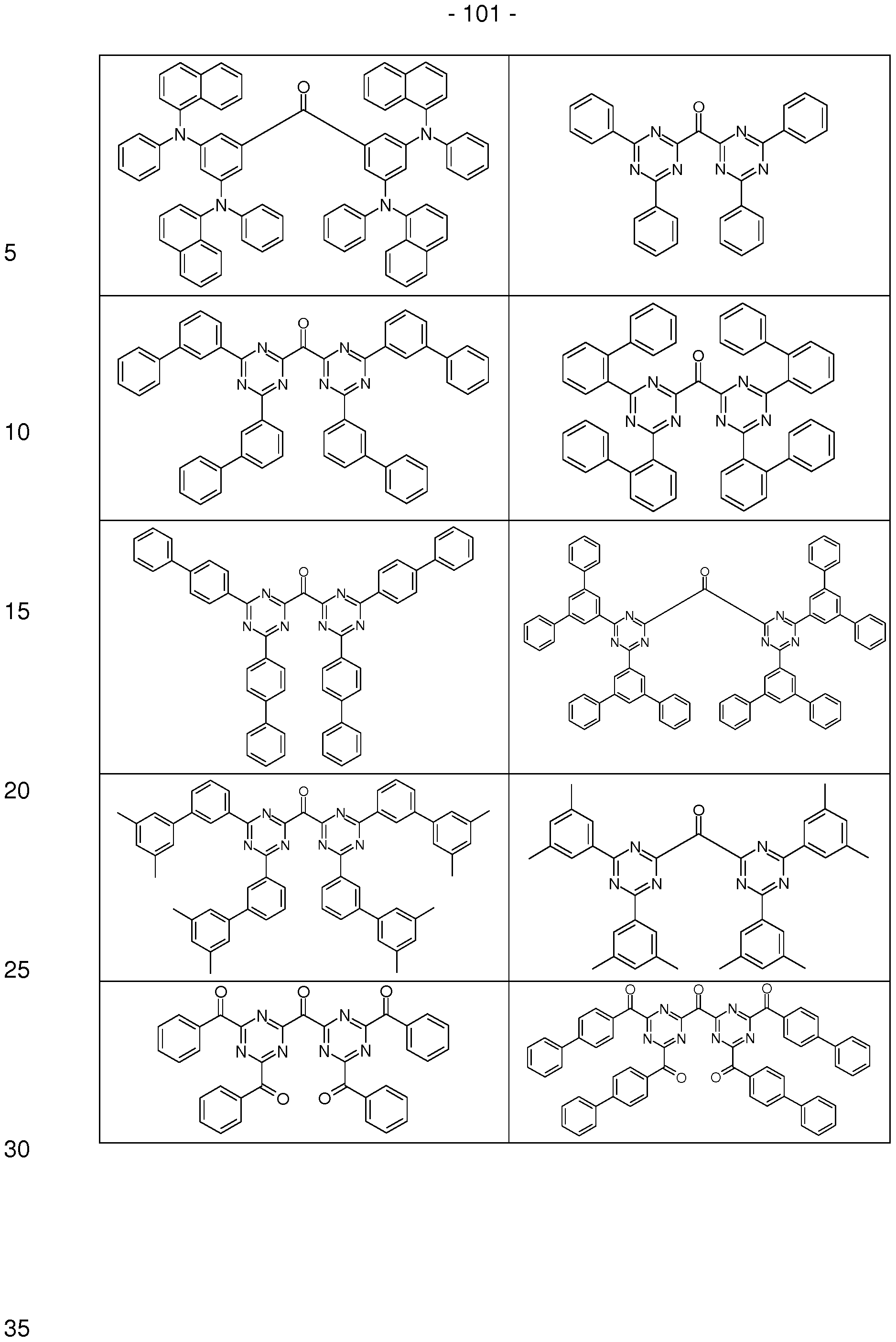


Beispiele für Metallkomplexe, welche als elektronentransportierende Matrixmaterialien eingesetzt werden können, sind die folgenden Verbin dünge Examples of metal complexes which can be used as electron-transporting matrix materials are the following compounds
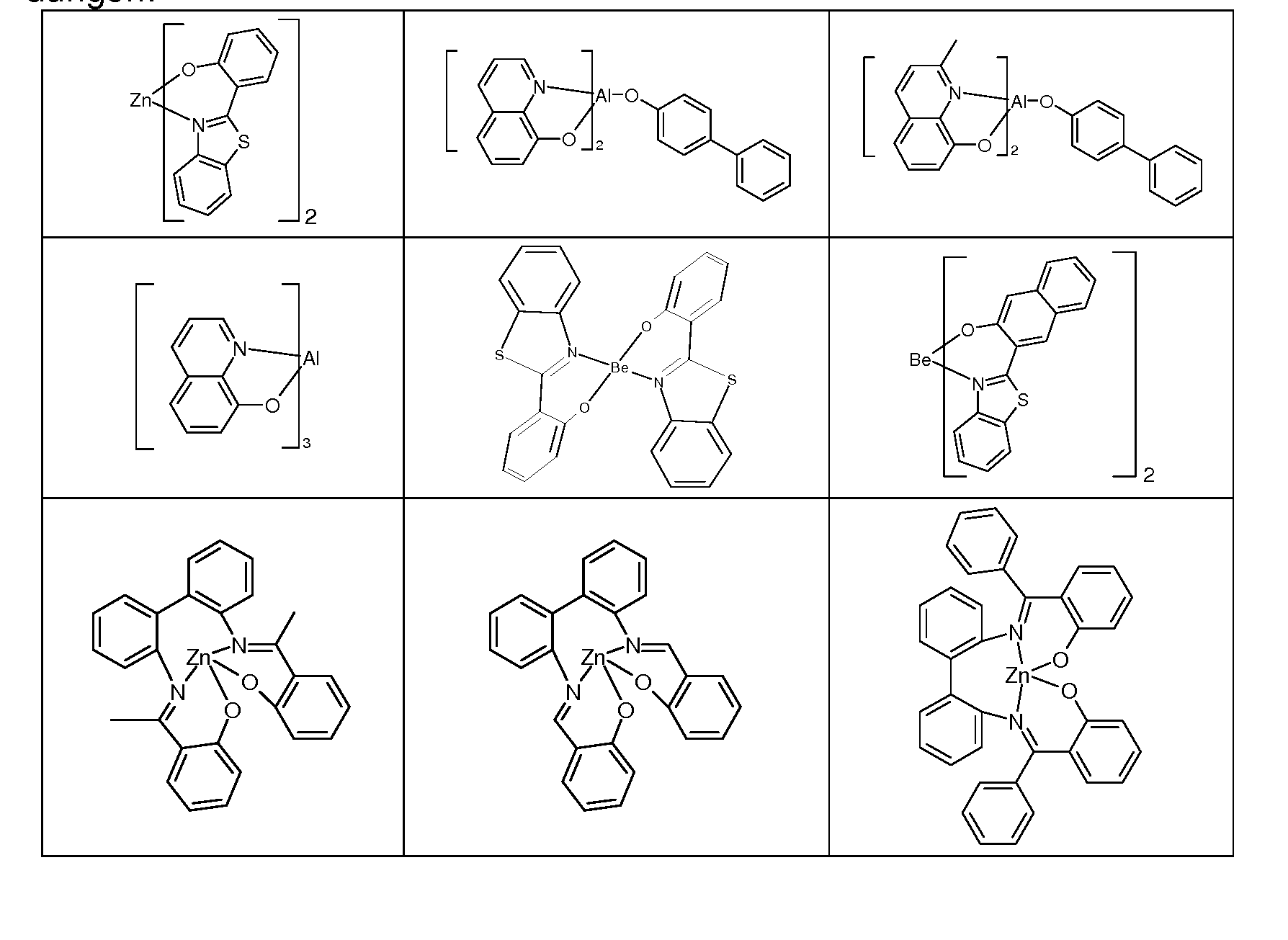

Beispiele für Phosphinoxide, welche als elektronentransportierende Matrixmaterialien eingesetzt werden können, sind die folgenden Verbin- Examples of phosphine oxides which can be used as electron-transporting matrix materials are the following compounds:
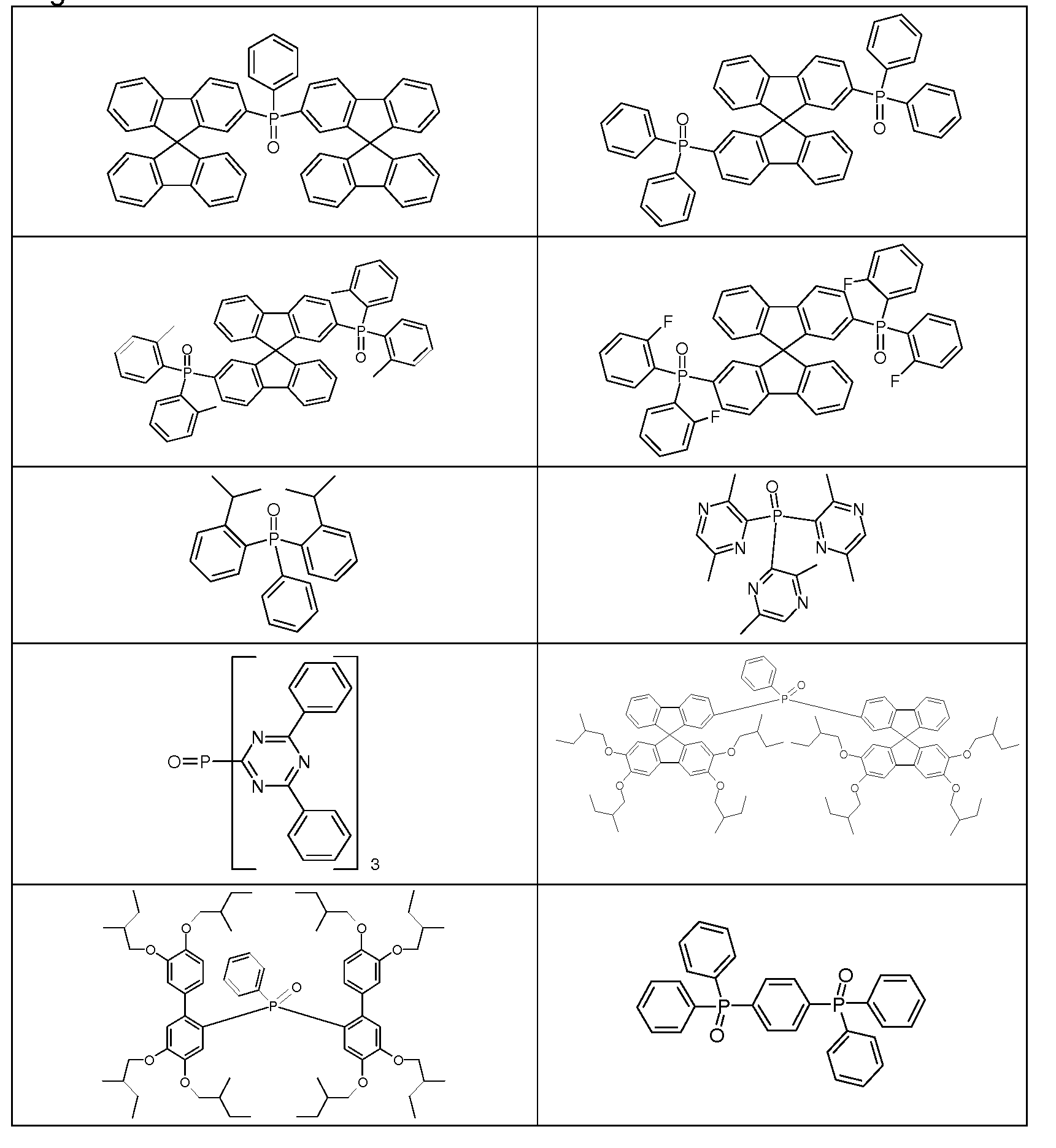

Beispiele für Indolo- und Indenocarbazolderivate im weitesten Sinn, welche je nach Substitutionsmuster als loch- oder elektronentranspor- tierende Matrixmaterialien eingesetzt werden können, sind die folgenden Verbindungen: Examples of indolo and indenocarbazole derivatives in the broadest sense, which can be used depending on the substitution pattern as hole- or electron-transporting matrix materials, are the following compounds:


35
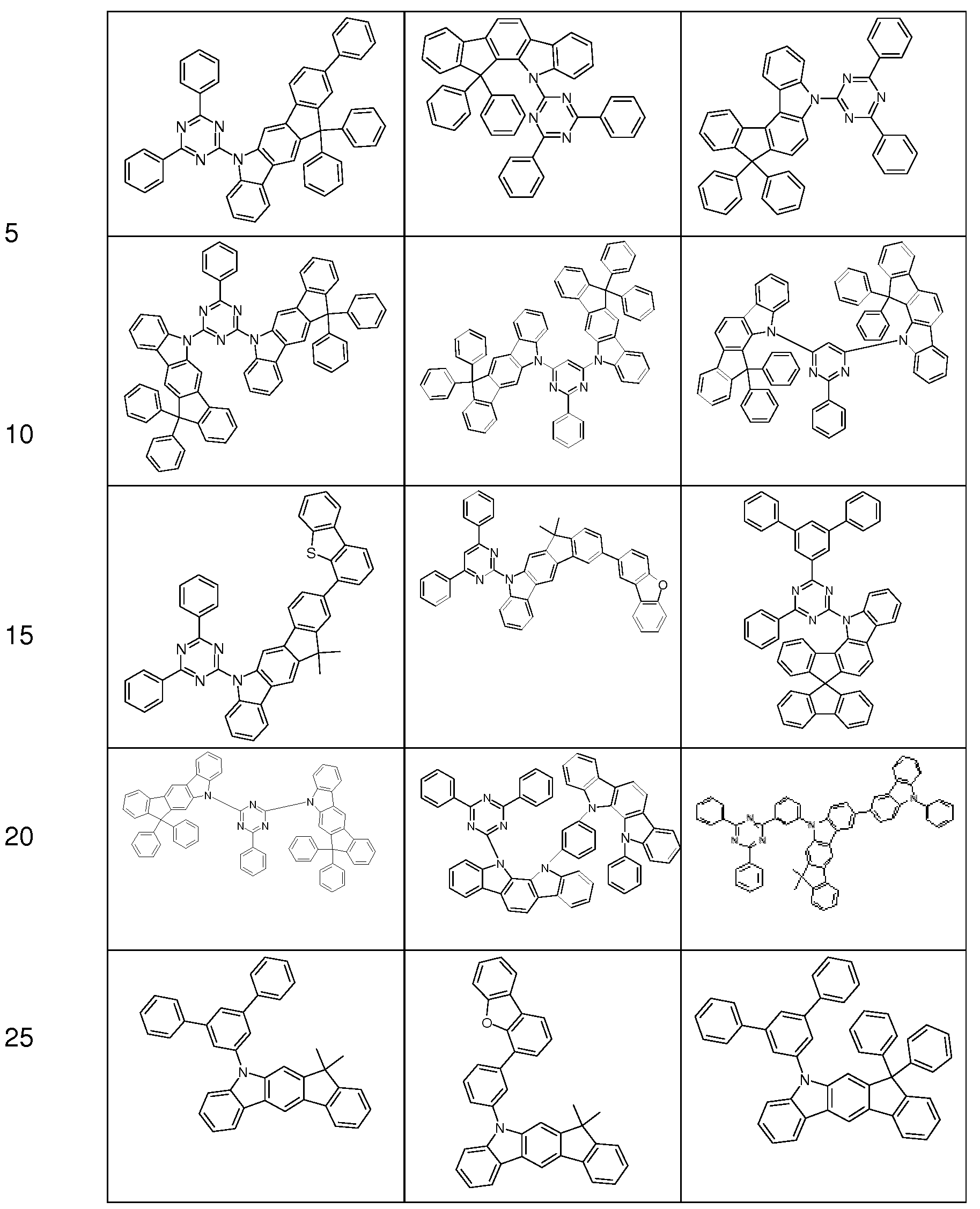
3030
35
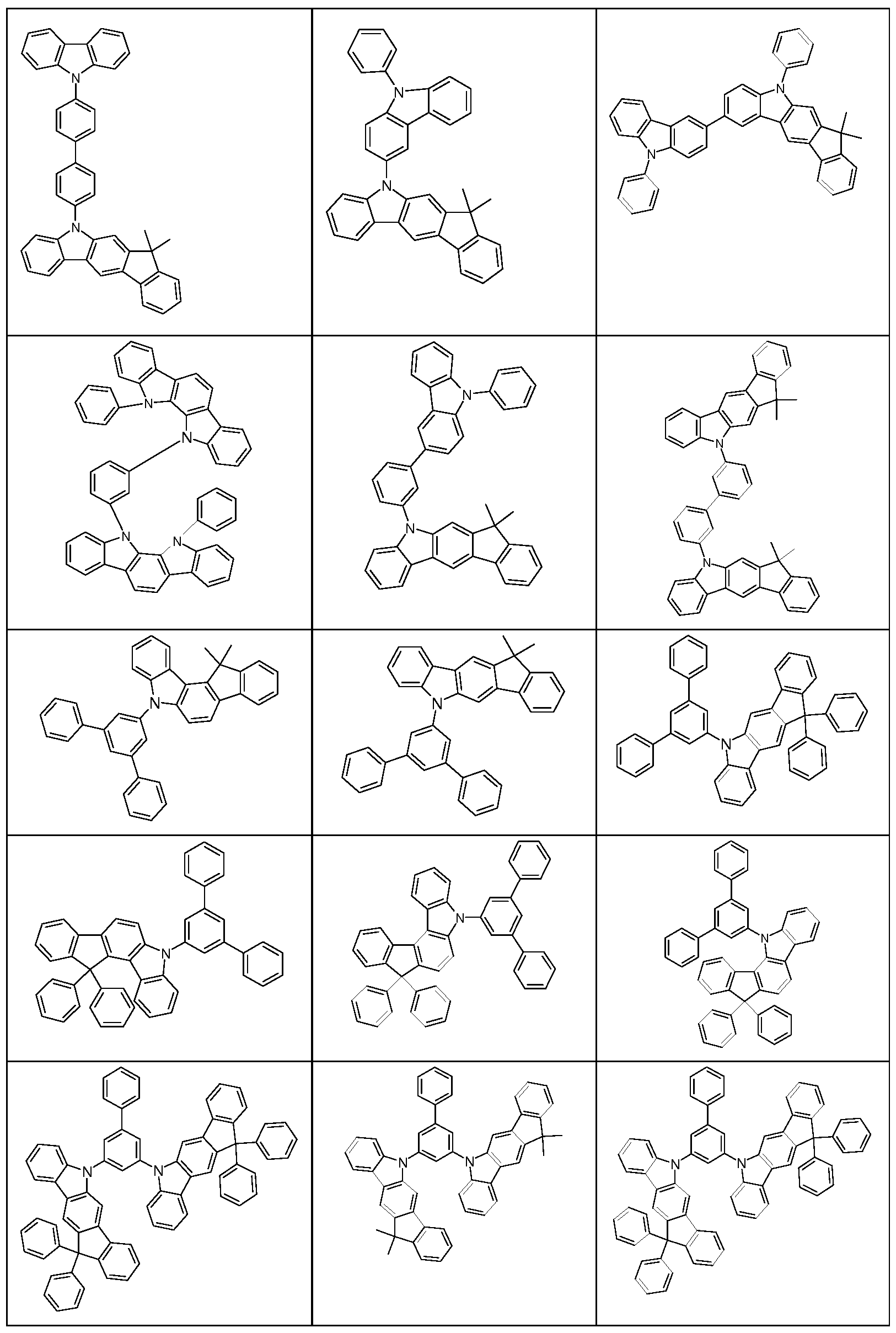
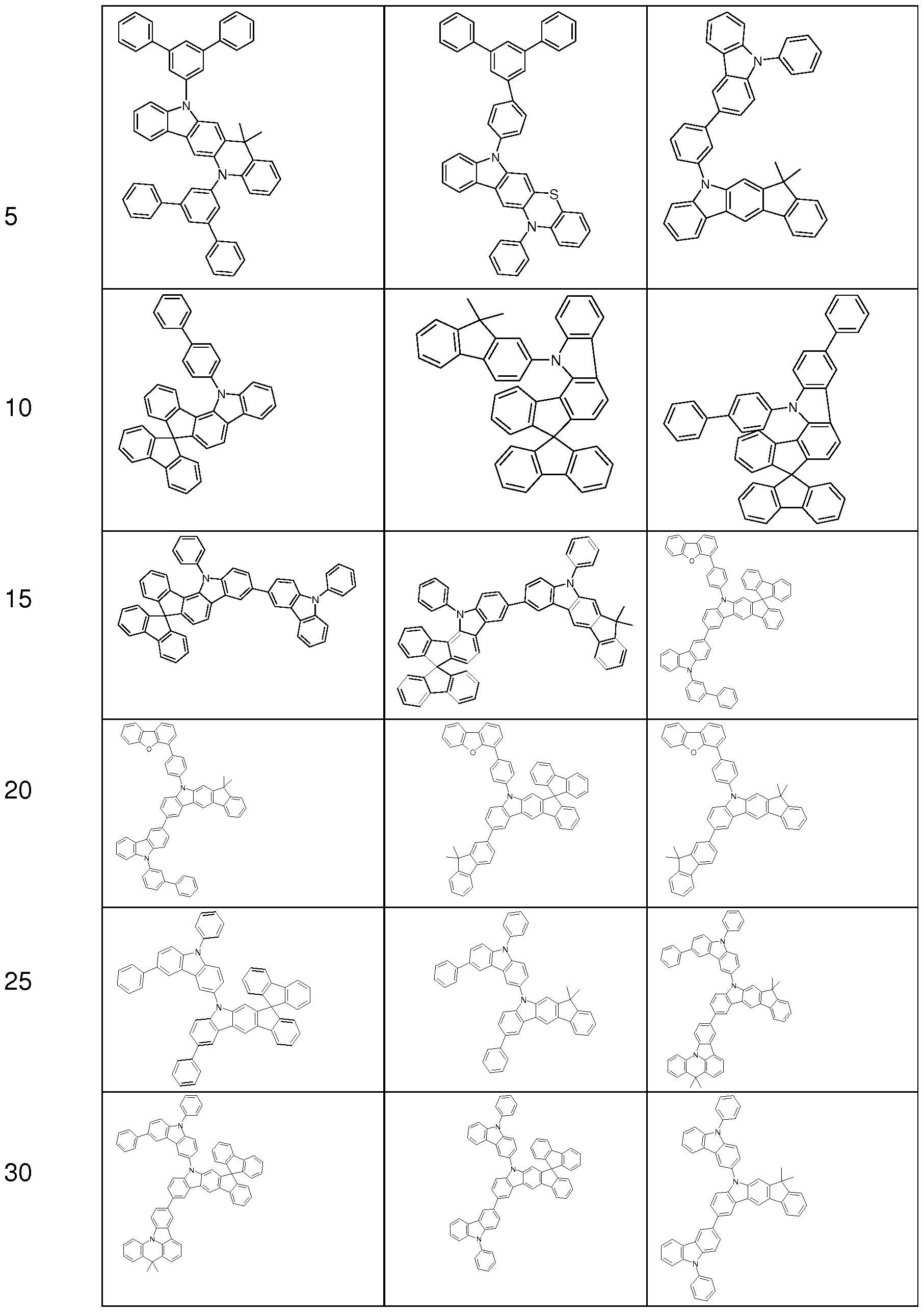
35 35

Beispiele für Carbazolderivate, welche je nach Substitutionsmuster als loch- oder elektronentransportierende Matrixmaterialien eingesetzt werden können, sind die folgenden Verbindungen: Examples of carbazole derivatives which, depending on the substitution pattern, can be used as hole- or electron-transporting matrix materials are the following compounds:
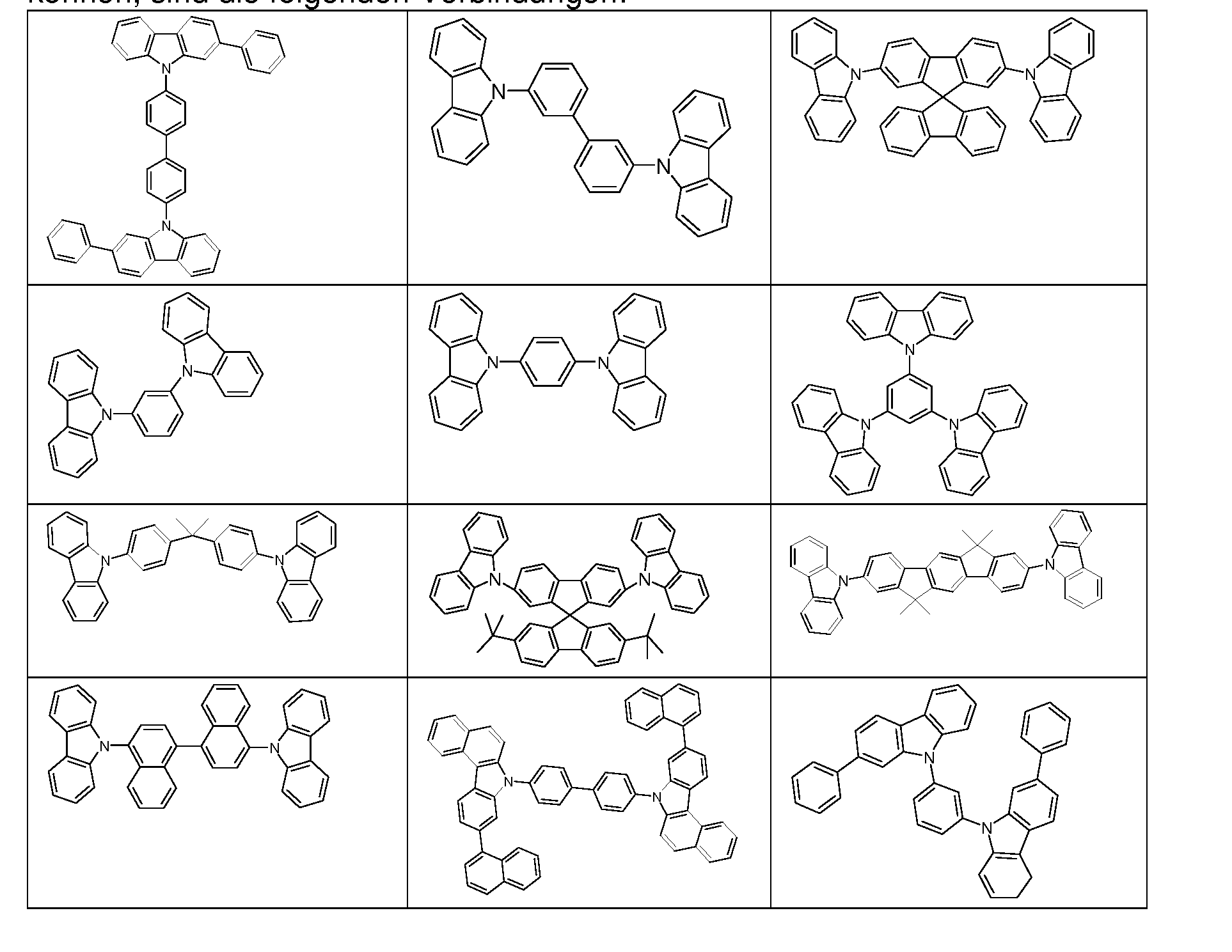
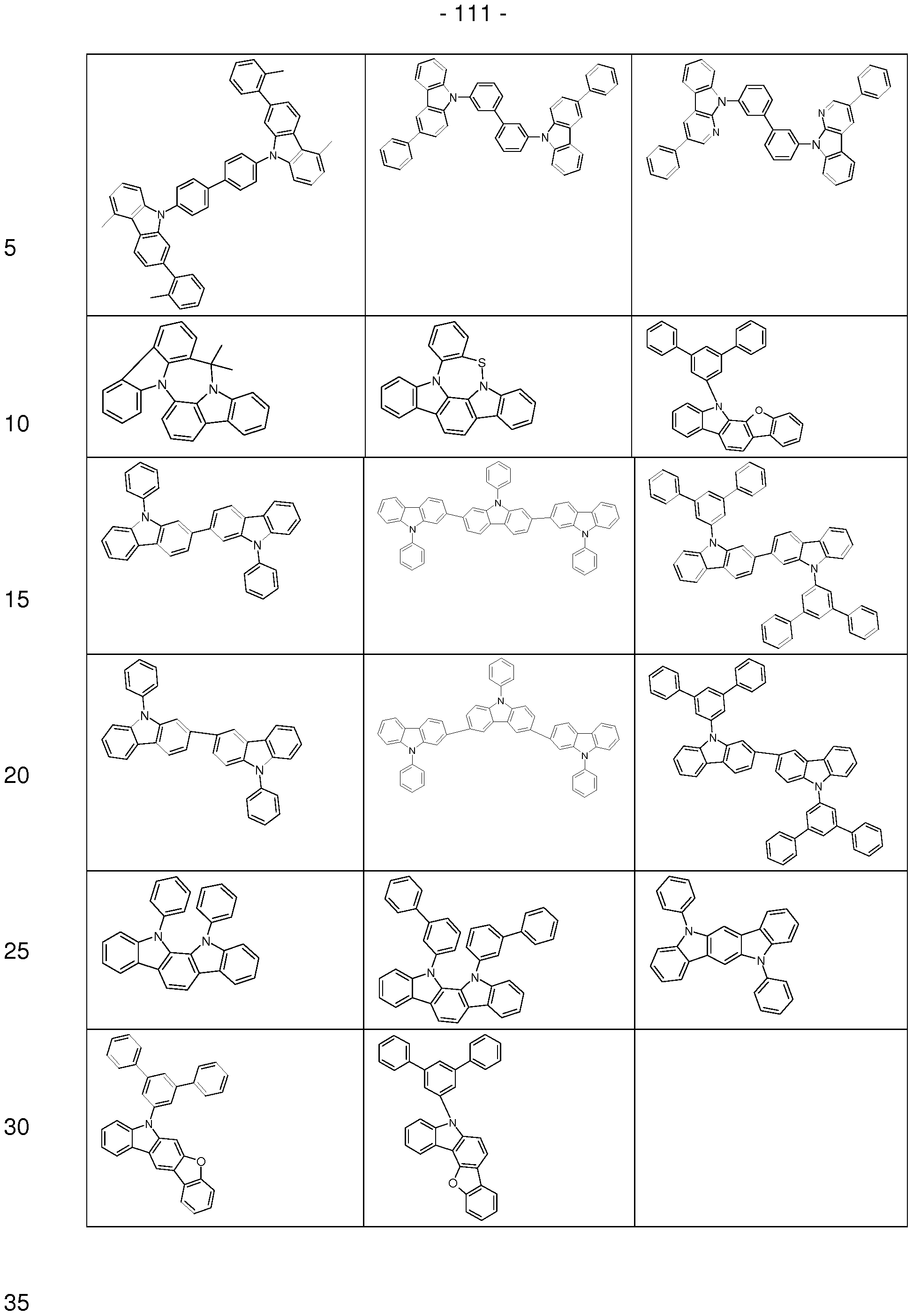


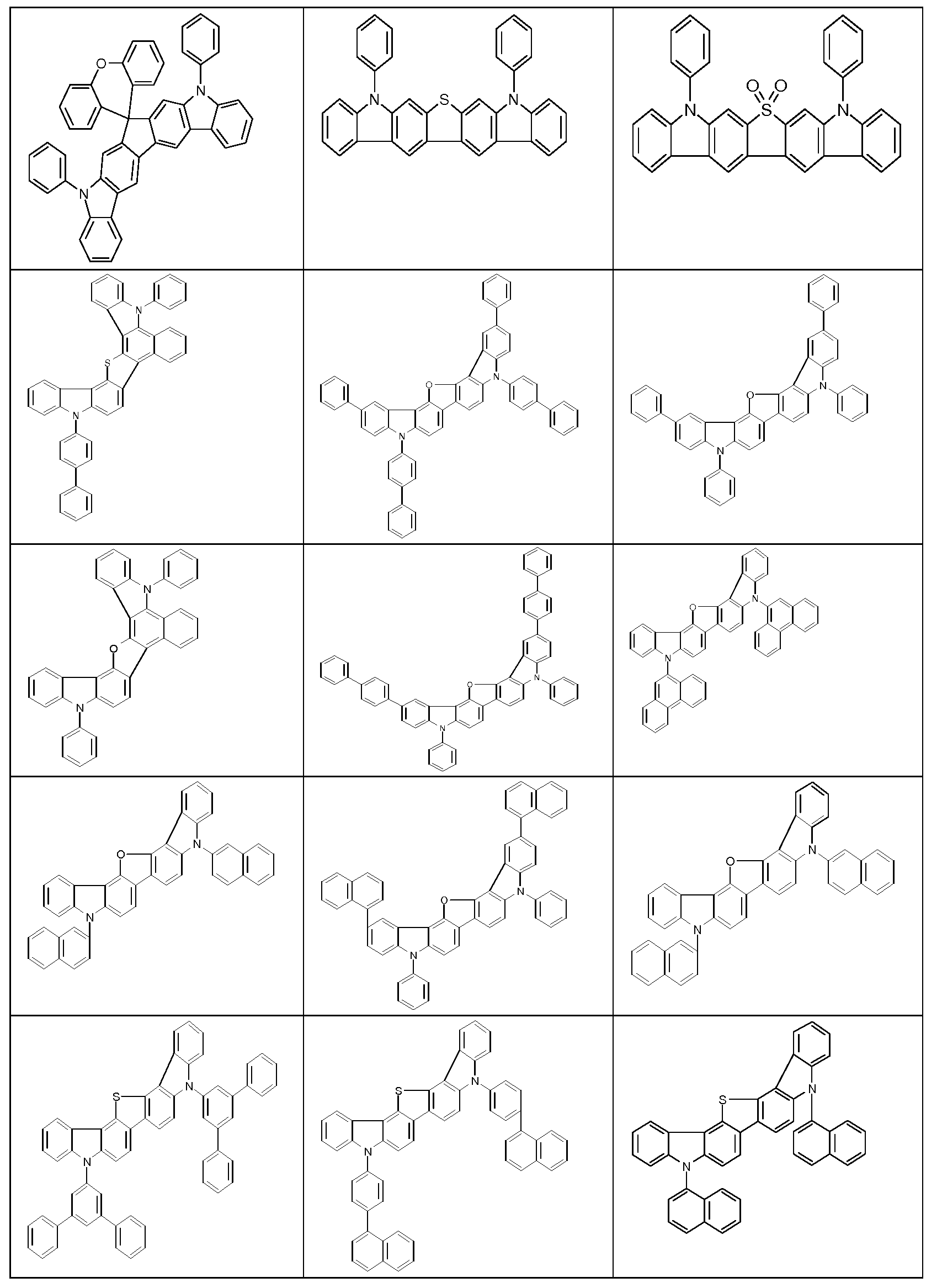

Beispiele für Biscarbazole, welche als lochtransportierende Matrix- materialien eingesetzt werden können, sind die folgenden Verbindungen: Examples of biscarbazoles which can be used as hole-transporting matrix materials are the following compounds:
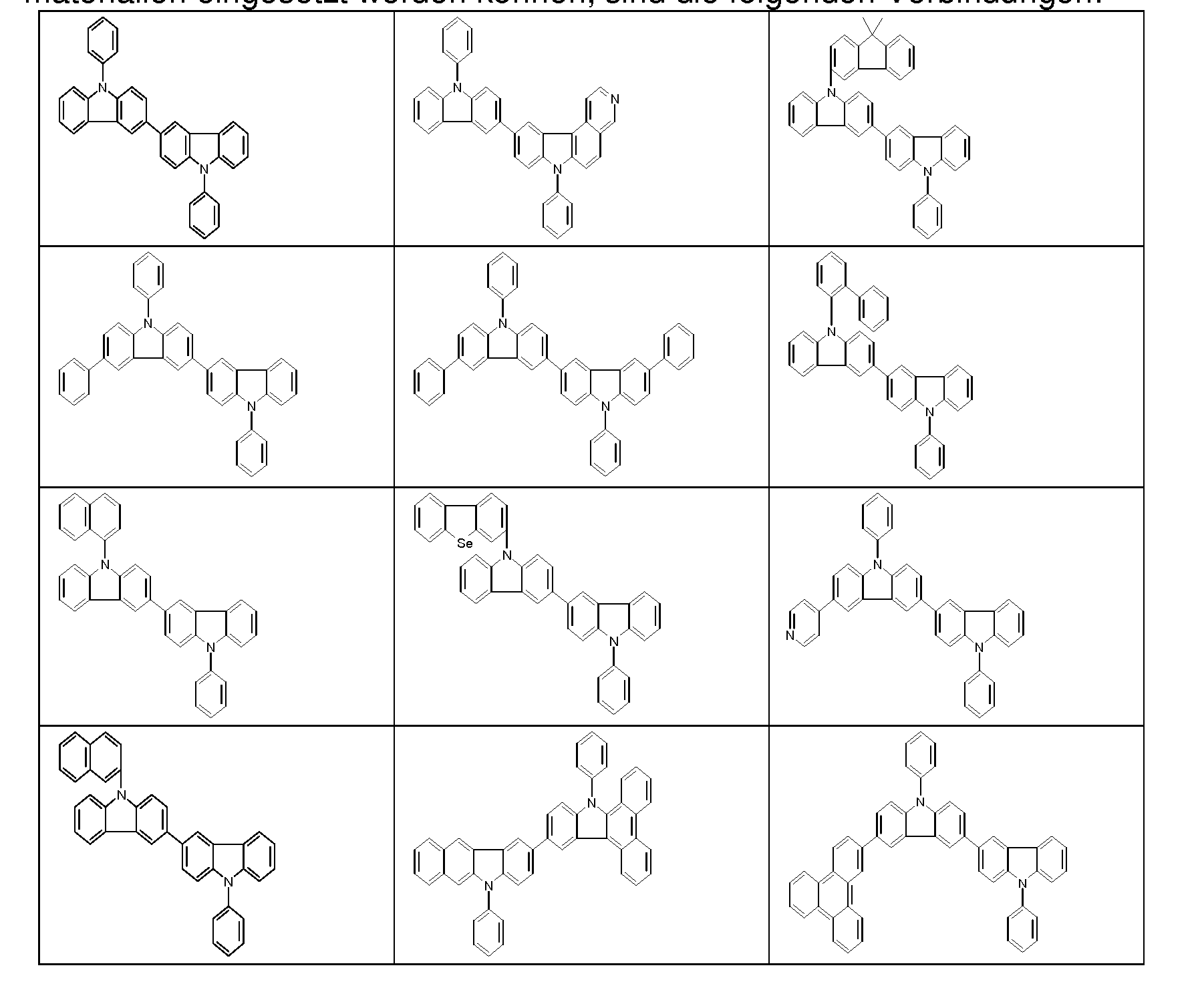


Beispiele für Materialien, welche als Wide Bandgap Matrixmaterialien ein- gesetzt werden können, sind die folgenden Verbindungen: Examples of materials which can be used as Wide Bandgap matrix materials are the following compounds:


Emittern zusammen mit einer Matrix einzusetzen. Dabei dient der Triplett- Emitter mit dem kürzerwelligen Emissionsspektrum als Co-Matrix für den Triplett-Emitter mit dem längerwelligen Emissionsspektrum. So können beispielsweise die erfindungsgemäßen Metallkomplexe als Co-Matrix für längerwellig emittierende Triplettemitter, beispielsweise für grün oder rot emittierende Triplettemitter, eingesetzt werden. Dabei kann es auch bevorzugt sein, wenn sowohl der kürzerwellig wie auch der längerwellig emittierende Metallkomplex eine erfindungsgemäße Verbindung ist. Emitters together with a matrix. The triplet emitter with the shorter-wave emission spectrum serves as a co-matrix for the triplet emitter with the longer-wave emission spectrum. Thus, for example, the metal complexes according to the invention can be used as a co-matrix for longer-wavelength emitting triplet emitters, for example for green or red emitting triplet emitters. It may also be preferred if both the shorter wavelength as well as the longer wavelength emitting metal complex is a compound of the invention.
Hierfür eignen sich insbesondere auch die Verbindungen, die in WO 2016/124304 und WO 2017/032439 offenbart sind. Beispiele für geeignete Triplettemitter, welche als Co-Dotanden für die erfindungsgemäßen Verbindungen eingesetzt werden können, sind in der folgenden Tabelle abgebildet. Particularly suitable for this purpose are the compounds disclosed in WO 2016/124304 and WO 2017/032439. Examples of suitable triplet emitters which can be used as co-dopants for the compounds according to the invention are shown in the following table.
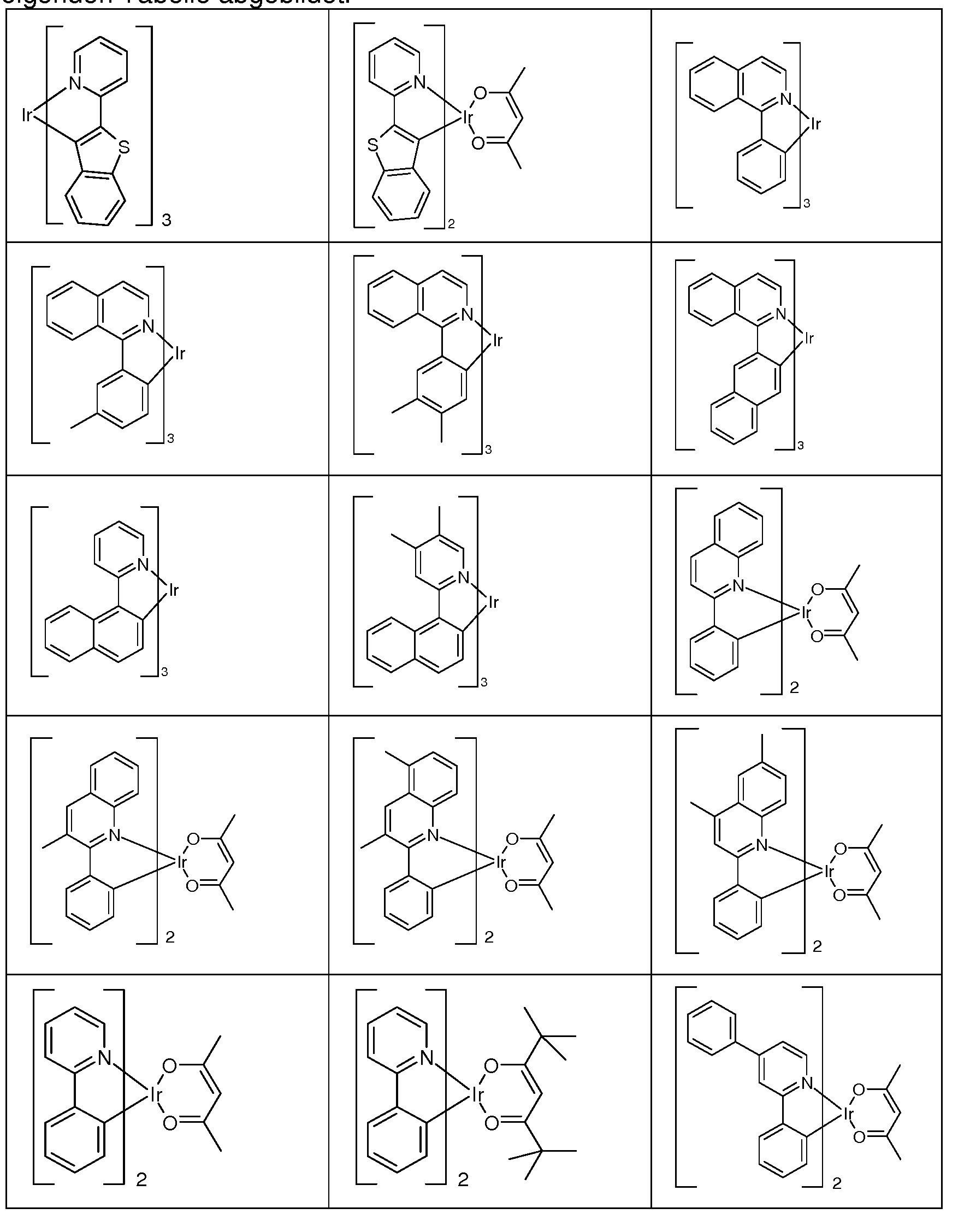
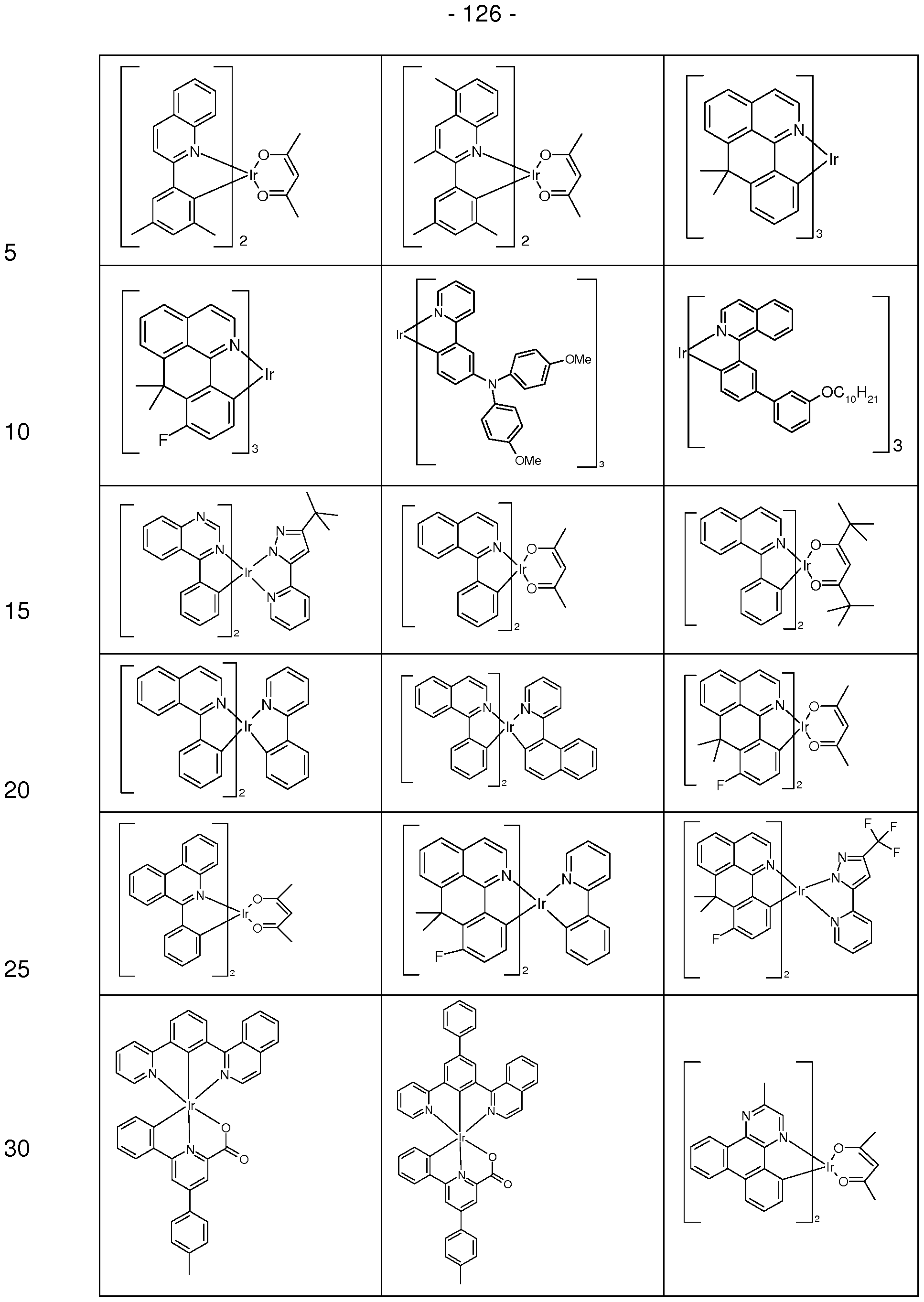


3030
35


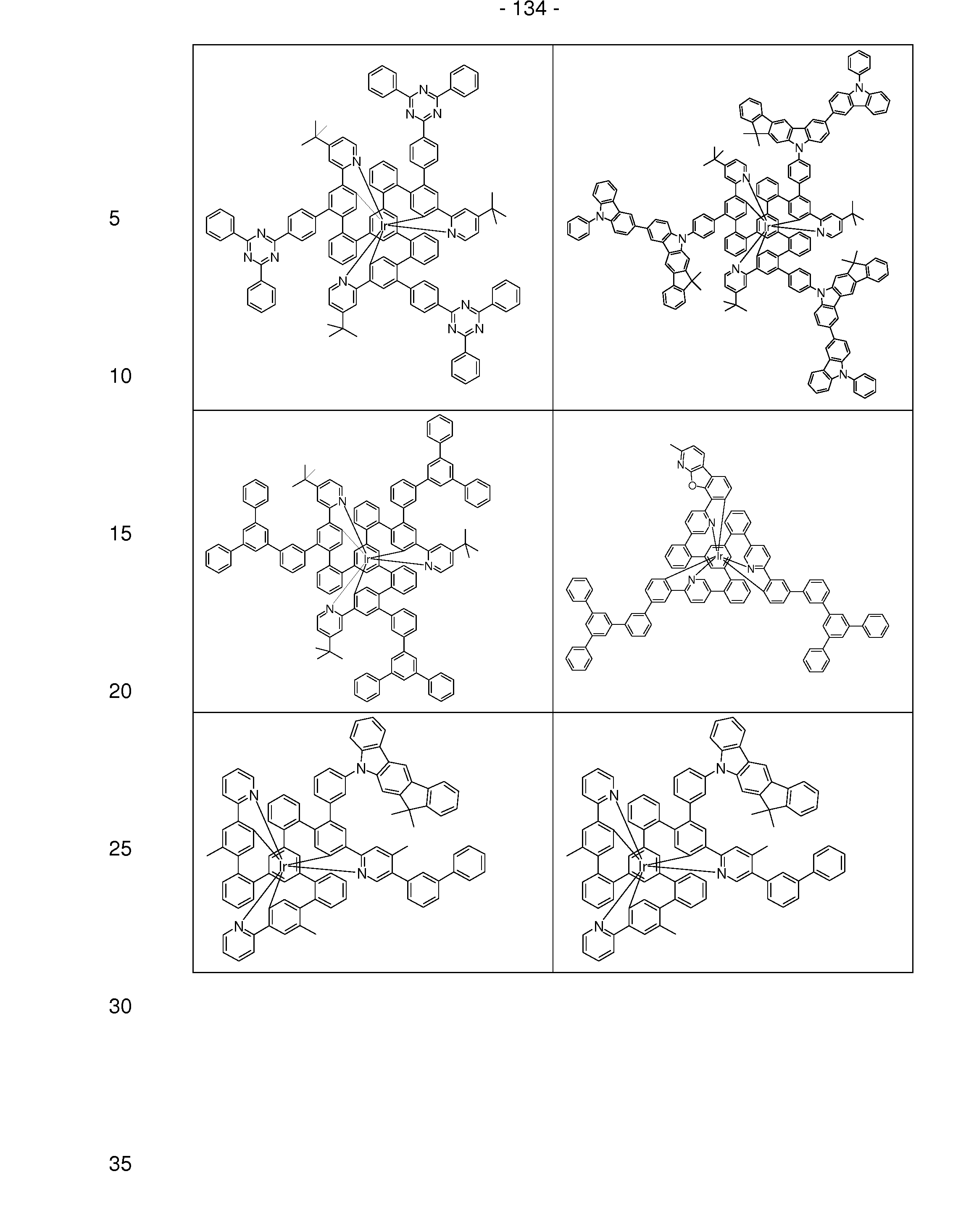
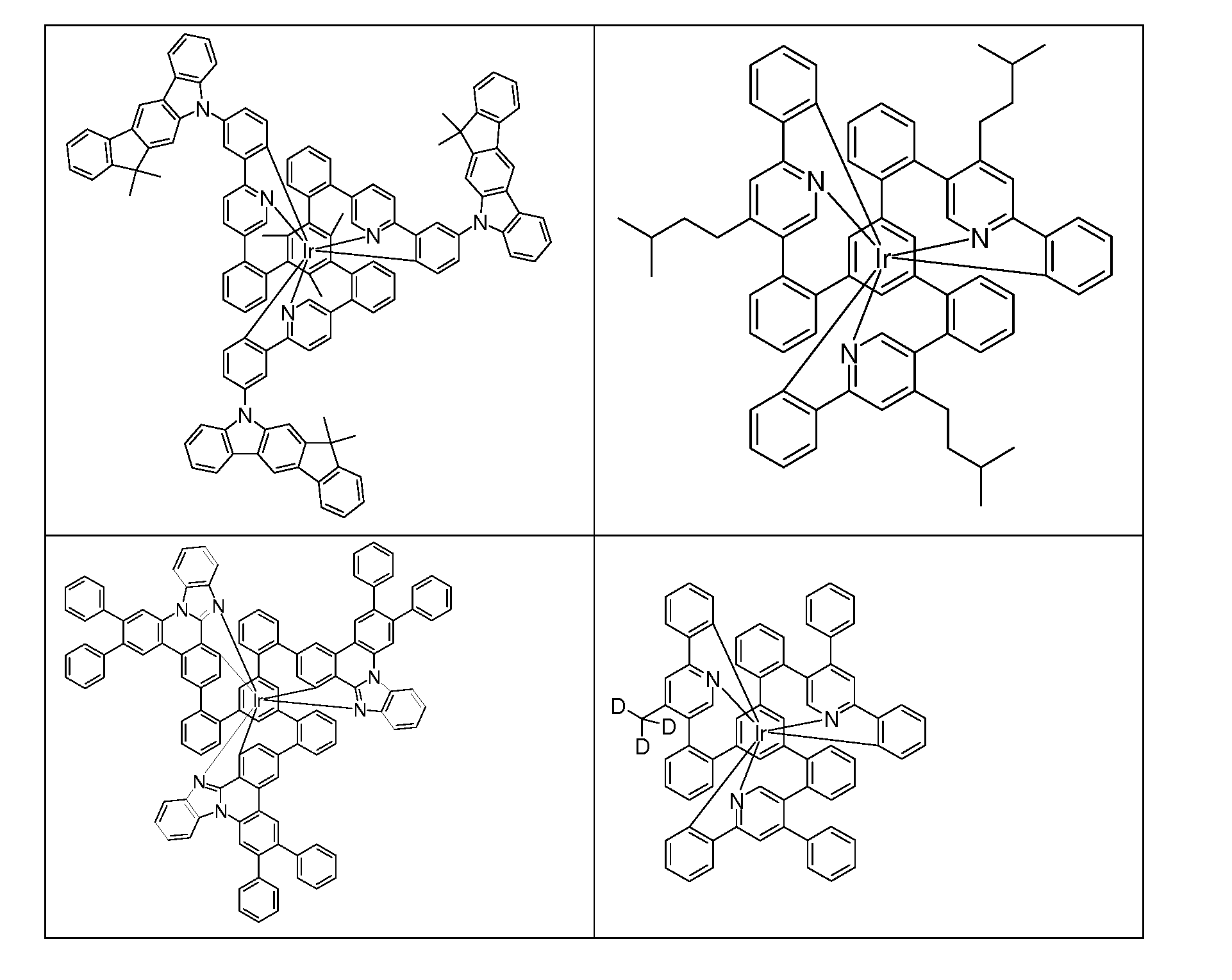
Es kann auch bevorzugt sein, mehrere verschiedene Matrixmaterialien als Mischung einzusetzen, insbesondere mindestens ein elektronenleitendes Matrixmaterial und mindestens ein lochleitendes Matrixmaterial. Eine bevorzugte Kombination ist beispielsweise die Verwendung eines aroma- tischen Ketons, eines Triazin-Derivats oder eines Phosphinoxid-Derivats mit einem Triarylamin-Derivat oder einem Carbazol-Derivat als gemischte Matrix für den erfindungsgemäßen Metallkomplex. Ebenso bevorzugt ist die Verwendung einer Mischung aus einem ladungstransportierenden Matrixmaterial und einem elektrisch inerten Matrixmaterial, welches nicht bzw. nicht in wesentlichem Maße am Ladungstransport beteiligt ist, wie z. B. in WO 2010/108579 beschrieben. Ebenso bevorzugt ist die Verwen- dung von zwei elektronentransportierenden Matrixmaterialien, beispiels- weise Triazinderivaten und Lactamderivaten, wie z. B. in WO It may also be preferred to use a plurality of different matrix materials as a mixture, in particular at least one electron-conducting matrix material and at least one hole-conducting matrix material. A preferred combination is, for example, the use of an aromatic ketone, a triazine derivative or a phosphine oxide derivative with a triarylamine derivative or a carbazole derivative as a mixed matrix for the metal complex according to the invention. Also preferred is the use of a mixture of a charge-transporting matrix material and an electrically inert matrix material, which is not or not significantly involved in charge transport, such. As described in WO 2010/108579. Likewise preferred is the use of two electron-transporting matrix materials, for example triazine derivatives and lactam derivatives, such. In WO
2014/094964 beschrieben. Weiterhin bevorzugt ist es, eine Mischung aus zwei oder mehr Triplett- Emittern zusammen mit einer Matrix einzusetzen. Dabei dient der Triplett- Emitter mit dem kürzerwelligen Emissionsspektrum als Co-Matrix für den Triplett-Emitter mit dem längerwelligen Emissionsspektrum. So können beispielsweise die erfindungsgemäßen Metallkomplexe als Co-Matrix für längerwellig emittierende Triplettemitter, beispielsweise für grün oder rot emittierende Triplettemitter, eingesetzt werden. Dabei kann es auch bevorzugt sein, wenn sowohl der kürzerwellig wie auch der längerwellig emittierende Metallkomplex eine erfindungsgemäße Verbindung ist. 2014/094964 described. It is further preferred to use a mixture of two or more triplet emitters together with a matrix. The triplet emitter with the shorter-wave emission spectrum serves as a co-matrix for the triplet emitter with the longer-wave emission spectrum. Thus, for example, the metal complexes according to the invention can be used as a co-matrix for longer-wavelength emitting triplet emitters, for example for green or red emitting triplet emitters. It may also be preferred if both the shorter wavelength as well as the longer wavelength emitting metal complex is a compound of the invention.
Beispiele für Metallkomplexe, welche als Co-Matrix eingesetzt werden können, sind die in WO 201 6/124304 und WO 2017/032439 offenbarten Metallkomplexe. Examples of metal complexes which can be used as co-matrix are the metal complexes disclosed in WO 201/124304 and WO 2017/032439.
Die erfindungsgemäßen Metallkomplexe lassen sich auch in anderen Funktionen in der elektronischen Vorrichtung einsetzen, beispielsweise als Lochtransportmaterial in einer Lochinjektions- oder -transportschicht, als Ladungserzeugungsmaterial, als Elektronenblockiermaterial, als Loch- blockiermaterial oder als Elektronentransportmaterial, beispielsweise in einer Elektronentransportschicht, je nach genauer Struktur des Liganden. Ebenso lassen sich die erfindungsgemäßen Metallkomplexe als Matrix- material für andere phosphoreszierende Metallkomplexe in einer emittierenden Schicht einsetzen. The metal complexes according to the invention can also be used in other functions in the electronic device, for example as hole transport material in a hole injection or transport layer, as charge generation material, as electron blocking material, as hole blocking material or as electron transport material, for example in an electron transport layer, depending on the exact structure of the electron transport layer ligands. Likewise, the metal complexes according to the invention can be used as matrix material for other phosphorescent metal complexes in an emitting layer.
Als Kathode sind Metalle mit geringer Austrittsarbeit, Metalllegierungen oder mehrlagige Strukturen aus verschiedenen Metallen bevorzugt, wie beispielsweise Erdalkalimetalle, Alkalimetalle, Hauptgruppenmetalle oder Lanthanoide (z. B. Ca, Ba, Mg, AI, In, Mg, Yb, Sm, etc.). Weiterhin eignen sich Legierungen aus einem Alkali- oder Erdalkalimetall und Silber, bei- spielsweise eine Legierung aus Magnesium und Silber. Bei mehrlagigen Strukturen können auch zusätzlich zu den genannten Metallen weitere Metalle verwendet werden, die eine relativ hohe Austrittsarbeit aufweisen, wie z. B. Ag, wobei dann in der Regel Kombinationen der Metalle, wie beispielsweise Mg/Ag, Ca/Ag oder Ba/Ag verwendet werden. Es kann auch bevorzugt sein, zwischen einer metallischen Kathode und dem organischen Halbleiter eine dünne Zwischenschicht eines Materials mit einer hohen Dielektrizitätskonstante einzubringen. Hierfür kommen beispielsweise Alkalimetall- oder Erdalkalimetallfluoride, aber auch die entsprechenden Oxide oder Carbonate in Frage (z. B. LiF, L12O, BaF2, MgO, NaF, CsF, CS2CO3, etc.). Ebenso kommen hierfür organische Alkali- metallkomplexe in Frage, z. B. Liq (Lithiumchinolinat). Die Schichtdicke dieser Schicht beträgt bevorzugt zwischen 0.5 und 5 nm. As the cathode, low work function metals, metal alloys or multilayer structures of various metals are preferable, such as alkaline earth metals, alkali metals, main group metals or lanthanides (eg, Ca, Ba, Mg, Al, In, Mg, Yb, Sm, etc.). , Also suitable are alloys of an alkali metal or alkaline earth metal and silver, for example an alloy of magnesium and silver. In multilayer structures, it is also possible, in addition to the metals mentioned, to use further metals which have a relatively high work function, such as, for example, B. Ag, which then usually combinations of metals, such as Mg / Ag, Ca / Ag or Ba / Ag are used. It may also be preferred to introduce between a metallic cathode and the organic semiconductor a thin intermediate layer of a material with a high dielectric constant. Come for this For example, alkali metal or alkaline earth metal fluorides, but also the corresponding oxides or carbonates in question (eg., LiF, L12O, BaF2, MgO, NaF, CsF, CS2CO3, etc.). Likewise suitable for this purpose are organic alkali metal complexes, for. B. Liq (lithium quinolinate). The layer thickness of this layer is preferably between 0.5 and 5 nm.
Als Anode sind Materialien mit hoher Austrittsarbeit bevorzugt. Bevorzugt weist die Anode eine Austrittsarbeit größer 4.5 eV vs. Vakuum auf. Hierfür sind einerseits Metalle mit hohem Redoxpotential geeignet, wie beispiels- weise Ag, Pt oder Au. Es können andererseits auch Metall/Metalloxid- Elektroden (z. B. AI/Ni/NiOx, Al/PtOx) bevorzugt sein. Für einige Anwen- dungen muss mindestens eine der Elektroden transparent oder teiltrans- parent sein, um entweder die Bestrahlung des organischen Materials (O-SC) oder die Auskopplung von Licht (OLED/PLED, O-LASER) zu ermöglichen. Bevorzugte Anodenmaterialien sind hier leitfähige gemischte Metalloxide. Besonders bevorzugt sind Indium-Zinn-Oxid (ITO) oder Indium-Zink-Oxid (IZO). Bevorzugt sind weiterhin leitfähige, dotierte organische Materialien, insbesondere leitfähige dotierte Polymere, z. B. PEDOT, PANI oder Derivate dieser Polymere. Bevorzugt ist weiterhin, wenn auf die Anode ein p-dotiertes Lochtransportmaterial als Lochinjek- tionsschicht aufgebracht wird, wobei sich als p-Dotanden Metalloxide, bei- spielsweise M0O3 oder WO3, oder (per)fluorierte elektronenarme Aroma- ten eignen. Weitere geeignete p-Dotanden sind HAT-CN (Hexacyano- hexaazatriphenylen) oder die Verbindung NPD9 von Novaled. Eine solche Schicht vereinfacht die Lochinjektion in Materialien mit einem tiefen HOMO, also einem betragsmäßig großen HOMO. As the anode, high workfunction materials are preferred. Preferably, the anode has a work function greater than 4.5 eV. Vacuum up. On the one hand metals with a high redox potential are suitable for this purpose, such as, for example, Ag, Pt or Au. On the other hand, metal / metal oxide electrodes (eg Al / Ni / NiOx, Al / PtOx) may also be preferred. For some applications, at least one of the electrodes must be transparent or partially transparent to allow either the irradiation of the organic material (O-SC) or the outcoupling of light (OLED / PLED, O-LASER). Preferred anode materials here are conductive mixed metal oxides. Particularly preferred are indium tin oxide (ITO) or indium zinc oxide (IZO). Also preferred are conductive, doped organic materials, in particular conductive doped polymers, for. B. PEDOT, PANI or derivatives of these polymers. It is furthermore preferred if a p-doped hole transport material is applied to the anode as a hole injection layer, suitable p-dopants being metal oxides, for example M0O3 or WO3, or (per) fluorinated electron-deficient aromatics. Further suitable p-dopants are HAT-CN (hexacyanohexaazatriphenylene) or the compound NPD9 from Novaled. Such a layer simplifies the hole injection in materials with a low HOMO, ie a HOMO of large magnitude.
In den weiteren Schichten können generell alle Materialien verwendet werden, wie sie gemäß dem Stand der Technik für die Schichten ver- wendet werden, und der Fachmann kann ohne erfinderisches Zutun jedes dieser Materialien in einer elektronischen Vorrichtung mit den erfindungs- gemäßen Materialien kombinieren. In the further layers, it is generally possible to use all materials used according to the prior art for the layers, and the person skilled in the art can combine any of these materials in an electronic device with the inventive materials without inventive step.
Die Vorrichtung wird entsprechend (je nach Anwendung) strukturiert, kontaktiert und schließlich hermetisch versiegelt, da sich die Lebensdauer derartiger Vorrichtungen bei Anwesenheit von Wasser und/oder Luft drastisch verkürzt. The device is structured accordingly (depending on the application), contacted and finally hermetically sealed, as the life such devices drastically shortened in the presence of water and / or air.
Weiterhin bevorzugt ist eine organische Elektrolumineszenzvorrichtung, dadurch gekennzeichnet, dass eine oder mehrere Schichten mit einem Sublimationsverfahren beschichtet werden. Dabei werden die Materialien in Vakuum-Sublimationsanlagen bei einem Anfangsdruck von üblicher- weise kleiner 10"5 mbar, bevorzugt kleiner 10"6 mbar aufgedampft. Es ist auch möglich, dass der Anfangsdruck noch geringer oder noch höher ist, beispielsweise kleiner 10"7 mbar. Further preferred is an organic electroluminescent device, characterized in that one or more layers are coated with a sublimation process. The materials in vacuum sublimation 6 mbar at an initial pressure of customarily example less than 10 "5 mbar, preferably less than 10" evaporated. It is also possible that the initial pressure is even lower or even higher, for example less than 10 "7 mbar.
Bevorzugt ist ebenfalls eine organische Elektrolumineszenzvorrichtung, dadurch gekennzeichnet, dass eine oder mehrere Schichten mit dem OVPD (Organic Vapour Phase Deposition) Verfahren oder mit Hilfe einer Trägergassublimation beschichtet werden. Dabei werden die Materialien bei einem Druck zwischen 10"5 mbar und 1 bar aufgebracht. Ein Spezialfall dieses Verfahrens ist das OVJP (Organic Vapour Jet Printing) Verfahren, bei dem die Materialien direkt durch eine Düse aufgebracht und so strukturiert werden. Weiterhin bevorzugt ist eine organische Elektrolumineszenzvorrichtung, dadurch gekennzeichnet, dass eine oder mehrere Schichten aus Lösung, wie z. B. durch Spincoating, oder mit einem beliebigen Druckverfahren, wie z. B. Siebdruck, Flexodruck, Offsetdruck oder Nozzle-Printing, beson- ders bevorzugt aber LITI (Light Induced Thermal Imaging, Thermotransfer- druck) oder Ink-Jet Druck (Tintenstrahldruck), hergestellt werden. Hierfür sind lösliche Verbindungen nötig, welche beispielsweise durch geeignete Substitution erhalten werden. In einer bevorzugten Ausführungsform der Erfindung wird die Schicht, die die erfindungsgemäße Verbindung enthält, aus Lösung aufgebracht. Also preferred is an organic electroluminescent device, characterized in that one or more layers are coated with the OVPD (Organic Vapor Phase Deposition) method or with the aid of a carrier gas sublimation. The materials at a pressure between 10 to be "applied 5 mbar and 1 bar. A special case of this method is the OVJP (organic vapor jet printing) method in which the materials are applied directly through a nozzle and so structured. Also preferred is an Organic electroluminescent device, characterized in that one or more layers of solution, such as, for example, by spin coating, or with any printing method, such as, for example, screen printing, flexographic printing, offset printing or nozzle printing, particularly preferably LITI ( Light Induced Thermal Imaging, thermal transfer printing) or ink-jet printing (inkjet printing) are required, which requires soluble compounds, which are obtained, for example, by suitable substitution In a preferred embodiment of the invention, the layer containing the compound of the invention , applied from solution.
Die organische Elektrolumineszenzvorrichtung kann auch als Hybrid- system hergestellt werden, indem eine oder mehrere Schichten aus Lösung aufgebracht werden und eine oder mehrere andere Schichten aufgedampft werden. So ist es beispielsweise möglich, eine emittierende Schicht enthaltend einen erfindungsgemäßen Metallkomplex und ein Matrixmaterial aus Lösung aufzubringen und darauf eine Lochblockier- schicht und/oder eine Elektronentransportschicht im Vakuum aufzu- dampfen. The organic electroluminescent device can also be manufactured as a hybrid system by applying one or more layers of solution and depositing one or more other layers. Thus, it is possible, for example, an emitting layer containing a metal complex of the invention and a Apply matrix material from solution and then evaporate a hole blocking layer and / or an electron transport layer in vacuo.
Diese Verfahren sind dem Fachmann generell bekannt und können von ihm ohne Probleme auf organische Elektrolumineszenzvorrichtungen enthaltend Verbindungen gemäß Formel (1 ) bzw. (2) bzw. die oben aufgeführten bevorzugten Ausführungsformen angewandt werden. These methods are generally known to the person skilled in the art and can be applied by him without problems to organic electroluminescent devices containing compounds of the formula (1) or (2) or the preferred embodiments listed above.
Die erfindungsgemäßen elektronischen Vorrichtungen, insbesondere organische Elektrolumineszenzvorrichtungen, zeichnen sich durch einen oder mehrere der folgenden überraschenden Vorteile gegenüber dem Stand der Technik aus: The electronic devices according to the invention, in particular organic electroluminescent devices, are distinguished by one or more of the following surprising advantages over the prior art:
1 . Die erfindungsgemäßen Verbindungen weisen eine sehr hohe Photo- lumineszenz-Quantenausbeute auf. Dies führt bei Verwendung in einer organischen Elektrolumineszenzvorrichtung zu hervorragenden Effizienzen. 1 . The compounds according to the invention have a very high photoluminescence quantum yield. This results in excellent efficiencies when used in an organic electroluminescent device.
2. Die erfindungsgemäßen Verbindungen weisen eine sehr geringe Lumineszenzlebensdauer auf. Dies führt bei Verwendung in einer organischen Elektrolumineszenzvorrichtung zu einem verbesserten Roll-off-Verhalten sowie durch Vermeidung nicht-radiativer Relaxa- tionskanäle zu einer höheren Lumineszenz-Quantenausbeute. 2. The compounds according to the invention have a very short luminescence lifetime. When used in an organic electroluminescent device, this leads to improved roll-off behavior and, by avoiding non-radiative relaxation channels, to a higher luminescence quantum yield.
Diese oben genannten Vorteile gehen nicht mit einer Verschlechterung der weiteren elektronischen Eigenschaften einher. These advantages mentioned above are not accompanied by a deterioration of the other electronic properties.
Die Erfindung wird durch die nachfolgenden Beispiele näher erläutert, ohne sie dadurch einschränken zu wollen. Der Fachmann kann aus den Schilderungen ohne erfinderisches Zutun weitere erfindungsgemäße elektronische Vorrichtungen herstellen und somit die Erfindung im gesamten beanspruchten Bereich ausführen. Beispiele: The invention is explained in more detail by the following examples without wishing to restrict them thereby. The person skilled in the art can produce further inventive electronic devices from the descriptions without inventive step and thus carry out the invention in the entire claimed area. Examples:
Die nachfolgenden Synthesen werden, sofern nicht anders angegeben, unter einer Schutzgasatmosphäre in getrockneten Lösungsmitteln durch- geführt. Die Metallkomplexe werden zusätzlich unter Ausschluss von Licht bzw. unter Gelblicht gehandhabt. Die Lösungsmittel und Reagenzien können z. B. von Sigma-ALDRICH bzw. ABCR bezogen werden. Die jeweiligen Angaben in eckigen Klammern bzw. die zu einzelnen Verbin- dungen angegebenen Nummern beziehen sich auf die CAS-Nummern der literaturbekannten Verbindungen. A: Synthese der Synthone Unless stated otherwise, the following syntheses are carried out under an inert gas atmosphere in dried solvents. The metal complexes are additionally handled in the absence of light or under yellow light. The solvents and reagents may, for. B. from Sigma-ALDRICH or ABCR. The respective details in square brackets or the numbers given for individual compounds refer to the CAS numbers of the compounds known from the literature. A: Synthesis of the synthons
Beispiel B1 :

Ein Gemisch aus 31 .4 g (100 mmol) 5,5'-Dibrom-2,2'-bipyridin [15862-18- 7], 54.6 g (215 mmol) Bis(pinacolato)diboran [73183-34-3], 58.9 g (600 mmol) Kaliumacetat, 2.3 g (8 mmol) SPhos [657408-07-6], 1 .3 g (6 mmol) Palladium(ll)acetat und 900 ml 1 ,4-Dioxan wird 1 6 h unter Rückfluss erhitzt. Das Dioxan wird am Rotationsverdampfer abrotiert, und der schwarze Rückstand wird mit 1000 ml Ethylacetat und 500 mL Wasser extraktiv im Scheidetrichter aufgearbeitet. Die organische Phase wird ein- mal mit 300 mL Wasser und einmal mit 150 mL gesättigter Natriumchlorid- lösung gewaschen und über ein Kieselgel-Bett filtriert. Das Kieselgel wird mit 2 x 250 mL Ethylacetat nachgewaschen. Das Filtrat wird über Natrium- sulfat getrocknet und eingeengt. Der Rückstand wird mit 400 mL n-Heptan versetzt und die Suspension 1 h auf Rückfluss erhitzt. Der Feststoff wird nach dem Abkühlen abfiltriert und zweimal mit je 30 mL n-Heptan gewaschen. Ausbeute: 33.1 g (81 mmol), 81 %. Reinheit: ca. 98 %ig nach 1 H-NMR. A mixture of 31.4 g (100 mmol) of 5,5'-dibromo-2,2'-bipyridine [15862-18-7], 54.6 g (215 mmol) of bis (pinacolato) diborane [73183-34-3]. , 58.9 g (600 mmol) of potassium acetate, 2.3 g (8 mmol) of SPhos [657408-07-6], 1 .3 g (6 mmol) of palladium (II) acetate and 900 ml of 1, 4-dioxane is for 1 6 h under Reflux heated. The dioxane is rotary evaporated on a rotary evaporator, and the black residue is worked up with 1000 ml of ethyl acetate and 500 mL of water extractively in a separating funnel. The organic phase is washed once with 300 ml of water and once with 150 ml of saturated sodium chloride solution and filtered through a silica gel bed. The silica gel is washed with 2 × 250 ml of ethyl acetate. The filtrate is dried over sodium sulfate and concentrated. The residue is mixed with 400 ml of n-heptane and the suspension is heated to reflux for 1 h. The solid is filtered off after cooling and washed twice with 30 ml of n-heptane. Yield: 33.1 g (81 mmol), 81%. Purity: about 98% after 1 H-NMR.
Beispiel B 2:

Analog zur Durchführung von B1 kann Verbindung B2 dargestellt werden, wobei statt 5,5'-Dibrom-2,2'-bipyridin 5-Brom-2-(4-bromphenyl)pyrimidin [1263061 -48-8] eingesetzt wird.
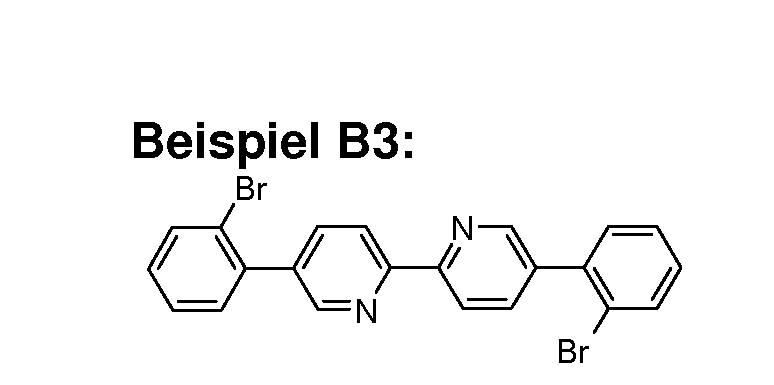
Ein Gemisch aus 40.8 g (100 mmol) B1 , 56.6 g (200 mmol) 1 -Brom-2-iod- benzol [583-55-1 ], 63.6 g (600 mmol) Natriumcarbonat, 5.8 g (5 mmol) Tetrakis(thphenylphosphin)palladium(0) [14221 -01 -3], 1000 ml 1 ,2-Di- methoxyethan und 500 mL Wasser wird 60 h unter Rückfluss erhitzt. Nach dem Abkühlen wird der ausgefallene Feststoff abgesaugt und dreimal mit 100 mL Ethanol gewaschen. Das Rohprodukt wird in 1000 mL Dichlor- methan (DCM) gelöst und über ein mit DCM vorgeschlämmtes Kieselgel- Bett filtriert. Das Kieselgel wird dreimal mit je 1 00 mL Ethylacetat nach- gewaschen. Das Dichlormethan wird am Rotationsverdampfer bis A mixture of 40.8 g (100 mmol) of B1, 56.6 g (200 mmol) of 1-bromo-2-iodobenzene [583-55-1], 63.6 g (600 mmol) of sodium carbonate, 5.8 g (5 mmol) of tetrakis ( thphenylphosphine) palladium (0) [14221-01-3], 1000 ml of 1,2-di-methoxyethane and 500 ml of water is refluxed for 60 hours. After cooling, the precipitated solid is filtered off with suction and washed three times with 100 ml of ethanol. The crude product is dissolved in 1000 mL dichloromethane (DCM) and filtered through a silica gel bed pre-latted with DCM. The silica gel is washed three times with 100 ml of ethyl acetate each time. The dichloromethane is on a rotary evaporator until
500 mbar bei 50 °C Badtemperatur abrotiert. Der aus dem verbleibenden Ethylacetat ausgefallene Feststoff wird abfiltriert und zweimal mit 20 mL Ethylacetat gewaschen. Der erhaltene Feststoff wird nochmals aus Ethyl- acetat in der Siedehitze umkristallisiert. Ausbeute 25.6 g (55 mmol), 55%, 95 %ig nach 1H-NMR. 500 mbar at 50 ° C bath temperature. The precipitated from the remaining ethyl acetate is filtered off and washed twice with 20 mL of ethyl acetate. The solid obtained is recrystallized once more from ethyl acetate in the boiling heat. Yield 25.6 g (55 mmol), 55%, 95% according to 1 H-NMR.
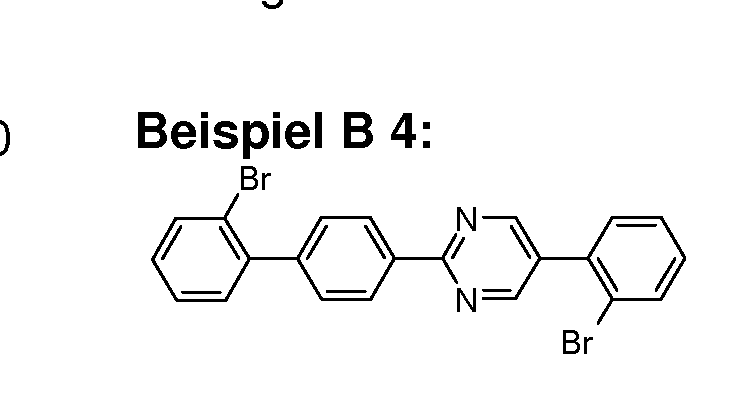
Analog zur Durchführung von B3 kann Verbindung B4 dargestellt werden, wobei statt B1 Baustein B2 eingesetzt wird. Ausbeute: 52%. Analogously to the execution of B3, compound B4 can be represented, wherein B2 is used instead of B1. Yield: 52%.

Analog zur Durchführung von B3 kann Verbindung B5 dargestellt werden, wobei statt 1 -Brom-2-iodbenzol 1 -Brom-2-chlorbenzol [694-80-4] einge- setzt wird. Die Aufreinigung erfolgt chromatographisch auf einem Flash- Säulenautometen Torrent der Firmal Axel-Semrau. Ausbeute: 67%.
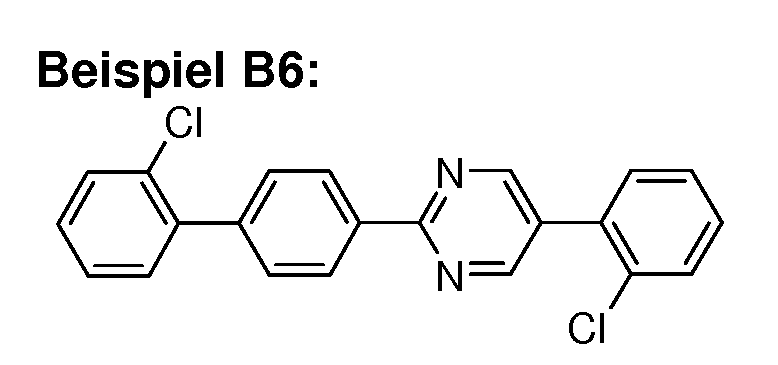
Analog zur Durchführung von B4 kann Verbindung B6 dargestellt werden, wobei statt 1 -Brom-2-iodbenzol 1 -Brom-2-chlorbenzol eingesetzt wird. Die Aufreinigung erfolgt chromatographisch auf einem Flash-Säulenautometen Torrent der Firmal Axel-Semrau. Ausbeute: 70% Analogous to the execution of B4, compound B6 can be prepared using 1-bromo-2-chlorobenzene instead of 1-bromo-2-iodobenzene. The purification is carried out by chromatography on a flash column automatic Torrent of Firmal Axel-Semrau. Yield: 70%

Ein Gemisch aus 18.1 g (100 mmol) 6-Chlortetralon [26673-31 -4], 16.5 g (300 mmol) Propargylamin [2450-71 -7], 796 mg [2 mmol] Natrium-tetra- chloroaurat(lll) Dihydrat und 200 ml Ethanol wird 24 h im Autoklaven bei 120 °C gerührt. Nach Erkalten entfernt man das Etha nol im Vakuum, nimmt den Rückstand in 200 ml Ethylacetat auf, wäscht die Lösung drei- mal mit 200 ml Wasser und einmal mit 100 ml gesättigter Kochsalzlösung, trocknet über Magnesiumsulfat und filtriert dann von diesem über ein vor- geschlämmtes Kieselgelbett ab. Nach Entfernen des Ethylacetats im Vakuum wird der Rückstand an Kieselgel mit n-Heptan/Ethylaceat (1 :2 vv) chromatographiert. Ausbeute: 9.7 g (45 mmol), 45%. Reinheit: ca. 98 %ig nach 1 H-NMR. A mixture of 18.1 g (100 mmol) 6-chlorotetralon [26673-31 -4], 16.5 g (300 mmol) propargylamine [2450-71 -7], 796 mg [2 mmol] sodium tetrachloroaurate (III) dihydrate and 200 ml of ethanol is stirred for 24 h in an autoclave at 120 ° C. After cooling, the ethanol is removed in vacuo, the residue is taken up in 200 ml of ethyl acetate, the solution is washed three times with 200 ml of water and once with 100 ml of saturated brine, dried over magnesium sulphate and then filtered through a pre-slurry Silica gel bed off. After removal of the ethyl acetate in vacuo, the residue is chromatographed on silica gel with n-heptane / ethyl acetate (1: 2 vv). Yield: 9.7 g (45 mmol), 45%. Purity: about 98% after 1 H-NMR.

Ein Gemisch aus 25.1 g (100 mmol) 2,5-Dibrom-4-methylpyridin [3430-26- 0], 15.6 g (100 mmol) 4-Chlorphenylboronsäure [1 679-18-1 ], 27.6 g (200 mmol) Kaliumcarbonat,1 .57 g (6 mmol) Triphenylphosphin [603-35- 0], 676 mg (3 mmol) Palladium(ll)acetat [3375-31 -3], 200 g Glaskugeln (3 mm Durchmesser), 200 ml Acetonitril und 100 ml Ethanol wird 48 h unter Rückfluss erhitzt. Nach Erkalten entfernt man die Lösemittel im Vakuum, gibt 500 ml Toluol zu, wäscht zweimal mit je 300 ml Wasser und einmal mit 200 ml gesättigter Kochsalzlösung, trocknet über Magnesium- sulfat, filtriert über ein vorgeschlämmtes Kieselgelbett ab und wäscht dieses mit 300 ml Toluol nach. Nach Entfernen des Toluols im Vakuum kristallisiert man einmal aus Methanol/Ethanol (1 :1 vv) und einmal aus n- Heptan um. Ausbeute: 17.3 g (61 mmol), 61 %. Reinheit: ca. 95 %ig nach 1 H-NMR. A mixture of 25.1 g (100 mmol) of 2,5-dibromo-4-methylpyridine [3430-26-0], 15.6 g (100 mmol) of 4-chlorophenylboronic acid [1 679-18-1], 27.6 g (200 mmol) Potassium carbonate, 1 .57 g (6 mmol) of triphenylphosphine [603-35-0], 676 mg (3 mmol) of palladium (II) acetate [3375-31 -3], 200 g of glass beads (3 mm in diameter), 200 ml of acetonitrile and 100 ml of ethanol is refluxed for 48 h. After cooling, the solvents are removed in vacuo, 500 ml of toluene, washed twice with 300 ml of water and Once with 200 ml of saturated sodium chloride solution, dried over magnesium sulfate, filtered through a pre-gelated silica gel bed and washed with 300 ml of toluene after. After removal of the toluene in vacuo, it is crystallized once from methanol / ethanol (1: 1 vv) and once from n-heptane. Yield: 17.3 g (61 mmol), 61%. Purity: about 95% after 1 H-NMR.
Beispiel B10:

Analog zur Durchfühung beschrieben für Beispiel B9 kann B10 dargestellt werden. Hierzu wird statt 2,5-Dibrom-4-methylpyridin 4-Brom-6-tert-butyl- pyrimidin [19136-36-8] verwendet. Ausbeute: 70 %. B10 can be represented analogously to the procedure described for Example B9. For this purpose, instead of 2,5-dibromo-4-methylpyridine 4-bromo-6-tert-butylpyrimidine [19136-36-8] is used. Yield: 70%.
Beispiel B11 :

Ein Gemisch aus 28.3 g (100 mmol) B9, 12.8 g (105 mmol) Phenylboron- säure, 31 .8 g (300 mmol) Natriumcarbonat, 787 mg (3 mmol) Triphenyl- phosphin, 225 mg (1 mmol) Palladium(ll)acetat, 300 ml Toluol, 150 ml Ethanol und 300 ml Wasser wird 48 h unter Rückfluss erhitzt. Nach Erkal- ten wird mit 300 ml Toluol erweitert, die organische Phase wird abge- trennt, einmal mit 300 ml Wasser und einmal mit 200 ml gesättigter Koch- salzlösung gewaschen und über Magnesiumsulfat getrocknet. Nach Ent- fernen das Lösungsmittels wird der Rückstand an Kieselgel (Toluol/Ethyl- acetat, 9:1 vv) chromatographiert. Ausbeute: 17.1 g (61 mmol), 61 %. Reinheit :ca. 97 %ig nach 1H-NMR. A mixture of 28.3 g (100 mmol) B9, 12.8 g (105 mmol) phenylboronic acid, 31 .8 g (300 mmol) sodium carbonate, 787 mg (3 mmol) triphenylphosphine, 225 mg (1 mmol) palladium (II ) Acetate, 300 ml of toluene, 150 ml of ethanol and 300 ml of water is heated under reflux for 48 h. After cooling, dilute with 300 ml of toluene, the organic phase is separated, washed once with 300 ml of water and once with 200 ml of saturated sodium chloride solution and dried over magnesium sulfate. After removal of the solvent, the residue is chromatographed on silica gel (toluene / ethyl acetate, 9: 1 vv). Yield: 17.1 g (61 mmol), 61%. Purity: approx. 97% by 1 H NMR.
Analog können die folgenden Verbindungen synthetisiert werden:


Ein Gemisch aus 1 64.2 g (500 mmol) 2-(1 ,1 ,2,2,3,3-Hexamethylindan-5- yl)-4,4,5,5-tetramethyl-[1 ,3,2]dioxa-borolan [152418-1 6-9] (analog können Boronsäuren eingesetzt werden), 142.0 g (500 mmol) 5-Brom-2-iod- pyridin [223463-13-6], 159.0 g (1 .5 mol) Natriumcarbonat, 5.8 g (5 mmol) Tetrakis(thphenylphosphin)palladium(0), 700 ml Toluol, 300 ml Ethanol und 700 ml Wasser wird unter gutem Rühren 1 6 h unter Rückfluss erhitzt. Nach dem Abkühlen werden 1000 ml Toluol zugegeben, die organische Phase wird abgetrennt und die wässrige Phase wird mit 300 ml Toluol nachextrahiert. Die vereinigten organischen Phasen werden einmal mit 500 ml gesättigter Kochsalzlösung gewaschen. Nach Trocknen der orga- nischen Phase über Natriumsulfat und Entfernen des Lösemittels im Vakuum kristallisiert man das Rohprodukt zweimal aus ca. 300 ml EtOH um. Ausbeute: 130.8 g (365 mmol), 73 %. Reinheit: ca. 95 %ig nach 1H- NMR. Analog können die nachfolgenden Verbindungen dargestellt werden. A mixture of 1 64.2 g (500 mmol) of 2- (1,1,2,3,3-hexamethylindan-5-yl) -4,4,5,5-tetramethyl- [1,2,2] dioxa borolane [152418-1 6-9] (analogous boronic acids can be used), 142.0 g (500 mmol) of 5-bromo-2-iodo-pyridine [223463-13-6], 159.0 g (1 .5 mol) of sodium carbonate , 5.8 g (5 mmol) of tetrakis (thphenylphosphine) palladium (0), 700 ml of toluene, 300 ml of ethanol and 700 ml of water is refluxed under good stirring for 1 6 h. After cooling, 1000 ml of toluene are added, the organic phase is separated off and the aqueous phase is back-extracted with 300 ml of toluene. The combined organic phases are washed once with 500 ml of saturated brine. After drying the organic phase over sodium sulfate and removing the solvent in vacuo, the crude product is recrystallised twice from about 300 ml of EtOH. Yield: 130.8 g (365 mmol), 73%. Purity: about 95% after 1 H NMR. The following connections can be displayed analogously.
Dabei wird als Pyridinderivat im Allgemeinen 5-Brom-2-iodpyridin In this case, the pyridine derivative is generally 5-bromo-2-iodopyridine
([223463-13-6]) eingesetzt, welches in der folgenden Tabelle nicht separat aufgeführt ist; lediglich davon abweichende Pyridinderivate sind in der Tabelle explizit aufgeführt. Zur Umkristallisation können Lösungsmittel wie Ethylacetat, Cyclohexan, Toluol, Acetonitril, n-Heptan, Ethanol oder Methanol verwendet werden. Es kann auch mit diesen Lösungsmittel heißextrahiert werden, oder die Aufreinigung kann chromatographisch an Kieselgel auf einem Säulenautomaten (Torrent der Firma Axel Semrau) erfolgen. ([223463-13-6]) which is not listed separately in the following table; only differing pyridine derivatives are listed explicitly in the table. For recrystallization, solvents such as ethyl acetate, cyclohexane, toluene, acetonitrile, n-heptane, ethanol or methanol may be used. It can also be hot-extracted with these solvents, or the purification can be carried out chromatographically on silica gel on a column automaton (Torrent from Axel Semrau).


Ausbeute: 31 .6 g (78 mmol), 78 %. Reinheit: ca. 95 %ig n. 1H-NMR. Variante B: Umsetzung von Arylchloriden Yield: 31 .6 g (78 mmol), 78%. Purity: about 95% n. 1 H-NMR. Variant B: Reaction of aryl chlorides
Wie Variante A, jedoch wird an Stelle von 1 ,1 -Bis(diphenylphosphino)- ferrocendichlorpalladium(ll)-Komplex mit DCM 2 mmol SPhos [657408-07- 6] und 1 mmol Palladium(ll)acetat eingesetzt. Analog können folgende Verbindungen dargestellt werden, wobei zur Like variant A, however, in place of 1,1-bis (diphenylphosphino) ferrocenedichloropalladium (II) complex with DCM, 2 mmol of SPhos [657408-07-6] and 1 mmol of palladium (II) acetate are used. Analogously, the following compounds can be represented, wherein the
Reinigung anstelle von n-Heptan auch Cyclohexan, Toluol, Acetonitril bzw. Gemische der genannten Lösungsmittel verwendet werden können: Purification can be used instead of n-heptane and cyclohexane, toluene, acetonitrile or mixtures of said solvents:
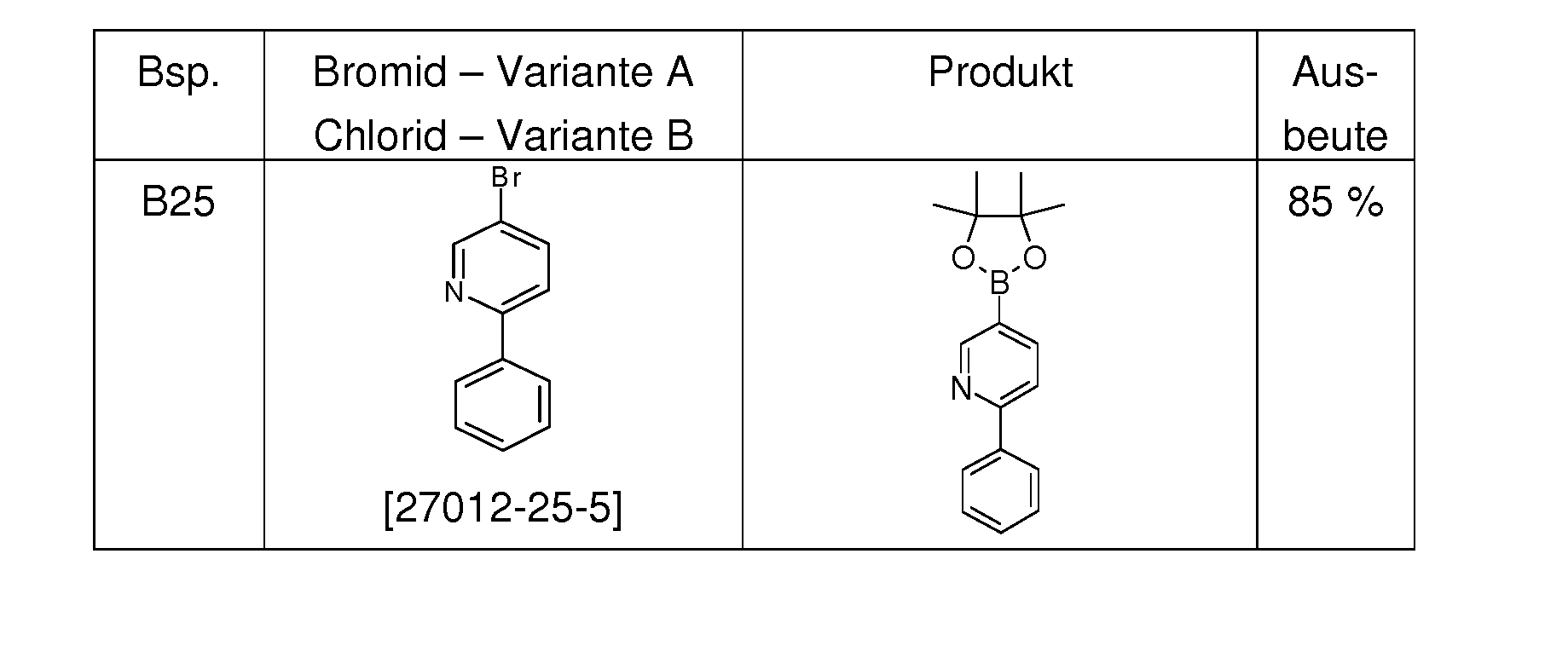


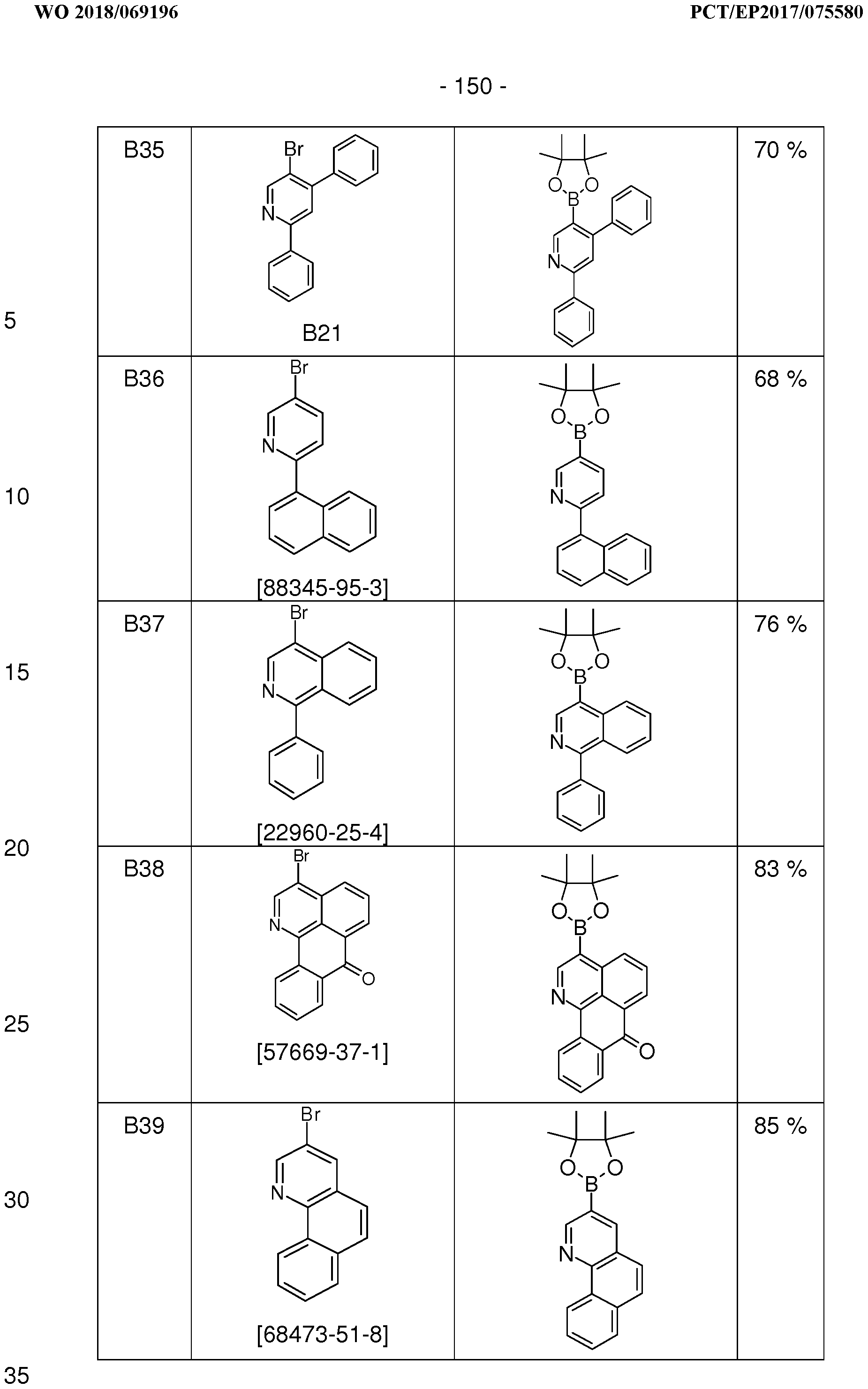

- 152 - - 152 -

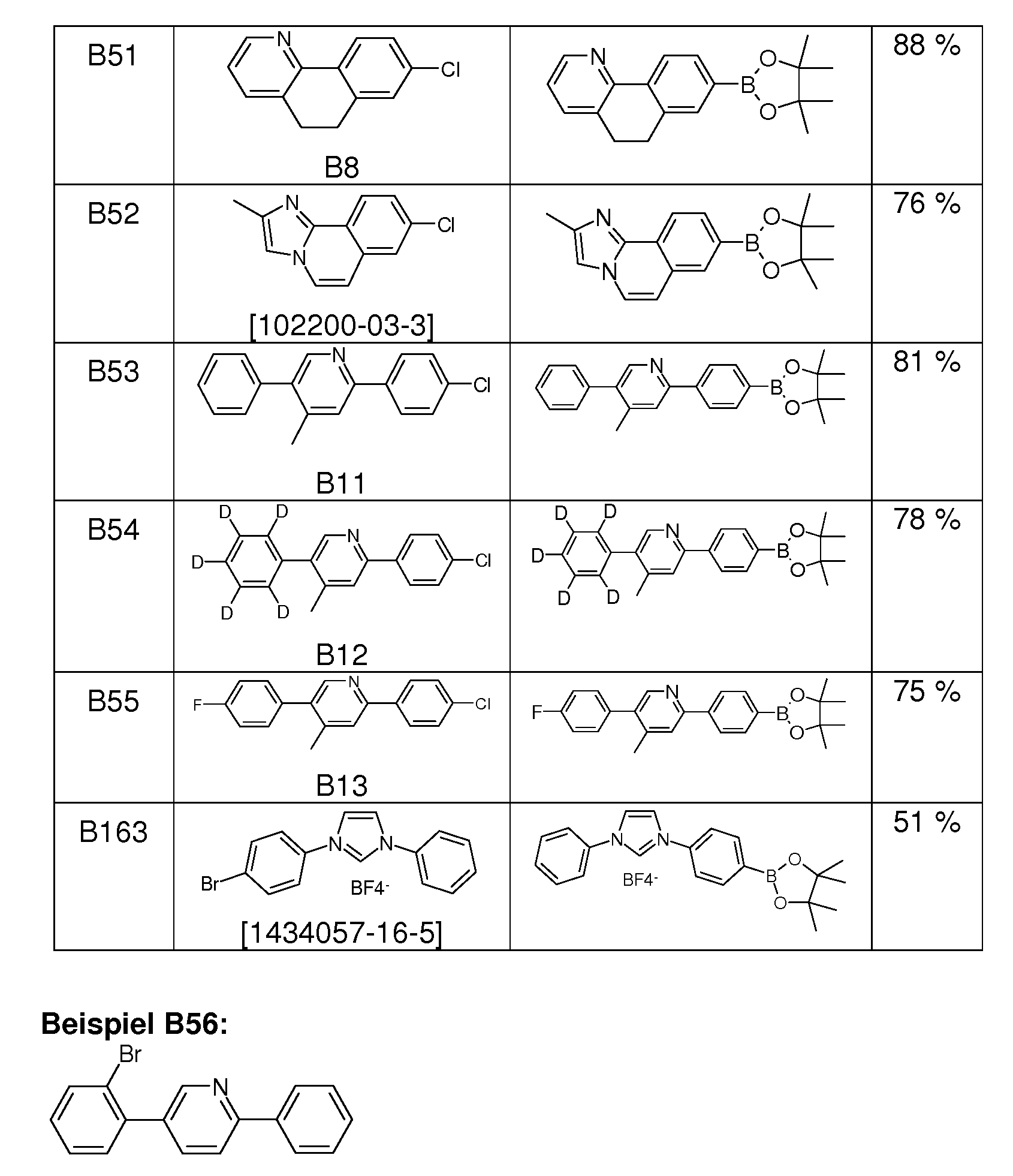
Ein Gemisch aus 28.1 g (100 mmol) B25, 28.2 g (100 mmol) 1 -Brom-2- iodbenzol [583-55-1 ], 31 .8 g (300 mmol) Natriumcarbonat, 787 mg A mixture of 28.1 g (100 mmol) of B25, 28.2 g (100 mmol) of 1-bromo-2-iodobenzene [583-55-1], 31 .8 g (300 mmol) of sodium carbonate, 787 mg
(3 mmol) Triphenylphosphin, 225 mg (1 mmol) Palladium(ll)acetat, 300 ml Toluol, 150 mol Ethanol und 300 ml Wasser wird 24 h unter Rückfluss erhitzt. Nach Erkalten wird mit 500 ml Toluol erweitert, die organische Phase wird abgetrennt, einmal mit 500 ml Wasser und einmal mit 500 ml gesättigter Kochsalzlösung gewaschen und über Magnesiumsulfat getrocknet. Nach Entfernen das Lösungsmittels wird der Rückstand aus Ethylacetat/n-Heptan umkristallisiert oder an Kieselgel (Toluol/Ethylacetat, 9:1 vv) Chromatographien Ausbeute: 22.7 g (73 mmol), 73 %. Reinheit: ca. 97 %ig nach 1 H-NMR. Analog können folgende Verbindungen dargestellt werden, wobei zur Umkristallisation Lösemittel wie z. B. Ethylacetat, Cyclohexan, Toluol, Acetonitril, n-Heptan, Ethanol oder Methanol verwendet werden können Es kann auch mit diesen Lösungsmittel heißextrahiert werden, oder die Aufreinigung kann chromatographisch an Kieselgel auf einem Säulen- (3 mmol) of triphenylphosphine, 225 mg (1 mmol) of palladium (II) acetate, 300 ml of toluene, 150 mol of ethanol and 300 ml of water is heated under reflux for 24 h. After cooling, it is expanded with 500 ml of toluene, the organic phase is separated, washed once with 500 ml of water and once with 500 ml of saturated brine and dried over magnesium sulfate. After removal of the solvent, the residue is recrystallized from ethyl acetate / n-heptane or on silica gel (toluene / ethyl acetate, 9: 1 vv). Chromatography Yield: 22.7 g (73 mmol), 73%. Purity: about 97% according to 1 H-NMR. Analogously, the following compounds can be prepared, wherein for recrystallization solvents such. Ethyl acetate, cyclohexane, toluene, acetonitrile, n-heptane, ethanol or methanol. It can also be hot-extracted with these solvents, or the purification can be carried out chromatographically on silica gel on a column reactor.


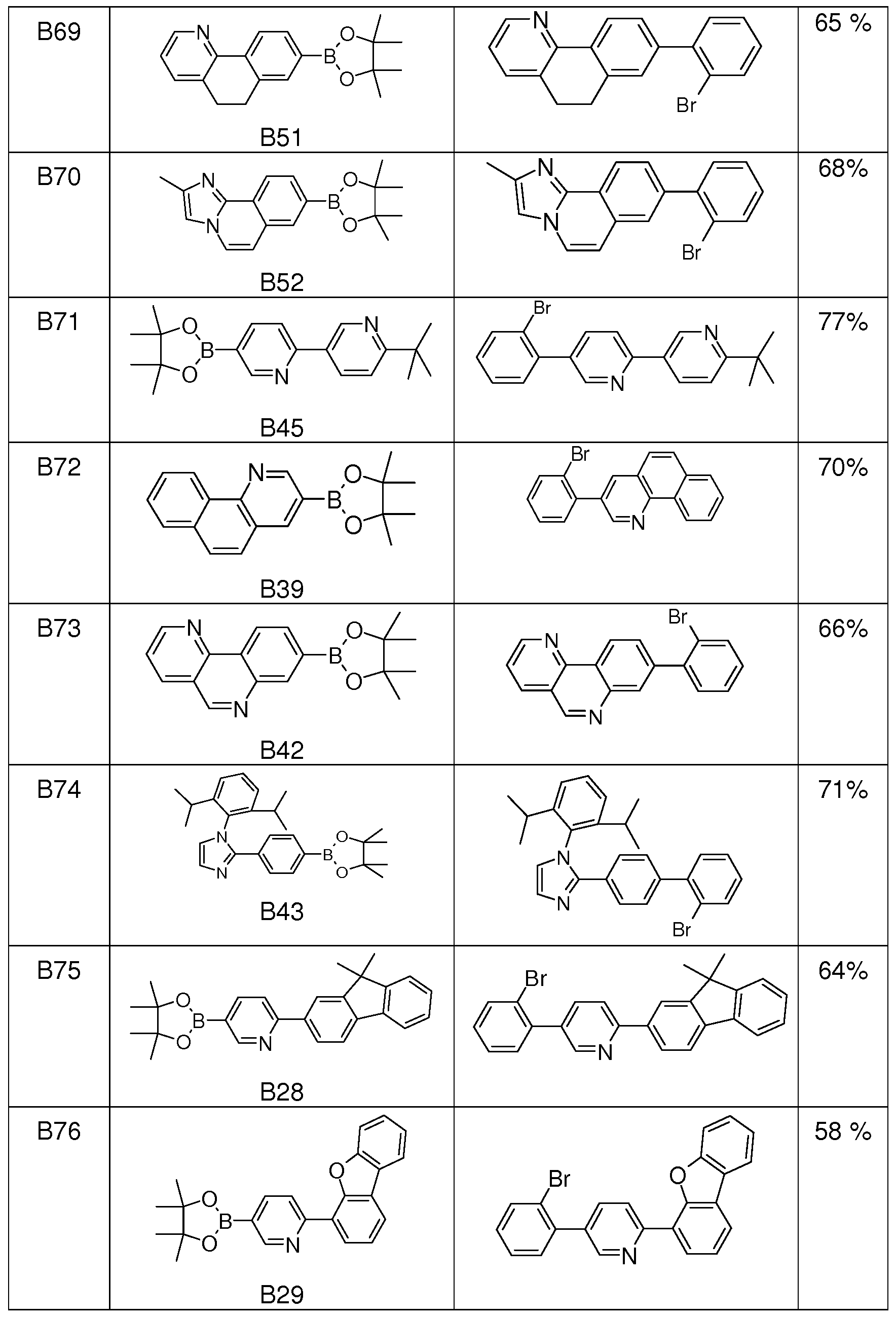
35

(210 mmol) B56, 42.4 g (400 mmol) Natriumcarbonat, 1 .57 g (6 mmol) Triphenylphosphin, 500 mg (2 mmol) Palladium(ll)acetat, 500 ml Toluol, 200 ml Ethanol und 500 ml Wasser wird 48 h unter Rückfluss erhitzt. Nach Erkalten wird mit 500 ml Toluol erweitert, die organische Phase wird abge- trennt, einmal mit 500 ml Wasser und einmal mit 500 ml gesättigter Koch- salzlösung gewaschen und über Magnesiumsulfat getrocknet. Nach Ent- fernen des Lösungsmittels wird der Rückstand an Kieselgel (n-Heptan/ Ethylacetat 2:1 vv) chromatographiert. Ausbeute: 41 .4 g (68 mmol), 68 %. Reinheit: ca. 95 %ig nach 1H-NMR. (210 mmol) B56, 42.4 g (400 mmol) of sodium carbonate, 1 .57 g (6 mmol) of triphenylphosphine, 500 mg (2 mmol) of palladium (II) acetate, 500 ml of toluene, 200 ml of ethanol and 500 ml of water is 48 h heated to reflux. After cooling, it is expanded with 500 ml of toluene, the organic phase is separated off, washed once with 500 ml of water and once with 500 ml of saturated sodium chloride solution and dried over magnesium sulfate. After removal of the solvent, the residue is chromatographed on silica gel (n-heptane / ethyl acetate 2: 1 vv). Yield: 41.4 g (68 mmol), 68%. Purity: about 95% after 1 H-NMR.
Analog können folgende Verbindungen dargestellt werden, wobei zur Umkristallisation Lösemittel wie z. B. Ethylacetat, Cyclohexan, Toluol, Acetonitril, n-Heptan, Ethanol oder Methanol verwendet werden können. Es kann auch mit diesen Lösungsmittel heißextrahiert werden, oder die Aufreinigung kann chromatographisch an Kieselgel auf einem Säulen- automaten (Torrent der Firma Axel Semrau) erfolgen. Analogously, the following compounds can be prepared, wherein for recrystallization solvents such. For example, ethyl acetate, cyclohexane, toluene, acetonitrile, n-heptane, ethanol or methanol can be used. It can also be hot-extracted with these solvents, or the purification can be carried out chromatographically on silica gel on a column automaton (Torrent from Axel Semrau).
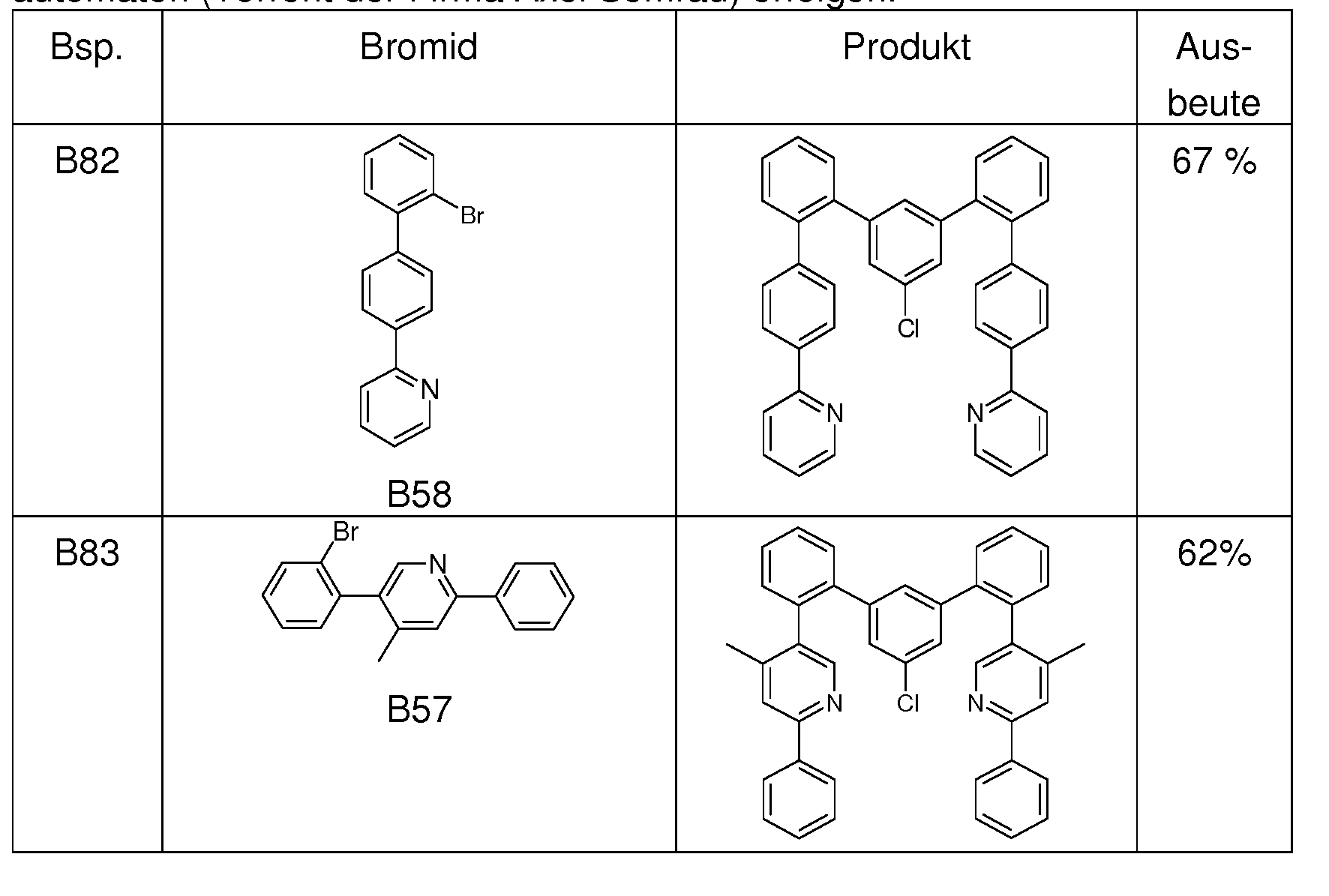
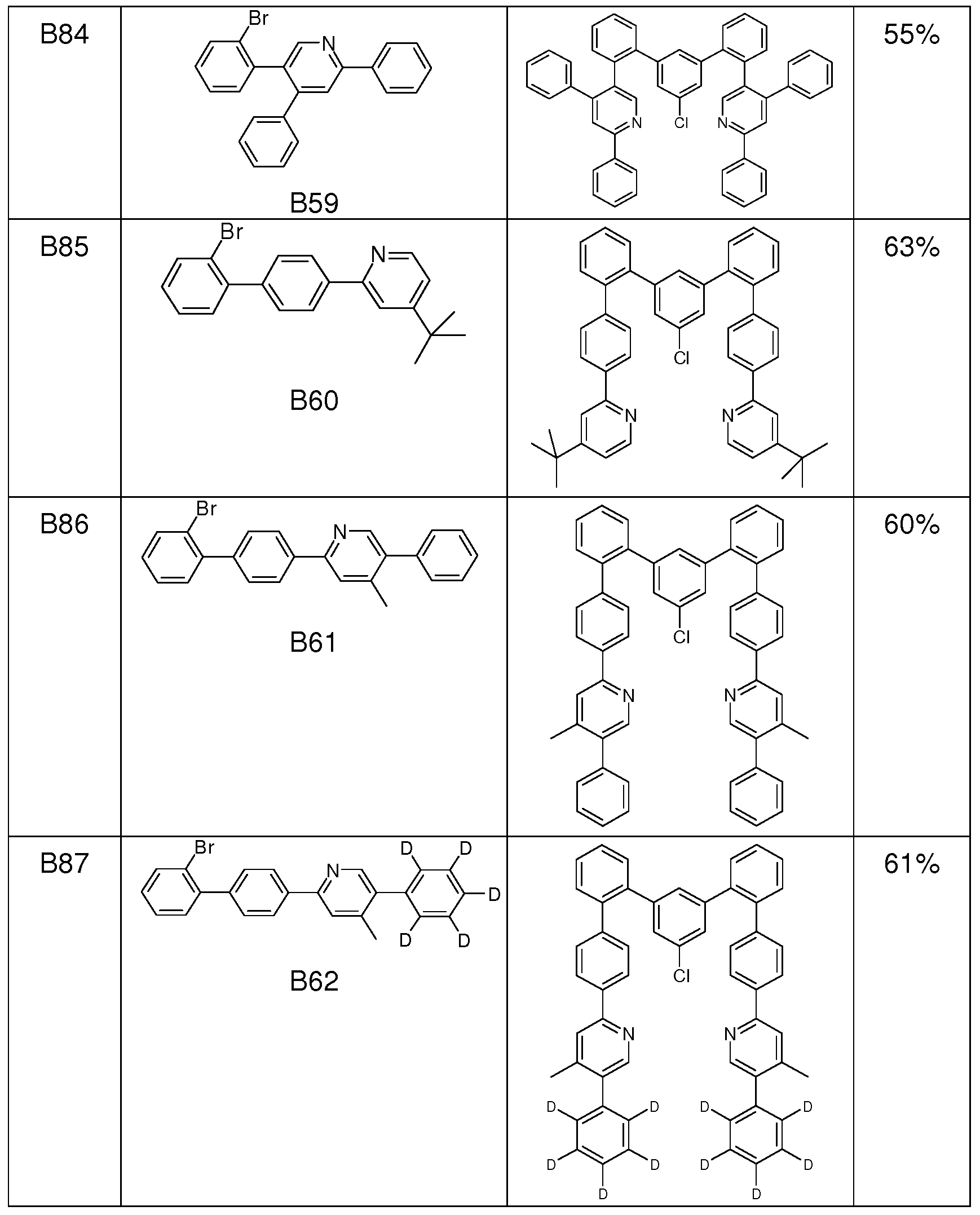

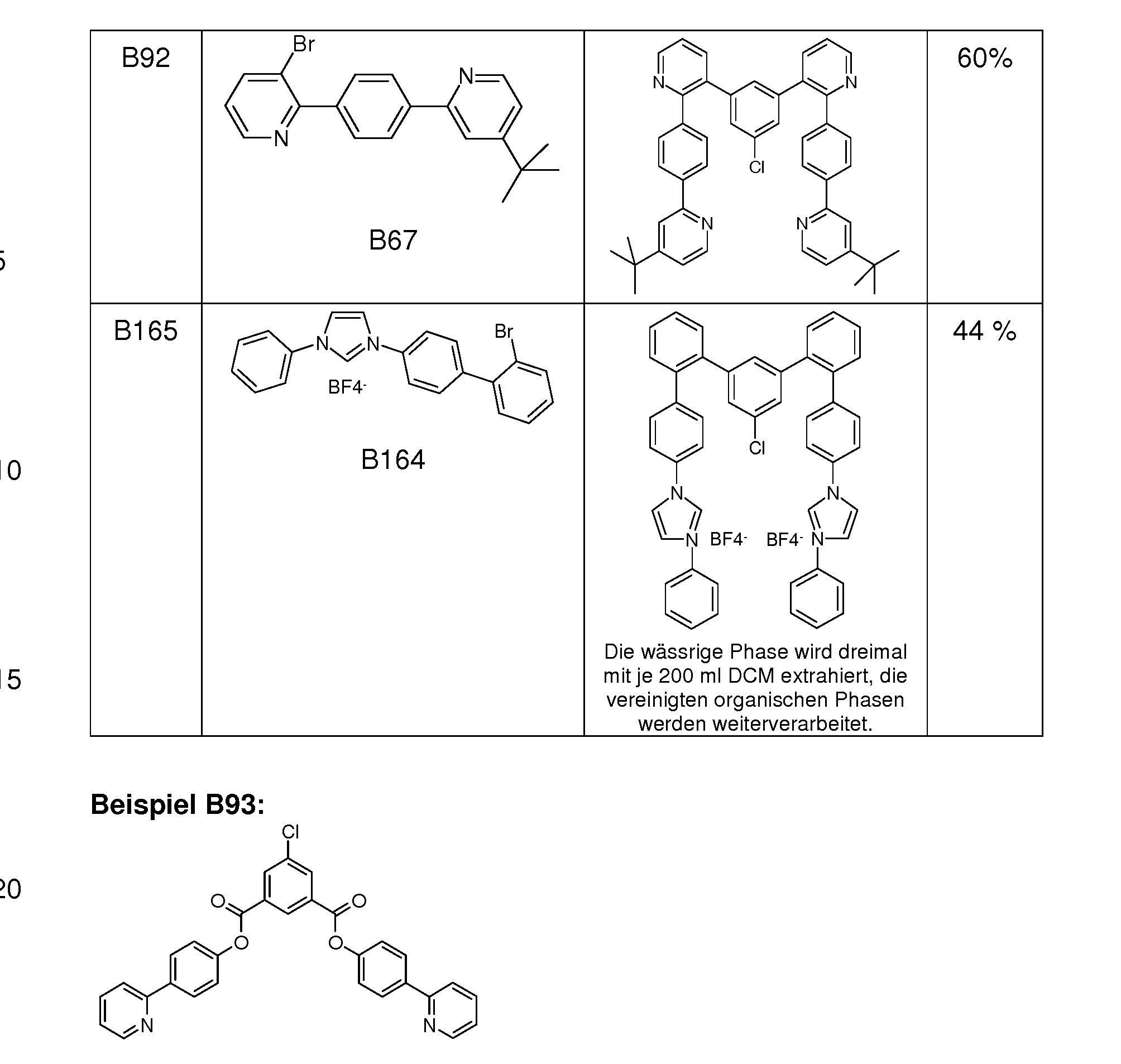
Ein Gemisch aus 17.1 g (100 mmol) 4-(2-Pyridyl)phenol [51035-40-6] und 12.9 g (100 mmol) Diisopropylethylamin [7087-68-5] wird in 400 mL Dichlormethan für 10 min bei Raumtemperatur gerührt. Es werden 6.2 mL (40 mmol) 5-Chloroisophthaloyl-dichlorid [2855-02-9], gelöst in 30 mL Dichlormethan, zugetropft, und die Reaktionsmischung wird für 14 h bei Raumtemperatur gerührt. Anschließend werden 10 mL Wasser zugetropft und die Reaktionsmischung in einen Scheidetrichter überführt. Die organische Phase wird zweimal mit 100 mL Wasser und einmal mit 50 mL gesättigter NaCI-Lösung gewaschen, über Natriumsulfat getrocknet und zur Trockene eingeengt. Ausbeute: 18.0 g (38 mmol), 95 %. Reinheit: ca. 95 %ig nach 1H-NMR. Analog können folgende Verbindungen hergestellt werden; die Stoff- mengen der eingesetzten Edukte sind angegeben, falls sie von den in der Durchführung zu B93 beschriebenen abweichen: A mixture of 17.1 g (100 mmol) of 4- (2-pyridyl) phenol [51035-40-6] and 12.9 g (100 mmol) of diisopropylethylamine [7087-68-5] is stirred in 400 mL of dichloromethane for 10 min at room temperature , 6.2 mL (40 mmol) 5-chloroisophthaloyl dichloride [2855-02-9] dissolved in 30 mL dichloromethane are added dropwise and the reaction mixture is stirred for 14 h at room temperature. Subsequently, 10 ml of water are added dropwise and the reaction mixture is transferred to a separating funnel. The organic phase is washed twice with 100 ml of water and once with 50 ml of saturated NaCl solution, dried over sodium sulfate and concentrated to dryness. Yield: 18.0 g (38 mmol), 95%. Purity: about 95% after 1 H-NMR. Analogously, the following compounds can be prepared; the quantities of starting materials used are indicated if they deviate from those described in the implementation of B93:

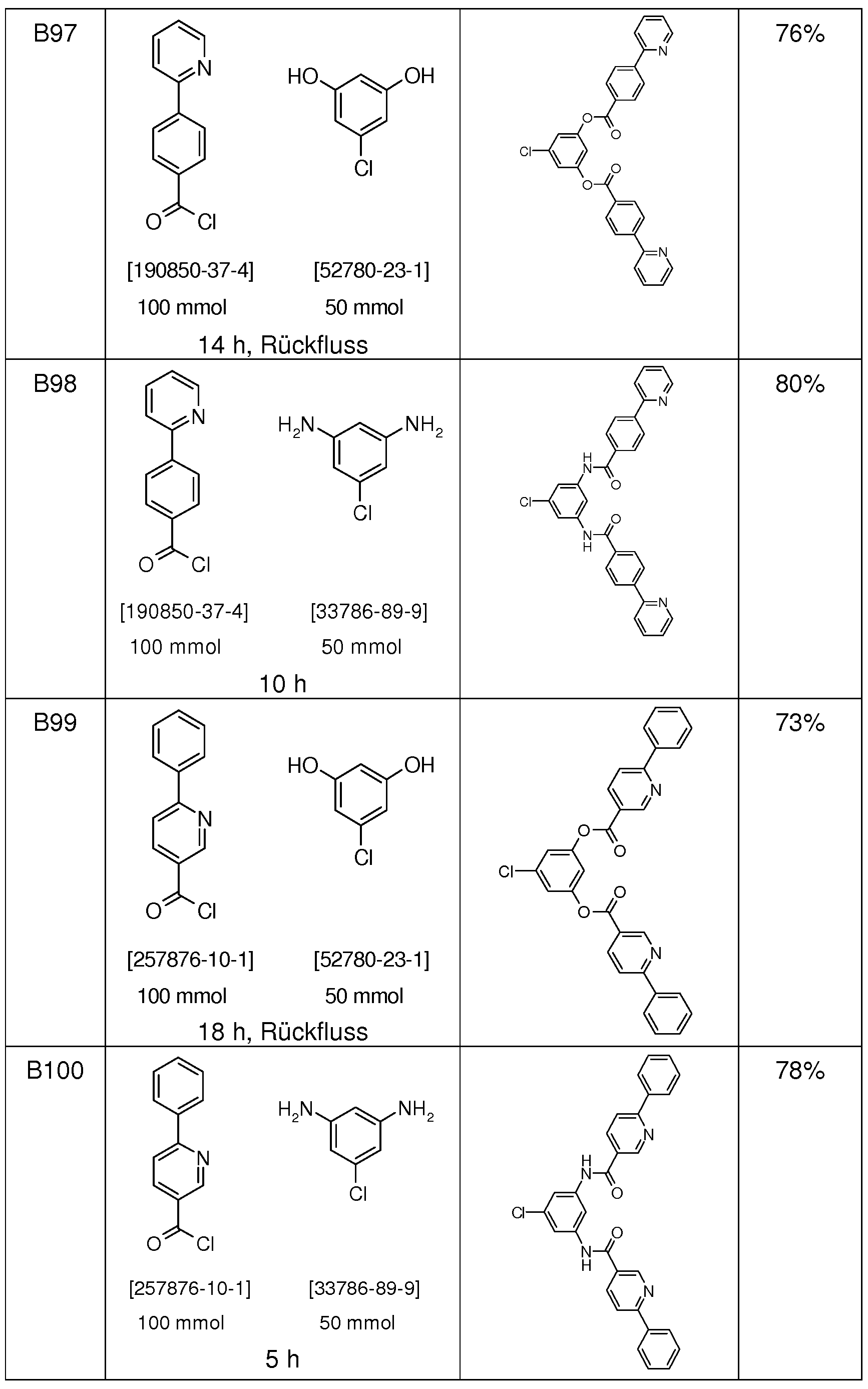
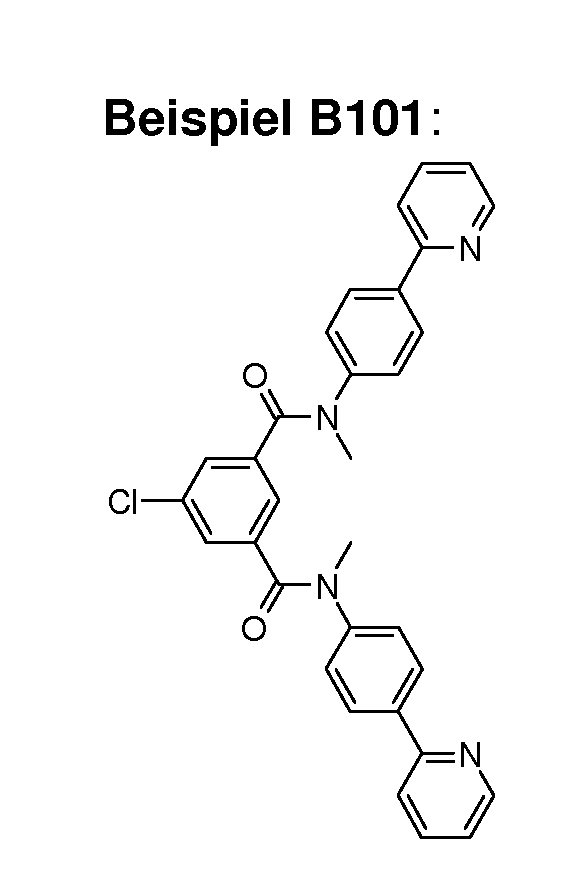
2.0 g (50 mmol) Natriumhydrid (60 %ige Dispersion in Paraffinöl) [7646- 69-7] werden in 300 mL THF suspensiert, dann werden 5.0 g (10 mmol) B95 zugegeben, und die Suspension wird für 30 Minuten bei Raumtem- peratur gerührt. Anschließend werden 1 .2 mL lodmethan (50 mmol) [74- 88-4] zugegeben, und die Reaktionsmischung wird für 50 h bei Raum- temperatur gerührt. Es werden 20 mL konz. Ammoniaklösung zugegeben, 30 Minuten nachgerührt und das Lösungsmittel weitgehend im Vakuum abgezogen. Man nimmt den Rückstand in 300 ml Dichlormethan auf, wäscht einmal mit 200 ml 5 Gewichts-%igem Ammoniakwasser, zweimal mit je 100 ml Wasser und einmal mit 100 ml gesättigter Kochsalzlösung und trocknet dann über Magnesiumsulfat. Man entfernt das Dichlormethan im Vakuum und kristallisiert das Rohprodukt aus Ethylacetat/Methanol um. Ausbeute: 4.3 g (8 mmol), 80 %. Reinheit: ca. 98 %ig nach 1H-NMR. 2.0 g (50 mmol) of sodium hydride (60% dispersion in paraffin oil) [7646-69-7] are suspended in 300 ml of THF, then 5.0 g (10 mmol) of B95 are added and the suspension is stirred for 30 minutes at room temperature. stirred. Subsequently, 1 .2 mL iodomethane (50 mmol) [74- 88-4] are added and the reaction mixture is stirred for 50 h at room temperature. There are 20 mL conc. Ammonia solution added, stirred for 30 minutes and the solvent was largely removed in vacuo. The residue is taken up in 300 ml of dichloromethane, washed once with 200 ml of 5% strength by weight aqueous ammonia, twice with 100 ml of water each time and once with 100 ml of saturated common salt solution and then dried over magnesium sulfate. The dichloromethane is removed in vacuo and the crude product is recrystallized from ethyl acetate / methanol. Yield: 4.3 g (8 mmol), 80%. Purity: about 98% after 1 H-NMR.
Analog können folgende Verbindungen dargestellt werden: Analogously, the following compounds can be represented:
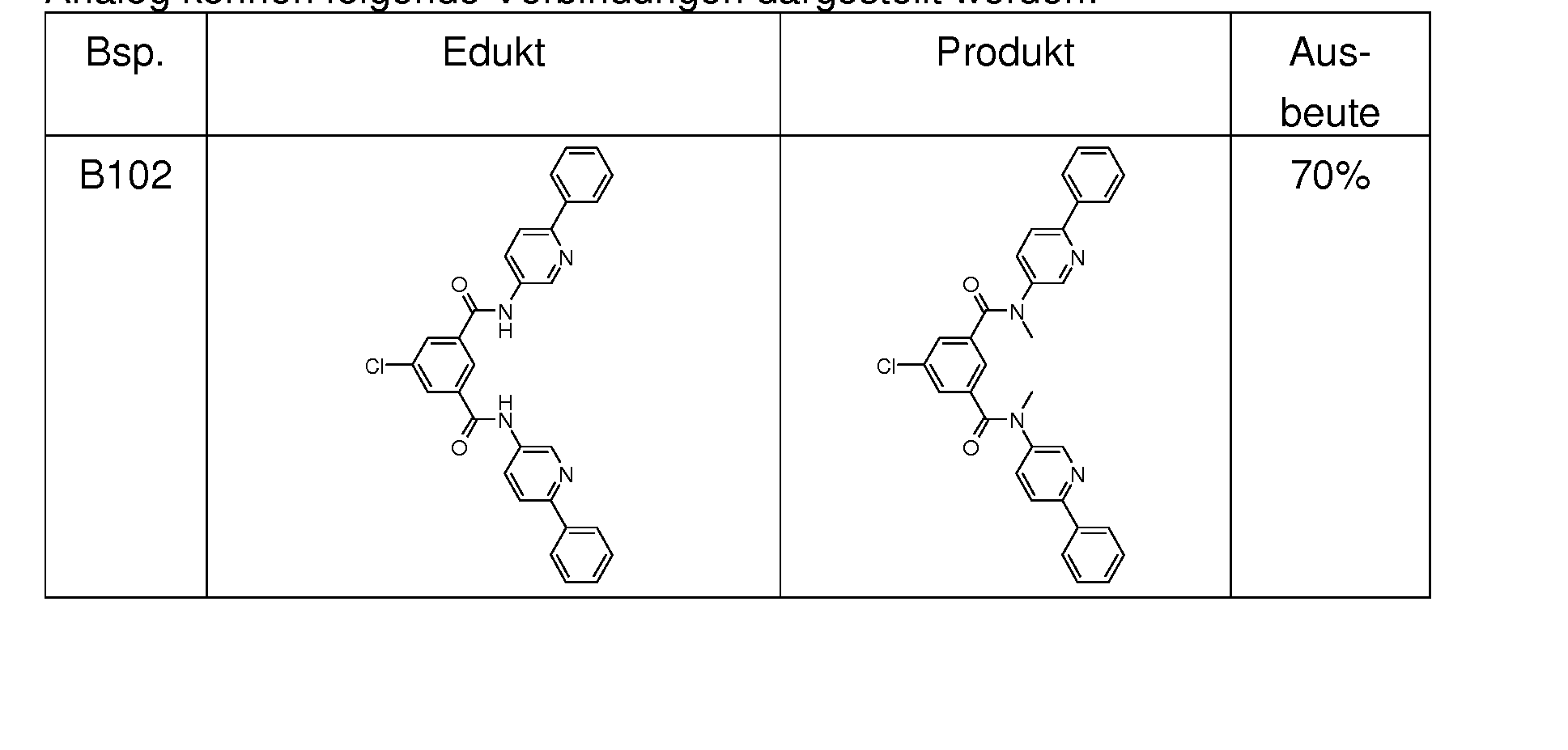

Beispiel B105: Example B105:
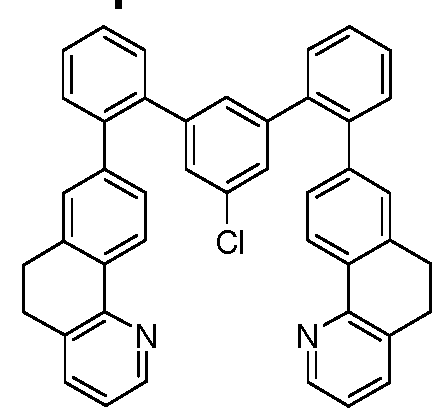
Ein Gemisch aus 36.4 g (100 mmol) 2,2'-(5-Chlor-1 ,3-phenylen)bis- [4,4,5,5-tetramethyl-1 ,3,2-dioxaborolan] [1417036-49-7], 70.6 g A mixture of 36.4 g (100 mmol) of 2,2 '- (5-chloro-1, 3-phenylene) bis- [4,4,5,5-tetramethyl-1,2,2-dioxaborolane] [1417036-49 -7], 70.6 g
(210 mmol) B69, 42.4 g (400 mmol) Natriumcarbonat, 2.3 g (2 mmol) Tetrakis(thphenylphosphin)palladium(0), 1000 ml 1 ,2-Dimethoxyethan und 500 ml Wasser wird 48 h unter Rückfluss erhitzt. Nach Erkalten wird der ausgefallene Feststoff abgesaugt und zweimal mit 20 mL Ethanol ge- waschen. Der Feststoff wird in 500 mL Dichlormethan gelöst und über ein Celitebett filtriert. Das Filtrat wird bis auf 100 mL eingeengt, dann werden 400 mL Ethanol zugegeben und der ausgefallene Feststoff abgesaugt. Das Rohprodukt wird einmal aus Ethylacetat umkristallisiert. Aus- beute: 43.6 g (70 mmol), 70 %. Reinheit: ca. 96 %ig nach 1H-NMR. (210 mmol) B69, 42.4 g (400 mmol) of sodium carbonate, 2.3 g (2 mmol) of tetrakis (thphenylphosphine) palladium (0), 1000 ml of 1,2-dimethoxyethane and 500 ml of water is heated under reflux for 48 h. After cooling, the precipitated solid is filtered off with suction and washed twice with 20 ml of ethanol. The solid is dissolved in 500 mL dichloromethane and filtered through a celite bed. The filtrate is concentrated to 100 mL, then 400 mL of ethanol are added and the precipitated solid is filtered off with suction. The crude product is recrystallized once from ethyl acetate. Yield: 43.6 g (70 mmol), 70%. Purity: about 96% according to 1 H-NMR.
Analog können folgende Verbindungen dargestellt werden, wobei zur Um- kristallisation Lösemittel wie z. B. Ethylacetat, Cyclohexan, Toluol, Aceto- nitril, n-Heptan, Ethanol oder Methanol verwendet werden können. Es kann auch mit diesen Lösungsmittel heißextrahiert werden, oder die Auf- reinigung kann chromatographisch an Kieselgel auf einem Säulenauto- maten (Torrent der Firma Axel Semrau) erfolgen. Analogously, the following compounds can be prepared, wherein for recrystallization solvents such. As ethyl acetate, cyclohexane, toluene, acetonitrile, n-heptane, ethanol or methanol can be used. It can also be hot-extracted with these solvents, or the purification can be carried out chromatographically on silica gel on a column automatic (Torrent from Axel Semrau).


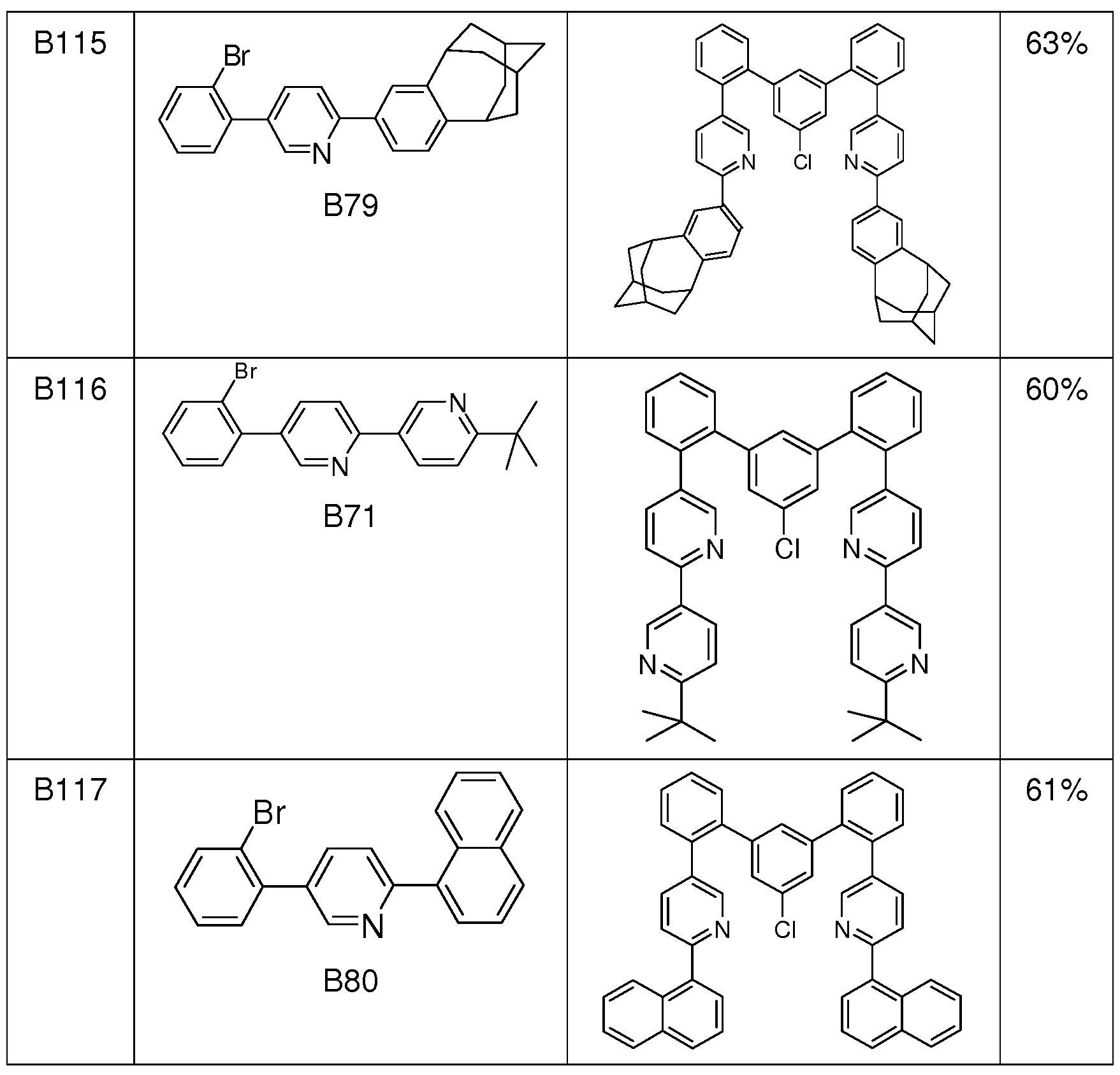
Beispiel B119 Example B119
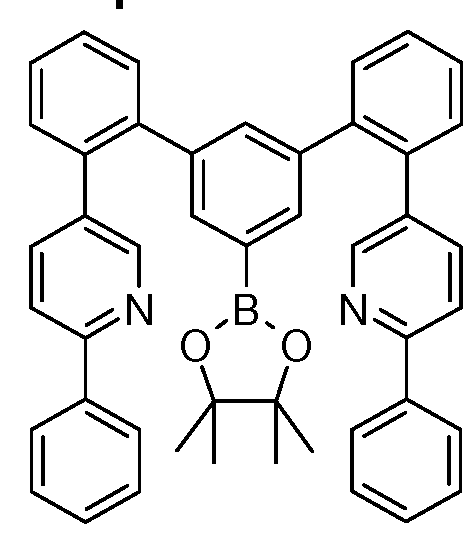
Ein Gemisch aus 57.1 g (1 00 mmol) B81 , 25.4 g (1 00 mmol) Bis(pinaco- lato)diboran [73183-34-3], 49.1 g (500 mmol) Kaliumacetat, 2 mmol SPhos [657408-07-6], 1 mmol Palladium(l l)acetat, 200 g Glaskugeln (3 mm Durchmesser) und 700 ml 1 ,4-Dioxan werden 1 6 h unter Rühren auf Rückfluss erhitzt. Nach Abkühlen wird die Suspension über ein Celite-Bett filtriert und das Lösemittel im Vakuum entfernt. Der schwarze Rückstand wird mit 1000 ml heißem Ethylacetat digeriert, es wird noch heiß über ein Celite-Bett abfiltriert und dann auf ca. 200 ml eingeengt, wobei das Pro- dukt zu kristallisieren beginnt. Die Kristallisation wird über Nacht im Kühl- schrank vervollständigt, die Kristalle werden abfiltriert und mit wenig Ethyl- acetat gewaschen. Aus der Mutterlauge kann eine zweite Produktfraktion gewonnen werden. Ausbeute: 31 .6 g (78 mmol) 78 %. Reinheit: ca. A mixture of 57.1 g (1 00 mmol) B81, 25.4 g (1 00 mmol) of bis (pinacolato) diborane [73183-34-3], 49.1 g (500 mmol) of potassium acetate, 2 mmol of SPhos [657408-07- 6], 1 mmol palladium (II) acetate, 200 g glass beads (3 mm diameter) and 700 ml of 1, 4-dioxane are heated for 1 6 h with stirring to reflux. After cooling, the suspension is passed through a celite bed filtered and the solvent removed in vacuo. The black residue is digested with 1000 ml of hot ethyl acetate, it is filtered while hot on a Celite bed and then concentrated to about 200 ml, whereby the product begins to crystallize. The crystallization is completed overnight in the refrigerator, the crystals are filtered off and washed with a little ethyl acetate. From the mother liquor, a second product fraction can be obtained. Yield: 31 .6 g (78 mmol) 78%. Purity: approx.
95 %ig nach 1H-NMR. 95% according to 1 H-NMR.
Analog können folgende Verbindungen dargestellt werden, wobei anstelle von Ethylacetat auch Toluol, n-Heptan, Cyclohexan, Dichlormethan oder Acetonitril zur Umkristallisation oder bei schlecht löslichen zur Heiß- extraktion verwendet werden können: The following compounds can be prepared analogously, it also being possible to use toluene, n-heptane, cyclohexane, dichloromethane or acetonitrile instead of ethyl acetate for recrystallization or in the case of sparingly soluble hot extraction:
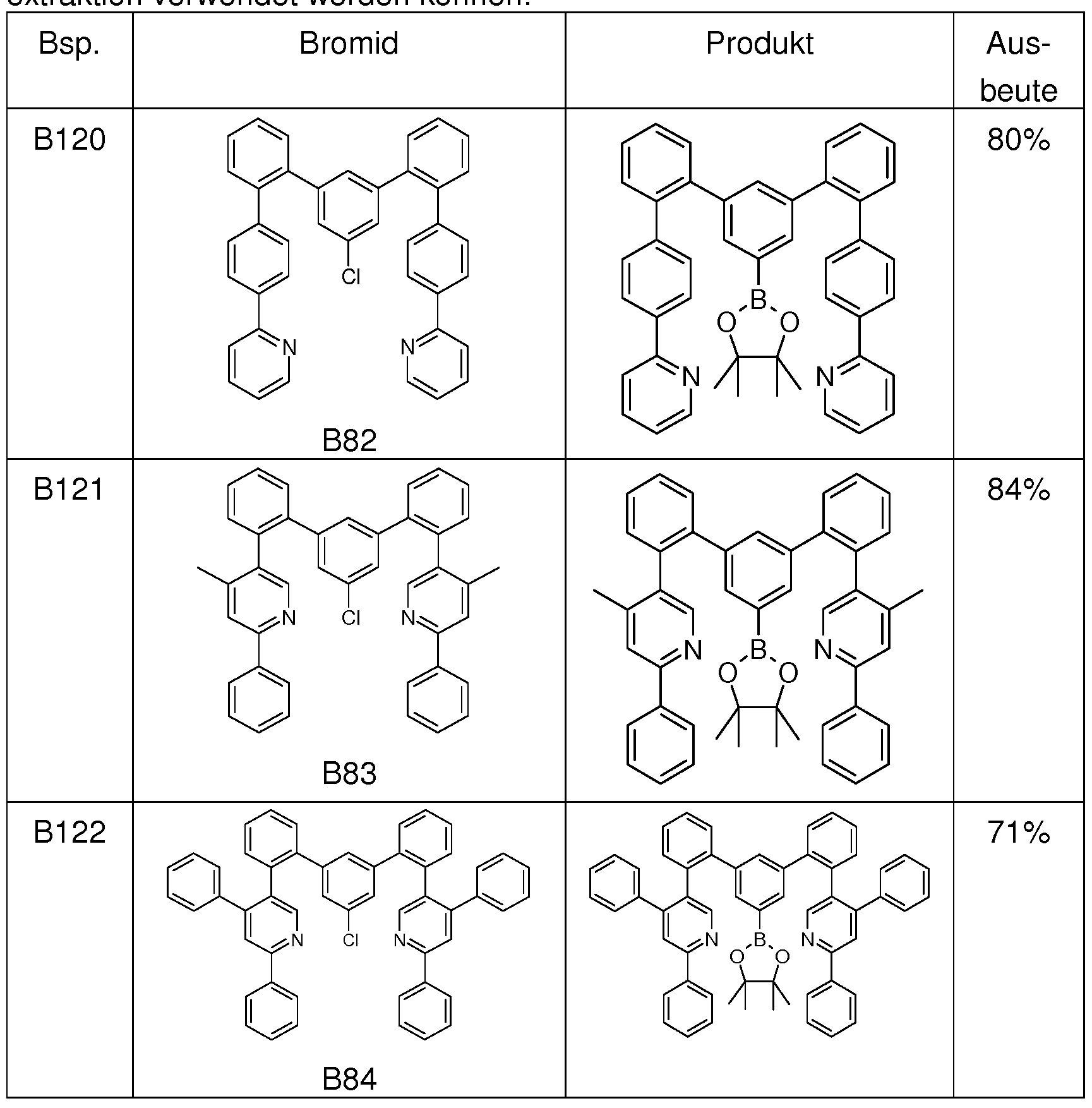


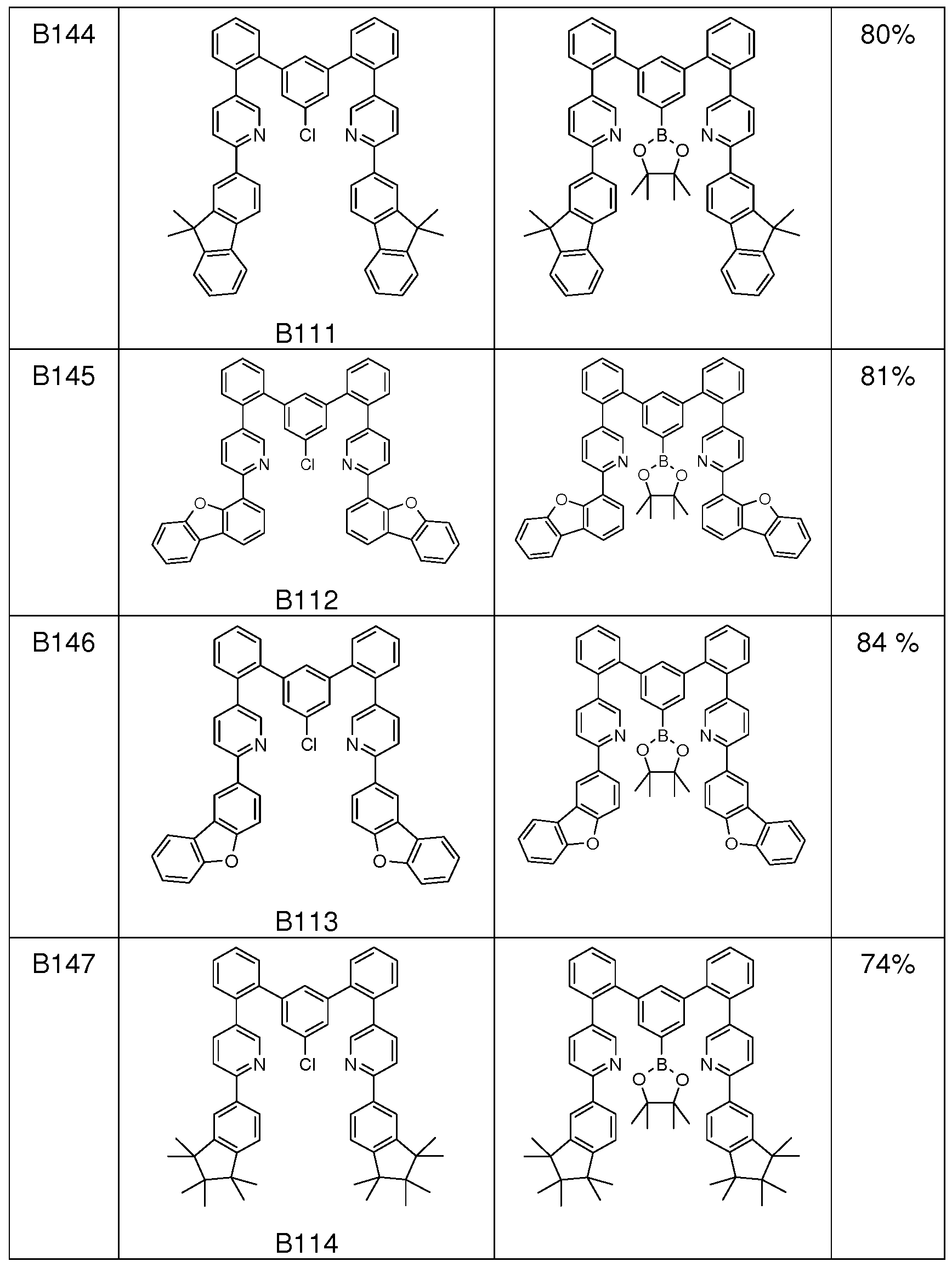

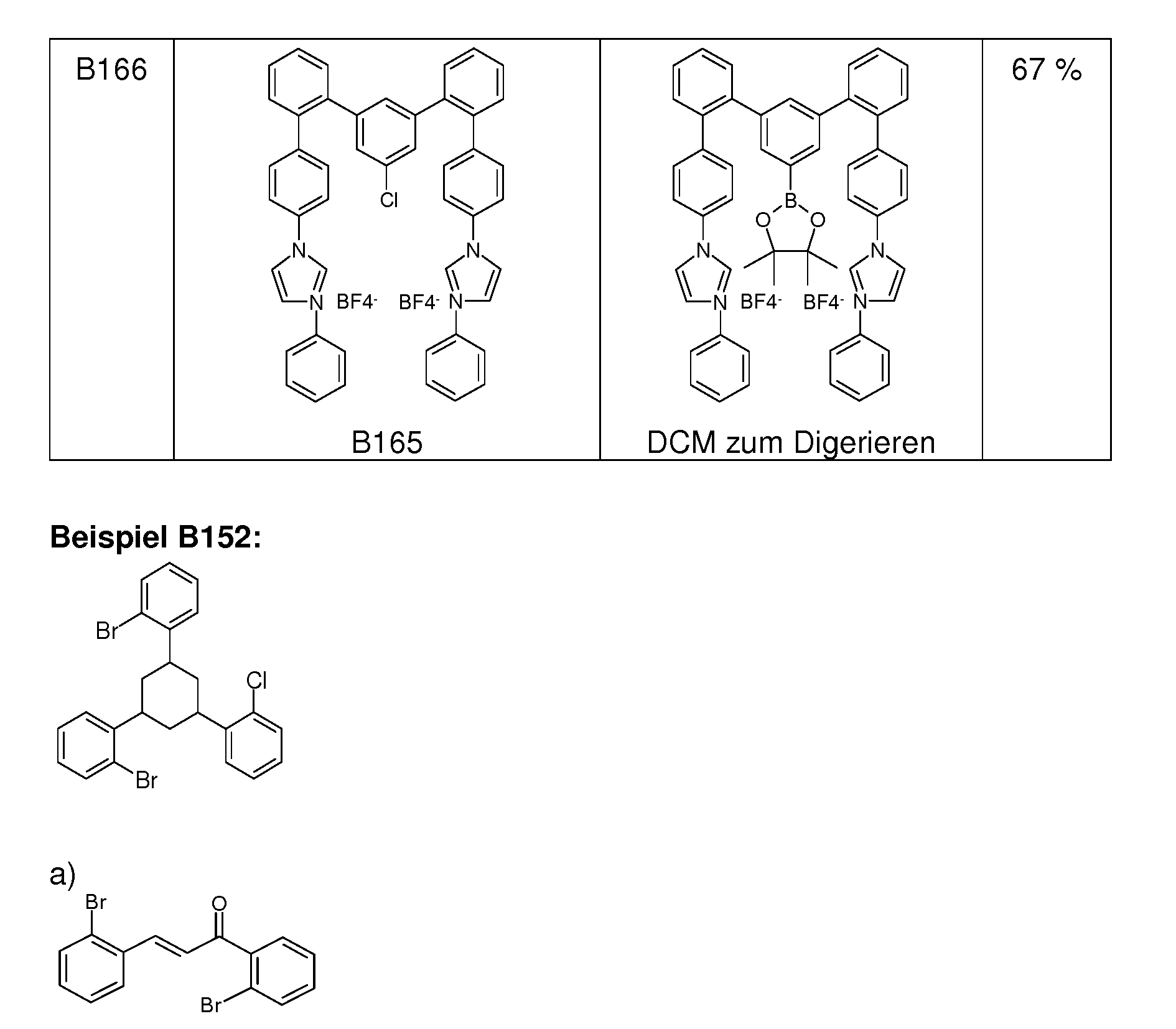
Darstellung gemäß G. Markopoulos et al., Angew. Chem, Int. Ed., 2012, 51 , 12884. Preparation according to G. Markopoulos et al., Angew. Chem, Int. Ed., 2012, 51, 12884.

Durchführung nach JP 2000-1 69400. Eine Lösung von 36.6 g (100 mmol) 1 ,3-Bis-(2-bromphenyl)-2-propen-1 -on [126824-93-9], Stufe a) in 300 ml trockenem Aceton wird portionsweise mit 5.7 g [105 mmol] Natrium- methanolat versetzt und dann 12 h bei 40 °C gerührt . Man entfernt das Lösungsmittel im Vakuum, nimmt den Rückstand in Ethylacetat auf, wäscht dreimal mit je 200 ml Wasser und zweimal mit je 200 ml gesättigter Kochsalzlösung und trocknet über Magnesiumsulfat. Das nach Entfernen das Lösungsmittels im Vakuum erhaltene Öl wird Flash-chromatographiert (Torrent CombiFlash, Fa. Axel Semrau). Ausbeute: 17.9 g (44 mmol), 44 %. Reinheit: ca. 97 %-ig nach 1H-NMR. Procedure according to JP 2000-1 69400. A solution of 36.6 g (100 mmol) of 1, 3-bis (2-bromophenyl) -2-propene-1-one [126824-93-9], stage a) in 300 ml dry acetone is added in portions with 5.7 g [105 mmol] of sodium methoxide and then stirred at 40 ° C for 12 h. The solvent is removed in vacuo, the residue is taken up in ethyl acetate, washed three times with 200 ml of water and twice with 200 ml of saturated sodium chloride solution and dried over magnesium sulfate. That after removal The solvent obtained in vacuo is flash chromatographed (Torrent CombiFlash, Fa. Axel Semrau). Yield: 17.9 g (44 mmol), 44%. Purity: about 97% after 1 H NMR.
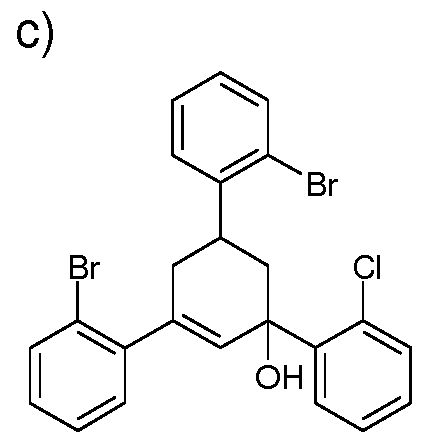
Zu einer Lösung von 2-Chlor-phenylmagnesiumbromid (200 mmol) To a solution of 2-chloro-phenylmagnesium bromide (200 mmol)
[36692-27-0] in 200 ml Di-n-butylether fügt man bei 0 Ό 2.4 g (2.4 mmol) wasserfreies Kupfer(l)chlorid [7758-89-6] zu und rührt 30 min. nach. Dann tropft man eine Lösung von 40.6 g (100 mmol) Stufe b) in 200 ml Toluol während 30 min. zu und rührt 5 h bei 0 °C nach. Man quencht die Reak- tionsmischung durch vorsichtige Zugabe von 100 ml Wasser und dann 220 ml 1 N Salzsäure. Man trennt die organische Phase ab, wäscht diese zweimal mit je 200 ml Wasser, einmal mit 200 ml gesättigter Natrium- hydrogencarbonat-Lösung und einmal mit 200 ml gesättigter Kochsalz- lösung und trocknet über Magnesiumsulfat. Das nach Entfernen das Lösungsmittels im Vakuum erhaltene Öl wird mit Toluol über Kieselgel filtriert. Das so erhaltene Rohprodukt wird ohne weitere Reinigung weiter umgesetzt. Ausbeute: 49.8 g (96 mmol), 96 %. Reinheit: ca. 90-95 %ig nach 1 H-NMR. [36692-27-0] in 200 ml of di-n-butyl ether is added at 0 Ό 2.4 g (2.4 mmol) of anhydrous copper (l) chloride [7758-89-6] and stirred for 30 min. to. Then a solution of 40.6 g (100 mmol) of step b) is added dropwise in 200 ml of toluene for 30 min. and stirred for 5 h at 0 ° C after. The reaction mixture is quenched by careful addition of 100 ml of water and then 220 ml of 1 N hydrochloric acid. The organic phase is separated, washed twice with 200 ml of water, once with 200 ml of saturated sodium bicarbonate solution and once with 200 ml of saturated sodium chloride solution and dried over magnesium sulfate. The oil obtained after removal of the solvent in vacuo is filtered through silica gel with toluene. The crude product thus obtained is reacted further without further purification. Yield: 49.8 g (96 mmol), 96%. Purity: about 90-95% after 1 H NMR.
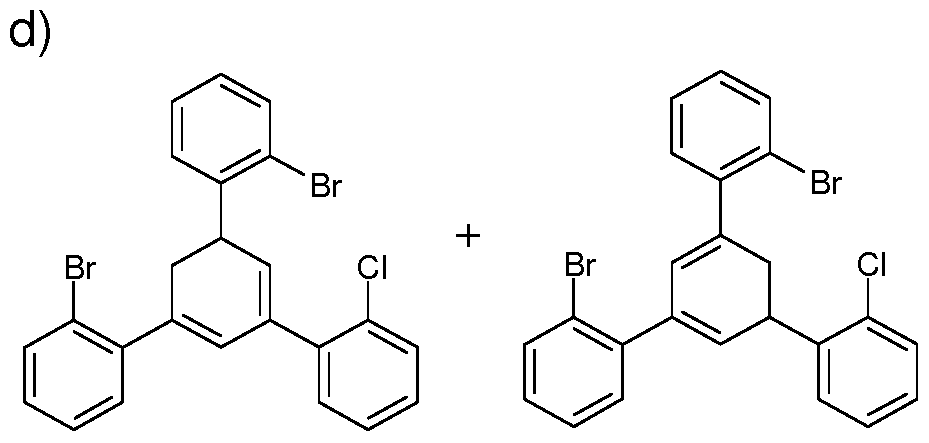
Eine auf 0 °C gekühlte Lösung von 51 .9 g (100 mmol) Stufe c) in 500 ml Dichlormethan (DCM) wird mit 1 .0 ml Trifluormethansulfonsäure und dann portionsweise mit 50 g Phosphorpentoxid versetzt. Man lässt auf Raum- temperatur erwärmen und rührt 2 h nach. Man dekantiert vom Phosphor- pentoxid ab, schlämmt dieses in 200 ml DCM auf und dekantiert erneut ab. Die vereinigten DCM-Phasen werden zweimal mit Wasser und einmal mit gesättigter Kochsalzlösung gewaschen und über Magnesiumsulfat getrocknet. Das nach Entfernen des Lösungsmittels im Vakuum erhaltene Wachs wird Flash-chromatographiert (Torrent CombiFlash, Fa. Axel Semrau). Ausbeute: 31 .5 g (63 mmol), 63 %, Isomerengemisch. Reinheit: ca. 90-95 %ig nach 1H-NMR. A cooled to 0 ° C solution of 51.9 g (100 mmol) step c) in 500 ml of dichloromethane (DCM) is mixed with 1 .0 ml of trifluoromethanesulfonic acid and then in portions with 50 g of phosphorus pentoxide. Allow to warm to room temperature and stir for 2 h. It is decanted from the phosphorus pentoxide, this slurries in 200 ml DCM and decanted again from. The combined DCM phases are washed twice with water and once with saturated brine and dried over magnesium sulfate. The wax obtained after removal of the solvent in vacuo is flash chromatographed (Torrent CombiFlash, Fa. Axel Semrau). Yield: 31 .5 g (63 mmol), 63%, mixture of isomers. Purity: about 90-95% after 1 H NMR.

Ein Gemisch aus 25.0 g (50 mmol) Stufe d), 2 g Pd/C (10 %), 200 ml Methanol und 300 ml Ethylacetat wird im Rührautoklaven mit 3 bar Wasserstoff beaufschlagt und bei 30 °C bis zur been deten Wasser- stoffaufnahme hydriert. Man filtriert über ein mit Ethylacetat vorge- schlämmtes Celtite-Bett ab und engt das Filtrat zur Trockene ein. Das so erhaltene Öl wird Flash-chromatographiert (Torrent CombiFlash, Fa. Axel Semrau). Ausbeute: 17.2 g (34 mmol), 68 %. Reinheit: ca. 95 %ig nach 1 H-NMR (cis,cis-lsomer). A mixture of 25.0 g (50 mmol) of step d), 2 g of Pd / C (10%), 200 ml of methanol and 300 ml of ethyl acetate is charged in the stirred autoclave with 3 bar of hydrogen and at 30 ° C until the finished hydrogen uptake hydrogenated. The mixture is filtered through a Celtite bed pre-filtered with ethyl acetate and the filtrate is concentrated to dryness. The resulting oil is flash chromatographed (Torrent CombiFlash, Fa. Axel Semrau). Yield: 17.2 g (34 mmol), 68%. Purity: about 95% after 1 H NMR (cis, cis isomer).
Analog können folgende Verbindungen hergestellt werden. Analogously, the following compounds can be prepared.


Ein Gemisch aus 54.5 g (100 mmol) B152, 59.0 g (210 mmol) 2-Phenyl-5- (4,4,5,5-tetramethyl-[1 ,3,2]dioxaborolan-2-yl)-pyridin [879291 -27-7], 127.4 g (600 mmol) Trikaliumphosphat, 1 .57 g (6 mmol) Triphenylphos- phin und 449 mg (2 mmol) Palladium(ll)acetat in 750 ml Toluol, 300 ml Dioxan und 500 ml Wasser wird 30 h unter Rückfluss erhitzt. Nach dem Erkalten trennt man die organische Phase ab, wäscht diese zweimal mit je 300 ml Wasser und einmal mit 300 ml gesättigter Kochsalzlösung und trocknet über Magnesiumsulfat. Man filtriert vom Magnesiumsulfat über ein mit Toluol vorgeschlämmtes Celite-Bett ab, engt das Filtrat im Vakuum zur Trockene ein und kristallisiert den verbliebenen Schaum aus Acetonitril / Ethylacetat um. Ausbeute: 41 .8 g (64 mmol) 64 %. Reinheit: ca. 95 %ig nach 1 H-NMR.A mixture of 54.5 g (100 mmol) B152, 59.0 g (210 mmol) 2-phenyl-5- (4,4,5,5-tetramethyl- [1,2,2] dioxaborolan-2-yl) -pyridine [ 879291 -27-7], 127.4 g (600 mmol) of tripotassium phosphate, 1 .57 g (6 mmol) of triphenylphosphine and 449 mg (2 mmol) of palladium (II) acetate in 750 ml of toluene, 300 ml of dioxane and 500 ml of water is heated under reflux for 30 h. After cooling, the organic phase is separated off, washed twice with 300 ml of water and once with 300 ml of saturated sodium chloride solution and dried over magnesium sulfate. The magnesium sulphate is filtered off on a celite bed pre-slurried with toluene, the filtrate is concentrated to dryness in vacuo and the remaining foam is crystallized from acetonitrile. Ethyl acetate. Yield: 41.8 g (64 mmol) 64%. Purity: about 95% after 1 H-NMR.
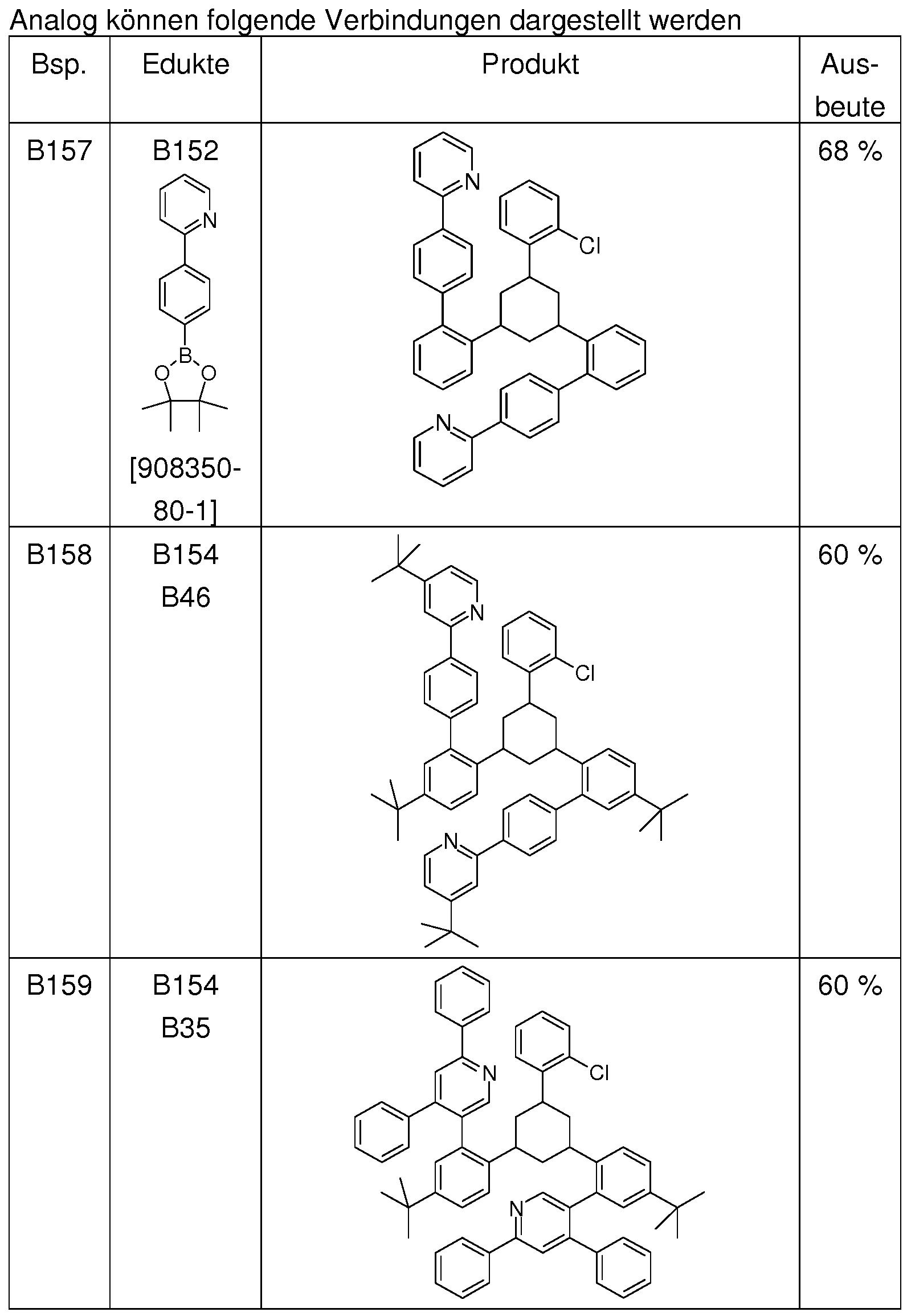


Ein Gemisch aus 7.0 g (15 mmol) B3, 19.9 g (30.0 mmol) B120, 9.5 g (90 mmol) Natriumcarbonat, 340 mg (1 .3 mmol) Triphenylphosphin, 98 mg (0.44 mmol) Palladium(ll)acetat, 200 ml Toluol, 100 ml Ethanol und 200 ml Wasser wird 40 h unter Rückfluss erhitzt. Nach Abkühlen wird der ausge- fallene Feststoff abgesaugt und zweimal mit je 30 mL Ethanol gewaschen. Das Rohprodukt wird in 300 mL Dichlormethan gelöst und über ein Kiesel- gelbett filtriert. Das Kieselgelbett wird dreimal mit je 200 mL Dichlormethan /Ethylacetat 1 :1 nachgewaschen. Das Filtrat wird zweimal mit Wasser und einmal mit gesättigter Kochsalzlösung gewaschen und über Natriumsulfat getrocknet. Das Filtrat wird zur Trockene eingeengt. Der Rückstand wird mit einem Ethylacetat/Heptan Eluentengemisch an Kieselgel chromatogra- phiert (Flash-Säulenautomat der Firam Axel-Semrau). Ausbeute: 10.7 g (7.8 mmol), 52%. Reinheit: ca. 98 %ig nach 1H-NMR. A mixture of 7.0 g (15 mmol) B3, 19.9 g (30.0 mmol) B120, 9.5 g (90 mmol) sodium carbonate, 340 mg (1 .3 mmol) triphenylphosphine, 98 mg (0.44 mmol) palladium (II) acetate, 200 Toluene, 100 ml of ethanol and 200 ml of water is heated under reflux for 40 h. After cooling, the precipitated solid is filtered off with suction and washed twice with 30 ml of ethanol each time. The crude product is dissolved in 300 ml of dichloromethane and filtered through a silica gel bed. The silica gel bed is washed three times with 200 mL dichloromethane / ethyl acetate 1: 1. The filtrate is washed twice with water and once with saturated brine and dried over sodium sulfate. The filtrate is concentrated to dryness. The residue is chromatographed on silica gel with an ethyl acetate / heptane eluent mixture (flash column automaton from Firam Axel-Semrau). Yield: 10.7 g (7.8 mmol), 52%. Purity: about 98% after 1 H-NMR.
Variante B: Variant B:
Ein Gemisch aus 5.7 g (15 mmol) B5, 19.9 g (30.0 mmol) B120, 13.8 g (60 mmol) Kaliumphosphat Monohydrat, 507 mg (0.6 mmol) XPhos A mixture of 5.7 g (15 mmol) B5, 19.9 g (30.0 mmol) B120, 13.8 g (60 mmol) potassium phosphate monohydrate, 507 mg (0.6 mmol) XPhos
Palladacycle Gen.3 [1445085-55-1 ], 200 ml THF und 100 ml Wasser wird 20 h unter Rückfluss erhitzt. Nach Abkühlen wird der ausgefallene Fest- stoff abgesaugt und zweimal mit je 30 mL Wasser und zweimal mit je 30 mL Ethanol gewaschen. Die Aufreinigung erfolgt wie in Variante A beschrieben. Ausbeute: 13.2 g (9.6 mmol), 64%. Reinheit: ca. 99 %ig nach 1 H-NMR. Palladacycle Gen.3 [1445085-55-1], 200 ml of THF and 100 ml of water are refluxed for 20 h. After cooling, the precipitated solid is filtered off with suction and washed twice with 30 ml of water each time and twice with 30 ml of ethanol each time. The purification is carried out as in variant A. described. Yield: 13.2 g (9.6 mmol), 64%. Purity: about 99% after 1 H-NMR.
Analog der Durchführung beschrieben für L1 (Variante A oder B) können folgende Verbindungen dargestellt werden. Hierbei können zur Aufreini- gung durch Umkristallation oder Heißextraktion auch Toluol, Cyclohexan, Ethylacetat oder Dimethylformamid eingesetzt werden. Alternativ können The following compounds can be prepared analogously to the procedure described for L1 (variant A or B). Toluene, cyclohexane, ethyl acetate or dimethylformamide can also be used for purification by recrystallization or hot extraction. Alternatively you can

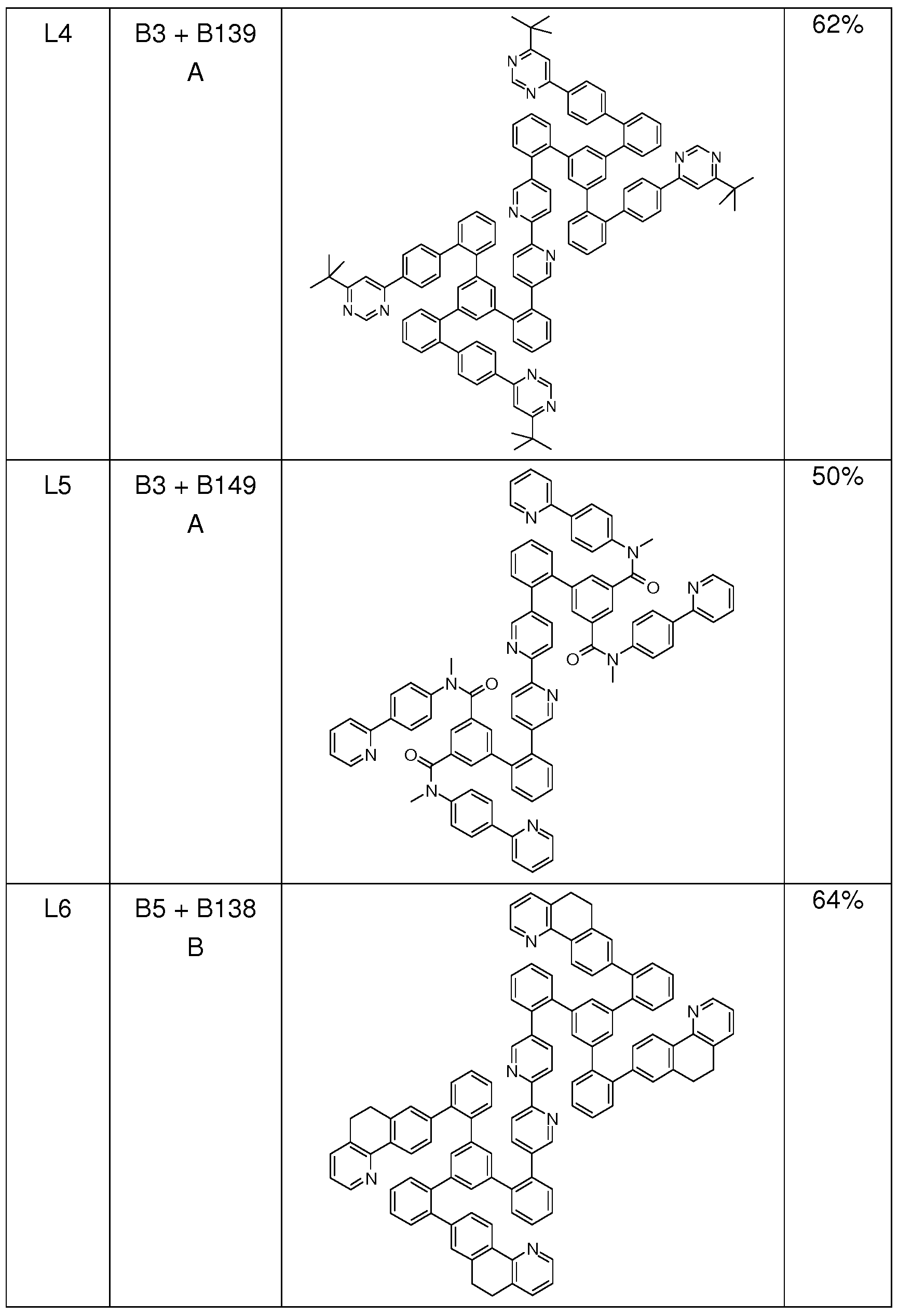


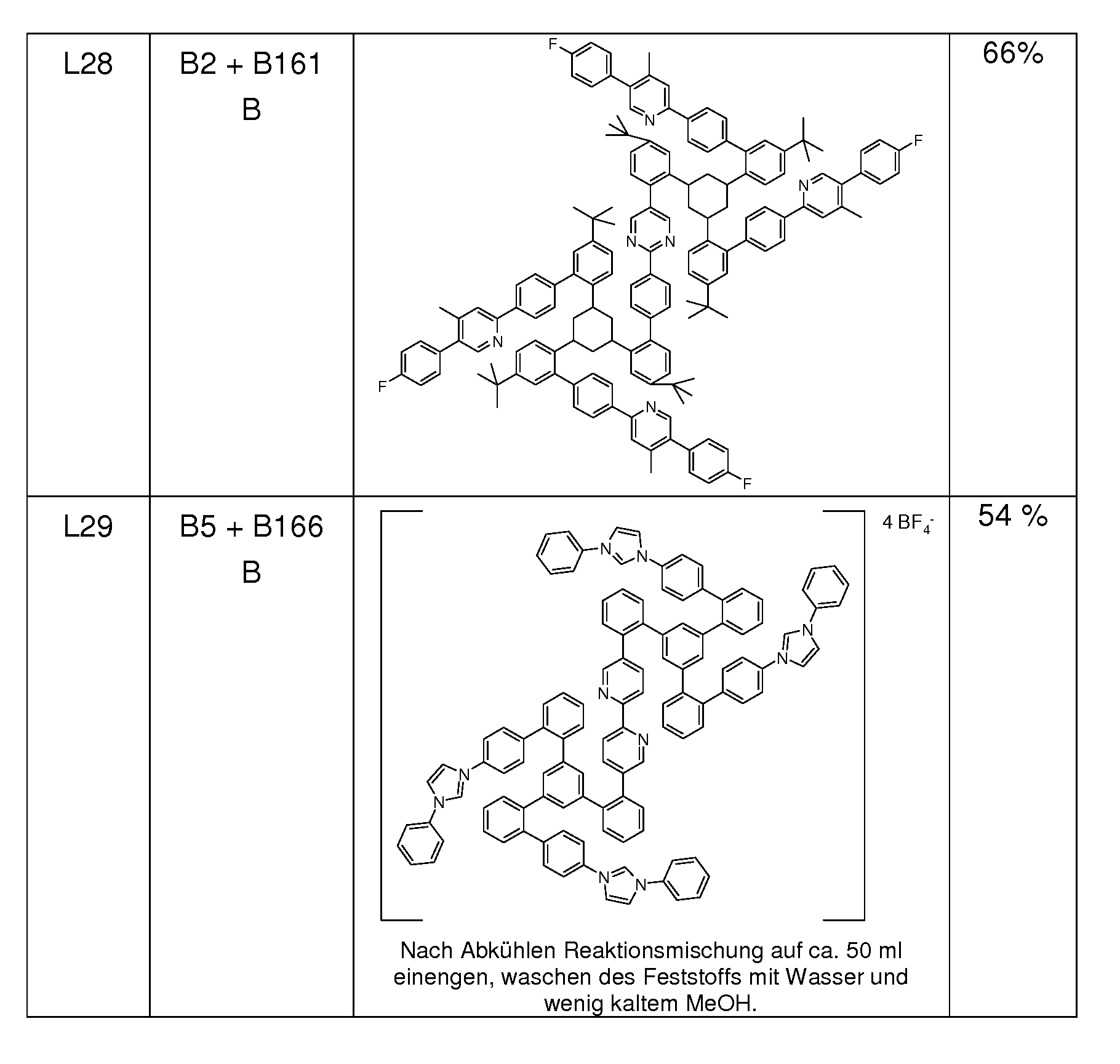
C: Synthese der Metallkomplexe: C: Synthesis of metal complexes:
Variante A: Komplexe mit C-N- bzw. C-O-Donorsatz vom Typ I1-Ir2(l_1) und l2-lr2(L1) Variant A: Complexes with CN or CO donor sets of the type I1-Ir2 (l_1) and l2-lr 2 (L1)

Ein Gemisch aus 13.8 g (10 mmol) des Liganden L1 , 9.8 g (20 mmol) Tris- acetylacetonato-iridium(lll) [15635-87-7] und 100 g Hydrochinon [123-31 - 9] werden in einem 1000 mL Zweihalsrundkolben mit einem glasum- mantelten Magnetkern vorgelegt. Der Kolben wird mit einem Wasserab- scheider (für Medien geringerer Dichte als Wasser) und einem Luftkühler mit Argonüberlagerung versehen und in einer Metallheizschale platziert. Die Apparatur wird über die Argonüberlagerung von oben her 15 min. mit Argon gespült, wobei man das Argon aus dem Seitenhals des Zweihals- kolbens ausströmen lässt. Über den Seitenhals des Zweihalskolbens führt man ein glasummanteltes Pt-100 Thermoelement in den Kolben ein und platziert das Ende kurz oberhalb des Magnetrührkerns. Dann wird die Apparatur mit mehreren lockeren Wicklungen von Haushaltsaluminiumfolie thermisch isoliert, wobei die Isolation bis zur Mitte des Steigrohres des Wasserabscheiders geführt wird. Dann wird die Apparatur schnell mit einem Laborheizrührwerk auf 250 °C, gemessen am Pt- 100 Thermofühler, der in die aufgeschmolzene, gerührte Reaktionsmischung eintaucht, erhitzt. Während der nächsten 2 h wird das Reaktionsgemisch bei 250 °C gehalten, wobei wenig Kondensat abdestilliert und sich im Wasserab- scheider sammelt. Die Reaktionsmischung wird bis auf 190 °C abkühlen gelassen, dann werden 100 mL Ethylenglykol zugetropft. Man lässt weiter bis auf 80 °C abkühlen und tropft dann 500 mL Metha nol zu, erhitzt 1 h auf Rückfluss. Die so erhaltene Suspension wird über eine Umkehrfritte filtriert, der Feststoff wird zweimal mit 50 ml Methanol gewaschen und dann im Vakuum getrocknet. Der so erhaltene Feststoff wird in 200 mL Dichlormethan gelöst und über ca. 1 kg mit Dichlormethan vorgeschlämm- tes Kieselgel (Säulendurchmesser ca. 18 cm) unter Luft- und Lichtaus- schluss filtriert, wobei dunkle Anteile am Start liegen bleiben. Die Kern- fraktion wird herausgeschnitten und am Rotationsverdampfer eingeengt, wobei gleichzeitig kontinuierlich MeOH bis zur Kristallisation zugetropft wird. Nach Absaugen, Waschen mit wenig MeOH und Trocknen im A mixture of 13.8 g (10 mmol) of the ligand L1, 9.8 g (20 mmol) of tris-acetylacetonato-iridium (III) [15635-87-7] and 100 g of hydroquinone [123-31-9] are dissolved in a 1000 mL Two-necked round-bottomed flask with a glass-coated magnetic core submitted. The flask is fitted with a water separator (for media of lower density than water) and an air cooler with argon overlay and placed in a metal heating dish. The apparatus is the argon overlay from above for 15 min. purged with argon, wherein the argon is discharged from the side neck of the two-necked flask. Insert a glass-coated Pt-100 thermocouple into the flask via the side neck of the two-necked flask and place the end just above the magnetic stirrer core. Then the apparatus is thermally insulated with several loose coils of household aluminum foil, the insulation being passed to the center of the riser of the water separator. Then the apparatus is heated rapidly to 250 ° C with a laboratory stirrer, as measured on the Pt-100 thermocouple immersed in the molten, stirred reaction mixture. During the next 2 h, the reaction mixture is kept at 250 ° C, with little condensate distilled off and collected in the water. The reaction mixture is allowed to cool to 190 ° C, then 100 mL of ethylene glycol are added dropwise. It is allowed to continue to cool to 80 ° C and then added dropwise 500 mL of methanol to methanol, heated for 1 h at reflux. The suspension thus obtained is filtered through a reverse frit, the solid is washed twice with 50 ml of methanol and then dried in vacuo. The resulting solid is dissolved in 200 mL Dissolve dichloromethane and filter over approx. 1 kg of silica gel pre-flowed with dichloromethane (column diameter approx. 18 cm) with exclusion of air and light, leaving dark parts at the start. The core fraction is cut out and concentrated on a rotary evaporator, while MeOH is continuously added dropwise until crystallization. After aspirating, washing with a little MeOH and drying in
Vakuum erfolgt die weitere Reinigung des diastereomeren Produkt- gemisches. Vacuum, the further purification of the diastereomeric product mixture.
Die diastereomere Metallkomplexmischung, enthaltend ΔΔ- und ΛΛ- Isomere (racemisch) sowie ΛΔ-lsomer (meso) und des Weiteren geringe Anteile an meridionalen Isomeren, wird in 300 ml_ Dichlormethan gelöst, auf 100 g Kieselgel aufgezogen und über eine mit Toluol vorgeschlämmte Kieselgelsäule (Kieselgelmenge ca. 1 .7 kg) chromatographisch getrennt. Als Eluent wird zunächst Toluol verwendet, später Toluol mit geringen Anteilen an Ethylacetat. Man erhält 5.1 g des früher eluierenden Isomers, nachfolgend Isomer 1 (11 ) genannt und 5.3 g des später eluierenden Isomers, nachfolgend Isomer 2 (12) genannt. Isomer 1 (11 ) und Isomer 2 (12) werden getrennt voneinander durch viermalige Heißextraktion mit n- Butylacetat für Isomer 1 und Toluol für Isomer 2 weiter aufgereinigt (Vor- lagemenge jeweils ca. 150 ml, Extraktionshülse: Standard Soxhletthülsen aus Cellulose der Fa. Whatman) unter sorgfältigem Luft- und Lichtaus- schluss. Abschließend werden die Produkte im Hochvakuum bei 280 °C getempert. Ausbeute: Isomer 1 (11) 3.7 g roter Feststoff (2.1 mmol), 21 % bezogen auf die Menge an eingesetzten Liganden. Reinheit: > 99.7 % nach HPLC; Isomer 2 (12) 3.7 g roter Feststoff (2.1 mmol), 21 % bezogen auf die Menge an eingesetztem Liganden. Reinheit 99.8 %ig nach HPLC. Die Metallkomplexe werden abschließend im Hochvakuum (10"6 mbar) bei 250 Ό getempert. The diastereomeric metal complex mixture containing ΔΔ and ΛΛ isomers (racemic) and ΛΔ isomer (meso) and further low levels of meridional isomers, is dissolved in 300 ml dichloromethane, drawn up on 100 g silica gel and passed over a silica gel pre-saturated with toluene ( Amount of silica gel approx. 1 .7 kg) is separated by chromatography. Toluene is first used as eluent, later toluene with small amounts of ethyl acetate. This gives 5.1 g of the earlier eluting isomer, hereinafter called isomer 1 (11), and 5.3 g of the later eluting isomer, hereinafter called isomer 2 (12). Isomer 1 (11) and isomer 2 (12) are further purified separately by four hot extraction with n-butyl acetate for isomer 1 and toluene for isomer 2 (initial charge of about 150 ml, extraction sleeve: standard Soxhlet sleeves made of cellulose from Fa. Whatman) with careful exclusion of air and light. Finally, the products are annealed in a high vacuum at 280 ° C. Yield: isomer 1 (11) 3.7 g of red solid (2.1 mmol), 21% based on the amount of ligands used. Purity:> 99.7% by HPLC; Isomer 2 (12) 3.7 g of red solid (2.1 mmol), 21% based on the amount of ligand used. Purity 99.8% by HPLC. The metal complexes are finally tempered in a high vacuum (10 "6 mbar) at 250 Ό.
Die angegebenen Ausbeuten für Isomer 1 (11 ) bzw. Isomer 2 (12) beziehen sich immer auf die Menge an eingesetztem Liganden. The indicated yields for isomer 1 (11) or isomer 2 (12) always refer to the amount of ligand used.
Die im Folgenden aufgeführten Abbildungen von Komplexen zeigen üblicherweise nur ein Isomer. Die Isomerenmischung kann aufgetrennt werden, kann aber genauso gut als Isomerengemisch in der OLED Device eingesetzt werden. Die nachfolgend gezeigten Metallkomplexe können prinzipiell durch Chromatographie (typischerweise Verwendung eines Säulenautomaten (Torrent der Firma Axel Semrau), Umkristallisation oder Heißextraktion gereinigt werden. Restlösemittel kann durch Tempern im Hochvakuum bei typischerweise 250 - 330 °C entfernt werden. Analog können folgende Verbindungen synthetisiert werden. Die Reaktions- bedingungen sind exemplarisch für das Isomer 1 (11 ) angegeben. Die chromatographische Trennung der überlicherweise anfallenden Dia- stereomerenmischung erfolgt an Flash-Kieselgel auf einem Säulen- automaten (Torrent der Firma Axel Semrau). Analog können durch sequenzielle Zugabe von zunächst 10 mmol lr(acac)3 und Reaktionsführung von 1 h bei 250 °C und dann Z ugabe von 10 mmol Rh(acac)3 [14284-92-5] und weitere Reaktionsführung von 1 h bei 250 °C und anschließender Aufarbeitung und Rein igung, wie oben angegeben, gemischtmetallische Rh-Ir-Komplexe erhalten werden. The following illustrations of complexes usually show only one isomer. The isomer mixture can be separated, but can just as well be used as a mixture of isomers in the OLED device. The metal complexes shown below can in principle, by chromatography (typically using a column automaton (Axel Semrau torrent), recrystallization or hot extraction.) Residual solvent can be removed by annealing under high vacuum at typically 250-330 ° C. Analogously, the following compounds can be synthesized The chromatographic separation of the usually occurring diastereomeric mixture is carried out on flash silica gel on a column automatic machine (Torrent from Axel Semrau) .Also, by sequential addition of initially 10 mmol lr (acac) 3 and reaction of 1 h at 250 ° C and then zabeabe of 10 mmol Rh (acac) 3 [14284-92-5] and further reaction of 1 h at 250 ° C and subsequent workup and cleaning, as indicated above, mixed metallic Rh-Ir complexes are obtained.
Variante B: Komplexe mit C-C-Donorsatz, Carben-Komplexe Variant B: C-C donor complex complexes, carbene complexes
Eine Suspension von 10 mmol des Carben-Liganden und 40 mmol Ag2O in 300 ml Dioxan wird 12 h bei 30 °C gerührt. Dann gibt man 20 mmol [lr(COD)CI]2 [121 12-67-3] zu und erhitzt 12 h unter Rückfluss. Man saugt noch heiß vom Feststoff ab, wäscht diesen dreimal mit je 50 ml heißem Dioxan, vereinigt die Filtrate und engt diese im Vakuum zur Trockene ein. Das so erhaltene Rohprodukt wird an basischem Aluminiumoxid mit Ethyl- acetat/Cyclohexan bzw. Toluol zweimal chromatographiert. Die weitere Reinigung des Produkts erfolgt durch fünfmalige kontinuierliche Heiß- extraktion mit Acetonitril und zweimalige Heißextraktion mit EthylacetatA suspension of 10 mmol of the carbene ligand and 40 mmol of Ag 2 O in 300 ml of dioxane is stirred at 30 ° C for 12 h. Then 20 mmol [Ir (COD) Cl] 2 [121 12-67-3] are added and the mixture is refluxed for 12 h. It is sucked off while still hot from the solid, washed three times with 50 ml of hot dioxane, the filtrates combined and concentrated in vacuo to dryness. The crude product thus obtained is chromatographed twice on basic alumina with ethyl acetate / cyclohexane or toluene. Further purification of the product is carried out by five continuous hot extraction with acetonitrile and two hot extraction with ethyl acetate
/Acetonitril (Vorlagemenge jeweils ca. 200 ml, Extraktionshülse: Standard Soxhletthülsen aus Cellulose der Fa. Whatman) unter sorgfältigem Luft- und Lichtausschluss. Abschließend wird das Produkt im Hochvakuum sublimiert bzw. getempert. Reinheit: > 99.8 % nach HPLC.

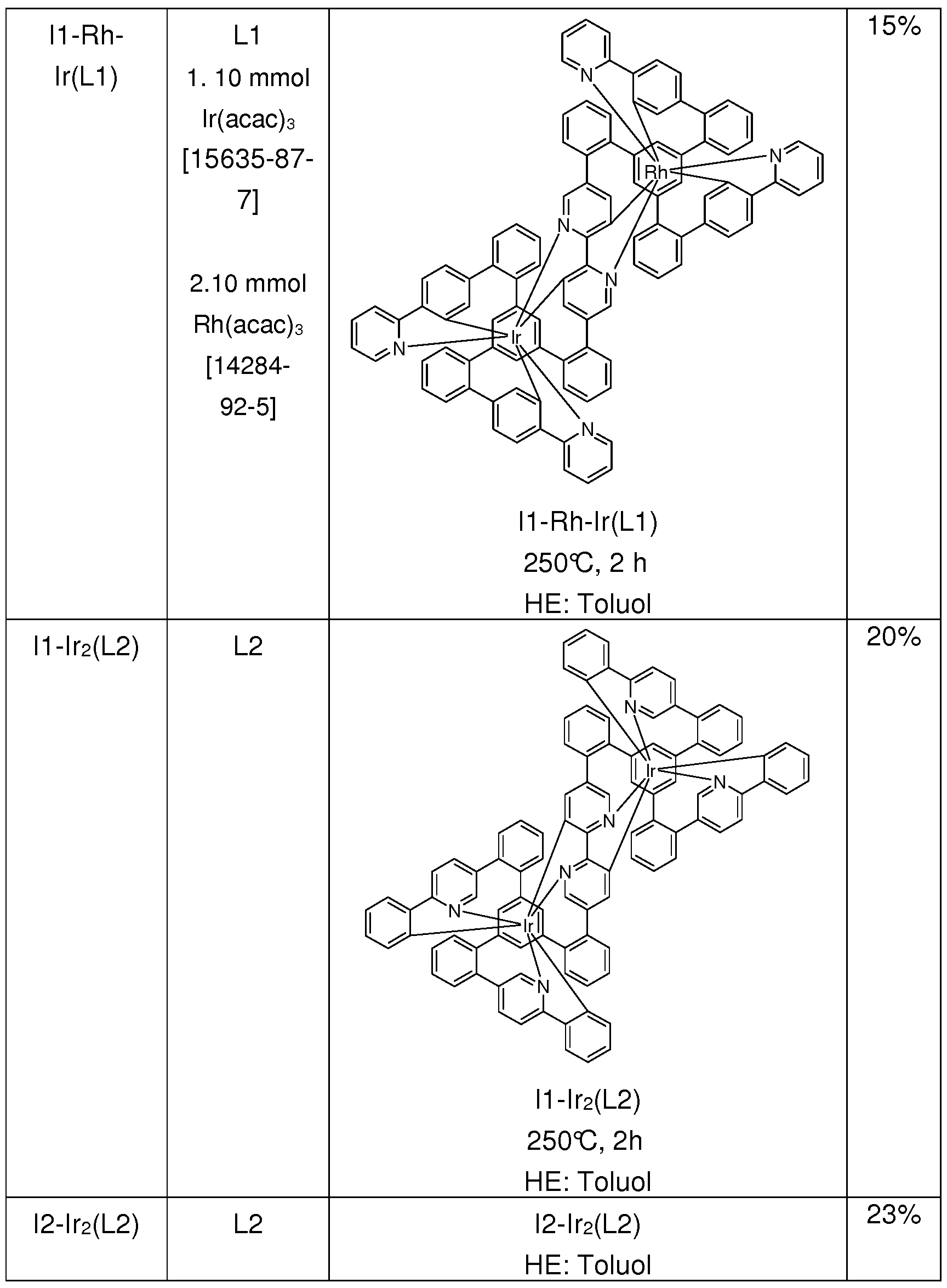


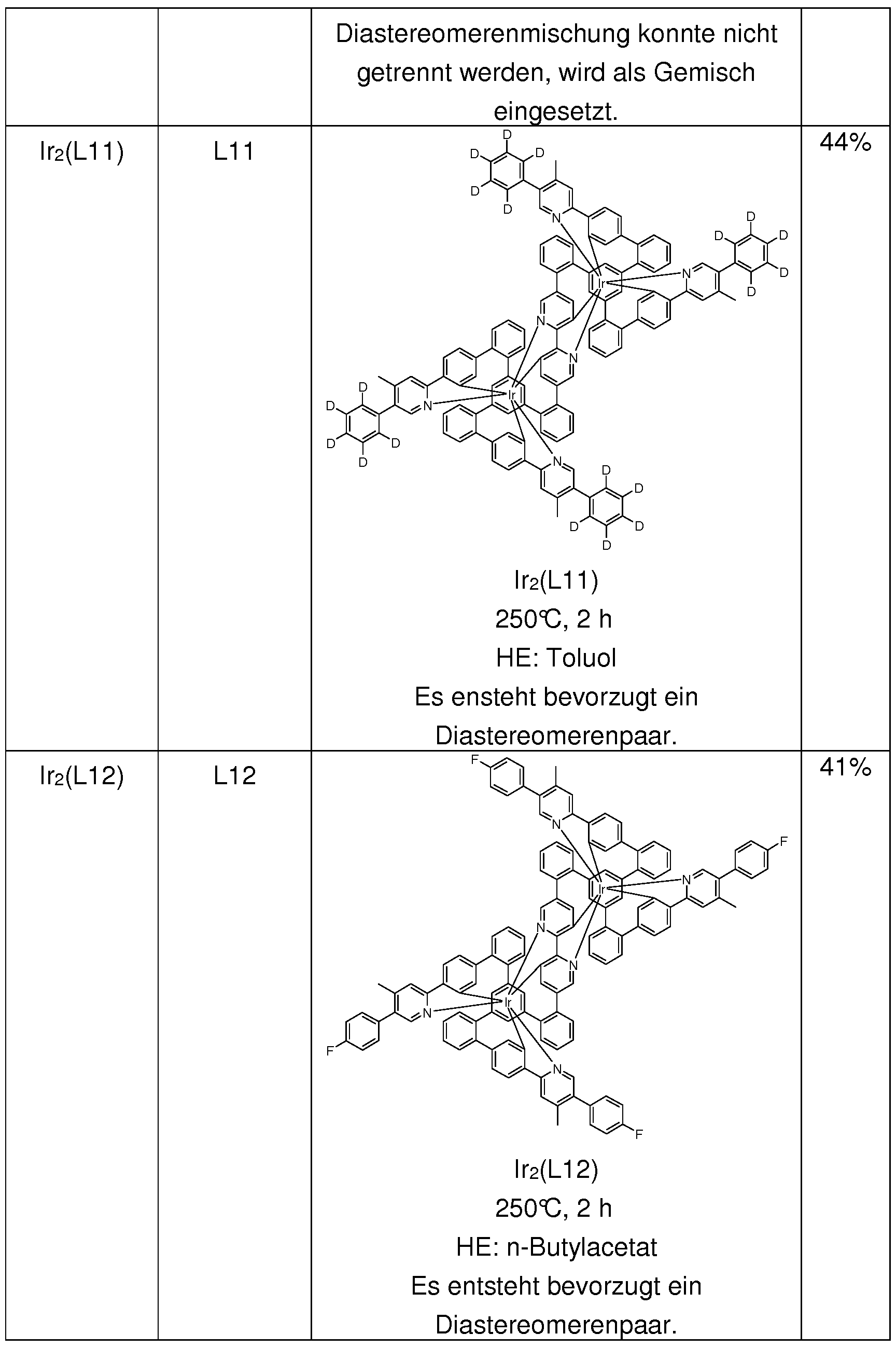

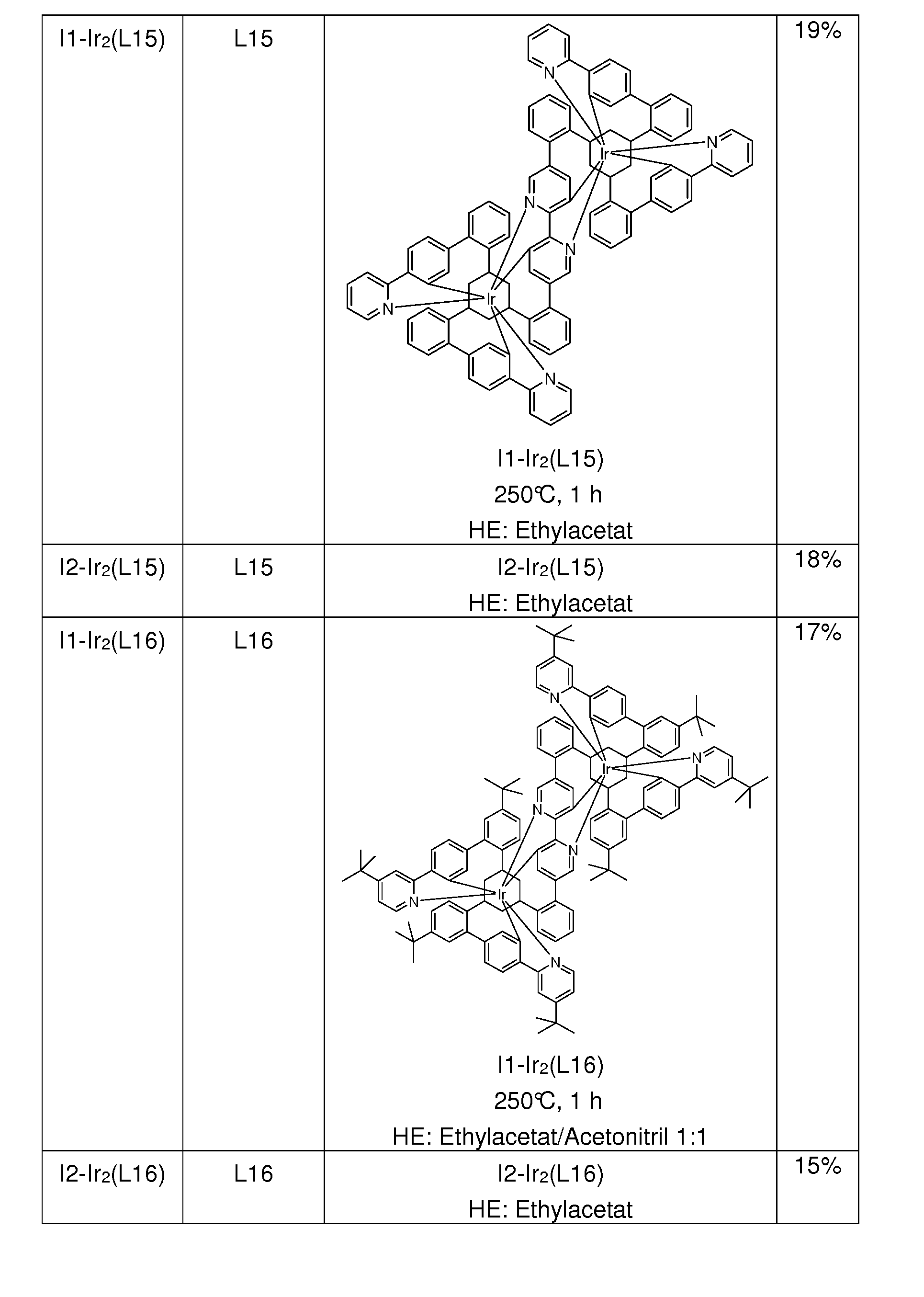


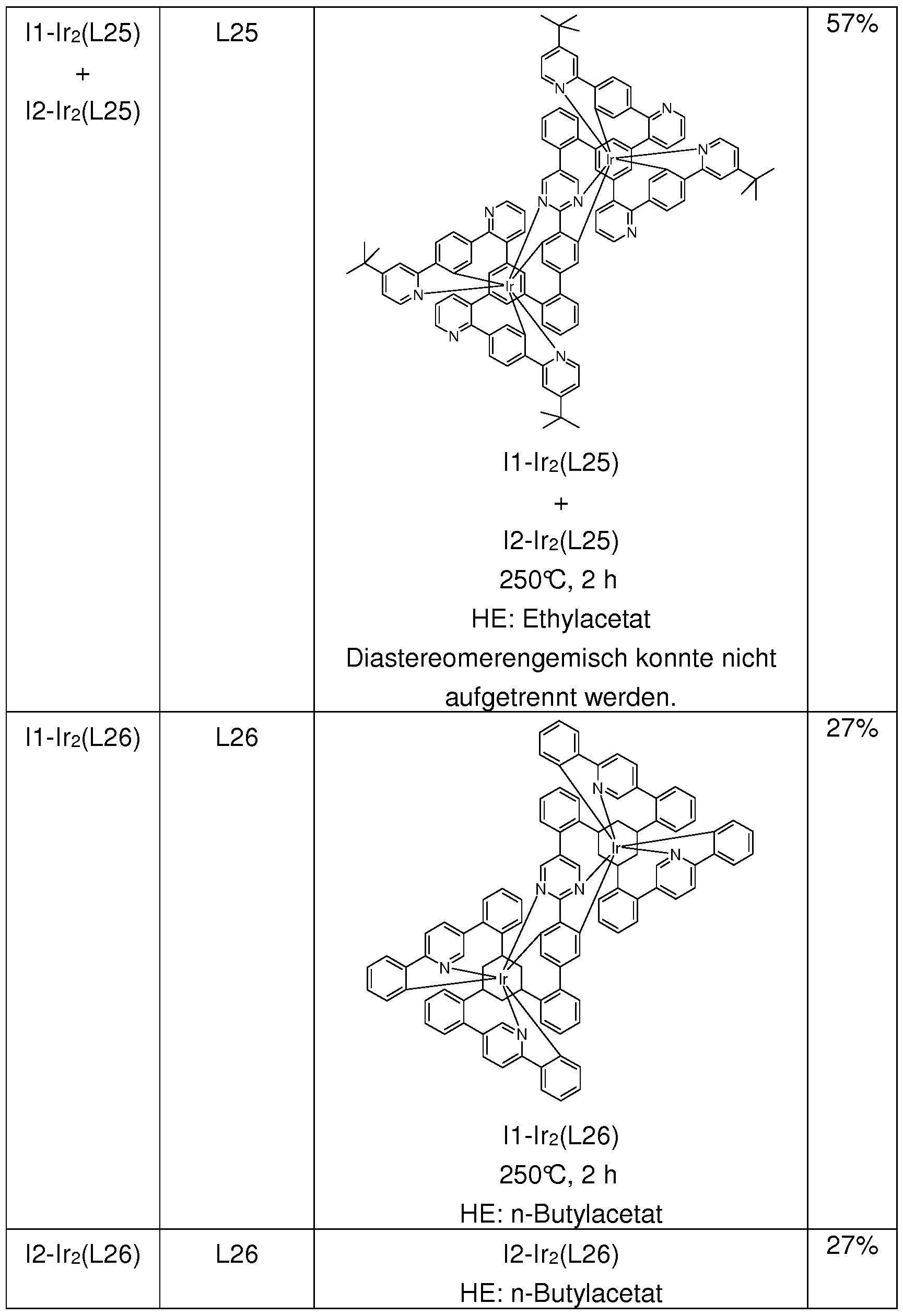


D: Funktionalisierung der Metallkomplexe D: Functionalization of metal complexes
1. Halogenierung der Iridium-Komplexe: 1. Halogenation of Iridium Complexes:
Eine Lösung bzw. Suspension von 10 mmol eines Komplexes, der in para- Position zum Iridium am bidentaten Teilliganden A x C-H-Gruppen (mit A = 1 -4) trägt, in 500 ml bis 2000 ml Dichlormethan, je nach Löslichkeit der Metallkomplexe, wird unter Licht- und Luftausschluss bei -30 bis +30 °C mit A x 10.5 mmol N-Halogen-succinimid (Halogen: Cl, Br, I) versetzt und 20 h gerührt. In DCM schlecht lösliche Komplexe können auch in anderen Lösungsmitteln (TCE, THF, DMF, Chlorbenzol, etc.) und bei erhöhter Temperatur umgesetzt werden. Anschließend wird das Lösungsmittel im Vakuum weitgehend entfernt. Der Rückstand wird mit 100 ml Methanol ausgekocht, der Feststoff wird abgesaugt, dreimal mit 30 ml Methanol gewaschen und dann im Vakuum getrocknet. Man erhält so die in para-Position zum Iridium bromierten/halogenierten Iridium-Komplexe. Komplexe mit einem HOMO (CV) von ca. -5.1 bis -5.0 eV und betrags- mäßig kleiner neigen zur Oxidation (Ir(lll)—► Ir(IV)), wobei das Oxidations- mittel Brom, freigesetzt aus NBS, ist. Diese Oxidationsreaktion ist durch eine deutliche Grünfärbung oder Braunfärbung der ansonsten gelben bis roten Lösung / Suspension der Emitter zu erkennen. In solchen Fällen werden 1 -2 weitere Äquivalente NBS zugesetzt. Zur Aufarbeitung setzt man 300-500 ml Methanol und 4 ml Hydrazin Hydrat als Reduktionsmittel zu, wodurch sich die grüne bzw. braune Lösung / Suspension gelb bzw. rot verfärbt (Reduktion Ir(IV)—► Ir(lll). Dann zieht man im Vakuum das Lösungsmittel weitgehend ab, versetzt mit 300 ml Methanol, saugt den Feststoff ab, wäscht dreimal mit je 100 ml Methanol und trocknet im Vakuum. Unterstöchiometrische Bromierungen, z. B. Mono- und Di- Bromierungen von Komplexen mit 4 C-H-Gruppen in para-Position zu den Iridiumatomen, verlaufen meist weniger selektiv als die stöchiometrischen Bromierungen. Die Rohprodukte dieser Bromierungen können chromato- graphisch (CombiFlash Torrent der Fa. A. Semrau) getrennt werden. A solution or suspension of 10 mmol of a complex carrying in para position to the iridium on the bidentate partial ligands A x CH groups (with A = 1 -4), in 500 ml to 2000 ml of dichloromethane, depending on the solubility of the metal complexes, is added with exclusion of light and air at -30 to +30 ° C with A x 10.5 mmol N-halo-succinimide (halogen: Cl, Br, I) and stirred for 20 h. In DCM poorly soluble complexes can also be reacted in other solvents (TCE, THF, DMF, chlorobenzene, etc.) and at elevated temperature. Subsequently, the solvent is largely removed in vacuo. The residue is boiled with 100 ml of methanol, the solid is filtered off, washed three times with 30 ml of methanol and then dried in vacuo. This gives the iridium in the para position to the iridium / halogenated iridium complexes. Complexes with a HOMO (CV) of about -5.1 to -5.0 eV and smaller amounts are prone to oxidation (Ir (III) -► Ir (IV)), with the oxidant being bromine released from NBS. This oxidation reaction can be recognized by a distinct green color or brown coloration of the otherwise yellow to red solution / suspension of the emitters. In such cases, 1-2 additional equivalents of NBS are added. For work-up, 300-500 ml of methanol and 4 ml of hydrazine hydrate are added as reducing agent, whereby the green or brown solution / suspension turns yellow or red (reduction Ir (IV) -► Ir (III) The solvent is largely removed by vacuum, 300 ml of methanol are added, the solid is filtered off with suction, washed three times with 100 ml of methanol each time and dried under reduced pressure. Bromination of complexes with 4 CH groups in the para position to the iridium atoms is usually less selective than stoichiometric bromination. The crude products of these brominations can be separated by chromatography (CombiFlash Torrent from A. Semrau).

Eine Suspension von 17.6 g (10 mmol) 11 -1 r2<L1 ) in 2000 ml DCM wird auf einmal mit 5.0 g (45 mmol) N-Bromsuccinimid versetzt und dann 20 h bei Raumtemperatur gerührt. Es werden 2 ml_ Hydrazinhydrat und an- schließend 300 ml_ MeOH zugegeben. Nach Entfernen von ca. 1900 ml des DCMs im Vakuum wird der rote Feststoff abgesaugt, dreimal mit ca. 50 ml Methanol gewaschen und dann im Vakuum getrocknet. Ausbeute: 18.6 g (9.0 mmol) 90 %; Reinheit: > 98.0 %ig nach NMR. A suspension of 17.6 g (10 mmol) 11 -1 r2 <L1) in 2000 ml DCM is mixed all at once with 5.0 g (45 mmol) of N-bromosuccinimide and then stirred for 20 h at room temperature. 2 ml of hydrazine hydrate are added, followed by 300 ml of MeOH. After removing about 1900 ml of the DCM in vacuo, the red solid is filtered off with suction, washed three times with about 50 ml of methanol and then dried in vacuo. Yield: 18.6 g (9.0 mmol) 90%; Purity:> 98.0% by NMR.
Analo können fol ende Verbindun en s nthetisiert werden: Analogously, the following connections can be made:
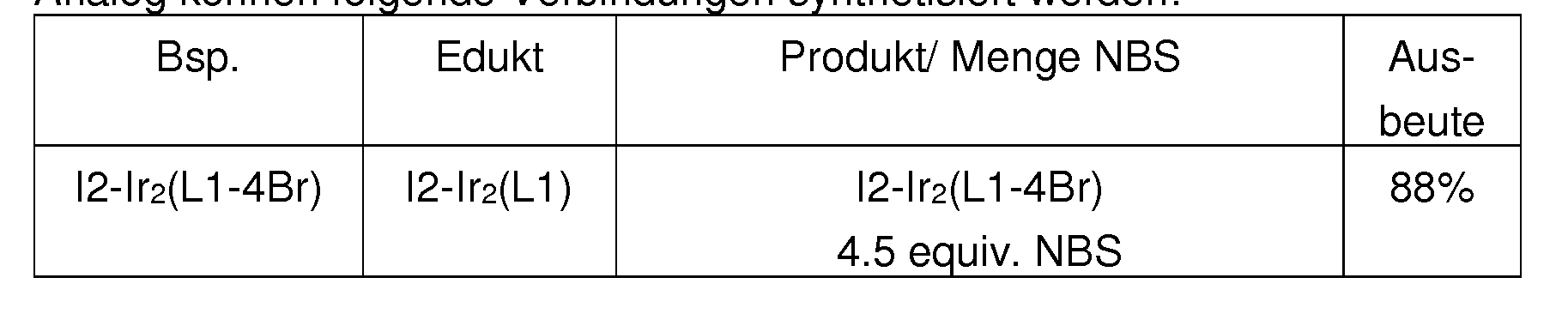


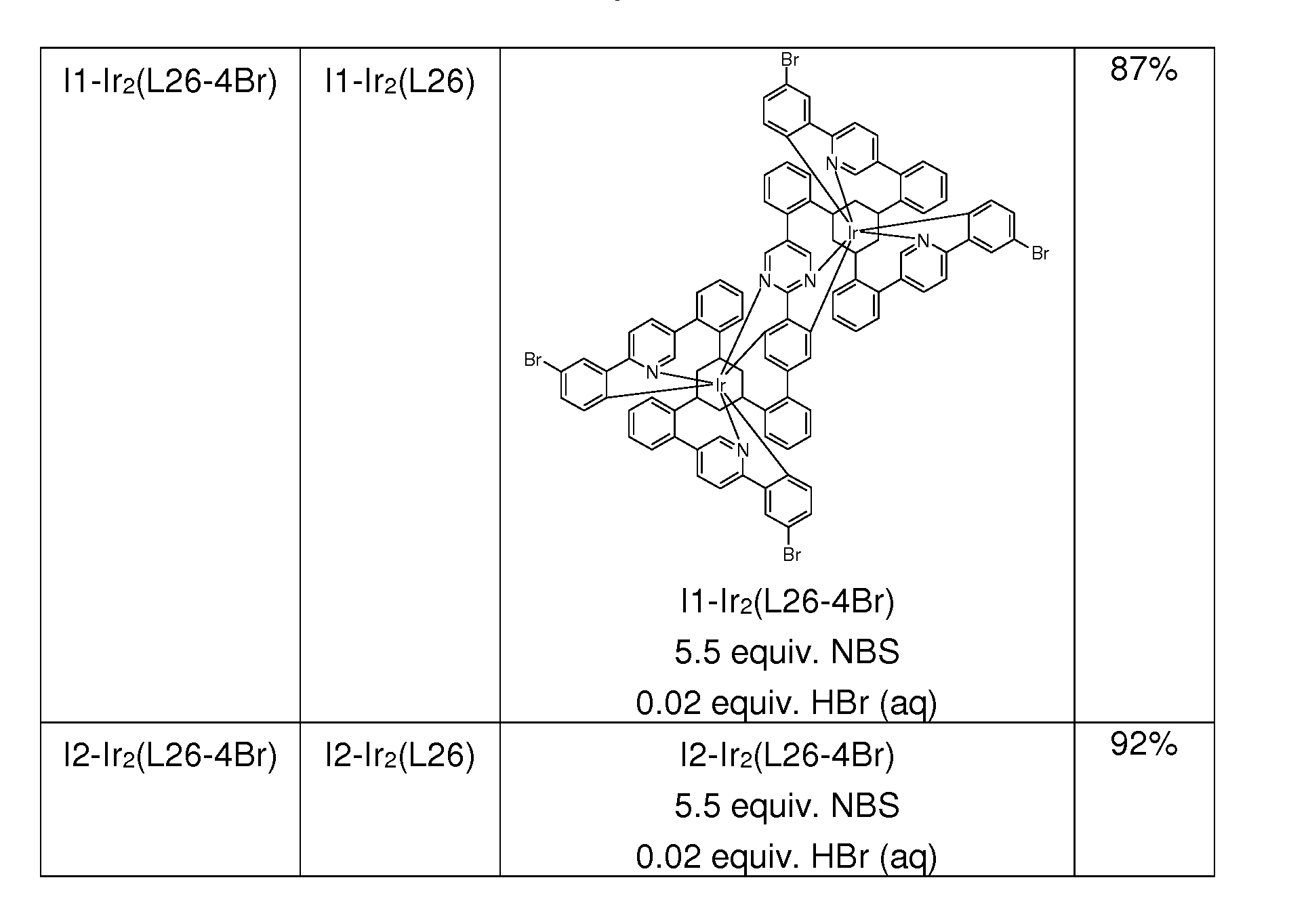
2) Suzuki-Kupplung an den bromierten Iridium-Komplexen: 2) Suzuki coupling on the brominated iridium complexes:
Variante A, zweiphasige Reaktionsmischung: Variant A, biphasic reaction mixture:
Eine Suspension von 10 mmol eines bromierten Komplexes, 12-20 mmol Boronsäure bzw. Boronsäureester pro Br-Funktion und 60-100 mmol Tri- kaliumphosphat in einem Gemisch aus 300 ml Toluol, 100 ml Dioxan und 300 ml Wasser wird mit 0.6 mmol Tri-o-tolylphosphin und dann mit 0.1 mmol Palladium(ll)acetat versetzt und 1 6 h unter Rückfluss erhitzt. Nach Erkalten gibt man 500 ml Wasser und 200 ml Toluol zu, trennt die wässrige Phase ab, wäscht die organische Phase dreimal mit 200 ml Wasser, einmal mit 200 ml gesättigter Kochsalzlösung und trocknet über Magnesiumsulfat. Man filtriert über ein Celite-Bett ab, wäscht dieses mit Toluol nach, entfernt das Toluol fast vollständig im Vakuum, gibt 300 ml Methanol zu, saugt vom ausgefallenen Rohprodukt ab, wäscht dieses dreimal mit je 50 ml Methanol und trocknet im Vakuum. Das Rohprodukt wird an Kieselgel gesäult auf einem Säulenautomaten (Torrent der Firma Semrau). Anschließend wird der Komplex durch Heißextraktion in A suspension of 10 mmol of a brominated complex, 12-20 mmol of boronic acid or boronic acid ester per Br function and 60-100 mmol of tricalcium phosphate in a mixture of 300 ml of toluene, 100 ml of dioxane and 300 ml of water is mixed with 0.6 mmol of trifluoromethane. o-tolylphosphine and then treated with 0.1 mmol palladium (II) acetate and heated for 1 6 h under reflux. After cooling, 500 ml of water and 200 ml of toluene are added, the aqueous phase is separated off, the organic phase is washed three times with 200 ml of water, once with 200 ml of saturated sodium chloride solution and dried over magnesium sulfate. The mixture is filtered through a bed of Celite, washed with toluene, the toluene is removed almost completely under reduced pressure, 300 ml of methanol are added, and the precipitated crude product is filtered off with suction, washed three times with 50 ml of methanol each time and dried in vacuo. The crude product is columned on silica gel on an automatic column (Torrent from Semrau). Subsequently, the complex by hot extraction in
Lösungsmitteln wie Ethylacetat, Toluol, Dioxan, Acetonitril, Cyclohexan, ortho- oder para-Xylol, n-Butylacetat, etc. weiter gereinigt. Alternativ kann aus diesen Lösungsmitteln sowie Hochsiedern wie Dimethylformamid, Dimethylsulfoxid oder Mesitylen umkristallisiert werden. Der Metallkomplex wird abschließend getempert. Das Tempern erfolgt im Hochvakuum (p ca. 10"6 mbar) im Temperaturbereich von ca. 200-300 °C. Solvents such as ethyl acetate, toluene, dioxane, acetonitrile, cyclohexane, ortho- or para-xylene, n-butyl acetate, etc. further purified. Alternatively, these solvents and high-boiling substances such as dimethylformamide, Recrystallized dimethyl sulfoxide or mesitylene. The metal complex is finally tempered. The annealing is carried out in a high vacuum (p about 10 "6 mbar) in the temperature range of about 200-300 ° C.
Variante B, einphasige Reaktionsmischung: Variant B, single-phase reaction mixture:
Eine Suspension von 10 mmol eines bromierten Komplexes, 12-20 mmol Boronsäure bzw. Boronsäureester pro Br-Funktion, 100-180 mmol einer Base (Kaliumfluorid, Trikaliumphosphat (wasserfrei, Monohydrat oder Tri- hydrat), Kaliumcarbonat, Cäsiumcarbonat, etc.) und 50 g Glaskugeln (3 mm Durchmesser) in 100-500 ml eines aprotischen Lösungsmittels (THF, Dioxan, Xylol, Mesitylen, Dimethylacetamid, NMP, DMSO, etc.) wird mit 0.2 mmol Tetrakis(thphenylphosphin)palladium(0) [14221 -01 -3] ver- setzt und 24 h unter Rückfluss erhitzt. Alternativ können andere Phos- phene wie Triphenylphosphin, Tri-tert-butylphosphin, SPhos, XPhos, RuPhos, XanthPhos, etc. in Kombination mit Pd(OAc)2 eingesetzt werden, wobei bei diesen Phosphinen das bevorzugte Phosphin Palladium Ver- hältnis 3:1 bis 1 .2:1 beträgt. Man entfernt das Lösungsmittel im Vakuum, nimmt das Produkt in einem geeigneten Lösungsmittel (Toluol, Dichlor- methan, Ethylacetat, etc.) auf und reinigt wie unter Variante A A suspension of 10 mmol of a brominated complex, 12-20 mmol boronic acid or boronic ester per Br function, 100-180 mmol of a base (potassium fluoride, tripotassium phosphate (anhydrous, monohydrate or trihydrate), potassium carbonate, cesium carbonate, etc.) and 50 g of glass beads (3 mm diameter) in 100-500 ml of an aprotic solvent (THF, dioxane, xylene, mesitylene, dimethylacetamide, NMP, DMSO, etc.) are mixed with 0.2 mmol of tetrakis (thphenylphosphine) palladium (0) [14221 -01 -3] and heated under reflux for 24 h. Alternatively, other phosphines, such as triphenylphosphine, tri-tert-butylphosphine, SPhos, XPhos, RuPhos, XanthPhos, etc. can be used in combination with Pd (OAc) 2, in which case the preferred phosphine to palladium ratio is 3: 1 to 1 .2: 1. The solvent is removed in vacuo, the product is taken up in a suitable solvent (toluene, dichloromethane, ethyl acetate, etc.) and purified as in variant A.
beschrieben. described.

Variante B: Variant B:
Einsatz von 20.7 g (10.0 mmol) 11 -lr(L1 -4Br), 9.75 g (80.0 mmol) Phenyl- boronsäure [98-80-6], 27.6 g (120 mmol) Trikaliumphosphat Monohydrat, 1 1 6 mg (0.1 mmol) Tetrakis(triphenylphosphin)palladium(0) und 500 mL trockenem Dimethylsulfoxid; 100 °C, 16 h. Chromatog raphische Trennung an Kieselgel mit Toluol/Heptan (Säulenautomat, Torrent der Firma Axel Semrau), anschließend fünfmalige Heißextraktion mit Toluol. Ausbeute: 9.5 g (5.6 mmol), 46 %; Reinheit: ca. 99.8 %ig nach HPLC. Use of 20.7 g (10.0 mmol) of 11 -lr (L1 -4Br), 9.75 g (80.0 mmol) of phenylboronic acid [98-80-6], 27.6 g (120 mmol) of tripotassium phosphate monohydrate, 1 1 6 mg (0.1 mmol) of tetrakis (triphenylphosphine) palladium (0) and 500 mL of dry dimethylsulfoxide; 100 ° C, 16 h. Chromatog raphische separation on silica gel with toluene / heptane (automatic column, Torrent the company Axel Semrau), then five hot extraction with toluene. Yield: 9.5 g (5.6 mmol), 46%; Purity: approx. 99.8% by HPLC.
Analog können folgende Verbindungen dargestellt werden: Analogously, the following compounds can be represented:
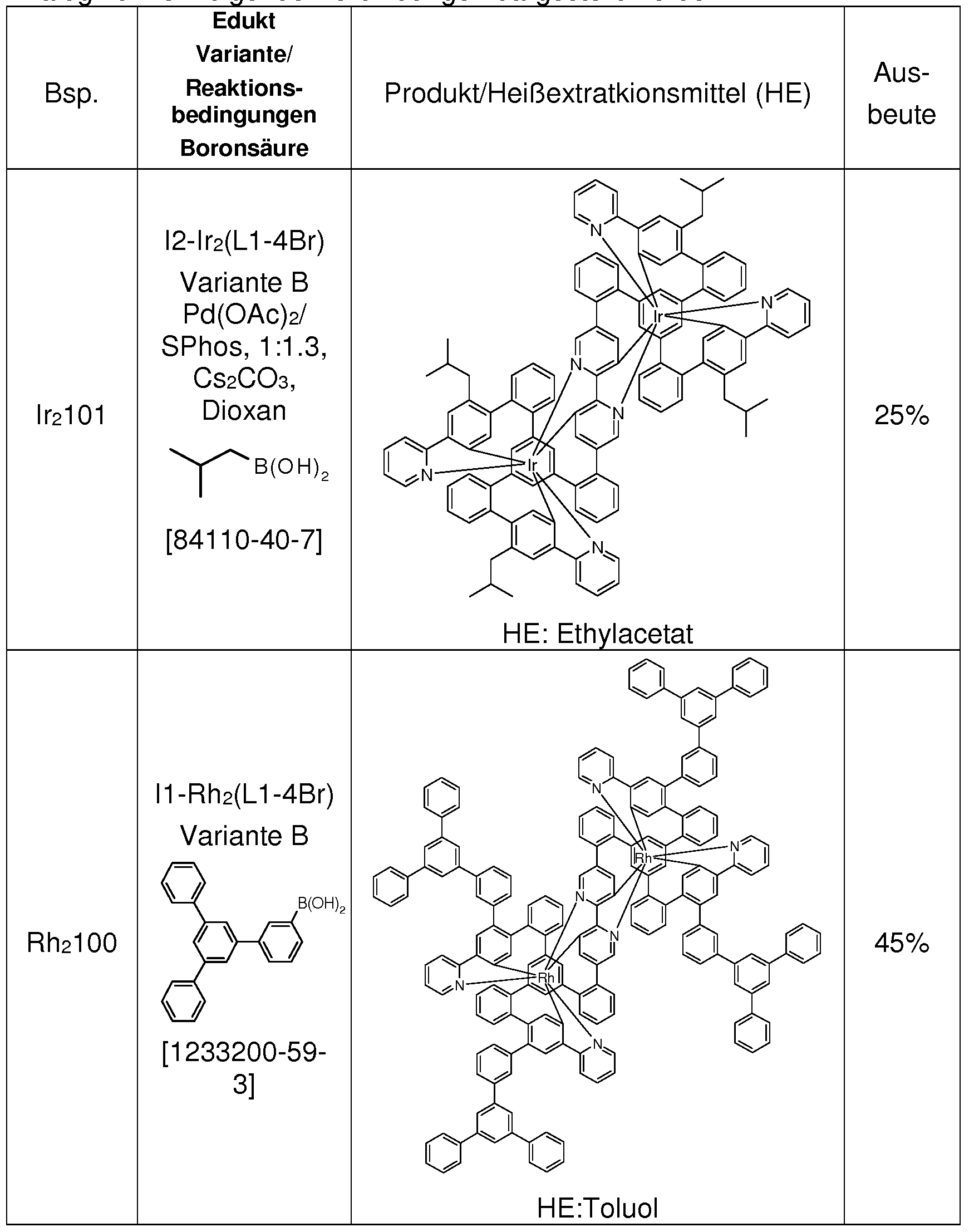
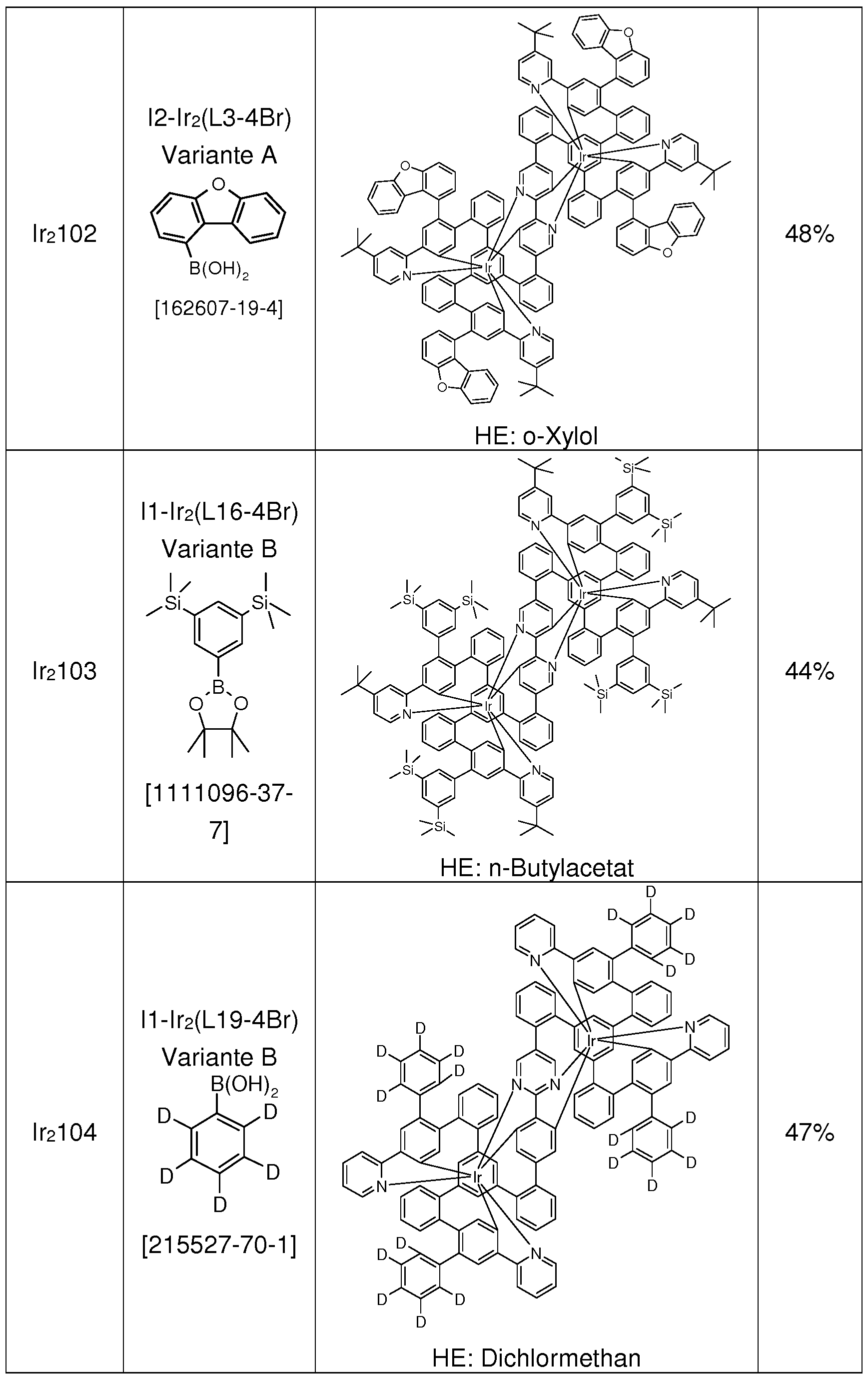


3) Deuterierung von Ir-Kompl 3) Deuteration of Ir-Kompl
Beispiel: lr2(L7-D12) Example: lr 2 (L7-D12)

Ein Gemisch von 1 mmol l r2(L7), 1 mmol Natriumethanolat, 5 ml Methanol- D4 und 80 ml DMSO-D6 wird 2 h auf 120 Ό erhitzt. N ach Erkalten auf 50 °C gibt man 1 ml DCI (10 %ige wässrige Lösung) z u. Man entfernt das Lösungsmittel im Vakuum und chromatographiert den Rückstand mit DCM an Kieselgel. Ausbeute: 0.95 mmol, 95 %, Deuterierungsgrad > 95 %. Analog können die Verbindungen lr2(L1 1 ), lr2(L12) und lr2(L20) tetra- deuteriert werden. A mixture of 1 mmol l r2 (L7), 1 mmol of sodium ethanolate, 5 ml of methanol-D4 and 80 ml of DMSO-D6 is heated to 120 ° C. for 2 h. After cooling to 50 ° C., 1 ml of DCI (10% strength aqueous solution) are added. The solvent is removed in vacuo and the residue is chromatographed on silica gel with DCM. Yield: 0.95 mmol, 95%, deuteration> 95%. Analogously, compounds lr2 (L1 1), lr2 (L12) and lr2 (L20) can be tetra-deuterated.
Device Beispiele: Device examples:
Herstellung der OLEDs Production of the OLEDs
Die erfindungsgemäßen Komplexe können aus Lösung verarbeitet werden und führen gegenüber vakuumprozessierten OLEDs zu wesentlich ein- facher herstellbaren OLEDs mit dennoch guten Eigenschaften. Die Her- stellung vollständig lösungsbasierter OLEDs ist in der Literatur bereits vielfach beschrieben, z. B. in WO 2004/037887. Die Herstellung vakuum- basierter OLEDs ist ebenfalls vielfach vorbeschrieben, u.a. in WO The complexes according to the invention can be processed from solution and, compared to vacuum-processed OLEDs, lead to substantially simpler manufacturable OLEDs with nevertheless good properties. The preparation of completely solution-based OLEDs has already been described many times in the literature, eg. In WO 2004/037887. The production of vacuum-based OLEDs has also been described many times, i.a. in WO
2004/05891 1 . In den im Folgenden diskutierten Beispielen werden lösungsbasiert und vakuumbasiert aufgebrachte Schichten innerhalb einer OLED kombiniert, so dass die Prozessierung bis einschließlich zur Emissionsschicht aus Lösung und in den darauffolgenden Schichten2004/05891 1. In the examples discussed below, solution-based and vacuum-based applied layers within an OLED are combined so that the processing up to and including the emission layer from solution and in the subsequent layers
(Lochblockierschicht und Elektronentransportschicht) aus dem Vakuum erfolgt. Die vorbeschriebenen allgemeinen Verfahren werden dafür wie folgt auf die hier beschriebenen Gegebenheiten (Schichtdickenvariation, Materialien) angepasst und kombiniert. Der generelle Aufbau ist wie folgt: Substrat / ITO (50 nm) / Lochinjektionsschicht(HIL) / Lochtransportschicht (HTL) / Emissionsschicht (EML) / Lochblockierschicht (HBL) / Elektronen- transportschicht (ETL) / Kathode (Aluminium, 100nm). Als Substrat dienen Glasplättchen, die mit strukturiertem ITO (Indium Zinn Oxid) der Dicke 50 nm beschichtet sind. Zur besseren Prozessierung werden diese mit PEDOT:PSS beschichtet (Poly(3,4-ethylendioxy-2,5-thiophen) : Polystyrol- sulfonat, bezogen von Heraeus Precious Metals GmbH & Co. KG, (Hole blocking layer and electron transport layer) taken from the vacuum. The above-described general methods are adapted and combined as follows to the conditions described here (layer thickness variation, materials). The general structure is as follows: Substrate / ITO (50 nm) / Hole Injection Layer (HIL) / Hole Transport Layer (HTL) / Emission Layer (EML) / Hole Blocking Layer (HBL) / Electron Transport Layer (ETL) / Cathode (Aluminum, 100nm). The substrate used is glass flakes coated with structured ITO (indium tin oxide) 50 nm thick. For better processing, these are coated with PEDOT: PSS (poly (3,4-ethylenedioxy-2,5-thiophene): polystyrene sulfonate, obtained from Heraeus Precious Metals GmbH & Co. KG,
Deutschland). PEDOT:PSS wird an Luft aus Wasser aufgeschleudert und nachfolgend an Luft bei 180 °C für 10 Minuten ausge heizt, um Restwasser zu entfernen. Auf diese beschichteten Glasplättchen werden die Loch- transportschicht sowie die Emissionsschicht aufgebracht. Die verwendete Lochtransportschicht ist vernetzbar. Es wird ein Polymer gemäß der nach- folgenden abgebildeten Struktur verwendet, das gemäß WO 2010/097155 bzw. WO 2013/156130 synthetisiert werden kann: Germany). PEDOT: PSS is spun in air from water and then heated in air at 180 ° C for 10 minutes to remove residual water. The hole transport layer and the emission layer are applied to these coated glass slides. The hole transport layer used is crosslinkable. A polymer is used according to the following depicted structure which can be synthesized according to WO 2010/097155 or WO 2013/156130:
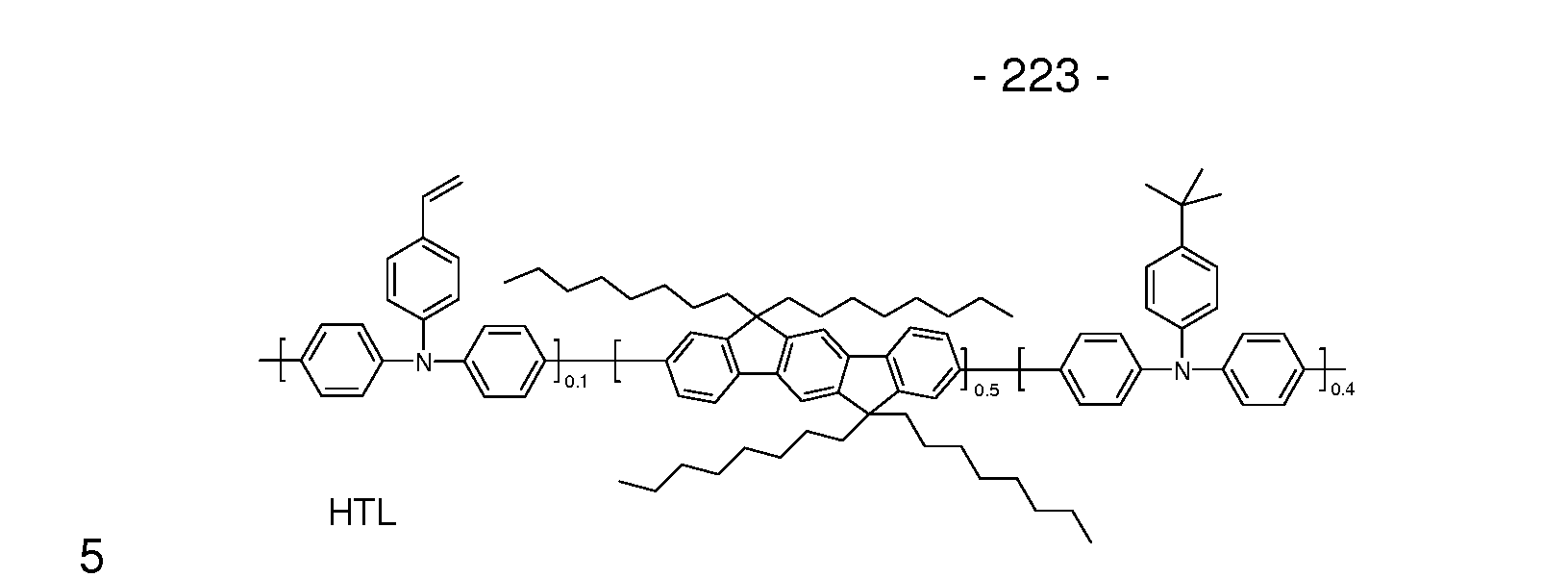
Das Lochtransport-Polymer wird in Toluol gelöst. Der typische Feststoff- gehalt solcher Lösungen liegt bei ca. 5 g/l, wenn, wie hier, die für eine Device typische Schichtdicke von 20 nm mittels Spincoating erzielt werden soll. Die Schichten werden in einer Inertgasatmosphäre, im vorliegenden Fall Argon, aufgeschleudert und 60 Minuten bei 180 °C ausgeheizt. The hole transport polymer is dissolved in toluene. The typical solids content of such solutions is about 5 g / l, if, as here, the typical for a device layer thickness of 20 nm is to be achieved by spin coating. The layers are spin-coated in an inert gas atmosphere, in this case argon, and baked at 180 ° C. for 60 minutes.
Die Emissionsschicht setzt sich immer aus mindestens einem Matrix- material (Hostmaterial, Wirtsmaterial) und einem emittierenden Dotierstoff (Dotand, Emitter) zusammen. Weiterhin aufreten können Mischungen aus mehreren Matrixmaterialien sowie Co-Dotanden. Eine Angabe wie TMM-A (92%) : Dotand (8%) bedeutet hierbei, dass das Material TMM-A in einem Gewichtsanteil von 92% und Dotand in einem Gewichtsanteil von 8% in der Emissionsschicht vorliegt. Die Mischung für die Emissionsschicht wird in Toluol oder ggf. Chlorbenzol gelöst. Der typische Feststoffgehalt solcher Lösungen liegt bei ca. 17 g/l, wenn, wie hier, die für eine Device typische Schichtdicke von 60 nm mittels Spincoating erzielt werden soll. Die The emission layer is always composed of at least one matrix material (host material, host material) and an emitting dopant (dopant, emitter). Furthermore, mixtures of several matrix materials and co-dopants can occur. An indication such as TMM-A (92%): Dotand (8%) here means that the material TMM-A is present in a weight fraction of 92% and dopant in a weight fraction of 8% in the emission layer. The mixture for the emission layer is dissolved in toluene or optionally chlorobenzene. The typical solids content of such solutions is about 17 g / l, if, as here, the typical for a device layer thickness of 60 nm is to be achieved by spin coating. The
Schichten werden in einer Inertgasatmosphäre, im vorliegenden Fall Argon, aufgeschleudert und 10 Minuten bei 150 °C au sgeheizt. Die im vor- liegenden Fall verwendeten Materialien sind in Tabelle 1 gezeigt. Layers are spin-coated in an inert gas atmosphere, in this case argon, and heated at 150 ° C. for 10 minutes. The materials used in the present case are shown in Table 1.


Die Kathode wird durch die thermische Verdampfung einer 100 nm The cathode becomes 100 nm due to the thermal evaporation
Aluminiumschicht gebildet. Die OLEDs werden standardmäßig charakteri- siert. Die EML-Mischungen und Aufbauten der untersuchten OLED- Bauteile sind in Tabelle 3 und 4 dargestellt. Die zugehörigen Ergebnisse finden sich in Tabelle 5 abelle 3: EML-Mischun en der untersuchten OLED-Bauteile Aluminum layer formed. The OLEDs are characterized by default. The EML blends and structures of the OLED devices studied are shown in Tables 3 and 4. The corresponding results can be found in Table 5, Table 3: EML Mixes of the OLED Components Investigated


Claims
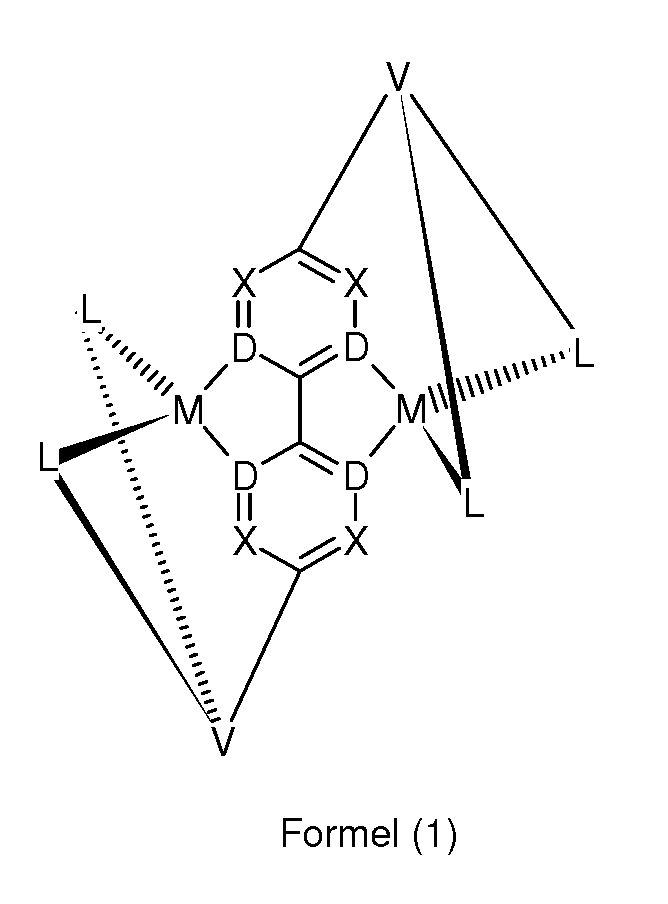

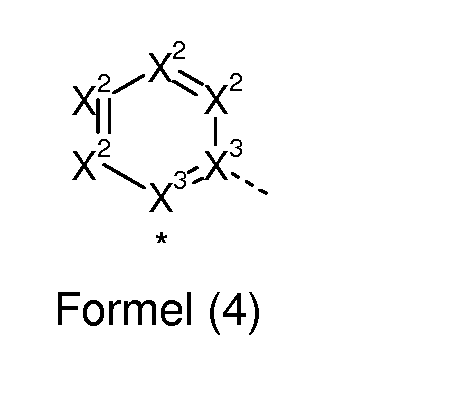


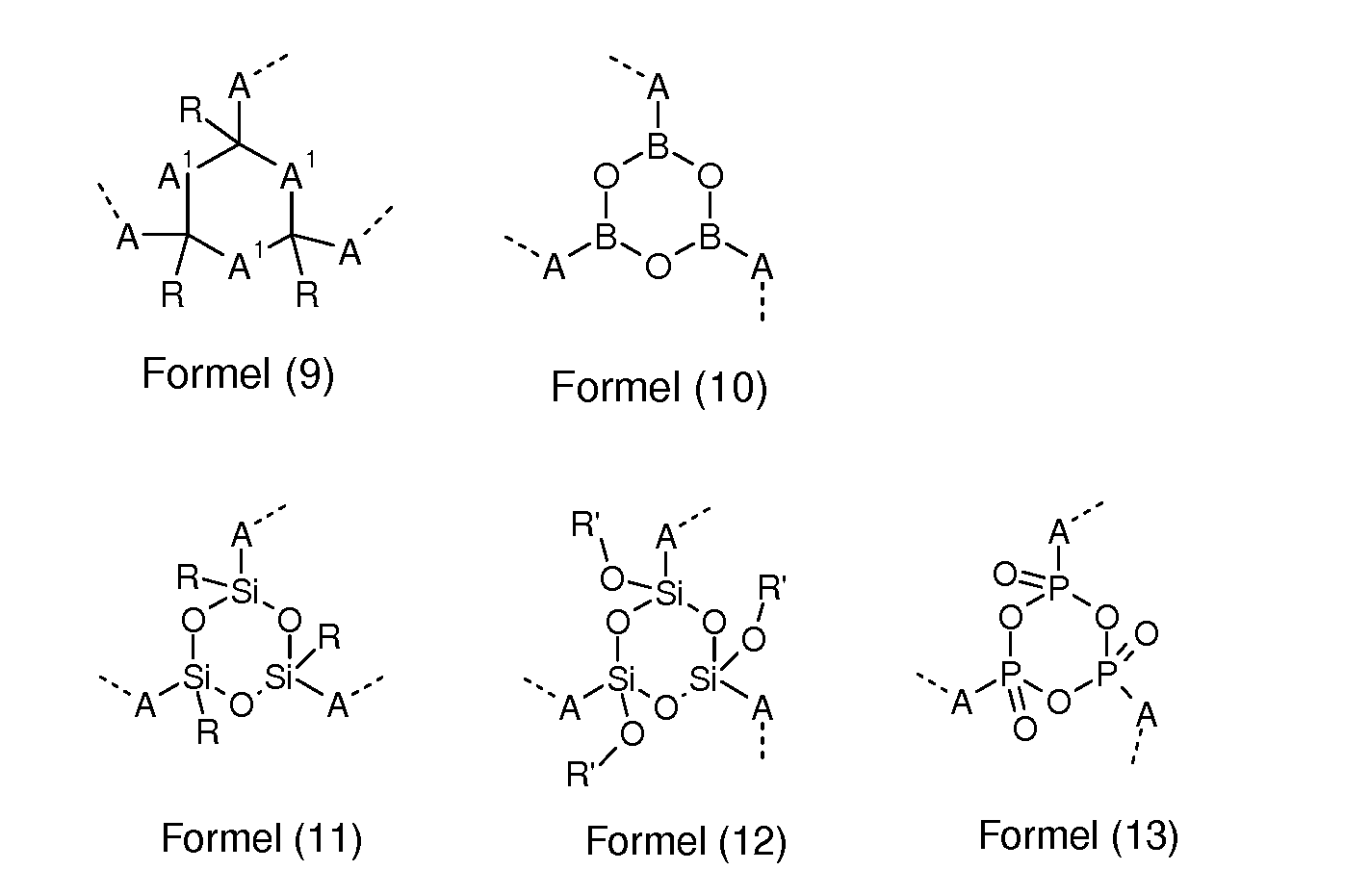


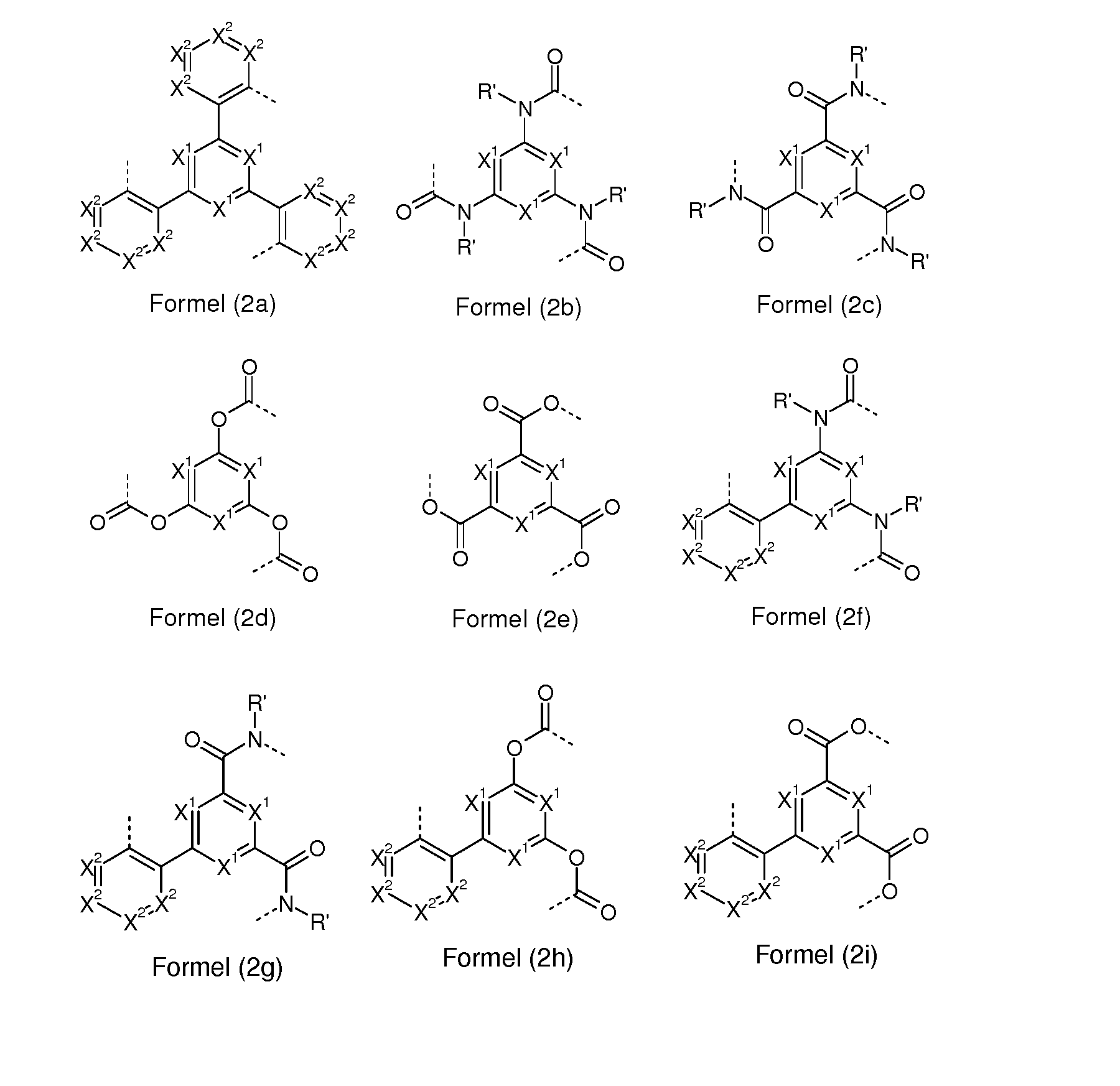


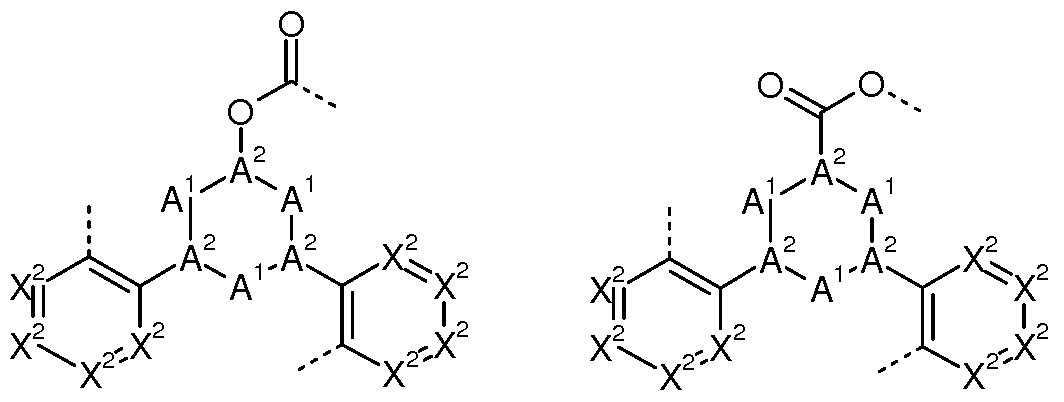


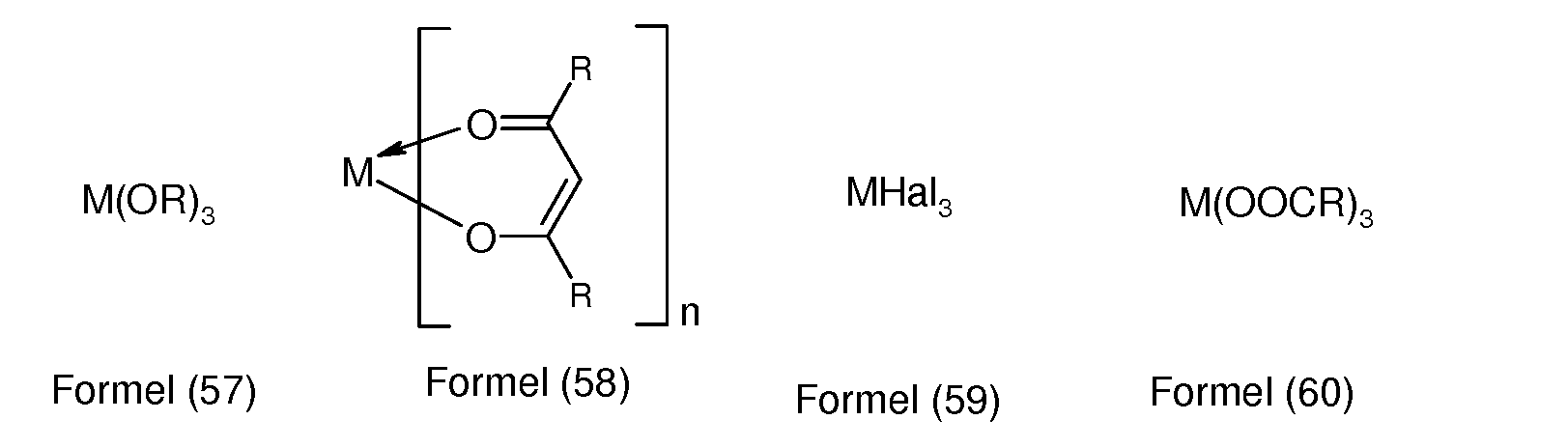
Priority Applications (5)
| Application Number | Priority Date | Filing Date | Title |
|---|---|---|---|
| JP2019519684A JP7064488B2 (en) | 2016-10-12 | 2017-10-09 | Dikaryon metal complexes and electronic devices, in particular organic electroluminescence devices comprising said metal complexes. |
| KR1020197013248A KR102522745B1 (en) | 2016-10-12 | 2017-10-09 | Binuclear metal complexes and electronic devices containing the metal complexes, in particular organic electroluminescent devices |
| CN201780059562.5A CN109803975A (en) | 2016-10-12 | 2017-10-09 | PROCESS FOR PRODUCTION OF BINUCLEAR and electronic device, particularly organic electroluminescence device containing the metal complex |
| EP17791589.9A EP3526227B1 (en) | 2016-10-12 | 2017-10-09 | Binuclear metal complexes and electronic devices, in particular organic electroluminescent devices containing said metal complexes |
| US16/341,757 US11430962B2 (en) | 2016-10-12 | 2017-10-09 | Binuclear metal complexes and electronic devices, in particular organic electroluminescent devices containing said metal complexes |
Applications Claiming Priority (2)
| Application Number | Priority Date | Filing Date | Title |
|---|---|---|---|
| EP16193521 | 2016-10-12 | ||
| EP16193521.8 | 2016-10-12 |
Publications (1)
| Publication Number | Publication Date |
|---|---|
| WO2018069196A1 true WO2018069196A1 (en) | 2018-04-19 |
Family
ID=57130284
Family Applications (1)
| Application Number | Title | Priority Date | Filing Date |
|---|---|---|---|
| PCT/EP2017/075580 Ceased WO2018069196A1 (en) | 2016-10-12 | 2017-10-09 | Binuclear metal complexes and electronic devices, in particular organic electroluminescent devices containing said metal complexes |
Country Status (6)
| Country | Link |
|---|---|
| US (1) | US11430962B2 (en) |
| EP (1) | EP3526227B1 (en) |
| JP (1) | JP7064488B2 (en) |
| KR (1) | KR102522745B1 (en) |
| CN (1) | CN109803975A (en) |
| WO (1) | WO2018069196A1 (en) |
Cited By (46)
| Publication number | Priority date | Publication date | Assignee | Title |
|---|---|---|---|---|
| WO2020053150A1 (en) | 2018-09-12 | 2020-03-19 | Merck Patent Gmbh | Materials for organic electroluminescent devices |
| WO2020053314A1 (en) | 2018-09-12 | 2020-03-19 | Merck Patent Gmbh | Electroluminescent devices |
| WO2020053315A1 (en) | 2018-09-12 | 2020-03-19 | Merck Patent Gmbh | Electroluminescent devices |
| WO2020064666A1 (en) | 2018-09-27 | 2020-04-02 | Merck Patent Gmbh | Compounds that can be used in an organic electronic device as active compounds |
| WO2020064662A2 (en) | 2018-09-27 | 2020-04-02 | Merck Patent Gmbh | Method for producing sterically hindered, nitrogen-containing heteroaromatic compounds |
| WO2020094539A1 (en) | 2018-11-05 | 2020-05-14 | Merck Patent Gmbh | Compounds that can be used in an organic electronic device |
| WO2020099349A1 (en) | 2018-11-14 | 2020-05-22 | Merck Patent Gmbh | Compounds that can be used for producing an organic electronic device |
| WO2020178230A1 (en) | 2019-03-04 | 2020-09-10 | Merck Patent Gmbh | Ligands for nano-sized materials |
| WO2020208051A1 (en) | 2019-04-11 | 2020-10-15 | Merck Patent Gmbh | Materials for organic electroluminescent devices |
| WO2021013775A1 (en) | 2019-07-22 | 2021-01-28 | Merck Patent Gmbh | Method for producing ortho-metallated metal compounds |
| WO2021078831A1 (en) | 2019-10-25 | 2021-04-29 | Merck Patent Gmbh | Compounds that can be used in an organic electronic device |
| WO2021089450A1 (en) | 2019-11-04 | 2021-05-14 | Merck Patent Gmbh | Materials for organic electroluminescent devices |
| WO2021094269A1 (en) | 2019-11-12 | 2021-05-20 | Merck Patent Gmbh | Materials for organic electroluminescent devices |
| WO2021110741A1 (en) | 2019-12-04 | 2021-06-10 | Merck Patent Gmbh | Materials for organic electroluminescent devices |
| WO2021122740A1 (en) | 2019-12-19 | 2021-06-24 | Merck Patent Gmbh | Polycyclic compounds for organic electroluminescent devices |
| WO2021122538A1 (en) | 2019-12-18 | 2021-06-24 | Merck Patent Gmbh | Aromatic compounds for organic electroluminescent devices |
| WO2021151922A1 (en) | 2020-01-29 | 2021-08-05 | Merck Patent Gmbh | Benzimidazole derivatives |
| WO2021170522A1 (en) | 2020-02-25 | 2021-09-02 | Merck Patent Gmbh | Use of heterocyclic compounds in an organic electronic device |
| WO2021175706A1 (en) | 2020-03-02 | 2021-09-10 | Merck Patent Gmbh | Use of sulfone compounds in an organic electronic device |
| WO2021185829A1 (en) | 2020-03-17 | 2021-09-23 | Merck Patent Gmbh | Heterocyclic compounds for organic electroluminescent devices |
| WO2021185712A1 (en) | 2020-03-17 | 2021-09-23 | Merck Patent Gmbh | Heteroaromatic compounds for organic electroluminescent devices |
| WO2021191183A1 (en) | 2020-03-26 | 2021-09-30 | Merck Patent Gmbh | Cyclic compounds for organic electroluminescent devices |
| WO2021191058A1 (en) | 2020-03-23 | 2021-09-30 | Merck Patent Gmbh | Materials for organic electroluminescent devices |
| WO2021204646A1 (en) | 2020-04-06 | 2021-10-14 | Merck Patent Gmbh | Polycyclic compounds for organic electroluminescent devices |
| WO2021239772A1 (en) | 2020-05-29 | 2021-12-02 | Merck Patent Gmbh | Organic electroluminescent apparatus |
| WO2021254984A1 (en) | 2020-06-18 | 2021-12-23 | Merck Patent Gmbh | Indenoazanaphthalenes |
| WO2021259824A1 (en) | 2020-06-23 | 2021-12-30 | Merck Patent Gmbh | Method for producing a mixture |
| WO2022002772A1 (en) | 2020-06-29 | 2022-01-06 | Merck Patent Gmbh | Heteroaromatic compounds for organic electroluminescent devices |
| WO2022002771A1 (en) | 2020-06-29 | 2022-01-06 | Merck Patent Gmbh | Heterocyclic compounds for organic electroluminescent devices |
| WO2022069421A1 (en) | 2020-09-30 | 2022-04-07 | Merck Patent Gmbh | Compounds that can be used for structuring functional layers of organic electroluminescent devices |
| WO2022069422A1 (en) | 2020-09-30 | 2022-04-07 | Merck Patent Gmbh | Compounds for structuring functional layers of organic electroluminescent devices |
| WO2022079067A1 (en) | 2020-10-16 | 2022-04-21 | Merck Patent Gmbh | Compounds comprising heteroatoms for organic electroluminescent devices |
| WO2022079068A1 (en) | 2020-10-16 | 2022-04-21 | Merck Patent Gmbh | Heterocyclic compounds for organic electroluminescent devices |
| WO2022129116A1 (en) | 2020-12-18 | 2022-06-23 | Merck Patent Gmbh | Indolo[3.2.1-jk]carbazole-6-carbonitrile derivatives as blue fluorescent emitters for use in oleds |
| WO2022129113A1 (en) | 2020-12-18 | 2022-06-23 | Merck Patent Gmbh | Nitrogenous heteroaromatic compounds for organic electroluminescent devices |
| WO2022129114A1 (en) | 2020-12-18 | 2022-06-23 | Merck Patent Gmbh | Nitrogenous compounds for organic electroluminescent devices |
| WO2022229234A1 (en) | 2021-04-30 | 2022-11-03 | Merck Patent Gmbh | Nitrogenous heterocyclic compounds for organic electroluminescent devices |
| WO2022243403A1 (en) | 2021-05-21 | 2022-11-24 | Merck Patent Gmbh | Method for the continuous purification of at least one functional material and device for the continuous purification of at least one functional material |
| WO2023041454A1 (en) | 2021-09-14 | 2023-03-23 | Merck Patent Gmbh | Boronic heterocyclic compounds for organic electroluminescent devices |
| WO2023072799A1 (en) | 2021-10-27 | 2023-05-04 | Merck Patent Gmbh | Boronic and nitrogenous heterocyclic compounds for organic electroluminescent devices |
| WO2023161168A1 (en) | 2022-02-23 | 2023-08-31 | Merck Patent Gmbh | Aromatic hetreocycles for organic electroluminescent devices |
| WO2023161167A1 (en) | 2022-02-23 | 2023-08-31 | Merck Patent Gmbh | Nitrogenous heterocycles for organic electroluminescent devices |
| WO2023247663A1 (en) | 2022-06-24 | 2023-12-28 | Merck Patent Gmbh | Composition for organic electronic devices |
| WO2023247662A1 (en) | 2022-06-24 | 2023-12-28 | Merck Patent Gmbh | Composition for organic electronic devices |
| WO2024105066A1 (en) | 2022-11-17 | 2024-05-23 | Merck Patent Gmbh | Materials for organic electroluminescent devices |
| EP4486099A1 (en) | 2023-06-30 | 2025-01-01 | Merck Patent GmbH | Compounds for organic electroluminescent devices |
Families Citing this family (2)
| Publication number | Priority date | Publication date | Assignee | Title |
|---|---|---|---|---|
| TWI776926B (en) | 2017-07-25 | 2022-09-11 | 德商麥克專利有限公司 | Metal complexes |
| KR20220129145A (en) * | 2021-03-15 | 2022-09-23 | 삼성디스플레이 주식회사 | Organometallic compound and light emitting device including same |
Citations (44)
| Publication number | Priority date | Publication date | Assignee | Title |
|---|---|---|---|---|
| EP0652273A1 (en) | 1993-11-09 | 1995-05-10 | Shinko Electric Industries Co. Ltd. | Organic material for electroluminescent device and electroluminescent device |
| JP2000169400A (en) | 1998-12-09 | 2000-06-20 | Sumika Chemical Analysis Service Ltd | Production of styrene trimer |
| EP1205527A1 (en) | 2000-03-27 | 2002-05-15 | Idemitsu Kosan Co., Ltd. | Organic electroluminescence device |
| WO2002060910A1 (en) | 2001-02-01 | 2002-08-08 | Covion Organic Semiconductors Gmbh | Method for the production of highly pure, tris-ortho-metalated organo-iridium compounds |
| US20030152802A1 (en) | 2001-06-19 | 2003-08-14 | Akira Tsuboyama | Metal coordination compound and organic liminescence device |
| WO2004013080A1 (en) | 2002-08-01 | 2004-02-12 | Covion Organic Semiconductors Gmbh | Spirobifluorene derivatives, their preparation and uses thereof |
| WO2004037887A2 (en) | 2002-10-25 | 2004-05-06 | Covion Organic Semiconductors Gmbh | Conjugated polymers containing arylamine units, the representation thereof and the use of the same |
| WO2004058911A2 (en) | 2002-12-23 | 2004-07-15 | Covion Organic Semiconductors Gmbh | Organic electroluminescent element |
| WO2004081017A1 (en) | 2003-03-11 | 2004-09-23 | Covion Organic Semiconductors Gmbh | Metal complexes |
| WO2004085449A1 (en) | 2003-03-27 | 2004-10-07 | Covion Organic Semiconductors Gmbh | Method for producing high-purity organoiridium compounds |
| JP2004288381A (en) | 2003-03-19 | 2004-10-14 | Konica Minolta Holdings Inc | Organic electroluminescent element |
| WO2004093207A2 (en) | 2003-04-15 | 2004-10-28 | Covion Organic Semiconductors Gmbh | Mixtures of matrix materials and organic semiconductors capable of emission, use of the same and electronic components containing said mixtures |
| US20050069729A1 (en) | 2003-09-30 | 2005-03-31 | Konica Minolta Holdings, Inc. | Organic electroluminescent element, illuminator, display and compound |
| WO2005111172A2 (en) | 2004-05-11 | 2005-11-24 | Merck Patent Gmbh | Novel material mixtures for use in electroluminescence |
| JP2005347160A (en) | 2004-06-04 | 2005-12-15 | Konica Minolta Holdings Inc | Organic electroluminescence element, lighting device and display device |
| EP1617711A1 (en) | 2003-04-23 | 2006-01-18 | Konica Minolta Holdings, Inc. | Organic electroluminescent device and display |
| WO2006005627A1 (en) | 2004-07-15 | 2006-01-19 | Merck Patent Gmbh | Oligomeric derivatives of spirobifluorene, their preparation and use |
| WO2006117052A1 (en) | 2005-05-03 | 2006-11-09 | Merck Patent Gmbh | Organic electroluminescent device and boric acid and borinic acid derivatives used therein |
| EP1731584A1 (en) | 2004-03-31 | 2006-12-13 | Konica Minolta Holdings, Inc. | Organic electroluminescent device material, organic electroluminescent device, display and illuminating device |
| WO2007063754A1 (en) | 2005-12-01 | 2007-06-07 | Nippon Steel Chemical Co., Ltd. | Compound for organic electroluminescent element and organic electroluminescent element |
| WO2007137725A1 (en) | 2006-05-31 | 2007-12-06 | Merck Patent Gmbh | New materials for organic electroluminescent devices |
| US7332232B2 (en) | 2004-02-03 | 2008-02-19 | Universal Display Corporation | OLEDs utilizing multidentate ligand systems |
| WO2008056746A1 (en) | 2006-11-09 | 2008-05-15 | Nippon Steel Chemical Co., Ltd. | Compound for organic electroluminescent device and organic electroluminescent device |
| WO2008086851A1 (en) | 2007-01-18 | 2008-07-24 | Merck Patent Gmbh | Carbazole derivatives for organc electroluminescent devices |
| WO2009062578A1 (en) | 2007-11-12 | 2009-05-22 | Merck Patent Gmbh | Organic electroluminescent devices comprising azomethine-metal complexes |
| US20090136779A1 (en) | 2007-11-26 | 2009-05-28 | Chien-Hong Cheng | Conjugated compounds containing hydroindoloacridine structural elements, and their use |
| US20090134784A1 (en) | 2004-10-21 | 2009-05-28 | Universal Display Corporation | Carbazole-containing materials in phosphorescent light emitting diodes |
| WO2009148015A1 (en) | 2008-06-05 | 2009-12-10 | 出光興産株式会社 | Halogen compound, polycyclic compound, and organic electroluminescence element comprising the polycyclic compound |
| WO2010006680A1 (en) | 2008-07-18 | 2010-01-21 | Merck Patent Gmbh | Materials for organic electroluminescence devices |
| WO2010015306A1 (en) | 2008-08-08 | 2010-02-11 | Merck Patent Gmbh, | Organic electroluminescence device |
| WO2010050778A1 (en) | 2008-10-31 | 2010-05-06 | Gracel Display Inc. | Novel compounds for organic electronic material and organic electronic device using the same |
| WO2010054730A1 (en) | 2008-11-11 | 2010-05-20 | Merck Patent Gmbh | Organic electroluminescent devices |
| WO2010054729A2 (en) | 2008-11-11 | 2010-05-20 | Merck Patent Gmbh | Materials for organic electroluminescence devices |
| WO2010097155A1 (en) | 2009-02-27 | 2010-09-02 | Merck Patent Gmbh | Polymer having aldehyde groups, converting and cross-linking of said polymer, cross-linked polymer, and electroluminescent device comprising said polymer |
| WO2010108579A1 (en) | 2009-03-23 | 2010-09-30 | Merck Patent Gmbh | Organic electroluminescent device |
| WO2010136109A1 (en) | 2009-05-29 | 2010-12-02 | Merck Patent Gmbh | Materials for organic electroluminescent devices |
| WO2011000455A1 (en) | 2009-06-30 | 2011-01-06 | Merck Patent Gmbh | Materials for organic electroluminescence devices |
| WO2011042107A2 (en) | 2009-10-08 | 2011-04-14 | Merck Patent Gmbh | Materials for organic electroluminescent devices |
| WO2011088877A1 (en) | 2010-01-25 | 2011-07-28 | Merck Patent Gmbh | Compounds for electronic devices |
| WO2013156130A1 (en) | 2012-04-17 | 2013-10-24 | Merck Patent Gmbh | Polymers containing substituted triarylamine units and electroluminescent devices containing said polymers |
| WO2014094964A1 (en) | 2012-12-18 | 2014-06-26 | Merck Patent Gmbh | Organic electroluminescent device |
| WO2015169412A1 (en) | 2014-05-05 | 2015-11-12 | Merck Patent Gmbh | Materials for organic light emitting devices |
| WO2016124304A1 (en) | 2015-02-03 | 2016-08-11 | Merck Patent Gmbh | Metal complexes |
| WO2017032439A1 (en) | 2015-08-25 | 2017-03-02 | Merck Patent Gmbh | Metal complexes |
Family Cites Families (7)
| Publication number | Priority date | Publication date | Assignee | Title |
|---|---|---|---|---|
| US20050171207A1 (en) * | 2003-09-26 | 2005-08-04 | Myriad Genetics, Incorporated | Method and composition for combination treatment of neurodegenerative disorders |
| DE102004034517A1 (en) * | 2004-07-16 | 2006-02-16 | Covion Organic Semiconductors Gmbh | metal complexes |
| KR100783711B1 (en) * | 2006-01-06 | 2007-12-07 | 삼성전자주식회사 | Metal compound and organic electroluminescent device comprising same |
| JP5556017B2 (en) * | 2009-01-14 | 2014-07-23 | コニカミノルタ株式会社 | ORGANIC ELECTROLUMINESCENT ELEMENT, DISPLAY DEVICE, LIGHTING DEVICE, AND ORGANIC ELECTROLUMINESCENT ELEMENT MATERIAL |
| KR102048555B1 (en) | 2013-04-17 | 2019-11-26 | 덕산네오룩스 주식회사 | Compound for organic electronic element, organic electronic element using the same, and an electronic device thereof |
| KR102048035B1 (en) | 2013-06-03 | 2019-11-25 | 덕산네오룩스 주식회사 | An organic electronic element using compound for organic electronic element, and an electronic device thereof |
| CN105980519B (en) * | 2014-02-05 | 2019-06-14 | 默克专利有限公司 | metal complex |
-
2017
- 2017-10-09 WO PCT/EP2017/075580 patent/WO2018069196A1/en not_active Ceased
- 2017-10-09 KR KR1020197013248A patent/KR102522745B1/en active Active
- 2017-10-09 EP EP17791589.9A patent/EP3526227B1/en active Active
- 2017-10-09 US US16/341,757 patent/US11430962B2/en active Active
- 2017-10-09 CN CN201780059562.5A patent/CN109803975A/en active Pending
- 2017-10-09 JP JP2019519684A patent/JP7064488B2/en active Active
Patent Citations (46)
| Publication number | Priority date | Publication date | Assignee | Title |
|---|---|---|---|---|
| EP0652273A1 (en) | 1993-11-09 | 1995-05-10 | Shinko Electric Industries Co. Ltd. | Organic material for electroluminescent device and electroluminescent device |
| JP2000169400A (en) | 1998-12-09 | 2000-06-20 | Sumika Chemical Analysis Service Ltd | Production of styrene trimer |
| EP1205527A1 (en) | 2000-03-27 | 2002-05-15 | Idemitsu Kosan Co., Ltd. | Organic electroluminescence device |
| WO2002060910A1 (en) | 2001-02-01 | 2002-08-08 | Covion Organic Semiconductors Gmbh | Method for the production of highly pure, tris-ortho-metalated organo-iridium compounds |
| US20030152802A1 (en) | 2001-06-19 | 2003-08-14 | Akira Tsuboyama | Metal coordination compound and organic liminescence device |
| WO2004013080A1 (en) | 2002-08-01 | 2004-02-12 | Covion Organic Semiconductors Gmbh | Spirobifluorene derivatives, their preparation and uses thereof |
| WO2004037887A2 (en) | 2002-10-25 | 2004-05-06 | Covion Organic Semiconductors Gmbh | Conjugated polymers containing arylamine units, the representation thereof and the use of the same |
| WO2004058911A2 (en) | 2002-12-23 | 2004-07-15 | Covion Organic Semiconductors Gmbh | Organic electroluminescent element |
| WO2004081017A1 (en) | 2003-03-11 | 2004-09-23 | Covion Organic Semiconductors Gmbh | Metal complexes |
| JP2004288381A (en) | 2003-03-19 | 2004-10-14 | Konica Minolta Holdings Inc | Organic electroluminescent element |
| WO2004085449A1 (en) | 2003-03-27 | 2004-10-07 | Covion Organic Semiconductors Gmbh | Method for producing high-purity organoiridium compounds |
| WO2004093207A2 (en) | 2003-04-15 | 2004-10-28 | Covion Organic Semiconductors Gmbh | Mixtures of matrix materials and organic semiconductors capable of emission, use of the same and electronic components containing said mixtures |
| EP1617711A1 (en) | 2003-04-23 | 2006-01-18 | Konica Minolta Holdings, Inc. | Organic electroluminescent device and display |
| EP1617710A1 (en) | 2003-04-23 | 2006-01-18 | Konica Minolta Holdings, Inc. | Material for organic electroluminescent device, organic electroluminescent device, illuminating device and display |
| US20050069729A1 (en) | 2003-09-30 | 2005-03-31 | Konica Minolta Holdings, Inc. | Organic electroluminescent element, illuminator, display and compound |
| WO2005039246A1 (en) | 2003-09-30 | 2005-04-28 | Konica Minolta Holdings, Inc. | Organic electroluminescent device, illuminating device, and display |
| US7332232B2 (en) | 2004-02-03 | 2008-02-19 | Universal Display Corporation | OLEDs utilizing multidentate ligand systems |
| EP1731584A1 (en) | 2004-03-31 | 2006-12-13 | Konica Minolta Holdings, Inc. | Organic electroluminescent device material, organic electroluminescent device, display and illuminating device |
| WO2005111172A2 (en) | 2004-05-11 | 2005-11-24 | Merck Patent Gmbh | Novel material mixtures for use in electroluminescence |
| JP2005347160A (en) | 2004-06-04 | 2005-12-15 | Konica Minolta Holdings Inc | Organic electroluminescence element, lighting device and display device |
| WO2006005627A1 (en) | 2004-07-15 | 2006-01-19 | Merck Patent Gmbh | Oligomeric derivatives of spirobifluorene, their preparation and use |
| US20090134784A1 (en) | 2004-10-21 | 2009-05-28 | Universal Display Corporation | Carbazole-containing materials in phosphorescent light emitting diodes |
| WO2006117052A1 (en) | 2005-05-03 | 2006-11-09 | Merck Patent Gmbh | Organic electroluminescent device and boric acid and borinic acid derivatives used therein |
| WO2007063754A1 (en) | 2005-12-01 | 2007-06-07 | Nippon Steel Chemical Co., Ltd. | Compound for organic electroluminescent element and organic electroluminescent element |
| WO2007137725A1 (en) | 2006-05-31 | 2007-12-06 | Merck Patent Gmbh | New materials for organic electroluminescent devices |
| WO2008056746A1 (en) | 2006-11-09 | 2008-05-15 | Nippon Steel Chemical Co., Ltd. | Compound for organic electroluminescent device and organic electroluminescent device |
| WO2008086851A1 (en) | 2007-01-18 | 2008-07-24 | Merck Patent Gmbh | Carbazole derivatives for organc electroluminescent devices |
| WO2009062578A1 (en) | 2007-11-12 | 2009-05-22 | Merck Patent Gmbh | Organic electroluminescent devices comprising azomethine-metal complexes |
| US20090136779A1 (en) | 2007-11-26 | 2009-05-28 | Chien-Hong Cheng | Conjugated compounds containing hydroindoloacridine structural elements, and their use |
| WO2009148015A1 (en) | 2008-06-05 | 2009-12-10 | 出光興産株式会社 | Halogen compound, polycyclic compound, and organic electroluminescence element comprising the polycyclic compound |
| WO2010006680A1 (en) | 2008-07-18 | 2010-01-21 | Merck Patent Gmbh | Materials for organic electroluminescence devices |
| WO2010015306A1 (en) | 2008-08-08 | 2010-02-11 | Merck Patent Gmbh, | Organic electroluminescence device |
| WO2010050778A1 (en) | 2008-10-31 | 2010-05-06 | Gracel Display Inc. | Novel compounds for organic electronic material and organic electronic device using the same |
| WO2010054730A1 (en) | 2008-11-11 | 2010-05-20 | Merck Patent Gmbh | Organic electroluminescent devices |
| WO2010054729A2 (en) | 2008-11-11 | 2010-05-20 | Merck Patent Gmbh | Materials for organic electroluminescence devices |
| WO2010097155A1 (en) | 2009-02-27 | 2010-09-02 | Merck Patent Gmbh | Polymer having aldehyde groups, converting and cross-linking of said polymer, cross-linked polymer, and electroluminescent device comprising said polymer |
| WO2010108579A1 (en) | 2009-03-23 | 2010-09-30 | Merck Patent Gmbh | Organic electroluminescent device |
| WO2010136109A1 (en) | 2009-05-29 | 2010-12-02 | Merck Patent Gmbh | Materials for organic electroluminescent devices |
| WO2011000455A1 (en) | 2009-06-30 | 2011-01-06 | Merck Patent Gmbh | Materials for organic electroluminescence devices |
| WO2011042107A2 (en) | 2009-10-08 | 2011-04-14 | Merck Patent Gmbh | Materials for organic electroluminescent devices |
| WO2011088877A1 (en) | 2010-01-25 | 2011-07-28 | Merck Patent Gmbh | Compounds for electronic devices |
| WO2013156130A1 (en) | 2012-04-17 | 2013-10-24 | Merck Patent Gmbh | Polymers containing substituted triarylamine units and electroluminescent devices containing said polymers |
| WO2014094964A1 (en) | 2012-12-18 | 2014-06-26 | Merck Patent Gmbh | Organic electroluminescent device |
| WO2015169412A1 (en) | 2014-05-05 | 2015-11-12 | Merck Patent Gmbh | Materials for organic light emitting devices |
| WO2016124304A1 (en) | 2015-02-03 | 2016-08-11 | Merck Patent Gmbh | Metal complexes |
| WO2017032439A1 (en) | 2015-08-25 | 2017-03-02 | Merck Patent Gmbh | Metal complexes |
Non-Patent Citations (1)
| Title |
|---|
| G. MARKOPOULOS ET AL., ANGEW. CHEM, INT. ED., vol. 51, 2012, pages 12884 |
Cited By (51)
| Publication number | Priority date | Publication date | Assignee | Title |
|---|---|---|---|---|
| WO2020053150A1 (en) | 2018-09-12 | 2020-03-19 | Merck Patent Gmbh | Materials for organic electroluminescent devices |
| WO2020053314A1 (en) | 2018-09-12 | 2020-03-19 | Merck Patent Gmbh | Electroluminescent devices |
| WO2020053315A1 (en) | 2018-09-12 | 2020-03-19 | Merck Patent Gmbh | Electroluminescent devices |
| DE202019005924U1 (en) | 2018-09-12 | 2023-05-10 | MERCK Patent Gesellschaft mit beschränkter Haftung | Electroluminescent devices |
| DE202019005923U1 (en) | 2018-09-12 | 2023-06-27 | MERCK Patent Gesellschaft mit beschränkter Haftung | Electroluminescent devices |
| WO2020064662A2 (en) | 2018-09-27 | 2020-04-02 | Merck Patent Gmbh | Method for producing sterically hindered, nitrogen-containing heteroaromatic compounds |
| WO2020064666A1 (en) | 2018-09-27 | 2020-04-02 | Merck Patent Gmbh | Compounds that can be used in an organic electronic device as active compounds |
| EP4190880A1 (en) | 2018-09-27 | 2023-06-07 | Merck Patent GmbH | Compounds usable as active compounds in an organic electronic device |
| EP4601449A2 (en) | 2018-09-27 | 2025-08-13 | Merck Patent GmbH | Compounds usable as active compounds in an organic electronic device |
| WO2020094539A1 (en) | 2018-11-05 | 2020-05-14 | Merck Patent Gmbh | Compounds that can be used in an organic electronic device |
| WO2020099349A1 (en) | 2018-11-14 | 2020-05-22 | Merck Patent Gmbh | Compounds that can be used for producing an organic electronic device |
| WO2020178230A1 (en) | 2019-03-04 | 2020-09-10 | Merck Patent Gmbh | Ligands for nano-sized materials |
| WO2020208051A1 (en) | 2019-04-11 | 2020-10-15 | Merck Patent Gmbh | Materials for organic electroluminescent devices |
| WO2021013775A1 (en) | 2019-07-22 | 2021-01-28 | Merck Patent Gmbh | Method for producing ortho-metallated metal compounds |
| WO2021078831A1 (en) | 2019-10-25 | 2021-04-29 | Merck Patent Gmbh | Compounds that can be used in an organic electronic device |
| WO2021089450A1 (en) | 2019-11-04 | 2021-05-14 | Merck Patent Gmbh | Materials for organic electroluminescent devices |
| WO2021094269A1 (en) | 2019-11-12 | 2021-05-20 | Merck Patent Gmbh | Materials for organic electroluminescent devices |
| WO2021110741A1 (en) | 2019-12-04 | 2021-06-10 | Merck Patent Gmbh | Materials for organic electroluminescent devices |
| WO2021122538A1 (en) | 2019-12-18 | 2021-06-24 | Merck Patent Gmbh | Aromatic compounds for organic electroluminescent devices |
| WO2021122740A1 (en) | 2019-12-19 | 2021-06-24 | Merck Patent Gmbh | Polycyclic compounds for organic electroluminescent devices |
| WO2021151922A1 (en) | 2020-01-29 | 2021-08-05 | Merck Patent Gmbh | Benzimidazole derivatives |
| WO2021170522A1 (en) | 2020-02-25 | 2021-09-02 | Merck Patent Gmbh | Use of heterocyclic compounds in an organic electronic device |
| WO2021175706A1 (en) | 2020-03-02 | 2021-09-10 | Merck Patent Gmbh | Use of sulfone compounds in an organic electronic device |
| WO2021185829A1 (en) | 2020-03-17 | 2021-09-23 | Merck Patent Gmbh | Heterocyclic compounds for organic electroluminescent devices |
| WO2021185712A1 (en) | 2020-03-17 | 2021-09-23 | Merck Patent Gmbh | Heteroaromatic compounds for organic electroluminescent devices |
| WO2021191058A1 (en) | 2020-03-23 | 2021-09-30 | Merck Patent Gmbh | Materials for organic electroluminescent devices |
| WO2021191183A1 (en) | 2020-03-26 | 2021-09-30 | Merck Patent Gmbh | Cyclic compounds for organic electroluminescent devices |
| WO2021204646A1 (en) | 2020-04-06 | 2021-10-14 | Merck Patent Gmbh | Polycyclic compounds for organic electroluminescent devices |
| WO2021239772A1 (en) | 2020-05-29 | 2021-12-02 | Merck Patent Gmbh | Organic electroluminescent apparatus |
| WO2021254984A1 (en) | 2020-06-18 | 2021-12-23 | Merck Patent Gmbh | Indenoazanaphthalenes |
| WO2021259824A1 (en) | 2020-06-23 | 2021-12-30 | Merck Patent Gmbh | Method for producing a mixture |
| WO2022002772A1 (en) | 2020-06-29 | 2022-01-06 | Merck Patent Gmbh | Heteroaromatic compounds for organic electroluminescent devices |
| WO2022002771A1 (en) | 2020-06-29 | 2022-01-06 | Merck Patent Gmbh | Heterocyclic compounds for organic electroluminescent devices |
| WO2022069421A1 (en) | 2020-09-30 | 2022-04-07 | Merck Patent Gmbh | Compounds that can be used for structuring functional layers of organic electroluminescent devices |
| WO2022069422A1 (en) | 2020-09-30 | 2022-04-07 | Merck Patent Gmbh | Compounds for structuring functional layers of organic electroluminescent devices |
| WO2022079067A1 (en) | 2020-10-16 | 2022-04-21 | Merck Patent Gmbh | Compounds comprising heteroatoms for organic electroluminescent devices |
| WO2022079068A1 (en) | 2020-10-16 | 2022-04-21 | Merck Patent Gmbh | Heterocyclic compounds for organic electroluminescent devices |
| WO2022129114A1 (en) | 2020-12-18 | 2022-06-23 | Merck Patent Gmbh | Nitrogenous compounds for organic electroluminescent devices |
| WO2022129116A1 (en) | 2020-12-18 | 2022-06-23 | Merck Patent Gmbh | Indolo[3.2.1-jk]carbazole-6-carbonitrile derivatives as blue fluorescent emitters for use in oleds |
| EP4676208A2 (en) | 2020-12-18 | 2026-01-07 | Merck Patent GmbH | Nitrogen-containing hetero-aromatics for organic electroluminescent devices |
| WO2022129113A1 (en) | 2020-12-18 | 2022-06-23 | Merck Patent Gmbh | Nitrogenous heteroaromatic compounds for organic electroluminescent devices |
| WO2022229234A1 (en) | 2021-04-30 | 2022-11-03 | Merck Patent Gmbh | Nitrogenous heterocyclic compounds for organic electroluminescent devices |
| WO2022243403A1 (en) | 2021-05-21 | 2022-11-24 | Merck Patent Gmbh | Method for the continuous purification of at least one functional material and device for the continuous purification of at least one functional material |
| WO2023041454A1 (en) | 2021-09-14 | 2023-03-23 | Merck Patent Gmbh | Boronic heterocyclic compounds for organic electroluminescent devices |
| WO2023072799A1 (en) | 2021-10-27 | 2023-05-04 | Merck Patent Gmbh | Boronic and nitrogenous heterocyclic compounds for organic electroluminescent devices |
| WO2023161167A1 (en) | 2022-02-23 | 2023-08-31 | Merck Patent Gmbh | Nitrogenous heterocycles for organic electroluminescent devices |
| WO2023161168A1 (en) | 2022-02-23 | 2023-08-31 | Merck Patent Gmbh | Aromatic hetreocycles for organic electroluminescent devices |
| WO2023247662A1 (en) | 2022-06-24 | 2023-12-28 | Merck Patent Gmbh | Composition for organic electronic devices |
| WO2023247663A1 (en) | 2022-06-24 | 2023-12-28 | Merck Patent Gmbh | Composition for organic electronic devices |
| WO2024105066A1 (en) | 2022-11-17 | 2024-05-23 | Merck Patent Gmbh | Materials for organic electroluminescent devices |
| EP4486099A1 (en) | 2023-06-30 | 2025-01-01 | Merck Patent GmbH | Compounds for organic electroluminescent devices |
Also Published As
| Publication number | Publication date |
|---|---|
| US20200052213A1 (en) | 2020-02-13 |
| JP7064488B2 (en) | 2022-05-10 |
| US11430962B2 (en) | 2022-08-30 |
| KR20190058638A (en) | 2019-05-29 |
| KR102522745B1 (en) | 2023-04-17 |
| JP2019536752A (en) | 2019-12-19 |
| EP3526227A1 (en) | 2019-08-21 |
| EP3526227B1 (en) | 2020-06-03 |
| CN109803975A (en) | 2019-05-24 |
Similar Documents
| Publication | Publication Date | Title |
|---|---|---|
| EP3526227B1 (en) | Binuclear metal complexes and electronic devices, in particular organic electroluminescent devices containing said metal complexes | |
| EP3526226B1 (en) | Metal complexes | |
| EP3526228B1 (en) | Metal complexes | |
| EP3768692B1 (en) | Metal complexes | |
| EP3658564B1 (en) | Metal complexes | |
| EP3724202B1 (en) | Metal complexes | |
| EP3487865B1 (en) | Dinuclear and oligonuclear metal complexes containing tripodal bidentate part ligands and their use in electronic devices | |
| WO2018054798A1 (en) | Binuclear metal complexes for use as emitters in organic electroluminescent devices | |
| WO2018041769A1 (en) | Binuclear and trinuclear metal complexes composed of two inter-linked tripodal hexadentate ligands for use in electroluminescent devices | |
| EP2935292B1 (en) | Metal complexes | |
| EP2714704B1 (en) | Metal complexes | |
| EP3507294B1 (en) | Binuclear and trinuclear metal complexes composed of two inter-linked tripodal hexadentate ligands for use in electroluminescent devices | |
| EP3752512A1 (en) | Metal complexes | |
| WO2017032439A1 (en) | Metal complexes | |
| EP3601304A1 (en) | Metal complexes | |
| EP3174890A1 (en) | Metal complexes | |
| WO2018011186A1 (en) | Metal complexes | |
| WO2016124304A1 (en) | Metal complexes | |
| WO2018001990A1 (en) | Method for the separation of enantiomeric mixtures from metal complexes | |
| WO2016000803A1 (en) | Metal complexes | |
| EP3532480B1 (en) | Metal complexes |
Legal Events
| Date | Code | Title | Description |
|---|---|---|---|
| 121 | Ep: the epo has been informed by wipo that ep was designated in this application |
Ref document number: 17791589 Country of ref document: EP Kind code of ref document: A1 |
|
| ENP | Entry into the national phase |
Ref document number: 2019519684 Country of ref document: JP Kind code of ref document: A |
|
| NENP | Non-entry into the national phase |
Ref country code: DE |
|
| ENP | Entry into the national phase |
Ref document number: 20197013248 Country of ref document: KR Kind code of ref document: A |
|
| ENP | Entry into the national phase |
Ref document number: 2017791589 Country of ref document: EP Effective date: 20190513 |