WO2020208051A1 - Materials for organic electroluminescent devices - Google Patents
Materials for organic electroluminescent devices Download PDFInfo
- Publication number
- WO2020208051A1 WO2020208051A1 PCT/EP2020/059951 EP2020059951W WO2020208051A1 WO 2020208051 A1 WO2020208051 A1 WO 2020208051A1 EP 2020059951 W EP2020059951 W EP 2020059951W WO 2020208051 A1 WO2020208051 A1 WO 2020208051A1
- Authority
- WO
- WIPO (PCT)
- Prior art keywords
- radicals
- substituted
- atoms
- group
- aromatic ring
- Prior art date
- Legal status (The legal status is an assumption and is not a legal conclusion. Google has not performed a legal analysis and makes no representation as to the accuracy of the status listed.)
- Ceased
Links
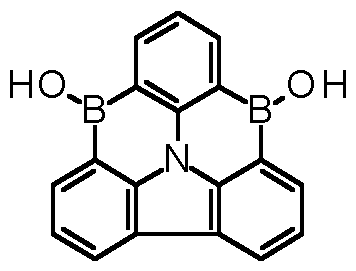
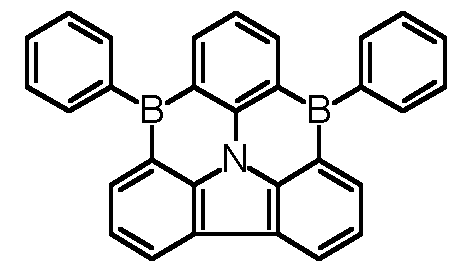
- 0 *B(c1c(*)c(*)c(*)c(B2*)c11)c3c4N1c1c2c(*)c(*)c(*)c1*c4c(*)c(*)c3* Chemical compound *B(c1c(*)c(*)c(*)c(B2*)c11)c3c4N1c1c2c(*)c(*)c(*)c1*c4c(*)c(*)c3* 0.000 description 2
- DHPNZSJKDYXBPL-UHFFFAOYSA-N CC1(C)OB(c2cccc(B3OC(C)(C)C(C)(C)O3)c2-[n]2c3ccccc3c3c2cccc3)OC1(C)C Chemical compound CC1(C)OB(c2cccc(B3OC(C)(C)C(C)(C)O3)c2-[n]2c3ccccc3c3c2cccc3)OC1(C)C DHPNZSJKDYXBPL-UHFFFAOYSA-N 0.000 description 1
Classifications
-
- C—CHEMISTRY; METALLURGY
- C07—ORGANIC CHEMISTRY
- C07F—ACYCLIC, CARBOCYCLIC OR HETEROCYCLIC COMPOUNDS CONTAINING ELEMENTS OTHER THAN CARBON, HYDROGEN, HALOGEN, OXYGEN, NITROGEN, SULFUR, SELENIUM OR TELLURIUM
- C07F5/00—Compounds containing elements of Groups 3 or 13 of the Periodic Table
- C07F5/02—Boron compounds
- C07F5/027—Organoboranes and organoborohydrides
-
- C—CHEMISTRY; METALLURGY
- C09—DYES; PAINTS; POLISHES; NATURAL RESINS; ADHESIVES; COMPOSITIONS NOT OTHERWISE PROVIDED FOR; APPLICATIONS OF MATERIALS NOT OTHERWISE PROVIDED FOR
- C09K—MATERIALS FOR MISCELLANEOUS APPLICATIONS, NOT PROVIDED FOR ELSEWHERE
- C09K11/00—Luminescent, e.g. electroluminescent, chemiluminescent materials
- C09K11/02—Use of particular materials as binders, particle coatings or suspension media therefor
-
- C—CHEMISTRY; METALLURGY
- C09—DYES; PAINTS; POLISHES; NATURAL RESINS; ADHESIVES; COMPOSITIONS NOT OTHERWISE PROVIDED FOR; APPLICATIONS OF MATERIALS NOT OTHERWISE PROVIDED FOR
- C09K—MATERIALS FOR MISCELLANEOUS APPLICATIONS, NOT PROVIDED FOR ELSEWHERE
- C09K11/00—Luminescent, e.g. electroluminescent, chemiluminescent materials
- C09K11/06—Luminescent, e.g. electroluminescent, chemiluminescent materials containing organic luminescent materials
-
- H—ELECTRICITY
- H10—SEMICONDUCTOR DEVICES; ELECTRIC SOLID-STATE DEVICES NOT OTHERWISE PROVIDED FOR
- H10K—ORGANIC ELECTRIC SOLID-STATE DEVICES
- H10K50/00—Organic light-emitting devices
- H10K50/10—OLEDs or polymer light-emitting diodes [PLED]
- H10K50/11—OLEDs or polymer light-emitting diodes [PLED] characterised by the electroluminescent [EL] layers
- H10K50/12—OLEDs or polymer light-emitting diodes [PLED] characterised by the electroluminescent [EL] layers comprising dopants
-
- H—ELECTRICITY
- H10—SEMICONDUCTOR DEVICES; ELECTRIC SOLID-STATE DEVICES NOT OTHERWISE PROVIDED FOR
- H10K—ORGANIC ELECTRIC SOLID-STATE DEVICES
- H10K50/00—Organic light-emitting devices
- H10K50/10—OLEDs or polymer light-emitting diodes [PLED]
- H10K50/11—OLEDs or polymer light-emitting diodes [PLED] characterised by the electroluminescent [EL] layers
- H10K50/12—OLEDs or polymer light-emitting diodes [PLED] characterised by the electroluminescent [EL] layers comprising dopants
- H10K50/121—OLEDs or polymer light-emitting diodes [PLED] characterised by the electroluminescent [EL] layers comprising dopants for assisting energy transfer, e.g. sensitization
-
- H—ELECTRICITY
- H10—SEMICONDUCTOR DEVICES; ELECTRIC SOLID-STATE DEVICES NOT OTHERWISE PROVIDED FOR
- H10K—ORGANIC ELECTRIC SOLID-STATE DEVICES
- H10K85/00—Organic materials used in the body or electrodes of devices covered by this subclass
- H10K85/30—Coordination compounds
- H10K85/321—Metal complexes comprising a group IIIA element, e.g. Tris (8-hydroxyquinoline) gallium [Gaq3]
- H10K85/322—Metal complexes comprising a group IIIA element, e.g. Tris (8-hydroxyquinoline) gallium [Gaq3] comprising boron
-
- H—ELECTRICITY
- H10—SEMICONDUCTOR DEVICES; ELECTRIC SOLID-STATE DEVICES NOT OTHERWISE PROVIDED FOR
- H10K—ORGANIC ELECTRIC SOLID-STATE DEVICES
- H10K85/00—Organic materials used in the body or electrodes of devices covered by this subclass
- H10K85/60—Organic compounds having low molecular weight
- H10K85/658—Organoboranes
-
- C—CHEMISTRY; METALLURGY
- C09—DYES; PAINTS; POLISHES; NATURAL RESINS; ADHESIVES; COMPOSITIONS NOT OTHERWISE PROVIDED FOR; APPLICATIONS OF MATERIALS NOT OTHERWISE PROVIDED FOR
- C09K—MATERIALS FOR MISCELLANEOUS APPLICATIONS, NOT PROVIDED FOR ELSEWHERE
- C09K2211/00—Chemical nature of organic luminescent or tenebrescent compounds
- C09K2211/10—Non-macromolecular compounds
- C09K2211/1003—Carbocyclic compounds
- C09K2211/1007—Non-condensed systems
-
- C—CHEMISTRY; METALLURGY
- C09—DYES; PAINTS; POLISHES; NATURAL RESINS; ADHESIVES; COMPOSITIONS NOT OTHERWISE PROVIDED FOR; APPLICATIONS OF MATERIALS NOT OTHERWISE PROVIDED FOR
- C09K—MATERIALS FOR MISCELLANEOUS APPLICATIONS, NOT PROVIDED FOR ELSEWHERE
- C09K2211/00—Chemical nature of organic luminescent or tenebrescent compounds
- C09K2211/10—Non-macromolecular compounds
- C09K2211/1018—Heterocyclic compounds
-
- H—ELECTRICITY
- H10—SEMICONDUCTOR DEVICES; ELECTRIC SOLID-STATE DEVICES NOT OTHERWISE PROVIDED FOR
- H10K—ORGANIC ELECTRIC SOLID-STATE DEVICES
- H10K2101/00—Properties of the organic materials covered by group H10K85/00
- H10K2101/10—Triplet emission
-
- H—ELECTRICITY
- H10—SEMICONDUCTOR DEVICES; ELECTRIC SOLID-STATE DEVICES NOT OTHERWISE PROVIDED FOR
- H10K—ORGANIC ELECTRIC SOLID-STATE DEVICES
- H10K2101/00—Properties of the organic materials covered by group H10K85/00
- H10K2101/20—Delayed fluorescence emission
-
- H—ELECTRICITY
- H10—SEMICONDUCTOR DEVICES; ELECTRIC SOLID-STATE DEVICES NOT OTHERWISE PROVIDED FOR
- H10K—ORGANIC ELECTRIC SOLID-STATE DEVICES
- H10K50/00—Organic light-emitting devices
- H10K50/10—OLEDs or polymer light-emitting diodes [PLED]
- H10K50/11—OLEDs or polymer light-emitting diodes [PLED] characterised by the electroluminescent [EL] layers
-
- H—ELECTRICITY
- H10—SEMICONDUCTOR DEVICES; ELECTRIC SOLID-STATE DEVICES NOT OTHERWISE PROVIDED FOR
- H10K—ORGANIC ELECTRIC SOLID-STATE DEVICES
- H10K85/00—Organic materials used in the body or electrodes of devices covered by this subclass
- H10K85/60—Organic compounds having low molecular weight
- H10K85/615—Polycyclic condensed aromatic hydrocarbons, e.g. anthracene
- H10K85/626—Polycyclic condensed aromatic hydrocarbons, e.g. anthracene containing more than one polycyclic condensed aromatic rings, e.g. bis-anthracene
-
- Y—GENERAL TAGGING OF NEW TECHNOLOGICAL DEVELOPMENTS; GENERAL TAGGING OF CROSS-SECTIONAL TECHNOLOGIES SPANNING OVER SEVERAL SECTIONS OF THE IPC; TECHNICAL SUBJECTS COVERED BY FORMER USPC CROSS-REFERENCE ART COLLECTIONS [XRACs] AND DIGESTS
- Y02—TECHNOLOGIES OR APPLICATIONS FOR MITIGATION OR ADAPTATION AGAINST CLIMATE CHANGE
- Y02E—REDUCTION OF GREENHOUSE GAS [GHG] EMISSIONS, RELATED TO ENERGY GENERATION, TRANSMISSION OR DISTRIBUTION
- Y02E10/00—Energy generation through renewable energy sources
- Y02E10/50—Photovoltaic [PV] energy
- Y02E10/549—Organic PV cells
Definitions
- the present invention relates to a compound of the formula (1 ), to the use of the compound in an electronic device, and to an electronic device comprising a compound of the formula (1 ).
- the present invention furthermore relates to a process for the preparation of a compound of the formula (1 ) and to a formulation comprising one or more compounds of the formula (1 ).
- the development of functional compounds for use in electronic devices is currently the subject of intensive research.
- the aim is, in particular, the development of compounds with which improved properties of electronic devices in one or more relevant points can be achieved, such as, for example, power efficiency and lifetime of the device as well as colour coordinates of the emitted light.
- the term electronic device is taken to mean, inter alia, organic integrated circuits (OICs), organic field-effect transistors (OFETs), organic thin-film transistors (OTFTs), organic light- emitting transistors (OLETs), organic solar cells (OSCs), organic optical detectors, organic photoreceptors, organic field-quench devices (OFQDs), organic light-emitting electrochemical cells (OLECs), organic laser diodes (O-lasers) and organic electroluminescent devices (OLEDs).
- OICs organic integrated circuits
- OFETs organic field-effect transistors
- OLETs organic thin-film transistors
- OLETs organic light- emitting transistors
- OSCs organic solar cells
- OFQDs organic field-quench devices
- OLEDs organic light-emitting electrochemical cells
- O-lasers organic laser diodes
- OEDs organic electroluminescent devices
- OLEDs Of particular interest is the provision of compounds for use in the last- mentioned electronic devices called OLEDs.
- the general structure and the functional principle of OLEDs are known to the person skilled in the art and are described, for example, in US 4539507.
- Blue-fluorescent emitters known from the prior art are a multiplicity of com pounds.
- Arylamines containing one or more condensed aryl are known from the prior art.
- Arylamines containing dibenzofuran groups (as disclosed in US 2017/0012214) or indenodibenzofuran groups (as disclosed in CN 10753308) are also known from the prior art.
- TADF thermally activated delayed fluorescence
- the energy gap between the lowest triplet state and the lowest excited singlet state is sufficiently small, the first excited singlet state of the molecule is accessible from the triplet state by thermal excitation and can be populated thermally. Since this singlet state is an emissive state from which fluorescence is possible, this state can be used to generate light. Thus, in principle, the conversion of up to 100% of the electrical energy to light is possible when purely organic materials are used as emitter. Recently, polycyclic aromatic compounds comprising Boron and Nitrogen atoms have been described (for example in US2015/0236274A1 , CN10750131 1A, WO2018/047639A1 ). These compounds can be used as fluorescent emitters, where the fluorescent emission is mainly prompt fluorescence or as TADF compounds.
- organic electroluminescent devices having, in the emitting layer, a TADF compound as a sensitizer and a fluorescent compound having high steric shielding with respect to its environment as an emitter have been described (for example in WO2015/135624).
- This device construction makes it possible to provide organic electroluminescent devices which emit in all emission colours, so that it is possible to use the base structures of known fluorescent emitters which nevertheless exhibit the high efficiency of electroluminescent devices with TADF. This is also known as hyperfluorescence.
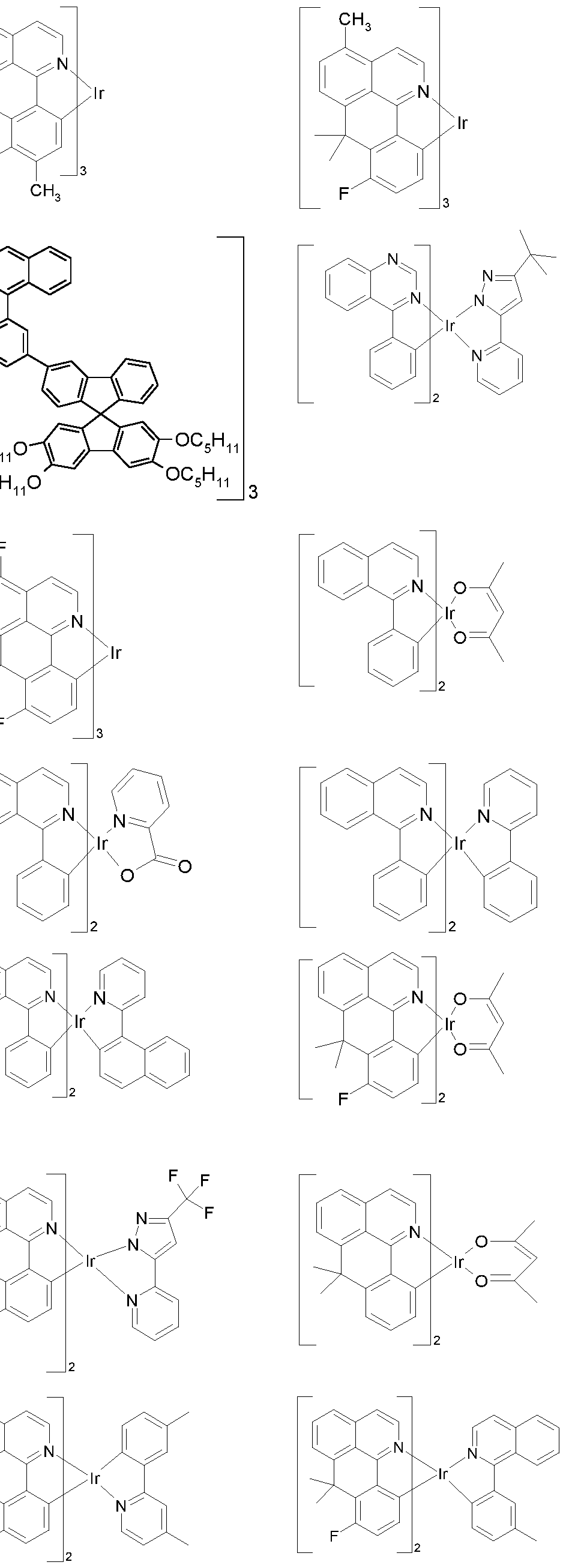
- the prior art describes organic electroluminescent devices comprising, in the emitting layer, a phosphorescent organometallic complex as a sensitizer, which shows mixing of S1 and T 1 states due to the large spin- orbit coupling, and a fluorescent compound as an emitter, so that the emission decay time can significantly be shortened.
- a phosphorescent organometallic complex as a sensitizer, which shows mixing of S1 and T 1 states due to the large spin- orbit coupling
- a fluorescent compound as an emitter
- sterically hindered fluorescent emitters based on rubrene are described.
- further sterically hindered fluorescent emitters especially sterically hindered blue-fluorescent emitters, which lead to OLEDs having very good properties in terms of efficiency and colour emission.
- an OLED may comprise different layers, which may be applied either by vapour deposition in a vacuum chamber or by processing from a solution.
- the processes based on vapour deposition lead to good results, but such processes are complex and expensive. Therefore, there is also a need for OLED materials that can be easily and reliably processed from solution.
- the materials should have good solubility properties in the solution that comprises them.
- the OLED materials that are processed from a solution should be able to orientate themselves in the deposited film to improve the overall efficiency of the OLED.
- orientation means here the horizontal molecular orientation of the compounds, as explained in Zhao et al. , Horizontal molecular orientation in solution-processed organic light-emitting diodes, Appl. Phys. Lett. 106063301 , 2015.
- the present invention is based on the technical object of providing emitters exhibiting prompt fluorescence and/or delayed fluorescence.
- the present invention is also based on the technical object of providing sterically hindered fluorescent emitters, which can be used in combination with a sensitizer compound in a hyperfluorescent or hyperphosphorescent system.
- the present invention is also based on the technical object of providing compounds which are suitable for use in electronic devices, such as OLEDs, more particularly as emitters and, which are suitable for vacuum processing or for solution processing.
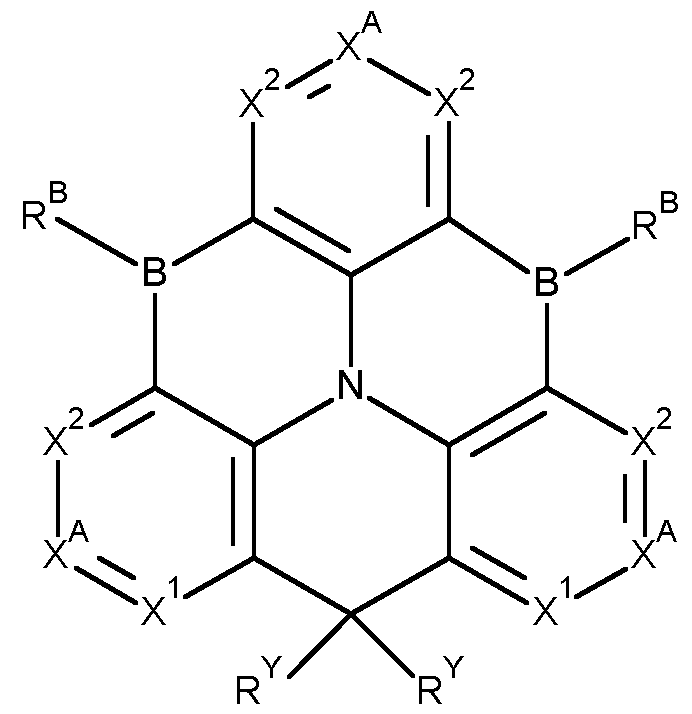
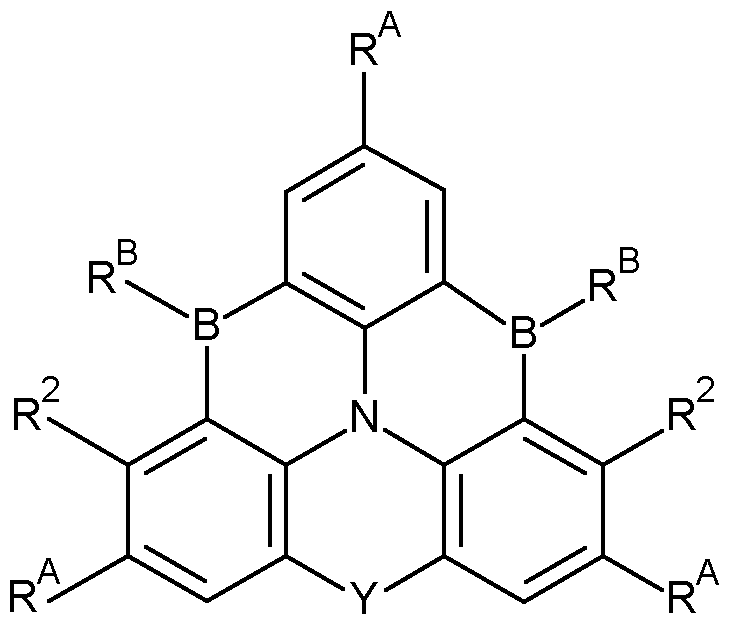
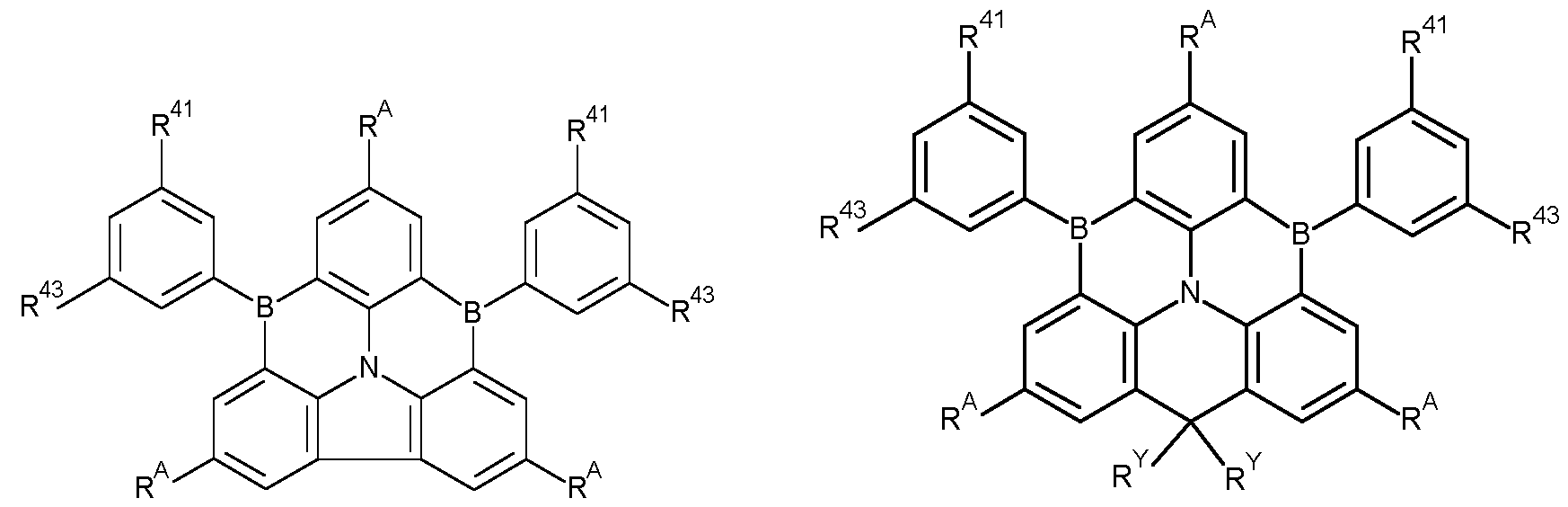
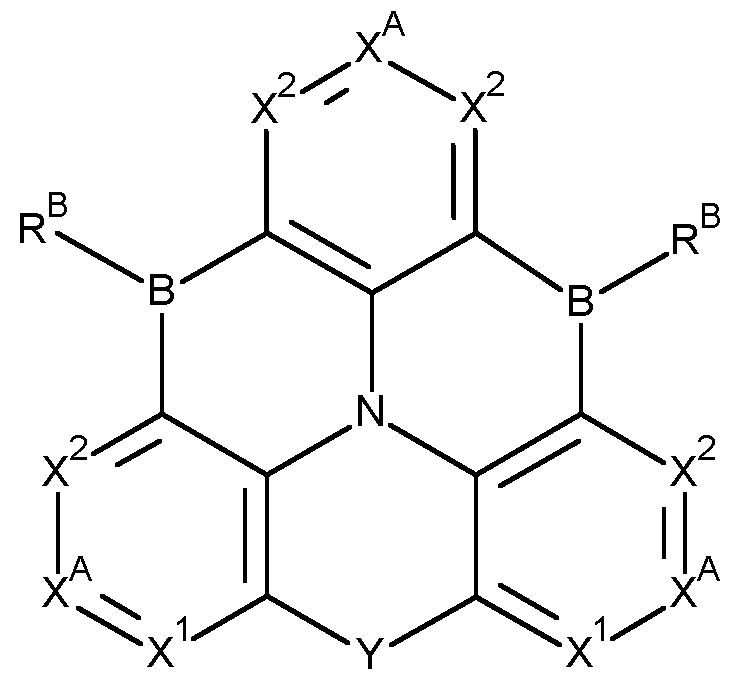
- the invention thus relates to compounds of formula (1 ),
- X 1 stands, on each occurrence, identically or differently, for CR 1 or N;
- X 2 stands, on each occurrence, identically or differently, for CR 2 or N;
- X A stands, on each occurrence, identically or differently, for CR A or N;
- Y is a single bond or an alkylene group selected from -C(R Y ) 2 -,
- P( 0)(R), SO, S0 2 , O, S or CONR and where one or more H atoms may be replaced by D, F, Cl, Br, I, CN or N0 2 , or an aromatic or heteroaromatic ring system having 5 to 60 aromatic ring atoms, which may in each case be substituted by one or more radicals R, or an aryloxy group having 5 to
- aromatic ring atoms which may be substituted by one or more radicals
- R or an aralkyl or heteroaralkyl group which has 5 to 60 aromatic ring atoms, which may be substituted by one or more R radicals;
- R Y stands on each occurrence, identically or differently, for H, D, F, Cl, Br, I,
- Ar is on each occurrence, identically or differently, an aromatic or heteroaromatic ring system having 5 to 24 aromatic ring atoms, which may in each case also be substituted by one or more radicals R ' ;
- R ’ stands on each occurrence, identically or differently, for FI, D, F, Cl, Br, I, CN, a straight-chain alkyl, alkoxy or thioalkyl group having 1 to 20 C atoms or branched or cyclic alkyl, alkoxy or thioalkyl group having 3 to 20 C atoms, where in each case one or more non-adjacent CFI2 groups may be replaced by SO, SO2, O, S and where one or more FI atoms may be replaced by D, F, Cl, Br or I, or an aromatic or heteroaromatic ring system having 5 to 24 C atoms.
- Adjacent substituents in the sense of the present invention are substituents which are bonded to atoms which are linked directly to one another or which are bonded to the same atom.
- An aryl group in the sense of this invention contains 6 to 60 aromatic ring atoms, preferably 6 to 40 aromatic ring atoms, more preferably 6 to 20 aromatic ring atoms; a heteroaryl group in the sense of this invention contains 5 to 60 aromatic ring atoms, preferably 5 to 40 aromatic ring atoms, more preferably 5 to 20 aromatic ring atoms, at least one of which is a heteroatom.
- the heteroatoms are preferably selected from N, O and S. This represents the basic definition. If other preferences are indicated in the description of the present invention, for example with respect to the number of aromatic ring atoms or the heteroatoms present, these apply.
- An aryl group or heteroaryl group here is taken to mean either a simple aromatic ring, i.e. benzene, or a simple heteroaromatic ring, for example pyridine, pyrimidine or thiophene, or a condensed (annellated) aromatic or heteroaromatic polycycle, for example naphthalene, phenanthrene, quinoline or carbazole.
- a condensed (annellated) aromatic or heteroaromatic polycycle in the sense of the present application consists of two or more simple aromatic or heteroaromatic rings condensed with one another.
- An aryl or heteroaryl group which may in each case be substituted by the above-mentioned radicals and which may be linked to the aromatic or hetero aromatic ring system via any desired positions, is taken to mean, in particular, groups derived from benzene, naphthalene, anthracene, phenanthrene, pyrene, dihydropyrene, chrysene, perylene, fluoranthene, benzanthracene, benzophenanthrene, tetracene, pentacene, benzopyrene, furan, benzofuran, isobenzofuran, dibenzofuran, thiophene, benzothiophene, isobenzothio- phene, dibenzothiophene, pyrrole, indole, isoindole, carbazole, pyridine, quinoline, isoquinoline, acridine, phenanthridine, benzo-5, 6-quinoline, be
- aryloxy group in accordance with the definition of the present invention is taken to mean an aryl group, as defined above, which is bonded via an oxygen atom.
- An analogous definition applies to heteroaryloxy groups.
- An aralkyl group in accordance with the definition of the present invention is taken to mean an alkyl group, where at least one hydrogen atom is replaced by an aryl group.
- An analogous definition applies to heteroaralkyl groups.
- An aromatic ring system in the sense of this invention contains 6 to 60 C atoms in the ring system, preferably 6 to 40 C atoms, more preferably 6 to 20 C atoms.
- a heteroaromatic ring system in the sense of this invention contains 5 to 60 aromatic ring atoms, preferably 5 to 40 aromatic ring atoms, more preferably 5 to 20 aromatic ring atoms, at least one of which is a heteroatom.
- the heteroatoms are preferably selected from N, O and/or S.
- An aromatic or heteroaromatic ring system in the sense of this invention is intended to be taken to mean a system which does not necessarily contain only aryl or heteroaryl groups, but instead in which, in addition, a plurality of aryl or heteroaryl groups may be connected by a non-aromatic unit (preferably less than 10% of the atoms other than H), such as, for example, an sp 3 -hybridised C, Si, N or O atom, an sp 2 -hybridised C or N atom or an sp-hybridised C atom.
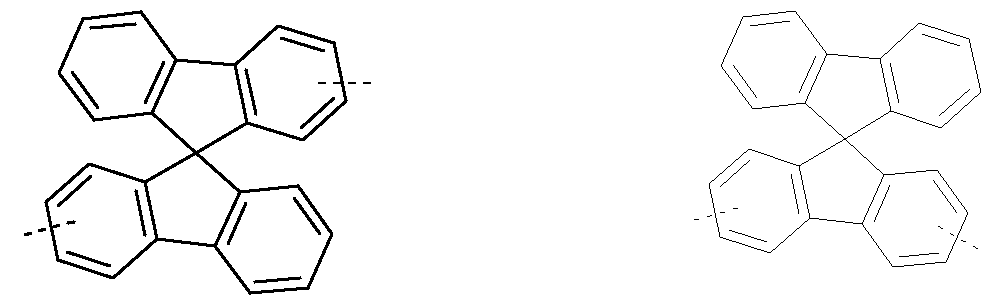
- systems such as 9,9’-spirobifluorene, 9,9’-diaryl- fluorene, triarylamine, diaryl ether, stilbene, etc., are also intended to be taken to be aromatic ring systems in the sense of this invention, as are systems in which two or more aryl groups are connected, for example, by a linear or cyclic alkyl, alkenyl or alkynyl group or by a silyl group.
- systems in which two or more aryl or heteroaryl groups are linked to one another via single bonds are also taken to be aromatic or heteroaromatic ring systems in the sense of this invention, such as, for example, systems such as biphenyl, terphenyl or diphenyltriazine.
- An aromatic or heteroaromatic ring system having 5 - 60 aromatic ring atoms, which may in each case also be substituted by radicals as defined above and which may be linked to the aromatic or heteroaromatic group via any desired positions, is taken to mean, in particular, groups derived from benzene, naphthalene, anthracene, benzanthracene, phenanthrene, benzophenanthrene, pyrene, chrysene, perylene, fluoranthene, naphtha- cene, pentacene, benzopyrene, biphenyl, biphenylene, terphenyl, terphenyl- ene, quaterphenyl, fluorene, spirobifluorene, dihydrophenanthrene, dihydro pyrene, tetrahydropyrene, cis- or trans-indenofluorene, truxene, isotruxene, spir
- a straight-chain alkyl group having 1 to 40 C atoms or a branched or cyclic alkyl group having 3 to 40 C atoms or an alkenyl or alkynyl group having 2 to 40 C atoms, in which, in addition, individual H atoms or CFh groups may be substituted by the groups mentioned above under the definition of the radicals, is preferably taken to mean the radicals methyl, ethyl, n-propyl, i-propyl, n-butyl, i-butyl, s-butyl, t-butyl, 2-methylbutyl, n-pentyl, s-pentyl, cyclopentyl, neopentyl, n-hexyl, cyclohexyl, neohexyl, n-heptyl, cycloheptyl, n-octyl, cyclooctyl, cycloo
- An alkoxy or thioalkyl group having 1 to 40 C atoms is preferably taken to mean methoxy, trifluoromethoxy, ethoxy, n-propoxy, i-propoxy, n-butoxy, i-butoxy, s-butoxy, t-butoxy, n-pentoxy, s-pentoxy, 2-methylbutoxy, n-hexoxy, cyclohexyloxy, n-heptoxy, cycloheptyloxy, n-octyloxy, cyclooctyl- oxy, 2-ethylhexyloxy, pentafluoroethoxy, 2,2,2-trifluoroethoxy, methylthio, ethylthio, n-propylthio, i-propylthio, n-butylthio, i-butylthio, s-butylthio, t-butylthio, n-p
- the group Y is a single bond or a group -C(R Y ) 2 -, more preferably a single bond.
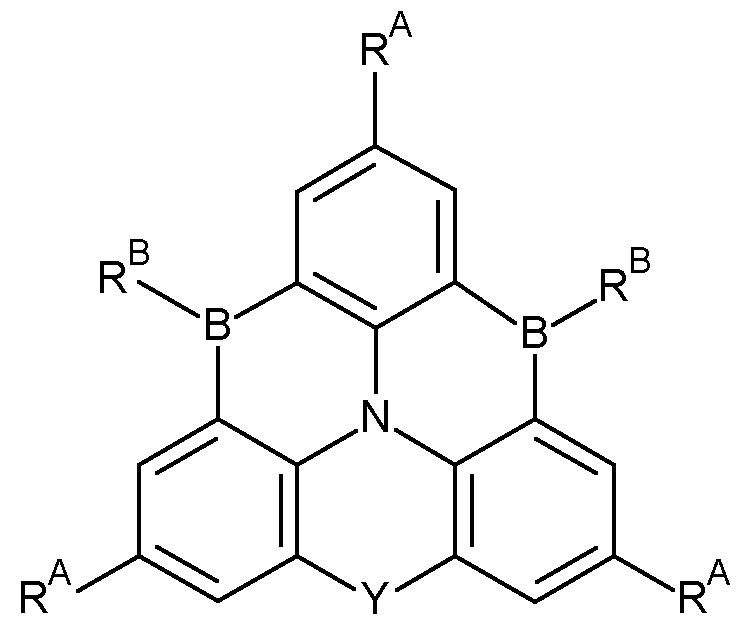
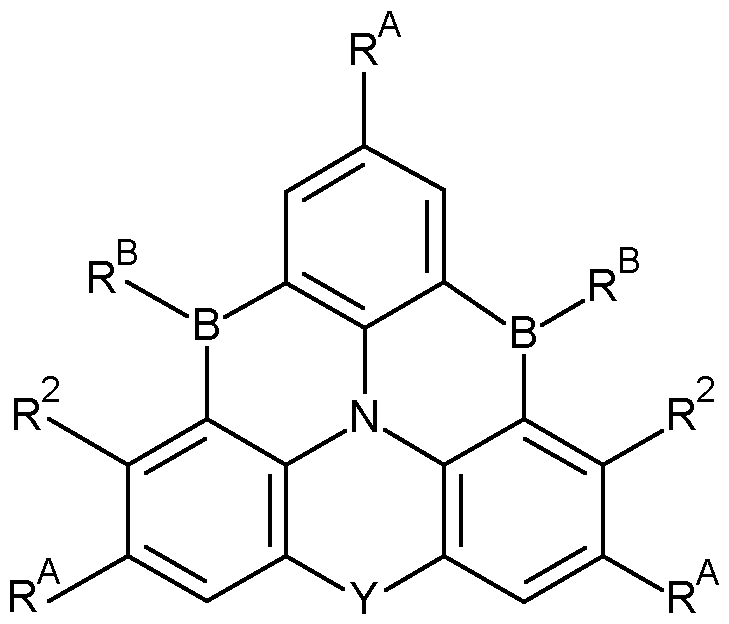
- the group Y stands for a single bond and the compounds of formula (1 ) correspond to compounds of formula
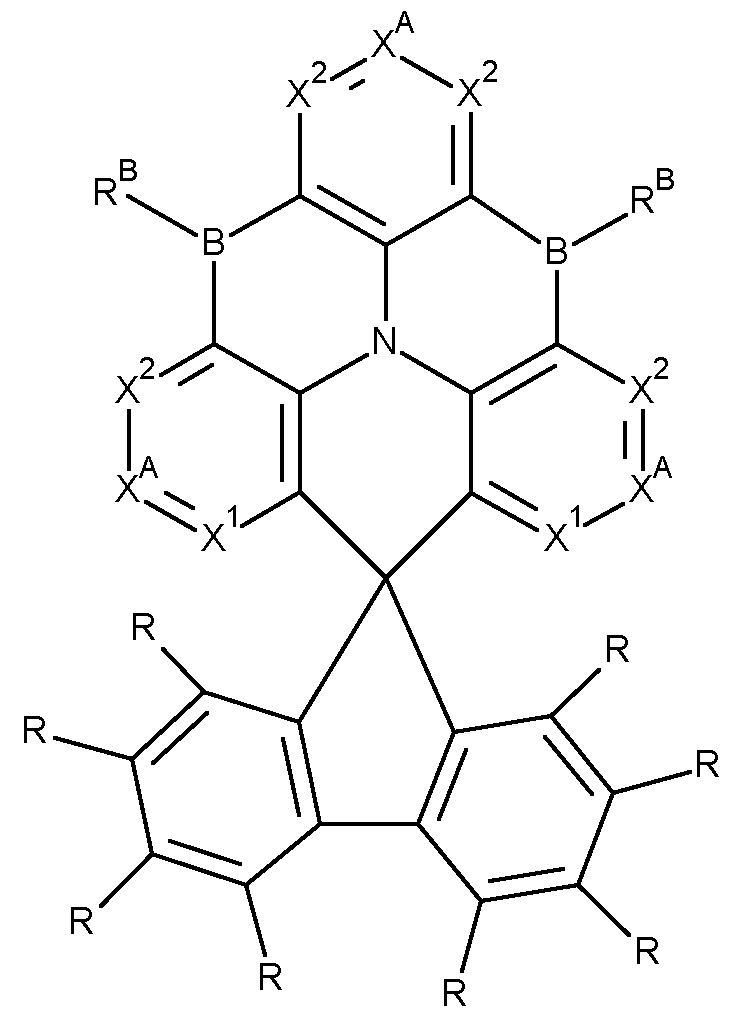
- the group Y stands for a group -C(R y ) 2 - and the compounds of formula (1 ) correspond to compounds of formula (1 -Y2),
- the group R Y stands on each occurrence, identically or differently, for H, D, a straight-chain alkyl group having 1 to 20, preferably 1 to 10 carbon atoms or an alkenyl or alkynyl group having 2 to 20, preferably 2 to 10 carbon atoms or a branched or cyclic alkyl group having 3 to 20, preferably 3 to 10 carbon atoms, each of which may be substituted by one or more radicals R, or an aromatic or heteroaromatic ring system having 5 to 60, preferably 5 to 40, more preferably 5 to 30, very preferably 5 to 18 aromatic ring atoms, which may in each case be substituted by one or more radicals R; where two adjacent substituents R Y may form a mono- or polycyclic, aliphatic ring system or aromatic ring system, which may be substituted by one or more radicals R.
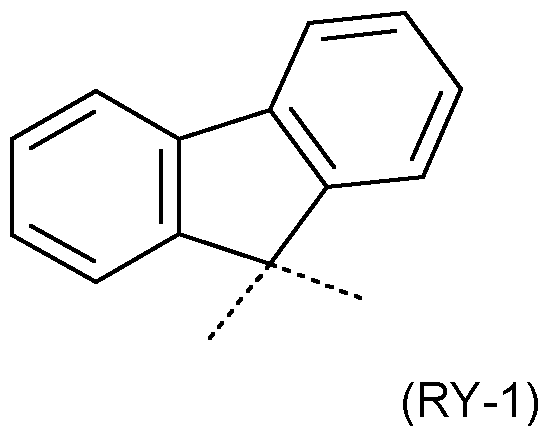
- two adjacent substituents R Y form a ring of formula (R Y -1 ),
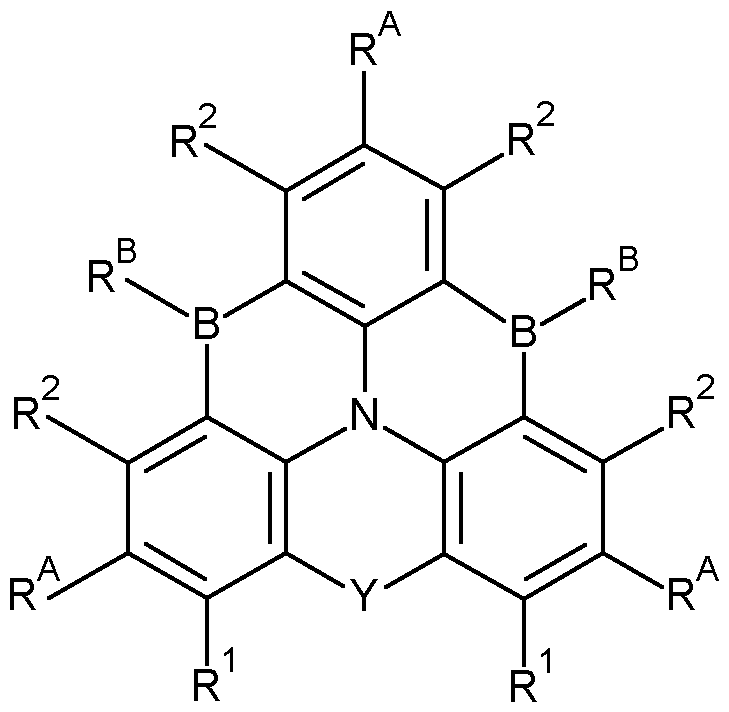
- the compounds of formula (1 ) are selected from the compounds of formula (2),
- the compounds of formula (2) correspond to compounds of formulae (2-Y1 ), (2-Y2) and (2-Y3), where the symbols have the same meaning as above.
- the compounds of formula (1 ) are selected from the compounds of formula (3),
- the compounds of formula (3) correspond to compounds of formulae (3-Y1 ), (3-Y2) and (3-Y3), where the symbols have the same meaning as above.
- the compounds of formula (1 ) are selected from the compounds of formula (4),
- the compounds of formula (4) correspond to compounds of formulae (4-Y1 ), (4-Y2) and (4-Y3), where the symbols have the same meaning as above.
- the group R B stands on each occurrence, identically or differently, for a straight-chain alkyl, alkoxy or thioalkoxy group having 1 to 40, preferably
- H atoms may be replaced by D, F, Cl, Br, I, CN or NO2, or an aromatic or heteroaromatic ring system having 5 to 60, preferably 5 to 40, more preferably 5 to 30, very preferably 5 to 18 aromatic ring atoms, which may in each case be substituted by one or more radicals R, or an aralkyl or heteroaralkyl group which has 5 to 60, preferably 5 to 40, more preferably 5 to 30, very preferably 5 to 18 aromatic ring atoms, which may be substituted by one or more R radicals.
- the group R B stands on each occurrence, identically or differ ently, for a straight-chain alkyl or alkoxy group having 1 to 20, preferably 1 to 10 carbon atoms or an alkenyl or alkynyl group having 2 to 20, preferably 2 to 10 carbon atoms or a branched or cyclic alkyl or alkoxy group having 3 to 20, preferably 3 to 10 carbon atoms, each of which may be substituted by one or more radicals R, where one or more H atoms may be replaced by D, F, Cl or CN, or an aromatic ring system having 5 to 60, preferably 5 to 40, more preferably 5 to 30, very preferably 5 to 18 aromatic ring atoms, which may in each case be substituted by one or more radicals R, or an aralkyl or heteroaralkyl group which has 5 to 60, preferably 5 to 40, more preferably 5 to 30, very preferably 5 to 18 aromatic ring atoms, which may be substituted by one or more R radicals.
- the group R B is selected on each occurrence, identically or differently,
- R 22 , R 23 , R 24 are at each occurrence, identically or differently, selected from H, a straight-chain alkyl group having 1 to 10 carbon atoms, or a branched or cyclic alkyl group having 3 to 10 carbon atoms, where the above-mentioned groups may each be substituted by one or more radicals R 25 , and where two of radicals R 22 , R 23 , R 24 or all radicals R 22 , R 23 , R 24 may be joined to form a (poly)cyclic alkyl group, which may be substituted by one or more radicals R 25 ;
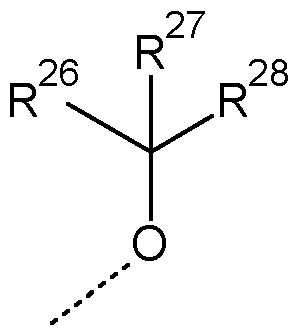
- R 25 is at each occurrence, identically or differently, selected from a straight-chain alkyl group having 1 to 10 carbon atoms, or a branched or cyclic alkyl group having 3 to 10 carbon atoms; with the proviso that at each occurrence at least one of radicals R 22 , R 23 and R 24 is other than H, with the proviso that at each occurrence all of radicals R 22 , R 23 and R 24 together have at least 4 carbon atoms and with the proviso that at each occurrence, if two of radicals R 22 , R 23 , R 24 are H, the remaining radical is not a straight-chain; or from branched or cyclic alkoxy groups represented by the general following formula (RS-b)
- R 26 , R 27 , R 28 are at each occurrence, identically or differently, selected from H, a straight-chain alkyl group having 1 to 10 carbon atoms, or a branched or cyclic alkyl group having 3 to 10 carbon atoms, where the above-mentioned groups may each be substituted by one or more radicals R 25 as defined above, and where two of radicals R 26 , R 27 , R 28 or all radicals R 26 , R 27 , R 28 may be joined to form a (poly)cyclic alkyl group, which may be substituted by one or more radicals R 25 as defined above; with the proviso that at each occurrence only one of radicals R 26 , R 27 and
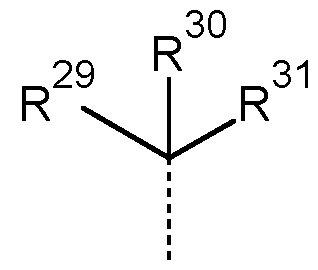
- R 28 may be H; or from aralkyl groups represented by the general following formula
- R 29 , R 30 , R 31 are at each occurrence, identically or differently, selected from H, a straight-chain alkyl group having 1 to 10 carbon atoms, or a branched or cyclic alkyl group having 3 to 10 carbon atoms, where the above-mentioned groups may each be substituted by one or more radicals R 32 , or an aromatic ring system having 6 to 30 aromatic ring atoms, which may in each case be substituted by one or more radicals R 32 , and where two or all of radicals R 29 , R 30 , R 31 may be joined to form a (poly)cyclic alkyl group or an aromatic ring system, each of which may be substituted by one or more radicals R 32 ;
- R 32 is at each occurrence, identically or differently, selected from a straight-chain alkyl group having 1 to 10 carbon atoms, or a branched or cyclic alkyl group having 3 to 10 carbon atoms, or an aromatic ring system having 6 to 24 aromatic ring atoms;
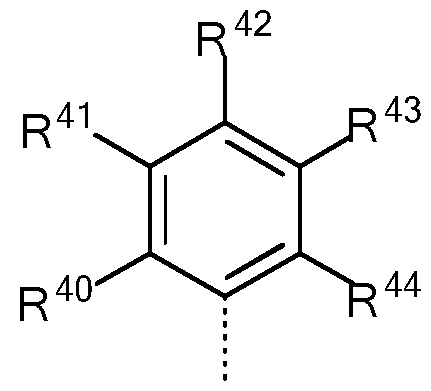
- radicals R 29 , R 30 and R 31 are other than H and that at each occurrence at least one of radicals R 29 , R 30 and R 31 is or contains an aromatic ring system having at least 6 aromatic ring atoms; or from aromatic ring systems represented by the general following formula (RS-d)
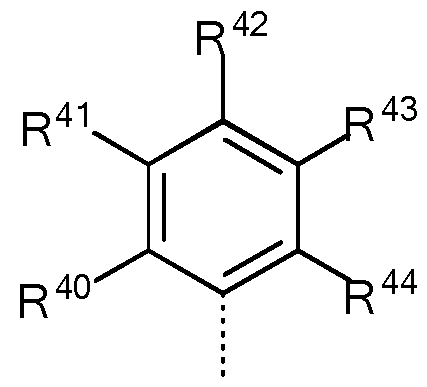
- R 40 to R 44 is at each occurrence, identically or differently, selected from H, a straight-chain alkyl group having 1 to 10 carbon atoms, or a branched or cyclic alkyl group having 3 to 10 carbon atoms, where the above- mentioned groups may each be substituted by one or more radicals R 32 , or an aromatic ring system having 6 to 30 aromatic ring atoms, which may in each case be substituted by one or more radicals R 32 , and where two or more of radicals R 40 to R 44 may be joined to form a (poly)cyclic alkyl group or an aromatic ring system, each of which may be substituted by one or more radicals R 32 as defined above.
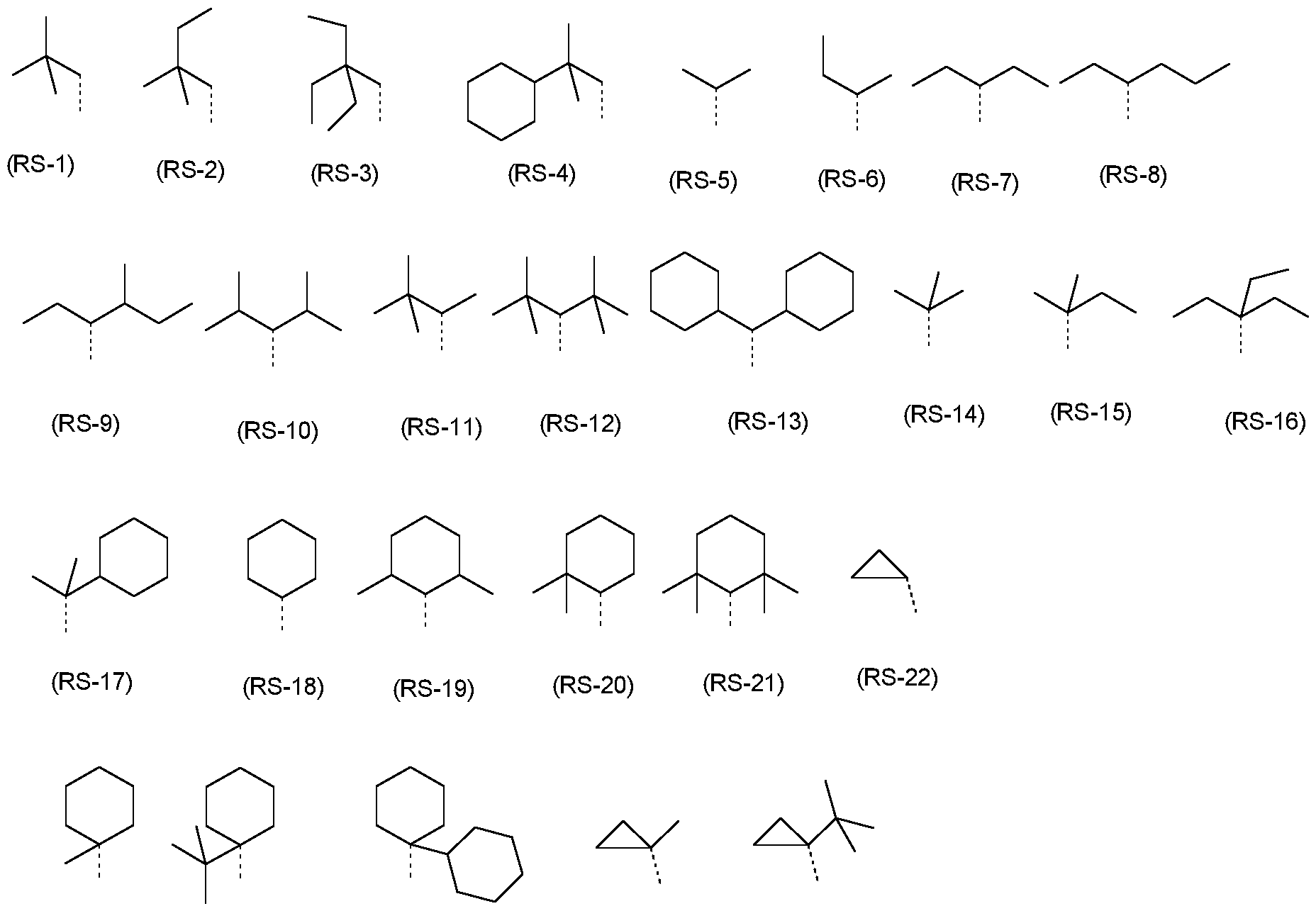
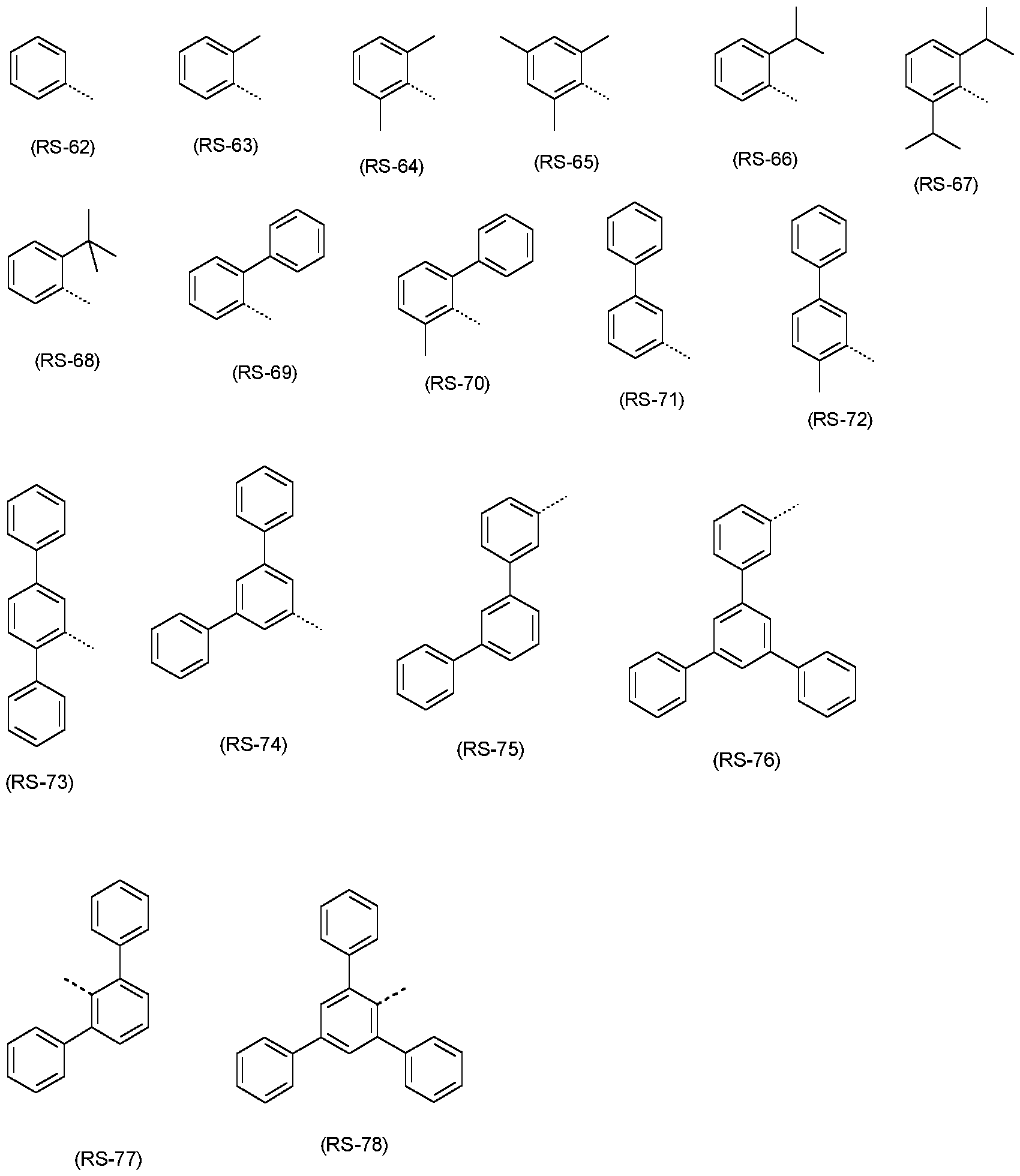
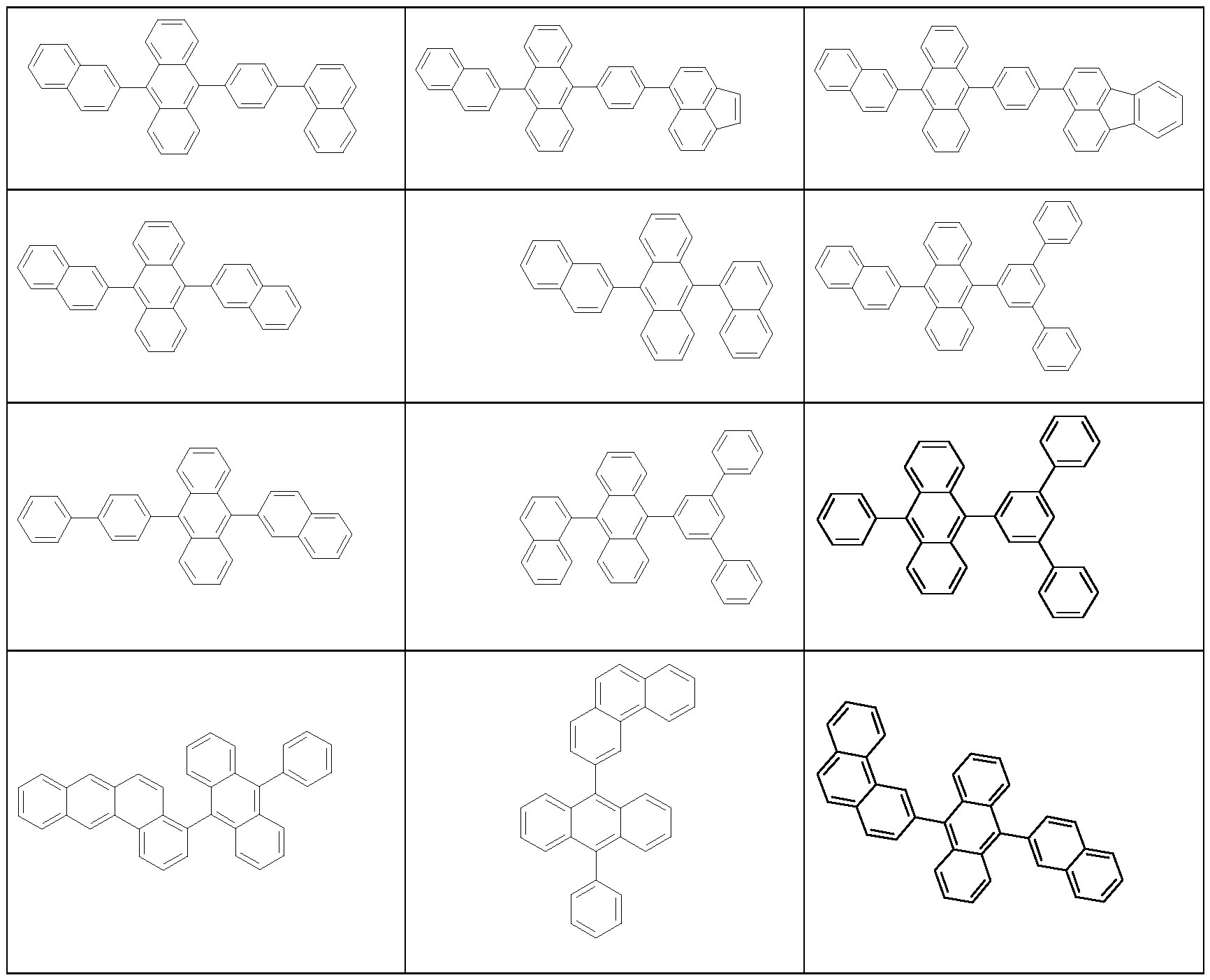
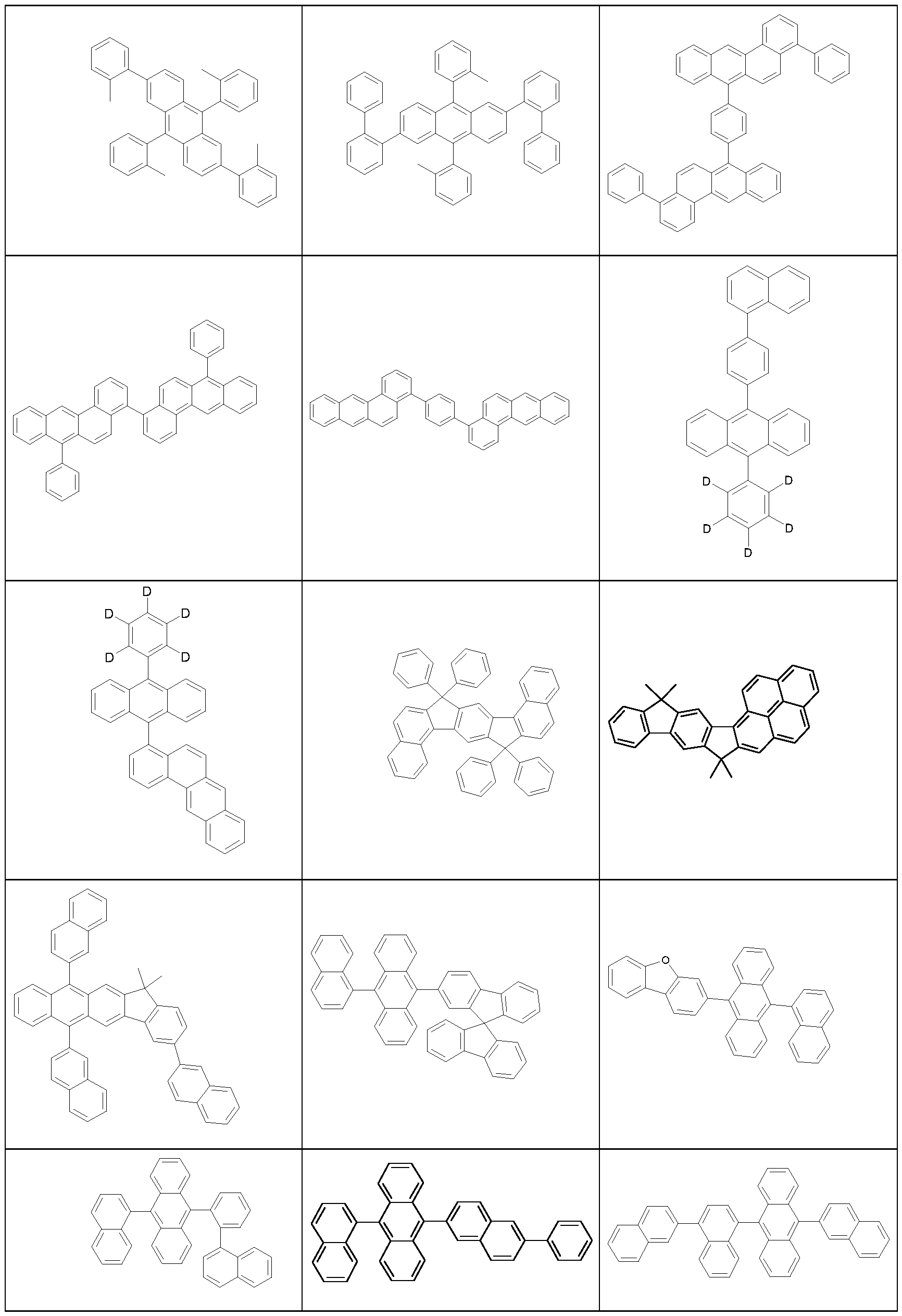
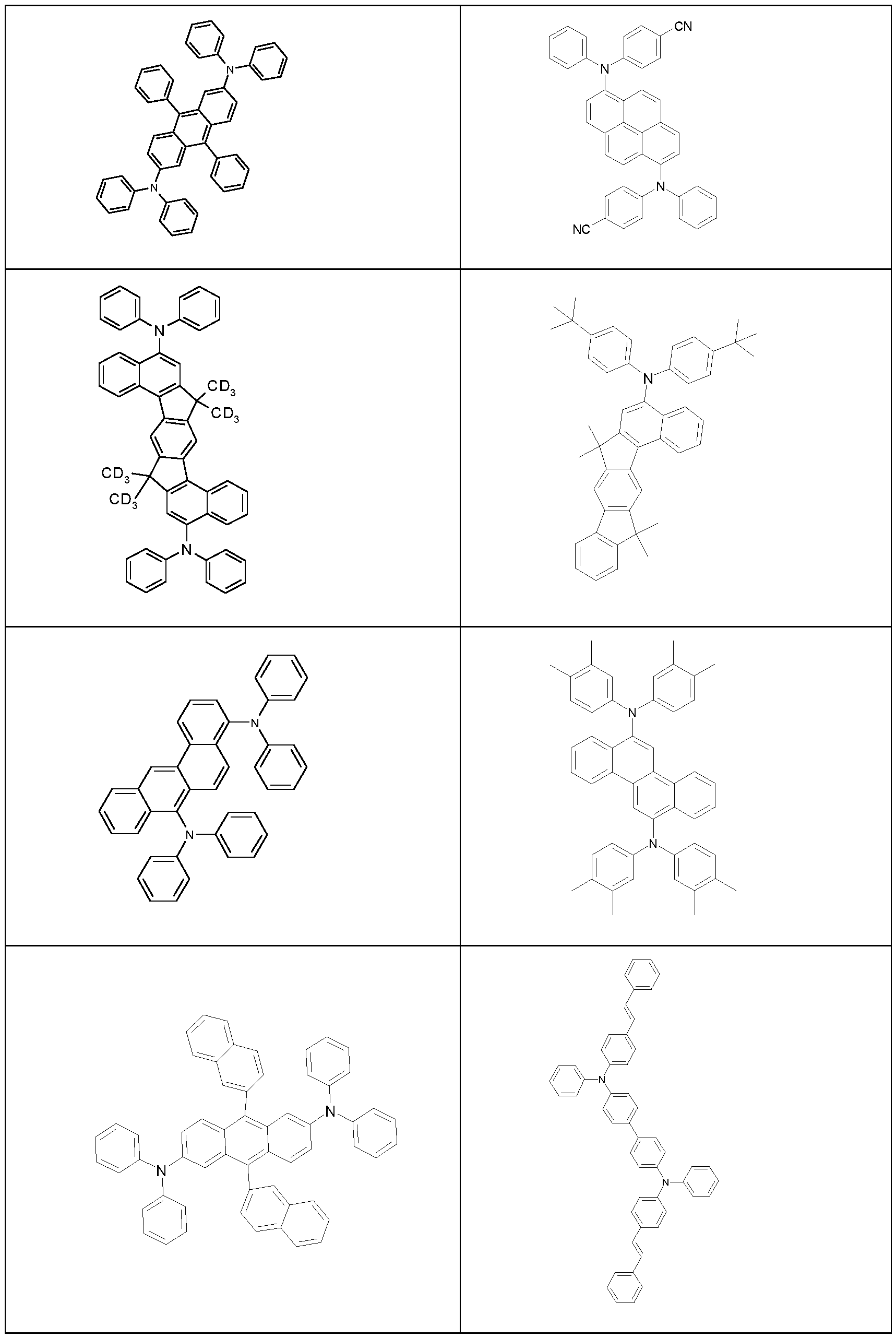
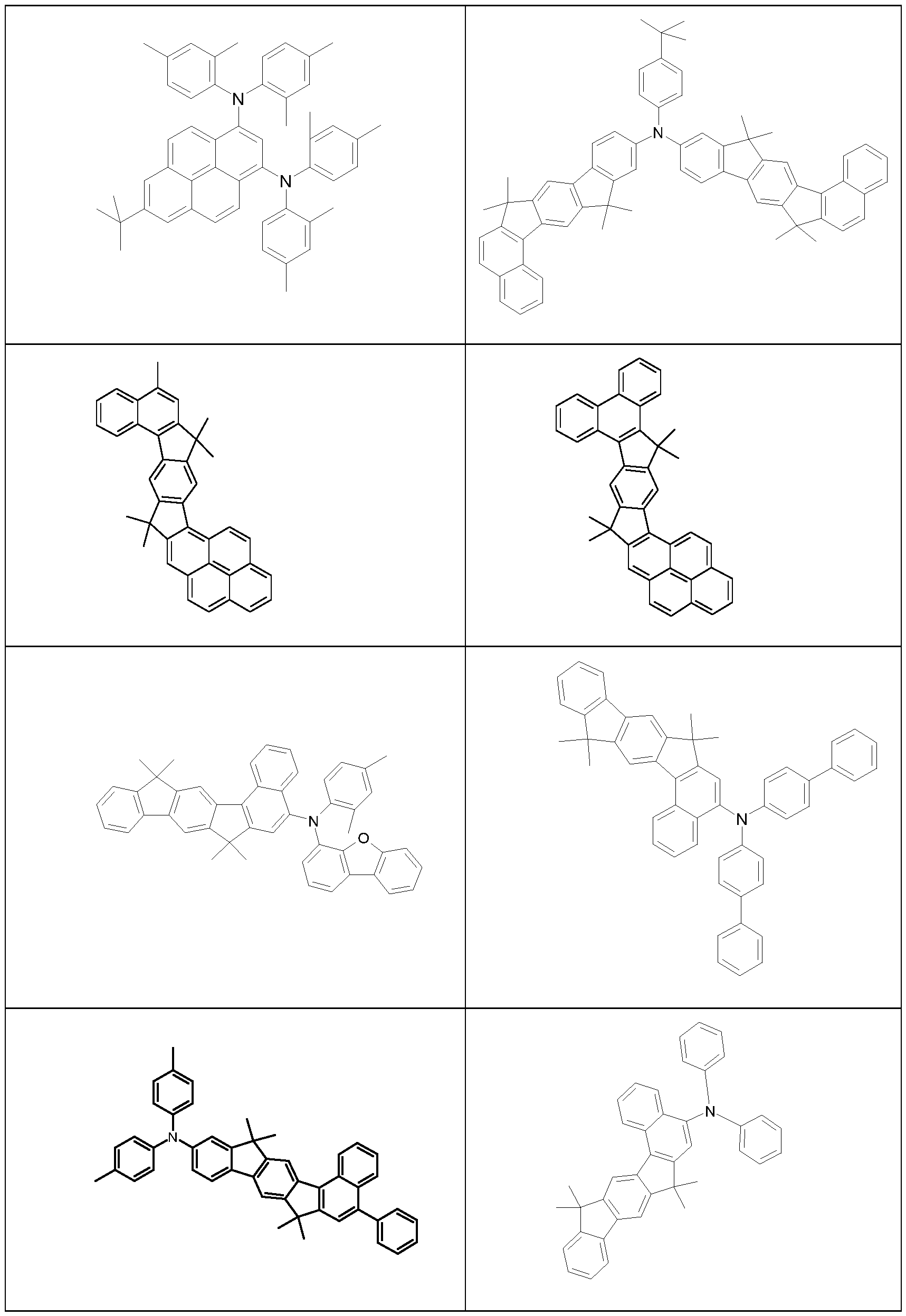
- Examples of suitable groups of formulae (RS-a) to (RS-d) are the groups (RS- 1 ) to (RS-78):
- R 1 stands on each occurrence, identically or differently, for H, D, F, CN, N(Ar)2 , a straight-chain alkyl, alkoxy or thioalkyl group having 1 to 40, preferably 1 to 20, more preferably 1 to 10 C atoms or branched or cyclic alkyl, alkoxy or thioalkyl groups having 3 to 40, preferably 3 to 20, more preferably 3 to 10 C atoms, each of which may be substituted by one or more radicals R, an aromatic or heteroaromatic ring system having 5 to 60, preferably 5 to 40, more preferably 5 to 30, very preferably 5 to 18 aromatic ring atoms, which may in each case be substituted by one or more radicals R.
- R 1 stands on each occurrence, identically or differently, for H, D, F, CN, a straight-chain alkyl having 1 to 10 C atoms or branched or cyclic alkyl having 3 to 10 C atoms, each of which may be substituted by one or more radicals R.
- R 1 stands for FI.
- R 2 and R A stand on each occurrence, identically or differently,
- At least one of the group R 2 or R A stands for a group of formula (RS-a), a group of formula (RS-b), a group of formula (RS-c) or a group of formula (RS-d), where the groups of formulae (RS-a), (RS-b), (RS-c) and (RS-d) are as defined above.
- the groups R B and R A are on each occurrence, identically or differently, selected from the groups of formulae (RS-a), (RS-b), (RS-c) and (RS-d), where the groups of formulae (RS-a), (RS-b), (RS-c) and (RS-d) have the same definition as above.
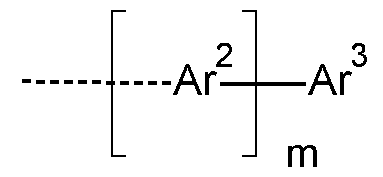
- At least one of the group R, R 2 or R A stands for a group of formula (ArL-1 ) as defined above.
- the index m in the group of formula (ArL-1 ) is an integer selected from 1 to 6, very preferably from 1 to 4.
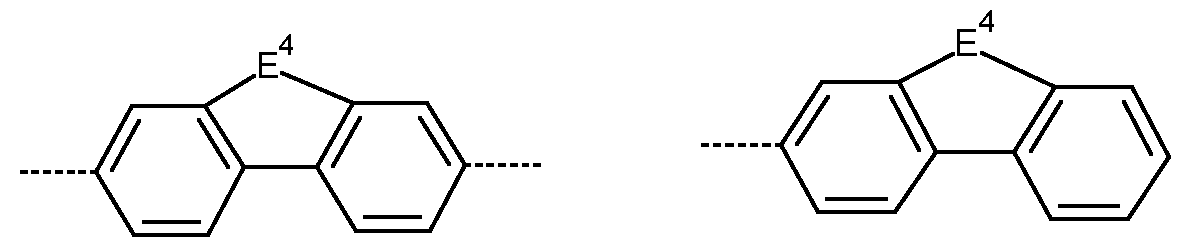
- the group Ar 2 is selected from the groups of formulae (Ar2-1 ) to (Ar2-25),
- E 4 is selected from -C
- R° stands on each occurrence, identically or differently, for H, D, F, CN, a straight-chain alkyl group having 1 to 40, preferably 1 to 20, more preferably 1 to 10 C atoms or branched or cyclic alkyl group having 3 to 40, preferably 3 to 20, more preferably 3 to 10 C atoms, each of which may be substituted by one or more radicals R, an aromatic or heteroaromatic ring system having 5 to 60, preferably 5 to 40, more preferably 5 to 30, very preferably 5 to 18 aromatic ring atoms, which may in each case be substituted by one or more radicals R; where two adjacent substituents R° may form a mono- or polycyclic, aliphatic ring system or aromatic ring system, which may be substituted by one or more radicals R, which has the same meaning as above.
- R° examples are H, methyl, ethyl, propyl, butyl, substituted and unsubstituted phenyl, substituted and unsubstituted biphenyl, substituted and unsubstituted naphthyl and substituted and unsubstituted fluorene.
- Ar 3 is on each occurrence, identically or differently, selected from the group consisting of the groups of formulae (Ar3-1 ) to (Ar3-27),
- At least one group Ar 2 stands for a group of formula (Ar2-2) and/or at least one group Ar 3 stands for a group of formula (Ar3-2), where
- the dashed bonds in formula (Ar2-2) indicate the bonding to the structure of formula (1 ) and to a group Ar 2 or Ar 3 ; and the dashed bond in formula (Ar3-2) indicates the bonding to Ar 2 ; and E 4 has the same meaning as in above; and the groups of formulae (Ar2-2) and (Ar3-2) may be substituted at each free position by a group R, which has the same meaning as above.
- At least one group Ar 2 stands for a group of formula (Ar2-2-1 ) and/or at least one group Ar 3 stands for a group of formula (Ar3-2-1 ),
- At least one group Ar 2 stands for a group of formula (Ar2-2-1 b) and/or at least one group Ar 3 stands for a group of formula (Ar3-2-1 b), where
- R° has the same meaning as above.
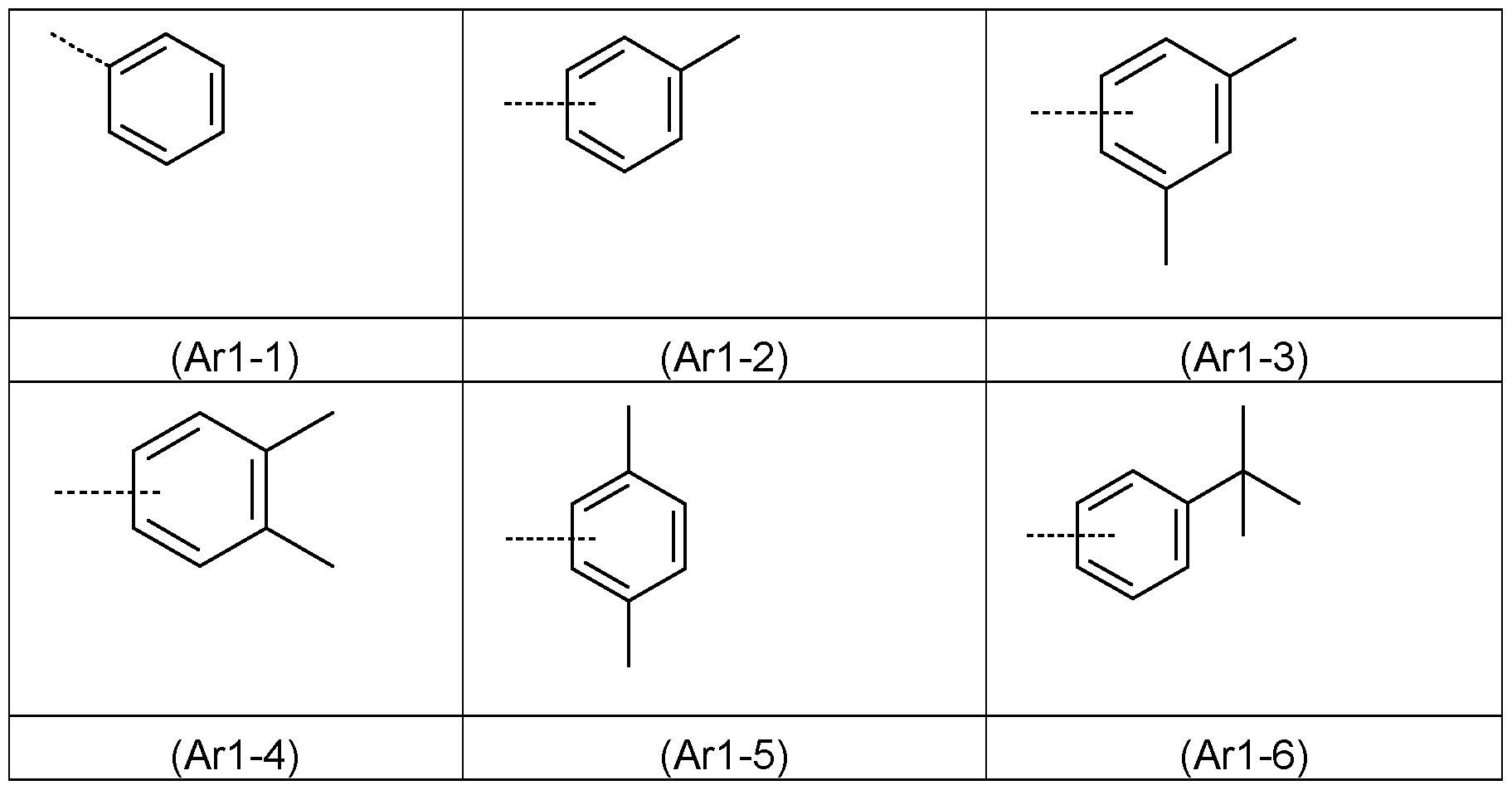
- R 2 and R A are H, D, F, CN, substituted and unsubstituted straight-chain alkyl groups having 1 to 10 C atoms, more particularly, methyl, ethyl, propyl, butyl, substituted and unsubstituted branched or cyclic alkyl group having 3 to 10 C atoms, more particularly t-butyl, and aromatic or heteroaromatic ring systems selected from the groups of formulae (Ar1 -1 ) to (Ar1 -24),
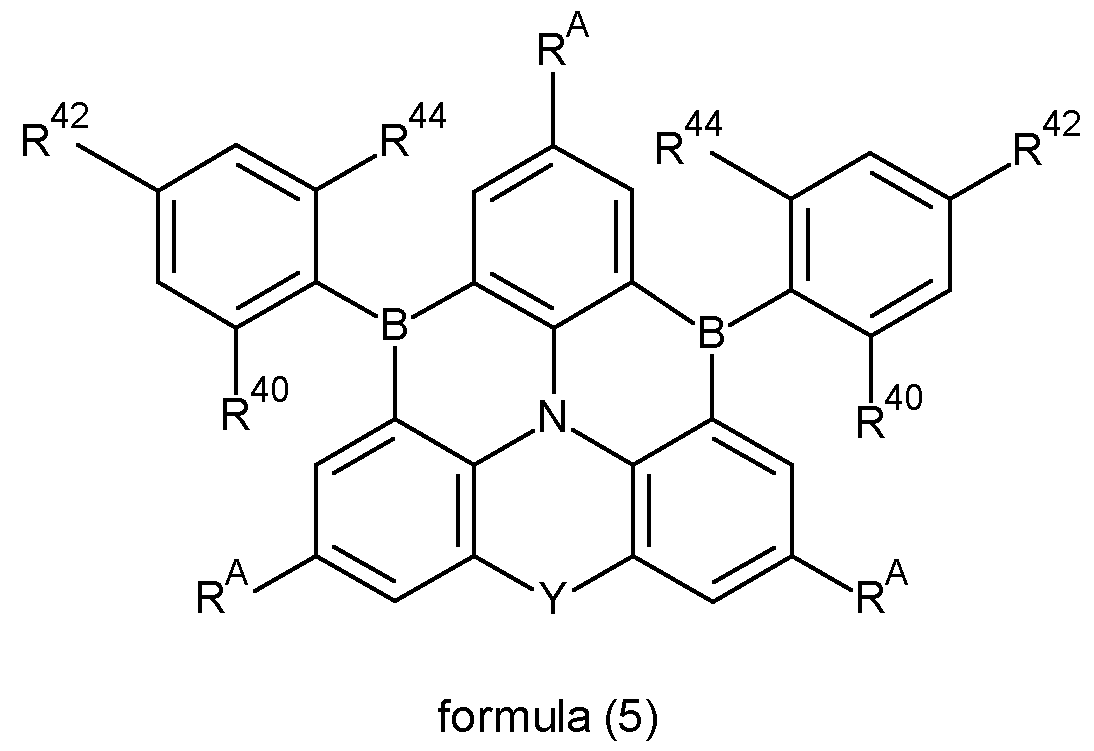
- the compounds of formula (1 ) are selected from the compounds of formula (5),
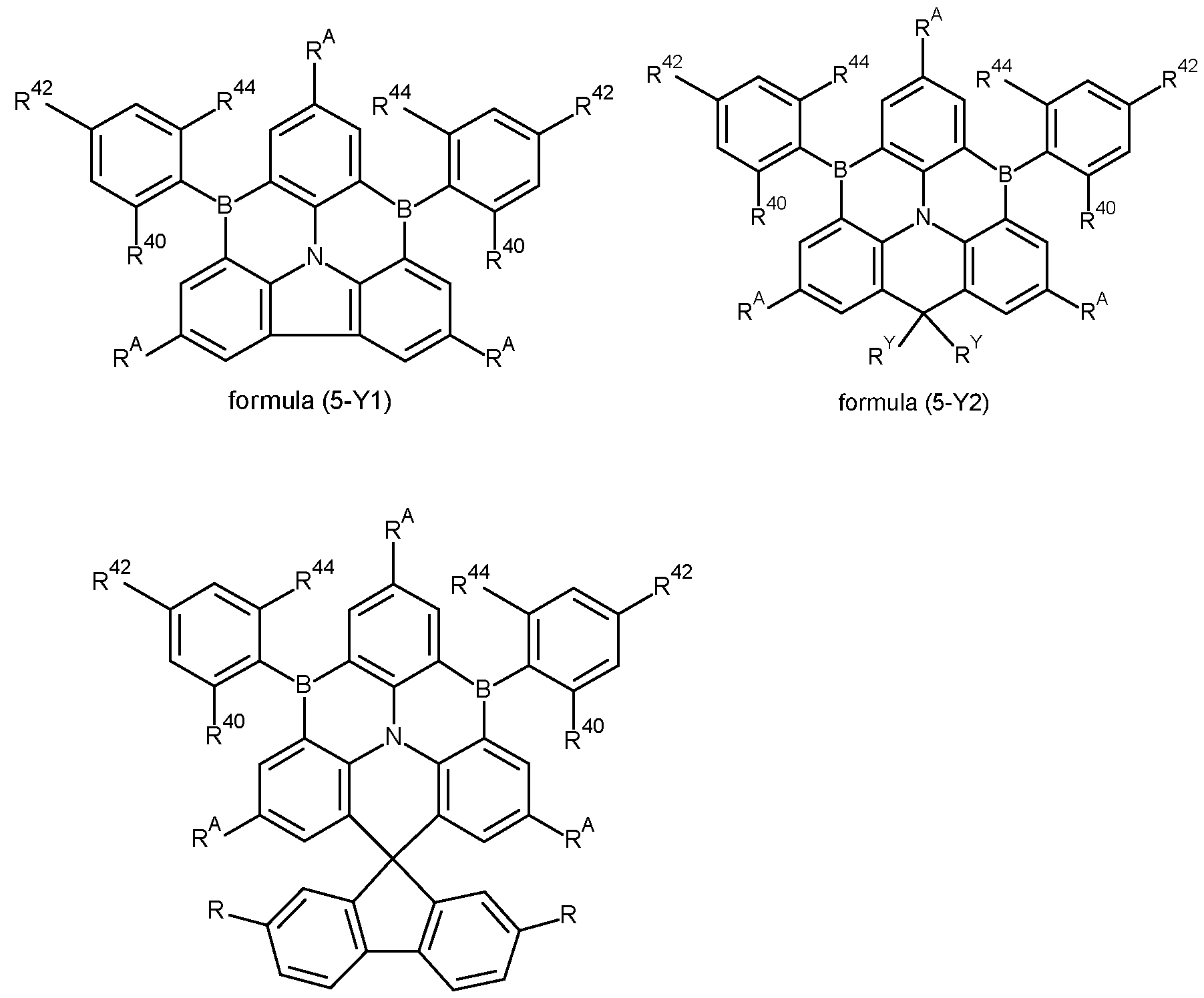
- R 40 , R 42 , R 44 are at each occurrence, identically or differently, selected from H, a straight-chain alkyl group having 1 to 10 carbon atoms, or a branched or cyclic alkyl group having 3 to 10 carbon atoms, where the above-mentioned groups may each be substituted by one or more radicals R 32 , or an aromatic ring system having 6 to 30 aromatic ring atoms, which may in each case be substituted by one or more radicals R 32 ; where R 32 is as defined above;
- the compounds of formula (5) correspond to compounds of formulae (5-Y1 ), (5-Y2) and (5-Y3),
- the compounds of formula (1 ) are selected from the compounds of formula (6),
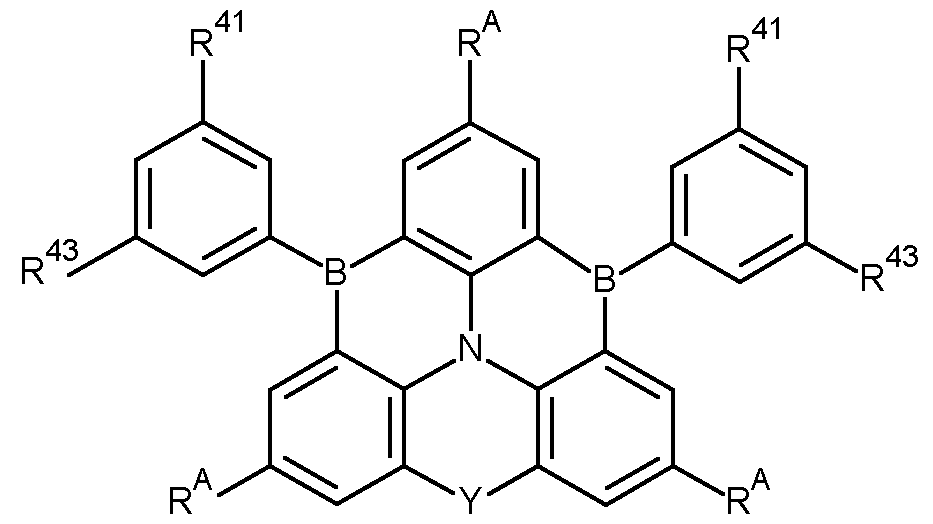
- R 41 , R 43 are at each occurrence, identically or differently, selected from H, a straight-chain alkyl group having 1 to 10 carbon atoms, or a branched or cyclic alkyl group having 3 to 10 carbon atoms, where the above- mentioned groups may each be substituted by one or more radicals R 32 , or an aromatic ring system having 6 to 30 aromatic ring atoms, which may in each case be substituted by one or more radicals R 32 ; where R 32 is as defined above;
- the compounds of formula (6) correspond to compounds of formulae (6-Y1 ), (6-Y2) and (6-Y3),
- the group R 42 is at each occurrence, identically or differently, selected from H, a straight-chain alkyl group having 1 to 10 carbon atoms, or a branched or cyclic alkyl group having 3 to 10 carbon atoms, where the above-mentioned groups may each be substituted by one or more radicals R 32 , or an aromatic ring system having 6 to 30 aromatic ring atoms, which may in each case be substituted by one or more radicals R 32 , and the groups
- R 4 ° R 44 are at eac h occurrence, identically or differently, selected from an aromatic ring system having 6 to 30 aromatic ring atoms, which may in each case be substituted by one or more radicals R 32 .
- the groups R 40 , R 42 , R 44 in formulae (5), (5-Y1 ), (5-Y2) and (5-Y3) are at each occurrence, identically or differently, selected from a straight-chain alkyl group having 1 to 10 carbon atoms, or a branched or cyclic alkyl group having 3 to 10 carbon atoms, where the above-mentioned groups may each be substituted by one or more radicals R 32 .
- the groups R 40 , R 42 , R 44 are at each occurrence, identically or differently, selected from a straight-chain alkyl group having 1 to 10, preferably 1 to 5 more preferably 1 to 3 carbon atoms, where the above- mentioned groups may each be substituted by one or more radicals R 32 .
- suitable groups R 40 , R 42 , R 44 in this case are methyl, ethyl and butyl.
- the groups R 40 , R 42 , R 44 are at each occurrence, identically or differently, selected from an aromatic ring system having 6 to 30 aromatic ring atoms, which may in each case be substituted by one or more radicals R 32 .
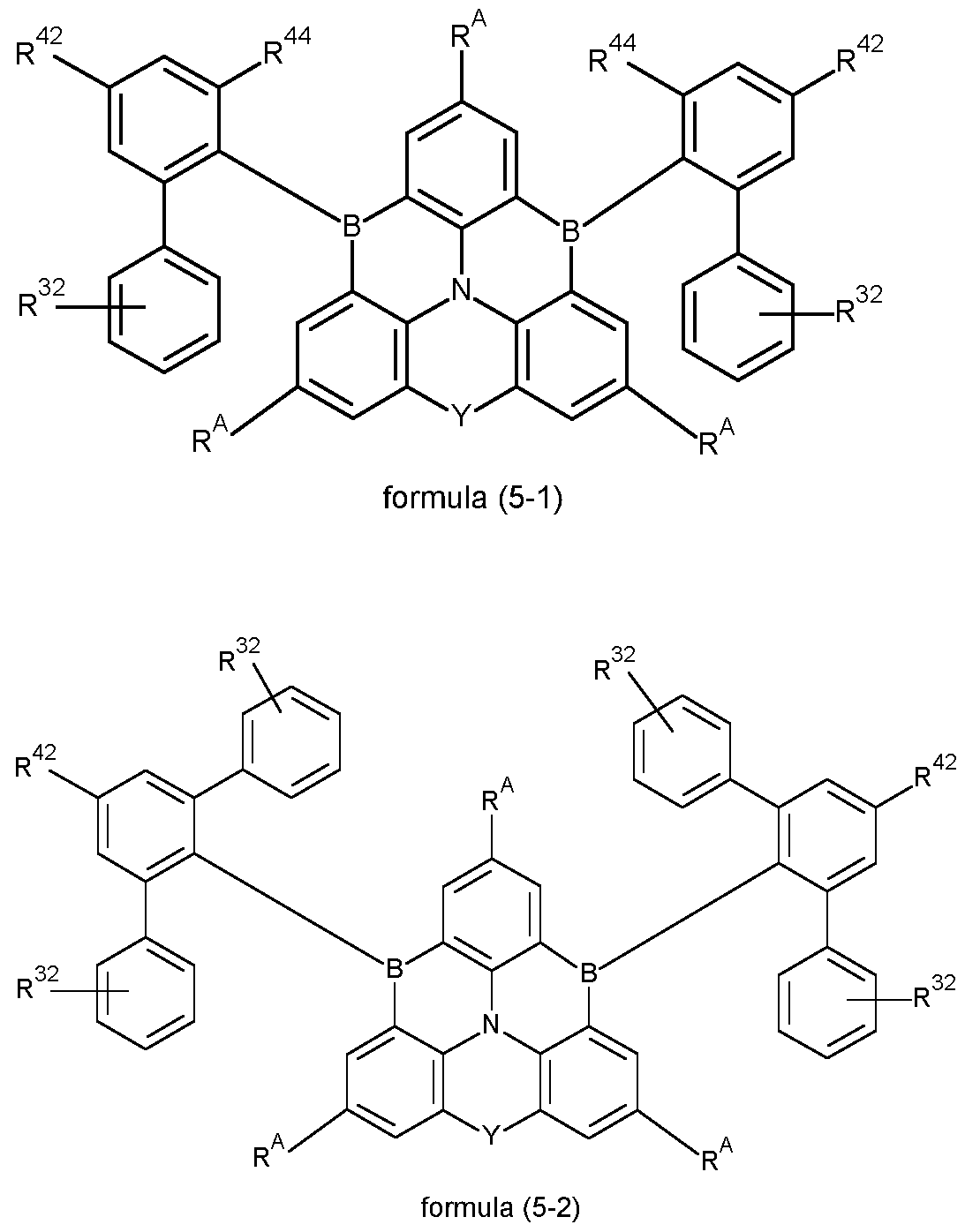
- the compounds of formulae (1 ) are selected from the compounds of formulae (5-1 ), (5-2) and (5- 3),
- R 32 are unsubstituted or substituted with one or more radicals R 32 ;
- R 42 and R 44 are at each occurrence, identically or differently, selected from H, a straight-chain alkyl group having 1 to 10 carbon atoms, or a branched or cyclic alkyl group having 3 to 10 carbon atoms, where the above-mentioned groups may each be substituted by one or more radicals R 32 ; where R 32 is as defined above.
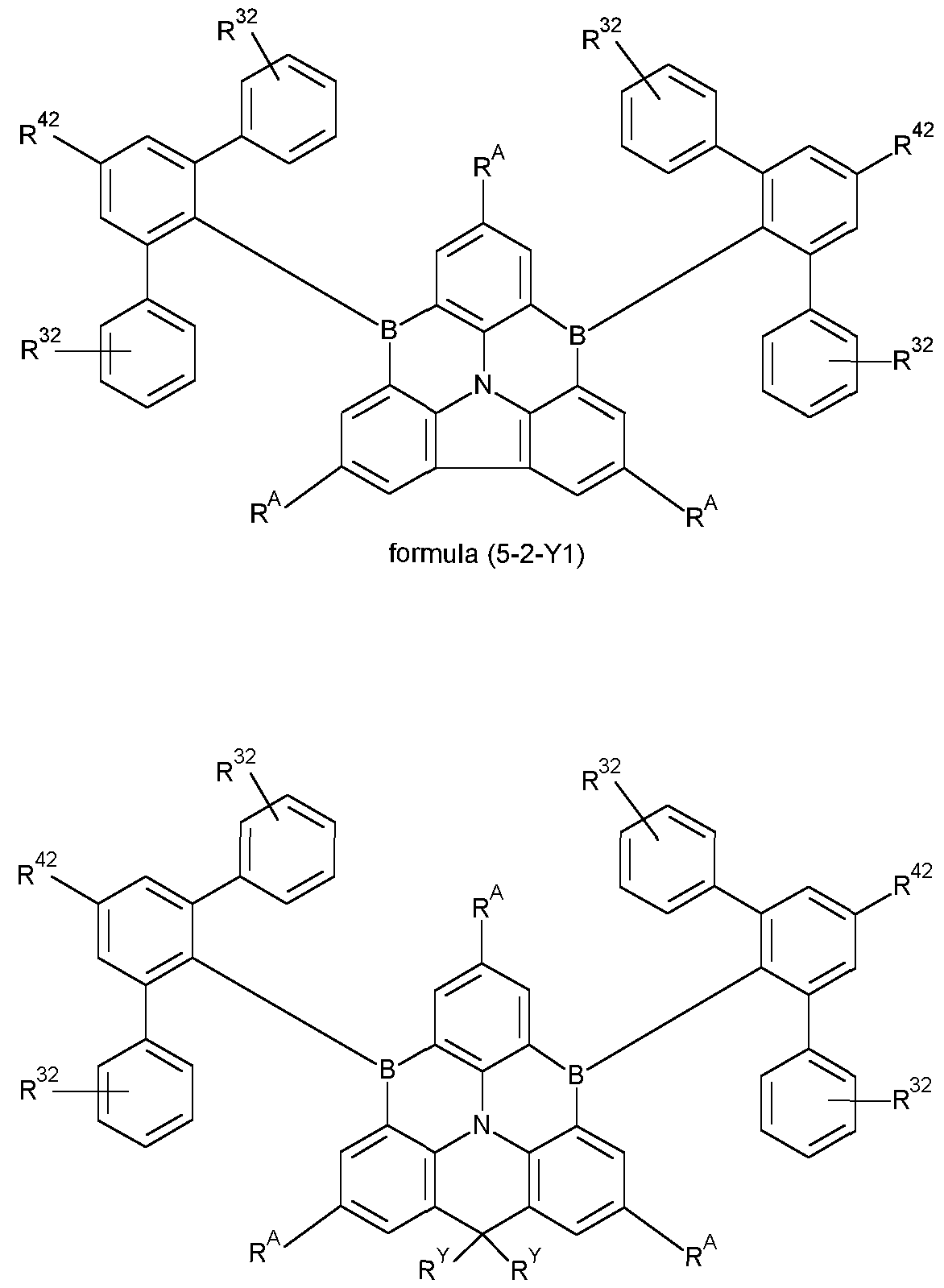
- the compounds of formulae (5-1 ), (5-2) and (5-3) correspond to compounds of formulae (5-1 -Y1 ), (5-1 -Y2), (5-1 -Y3), (5-2-Y1 ), (5-2-Y2), (5- 2-Y3) and (5-3-Y1 ), (5-3-Y2) and (5-3-Y3),
- R is selected from aromatic and heteroaromatic ring systems, it is preferably selected from aromatic and heteroaromatic ring systems having 5 to 40, preferably 5 to 30, more preferably 5 to 18 aromatic ring atoms or from aromatic or heteroaromatic ring system having 5 to 60 aromatic ring atoms corresponding to groups of formula (ArL-1 ) as defined above.
- the group Ar is on each occurrence, identically or differently, an aromatic or heteroaromatic ring system having 5 to 18, preferably 6 to 18 aromatic ring atoms, which may in each case also be substituted by one or more radicals R ' .
- R ’ stands on each occurrence, identically or differently, for H, D,
- the compounds according to the invention can be prepared by synthesis steps known to the person skilled in the art, such as, for example, bromination, Suzuki coupling, Ullmann coupling, Hartwig-Buchwald coupling, etc.
- An example of a suitable synthesis process is depicted in general terms in schemes 1 and 2 below.
- X 1 and X 2 are leaving groups preferably selected from halogens like
- X 1 and X 2 are a leaving groups preferably selected from halogens like Br, Cl, I, preferably Br, where the symbols Y and R B have the same meaning as above, and where the compounds depicted in Scheme 2 may be further substituted by radicals R 1 , R 2 and R A as defined above.
- the present invention therefore relates to a process for the synthesis of the compounds according to the invention, comprising a step where a triarylamine is substituted by at least two boronic acid or ester groups, where a cyclisation reaction occurs so that a boronic acid or ester group forms a 6-membered ring with the adjacent aromatic or heteroaromatic groups present in the triarylamine.
- the present invention therefore also relates to a process for the synthesis of the compounds according to the invention, comprising a step where a triarylamine is substituted by at least two boron-halogen compounds, where a cyclisation reaction occurs so that a boron-halogen compound forms a 6- membered ring with the adjacent aromatic or heteroaromatic groups present in the triarylamine.
- a process for the synthesis of the compounds according to the invention comprising a step where a triarylamine is substituted by at least two boron-halogen compounds, where a cyclisation reaction occurs so that a boron-halogen compound forms a 6- membered ring with the adjacent aromatic or heteroaromatic groups present in the triarylamine.
- Suitable and preferred solvents are, for example, toluene, anisole, o-, m- or p-xylene, methyl benzoate, mesitylene, tetralin, veratrol, THF, methyl-TFIF, THP, chlorobenzene, dioxane, phenoxytoluene, in particular 3-phenoxytoluene, (-)- fenchone, 1 ,2,3,5-tetramethylbenzene, 1 ,2,4,5-tetramethylbenzene,
- the present invention therefore furthermore relates to a formulation com prising a compound according to the invention and at least one further compound.
- the further compound may be, for example, a solvent, in particu lar one of the above-mentioned solvents or a mixture of these solvents.
- the further compound may also be at least one further organic or inorganic compound which is likewise employed in the electronic device, for example an emitting compound, in particular a phosphorescent dopant, and/or a further matrix material. Suitable emitting compounds and further matrix materials are indicated below in connection with the organic electro luminescent device.
- This further compound may also be polymeric.
- the compounds and mixtures according to the invention are suitable for use in an electronic device.
- An electronic device here is taken to mean a device which comprises at least one layer which comprises at least one organic com- pound.
- the component here may also comprise inorganic materials or also layers built up entirely from inorganic materials.
- the present invention therefore furthermore relates to the use of the com pounds or mixtures according to the invention in an electronic device, in particular in an organic electroluminescent device.
- the present invention again furthermore relates to an electronic device comprising at least one of the compounds or mixtures according to the invention mentioned above.
- the preferences stated above for the compound also apply to the electronic devices.
- the electronic device is preferably selected from the group consisting of organic electroluminescent devices (OLEDs, PLEDs), organic integrated circuits (O-ICs), organic field-effect transistors (O-FETs), organic thin-film transistors (O-TFTs), organic light-emitting transistors (O-LETs), organic solar cells (O-SCs), organic dye-sensitised solar cells, organic optical detectors, organic photoreceptors, organic field-quench devices (O-FQDs), light- emitting electrochemical cells (LECs), organic laser diodes (O-lasers) and "organic plasmon emitting devices” (D. M. Koller et al., Nature Photonics 2008, 1 -4), preferably organic electroluminescent devices (OLEDs, PLEDs), in particular phosphorescent OLEDs.
- OLEDs organic electroluminescent devices
- PLEDs organic integrated circuits
- O-FETs organic field-effect transistors
- OF-TFTs organic thin-film transistor
- the organic electroluminescent device comprises a cathode, an anode and at least one emitting layer. Apart from these layers, it may also comprise further layers, for example in each case one or more hole-injection layers, hole-transport layers, hole-blocking layers, electron-transport layers, electron- injection layers, exciton-blocking layers, electron-blocking layers and/or charge-generation layers. It is likewise possible for interlayers, which have, for example, an exciton-blocking function, to be introduced between two emitting layers. However, it should be pointed out that each of these layers does not necessarily have to be present.
- the organic electroluminescent device here may comprise one emitting layer or a plurality of emitting layers.
- a plurality of emission layers are present, these preferably have in total a plurality of emission maxima between 380 nm and 750 nm, resulting overall in white emission, i.e. various emitting compounds which are able to fluoresce or phosphoresce are used in the emitting layers.
- various emitting compounds which are able to fluoresce or phosphoresce are used in the emitting layers.
- Particular preference is given to systems having three emitting layers, where the three layers exhibit blue, green and orange or red emission (for the basic structure see, for example, WO 2005/011013).
- These can be fluorescent or phosphorescent emission layers or hybrid systems, in which fluorescent and phosphorescent emission layers are combined with one another.
- an organic electroluminescent device comprising a compound of the formula (1 ) or in accordance with the preferred embodiments as fluorescent emitters or TADF (Thermally Activated Delayed Fluorescence) emitters. More particularly, the compound of the formula (1 ) or in accordance with the preferred embodiments is preferably employed as a blue-fluorescent emitter showing prompt fluorescence or as a blue TADF emitter.
- the compound of formula (1 ) or in accordance with the preferred embodiments is employed in a hyperfluorescent system, as described for example in WO2015/135624, comprising the compound of formula (1 ) as a fluorescent emitter and a sensitizer compound selected from thermally activated delayed fluorescence compounds (TADF compounds), wherein the energy of the sensitizer is transferred to the fluorescent emitter via Forster resonance energy transfer.
- TADF compounds thermally activated delayed fluorescence compounds
- the compound of formula (1 ) or in accordance with the preferred embodiments is employed in a hyperphosphorescent system, as described for example in W02001/08230A1 , comprising the compound of formula (1 ) as a fluorescent emitter, and a sensitizer compound selected from phosphorescent compounds, wherein the energy of the sensitizer is transferred to the fluorescent emitter via Forster resonance energy transfer.
- the compounds of formula (1 ) can also be employed in an electron-transport layer and/or in an electron-blocking or exciton-blocking layer and/or in a hole- transport layer, depending on the precise substitution.
- the preferred embodi ments indicated above also apply to the use of the materials in organic electronic devices.
- the compound of formula (1 ) is particularly suitable for use as a blue emitter compound.
- the electronic device concerned may comprise a single emitting layer comprising the compound according to the invention or it may comprise two or more emitting layers.
- the further emitting layers here may comprise one or more compounds according to the invention or alternatively other compounds.
- the compound according to the invention is employed as a fluorescent emitter or TADF emitter in an emitting layer, it is preferably employed in combination with one or more matrix materials.
- a matrix material here is taken to mean a material which is present in the emitting layer, preferably as the principal component, and which does not emit light on operation of the device.
- the matrix compound has a glass transition temperature TG of greater than 70°C, more preferably greater than 90°C, most preferably greater than 1 10°C.
- the proportion of the emitting compound in the mixture of the emitting layer is between 0.1 and 50.0%, preferably between 0.5 and 20.0%, particularly preferably between 1 .0 and 10.0%.
- the proportion of the matrix material or matrix materials is between 50.0 and 99.9%, preferably between 80.0 and 99.5%, particularly preferably between 90.0 and 99.0%.
- the specifications of the proportions in % are, for the purposes of the present application, taken to mean % by vol. if the compounds are applied from the gas phase and % by weight if the compounds are applied from solution.
- the preferred matrix materials for use in combination with the fluorescent emitter are selected from the classes of the oligoarylenes (for example 2,2‘,7,7‘-tetraphenylspirobifluorene in accordance with EP 676461 or dinaphthylanthracene), in particular the oligoarylenes containing condensed aromatic groups, the oligoarylenevinylenes (for example DPVBi or spiro-DPVBi in accordance with EP 676461 ), the polypodal metal complexes (for example in accordance with WO 2004/081017), the hole-conducting compounds (for example in accordance with WO 2004/05891 1 ), the electron-conducting compounds, in particular ketones, phosphine oxides, sulfoxides, etc.
- the oligoarylenes for example 2,2‘,7,7‘-tetraphenylspirobifluorene in accordance with EP 676461 or dinaphthylanth
- Particularly preferred matrix materials are selected from the classes of the oligoarylenes, comprising naphthalene, anthracene, benzanthracene and/or pyrene or atropisomers of these com- pounds, the oligoarylenevinylenes, the ketones, the phosphine oxides and the sulfoxides.
- Very particularly preferred matrix materials are selected from the classes of the oligoarylenes, comprising anthracene, benzanthracene, benzophenanthrene and/or pyrene or atropisomers of these compounds.
- An oligoarylene in the sense of this invention is intended to be taken to mean a compound in which at least three aryl or arylene groups are bonded to one another.
- the compound according to the invention is employed as a fluorescent emitting compound in an emitting layer, it may be employed in combination with one or more other fluorescent emitting compounds.
- Preferred fluorescent emitters are selected from the class of the arylamines.
- An arylamine in the sense of this invention is taken to mean a compound which contains three substituted or unsubstituted aromatic or heteroaromatic ring systems bonded directly to the nitrogen. At least one of these aromatic or heteroaromatic ring systems is preferably a condensed ring system, particularly preferably having at least 14 aromatic ring atoms.
- Preferred examples thereof are aromatic anthracenamines, aromatic anthracenediamines, aromatic pyrenamines, aromatic pyrenediamines, aromatic chrysenamines or aromatic chrysene- diamines.
- An aromatic anthracenamine is taken to mean a compound in which one diarylamino group is bonded directly to an anthracene group, preferably in the 9-position.
- An aromatic anthracenediamine is taken to mean a com pound in which two diarylamino groups are bonded directly to an anthracene group, preferably in the 9, 10-position.
- Aromatic pyrenamines, pyrene diamines, chrysenamines and chrysenediamines are defined analogously thereto, where the diarylamino groups are preferably bonded to the pyrene in the 1 -position or in the 1 ,6-position.
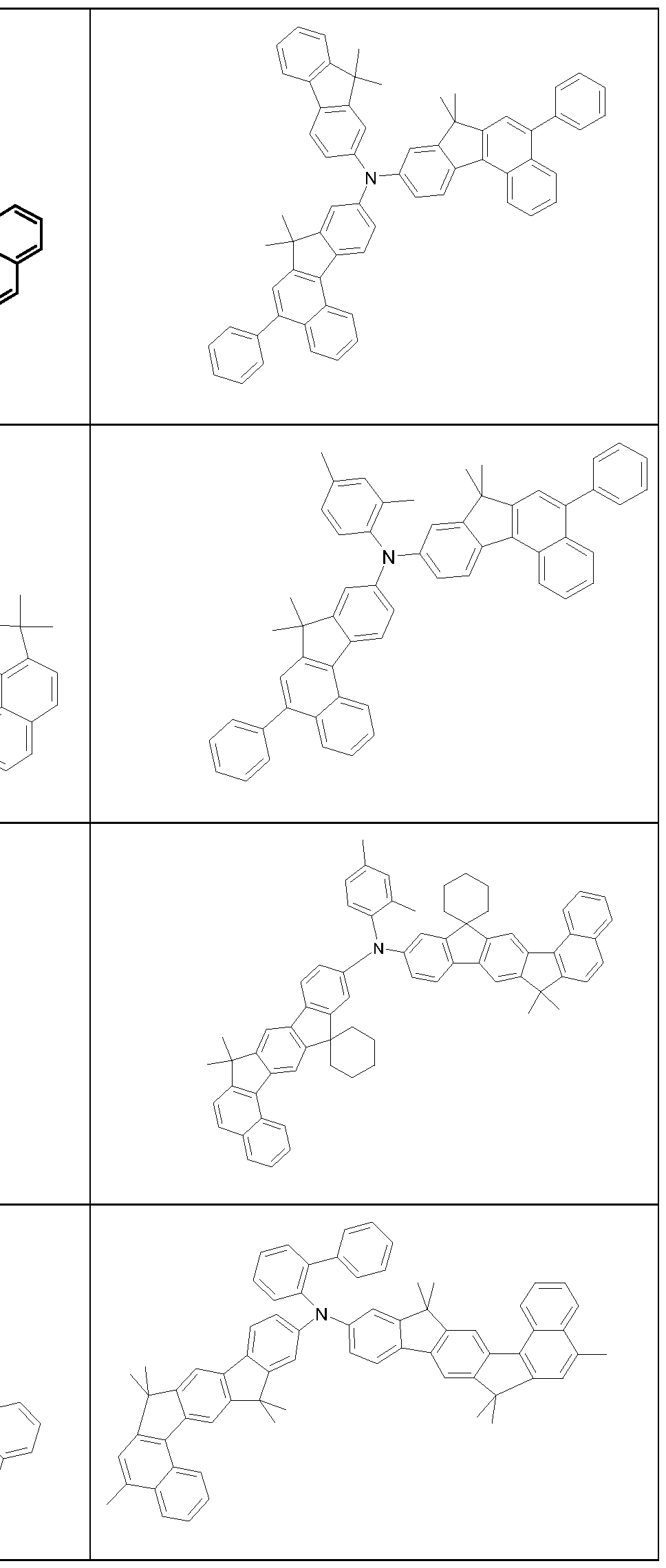
- emitters are indenofluorenamines or indenofluorenediamines, for example in accordance with WO 2006/108497 or WO 2006/122630, benzoindenofluorenamines or benzoindenofluorenediamines, for example in accordance with WO 2008/ 006449, and dibenzoindenofluorenamines or dibenzoindenofluorene- diamines, for example in accordance with WO 2007/140847, and the indenofluorene derivatives containing condensed aryl groups which are disclosed in WO 2010/012328.
- Still further preferred emitters are benzanthracene derivatives as disclosed in WO 2015/158409, anthracene derivatives as disclosed in WO 2017/036573, fluorene dimers like in WO 2016/150544 or phenoxazine derivatives as disclosed in WO 2017/028940 and WO 2017/028941 .
- Preference is likewise given to the pyrenarylamines disclosed in WO 2012/048780 and WO 2013/185871 .
- Preference is likewise given to the benzoindenofluorenamines disclosed in WO 2014/037077, the benzofluorenamines disclosed in WO 2014/106522 and the indenofluorenes disclosed in WO 2014/1 1 1269 or WO 2017/036574.
- the preferred matrix materials for use in combination with the TADF emitter are selected from the classes of the ketones, phosphine oxides, sulfoxides and sulfones, for example according to WO 2004/013080, WO 2004/093207,
- WO 2006/005627 or WO 2010/006680 triarylamines, carbazole derivatives, e.g. CBP (N,N-biscarbazolylbiphenyl), m-CBP or the carbazole derivatives disclosed in WO 2005/039246, US 2005/0069729, JP 2004/288381 , EP
- WO 2010/136109 or WO 2011/000455 azacarbazoles, for example according to EP 1617710, EP 1617711 , EP 1731584, JP 2005/347160, bipolar matrix materials, for example according to WO 2007/137725, silanes, for example according to WO 2005/111172, azaboroles or boronic esters, for example according to WO 2006/117052, diazasilole derivatives, for example according to WO 2010/054729, diazaphosphole derivatives, for example according to WO 2010/054730, triazine derivatives, for example according to WO 2010/015306, WO 2007/063754 or WO 2008/056746, pyrimidine derivatives, quinoxaline derivatives, Zn complexes, Al complexes or Be complexes, for example according to EP 652273 or WO
- Suitable matrix materials are also those described in WO 2015/135624. These are incorporated into the present invention by reference. It is also possible to use mixtures of two or more of these matrix materials.
- the matrix compounds for TADF emitters are preferably charge
- An electron-transporting compound in the context of the present invention is a compound having a LUMO ⁇ -2.50 eV.
- the LUMO is ⁇ -2.60 eV, more preferably ⁇ -2.65 eV, most preferably ⁇ -2.70 eV.
- the LUMO is the lowest unoccupied molecular orbital. The value of the LUMO of the compound is determined by quantum-chemical calculation, as described in general terms in the examples section at the back.
- a hole transporting compound in the context of the present invention is a compound having a HOMO > -5.5 eV.
- the HOMO is preferably > -5.4 eV, more preferably > -5.3 eV.
- the HOMO is the highest occupied molecular orbital.
- the value of the HOMO of the compound is determined by quantum-chemical calculation, as described in general terms in the examples section at the back.
- a bipolar compound in the context of the present invention is a compound which is both hole- and electron
- Suitable electron-conducting matrix compounds for TADF emitters are selected from the substance classes of the triazines, the pyrimidines, the lactams, the metal complexes, especially the Be, Zn and Al complexes, the aromatic ketones, the aromatic phosphine oxides, the azaphospholes, the azaboroles substituted by at least one electron-conducting substituent, and the quinoxalines.
- the electron conducting compound is a purely organic compound, i.e. a compound containing no metals.
- the hyperfluorescent and hyperphosphorescent systems as mentioned above preferably comprise, additionally to the sensitizer and the fluorescent emitter, at least one matrix material.
- the lowest triplet energy of the matrix compound is not more than 0.1 eV lower than the triplet energy of the sensitizer compound.
- Ti (matrix) here is the lowest triplet energy of the matrix compound and Ti (sensitizer) is the lowest triplet energy of the sensitizer compound.
- the triplet energy of the matrix compound T-i(mathx) is determined here from the edge of the photoluminescence spectrum measured at 4 K of the neat film.
- Ti (sensitizer) is determined from the edge of the photoluminescence spectrum measured at room temperature in toluene solution.
- Suitable matrix materials for hyperfluorescent or hyperphosphorescent systems are the same matrix materials as mentioned above, more preferred are the matrix materials that are also preferred for TADF materials.
- Suitable phosphorescent emitters are, in particular, compounds which emit light, preferably in the visible region, on suitable excitation and in addition contain at least one atom having an atomic number greater than 20, pref erably greater than 38 and less than 84, particularly preferably greater than 56 and less than 80.
- the phosphorescent emitters used are preferably com pounds which contain copper, molybdenum, tungsten, rhenium, ruthenium, osmium, rhodium, iridium, palladium, platinum, silver, gold or europium, in particular compounds which contain iridium, platinum or copper.
- all luminescent iridium, platinum or copper complexes are regarded as phosphorescent compounds.
- Examples of the phosphorescent emitters described above are revealed by the applications WO 2000/70655, WO 2001/41512, WO 2002/02714, WO 2002/15645, EP 1 191613, EP 1 191612, EP 1 191614, WO 2005/033244, WO 2005/019373 and US 2005/0258742.
- all phosphorescent complexes as used in accordance with the prior art for phosphorescent OLEDs and as are known to the person skilled in the art in the area of organic electroluminescent devices are suitable for use in the devices according to the invention.
- the person skilled in the art will also be able to employ further phosphorescent complexes without inventive step in combination with the compounds according to the invention in OLEDs.
- Preferred matrix materials for phosphorescent emitters are aromatic ketones, aromatic phosphine oxides or aromatic sulfoxides or sulfones, for example in accordance with WO 2004/013080, WO 2004/093207, WO 2006/005627 or WO 2010/006680, triarylamines, carbazole derivatives, for example CBP (N,N-biscarbazolylbiphenyl) or the carbazole derivatives disclosed in WO 2005/039246, US 2005/0069729, JP 2004/288381 , EP 1205527 or WO 2008/086851 , indolocarbazole derivatives, for example in accordance with WO 2007/063754 or WO 2008/056746, indenocarbazole derivatives, for example in accordance with WO 2010/136109, WO 201 1/000455 or WO 2013/041 176, azacarbazole derivatives, for example in accordance with EP 1617710, EP 161771
- the phosphorescent compound when employed in a hyperphosphorescent system as described above, is preferably selected from the phosphorescent organometallic complexes, which are described, for example, in W02015/091716. Also particularly preferred are the phosphorescent organometallic complexes, which are described in W02000/70655, W02001/41512, W02002/02714, W02002/15645, EP1191612, W02005/033244, W02005/019373,
- phosphorescent organometallic complexes having polypodal ligands as described, for example, in W02004/081017, W02005/042550, US2005/0170206, W02009/146770, WO2010/102709, WO2011/066898, WO2016124304, WO2017/032439, WO2018/019688, EP3184534 and WO2018/011186.
- phosphorescent binuclear organometallic complexes as described, for example, in WO2011/045337, US20150171350, WO2016/079169, WO2018/019687, WO2018/041769, WO2018/054798, WO2018/069196, WO2018/069197, WO2018/069273.
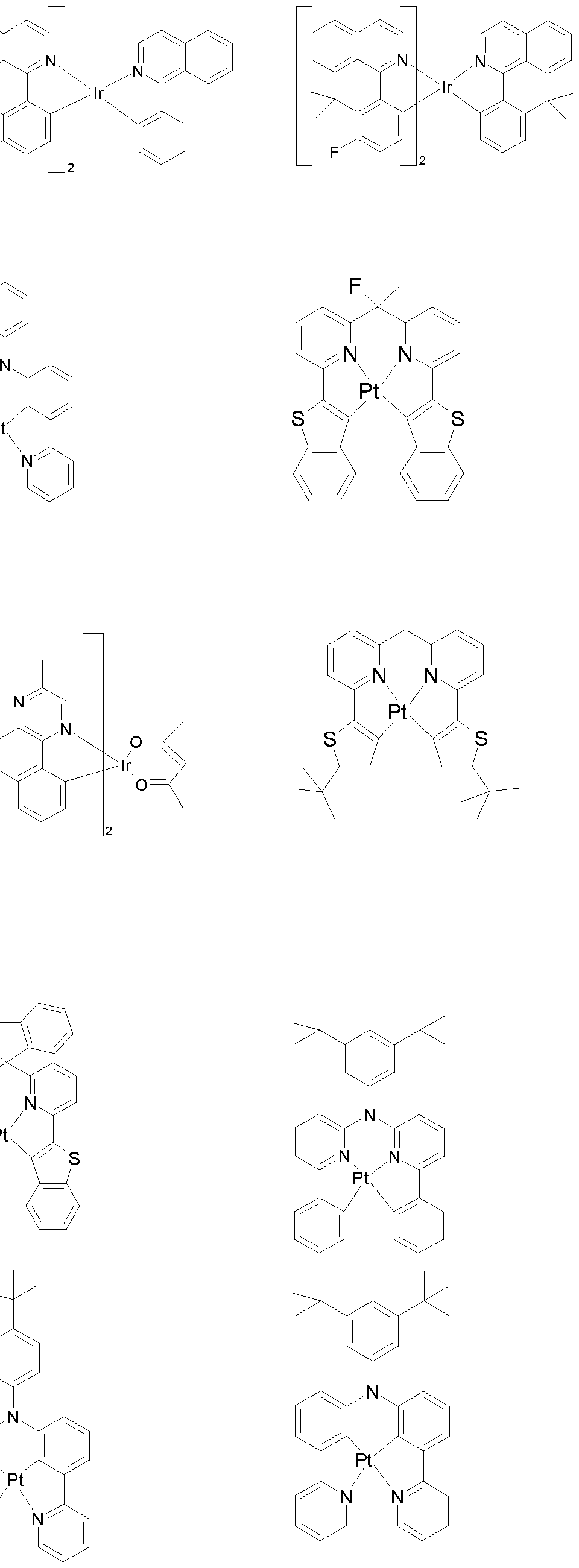
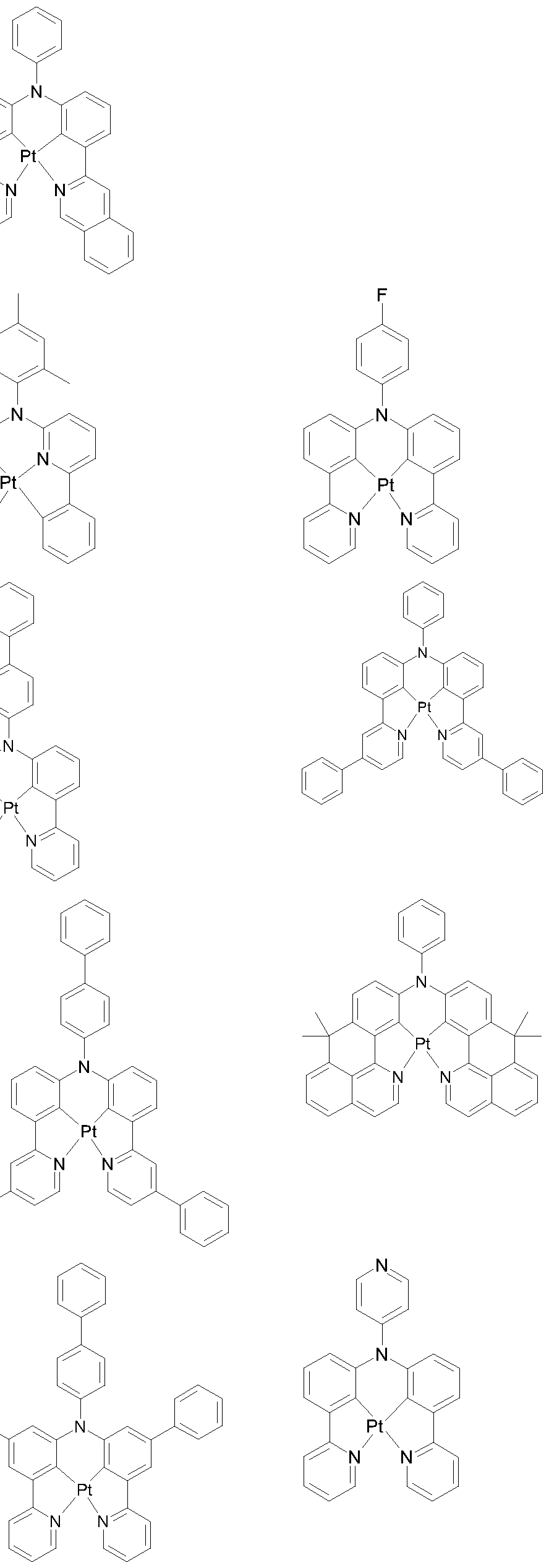
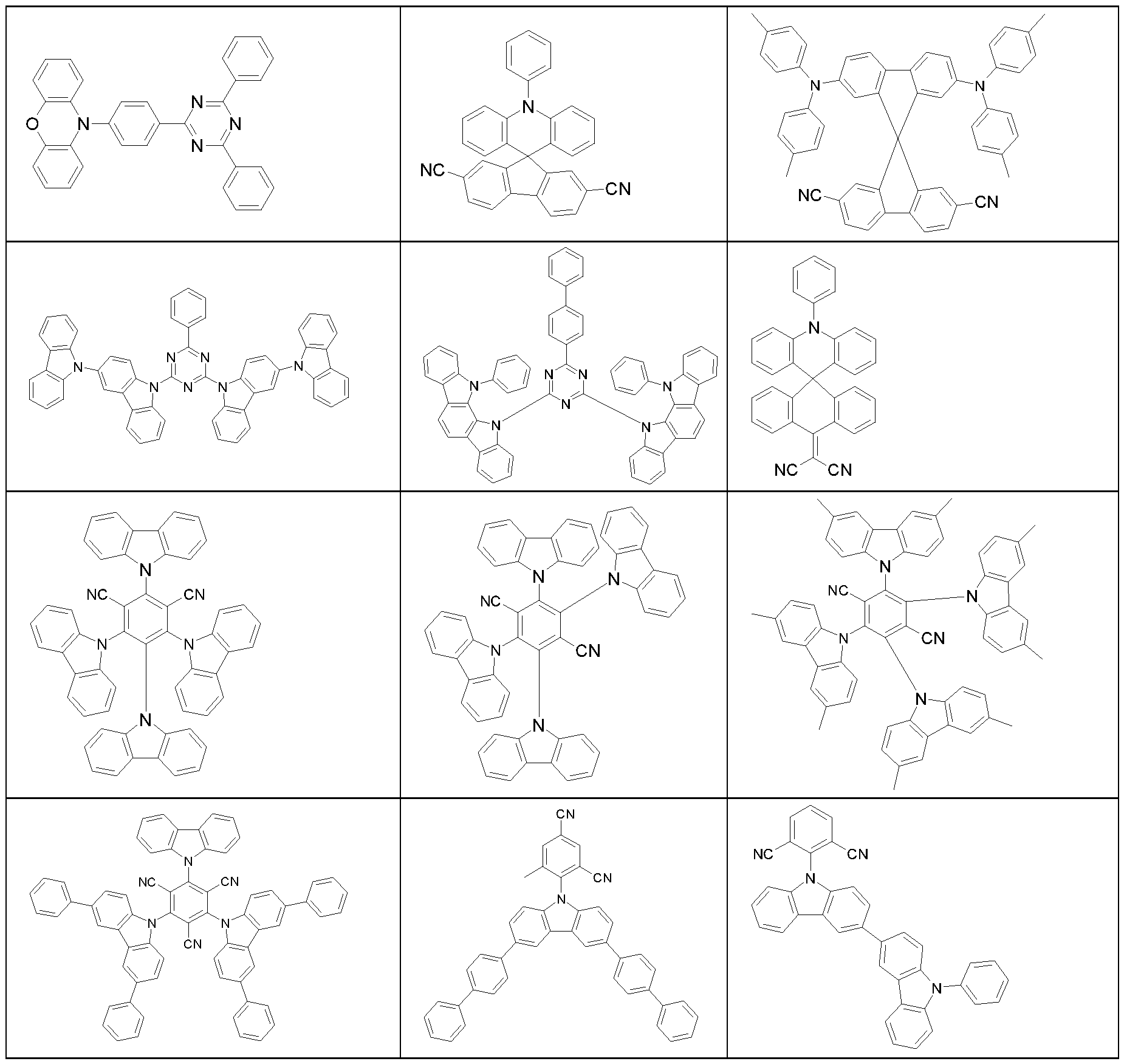
- phosphorescent sensitizers are lr(ppy)3 and its derivatives as well as the structures listed below:
- phosphorescent sensitizers are iridium and platinum complexes containing carbene ligands and the structures listed below, wherein homoleptic and heteroleptic complexes and meridonal and facial isomers may be suitable:
- phosphorescent sensitizers are also copper complexes and the structures listed below:
- suitable TADF compounds are compounds in which the energy gap between the lowest triplet state Ti and the first excited singlet state Si is sufficiently small that the Si state is thermally accessible from the Ti state.
- TADF compounds have a gap between the lowest triplet state Ti and the first excited singlet state Si of ⁇ 0.30 eV. More preferably, the gap between Si and Ti is ⁇ 0.20 eV, even more preferably ⁇ 0.15 eV, especially more preferably ⁇ 0.10 eV and even more especially preferably ⁇ 0.08 eV.
- the energy of the lowest excited singlet state (Si) and the lowest triplet state (Ti) as well as the HOMO and LUMO values are determined by quantum- chemical calculations.
- the Gaussian09 program package (revision D or later) is used. Neutral ground state geometries of all purely organic molecules are optimized at the AM1 level of theory.
- B3PW91/6-31 G(d) single point calculations including a calculation of the lowest singlet and triplet excited states with TD-B3PW91/6-31 G(d).
- HOMO and LUMO values as well as S1 and T1 excitation energies are taken from this single-point calculation at the B3PW91/6-31 G(d) level of theory.
- B3PW91/6-31 G(d)+LANL2DZ (LANL2DZ for all metal atoms, 6-31 G(d) for all low-weight elements) is subsequently employed to calculate HOMO and LUMO values as well as TD- DFT excitation energies.
- HOMO (HEh) and LUMO (LEh) values from the calculation are given in Hartree units.
- the HOMO and LUMO energy levels calibrated with reference to cyclic voltammetry measurements are determined therefrom in electron volts as follows:
- the lowest triplet state Ti is defined as the energy of the lowest TD-DFT triplet excitation energy.
- the lowest excited singlet state Si is defined as the energy of the lowest TD- DFT singlet excitation energy.
- the TADF compound is an organic compound.
- Organic compounds in the context of the present invention are carbonaceous compounds that do not contain any metals. More particularly, organic compounds are formed from the elements C, H, D, B, Si, N, P, O, S, F, Cl, Br and I.
- the TADF compound is more preferably an aromatic compound having both donor and acceptor substituents, with only slight spatial overlap between the LUMO and the FIOMO of the compound.
- donor and acceptor substituents are known in principle to those skilled in the art.
- Suitable donor substituents are especially diaryl- or -heteroarylamino groups and carbazole groups or carbazole derivatives, each preferably bonded to the aromatic compound via N. These groups may also have further substitution.
- Suitable acceptor substituents are especially cyano groups, but also, for example, electron-deficient heteroaryl groups which may also have further substitution, for example substituted or unsubstituted triazine groups.
- the preferred dopant concentrations of the TADF compound in the emitting layer are described hereinafter. Because of the difference in production of the organic electroluminescent device, the dopant concentration in the case of production of the emitting layer by vapor deposition is reported in % by volume, and in the case of production of the emitting layer from solution in % by weight. The dopant concentrations in % by volume and % by weight is generally very similar. In a preferred embodiment of the invention, in the case of production of the emitting layer by vapor deposition, the TADF compound is present in a dopant concentration of 1 % to 70% by volume in the emitting layer, more preferably of 5% to 50% by volume, even more preferably of 5% to 30% by volume.
- the TADF compound in the case of production of the emitting layer from solution, is present in a dopant concentration of 1 % to 70% by weight in the emitting layer, more preferably of 5% to 50% by weight, even more preferably of 5% to 30% by weight.
- the compounds of formula (1 ) or in accordance with the preferred embodiments may be used as fluorescent emitters in combination with a sensitizer in a hyperfluorescent or hyperphosphorescent system.
- the compounds of formula (1 ) are sterically shielded.
- compounds of formula (1 ) corresponding to compounds of formulae (5) and (6), more particularly (5-1 ) to (5-3) are very suitable as sterically shielded fluorescent emitters in combination with a sensitizer selected from TADF compounds and phosphorescent compounds in an emitting layer.
- the emitting layer further comprises at least one organic functional material selected from matrix materials.
- embodiments can also be employed in combination with further compounds selected from the group consisting of FITM (Flole Transport Material), HIM (Flole Injection Material), FIBM (Flole Blocking Material), p-dopant, ETM (Electron Transport Material), EIM (Electron Injection Material), EBM
- Electrode Blocking Material n-dopant, fluorescent emitter, phosphorescent emitter, delayed fluorescent emitter, matrix material, host material, wide band gap material and quantum material, like quantum dot and quantum rod.
- the compounds of formula (1 ) or in accordance with preferred embodiments can also be employed in other layers, for example as hole-transport materials in a hole-injection or hole-transport layer or electron-blocking layer or as matrix materials in an emitting layer.
- Suitable charge-transport materials are, for example, the com pounds disclosed in Y. Shirota et al. , Chem. Rev. 2007, 107(4), 953-1010, or other materials as are employed in these layers in accordance with the prior art.
- Materials which can be used for the electron-transport layer are all materials as are used in accordance with the prior art as electron-transport materials in the electron-transport layer. Particularly suitable are aluminium complexes, for example Alq3, zirconium complexes, for example Zrq4, lithium complexes, for example LiQ, benzimidazole derivatives, triazine derivatives, pyrimidine derivatives, pyridine derivatives, pyrazine derivatives, quinoxaline derivatives, quinoline derivatives, oxadiazole derivatives, aromatic ketones, lactams, boranes, diazaphosphole derivatives and phosphine oxide derivatives. Furthermore, suitable materials are derivatives of the above-mentioned compounds, as disclosed in JP 2000/053957, WO 2003/060956, WO 2004/028217, WO 2004/080975 and WO 2010/072300.
- Preferred hole-transport materials which can be used in a hole-transport, hole-injection or electron-blocking layer in the electroluminescent device according to the invention are indenofluorenamine derivatives (for example in accordance with WO 06/122630 or WO 06/100896), the amine derivatives disclosed in EP 1661888, hexaazatriphenylene derivatives (for example in accordance with WO 01/049806), amine derivatives containing condensed aromatic rings (for example in accordance with US 5,061 ,569), the amine derivatives disclosed in WO 95/09147, monobenzoindenofluorenamines (for example in accordance with WO 08/006449), dibenzoindenofluorenamines (for example in accordance with WO 07/140847), spirobifluorenamines (for example in accordance with WO 2012/034627 or WO 2013/120577), fluorenamines (for example in accordance with the as applications EP 2875092, EP 28756
- the cathode of the organic electroluminescent device preferably comprises metals having a low work function, metal alloys or multilayered structures comprising various metals, such as, for example, alkaline-earth metals, alkali metals, main-group metals or lanthanoids (for example Ca, Ba, Mg, Al, In, Mg, Yb, Sm, etc.). Also suitable are alloys comprising an alkali metal or alkaline- earth metal and silver, for example an alloy comprising magnesium and silver.
- further metals which have a relatively high work function such as, for example, Ag orAI
- lithium quinolinate (LiQ) can be used for this purpose.
- the layer thickness of this layer is preferably between 0.5 and 5 nm.
- the anode preferably comprises materials having a high work function.
- the anode preferably has a work function of greater than 4.5 eV vs. vacuum. Suitable for this purpose are on the one hand metals having a high redox potential, such as, for example, Ag, Pt or Au.
- metal/metal oxide electrodes for example AI/Ni/NiO x , AI/PtO x
- at least one of the electrodes must be transparent or partially transparent in order to facilitate either irradiation of the organic material (organic solar cells) or the coupling-out of light (OLEDs, O-lasers).
- Preferred anode materials here are conductive mixed metal oxides. Particular preference is given to indium tin oxide (ITO) or indium zinc oxide (IZO). Preference is furthermore given to conductive, doped organic materials, in particular conductive doped polymers.
- the device is appropriately (depending on the application) structured, pro vided with contacts and finally sealed, since the lifetime of the devices according to the invention is shortened in the presence of water and/or air.
- the organic electroluminescent device according to the invention is characterised in that one or more layers are coated by means of a sublimation process, in which the materials are applied by vapour deposition in vacuum sublimation units at an initial pressure of less than 10 5 mbar, preferably less than 10 6 mbar.
- the initial pressure it is also possible here for the initial pressure to be even lower, for example less than 10 7 mbar.
- an organic electroluminescent device char acterised in that one or more layers are coated by means of the OVPD (organic vapour phase deposition) process or with the aid of carrier-gas sublimation, in which the materials are applied at a pressure of between 10 5 mbar and 1 bar.
- OVPD organic vapour phase deposition
- carrier-gas sublimation in which the materials are applied at a pressure of between 10 5 mbar and 1 bar.
- OVJP organic vapour jet printing
- an organic electroluminescent device characterised in that one or more layers are produced from solution, such as, for example, by spin coating, or by means of any desired printing process, such as, for example, screen printing, flexographic printing, nozzle printing or offset printing, but particularly preferably LITI (light induced thermal imaging, thermal transfer printing) or ink-jet printing.
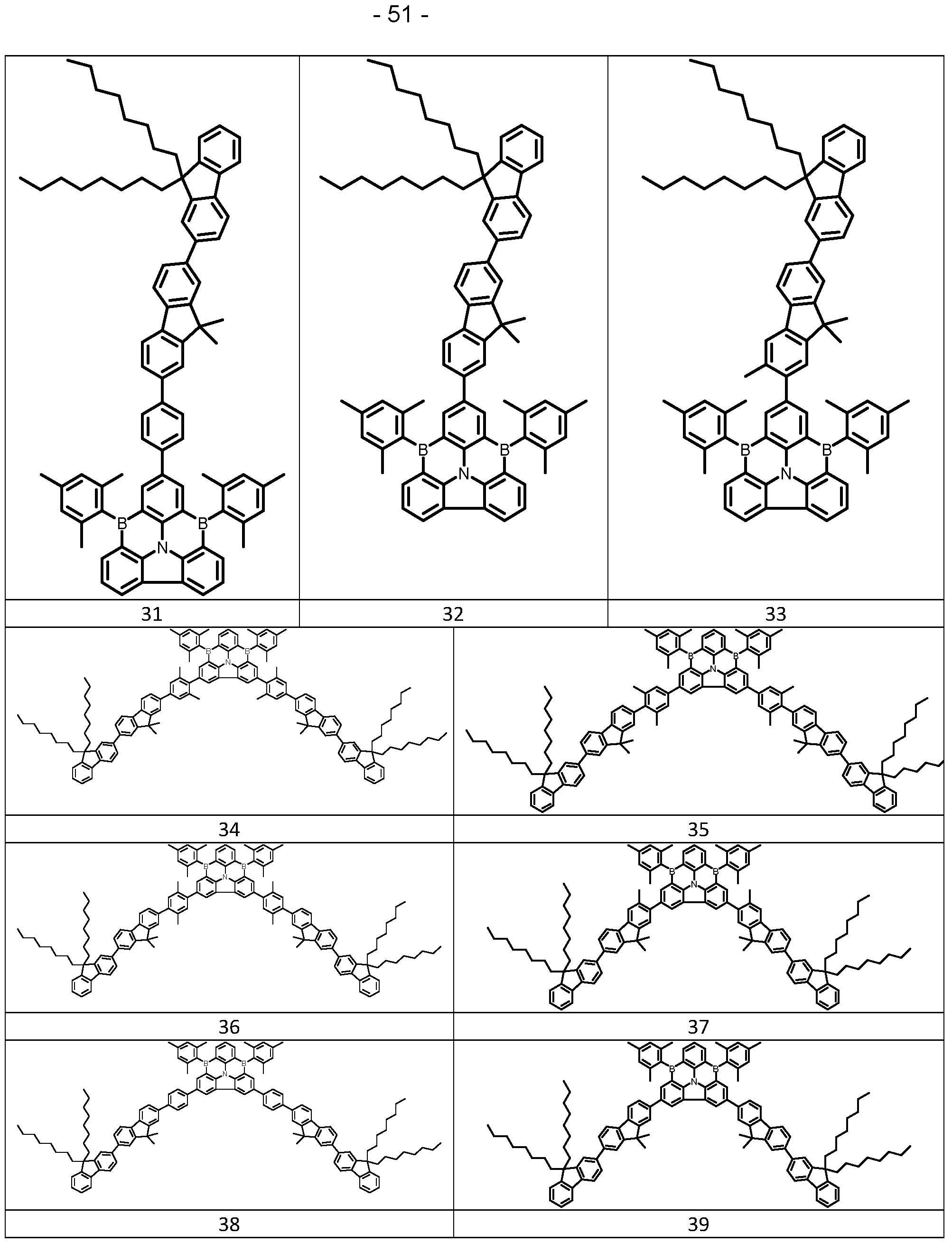
- Soluble compounds of the formula (I) are necessary for this purpose. High solubility can be achieved through suitable substitution of the compounds.
- hybrid processes in which, for example, one or more layers are applied from solution and one or more further layers are applied by vapour deposition.
- the electronic devices comprising one or more compounds according to the invention can be employed in displays, as light sources in lighting applications and as light sources in medical and/or cosmetic applications (for example light therapy).
- the reaction is quenched by the addition of 1 N HCI (50 ml_) and diluted with ethyl acetate (200 ml_). The organic layer is separated and dried in vacuo. The residue is washed with methanol. The desired product is obtained as white solid (4.9 g, 9.9 mmol, 49.6 %).
- the reaction mixture is refluxed for 2 h, before it is cooled down to rt.
- the reaction is quenched by the addition of water (200 ml_).
- the organic layer is separated and concentrated in vacuo.
- the residue is washed with ethanol.
- the desired product is obtained as white solid (60.0 g, 145.8 mmol, 81 .5 %).
- the reaction mixture is allowed to warm to 0 °C.
- the reaction mixture is stirred for 1 h at this temperature, before N,N-diisopropylethylamine (3.0 ml_, 17.2 mmol, 2.0 equiv.) is added.
- the reaction mixture is refluxed for 16 h.
- the reaction mixture is cooled down to -78 °C and 1 -lithium-2, 4, 6-triphenyl-benzene (10.8 g, 34.4 mmol, 4.0 equiv.) is added.
- the resulting mixture is allowed to warm to rt.
- the solvent is removed, and the crude product is purified by column chromatography.
- the desired product is isolated as yellow solid (3.6 g, 3.4 mmol, 40 %).
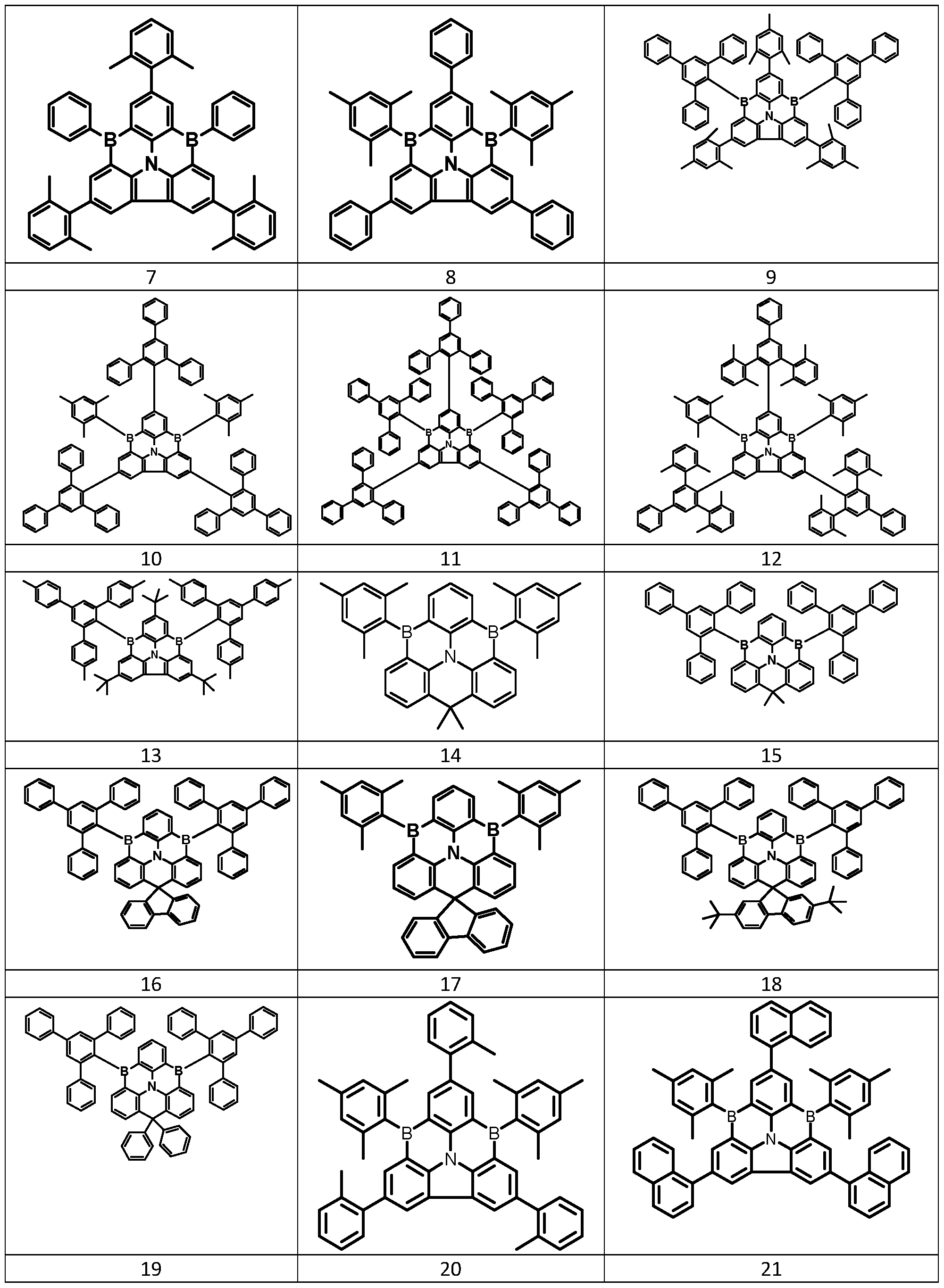
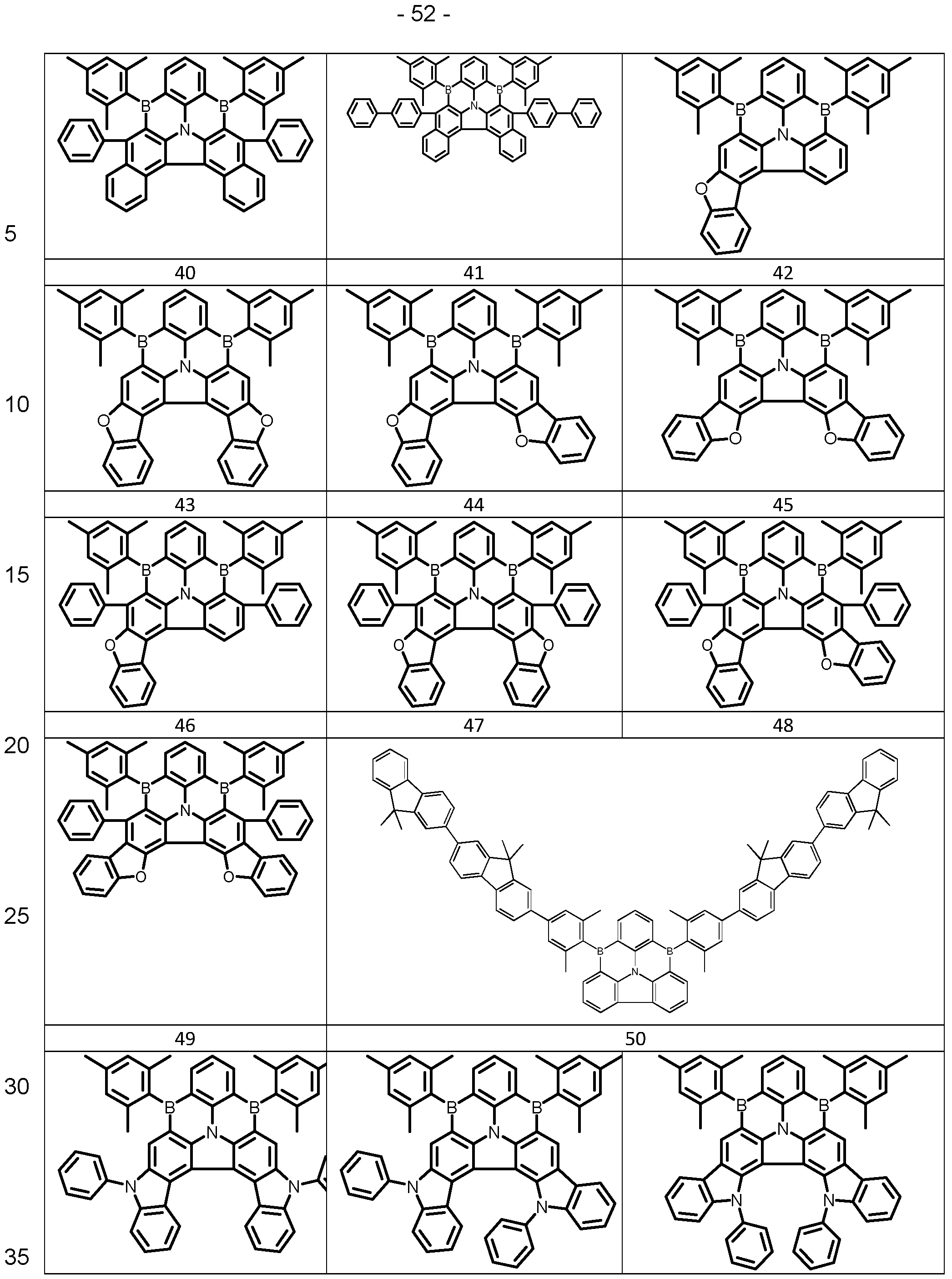
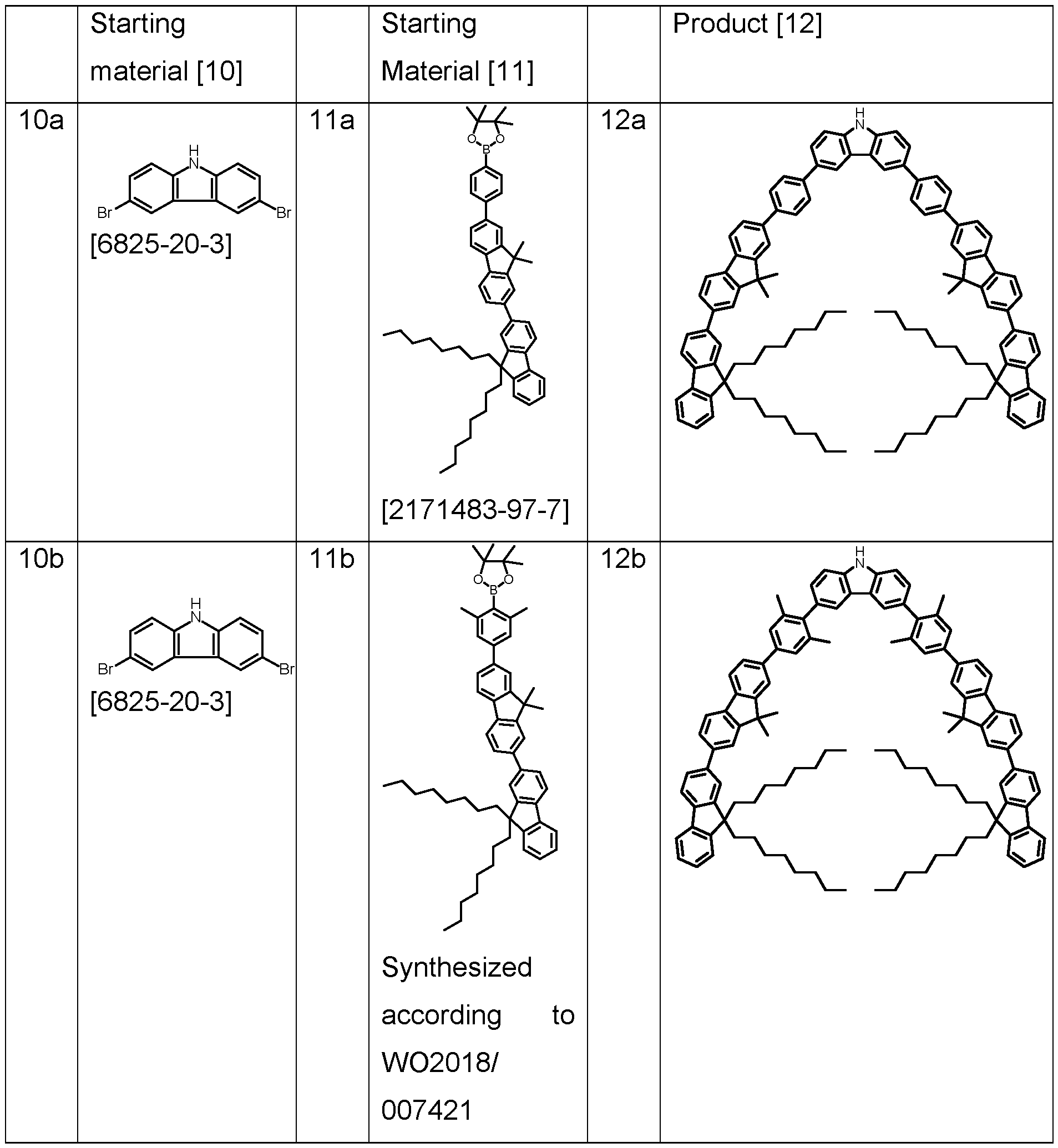
- the products [12] shown in table 1 can be obtained using the respective starting materials [10] and [1 1 ] according to WO2018/007421 .
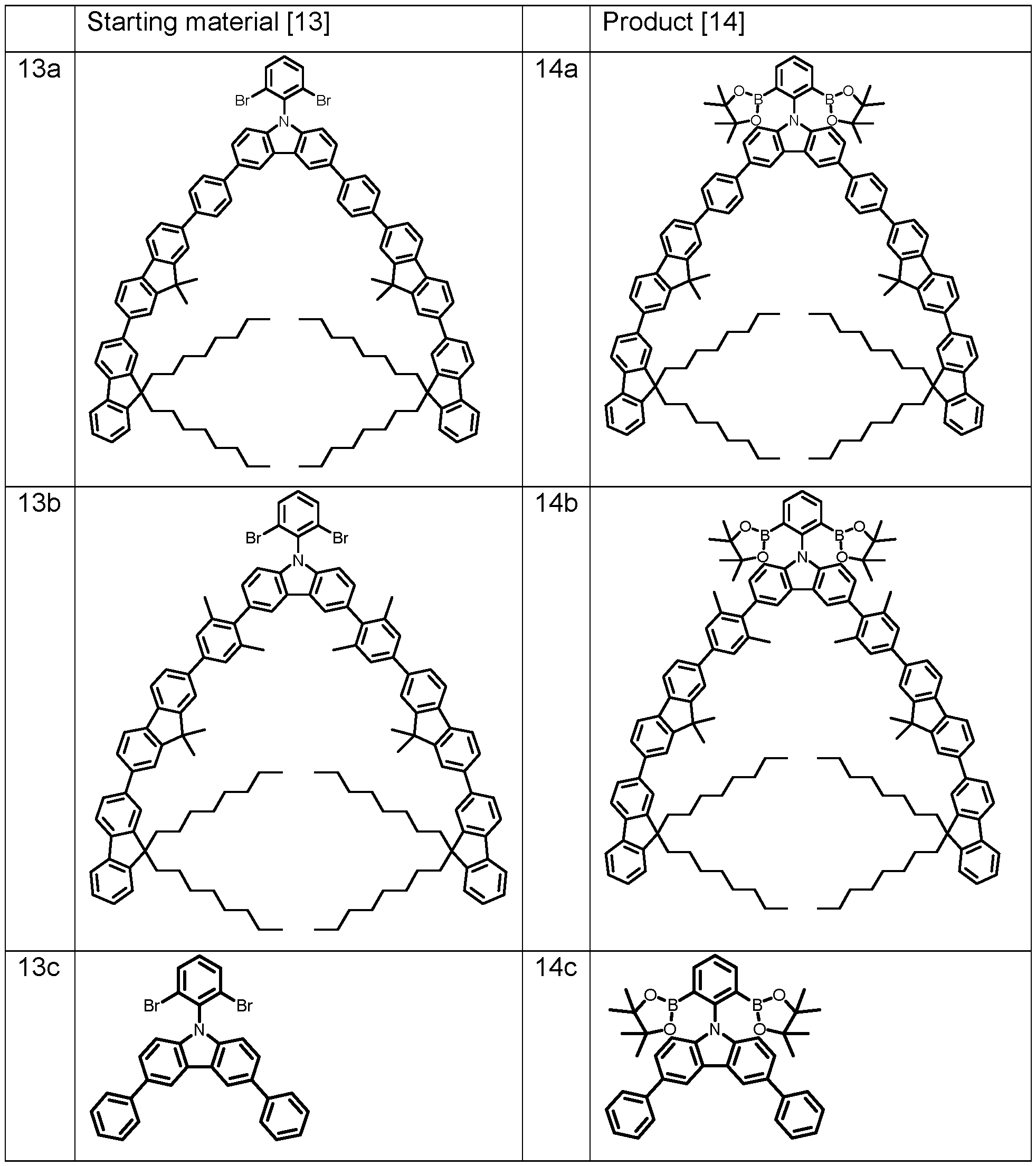
- the third step is carried out in analogy to the synthesis of Boronic ester [2]
- the products [14] shown in table 3 can be obtained using the respective starting materials [13]
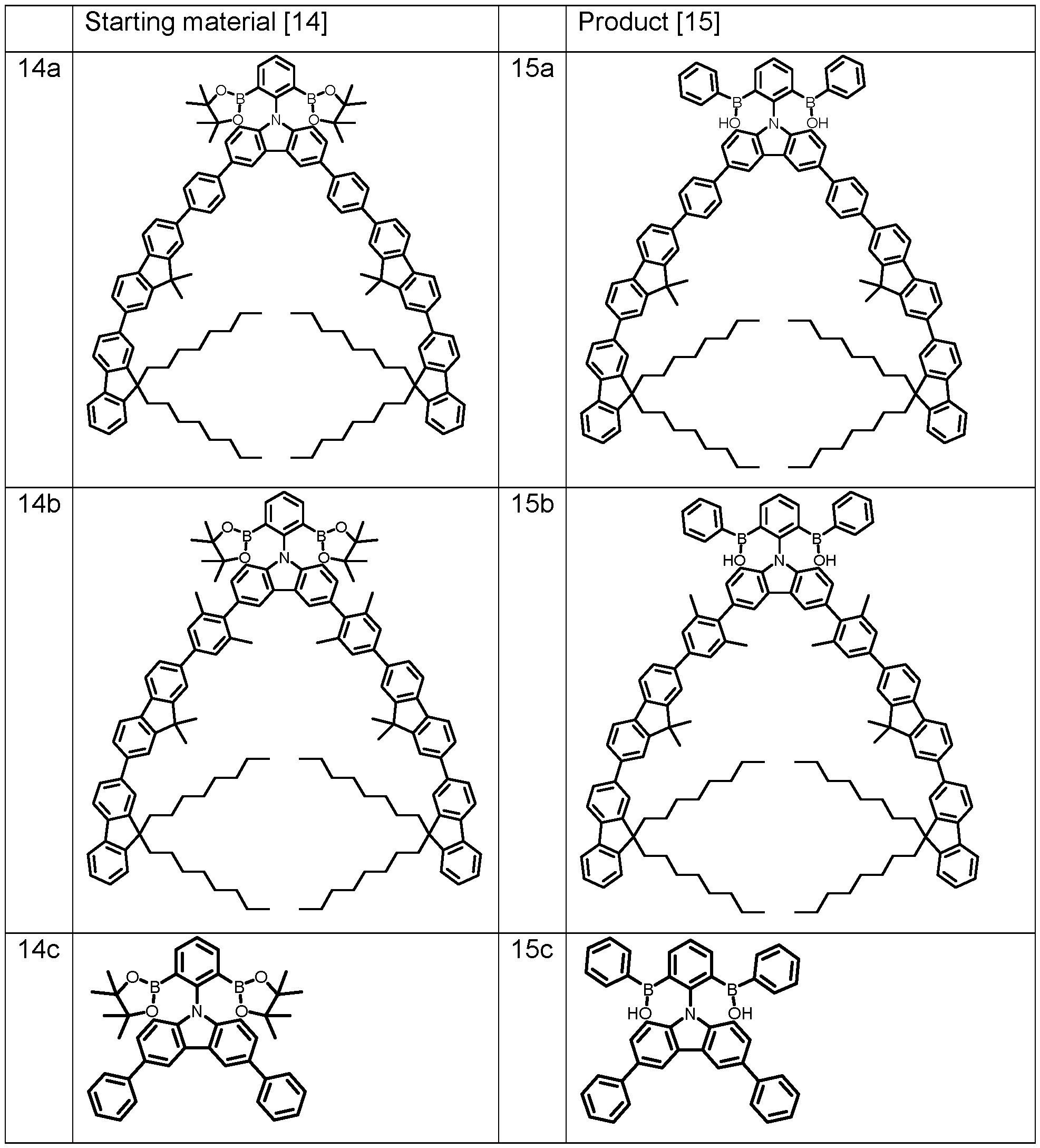
- the fifth step is carried out in analogy to the synthesis of Borinic acid [4]
- the products [16] shown in table 5 can be obtained using the respective starting materials [15]
- the sixth step is carried out in analogy to the synthesis of Compound 1 [5]
- the products [18] shown in table 6 can be obtained using the respective starting materials [16] and lithiated aryl substituents ArLi.
- Table 6 Synthesis of Compounds 4-6 embraced in formula [18]
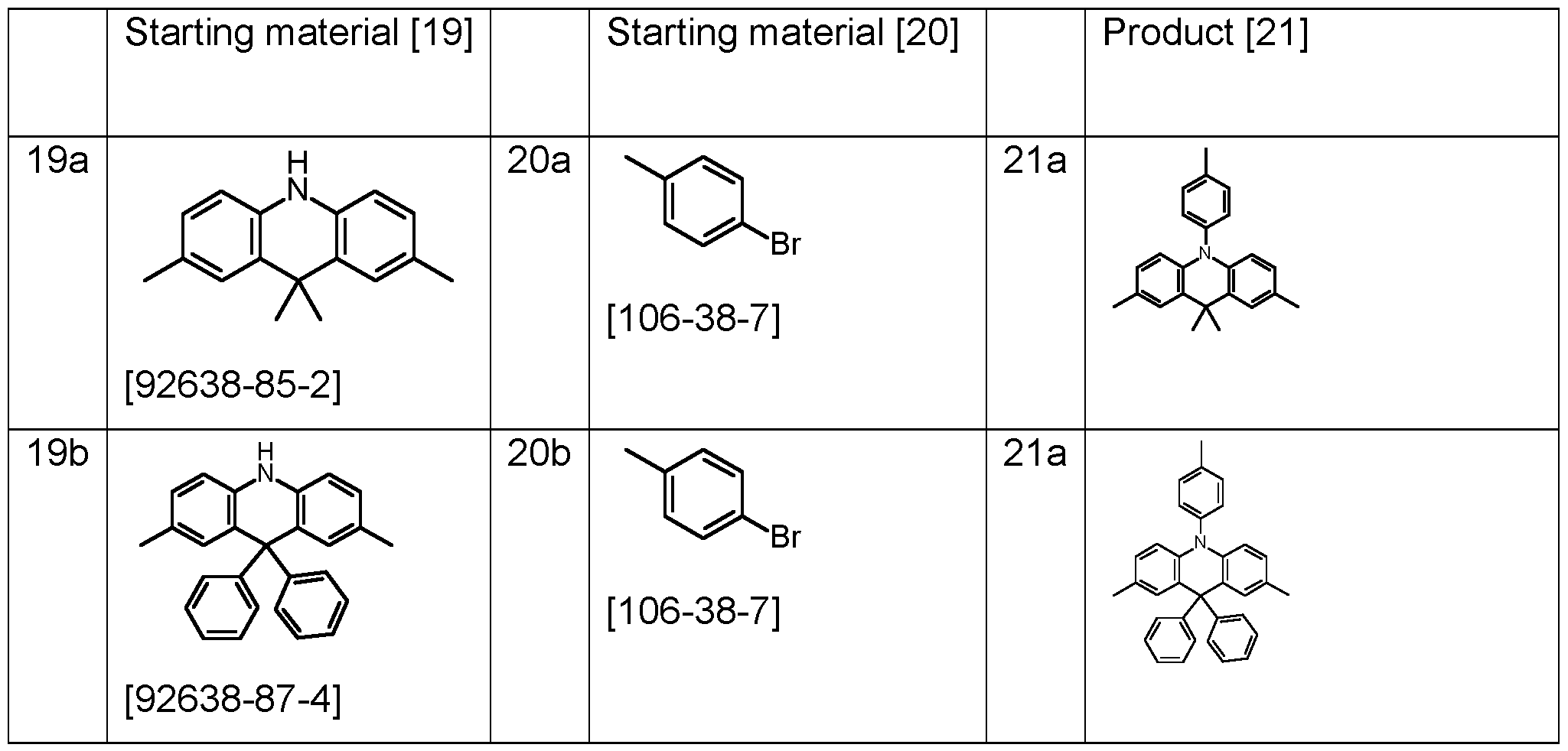
- Products [21 ] listed in table 7 can be synthesized in analogy to Carbazole [7] as described above.
- the fluorescent emitter is dissolved in toluene. A concentration of 1 mg/100 ml_ is used. The solution is excited in a fluorescence spectrometer Hitachi F-4500 with a to the material matching wavelength. The measurement is carried out at room temperature.
- the peak emission wavelength l p ⁇ c ⁇ e the wavelength of the first maximum of the emission spectrum ( Figure 1 ). Typically, the first maximum is also the global maximum of the spectrum.
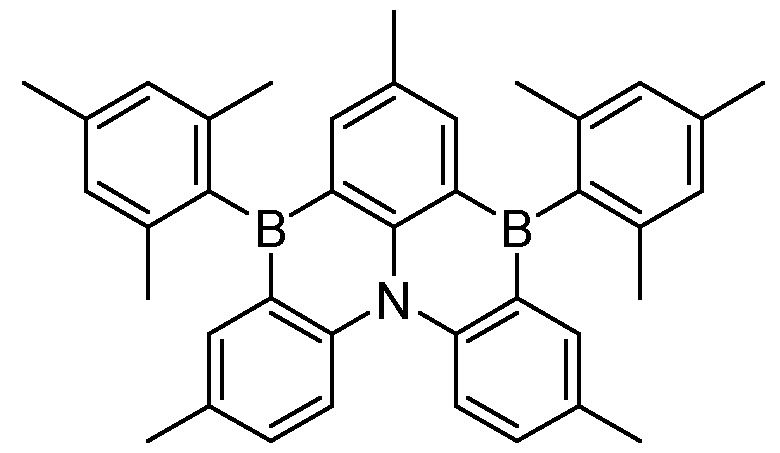
- Ex-1 -3-2 Properties of Ex-1 -3-2 as depicted below are shown in WO18047639A1 from JNC. All inventive compounds show a narrower spectrum and have thus a higher colour purity. Chemical structure of Ex-1 -3-2 from WO18047639A1 :
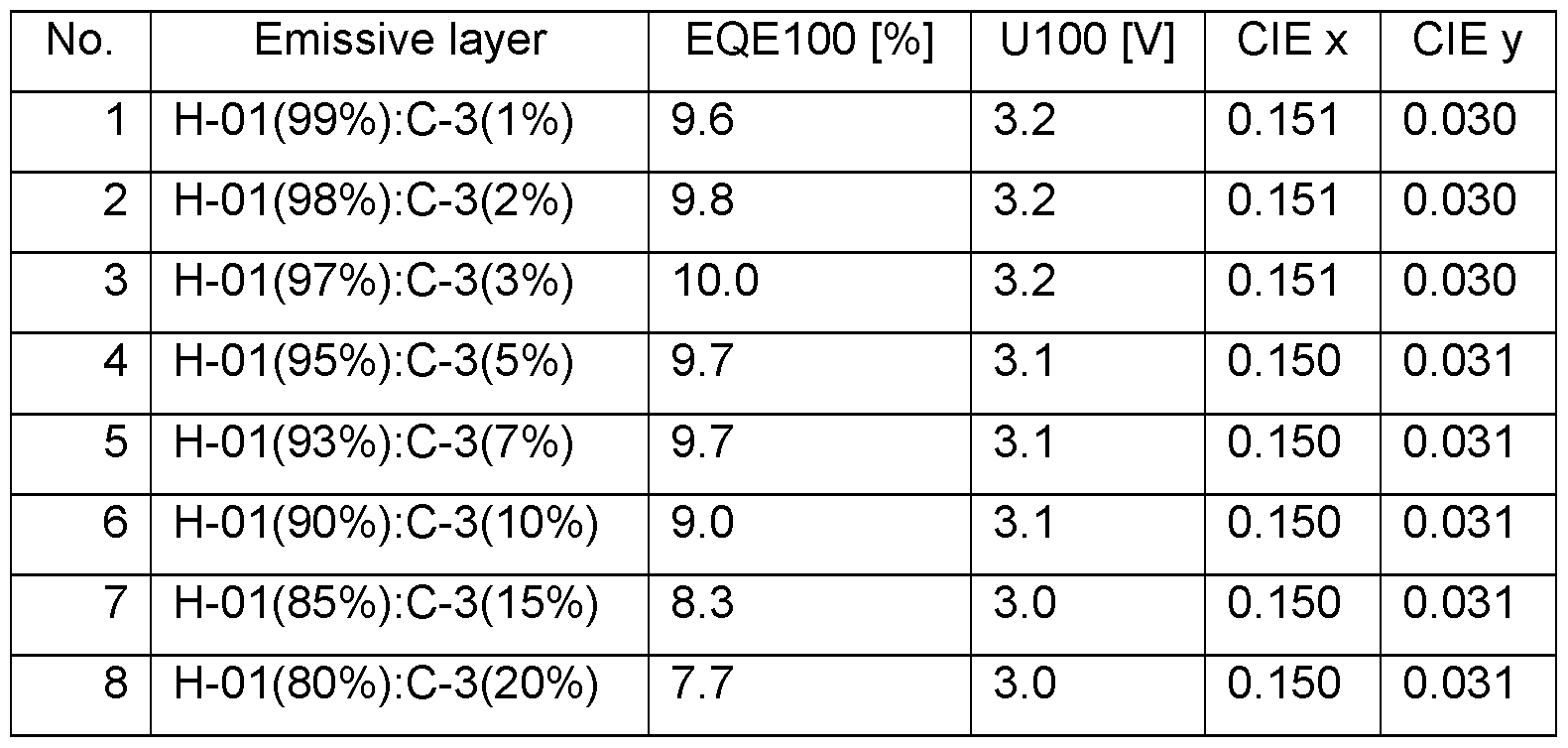
- the emissive layer always consists of two materials.
- An indication such as H- 01 (95%):C-3(5%) means, that the material H-01 is present in a volume fraction of 95% and material Compound 3 (C-3) is present in a volume fraction of 5% in the emissive layer.
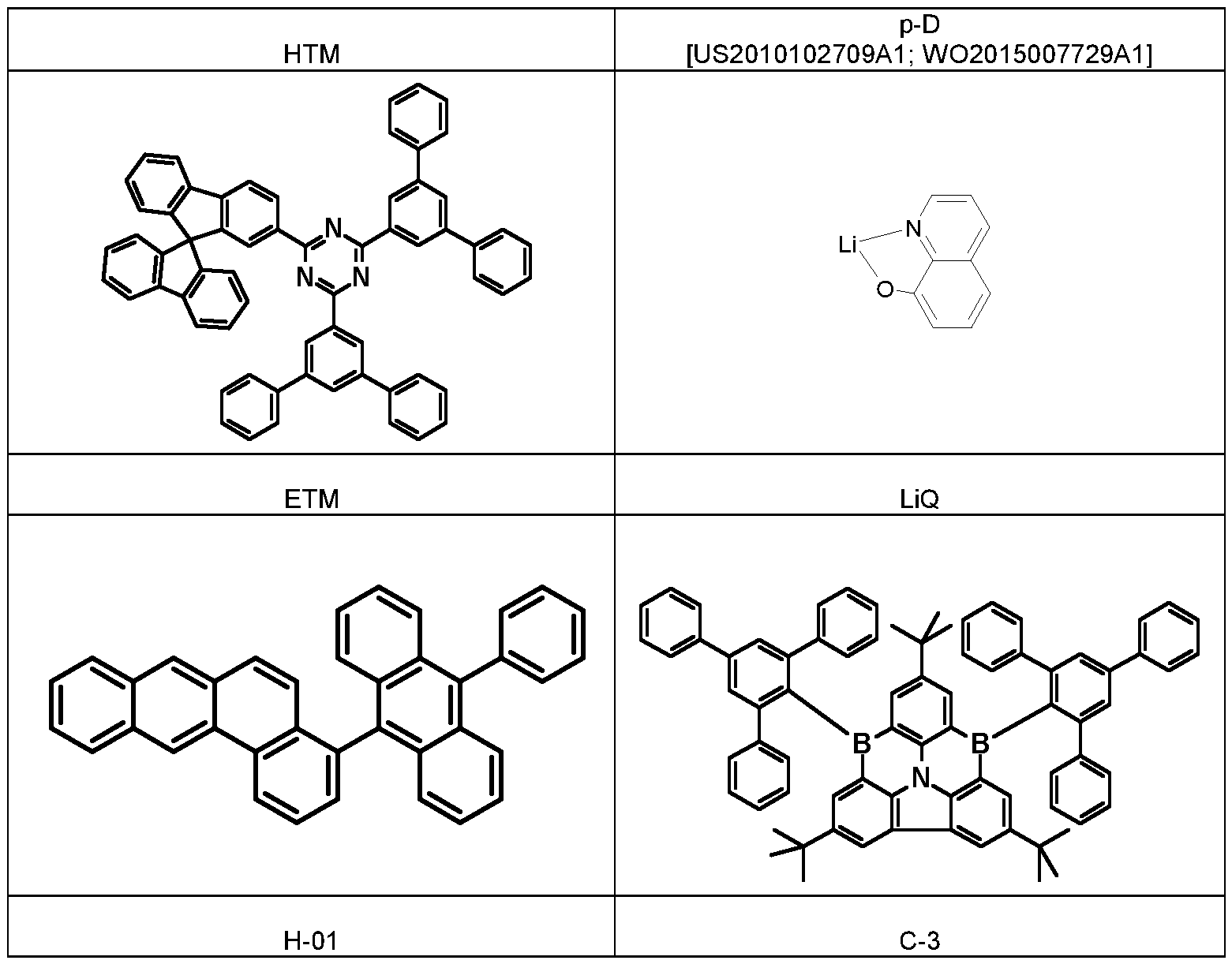
- OLEDs consist of the following layer sequence, which is applied to the substrate after heat treatment: 20 nm HTM(95%):p-D(5%), 160 nm HTM, 20 nm emissive layer, 10 nm ETM, 20 nm ETM(50%):LiQ(50%), 1 nm LiQ, 100 nm aluminum.
- the composition of the emissive layer is given in Table 10.
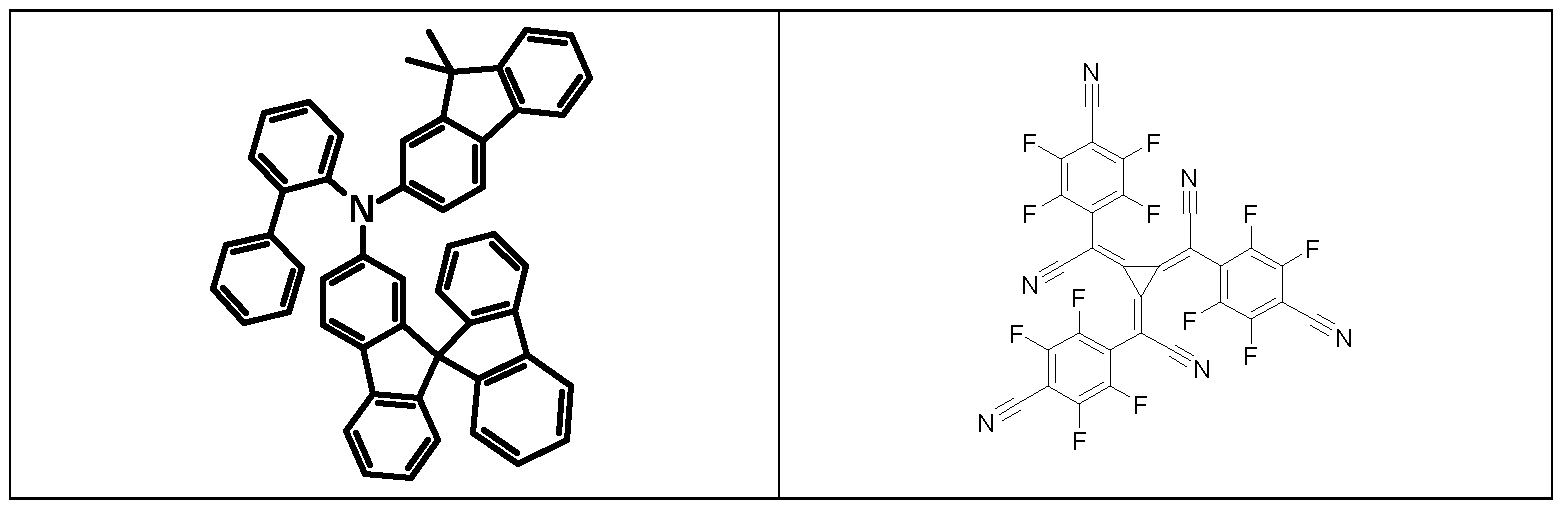
- the materials used for the OLED fabrication are listed in Table 11.
- the OLEDs are characterised by standard methods. For this purpose, the electroluminescence spectra are recorded and the current-voltage-luminous density characteristics (IUL) are measured. (The luminous density is measured perpendicular to the substrate.)
- the external quantum efficiency (EQE) is calculated as a function of the luminous density assuming Lambertian emission.
- the indication U100 means the voltage required for a luminance of 100 cd/m 2 EQE100 refers to the external quantum efficiency at an operating luminance of 100 cd/m 2 .
- CIE 1931 x and y color coordinates (CIE x und CIE y) are calculated from the electroluminescence spectra.
- the OLED performance data are given in Table 10.
- the OLED show a deep blue color.
- the performance data depend only little on the concentration of the emitter in the emissive layer.
- the process window is large, which is an advantage in view of device production and display applications.
- Table 10 Composition of the emissive layer of the single device
Landscapes
- Chemical & Material Sciences (AREA)
- Organic Chemistry (AREA)
- Engineering & Computer Science (AREA)
- Materials Engineering (AREA)
- Physics & Mathematics (AREA)
- Spectroscopy & Molecular Physics (AREA)
- Optics & Photonics (AREA)
- Inorganic Chemistry (AREA)
- Electroluminescent Light Sources (AREA)
Abstract
Description































Claims






Priority Applications (5)
| Application Number | Priority Date | Filing Date | Title |
|---|---|---|---|
| KR1020217036372A KR102769410B1 (en) | 2019-04-11 | 2020-04-08 | Materials for organic electroluminescent devices |
| US17/602,435 US12351594B2 (en) | 2019-04-11 | 2020-04-08 | Materials for organic electroluminescent devices |
| JP2021559769A JP7598873B2 (en) | 2019-04-11 | 2020-04-08 | Materials for organic electroluminescent devices |
| EP20716484.9A EP3935063A1 (en) | 2019-04-11 | 2020-04-08 | Materials for organic electroluminescent devices |
| CN202080026766.0A CN113646315A (en) | 2019-04-11 | 2020-04-08 | Materials for organic electroluminescent devices |
Applications Claiming Priority (2)
| Application Number | Priority Date | Filing Date | Title |
|---|---|---|---|
| EP19168728.4 | 2019-04-11 | ||
| EP19168728 | 2019-04-11 |
Publications (1)
| Publication Number | Publication Date |
|---|---|
| WO2020208051A1 true WO2020208051A1 (en) | 2020-10-15 |
Family
ID=66105237
Family Applications (1)
| Application Number | Title | Priority Date | Filing Date |
|---|---|---|---|
| PCT/EP2020/059951 Ceased WO2020208051A1 (en) | 2019-04-11 | 2020-04-08 | Materials for organic electroluminescent devices |
Country Status (7)
| Country | Link |
|---|---|
| US (1) | US12351594B2 (en) |
| EP (1) | EP3935063A1 (en) |
| JP (1) | JP7598873B2 (en) |
| KR (1) | KR102769410B1 (en) |
| CN (1) | CN113646315A (en) |
| TW (1) | TW202104238A (en) |
| WO (1) | WO2020208051A1 (en) |
Cited By (29)
| Publication number | Priority date | Publication date | Assignee | Title |
|---|---|---|---|---|
| WO2022058513A1 (en) | 2020-09-18 | 2022-03-24 | Cynora Gmbh | Organic electroluminescent device |
| US11407774B2 (en) * | 2016-09-07 | 2022-08-09 | Kwansei Gakuin Educational Foundation | Polycyclic aromatic compound |
| EP4079742A1 (en) | 2021-04-14 | 2022-10-26 | Merck Patent GmbH | Metal complexes |
| CN115440903A (en) * | 2021-06-03 | 2022-12-06 | 广东聚华印刷显示技术有限公司 | Organic luminescent material composition, organic luminescent ink, luminescent film and device |
| WO2023036976A1 (en) | 2021-09-13 | 2023-03-16 | Merck Patent Gmbh | Materials for organic electroluminescent devices |
| WO2023052272A1 (en) | 2021-09-28 | 2023-04-06 | Merck Patent Gmbh | Materials for electronic devices |
| WO2023052314A1 (en) | 2021-09-28 | 2023-04-06 | Merck Patent Gmbh | Materials for electronic devices |
| WO2023052313A1 (en) | 2021-09-28 | 2023-04-06 | Merck Patent Gmbh | Materials for electronic devices |
| WO2023052275A1 (en) | 2021-09-28 | 2023-04-06 | Merck Patent Gmbh | Materials for electronic devices |
| WO2023072799A1 (en) | 2021-10-27 | 2023-05-04 | Merck Patent Gmbh | Boronic and nitrogenous heterocyclic compounds for organic electroluminescent devices |
| WO2023208899A1 (en) | 2022-04-28 | 2023-11-02 | Merck Patent Gmbh | Materials for organic electroluminescent devices |
| WO2024013004A1 (en) | 2022-07-11 | 2024-01-18 | Merck Patent Gmbh | Materials for electronic devices |
| WO2024033282A1 (en) | 2022-08-09 | 2024-02-15 | Merck Patent Gmbh | Materials for organic electroluminescent devices |
| WO2024105066A1 (en) | 2022-11-17 | 2024-05-23 | Merck Patent Gmbh | Materials for organic electroluminescent devices |
| WO2024126635A1 (en) | 2022-12-16 | 2024-06-20 | Merck Patent Gmbh | Formulation of an organic functional material |
| WO2024132993A1 (en) | 2022-12-19 | 2024-06-27 | Merck Patent Gmbh | Materials for electronic devices |
| WO2024132892A1 (en) | 2022-12-19 | 2024-06-27 | Merck Patent Gmbh | Materials for organic electroluminescent devices |
| WO2024218109A1 (en) | 2023-04-20 | 2024-10-24 | Merck Patent Gmbh | Materials for electronic devices |
| WO2024240725A1 (en) | 2023-05-25 | 2024-11-28 | Merck Patent Gmbh | Tris[1,2,4]triazolo[1,5-a:1',5'-c:1'',5''-e][1,3,5]triazine derivatives for use in organic electroluminescent devices |
| WO2025021855A1 (en) | 2023-07-27 | 2025-01-30 | Merck Patent Gmbh | Materials for organic light-emitting devices and organic sensors |
| WO2025045843A1 (en) | 2023-08-30 | 2025-03-06 | Merck Patent Gmbh | Materials for organic light-emitting devices |
| WO2025045842A1 (en) | 2023-08-30 | 2025-03-06 | Merck Patent Gmbh | Materials for organic light-emitting devices |
| WO2025045851A1 (en) | 2023-08-30 | 2025-03-06 | Merck Patent Gmbh | Materials for organic light-emitting devices |
| WO2025083015A1 (en) | 2023-10-19 | 2025-04-24 | Merck Patent Gmbh | Materials for organic electroluminescent devices |
| WO2025119813A1 (en) | 2023-12-06 | 2025-06-12 | Merck Patent Gmbh | Materials for organic electroluminescent devices |
| WO2025119821A1 (en) | 2023-12-05 | 2025-06-12 | Merck Patent Gmbh | Material composition for organic electroluminescent devices |
| WO2025132551A1 (en) | 2023-12-22 | 2025-06-26 | Merck Patent Gmbh | Materials for electronic devices |
| WO2025210013A1 (en) | 2024-04-04 | 2025-10-09 | Merck Patent Gmbh | Compounds for electronic devices, in particular compounds for oleds |
| WO2026008710A1 (en) | 2024-07-05 | 2026-01-08 | Merck Patent Gmbh | Cyclic silicon compounds for organic electroluminescent devices |
Citations (177)
| Publication number | Priority date | Publication date | Assignee | Title |
|---|---|---|---|---|
| US4539507A (en) | 1983-03-25 | 1985-09-03 | Eastman Kodak Company | Organic electroluminescent devices having improved power conversion efficiencies |
| US5061569A (en) | 1990-07-26 | 1991-10-29 | Eastman Kodak Company | Electroluminescent device with organic electroluminescent medium |
| WO1995009147A1 (en) | 1993-09-29 | 1995-04-06 | Idemitsu Kosan Co., Ltd. | Organic electroluminescent element and arylenediamine derivative |
| EP0652273A1 (en) | 1993-11-09 | 1995-05-10 | Shinko Electric Industries Co. Ltd. | Organic material for electroluminescent device and electroluminescent device |
| EP0676461A2 (en) | 1994-04-07 | 1995-10-11 | Hoechst Aktiengesellschaft | Spiro compounds and their application as electroluminescence materials |
| JP2000053957A (en) | 1998-06-23 | 2000-02-22 | Koto Gijutsu Kenkyuin Kenkyu Kumiai | Novel organometallic luminescent material and organic electroluminescent device containing the same |
| WO2000070655A2 (en) | 1999-05-13 | 2000-11-23 | The Trustees Of Princeton University | Very high efficiency organic light emitting devices based on electrophosphorescence |
| WO2001008230A1 (en) | 1999-07-21 | 2001-02-01 | The Trustees Of Princeton University | Intersystem crossing agents for efficient utilization of excitons in organic light emitting devices |
| WO2001041512A1 (en) | 1999-12-01 | 2001-06-07 | The Trustees Of Princeton University | Complexes of form l2mx as phosphorescent dopants for organic leds |
| WO2001049806A1 (en) | 1999-12-31 | 2001-07-12 | Lg Chemical Co., Ltd | Electronic device comprising organic compound having p-type semiconducting characteristics |
| WO2002002714A2 (en) | 2000-06-30 | 2002-01-10 | E.I. Du Pont De Nemours And Company | Electroluminescent iridium compounds with fluorinated phenylpyridines, phenylpyrimidines, and phenylquinolines and devices made with such compounds |
| WO2002015645A1 (en) | 2000-08-11 | 2002-02-21 | The Trustees Of Princeton University | Organometallic compounds and emission-shifting organic electrophosphorescence |
| EP1191612A2 (en) | 2000-09-26 | 2002-03-27 | Canon Kabushiki Kaisha | Luminescence device, display apparatus and metal coordination compound |
| EP1191613A2 (en) | 2000-09-26 | 2002-03-27 | Canon Kabushiki Kaisha | Luminescence device, display apparatus and metal coordination compound |
| EP1191614A2 (en) | 2000-09-26 | 2002-03-27 | Canon Kabushiki Kaisha | Luminescence device and metal coordination compound therefor |
| EP1205527A1 (en) | 2000-03-27 | 2002-05-15 | Idemitsu Kosan Co., Ltd. | Organic electroluminescence device |
| WO2003060956A2 (en) | 2002-01-18 | 2003-07-24 | Lg Chem, Ltd. | New material for transporting electrons and organic electroluminescent display using the same |
| WO2004013080A1 (en) | 2002-08-01 | 2004-02-12 | Covion Organic Semiconductors Gmbh | Spirobifluorene derivatives, their preparation and uses thereof |
| WO2004028217A1 (en) | 2002-09-20 | 2004-04-01 | Idemitsu Kosan Co., Ltd. | Organic electroluminescent element |
| WO2004058911A2 (en) | 2002-12-23 | 2004-07-15 | Covion Organic Semiconductors Gmbh | Organic electroluminescent element |
| WO2004080975A1 (en) | 2003-03-13 | 2004-09-23 | Idemitsu Kosan Co., Ltd. | Nitrogen-containing heterocycle derivative and organic electroluminescent element using the same |
| WO2004081017A1 (en) | 2003-03-11 | 2004-09-23 | Covion Organic Semiconductors Gmbh | Metal complexes |
| JP2004288381A (en) | 2003-03-19 | 2004-10-14 | Konica Minolta Holdings Inc | Organic electroluminescent element |
| WO2004093207A2 (en) | 2003-04-15 | 2004-10-28 | Covion Organic Semiconductors Gmbh | Mixtures of matrix materials and organic semiconductors capable of emission, use of the same and electronic components containing said mixtures |
| WO2005011013A1 (en) | 2003-07-21 | 2005-02-03 | Covion Organic Semiconductors Gmbh | Organic electroluminescent element |
| WO2005019373A2 (en) | 2003-08-19 | 2005-03-03 | Basf Aktiengesellschaft | Transition metal complexes comprising carbene ligands serving as emitters for organic light-emitting diodes (oled's) |
| US20050069729A1 (en) | 2003-09-30 | 2005-03-31 | Konica Minolta Holdings, Inc. | Organic electroluminescent element, illuminator, display and compound |
| WO2005033244A1 (en) | 2003-09-29 | 2005-04-14 | Covion Organic Semiconductors Gmbh | Metal complexes |
| WO2005042550A1 (en) | 2003-10-30 | 2005-05-12 | Merck Patent Gmbh | Metal complexes with bipodal ligands |
| US20050170206A1 (en) | 2004-02-03 | 2005-08-04 | Bin Ma | OLEDs utilizing multidentate ligand systems |
| WO2005084082A1 (en) | 2004-02-20 | 2005-09-09 | Merck Patent Gmbh | Organic electronic devices |
| WO2005111172A2 (en) | 2004-05-11 | 2005-11-24 | Merck Patent Gmbh | Novel material mixtures for use in electroluminescence |
| US20050258742A1 (en) | 2004-05-18 | 2005-11-24 | Yui-Yi Tsai | Carbene containing metal complexes as OLEDs |
| JP2005347160A (en) | 2004-06-04 | 2005-12-15 | Konica Minolta Holdings Inc | Organic electroluminescence element, lighting device and display device |
| EP1617711A1 (en) | 2003-04-23 | 2006-01-18 | Konica Minolta Holdings, Inc. | Organic electroluminescent device and display |
| WO2006005627A1 (en) | 2004-07-15 | 2006-01-19 | Merck Patent Gmbh | Oligomeric derivatives of spirobifluorene, their preparation and use |
| WO2006048268A1 (en) | 2004-11-06 | 2006-05-11 | Merck Patent Gmbh | Organic electroluminescent device |
| EP1661888A1 (en) | 2004-11-29 | 2006-05-31 | Samsung SDI Co., Ltd. | Phenylcarbazole-based compound and organic electroluminescent device employing the same |
| WO2006056418A2 (en) | 2004-11-25 | 2006-06-01 | Basf Aktiengesellschaft | Use of transition metal carbene complexes in organic light-emitting diodes (oleds) |
| WO2006100896A1 (en) | 2005-03-18 | 2006-09-28 | Idemitsu Kosan Co., Ltd. | Aromatic amine derivative and organic electroluminescence device utilizing the same |
| WO2006108497A1 (en) | 2005-04-14 | 2006-10-19 | Merck Patent Gmbh | Compounds for organic electronic devices |
| WO2006117052A1 (en) | 2005-05-03 | 2006-11-09 | Merck Patent Gmbh | Organic electroluminescent device and boric acid and borinic acid derivatives used therein |
| WO2006121811A1 (en) | 2005-05-06 | 2006-11-16 | Universal Display Corporation | Stability oled materials and devices with improved stability |
| WO2006122630A1 (en) | 2005-05-20 | 2006-11-23 | Merck Patent Gmbh | Compounds for organic electronic devices |
| EP1731584A1 (en) | 2004-03-31 | 2006-12-13 | Konica Minolta Holdings, Inc. | Organic electroluminescent device material, organic electroluminescent device, display and illuminating device |
| WO2007063754A1 (en) | 2005-12-01 | 2007-06-07 | Nippon Steel Chemical Co., Ltd. | Compound for organic electroluminescent element and organic electroluminescent element |
| WO2007095118A2 (en) | 2006-02-10 | 2007-08-23 | Universal Display Corporation | METAL COMPLEXES OF CYCLOMETALLATED IMIDAZO[1,2-f]PHENANTHRIDINE AND DIIMIDAZO[1,2-A:1',2'-C]QUINAZOLINE LIGANDS AND ISOELECTRONIC AND BENZANNULATED ANALOGS THEREOF |
| WO2007115970A1 (en) | 2006-04-05 | 2007-10-18 | Basf Se | Heteroleptic transition metal-carbene complexes and their use in organic light-emitting diodes (oleds) |
| WO2007115981A1 (en) | 2006-04-04 | 2007-10-18 | Basf Se | Transition metal complexes comprising one noncarbene ligand and one or two carbene ligands and their use in oleds |
| WO2007137725A1 (en) | 2006-05-31 | 2007-12-06 | Merck Patent Gmbh | New materials for organic electroluminescent devices |
| WO2007140847A1 (en) | 2006-06-02 | 2007-12-13 | Merck Patent Gmbh | Materials for organic electroluminescent devices |
| WO2008000727A1 (en) | 2006-06-26 | 2008-01-03 | Basf Se | Use in oleds of transition metal carbene complexes that contain no cyclometallation via non-carbenes |
| WO2008000726A1 (en) | 2006-06-26 | 2008-01-03 | Basf Se | Use of pt- and pd-bis- and tetra-carbon complexes with bridged carbon ligands in oleds |
| WO2008006449A1 (en) | 2006-07-11 | 2008-01-17 | Merck Patent Gmbh | Novel materials for organic electroluminescent devices |
| WO2008056746A1 (en) | 2006-11-09 | 2008-05-15 | Nippon Steel Chemical Co., Ltd. | Compound for organic electroluminescent device and organic electroluminescent device |
| WO2008086851A1 (en) | 2007-01-18 | 2008-07-24 | Merck Patent Gmbh | Carbazole derivatives for organc electroluminescent devices |
| WO2008145239A2 (en) | 2007-05-29 | 2008-12-04 | Merck Patent Gmbh | Benzanthracene derivatives for organic electroluminescent devices |
| WO2008156879A1 (en) | 2007-06-20 | 2008-12-24 | Universal Display Corporation | Blue phosphorescent imidazophenanthridine materials |
| WO2009050290A1 (en) | 2007-10-17 | 2009-04-23 | Basf Se | Transition metal complexes having bridged carbene ligands and the use thereof in oleds |
| WO2009050281A1 (en) | 2007-10-17 | 2009-04-23 | Basf Se | Transition metal complexes with bridged carbene ligands and use thereof in oleds |
| WO2009062578A1 (en) | 2007-11-12 | 2009-05-22 | Merck Patent Gmbh | Organic electroluminescent devices comprising azomethine-metal complexes |
| US20090136779A1 (en) | 2007-11-26 | 2009-05-28 | Chien-Hong Cheng | Conjugated compounds containing hydroindoloacridine structural elements, and their use |
| US20090134784A1 (en) | 2004-10-21 | 2009-05-28 | Universal Display Corporation | Carbazole-containing materials in phosphorescent light emitting diodes |
| WO2009146770A2 (en) | 2008-06-05 | 2009-12-10 | Merck Patent Gmbh | Electronic device comprising metal complexes |
| WO2010006680A1 (en) | 2008-07-18 | 2010-01-21 | Merck Patent Gmbh | Materials for organic electroluminescence devices |
| WO2010012328A1 (en) | 2008-07-29 | 2010-02-04 | Merck Patent Gmbh | Compounds for electronic devices |
| WO2010015306A1 (en) | 2008-08-08 | 2010-02-11 | Merck Patent Gmbh, | Organic electroluminescence device |
| WO2010015307A1 (en) | 2008-08-04 | 2010-02-11 | Merck Patent Gmbh | Electronic devices comprising metal complexes having isonitrile ligands |
| WO2010031485A1 (en) | 2008-09-22 | 2010-03-25 | Merck Patent Gmbh | Materials for organic electroluminescence devices |
| WO2010050778A1 (en) | 2008-10-31 | 2010-05-06 | Gracel Display Inc. | Novel compounds for organic electronic material and organic electronic device using the same |
| WO2010054731A1 (en) | 2008-11-13 | 2010-05-20 | Merck Patent Gmbh | Materials for organic electroluminescent devices |
| WO2010054730A1 (en) | 2008-11-11 | 2010-05-20 | Merck Patent Gmbh | Organic electroluminescent devices |
| WO2010054729A2 (en) | 2008-11-11 | 2010-05-20 | Merck Patent Gmbh | Materials for organic electroluminescence devices |
| WO2010054728A1 (en) | 2008-11-13 | 2010-05-20 | Merck Patent Gmbh | Materials for organic electroluminescent devices |
| WO2010068876A1 (en) | 2008-12-12 | 2010-06-17 | Universal Display Corporation | BLUE EMITTER WITH HIGH EFFICIENCY BASED ON IMIDAZO [1,2-f] PHENANTHRIDINE IRIDIUM COMPLEXES |
| WO2010069442A1 (en) | 2008-12-17 | 2010-06-24 | Merck Patent Gmbh | Organic electroluminescence device |
| WO2010072300A1 (en) | 2008-12-22 | 2010-07-01 | Merck Patent Gmbh | Organic electroluminescent device comprising triazine derivatives |
| WO2010086089A1 (en) | 2009-02-02 | 2010-08-05 | Merck Patent Gmbh | Metal complexes |
| WO2010099852A1 (en) | 2009-03-02 | 2010-09-10 | Merck Patent Gmbh | Metal complexes having azaborol ligands and electronic device having the same |
| WO2010102709A1 (en) | 2009-03-13 | 2010-09-16 | Merck Patent Gmbh | Materials for organic electroluminescence devices |
| WO2010136109A1 (en) | 2009-05-29 | 2010-12-02 | Merck Patent Gmbh | Materials for organic electroluminescent devices |
| WO2011000455A1 (en) | 2009-06-30 | 2011-01-06 | Merck Patent Gmbh | Materials for organic electroluminescence devices |
| WO2011032626A1 (en) | 2009-09-16 | 2011-03-24 | Merck Patent Gmbh | Metal complexes |
| WO2011042107A2 (en) | 2009-10-08 | 2011-04-14 | Merck Patent Gmbh | Materials for organic electroluminescent devices |
| WO2011045337A1 (en) | 2009-10-14 | 2011-04-21 | Basf Se | Dinuclear platinum-carbene complexes and the use thereof in oleds |
| WO2011044988A1 (en) | 2009-10-16 | 2011-04-21 | Merck Patent Gmbh | Metal complexes |
| WO2011051404A1 (en) | 2009-10-28 | 2011-05-05 | Basf Se | Heteroleptic carbene complexes and use thereof in organic electronics |
| WO2011066898A1 (en) | 2009-12-05 | 2011-06-09 | Merck Patent Gmbh | Electronic device containing metal complexes |
| WO2011073149A1 (en) | 2009-12-14 | 2011-06-23 | Basf Se | Metal complexes comprising diazabenzimidazol carbene-ligands and the use thereof in oleds |
| WO2011088877A1 (en) | 2010-01-25 | 2011-07-28 | Merck Patent Gmbh | Compounds for electronic devices |
| WO2011106344A1 (en) | 2010-02-25 | 2011-09-01 | Universal Display Corporation | Phosphorescent emitters |
| WO2011116865A1 (en) | 2010-03-25 | 2011-09-29 | Merck Patent Gmbh | Materials for organic electroluminescence devices |
| WO2011137951A1 (en) | 2010-05-04 | 2011-11-10 | Merck Patent Gmbh | Organic electroluminescence devices |
| WO2011157339A1 (en) | 2010-06-15 | 2011-12-22 | Merck Patent Gmbh | Metal complexes |
| WO2012007086A1 (en) | 2010-07-16 | 2012-01-19 | Merck Patent Gmbh | Metal complexes |
| WO2012034627A1 (en) | 2010-09-15 | 2012-03-22 | Merck Patent Gmbh | Materials for organic electroluminescent devices |
| WO2012048780A1 (en) | 2010-10-15 | 2012-04-19 | Merck Patent Gmbh | Compounds for electronic devices |
| WO2012048781A1 (en) | 2010-10-15 | 2012-04-19 | Merck Patent Gmbh | Triphenylene-based materials for organic electroluminescent devices |
| WO2012121936A2 (en) | 2011-03-08 | 2012-09-13 | Universal Display Corporation | Pyridyl carbene phosphorescent emitters |
| US20120241732A1 (en) | 2009-12-07 | 2012-09-27 | Ayataka Endo | Organic light-emitting material and organic light-emitting element |
| WO2012143080A2 (en) | 2011-04-18 | 2012-10-26 | Merck Patent Gmbh | Materials for organic electroluminescent devices |
| WO2012150001A1 (en) | 2011-05-05 | 2012-11-08 | Merck Patent Gmbh | Compounds for electronic devices |
| WO2012156378A1 (en) | 2011-05-13 | 2012-11-22 | Cynora Gmbh | Copper(i) complexes, in particular for optoelectronic components |
| WO2012163471A1 (en) | 2011-06-03 | 2012-12-06 | Merck Patent Gmbh | Metal complexes |
| US20120305894A1 (en) | 2011-06-01 | 2012-12-06 | Do-Han Kim | Blue phosphorescent compound and organic electroluminescent device using the same |
| WO2012170571A1 (en) | 2011-06-08 | 2012-12-13 | Universal Display Corporation | Heteroleptic iridium carbene complexes and light emitting device using them |
| WO2012172482A1 (en) | 2011-06-14 | 2012-12-20 | Basf Se | Metal complexes comprising azabenzimidazole carbene ligands and the use thereof in oleds |
| WO2013001086A1 (en) | 2011-06-29 | 2013-01-03 | Cynora Gmbh | Copper(i) complexes, in particular for optoelectronic components |
| EP2543672A1 (en) | 2011-07-08 | 2013-01-09 | cynora GmbH | Copper(I) complexes, in particular for optoelectronic components |
| WO2013007707A1 (en) | 2011-07-08 | 2013-01-17 | Cynora Gmbh | Copper(i) complexes for optoelectronic devices |
| WO2013011954A1 (en) | 2011-07-15 | 2013-01-24 | 国立大学法人九州大学 | Organic electroluminescence element and compound used therein |
| WO2013017675A1 (en) | 2011-08-02 | 2013-02-07 | Cynora Gmbh | Singlet harvesting with dual-core copper (i) complexes for optoelectronic devices |
| WO2013020631A1 (en) | 2011-08-10 | 2013-02-14 | Merck Patent Gmbh | Metal complexes |
| WO2013041176A1 (en) | 2011-09-21 | 2013-03-28 | Merck Patent Gmbh | Carbazole derivatives for organic electroluminescence devices |
| WO2013072508A1 (en) | 2011-11-16 | 2013-05-23 | Cynora Gmbh | Heteroleptic copper complexes for optoelectronic uses |
| WO2013081088A1 (en) | 2011-12-02 | 2013-06-06 | 国立大学法人九州大学 | Organic light emitting device and delayed fluorescent material and compound used therein |
| US20130150581A1 (en) | 2010-07-20 | 2013-06-13 | Cynora Gmbh | Copper (i) complexes for optoelectronic devices |
| WO2013083216A1 (en) | 2011-11-17 | 2013-06-13 | Merck Patent Gmbh | Spiro dihydroacridine derivatives and the use thereof as materials for organic electroluminescence devices |
| JP2013116975A (en) | 2011-12-02 | 2013-06-13 | Kyushu Univ | Delayed fluorescent material, organic light emitting device, and compound |
| WO2013120577A1 (en) | 2012-02-14 | 2013-08-22 | Merck Patent Gmbh | Spirobifluorene compounds for organic electroluminescent devices |
| WO2013133359A1 (en) | 2012-03-09 | 2013-09-12 | 国立大学法人九州大学 | Light-emitting material, and organic light-emitting element |
| WO2013154064A1 (en) | 2012-04-09 | 2013-10-17 | 国立大学法人九州大学 | Organic light emitting element, and light emitting material and compound used in same |
| WO2013161437A1 (en) | 2012-04-25 | 2013-10-31 | 国立大学法人九州大学 | Light-emitting material and organic light-emitting element |
| WO2013185871A1 (en) | 2012-06-12 | 2013-12-19 | Merck Patent Gmbh | Compounds for electronic devices |
| WO2014008982A1 (en) | 2012-07-13 | 2014-01-16 | Merck Patent Gmbh | Metal complexes |
| WO2014023377A2 (en) | 2012-08-07 | 2014-02-13 | Merck Patent Gmbh | Metal complexes |
| WO2014037077A1 (en) | 2012-09-04 | 2014-03-13 | Merck Patent Gmbh | Connections for electronic devices |
| US20140138669A1 (en) | 2011-07-15 | 2014-05-22 | Kyushu University National University Corporation | Delayed-fluorescence material and organic electroluminescence element using same |
| WO2014094961A1 (en) | 2012-12-21 | 2014-06-26 | Merck Patent Gmbh | Metal complexes |
| WO2014106522A1 (en) | 2013-01-03 | 2014-07-10 | Merck Patent Gmbh | Materials for electronic devices |
| WO2014111269A2 (en) | 2013-10-14 | 2014-07-24 | Merck Patent Gmbh | Materials for electronic devices |
| WO2015014944A1 (en) | 2013-07-31 | 2015-02-05 | Basf Se | Luminescent diaza- monoaza- and benzimidazole metal carbene complexes for use in electronic devices such as oleds |
| US20150041784A1 (en) | 2012-05-17 | 2015-02-12 | Kyushu University National University Corporation | Compound, light-emitting material, and organic light-emitting device |
| WO2015036074A1 (en) | 2013-09-11 | 2015-03-19 | Merck Patent Gmbh | Metal complexes |
| EP2875699A1 (en) | 2012-07-23 | 2015-05-27 | Merck Patent GmbH | Derivatives of 2-diarylaminofluorene and organic electronic compounds containing them |
| EP2875092A1 (en) | 2012-07-23 | 2015-05-27 | Merck Patent GmbH | Compounds and organic electroluminescent devices |
| EP2875004A2 (en) | 2012-07-23 | 2015-05-27 | Merck Patent GmbH | Compounds and organic electronic devices |
| US20150171350A1 (en) | 2012-07-19 | 2015-06-18 | Basf Se | Dinuclear metal complexes comprising carbene ligands and the use thereof in oleds |
| WO2015091716A1 (en) | 2013-12-20 | 2015-06-25 | Basf Se | Highly efficient oled devices with very short decay times |
| WO2015104045A1 (en) | 2014-01-13 | 2015-07-16 | Merck Patent Gmbh | Metal complexes |
| WO2015117718A1 (en) | 2014-02-05 | 2015-08-13 | Merck Patent Gmbh | Metal complexes |
| US20150236274A1 (en) | 2014-02-18 | 2015-08-20 | Kwansei Gakuin Educational Foundation | Polycyclic aromatic compound |
| US20150243912A1 (en) | 2012-08-09 | 2015-08-27 | Basf Se | Transition metal complexes with carbene ligands and the use thereof in oleds |
| WO2015135624A1 (en) | 2014-03-13 | 2015-09-17 | Merck Patent Gmbh | Organic electroluminescent device |
| WO2015158409A1 (en) | 2014-04-16 | 2015-10-22 | Merck Patent Gmbh | Materials for electronic devices |
| WO2016015815A1 (en) | 2014-07-28 | 2016-02-04 | Merck Patent Gmbh | Metal complexes |
| WO2016020516A1 (en) | 2014-08-08 | 2016-02-11 | Basf Se | Electroluminescent imidazo-quinoxaline carbene metal complexes |
| US20160072081A1 (en) | 2013-04-29 | 2016-03-10 | Basf Se | Transition metal complexes with carbene ligands and the use thereof in OLEDs |
| WO2016079169A1 (en) | 2014-11-18 | 2016-05-26 | Basf Se | Pt- or pd-carbene complexes for use in organic light emitting diodes |
| WO2016124304A1 (en) | 2015-02-03 | 2016-08-11 | Merck Patent Gmbh | Metal complexes |
| WO2016150544A1 (en) | 2015-03-25 | 2016-09-29 | Merck Patent Gmbh | Materials for organic electroluminescent devices |
| US20160372682A1 (en) | 2014-02-28 | 2016-12-22 | Kyulux, Inc. | Light-emitting material, organic light-emitting device, and compound |
| US20170012214A1 (en) | 2015-07-09 | 2017-01-12 | Sfc Co., Ltd. | Organic light-emitting diode with high efficiency and long lifetime |
| EP3126371A1 (en) | 2014-03-31 | 2017-02-08 | UDC Ireland Limited | Metal complexes, comprising carbene ligands having an o-substituted non-cyclometalated aryl group and their use in organic light emitting diodes |
| US20170047522A1 (en) | 2014-03-07 | 2017-02-16 | Kyulux, Inc. | Light-emitting material, organic light-emitting device, and compound |
| WO2017028941A1 (en) | 2015-08-14 | 2017-02-23 | Merck Patent Gmbh | Phenoxazine derivatives for organic electroluminescent devices |
| WO2017028940A1 (en) | 2015-08-14 | 2017-02-23 | Merck Patent Gmbh | Phenoxazine derivatives for organic electroluminescent devices |
| WO2017032439A1 (en) | 2015-08-25 | 2017-03-02 | Merck Patent Gmbh | Metal complexes |
| WO2017036574A1 (en) | 2015-08-28 | 2017-03-09 | Merck Patent Gmbh | 6,9,15,18-tetrahydro-s-indaceno[1,2-b:5,6-b']difluorene derivatives and use thereof in electronic devices |
| WO2017036573A1 (en) | 2015-08-28 | 2017-03-09 | Merck Patent Gmbh | Compounds for electronic devices |
| EP3184534A1 (en) | 2015-12-21 | 2017-06-28 | UDC Ireland Limited | Transition metal complexes with tripodal ligands and the use thereof in oleds |
| CN107501311A (en) | 2017-07-14 | 2017-12-22 | 瑞声科技(南京)有限公司 | Electroluminescent organic material and its luminescent device |
| WO2018007421A1 (en) | 2016-07-08 | 2018-01-11 | Merck Patent Gmbh | Materials for organic electroluminescent devices |
| CN107573308A (en) | 2016-07-05 | 2018-01-12 | 上海和辉光电有限公司 | A kind of organic electroluminescent compounds |
| WO2018011186A1 (en) | 2016-07-14 | 2018-01-18 | Merck Patent Gmbh | Metal complexes |
| WO2018019688A1 (en) | 2016-07-25 | 2018-02-01 | Merck Patent Gmbh | Metal complexes for use as emitters in organic electroluminescence devices |
| WO2018019687A1 (en) | 2016-07-25 | 2018-02-01 | Merck Patent Gmbh | Dinuclear and oligonuclear metal complexes containing tripodal bidentate part ligands and their use in electronic devices |
| WO2018041769A1 (en) | 2016-08-30 | 2018-03-08 | Merck Patent Gmbh | Binuclear and trinuclear metal complexes composed of two inter-linked tripodal hexadentate ligands for use in electroluminescent devices |
| WO2018047639A1 (en) | 2016-09-07 | 2018-03-15 | 学校法人関西学院 | Polycyclic aromatic compound |
| WO2018054798A1 (en) | 2016-09-21 | 2018-03-29 | Merck Patent Gmbh | Binuclear metal complexes for use as emitters in organic electroluminescent devices |
| WO2018069273A1 (en) | 2016-10-13 | 2018-04-19 | Merck Patent Gmbh | Metal complexes |
| WO2018069197A1 (en) | 2016-10-12 | 2018-04-19 | Merck Patent Gmbh | Metal complexes |
| WO2018069196A1 (en) | 2016-10-12 | 2018-04-19 | Merck Patent Gmbh | Binuclear metal complexes and electronic devices, in particular organic electroluminescent devices containing said metal complexes |
| WO2018117179A1 (en) | 2016-12-20 | 2018-06-28 | 国立大学法人九州大学 | Organic light-emitting element, and light-emitting material and fluorescent body used in same |
| WO2018155642A1 (en) | 2017-02-24 | 2018-08-30 | 国立大学法人九州大学 | Compound, light-emitting material and light-emitting element |
| US20190058130A1 (en) | 2017-08-21 | 2019-02-21 | Kyulux, Inc. | Composition of matter for use in organic light-emitting diodes |
| WO2019052939A1 (en) * | 2017-09-12 | 2019-03-21 | Cynora Gmbh | Organic molecules, in particular for use in optoelectronic devices |
Family Cites Families (7)
| Publication number | Priority date | Publication date | Assignee | Title |
|---|---|---|---|---|
| DE102005043163A1 (en) | 2005-09-12 | 2007-03-15 | Merck Patent Gmbh | Connections for organic electronic devices |
| CN104513262A (en) * | 2013-09-30 | 2015-04-15 | 默克专利股份有限公司 | Benzazaborole derivatives, synthesis method thereof, and use of derivatives in organic electronic devices |
| EP3230403B1 (en) | 2014-12-12 | 2019-10-09 | Merck Patent GmbH | Organic compounds with soluble groups |
| TW201843143A (en) | 2017-03-13 | 2018-12-16 | 德商麥克專利有限公司 | Compound containing an arylamine structure |
| CN107266484A (en) | 2017-07-14 | 2017-10-20 | 瑞声科技(南京)有限公司 | Electroluminescent organic material and its luminescent device |
| JP7044547B2 (en) | 2017-12-28 | 2022-03-30 | 出光興産株式会社 | New compounds and organic electroluminescence devices |
| CN109192874B (en) | 2018-08-31 | 2019-09-10 | 昆山国显光电有限公司 | A kind of organic electroluminescence device and display device |
-
2020
- 2020-04-08 WO PCT/EP2020/059951 patent/WO2020208051A1/en not_active Ceased
- 2020-04-08 KR KR1020217036372A patent/KR102769410B1/en active Active
- 2020-04-08 EP EP20716484.9A patent/EP3935063A1/en active Pending
- 2020-04-08 US US17/602,435 patent/US12351594B2/en active Active
- 2020-04-08 JP JP2021559769A patent/JP7598873B2/en active Active
- 2020-04-08 TW TW109111767A patent/TW202104238A/en unknown
- 2020-04-08 CN CN202080026766.0A patent/CN113646315A/en active Pending
Patent Citations (184)
| Publication number | Priority date | Publication date | Assignee | Title |
|---|---|---|---|---|
| US4539507A (en) | 1983-03-25 | 1985-09-03 | Eastman Kodak Company | Organic electroluminescent devices having improved power conversion efficiencies |
| US5061569A (en) | 1990-07-26 | 1991-10-29 | Eastman Kodak Company | Electroluminescent device with organic electroluminescent medium |
| WO1995009147A1 (en) | 1993-09-29 | 1995-04-06 | Idemitsu Kosan Co., Ltd. | Organic electroluminescent element and arylenediamine derivative |
| EP0652273A1 (en) | 1993-11-09 | 1995-05-10 | Shinko Electric Industries Co. Ltd. | Organic material for electroluminescent device and electroluminescent device |
| EP0676461A2 (en) | 1994-04-07 | 1995-10-11 | Hoechst Aktiengesellschaft | Spiro compounds and their application as electroluminescence materials |
| JP2000053957A (en) | 1998-06-23 | 2000-02-22 | Koto Gijutsu Kenkyuin Kenkyu Kumiai | Novel organometallic luminescent material and organic electroluminescent device containing the same |
| WO2000070655A2 (en) | 1999-05-13 | 2000-11-23 | The Trustees Of Princeton University | Very high efficiency organic light emitting devices based on electrophosphorescence |
| WO2001008230A1 (en) | 1999-07-21 | 2001-02-01 | The Trustees Of Princeton University | Intersystem crossing agents for efficient utilization of excitons in organic light emitting devices |
| WO2001041512A1 (en) | 1999-12-01 | 2001-06-07 | The Trustees Of Princeton University | Complexes of form l2mx as phosphorescent dopants for organic leds |
| WO2001049806A1 (en) | 1999-12-31 | 2001-07-12 | Lg Chemical Co., Ltd | Electronic device comprising organic compound having p-type semiconducting characteristics |
| EP1205527A1 (en) | 2000-03-27 | 2002-05-15 | Idemitsu Kosan Co., Ltd. | Organic electroluminescence device |
| WO2002002714A2 (en) | 2000-06-30 | 2002-01-10 | E.I. Du Pont De Nemours And Company | Electroluminescent iridium compounds with fluorinated phenylpyridines, phenylpyrimidines, and phenylquinolines and devices made with such compounds |
| WO2002015645A1 (en) | 2000-08-11 | 2002-02-21 | The Trustees Of Princeton University | Organometallic compounds and emission-shifting organic electrophosphorescence |
| EP1191612A2 (en) | 2000-09-26 | 2002-03-27 | Canon Kabushiki Kaisha | Luminescence device, display apparatus and metal coordination compound |
| EP1191613A2 (en) | 2000-09-26 | 2002-03-27 | Canon Kabushiki Kaisha | Luminescence device, display apparatus and metal coordination compound |
| EP1191614A2 (en) | 2000-09-26 | 2002-03-27 | Canon Kabushiki Kaisha | Luminescence device and metal coordination compound therefor |
| WO2003060956A2 (en) | 2002-01-18 | 2003-07-24 | Lg Chem, Ltd. | New material for transporting electrons and organic electroluminescent display using the same |
| WO2004013080A1 (en) | 2002-08-01 | 2004-02-12 | Covion Organic Semiconductors Gmbh | Spirobifluorene derivatives, their preparation and uses thereof |
| WO2004028217A1 (en) | 2002-09-20 | 2004-04-01 | Idemitsu Kosan Co., Ltd. | Organic electroluminescent element |
| WO2004058911A2 (en) | 2002-12-23 | 2004-07-15 | Covion Organic Semiconductors Gmbh | Organic electroluminescent element |
| WO2004081017A1 (en) | 2003-03-11 | 2004-09-23 | Covion Organic Semiconductors Gmbh | Metal complexes |
| WO2004080975A1 (en) | 2003-03-13 | 2004-09-23 | Idemitsu Kosan Co., Ltd. | Nitrogen-containing heterocycle derivative and organic electroluminescent element using the same |
| JP2004288381A (en) | 2003-03-19 | 2004-10-14 | Konica Minolta Holdings Inc | Organic electroluminescent element |
| WO2004093207A2 (en) | 2003-04-15 | 2004-10-28 | Covion Organic Semiconductors Gmbh | Mixtures of matrix materials and organic semiconductors capable of emission, use of the same and electronic components containing said mixtures |
| EP1617710A1 (en) | 2003-04-23 | 2006-01-18 | Konica Minolta Holdings, Inc. | Material for organic electroluminescent device, organic electroluminescent device, illuminating device and display |
| EP1617711A1 (en) | 2003-04-23 | 2006-01-18 | Konica Minolta Holdings, Inc. | Organic electroluminescent device and display |
| WO2005011013A1 (en) | 2003-07-21 | 2005-02-03 | Covion Organic Semiconductors Gmbh | Organic electroluminescent element |
| WO2005019373A2 (en) | 2003-08-19 | 2005-03-03 | Basf Aktiengesellschaft | Transition metal complexes comprising carbene ligands serving as emitters for organic light-emitting diodes (oled's) |
| WO2005033244A1 (en) | 2003-09-29 | 2005-04-14 | Covion Organic Semiconductors Gmbh | Metal complexes |
| US20050069729A1 (en) | 2003-09-30 | 2005-03-31 | Konica Minolta Holdings, Inc. | Organic electroluminescent element, illuminator, display and compound |
| WO2005039246A1 (en) | 2003-09-30 | 2005-04-28 | Konica Minolta Holdings, Inc. | Organic electroluminescent device, illuminating device, and display |
| WO2005042550A1 (en) | 2003-10-30 | 2005-05-12 | Merck Patent Gmbh | Metal complexes with bipodal ligands |
| US20050170206A1 (en) | 2004-02-03 | 2005-08-04 | Bin Ma | OLEDs utilizing multidentate ligand systems |
| WO2005084081A1 (en) | 2004-02-20 | 2005-09-09 | Merck Patent Gmbh | Organic electronic devices |
| WO2005084082A1 (en) | 2004-02-20 | 2005-09-09 | Merck Patent Gmbh | Organic electronic devices |
| EP1731584A1 (en) | 2004-03-31 | 2006-12-13 | Konica Minolta Holdings, Inc. | Organic electroluminescent device material, organic electroluminescent device, display and illuminating device |
| WO2005111172A2 (en) | 2004-05-11 | 2005-11-24 | Merck Patent Gmbh | Novel material mixtures for use in electroluminescence |
| US20050258742A1 (en) | 2004-05-18 | 2005-11-24 | Yui-Yi Tsai | Carbene containing metal complexes as OLEDs |
| JP2005347160A (en) | 2004-06-04 | 2005-12-15 | Konica Minolta Holdings Inc | Organic electroluminescence element, lighting device and display device |
| WO2006005627A1 (en) | 2004-07-15 | 2006-01-19 | Merck Patent Gmbh | Oligomeric derivatives of spirobifluorene, their preparation and use |
| US20090134784A1 (en) | 2004-10-21 | 2009-05-28 | Universal Display Corporation | Carbazole-containing materials in phosphorescent light emitting diodes |
| WO2006048268A1 (en) | 2004-11-06 | 2006-05-11 | Merck Patent Gmbh | Organic electroluminescent device |
| WO2006056418A2 (en) | 2004-11-25 | 2006-06-01 | Basf Aktiengesellschaft | Use of transition metal carbene complexes in organic light-emitting diodes (oleds) |
| EP1661888A1 (en) | 2004-11-29 | 2006-05-31 | Samsung SDI Co., Ltd. | Phenylcarbazole-based compound and organic electroluminescent device employing the same |
| WO2006100896A1 (en) | 2005-03-18 | 2006-09-28 | Idemitsu Kosan Co., Ltd. | Aromatic amine derivative and organic electroluminescence device utilizing the same |
| WO2006108497A1 (en) | 2005-04-14 | 2006-10-19 | Merck Patent Gmbh | Compounds for organic electronic devices |
| WO2006117052A1 (en) | 2005-05-03 | 2006-11-09 | Merck Patent Gmbh | Organic electroluminescent device and boric acid and borinic acid derivatives used therein |
| WO2006121811A1 (en) | 2005-05-06 | 2006-11-16 | Universal Display Corporation | Stability oled materials and devices with improved stability |
| WO2006122630A1 (en) | 2005-05-20 | 2006-11-23 | Merck Patent Gmbh | Compounds for organic electronic devices |
| WO2007063754A1 (en) | 2005-12-01 | 2007-06-07 | Nippon Steel Chemical Co., Ltd. | Compound for organic electroluminescent element and organic electroluminescent element |
| WO2007095118A2 (en) | 2006-02-10 | 2007-08-23 | Universal Display Corporation | METAL COMPLEXES OF CYCLOMETALLATED IMIDAZO[1,2-f]PHENANTHRIDINE AND DIIMIDAZO[1,2-A:1',2'-C]QUINAZOLINE LIGANDS AND ISOELECTRONIC AND BENZANNULATED ANALOGS THEREOF |
| WO2007115981A1 (en) | 2006-04-04 | 2007-10-18 | Basf Se | Transition metal complexes comprising one noncarbene ligand and one or two carbene ligands and their use in oleds |
| WO2007115970A1 (en) | 2006-04-05 | 2007-10-18 | Basf Se | Heteroleptic transition metal-carbene complexes and their use in organic light-emitting diodes (oleds) |
| WO2007137725A1 (en) | 2006-05-31 | 2007-12-06 | Merck Patent Gmbh | New materials for organic electroluminescent devices |
| WO2007140847A1 (en) | 2006-06-02 | 2007-12-13 | Merck Patent Gmbh | Materials for organic electroluminescent devices |
| WO2008000727A1 (en) | 2006-06-26 | 2008-01-03 | Basf Se | Use in oleds of transition metal carbene complexes that contain no cyclometallation via non-carbenes |
| WO2008000726A1 (en) | 2006-06-26 | 2008-01-03 | Basf Se | Use of pt- and pd-bis- and tetra-carbon complexes with bridged carbon ligands in oleds |
| WO2008006449A1 (en) | 2006-07-11 | 2008-01-17 | Merck Patent Gmbh | Novel materials for organic electroluminescent devices |
| WO2008056746A1 (en) | 2006-11-09 | 2008-05-15 | Nippon Steel Chemical Co., Ltd. | Compound for organic electroluminescent device and organic electroluminescent device |
| WO2008086851A1 (en) | 2007-01-18 | 2008-07-24 | Merck Patent Gmbh | Carbazole derivatives for organc electroluminescent devices |
| WO2008145239A2 (en) | 2007-05-29 | 2008-12-04 | Merck Patent Gmbh | Benzanthracene derivatives for organic electroluminescent devices |
| WO2008156879A1 (en) | 2007-06-20 | 2008-12-24 | Universal Display Corporation | Blue phosphorescent imidazophenanthridine materials |
| WO2009050290A1 (en) | 2007-10-17 | 2009-04-23 | Basf Se | Transition metal complexes having bridged carbene ligands and the use thereof in oleds |
| WO2009050281A1 (en) | 2007-10-17 | 2009-04-23 | Basf Se | Transition metal complexes with bridged carbene ligands and use thereof in oleds |
| WO2009062578A1 (en) | 2007-11-12 | 2009-05-22 | Merck Patent Gmbh | Organic electroluminescent devices comprising azomethine-metal complexes |
| US20090136779A1 (en) | 2007-11-26 | 2009-05-28 | Chien-Hong Cheng | Conjugated compounds containing hydroindoloacridine structural elements, and their use |
| WO2009146770A2 (en) | 2008-06-05 | 2009-12-10 | Merck Patent Gmbh | Electronic device comprising metal complexes |
| WO2010006680A1 (en) | 2008-07-18 | 2010-01-21 | Merck Patent Gmbh | Materials for organic electroluminescence devices |
| WO2010012328A1 (en) | 2008-07-29 | 2010-02-04 | Merck Patent Gmbh | Compounds for electronic devices |
| WO2010015307A1 (en) | 2008-08-04 | 2010-02-11 | Merck Patent Gmbh | Electronic devices comprising metal complexes having isonitrile ligands |
| WO2010015306A1 (en) | 2008-08-08 | 2010-02-11 | Merck Patent Gmbh, | Organic electroluminescence device |
| WO2010031485A1 (en) | 2008-09-22 | 2010-03-25 | Merck Patent Gmbh | Materials for organic electroluminescence devices |
| WO2010050778A1 (en) | 2008-10-31 | 2010-05-06 | Gracel Display Inc. | Novel compounds for organic electronic material and organic electronic device using the same |
| WO2010054730A1 (en) | 2008-11-11 | 2010-05-20 | Merck Patent Gmbh | Organic electroluminescent devices |
| WO2010054729A2 (en) | 2008-11-11 | 2010-05-20 | Merck Patent Gmbh | Materials for organic electroluminescence devices |
| WO2010054731A1 (en) | 2008-11-13 | 2010-05-20 | Merck Patent Gmbh | Materials for organic electroluminescent devices |
| WO2010054728A1 (en) | 2008-11-13 | 2010-05-20 | Merck Patent Gmbh | Materials for organic electroluminescent devices |
| WO2010068876A1 (en) | 2008-12-12 | 2010-06-17 | Universal Display Corporation | BLUE EMITTER WITH HIGH EFFICIENCY BASED ON IMIDAZO [1,2-f] PHENANTHRIDINE IRIDIUM COMPLEXES |
| WO2010069442A1 (en) | 2008-12-17 | 2010-06-24 | Merck Patent Gmbh | Organic electroluminescence device |
| WO2010072300A1 (en) | 2008-12-22 | 2010-07-01 | Merck Patent Gmbh | Organic electroluminescent device comprising triazine derivatives |
| WO2010086089A1 (en) | 2009-02-02 | 2010-08-05 | Merck Patent Gmbh | Metal complexes |
| WO2010099852A1 (en) | 2009-03-02 | 2010-09-10 | Merck Patent Gmbh | Metal complexes having azaborol ligands and electronic device having the same |
| WO2010102709A1 (en) | 2009-03-13 | 2010-09-16 | Merck Patent Gmbh | Materials for organic electroluminescence devices |
| WO2010136109A1 (en) | 2009-05-29 | 2010-12-02 | Merck Patent Gmbh | Materials for organic electroluminescent devices |
| WO2011000455A1 (en) | 2009-06-30 | 2011-01-06 | Merck Patent Gmbh | Materials for organic electroluminescence devices |
| WO2011032626A1 (en) | 2009-09-16 | 2011-03-24 | Merck Patent Gmbh | Metal complexes |
| WO2011042107A2 (en) | 2009-10-08 | 2011-04-14 | Merck Patent Gmbh | Materials for organic electroluminescent devices |
| WO2011045337A1 (en) | 2009-10-14 | 2011-04-21 | Basf Se | Dinuclear platinum-carbene complexes and the use thereof in oleds |
| WO2011044988A1 (en) | 2009-10-16 | 2011-04-21 | Merck Patent Gmbh | Metal complexes |
| WO2011051404A1 (en) | 2009-10-28 | 2011-05-05 | Basf Se | Heteroleptic carbene complexes and use thereof in organic electronics |
| WO2011066898A1 (en) | 2009-12-05 | 2011-06-09 | Merck Patent Gmbh | Electronic device containing metal complexes |
| US20120241732A1 (en) | 2009-12-07 | 2012-09-27 | Ayataka Endo | Organic light-emitting material and organic light-emitting element |
| WO2011073149A1 (en) | 2009-12-14 | 2011-06-23 | Basf Se | Metal complexes comprising diazabenzimidazol carbene-ligands and the use thereof in oleds |
| WO2011088877A1 (en) | 2010-01-25 | 2011-07-28 | Merck Patent Gmbh | Compounds for electronic devices |
| WO2011106344A1 (en) | 2010-02-25 | 2011-09-01 | Universal Display Corporation | Phosphorescent emitters |
| WO2011116865A1 (en) | 2010-03-25 | 2011-09-29 | Merck Patent Gmbh | Materials for organic electroluminescence devices |
| WO2011137951A1 (en) | 2010-05-04 | 2011-11-10 | Merck Patent Gmbh | Organic electroluminescence devices |
| WO2011157339A1 (en) | 2010-06-15 | 2011-12-22 | Merck Patent Gmbh | Metal complexes |
| WO2012007086A1 (en) | 2010-07-16 | 2012-01-19 | Merck Patent Gmbh | Metal complexes |
| US20130150581A1 (en) | 2010-07-20 | 2013-06-13 | Cynora Gmbh | Copper (i) complexes for optoelectronic devices |
| WO2012034627A1 (en) | 2010-09-15 | 2012-03-22 | Merck Patent Gmbh | Materials for organic electroluminescent devices |
| WO2012048781A1 (en) | 2010-10-15 | 2012-04-19 | Merck Patent Gmbh | Triphenylene-based materials for organic electroluminescent devices |
| WO2012048780A1 (en) | 2010-10-15 | 2012-04-19 | Merck Patent Gmbh | Compounds for electronic devices |
| WO2012121936A2 (en) | 2011-03-08 | 2012-09-13 | Universal Display Corporation | Pyridyl carbene phosphorescent emitters |
| WO2012143080A2 (en) | 2011-04-18 | 2012-10-26 | Merck Patent Gmbh | Materials for organic electroluminescent devices |
| WO2012150001A1 (en) | 2011-05-05 | 2012-11-08 | Merck Patent Gmbh | Compounds for electronic devices |
| WO2012156378A1 (en) | 2011-05-13 | 2012-11-22 | Cynora Gmbh | Copper(i) complexes, in particular for optoelectronic components |
| US20120305894A1 (en) | 2011-06-01 | 2012-12-06 | Do-Han Kim | Blue phosphorescent compound and organic electroluminescent device using the same |
| WO2012163471A1 (en) | 2011-06-03 | 2012-12-06 | Merck Patent Gmbh | Metal complexes |
| WO2012170461A1 (en) | 2011-06-08 | 2012-12-13 | Universal Display Corporation | Heteroleptic iridium carbene complexes and light emitting device using them |
| WO2012170463A1 (en) | 2011-06-08 | 2012-12-13 | Universal Display Corporation | Heteroleptic iridium carbene complexes and light emitting device using them |
| WO2012170571A1 (en) | 2011-06-08 | 2012-12-13 | Universal Display Corporation | Heteroleptic iridium carbene complexes and light emitting device using them |
| WO2012172482A1 (en) | 2011-06-14 | 2012-12-20 | Basf Se | Metal complexes comprising azabenzimidazole carbene ligands and the use thereof in oleds |
| WO2013001086A1 (en) | 2011-06-29 | 2013-01-03 | Cynora Gmbh | Copper(i) complexes, in particular for optoelectronic components |
| EP2543672A1 (en) | 2011-07-08 | 2013-01-09 | cynora GmbH | Copper(I) complexes, in particular for optoelectronic components |
| WO2013007707A1 (en) | 2011-07-08 | 2013-01-17 | Cynora Gmbh | Copper(i) complexes for optoelectronic devices |
| WO2013011954A1 (en) | 2011-07-15 | 2013-01-24 | 国立大学法人九州大学 | Organic electroluminescence element and compound used therein |
| US20140138669A1 (en) | 2011-07-15 | 2014-05-22 | Kyushu University National University Corporation | Delayed-fluorescence material and organic electroluminescence element using same |
| WO2013017675A1 (en) | 2011-08-02 | 2013-02-07 | Cynora Gmbh | Singlet harvesting with dual-core copper (i) complexes for optoelectronic devices |
| WO2013020631A1 (en) | 2011-08-10 | 2013-02-14 | Merck Patent Gmbh | Metal complexes |
| WO2013041176A1 (en) | 2011-09-21 | 2013-03-28 | Merck Patent Gmbh | Carbazole derivatives for organic electroluminescence devices |
| WO2013072508A1 (en) | 2011-11-16 | 2013-05-23 | Cynora Gmbh | Heteroleptic copper complexes for optoelectronic uses |
| WO2013083216A1 (en) | 2011-11-17 | 2013-06-13 | Merck Patent Gmbh | Spiro dihydroacridine derivatives and the use thereof as materials for organic electroluminescence devices |
| JP2013116975A (en) | 2011-12-02 | 2013-06-13 | Kyushu Univ | Delayed fluorescent material, organic light emitting device, and compound |
| WO2013081088A1 (en) | 2011-12-02 | 2013-06-06 | 国立大学法人九州大学 | Organic light emitting device and delayed fluorescent material and compound used therein |
| US20140336379A1 (en) | 2011-12-02 | 2014-11-13 | Kyshu University National University Corporation | Organic light-emitting device, and delayed fluorescent material and compound used therefor |
| WO2013120577A1 (en) | 2012-02-14 | 2013-08-22 | Merck Patent Gmbh | Spirobifluorene compounds for organic electroluminescent devices |
| WO2013133359A1 (en) | 2012-03-09 | 2013-09-12 | 国立大学法人九州大学 | Light-emitting material, and organic light-emitting element |
| WO2013154064A1 (en) | 2012-04-09 | 2013-10-17 | 国立大学法人九州大学 | Organic light emitting element, and light emitting material and compound used in same |
| WO2013161437A1 (en) | 2012-04-25 | 2013-10-31 | 国立大学法人九州大学 | Light-emitting material and organic light-emitting element |
| US20150041784A1 (en) | 2012-05-17 | 2015-02-12 | Kyushu University National University Corporation | Compound, light-emitting material, and organic light-emitting device |
| WO2013185871A1 (en) | 2012-06-12 | 2013-12-19 | Merck Patent Gmbh | Compounds for electronic devices |
| WO2014008982A1 (en) | 2012-07-13 | 2014-01-16 | Merck Patent Gmbh | Metal complexes |
| US20150171350A1 (en) | 2012-07-19 | 2015-06-18 | Basf Se | Dinuclear metal complexes comprising carbene ligands and the use thereof in oleds |
| EP2875092A1 (en) | 2012-07-23 | 2015-05-27 | Merck Patent GmbH | Compounds and organic electroluminescent devices |
| EP2875699A1 (en) | 2012-07-23 | 2015-05-27 | Merck Patent GmbH | Derivatives of 2-diarylaminofluorene and organic electronic compounds containing them |
| EP2875004A2 (en) | 2012-07-23 | 2015-05-27 | Merck Patent GmbH | Compounds and organic electronic devices |
| WO2014023377A2 (en) | 2012-08-07 | 2014-02-13 | Merck Patent Gmbh | Metal complexes |
| US20150243912A1 (en) | 2012-08-09 | 2015-08-27 | Basf Se | Transition metal complexes with carbene ligands and the use thereof in oleds |
| WO2014037077A1 (en) | 2012-09-04 | 2014-03-13 | Merck Patent Gmbh | Connections for electronic devices |
| WO2014094961A1 (en) | 2012-12-21 | 2014-06-26 | Merck Patent Gmbh | Metal complexes |
| WO2014106522A1 (en) | 2013-01-03 | 2014-07-10 | Merck Patent Gmbh | Materials for electronic devices |
| US20160072081A1 (en) | 2013-04-29 | 2016-03-10 | Basf Se | Transition metal complexes with carbene ligands and the use thereof in OLEDs |
| WO2015014944A1 (en) | 2013-07-31 | 2015-02-05 | Basf Se | Luminescent diaza- monoaza- and benzimidazole metal carbene complexes for use in electronic devices such as oleds |
| WO2015014835A1 (en) | 2013-07-31 | 2015-02-05 | Basf Se | Luminescent diazabenzimidazole carbene metal complexes |
| WO2015036074A1 (en) | 2013-09-11 | 2015-03-19 | Merck Patent Gmbh | Metal complexes |
| WO2014111269A2 (en) | 2013-10-14 | 2014-07-24 | Merck Patent Gmbh | Materials for electronic devices |
| WO2015091716A1 (en) | 2013-12-20 | 2015-06-25 | Basf Se | Highly efficient oled devices with very short decay times |
| WO2015104045A1 (en) | 2014-01-13 | 2015-07-16 | Merck Patent Gmbh | Metal complexes |
| WO2015117718A1 (en) | 2014-02-05 | 2015-08-13 | Merck Patent Gmbh | Metal complexes |
| US20150236274A1 (en) | 2014-02-18 | 2015-08-20 | Kwansei Gakuin Educational Foundation | Polycyclic aromatic compound |
| US20160372682A1 (en) | 2014-02-28 | 2016-12-22 | Kyulux, Inc. | Light-emitting material, organic light-emitting device, and compound |
| US20170047522A1 (en) | 2014-03-07 | 2017-02-16 | Kyulux, Inc. | Light-emitting material, organic light-emitting device, and compound |
| WO2015135624A1 (en) | 2014-03-13 | 2015-09-17 | Merck Patent Gmbh | Organic electroluminescent device |
| EP3126371A1 (en) | 2014-03-31 | 2017-02-08 | UDC Ireland Limited | Metal complexes, comprising carbene ligands having an o-substituted non-cyclometalated aryl group and their use in organic light emitting diodes |
| WO2015158409A1 (en) | 2014-04-16 | 2015-10-22 | Merck Patent Gmbh | Materials for electronic devices |
| WO2016015815A1 (en) | 2014-07-28 | 2016-02-04 | Merck Patent Gmbh | Metal complexes |
| WO2016020516A1 (en) | 2014-08-08 | 2016-02-11 | Basf Se | Electroluminescent imidazo-quinoxaline carbene metal complexes |
| WO2016079169A1 (en) | 2014-11-18 | 2016-05-26 | Basf Se | Pt- or pd-carbene complexes for use in organic light emitting diodes |
| WO2016124304A1 (en) | 2015-02-03 | 2016-08-11 | Merck Patent Gmbh | Metal complexes |
| WO2016150544A1 (en) | 2015-03-25 | 2016-09-29 | Merck Patent Gmbh | Materials for organic electroluminescent devices |
| US20170012214A1 (en) | 2015-07-09 | 2017-01-12 | Sfc Co., Ltd. | Organic light-emitting diode with high efficiency and long lifetime |
| WO2017028941A1 (en) | 2015-08-14 | 2017-02-23 | Merck Patent Gmbh | Phenoxazine derivatives for organic electroluminescent devices |
| WO2017028940A1 (en) | 2015-08-14 | 2017-02-23 | Merck Patent Gmbh | Phenoxazine derivatives for organic electroluminescent devices |
| WO2017032439A1 (en) | 2015-08-25 | 2017-03-02 | Merck Patent Gmbh | Metal complexes |
| WO2017036573A1 (en) | 2015-08-28 | 2017-03-09 | Merck Patent Gmbh | Compounds for electronic devices |
| WO2017036574A1 (en) | 2015-08-28 | 2017-03-09 | Merck Patent Gmbh | 6,9,15,18-tetrahydro-s-indaceno[1,2-b:5,6-b']difluorene derivatives and use thereof in electronic devices |
| EP3184534A1 (en) | 2015-12-21 | 2017-06-28 | UDC Ireland Limited | Transition metal complexes with tripodal ligands and the use thereof in oleds |
| CN107573308A (en) | 2016-07-05 | 2018-01-12 | 上海和辉光电有限公司 | A kind of organic electroluminescent compounds |
| WO2018007421A1 (en) | 2016-07-08 | 2018-01-11 | Merck Patent Gmbh | Materials for organic electroluminescent devices |
| WO2018011186A1 (en) | 2016-07-14 | 2018-01-18 | Merck Patent Gmbh | Metal complexes |
| WO2018019687A1 (en) | 2016-07-25 | 2018-02-01 | Merck Patent Gmbh | Dinuclear and oligonuclear metal complexes containing tripodal bidentate part ligands and their use in electronic devices |
| WO2018019688A1 (en) | 2016-07-25 | 2018-02-01 | Merck Patent Gmbh | Metal complexes for use as emitters in organic electroluminescence devices |
| WO2018041769A1 (en) | 2016-08-30 | 2018-03-08 | Merck Patent Gmbh | Binuclear and trinuclear metal complexes composed of two inter-linked tripodal hexadentate ligands for use in electroluminescent devices |
| WO2018047639A1 (en) | 2016-09-07 | 2018-03-15 | 学校法人関西学院 | Polycyclic aromatic compound |
| WO2018054798A1 (en) | 2016-09-21 | 2018-03-29 | Merck Patent Gmbh | Binuclear metal complexes for use as emitters in organic electroluminescent devices |
| WO2018069197A1 (en) | 2016-10-12 | 2018-04-19 | Merck Patent Gmbh | Metal complexes |
| WO2018069196A1 (en) | 2016-10-12 | 2018-04-19 | Merck Patent Gmbh | Binuclear metal complexes and electronic devices, in particular organic electroluminescent devices containing said metal complexes |
| WO2018069273A1 (en) | 2016-10-13 | 2018-04-19 | Merck Patent Gmbh | Metal complexes |
| WO2018117179A1 (en) | 2016-12-20 | 2018-06-28 | 国立大学法人九州大学 | Organic light-emitting element, and light-emitting material and fluorescent body used in same |
| WO2018155642A1 (en) | 2017-02-24 | 2018-08-30 | 国立大学法人九州大学 | Compound, light-emitting material and light-emitting element |
| CN107501311A (en) | 2017-07-14 | 2017-12-22 | 瑞声科技(南京)有限公司 | Electroluminescent organic material and its luminescent device |
| US20190058130A1 (en) | 2017-08-21 | 2019-02-21 | Kyulux, Inc. | Composition of matter for use in organic light-emitting diodes |
| WO2019052939A1 (en) * | 2017-09-12 | 2019-03-21 | Cynora Gmbh | Organic molecules, in particular for use in optoelectronic devices |
Non-Patent Citations (13)
| Title |
|---|
| H. UOYAMA ET AL., NATURE, vol. 492, 2012, pages 234 |
| LEE ET AL., JOURNAL OF MATERIALS CHEMISTRY, vol. C 1, no. 30, 2013, pages 4599 |
| LI ET AL., ADVANCED MATERIALS, vol. 25, no. 24, 2013, pages 3319 |
| M. S. ARNOLD, APPL. PHYS. LETT., vol. 92, 2008, pages 053301 |
| NASU ET AL., CHEMCOMM, vol. 49, 2013, pages 10385 |
| NISHIMOTO ET AL., MATERIALS HORIZONS, vol. 1, 2014, pages 264 |
| SEREVICIUS ET AL., PHYSICAL CHEMISTRY CHEMICAL PHYSICS, vol. 15, no. 38, 2013, pages 15850 |
| TANAKA ET AL., CHEMISTRY OF MATERIALS, vol. 25, no. 18, 2013, pages 3766 |
| VALCHANOV ET AL., ORGANIC ELECTRONICS, vol. 14, no. 11, 2013, pages 2727 |
| Y. SHIROTA ET AL., CHEM. REV., vol. 107, no. 4, 2007, pages 953 - 1010 |
| YOUN LEE ET AL., APPLIED PHYSICS LETTERS, vol. 101, no. 9, 2012, pages 093306 |
| ZHANG ET AL., NATURE PHOTONICS ADVANCE ONLINE PUBLICATION, vol. 1, 2014 |
| ZHAO ET AL.: "Horizontal molecular orientation in solution-processed organic light-emitting diodes", APPL. PHYS. LETT., 2015, pages 106063301 |
Cited By (48)
| Publication number | Priority date | Publication date | Assignee | Title |
|---|---|---|---|---|
| US11407774B2 (en) * | 2016-09-07 | 2022-08-09 | Kwansei Gakuin Educational Foundation | Polycyclic aromatic compound |
| WO2022058510A1 (en) | 2020-09-18 | 2022-03-24 | Cynora Gmbh | Organic electroluminescent device |
| WO2022058513A1 (en) | 2020-09-18 | 2022-03-24 | Cynora Gmbh | Organic electroluminescent device |
| WO2022058507A1 (en) | 2020-09-18 | 2022-03-24 | Cynora Gmbh | Organic electroluminescent device |
| WO2022058516A2 (en) | 2020-09-18 | 2022-03-24 | Cynora Gmbh | Organic electroluminescent device |
| WO2022058524A1 (en) | 2020-09-18 | 2022-03-24 | Cynora Gmbh | Organic electroluminescent device emitting green light |
| WO2022058501A1 (en) | 2020-09-18 | 2022-03-24 | Cynora Gmbh | Organic electroluminescent device |
| WO2022058520A1 (en) | 2020-09-18 | 2022-03-24 | Cynora Gmbh | Organic electroluminescent device |
| WO2022058504A1 (en) | 2020-09-18 | 2022-03-24 | Cynora Gmbh | Organic electroluminescent device |
| WO2022058502A1 (en) | 2020-09-18 | 2022-03-24 | Cynora Gmbh | Organic electroluminescent device |
| WO2022058523A1 (en) | 2020-09-18 | 2022-03-24 | Cynora Gmbh | Organic electroluminescent device emitting blue light |
| WO2022058515A1 (en) | 2020-09-18 | 2022-03-24 | Cynora Gmbh | Organic electroluminescent device emitting blue light |
| WO2022058512A1 (en) | 2020-09-18 | 2022-03-24 | Cynora Gmbh | Organic electroluminescent device |
| WO2022058521A1 (en) | 2020-09-18 | 2022-03-24 | Cynora Gmbh | Organic electroluminescent device |
| WO2022058508A1 (en) | 2020-09-18 | 2022-03-24 | Cynora Gmbh | Organic electroluminescent device |
| WO2022058525A1 (en) | 2020-09-18 | 2022-03-24 | Cynora Gmbh | Organic electroluminescent device |
| EP4672933A2 (en) | 2020-09-18 | 2025-12-31 | Samsung Display Co., Ltd. | ORGANIC ELECTROLUMINESTENT DEVICE |
| EP4672932A2 (en) | 2020-09-18 | 2025-12-31 | Samsung Display Co., Ltd. | ORGANIC ELECTROLUMINESTENT DEVICE |
| EP4683474A2 (en) | 2020-09-18 | 2026-01-21 | Samsung Display Co., Ltd. | Organic electroluminescent device |
| EP4683473A2 (en) | 2020-09-18 | 2026-01-21 | Samsung Display Co., Ltd. | Organic electroluminescent device |
| EP4658040A2 (en) | 2020-09-18 | 2025-12-03 | Samsung Display Co., Ltd. | Organic electroluminescent device |
| EP4079742A1 (en) | 2021-04-14 | 2022-10-26 | Merck Patent GmbH | Metal complexes |
| CN115440903A (en) * | 2021-06-03 | 2022-12-06 | 广东聚华印刷显示技术有限公司 | Organic luminescent material composition, organic luminescent ink, luminescent film and device |
| WO2023036976A1 (en) | 2021-09-13 | 2023-03-16 | Merck Patent Gmbh | Materials for organic electroluminescent devices |
| WO2023052313A1 (en) | 2021-09-28 | 2023-04-06 | Merck Patent Gmbh | Materials for electronic devices |
| WO2023052275A1 (en) | 2021-09-28 | 2023-04-06 | Merck Patent Gmbh | Materials for electronic devices |
| WO2023052314A1 (en) | 2021-09-28 | 2023-04-06 | Merck Patent Gmbh | Materials for electronic devices |
| WO2023052272A1 (en) | 2021-09-28 | 2023-04-06 | Merck Patent Gmbh | Materials for electronic devices |
| WO2023072799A1 (en) | 2021-10-27 | 2023-05-04 | Merck Patent Gmbh | Boronic and nitrogenous heterocyclic compounds for organic electroluminescent devices |
| WO2023208899A1 (en) | 2022-04-28 | 2023-11-02 | Merck Patent Gmbh | Materials for organic electroluminescent devices |
| WO2024013004A1 (en) | 2022-07-11 | 2024-01-18 | Merck Patent Gmbh | Materials for electronic devices |
| WO2024033282A1 (en) | 2022-08-09 | 2024-02-15 | Merck Patent Gmbh | Materials for organic electroluminescent devices |
| WO2024105066A1 (en) | 2022-11-17 | 2024-05-23 | Merck Patent Gmbh | Materials for organic electroluminescent devices |
| WO2024126635A1 (en) | 2022-12-16 | 2024-06-20 | Merck Patent Gmbh | Formulation of an organic functional material |
| WO2024132993A1 (en) | 2022-12-19 | 2024-06-27 | Merck Patent Gmbh | Materials for electronic devices |
| WO2024132892A1 (en) | 2022-12-19 | 2024-06-27 | Merck Patent Gmbh | Materials for organic electroluminescent devices |
| WO2024218109A1 (en) | 2023-04-20 | 2024-10-24 | Merck Patent Gmbh | Materials for electronic devices |
| WO2024240725A1 (en) | 2023-05-25 | 2024-11-28 | Merck Patent Gmbh | Tris[1,2,4]triazolo[1,5-a:1',5'-c:1'',5''-e][1,3,5]triazine derivatives for use in organic electroluminescent devices |
| WO2025021855A1 (en) | 2023-07-27 | 2025-01-30 | Merck Patent Gmbh | Materials for organic light-emitting devices and organic sensors |
| WO2025045843A1 (en) | 2023-08-30 | 2025-03-06 | Merck Patent Gmbh | Materials for organic light-emitting devices |
| WO2025045851A1 (en) | 2023-08-30 | 2025-03-06 | Merck Patent Gmbh | Materials for organic light-emitting devices |
| WO2025045842A1 (en) | 2023-08-30 | 2025-03-06 | Merck Patent Gmbh | Materials for organic light-emitting devices |
| WO2025083015A1 (en) | 2023-10-19 | 2025-04-24 | Merck Patent Gmbh | Materials for organic electroluminescent devices |
| WO2025119821A1 (en) | 2023-12-05 | 2025-06-12 | Merck Patent Gmbh | Material composition for organic electroluminescent devices |
| WO2025119813A1 (en) | 2023-12-06 | 2025-06-12 | Merck Patent Gmbh | Materials for organic electroluminescent devices |
| WO2025132551A1 (en) | 2023-12-22 | 2025-06-26 | Merck Patent Gmbh | Materials for electronic devices |
| WO2025210013A1 (en) | 2024-04-04 | 2025-10-09 | Merck Patent Gmbh | Compounds for electronic devices, in particular compounds for oleds |
| WO2026008710A1 (en) | 2024-07-05 | 2026-01-08 | Merck Patent Gmbh | Cyclic silicon compounds for organic electroluminescent devices |
Also Published As
| Publication number | Publication date |
|---|---|
| KR20210151882A (en) | 2021-12-14 |
| US20220181552A1 (en) | 2022-06-09 |
| KR102769410B1 (en) | 2025-02-17 |
| US12351594B2 (en) | 2025-07-08 |
| CN113646315A (en) | 2021-11-12 |
| JP2022527591A (en) | 2022-06-02 |
| JP7598873B2 (en) | 2024-12-12 |
| TW202104238A (en) | 2021-02-01 |
| EP3935063A1 (en) | 2022-01-12 |
Similar Documents
| Publication | Publication Date | Title |
|---|---|---|
| KR102769410B1 (en) | Materials for organic electroluminescent devices | |
| EP4055642B1 (en) | Materials for organic electroluminescent devices | |
| KR102824797B1 (en) | Materials for organic electroluminescent devices | |
| KR102769406B1 (en) | Materials for organic electroluminescent devices | |
| US20230048904A1 (en) | Materials for organic electroluminescent devices | |
| EP4058462A1 (en) | Materials for organic electroluminescent devices | |
| EP3844242A1 (en) | Materials for organic electroluminescent devices | |
| EP4126884B1 (en) | Materials for organic electroluminescent devices | |
| EP4069663B1 (en) | Materials for organic electroluminescent devices | |
| WO2024105066A1 (en) | Materials for organic electroluminescent devices | |
| WO2022017997A1 (en) | Materials for organic electroluminescent devices |
Legal Events
| Date | Code | Title | Description |
|---|---|---|---|
| 121 | Ep: the epo has been informed by wipo that ep was designated in this application |
Ref document number: 20716484 Country of ref document: EP Kind code of ref document: A1 |
|
| ENP | Entry into the national phase |
Ref document number: 2021559769 Country of ref document: JP Kind code of ref document: A |
|
| NENP | Non-entry into the national phase |
Ref country code: DE |
|
| ENP | Entry into the national phase |
Ref document number: 2020716484 Country of ref document: EP Effective date: 20211008 |
|
| ENP | Entry into the national phase |
Ref document number: 20217036372 Country of ref document: KR Kind code of ref document: A |
|
| WWG | Wipo information: grant in national office |
Ref document number: 17602435 Country of ref document: US |