WO2005084082A1 - Organic electronic devices - Google Patents
Organic electronic devices Download PDFInfo
- Publication number
- WO2005084082A1 WO2005084082A1 PCT/EP2005/001710 EP2005001710W WO2005084082A1 WO 2005084082 A1 WO2005084082 A1 WO 2005084082A1 EP 2005001710 W EP2005001710 W EP 2005001710W WO 2005084082 A1 WO2005084082 A1 WO 2005084082A1
- Authority
- WO
- WIPO (PCT)
- Prior art keywords
- electronic device
- compound
- atoms
- organic
- layer
- Prior art date
- Legal status (The legal status is an assumption and is not a legal conclusion. Google has not performed a legal analysis and makes no representation as to the accuracy of the status listed.)
- Ceased
Links
- WDIZAZLRHKLJOE-UHFFFAOYSA-N O=P(c1ccc2-c3ccccc3C3(c4ccccc4-c4ccccc34)c2c1)(c1ccc2-c3ccccc3C3(c4ccccc4-c4c3cccc4)c2c1)c1ccc2-c3ccccc3C3(c4ccccc4-c4ccccc34)c2c1 Chemical compound O=P(c1ccc2-c3ccccc3C3(c4ccccc4-c4ccccc34)c2c1)(c1ccc2-c3ccccc3C3(c4ccccc4-c4c3cccc4)c2c1)c1ccc2-c3ccccc3C3(c4ccccc4-c4ccccc34)c2c1 WDIZAZLRHKLJOE-UHFFFAOYSA-N 0.000 description 1
Classifications
-
- C—CHEMISTRY; METALLURGY
- C09—DYES; PAINTS; POLISHES; NATURAL RESINS; ADHESIVES; COMPOSITIONS NOT OTHERWISE PROVIDED FOR; APPLICATIONS OF MATERIALS NOT OTHERWISE PROVIDED FOR
- C09K—MATERIALS FOR MISCELLANEOUS APPLICATIONS, NOT PROVIDED FOR ELSEWHERE
- C09K11/00—Luminescent, e.g. electroluminescent, chemiluminescent materials
- C09K11/06—Luminescent, e.g. electroluminescent, chemiluminescent materials containing organic luminescent materials
-
- C—CHEMISTRY; METALLURGY
- C09—DYES; PAINTS; POLISHES; NATURAL RESINS; ADHESIVES; COMPOSITIONS NOT OTHERWISE PROVIDED FOR; APPLICATIONS OF MATERIALS NOT OTHERWISE PROVIDED FOR
- C09B—ORGANIC DYES OR CLOSELY-RELATED COMPOUNDS FOR PRODUCING DYES, e.g. PIGMENTS; MORDANTS; LAKES
- C09B23/00—Methine or polymethine dyes, e.g. cyanine dyes
- C09B23/14—Styryl dyes
-
- C—CHEMISTRY; METALLURGY
- C09—DYES; PAINTS; POLISHES; NATURAL RESINS; ADHESIVES; COMPOSITIONS NOT OTHERWISE PROVIDED FOR; APPLICATIONS OF MATERIALS NOT OTHERWISE PROVIDED FOR
- C09B—ORGANIC DYES OR CLOSELY-RELATED COMPOUNDS FOR PRODUCING DYES, e.g. PIGMENTS; MORDANTS; LAKES
- C09B57/00—Other synthetic dyes of known constitution
-
- C—CHEMISTRY; METALLURGY
- C09—DYES; PAINTS; POLISHES; NATURAL RESINS; ADHESIVES; COMPOSITIONS NOT OTHERWISE PROVIDED FOR; APPLICATIONS OF MATERIALS NOT OTHERWISE PROVIDED FOR
- C09B—ORGANIC DYES OR CLOSELY-RELATED COMPOUNDS FOR PRODUCING DYES, e.g. PIGMENTS; MORDANTS; LAKES
- C09B57/00—Other synthetic dyes of known constitution
- C09B57/008—Triarylamine dyes containing no other chromophores
-
- C—CHEMISTRY; METALLURGY
- C09—DYES; PAINTS; POLISHES; NATURAL RESINS; ADHESIVES; COMPOSITIONS NOT OTHERWISE PROVIDED FOR; APPLICATIONS OF MATERIALS NOT OTHERWISE PROVIDED FOR
- C09B—ORGANIC DYES OR CLOSELY-RELATED COMPOUNDS FOR PRODUCING DYES, e.g. PIGMENTS; MORDANTS; LAKES
- C09B57/00—Other synthetic dyes of known constitution
- C09B57/10—Metal complexes of organic compounds not being dyes in uncomplexed form
-
- H—ELECTRICITY
- H05—ELECTRIC TECHNIQUES NOT OTHERWISE PROVIDED FOR
- H05B—ELECTRIC HEATING; ELECTRIC LIGHT SOURCES NOT OTHERWISE PROVIDED FOR; CIRCUIT ARRANGEMENTS FOR ELECTRIC LIGHT SOURCES, IN GENERAL
- H05B33/00—Electroluminescent light sources
- H05B33/12—Light sources with substantially two-dimensional radiating surfaces
- H05B33/14—Light sources with substantially two-dimensional radiating surfaces characterised by the chemical or physical composition or the arrangement of the electroluminescent material, or by the simultaneous addition of the electroluminescent material in or onto the light source
-
- H—ELECTRICITY
- H10—SEMICONDUCTOR DEVICES; ELECTRIC SOLID-STATE DEVICES NOT OTHERWISE PROVIDED FOR
- H10K—ORGANIC ELECTRIC SOLID-STATE DEVICES
- H10K50/00—Organic light-emitting devices
- H10K50/10—OLEDs or polymer light-emitting diodes [PLED]
- H10K50/14—Carrier transporting layers
-
- H—ELECTRICITY
- H10—SEMICONDUCTOR DEVICES; ELECTRIC SOLID-STATE DEVICES NOT OTHERWISE PROVIDED FOR
- H10K—ORGANIC ELECTRIC SOLID-STATE DEVICES
- H10K85/00—Organic materials used in the body or electrodes of devices covered by this subclass
- H10K85/60—Organic compounds having low molecular weight
- H10K85/615—Polycyclic condensed aromatic hydrocarbons, e.g. anthracene
- H10K85/626—Polycyclic condensed aromatic hydrocarbons, e.g. anthracene containing more than one polycyclic condensed aromatic rings, e.g. bis-anthracene
-
- H—ELECTRICITY
- H10—SEMICONDUCTOR DEVICES; ELECTRIC SOLID-STATE DEVICES NOT OTHERWISE PROVIDED FOR
- H10K—ORGANIC ELECTRIC SOLID-STATE DEVICES
- H10K85/00—Organic materials used in the body or electrodes of devices covered by this subclass
- H10K85/10—Organic polymers or oligomers
- H10K85/111—Organic polymers or oligomers comprising aromatic, heteroaromatic, or aryl chains, e.g. polyaniline, polyphenylene or polyphenylene vinylene
- H10K85/113—Heteroaromatic compounds comprising sulfur or selene, e.g. polythiophene
- H10K85/1135—Polyethylene dioxythiophene [PEDOT]; Derivatives thereof
-
- H—ELECTRICITY
- H10—SEMICONDUCTOR DEVICES; ELECTRIC SOLID-STATE DEVICES NOT OTHERWISE PROVIDED FOR
- H10K—ORGANIC ELECTRIC SOLID-STATE DEVICES
- H10K85/00—Organic materials used in the body or electrodes of devices covered by this subclass
- H10K85/30—Coordination compounds
- H10K85/321—Metal complexes comprising a group IIIA element, e.g. Tris (8-hydroxyquinoline) gallium [Gaq3]
- H10K85/324—Metal complexes comprising a group IIIA element, e.g. Tris (8-hydroxyquinoline) gallium [Gaq3] comprising aluminium, e.g. Alq3
-
- H—ELECTRICITY
- H10—SEMICONDUCTOR DEVICES; ELECTRIC SOLID-STATE DEVICES NOT OTHERWISE PROVIDED FOR
- H10K—ORGANIC ELECTRIC SOLID-STATE DEVICES
- H10K85/00—Organic materials used in the body or electrodes of devices covered by this subclass
- H10K85/60—Organic compounds having low molecular weight
- H10K85/631—Amine compounds having at least two aryl rest on at least one amine-nitrogen atom, e.g. triphenylamine
- H10K85/633—Amine compounds having at least two aryl rest on at least one amine-nitrogen atom, e.g. triphenylamine comprising polycyclic condensed aromatic hydrocarbons as substituents on the nitrogen atom
-
- Y—GENERAL TAGGING OF NEW TECHNOLOGICAL DEVELOPMENTS; GENERAL TAGGING OF CROSS-SECTIONAL TECHNOLOGIES SPANNING OVER SEVERAL SECTIONS OF THE IPC; TECHNICAL SUBJECTS COVERED BY FORMER USPC CROSS-REFERENCE ART COLLECTIONS [XRACs] AND DIGESTS
- Y02—TECHNOLOGIES OR APPLICATIONS FOR MITIGATION OR ADAPTATION AGAINST CLIMATE CHANGE
- Y02E—REDUCTION OF GREENHOUSE GAS [GHG] EMISSIONS, RELATED TO ENERGY GENERATION, TRANSMISSION OR DISTRIBUTION
- Y02E10/00—Energy generation through renewable energy sources
- Y02E10/50—Photovoltaic [PV] energy
- Y02E10/549—Organic PV cells
-
- Y—GENERAL TAGGING OF NEW TECHNOLOGICAL DEVELOPMENTS; GENERAL TAGGING OF CROSS-SECTIONAL TECHNOLOGIES SPANNING OVER SEVERAL SECTIONS OF THE IPC; TECHNICAL SUBJECTS COVERED BY FORMER USPC CROSS-REFERENCE ART COLLECTIONS [XRACs] AND DIGESTS
- Y10—TECHNICAL SUBJECTS COVERED BY FORMER USPC
- Y10S—TECHNICAL SUBJECTS COVERED BY FORMER USPC CROSS-REFERENCE ART COLLECTIONS [XRACs] AND DIGESTS
- Y10S428/00—Stock material or miscellaneous articles
- Y10S428/917—Electroluminescent
Definitions
- the present invention describes the novel use of certain compounds in organic electronic devices.
- O-SCs organic solar cells
- O-FETs organic field effect transistors
- O-TFTs organic thin-film transistors
- O-ICs organic switching elements
- O-lasers organic laser diodes
- OLEDs organic electroluminescent devices
- OLEDs organic electroluminescent devices
- Organic solar cells e.g. WO 98/48433, WO 94/05045
- organic field-effect transistors e.g. US 5705826, US 5596208, WO 00/42668
- organic thin-film transistors e.g. WO 95/31833, WO 99/10939
- organic optical amplifiers or organic laser diodes e.g. WO 98/03566) have a similar general structure.
- the operating voltage and the operating current are quite high, especially in the case of fluorescent OLEDs, and must therefore be reduced further in order to Improve performance efficiency. This is particularly important for mobile applications.
- Electron transport connections according to the prior art are not sufficient for this, this is not yet possible in practice.
- Fluorescent electroluminescent devices that use AIQ 3 as electron conductors have long been known and were described in US 4,539,507 as early as 1993; AIQ 3 has since been used in most OLEDs
- Electron transport material used In the above application, it is used as an electron transport material in the emission layer.
- AIQ 3 has several disadvantages: It cannot be vapor-deposited without residue, since it partially decomposes at the sublimation temperature, which is particularly true for
- AIQ 3 Synthesized and stored under normal conditions, in addition to the hydroxyquinoline ligands, AIQ 3 still contains one molecule of water per complex molecule (H. Schmidbaur et al., Z. Naturforsch. 1991, 46b, 901-911), which is extremely heavy is to be removed.
- AIQ 3 must therefore be laboriously cleaned in complicated, multi-stage sublimation processes and then stored and handled in a protective gas atmosphere with the exclusion of water.
- large fluctuations in the quality of individual AIQ 3 batches and poor storage stability were found (S. Karg, E-MRS.
- AIQ 3 also has low electron mobility, which leads to higher voltages and thus lower power efficiency. To avoid short circuits in the display, one would like to increase the layer thickness; this is not possible with AIQ 3 due to the low mobility of the charge carriers and the resulting increase in voltage.
- the charge carrier mobility of other electron conductors US Pat. No. 4,539,507 is also too low to build up thicker layers with it, the lifetime of the OLED being even worse than when using AIQ 3 .
- the intrinsic color (yellow in solid) of AIQ 3 also proves to be very unfavorable, which is particularly the case with blue OLEDs due to reabsorption and weak re-emission
- Electron transport layers can be used, which reduces or prevents the frequency of short circuits and brings further advantages already mentioned above.
- X is the same or different on each occurrence O, S, Se, Te or NR;
- R is the same or different each time an organic radical having 1 to 22 carbon atoms or OH or NH 2 ; with the proviso that the compound A has a molecular weight of> 150 g / mol and ⁇ 10000 g / mol and that the device has no phosphorescent
- a “defined compound” is to be understood to mean a compound which has a composition and structure which can be described exactly. It does not mean any polymers or, in general, no compounds with a molecular weight distribution. Smaller proportions of
- Organic electronic devices are preferred, characterized in that they contain a compound A of the formulas (1) to (4) (Scheme 1),
- R 5 is the same or different at each occurrence R 4 or CN, B (R 6 ) 2 or Si (R 6 ) 3 ;
- Each occurrence of R 6 is the same or different H or an aliphatic or aromatic hydrocarbon radical having 1 to 20 C atoms;
- An aromatic or heteroaromatic system in the sense of this invention is to be understood as a system which does not necessarily only contain aromatic or heteroaromatic groups, but in which two or more aromatic or heteroaromatic groups are also represented by a short, non-aromatic unit (preferably ⁇ 10% of atoms other than H), such as.
- B. an sp 3 hybridized C, N or O atom may be interrupted.
- systems such as 9,9' spirobifluorene, 9,9-DiaryIfluoren, triarylamine, etc., are to be understood as aromatic systems for the purposes of this application, for example.
- the radicals methyl, ethyl, n-propyl, i- are particularly preferably under a Cr to C 22 alkyl group in which individual H atoms or CH 2 groups can be substituted by the above-mentioned groups.
- a CC 4 o aromatic or heteroaromatic ring system which can in each case still be substituted with the abovementioned R 3 radicals, is understood in particular to mean groups which are derived from benzene, naphthalene, biphenylene, terphenylene, fluorene, spirobifluorene, dihydrophenanthrene, tetrahydropyrene, ice - or trans-indofluorene,
- Oxadiazole 1, 2,3-thiadiazole, 1, 2,4-thiadiazole, 1, 2,5-thiadiazole, 1, 3,4-thiadiazole, 1, 3,5-triazine, 1, 2,4-triazine, 1, 2,3-triazine, tetrazole, 1, 2,4,5-tetrazine, 1, 2,3,4-tetrazine, 1, 2,3,5-tetrazine, purine, pteridine, indolizine and benzothiadiazole.
- Electronic devices in the sense of this invention are preferably organic
- Electroluminescent devices organic light-emitting diodes, OLEDs), organic thin-film transistors (O-TFTs), organic field-effect transistors (O-FETs), organic solar cells (O-SCs), organic photoreceptors or organic lasers (O-lasers), in particular organic electroluminescent devices ,
- OLEDs organic light-emitting diodes
- O-TFTs organic thin-film transistors
- OFETs organic field-effect transistors
- O-SCs organic solar cells
- O-lasers organic photoreceptors or organic lasers
- An organic electronic device is particularly preferred, characterized in that Y stands for P or S.
- An organic electronic device is furthermore particularly preferred, characterized in that X stands for O. ,
- an organic electronic device is particularly preferred, characterized in that at least one of the radicals R 1 , R 2 and / or R 3 represents an aromatic or heteroaromatic system; in particular at least two of the radicals R 1 , R 2 and / or R 3 represent an aromatic or heteroaromatic system.
- Preferred alkyl groups are, for example, tert-butyl, adamantyl, norbornyl, etc.
- Organic electronic devices are very particularly preferred, characterized in that the compounds containing units according to the formulas
- At least one of the sp 3 -hybridized atoms is a secondary, tertiary or quaternary atom, particularly preferably a tertiary or quaternary atom, very particularly in the case of carbon, silicon or germanium preferably a quaternary atom.
- a secondary, tertiary or quaternary atom is understood to mean an atom with two, three or four substituents other than hydrogen.
- R 4 is a 9.9'-spirobifluorene derivative, preferably linked via the 2 and / or 2.7 and / or 2.2 ' and / or 2.2 ' , 7 and / or 2.2 ' , 7 , 7 ' position, a 9,9-disubstituted fluorene derivative, preferably linked via the 2- and / or 2,7-position, a 6,6- and / or 12,12-di- or tetrasubstituted indenofluorene derivative
- Triptycene derivative preferably linked via the 9- and / or 10-position, a dihydrophenanthrene derivative, preferably linked via the 2- and / or 2,7-position, or a hexaarylbenzene derivative, preferably linked via the p-position on or on the aromatics.
- R 4 contain a 9,9'-spirobifluorene derivative.
- At least one of the substituents R 1 , R 2 and / or R 3 is a biaryl compound which is non-planar by rotation about the aryl-aryl axis. This is particularly the case when the at least one of the aryl groups, preferably both, are substituted in the ortho position to the aryl-aryl linkage, for example an ortho-linked biphenyl or a 1,1'-binaphthyl. Also preferred are compounds that are dendritic in structure. Also preferred are 1,3,5-trisubstituted benzenes.
- Examples of suitable structures are the following Examples 1 to 52:
- Compound A is preferably used as an electron transport material.
- An electron transport material is a material that predominantly conducts electrons in the electronic device.
- An organic electronic device is furthermore preferred, characterized in that the layer containing compound A consists of at least 50%, preferably at least 80% of this compound and very particularly preferably only of compound A as a clean layer.
- the use of a mixture of compound A and further compounds can also be preferred.
- the other compounds can be both organic and inorganic, for example doping with a base metal, such as. B. alkali and / or alkaline earth metals, or with an organometallic compound such as. B. Co (Cp) 2 or Ni (Cp) 2 .
- an organic electronic device is further preferred, characterized in that the compound A is amorphous and the glass transition temperature T g of the compound A is greater than 100 ° C, particularly preferably greater than 130 ° C, in particular greater than 160 ° C.
- the organic electronic device can also contain further layers. These can be, for example: hole injection layer, hole transport layer, emission layer, hole blocking layer, electron transport layer and / or electron injection layer. At this point, however, it should be pointed out that each of these layers does not necessarily have to be present.
- An emission layer is necessarily present in an organic electroluminescent device.
- a preferred aspect of the invention is an organic electroluminescent device according to the invention, comprising between the fluorescent device
- Emission layer and the cathode at least one electron transport layer, characterized in that the electron transport material contains at least one compound A.
- the thickness of the electron transport layer is preferably between 5 and 500 nm, particularly preferably between 10 and 100 nm, very particularly preferably between 20 and 70 nm.
- the electron transport material according to the invention has a higher charge mobility compared to known electron transport materials, such as. B. AIQ 3 , which has a technological
- Another preferred aspect of the invention is an organic electroluminescent device according to the invention, characterized in that the
- Emission layer contains at least one fluorescent emitter and at least one electron transport material, wherein the electron transport material contains at least one compound A. It is not absolutely necessary for the connection A to be present as a host in the layer to a large extent. Even a small proportion of compound A can be electron-conducting
- both an electron transport layer containing at least one compound A and an emission layer containing at least one compound A are present in the organic electroluminescent device.
- the emission layer which contains the compound A can be directly adjacent to the electron injection layer or to the cathode without using a separate electron transport layer. It can also be preferred if, in an organic electroluminescent device, the emission layer which contains the compound A is directly adjacent to the hole injection layer.
- An organic electroluminescent device is further preferred, characterized in that the emitter (s) fluoresce with suitable excitation in the visible spectral range with one or more maxima between 380 nm and 750 nm. It may also be preferred if the emitters have several different emission maxima, so that white emission results overall.
- an organic electronic device characterized in that one or more layers are coated with a sublimation process.
- the materials are evaporated in vacuum sublimation systems at a pressure of less than 10 "5 mbar, preferably less than 10 " 6 mbar, particularly preferably less than 10 "7 mbar.
- An organic electronic device is also preferred, characterized in that one or more layers are coated with the OVPD (Organic Vapor Phase Deposition) process or with the aid of a carrier gas sublimation.
- the materials are at a pressure between 10 "5 mbar and
- an organic electronic device characterized in that one or more layers of solution, such as. B. by spin coating, or with any printing method, such as. B. screen printing, flexographic printing or offset printing, but particularly preferably LITI (Light Induced Thermal Imaging, thermal transfer printing) or ink-jet printing (ink jet printing).
- LITI Light Induced Thermal Imaging, thermal transfer printing
- ink-jet printing ink jet printing
- the operating voltage is significantly reduced. This increases performance efficiency. This is especially true when no separate electron transport layer is used.
- blue OLEDs can be represented in better color purity, since the compounds A are colorless and do not impair the efficiency and the color of the OLED by re-absorption and re-emission. 5. Since the compounds A are generally not hygroscopic, they can be processed more easily and with less technical effort compared to AIQ 3 . 6. Since the compounds A have a higher charge carrier mobility than electron transport materials according to the prior art, such as. B. AIQ 3 , thicker electron transport layers can be used.
- this is important for avoiding short circuits and is furthermore particularly necessary for the combination of fluorescent and phosphorescent OLEDs in a display, since the thicker layer thicknesses of the phosphorescent OLEDs must be compensated for by a thicker electron transport layer of the fluorescent OLEDs.
- the main target is organic light-emitting diodes and the corresponding displays.
- the starting materials were from ALDRICH or ABCR (solvent, magnesium, n-BuLi, phosphorus trichloride, thionyl chloride). 2,2'-bis (diphenylphosphinoyI) -1, 1'-binaphthyl (H. Takaya et al., Organic Synthesis
- 1, 1'-binaphthyl was purified as follows: First, 50 g of the crude product were placed in a Soxhlett extractor and extracted with chloroform through a glass fiber extraction thimble (pore size 0.1 ⁇ m). The chloroform was concentrated to a volume of 100 ml and 500 ml of ethanol were added. The resulting precipitate was filtered off and washed with ethanol.
- OLEDs were produced using a general process according to WO 05/003253, which in individual cases depends on the particular circumstances (e.g.
- HIL Hole injection layer 60 nm PEDOT (spun on water; obtained from H.C. Starck; poly (3,4-ethylenedioxy-2,5-thiophene)
- electron conductor (ETL) 10 nm - 50 nm (for exact structure see examples in Table 1) (evaporated: AIQ 3 obtained from SynTec; Tris (quinolinato) aluminum (III) or bis (9,9'-spirobifluoren-2-yl) phenyl -phosphine oxide) (synthesized according to the unpublished application DE 10330
- OLEDs which have not yet been optimized, have been characterized as standard; For this purpose, the electroluminescence spectra, the efficiency (measured in cd / A), the power efficiency (measured in Im / W) depending on the brightness, calculated from current-voltage-brightness characteristics (IUL characteristics), and the service life were determined. The time after which the initial brightness of the
- OLED has dropped to half at a constant current density of 10 mA / cm 2 .
- the layer thickness was optimized separately for each material for the electron transport layer.
- the thicker AIQ 3 layer thicknesses are also listed, which are directly comparable with the layer thicknesses from E1 to E4.
- the results of some examples are summarized in Table 1, the composition of the ETL including the layer thicknesses being listed in each case.
- the ETLs contain, for example, the compound E1 bis (9,9'-spirobifluoren-2-yl) phenylphosphine oxide or the others as the electron transport material
- OLEDs which contain AIQ 3 as the electron conductor according to the prior art serve as comparative examples. For better clarity, the corresponding structural formulas of the electron transport compounds used are shown below:
- the efficiencies, the power efficiencies, the service life and the color are better with the electron transport materials according to the invention than with the standard electron conductor AIQ 3 .
- OLEDs manufactured according to the new design principle, have a higher efficiency at lower voltages and a longer service life, as can easily be seen in Table 1.
Landscapes
- Chemical & Material Sciences (AREA)
- Organic Chemistry (AREA)
- Physics & Mathematics (AREA)
- Engineering & Computer Science (AREA)
- Materials Engineering (AREA)
- Spectroscopy & Molecular Physics (AREA)
- Optics & Photonics (AREA)
- Electroluminescent Light Sources (AREA)
- Organic Low-Molecular-Weight Compounds And Preparation Thereof (AREA)
Abstract
Description
Beschreibungdescription
Organische elektronische VorrichtungenOrganic electronic devices
Die vorliegende Erfindung beschreibt den neuartigen Einsatz bestimmter Verbindungen in organischen elektronischen Vorrichtungen.The present invention describes the novel use of certain compounds in organic electronic devices.
In einer Reihe verschiedenartiger Anwendungen, die im weitesten Sinne der Elektronikindustrie zugerechnet werden können, ist der Einsatz organischer Halbleiter seit geraumer Zeit Realität bzw. wird in naher Zukunft erwartet. Der Einsatz halbleitender organischer Verbindungen, die zur Emission von Licht im sichtbaren Spektralbereich befähigt sind, steht gerade am Anfang der Markteinführung, zum Beispiel in organischen Elektrolumineszenzvorrichtungen. Für einfache OLEDs enthaltende Vorrichtungen ist die Markteinführung bereits erfolgt, wie die Autoradios der Firma Pioneer, die Mobiltelefone der Firmen Pioneer und SNMD und eine Digitalkamera der Firma Kodak mit "organischem Display" belegen. Weitere derartige Produkte stehen kurz vor der Einführung. Organische Solarzellen (O-SCs), organische Feldeffekt-Transistoren (O-FETs), organische Dünnfilmtransistoren (O-TFTs), organische Schaltelemente (O-ICs), organische optische Verstärker oder organische Laserdioden (O-Laser) sind in einem Forschungsstadium weit fortgeschritten und könnten in der Zukunft große Bedeutung erlangen.In a number of different applications, which can be broadly attributed to the electronics industry, the use of organic semiconductors has been a reality for some time or is expected in the near future. The use of semiconducting organic compounds that are capable of emitting light in the visible spectral range is just at the beginning of the market launch, for example in organic electroluminescent devices. The market launch for simple devices containing OLEDs has already taken place, as evidenced by the car radios from Pioneer, the mobile phones from Pioneer and SNMD and a digital camera from Kodak with an "organic display". Other such products are about to be launched. Organic solar cells (O-SCs), organic field effect transistors (O-FETs), organic thin-film transistors (O-TFTs), organic switching elements (O-ICs), organic optical amplifiers or organic laser diodes (O-lasers) are far in the research stage advanced and could become very important in the future.
Der allgemeine Aufbau organischer Elektrolumineszenzvorrichtungen (OLEDs) ist beispielsweise in US 4,539,507, US 5,151 ,629, EP 0676461 , WO 98/27136 und in WO 04/058911 beschrieben, wobei diese Vorrichtungen üblicherweise aus mehreren Schichten bestehen. Organische Solarzellen (z. B. WO 98/48433, WO 94/05045), organische Feld-Effekt-Transistoren (z. B. US 5705826, US 5596208, WO 00/42668), organische Dünnschichttransistoren, organische Schaltelemente (z. B. WO 95/31833, WO 99/10939), organische optische Verstärker oder organische Laserdioden (z. B. WO 98/03566) weisen einen ähnlichen allgemeinen Aufbau auf.The general structure of organic electroluminescent devices (OLEDs) is described, for example, in US 4,539,507, US 5,151, 629, EP 0676461, WO 98/27136 and WO 04/058911, these devices usually consisting of several layers. Organic solar cells (e.g. WO 98/48433, WO 94/05045), organic field-effect transistors (e.g. US 5705826, US 5596208, WO 00/42668), organic thin-film transistors, organic switching elements (e.g. WO 95/31833, WO 99/10939), organic optical amplifiers or organic laser diodes (e.g. WO 98/03566) have a similar general structure.
Allerdings gibt es immer noch erhebliche Probleme, die einer dringenden Verbesserung bedürfen:However, there are still significant problems that need urgent improvement:
1. Die Effizienz ist in den letzten Jahren verbessert worden, ist aber gerade bei bei fluoreszierenden OLEDs immer noch zu niedrig und muß verbessert werden.1. The efficiency has been improved in recent years, but is still too low, especially in the case of fluorescent OLEDs, and must be improved.
2. Die Betriebsspannung und der Betriebsstrom sind gerade bei fluoreszierenden OLEDs recht hoch und müssen daher weiter verringert werden, um die Leistungseffizienz zu verbessern. Das ist gerade für mobile Anwendungen von großer Bedeutung.2. The operating voltage and the operating current are quite high, especially in the case of fluorescent OLEDs, and must therefore be reduced further in order to Improve performance efficiency. This is particularly important for mobile applications.
3. Die operative Lebensdauer der elektronischen Vorrichtungen ist immer noch gering, so daß bis dato nur einfache Anwendungen kommerziell realisiert werden konnten.3. The operational life of the electronic devices is still short, so that only simple applications could be realized commercially until now.
4. Für viele Anwendungen werden dickere Elektronentransportschichten benötigt, als sie mit den derzeit verwendeten Materialien realisiert werden können, da die Ladungsträgerbeweglichkeit dieser Materialien nicht ausreicht.4. For many applications, thicker electron transport layers are required than can be achieved with the materials currently used, since the charge carrier mobility of these materials is insufficient.
5. Der meist verwendete Elektronenleiter AIQ hat verschiedene Nachteile, die unten detailliert ausgeführt werden.5. The most commonly used AIQ electron conductor has several disadvantages, which are detailed below.
Für viele Anwendungen wäre es wünschenswert, dickere Schichten eines Elektronentransportmaterials verwenden zu können. Dies hätte den Vorteil, daß dadurch das Auftreten von Kurzschlüssen verringert bzw. ganz verhindert werden könnte. Weiterhin gilt dies insbesondere, wenn eine Kombination aus fluoreszierenden blauen und phosphoreszierenden roten und grünen OLEDs in Displays verwendet wird. Da die phosphoreszierenden OLEDs im allgemeinen eine dickere Schichtstruktur aufweisen, muß die fluoreszierende blaue OLED eine dickere Elektronentransportschicht enthalten, damit die unterschiedlichen OLEDs die gleiche Dicke aufweisen. Da jedoch die Elektronenbeweglichkeit derFor many applications it would be desirable to be able to use thicker layers of an electron transport material. This would have the advantage that the occurrence of short circuits could be reduced or prevented altogether. This is especially true when a combination of fluorescent blue and phosphorescent red and green OLEDs is used in displays. Since the phosphorescent OLEDs generally have a thicker layer structure, the fluorescent blue OLED must contain a thicker electron transport layer so that the different OLEDs have the same thickness. However, since the electron mobility of the
Elektronentransportverbindungen gemäß dem Stand der Technik hierfür nicht ausreicht, ist dies in der Praxis noch nicht möglich.Electron transport connections according to the prior art are not sufficient for this, this is not yet possible in practice.
Fluoreszierende Elektrolumineszenzvorrichtungen, die AIQ3 als Elektronenleiter verwenden, sind schon lange bekannt und wurden schon 1993 in US 4,539,507 beschrieben; AIQ3 wird seither in den meisten OLEDs alsFluorescent electroluminescent devices that use AIQ 3 as electron conductors have long been known and were described in US 4,539,507 as early as 1993; AIQ 3 has since been used in most OLEDs
Elektronentransportmaterial verwendet. In der oben genannten Anmeldung wird es als Elektronentransportmaterial in der Emissionsschicht verwendet. AIQ3 hat allerdings mehrere Nachteile: Es läßt sich nicht rückstandsfrei aufdampfen, da es sich bei der Sublimationstemperatur teilweise zersetzt, was insbesondere fürElectron transport material used. In the above application, it is used as an electron transport material in the emission layer. However, AIQ 3 has several disadvantages: It cannot be vapor-deposited without residue, since it partially decomposes at the sublimation temperature, which is particularly true for
Produktionsanlagen ein großes Problem darstellt. Dies hat zur Folge, daß die Aufdampfquellen immer wieder gereinigt oder gewechselt werden müssen. Des weiteren gelangen Zersetzungsprodukte von AIQ3 in die OLED, die dort zu einer verringerten Lebensdauer und reduzierten Quanten- und Leistungseffizienz beitragen. Ein entscheidender praktischer Nachteil ist die starke Hygroskopie vonProduction equipment is a big problem. As a result, the evaporation sources have to be cleaned or replaced again and again. Furthermore, decomposition products from AIQ 3 get into the OLED, which contribute to a reduced lifespan and reduced quantum and power efficiency. A major practical disadvantage is the strong hygroscopy of
AIQ3. Unter normalen Bedingungen synthetisiert und aufbewahrt, enthält AIQ3 neben den Hydroxychinolin-Liganden immer noch ein Molekül Wasser pro Komplexmolekül (H. Schmidbaur et al., Z. Naturforsch. 1991, 46b, 901-911), welches extrem schwer zu entfernen ist. Für die Verwendung in OLEDs muss AIQ3 deshalb in komplizierten, mehrstufigen Sublimations-Verfahren aufwendig gereinigt und im Anschluß daran unter Wasserausschluß in einer Schutzgasatmosphäre gelagert und gehandhabt werden. Weiterhin wurden große Schwankungen in der Qualität einzelner AIQ3- Chargen, sowie eine schlechte Lagerstabilität festgestellt (S. Karg, E-MRSAIQ 3 . Synthesized and stored under normal conditions, in addition to the hydroxyquinoline ligands, AIQ 3 still contains one molecule of water per complex molecule (H. Schmidbaur et al., Z. Naturforsch. 1991, 46b, 901-911), which is extremely heavy is to be removed. For use in OLEDs, AIQ 3 must therefore be laboriously cleaned in complicated, multi-stage sublimation processes and then stored and handled in a protective gas atmosphere with the exclusion of water. Furthermore, large fluctuations in the quality of individual AIQ 3 batches and poor storage stability were found (S. Karg, E-MRS
Konferenz 30.5.00-2.6.00, Straßburg). AIQ3 hat außerdem eine niedrige Elektronenbeweglichkeit, was zu höheren Spannungen und damit zu einer niedrigeren Leistungseffizienz führt. Um Kurzschlüsse im Display zu vermeiden, würde man gern die Schichtdicke erhöhen; dies ist mit AIQ3 wegen der geringen Ladungsträgerbeweglichkeit und der daraus resultierenden Spannungserhöhung nicht möglich. Die Ladungsträgerbeweglichkeit anderer Elektronenleiter (US 4,539,507) ist ebenfalls zu gering, um dickere Schichten damit aufzubauen, wobei die Lebensdauer der OLED noch schlechter ist als bei Verwendung von AIQ3. Als sehr ungünstig erweist sich auch die Eigenfarbe (im Feststoff gelb) von AIQ3, die gerade bei blauen OLEDs durch Reabsorption und schwache Reemission zuConference 30.5.00-2.6.00, Strasbourg). AIQ 3 also has low electron mobility, which leads to higher voltages and thus lower power efficiency. To avoid short circuits in the display, one would like to increase the layer thickness; this is not possible with AIQ 3 due to the low mobility of the charge carriers and the resulting increase in voltage. The charge carrier mobility of other electron conductors (US Pat. No. 4,539,507) is also too low to build up thicker layers with it, the lifetime of the OLED being even worse than when using AIQ 3 . The intrinsic color (yellow in solid) of AIQ 3 also proves to be very unfavorable, which is particularly the case with blue OLEDs due to reabsorption and weak re-emission
Farbverschiebungen führen kann. Hier sind blaue OLEDs nur mit starken Effizienzbzw. Farborteinbußen darstellbar. Weiterer Nachteil des Einsatzes von AIQ3 ist die Instabilität gegenüber Löchern (Z. Popovic et al, Proceedings of SPIE 1999, 3797, 310-315), was bei einem Langzeiteinsatz immer zu Problemen im Bauelement führen kann.Color shifts can result. Here, blue OLEDs can only be used with high efficiency or Loss of color space can be represented. Another disadvantage of using AIQ 3 is the instability towards holes (Z. Popovic et al, Proceedings of SPIE 1999, 3797, 310-315), which can always lead to problems in the component during long-term use.
Trotz der genannten Nachteile stellt AIQ3 in OLEDs bislang immer noch den besten Kompromiß für die verschiedenartigen Anforderungen an ein Elektronentransportmaterial dar. Auch für die anderen genannten Anwendungen wurde bislang noch kein zufriedenstellendes Elektronentransportmaterial gefunden.Despite the disadvantages mentioned, AIQ 3 in OLEDs has so far always been the best compromise for the various requirements for an electron transport material. No satisfactory electron transport material has yet been found for the other applications mentioned.
Es besteht also weiterhin Bedarf an Elektronentransportmaterialien, die in organischen elektronischen Vorrichtungen zu guten Effizienzen und gleichzeitig zu hohen Lebensdauern führen. Es wurde nun überraschend gefunden, daß organische elektronische Vorrichtungen, die bestimmte - im folgenden aufgeführte - Verbindungen als Elektronentransportmaterialien enthalten, deutlicheThere is therefore still a need for electron transport materials which lead to good efficiencies in organic electronic devices and at the same time lead to long lifetimes. It has now surprisingly been found that organic electronic devices which contain certain compounds - listed below - as electron transport materials clearly
Verbesserungen gegenüber dem Stand der Technik aufweisen. Mit diesen Materialien ist es möglich, gleichzeitig hohe Effizienzen und lange Lebensdauern zu erhalten, was mit Materialien gemäß dem Stand der Technik nicht möglich ist. Zudem wurde gefunden, daß zusätzlich die Betriebsspannungen deutlich gesenkt werden können, was höheren Leistungseffizienzen entspricht und zusätzlich dickereHave improvements over the prior art. With these materials it is possible to obtain high efficiencies and long lifetimes at the same time, which is not possible with materials according to the prior art. In addition, it was found that the operating voltages can also be significantly reduced, which corresponds to higher power efficiencies and additionally thicker ones
Elektronentransportschichten verwendet werden können, was die Häufigkeit von Kurzschlüssen reduziert bzw. verhindert und weitere oben bereits ausgeführte Vorteile bringt. Gegenstand der Erfindung ist eine organische elektronische Vorrichtung, enthaltend Kathode, Anode und mindestens eine organische Schicht, dadurch gekennzeichnet, daß die organische Schicht mindestens eine definierte Verbindung A mit der chemischen Struktureinheit Y=X enthält, wobei für die verwendeten Symbole gilt: Y ist bei jedem Auftreten gleich oder verschieden P, As, Sb, Bi, S, Se oder Te;Electron transport layers can be used, which reduces or prevents the frequency of short circuits and brings further advantages already mentioned above. The invention relates to an organic electronic device containing the cathode, anode and at least one organic layer, characterized in that the organic layer contains at least one defined compound A with the chemical structural unit Y = X, where the symbols used are: Y is at each occurrence the same or different P, As, Sb, Bi, S, Se or Te;
X ist bei jedem Auftreten gleich oder verschieden O, S, Se, Te oder NR;X is the same or different on each occurrence O, S, Se, Te or NR;
R ist bei jedem Auftreten gleich oder verschieden ein organischer Rest mit 1 bis 22 Kohlenstoffatomen oder OH oder NH2; mit der Maßgabe, daß die Verbindung A ein Molekulargewicht von > 150 g/mol und < 10000 g/mol aufweist und daß die Vorrichtung keinen phosphoreszierendenR is the same or different each time an organic radical having 1 to 22 carbon atoms or OH or NH 2 ; with the proviso that the compound A has a molecular weight of> 150 g / mol and <10000 g / mol and that the device has no phosphorescent
Emitter enthält; und weiterhin mit der Maßgabe, daß die folgenden Verbindungen von der Erfindung ausgenommen sind:Contains emitter; and with the proviso that the following compounds are excluded from the invention:

Das oben und im folgenden verwendete Symbol , ,=" steht für eine Doppelbindung im Sinne der Lewis-Schreibweise.The symbol used above and below, "=" stands for a double bond in the sense of the Lewis notation.
Unter einer „definierten Verbindung" im Sinne dieser Erfindung soll eine Verbindung verstanden werden, die eine exakt zu beschreibende Zusammensetzung und Struktur hat. Es sind hiermit also keine Polymere bzw. allgemein keine Verbindungen mit einer Molekulargewichtsverteilung gemeint. Kleinere Anteile vonFor the purposes of this invention, a “defined compound” is to be understood to mean a compound which has a composition and structure which can be described exactly. It does not mean any polymers or, in general, no compounds with a molecular weight distribution. Smaller proportions of
Verunreinigungen, wie sie bei Verwendung organischer Materialien immer auftreten, sollen jedoch den Begriff „definierte Verbindung" nicht entwerten.Contamination, such as always occurs when using organic materials, should not invalidate the term "defined connection".
Bevorzugt sind organische elektronische Vorrichtungen, dadurch gekennzeichnet, daß sie eine Verbindung A gemäß Formel (1 ) bis (4) (Schema 1) enthalten,Organic electronic devices are preferred, characterized in that they contain a compound A of the formulas (1) to (4) (Scheme 1),

(Schema 1 ) wobei die verwendeten Symbole folgende Bedeutung haben: Y ist bei jedem Auftreten gleich oder verschieden P, As, Sb oder Bi in Formel (1 ) und (3) und S, Se oder Te in Formel (2) und (4); X ist bei jedem Auftreten gleich oder verschieden NR4, O, S, Se oder Te; R1, R2, R3 ist bei jedem Auftreten gleich oder verschieden N(R4)2, eine geradkettige, verzweigte oder cyclische Alkylgruppe mit 1 bis 40 C- Atomen, die mit R5 substituiert oder auch unsubstituiert sein kann, wobei ein oder mehrere nicht benachbarte CH2-Gruppen durch -R6C=CR6-, -C ≡C-, Si(R6)2, Ge(R6)2, Sn(R6)2, C=O, C=S, C=Se, C=NR6, -O-, -S-, -NR6- oder -CONR6- ersetzt sein können und wobei ein oder mehrere H- Atome durch F, Cl, Br, I, CN oder NO2 ersetzt sein können; dabei können mehrere Reste R1, R2 und/oder R3 miteinander ein mono- oder polycyclisches, aliphatisches oder aromatisches Ringsystem bilden; oder ein aromatisches oder heteroaromatisches System mit 1 bis 40 aromatischen C-Atomen, die durch einen oder mehrere Reste R5 substituiert sein können, wobei mehrere Substituenten R1, R2 und/oder R3 miteinander ein mono- oder polycyclisches, aliphatisches oder aromatisches Ringsystem bilden können, oder ein über eine bivalente Gruppe -Z- gebundenes aromatisches bzw. heteroaromatisches System mit 1 bis 40 aromatischen C-Atomen, wobei ein oder mehrere H-Atome durch F, Cl, Br oder I ersetzt sein können oder die durch einen oder mehrere Reste R4 substituiert sein kann; dabei können mehrere Substituenten R1, R2 und/oder R3 ein weiteres mono- oder polycyclisches, aliphatisches oder aromatisches Ringsystem aufspannen; R4 ist bei jedem Auftreten gleich oder verschieden eine geradkettige, verzweigte oder cyclische Alkyl- oder Alkoxykette mit 1 bis 22 C-Atomen, in der auch ein oder mehrere nicht benachbarte C-Atome durch -R6C=CR6-, -C ≡C-, Si(R6)2, Ge(R6)2, Sn(R6)2, -NR6-, -O-, -S-, -CO-, -CO-O-, -O-CO-O- ersetzt sein können, wobei auch ein oder mehrere H-Atome durch Fluor ersetzt sein können, eine Aryl-, Heteroaryl- oder Aryloxygruppe mit 1 bis 40 C-Atomen, welche auch durch einen oder mehrere Reste R6 substituiert sein kann, oder OH, NH2, NH(R5) oder N(R5)2;(Scheme 1) where the symbols used have the following meaning: Y is the same or different in each occurrence P, As, Sb or Bi in formula (1) and (3) and S, Se or Te in formula (2) and (4 ); X is the same or different at each occurrence NR 4 , O, S, Se or Te; R 1 , R 2 , R 3 is the same or different at each occurrence N (R 4 ) 2 , a straight-chain, branched or cyclic alkyl group with 1 to 40 C atoms, which can be substituted with R 5 or unsubstituted, where a or more non-adjacent CH 2 groups by -R 6 C = CR 6 -, -C ≡C-, Si (R 6 ) 2 , Ge (R 6 ) 2 , Sn (R 6 ) 2 , C = O, C = S, C = Se, C = NR 6 , -O-, -S-, -NR 6 - or -CONR 6 - can be replaced and where one or more H atoms by F, Cl, Br, I, CN or NO 2 can be replaced; several radicals R 1 , R 2 and / or R 3 can form a mono- or polycyclic, aliphatic or aromatic ring system with one another; or an aromatic or heteroaromatic system with 1 to 40 aromatic C atoms, which can be substituted by one or more radicals R 5 , where several substituents R 1 , R 2 and / or R 3 together are mono- or polycyclic, aliphatic or aromatic Can form a ring system, or an aromatic or heteroaromatic system with 1 to 40 aromatic carbon atoms bonded via a divalent group -Z-, where one or more hydrogen atoms can be replaced by F, Cl, Br or I or by one or more R 4 radicals can be substituted; several substituents R 1 , R 2 and / or R 3 can span a further mono- or polycyclic, aliphatic or aromatic ring system; R 4 is the same or different at each occurrence a straight-chain, branched or cyclic alkyl or alkoxy chain with 1 to 22 C atoms, in which one or more non-adjacent C atoms by -R 6 C = CR 6 -, -C ≡C-, Si (R 6 ) 2 , Ge (R 6 ) 2 , Sn (R 6 ) 2 , -NR 6 -, -O-, -S-, -CO-, -CO-O-, -O -CO-O- can be replaced, where one or more H atoms can also be replaced by fluorine, an aryl, heteroaryl or aryloxy group having 1 to 40 C atoms, which are also substituted by one or more R 6 radicals can, or OH, NH 2 , NH (R 5 ) or N (R 5 ) 2 ;
R5 ist bei jedem Auftreten gleich oder verschieden R4 oder CN, B(R6)2 oder Si(R6)3; R6 ist bei jedem Auftreten gleich oder verschieden H oder ein aliphatischer oder aromatischer Kohlenwasserstoffrest mit 1 bis 20 C-Atomen;R 5 is the same or different at each occurrence R 4 or CN, B (R 6 ) 2 or Si (R 6 ) 3 ; Each occurrence of R 6 is the same or different H or an aliphatic or aromatic hydrocarbon radical having 1 to 20 C atoms;
Z ist bei jedem Auftreten gleich oder verschieden ein konjugierter Rest mit 1 bis 40 C-Atomen, der bevorzugt in Konjugation mit den beiden anderen Substituenten steht, wobei bevorzugt die Anzahl der Atome von Z, die die Gruppe Y=X und den aromatischen Rest verknüpfen, eine gerade Zahl beträgt, wobei ein oder mehrere C-Atome durch einen Rest R5 oder Halogen substituiert sein können; mit der Maßgabe, daß die Molmasse der Verbindung A größer 150 g/mol und kleinerZ is the same or different with each occurrence a conjugated radical with 1 to 40 C atoms, which is preferably in conjugation with the other two substituents, with the number of atoms of Z preferably linking the group Y = X and the aromatic radical , a is an even number, it being possible for one or more C atoms to be substituted by a radical R 5 or halogen; with the proviso that the molar mass of compound A is greater than 150 g / mol and less
10000 g/mol ist; und weiterhin mit der Maßgabe, daß die folgenden Verbindungen von der Erfindung ausgenommen sind:Is 10,000 g / mol; and with the proviso that the following compounds are excluded from the invention:

Unter einem aromatischen oder heteroaromatischen System im Sinne dieser Erfindung soll ein System verstanden werden, das nicht notwendigerweise nur aromatische bzw. heteroaromatische Gruppen enthält, sondern in dem auch zwei oder mehrere aromatische oder heteroaromatische Gruppen durch eine kurze, nicht aromatische Einheit (bevorzugt < 10 % der von H verschiedenen Atome), wie z. B. ein sp3-hybridisiertes C-, N- oder O-Atom, unterbrochen sein können. So sollen also beispielsweise auch Systeme wie 9,9'-Spirobifluoren, 9,9-DiaryIfluoren, Triarylamin, etc. als aromatische Systeme im Sinne dieser Anmeldung verstanden werden.An aromatic or heteroaromatic system in the sense of this invention is to be understood as a system which does not necessarily only contain aromatic or heteroaromatic groups, but in which two or more aromatic or heteroaromatic groups are also represented by a short, non-aromatic unit (preferably <10% of atoms other than H), such as. B. an sp 3 hybridized C, N or O atom may be interrupted. Thus, systems such as 9,9' spirobifluorene, 9,9-DiaryIfluoren, triarylamine, etc., are to be understood as aromatic systems for the purposes of this application, for example.
Im Rahmen der vorliegenden Erfindung werden unter einer Cr bis C22-Alkylgruppe, in der auch einzelne H-Atome oder CH2-Gruppen durch die oben genannten Gruppen substituiert sein können, besonders bevorzugt die Reste Methyl, Ethyl, n-Propyl, i-Propyl, n-Butyl, i-Butyl, s-Butyl, t-Butyl, 2-Methylbutyl, n-Pentyl, s-Pentyl, Cyclopentyl, n-Hexyl, Cyclohexyl, n-Heptyl, Cycloheptyl, n-Octyl, Cyclooctyl,In the context of the present invention, the radicals methyl, ethyl, n-propyl, i- are particularly preferably under a Cr to C 22 alkyl group in which individual H atoms or CH 2 groups can be substituted by the above-mentioned groups. Propyl, n-butyl, i-butyl, s-butyl, t-butyl, 2-methylbutyl, n-pentyl, s-pentyl, cyclopentyl, n-hexyl, cyclohexyl, n-heptyl, cycloheptyl, n-octyl, cyclooctyl,
2-Ethylhexyl, Trifluormethyl, Pentafluorethyl, 2,2,2-Trifluorethyl, Ethenyl, Propenyl, Butenyl, Pentenyl, Cyclopentenyl, Hexenyl, Cyclohexenyl, Heptenyl, Cycloheptenyl, Octenyl, Cyclooctenyl, Ethinyl, Propinyl, Butinyl, Pentinyl, Hexinyl oder Octinyl verstanden. Unter einer Ci- bis C22-Alkoxygruppe werden besonders bevorzugt Methoxy, Ethoxy, n-Propoxy, i-Propoxy, n-Butoxy, i-Butoxy, s-Butoxy, t-Butoxy oder2-ethylhexyl, trifluoromethyl, pentafluoroethyl, 2,2,2-trifluoroethyl, ethenyl, propenyl, butenyl, pentenyl, cyclopentenyl, hexenyl, cyclohexenyl, heptenyl, cycloheptenyl, octenyl, cyclooctenyl, ethynyl, propynyl, butynyl, pentynyl, hexynyl or octynyl , Under a Ci to C 22 -alkoxy group is particularly preferably methoxy, ethoxy, n-propoxy, i-propoxy, n-butoxy, i-butoxy, s-butoxy, t-butoxy or
2-Methylbutoxy verstanden. Unter einem C C4o aromatischen oder heteroaromatischen Ringsystem, das noch jeweils mit den oben genannten Resten R3 substituiert sein kann, werden insbesondere Gruppen verstanden, welche abgeleitet sind von Benzol, Naphthalin, Biphenylen, Terphenylen, Fluoren, Spirobifluoren, Dihydrophenanthren, Tetrahydropyren, eis- oder trans-lndenofluoren,2-methylbutoxy understood. A CC 4 o aromatic or heteroaromatic ring system, which can in each case still be substituted with the abovementioned R 3 radicals, is understood in particular to mean groups which are derived from benzene, naphthalene, biphenylene, terphenylene, fluorene, spirobifluorene, dihydrophenanthrene, tetrahydropyrene, ice - or trans-indofluorene,
Furan, Benzofuran, Isobenzofuran, Dibenzofuran, Thiophen, Benzothiophen, Isobenzothiophen, Dibenzothiophen, Pyrrol, Indol, Isoindol, Carbazol, Pyridin, Chinolin, Isochinolin, Acridin, Phenanthridin, Benzo-5,6-chinolin, Benzo-6,7-chinolin, Benzo-7,8-chinolin, Phenothiazin, Phenoxazin, Pyrazol, Indazol, Imidazol, Benzimidazol, Naphthimidazol, Phenanthrimidazol, Pyrid imidazol, Pyrazinimidazol, Chinoxalinimidazol, Oxazol, Benzoxazol, Naphthoxazol, Anthroxazol, Phenanthroxazol, Isoxazol, 1 ,2-Thiazol, 1 ,3-Thiazol, Benzothiazol, Pyridazin, Benzopyridazin, Pyrimidin, Benzpyrimidin, Chinoxalin, Pyrazin, Phenazin, Naphthyridin, Azacarbazol, Benzocarbolin, Phenanthrolin, 1 ,2,3-TriazoI, 1 ,2,4- Triazol, Benzotriazol, 1 ,2,3-Oxadiazol, 1 ,2,4-Oxadiazol, 1 ,2,5-Oxadiazol, 1 ,3,4-Furan, benzofuran, isobenzofuran, dibenzofuran, thiophene, benzothiophene, isobenzothiophene, dibenzothiophene, pyrrole, indole, isoindole, carbazole, pyridine, quinoline, isoquinoline, acridine, phenanthridine, benzo-5,6-quinoline, benzo-6,7-quinoline, Benzo-7,8-quinoline, phenothiazine, phenoxazine, pyrazole, indazole, imidazole, benzimidazole, naphthimidazole, phenanthrimidazole, pyrid imidazole, pyrazinimidazole, Quinoxaline imidazole, oxazole, benzoxazole, naphthoxazole, anthroxazole, phenanthroxazole, isoxazole, 1, 2-thiazole, 1, 3-thiazole, benzothiazole, pyridazine, benzopyridazine, pyrimidine, benzopyrimidine, quinoxaline, pyrazine, phenazine, azacarbazolidine, 1, 2,3-triazoI, 1, 2,4-triazole, benzotriazole, 1, 2,3-oxadiazole, 1, 2,4-oxadiazole, 1, 2,5-oxadiazole, 1, 3,4-
Oxadiazol, 1 ,2,3-Thiadiazol, 1 ,2,4-Thiadiazol, 1 ,2,5-Thiadiazol, 1 ,3,4-Thiadiazol, 1 ,3,5-Triazin, 1 ,2,4-Triazin, 1 ,2,3-Triazin, Tetrazol, 1 ,2,4,5-Tetrazin, 1 ,2,3,4-Tetrazin, 1 ,2,3,5-Tetrazin, Purin, Pteridin, Indolizin und Benzothiadiazol.Oxadiazole, 1, 2,3-thiadiazole, 1, 2,4-thiadiazole, 1, 2,5-thiadiazole, 1, 3,4-thiadiazole, 1, 3,5-triazine, 1, 2,4-triazine, 1, 2,3-triazine, tetrazole, 1, 2,4,5-tetrazine, 1, 2,3,4-tetrazine, 1, 2,3,5-tetrazine, purine, pteridine, indolizine and benzothiadiazole.
Elektronische Vorrichtungen im Sinne dieser Erfindung sind bevorzugt organischeElectronic devices in the sense of this invention are preferably organic
Elektrolumineszenzvorrichtungen (organische Leuchtdioden, OLEDs), organische Dünnfilmtransistoren (O-TFTs), organische Feld-Effekt-Transistoren (O-FETs), organische Solarzellen (O-SCs), organische Photorezeptoren oder organische Laser (O-Laser), insbesondere organische Elektrolumineszenzvorrichtungen.Electroluminescent devices (organic light-emitting diodes, OLEDs), organic thin-film transistors (O-TFTs), organic field-effect transistors (O-FETs), organic solar cells (O-SCs), organic photoreceptors or organic lasers (O-lasers), in particular organic electroluminescent devices ,
Besonders bevorzugt ist eine organische elektronische Vorrichtung, dadurch gekennzeichnet, daß Y für P oder S steht.An organic electronic device is particularly preferred, characterized in that Y stands for P or S.
Besonders bevorzugt ist weiterhin eine organische elektronische Vorrichtung, dadurch gekennzeichnet, daß X für O steht. .An organic electronic device is furthermore particularly preferred, characterized in that X stands for O. ,
Besonders bevorzugt ist weiterhin eine organische elektronische Vorrichtugn, dadurch gekennzeichnet, daß mindestens einer der Reste R1, R2 und/oder R3 für ein aromatisches oder heteroaromatisches System steht; insbesondere stehen mindestens zwei der Reste R1, R2 und/oder R3 für ein aromatisches oder heteroaromatisches System.Furthermore, an organic electronic device is particularly preferred, characterized in that at least one of the radicals R 1 , R 2 and / or R 3 represents an aromatic or heteroaromatic system; in particular at least two of the radicals R 1 , R 2 and / or R 3 represent an aromatic or heteroaromatic system.
Falls einer der Reste R1, R2 und/oder R3 für eine Alkylgruppe steht, ist es bevorzugt, wenn dieser keine Wasserstoffeatome in α-Stellung zur Gruppe Y=X aufweist. Dies ist durch die erhöhte Azidität der Protonen in dieser Position und daher der erhöhtenIf one of the radicals R 1 , R 2 and / or R 3 represents an alkyl group, it is preferred if it has no hydrogen atoms in the α-position to the group Y = X. This is due to the increased acidity of the protons in this position and therefore the increased
Reaktivität zu begründen. So sind bevorzugte Alkylgruppen beispielsweise tert-Butyl, Adamantyl, Norbornyl, etc..Justify reactivity. Preferred alkyl groups are, for example, tert-butyl, adamantyl, norbornyl, etc.
Ganz besonders bevorzugt sind organische elektronische Vorrichtungen, dadurch gekennzeichnet, daß die Verbindungen enthaltend Einheiten gemäß den FormelnOrganic electronic devices are very particularly preferred, characterized in that the compounds containing units according to the formulas
(1), (2), (3) und (4) nur aus den Elementen Kohlenstoff, Wasserstoff, Sauerstoff und Phosphor oder Schwefel bestehen. Dabei kann es auch bevorzugt sein, wenn die Verbindung A mehr als eine Einheit Y=X bzw. mehr als eine Einheit gemäß Formel (1 ) bis (4) enthält. Dabei kann dann auch eine Gruppe R1 bzw. R2 bzw. R3 zwei oder mehrere Einheiten Y=X verbrücken.(1), (2), (3) and (4) consist only of the elements carbon, hydrogen, oxygen and phosphorus or sulfur. It can also be preferred if the compound A contains more than one unit Y = X or more than one unit according to formulas (1) to (4). A group R 1 or R 2 or R 3 can then bridge two or more units Y = X.
Als besonders geeignete Verbindungen gemäß Formel (1) bis (4) haben sichParticularly suitable compounds of the formulas (1) to (4) have been found
Verbindungen erwiesen, die nicht planar aufgebaut sind. Insbesondere können auch entsprechende Substituenten R1, R2 und/oder R3 für eine Abweichung der Gesamtstruktur von der Planarität sorgen. Dies ist insbesondere dann der Fall, wenn mindestens einer der Substituenten R1, R2, R3 und/oder R4 wenigstens ein sp3-hybridisiertes Kohlenstoff-, Silicium-, Germanium- und/oder Stickstoffatom enthält, welches dadurch näherungsweise tetraedrische oder im Fall von Stickstoff pyramidale Bindungsgeometrie aufweist.Connections proven that are not planar. In particular, corresponding substituents R 1 , R 2 and / or R 3 can also cause the overall structure to deviate from planarity. This is the case in particular if at least one of the substituents R 1 , R 2 , R 3 and / or R 4 contains at least one sp 3 hybridized carbon, silicon, germanium and / or nitrogen atom, which is thereby approximately tetrahedral or has pyramidal bond geometry in the case of nitrogen.
Um eine deutliche Abweichung von der Planarität zu erreichen, ist es bevorzugt, wenn wenigstens eines der sp3-hybridisierten Atome ein sekundäres, tertiäres oder quartäres Atom ist, besonders bevorzugt ein tertiäres oder quartäres Atom, im Fall von Kohlenstoff, Silicium oder Germanium ganz besonders bevorzugt ein quartäres Atom.In order to achieve a clear deviation from the planarity, it is preferred if at least one of the sp 3 -hybridized atoms is a secondary, tertiary or quaternary atom, particularly preferably a tertiary or quaternary atom, very particularly in the case of carbon, silicon or germanium preferably a quaternary atom.
Unter einem sekundären, tertiären oder quartären Atom wird ein Atom mit zwei, drei bzw. vier Substituenten ungleich Wasserstoff verstanden.A secondary, tertiary or quaternary atom is understood to mean an atom with two, three or four substituents other than hydrogen.
Bevorzugt sind weiterhin Verbindungen, die in mindestens einem der Reste R1 bisCompounds which are present in at least one of the radicals R 1 to
R4 ein 9,9'-Spirobifluorenderivat, bevorzugt verknüpft über die 2- und/oder 2,7- und/oder 2,2'-und/oder 2,2',7- und/oder 2,2',7,7'-Position, ein 9,9-disubstituiertes Fluorenderivat, bevorzugt verknüpft über die 2- und/oder 2,7-Position, ein 6,6- und/oder 12,12-di- oder tetrasubstituiertes Indenofluorenderivat, einR 4 is a 9.9'-spirobifluorene derivative, preferably linked via the 2 and / or 2.7 and / or 2.2 ' and / or 2.2 ' , 7 and / or 2.2 ' , 7 , 7 ' position, a 9,9-disubstituted fluorene derivative, preferably linked via the 2- and / or 2,7-position, a 6,6- and / or 12,12-di- or tetrasubstituted indenofluorene derivative
Triptycenderivat, bevorzugt verknüpft über die 9- und/oder 10-Position, ein Dihydrophenanthren-Derivat, bevorzugt verknüpft über die 2- und/oder 2,7-Position, oder ein Hexaarylbenzolderivat, bevorzugt verknüpft über die p-Position am bzw. an den Aromaten, enthalten. Besonders bevorzugt sind Verbindungen, die in mindestens einem der Reste R1 bisTriptycene derivative, preferably linked via the 9- and / or 10-position, a dihydrophenanthrene derivative, preferably linked via the 2- and / or 2,7-position, or a hexaarylbenzene derivative, preferably linked via the p-position on or on the aromatics. Compounds which are present in at least one of the radicals R 1 to
R4 ein 9,9'-Spirobifluorenderivat enthalten.R 4 contain a 9,9'-spirobifluorene derivative.
In einer weiteren bevorzugten Ausführungsform ist mindestens einer der Substituenten R1, R2 und/oder R3 eine Biaryl-Verbindung, die durch Drehung um die Aryl-Aryl-Achse nicht planar gebaut ist. Dies ist insbesondere dann der Fall, wenn die mindestens eine der Arylgruppen, bevorzugt beide, in ortho-Stellung zur Aryl- Aryl-Verknüpfung substituiert sind, beispielsweise ein ortho-verknüpftes Biphenyl oder ein 1 ,1'-Binaphthyl. Weiterhin bevorzugt sind Verbindungen, die dendritisch aufgebaut sind. Außerdem bevorzugt sind 1 ,3,5-trisubstituierte Benzole.In a further preferred embodiment, at least one of the substituents R 1 , R 2 and / or R 3 is a biaryl compound which is non-planar by rotation about the aryl-aryl axis. This is particularly the case when the at least one of the aryl groups, preferably both, are substituted in the ortho position to the aryl-aryl linkage, for example an ortho-linked biphenyl or a 1,1'-binaphthyl. Also preferred are compounds that are dendritic in structure. Also preferred are 1,3,5-trisubstituted benzenes.
Beispiele für geeignete Strukturen sind die folgenden Beispiele 1 bis 52:Examples of suitable structures are the following Examples 1 to 52:


Bevorzugt wird die Verbindung A als Elektronentransportmaterial eingesetzt. Ein Elektronentransportmaterial ist ein Material, welches in der elektronischen Vorrichtung vorwiegend Elektronen leitet.Compound A is preferably used as an electron transport material. An electron transport material is a material that predominantly conducts electrons in the electronic device.
Weiterhin bevorzugt ist eine organische elektronische Vorrichtung, dadurch gekennzeichnet, daß die Schicht, die Verbindung A enthält, aus mindestens 50 %, bevorzugt aus mindestens 80 % dieser Verbindung und ganz besonders bevorzugt nur aus Verbindung A als Reinschicht besteht. Aber auch die Verwendung einer Mischung aus Verbindung A und weiteren Verbindungen kann bevorzugt sein. Dabei können die weiteren Verbindungen sowohl organisch sein wie auch anorganisch, beispielsweise die Dotierung mit einem unedlen Metall, wie z. B. Alkali- und/oder Erdalkalimetalle, oder mit einer metallorganischen Verbindung, wie z. B. Co(Cp)2 oder Ni(Cp)2.An organic electronic device is furthermore preferred, characterized in that the layer containing compound A consists of at least 50%, preferably at least 80% of this compound and very particularly preferably only of compound A as a clean layer. However, the use of a mixture of compound A and further compounds can also be preferred. The other compounds can be both organic and inorganic, for example doping with a base metal, such as. B. alkali and / or alkaline earth metals, or with an organometallic compound such as. B. Co (Cp) 2 or Ni (Cp) 2 .
Weiterhin bevorzugt ist eine organische elektronische Vorrichtung, dadurch gekennzeichnet, daß die Verbindung A amorph ist und die Glastemperatur Tg der Verbindung A größer als 100 °C, besonders bevorzugt größer als 130 °C, insbesondere größer als 160 °C ist. Außer der Schicht, die die Verbindung A enthält, kann die organische elektronische Vorrichtung noch weitere Schichten enthalten. Diese können beispielsweise sein: Lochinjektionsschicht, Lochtransportschicht, Emissionsschicht, Lochblockierschicht, Elektronentransportschicht und/oder Elektroneninjektionsschicht. Es sei aber an dieser Stelle darauf hingewiesen, daß nicht notwendigerweise jede dieser Schichten vorhanden sein muß. In einer organischen Elektrolumineszenzvorrichtung ist notwendigerweise eine Emissionsschicht vorhanden.An organic electronic device is further preferred, characterized in that the compound A is amorphous and the glass transition temperature T g of the compound A is greater than 100 ° C, particularly preferably greater than 130 ° C, in particular greater than 160 ° C. In addition to the layer containing the compound A, the organic electronic device can also contain further layers. These can be, for example: hole injection layer, hole transport layer, emission layer, hole blocking layer, electron transport layer and / or electron injection layer. At this point, however, it should be pointed out that each of these layers does not necessarily have to be present. An emission layer is necessarily present in an organic electroluminescent device.
Ein bevorzugter Aspekt der Erfindung ist eine erfindungsgemäße organische Elektrolumineszenzvorrichtung, enthaltend zwischen der fluoreszierendenA preferred aspect of the invention is an organic electroluminescent device according to the invention, comprising between the fluorescent device
Emissionsschicht und der Kathode mindestens eine Elektronentransportschicht, dadurch gekennzeichnet, daß das Elektronentransportmaterial wenigstens eine Verbindung A enthält.Emission layer and the cathode at least one electron transport layer, characterized in that the electron transport material contains at least one compound A.
Die Dicke der Elektronentransportschicht liegt bevorzugt zwischen 5 und 500 nm, besonders bevorzugt zwischen 10 und 100 nm, ganz besonders bevorzugt zwischen 20 und 70 nm.The thickness of the electron transport layer is preferably between 5 and 500 nm, particularly preferably between 10 and 100 nm, very particularly preferably between 20 and 70 nm.
Dabei wurde festgestellt, daß das erfindungsgemäße Elektronentransportmaterial eine höhere Ladungsträgerbeweglichkeit im Vergleich zu bekannten Elektronentransportmaterialien, wie z. B. AIQ3, aufweist, was einen technologischenIt was found that the electron transport material according to the invention has a higher charge mobility compared to known electron transport materials, such as. B. AIQ 3 , which has a technological
Vorteil darstellt, da dadurch größere Schichtdicken dieses Materials verwendet werden können.This is an advantage, as this allows the use of thicker layers of this material.
Ein weiterer bevorzugter Aspekt der Erfindung ist eine erfindungsgemäße organische Elektrolumineszenzvorrichtung, dadurch gekennzeichnet, daß dieAnother preferred aspect of the invention is an organic electroluminescent device according to the invention, characterized in that the
Emissionsschicht mindestens einen fluoreszierenden Emitter und mindestens ein Elektronentransportmaterial enthält, wobei das Elektronentransportmaterial mindestens eine Verbindung A enthält. Dabei ist es nicht zwangsläufig notwendig, daß die Verbindung A als Host in einem hohen Anteil in der Schicht vorhanden ist. Bereits ein geringer Anteil der Verbindung A kann die elektronenleitendenEmission layer contains at least one fluorescent emitter and at least one electron transport material, wherein the electron transport material contains at least one compound A. It is not absolutely necessary for the connection A to be present as a host in the layer to a large extent. Even a small proportion of compound A can be electron-conducting
Eigenschaften der Emissionsschicht schon deutlich verbessern.Improve the properties of the emission layer significantly.
Es kann auch bevorzugt sein, wenn sowohl eine Elektronentransportschicht, enthaltend mindestens eine Verbindung A, wie auch eine Emissionsschicht, enthaltend mindestens eine Verbindung A, die gleich oder verschieden sein kann, in der organischen Elektrolumineszenzvorrichtung vorhanden sind.It may also be preferred if both an electron transport layer containing at least one compound A and an emission layer containing at least one compound A, which may be the same or different, are present in the organic electroluminescent device.
Weiterhin kann es bevorzugt sein, wenn in einer organischen Elektrolumineszenzvorrichtung die Emissionsschicht, die die Verbindung A enthält, direkt an die Elektroneninjektionsschicht oder an die Kathode angrenzt ohne Verwendung einer separaten Elektronentransportschicht. Ebenfalls kann es bevorzugt sein, wenn in einer organischen Elektrolumineszensvorrichtung die Emissionsschicht, die die Verbindung A enthält, direkt an die Lochinjektionsschicht angrenzt.Furthermore, it can be preferred if, in an organic electroluminescent device, the emission layer which contains the compound A directly adjacent to the electron injection layer or to the cathode without using a separate electron transport layer. It can also be preferred if, in an organic electroluminescent device, the emission layer which contains the compound A is directly adjacent to the hole injection layer.
Weiterhin bevorzugt ist eine organische Elektrolumineszenzvorrichtung, dadurch gekennzeichnet, daß der bzw. die Emitter bei geeigneter Anregung im sichtbaren Spektralbereich mit einem oder mehreren Maxima zwischen 380 nm und 750 nm fluoreszieren. Dabei kann es auch bevorzugt sein, wenn die Emitter mehrere unterschiedliche Emissionsmaxima aufweisen, so daß insgesamt weiße Emission resultiert.An organic electroluminescent device is further preferred, characterized in that the emitter (s) fluoresce with suitable excitation in the visible spectral range with one or more maxima between 380 nm and 750 nm. It may also be preferred if the emitters have several different emission maxima, so that white emission results overall.
Weiterhin bevorzugt ist eine organische elektronische Vorrichtung, dadurch gekennzeichnet, daß eine oder mehrere Schichten mit einem Sublimationsverfahren beschichtet werden. Dabei werden die Materialien in Vakuum-Sublimationsanlagen bei einem Druck kleiner 10"5 mbar, bevorzugt kleiner 10"6 mbar, besonders bevorzugt kleiner 10"7 mbar aufgedampft.Also preferred is an organic electronic device, characterized in that one or more layers are coated with a sublimation process. The materials are evaporated in vacuum sublimation systems at a pressure of less than 10 "5 mbar, preferably less than 10 " 6 mbar, particularly preferably less than 10 "7 mbar.
Bevorzugt ist ebenfalls eine organische elektronische Vorrichtung, dadurch gekennzeichnet, daß eine oder mehrere Schichten mit dem OVPD (Organic Vapour Phase Deposition) Verfahren oder mit Hilfe einer Trägergassublimation beschichtet werden. Dabei werden die Materialien bei einem Druck zwischen 10"5 mbar undAn organic electronic device is also preferred, characterized in that one or more layers are coated with the OVPD (Organic Vapor Phase Deposition) process or with the aid of a carrier gas sublimation. The materials are at a pressure between 10 "5 mbar and
1 bar aufgebracht.1 bar applied.
Weiterhin bevorzugt ist eine organische elektronische Vorrichtung, dadurch gekennzeichnet, daß eine oder mehrere Schichten aus Lösung, wie z. B. durch Spincoating, oder mit einem beliebigen Druckverfahren, wie z. B. Siebdruck, Flexodruck oder Offsetdruck, besonders bevorzugt aber LITI (Light Induced Thermal Imaging, Thermotransferdruck) oder Ink-Jet Druck (Tintenstrahl-Druck), hergestellt werden.Also preferred is an organic electronic device, characterized in that one or more layers of solution, such as. B. by spin coating, or with any printing method, such as. B. screen printing, flexographic printing or offset printing, but particularly preferably LITI (Light Induced Thermal Imaging, thermal transfer printing) or ink-jet printing (ink jet printing).
Die oben beschriebenen emittierenden Vorrichtungen weisen nun folgende überraschende Vorteile gegenüber dem Stand der Technik auf:The emitting devices described above now have the following surprising advantages over the prior art:
1. Die Effizienz entsprechender Vorrichtungen wird höher im Vergleich zu Systemen, die gemäß dem Stand der Technik AIQ3 als Elektronentransportmaterial enthalten. 2. Die Stabilität entsprechender Vorrichtungen wird höher im Vergleich zu Systemen, die gemäß dem Stand der Technik AIQ3 als Elektronentransportmaterial enthalten.1. The efficiency of corresponding devices is higher compared to systems which contain AIQ 3 as electron transport material according to the prior art. 2. The stability of corresponding devices becomes higher in comparison to systems which contain AIQ 3 as electron transport material according to the prior art.
3. Die Betriebsspannung wird wesentlich verringert. Dadurch erhöht sich die Leistungseffizienz. Dies gilt insbesondere, wenn keine separate Elektronentransportschicht verwendet wird.3. The operating voltage is significantly reduced. This increases performance efficiency. This is especially true when no separate electron transport layer is used.
4. Insbesondere blaue OLEDs lassen sich in besserer Farbreinheit darstellen, da die Verbindungen A farblos sind und nicht durch Reabsorption und Reemission die Effizienz und die Farbe der OLED beeinträchtigen. 5. Da die Verbindungen A im allgemeinen nicht hygroskopisch sind, lassen sie sich leichter und mit geringerem technischen Aufwand im Vergleich zu AIQ3 verarbeiten. 6. Da die Verbindungen A eine höhere Ladungsträgerbeweglichkeit aufweisen als Elektronentransportmaterialien gemäß dem Stand der Technik, wie z. B. AIQ3, können dickere Elektronentransportschichten verwendet werden. Dies ist, wie oben bereits beschrieben, wichtig für die Vermeidung von Kurzschlüssen und ist weiterhin insbesondere für die Kombination aus fluoreszierenden und phosphoreszierenden OLEDs in einem Display nötig, da die dickere Schichtdicken der phosphoreszierenden OLEDs durch eine dickere Elektronentransportschicht der fluoreszierenden OLEDs ausgeglichen werden muß.4. In particular, blue OLEDs can be represented in better color purity, since the compounds A are colorless and do not impair the efficiency and the color of the OLED by re-absorption and re-emission. 5. Since the compounds A are generally not hygroscopic, they can be processed more easily and with less technical effort compared to AIQ 3 . 6. Since the compounds A have a higher charge carrier mobility than electron transport materials according to the prior art, such as. B. AIQ 3 , thicker electron transport layers can be used. As already described above, this is important for avoiding short circuits and is furthermore particularly necessary for the combination of fluorescent and phosphorescent OLEDs in a display, since the thicker layer thicknesses of the phosphorescent OLEDs must be compensated for by a thicker electron transport layer of the fluorescent OLEDs.
Im vorliegenden Anmeldetext und auch in den weiteren folgenden Beispielen wird vor allem auf organische Leuchtdioden und die entsprechenden Displays abgezielt. Trotz dieser Beschränkung der Beschreibung ist es für den Fachmann ohne weiteres erfinderisches Zutun möglich, Verbindungen A bzw. Verbindungen gemäß Formel (1) bis (4) auch für verwandte Vorrichtungen, z. B. für organische Solarzellen, organische Dünnfilmtransistoren, organische Feld-Effekt-Transistoren oder auch organische Laserdioden, zu verwenden.In the present application text and also in the following examples, the main target is organic light-emitting diodes and the corresponding displays. Despite this limitation of the description, it is possible for the person skilled in the art without further inventive step to use compounds A or compounds of the formulas (1) to (4) also for related devices, for. B. for organic solar cells, organic thin film transistors, organic field-effect transistors or organic laser diodes to use.
Beispiele:Examples:
Die nachfolgenden Synthesen wurden, sofern nicht anders angegeben, unter einer Schutzgasatmosphäre durchgeführt. Die Edukte wurden von ALDRICH bzw. ABCR (Lösemittel, Magnesium, n-BuLi, Phosphortrichlorid, Thionylchlorid). 2,2'-Bis(diphenylphosphinoyI)-1 ,1'-binaphthyl (H. Takaya et al., Organic SynthesisUnless otherwise stated, the following syntheses were carried out under a protective gas atmosphere. The starting materials were from ALDRICH or ABCR (solvent, magnesium, n-BuLi, phosphorus trichloride, thionyl chloride). 2,2'-bis (diphenylphosphinoyI) -1, 1'-binaphthyl (H. Takaya et al., Organic Synthesis
1989, 67, 20) wurden nach Literaturmethoden dargestellt und wie unten beschrieben gereinigt. Bis(9,9'-spirobifluoren-2-yl)-phenyl-phosphinoxid (E1) und Bis(9,9'- spirobifluoren-2-yl)su!foxid (E3) wurden, wie in WO 05/003253 beschrieben, synthetisiert.1989, 67, 20) were prepared according to literature methods and cleaned as described below. Bis (9,9'-spirobifluoren-2-yl) phenylphosphine oxide (E1) and bis (9,9 ' - spirobifluoren-2-yl) su! foxid (E3) were synthesized as described in WO 05/003253.
Synthese-Beispiel 1 : rac-2,2'-Bis(diphenylphosphinoyl)-1,1'-binaphthyl (E2) Das nach der oben genannten Vorschrift erhaltene 2,2'-Bis(diphenylphosphinoyl)-Synthesis example 1: rac-2,2'-bis (diphenylphosphinoyl) -1,1'-binaphthyl (E2) The 2,2'-bis (diphenylphosphinoyl) obtained according to the above-mentioned procedure
1 ,1'-binaphthyl wurde wie folgt gereinigt: Zunächst wurden 50 g des Rohprodukts in einem Soxhlett-Extraktor plaziert und mit Chloroform durch eine Glasfaserextraktionshülse (Porengröße 0.1 μm) extrahiert. Das Chloroform wurde auf ein Volumen von 100 ml eingeengt und mit 500 ml Ethanol versetzt. Der resultierende Niederschlag wurde abgesaugt und mit Ethanol gewaschen.1, 1'-binaphthyl was purified as follows: First, 50 g of the crude product were placed in a Soxhlett extractor and extracted with chloroform through a glass fiber extraction thimble (pore size 0.1 μm). The chloroform was concentrated to a volume of 100 ml and 500 ml of ethanol were added. The resulting precipitate was filtered off and washed with ethanol.
Anschließend wurde fünfmal mit je 1000 ml Ethylacetat unter Rückfluß ausgerührt. Die Sublimation erfolgte bei T = 325 °C, p = 5 x 10"5 mbar im statischen Vakuum. Tm = 308 °C, Tg = 138 °C. Die Ausbeute an reinem 2,2'-Bis(diphenylphosphinoyl)- 1 ,1 -binapht yl betrug 37.3 g, bei einer Reinheit von > 99.9 % (nach HPLC).The mixture was then stirred five times with 1000 ml of ethyl acetate under reflux. The sublimation was carried out at T = 325 ° C, p = 5 x 10 "5 mbar in a static vacuum. Tm = 308 ° C, T g = 138 ° C. The yield of pure 2,2'-bis (diphenylphosphinoyl) - 1 , 1 -binapht yl was 37.3 g, with a purity of> 99.9% (according to HPLC).
Synthese-Beispiel 2: Tris(9,9'-spirobifluoren-2-yI)phosphinoxid (E4)Synthesis Example 2: tris (9,9 'spirobifluorene-2-yl) phosphine oxide (E4)
Aus 14.10 g (580 mmol) ausgeheiztem Magnesium und einer Lösung von 197.65 g (500 mmol) 2-Brom-9,9'-spirobifluoren in einem Gemisch aus 1500 ml THF, 300 ml Dimethoxyethan und 4.8 ml (50 mmol) 1 ,2-Dichlormethan wurde eine Lösung des entsprechenden Grignardreagenzes dargestellt. Zu diesem Grignardreagenz wurde bei 20 °C ein Gemisch von 12.2 ml (140 mmol) Phosphortrichlorid in 200 ml THF während 30 min. zugetropft. Anschließend wurde noch 3 h unter Rückfluß und 16 h bei Raumtemperatur gerührt. Nach Zugabe von 5 ml Wasser wurde die Reaktionsmischung komplett einrotiert (1 mbar, 90 °C). Der Rückstand wurde in 1000 ml Dichlormethan aufgenommen und dreimal mit 500 ml Wasser gewaschen.From 10.14 g (580 mmol) ausgeheiztem magnesium and a solution of 197.65 g (500 mmol) of 2-bromo-9,9 'spirobifluorene in a mixture of 1500 ml of THF, 300 ml dimethoxyethane and 4.8 ml (50 mmol) 1, 2 -Dichloromethane was a solution of the corresponding Grignard reagent. A mixture of 12.2 ml (140 mmol) of phosphorus trichloride in 200 ml of THF was added to this Grignard reagent at 20 ° C. for 30 min. dropwise. The mixture was then stirred under reflux for 3 h and at room temperature for 16 h. After 5 ml of water had been added, the reaction mixture was rotated in completely (1 mbar, 90 ° C.). The residue was taken up in 1000 ml of dichloromethane and washed three times with 500 ml of water.
Die Dichlormethanphase wurde tropfenweise unter sehr gutem Rühren mit einem Gemisch aus 21 ml Wasserstoffperoxid (35 Gew.-%) und 80 ml Wasser versetzt. Nach 24 h Rühren wurde die wäßrige Phase abgetrennt. Die organische Phase wurde dreimal mit je 500 ml Wasser gewaschen und dann bis auf ein Volumen von 200 ml eingeengt. Nach Zugabe von 1000 ml Ethanol wurde der feinkristallineA mixture of 21 ml of hydrogen peroxide (35% by weight) and 80 ml of water was added dropwise to the dichloromethane phase with very good stirring. After stirring for 24 h, the aqueous phase was separated. The organic phase was washed three times with 500 ml of water each time and then concentrated to a volume of 200 ml. After adding 1000 ml of ethanol, the fine crystalline
Niederschlag abgesaugt und mit 200 ml Ethanol gewaschen. Die Reinigung erfolgte durch wiederholte Umkristallisation aus DMSO (ca. 10 ml/g). Abschließend wurde in 1000 ml NMP gelöst und bei 100 °C durch Zugabe von 1000 ml Ethanol gefällt, um im Kristallgitter eingeschlossenes DMSO zu entfernen. Die Sublimation erfolgte bei T = 445 °cι p = 5 x 10"5 mbar im statischen Vakuum. Tm = 433 °C, Tg = 137 °C. Die Ausbeute an Tris(9,9'-spirobifluoren-2-yl)phosphinoxid betrug 76.0 g (76 mmol), entsprechend 54.6 % d. Th., bei einer Reinheit von > 99.9 % (nach HPLC). 1H-NMR (CDCI3): D [ppm] = 7.80 (d, 3H), 7.73 (dd, 6H), 7.64 (dd, 3H), 7.35 (dd, 3H), 7.28 (dd, 6H), 7.13 (dd, 3H), 7.09 (dd, 6H), 7.02 (dd, 6H), 6.69 (d, 3H), 6.55 (d, 6H).Aspirated precipitate and washed with 200 ml of ethanol. The purification was carried out by repeated recrystallization from DMSO (approx. 10 ml / g). Finally, it was dissolved in 1000 ml of NMP and precipitated at 100 ° C. by adding 1000 ml of ethanol in order to remove DMSO trapped in the crystal lattice. The sublimation took place at T = 445 ° c ι p = 5 x 10 "5 mbar in a static vacuum. T m = 433 ° C, T g = 137 ° C. The yield of tris (9,9'-spirobifluoren-2-yl) phosphine oxide was 76.0 g (76 mmol), corresponding to 54.6% of theory, with a purity of> 99.9% (according to HPLC). 1 H-NMR (CDCI 3 ): D [ppm] = 7.80 (d, 3H), 7.73 ( dd, 6H), 7.64 (dd, 3H), 7.35 (dd, 3H), 7.28 (dd, 6H), 7.13 (dd, 3H), 7.09 (dd, 6H), 7.02 (dd, 6H), 6.69 (d , 3H), 6.55 (d, 6H).
31P{1H}-NMR (CDCI3): □ [ppm] = 31.6 (s). 31 P { 1 H} -NMR (CDCI3): □ [ppm] = 31.6 (s).
Herstellung der OLEDs:Manufacture of OLEDs:
Die Herstellung von OLEDs erfolgte nach einem allgemeinen Verfahren gemäß WO 05/003253, das im Einzelfall auf die jeweiligen Gegebenheiten (z. B.OLEDs were produced using a general process according to WO 05/003253, which in individual cases depends on the particular circumstances (e.g.
Schichtdickenvariation, um optimale Effizienz bzw. Farbe zu erreichen) angepaßt werden mußte.Layer thickness variation in order to achieve optimal efficiency or color) had to be adjusted.
In den folgenden Beispielen werden die Ergebnisse verschiedener OLEDs vorgestellt. Der grundlegende Aufbau und Schichtdicken, außer derThe results of various OLEDs are presented in the following examples. The basic structure and layer thicknesses, besides that
Emissionsschicht und der Elektronentransportschicht, waren zur besseren Vergleichbarkeit identisch. Analog dem o. g. allgemeinen Verfahren wurden OLEDs mit folgendem Aufbau erzeugt:Emission layer and the electron transport layer were identical for better comparability. Analogous to the above. general procedures, OLEDs with the following structure were generated:
Lochinjektionsschicht (HIL) 60 nm PEDOT (aus Wasser aufgeschleudert; bezogen von H. C. Starck; Poly(3,4-ethylendioxy-2,5-thiophen)Hole injection layer (HIL) 60 nm PEDOT (spun on water; obtained from H.C. Starck; poly (3,4-ethylenedioxy-2,5-thiophene)
Lochtransportschicht (HTM) 20 nm NaphDATA (aufgedampft; bezogen von SynTec; 4,4',4"-Tris(N-1-naphthyl-N-phenyl-amino)- triphenylamin Lochtransportschicht (HTM) 20 nm S-TAD (aufgedampft; hergestellt nach WO 99/12888; 2,2',7,7'-Tetrakis(diphenylamino)-spiro- 9,9'-bifluoren) Emissionschicht (EML) 30 nm - 40 nm (genauer Aufbau siehe Beispiele in Tabelle 1 ) Elektronenleiter (ETL) 10 nm - 50 nm (genauer Aufbau siehe Beispiele in Tabelle 1) (aufgedampft: AIQ3 bezogen von SynTec; Tris(chinolinato)aluminium(lll) oder Bis(9,9'- spirobifluoren-2-yl)-phenyl-phosphinoxid) (synthetisiert gemäß der nicht offengelegten Anmeldung DE 10330761.3)) Ba-Al (Kathode) 3 nm Ba, darauf 150 nm AI. Diese noch nicht optimierten OLEDs wurden standardmäßig charakterisiert; hierfür wurden die Elektrolumineszenzspektren, die Effizienz (gemessen in cd/A), die Leistungseffizienz (gemessen in Im/W) in Abhängigkeit der Helligkeit, berechnet aus Strom-Spannungs-Helligkeit-Kennlinien (lUL-Kennlinien), und die Lebensdauer bestimmt. Als Lebensdauer wird die Zeit definiert, nach der die Anfangshelligkeit derHole transport layer (HTM) 20 nm NaphDATA (evaporated; obtained from SynTec; 4,4 ', 4 "-Tris (N-1-naphthyl-N-phenylamino) - triphenylamine Hole transport layer (HTM) 20 nm S-TAD (evaporated; produced according to WO 99/12888; 2,2 ', 7,7'-tetrakis (diphenylamino) -spiro- 9,9'-bifluorene) emission layer (EML) 30 nm - 40 nm (for exact structure see examples in Table 1) electron conductor (ETL) 10 nm - 50 nm (for exact structure see examples in Table 1) (evaporated: AIQ 3 obtained from SynTec; Tris (quinolinato) aluminum (III) or bis (9,9'-spirobifluoren-2-yl) phenyl -phosphine oxide) (synthesized according to the unpublished application DE 10330761.3)) Ba-Al (cathode) 3 nm Ba, then 150 nm Al. These OLEDs, which have not yet been optimized, have been characterized as standard; For this purpose, the electroluminescence spectra, the efficiency (measured in cd / A), the power efficiency (measured in Im / W) depending on the brightness, calculated from current-voltage-brightness characteristics (IUL characteristics), and the service life were determined. The time after which the initial brightness of the
OLED bei einer konstanten Stromdichte von 10 mA/cm2 auf die Hälfte gesunken ist. Für die Elektronentransportschicht wurde für jedes Material separat die Schichtdicke optimiert. Zum besseren Vergleich sind jedoch auch die dickeren AIQ3-Schichtdicken mit aufgeführt, die direkt mit den Schichtdicken von E1 bis E4 vergleichbar sind.OLED has dropped to half at a constant current density of 10 mA / cm 2 . The layer thickness was optimized separately for each material for the electron transport layer. For a better comparison, however, the thicker AIQ 3 layer thicknesses are also listed, which are directly comparable with the layer thicknesses from E1 to E4.
In Tabelle 1 sind die Ergebnisse einiger Beispiele zusammengefaßt, wobei jeweils die Zusammensetzung der ETL inklusive der Schichtdicken mit aufgeführt ist. Die ETLs enthalten beispielsweise als Elektronentransportmaterial die Verbindung E1 Bis(9,9'-spirobifluoren-2-yl)-phenyl-phosphinoxid bzw. die weiterenThe results of some examples are summarized in Table 1, the composition of the ETL including the layer thicknesses being listed in each case. The ETLs contain, for example, the compound E1 bis (9,9'-spirobifluoren-2-yl) phenylphosphine oxide or the others as the electron transport material
Elektronentransportmaterialien E2 bis E4. Alternativ oder zusätzlich werden diese Materialien auch in der Emissionsschicht verwendet. Als Vergleichsbeispiele dienen OLEDs, die gemäß dem Stand der Technik als Elektronenleiter AIQ3 enthalten. Zur besseren Übersichtlichkeit sind die entsprechenden Strukturformeln der verwendeten Elektronentransportverbindungen im folgenden dargestellt: Electron transport materials E2 to E4. Alternatively or additionally, these materials are also used in the emission layer. OLEDs which contain AIQ 3 as the electron conductor according to the prior art serve as comparative examples. For better clarity, the corresponding structural formulas of the electron transport compounds used are shown below:



Außerdem sind im folgenden die Strukturen der verwendeten Emitter (bzw. weiterer Komponenten der Emissionsschicht) abgebildet: The structures of the emitters used (or other components of the emission layer) are also shown below:


Tabelle 1 :Table 1 :


Alle OLEDs zeigen blaue Emission aus den Fluoreszenzemittern EM1 bis EM7. Dabei erhält man höhere photometrische Effizienzen in Devices, bei denen der Elektronenleiter AIQ3 durch die erfindungsgemäßen Elektronenleiter ersetzt wurden. Da hier auch die Spannungen, die man zur Erreichung einer bestimmten Helligkeit benötigt, niedrig sind, erhält man eine sehr gute Leistungseffizienz. Weiterhin steigt die Lebensdauer.All OLEDs show blue emission from the fluorescence emitters EM1 to EM7. This gives higher photometric efficiencies in devices in which the AIQ 3 electron conductor has been replaced by the electron conductor according to the invention. Since the voltages required to achieve a certain brightness are also low here, very good power efficiency is obtained. The lifespan continues to increase.
Insbesondere sind bei gleicher Schichtdicke der ETL die Effizienzen, die Leistungseffizienzen, die Lebensdauer und die Farbe mit den erfindungsgemäßen Elektronentransportmaterialien besser als mit dem Standard-Elektronenleiter AIQ3.In particular, with the same layer thickness of the ETL, the efficiencies, the power efficiencies, the service life and the color are better with the electron transport materials according to the invention than with the standard electron conductor AIQ 3 .
Zusammenfassend kann gesagt werden, daß OLEDs, gefertigt nach dem neuen Designprinzip, eine höhere Effizienz bei niedrigeren Spannungen und längerer Lebensdauer aufweisen, wie man leicht Tabelle 1 entnehmen kann. In summary, it can be said that OLEDs, manufactured according to the new design principle, have a higher efficiency at lower voltages and a longer service life, as can easily be seen in Table 1.
Claims
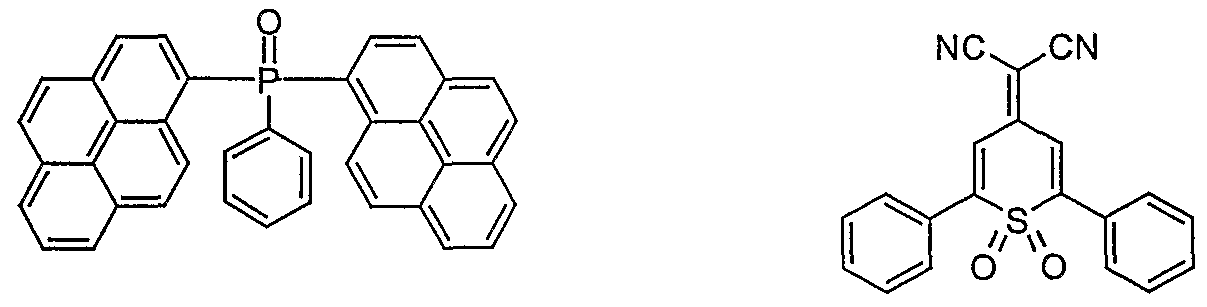


Priority Applications (3)
| Application Number | Priority Date | Filing Date | Title |
|---|---|---|---|
| JP2006553552A JP2007527116A (en) | 2004-02-20 | 2005-02-18 | Organic electronic devices |
| EP05715402A EP1716725A1 (en) | 2004-02-20 | 2005-02-18 | Organic electronic devices |
| US10/590,037 US7776455B2 (en) | 2004-02-20 | 2005-02-18 | Organic electronic devices |
Applications Claiming Priority (2)
| Application Number | Priority Date | Filing Date | Title |
|---|---|---|---|
| DE102004008304.5 | 2004-02-20 | ||
| DE102004008304A DE102004008304A1 (en) | 2004-02-20 | 2004-02-20 | Organic electronic devices |
Publications (1)
| Publication Number | Publication Date |
|---|---|
| WO2005084082A1 true WO2005084082A1 (en) | 2005-09-09 |
Family
ID=34832853
Family Applications (2)
| Application Number | Title | Priority Date | Filing Date |
|---|---|---|---|
| PCT/EP2005/001710 Ceased WO2005084082A1 (en) | 2004-02-20 | 2005-02-18 | Organic electronic devices |
| PCT/EP2005/001709 Ceased WO2005084081A1 (en) | 2004-02-20 | 2005-02-18 | Organic electronic devices |
Family Applications After (1)
| Application Number | Title | Priority Date | Filing Date |
|---|---|---|---|
| PCT/EP2005/001709 Ceased WO2005084081A1 (en) | 2004-02-20 | 2005-02-18 | Organic electronic devices |
Country Status (7)
| Country | Link |
|---|---|
| US (2) | US7838126B2 (en) |
| EP (2) | EP1716725A1 (en) |
| JP (2) | JP2007527116A (en) |
| KR (2) | KR20060127138A (en) |
| CN (2) | CN100482023C (en) |
| DE (1) | DE102004008304A1 (en) |
| WO (2) | WO2005084082A1 (en) |
Cited By (234)
| Publication number | Priority date | Publication date | Assignee | Title |
|---|---|---|---|---|
| WO2007022845A1 (en) | 2005-08-26 | 2007-03-01 | Merck Patent Gmbh | Novel materials for organic electroluminescent devices |
| JP2007129206A (en) * | 2005-10-04 | 2007-05-24 | Fujifilm Corp | Organic electroluminescence device |
| JP2007281039A (en) * | 2006-04-03 | 2007-10-25 | Seiko Epson Corp | Organic-inorganic composite semiconductor material, liquid material, organic light-emitting element, method for manufacturing organic light-emitting element, light-emitting device, and electronic device |
| WO2008006449A1 (en) | 2006-07-11 | 2008-01-17 | Merck Patent Gmbh | Novel materials for organic electroluminescent devices |
| DE102007024850A1 (en) | 2007-05-29 | 2008-12-04 | Merck Patent Gmbh | New materials for organic electroluminescent devices |
| DE102008018670A1 (en) | 2008-04-14 | 2009-10-15 | Merck Patent Gmbh | New materials for organic electroluminescent devices |
| DE102008035413A1 (en) | 2008-07-29 | 2010-02-04 | Merck Patent Gmbh | Connections for organic electronic devices |
| DE102008054141A1 (en) | 2008-10-31 | 2010-05-06 | Merck Patent Gmbh | New materials for organic electroluminescent devices |
| DE102008063490A1 (en) | 2008-12-17 | 2010-06-24 | Merck Patent Gmbh | Organic electroluminescent device |
| DE102009005289A1 (en) | 2009-01-20 | 2010-07-22 | Merck Patent Gmbh | Materials for organic electroluminescent devices |
| DE102009005290A1 (en) | 2009-01-20 | 2010-07-22 | Merck Patent Gmbh | Connections for electronic devices |
| DE102009005288A1 (en) | 2009-01-20 | 2010-07-22 | Merck Patent Gmbh | Materials for organic electroluminescent devices |
| DE102009005746A1 (en) | 2009-01-23 | 2010-07-29 | Merck Patent Gmbh | Materials for organic electroluminescent devices |
| DE102009009277A1 (en) | 2009-02-17 | 2010-08-19 | Merck Patent Gmbh | Organic electronic device |
| DE102009012346A1 (en) | 2009-03-09 | 2010-09-16 | Merck Patent Gmbh | Organic electroluminescent device |
| DE102009017064A1 (en) | 2009-04-09 | 2010-10-14 | Merck Patent Gmbh | Organic electroluminescent device |
| EP2248869A2 (en) | 2005-09-12 | 2010-11-10 | Merck Patent GmbH | Compounds for organic electronic devices |
| WO2010149259A2 (en) | 2009-06-22 | 2010-12-29 | Merck Patent Gmbh | Conducting formulation |
| DE102009032922A1 (en) | 2009-07-14 | 2011-01-20 | Merck Patent Gmbh | Materials for organic electroluminescent devices |
| DE102009034625A1 (en) | 2009-07-27 | 2011-02-03 | Merck Patent Gmbh | New materials for organic electroluminescent devices |
| WO2011015265A2 (en) | 2009-08-04 | 2011-02-10 | Merck Patent Gmbh | Electronic devices comprising multi cyclic hydrocarbons |
| DE102009041289A1 (en) | 2009-09-16 | 2011-03-17 | Merck Patent Gmbh | Organic electroluminescent device |
| DE102009042680A1 (en) | 2009-09-23 | 2011-03-24 | Merck Patent Gmbh | Organic electroluminescent device |
| WO2011032686A1 (en) | 2009-09-16 | 2011-03-24 | Merck Patent Gmbh | Formulas for producing electronic devices |
| WO2011035836A1 (en) | 2009-09-23 | 2011-03-31 | Merck Patent Gmbh | Materials for electronic devices |
| WO2011054442A2 (en) | 2009-11-06 | 2011-05-12 | Merck Patent Gmbh | Materials for electronic devices |
| DE102009052428A1 (en) | 2009-11-10 | 2011-05-12 | Merck Patent Gmbh | Connection for electronic devices |
| DE102009033371A1 (en) | 2009-07-16 | 2011-05-12 | Merck Patent Gmbh | Materials for electronic devices |
| WO2011076325A1 (en) | 2009-12-23 | 2011-06-30 | Merck Patent Gmbh | Compositions comprising polymeric binders |
| WO2011076323A1 (en) | 2009-12-22 | 2011-06-30 | Merck Patent Gmbh | Formulations comprising phase-separated functional materials |
| WO2011076324A1 (en) | 2009-12-23 | 2011-06-30 | Merck Patent Gmbh | Compositions comprising organic semiconducting compounds |
| WO2011076326A1 (en) | 2009-12-22 | 2011-06-30 | Merck Patent Gmbh | Electroluminescent functional surfactants |
| WO2011076314A1 (en) | 2009-12-22 | 2011-06-30 | Merck Patent Gmbh | Electroluminescent formulations |
| WO2011088877A1 (en) | 2010-01-25 | 2011-07-28 | Merck Patent Gmbh | Compounds for electronic devices |
| DE102010009193A1 (en) | 2010-02-24 | 2011-08-25 | Merck Patent GmbH, 64293 | Fluorine-fluorine associates |
| DE102010010481A1 (en) | 2010-03-06 | 2011-09-08 | Merck Patent Gmbh | Organic electroluminescent device |
| DE102010009903A1 (en) | 2010-03-02 | 2011-09-08 | Merck Patent Gmbh | Connections for electronic devices |
| WO2011110275A2 (en) | 2010-03-11 | 2011-09-15 | Merck Patent Gmbh | Radiative fibers |
| WO2011110276A1 (en) | 2010-03-09 | 2011-09-15 | Merck Patent Gmbh | Materials for electronic devices |
| WO2011110277A1 (en) | 2010-03-11 | 2011-09-15 | Merck Patent Gmbh | Fibers in therapy and cosmetics |
| WO2011116869A1 (en) | 2010-03-26 | 2011-09-29 | Merck Patent Gmbh | Compounds for electronic devices |
| WO2011128017A1 (en) | 2010-04-14 | 2011-10-20 | Merck Patent Gmbh | Bridged triarylamines and -phosphines as materials for electronic devices |
| WO2011128035A1 (en) | 2010-04-12 | 2011-10-20 | Merck Patent Gmbh | Composition and method for preparation of organic electronic devices |
| WO2011128034A1 (en) | 2010-04-12 | 2011-10-20 | Merck Patent Gmbh | Composition having improved performance |
| WO2011137922A1 (en) | 2010-05-03 | 2011-11-10 | Merck Patent Gmbh | Formulations and electronic devices |
| WO2011141109A1 (en) | 2010-05-11 | 2011-11-17 | Merck Patent Gmbh | Organic electroluminescent devices |
| WO2011147522A1 (en) | 2010-05-27 | 2011-12-01 | Merck Patent Gmbh | Compositions comprising quantum dots |
| WO2011147523A1 (en) | 2010-05-27 | 2011-12-01 | Merck Patent Gmbh | Formulation and method for preparation of organic electronic devices |
| WO2011157346A1 (en) | 2010-06-18 | 2011-12-22 | Merck Patent Gmbh | Compounds for electronic devices |
| DE102010024542A1 (en) | 2010-06-22 | 2011-12-22 | Merck Patent Gmbh | Materials for electronic devices |
| WO2012013272A1 (en) | 2010-07-26 | 2012-02-02 | Merck Patent Gmbh | Quantum dots and hosts |
| WO2012013270A1 (en) | 2010-07-26 | 2012-02-02 | Merck Patent Gmbh | Nanocrystals in devices |
| DE102010033548A1 (en) | 2010-08-05 | 2012-02-09 | Merck Patent Gmbh | Materials for electronic devices |
| DE102010048074A1 (en) | 2010-10-09 | 2012-04-12 | Merck Patent Gmbh | Materials for electronic devices |
| WO2012048780A1 (en) | 2010-10-15 | 2012-04-19 | Merck Patent Gmbh | Compounds for electronic devices |
| WO2012048781A1 (en) | 2010-10-15 | 2012-04-19 | Merck Patent Gmbh | Triphenylene-based materials for organic electroluminescent devices |
| DE102010054316A1 (en) | 2010-12-13 | 2012-06-14 | Merck Patent Gmbh | Substituted tetraarylbenzenes |
| US8206839B2 (en) | 2005-10-04 | 2012-06-26 | Fujifilm Corporation | Organic electroluminescent element |
| WO2012084115A1 (en) | 2010-12-23 | 2012-06-28 | Merck Patent Gmbh | Organic electroluminescent device |
| WO2012095143A1 (en) | 2011-01-13 | 2012-07-19 | Merck Patent Gmbh | Compounds for organic electroluminescent devices |
| EP2482159A2 (en) | 2011-01-28 | 2012-08-01 | Honeywell International, Inc. | Methods and reconfigurable systems to optimize the performance of a condition based health maintenance system |
| WO2012107163A1 (en) | 2011-02-12 | 2012-08-16 | Merck Patent Gmbh | Substituted dibenzonaphthacene |
| DE102011010841A1 (en) | 2011-02-10 | 2012-08-16 | Merck Patent Gmbh | (1,3) -dioxane-5-one compounds |
| WO2012110182A1 (en) | 2011-02-17 | 2012-08-23 | Merck Patent Gmbh | Compounds for electronic devices |
| WO2012110178A1 (en) | 2011-02-14 | 2012-08-23 | Merck Patent Gmbh | Device and method for treatment of cells and cell tissue |
| WO2012139692A1 (en) | 2011-04-13 | 2012-10-18 | Merck Patent Gmbh | Materials for electronic devices |
| WO2012139693A1 (en) | 2011-04-13 | 2012-10-18 | Merck Patent Gmbh | Compounds for electronic devices |
| WO2012143079A1 (en) | 2011-04-18 | 2012-10-26 | Merck Patent Gmbh | Compounds for electronic devices |
| US8304095B2 (en) | 2005-12-08 | 2012-11-06 | Merck Patent Gmbh | Organic electroluminescent devices |
| WO2012149992A1 (en) | 2011-05-04 | 2012-11-08 | Merck Patent Gmbh | Device for preserving fresh goods |
| WO2012150001A1 (en) | 2011-05-05 | 2012-11-08 | Merck Patent Gmbh | Compounds for electronic devices |
| WO2012152366A1 (en) | 2011-05-12 | 2012-11-15 | Merck Patent Gmbh | Organic ionic compounds, compositions and electronic devices |
| WO2013013754A1 (en) | 2011-07-25 | 2013-01-31 | Merck Patent Gmbh | Copolymers with functionalized side chains |
| WO2013017189A1 (en) | 2011-07-29 | 2013-02-07 | Merck Patent Gmbh | Compounds for electronic devices |
| WO2013017192A1 (en) | 2011-08-03 | 2013-02-07 | Merck Patent Gmbh | Materials for electronic devices |
| DE102012016192A1 (en) | 2011-08-19 | 2013-02-21 | Merck Patent Gmbh | New compounds capable of forming hydrogen bonds are useful in electronic device, e.g. organic electroluminescent device, organic light-emitting transistor and organic light-emitting electrochemical cell |
| WO2013026515A1 (en) | 2011-08-22 | 2013-02-28 | Merck Patent Gmbh | Organic electroluminescence device |
| WO2013050101A1 (en) | 2011-10-06 | 2013-04-11 | Merck Patent Gmbh | Organic electroluminescent device |
| DE102011116165A1 (en) | 2011-10-14 | 2013-04-18 | Merck Patent Gmbh | Benzodioxepin-3-one compounds |
| WO2013060411A1 (en) | 2011-10-28 | 2013-05-02 | Merck Patent Gmbh | Hyperbranched polymers, methods for producing same, and use of same in electronic devices |
| WO2013060418A1 (en) | 2011-10-27 | 2013-05-02 | Merck Patent Gmbh | Materials for electronic devices |
| WO2013087142A1 (en) | 2011-12-12 | 2013-06-20 | Merck Patent Gmbh | Compounds for electronic devices |
| DE102012022880A1 (en) | 2011-12-22 | 2013-06-27 | Merck Patent Gmbh | Electronic device e.g. organic integrated circuits, organic field-effect transistors, organic thin-film transistors, organic light emitting transistors, comprises an organic layer comprising substituted heteroaryl compounds |
| WO2013113349A1 (en) | 2012-01-30 | 2013-08-08 | Merck Patent Gmbh | Nanocrystals on fibers |
| WO2013120577A1 (en) | 2012-02-14 | 2013-08-22 | Merck Patent Gmbh | Spirobifluorene compounds for organic electroluminescent devices |
| WO2013135352A1 (en) | 2012-03-15 | 2013-09-19 | Merck Patent Gmbh | Electronic devices |
| WO2013182263A1 (en) | 2012-06-06 | 2013-12-12 | Merck Patent Gmbh | Phenanthrene compounds for organic electronic devices |
| WO2013185871A1 (en) | 2012-06-12 | 2013-12-19 | Merck Patent Gmbh | Compounds for electronic devices |
| WO2014015938A1 (en) | 2012-07-23 | 2014-01-30 | Merck Patent Gmbh | Derivatives of 2-diarylaminofluorene and organic electronic compounds containing them |
| WO2014015937A1 (en) | 2012-07-23 | 2014-01-30 | Merck Patent Gmbh | Compounds and organic electroluminescent devices |
| WO2014015935A2 (en) | 2012-07-23 | 2014-01-30 | Merck Patent Gmbh | Compounds and organic electronic devices |
| WO2014044344A1 (en) | 2012-09-18 | 2014-03-27 | Merck Patent Gmbh | Materials for electronic devices |
| WO2014067614A1 (en) | 2012-10-31 | 2014-05-08 | Merck Patent Gmbh | Electronic device |
| WO2014082705A1 (en) | 2012-11-30 | 2014-06-05 | Merck Patent Gmbh | Electronic device |
| WO2014106522A1 (en) | 2013-01-03 | 2014-07-10 | Merck Patent Gmbh | Materials for electronic devices |
| WO2014106524A2 (en) | 2013-01-03 | 2014-07-10 | Merck Patent Gmbh | Materials for electronic devices |
| US8795847B2 (en) | 2005-12-08 | 2014-08-05 | Merck Patent Gmbh | Materials for organic electroluminescent devices |
| JP2014523877A (en) * | 2011-06-13 | 2014-09-18 | エルジー・ケム・リミテッド | NOVEL COMPOUND AND ORGANIC ELECTRONIC DEVICE USING THE SAME |
| WO2015014427A1 (en) | 2013-07-29 | 2015-02-05 | Merck Patent Gmbh | Electro-optical device and the use thereof |
| US8999521B2 (en) | 2006-03-24 | 2015-04-07 | Merck Patent Gmbh | Materials for organic electroluminescent devices |
| US9017825B2 (en) | 2005-12-08 | 2015-04-28 | Merck Patent Gmbh | Anthracene derivatives and their use in organic electroluminescent devices |
| WO2015082046A2 (en) | 2013-12-06 | 2015-06-11 | Merck Patent Gmbh | Substituted oxepines |
| WO2015082037A1 (en) | 2013-12-06 | 2015-06-11 | Merck Patent Gmbh | Compositions containing a polymeric binder which comprises acrylic and/or methacrylic acid ester units |
| WO2015086108A1 (en) | 2013-12-12 | 2015-06-18 | Merck Patent Gmbh | Materials for electronic devices |
| WO2015165563A1 (en) | 2014-04-30 | 2015-11-05 | Merck Patent Gmbh | Materials for electronic devices |
| WO2016034262A1 (en) | 2014-09-05 | 2016-03-10 | Merck Patent Gmbh | Formulations and electronic devices |
| WO2016107663A1 (en) | 2014-12-30 | 2016-07-07 | Merck Patent Gmbh | Formulations and electronic devices |
| WO2016119992A1 (en) | 2015-01-30 | 2016-08-04 | Merck Patent Gmbh | Materials for electronic devices |
| WO2016120007A1 (en) | 2015-01-30 | 2016-08-04 | Merck Patent Gmbh | Formulations with a low particle content |
| WO2016155866A1 (en) | 2015-03-30 | 2016-10-06 | Merck Patent Gmbh | Formulation of an organic functional material comprising a siloxane solvent |
| WO2016198141A1 (en) | 2015-06-12 | 2016-12-15 | Merck Patent Gmbh | Esters containing non-aromatic cycles as solvents for oled formulations |
| WO2017008883A1 (en) | 2015-07-15 | 2017-01-19 | Merck Patent Gmbh | Composition comprising organic semiconducting compounds |
| WO2017028940A1 (en) | 2015-08-14 | 2017-02-23 | Merck Patent Gmbh | Phenoxazine derivatives for organic electroluminescent devices |
| WO2017036572A1 (en) | 2015-08-28 | 2017-03-09 | Merck Patent Gmbh | Formulation of an organic functional material comprising an epoxy group containing solvent |
| WO2017036573A1 (en) | 2015-08-28 | 2017-03-09 | Merck Patent Gmbh | Compounds for electronic devices |
| WO2017097391A1 (en) | 2015-12-10 | 2017-06-15 | Merck Patent Gmbh | Formulations containing ketones comprising non-aromatic cycles |
| WO2017102052A1 (en) | 2015-12-16 | 2017-06-22 | Merck Patent Gmbh | Formulations containing a solid solvent |
| WO2017102048A1 (en) | 2015-12-15 | 2017-06-22 | Merck Patent Gmbh | Esters containing aromatic groups as solvents for organic electronic formulations |
| WO2017102049A1 (en) | 2015-12-16 | 2017-06-22 | Merck Patent Gmbh | Formulations containing a mixture of at least two different solvents |
| WO2017133829A1 (en) | 2016-02-05 | 2017-08-10 | Merck Patent Gmbh | Materials for electronic devices |
| WO2017140404A1 (en) | 2016-02-17 | 2017-08-24 | Merck Patent Gmbh | Formulation of an organic functional material |
| DE102016003104A1 (en) | 2016-03-15 | 2017-09-21 | Merck Patent Gmbh | Container comprising a formulation containing at least one organic semiconductor |
| WO2017216128A1 (en) | 2016-06-17 | 2017-12-21 | Merck Patent Gmbh | Formulation of an organic functional material |
| WO2017216129A1 (en) | 2016-06-16 | 2017-12-21 | Merck Patent Gmbh | Formulation of an organic functional material |
| WO2018001928A1 (en) | 2016-06-28 | 2018-01-04 | Merck Patent Gmbh | Formulation of an organic functional material |
| WO2018007421A1 (en) | 2016-07-08 | 2018-01-11 | Merck Patent Gmbh | Materials for organic electroluminescent devices |
| WO2018024719A1 (en) | 2016-08-04 | 2018-02-08 | Merck Patent Gmbh | Formulation of an organic functional material |
| DE102017008794A1 (en) | 2016-10-17 | 2018-04-19 | Merck Patent Gmbh | Materials for use in electronic devices |
| WO2018069167A1 (en) | 2016-10-10 | 2018-04-19 | Merck Patent Gmbh | Electronic device |
| WO2018077662A1 (en) | 2016-10-31 | 2018-05-03 | Merck Patent Gmbh | Formulation of an organic functional material |
| WO2018077660A1 (en) | 2016-10-31 | 2018-05-03 | Merck Patent Gmbh | Formulation of an organic functional material |
| WO2018083053A1 (en) | 2016-11-02 | 2018-05-11 | Merck Patent Gmbh | Materials for electronic devices |
| WO2018087020A1 (en) | 2016-11-08 | 2018-05-17 | Merck Patent Gmbh | Compounds for electronic devices |
| WO2018095839A1 (en) | 2016-11-22 | 2018-05-31 | Merck Patent Gmbh | Bridged triarylamines for electronic devices |
| WO2018095940A1 (en) | 2016-11-25 | 2018-05-31 | Merck Patent Gmbh | Bisbenzofuran-fused indeno[1,2-b]fluorene derivatives and related compounds as materials for organic electroluminescent devices (oled) |
| WO2018095888A1 (en) | 2016-11-25 | 2018-05-31 | Merck Patent Gmbh | Bisbenzofuran-fused 2,8-diaminoindeno[1,2-b]fluorene derivatives and related compounds as materials for organic electroluminescent devices (oled) |
| WO2018104202A1 (en) | 2016-12-06 | 2018-06-14 | Merck Patent Gmbh | Preparation process for an electronic device |
| WO2018108760A1 (en) | 2016-12-13 | 2018-06-21 | Merck Patent Gmbh | Formulation of an organic functional material |
| WO2018114882A1 (en) | 2016-12-22 | 2018-06-28 | Merck Patent Gmbh | Materials for electronic devices |
| WO2018114883A1 (en) | 2016-12-22 | 2018-06-28 | Merck Patent Gmbh | Mixtures comprising at least two organofunctional compounds |
| EP3345984A1 (en) | 2013-12-06 | 2018-07-11 | Merck Patent GmbH | Connections and organic electronic devices |
| WO2018138319A1 (en) | 2017-01-30 | 2018-08-02 | Merck Patent Gmbh | Method for forming an organic electroluminescence (el) element |
| WO2018138318A1 (en) | 2017-01-30 | 2018-08-02 | Merck Patent Gmbh | Method for forming an organic element of an electronic device |
| WO2018141706A1 (en) | 2017-02-02 | 2018-08-09 | Merck Patent Gmbh | Materials for electronic devices |
| WO2018158232A1 (en) | 2017-03-01 | 2018-09-07 | Merck Patent Gmbh | Organic electroluminescent device |
| WO2018157981A1 (en) | 2017-03-02 | 2018-09-07 | Merck Patent Gmbh | Materials for organic electronic devices |
| EP3378857A1 (en) | 2012-11-12 | 2018-09-26 | Merck Patent GmbH | Materials for electronic devices |
| WO2018178136A1 (en) | 2017-03-31 | 2018-10-04 | Merck Patent Gmbh | Printing method for an organic light emitting diode (oled) |
| WO2018189134A1 (en) | 2017-04-13 | 2018-10-18 | Merck Patent Gmbh | Composition for organic electronic devices |
| WO2018189050A1 (en) | 2017-04-10 | 2018-10-18 | Merck Patent Gmbh | Formulation of an organic functional material |
| WO2018197447A1 (en) | 2017-04-25 | 2018-11-01 | Merck Patent Gmbh | Compounds for electronic devices |
| WO2018202603A1 (en) | 2017-05-03 | 2018-11-08 | Merck Patent Gmbh | Formulation of an organic functional material |
| WO2018234220A1 (en) | 2017-06-21 | 2018-12-27 | Merck Patent Gmbh | MATERIALS FOR ELECTRONIC DEVICES |
| WO2018234346A1 (en) | 2017-06-23 | 2018-12-27 | Merck Patent Gmbh | MATERIALS FOR ORGANIC ELECTROLUMINESCENT DEVICES |
| WO2019002198A1 (en) | 2017-06-26 | 2019-01-03 | Merck Patent Gmbh | Homogeneous mixtures |
| WO2019002190A1 (en) | 2017-06-28 | 2019-01-03 | Merck Patent Gmbh | Materials for electronic devices |
| WO2019007825A1 (en) | 2017-07-03 | 2019-01-10 | Merck Patent Gmbh | Organic electroluminescent device |
| WO2019007866A1 (en) | 2017-07-05 | 2019-01-10 | Merck Patent Gmbh | COMPOSITION FOR ORGANIC ELECTRONIC DEVICES |
| WO2019007823A1 (en) | 2017-07-03 | 2019-01-10 | Merck Patent Gmbh | Formulations with a low content of phenol type impurities |
| WO2019007867A1 (en) | 2017-07-05 | 2019-01-10 | Merck Patent Gmbh | COMPOSITION FOR ORGANIC ELECTRONIC DEVICES |
| WO2019016184A1 (en) | 2017-07-18 | 2019-01-24 | Merck Patent Gmbh | Formulation of an organic functional material |
| WO2019020654A1 (en) | 2017-07-28 | 2019-01-31 | Merck Patent Gmbh | Spirobifluorene derivatives for use in electronic devices |
| WO2019048443A1 (en) | 2017-09-08 | 2019-03-14 | Merck Patent Gmbh | Materials for electronic devices |
| WO2019076789A1 (en) | 2017-10-17 | 2019-04-25 | Merck Patent Gmbh | Materials for organic electroluminescent devices |
| WO2019096717A2 (en) | 2017-11-14 | 2019-05-23 | Merck Patent Gmbh | Composition for organic electronic devices |
| WO2019101719A1 (en) | 2017-11-23 | 2019-05-31 | Merck Patent Gmbh | Materials for electronic devices |
| WO2019101835A1 (en) | 2017-11-24 | 2019-05-31 | Merck Patent Gmbh | Materials for organic electroluminescent devices |
| WO2019101833A1 (en) | 2017-11-24 | 2019-05-31 | Merck Patent Gmbh | Materials for organic electroluminescent devices |
| WO2019115577A1 (en) | 2017-12-15 | 2019-06-20 | Merck Patent Gmbh | Substituted aromatic amines for use in organic electroluminescent devices |
| WO2019115573A1 (en) | 2017-12-15 | 2019-06-20 | Merck Patent Gmbh | Formulation of an organic functional material |
| WO2019121483A1 (en) | 2017-12-20 | 2019-06-27 | Merck Patent Gmbh | Heteroaromatic compounds |
| WO2019162483A1 (en) | 2018-02-26 | 2019-08-29 | Merck Patent Gmbh | Formulation of an organic functional material |
| WO2019170572A1 (en) | 2018-03-06 | 2019-09-12 | Merck Patent Gmbh | Materials for organic electroluminescent devices |
| WO2019170578A1 (en) | 2018-03-06 | 2019-09-12 | Merck Patent Gmbh | Materials for organic electroluminescent devices |
| WO2019175149A1 (en) | 2018-03-16 | 2019-09-19 | Merck Patent Gmbh | Materials for organic electroluminescent devices |
| WO2019229011A1 (en) | 2018-05-30 | 2019-12-05 | Merck Patent Gmbh | Composition for organic electronic devices |
| WO2019238782A1 (en) | 2018-06-15 | 2019-12-19 | Merck Patent Gmbh | Formulation of an organic functional material |
| WO2020043640A1 (en) | 2018-08-28 | 2020-03-05 | Merck Patent Gmbh | Materials for organic electroluminescent devices |
| WO2020043657A1 (en) | 2018-08-28 | 2020-03-05 | Merck Patent Gmbh | Materials for organic electroluminescent devices |
| WO2020043646A1 (en) | 2018-08-28 | 2020-03-05 | Merck Patent Gmbh | Materials for organic electroluminescent devices |
| WO2020053150A1 (en) | 2018-09-12 | 2020-03-19 | Merck Patent Gmbh | Materials for organic electroluminescent devices |
| WO2020064582A1 (en) | 2018-09-24 | 2020-04-02 | Merck Patent Gmbh | Method for the production of a granular material |
| EP3647393A1 (en) | 2013-07-30 | 2020-05-06 | Merck Patent GmbH | Materials for electronic devices |
| WO2020089138A1 (en) | 2018-10-31 | 2020-05-07 | Merck Patent Gmbh | Materials for organic electroluminescent devices |
| WO2020094538A1 (en) | 2018-11-06 | 2020-05-14 | Merck Patent Gmbh | Method for forming an organic element of an electronic device |
| WO2020169241A1 (en) | 2019-02-18 | 2020-08-27 | Merck Patent Gmbh | Composition for organic electronic devices |
| WO2020178230A1 (en) | 2019-03-04 | 2020-09-10 | Merck Patent Gmbh | Ligands for nano-sized materials |
| EP3712229A1 (en) | 2013-07-30 | 2020-09-23 | Merck Patent GmbH | Materials for electronic devices |
| WO2020208051A1 (en) | 2019-04-11 | 2020-10-15 | Merck Patent Gmbh | Materials for organic electroluminescent devices |
| WO2021052921A1 (en) | 2019-09-19 | 2021-03-25 | Merck Patent Gmbh | Mixture of two host materials, and organic electroluminescent device comprising same |
| WO2021089450A1 (en) | 2019-11-04 | 2021-05-14 | Merck Patent Gmbh | Materials for organic electroluminescent devices |
| WO2021094269A1 (en) | 2019-11-12 | 2021-05-20 | Merck Patent Gmbh | Materials for organic electroluminescent devices |
| WO2021180950A1 (en) | 2020-03-13 | 2021-09-16 | Merck Patent Gmbh | Materials for organic electroluminescent devices |
| WO2021191058A1 (en) | 2020-03-23 | 2021-09-30 | Merck Patent Gmbh | Materials for organic electroluminescent devices |
| WO2021213918A1 (en) | 2020-04-21 | 2021-10-28 | Merck Patent Gmbh | Formulation of an organic functional material |
| WO2021213917A1 (en) | 2020-04-21 | 2021-10-28 | Merck Patent Gmbh | Emulsions comprising organic functional materials |
| WO2021259824A1 (en) | 2020-06-23 | 2021-12-30 | Merck Patent Gmbh | Method for producing a mixture |
| WO2022017997A1 (en) | 2020-07-22 | 2022-01-27 | Merck Patent Gmbh | Materials for organic electroluminescent devices |
| WO2022017998A1 (en) | 2020-07-22 | 2022-01-27 | Merck Patent Gmbh | Materials for organic electroluminescent devices |
| WO2022122607A1 (en) | 2020-12-08 | 2022-06-16 | Merck Patent Gmbh | An ink system and a method for inkjet printing |
| EP4037000A1 (en) | 2014-07-21 | 2022-08-03 | Merck Patent GmbH | Materials for electronic devices |
| WO2022200638A1 (en) | 2021-07-06 | 2022-09-29 | Merck Patent Gmbh | Materials for organic electroluminescent devices |
| WO2022214506A1 (en) | 2021-04-09 | 2022-10-13 | Merck Patent Gmbh | Materials for organic electroluminescent devices |
| WO2022214566A1 (en) | 2021-04-09 | 2022-10-13 | Merck Patent Gmbh | Materials for organic electroluminescent devices |
| WO2022214507A1 (en) | 2021-04-09 | 2022-10-13 | Merck Patent Gmbh | Materials for organic electroluminescent devices |
| WO2022223675A1 (en) | 2021-04-23 | 2022-10-27 | Merck Patent Gmbh | Formulation of an organic functional material |
| WO2022243403A1 (en) | 2021-05-21 | 2022-11-24 | Merck Patent Gmbh | Method for the continuous purification of at least one functional material and device for the continuous purification of at least one functional material |
| WO2023012084A1 (en) | 2021-08-02 | 2023-02-09 | Merck Patent Gmbh | A printing method by combining inks |
| WO2023052272A1 (en) | 2021-09-28 | 2023-04-06 | Merck Patent Gmbh | Materials for electronic devices |
| WO2023052314A1 (en) | 2021-09-28 | 2023-04-06 | Merck Patent Gmbh | Materials for electronic devices |
| WO2023052313A1 (en) | 2021-09-28 | 2023-04-06 | Merck Patent Gmbh | Materials for electronic devices |
| WO2023052275A1 (en) | 2021-09-28 | 2023-04-06 | Merck Patent Gmbh | Materials for electronic devices |
| WO2023057327A1 (en) | 2021-10-05 | 2023-04-13 | Merck Patent Gmbh | Method for forming an organic element of an electronic device |
| WO2023094412A1 (en) | 2021-11-25 | 2023-06-01 | Merck Patent Gmbh | Materials for electronic devices |
| WO2023117837A1 (en) | 2021-12-21 | 2023-06-29 | Merck Patent Gmbh | Process for preparing deuterated organic compounds |
| WO2023152346A1 (en) | 2022-02-14 | 2023-08-17 | Merck Patent Gmbh | Materials for electronic devices |
| WO2023222559A1 (en) | 2022-05-18 | 2023-11-23 | Merck Patent Gmbh | Process for preparing deuterated organic compounds |
| WO2023237458A1 (en) | 2022-06-07 | 2023-12-14 | Merck Patent Gmbh | Method of printing a functional layer of an electronic device by combining inks |
| WO2024013004A1 (en) | 2022-07-11 | 2024-01-18 | Merck Patent Gmbh | Materials for electronic devices |
| WO2024105066A1 (en) | 2022-11-17 | 2024-05-23 | Merck Patent Gmbh | Materials for organic electroluminescent devices |
| WO2024126635A1 (en) | 2022-12-16 | 2024-06-20 | Merck Patent Gmbh | Formulation of an organic functional material |
| WO2024133048A1 (en) | 2022-12-20 | 2024-06-27 | Merck Patent Gmbh | Method for preparing deuterated aromatic compounds |
| WO2024170605A1 (en) | 2023-02-17 | 2024-08-22 | Merck Patent Gmbh | Materials for organic electroluminescent devices |
| WO2024218109A1 (en) | 2023-04-20 | 2024-10-24 | Merck Patent Gmbh | Materials for electronic devices |
| WO2024240725A1 (en) | 2023-05-25 | 2024-11-28 | Merck Patent Gmbh | Tris[1,2,4]triazolo[1,5-a:1',5'-c:1'',5''-e][1,3,5]triazine derivatives for use in organic electroluminescent devices |
| EP4486099A1 (en) | 2023-06-30 | 2025-01-01 | Merck Patent GmbH | Compounds for organic electroluminescent devices |
| WO2025012253A1 (en) | 2023-07-12 | 2025-01-16 | Merck Patent Gmbh | Materials for electronic devices |
| WO2025021855A1 (en) | 2023-07-27 | 2025-01-30 | Merck Patent Gmbh | Materials for organic light-emitting devices and organic sensors |
| WO2025032039A1 (en) | 2023-08-07 | 2025-02-13 | Merck Patent Gmbh | Process for the preparation of an electronic device |
| WO2025132551A1 (en) | 2023-12-22 | 2025-06-26 | Merck Patent Gmbh | Materials for electronic devices |
| WO2025132547A1 (en) | 2023-12-21 | 2025-06-26 | Merck Patent Gmbh | Mechanochemical method for deuterating organic compounds |
| WO2025196145A1 (en) | 2024-03-22 | 2025-09-25 | Merck Patent Gmbh | Materials for organic light emitting devices |
| WO2025210013A1 (en) | 2024-04-04 | 2025-10-09 | Merck Patent Gmbh | Compounds for electronic devices, in particular compounds for oleds |
| WO2026008710A1 (en) | 2024-07-05 | 2026-01-08 | Merck Patent Gmbh | Cyclic silicon compounds for organic electroluminescent devices |
Families Citing this family (35)
| Publication number | Priority date | Publication date | Assignee | Title |
|---|---|---|---|---|
| DE102004008304A1 (en) * | 2004-02-20 | 2005-09-08 | Covion Organic Semiconductors Gmbh | Organic electronic devices |
| WO2006108498A1 (en) * | 2005-04-12 | 2006-10-19 | Merck Patent Gmbh | Organic electroluminescent devices |
| WO2006108497A1 (en) | 2005-04-14 | 2006-10-19 | Merck Patent Gmbh | Compounds for organic electronic devices |
| JP5616783B2 (en) * | 2007-04-27 | 2014-10-29 | メルク パテント ゲーエムベーハー | Organic photovoltaic cell |
| WO2008142921A1 (en) * | 2007-05-24 | 2008-11-27 | Nitto Denko Corporation | Optical film, display, diethynylfluorene and polymer thereof |
| JP5133034B2 (en) * | 2007-05-24 | 2013-01-30 | 日東電工株式会社 | Optical film, image display device, diethynylfluorene and polymer thereof |
| US20090191427A1 (en) * | 2008-01-30 | 2009-07-30 | Liang-Sheng Liao | Phosphorescent oled having double hole-blocking layers |
| KR101072214B1 (en) * | 2009-04-10 | 2011-10-10 | 단국대학교 산학협력단 | White Organic Light Emitting Device |
| WO2010141449A1 (en) * | 2009-06-03 | 2010-12-09 | First Solar, Inc. | Self-remediating photovoltaic module |
| JP2011046697A (en) * | 2009-07-30 | 2011-03-10 | Mitsubishi Chemicals Corp | New phosphine compound, electrode buffer material, and photoelectric conversion element using the same |
| JP2011054947A (en) * | 2009-08-04 | 2011-03-17 | Mitsubishi Chemicals Corp | Electrode buffering material for photoelectric conversion element, and photoelectric conversion element using the same |
| WO2011016430A1 (en) * | 2009-08-04 | 2011-02-10 | 三菱化学株式会社 | Photoelectric conversion element and solar cell using same |
| JP5648380B2 (en) * | 2009-09-16 | 2015-01-07 | 三菱化学株式会社 | Photoelectric conversion element, method for manufacturing photoelectric conversion element, and solar cell |
| EP2452946B1 (en) * | 2010-11-16 | 2014-05-07 | Novaled AG | Pyridylphosphinoxides for organic electronic device and organic electronic device |
| JPWO2012102390A1 (en) * | 2011-01-28 | 2014-07-03 | 三菱化学株式会社 | Photoelectric conversion element, solar cell and solar cell module |
| JP5964553B2 (en) * | 2011-01-28 | 2016-08-03 | 三菱化学株式会社 | Novel copolymer, organic semiconductor material, organic electronic device, photoelectric conversion element and solar cell module using the same |
| EP2773721B1 (en) * | 2011-11-01 | 2015-11-25 | Merck Patent GmbH | Organic electroluminescent device |
| EP2923391A1 (en) * | 2012-11-20 | 2015-09-30 | Merck Patent GmbH | Formulation in high-purity solvent for producing electronic devices |
| KR102050484B1 (en) | 2013-03-04 | 2019-12-02 | 삼성디스플레이 주식회사 | Anthracene derivatives and organic light emitting diodes comprising the derivatives |
| KR102107106B1 (en) | 2013-05-09 | 2020-05-07 | 삼성디스플레이 주식회사 | Styryl-based compound and organic light emitting diode comprising the same |
| KR102269131B1 (en) | 2013-07-01 | 2021-06-25 | 삼성디스플레이 주식회사 | Compound and organic light emitting device comprising same |
| US10062850B2 (en) | 2013-12-12 | 2018-08-28 | Samsung Display Co., Ltd. | Amine-based compounds and organic light-emitting devices comprising the same |
| KR20150132795A (en) | 2014-05-16 | 2015-11-26 | 삼성디스플레이 주식회사 | Organic light emitting device |
| KR102327086B1 (en) | 2014-06-11 | 2021-11-17 | 삼성디스플레이 주식회사 | Organic light-emitting devices |
| KR102322761B1 (en) | 2014-07-03 | 2021-11-08 | 삼성디스플레이 주식회사 | Organic light-emitting device |
| KR102350027B1 (en) * | 2014-07-10 | 2022-01-11 | 삼성디스플레이 주식회사 | Organic light emitting diode and organic light emitting display device including the same |
| KR102343145B1 (en) | 2015-01-12 | 2021-12-27 | 삼성디스플레이 주식회사 | Condensed compound and organic light-emitting device comprising the same |
| JP2018527740A (en) * | 2015-06-23 | 2018-09-20 | ノヴァレッド ゲーエムベーハー | Organic light emitting device comprising a polar matrix and a metal dopant |
| EP3182478B1 (en) * | 2015-12-18 | 2018-11-28 | Novaled GmbH | Electron injection layer for an organic light-emitting diode (oled) |
| US12082500B2 (en) * | 2015-12-21 | 2024-09-03 | Samsung Display Co., Ltd. | Condensed cyclic compound and organic light-emitting device including the same |
| WO2017194435A1 (en) | 2016-05-11 | 2017-11-16 | Merck Patent Gmbh | Compositions for electrochemical cells |
| TWI756292B (en) | 2016-11-14 | 2022-03-01 | 德商麥克專利有限公司 | Compounds having an acceptor group and a donor group |
| KR102676889B1 (en) * | 2016-12-13 | 2024-06-21 | 삼성디스플레이 주식회사 | Condensed cyclic compound and organic electroluminescence device including the same |
| KR102571084B1 (en) | 2017-10-31 | 2023-08-28 | 삼성디스플레이 주식회사 | Heterocyclic compound and organic light-emitting device comprising the same |
| EP3502116B1 (en) * | 2017-12-20 | 2020-11-25 | Novaled GmbH | Compound and an organic semiconducting layer comprising the same |
Citations (11)
| Publication number | Priority date | Publication date | Assignee | Title |
|---|---|---|---|---|
| EP0786926A2 (en) * | 1996-01-29 | 1997-07-30 | Toyo Ink Manufacturing Co., Ltd. | Light-emitting material for organo-electroluminescence device and organo-electroluminescence devive for which the light-emitting material is adapted |
| JP2003123973A (en) * | 2001-10-09 | 2003-04-25 | Canon Inc | Organic light emitting device |
| JP2003123972A (en) * | 2001-10-09 | 2003-04-25 | Canon Inc | Organic light emitting device |
| EP1318143A1 (en) * | 2000-09-13 | 2003-06-11 | Shozo Yanagida | Rare-earth ternary complex |
| WO2003104245A1 (en) * | 2002-06-11 | 2003-12-18 | Ciba Specialty Chemicals Holding Inc. | Multimer forms of mono- and bis-acylphosphine oxides |
| JP2004095221A (en) * | 2002-08-29 | 2004-03-25 | Toray Ind Inc | Light-emitting device |
| EP1426429A1 (en) * | 2002-12-03 | 2004-06-09 | Canon Kabushiki Kaisha | Binaphthalene derivatives for organic electro-luminescent devices |
| WO2004093207A2 (en) * | 2003-04-15 | 2004-10-28 | Covion Organic Semiconductors Gmbh | Mixtures of matrix materials and organic semiconductors capable of emission, use of the same and electronic components containing said mixtures |
| WO2005003253A2 (en) * | 2003-07-07 | 2005-01-13 | Covion Organic Semiconductors Gmbh | Mixtures of organic emissive semiconductors and matrix materials, their use and electronic components comprising said materials |
| WO2005040302A1 (en) * | 2003-10-22 | 2005-05-06 | Merck Patent Gmbh | New materials for electroluminescence and the utilization thereof |
| WO2005054403A1 (en) * | 2003-12-05 | 2005-06-16 | Merck Patent Gmbh | Organic electroluminescent element |
Family Cites Families (26)
| Publication number | Priority date | Publication date | Assignee | Title |
|---|---|---|---|---|
| JP2939051B2 (en) * | 1992-04-28 | 1999-08-25 | キヤノン株式会社 | EL device |
| US5378519A (en) * | 1992-04-28 | 1995-01-03 | Canon Kabushiki Kaisha | Electroluminescent device |
| JP3302064B2 (en) * | 1992-12-25 | 2002-07-15 | キヤノン株式会社 | EL device |
| DE69412567T2 (en) | 1993-11-01 | 1999-02-04 | Hodogaya Chemical Co., Ltd., Tokio/Tokyo | Amine compound and electroluminescent device containing it |
| JP3274939B2 (en) * | 1994-09-30 | 2002-04-15 | 松下電器産業株式会社 | EL device |
| JP3050066B2 (en) * | 1994-11-25 | 2000-06-05 | 東レ株式会社 | Light emitting element |
| JP3943147B2 (en) * | 1995-06-26 | 2007-07-11 | ケミプロ化成株式会社 | Amorphous molecular material |
| JP3511825B2 (en) * | 1996-01-29 | 2004-03-29 | 東洋インキ製造株式会社 | Light emitting material for organic electroluminescent device and organic electroluminescent device using the same |
| JP3643433B2 (en) | 1996-03-25 | 2005-04-27 | ケミプロ化成株式会社 | Triphenylamine-containing polyetherketone, process for producing the same, and organic EL device using the same |
| JP3503403B2 (en) * | 1997-03-17 | 2004-03-08 | 東洋インキ製造株式会社 | Light emitting material for organic electroluminescent device and organic electroluminescent device using the same |
| US5755999A (en) * | 1997-05-16 | 1998-05-26 | Eastman Kodak Company | Blue luminescent materials for organic electroluminescent devices |
| US6537687B1 (en) * | 1999-03-31 | 2003-03-25 | Fuji Photo Film Co., Ltd. | Light emitting element material |
| US6953947B2 (en) * | 1999-12-31 | 2005-10-11 | Lg Chem, Ltd. | Organic thin film transistor |
| JP4876333B2 (en) * | 2000-06-08 | 2012-02-15 | 東レ株式会社 | Light emitting element |
| JP4032627B2 (en) * | 2000-10-13 | 2008-01-16 | 三菱化学株式会社 | Polyetherketone hyperbranched molecule and transition metal complex using this as a ligand |
| CN100481571C (en) * | 2000-11-24 | 2009-04-22 | 东丽株式会社 | Luminescent element material and luminescent element comprising the same |
| JP4192422B2 (en) | 2000-12-28 | 2008-12-10 | 富士ゼロックス株式会社 | Organic electroluminescence device |
| JP2002260863A (en) | 2001-03-05 | 2002-09-13 | Fuji Xerox Co Ltd | Organic electroluminescent element |
| JP4240841B2 (en) * | 2001-04-27 | 2009-03-18 | キヤノン株式会社 | Organic light emitting device |
| JP2002367785A (en) * | 2001-06-08 | 2002-12-20 | Toray Ind Inc | Luminous element |
| JP4103442B2 (en) * | 2002-04-25 | 2008-06-18 | コニカミノルタホールディングス株式会社 | Organic electroluminescence element and display device |
| ITRM20020411A1 (en) * | 2002-08-01 | 2004-02-02 | Univ Roma La Sapienza | SPIROBIFLUORENE DERIVATIVES, THEIR PREPARATION AND USE. |
| JP4254231B2 (en) * | 2002-12-26 | 2009-04-15 | 東レ株式会社 | Light emitting device material and light emitting device using the same |
| US9034482B2 (en) * | 2003-09-19 | 2015-05-19 | Merck Patent Gmbh | Organic electroluminescent element |
| JP4822687B2 (en) * | 2003-11-21 | 2011-11-24 | 富士フイルム株式会社 | Organic electroluminescence device |
| DE102004008304A1 (en) * | 2004-02-20 | 2005-09-08 | Covion Organic Semiconductors Gmbh | Organic electronic devices |
-
2004
- 2004-02-20 DE DE102004008304A patent/DE102004008304A1/en not_active Withdrawn
-
2005
- 2005-02-18 US US10/589,847 patent/US7838126B2/en not_active Expired - Fee Related
- 2005-02-18 CN CNB2005800054975A patent/CN100482023C/en not_active Expired - Fee Related
- 2005-02-18 CN CNA2005800054922A patent/CN1922929A/en active Pending
- 2005-02-18 EP EP05715402A patent/EP1716725A1/en not_active Withdrawn
- 2005-02-18 JP JP2006553552A patent/JP2007527116A/en active Pending
- 2005-02-18 EP EP05707510A patent/EP1716724A1/en not_active Withdrawn
- 2005-02-18 WO PCT/EP2005/001710 patent/WO2005084082A1/en not_active Ceased
- 2005-02-18 US US10/590,037 patent/US7776455B2/en not_active Expired - Lifetime
- 2005-02-18 JP JP2006553551A patent/JP5253739B2/en not_active Expired - Fee Related
- 2005-02-18 WO PCT/EP2005/001709 patent/WO2005084081A1/en not_active Ceased
- 2005-02-18 KR KR1020067016642A patent/KR20060127138A/en not_active Ceased
-
2006
- 2006-08-18 KR KR1020067016687A patent/KR101175959B1/en not_active Expired - Fee Related
Patent Citations (11)
| Publication number | Priority date | Publication date | Assignee | Title |
|---|---|---|---|---|
| EP0786926A2 (en) * | 1996-01-29 | 1997-07-30 | Toyo Ink Manufacturing Co., Ltd. | Light-emitting material for organo-electroluminescence device and organo-electroluminescence devive for which the light-emitting material is adapted |
| EP1318143A1 (en) * | 2000-09-13 | 2003-06-11 | Shozo Yanagida | Rare-earth ternary complex |
| JP2003123973A (en) * | 2001-10-09 | 2003-04-25 | Canon Inc | Organic light emitting device |
| JP2003123972A (en) * | 2001-10-09 | 2003-04-25 | Canon Inc | Organic light emitting device |
| WO2003104245A1 (en) * | 2002-06-11 | 2003-12-18 | Ciba Specialty Chemicals Holding Inc. | Multimer forms of mono- and bis-acylphosphine oxides |
| JP2004095221A (en) * | 2002-08-29 | 2004-03-25 | Toray Ind Inc | Light-emitting device |
| EP1426429A1 (en) * | 2002-12-03 | 2004-06-09 | Canon Kabushiki Kaisha | Binaphthalene derivatives for organic electro-luminescent devices |
| WO2004093207A2 (en) * | 2003-04-15 | 2004-10-28 | Covion Organic Semiconductors Gmbh | Mixtures of matrix materials and organic semiconductors capable of emission, use of the same and electronic components containing said mixtures |
| WO2005003253A2 (en) * | 2003-07-07 | 2005-01-13 | Covion Organic Semiconductors Gmbh | Mixtures of organic emissive semiconductors and matrix materials, their use and electronic components comprising said materials |
| WO2005040302A1 (en) * | 2003-10-22 | 2005-05-06 | Merck Patent Gmbh | New materials for electroluminescence and the utilization thereof |
| WO2005054403A1 (en) * | 2003-12-05 | 2005-06-16 | Merck Patent Gmbh | Organic electroluminescent element |
Non-Patent Citations (3)
| Title |
|---|
| PATENT ABSTRACTS OF JAPAN vol. 2003, no. 08 6 August 2003 (2003-08-06) * |
| PATENT ABSTRACTS OF JAPAN vol. 2003, no. 12 5 December 2003 (2003-12-05) * |
| SCHMIDT A; ANDERSON M L; ARMSTRONG N R: "Electronic states of vapor deposited electron and hole transport agents and luminescent materials for light-emitting diodes", JOURNAL OF APPLIED PHYSICS, vol. 78, no. 9, 1 November 1995 (1995-11-01), pages 5619 - 5625, XP002335450 * |
Cited By (300)
| Publication number | Priority date | Publication date | Assignee | Title |
|---|---|---|---|---|
| WO2007022845A1 (en) | 2005-08-26 | 2007-03-01 | Merck Patent Gmbh | Novel materials for organic electroluminescent devices |
| EP3211058A1 (en) | 2005-08-26 | 2017-08-30 | Merck Patent GmbH | New materials for organic electroluminescent devices |
| EP2248869A2 (en) | 2005-09-12 | 2010-11-10 | Merck Patent GmbH | Compounds for organic electronic devices |
| US8206839B2 (en) | 2005-10-04 | 2012-06-26 | Fujifilm Corporation | Organic electroluminescent element |
| JP2007129206A (en) * | 2005-10-04 | 2007-05-24 | Fujifilm Corp | Organic electroluminescence device |
| US9017825B2 (en) | 2005-12-08 | 2015-04-28 | Merck Patent Gmbh | Anthracene derivatives and their use in organic electroluminescent devices |
| US8304095B2 (en) | 2005-12-08 | 2012-11-06 | Merck Patent Gmbh | Organic electroluminescent devices |
| US8795847B2 (en) | 2005-12-08 | 2014-08-05 | Merck Patent Gmbh | Materials for organic electroluminescent devices |
| US8999521B2 (en) | 2006-03-24 | 2015-04-07 | Merck Patent Gmbh | Materials for organic electroluminescent devices |
| JP2007281039A (en) * | 2006-04-03 | 2007-10-25 | Seiko Epson Corp | Organic-inorganic composite semiconductor material, liquid material, organic light-emitting element, method for manufacturing organic light-emitting element, light-emitting device, and electronic device |
| WO2008006449A1 (en) | 2006-07-11 | 2008-01-17 | Merck Patent Gmbh | Novel materials for organic electroluminescent devices |
| DE102007024850A1 (en) | 2007-05-29 | 2008-12-04 | Merck Patent Gmbh | New materials for organic electroluminescent devices |
| DE102008018670A1 (en) | 2008-04-14 | 2009-10-15 | Merck Patent Gmbh | New materials for organic electroluminescent devices |
| DE102008035413A1 (en) | 2008-07-29 | 2010-02-04 | Merck Patent Gmbh | Connections for organic electronic devices |
| WO2010049050A1 (en) | 2008-10-31 | 2010-05-06 | Merck Patent Gmbh | Novel materials for organic electroluminescence devices |
| DE102008054141A1 (en) | 2008-10-31 | 2010-05-06 | Merck Patent Gmbh | New materials for organic electroluminescent devices |
| DE102008063490B4 (en) | 2008-12-17 | 2023-06-15 | Merck Patent Gmbh | Organic electroluminescent device and method for adjusting the color locus of a white-emitting electroluminescent device |
| DE102008063490A1 (en) | 2008-12-17 | 2010-06-24 | Merck Patent Gmbh | Organic electroluminescent device |
| US9034485B2 (en) | 2009-01-20 | 2015-05-19 | Merck Patent Gmbh | Compounds for electronic devices |
| WO2010083871A1 (en) | 2009-01-20 | 2010-07-29 | Merck Patent Gmbh | Compounds for electronic devices |
| DE102009005289A1 (en) | 2009-01-20 | 2010-07-22 | Merck Patent Gmbh | Materials for organic electroluminescent devices |
| DE102009005290A1 (en) | 2009-01-20 | 2010-07-22 | Merck Patent Gmbh | Connections for electronic devices |
| DE102009005288A1 (en) | 2009-01-20 | 2010-07-22 | Merck Patent Gmbh | Materials for organic electroluminescent devices |
| US9475792B2 (en) | 2009-01-20 | 2016-10-25 | Merck Patent Gmbh | Materials for organic electroluminescence devices |
| WO2010083872A2 (en) | 2009-01-20 | 2010-07-29 | Merck Patent Gmbh | Materials for organic electroluminescence devices |
| WO2010083873A1 (en) | 2009-01-20 | 2010-07-29 | Merck Patent Gmbh | Materials for organic electroluminescence devices |
| US8710284B2 (en) | 2009-01-23 | 2014-04-29 | Merck Patent Gmbh | Materials for organic electroluminescent devices containing substituted 10-benzo[c]phenanthrenes |
| US9006503B2 (en) | 2009-01-23 | 2015-04-14 | Merck Patent Gmbh | Organic electroluminescence devices containing substituted benzo[C]phenanthrenes |
| WO2010083869A2 (en) | 2009-01-23 | 2010-07-29 | Merck Patent Gmbh | Materials for organic electroluminescence devices |
| DE102009005746A1 (en) | 2009-01-23 | 2010-07-29 | Merck Patent Gmbh | Materials for organic electroluminescent devices |
| DE102009009277A1 (en) | 2009-02-17 | 2010-08-19 | Merck Patent Gmbh | Organic electronic device |
| US9066410B2 (en) | 2009-02-17 | 2015-06-23 | Merck Patent Gmbh | Organic electronic device |
| WO2010094378A1 (en) | 2009-02-17 | 2010-08-26 | Merck Patent Gmbh | Organic electronic device |
| DE102009009277B4 (en) | 2009-02-17 | 2023-12-07 | Merck Patent Gmbh | Organic electronic device, process for its production and use of compounds |
| DE102009012346B4 (en) | 2009-03-09 | 2024-02-15 | Merck Patent Gmbh | Organic electroluminescent device and method for producing the same |
| WO2010102706A1 (en) | 2009-03-09 | 2010-09-16 | Merck Patent Gmbh | Organic electroluminescence device |
| DE102009012346A1 (en) | 2009-03-09 | 2010-09-16 | Merck Patent Gmbh | Organic electroluminescent device |
| WO2010115498A1 (en) | 2009-04-09 | 2010-10-14 | Merck Patent Gmbh | Organic electroluminescence device |
| DE102009017064A1 (en) | 2009-04-09 | 2010-10-14 | Merck Patent Gmbh | Organic electroluminescent device |
| WO2010149259A2 (en) | 2009-06-22 | 2010-12-29 | Merck Patent Gmbh | Conducting formulation |
| DE102009032922A1 (en) | 2009-07-14 | 2011-01-20 | Merck Patent Gmbh | Materials for organic electroluminescent devices |
| DE102009032922B4 (en) | 2009-07-14 | 2024-04-25 | Merck Patent Gmbh | Materials for organic electroluminescent devices, processes for their preparation, their use and electronic device |
| WO2011006574A1 (en) | 2009-07-14 | 2011-01-20 | Merck Patent Gmbh | Materials for organic electroluminescent devices |
| DE102009033371A1 (en) | 2009-07-16 | 2011-05-12 | Merck Patent Gmbh | Materials for electronic devices |
| WO2011012212A1 (en) | 2009-07-27 | 2011-02-03 | Merck Patent Gmbh | Novel materials for organic electroluminescent devices |
| DE102009034625A1 (en) | 2009-07-27 | 2011-02-03 | Merck Patent Gmbh | New materials for organic electroluminescent devices |
| WO2011015265A2 (en) | 2009-08-04 | 2011-02-10 | Merck Patent Gmbh | Electronic devices comprising multi cyclic hydrocarbons |
| WO2011032624A1 (en) | 2009-09-16 | 2011-03-24 | Merck Patent Gmbh | Organic electroluminescent device |
| WO2011032686A1 (en) | 2009-09-16 | 2011-03-24 | Merck Patent Gmbh | Formulas for producing electronic devices |
| DE102009041289A1 (en) | 2009-09-16 | 2011-03-17 | Merck Patent Gmbh | Organic electroluminescent device |
| WO2011035835A1 (en) | 2009-09-23 | 2011-03-31 | Merck Patent Gmbh | Organic electroluminescent device |
| WO2011035836A1 (en) | 2009-09-23 | 2011-03-31 | Merck Patent Gmbh | Materials for electronic devices |
| DE102009042680A1 (en) | 2009-09-23 | 2011-03-24 | Merck Patent Gmbh | Organic electroluminescent device |
| DE102009053191A1 (en) | 2009-11-06 | 2011-05-12 | Merck Patent Gmbh | Materials for electronic devices |
| WO2011054442A2 (en) | 2009-11-06 | 2011-05-12 | Merck Patent Gmbh | Materials for electronic devices |
| DE102009052428A1 (en) | 2009-11-10 | 2011-05-12 | Merck Patent Gmbh | Connection for electronic devices |
| WO2011057701A1 (en) | 2009-11-10 | 2011-05-19 | Merck Patent Gmbh | Organic compounds for electroluminescent devices |
| WO2011076326A1 (en) | 2009-12-22 | 2011-06-30 | Merck Patent Gmbh | Electroluminescent functional surfactants |
| WO2011076314A1 (en) | 2009-12-22 | 2011-06-30 | Merck Patent Gmbh | Electroluminescent formulations |
| WO2011076323A1 (en) | 2009-12-22 | 2011-06-30 | Merck Patent Gmbh | Formulations comprising phase-separated functional materials |
| WO2011076325A1 (en) | 2009-12-23 | 2011-06-30 | Merck Patent Gmbh | Compositions comprising polymeric binders |
| WO2011076324A1 (en) | 2009-12-23 | 2011-06-30 | Merck Patent Gmbh | Compositions comprising organic semiconducting compounds |
| EP2725632A1 (en) | 2009-12-23 | 2014-04-30 | Merck Patent GmbH | Use of compositions comprising polymeric inert binders for the fabricaiton of light-emitting diode |
| WO2011076380A1 (en) | 2009-12-23 | 2011-06-30 | Merck Patent Gmbh | Composition for the preparation of organic electronic (oe) devices |
| WO2011088877A1 (en) | 2010-01-25 | 2011-07-28 | Merck Patent Gmbh | Compounds for electronic devices |
| DE102010009193B4 (en) | 2010-02-24 | 2022-05-19 | MERCK Patent Gesellschaft mit beschränkter Haftung | Composition containing fluorine-fluorine associates, processes for their production, their use and organic electronic devices containing them |
| DE102010009193A1 (en) | 2010-02-24 | 2011-08-25 | Merck Patent GmbH, 64293 | Fluorine-fluorine associates |
| WO2011103953A1 (en) | 2010-02-24 | 2011-09-01 | Merck Patent Gmbh | Fluorine-fluorine associates |
| WO2011107186A2 (en) | 2010-03-02 | 2011-09-09 | Merck Patent Gmbh | Compounds for electronic devices |
| DE102010009903A1 (en) | 2010-03-02 | 2011-09-08 | Merck Patent Gmbh | Connections for electronic devices |
| DE102010010481A1 (en) | 2010-03-06 | 2011-09-08 | Merck Patent Gmbh | Organic electroluminescent device |
| WO2011110262A1 (en) | 2010-03-06 | 2011-09-15 | Merck Patent Gmbh | Organic electroluminescent device |
| DE102010010631A1 (en) | 2010-03-09 | 2011-09-15 | Merck Patent Gmbh | Materials for electronic devices |
| WO2011110276A1 (en) | 2010-03-09 | 2011-09-15 | Merck Patent Gmbh | Materials for electronic devices |
| WO2011110275A2 (en) | 2010-03-11 | 2011-09-15 | Merck Patent Gmbh | Radiative fibers |
| WO2011110277A1 (en) | 2010-03-11 | 2011-09-15 | Merck Patent Gmbh | Fibers in therapy and cosmetics |
| DE102010013068A1 (en) | 2010-03-26 | 2011-09-29 | Merck Patent Gmbh | Connections for electronic devices |
| WO2011116869A1 (en) | 2010-03-26 | 2011-09-29 | Merck Patent Gmbh | Compounds for electronic devices |
| WO2011128034A1 (en) | 2010-04-12 | 2011-10-20 | Merck Patent Gmbh | Composition having improved performance |
| WO2011128035A1 (en) | 2010-04-12 | 2011-10-20 | Merck Patent Gmbh | Composition and method for preparation of organic electronic devices |
| DE102010014933A1 (en) | 2010-04-14 | 2011-10-20 | Merck Patent Gmbh | Materials for electronic devices |
| WO2011128017A1 (en) | 2010-04-14 | 2011-10-20 | Merck Patent Gmbh | Bridged triarylamines and -phosphines as materials for electronic devices |
| WO2011137922A1 (en) | 2010-05-03 | 2011-11-10 | Merck Patent Gmbh | Formulations and electronic devices |
| WO2011141109A1 (en) | 2010-05-11 | 2011-11-17 | Merck Patent Gmbh | Organic electroluminescent devices |
| DE102010020044A1 (en) | 2010-05-11 | 2011-11-17 | Merck Patent Gmbh | Organic electroluminescent device |
| EP3309236A1 (en) | 2010-05-27 | 2018-04-18 | Merck Patent GmbH | Compositions comprising quantum dots |
| WO2011147523A1 (en) | 2010-05-27 | 2011-12-01 | Merck Patent Gmbh | Formulation and method for preparation of organic electronic devices |
| WO2011147522A1 (en) | 2010-05-27 | 2011-12-01 | Merck Patent Gmbh | Compositions comprising quantum dots |
| DE102010024335A1 (en) | 2010-06-18 | 2011-12-22 | Merck Patent Gmbh | Connections for electronic devices |
| WO2011157346A1 (en) | 2010-06-18 | 2011-12-22 | Merck Patent Gmbh | Compounds for electronic devices |
| WO2011160757A1 (en) | 2010-06-22 | 2011-12-29 | Merck Patent Gmbh | Materials for electronic devices |
| DE102010024542A1 (en) | 2010-06-22 | 2011-12-22 | Merck Patent Gmbh | Materials for electronic devices |
| WO2012013270A1 (en) | 2010-07-26 | 2012-02-02 | Merck Patent Gmbh | Nanocrystals in devices |
| WO2012013272A1 (en) | 2010-07-26 | 2012-02-02 | Merck Patent Gmbh | Quantum dots and hosts |
| WO2012016630A1 (en) | 2010-08-05 | 2012-02-09 | Merck Patent Gmbh | Materials for electronic devices |
| DE102010033548A1 (en) | 2010-08-05 | 2012-02-09 | Merck Patent Gmbh | Materials for electronic devices |
| WO2012045384A1 (en) | 2010-10-09 | 2012-04-12 | Merck Patent Gmbh | Materials for electronic devices |
| DE102010048074A1 (en) | 2010-10-09 | 2012-04-12 | Merck Patent Gmbh | Materials for electronic devices |
| DE102010048607A1 (en) | 2010-10-15 | 2012-04-19 | Merck Patent Gmbh | Connections for electronic devices |
| WO2012048780A1 (en) | 2010-10-15 | 2012-04-19 | Merck Patent Gmbh | Compounds for electronic devices |
| WO2012048781A1 (en) | 2010-10-15 | 2012-04-19 | Merck Patent Gmbh | Triphenylene-based materials for organic electroluminescent devices |
| WO2012079678A1 (en) | 2010-12-13 | 2012-06-21 | Merck Patent Gmbh | Substituted tetraarylbenzenes |
| DE102010054316A1 (en) | 2010-12-13 | 2012-06-14 | Merck Patent Gmbh | Substituted tetraarylbenzenes |
| DE102010055902A1 (en) | 2010-12-23 | 2012-06-28 | Merck Patent Gmbh | Organic electroluminescent device |
| WO2012084115A1 (en) | 2010-12-23 | 2012-06-28 | Merck Patent Gmbh | Organic electroluminescent device |
| WO2012095143A1 (en) | 2011-01-13 | 2012-07-19 | Merck Patent Gmbh | Compounds for organic electroluminescent devices |
| EP2482159A2 (en) | 2011-01-28 | 2012-08-01 | Honeywell International, Inc. | Methods and reconfigurable systems to optimize the performance of a condition based health maintenance system |
| DE102011010841A1 (en) | 2011-02-10 | 2012-08-16 | Merck Patent Gmbh | (1,3) -dioxane-5-one compounds |
| WO2012107158A1 (en) | 2011-02-10 | 2012-08-16 | Merck Patent Gmbh | 1,3-dioxan-5-one compounds |
| DE102011011104A1 (en) | 2011-02-12 | 2012-08-16 | Merck Patent Gmbh | Substituted dibenzonaphthacenes |
| WO2012107163A1 (en) | 2011-02-12 | 2012-08-16 | Merck Patent Gmbh | Substituted dibenzonaphthacene |
| WO2012110178A1 (en) | 2011-02-14 | 2012-08-23 | Merck Patent Gmbh | Device and method for treatment of cells and cell tissue |
| DE102011011539A1 (en) | 2011-02-17 | 2012-08-23 | Merck Patent Gmbh | Connections for electronic devices |
| WO2012110182A1 (en) | 2011-02-17 | 2012-08-23 | Merck Patent Gmbh | Compounds for electronic devices |
| WO2012139692A1 (en) | 2011-04-13 | 2012-10-18 | Merck Patent Gmbh | Materials for electronic devices |
| WO2012139693A1 (en) | 2011-04-13 | 2012-10-18 | Merck Patent Gmbh | Compounds for electronic devices |
| WO2012143079A1 (en) | 2011-04-18 | 2012-10-26 | Merck Patent Gmbh | Compounds for electronic devices |
| WO2012149992A1 (en) | 2011-05-04 | 2012-11-08 | Merck Patent Gmbh | Device for preserving fresh goods |
| WO2012150001A1 (en) | 2011-05-05 | 2012-11-08 | Merck Patent Gmbh | Compounds for electronic devices |
| WO2012152366A1 (en) | 2011-05-12 | 2012-11-15 | Merck Patent Gmbh | Organic ionic compounds, compositions and electronic devices |
| JP2014523877A (en) * | 2011-06-13 | 2014-09-18 | エルジー・ケム・リミテッド | NOVEL COMPOUND AND ORGANIC ELECTRONIC DEVICE USING THE SAME |
| WO2013013754A1 (en) | 2011-07-25 | 2013-01-31 | Merck Patent Gmbh | Copolymers with functionalized side chains |
| WO2013017189A1 (en) | 2011-07-29 | 2013-02-07 | Merck Patent Gmbh | Compounds for electronic devices |
| WO2013017192A1 (en) | 2011-08-03 | 2013-02-07 | Merck Patent Gmbh | Materials for electronic devices |
| EP3439065A1 (en) | 2011-08-03 | 2019-02-06 | Merck Patent GmbH | Materials for electronic devices |
| DE102012016192A1 (en) | 2011-08-19 | 2013-02-21 | Merck Patent Gmbh | New compounds capable of forming hydrogen bonds are useful in electronic device, e.g. organic electroluminescent device, organic light-emitting transistor and organic light-emitting electrochemical cell |
| WO2013026515A1 (en) | 2011-08-22 | 2013-02-28 | Merck Patent Gmbh | Organic electroluminescence device |
| WO2013050101A1 (en) | 2011-10-06 | 2013-04-11 | Merck Patent Gmbh | Organic electroluminescent device |
| DE102011116165A1 (en) | 2011-10-14 | 2013-04-18 | Merck Patent Gmbh | Benzodioxepin-3-one compounds |
| WO2013060418A1 (en) | 2011-10-27 | 2013-05-02 | Merck Patent Gmbh | Materials for electronic devices |
| WO2013060411A1 (en) | 2011-10-28 | 2013-05-02 | Merck Patent Gmbh | Hyperbranched polymers, methods for producing same, and use of same in electronic devices |
| WO2013087142A1 (en) | 2011-12-12 | 2013-06-20 | Merck Patent Gmbh | Compounds for electronic devices |
| DE102012022880A1 (en) | 2011-12-22 | 2013-06-27 | Merck Patent Gmbh | Electronic device e.g. organic integrated circuits, organic field-effect transistors, organic thin-film transistors, organic light emitting transistors, comprises an organic layer comprising substituted heteroaryl compounds |
| WO2013113349A1 (en) | 2012-01-30 | 2013-08-08 | Merck Patent Gmbh | Nanocrystals on fibers |
| EP3101088A1 (en) | 2012-02-14 | 2016-12-07 | Merck Patent GmbH | Materials for organic electroluminescent devices |
| EP3235892A1 (en) | 2012-02-14 | 2017-10-25 | Merck Patent GmbH | Materials for organic electroluminescent devices |
| WO2013120577A1 (en) | 2012-02-14 | 2013-08-22 | Merck Patent Gmbh | Spirobifluorene compounds for organic electroluminescent devices |
| EP3460864A1 (en) | 2012-03-15 | 2019-03-27 | Merck Patent GmbH | Electronic devices |
| WO2013135352A1 (en) | 2012-03-15 | 2013-09-19 | Merck Patent Gmbh | Electronic devices |
| EP4369378A2 (en) | 2012-03-15 | 2024-05-15 | Merck Patent GmbH | Electronic devices |
| DE102012011335A1 (en) | 2012-06-06 | 2013-12-12 | Merck Patent Gmbh | Connections for Organic Electronic Devices |
| WO2013182263A1 (en) | 2012-06-06 | 2013-12-12 | Merck Patent Gmbh | Phenanthrene compounds for organic electronic devices |
| WO2013185871A1 (en) | 2012-06-12 | 2013-12-19 | Merck Patent Gmbh | Compounds for electronic devices |
| WO2014015935A2 (en) | 2012-07-23 | 2014-01-30 | Merck Patent Gmbh | Compounds and organic electronic devices |
| WO2014015938A1 (en) | 2012-07-23 | 2014-01-30 | Merck Patent Gmbh | Derivatives of 2-diarylaminofluorene and organic electronic compounds containing them |
| EP3424907A2 (en) | 2012-07-23 | 2019-01-09 | Merck Patent GmbH | Connections and organic electronic devices |
| WO2014015937A1 (en) | 2012-07-23 | 2014-01-30 | Merck Patent Gmbh | Compounds and organic electroluminescent devices |
| DE202013012401U1 (en) | 2012-07-23 | 2016-10-12 | Merck Patent Gmbh | Connections and Organic Electronic Devices |
| WO2014044344A1 (en) | 2012-09-18 | 2014-03-27 | Merck Patent Gmbh | Materials for electronic devices |
| WO2014067614A1 (en) | 2012-10-31 | 2014-05-08 | Merck Patent Gmbh | Electronic device |
| EP3806176A1 (en) | 2012-10-31 | 2021-04-14 | Merck Patent GmbH | Electronic device |
| EP3378857A1 (en) | 2012-11-12 | 2018-09-26 | Merck Patent GmbH | Materials for electronic devices |
| WO2014082705A1 (en) | 2012-11-30 | 2014-06-05 | Merck Patent Gmbh | Electronic device |
| WO2014106524A2 (en) | 2013-01-03 | 2014-07-10 | Merck Patent Gmbh | Materials for electronic devices |
| WO2014106522A1 (en) | 2013-01-03 | 2014-07-10 | Merck Patent Gmbh | Materials for electronic devices |
| WO2015014427A1 (en) | 2013-07-29 | 2015-02-05 | Merck Patent Gmbh | Electro-optical device and the use thereof |
| EP3647393A1 (en) | 2013-07-30 | 2020-05-06 | Merck Patent GmbH | Materials for electronic devices |
| EP3712229A1 (en) | 2013-07-30 | 2020-09-23 | Merck Patent GmbH | Materials for electronic devices |
| EP3345984A1 (en) | 2013-12-06 | 2018-07-11 | Merck Patent GmbH | Connections and organic electronic devices |
| WO2015082037A1 (en) | 2013-12-06 | 2015-06-11 | Merck Patent Gmbh | Compositions containing a polymeric binder which comprises acrylic and/or methacrylic acid ester units |
| WO2015082046A2 (en) | 2013-12-06 | 2015-06-11 | Merck Patent Gmbh | Substituted oxepines |
| EP3693437A1 (en) | 2013-12-06 | 2020-08-12 | Merck Patent GmbH | Compounds and organic electronic devices |
| WO2015086108A1 (en) | 2013-12-12 | 2015-06-18 | Merck Patent Gmbh | Materials for electronic devices |
| EP3533794A2 (en) | 2014-04-30 | 2019-09-04 | Merck Patent GmbH | Materials for electronic devices |
| WO2015165563A1 (en) | 2014-04-30 | 2015-11-05 | Merck Patent Gmbh | Materials for electronic devices |
| EP4037000A1 (en) | 2014-07-21 | 2022-08-03 | Merck Patent GmbH | Materials for electronic devices |
| WO2016034262A1 (en) | 2014-09-05 | 2016-03-10 | Merck Patent Gmbh | Formulations and electronic devices |
| WO2016107663A1 (en) | 2014-12-30 | 2016-07-07 | Merck Patent Gmbh | Formulations and electronic devices |
| WO2016120007A1 (en) | 2015-01-30 | 2016-08-04 | Merck Patent Gmbh | Formulations with a low particle content |
| WO2016119992A1 (en) | 2015-01-30 | 2016-08-04 | Merck Patent Gmbh | Materials for electronic devices |
| WO2016155866A1 (en) | 2015-03-30 | 2016-10-06 | Merck Patent Gmbh | Formulation of an organic functional material comprising a siloxane solvent |
| EP3581633A1 (en) | 2015-06-12 | 2019-12-18 | Merck Patent GmbH | Esters containing non-aromatic cycles as solvents for oled formulations |
| WO2016198141A1 (en) | 2015-06-12 | 2016-12-15 | Merck Patent Gmbh | Esters containing non-aromatic cycles as solvents for oled formulations |
| WO2017008883A1 (en) | 2015-07-15 | 2017-01-19 | Merck Patent Gmbh | Composition comprising organic semiconducting compounds |
| WO2017028940A1 (en) | 2015-08-14 | 2017-02-23 | Merck Patent Gmbh | Phenoxazine derivatives for organic electroluminescent devices |
| WO2017036572A1 (en) | 2015-08-28 | 2017-03-09 | Merck Patent Gmbh | Formulation of an organic functional material comprising an epoxy group containing solvent |
| WO2017036573A1 (en) | 2015-08-28 | 2017-03-09 | Merck Patent Gmbh | Compounds for electronic devices |
| WO2017097391A1 (en) | 2015-12-10 | 2017-06-15 | Merck Patent Gmbh | Formulations containing ketones comprising non-aromatic cycles |
| WO2017102048A1 (en) | 2015-12-15 | 2017-06-22 | Merck Patent Gmbh | Esters containing aromatic groups as solvents for organic electronic formulations |
| EP4084109A1 (en) | 2015-12-15 | 2022-11-02 | Merck Patent GmbH | Esters containing aromatic groups as solvents for organic electronic formulations |
| WO2017102052A1 (en) | 2015-12-16 | 2017-06-22 | Merck Patent Gmbh | Formulations containing a solid solvent |
| WO2017102049A1 (en) | 2015-12-16 | 2017-06-22 | Merck Patent Gmbh | Formulations containing a mixture of at least two different solvents |
| WO2017133829A1 (en) | 2016-02-05 | 2017-08-10 | Merck Patent Gmbh | Materials for electronic devices |
| WO2017140404A1 (en) | 2016-02-17 | 2017-08-24 | Merck Patent Gmbh | Formulation of an organic functional material |
| DE102016003104A1 (en) | 2016-03-15 | 2017-09-21 | Merck Patent Gmbh | Container comprising a formulation containing at least one organic semiconductor |
| WO2017157783A1 (en) | 2016-03-15 | 2017-09-21 | Merck Patent Gmbh | Receptacle comprising a formulation containing at least one organic semiconductor |
| WO2017216129A1 (en) | 2016-06-16 | 2017-12-21 | Merck Patent Gmbh | Formulation of an organic functional material |
| WO2017216128A1 (en) | 2016-06-17 | 2017-12-21 | Merck Patent Gmbh | Formulation of an organic functional material |
| WO2018001928A1 (en) | 2016-06-28 | 2018-01-04 | Merck Patent Gmbh | Formulation of an organic functional material |
| WO2018007421A1 (en) | 2016-07-08 | 2018-01-11 | Merck Patent Gmbh | Materials for organic electroluminescent devices |
| EP3792235A1 (en) | 2016-07-08 | 2021-03-17 | Merck Patent GmbH | Materials for organic electroluminescent devices |
| WO2018024719A1 (en) | 2016-08-04 | 2018-02-08 | Merck Patent Gmbh | Formulation of an organic functional material |
| EP4113643A1 (en) | 2016-10-10 | 2023-01-04 | Merck Patent GmbH | Electronic device |
| WO2018069167A1 (en) | 2016-10-10 | 2018-04-19 | Merck Patent Gmbh | Electronic device |
| EP4255151A2 (en) | 2016-10-10 | 2023-10-04 | Merck Patent GmbH | Spiro[fluorene-9,9'-(thio)xanthene] compounds |
| DE102017008794A1 (en) | 2016-10-17 | 2018-04-19 | Merck Patent Gmbh | Materials for use in electronic devices |
| WO2018077662A1 (en) | 2016-10-31 | 2018-05-03 | Merck Patent Gmbh | Formulation of an organic functional material |
| WO2018077660A1 (en) | 2016-10-31 | 2018-05-03 | Merck Patent Gmbh | Formulation of an organic functional material |
| WO2018083053A1 (en) | 2016-11-02 | 2018-05-11 | Merck Patent Gmbh | Materials for electronic devices |
| WO2018087020A1 (en) | 2016-11-08 | 2018-05-17 | Merck Patent Gmbh | Compounds for electronic devices |
| WO2018095839A1 (en) | 2016-11-22 | 2018-05-31 | Merck Patent Gmbh | Bridged triarylamines for electronic devices |
| WO2018095940A1 (en) | 2016-11-25 | 2018-05-31 | Merck Patent Gmbh | Bisbenzofuran-fused indeno[1,2-b]fluorene derivatives and related compounds as materials for organic electroluminescent devices (oled) |
| WO2018095888A1 (en) | 2016-11-25 | 2018-05-31 | Merck Patent Gmbh | Bisbenzofuran-fused 2,8-diaminoindeno[1,2-b]fluorene derivatives and related compounds as materials for organic electroluminescent devices (oled) |
| WO2018104202A1 (en) | 2016-12-06 | 2018-06-14 | Merck Patent Gmbh | Preparation process for an electronic device |
| WO2018108760A1 (en) | 2016-12-13 | 2018-06-21 | Merck Patent Gmbh | Formulation of an organic functional material |
| WO2018114883A1 (en) | 2016-12-22 | 2018-06-28 | Merck Patent Gmbh | Mixtures comprising at least two organofunctional compounds |
| WO2018114882A1 (en) | 2016-12-22 | 2018-06-28 | Merck Patent Gmbh | Materials for electronic devices |
| WO2018138319A1 (en) | 2017-01-30 | 2018-08-02 | Merck Patent Gmbh | Method for forming an organic electroluminescence (el) element |
| WO2018138318A1 (en) | 2017-01-30 | 2018-08-02 | Merck Patent Gmbh | Method for forming an organic element of an electronic device |
| WO2018141706A1 (en) | 2017-02-02 | 2018-08-09 | Merck Patent Gmbh | Materials for electronic devices |
| WO2018158232A1 (en) | 2017-03-01 | 2018-09-07 | Merck Patent Gmbh | Organic electroluminescent device |
| WO2018157981A1 (en) | 2017-03-02 | 2018-09-07 | Merck Patent Gmbh | Materials for organic electronic devices |
| WO2018178136A1 (en) | 2017-03-31 | 2018-10-04 | Merck Patent Gmbh | Printing method for an organic light emitting diode (oled) |
| WO2018189050A1 (en) | 2017-04-10 | 2018-10-18 | Merck Patent Gmbh | Formulation of an organic functional material |
| WO2018189134A1 (en) | 2017-04-13 | 2018-10-18 | Merck Patent Gmbh | Composition for organic electronic devices |
| WO2018197447A1 (en) | 2017-04-25 | 2018-11-01 | Merck Patent Gmbh | Compounds for electronic devices |
| WO2018202603A1 (en) | 2017-05-03 | 2018-11-08 | Merck Patent Gmbh | Formulation of an organic functional material |
| WO2018234220A1 (en) | 2017-06-21 | 2018-12-27 | Merck Patent Gmbh | MATERIALS FOR ELECTRONIC DEVICES |
| WO2018234346A1 (en) | 2017-06-23 | 2018-12-27 | Merck Patent Gmbh | MATERIALS FOR ORGANIC ELECTROLUMINESCENT DEVICES |
| WO2019002198A1 (en) | 2017-06-26 | 2019-01-03 | Merck Patent Gmbh | Homogeneous mixtures |
| WO2019002190A1 (en) | 2017-06-28 | 2019-01-03 | Merck Patent Gmbh | Materials for electronic devices |
| WO2019007823A1 (en) | 2017-07-03 | 2019-01-10 | Merck Patent Gmbh | Formulations with a low content of phenol type impurities |
| WO2019007825A1 (en) | 2017-07-03 | 2019-01-10 | Merck Patent Gmbh | Organic electroluminescent device |
| EP4186898A1 (en) | 2017-07-05 | 2023-05-31 | Merck Patent GmbH | Composition for organic electronic compounds |
| WO2019007866A1 (en) | 2017-07-05 | 2019-01-10 | Merck Patent Gmbh | COMPOSITION FOR ORGANIC ELECTRONIC DEVICES |
| WO2019007867A1 (en) | 2017-07-05 | 2019-01-10 | Merck Patent Gmbh | COMPOSITION FOR ORGANIC ELECTRONIC DEVICES |
| WO2019016184A1 (en) | 2017-07-18 | 2019-01-24 | Merck Patent Gmbh | Formulation of an organic functional material |
| EP4603562A2 (en) | 2017-07-28 | 2025-08-20 | Merck Patent GmbH | Spirobifluorene derivatives for use in electronic devices |
| WO2019020654A1 (en) | 2017-07-28 | 2019-01-31 | Merck Patent Gmbh | Spirobifluorene derivatives for use in electronic devices |
| WO2019048443A1 (en) | 2017-09-08 | 2019-03-14 | Merck Patent Gmbh | Materials for electronic devices |
| WO2019076789A1 (en) | 2017-10-17 | 2019-04-25 | Merck Patent Gmbh | Materials for organic electroluminescent devices |
| WO2019096717A2 (en) | 2017-11-14 | 2019-05-23 | Merck Patent Gmbh | Composition for organic electronic devices |
| EP4242286A2 (en) | 2017-11-23 | 2023-09-13 | Merck Patent GmbH | Materials for electronic devices |
| WO2019101719A1 (en) | 2017-11-23 | 2019-05-31 | Merck Patent Gmbh | Materials for electronic devices |
| WO2019101833A1 (en) | 2017-11-24 | 2019-05-31 | Merck Patent Gmbh | Materials for organic electroluminescent devices |
| WO2019101835A1 (en) | 2017-11-24 | 2019-05-31 | Merck Patent Gmbh | Materials for organic electroluminescent devices |
| WO2019115573A1 (en) | 2017-12-15 | 2019-06-20 | Merck Patent Gmbh | Formulation of an organic functional material |
| WO2019115577A1 (en) | 2017-12-15 | 2019-06-20 | Merck Patent Gmbh | Substituted aromatic amines for use in organic electroluminescent devices |
| WO2019121483A1 (en) | 2017-12-20 | 2019-06-27 | Merck Patent Gmbh | Heteroaromatic compounds |
| EP4451832A2 (en) | 2017-12-20 | 2024-10-23 | Merck Patent GmbH | Heteroaromatic compounds |
| WO2019162483A1 (en) | 2018-02-26 | 2019-08-29 | Merck Patent Gmbh | Formulation of an organic functional material |
| WO2019170578A1 (en) | 2018-03-06 | 2019-09-12 | Merck Patent Gmbh | Materials for organic electroluminescent devices |
| WO2019170572A1 (en) | 2018-03-06 | 2019-09-12 | Merck Patent Gmbh | Materials for organic electroluminescent devices |
| WO2019175149A1 (en) | 2018-03-16 | 2019-09-19 | Merck Patent Gmbh | Materials for organic electroluminescent devices |
| WO2019229011A1 (en) | 2018-05-30 | 2019-12-05 | Merck Patent Gmbh | Composition for organic electronic devices |
| WO2019238782A1 (en) | 2018-06-15 | 2019-12-19 | Merck Patent Gmbh | Formulation of an organic functional material |
| WO2020043640A1 (en) | 2018-08-28 | 2020-03-05 | Merck Patent Gmbh | Materials for organic electroluminescent devices |
| WO2020043646A1 (en) | 2018-08-28 | 2020-03-05 | Merck Patent Gmbh | Materials for organic electroluminescent devices |
| WO2020043657A1 (en) | 2018-08-28 | 2020-03-05 | Merck Patent Gmbh | Materials for organic electroluminescent devices |
| WO2020053150A1 (en) | 2018-09-12 | 2020-03-19 | Merck Patent Gmbh | Materials for organic electroluminescent devices |
| WO2020064582A1 (en) | 2018-09-24 | 2020-04-02 | Merck Patent Gmbh | Method for the production of a granular material |
| WO2020089138A1 (en) | 2018-10-31 | 2020-05-07 | Merck Patent Gmbh | Materials for organic electroluminescent devices |
| WO2020094538A1 (en) | 2018-11-06 | 2020-05-14 | Merck Patent Gmbh | Method for forming an organic element of an electronic device |
| WO2020169241A1 (en) | 2019-02-18 | 2020-08-27 | Merck Patent Gmbh | Composition for organic electronic devices |
| WO2020178230A1 (en) | 2019-03-04 | 2020-09-10 | Merck Patent Gmbh | Ligands for nano-sized materials |
| WO2020208051A1 (en) | 2019-04-11 | 2020-10-15 | Merck Patent Gmbh | Materials for organic electroluminescent devices |
| WO2021052921A1 (en) | 2019-09-19 | 2021-03-25 | Merck Patent Gmbh | Mixture of two host materials, and organic electroluminescent device comprising same |
| WO2021089450A1 (en) | 2019-11-04 | 2021-05-14 | Merck Patent Gmbh | Materials for organic electroluminescent devices |
| WO2021094269A1 (en) | 2019-11-12 | 2021-05-20 | Merck Patent Gmbh | Materials for organic electroluminescent devices |
| WO2021180950A1 (en) | 2020-03-13 | 2021-09-16 | Merck Patent Gmbh | Materials for organic electroluminescent devices |
| WO2021191058A1 (en) | 2020-03-23 | 2021-09-30 | Merck Patent Gmbh | Materials for organic electroluminescent devices |
| WO2021213917A1 (en) | 2020-04-21 | 2021-10-28 | Merck Patent Gmbh | Emulsions comprising organic functional materials |
| WO2021213918A1 (en) | 2020-04-21 | 2021-10-28 | Merck Patent Gmbh | Formulation of an organic functional material |
| WO2021259824A1 (en) | 2020-06-23 | 2021-12-30 | Merck Patent Gmbh | Method for producing a mixture |
| WO2022017998A1 (en) | 2020-07-22 | 2022-01-27 | Merck Patent Gmbh | Materials for organic electroluminescent devices |
| WO2022017997A1 (en) | 2020-07-22 | 2022-01-27 | Merck Patent Gmbh | Materials for organic electroluminescent devices |
| WO2022122607A1 (en) | 2020-12-08 | 2022-06-16 | Merck Patent Gmbh | An ink system and a method for inkjet printing |
| WO2022214566A1 (en) | 2021-04-09 | 2022-10-13 | Merck Patent Gmbh | Materials for organic electroluminescent devices |
| WO2022214506A1 (en) | 2021-04-09 | 2022-10-13 | Merck Patent Gmbh | Materials for organic electroluminescent devices |
| WO2022214507A1 (en) | 2021-04-09 | 2022-10-13 | Merck Patent Gmbh | Materials for organic electroluminescent devices |
| WO2022223675A1 (en) | 2021-04-23 | 2022-10-27 | Merck Patent Gmbh | Formulation of an organic functional material |
| WO2022243403A1 (en) | 2021-05-21 | 2022-11-24 | Merck Patent Gmbh | Method for the continuous purification of at least one functional material and device for the continuous purification of at least one functional material |
| WO2022200638A1 (en) | 2021-07-06 | 2022-09-29 | Merck Patent Gmbh | Materials for organic electroluminescent devices |
| WO2023012084A1 (en) | 2021-08-02 | 2023-02-09 | Merck Patent Gmbh | A printing method by combining inks |
| WO2023052272A1 (en) | 2021-09-28 | 2023-04-06 | Merck Patent Gmbh | Materials for electronic devices |
| WO2023052314A1 (en) | 2021-09-28 | 2023-04-06 | Merck Patent Gmbh | Materials for electronic devices |
| WO2023052275A1 (en) | 2021-09-28 | 2023-04-06 | Merck Patent Gmbh | Materials for electronic devices |
| WO2023052313A1 (en) | 2021-09-28 | 2023-04-06 | Merck Patent Gmbh | Materials for electronic devices |
| WO2023057327A1 (en) | 2021-10-05 | 2023-04-13 | Merck Patent Gmbh | Method for forming an organic element of an electronic device |
| WO2023094412A1 (en) | 2021-11-25 | 2023-06-01 | Merck Patent Gmbh | Materials for electronic devices |
| WO2023117837A1 (en) | 2021-12-21 | 2023-06-29 | Merck Patent Gmbh | Process for preparing deuterated organic compounds |
| WO2023152346A1 (en) | 2022-02-14 | 2023-08-17 | Merck Patent Gmbh | Materials for electronic devices |
| WO2023222559A1 (en) | 2022-05-18 | 2023-11-23 | Merck Patent Gmbh | Process for preparing deuterated organic compounds |
| WO2023237458A1 (en) | 2022-06-07 | 2023-12-14 | Merck Patent Gmbh | Method of printing a functional layer of an electronic device by combining inks |
| WO2024013004A1 (en) | 2022-07-11 | 2024-01-18 | Merck Patent Gmbh | Materials for electronic devices |
| WO2024105066A1 (en) | 2022-11-17 | 2024-05-23 | Merck Patent Gmbh | Materials for organic electroluminescent devices |
| WO2024126635A1 (en) | 2022-12-16 | 2024-06-20 | Merck Patent Gmbh | Formulation of an organic functional material |
| WO2024133048A1 (en) | 2022-12-20 | 2024-06-27 | Merck Patent Gmbh | Method for preparing deuterated aromatic compounds |
| WO2024170605A1 (en) | 2023-02-17 | 2024-08-22 | Merck Patent Gmbh | Materials for organic electroluminescent devices |
| WO2024218109A1 (en) | 2023-04-20 | 2024-10-24 | Merck Patent Gmbh | Materials for electronic devices |
| WO2024240725A1 (en) | 2023-05-25 | 2024-11-28 | Merck Patent Gmbh | Tris[1,2,4]triazolo[1,5-a:1',5'-c:1'',5''-e][1,3,5]triazine derivatives for use in organic electroluminescent devices |
| EP4486099A1 (en) | 2023-06-30 | 2025-01-01 | Merck Patent GmbH | Compounds for organic electroluminescent devices |
| WO2025012253A1 (en) | 2023-07-12 | 2025-01-16 | Merck Patent Gmbh | Materials for electronic devices |
| WO2025021855A1 (en) | 2023-07-27 | 2025-01-30 | Merck Patent Gmbh | Materials for organic light-emitting devices and organic sensors |
| WO2025032039A1 (en) | 2023-08-07 | 2025-02-13 | Merck Patent Gmbh | Process for the preparation of an electronic device |
| WO2025132547A1 (en) | 2023-12-21 | 2025-06-26 | Merck Patent Gmbh | Mechanochemical method for deuterating organic compounds |
| WO2025132551A1 (en) | 2023-12-22 | 2025-06-26 | Merck Patent Gmbh | Materials for electronic devices |
| WO2025196145A1 (en) | 2024-03-22 | 2025-09-25 | Merck Patent Gmbh | Materials for organic light emitting devices |
| WO2025210013A1 (en) | 2024-04-04 | 2025-10-09 | Merck Patent Gmbh | Compounds for electronic devices, in particular compounds for oleds |
| WO2026008710A1 (en) | 2024-07-05 | 2026-01-08 | Merck Patent Gmbh | Cyclic silicon compounds for organic electroluminescent devices |
Also Published As
| Publication number | Publication date |
|---|---|
| CN1922930A (en) | 2007-02-28 |
| EP1716725A1 (en) | 2006-11-02 |
| KR101175959B1 (en) | 2012-08-22 |
| KR20060127138A (en) | 2006-12-11 |
| JP2007526634A (en) | 2007-09-13 |
| JP2007527116A (en) | 2007-09-20 |
| US20070170419A1 (en) | 2007-07-26 |
| CN100482023C (en) | 2009-04-22 |
| JP5253739B2 (en) | 2013-07-31 |
| US7838126B2 (en) | 2010-11-23 |
| WO2005084081A1 (en) | 2005-09-09 |
| US7776455B2 (en) | 2010-08-17 |
| EP1716724A1 (en) | 2006-11-02 |
| US20070164273A1 (en) | 2007-07-19 |
| CN1922929A (en) | 2007-02-28 |
| KR20060133584A (en) | 2006-12-26 |
| DE102004008304A1 (en) | 2005-09-08 |
Similar Documents
| Publication | Publication Date | Title |
|---|---|---|
| EP1716725A1 (en) | Organic electronic devices | |
| EP1763501B1 (en) | Compounds for organic electronic devices | |
| EP2001972B1 (en) | Materials for organic electroluminescent devices | |
| EP1761962B1 (en) | Organic electroluminescent device | |
| DE102009053382A1 (en) | Materials for electronic devices | |
| EP2705552A1 (en) | Compounds for electronic devices | |
| EP1924670A2 (en) | Compounds for organic electronic devices | |
| WO2010083872A2 (en) | Materials for organic electroluminescence devices | |
| EP2791105A1 (en) | Compounds for electronic devices | |
| EP2344608A1 (en) | Materials for organic electroluminescent devices | |
| WO2007137725A1 (en) | New materials for organic electroluminescent devices | |
| WO2010083873A1 (en) | Materials for organic electroluminescence devices | |
| WO2006039982A1 (en) | Phenanthrene derivative | |
| EP1817272A1 (en) | Compounds for organic electronic devices | |
| EP2875004A2 (en) | Compounds and organic electronic devices | |
| EP1957605A1 (en) | Organic electroluminescent devices | |
| EP3898605A2 (en) | Materials for electronic devices | |
| EP4077336A1 (en) | Polycyclic compounds for organic electroluminescent devices | |
| EP4229064A1 (en) | Heterocyclic compounds for organic electroluminescent devices | |
| WO2011035836A1 (en) | Materials for electronic devices | |
| EP4165052A1 (en) | Heterocyclic compounds for organic electroluminescent devices | |
| WO2022002772A1 (en) | Heteroaromatic compounds for organic electroluminescent devices | |
| EP4229145A1 (en) | Compounds comprising heteroatoms for organic electroluminescent devices | |
| EP4126880A1 (en) | Cyclic compounds for organic electroluminescent devices | |
| EP4132939A1 (en) | Polycyclic compounds for organic electroluminescent devices |
Legal Events
| Date | Code | Title | Description |
|---|---|---|---|
| AK | Designated states |
Kind code of ref document: A1 Designated state(s): AE AG AL AM AT AU AZ BA BB BG BR BW BY BZ CA CH CN CO CR CU CZ DE DK DM DZ EC EE EG ES FI GB GD GE GH GM HR HU ID IL IN IS JP KE KG KP KR KZ LC LK LR LS LT LU LV MA MD MG MK MN MW MX MZ NA NI NO NZ OM PG PH PL PT RO RU SC SD SE SG SK SL SM SY TJ TM TN TR TT TZ UA UG US UZ VC VN YU ZA ZM ZW |
|
| AL | Designated countries for regional patents |
Kind code of ref document: A1 Designated state(s): GM KE LS MW MZ NA SD SL SZ TZ UG ZM ZW AM AZ BY KG KZ MD RU TJ TM AT BE BG CH CY CZ DE DK EE ES FI FR GB GR HU IE IS IT LT LU MC NL PL PT RO SE SI SK TR BF BJ CF CG CI CM GA GN GQ GW ML MR NE SN TD TG |
|
| 121 | Ep: the epo has been informed by wipo that ep was designated in this application | ||
| WWE | Wipo information: entry into national phase |
Ref document number: 2005715402 Country of ref document: EP |
|
| WWE | Wipo information: entry into national phase |
Ref document number: 2007170419 Country of ref document: US Ref document number: 10590037 Country of ref document: US Ref document number: 1020067016642 Country of ref document: KR |
|
| WWE | Wipo information: entry into national phase |
Ref document number: 2006553552 Country of ref document: JP Ref document number: 200580005492.2 Country of ref document: CN |
|
| NENP | Non-entry into the national phase |
Ref country code: DE |
|
| WWW | Wipo information: withdrawn in national office |
Country of ref document: DE |
|
| WWP | Wipo information: published in national office |
Ref document number: 2005715402 Country of ref document: EP |
|
| WWP | Wipo information: published in national office |
Ref document number: 1020067016642 Country of ref document: KR |
|
| WWP | Wipo information: published in national office |
Ref document number: 10590037 Country of ref document: US |