WO2019121483A1 - Heteroaromatic compounds - Google Patents
Heteroaromatic compounds Download PDFInfo
- Publication number
- WO2019121483A1 WO2019121483A1 PCT/EP2018/085150 EP2018085150W WO2019121483A1 WO 2019121483 A1 WO2019121483 A1 WO 2019121483A1 EP 2018085150 W EP2018085150 W EP 2018085150W WO 2019121483 A1 WO2019121483 A1 WO 2019121483A1
- Authority
- WO
- WIPO (PCT)
- Prior art keywords
- formula
- atoms
- groups
- aromatic ring
- group
- Prior art date
- Legal status (The legal status is an assumption and is not a legal conclusion. Google has not performed a legal analysis and makes no representation as to the accuracy of the status listed.)
- Ceased
Links
- 0 CC(*)(C(*)C1=C(C)I)[Si+](C)C1=C Chemical compound CC(*)(C(*)C1=C(C)I)[Si+](C)C1=C 0.000 description 10
- RGKIIADCQJERTR-UHFFFAOYSA-N C[Si+](C)(c1c-2cccc1)c1c-2c(-c(c2c3cccc2)c(cccc2)c2c3-c2cc(-c3cc(-c4ccccc4)ccc3)nc(-c3cc(-c4ccccc4)ccc3)n2)ccc1 Chemical compound C[Si+](C)(c1c-2cccc1)c1c-2c(-c(c2c3cccc2)c(cccc2)c2c3-c2cc(-c3cc(-c4ccccc4)ccc3)nc(-c3cc(-c4ccccc4)ccc3)n2)ccc1 RGKIIADCQJERTR-UHFFFAOYSA-N 0.000 description 1
- SFVDFUIAJQTDGN-UHFFFAOYSA-N C[Si+](C)(c1c-2cccc1)c1c-2c(-c(c2c3cccc2)c(cccc2)c2c3-c2nc(-c3cccc(-c4ccccc4)c3)nc(-c3ccccc3)c2)ccc1 Chemical compound C[Si+](C)(c1c-2cccc1)c1c-2c(-c(c2c3cccc2)c(cccc2)c2c3-c2nc(-c3cccc(-c4ccccc4)c3)nc(-c3ccccc3)c2)ccc1 SFVDFUIAJQTDGN-UHFFFAOYSA-N 0.000 description 1
- QQRPTUVVBDZMCQ-UHFFFAOYSA-N C[Si+](C)(c1c-2cccc1)c1c-2c(-c(cc2)ccc2-c2cc(-c(cc3)ccc3-c3nc(-c4ccccc4)cc(-c4ccccc4)n3)ccc2)ccc1 Chemical compound C[Si+](C)(c1c-2cccc1)c1c-2c(-c(cc2)ccc2-c2cc(-c(cc3)ccc3-c3nc(-c4ccccc4)cc(-c4ccccc4)n3)ccc2)ccc1 QQRPTUVVBDZMCQ-UHFFFAOYSA-N 0.000 description 1
- GDJAKPDXVYDTJS-UHFFFAOYSA-N c(cc1)ccc1-c1nc(-c2ccccc2)cc(-c(cc2)ccc2-c(cc2)ccc2-c2cccc3c2-c(cccc2)c2[Si+]3(c2ccccc2)c2ccccc2)c1 Chemical compound c(cc1)ccc1-c1nc(-c2ccccc2)cc(-c(cc2)ccc2-c(cc2)ccc2-c2cccc3c2-c(cccc2)c2[Si+]3(c2ccccc2)c2ccccc2)c1 GDJAKPDXVYDTJS-UHFFFAOYSA-N 0.000 description 1
Classifications
-
- C—CHEMISTRY; METALLURGY
- C09—DYES; PAINTS; POLISHES; NATURAL RESINS; ADHESIVES; COMPOSITIONS NOT OTHERWISE PROVIDED FOR; APPLICATIONS OF MATERIALS NOT OTHERWISE PROVIDED FOR
- C09K—MATERIALS FOR MISCELLANEOUS APPLICATIONS, NOT PROVIDED FOR ELSEWHERE
- C09K11/00—Luminescent, e.g. electroluminescent, chemiluminescent materials
- C09K11/06—Luminescent, e.g. electroluminescent, chemiluminescent materials containing organic luminescent materials
-
- C—CHEMISTRY; METALLURGY
- C07—ORGANIC CHEMISTRY
- C07F—ACYCLIC, CARBOCYCLIC OR HETEROCYCLIC COMPOUNDS CONTAINING ELEMENTS OTHER THAN CARBON, HYDROGEN, HALOGEN, OXYGEN, NITROGEN, SULFUR, SELENIUM OR TELLURIUM
- C07F7/00—Compounds containing elements of Groups 4 or 14 of the Periodic Table
- C07F7/02—Silicon compounds
- C07F7/08—Compounds having one or more C—Si linkages
- C07F7/0803—Compounds with Si-C or Si-Si linkages
- C07F7/0805—Compounds with Si-C or Si-Si linkages comprising only Si, C or H atoms
- C07F7/0807—Compounds with Si-C or Si-Si linkages comprising only Si, C or H atoms comprising Si as a ring atom
-
- C—CHEMISTRY; METALLURGY
- C07—ORGANIC CHEMISTRY
- C07F—ACYCLIC, CARBOCYCLIC OR HETEROCYCLIC COMPOUNDS CONTAINING ELEMENTS OTHER THAN CARBON, HYDROGEN, HALOGEN, OXYGEN, NITROGEN, SULFUR, SELENIUM OR TELLURIUM
- C07F7/00—Compounds containing elements of Groups 4 or 14 of the Periodic Table
- C07F7/02—Silicon compounds
- C07F7/08—Compounds having one or more C—Si linkages
- C07F7/0803—Compounds with Si-C or Si-Si linkages
- C07F7/081—Compounds with Si-C or Si-Si linkages comprising at least one atom selected from the elements N, O, halogen, S, Se or Te
- C07F7/0812—Compounds with Si-C or Si-Si linkages comprising at least one atom selected from the elements N, O, halogen, S, Se or Te comprising a heterocyclic ring
- C07F7/0816—Compounds with Si-C or Si-Si linkages comprising at least one atom selected from the elements N, O, halogen, S, Se or Te comprising a heterocyclic ring said ring comprising Si as a ring atom
-
- H—ELECTRICITY
- H10—SEMICONDUCTOR DEVICES; ELECTRIC SOLID-STATE DEVICES NOT OTHERWISE PROVIDED FOR
- H10K—ORGANIC ELECTRIC SOLID-STATE DEVICES
- H10K50/00—Organic light-emitting devices
- H10K50/10—OLEDs or polymer light-emitting diodes [PLED]
- H10K50/14—Carrier transporting layers
- H10K50/16—Electron transporting layers
- H10K50/165—Electron transporting layers comprising dopants
-
- H—ELECTRICITY
- H10—SEMICONDUCTOR DEVICES; ELECTRIC SOLID-STATE DEVICES NOT OTHERWISE PROVIDED FOR
- H10K—ORGANIC ELECTRIC SOLID-STATE DEVICES
- H10K85/00—Organic materials used in the body or electrodes of devices covered by this subclass
- H10K85/40—Organosilicon compounds, e.g. TIPS pentacene
-
- H—ELECTRICITY
- H10—SEMICONDUCTOR DEVICES; ELECTRIC SOLID-STATE DEVICES NOT OTHERWISE PROVIDED FOR
- H10K—ORGANIC ELECTRIC SOLID-STATE DEVICES
- H10K85/00—Organic materials used in the body or electrodes of devices covered by this subclass
- H10K85/60—Organic compounds having low molecular weight
- H10K85/649—Aromatic compounds comprising a hetero atom
- H10K85/654—Aromatic compounds comprising a hetero atom comprising only nitrogen as heteroatom
-
- H—ELECTRICITY
- H10—SEMICONDUCTOR DEVICES; ELECTRIC SOLID-STATE DEVICES NOT OTHERWISE PROVIDED FOR
- H10K—ORGANIC ELECTRIC SOLID-STATE DEVICES
- H10K85/00—Organic materials used in the body or electrodes of devices covered by this subclass
- H10K85/60—Organic compounds having low molecular weight
- H10K85/649—Aromatic compounds comprising a hetero atom
- H10K85/657—Polycyclic condensed heteroaromatic hydrocarbons
-
- H—ELECTRICITY
- H10—SEMICONDUCTOR DEVICES; ELECTRIC SOLID-STATE DEVICES NOT OTHERWISE PROVIDED FOR
- H10K—ORGANIC ELECTRIC SOLID-STATE DEVICES
- H10K50/00—Organic light-emitting devices
- H10K50/10—OLEDs or polymer light-emitting diodes [PLED]
- H10K50/11—OLEDs or polymer light-emitting diodes [PLED] characterised by the electroluminescent [EL] layers
-
- H—ELECTRICITY
- H10—SEMICONDUCTOR DEVICES; ELECTRIC SOLID-STATE DEVICES NOT OTHERWISE PROVIDED FOR
- H10K—ORGANIC ELECTRIC SOLID-STATE DEVICES
- H10K50/00—Organic light-emitting devices
- H10K50/10—OLEDs or polymer light-emitting diodes [PLED]
- H10K50/14—Carrier transporting layers
- H10K50/16—Electron transporting layers
-
- H—ELECTRICITY
- H10—SEMICONDUCTOR DEVICES; ELECTRIC SOLID-STATE DEVICES NOT OTHERWISE PROVIDED FOR
- H10K—ORGANIC ELECTRIC SOLID-STATE DEVICES
- H10K50/00—Organic light-emitting devices
- H10K50/10—OLEDs or polymer light-emitting diodes [PLED]
- H10K50/17—Carrier injection layers
- H10K50/171—Electron injection layers
-
- Y—GENERAL TAGGING OF NEW TECHNOLOGICAL DEVELOPMENTS; GENERAL TAGGING OF CROSS-SECTIONAL TECHNOLOGIES SPANNING OVER SEVERAL SECTIONS OF THE IPC; TECHNICAL SUBJECTS COVERED BY FORMER USPC CROSS-REFERENCE ART COLLECTIONS [XRACs] AND DIGESTS
- Y02—TECHNOLOGIES OR APPLICATIONS FOR MITIGATION OR ADAPTATION AGAINST CLIMATE CHANGE
- Y02E—REDUCTION OF GREENHOUSE GAS [GHG] EMISSIONS, RELATED TO ENERGY GENERATION, TRANSMISSION OR DISTRIBUTION
- Y02E10/00—Energy generation through renewable energy sources
- Y02E10/50—Photovoltaic [PV] energy
- Y02E10/549—Organic PV cells
Definitions
- the present application concerns silafluorene derivatives according to a specific formula.
- the silafluorene derivatives can be employed in electronic devices.
- the present application concerns methods for preparation of the silafluorene derivatives, and electronic devices comprising the silafluorene derivatives.
- OLEDs organic electroluminescent devices
- OLEDs in the sense of the present application, are understood to be electronic devices which contain one or more layers of organic compounds, and which emit light if an electrical voltage is applied.
- the structure as well as the basic operating mode of OLEDs, as well as methods for the preparation of OLEDs, are known to the skilled person.
- Layers with hole transporting function such as hole injection layers, hole transporting layers, electron blocking layers and emitting layers, are known to have a large influence of the performance of OLEDs.
- triazine derivatives are known as class of materials which are well suitable for use in layers with electron transporting function.
- Triazine derivatives with many different structural elements are known, for example fluorene groups and spirobifluorenyl groups.
- the present invention provides therefore compounds comprising at least one electron transporting group bonded via L 1 to a structure according to formula (A)
- L 1 is a single bond or a group selected from aromatic ring systems having 6 to 50 aromatic ring atoms and from heteroaromatic ring systems having 5 to 50 aromatic ring atoms, each of which may be substituted by one or more radicals R 2 ;
- X is, identically or differently on each occurrence, selected from CR 1 and N or a C atom if the group L 1 is bound to that carbon atom;
- R a is selected, identically or differently at each occurrence, from H, D, F, straight-chain alkyl or alkoxy groups having 1 to 20 C atoms, branched or cyclic alkyl or alkoxy groups having 3 to 20 C atoms, alkenyl or alkynyl groups having 2 to 20 C atoms, aromatic ring systems having 6 to 40 aromatic ring atoms, and heteroaromatic ring systems having 5 to 40 aromatic ring atoms; where two or more radicals R a may be connected to each other to form a ring; where the said alkyl, alkoxy, alkenyl and alkynyl groups and the said aromatic and heteroaromatic ring systems may in each case be substituted by one or more radicals R 2 , and where one or more CFte groups in the said alkyl, alk
- R 3 is selected, identically or differently at each occurrence, from H, D, F, CN, alkyl groups having 1 to 20 C atoms, aromatic ring systems having 6 to 40 C atoms, or heteroaromatic ring systems having 5 to 40 aromatic ring atoms; where two or more radicals R 3 may be connected to each other to form a ring; and where the said alkyl groups, aromatic ring systems and heteroaromatic ring systems may be substituted by F and CN; and the dotted line represents the bond of the group L 1 to the electron transporting group.
- An aryl group in the sense of this invention contains 6 to 50, preferably 6 to 40 aromatic ring atoms, of which none is a heteroatom.
- An aryl group here is taken to mean either a simple aromatic ring, for example benzene, or a condensed aromatic polycycle, for example naphthalene, phenanthrene, or anthracene.
- a condensed aromatic polycycle in the sense of the present application consists of two or more simple aromatic rings condensed with one another.
- a heteroaryl group in the sense of this invention contains 5 to 50, preferably 5 to 40 aromatic ring atoms, at least one of which is a
- heteroatom The heteroatoms are preferably selected from N, O and S.
- a heteroaryl group here is taken to mean either a simple heteroaromatic ring, such as pyridine, pyrimidine or thiophene, or a condensed heteroaromatic polycycle, such as quinoline or carbazole.
- a condensed heteroaromatic polycycle in the sense of the present application consists of two or more simple heteroaromatic rings condensed with one another.
- An aryl or heteroaryl group which may in each case be substituted by the above-mentioned radicals and which may be linked to the aromatic or heteroaromatic ring system via any desired positions, is taken to mean, in particular, groups derived from benzene, naphthalene, anthracene, phen- anthrene, pyrene, dihydropyrene, chrysene, perylene, fluoranthene, benz- anthracene, benzophenanthrene, tetracene, pentacene, benzopyrene, furan, benzofuran, isobenzofuran, dibenzofuran, thiophene, benzothio- phene, isobenzothiophene, dibenzothiophene, pyrrole, indole, isoindole, carbazole, pyridine, quinoline, isoquinoline, acridine, phenanthridine, benzo-5,
- An aromatic ring system in the sense of this invention contains 6 to 50, preferably 6 to 40 C atoms in the ring system and does not comprise any heteroatoms as aromatic ring atoms.
- An aromatic ring system in the sense of this application therefore does not comprise any heteroaryl groups.
- An aromatic ring system in the sense of this invention is intended to be taken to mean a system which does not necessarily contain only aryl groups, but instead in which, in addition, a plurality of aryl groups may be connected by a non-aromatic unit such as one or more optionally substituted C, Si, N, O or S atoms.
- the non-aromatic unit in such case comprises preferably less than 10% of the atoms other than H, relative to the total number of atoms other than H of the whole aromatic ring system.
- systems such as 9,9’-spirobifluorene, 9,9’-diarylfluorene, triarylamine, diaryl ether, and stilbene are also intended to be taken to be aromatic ring systems in the sense of this invention, as are systems in which two or more aryl groups are connected, for example, by a linear or cyclic alkyl, alkenyl or alkynyl group or by a silyl group.
- systems in which two or more aryl groups are linked to one another via single bonds are also taken to be aromatic ring systems in the sense of this invention, such as, for example, systems such as biphenyl and terphenyl.
- a heteroaromatic ring system in the sense of this invention contains 5 to 50, preferably 5 to 40 aromatic ring atoms, at least one of which is a heteroatom.
- the heteroatoms are preferably selected from N, O or S.
- a heteroaromatic ring system is defined as an aromatic ring system above, with the difference that it must obtain at least one heteroatom as one of the aromatic ring atoms. It thereby differs from an aromatic ring system according to the definition of the present application, which cannot comprise any heteroatom as aromatic ring atom.
- An aromatic ring system having 6 to 50, preferably 6 to 40 aromatic ring atoms or a heteroaromatic ring system having 5 to 50, preferably 5 to 40 aromatic ring atoms is in particular a group which is derived from the above mentioned aryl or heteroaryl groups, or from biphenyl, terphenyl, quaterphenyl, fluorene, spirobifluorene, dihydrophenanthrene,
- dihydropyrene dihydropyrene, tetrahydropyrene, indenofluorene, truxene, isotruxene, spirotruxene, spiroisotruxene, and indenocarbazole.
- a straight-chain alkyl group having 1 to 20 C atoms or a branched or cyclic alkyl group having 3 to 20 C atoms or an alkenyl or alkynyl group having 2 to 20 C atoms, in which, in addition, individual FI atoms or CFh groups may be substituted by the groups mentioned above under the definition of the radicals, is preferably taken to mean the radicals methyl, ethyl, n-propyl, i-propyl, n-butyl, i-butyl, s-butyl, t-butyl, 2-methyl butyl, n-pentyl, s-pentyl, cyclopentyl, neopentyl, n-hexyl, cyclohexyl, neohexyl, n-heptyl, cycloheptyl, n-octyl, cyclooctyl, cyclo
- An alkoxy or thioalkyl group having 1 to 20 C atoms is preferably taken to mean methoxy, trifluoromethoxy, ethoxy, n-propoxy, i-propoxy, n-butoxy, i-butoxy, s-butoxy, t-butoxy, n-pentoxy, s-pentoxy, 2-methyl butoxy, n-hexoxy, cyclohexyloxy, n-heptoxy, cycloheptyloxy, n-octyloxy, cyclooctyl- oxy, 2-ethylhexyloxy, pentafluoroethoxy, 2,2,2-trifluoroethoxy, methylthio, ethylthio, n-propylthio, i-propylthio, n-butylthio, i-butylthio, s-butylthio, t-butylthio, n-p
- Electron transporting goups are well known in the art and promote the ability of compounds to transport and / or conduct electrons.
- the electron transporting goup is selected from pyridines, pyrimidines, pyrazines, pyridazines, triazines, e. g. 1 ,2,4-triazines, 1 ,3,5- triazines, benzimidazoles, imidazoles, quinolinates, hydroxyquinolinates, oxazoles, quinazolines, quinolines, isoquinolines, quinoxalines, lactames, pyrazoles, thiazoles, benzothiazoles, wherein pyridines, pyrimidines, triazines and/or quinazolines are preferred.
- the electron-transporting group has at least one structure of the formulae (Q-1 ), (Q-2), (Q-4), (Q-4), (Q-5), (Q-6), (Q-7), (Q-8), (Q-9) and/or (Q-10)
- Q‘ represents on each occurrence, identically or differently CR 1 or N and Q“ represents NR 1 , O or S;
- R 1 is as defined above.
- the electron-transporting group has at least one structure of the formulae (Q-1 1 ), (Q-12), (Q-13), (Q- 14) und/oder (Q-15)
- the electron-transporting group has at least one structure of the formulae (Q-16), (Q-17), (Q-18), (Q- 19), (Q-20), (Q-21 ) and/or (Q-22)
- the structures of formulae (Q-16), (Q-17), (Q-18) and (Q-19) are preferred.
- the electron-transporting group has at least one structure of the formulae (Q-23), (Q-24) and/or (Q- 25),
- the electron-transporting group has at least one structure of the formulae (Q-26), (Q-27), (Q-28), (Q- 29) und/oder (Q-30),
- the electron-transporting group has at least one structure of the formulae (Q-31 ), (Q-32), (Q-33), (Q- 34), (Q-35), (Q-36), (Q-37), (Q-38), (Q-39), (Q-40), (Q-41 ), (Q-42), (Q-43) und/oder (Q-44),
- X 1 is, identically or differently on each occurrence, selected from CR 1 and N, with the proviso that at least one of the groups X 1 is N, preferably at least two of the groups X 1 and more preferably all of the the groups X 1 are N;
- Ar 1 , Ar 2 are selected, identically or differently on each occurrence, from aromatic ring systems having 6 to 40 aromatic ring atoms and from heteroaromatic ring systems having 5 to 40 aromatic ring atoms, each of which may be substituted by one or more radicals R 1 ; wherein dotted line represents the bond to the group according to the structure of formula (A) and R 1 is as defined above, especially with regard to formula (A).
- the inventive compound is a compound of formula (I)
- Ar 1 , Ar 2 are selected, identically or differently on each occurrence, from aromatic ring systems having 6 to 40 aromatic ring atoms and from heteroaromatic ring systems having 5 to 40 aromatic ring atoms, each of which may be substituted by one or more radicals R 1 ;
- Ar 3 is a group according to formula (A)
- L 1 is a single bond or a group selected from aromatic ring systems having 6 to 50 aromatic ring atoms and from heteroaromatic ring systems having 5 to 50 aromatic ring atoms, each of which may be substituted by one or more radicals R 2 ;
- X is, identically or differently on each occurrence, selected from CR 1 and N or a C atom if the group L 1 is bound to that carbon atom;
- R 3 is selected, identically or differently at each occurrence, from H, D, F, CN, alkyl groups having 1 to 20 C atoms, aromatic ring systems having 6 to 40 C atoms, or heteroaromatic ring systems having 5 to 40 aromatic ring atoms; where two or more radicals R 3 may be connected to each other to form a ring; and where the said alkyl groups, aromatic ring systems and heteroaromatic ring systems may be substituted by F and CN; and the dotted line represents the bond of the group L 1 to the triazine group according to formula (I).
- not more than two groups selected from groups X preferably not more than one group selected from groups X, per aromatic ring in formula (A) is N. Furthermore, it is preferred that not more than two groups selected from groups X in formula (A) are N. More preferred is that X is CR 1 .
- the compound of the invention preferably the compound of formula (I) includes exactly one group according to formula (A), as defined above.
- the compound of the invention preferably the compound of formula (I) includes exactly one electron transporting group, preferably exactly one triazine group.
- the compound of formula (I) includes exactly one electron transporting group, preferably exactly one triazine group and exactly one group according to formula (A), as defined above.
- the group Ar 1 in formula (B), preferably formula (I) is preferably different to the group Ar 2 in formula (B), preferably formula (I) ⁇
- the group Ar 3 in formula (I) is different to the group Ar 1 in formula (I) and to the group Ar 2 in formula (I).
- the group Ar 2 in formula (B), preferably formula (I) preferably comprises more aromatic ring atoms than the group Ar 1 in formula (B), preferably formula (I).
- the group Ar 1 in formula (B), preferably formula (I) comprises at least two aromatic rings. These aromatic rings may be condensed or non- condensed, preferably these rings are non-condensed.
- the group Ar 2 in formula (B), preferably formula (I) comprises at least two aromatic rings. These aromatic rings may be condensed or non- condensed, preferably these rings are non-condensed.
- the compound of formula (I) preferably conforms to one of formula (1-1 ), (I-2), (I-3) and (I-4)
- Formula (1-3) Formula (1-4) where the variables occurring are defined as above, especially as in Formulae (I) and (A), wherein compounds of formulae (1-1 ), (I-3) and (I-4) are preferred and compounds of formula (1-1 ) and (I-4) are especially preferred.
- the group Ar 2 as mentioned above and below is preferably selected from phenyl, biphenyl, branched terphenyl, non-branched terphenyl, branched quaterphenyl, non-branched quaterphenyl, fluorenyl, naphthyl, anthracenyl, pyridyl, quinolinyl, dibenzofuranyl, dibenzothiophenyl, carbazolyl, fluorenyl-phenylenyl, dibenzofuranyl-phenylenyl, dibenzothiophenyl-phenylenyl, phenanthrenyl and triphenylyl, each of which may be substituted by one or more radicals R 1 ; the group Ar 2 is more preferably selected from biphenyl, branched terphenyl, non-branched terphenyl, branched quaterphenyl, non-branched quaterphenyl, fluoren
- the compound of formula (I) preferably conforms to one of formula (I-5), (I-6), (I-7) and (I-8)
- Formula (I-7) Formula (I-8) where the variables occurring are defined as above, especially as in Formulae (I) and (A), wherein compounds of formulae (I-5), (I-7) and (I-8) are preferred and compounds of formula (1-5) and (1-8) are especially preferred.
- the compound of formula (I) preferably conforms to one of formula (l-5a), (l-6a), (l-7a) and (l-8a)
- Formula (l-7a) Formula (l-8a) where the variables occurring are defined as above, especially as in Formula (I) and (A) and the dotted lines define the bonding to the aromatic ring for forming a condensed ring, wherein compounds of formula (l-5a), (I- 7a) and (l-8a) are preferred and compounds of formula (l-5a) and (l-8a) are especially preferred.
- the group Ar 1 as mentioned above and below is preferably selected from phenyl, biphenyl, branched terphenyl, non-branched terphenyl, branched quaterphenyl, non-branched quaterphenyl, fluorenyl, naphthyl, anthracenyl, pyridyl, quinolinyl, dibenzofuranyl, dibenzothiophenyl, carbazolyl, fluorenyl-phenylenyl, dibenzofuranyl-phenylenyl, dibenzothiophenyl-phenylenyl, phenanthrenyl and triphenylyl, each of which may be substituted by one or more radicals R 1 .
- the one of the groups Ar 1 and Ar 2 as mentioned above and below comprises at least one nitrogen atom, preferably exactly one nitrogen atom, more preferably one of the groups Ar 1 and Ar 2 represents a pyridyl residue, which may be substituted by one or more radicals R 1 .
- the compound of formula (I) preferably conforms to one of formula (i-9), (1-10), (1-1 1 ) and (1-12)
- Formula (1-1 1 ) Formula (1-12) where the variables occurring are defined as above, especially as in Formula (I) and (A), wherein compounds of formula (I-9), (1-1 1 ) and (1-12) are preferred and compounds of formula (I-9) and (1-12) are especially preferred.
- the compound of formula (I) preferably conforms to one of formula (l-9a), (1-10a), (1-1 1 a) and (1-12a)
- Formula (1-1 1 a) Formula (1-12a) where the variables occurring are defined as above, especially as in Formula (I) and (A), wherein compounds of formula (l-9a), (1-1 1 a) and (I- 12a) are preferred and compounds of formula (l-9a) and (1-12a) are especially preferred.
- the compound of formula (I) preferably conforms to one of formula (l-9b), (1-1 Ob), (1-1 1 b) and (1-12b)
- Formula (1-1 1 b) Formula (1-12b) where the variables occurring are defined as above, especially as in formula (I) and (A) and the dotted lines define the bonding to the aromatic ring for forming a condensed ring, wherein compounds of formula (l-9b), (I- 1 1 b) and (1-12b) are preferred and compounds of formula (l-9b) and (1-12b) are especially preferred.
- the triazin group of structures of formula (I), (1-1 ), I-2), (I-3), (I-4), (I-5), (I-6), (I-7), (I-8), (l-5a), (l-6a), (l-7a), (l-8a), (I-9), (1-10), (1-1 1 ), (12), (l-9a), (1-10a), (1-1 1 a), (12a), (I- 9b), (1-1 Ob), (1-1 1 b) and (1-12b) is replaced by a pyridine or pyrimidine group.
- Compounds having a pyrimidine group are preferred in view of compounds comprising a pyridine group.
- the compounds of structures of formula (I), (1-1 ), I- 2), (i-3), (i-4), (i-5), (i-6), (i-7), (i-8), (l-5a), (l-6a), (l-7a), (l-8a), (i-9), (1-10), (1-1 1 ), (12), (l-9a), (l-10a), (1-1 1 a), (12a), (l-9b), (l-10b), (1-1 1 b) and (l-12b) are characterized in that at most 6, preferably at most 4, more preferably at most 2 of the groups X represent a group being different to CH and/or CD.
- the compound of formula (I) preferably conforms to one of formula (1-13), (1-14), (1-15) and (1-16)
- Formula (1-15) Formula (1-16) where the variables occurring are defined as above, especially as in Formula (I) and (A) and the index j is 0, 1 , 2 or 3, preferably 0, 1 or 2 and more preferably 0 or 1 , wherein compounds of formula (1-13), (1-15) and (I- 16) are preferred and compounds of formula (1-13) and (1-16) are especially preferred.
- the compound of formula (I) preferably conforms to one of formula (1-17), (1-18), (1-19) and (I-20)
- Formula (1-19) Formula (I-20) where the variables occurring are defined as above, especially as in Formula (I) and (A) and the index h is 0, 1 , 2, 3 or 4, preferably 0, 1 or 2 and more preferably 0 or 1 wherein compounds of formula (1-17), (1-19) and (I-20) are preferred and compounds of formula (1-17) and (I-20) are especially preferred.
- the compound of formula (I) preferably conforms to one of formula (1-21 ), (I-22), (I-23) and (I-24)
- Formula (I-23) Formula (I-24) where the variables occurring are defined as above, especially as in Formula (I) and (A), the index j is 0, 1 , 2 or 3, preferably 0, 1 or 2 and more preferably 0 or 1 and the index h is 0, 1 , 2, 3 or 4, preferably 0, 1 or 2 and more preferably 0 or 1 wherein compounds of formula (1-21 ), (I-23) and (I- 24) are preferred and compounds of formula (1-21 ) and (I-24) are especially preferred.
- the preferred embodiments with regard to the groups Ar 1 and Ar 2 applies also to the compounds of Formula (1-13) to (I-24). Consequently the following structures are especially preferred.
- the compound of formula (I) preferably conforms to one of formula (I-25), (I-26), (I-27) and (I-28)
- Formula (1-27) where the variables occurring are defined as above, especially as in Formula (I) and (A), the index j is 0, 1 , 2 or 3, preferably 0, 1 or 2 and more preferably 0 or 1 , and the index h is, identically or differently at each occurrence, 0, 1 , 2, 3 or 4, preferably 0, 1 or 2 and more preferably 0 or 1 and the index g is 0, 1 , 2, 3, 4 or 5, preferably 0, 1 , 2 or 3 and more preferably 0 or 1 , wherein compounds of formula (I-25), (I-27) and (I-28) are preferred and compounds of formula (I-25) and (I-28) are especially preferred.
- the compound of formula (I) preferably conforms to one of formula (l-25a), (l-26a), (l-27a) and (l-28a)
- Formula (l-27a) Formula (l-28a) where the variables occurring are defined as above, especially as in Formula (I) and (A), the dotted lines define the bonding to the aromatic ring for forming a condensed ring, the index j is 0, 1 , 2 or 3, preferably 0, 1 or 2 and more preferably 0 or 1 , and the index h is, identically or differently at each occurrence, 0, 1 , 2, 3 or 4, preferably 0, 1 or 2 and more preferably 0 or 1 , wherein compounds of formula (l-25a), (l-27a) and (I-28) are preferred and compounds of formula (l-25a) and (l-28a) are especially preferred.
- the compound of formula (I) preferably conforms to one of formula (I-29), (I-30), (1-31 ) and (I-32)
- Formula (1-31 ) Formula (I-32) where the variables occurring are defined as above, especially as in Formula (I) and (A), the index j is 0, 1 , 2 or 3, preferably 0, 1 or 2 and more preferably 0 or 1 , and the index h is, identically or differently at each occurrence, 0, 1 , 2, 3 or 4, preferably 0, 1 or 2 and more preferably 0 or 1 and the index g is, identically or differently at each occurrence, 0, 1 , 2, 3, 4 or 5, preferably 0, 1 , 2 or 3 and more preferably 0 or 1 , wherein
- the compound of formula (I) preferably conforms to one of formula (l-29a), (l-30a), (1-31 a) and (l-32a)
- the compound of formula (I) preferably conforms to one of formula (l-29b), (l-30b), (1-31 b) and (l-32b)
- Formula (1-31 b) Formula (l-32b) where the variables occurring are defined as above, especially as in Formula (I) and (A), the dotted lines define the bonding to the aromatic ring for forming a condensed ring, the index j is 0, 1 , 2 or 3, preferably 0, 1 or 2 and more preferably 0 or 1 , and the index h is, identically or differently at each occurrence, 0, 1 , 2, 3 or 4, preferably 0, 1 or 2 and more preferably 0 or 1 and the index g is, identically or differently at each occurrence, 0, 1 , 2, 3, 4 or 5, preferably 0, 1 , 2 or 3 and more preferably 0 or 1 , wherein compounds of formula (l-29b), (1-31 b) and (l-32b) are preferred and compounds of formula (l-29b) and (l-32b) are especially preferred.
- the compound of formula (I) preferably conforms to one of formula (l-29c), (l-30c), (1-31 c) and (l-32c)
- Formula (1-31 c) Formula (l-32c) where the variables occurring are defined as above, especially as in Formulae (I) and (A), the dotted lines define the bonding to the aromatic ring for forming a condensed ring, the index j is 0, 1 , 2 or 3, preferably 0, 1 or 2 and more preferably 0 or 1 , and the index h is, identically or differently at each occurrence, 0, 1 , 2, 3 or 4, preferably 0, 1 or 2 and more preferably 0 or 1 and the index g is, identically or differently at each occurrence, 0, 1 , 2, 3, 4 or 5, preferably 0, 1 , 2 or 3 and more preferably 0 or 1 , wherein compounds of formulae (l-29c), (1-31 c) and (l-32c) are preferred and compounds of formulae (l-29c) and (l-32c) are especially preferred.
- the sum of the indices h, j and g in the structures of formulae (1-13) to (l-32b) is at
- the triazin group of structures of formulae (1-13) to (I-32), (1-13a) to (l-32a), (l-29b) to (l-32b), (I- 29c) to (l-32c) is replaced by a pyridine or pyrimidine group.
- Compounds having a pyrimidine group are preferred in view of compounds comprising a pyridine group.
- compounds of structures of formulae (1-13) to (i-32), (1-13a) to (l-32a), (l-29b) to (l-32b), (l-29c) to (l-32c) having a triazin group are most preferred.
- the compounds having at least two aromatic and/or heteroaromatic rings in the residues Ar 1 and/or Ar 2 are preferred. More preferably, the compounds having at least two uncondensed aromatic and/or heteroaromatic rings are preferred over compounds having condensed rings. Additionally, aromatic rings are preferred over heteroaromatic rings. Consequently, structures of formulae (I-5) to (I-8) are preferred over structures of formulae (l-5a) to (l-8a).
- structures of formulae (I-9) to (1-12a) are preferred over structures of formulae (l-9b) to (1-12b).
- structures of formulae (I-25) to (I-28) are preferred over structures of formulae (l-25a) to (l-28a).
- structures of formulae (I-29) to (l-32a) are preferred over structures of formulae (l-29b) to (l-32c).
- L 1 is preferably a bond or selected from divalent groups derived from phenyl, biphenyl, branched terphenyl, non-branched terphenyl, branched quaterphenyl, non-branched quaterphenyl, fluorenyl, naphthyl, anthracenyl, pyridyl, quinolinyl, dibenzofuranyl, dibenzothiophenyl, carbazolyl, fluorenyl- phenylenyl, dibenzofuranyl-phenylenyl, dibenzothiophenyl-phenylenyl, phenanthrenyl and triphenylyl, each of which may be substituted by one or more radicals R 2 , preferably a bond or a group selected from phenyl or biphenyl each of which may be substituted by one or more radicals R 2 .
- L 1 is a bond or a divalent group selected from para- phenylene, meta-phenylene, ortho-phenylene, para-biphenylene, meta- biphenylene, and ortho-biphenylene, each of which may be substituted by one or more radicals R 2 .
- the group L 1 forms a continuous conjugation with the two aryl or heteroaryl groups to which the group L 1 is bound, as shown, e.g. in
- L 1 is preferably a bond or a group being selected from one of formulae (L 1 - 1 ) to (U-108):
- Formula (L 1 -106) Formula (L 1 -107) Formula (U-108) wherein the dotted lines represents the bondings to the neigbouring groups, the index k is, identically or differently at each occurrence, 0 or 1 , the index I is, identically or differently at each occurrence, 0, 1 or 2, the index j is, identically or differently at each occurrence, 0, 1 , 2 or 3; the index h is, identically or differently at each occurrence, 0, 1 , 2, 3 Oder 4, the index g is, identically or differently at each occurrence, 0, 1 , 2, 3, 4 Oder 5; the symbol represents Y O, S or NR 2 , preferably O or S; and the symbol R 2 is defined as above, especially in Formula (I) and (A).
- the sum of the indices I, g, h and j in the structures of formulae (L 1 -1 ) to (U-108) is at most 3, preferably at most 2 and more preferably at most 1 .
- the group L 1 as mentioned above and below is a bond or selected from the structures (L 1 -1 ) to (L 1 -78) and (U-92) to (U-108), preferably is a bond or selected from the structures (L 1 -1 ) to (U-54) and (U-92) to (U-103), most preferably a bond.
- the compound of formula (I) preferably conforms to one of formulae (1-33), (1-34), (1-35) and (1-36)
- Formula (1-35) Formula (I-36) where the variables occurring are defined as above, especially as in Formulae (I) and (A), the index j is 0, 1 , 2 or 3, preferably 0, 1 or 2 and more preferably 0 or 1 , and the index h is, identically or differently at each occurrence, 0, 1 , 2, 3 or 4, preferably 0, 1 or 2 and more preferably 0 or 1 and the index g is, identically or differently at each occurrence, 0, 1 , 2, 3, 4 or 5, preferably 0, 1 , 2 or 3 and more preferably 0 or 1 , wherein
- the sum of the indices g, h and j in the structures of formulae (I-33), (I-34), (I-35) and (I-36) is at most 3, preferably at most 2 and more preferably at most 1 .
- the triazin group of structures of formulae (I-33), (I-34), (I-35) and (I-36) is replaced by a pyridine or pyrimidine group.
- Compounds having a pyrimidine group are preferred in view of compounds comprising a pyridine group.
- compounds of structures of formulae (I-33), (I-34), (I-35) and (I-36) having a triazin group are most preferred.
- R a is preferably selected, at each occurrence, from F, straight-chain alkyl groups having 1 to 20 C atoms, branched or cyclic alkyl groups having 3 to 20 C atoms, aromatic ring systems having 6 to 40 aromatic ring atoms, and heteroaromatic ring systems having 5 to 40 aromatic ring atoms; where two or more radicals R a may be connected to each other to form a ring; and where the said alkyl groups and the said aromatic and heteroaromatic ring systems may in each case be substituted by one or more radicals R 2 .
- this ring is preferably a sila-cycloalkyl ring with the silicium atom to which the two radicals R a bond as the spiro atom, where the sila-cycloalkyl ring is preferably selected from sila-cyclopropyl, sila-cyclobutyl, sila-cyclopentyl, and sila-cyclohexyl, most preferably from sila-cyclopentyl and sila- cyclohexyl.
- a sila-spirobifluorene is formed as the compound of formula (I), with the silicium atom to which the two radicals R a bond as the central silicium atom of the sila-spirobifluorene.
- R a is at each occurrence, identically or differently, selected from straight-chain alkyl groups having 1 to 10 C atoms, branched or cyclic alkyl groups having 3 to 10 C atoms, aromatic ring systems having 6 to 24 aromatic ring atoms, and heteroaromatic ring systems having 5 to 24 aromatic ring atoms, where the said alkyl groups and the said aromatic and heteroaromatic ring systems may in each case be substituted by one or more radicals R 2 .
- R a is selected, identically or differently on each occurrence, from methyl, ethyl, propyl, butyl, pentyl, phenyl, biphenyl, terphenyl, fluorenyl, and naphthyl, each of which may be substituted by one or more radicals R 2 , but is preferably unsubstituted.
- At least one of the residues R a is preferably selected from phenyl, biphenyl, branched terphenyl, non-branched terphenyl, branched quaterphenyl, non-branched quaterphenyl, fluorenyl, naphthyl, anthracenyl, pyridyl, quinolinyl, dibenzofuranyl, dibenzothiophenyl, carbazolyl, fluorenyl-phenylenyl, dibenzofuranyl- phenylenyl, dibenzothiophenyl-phenylenyl, phenanthrenyl and triphenylyl, each of which may be substituted by one or more radicals R 2 .
- both residues R a are preferably identical.
- both residues R a are preferably different, more preferably one R a is a residue selected from phenyl, biphenyl, branched terphenyl, non-branched terphenyl, branched
- quaterphenyl non-branched quaterphenyl, fluorenyl, naphthyl, anthracenyl, pyridyl, quinolinyl, dibenzofuranyl, dibenzothiophenyl, carbazolyl, fluorenyl- phenylenyl, dibenzofuranyl-phenylenyl, dibenzothiophenyl-phenylenyl, phenanthrenyl and triphenylyl, each of which may be substituted by one or more radicals R 2 and one a residue is selected from straight-chain alkyl or alkoxy groups having 1 to 12 C atoms, branched or cyclic alkyl or alkoxy groups having 3 to 12 C atoms, alkenyl or alkynyl groups having 2 to 12 C atoms, where two or more radicals R a may be connected to each other to form a ring; where the said alkyl, alkoxy, alkenyl and alky
- R a is selected from straight-chain alkyl groups having 1 to 10 C atoms, branched or cyclic alkyl groups having 3 to 12 C atoms, more preferably R a is selected from methyl, ethyl, propyl or butyl.
- the structure of formula (A) conforms to one of formulae (A-1 ), (A-2), (A-3), (A-4), (A-5) and (A-6)
- Formula (A-5) Formula (A-6) where the variables occurring are defined as above, especially as in Formulae (I) and (A), and X a is N or CR 2 , preferably CR 2 .
- the compounds of structures of formulae (A-1 ), (A-2), (A-3), (A-4), (A-5) and (A-6) preferably at most 6, preferably at most 4, more preferably at most 2 of the groups X and X a represent a nitrogen atom. More preferably, the compounds of structures of formulae (A-1 ), (A-2), (A-3), (A-4), (A-5) and (A-6) are characterized in that at most 6, preferably at most 4, more preferably at most 2 of the groups X and X a represent a group being different to CH and/or CD.
- the compound of formula (I) preferably conforms to one of formulae (1-41 ), (I-42), (I-43) and (I-44)
- Formula (I-43) Formula (I-44) where the variables occurring are defined as above, especially as in Formulae (I) and (A) and X a is N or CR 2 , preferably CR 2 , wherein compounds of formulae (1-41 ), (I-43) and (I-44) are preferred and compounds of formulae (1-41 ) and (I-44) are especially preferred.
- the compounds of structures of formulae (1-41 ), (I-42), (I-43) and (I-44) preferably at most 6, preferably at most 4, more preferably at most 2 of the groups X and X a represent a nitrogen atom. More preferably, the compounds of structures of formulae (1-41 ), (I-42), (I-43) and (I-44) are characterized in that at most 6, preferably at most 4, more preferably at most 2 of the groups X and X a represent a group being different to CH and/or CD.
- the compound of formula (I) preferably conforms to one of formulae (I-45), (I-46), (I-47) and (I-48)
- Formula (I-47) Formula (I-48) where the variables occurring are defined as above, especially as in Formulae (I) and (A), the index j is 0, 1 , 2 or 3, preferably 0, 1 or 2 and more preferably 0 or 1 , and the index h is, identically or differently at each occurrence, 0, 1 , 2, 3 or 4, preferably 0, 1 or 2 and more preferably 0 or 1 and the index g is, identically or differently at each occurrence, 0, 1 , 2, 3, 4 or 5, preferably 0, 1 , 2 or 3 and more preferably 0 or 1 , wherein
- the compound of formula (I) preferably conforms to one of formulae (1-49), (1-50), (1-51 ) and (I-52)
- Formula (1-51 ) Formula (I-52) where the variables occurring are defined as above, especially as in Formulae (I) and (A), the index j is 0, 1 , 2 or 3, preferably 0, 1 or 2 and more preferably 0 or 1 , and the index h is, identically or differently at each occurrence, 0, 1 , 2, 3 or 4, preferably 0, 1 or 2 and more preferably 0 or 1 and the index g is, identically or differently at each occurrence, 0, 1 , 2, 3, 4 or 5, preferably 0, 1 , 2 or 3 and more preferably 0 or 1 , wherein
- the sum of the indices g, h and j in the structures of formulae (I- 45) to (I-52) is at most 3, preferably at most 2 and more preferably at most 1 .
- the triazin group of structures of formulae (1-41 ), (I-42), (I-43), (I-44), (I-45), (I-46), (I-47), (I-48), (I-49), (I-50), (1-51 ) and (I-52) is replaced by a pyridine or pyrimidine group.
- Compounds having a pyrimidine group are preferred in view of compounds comprising a pyridine group.
- R 1 preferably is, identically or differently on each occurrence, selected from H, D, F, CN, straight-chain alkyl groups having 1 to 20 C atoms, branched or cyclic alkyl groups having 3 to 20 C atoms, aromatic ring systems having 6 to 40 aromatic ring atoms, and heteroaromatic ring systems having 5 to 40 aromatic ring atoms; where two or more radicals R 1 may be connected to each other to form a ring; and where the said alkyl groups and the said aromatic and heteroaromatic ring systems may in each case be substituted by one or more radicals R 2 .
- R 1 is H.
- R 1 is on each occurrence, identically or differently, preferably selected from straight-chain alkyl groups having 1 to 10 C atoms, branched or cyclic alkyl groups having 3 to 10 C atoms, aromatic ring systems having 6 to 24 aromatic ring atoms, and heteroaromatic ring systems having 5 to 24 aromatic ring atoms, where the said alkyl groups and the said aromatic and heteroaromatic ring systems may in each case be substituted by one or more radicals R 2 .
- At least one group R a and/or R 1 is preferably represented by a group selected from formulae (R 1 -1 ) to (R 1 - 92)
- Y is O, S or NR 2 , preferably O Oder S;
- h is, identically or differently at each occurrence, 0, 1 , 2, 3 or 4;
- g is, identically or differently at each occurrence, 0, 1 , 2, 3, 4 or 5;
- R 2 is as defined as above, especially in Formulae (I) and (A).
- the sum of the indices g, h, j, i and k in the structures of formulae (R 1 -1 ) to (R 1 -92) is at most 3, preferably at most 2 and more preferably at most 1.
- the groups Ar 1 and Ar 2 as mentioned above and below may comprise residues R 1 as substituents.
- the groups Ar 1 and Ar 2 as mentioned above are derived from structures of formulae (R 1 -1 ) to (R 1 -92) as mentioned above but having residues R 1 instead of R 2 .
- the preferences as mentioned with regard to the structures of formulae (R 1 -1 ) to (R 1 -92) applies in an appropriate manner for the groups Ar 1 and Ar 2 as mentioned above and below.
- R 2 preferably is, identically or differently on each occurrence, selected from H, D, F, CN, straight-chain alkyl groups having 1 to 20 C atoms, branched or cyclic alkyl groups having 3 to 20 C atoms, aromatic ring systems having 6 to 40 aromatic ring atoms, and heteroaromatic ring systems having 5 to 40 aromatic ring atoms; where two or more radicals R 2 may be connected to each other to form a ring; and where the said alkyl groups and the said aromatic and heteroaromatic ring systems may in each case be substituted by one or more radicals R 3 , but are preferably unsubstituted.
- R 2 preferably is, identically or differently on each occurrence, selected from H, D, F, CN, straight-chain alkyl groups having 1 to 10 C atoms, branched or cyclic alkyl groups having 3 to 10 C atoms, aromatic ring systems having 6 to 24 aromatic ring atoms, and heteroaromatic ring systems having 5 to 24 aromatic ring atoms; where two or more radicals R 2 may be connected to each other to form a ring; and where the said alkyl groups and the said aromatic and heteroaromatic ring systems may in each case be substituted by one or more radicals R 3 , but are preferably unsubstituted. Most preferably, R 2 is FI.
- two or more groups R a , R 1 , R 2 , and/or R 3 may form a ring. If two radicals, which can be selected in particular from R 1 , R 2 , R 3 , and / or R a , form a ring with one another, this can be mono- or polycyclic, aliphatic, heteroaliphatic, aromatic or heteroaromatic.
- the residues which form a ring system with one another can be adjacent, i.e. that these radicals are attached to the same carbon atom or to carbon atoms which are directly bonded to one another, or they can be distant from one another.
- two or more groups R a , R 1 , R 2 , and/or R 3 do not form an aromatic or heteroaromatic ring, especially in the structures of formulae (I), (A), (1-1 ) to (I-52), (A-1 ) to (A-6), (L 1 -1 ) to (L 1 -108) and/or (R 1 - 1 ) to (R 1 -92).
- two or more groups R a , R 1 , R 2 , and/or R 3 do not form a ring, especially in the structures of formulae (I), (A), (1-1 ) to (I-52), (A-1 ) to (A-6), (L 1 -1 ) to (L 1 -108) and/or (R 1 -1 ) to (R 1 -92).
- the compound of formula (C) is excluded from the present invention:
- the compounds of formula (C-2) are excluded from the present invention:
- the compounds according to Formula (I) having a substitution of the silafluorene group at 1-, 2- or 4-position are preferred over compounds having a substitution in 3 position of the silafluorene group.
- the compounds of formula (C-6) are excluded from the present invention:
- compounds according to formula (I), (1-1 ), I-2), (I-3), (I-4) are preferred wherein at most 6, preferably at most 4, more preferably at most 2 of the groups X represent a group being different to CH and/or CD and wherein R a is identical having the following features and/or residues:
- compounds according to formula (I), (1-1 ), I-2), (I-3), (I-4) are preferred wherein at most 6, preferably at most 4, more preferably at most 2 of the groups X represent a group being different to CH and/or CD and wherein R a is identical having the following features and/or residues:
- compounds according to formula (I), (1-1 ), I-2), (I-3), (I-4) are preferred wherein at most 6, preferably at most 4, more preferably at most 2 of the groups X represent a group being different to CH and/or CD and wherein R a is different and one R a is an alkyl group having 1 to 20 C-atoms, preferably 1 to 4 C-atoms having the following features and/or residues:
- compounds according to formula (I), (1-1 ), I-2), (I-3), (I-4) are preferred wherein at most 4, preferably at most 2, more preferably at most 1 of the groups X represent a group being different to CH and/or CD having the following features and/or residues:
- the compounds according to formula (I) can be prepared by standard reactions of synthetic organic chemistry, such as transition metal catalyzed coupling reactions, preferably BUCFIWALD, SUZUKI, YAMAMOTO, STILLE, HECK, NEGISHI, SONOGASHIRA and HIYAMA couplings.
- a preferred procedure for synthesis of compounds according to formula (I) is shown in Scheme 1.
- R alkyl group
- a bis-chlorinated diarylsilane is prepared. This intermediate is then reacted with a trishalogenated biphenyl derivative, to yield a 4- halogenated silafluorene.
- this step is performed by bis-lithiiation of the tris-halogenated biphenyl derivative with BuLi, followed by addition of the bis-chlorinated diarylsilane, to form the ring of the silafluorene.
- a silafluorene which is halogenated in the 4-position is formed in this step. The halogen atom in the 4-position is transformed to a organoboron species.
- This compound is then coupled to a triazine group in a further Suzuki reaction.
- the 4-halogenated silafluorene is first coupled with an aryl group in a Suzuki reaction, and then undergoes a second Suzuki reaction with a triazine.
- silafluorene derivatives which have an triazine group which is coupled via an arylene linker in the 4-position of the silafluorene can be prepared.
- R alkyl group
- a mono-chlorinated diarylsilane is prepared.
- this step is then reacted with a bis-halogenated biphenyl derivative, to yield a 1 -halogenated diphenylsilafluorene.
- this step is performed by lithiiation of the bis-halogenated biphenyl derivative with BuLi, followed by addition of the mono-chlorinated diarylsilane, followed by ring closure reaction under treatment with hydroperoxide and
- the halogen atom in the 1 -position is transformed to a organoboron species.
- the organo boron group can preferably comprise a ring structure.
- This compound is then coupled to a triazine group in a Suzuki reaction.
- the 1 -halogenated silafluorene is first coupled with an aryl group in a Suzuki reaction, and then undergoes a second Suzuki reaction with a triazine.
- silafluorene derivatives which have an triazine group which is coupled via an arylene linker in the 1 -position of the silafluorene can be prepared.
- a further embodiment of the present invention is therefore a process for preparation of a compound according to formula (I), characterized in that a mono- or dihalogenated silyl derivative is reacted with a halogenated biphenyl group to a silafluorene derivative.
- the silyl derivative is dihalogenated.
- the biphenyl group is tris-halogenated.
- the resulting silafluorene derivative has a halogen atom, preferably Cl, Br or I, in a position selected from 1 -, 2-, 3- and 4-position, preferably 1-, 2- and 4- position, more preferably 1 - and 4-position, where the 4-position is preferred over the 1 -position.
- the compounds according to the invention described above in particular compounds which are substituted by reactive leaving groups, such as fluorine, chlorine, bromine, iodine, tosylate, triflate, boronic acid or boronic acid ester, can be used as monomers for the preparation of corresponding oligomers, dendrimers or polymers.
- the oligomerisation or polymerisation here is preferably carried out via the halogen functionality or the boronic acid functionality.
- the invention therefore furthermore relates to oligomers, polymers or den- drimers comprising one or more compounds of the formula (I), where the bond(s) to the polymer, oligomer or dendrimer may be localised at any desired positions in formula (I) substituted by R a , R 1 , R 2 or R 3 .
- the compound is part of a side chain of the oligomer or polymer or part of the main chain.
- An oligo- mer in the sense of this invention is taken to mean a compound which is built up from at least three monomer units.
- a polymer in the sense of the invention is taken to mean a compound which is built up from at least ten monomer units.
- the polymers, oligomers or dendrimers according to the invention may be conjugated, partially conjugated or non-conjugated.
- the oligomers or polymers according to the invention may be linear, branched or dendritic.
- the units of the formula (I) may be linked directly to one another or linked to one another via a divalent group, for example via a substituted or unsubstituted alkylene group, via a heteroatom or via a divalent aromatic or heteroaromatic group.
- three or more units of the formula (I) may, for example, be linked via a trivalent or polyvalent group, for example via a trivalent or polyvalent aromatic or heteroaromatic group, to give a branched or dendritic oligomer or polymer.
- a trivalent or polyvalent group for example via a trivalent or polyvalent aromatic or heteroaromatic group
- the same preferences as described above for compounds of the formula (I) apply to the recurring units of the formula (I) in oligomers, dendrimers and polymers.
- the monomers according to the invention are homopolymerised or copolymerised with further mono- mers.
- Suitable and preferred comonomers are selected from fluorenes (for example in accordance with EP 842208 or WO 00/22026), spirobifluorenes (for example in accordance with EP 707020, EP 894107 or WO
- the polymers, oligomers and dendrimers usually also contain further units, for example emitting (fluorescent or phosphorescent) units, such as, for example, vinyltriarylamines (for example in accordance with WO 07/068325) or phosphorescent metal complexes (for example in accordance with WO 06/003000), and/or charge-transport units, in par- ticular those based on triarylamines.
- emitting fluorescent or phosphorescent
- the polymers and oligomers according to the invention are generally pre- pared by polymerisation of one or more types of monomer, at least one monomer of which results in recurring units of the formula (I) in the poly- mer.
- Suitable polymerisation reactions are known to the person skilled in the art and are described in the literature.
- Particularly suitable and pre- ferred polymerisation reactions which result in C-C or C-N links are the following:
- the present invention thus also relates to a process for the preparation of the polymers, oligomers and dendrimers according to the invention, which is characterised in that they are prepared by SUZUKI polymerisation, YAMAMOTO polymerisation, STILLE polymerisation or HARTWIG- BUCHWALD polymerisation.
- the dendrimers according to the invention can be prepared by processes known to the person skilled in the art or analogously thereto. Suitable processes are described in the literature, such as, for example, in Frechet, Jean M.
- the compounds according to the invention are suitable for use in an elec- tronic device.
- An electronic device here is taken to mean a device which comprises at least one layer which comprises at least one organic corn- pound.
- the component here may also comprise inorganic materi- als or also layers built up entirely from inorganic materials.
- the present invention therefore furthermore relates to the use of the corn- pounds according to the invention in an electronic device, in particular in an organic electroluminescent device.
- the present invention still furthermore relates to an electronic device corn- prising at least one compound according to the invention.
- the preferences stated above likewise apply to the electronic devices.
- the electronic device is preferably selected from the group consisting of organic electroluminescent devices (organic light-emitting diodes, OLEDs), organic integrated circuits (O-ICs), organic field-effect transistors (O-FETs), organic thin-film transistors (O-TFTs), organic light-emitting transistors (O-LETs), organic solar cells (O-SCs), organic dye-sensitised solar cells (ODSSCs), organic optical detectors, organic photoreceptors, organic field- quench devices (O-FQDs), light-emitting electrochemical cells (LECs), organic laser diodes (O-lasers) and organic plasmon emitting devices, but preferably organic electroluminescent devices (OLEDs).
- organic electroluminescent devices organic light-emitting diodes, OLEDs
- OLEDs organic light-emitting diodes
- OLEDs organic light-emitting diodes
- OLEDs organic integrated circuits
- O-FETs organic field-effect transistor
- the organic electroluminescent devices and the light-emitting electro- chemical cells can be employed for various applications, for example for monochromatic or polychromatic displays, for lighting applications or for medical and/or cosmetic applications, for example in phototherapy.
- the organic electroluminescent device comprises a cathode, an anode and at least one emitting layer. Apart from these layers, it may also comprise further layers, for example in each case one or more hole-injection layers, hole-transport layers, hole-blocking layers, electron-transport layers, electron-injection layers, exciton-blocking layers, electron-blocking layers and/or charge-generation layers. Interlayers, which have, for example, an exciton-blocking function, may likewise be introduced between two emitting layers. However, it should be pointed out that each of these layers does not necessarily have to be present.
- the organic electroluminescent device here may comprise one emitting layer or a plurality of emitting layers.
- emission layers are pre- sent, these preferably have in total a plurality of emission maxima between 380 nm and 750 nm, resulting overall in white emission, i.e. various emit- ting compounds which are able to fluoresce or phosphoresce are used in the emitting layers.
- various emit- ting compounds which are able to fluoresce or phosphoresce are used in the emitting layers.
- Particular preference is given to systems having three emitting layers, where the three layers exhibit blue, green and orange or red emission (for the basic structure see, for example, WO 2005/011013).
- all emitting layers prefferably be fluorescent or for all emitting layers to be phosphorescent or for one or more emitting layers to be fluo- rescent and one or more other layers to be phosphorescent.
- the compound according to the invention in accordance with the embodi- ments indicated above can be employed here in different layers, depending on the precise structure. Preference is given to an organic electrolumines- cent device comprising a compound of the formula (I) or the preferred em- bodiments as electron-transport material in a electron-transport or electron- injection or hole-blocking layer or as matrix material for fluorescent or phosphorescent emitters, in particular for phosphorescent emitters.
- the preferred embodiments indicated above also apply to the use of the mate- rials in organic electronic devices.
- the compound of the formula (I) or the preferred embodiments is employed as electron-transport or electron-injection material in a electron-transport or electron-injection layer.
- the emitting layer here can be fluorescent or phosphorescent.
- a electron- injection layer in the sense of the present invention is a layer which is directly adjacent to the cathode.
- a electron-transport layer in the sense of the present invention is a layer which is located between a electron- injection layer and an emitting layer.
- the compound of the formula (I) or the preferred embodiments is employed in an host material in emissive layer.
- An host material is taken to mean a layer which is directly adjacent to an emitting material in emitting layer.
- the compound of the formula (I) or the preferred embodiments is particu- larly preferably employed in a electron-transport or hole-blocking layer.
- the compound of the formula (I) can be used in such a layer as a single material, i.e. in a proportion of 100%, or the compound of formula (I) can be used in combination with one or more further
- those further compounds are selected from typical electron transport compounds which are known in the art.
- the organic layer comprising the compound of formula (I) additionally comprises one or more p-dopants.
- Preferred p-dopant for the present invention are organic compounds that can accept electrons (electron acceptors) and can oxidize one or more of the other compounds present in the mixture.
- p-dopants are quinodimethane compounds, azaindenofluorendione, azaphenalene, azatriphenylene, h, metal halides, preferably transition metal halides, metal oxides, preferably metal oxides containing at least one transition metal or a metal of the 3rd main group and transition metal complexes, preferably complexes of Cu, Co, Ni , Pd and Pt with ligands containing at least one oxygen atom as binding site.
- transition metal oxides as dopants preferably oxides of rhenium, molybdenum and tungsten, particularly preferably Re 2 0z , M0O3, WO3 and Re03.
- the p-dopants are preferably distributed substantially uniformly in the p- doped layers. This can be achieved for example by co-evaporation of the p-dopant and of the hole-transport material matrix.
- Particularly preferred p-dopants are selected from the compounds (D-1 ) to (D-13):
- the compound of the formula (I) or the preferred embodiments is used in a hole-transport or -injection layer in combination with a layer which comprises a hexaazatriphenylene deriva- tive, in particular hexacyanohexaazatriphenylene (for example in accor- dance with EP 1175470).
- a com- bination which looks as follows: anode - hexaazatriphenylene derivative - hole-transport layer, where the hole-transport layer comprises one or more compounds of the formula (I) or the preferred embodiments.
- the inventive OLED comprises two or more different electron- transporting layers.
- the compound of the formula (I) may be used here in one or more of or in all the electron-transporting layers. According to a preferred embodiment, the compound of the formula (I) is used in exactly one electron-transporting layer, and other compounds, preferably heteroaromatic compounds, are used in the further hole-transporting layers present.
- the compound of the formula (I) or the preferred embodiments is employed as matrix material for a fluorescent or phosphorescent compound, in particular for a phosphores- cent compound, in an emitting layer.
- the organic electroluminescent device here may comprise one emitting layer or a plurality of emitting layers, where at least one emitting layer comprises at least one compound according to the invention as matrix material.
- the compound of the formula (I) or the preferred embodiments is emp- loyed as matrix material for an emitting compound in an emitting layer, it is preferably employed in combination with one or more phosphorescent materials (triplet emitters).
- Phosphorescence in the sense of this invention is taken to mean the luminescence from an excited state having a spin multiplicity > 1 , in particular from an excited triplet state.
- all luminescent complexes containing transition metals or lanthanoids in particular all luminescent iridium, platinum and copper complexes, are to be regarded as phosphorescent compounds.
- the mixture comprising the matrix material, which comprises the
- the emitting compound comprises between 99.9 and 1 % by volume, preferably between 99 and 10% by volume, particularly preferably between 97 and 60% by volume, in particular between 95 and 80% by volume, of the matrix material, based on the entire mixture comprising emitter and matrix material.
- the mixture comprises between 0.1 and 99% by volume, preferably between 1 and 90% by volume, particularly preferably between 3 and 40% by volume, in particular between 5 and 20% by volume, of the emitter, based on the entire mixture comprising emitter and matrix material.
- a particularly preferred embodiment of the present invention is the use of the compound of the formula (I) or the preferred embodiments as matrix material for a phosphorescent emitter in combination with a further matrix material.
- Particularly suitable matrix materials which can be employed in combination with the compounds of the formula (I) are the ones mentioned below as preferred triplet matrix materials.
- Suitable phosphorescent compounds are, in particular, compounds which emit light, preferably in the visible region, on suitable excitation and in addition contain at least one atom having an atomic num- ber greater than 20, preferably greater than 38 and less than 84, particu- larly preferably greater than 56 and less than 80, in particular a metal hav- ing this atomic number.
- the phosphorescent emitters used are preferably compounds which contain copper, molybdenum, tungsten, rhenium, ruthe- nium, osmium, rhodium, iridium, palladium, platinum, silver, gold or euro- pium, in particular compounds which contain iridium, platinum or copper.
- Examples of the emitters described above are revealed by the applications WO 2000/70655, WO 2001/41512, WO 2002/02714, WO 2002/15645, EP 1191613, EP 1191612, EP 1191614, WO 2005/033244,
- all phosphorescent complexes as used in accordance with the prior art for phosphorescent OLEDs and as are known to the person skilled in the art in the area of organic electroluminescence are suitable, and the person skilled in the art will be able to use further phosphorescent complexes without inventive step.
- Preferred phosphorescent emitting compounds are those mentioned above, and those listed in the following table.
- Preferred fluorescent emitting compounds are selected from the class of the arylamines.
- An arylamine or an aromatic amine in the context of this invention is understood to mean a compound containing three substituted or unsubstituted aromatic or heteroaromatic ring systems bonded directly to the nitrogen.
- at least one of these aromatic or heteroaromatic ring systems is a fused ring system, more preferably having at least 14 aromatic ring atoms.
- Preferred examples of these are aromatic anthra- ceneamines, aromatic anthracenediamines, aromatic pyreneamines, aromatic pyrenediamines, aromatic chryseneamines or aromatic chrysene- diamines.
- An aromatic anthraceneamine is understood to mean a compound in which a diarylamino group is bonded directly to an aromatic anthraceneamines.
- aromatic anthracene- diamine is understood to mean a compound in which two diarylamino groups are bonded directly to an anthracene group, preferably in the 9,10 positions.
- Aromatic pyreneamines, pyrenediamines, chryseneamines and chrysenediamines are defined analogously, where the diarylamino groups in the pyrene are bonded preferably in the 1 position or 1 ,6 positions.
- emitting compounds are indenofluoreneamines or -diamines, for example according to WO 2006/108497 or WO
- indenofluorene derivatives having fused aryl groups disclosed in WO 2010/012328 Likewise preferred are the pyrenearylamines disclosed in WO 2012/048780 and in WO 2013/185871. Likewise preferred are the benzoindenofluoreneamines disclosed in WO 2014/037077, the benzo- fluoreneamines disclosed in WO 2014/106522 and the extended benzo- indenofluorenes disclosed in WO 2014/111269.
- Useful matrix materials include materials of various substance classes.
- Preferred matrix materials are selected from the classes of the oligoarylenes (e.g. 2,2‘,7,7‘-tetra- phenylspirobifluorene according to EP 676461 or dinaphthylanthracene), especially of the oligoarylenes containing fused aromatic groups, the oligoarylenevinylenes (e.g. DPVBi or spiro-DPVBi according to EP
- the polypodal metal complexes for example according to WO 2004/081017), the hole-conducting compounds (for example according to WO 2004/058911 ), the electron-conducting compounds, especially ketones, phosphine oxides, sulphoxides, etc. (for example according to WO 2005/084081 and WO 2005/084082), the atropisomers (for example according to WO 2006/048268), the boronic acid derivatives (for example according to WO 2006/117052) or the benzanthracenes (for example according to WO 2008/145239).
- Particularly preferred matrix materials are selected from the classes of the oligoarylenes comprising naphthalene, anthracene, benzanthracene and/or pyrene or atropisomers of these compounds, the oligoarylenevinylenes, the ketones, the phosphine oxides and the sulphoxides.
- Very particularly preferred matrix materials are selected from the classes of the oligoarylenes comprising, anthracene, benzanthracene, benzophenanthrene and/or pyrene or atropisomers of these compounds.
- An oligoarylene in the context of this invention shall be understood to mean a compound in which at least three aryl or arylene groups are bonded to one another.
- Preferred matrix materials for phosphorescent emitting compounds are, as well as the compounds of the formula (I), aromatic ketones, aromatic phosphine oxides or aromatic sulphoxides or sulphones, for example according to WO 2004/013080, WO 2004/093207, WO 2006/005627 or WO 2010/006680, triarylamines, carbazole derivatives, e.g. CBP (N,N- biscarbazolylbiphenyl) or the carbazole derivatives disclosed in WO
- azacarbazole derivatives for example according to EP 1617710, EP 1617711 , EP 1731584, JP 2005/347160, bipolar matrix materials, for example according to WO 2007/137725, silanes, for example according to WO 2005/111172, azaboroles or boronic esters, for example according to WO 2006/117052, triazine derivatives, for example according to WO 2010/015306, WO 2007/063754 or WO 2008/056746, zinc complexes, for example according to EP 652273 or WO 2009/062578, diazasilole or tetraazasilole derivatives, for example according to WO 2010/054729, diazaphosphole derivatives, for example according to WO 2010/054730, bridged carbazole derivatives, for example according to US 2009/0136779, WO 2010/050778, WO 2011/042107, WO 2011/088877 or WO 2012/143080, triphenylene derivatives, for example according
- Suitable charge transport materials as usable in the hole injection or hole transport layer or electron blocker layer or in the electron transport layer of the electronic device of the invention are, for example, the compounds disclosed in Y. Shirota et al., Chem. Rev. 2007, 107(4), 953-1010, or other materials as used in these layers according to the prior art.
- Materials used for the electron transport layer may be any materials as used according to the prior art as electron transport materials in the electron transport layer.
- aluminium complexes for example Alq3, zirconium complexes, for example Zrq 4
- lithium complexes for example Liq, benzimidazole derivatives, triazine derivatives, pyrimidine derivatives, pyridine derivatives, pyrazine derivatives, quinoxaline derivatives, quinoline derivatives, oxadiazole derivatives, aromatic ketones, lactams, boranes, diazaphosphole derivatives and phosphine oxide derivatives.
- Further suitable materials are derivatives of the above- mentioned compounds as disclosed in JP 2000/053957, WO 2003/060956, WO 2004/028217, WO 2004/080975 and WO 2010/072300.
- Preferred cathodes of the electronic device are metals having a low work function, metal alloys or multilayer structures composed of various metals, for example alkaline earth metals, alkali metals, main group metals or lanthanoids (e.g. Ca, Ba, Mg, Al, In, Mg, Yb, Sm, etc.). Additionally suitable are alloys composed of an alkali metal or alkaline earth metal and silver, for example an alloy composed of magnesium and silver. In the case of multilayer structures, in addition to the metals mentioned, it is also possible to use further metals having a relatively high work function, for example Ag or Al, in which case combinations of the metals such as Ca/Ag, Mg/Ag or Ba/Ag, for example, are generally used.
- metal alloys or multilayer structures composed of various metals, for example alkaline earth metals, alkali metals, main group metals or lanthanoids (e.g. Ca, Ba, Mg, Al, In, Mg, Yb, Sm,
- a thin interlayer of a material having a high dielectric constant between a metallic cathode and the organic semiconductor may also be preferable to introduce a thin interlayer of a material having a high dielectric constant between a metallic cathode and the organic semiconductor.
- useful materials for this purpose are alkali metal or alkaline earth metal fluorides, but also the corresponding oxides or carbonates (e.g. LiF, U2O, BaF2, MgO, NaF, CsF, CS2CO3, etc.). It is also possible to use lithium quinolinate (LiQ) for this purpose.
- the layer thickness of this layer is preferably between 0.5 and 5 nm.
- Preferred anodes are materials having a high work function.
- the anode has a work function of greater than 4.5 eV versus vacuum.
- metals having a high redox potential are suitable for this purpose, for example Ag, Pt or Au.
- metal/metal oxide electrodes e.g.
- AI/Ni/NiO x , Al/PtO x may also be preferred.
- at least one of the electrodes has to be transparent or partly transparent in order to enable the irradiation of the organic material (organic solar cell) or the emission of light (OLED, O-LASER).
- Preferred anode materials here are conductive mixed metal oxides. Particular preference is given to indium tin oxide (ITO) or indium zinc oxide (IZO). Preference is further given to conductive doped organic materials, especially conductive doped polymers.
- the anode may also consist of two or more layers, for example of an inner layer of ITO and an outer layer of a metal oxide, preferably tungsten oxide, molybdenum oxide or vanadium oxide.
- initial pres- sure it is also possible for the initial pres- sure to be even lower, for example less than 10 7 mbar.
- OVPD organic vapour phase deposition
- carrier-gas sublimation in which the materials are applied at a pressure between 10 5 mbar and 1 bar.
- OVJP organic vapour jet printing
- an organic electroluminescent device characterised in that one or more layers are produced from solution, such as, for example, by spin coating, or by means of any desired printing proc- ess, such as, for example, LITI (light induced thermal imaging, thermal transfer printing), ink-jet printing, screen printing, flexographic printing, off- set printing or nozzle printing.
- printing proc- ess such as, for example, LITI (light induced thermal imaging, thermal transfer printing), ink-jet printing, screen printing, flexographic printing, off- set printing or nozzle printing.
- Soluble compounds which are obtained, for example, by suitable substitution, are necessary for this purpose. These processes are also particularly suitable for the compounds according to the invention, since these generally have very good solubility in organic sol- vents.
- hybrid processes in which, for example, one or more lay- ers are applied from solution and one or more further layers are applied by vapour deposition.
- the emitting layer can be applied from solution and the electron-transport layer by vapour deposition.
- Suitable and preferred solvents are, for example, toluene, anisole, o-, m- or p-xylene, methyl benzoate, mesitylene, tetralin, veratrole, THF, methyl-TFIF, THP, chlorobenzene, dioxane, phenoxytoluene, especially 3-phenoxytoluene, (-)- fenchone, 1 ,2,3,5-tetramethylbenzene, 1 ,2,4,5-tetramethylbenzene, 1 - methylnaphthalene, 2-methylbenzothiazole, 2-phenoxyethanol, 2- pyrrolidinone, 3-methylanisole, 4-methylanisole, 3,4-dimethylanisole, 3,5- dimethylanisole, acetophenone, a-terpineol, benzothiazole, butyl benzoate, cumene, cyclohexanol, cyclohexanone, cyclohexylbenz
- the present invention therefore furthermore relates to a formulation, in par- ticular a solution, dispersion or mini-emulsion, comprising at least one corn- pound of the formula (I) or the preferred embodiments indicated above and at least one solvent, in particular an organic solvent.
- a formulation in par- ticular a solution, dispersion or mini-emulsion, comprising at least one corn- pound of the formula (I) or the preferred embodiments indicated above and at least one solvent, in particular an organic solvent.
- the present invention furthermore relates to mixtures comprising at least one compound of the formula (I) or the preferred embodiments indicated above and at least one further compound.
- the further compound can be, for example, a fluorescent or phosphorescent emitter if the compound according to the invention is used as matrix material.
- the mixture may then also additionally comprise a further material as additional matrix material.
- the present invention furthermore relates to the use of a compound according to the invention in an electronic device.
- the compound according to the invention is used in a electron-transport layer or as matrix material in an emission layer as mentioned above and below.
- the electronic devices obtainable using the compounds according to the invention exhibit very high stability and a very long lifetime corn- pared with electronic devices obtained using conventional compounds.
- the electronic devices obtainable using the compounds according to the invention exhibit a high efficiency, especially a high luminance efficiency and a high external quantum efficiency.
- the compounds according to the invention provide a low operating voltage.
- the compounds according to the invention can be processed using conventional methods, so that cost advantages can also be achieved thereby.
- the layers obtainable using the compounds of the present invention exhibit excellent quality, in particular with respect to the uniformity of the layer. 6.
- the compounds according to the invention can be produced in a very rapid and easy manner using conventional methods, so that cost advantages can also be achieved thereby.
- the reaction mixture is heated at 60 °C and stirred under Ar for 16 hrs.
- the reaction mixture is cooled to room temperature, the organic phase is quenched with water and extracted three times with 200 ml_ of ethyl acetate.
- the organic phase is separated off and dried over magnesium sulfate, filtrated and subsequently evaporated to dryness.
- the residue is washed with EtOH 250ml_.
- the yield is 41 g (1 19 mmol), corresponding to 78 % of theory.
- the following compounds are synthesized analogously:
- compound(lll-1 ) are suspended in 40 ml_ of 1 ,4-Dioxane, 30 mL of Toluene and 40ml_ of H2O under Ar atmosphere. 2.02 g (19.11 mmol) of Sodium carbonate is added to the flask and stirred under Ar atmosphere. 0.3 g (0.26 mmol) of tetrakis(triphenyl-phosphine) palladium is added to the flask. The reaction mixture is heated at 110 °C and stirred under Ar for 16 hrs.
- the reaction mixture is cooled to room temperature, the organic phase is quenched with water and extracted three times with 100 mL of toluene, dried over magnesium sulfate, filtrated and subsequently evaporate to dryness. The residue is washed with ethyl acetate. The yield is 4.06 g (6.54 mmol), corresponding to 75 % of theory.
- Tetrabutylammonium iodide (90 mg, 25.1 mmol, 1 mol %) and a solution of tert-butyl hydroperoxide (15 ml_ / 5.5 M in decane, 0.83 mmol, 3.3 eq.) are added to a solution of 8.89 g (25.1 mmol) of 2-(3’chloro) biphenyldiphenylsilane in toluene (200ml_). After stirring for 5 min at room temperature the mixture is heated to 90 °C, stirred for 24 hrs at this temperature and cool to room temperature.
- compound(lll-1 ) are suspended in 40 ml_ of 1 ,4-Dioxane, 30 ml_ of Toluene and 40ml_ of H2O under Ar atmosphere. 2.04 g (19.25 mmol) of Sodium carbonate is added to the flask and stirred under Ar atmosphere. 0.3 g (0.26 mmol) of tetrakis (triphenyl phosphine) palladium is added to the flask. The reaction mixture is heated at 110 °C and stirred under Ar for 16 hrs.
- the reaction mixture is cooled to room temperature, the organic phase is quenched with water and extracted three times with 100 ml_ of toluene, dried over magnesium sulfate, filtrated and subsequently evaporate to dryness. The residue is washed with ethyl acetate. The yield is 4.2 g (6.56 mmol), corresponding to 75 % of theory.
- the reaction mixture is cooled to room temperature, the organic phase is quenched with water and extracted three times with 100 ml_ of EA and organic phase is washed three times with water, dried over magnesium sulfate, filtrated and subsequently evaporate to dryness.
- the residue is purified column chromatography with EA and Heptane. The yield is 4.9 g (9.2 mmol), corresponding to 82 % of theory.
- the reaction mixture is cooled to room temperature, the organic phase is quenched with water and extracted three times with 100 ml_ of toluene, dried over magnesium sulfate, filtrated and subsequently evaporate to dryness. The residue is washed with ethyl acetate.
- the yield is 4.45 g (6.20 mmol), corresponding to 74 % of theory
- reaction mixture is cooled to room temperature, the organic phase is quenched with water and extracted three times with 200 ml_ of EA and organic phase is washed three times with water, dried over magnesium sulfate, filtrated and subsequently evaporate to dryness.
- the residue is purified column chromatography with EA and Heptane.
- the yield is 5.8 g (12.69 mmol), corresponding to 75 % of theory.
- the reaction mixture is cooled to room temperature, the organic phase is quenched with water and extracted three times with 200 ml_ of toluene, dried over magnesium sulfate, filtrated and subsequently evaporate to dryness. The residue is washed with ethyl acetate.
- the yield is 6.51 g (10.15 mmol), corresponding to 80 % of theory.
- the reaction mixture is cooled to room temperature, the organic phase is quenched with water and extracted three times with 200 ml_ of toluene, dried over magnesium sulfate, filtrated and subsequently evaporate to dryness. The residue is washed with ethyl acetate.
- the yield is 7.56 g (10.53 mmol), corresponding to 83 % of theory.
- reaction mixture is cooled to room temperature, the organic phase is quenched with water and extract three times with 100 ml_ of EA and organic phase is washed three times with water, dried over magnesium sulfate, filtrated and subsequently evaporate to dryness.
- the residue is purified column chromatography with EA and Heptane.
- the yield is 4.3 g (9.2 mmol), corresponding to 85 % of theory.
- the reaction mixture is cooled to room temperature, the organic phase is quenched with water and extract three times with 200 ml_ of toluene, dry over magnesium sulfate, filtrated and subsequently evaporate to dryness. The residue is washed with ethyl acetate.
- the yield is 6.51 g (10.15 mmol), corresponding to 80 % of theory.
- OLED devices are prepared according to the following process:
- the substrates used are glass plates coated with structured ITO (indium tin oxide) in a thickness of 50nm.
- the OLEDs have the following layer structure: substrate / hole-injection layer (HIL) / hole-transport layer (HTL) / hole-injection layer (HTL2) / electron-blocking layer (EBL) / emission layer (EML) / electron-transport layer (ETL) / electron-injection layer (EIL) and finally a cathode.
- the cathode is formed by an aluminum layer with a thickness of 100nm.
- Table 1 The precise structure of the prepared OLEDs is shown in Table 1.
- Table 3 The materials required for the production of the OLEDs are shown in Table 3.
- the emission layer always consists of minimum one matrix material (host material) and an emitting dopant (emitter), which is admixed with the matrix material or matrix materials in a certain proportion by volume by co-evaporation.
- An expression such as H1 :SEB (5%) denotes that material H1 is present in the layer in a proportion by volume of 95% and SEB is present in the layer in a proportion of 5%.
- other layers may also consist of a mixture of two or more materials.
- the OLEDs are characterized by standard methods. For this purpose, the electroluminescence spectra and the external quantum efficiency (EQE, measured in per cent) as a function of the luminous density, calculated from current/voltage/luminous density characteristic lines (IUL).
- EQE 10mA/cm 2 denotes the external quantum efficiency at an operating current density of 10mA/cm 2 .
- LT80 @ 60mA/cm 2 is the lifetime until the OLED has dropped from its initial luminance of i.e. 5000cd/m 2 to 80% of the initial intensity, i.e. to 4000cd/m 2 without using any acceleration factor.
- Table 2 The data for the various OLEDs containing inventive and comparative materials are summarized in Table 2.
- Compounds according to the invention are suitable as ETL or matrix material in the EML in OLEDs. They are suitable as a single layer, but also as mixed component as EIL, ETL or within the EML.
- the samples comprising the compounds according to the invention exhibit both higher efficiencies and also improved lifetimes in singlet blue emitting devices.
- the external quantum efficiency of the device @ 10mA/cm 2 with inventive materials ETM1 to ETM17 is higher than the one of the comparative example 1. Even in lifetime the inventive examples E1 to E17 are much better than the reference.
- the device with ETM7 and ETM14 have a lifetime down to 80% of its initial brightness @ 60mA/cm 2 constant driving current density of 400h.
- the comparative example achieves 300h.
- inventive materials ETM1 to ETM17 with the inventive materials ETM18 and ETM19 show that an unexpected improvement can be achieved with materials having exactly one triazine group.
- inventive examples ETM1 to ETM17 do show higher lifetimes than the Examples ETM 18 and EMT 19 with 330h and twice 400h.
- inventive materials ETM1 to ETM17 with the inventive material EMT20 show that the combination of an aryl linking group with a pyridinyl group as residue Ar 1 , a phenyl group as residue Ar 2 , two phenyl groups as residue R a and a 3 position substitution of silafluorene group shows remarkably disadvantages.
- the lifetime of Eample E 20 is better than reference Example C1 , the results of
- Example E20 in view of the preferred inventive Examples E1 to E17 are rather low. In particular the comparison of E12 and E20 shows the effect of the position of the substituent.
- inventive compounds according forumal (I) having an Ar 1 or Ar 2 residue comprising an aryl or heteroaryl group having two or more aromatic rings provide astonishing improvements in lifetime and EQE (E4 compared E5 and E6 compared E7) if the residue R a are alkyl groups or the silafluorene group is substutited at 2- position. In the case that the silafluorene group is substutited at 4- position, astonishing improvements in EQE can be achieved (E8 compared E9).
- inventive compounds according forumal (I) having an R a residue comprising an aryl or heteroaryl group provide astonishing improvements in EQE in view of compounds having only alkyl groups as residue R a (E1 compared E3 and E6, respecitively).
Landscapes
- Chemical & Material Sciences (AREA)
- Organic Chemistry (AREA)
- Engineering & Computer Science (AREA)
- Materials Engineering (AREA)
- Physics & Mathematics (AREA)
- Spectroscopy & Molecular Physics (AREA)
- Optics & Photonics (AREA)
- Electroluminescent Light Sources (AREA)
- Plural Heterocyclic Compounds (AREA)
Abstract
Description
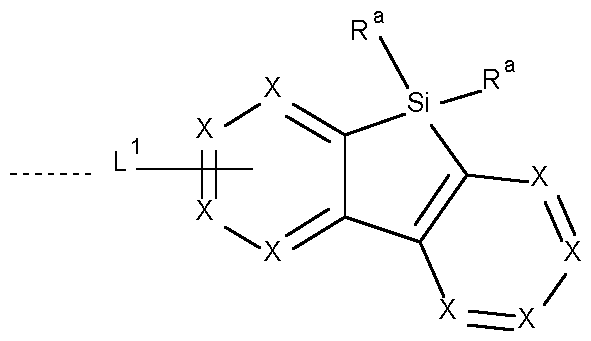

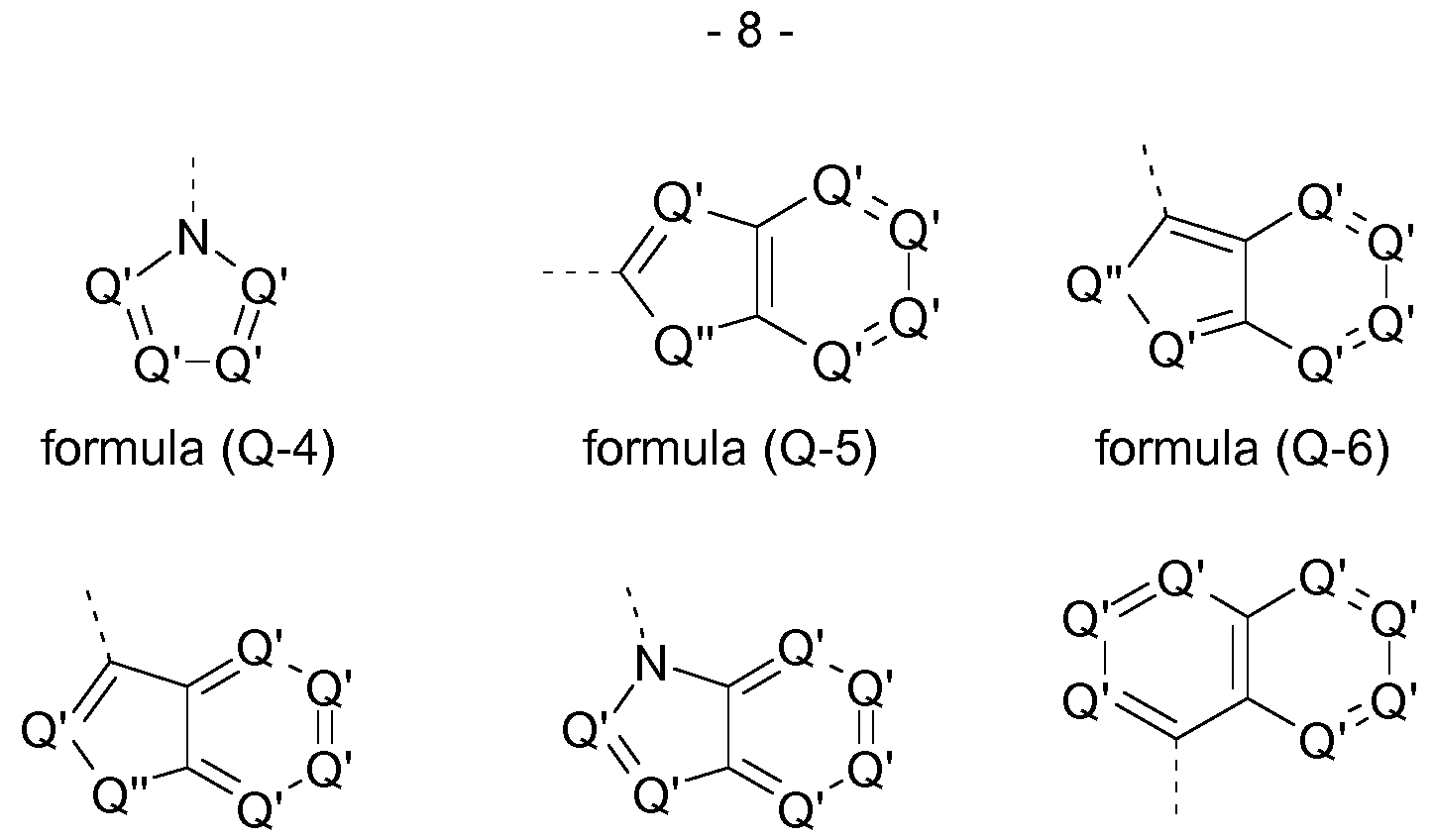


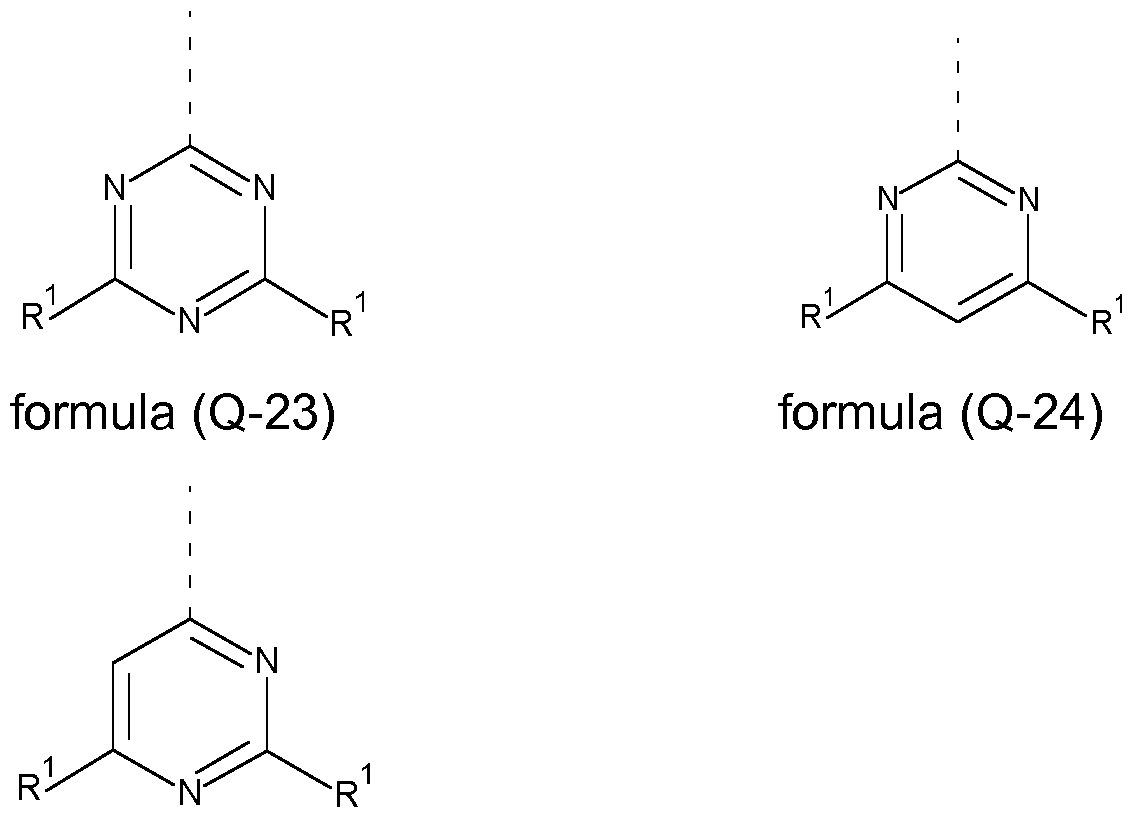


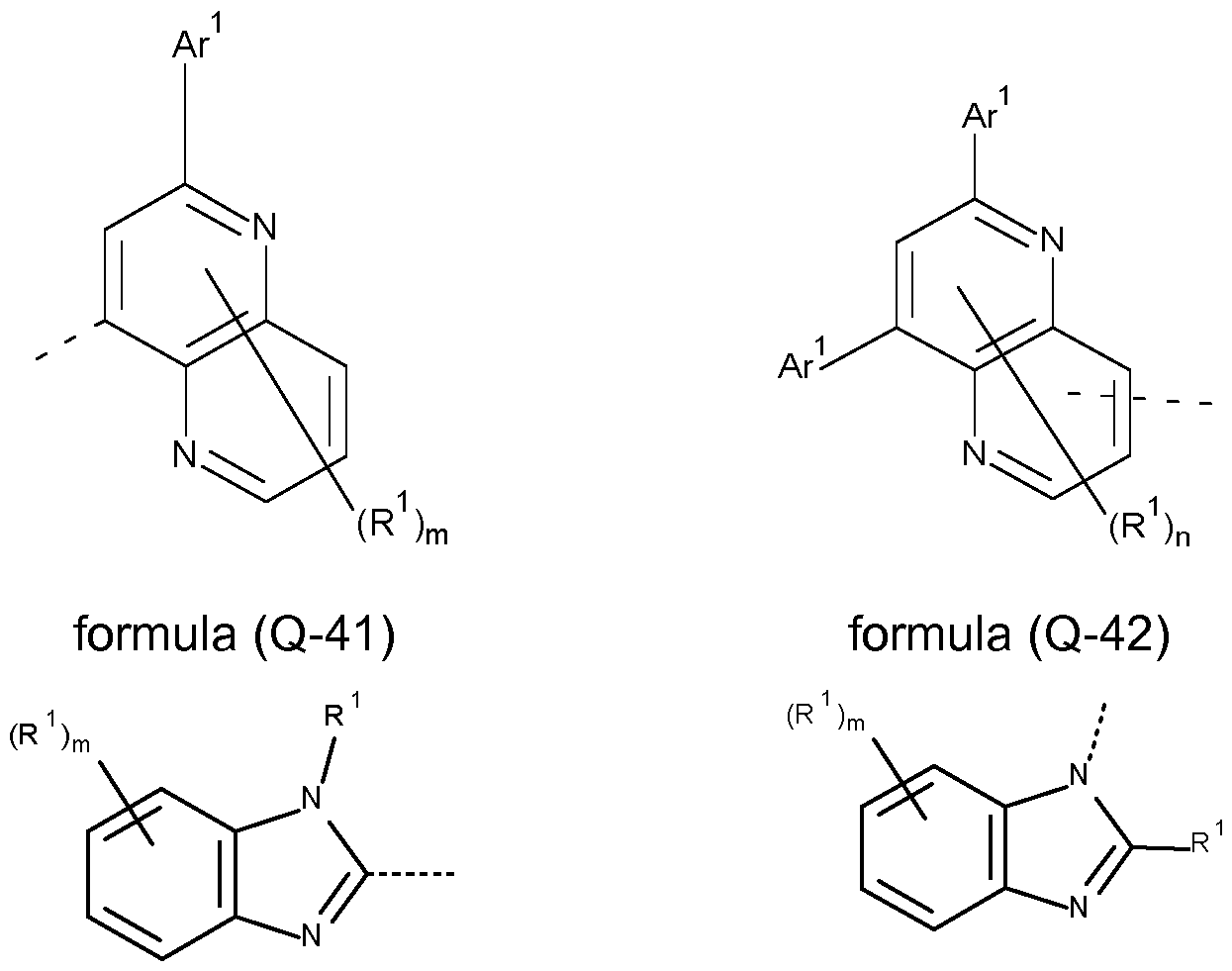
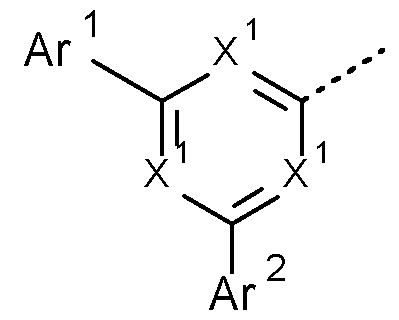


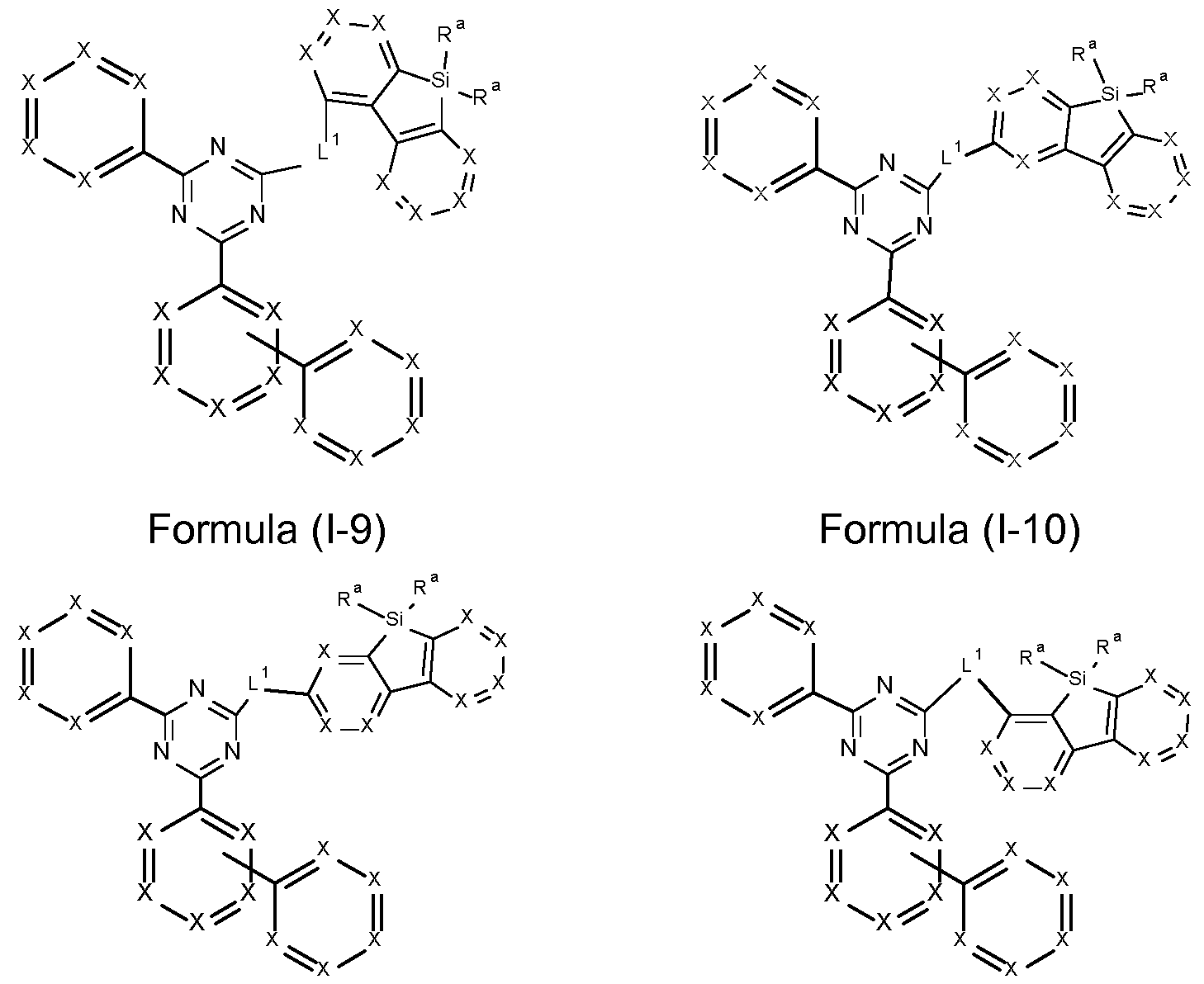


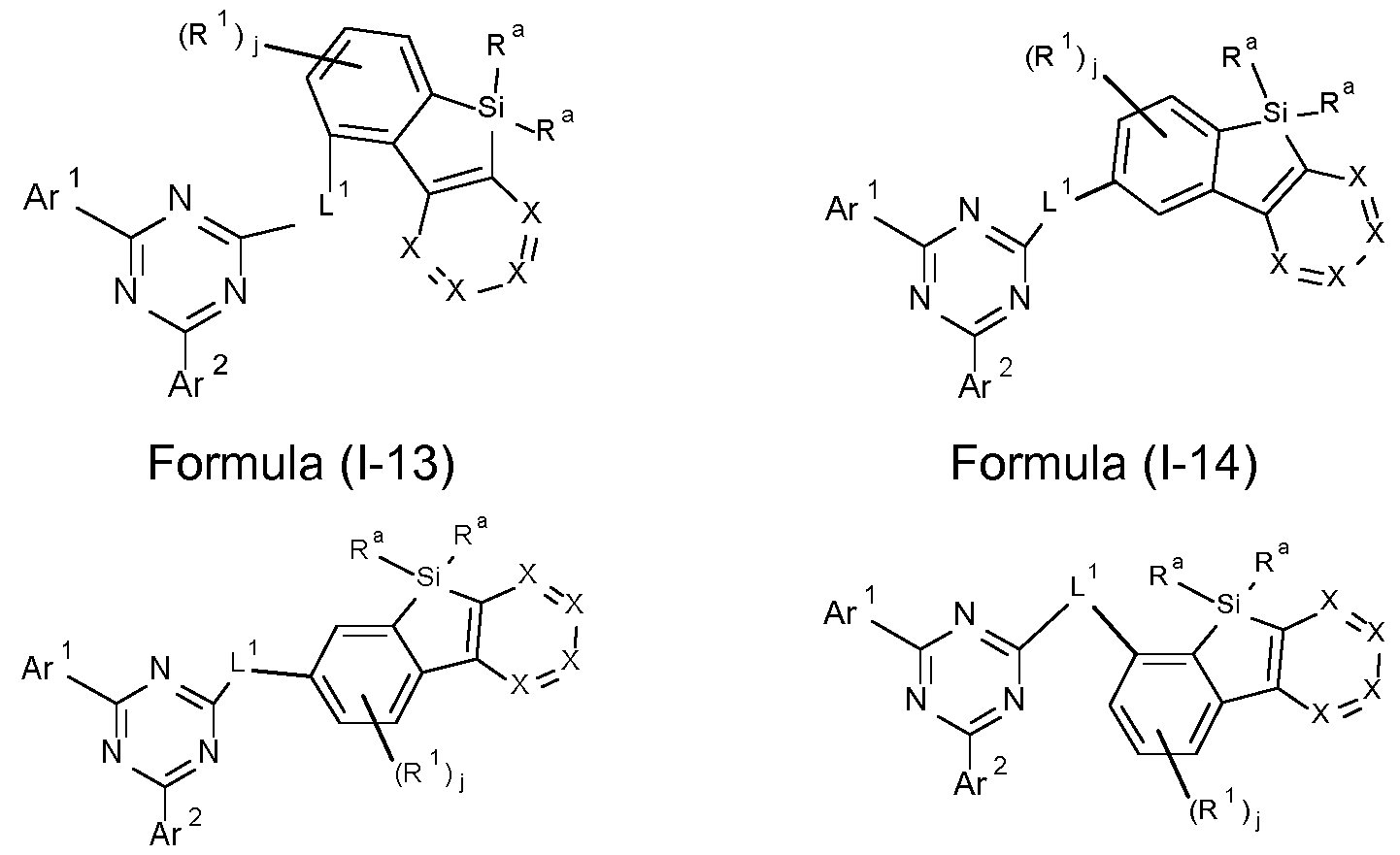
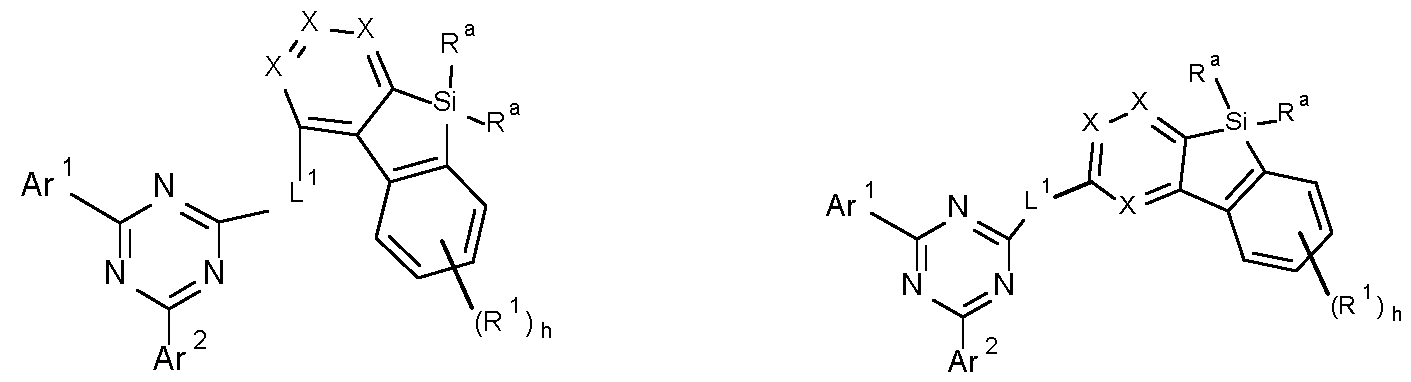

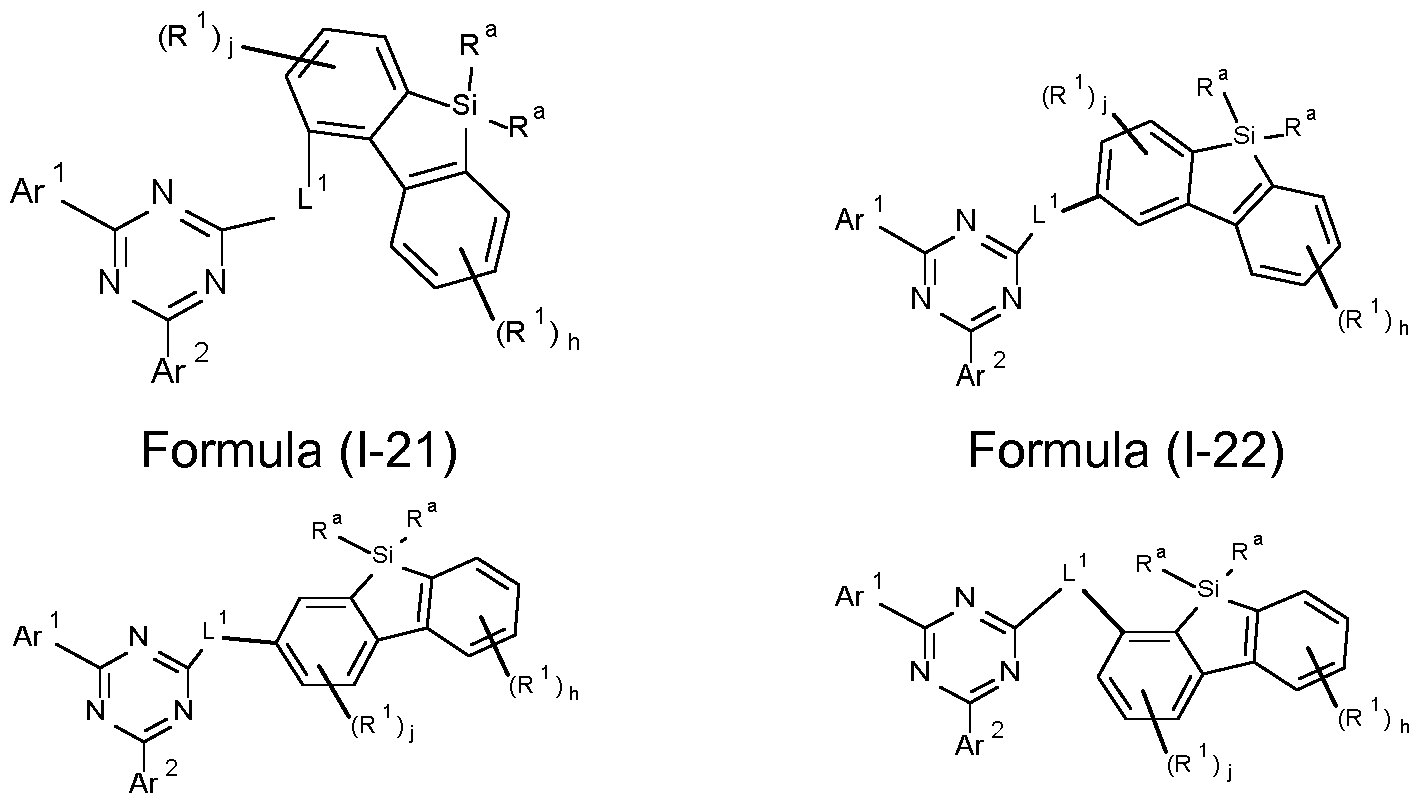
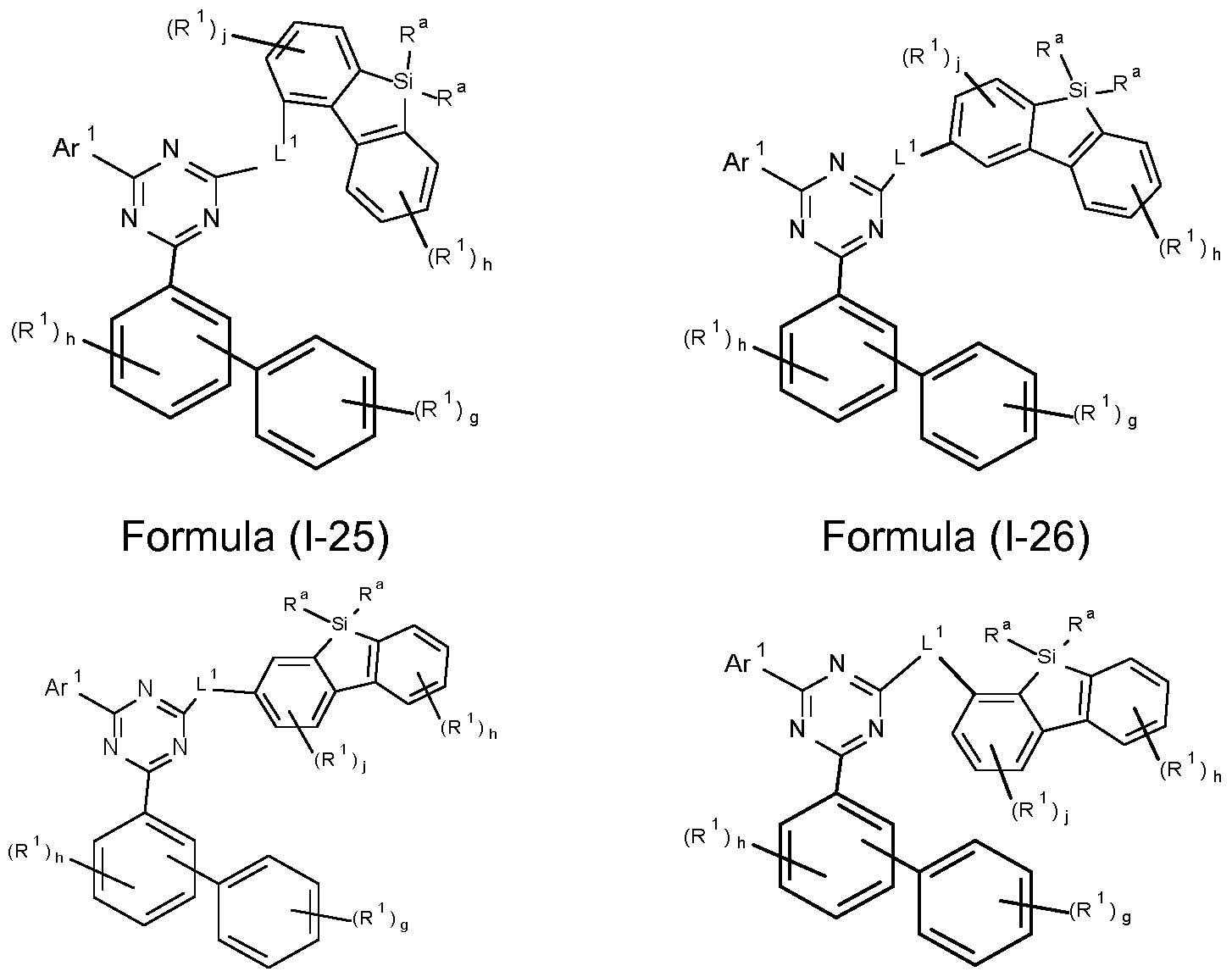
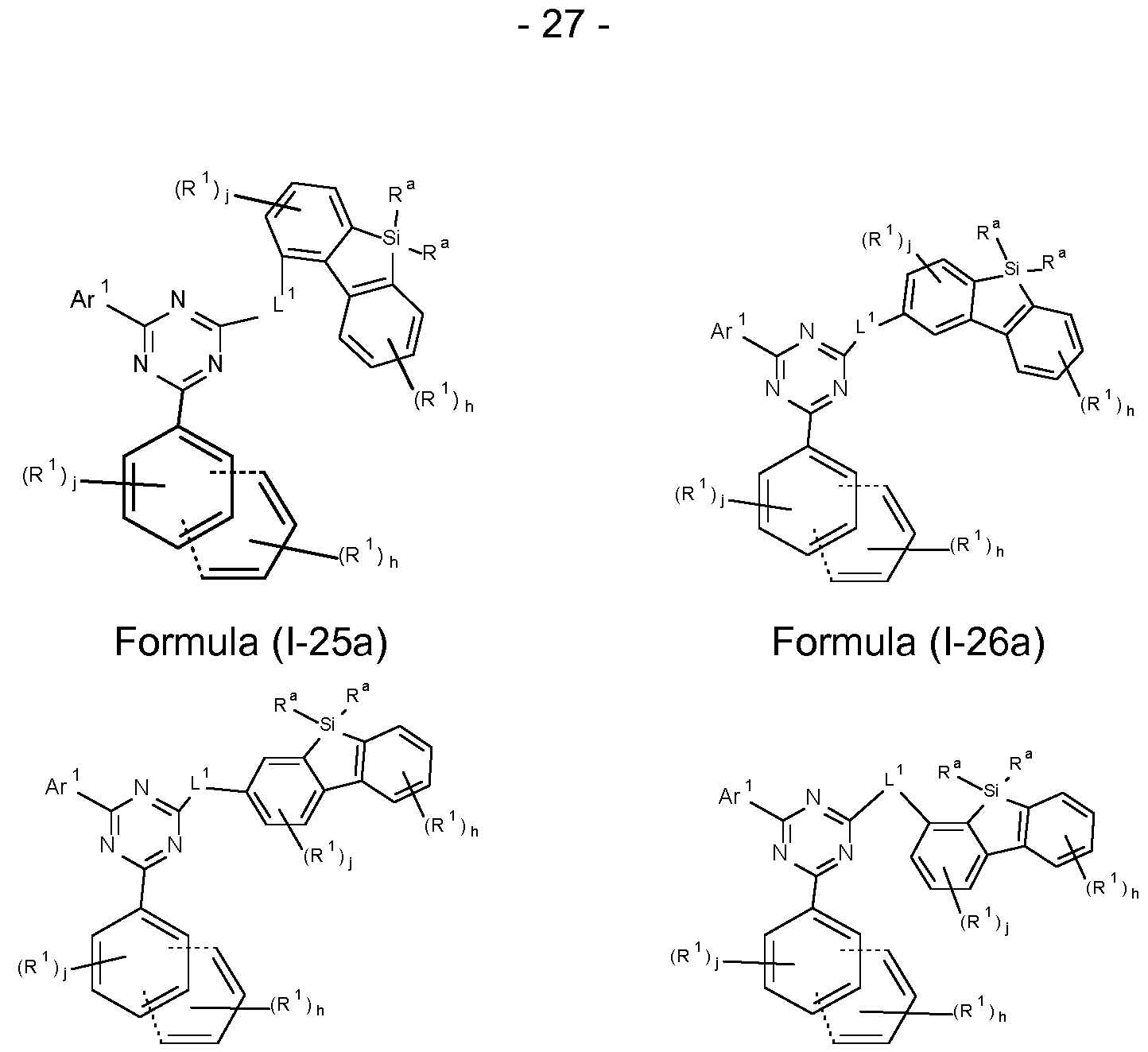


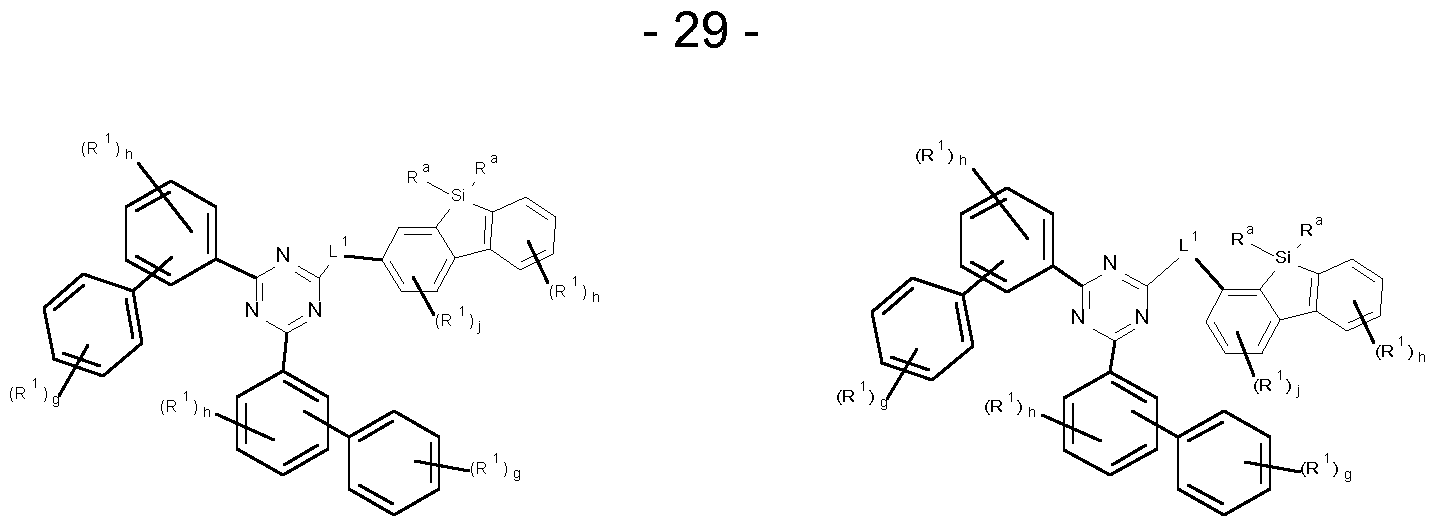

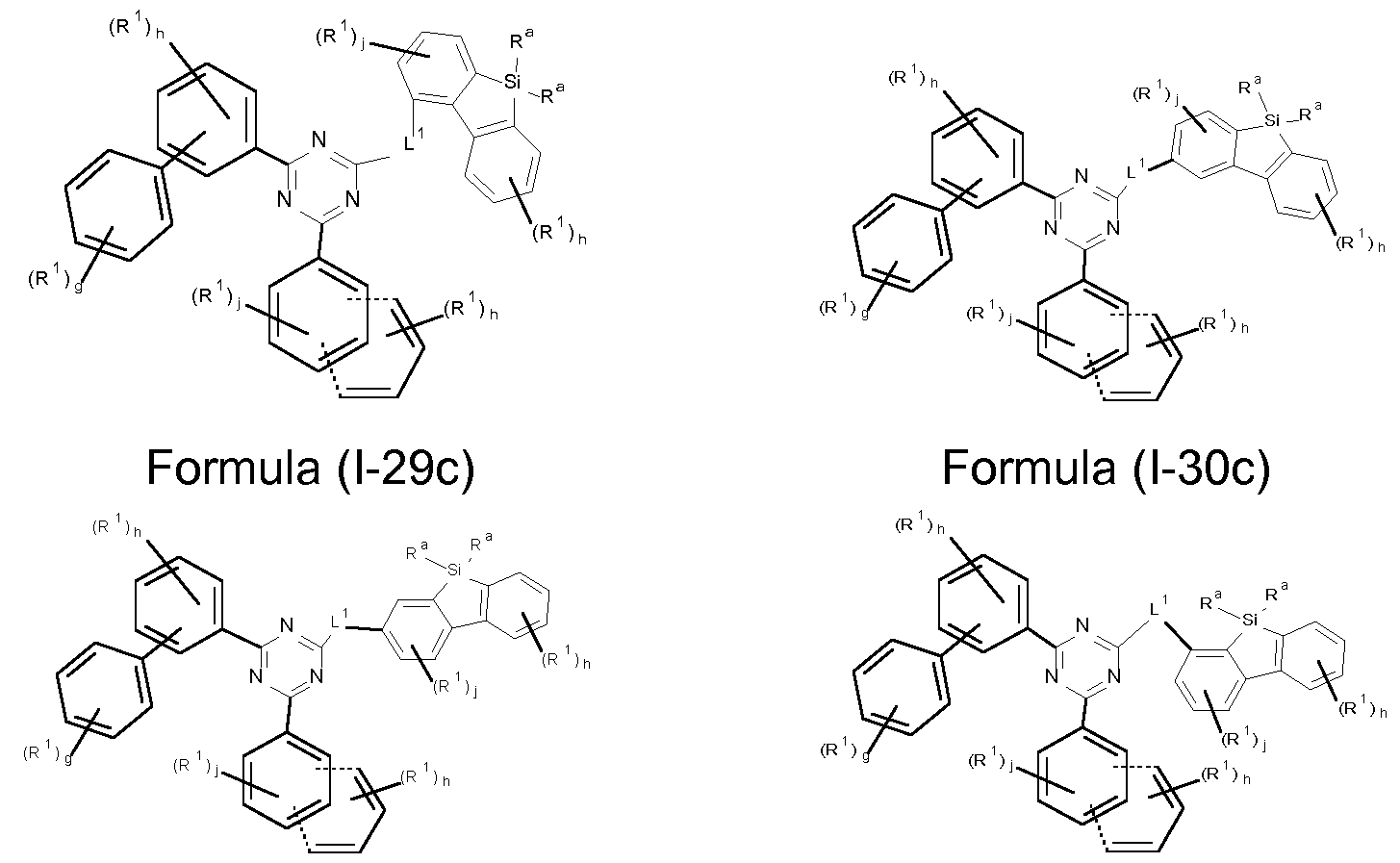


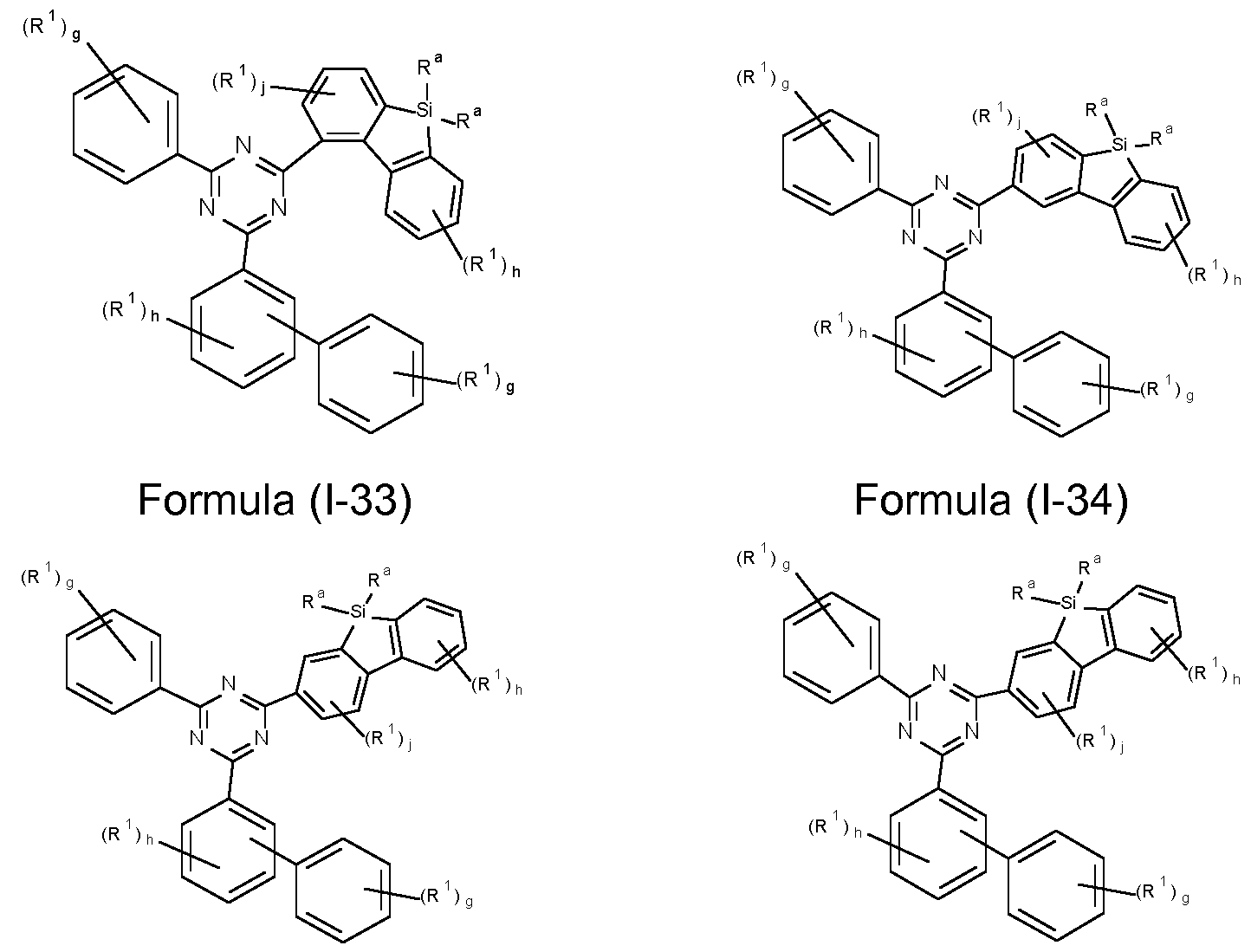
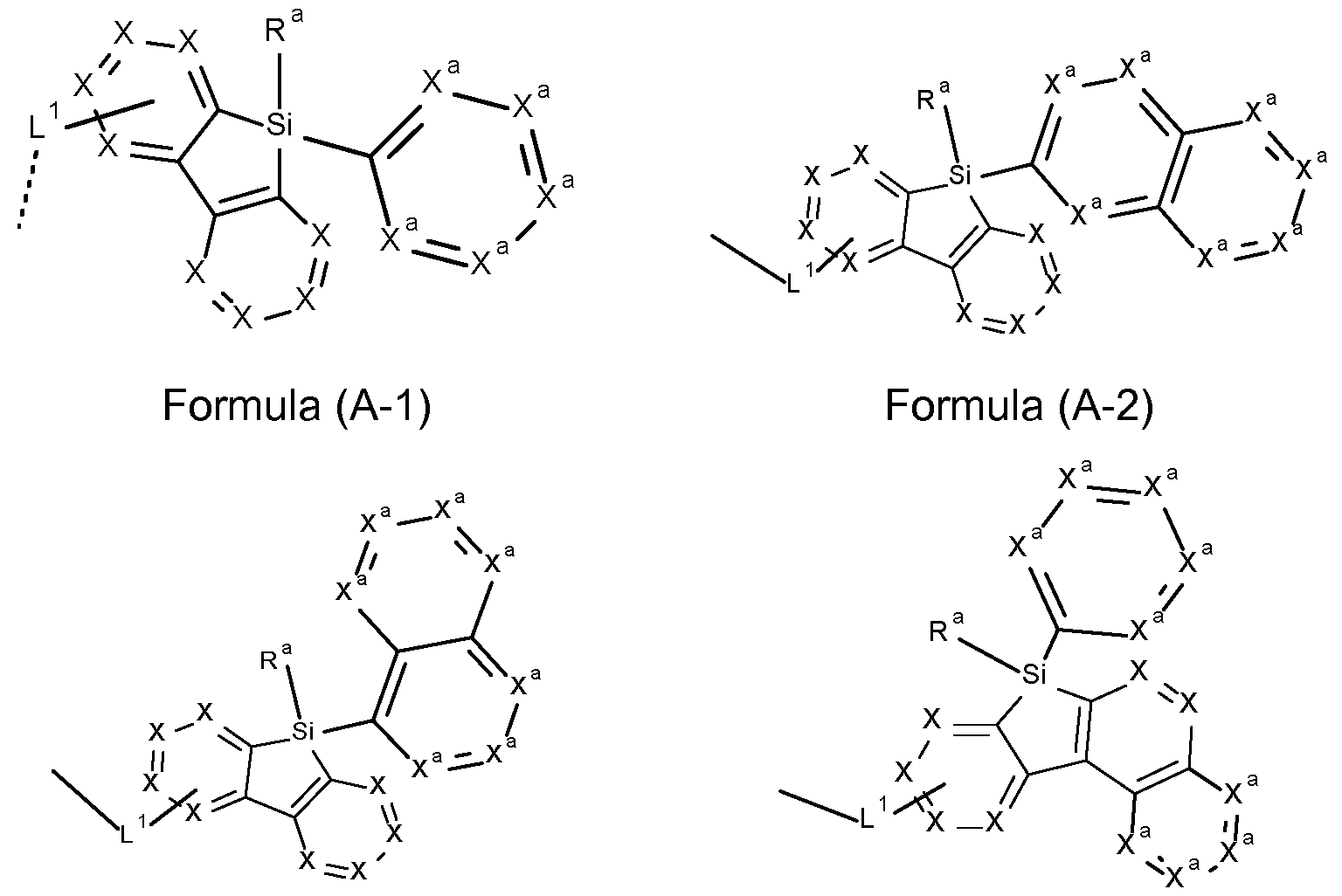


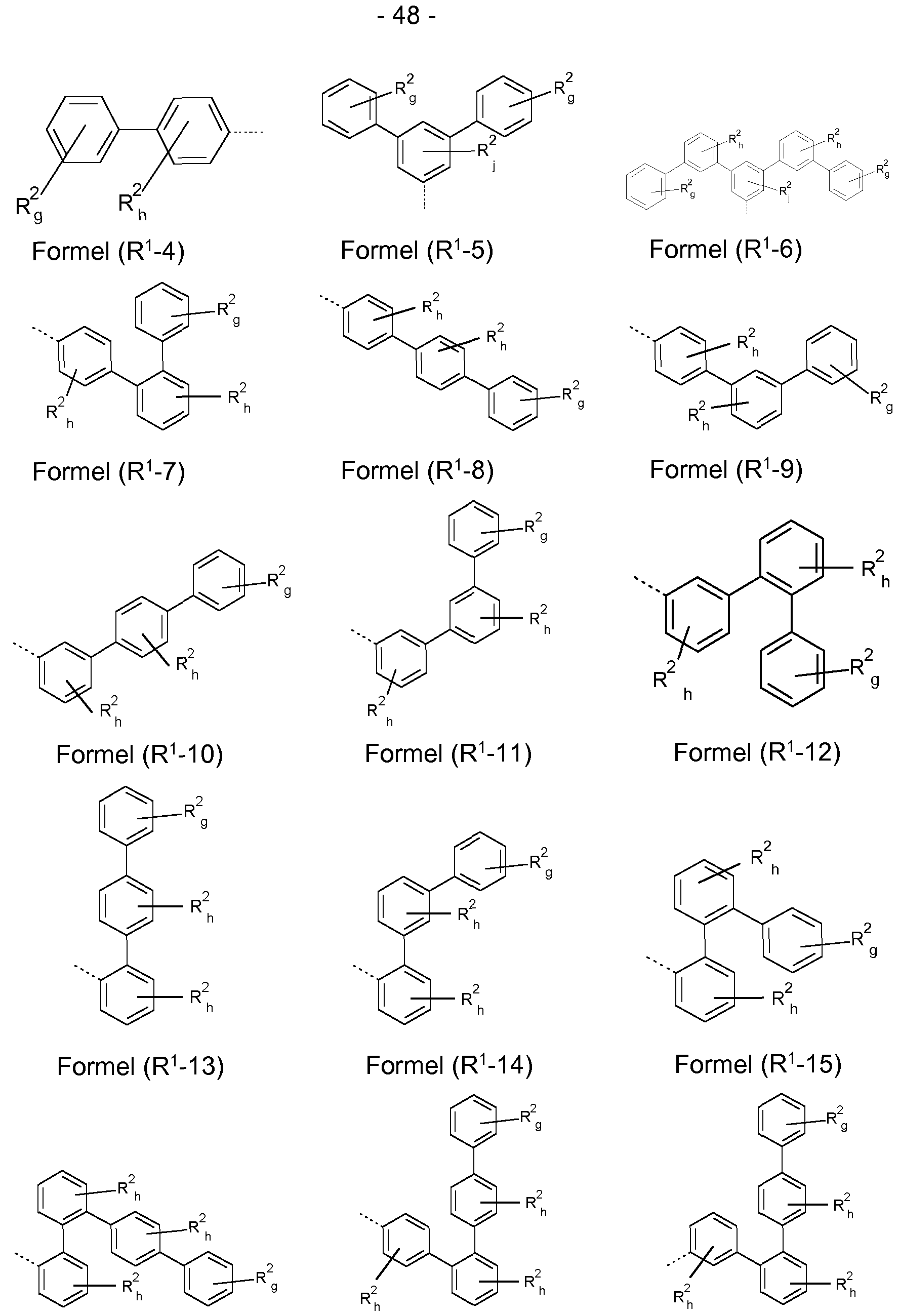
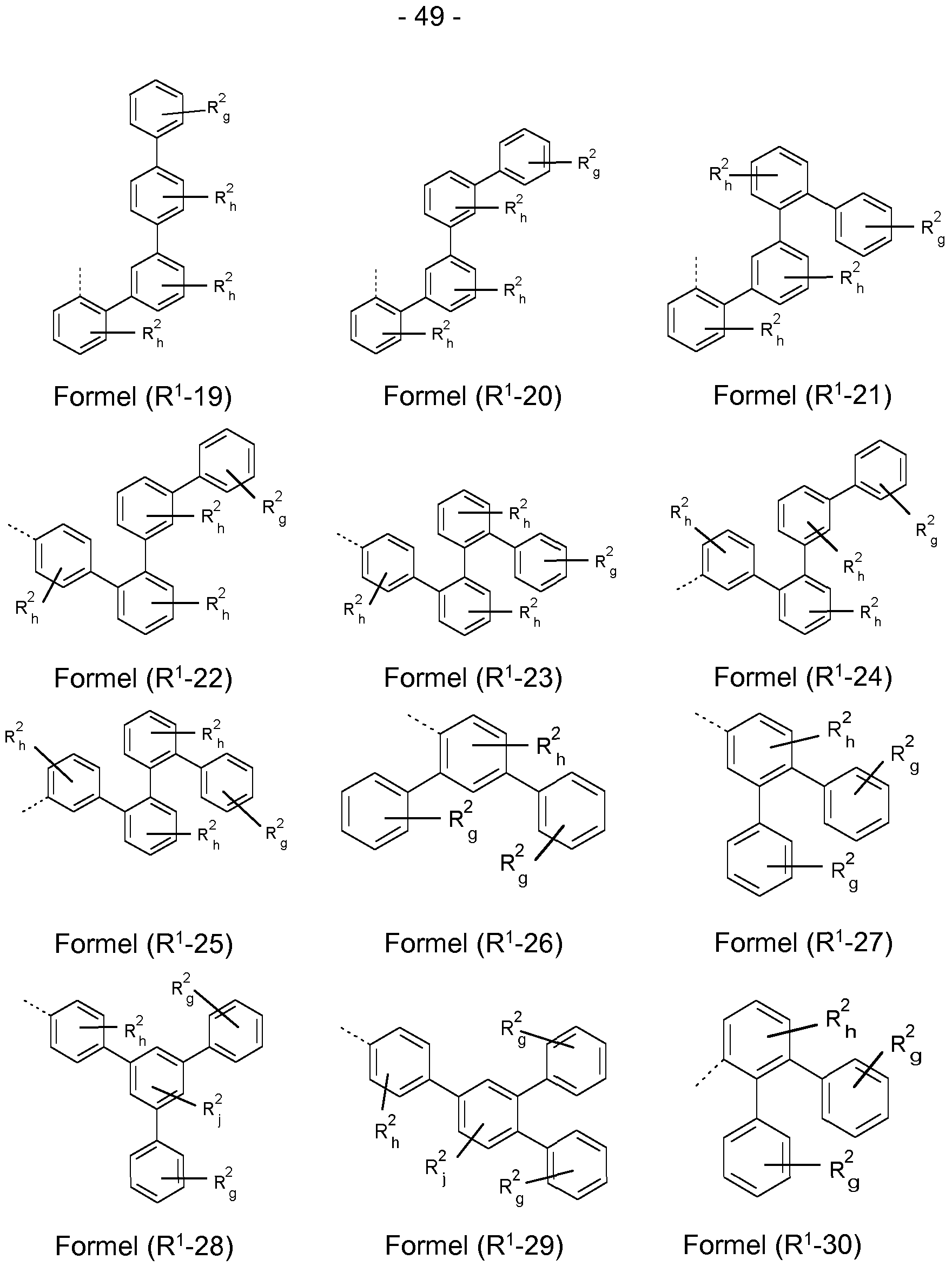


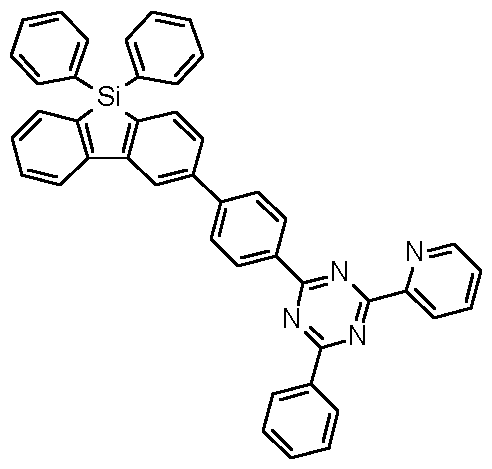


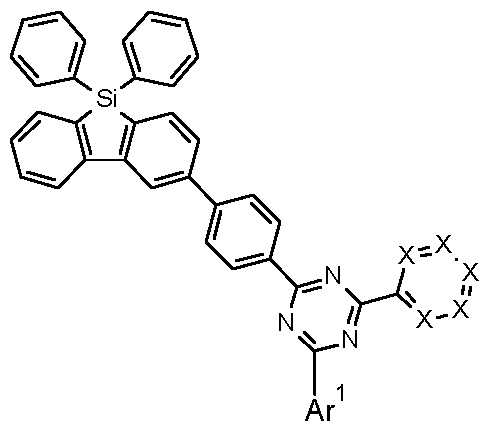
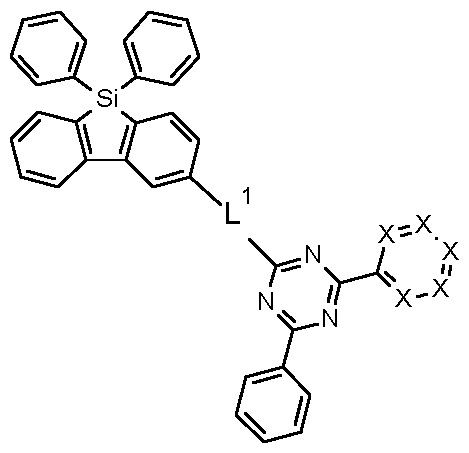


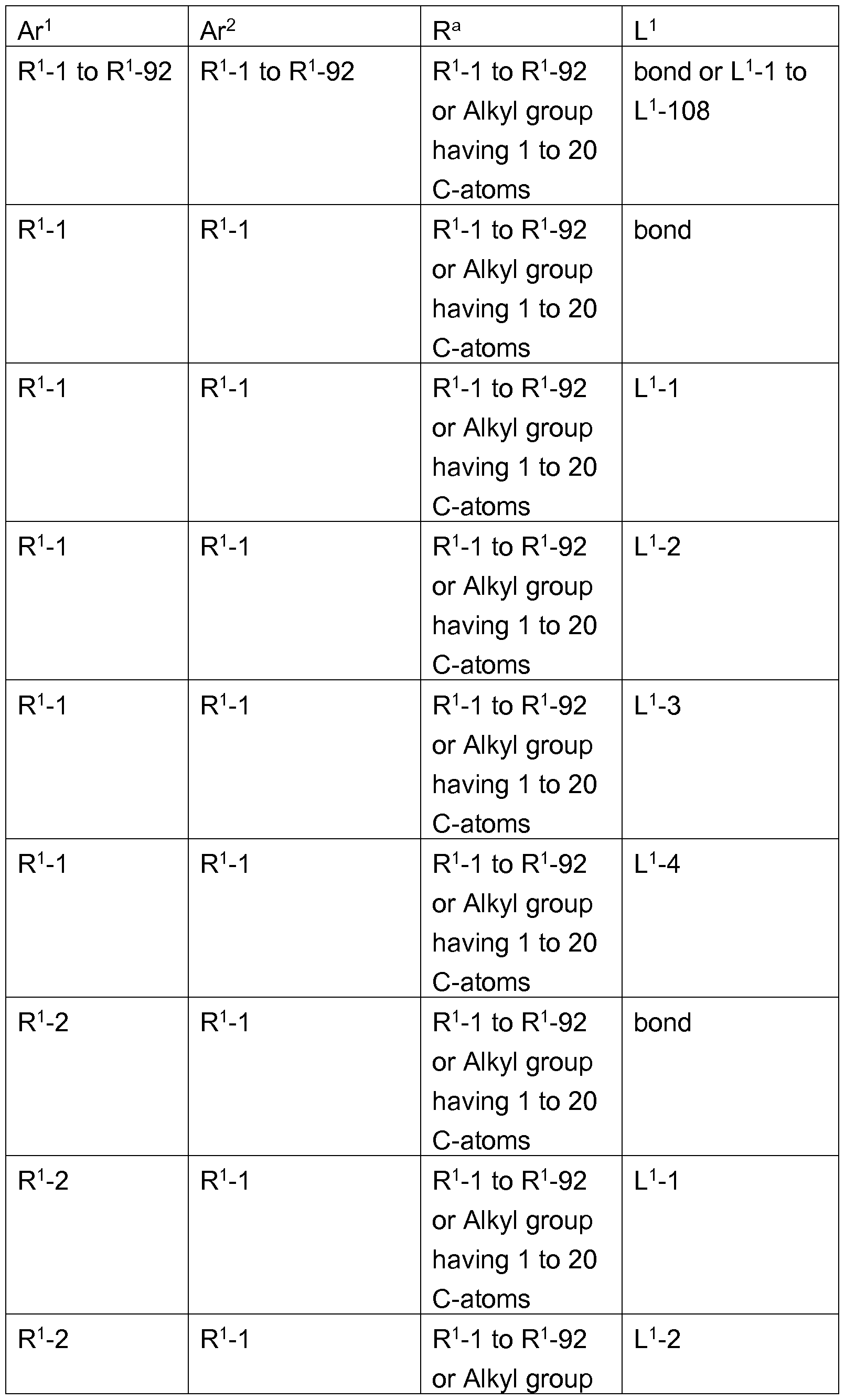
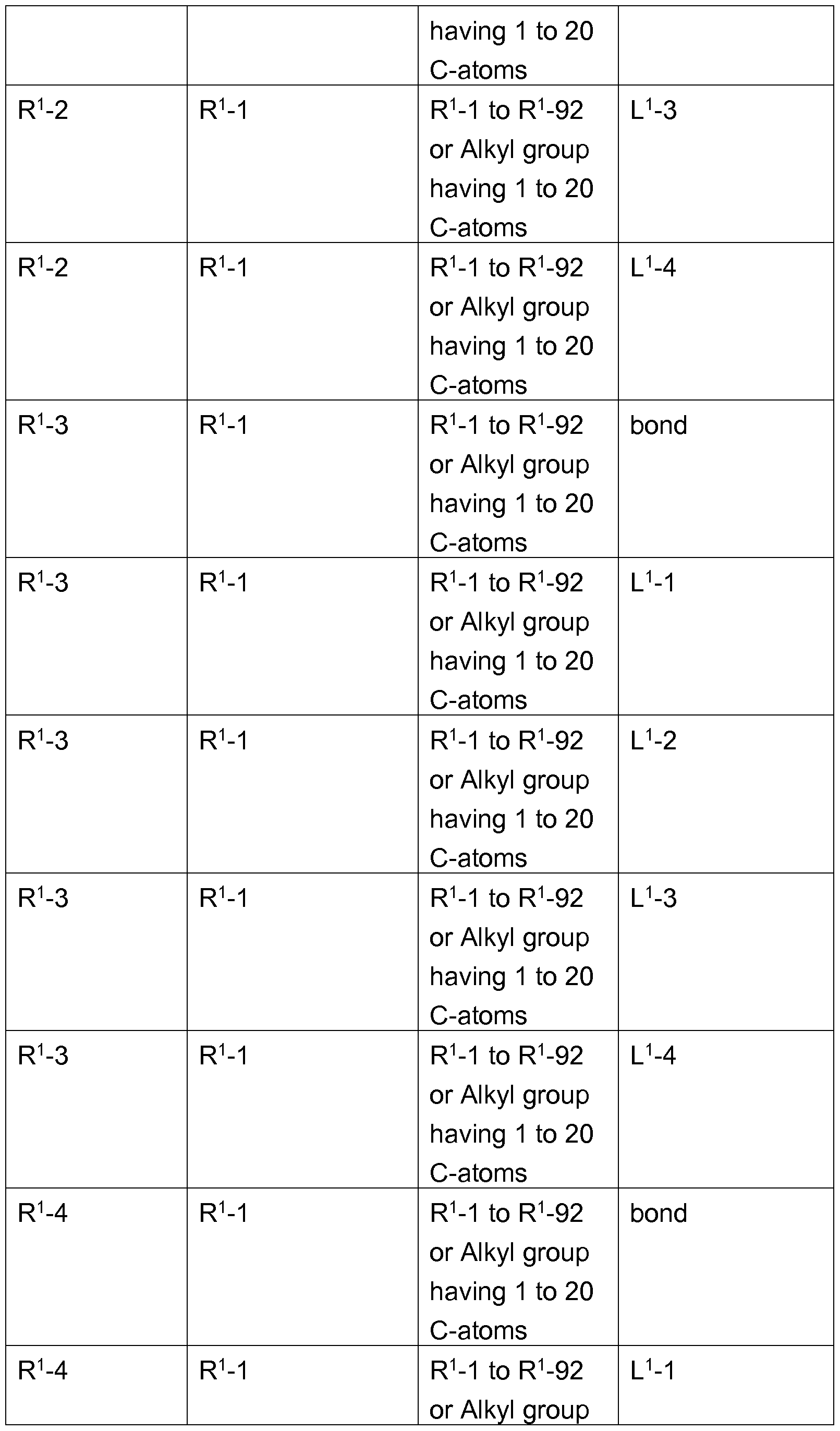


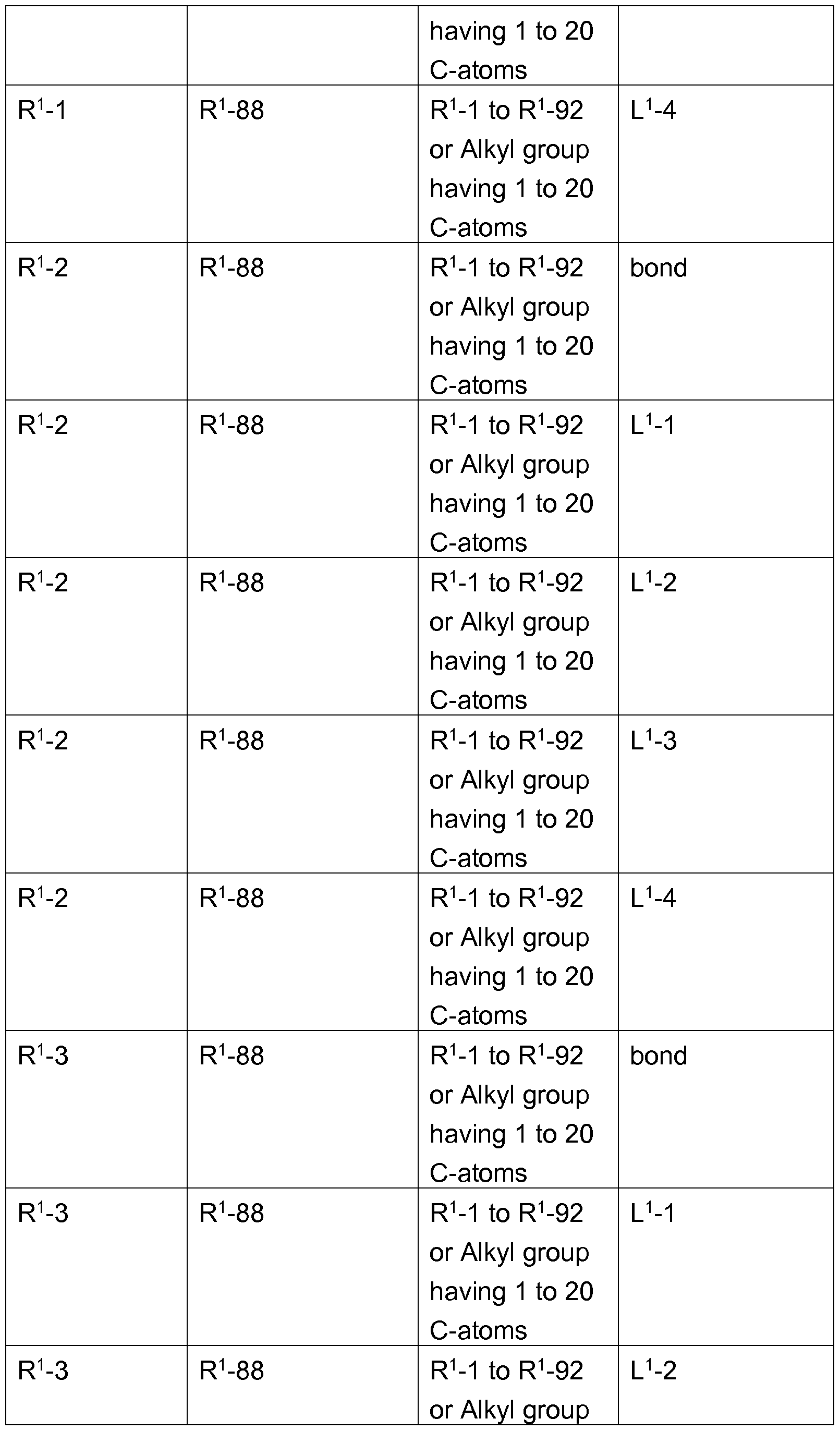


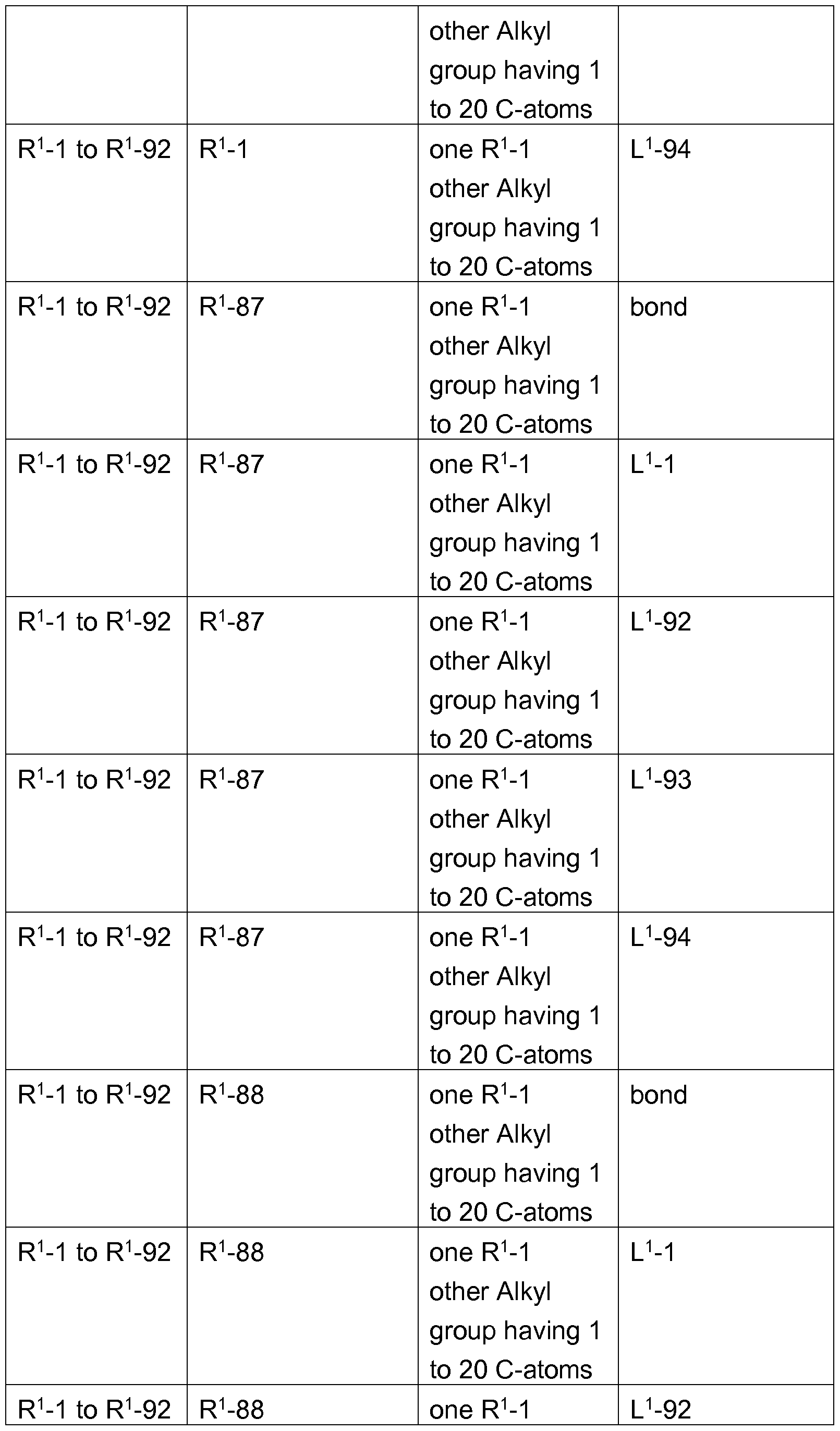


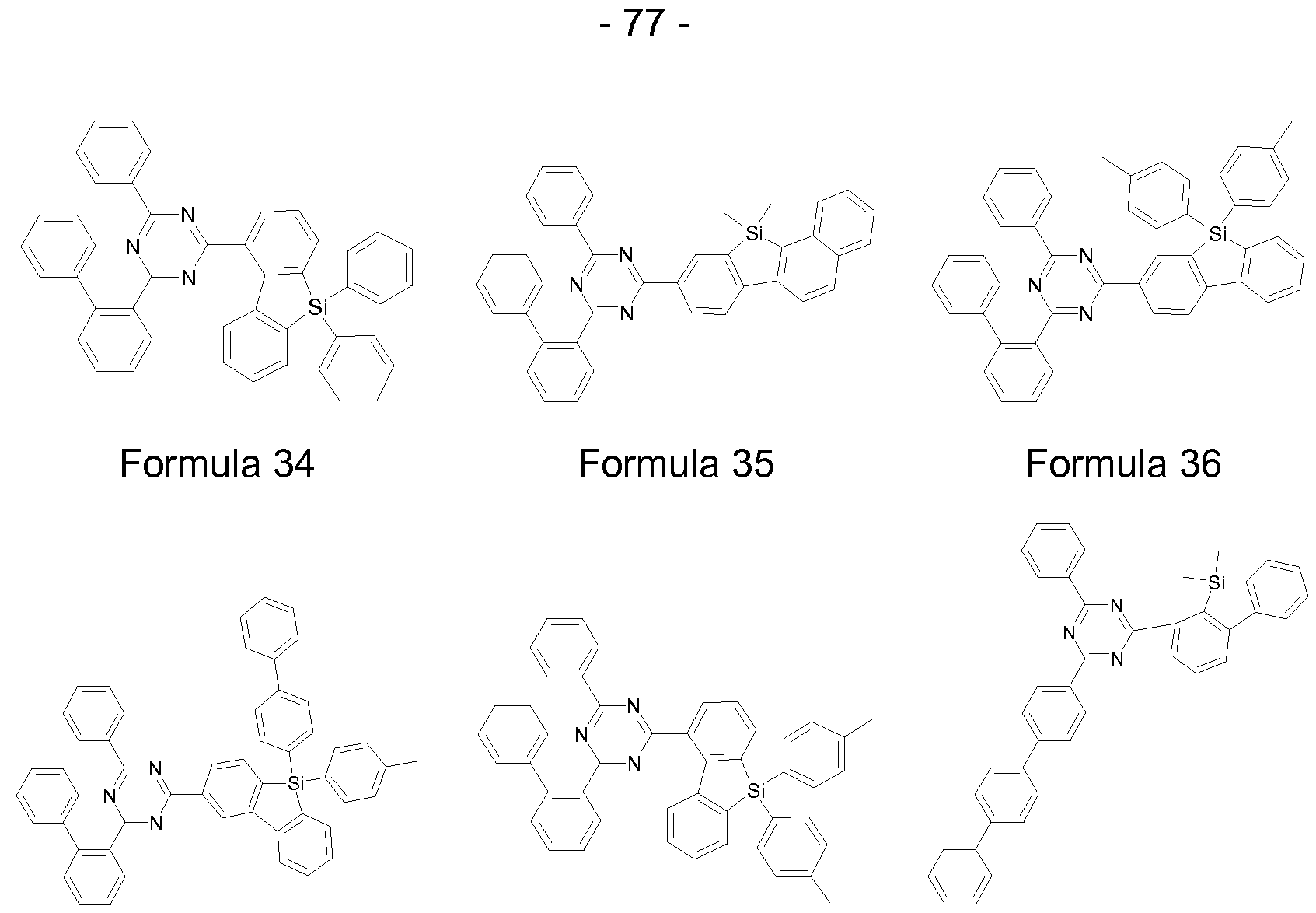

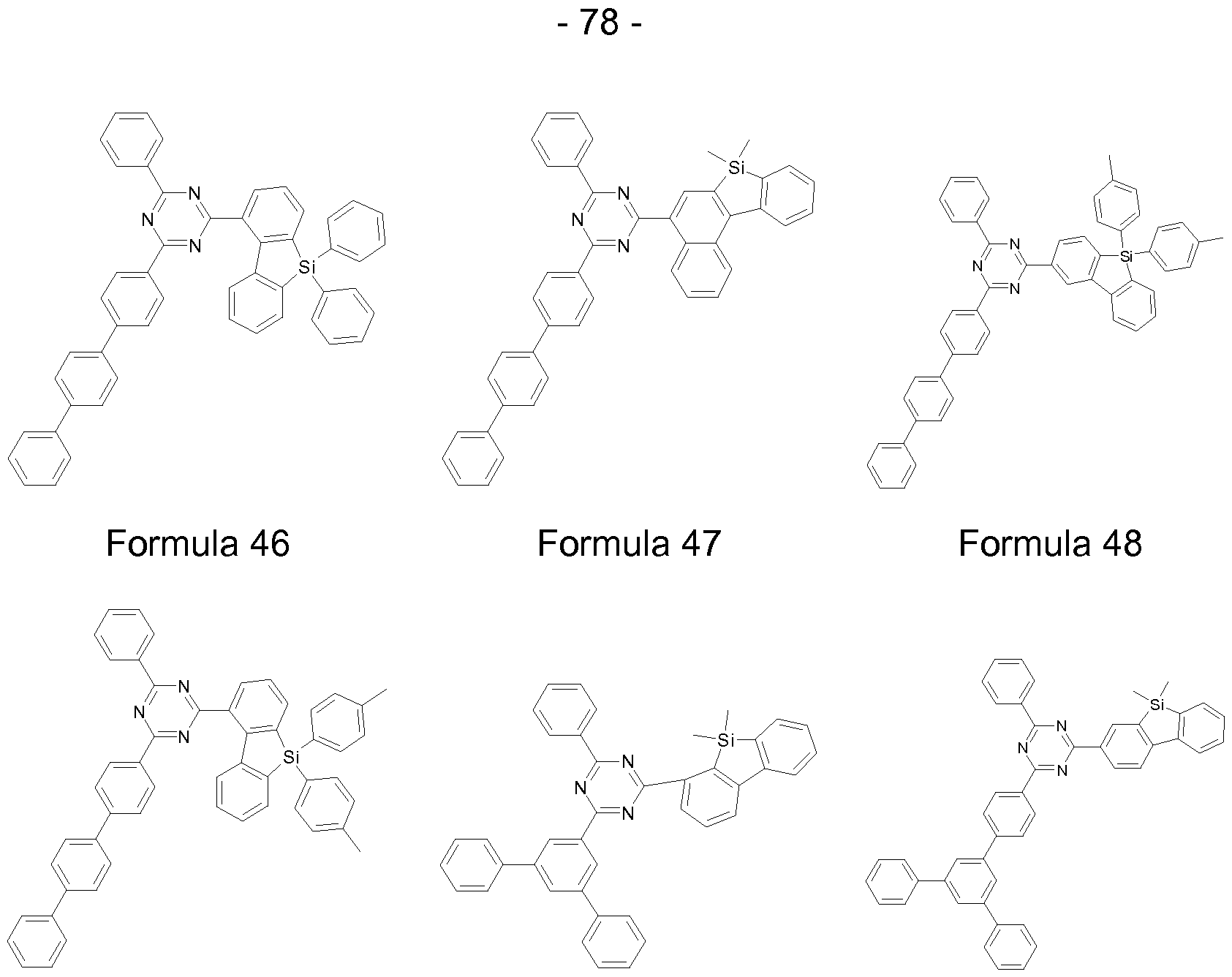


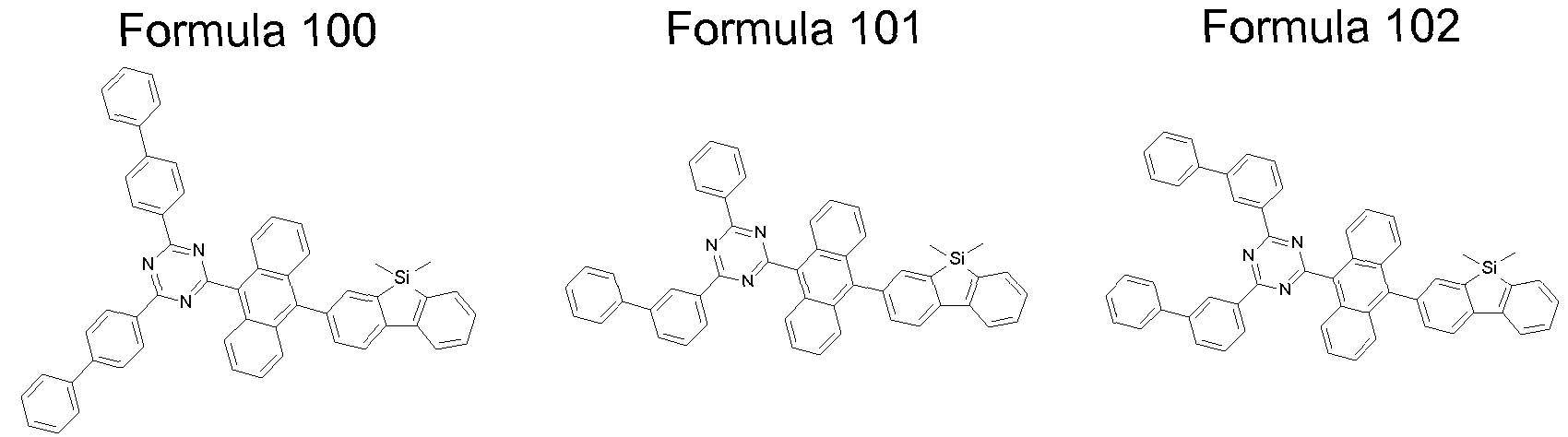
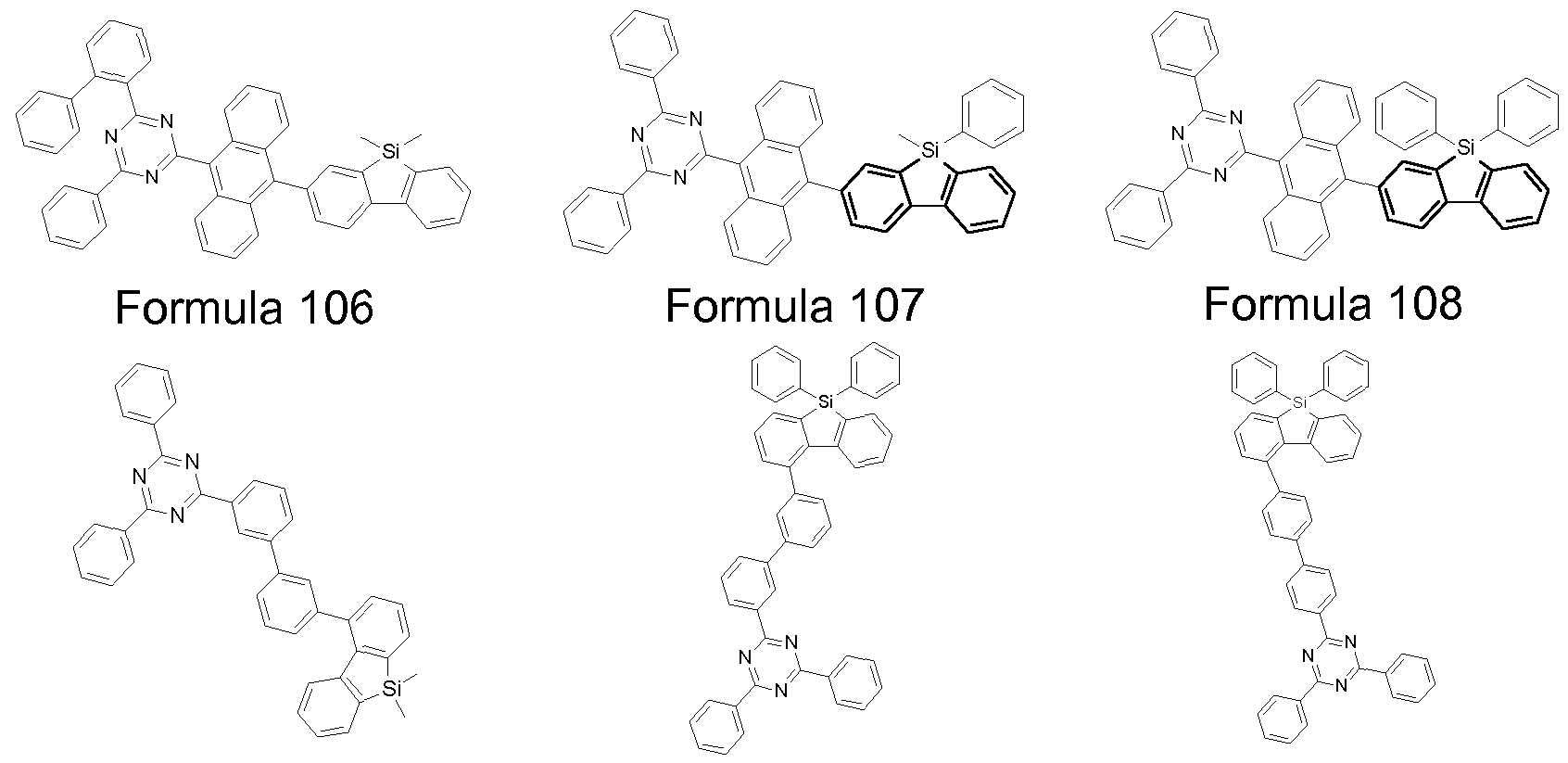


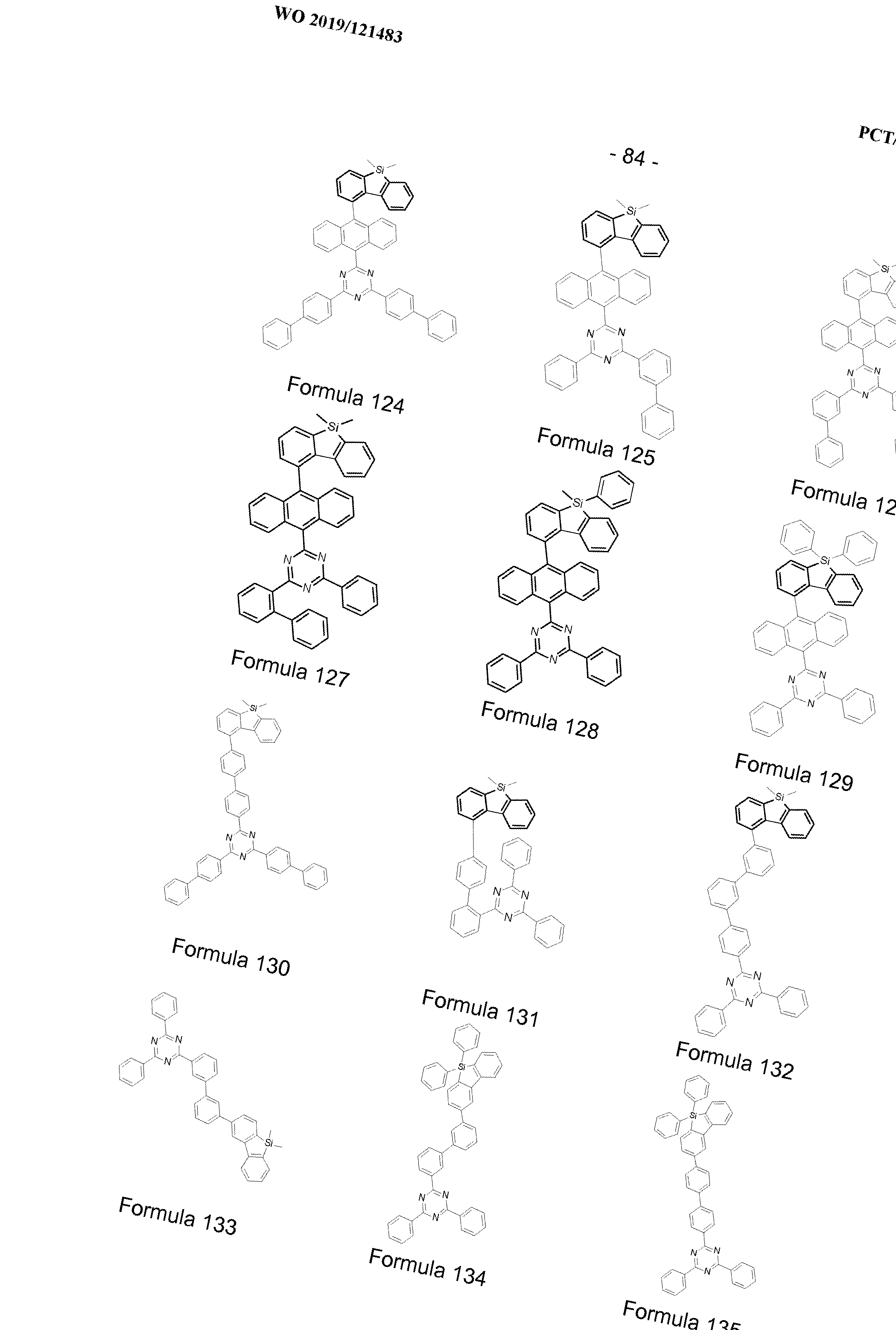
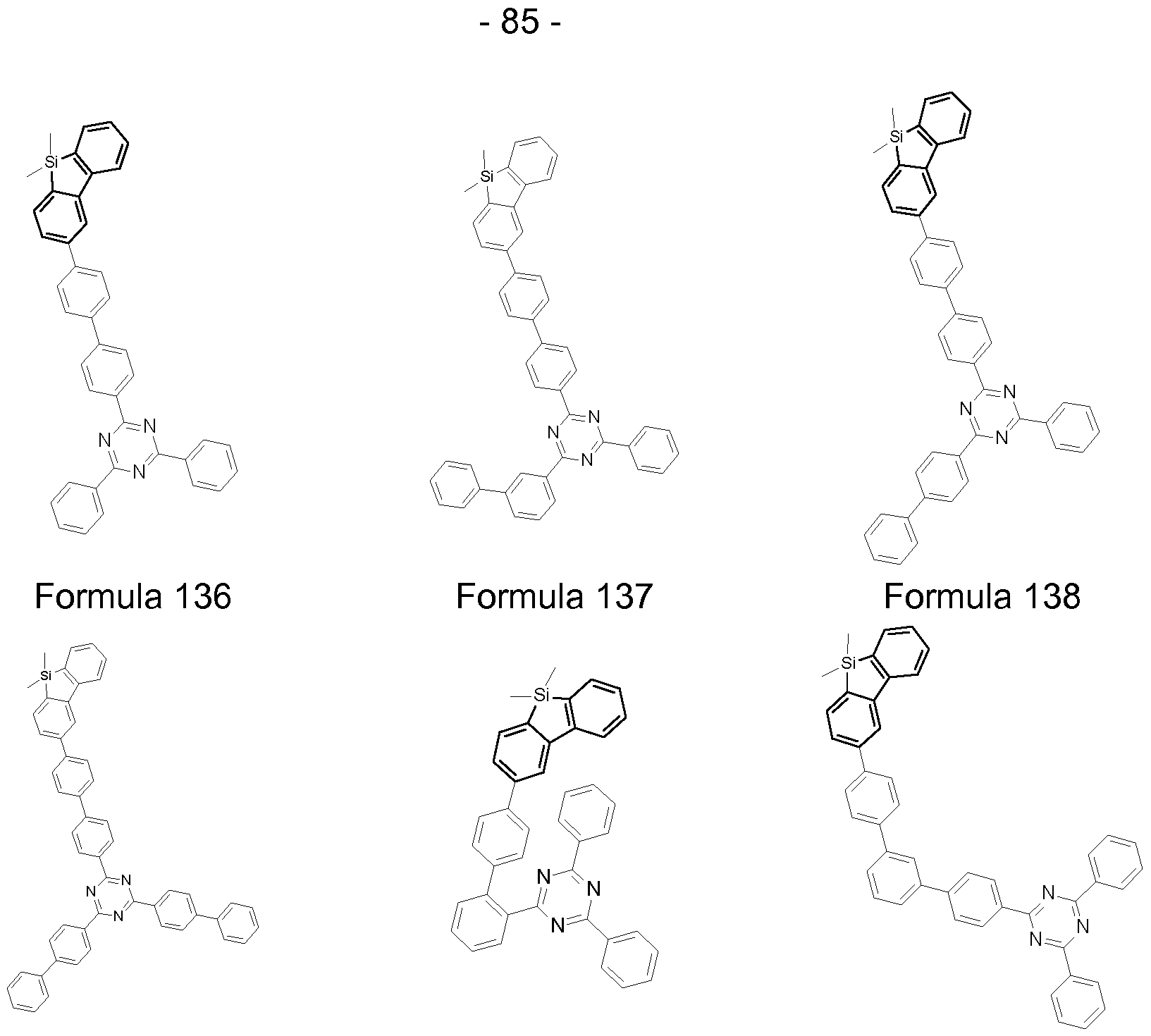


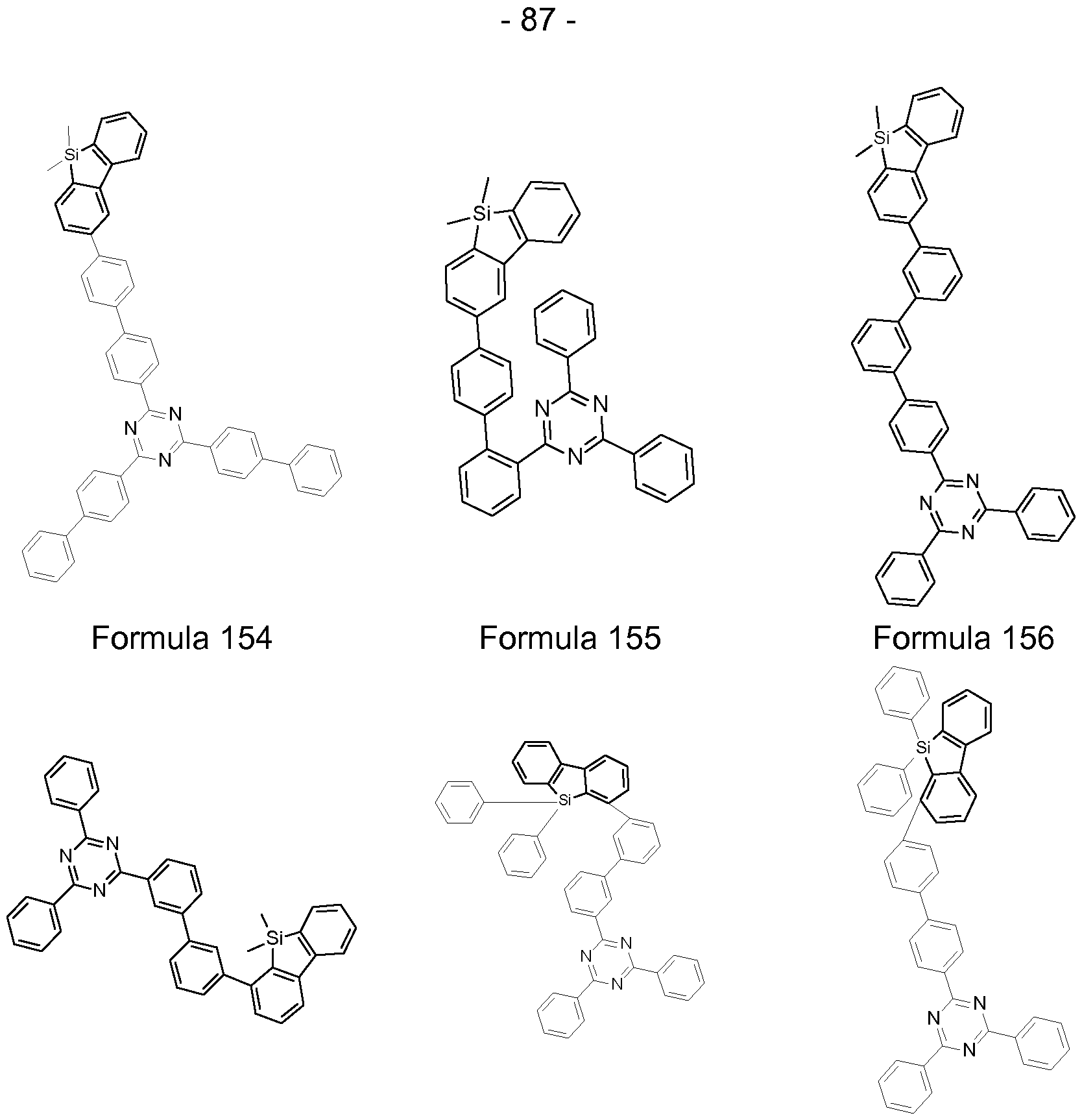
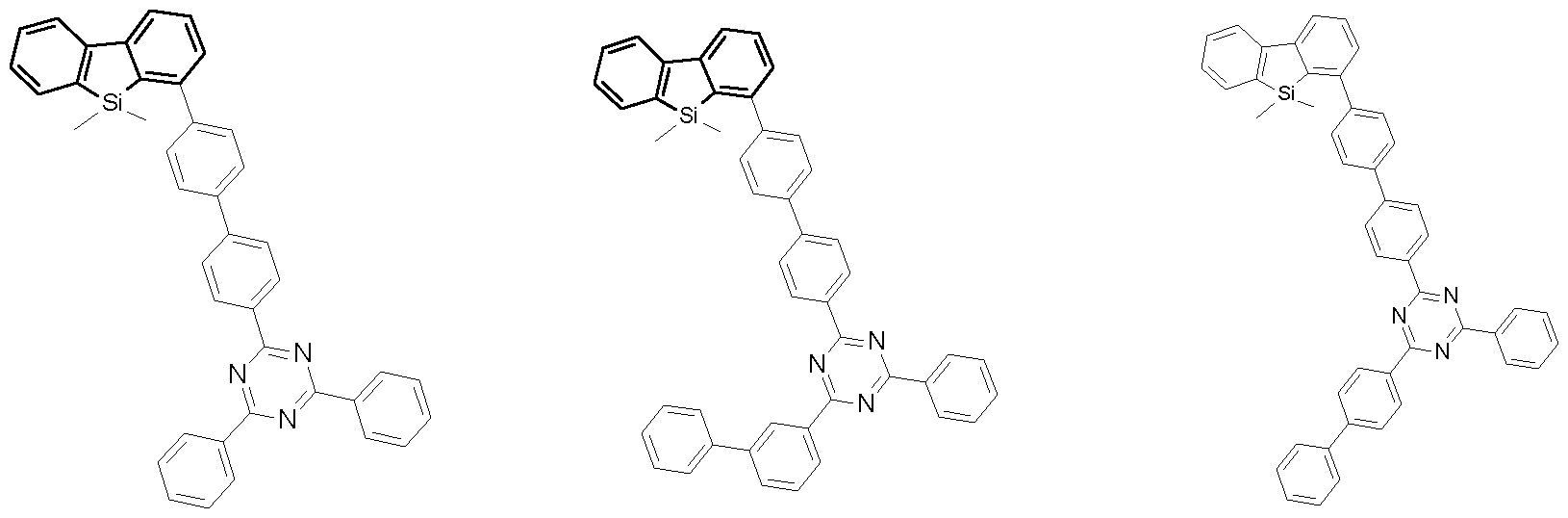


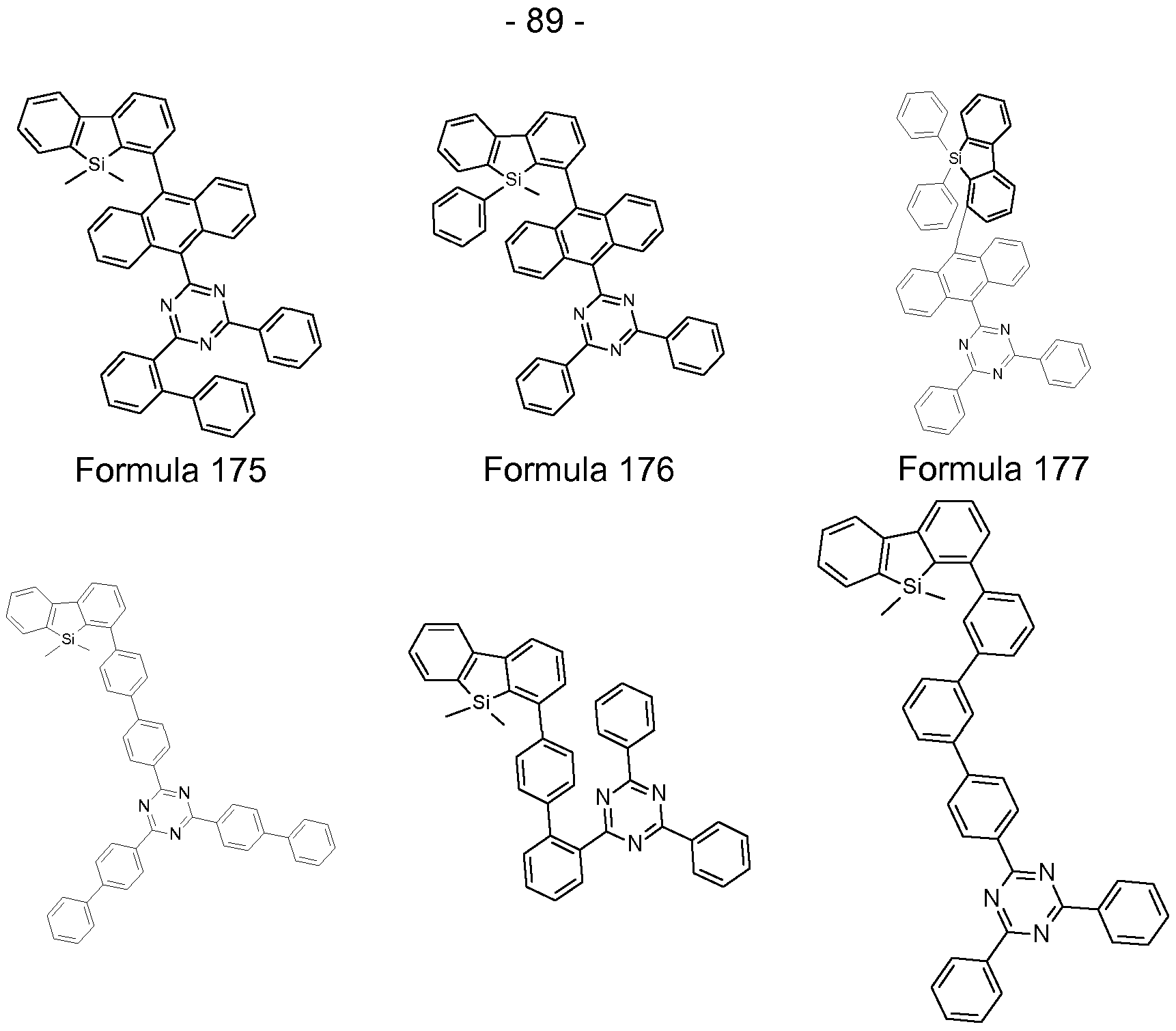


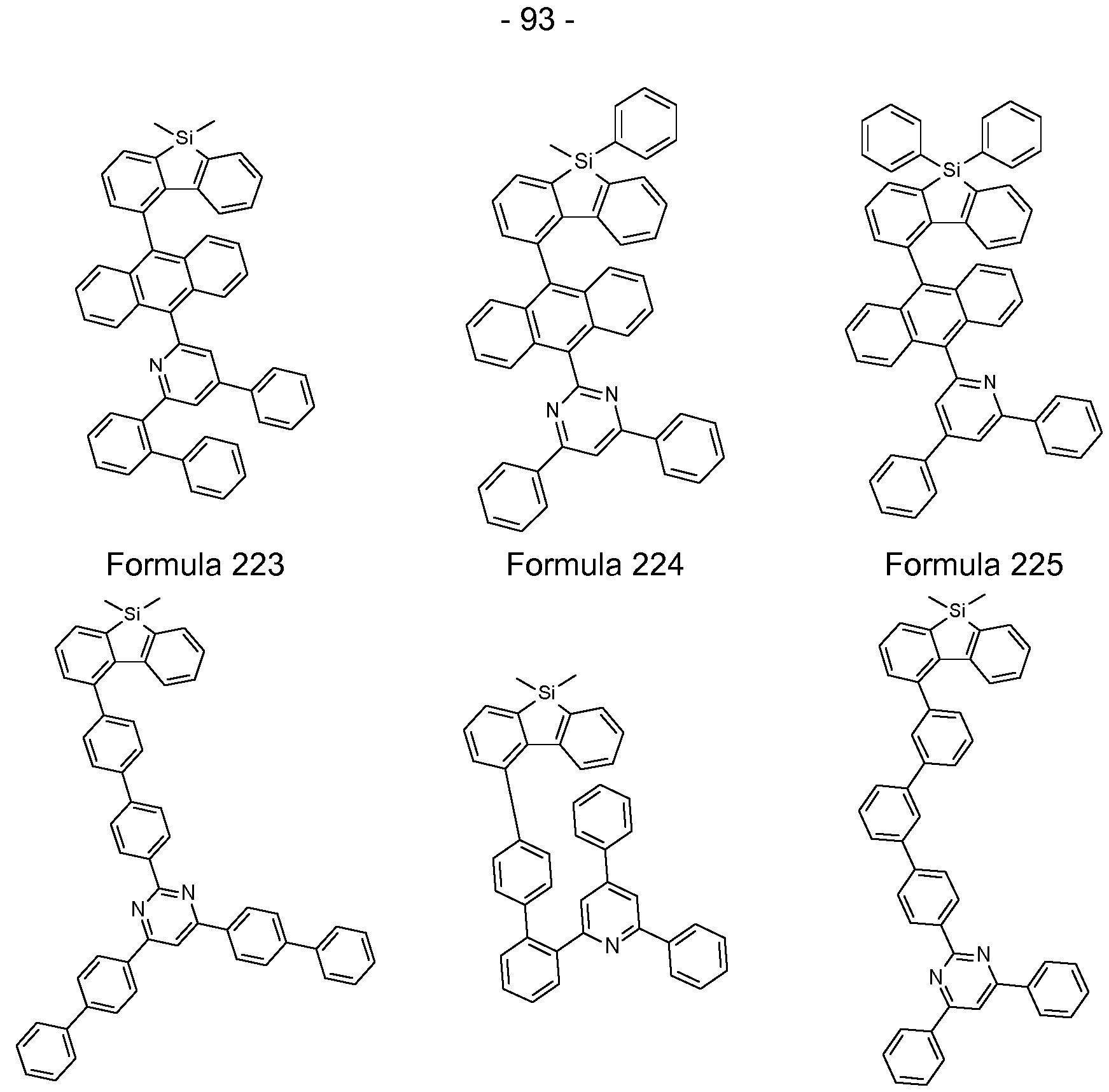


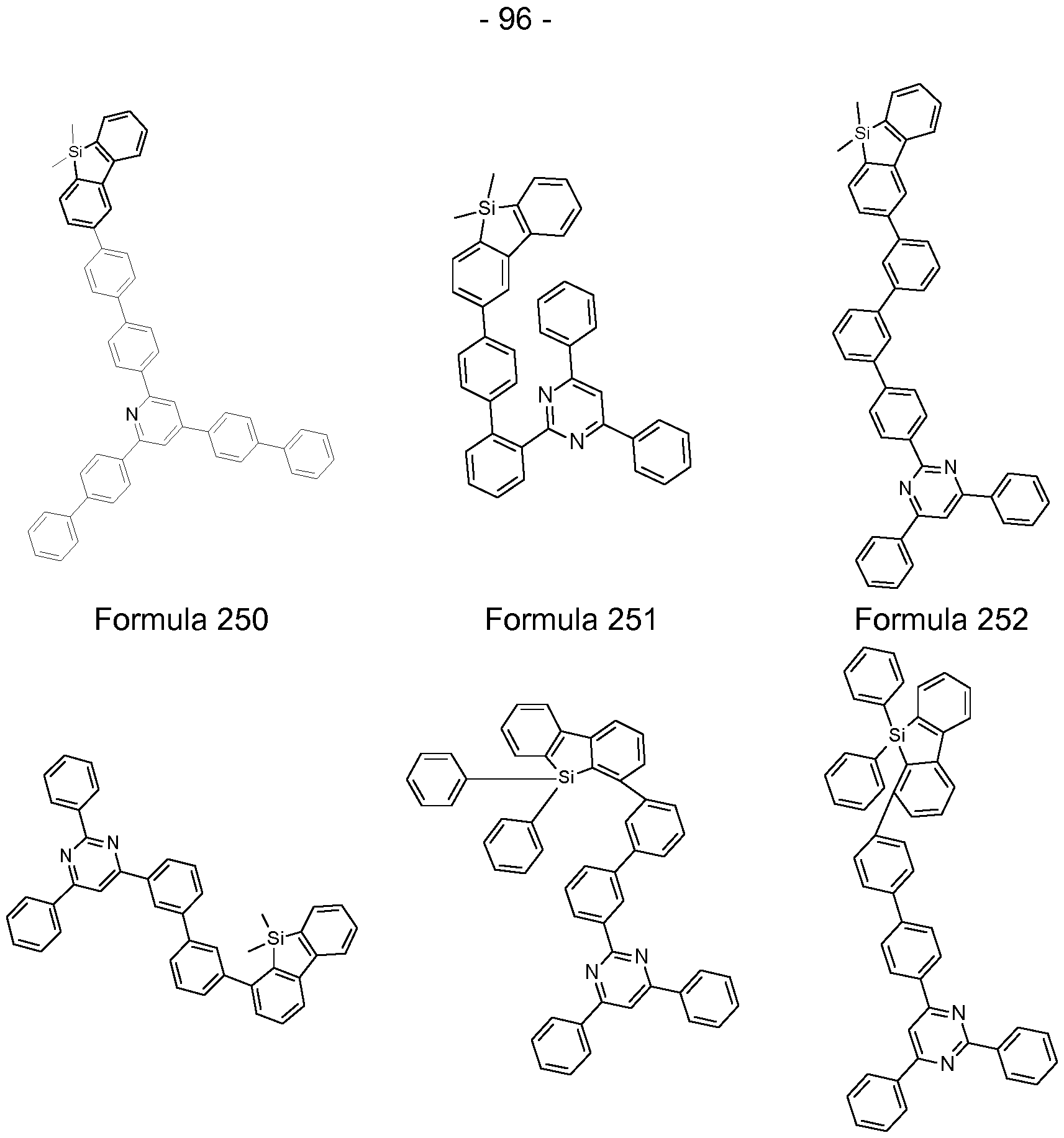

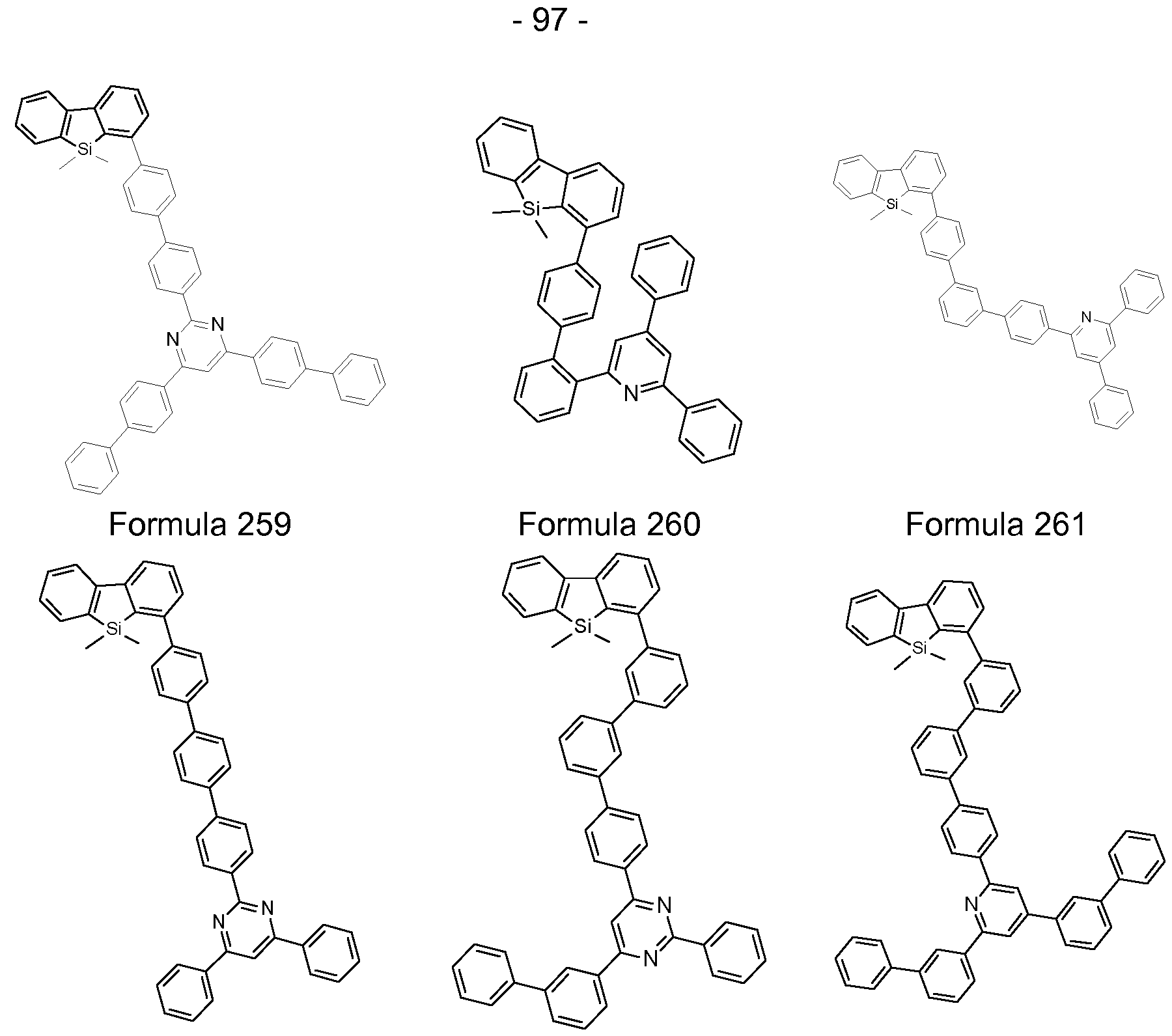


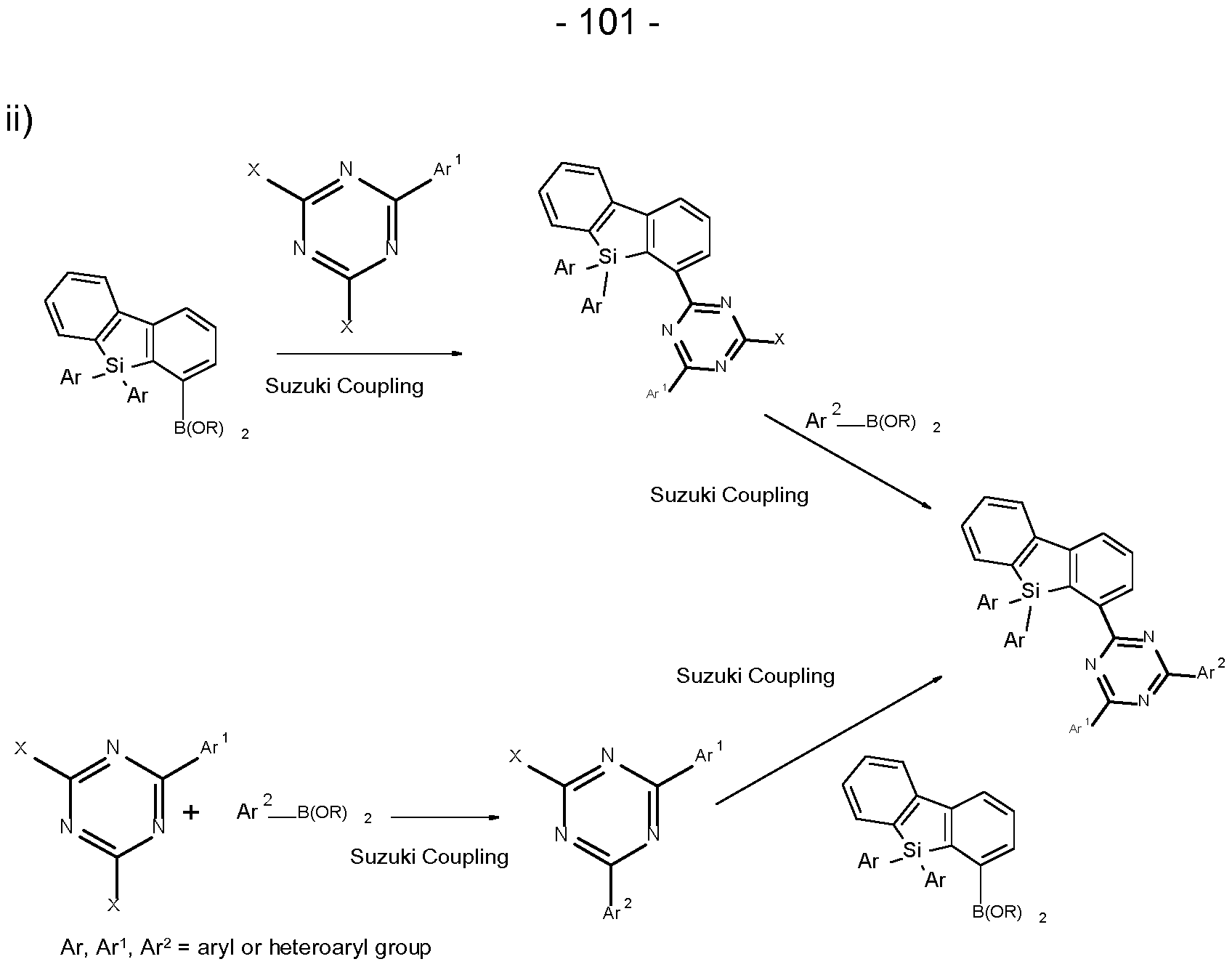


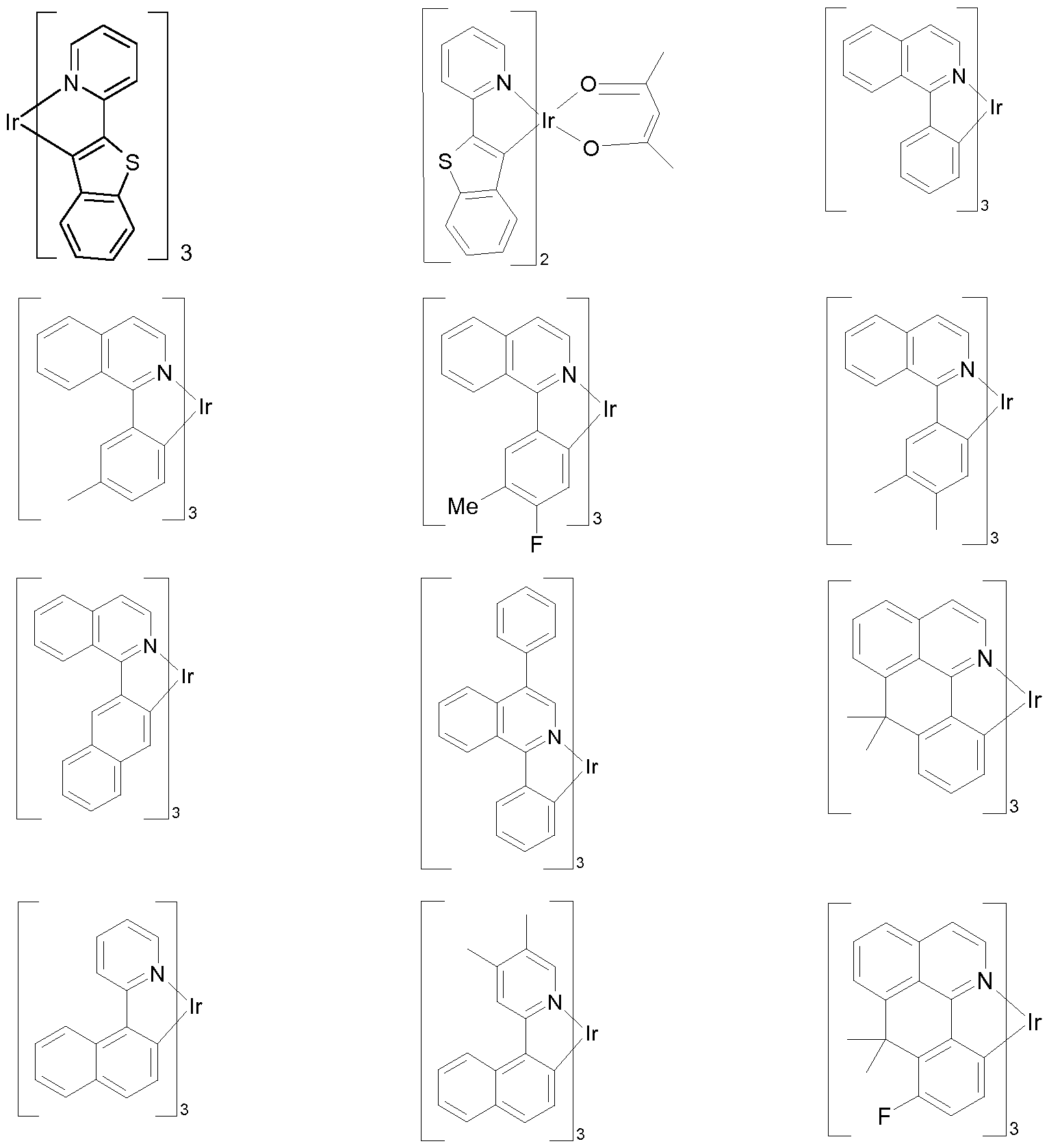

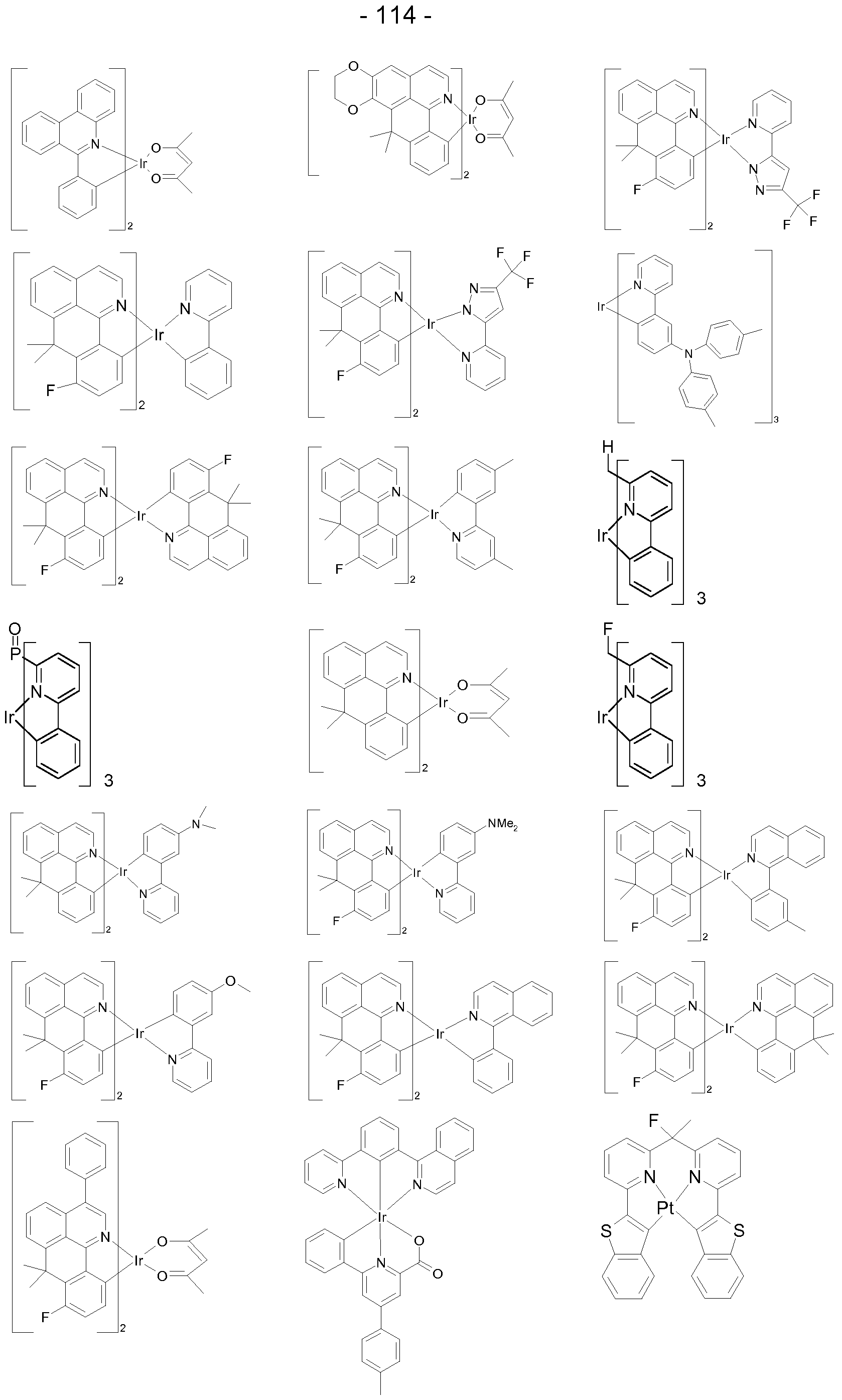
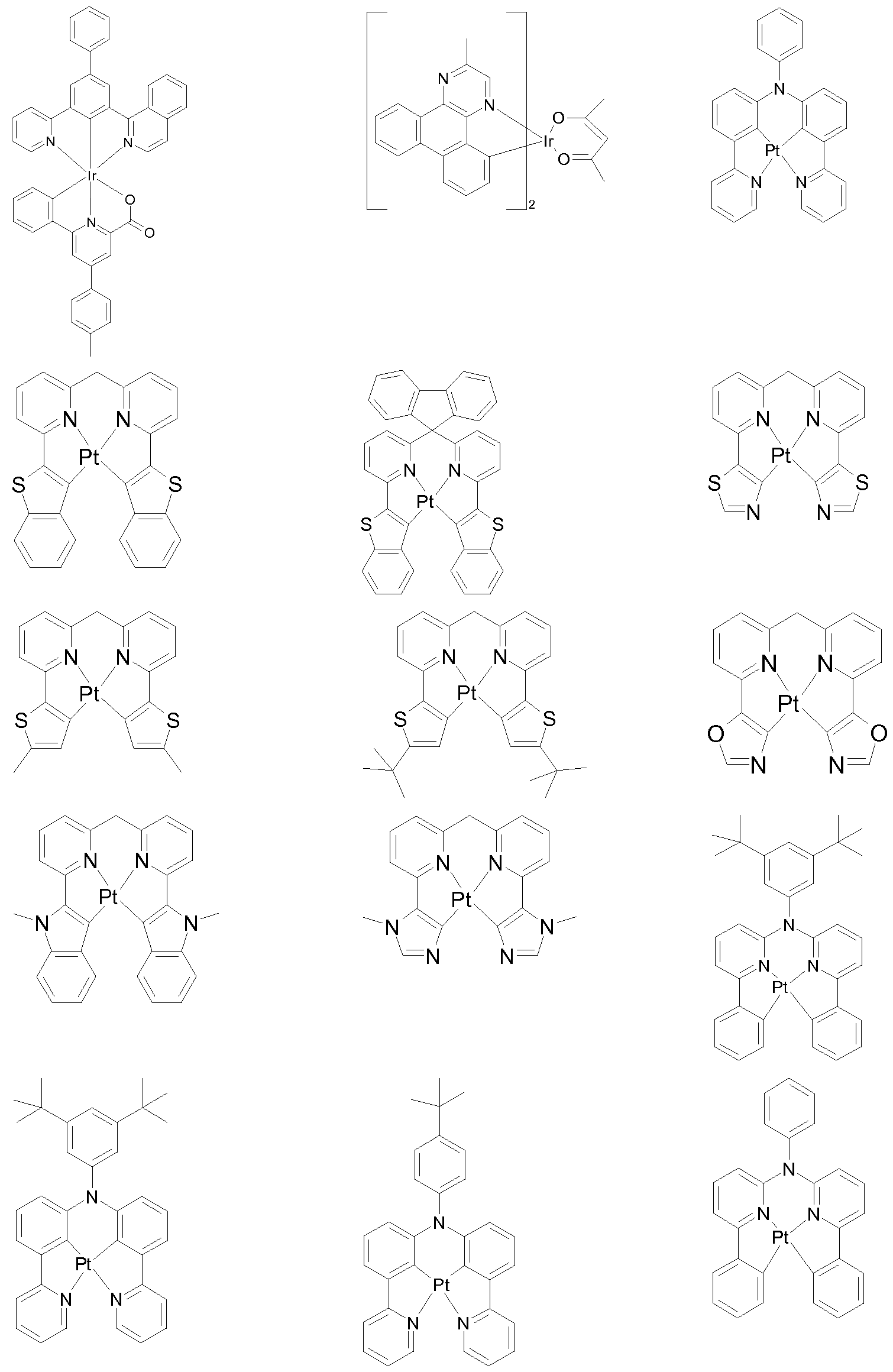
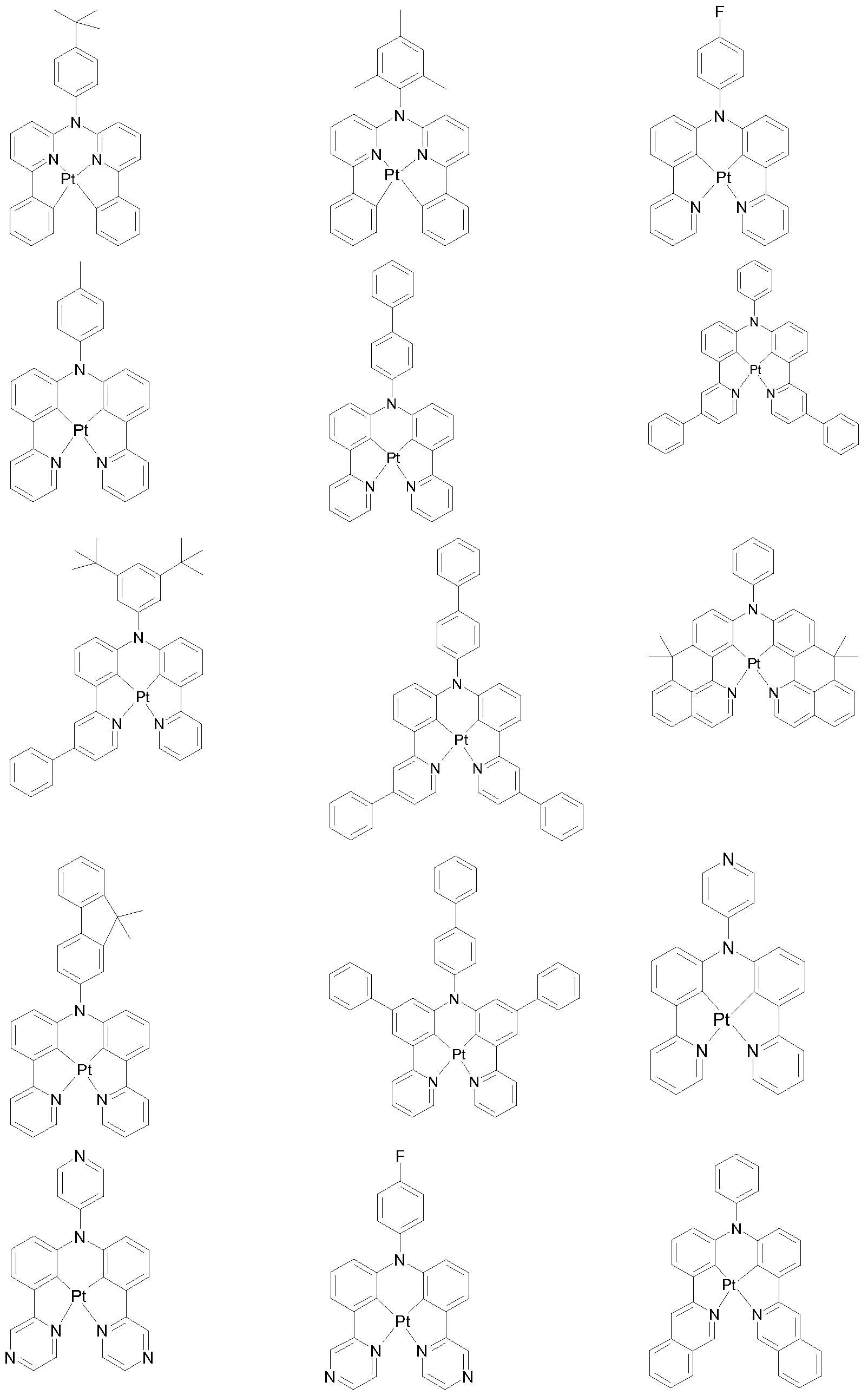


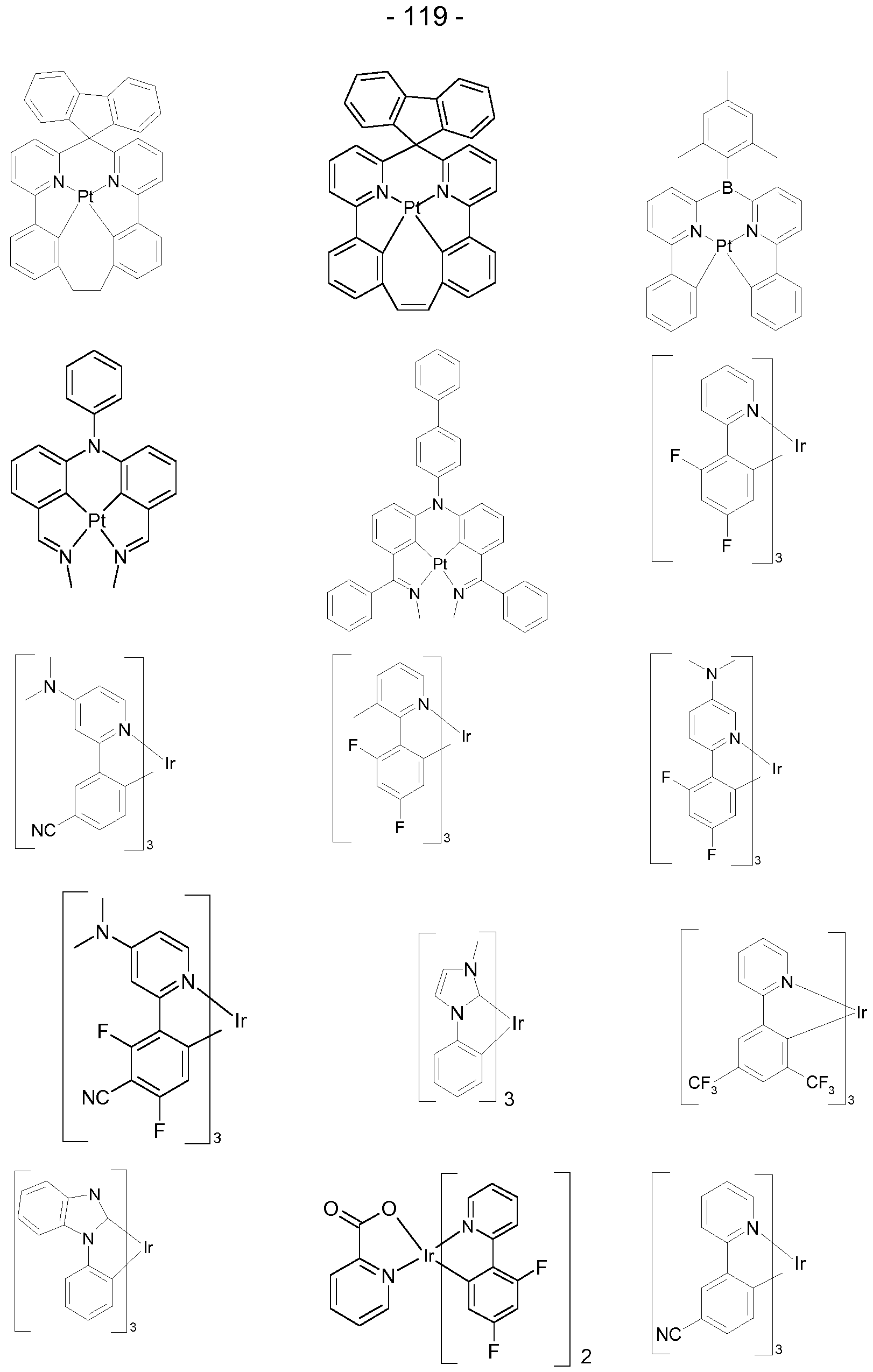
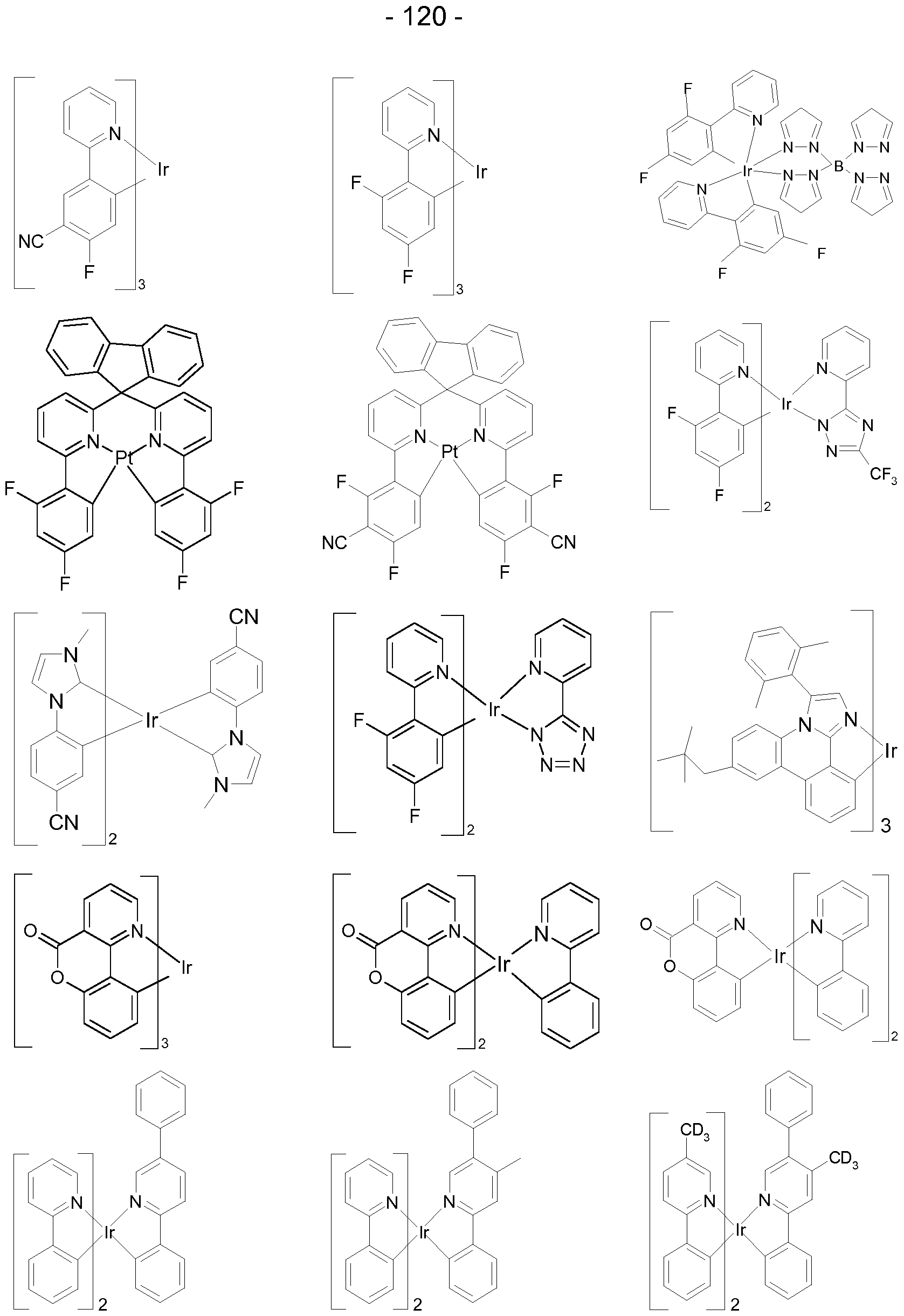


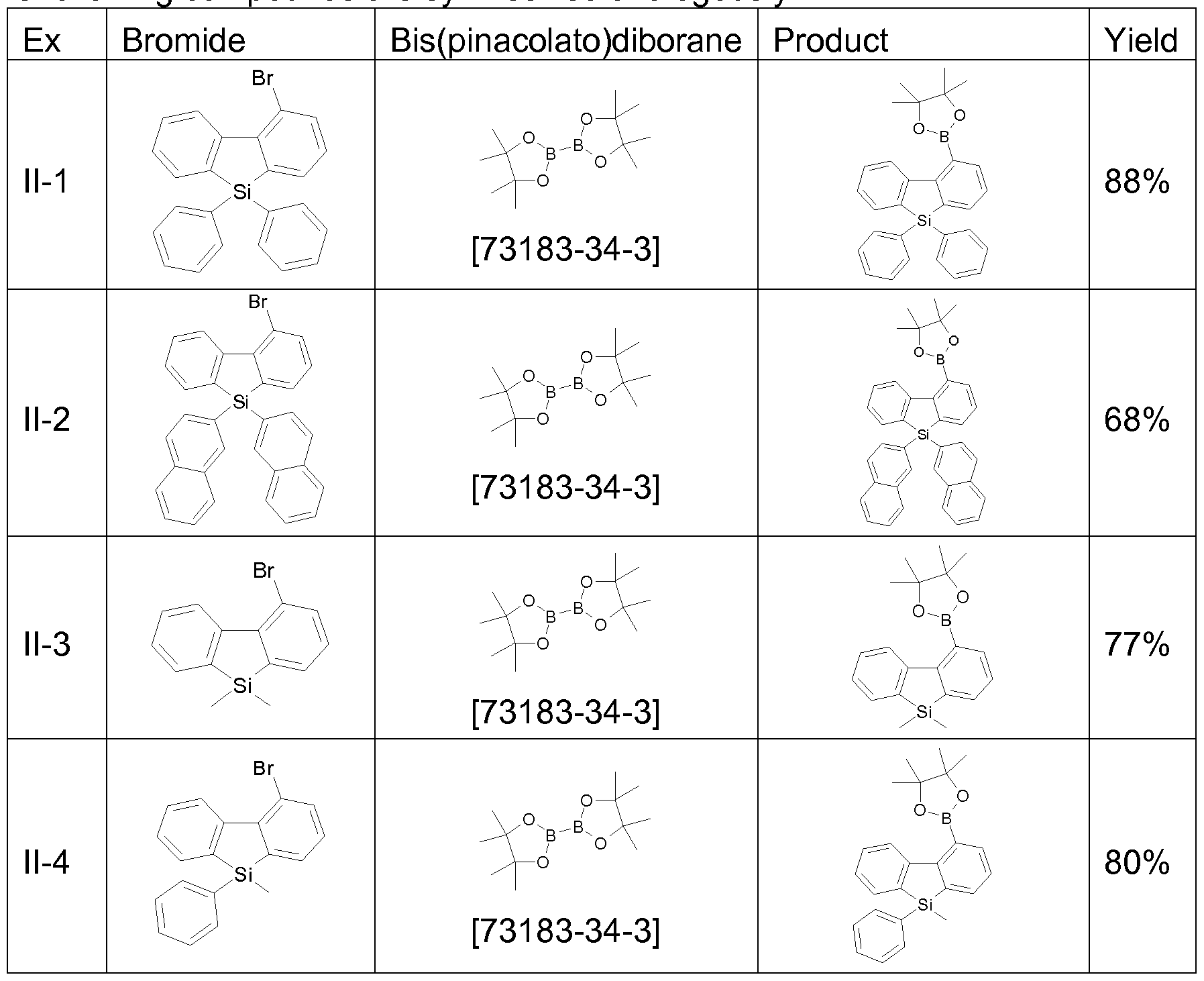
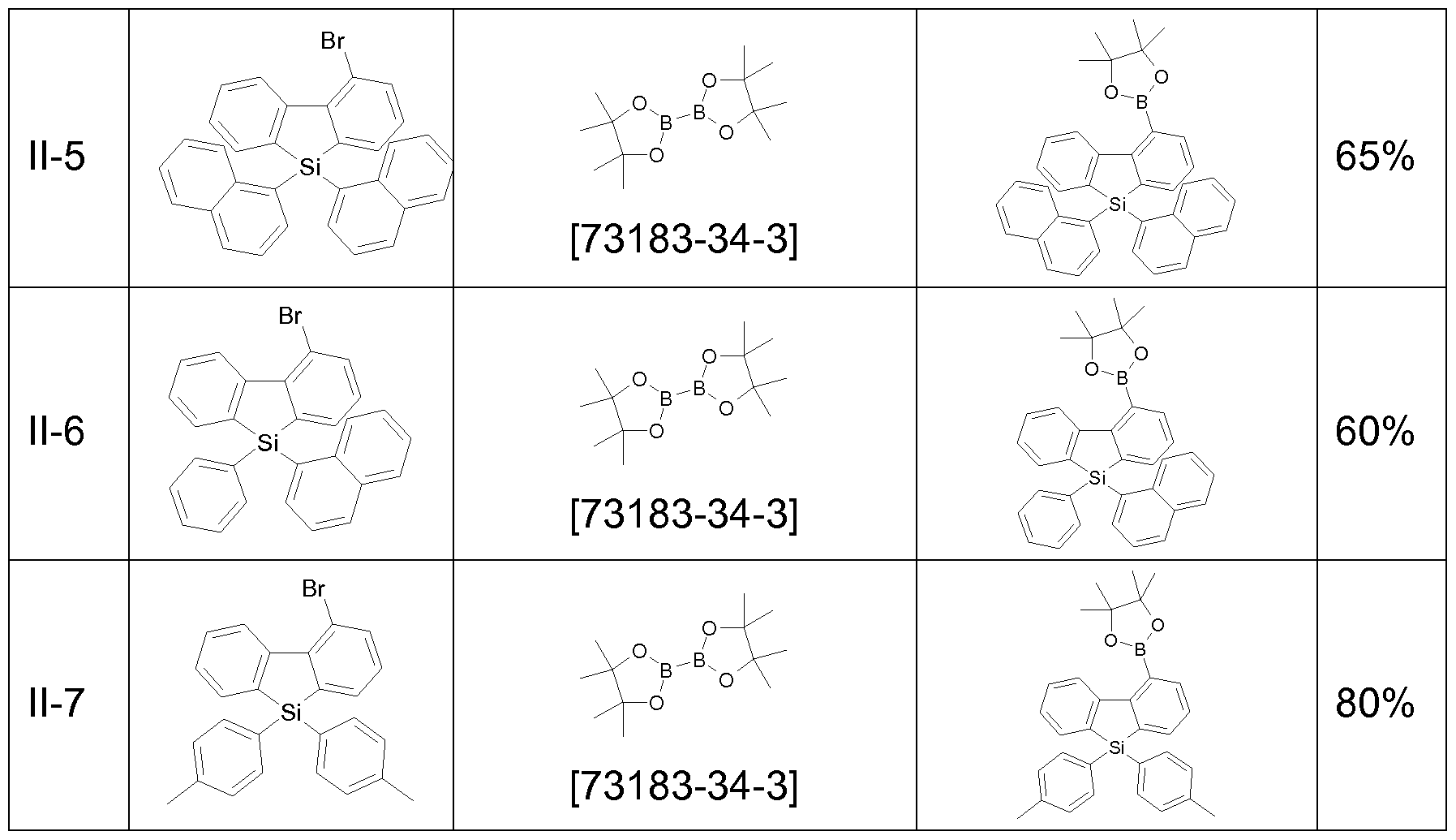

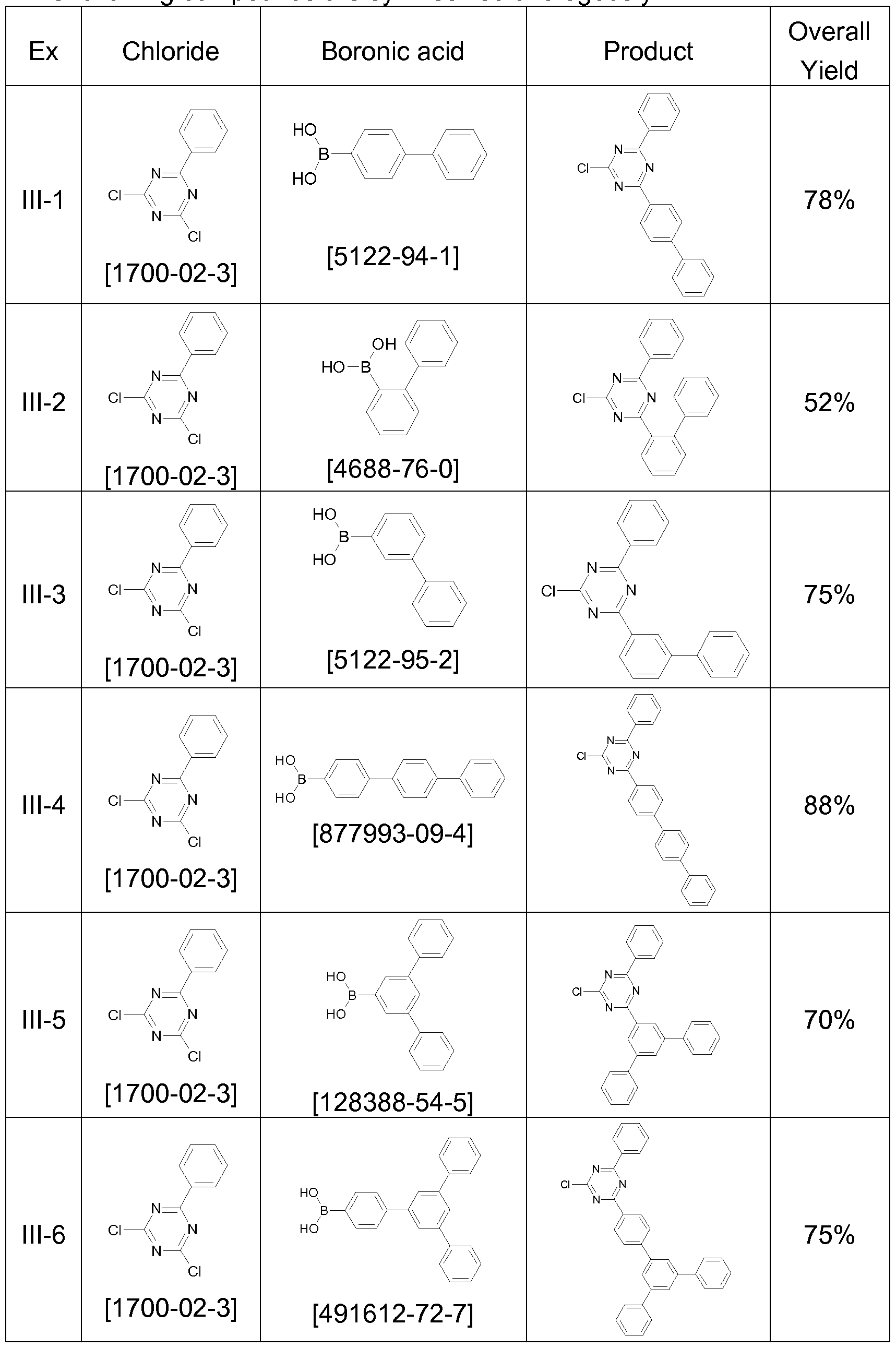


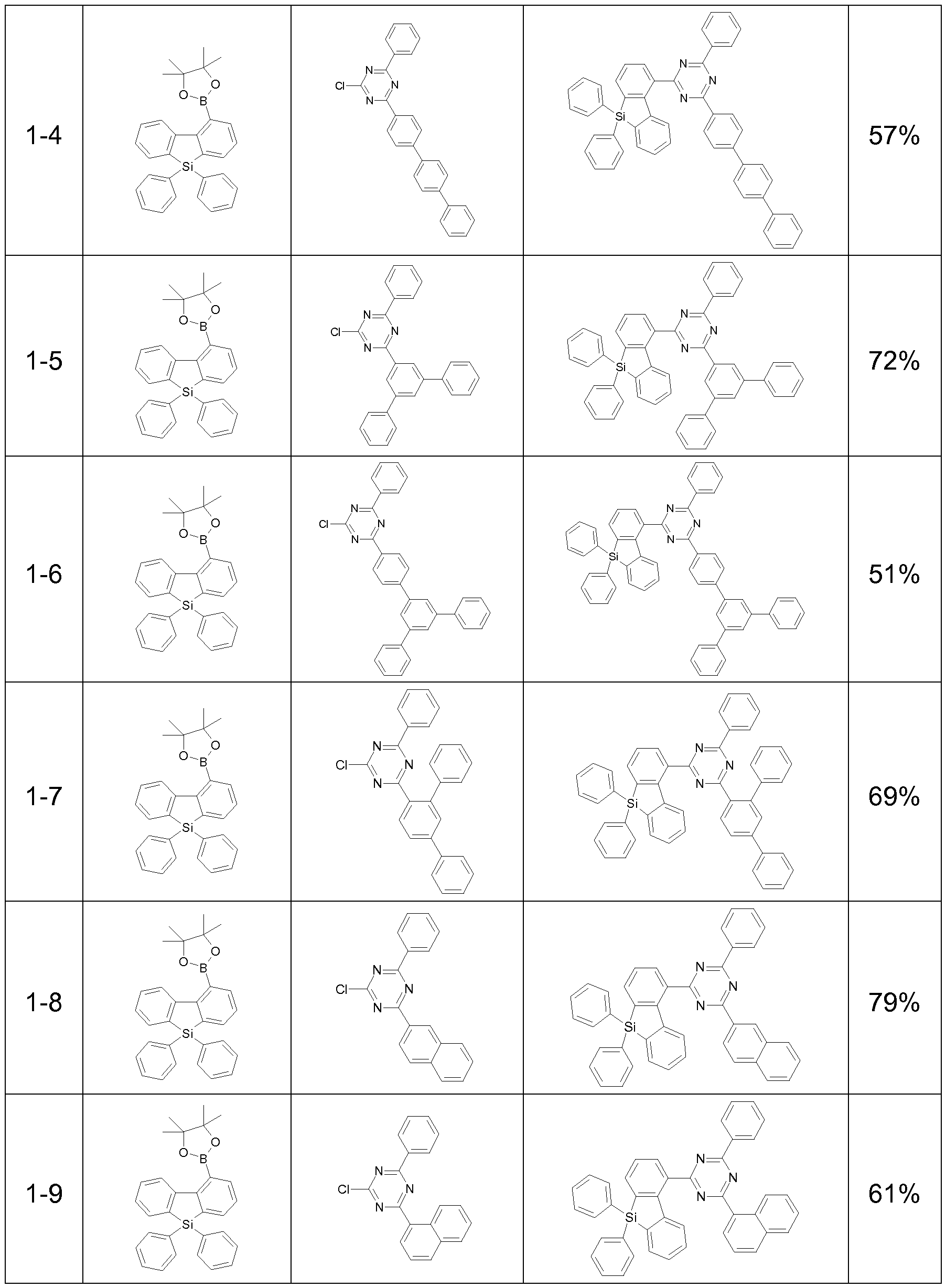

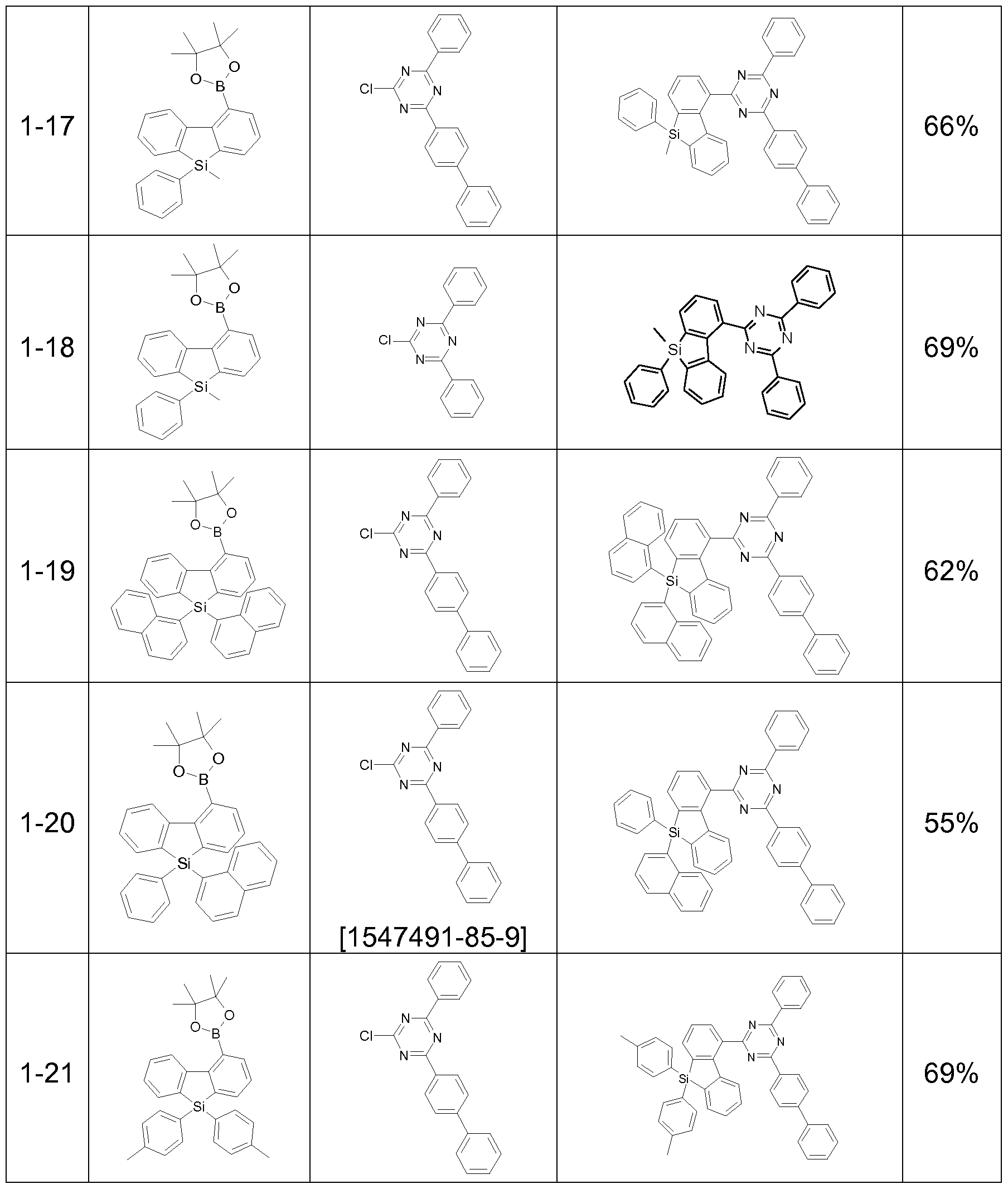


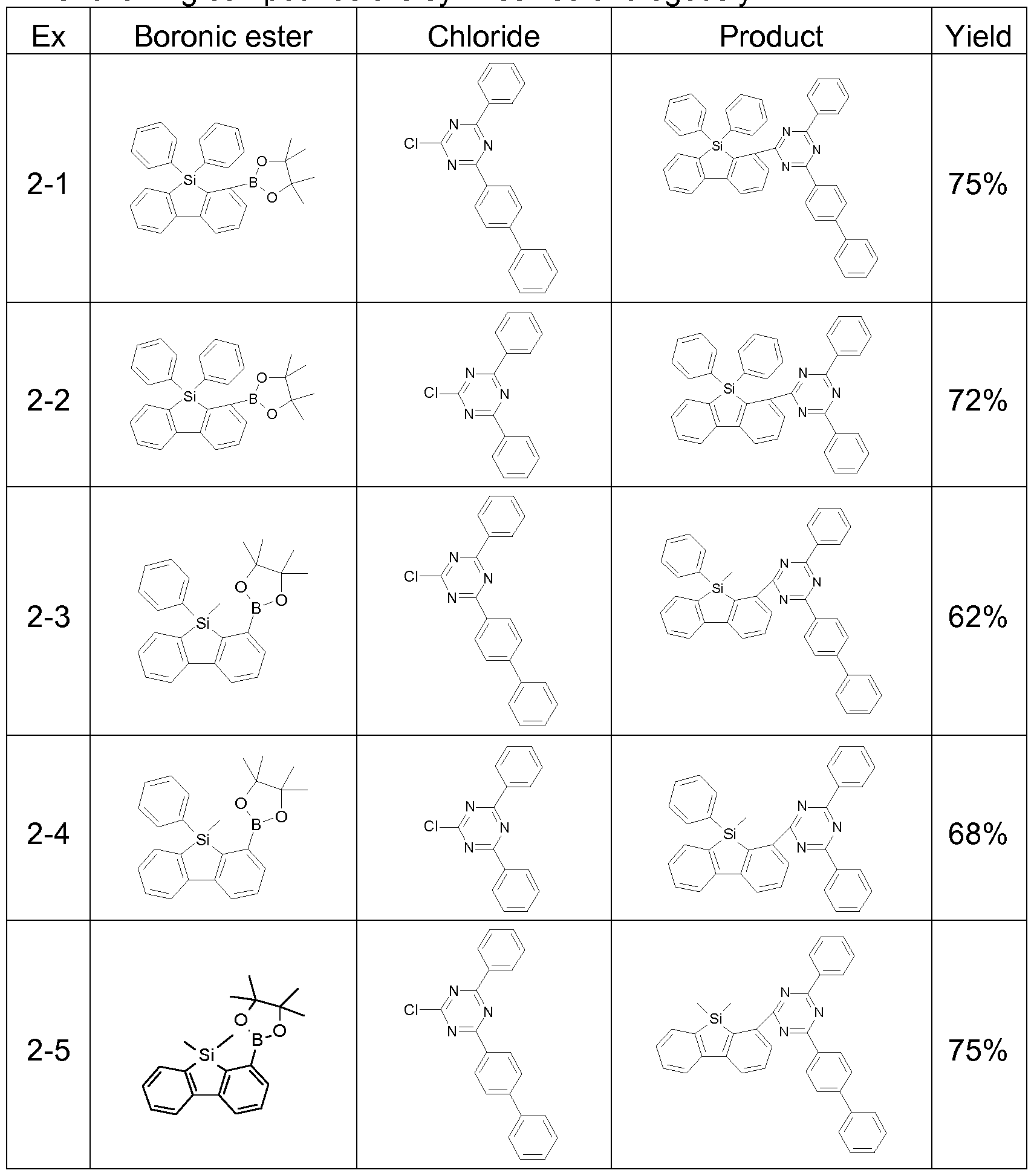


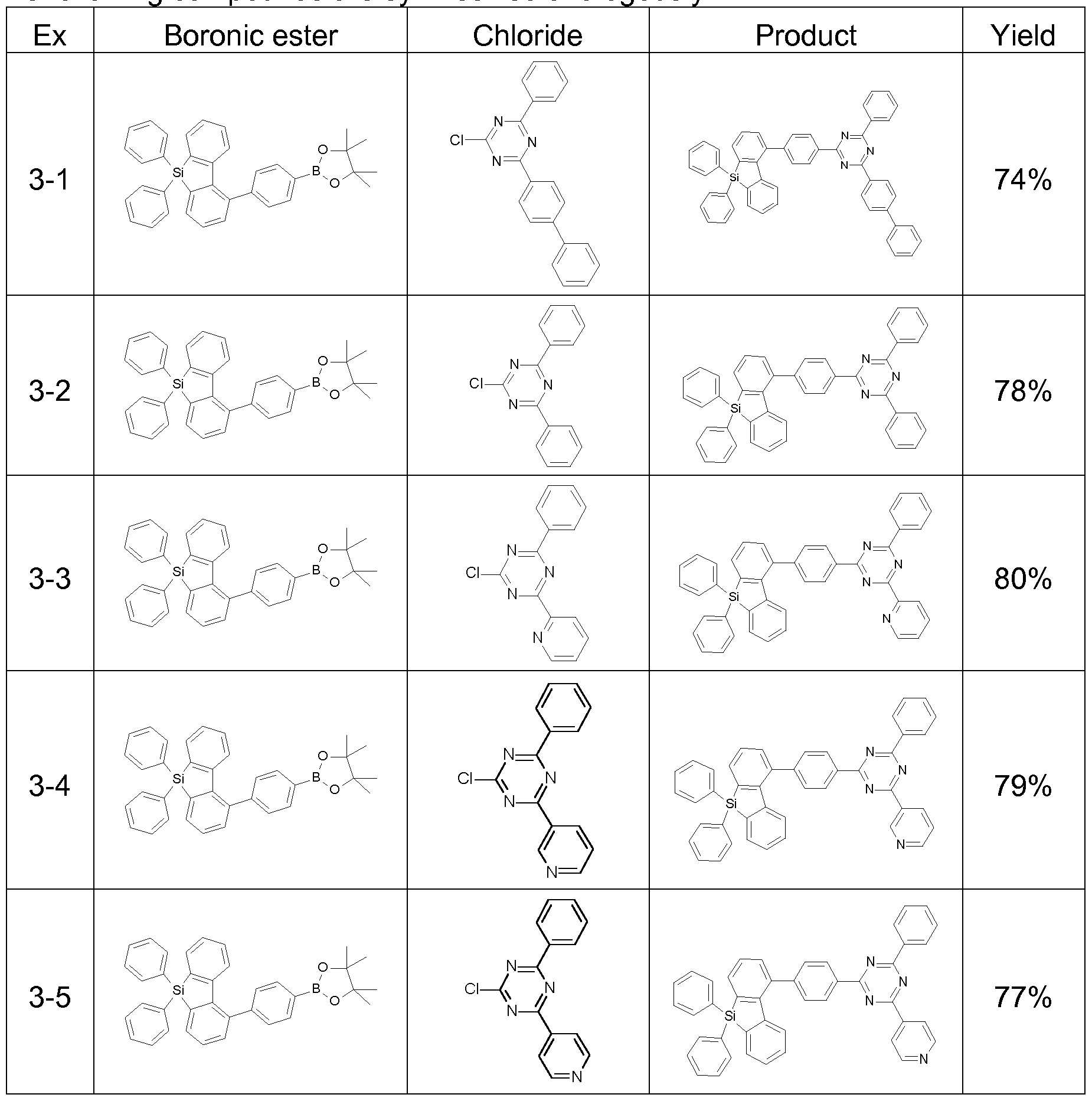
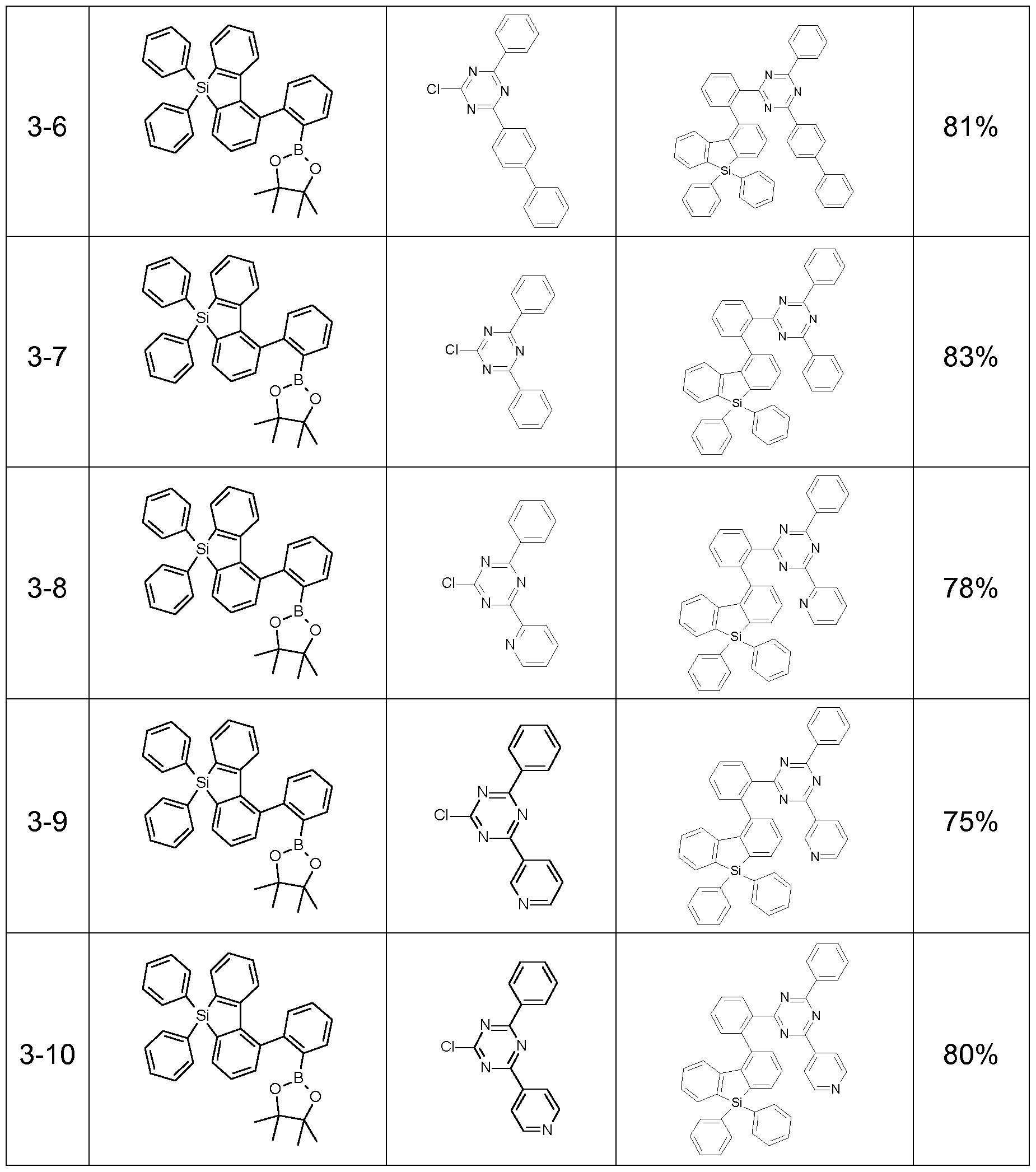


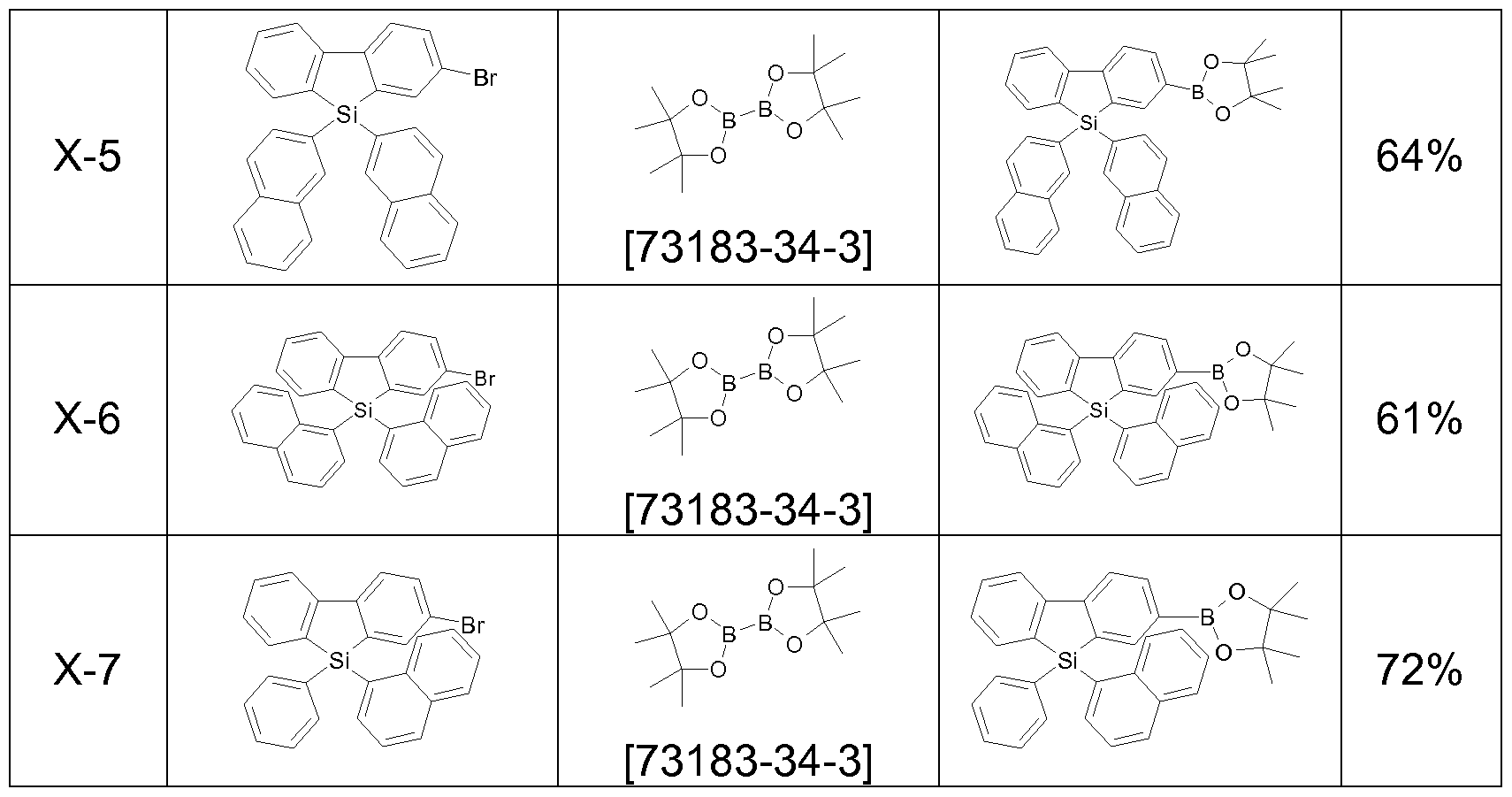


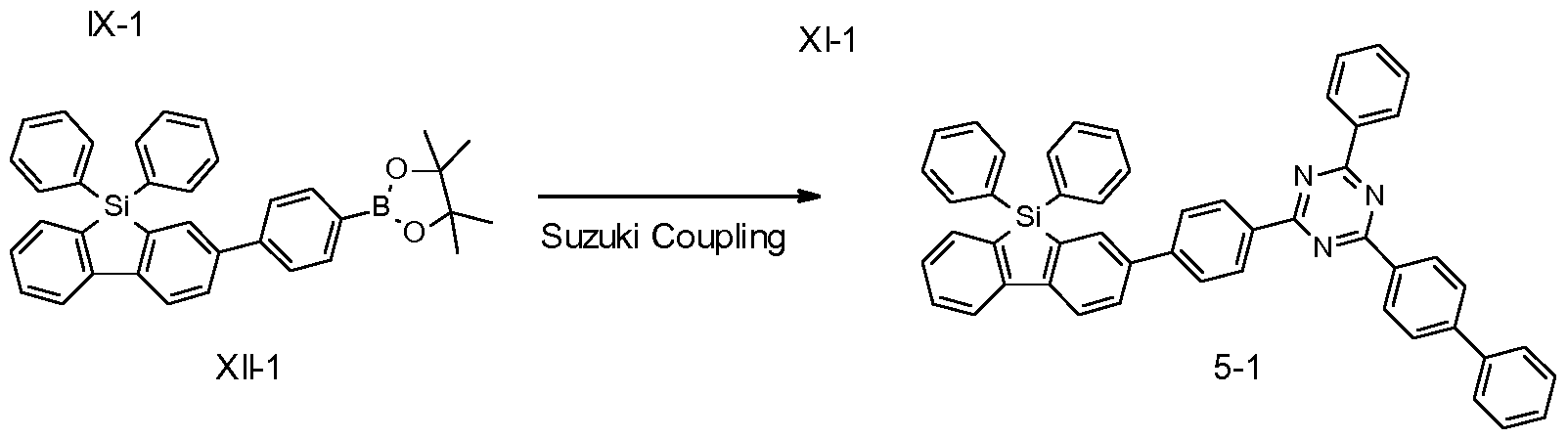

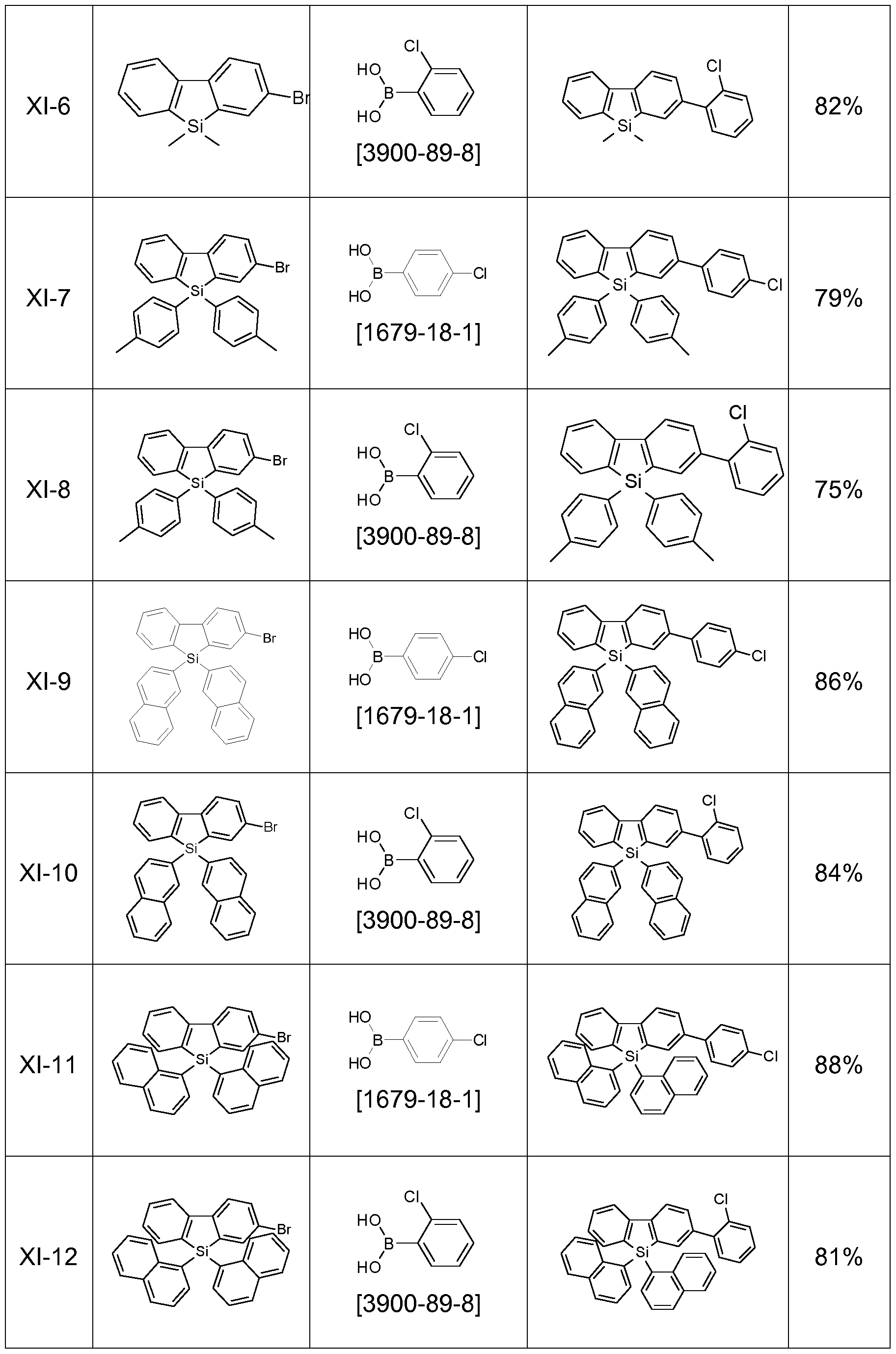


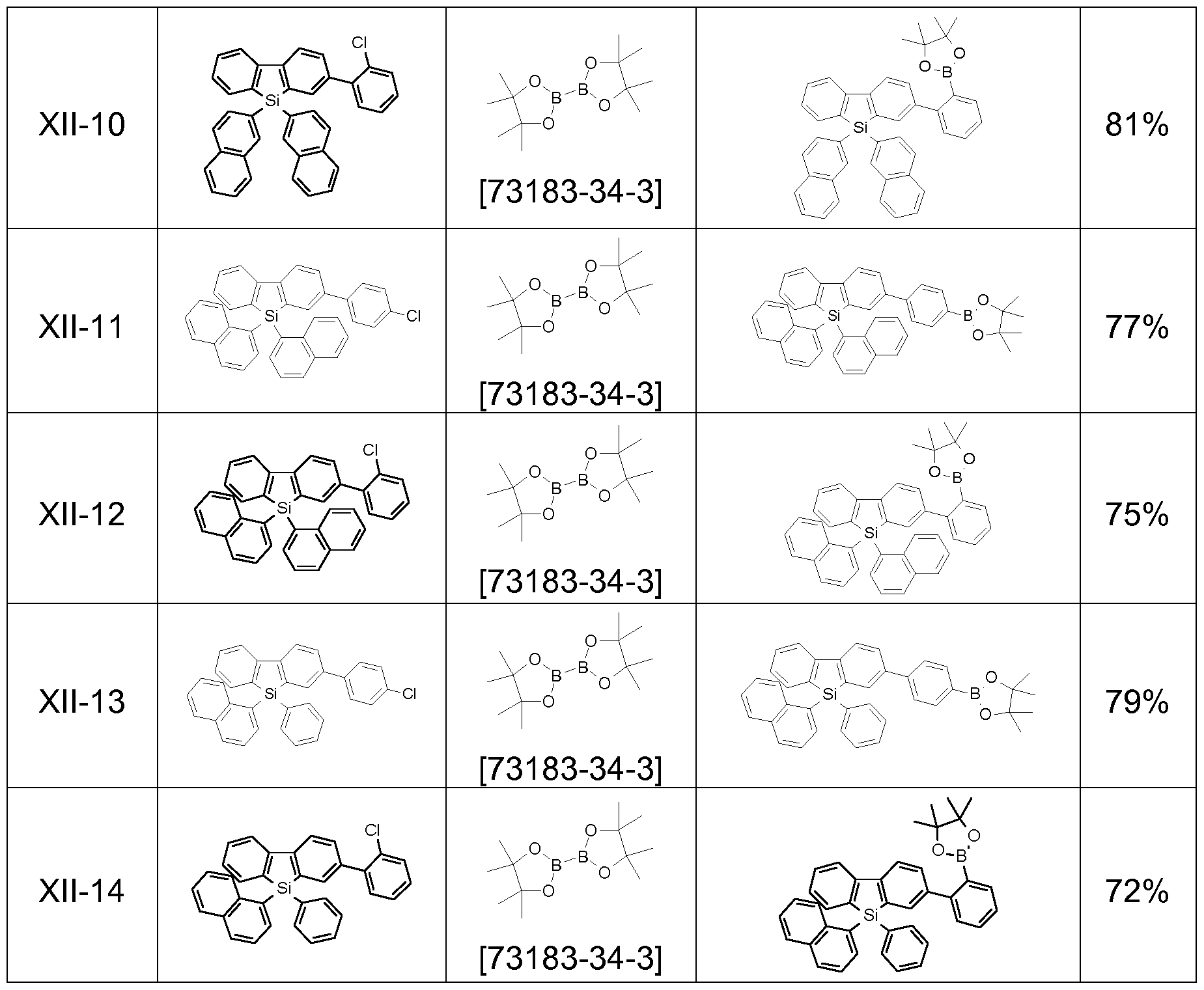
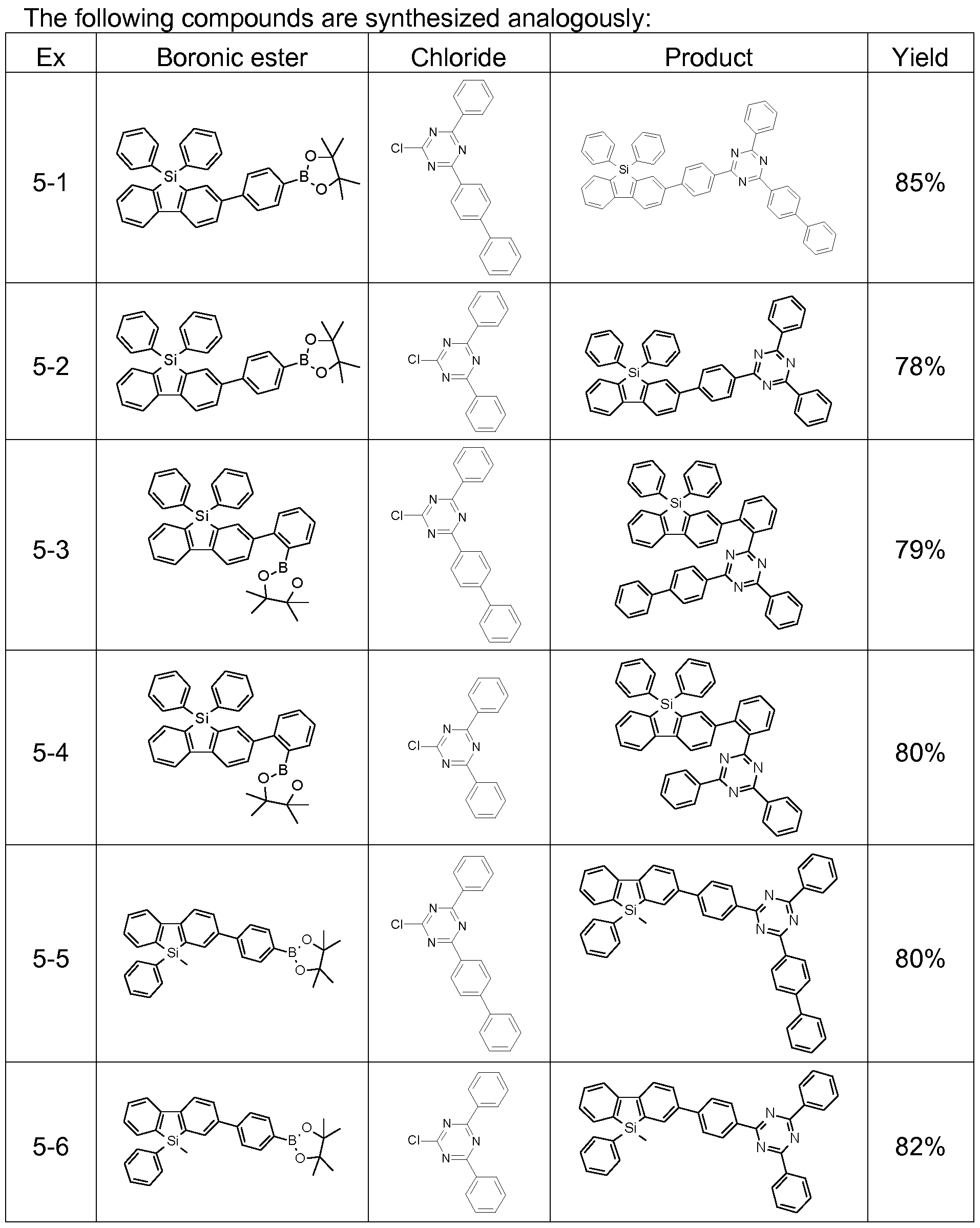
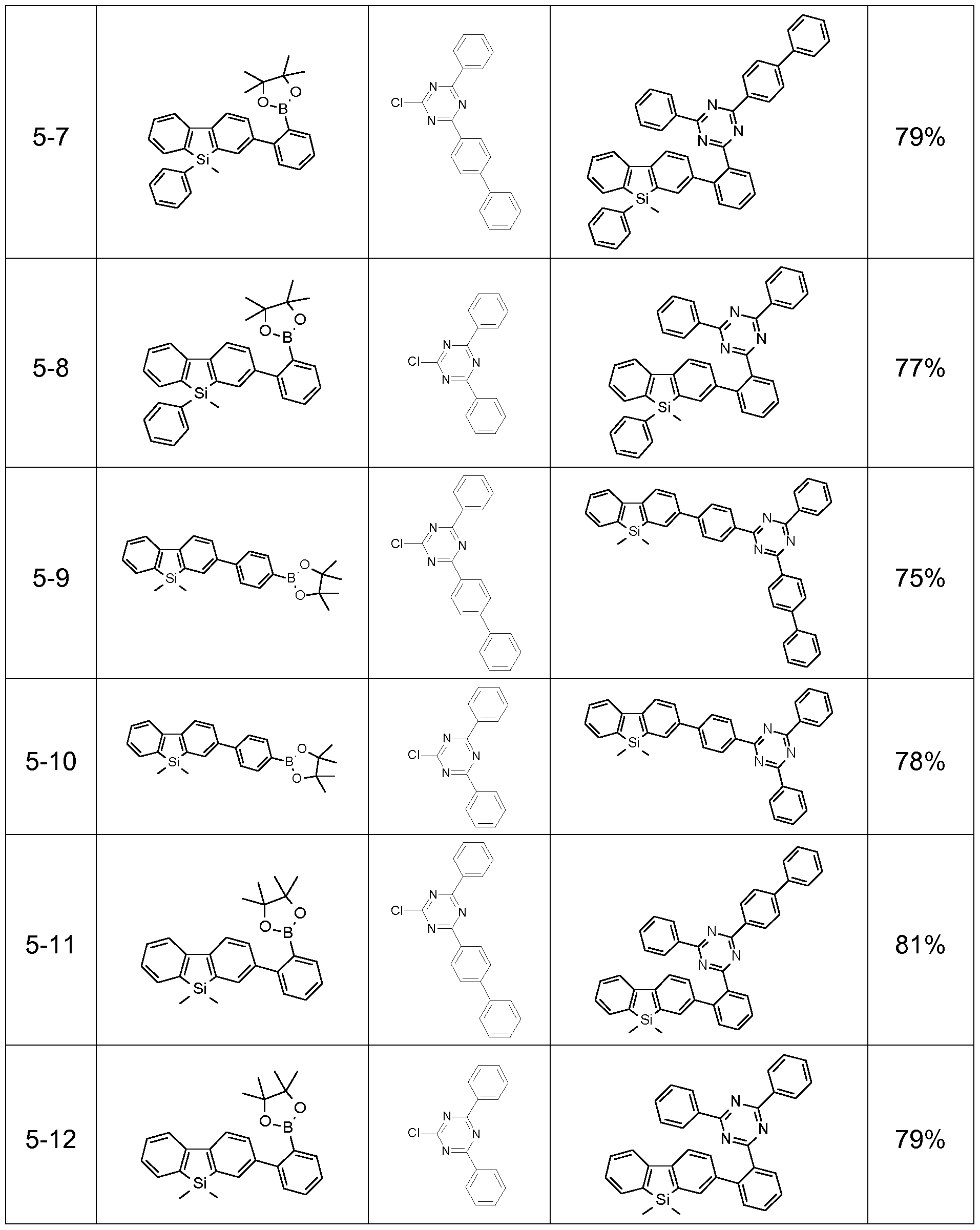
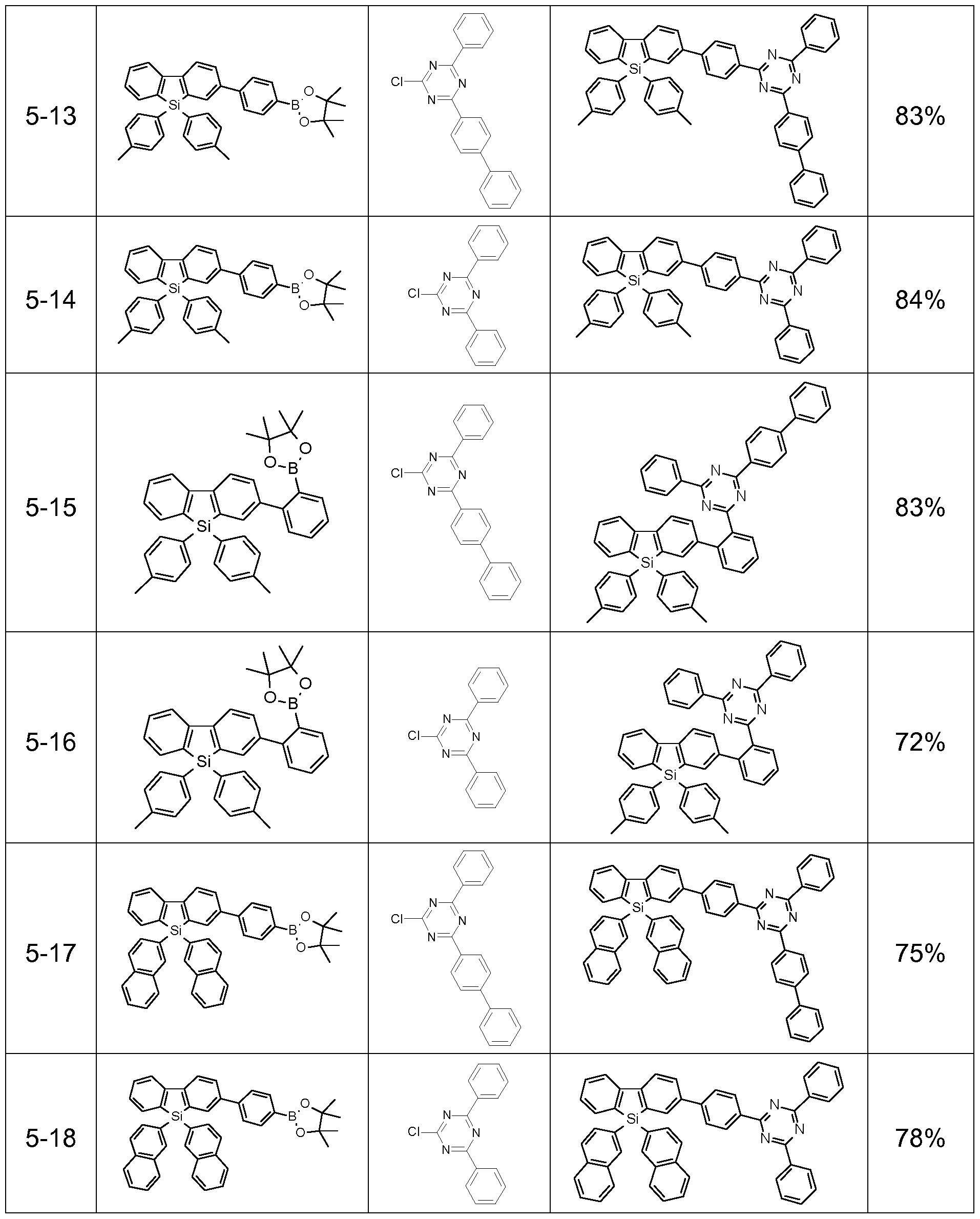

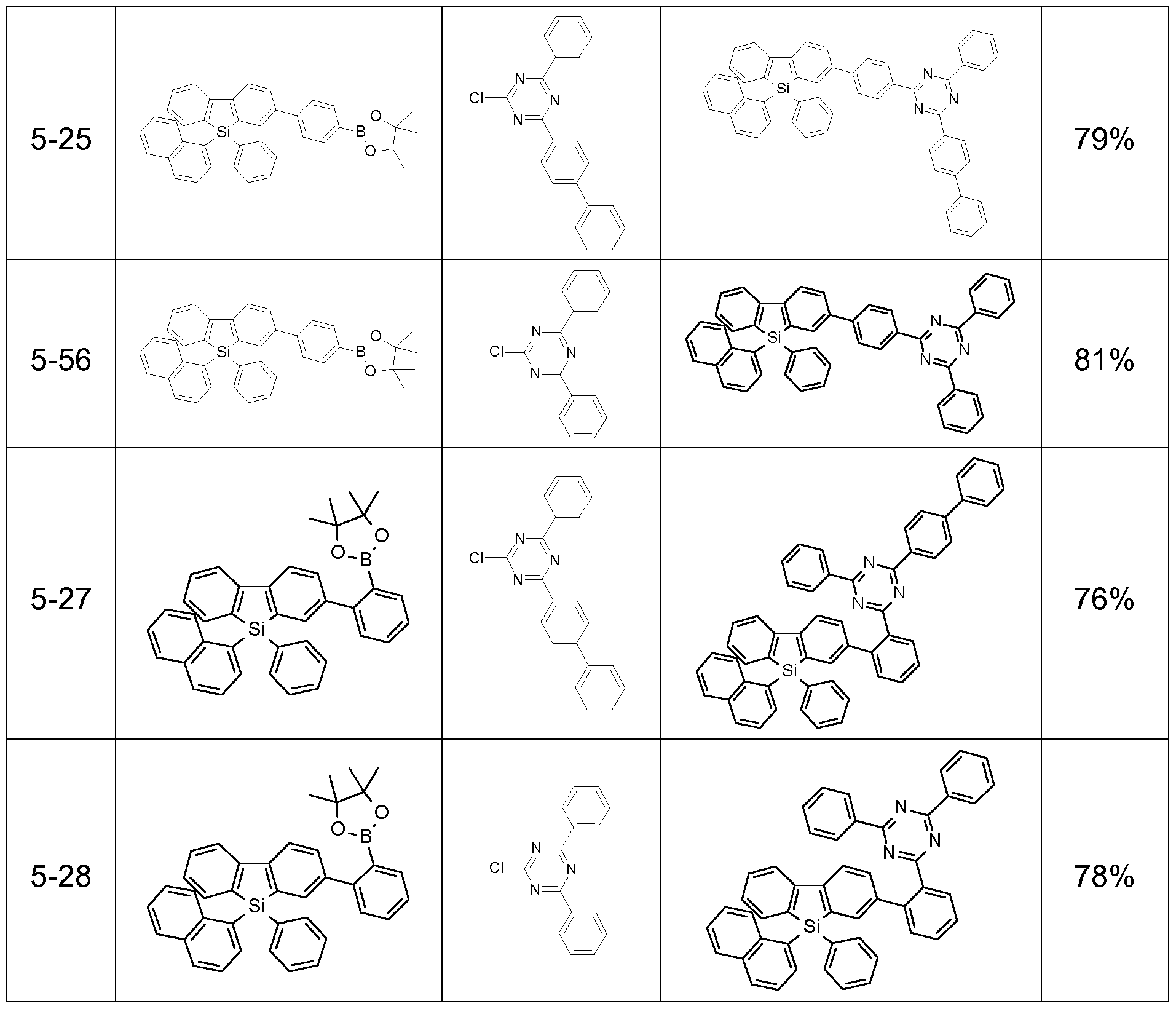


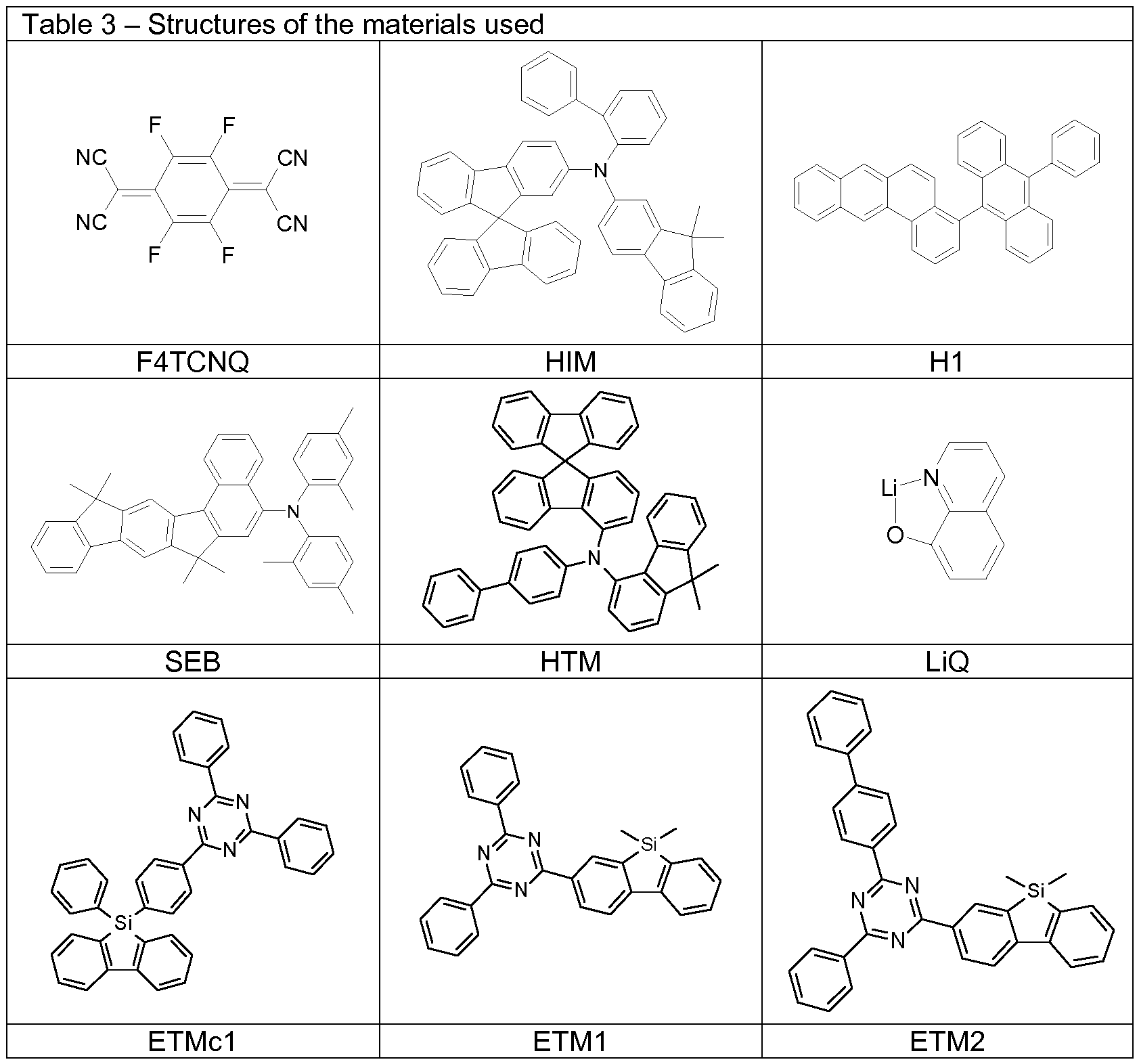


Claims


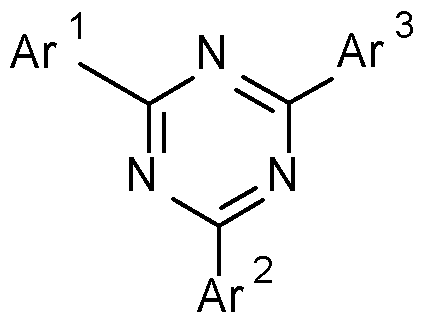

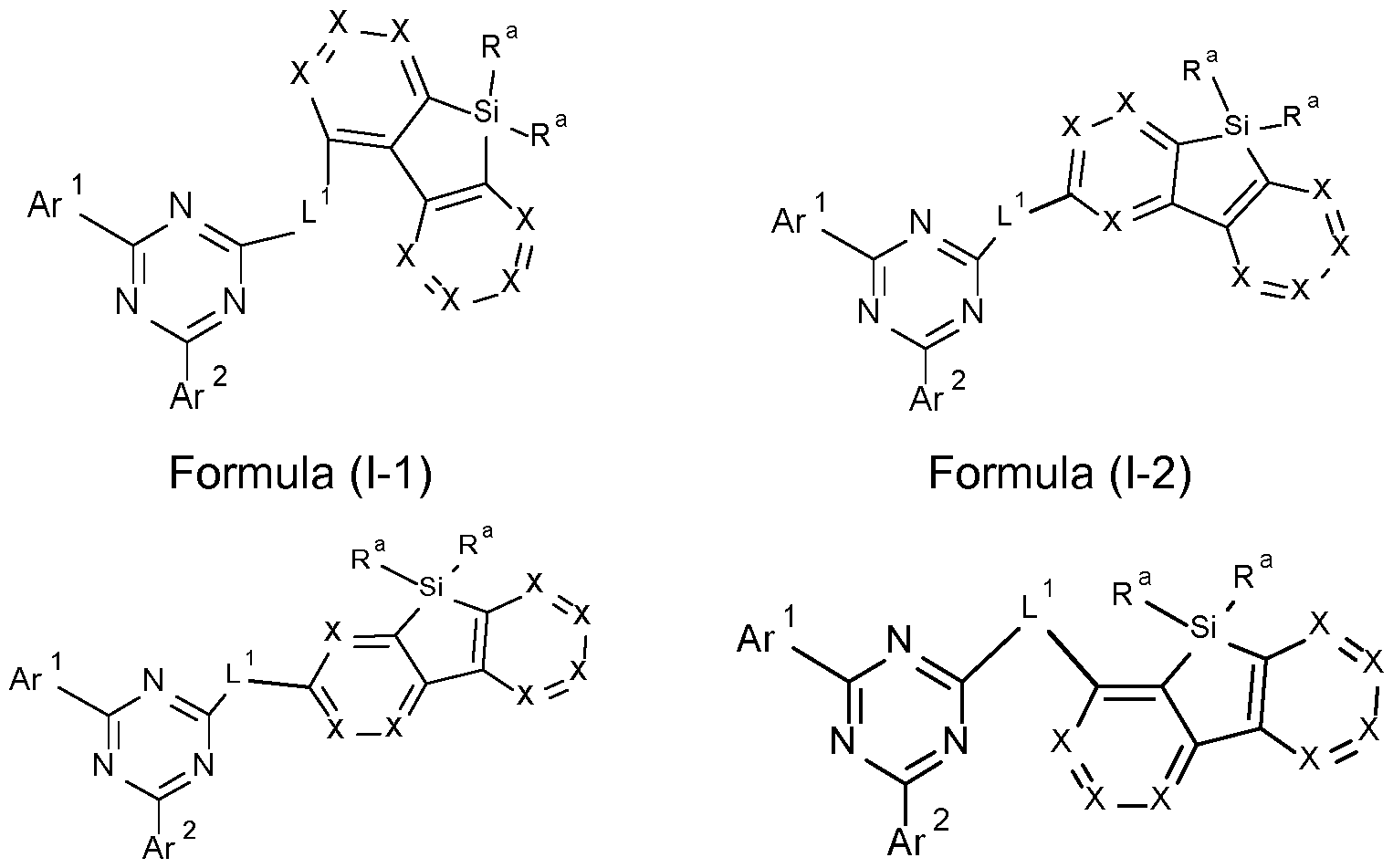

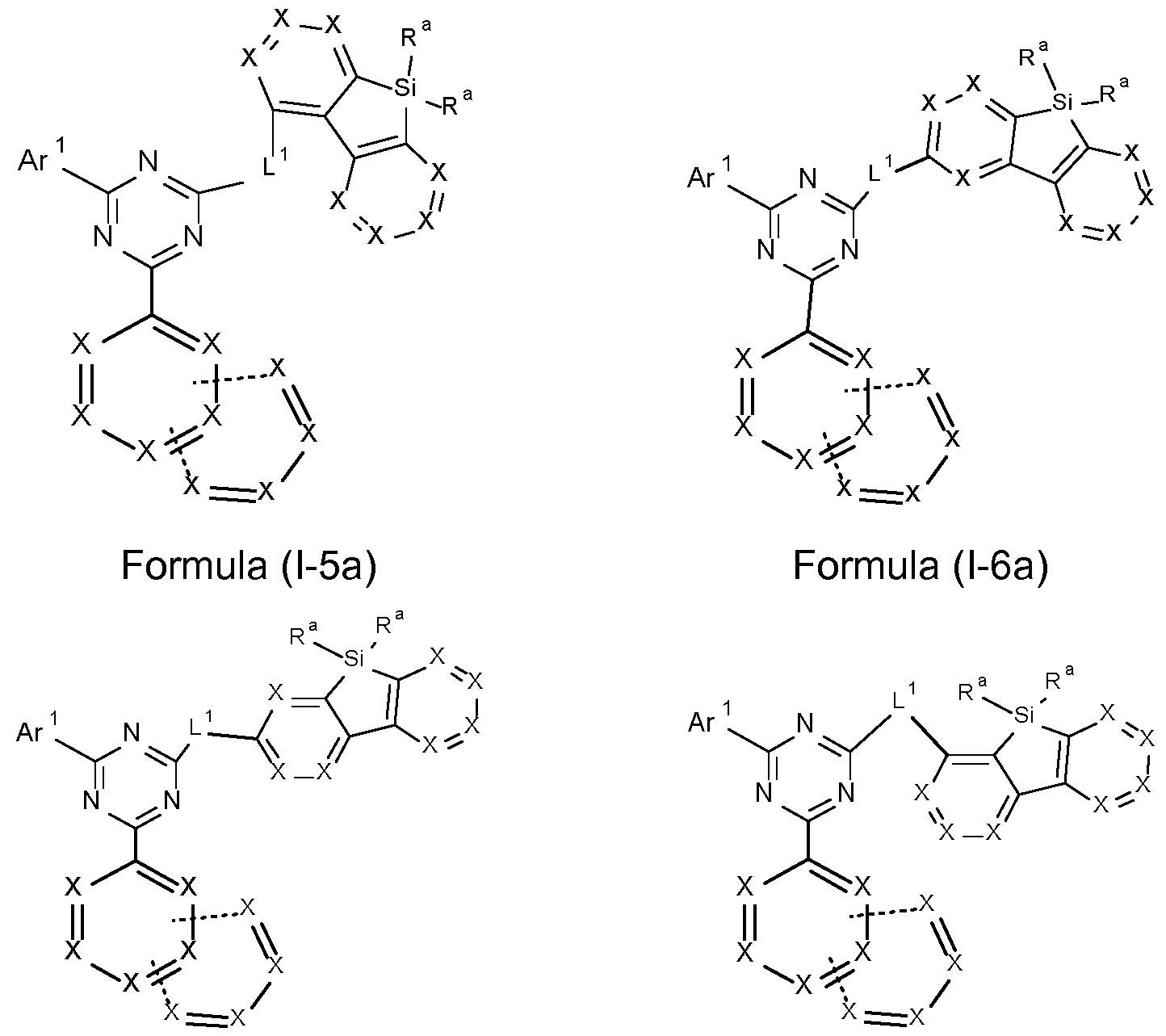

Priority Applications (7)
| Application Number | Priority Date | Filing Date | Title |
|---|---|---|---|
| EP18822333.3A EP3728275B1 (en) | 2017-12-20 | 2018-12-17 | Heteroaromatic compounds |
| JP2020534596A JP7402800B2 (en) | 2017-12-20 | 2018-12-17 | heteroaromatic compounds |
| CN201880081173.7A CN111479815A (en) | 2017-12-20 | 2018-12-17 | Heteroaromatic compounds |
| EP24197786.7A EP4451832A3 (en) | 2017-12-20 | 2018-12-17 | Heteroaromatic compounds |
| US16/954,516 US20210036245A1 (en) | 2017-12-20 | 2018-12-17 | Heteroaromatic compounds |
| KR1020207020383A KR20200100699A (en) | 2017-12-20 | 2018-12-17 | Heteroaromatic compounds |
| JP2023207456A JP2024028921A (en) | 2017-12-20 | 2023-12-08 | heteroaromatic compounds |
Applications Claiming Priority (2)
| Application Number | Priority Date | Filing Date | Title |
|---|---|---|---|
| EP17209057 | 2017-12-20 | ||
| EP17209057.3 | 2017-12-20 |
Publications (1)
| Publication Number | Publication Date |
|---|---|
| WO2019121483A1 true WO2019121483A1 (en) | 2019-06-27 |
Family
ID=60702405
Family Applications (1)
| Application Number | Title | Priority Date | Filing Date |
|---|---|---|---|
| PCT/EP2018/085150 Ceased WO2019121483A1 (en) | 2017-12-20 | 2018-12-17 | Heteroaromatic compounds |
Country Status (6)
| Country | Link |
|---|---|
| US (1) | US20210036245A1 (en) |
| EP (2) | EP4451832A3 (en) |
| JP (2) | JP7402800B2 (en) |
| KR (1) | KR20200100699A (en) |
| CN (1) | CN111479815A (en) |
| WO (1) | WO2019121483A1 (en) |
Cited By (4)
| Publication number | Priority date | Publication date | Assignee | Title |
|---|---|---|---|---|
| JP2020068383A (en) * | 2018-10-24 | 2020-04-30 | 北京夏禾科技有限公司 | Silicon-containing electron transport material and use thereof |
| US11932661B2 (en) | 2020-03-23 | 2024-03-19 | Samsung Sdi Co., Ltd. | Composition for organic optoelectronic device, organic optoelectronic device, and display device |
| EP4450509A1 (en) * | 2023-04-20 | 2024-10-23 | Novaled GmbH | Compound, method and precursor compound for preparing the compound, semiconducting material, organic electronic device, and display device |
| EP4450510A1 (en) * | 2023-04-20 | 2024-10-23 | Novaled GmbH | Compound, method for preparing the compound, semiconducting material, organic electronic device, and display device |
Families Citing this family (4)
| Publication number | Priority date | Publication date | Assignee | Title |
|---|---|---|---|---|
| KR20200100699A (en) * | 2017-12-20 | 2020-08-26 | 메르크 파텐트 게엠베하 | Heteroaromatic compounds |
| KR102827970B1 (en) * | 2020-12-22 | 2025-06-30 | 삼성에스디아이 주식회사 | Compound for organic optoelectronic device, organic optoelectronic device and display device |
| CN115403608B (en) * | 2022-09-26 | 2025-05-02 | 上海天马微电子有限公司 | A spirofluorene silicon compound and its electroluminescent application |
| CN118108751A (en) * | 2022-11-30 | 2024-05-31 | 北京夏禾科技有限公司 | Organic electroluminescent materials and devices |
Citations (130)
| Publication number | Priority date | Publication date | Assignee | Title |
|---|---|---|---|---|
| WO1992018552A1 (en) | 1991-04-11 | 1992-10-29 | Wacker-Chemie Gmbh | Conductive polymers with conjugated double bonds |
| EP0652273A1 (en) | 1993-11-09 | 1995-05-10 | Shinko Electric Industries Co. Ltd. | Organic material for electroluminescent device and electroluminescent device |
| EP0676461A2 (en) | 1994-04-07 | 1995-10-11 | Hoechst Aktiengesellschaft | Spiro compounds and their application as electroluminescence materials |
| EP0707020A2 (en) | 1994-10-14 | 1996-04-17 | Hoechst Aktiengesellschaft | Conjugated polymers with a spiro atom and their use as electroluminescent materials |
| EP0842208A1 (en) | 1995-07-28 | 1998-05-20 | The Dow Chemical Company | 2,7-aryl-9-substituted fluorenes and 9-substituted fluorene oligomers and polymers |
| EP0894107A1 (en) | 1996-04-17 | 1999-02-03 | Hoechst Research & Technology Deutschland GmbH & Co. KG | Polymers with spiro atoms and their use as electroluminescent materials |
| JP2000053957A (en) | 1998-06-23 | 2000-02-22 | Koto Gijutsu Kenkyuin Kenkyu Kumiai | Novel organometallic luminescent material and organic electroluminescent device containing the same |
| WO2000022026A1 (en) | 1998-10-10 | 2000-04-20 | Celanese Ventures Gmbh | Conjugated polymers containing special fluorene structural elements with improved properties |
| EP1028136A2 (en) | 1999-02-10 | 2000-08-16 | Carnegie-Mellon University | A method of forming poly-(3-substituted) thiophenes |
| WO2000070655A2 (en) | 1999-05-13 | 2000-11-23 | The Trustees Of Princeton University | Very high efficiency organic light emitting devices based on electrophosphorescence |
| US6229012B1 (en) * | 1998-10-01 | 2001-05-08 | Xerox Corporation | Triazine compositions |
| WO2001041512A1 (en) | 1999-12-01 | 2001-06-07 | The Trustees Of Princeton University | Complexes of form l2mx as phosphorescent dopants for organic leds |
| WO2002002714A2 (en) | 2000-06-30 | 2002-01-10 | E.I. Du Pont De Nemours And Company | Electroluminescent iridium compounds with fluorinated phenylpyridines, phenylpyrimidines, and phenylquinolines and devices made with such compounds |
| EP1175470A1 (en) | 1999-12-31 | 2002-01-30 | LG Chemical Co. Ltd | Electronic device comprising organic compound having p-type semiconducting characteristics |
| WO2002015645A1 (en) | 2000-08-11 | 2002-02-21 | The Trustees Of Princeton University | Organometallic compounds and emission-shifting organic electrophosphorescence |
| EP1191613A2 (en) | 2000-09-26 | 2002-03-27 | Canon Kabushiki Kaisha | Luminescence device, display apparatus and metal coordination compound |
| EP1191614A2 (en) | 2000-09-26 | 2002-03-27 | Canon Kabushiki Kaisha | Luminescence device and metal coordination compound therefor |
| EP1191612A2 (en) | 2000-09-26 | 2002-03-27 | Canon Kabushiki Kaisha | Luminescence device, display apparatus and metal coordination compound |
| EP1205527A1 (en) | 2000-03-27 | 2002-05-15 | Idemitsu Kosan Co., Ltd. | Organic electroluminescence device |
| WO2002067343A1 (en) | 2001-02-20 | 2002-08-29 | Isis Innovation Limited | Aryl-aryl dendrimers |
| WO2002072714A1 (en) | 2001-03-10 | 2002-09-19 | Covion Organic Semiconductors Gmbh | Solutions and dispersions of organic semiconductors |
| WO2003019694A2 (en) | 2001-08-24 | 2003-03-06 | Covion Organic Semiconductors Gmbh | Solutions of polymer semiconductors |
| WO2003048225A2 (en) | 2001-12-06 | 2003-06-12 | Covion Organic Semiconductors Gmbh | Process for producing aryl-aryl coupled compounds |
| WO2003060956A2 (en) | 2002-01-18 | 2003-07-24 | Lg Chem, Ltd. | New material for transporting electrons and organic electroluminescent display using the same |
| WO2004013080A1 (en) | 2002-08-01 | 2004-02-12 | Covion Organic Semiconductors Gmbh | Spirobifluorene derivatives, their preparation and uses thereof |
| WO2004028217A1 (en) | 2002-09-20 | 2004-04-01 | Idemitsu Kosan Co., Ltd. | Organic electroluminescent element |
| WO2004037887A2 (en) | 2002-10-25 | 2004-05-06 | Covion Organic Semiconductors Gmbh | Conjugated polymers containing arylamine units, the representation thereof and the use of the same |
| WO2004041901A1 (en) | 2002-11-08 | 2004-05-21 | Covion Organic Semiconductors Gmbh | Aryl-substituted polyindenofluorenes for use in organic electroluminiscent devices |
| WO2004058911A2 (en) | 2002-12-23 | 2004-07-15 | Covion Organic Semiconductors Gmbh | Organic electroluminescent element |
| WO2004070772A2 (en) | 2003-02-06 | 2004-08-19 | Covion Organic Semiconductors Gmbh | Conjugated polymers and blends containing carbazole, representation and use thereof |
| WO2004081017A1 (en) | 2003-03-11 | 2004-09-23 | Covion Organic Semiconductors Gmbh | Metal complexes |
| WO2004080975A1 (en) | 2003-03-13 | 2004-09-23 | Idemitsu Kosan Co., Ltd. | Nitrogen-containing heterocycle derivative and organic electroluminescent element using the same |
| JP2004288381A (en) | 2003-03-19 | 2004-10-14 | Konica Minolta Holdings Inc | Organic electroluminescent element |
| WO2004093207A2 (en) | 2003-04-15 | 2004-10-28 | Covion Organic Semiconductors Gmbh | Mixtures of matrix materials and organic semiconductors capable of emission, use of the same and electronic components containing said mixtures |
| WO2004113468A1 (en) | 2003-06-26 | 2004-12-29 | Covion Organic Semiconductors Gmbh | Novel materials for electroluminescence |
| WO2004113412A2 (en) | 2003-06-23 | 2004-12-29 | Covion Organic Semiconductors Gmbh | Polymer |
| WO2005011013A1 (en) | 2003-07-21 | 2005-02-03 | Covion Organic Semiconductors Gmbh | Organic electroluminescent element |
| WO2005014689A2 (en) | 2003-08-12 | 2005-02-17 | Covion Organic Semiconductors Gmbh | Conjugated polymers containing dihydrophenanthrene units and use thereof |
| WO2005019373A2 (en) | 2003-08-19 | 2005-03-03 | Basf Aktiengesellschaft | Transition metal complexes comprising carbene ligands serving as emitters for organic light-emitting diodes (oled's) |
| WO2005026144A1 (en) | 2003-09-12 | 2005-03-24 | Sumitomo Chemical Company, Limited | Dendrimer compound and organic luminescent element employing the same |
| US20050069729A1 (en) | 2003-09-30 | 2005-03-31 | Konica Minolta Holdings, Inc. | Organic electroluminescent element, illuminator, display and compound |
| WO2005033244A1 (en) | 2003-09-29 | 2005-04-14 | Covion Organic Semiconductors Gmbh | Metal complexes |
| WO2005040302A1 (en) | 2003-10-22 | 2005-05-06 | Merck Patent Gmbh | New materials for electroluminescence and the utilization thereof |
| EP1553154A1 (en) | 2002-08-23 | 2005-07-13 | Idemitsu Kosan Co., Ltd. | Organic electroluminescence device and anthracene derivative |
| WO2005084082A1 (en) | 2004-02-20 | 2005-09-09 | Merck Patent Gmbh | Organic electronic devices |
| WO2005104264A1 (en) | 2004-04-26 | 2005-11-03 | Merck Patent Gmbh | Electroluminescent polymers and use therof |
| US20050258742A1 (en) | 2004-05-18 | 2005-11-24 | Yui-Yi Tsai | Carbene containing metal complexes as OLEDs |
| WO2005111172A2 (en) | 2004-05-11 | 2005-11-24 | Merck Patent Gmbh | Novel material mixtures for use in electroluminescence |
| JP2005347160A (en) | 2004-06-04 | 2005-12-15 | Konica Minolta Holdings Inc | Organic electroluminescence element, lighting device and display device |
| WO2006003000A1 (en) | 2004-07-06 | 2006-01-12 | Merck Patent Gmbh | Electroluminescent polymers |
| EP1617710A1 (en) | 2003-04-23 | 2006-01-18 | Konica Minolta Holdings, Inc. | Material for organic electroluminescent device, organic electroluminescent device, illuminating device and display |
| WO2006005627A1 (en) | 2004-07-15 | 2006-01-19 | Merck Patent Gmbh | Oligomeric derivatives of spirobifluorene, their preparation and use |
| WO2006048268A1 (en) | 2004-11-06 | 2006-05-11 | Merck Patent Gmbh | Organic electroluminescent device |
| WO2006061181A1 (en) | 2004-12-06 | 2006-06-15 | Merck Patent Gmbh | Partially conjugated polymers, their representation and their use |
| WO2006097208A1 (en) | 2005-03-16 | 2006-09-21 | Merck Patent Gmbh | Novel materials for organic electroluminescent devices |
| WO2006108497A1 (en) | 2005-04-14 | 2006-10-19 | Merck Patent Gmbh | Compounds for organic electronic devices |
| WO2006117052A1 (en) | 2005-05-03 | 2006-11-09 | Merck Patent Gmbh | Organic electroluminescent device and boric acid and borinic acid derivatives used therein |
| EP1722602A1 (en) | 2004-03-05 | 2006-11-15 | Idemitsu Kosan Co., Ltd. | Organic electroluminescent device and organic electroluminescent display |
| WO2006122630A1 (en) | 2005-05-20 | 2006-11-23 | Merck Patent Gmbh | Compounds for organic electronic devices |
| EP1731584A1 (en) | 2004-03-31 | 2006-12-13 | Konica Minolta Holdings, Inc. | Organic electroluminescent device material, organic electroluminescent device, display and illuminating device |
| WO2006131192A1 (en) | 2005-06-09 | 2006-12-14 | Merck Patent Gmbh | New materials for organic electroluminescence devices |
| WO2007006383A2 (en) | 2005-07-08 | 2007-01-18 | Unilever N.V. | Food product and process for preparing it |
| EP1749809A1 (en) | 2004-05-27 | 2007-02-07 | Idemitsu Kosan Co., Ltd. | Asymmetric pyrene derivative and organic electroluminescent device using same |
| WO2007017066A1 (en) | 2005-08-10 | 2007-02-15 | Merck Patent Gmbh | Electroluminescent polymers and use thereof |
| WO2007063754A1 (en) | 2005-12-01 | 2007-06-07 | Nippon Steel Chemical Co., Ltd. | Compound for organic electroluminescent element and organic electroluminescent element |
| WO2007065550A1 (en) | 2005-12-08 | 2007-06-14 | Merck Patent Gmbh | Novel materials for organic electroluminescent devices |
| WO2007065678A1 (en) | 2005-12-08 | 2007-06-14 | Merck Patent Gmbh | Novel materials for organic electroluminiescent devices |
| WO2007068325A1 (en) | 2005-12-17 | 2007-06-21 | Merck Patent Gmbh | Triarylamine-arylvinylene moiety-containing conjugated polymers, their production and use |
| WO2007110129A1 (en) | 2006-03-24 | 2007-10-04 | Merck Patent Gmbh | New materials for organic electroluminescent devices |
| WO2007137725A1 (en) | 2006-05-31 | 2007-12-06 | Merck Patent Gmbh | New materials for organic electroluminescent devices |
| WO2007140847A1 (en) | 2006-06-02 | 2007-12-13 | Merck Patent Gmbh | Materials for organic electroluminescent devices |
| WO2008006449A1 (en) | 2006-07-11 | 2008-01-17 | Merck Patent Gmbh | Novel materials for organic electroluminescent devices |
| EP1905754A1 (en) | 2005-07-06 | 2008-04-02 | Idemitsu Kosan Co., Ltd. | Pyrene derivative and organic electroluminescence device making use of the same |
| WO2008056746A1 (en) | 2006-11-09 | 2008-05-15 | Nippon Steel Chemical Co., Ltd. | Compound for organic electroluminescent device and organic electroluminescent device |
| WO2008086851A1 (en) | 2007-01-18 | 2008-07-24 | Merck Patent Gmbh | Carbazole derivatives for organc electroluminescent devices |
| EP1968131A1 (en) | 2005-12-27 | 2008-09-10 | Idemitsu Kosan Co., Ltd. | Material for organic electroluminescent device and organic electroluminescent device |
| WO2008145239A2 (en) | 2007-05-29 | 2008-12-04 | Merck Patent Gmbh | Benzanthracene derivatives for organic electroluminescent devices |
| WO2009003455A1 (en) | 2007-07-04 | 2009-01-08 | Novaled Ag | Quinoid compounds and the use thereof in semiconducting matrix materials, electronic and optoelectronic components |
| EP2045848A1 (en) | 2007-07-18 | 2009-04-08 | Idemitsu Kosan Co., Ltd. | Organic electroluminescent device material and organic electroluminescent device |
| WO2009062578A1 (en) | 2007-11-12 | 2009-05-22 | Merck Patent Gmbh | Organic electroluminescent devices comprising azomethine-metal complexes |
| US20090136779A1 (en) | 2007-11-26 | 2009-05-28 | Chien-Hong Cheng | Conjugated compounds containing hydroindoloacridine structural elements, and their use |
| WO2009100925A1 (en) | 2008-02-13 | 2009-08-20 | Merck Patent Gmbh | Novel materials for organic electroluminescent devices |
| WO2009146770A2 (en) | 2008-06-05 | 2009-12-10 | Merck Patent Gmbh | Electronic device comprising metal complexes |
| WO2010006680A1 (en) | 2008-07-18 | 2010-01-21 | Merck Patent Gmbh | Materials for organic electroluminescence devices |
| WO2010012328A1 (en) | 2008-07-29 | 2010-02-04 | Merck Patent Gmbh | Compounds for electronic devices |
| WO2010015306A1 (en) | 2008-08-08 | 2010-02-11 | Merck Patent Gmbh, | Organic electroluminescence device |
| WO2010015307A1 (en) | 2008-08-04 | 2010-02-11 | Merck Patent Gmbh | Electronic devices comprising metal complexes having isonitrile ligands |
| WO2010031485A1 (en) | 2008-09-22 | 2010-03-25 | Merck Patent Gmbh | Materials for organic electroluminescence devices |
| US20100096600A1 (en) | 2008-10-16 | 2010-04-22 | Novaled Ag | Square Planar Transition Metal Complexes and Organic Semiconductive Materials Using Them as Well as Electronic or Optoelectric Components |
| WO2010050778A1 (en) | 2008-10-31 | 2010-05-06 | Gracel Display Inc. | Novel compounds for organic electronic material and organic electronic device using the same |
| WO2010054728A1 (en) | 2008-11-13 | 2010-05-20 | Merck Patent Gmbh | Materials for organic electroluminescent devices |
| WO2010054729A2 (en) | 2008-11-11 | 2010-05-20 | Merck Patent Gmbh | Materials for organic electroluminescence devices |
| WO2010054730A1 (en) | 2008-11-11 | 2010-05-20 | Merck Patent Gmbh | Organic electroluminescent devices |
| WO2010054731A1 (en) | 2008-11-13 | 2010-05-20 | Merck Patent Gmbh | Materials for organic electroluminescent devices |
| WO2010072300A1 (en) | 2008-12-22 | 2010-07-01 | Merck Patent Gmbh | Organic electroluminescent device comprising triazine derivatives |
| EP2213662A1 (en) | 2007-11-30 | 2010-08-04 | Idemitsu Kosan Co., Ltd. | Azaindenofluorenedione derivative, organic electroluminescent device material, and organic electroluminescent device |
| WO2010086089A1 (en) | 2009-02-02 | 2010-08-05 | Merck Patent Gmbh | Metal complexes |
| WO2010094378A1 (en) | 2009-02-17 | 2010-08-26 | Merck Patent Gmbh | Organic electronic device |
| WO2010099852A1 (en) | 2009-03-02 | 2010-09-10 | Merck Patent Gmbh | Metal complexes having azaborol ligands and electronic device having the same |
| WO2010102709A1 (en) | 2009-03-13 | 2010-09-16 | Merck Patent Gmbh | Materials for organic electroluminescence devices |
| WO2010126270A1 (en) * | 2009-04-29 | 2010-11-04 | Dow Advanced Display Materials,Ltd. | Novel organic electroluminescent compounds and organic electroluminescent device using the same |
| WO2010136109A1 (en) | 2009-05-29 | 2010-12-02 | Merck Patent Gmbh | Materials for organic electroluminescent devices |
| WO2011000455A1 (en) | 2009-06-30 | 2011-01-06 | Merck Patent Gmbh | Materials for organic electroluminescence devices |
| EP2276085A1 (en) | 2008-03-27 | 2011-01-19 | Nippon Steel Chemical Co., Ltd. | Organic electroluminescent device |
| WO2011042107A2 (en) | 2009-10-08 | 2011-04-14 | Merck Patent Gmbh | Materials for organic electroluminescent devices |
| WO2011054442A2 (en) | 2009-11-06 | 2011-05-12 | Merck Patent Gmbh | Materials for electronic devices |
| WO2011055912A1 (en) * | 2009-11-04 | 2011-05-12 | Rohm And Haas Electronic Materials Korea Ltd. | Novel organic electroluminescent compounds and organic electroluminescent device using the same |
| WO2011073149A1 (en) | 2009-12-14 | 2011-06-23 | Basf Se | Metal complexes comprising diazabenzimidazol carbene-ligands and the use thereof in oleds |
| WO2011088877A1 (en) | 2010-01-25 | 2011-07-28 | Merck Patent Gmbh | Compounds for electronic devices |
| WO2011116865A1 (en) | 2010-03-25 | 2011-09-29 | Merck Patent Gmbh | Materials for organic electroluminescence devices |
| WO2011120709A1 (en) | 2010-03-31 | 2011-10-06 | Osram Opto Semiconductors Gmbh | Dopant for a hole conductor layer for organic semiconductor components, and use thereof |
| US8044390B2 (en) | 2007-05-25 | 2011-10-25 | Idemitsu Kosan Co., Ltd. | Material for organic electroluminescent device, organic electroluminescent device, and organic electroluminescent display |
| WO2011137951A1 (en) | 2010-05-04 | 2011-11-10 | Merck Patent Gmbh | Organic electroluminescence devices |
| US8057712B2 (en) | 2008-04-29 | 2011-11-15 | Novaled Ag | Radialene compounds and their use |
| WO2011157339A1 (en) | 2010-06-15 | 2011-12-22 | Merck Patent Gmbh | Metal complexes |
| WO2012007086A1 (en) | 2010-07-16 | 2012-01-19 | Merck Patent Gmbh | Metal complexes |
| WO2012048780A1 (en) | 2010-10-15 | 2012-04-19 | Merck Patent Gmbh | Compounds for electronic devices |
| WO2012048781A1 (en) | 2010-10-15 | 2012-04-19 | Merck Patent Gmbh | Triphenylene-based materials for organic electroluminescent devices |
| WO2012095143A1 (en) | 2011-01-13 | 2012-07-19 | Merck Patent Gmbh | Compounds for organic electroluminescent devices |
| US20120187826A1 (en) | 2009-12-21 | 2012-07-26 | Idemitsu Kosan Co., Ltd. | Organic electroluminescent element using pyrene derivative |
| WO2012143080A2 (en) | 2011-04-18 | 2012-10-26 | Merck Patent Gmbh | Materials for organic electroluminescent devices |
| WO2013041176A1 (en) | 2011-09-21 | 2013-03-28 | Merck Patent Gmbh | Carbazole derivatives for organic electroluminescence devices |
| DE102012209523A1 (en) | 2012-06-06 | 2013-12-12 | Osram Opto Semiconductors Gmbh | Main group metal complexes as p-dopants for organic electronic matrix materials |
| WO2013185871A1 (en) | 2012-06-12 | 2013-12-19 | Merck Patent Gmbh | Compounds for electronic devices |
| WO2014037077A1 (en) | 2012-09-04 | 2014-03-13 | Merck Patent Gmbh | Connections for electronic devices |
| WO2014106522A1 (en) | 2013-01-03 | 2014-07-10 | Merck Patent Gmbh | Materials for electronic devices |
| WO2014111269A2 (en) | 2013-10-14 | 2014-07-24 | Merck Patent Gmbh | Materials for electronic devices |
| WO2015047018A1 (en) * | 2013-09-30 | 2015-04-02 | 주식회사 두산 | Organic compound and organic electroluminescent element comprising same |
| EP2878599A1 (en) * | 2013-11-28 | 2015-06-03 | Samsung Electronics Co., Ltd | Carbazole compound and organic light-emitting device including the same |
| WO2016109386A1 (en) | 2014-12-29 | 2016-07-07 | Dow Global Technologies Llc | Compositions with triarylamine derivatives and oled device containing the same |
Family Cites Families (13)
| Publication number | Priority date | Publication date | Assignee | Title |
|---|---|---|---|---|
| KR101431644B1 (en) * | 2009-08-10 | 2014-08-21 | 롬엔드하스전자재료코리아유한회사 | Novel organic electroluminescent compounds and organic electroluminescent devices containing them |
| KR20120013092A (en) * | 2010-08-04 | 2012-02-14 | 에스케이이노베이션 주식회사 | Compounds containing silicon and alkoxy groups and having aromatic hydrocarbons as repeating units and organic solar cells using the same |
| JP5659972B2 (en) * | 2011-07-07 | 2015-01-28 | コニカミノルタ株式会社 | ORGANIC ELECTROLUMINESCENT ELEMENT AND LIGHTING DEVICE |
| BR112014019704B1 (en) * | 2012-02-09 | 2022-05-31 | University Of Kansas | C-TERMINAL HSP90 INHIBITOR COMPOUNDS, PHARMACEUTICAL COMPOSITION COMPRISING SUCH COMPOUNDS AND USE THEREOF FOR THE TREATMENT OR PREVENTION OF A NEURODEGENERATIVE DISORDER |
| KR102191022B1 (en) * | 2012-04-18 | 2020-12-14 | 에스에프씨 주식회사 | Heterocyclic com pounds and organic light-emitting diode including the same |
| KR102191780B1 (en) * | 2012-12-18 | 2020-12-16 | 에스에프씨 주식회사 | An electroluminescent compound and an electroluminescent device comprising the same |
| CN105899518B (en) * | 2014-01-10 | 2019-04-16 | 三星Sdi株式会社 | Condensed ring compound and organic light-emitting device containing the same |
| KR20150105584A (en) * | 2014-03-07 | 2015-09-17 | 삼성디스플레이 주식회사 | Compound and organic light emitting device comprising same |
| KR101729660B1 (en) * | 2014-05-09 | 2017-04-26 | (주)씨엠디엘 | Novel compoung for organic electroluminescent device, organic electroluminescent device including the same and electric apparatus |
| CN104311588B (en) * | 2014-11-05 | 2016-09-14 | 武汉大学 | Aggregation-induced luminescent molecules based on silfluorene, preparation method and application thereof |
| WO2017048060A1 (en) * | 2015-09-15 | 2017-03-23 | 주식회사 엘지화학 | Heterocyclic compound and organic light emitting element comprising same |
| KR101920141B1 (en) * | 2016-02-11 | 2018-11-19 | 주식회사 엘지화학 | Hetero-cyclic compound and organic light emitting device comprising the same |
| KR20200100699A (en) * | 2017-12-20 | 2020-08-26 | 메르크 파텐트 게엠베하 | Heteroaromatic compounds |
-
2018
- 2018-12-17 KR KR1020207020383A patent/KR20200100699A/en not_active Ceased
- 2018-12-17 CN CN201880081173.7A patent/CN111479815A/en active Pending
- 2018-12-17 JP JP2020534596A patent/JP7402800B2/en active Active
- 2018-12-17 EP EP24197786.7A patent/EP4451832A3/en active Pending
- 2018-12-17 WO PCT/EP2018/085150 patent/WO2019121483A1/en not_active Ceased
- 2018-12-17 EP EP18822333.3A patent/EP3728275B1/en active Active
- 2018-12-17 US US16/954,516 patent/US20210036245A1/en not_active Abandoned
-
2023
- 2023-12-08 JP JP2023207456A patent/JP2024028921A/en active Pending
Patent Citations (134)
| Publication number | Priority date | Publication date | Assignee | Title |
|---|---|---|---|---|
| WO1992018552A1 (en) | 1991-04-11 | 1992-10-29 | Wacker-Chemie Gmbh | Conductive polymers with conjugated double bonds |
| EP0652273A1 (en) | 1993-11-09 | 1995-05-10 | Shinko Electric Industries Co. Ltd. | Organic material for electroluminescent device and electroluminescent device |
| EP0676461A2 (en) | 1994-04-07 | 1995-10-11 | Hoechst Aktiengesellschaft | Spiro compounds and their application as electroluminescence materials |
| EP0707020A2 (en) | 1994-10-14 | 1996-04-17 | Hoechst Aktiengesellschaft | Conjugated polymers with a spiro atom and their use as electroluminescent materials |
| EP0842208A1 (en) | 1995-07-28 | 1998-05-20 | The Dow Chemical Company | 2,7-aryl-9-substituted fluorenes and 9-substituted fluorene oligomers and polymers |
| EP0894107A1 (en) | 1996-04-17 | 1999-02-03 | Hoechst Research & Technology Deutschland GmbH & Co. KG | Polymers with spiro atoms and their use as electroluminescent materials |
| JP2000053957A (en) | 1998-06-23 | 2000-02-22 | Koto Gijutsu Kenkyuin Kenkyu Kumiai | Novel organometallic luminescent material and organic electroluminescent device containing the same |
| US6229012B1 (en) * | 1998-10-01 | 2001-05-08 | Xerox Corporation | Triazine compositions |
| WO2000022026A1 (en) | 1998-10-10 | 2000-04-20 | Celanese Ventures Gmbh | Conjugated polymers containing special fluorene structural elements with improved properties |
| EP1028136A2 (en) | 1999-02-10 | 2000-08-16 | Carnegie-Mellon University | A method of forming poly-(3-substituted) thiophenes |
| WO2000070655A2 (en) | 1999-05-13 | 2000-11-23 | The Trustees Of Princeton University | Very high efficiency organic light emitting devices based on electrophosphorescence |
| WO2001041512A1 (en) | 1999-12-01 | 2001-06-07 | The Trustees Of Princeton University | Complexes of form l2mx as phosphorescent dopants for organic leds |
| EP1175470A1 (en) | 1999-12-31 | 2002-01-30 | LG Chemical Co. Ltd | Electronic device comprising organic compound having p-type semiconducting characteristics |
| EP1205527A1 (en) | 2000-03-27 | 2002-05-15 | Idemitsu Kosan Co., Ltd. | Organic electroluminescence device |
| WO2002002714A2 (en) | 2000-06-30 | 2002-01-10 | E.I. Du Pont De Nemours And Company | Electroluminescent iridium compounds with fluorinated phenylpyridines, phenylpyrimidines, and phenylquinolines and devices made with such compounds |
| WO2002015645A1 (en) | 2000-08-11 | 2002-02-21 | The Trustees Of Princeton University | Organometallic compounds and emission-shifting organic electrophosphorescence |
| EP1191614A2 (en) | 2000-09-26 | 2002-03-27 | Canon Kabushiki Kaisha | Luminescence device and metal coordination compound therefor |
| EP1191613A2 (en) | 2000-09-26 | 2002-03-27 | Canon Kabushiki Kaisha | Luminescence device, display apparatus and metal coordination compound |
| EP1191612A2 (en) | 2000-09-26 | 2002-03-27 | Canon Kabushiki Kaisha | Luminescence device, display apparatus and metal coordination compound |
| WO2002067343A1 (en) | 2001-02-20 | 2002-08-29 | Isis Innovation Limited | Aryl-aryl dendrimers |
| WO2002072714A1 (en) | 2001-03-10 | 2002-09-19 | Covion Organic Semiconductors Gmbh | Solutions and dispersions of organic semiconductors |
| WO2003019694A2 (en) | 2001-08-24 | 2003-03-06 | Covion Organic Semiconductors Gmbh | Solutions of polymer semiconductors |
| WO2003048225A2 (en) | 2001-12-06 | 2003-06-12 | Covion Organic Semiconductors Gmbh | Process for producing aryl-aryl coupled compounds |
| WO2003060956A2 (en) | 2002-01-18 | 2003-07-24 | Lg Chem, Ltd. | New material for transporting electrons and organic electroluminescent display using the same |
| WO2004013080A1 (en) | 2002-08-01 | 2004-02-12 | Covion Organic Semiconductors Gmbh | Spirobifluorene derivatives, their preparation and uses thereof |
| EP1553154A1 (en) | 2002-08-23 | 2005-07-13 | Idemitsu Kosan Co., Ltd. | Organic electroluminescence device and anthracene derivative |
| WO2004028217A1 (en) | 2002-09-20 | 2004-04-01 | Idemitsu Kosan Co., Ltd. | Organic electroluminescent element |
| WO2004037887A2 (en) | 2002-10-25 | 2004-05-06 | Covion Organic Semiconductors Gmbh | Conjugated polymers containing arylamine units, the representation thereof and the use of the same |
| WO2004041901A1 (en) | 2002-11-08 | 2004-05-21 | Covion Organic Semiconductors Gmbh | Aryl-substituted polyindenofluorenes for use in organic electroluminiscent devices |
| WO2004058911A2 (en) | 2002-12-23 | 2004-07-15 | Covion Organic Semiconductors Gmbh | Organic electroluminescent element |
| WO2004070772A2 (en) | 2003-02-06 | 2004-08-19 | Covion Organic Semiconductors Gmbh | Conjugated polymers and blends containing carbazole, representation and use thereof |
| WO2004081017A1 (en) | 2003-03-11 | 2004-09-23 | Covion Organic Semiconductors Gmbh | Metal complexes |
| WO2004080975A1 (en) | 2003-03-13 | 2004-09-23 | Idemitsu Kosan Co., Ltd. | Nitrogen-containing heterocycle derivative and organic electroluminescent element using the same |
| JP2004288381A (en) | 2003-03-19 | 2004-10-14 | Konica Minolta Holdings Inc | Organic electroluminescent element |
| WO2004093207A2 (en) | 2003-04-15 | 2004-10-28 | Covion Organic Semiconductors Gmbh | Mixtures of matrix materials and organic semiconductors capable of emission, use of the same and electronic components containing said mixtures |
| EP1617711A1 (en) | 2003-04-23 | 2006-01-18 | Konica Minolta Holdings, Inc. | Organic electroluminescent device and display |
| EP1617710A1 (en) | 2003-04-23 | 2006-01-18 | Konica Minolta Holdings, Inc. | Material for organic electroluminescent device, organic electroluminescent device, illuminating device and display |
| WO2004113412A2 (en) | 2003-06-23 | 2004-12-29 | Covion Organic Semiconductors Gmbh | Polymer |
| WO2004113468A1 (en) | 2003-06-26 | 2004-12-29 | Covion Organic Semiconductors Gmbh | Novel materials for electroluminescence |
| WO2005011013A1 (en) | 2003-07-21 | 2005-02-03 | Covion Organic Semiconductors Gmbh | Organic electroluminescent element |
| WO2005014689A2 (en) | 2003-08-12 | 2005-02-17 | Covion Organic Semiconductors Gmbh | Conjugated polymers containing dihydrophenanthrene units and use thereof |
| WO2005019373A2 (en) | 2003-08-19 | 2005-03-03 | Basf Aktiengesellschaft | Transition metal complexes comprising carbene ligands serving as emitters for organic light-emitting diodes (oled's) |
| WO2005026144A1 (en) | 2003-09-12 | 2005-03-24 | Sumitomo Chemical Company, Limited | Dendrimer compound and organic luminescent element employing the same |
| WO2005033244A1 (en) | 2003-09-29 | 2005-04-14 | Covion Organic Semiconductors Gmbh | Metal complexes |
| WO2005039246A1 (en) | 2003-09-30 | 2005-04-28 | Konica Minolta Holdings, Inc. | Organic electroluminescent device, illuminating device, and display |
| US20050069729A1 (en) | 2003-09-30 | 2005-03-31 | Konica Minolta Holdings, Inc. | Organic electroluminescent element, illuminator, display and compound |
| WO2005040302A1 (en) | 2003-10-22 | 2005-05-06 | Merck Patent Gmbh | New materials for electroluminescence and the utilization thereof |
| WO2005084082A1 (en) | 2004-02-20 | 2005-09-09 | Merck Patent Gmbh | Organic electronic devices |
| WO2005084081A1 (en) | 2004-02-20 | 2005-09-09 | Merck Patent Gmbh | Organic electronic devices |
| EP1722602A1 (en) | 2004-03-05 | 2006-11-15 | Idemitsu Kosan Co., Ltd. | Organic electroluminescent device and organic electroluminescent display |
| EP1731584A1 (en) | 2004-03-31 | 2006-12-13 | Konica Minolta Holdings, Inc. | Organic electroluminescent device material, organic electroluminescent device, display and illuminating device |
| WO2005104264A1 (en) | 2004-04-26 | 2005-11-03 | Merck Patent Gmbh | Electroluminescent polymers and use therof |
| WO2005111172A2 (en) | 2004-05-11 | 2005-11-24 | Merck Patent Gmbh | Novel material mixtures for use in electroluminescence |
| US20050258742A1 (en) | 2004-05-18 | 2005-11-24 | Yui-Yi Tsai | Carbene containing metal complexes as OLEDs |
| EP1749809A1 (en) | 2004-05-27 | 2007-02-07 | Idemitsu Kosan Co., Ltd. | Asymmetric pyrene derivative and organic electroluminescent device using same |
| JP2005347160A (en) | 2004-06-04 | 2005-12-15 | Konica Minolta Holdings Inc | Organic electroluminescence element, lighting device and display device |
| WO2006003000A1 (en) | 2004-07-06 | 2006-01-12 | Merck Patent Gmbh | Electroluminescent polymers |
| WO2006005627A1 (en) | 2004-07-15 | 2006-01-19 | Merck Patent Gmbh | Oligomeric derivatives of spirobifluorene, their preparation and use |
| WO2006048268A1 (en) | 2004-11-06 | 2006-05-11 | Merck Patent Gmbh | Organic electroluminescent device |
| WO2006061181A1 (en) | 2004-12-06 | 2006-06-15 | Merck Patent Gmbh | Partially conjugated polymers, their representation and their use |
| WO2006097208A1 (en) | 2005-03-16 | 2006-09-21 | Merck Patent Gmbh | Novel materials for organic electroluminescent devices |
| WO2006108497A1 (en) | 2005-04-14 | 2006-10-19 | Merck Patent Gmbh | Compounds for organic electronic devices |
| WO2006117052A1 (en) | 2005-05-03 | 2006-11-09 | Merck Patent Gmbh | Organic electroluminescent device and boric acid and borinic acid derivatives used therein |
| WO2006122630A1 (en) | 2005-05-20 | 2006-11-23 | Merck Patent Gmbh | Compounds for organic electronic devices |
| WO2006131192A1 (en) | 2005-06-09 | 2006-12-14 | Merck Patent Gmbh | New materials for organic electroluminescence devices |
| EP1905754A1 (en) | 2005-07-06 | 2008-04-02 | Idemitsu Kosan Co., Ltd. | Pyrene derivative and organic electroluminescence device making use of the same |
| WO2007006383A2 (en) | 2005-07-08 | 2007-01-18 | Unilever N.V. | Food product and process for preparing it |
| WO2007017066A1 (en) | 2005-08-10 | 2007-02-15 | Merck Patent Gmbh | Electroluminescent polymers and use thereof |
| WO2007063754A1 (en) | 2005-12-01 | 2007-06-07 | Nippon Steel Chemical Co., Ltd. | Compound for organic electroluminescent element and organic electroluminescent element |
| WO2007065678A1 (en) | 2005-12-08 | 2007-06-14 | Merck Patent Gmbh | Novel materials for organic electroluminiescent devices |
| WO2007065550A1 (en) | 2005-12-08 | 2007-06-14 | Merck Patent Gmbh | Novel materials for organic electroluminescent devices |
| WO2007068325A1 (en) | 2005-12-17 | 2007-06-21 | Merck Patent Gmbh | Triarylamine-arylvinylene moiety-containing conjugated polymers, their production and use |
| EP1968131A1 (en) | 2005-12-27 | 2008-09-10 | Idemitsu Kosan Co., Ltd. | Material for organic electroluminescent device and organic electroluminescent device |
| WO2007110129A1 (en) | 2006-03-24 | 2007-10-04 | Merck Patent Gmbh | New materials for organic electroluminescent devices |
| WO2007137725A1 (en) | 2006-05-31 | 2007-12-06 | Merck Patent Gmbh | New materials for organic electroluminescent devices |
| WO2007140847A1 (en) | 2006-06-02 | 2007-12-13 | Merck Patent Gmbh | Materials for organic electroluminescent devices |
| WO2008006449A1 (en) | 2006-07-11 | 2008-01-17 | Merck Patent Gmbh | Novel materials for organic electroluminescent devices |
| WO2008056746A1 (en) | 2006-11-09 | 2008-05-15 | Nippon Steel Chemical Co., Ltd. | Compound for organic electroluminescent device and organic electroluminescent device |
| WO2008086851A1 (en) | 2007-01-18 | 2008-07-24 | Merck Patent Gmbh | Carbazole derivatives for organc electroluminescent devices |
| US8044390B2 (en) | 2007-05-25 | 2011-10-25 | Idemitsu Kosan Co., Ltd. | Material for organic electroluminescent device, organic electroluminescent device, and organic electroluminescent display |
| WO2008145239A2 (en) | 2007-05-29 | 2008-12-04 | Merck Patent Gmbh | Benzanthracene derivatives for organic electroluminescent devices |
| WO2009003455A1 (en) | 2007-07-04 | 2009-01-08 | Novaled Ag | Quinoid compounds and the use thereof in semiconducting matrix materials, electronic and optoelectronic components |
| DE102007031220A1 (en) | 2007-07-04 | 2009-01-08 | Novaled Ag | Chinoid compounds and their use in semiconducting matrix materials, electronic and optoelectronic devices |
| EP2045848A1 (en) | 2007-07-18 | 2009-04-08 | Idemitsu Kosan Co., Ltd. | Organic electroluminescent device material and organic electroluminescent device |
| WO2009062578A1 (en) | 2007-11-12 | 2009-05-22 | Merck Patent Gmbh | Organic electroluminescent devices comprising azomethine-metal complexes |
| US20090136779A1 (en) | 2007-11-26 | 2009-05-28 | Chien-Hong Cheng | Conjugated compounds containing hydroindoloacridine structural elements, and their use |
| EP2213662A1 (en) | 2007-11-30 | 2010-08-04 | Idemitsu Kosan Co., Ltd. | Azaindenofluorenedione derivative, organic electroluminescent device material, and organic electroluminescent device |
| WO2009100925A1 (en) | 2008-02-13 | 2009-08-20 | Merck Patent Gmbh | Novel materials for organic electroluminescent devices |
| EP2276085A1 (en) | 2008-03-27 | 2011-01-19 | Nippon Steel Chemical Co., Ltd. | Organic electroluminescent device |
| US8057712B2 (en) | 2008-04-29 | 2011-11-15 | Novaled Ag | Radialene compounds and their use |
| WO2009146770A2 (en) | 2008-06-05 | 2009-12-10 | Merck Patent Gmbh | Electronic device comprising metal complexes |
| WO2010006680A1 (en) | 2008-07-18 | 2010-01-21 | Merck Patent Gmbh | Materials for organic electroluminescence devices |
| WO2010012328A1 (en) | 2008-07-29 | 2010-02-04 | Merck Patent Gmbh | Compounds for electronic devices |
| WO2010015307A1 (en) | 2008-08-04 | 2010-02-11 | Merck Patent Gmbh | Electronic devices comprising metal complexes having isonitrile ligands |
| WO2010015306A1 (en) | 2008-08-08 | 2010-02-11 | Merck Patent Gmbh, | Organic electroluminescence device |
| WO2010031485A1 (en) | 2008-09-22 | 2010-03-25 | Merck Patent Gmbh | Materials for organic electroluminescence devices |
| US20100096600A1 (en) | 2008-10-16 | 2010-04-22 | Novaled Ag | Square Planar Transition Metal Complexes and Organic Semiconductive Materials Using Them as Well as Electronic or Optoelectric Components |
| WO2010050778A1 (en) | 2008-10-31 | 2010-05-06 | Gracel Display Inc. | Novel compounds for organic electronic material and organic electronic device using the same |
| WO2010054730A1 (en) | 2008-11-11 | 2010-05-20 | Merck Patent Gmbh | Organic electroluminescent devices |
| WO2010054729A2 (en) | 2008-11-11 | 2010-05-20 | Merck Patent Gmbh | Materials for organic electroluminescence devices |
| WO2010054731A1 (en) | 2008-11-13 | 2010-05-20 | Merck Patent Gmbh | Materials for organic electroluminescent devices |
| WO2010054728A1 (en) | 2008-11-13 | 2010-05-20 | Merck Patent Gmbh | Materials for organic electroluminescent devices |
| WO2010072300A1 (en) | 2008-12-22 | 2010-07-01 | Merck Patent Gmbh | Organic electroluminescent device comprising triazine derivatives |
| WO2010086089A1 (en) | 2009-02-02 | 2010-08-05 | Merck Patent Gmbh | Metal complexes |
| WO2010094378A1 (en) | 2009-02-17 | 2010-08-26 | Merck Patent Gmbh | Organic electronic device |
| WO2010099852A1 (en) | 2009-03-02 | 2010-09-10 | Merck Patent Gmbh | Metal complexes having azaborol ligands and electronic device having the same |
| WO2010102709A1 (en) | 2009-03-13 | 2010-09-16 | Merck Patent Gmbh | Materials for organic electroluminescence devices |
| WO2010126270A1 (en) * | 2009-04-29 | 2010-11-04 | Dow Advanced Display Materials,Ltd. | Novel organic electroluminescent compounds and organic electroluminescent device using the same |
| WO2010136109A1 (en) | 2009-05-29 | 2010-12-02 | Merck Patent Gmbh | Materials for organic electroluminescent devices |
| WO2011000455A1 (en) | 2009-06-30 | 2011-01-06 | Merck Patent Gmbh | Materials for organic electroluminescence devices |
| WO2011042107A2 (en) | 2009-10-08 | 2011-04-14 | Merck Patent Gmbh | Materials for organic electroluminescent devices |
| WO2011055912A1 (en) * | 2009-11-04 | 2011-05-12 | Rohm And Haas Electronic Materials Korea Ltd. | Novel organic electroluminescent compounds and organic electroluminescent device using the same |
| WO2011054442A2 (en) | 2009-11-06 | 2011-05-12 | Merck Patent Gmbh | Materials for electronic devices |
| WO2011073149A1 (en) | 2009-12-14 | 2011-06-23 | Basf Se | Metal complexes comprising diazabenzimidazol carbene-ligands and the use thereof in oleds |
| US20120187826A1 (en) | 2009-12-21 | 2012-07-26 | Idemitsu Kosan Co., Ltd. | Organic electroluminescent element using pyrene derivative |
| WO2011088877A1 (en) | 2010-01-25 | 2011-07-28 | Merck Patent Gmbh | Compounds for electronic devices |
| WO2011116865A1 (en) | 2010-03-25 | 2011-09-29 | Merck Patent Gmbh | Materials for organic electroluminescence devices |
| WO2011120709A1 (en) | 2010-03-31 | 2011-10-06 | Osram Opto Semiconductors Gmbh | Dopant for a hole conductor layer for organic semiconductor components, and use thereof |
| WO2011137951A1 (en) | 2010-05-04 | 2011-11-10 | Merck Patent Gmbh | Organic electroluminescence devices |
| WO2011157339A1 (en) | 2010-06-15 | 2011-12-22 | Merck Patent Gmbh | Metal complexes |
| WO2012007086A1 (en) | 2010-07-16 | 2012-01-19 | Merck Patent Gmbh | Metal complexes |
| WO2012048781A1 (en) | 2010-10-15 | 2012-04-19 | Merck Patent Gmbh | Triphenylene-based materials for organic electroluminescent devices |
| WO2012048780A1 (en) | 2010-10-15 | 2012-04-19 | Merck Patent Gmbh | Compounds for electronic devices |
| WO2012095143A1 (en) | 2011-01-13 | 2012-07-19 | Merck Patent Gmbh | Compounds for organic electroluminescent devices |
| WO2012143080A2 (en) | 2011-04-18 | 2012-10-26 | Merck Patent Gmbh | Materials for organic electroluminescent devices |
| WO2013041176A1 (en) | 2011-09-21 | 2013-03-28 | Merck Patent Gmbh | Carbazole derivatives for organic electroluminescence devices |
| DE102012209523A1 (en) | 2012-06-06 | 2013-12-12 | Osram Opto Semiconductors Gmbh | Main group metal complexes as p-dopants for organic electronic matrix materials |
| WO2013185871A1 (en) | 2012-06-12 | 2013-12-19 | Merck Patent Gmbh | Compounds for electronic devices |
| WO2014037077A1 (en) | 2012-09-04 | 2014-03-13 | Merck Patent Gmbh | Connections for electronic devices |
| WO2014106522A1 (en) | 2013-01-03 | 2014-07-10 | Merck Patent Gmbh | Materials for electronic devices |
| WO2015047018A1 (en) * | 2013-09-30 | 2015-04-02 | 주식회사 두산 | Organic compound and organic electroluminescent element comprising same |
| WO2014111269A2 (en) | 2013-10-14 | 2014-07-24 | Merck Patent Gmbh | Materials for electronic devices |
| EP2878599A1 (en) * | 2013-11-28 | 2015-06-03 | Samsung Electronics Co., Ltd | Carbazole compound and organic light-emitting device including the same |
| WO2016109386A1 (en) | 2014-12-29 | 2016-07-07 | Dow Global Technologies Llc | Compositions with triarylamine derivatives and oled device containing the same |
Non-Patent Citations (5)
| Title |
|---|
| FRECHET; JEAN M. J.; HAWKER; CRAIG J.: "Hyperbranched polyphenylene and hyperbranched polyesters: new soluble, three-dimensional, reactive polymers", REACTIVE & FUNCTIONAL POLYMERS, vol. 26, no. 1-3, 1995, pages 127 - 36, XP004052617, DOI: doi:10.1016/1381-5148(95)00010-D |
| JANSSEN, H. M.; MEIJER, E. W.: "The synthesis and characterization of dendritic molecules", MATERIALS SCIENCE AND TECHNOLOGY, vol. 20, 1999, pages 403 - 458 |
| M. S. ARNOLD ET AL., APPL. PHYS. LETT., vol. 92, 2008, pages 053301 |
| TOMALIA; DONALD A.: "Dendrimer molecules", SCIENTIFIC AMERICAN, vol. 272, no. 5, 1995, pages 62 - 6, XP009105348 |
| Y. SHIROTA ET AL., CHEM. REV., vol. 107, no. 4, 2007, pages 953 - 1010 |
Cited By (7)
| Publication number | Priority date | Publication date | Assignee | Title |
|---|---|---|---|---|
| JP2020068383A (en) * | 2018-10-24 | 2020-04-30 | 北京夏禾科技有限公司 | Silicon-containing electron transport material and use thereof |
| US12145954B2 (en) | 2018-10-24 | 2024-11-19 | Beijing Summer Sprout Technology Co., Ltd. | Silicon-containing electron transporting material and its application |
| US11932661B2 (en) | 2020-03-23 | 2024-03-19 | Samsung Sdi Co., Ltd. | Composition for organic optoelectronic device, organic optoelectronic device, and display device |
| EP4450509A1 (en) * | 2023-04-20 | 2024-10-23 | Novaled GmbH | Compound, method and precursor compound for preparing the compound, semiconducting material, organic electronic device, and display device |
| EP4450510A1 (en) * | 2023-04-20 | 2024-10-23 | Novaled GmbH | Compound, method for preparing the compound, semiconducting material, organic electronic device, and display device |
| WO2024218381A1 (en) * | 2023-04-20 | 2024-10-24 | Novaled Gmbh | Compound, method for preparing the compound, semiconducting material, organic electronic device, and display device |
| WO2024218379A1 (en) * | 2023-04-20 | 2024-10-24 | Novaled Gmbh | Compound, method and precursor compound for preparing the compound, semiconducting material, organic electronic device, and display device |
Also Published As
| Publication number | Publication date |
|---|---|
| CN111479815A (en) | 2020-07-31 |
| EP4451832A3 (en) | 2025-04-30 |
| EP4451832A2 (en) | 2024-10-23 |
| US20210036245A1 (en) | 2021-02-04 |
| JP2021506932A (en) | 2021-02-22 |
| EP3728275A1 (en) | 2020-10-28 |
| EP3728275B1 (en) | 2024-09-04 |
| JP2024028921A (en) | 2024-03-05 |
| JP7402800B2 (en) | 2023-12-21 |
| KR20200100699A (en) | 2020-08-26 |
Similar Documents
| Publication | Publication Date | Title |
|---|---|---|
| JP7121817B2 (en) | materials for electronic devices | |
| KR102375983B1 (en) | Materials for electronic devices | |
| KR102734776B1 (en) | Spirobifluorene derivatives for use in electronic devices | |
| KR102760292B1 (en) | Materials for organic electroluminescent devices | |
| KR20250067187A (en) | Materials for organic electroluminescent devices | |
| JP7402800B2 (en) | heteroaromatic compounds | |
| US10964894B2 (en) | Carbazole derivatives | |
| KR102778580B1 (en) | Compounds for electronic devices | |
| JP7486921B2 (en) | Organic Electroluminescent Device Materials | |
| EP3390365B1 (en) | Materials for organic electroluminescent devices | |
| WO2019002190A1 (en) | Materials for electronic devices | |
| EP4665715A1 (en) | Materials for organic electroluminescent devices |
Legal Events
| Date | Code | Title | Description |
|---|---|---|---|
| 121 | Ep: the epo has been informed by wipo that ep was designated in this application |
Ref document number: 18822333 Country of ref document: EP Kind code of ref document: A1 |
|
| ENP | Entry into the national phase |
Ref document number: 2020534596 Country of ref document: JP Kind code of ref document: A |
|
| NENP | Non-entry into the national phase |
Ref country code: DE |
|
| ENP | Entry into the national phase |
Ref document number: 20207020383 Country of ref document: KR Kind code of ref document: A |
|
| ENP | Entry into the national phase |
Ref document number: 2018822333 Country of ref document: EP Effective date: 20200720 |
|
| WWR | Wipo information: refused in national office |
Ref document number: 1020207020383 Country of ref document: KR |
|
| WWC | Wipo information: continuation of processing after refusal or withdrawal |
Ref document number: 1020207020383 Country of ref document: KR |