WO2004113468A1 - Novel materials for electroluminescence - Google Patents
Novel materials for electroluminescence Download PDFInfo
- Publication number
- WO2004113468A1 WO2004113468A1 PCT/EP2004/006832 EP2004006832W WO2004113468A1 WO 2004113468 A1 WO2004113468 A1 WO 2004113468A1 EP 2004006832 W EP2004006832 W EP 2004006832W WO 2004113468 A1 WO2004113468 A1 WO 2004113468A1
- Authority
- WO
- WIPO (PCT)
- Prior art keywords
- formula
- atoms
- substituted
- polymer
- mixtures
- Prior art date
- Legal status (The legal status is an assumption and is not a legal conclusion. Google has not performed a legal analysis and makes no representation as to the accuracy of the status listed.)
- Ceased
Links
- UJOBWOGCFQCDNV-UHFFFAOYSA-N c1ccc2[nH]c3ccccc3c2c1 Chemical compound c1ccc2[nH]c3ccccc3c2c1 UJOBWOGCFQCDNV-UHFFFAOYSA-N 0.000 description 1
Classifications
-
- C—CHEMISTRY; METALLURGY
- C08—ORGANIC MACROMOLECULAR COMPOUNDS; THEIR PREPARATION OR CHEMICAL WORKING-UP; COMPOSITIONS BASED THEREON
- C08G—MACROMOLECULAR COMPOUNDS OBTAINED OTHERWISE THAN BY REACTIONS ONLY INVOLVING UNSATURATED CARBON-TO-CARBON BONDS
- C08G61/00—Macromolecular compounds obtained by reactions forming a carbon-to-carbon link in the main chain of the macromolecule
- C08G61/12—Macromolecular compounds containing atoms other than carbon in the main chain of the macromolecule
- C08G61/122—Macromolecular compounds containing atoms other than carbon in the main chain of the macromolecule derived from five- or six-membered heterocyclic compounds, other than imides
- C08G61/123—Macromolecular compounds containing atoms other than carbon in the main chain of the macromolecule derived from five- or six-membered heterocyclic compounds, other than imides derived from five-membered heterocyclic compounds
- C08G61/124—Macromolecular compounds containing atoms other than carbon in the main chain of the macromolecule derived from five- or six-membered heterocyclic compounds, other than imides derived from five-membered heterocyclic compounds with a five-membered ring containing one nitrogen atom in the ring
-
- H—ELECTRICITY
- H10—SEMICONDUCTOR DEVICES; ELECTRIC SOLID-STATE DEVICES NOT OTHERWISE PROVIDED FOR
- H10K—ORGANIC ELECTRIC SOLID-STATE DEVICES
- H10K85/00—Organic materials used in the body or electrodes of devices covered by this subclass
- H10K85/10—Organic polymers or oligomers
- H10K85/111—Organic polymers or oligomers comprising aromatic, heteroaromatic, or aryl chains, e.g. polyaniline, polyphenylene or polyphenylene vinylene
- H10K85/113—Heteroaromatic compounds comprising sulfur or selene, e.g. polythiophene
-
- C—CHEMISTRY; METALLURGY
- C08—ORGANIC MACROMOLECULAR COMPOUNDS; THEIR PREPARATION OR CHEMICAL WORKING-UP; COMPOSITIONS BASED THEREON
- C08L—COMPOSITIONS OF MACROMOLECULAR COMPOUNDS
- C08L23/00—Compositions of homopolymers or copolymers of unsaturated aliphatic hydrocarbons having only one carbon-to-carbon double bond; Compositions of derivatives of such polymers
- C08L23/02—Compositions of homopolymers or copolymers of unsaturated aliphatic hydrocarbons having only one carbon-to-carbon double bond; Compositions of derivatives of such polymers not modified by chemical after-treatment
-
- C—CHEMISTRY; METALLURGY
- C08—ORGANIC MACROMOLECULAR COMPOUNDS; THEIR PREPARATION OR CHEMICAL WORKING-UP; COMPOSITIONS BASED THEREON
- C08G—MACROMOLECULAR COMPOUNDS OBTAINED OTHERWISE THAN BY REACTIONS ONLY INVOLVING UNSATURATED CARBON-TO-CARBON BONDS
- C08G61/00—Macromolecular compounds obtained by reactions forming a carbon-to-carbon link in the main chain of the macromolecule
-
- C—CHEMISTRY; METALLURGY
- C08—ORGANIC MACROMOLECULAR COMPOUNDS; THEIR PREPARATION OR CHEMICAL WORKING-UP; COMPOSITIONS BASED THEREON
- C08L—COMPOSITIONS OF MACROMOLECULAR COMPOUNDS
- C08L65/00—Compositions of macromolecular compounds obtained by reactions forming a carbon-to-carbon link in the main chain; Compositions of derivatives of such polymers
-
- C—CHEMISTRY; METALLURGY
- C09—DYES; PAINTS; POLISHES; NATURAL RESINS; ADHESIVES; COMPOSITIONS NOT OTHERWISE PROVIDED FOR; APPLICATIONS OF MATERIALS NOT OTHERWISE PROVIDED FOR
- C09B—ORGANIC DYES OR CLOSELY-RELATED COMPOUNDS FOR PRODUCING DYES, e.g. PIGMENTS; MORDANTS; LAKES
- C09B23/00—Methine or polymethine dyes, e.g. cyanine dyes
- C09B23/14—Styryl dyes
- C09B23/145—Styryl dyes the ethylene chain carrying an heterocyclic residue, e.g. heterocycle-CH=CH-C6H5
-
- C—CHEMISTRY; METALLURGY
- C09—DYES; PAINTS; POLISHES; NATURAL RESINS; ADHESIVES; COMPOSITIONS NOT OTHERWISE PROVIDED FOR; APPLICATIONS OF MATERIALS NOT OTHERWISE PROVIDED FOR
- C09B—ORGANIC DYES OR CLOSELY-RELATED COMPOUNDS FOR PRODUCING DYES, e.g. PIGMENTS; MORDANTS; LAKES
- C09B57/00—Other synthetic dyes of known constitution
-
- C—CHEMISTRY; METALLURGY
- C09—DYES; PAINTS; POLISHES; NATURAL RESINS; ADHESIVES; COMPOSITIONS NOT OTHERWISE PROVIDED FOR; APPLICATIONS OF MATERIALS NOT OTHERWISE PROVIDED FOR
- C09B—ORGANIC DYES OR CLOSELY-RELATED COMPOUNDS FOR PRODUCING DYES, e.g. PIGMENTS; MORDANTS; LAKES
- C09B69/00—Dyes not provided for by a single group of this subclass
- C09B69/10—Polymeric dyes; Reaction products of dyes with monomers or with macromolecular compounds
- C09B69/101—Polymeric dyes; Reaction products of dyes with monomers or with macromolecular compounds containing an anthracene dye
-
- C—CHEMISTRY; METALLURGY
- C09—DYES; PAINTS; POLISHES; NATURAL RESINS; ADHESIVES; COMPOSITIONS NOT OTHERWISE PROVIDED FOR; APPLICATIONS OF MATERIALS NOT OTHERWISE PROVIDED FOR
- C09B—ORGANIC DYES OR CLOSELY-RELATED COMPOUNDS FOR PRODUCING DYES, e.g. PIGMENTS; MORDANTS; LAKES
- C09B69/00—Dyes not provided for by a single group of this subclass
- C09B69/10—Polymeric dyes; Reaction products of dyes with monomers or with macromolecular compounds
- C09B69/105—Polymeric dyes; Reaction products of dyes with monomers or with macromolecular compounds containing a methine or polymethine dye
-
- C—CHEMISTRY; METALLURGY
- C09—DYES; PAINTS; POLISHES; NATURAL RESINS; ADHESIVES; COMPOSITIONS NOT OTHERWISE PROVIDED FOR; APPLICATIONS OF MATERIALS NOT OTHERWISE PROVIDED FOR
- C09B—ORGANIC DYES OR CLOSELY-RELATED COMPOUNDS FOR PRODUCING DYES, e.g. PIGMENTS; MORDANTS; LAKES
- C09B69/00—Dyes not provided for by a single group of this subclass
- C09B69/10—Polymeric dyes; Reaction products of dyes with monomers or with macromolecular compounds
- C09B69/109—Polymeric dyes; Reaction products of dyes with monomers or with macromolecular compounds containing other specific dyes
-
- C—CHEMISTRY; METALLURGY
- C09—DYES; PAINTS; POLISHES; NATURAL RESINS; ADHESIVES; COMPOSITIONS NOT OTHERWISE PROVIDED FOR; APPLICATIONS OF MATERIALS NOT OTHERWISE PROVIDED FOR
- C09K—MATERIALS FOR MISCELLANEOUS APPLICATIONS, NOT PROVIDED FOR ELSEWHERE
- C09K11/00—Luminescent, e.g. electroluminescent, chemiluminescent materials
- C09K11/06—Luminescent, e.g. electroluminescent, chemiluminescent materials containing organic luminescent materials
-
- H—ELECTRICITY
- H05—ELECTRIC TECHNIQUES NOT OTHERWISE PROVIDED FOR
- H05B—ELECTRIC HEATING; ELECTRIC LIGHT SOURCES NOT OTHERWISE PROVIDED FOR; CIRCUIT ARRANGEMENTS FOR ELECTRIC LIGHT SOURCES, IN GENERAL
- H05B33/00—Electroluminescent light sources
- H05B33/12—Light sources with substantially two-dimensional radiating surfaces
- H05B33/14—Light sources with substantially two-dimensional radiating surfaces characterised by the chemical or physical composition or the arrangement of the electroluminescent material, or by the simultaneous addition of the electroluminescent material in or onto the light source
-
- H—ELECTRICITY
- H10—SEMICONDUCTOR DEVICES; ELECTRIC SOLID-STATE DEVICES NOT OTHERWISE PROVIDED FOR
- H10K—ORGANIC ELECTRIC SOLID-STATE DEVICES
- H10K85/00—Organic materials used in the body or electrodes of devices covered by this subclass
- H10K85/10—Organic polymers or oligomers
- H10K85/111—Organic polymers or oligomers comprising aromatic, heteroaromatic, or aryl chains, e.g. polyaniline, polyphenylene or polyphenylene vinylene
-
- H—ELECTRICITY
- H10—SEMICONDUCTOR DEVICES; ELECTRIC SOLID-STATE DEVICES NOT OTHERWISE PROVIDED FOR
- H10K—ORGANIC ELECTRIC SOLID-STATE DEVICES
- H10K85/00—Organic materials used in the body or electrodes of devices covered by this subclass
- H10K85/10—Organic polymers or oligomers
- H10K85/151—Copolymers
-
- C—CHEMISTRY; METALLURGY
- C08—ORGANIC MACROMOLECULAR COMPOUNDS; THEIR PREPARATION OR CHEMICAL WORKING-UP; COMPOSITIONS BASED THEREON
- C08G—MACROMOLECULAR COMPOUNDS OBTAINED OTHERWISE THAN BY REACTIONS ONLY INVOLVING UNSATURATED CARBON-TO-CARBON BONDS
- C08G2261/00—Macromolecular compounds obtained by reactions forming a carbon-to-carbon link in the main chain of the macromolecule
- C08G2261/10—Definition of the polymer structure
- C08G2261/14—Side-groups
- C08G2261/152—Side-groups comprising metal complexes
- C08G2261/1526—Side-groups comprising metal complexes of Os, Ir, Pt, Ru, Rh or Pd
-
- C—CHEMISTRY; METALLURGY
- C08—ORGANIC MACROMOLECULAR COMPOUNDS; THEIR PREPARATION OR CHEMICAL WORKING-UP; COMPOSITIONS BASED THEREON
- C08G—MACROMOLECULAR COMPOUNDS OBTAINED OTHERWISE THAN BY REACTIONS ONLY INVOLVING UNSATURATED CARBON-TO-CARBON BONDS
- C08G2261/00—Macromolecular compounds obtained by reactions forming a carbon-to-carbon link in the main chain of the macromolecule
- C08G2261/30—Monomer units or repeat units incorporating structural elements in the main chain
- C08G2261/31—Monomer units or repeat units incorporating structural elements in the main chain incorporating aromatic structural elements in the main chain
- C08G2261/312—Non-condensed aromatic systems, e.g. benzene
-
- C—CHEMISTRY; METALLURGY
- C08—ORGANIC MACROMOLECULAR COMPOUNDS; THEIR PREPARATION OR CHEMICAL WORKING-UP; COMPOSITIONS BASED THEREON
- C08G—MACROMOLECULAR COMPOUNDS OBTAINED OTHERWISE THAN BY REACTIONS ONLY INVOLVING UNSATURATED CARBON-TO-CARBON BONDS
- C08G2261/00—Macromolecular compounds obtained by reactions forming a carbon-to-carbon link in the main chain of the macromolecule
- C08G2261/30—Monomer units or repeat units incorporating structural elements in the main chain
- C08G2261/31—Monomer units or repeat units incorporating structural elements in the main chain incorporating aromatic structural elements in the main chain
- C08G2261/314—Condensed aromatic systems, e.g. perylene, anthracene or pyrene
- C08G2261/3142—Condensed aromatic systems, e.g. perylene, anthracene or pyrene fluorene-based, e.g. fluorene, indenofluorene, or spirobifluorene
-
- C—CHEMISTRY; METALLURGY
- C08—ORGANIC MACROMOLECULAR COMPOUNDS; THEIR PREPARATION OR CHEMICAL WORKING-UP; COMPOSITIONS BASED THEREON
- C08G—MACROMOLECULAR COMPOUNDS OBTAINED OTHERWISE THAN BY REACTIONS ONLY INVOLVING UNSATURATED CARBON-TO-CARBON BONDS
- C08G2261/00—Macromolecular compounds obtained by reactions forming a carbon-to-carbon link in the main chain of the macromolecule
- C08G2261/30—Monomer units or repeat units incorporating structural elements in the main chain
- C08G2261/37—Metal complexes
- C08G2261/374—Metal complexes of Os, Ir, Pt, Ru, Rh, Pd
-
- C—CHEMISTRY; METALLURGY
- C09—DYES; PAINTS; POLISHES; NATURAL RESINS; ADHESIVES; COMPOSITIONS NOT OTHERWISE PROVIDED FOR; APPLICATIONS OF MATERIALS NOT OTHERWISE PROVIDED FOR
- C09K—MATERIALS FOR MISCELLANEOUS APPLICATIONS, NOT PROVIDED FOR ELSEWHERE
- C09K2211/00—Chemical nature of organic luminescent or tenebrescent compounds
- C09K2211/10—Non-macromolecular compounds
- C09K2211/1018—Heterocyclic compounds
- C09K2211/1025—Heterocyclic compounds characterised by ligands
- C09K2211/1029—Heterocyclic compounds characterised by ligands containing one nitrogen atom as the heteroatom
-
- C—CHEMISTRY; METALLURGY
- C09—DYES; PAINTS; POLISHES; NATURAL RESINS; ADHESIVES; COMPOSITIONS NOT OTHERWISE PROVIDED FOR; APPLICATIONS OF MATERIALS NOT OTHERWISE PROVIDED FOR
- C09K—MATERIALS FOR MISCELLANEOUS APPLICATIONS, NOT PROVIDED FOR ELSEWHERE
- C09K2211/00—Chemical nature of organic luminescent or tenebrescent compounds
- C09K2211/14—Macromolecular compounds
- C09K2211/1441—Heterocyclic
- C09K2211/1466—Heterocyclic containing nitrogen as the only heteroatom
-
- H—ELECTRICITY
- H10—SEMICONDUCTOR DEVICES; ELECTRIC SOLID-STATE DEVICES NOT OTHERWISE PROVIDED FOR
- H10K—ORGANIC ELECTRIC SOLID-STATE DEVICES
- H10K2101/00—Properties of the organic materials covered by group H10K85/00
- H10K2101/10—Triplet emission
-
- H—ELECTRICITY
- H10—SEMICONDUCTOR DEVICES; ELECTRIC SOLID-STATE DEVICES NOT OTHERWISE PROVIDED FOR
- H10K—ORGANIC ELECTRIC SOLID-STATE DEVICES
- H10K50/00—Organic light-emitting devices
- H10K50/10—OLEDs or polymer light-emitting diodes [PLED]
- H10K50/11—OLEDs or polymer light-emitting diodes [PLED] characterised by the electroluminescent [EL] layers
-
- H—ELECTRICITY
- H10—SEMICONDUCTOR DEVICES; ELECTRIC SOLID-STATE DEVICES NOT OTHERWISE PROVIDED FOR
- H10K—ORGANIC ELECTRIC SOLID-STATE DEVICES
- H10K85/00—Organic materials used in the body or electrodes of devices covered by this subclass
- H10K85/60—Organic compounds having low molecular weight
- H10K85/615—Polycyclic condensed aromatic hydrocarbons, e.g. anthracene
-
- H—ELECTRICITY
- H10—SEMICONDUCTOR DEVICES; ELECTRIC SOLID-STATE DEVICES NOT OTHERWISE PROVIDED FOR
- H10K—ORGANIC ELECTRIC SOLID-STATE DEVICES
- H10K85/00—Organic materials used in the body or electrodes of devices covered by this subclass
- H10K85/60—Organic compounds having low molecular weight
- H10K85/631—Amine compounds having at least two aryl rest on at least one amine-nitrogen atom, e.g. triphenylamine
-
- H—ELECTRICITY
- H10—SEMICONDUCTOR DEVICES; ELECTRIC SOLID-STATE DEVICES NOT OTHERWISE PROVIDED FOR
- H10K—ORGANIC ELECTRIC SOLID-STATE DEVICES
- H10K85/00—Organic materials used in the body or electrodes of devices covered by this subclass
- H10K85/60—Organic compounds having low molecular weight
- H10K85/649—Aromatic compounds comprising a hetero atom
-
- Y—GENERAL TAGGING OF NEW TECHNOLOGICAL DEVELOPMENTS; GENERAL TAGGING OF CROSS-SECTIONAL TECHNOLOGIES SPANNING OVER SEVERAL SECTIONS OF THE IPC; TECHNICAL SUBJECTS COVERED BY FORMER USPC CROSS-REFERENCE ART COLLECTIONS [XRACs] AND DIGESTS
- Y02—TECHNOLOGIES OR APPLICATIONS FOR MITIGATION OR ADAPTATION AGAINST CLIMATE CHANGE
- Y02E—REDUCTION OF GREENHOUSE GAS [GHG] EMISSIONS, RELATED TO ENERGY GENERATION, TRANSMISSION OR DISTRIBUTION
- Y02E10/00—Energy generation through renewable energy sources
- Y02E10/50—Photovoltaic [PV] energy
- Y02E10/549—Organic PV cells
-
- Y—GENERAL TAGGING OF NEW TECHNOLOGICAL DEVELOPMENTS; GENERAL TAGGING OF CROSS-SECTIONAL TECHNOLOGIES SPANNING OVER SEVERAL SECTIONS OF THE IPC; TECHNICAL SUBJECTS COVERED BY FORMER USPC CROSS-REFERENCE ART COLLECTIONS [XRACs] AND DIGESTS
- Y02—TECHNOLOGIES OR APPLICATIONS FOR MITIGATION OR ADAPTATION AGAINST CLIMATE CHANGE
- Y02P—CLIMATE CHANGE MITIGATION TECHNOLOGIES IN THE PRODUCTION OR PROCESSING OF GOODS
- Y02P70/00—Climate change mitigation technologies in the production process for final industrial or consumer products
- Y02P70/50—Manufacturing or production processes characterised by the final manufactured product
Definitions
- polymers for full-color display elements have been proposed or developed as polymers for full-color display elements (so-called full-color displays).
- Polyfluorene derivatives such as those disclosed, for example, in EP 0842208, WO 99/54385, WO 00/22027, WO 00/22026 and WO 00/46321 are suitable.
- poly-spirobifluorene derivatives as disclosed in EP 0707020, EP 0894107 and WO 03/020790, are also an option.
- Polymers which contain a combination of the first two structural elements, as disclosed in WO 02/077060 have also been proposed.
- polymers containing poly-para-phenylene (PPP) as a structural element are possible for such use.
- PPP poly-para-phenylene
- ladder PPPs L-PPP, for example according to WO 92/18552
- poly-tetrahydropyrenes for example according to EP 699699
- PPPs containing Ansa structures e.g. according to EP 690086
- WO 99/54385 and DE 19846767 describe polyfluorenes. Their efficiency and operating voltage can be improved by polymerizing derivatives of triphenylatnine, tetraphenyl-p-diaminobenzene, tetraphenyl-4,4'-diaminobiphenyl or substituted diaryl amine units into the main chain of the corresponding polymers.
- WO 01/66618 describes copolymers which, in addition to aryl units, also contain special triarylamino or tetraaryl-p-diaminoarylene units in the main chain.
- the triplet emitter can also be covalently bound to the polymer. Both methods have the advantage that the compounds can be processed from solution and that no expensive and complex vapor deposition process is required as for devices based on low molecular weight compounds. Application from solution (above all with the help of high-resolution printing processes) will have significant long-term advantages compared to the current vacuum evaporation process, above all with regard to scalability, structurability, coating efficiency and economy. Soluble triplet emitters are disclosed, for example, in WO 04/026886. However, a suitable matrix material is also required for this, which enables efficient energy transfer to the triplet emitter.
- Blends of such metal complexes with conjugated polymers are also described in the literature. Guo et al. (Organic Electronics 2000, 1, 15) and O'Brien et al. (Synth. Met. 2001, 116, 379) describe good quantum efficiencies with blends composed of a platinum-porphyrin complex with polyfluorenes, the efficiencies being significantly lower in both cases than with comparable devices built up from evaporated low-molecular compounds.
- Zhu et al. (Appl. Phys. Leu. 2002, 80, 2045) describe a blend of a soluble iridium-phenylpyridine complex with a poly-para-phenylene. Better, but still relatively low quantum efficiencies were measured here. In particular, very high voltages were required here which stand in the way of a technical application.
- triplet emitters are understood to mean compounds which emit light from the triplet state, that is to say display phosphorescence instead of fluorescence in electroluminescence, preferably organic or organometallic triplet emitters which can be low molecular weight, oligomeric, dendritic or polymeric.
- organic or organometallic triplet emitters which can be low molecular weight, oligomeric, dendritic or polymeric.
- the mixture according to the invention preferably contains at least 0.5% by weight of at least one conjugated polymer, at least 1% by weight of at least one bridged carbazole unit and at least 0.5% by weight of at least one triplet emitter.
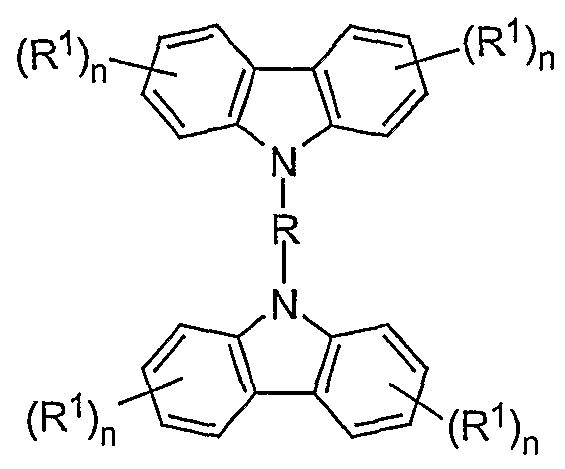
- a preferred embodiment of the mixture according to the invention contains at least one compound of the formula (I) as the bridged carbazole unit
- R is the same or different in each occurrence, a straight-chain, branched or cyclic alkylene chain with 1 to 40 C atoms, which may be substituted or unsubstituted with R 1 , in which one or more non-adjacent C atoms is also represented by -NR 2 -, -O-, -S-, -CO-, -CO-O-, -CO-NR 2 -, -O-CO-O- can be replaced, a bivalent aromatic or heteroaromatic ring system with 2 to 40 C atoms, which may be substituted by R 1 or unsubstituted, an R 1 -substituted or unsubstituted vinyl moiety, an acetylene unit or a combination of 2 to 5 of these systems; the aromatic units can also form part of a larger condensed system; the possible substituents R 1 can optionally be in any free position;
- R 1 is a straight-chain, branched or cyclic alkyl or alkoxy chain with 1 to 22 C atoms, in which one or more non-adjacent C atoms are also represented by -NR 2 -, -O-, -S -, -CO-O-, -O-CO-O- can be replaced, whereby one or more H atoms can be replaced by fluorine, an aryl or aryloxy group with 5 to 40 C atoms, in which also a or more C atoms can be replaced by O, S or N and which can also be substituted by one or more non-aromatic radicals R 1 , a vinyl or acetylene group or F, Cl, Br, I, NO 2 , CN, N (R 2 ) 2 , B (R 2 ) 2 , Si (R 2 ) 3 , it also being possible for two or more radicals R 1 to form an aliphatic or aromatic, mono- or poly
- Each occurrence of R 2 is the same or different H, a straight-chain, branched or cyclic alkyl chain with 1 to 22 C atoms, in which one or more non-adjacent C atoms are also represented by -O-, -S-, -CO-O -, -O-CO-O- can be replaced, whereby one or more H atoms can be replaced by fluorine, an aryl group with.
- n is the same or different on each occurrence 0, 1, 2, 3 or 4, with the proviso that n must not be 4 if there is a link to the polymer chain (i.e. X) on this phenyl unit, and that n is not 3 or 4 may be if both links to the polymer chain (ie X) take place on this phenyl unit;
- One embodiment of the invention is mixtures containing BLEND1
- the T ⁇ plett emitter (VERB1) is mixed non-covalently to the polymer POLY1.
- the linkage can also take place via a phenyl ring of a carbazole unit, for example via positions 1 and 4 or 1 and 2.
- a phenyl ring of a carbazole unit for example via positions 1 and 4 or 1 and 2.
- the numbering of the carbazole is shown in the following structure; the positions marked with a dash in the text represent the corresponding atoms on the other carbazole unit:
- a further embodiment of the invention are mixtures containing BLEND2
- a preferred embodiment of BLEND 2 is that the triplet emitter is built into the main and / or into the side chain of the polymer POLY2.
- Another aspect of this invention are mixtures containing BLEND3
- Another aspect of this invention are mixtures containing BLEND4
- dendrimers can also be used as triplet emitters (VERB1 or VERB3).
- this should be understood to mean a highly branched compound which is composed of a multifunctional center (core) to which branched monomers are bound in a regular structure, so that a tree-like Structure arises. Both the center and the monomers can take on branched structures which consist of purely organic units as well as organometallic compounds or coordination compounds.
- Dendrimer is to be understood here generally, as described, for example, in M. Fischer, F. Vögtle, Angew. Chem. Int. Ed. 1999, 38, 885-905.
- conjugated polymers are polymers which contain in the main chain mainly sp 2 -hybridized (or in some cases also sp-hybridized) carbon atoms, which can also be replaced by corresponding heteroatoms. In the simplest case, this means alternating double and single bonds in the main chain. Mainly means that naturally occurring (without further action) defects that lead to interruptions in conjugation do not invalidate the term "conjugated polymer".
- arylamine units in the main chain such as, for example, the carbazole dimer according to formula (I) or other such units and / or certain heterocycles (ie conjugation via N-, O- or S -Atoms) and / or organometallic complexes, such as units according to VERB2 (ie conjugation via the metal atom).
- units such as simple (thio) ether bridges, alkylene chains, ester, amide or imide linkages would be clearly defined as non-conjugated segments.
- the polymers POLY1, POLY2 and POLY3 can contain various other structural elements. These are u. a. such as those in the above. Patent applications have already been disclosed. Above all, reference is made to the relatively extensive list in WO 02/077060; this is regarded as part of the present invention via quotation.
- These structural units can, for example, come from the classes described below:
- Phenylenes and structures derived from them should be mentioned first. These are, for example (in each case substituted or unsubstituted) ortho-, meta- or para-phenylenes, 1, 4-naphthylenes, 9,10-anthracenylenes, 2,7-phenanthrenylenes, 1, 6 or 2.7- or 4 , 9-pyrene or 2,7-tetrahydropyrene.
- Corresponding heterocyclic poly-arylene-forming structures such as, for example, 2,5-thiophenylene, 2,5-pyrrolylene, 2,5-furanylene, 2,5-pyridylene, 2,5-pyrimidinylene or 5,8-quinolinylene, are also suitable ,
- the polymers POLY1, POLY2 and POLY3 are homopolymers or they are copolymers.
- the copolymers can have statistical as well as partially statistical, alternating or block-like structures or alternately have several of these structures. They can also be linear, branched or dendritic. By using several different structural elements, properties such as solubility, solid phase morphology, etc. can be set.
- the polymers POLY1, POLY2 and POLY3 generally have 10 to 10,000, preferably 50 to 5000, particularly preferably 50 to 2000 repeating units.
- the polydispersity PD is preferably less than 10, particularly preferably less than 5.
- the necessary solubility of the polymers is achieved primarily by the substituents R 1 on the various monomer units in corresponding polymers.
- the polymers POLY1, POLY2 and POLY3 are generally produced by polymerizing one or more monomers.
- the structural unit according to formula (!) Is part of POLY1. It has been shown that a proportion in the range from 10 to 99 mol% of structural units according to formula (I) achieves good results here. A proportion of 10-99 mol% of structural units of the formula (I) is therefore preferred for POLY1 or BLEND1. A fraction of 20-99 mol% of structural units according to formula (I) is particularly preferred.
- the structural unit according to formula (II) is part of BLEND2 and BLEND3. It has been shown that a proportion in the range from 5 to 99% by weight of structural units according to formula (II) achieves good results here. A proportion of 5-99% by weight of structural units according to formula (II) is therefore preferred for BLEND2 and BLEND3. A fraction of 10-99% by weight of structural units according to formula (II) is particularly preferred, a fraction of 20-99% by weight is very particularly preferred.
- Another preferred embodiment is the mixing in of structural units of the formula (II) into BLEND1, so that bridged carbazole units here are both covalently bonded and mixed in. It has been shown here that a total proportion of 10-99 mol% of structural units according to formula (I) or formula (II) achieves good results, regardless of whether these units are covalently bound to the conjugated polymer or mixed in. A total proportion of 10-99 mol% of structural units according to formulas (I) and (II) is preferred. A total proportion of 20-99 mol% of structural units according to formula (I) and formula (II) is particularly preferred.
- Another preferred embodiment is the mixing in of structural units of the formula (II) into BLEND4, so that here the carbazole-dimer units are both covalently bound to the triplet emitter and are present in the mixture. It has also been shown here that a total proportion of 10-99 mol% of structural units according to formula (II) achieves good results, regardless of whether these units are covalently bound to the triplet emitter or are mixed in. A total proportion of 10-99 mol% of structural units according to formula (II) is preferred here. A total proportion of 20-99 mol% of structural units according to formula (II) is particularly preferred.
- R is the same or different, a straight-chain, branched or cyclic alkylene chain with 2 to 20 C atoms, which can be substituted or unsubstituted with R 1 , in which one or more non-adjacent C atoms is also represented by -NR 2 -, -O-, -S-, -CO-, -CO-O-, -CO-NR 2 - or -O-CO-O can be replaced, a bivalent aromatic or heteroaromatic Ring system selected from thiophene, benzothiophene, benzene, biphenyl, pyridine, quinoxaline, fluorene, spirobifluorene, naphthalene, anthracene, pyrene, phenanthrene, dihydrophenanthrene, which carries 0 to 4 substituents R 1 at the free positions, a stilbenylene or tolanylene system, which carries 0 to 4 substituent
- R is the same or different at each occurrence a straight-chain or branched alkylene chain with 2 to 15 C atoms, which may be substituted or unsubstituted with R 1 , in which one or more non-adjacent C atoms by -NR 2 -, -O - or -S-, can be replaced, a bivalent aromatic or heteroaromatic ring system selected from thiophene, benzothiophene, benzene, biphenyl, naphthalene, anthracene, pyrene or phenanthrene, which is unsubstituted or substituted by one or two substituents R 1 , a 9 , 9'-substituted fluorene, an unsubstituted spirosifluorene or substituted with up to four substituents R, a 9,10- or 9,9,10,10-substituted dihydrophenanthrene, a stilbenyl or tolanyl
- Particularly preferred structural elements according to formula (I) are substituted or unsubstituted structures according to the formulas (III) to (XXXVIII) shown, the single bonds indicating the linkage in the polymer. They are not intended to represent methyl groups here. Because of the better clarity, potential substituents are usually not shown.
- R is the same or different with each occurrence a straight-chain or branched alkylene chain with 3 to 10 C atoms, which may be unsubstituted or substituted by R 1 , in which one or more non-adjacent C atoms by -NR 2 -, -O - or -S- can be replaced, a bivalent aromatic or heteroaromatic ring system selected from thiophene, benzene, biphenyl, naphthalene, anthracene or phenanthrene, which is unsubstituted or substituted by one or two substituents R 1 , a 9,9'-substituted Fluorene, a spirobifluorene substituted with 0 to 4 substituents R 1 , a 9,10- or 9,9, 10,10-substituted dihydrophenanthrene or a stilbenyl or tolanyl system which carries 0 to 2 substituents R 1 in the free positions, or
- R 1 , R 2 , n are analogous to the information given above; the link in POLY1 is analogous to the information given above.
- R is the same or different, a straight-chain, branched or cyclic alkylene chain with 2 to 20 C atoms, which can be substituted or unsubstituted with R 1 , in which one or more non-adjacent C atoms is also represented by -NR 2 -, -O-, -S-, -CO-, -CO-O-, -CO-NR 2 -, -O-CO-O can be replaced, a bivalent aromatic or heteroaromatic ring system selected from thiophene, benzothiophene, benzene, Biphenyl, pyridine, quinoxaline, fluorene, spirobifluorene, naphthalene, anthracene, pyrene, phenanthrene, dihydrophenanthrene, which has 0 to 4 substituents R 1 in the free positions, a stilbenyl or tolanyl system, which has 0 to 4 substituents
- R 1 , R 2 , n are analogous to the information given above.
- R is the same or different at each occurrence a straight-chain or branched alkylene chain with 2 to 15 C atoms, which may be substituted or unsubstituted with R 1 , in which one or more non-adjacent C atoms by -NR 2 -, -O - or -S-, can be replaced, a bivalent aromatic or heteroaromatic ring system selected from thiophene, benzothiophene, benzene, biphenyl, pyridine, naphthalene, anthracene, pyrene or phenanthrene, which is unsubstituted or substituted by one or two substituents R 1 , a 9,9'-substituted fluorene, an unsubstituted or with up to four substituents R 1 substituted spirobifluorene, a 9,10- or 9,9,10,10-substituted dihydrophenanthrene, a stilbenyl or to
- R 1 , R 2 are analogous to the information given above; n is the same or different at each occurrence 0, 1 or 2.
- Particularly preferred structural elements according to formula (II) are substituted or unsubstituted structures according to the formulas (XXXIX) to (LVIII) shown. Potential substituents are i. d. R. not shown.
- R is the same or different with each occurrence a straight-chain or branched alkylene chain with 3 to 10 C atoms, which may be unsubstituted or substituted by R 1 , in which one or more non-adjacent C atoms by -NR 2 -, -O - or -S- can be replaced, a bivalent aromatic or heteroaromatic ring system selected from thiophene, benzene, biphenyl, naphthalene, anthracene or phenanthrene, which is unsubstituted or substituted by one or two substituents R 1 , a 9,9'-substituted Fluorene, a spirobifluorene substituted with 0 to 4 substituents, a 9,10- or 9,9,10,10-substituted dihydrophenanthrene or a stilbenyl or tolanyl system which carries 0 to 2 substituents R 1 at the free positions or combinations of 2
- R 1 , R 2 , n are analogous to the information given above.
- Structural units according to formula (II) which are used in BLEND2 to BLEND4 can be obtained, for example, as described below: •
- the N-alkylation or N-benzylation of carbazoles is known in the literature. In this way, two carbazole units with a substituted or unsubstituted alkylene, benzyl, alkylarylene or cycloalkylene chain can also be bridged.
- the synthesis is carried out by reaction of the carbazole with an alkylating agent under basic conditions, as described, for example, in: ME Wright et. a /., J. Org. Chem. 1989, 54, 965.
- N-arylation of the carbazole can be carried out according to HARTWIG-BUCHWALD and is described for carbazole, for example in: M. Watanabe et al., Tetrahedron Lett. 2000, 41, 481.
- two carbazole units can be bridged by corresponding arylene, heteroarylene, stilbenylene or tolanylene groups using this method.
- a corresponding functionalization which enables use as a monomer (for example introduction of halogen end groups), can in principle either take place at the precursors or as the last step on the already fully constructed basic structure.
- the functionalities may already be available in advance if they either do not react or react very difficultly in the subsequent reaction steps. This can e.g. B. be the case with a simple substitution reaction, or if you can use different reactivities (z. B. iodine to bromine or bromine to chlorine).
- Bisboronic acid derivatives or bisstannane derivatives (for the above-mentioned polymerization processes of types A and C) are produced. These procedures exist i. d. R. in replacing the existing halogen with a metal (e.g. Mg, Li) and reacting it with a borester or trialkyltin halogen compound.
- a metal e.g. Mg, Li
- boronic acid derivatives catalytic processes for the direct reaction of the halides with, for example, boranes or diboranes under palladium catalysis are also known.
- the invention furthermore relates to bifunctional monomeric compounds of the formula (LIX),
- Y is preferably selected from the groups Cl, Br, I, O-tosylate, O-triflate, OS0 2 R 2 ,
- the C-C or C-N linkages are preferably selected from the groups of
- VERB1 or VERB3 can be a low molecular weight, oligomeric, dendritic or polymeric compound. Since VERB1 or VERB3 is processed as a blend (BLEND1, BLEND3, BLEND4), there must be sufficient solubility in suitable solvents (e.g. toluene, xylene, anisole, THF, methylanisole, methylnaphthalene or mixtures of these solvents) so that processing from solution in these solvents is possible.
- suitable solvents e.g. toluene, xylene, anisole, THF, methylanisole, methylnaphthalene or mixtures of these solvents
- suitable solvents e.g. toluene, xylene, anisole, THF, methylanisole, methylnaphthalene or mixtures of these solvents
- suitable solvents e.g. toluene, xylene, anisole, THF, methylanisole, methyln
- the blend BLEND 1 according to the invention is obtained by admixing the polymer POLY1 units VERB1.
- the blend BLEND2 according to the invention is obtained by adding structural units of the formula (II) to the polymer POLY2.
- the blend BLEND3 according to the invention is obtained by adding structural units of the formula (II) and VERB1 units to the polymer POLY3.
- the blend BLEND4 according to the invention is obtained by admixing the polymer POLY3 units VERB3.
- BLEND1 to BLEND4 it may also be preferred to mix further conjugated, partially conjugated or non-conjugated polymers, oligomers, dendrimers or low molecular weight compounds into BLEND1 to BLEND4.
- an electronically active substance can regulate the hole or electron injection, the hole or electron transport or the charge balance in the corresponding blend become.
- the additional component can also improve the singlet-triplet transfer.
- the addition of electronically inert compounds can also be helpful, for example to control the viscosity of the solution or the morphology of the film.
- the blends thus obtained are also the subject of the invention.
- the invention furthermore relates to conjugated polymers POLY4, containing (A) 1-99.9 mol%, preferably 10-99 mol%, particularly preferably 20-99 mol% of one or more units of the formula (I),
- the structural units of the formula (I) are incorporated as described for the polymer POLY1. As already described for POLY2, the structural units VERB2 are installed in the main and / or side chain of POLY4.
- POLY4 can contain further structural elements (e.g. polymer backbone building blocks, charge injection or transport building blocks), as described for POLY1 to POLY3. It can also be statistical, semi-statistical, alternating or block-like, linear, branched or dendritic. In POLY4 too, the solubility of the polymer is primarily determined by the substituents R and R 1 on the polymer building blocks.
- POLY4 is synthesized as described for POLY1 to POLY3. Particularly preferred structural units according to formula (I) are the structures shown above according to formulas (III) to (XXXVIII).
- BLEND1 to BLEND4 are represented as follows:
- the individual components of the blend are combined in a suitable mixing ratio and dissolved in a suitable solvent.
- suitable solvents are, for example, toluene, anisole, xylenes, methylanisole, methylnaphthalene, chlorobenzene, cyclic ethers (e.g. dioxane, THF, methyldioxane), amides (e.g. NMP, DMF) and mixtures of these solvents.
- the components of the blend can also be dissolved individually.
- the solution of the blend is obtained in this case by combining the individual solutions in a suitable mixing ratio.
- the dissolving process preferably takes place in an inert atmosphere.
- the blend is usually not isolated as a solid (by repeated precipitation), but processed directly from solution.
- a suitable ratio of the individual components is, for example, a mixture which contains a total of 1-99.5 mol%, preferably 10-99 mol%, particularly preferably 20-99 mol% of units of the formula (I) and formula (II) and 0.1-95 mol %, preferably 0.5-80 mol%, particularly preferably 1-50 mol%, in particular 2-25 mol%, contains VERB1, VERB2 and VERB3, regardless of whether the components are covalently bound to a polymer or are mixed in.
- the light emission of the triplet emitter is surprisingly significantly more efficient in polymers POLY1 or blends BLEND1 to BLEND4 according to the invention than in comparable polymers and blends which contain no units of the formula (I) or formula (II) (cf. details in Table 1 ).
- the solubility in organic solvents is good, ie in solvents such as toluene, xylene, anisole, methyl anisole or methyl naphthalene, the mixtures BLEND1 to BLEND4 or the polymers POLY4 are in concentrations in the range of at least 1 to 30 g / L (each after triplet emitter used and molecular weight of the polymer) soluble.
- the blends BLEND1 to BLEND4 or the polymers POLY4 can be used in PLEDs.
- a general procedure is generally used for the construction of PLEDs, which must be adapted accordingly for the individual case. Such a method has been described in detail, for example, in DE 10249723.0.
- electroluminescent materials are materials which emit light as an active layer in an OLED when an electric field is applied (light-emitting layer).
- the invention therefore also relates to the use of a mixture BLEND1 to BLEND4 according to the invention or of a polymer POLY4 according to the invention in an OLED as electroluminescent material.
- the invention also relates to an OLED with one or more active layers, at least one of these layers containing one or more mixtures BLEND1 to BLEND4 or polymers POLY4 according to the invention.
- Part A Synthesis of the monomers and blend components
- Example A2 Monomers According to the Invention According to Formula (I)
- N- ( ⁇ -BromaIkyl) carbazole General description
- N- (3-Bromopropyl) carbazole (n 3): 6.68 g (40 mmol) carbazole, 80.8 g (40.6 mL, 400 mmol) 1,3-dibromopropane, 1.06 g (44 mmol) NaH, 100 tnL THF.
- VERB1 used here by way of example are derivatives of tris (phenylpyridyi) iridium (III).
- PIB1 phenylpyridyi
- III iridium
- the synthesis of these compounds has already been described in the application documents WO 02/081488 and WO 04/026886.
- the iridium complexes used here are listed again below:
- the comonomers VERB2 used here are derivatives of tris (phenylpyridyl) iridium (III). The synthesis of these compounds is described, for example, in the unpublished application DE 10350606.3.
- the iridium comonomers Ir4 and Ir5 used here are shown again below for an overview:
- the endcapping was carried out with 24 mg of 3,4-bispentoxybenzeneboronic acid in 20 ml of toluene and heated under reflux for 1 h. Then 40 mg of 3,4-bispentoxy-benzene bromide in 10 ml of toluene were added and the mixture was heated under reflux for 3 h. After adding a further 50 ml of toluene, the polymer solution was stirred at 60 ° C. for 3 hours with 100 ml of 0.01% aqueous NaCN solution. The phases were separated and the organic phase washed with 4 x 100 mL H 2 0. The polymer was precipitated by dropping in 300 ml of methanol and filtered.
- the highly viscous polymer solution was diluted with 50 mL toluene.
- the endcapping was then carried out by adding 24 mg of 3,4-bispentoxy-benzene boronic acid in 20 ml of toluene, heating under reflux for 1 h, then adding 40 mg of 3,4-bispentoxy-benzene bromide in 30 ml of toluene and 1 hour under Reflux heated.
- the polymer solution was again diluted with 50 ml of toluene and stirred at 60 ° C. with 100 ml of 0.01% aqueous NaCN solution for 3 h.
- the phases were separated and the organic phase washed with 4 x 100 mL H 2 0.
- the blends were produced by dissolving the blend components in the desired ratio and in the desired concentration in a suitable solvent. Toluene was used as the solvent here. The dissolving process was carried out in an inert manner Atmosphere carried out at 60 ° C. The solution was processed directly without isolating the blend (repeated precipitation of the solids).
- Table 1 a proportions of the different monomers in the polymer in mol%. b Type and proportions of the blend components CARB and VERB1 and other blend components in the total composition of the mixture in
Landscapes
- Chemical & Material Sciences (AREA)
- Organic Chemistry (AREA)
- Engineering & Computer Science (AREA)
- Materials Engineering (AREA)
- Health & Medical Sciences (AREA)
- Chemical Kinetics & Catalysis (AREA)
- Medicinal Chemistry (AREA)
- Polymers & Plastics (AREA)
- Electroluminescent Light Sources (AREA)
- Polyoxymethylene Polymers And Polymers With Carbon-To-Carbon Bonds (AREA)
- Indole Compounds (AREA)
- Compositions Of Macromolecular Compounds (AREA)
Abstract
Description
Beschreibungdescription
Neue Materialien für die ElektrolumineszenzNew materials for electroluminescence
Seit ca. 12 Jahren läuft eine breit angelegte Forschung zur Kommerzialisierung von Anzeige- und Beleuchtungselementen auf Basis polymerer (organischer) Leuchtdioden (PLEDs). Ausgelöst wurde diese Entwicklung durch die Grundlagenentwicklungen, welche in EP 423 283 offenbart sind. Seit kurzem ist auch ein erstes Produkt in Form einer kleineren Anzeige (in einem Rasierapparat der Fa. PHILIPS U.V.) auf dem Markt erhältlich. Allerdings sind immer noch deutliche Verbesserungen nötig, um diese Displays zu einer echten Konkurrenz zu den derzeit Markt beherrschenden Flüssigkristallanzeigen (LCD) zu machen. Vor allem ist es hierbei erforderlich, Verbindungen für alle Emissionsfarben (Rot, Grün, Blau) zur Verfügung zu stellen, die den Anforderungen des Marktes (Effizienz, operative Lebensdauer und Betriebsspannung, um die wichtigsten zu nennen) gerecht werden.A broad-based research on the commercialization of display and lighting elements based on polymer (organic) light-emitting diodes (PLEDs) has been underway for about 12 years. This development was triggered by the basic developments which are disclosed in EP 423 283. A first product in the form of a smaller display (in a shaver from PHILIPS U.V.) has recently become available on the market. However, significant improvements are still necessary to make these displays a real competitor to the liquid crystal displays (LCD) that currently dominate the market. Above all, it is necessary to provide connections for all emission colors (red, green, blue) that meet the requirements of the market (efficiency, operating life and operating voltage, to name the most important ones).
Als Polymere für vollfarbige Anzeigeelemente (sog. Full-Colour-Displays) wurden verschiedene Materialklassen vorgeschlagen bzw. entwickelt. So kommen Polyfluorenderivate, wie beispielsweise in EP 0842208, WO 99/54385, WO 00/22027, WO 00/22026 und WO 00/46321 offenbart, in Betracht. Des Weiteren sind auch Poly- Spirobifluoren-Derivate, wie in EP 0707020, EP 0894107 und WO 03/020790 offenbart, eine Möglichkeit. Auch Polymere, die eine Kombination der beiden erstgenannten Strukturelemente enthalten, wie in WO 02/077060 offenbart, wurden bereits vorgeschlagen. Im Allgemeinen sind für derartigen Einsatz Polymere, welche Poly-para-Phenylen (PPP) als Strukturelement enthalten, möglich. Neben den oben bereits genannten Klassen kommen hier beispielsweise audi die so genannten Leiter-PPPs ("Ladder-PPPs" = L-PPP, z. B. gemäß WO 92/18552), die Poly-Tetrahydropyrene (z. B. gemäß EP 699699), aber auch Ansa-Strukturen enthaltende PPPs (z. B. gemäß EP 690086) in Frage.Various material classes have been proposed or developed as polymers for full-color display elements (so-called full-color displays). Polyfluorene derivatives such as those disclosed, for example, in EP 0842208, WO 99/54385, WO 00/22027, WO 00/22026 and WO 00/46321 are suitable. Furthermore, poly-spirobifluorene derivatives, as disclosed in EP 0707020, EP 0894107 and WO 03/020790, are also an option. Polymers which contain a combination of the first two structural elements, as disclosed in WO 02/077060, have also been proposed. In general, polymers containing poly-para-phenylene (PPP) as a structural element are possible for such use. In addition to the classes already mentioned, the so-called ladder PPPs ("ladder PPPs" = L-PPP, for example according to WO 92/18552), the poly-tetrahydropyrenes (for example according to EP 699699) also come here ), but also PPPs containing Ansa structures (e.g. according to EP 690086) into question.
Des Weiteren wurde berichtet, dass das Einfügen bestimmter Arylaminogruppierungen eine Verbesserung der Eigenschaften ergibt: WO 99/54385 und DE 19846767 beschreiben Polyfluorene,. deren Effizienz und Einsatzspannung verbessert werden können, indem Derivate von Triphenylatnin, Tetraphenyl-p-diaminobenzol, Tetraphenyl-4,4'- diaminobiphenyl oder substituierte Diarylamtnoeinheiten in die Hauptkette der entsprechenden Polymere mit einpolymerisiert werden. WO 01/66618 beschreibt Copolymere, welche neben Aryleinheiten auch spezielle Triarylamino- bzw. Tetraaryl-p- diaminoarylen-Einheiten in der Hauptkette enthalten.Furthermore, it has been reported that the insertion of certain arylamino groups results in an improvement in the properties: WO 99/54385 and DE 19846767 describe polyfluorenes. Their efficiency and operating voltage can be improved by polymerizing derivatives of triphenylatnine, tetraphenyl-p-diaminobenzene, tetraphenyl-4,4'-diaminobiphenyl or substituted diaryl amine units into the main chain of the corresponding polymers. WO 01/66618 describes copolymers which, in addition to aryl units, also contain special triarylamino or tetraaryl-p-diaminoarylene units in the main chain.
Eine Entwicklung, die sich seit einigen Jahren vor allem auf dem Gebiet der „Small molecule"-Displays abzeichnet, ist der Einsatz von Materialien, die aus dem Triplett-Zustand Licht emittieren können und somit Phosphoreszenz statt Fluoreszenz zeigen (M. A. Baldo et al., Appl. Phys. Lett 1999, 75, 4-6). Diese Verbindungen werden im Folgenden als „Triplett- Emitter" bezeichnet. Aus theoretischen Spin-statistischen Überlegungen ist unter Verwendung solcher Triplett-Emitter eine bis zu vierfache Energie- und Leistungseffizienz möglich. Ob sich diese Entwicklung durchsetzen wird, hängt stark davon ab, ob entsprechende Device-Kompositionen gefunden werden, die diese Vorteile (Triplett- Emission = Phosphoreszenz gegenüber Singulett-Emission = Fluoreszenz) auch in OLEDs umsetzen können. Als wesentliche Bedingungen für die praktische Anwendung sind hier insbesondere ein effizienter Energieübertrag auf den Triplett-Emitter (und damit verbunden effiziente Lichtemission), eine hohe operative Lebensdauer und eine niedrige Einsatz- und Betriebsspannung, um mobile Applikationen zu ermöglichen, zu nennen. In letzter Zeit gibt es intensive Bemühungen, sich die Vorteile aufdampfbarer niedermolekularer Triplett-Emitter auch für Polymeranwendungen zu Nutze zu machen. So werden so genannte Hybrid-Device-Strukturen erwogen, die die Vorteile der "Small- molecule"-OLEDs mit denen der Polymer-OLEDs (= PLEDs) verbinden und die durch Mischen des Triplett-Emitters in das Polymer entstehen. Andererseits kann der Triplett- Emitter auch kovalent an das Polymer gebunden werden. Beide Methoden haben den Vorteil, dass die Verbindungen aus Lösung verarbeitet werden können und dass kein teurer und aufwändiger Aufdampfprozess wie für Devices auf Basis niedermolekularer Verbindungen erforderlich ist. Das Aufbringen aus Lösung (v. a. mit Hilfe hochauflösender Druckverfahren) wird langfristig deutliche Vorteile gegenüber dem heute gängigen Vakuum- Verdampfungsprozess aufweisen, v. a. hinsichtlich Skalierbarkeit, Strukturierbarkeit, Beschichtungseffizienz und Ökonomie. Lösliche Triplett-Emitter werden beispielsweise in WO 04/026886 offenbart. Jedoch ist auch hierfür ein geeignetes Matrix-Material notwendig, das einen effizienten Energietransfer auf den Triplett-Emitter ermöglicht.A development that has emerged in the field of “small molecule” displays in recent years is the use of materials that can emit light from the triplet state and thus show phosphorescence instead of fluorescence (MA Baldo et al., Appl. Phys. Lett 1999, 75, 4-6). These compounds are referred to below as “triplet Up to four times the energy and power efficiency is possible using such triplet emitters for theoretical spin-statistical considerations. Whether this development will prevail depends heavily on whether appropriate device compositions are found that have these advantages (Triplet emission = phosphorescence versus singlet emission = fluorescence) can also be implemented in OLEDs, as the essential conditions for practical application are in particular efficient energy transfer to the triplet emitter (and associated efficient light emission), a long operating life and a low operating and operating voltage to enable mobile applications. Recently there have been intensive efforts to take advantage of evaporable low-molecular triplet emitters also for polymer applications. So-called hybrid device structures are being considered that take advantage of "Sm connect all-molecule "OLEDs to those of the polymer OLEDs (= PLEDs) and are formed by mixing the triplet emitter into the polymer. On the other hand, the triplet emitter can also be covalently bound to the polymer. Both methods have the advantage that the compounds can be processed from solution and that no expensive and complex vapor deposition process is required as for devices based on low molecular weight compounds. Application from solution (above all with the help of high-resolution printing processes) will have significant long-term advantages compared to the current vacuum evaporation process, above all with regard to scalability, structurability, coating efficiency and economy. Soluble triplet emitters are disclosed, for example, in WO 04/026886. However, a suitable matrix material is also required for this, which enables efficient energy transfer to the triplet emitter.
Bekannt ist weiterhin, dass Blends (Mischungen) nicht-konjugierter Polymere, wie z. B. PVK (Poly-Vinylcarbazol), mit metallorganischen Triplett-Emittem in effizienter Elektrolumineszenz des Metallkomplexes resultieren (z. B. Chen et al., Appl. Phys. Leu. 2002, 80, 2308). Jedoch sind die Betriebsspannungen für diese Systeme sehr hoch, was in einer sehr niedrigen Leistungseffizienz resultiert und somit keine kommerzielle Anwendung dieser Systeme ermöglicht.It is also known that blends (mixtures) of non-conjugated polymers, such as. B. PVK (poly-vinyl carbazole), with organometallic triplet emitters in efficient electroluminescence of the metal complex result (z. B. Chen et al., Appl. Phys. Leu. 2002, 80, 2308). However, the operating voltages for these systems are very high, which results in very low power efficiency and therefore does not allow for a commercial application of these systems.
Blends solcher Metallkomplexe mit konjugierten Polymeren sind in der Literatur ebenfalls beschrieben. Guo et al. (Organic Electronics 2000, 1, 15) und O'Brien et al. (Synth. Met. 2001 , 116, 379) beschreiben gute Quanteneffizienzen mit Blends aus einem Platin- Porphyrin-Komplex mit Polyfluorenen, wobei in beiden Fällen die Effizienzen deutlich niedriger sind als bei vergleichbaren Devices, aufgebaut aus aufgedampften niedermolekularen Verbindungen. Zhu et al. (Appl. Phys. Leu. 2002, 80, 2045) beschreiben einen Blend aus einem löslichen Iridium-Phenylpyridin-Komplex mit einem Poly-para- Phenylen. Hier wurden bessere, aber weiterhin relativ niedrige Quanteneffizienzen gemessen. Insbesondere wurden hier sehr hohe Spannungen benötigt, die einer technischen Anwendung im Wege stehen. Trotz der in den o. g. Publikationen und Anmeldeschriften zitierten Fortschritte gibt es also immer noch einen erheblichen Verbesserungsbedarf für entsprechende Materialien, u. a. auf folgenden Feldern:Blends of such metal complexes with conjugated polymers are also described in the literature. Guo et al. (Organic Electronics 2000, 1, 15) and O'Brien et al. (Synth. Met. 2001, 116, 379) describe good quantum efficiencies with blends composed of a platinum-porphyrin complex with polyfluorenes, the efficiencies being significantly lower in both cases than with comparable devices built up from evaporated low-molecular compounds. Zhu et al. (Appl. Phys. Leu. 2002, 80, 2045) describe a blend of a soluble iridium-phenylpyridine complex with a poly-para-phenylene. Better, but still relatively low quantum efficiencies were measured here. In particular, very high voltages were required here which stand in the way of a technical application. In spite of the progress cited in the above-mentioned publications and application forms, there is still a considerable need for improvement in the corresponding materials, including in the following fields:
(1) Die Effizienz der Lichtemission muss noch weiter gesteigert werden. Dafür ist effizienterer Energie-Transfer auf den Triplett-Emitter und somit ein geeigneteres Matrix- Material notwendig. Dass höhere Effizienzen prinzipiell möglich sind, zeigen die Ergebnisse mit aufgedampften niedermolekularen Triplett-Emittern.(1) The efficiency of light emission must be increased even further. This requires more efficient energy transfer to the triplet emitter and therefore a more suitable matrix material. The results with evaporated low-molecular triplet emitters show that higher efficiencies are possible in principle.
(2) Die Strom-Spannungs-Kennlinien müssen noch steiler werden, damit große Helligkeit bei niedrigen Spannungen erzielt und somit die Leistungseffizienz gesteigert wird. Dies ist von enormer Bedeutung, da somit einerseits gleiche Helligkeit bei geringerem Energieverbrauch erzielt werden kann, was vor allem bei mobilen Applikationen (Displays für Handys, Pager, PDA, etc.) sehr wichtig ist. Andererseits erhält man bei gleichem Energieverbrauch höhere Helligkeiten, was beispielsweise für Beleuchtungsanwendungen interessant sein kann. Bei Verbindungen, die dem Stand der Technik entsprechen, sind die Betriebsspannungen noch deutlich zu hoch, was in einer relativ niedrigen Leistungseffizienz resultiert.(2) The current-voltage characteristic curves have to become even steeper so that high brightness is achieved at low voltages and thus the power efficiency is increased. This is of enormous importance, since on the one hand the same brightness can be achieved with lower energy consumption, which is very important especially for mobile applications (displays for cell phones, pagers, PDAs, etc.). On the other hand, you get higher brightness levels with the same energy consumption, which can be interesting for lighting applications, for example. For connections that correspond to the state of the art, the operating voltages are still significantly too high, which results in a relatively low power efficiency.
Wir haben nun überraschend gefunden, dass - bisher unbekannte - konjugierte Polymere und Mischungen, die bestimmte überbrückte Carbazoleinheiten enthalten, in Verbindung mit Triplett-Emittern deutliche Verbesserungen, gerade auf den beiden o. g. Gebieten, also der Effizienz der Lichtemission und der Betriebsspannung, im Vergleich zu Blends oder Polymeren gemäß Stand der Technik ergeben. Diese Materialien sind daher Gegenstand der vorliegenden Anmeldung. Gegenstand der Erfindung sind Mischungen, enthaltendWe have now surprisingly found that - previously unknown - conjugated polymers and mixtures which contain certain bridged carbazole units, in connection with triplet emitters, marked improvements, especially on the two above. Areas, that is, the efficiency of light emission and the operating voltage, compared to blends or polymers according to the prior art. These materials are therefore the subject of the present application. The invention relates to mixtures containing
(A) mindestens ein konjugiertes Polymer,(A) at least one conjugated polymer,
(B) mindestens eine überbrückte Carbazoleinheit und(B) at least one bridged carbazole unit and
(C) mindestens einen Triplett-Emitter.(C) at least one triplet emitter.
Als Triplett-Emitter im Sinne der Erfindung werden Verbindungen verstanden, die aus dem Triplett-Zustand Licht emittieren, also in der Elektrolumineszenz Phosphoreszenz statt Fluoreszenz zeigen, bevorzugt organische oder metallorganische Triplett-Emitter, die niedermolekular, oligomer, dendritisch oder polymer sein können. Ohne an eine bestimmte Theorie gebunden sein zu wollen, werden im Sinne dieser Erfindung alle emittierenden Metallkomplexe, enthaltend Übergangsmetalle oder Lanthanoide, als Triplett-Emitter bezeichnet.In the context of the invention, triplet emitters are understood to mean compounds which emit light from the triplet state, that is to say display phosphorescence instead of fluorescence in electroluminescence, preferably organic or organometallic triplet emitters which can be low molecular weight, oligomeric, dendritic or polymeric. Without wishing to be bound by any particular theory, all emitting metal complexes containing transition metals or lanthanoids are referred to as triplet emitters in the sense of this invention.
Vorzugsweise enthält die erfindungsgemäße Mischung mindestens 0.5 Gew.% mindestens eines konjugierten Polymeren, mindestens 1 Gew.% mindestens einer überbrückten Carbazoleinheit und mindestens 0.5 Gew.% mindestens eines Triplett-Emitters. Eine bevorzugte Ausführungsform der erfindungsgemäßen Mischung enthält als überbrückte Carbazoleinheit mindestens eine Verbindung der Formel (I)The mixture according to the invention preferably contains at least 0.5% by weight of at least one conjugated polymer, at least 1% by weight of at least one bridged carbazole unit and at least 0.5% by weight of at least one triplet emitter. A preferred embodiment of the mixture according to the invention contains at least one compound of the formula (I) as the bridged carbazole unit

FORMEL (I)FORMULA (I)
wobei die Symbole und Indizes folgende Bedeutung besitzen:where the symbols and indices have the following meaning:
R ist bei jedem Auftreten gleich oder verschieden eine geradkettige, verzweigte oder cyclische Alkylenkette mit 1 bis 40 C-Atomen, die mit R1 substituiert oder unsubstituiert sein kann, in der auch ein oder mehrere nicht benachbarte C-Atome durch -NR2-, -O-, -S-, -CO-, -CO-O-, -CO-NR2-, -O-CO-O- ersetzt sein können, ein bivalentes aromatisches oder heteroaromatisches Ringsystem mit 2 bis 40 C-Atomen, welches mit R1 substituiert oder unsubstituiert sein kann, eine mit R1 substituierte oder unsubstituierte Vinyleneinheit, eine Acetyleneinheit oder eine Kombination aus 2 bis 5 dieser Systeme; die aromatischen Einheiten können dabei auch Teil eines größeren kondensierten Systems bilden; die möglichen Substituenten R1 können optional an jeder freien Position sitzen;R is the same or different in each occurrence, a straight-chain, branched or cyclic alkylene chain with 1 to 40 C atoms, which may be substituted or unsubstituted with R 1 , in which one or more non-adjacent C atoms is also represented by -NR 2 -, -O-, -S-, -CO-, -CO-O-, -CO-NR 2 -, -O-CO-O- can be replaced, a bivalent aromatic or heteroaromatic ring system with 2 to 40 C atoms, which may be substituted by R 1 or unsubstituted, an R 1 -substituted or unsubstituted vinyl moiety, an acetylene unit or a combination of 2 to 5 of these systems; the aromatic units can also form part of a larger condensed system; the possible substituents R 1 can optionally be in any free position;
R1 ist bei jedem Auftreten gleich oder verschieden eine geradkettige, verzweigte oder cyclische Alkyl- oder Alkoxykette mit 1 bis 22 C-Atomen, in der auch ein oder mehrere nicht benachbarte C-Atome durch -NR2-, -O-, -S-, -CO-O-, -O-CO-O- ersetzt sein können, wobei auch ein oder mehrere H-Atome durch Fluor ersetzt sein können, eine Aryl- oder Aryloxygruppe mit 5 bis 40 C-Atomen, bei der auch ein oder mehrere C- Atome durch O, S oder N ersetzt sein können und welche auch durch einen oder mehrere nicht-aromatische Reste R1 substituiert sein kann, eine Vinyl- oder Acetylengruppe oder F, Cl, Br, I, N02, CN, N(R2)2, B(R2)2, Si(R2)3, wobei auch zwei oder mehrere Reste R1 miteinander ein aliphatisches oder aromatisches, mono- oder polycyclisches Ringsystem bilden können;Each time R 1 is the same or different, it is a straight-chain, branched or cyclic alkyl or alkoxy chain with 1 to 22 C atoms, in which one or more non-adjacent C atoms are also represented by -NR 2 -, -O-, -S -, -CO-O-, -O-CO-O- can be replaced, whereby one or more H atoms can be replaced by fluorine, an aryl or aryloxy group with 5 to 40 C atoms, in which also a or more C atoms can be replaced by O, S or N and which can also be substituted by one or more non-aromatic radicals R 1 , a vinyl or acetylene group or F, Cl, Br, I, NO 2 , CN, N (R 2 ) 2 , B (R 2 ) 2 , Si (R 2 ) 3 , it also being possible for two or more radicals R 1 to form an aliphatic or aromatic, mono- or polycyclic ring system with one another;
R2 ist bei jedem Auftreten gleich oder verschieden H, eine geradkettige, verzweigte oder cyclische Alkylkette mit 1 bis 22 C-Atomen, in der auch ein oder mehrere nicht benachbarte C-Atome durch -O-, -S-, -CO-O-, -O-CO-O- ersetzt sein können, wobei auch ein oder mehrere H-Atome durch Fluor ersetzt sein können, eine Arylgruppe mit . 5 bis 40 C-Atomen, bei der auch ein oder mehrere C-Atome durch O, S oder N ersetzt sein können und welche auch durch einen oder mehrere nicht-aromatische Reste R2 substituiert sein kann; dabei können auch zwei oder mehrere Reste R2 miteinander ein Ringsystem bilden; n ist bei jedem Auftreten gleich oder verschieden 0, 1 , 2, 3 oder 4, mit der Maßgabe, dass n nicht 4 sein darf, wenn eine Verknüpfung mit der Polymerkette (also X) an dieser Phenyleinheit erfolgt, und dass n nicht 3 oder 4 sein darf, wenn beide Verknüpfungen mit der Polymerkette (also X) an dieser Phenyleinheit erfolgen;Each occurrence of R 2 is the same or different H, a straight-chain, branched or cyclic alkyl chain with 1 to 22 C atoms, in which one or more non-adjacent C atoms are also represented by -O-, -S-, -CO-O -, -O-CO-O- can be replaced, whereby one or more H atoms can be replaced by fluorine, an aryl group with. 5 to 40 carbon atoms, in which one or more carbon atoms can be replaced by O, S or N and which also by one or more non-aromatic radicals R 2 can be substituted; two or more radicals R 2 can also form a ring system with one another; n is the same or different on each occurrence 0, 1, 2, 3 or 4, with the proviso that n must not be 4 if there is a link to the polymer chain (i.e. X) on this phenyl unit, and that n is not 3 or 4 may be if both links to the polymer chain (ie X) take place on this phenyl unit;
X beschreibt die Verknüpfung mit dem konjugierten Polymer,X describes the linkage with the conjugated polymer,
und/oder der Formel (II)and / or the formula (II)

FORMEL (II) wobei die Symbole R, R j1', R D2 und die Indizes n dieselbe Bedeutung wie unter Formel (I) besitzen.FORMULA (II) where the symbols R, R j1 ', R D2 and the indices n have the same meaning as under formula (I).
Eine Ausführungsform der Erfindung sind Mischungen BLEND1 , enthaltendOne embodiment of the invention is mixtures containing BLEND1
(A) 5 - 99.5 Gew.% mindestens eines konjugierten Polymers POLY1 , das 1 - 100 mol%, bevorzugt 10 - 100 mol%, besonders bevorzugt 20 - 100 mol% einer oder mehrerer(A) 5 to 99.5% by weight of at least one conjugated polymer POLY1, the 1 to 100 mol%, preferably 10 to 100 mol%, particularly preferably 20 to 100 mol% of one or more
Einheiten gemäß Formel (I) enthält,Contains units of the formula (I),

FORMEL (I) wobei die Symbole und Indizes dieselbe Bedeutung besitzen, wie oben beschrieben, und (B) 0.1 - 95 Gew.%, bevorzugt 0.5 - 80 Gew.%, besonders bevorzugt 1 - 50 Gew.%, insbesondere 2 - 25 Gew.%, eines oder mehrerer Triplett-Emitter (VERB1 ).FORMULA (I) where the symbols and indices have the same meaning as described above, and (B) 0.1-95% by weight, preferably 0.5-80% by weight, particularly preferably 1-50% by weight, in particular 2-25% by weight .%, one or more triplet emitters (VERB1).
In der Ausführungsform BLEND 1 ist der Tπplett-Emitter (VERB1) nicht-kovalent zu dem Polymer POLY1 gemischt. Eine bevorzugte Ausführungsform ist der Einbau der Einheiten gemäß Formel (I) in das Polymer über die 3,6- oder die 2,7-Position einer Carbazoleinheit (X=Verknüpfung), so dass eine der beiden Carbazoleinheiten in die Hauptkette eingebaut wird, während die andere eine Seitenkette des Polymers darstellt.In the embodiment BLEND 1, the Tπplett emitter (VERB1) is mixed non-covalently to the polymer POLY1. A preferred embodiment is the incorporation of the units of the formula (I) into the polymer via the 3,6- or the 2,7-position of a carbazole unit (X = linkage), so that one of the two carbazole units is incorporated into the main chain while the other represents a side chain of the polymer.
Eine weitere bevorzugte Ausführungsform ist der Einbau der Einheiten gemäß Formel (I) in das Polymer über die 2,2'-, die 3,3'- oder die 2,3'-Positionen beider Carbazoleinheiten (X=Verknüpfung), falls R eine aromatische oder heteroaromatische Einheit, eine Vinylen- oder Acetyleneinheit oder eine Kombination dieser Einheiten beschreibt. In diesem Fall sind beide Carbazoleinheiten in die Hauptkette des Polymers eingebaut. Eine weitere bevorzugte Ausführungsform ist der Einbau (X=Verknüpfung) der Einheiten gemäß Formel (I) in das Polymer über R selbst oder über R1, sofern diese aromatische oder heteroaromatische Einheiten enthalten, so dass ein konjugiertes Polymer entsteht. In diesem Fall bilden beide Carbazole Seitenketten des Polymers. Die Verknüpfung kann auch über einen Phenylring einer Carbazol-Einheit erfolgen, beispielsweise über die Positionen 1 und 4 oder 1 und 2. Zur Klarheit wird die Nummerierung des Carbazols in folgender Struktur aufgezeigt; die im Text mit einem Strich gekennzeichneten Positionen stellen die entsprechenden Atome an der jeweils anderen Carbazoleinheit dar:Another preferred embodiment is the incorporation of the units of the formula (I) into the polymer via the 2,2'-, the 3,3'- or the 2,3'-positions of both carbazole units (X = linkage) if R is one describes aromatic or heteroaromatic unit, a vinylene or acetylene unit or a combination of these units. In this case, both carbazole units are built into the main chain of the polymer. Another preferred embodiment is the incorporation (X = linkage) of the units of the formula (I) into the polymer via R itself or via R 1 , provided that these contain aromatic or heteroaromatic units, so that a conjugated polymer is formed. In this case, both carbazoles form side chains of the polymer. The linkage can also take place via a phenyl ring of a carbazole unit, for example via positions 1 and 4 or 1 and 2. For clarity, the numbering of the carbazole is shown in the following structure; the positions marked with a dash in the text represent the corresponding atoms on the other carbazole unit:
99

Eine weitere Ausführungsform der Erfindung sind Mischungen BLEND2, enthaltendA further embodiment of the invention are mixtures containing BLEND2
(A) 0.5 - 99 Gew.% mindestens eines konjugierten Polymers POLY2, das 0.1 - 100 mol%, vorzugsweise 0.5 bis 80 mol% eines oder mehrerer Triplett-Emitter (VERB2) kovalent gebunden enthält, und(A) 0.5-99% by weight of at least one conjugated polymer POLY2, which contains 0.1-100 mol%, preferably 0.5 to 80 mol%, of one or more triplet emitters (VERB2), and
(B) 1 - 99.5 Gew.% mindestens einer Verbindung der Struktureinheit gemäß Formel (II)(B) 1-99.5% by weight of at least one compound of the structural unit according to formula (II)

FORMEL (II) wobei die Symbole und Indizes dieselbe Bedeutung haben, wie oben beschrieben.FORMULA (II) where the symbols and indices have the same meaning as described above.
Eine bevorzugte Ausführungsform BLEND 2 besteht darin, dass der Triplett-Emitter in die Haupt- und/oder in die Seitenkette des Polymers POLY2 eingebaut ist. Ein weiterer Aspekt dieser Erfindung sind Mischungen BLEND3, enthaltendA preferred embodiment of BLEND 2 is that the triplet emitter is built into the main and / or into the side chain of the polymer POLY2. Another aspect of this invention are mixtures containing BLEND3
(A) 0.5 - 98.5 Gew.% mindestens eines beliebigen konjugierten Polymers POLY3; und(A) 0.5 - 98.5% by weight of at least any conjugated polymer POLY3; and
(B) 1 - 99 Gew.%, bevorzugt 10 - 90 Gew.% mindestens einer Struktureinheit gemäß Formel (II)(B) 1-99% by weight, preferably 10-90% by weight, of at least one structural unit according to formula (II)

FORMEL (II) wobei die Symbole und Indizes dieselbe Bedeutung wie oben besitzen; undFORMULA (II) where the symbols and indices have the same meaning as above; and
(C) 0.1 - 95 Gew.%, bevorzugt 0.5 - 80 Gew.%, besonders bevorzugt 1 - 50 Gew.%, insbesondere 2 - 25 Gew.%, eines oder mehrerer Triplett-Emitter VERB1.(C) 0.1-95% by weight, preferably 0.5-80% by weight, particularly preferably 1-50% by weight, in particular 2-25% by weight, of one or more triplet emitters VERB1.
Ein weiterer Aspekt dieser Erfindung sind Mischungen BLEND4, enthaltendAnother aspect of this invention are mixtures containing BLEND4
(A) 0.5 - 98.5 Gew.% mindestens eines beliebigen konjugierten Polymers POLY3; und außerdem(A) 0.5 - 98.5% by weight of at least any conjugated polymer POLY3; and also
(B) 1.5 - 99.5 Gew.% einer Verbindung VERB3, die einen oder mehrere Triplett-Emitter kovalent an mindestens eine Struktureinheit gemäß Formel (II) gebunden enthält,(B) 1.5-99.5% by weight of a compound VERB3 which contains one or more triplet emitters covalently bound to at least one structural unit of the formula (II),
FORMEL (II) wobei die Symbole und Indizes dieselbe Bedeutung wie oben besitzen und die Bindung zwischen dem Triplett-Emitter und der Struktureinheit gemäß Formel (II) an beliebigen Positionen des Triplett-Emitters und der Struktureinheit gemäß Formel (II) erfolgen kann.FORMULA (II) where the symbols and indices have the same meaning as above and the bond between the triplet emitter and the structural unit according to formula (II) can take place at any positions of the triplet emitter and the structural unit according to formula (II).
Als Triplett-Emitter (VERB1 bzw. VERB3) kommen, wie oben erwähnt, auch Dendrimere in Frage. Darunter soll in diesem Zusammenhang eine hochverzweigte Verbindung verstanden werden, die aus einem multifunktionellen Zentrum (core) aufgebaut ist, an das in einem regelmäßigen Aufbau verzweigte Monomere gebunden werden, so dass eine baumartige Struktur entsteht. Dabei können sowohl das Zentrum, als auch die Monomere verzweigte Strukturen annehmen, die sowohl aus rein organischen Einheiten, als auch Organometallverbindungen oder Koordinationsverbindungen bestehen. Dendrimer soll hier allgemein so verstanden werden, wie dies beispielsweise in M. Fischer, F. Vögtle, Angew. Chem. Int. Ed. 1999, 38, 885-905 beschrieben ist.As mentioned above, dendrimers can also be used as triplet emitters (VERB1 or VERB3). In this context, this should be understood to mean a highly branched compound which is composed of a multifunctional center (core) to which branched monomers are bound in a regular structure, so that a tree-like Structure arises. Both the center and the monomers can take on branched structures which consist of purely organic units as well as organometallic compounds or coordination compounds. Dendrimer is to be understood here generally, as described, for example, in M. Fischer, F. Vögtle, Angew. Chem. Int. Ed. 1999, 38, 885-905.
Konjugierte Polymere im Sinne dieser Erfindung sind Polymere, die in der Hauptkette hauptsächlich sp2-hybridisierte (bzw. teilweise auch sp-hybridisierte) Kohlenstoffatome enthalten, die auch durch entsprechende Heteroatome ersetzt sein können. Dies bedeutet im einfachsten Fall abwechselndes Vorliegen von Doppel- und Einfachbindungen in der Hauptkette. Hauptsächlich meint, dass natürlich (ohne weiteres Zutun) auftretende Defekte, die zu Konjugationsunterbrechungen führen, den Begriff "konjugiertes Polymer" nicht entwerten. Des Weiteren wird in diesem Anmeldetext ebenfalls als konjugiert bezeichnet, wenn sich in der Hauptkette Arylamineinheiten, wie beispielsweise das Carbazol-Dimer gemäß Formel (I) oder andere derartige Einheiten und/oder bestimmte Heterocyclen (d. h. Konjugation über N-, O-, oder S-Atome) und/oder metallorganische Komplexe, wie beispielsweise Einheiten gemäß VERB2 (d. h. Konjugation über das Metallatom), befinden. Hingegen würden Einheiten wie beispielsweise einfache (Thio)Etherbrücken, Alkylenketten, Ester-, Amid- oder Imidverknüpfungen eindeutig als nicht-konjugierte Segmente definiert.For the purposes of this invention, conjugated polymers are polymers which contain in the main chain mainly sp 2 -hybridized (or in some cases also sp-hybridized) carbon atoms, which can also be replaced by corresponding heteroatoms. In the simplest case, this means alternating double and single bonds in the main chain. Mainly means that naturally occurring (without further action) defects that lead to interruptions in conjugation do not invalidate the term "conjugated polymer". Furthermore, in this application text is also referred to as conjugated if there are arylamine units in the main chain, such as, for example, the carbazole dimer according to formula (I) or other such units and / or certain heterocycles (ie conjugation via N-, O- or S -Atoms) and / or organometallic complexes, such as units according to VERB2 (ie conjugation via the metal atom). In contrast, units such as simple (thio) ether bridges, alkylene chains, ester, amide or imide linkages would be clearly defined as non-conjugated segments.
Die Polymere POLY1 , POLY2 und POLY3 können außer den Struktureinheiten gemäß Formel (I) (in POLY1) und dem Triplett-Emitter VERB2 (in POLY2) verschiedene weitere Strukturelemente enthalten. Dies sind u. a. solche, wie sie in den o. g. Patentanmeldungen bereits offenbart sind. Hier sei vor allem auch auf die relativ umfangreiche Auflistung in WO 02/077060 verwiesen; diese wird via Zitat als Bestandteil der vorliegenden Erfindung betrachtet. Diese Struktureinheiten können beispielsweise aus den im Folgenden beschriebenen Klassen stammen:In addition to the structural units of the formula (I) (in POLY1) and the triplet emitter VERB2 (in POLY2), the polymers POLY1, POLY2 and POLY3 can contain various other structural elements. These are u. a. such as those in the above. Patent applications have already been disclosed. Above all, reference is made to the relatively extensive list in WO 02/077060; this is regarded as part of the present invention via quotation. These structural units can, for example, come from the classes described below:
1. Struktureinheiten, die das Polymergrundgerüst bilden können:1. Structural units that can form the polymer backbone:
• Hier sind zunächst Phenylene und davon abgeleitete Strukturen zu nennen. Dies sind beispielsweise (jeweils substituierte oder unsubstituierte) ortho-, meta- oder para-Phenylene, 1 ,4-Naphthylene, 9,10-Anthracenylene, 2,7-Phenanthrenylene, 1 ,6- bzw. 2,7- bzw. 4,9-Pyrene oder 2,7-Tetrahydropyrene. Auch entsprechende heterocyclische Poly-Arylen-bildende Strukturen, wie beispielsweise 2,5- Thiophenylen, 2,5-Pyrrolylen, 2,5-Furanylen, 2,5-Pyridylen, 2,5-Pyrimidinylen oder 5,8-Ghinolinylen kommen in Frage.• Phenylenes and structures derived from them should be mentioned first. These are, for example (in each case substituted or unsubstituted) ortho-, meta- or para-phenylenes, 1, 4-naphthylenes, 9,10-anthracenylenes, 2,7-phenanthrenylenes, 1, 6 or 2.7- or 4 , 9-pyrene or 2,7-tetrahydropyrene. Corresponding heterocyclic poly-arylene-forming structures, such as, for example, 2,5-thiophenylene, 2,5-pyrrolylene, 2,5-furanylene, 2,5-pyridylene, 2,5-pyrimidinylene or 5,8-quinolinylene, are also suitable ,
• Des Weiteren sind komplexere Einheiten, wie die o. g. Fluorene, Spiro-9,9'- bifluorene, mehrfach überbrückte Einheiten (z. B. Teilsegmente der o. g. L-PPP-Polymere), aber auch "doppelte Fluoren"-Einheiten (Indenofluorene) möglich. Auch diese können substituiert bzw. unsubstituiert sein. Auch entsprechende heterocyclische Strukturen, in denen beispielsweise einzelne Ringkohlenstoffatome durch Heteroatome wie beispielsweise Schwefel oder Stickstoff ersetzt sind, kommen hier in Frage.• Furthermore, more complex units, such as the above-mentioned fluorenes, spiro-9,9'-bifluorene, multiply bridged units (for example subsegments of the above-mentioned L-PPP polymers), but also "double fluorene" units (indenofluorene) possible. These can also be substituted or unsubstituted. Corresponding heterocyclic structures, in which, for example, individual ring carbon atoms are replaced by heteroatoms such as sulfur or nitrogen.
2. Struktureinheiten, die die Ladungsinjektions- bzw. Ladungstransporteigenschaften beeinflussen:2. Structural units that influence the charge injection or charge transport properties:
Dies kann sich sowohl auf die Elektroneninjektions- oder -transporteigenschaften (wie beispielsweise Oxadiazoleinheiten) wie auch auf die Lochinjektions- oder -transporteigenschaften (wie beispielsweise Triarylamineinheiten) beziehen. Hier sei nochmals auf die umfangreiche Auflistung derartiger Strüktureinheiten in der oben zitierten Anmeldeschrift WO 02/077060 verwiesen. Ebenso kommen für diesen Zweck Naphthylarylamine, wie sie in der nicht offen gelegten Anmeldeschrift DE 10249723.0 beschrieben werden, oder Carbazole, wie sie in der nicht offen gelegten Anmeldeschrift DE 10304819.7 beschrieben werden, in Frage.This can relate to both the electron injection or transport properties (such as oxadiazole units) and the hole injection or transport properties (such as triarylamine units). Reference is once again made to the extensive list of such structure units in the application document WO 02/077060 cited above. Also suitable for this purpose are naphthylarylamines, as described in the unpublished application DE 10249723.0, or carbazoles, as described in the unpublished application DE 10304819.7.
Die Polymere POLY1 , POLY2 und POLY3 sind Homopolymere oder es sind Copolymere. Die Copolymere können sowohl statistische, als auch teilstatistische, alternierende oder auch blockartige Strukturen aufweisen oder auch mehrere dieser Strukturen abwechselnd besitzen. Ebenso können sie sowohl linear, als auch verzweigt oder dendritisch aufgebaut sein. Durch das Verwenden mehrerer verschiedener Strukturelemente können Eigenschaften wie Löslichkeit, Festphasenmorphologie, etc. eingestellt werden.The polymers POLY1, POLY2 and POLY3 are homopolymers or they are copolymers. The copolymers can have statistical as well as partially statistical, alternating or block-like structures or alternately have several of these structures. They can also be linear, branched or dendritic. By using several different structural elements, properties such as solubility, solid phase morphology, etc. can be set.
Die Polymere POLY1 , POLY2 und POLY3 weisen in der Regel 10 bis 10000, bevorzugt 50 bis 5000, besonders bevorzugt 50 bis 2000 Wiederholeinheiten auf. Dabei beträgt die Polydispersität PD bevorzugt weniger als 10, besonders bevorzugt weniger als 5.The polymers POLY1, POLY2 and POLY3 generally have 10 to 10,000, preferably 50 to 5000, particularly preferably 50 to 2000 repeating units. The polydispersity PD is preferably less than 10, particularly preferably less than 5.
Die nötige Löslichkeit der Polymere wird v. a. durch die Substituenten R1 an den verschiedenen Monomereinheiten in entsprechenden Polymeren erreicht.The necessary solubility of the polymers is achieved primarily by the substituents R 1 on the various monomer units in corresponding polymers.
Die Polymere POLY1 , POLY2 und POLY3 werden in der Regel durch Polymerisation von einem oder mehreren Monomeren hergestellt.The polymers POLY1, POLY2 and POLY3 are generally produced by polymerizing one or more monomers.
Entsprechende Polymerisationsreaktionen gibt es prinzipiell viele. Es haben sich hier jedoch insbesondere einige Typen bewährt, die zu C-C-Verknüpfungen (SUZUKI-Kupplung, YAMAMOTO-Kupplung, STILLE-Kupplung) oder zu C-N-Verknüpfungen (HARTWIG- BUCHWALD-Kupplung) führen. Wie die Polymerisation nach diesen Methoden durchgeführt werden kann und wie die Polymere dann vom Reaktionsmedium abgetrennt und aufgereinigt werden können, ist beispielsweise im Detail beschrieben in DE 10249723.0.There are in principle many corresponding polymerization reactions. However, some types have proven themselves that lead to C-C connections (SUZUKI coupling, YAMAMOTO coupling, STILLE coupling) or to C-N connections (HARTWIG-BUCHWALD coupling). How the polymerization can be carried out using these methods and how the polymers can then be separated from the reaction medium and purified is described in detail in DE 10249723.0, for example.
Um die entsprechenden Polymere POLY1 , POLY2 und POLY3 herstellen zu können, benötigt man - wie beschrieben - die entsprechenden Monomere. Die Synthese möglicher Co-Monomere ist in den bereits oben genannten Anmeldeschriften und Patenten ausführlich beschrieben. Einen guten Überblick hierzu gibt dabei die Anmeldeschrift WO 02/077060.In order to be able to produce the corresponding polymers POLY1, POLY2 and POLY3, the corresponding monomers are required, as described. The synthesis of possible co-monomers is described in detail in the above-mentioned application documents and patents. The application document WO 02/077060 gives a good overview of this.
Die Struktureinheit gemäß Formel (!) ist Bestandteil von POLY1. Es hat sich gezeigt, dass ein Anteil im Bereich von 10 - 99 mol% Struktureinheiten gemäß Formel (I) hier gute Ergebnisse erzielt. Bevorzugt ist also für POLY1 bzw. BLEND1 ein Anteil von 10 - 99 mol% Struktureinheiten gemäß Formel (I). Besonders bevorzugt ist ein Anteil von 20 - 99 mol% Struktureinheiten gemäß Formel (l).The structural unit according to formula (!) Is part of POLY1. It has been shown that a proportion in the range from 10 to 99 mol% of structural units according to formula (I) achieves good results here. A proportion of 10-99 mol% of structural units of the formula (I) is therefore preferred for POLY1 or BLEND1. A fraction of 20-99 mol% of structural units according to formula (I) is particularly preferred.
Die Struktureinheit gemäß Formel (II) ist Bestandteil von BLEND2 und BLEND3. Es hat sich gezeigt, dass ein Anteil im Bereich von 5 - 99 Gew.% Struktureinheiten gemäß Formel (II) hier gute Ergebnisse erzielt. Bevorzugt ist also für BLEND2 und BLEND3 ein Anteil von 5 - 99 Gew.% Struktureinheiten gemäß Formel (II). Besonders bevorzugt ist ein Anteil von 10 - 99 Gew.% Struktureinheiten gemäß Formel (II), ganz besonders bevorzugt ist ein Anteil von 20 - 99 Gew.%.The structural unit according to formula (II) is part of BLEND2 and BLEND3. It has been shown that a proportion in the range from 5 to 99% by weight of structural units according to formula (II) achieves good results here. A proportion of 5-99% by weight of structural units according to formula (II) is therefore preferred for BLEND2 and BLEND3. A fraction of 10-99% by weight of structural units according to formula (II) is particularly preferred, a fraction of 20-99% by weight is very particularly preferred.
Eine weitere bevorzugte Ausführungsform ist das Einmischen von Struktureinheiten gemäß Formel (II) in BLEND1 , so dass hier überbrückte Carbazol-Einheiten sowohl kovalent gebunden als auch eingemischt vorliegen. Hier hat sich gezeigt, dass ein Gesamtanteil von 10 - 99 mol% Struktureinheiten gemäß Formel (I) bzw. Formel (II) gute Ergebnisse erzielt, unabhängig davon, ob diese Einheiten kovalent an das konjugierte Polymer gebunden oder eingemischt sind. Bevorzugt ist hier also ein Gesamtanteil von 10 - 99 mol% Struktureinheiten gemäß Formel (I) und (II). Besonders bevorzugt ist ein Gesamtanteil von 20 - 99 mol% Struktureinheiten gemäß Formel (I) und Formel (II).Another preferred embodiment is the mixing in of structural units of the formula (II) into BLEND1, so that bridged carbazole units here are both covalently bonded and mixed in. It has been shown here that a total proportion of 10-99 mol% of structural units according to formula (I) or formula (II) achieves good results, regardless of whether these units are covalently bound to the conjugated polymer or mixed in. A total proportion of 10-99 mol% of structural units according to formulas (I) and (II) is preferred. A total proportion of 20-99 mol% of structural units according to formula (I) and formula (II) is particularly preferred.
Eine weitere bevorzugte Ausführungsform ist das Einmischen von Struktureinheiten gemäß Formel (II) in BLEND4, so dass hier die Carbazol-Dimer-Einheiten sowohl kovalent an den Triplett-Emitter gebunden wie auch eingemischt vorliegen. Auch hier hat sich gezeigt, dass ein Gesamtanteil von 10 - 99 mol% Struktureinheiten gemäß Formel (II) gute Ergebnisse erzielt, unabhängig davon, ob diese Einheiten kovalent an den Triplett-Emitter gebunden sind oder eingemischt sind. Bevorzugt ist hier also ein Gesamtanteil von 10 - 99 mol% Struktureinheiten gemäß Formel (II). Besonders bevorzugt ist ein Gesamtanteil von 20 - 99 mol% Struktureinheiten gemäß Formel (II).Another preferred embodiment is the mixing in of structural units of the formula (II) into BLEND4, so that here the carbazole-dimer units are both covalently bound to the triplet emitter and are present in the mixture. It has also been shown here that a total proportion of 10-99 mol% of structural units according to formula (II) achieves good results, regardless of whether these units are covalently bound to the triplet emitter or are mixed in. A total proportion of 10-99 mol% of structural units according to formula (II) is preferred here. A total proportion of 20-99 mol% of structural units according to formula (II) is particularly preferred.
Für bevorzugte Strukturen gemäß Formel (I) gilt Folgendes:The following applies to preferred structures according to formula (I):
R ist bei jedem Auftreten gleich oder verschieden eine geradkettige, verzweigte oder cyclische Alkylenkette mit 2 bis 20 C-Atomen, die mit R1 substituiert oder unsubstituiert sein kann, in der auch ein oder mehrere nicht benachbarte C- Atome durch -NR2-, -O-, -S-, -CO-, -CO-O-, -CO-NR2- oder -O-CO-O ersetzt sein können, ein bivalentes aromatisches oder heteroaromatisches Ringsystem, ausgewählt aus Thiophen, Benzothiophen, Benzol, Biphenyl, Pyridin, Chinoxalin, Fluoren, Spirobifluoren, Naphthalin, Anthracen, Pyren, Phenanthren, Dihydrophenanthren, welches an den freien Positionen 0 bis 4 Substituenten R1 trägt, ein Stilbenylen- oder Tolanylensystem, welches an den freien Positionen 0 bis 4 Substituenten R1 trägt, oder Kombinationen aus 2 bis 5 dieser Systeme; R1, R2, n sind analog den oben gemachten Angaben; die Verknüpfung in POLY1 erfolgt bevorzugt über die 3,6- oder 2,7-Position, über die 2,2'- oder 3,3'-Position, sofern R eine aromatische oder heteroaromatische Einheit oder eine Stilbenyl- oder Tolanyleinheit ist, oder über die Gruppe R oder R1, sofern R bzw. R1 eine aromatische oder heteroaromatische Einheit oder eine Stilbenyl- oder Tolanyleinheit ist, so dass eine. gerade Anzahl aromatischer Atome zwischen den Verknüpfungspunkten liegt.With each occurrence, R is the same or different, a straight-chain, branched or cyclic alkylene chain with 2 to 20 C atoms, which can be substituted or unsubstituted with R 1 , in which one or more non-adjacent C atoms is also represented by -NR 2 -, -O-, -S-, -CO-, -CO-O-, -CO-NR 2 - or -O-CO-O can be replaced, a bivalent aromatic or heteroaromatic Ring system selected from thiophene, benzothiophene, benzene, biphenyl, pyridine, quinoxaline, fluorene, spirobifluorene, naphthalene, anthracene, pyrene, phenanthrene, dihydrophenanthrene, which carries 0 to 4 substituents R 1 at the free positions, a stilbenylene or tolanylene system, which carries 0 to 4 substituents R 1 at the free positions, or combinations of 2 to 5 of these systems; R 1 , R 2 , n are analogous to the information given above; the link in POLY1 is preferably via the 3,6- or 2,7-position, via the 2,2'- or 3,3'-position, provided that R is an aromatic or heteroaromatic unit or a stilbenyl or tolanyl unit, or via the group R or R 1 , provided that R or R 1 is an aromatic or heteroaromatic unit or a stilbenyl or tolanyl unit, so that a . there is an even number of aromatic atoms between the tie points.
Für besonders bevorzugte Strukturen gemäß Formel (I) gilt Folgendes:The following applies to particularly preferred structures according to formula (I):
R ist bei jedem Auftreten gleich oder verschieden eine geradkettige oder verzweigte Alkylenkette mit 2 bis 15 C-Atomen, die mit R1 substituiert oder unsubstituiert sein kann, in der auch ein oder mehrere nicht benachbarte C- Atome durch -NR2-, -O- oder -S-, ersetzt sein können, ein bivalentes aromatisches oder heteroaromatisches Ringsystem, ausgewählt aus Thiophen, Benzothiophen, Benzol, Biphenyl, Naphthalin, Anthracen, Pyren oder Phenanthren, weiches unsubstituiert oder mit ein oder zwei Substituenten R1 substituiert ist, ein 9,9'-substituiertes Fluoren, ein unsubstituiert.es oder mit bis zu vier Substituenten R substituiertes Spirobifluoren, ein 9,10- oder 9,9,10,10-substituiertes Dihydrophenanthren, ein Stilbenyl- oder Tolanylsystem, welches an den freien Positionen 0 bis 2 Substituenten R1 trägt, oder Kombinationen aus 2 bis 4 dieser Systeme; . R1, R2 sind analog den oben gemachten Angaben; n ist bei jedem Auftreten gleich oder verschieden 0, 1 oder 2; die Verknüpfung mit POLY1 erfolgt besonders bevorzugt über die 3,6- oder die 2,7-Position, die 3,3'-Position, sofern R ein Aryl-, Heteroaryl-, Stilbenyl- oder Tolanylsystem ist oder über die Gruppe R oder R1, sofern R bzw. R1 eine aromatische oder heteroaromatische Einheit oder eine Stilbenyl- oder Tolanyleinheit ist, so dass die Anzahl der aromatischen Atome zwischen den Verknüpfungspunkten ein Vielfaches von vier beträgt.R is the same or different at each occurrence a straight-chain or branched alkylene chain with 2 to 15 C atoms, which may be substituted or unsubstituted with R 1 , in which one or more non-adjacent C atoms by -NR 2 -, -O - or -S-, can be replaced, a bivalent aromatic or heteroaromatic ring system selected from thiophene, benzothiophene, benzene, biphenyl, naphthalene, anthracene, pyrene or phenanthrene, which is unsubstituted or substituted by one or two substituents R 1 , a 9 , 9'-substituted fluorene, an unsubstituted spirosifluorene or substituted with up to four substituents R, a 9,10- or 9,9,10,10-substituted dihydrophenanthrene, a stilbenyl or tolanyl system which is in the free positions 0 carries up to 2 substituents R 1 , or combinations of 2 to 4 of these systems; , R 1 , R 2 are analogous to the information given above; n is the same or different at each occurrence 0, 1 or 2; the link to POLY1 is particularly preferably via the 3,6- or the 2,7-position, the 3,3'-position, provided that R is an aryl, heteroaryl, stilbenyl or tolanyl system or via the group R or R 1 , provided that R or R 1 is an aromatic or heteroaromatic unit or a stilbenyl or tolanyl unit, so that the number of aromatic atoms between the linking points is a multiple of four.
Besonders bevorzugte Strukturelemente gemäß Formel (I) sind substituierte oder unsubstituierte Strukturen gemäß den abgebildeten Formeln (III) bis (XXXVIII), wobei die Einfachbindungen die Verknüpfung im Polymer andeuten. Sie sollen hier keine Methylgruppen darstellen. Potenzielle Substituenten sind wegen der besseren Übersichtlichkeit i. d. R. nicht abgebildet. Particularly preferred structural elements according to formula (I) are substituted or unsubstituted structures according to the formulas (III) to (XXXVIII) shown, the single bonds indicating the linkage in the polymer. They are not intended to represent methyl groups here. Because of the better clarity, potential substituents are usually not shown.
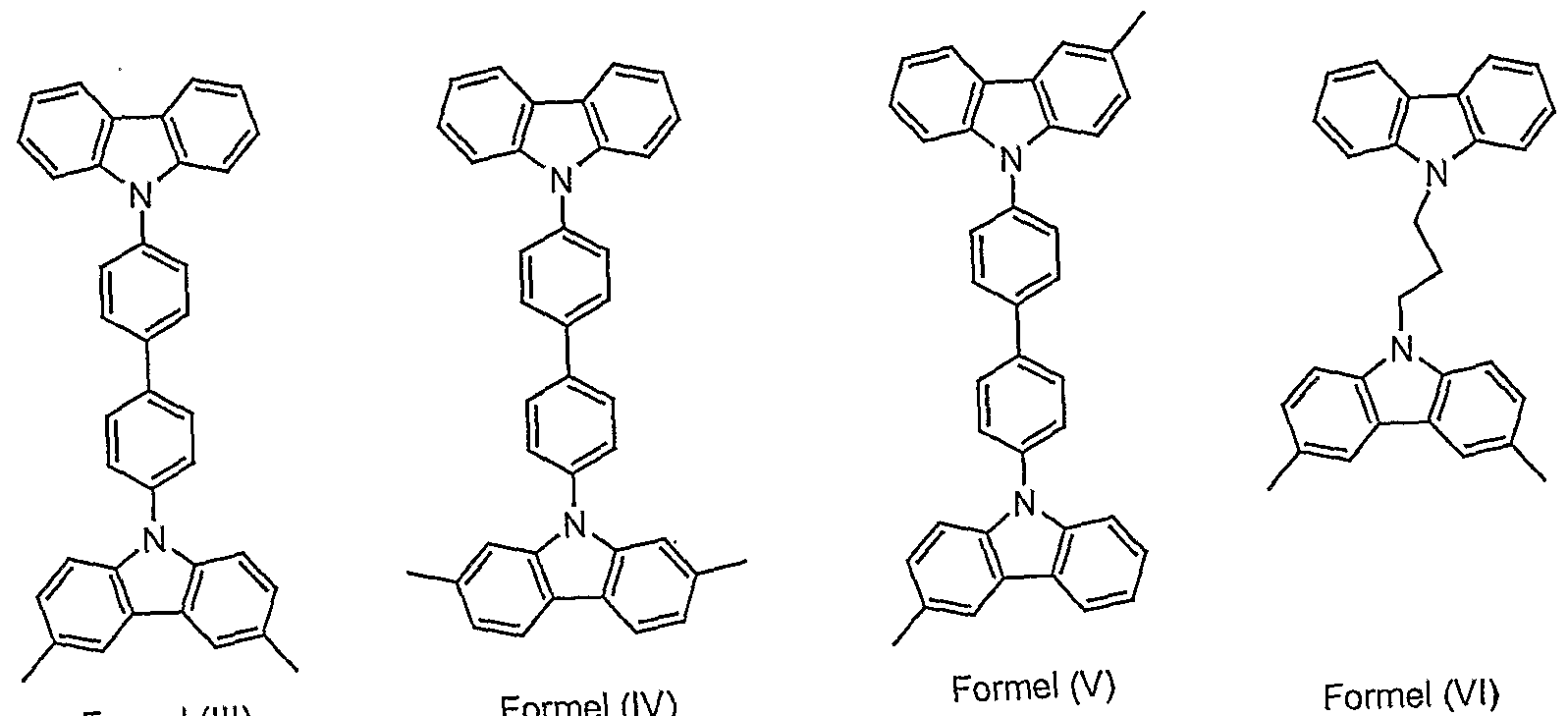


Formel (XV) Formel (XVI) Formel (XVII) Formel (XVIII)Formula (XV) Formula (XVI) Formula (XVII) Formula (XVIII)

Formel (XXIII) Formel (XXIV) Forme! (XXV)

Formel (XXVI I)


Formel (XXVIII) Formel (XXIX)

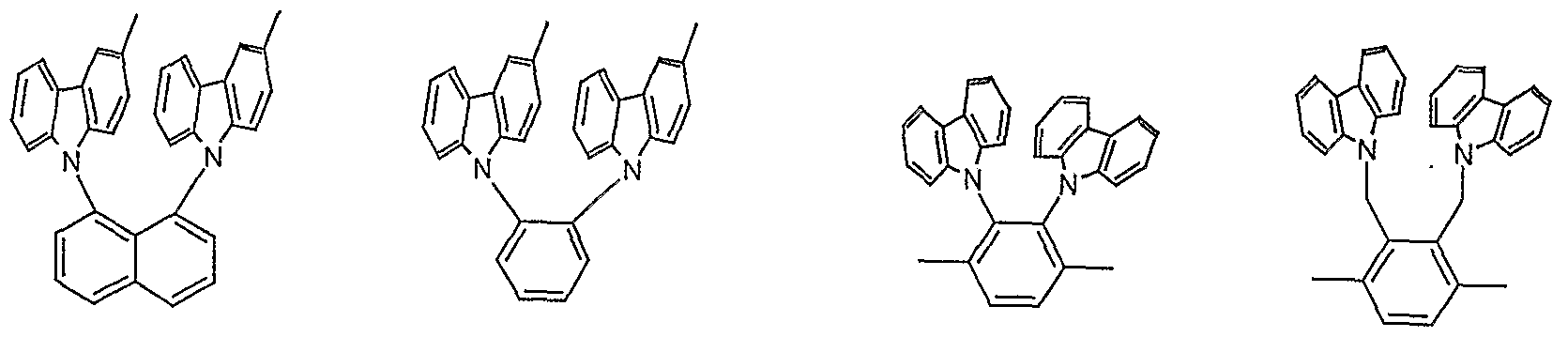
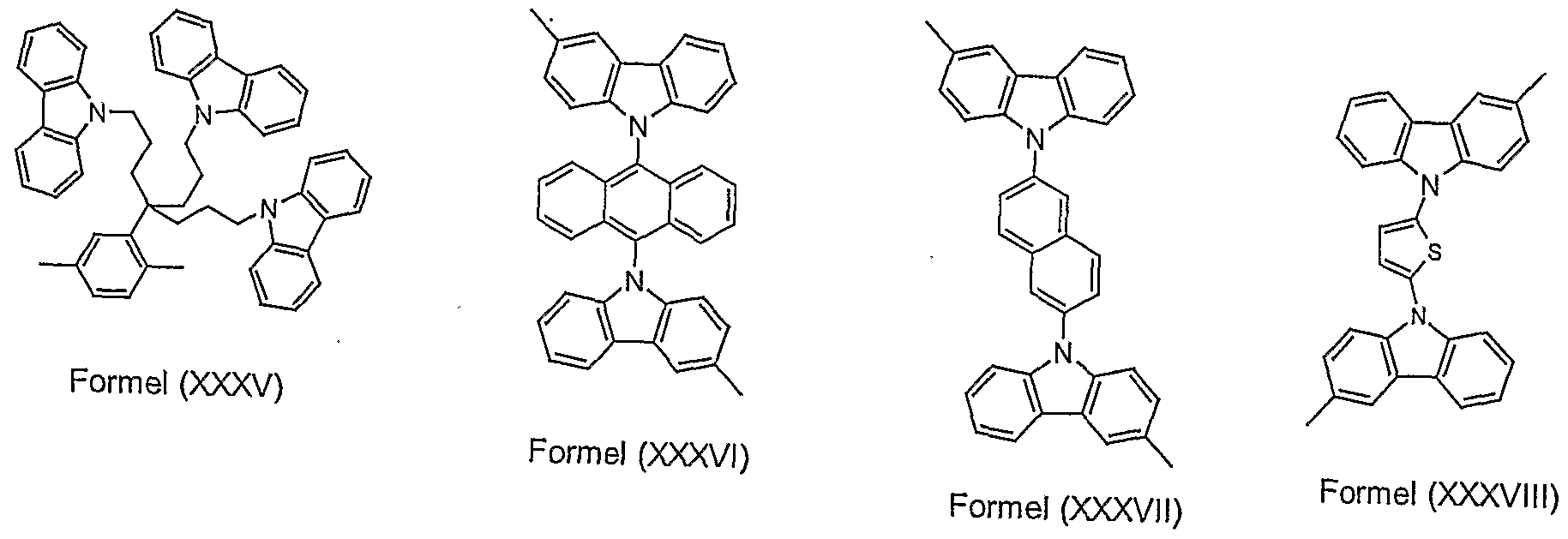
R ist bei jedem Auftreten gleich oder verschieden eine geradkettige oder verzweigte Alkylenkette mit 3 bis 10 C-Atomen, die unsubstituiert oder mit R1 substituiert sein kann, in der auch ein oder mehrere nicht benachbarte C- Atome durch -NR2-, -O- oder -S- ersetzt sein können, ein bivalentes aromatisches oder heteroaromatisches Ringsystem, ausgewählt aus Thiophen, Benzol, Biphenyl, Naphthalin, Anthracen oder Phenanthren, welches unsubstituiert oder mit ein oder zwei Substituenten R1 substituiert ist, ein 9,9'-substituiertes Fluoren, ein mit 0 bis 4 Substituenten R1 substituiertes Spirobifluoren, ein 9,10- oder 9,9, 10,10-substituiertes Dihydrophenanthren oder ein Stilbenyl- oder Tolanylsystem, welches an den freien Positionen 0 bis 2 Substituenten R1 trägt, oder Kombinationen aus 2 bis 3 dieser Systeme;R is the same or different with each occurrence a straight-chain or branched alkylene chain with 3 to 10 C atoms, which may be unsubstituted or substituted by R 1 , in which one or more non-adjacent C atoms by -NR 2 -, -O - or -S- can be replaced, a bivalent aromatic or heteroaromatic ring system selected from thiophene, benzene, biphenyl, naphthalene, anthracene or phenanthrene, which is unsubstituted or substituted by one or two substituents R 1 , a 9,9'-substituted Fluorene, a spirobifluorene substituted with 0 to 4 substituents R 1 , a 9,10- or 9,9, 10,10-substituted dihydrophenanthrene or a stilbenyl or tolanyl system which carries 0 to 2 substituents R 1 in the free positions, or Combinations of 2 to 3 of these systems;
R1, R2, n sind analog den oben gemachten Angaben; die Verknüpfung in POLY1 erfolgt analog den oben gemachten Angaben.R 1 , R 2 , n are analogous to the information given above; the link in POLY1 is analogous to the information given above.
Für bevorzugte Strukturen gemäß Formel (II) gilt Folgendes:The following applies to preferred structures according to formula (II):
R ist bei jedem Auftreten gleich oder verschieden eine geradkettige, verzweigte oder cyclische Alkylenkette mit 2 bis 20 C-Atomen, die mit R1 substituiert oder unsubstituiert sein kann, in der auch ein oder mehrere nicht benachbarte C- Atome durch -NR2-, -O-, -S-, -CO-, -CO-O-, -CO-NR2-, -O-CO-O ersetzt sein können, ein bivalentes aromatisches oder heteroaromatisches Ringsystem, ausgewählt aus Thiophen, Benzothiophen, Benzol, Biphenyl, Pyridin, Chinoxalin, Fluoren, Spirobifluoren, Naphthalin, Anthracen, Pyren, Phenanthren, Dihydrophenanthren, welches an den freien Positionen 0 bis 4 Substituenten R1 trägt, ein Stilbenyl- oder Tolanylsystem, welches an den freien Positionen 0 bis 4 Substituenten R1 trägt, oder Kombinationen aus 2 bis 5 dieser Systeme;With each occurrence, R is the same or different, a straight-chain, branched or cyclic alkylene chain with 2 to 20 C atoms, which can be substituted or unsubstituted with R 1 , in which one or more non-adjacent C atoms is also represented by -NR 2 -, -O-, -S-, -CO-, -CO-O-, -CO-NR 2 -, -O-CO-O can be replaced, a bivalent aromatic or heteroaromatic ring system selected from thiophene, benzothiophene, benzene, Biphenyl, pyridine, quinoxaline, fluorene, spirobifluorene, naphthalene, anthracene, pyrene, phenanthrene, dihydrophenanthrene, which has 0 to 4 substituents R 1 in the free positions, a stilbenyl or tolanyl system, which has 0 to 4 substituents R 1 in the free positions carries, or combinations of 2 to 5 of these systems;
R1, R2, n sind analog den oben gemachten Angaben.R 1 , R 2 , n are analogous to the information given above.
Für besonders bevorzugte Strukturen gemäß Formel (II) gilt:The following applies to particularly preferred structures according to formula (II):
R ist bei jedem Auftreten gleich oder verschieden eine geradkettige oder verzweigte Alkylenkette mit 2 bis 15 C-Atomen, die mit R1 substituiert oder unsubstituiert sein kann, in der auch ein oder mehrere nicht benachbarte C- Atome durch -NR2-, -O- oder -S-, ersetzt sein können, ein bivalentes aromatisches oder heteroaromatisches Ringsystem, ausgewählt aus Thiophen, Benzothiophen, Benzol, Biphenyl, Pyridin, Naphthalin, Anthracen, Pyren oder Phenanthren, welches unsubstituiert oder mit ein oder zwei Substituenten R1 substituiert ist, ein 9,9'-substituiertes Fluoren, ein unsubstituiertes oder mit bis zu vier Substituenten R1 substituiertes Spirobifluoren, ein 9,10- oder 9,9,10,10-substituiertes Dihydrophenanthren, ein Stilbenyl- oder Tolanylsystem, welches an den freien Positionen 0 bis 2 Substituenten R1 trägt, oder Kombinationen aus 2 bis 4 dieser Systeme;R is the same or different at each occurrence a straight-chain or branched alkylene chain with 2 to 15 C atoms, which may be substituted or unsubstituted with R 1 , in which one or more non-adjacent C atoms by -NR 2 -, -O - or -S-, can be replaced, a bivalent aromatic or heteroaromatic ring system selected from thiophene, benzothiophene, benzene, biphenyl, pyridine, naphthalene, anthracene, pyrene or phenanthrene, which is unsubstituted or substituted by one or two substituents R 1 , a 9,9'-substituted fluorene, an unsubstituted or with up to four substituents R 1 substituted spirobifluorene, a 9,10- or 9,9,10,10-substituted dihydrophenanthrene, a stilbenyl or tolanyl system which carries 0 to 2 substituents R 1 at the free positions, or combinations of 2 to 4 of these systems;
R1, R2 sind analog den oben gemachten Angaben; n ist bei jedem Auftreten gleich oder verschieden 0, 1 oder 2.R 1 , R 2 are analogous to the information given above; n is the same or different at each occurrence 0, 1 or 2.
Besonders bevorzugte Strukturelemente gemäß Formel (II) sind substituierte oder unsubstituierte Strukturen gemäß den abgebildeten Formeln (XXXIX) bis (LVIII). Potenzielle Substituenten sind wegen der besseren Übersichtlichkeit i. d. R. nicht abgebildet.Particularly preferred structural elements according to formula (II) are substituted or unsubstituted structures according to the formulas (XXXIX) to (LVIII) shown. Potential substituents are i. d. R. not shown.

Form II)Form II)
Formel (XXXX) (XXXXI) el (XXXX
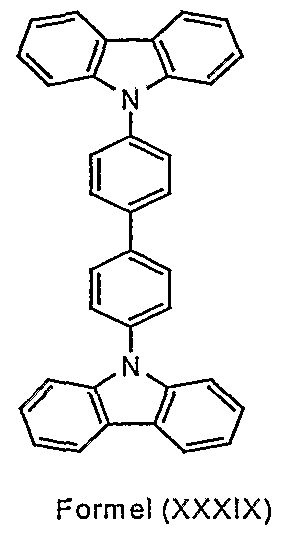

Formel (Ll)

Formel (LIII)


Formel (LVI)Formula (LVI)
Formel (LVIII)Formula (LVIII)
Formel (LVII)Formula (LVII)
Für ganz besonders bevorzugte Strukturen gemäß Formel (II) gilt Folgendes:The following applies to very particularly preferred structures according to formula (II):
R ist bei jedem Auftreten gleich oder verschieden eine geradkettige oder verzweigte Alkylenkette mit 3 bis 10 C-Atomen, die unsubstituiert oder mit R1 substituiert sein kann, in der auch ein oder mehrere nicht benachbarte C- Atome durch -NR2-, -O- oder -S- ersetzt sein können, ein bivalentes aromatisches oder heteroaromatisches Ringsystem, ausgewählt aus Thiophen, Benzol, Biphenyl, Naphthalin, Anthracen oder Phenanthren, welches unsubstituiert oder mit ein oder zwei Substituenten R1 substituiert ist, ein 9,9'-substituiertes Fluoren, ein mit 0 bis 4 Substituenten substituiertes Spirobifluoren, ein 9,10- oder 9,9,10,10-substituiertes Dihydrophenanthren oder ein Stilbenyl- oder Tolanylsystem, welches an den freien Positionen 0 bis 2 Substituenten R1 trägt oder Kombinationen aus 2 bis 3 dieser Systeme;R is the same or different with each occurrence a straight-chain or branched alkylene chain with 3 to 10 C atoms, which may be unsubstituted or substituted by R 1 , in which one or more non-adjacent C atoms by -NR 2 -, -O - or -S- can be replaced, a bivalent aromatic or heteroaromatic ring system selected from thiophene, benzene, biphenyl, naphthalene, anthracene or phenanthrene, which is unsubstituted or substituted by one or two substituents R 1 , a 9,9'-substituted Fluorene, a spirobifluorene substituted with 0 to 4 substituents, a 9,10- or 9,9,10,10-substituted dihydrophenanthrene or a stilbenyl or tolanyl system which carries 0 to 2 substituents R 1 at the free positions or combinations of 2 up to 3 of these systems;
R1, R2, n sind analog den oben gemachten Angaben.R 1 , R 2 , n are analogous to the information given above.
Auch wenn dies aus der Beschreibung hervorgeht, sei hier nochmals explizit darauf verwiesen, dass sowohl die Struktureinheiten gemäß Formel (I) und (II), als auch jene gemäß den Formeln (III) bis (LVIII) unsymmetrisch substituiert sein können, d. h. dass an einer Einheit unterschiedliche Substituenten R1 vorhanden sein können, bzw. diese auch an unterschiedliche Positionen gebunden sein können.Even if this emerges from the description, it should again be explicitly pointed out here that both the structural units of the formulas (I) and (II) and those of the formulas (III) to (LVIII) can be unsymmetrically substituted, ie an different substituents R 1 can be present in one unit, or these can also be bound to different positions.
Struktureinheiten gemäß Formel (II), die in BLEND2 bis BLEND4 verwendet werden, können beispielsweise wie im Folgenden beschrieben erhalten werden: • Die N-Alkylierung oder N-Benzylierung von Carbazolen ist in der Literatur bekannt. Auf diese Weise können auch zwei Carbazoleinheiten mit einer substituierten oder unsubstituierten Alkylen-, Benzyl-, Alkylarylen- oder Cycloalkylenkette überbrückt werden. Die Synthese erfolgt durch Reaktion des Carbazols mit einem Alkylierungsmittel unter basischen Bedingungen, wie beispielsweise beschrieben in: M. E. Wright et. a/., J. Org. Chem. 1989, 54, 965.Structural units according to formula (II) which are used in BLEND2 to BLEND4 can be obtained, for example, as described below: • The N-alkylation or N-benzylation of carbazoles is known in the literature. In this way, two carbazole units with a substituted or unsubstituted alkylene, benzyl, alkylarylene or cycloalkylene chain can also be bridged. The synthesis is carried out by reaction of the carbazole with an alkylating agent under basic conditions, as described, for example, in: ME Wright et. a /., J. Org. Chem. 1989, 54, 965.
• Die N-Arylierung des Carbazols kann gemäß HARTWIG-BUCHWALD erfolgen und wird für Carbazol beispielsweise beschrieben in: M. Watanabe et al., Tetrahedron Lett. 2000, 41, 481. Ebenso können mit dieser Methode zwei Carbazoleinheiten durch entsprechende Arylen-, Heteroarylen-, Stilbenylen- oder Tolanylengruppen überbrückt werden.• The N-arylation of the carbazole can be carried out according to HARTWIG-BUCHWALD and is described for carbazole, for example in: M. Watanabe et al., Tetrahedron Lett. 2000, 41, 481. Likewise, two carbazole units can be bridged by corresponding arylene, heteroarylene, stilbenylene or tolanylene groups using this method.
• Die Synthese von Carbazolen, die am Carbazolgrundkörper Alkylsubstituenten tragen, ist in der Literatur bekannt: P. Bhattacharyya et al., J. Chem. Soc, Chem. Commun. 1984, 1668.• The synthesis of carbazoles which carry alkyl substituents on the basic carbazole body is known in the literature: P. Bhattacharyya et al., J. Chem. Soc, Chem. Commun. 1984, 1668.
• Weitere Substitutionen am Carbazolgrundkörper können ausgehend von den unten beschriebenen Halogen-Verbindungen erhalten werden. Dadurch können, beispielsweise durch Palladium-katalysierte Kreuzkupplungsreaktionen, weitere organische Reste eingeführt werden. Ebenso können durch analoge Reaktionen mit entsprechend substituierten Triplett-Emittern Verbindungen aus Carbazol-Dimeren und Triplett-Emittern (VERB3) erhalten werden, wie sie für BLEND4 benötigt werden.• Further substitutions on the carbazole base can be obtained from the halogen compounds described below. As a result, further organic radicals can be introduced, for example by palladium-catalyzed cross-coupling reactions. Likewise, analog reactions with appropriately substituted triplet emitters can be used to obtain compounds from carbazole dimers and triplet emitters (VERB3), as are required for BLEND4.
Für die Synthese von POLY1 können die entsprechenden Monomere, die im Polymer zu Struktureinheiten gemäß Formel (I) führen, beispielsweise wie im Folgenden beschrieben erhalten werden:For the synthesis of POLY1, the corresponding monomers which lead to structural units of the formula (I) in the polymer can be obtained, for example, as described below:
• Die Synthese von 3,6-Dibromcarbazol erfolgt durch Bromierung des Carbazols, wie in der Literatur beschrieben: Smith et al., Tetrahedron 1992, 48, 7479.• The synthesis of 3,6-dibromocarbazole is carried out by bromination of the carbazole, as described in the literature: Smith et al., Tetrahedron 1992, 48, 7479.
• Die Synthese von 2,7-Dibromcarbazol erfolgt durch Aufbau des Carbazolgrundkörpers, wie in der Literatur beschrieben: Tidwell et al., Eur. J. Med. Chem. 1997, 32, 781.• The synthesis of 2,7-dibromocarbazole takes place by building up the basic carbazole body, as described in the literature: Tidwell et al., Eur. J. Med. Chem. 1997, 32, 781.
• Eine entsprechende Funktionalisierung, die eine Verwendung als Monomer ermöglicht (also z. B. Einführung von Halogen-Endgruppen), kann prinzipiell entweder an den Vorstufen erfolgen oder als letzter Schritt an dem bereits vollständig aufgebauten Grundgerüst.A corresponding functionalization, which enables use as a monomer (for example introduction of halogen end groups), can in principle either take place at the precursors or as the last step on the already fully constructed basic structure.
• Vorab können die Funktionalitäten bereits vorhanden sein, wenn diese bei folgenden Reaktionsschritten entweder nicht oder sehr erschwert reagieren. Dies kann z. B. der Fall sein bei einfacher Substitutionsreaktion, oder wenn man unterschiedliche Reaktivitäten (z. B. lod gegenüber Brom, bzw. Brom gegenüber Chlor) ausnutzen kann.• The functionalities may already be available in advance if they either do not react or react very difficultly in the subsequent reaction steps. This can e.g. B. be the case with a simple substitution reaction, or if you can use different reactivities (z. B. iodine to bromine or bromine to chlorine).
• Andererseits kann es auch vorteilhaft sein (bei z. B. vorliegender Substitution bzw. dirigierenden Resten), zunächst den überbrückten Carbazolgrundkörper aufzubauen und in einem letzten Schritt die Halogenfunktionalität einzuführen. So ist es beispielsweise möglich, in die 3- und 6-Positionen einer Carbazoleinheit Brom einzuführen (beispielsweise durch milde NBS-Bromierung, z. B. Creason et al., J. Org. Chem. 1972, 37, 4440), wenn die zweite Carbazoleinheit durch Substituenten blockiert ist. Wie oben geschildert, kann dieses Verfahren bei Vorhandensein (i) entsprechender blockierender Substituenten, (ii) entsprechend dirigierender Reste oder (iii) aktivierter bzw. desaktivierter Heterocyclen auch für weitere Strukturen gemäß Formel (I) angewendet werden. Ebenso ist eine Funktionalisierung in 6,6'-Position möglich, wenn die 3,3'-Positionen bereits durch andere Substituenten blockiert sind. • Aus den Halogenderivaten können über Standardverfahren entsprechende• On the other hand, it can also be advantageous (in the case of, for example, substitution or directing residues) to first build up the bridged carbazole base body and to introduce the halogen functionality in a last step. For example, it is possible to introduce bromine into the 3- and 6-positions of a carbazole unit (for example by mild NBS bromination, e.g. Creason et al., J. Org. Chem. 1972, 37, 4440) when the second carbazole unit is blocked by substituents. As described above, this method can also be used for other structures of the formula (I) in the presence of (i) corresponding blocking substituents, (ii) correspondingly directing radicals or (iii) activated or deactivated heterocycles. Functionalization in the 6,6'-position is also possible if the 3,3'-positions are already blocked by other substituents. • From the halogen derivatives, corresponding methods can be used
Bisboronsäurederivate bzw. Bisstannanderivate (für die o. g. Polymerisationsverfahren der Typen A und C) hergestellt werden. Diese Verfahren bestehen i. d. R. darin, das vorhandene Halogen gegen ein Metall (z. B. Mg, Li) auszutauschen und dieses mit einer Borester- bzw. einer Trialkylzinnhalogenverbindung umzusetzen. Für die Herstellung von Boronsäurederivaten sind auch katalytische Verfahren zur direkten Umsetzung der Halogenide mit beispielsweise Boranen oder Diboranen unter Palladiumkatalyse bekannt.Bisboronic acid derivatives or bisstannane derivatives (for the above-mentioned polymerization processes of types A and C) are produced. These procedures exist i. d. R. in replacing the existing halogen with a metal (e.g. Mg, Li) and reacting it with a borester or trialkyltin halogen compound. For the production of boronic acid derivatives, catalytic processes for the direct reaction of the halides with, for example, boranes or diboranes under palladium catalysis are also known.
Weiterhin Gegenstand der Erfindung sind bifunktionelle monomere Verbindungen gemäß Formel (LIX),The invention furthermore relates to bifunctional monomeric compounds of the formula (LIX),
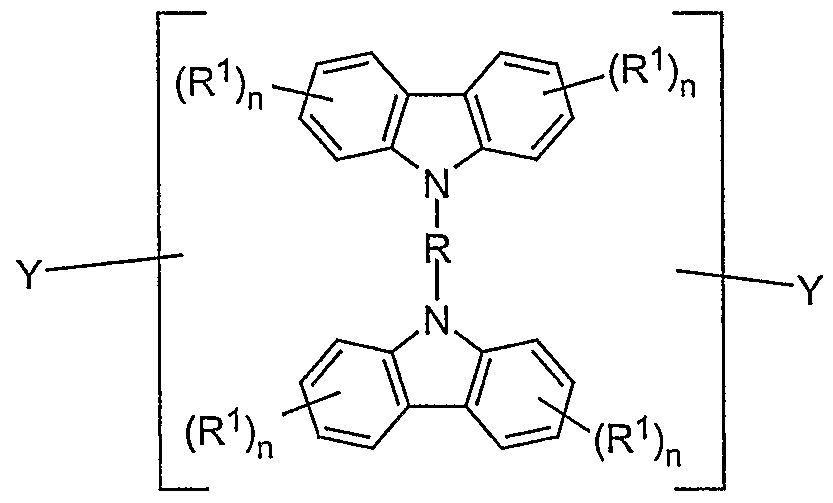
FORMEL (LIX) dadurch gekennzeichnet, dass die beiden funktionellen Gruppen Y, gleich oder verschieden, unter Bedingungen der C-C- bzw. C-N-Verknüpfungen copolymerisieren; die weiterenFORMULA (LIX) characterized in that the two functional groups Y, identical or different, copolymerize under conditions of the C-C or C-N linkages; the others
Symbole und Indizes haben dieselbe Bedeutung wie in Formel (I); die Verknüpfung von Y erfolgt an den gleichen Positionen wie für X für Formel (I) beschrieben.Symbols and indices have the same meaning as in formula (I); Y is linked at the same positions as described for X for formula (I).
Bevorzugt ist Y ausgesucht aus den Gruppen Cl, Br, I, O-Tosylat, O-Triflat, OS02R2,Y is preferably selected from the groups Cl, Br, I, O-tosylate, O-triflate, OS0 2 R 2 ,
B(OH)2, B(OR2)2, Sn(R2)3 und NHR2, wobei R2 dieselbe Bedeutung hat, wie oben beschrieben.B (OH) 2 , B (OR 2 ) 2 , Sn (R 2 ) 3 and NHR 2 , where R 2 has the same meaning as described above.
Die C-C- bzw. C-N-Verknüpfungen sind dabei bevorzugt ausgewählt aus den Gruppen derThe C-C or C-N linkages are preferably selected from the groups of
SUZUKI-Kupplung, der YAMAMOTO-Kupplung, der STILLE-Kupplung und der HARTWIG-SUZUKI clutch, the YAMAMOTO clutch, the STILLE clutch and the HARTWIG
BUCHWALD-Kupplung.BUCHWALD coupling.
Insbesondere bevorzugt sind hier monomere Verbindungen gemäß Formel (LIX), die imParticularly preferred here are monomeric compounds of the formula (LIX) which are in the
Polymer zu Struktureinheiten gemäß Formel (III) bis (XXXVIII) führen.Lead polymer to structural units according to formulas (III) to (XXXVIII).
Die in BLEND1 und BLEND3 eingemischten Struktureinheiten VERB1 , bzw. die in POLY2 (= BLEND2) einpolymerisierten Struktureinheiten VERB2, bzw. die in BLEND4 eingemischten Struktureinheiten VERB3 können aus beliebigen organischen oder metallorganischen Substanzklassen ausgewählt werden, die einen Transfer von so genannten Singulett- Excitonen zu Triplett-Excitonen ermöglichen und auch bei Raumtemperatur aus dem Triplett-Zustand Licht emittieren können: Dies sind zunächst vor allem Verbindungen, welche Schweratome, d. h. Atome aus dem Periodensystem der Elemente mit einer Ordnungszahl von mehr als 36, enthalten. Besonders geeignet sind hierfür Verbindungen, welche d- und f-Übergangsmetalle enthalten, die die o. g. Bedingung erfüllen. Ganz besonders bevorzugt sind hier entsprechende Struktureinheiten, welche Elemente der Gruppe 8 bis 10 (Ru, Os, Rh, Ir, Pd, Pt) enthalten. Solche Verbindungen sind für alle Emissionsfarben (blau, grün, rot) bekannt.The structural units VERB1 mixed into BLEND1 and BLEND3, or the structural units VERB2 polymerized into POLY2 (= BLEND2), or those mixed into BLEND4 Structural units VERB3 can be selected from any organic or organometallic substance classes that enable the transfer of so-called singlet excitons to triplet excitons and that can also emit light from the triplet state at room temperature: These are primarily compounds that contain heavy atoms, ie Atoms from the periodic table of the elements with an atomic number of more than 36 contain. Compounds which contain d- and f-transition metals which meet the above-mentioned condition are particularly suitable for this. Corresponding structural units which contain elements from groups 8 to 10 (Ru, Os, Rh, Ir, Pd, Pt) are very particularly preferred here. Such connections are known for all emission colors (blue, green, red).
VERB1 bzw. VERB3 kann eine niedermolekulare, oligomere, dendritische oder polymere Verbindung sein. Da VERB1 bwz. VERB3 als Blend (BLEND1 , BLEND3, BLEND4) verarbeitet wird, muss eine ausreichende Löslichkeit in geeigneten Lösemitteln (z. B. Toluol, Xylol, Anisol, THF, Methylanisol, Methylnaphthalin oder Mischungen dieser Lösemittel) gegeben sein, damit die Verarbeitung aus Lösung in diesen Lösemitteln möglich ist. Als niedermolekulare Struktureinheiten kommen hier z. B. verschiedene Komplexe in Frage, weiche beispielsweise in WO 02/068435, WO 02/081488, EP 1239526 und WO 04/026886 beschrieben sind. Als Dendrimer-Strukturen kommen hierfür Komplexe in Frage, wie beispielsweise in WO 99/21935, WO 01/059030 und WO 02/066552 beschrieben sind.VERB1 or VERB3 can be a low molecular weight, oligomeric, dendritic or polymeric compound. Since VERB1 or VERB3 is processed as a blend (BLEND1, BLEND3, BLEND4), there must be sufficient solubility in suitable solvents (e.g. toluene, xylene, anisole, THF, methylanisole, methylnaphthalene or mixtures of these solvents) so that processing from solution in these solvents is possible. As low-molecular structural units come here, for. B. various complexes in question, which are described for example in WO 02/068435, WO 02/081488, EP 1239526 and WO 04/026886. Complexes are suitable as dendrimer structures for this purpose, as described, for example, in WO 99/21935, WO 01/059030 and WO 02/066552.
VERB2 wird kovalent in die Polymerkette von POLY2 (= BLEND2) eingebaut. Dabei kann sowohl ein Einbau in die Haupt- wie auch in die Seitenkette des Polymers bevorzugt sein. Um den Einbau von VERB2 in POLY2 zu ermöglichen, müssen an VERB2 funktionelle polymerisierbare Gruppen vorhanden sein. Beispiele für entsprechende bromierte Komplexe, die als Monomere in Polymerisationsreaktionen eingesetzt werden können, werden beschrieben in WO 02/068435.VERB2 is covalently incorporated into the polymer chain of POLY2 (= BLEND2). Installation in the main chain as well as in the side chain of the polymer can be preferred. In order to enable the incorporation of VERB2 into POLY2, functional polymerizable groups must be present on VERB2. Examples of corresponding brominated complexes which can be used as monomers in polymerization reactions are described in WO 02/068435.
Die erfindungsgemäße Mischung BLEND 1 wird erhalten, indem dem Polymer POLY1 Einheiten VERB1 zugemischt werden. Die erfindungsgemäße Mischung BLEND2 wird erhalten, indem dem Polymer POLY2 Struktureinheiten gemäß Formel (II) zugemischt werden. Die erfindungsgemäße Mischung BLEND3 wird erhalten, indem dem Polymer POLY3 Struktureinheiten gemäß Formel (II) sowie Einheiten VERB1 zugemischt werden. Die erfindungsgemäße Mischung BLEND4 wird erhalten, indem dem Polymer POLY3 Einheiten VERB3 zugemischt werden.The blend BLEND 1 according to the invention is obtained by admixing the polymer POLY1 units VERB1. The blend BLEND2 according to the invention is obtained by adding structural units of the formula (II) to the polymer POLY2. The blend BLEND3 according to the invention is obtained by adding structural units of the formula (II) and VERB1 units to the polymer POLY3. The blend BLEND4 according to the invention is obtained by admixing the polymer POLY3 units VERB3.
Es kann auch bevorzugt sein, in BLEND1 bis BLEND4 noch weitere konjugierte, teilkonjugierte oder nicht-konjugierte Polymere, Oligomere, Dendrimere oder niedermolekulare Verbindungen einzumischen. So kann beispielsweise durch Zugabe einer elektronisch aktiven Substanz die Loch- bzw. Elektroneninjektion, der Loch- bzw. Elektronentransport oder das Ladungsgleichgewicht im entsprechenden Blend reguliert werden. Die Zusatzkomponente kann auch den Singulett-Triplett-Transfer verbessern. Jedoch auch die Zugabe elektronisch inerter Verbindungen kann hilfreich sein, um beispielsweise die Viskosität der Lösung oder die Morphologie des Films zu kontrollieren. Die so erhaltenen Blends sind also auch Gegenstand der Erfindung.It may also be preferred to mix further conjugated, partially conjugated or non-conjugated polymers, oligomers, dendrimers or low molecular weight compounds into BLEND1 to BLEND4. For example, the addition of an electronically active substance can regulate the hole or electron injection, the hole or electron transport or the charge balance in the corresponding blend become. The additional component can also improve the singlet-triplet transfer. However, the addition of electronically inert compounds can also be helpful, for example to control the viscosity of the solution or the morphology of the film. The blends thus obtained are also the subject of the invention.
Weiterhin Gegenstand der Erfindung sind konjugierte Polymere POLY4, enthaltend (A) 1 - 99.9 mol%, bevorzugt 10 - 99 mol%, besonders bevorzugt 20 - 99 mol% einer oder mehrerer Einheiten gemäß Formel (I),The invention furthermore relates to conjugated polymers POLY4, containing (A) 1-99.9 mol%, preferably 10-99 mol%, particularly preferably 20-99 mol% of one or more units of the formula (I),
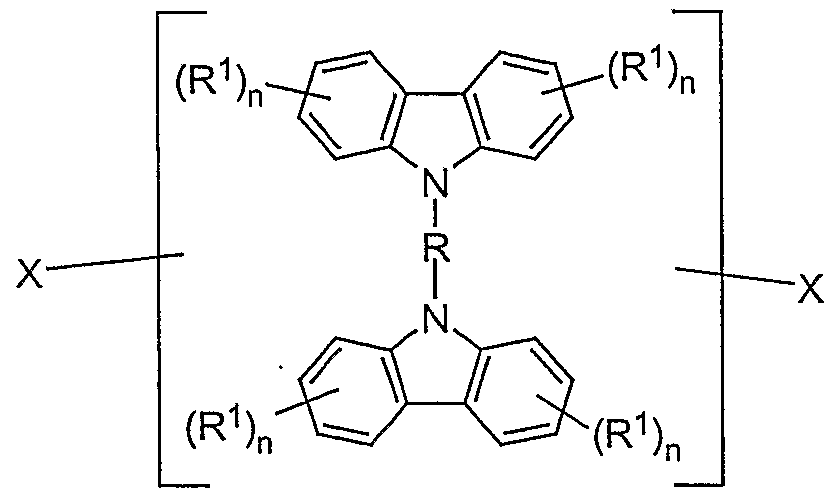
FORMEL (I)FORMULA (I)
,1 wobei die Symbole X, R, R\ Rz und die Indizes n dieselbe Bedeutung haben, wie oben beschrieben, und (B) 0.1 - 95 mol%, bevorzugt 0.5 - 80 mol%, besonders bevorzugt 1 - 50 mol%, insbesondere 2 - 25 mol% eines oder mehrerer Triplett-Emitter, vorzugsweise in Form einer oder mehrerer metallorganischer Struktureinheiten VERB2., 1 where the symbols X, R, R \ R z and the indices n have the same meaning as described above, and (B) 0.1-95 mol%, preferably 0.5-80 mol%, particularly preferably 1-50 mol%, in particular 2-25 mol% of one or more triplet emitters, preferably in the form of one or more organometallic structural units VERB2.
Dabei erfolgt der Einbau der Struktureinheiten gemäß Formel (I) wie für das Polymer POLY1 beschrieben. Der Einbau der Struktureinheiten VERB2 erfolgt, wie für POLY2 bereits beschrieben, in die Haupt- und/oder Seitenkette von POLY4.The structural units of the formula (I) are incorporated as described for the polymer POLY1. As already described for POLY2, the structural units VERB2 are installed in the main and / or side chain of POLY4.
POLY4 kann weitere Strukturelemente (z. B. Polymer-Grundgerüst-Bausteine, Ladungsinjektions- oder -transportbausteine) enthalten, wie für POLY1 bis POLY3 beschrieben. Ebenso kann es statistisch, teilstatistisch, alternierend oder blockartig aufgebaut, kann linear, verzweigt oder dendritisch sein. Auch in POLY4 wird die Löslichkeit des Polymers vor allem durch die Substituenten R und R1 an den Polymerbausteinen bestimmt. Die Synthese von POLY4 erfolgt wie für POLY1 bis POLY3 beschrieben. Besonders bevorzugte Struktureinheiten gemäß Formel (I) sind die oben abgebildeten Strukturen gemäß Formel (III) bis (XXXVIII).POLY4 can contain further structural elements (e.g. polymer backbone building blocks, charge injection or transport building blocks), as described for POLY1 to POLY3. It can also be statistical, semi-statistical, alternating or block-like, linear, branched or dendritic. In POLY4 too, the solubility of the polymer is primarily determined by the substituents R and R 1 on the polymer building blocks. POLY4 is synthesized as described for POLY1 to POLY3. Particularly preferred structural units according to formula (I) are the structures shown above according to formulas (III) to (XXXVIII).
Des Weiteren kann bevorzugt sein, in POLY4 noch weitere konjugierte, teilkonjugierte oder nicht-konjugierte Polymere, Oligomere, Dendrimere oder niedermolekulare Verbindungen einzumischen, so dass auch hier ein Blend entsteht. Hier kann es bevorzugt sein, Struktureinheiten gemäß Formel (II) einzumischen, so dass der Gesamtanteil an Strukturen gemäß Formel (I) und (II) erhöht wird. Ebenso kann das Einmischen von Struktureinheiten VERB1 bevorzugt sein. Aber auch die Zugabe anderer Komponenten kann sich für manche Anwendungen als sinnvoll erweisen. So kann beispielsweise durch Zugabe einer elektronisch aktiven Substanz die Loch- bzw. Elektroneninjektion, der Loch- bzw. Elektronentransport oder das Ladungsgleichgewicht des so entstandenen Blends reguliert werden. Die Zusatzkomponente kann auch den Singulett-Triplett-Transfer verbessern. Jedoch auch die Zugabe elektronisch inerter Verbindungen kann hilfreich sein, um beispielsweise die Viskosität der Lösung oder die Morphologie des Films zu kontrollieren. Die so aus POLY4 erhaltenen Blends sind also auch Gegenstand der Erfindung.Furthermore, it may be preferred to mix in further conjugated, partially conjugated or non-conjugated polymers, oligomers, dendrimers or low-molecular compounds in POLY4, so that a blend is also produced here. Here it may be preferred to mix in structural units of the formula (II) so that the total proportion of structures of the formula (I) and (II) is increased. Mixing in structural units can also be used VERB1 may be preferred. But the addition of other components can also be useful for some applications. For example, the addition of an electronically active substance can be used to regulate the hole or electron injection, the hole or electron transport or the charge balance of the resulting blend. The additional component can also improve the singlet-triplet transfer. However, the addition of electronically inert compounds can also be helpful, for example to control the viscosity of the solution or the morphology of the film. The blends thus obtained from POLY4 are also the subject of the invention.
Die Darstellung von BLEND1 bis BLEND4 (bzw. gegebenenfalls von einem Blend aus POLY4 und weiteren Komponenten) erfolgt folgendermaßen: Die Einzelbestandteile des Blends werden in einem geeigneten Mischungsverhältnis zusammengegeben und in einem geeigneten Lösemittel gelöst. Geeignete Lösemittel sind beispielsweise Toluol, Anisol, Xylole, Methylanisol, Methylnaphthalin, Chlorbenzol, cyclische Ether (z. B. Dioxan, THF, Methyldioxan), Amide (z. B. NMP, DMF) und Mischungen dieser Lösemittel. Alternativ können die Bestandteile des Blends auch einzeln gelöst werden. Die Lösung des Blends erhält man in diesem Fall durch Zusammenfügen der Einzellösungen im geeigneten Mischungsverhältnis. Dabei findet der Lösevorgang bevorzugt in einer inerten Atmosphäre statt. Der Blend wird üblicherweise nicht als Feststoff (durch nochmaliges Ausfällen) isoliert, sondern direkt aus Lösung weiter verarbeitet.BLEND1 to BLEND4 (or possibly a blend of POLY4 and other components) are represented as follows: The individual components of the blend are combined in a suitable mixing ratio and dissolved in a suitable solvent. Suitable solvents are, for example, toluene, anisole, xylenes, methylanisole, methylnaphthalene, chlorobenzene, cyclic ethers (e.g. dioxane, THF, methyldioxane), amides (e.g. NMP, DMF) and mixtures of these solvents. Alternatively, the components of the blend can also be dissolved individually. The solution of the blend is obtained in this case by combining the individual solutions in a suitable mixing ratio. The dissolving process preferably takes place in an inert atmosphere. The blend is usually not isolated as a solid (by repeated precipitation), but processed directly from solution.
Ein geeignetes Verhältnis der einzelnen Komponenten ist beispielsweise eine Mischung, die insgesamt 1 - 99.5 mol%, bevorzugt 10 - 99 mol%, besonders bevorzugt 20 - 99 mol% Einheiten gemäß Formel (I) und Formel (II) enthält und 0.1 - 95 mol%, bevorzugt 0.5 - 80 mol%, besonders bevorzugt 1 - 50 mol%, insbesondere 2 - 25 mol% VERB1 , VERB2 und VERB3 enthält, unabhängig davon, ob die Komponenten kovalent an ein Polymer gebunden sind oder eingemischt sind.A suitable ratio of the individual components is, for example, a mixture which contains a total of 1-99.5 mol%, preferably 10-99 mol%, particularly preferably 20-99 mol% of units of the formula (I) and formula (II) and 0.1-95 mol %, preferably 0.5-80 mol%, particularly preferably 1-50 mol%, in particular 2-25 mol%, contains VERB1, VERB2 and VERB3, regardless of whether the components are covalently bound to a polymer or are mixed in.
Die erfindungsgemäßen Mischungen BLENDI bis BLEND4 und Polymere POLY4 weisen gegenüber dem o. g. Stand der Technik u. a. folgende überraschenden Vorteile auf:The mixtures BLENDI to BLEND4 and polymers POLY4 according to the invention have the above-mentioned. State of the art u. a. the following surprising advantages:
• Die Lichtemission des Triplett-Emitters ist in erfindungsgemäßen Polymeren POLY1 bzw. Blends BLEND1 bis BLEND4 überraschend deutlich effizienter als in vergleichbaren Polymeren und Blends, die keine Einheiten gemäß Formel (I) bzw. Formel (II) enthalten (vgl. Angaben in Tabelle 1).• The light emission of the triplet emitter is surprisingly significantly more efficient in polymers POLY1 or blends BLEND1 to BLEND4 according to the invention than in comparable polymers and blends which contain no units of the formula (I) or formula (II) (cf. details in Table 1 ).
• Der Strom bei gegebener Spannung ist bei vergleichbaren Polymeren oder vergleichbaren Blends bei der Verwendung in PLEDs höher, d. h. die Strom- Spannungskennlinie ist steiler, wenn sowohl ein konjugiertes Polymer als auch Struktureinheiten gemäß Formel (I) bzw. Formel (II) vorhanden sind (unabhängig davon, ob es sich um ein reines konjugiertes Polymer oder eine Mischung handelt). Dies bringt für die Anwendung - wie oben bereits ausgeführt - deutliche Vorteile, da somit das Ziel, effiziente Vollfarbdisplays mit geringem Energieverbrauch zu erzeugen, ermöglicht wird. • Die Löslichkeit in organischen Lösemitteln ist gut, d. h. in Lösemitteln, wie beispielsweise Toluol, Xylol, Anisol, Methylanisol oder Methylnaphthalin, sind die Mischungen BLEND1 bis BLEND4 bzw. die Polymere POLY4 in Konzentrationen im Bereich von mindestens 1 bis 30 g/L (je nach verwendetem Triplett-Emitter und Molekulargewicht des Polymers) löslich.• The current at a given voltage is higher for comparable polymers or comparable blends when used in PLEDs, ie the current-voltage characteristic is steeper if both a conjugated polymer and structural units according to formula (I) or formula (II) are available ( regardless of whether it is a pure conjugated polymer or a mixture). As already mentioned above, this brings clear advantages for the application, since it enables the goal of producing efficient full-color displays with low energy consumption. • The solubility in organic solvents is good, ie in solvents such as toluene, xylene, anisole, methyl anisole or methyl naphthalene, the mixtures BLEND1 to BLEND4 or the polymers POLY4 are in concentrations in the range of at least 1 to 30 g / L (each after triplet emitter used and molecular weight of the polymer) soluble.
Die Mischungen BLEND1 bis BLEND4 bzw. die Polymere POLY4 können in PLEDs verwendet werden. Für den Bau von PLEDs wird in der Regel ein allgemeines Verfahren verwendet, das entsprechend für den Einzelfall anzupassen ist. Ein solches Verfahren wurde beispielsweise in DE 10249723.0 ausführlich beschrieben.The blends BLEND1 to BLEND4 or the polymers POLY4 can be used in PLEDs. A general procedure is generally used for the construction of PLEDs, which must be adapted accordingly for the individual case. Such a method has been described in detail, for example, in DE 10249723.0.
Wie oben beschrieben, eignen sich die erfindungsgemäßen Mischungen BLEND1 bis BLEND4 bzw. die erfindungsgemäßen Polymere POLY4 ganz besonders als Elektrolumineszenzmaterialien in derart hergestellten OLEDs oder Displays. Als Elektrolumineszenzmaterialien im Sinne dieser Erfindung gelten Materialien, die als aktive Schicht in einer OLED bei Anlegen eines elektrischen Feldes Licht abstrahlen (lichtemittierende Schicht).As described above, the mixtures BLEND1 to BLEND4 according to the invention or the polymers POLY4 according to the invention are particularly suitable as electroluminescent materials in OLEDs or displays produced in this way. For the purposes of this invention, electroluminescent materials are materials which emit light as an active layer in an OLED when an electric field is applied (light-emitting layer).
Gegenstand der Erfindung ist daher auch die Verwendung einer erfindungsgemäßen Mischung BLEND1 bis BLEND4 bzw. eines erfindungsgemäßen Polymers POLY4 in einer OLED als Elektrolumineszenzmaterial.The invention therefore also relates to the use of a mixture BLEND1 to BLEND4 according to the invention or of a polymer POLY4 according to the invention in an OLED as electroluminescent material.
Gegenstand der Erfindung ist ebenfalls eine OLED mit einer oder mehreren aktiven Schichten, wobei mindestens eine dieser Schichten eine oder mehrere erfindungsgemäße Mischungen BLEND1 bis BLEND4 bzw. erfindungsgemäße Polymere POLY4 enthält.The invention also relates to an OLED with one or more active layers, at least one of these layers containing one or more mixtures BLEND1 to BLEND4 or polymers POLY4 according to the invention.
Im vorliegenden Anmeldetext und auch in den im Weiteren folgenden Beispielen wird auf die Verwendung erfindungsgemäßer Mischungen BLEND1 bis BLEND4 bzw. erfindungsgemäßer Polymere POLY4 in Bezug auf OLEDs und die entsprechenden Displays abgezielt. Trotz dieser Beschränkung der Beschreibung ist es für den Fachmann ohne weiteres erfinderisches Zutun möglich, die erfindungsgemäßen Polymere oder Blends auch für weitere Verwendungen in anderen elektronischen Devices (Vorrichtungen) zu benutzen, z. B. für organische Solarzellen (O-SCs), nicht-lineare Optik, organische optische Detektoren oder auch organische Laserdioden (O-Laser), um nur einige Anwendungen zu nennen. Diese sind ebenfalls Gegenstand der vorliegenden Erfindung.In the present application text and also in the examples below, the use of mixtures BLEND1 to BLEND4 according to the invention or polymers POLY4 according to the invention in relation to OLEDs and the corresponding displays is aimed at. Despite this limitation of the description, it is possible for the person skilled in the art without further inventive step to use the polymers or blends according to the invention for other uses in other electronic devices (devices), for. B. for organic solar cells (O-SCs), non-linear optics, organic optical detectors or organic laser diodes (O-lasers), to name just a few applications. These are also the subject of the present invention.
Die Erfindung wird durch die nachfolgenden Beispiele näher erläutert, ohne sie dadurch einschränken zu wollen. Beispiele:The invention is explained in more detail by the following examples, without wishing to restrict it thereby. Examples:
Teil A: Synthese der Monomere und BlendbestandteilePart A: Synthesis of the monomers and blend components
Beispiel A1: Synthese der Monomere für POLY1Example A1: Synthesis of the monomers for POLY1
Die Synthese der Monomere M1 bis M23 ist bereits in WO 02/077060 und der darin zitierten Literatur ausführlich beschrieben worden. Die Monomere sind zur besseren Übersicht im Folgenden nochmals dargestellt:The synthesis of the monomers M1 to M23 has already been described in detail in WO 02/077060 and the literature cited therein. The monomers are shown again below for a better overview:
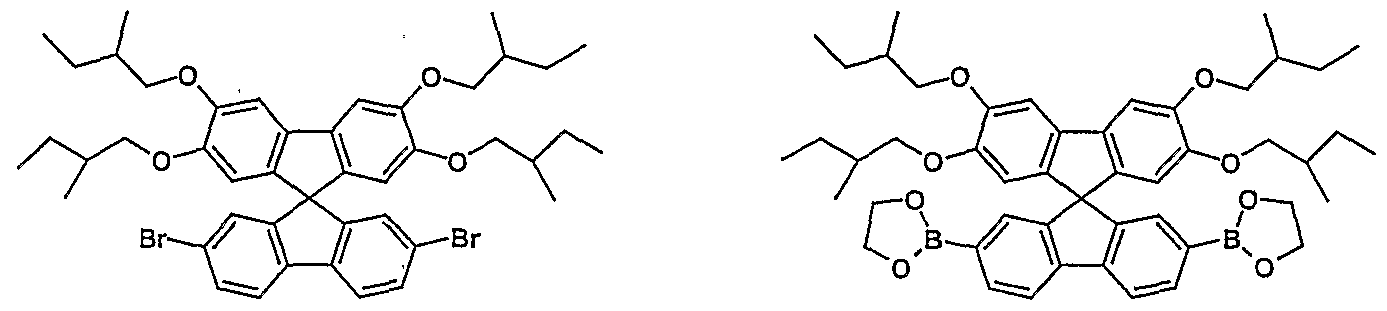
M1 M2M1 M2

M3 M4 M5M3 M4 M5

M6 M7 M8M6 M7 M8

M12 M13 M14 M15

M16 17 M18M16 17 M18

M20M20
M19 M21M19 M21

Beispiel A2: Erfindungsgemäße Monomere gemäß Formel (I)Example A2: Monomers According to the Invention According to Formula (I)
Die Monomere gemäß Formel (I) werden im Folgenden als „EM" (= erfindungsgemäßes Monomer) bezeichnet.The monomers of the formula (I) are referred to below as “EM” (= monomer according to the invention).
3,6-Dibromcarbazol wurde gemäß Smith etal., Tetrahedron 1992, 48, 7479 synthetisiert. Die Synthese von 3-Methylcarbazol erfolgte gemäß P. Bhattacharyya et al., J. Chem. Soc, Chem. Commun. 1984, 1668. Die strukturelle Integrität aller Produkte wurde mittels 1H- NMR-Spektroskopie bewiesen, die Reinheit der Produkte wurde mittels HPLC bestimmt.3,6-dibromo carbazole was synthesized according to Smith et al., Tetrahedron 1992, 48, 7479. The synthesis of 3-methylcarbazole was carried out according to P. Bhattacharyya et al., J. Chem. Soc, Chem. Commun. 1984, 1668. The structural integrity of all products was proven by means of 1 H-NMR spectroscopy, the purity of the products was determined by means of HPLC.
N-(ω-BromaIkyl)carbazol: Allgemeine BeschreibungN- (ω-BromaIkyl) carbazole: General description

N-(3-Brompropyl)carbazol (n = 3): 6.68 g (40 mmol) Carbazol, 80.8 g (40.6 mL, 400 mmol) 1 ,3-Dibrompropan, 1.06 g (44 mmol) NaH, 100 tnL THF.N- (3-Bromopropyl) carbazole (n = 3): 6.68 g (40 mmol) carbazole, 80.8 g (40.6 mL, 400 mmol) 1,3-dibromopropane, 1.06 g (44 mmol) NaH, 100 tnL THF.
Ausbeute: 9.2 g (56 %), HPLC-Reinheit 99.4 %.Yield: 9.2 g (56%), HPLC purity 99.4%.
1H-NMR (CDCI3, 500 MHz): 8.11 (d, J = 8.7 Hz, 2H), 7.48 (m, 4H), 7.24 (m, 2H), 4.51 (t, J = 1 H-NMR (CDCI 3 , 500 MHz): 8.11 (d, J = 8.7 Hz, 2H), 7.48 (m, 4H), 7.24 (m, 2H), 4.51 (t, J =
6.35 Hz, 2H), 3.39 (t, J = 6.35 Hz, 2H), 2.43 (m, 2H).6.35 Hz, 2H), 3.39 (t, J = 6.35 Hz, 2H), 2.43 (m, 2H).
N-(4-Brombutyl)carbazol (n = 4): 6.68 g (40 mmol) Carbazol, 86.36 g (47.2 mL, 400 mmol)N- (4-bromobutyl) carbazole (n = 4): 6.68 g (40 mmol) carbazole, 86.36 g (47.2 mL, 400 mmol)
1 ,4-Dibrombutan, 1.06 g (44 mmol) NaH, 100 mL THF.1, 4-dibromobutane, 1.06 g (44 mmol) NaH, 100 mL THF.
Ausbeute: 8.58 g (71 %), HPLC-Reinheit 99.5 %.Yield: 8.58 g (71%), HPLC purity 99.5%.
1H-NMR (CDCI3, 500 MHz): 8.11 (d, J = 8.7 Hz, 2H), 7.48 (m, 4H), 7.24 (m, 2H), 4.35 (t, J = 1 H-NMR (CDCI 3 , 500 MHz): 8.11 (d, J = 8.7 Hz, 2H), 7.48 (m, 4H), 7.24 (m, 2H), 4.35 (t, J =
6.35 Hz, 2H), 3.37 (t, J = 6.35 Hz, 2H), 2.43-1.81 (m, 4H).6.35 Hz, 2H), 3.37 (t, J = 6.35 Hz, 2H), 2.43-1.81 (m, 4H).
Monomere aus Alkylcarbazoldimeren: Allgemeine BeschreibungMonomers from alkyl carbazole dimers: general description

n > 1 X = Cl, Br, In> 1 X = Cl, Br, I
In einem 500 mL-Kolben mit Rückflusskühler werden unter Schutzgas 990 mg (41.2 mmol) Natriumhydrid in 80 mL trockenem DMF suspendiert. Zu dieser Reaktionsmischung wird eine Lösung aus 30.8 mmol 3,6- oder 2,7-Dihalogencarbazol (X = Cl, Br, I) in 80 mL DMF innerhalb 20 min bei RT zugetropft. Anschließend wird eine Lösung aus 30.8 mmol N-(ω- BromaIkyl)carbazol in 50 mL trockenem DMF zugetropft und 8 h auf 60 °C erhitzt. Nach Abkühlen auf Raumtemperatur werden vorsichtig 300 mL Wasser und 200 mL Ethylacetat zugesetzt. Die Phasen werden getrennt, die organische Phase mit 4 x 50 mL H20 gewaschen, über MgS0 getrocknet und die Lösungsmittel in Vakuum entfernt. Das reine Produkt erhält man durch wiederholte Umkristallisation aus n-Hexan. EM1 : 3,6-Dibrom-N-(N-carbazolvl)propyl)carbazol (X = Br, n = 3): 10.0 g (30.8 mmol) 3,6-Dibromcarbazol, 8.9 g (30.8 mmol) N-(3-brompropyl)carbazol, 0.99 g (41.2 mmol) NaH, 160 mL DMF.In a 500 mL flask with reflux condenser, 990 mg (41.2 mmol) sodium hydride are suspended in 80 mL dry DMF under protective gas. A solution of 30.8 mmol of 3,6- or 2,7-dihalocarbazole (X = Cl, Br, I) in 80 mL of DMF is added dropwise to this reaction mixture at RT within 20 min. A solution of 30.8 mmol of N- (ω-bromokyl) carbazole in 50 ml of dry DMF is then added dropwise and the mixture is heated at 60 ° C. for 8 h. After cooling to room temperature, 300 mL water and 200 mL ethyl acetate are carefully added. The phases are separated, the organic phase washed with 4 x 50 mL H 2 0, dried over MgS0 and the solvents removed in vacuo. The pure product is obtained by repeated recrystallization from n-hexane. EM1: 3,6-dibromo-N- (N-carbazolvl) propyl) carbazole (X = Br, n = 3): 10.0 g (30.8 mmol) 3,6-dibromo carbazole, 8.9 g (30.8 mmol) N- (3rd -bromopropyl) carbazole, 0.99 g (41.2 mmol) NaH, 160 mL DMF.
Ausbeute: 13.8 g (85 %), HPLC-Reinheit 99.9 %.Yield: 13.8 g (85%), HPLC purity 99.9%.
1H-NMR (CDCI3, 500 MHz): 8.12 (m, 4H), 7.45 (d, J = 8.7 Hz, 2H), 7.44-7.39 (m, 2H), 7.28- 7.20 (d, J = 8.7 Hz, 4H), 6.77 (d, J = 8.7 Hz, 2H), 4.38 (t, J = 7.0 Hz, 2H), 3.23 (t, J = 7.36 Hz, 2H), 2.43 (m, 2H). 1 H-NMR (CDCI 3 , 500 MHz): 8.12 (m, 4H), 7.45 (d, J = 8.7 Hz, 2H), 7.44-7.39 (m, 2H), 7.28-7.20 (d, J = 8.7 Hz , 4H), 6.77 (d, J = 8.7 Hz, 2H), 4.38 (t, J = 7.0 Hz, 2H), 3.23 (t, J = 7.36 Hz, 2H), 2.43 (m, 2H).
EM2: 3,6-Dibrom-N-(N-carbazolyl)butyl)carbazol (X = Br, n = 4): 10 g (30.8 mmol) 3,6-EM2: 3,6-dibromo-N- (N-carbazolyl) butyl) carbazole (X = Br, n = 4): 10 g (30.8 mmol) 3.6-
Dibromcarbazol, 9.3 g (30.8 mmol) N-(4-Brombutyl)carbazol, 0.99 g (41.2 mmol) NaH, 160 mL DMF.Dibromo carbazole, 9.3 g (30.8 mmol) N- (4-bromobutyl) carbazole, 0.99 g (41.2 mmol) NaH, 160 mL DMF.
Ausbeute: 14.6 g (87 %), HPLC-Reinheit 99.9 %.Yield: 14.6 g (87%), HPLC purity 99.9%.
1H-NMR (CDCI3, 500 MHz): 8.11 (m, 4H), 7.44 (d, J = 8.7 Hz, 2H), 7.43-7.39 (m, 2H), 7.28- 1 H-NMR (CDCI 3 , 500 MHz): 8.11 (m, 4H), 7.44 (d, J = 8.7 Hz, 2H), 7.43-7.39 (m, 2H), 7.28-
7.20 (d, J = 8.7 Hz, 4H), 6.77 (d, J = 8.7 Hz, 2H), 4.34 (t, J = 6.35 Hz, 2H), 3.36 (t, J = 6.357.20 (d, J = 8.7 Hz, 4H), 6.77 (d, J = 8.7 Hz, 2H), 4.34 (t, J = 6.35 Hz, 2H), 3.36 (t, J = 6.35
Hz, 2H), 2.42-1.80 (m, 4H).Hz, 2H), 2.42-1.80 (m, 4H).
FluorencarbazoldimereFluorencarbazoldimere

EM3: 2,7-Dibrom-9,9-bis(3-(N-carbazolyl)propyl)fluoren (X = Br, n = 3):EM3: 2,7-dibromo-9,9-bis (3- (N-carbazolyl) propyl) fluorene (X = Br, n = 3):
Unter Schutzgas wurden 9.0 g (28 mmol) 2,7-Dibromfluoren, 16.4 g (57 mmol) N-(3- Brompropyl)carbazol und 0.5 g (3 mmol) KI in 56 mL DMSO bei RT gerührt, bis eine klare Lösung entstand. Anschließend wurden portionsweise 6.6 g (119 mmol) KOH zugegeben. Nach 1 h wurde die Mischung mit 200 mL Wasser versetzt und mit CHCI3 extrahiert. Die vereinigten organischen Phasen wurden mit Wasser gewaschen und über MgS04 getrocknet. Anschließend wurde das Lösungsmittel im-Vakuum entfernt, und das entstandene Öl wurde durch Säulenchromatographie (Silicagel, Hexan/EE 40 : 1) aufgereinigt. Ausbeute: 15.5 g (76 %), HPLC-Reinheit: 99.5 %. 1H-NMR (CDCI3, 500 MHz): 8.10 (m, 4H), 7.88 (s, 2H), 7.61 (d, J = 7.9 Hz, 2H), 7.55 (d, J = 7.9 Hz, 2H), 7.44-7.38 (m, 4H), 7.28-7.17 (m, 8H), 4.30 (t, J = 7.02 Hz, 4H), 2.21 (t, J = 7.36 Hz, 4H), 1.91 (m, 4H).9.0 g (28 mmol) of 2,7-dibromofluorene, 16.4 g (57 mmol) of N- (3-bromopropyl) carbazole and 0.5 g (3 mmol) of KI in 56 mL of DMSO were stirred at RT until the solution was clear , Then 6.6 g (119 mmol) of KOH were added in portions. After 1 h, the mixture was mixed with 200 ml of water and extracted with CHCl 3 . The combined organic phases were washed with water and dried over MgSO 4 . The solvent was then removed in vacuo and the resulting oil was purified by column chromatography (silica gel, hexane / EA 40: 1). Yield: 15.5 g (76%), HPLC purity: 99.5%. 1 H-NMR (CDCI3, 500 MHz): 8.10 (m, 4H), 7.88 (s, 2H), 7.61 (d, J = 7.9 Hz, 2H), 7.55 (d, J = 7.9 Hz, 2H), 7.44 -7.38 (m, 4H), 7.28-7.17 (m, 8H), 4.30 (t, J = 7.02 Hz, 4H), 2.21 (t, J = 7.36 Hz, 4H), 1.91 (m, 4H).
EM4: 2,7-Dibrom-9,9-bis(4-(N-carbazolyl)butyl)fluoren (X = Br, n = 4):EM4: 2,7-dibromo-9,9-bis (4- (N-carbazolyl) butyl) fluorene (X = Br, n = 4):
Die Synthese erfolgte in Analogie zur Synthese von EZ3. 9.0 g (28 mmol) 2,7-The synthesis was carried out in analogy to the synthesis of EZ3. 9.0 g (28 mmol) 2.7-
Dibromfluoren, 17.2 g (57 mmol) N-(4-Brombutyl)carbazol, 0.5 g (3 mmol) Kl, 6.6 g (119 mmol) KOH, 56 mL DMSO.Dibromofluorene, 17.2 g (57 mmol) N- (4-bromobutyl) carbazole, 0.5 g (3 mmol) Kl, 6.6 g (119 mmol) KOH, 56 mL DMSO.
Ausbeute: 15.4 g (73 %), HPLC-Reinheit 99.5 %.Yield: 15.4 g (73%), HPLC purity 99.5%.
1H-NMR (CDCI3, 500 MHz): 8.11 (m, 4H), 7.68 (s, 2H), 7.60 (d, J = 7.9 Hz, 2H), 7.43 (d, J = 1 H-NMR (CDCI 3 , 500 MHz): 8.11 (m, 4H), 7.68 (s, 2H), 7.60 (d, J = 7.9 Hz, 2H), 7.43 (d, J =
7.9 Hz, 2H), 7.43-7.36 (m, 4H), 7.27-7.15 (m, 8H), 4.35 (t, J = 6.35 Hz, 4H), 2.23 (t, J = 6.357.9 Hz, 2H), 7.43-7.36 (m, 4H), 7.27-7.15 (m, 8H), 4.35 (t, J = 6.35 Hz, 4H), 2.23 (t, J = 6.35
Hz, 4H), 1.90-1.31 (m, 8H).Hz, 4H), 1.90-1.31 (m, 8H).
Biphenylcarbazol 4)4'-Bis(3-methylcarbazol-9-yl)biphenylBiphenylcarbazole 4 ) 4'-bis (3-methylcarbazol-9-yl) biphenyl

1H-NMR (CDCI3, 500 MHz): 8.97 (d, J4 = 2.0 Hz, 2H), 8.35 (dd, J3= 9.2 Hz, J4 = 2.0 Hz, 2H), 8.12 (d J3 = 7.8 Hz, 2H), 7.55 (t,J3 = 8.2 Hz, 2H), 7.49 (d, J3 = 8.2 Hz, 2H), 7.46 (d, J3 = 9.2 Hz, 2H), 7.40 (d, J3 = 8.3 Hz, 4H), 7.35 (d, J3 = 8.3 Hz, 4H), 7.34 (t, J3 = 7.8 Hz, 2H), 2.35 (s, 3H) EM5: 414'-Bis(3-brom-6-methylcarbazol-9-v0biphenvl 1 H-NMR (CDCI 3 , 500 MHz): 8.97 (d, J 4 = 2.0 Hz, 2H), 8.35 (dd, J 3 = 9.2 Hz, J 4 = 2.0 Hz, 2H), 8.12 (d J 3 = 7.8 Hz, 2H), 7.55 (t, J 3 = 8.2 Hz, 2H), 7.49 (d, J 3 = 8.2 Hz, 2H), 7.46 (d, J 3 = 9.2 Hz, 2H), 7.40 (d, J 3 = 8.3 Hz, 4H), 7.35 (d, J 3 = 8.3 Hz, 4H), 7.34 (t, J 3 = 7.8 Hz, 2H), 2.35 (s, 3H) EM5: 4 1 4'-bis (3-bromo-6-methylcarbazol-9-v0biphenvl

10.25 g (20 mmol) 4,4'-Bis(3-methylcarbazol-9-yl)biphenyl wurden in 30 mL trockenem Acetonitril gelöst. Unter Schutzgas wurden langsam 7.1 g (40 mmol) N-Bromsuccinimid hinzugegeben und 21 h bei RT gerührt. Der Rückstand wurde filtriert und mit etwas Acetonitril und anschließend mit heißem Wasser gewaschen. Das Produkt wurde durch Umkristallisation aus Dioxan gereinigt. Ausbeute: 12 g (90 %), HPLC-Reinheit 99.3 %.10.25 g (20 mmol) of 4,4'-bis (3-methylcarbazol-9-yl) biphenyl were dissolved in 30 mL of dry acetonitrile. 7.1 g (40 mmol) of N-bromosuccinimide were slowly added under protective gas and the mixture was stirred at RT for 21 h. The residue was filtered and washed with a little acetonitrile and then with hot water. The product was purified by recrystallization from dioxane. Yield: 12 g (90%), HPLC purity 99.3%.
1H-NMR (CDCI3, 500 MHz): 8.99 (d, J4 = 2.0 Hz, 2H), 8.40 (dd, J3= 9.2 Hz, J4 = 2.0 Hz, 2H), 8.22 (d J3 = 7.8 Hz, 2H), 7.56 (t,J3 = 8.2 Hz, 2H), 7.52 (d, J3 = 8.2 Hz, 2H), 7.47 (d, J3 = 9.2 Hz, 2H), 7.43 (d, J3 = 8.3 Hz, 4H), 7.35 (t, J3 = 7.8 Hz, 2H), 2.36 (s, 6H). 1 H-NMR (CDCI 3 , 500 MHz): 8.99 (d, J 4 = 2.0 Hz, 2H), 8.40 (dd, J 3 = 9.2 Hz, J 4 = 2.0 Hz, 2H), 8.22 (d J 3 = 7.8 Hz, 2H), 7.56 (t, J 3 = 8.2 Hz, 2H), 7.52 (d, J 3 = 8.2 Hz, 2H), 7.47 (d, J 3 = 9.2 Hz, 2H), 7.43 (d, J 3 = 8.3 Hz, 4H), 7.35 (t, J 3 = 7.8 Hz, 2H), 2.36 (s, 6H).
Beispiele A3: Blendbestandteile gemäß Formel (II)Examples A3: blend components according to formula (II)
Die Blendbestandteile gemäß Formel (II) werden im Folgenden als CARB bezeichnet.The blend components according to formula (II) are referred to below as CARB.
CARB1: N-(N-Carbazolyl)propyl)-carbazoI (n = 3):CARB1: N- (N-carbazolyl) propyl) carbazoI (n = 3):

Unter Schutzgas wurden 0.99 g (41,2 mmol) Natriumhydrid zu einer Suspension aus 5.15 g (30.8 mmol) Carbazol in 160 mL trockenem THF gegeben. Nachdem die Wasserstoffentwicklung abgeschlossen war, wurden 3.11 g (15.4 mmol) 1 ,3-Dibrompropan durch ein Septum zugegeben und unter Ausschluss von Feuchtigkeit über Nacht bei RT gerührt. Das entstehende Natriumbromid wurde abfiltriert, THF im Vakuum entfernt und überschüssiges Dibrompropan im Ölpumpen-Vakuum zurückgewonnen. Das Produkt wurde durch Säulenchromatographie (Silicagel / CHCI3) gereinigt. Ausbeute: 5.4 g (94 %), HPLC-Reinheit 99.9 %.Under protective gas, 0.99 g (41.2 mmol) sodium hydride was added to a suspension of 5.15 g (30.8 mmol) carbazole in 160 mL dry THF. After the hydrogen evolution had ended, 3.11 g (15.4 mmol) of 1,3-dibromopropane were added through a septum and the mixture was stirred at room temperature overnight with the exclusion of moisture. The resulting sodium bromide was filtered off, THF was removed in vacuo and excess dibromopropane was recovered in an oil pump vacuum. The product was purified by column chromatography (silica gel / CHCI 3 ). Yield: 5.4 g (94%), HPLC purity 99.9%.
1H-NMR (CDCI3, 500 MHz): 8.11 (m, 4H), 7.44-7.38 (m, 4H), 7.28-7.17 (m, 8H), 4.49 (t, J = 7.02 Hz, 4H), 2.22 (m, 2H). 1 H-NMR (CDCI 3 , 500 MHz): 8.11 (m, 4H), 7.44-7.38 (m, 4H), 7.28-7.17 (m, 8H), 4.49 (t, J = 7.02 Hz, 4H), 2.22 (m, 2H).
Beispiele A4: Struktureinheiten VERB1 zur Verwendung in BlendsExamples A4: structural units VERB1 for use in blends
Bei den hier beispielhaft verwendeten Verbindungen VERB1 handelt es sich um Derivate von Tris(phenylpyridyi)iridium(lll). Die Synthese dieser Verbindungen ist bereits beschrieben in den Anmeldeschriften WO 02/081488 und WO 04/026886. Zur Übersicht sind die hier verwendeten Iridium-Komplexe im Folgenden nochmals aufgeführt:The compounds VERB1 used here by way of example are derivatives of tris (phenylpyridyi) iridium (III). The synthesis of these compounds has already been described in the application documents WO 02/081488 and WO 04/026886. For an overview, the iridium complexes used here are listed again below:

Ir1 Ir2Ir1 Ir2
Beispiele A5: Triplett-Comonomere VERB2Examples A5: triplet comonomers VERB2
Bei den hier verwendeten Comonomeren VERB2 handelt es sich um Derivate von Tris(phenylpyridyl)iridium(lll). Die Synthese dieser Verbindungen ist beispielsweise beschrieben in der nicht offen gelegten Anmeldung DE 10350606.3. Die hier verwendeten iridium-Comonomere Ir4 und Ir5 sind zur Übersicht im Folgenden nochmals abgebildet:The comonomers VERB2 used here are derivatives of tris (phenylpyridyl) iridium (III). The synthesis of these compounds is described, for example, in the unpublished application DE 10350606.3. The iridium comonomers Ir4 and Ir5 used here are shown again below for an overview:

Ir4 Ir5Ir4 Ir5
Teil B: Herstellung der PolymerePart B: Preparation of the polymers
Die Synthese konjugierter Polymere POLY3, die keine Einheiten gemäß Formel (I) und keine Verbindungen VERB2 enthalten, ist bereits beispielsweise in den Anmeldeschriften WO 02/077060 und WO 03/020790 beschrieben. Diese sind via Zitat Bestandteil der vorliegenden Anmeldung.The synthesis of conjugated polymers POLY3, which contain no units according to formula (I) and no compounds VERB2, has already been described, for example, in application documents WO 02/077060 and WO 03/020790. These are part of the present application via quotation.
Im Folgenden ist beispielhaft die Synthese zweier Polymere des Typs POLY1 beschrieben, die Monomere gemäß Formel (I) enthalten.The synthesis of two polymers of the type POLY1 which contain monomers of the formula (I) is described below by way of example.
Beispiel B1 : Synthese von Polymer P1Example B1: Synthesis of polymer P1
3.1706 g (4 mmol) Monomer M2, 1.9650 g (2.4 mmol) Monomer M1, 0.6069 g (0.8 mmol) Monomer M9, 0.4258 g (0.8 mmol) EM1 und 4.05 g Kaliumphosphat Hydrat wurden gelöst in 25 mL Dioxan, 25 mL Toluol und 7 mL H20 (alle Lösungsmittel sauerstofffrei). Die Reaktionslösung wurde 30 Minuten bei 40 °C mit Argon entgast. Dann wurden 0.45 mg Pd(OAc)2 und 3.65 mg P(o-tolyl)3 als Katalysator zugegeben, und die Lösung wurde 4 h unter Rückfluss unter einer Argon-Atmosphäre erhitzt. Das Endcapping wurde mit 24 mg 3,4-Bispentoxy-benzolboronsäure in 20 mL Toluol durchgeführt und 1 h unter Rückfluss erhitzt. Dann wurden 40 mg 3,4-Bispentoxy-benzolbromid in 10 mL Toluol zugegeben und 3 h unter Rückfluss erhitzt. Nach Zugabe von weiteren 50 mL Toluol wurde die Polymerlösung bei 60 °C mit 100 mL 0.01 %iger wässriger NaCN-Lösung 3 h gerührt. Die Phasen wurden getrennt und die organische Phase mit 4 x 100 mL H20 gewaschen. Das Polymer wurde durch Eintropfen in 300 mL Methanol ausgefällt und filtriert. Weitere Reinigung erfolgte durch Lösen in 300 mL THF bei 60 °C unter Argon, Filtration über Celit und erneute Ausfällung durch Zugabe von 600 mL Methanol. Das Polymer wurde filtriert und unter Vakuum getrocknet. Es wurden 4.73 g (93 % d. Th.) Polymer isoliert, Mw = 352,000 g/mol, Mn = 93,000 g/mol, Polydispersität = 3.8 (GPC in THF mit PS als Standard).3.1706 g (4 mmol) of monomer M2, 1.9650 g (2.4 mmol) of monomer M1, 0.6069 g (0.8 mmol) of monomer M9, 0.4258 g (0.8 mmol) of EM1 and 4.05 g of potassium phosphate hydrate were dissolved in 25 ml of dioxane, 25 ml of toluene and 7 mL H 2 0 (all solvents are oxygen-free). The Reaction solution was degassed with argon at 40 ° C for 30 minutes. Then 0.45 mg Pd (OAc) 2 and 3.65 mg P (o-tolyl) 3 were added as a catalyst and the solution was heated under reflux under an argon atmosphere for 4 h. The endcapping was carried out with 24 mg of 3,4-bispentoxybenzeneboronic acid in 20 ml of toluene and heated under reflux for 1 h. Then 40 mg of 3,4-bispentoxy-benzene bromide in 10 ml of toluene were added and the mixture was heated under reflux for 3 h. After adding a further 50 ml of toluene, the polymer solution was stirred at 60 ° C. for 3 hours with 100 ml of 0.01% aqueous NaCN solution. The phases were separated and the organic phase washed with 4 x 100 mL H 2 0. The polymer was precipitated by dropping in 300 ml of methanol and filtered. Further purification was carried out by dissolving in 300 mL THF at 60 ° C under argon, filtering through Celite and reprecipitating by adding 600 mL methanol. The polymer was filtered and dried under vacuum. 4.73 g (93% of theory) of polymer were isolated, M w = 352,000 g / mol, Mn = 93,000 g / mol, polydispersity = 3.8 (GPC in THF with PS as standard).
Beispiel B2: Synthese von Polymer P2Example B2: Synthesis of polymer P2
3.1706 g (4 mmol) Monomer M2, 1.0825 g (1.6 mmol) Monomer M7, 1.7726 g (2.4 mmol) EM3 und 4.05 g Kaliumphosphat Hydrat wurden gelöst in 37.5 mL Dioxan, 12.5 mL Toluol und 7 mL H20 (alle Lösemittel sauerstofffrei). Die Reaktionslösung wurde 30 Minuten bei 40 °C mit Argon entgast. Dann wurden 0.45 mg Pd(OAc)2 und 3.65 mg P(o-tolyl)3 als Katalysator zugegeben, und die Lösung wurde 3 h unter Rückfluss unter einer Argon- Atmosphäre erhitzt. Die hochviskose Polymerlösung wurde mit 50 mL Toluol verdünnt. Dann wurde das Endcapping durchgeführt, indem 24 mg 3,4-Bispentoxy-benzolboronsäure in 20 mL Toluol zugegeben wurden, 1 h unter Rückfluss erhitzt, dann erfolgte Zugabe von 40 mg 3,4-Bispentoxy-benzolbromid in 30 mL Toluol und 1 h unter Rückfluss erhitzt. Die Polymerlösung wurde nochmals mit 50 mL Toluol verdünnt und bei 60 °C mit 100 mL 0.01 %iger wässriger NaCN-Lösung 3 h gerührt. Die Phasen wurden getrennt und die organische Phase mit 4 x 100 mL H20 gewaschen. Das Polymer wurde durch Eintropfen in 400 mL Methanol ausgefällt und filtriert. Weitere Reinigung erfolgte durch Lösen in 350 mL THF bei 60 °C unter Argon, Filtration über Celit und erneute Ausfällung durch Zugabe von 700 mL Methanol. Das Polymer wurde filtriert und unter Vakuum getrocknet. Es, wurden 4.69 g (90 % d. Th.) Polymer isoliert, Mw = 681 ,000 g/mol, Mn = 202,000 g/mol, Polydispersität = 3.4 (GPC in THF mit PS als Standard).3.1706 g (4 mmol) of monomer M2, 1.0825 g (1.6 mmol) of monomer M7, 1.7726 g (2.4 mmol) of EM3 and 4.05 g of potassium phosphate hydrate were dissolved in 37.5 ml of dioxane, 12.5 ml of toluene and 7 ml of H 2 O (all solvents oxygen-free ). The reaction solution was degassed with argon at 40 ° C. for 30 minutes. Then 0.45 mg Pd (OAc) 2 and 3.65 mg P (o-tolyl) 3 were added as a catalyst and the solution was heated under reflux under an argon atmosphere for 3 h. The highly viscous polymer solution was diluted with 50 mL toluene. The endcapping was then carried out by adding 24 mg of 3,4-bispentoxy-benzene boronic acid in 20 ml of toluene, heating under reflux for 1 h, then adding 40 mg of 3,4-bispentoxy-benzene bromide in 30 ml of toluene and 1 hour under Reflux heated. The polymer solution was again diluted with 50 ml of toluene and stirred at 60 ° C. with 100 ml of 0.01% aqueous NaCN solution for 3 h. The phases were separated and the organic phase washed with 4 x 100 mL H 2 0. The polymer was precipitated by dropping in 400 ml of methanol and filtered. Further purification was carried out by dissolving in 350 mL THF at 60 ° C under argon, filtering through Celite and reprecipitating by adding 700 mL methanol. The polymer was filtered and dried under vacuum. 4.69 g (90% of theory) of polymer were isolated, M w = 681,000 g / mol, M n = 202,000 g / mol, polydispersity = 3.4 (GPC in THF with PS as standard).
Weitere Polymere wurden analog den Beschreibungen für P1 und P2 dargestellt.Other polymers were presented analogously to the descriptions for P1 and P2.
Teil C: Herstellung der BlendsPart C: Production of the blends
Die Herstellung der Blends erfolgte durch Lösen der Blendbestandteile im gewünschten Verhältnis und in der gewünschten Konzentration in einem geeigneten Lösemittel. Als Lösemittel wurde hier Toluol verwendet. Dabei wurde der Lösevorgang in einer inerten Atmosphäre bei 60 °C durchgeführt. Die Lösung wurde ohne Isolierung des Blends (nochmaliges Ausfällen der Feststoffanteile) direkt verarbeitet.The blends were produced by dissolving the blend components in the desired ratio and in the desired concentration in a suitable solvent. Toluene was used as the solvent here. The dissolving process was carried out in an inert manner Atmosphere carried out at 60 ° C. The solution was processed directly without isolating the blend (repeated precipitation of the solids).
Teil D: Herstellung und Charakterisierung von LEDsPart D: Manufacture and characterization of LEDs
Alle so erhaltenen Blends BLEND1 bis BLEND4 und Polymere POLY4 wurden auch für einen Einsatz in PLEDs untersucht. Die mit den Blends erhaltenen Resultate (Farbe, Effizienz, Betriebsspannung) sind in Tabelle 1 zusammengefasst (Beispiele D1 bis D6), ebenso wie Resultate, die mit Vergleichspolymeren und Blends erhalten wurden, die keine Einheiten gemäß Formel (I) bzw. Formel (II) enthalten (Beispiele V1 bis V4). Die mit den Polymeren POLY4 erhaltenen Resultate sind in Tabelle 2 zusammengefasst (Beispiele D7 und D8). Die Herstellung der PLEDs ist in DE 10249723.0 und der darin zitierten Literatur ausführlich beschreiben. All of the blends BLEND1 to BLEND4 and polymers POLY4 obtained in this way were also examined for use in PLEDs. The results obtained with the blends (color, efficiency, operating voltage) are summarized in Table 1 (examples D1 to D6), as are results obtained with comparative polymers and blends which do not have units of the formula (I) or formula (II ) included (examples V1 to V4). The results obtained with the polymers POLY4 are summarized in Table 2 (Examples D7 and D8). The production of the PLEDs is described in detail in DE 10249723.0 and the literature cited therein.
\\
\\

Tabelle 1 a Anteile der verschiedenen Monomere im Polymer in mol%. b Art und Anteile der Blendbestandteile CARB und VERB1 und sonstiger Blendbestandteile an der Gesamtzusammensetzung der Mischung inTable 1 a proportions of the different monomers in the polymer in mol%. b Type and proportions of the blend components CARB and VERB1 and other blend components in the total composition of the mixture in
Gew.%. c CPB = 2,2',7,7'-Tetra(N-carbazolyl)-9,9'-spirobifluoren, PVK


Tabelle 2 a Anteile der verschiedenen Monomere im Polymer in mol%. b CIE-Koordinaten: Chromatizitäts-Koordinaten der Commission Internationale de l'Eclairage. Table 2a proportions of the different monomers in the polymer in mol%. b CIE coordinates: Chromaticity coordinates of the Commission Internationale de l'Eclairage.
Claims


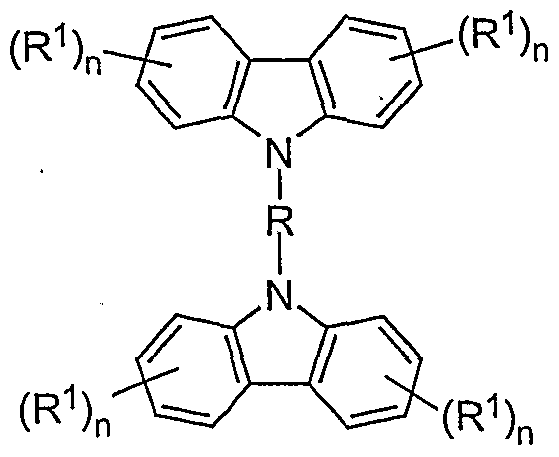


Priority Applications (5)
| Application Number | Priority Date | Filing Date | Title |
|---|---|---|---|
| CN2004800115160A CN1780897B (en) | 2003-06-26 | 2004-06-24 | New Electroluminescent Materials |
| DE502004008921T DE502004008921D1 (en) | 2003-06-26 | 2004-06-24 | NEW MATERIALS FOR ELECTROLUMINESCENCE |
| US10/561,739 US20060284140A1 (en) | 2003-06-26 | 2004-06-24 | Novel materials for electroluminescence |
| JP2006516042A JP4874792B2 (en) | 2003-06-26 | 2004-06-24 | New materials for electroluminescence |
| EP04740246A EP1641894B1 (en) | 2003-06-26 | 2004-06-24 | Novel materials for electroluminescence |
Applications Claiming Priority (2)
| Application Number | Priority Date | Filing Date | Title |
|---|---|---|---|
| DE10328627.6 | 2003-06-26 | ||
| DE10328627A DE10328627A1 (en) | 2003-06-26 | 2003-06-26 | New materials for electroluminescence |
Publications (1)
| Publication Number | Publication Date |
|---|---|
| WO2004113468A1 true WO2004113468A1 (en) | 2004-12-29 |
Family
ID=33520977
Family Applications (1)
| Application Number | Title | Priority Date | Filing Date |
|---|---|---|---|
| PCT/EP2004/006832 Ceased WO2004113468A1 (en) | 2003-06-26 | 2004-06-24 | Novel materials for electroluminescence |
Country Status (7)
| Country | Link |
|---|---|
| US (1) | US20060284140A1 (en) |
| EP (1) | EP1641894B1 (en) |
| JP (1) | JP4874792B2 (en) |
| KR (1) | KR20060073541A (en) |
| CN (1) | CN1780897B (en) |
| DE (2) | DE10328627A1 (en) |
| WO (1) | WO2004113468A1 (en) |
Cited By (271)
| Publication number | Priority date | Publication date | Assignee | Title |
|---|---|---|---|---|
| WO2005033118A1 (en) * | 2003-08-26 | 2005-04-14 | Idemitsu Kosan Co., Ltd. | Coordination metal compound, material for organic electroluminescence device, material for luminescent coating formation and organic electroluminescence device |
| WO2007022845A1 (en) | 2005-08-26 | 2007-03-01 | Merck Patent Gmbh | Novel materials for organic electroluminescent devices |
| EP1829871A1 (en) | 2004-12-24 | 2007-09-05 | Pioneer Corporation | Organic compound, charge-transporting material, and organic electroluminescent element |
| JP2007291191A (en) * | 2006-04-24 | 2007-11-08 | Sumitomo Chemical Co Ltd | Polymer light-emitting device, organic transistor and composition useful for them |
| DE102007024850A1 (en) | 2007-05-29 | 2008-12-04 | Merck Patent Gmbh | New materials for organic electroluminescent devices |
| JP2009013109A (en) * | 2007-07-04 | 2009-01-22 | Fuji Xerox Co Ltd | Carbazole-containing compound |
| DE102008015526A1 (en) | 2008-03-25 | 2009-10-01 | Merck Patent Gmbh | metal complexes |
| DE102008017591A1 (en) | 2008-04-07 | 2009-10-08 | Merck Patent Gmbh | New materials for organic electroluminescent devices |
| DE102008018670A1 (en) | 2008-04-14 | 2009-10-15 | Merck Patent Gmbh | New materials for organic electroluminescent devices |
| DE102008027005A1 (en) | 2008-06-05 | 2009-12-10 | Merck Patent Gmbh | Organic electronic device containing metal complexes |
| DE102008033943A1 (en) | 2008-07-18 | 2010-01-21 | Merck Patent Gmbh | New materials for organic electroluminescent devices |
| DE102008045662A1 (en) | 2008-09-03 | 2010-03-04 | Merck Patent Gmbh | Optoelectronic device useful as white light emitting organic light-emitting diode in display, comprises first layer comprising electrode material, second layer comprising polymer material on substrate, and polymer layers having emitter |
| DE102008044868A1 (en) | 2008-08-29 | 2010-03-04 | Merck Patent Gmbh | Electroluminescent polymers, process for their preparation and their use |
| DE102008045663A1 (en) | 2008-09-03 | 2010-03-04 | Merck Patent Gmbh | Fluorine-bridged associates for opto-electronic applications |
| DE102008045664A1 (en) | 2008-09-03 | 2010-03-04 | Merck Patent Gmbh | Optoelectronic device, useful e.g. as organic or polymer light-emitting diode, organic field-effect-transistor, organic constituent, organic field-quench element, comprises a layer comprising a polymer with fluorine-containing group |
| DE102008050841A1 (en) | 2008-10-08 | 2010-04-15 | Merck Patent Gmbh | New materials for organic electroluminescent devices |
| DE102008054141A1 (en) | 2008-10-31 | 2010-05-06 | Merck Patent Gmbh | New materials for organic electroluminescent devices |
| DE102008056688A1 (en) | 2008-11-11 | 2010-05-12 | Merck Patent Gmbh | Materials for organic electroluminescent devices |
| DE102008057050A1 (en) | 2008-11-13 | 2010-05-20 | Merck Patent Gmbh | Materials for organic electroluminescent devices |
| DE102008057051A1 (en) | 2008-11-13 | 2010-05-20 | Merck Patent Gmbh | Materials for organic electroluminescent devices |
| DE102009005289A1 (en) | 2009-01-20 | 2010-07-22 | Merck Patent Gmbh | Materials for organic electroluminescent devices |
| DE102009005288A1 (en) | 2009-01-20 | 2010-07-22 | Merck Patent Gmbh | Materials for organic electroluminescent devices |
| DE102009005746A1 (en) | 2009-01-23 | 2010-07-29 | Merck Patent Gmbh | Materials for organic electroluminescent devices |
| DE102009007038A1 (en) | 2009-02-02 | 2010-08-05 | Merck Patent Gmbh | metal complexes |
| DE102009009277A1 (en) | 2009-02-17 | 2010-08-19 | Merck Patent Gmbh | Organic electronic device |
| WO2010097155A1 (en) | 2009-02-27 | 2010-09-02 | Merck Patent Gmbh | Polymer having aldehyde groups, converting and cross-linking of said polymer, cross-linked polymer, and electroluminescent device comprising said polymer |
| WO2010097156A1 (en) | 2009-02-27 | 2010-09-02 | Merck Patent Gmbh | Cross-linkable and cross-linked polymers, method for the production thereof, and use thereof |
| DE102009010713A1 (en) | 2009-02-27 | 2010-09-02 | Merck Patent Gmbh | New polymer comprising structural unit which comprises the aldehyde groups, useful in preparing crosslinkable and crosslinked polymers which are useful in electronic devices, preferably organic electronic device |
| WO2010099852A1 (en) | 2009-03-02 | 2010-09-10 | Merck Patent Gmbh | Metal complexes having azaborol ligands and electronic device having the same |
| DE102009013041A1 (en) | 2009-03-13 | 2010-09-16 | Merck Patent Gmbh | Materials for organic electroluminescent devices |
| US7816531B2 (en) | 2004-07-16 | 2010-10-19 | Merck Patent Gmbh | Metal complexes |
| US7820305B2 (en) | 2004-07-06 | 2010-10-26 | Merck Patent Gmbh | Electroluminescent polymers |
| US7825249B2 (en) | 2004-05-19 | 2010-11-02 | Merck Patent Gmbh | Metal complexes |
| DE102009023156A1 (en) | 2009-05-29 | 2010-12-02 | Merck Patent Gmbh | Polymers containing substituted indenofluorene derivatives as a structural unit, process for their preparation and their use |
| DE102009030847A1 (en) | 2009-06-26 | 2010-12-30 | Merck Patent Gmbh | Polymers containing substituted Anthracenyleinheiten, blends containing these polymers and devices containing these polymers or blends |
| DE102009031021A1 (en) | 2009-06-30 | 2011-01-05 | Merck Patent Gmbh | Materials for organic electroluminescent devices |
| DE102009034194A1 (en) | 2009-07-22 | 2011-01-27 | Merck Patent Gmbh | Materials for electronic devices |
| DE102009030848A1 (en) | 2009-06-26 | 2011-02-03 | Merck Patent Gmbh | Polymers comprising structural units which have alkylalkoxy groups, blends containing these polymers and optoelectronic devices containing these polymers and blends |
| WO2011012212A1 (en) | 2009-07-27 | 2011-02-03 | Merck Patent Gmbh | Novel materials for organic electroluminescent devices |
| JP2011038103A (en) * | 2010-08-26 | 2011-02-24 | Sumitomo Chemical Co Ltd | Polymer compound and polymer light-emitting element using the same |
| WO2011032686A1 (en) | 2009-09-16 | 2011-03-24 | Merck Patent Gmbh | Formulas for producing electronic devices |
| DE102009042693A1 (en) | 2009-09-23 | 2011-03-24 | Merck Patent Gmbh | Materials for electronic devices |
| WO2011042107A2 (en) | 2009-10-08 | 2011-04-14 | Merck Patent Gmbh | Materials for organic electroluminescent devices |
| WO2011044988A1 (en) | 2009-10-16 | 2011-04-21 | Merck Patent Gmbh | Metal complexes |
| DE102009053191A1 (en) | 2009-11-06 | 2011-05-12 | Merck Patent Gmbh | Materials for electronic devices |
| DE102009052428A1 (en) | 2009-11-10 | 2011-05-12 | Merck Patent Gmbh | Connection for electronic devices |
| DE102009033371A1 (en) | 2009-07-16 | 2011-05-12 | Merck Patent Gmbh | Materials for electronic devices |
| WO2011057706A2 (en) | 2009-11-14 | 2011-05-19 | Merck Patent Gmbh | Materials for electronic devices |
| DE102009053644A1 (en) | 2009-11-17 | 2011-05-19 | Merck Patent Gmbh | Materials for organic electroluminescent devices |
| US7947382B2 (en) | 2004-04-26 | 2011-05-24 | Merck Patent Gmbh | Electroluminescent polymers and the use thereof |
| WO2011060867A1 (en) | 2009-11-18 | 2011-05-26 | Merck Patent Gmbh | Nitrogen-containing condensed heterocyclic compounds for oleds |
| DE102009023154A1 (en) | 2009-05-29 | 2011-06-16 | Merck Patent Gmbh | A composition comprising at least one emitter compound and at least one polymer having conjugation-interrupting units |
| DE102009059985A1 (en) | 2009-12-22 | 2011-07-07 | Merck Patent GmbH, 64293 | New polymer comprising structural unit which comprises the aldehyde groups, useful in preparing crosslinkable and crosslinked polymers which are useful in electronic devices, preferably organic electronic device |
| DE102010004803A1 (en) | 2010-01-16 | 2011-07-21 | Merck Patent GmbH, 64293 | Materials for organic electroluminescent devices |
| WO2011088877A1 (en) | 2010-01-25 | 2011-07-28 | Merck Patent Gmbh | Compounds for electronic devices |
| WO2011091838A1 (en) | 2010-01-29 | 2011-08-04 | Merck Patent Gmbh | Styrene-based copolymers, in particular for use in optoelectronic components |
| WO2011098205A1 (en) | 2010-02-12 | 2011-08-18 | Merck Patent Gmbh | Electroluminescent polymers, methods for producing same and use thereof |
| DE102010009903A1 (en) | 2010-03-02 | 2011-09-08 | Merck Patent Gmbh | Connections for electronic devices |
| DE102010012738A1 (en) | 2010-03-25 | 2011-09-29 | Merck Patent Gmbh | Materials for organic electroluminescent devices |
| WO2011116857A1 (en) | 2010-03-23 | 2011-09-29 | Merck Patent Gmbh | Materials for organic electroluminescent devices |
| US8038903B2 (en) | 2005-05-18 | 2011-10-18 | Merck Patent Gmbh | Organic semiconductor solutions |
| WO2011128017A1 (en) | 2010-04-14 | 2011-10-20 | Merck Patent Gmbh | Bridged triarylamines and -phosphines as materials for electronic devices |
| DE102010019306A1 (en) | 2010-05-04 | 2011-11-10 | Merck Patent Gmbh | Organic electroluminescent devices |
| WO2011137922A1 (en) | 2010-05-03 | 2011-11-10 | Merck Patent Gmbh | Formulations and electronic devices |
| DE102009022858A1 (en) | 2009-05-27 | 2011-12-15 | Merck Patent Gmbh | Organic electroluminescent devices |
| DE102010024542A1 (en) | 2010-06-22 | 2011-12-22 | Merck Patent Gmbh | Materials for electronic devices |
| DE102010024335A1 (en) | 2010-06-18 | 2011-12-22 | Merck Patent Gmbh | Connections for electronic devices |
| WO2011160758A1 (en) | 2010-06-24 | 2011-12-29 | Merck Patent Gmbh | Materials for organic electroluminescent devices |
| WO2012007087A1 (en) | 2010-07-16 | 2012-01-19 | Merck Patent Gmbh | Metal complexes |
| WO2012007102A1 (en) | 2010-07-16 | 2012-01-19 | Merck Patent Gmbh | Polymer materials for organic electroluminescent devices |
| WO2012013310A1 (en) | 2010-07-29 | 2012-02-02 | Merck Patent Gmbh | Polymers containing substituted benzodithiophene units, blends containing said polymers, and devices containing said polymers or blends |
| DE102010033080A1 (en) | 2010-08-02 | 2012-02-02 | Merck Patent Gmbh | Polymers with structural units that have electron transport properties |
| DE102010033548A1 (en) | 2010-08-05 | 2012-02-09 | Merck Patent Gmbh | Materials for electronic devices |
| DE102010045369A1 (en) | 2010-09-14 | 2012-03-15 | Merck Patent Gmbh | Materials for organic electroluminescent devices |
| DE102010048607A1 (en) | 2010-10-15 | 2012-04-19 | Merck Patent Gmbh | Connections for electronic devices |
| WO2012048900A1 (en) | 2010-10-14 | 2012-04-19 | Fraunhofer-Gesellschaft Zur Förderung Der Angewandten Forschung E.V. . | Materials for organic electroluminescence devices |
| WO2012048781A1 (en) | 2010-10-15 | 2012-04-19 | Merck Patent Gmbh | Triphenylene-based materials for organic electroluminescent devices |
| WO2012084114A1 (en) | 2010-12-23 | 2012-06-28 | Merck Patent Gmbh | Organic electroluminescent device |
| DE102010056151A1 (en) | 2010-12-28 | 2012-06-28 | Merck Patent Gmbh | Materials for organic electroluminescent devices |
| WO2012095143A1 (en) | 2011-01-13 | 2012-07-19 | Merck Patent Gmbh | Compounds for organic electroluminescent devices |
| DE102012000064A1 (en) | 2011-01-21 | 2012-07-26 | Merck Patent Gmbh | New heterocyclic compound excluding 9,10-dioxa-4b-aza-9a-phospha-indeno(1,2-a)indene and 9,10-dioxa-4b-aza-indeno(1,2-a)indene, useful e.g. as matrix material for fluorescent or phosphorescent emitters of electronic devices |
| EP2482159A2 (en) | 2011-01-28 | 2012-08-01 | Honeywell International, Inc. | Methods and reconfigurable systems to optimize the performance of a condition based health maintenance system |
| DE102011010841A1 (en) | 2011-02-10 | 2012-08-16 | Merck Patent Gmbh | (1,3) -dioxane-5-one compounds |
| WO2012110182A1 (en) | 2011-02-17 | 2012-08-23 | Merck Patent Gmbh | Compounds for electronic devices |
| WO2012139693A1 (en) | 2011-04-13 | 2012-10-18 | Merck Patent Gmbh | Compounds for electronic devices |
| WO2012139692A1 (en) | 2011-04-13 | 2012-10-18 | Merck Patent Gmbh | Materials for electronic devices |
| WO2012143079A1 (en) | 2011-04-18 | 2012-10-26 | Merck Patent Gmbh | Compounds for electronic devices |
| WO2012149992A1 (en) | 2011-05-04 | 2012-11-08 | Merck Patent Gmbh | Device for preserving fresh goods |
| WO2012149999A1 (en) | 2011-05-05 | 2012-11-08 | Merck Patent Gmbh | Compounds for electronic devices |
| WO2012150001A1 (en) | 2011-05-05 | 2012-11-08 | Merck Patent Gmbh | Compounds for electronic devices |
| WO2012171609A1 (en) | 2011-06-17 | 2012-12-20 | Merck Patent Gmbh | Materials for organic electroluminescent devices |
| WO2013013753A2 (en) | 2011-07-25 | 2013-01-31 | Merck Patent Gmbh | Polymers and oligomers with functionalized side groups |
| WO2013017189A1 (en) | 2011-07-29 | 2013-02-07 | Merck Patent Gmbh | Compounds for electronic devices |
| WO2013017192A1 (en) | 2011-08-03 | 2013-02-07 | Merck Patent Gmbh | Materials for electronic devices |
| US8415029B2 (en) * | 2004-12-29 | 2013-04-09 | Cambridge Display Technology Limited | Conjugated polymers prepared from rigid amines |
| DE102011116165A1 (en) | 2011-10-14 | 2013-04-18 | Merck Patent Gmbh | Benzodioxepin-3-one compounds |
| WO2013060411A1 (en) | 2011-10-28 | 2013-05-02 | Merck Patent Gmbh | Hyperbranched polymers, methods for producing same, and use of same in electronic devices |
| WO2013060418A1 (en) | 2011-10-27 | 2013-05-02 | Merck Patent Gmbh | Materials for electronic devices |
| WO2013083216A1 (en) | 2011-11-17 | 2013-06-13 | Merck Patent Gmbh | Spiro dihydroacridine derivatives and the use thereof as materials for organic electroluminescence devices |
| WO2013087142A1 (en) | 2011-12-12 | 2013-06-20 | Merck Patent Gmbh | Compounds for electronic devices |
| DE102012022880A1 (en) | 2011-12-22 | 2013-06-27 | Merck Patent Gmbh | Electronic device e.g. organic integrated circuits, organic field-effect transistors, organic thin-film transistors, organic light emitting transistors, comprises an organic layer comprising substituted heteroaryl compounds |
| WO2013100507A1 (en) * | 2011-12-28 | 2013-07-04 | 주식회사 두산 | Novel compound and organic electroluminescence device including same |
| WO2013120577A1 (en) | 2012-02-14 | 2013-08-22 | Merck Patent Gmbh | Spirobifluorene compounds for organic electroluminescent devices |
| WO2013124029A2 (en) | 2012-02-22 | 2013-08-29 | Merck Patent Gmbh | Polymers containing dibenzocycloheptene structural units |
| WO2013139431A1 (en) | 2012-03-23 | 2013-09-26 | Merck Patent Gmbh | 9,9'-spirobixanthene derivatives for electroluminescent devices |
| WO2013156129A1 (en) | 2012-04-17 | 2013-10-24 | Merck Patent Gmbh | Polymers containing substituted oligo-triarylamine units and electroluminescence devices containing such polymers |
| DE102012011335A1 (en) | 2012-06-06 | 2013-12-12 | Merck Patent Gmbh | Connections for Organic Electronic Devices |
| WO2014000860A1 (en) | 2012-06-29 | 2014-01-03 | Merck Patent Gmbh | Polymers containing 2,7-pyrene structure units |
| WO2014008982A1 (en) | 2012-07-13 | 2014-01-16 | Merck Patent Gmbh | Metal complexes |
| US8637853B2 (en) | 2007-10-24 | 2014-01-28 | Merck Patent Gmbh | Optoelectronic device |
| WO2014015935A2 (en) | 2012-07-23 | 2014-01-30 | Merck Patent Gmbh | Compounds and organic electronic devices |
| WO2014015938A1 (en) | 2012-07-23 | 2014-01-30 | Merck Patent Gmbh | Derivatives of 2-diarylaminofluorene and organic electronic compounds containing them |
| WO2014015937A1 (en) | 2012-07-23 | 2014-01-30 | Merck Patent Gmbh | Compounds and organic electroluminescent devices |
| WO2014023377A2 (en) | 2012-08-07 | 2014-02-13 | Merck Patent Gmbh | Metal complexes |
| WO2014044347A1 (en) | 2012-09-20 | 2014-03-27 | Merck Patent Gmbh | Metal complexes |
| WO2014082705A1 (en) | 2012-11-30 | 2014-06-05 | Merck Patent Gmbh | Electronic device |
| WO2014101981A1 (en) | 2012-12-28 | 2014-07-03 | Merck Patent Gmbh | Composition comprising polymeric organic semiconducting compounds |
| WO2014106522A1 (en) | 2013-01-03 | 2014-07-10 | Merck Patent Gmbh | Materials for electronic devices |
| WO2014106524A2 (en) | 2013-01-03 | 2014-07-10 | Merck Patent Gmbh | Materials for electronic devices |
| FR3001730A1 (en) * | 2013-02-07 | 2014-08-08 | Commissariat Energie Atomique | NOVEL METALLOPOLYMERS AND THEIR USE |
| US8865321B2 (en) | 2008-11-11 | 2014-10-21 | Merck Patent Gmbh | Organic electroluminescent devices |
| WO2015086108A1 (en) | 2013-12-12 | 2015-06-18 | Merck Patent Gmbh | Materials for electronic devices |
| WO2015090504A2 (en) | 2013-12-19 | 2015-06-25 | Merck Patent Gmbh | Heterocyclic spiro compounds |
| US9078330B2 (en) | 2005-03-15 | 2015-07-07 | Isis Innovation Limited | Highly branched dendrimers |
| WO2016034262A1 (en) | 2014-09-05 | 2016-03-10 | Merck Patent Gmbh | Formulations and electronic devices |
| WO2016074755A1 (en) | 2014-11-11 | 2016-05-19 | Merck Patent Gmbh | Materials for organic electroluminescent devices |
| WO2016107663A1 (en) | 2014-12-30 | 2016-07-07 | Merck Patent Gmbh | Formulations and electronic devices |
| WO2016119992A1 (en) | 2015-01-30 | 2016-08-04 | Merck Patent Gmbh | Materials for electronic devices |
| WO2016120007A1 (en) | 2015-01-30 | 2016-08-04 | Merck Patent Gmbh | Formulations with a low particle content |
| WO2016124304A1 (en) | 2015-02-03 | 2016-08-11 | Merck Patent Gmbh | Metal complexes |
| WO2016155866A1 (en) | 2015-03-30 | 2016-10-06 | Merck Patent Gmbh | Formulation of an organic functional material comprising a siloxane solvent |
| WO2016198144A1 (en) | 2015-06-10 | 2016-12-15 | Merck Patent Gmbh | Materials for organic electroluminescent devices |
| WO2016198141A1 (en) | 2015-06-12 | 2016-12-15 | Merck Patent Gmbh | Esters containing non-aromatic cycles as solvents for oled formulations |
| WO2017008883A1 (en) | 2015-07-15 | 2017-01-19 | Merck Patent Gmbh | Composition comprising organic semiconducting compounds |
| WO2017012694A1 (en) | 2015-07-23 | 2017-01-26 | Merck Patent Gmbh | Phenyl derivatives substituted with at least two electron acceptors and at least two electron donors for use in organic electronic devices |
| WO2017012687A1 (en) | 2015-07-22 | 2017-01-26 | Merck Patent Gmbh | Materials for organic electroluminescent devices |
| WO2017016630A1 (en) | 2015-07-30 | 2017-02-02 | Merck Patent Gmbh | Materials for organic electroluminescent devices |
| WO2017028940A1 (en) | 2015-08-14 | 2017-02-23 | Merck Patent Gmbh | Phenoxazine derivatives for organic electroluminescent devices |
| WO2017036572A1 (en) | 2015-08-28 | 2017-03-09 | Merck Patent Gmbh | Formulation of an organic functional material comprising an epoxy group containing solvent |
| WO2017036573A1 (en) | 2015-08-28 | 2017-03-09 | Merck Patent Gmbh | Compounds for electronic devices |
| WO2017097391A1 (en) | 2015-12-10 | 2017-06-15 | Merck Patent Gmbh | Formulations containing ketones comprising non-aromatic cycles |
| WO2017102049A1 (en) | 2015-12-16 | 2017-06-22 | Merck Patent Gmbh | Formulations containing a mixture of at least two different solvents |
| WO2017102052A1 (en) | 2015-12-16 | 2017-06-22 | Merck Patent Gmbh | Formulations containing a solid solvent |
| WO2017102048A1 (en) | 2015-12-15 | 2017-06-22 | Merck Patent Gmbh | Esters containing aromatic groups as solvents for organic electronic formulations |
| WO2017133829A1 (en) | 2016-02-05 | 2017-08-10 | Merck Patent Gmbh | Materials for electronic devices |
| WO2017140404A1 (en) | 2016-02-17 | 2017-08-24 | Merck Patent Gmbh | Formulation of an organic functional material |
| WO2017157983A1 (en) | 2016-03-17 | 2017-09-21 | Merck Patent Gmbh | Compounds with spirobifluorene-structures |
| DE102016003104A1 (en) | 2016-03-15 | 2017-09-21 | Merck Patent Gmbh | Container comprising a formulation containing at least one organic semiconductor |
| WO2017178311A1 (en) | 2016-04-11 | 2017-10-19 | Merck Patent Gmbh | Heterocyclic compounds comprising dibenzofuran and/or dibenzothiophene structures |
| WO2017207596A1 (en) | 2016-06-03 | 2017-12-07 | Merck Patent Gmbh | Materials for organic electroluminescent devices |
| WO2017216129A1 (en) | 2016-06-16 | 2017-12-21 | Merck Patent Gmbh | Formulation of an organic functional material |
| WO2017216128A1 (en) | 2016-06-17 | 2017-12-21 | Merck Patent Gmbh | Formulation of an organic functional material |
| WO2018001928A1 (en) | 2016-06-28 | 2018-01-04 | Merck Patent Gmbh | Formulation of an organic functional material |
| WO2018001990A1 (en) | 2016-06-30 | 2018-01-04 | Merck Patent Gmbh | Method for the separation of enantiomeric mixtures from metal complexes |
| WO2018007421A1 (en) | 2016-07-08 | 2018-01-11 | Merck Patent Gmbh | Materials for organic electroluminescent devices |
| WO2018011186A1 (en) | 2016-07-14 | 2018-01-18 | Merck Patent Gmbh | Metal complexes |
| WO2018024719A1 (en) | 2016-08-04 | 2018-02-08 | Merck Patent Gmbh | Formulation of an organic functional material |
| WO2018050583A1 (en) | 2016-09-14 | 2018-03-22 | Merck Patent Gmbh | Compounds with carbazole structures |
| WO2018050584A1 (en) | 2016-09-14 | 2018-03-22 | Merck Patent Gmbh | Compounds with spirobifluorene-structures |
| WO2018060218A1 (en) | 2016-09-30 | 2018-04-05 | Merck Patent Gmbh | Carbazoles with diazadibenzofurane or diazadibenzothiophene structures |
| WO2018060307A1 (en) | 2016-09-30 | 2018-04-05 | Merck Patent Gmbh | Compounds with diazadibenzofurane or diazadibenzothiophene structures |
| WO2018069167A1 (en) | 2016-10-10 | 2018-04-19 | Merck Patent Gmbh | Electronic device |
| WO2018077660A1 (en) | 2016-10-31 | 2018-05-03 | Merck Patent Gmbh | Formulation of an organic functional material |
| WO2018077662A1 (en) | 2016-10-31 | 2018-05-03 | Merck Patent Gmbh | Formulation of an organic functional material |
| WO2018083053A1 (en) | 2016-11-02 | 2018-05-11 | Merck Patent Gmbh | Materials for electronic devices |
| WO2018087346A1 (en) | 2016-11-14 | 2018-05-17 | Merck Patent Gmbh | Compounds with an acceptor and a donor group |
| WO2018087020A1 (en) | 2016-11-08 | 2018-05-17 | Merck Patent Gmbh | Compounds for electronic devices |
| WO2018095888A1 (en) | 2016-11-25 | 2018-05-31 | Merck Patent Gmbh | Bisbenzofuran-fused 2,8-diaminoindeno[1,2-b]fluorene derivatives and related compounds as materials for organic electroluminescent devices (oled) |
| WO2018095940A1 (en) | 2016-11-25 | 2018-05-31 | Merck Patent Gmbh | Bisbenzofuran-fused indeno[1,2-b]fluorene derivatives and related compounds as materials for organic electroluminescent devices (oled) |
| WO2018095839A1 (en) | 2016-11-22 | 2018-05-31 | Merck Patent Gmbh | Bridged triarylamines for electronic devices |
| WO2018099846A1 (en) | 2016-11-30 | 2018-06-07 | Merck Patent Gmbh | Compounds having valerolactam structures |
| WO2018099847A1 (en) | 2016-11-30 | 2018-06-07 | Merck Patent Gmbh | Polymers with asymmetric repeating units |
| WO2018104195A1 (en) | 2016-12-05 | 2018-06-14 | Merck Patent Gmbh | Nitrogen-containing heterocycles for use in oleds |
| WO2018104202A1 (en) | 2016-12-06 | 2018-06-14 | Merck Patent Gmbh | Preparation process for an electronic device |
| WO2018108760A1 (en) | 2016-12-13 | 2018-06-21 | Merck Patent Gmbh | Formulation of an organic functional material |
| WO2018114883A1 (en) | 2016-12-22 | 2018-06-28 | Merck Patent Gmbh | Mixtures comprising at least two organofunctional compounds |
| EP3345984A1 (en) | 2013-12-06 | 2018-07-11 | Merck Patent GmbH | Connections and organic electronic devices |
| WO2018134392A1 (en) | 2017-01-23 | 2018-07-26 | Merck Patent Gmbh | Materials for organic electroluminescent devices |
| WO2018138039A1 (en) | 2017-01-25 | 2018-08-02 | Merck Patent Gmbh | Carbazole derivatives |
| WO2018138318A1 (en) | 2017-01-30 | 2018-08-02 | Merck Patent Gmbh | Method for forming an organic element of an electronic device |
| WO2018138319A1 (en) | 2017-01-30 | 2018-08-02 | Merck Patent Gmbh | Method for forming an organic electroluminescence (el) element |
| WO2018141706A1 (en) | 2017-02-02 | 2018-08-09 | Merck Patent Gmbh | Materials for electronic devices |
| WO2018157981A1 (en) | 2017-03-02 | 2018-09-07 | Merck Patent Gmbh | Materials for organic electronic devices |
| WO2018166932A1 (en) | 2017-03-13 | 2018-09-20 | Merck Patent Gmbh | Compounds with arylamine structures |
| EP3378857A1 (en) | 2012-11-12 | 2018-09-26 | Merck Patent GmbH | Materials for electronic devices |
| WO2018178136A1 (en) | 2017-03-31 | 2018-10-04 | Merck Patent Gmbh | Printing method for an organic light emitting diode (oled) |
| WO2018189050A1 (en) | 2017-04-10 | 2018-10-18 | Merck Patent Gmbh | Formulation of an organic functional material |
| WO2018197447A1 (en) | 2017-04-25 | 2018-11-01 | Merck Patent Gmbh | Compounds for electronic devices |
| WO2018202603A1 (en) | 2017-05-03 | 2018-11-08 | Merck Patent Gmbh | Formulation of an organic functional material |
| WO2018215318A1 (en) | 2017-05-22 | 2018-11-29 | Merck Patent Gmbh | Hexacyclic heteroaromatic compounds for electronic devices |
| WO2018234220A1 (en) | 2017-06-21 | 2018-12-27 | Merck Patent Gmbh | MATERIALS FOR ELECTRONIC DEVICES |
| WO2018234346A1 (en) | 2017-06-23 | 2018-12-27 | Merck Patent Gmbh | MATERIALS FOR ORGANIC ELECTROLUMINESCENT DEVICES |
| WO2019002190A1 (en) | 2017-06-28 | 2019-01-03 | Merck Patent Gmbh | Materials for electronic devices |
| WO2019007823A1 (en) | 2017-07-03 | 2019-01-10 | Merck Patent Gmbh | Formulations with a low content of phenol type impurities |
| WO2019016184A1 (en) | 2017-07-18 | 2019-01-24 | Merck Patent Gmbh | Formulation of an organic functional material |
| WO2019020654A1 (en) | 2017-07-28 | 2019-01-31 | Merck Patent Gmbh | Spirobifluorene derivatives for use in electronic devices |
| WO2019048443A1 (en) | 2017-09-08 | 2019-03-14 | Merck Patent Gmbh | Materials for electronic devices |
| WO2019101719A1 (en) | 2017-11-23 | 2019-05-31 | Merck Patent Gmbh | Materials for electronic devices |
| WO2019115573A1 (en) | 2017-12-15 | 2019-06-20 | Merck Patent Gmbh | Formulation of an organic functional material |
| WO2019115577A1 (en) | 2017-12-15 | 2019-06-20 | Merck Patent Gmbh | Substituted aromatic amines for use in organic electroluminescent devices |
| WO2019121483A1 (en) | 2017-12-20 | 2019-06-27 | Merck Patent Gmbh | Heteroaromatic compounds |
| WO2019121458A1 (en) | 2017-12-19 | 2019-06-27 | Merck Patent Gmbh | Heterocyclic compound for use in electronic devices |
| WO2019162483A1 (en) | 2018-02-26 | 2019-08-29 | Merck Patent Gmbh | Formulation of an organic functional material |
| WO2019175149A1 (en) | 2018-03-16 | 2019-09-19 | Merck Patent Gmbh | Materials for organic electroluminescent devices |
| WO2019238782A1 (en) | 2018-06-15 | 2019-12-19 | Merck Patent Gmbh | Formulation of an organic functional material |
| WO2020064666A1 (en) | 2018-09-27 | 2020-04-02 | Merck Patent Gmbh | Compounds that can be used in an organic electronic device as active compounds |
| WO2020064662A2 (en) | 2018-09-27 | 2020-04-02 | Merck Patent Gmbh | Method for producing sterically hindered, nitrogen-containing heteroaromatic compounds |
| WO2020064582A1 (en) | 2018-09-24 | 2020-04-02 | Merck Patent Gmbh | Method for the production of a granular material |
| WO2020094537A1 (en) | 2018-11-07 | 2020-05-14 | Merck Patent Gmbh | Polymers with amine-group-containing repeating units |
| WO2020094539A1 (en) | 2018-11-05 | 2020-05-14 | Merck Patent Gmbh | Compounds that can be used in an organic electronic device |
| WO2020094538A1 (en) | 2018-11-06 | 2020-05-14 | Merck Patent Gmbh | Method for forming an organic element of an electronic device |
| WO2020099349A1 (en) | 2018-11-14 | 2020-05-22 | Merck Patent Gmbh | Compounds that can be used for producing an organic electronic device |
| WO2020212295A1 (en) | 2019-04-16 | 2020-10-22 | Merck Patent Gmbh | Formulation containing a crosslinkable polymer |
| US10862046B2 (en) | 2017-03-30 | 2020-12-08 | Universal Display Corporation | Organic electroluminescent materials and devices |
| US10862038B2 (en) | 2014-12-30 | 2020-12-08 | Merck Patent Gmbh | Compositions comprising at least one polymer and at least one salt, and electroluminescent devices containing said compositions |
| WO2021078710A1 (en) | 2019-10-22 | 2021-04-29 | Merck Patent Gmbh | Materials for organic electroluminescent devices |
| WO2021078831A1 (en) | 2019-10-25 | 2021-04-29 | Merck Patent Gmbh | Compounds that can be used in an organic electronic device |
| WO2021122740A1 (en) | 2019-12-19 | 2021-06-24 | Merck Patent Gmbh | Polycyclic compounds for organic electroluminescent devices |
| WO2021122538A1 (en) | 2019-12-18 | 2021-06-24 | Merck Patent Gmbh | Aromatic compounds for organic electroluminescent devices |
| WO2021151922A1 (en) | 2020-01-29 | 2021-08-05 | Merck Patent Gmbh | Benzimidazole derivatives |
| WO2021170522A1 (en) | 2020-02-25 | 2021-09-02 | Merck Patent Gmbh | Use of heterocyclic compounds in an organic electronic device |
| WO2021175706A1 (en) | 2020-03-02 | 2021-09-10 | Merck Patent Gmbh | Use of sulfone compounds in an organic electronic device |
| WO2021185829A1 (en) | 2020-03-17 | 2021-09-23 | Merck Patent Gmbh | Heterocyclic compounds for organic electroluminescent devices |
| WO2021185712A1 (en) | 2020-03-17 | 2021-09-23 | Merck Patent Gmbh | Heteroaromatic compounds for organic electroluminescent devices |
| WO2021191183A1 (en) | 2020-03-26 | 2021-09-30 | Merck Patent Gmbh | Cyclic compounds for organic electroluminescent devices |
| WO2021204646A1 (en) | 2020-04-06 | 2021-10-14 | Merck Patent Gmbh | Polycyclic compounds for organic electroluminescent devices |
| WO2021211066A1 (en) * | 2020-04-17 | 2021-10-21 | Irpc Public Company Limited | Fluorene derivatives, polymers obtained from said fluorene derivatives and method for preparing the same |
| WO2021213918A1 (en) | 2020-04-21 | 2021-10-28 | Merck Patent Gmbh | Formulation of an organic functional material |
| EP3904361A2 (en) | 2013-10-02 | 2021-11-03 | Merck Patent GmbH | Boron containing compounds |
| WO2021254984A1 (en) | 2020-06-18 | 2021-12-23 | Merck Patent Gmbh | Indenoazanaphthalenes |
| WO2021259824A1 (en) | 2020-06-23 | 2021-12-30 | Merck Patent Gmbh | Method for producing a mixture |
| WO2022002772A1 (en) | 2020-06-29 | 2022-01-06 | Merck Patent Gmbh | Heteroaromatic compounds for organic electroluminescent devices |
| WO2022002771A1 (en) | 2020-06-29 | 2022-01-06 | Merck Patent Gmbh | Heterocyclic compounds for organic electroluminescent devices |
| WO2022069421A1 (en) | 2020-09-30 | 2022-04-07 | Merck Patent Gmbh | Compounds that can be used for structuring functional layers of organic electroluminescent devices |
| WO2022069422A1 (en) | 2020-09-30 | 2022-04-07 | Merck Patent Gmbh | Compounds for structuring functional layers of organic electroluminescent devices |
| WO2022079067A1 (en) | 2020-10-16 | 2022-04-21 | Merck Patent Gmbh | Compounds comprising heteroatoms for organic electroluminescent devices |
| WO2022079068A1 (en) | 2020-10-16 | 2022-04-21 | Merck Patent Gmbh | Heterocyclic compounds for organic electroluminescent devices |
| WO2022122607A1 (en) | 2020-12-08 | 2022-06-16 | Merck Patent Gmbh | An ink system and a method for inkjet printing |
| WO2022129116A1 (en) | 2020-12-18 | 2022-06-23 | Merck Patent Gmbh | Indolo[3.2.1-jk]carbazole-6-carbonitrile derivatives as blue fluorescent emitters for use in oleds |
| WO2022129114A1 (en) | 2020-12-18 | 2022-06-23 | Merck Patent Gmbh | Nitrogenous compounds for organic electroluminescent devices |
| WO2022129113A1 (en) | 2020-12-18 | 2022-06-23 | Merck Patent Gmbh | Nitrogenous heteroaromatic compounds for organic electroluminescent devices |
| WO2022223675A1 (en) | 2021-04-23 | 2022-10-27 | Merck Patent Gmbh | Formulation of an organic functional material |
| WO2022229234A1 (en) | 2021-04-30 | 2022-11-03 | Merck Patent Gmbh | Nitrogenous heterocyclic compounds for organic electroluminescent devices |
| WO2022243403A1 (en) | 2021-05-21 | 2022-11-24 | Merck Patent Gmbh | Method for the continuous purification of at least one functional material and device for the continuous purification of at least one functional material |
| WO2023041454A1 (en) | 2021-09-14 | 2023-03-23 | Merck Patent Gmbh | Boronic heterocyclic compounds for organic electroluminescent devices |
| WO2023057327A1 (en) | 2021-10-05 | 2023-04-13 | Merck Patent Gmbh | Method for forming an organic element of an electronic device |
| WO2023072799A1 (en) | 2021-10-27 | 2023-05-04 | Merck Patent Gmbh | Boronic and nitrogenous heterocyclic compounds for organic electroluminescent devices |
| WO2023099543A1 (en) | 2021-11-30 | 2023-06-08 | Merck Patent Gmbh | Compounds having fluorene structures |
| EP4236652A2 (en) | 2015-07-29 | 2023-08-30 | Merck Patent GmbH | Materials for organic electroluminescent devices |
| WO2023161168A1 (en) | 2022-02-23 | 2023-08-31 | Merck Patent Gmbh | Aromatic hetreocycles for organic electroluminescent devices |
| WO2023161167A1 (en) | 2022-02-23 | 2023-08-31 | Merck Patent Gmbh | Nitrogenous heterocycles for organic electroluminescent devices |
| WO2023213759A1 (en) | 2022-05-04 | 2023-11-09 | Merck Patent Gmbh | Polymers containing specially substituted triarylamine units and electroluminescent devices containing said polymers |
| WO2023213837A1 (en) | 2022-05-06 | 2023-11-09 | Merck Patent Gmbh | Cyclic compounds for organic electroluminescent devices |
| WO2023247345A1 (en) | 2022-06-20 | 2023-12-28 | Merck Patent Gmbh | Heterocycles for photoelectric devices |
| WO2023247338A1 (en) | 2022-06-20 | 2023-12-28 | Merck Patent Gmbh | Organic heterocycles for photoelectric devices |
| WO2024061942A1 (en) | 2022-09-22 | 2024-03-28 | Merck Patent Gmbh | Nitrogen-containing compounds for organic electroluminescent devices |
| WO2024061948A1 (en) | 2022-09-22 | 2024-03-28 | Merck Patent Gmbh | Nitrogen-containing hetreocycles for organic electroluminescent devices |
| WO2024094592A2 (en) | 2022-11-01 | 2024-05-10 | Merck Patent Gmbh | Nitrogenous heterocycles for organic electroluminescent devices |
| WO2024115426A1 (en) | 2022-12-01 | 2024-06-06 | Merck Patent Gmbh | Polymers containing spirotruxene derivatives as the repeating units, and electroluminescent devices containing said polymers |
| WO2024126635A1 (en) | 2022-12-16 | 2024-06-20 | Merck Patent Gmbh | Formulation of an organic functional material |
| WO2024149694A1 (en) | 2023-01-10 | 2024-07-18 | Merck Patent Gmbh | Nitrogenous heterocycles for organic electroluminescent devices |
| WO2024153568A1 (en) | 2023-01-17 | 2024-07-25 | Merck Patent Gmbh | Heterocycles for organic electroluminescent devices |
| WO2024184050A1 (en) | 2023-03-07 | 2024-09-12 | Merck Patent Gmbh | Cyclic nitrogen compounds for organic electroluminescent devices |
| WO2025003084A1 (en) | 2023-06-28 | 2025-01-02 | Merck Patent Gmbh | Dicyanoaryl compounds for organic electroluminescent devices |
| WO2025032039A1 (en) | 2023-08-07 | 2025-02-13 | Merck Patent Gmbh | Process for the preparation of an electronic device |
| WO2025045935A1 (en) | 2023-08-31 | 2025-03-06 | Merck Patent Gmbh | Cyano group-containing aromatic compounds for organic electroluminescent devices |
| WO2025109056A1 (en) | 2023-11-24 | 2025-05-30 | Merck Patent Gmbh | Oxygen-containing heterocycles for organic electroluminescent devices |
| WO2025181124A1 (en) | 2024-03-01 | 2025-09-04 | Merck Patent Gmbh | Materials for organic electroluminescent devices |
| WO2025181044A1 (en) | 2024-02-29 | 2025-09-04 | Merck Patent Gmbh | Nitrogen-containing compounds for organic electroluminescent devices |
| WO2025181097A1 (en) | 2024-02-29 | 2025-09-04 | Merck Patent Gmbh | Nitrogen-containing hetreocycles for organic electroluminescent devices |
| WO2026008710A1 (en) | 2024-07-05 | 2026-01-08 | Merck Patent Gmbh | Cyclic silicon compounds for organic electroluminescent devices |
Families Citing this family (52)
| Publication number | Priority date | Publication date | Assignee | Title |
|---|---|---|---|---|
| DE10310887A1 (en) | 2003-03-11 | 2004-09-30 | Covion Organic Semiconductors Gmbh | Matallkomplexe |
| DE10337077A1 (en) | 2003-08-12 | 2005-03-10 | Covion Organic Semiconductors | Conjugated copolymers, their preparation and use |
| DE10337346A1 (en) * | 2003-08-12 | 2005-03-31 | Covion Organic Semiconductors Gmbh | Conjugated polymers containing dihydrophenanthrene units and their use |
| US7659540B2 (en) | 2003-10-22 | 2010-02-09 | Merck Patent Gmbh | Materials for electroluminescence and the utilization thereof |
| DE10350722A1 (en) | 2003-10-30 | 2005-05-25 | Covion Organic Semiconductors Gmbh | metal complexes |
| TW200619300A (en) * | 2004-08-31 | 2006-06-16 | Sumitomo Chemical Co | Luminescent-polymer composition and luminescent -polymer device |
| JP4982984B2 (en) * | 2004-08-31 | 2012-07-25 | 住友化学株式会社 | Polymer light emitter composition and polymer light emitting device |
| GB2437899B (en) * | 2005-03-04 | 2010-12-29 | Sumitomo Chemical Co | Dicarbazole aromatic amine polymers and electronic devices |
| DE102005037734B4 (en) * | 2005-08-10 | 2018-02-08 | Merck Patent Gmbh | Electroluminescent polymers, their use and bifunctional monomeric compounds |
| DE102006003710A1 (en) * | 2006-01-26 | 2007-08-02 | Merck Patent Gmbh | New polymer containing an unit exhibiting electron injection and -conducting characteristics, useful for the preparation of a solution and formulation, and in an organic electronic devices, preferably organic optoelectronic device |
| DE102006031991A1 (en) | 2006-07-11 | 2008-01-17 | Merck Patent Gmbh | Electroluminescent polymers and their use |
| DE102006061909A1 (en) * | 2006-12-21 | 2008-06-26 | Samsung SDI Co., Ltd., Suwon | Emitter layer for organic light emitting diode, has metal-organic triplet emitter, which is transferred from base condition in triplet exiton by energy absorption |
| KR101554751B1 (en) | 2007-06-01 | 2015-09-22 | 이 아이 듀폰 디 네모아 앤드 캄파니 | Green luminous material |
| JP5292394B2 (en) * | 2007-06-01 | 2013-09-18 | イー・アイ・デュポン・ドウ・ヌムール・アンド・カンパニー | Blue light emitting material |
| JP5401448B2 (en) * | 2007-06-01 | 2014-01-29 | イー・アイ・デュポン・ドウ・ヌムール・アンド・カンパニー | Chrysene for deep blue light emitting applications |
| KR20100024451A (en) * | 2007-06-01 | 2010-03-05 | 이 아이 듀폰 디 네모아 앤드 캄파니 | Chrysenes for green luminescent applications |
| WO2009155595A2 (en) * | 2008-06-20 | 2009-12-23 | Tempur-Pedic Management, Inc. | Inflatable mattress and method of operating same |
| DE102008049037A1 (en) | 2008-09-25 | 2010-04-22 | Merck Patent Gmbh | New polymers with low polydispersity |
| US8263973B2 (en) | 2008-12-19 | 2012-09-11 | E I Du Pont De Nemours And Company | Anthracene compounds for luminescent applications |
| US8531100B2 (en) | 2008-12-22 | 2013-09-10 | E I Du Pont De Nemours And Company | Deuterated compounds for luminescent applications |
| US8759818B2 (en) | 2009-02-27 | 2014-06-24 | E I Du Pont De Nemours And Company | Deuterated compounds for electronic applications |
| JP5567656B2 (en) | 2009-04-03 | 2014-08-06 | イー・アイ・デュポン・ドウ・ヌムール・アンド・カンパニー | Electroactive materials |
| EP2462203B1 (en) | 2009-08-04 | 2016-03-02 | Merck Patent GmbH | Electronic devices comprising multi cyclic hydrocarbons |
| JP5567675B2 (en) * | 2009-08-13 | 2014-08-06 | イー・アイ・デュポン・ドウ・ヌムール・アンド・カンパニー | Chrysene derivative material |
| JP5715142B2 (en) | 2009-09-29 | 2015-05-07 | イー・アイ・デュポン・ドウ・ヌムール・アンド・カンパニーE.I.Du Pont De Nemours And Company | Deuterium compounds for luminescence applications |
| US20110101312A1 (en) | 2009-10-29 | 2011-05-05 | E. I. Du Pont De Nemours And Company | Deuterated compounds for electronic applications |
| US8617720B2 (en) | 2009-12-21 | 2013-12-31 | E I Du Pont De Nemours And Company | Electroactive composition and electronic device made with the composition |
| WO2011076323A1 (en) | 2009-12-22 | 2011-06-30 | Merck Patent Gmbh | Formulations comprising phase-separated functional materials |
| JP5897472B2 (en) | 2009-12-22 | 2016-03-30 | メルク パテント ゲーエムベーハー | Electroluminescent functional surfactant |
| EP2517278B1 (en) | 2009-12-22 | 2019-07-17 | Merck Patent GmbH | Electroluminescent formulations |
| KR101736973B1 (en) * | 2010-01-15 | 2017-05-17 | 삼성전자주식회사 | Polymer and organic light emitting diode comprising the same |
| WO2011110277A1 (en) | 2010-03-11 | 2011-09-15 | Merck Patent Gmbh | Fibers in therapy and cosmetics |
| US9373807B2 (en) | 2010-03-11 | 2016-06-21 | Merck Patent Gmbh | Radiative fibers |
| KR101007516B1 (en) * | 2010-04-23 | 2011-01-14 | 주식회사 이엘엠 | Organic electroluminescent composition and organic electroluminescent device comprising same |
| WO2011138889A1 (en) * | 2010-05-07 | 2011-11-10 | 住友化学株式会社 | Organic photoelectric conversion element |
| WO2011147521A1 (en) | 2010-05-27 | 2011-12-01 | Merck Patent Gmbh | Down conversion |
| EP2576723B1 (en) | 2010-05-27 | 2017-09-20 | Merck Patent GmbH | Compositions comprising quantum dots |
| WO2012087955A1 (en) | 2010-12-20 | 2012-06-28 | E. I. Du Pont De Nemours And Company | Compositions for electronic applications |
| US9676900B2 (en) | 2011-01-31 | 2017-06-13 | Cambridge Display Technology, Ltd. | Fluorene containing copolymer used in light emitting devices |
| US8940411B2 (en) * | 2011-04-25 | 2015-01-27 | General Electric Company | Materials for optoelectronic devices |
| US9923141B2 (en) * | 2011-10-19 | 2018-03-20 | Idemitsu Kosan Co., Ltd. | Carbazole-based polymer and organic electroluminescence element using same |
| KR101497133B1 (en) * | 2011-12-23 | 2015-02-27 | 제일모직 주식회사 | Compound for organic OPTOELECTRONIC device, ORGANIC LIGHT EMITTING DIODE INCLUDING THE SAME and DISPLAY INCLUDING THE organic LIGHT EMITTING DIODE |
| CN103304779B (en) * | 2012-03-15 | 2016-01-20 | 国家纳米科学中心 | A kind of polycarbazole polymkeric substance and its preparation method and application |
| DE102015108016A1 (en) * | 2015-01-20 | 2016-07-21 | Cynora Gmbh | Organic molecules, in particular for use in optoelectronic components |
| GB2545497A (en) * | 2015-12-18 | 2017-06-21 | Cambridge Display Tech Ltd | Polymer |
| KR20180113659A (en) * | 2017-04-06 | 2018-10-17 | 삼성디스플레이 주식회사 | Light emission material and organic electroluminescence device including the same |
| CN108559484B (en) * | 2018-01-15 | 2019-08-02 | 太原理工大学 | A kind of alkyl bromide is for carbazole derivates room temperature phosphorimetry material and its preparation and application |
| KR102471152B1 (en) | 2019-01-10 | 2022-11-24 | 삼성에스디아이 주식회사 | Compound for organic optoelectronic device, composition for organic optoelectronic device and organic optoelectronic device and display device |
| CN110981889A (en) * | 2019-12-11 | 2020-04-10 | 北京大学深圳研究生院 | A kind of hole transport material and its preparation method and application |
| EP4139971A1 (en) | 2020-04-21 | 2023-03-01 | Merck Patent GmbH | Emulsions comprising organic functional materials |
| CN117730638A (en) | 2021-08-02 | 2024-03-19 | 默克专利有限公司 | Printing method by combining inks |
| TW202411366A (en) | 2022-06-07 | 2024-03-16 | 德商麥克專利有限公司 | Method of printing a functional layer of an electronic device by combining inks |
Citations (5)
| Publication number | Priority date | Publication date | Assignee | Title |
|---|---|---|---|---|
| SU474533A1 (en) * | 1973-01-03 | 1975-06-25 | Томский политехнический институт им.С.М.Кирова | Method for producing 1,3-di- (9-carbazolyl) propanol-2 |
| US4111850A (en) * | 1977-02-16 | 1978-09-05 | Amp Incorporated | Organic photoconductors and methods |
| US4125534A (en) * | 1977-02-25 | 1978-11-14 | Allied Chemical Corporation | Carbazolyl diacetylenic compounds |
| WO2002077060A1 (en) * | 2001-03-24 | 2002-10-03 | Covion Organic Semiconductors Gmbh | Conjugated polymers containing spirobifluorene units and fluorene units, and the use thereof |
| US20030017361A1 (en) * | 1998-09-14 | 2003-01-23 | Thompson Mark E. | Organometallic complexes as phosphorescent emitters in organic LEDs |
Family Cites Families (13)
| Publication number | Priority date | Publication date | Assignee | Title |
|---|---|---|---|---|
| JPS5686927A (en) * | 1979-12-18 | 1981-07-15 | Asahi Glass Co Ltd | Polymer containing carbazole skeleton and its preparation |
| JPH0753682A (en) * | 1993-06-08 | 1995-02-28 | Toray Ind Inc | Carbazole-based polymer and its production |
| JP4038833B2 (en) * | 1997-05-21 | 2008-01-30 | 三菱化学株式会社 | Organic electroluminescence device |
| JP4340401B2 (en) * | 2000-07-17 | 2009-10-07 | 富士フイルム株式会社 | Light emitting device and iridium complex |
| KR100379810B1 (en) * | 2000-11-07 | 2003-04-11 | 삼성에스디아이 주식회사 | Electroluminescent polymer having good carrier transport balance and electroluminescent device using thereof |
| JP2002203680A (en) * | 2000-12-27 | 2002-07-19 | Fuji Photo Film Co Ltd | Light-emitting element |
| DE10116962A1 (en) * | 2001-04-05 | 2002-10-10 | Covion Organic Semiconductors | Rhodium and iridium complexes |
| JP2003045666A (en) * | 2001-05-23 | 2003-02-14 | Honda Motor Co Ltd | Organic electroluminescence device |
| US6670054B1 (en) * | 2002-07-25 | 2003-12-30 | Xerox Corporation | Electroluminescent devices |
| US7094902B2 (en) * | 2002-09-25 | 2006-08-22 | 3M Innovative Properties Company | Electroactive polymers |
| JP4416074B2 (en) * | 2003-08-27 | 2010-02-17 | 大日本印刷株式会社 | Charge transporting material, organic electroluminescence device, and display panel |
| US7374828B2 (en) * | 2003-12-05 | 2008-05-20 | Eastman Kodak Company | Organic electroluminescent devices with additive |
| DE112005003872A5 (en) * | 2004-12-29 | 2016-03-03 | Cambridge Display Technology Ltd. | Rigid amines |
-
2003
- 2003-06-26 DE DE10328627A patent/DE10328627A1/en not_active Withdrawn
-
2004
- 2004-06-24 WO PCT/EP2004/006832 patent/WO2004113468A1/en not_active Ceased
- 2004-06-24 EP EP04740246A patent/EP1641894B1/en not_active Expired - Lifetime
- 2004-06-24 JP JP2006516042A patent/JP4874792B2/en not_active Expired - Fee Related
- 2004-06-24 KR KR1020057025029A patent/KR20060073541A/en not_active Ceased
- 2004-06-24 CN CN2004800115160A patent/CN1780897B/en not_active Expired - Lifetime
- 2004-06-24 DE DE502004008921T patent/DE502004008921D1/en not_active Expired - Lifetime
- 2004-06-24 US US10/561,739 patent/US20060284140A1/en not_active Abandoned
Patent Citations (5)
| Publication number | Priority date | Publication date | Assignee | Title |
|---|---|---|---|---|
| SU474533A1 (en) * | 1973-01-03 | 1975-06-25 | Томский политехнический институт им.С.М.Кирова | Method for producing 1,3-di- (9-carbazolyl) propanol-2 |
| US4111850A (en) * | 1977-02-16 | 1978-09-05 | Amp Incorporated | Organic photoconductors and methods |
| US4125534A (en) * | 1977-02-25 | 1978-11-14 | Allied Chemical Corporation | Carbazolyl diacetylenic compounds |
| US20030017361A1 (en) * | 1998-09-14 | 2003-01-23 | Thompson Mark E. | Organometallic complexes as phosphorescent emitters in organic LEDs |
| WO2002077060A1 (en) * | 2001-03-24 | 2002-10-03 | Covion Organic Semiconductors Gmbh | Conjugated polymers containing spirobifluorene units and fluorene units, and the use thereof |
Non-Patent Citations (1)
| Title |
|---|
| DATABASE WPI Section Ch Week 197639, Derwent World Patents Index; Class A41, AN 1976-73516X, XP002299357 * |
Cited By (371)
| Publication number | Priority date | Publication date | Assignee | Title |
|---|---|---|---|---|
| WO2005033118A1 (en) * | 2003-08-26 | 2005-04-14 | Idemitsu Kosan Co., Ltd. | Coordination metal compound, material for organic electroluminescence device, material for luminescent coating formation and organic electroluminescence device |
| US7947382B2 (en) | 2004-04-26 | 2011-05-24 | Merck Patent Gmbh | Electroluminescent polymers and the use thereof |
| US7825249B2 (en) | 2004-05-19 | 2010-11-02 | Merck Patent Gmbh | Metal complexes |
| US7820305B2 (en) | 2004-07-06 | 2010-10-26 | Merck Patent Gmbh | Electroluminescent polymers |
| US7816531B2 (en) | 2004-07-16 | 2010-10-19 | Merck Patent Gmbh | Metal complexes |
| US8324403B2 (en) | 2004-12-24 | 2012-12-04 | Pioneer Corporation | Organic compound, charge-transporting material, and organic electroluminescent element |
| EP1829871A1 (en) | 2004-12-24 | 2007-09-05 | Pioneer Corporation | Organic compound, charge-transporting material, and organic electroluminescent element |
| US9159929B2 (en) | 2004-12-29 | 2015-10-13 | Cambridge Display Technology Limited | Rigid amines |
| US8415029B2 (en) * | 2004-12-29 | 2013-04-09 | Cambridge Display Technology Limited | Conjugated polymers prepared from rigid amines |
| US9078330B2 (en) | 2005-03-15 | 2015-07-07 | Isis Innovation Limited | Highly branched dendrimers |
| US8038903B2 (en) | 2005-05-18 | 2011-10-18 | Merck Patent Gmbh | Organic semiconductor solutions |
| EP3211058A1 (en) | 2005-08-26 | 2017-08-30 | Merck Patent GmbH | New materials for organic electroluminescent devices |
| WO2007022845A1 (en) | 2005-08-26 | 2007-03-01 | Merck Patent Gmbh | Novel materials for organic electroluminescent devices |
| JP2007291191A (en) * | 2006-04-24 | 2007-11-08 | Sumitomo Chemical Co Ltd | Polymer light-emitting device, organic transistor and composition useful for them |
| DE102007024850A1 (en) | 2007-05-29 | 2008-12-04 | Merck Patent Gmbh | New materials for organic electroluminescent devices |
| JP2009013109A (en) * | 2007-07-04 | 2009-01-22 | Fuji Xerox Co Ltd | Carbazole-containing compound |
| US8637853B2 (en) | 2007-10-24 | 2014-01-28 | Merck Patent Gmbh | Optoelectronic device |
| DE102008015526A1 (en) | 2008-03-25 | 2009-10-01 | Merck Patent Gmbh | metal complexes |
| DE102008017591A1 (en) | 2008-04-07 | 2009-10-08 | Merck Patent Gmbh | New materials for organic electroluminescent devices |
| DE102008018670A1 (en) | 2008-04-14 | 2009-10-15 | Merck Patent Gmbh | New materials for organic electroluminescent devices |
| DE102008027005A1 (en) | 2008-06-05 | 2009-12-10 | Merck Patent Gmbh | Organic electronic device containing metal complexes |
| US9481826B2 (en) | 2008-06-05 | 2016-11-01 | Merck Patent Gmbh | Electronic device comprising metal complexes |
| US10538698B2 (en) | 2008-06-05 | 2020-01-21 | Merck Patent Gmbh | Electronic device comprising metal complexes |
| DE102008033943A1 (en) | 2008-07-18 | 2010-01-21 | Merck Patent Gmbh | New materials for organic electroluminescent devices |
| US8580395B2 (en) | 2008-08-29 | 2013-11-12 | Merck Patent Gmbh | Electroluminescent polymers, method for the production thereof, and use thereof |
| DE102008044868A1 (en) | 2008-08-29 | 2010-03-04 | Merck Patent Gmbh | Electroluminescent polymers, process for their preparation and their use |
| DE102008045662A1 (en) | 2008-09-03 | 2010-03-04 | Merck Patent Gmbh | Optoelectronic device useful as white light emitting organic light-emitting diode in display, comprises first layer comprising electrode material, second layer comprising polymer material on substrate, and polymer layers having emitter |
| DE102008045663A1 (en) | 2008-09-03 | 2010-03-04 | Merck Patent Gmbh | Fluorine-bridged associates for opto-electronic applications |
| DE102008045664A1 (en) | 2008-09-03 | 2010-03-04 | Merck Patent Gmbh | Optoelectronic device, useful e.g. as organic or polymer light-emitting diode, organic field-effect-transistor, organic constituent, organic field-quench element, comprises a layer comprising a polymer with fluorine-containing group |
| US8637168B2 (en) | 2008-10-08 | 2014-01-28 | Merck Patent Gmbh | Materials for organic electroluminescence devices |
| DE102008050841A1 (en) | 2008-10-08 | 2010-04-15 | Merck Patent Gmbh | New materials for organic electroluminescent devices |
| DE102008054141A1 (en) | 2008-10-31 | 2010-05-06 | Merck Patent Gmbh | New materials for organic electroluminescent devices |
| DE102008056688A1 (en) | 2008-11-11 | 2010-05-12 | Merck Patent Gmbh | Materials for organic electroluminescent devices |
| US8865321B2 (en) | 2008-11-11 | 2014-10-21 | Merck Patent Gmbh | Organic electroluminescent devices |
| DE102008057050A1 (en) | 2008-11-13 | 2010-05-20 | Merck Patent Gmbh | Materials for organic electroluminescent devices |
| DE102008057051A1 (en) | 2008-11-13 | 2010-05-20 | Merck Patent Gmbh | Materials for organic electroluminescent devices |
| US8597798B2 (en) | 2008-11-13 | 2013-12-03 | Merck Patent Gmbh | Materials for organic electroluminescent devices |
| DE102009005289B4 (en) | 2009-01-20 | 2023-06-22 | Merck Patent Gmbh | Materials for organic electroluminescent devices, methods for their production and electronic devices containing them |
| US9475792B2 (en) | 2009-01-20 | 2016-10-25 | Merck Patent Gmbh | Materials for organic electroluminescence devices |
| DE102009005289A1 (en) | 2009-01-20 | 2010-07-22 | Merck Patent Gmbh | Materials for organic electroluminescent devices |
| DE102009005288A1 (en) | 2009-01-20 | 2010-07-22 | Merck Patent Gmbh | Materials for organic electroluminescent devices |
| WO2010083873A1 (en) | 2009-01-20 | 2010-07-29 | Merck Patent Gmbh | Materials for organic electroluminescence devices |
| WO2010083872A2 (en) | 2009-01-20 | 2010-07-29 | Merck Patent Gmbh | Materials for organic electroluminescence devices |
| US8710284B2 (en) | 2009-01-23 | 2014-04-29 | Merck Patent Gmbh | Materials for organic electroluminescent devices containing substituted 10-benzo[c]phenanthrenes |
| US9006503B2 (en) | 2009-01-23 | 2015-04-14 | Merck Patent Gmbh | Organic electroluminescence devices containing substituted benzo[C]phenanthrenes |
| DE102009005746A1 (en) | 2009-01-23 | 2010-07-29 | Merck Patent Gmbh | Materials for organic electroluminescent devices |
| WO2010083869A2 (en) | 2009-01-23 | 2010-07-29 | Merck Patent Gmbh | Materials for organic electroluminescence devices |
| DE102009007038A1 (en) | 2009-02-02 | 2010-08-05 | Merck Patent Gmbh | metal complexes |
| WO2010086089A1 (en) | 2009-02-02 | 2010-08-05 | Merck Patent Gmbh | Metal complexes |
| US9169282B2 (en) | 2009-02-02 | 2015-10-27 | Merck Patent Gmbh | Metal complexes |
| DE102009009277A1 (en) | 2009-02-17 | 2010-08-19 | Merck Patent Gmbh | Organic electronic device |
| WO2010094378A1 (en) | 2009-02-17 | 2010-08-26 | Merck Patent Gmbh | Organic electronic device |
| DE102009009277B4 (en) | 2009-02-17 | 2023-12-07 | Merck Patent Gmbh | Organic electronic device, process for its production and use of compounds |
| US9066410B2 (en) | 2009-02-17 | 2015-06-23 | Merck Patent Gmbh | Organic electronic device |
| DE102009010714A1 (en) | 2009-02-27 | 2010-09-02 | Merck Patent Gmbh | Crosslinkable and crosslinked polymers, process for their preparation and their use |
| DE102009010713A1 (en) | 2009-02-27 | 2010-09-02 | Merck Patent Gmbh | New polymer comprising structural unit which comprises the aldehyde groups, useful in preparing crosslinkable and crosslinked polymers which are useful in electronic devices, preferably organic electronic device |
| US9315617B2 (en) | 2009-02-27 | 2016-04-19 | Merck Patent Gmbh | Crosslinkable and crosslinked polymers, method for the production thereof, and use thereof |
| WO2010097155A1 (en) | 2009-02-27 | 2010-09-02 | Merck Patent Gmbh | Polymer having aldehyde groups, converting and cross-linking of said polymer, cross-linked polymer, and electroluminescent device comprising said polymer |
| US9156939B2 (en) | 2009-02-27 | 2015-10-13 | Merck Patent Gmbh | Polymer containing aldehyde groups, reaction and crosslinking of this polymer, crosslinked polymer, and electroluminescent device comprising this polymer |
| US9728724B2 (en) | 2009-02-27 | 2017-08-08 | Merck Patent Gmbh | Polymer containing aldehyde groups, reaction and crosslinking of this polymer, crosslinked polymer, and electroluminescent device comprising this polymer |
| WO2010097156A1 (en) | 2009-02-27 | 2010-09-02 | Merck Patent Gmbh | Cross-linkable and cross-linked polymers, method for the production thereof, and use thereof |
| DE102009011223A1 (en) | 2009-03-02 | 2010-09-23 | Merck Patent Gmbh | metal complexes |
| US9074128B2 (en) | 2009-03-02 | 2015-07-07 | Merck Patent Gmbh | Metal complexes having azaborol ligands and electronic device having the same |
| WO2010099852A1 (en) | 2009-03-02 | 2010-09-10 | Merck Patent Gmbh | Metal complexes having azaborol ligands and electronic device having the same |
| US9085579B2 (en) | 2009-03-13 | 2015-07-21 | Merck Patent Gmbh | Materials for organic electroluminescent devices |
| DE102009013041A1 (en) | 2009-03-13 | 2010-09-16 | Merck Patent Gmbh | Materials for organic electroluminescent devices |
| WO2010102709A1 (en) | 2009-03-13 | 2010-09-16 | Merck Patent Gmbh | Materials for organic electroluminescence devices |
| DE102009022858A1 (en) | 2009-05-27 | 2011-12-15 | Merck Patent Gmbh | Organic electroluminescent devices |
| DE102009023154A1 (en) | 2009-05-29 | 2011-06-16 | Merck Patent Gmbh | A composition comprising at least one emitter compound and at least one polymer having conjugation-interrupting units |
| DE102009023156A1 (en) | 2009-05-29 | 2010-12-02 | Merck Patent Gmbh | Polymers containing substituted indenofluorene derivatives as a structural unit, process for their preparation and their use |
| WO2010136110A2 (en) | 2009-05-29 | 2010-12-02 | Merck Patent Gmbh | Polymers comprising substituted indenofluorene derivates as structural units, method for the production thereof, and use thereof |
| DE102009030847A1 (en) | 2009-06-26 | 2010-12-30 | Merck Patent Gmbh | Polymers containing substituted Anthracenyleinheiten, blends containing these polymers and devices containing these polymers or blends |
| US8557953B2 (en) | 2009-06-26 | 2013-10-15 | Merck Patent Gmbh | Polymers comprising substituted anthracenyl units, blends comprising these polymers, and devices comprising these polymers or blends |
| DE102009030848A1 (en) | 2009-06-26 | 2011-02-03 | Merck Patent Gmbh | Polymers comprising structural units which have alkylalkoxy groups, blends containing these polymers and optoelectronic devices containing these polymers and blends |
| WO2011000455A1 (en) | 2009-06-30 | 2011-01-06 | Merck Patent Gmbh | Materials for organic electroluminescence devices |
| DE102009031021A1 (en) | 2009-06-30 | 2011-01-05 | Merck Patent Gmbh | Materials for organic electroluminescent devices |
| DE102009033371A1 (en) | 2009-07-16 | 2011-05-12 | Merck Patent Gmbh | Materials for electronic devices |
| WO2011009522A2 (en) | 2009-07-22 | 2011-01-27 | Merck Patent Gmbh | Materials for electronic devices |
| DE102009034194A1 (en) | 2009-07-22 | 2011-01-27 | Merck Patent Gmbh | Materials for electronic devices |
| WO2011012212A1 (en) | 2009-07-27 | 2011-02-03 | Merck Patent Gmbh | Novel materials for organic electroluminescent devices |
| DE102009034625A1 (en) | 2009-07-27 | 2011-02-03 | Merck Patent Gmbh | New materials for organic electroluminescent devices |
| WO2011032686A1 (en) | 2009-09-16 | 2011-03-24 | Merck Patent Gmbh | Formulas for producing electronic devices |
| DE102009042693A1 (en) | 2009-09-23 | 2011-03-24 | Merck Patent Gmbh | Materials for electronic devices |
| WO2011035836A1 (en) | 2009-09-23 | 2011-03-31 | Merck Patent Gmbh | Materials for electronic devices |
| DE102009048791A1 (en) | 2009-10-08 | 2011-04-14 | Merck Patent Gmbh | Materials for organic electroluminescent devices |
| WO2011042107A2 (en) | 2009-10-08 | 2011-04-14 | Merck Patent Gmbh | Materials for organic electroluminescent devices |
| DE102009049587A1 (en) | 2009-10-16 | 2011-04-21 | Merck Patent Gmbh | metal complexes |
| WO2011044988A1 (en) | 2009-10-16 | 2011-04-21 | Merck Patent Gmbh | Metal complexes |
| WO2011054442A2 (en) | 2009-11-06 | 2011-05-12 | Merck Patent Gmbh | Materials for electronic devices |
| DE102009053191A1 (en) | 2009-11-06 | 2011-05-12 | Merck Patent Gmbh | Materials for electronic devices |
| DE102009052428A1 (en) | 2009-11-10 | 2011-05-12 | Merck Patent Gmbh | Connection for electronic devices |
| WO2011057701A1 (en) | 2009-11-10 | 2011-05-19 | Merck Patent Gmbh | Organic compounds for electroluminescent devices |
| WO2011057706A2 (en) | 2009-11-14 | 2011-05-19 | Merck Patent Gmbh | Materials for electronic devices |
| DE102009053382A1 (en) | 2009-11-14 | 2011-05-19 | Merck Patent Gmbh | Materials for electronic devices |
| DE102009053644B4 (en) | 2009-11-17 | 2019-07-04 | Merck Patent Gmbh | Materials for organic electroluminescent devices |
| DE102009053644A1 (en) | 2009-11-17 | 2011-05-19 | Merck Patent Gmbh | Materials for organic electroluminescent devices |
| WO2011060859A1 (en) | 2009-11-17 | 2011-05-26 | Merck Patent Gmbh | Materials for organic electroluminescent devices |
| WO2011060867A1 (en) | 2009-11-18 | 2011-05-26 | Merck Patent Gmbh | Nitrogen-containing condensed heterocyclic compounds for oleds |
| DE102009053836A1 (en) | 2009-11-18 | 2011-05-26 | Merck Patent Gmbh | Materials for organic electroluminescent devices |
| DE102009059985A1 (en) | 2009-12-22 | 2011-07-07 | Merck Patent GmbH, 64293 | New polymer comprising structural unit which comprises the aldehyde groups, useful in preparing crosslinkable and crosslinked polymers which are useful in electronic devices, preferably organic electronic device |
| WO2011085781A1 (en) | 2010-01-16 | 2011-07-21 | Merck Patent Gmbh | Materials for organic electroluminescent devices |
| DE102010004803A1 (en) | 2010-01-16 | 2011-07-21 | Merck Patent GmbH, 64293 | Materials for organic electroluminescent devices |
| WO2011088877A1 (en) | 2010-01-25 | 2011-07-28 | Merck Patent Gmbh | Compounds for electronic devices |
| DE102010005697A1 (en) | 2010-01-25 | 2011-07-28 | Merck Patent GmbH, 64293 | Connections for electronic devices |
| DE102010006377A1 (en) | 2010-01-29 | 2011-08-04 | Merck Patent GmbH, 64293 | Styrene-based copolymers, in particular for use in optoelectronic components |
| WO2011091838A1 (en) | 2010-01-29 | 2011-08-04 | Merck Patent Gmbh | Styrene-based copolymers, in particular for use in optoelectronic components |
| WO2011098205A1 (en) | 2010-02-12 | 2011-08-18 | Merck Patent Gmbh | Electroluminescent polymers, methods for producing same and use thereof |
| DE102010007938A1 (en) | 2010-02-12 | 2011-10-06 | Merck Patent Gmbh | Electroluminescent polymers, process for their preparation and their use |
| DE102010009903A1 (en) | 2010-03-02 | 2011-09-08 | Merck Patent Gmbh | Connections for electronic devices |
| WO2011107186A2 (en) | 2010-03-02 | 2011-09-09 | Merck Patent Gmbh | Compounds for electronic devices |
| WO2011116857A1 (en) | 2010-03-23 | 2011-09-29 | Merck Patent Gmbh | Materials for organic electroluminescent devices |
| DE102010012738A1 (en) | 2010-03-25 | 2011-09-29 | Merck Patent Gmbh | Materials for organic electroluminescent devices |
| WO2011116865A1 (en) | 2010-03-25 | 2011-09-29 | Merck Patent Gmbh | Materials for organic electroluminescence devices |
| DE102010014933A1 (en) | 2010-04-14 | 2011-10-20 | Merck Patent Gmbh | Materials for electronic devices |
| WO2011128017A1 (en) | 2010-04-14 | 2011-10-20 | Merck Patent Gmbh | Bridged triarylamines and -phosphines as materials for electronic devices |
| WO2011137922A1 (en) | 2010-05-03 | 2011-11-10 | Merck Patent Gmbh | Formulations and electronic devices |
| DE102010019306A1 (en) | 2010-05-04 | 2011-11-10 | Merck Patent Gmbh | Organic electroluminescent devices |
| WO2011137951A1 (en) | 2010-05-04 | 2011-11-10 | Merck Patent Gmbh | Organic electroluminescence devices |
| WO2011157346A1 (en) | 2010-06-18 | 2011-12-22 | Merck Patent Gmbh | Compounds for electronic devices |
| DE102010024335A1 (en) | 2010-06-18 | 2011-12-22 | Merck Patent Gmbh | Connections for electronic devices |
| WO2011160757A1 (en) | 2010-06-22 | 2011-12-29 | Merck Patent Gmbh | Materials for electronic devices |
| DE102010024542A1 (en) | 2010-06-22 | 2011-12-22 | Merck Patent Gmbh | Materials for electronic devices |
| WO2011160758A1 (en) | 2010-06-24 | 2011-12-29 | Merck Patent Gmbh | Materials for organic electroluminescent devices |
| DE102010024897A1 (en) | 2010-06-24 | 2011-12-29 | Merck Patent Gmbh | Materials for organic electroluminescent devices |
| WO2012007102A1 (en) | 2010-07-16 | 2012-01-19 | Merck Patent Gmbh | Polymer materials for organic electroluminescent devices |
| WO2012007087A1 (en) | 2010-07-16 | 2012-01-19 | Merck Patent Gmbh | Metal complexes |
| DE102010027320A1 (en) | 2010-07-16 | 2012-01-19 | Merck Patent Gmbh | Polymeric materials for organic electroluminescent devices |
| DE102010027316A1 (en) | 2010-07-16 | 2012-01-19 | Merck Patent Gmbh | metal complexes |
| DE102010032737A1 (en) | 2010-07-29 | 2012-02-02 | Merck Patent Gmbh | Polymers containing substituted benzodithiophene units, blends containing these polymers and devices containing these polymers or blends |
| WO2012013310A1 (en) | 2010-07-29 | 2012-02-02 | Merck Patent Gmbh | Polymers containing substituted benzodithiophene units, blends containing said polymers, and devices containing said polymers or blends |
| DE102010033080A1 (en) | 2010-08-02 | 2012-02-02 | Merck Patent Gmbh | Polymers with structural units that have electron transport properties |
| EP2889320A2 (en) | 2010-08-02 | 2015-07-01 | Merck Patent GmbH | Polymers with structure units having electron transport properties |
| WO2012016627A2 (en) | 2010-08-02 | 2012-02-09 | Merck Patent Gmbh | Polymers having structural units with electron transport properties |
| DE102010033548A1 (en) | 2010-08-05 | 2012-02-09 | Merck Patent Gmbh | Materials for electronic devices |
| WO2012016630A1 (en) | 2010-08-05 | 2012-02-09 | Merck Patent Gmbh | Materials for electronic devices |
| JP2011038103A (en) * | 2010-08-26 | 2011-02-24 | Sumitomo Chemical Co Ltd | Polymer compound and polymer light-emitting element using the same |
| WO2012034626A1 (en) | 2010-09-14 | 2012-03-22 | Merck Patent Gmbh | Materials for organic electroluminescent devices |
| DE102010045369A1 (en) | 2010-09-14 | 2012-03-15 | Merck Patent Gmbh | Materials for organic electroluminescent devices |
| WO2012048778A1 (en) | 2010-10-14 | 2012-04-19 | Merck Patent Gmbh | Materials for organic electroluminescence devices |
| DE102010048498A1 (en) | 2010-10-14 | 2012-04-19 | Merck Patent Gmbh | Materials for organic electroluminescent devices |
| EP2787053A1 (en) | 2010-10-14 | 2014-10-08 | Merck Patent GmbH | Polymeric materials |
| WO2012048900A1 (en) | 2010-10-14 | 2012-04-19 | Fraunhofer-Gesellschaft Zur Förderung Der Angewandten Forschung E.V. . | Materials for organic electroluminescence devices |
| DE102010048608A1 (en) | 2010-10-15 | 2012-04-19 | Merck Patent Gmbh | Materials for organic electroluminescent devices |
| WO2012048780A1 (en) | 2010-10-15 | 2012-04-19 | Merck Patent Gmbh | Compounds for electronic devices |
| WO2012048781A1 (en) | 2010-10-15 | 2012-04-19 | Merck Patent Gmbh | Triphenylene-based materials for organic electroluminescent devices |
| DE102010048607A1 (en) | 2010-10-15 | 2012-04-19 | Merck Patent Gmbh | Connections for electronic devices |
| WO2012084114A1 (en) | 2010-12-23 | 2012-06-28 | Merck Patent Gmbh | Organic electroluminescent device |
| DE102010056151A1 (en) | 2010-12-28 | 2012-06-28 | Merck Patent Gmbh | Materials for organic electroluminescent devices |
| WO2012089294A1 (en) | 2010-12-28 | 2012-07-05 | Merck Patent Gmbh | Materials for organic electroluminescence devices |
| WO2012095143A1 (en) | 2011-01-13 | 2012-07-19 | Merck Patent Gmbh | Compounds for organic electroluminescent devices |
| DE102012000064A1 (en) | 2011-01-21 | 2012-07-26 | Merck Patent Gmbh | New heterocyclic compound excluding 9,10-dioxa-4b-aza-9a-phospha-indeno(1,2-a)indene and 9,10-dioxa-4b-aza-indeno(1,2-a)indene, useful e.g. as matrix material for fluorescent or phosphorescent emitters of electronic devices |
| EP2482159A2 (en) | 2011-01-28 | 2012-08-01 | Honeywell International, Inc. | Methods and reconfigurable systems to optimize the performance of a condition based health maintenance system |
| DE102011010841A1 (en) | 2011-02-10 | 2012-08-16 | Merck Patent Gmbh | (1,3) -dioxane-5-one compounds |
| WO2012107158A1 (en) | 2011-02-10 | 2012-08-16 | Merck Patent Gmbh | 1,3-dioxan-5-one compounds |
| DE102011011539A1 (en) | 2011-02-17 | 2012-08-23 | Merck Patent Gmbh | Connections for electronic devices |
| WO2012110182A1 (en) | 2011-02-17 | 2012-08-23 | Merck Patent Gmbh | Compounds for electronic devices |
| WO2012139692A1 (en) | 2011-04-13 | 2012-10-18 | Merck Patent Gmbh | Materials for electronic devices |
| WO2012139693A1 (en) | 2011-04-13 | 2012-10-18 | Merck Patent Gmbh | Compounds for electronic devices |
| WO2012143079A1 (en) | 2011-04-18 | 2012-10-26 | Merck Patent Gmbh | Compounds for electronic devices |
| WO2012149992A1 (en) | 2011-05-04 | 2012-11-08 | Merck Patent Gmbh | Device for preserving fresh goods |
| WO2012149999A1 (en) | 2011-05-05 | 2012-11-08 | Merck Patent Gmbh | Compounds for electronic devices |
| WO2012150001A1 (en) | 2011-05-05 | 2012-11-08 | Merck Patent Gmbh | Compounds for electronic devices |
| WO2012171609A1 (en) | 2011-06-17 | 2012-12-20 | Merck Patent Gmbh | Materials for organic electroluminescent devices |
| DE102011104745A1 (en) | 2011-06-17 | 2012-12-20 | Merck Patent Gmbh | Materials for organic electroluminescent devices |
| WO2013013753A2 (en) | 2011-07-25 | 2013-01-31 | Merck Patent Gmbh | Polymers and oligomers with functionalized side groups |
| WO2013017189A1 (en) | 2011-07-29 | 2013-02-07 | Merck Patent Gmbh | Compounds for electronic devices |
| WO2013017192A1 (en) | 2011-08-03 | 2013-02-07 | Merck Patent Gmbh | Materials for electronic devices |
| EP3439065A1 (en) | 2011-08-03 | 2019-02-06 | Merck Patent GmbH | Materials for electronic devices |
| DE102011116165A1 (en) | 2011-10-14 | 2013-04-18 | Merck Patent Gmbh | Benzodioxepin-3-one compounds |
| WO2013060418A1 (en) | 2011-10-27 | 2013-05-02 | Merck Patent Gmbh | Materials for electronic devices |
| WO2013060411A1 (en) | 2011-10-28 | 2013-05-02 | Merck Patent Gmbh | Hyperbranched polymers, methods for producing same, and use of same in electronic devices |
| WO2013083216A1 (en) | 2011-11-17 | 2013-06-13 | Merck Patent Gmbh | Spiro dihydroacridine derivatives and the use thereof as materials for organic electroluminescence devices |
| WO2013087142A1 (en) | 2011-12-12 | 2013-06-20 | Merck Patent Gmbh | Compounds for electronic devices |
| DE102012022880A1 (en) | 2011-12-22 | 2013-06-27 | Merck Patent Gmbh | Electronic device e.g. organic integrated circuits, organic field-effect transistors, organic thin-film transistors, organic light emitting transistors, comprises an organic layer comprising substituted heteroaryl compounds |
| WO2013100507A1 (en) * | 2011-12-28 | 2013-07-04 | 주식회사 두산 | Novel compound and organic electroluminescence device including same |
| WO2013120577A1 (en) | 2012-02-14 | 2013-08-22 | Merck Patent Gmbh | Spirobifluorene compounds for organic electroluminescent devices |
| EP3235892A1 (en) | 2012-02-14 | 2017-10-25 | Merck Patent GmbH | Materials for organic electroluminescent devices |
| EP3101088A1 (en) | 2012-02-14 | 2016-12-07 | Merck Patent GmbH | Materials for organic electroluminescent devices |
| WO2013124029A2 (en) | 2012-02-22 | 2013-08-29 | Merck Patent Gmbh | Polymers containing dibenzocycloheptene structural units |
| WO2013139431A1 (en) | 2012-03-23 | 2013-09-26 | Merck Patent Gmbh | 9,9'-spirobixanthene derivatives for electroluminescent devices |
| WO2013156129A1 (en) | 2012-04-17 | 2013-10-24 | Merck Patent Gmbh | Polymers containing substituted oligo-triarylamine units and electroluminescence devices containing such polymers |
| WO2013156130A1 (en) | 2012-04-17 | 2013-10-24 | Merck Patent Gmbh | Polymers containing substituted triarylamine units and electroluminescent devices containing said polymers |
| WO2013182263A1 (en) | 2012-06-06 | 2013-12-12 | Merck Patent Gmbh | Phenanthrene compounds for organic electronic devices |
| DE102012011335A1 (en) | 2012-06-06 | 2013-12-12 | Merck Patent Gmbh | Connections for Organic Electronic Devices |
| WO2014000860A1 (en) | 2012-06-29 | 2014-01-03 | Merck Patent Gmbh | Polymers containing 2,7-pyrene structure units |
| WO2014008982A1 (en) | 2012-07-13 | 2014-01-16 | Merck Patent Gmbh | Metal complexes |
| DE202013012401U1 (en) | 2012-07-23 | 2016-10-12 | Merck Patent Gmbh | Connections and Organic Electronic Devices |
| WO2014015935A2 (en) | 2012-07-23 | 2014-01-30 | Merck Patent Gmbh | Compounds and organic electronic devices |
| WO2014015938A1 (en) | 2012-07-23 | 2014-01-30 | Merck Patent Gmbh | Derivatives of 2-diarylaminofluorene and organic electronic compounds containing them |
| WO2014015937A1 (en) | 2012-07-23 | 2014-01-30 | Merck Patent Gmbh | Compounds and organic electroluminescent devices |
| EP3424907A2 (en) | 2012-07-23 | 2019-01-09 | Merck Patent GmbH | Connections and organic electronic devices |
| EP3424936A1 (en) | 2012-08-07 | 2019-01-09 | Merck Patent GmbH | Metal complexes |
| WO2014023377A2 (en) | 2012-08-07 | 2014-02-13 | Merck Patent Gmbh | Metal complexes |
| WO2014044347A1 (en) | 2012-09-20 | 2014-03-27 | Merck Patent Gmbh | Metal complexes |
| EP3378857A1 (en) | 2012-11-12 | 2018-09-26 | Merck Patent GmbH | Materials for electronic devices |
| WO2014082705A1 (en) | 2012-11-30 | 2014-06-05 | Merck Patent Gmbh | Electronic device |
| WO2014101981A1 (en) | 2012-12-28 | 2014-07-03 | Merck Patent Gmbh | Composition comprising polymeric organic semiconducting compounds |
| WO2014106524A2 (en) | 2013-01-03 | 2014-07-10 | Merck Patent Gmbh | Materials for electronic devices |
| WO2014106522A1 (en) | 2013-01-03 | 2014-07-10 | Merck Patent Gmbh | Materials for electronic devices |
| WO2014122406A3 (en) * | 2013-02-07 | 2014-10-02 | Commissariat A L'energie Atomique Et Aux Energies Alternatives | Novel metallopolymers and use thereof |
| FR3001730A1 (en) * | 2013-02-07 | 2014-08-08 | Commissariat Energie Atomique | NOVEL METALLOPOLYMERS AND THEIR USE |
| US9790325B2 (en) | 2013-02-07 | 2017-10-17 | Commissariat A L'energie Atomique Et Aux Energies Alternatives | Metallopolymers and use thereof |
| EP3904361A2 (en) | 2013-10-02 | 2021-11-03 | Merck Patent GmbH | Boron containing compounds |
| EP3693437A1 (en) | 2013-12-06 | 2020-08-12 | Merck Patent GmbH | Compounds and organic electronic devices |
| EP3345984A1 (en) | 2013-12-06 | 2018-07-11 | Merck Patent GmbH | Connections and organic electronic devices |
| WO2015086108A1 (en) | 2013-12-12 | 2015-06-18 | Merck Patent Gmbh | Materials for electronic devices |
| EP3708634A1 (en) | 2013-12-19 | 2020-09-16 | Merck Patent GmbH | Heterocyclic spiro compounds |
| EP4438693A2 (en) | 2013-12-19 | 2024-10-02 | Merck Patent GmbH | Heterocyclic spiro compounds |
| WO2015090504A2 (en) | 2013-12-19 | 2015-06-25 | Merck Patent Gmbh | Heterocyclic spiro compounds |
| WO2016034262A1 (en) | 2014-09-05 | 2016-03-10 | Merck Patent Gmbh | Formulations and electronic devices |
| WO2016074755A1 (en) | 2014-11-11 | 2016-05-19 | Merck Patent Gmbh | Materials for organic electroluminescent devices |
| WO2016107663A1 (en) | 2014-12-30 | 2016-07-07 | Merck Patent Gmbh | Formulations and electronic devices |
| US10862038B2 (en) | 2014-12-30 | 2020-12-08 | Merck Patent Gmbh | Compositions comprising at least one polymer and at least one salt, and electroluminescent devices containing said compositions |
| WO2016120007A1 (en) | 2015-01-30 | 2016-08-04 | Merck Patent Gmbh | Formulations with a low particle content |
| WO2016119992A1 (en) | 2015-01-30 | 2016-08-04 | Merck Patent Gmbh | Materials for electronic devices |
| WO2016124304A1 (en) | 2015-02-03 | 2016-08-11 | Merck Patent Gmbh | Metal complexes |
| WO2016155866A1 (en) | 2015-03-30 | 2016-10-06 | Merck Patent Gmbh | Formulation of an organic functional material comprising a siloxane solvent |
| WO2016198144A1 (en) | 2015-06-10 | 2016-12-15 | Merck Patent Gmbh | Materials for organic electroluminescent devices |
| WO2016198141A1 (en) | 2015-06-12 | 2016-12-15 | Merck Patent Gmbh | Esters containing non-aromatic cycles as solvents for oled formulations |
| EP3581633A1 (en) | 2015-06-12 | 2019-12-18 | Merck Patent GmbH | Esters containing non-aromatic cycles as solvents for oled formulations |
| WO2017008883A1 (en) | 2015-07-15 | 2017-01-19 | Merck Patent Gmbh | Composition comprising organic semiconducting compounds |
| WO2017012687A1 (en) | 2015-07-22 | 2017-01-26 | Merck Patent Gmbh | Materials for organic electroluminescent devices |
| WO2017012694A1 (en) | 2015-07-23 | 2017-01-26 | Merck Patent Gmbh | Phenyl derivatives substituted with at least two electron acceptors and at least two electron donors for use in organic electronic devices |
| EP4236652A2 (en) | 2015-07-29 | 2023-08-30 | Merck Patent GmbH | Materials for organic electroluminescent devices |
| EP4301110A2 (en) | 2015-07-30 | 2024-01-03 | Merck Patent GmbH | Materials for organic electroluminescent devices |
| WO2017016630A1 (en) | 2015-07-30 | 2017-02-02 | Merck Patent Gmbh | Materials for organic electroluminescent devices |
| WO2017028940A1 (en) | 2015-08-14 | 2017-02-23 | Merck Patent Gmbh | Phenoxazine derivatives for organic electroluminescent devices |
| WO2017036572A1 (en) | 2015-08-28 | 2017-03-09 | Merck Patent Gmbh | Formulation of an organic functional material comprising an epoxy group containing solvent |
| WO2017036573A1 (en) | 2015-08-28 | 2017-03-09 | Merck Patent Gmbh | Compounds for electronic devices |
| WO2017097391A1 (en) | 2015-12-10 | 2017-06-15 | Merck Patent Gmbh | Formulations containing ketones comprising non-aromatic cycles |
| WO2017102048A1 (en) | 2015-12-15 | 2017-06-22 | Merck Patent Gmbh | Esters containing aromatic groups as solvents for organic electronic formulations |
| EP4084109A1 (en) | 2015-12-15 | 2022-11-02 | Merck Patent GmbH | Esters containing aromatic groups as solvents for organic electronic formulations |
| WO2017102049A1 (en) | 2015-12-16 | 2017-06-22 | Merck Patent Gmbh | Formulations containing a mixture of at least two different solvents |
| WO2017102052A1 (en) | 2015-12-16 | 2017-06-22 | Merck Patent Gmbh | Formulations containing a solid solvent |
| WO2017133829A1 (en) | 2016-02-05 | 2017-08-10 | Merck Patent Gmbh | Materials for electronic devices |
| WO2017140404A1 (en) | 2016-02-17 | 2017-08-24 | Merck Patent Gmbh | Formulation of an organic functional material |
| WO2017157783A1 (en) | 2016-03-15 | 2017-09-21 | Merck Patent Gmbh | Receptacle comprising a formulation containing at least one organic semiconductor |
| DE102016003104A1 (en) | 2016-03-15 | 2017-09-21 | Merck Patent Gmbh | Container comprising a formulation containing at least one organic semiconductor |
| WO2017157983A1 (en) | 2016-03-17 | 2017-09-21 | Merck Patent Gmbh | Compounds with spirobifluorene-structures |
| WO2017178311A1 (en) | 2016-04-11 | 2017-10-19 | Merck Patent Gmbh | Heterocyclic compounds comprising dibenzofuran and/or dibenzothiophene structures |
| EP3978477A2 (en) | 2016-06-03 | 2022-04-06 | Merck Patent GmbH | Materials for organic electroluminescent devices |
| WO2017207596A1 (en) | 2016-06-03 | 2017-12-07 | Merck Patent Gmbh | Materials for organic electroluminescent devices |
| WO2017216129A1 (en) | 2016-06-16 | 2017-12-21 | Merck Patent Gmbh | Formulation of an organic functional material |
| WO2017216128A1 (en) | 2016-06-17 | 2017-12-21 | Merck Patent Gmbh | Formulation of an organic functional material |
| WO2018001928A1 (en) | 2016-06-28 | 2018-01-04 | Merck Patent Gmbh | Formulation of an organic functional material |
| WO2018001990A1 (en) | 2016-06-30 | 2018-01-04 | Merck Patent Gmbh | Method for the separation of enantiomeric mixtures from metal complexes |
| WO2018007421A1 (en) | 2016-07-08 | 2018-01-11 | Merck Patent Gmbh | Materials for organic electroluminescent devices |
| EP3792235A1 (en) | 2016-07-08 | 2021-03-17 | Merck Patent GmbH | Materials for organic electroluminescent devices |
| WO2018011186A1 (en) | 2016-07-14 | 2018-01-18 | Merck Patent Gmbh | Metal complexes |
| WO2018024719A1 (en) | 2016-08-04 | 2018-02-08 | Merck Patent Gmbh | Formulation of an organic functional material |
| WO2018050583A1 (en) | 2016-09-14 | 2018-03-22 | Merck Patent Gmbh | Compounds with carbazole structures |
| WO2018050584A1 (en) | 2016-09-14 | 2018-03-22 | Merck Patent Gmbh | Compounds with spirobifluorene-structures |
| WO2018060218A1 (en) | 2016-09-30 | 2018-04-05 | Merck Patent Gmbh | Carbazoles with diazadibenzofurane or diazadibenzothiophene structures |
| WO2018060307A1 (en) | 2016-09-30 | 2018-04-05 | Merck Patent Gmbh | Compounds with diazadibenzofurane or diazadibenzothiophene structures |
| EP4255151A2 (en) | 2016-10-10 | 2023-10-04 | Merck Patent GmbH | Spiro[fluorene-9,9'-(thio)xanthene] compounds |
| EP4113643A1 (en) | 2016-10-10 | 2023-01-04 | Merck Patent GmbH | Electronic device |
| WO2018069167A1 (en) | 2016-10-10 | 2018-04-19 | Merck Patent Gmbh | Electronic device |
| WO2018077660A1 (en) | 2016-10-31 | 2018-05-03 | Merck Patent Gmbh | Formulation of an organic functional material |
| WO2018077662A1 (en) | 2016-10-31 | 2018-05-03 | Merck Patent Gmbh | Formulation of an organic functional material |
| WO2018083053A1 (en) | 2016-11-02 | 2018-05-11 | Merck Patent Gmbh | Materials for electronic devices |
| WO2018087020A1 (en) | 2016-11-08 | 2018-05-17 | Merck Patent Gmbh | Compounds for electronic devices |
| EP4271163A2 (en) | 2016-11-14 | 2023-11-01 | Merck Patent GmbH | Compounds with an acceptor and a donor group |
| WO2018087346A1 (en) | 2016-11-14 | 2018-05-17 | Merck Patent Gmbh | Compounds with an acceptor and a donor group |
| WO2018095839A1 (en) | 2016-11-22 | 2018-05-31 | Merck Patent Gmbh | Bridged triarylamines for electronic devices |
| WO2018095940A1 (en) | 2016-11-25 | 2018-05-31 | Merck Patent Gmbh | Bisbenzofuran-fused indeno[1,2-b]fluorene derivatives and related compounds as materials for organic electroluminescent devices (oled) |
| WO2018095888A1 (en) | 2016-11-25 | 2018-05-31 | Merck Patent Gmbh | Bisbenzofuran-fused 2,8-diaminoindeno[1,2-b]fluorene derivatives and related compounds as materials for organic electroluminescent devices (oled) |
| WO2018099846A1 (en) | 2016-11-30 | 2018-06-07 | Merck Patent Gmbh | Compounds having valerolactam structures |
| WO2018099847A1 (en) | 2016-11-30 | 2018-06-07 | Merck Patent Gmbh | Polymers with asymmetric repeating units |
| WO2018104195A1 (en) | 2016-12-05 | 2018-06-14 | Merck Patent Gmbh | Nitrogen-containing heterocycles for use in oleds |
| EP3978491A1 (en) | 2016-12-05 | 2022-04-06 | Merck Patent GmbH | Nitrogen-containing heterocycles for use in oleds |
| WO2018104202A1 (en) | 2016-12-06 | 2018-06-14 | Merck Patent Gmbh | Preparation process for an electronic device |
| WO2018108760A1 (en) | 2016-12-13 | 2018-06-21 | Merck Patent Gmbh | Formulation of an organic functional material |
| WO2018114883A1 (en) | 2016-12-22 | 2018-06-28 | Merck Patent Gmbh | Mixtures comprising at least two organofunctional compounds |
| WO2018134392A1 (en) | 2017-01-23 | 2018-07-26 | Merck Patent Gmbh | Materials for organic electroluminescent devices |
| WO2018138039A1 (en) | 2017-01-25 | 2018-08-02 | Merck Patent Gmbh | Carbazole derivatives |
| WO2018138318A1 (en) | 2017-01-30 | 2018-08-02 | Merck Patent Gmbh | Method for forming an organic element of an electronic device |
| WO2018138319A1 (en) | 2017-01-30 | 2018-08-02 | Merck Patent Gmbh | Method for forming an organic electroluminescence (el) element |
| WO2018141706A1 (en) | 2017-02-02 | 2018-08-09 | Merck Patent Gmbh | Materials for electronic devices |
| WO2018157981A1 (en) | 2017-03-02 | 2018-09-07 | Merck Patent Gmbh | Materials for organic electronic devices |
| WO2018166932A1 (en) | 2017-03-13 | 2018-09-20 | Merck Patent Gmbh | Compounds with arylamine structures |
| US10862046B2 (en) | 2017-03-30 | 2020-12-08 | Universal Display Corporation | Organic electroluminescent materials and devices |
| WO2018178136A1 (en) | 2017-03-31 | 2018-10-04 | Merck Patent Gmbh | Printing method for an organic light emitting diode (oled) |
| WO2018189050A1 (en) | 2017-04-10 | 2018-10-18 | Merck Patent Gmbh | Formulation of an organic functional material |
| WO2018197447A1 (en) | 2017-04-25 | 2018-11-01 | Merck Patent Gmbh | Compounds for electronic devices |
| WO2018202603A1 (en) | 2017-05-03 | 2018-11-08 | Merck Patent Gmbh | Formulation of an organic functional material |
| WO2018215318A1 (en) | 2017-05-22 | 2018-11-29 | Merck Patent Gmbh | Hexacyclic heteroaromatic compounds for electronic devices |
| WO2018234220A1 (en) | 2017-06-21 | 2018-12-27 | Merck Patent Gmbh | MATERIALS FOR ELECTRONIC DEVICES |
| WO2018234346A1 (en) | 2017-06-23 | 2018-12-27 | Merck Patent Gmbh | MATERIALS FOR ORGANIC ELECTROLUMINESCENT DEVICES |
| WO2019002190A1 (en) | 2017-06-28 | 2019-01-03 | Merck Patent Gmbh | Materials for electronic devices |
| WO2019007823A1 (en) | 2017-07-03 | 2019-01-10 | Merck Patent Gmbh | Formulations with a low content of phenol type impurities |
| WO2019016184A1 (en) | 2017-07-18 | 2019-01-24 | Merck Patent Gmbh | Formulation of an organic functional material |
| WO2019020654A1 (en) | 2017-07-28 | 2019-01-31 | Merck Patent Gmbh | Spirobifluorene derivatives for use in electronic devices |
| EP4603562A2 (en) | 2017-07-28 | 2025-08-20 | Merck Patent GmbH | Spirobifluorene derivatives for use in electronic devices |
| WO2019048443A1 (en) | 2017-09-08 | 2019-03-14 | Merck Patent Gmbh | Materials for electronic devices |
| WO2019101719A1 (en) | 2017-11-23 | 2019-05-31 | Merck Patent Gmbh | Materials for electronic devices |
| EP4242286A2 (en) | 2017-11-23 | 2023-09-13 | Merck Patent GmbH | Materials for electronic devices |
| WO2019115573A1 (en) | 2017-12-15 | 2019-06-20 | Merck Patent Gmbh | Formulation of an organic functional material |
| WO2019115577A1 (en) | 2017-12-15 | 2019-06-20 | Merck Patent Gmbh | Substituted aromatic amines for use in organic electroluminescent devices |
| WO2019121458A1 (en) | 2017-12-19 | 2019-06-27 | Merck Patent Gmbh | Heterocyclic compound for use in electronic devices |
| EP4451832A2 (en) | 2017-12-20 | 2024-10-23 | Merck Patent GmbH | Heteroaromatic compounds |
| WO2019121483A1 (en) | 2017-12-20 | 2019-06-27 | Merck Patent Gmbh | Heteroaromatic compounds |
| WO2019162483A1 (en) | 2018-02-26 | 2019-08-29 | Merck Patent Gmbh | Formulation of an organic functional material |
| WO2019175149A1 (en) | 2018-03-16 | 2019-09-19 | Merck Patent Gmbh | Materials for organic electroluminescent devices |
| WO2019238782A1 (en) | 2018-06-15 | 2019-12-19 | Merck Patent Gmbh | Formulation of an organic functional material |
| WO2020064582A1 (en) | 2018-09-24 | 2020-04-02 | Merck Patent Gmbh | Method for the production of a granular material |
| EP4601449A2 (en) | 2018-09-27 | 2025-08-13 | Merck Patent GmbH | Compounds usable as active compounds in an organic electronic device |
| WO2020064662A2 (en) | 2018-09-27 | 2020-04-02 | Merck Patent Gmbh | Method for producing sterically hindered, nitrogen-containing heteroaromatic compounds |
| EP4190880A1 (en) | 2018-09-27 | 2023-06-07 | Merck Patent GmbH | Compounds usable as active compounds in an organic electronic device |
| WO2020064666A1 (en) | 2018-09-27 | 2020-04-02 | Merck Patent Gmbh | Compounds that can be used in an organic electronic device as active compounds |
| WO2020094539A1 (en) | 2018-11-05 | 2020-05-14 | Merck Patent Gmbh | Compounds that can be used in an organic electronic device |
| WO2020094538A1 (en) | 2018-11-06 | 2020-05-14 | Merck Patent Gmbh | Method for forming an organic element of an electronic device |
| WO2020094537A1 (en) | 2018-11-07 | 2020-05-14 | Merck Patent Gmbh | Polymers with amine-group-containing repeating units |
| WO2020099349A1 (en) | 2018-11-14 | 2020-05-22 | Merck Patent Gmbh | Compounds that can be used for producing an organic electronic device |
| WO2020212295A1 (en) | 2019-04-16 | 2020-10-22 | Merck Patent Gmbh | Formulation containing a crosslinkable polymer |
| WO2021078710A1 (en) | 2019-10-22 | 2021-04-29 | Merck Patent Gmbh | Materials for organic electroluminescent devices |
| WO2021078831A1 (en) | 2019-10-25 | 2021-04-29 | Merck Patent Gmbh | Compounds that can be used in an organic electronic device |
| WO2021122538A1 (en) | 2019-12-18 | 2021-06-24 | Merck Patent Gmbh | Aromatic compounds for organic electroluminescent devices |
| WO2021122740A1 (en) | 2019-12-19 | 2021-06-24 | Merck Patent Gmbh | Polycyclic compounds for organic electroluminescent devices |
| WO2021151922A1 (en) | 2020-01-29 | 2021-08-05 | Merck Patent Gmbh | Benzimidazole derivatives |
| WO2021170522A1 (en) | 2020-02-25 | 2021-09-02 | Merck Patent Gmbh | Use of heterocyclic compounds in an organic electronic device |
| WO2021175706A1 (en) | 2020-03-02 | 2021-09-10 | Merck Patent Gmbh | Use of sulfone compounds in an organic electronic device |
| WO2021185829A1 (en) | 2020-03-17 | 2021-09-23 | Merck Patent Gmbh | Heterocyclic compounds for organic electroluminescent devices |
| WO2021185712A1 (en) | 2020-03-17 | 2021-09-23 | Merck Patent Gmbh | Heteroaromatic compounds for organic electroluminescent devices |
| WO2021191183A1 (en) | 2020-03-26 | 2021-09-30 | Merck Patent Gmbh | Cyclic compounds for organic electroluminescent devices |
| WO2021204646A1 (en) | 2020-04-06 | 2021-10-14 | Merck Patent Gmbh | Polycyclic compounds for organic electroluminescent devices |
| WO2021211066A1 (en) * | 2020-04-17 | 2021-10-21 | Irpc Public Company Limited | Fluorene derivatives, polymers obtained from said fluorene derivatives and method for preparing the same |
| GB2609772B (en) * | 2020-04-17 | 2024-05-08 | Irpc Public Company Ltd | Fluorene derivatives, polymers obtained from said fluorene derivatives and method for preparing the same |
| GB2609772A (en) * | 2020-04-17 | 2023-02-15 | Irpc Public Company Ltd | Fluorene derivatives, polymers obtained from said fluorene derivatives and method for preparing the same |
| WO2021213918A1 (en) | 2020-04-21 | 2021-10-28 | Merck Patent Gmbh | Formulation of an organic functional material |
| WO2021254984A1 (en) | 2020-06-18 | 2021-12-23 | Merck Patent Gmbh | Indenoazanaphthalenes |
| WO2021259824A1 (en) | 2020-06-23 | 2021-12-30 | Merck Patent Gmbh | Method for producing a mixture |
| WO2022002772A1 (en) | 2020-06-29 | 2022-01-06 | Merck Patent Gmbh | Heteroaromatic compounds for organic electroluminescent devices |
| WO2022002771A1 (en) | 2020-06-29 | 2022-01-06 | Merck Patent Gmbh | Heterocyclic compounds for organic electroluminescent devices |
| WO2022069421A1 (en) | 2020-09-30 | 2022-04-07 | Merck Patent Gmbh | Compounds that can be used for structuring functional layers of organic electroluminescent devices |
| WO2022069422A1 (en) | 2020-09-30 | 2022-04-07 | Merck Patent Gmbh | Compounds for structuring functional layers of organic electroluminescent devices |
| WO2022079067A1 (en) | 2020-10-16 | 2022-04-21 | Merck Patent Gmbh | Compounds comprising heteroatoms for organic electroluminescent devices |
| WO2022079068A1 (en) | 2020-10-16 | 2022-04-21 | Merck Patent Gmbh | Heterocyclic compounds for organic electroluminescent devices |
| WO2022122607A1 (en) | 2020-12-08 | 2022-06-16 | Merck Patent Gmbh | An ink system and a method for inkjet printing |
| WO2022129116A1 (en) | 2020-12-18 | 2022-06-23 | Merck Patent Gmbh | Indolo[3.2.1-jk]carbazole-6-carbonitrile derivatives as blue fluorescent emitters for use in oleds |
| EP4676208A2 (en) | 2020-12-18 | 2026-01-07 | Merck Patent GmbH | Nitrogen-containing hetero-aromatics for organic electroluminescent devices |
| WO2022129114A1 (en) | 2020-12-18 | 2022-06-23 | Merck Patent Gmbh | Nitrogenous compounds for organic electroluminescent devices |
| WO2022129113A1 (en) | 2020-12-18 | 2022-06-23 | Merck Patent Gmbh | Nitrogenous heteroaromatic compounds for organic electroluminescent devices |
| WO2022223675A1 (en) | 2021-04-23 | 2022-10-27 | Merck Patent Gmbh | Formulation of an organic functional material |
| WO2022229234A1 (en) | 2021-04-30 | 2022-11-03 | Merck Patent Gmbh | Nitrogenous heterocyclic compounds for organic electroluminescent devices |
| WO2022243403A1 (en) | 2021-05-21 | 2022-11-24 | Merck Patent Gmbh | Method for the continuous purification of at least one functional material and device for the continuous purification of at least one functional material |
| WO2023041454A1 (en) | 2021-09-14 | 2023-03-23 | Merck Patent Gmbh | Boronic heterocyclic compounds for organic electroluminescent devices |
| WO2023057327A1 (en) | 2021-10-05 | 2023-04-13 | Merck Patent Gmbh | Method for forming an organic element of an electronic device |
| WO2023072799A1 (en) | 2021-10-27 | 2023-05-04 | Merck Patent Gmbh | Boronic and nitrogenous heterocyclic compounds for organic electroluminescent devices |
| WO2023099543A1 (en) | 2021-11-30 | 2023-06-08 | Merck Patent Gmbh | Compounds having fluorene structures |
| WO2023161167A1 (en) | 2022-02-23 | 2023-08-31 | Merck Patent Gmbh | Nitrogenous heterocycles for organic electroluminescent devices |
| WO2023161168A1 (en) | 2022-02-23 | 2023-08-31 | Merck Patent Gmbh | Aromatic hetreocycles for organic electroluminescent devices |
| WO2023213759A1 (en) | 2022-05-04 | 2023-11-09 | Merck Patent Gmbh | Polymers containing specially substituted triarylamine units and electroluminescent devices containing said polymers |
| WO2023213837A1 (en) | 2022-05-06 | 2023-11-09 | Merck Patent Gmbh | Cyclic compounds for organic electroluminescent devices |
| WO2023247338A1 (en) | 2022-06-20 | 2023-12-28 | Merck Patent Gmbh | Organic heterocycles for photoelectric devices |
| WO2023247345A1 (en) | 2022-06-20 | 2023-12-28 | Merck Patent Gmbh | Heterocycles for photoelectric devices |
| WO2024061948A1 (en) | 2022-09-22 | 2024-03-28 | Merck Patent Gmbh | Nitrogen-containing hetreocycles for organic electroluminescent devices |
| WO2024061942A1 (en) | 2022-09-22 | 2024-03-28 | Merck Patent Gmbh | Nitrogen-containing compounds for organic electroluminescent devices |
| WO2024094592A2 (en) | 2022-11-01 | 2024-05-10 | Merck Patent Gmbh | Nitrogenous heterocycles for organic electroluminescent devices |
| WO2024115426A1 (en) | 2022-12-01 | 2024-06-06 | Merck Patent Gmbh | Polymers containing spirotruxene derivatives as the repeating units, and electroluminescent devices containing said polymers |
| WO2024126635A1 (en) | 2022-12-16 | 2024-06-20 | Merck Patent Gmbh | Formulation of an organic functional material |
| WO2024149694A1 (en) | 2023-01-10 | 2024-07-18 | Merck Patent Gmbh | Nitrogenous heterocycles for organic electroluminescent devices |
| WO2024153568A1 (en) | 2023-01-17 | 2024-07-25 | Merck Patent Gmbh | Heterocycles for organic electroluminescent devices |
| WO2024184050A1 (en) | 2023-03-07 | 2024-09-12 | Merck Patent Gmbh | Cyclic nitrogen compounds for organic electroluminescent devices |
| WO2025003084A1 (en) | 2023-06-28 | 2025-01-02 | Merck Patent Gmbh | Dicyanoaryl compounds for organic electroluminescent devices |
| WO2025032039A1 (en) | 2023-08-07 | 2025-02-13 | Merck Patent Gmbh | Process for the preparation of an electronic device |
| WO2025045935A1 (en) | 2023-08-31 | 2025-03-06 | Merck Patent Gmbh | Cyano group-containing aromatic compounds for organic electroluminescent devices |
| WO2025109056A1 (en) | 2023-11-24 | 2025-05-30 | Merck Patent Gmbh | Oxygen-containing heterocycles for organic electroluminescent devices |
| WO2025181044A1 (en) | 2024-02-29 | 2025-09-04 | Merck Patent Gmbh | Nitrogen-containing compounds for organic electroluminescent devices |
| WO2025181097A1 (en) | 2024-02-29 | 2025-09-04 | Merck Patent Gmbh | Nitrogen-containing hetreocycles for organic electroluminescent devices |
| WO2025181124A1 (en) | 2024-03-01 | 2025-09-04 | Merck Patent Gmbh | Materials for organic electroluminescent devices |
| WO2026008710A1 (en) | 2024-07-05 | 2026-01-08 | Merck Patent Gmbh | Cyclic silicon compounds for organic electroluminescent devices |
Also Published As
| Publication number | Publication date |
|---|---|
| EP1641894A1 (en) | 2006-04-05 |
| DE502004008921D1 (en) | 2009-03-12 |
| DE10328627A1 (en) | 2005-02-17 |
| JP4874792B2 (en) | 2012-02-15 |
| CN1780897B (en) | 2013-07-24 |
| EP1641894B1 (en) | 2009-01-21 |
| KR20060073541A (en) | 2006-06-28 |
| US20060284140A1 (en) | 2006-12-21 |
| CN1780897A (en) | 2006-05-31 |
| JP2009513723A (en) | 2009-04-02 |
Similar Documents
| Publication | Publication Date | Title |
|---|---|---|
| EP1641894B1 (en) | Novel materials for electroluminescence | |
| EP1932866B1 (en) | Blends comprising conjugated carbazole polymers, synthesis and usage thereof | |
| DE102005037734B4 (en) | Electroluminescent polymers, their use and bifunctional monomeric compounds | |
| EP1927610B1 (en) | Process for the synthesis of aryl- or heteroarylamine boronic acid derivatives | |
| EP1558662B1 (en) | Conjugated polymers containing arylamine units, the representation thereof and the use of the same | |
| EP1656408B1 (en) | Conjugated polymers containing dihydrophenanthrene units and use thereof | |
| EP1709699B1 (en) | Conjugated polymers, representation thereof, and use of the same | |
| EP1675930B1 (en) | New materials for electroluminescence and the utilization thereof | |
| EP2038241B1 (en) | Electroluminescent polymers and use thereof | |
| EP1668058B1 (en) | Conjugated polymers, their preparation and use thereof | |
| DE102004020298A1 (en) | Electroluminescent polymers and their use | |
| DE102004020299A1 (en) | Conjugated polymers, their preparation and use | |
| DE10349033A1 (en) | Organic semiconductor, for use in organic LEDs and solar cells and laser diodes, contains a polymer and structural units which emit light from the triplet state and a triplet emitter | |
| DE102004023277A1 (en) | New material mixtures for electroluminescence |
Legal Events
| Date | Code | Title | Description |
|---|---|---|---|
| AK | Designated states |
Kind code of ref document: A1 Designated state(s): AE AG AL AM AT AU AZ BA BB BG BR BW BY BZ CA CH CN CO CR CU CZ DE DK DM DZ EC EE EG ES FI GB GD GE GH GM HR HU ID IL IN IS JP KE KG KP KR KZ LC LK LR LS LT LU LV MA MD MG MK MN MW MX MZ NA NI NO NZ OM PG PH PL PT RO RU SC SD SE SG SK SL SY TJ TM TN TR TT TZ UA UG US UZ VC VN YU ZA ZM ZW |
|
| AL | Designated countries for regional patents |
Kind code of ref document: A1 Designated state(s): GM KE LS MW MZ NA SD SL SZ TZ UG ZM ZW AM AZ BY KG KZ MD RU TJ TM AT BE BG CH CY CZ DE DK EE ES FI FR GB GR HU IE IT LU MC NL PL PT RO SE SI SK TR BF BJ CF CG CI CM GA GN GQ GW ML MR NE SN TD TG |
|
| 121 | Ep: the epo has been informed by wipo that ep was designated in this application | ||
| WWE | Wipo information: entry into national phase |
Ref document number: 20048115160 Country of ref document: CN |
|
| WWE | Wipo information: entry into national phase |
Ref document number: 2006516042 Country of ref document: JP |
|
| WWE | Wipo information: entry into national phase |
Ref document number: 1020057025029 Country of ref document: KR |
|
| WWE | Wipo information: entry into national phase |
Ref document number: 2004740246 Country of ref document: EP |
|
| WWE | Wipo information: entry into national phase |
Ref document number: 2006284140 Country of ref document: US Ref document number: 10561739 Country of ref document: US |
|
| WWP | Wipo information: published in national office |
Ref document number: 2004740246 Country of ref document: EP |
|
| DPEN | Request for preliminary examination filed prior to expiration of 19th month from priority date (pct application filed from 20040101) | ||
| WWP | Wipo information: published in national office |
Ref document number: 10561739 Country of ref document: US |