DE10310887A1 - Matallkomplexe - Google Patents
Matallkomplexe Download PDFInfo
- Publication number
- DE10310887A1 DE10310887A1 DE10310887A DE10310887A DE10310887A1 DE 10310887 A1 DE10310887 A1 DE 10310887A1 DE 10310887 A DE10310887 A DE 10310887A DE 10310887 A DE10310887 A DE 10310887A DE 10310887 A1 DE10310887 A1 DE 10310887A1
- Authority
- DE
- Germany
- Prior art keywords
- compounds
- organic
- sir
- occurrence
- metal
- Prior art date
- Legal status (The legal status is an assumption and is not a legal conclusion. Google has not performed a legal analysis and makes no representation as to the accuracy of the status listed.)
- Withdrawn
Links
- 150000001875 compounds Chemical class 0.000 claims abstract description 57
- 229910052751 metal Inorganic materials 0.000 claims abstract description 41
- 239000002184 metal Substances 0.000 claims abstract description 41
- 239000003446 ligand Substances 0.000 claims description 20
- 229910052757 nitrogen Inorganic materials 0.000 claims description 17
- 229910052698 phosphorus Inorganic materials 0.000 claims description 12
- 229920000547 conjugated polymer Polymers 0.000 claims description 11
- 125000004432 carbon atom Chemical group C* 0.000 claims description 10
- -1 5-cyclohexyl Chemical group 0.000 claims description 9
- 229910052782 aluminium Inorganic materials 0.000 claims description 9
- UFWIBTONFRDIAS-UHFFFAOYSA-N Naphthalene Chemical compound C1=CC=CC2=CC=CC=C21 UFWIBTONFRDIAS-UHFFFAOYSA-N 0.000 claims description 8
- 125000003118 aryl group Chemical group 0.000 claims description 8
- 239000000412 dendrimer Substances 0.000 claims description 8
- 229920000736 dendritic polymer Polymers 0.000 claims description 8
- 229910052731 fluorine Inorganic materials 0.000 claims description 8
- 125000000623 heterocyclic group Chemical group 0.000 claims description 7
- UHOVQNZJYSORNB-UHFFFAOYSA-N Benzene Chemical compound C1=CC=CC=C1 UHOVQNZJYSORNB-UHFFFAOYSA-N 0.000 claims description 6
- JUJWROOIHBZHMG-UHFFFAOYSA-N Pyridine Chemical compound C1=CC=NC=C1 JUJWROOIHBZHMG-UHFFFAOYSA-N 0.000 claims description 6
- 125000004429 atom Chemical group 0.000 claims description 6
- 229910052794 bromium Inorganic materials 0.000 claims description 6
- 229910052801 chlorine Inorganic materials 0.000 claims description 6
- 230000005669 field effect Effects 0.000 claims description 6
- 229910052740 iodine Inorganic materials 0.000 claims description 6
- 229910052760 oxygen Inorganic materials 0.000 claims description 6
- 229920000642 polymer Polymers 0.000 claims description 6
- 229910052717 sulfur Inorganic materials 0.000 claims description 6
- 239000010409 thin film Substances 0.000 claims description 6
- 229910052741 iridium Inorganic materials 0.000 claims description 5
- 238000000034 method Methods 0.000 claims description 5
- 229920002098 polyfluorene Polymers 0.000 claims description 5
- 229920000123 polythiophene Polymers 0.000 claims description 5
- 125000001424 substituent group Chemical group 0.000 claims description 5
- UJOBWOGCFQCDNV-UHFFFAOYSA-N 9H-carbazole Chemical compound C1=CC=C2C3=CC=CC=C3NC2=C1 UJOBWOGCFQCDNV-UHFFFAOYSA-N 0.000 claims description 4
- SIKJAQJRHWYJAI-UHFFFAOYSA-N Indole Chemical compound C1=CC=C2NC=CC2=C1 SIKJAQJRHWYJAI-UHFFFAOYSA-N 0.000 claims description 4
- 125000003545 alkoxy group Chemical group 0.000 claims description 4
- 229910052787 antimony Inorganic materials 0.000 claims description 4
- 229910052785 arsenic Inorganic materials 0.000 claims description 4
- 229910052799 carbon Inorganic materials 0.000 claims description 4
- 125000006165 cyclic alkyl group Chemical group 0.000 claims description 4
- 230000001815 facial effect Effects 0.000 claims description 4
- 229910052733 gallium Inorganic materials 0.000 claims description 4
- 229910052737 gold Inorganic materials 0.000 claims description 4
- 125000001072 heteroaryl group Chemical group 0.000 claims description 4
- 229910052739 hydrogen Inorganic materials 0.000 claims description 4
- 229910052738 indium Inorganic materials 0.000 claims description 4
- 125000002950 monocyclic group Chemical group 0.000 claims description 4
- 229910052711 selenium Inorganic materials 0.000 claims description 4
- 229910052714 tellurium Inorganic materials 0.000 claims description 4
- 229910052727 yttrium Inorganic materials 0.000 claims description 4
- 238000005160 1H NMR spectroscopy Methods 0.000 claims description 3
- 150000004696 coordination complex Chemical class 0.000 claims description 3
- 238000004128 high performance liquid chromatography Methods 0.000 claims description 3
- 229910052762 osmium Inorganic materials 0.000 claims description 3
- 125000003367 polycyclic group Chemical group 0.000 claims description 3
- 229910052703 rhodium Inorganic materials 0.000 claims description 3
- 229910052707 ruthenium Inorganic materials 0.000 claims description 3
- FKASFBLJDCHBNZ-UHFFFAOYSA-N 1,3,4-oxadiazole Chemical compound C1=NN=CO1 FKASFBLJDCHBNZ-UHFFFAOYSA-N 0.000 claims description 2
- 229910017259 AsTe Inorganic materials 0.000 claims description 2
- 229910016317 BiTe Inorganic materials 0.000 claims description 2
- 229910052692 Dysprosium Inorganic materials 0.000 claims description 2
- 229910052691 Erbium Inorganic materials 0.000 claims description 2
- 229910052693 Europium Inorganic materials 0.000 claims description 2
- 229910052688 Gadolinium Inorganic materials 0.000 claims description 2
- 229910052689 Holmium Inorganic materials 0.000 claims description 2
- 229910052765 Lutetium Inorganic materials 0.000 claims description 2
- 229910004013 NO 2 Inorganic materials 0.000 claims description 2
- 229910052779 Neodymium Inorganic materials 0.000 claims description 2
- 229910052777 Praseodymium Inorganic materials 0.000 claims description 2
- 229910052772 Samarium Inorganic materials 0.000 claims description 2
- 229910018321 SbTe Inorganic materials 0.000 claims description 2
- 229910020175 SiOH Inorganic materials 0.000 claims description 2
- 229910052771 Terbium Inorganic materials 0.000 claims description 2
- 229910052775 Thulium Inorganic materials 0.000 claims description 2
- 229910052769 Ytterbium Inorganic materials 0.000 claims description 2
- 125000001931 aliphatic group Chemical group 0.000 claims description 2
- 150000001338 aliphatic hydrocarbons Chemical class 0.000 claims description 2
- MWPLVEDNUUSJAV-UHFFFAOYSA-N anthracene Chemical compound C1=CC=CC2=CC3=CC=CC=C3C=C21 MWPLVEDNUUSJAV-UHFFFAOYSA-N 0.000 claims description 2
- 229910052802 copper Inorganic materials 0.000 claims description 2
- 125000004122 cyclic group Chemical group 0.000 claims description 2
- 125000004435 hydrogen atom Chemical group [H]* 0.000 claims description 2
- RAXXELZNTBOGNW-UHFFFAOYSA-N imidazole Substances C1=CNC=N1 RAXXELZNTBOGNW-UHFFFAOYSA-N 0.000 claims description 2
- PZOUSPYUWWUPPK-UHFFFAOYSA-N indole Natural products CC1=CC=CC2=C1C=CN2 PZOUSPYUWWUPPK-UHFFFAOYSA-N 0.000 claims description 2
- RKJUIXBNRJVNHR-UHFFFAOYSA-N indolenine Natural products C1=CC=C2CC=NC2=C1 RKJUIXBNRJVNHR-UHFFFAOYSA-N 0.000 claims description 2
- 229910052742 iron Inorganic materials 0.000 claims description 2
- 229910001507 metal halide Inorganic materials 0.000 claims description 2
- 150000005309 metal halides Chemical class 0.000 claims description 2
- 229910052750 molybdenum Inorganic materials 0.000 claims description 2
- 230000007935 neutral effect Effects 0.000 claims description 2
- 239000003960 organic solvent Substances 0.000 claims description 2
- 230000000737 periodic effect Effects 0.000 claims description 2
- 229920001470 polyketone Polymers 0.000 claims description 2
- 125000006413 ring segment Chemical group 0.000 claims description 2
- 229920006395 saturated elastomer Polymers 0.000 claims description 2
- 229910052706 scandium Inorganic materials 0.000 claims description 2
- 229910052716 thallium Inorganic materials 0.000 claims description 2
- 229910052721 tungsten Inorganic materials 0.000 claims description 2
- 229920001577 copolymer Polymers 0.000 claims 1
- 229920003227 poly(N-vinyl carbazole) Polymers 0.000 claims 1
- 229920001088 polycarbazole Polymers 0.000 claims 1
- 239000008204 material by function Substances 0.000 abstract description 4
- 239000000463 material Substances 0.000 description 18
- YXFVVABEGXRONW-UHFFFAOYSA-N Toluene Chemical compound CC1=CC=CC=C1 YXFVVABEGXRONW-UHFFFAOYSA-N 0.000 description 15
- XLYOFNOQVPJJNP-UHFFFAOYSA-N water Substances O XLYOFNOQVPJJNP-UHFFFAOYSA-N 0.000 description 15
- 239000000243 solution Substances 0.000 description 12
- 239000007983 Tris buffer Substances 0.000 description 8
- 239000000126 substance Substances 0.000 description 8
- REDXJYDRNCIFBQ-UHFFFAOYSA-N aluminium(3+) Chemical compound [Al+3] REDXJYDRNCIFBQ-UHFFFAOYSA-N 0.000 description 7
- YMWUJEATGCHHMB-UHFFFAOYSA-N Dichloromethane Chemical compound ClCCl YMWUJEATGCHHMB-UHFFFAOYSA-N 0.000 description 6
- IAZDPXIOMUYVGZ-UHFFFAOYSA-N Dimethylsulphoxide Chemical compound CS(C)=O IAZDPXIOMUYVGZ-UHFFFAOYSA-N 0.000 description 6
- IMNFDUFMRHMDMM-UHFFFAOYSA-N N-Heptane Chemical compound CCCCCCC IMNFDUFMRHMDMM-UHFFFAOYSA-N 0.000 description 6
- 239000013522 chelant Substances 0.000 description 6
- 238000005481 NMR spectroscopy Methods 0.000 description 5
- XAGFODPZIPBFFR-UHFFFAOYSA-N aluminium Chemical compound [Al] XAGFODPZIPBFFR-UHFFFAOYSA-N 0.000 description 5
- 239000012074 organic phase Substances 0.000 description 5
- CSNNHWWHGAXBCP-UHFFFAOYSA-L Magnesium sulfate Chemical compound [Mg+2].[O-][S+2]([O-])([O-])[O-] CSNNHWWHGAXBCP-UHFFFAOYSA-L 0.000 description 4
- BZLVMXJERCGZMT-UHFFFAOYSA-N Methyl tert-butyl ether Chemical compound COC(C)(C)C BZLVMXJERCGZMT-UHFFFAOYSA-N 0.000 description 4
- AMGQUBHHOARCQH-UHFFFAOYSA-N indium;oxotin Chemical compound [In].[Sn]=O AMGQUBHHOARCQH-UHFFFAOYSA-N 0.000 description 4
- 150000002739 metals Chemical class 0.000 description 4
- 239000000203 mixture Substances 0.000 description 4
- 150000002902 organometallic compounds Chemical class 0.000 description 4
- NROKBHXJSPEDAR-UHFFFAOYSA-M potassium fluoride Chemical compound [F-].[K+] NROKBHXJSPEDAR-UHFFFAOYSA-M 0.000 description 4
- 238000003786 synthesis reaction Methods 0.000 description 4
- BWHDROKFUHTORW-UHFFFAOYSA-N tritert-butylphosphane Chemical compound CC(C)(C)P(C(C)(C)C)C(C)(C)C BWHDROKFUHTORW-UHFFFAOYSA-N 0.000 description 4
- ALERMLDFWZWXOY-UHFFFAOYSA-N 2-[6-bis[6-(2-hydroxyphenyl)pyridin-2-yl]phosphorylpyridin-2-yl]phenol Chemical compound OC1=CC=CC=C1C1=CC=CC(P(=O)(C=2N=C(C=CC=2)C=2C(=CC=CC=2)O)C=2N=C(C=CC=2)C=2C(=CC=CC=2)O)=N1 ALERMLDFWZWXOY-UHFFFAOYSA-N 0.000 description 3
- XEKOWRVHYACXOJ-UHFFFAOYSA-N Ethyl acetate Chemical compound CCOC(C)=O XEKOWRVHYACXOJ-UHFFFAOYSA-N 0.000 description 3
- KWYUFKZDYYNOTN-UHFFFAOYSA-M Potassium hydroxide Chemical compound [OH-].[K+] KWYUFKZDYYNOTN-UHFFFAOYSA-M 0.000 description 3
- 230000015572 biosynthetic process Effects 0.000 description 3
- 238000001816 cooling Methods 0.000 description 3
- CZMAIROVPAYCMU-UHFFFAOYSA-N lanthanum(3+) Chemical compound [La+3] CZMAIROVPAYCMU-UHFFFAOYSA-N 0.000 description 3
- 238000004519 manufacturing process Methods 0.000 description 3
- 239000011159 matrix material Substances 0.000 description 3
- 239000011541 reaction mixture Substances 0.000 description 3
- 238000000859 sublimation Methods 0.000 description 3
- 230000008022 sublimation Effects 0.000 description 3
- 125000005259 triarylamine group Chemical group 0.000 description 3
- ROEQGIFOWRQYHD-UHFFFAOYSA-N (2-methoxyphenyl)boronic acid Chemical compound COC1=CC=CC=C1B(O)O ROEQGIFOWRQYHD-UHFFFAOYSA-N 0.000 description 2
- XNWFRZJHXBZDAG-UHFFFAOYSA-N 2-METHOXYETHANOL Chemical compound COCCO XNWFRZJHXBZDAG-UHFFFAOYSA-N 0.000 description 2
- ZOMHRMUGNHXRCG-UHFFFAOYSA-N 2-bis(6-bromopyridin-2-yl)phosphoryl-6-bromopyridine Chemical compound BrC1=CC=CC(P(=O)(C=2N=C(Br)C=CC=2)C=2N=C(Br)C=CC=2)=N1 ZOMHRMUGNHXRCG-UHFFFAOYSA-N 0.000 description 2
- DLSNUTCEEXVNHC-UHFFFAOYSA-N 2-bis[6-(2-methoxyphenyl)pyridin-2-yl]phosphoryl-6-(2-methoxyphenyl)pyridine Chemical compound COC1=CC=CC=C1C1=CC=CC(P(=O)(C=2N=C(C=CC=2)C=2C(=CC=CC=2)OC)C=2N=C(C=CC=2)C=2C(=CC=CC=2)OC)=N1 DLSNUTCEEXVNHC-UHFFFAOYSA-N 0.000 description 2
- 229910001148 Al-Li alloy Inorganic materials 0.000 description 2
- HEDRZPFGACZZDS-UHFFFAOYSA-N Chloroform Chemical compound ClC(Cl)Cl HEDRZPFGACZZDS-UHFFFAOYSA-N 0.000 description 2
- FAPWRFPIFSIZLT-UHFFFAOYSA-M Sodium chloride Chemical compound [Na+].[Cl-] FAPWRFPIFSIZLT-UHFFFAOYSA-M 0.000 description 2
- SMZOGRDCAXLAAR-UHFFFAOYSA-N aluminium isopropoxide Chemical compound [Al+3].CC(C)[O-].CC(C)[O-].CC(C)[O-] SMZOGRDCAXLAAR-UHFFFAOYSA-N 0.000 description 2
- 150000001716 carbazoles Chemical class 0.000 description 2
- 239000013078 crystal Substances 0.000 description 2
- 238000004992 fast atom bombardment mass spectroscopy Methods 0.000 description 2
- 239000007789 gas Substances 0.000 description 2
- 239000011521 glass Substances 0.000 description 2
- 239000010931 gold Substances 0.000 description 2
- 230000005525 hole transport Effects 0.000 description 2
- 230000007062 hydrolysis Effects 0.000 description 2
- 238000006460 hydrolysis reaction Methods 0.000 description 2
- 229910052746 lanthanum Inorganic materials 0.000 description 2
- FZLIPJUXYLNCLC-UHFFFAOYSA-N lanthanum atom Chemical compound [La] FZLIPJUXYLNCLC-UHFFFAOYSA-N 0.000 description 2
- 229910052943 magnesium sulfate Inorganic materials 0.000 description 2
- 235000019341 magnesium sulphate Nutrition 0.000 description 2
- 229910001092 metal group alloy Inorganic materials 0.000 description 2
- VLKZOEOYAKHREP-UHFFFAOYSA-N n-Hexane Chemical compound CCCCCC VLKZOEOYAKHREP-UHFFFAOYSA-N 0.000 description 2
- LXNAVEXFUKBNMK-UHFFFAOYSA-N palladium(II) acetate Substances [Pd].CC(O)=O.CC(O)=O LXNAVEXFUKBNMK-UHFFFAOYSA-N 0.000 description 2
- YJVFFLUZDVXJQI-UHFFFAOYSA-L palladium(ii) acetate Chemical compound [Pd+2].CC([O-])=O.CC([O-])=O YJVFFLUZDVXJQI-UHFFFAOYSA-L 0.000 description 2
- 239000002985 plastic film Substances 0.000 description 2
- 229920006255 plastic film Polymers 0.000 description 2
- 239000011698 potassium fluoride Substances 0.000 description 2
- 235000003270 potassium fluoride Nutrition 0.000 description 2
- 239000002244 precipitate Substances 0.000 description 2
- 239000000047 product Substances 0.000 description 2
- 230000001681 protective effect Effects 0.000 description 2
- AOJFQRQNPXYVLM-UHFFFAOYSA-N pyridin-1-ium;chloride Chemical compound [Cl-].C1=CC=[NH+]C=C1 AOJFQRQNPXYVLM-UHFFFAOYSA-N 0.000 description 2
- 150000003254 radicals Chemical class 0.000 description 2
- 238000001953 recrystallisation Methods 0.000 description 2
- 238000010992 reflux Methods 0.000 description 2
- 239000010948 rhodium Substances 0.000 description 2
- 238000003756 stirring Methods 0.000 description 2
- 238000003860 storage Methods 0.000 description 2
- 239000000758 substrate Substances 0.000 description 2
- 239000000725 suspension Substances 0.000 description 2
- LENZDBCJOHFCAS-UHFFFAOYSA-N tris Chemical compound OCC(N)(CO)CO LENZDBCJOHFCAS-UHFFFAOYSA-N 0.000 description 2
- ZKGSLMSVQUOOMU-UHFFFAOYSA-N tris(6-bromopyridin-2-yl)phosphane Chemical compound BrC1=CC=CC(P(C=2N=C(Br)C=CC=2)C=2N=C(Br)C=CC=2)=N1 ZKGSLMSVQUOOMU-UHFFFAOYSA-N 0.000 description 2
- ICPSWZFVWAPUKF-UHFFFAOYSA-N 1,1'-spirobi[fluorene] Chemical compound C1=CC=C2C=C3C4(C=5C(C6=CC=CC=C6C=5)=CC=C4)C=CC=C3C2=C1 ICPSWZFVWAPUKF-UHFFFAOYSA-N 0.000 description 1
- VQGHOUODWALEFC-UHFFFAOYSA-N 2-phenylpyridine Chemical compound C1=CC=CC=C1C1=CC=CC=N1 VQGHOUODWALEFC-UHFFFAOYSA-N 0.000 description 1
- 241001136792 Alle Species 0.000 description 1
- 229910017255 AsSe Inorganic materials 0.000 description 1
- 241001295925 Gegenes Species 0.000 description 1
- 101000801643 Homo sapiens Retinal-specific phospholipid-transporting ATPase ABCA4 Proteins 0.000 description 1
- XYFCBTPGUUZFHI-UHFFFAOYSA-N Phosphine Natural products P XYFCBTPGUUZFHI-UHFFFAOYSA-N 0.000 description 1
- 102100033617 Retinal-specific phospholipid-transporting ATPase ABCA4 Human genes 0.000 description 1
- KJTLSVCANCCWHF-UHFFFAOYSA-N Ruthenium Chemical compound [Ru] KJTLSVCANCCWHF-UHFFFAOYSA-N 0.000 description 1
- AZDRQVAHHNSJOQ-UHFFFAOYSA-N alumane Chemical class [AlH3] AZDRQVAHHNSJOQ-UHFFFAOYSA-N 0.000 description 1
- 239000004411 aluminium Substances 0.000 description 1
- 150000001412 amines Chemical class 0.000 description 1
- 239000008346 aqueous phase Substances 0.000 description 1
- 150000001543 aryl boronic acids Chemical class 0.000 description 1
- 238000009835 boiling Methods 0.000 description 1
- 238000006757 chemical reactions by type Methods 0.000 description 1
- 238000004140 cleaning Methods 0.000 description 1
- 239000011248 coating agent Substances 0.000 description 1
- 238000000576 coating method Methods 0.000 description 1
- 239000006103 coloring component Substances 0.000 description 1
- 238000000354 decomposition reaction Methods 0.000 description 1
- 230000007423 decrease Effects 0.000 description 1
- 239000002019 doping agent Substances 0.000 description 1
- 238000000295 emission spectrum Methods 0.000 description 1
- 238000005516 engineering process Methods 0.000 description 1
- 238000001704 evaporation Methods 0.000 description 1
- 230000008020 evaporation Effects 0.000 description 1
- 230000007717 exclusion Effects 0.000 description 1
- 238000007306 functionalization reaction Methods 0.000 description 1
- 150000002344 gold compounds Chemical class 0.000 description 1
- 125000005843 halogen group Chemical group 0.000 description 1
- GKOZUEZYRPOHIO-UHFFFAOYSA-N iridium atom Chemical compound [Ir] GKOZUEZYRPOHIO-UHFFFAOYSA-N 0.000 description 1
- 239000004973 liquid crystal related substance Substances 0.000 description 1
- 239000000155 melt Substances 0.000 description 1
- 239000000178 monomer Substances 0.000 description 1
- IJGRMHOSHXDMSA-UHFFFAOYSA-N nitrogen Substances N#N IJGRMHOSHXDMSA-UHFFFAOYSA-N 0.000 description 1
- 230000003287 optical effect Effects 0.000 description 1
- 125000002524 organometallic group Chemical group 0.000 description 1
- SYQBFIAQOQZEGI-UHFFFAOYSA-N osmium atom Chemical compound [Os] SYQBFIAQOQZEGI-UHFFFAOYSA-N 0.000 description 1
- 229910000073 phosphorus hydride Inorganic materials 0.000 description 1
- 238000005424 photoluminescence Methods 0.000 description 1
- 230000000704 physical effect Effects 0.000 description 1
- 238000006116 polymerization reaction Methods 0.000 description 1
- 239000010970 precious metal Substances 0.000 description 1
- 238000007639 printing Methods 0.000 description 1
- 238000000746 purification Methods 0.000 description 1
- 238000000197 pyrolysis Methods 0.000 description 1
- MCJGNVYPOGVAJF-UHFFFAOYSA-N quinolin-8-ol Chemical compound C1=CN=C2C(O)=CC=CC2=C1 MCJGNVYPOGVAJF-UHFFFAOYSA-N 0.000 description 1
- MHOVAHRLVXNVSD-UHFFFAOYSA-N rhodium atom Chemical compound [Rh] MHOVAHRLVXNVSD-UHFFFAOYSA-N 0.000 description 1
- 230000035945 sensitivity Effects 0.000 description 1
- 239000011780 sodium chloride Substances 0.000 description 1
- 239000002904 solvent Substances 0.000 description 1
- 210000002023 somite Anatomy 0.000 description 1
- 239000007921 spray Substances 0.000 description 1
- 239000007858 starting material Substances 0.000 description 1
- 238000005092 sublimation method Methods 0.000 description 1
- 238000001308 synthesis method Methods 0.000 description 1
- 230000003685 thermal hair damage Effects 0.000 description 1
- 238000001771 vacuum deposition Methods 0.000 description 1
Classifications
-
- C—CHEMISTRY; METALLURGY
- C07—ORGANIC CHEMISTRY
- C07F—ACYCLIC, CARBOCYCLIC OR HETEROCYCLIC COMPOUNDS CONTAINING ELEMENTS OTHER THAN CARBON, HYDROGEN, HALOGEN, OXYGEN, NITROGEN, SULFUR, SELENIUM OR TELLURIUM
- C07F1/00—Compounds containing elements of Groups 1 or 11 of the Periodic Table
- C07F1/12—Gold compounds
-
- C—CHEMISTRY; METALLURGY
- C07—ORGANIC CHEMISTRY
- C07D—HETEROCYCLIC COMPOUNDS
- C07D213/00—Heterocyclic compounds containing six-membered rings, not condensed with other rings, with one nitrogen atom as the only ring hetero atom and three or more double bonds between ring members or between ring members and non-ring members
- C07D213/02—Heterocyclic compounds containing six-membered rings, not condensed with other rings, with one nitrogen atom as the only ring hetero atom and three or more double bonds between ring members or between ring members and non-ring members having three double bonds between ring members or between ring members and non-ring members
- C07D213/04—Heterocyclic compounds containing six-membered rings, not condensed with other rings, with one nitrogen atom as the only ring hetero atom and three or more double bonds between ring members or between ring members and non-ring members having three double bonds between ring members or between ring members and non-ring members having no bond between the ring nitrogen atom and a non-ring member or having only hydrogen or carbon atoms directly attached to the ring nitrogen atom
- C07D213/24—Heterocyclic compounds containing six-membered rings, not condensed with other rings, with one nitrogen atom as the only ring hetero atom and three or more double bonds between ring members or between ring members and non-ring members having three double bonds between ring members or between ring members and non-ring members having no bond between the ring nitrogen atom and a non-ring member or having only hydrogen or carbon atoms directly attached to the ring nitrogen atom with substituted hydrocarbon radicals attached to ring carbon atoms
- C07D213/28—Radicals substituted by singly-bound oxygen or sulphur atoms
- C07D213/30—Oxygen atoms
-
- C—CHEMISTRY; METALLURGY
- C07—ORGANIC CHEMISTRY
- C07D—HETEROCYCLIC COMPOUNDS
- C07D217/00—Heterocyclic compounds containing isoquinoline or hydrogenated isoquinoline ring systems
- C07D217/12—Heterocyclic compounds containing isoquinoline or hydrogenated isoquinoline ring systems with radicals, substituted by hetero atoms, attached to carbon atoms of the nitrogen-containing ring
- C07D217/14—Heterocyclic compounds containing isoquinoline or hydrogenated isoquinoline ring systems with radicals, substituted by hetero atoms, attached to carbon atoms of the nitrogen-containing ring other than aralkyl radicals
- C07D217/16—Heterocyclic compounds containing isoquinoline or hydrogenated isoquinoline ring systems with radicals, substituted by hetero atoms, attached to carbon atoms of the nitrogen-containing ring other than aralkyl radicals substituted by oxygen atoms
-
- C—CHEMISTRY; METALLURGY
- C07—ORGANIC CHEMISTRY
- C07F—ACYCLIC, CARBOCYCLIC OR HETEROCYCLIC COMPOUNDS CONTAINING ELEMENTS OTHER THAN CARBON, HYDROGEN, HALOGEN, OXYGEN, NITROGEN, SULFUR, SELENIUM OR TELLURIUM
- C07F15/00—Compounds containing elements of Groups 8, 9, 10 or 18 of the Periodic Table
-
- C—CHEMISTRY; METALLURGY
- C07—ORGANIC CHEMISTRY
- C07F—ACYCLIC, CARBOCYCLIC OR HETEROCYCLIC COMPOUNDS CONTAINING ELEMENTS OTHER THAN CARBON, HYDROGEN, HALOGEN, OXYGEN, NITROGEN, SULFUR, SELENIUM OR TELLURIUM
- C07F15/00—Compounds containing elements of Groups 8, 9, 10 or 18 of the Periodic Table
- C07F15/0006—Compounds containing elements of Groups 8, 9, 10 or 18 of the Periodic Table compounds of the platinum group
- C07F15/0033—Iridium compounds
-
- C—CHEMISTRY; METALLURGY
- C07—ORGANIC CHEMISTRY
- C07F—ACYCLIC, CARBOCYCLIC OR HETEROCYCLIC COMPOUNDS CONTAINING ELEMENTS OTHER THAN CARBON, HYDROGEN, HALOGEN, OXYGEN, NITROGEN, SULFUR, SELENIUM OR TELLURIUM
- C07F5/00—Compounds containing elements of Groups 3 or 13 of the Periodic Table
-
- C—CHEMISTRY; METALLURGY
- C09—DYES; PAINTS; POLISHES; NATURAL RESINS; ADHESIVES; COMPOSITIONS NOT OTHERWISE PROVIDED FOR; APPLICATIONS OF MATERIALS NOT OTHERWISE PROVIDED FOR
- C09B—ORGANIC DYES OR CLOSELY-RELATED COMPOUNDS FOR PRODUCING DYES, e.g. PIGMENTS; MORDANTS; LAKES
- C09B57/00—Other synthetic dyes of known constitution
- C09B57/10—Metal complexes of organic compounds not being dyes in uncomplexed form
Landscapes
- Chemical & Material Sciences (AREA)
- Organic Chemistry (AREA)
- Electroluminescent Light Sources (AREA)
- Compositions Of Macromolecular Compounds (AREA)
Abstract
Die vorliegende Erfindung beschreibt neuartige Metallkomplexe. Derartige Verbindungen sind als Wirkkomponenten (= Funktionsmaterialien) in einer Reihe von verschiedenartigen Anwendungen, die im weitesten Sinne der Elektronikindustrie zugerechnet werden können, einsetzbar. DOLLAR A Die erfindungsgemäßen Verbindungen werden durch die Struktur 1 und die Formeln (1) bis (60) beschrieben.The present invention describes novel metal complexes. Such compounds can be used as active components (= functional materials) in a number of different types of application, which can be broadly attributed to the electronics industry. DOLLAR A The compounds according to the invention are described by structure 1 and formulas (1) to (60).
Description
Metallorganische Verbindungen – speziell Verbindungen der d8-Metalle – werden in naher Zukunft als Wirkkomponenten (= Funktionsmaterialien) in einer Reihe von verschiedenartigen Anwendungen, die im weitesten Sinne der Elektronikindustrie zugerechnet werden können, Einsatz als funktionelle Komponenten finden.Organometallic compounds - especially compounds of d 8 metals - will be used as functional components in the near future as active components (= functional materials) in a number of different applications that can be broadly attributed to the electronics industry.
Bei den auf organischen Komponenten
basierenden Organischen-Elektrolumineszenz-Vorrichtungen (allg.
Beschreibung des Aufbaus vgl.
Eine Entwicklung hierzu, ist die Verbesserung von Elektronentransportmaterialien und blauen Singulettemittern auf Basis von Metall-Chelatkomplexen, wobei hier insbesondere Aluminium- und Lanthan-Chelat-Komplexe von Interesse sind.One development is the Improvement of electron transport materials and blue singlet emitters based on metal chelate complexes, with aluminum and lanthanum-chelate complexes are of interest.
Eine weitere Entwicklung, die sich in den letzten Jahren abzeichnet, ist der Einsatz von metallorganischen Komplexen, die Phosphoreszenz statt Fluoreszenz zeigen [M. A. Baldo, S. Lamansky, P. E. Burrows, M. E. Thompson, S. R. Forrest, Applied Physics Letters, 1999, 75, 4-6].Another development that is emerging in recent years is the use of organometallic Complexes that show phosphorescence instead of fluorescence [M. A. Baldo, S. Lamansky, P.E. Burrows, M.E. Thompson, S.R. Forrest, Applied Physics Letters, 1999, 75, 4-6].
Aus theoretischen Spin-statistischen Gründen ist unter Verwendung metallorganischer Verbindungen als Phosphoreszenz-Emittern eine bis zu vierfache Energie- und Leistungseffizienz möglich. Ob sich diese neue Entwicklung durchsetzten wird, hängt stark davon ab, ob entsprechende Device-Kompositionen gefunden werden können, die diese Vorteile (Triplett-Emission = Phosphoreszenz gegenüber Singulett-Emission = Fluoreszenz) auch in den OLEDs umsetzen können. Als wesentliche Bedingungen für praktische Anwendung sind hier insbesondere eine hohe operative Lebensdauer, eine hohe Stabilität gegenüber Temperaturbelastung und eine niedrige Einsatz- und Betriebsspannung, um mobile Applikationen zu ermöglichen, zu nennen.From theoretical spin-statistical establish is using organometallic compounds as phosphorescence emitters Up to four times the energy and power efficiency possible. If this new development will prevail heavily depends on whether it is appropriate Device compositions can be found that have these advantages (triplet emission = Phosphorescence versus Singlet emission = fluorescence) can also be implemented in the OLEDs. As essential conditions for practical applications are particularly high operational Service life, high stability across from Temperature load and a low operating and operating voltage, to enable mobile applications to call.
In beiden Fällen muß der effiziente chemische Zugang zu den entsprechenden Chelat-Komplexen bzw. Organo-Metall-Verbindungen gegeben sein. Von besonderem Interesse ist dies jedoch, vor dem Hintergrund der Edelmetallpreise, bei Ruthenium-, Osmium-, Rhodium-, Iridium- und Gold-Verbindungen.In both cases, the efficient chemical Access to the corresponding chelate complexes or organometallic compounds be given. However, this is of particular interest before Background of precious metal prices, for ruthenium, osmium, rhodium, Iridium and gold compounds.
In der Literatur wurden bis jetzt
zwei grundlegende Bautypen von OLEDs, die Fluoreszenz- bzw. Phosphozeszenzemitter
als farbgebende Komponenten aufweisen, beschrieben:
Typ 1 hat üblicherweise
den folgenden Schicht-Aufbau [am Bsp. einer OLED mit Phosphozeszenzemitter:
M. E. Thompson et. al., Proceedings of SPIE, 31.07 – 02.08.2000,
San Diego, USA, Volume 4105, Seite 119 – 124]:
- 1. Trägerplatte = Substrat (üblicherweise Glas oder Kunststoffolien).
- 2. Transparente Anode (üblicherweise Indium-Zinn-Oxid, ITO).
- 3. Lochtransport-Schicht (Hole-Transport-Layer; HTL): üblicherweise auf Basis von Triarylamin-Derivaten.
- 4. Emissions-Schicht (Emitter-Layer; EL): diese Schicht besteht entweder aus einem Fluoreszenzemitter bzw. Phosphoreszenzemitter oder einem Wirtsmaterial, das mit dem Fluoreszenzemitter bzw. Phosphozeszenzemiter dotiert ist.
- 5. Elektronentransport-Schicht (Elektron-Transport-Layer; ETL): größtenteils auf Basis von Tris(8-hydroxychinolinato)aluminium(III) (AlQ3).
- 6. Kathode: hier werden in der Regel Metalle, Metallkombinationen oder Metalllegierungen mit niedriger Austrittsfunktion verwendet so z. B. Al-Li.
Typ 2 hat üblicherweise den folgenden Schicht-Aufbau [am Bsp. einer OLED mit Phosphozeszenzemitter: T. Tsutsui et al. Jpn. J. Appl. Phys., 1999, 38, L 1502 – L 1504]:
- 1. Trägerplatte = Substrat (üblicherweise Glas oder Kunststoffolien).
- 2. Transparente Anode (üblicherweise Indium-Zinn-Oxid, ITO).
- 3. Lochtransport-Schicht (Hole-Transport-Layer; HTL): üblicherweise auf Basis von Triarylamin-Derivaten.
- 4. Matrix- und Emissions-Schicht (Emitter-Layer; EL): diese Schicht besteht aus einem Matrixmaterial z.B. auf Basis von Triarylamin-Derivaten, das mit dem Fluoreszenzemitter bzw. Phosphoreszenzemitter dotiert ist.
- 5. Elektronentransport-/Lochblockier-Schicht (Hole-Bolcking-Layer, HBL): üblicherweise auf Basis von Stickstoff-Heterocyclen oder auf Basis von Metallkomplexen wie z.B. Bis(2-methyl-8-hydroxychinolinato)-4-(phenylphenolafo)aluminium(III) (B-AlQ3).
- 6. Elektronentransport-Schicht (Elektron-Transport-Layer; ETL): größtenteils auf Basis von Tris(8-hydroxychinolinato)aluminium(III) (AlQ3).
- 7. Kathode: hier werden in der Regel Metalle, Metallkombinationen oder Metalllegierungen mit niedriger Austrittsfunktion verwendet so z. B. AI.
Type 1 usually has the following layer structure [on the example of an OLED with a phosphocescence emitter: ME Thompson et. al., Proceedings of SPIE, July 31 - August 2, 2000, San Diego, USA, Volume 4105, pages 119 - 124]:
- 1. Carrier plate = substrate (usually glass or plastic films).
- 2. Transparent anode (usually indium tin oxide, ITO).
- 3. Hole transport layer (HTL): usually based on triarylamine derivatives.
- 4. Emission layer (emitter layer; EL): this layer consists either of a fluorescence emitter or phosphorescence emitter or a host material which is doped with the fluorescence emitter or phosphocescence emitter.
- 5. Electron transport layer (electron transport layer; ETL): mostly based on tris (8-hydroxyquinolinato) aluminum (III) (AlQ 3 ).
- 6. Cathode: here metals, metal combinations or metal alloys with a low exit function are generally used. B. Al-Li.
Type 2 usually has the following layer structure [on the example of an OLED with a phosphocescence emitter: T. Tsutsui et al. Jpn. J. Appl. Phys., 1999, 38, L 1502 - L 1504]:
- 1. Carrier plate = substrate (usually glass or plastic films).
- 2. Transparent anode (usually indium tin oxide, ITO).
- 3. Hole transport layer (HTL): usually based on triarylamine derivatives.
- 4. Matrix and emission layer (emitter layer; EL): this layer consists of a matrix material, for example based on triarylamine derivatives, which is doped with the fluorescence emitter or phosphorescence emitter.
- 5.Electron transport / hole-blocking layer (HBL): usually based on nitrogen heterocycles or based on metal complexes such as bis (2-methyl-8-hydroxyquinolinato) -4- (phenylphenolafo) aluminum ( III) (B-AlQ 3 ).
- 6. Electron transport layer (electron transport layer; ETL): mostly based on tris (8-hydroxyquinolinato) aluminum (III) (AlQ 3 ).
- 7. Cathode: here, as a rule, metals, metal combinations or metal alloys with lower Exit function uses z. B. AI.
Es ist auch möglich das Licht aus einer dünnen transparenten Kathode auszukoppeln. Diese Vorrichtungen werden entsprechend (je nach Anwendung) strukturiert, kontaktiert und schließlich hermetisch eingesiegelt, da sich i. d. R. die Lebensdauer derartiger Vorrichtungen bei Anwesenheit von Wasser und/oder Luft drastisch verringert.It is also possible to use a thin transparent light Uncouple the cathode. These devices are made accordingly (each structured, contacted and finally hermetic sealed because i. d. R. the lifespan of such devices drastically reduced in the presence of water and / or air.
Die Kenndaten der oben beschriebenen OLED's zeigen unter anderem folgende Schwachpunkte auf:
- 1. Die operative Lebensdauer ist in dem meisten Fällen noch deutlich zu gering, was einer Einführung von OLED's im Markt entgegen steht.
- 2. Aus den Effizienz – Helligkeits – Kurven geht hervor, daß die Effizienz mit steigender Helligkeit häufig stark abnimmt. Dies bedeutet, daß die in der Praxis notwendigen großen Helligkeiten nur über eine hohe Leistungsaufnahme erreicht werden können. Große Leistungsaufnahmen setzen aber große Batterieleistungen portabler Geräte (Mobile-Phones, Lap-Tops etc.) voraus. Außerdem kann die große Leistungsaufnahme, die zum großen Teil in Wärme umgesetzt wird, zur thermischen Schädigung des Displays führen.
- 1. In most cases, the operational lifespan is still significantly too short, which prevents OLEDs from being launched on the market.
- 2. The efficiency-brightness curves show that the efficiency often decreases sharply with increasing brightness. This means that the high brightness levels required in practice can only be achieved through high power consumption. Large power consumption, however, requires large battery power for portable devices (mobile phones, lap-tops, etc.). In addition, the large power consumption, which is largely converted into heat, can lead to thermal damage to the display.
Bei der oben erläuterten OLED Vorrichtung wurden bzw. werden die oben genannten Funktionsmaterialien intensiv optimiert.In the OLED device explained above, or the above-mentioned functional materials are being intensively optimized.
Seit einiger Zeit werden (pseudo)oktaedrische Metallkomplexe im weitesten Sinne als ETL (z.B. AlQ3, s.: C. W. Tang et al., Applied Phys. Lett. 1987, 51(12), 913), HBL (z.B. B-AlQ3, s.: R. Kwong et al., Applied Physics Letters 2002, 81(1), 162), als Wirtsmaterial in der EL (z.B. B-AlQ3, s.: C. N. Chen et. Al., Proceedings of SPIE-The International Society for Optical Engineering 1998, 3421 (Display Technologies II), 78), als Singulet-Emitter (z.B. AlQ3 und andere Komplexe, s.: S. Tokito et al., Synthetic Matals, 2000, 111 – 112, 393) und als Triplet-Emitter (z.B. Ir(PPy)3, s.: WO 00/70655; z.B.: Ir(TPy)3 und Ir(BTPy)3, s.: S. Okada et al., Proceedings of the SID, 2002, 52.2, 1360) eingesetzt. Neben den individuellen, für jedes Material spezifischen Schwachpunkten besitzen die Klasse der bekannten Metallkomplexe generelle Schwachpunkte, die im Folgenden kurz aufgezeigt werden:
- 1. Viele der bekannten Metallkomplexe, insbesondere solche die Hauptgruppenmetalle wie Aluminium beinhalten, weisen eine zum Teil erhebliche Hydrolysempfindlichkeit auf, die so weit gehen kann, daß der Metallkomplex schon nach kurzer Exposition an Luft merklich zersetzt wird. Andere dagegen, wie zum Beispiel das als Elektronentransportmaterial verwendete AlQ3 neigen zur Anlagerung von Wasser. Die starke Hygroskopie dieser und ähnlicher Aluminiumkomplexe ist ein entscheidender praktischer Nachteil. AlQ3, welches unter normalen Bedingungen synthetisiert und aufbewahrt wird, enthält neben den Hydroxychinolin-Liganden immer noch ein Molekül Wasser pro Komplex-Molekül [vgl. z. B.: H. Schmidbaur et al., Z. Naturforsch. 1991, 46b, 901-911]. Dieses ist extrem schwer zu entfernen. Für die Verwendung in OLEDs muß AlQ3 deshalb in komplizierten, mehrstufigen Sublimations-Verfahren aufwendig gereinigt, und im Anschluß daran unter Wasserausschluß in einer Schutzgasatmosphäre und gelagert und gehandhabt werden. Weiterhin wurden große Schwankungen in der Qualität einzelner AlQ3 Chargen, sowie eine schlechte Lagerstabilität festgestellt (s.: S. Karg, E-MRS Konferenz 30.5.00–2.6.00 Straßburg).
- 2. Viele der bekannten Metallkomplexe besitzen eine geringe thermische Stabilität. Diese führt bei einer Vakuumdeposition der Metallkomplexe zwangsläufig immer zur Freisetzung organischer Pyrolyseprodukte, die zum Teil schon in geringen Mengen die operative Lebensdauer der OLED's erheblich verringern.
- 3. Nahezu alle in der Literatur aufgeführte Metallkomplexe, die in OLEDs bisher Verwendung fanden, sind homoleptische, (pseudo)oktaedrische Komplexe bestehend aus einem Zentralmetall koordiniert an drei zweizähnige Liganden. Komplexe diesen Bautyps können in zwei isomeren Formen, dem meridionalen- und dem facialen-Isomeren, auftreten. Häufig ist eines der beiden Isomeren thermodynamisch nur etwas bevorzugt. Dies führt dazu, daß unter bestimmten Bedingungen – beispielsweise einer bestimmten Sublimationstemperatur – das eine oder das andere Isomere oder gar Gemische beider anfallen. Dies ist nicht erwünscht, da sich die beiden Isomeren oft deutlich in ihren physikalischen Eigenschaften (Emissionsspektrum, Elektronen- und Lochleitungseigenschaften, etc.) unterscheiden, und somit die Eigenschaften einer OLED schon bei geringen Änderungen des Herstellungsprozesses deutlich voneinander abweichen können. Ein Beispiel hierfür sind die deutlich verschiedenen Eigenschaften von mer-AlQ3 und fac-AlQ3, die grüne bzw. blaue Photoluminiszenz zeigen. (s.: M. Coelle, Chemical Communications, 2002, 23, 2908-2909).
- 1. Many of the known metal complexes, in particular those which contain main group metals such as aluminum, have in some cases considerable sensitivity to hydrolysis, which can go so far that the metal complex is noticeably decomposed after a short exposure to air. Others, on the other hand, such as AlQ 3 , which is used as an electron transport material, tend to accumulate water. The strong hygroscopy of these and similar aluminum complexes is a crucial practical disadvantage. AlQ 3 , which is synthesized and stored under normal conditions, contains, in addition to the hydroxyquinoline ligands, one molecule of water per complex molecule [cf. z. E.g .: H. Schmidbaur et al., Z. Naturforsch. 1991, 46b, 901-911]. This is extremely difficult to remove. For use in OLEDs, AlQ 3 must therefore be cleaned in complex, multistage sublimation processes, and then stored and handled in a protective gas atmosphere with the exclusion of water. Furthermore, large fluctuations in the quality of individual AlQ 3 batches and poor storage stability were found (see: S. Karg, E-MRS conference May 30-26, Strasbourg).
- 2. Many of the known metal complexes have low thermal stability. With a vacuum deposition of the metal complexes, this inevitably always leads to the release of organic pyrolysis products, some of which, even in small quantities, considerably reduce the operational life of the OLEDs.
- 3. Almost all of the metal complexes listed in the literature that have been used in OLEDs so far are homoleptic, (pseudo) octahedral complexes consisting of a central metal coordinated to three bidentate ligands. Complexes of this type can occur in two isomeric forms, the meridional and the facial isomer. One of the two isomers is often only slightly preferred thermodynamically. This means that under certain conditions - for example a certain sublimation temperature - one or the other isomer or even mixtures of the two are obtained. This is not desirable since the two isomers often differ significantly in their physical properties (emission spectrum, electron and hole conduction properties, etc.), and the properties of an OLED can therefore differ significantly even with minor changes in the manufacturing process. An example of this are the clearly different properties of mer-AlQ 3 and fac-AlQ 3 , which show green and blue photoluminescence. (see: M. Coelle, Chemical Communications, 2002, 23, 2908-2909).
Es bestand daher ein Bedarf an alternativen Verbindungen, die die oben genannten Schwachpunkte nicht aufweisen, den bekannten Metallkomplexen jedoch an Effizienz und Emissionsfarbe um nichts nachstehen.There was therefore a need for alternatives Connections that do not have the weak points mentioned above the known metal complexes in terms of efficiency and emission color nothing inferior.
Es wurde nun überraschend gefunden, daß Metallkomplexe polypodaler Liganden hervorragende Eigenschaften bei der Verwendung als ETL, als HBL, als Wirtsmaterial in der EL, als Singulet-Emitter und auch als Triplet-Emitter aufzeigen, wobei die jeweilige, konkrete Funktion durch die geeignete Wahl des Metalls und des geeigneten zugehörigen Liganden bestimmt wird.It has now surprisingly been found that metal complexes polypodal ligands have excellent properties when used as ETL, as HBL, as host material in the EL, as singlet emitter and also show them as triplet emitters, with the respective, concrete Function through the appropriate choice of metal and the appropriate one associated Ligand is determined.
Diese Verbindungen sind Gegenstand der vorliegenden Erfindung. Die Verbindungen zeichnen sich durch folgende generelle Eigenschaften aus:
- 1. Die erfindungsgemäßen Verbindungen zeichnen sich – im Gegensatz zu vielen bekannten Metallkomplexen die der teilweisen oder vollständigen pyrolytischen Zersetzung bei Sublimation unterliegen – durch eine große thermische Stabilität aus. Diese Stabilität führt bei Verwendung in entsprechenden Vorrichtungen zu einer deutlichen Erhöhung der operativen Lebensdauer.
- 2. Die erfindungsgemäßen Verbindungen weisen keine erkennbare Hydrolyse bzw. Hygroskopie auf. Lagerung für mehrere Tage bzw. Wochen unter Zutritt von Luft und Wasserdampf führt zu keinen Veränderungen der Substanzen. Die Anlagerung von Wasser an die Verbindungen konnte nicht nachgewiesen werden. Dies hat den Vorteil, daß die Substanzen unter einfacheren Bedingungen gereinigt, transportiert, gelagert und für den Einsatz vorbereitet werden können.
- 3. Die erfindungsgemäßen Verbindungen – eingesetzt als ETL-Material in Elektroluminiszenz-Vorrichtungen – führen in diesen zu hohen Effizienzen, die insbesondere unabhängig von den verwendeten Stromdichten sind. Damit werden auch bei hohen Stromdichten sehr gute Effizienen ermöglicht.
- 4. Die erfindungsgemäßen Verbindungen – eingesetzt als HBL-Material in Elektrolumineszenz-Vorrichtungen – führen in diesen zu hohen Effizienzen, die insbesondere unabhängig von den verwendeten Stromdichten sind. Damit werden auch bei hohen Stromdichten, d.h. hohen Helligkeiten, sehr gute Effizienen ermöglicht. Außerdem sind die erfindungsgemäßen Materialien stabil gegen Löcher, was z.B. bei anderen Metallkomplexen – z.B. AlQ3 und analogen Verbindungen – nicht in ausreichendem Maße gegeben ist (s.: z. B. Z. Popovic et al., Proceedings of SPIE, 1999, 3797, 310-315).
- 5. Die erfindungsgemäßen Verbindungen – eingesetzt in Elektroluminiszenz-Vorrichtungen als EL-Material in reiner Form oder als Wirtsmaterial in Kombination mit einen Dotanten – führen in diesen zu hohen Effizienzen wobei sich die Elektroluminiszenz-Vorrichtungen durch steile Strom-Spannungs-Kurven und besonders durch lange operative Lebensdauer auszeichnen.
- 6. Die erfindungsgemäßen Verbindungen sind gut reproduizerbar in verlässlicher hoher Reinheit herstellbar und weisen keine Chargenschwankung auf.
- 7. Die erfindungsgemäßen Verbindungen weisen eine exzellente Löslichkeit in organischen Lösungsmitteln auf. Damit sind diese Materialien auch aus Lösung durch Beschichtungs- oder Drucktechniken verarbeitbar. Auch bei der üblichen Verarbeitung durch Verdampfen ist diese Eigenschaft von Vorteil, da so das
- 1. In contrast to many known metal complexes which are subject to partial or complete pyrolytic decomposition in sublimation, the compounds according to the invention are notable for great thermal stability. This stability leads to a significant increase in operational life when used in appropriate devices.
- 2. The compounds according to the invention have no discernible hydrolysis or hygroscopy. Storage for several days or weeks with access to air and water vapor does not change the substances. The attachment of water to the compounds could not be demonstrated. This has the advantage that the substances can be cleaned, transported, stored and prepared for use under simpler conditions.
- 3. The compounds according to the invention - used as ETL material in electroluminescent devices - lead to high efficiencies in these devices, which are in particular independent of the current densities used. This enables very good efficiencies even at high current densities.
- 4. The compounds according to the invention - used as HBL material in electroluminescent devices - lead to high efficiencies in them, which are in particular independent of the current densities used. This enables very good efficiencies even at high current densities, ie high brightness. In addition, the materials according to the invention are stable against holes, which is not sufficient, for example, with other metal complexes - for example AlQ 3 and analogous compounds (see, for example: BZ Popovic et al., Proceedings of SPIE, 1999, 3797, 310- 315).
- 5. The compounds according to the invention - used in electroluminescent devices as EL material in pure form or as host material in combination with a dopant - lead to high efficiencies in these, the electroluminescent devices being characterized by steep current-voltage curves and especially by long ones distinguish operational lifespan.
- 6. The compounds according to the invention can be produced reproducibly in a reliably high purity and have no batch fluctuation.
- 7. The compounds according to the invention have excellent solubility in organic solvents. This means that these materials can also be processed from solution using coating or printing techniques. This property is also advantageous in the usual processing by evaporation, since
Reinigung der Anlagen bzw. der eingesetzten Schattenmasken erheblich erleichtert wird.Cleaning of the systems or the used Shadow masks is made considerably easier.
Dem oben gesagten entsprechend, weisen die erfindungsgemäßen Verbindungen entsprechend ihrer Funktion und den daraus abgeleiteten Einsatz im Device spezifische Vorteile, im Vergleich mit den z.Z. gängigen Materialien, auf.According to the above, point the compounds of the invention according to their function and the use derived from them specific advantages in the device, in comparison with the currently common materials, on.
Die unten genauer ausgeführte Klasse der Chelat-Komplexe bzw. Organo-Metall-Verbindungen polypodaler Liganden und deren Verwendung als Funktionsmaterialien in elektro-optischen Komponenten ist neu und bisher in der Literatur nicht beschrieben worden, ihre effiziente Darstellung und Verfügbarkeit als Reinstoffe ist hierfür aber von großer Bedeutung.The class detailed below the chelate complexes or organometallic compounds of polypodal ligands and their use as functional materials in electro-optical components is new and has not been described in the literature so far efficient display and availability is as pure substances for this but of great Importance.
Gegenstand der vorliegenden Erfindung
sind somit Metallkomplexe der Struktur 1, 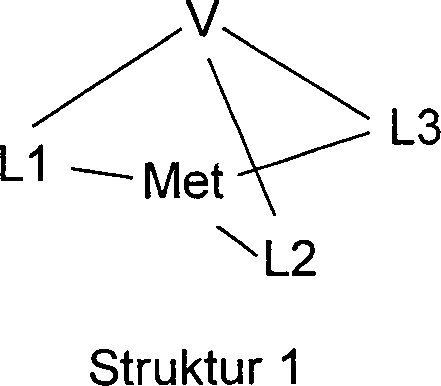

V
eine Verbrückungseinheit
ist die 1 bis 40 Atome enthält
und die drei Liganden L1, L2 und L3 aufweist, die gleich oder verschieden
bei jedem Auftreten sein können,
kovalent miteinander verbindet, und wobei die drei Liganden L1,
L2 und L3, der Struktur 3 genügen,
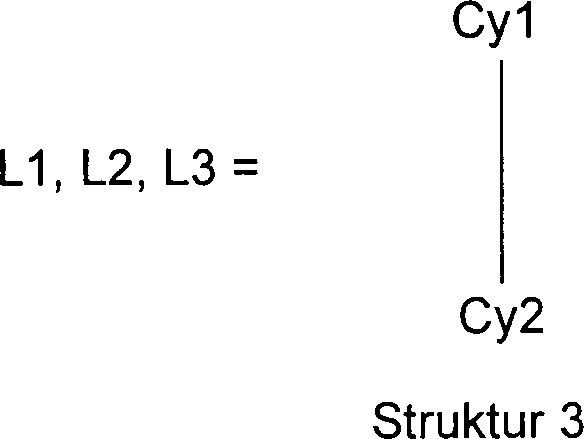
Cy1 und Cy2, gleich
oder verschieden bei jedem Auftreten, je einem substituierten oder
unsubsituierten, gesättigten,
ungesättigten
oder aromatischen Homo- oder Heterocyclus entsprechen, der jeweils über ein
Ringatom oder über
ein exocyclisch an den Homo- oder Heterocyclus gebundenes Atom ionisch,
kovalent oder koordinativ an das Metall Met gebunden ist.The present invention thus relates to metal complexes of structure 1,
V is a bridging unit which contains 1 to 40 atoms and which has three ligands L1, L2 and L3, which may be the same or different in each occurrence, covalently connects to one another, and the three Ligands L1, L2 and L3, which satisfy structure 3,
Cy1 and Cy2, identical or different on each occurrence, each correspond to a substituted or unsubstituted, saturated, unsaturated or aromatic homo- or heterocycle, each of which is ionic, covalent or coordinative via a ring atom or via an atom bound exocyclically to the homocycle or heterocycle is bound to the metal Met.
Die Homo- oder Heterocyclen Cy1 und Cy2 können über Substituenten miteinander verknüpft sein, und so ein polycyclisches Ringsystem aufspannen.The homocycles or heterocycles Cy1 and Cy2 can have substituents linked together be, and so span a polycyclic ring system.
Bevorzugt sind erfindungsgemäße Verbindungen der Struktur 1, dadurch gekennzeichnet, daß diese nicht geladen, d.h. nach außen hin elektrisch neutral, sind.Compounds according to the invention are preferred Structure 1, characterized in that it is not loaded, i.e. outward are electrically neutral.
Bevorzugt sind erfindungsgemäße Verbindungen der Struktur 1, dadurch gekennzeichnet, daß L1 = L2 = L3 ist.Compounds according to the invention are preferred structure 1, characterized in that L1 = L2 = L3.
Ebenfalls bevorzugt sind erfindungsgemäße Verbindungen der Struktur 1, dadurch gekennzeichnet, daß L1 ≠ L2 ist, insbesondere das L1 ≠ L2 ≠ L3 ist.Compounds according to the invention are also preferred structure 1, characterized in that L1 ≠ L2, in particular that L1 ≠ L2 ≠ L3.
Bevorzugt sind erfindungsgemäße Verbindungen der Struktur 1, dadurch gekennzeichnet, daß die Verknüpfungseinheit V als verknüpfendes Atom ein Element der 3., 4. oder 5. Hauptgruppe des Periodensystems der Elemente oder einen 3- bis 6-gliedrigen Homo- oder Heterocyclus enthält.Compounds according to the invention are preferred Structure 1, characterized in that the linking unit V as a linking Atom is an element of the 3rd, 4th or 5th main group of the periodic table of the elements or a 3- to 6-membered homo- or heterocycle contains.
Bevorzugt sind erfindungsgemäße Verbindungen der Struktur 1, dadurch gekennzeichnet, daß der polypodale Ligand Lig gemäß Struktur 4 eine faciale Koordinationsgeometrie am Metall Met erzeugt.Compounds according to the invention are preferred structure 1, characterized in that the polypodal ligand Lig according to structure 4 generated a facial coordination geometry on the metal Met.

Ebenfalls bevorzugt sind erfindungsgemäße Verbindungen der Struktur 1, dadurch gekennzeichnet, daß der polypodale Ligand Lig gemäß Struktur 5 eine meridionale Koordinationsgeometrie am Metall Met erzeugt.Compounds according to the invention are also preferred structure 1, characterized in that the polypodal ligand Lig according to structure 5 generated a meridional coordination geometry on the metal Met.

Insbesondere bevorzugt sind Metallkomplexe
gemäß den Verbindungen
(1) bis (8), mit facialer Koordinationsgeometrie am Metall bei denen
die Reste Z = V und Met = M sind, gemäß Schema 1, Schema
1: 
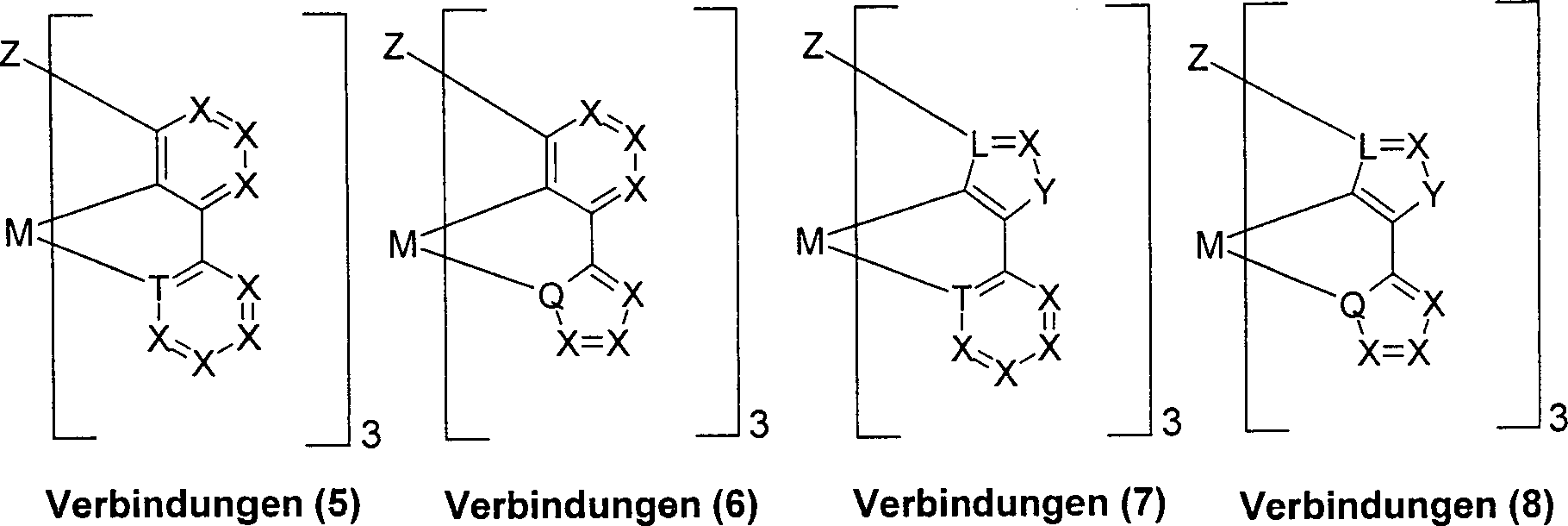
M Al, Ga,
In, Tl, P, As, Sb, Bi, Sc, Y, La, Cr, Mo, W, Fe, Ru, Os, Co, Rh,
Ir, Cu, Au, Pr, Nd, Sm, Eu, Gd, Tb, Dy, Ho, Er, Tm, Yb, Lu;
L
ist gleich oder verschieden bei jedem Auftreten C, N, P;
Q
ist gleich oder verschieden bei jedem Auftreten O, S, Se, Te;
T
ist gleich oder verschieden bei jedem Auftreten N, P;
X ist
gleich oder verschieden bei jedem Auftreten CR, N, P;
Y ist
gleich oder verschieden bei jedem Auftreten NR1,
O, S, Se, Te, SO, SeO, TeO, SO2, SeO2, TeO2;
Z B,
BR, B(CR2)3, B(CR2CR2)3,
CH, CR1, COH, COR1,
CF, CCl, CBr, C-I, CNR1
2,
C(CR2)3, C(CR2CR2)3, C(SiR2)3, C(SiR2CR2)3,
C(CR2SiR2)3, C(SiR2SiR2)3, cis,cis-1,3,5-Cyclohexyl,
1,3,5-(CR2)3C6H3, SiR, SiOH, SiOR1, Si(CR2)3, Si(CR2CR2)3, Si(SiR2)3, Si(SiR2CR2)3,
Si(CR2SiR2)3, Si(SiR2SiR2)3, N, N(CR2)3, N(CR2CR2)3, NO,
P, As, Sb, Bi, PO, AsO, SbO, BiO, PSe, AsSe, SbSe, BiSe, PTe, AsTe,
SbTe, BiTe;
R ist gleich oder verschieden bei jedem Auftreten
H, F, Cl, Br, I, NO2, CN, eine geradkettige
oder verzweigte oder cyclische Alkyl- oder Alkoxygruppe mit 1 bis
20 C-Atomen, wobei ein oder mehrere nicht benachbarte CH2-Gruppen durch -O-, -S-, -NR1-,
oder -CONR2- ersetzt sein können und wobei ein oder mehrere
H-Atome durch F ersetzt sein können,
oder eine Aryl- oder Heteroarylgruppe mit 1 bis 14 C-Atomen, die
durch einen oder mehrere, nicht aromatische Reste R substituiert
sein kann, wobei mehrere Substituenten R, sowohl am selben Ring
als auch an den beiden unterschiedlichen Ringen zusammen wiederum
ein weiteres mono- oder polycyclisches, aliphatisches oder aromatisches
Ringsystem aufspannen können;
R1 und R2 sind gleich
oder verschieden bei jedem Auftreten, H oder ein aliphatischer oder
aromatischer Kohlenwasserstoffrest mit 1 bis 20 C-Atomen;
c
0 oder 1 ist.Particularly preferred are metal complexes according to compounds (1) to (8), with facial coordination geometry on the metal in which the radicals Z = V and Met = M, according to scheme 1, Scheme 1:
M Al, Ga, In, Tl, P, As, Sb, Bi, Sc, Y, La, Cr, Mo, W, Fe, Ru, Os, Co, Rh, Ir, Cu, Au, Pr, Nd, Sm , Eu, Gd, Tb, Dy, Ho, Er, Tm, Yb, Lu;
L is the same or different on every occurrence C, N, P;
Q is the same or different on every occurrence O, S, Se, Te;
T is the same or different on every occurrence N, P;
X is the same or different on every occurrence CR, N, P;
Y is the same or different on each occurrence of NR 1 , O, S, Se, Te, SO, SeO, TeO, SO 2 , SeO 2 , TeO 2 ;
For example, BR, B (CR 2 ) 3 , B (CR 2 CR 2 ) 3 , CH, CR 1 , COH, COR 1 , CF, CCl, CBr, CI, CNR 1 2 , C (CR 2 ) 3 , C (CR 2 CR 2 ) 3 , C (SiR 2 ) 3 , C (SiR 2 CR 2 ) 3 , C (CR 2 SiR 2 ) 3 , C (SiR 2 SiR 2 ) 3 , cis, cis-1,3, 5-cyclohexyl, 1,3,5- (CR 2 ) 3 C 6 H 3 , SiR, SiOH, SiOR 1 , Si (CR 2 ) 3 , Si (CR 2 CR 2 ) 3 , Si (SiR 2 ) 3 , Si (SiR 2 CR 2 ) 3 , Si (CR 2 SiR 2 ) 3 , Si (SiR 2 SiR 2 ) 3 , N, N (CR 2 ) 3 , N (CR 2 CR 2 ) 3 , NO, P, As , Sb, Bi, PO, AsO, SbO, BiO, PSe, AsSe, SbSe, BiSe, PTe, AsTe, SbTe, BiTe;
R is the same or different on each occurrence H, F, Cl, Br, I, NO 2 , CN, a straight-chain or branched or cyclic alkyl or alkoxy group with 1 to 20 C atoms, one or more non-adjacent CH 2 - Groups can be replaced by -O-, -S-, -NR 1 -, or -CONR 2 - and where one or more H atoms can be replaced by F, or an aryl or heteroaryl group having 1 to 14 C atoms , which can be substituted by one or more non-aromatic radicals R, where a plurality of substituents R, both on the same ring and on the two different rings, can in turn span another mono- or polycyclic, aliphatic or aromatic ring system;
R 1 and R 2 are the same or different at each occurrence, H or an aliphatic or aromatic hydrocarbon radical having 1 to 20 C atoms;
c is 0 or 1.
Darüberhinaus sind ebenfalls bevorzugt
die Verbindungen (9) bis (12), mit meridionaler Koordinationsgeometrie
am Metall bei denen die Reste Z = V und Met = M sind, gemäß Schema
2, Schema
2: 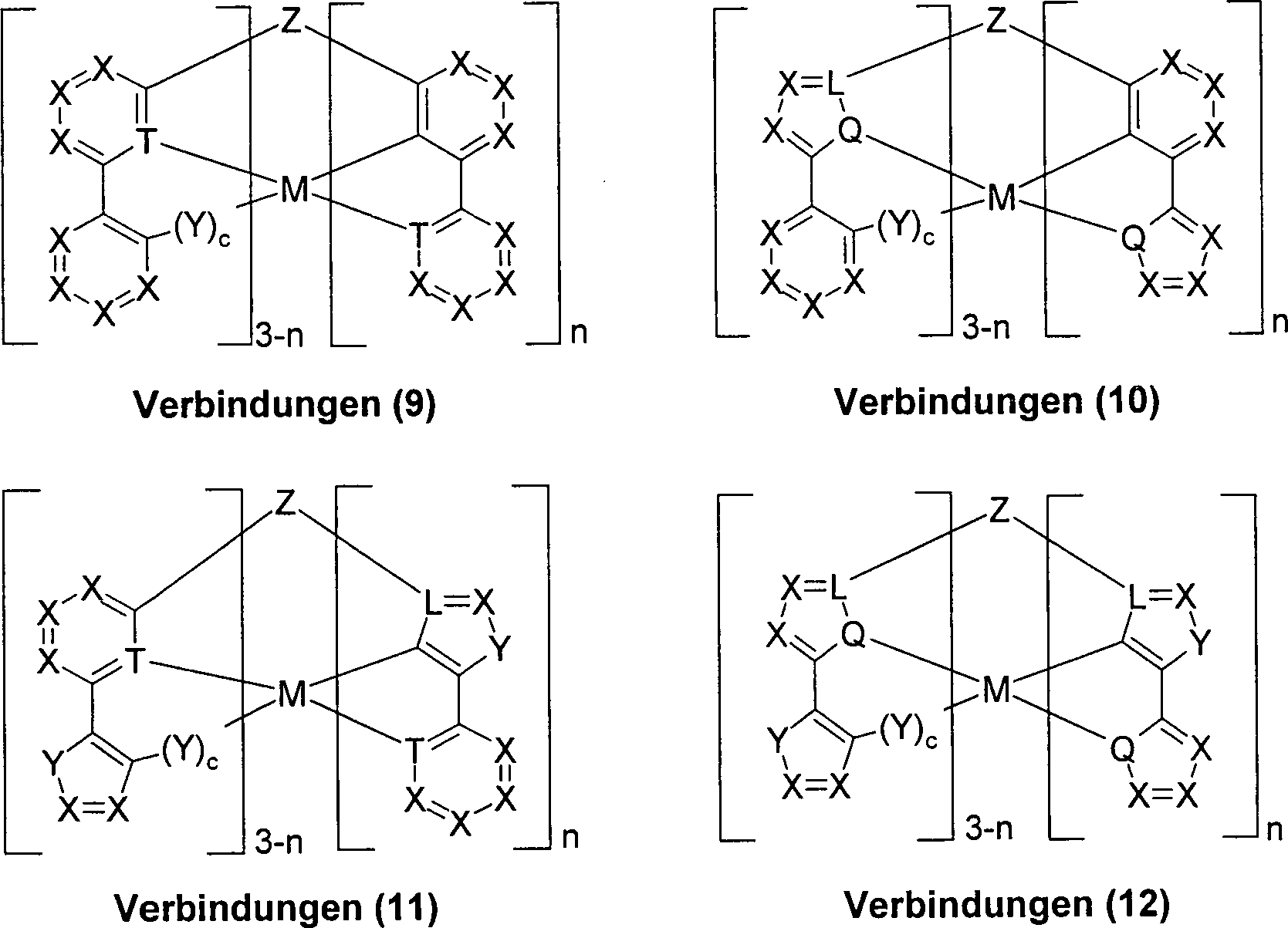
n
1 oder 2 ist.In addition, preference is also given to compounds (9) to (12) with a meridional coordination geometry on the metal in which the radicals Z = V and Met = M, according to scheme 2, Scheme 2:
n is 1 or 2.
Ein weiterer Gegenstand der Erfindung
sind ebenfalls solche Verbindungen, die gleichzeitig Liganden vom
Typ wie bei Verbindungen (1), (2), (3) und/oder (4) aufweisen, d.h.
gemischte Ligandensysteme. Diese werden durch die Formeln (13) bis
(30) – gemäß Schema
3 – beschrieben: Schema
3: 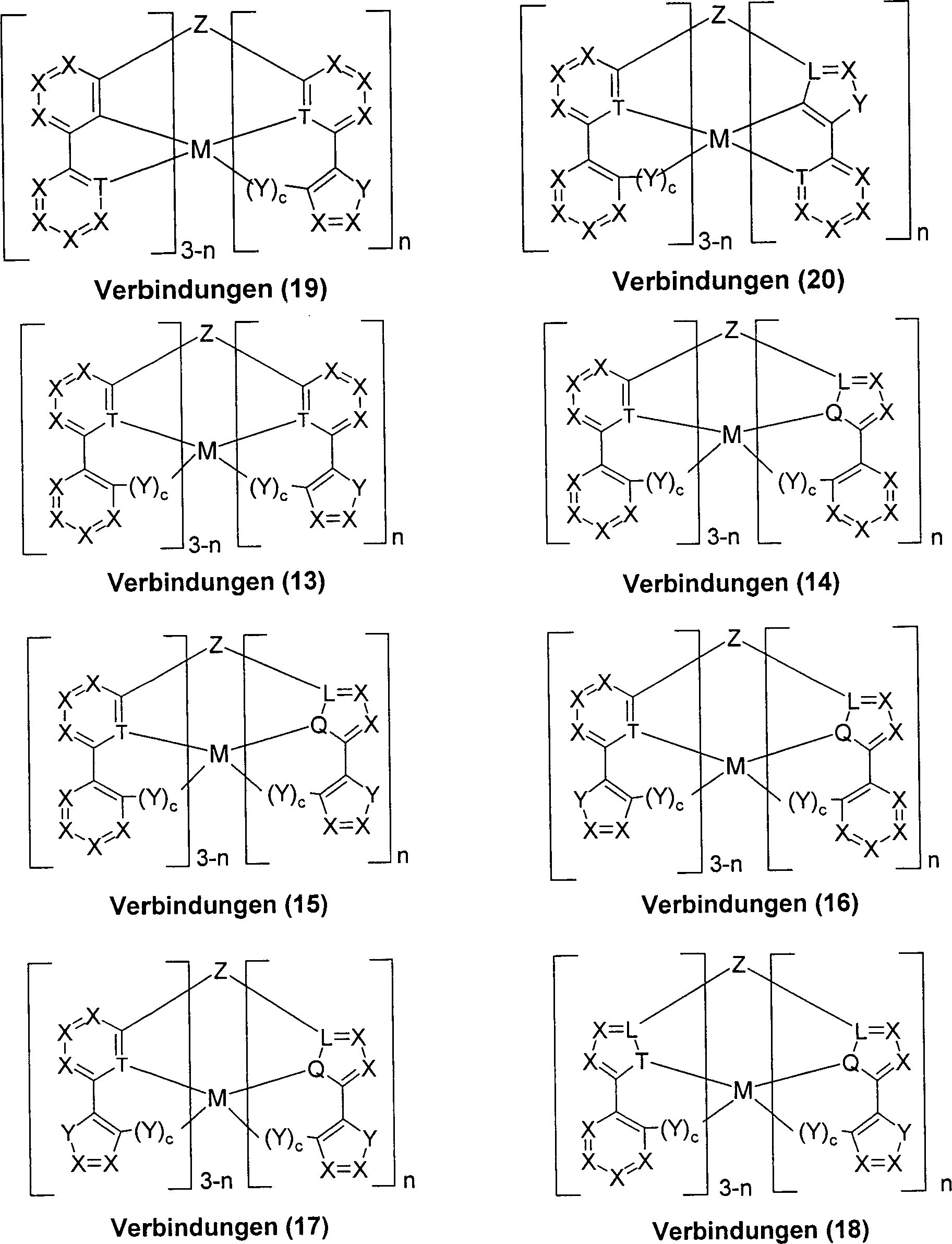

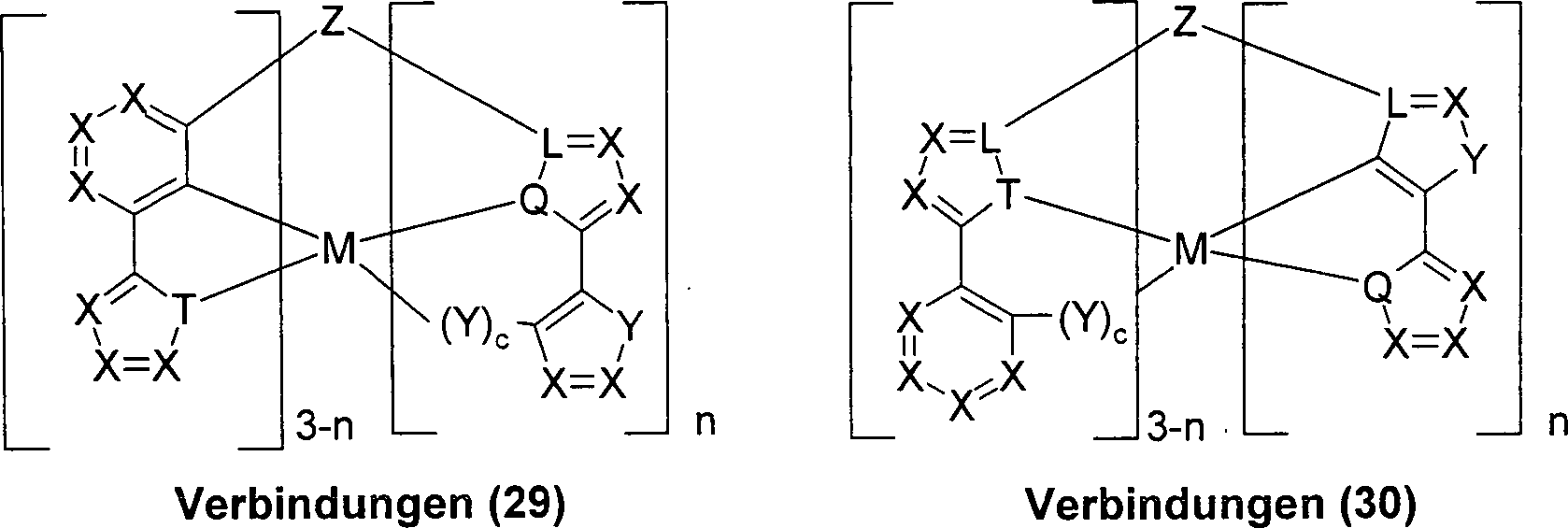
Bevorzugt sind erfindungsgemäße Verbindungen (1) bis (30) bei denen für das Symbol M = Al, Ga, In, Sc, Y, La, Ru, Os, Rh, Ir, Au gilt.Compounds according to the invention are preferred (1) to (30) those for the symbol M = Al, Ga, In, Sc, Y, La, Ru, Os, Rh, Ir, Au applies.
Bevorzugt sind ebenfalls erfindungsgemäße Verbindungen (1) bis (30) bei denen für das Symbol L = C, N gilt.Compounds according to the invention are also preferred (1) to (30) those for the symbol L = C, N applies.
Bevorzugt sind ebenfalls erfindungsgemäße Verbindungen (1) bis (30) bei denen für das Symbol Q = O, S gilt.Compounds according to the invention are also preferred (1) to (30) those for the symbol Q = O, S applies.
Bevorzugt sind ebenfalls erfindungsgemäße Verbindungen (1) bis (30) bei denen für das Symbol T = N gilt.Compounds according to the invention are also preferred (1) to (30) those for the symbol T = N applies.
Bevorzugt sind ebenfalls erfindungsgemäße Verbindungen (1) bis (30) bei denen für das Symbol X = CR, N gilt.Compounds according to the invention are also preferred (1) to (30) those for the symbol X = CR, N applies.
Bevorzugt sind ebenfalls erfindungsgemäße Verbindungen (1) bis (30) bei denen für das Symbol Z = B, CH, CR1, COR1, CF, CBr, SiR, N, P, PO gilt.Also preferred are compounds (1) to (30) according to the invention in which the symbol Z = B, CH, CR 1 , COR 1 , CF, CBr, SiR, N, P, PO applies.
Bevorzugt sind ebenfalls erfindungsgemäße Verbindungen (1) bis (30), bei denen für das Symbol R = H, F, Cl, Br, I, CN eine geradkettige oder verzweigte oder cyclische Alkyl- oder Alkoxygruppe mit 1 bis 6 C-Atomen oder eine Aryl- oder Heteroarylgruppe mit 3 bis 8 C-Atomen, die durch einen oder mehrere, nicht aromatische Reste R substituiert sein kann, wobei mehrere Substituenten R, sowohl am selben Ring als auch an den beiden unterschiedlichen Ringen zusammen wiederum ein weiteres mono- oder polycyclisches Ringsystem aufspannen können.Compounds according to the invention are also preferred (1) to (30) in which for the symbol R = H, F, Cl, Br, I, CN is a straight-chain or branched or cyclic alkyl or alkoxy group with 1 to 6 carbon atoms or an aryl or heteroaryl group with 3 to 8 carbon atoms, through one or more non-aromatic radicals R may be substituted can, where several substituents R, both on the same ring and another one on the two different rings can span mono- or polycyclic ring system.
Sofern in den Verbindungen (1) bis (30) durch die Reste R Ringsysteme aufgespannt werden, sind diese bevorzugt Benzen, 1- bzw. 2-Naphthalin, 1-, 2- bzw. 9-Anthracen, 2-, 3- bzw. 4-Pyridin, 2-, 4- bzw. 5-Pyrimidin, 2-Pyrazin, 3- bzw. 4-Pyridazin, 2-, 3-, 4-, 5-, 6-, 7- bzw. 8-Chinolin, 2- bzw. 3-Pyrrol, 3-, 4-, 5-Pyrazol, 2-, 4-, 5-Imidazol, 2-, 3-Thiophen, 2-, 3-Selenophen, 2- bzw. 3-Furan, 2-(1,3,4-Oxadiazol), Indol, Carbazol ist.If in compounds (1) to (30) are spanned by the R ring systems, these are preferably benzene, 1- or 2-naphthalene, 1-, 2- or 9-anthracene, 2-, 3- or 4-pyridine, 2-, 4- or 5-pyrimidine, 2-pyrazine, 3- or 4-pyridazine, 2-, 3-, 4-, 5-, 6-, 7- or 8-quinoline, 2- or 3-pyrrole, 3-, 4-, 5-pyrazole, 2-, 4-, 5-imidazole, 2-, 3-thiophene, 2-, 3-selenophene, 2- or 3-furan, 2- (1,3,4-oxadiazole) Is indole, carbazole.
Ebenfalls Gegenstand der vorliegenden
Erfindung sind die Verbindungen (31) bis (60), gemäß Schema
4: Schema
4 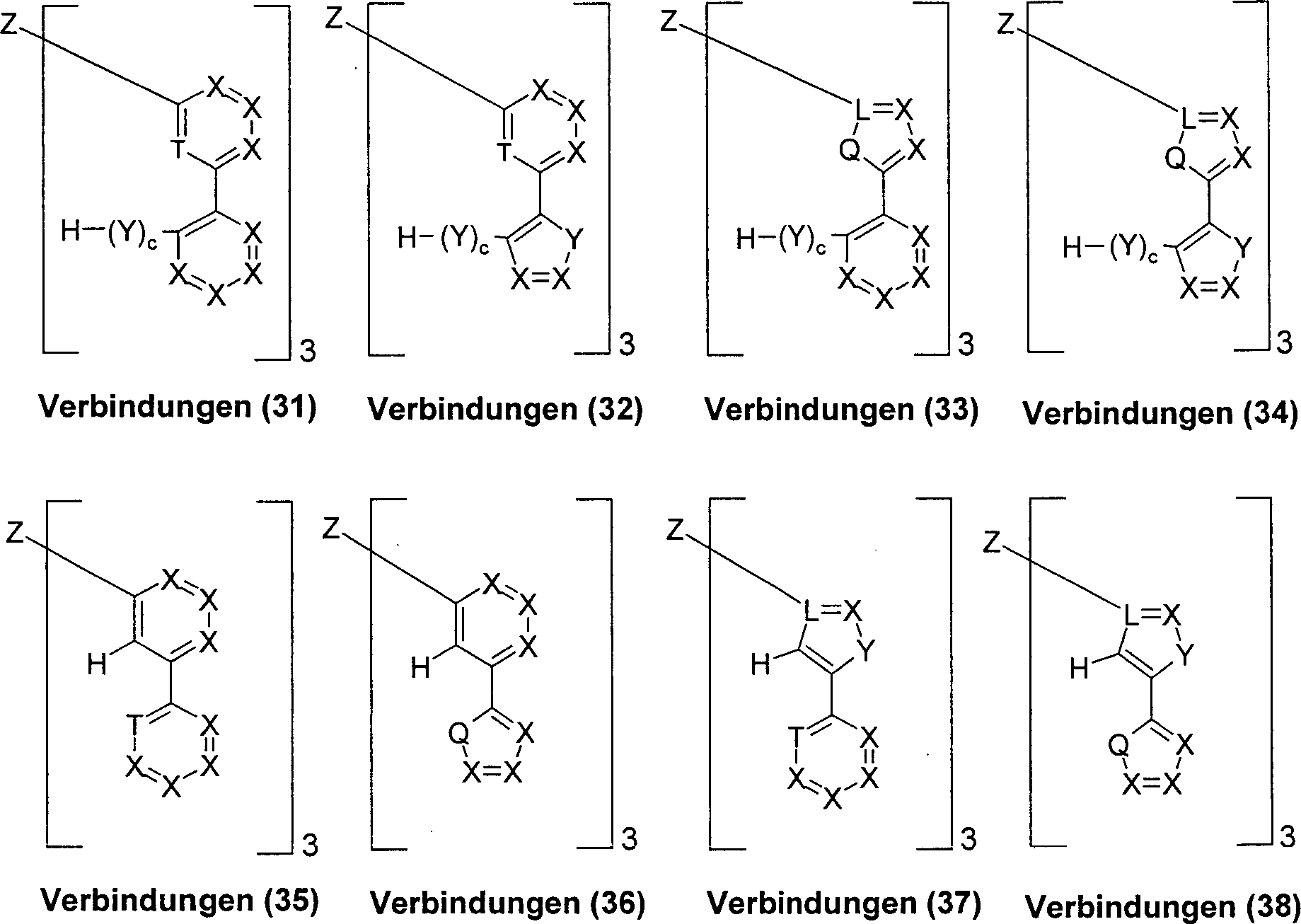


Die erfindungsgemäßen Verbindungen (1) bis (30) sind prinzipiell durch verschiedene Verfahren herstellbar, es hat sich jedoch das im folgenden beschriebene Verfahren als besonders gut geeignet herausgestellt.The compounds (1) to (30) according to the invention can be produced in principle by different processes, it has However, the procedure described below is special well suited.
Daher ist ein weiterer Gegenstand
der vorliegenden Erfindung Verfahren zur Herstellung der Verbindungen
(1) bis (30), durch Umsetzung der polypodalen Liganden gemäß Verbindungen
(31) bis (60) mit Metallalkoholaten der Formel (61), mit Metallketoketonaten
der Formel (62) und Metallhalogeniden der Formel (63), 
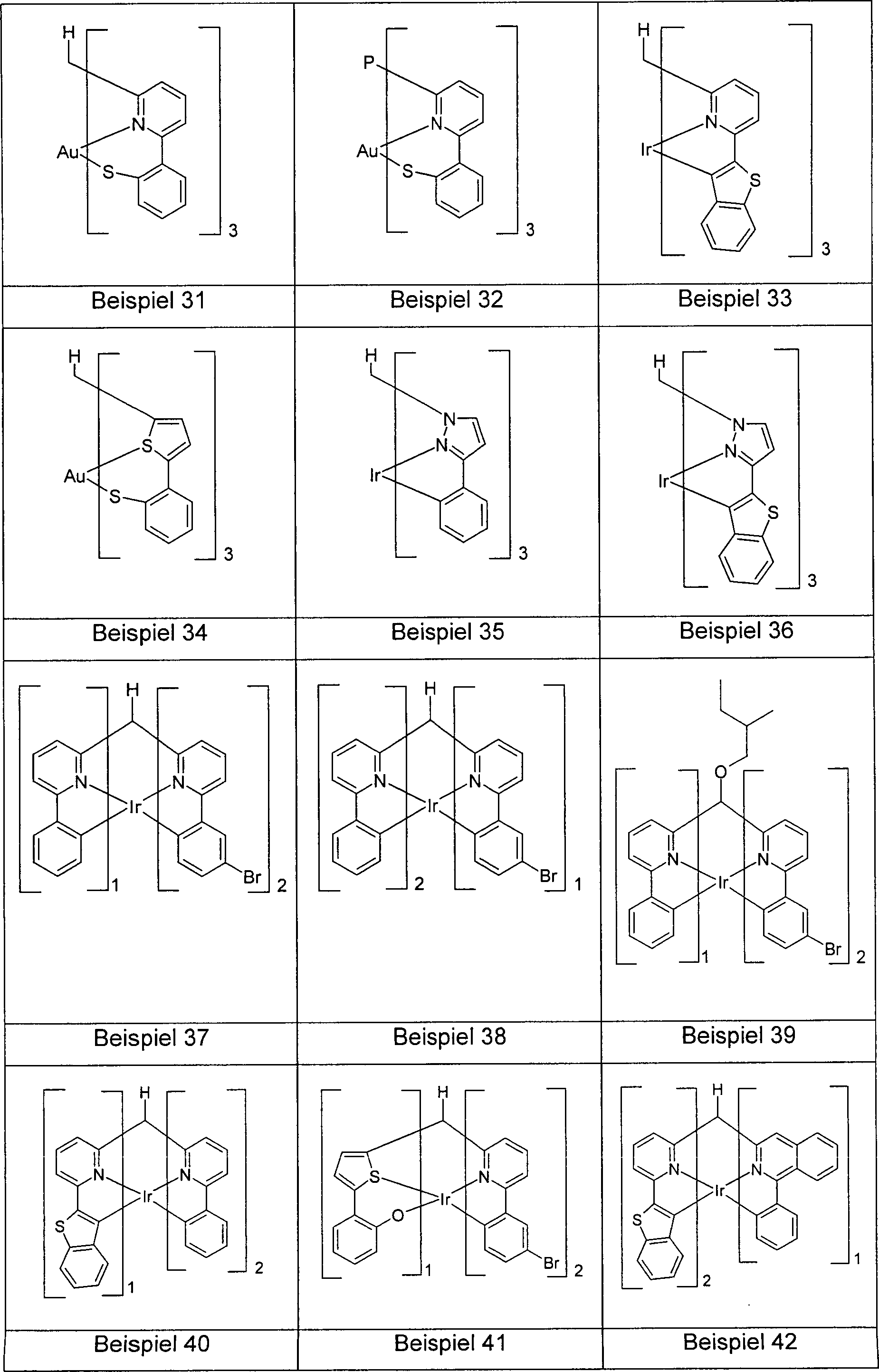
Mit den hier erläuterten Synthesemethoden lassen sich unter anderem die im folgenden dargestellten Beispiele für Verbindungen (1) bis (30) herstellen.Let with the synthesis methods explained here include the examples of connections shown below Manufacture (1) to (30).




Die oben beschriebenen erfindungsgemäßen Verbindungen finden Verwendung als aktive Komponenten in elektronischen Bauteilen, wie z. B. Organischen Leuchtdioden (OLEDs), Organischen Integrierten Schaltungen (O-ICs), Organischen Feld-Effekt-Transistoren (OFETs), Organischen Dünnfilmtransistoren (OTFTs), Organischen Solarzellen (O-SCs) oder auch Organische Laserdioden (O-Laser).The compounds according to the invention described above are used as active components in electronic components, such as B. Organic light-emitting diodes (OLEDs), organic integrated Circuits (O-ICs), Organic Field Effect Transistors (OFETs), Organic thin film transistors (OTFTs), organic solar cells (O-SCs) or organic laser diodes (O-laser).
Die oben beschriebenen erfindungsgemäßen Verbindungen – z.B. Verbindung gemäß den Beispielen 7, 14, 26, 27, 37, 38, 39 und 41 – können beispielsweise als Co-Monomere zur Erzeugung entsprechender konjugierter oder auch teilkonjugierter Polymere oder auch als Kern von Dendrimeren – z.B. Verbindung gemäß den Beispielen 14 und 26 – Verwendung finden. Die entsprechende Einbau-Polymerisation erfolgt dabei bevorzugt über die Halogenfunktionalität.The compounds of the invention described above - e.g. connection according to examples 7, 14, 26, 27, 37, 38, 39 and 41 - can for example as co-monomers to produce corresponding conjugated or partially conjugated polymers or as the core of dendrimers - e.g. connection according to the examples 14 and 26 - use Find. The corresponding built-in polymerization is preferably done via the halogen functionality.
So können sie u. a. in lösliche Polyfluorene
(z. B. gemäß
Weiterer Gegenstand der Erfindung sind somit konjugierte oder teilkonjugierte Polymere oder Dendrimere enthaltend eine oder mehrere Verbindungen (1) bis (30), wobei das oben definierte R eine Bindung zum konjugierten oder teilkonjugierten Polymer oder Dendrimer darstellt.Another object of the invention are thus conjugated or partially conjugated polymers or dendrimers containing one or more compounds (1) to (30), wherein the R defined above a bond to conjugated or partially conjugated Polymer or dendrimer.
Als konjugierte oder teilkonjugierte Polymere werden Polyfluorenene, Polyspirobifluorene, Poly-para-phenylenene, Poly-carbazole, Polythiophene oder Polyketone verstanden.As conjugated or partially conjugated Polymers are polyfluorenes, polyspirobifluorenes, poly-para-phenylenes, Understand poly-carbazoles, polythiophenes or polyketones.
Vorzugsweise handelt es sich bei
den konjugierten oder teilkonjugierten Polymeren auf Basis von Polyfluorenen
um die in
Vorzugsweise handelt es sich bei
den konjugierten oder teilkonjugierten Polymeren auf Basis von Poly-spirobifluorenen
um die in
Vorzugsweise handelt es sich bei den konjugierten oder teilkonjugierten Polymeren auf Basis von Poly-para-phenyfenen um die in WO 92/18552 offenbarten Poly-paraphenylene.It is preferably the conjugated or partially conjugated polymers based on poly-para-phenyfenen the poly-paraphenylenes disclosed in WO 92/18552.
Vorzugsweise handelt es sich bei
den konjugierten oder teilkonjugierten Polymeren auf Basis von Polythiophenen
um die in
Diese Polymere und Dendrimere finden Verwendung als aktive Komponenten in elektronischen Bauteilen, wie z. B. Organischen Leuchtdioden (OLEDs), Organischen Integrierten Schaltungen (O-ICs), Organischen Feld-Effekt-Transistoren (OFETs), Organischen Dünnfilmtransistoren (OTFTs), Organischen Solarzellen (O-SCs) oder auch Organische Laserdioden (O-Laser), sowie als Photoleiter.Find these polymers and dendrimers Use as active components in electronic components, such as z. B. Organic light-emitting diodes (OLEDs), organic integrated Circuits (O-ICs), organic field-effect transistors (OFETs), organic thin-film transistors (OTFTs), organic solar cells (O-SCs) or organic laser diodes (O-laser) and as a photoconductor.
Weiterhin können die erfindungsgemäßen Metallkomplexe natürlich auch durch die beispielsweise o. g. Reaktionstypen weiter funktionalisiert werden, und so zu erweiterten Metallkomplex umgesetzt werden. Hier ist als Beispiel die Funktionalisierung mit Arylboronsäuren gem. SUZUKI oder mit Aminen gemäß HARTWIG-BUCHWALD zu nennen.Furthermore, the metal complexes according to the invention Naturally also by the example above. Reaction types further functionalized become, and so be implemented to expanded metal complex. Here is as an example the functionalization with arylboronic acids acc. SUZUKI or with amines according to HARTWIG-BUCHWALD to call.
Die wie oben beschrieben weiter funktionalisierten Verbindungen finden Verwendung als aktive Komponenten in elektronischen Bauteilen, wie z. B. Organischen Leuchtdioden (OLEDs), Organischen Integrierten Schaltungen (O-ICs), Organischen Feld-Effekt-Transistoren (OFETs), Organischen Dünnfilmtransistoren (OTFTs), Organischen Solarzellen (O-SCs) oder auch Organische Laserdioden (O-Laser), sowie als Photoleiter.The further functionalized compounds described above are used as active components in electronic components, such as. B. Organic light-emitting diodes (OLEDs), organic integrated Circuits (O-ICs), organic field-effect transistors (OFETs), organic thin-film transistors (OTFTs), organic solar cells (O-SCs) or organic laser diodes (O-lasers), as well as photoconductors.
Die vorliegende Erfindung wird durch die folgenden Beispiele näher erläutert, ohne sie darauf beschränken zu wollen. Der Fachmann kann aus den Schilderungen ohne erfinderisches Zutun weitere erfindungsgemäße Komplexe herstellen bzw. das erfindungsgemäße Verfahren anwenden.The present invention is accomplished by the following examples in more detail explains without limiting it to want. The expert can from the descriptions without inventive To do further complexes according to the invention produce or apply the inventive method.
1. Synthese von homoleptischen Aluminium- und Lanthan-Chelatkomplexen mit hexapodalen Liganden:1. Synthesis of homoleptic Aluminum and lanthanum chelate complexes with hexapodal ligands:
Die nachfolgenden Synthesen wurden – sofern nicht anders angegeben – unter einer Schutzgasatmosphäre in getrockneten Lösungsmittel durchgeführt. Die Edukte wurden von ALDRICH bzw. ABCR [2-Methoxybenzolboronsäure, Kaliumfluorid (sprühgetrocknet), Tri-tert-butylphosphin, Palladium(II)acetat, Pyridiniumhydrochlorid, Aluminium-tri-iso-propylat, 10 Gew.-%ige Lösung von Tris(2-methoxyethanolato)lanthan(III) in 2-Methoxyethanol] bezogen. Tris(2-brom-6-pyridyl)phosphin wurde, wie in der offengelegten Anmeldung WO 98/22148 beschrieben, dargestellt.The following syntheses were - if not specified otherwise - under a protective gas atmosphere in dried solvent carried out. The starting materials were from ALDRICH or ABCR [2-methoxybenzeneboronic acid, potassium fluoride (Spray dried) Tri-tert-butylphosphine, palladium (II) acetate, pyridinium hydrochloride, Aluminum tri-isopropylate, 10% by weight solution of tris (2-methoxyethanolato) lanthanum (III) in 2-methoxyethanol]. Tris (2-bromo-6-pyridyl) phosphine was as disclosed in the Application WO 98/22148 described shown.
1.1 Synthese der hexapodalen Liganden:1.1 Synthesis of the hexapodal Ligand:
Beispiel L1: Tris(6-brom-2-pyridyl)phosphinoxidExample L1: Tris (6-bromo-2-pyridyl) phosphine oxide
Eine zum Sieden erhitzte Suspension
von 50.2 g (100.0 mmol) Tris(6-brom-2-pyridyl)phosphin in 500 ml Chloroform
wurde unter intensivem Rühren
tropfenweise mit einer Mischung aus 11 ml 35 Gew.-% igem H2O2 und 50 ml Wasser
versetzt, wodurch man eine klare Lösung erhielt. Nach 5 h Rühren unter
Rückfluß ließ man die
Lösung
auf Raumtemperaur abkühlen.
Die Lösung
wurde mit 500 ml Wasser gewaschen, die organische Phase wurde abgetrennt
und im Vakuum 50 ml eingeengt. Nach 2 h Stehen wurden die ausgeschiedenen Kristalle
abfiltriert, drei mal mit 100 ml n-Hexan gewaschen und anschließend im
Vakuum bei 70°C
getrocknet. Die Ausbeute bei einer Reinheit von 99.0% betrug 47,1
g (90.9 %).
1N-NMR (CDCl3): δ [ppm] =
8.14 (ddd, 3JHP =
5.4 Hz, 3JHH = 7.8
Hz, 4JHH = 1.0 Hz,
3H, H-3), 7.69 (ddd, 4JHP = 4.6
Hz,3JHH = 7.9 Hz,3JHH = 7.9 Hz, 3H,
H-4), 7.61 (ddd, 5JHP =
2.1 Hz, 3JHH = 7.9
Hz, 4JHH = 1.0 Hz,
3H, H-5).
3P{1H}-NMR
(CDCl3): δ [ppm]
= 11.8 (s).A heated to boiling suspension of 50.2 g (100.0 mmol) of tris (6-bromo-2-pyridyl) phosphine in 500 ml of chloroform was added dropwise with stirring with a mixture of 11 ml of 35% by weight H 2 O 2 and 50 ml of water were added, giving a clear solution. After stirring under reflux for 5 h, the solution was allowed to cool to room temperature. The solution was washed with 500 ml of water, the organic phase was separated off and concentrated in vacuo to 50 ml. After standing for 2 hours, the crystals which separated out were filtered off, washed three times with 100 ml of n-hexane and then dried in vacuo at 70.degree. The yield with a purity of 99.0% was 47.1 g (90.9%).
1 N NMR (CDCl 3 ): δ [ppm] = 8.14 (ddd, 3 J HP = 5.4 Hz, 3 J HH = 7.8 Hz, 4 J HH = 1.0 Hz, 3H, H-3), 7.69 (ddd, 4 J HP = 4.6 Hz, 3 J HH = 7.9 Hz, 3 J HH = 7.9 Hz, 3H, H-4), 7.61 (ddd, 5 J HP = 2.1 Hz, 3 J HH = 7.9 Hz, 4 J HH = 1.0 Hz, 3H, H-5).
3 P { 1 H} NMR (CDCl 3 ): δ [ppm] = 11.8 (s).
Beispiel L2: Tris(6-(2-methoxyphenyl)-2-pyridyl)phosphinoxidExample L2: Tris (6- (2-methoxyphenyl) -2-pyridyl) phosphine oxide
Eine gut gerührte Suspension von 38.8 g
(75.0mmol) Tris(6-brom-2-pyridyl)phosphinoxid,
51.3 g (337.5 mmol) 2-Methoxybenzolboronsäure und 43.1 g (742.5 mmol)
Kaliumfluorid in 750 ml wasserfreiem THF wurde mit 593 mg (2.93
mmol) Tri-tert-butylphosphin und dann mit 505 mg (2.25 mmol) Palladium(II)acetat
versetzt und anschließend
16 h unter Rückfluß erhitzt.
Nach Abkühlen
wurde die Reaktionsmischung mit 1500 ml Essigsäureethylester und 1000 ml Wasser
versetzt. Die organische Phase wurde abgetrennt, zweimal mit 500 ml
Wasser und einmal mit 500 ml ges. Natriumchloridlösung gewaschen
und anschießend über Magnesiumsulfat
getrocknet. Nach Einengen der organischen Phase im Vakuum (Enddruck
1 mbar, Temperatur 90°C)
verblieben 44.3 g (98.5 %) eines fahlgelben hochviskosen Öls, das
ohne Reinigung weiter umgesetzt wurde.
1H-NMR
(CDCl3): δ [ppm]
= 8.14 (ddd, 3H), 8.02 (ddd, 3H), 7.85 (dd, 3H), 7.76 (ddd, 3H),
7.30 (ddd, 3H), 6.94 (dd, 3H), 6.87 (ddd, 3H), 3.10 (s, 9H, CH3).
3P{1H}-NMR (CDCl3): δ [ppm] =
14.0 (s).A well-stirred suspension of 38.8 g (75.0 mmol) of tris (6-bromo-2-pyridyl) phosphine oxide, 51.3 g (337.5 mmol) of 2-methoxybenzene boronic acid and 43.1 g (742.5 mmol) of potassium fluoride in 750 ml of anhydrous THF was mixed with 593 mg ( 2.93 mmol) of tri-tert-butylphosphine and then mixed with 505 mg (2.25 mmol) of palladium (II) acetate and then heated under reflux for 16 h. After cooling, the reaction mixture was mixed with 1500 ml of ethyl acetate and 1000 ml of water. The organic phase was separated, twice with 500 ml of water and once with 500 ml of sat. Washed sodium chloride solution and then dried over magnesium sulfate. After concentrating the organic phase in vacuo (final pressure 1 mbar, temperature 90 ° C.), 44.3 g (98.5%) of a pale yellow, highly viscous oil remained, which was reacted further without purification.
1 H NMR (CDCl 3 ): δ [ppm] = 8.14 (ddd, 3H), 8.02 (ddd, 3H), 7.85 (dd, 3H), 7.76 (ddd, 3H), 7.30 (ddd, 3H), 6.94 (dd, 3H), 6.87 (ddd, 3H), 3.10 (s, 9H, CH 3 ).
3 P { 1 H} NMR (CDCl 3 ): δ [ppm] = 14.0 (s).
Beispiel L3: Tris(6-(2-hydroxyphenyl)-2-pyridyl)phosphinoxidExample L3: Tris (6- (2-hydroxyphenyl) -2-pyridyl) phosphine oxide
Eine Mischung aus 30.0 g (50 mmol)
Tris(6-(2-methoxyphenyl)-2-pyridyl)phosphinoxid
und 104.0 g (900 mmol) Pyridiniumhydrochlorid wurden 12 h bei 130°C gerührt. Nach
Abkühlen
der Schmelze auf 80°C wurde
mit 300 ml Wasser und dann mit einer Lösung von 44.9 g (800 mmol)
Kaliumhydroxid in 100 ml Wasser versetzt. Die wäßrige Phase wurde dreimal mit
500 ml Dichlormethan extrahiert. Die vereinigten organischen Phasen
wurde drei mal mit 500 ml Wasser gewaschen. Nach Trocknen der organischen
Phase über
Magnesiumsulfat und Abziehen des Dichlormethans wurde der ölige Rückstand
in 100 ml Methyl-tert-butylether aufgenommen und mit 100 ml n-Heptan
versetzt. Nach 12 h Stehen wurde die farblosen Kristalle abgesaugt
und gegebenenfalls erneut aus Methyl-tert-butylether/n-Heptan umkristallisiert.
Die Ausbeute an betrug 10.9 g (39.1 %), bei einer Reinheit von größer 99.0%
n. 1H-NMR.
1H-NMR
(CDCl3): δ [ppm]
= 14.33 (s, 3H, OH), 8.45 (m, 3H), 8.13 (m, 3H), 7.88 (m, 3H), 7,61
(m, 3H), 7.23 (m, 3H), 7.01 (m, 3H), 6.90 (m, 3H).
3P{1H}-NMR (CDCl3): δ [ppm]
= 10.3 (s).A mixture of 30.0 g (50 mmol) of tris (6- (2-methoxyphenyl) -2-pyridyl) phosphine oxide and 104.0 g (900 mmol) of pyridinium hydrochloride were stirred at 130 ° C. for 12 h. After the melt had cooled to 80 ° C., 300 ml of water and then a solution of 44.9 g (800 mmol) of potassium hydroxide in 100 ml of water were added. The aqueous phase was extracted three times with 500 ml of dichloromethane. The combined organic phases were washed three times with 500 ml of water. After the organic phase had been dried over magnesium sulfate and the dichloromethane had been stripped off, the oily residue was taken up in 100 ml of methyl tert-butyl ether and 100 ml of n-heptane were added. After standing for 12 h, the colorless crystals were filtered off with suction and optionally recrystallized again from methyl tert-butyl ether / n-heptane. The yield was 10.9 g (39.1%), with a purity of greater than 99.0% according to 1 H-NMR.
1 H-NMR (CDCl 3 ): δ [ppm] = 14.33 (s, 3H, OH), 8.45 (m, 3H), 8.13 (m, 3H), 7.88 (m, 3H), 7.61 (m, 3H), 7.23 (m, 3H), 7.01 (m, 3H), 6.90 (m, 3H).
3 P { 1 H} NMR (CDCl 3 ): δ [ppm] = 10.3 (s).
1.2 Synthese der homoleptischen Aluminium- und Lanthan-Chelatkomplexe1.2 Synthesis of the homoleptic Aluminum and lanthanum chelate complexes
Beispiel 1: Mono[tris(6-(2-oxyphenyl)-2-pyridyl)phosphinoxido]aluminium(III)Example 1: Mono [tris (6- (2-oxyphenyl) -2-pyridyl) phosphine oxido] aluminum (III)
Eine Lösung von 5.58 g (10 mmol) Tris(6-(2-hydroxyphenyl)-2-pyridyl)phosphinoxid
in 100 ml Toluol wurde bei 80°C
während
30 min. mit einer Lösung
von 2.04 g (10 mmol) Tris(iso-propanolato)aluminium(III) in 50 ml
Toluol versetzt. Die Reaktionsmischung wurde weitere 3 h unter Rückfluß erhitzt.
Nach Erkalten auf Raumtemperatur wurde der farblose Niederschlag
abgesaugt und mit Toluol (1 × 25
ml) gewaschen und getrocknet. Wiederholte Umkristallisation aus
DMSO ergab 5.03 g (86.5 %), bei einer Reinheit von 99.8 % n. HPLC.
MS
(FAB): m/e = 582.A solution of 5.58 g (10 mmol) of tris (6- (2-hydroxyphenyl) -2-pyridyl) phosphine oxide in 100 ml of toluene was at 80 ° C for 30 min. a solution of 2.04 g (10 mmol) of tris (iso-propanolato) aluminum (III) in 50 ml of toluene was added. The reaction mixture was refluxed for a further 3 hours. After cooling to room temperature, the colorless precipitate was filtered off with suction and washed with toluene (1 × 25 ml) and dried. Repeated recrystallization from DMSO gave 5.03 g (86.5%), with a purity of 99.8% by HPLC.
MS (FAB): m / e = 582.
Beispiel 2: Mono(tris(6-(2-oxyphenyl)-2-pyridyl)phosphinoxido]lanthan(III)Example 2: Mono (tris (6- (2-oxyphenyl) -2-pyridyl) phosphineoxido] lanthanum (III)
Eine Lösung von 5.58 g (10 mmol) Tris(6-(2-hydroxyphenyl)-2-pyridyl)phosphinoxid
in 100 ml Toluol wurde bei 80°C
während
30 min. mit 36.4 ml (10 mmol) einer 10 Gew.-%igen Lösung von
Tris(2-methoxy-ethanolato)lanthan(III) in 2 Methoxyethanol versetzt.
Die Reaktionsmischung wurde weitere 3 h unter Rückfluß erhitzt. Nach Erkalten auf
Raumtemperatur wurde der farblose Niederschlag abgesaugt und mit
Toluol (1 × 25 ml)
gewaschen und getrocknet. Wiederholte Umkristallisation aus DMSO
ergab 5.68 g (81.7 %), bei einer Reinheit von 99.8 % n. HPLC.
MS
(FAB): m/e = 693.A solution of 5.58 g (10 mmol) of tris (6- (2-hydroxyphenyl) -2-pyridyl) phosphine oxide in 100 ml of toluene was at 80 ° C for 30 min. 36.4 ml (10 mmol) of a 10% by weight solution of tris (2-methoxyethanolato) lanthanum (III) in 2 methoxyethanol were added. The reaction mixture was refluxed for a further 3 hours. After cooling to room temperature, the colorless precipitate was filtered off with suction and washed with toluene (1 × 25 ml) and dried. Repeated recrystallization from DMSO gave 5.68 g (81.7%), with a purity of 99.8% by HPLC.
MS (FAB): m / e = 693.
Claims (28)


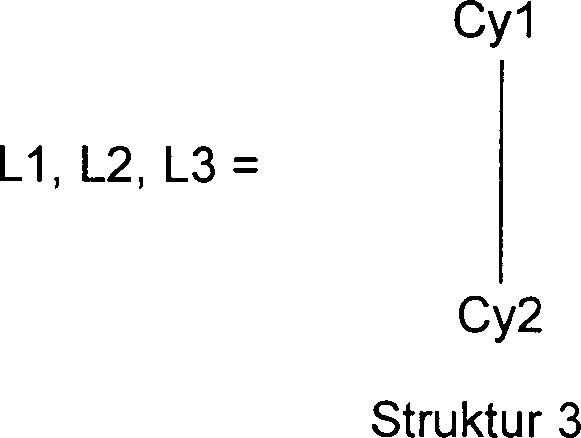
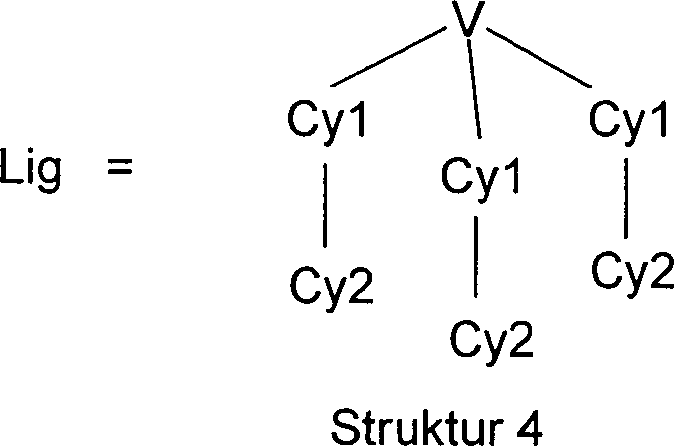

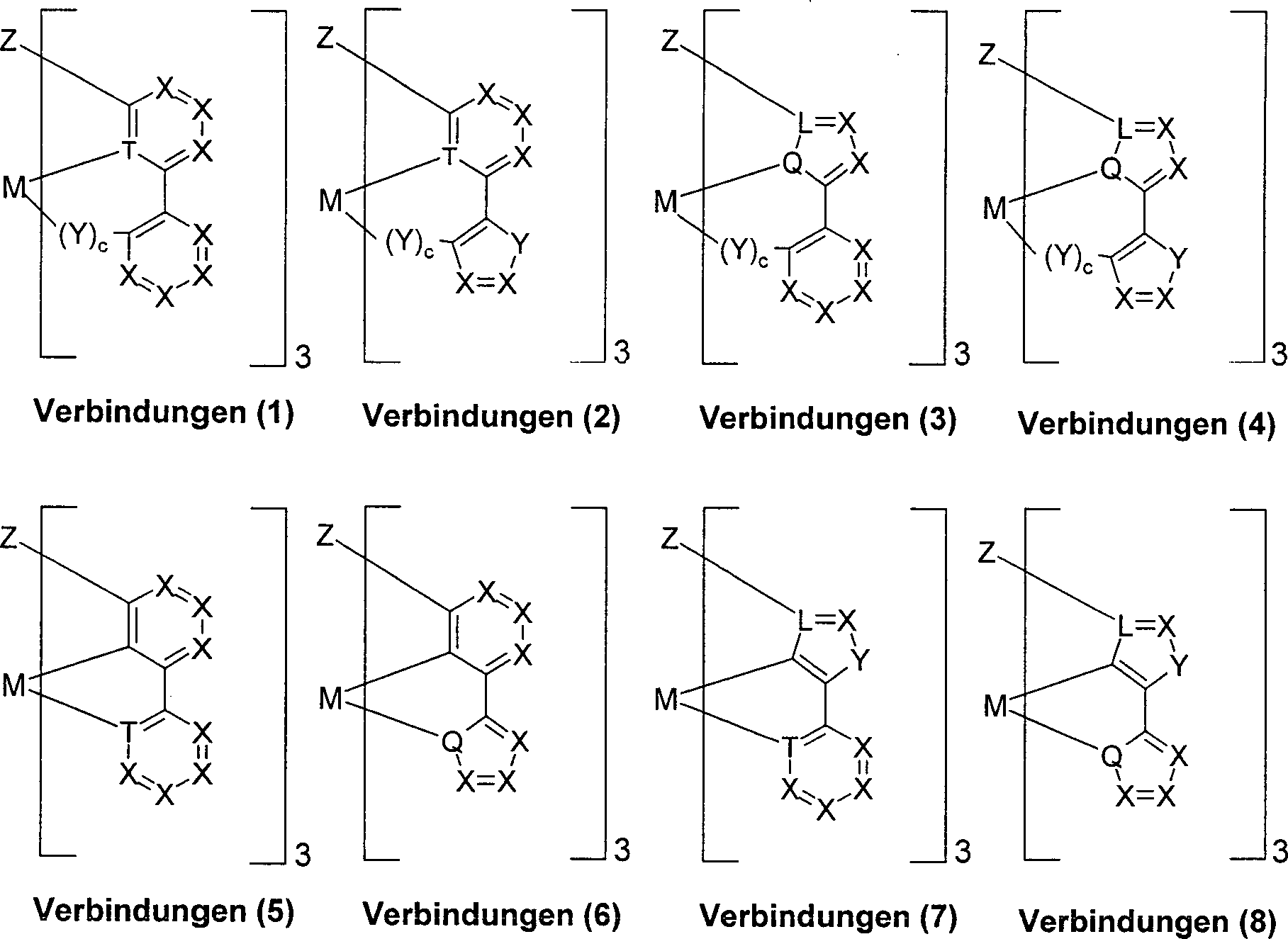


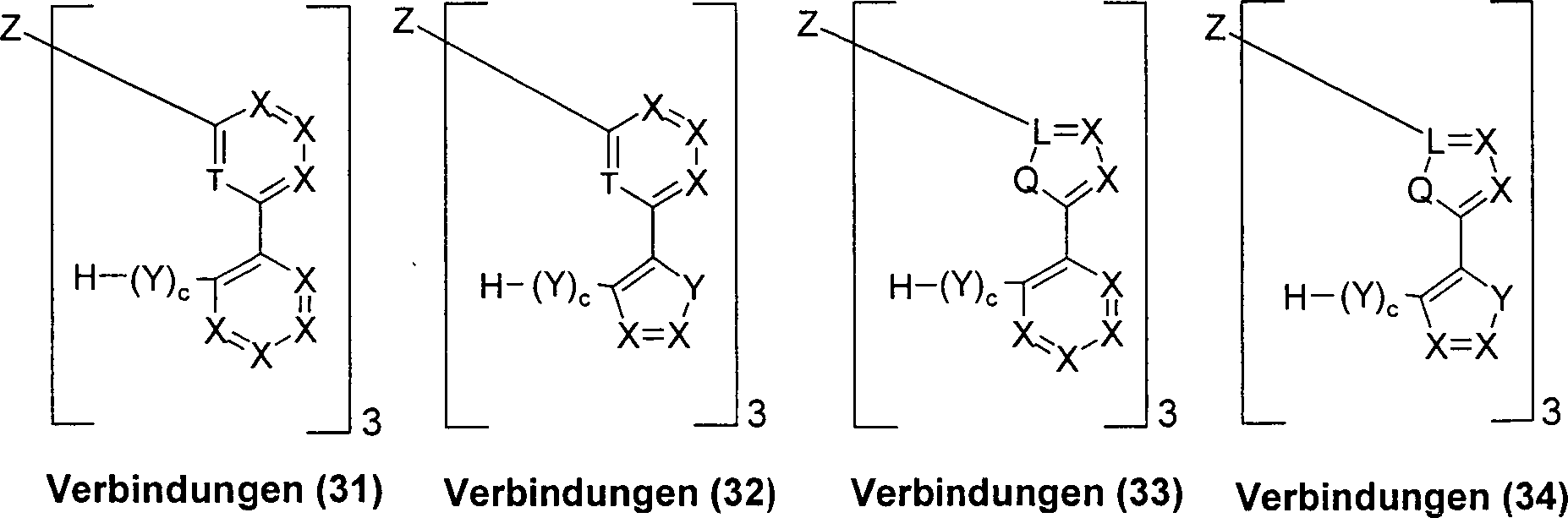
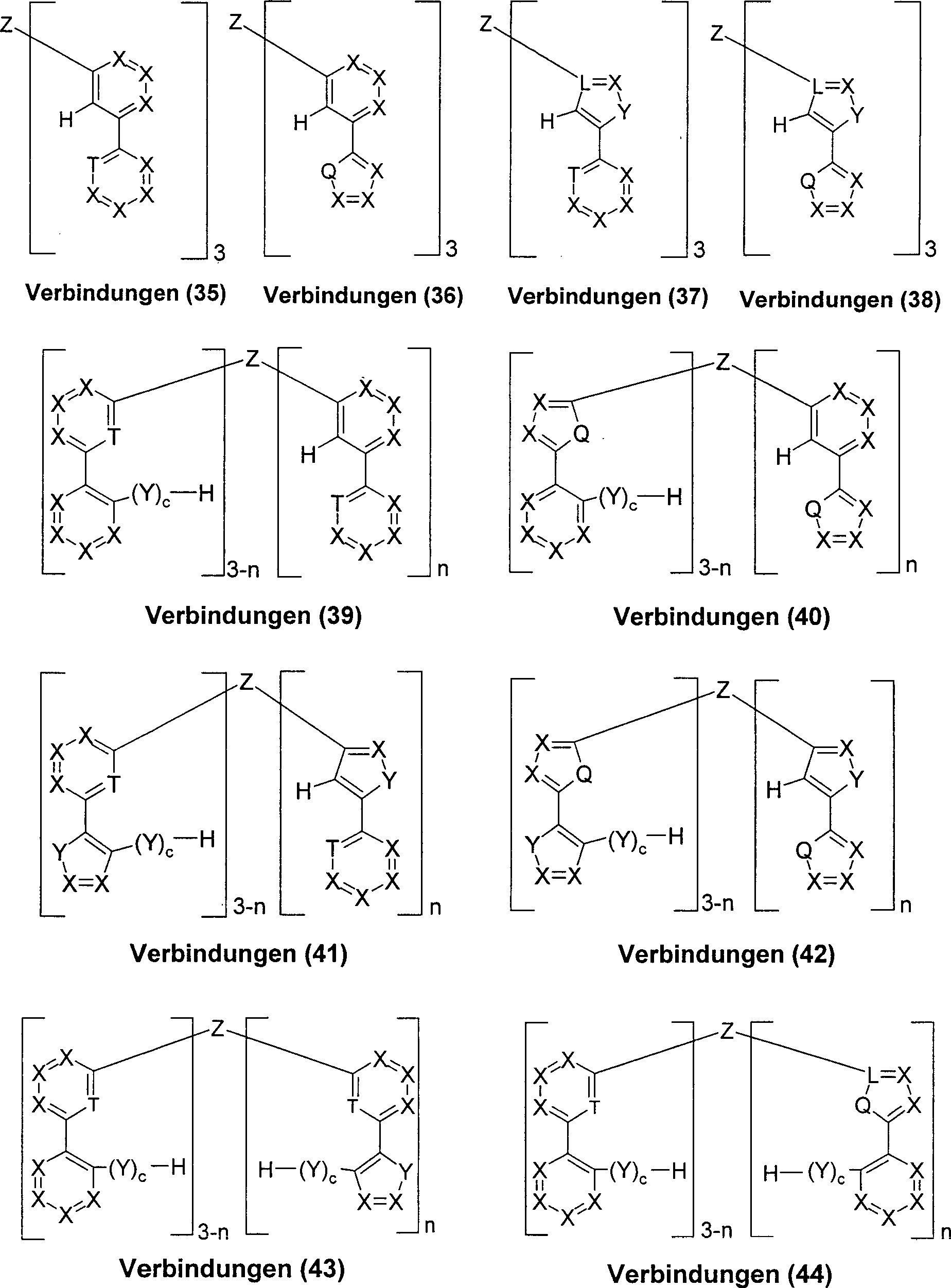
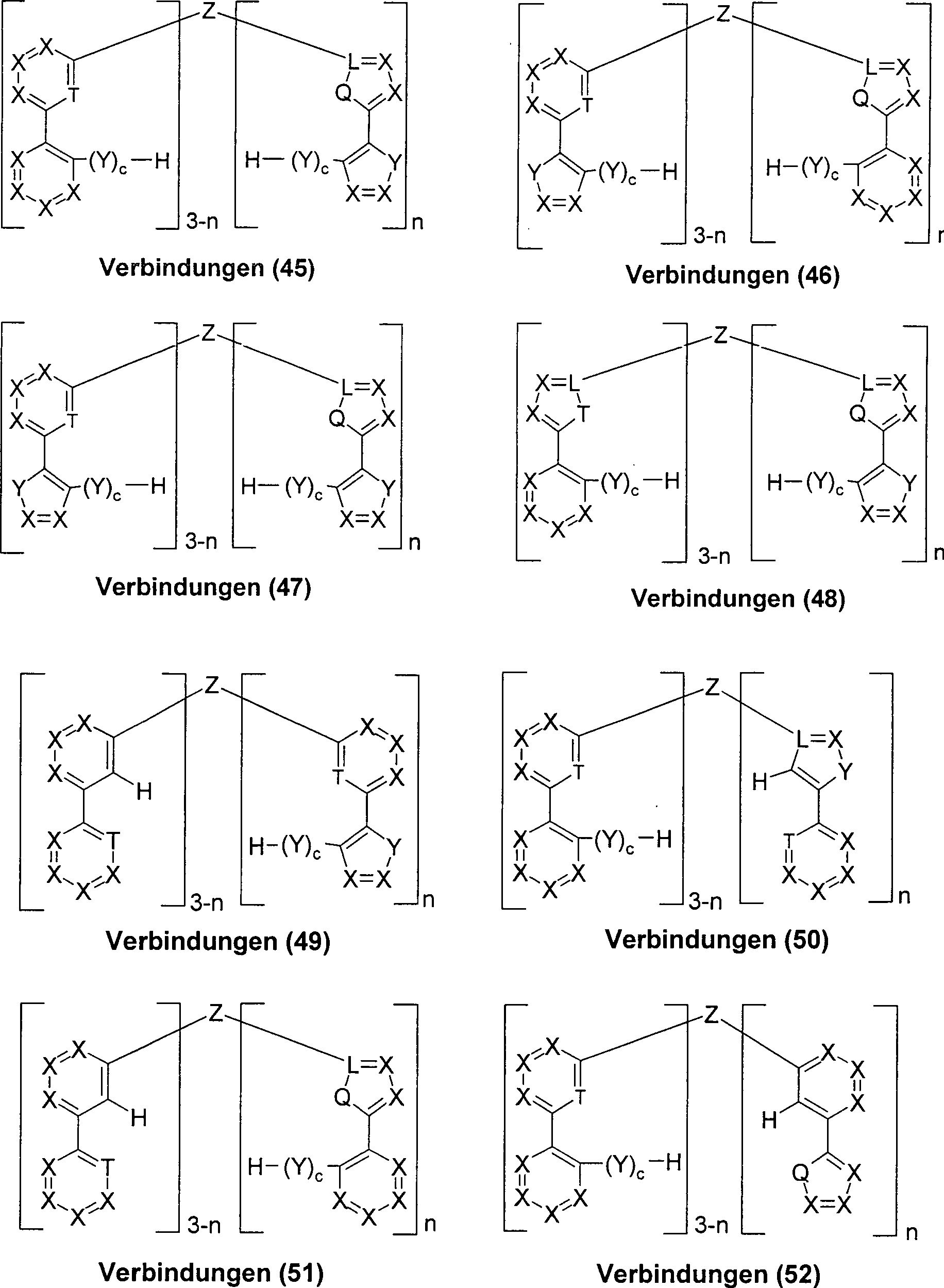

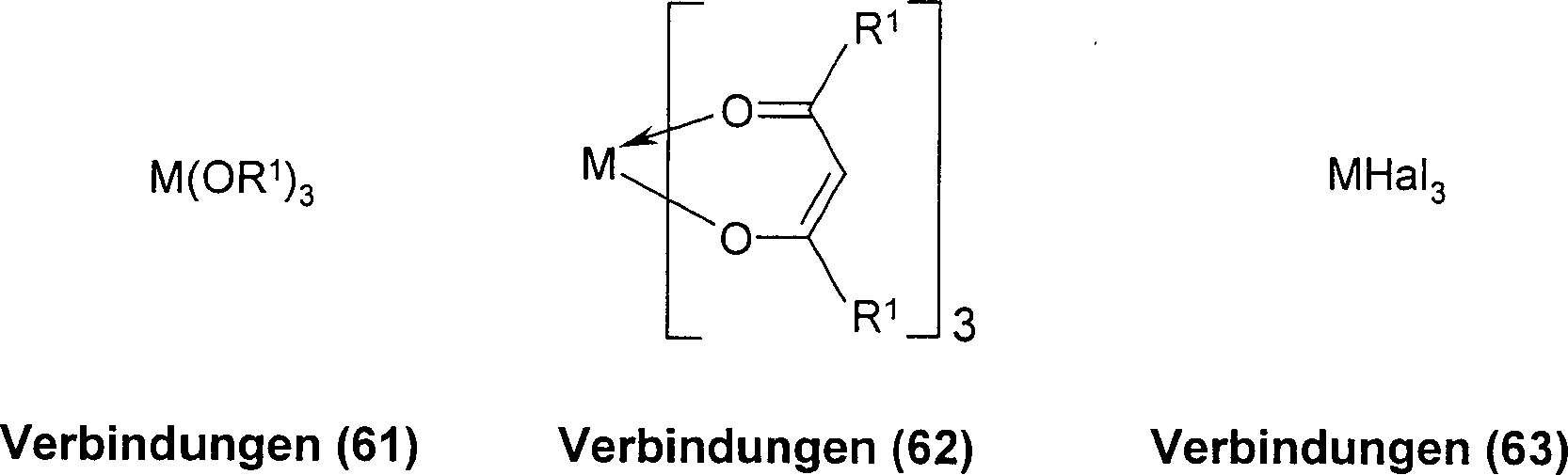
Priority Applications (9)
| Application Number | Priority Date | Filing Date | Title |
|---|---|---|---|
| DE10310887A DE10310887A1 (en) | 2003-03-11 | 2003-03-11 | Matallkomplexe |
| KR1020057016840A KR101086655B1 (en) | 2003-03-11 | 2004-03-09 | Metal complex |
| EP04718627A EP1603923B9 (en) | 2003-03-11 | 2004-03-09 | Metal complexes |
| PCT/EP2004/002393 WO2004081017A1 (en) | 2003-03-11 | 2004-03-09 | Metal complexes |
| CN2004800066107A CN1759120B (en) | 2003-03-11 | 2004-03-09 | metal complex |
| DE502004003964T DE502004003964D1 (en) | 2003-03-11 | 2004-03-09 | METAL COMPLEX |
| US10/548,855 US7728137B2 (en) | 2003-03-11 | 2004-03-09 | Metal complexes |
| JP2006504599A JP5160782B2 (en) | 2003-03-11 | 2004-03-09 | Metal complex |
| US12/781,981 US20100227978A1 (en) | 2003-03-11 | 2010-05-18 | Metal complexes |
Applications Claiming Priority (1)
| Application Number | Priority Date | Filing Date | Title |
|---|---|---|---|
| DE10310887A DE10310887A1 (en) | 2003-03-11 | 2003-03-11 | Matallkomplexe |
Publications (1)
| Publication Number | Publication Date |
|---|---|
| DE10310887A1 true DE10310887A1 (en) | 2004-09-30 |
Family
ID=32920758
Family Applications (2)
| Application Number | Title | Priority Date | Filing Date |
|---|---|---|---|
| DE10310887A Withdrawn DE10310887A1 (en) | 2003-03-11 | 2003-03-11 | Matallkomplexe |
| DE502004003964T Expired - Lifetime DE502004003964D1 (en) | 2003-03-11 | 2004-03-09 | METAL COMPLEX |
Family Applications After (1)
| Application Number | Title | Priority Date | Filing Date |
|---|---|---|---|
| DE502004003964T Expired - Lifetime DE502004003964D1 (en) | 2003-03-11 | 2004-03-09 | METAL COMPLEX |
Country Status (7)
| Country | Link |
|---|---|
| US (2) | US7728137B2 (en) |
| EP (1) | EP1603923B9 (en) |
| JP (1) | JP5160782B2 (en) |
| KR (1) | KR101086655B1 (en) |
| CN (1) | CN1759120B (en) |
| DE (2) | DE10310887A1 (en) |
| WO (1) | WO2004081017A1 (en) |
Families Citing this family (384)
| Publication number | Priority date | Publication date | Assignee | Title |
|---|---|---|---|---|
| EP3623444B1 (en) | 2003-06-02 | 2021-05-26 | UDC Ireland Limited | Organic electroluminescent devices and metal complex compounds |
| JP2007512692A (en) | 2003-11-25 | 2007-05-17 | メルク パテント ゲーエムベーハー | Organic electroluminescence device |
| DE10356099A1 (en) | 2003-11-27 | 2005-07-07 | Covion Organic Semiconductors Gmbh | Organic electroluminescent element |
| DE10357315A1 (en) | 2003-12-05 | 2005-07-07 | Covion Organic Semiconductors Gmbh | Organic electroluminescent element |
| US7825249B2 (en) | 2004-05-19 | 2010-11-02 | Merck Patent Gmbh | Metal complexes |
| DE102004031000A1 (en) * | 2004-06-26 | 2006-01-12 | Covion Organic Semiconductors Gmbh | Organic electroluminescent devices |
| US20060073360A1 (en) * | 2004-09-28 | 2006-04-06 | Fuji Photo Film Co., Ltd. | Organic electroluminescent device |
| GB0422391D0 (en) * | 2004-10-08 | 2004-11-10 | Cambridge Display Tech Ltd | Light emitting device |
| US9109081B2 (en) * | 2005-02-16 | 2015-08-18 | Sumitomo Chemical Company, Limited | Method for producing aromatic polymer |
| WO2006108498A1 (en) * | 2005-04-12 | 2006-10-19 | Merck Patent Gmbh | Organic electroluminescent devices |
| TWI391027B (en) * | 2005-04-25 | 2013-03-21 | Fujifilm Corp | Organic electroluminescent device |
| US7758971B2 (en) * | 2005-04-25 | 2010-07-20 | Fujifilm Corporation | Organic electroluminescent device |
| DE102005040411A1 (en) | 2005-08-26 | 2007-03-01 | Merck Patent Gmbh | New materials for organic electroluminescent devices |
| DE102005043163A1 (en) | 2005-09-12 | 2007-03-15 | Merck Patent Gmbh | Connections for organic electronic devices |
| GB0518968D0 (en) | 2005-09-16 | 2005-10-26 | Cdt Oxford Ltd | Organic light-emitting device |
| US20070092759A1 (en) * | 2005-10-26 | 2007-04-26 | Begley William J | Organic element for low voltage electroluminescent devices |
| US8956738B2 (en) | 2005-10-26 | 2015-02-17 | Global Oled Technology Llc | Organic element for low voltage electroluminescent devices |
| DE102005058543A1 (en) * | 2005-12-08 | 2007-06-14 | Merck Patent Gmbh | Organic electroluminescent devices |
| DE102005058557A1 (en) * | 2005-12-08 | 2007-06-14 | Merck Patent Gmbh | Organic electroluminescent device |
| DE102006013802A1 (en) | 2006-03-24 | 2007-09-27 | Merck Patent Gmbh | New anthracene compounds useful in organic electronic devices, preferably organic electroluminescent device e.g. integrated organic electroluminescent devices and organic field-effect-transistors |
| DE102006031990A1 (en) | 2006-07-11 | 2008-01-17 | Merck Patent Gmbh | New materials for organic electroluminescent devices |
| DE102007024850A1 (en) | 2007-05-29 | 2008-12-04 | Merck Patent Gmbh | New materials for organic electroluminescent devices |
| KR100894135B1 (en) * | 2007-06-29 | 2009-04-20 | 제일모직주식회사 | Metal complex compound for organic light emitting device and organic light emitting display device using same |
| DE102008015526B4 (en) | 2008-03-25 | 2021-11-11 | Merck Patent Gmbh | Metal complexes |
| DE102008018670A1 (en) | 2008-04-14 | 2009-10-15 | Merck Patent Gmbh | New materials for organic electroluminescent devices |
| DE102008027005A1 (en) | 2008-06-05 | 2009-12-10 | Merck Patent Gmbh | Organic electronic device containing metal complexes |
| DE102008035413A1 (en) | 2008-07-29 | 2010-02-04 | Merck Patent Gmbh | Connections for organic electronic devices |
| DE102008036247A1 (en) * | 2008-08-04 | 2010-02-11 | Merck Patent Gmbh | Electronic devices containing metal complexes |
| DE102008054141A1 (en) | 2008-10-31 | 2010-05-06 | Merck Patent Gmbh | New materials for organic electroluminescent devices |
| DE102008063490B4 (en) | 2008-12-17 | 2023-06-15 | Merck Patent Gmbh | Organic electroluminescent device and method for adjusting the color locus of a white-emitting electroluminescent device |
| DE102008063470A1 (en) | 2008-12-17 | 2010-07-01 | Merck Patent Gmbh | Organic electroluminescent device |
| DE102009005289B4 (en) | 2009-01-20 | 2023-06-22 | Merck Patent Gmbh | Materials for organic electroluminescent devices, methods for their production and electronic devices containing them |
| DE102009005290A1 (en) | 2009-01-20 | 2010-07-22 | Merck Patent Gmbh | Connections for electronic devices |
| DE102009005288A1 (en) | 2009-01-20 | 2010-07-22 | Merck Patent Gmbh | Materials for organic electroluminescent devices |
| DE102009005746A1 (en) | 2009-01-23 | 2010-07-29 | Merck Patent Gmbh | Materials for organic electroluminescent devices |
| DE102009007038A1 (en) | 2009-02-02 | 2010-08-05 | Merck Patent Gmbh | metal complexes |
| DE102009009277B4 (en) | 2009-02-17 | 2023-12-07 | Merck Patent Gmbh | Organic electronic device, process for its production and use of compounds |
| DE102009011223A1 (en) | 2009-03-02 | 2010-09-23 | Merck Patent Gmbh | metal complexes |
| DE102009012346B4 (en) | 2009-03-09 | 2024-02-15 | Merck Patent Gmbh | Organic electroluminescent device and method for producing the same |
| DE102009014513A1 (en) | 2009-03-23 | 2010-09-30 | Merck Patent Gmbh | Organic electroluminescent device |
| DE102009017064A1 (en) | 2009-04-09 | 2010-10-14 | Merck Patent Gmbh | Organic electroluminescent device |
| EP2445976A2 (en) | 2009-06-22 | 2012-05-02 | Merck Patent GmbH | Conducting formulation |
| DE102009032922B4 (en) | 2009-07-14 | 2024-04-25 | Merck Patent Gmbh | Materials for organic electroluminescent devices, processes for their preparation, their use and electronic device |
| DE102009033371A1 (en) | 2009-07-16 | 2011-05-12 | Merck Patent Gmbh | Materials for electronic devices |
| DE102009034625A1 (en) | 2009-07-27 | 2011-02-03 | Merck Patent Gmbh | New materials for organic electroluminescent devices |
| EP2462203B1 (en) | 2009-08-04 | 2016-03-02 | Merck Patent GmbH | Electronic devices comprising multi cyclic hydrocarbons |
| DE102009041289A1 (en) | 2009-09-16 | 2011-03-17 | Merck Patent Gmbh | Organic electroluminescent device |
| DE102009041414A1 (en) * | 2009-09-16 | 2011-03-17 | Merck Patent Gmbh | metal complexes |
| JP5784608B2 (en) | 2009-09-16 | 2015-09-24 | メルク パテント ゲーエムベーハー | Formulations for electronic device manufacturing |
| DE102009042693A1 (en) | 2009-09-23 | 2011-03-24 | Merck Patent Gmbh | Materials for electronic devices |
| DE102009042680A1 (en) | 2009-09-23 | 2011-03-24 | Merck Patent Gmbh | Organic electroluminescent device |
| DE102009049587A1 (en) | 2009-10-16 | 2011-04-21 | Merck Patent Gmbh | metal complexes |
| DE102009053191A1 (en) | 2009-11-06 | 2011-05-12 | Merck Patent Gmbh | Materials for electronic devices |
| DE102009052428A1 (en) | 2009-11-10 | 2011-05-12 | Merck Patent Gmbh | Connection for electronic devices |
| DE102009057167A1 (en) * | 2009-12-05 | 2011-06-09 | Merck Patent Gmbh | Electronic device containing metal complexes |
| JP5897472B2 (en) | 2009-12-22 | 2016-03-30 | メルク パテント ゲーエムベーハー | Electroluminescent functional surfactant |
| WO2011076323A1 (en) | 2009-12-22 | 2011-06-30 | Merck Patent Gmbh | Formulations comprising phase-separated functional materials |
| EP2517278B1 (en) | 2009-12-22 | 2019-07-17 | Merck Patent GmbH | Electroluminescent formulations |
| KR20170093267A (en) | 2009-12-23 | 2017-08-14 | 메르크 파텐트 게엠베하 | Compositions comprising organic semiconducting compounds |
| WO2011076325A1 (en) | 2009-12-23 | 2011-06-30 | Merck Patent Gmbh | Compositions comprising polymeric binders |
| DE102010005697A1 (en) | 2010-01-25 | 2011-07-28 | Merck Patent GmbH, 64293 | Connections for electronic devices |
| DE102010009193B4 (en) | 2010-02-24 | 2022-05-19 | MERCK Patent Gesellschaft mit beschränkter Haftung | Composition containing fluorine-fluorine associates, processes for their production, their use and organic electronic devices containing them |
| DE102010009903A1 (en) | 2010-03-02 | 2011-09-08 | Merck Patent Gmbh | Connections for electronic devices |
| DE102010010481A1 (en) | 2010-03-06 | 2011-09-08 | Merck Patent Gmbh | Organic electroluminescent device |
| DE102010010631A1 (en) | 2010-03-09 | 2011-09-15 | Merck Patent Gmbh | Materials for electronic devices |
| US9373807B2 (en) | 2010-03-11 | 2016-06-21 | Merck Patent Gmbh | Radiative fibers |
| WO2011110277A1 (en) | 2010-03-11 | 2011-09-15 | Merck Patent Gmbh | Fibers in therapy and cosmetics |
| CN102812573B (en) | 2010-03-23 | 2015-09-30 | 默克专利有限公司 | For the material of organic electroluminescence device |
| DE102010013068A1 (en) | 2010-03-26 | 2011-09-29 | Merck Patent Gmbh | Connections for electronic devices |
| WO2011128034A1 (en) | 2010-04-12 | 2011-10-20 | Merck Patent Gmbh | Composition having improved performance |
| US20130026421A1 (en) | 2010-04-12 | 2013-01-31 | Merck Patent Gmbh | Composition and method for preparation of organic electronic devices |
| DE102010014933A1 (en) | 2010-04-14 | 2011-10-20 | Merck Patent Gmbh | Materials for electronic devices |
| DE102010020044A1 (en) | 2010-05-11 | 2011-11-17 | Merck Patent Gmbh | Organic electroluminescent device |
| KR101943110B1 (en) | 2010-05-27 | 2019-01-28 | 메르크 파텐트 게엠베하 | Formulation and method for preparation of organic electronic devices |
| EP2576723B1 (en) | 2010-05-27 | 2017-09-20 | Merck Patent GmbH | Compositions comprising quantum dots |
| DE112011102008B4 (en) * | 2010-06-15 | 2022-04-21 | Merck Patent Gmbh | metal complexes |
| DE102010024335A1 (en) | 2010-06-18 | 2011-12-22 | Merck Patent Gmbh | Connections for electronic devices |
| DE102010024542A1 (en) | 2010-06-22 | 2011-12-22 | Merck Patent Gmbh | Materials for electronic devices |
| JP2013539584A (en) | 2010-07-26 | 2013-10-24 | メルク パテント ゲーエムベーハー | Quantum dots and hosts |
| US20130226268A1 (en) | 2010-07-26 | 2013-08-29 | Merck Patent Gmbh | Nanocrystals in devices |
| US9435021B2 (en) * | 2010-07-29 | 2016-09-06 | University Of Southern California | Co-deposition methods for the fabrication of organic optoelectronic devices |
| US9236578B2 (en) | 2010-07-30 | 2016-01-12 | Merck Patent Gmbh | Organic electroluminescent device |
| DE102010033548A1 (en) | 2010-08-05 | 2012-02-09 | Merck Patent Gmbh | Materials for electronic devices |
| DE102010048074A1 (en) | 2010-10-09 | 2012-04-12 | Merck Patent Gmbh | Materials for electronic devices |
| DE102010048497A1 (en) | 2010-10-14 | 2012-04-19 | Merck Patent Gmbh | Formulations for organic electroluminescent devices |
| DE102010048498A1 (en) | 2010-10-14 | 2012-04-19 | Merck Patent Gmbh | Materials for organic electroluminescent devices |
| DE102010048607A1 (en) | 2010-10-15 | 2012-04-19 | Merck Patent Gmbh | Connections for electronic devices |
| DE102010048608A1 (en) | 2010-10-15 | 2012-04-19 | Merck Patent Gmbh | Materials for organic electroluminescent devices |
| CN102533247B (en) * | 2010-12-12 | 2015-09-30 | 陈文通 | A kind of containing dysprosium fluorescent crystal and preparation method thereof |
| DE102010054316A1 (en) | 2010-12-13 | 2012-06-14 | Merck Patent Gmbh | Substituted tetraarylbenzenes |
| DE102010055902A1 (en) | 2010-12-23 | 2012-06-28 | Merck Patent Gmbh | Organic electroluminescent device |
| EP2663567B1 (en) | 2011-01-13 | 2016-06-01 | Merck Patent GmbH | Compounds for organic electroluminescent devices |
| US8751777B2 (en) | 2011-01-28 | 2014-06-10 | Honeywell International Inc. | Methods and reconfigurable systems to optimize the performance of a condition based health maintenance system |
| DE102011010841A1 (en) | 2011-02-10 | 2012-08-16 | Merck Patent Gmbh | (1,3) -dioxane-5-one compounds |
| DE102011011104A1 (en) | 2011-02-12 | 2012-08-16 | Merck Patent Gmbh | Substituted dibenzonaphthacenes |
| JP6351974B2 (en) | 2011-02-14 | 2018-07-04 | メルク パテント ゲーエムベーハー | Devices and methods for treatment of cells and cellular tissues |
| DE102011011539A1 (en) | 2011-02-17 | 2012-08-23 | Merck Patent Gmbh | Connections for electronic devices |
| JP5747736B2 (en) * | 2011-03-01 | 2015-07-15 | コニカミノルタ株式会社 | Organic electroluminescence element, display device and lighting device |
| WO2012126566A1 (en) | 2011-03-24 | 2012-09-27 | Merck Patent Gmbh | Organic ionic functional materials |
| US9385335B2 (en) | 2011-04-05 | 2016-07-05 | Merck Patent Gmbh | Organic electroluminescent device |
| EP2697226B1 (en) | 2011-04-13 | 2017-01-18 | Merck Patent GmbH | Compounds for electronic devices |
| CN103476774B (en) | 2011-04-13 | 2017-02-15 | 默克专利有限公司 | Materials for Electronic Devices |
| EP2699641B1 (en) | 2011-04-18 | 2017-05-17 | Merck Patent GmbH | Compounds for electronic devices |
| WO2012149992A1 (en) | 2011-05-04 | 2012-11-08 | Merck Patent Gmbh | Device for preserving fresh goods |
| KR101884496B1 (en) | 2011-05-05 | 2018-08-01 | 메르크 파텐트 게엠베하 | Compounds for electronic devices |
| JP6223961B2 (en) | 2011-05-12 | 2017-11-01 | メルク パテント ゲーエムベーハー | Organic ionic functional material, composition and electronic device |
| WO2013013754A1 (en) | 2011-07-25 | 2013-01-31 | Merck Patent Gmbh | Copolymers with functionalized side chains |
| US9780311B2 (en) | 2011-07-29 | 2017-10-03 | Merck Patent Gmbh | Compounds for electronic devices |
| WO2013017192A1 (en) | 2011-08-03 | 2013-02-07 | Merck Patent Gmbh | Materials for electronic devices |
| DE102012016192A1 (en) | 2011-08-19 | 2013-02-21 | Merck Patent Gmbh | New compounds capable of forming hydrogen bonds are useful in electronic device, e.g. organic electroluminescent device, organic light-emitting transistor and organic light-emitting electrochemical cell |
| KR102051790B1 (en) | 2011-08-22 | 2019-12-04 | 메르크 파텐트 게엠베하 | Organic electroluminescence device |
| US9356242B2 (en) | 2011-10-06 | 2016-05-31 | Merck Patent Gmbh | Organic electroluminescent device |
| DE102011116165A1 (en) | 2011-10-14 | 2013-04-18 | Merck Patent Gmbh | Benzodioxepin-3-one compounds |
| JP6223984B2 (en) | 2011-10-27 | 2017-11-01 | メルク パテント ゲーエムベーハー | Materials for electronic devices |
| DE102011117422A1 (en) | 2011-10-28 | 2013-05-02 | Merck Patent Gmbh | Hyperbranched polymers, process for their preparation and their use in electronic devices |
| JP5783007B2 (en) * | 2011-11-21 | 2015-09-24 | コニカミノルタ株式会社 | ORGANIC ELECTROLUMINESCENT ELEMENT AND LIGHTING DEVICE |
| EP2791105B1 (en) | 2011-12-12 | 2020-03-18 | Merck Patent GmbH | Compounds for electronic devices |
| JP6197650B2 (en) * | 2011-12-20 | 2017-09-20 | コニカミノルタ株式会社 | Organic EL device |
| DE102012022880B4 (en) | 2011-12-22 | 2024-12-24 | Merck Patent Gmbh | Electronic devices containing organic layers |
| JP5799820B2 (en) * | 2012-01-13 | 2015-10-28 | コニカミノルタ株式会社 | Organic electroluminescence element, display device and lighting device |
| KR102091393B1 (en) * | 2012-01-16 | 2020-03-23 | 메르크 파텐트 게엠베하 | Organic metal complexes |
| JP5761045B2 (en) * | 2012-01-20 | 2015-08-12 | コニカミノルタ株式会社 | Organic electroluminescence element, lighting device and display device |
| KR20140123555A (en) | 2012-01-30 | 2014-10-22 | 메르크 파텐트 게엠베하 | Nanocrystals on fibers |
| KR102357439B1 (en) | 2012-02-14 | 2022-02-08 | 메르크 파텐트 게엠베하 | Spirobifluorene compounds for organic electroluminescent devices |
| JP5900001B2 (en) * | 2012-02-16 | 2016-04-06 | コニカミノルタ株式会社 | ORGANIC ELECTROLUMINESCENT ELEMENT, DISPLAY DEVICE AND LIGHTING DEVICE PROVIDED WITH SAME |
| JP5786763B2 (en) * | 2012-03-06 | 2015-09-30 | コニカミノルタ株式会社 | Organic electroluminescence element, display device and lighting device |
| CN104205390B (en) | 2012-03-15 | 2017-08-25 | 默克专利有限公司 | Electronic device |
| JP5884626B2 (en) * | 2012-05-09 | 2016-03-15 | コニカミノルタ株式会社 | Organic electroluminescence element, display device and lighting device |
| DE102012011335A1 (en) | 2012-06-06 | 2013-12-12 | Merck Patent Gmbh | Connections for Organic Electronic Devices |
| WO2013185871A1 (en) | 2012-06-12 | 2013-12-19 | Merck Patent Gmbh | Compounds for electronic devices |
| US9231218B2 (en) * | 2012-07-10 | 2016-01-05 | Universal Display Corporation | Phosphorescent emitters containing dibenzo[1,4]azaborinine structure |
| EP2872590B1 (en) | 2012-07-13 | 2018-11-14 | Merck Patent GmbH | Metal complexes |
| CN110444694B (en) | 2012-07-23 | 2023-04-07 | 默克专利有限公司 | Compound and organic electroluminescent device |
| CN108054293B (en) | 2012-07-23 | 2020-05-22 | 默克专利有限公司 | Derivatives of 2-diarylaminofluorene and organic electronic complexes containing said 2-diarylaminofluorene derivatives |
| KR20210076207A (en) | 2012-07-23 | 2021-06-23 | 메르크 파텐트 게엠베하 | Fluorenes and electronic devices containing them |
| JP6363075B2 (en) | 2012-08-07 | 2018-07-25 | メルク パテント ゲーエムベーハー | Metal complex |
| US20150179958A1 (en) * | 2012-08-07 | 2015-06-25 | Konica Minolta Inc. | Organic electroluminescent element, lighting device and display device |
| KR102184852B1 (en) | 2012-09-18 | 2020-12-01 | 메르크 파텐트 게엠베하 | Materials for electronic devices |
| JP6242905B2 (en) * | 2012-10-09 | 2017-12-06 | メルク パテント ゲーエムベーハー | Metal complex |
| DE102012020167A1 (en) * | 2012-10-13 | 2014-04-17 | Eberhard Karls Universität Tübingen | metal complexes |
| KR101963104B1 (en) | 2012-10-31 | 2019-03-28 | 메르크 파텐트 게엠베하 | Electronic device |
| WO2014072017A1 (en) | 2012-11-12 | 2014-05-15 | Merck Patent Gmbh | Materials for electronic devices |
| KR102173856B1 (en) | 2012-11-30 | 2020-11-04 | 메르크 파텐트 게엠베하 | Electronic device |
| US9793484B2 (en) | 2012-12-28 | 2017-10-17 | Merck Patent Gmbh | Composition comprising polymeric organic semiconducting compounds |
| EP2941472B1 (en) | 2013-01-03 | 2018-07-25 | Merck Patent GmbH | Materials for electronic devices |
| US20150340627A1 (en) | 2013-01-03 | 2015-11-26 | Merck Patent Gmbh | Materials for electronic devices |
| JP2016516731A (en) * | 2013-03-16 | 2016-06-09 | メルク パテント ゲーエムベーハー | Metal complex |
| EP3028318A1 (en) | 2013-07-29 | 2016-06-08 | Merck Patent GmbH | Electro-optical device and the use thereof |
| WO2015014434A1 (en) | 2013-07-30 | 2015-02-05 | Merck Patent Gmbh | Materials for electronic devices |
| WO2015014435A1 (en) | 2013-07-30 | 2015-02-05 | Merck Patent Gmbh | Materials for electronic devices |
| KR102212540B1 (en) | 2013-08-13 | 2021-02-04 | 메르크 파텐트 게엠베하 | Method for vacuum purification |
| EP2860177A3 (en) * | 2013-09-20 | 2015-06-10 | Bayer Intellectual Property GmbH | Synthesis of functionalized arenes |
| WO2015082056A1 (en) | 2013-12-06 | 2015-06-11 | Merck Patent Gmbh | Compounds and organic electronic devices |
| WO2015082037A1 (en) | 2013-12-06 | 2015-06-11 | Merck Patent Gmbh | Compositions containing a polymeric binder which comprises acrylic and/or methacrylic acid ester units |
| KR102380808B1 (en) | 2013-12-06 | 2022-03-30 | 메르크 파텐트 게엠베하 | Substituted oxepines |
| EP3080229B1 (en) | 2013-12-12 | 2018-01-17 | Merck Patent GmbH | Materials for electronic devices |
| US9847496B2 (en) | 2013-12-23 | 2017-12-19 | Universal Display Corporation | Organic electroluminescent materials and devices |
| CN106255687B (en) | 2014-04-30 | 2020-06-05 | 默克专利有限公司 | Material for electronic devices |
| KR102213660B1 (en) | 2014-05-01 | 2021-02-08 | 삼성전자주식회사 | Organometallic compound and organic light emitting device including the same |
| JP6629291B2 (en) | 2014-07-21 | 2020-01-15 | メルク、パテント、ゲゼルシャフト、ミット、ベシュレンクテル、ハフツングMerck Patent GmbH | Materials for electronic devices |
| EP3189551B1 (en) | 2014-09-05 | 2021-01-27 | Merck Patent GmbH | Formulations and method of producing an organic electroluminescent device |
| WO2016107663A1 (en) | 2014-12-30 | 2016-07-07 | Merck Patent Gmbh | Formulations and electronic devices |
| JP7030519B2 (en) | 2015-01-30 | 2022-03-07 | メルク パテント ゲーエムベーハー | Formulations with low particle content |
| EP3250658B1 (en) | 2015-01-30 | 2019-06-19 | Merck Patent GmbH | Materials for electronic devices |
| JP6772188B2 (en) | 2015-02-03 | 2020-10-21 | メルク、パテント、ゲゼルシャフト、ミット、ベシュレンクテル、ハフツングMerck Patent GmbH | Metal complex |
| US9929361B2 (en) | 2015-02-16 | 2018-03-27 | Universal Display Corporation | Organic electroluminescent materials and devices |
| US11056657B2 (en) | 2015-02-27 | 2021-07-06 | University Display Corporation | Organic electroluminescent materials and devices |
| WO2016155866A1 (en) | 2015-03-30 | 2016-10-06 | Merck Patent Gmbh | Formulation of an organic functional material comprising a siloxane solvent |
| US9859510B2 (en) | 2015-05-15 | 2018-01-02 | Universal Display Corporation | Organic electroluminescent materials and devices |
| CN104892647B (en) * | 2015-05-29 | 2017-02-01 | 华中师范大学 | Isocyano-bridged gold compounds having steam discoloration property and taking carbazole as skeleton and preparation and application of isocyano-bridged gold compounds |
| US10418568B2 (en) | 2015-06-01 | 2019-09-17 | Universal Display Corporation | Organic electroluminescent materials and devices |
| KR102654992B1 (en) | 2015-06-12 | 2024-04-04 | 메르크 파텐트 게엠베하 | Esters containing non-aromatic cycles as solvents for oled formulations |
| US20180212166A1 (en) | 2015-07-15 | 2018-07-26 | Merck Patent Gmbh | Composition comprising organic semiconducting compounds |
| US11127905B2 (en) | 2015-07-29 | 2021-09-21 | Universal Display Corporation | Organic electroluminescent materials and devices |
| JP6786591B2 (en) | 2015-08-14 | 2020-11-18 | メルク、パテント、ゲゼルシャフト、ミット、ベシュレンクテル、ハフツングMerck Patent GmbH | Phenoxazine derivatives for organic electroluminescence devices |
| US11031562B2 (en) | 2015-08-25 | 2021-06-08 | Merck Patent Gmbh | Metal complexes |
| EP3341981B1 (en) | 2015-08-28 | 2020-08-19 | Merck Patent GmbH | Formulation of an organic functional material comprising an epoxy group containing solvent |
| US20180327339A1 (en) | 2015-08-28 | 2018-11-15 | Merck Patent Gmbh | Compounds for electronic devices |
| US10672996B2 (en) | 2015-09-03 | 2020-06-02 | Universal Display Corporation | Organic electroluminescent materials and devices |
| JP6044695B2 (en) * | 2015-11-16 | 2016-12-14 | コニカミノルタ株式会社 | ORGANIC ELECTROLUMINESCENT ELEMENT, DISPLAY DEVICE AND LIGHTING DEVICE PROVIDED WITH SAME |
| CN108368361A (en) | 2015-12-10 | 2018-08-03 | 默克专利有限公司 | Preparation containing the ketone comprising non-aromatic ring |
| JP7051684B2 (en) | 2015-12-15 | 2022-04-11 | メルク パテント ゲーエムベーハー | Esters containing aromatic groups as solvents for organic electronic formulations |
| EP3390549B1 (en) | 2015-12-16 | 2022-06-29 | Merck Patent GmbH | Formulations containing a solid solvent |
| KR20180095028A (en) | 2015-12-16 | 2018-08-24 | 메르크 파텐트 게엠베하 | A formulation containing a mixture of two or more different solvents |
| JP6911223B2 (en) * | 2016-01-07 | 2021-07-28 | メルク、パテント、ゲゼルシャフト、ミット、ベシュレンクテル、ハフツングMerck Patent GmbH | Organometallic complex, organic electroluminescence device and its manufacturing method, display device and lighting device |
| WO2017133829A1 (en) | 2016-02-05 | 2017-08-10 | Merck Patent Gmbh | Materials for electronic devices |
| US20170229663A1 (en) | 2016-02-09 | 2017-08-10 | Universal Display Corporation | Organic electroluminescent materials and devices |
| US10840448B2 (en) | 2016-02-17 | 2020-11-17 | Merck Patent Gmbh | Formulation of an organic functional material |
| DE102016003104A1 (en) | 2016-03-15 | 2017-09-21 | Merck Patent Gmbh | Container comprising a formulation containing at least one organic semiconductor |
| US10236456B2 (en) | 2016-04-11 | 2019-03-19 | Universal Display Corporation | Organic electroluminescent materials and devices |
| WO2017194435A1 (en) | 2016-05-11 | 2017-11-16 | Merck Patent Gmbh | Compositions for electrochemical cells |
| CN109153871A (en) | 2016-06-16 | 2019-01-04 | 默克专利有限公司 | The preparation of organic functional material |
| JP2019523998A (en) | 2016-06-17 | 2019-08-29 | メルク パテント ゲーエムベーハー | Formulation of organic functional materials |
| US10862054B2 (en) | 2016-06-20 | 2020-12-08 | Universal Display Corporation | Organic electroluminescent materials and devices |
| US11482683B2 (en) | 2016-06-20 | 2022-10-25 | Universal Display Corporation | Organic electroluminescent materials and devices |
| US10672997B2 (en) | 2016-06-20 | 2020-06-02 | Universal Display Corporation | Organic electroluminescent materials and devices |
| TW201815998A (en) | 2016-06-28 | 2018-05-01 | 德商麥克專利有限公司 | Organic functional material formulation |
| US11365167B2 (en) | 2016-07-08 | 2022-06-21 | Merck Patent Gmbh | Materials for organic electroluminescent devices |
| JP7039549B2 (en) * | 2016-07-14 | 2022-03-22 | メルク パテント ゲゼルシャフト ミット ベシュレンクテル ハフツング | Metal complex |
| US10720587B2 (en) | 2016-07-19 | 2020-07-21 | Universal Display Corporation | Organic electroluminescent materials and devices |
| TW201817738A (en) | 2016-07-25 | 2018-05-16 | 德商麥克專利有限公司 | Metal complexes |
| WO2018024719A1 (en) | 2016-08-04 | 2018-02-08 | Merck Patent Gmbh | Formulation of an organic functional material |
| KR101836041B1 (en) | 2016-08-30 | 2018-03-07 | 메르크 파텐트 게엠베하 | Metal complexes |
| WO2018041769A1 (en) | 2016-08-30 | 2018-03-08 | Merck Patent Gmbh | Binuclear and trinuclear metal complexes composed of two inter-linked tripodal hexadentate ligands for use in electroluminescent devices |
| US10608186B2 (en) | 2016-09-14 | 2020-03-31 | Universal Display Corporation | Organic electroluminescent materials and devices |
| CN109715642A (en) | 2016-09-21 | 2019-05-03 | 默克专利有限公司 | PROCESS FOR PRODUCTION OF BINUCLEAR as the illuminator in organic electroluminescence device |
| US10680187B2 (en) | 2016-09-23 | 2020-06-09 | Universal Display Corporation | Organic electroluminescent materials and devices |
| US11196010B2 (en) | 2016-10-03 | 2021-12-07 | Universal Display Corporation | Organic electroluminescent materials and devices |
| US11011709B2 (en) | 2016-10-07 | 2021-05-18 | Universal Display Corporation | Organic electroluminescent materials and devices |
| TWI764942B (en) | 2016-10-10 | 2022-05-21 | 德商麥克專利有限公司 | Electronic device |
| WO2018069196A1 (en) | 2016-10-12 | 2018-04-19 | Merck Patent Gmbh | Binuclear metal complexes and electronic devices, in particular organic electroluminescent devices containing said metal complexes |
| WO2018069197A1 (en) | 2016-10-12 | 2018-04-19 | Merck Patent Gmbh | Metal complexes |
| JP7023946B2 (en) | 2016-10-13 | 2022-02-22 | メルク パテント ゲゼルシャフト ミット ベシュレンクテル ハフツング | Metal complex |
| DE102017008794A1 (en) | 2016-10-17 | 2018-04-19 | Merck Patent Gmbh | Materials for use in electronic devices |
| CN109863223B (en) | 2016-10-31 | 2023-06-20 | 默克专利有限公司 | Formulation of organic functional materials |
| JP7013459B2 (en) | 2016-10-31 | 2022-01-31 | メルク パテント ゲーエムベーハー | Formulation of organic functional materials |
| JP2020512273A (en) | 2016-11-02 | 2020-04-23 | メルク パテント ゲーエムベーハー | Materials for electronic devices |
| JP7073388B2 (en) | 2016-11-08 | 2022-05-23 | メルク パテント ゲーエムベーハー | Compounds for electronic devices |
| US12317745B2 (en) | 2016-11-09 | 2025-05-27 | Universal Display Corporation | Organic electroluminescent materials and devices |
| US10680188B2 (en) | 2016-11-11 | 2020-06-09 | Universal Display Corporation | Organic electroluminescent materials and devices |
| TWI756292B (en) | 2016-11-14 | 2022-03-01 | 德商麥克專利有限公司 | Compounds having an acceptor group and a donor group |
| TW201833118A (en) | 2016-11-22 | 2018-09-16 | 德商麥克專利有限公司 | Materials for electronic devices |
| JP7101670B2 (en) | 2016-11-25 | 2022-07-15 | メルク パテント ゲゼルシャフト ミット ベシュレンクテル ハフツング | Bisbenzofuran Condensation 2,8-diaminoindeno [1,2-B] Fluorene Derivatives and Related Compounds as Materials for Organic Electroluminescence Devices (OLEDs) |
| US11453680B2 (en) | 2016-11-25 | 2022-09-27 | Merck Patent Gmbh | Bisbenzofuran-fused indeno[1,2-B]fluorene derivatives and related compounds as materials for organic electroluminescent devices (OLED) |
| KR102472751B1 (en) | 2016-12-06 | 2022-11-30 | 메르크 파텐트 게엠베하 | Manufacturing method of electronic device |
| CN110168047B (en) | 2016-12-13 | 2023-08-08 | 默克专利有限公司 | Preparation of organic functional material |
| WO2018114744A1 (en) | 2016-12-20 | 2018-06-28 | Merck Patent Gmbh | A white light emitting solid state light source |
| US11261291B2 (en) | 2016-12-22 | 2022-03-01 | Merck Patent Gmbh | Materials for electronic devices |
| KR102504432B1 (en) | 2016-12-22 | 2023-02-27 | 메르크 파텐트 게엠베하 | A mixture comprising at least two organo-functional compounds |
| US11780865B2 (en) | 2017-01-09 | 2023-10-10 | Universal Display Corporation | Organic electroluminescent materials and devices |
| TWI791481B (en) | 2017-01-30 | 2023-02-11 | 德商麥克專利有限公司 | Method for forming an organic electroluminescence (el) element |
| TWI763772B (en) | 2017-01-30 | 2022-05-11 | 德商麥克專利有限公司 | Method for forming an organic element of an electronic device |
| CN110291064B (en) | 2017-02-02 | 2023-04-28 | 默克专利有限公司 | Materials for Electronic Devices |
| KR20190126097A (en) | 2017-03-01 | 2019-11-08 | 메르크 파텐트 게엠베하 | Organic electroluminescent devices |
| CN110325524A (en) | 2017-03-02 | 2019-10-11 | 默克专利有限公司 | Material for organic electronic device |
| US10844085B2 (en) | 2017-03-29 | 2020-11-24 | Universal Display Corporation | Organic electroluminescent materials and devices |
| JP7123967B2 (en) | 2017-03-31 | 2022-08-23 | メルク パテント ゲーエムベーハー | Printing method for organic light emitting diodes (OLEDs) |
| CN110494514A (en) | 2017-04-10 | 2019-11-22 | 默克专利有限公司 | Formulation of organic functional materials |
| WO2018189134A1 (en) | 2017-04-13 | 2018-10-18 | Merck Patent Gmbh | Composition for organic electronic devices |
| CN110573515B (en) | 2017-04-25 | 2023-07-25 | 默克专利有限公司 | Compounds for electronic devices |
| JP7330898B2 (en) | 2017-05-03 | 2023-08-22 | メルク パテント ゲーエムベーハー | Formulation of organic functional material |
| US10944060B2 (en) | 2017-05-11 | 2021-03-09 | Universal Display Corporation | Organic electroluminescent materials and devices |
| TW201920343A (en) | 2017-06-21 | 2019-06-01 | 德商麥克專利有限公司 | Materials for electronic devices |
| US11767299B2 (en) | 2017-06-23 | 2023-09-26 | Merck Patent Gmbh | Materials for organic electroluminescent devices |
| US12098157B2 (en) | 2017-06-23 | 2024-09-24 | Universal Display Corporation | Organic electroluminescent materials and devices |
| CN110770363A (en) | 2017-06-26 | 2020-02-07 | 默克专利有限公司 | Homogeneous mixture |
| TW201920070A (en) | 2017-06-28 | 2019-06-01 | 德商麥克專利有限公司 | Material for electronic devices |
| TWI813576B (en) | 2017-07-03 | 2023-09-01 | 德商麥克專利有限公司 | Formulations with a low content of phenol type impurities |
| TWI786143B (en) | 2017-07-03 | 2022-12-11 | 德商麥克專利有限公司 | Organic electroluminescent device and method for producing the same |
| WO2019007867A1 (en) | 2017-07-05 | 2019-01-10 | Merck Patent Gmbh | COMPOSITION FOR ORGANIC ELECTRONIC DEVICES |
| CN110785415A (en) | 2017-07-05 | 2020-02-11 | 默克专利有限公司 | Composition for organic electronic device |
| WO2019016184A1 (en) | 2017-07-18 | 2019-01-24 | Merck Patent Gmbh | Formulation of an organic functional material |
| US11228010B2 (en) | 2017-07-26 | 2022-01-18 | Universal Display Corporation | Organic electroluminescent materials and devices |
| TWI779067B (en) | 2017-07-28 | 2022-10-01 | 德商麥克專利有限公司 | Materials for electronic devices |
| US11744142B2 (en) | 2017-08-10 | 2023-08-29 | Universal Display Corporation | Organic electroluminescent materials and devices |
| CN118405981A (en) | 2017-09-08 | 2024-07-30 | 默克专利有限公司 | Materials for electronic devices |
| CN108675975A (en) | 2017-10-17 | 2018-10-19 | 默克专利有限公司 | Material for organic electroluminescence device |
| TWI785142B (en) | 2017-11-14 | 2022-12-01 | 德商麥克專利有限公司 | Composition for organic electronic devices |
| EP4242286A3 (en) | 2017-11-23 | 2023-10-04 | Merck Patent GmbH | Materials for electronic devices |
| TWI838352B (en) | 2017-11-24 | 2024-04-11 | 德商麥克專利有限公司 | Materials for organic electroluminescent devices |
| TWI820057B (en) | 2017-11-24 | 2023-11-01 | 德商麥克專利有限公司 | Materials for organic electroluminescent devices |
| US12180230B2 (en) | 2017-11-28 | 2024-12-31 | University Of Southern California | Carbene compounds and organic electroluminescent devices |
| EP3492480B1 (en) | 2017-11-29 | 2021-10-20 | Universal Display Corporation | Organic electroluminescent materials and devices |
| US11937503B2 (en) | 2017-11-30 | 2024-03-19 | Universal Display Corporation | Organic electroluminescent materials and devices |
| KR102638811B1 (en) | 2017-12-15 | 2024-02-21 | 메르크 파텐트 게엠베하 | Substituted aromatic amines for organic electroluminescent devices |
| CN111418081B (en) | 2017-12-15 | 2024-09-13 | 默克专利有限公司 | Preparation of organic functional materials |
| KR20200100699A (en) | 2017-12-20 | 2020-08-26 | 메르크 파텐트 게엠베하 | Heteroaromatic compounds |
| US11542289B2 (en) | 2018-01-26 | 2023-01-03 | Universal Display Corporation | Organic electroluminescent materials and devices |
| JP7247231B2 (en) | 2018-02-26 | 2023-03-28 | メルク パテント ゲーエムベーハー | Formulation of organic functional material |
| TW201938761A (en) | 2018-03-06 | 2019-10-01 | 德商麥克專利有限公司 | Materials for organic electroluminescent devices |
| TWI802656B (en) | 2018-03-06 | 2023-05-21 | 德商麥克專利有限公司 | Materials for organic electroluminescent devices |
| US11165028B2 (en) | 2018-03-12 | 2021-11-02 | Universal Display Corporation | Organic electroluminescent materials and devices |
| US20210020843A1 (en) | 2018-03-16 | 2021-01-21 | Merck Patent Gmbh | Materials for organic electroluminescent devices |
| TWI828664B (en) * | 2018-03-19 | 2024-01-11 | 愛爾蘭商Udc愛爾蘭責任有限公司 | Metal complexes |
| EP3802520A1 (en) | 2018-05-30 | 2021-04-14 | Merck Patent GmbH | Composition for organic electronic devices |
| KR102634554B1 (en) * | 2018-06-12 | 2024-02-06 | 엘지디스플레이 주식회사 | Space-through charge transfer compound, and Organic light emitting diode and Organic light emitting display device including the same |
| EP3807367B1 (en) | 2018-06-15 | 2023-07-19 | Merck Patent GmbH | Formulation of an organic functional material |
| US12453279B2 (en) | 2018-08-22 | 2025-10-21 | Universal Display Corporation | Organic electroluminescent materials and devices |
| KR20210052487A (en) | 2018-08-28 | 2021-05-10 | 메르크 파텐트 게엠베하 | Materials for organic electroluminescent devices |
| TWI823993B (en) | 2018-08-28 | 2023-12-01 | 德商麥克專利有限公司 | Materials for organic electroluminescent devices |
| TWI837167B (en) | 2018-08-28 | 2024-04-01 | 德商麥克專利有限公司 | Materials for organic electroluminescent devices |
| TW202030902A (en) | 2018-09-12 | 2020-08-16 | 德商麥克專利有限公司 | Electroluminescent devices |
| JP7459065B2 (en) | 2018-09-12 | 2024-04-01 | メルク パテント ゲーエムベーハー | Materials for organic electroluminescent devices |
| TWI826522B (en) | 2018-09-12 | 2023-12-21 | 德商麥克專利有限公司 | Electroluminescent devices |
| KR20210056432A (en) | 2018-09-24 | 2021-05-18 | 메르크 파텐트 게엠베하 | Method of manufacturing granular material |
| KR20210088597A (en) | 2018-10-31 | 2021-07-14 | 메르크 파텐트 게엠베하 | Materials for organic electroluminescent devices |
| WO2020094538A1 (en) | 2018-11-06 | 2020-05-14 | Merck Patent Gmbh | Method for forming an organic element of an electronic device |
| US11737349B2 (en) | 2018-12-12 | 2023-08-22 | Universal Display Corporation | Organic electroluminescent materials and devices |
| US11780829B2 (en) | 2019-01-30 | 2023-10-10 | The University Of Southern California | Organic electroluminescent materials and devices |
| US12477890B2 (en) | 2019-02-01 | 2025-11-18 | Universal Display Corporation | Organic electroluminescent materials and devices |
| US12137605B2 (en) | 2019-02-08 | 2024-11-05 | Universal Display Corporation | Organic electroluminescent materials and devices |
| US11370809B2 (en) | 2019-02-08 | 2022-06-28 | Universal Display Corporation | Organic electroluminescent materials and devices |
| US20230080974A1 (en) | 2019-02-18 | 2023-03-16 | Merck Patent Gmbh | Composition for organic electronic devices |
| US20220127286A1 (en) | 2019-03-04 | 2022-04-28 | Merck Patent Gmbh | Ligands for nano-sized materials |
| JP2020158491A (en) | 2019-03-26 | 2020-10-01 | ユニバーサル ディスプレイ コーポレイション | Organic electroluminescent materials and devices |
| WO2020208051A1 (en) | 2019-04-11 | 2020-10-15 | Merck Patent Gmbh | Materials for organic electroluminescent devices |
| US12281128B2 (en) | 2019-07-30 | 2025-04-22 | Universal Display Corporation | Organic electroluminescent materials and devices |
| US12139501B2 (en) | 2019-08-16 | 2024-11-12 | Universal Display Corporation | Organic electroluminescent materials and devices |
| CN114342103B (en) | 2019-09-19 | 2025-12-23 | 默克专利有限公司 | A mixture of two host materials and an organic electroluminescent device containing the mixture |
| US20210135130A1 (en) | 2019-11-04 | 2021-05-06 | Universal Display Corporation | Organic electroluminescent materials and devices |
| CN114641482A (en) | 2019-11-04 | 2022-06-17 | 默克专利有限公司 | Material for organic electroluminescent device |
| TW202134252A (en) | 2019-11-12 | 2021-09-16 | 德商麥克專利有限公司 | Materials for organic electroluminescent devices |
| TW202136181A (en) | 2019-12-04 | 2021-10-01 | 德商麥克專利有限公司 | Materials for organic electroluminescent devices |
| US12538698B2 (en) | 2020-01-06 | 2026-01-27 | Universal Display Corporation | Organic electroluminescent materials and devices |
| US12426495B2 (en) | 2020-01-28 | 2025-09-23 | Universal Display Corporation | Organic electroluminescent materials and devices |
| CN115052865A (en) | 2020-01-29 | 2022-09-13 | 默克专利有限公司 | Benzimidazole Derivatives |
| TW202200529A (en) | 2020-03-13 | 2022-01-01 | 德商麥克專利有限公司 | Materials for organic electroluminescent devices |
| EP4126884B1 (en) | 2020-03-23 | 2025-07-09 | Merck Patent GmbH | Materials for organic electroluminescent devices |
| EP4139971A1 (en) | 2020-04-21 | 2023-03-01 | Merck Patent GmbH | Emulsions comprising organic functional materials |
| WO2021213918A1 (en) | 2020-04-21 | 2021-10-28 | Merck Patent Gmbh | Formulation of an organic functional material |
| WO2021259824A1 (en) | 2020-06-23 | 2021-12-30 | Merck Patent Gmbh | Method for producing a mixture |
| EP3937268B1 (en) | 2020-07-10 | 2025-05-07 | Universal Display Corporation | Plasmonic oleds and vertical dipole emitters |
| TW202216953A (en) | 2020-07-22 | 2022-05-01 | 德商麥克專利有限公司 | Materials for organic electroluminescent devices |
| WO2022017997A1 (en) | 2020-07-22 | 2022-01-27 | Merck Patent Gmbh | Materials for organic electroluminescent devices |
| US12187748B2 (en) | 2020-11-02 | 2025-01-07 | Universal Display Corporation | Organic electroluminescent materials and devices |
| US20220158096A1 (en) | 2020-11-16 | 2022-05-19 | Universal Display Corporation | Organic electroluminescent materials and devices |
| US12325717B2 (en) | 2020-11-24 | 2025-06-10 | Universal Display Corporation | Organic electroluminescent materials and devices |
| US20220165967A1 (en) | 2020-11-24 | 2022-05-26 | Universal Display Corporation | Organic electroluminescent materials and devices |
| WO2022122607A1 (en) | 2020-12-08 | 2022-06-16 | Merck Patent Gmbh | An ink system and a method for inkjet printing |
| US20220271241A1 (en) | 2021-02-03 | 2022-08-25 | Universal Display Corporation | Organic electroluminescent materials and devices |
| EP4059915B1 (en) | 2021-02-26 | 2025-12-24 | Universal Display Corporation | Organic electroluminescent materials and devices |
| EP4060758A3 (en) | 2021-02-26 | 2023-03-29 | Universal Display Corporation | Organic electroluminescent materials and devices |
| US20220298192A1 (en) | 2021-03-05 | 2022-09-22 | Universal Display Corporation | Organic electroluminescent materials and devices |
| US12428599B2 (en) | 2021-03-09 | 2025-09-30 | Universal Display Corporation | Organic electroluminescent materials and devices |
| US20220298190A1 (en) | 2021-03-12 | 2022-09-22 | Universal Display Corporation | Organic electroluminescent materials and devices |
| US12421262B2 (en) | 2021-03-15 | 2025-09-23 | Universal Display Corporation | Organic electroluminescent materials and devices |
| US20220340607A1 (en) | 2021-04-05 | 2022-10-27 | Universal Display Corporation | Organic electroluminescent materials and devices |
| US12480042B2 (en) | 2021-04-09 | 2025-11-25 | Universal Display Corporation | Organic electroluminescent materials and devices |
| EP4320649A1 (en) | 2021-04-09 | 2024-02-14 | Merck Patent GmbH | Materials for organic electroluminescent devices |
| KR20230165916A (en) | 2021-04-09 | 2023-12-05 | 메르크 파텐트 게엠베하 | Materials for organic electroluminescent devices |
| TW202309243A (en) | 2021-04-09 | 2023-03-01 | 德商麥克專利有限公司 | Materials for organic electroluminescent devices |
| EP4075531A1 (en) | 2021-04-13 | 2022-10-19 | Universal Display Corporation | Plasmonic oleds and vertical dipole emitters |
| US20220352478A1 (en) | 2021-04-14 | 2022-11-03 | Universal Display Corporation | Organic eletroluminescent materials and devices |
| US20230006149A1 (en) | 2021-04-23 | 2023-01-05 | Universal Display Corporation | Organic electroluminescent materials and devices |
| WO2022223675A1 (en) | 2021-04-23 | 2022-10-27 | Merck Patent Gmbh | Formulation of an organic functional material |
| US20220407020A1 (en) | 2021-04-23 | 2022-12-22 | Universal Display Corporation | Organic electroluminescent materials and devices |
| CN115275029B (en) * | 2021-04-30 | 2025-02-14 | 北京夏禾科技有限公司 | An electroluminescent device |
| CN117355364A (en) | 2021-05-21 | 2024-01-05 | 默克专利有限公司 | Method for the continuous purification of at least one functional material and device for the continuous purification of at least one functional material |
| US20230133787A1 (en) | 2021-06-08 | 2023-05-04 | University Of Southern California | Molecular Alignment of Homoleptic Iridium Phosphors |
| CN117730638A (en) | 2021-08-02 | 2024-03-19 | 默克专利有限公司 | Printing method by combining inks |
| EP4151699A1 (en) | 2021-09-17 | 2023-03-22 | Universal Display Corporation | Organic electroluminescent materials and devices |
| WO2023052313A1 (en) | 2021-09-28 | 2023-04-06 | Merck Patent Gmbh | Materials for electronic devices |
| WO2023052275A1 (en) | 2021-09-28 | 2023-04-06 | Merck Patent Gmbh | Materials for electronic devices |
| KR20240075872A (en) | 2021-09-28 | 2024-05-29 | 메르크 파텐트 게엠베하 | Materials for Electronic Devices |
| KR20240075888A (en) | 2021-09-28 | 2024-05-29 | 메르크 파텐트 게엠베하 | Materials for Electronic Devices |
| TW202349760A (en) | 2021-10-05 | 2023-12-16 | 德商麥克專利有限公司 | Method for forming an organic element of an electronic device |
| US12473318B2 (en) | 2021-10-08 | 2025-11-18 | Universal Display Corporation | Organic electroluminescent materials and devices |
| EP4437814A1 (en) | 2021-11-25 | 2024-10-02 | Merck Patent GmbH | Materials for electronic devices |
| US12509628B2 (en) | 2021-12-16 | 2025-12-30 | Universal Display Corporation | Organic electroluminescent materials and devices |
| KR20240128020A (en) | 2021-12-21 | 2024-08-23 | 메르크 파텐트 게엠베하 | Method for producing deuterated organic compounds |
| US20250160204A1 (en) | 2022-02-14 | 2025-05-15 | Merck Patent Gmbh | Materials for electronic devices |
| EP4231804A3 (en) | 2022-02-16 | 2023-09-20 | Universal Display Corporation | Organic electroluminescent materials and devices |
| US20230292592A1 (en) | 2022-03-09 | 2023-09-14 | Universal Display Corporation | Organic electroluminescent materials and devices |
| US20230337516A1 (en) | 2022-04-18 | 2023-10-19 | Universal Display Corporation | Organic electroluminescent materials and devices |
| EP4526279A1 (en) | 2022-05-18 | 2025-03-26 | Merck Patent GmbH | Process for preparing deuterated organic compounds |
| US20230389421A1 (en) | 2022-05-24 | 2023-11-30 | Universal Display Corporation | Organic electroluminescent materials and devices |
| TW202411366A (en) | 2022-06-07 | 2024-03-16 | 德商麥克專利有限公司 | Method of printing a functional layer of an electronic device by combining inks |
| EP4293001A1 (en) | 2022-06-08 | 2023-12-20 | Universal Display Corporation | Organic electroluminescent materials and devices |
| US20240016051A1 (en) | 2022-06-28 | 2024-01-11 | Universal Display Corporation | Organic electroluminescent materials and devices |
| KR20250037489A (en) | 2022-07-11 | 2025-03-17 | 메르크 파텐트 게엠베하 | Materials for electronic devices |
| US20240107880A1 (en) | 2022-08-17 | 2024-03-28 | Universal Display Corporation | Organic electroluminescent materials and devices |
| US20240188319A1 (en) | 2022-10-27 | 2024-06-06 | Universal Display Corporation | Organic electroluminescent materials and devices |
| US20240196730A1 (en) | 2022-10-27 | 2024-06-13 | Universal Display Corporation | Organic electroluminescent materials and devices |
| US20240180025A1 (en) | 2022-10-27 | 2024-05-30 | Universal Display Corporation | Organic electroluminescent materials and devices |
| US20240188419A1 (en) | 2022-10-27 | 2024-06-06 | Universal Display Corporation | Organic electroluminescent materials and devices |
| US20240188316A1 (en) | 2022-10-27 | 2024-06-06 | Universal Display Corporation | Organic electroluminescent materials and devices |
| WO2024105066A1 (en) | 2022-11-17 | 2024-05-23 | Merck Patent Gmbh | Materials for organic electroluminescent devices |
| US20240247017A1 (en) | 2022-12-14 | 2024-07-25 | Universal Display Corporation | Organic electroluminescent materials and devices |
| TW202440819A (en) | 2022-12-16 | 2024-10-16 | 德商麥克專利有限公司 | Formulation of an organic functional material |
| WO2024133048A1 (en) | 2022-12-20 | 2024-06-27 | Merck Patent Gmbh | Method for preparing deuterated aromatic compounds |
| WO2024170605A1 (en) | 2023-02-17 | 2024-08-22 | Merck Patent Gmbh | Materials for organic electroluminescent devices |
| WO2024218109A1 (en) | 2023-04-20 | 2024-10-24 | Merck Patent Gmbh | Materials for electronic devices |
| WO2024240725A1 (en) | 2023-05-25 | 2024-11-28 | Merck Patent Gmbh | Tris[1,2,4]triazolo[1,5-a:1',5'-c:1'',5''-e][1,3,5]triazine derivatives for use in organic electroluminescent devices |
| EP4486099A1 (en) | 2023-06-30 | 2025-01-01 | Merck Patent GmbH | Compounds for organic electroluminescent devices |
| WO2025012253A1 (en) | 2023-07-12 | 2025-01-16 | Merck Patent Gmbh | Materials for electronic devices |
| WO2025021855A1 (en) | 2023-07-27 | 2025-01-30 | Merck Patent Gmbh | Materials for organic light-emitting devices and organic sensors |
| WO2025032039A1 (en) | 2023-08-07 | 2025-02-13 | Merck Patent Gmbh | Process for the preparation of an electronic device |
| US20250204239A1 (en) | 2023-12-15 | 2025-06-19 | Universal Display Corporation | Organic electroluminescent materials and devices |
| US20250204238A1 (en) | 2023-12-15 | 2025-06-19 | Universal Display Corporation | Organic electroluminscent materials and devices |
| WO2025132547A1 (en) | 2023-12-21 | 2025-06-26 | Merck Patent Gmbh | Mechanochemical method for deuterating organic compounds |
| WO2025132551A1 (en) | 2023-12-22 | 2025-06-26 | Merck Patent Gmbh | Materials for electronic devices |
| WO2025196145A1 (en) | 2024-03-22 | 2025-09-25 | Merck Patent Gmbh | Materials for organic light emitting devices |
| WO2025210013A1 (en) | 2024-04-04 | 2025-10-09 | Merck Patent Gmbh | Compounds for electronic devices, in particular compounds for oleds |
| WO2026008710A1 (en) | 2024-07-05 | 2026-01-08 | Merck Patent Gmbh | Cyclic silicon compounds for organic electroluminescent devices |
Family Cites Families (22)
| Publication number | Priority date | Publication date | Assignee | Title |
|---|---|---|---|---|
| CA1195251A (en) | 1981-07-20 | 1985-10-15 | Anthony B.J. Eoga | Convex tablet configuration |
| US4539507A (en) * | 1983-03-25 | 1985-09-03 | Eastman Kodak Company | Organic electroluminescent devices having improved power conversion efficiencies |
| US5679760A (en) * | 1991-04-11 | 1997-10-21 | Hoechst Aktiengesellschaft | Ladder polymers containing conjugated double bonds |
| DE4111878A1 (en) | 1991-04-11 | 1992-10-15 | Wacker Chemie Gmbh | LADDER POLYMERS WITH CONJUGATED DOUBLE BINDINGS |
| US5151629A (en) * | 1991-08-01 | 1992-09-29 | Eastman Kodak Company | Blue emitting internal junction organic electroluminescent device (I) |
| GB9306186D0 (en) * | 1993-03-25 | 1993-05-19 | Sandoz Ag | Organic compounds |
| GB2276387B (en) * | 1993-03-25 | 1996-10-02 | Sandoz Ltd | Stabilizing polyolefins with phosphorus compounds |
| WO1997005184A1 (en) | 1995-07-28 | 1997-02-13 | The Dow Chemical Company | 2,7-aryl-9-substituted fluorenes and 9-substituted fluorene oligomers and polymers |
| US5763636A (en) * | 1995-10-12 | 1998-06-09 | Hoechst Aktiengesellschaft | Polymers containing spiro atoms and methods of using the same as electroluminescence materials |
| DE19614971A1 (en) | 1996-04-17 | 1997-10-23 | Hoechst Ag | Polymers with spiro atoms and their use as electroluminescent materials |
| JP3475620B2 (en) | 1995-12-25 | 2003-12-08 | 東洋インキ製造株式会社 | Organic electroluminescent device material and organic electroluminescent device using the same |
| WO1998022148A1 (en) | 1996-11-20 | 1998-05-28 | Washington University | Mri contrast agents and ligands |
| DE19846766A1 (en) * | 1998-10-10 | 2000-04-20 | Aventis Res & Tech Gmbh & Co | A conjugated fluorene-based polymer useful as an organic semiconductor, electroluminescence material, and for display elements |
| US6166172A (en) | 1999-02-10 | 2000-12-26 | Carnegie Mellon University | Method of forming poly-(3-substituted) thiophenes |
| WO2000070655A2 (en) | 1999-05-13 | 2000-11-23 | The Trustees Of Princeton University | Very high efficiency organic light emitting devices based on electrophosphorescence |
| JP2002200429A (en) * | 2000-10-27 | 2002-07-16 | Tosoh Corp | Catalyst for trimerizing ethylene and method for trimerizing ethylene using the catalyst |
| DE10116962A1 (en) * | 2001-04-05 | 2002-10-10 | Covion Organic Semiconductors | Rhodium and iridium complexes |
| DE10304819A1 (en) | 2003-02-06 | 2004-08-19 | Covion Organic Semiconductors Gmbh | Carbazole-containing conjugated polymers and blends, their preparation and use |
| DE10328627A1 (en) | 2003-06-26 | 2005-02-17 | Covion Organic Semiconductors Gmbh | New materials for electroluminescence |
| DE10330761A1 (en) | 2003-07-07 | 2005-02-03 | Covion Organic Semiconductors Gmbh | New organometallic compounds are useful for the production of electronic components, organic light emitting diodes, organic integrated circuits and organic field effect transistors |
| JP4318522B2 (en) * | 2003-10-06 | 2009-08-26 | 本田技研工業株式会社 | Multi-cylinder internal combustion engine |
| US7332232B2 (en) * | 2004-02-03 | 2008-02-19 | Universal Display Corporation | OLEDs utilizing multidentate ligand systems |
-
2003
- 2003-03-11 DE DE10310887A patent/DE10310887A1/en not_active Withdrawn
-
2004
- 2004-03-09 DE DE502004003964T patent/DE502004003964D1/en not_active Expired - Lifetime
- 2004-03-09 JP JP2006504599A patent/JP5160782B2/en not_active Expired - Fee Related
- 2004-03-09 WO PCT/EP2004/002393 patent/WO2004081017A1/en not_active Ceased
- 2004-03-09 CN CN2004800066107A patent/CN1759120B/en not_active Expired - Lifetime
- 2004-03-09 EP EP04718627A patent/EP1603923B9/en not_active Expired - Lifetime
- 2004-03-09 KR KR1020057016840A patent/KR101086655B1/en not_active Expired - Lifetime
- 2004-03-09 US US10/548,855 patent/US7728137B2/en not_active Expired - Lifetime
-
2010
- 2010-05-18 US US12/781,981 patent/US20100227978A1/en not_active Abandoned
Also Published As
| Publication number | Publication date |
|---|---|
| EP1603923B1 (en) | 2007-05-30 |
| JP2007524585A (en) | 2007-08-30 |
| US20060220004A1 (en) | 2006-10-05 |
| EP1603923B9 (en) | 2007-10-31 |
| KR101086655B1 (en) | 2011-11-24 |
| WO2004081017A1 (en) | 2004-09-23 |
| CN1759120B (en) | 2010-04-28 |
| EP1603923A1 (en) | 2005-12-14 |
| US7728137B2 (en) | 2010-06-01 |
| KR20060002810A (en) | 2006-01-09 |
| DE502004003964D1 (en) | 2007-07-12 |
| CN1759120A (en) | 2006-04-12 |
| US20100227978A1 (en) | 2010-09-09 |
| JP5160782B2 (en) | 2013-03-13 |
Similar Documents
| Publication | Publication Date | Title |
|---|---|---|
| DE10310887A1 (en) | Matallkomplexe | |
| EP1678190B1 (en) | Metal complexes with bipodal ligands | |
| EP1749014B1 (en) | Metal complexes | |
| EP1768989B1 (en) | Metal complexes | |
| EP1820227B1 (en) | Metal complexes and their use as the emitting constituent in electronic components, in particular in electroluminescent display devices | |
| EP3601257B1 (en) | Aromatic compounds | |
| EP2044169B1 (en) | Use of pt- and pd-bis- and tetra-carbon complexes with bridged carbon ligands in oleds | |
| EP1844060B1 (en) | Metal complexes | |
| EP3216797B1 (en) | Dinuclear platinum-carbene complexes and the use thereof in oleds | |
| EP1924590B1 (en) | Metal complexes | |
| EP1534722B1 (en) | Rhodium and iridium complexes | |
| EP1504015B1 (en) | Rhodium and iridium complexes | |
| EP2134807B1 (en) | Iridium-triphenylene complexes and their use in oleds | |
| EP1345948B1 (en) | Spiro compounds based on boron or aluminium and the use of the same in the electronics industry | |
| EP1915386B1 (en) | Metal complex | |
| WO2005033244A1 (en) | Metal complexes | |
| WO2005011334A1 (en) | Organic electroluminescent element | |
| EP1448577B1 (en) | Rhodium and iridium complexes |
Legal Events
| Date | Code | Title | Description |
|---|---|---|---|
| 8127 | New person/name/address of the applicant |
Owner name: MERCK PATENT GMBH, 64293 DARMSTADT, DE |
|
| 8139 | Disposal/non-payment of the annual fee |