DE102004031000A1 - Organic electroluminescent devices - Google Patents
Organic electroluminescent devices Download PDFInfo
- Publication number
- DE102004031000A1 DE102004031000A1 DE102004031000A DE102004031000A DE102004031000A1 DE 102004031000 A1 DE102004031000 A1 DE 102004031000A1 DE 102004031000 A DE102004031000 A DE 102004031000A DE 102004031000 A DE102004031000 A DE 102004031000A DE 102004031000 A1 DE102004031000 A1 DE 102004031000A1
- Authority
- DE
- Germany
- Prior art keywords
- organic electroluminescent
- electroluminescent devices
- occurrence
- same
- devices according
- Prior art date
- Legal status (The legal status is an assumption and is not a legal conclusion. Google has not performed a legal analysis and makes no representation as to the accuracy of the status listed.)
- Withdrawn
Links
- 150000001875 compounds Chemical class 0.000 claims abstract description 52
- 239000000463 material Substances 0.000 claims description 39
- 125000003118 aryl group Chemical group 0.000 claims description 22
- 229910052799 carbon Inorganic materials 0.000 claims description 22
- 125000004432 carbon atom Chemical group C* 0.000 claims description 22
- IJGRMHOSHXDMSA-UHFFFAOYSA-N Atomic nitrogen Chemical compound N#N IJGRMHOSHXDMSA-UHFFFAOYSA-N 0.000 claims description 14
- 238000000034 method Methods 0.000 claims description 10
- 239000000203 mixture Substances 0.000 claims description 9
- 229910052760 oxygen Inorganic materials 0.000 claims description 9
- 229910052717 sulfur Inorganic materials 0.000 claims description 9
- 238000002347 injection Methods 0.000 claims description 8
- 239000007924 injection Substances 0.000 claims description 8
- 229910052757 nitrogen Inorganic materials 0.000 claims description 8
- 125000006165 cyclic alkyl group Chemical group 0.000 claims description 6
- 125000001072 heteroaryl group Chemical group 0.000 claims description 6
- 230000005525 hole transport Effects 0.000 claims description 6
- 229910052739 hydrogen Inorganic materials 0.000 claims description 6
- MPQXHAGKBWFSNV-UHFFFAOYSA-N oxidophosphanium Chemical class [PH3]=O MPQXHAGKBWFSNV-UHFFFAOYSA-N 0.000 claims description 6
- OAICVXFJPJFONN-UHFFFAOYSA-N Phosphorus Chemical compound [P] OAICVXFJPJFONN-UHFFFAOYSA-N 0.000 claims description 5
- 125000004435 hydrogen atom Chemical group [H]* 0.000 claims description 5
- 150000002576 ketones Chemical class 0.000 claims description 5
- 238000000859 sublimation Methods 0.000 claims description 5
- 230000008022 sublimation Effects 0.000 claims description 5
- 150000003462 sulfoxides Chemical class 0.000 claims description 5
- UFWIBTONFRDIAS-UHFFFAOYSA-N Naphthalene Chemical compound C1=CC=CC2=CC=CC=C21 UFWIBTONFRDIAS-UHFFFAOYSA-N 0.000 claims description 4
- MWPLVEDNUUSJAV-UHFFFAOYSA-N anthracene Chemical compound C1=CC=CC2=CC3=CC=CC=C3C=C21 MWPLVEDNUUSJAV-UHFFFAOYSA-N 0.000 claims description 4
- 229910052751 metal Inorganic materials 0.000 claims description 4
- 239000002184 metal Substances 0.000 claims description 4
- 229910052698 phosphorus Inorganic materials 0.000 claims description 4
- 239000011574 phosphorus Substances 0.000 claims description 4
- BBEAQIROQSPTKN-UHFFFAOYSA-N pyrene Chemical compound C1=CC=C2C=CC3=CC=CC4=CC=C1C2=C43 BBEAQIROQSPTKN-UHFFFAOYSA-N 0.000 claims description 4
- WATWJIUSRGPENY-UHFFFAOYSA-N antimony atom Chemical compound [Sb] WATWJIUSRGPENY-UHFFFAOYSA-N 0.000 claims description 3
- RQNWIZPPADIBDY-UHFFFAOYSA-N arsenic atom Chemical compound [As] RQNWIZPPADIBDY-UHFFFAOYSA-N 0.000 claims description 3
- 238000007639 printing Methods 0.000 claims description 3
- 125000001424 substituent group Chemical group 0.000 claims description 3
- 125000001931 aliphatic group Chemical group 0.000 claims description 2
- 150000001338 aliphatic hydrocarbons Chemical class 0.000 claims description 2
- 125000002009 alkene group Chemical group 0.000 claims description 2
- 125000003545 alkoxy group Chemical group 0.000 claims description 2
- 125000003277 amino group Chemical group 0.000 claims description 2
- 229910052787 antimony Inorganic materials 0.000 claims description 2
- 229910052785 arsenic Inorganic materials 0.000 claims description 2
- 125000004104 aryloxy group Chemical group 0.000 claims description 2
- 239000012159 carrier gas Substances 0.000 claims description 2
- GVEPBJHOBDJJJI-UHFFFAOYSA-N fluoranthrene Natural products C1=CC(C2=CC=CC=C22)=C3C2=CC=CC3=C1 GVEPBJHOBDJJJI-UHFFFAOYSA-N 0.000 claims description 2
- 125000005553 heteroaryloxy group Chemical group 0.000 claims description 2
- 125000002496 methyl group Chemical group [H]C([H])([H])* 0.000 claims description 2
- 125000002950 monocyclic group Chemical group 0.000 claims description 2
- AUONHKJOIZSQGR-UHFFFAOYSA-N oxophosphane Chemical compound P=O AUONHKJOIZSQGR-UHFFFAOYSA-N 0.000 claims description 2
- 125000003367 polycyclic group Chemical group 0.000 claims description 2
- 239000000243 solution Substances 0.000 claims description 2
- 238000005092 sublimation method Methods 0.000 claims description 2
- 125000005309 thioalkoxy group Chemical group 0.000 claims description 2
- 238000001947 vapour-phase growth Methods 0.000 claims description 2
- 229930194542 Keto Natural products 0.000 claims 1
- -1 keto compound Chemical group 0.000 claims 1
- 239000002019 doping agent Substances 0.000 abstract description 14
- 150000003254 radicals Chemical class 0.000 description 11
- 238000005160 1H NMR spectroscopy Methods 0.000 description 6
- 238000000354 decomposition reaction Methods 0.000 description 6
- 125000004122 cyclic group Chemical group 0.000 description 4
- RBTARNINKXHZNM-UHFFFAOYSA-K iron trichloride Chemical compound Cl[Fe](Cl)Cl RBTARNINKXHZNM-UHFFFAOYSA-K 0.000 description 4
- 239000000126 substance Substances 0.000 description 4
- YMWUJEATGCHHMB-UHFFFAOYSA-N Dichloromethane Chemical compound ClCCl YMWUJEATGCHHMB-UHFFFAOYSA-N 0.000 description 3
- IAZDPXIOMUYVGZ-UHFFFAOYSA-N Dimethylsulphoxide Chemical compound CS(C)=O IAZDPXIOMUYVGZ-UHFFFAOYSA-N 0.000 description 3
- FFDGPVCHZBVARC-UHFFFAOYSA-N N,N-dimethylglycine Chemical compound CN(C)CC(O)=O FFDGPVCHZBVARC-UHFFFAOYSA-N 0.000 description 3
- 230000000052 comparative effect Effects 0.000 description 3
- 238000004128 high performance liquid chromatography Methods 0.000 description 3
- XLYOFNOQVPJJNP-UHFFFAOYSA-N water Substances O XLYOFNOQVPJJNP-UHFFFAOYSA-N 0.000 description 3
- ZMYIIHDQURVDRB-UHFFFAOYSA-N 1-phenylethenylbenzene Chemical compound C=1C=CC=CC=1C(=C)C1=CC=CC=C1 ZMYIIHDQURVDRB-UHFFFAOYSA-N 0.000 description 2
- CWVPIIWMONJVGG-UHFFFAOYSA-N 3-methyl-n-(3-methylphenyl)aniline Chemical compound CC1=CC=CC(NC=2C=C(C)C=CC=2)=C1 CWVPIIWMONJVGG-UHFFFAOYSA-N 0.000 description 2
- ZRXVCYGHAUGABY-UHFFFAOYSA-N 4-bromo-n,n-bis(4-bromophenyl)aniline Chemical compound C1=CC(Br)=CC=C1N(C=1C=CC(Br)=CC=1)C1=CC=C(Br)C=C1 ZRXVCYGHAUGABY-UHFFFAOYSA-N 0.000 description 2
- LFQSCWFLJHTTHZ-UHFFFAOYSA-N Ethanol Chemical compound CCO LFQSCWFLJHTTHZ-UHFFFAOYSA-N 0.000 description 2
- 229910021578 Iron(III) chloride Inorganic materials 0.000 description 2
- UIIMBOGNXHQVGW-UHFFFAOYSA-M Sodium bicarbonate Chemical compound [Na+].OC([O-])=O UIIMBOGNXHQVGW-UHFFFAOYSA-M 0.000 description 2
- 239000007983 Tris buffer Substances 0.000 description 2
- 125000004429 atom Chemical group 0.000 description 2
- 230000015572 biosynthetic process Effects 0.000 description 2
- 108700003601 dimethylglycine Proteins 0.000 description 2
- 238000007429 general method Methods 0.000 description 2
- 238000007641 inkjet printing Methods 0.000 description 2
- 230000007774 longterm Effects 0.000 description 2
- 125000004433 nitrogen atom Chemical group N* 0.000 description 2
- 150000002894 organic compounds Chemical class 0.000 description 2
- 239000012074 organic phase Substances 0.000 description 2
- LXNAVEXFUKBNMK-UHFFFAOYSA-N palladium(II) acetate Substances [Pd].CC(O)=O.CC(O)=O LXNAVEXFUKBNMK-UHFFFAOYSA-N 0.000 description 2
- YJVFFLUZDVXJQI-UHFFFAOYSA-L palladium(ii) acetate Chemical compound [Pd+2].CC([O-])=O.CC([O-])=O YJVFFLUZDVXJQI-UHFFFAOYSA-L 0.000 description 2
- 238000002360 preparation method Methods 0.000 description 2
- PJANXHGTPQOBST-UHFFFAOYSA-N stilbene Chemical class C=1C=CC=CC=1C=CC1=CC=CC=C1 PJANXHGTPQOBST-UHFFFAOYSA-N 0.000 description 2
- 238000003786 synthesis reaction Methods 0.000 description 2
- 238000007740 vapor deposition Methods 0.000 description 2
- UHXOHPVVEHBKKT-UHFFFAOYSA-N 1-(2,2-diphenylethenyl)-4-[4-(2,2-diphenylethenyl)phenyl]benzene Chemical compound C=1C=C(C=2C=CC(C=C(C=3C=CC=CC=3)C=3C=CC=CC=3)=CC=2)C=CC=1C=C(C=1C=CC=CC=1)C1=CC=CC=C1 UHXOHPVVEHBKKT-UHFFFAOYSA-N 0.000 description 1
- MQRCTQVBZYBPQE-UHFFFAOYSA-N 189363-47-1 Chemical compound C1=CC=CC=C1N(C=1C=C2C3(C4=CC(=CC=C4C2=CC=1)N(C=1C=CC=CC=1)C=1C=CC=CC=1)C1=CC(=CC=C1C1=CC=C(C=C13)N(C=1C=CC=CC=1)C=1C=CC=CC=1)N(C=1C=CC=CC=1)C=1C=CC=CC=1)C1=CC=CC=C1 MQRCTQVBZYBPQE-UHFFFAOYSA-N 0.000 description 1
- PLJDGKPRGUMSAA-UHFFFAOYSA-N 2,2',7,7'-tetraphenyl-1,1'-spirobi[fluorene] Chemical compound C12=CC=C(C=3C=CC=CC=3)C=C2C=C(C23C(=CC=C4C5=CC=C(C=C5C=C43)C=3C=CC=CC=3)C=3C=CC=CC=3)C1=CC=C2C1=CC=CC=C1 PLJDGKPRGUMSAA-UHFFFAOYSA-N 0.000 description 1
- ZEOGQGFSEBBQCT-UHFFFAOYSA-N 2-[phenyl(9,9'-spirobi[fluorene]-2-yl)phosphoryl]-9,9'-spirobi[fluorene] Chemical compound C=1C=C2C3=CC=CC=C3C3(C4=CC=CC=C4C4=CC=CC=C43)C2=CC=1P(C=1C=C2C3(C4=CC=CC=C4C4=CC=CC=C43)C3=CC=CC=C3C2=CC=1)(=O)C1=CC=CC=C1 ZEOGQGFSEBBQCT-UHFFFAOYSA-N 0.000 description 1
- MTUBTKOZCCGPSU-UHFFFAOYSA-N 2-n-naphthalen-1-yl-1-n,1-n,2-n-triphenylbenzene-1,2-diamine Chemical compound C1=CC=CC=C1N(C=1C(=CC=CC=1)N(C=1C=CC=CC=1)C=1C2=CC=CC=C2C=CC=1)C1=CC=CC=C1 MTUBTKOZCCGPSU-UHFFFAOYSA-N 0.000 description 1
- SNFCXVRWFNAHQX-UHFFFAOYSA-N 9,9'-spirobi[fluorene] Chemical compound C12=CC=CC=C2C2=CC=CC=C2C21C1=CC=CC=C1C1=CC=CC=C21 SNFCXVRWFNAHQX-UHFFFAOYSA-N 0.000 description 1
- GYHNNYVSQQEPJS-UHFFFAOYSA-N Gallium Chemical compound [Ga] GYHNNYVSQQEPJS-UHFFFAOYSA-N 0.000 description 1
- 229920001609 Poly(3,4-ethylenedioxythiophene) Polymers 0.000 description 1
- YZCKVEUIGOORGS-IGMARMGPSA-N Protium Chemical compound [1H] YZCKVEUIGOORGS-IGMARMGPSA-N 0.000 description 1
- PMZURENOXWZQFD-UHFFFAOYSA-L Sodium Sulfate Chemical compound [Na+].[Na+].[O-]S([O-])(=O)=O PMZURENOXWZQFD-UHFFFAOYSA-L 0.000 description 1
- 125000000217 alkyl group Chemical group 0.000 description 1
- 229910052782 aluminium Inorganic materials 0.000 description 1
- XAGFODPZIPBFFR-UHFFFAOYSA-N aluminium Chemical compound [Al] XAGFODPZIPBFFR-UHFFFAOYSA-N 0.000 description 1
- REDXJYDRNCIFBQ-UHFFFAOYSA-N aluminium(3+) Chemical compound [Al+3] REDXJYDRNCIFBQ-UHFFFAOYSA-N 0.000 description 1
- 150000001412 amines Chemical class 0.000 description 1
- 150000004982 aromatic amines Chemical class 0.000 description 1
- 150000004945 aromatic hydrocarbons Chemical class 0.000 description 1
- 125000003609 aryl vinyl group Chemical group 0.000 description 1
- 230000009286 beneficial effect Effects 0.000 description 1
- OCHLUUFRAVAYIM-UHFFFAOYSA-N bis(9,9'-spirobi[fluorene]-2-yl)methanone Chemical compound C12=CC=CC=C2C2=CC=CC=C2C1(C1=C2)C3=CC=CC=C3C1=CC=C2C(=O)C1=CC=C(C=2C(=CC=CC=2)C23C4=CC=CC=C4C4=CC=CC=C43)C2=C1 OCHLUUFRAVAYIM-UHFFFAOYSA-N 0.000 description 1
- 239000004020 conductor Substances 0.000 description 1
- 238000001816 cooling Methods 0.000 description 1
- 230000001419 dependent effect Effects 0.000 description 1
- 150000001987 diarylethers Chemical class 0.000 description 1
- 238000001035 drying Methods 0.000 description 1
- 238000001194 electroluminescence spectrum Methods 0.000 description 1
- 208000027386 essential tremor 1 Diseases 0.000 description 1
- 208000027385 essential tremor 2 Diseases 0.000 description 1
- 208000026462 essential tremor 3 Diseases 0.000 description 1
- 238000002474 experimental method Methods 0.000 description 1
- 229910052733 gallium Inorganic materials 0.000 description 1
- 239000007789 gas Substances 0.000 description 1
- 208000031534 hereditary essential 2 tremor Diseases 0.000 description 1
- 208000031683 hereditary essential 3 tremor Diseases 0.000 description 1
- BWHLPLXXIDYSNW-UHFFFAOYSA-N ketorolac tromethamine Chemical compound OCC(N)(CO)CO.OC(=O)C1CCN2C1=CC=C2C(=O)C1=CC=CC=C1 BWHLPLXXIDYSNW-UHFFFAOYSA-N 0.000 description 1
- 229940078490 n,n-dimethylglycine Drugs 0.000 description 1
- NIHNNTQXNPWCJQ-UHFFFAOYSA-N o-biphenylenemethane Natural products C1=CC=C2CC3=CC=CC=C3C2=C1 NIHNNTQXNPWCJQ-UHFFFAOYSA-N 0.000 description 1
- 238000007645 offset printing Methods 0.000 description 1
- 239000003960 organic solvent Substances 0.000 description 1
- 125000004430 oxygen atom Chemical group O* 0.000 description 1
- 230000001681 protective effect Effects 0.000 description 1
- 238000010992 reflux Methods 0.000 description 1
- 238000007650 screen-printing Methods 0.000 description 1
- 229910000030 sodium bicarbonate Inorganic materials 0.000 description 1
- 235000017557 sodium bicarbonate Nutrition 0.000 description 1
- 229910052938 sodium sulfate Inorganic materials 0.000 description 1
- 235000011152 sodium sulphate Nutrition 0.000 description 1
- 239000007787 solid Substances 0.000 description 1
- 239000002904 solvent Substances 0.000 description 1
- 230000003595 spectral effect Effects 0.000 description 1
- 238000004528 spin coating Methods 0.000 description 1
- 239000007858 starting material Substances 0.000 description 1
- 238000003756 stirring Methods 0.000 description 1
- 238000012360 testing method Methods 0.000 description 1
- 238000001931 thermography Methods 0.000 description 1
- 238000010023 transfer printing Methods 0.000 description 1
- 125000005259 triarylamine group Chemical group 0.000 description 1
- 238000002061 vacuum sublimation Methods 0.000 description 1
Classifications
-
- C—CHEMISTRY; METALLURGY
- C07—ORGANIC CHEMISTRY
- C07D—HETEROCYCLIC COMPOUNDS
- C07D313/00—Heterocyclic compounds containing rings of more than six members having one oxygen atom as the only ring hetero atom
- C07D313/16—Eight-membered rings
- C07D313/20—Eight-membered rings condensed with carbocyclic rings or ring systems
-
- C—CHEMISTRY; METALLURGY
- C07—ORGANIC CHEMISTRY
- C07C—ACYCLIC OR CARBOCYCLIC COMPOUNDS
- C07C211/00—Compounds containing amino groups bound to a carbon skeleton
- C07C211/43—Compounds containing amino groups bound to a carbon skeleton having amino groups bound to carbon atoms of six-membered aromatic rings of the carbon skeleton
- C07C211/54—Compounds containing amino groups bound to a carbon skeleton having amino groups bound to carbon atoms of six-membered aromatic rings of the carbon skeleton having amino groups bound to two or three six-membered aromatic rings
-
- C—CHEMISTRY; METALLURGY
- C07—ORGANIC CHEMISTRY
- C07D—HETEROCYCLIC COMPOUNDS
- C07D213/00—Heterocyclic compounds containing six-membered rings, not condensed with other rings, with one nitrogen atom as the only ring hetero atom and three or more double bonds between ring members or between ring members and non-ring members
- C07D213/02—Heterocyclic compounds containing six-membered rings, not condensed with other rings, with one nitrogen atom as the only ring hetero atom and three or more double bonds between ring members or between ring members and non-ring members having three double bonds between ring members or between ring members and non-ring members
- C07D213/04—Heterocyclic compounds containing six-membered rings, not condensed with other rings, with one nitrogen atom as the only ring hetero atom and three or more double bonds between ring members or between ring members and non-ring members having three double bonds between ring members or between ring members and non-ring members having no bond between the ring nitrogen atom and a non-ring member or having only hydrogen or carbon atoms directly attached to the ring nitrogen atom
- C07D213/24—Heterocyclic compounds containing six-membered rings, not condensed with other rings, with one nitrogen atom as the only ring hetero atom and three or more double bonds between ring members or between ring members and non-ring members having three double bonds between ring members or between ring members and non-ring members having no bond between the ring nitrogen atom and a non-ring member or having only hydrogen or carbon atoms directly attached to the ring nitrogen atom with substituted hydrocarbon radicals attached to ring carbon atoms
- C07D213/36—Radicals substituted by singly-bound nitrogen atoms
- C07D213/38—Radicals substituted by singly-bound nitrogen atoms having only hydrogen or hydrocarbon radicals attached to the substituent nitrogen atom
-
- C—CHEMISTRY; METALLURGY
- C07—ORGANIC CHEMISTRY
- C07D—HETEROCYCLIC COMPOUNDS
- C07D219/00—Heterocyclic compounds containing acridine or hydrogenated acridine ring systems
- C07D219/02—Heterocyclic compounds containing acridine or hydrogenated acridine ring systems with only hydrogen, hydrocarbon or substituted hydrocarbon radicals, directly attached to carbon atoms of the ring system
-
- C—CHEMISTRY; METALLURGY
- C07—ORGANIC CHEMISTRY
- C07D—HETEROCYCLIC COMPOUNDS
- C07D311/00—Heterocyclic compounds containing six-membered rings having one oxygen atom as the only hetero atom, condensed with other rings
- C07D311/02—Heterocyclic compounds containing six-membered rings having one oxygen atom as the only hetero atom, condensed with other rings ortho- or peri-condensed with carbocyclic rings or ring systems
- C07D311/78—Ring systems having three or more relevant rings
- C07D311/80—Dibenzopyrans; Hydrogenated dibenzopyrans
- C07D311/82—Xanthenes
- C07D311/90—Xanthenes with hydrocarbon radicals, substituted by amino radicals, directly attached in position 9
-
- C—CHEMISTRY; METALLURGY
- C07—ORGANIC CHEMISTRY
- C07D—HETEROCYCLIC COMPOUNDS
- C07D313/00—Heterocyclic compounds containing rings of more than six members having one oxygen atom as the only ring hetero atom
- C07D313/02—Seven-membered rings
- C07D313/06—Seven-membered rings condensed with carbocyclic rings or ring systems
- C07D313/10—Seven-membered rings condensed with carbocyclic rings or ring systems condensed with two six-membered rings
- C07D313/12—[b,e]-condensed
-
- C—CHEMISTRY; METALLURGY
- C07—ORGANIC CHEMISTRY
- C07D—HETEROCYCLIC COMPOUNDS
- C07D333/00—Heterocyclic compounds containing five-membered rings having one sulfur atom as the only ring hetero atom
- C07D333/02—Heterocyclic compounds containing five-membered rings having one sulfur atom as the only ring hetero atom not condensed with other rings
- C07D333/04—Heterocyclic compounds containing five-membered rings having one sulfur atom as the only ring hetero atom not condensed with other rings not substituted on the ring sulphur atom
- C07D333/06—Heterocyclic compounds containing five-membered rings having one sulfur atom as the only ring hetero atom not condensed with other rings not substituted on the ring sulphur atom with only hydrogen atoms, hydrocarbon or substituted hydrocarbon radicals, directly attached to the ring carbon atoms
- C07D333/14—Radicals substituted by singly bound hetero atoms other than halogen
- C07D333/20—Radicals substituted by singly bound hetero atoms other than halogen by nitrogen atoms
-
- C—CHEMISTRY; METALLURGY
- C07—ORGANIC CHEMISTRY
- C07D—HETEROCYCLIC COMPOUNDS
- C07D333/00—Heterocyclic compounds containing five-membered rings having one sulfur atom as the only ring hetero atom
- C07D333/02—Heterocyclic compounds containing five-membered rings having one sulfur atom as the only ring hetero atom not condensed with other rings
- C07D333/04—Heterocyclic compounds containing five-membered rings having one sulfur atom as the only ring hetero atom not condensed with other rings not substituted on the ring sulphur atom
- C07D333/26—Heterocyclic compounds containing five-membered rings having one sulfur atom as the only ring hetero atom not condensed with other rings not substituted on the ring sulphur atom with hetero atoms or with carbon atoms having three bonds to hetero atoms with at the most one bond to halogen, e.g. ester or nitrile radicals, directly attached to ring carbon atoms
- C07D333/30—Hetero atoms other than halogen
- C07D333/36—Nitrogen atoms
-
- C—CHEMISTRY; METALLURGY
- C07—ORGANIC CHEMISTRY
- C07D—HETEROCYCLIC COMPOUNDS
- C07D335/00—Heterocyclic compounds containing six-membered rings having one sulfur atom as the only ring hetero atom
- C07D335/04—Heterocyclic compounds containing six-membered rings having one sulfur atom as the only ring hetero atom condensed with carbocyclic rings or ring systems
- C07D335/10—Dibenzothiopyrans; Hydrogenated dibenzothiopyrans
- C07D335/12—Thioxanthenes
- C07D335/20—Thioxanthenes with hydrocarbon radicals, substituted by amino radicals, directly attached in position 9
-
- C—CHEMISTRY; METALLURGY
- C07—ORGANIC CHEMISTRY
- C07F—ACYCLIC, CARBOCYCLIC OR HETEROCYCLIC COMPOUNDS CONTAINING ELEMENTS OTHER THAN CARBON, HYDROGEN, HALOGEN, OXYGEN, NITROGEN, SULFUR, SELENIUM OR TELLURIUM
- C07F9/00—Compounds containing elements of Groups 5 or 15 of the Periodic Table
- C07F9/02—Phosphorus compounds
- C07F9/28—Phosphorus compounds with one or more P—C bonds
- C07F9/50—Organo-phosphines
- C07F9/5022—Aromatic phosphines (P-C aromatic linkage)
-
- C—CHEMISTRY; METALLURGY
- C09—DYES; PAINTS; POLISHES; NATURAL RESINS; ADHESIVES; COMPOSITIONS NOT OTHERWISE PROVIDED FOR; APPLICATIONS OF MATERIALS NOT OTHERWISE PROVIDED FOR
- C09K—MATERIALS FOR MISCELLANEOUS APPLICATIONS, NOT PROVIDED FOR ELSEWHERE
- C09K11/00—Luminescent, e.g. electroluminescent, chemiluminescent materials
- C09K11/06—Luminescent, e.g. electroluminescent, chemiluminescent materials containing organic luminescent materials
-
- H—ELECTRICITY
- H05—ELECTRIC TECHNIQUES NOT OTHERWISE PROVIDED FOR
- H05B—ELECTRIC HEATING; ELECTRIC LIGHT SOURCES NOT OTHERWISE PROVIDED FOR; CIRCUIT ARRANGEMENTS FOR ELECTRIC LIGHT SOURCES, IN GENERAL
- H05B33/00—Electroluminescent light sources
- H05B33/12—Light sources with substantially two-dimensional radiating surfaces
- H05B33/14—Light sources with substantially two-dimensional radiating surfaces characterised by the chemical or physical composition or the arrangement of the electroluminescent material, or by the simultaneous addition of the electroluminescent material in or onto the light source
-
- H—ELECTRICITY
- H10—SEMICONDUCTOR DEVICES; ELECTRIC SOLID-STATE DEVICES NOT OTHERWISE PROVIDED FOR
- H10K—ORGANIC ELECTRIC SOLID-STATE DEVICES
- H10K85/00—Organic materials used in the body or electrodes of devices covered by this subclass
- H10K85/60—Organic compounds having low molecular weight
- H10K85/631—Amine compounds having at least two aryl rest on at least one amine-nitrogen atom, e.g. triphenylamine
-
- C—CHEMISTRY; METALLURGY
- C07—ORGANIC CHEMISTRY
- C07C—ACYCLIC OR CARBOCYCLIC COMPOUNDS
- C07C2602/00—Systems containing two condensed rings
- C07C2602/02—Systems containing two condensed rings the rings having only two atoms in common
- C07C2602/04—One of the condensed rings being a six-membered aromatic ring
- C07C2602/10—One of the condensed rings being a six-membered aromatic ring the other ring being six-membered, e.g. tetraline
-
- C—CHEMISTRY; METALLURGY
- C07—ORGANIC CHEMISTRY
- C07C—ACYCLIC OR CARBOCYCLIC COMPOUNDS
- C07C2603/00—Systems containing at least three condensed rings
- C07C2603/02—Ortho- or ortho- and peri-condensed systems
- C07C2603/04—Ortho- or ortho- and peri-condensed systems containing three rings
- C07C2603/06—Ortho- or ortho- and peri-condensed systems containing three rings containing at least one ring with less than six ring members
- C07C2603/10—Ortho- or ortho- and peri-condensed systems containing three rings containing at least one ring with less than six ring members containing five-membered rings
- C07C2603/12—Ortho- or ortho- and peri-condensed systems containing three rings containing at least one ring with less than six ring members containing five-membered rings only one five-membered ring
- C07C2603/18—Fluorenes; Hydrogenated fluorenes
-
- C—CHEMISTRY; METALLURGY
- C07—ORGANIC CHEMISTRY
- C07C—ACYCLIC OR CARBOCYCLIC COMPOUNDS
- C07C2603/00—Systems containing at least three condensed rings
- C07C2603/02—Ortho- or ortho- and peri-condensed systems
- C07C2603/04—Ortho- or ortho- and peri-condensed systems containing three rings
- C07C2603/22—Ortho- or ortho- and peri-condensed systems containing three rings containing only six-membered rings
- C07C2603/24—Anthracenes; Hydrogenated anthracenes
-
- C—CHEMISTRY; METALLURGY
- C07—ORGANIC CHEMISTRY
- C07C—ACYCLIC OR CARBOCYCLIC COMPOUNDS
- C07C2603/00—Systems containing at least three condensed rings
- C07C2603/02—Ortho- or ortho- and peri-condensed systems
- C07C2603/04—Ortho- or ortho- and peri-condensed systems containing three rings
- C07C2603/30—Ortho- or ortho- and peri-condensed systems containing three rings containing seven-membered rings
- C07C2603/32—Dibenzocycloheptenes; Hydrogenated dibenzocycloheptenes
-
- C—CHEMISTRY; METALLURGY
- C09—DYES; PAINTS; POLISHES; NATURAL RESINS; ADHESIVES; COMPOSITIONS NOT OTHERWISE PROVIDED FOR; APPLICATIONS OF MATERIALS NOT OTHERWISE PROVIDED FOR
- C09K—MATERIALS FOR MISCELLANEOUS APPLICATIONS, NOT PROVIDED FOR ELSEWHERE
- C09K2211/00—Chemical nature of organic luminescent or tenebrescent compounds
- C09K2211/10—Non-macromolecular compounds
- C09K2211/1003—Carbocyclic compounds
- C09K2211/1011—Condensed systems
-
- C—CHEMISTRY; METALLURGY
- C09—DYES; PAINTS; POLISHES; NATURAL RESINS; ADHESIVES; COMPOSITIONS NOT OTHERWISE PROVIDED FOR; APPLICATIONS OF MATERIALS NOT OTHERWISE PROVIDED FOR
- C09K—MATERIALS FOR MISCELLANEOUS APPLICATIONS, NOT PROVIDED FOR ELSEWHERE
- C09K2211/00—Chemical nature of organic luminescent or tenebrescent compounds
- C09K2211/10—Non-macromolecular compounds
- C09K2211/1003—Carbocyclic compounds
- C09K2211/1014—Carbocyclic compounds bridged by heteroatoms, e.g. N, P, Si or B
-
- C—CHEMISTRY; METALLURGY
- C09—DYES; PAINTS; POLISHES; NATURAL RESINS; ADHESIVES; COMPOSITIONS NOT OTHERWISE PROVIDED FOR; APPLICATIONS OF MATERIALS NOT OTHERWISE PROVIDED FOR
- C09K—MATERIALS FOR MISCELLANEOUS APPLICATIONS, NOT PROVIDED FOR ELSEWHERE
- C09K2211/00—Chemical nature of organic luminescent or tenebrescent compounds
- C09K2211/10—Non-macromolecular compounds
- C09K2211/1018—Heterocyclic compounds
- C09K2211/1025—Heterocyclic compounds characterised by ligands
- C09K2211/1029—Heterocyclic compounds characterised by ligands containing one nitrogen atom as the heteroatom
-
- C—CHEMISTRY; METALLURGY
- C09—DYES; PAINTS; POLISHES; NATURAL RESINS; ADHESIVES; COMPOSITIONS NOT OTHERWISE PROVIDED FOR; APPLICATIONS OF MATERIALS NOT OTHERWISE PROVIDED FOR
- C09K—MATERIALS FOR MISCELLANEOUS APPLICATIONS, NOT PROVIDED FOR ELSEWHERE
- C09K2211/00—Chemical nature of organic luminescent or tenebrescent compounds
- C09K2211/10—Non-macromolecular compounds
- C09K2211/1018—Heterocyclic compounds
- C09K2211/1025—Heterocyclic compounds characterised by ligands
- C09K2211/1092—Heterocyclic compounds characterised by ligands containing sulfur as the only heteroatom
-
- H—ELECTRICITY
- H10—SEMICONDUCTOR DEVICES; ELECTRIC SOLID-STATE DEVICES NOT OTHERWISE PROVIDED FOR
- H10K—ORGANIC ELECTRIC SOLID-STATE DEVICES
- H10K50/00—Organic light-emitting devices
- H10K50/10—OLEDs or polymer light-emitting diodes [PLED]
- H10K50/11—OLEDs or polymer light-emitting diodes [PLED] characterised by the electroluminescent [EL] layers
-
- H—ELECTRICITY
- H10—SEMICONDUCTOR DEVICES; ELECTRIC SOLID-STATE DEVICES NOT OTHERWISE PROVIDED FOR
- H10K—ORGANIC ELECTRIC SOLID-STATE DEVICES
- H10K85/00—Organic materials used in the body or electrodes of devices covered by this subclass
- H10K85/60—Organic compounds having low molecular weight
- H10K85/615—Polycyclic condensed aromatic hydrocarbons, e.g. anthracene
- H10K85/626—Polycyclic condensed aromatic hydrocarbons, e.g. anthracene containing more than one polycyclic condensed aromatic rings, e.g. bis-anthracene
-
- Y—GENERAL TAGGING OF NEW TECHNOLOGICAL DEVELOPMENTS; GENERAL TAGGING OF CROSS-SECTIONAL TECHNOLOGIES SPANNING OVER SEVERAL SECTIONS OF THE IPC; TECHNICAL SUBJECTS COVERED BY FORMER USPC CROSS-REFERENCE ART COLLECTIONS [XRACs] AND DIGESTS
- Y02—TECHNOLOGIES OR APPLICATIONS FOR MITIGATION OR ADAPTATION AGAINST CLIMATE CHANGE
- Y02E—REDUCTION OF GREENHOUSE GAS [GHG] EMISSIONS, RELATED TO ENERGY GENERATION, TRANSMISSION OR DISTRIBUTION
- Y02E10/00—Energy generation through renewable energy sources
- Y02E10/50—Photovoltaic [PV] energy
- Y02E10/549—Organic PV cells
Landscapes
- Chemical & Material Sciences (AREA)
- Organic Chemistry (AREA)
- Materials Engineering (AREA)
- Engineering & Computer Science (AREA)
- Molecular Biology (AREA)
- General Health & Medical Sciences (AREA)
- Biochemistry (AREA)
- Life Sciences & Earth Sciences (AREA)
- Health & Medical Sciences (AREA)
- Physics & Mathematics (AREA)
- Spectroscopy & Molecular Physics (AREA)
- Electroluminescent Light Sources (AREA)
- Organic Low-Molecular-Weight Compounds And Preparation Thereof (AREA)
Abstract
Die vorliegende Erfindung betrifft die Verbesserung organischer Elektrolumineszenzvorrichtungen, insbesondere blau emittierender Vorrichtungen, indem Verbindungen gemäß der Formel (1) als Dotanden in der emittierenden Schicht verwendet werden.The present invention relates to the improvement of organic electroluminescent devices, in particular blue emitting devices, by using compounds according to formula (1) as dopants in the emitting layer.
Description
Die vorliegende Erfindung beschreibt den neuartigen Einsatz bestimmter Verbindungen in organischen Elektrolumineszenzvorrichtungen.The The present invention describes the novel use of certain Compounds in organic electroluminescent devices.
Der
Einsatz halbleitender organischer Verbindungen, die zur Emission
von Licht im sichtbaren Spektralbereich befähigt sind, in organischen Elektrolumineszenzvorrichtungen
(OLEDs) steht gerade am Anfang der Markteinführung. Der allgemeine Aufbau
organischer Elektrolumineszenzvorrichtungen ist beispielsweise in
Allerdings zeigen diese Vorrichtungen immer noch erhebliche Probleme, die einer dringenden Verbesserung bedürfen:
- 1. Die operative Lebensdauer ist insbesondere bei blauer Emission immer noch gering, so dass bis dato nur einfache Anwendungen kommerziell realisiert werden konnten.
- 2. Die Effizienz ist in den letzten Jahren verbessert worden, ist aber gerade bei fluoreszierenden OLEDs immer noch zu niedrig und muß verbessert werden.
- 3. Die Betriebsspannung ist gerade bei fluoreszierenden OLEDs recht hoch und sollte daher weiter verringert werden, um die Leistungseffizienz zu verbessern. Das ist insbesondere für mobile Anwendungen von großer Bedeutung.
- 4. Viele blau emittierende Emitter, die sowohl aromatische Amine, wie auch Doppelbindungssysteme enthalten, sind thermisch nicht stabil und zersetzen sich beim Sublimieren oder beim Aufdampfen. Dadurch ist die Verwendung dieser Systeme nicht bzw. nur unter großen Verlusten und mit hohem technischen Aufwand möglich.
- 1. The operating life is still low, especially with blue emission, so that until now only simple applications could be realized commercially.
- 2. The efficiency has been improved in recent years, but is still too low and needs to be improved, especially with fluorescent OLEDs.
- 3. The operating voltage is quite high, especially with fluorescent OLEDs, and should therefore be further reduced to improve power efficiency. This is especially important for mobile applications.
- 4. Many blue emitting emitters containing both aromatic amines and double bond systems are not thermally stable and degrade upon sublimation or vapor deposition. Thus, the use of these systems is not possible or only with great losses and with high technical complexity.
Als nächstliegender Stand der Technik kann die Verwendung bestimmter Arylvinylamine, die an der Doppelbindung des stilbenartigen Systems nicht weiter substituiert sind, von Idemitsu genannt werden (z. B. WO 04/013073, WO 04/016575, WO 04/018587). Damit werden sehr gute Lebensdauern bei tiefblauer Emission zitiert. Allerdings sind diese Ergebnisse, wie man sieht, stark abhängig vom verwendeten Hostmaterial, so dass die zitierten Lebensdauern nicht als Absolutwerte verglichen werden können, sondern immer nur bei Einsatz im selben System. Weiterhin sind diese Verbindungen thermisch instabil und lassen sich nicht unzersetzt verdampfen, was daher einen hohen technischen Aufwand für die Aufdampfung erfordert und somit einen deutlichen technischen Nachteil darstellt. Einen weiteren Nachteil stellt die Emissionsfarbe dieser Verbindungen dar. Während Idemitsu tiefblaue Emission (CIE-y-Koordinaten im Bereich von 0.15-0.18) zitiert, konnten diese Farbkoordinaten nicht in einfachen Devices gemäß dem Stand der Technik reproduziert werden. Im Gegenteil erhält man hier grünblaue Emission. Es ist nicht offensichtlich, wie mit diesen Verbindungen blaue Emission erzeugt werden kann.When closest The prior art may include the use of certain arylvinylamines, those at the double bond of the stilbene-like system no further are called by Idemitsu (eg, WO 04/013073, WO 04/016575, WO 04/018587). This will be very good lifetimes cited in deep blue emission. However, these results as you can see, very dependent from the used host material, so the quoted lifetimes can not be compared as absolute values, but only when used in the same system. Furthermore, these compounds are thermally unstable and can not evaporate without decomposition, which is therefore a high technical effort for the vapor deposition requires and thus a clear technical Disadvantage represents. Another disadvantage is the emission color of these connections. During Idemitsu deep blue emission (CIE-y coordinates in the range of 0.15-0.18) cited, these color coordinates could not be found in simple devices according to the state the technique be reproduced. On the contrary, you get here green and blue Emission. It's not obvious how with these connections blue emission can be generated.
Die
Verwendung aryl-substituierter Tristilbenamine in OLEDs ist in der
Literatur bereits beschrieben:
In JP 10-255979 wird die Verwendung
verschiedener unsubstituierter und substituierter Arylvinylamine
in der Lochinjektionsschicht von OLEDs beschrieben. Die Verwendung
dieser Verbindungen als emittierende Materialien geht aus der Beschreibung
nicht hervor.The use of aryl-substituted tristilbeneamines in OLEDs has already been described in the literature:
JP 10-255979 describes the use of various unsubstituted and substituted arylvinylamines in the hole injection layer of OLEDs. The use of these compounds as emitting materials is not apparent from the description.
In
Es besteht also weiterhin Bedarf an blau emittierenden Verbindungen, die in organischen Elektrolumineszenzvorrichtungen zu guten Effizienzen und gleichzeitig zu hohen Lebensdauern führen und die technisch unproblematisch zu verarbeiten sind. Es wurde nun überraschend gefunden, dass organische Elektrolumineszenzvorrichtungen, die bestimmte – im Folgenden aufgeführte – Verbindungen als blau emittierende Dotanden in einem Hostmaterial enthalten, deutliche Verbesserungen gegenüber dem Stand der Technik aufweisen. Mit diesen Materialien ist es möglich, gleichzeitig hohe Effizienzen und lange Lebensdauern zu erhalten. Außerdem lassen sich diese Verbindungen im Gegensatz zu Materialien gemäß dem Stand der Technik ohne merkliche Zersetzung sublimieren und aufdampfen und sind daher deutlich leichter zu handhaben als Materialien gemäß dem Stand der Technik.It So there is still a need for blue emitting compounds, those in organic electroluminescent devices to good efficiencies and at the same time lead to high lifetimes and technically unproblematic to be processed. It has now surprisingly been found that organic electroluminescent devices that specified - below listed - connections contain as blue emitting dopants in a host material, significant improvements over the prior art. With these materials, it is possible at the same time to obtain high efficiencies and long lifetimes. In addition, let these compounds in contrast to materials according to the state Sublime and vaporize the technique without noticeable decomposition and are therefore much easier to handle than state-of-the-art materials of the technique.
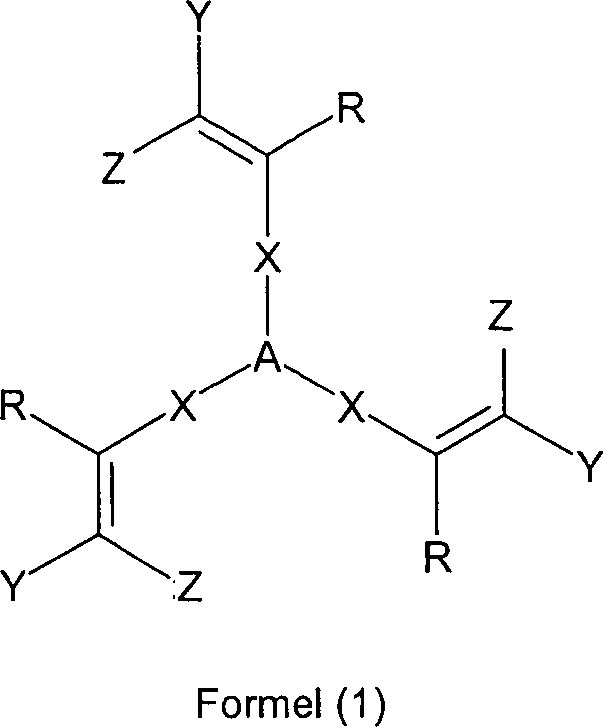
Gegenstand der Erfindung sind organische Elektrolumineszenzvorrichtungen, enthaltend Kathode, Anode und mindestens eine emittierende Schicht, dadurch gekennzeichnet, dass die emittierende Schicht
- a)
0.1 bis 99 Gew.% mindestens einer Verbindung gemäß Formel (1) enthält, wobei für die Symbole und Indizes gilt: A ist bei jedem Auftreten Stickstoff, Phosphor, Arsen oder Antimon; X ist bei jedem Auftreten gleich oder verschieden ein bivalentes aromatisches oder heteroaromatisches Ringsystem mit 2 bis 60 C-Atomen, das mit einem oder mehreren Resten R1 substituiert sein kann; Y ist bei jedem Auftreten gleich oder verschieden ein monovalentes aromatisches oder heteroaromatisches Ringsystem mit 2 bis 60 C-Atomen, das mit einem oder mehreren Resten R1 substituiert sein kann, mit der Maßgabe, dass Y keine substituierten oder unsubstituierten Aminogruppen enthalten darf; Z ist bei jedem Auftreten gleich oder verschieden Y oder CN oder eine geradkettige, verzweigte oder cyclische Alkylgruppe mit 1 bis 40 C-Atomen, die mit einem oder mehreren Resten R2 substituiert sein kann, wobei eine oder mehrere nicht benachbarte CH2-Gruppen durch -R2C=CR2-, -C≡C-, Si(R2)2, Ge(R2)2, Sn(R2)2, C=O, C=S, C=Se, C=NR2, -O-, -S- oder -CONR2- ersetzt sein können und wobei ein oder mehrere N-Atome durch F, Cl, Br, I, CN oder NO2 ersetzt sein können; R ist bei jedem Auftreten gleich oder verschieden H, CN oder eine geradkettige, verzweigte oder cyclische Alkylgruppe mit 1 bis 40 C-Atomen, die mit einem oder mehreren Resten R2 substituiert sein kann, wobei eine oder mehrere nicht benachbarte CH2-Gruppen durch -R2C=CR2-, -C≡C-, Si(R2)2, Ge(R2)2, Sn(R2)2, C=O, C=S, C=Se, C=NR2, -O-, -S- oder -CONR2- ersetzt sein können und wobei ein oder mehrere H-Atome durch F, Cl, Br, I, CN oder NO2 ersetzt sein können; R1 ist bei jedem Auftreten gleich oder verschieden H, F, Cl, Br, I, CN, NO2, eine geradkettige, verzweigte oder cyclische Alkyl-, Alkoxy- oder Thioalkoxygruppe mit 1 bis 40 C-Atomen, die mit einem oder mehreren Resten R2 substituiert sein kann, wobei eine oder mehrere nicht benachbarte CH2-Gruppen durch -R2C=CR2-, -C≡C-, Si(R2)2, Ge(R2)2, Sn(R2)2, C=O, C=S, C=Se, C=NR2, -O-, -S- oder -CONR2- ersetzt sein können und wobei ein oder mehrere H-Atome durch F, Cl, Br, I, CN oder NO2 ersetzt sein können, oder ein aromatisches oder heteroaromatisches Ringsystem, das durch einen oder mehrere Reste R2 substituiert sein kann, oder eine Aryloxy- oder Heteroaryloxygruppe mit 1 bis 40 aromatischen C-Atomen, die durch einen oder mehrere Reste R2 substituiert sein kann, oder eine Kombination aus zwei bis fünf dieser Systeme; dabei können zwei oder mehrere Substituenten R1 auch miteinander ein mono- oder polycyclisches, aliphatisches oder aromatisches Ringsystem bilden; mit der Maßgabe, dass R1 keine Cyclohexylidenmethin-Gruppe darstellt; R2 ist bei jedem Auftreten gleich oder verschieden H oder ein aliphatischer oder aromatischer Kohlenwasserstoffrest mit 1 bis 20 C-Atomen; und
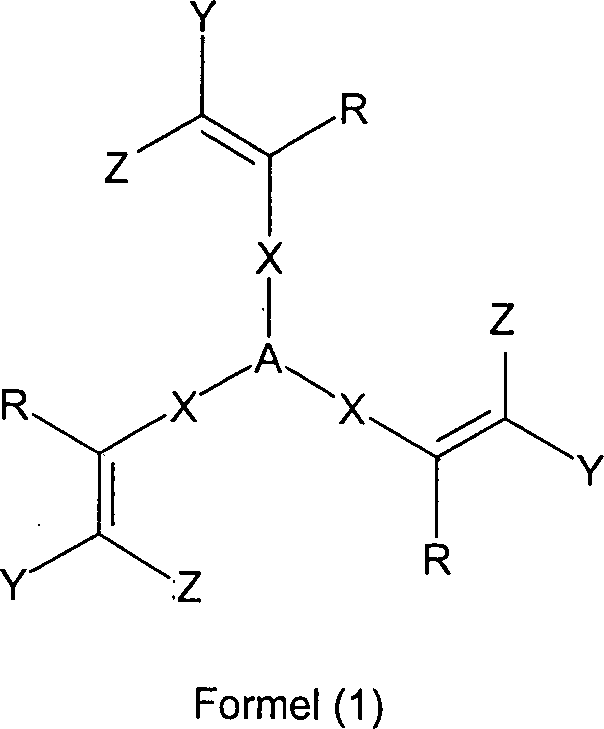
- b) 1 bis 99.9 Gew.% mindestens eines Hostmaterials enthält.
- a) contains 0.1 to 99% by weight of at least one compound according to formula (1), where, for the symbols and indices, A is nitrogen, phosphorus, arsenic or antimony at each occurrence; X is the same or different at each occurrence, a bivalent aromatic or heteroaromatic ring system having 2 to 60 carbon atoms, which may be substituted by one or more radicals R 1 ; Y is the same or different at each occurrence and is a monovalent aromatic or heteroaromatic ring system having 2 to 60 carbon atoms, which may be substituted by one or more radicals R 1 , with the proviso that Y may not contain substituted or unsubstituted amino groups; Z is the same or different at each occurrence, Y or CN or a straight-chain, branched or cyclic alkyl group having 1 to 40 carbon atoms, which may be substituted by one or more radicals R 2 , wherein one or more non-adjacent CH 2 groups -R 2 C = CR 2 -, -C≡C-, Si (R 2 ) 2 , Ge (R 2 ) 2 , Sn (R 2 ) 2 , C = O, C = S, C = Se, C = NR 2 , -O-, -S- or -CONR 2 - may be replaced and wherein one or more N atoms may be replaced by F, Cl, Br, I, CN or NO 2 ; R is the same or different at each occurrence, H, CN or a straight-chain, branched or cyclic alkyl group having 1 to 40 carbon atoms, which may be substituted by one or more radicals R 2 , wherein one or more non-adjacent CH 2 groups -R 2 C = CR 2 -, -C≡C-, Si (R 2 ) 2 , Ge (R 2 ) 2 , Sn (R 2 ) 2 , C = O, C = S, C = Se, C = NR 2 , -O-, -S- or -CONR 2 - may be replaced and wherein one or more H atoms may be replaced by F, Cl, Br, I, CN or NO 2 ; R 1 is the same or different H, F, Cl, Br, I, CN, NO 2 , a straight-chain, branched or cyclic alkyl, alkoxy or thioalkoxy group having 1 to 40 C atoms, each containing one or more R 2 may be substituted radicals, wherein one or more non-adjacent CH 2 groups by -R 2 C = CR 2 -, -C≡C-, Si (R 2 ) 2 , Ge (R 2 ) 2 , Sn (R 2 ) 2 , C = O, C = S, C = Se, C = NR 2 , -O-, -S- or -CONR 2 - may be replaced and wherein one or more H atoms by F, Cl, Br , I, CN or NO 2 may be replaced, or an aromatic or heteroaromatic ring system which may be substituted by one or more radicals R 2 , or an aryloxy or heteroaryloxy group having 1 to 40 aromatic carbon atoms, which may be replaced by one or more Radicals R 2 may be substituted, or a combination of two to five of these systems; two or more substituents R 1 may also together form a mono- or polycyclic, aliphatic or aromatic ring system; with the proviso that R 1 is not a cyclohexylidenemethine group; R 2 is the same or different at each occurrence as H or an aliphatic or aromatic hydrocarbon hydrogen radical with 1 to 20 C atoms; and
- b) contains 1 to 99.9% by weight of at least one host material.
Unter einem aromatischen oder heteroaromatischen Ringsystem im Sinne dieser Erfindung soll ein System verstanden werden, das nicht notwendigerweise nur aromatische bzw. heteroaromatische Gruppen enthält, sondern in dem auch mehrere aromatische oder heteroaromatische Gruppen durch eine kurze, nicht aromatische Einheit (weniger als 10 % der von H verschiedenen Atome, bevorzugt weniger als 5 % der von H verschiedenen Atome), wie z. B. ein sp3-hybridisiertes C-, N- oder O-Atom, unterbrochen sein können. So sollen also beispielsweise auch Systeme wie 9,9'-Spirobifluoren, 9,9-Diarylfluoren, Triarylamin, Diarylether, etc. als aromatische Ringsysteme im Sinne dieser Anmeldung verstanden werden.For the purposes of this invention, an aromatic or heteroaromatic ring system is to be understood as meaning a system which does not necessarily contain only aromatic or heteroaromatic groups but in which also several aromatic or heteroaromatic groups are replaced by a short, nonaromatic moiety (less than 10% of that of H different atoms, preferably less than 5% of the atoms other than H), such as. B. an sp 3 -hybridized C, N or O-atom, may be interrupted. Thus, for example, systems such as 9,9'-spirobifluorene, 9,9-diaryl fluorene, triarylamine, diaryl ethers, etc. are to be understood as aromatic ring systems in the context of this application.
Bevorzugt
sind organische Elektrolumineszenzvorrichtungen, bei denen für Verbindungen
gemäß Formel
(1) gilt:
A ist bei jedem Auftreten Stickstoff oder Phosphor;
X
ist bei jedem Auftreten gleich oder verschieden eine bivalente Aryl-
oder Heteroarylgruppe mit 3 bis 40 C-Atomen, die mit einem bis vier
Resten R1 substituiert sein kann;
Y
ist bei jedem Auftreten gleich oder verschieden eine monovalente
Aryl- oder Heteroarylgruppe mit 3 bis 40 C-Atomen, die mit einem
bis vier Resten R1 substituiert sein kann;
Z
ist bei jedem Auftreten gleich oder verschieden Y;
R ist bei
jedem Auftreten gleich oder verschieden H oder eine Methylgruppe;
R1 und R2 sind wie
oben definiert.Preference is given to organic electroluminescent devices in which the following applies to compounds of the formula (1):
A is nitrogen or phosphorus at each occurrence;
X is the same or different at each occurrence and is a bivalent aryl or heteroaryl group having 3 to 40 carbon atoms, which may be substituted by one to four radicals R 1 ;
Y is the same or different at each occurrence and is a monovalent aryl or heteroaryl group having 3 to 40 C atoms, which may be substituted by one to four radicals R 1 ;
Z is the same or different at each occurrence;
R is the same or different H or a methyl group at each occurrence;
R 1 and R 2 are as defined above.
Besonders
bevorzugt sind organische Elektrolumineszenzvorrichtungen, bei denen
für Verbindungen gemäß Formel
(1) gilt:
A ist bei jedem Auftreten Stickstoff;
X ist
bei jedem Auftreten gleich oder verschieden eine bivalente Arylgruppe
mit 6 bis 20 C-Atomen, die mit einem oder zwei Resten R1 substituiert
sein kann;
Y ist bei jedem Auftreten gleich oder verschieden
eine monovalente Arylgruppe mit 6 bis 20 C-Atomen, die mit einem
oder zwei Resten R1 substituiert sein kann;
R
ist bei jedem Auftreten H;
Z, R1 und
R2 sind wie oben definiert.Particular preference is given to organic electroluminescent devices in which the following applies to compounds of the formula (1):
A is nitrogen at each occurrence;
X is the same or different at each occurrence and is a bivalent aryl group having 6 to 20 C atoms, which may be substituted by one or two radicals R 1 ;
Y is the same or different at each occurrence and is a monovalent aryl group having 6 to 20 C atoms, which may be substituted by one or two radicals R 1 ;
R is H at each occurrence;
Z, R 1 and R 2 are as defined above.
Weiterhin bevorzugt sind Verbindungen gemäß Formel (1), in denen Y und Z, die an eine Alkengruppe binden, für dasselbe monovalente aromatische Ringsystem stehen und bevorzugt auch gleich substituiert sind.Farther preferred are compounds of the formula (1) in which Y and Z which bind to an alkene group are the same monovalent aromatic ring system are and preferably also the same are substituted.
Besonders bevorzugt sind Verbindungen gemäß Formel (1), in denen alle Einheiten Y und Z gleich gewählt sind.Especially preferred are compounds of the formula (1) in which all units Y and Z are the same.
Nochmals weiterhin bevorzugt sind Verbindungen gemäß Formel (1), in denen alle Einheiten X gleich gewählt sind.again furthermore preferred are compounds according to formula (1) in which all Units X are the same are.
Besonders bevorzugt sind Verbindungen gemäß Formel (1), die symmetrisch aufgebaut sind und die C3-Symmetrie aufweisen, insbesondere solche, in denen alle Einheiten X und alle Einheiten Y und Z und alle Substituenten R, R1 und R2 jeweils gleich gewählt sind.Particular preference is given to compounds of the formula (1) which are symmetrical in structure and have the C 3 symmetry, in particular those in which all units X and all units Y and Z and all substituents R, R 1 and R 2 are each selected to be the same ,
Beispiele für bevorzugte Verbindungen gemäß Formel (1) sind die im Folgenden abgebildeten Beispiele 1 bis 21, die mit R1 substituiert oder unsubstituiert sein können.Examples of preferred compounds according to formula (1) are the examples 1 to 21 depicted below, which may be substituted by R 1 or unsubstituted.
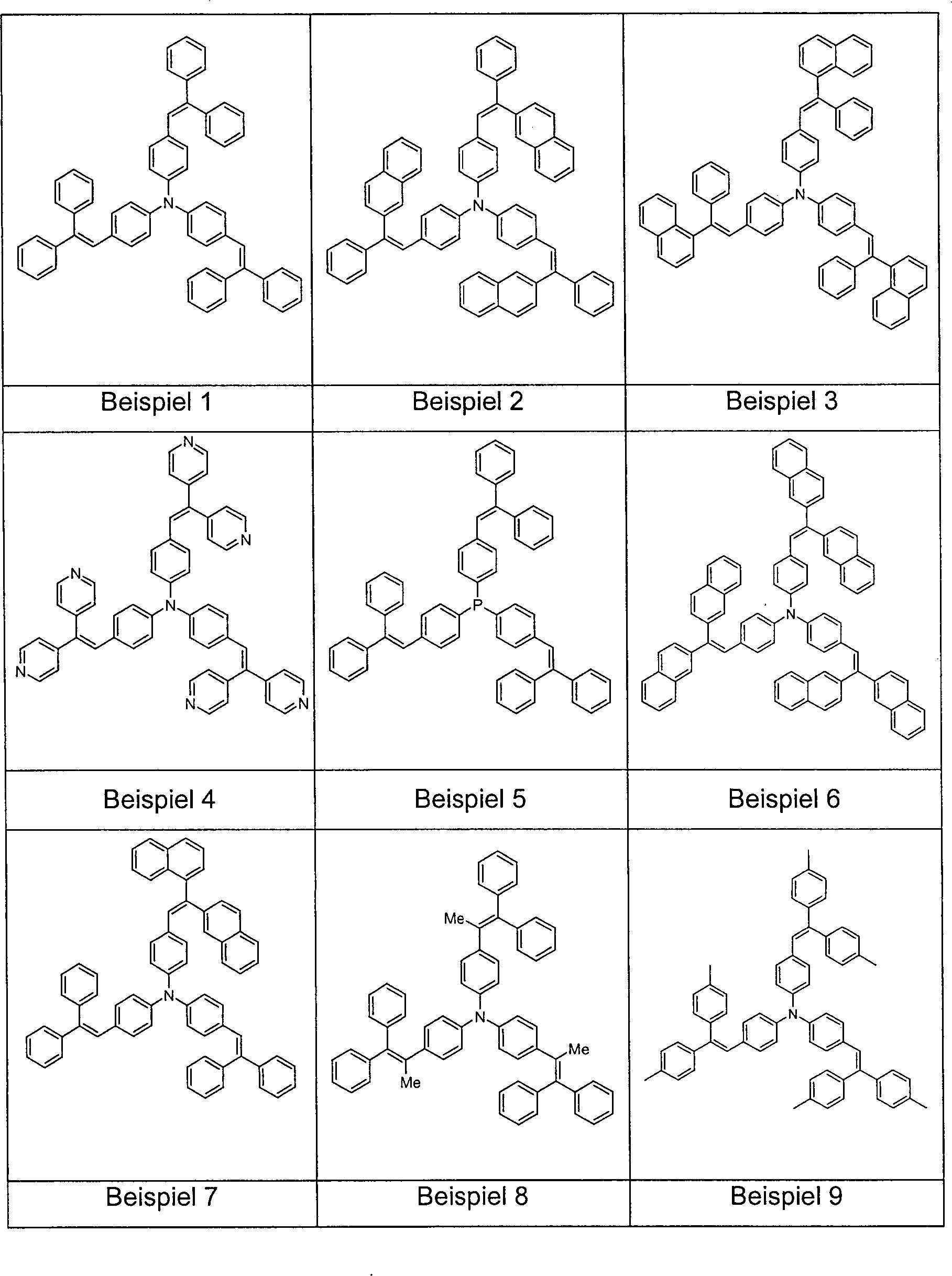


Die Verbindung gemäß Formel (1) wird in der emittierenden Schicht als Mischung mit mindestens einem Hostmaterial eingesetzt. Dabei ist es bevorzugt, wenn die Verbindung gemäß Formel (1) in der Mischung die emittierende Verbindung (der Dotand) ist und wenn das Hostmaterial nicht oder nur im geringeren Anteil emittieren.The Compound according to formula (1) is in the emitting layer as a mixture with at least used a host material. It is preferred if the Compound according to formula (1) in the mixture is the emitting compound (the dopant) and if the host material does not emit or only to a lesser extent.
Bevorzugte Hostmaterialien sind organische Verbindungen, deren Emission kürzerwellig ist als die der Verbindung gemäß Formel (1) oder die überhaupt nicht im sichtbaren Bereich emittieren.preferred Host materials are organic compounds whose emission is shorter wavelength is as the compound according to formula (1) or at all do not emit in the visible range.
Als
Hostmaterialien kommen verschiedene Stoffklassen in Frage. Bevorzugte
Hostmaterialien sind ausgewählt
aus den Klassen der Oligo-arylene (z. B. 2,2',7,7'-tetraphenyl-spirobifluoren
gemäß
Der Anteil der Verbindung gemäß Formel (1) in der Mischung beträgt zwischen 0.1 und 99 Gew.%, bevorzugt zwischen 0.5 und 50 Gew.%, besonders bevorzugt zwischen 1 und 20 Gew.%, insbesondere zwischen 1 und 10 Gew.%. Entsprechend beträgt der Anteil des Hostmaterials in der Mischung zwischen 1 und 99.9 Gew.%, bevorzugt zwischen 50 und 99.5 Gew.%, besonders bevorzugt zwischen 80 und 99 Gew.%, insbesondere zwischen 90 und 99 Gew.%.Of the Proportion of the compound according to formula (1) in the mixture between 0.1 and 99% by weight, preferably between 0.5 and 50% by weight, particularly preferably between 1 and 20% by weight, in particular between 1 and 10% by weight. Accordingly, the proportion of the host material in the mixture between 1 and 99.9% by weight, preferably between 50 and 99.5% by weight, more preferably between 80 and 99% by weight, in particular between 90 and 99% by weight.
Weiterhin bevorzugt sind organische Elektrolumineszenzvorrichtungen, dadurch gekennzeichnet, dass mehrere emittierende Verbindungen in derselben Schicht oder in unterschiedlichen Schichten verwendet werden, wovon mindestens eine dieser Verbindungen eine Struktur gemäß Formel (1) aufweist. Besonders bevorzugt weisen diese Verbindungen insgesamt mehrere Emissionsmaxima zwischen 380 nm und 750 nm auf, so dass insgesamt weiße Emission resultiert, d. h. außer der Verbindung gemäß Formel (1) wird noch mindestens eine weitere emittierende Verbindung verwendet, die fluoreszieren oder phosphoreszieren kann und die gelbes, orange oder rotes Licht emittiert.Farther preferred are organic electroluminescent devices, characterized characterized in that several emitting compounds in the same Layer or used in different layers, of which at least one of these compounds has a structure according to formula (1). Particularly preferred, these compounds have a total several emission maxima between 380 nm and 750 nm, so that overall white Emission results, d. H. except the compound according to formula (1) at least one further emitting compound is used, which can fluoresce or phosphoresce and the yellow, orange or emitting red light.
Außer der emittierenden Schicht kann die organische Elektrolumineszenzvorrichtung noch weitere Schichten enthalten. Diese können beispielsweise sein: Lochinjektionsschicht, Lochtransportschicht, Elektronentransportschicht und/oder Elektroneninjektionsschicht. Es sei aber an dieser Stelle darauf hingewiesen, dass nicht notwendigerweise jede dieser Schichten vorhanden sein muß.Except the emitting layer, the organic electroluminescent device still contain more layers. These can be, for example: hole injection layer, Hole transport layer, electron transport layer and / or electron injection layer. However, it should be noted at this point that not necessarily Each of these layers must be present.
So werden insbesondere bei Verwendung von Verbindungen gemäß Formel (1) mit elektronenleitenden Hostmaterialien weiterhin sehr gute Ergebnisse erhalten, wenn die organische Elektrolumineszenzvorrichtung keine separate Elektronentransportschicht enthält und die emittierende Schicht direkt an die Elektroneninjektionsschicht oder an die Kathode grenzt. Ebenfalls kann es bevorzugt sein, wenn die organische Elektrolumineszenzvorrichtung keine separate Lochtransportschicht enthält und die emittierende Schicht direkt an die Lochinjektionsschicht oder an die Anode grenzt. Weiterhin kann es bevorzugt sein, wenn die Verbindung gemäß Formel (1) nicht nur als Dotand in der emittierenden Schicht, sondern auch zusätzlich als lochleitende Verbindung (als Reinsubstanz oder als Mischung) in der Lochtransportschicht verwendet wird.So in particular when using compounds according to formula (1) with electron-conducting host materials continue very good Results obtained when the organic electroluminescent device does not contain a separate electron transport layer and the emitting layer directly adjacent to the electron injection layer or to the cathode. It may also be preferred if the organic electroluminescent device does not contain a separate hole transport layer and the emitting layer directly adjacent to the hole injection layer or to the anode. Farther it may be preferred if the compound according to formula (1) not only as Dotand in the emitting layer, but also in addition as hole-conducting compound (as pure substance or as a mixture) in the hole transport layer is used.
Bevorzugte
Materialien für
die Elektronentransportschicht sind Metallkomplexe, enthaltend Aluminium oder
Gallium, polypodale Metallkomplexe (z.B. gemäß der nicht offen gelegten
Patentanmeldung
Weiterhin bevorzugt ist eine organische Elektrolumineszenzvorrichtung, dadurch gekennzeichnet, dass eine oder mehrere Schichten mit einem Sublimationsverfahren beschichtet werden. Dabei werden die Materialien in Vakuum-Sublimationsanlagen bei einem Druck kleiner 10–5 mbar, bevorzugt kleiner 10–6 mbar, besonders bevorzugt kleiner 10–7 mbar aufgedampft.Further preferred is an organic electroluminescent device, characterized in that one or more layers are coated with a sublimation process. The materials are vapor-deposited in vacuum sublimation systems at a pressure of less than 10 -5 mbar, preferably less than 10 -6 mbar, particularly preferably less than 10 -7 mbar.
Bevorzugt ist ebenfalls eine organische Elektrolumineszenzvorrichtung, dadurch gekennzeichnet, dass eine oder mehrere Schichten mit dem OVPD (Organic Vapour Phase Deposition) Verfahren oder mit Hilfe einer Trägergassublimation beschichtet werden. Dabei werden die Materialien bei einem Druck zwischen 10–5 mbar und 1 bar aufgebracht.Also preferred is an organic electroluminescent device, characterized in that one or more layers are coated with the OVPD (Organic Vapor Phase Deposition) method or with the aid of a carrier gas sublimation. The materials are applied at a pressure between 10 -5 mbar and 1 bar.
Weiterhin bevorzugt ist eine organische Elektrolumineszenzvorrichtung, dadurch gekennzeichnet, dass eine oder mehrere Schichten aus Lösung, wie z.B. durch Spincoating, oder mit einem beliebigen Druckverfahren, wie z.B. Siebdruck, Flexodruck oder Offsetdruck, besonders bevorzugt aber LITI (Light Induced Thermal Imaging, Thermotransferdruck) oder Ink-Jet Druck (Tintenstrahl-Druck), hergestellt werden.Farther preferred is an organic electroluminescent device, characterized characterized in that one or more layers of solution, such as e.g. by spin coating, or by any printing process, such as. Screen printing, flexographic printing or offset printing, particularly preferred but LITI (Light Induced Thermal Imaging, Thermal Transfer Printing) or Ink-jet printing (ink-jet printing) can be produced.
Die oben beschriebenen emittierenden Vorrichtungen weisen nun folgende überraschende Vorteile gegenüber dem Stand der Technik auf:
- 1. Die Effizienz entsprechender Vorrichtungen wird höher im Vergleich zu Systemen gemäß dem Stand der Technik.
- 2. Die Stabilität entsprechender Vorrichtungen wird höher im Vergleich zu Systemen gemäß dem Stand der Technik, was sich vor allem in einer deutlich höheren Lebensdauer zeigt.
- 3. Die Betriebsspannung wird verringert. Dadurch erhöht sich die Leistungseffizienz. Dies gilt insbesondere, wenn ein Phosphinoxid als Hostmaterial verwendet wird.
- 4. Die Verbindungen lassen sich gut und ohne erhebliche Zersetzung sublimieren und aufdampfen, sind dadurch leichter zu verarbeiten und deshalb besser für die Verwendung in OLEDs geeignet als Materialien gemäß dem Stand der Technik, insbesondere als Materialien, die Stilbeneinheiten enthalten, die an der Doppelbindung nicht weiter substituiert sind.
- 1. The efficiency of such devices becomes higher as compared to prior art systems.
- 2. The stability of corresponding devices is higher compared to systems according to the prior art, which shows above all in a much longer life.
- 3. The operating voltage is reduced. This increases the power efficiency. This is especially true when a phosphine oxide is used as the host material.
- 4. The compounds can be sublimated and vaporized well without significant decomposition, thereby being easier to process and therefore better suited for use in OLEDs than prior art materials, especially as materials containing stilbene units that do not bind to the double bond are further substituted.
Die Erfindung wird durch die nachfolgenden Beispiele näher erläutert, ohne sie dadurch einschränken zu wollen.The Invention is illustrated by the following examples, without thereby restricting them want.
Beispiel 1: Synthese des Dotanden D1Example 1: Synthesis of Dopants D1
Die nachfolgende Synthese wurde gemäß WO 02/10093 und, sofern nicht anders angegeben, unter einer Schutzgasatmosphäre durchgeführt. Die Edukte wurden von ALDRICH (Lösemittel, Palladium(II)acetat, Dimethylglycin, Eisen(III)chlorid, Tris-(4-bromphenyl)amin, 1,1-Diphenylethen) bezogen.The subsequent synthesis was according to WO 02/10093 and, unless otherwise stated, carried out under a protective gas atmosphere. The Starting materials were used by ALDRICH (solvent, Palladium (II) acetate, dimethylglycine, iron (III) chloride, tris (4-bromophenyl) amine, 1,1-diphenylethene).
Ein
Gemisch aus 24.1 g (50 mmol) Tris-(4-bromphenyl)amin, 39.7 ml (225
mmol) 1,1-Diphenylethen, 337 mg (1.5 mmol) Palladium(II)acetat,
1.55 g (15 mmol) N,N-Dimethylglycin, 243 mg (1.5 mmol) Eisen(III)chlorid
und 37.8 g (450 mmol) Natriumhydrogencarbonat in 500 ml NMP wurde
langsam unter gutem Rühren
auf 140 °C
erhitzt und anschließend
16 h bei dieser Temperatur gerührt.
Nach Erkalten wurden 500 ml Dichlormethan und 1000 ml Wasser zugesetzt.
Die organische Phase wurde abgetrennt und fünfmal mit 500 ml Wasser gewaschen.
Nach Trocknen über
Natriumsulfat wurde die organische Phase zur Trockne eingeengt,
der so erhaltene gelbe Feststoff wurde viermal aus DMSO umkristallisiert,
dann zweimal mit 500 ml Ethanol unter Rückfluß ausgerührt und anschließend dreimal
im Vakuum (T = 315 °C,
p = 5 × 10⁻⁵ mbar)
sublimiert. Es wurden 33.5 g (entsprechend 85.9 % d. Th.) des Produkts
mit einer Reinheit größer 99.9
% n. HPLC erhalten.
1H-NMR (CDCl3): δ [ppm]
= 7.35 – 7.21
(m, 30H, C6H5),
6.88 (s, 3H, vinyl-CH), 6.83, 6.75 (d, 3JHH = 8.7 Hz, 12H, C6H4).A mixture of 24.1 g (50 mmol) of tris (4-bromophenyl) amine, 39.7 ml (225 mmol) of 1,1-diphenylethene, 337 mg (1.5 mmol) of palladium (II) acetate, 1.55 g (15 mmol) of N, N-Dimethylglycine, 243 mg (1.5 mmol) of iron (III) chloride and 37.8 g (450 mmol) of sodium bicarbonate in 500 ml of NMP was slowly heated with good stirring to 140 ° C and then stirred for 16 h at this temperature. After cooling, 500 ml of dichloromethane and 1000 ml of water were added. The organic phase was separated and washed five times with 500 ml of water. After drying over sodium sulfate, the organic phase was evaporated to dryness, the resulting yellow solid was recrystallized four times from DMSO, then stirred twice with 500 ml of ethanol under reflux and then three times in vacuo (T = 315 ° C, p = 5 × 10 -4) . 5 mbar) sublimated. There were obtained 33.5 g (corresponding to 85.9% of theory) of the product with a purity greater than 99.9% n. HPLC.
1 H-NMR (CDCl 3): δ [ppm] = 7:35 to 7:21 (m, 30H, C 6 H 5), 6.88 (s, 3H, vinyl-CH), 6.83, 6.75 (d, 3 J HH = 8.7 Hz, 12H, C 6 H 4).
Beispiel 2: Herstellung der OLEDsExample 2: Preparation the OLEDs
Die
Herstellung von OLEDs erfolgte nach einem allgemeinen Verfahren
gemäß
In
den folgenden Beispielen werden die Ergebnisse verschiedener OLEDs
vorgestellt. Der grundlegende Aufbau, die verwendeten Materialien
und Schichtdicken, außer
der emittierenden Schicht und der Elektronentransportschicht, waren
zur besseren Vergleichbarkeit identisch. Analog dem o. g. allgemeinen
Verfahren wurden OLEDs mit folgendem Aufbau erzeugt:
Diese noch nicht optimierten OLEDs wurden standardmäßig charakterisiert; hierfür wurden die Elektrolumineszenzspektren, die Effizienz (gemessen in cd/A), die Leistungseffizienz (gemessen in Im/W) in Abhängigkeit der Helligkeit, berechnet aus Strom-Spannungs-Helligkeit-Kennlinien (IUL-Kennlinien), und die Lebensdauer bestimmt. Als Lebensdauer wird die Zeit definiert, nach der die Anfangshelligkeit der OLED bei einer konstanten Stromdichte von 10 mA/cm2 auf die Hälfte gesunken ist.These not yet optimized OLEDs were characterized by default; For this purpose, the electroluminescence spectra, the efficiency (measured in cd / A), the power efficiency (measured in Im / W) as a function of the brightness, calculated from current-voltage-brightness characteristics (IUL characteristics), and the service life were determined. The lifetime is defined as the time after which the initial brightness of the OLED has dropped to half at a constant current density of 10 mA / cm 2 .
In
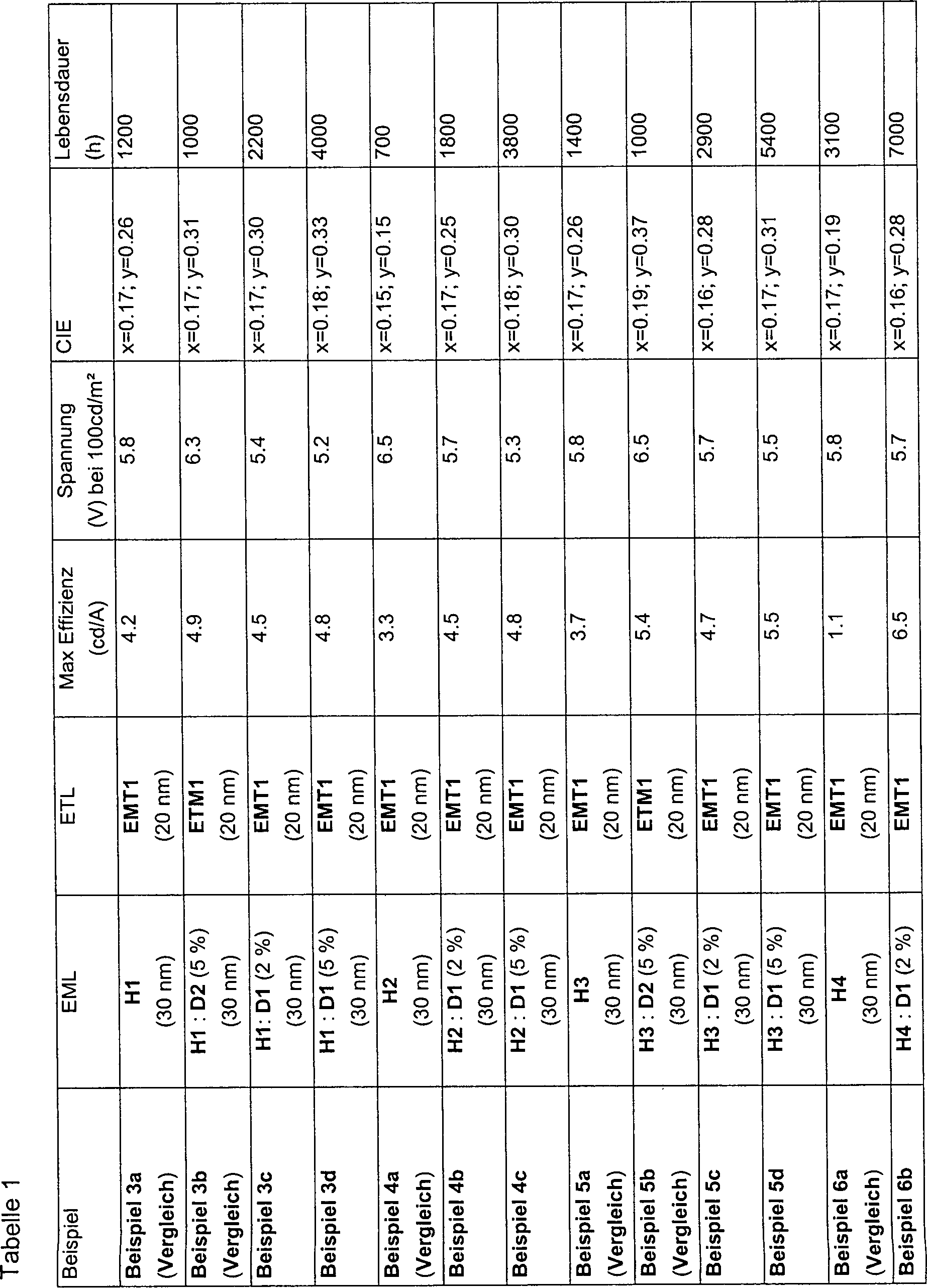
Tabelle 1 sind die Ergebnisse einiger Beispiele (Beispiele 3 bis
6) zusammengefaßt,
wobei jeweils die Zusammensetzung der EML und der ETL inklusive
der Schichtdicken mit aufgeführt
ist. Die EMLs enthalten als emittierende Materialien gemäß Formel
(1) den Dotanden D1 (gemäß Beispiel
1). Als Vergleichsbeispiele dienen OLEDs, die als emittierende Verbindungen
den Dotanden D2 gemäß dem oben
genannten Stand der Technik bzw. nur das Hostmaterial enthalten.
Als Hostmaterialien dienen die im Folgenden abgebildeten Verbindungen
H1 bis H4. Als Elektronentransportmaterialien dienen ETM1 (AlQ3, bezogen von SynTex, Tris(chinolinato)aluminium(III)),
ETM2 (Bis(9,9'-spirobifluoren-2-yl)keton gemäß der nicht
offen gelegten Anmeldung
Zur
besseren Übersichtlichkeit
sind die entsprechenden Strukturformeln der verwendeten Dotanden und
Hostmaterialien im Folgenden dargestellt: 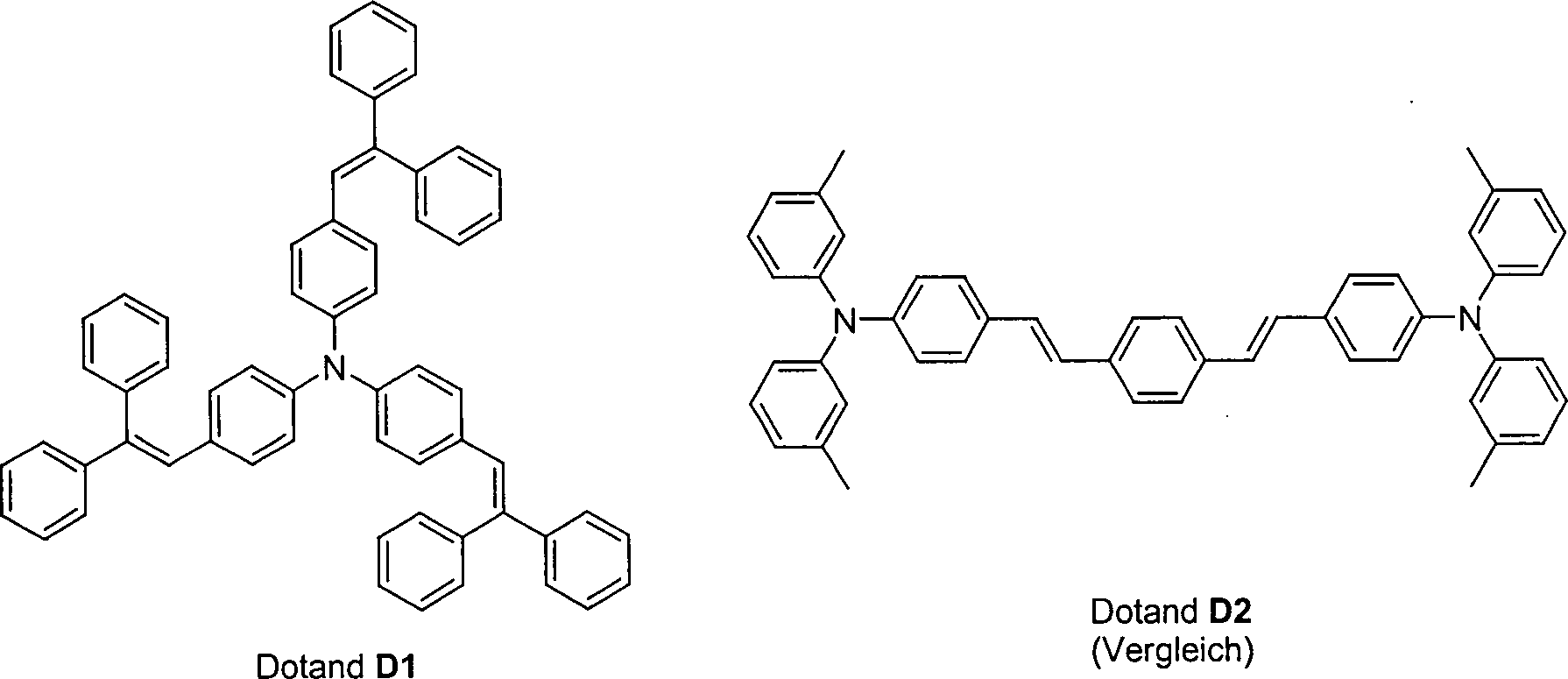


Beispiel 7: Vergleich der thermischen StabilitätExample 7: Comparison the thermal stability
Wie in Beispiel 1 beschrieben, wurde der Dotand D1 (Molgewicht = 780 g/mol) dreimal im Vakuum bei 315 °C sublimiert. Die Sublimation verlief rückstandsfrei und ohne Anzeichen von Zersetzung, überprüft mit 1H-NMR und HPLC.As described in Example 1, the dopant D1 (molecular weight = 780 g / mol) was sublimated three times in vacuo at 315 ° C. The sublimation proceeded residue-free and without signs of decomposition, checked by 1 H-NMR and HPLC.
Auslagerungsversuche bei 330 °C für 160 h ergaben ebenfalls keinen Hinweis auf eine thermisch induzierte Zersetzung des Dotanden D1.exposure tests at 330 ° C for 160 There was also no evidence of a thermally induced Decomposition of the dopant D1.
Im Vergleich dazu besitzt der Dotand D2 (Vergleichsbeispiel gemäß dem Stand der Technik, Molgewicht = 673 g/mol) eine deutlich geringere Stabilität. Die Sublimation von D2 mit einer Anfangsreinheit nach 1H-NMR und HPLC von größer 99.9 % bei T = 330 °C und p = 5 × 10⁻⁵ mbar ergab nach 2 h:
- – ca. 69 Gew.% der eingesetzten Menge in Form eines verharzten, in gängigen organischen Lösungsmittels nur schwer löslichen Rückstands,
- – ca. 30 Gew.% eines gelben Sublimats,
- – Spuren an farblosem Bis(3-methylphenyl)amin, bestimmt nach 1H-NMR.
- About 69% by weight of the amount used in the form of a resinous residue which is difficult to dissolve in common organic solvent,
- About 30% by weight of a yellow sublimate,
- - Traces of colorless bis (3-methylphenyl) amine, determined by 1 H-NMR.
Das gelbe Sublimat war nicht einheitlich. Es bestand nach 1H-NMR und HPLC-Analkytik aus einem Gemisch an trans,trans-, cis,trans- und cis,cis-Konfigurationsisomeren von D2. Auslagerungsversuche bei 330 °C für 160 h führten zu einer nahezu vollständigen Zersetzung (Verharzung) des Dotanden D2.The yellow sublimate was not uniform. It consisted of a mixture of trans, trans, cis, trans and cis, cis configuration isomers of D2 according to 1 H-NMR and HPLC-Analalkytik. Exploitation experiments at 330 ° C for 160 h led to an almost complete decomposition (resinification) of the dopant D2.
Diese Ergebnisse zeigen, dass der Dotand D1 eine ausgezeichnete Langzeitstabilität aufweist und daher für den industriellen Einsatz bestens geeignet ist. Insbesondere ist die Langzeittemperaturstabilität des Dotanden D1 deutlich höher als die des Vergleichsdotanden D2 gemäß dem Stand der Technik.These Results show that Dotand D1 has excellent long-term stability and therefore for the industrial application is best suited. In particular the long-term temperature stability of the dopant D1 significantly higher as that of the comparative dopant D2 according to the prior art.
Zusammenfassend kann gesagt werden, dass OLEDs, enthaltend emittierende Verbindungen gemäß Formel (1), eine deutlich höhere Effizienz bei vergleichbaren oder niedrigeren Spannungen und bei deutlich längerer Lebensdauer aufweisen als Materialien gemäß dem Stand der Technik, wie man leicht Tabelle 1 entnehmen kann. Außerdem lassen sie sich durch die höhere thermische Stabilität deutlich leichter verarbeiten als Materialien gemäß dem Stand der Technik, wie in Beispiel 7 beschrieben. Daher eignen sich diese Verbindungen besser für die Verwendung in OLEDs als Materialien gemäß dem Stand der Technik.In summary can be said that OLEDs containing emitting compounds according to formula (1), a significantly higher Efficiency at comparable or lower voltages and at much longer Have life as materials according to the prior art, such as you can easily see Table 1. In addition, they let themselves through the higher one thermal stability much easier to process than materials according to the state the technique described in Example 7. Therefore, these are suitable Connections better for the use in OLEDs as materials according to the prior art.
Claims (20)
Priority Applications (22)
| Application Number | Priority Date | Filing Date | Title |
|---|---|---|---|
| DE102004031000A DE102004031000A1 (en) | 2004-06-26 | 2004-06-26 | Organic electroluminescent devices |
| TW094119859A TW200610805A (en) | 2004-06-26 | 2005-06-15 | Organic electroluminescent devices |
| TW094119860A TW200613515A (en) | 2004-06-26 | 2005-06-15 | Compounds for organic electronic devices |
| US11/630,493 US20070185303A1 (en) | 2004-06-26 | 2005-06-22 | Compounds for organic electronic devices |
| AT05769990T ATE433436T1 (en) | 2004-06-26 | 2005-06-22 | CONNECTIONS FOR ORGANIC ELECTRONIC DEVICES |
| JP2007517191A JP2008504382A (en) | 2004-06-26 | 2005-06-22 | Compounds for organic electronic devices |
| CNA2005800214033A CN1976893A (en) | 2004-06-26 | 2005-06-22 | Compounds for organic electronic devices |
| US11/630,637 US20090159874A1 (en) | 2004-06-26 | 2005-06-22 | Organic electroluminescent devices |
| EP05756091A EP1761547B1 (en) | 2004-06-26 | 2005-06-22 | Compounds for organic electronic devices |
| EP05769990A EP1763501B1 (en) | 2004-06-26 | 2005-06-22 | Compounds for organic electronic devices |
| DE502005008975T DE502005008975D1 (en) | 2004-06-26 | 2005-06-22 | ORGANIC ELECTROLUMINESCENT DEVICE |
| JP2007517189A JP5269410B2 (en) | 2004-06-26 | 2005-06-22 | Organic electroluminescence device |
| AT05753649T ATE457085T1 (en) | 2004-06-26 | 2005-06-22 | ORGANIC ELECTROLUMINESCENCE DEVICE |
| KR1020067027104A KR20070024636A (en) | 2004-06-26 | 2005-06-22 | Compound for organic electronic device |
| EP05753649A EP1761962B1 (en) | 2004-06-26 | 2005-06-22 | Organic electroluminescent device |
| US11/630,223 US20080145698A1 (en) | 2004-06-26 | 2005-06-22 | Compounds For Organic Electronic Devices |
| DE502005007468T DE502005007468D1 (en) | 2004-06-26 | 2005-06-22 | CONNECTIONS FOR ORGANIC ELECTRONIC DEVICES |
| AT05756091T ATE517905T1 (en) | 2004-06-26 | 2005-06-22 | CONNECTIONS FOR ORGANIC ELECTRONIC DEVICES |
| JP2007517190A JP2008504247A (en) | 2004-06-26 | 2005-06-22 | Compounds for organic electronic devices |
| PCT/EP2005/006728 WO2006000389A1 (en) | 2004-06-26 | 2005-06-22 | Compounds for organic electronic devices |
| PCT/EP2005/006727 WO2006000388A1 (en) | 2004-06-26 | 2005-06-22 | Organic electroluminescent device |
| PCT/EP2005/006729 WO2006000390A2 (en) | 2004-06-26 | 2005-06-22 | Compounds for organic electronic devices |
Applications Claiming Priority (1)
| Application Number | Priority Date | Filing Date | Title |
|---|---|---|---|
| DE102004031000A DE102004031000A1 (en) | 2004-06-26 | 2004-06-26 | Organic electroluminescent devices |
Publications (1)
| Publication Number | Publication Date |
|---|---|
| DE102004031000A1 true DE102004031000A1 (en) | 2006-01-12 |
Family
ID=34970855
Family Applications (2)
| Application Number | Title | Priority Date | Filing Date |
|---|---|---|---|
| DE102004031000A Withdrawn DE102004031000A1 (en) | 2004-06-26 | 2004-06-26 | Organic electroluminescent devices |
| DE502005008975T Expired - Lifetime DE502005008975D1 (en) | 2004-06-26 | 2005-06-22 | ORGANIC ELECTROLUMINESCENT DEVICE |
Family Applications After (1)
| Application Number | Title | Priority Date | Filing Date |
|---|---|---|---|
| DE502005008975T Expired - Lifetime DE502005008975D1 (en) | 2004-06-26 | 2005-06-22 | ORGANIC ELECTROLUMINESCENT DEVICE |
Country Status (8)
| Country | Link |
|---|---|
| US (1) | US20090159874A1 (en) |
| EP (1) | EP1761962B1 (en) |
| JP (1) | JP5269410B2 (en) |
| CN (1) | CN1976893A (en) |
| AT (1) | ATE457085T1 (en) |
| DE (2) | DE102004031000A1 (en) |
| TW (1) | TW200610805A (en) |
| WO (1) | WO2006000388A1 (en) |
Cited By (3)
| Publication number | Priority date | Publication date | Assignee | Title |
|---|---|---|---|---|
| WO2007022845A1 (en) | 2005-08-26 | 2007-03-01 | Merck Patent Gmbh | Novel materials for organic electroluminescent devices |
| WO2009127307A1 (en) * | 2008-04-14 | 2009-10-22 | Merck Patent Gmbh | Novel materials for organic electroluminescence devices |
| CN102272264A (en) * | 2009-01-20 | 2011-12-07 | 默克专利有限公司 | Materials for organic electroluminescence devices |
Families Citing this family (160)
| Publication number | Priority date | Publication date | Assignee | Title |
|---|---|---|---|---|
| TW200613515A (en) * | 2004-06-26 | 2006-05-01 | Merck Patent Gmbh | Compounds for organic electronic devices |
| US8206839B2 (en) | 2005-10-04 | 2012-06-26 | Fujifilm Corporation | Organic electroluminescent element |
| JP5420249B2 (en) | 2005-12-08 | 2014-02-19 | メルク パテント ゲーエムベーハー | Novel materials for organic electroluminescent devices |
| DE102005058557A1 (en) | 2005-12-08 | 2007-06-14 | Merck Patent Gmbh | Organic electroluminescent device |
| DE102006013802A1 (en) | 2006-03-24 | 2007-09-27 | Merck Patent Gmbh | New anthracene compounds useful in organic electronic devices, preferably organic electroluminescent device e.g. integrated organic electroluminescent devices and organic field-effect-transistors |
| DE102006015183A1 (en) * | 2006-04-01 | 2007-10-04 | Merck Patent Gmbh | Materials for organic electroluminescent devices |
| DE102006031990A1 (en) | 2006-07-11 | 2008-01-17 | Merck Patent Gmbh | New materials for organic electroluminescent devices |
| DE102007024850A1 (en) | 2007-05-29 | 2008-12-04 | Merck Patent Gmbh | New materials for organic electroluminescent devices |
| DE102008008953B4 (en) | 2008-02-13 | 2019-05-09 | Merck Patent Gmbh | New materials for organic electroluminescent devices |
| DE102008017591A1 (en) | 2008-04-07 | 2009-10-08 | Merck Patent Gmbh | New materials for organic electroluminescent devices |
| DE102008033943A1 (en) | 2008-07-18 | 2010-01-21 | Merck Patent Gmbh | New materials for organic electroluminescent devices |
| DE102008045663A1 (en) | 2008-09-03 | 2010-03-04 | Merck Patent Gmbh | Fluorine-bridged associates for opto-electronic applications |
| DE102008049037A1 (en) | 2008-09-25 | 2010-04-22 | Merck Patent Gmbh | New polymers with low polydispersity |
| DE102008050841B4 (en) | 2008-10-08 | 2019-08-01 | Merck Patent Gmbh | New materials for organic electroluminescent devices |
| DE102008054141A1 (en) | 2008-10-31 | 2010-05-06 | Merck Patent Gmbh | New materials for organic electroluminescent devices |
| DE102008063490B4 (en) | 2008-12-17 | 2023-06-15 | Merck Patent Gmbh | Organic electroluminescent device and method for adjusting the color locus of a white-emitting electroluminescent device |
| DE102009005746A1 (en) | 2009-01-23 | 2010-07-29 | Merck Patent Gmbh | Materials for organic electroluminescent devices |
| DE102009009277B4 (en) | 2009-02-17 | 2023-12-07 | Merck Patent Gmbh | Organic electronic device, process for its production and use of compounds |
| DE102009012346B4 (en) | 2009-03-09 | 2024-02-15 | Merck Patent Gmbh | Organic electroluminescent device and method for producing the same |
| DE102009017064A1 (en) | 2009-04-09 | 2010-10-14 | Merck Patent Gmbh | Organic electroluminescent device |
| JPWO2010122799A1 (en) | 2009-04-24 | 2012-10-25 | 出光興産株式会社 | Aromatic amine derivative and organic electroluminescence device using the same |
| EP2445976A2 (en) | 2009-06-22 | 2012-05-02 | Merck Patent GmbH | Conducting formulation |
| DE102009033371A1 (en) | 2009-07-16 | 2011-05-12 | Merck Patent Gmbh | Materials for electronic devices |
| DE102009034625A1 (en) | 2009-07-27 | 2011-02-03 | Merck Patent Gmbh | New materials for organic electroluminescent devices |
| EP2462203B1 (en) | 2009-08-04 | 2016-03-02 | Merck Patent GmbH | Electronic devices comprising multi cyclic hydrocarbons |
| DE102009041289A1 (en) | 2009-09-16 | 2011-03-17 | Merck Patent Gmbh | Organic electroluminescent device |
| JP5784608B2 (en) | 2009-09-16 | 2015-09-24 | メルク パテント ゲーエムベーハー | Formulations for electronic device manufacturing |
| DE102009053644B4 (en) | 2009-11-17 | 2019-07-04 | Merck Patent Gmbh | Materials for organic electroluminescent devices |
| DE102009042693A1 (en) | 2009-09-23 | 2011-03-24 | Merck Patent Gmbh | Materials for electronic devices |
| DE102009051172A1 (en) | 2009-10-29 | 2011-05-05 | Merck Patent Gmbh | Materials for electronic devices |
| DE102009053191A1 (en) | 2009-11-06 | 2011-05-12 | Merck Patent Gmbh | Materials for electronic devices |
| EP2517278B1 (en) | 2009-12-22 | 2019-07-17 | Merck Patent GmbH | Electroluminescent formulations |
| JP5897472B2 (en) | 2009-12-22 | 2016-03-30 | メルク パテント ゲーエムベーハー | Electroluminescent functional surfactant |
| WO2011076323A1 (en) | 2009-12-22 | 2011-06-30 | Merck Patent Gmbh | Formulations comprising phase-separated functional materials |
| KR20170093267A (en) | 2009-12-23 | 2017-08-14 | 메르크 파텐트 게엠베하 | Compositions comprising organic semiconducting compounds |
| WO2011076325A1 (en) | 2009-12-23 | 2011-06-30 | Merck Patent Gmbh | Compositions comprising polymeric binders |
| DE102010005697A1 (en) | 2010-01-25 | 2011-07-28 | Merck Patent GmbH, 64293 | Connections for electronic devices |
| DE102010006377A1 (en) | 2010-01-29 | 2011-08-04 | Merck Patent GmbH, 64293 | Styrene-based copolymers, in particular for use in optoelectronic components |
| DE102010006280A1 (en) | 2010-01-30 | 2011-08-04 | Merck Patent GmbH, 64293 | color conversion |
| DE102010009903A1 (en) | 2010-03-02 | 2011-09-08 | Merck Patent Gmbh | Connections for electronic devices |
| DE102010010481A1 (en) | 2010-03-06 | 2011-09-08 | Merck Patent Gmbh | Organic electroluminescent device |
| DE102010010631A1 (en) | 2010-03-09 | 2011-09-15 | Merck Patent Gmbh | Materials for electronic devices |
| WO2011110277A1 (en) | 2010-03-11 | 2011-09-15 | Merck Patent Gmbh | Fibers in therapy and cosmetics |
| US9373807B2 (en) | 2010-03-11 | 2016-06-21 | Merck Patent Gmbh | Radiative fibers |
| DE102010013068A1 (en) | 2010-03-26 | 2011-09-29 | Merck Patent Gmbh | Connections for electronic devices |
| US20130026421A1 (en) | 2010-04-12 | 2013-01-31 | Merck Patent Gmbh | Composition and method for preparation of organic electronic devices |
| WO2011128034A1 (en) | 2010-04-12 | 2011-10-20 | Merck Patent Gmbh | Composition having improved performance |
| DE102010014933A1 (en) | 2010-04-14 | 2011-10-20 | Merck Patent Gmbh | Materials for electronic devices |
| DE102010020044A1 (en) | 2010-05-11 | 2011-11-17 | Merck Patent Gmbh | Organic electroluminescent device |
| WO2011147521A1 (en) | 2010-05-27 | 2011-12-01 | Merck Patent Gmbh | Down conversion |
| KR101943110B1 (en) | 2010-05-27 | 2019-01-28 | 메르크 파텐트 게엠베하 | Formulation and method for preparation of organic electronic devices |
| EP2576723B1 (en) | 2010-05-27 | 2017-09-20 | Merck Patent GmbH | Compositions comprising quantum dots |
| DE102010024335A1 (en) | 2010-06-18 | 2011-12-22 | Merck Patent Gmbh | Connections for electronic devices |
| DE102010024542A1 (en) | 2010-06-22 | 2011-12-22 | Merck Patent Gmbh | Materials for electronic devices |
| US20130226268A1 (en) | 2010-07-26 | 2013-08-29 | Merck Patent Gmbh | Nanocrystals in devices |
| JP2013539584A (en) | 2010-07-26 | 2013-10-24 | メルク パテント ゲーエムベーハー | Quantum dots and hosts |
| DE102010033548A1 (en) | 2010-08-05 | 2012-02-09 | Merck Patent Gmbh | Materials for electronic devices |
| DE102010048074A1 (en) | 2010-10-09 | 2012-04-12 | Merck Patent Gmbh | Materials for electronic devices |
| DE102010048607A1 (en) | 2010-10-15 | 2012-04-19 | Merck Patent Gmbh | Connections for electronic devices |
| DE102010048608A1 (en) | 2010-10-15 | 2012-04-19 | Merck Patent Gmbh | Materials for organic electroluminescent devices |
| KR101423173B1 (en) | 2010-11-04 | 2014-07-25 | 제일모직 주식회사 | Compound for organic photoelectric device and organic photoelectric device including the same |
| DE102010054316A1 (en) | 2010-12-13 | 2012-06-14 | Merck Patent Gmbh | Substituted tetraarylbenzenes |
| DE102010054525A1 (en) | 2010-12-15 | 2012-04-26 | Merck Patent Gmbh | Organic electroluminescent device |
| DE102010055901A1 (en) | 2010-12-23 | 2012-06-28 | Merck Patent Gmbh | Organic electroluminescent device |
| EP2663567B1 (en) | 2011-01-13 | 2016-06-01 | Merck Patent GmbH | Compounds for organic electroluminescent devices |
| DE102011011104A1 (en) | 2011-02-12 | 2012-08-16 | Merck Patent Gmbh | Substituted dibenzonaphthacenes |
| JP6351974B2 (en) | 2011-02-14 | 2018-07-04 | メルク パテント ゲーエムベーハー | Devices and methods for treatment of cells and cellular tissues |
| DE102011011539A1 (en) | 2011-02-17 | 2012-08-23 | Merck Patent Gmbh | Connections for electronic devices |
| WO2012126566A1 (en) | 2011-03-24 | 2012-09-27 | Merck Patent Gmbh | Organic ionic functional materials |
| EP2697226B1 (en) | 2011-04-13 | 2017-01-18 | Merck Patent GmbH | Compounds for electronic devices |
| CN103476774B (en) | 2011-04-13 | 2017-02-15 | 默克专利有限公司 | Materials for Electronic Devices |
| EP2699641B1 (en) | 2011-04-18 | 2017-05-17 | Merck Patent GmbH | Compounds for electronic devices |
| WO2012149992A1 (en) | 2011-05-04 | 2012-11-08 | Merck Patent Gmbh | Device for preserving fresh goods |
| JP6195823B2 (en) | 2011-05-05 | 2017-09-13 | メルク パテント ゲーエムベーハー | Compounds for electronic devices |
| JP6223961B2 (en) | 2011-05-12 | 2017-11-01 | メルク パテント ゲーエムベーハー | Organic ionic functional material, composition and electronic device |
| DE102011104745A1 (en) | 2011-06-17 | 2012-12-20 | Merck Patent Gmbh | Materials for organic electroluminescent devices |
| WO2013013754A1 (en) | 2011-07-25 | 2013-01-31 | Merck Patent Gmbh | Copolymers with functionalized side chains |
| US9780311B2 (en) | 2011-07-29 | 2017-10-03 | Merck Patent Gmbh | Compounds for electronic devices |
| DE102012016192A1 (en) | 2011-08-19 | 2013-02-21 | Merck Patent Gmbh | New compounds capable of forming hydrogen bonds are useful in electronic device, e.g. organic electroluminescent device, organic light-emitting transistor and organic light-emitting electrochemical cell |
| KR102051790B1 (en) | 2011-08-22 | 2019-12-04 | 메르크 파텐트 게엠베하 | Organic electroluminescence device |
| US9356242B2 (en) | 2011-10-06 | 2016-05-31 | Merck Patent Gmbh | Organic electroluminescent device |
| JP6223984B2 (en) | 2011-10-27 | 2017-11-01 | メルク パテント ゲーエムベーハー | Materials for electronic devices |
| DE102011117422A1 (en) | 2011-10-28 | 2013-05-02 | Merck Patent Gmbh | Hyperbranched polymers, process for their preparation and their use in electronic devices |
| DE102011121022A1 (en) | 2011-12-13 | 2013-06-13 | Merck Patent Gmbh | Organic sensitizers for up-conversion |
| KR101507001B1 (en) | 2011-12-30 | 2015-03-31 | 제일모직 주식회사 | Compound for organic optoelectronic device, organic light emitting diode including the same and display including the organic light emitting diode |
| KR20140123555A (en) | 2012-01-30 | 2014-10-22 | 메르크 파텐트 게엠베하 | Nanocrystals on fibers |
| KR102357439B1 (en) | 2012-02-14 | 2022-02-08 | 메르크 파텐트 게엠베하 | Spirobifluorene compounds for organic electroluminescent devices |
| EP3028318A1 (en) | 2013-07-29 | 2016-06-08 | Merck Patent GmbH | Electro-optical device and the use thereof |
| JP6567519B2 (en) | 2013-07-29 | 2019-08-28 | メルク、パテント、ゲゼルシャフト、ミット、ベシュレンクテル、ハフツングMerck Patent GmbH | Electroluminescence element |
| WO2015082037A1 (en) | 2013-12-06 | 2015-06-11 | Merck Patent Gmbh | Compositions containing a polymeric binder which comprises acrylic and/or methacrylic acid ester units |
| WO2015091716A1 (en) | 2013-12-20 | 2015-06-25 | Basf Se | Highly efficient oled devices with very short decay times |
| EP3189551B1 (en) | 2014-09-05 | 2021-01-27 | Merck Patent GmbH | Formulations and method of producing an organic electroluminescent device |
| WO2016086885A1 (en) | 2014-12-04 | 2016-06-09 | 广州华睿光电材料有限公司 | Deuterated organic compound, mixture and composition containing said compound, and organic electronic device |
| EP3229288B1 (en) | 2014-12-04 | 2019-05-01 | Guangzhou Chinaray Optoelectronic Materials Ltd. | Polymer, and mixture, formulation and organic electronic device containing the same, and monomer thereof |
| CN107001336A (en) | 2014-12-11 | 2017-08-01 | 广州华睿光电材料有限公司 | A kind of organometallic complex, polymer comprising it, mixture, composition, organic electronic device and application |
| US10510967B2 (en) | 2014-12-11 | 2019-12-17 | Guangzhou Chinaray Optoelectronic Materials Ltd. | Organic compound, and mixture, formulation and organic device comprising the same |
| WO2016107663A1 (en) | 2014-12-30 | 2016-07-07 | Merck Patent Gmbh | Formulations and electronic devices |
| CN107108862B (en) | 2015-01-13 | 2019-08-02 | 广州华睿光电材料有限公司 | Conjugated polymers containing acetylene crosslinking groups, mixtures containing them, compositions, organic electronic devices and applications thereof |
| JP7030519B2 (en) | 2015-01-30 | 2022-03-07 | メルク パテント ゲーエムベーハー | Formulations with low particle content |
| KR102556584B1 (en) * | 2015-02-16 | 2023-07-17 | 메르크 파텐트 게엠베하 | Spirobifluorene derivative-based materials for electronic devices |
| WO2016155866A1 (en) | 2015-03-30 | 2016-10-06 | Merck Patent Gmbh | Formulation of an organic functional material comprising a siloxane solvent |
| KR102610370B1 (en) | 2015-05-18 | 2023-12-05 | 메르크 파텐트 게엠베하 | Materials for organic electroluminescent devices |
| EP4060757A1 (en) | 2015-06-03 | 2022-09-21 | UDC Ireland Limited | Highly efficient oled devices with very short decay times |
| KR102654992B1 (en) | 2015-06-12 | 2024-04-04 | 메르크 파텐트 게엠베하 | Esters containing non-aromatic cycles as solvents for oled formulations |
| US20180212166A1 (en) | 2015-07-15 | 2018-07-26 | Merck Patent Gmbh | Composition comprising organic semiconducting compounds |
| EP3341981B1 (en) | 2015-08-28 | 2020-08-19 | Merck Patent GmbH | Formulation of an organic functional material comprising an epoxy group containing solvent |
| CN108291103B (en) | 2015-11-12 | 2021-12-07 | 广州华睿光电材料有限公司 | Printing composition, electronic device comprising same and preparation method of functional material film |
| CN108368361A (en) | 2015-12-10 | 2018-08-03 | 默克专利有限公司 | Preparation containing the ketone comprising non-aromatic ring |
| JP7051684B2 (en) | 2015-12-15 | 2022-04-11 | メルク パテント ゲーエムベーハー | Esters containing aromatic groups as solvents for organic electronic formulations |
| KR20180095028A (en) | 2015-12-16 | 2018-08-24 | 메르크 파텐트 게엠베하 | A formulation containing a mixture of two or more different solvents |
| EP3390549B1 (en) | 2015-12-16 | 2022-06-29 | Merck Patent GmbH | Formulations containing a solid solvent |
| US10840448B2 (en) | 2016-02-17 | 2020-11-17 | Merck Patent Gmbh | Formulation of an organic functional material |
| DE102016003104A1 (en) | 2016-03-15 | 2017-09-21 | Merck Patent Gmbh | Container comprising a formulation containing at least one organic semiconductor |
| CN109153871A (en) | 2016-06-16 | 2019-01-04 | 默克专利有限公司 | The preparation of organic functional material |
| JP2019523998A (en) | 2016-06-17 | 2019-08-29 | メルク パテント ゲーエムベーハー | Formulation of organic functional materials |
| TW201815998A (en) | 2016-06-28 | 2018-05-01 | 德商麥克專利有限公司 | Organic functional material formulation |
| WO2018024719A1 (en) | 2016-08-04 | 2018-02-08 | Merck Patent Gmbh | Formulation of an organic functional material |
| JP7013459B2 (en) | 2016-10-31 | 2022-01-31 | メルク パテント ゲーエムベーハー | Formulation of organic functional materials |
| CN109863223B (en) | 2016-10-31 | 2023-06-20 | 默克专利有限公司 | Formulation of organic functional materials |
| CN109790407B (en) | 2016-11-23 | 2021-12-07 | 广州华睿光电材料有限公司 | Printing ink composition, preparation method and application thereof |
| CN109790194B (en) | 2016-11-23 | 2021-07-23 | 广州华睿光电材料有限公司 | Metal-organic complexes, polymers, compositions and organic electronic devices |
| WO2018095389A1 (en) | 2016-11-23 | 2018-05-31 | 广州华睿光电材料有限公司 | Nitrogen-containing fused heterocyclic ring compound and application thereof |
| US11512039B2 (en) | 2016-11-23 | 2022-11-29 | Guangzhou Chinaray Optoelectronic Materials Ltd. | Aromatic amine derivatives, preparation methods therefor, and uses thereof |
| WO2018095395A1 (en) | 2016-11-23 | 2018-05-31 | 广州华睿光电材料有限公司 | High polymer, mixture containing same, composition, organic electronic component, and monomer for polymerization |
| US11518723B2 (en) | 2016-11-23 | 2022-12-06 | Guangzhou Chinaray Optoelectronic Materials Ltd. | Fused ring compound, high polymer, mixture, composition and organic electronic component |
| US20190378991A1 (en) | 2016-11-23 | 2019-12-12 | Guangzhou Chinaray Optoelectronic Materials Ltd. | Organic mixture, composition, and organic electronic component |
| KR102472751B1 (en) | 2016-12-06 | 2022-11-30 | 메르크 파텐트 게엠베하 | Manufacturing method of electronic device |
| US11672174B2 (en) | 2016-12-08 | 2023-06-06 | Guangzhou Chinaray Optoelectronic Materials Ltd. | Pyrene-triazine derivative and applications thereof in organic electronic component |
| EP3553152B1 (en) | 2016-12-08 | 2021-02-17 | Guangzhou Chinaray Optoelectronic Materials Ltd. | Mixture, composition and organic electronic device |
| CN109790118A (en) | 2016-12-13 | 2019-05-21 | 广州华睿光电材料有限公司 | Conjugated polymer and its application in organic electronic device |
| CN110168047B (en) | 2016-12-13 | 2023-08-08 | 默克专利有限公司 | Preparation of organic functional material |
| US11289654B2 (en) | 2016-12-22 | 2022-03-29 | Guangzhou Chinaray Optoelectronic Materials Ltd. | Polymers containing furanyl crosslinkable groups and uses thereof |
| KR102504432B1 (en) | 2016-12-22 | 2023-02-27 | 메르크 파텐트 게엠베하 | A mixture comprising at least two organo-functional compounds |
| CN109792003B (en) | 2016-12-22 | 2020-10-16 | 广州华睿光电材料有限公司 | Diels-Alder Reaction-Based Crosslinkable Polymers and Their Applications in Organic Electronic Devices |
| TWI791481B (en) | 2017-01-30 | 2023-02-11 | 德商麥克專利有限公司 | Method for forming an organic electroluminescence (el) element |
| TWI763772B (en) | 2017-01-30 | 2022-05-11 | 德商麥克專利有限公司 | Method for forming an organic element of an electronic device |
| JP7123967B2 (en) | 2017-03-31 | 2022-08-23 | メルク パテント ゲーエムベーハー | Printing method for organic light emitting diodes (OLEDs) |
| CN110494514A (en) | 2017-04-10 | 2019-11-22 | 默克专利有限公司 | Formulation of organic functional materials |
| JP7330898B2 (en) | 2017-05-03 | 2023-08-22 | メルク パテント ゲーエムベーハー | Formulation of organic functional material |
| TWI813576B (en) | 2017-07-03 | 2023-09-01 | 德商麥克專利有限公司 | Formulations with a low content of phenol type impurities |
| WO2019016184A1 (en) | 2017-07-18 | 2019-01-24 | Merck Patent Gmbh | Formulation of an organic functional material |
| CN111418081B (en) | 2017-12-15 | 2024-09-13 | 默克专利有限公司 | Preparation of organic functional materials |
| JP7247231B2 (en) | 2018-02-26 | 2023-03-28 | メルク パテント ゲーエムベーハー | Formulation of organic functional material |
| EP3807367B1 (en) | 2018-06-15 | 2023-07-19 | Merck Patent GmbH | Formulation of an organic functional material |
| KR20210056432A (en) | 2018-09-24 | 2021-05-18 | 메르크 파텐트 게엠베하 | Method of manufacturing granular material |
| WO2020094538A1 (en) | 2018-11-06 | 2020-05-14 | Merck Patent Gmbh | Method for forming an organic element of an electronic device |
| CN110951054A (en) * | 2019-12-23 | 2020-04-03 | 黑龙江大学 | Triphenylamine isoindigo polymer containing biphenyl structure and preparation method and application thereof |
| WO2021213918A1 (en) | 2020-04-21 | 2021-10-28 | Merck Patent Gmbh | Formulation of an organic functional material |
| EP4139971A1 (en) | 2020-04-21 | 2023-03-01 | Merck Patent GmbH | Emulsions comprising organic functional materials |
| WO2021259824A1 (en) | 2020-06-23 | 2021-12-30 | Merck Patent Gmbh | Method for producing a mixture |
| EP4231064A4 (en) | 2020-10-14 | 2024-10-30 | Zhejiang Brilliant Optoelectronic Technology Co., Ltd. | COMPOSITIONS AND THEIR USE IN PHOTOELECTRIC FIELD |
| CN116391007A (en) | 2020-10-14 | 2023-07-04 | 浙江光昊光电科技有限公司 | Organic Compounds and Their Applications in Optoelectronics |
| WO2022122607A1 (en) | 2020-12-08 | 2022-06-16 | Merck Patent Gmbh | An ink system and a method for inkjet printing |
| WO2022223675A1 (en) | 2021-04-23 | 2022-10-27 | Merck Patent Gmbh | Formulation of an organic functional material |
| CN117355364A (en) | 2021-05-21 | 2024-01-05 | 默克专利有限公司 | Method for the continuous purification of at least one functional material and device for the continuous purification of at least one functional material |
| CN117730638A (en) | 2021-08-02 | 2024-03-19 | 默克专利有限公司 | Printing method by combining inks |
| TW202349760A (en) | 2021-10-05 | 2023-12-16 | 德商麥克專利有限公司 | Method for forming an organic element of an electronic device |
| TW202411366A (en) | 2022-06-07 | 2024-03-16 | 德商麥克專利有限公司 | Method of printing a functional layer of an electronic device by combining inks |
| TW202440819A (en) | 2022-12-16 | 2024-10-16 | 德商麥克專利有限公司 | Formulation of an organic functional material |
| WO2025032039A1 (en) | 2023-08-07 | 2025-02-13 | Merck Patent Gmbh | Process for the preparation of an electronic device |
Family Cites Families (29)
| Publication number | Priority date | Publication date | Assignee | Title |
|---|---|---|---|---|
| US4539507A (en) * | 1983-03-25 | 1985-09-03 | Eastman Kodak Company | Organic electroluminescent devices having improved power conversion efficiencies |
| JPH0693124B2 (en) * | 1986-05-12 | 1994-11-16 | ミノルタ株式会社 | Photoconductor |
| JPS63163361A (en) * | 1986-12-25 | 1988-07-06 | Canon Inc | Electrophotographic sensitive body |
| JPS6413553A (en) * | 1987-07-08 | 1989-01-18 | Konishiroku Photo Ind | Electrophotographic sensitive body |
| JPH01105955A (en) * | 1987-10-19 | 1989-04-24 | Konica Corp | Electrophotographic sensitive body |
| JPH01106070A (en) * | 1987-10-20 | 1989-04-24 | Konica Corp | Electrophotographic sensitive body |
| JP2913116B2 (en) * | 1990-11-20 | 1999-06-28 | 株式会社リコー | EL device |
| JP2951032B2 (en) * | 1991-04-12 | 1999-09-20 | コニカ株式会社 | Electrophotographic photoreceptor |
| US5151629A (en) * | 1991-08-01 | 1992-09-29 | Eastman Kodak Company | Blue emitting internal junction organic electroluminescent device (I) |
| JPH07175236A (en) * | 1993-12-20 | 1995-07-14 | Konica Corp | Electrophotographic photoreceptor |
| JP3642606B2 (en) * | 1994-04-28 | 2005-04-27 | Tdk株式会社 | Organic EL device |
| JP3866293B2 (en) * | 1996-08-19 | 2007-01-10 | Tdk株式会社 | Organic EL device |
| DE19652261A1 (en) * | 1996-12-16 | 1998-06-18 | Hoechst Ag | Aryl-substituted poly (p-arylenevinylenes), process for their preparation and their use in electroluminescent devices |
| JP3948046B2 (en) * | 1997-03-06 | 2007-07-25 | コニカミノルタホールディングス株式会社 | Organic electroluminescence device |
| DE19738860A1 (en) * | 1997-09-05 | 1999-03-11 | Hoechst Ag | Process for the preparation of aryl oligoamines |
| TW562848B (en) * | 1999-08-02 | 2003-11-21 | Nec Corp | Organic electroluminescence material and electroluminescence device using the same |
| DE10037390A1 (en) * | 2000-08-01 | 2002-02-14 | Covion Organic Semiconductors | Process for the preparation of olefin-substituted aromatics or heteroaromatics |
| JP4026740B2 (en) * | 2000-09-29 | 2007-12-26 | 富士フイルム株式会社 | Organic light emitting device material and organic light emitting device using the same |
| US6746784B2 (en) * | 2000-11-07 | 2004-06-08 | Samsung Electronics Co., Ltd. | Organic electroluminescent device |
| JP3928440B2 (en) * | 2002-02-25 | 2007-06-13 | コニカミノルタホールディングス株式会社 | Electrophotographic photoreceptor |
| JP4025137B2 (en) * | 2002-08-02 | 2007-12-19 | 出光興産株式会社 | Anthracene derivative and organic electroluminescence device using the same |
| JP2004075567A (en) * | 2002-08-12 | 2004-03-11 | Idemitsu Kosan Co Ltd | Oligoarylene derivatives and organic electroluminescent devices using the same |
| KR100924462B1 (en) * | 2002-08-23 | 2009-11-03 | 이데미쓰 고산 가부시키가이샤 | Organic Electroluminescent Devices and Anthracene Derivatives |
| JP2006511939A (en) * | 2002-12-23 | 2006-04-06 | コビオン・オーガニック・セミコンダクターズ・ゲーエムベーハー | Organic electroluminescence device |
| DE10310887A1 (en) * | 2003-03-11 | 2004-09-30 | Covion Organic Semiconductors Gmbh | Matallkomplexe |
| JP5318347B2 (en) * | 2003-04-15 | 2013-10-16 | メルク パテント ゲーエムベーハー | Mixture of matrix material and organic semiconductor capable of emitting light, use thereof, and electronic component comprising said mixture |
| KR101105619B1 (en) * | 2003-07-07 | 2012-01-18 | 메르크 파텐트 게엠베하 | Mixtures of organic emissive semiconductors and matrix materials, their use and electronic components comprising said materials |
| DE10333232A1 (en) * | 2003-07-21 | 2007-10-11 | Merck Patent Gmbh | Organic electroluminescent element |
| TW200613515A (en) * | 2004-06-26 | 2006-05-01 | Merck Patent Gmbh | Compounds for organic electronic devices |
-
2004
- 2004-06-26 DE DE102004031000A patent/DE102004031000A1/en not_active Withdrawn
-
2005
- 2005-06-15 TW TW094119859A patent/TW200610805A/en unknown
- 2005-06-22 AT AT05753649T patent/ATE457085T1/en not_active IP Right Cessation
- 2005-06-22 DE DE502005008975T patent/DE502005008975D1/en not_active Expired - Lifetime
- 2005-06-22 EP EP05753649A patent/EP1761962B1/en not_active Expired - Lifetime
- 2005-06-22 JP JP2007517189A patent/JP5269410B2/en not_active Expired - Fee Related
- 2005-06-22 CN CNA2005800214033A patent/CN1976893A/en active Pending
- 2005-06-22 US US11/630,637 patent/US20090159874A1/en not_active Abandoned
- 2005-06-22 WO PCT/EP2005/006727 patent/WO2006000388A1/en not_active Ceased
Cited By (6)
| Publication number | Priority date | Publication date | Assignee | Title |
|---|---|---|---|---|
| WO2007022845A1 (en) | 2005-08-26 | 2007-03-01 | Merck Patent Gmbh | Novel materials for organic electroluminescent devices |
| EP3211058A1 (en) | 2005-08-26 | 2017-08-30 | Merck Patent GmbH | New materials for organic electroluminescent devices |
| WO2009127307A1 (en) * | 2008-04-14 | 2009-10-22 | Merck Patent Gmbh | Novel materials for organic electroluminescence devices |
| US8927117B2 (en) | 2008-04-14 | 2015-01-06 | Merck Patent Gmbh | Materials for organic electroluminescence device |
| CN102272264A (en) * | 2009-01-20 | 2011-12-07 | 默克专利有限公司 | Materials for organic electroluminescence devices |
| CN102272264B (en) * | 2009-01-20 | 2015-12-16 | 默克专利有限公司 | For the material of organic electroluminescence device |
Also Published As
| Publication number | Publication date |
|---|---|
| EP1761962A1 (en) | 2007-03-14 |
| JP5269410B2 (en) | 2013-08-21 |
| EP1761962B1 (en) | 2010-02-03 |
| JP2008504381A (en) | 2008-02-14 |
| CN1976893A (en) | 2007-06-06 |
| US20090159874A1 (en) | 2009-06-25 |
| WO2006000388A1 (en) | 2006-01-05 |
| ATE457085T1 (en) | 2010-02-15 |
| TW200610805A (en) | 2006-04-01 |
| DE502005008975D1 (en) | 2010-03-25 |
Similar Documents
| Publication | Publication Date | Title |
|---|---|---|
| DE102004031000A1 (en) | Organic electroluminescent devices | |
| EP2251396B1 (en) | Organic emission-capable materials and electronic components containing same | |
| EP2616428B1 (en) | Materials for organic electroluminescent devices | |
| EP1763501B1 (en) | Compounds for organic electronic devices | |
| EP2875019B1 (en) | Materials for organic electroluminescence devices | |
| EP1883688B1 (en) | Compounds for organic electronic devices | |
| DE102004008304A1 (en) | Organic electronic devices | |
| EP1957603B1 (en) | Organic electroluminescent devices | |
| EP1817272B1 (en) | Compounds for organic electronic devices | |
| EP1957605B1 (en) | Organic electroluminescent devices | |
| EP1668718B1 (en) | Organic electroluminescent element | |
| DE102010031831A1 (en) | Singlet Harvesting with Soluble Copper (I) Complexes for Optoelectronic Devices | |
| WO2006108497A1 (en) | Compounds for organic electronic devices | |
| DE102008064200A1 (en) | Organic electroluminescent device | |
| WO2005011334A1 (en) | Organic electroluminescent element | |
| DE102020103268B4 (en) | Ce(III) complexes, composition comprising Ce(III) complexes, optoelectronic device, method for the production thereof, method for doublet harvesting and method for hyperfluorescence with a very short decay time | |
| DE10330761A1 (en) | New organometallic compounds are useful for the production of electronic components, organic light emitting diodes, organic integrated circuits and organic field effect transistors | |
| DE10357315A1 (en) | Organic electroluminescent element | |
| DE10317556B4 (en) | Mixtures of organic semiconductors capable of emission and matrix materials, their use and electronic components containing them | |
| EP3132475B1 (en) | Metal complexes as emitter materials | |
| EP1761547B1 (en) | Compounds for organic electronic devices | |
| EP3911716B1 (en) | Materials for organic electroluminescent devices | |
| DE10355380A1 (en) | New organometallic compounds are useful for the production of electronic components, organic light emitting diodes, organic integrated circuits and organic field effect transistors | |
| DE10357318A1 (en) | Organic electroluminescent device, useful e.g. in organic transistors and integrated circuits, comprises electrodes, doped emission layer and a hole-blocking layer containing a spiro-bifluorene compound | |
| DE10355381A1 (en) | Organic electroluminescent device for semiconductors/organic LEDs has an anode, a cathode and a matrix layer with matrix material doped with a phosphorescent emitter |
Legal Events
| Date | Code | Title | Description |
|---|---|---|---|
| 8127 | New person/name/address of the applicant |
Owner name: MERCK PATENT GMBH, 64293 DARMSTADT, DE |
|
| R005 | Application deemed withdrawn due to failure to request examination |
Effective date: 20110628 |