EP2697226B1 - Compounds for electronic devices - Google Patents
Compounds for electronic devices Download PDFInfo
- Publication number
- EP2697226B1 EP2697226B1 EP12709019.9A EP12709019A EP2697226B1 EP 2697226 B1 EP2697226 B1 EP 2697226B1 EP 12709019 A EP12709019 A EP 12709019A EP 2697226 B1 EP2697226 B1 EP 2697226B1
- Authority
- EP
- European Patent Office
- Prior art keywords
- groups
- atoms
- group
- substituted
- formula
- Prior art date
- Legal status (The legal status is an assumption and is not a legal conclusion. Google has not performed a legal analysis and makes no representation as to the accuracy of the status listed.)
- Active
Links
- 150000001875 compounds Chemical class 0.000 title claims description 166
- 125000003118 aryl group Chemical group 0.000 claims description 84
- 239000011159 matrix material Substances 0.000 claims description 62
- 150000003254 radicals Chemical class 0.000 claims description 55
- 229910052760 oxygen Inorganic materials 0.000 claims description 50
- 239000000463 material Substances 0.000 claims description 49
- 229910052717 sulfur Inorganic materials 0.000 claims description 47
- 229910052799 carbon Inorganic materials 0.000 claims description 45
- 125000004432 carbon atom Chemical group C* 0.000 claims description 36
- 125000001072 heteroaryl group Chemical group 0.000 claims description 32
- 239000000203 mixture Substances 0.000 claims description 27
- 229920000642 polymer Polymers 0.000 claims description 24
- 230000005525 hole transport Effects 0.000 claims description 23
- 125000004122 cyclic group Chemical group 0.000 claims description 17
- 229910052731 fluorine Inorganic materials 0.000 claims description 17
- 229910052757 nitrogen Inorganic materials 0.000 claims description 17
- 229910052801 chlorine Inorganic materials 0.000 claims description 16
- 239000000412 dendrimer Substances 0.000 claims description 16
- 229920000736 dendritic polymer Polymers 0.000 claims description 16
- 229910052740 iodine Inorganic materials 0.000 claims description 16
- 125000004433 nitrogen atom Chemical group N* 0.000 claims description 16
- 229910052794 bromium Inorganic materials 0.000 claims description 15
- 150000001716 carbazoles Chemical class 0.000 claims description 14
- 125000003545 alkoxy group Chemical group 0.000 claims description 13
- 229910052739 hydrogen Inorganic materials 0.000 claims description 12
- 125000000217 alkyl group Chemical group 0.000 claims description 11
- 229910052805 deuterium Inorganic materials 0.000 claims description 11
- 125000004435 hydrogen atom Chemical group [H]* 0.000 claims description 11
- UJOBWOGCFQCDNV-UHFFFAOYSA-N 9H-carbazole Chemical compound C1=CC=C2C3=CC=CC=C3NC2=C1 UJOBWOGCFQCDNV-UHFFFAOYSA-N 0.000 claims description 10
- 125000004001 thioalkyl group Chemical group 0.000 claims description 9
- 125000006165 cyclic alkyl group Chemical group 0.000 claims description 8
- 238000009472 formulation Methods 0.000 claims description 8
- 229910052710 silicon Inorganic materials 0.000 claims description 7
- JCXJVPUVTGWSNB-UHFFFAOYSA-N Nitrogen dioxide Chemical compound O=[N]=O JCXJVPUVTGWSNB-UHFFFAOYSA-N 0.000 claims description 6
- 125000003342 alkenyl group Chemical group 0.000 claims description 6
- 125000000304 alkynyl group Chemical group 0.000 claims description 6
- 229910052796 boron Inorganic materials 0.000 claims description 6
- 125000000609 carbazolyl group Chemical group C1(=CC=CC=2C3=CC=CC=C3NC12)* 0.000 claims description 6
- 125000001997 phenyl group Chemical group [H]C1=C([H])C([H])=C(*)C([H])=C1[H] 0.000 claims description 6
- 125000001424 substituent group Chemical group 0.000 claims description 6
- 125000002947 alkylene group Chemical group 0.000 claims description 5
- 125000000732 arylene group Chemical group 0.000 claims description 5
- 125000004450 alkenylene group Chemical group 0.000 claims description 4
- 125000004104 aryloxy group Chemical group 0.000 claims description 4
- 125000005549 heteroarylene group Chemical group 0.000 claims description 4
- 125000005553 heteroaryloxy group Chemical group 0.000 claims description 4
- XSXHWVKGUXMUQE-UHFFFAOYSA-N osmium dioxide Inorganic materials O=[Os]=O XSXHWVKGUXMUQE-UHFFFAOYSA-N 0.000 claims description 4
- 125000001931 aliphatic group Chemical group 0.000 claims description 2
- 125000004419 alkynylene group Chemical group 0.000 claims description 2
- 230000005669 field effect Effects 0.000 claims description 2
- 230000003287 optical effect Effects 0.000 claims description 2
- 108091008695 photoreceptors Proteins 0.000 claims description 2
- 238000010791 quenching Methods 0.000 claims description 2
- 239000002904 solvent Substances 0.000 claims description 2
- 239000010409 thin film Substances 0.000 claims description 2
- YXFVVABEGXRONW-UHFFFAOYSA-N Toluene Chemical compound CC1=CC=CC=C1 YXFVVABEGXRONW-UHFFFAOYSA-N 0.000 description 99
- 239000010410 layer Substances 0.000 description 93
- 239000002019 doping agent Substances 0.000 description 45
- -1 Si(R1)2 Chemical compound 0.000 description 31
- IMNFDUFMRHMDMM-UHFFFAOYSA-N N-Heptane Chemical compound CCCCCCC IMNFDUFMRHMDMM-UHFFFAOYSA-N 0.000 description 28
- 239000000243 solution Substances 0.000 description 27
- YMWUJEATGCHHMB-UHFFFAOYSA-N Dichloromethane Chemical compound ClCCl YMWUJEATGCHHMB-UHFFFAOYSA-N 0.000 description 24
- 0 CCCCc1ccc(*(C(C*2)=C3)c4c2ccc2c4*(*)C4=C2C(C)(C(C)(CC)CC)C=C(*2c5ccccc5C=C2*C2)C2=C4)c3c1 Chemical compound CCCCc1ccc(*(C(C*2)=C3)c4c2ccc2c4*(*)C4=C2C(C)(C(C)(CC)CC)C=C(*2c5ccccc5C=C2*C2)C2=C4)c3c1 0.000 description 22
- XLYOFNOQVPJJNP-UHFFFAOYSA-N water Substances O XLYOFNOQVPJJNP-UHFFFAOYSA-N 0.000 description 21
- XEKOWRVHYACXOJ-UHFFFAOYSA-N Ethyl acetate Chemical compound CCOC(C)=O XEKOWRVHYACXOJ-UHFFFAOYSA-N 0.000 description 18
- 239000011541 reaction mixture Substances 0.000 description 18
- 239000012074 organic phase Substances 0.000 description 17
- 239000000460 chlorine Substances 0.000 description 15
- 229910052751 metal Inorganic materials 0.000 description 14
- 239000002184 metal Substances 0.000 description 14
- 239000011734 sodium Substances 0.000 description 14
- 101100533558 Mus musculus Sipa1 gene Proteins 0.000 description 13
- 238000006243 chemical reaction Methods 0.000 description 13
- 238000006116 polymerization reaction Methods 0.000 description 13
- UHOVQNZJYSORNB-UHFFFAOYSA-N Benzene Chemical compound C1=CC=CC=C1 UHOVQNZJYSORNB-UHFFFAOYSA-N 0.000 description 11
- 238000000034 method Methods 0.000 description 11
- 238000003786 synthesis reaction Methods 0.000 description 11
- ZMXDDKWLCZADIW-UHFFFAOYSA-N N,N-Dimethylformamide Chemical compound CN(C)C=O ZMXDDKWLCZADIW-UHFFFAOYSA-N 0.000 description 10
- BBEAQIROQSPTKN-UHFFFAOYSA-N pyrene Chemical compound C1=CC=C2C=CC3=CC=CC4=CC=C1C2=C43 BBEAQIROQSPTKN-UHFFFAOYSA-N 0.000 description 10
- 101100381920 Arabidopsis thaliana BPA1 gene Proteins 0.000 description 9
- OKKJLVBELUTLKV-UHFFFAOYSA-N Methanol Chemical compound OC OKKJLVBELUTLKV-UHFFFAOYSA-N 0.000 description 9
- MWPLVEDNUUSJAV-UHFFFAOYSA-N anthracene Chemical compound C1=CC=CC2=CC3=CC=CC=C3C=C21 MWPLVEDNUUSJAV-UHFFFAOYSA-N 0.000 description 9
- 230000015572 biosynthetic process Effects 0.000 description 9
- GVEPBJHOBDJJJI-UHFFFAOYSA-N fluoranthrene Natural products C1=CC(C2=CC=CC=C22)=C3C2=CC=CC3=C1 GVEPBJHOBDJJJI-UHFFFAOYSA-N 0.000 description 9
- 238000002347 injection Methods 0.000 description 9
- 239000007924 injection Substances 0.000 description 9
- UFWIBTONFRDIAS-UHFFFAOYSA-N Naphthalene Chemical compound C1=CC=CC2=CC=CC=C21 UFWIBTONFRDIAS-UHFFFAOYSA-N 0.000 description 8
- JUJWROOIHBZHMG-UHFFFAOYSA-N Pyridine Chemical compound C1=CC=NC=C1 JUJWROOIHBZHMG-UHFFFAOYSA-N 0.000 description 8
- MFRIHAYPQRLWNB-UHFFFAOYSA-N sodium tert-butoxide Chemical compound [Na+].CC(C)(C)[O-] MFRIHAYPQRLWNB-UHFFFAOYSA-N 0.000 description 8
- 239000000725 suspension Substances 0.000 description 8
- BWHDROKFUHTORW-UHFFFAOYSA-N tritert-butylphosphane Chemical compound CC(C)(C)P(C(C)(C)C)C(C)(C)C BWHDROKFUHTORW-UHFFFAOYSA-N 0.000 description 8
- KDLHZDBZIXYQEI-UHFFFAOYSA-N Palladium Chemical compound [Pd] KDLHZDBZIXYQEI-UHFFFAOYSA-N 0.000 description 7
- 230000006872 improvement Effects 0.000 description 7
- 150000002739 metals Chemical class 0.000 description 7
- 239000000178 monomer Substances 0.000 description 7
- BASFCYQUMIYNBI-UHFFFAOYSA-N platinum Chemical compound [Pt] BASFCYQUMIYNBI-UHFFFAOYSA-N 0.000 description 7
- 238000002390 rotary evaporation Methods 0.000 description 7
- YJTKZCDBKVTVBY-UHFFFAOYSA-N 1,3-Diphenylbenzene Chemical group C1=CC=CC=C1C1=CC=CC(C=2C=CC=CC=2)=C1 YJTKZCDBKVTVBY-UHFFFAOYSA-N 0.000 description 6
- IJGRMHOSHXDMSA-UHFFFAOYSA-N Atomic nitrogen Chemical compound N#N IJGRMHOSHXDMSA-UHFFFAOYSA-N 0.000 description 6
- SIKJAQJRHWYJAI-UHFFFAOYSA-N Indole Chemical compound C1=CC=C2NC=CC2=C1 SIKJAQJRHWYJAI-UHFFFAOYSA-N 0.000 description 6
- URLKBWYHVLBVBO-UHFFFAOYSA-N Para-Xylene Chemical group CC1=CC=C(C)C=C1 URLKBWYHVLBVBO-UHFFFAOYSA-N 0.000 description 6
- KYQCOXFCLRTKLS-UHFFFAOYSA-N Pyrazine Chemical compound C1=CN=CC=N1 KYQCOXFCLRTKLS-UHFFFAOYSA-N 0.000 description 6
- CZPWVGJYEJSRLH-UHFFFAOYSA-N Pyrimidine Chemical compound C1=CN=CN=C1 CZPWVGJYEJSRLH-UHFFFAOYSA-N 0.000 description 6
- SMWDFEZZVXVKRB-UHFFFAOYSA-N Quinoline Chemical compound N1=CC=CC2=CC=CC=C21 SMWDFEZZVXVKRB-UHFFFAOYSA-N 0.000 description 6
- YTPLMLYBLZKORZ-UHFFFAOYSA-N Thiophene Chemical compound C=1C=CSC=1 YTPLMLYBLZKORZ-UHFFFAOYSA-N 0.000 description 6
- 230000000903 blocking effect Effects 0.000 description 6
- ZUOUZKKEUPVFJK-UHFFFAOYSA-N diphenyl Chemical compound C1=CC=CC=C1C1=CC=CC=C1 ZUOUZKKEUPVFJK-UHFFFAOYSA-N 0.000 description 6
- 125000005842 heteroatom Chemical group 0.000 description 6
- RAXXELZNTBOGNW-UHFFFAOYSA-N imidazole Natural products C1=CNC=N1 RAXXELZNTBOGNW-UHFFFAOYSA-N 0.000 description 6
- 150000002576 ketones Chemical class 0.000 description 6
- YNPNZTXNASCQKK-UHFFFAOYSA-N phenanthrene Chemical compound C1=CC=C2C3=CC=CC=C3C=CC2=C1 YNPNZTXNASCQKK-UHFFFAOYSA-N 0.000 description 6
- 238000002360 preparation method Methods 0.000 description 6
- 230000008569 process Effects 0.000 description 6
- 238000010992 reflux Methods 0.000 description 6
- XTQHKBHJIVJGKJ-UHFFFAOYSA-N sulfur monoxide Chemical compound S=O XTQHKBHJIVJGKJ-UHFFFAOYSA-N 0.000 description 6
- DXBHBZVCASKNBY-UHFFFAOYSA-N 1,2-Benz(a)anthracene Chemical compound C1=CC=C2C3=CC4=CC=CC=C4C=C3C=CC2=C1 DXBHBZVCASKNBY-UHFFFAOYSA-N 0.000 description 5
- PCNDJXKNXGMECE-UHFFFAOYSA-N Phenazine Natural products C1=CC=CC2=NC3=CC=CC=C3N=C21 PCNDJXKNXGMECE-UHFFFAOYSA-N 0.000 description 5
- VYPSYNLAJGMNEJ-UHFFFAOYSA-N Silicium dioxide Chemical compound O=[Si]=O VYPSYNLAJGMNEJ-UHFFFAOYSA-N 0.000 description 5
- 238000006887 Ullmann reaction Methods 0.000 description 5
- 238000001816 cooling Methods 0.000 description 5
- IYYZUPMFVPLQIF-UHFFFAOYSA-N dibenzothiophene Chemical compound C1=CC=C2C3=CC=CC=C3SC2=C1 IYYZUPMFVPLQIF-UHFFFAOYSA-N 0.000 description 5
- 238000007639 printing Methods 0.000 description 5
- 239000000741 silica gel Substances 0.000 description 5
- 229910002027 silica gel Inorganic materials 0.000 description 5
- 229910052709 silver Inorganic materials 0.000 description 5
- FCEHBMOGCRZNNI-UHFFFAOYSA-N 1-benzothiophene Chemical compound C1=CC=C2SC=CC2=C1 FCEHBMOGCRZNNI-UHFFFAOYSA-N 0.000 description 4
- UCCUXODGPMAHRL-UHFFFAOYSA-N 1-bromo-4-iodobenzene Chemical compound BrC1=CC=C(I)C=C1 UCCUXODGPMAHRL-UHFFFAOYSA-N 0.000 description 4
- KDCGOANMDULRCW-UHFFFAOYSA-N 7H-purine Chemical compound N1=CNC2=NC=NC2=C1 KDCGOANMDULRCW-UHFFFAOYSA-N 0.000 description 4
- 102100036305 C-C chemokine receptor type 8 Human genes 0.000 description 4
- 101000837299 Euglena gracilis Trans-2-enoyl-CoA reductase Proteins 0.000 description 4
- YLQBMQCUIZJEEH-UHFFFAOYSA-N Furan Chemical compound C=1C=COC=1 YLQBMQCUIZJEEH-UHFFFAOYSA-N 0.000 description 4
- 101000716063 Homo sapiens C-C chemokine receptor type 8 Proteins 0.000 description 4
- AFVFQIVMOAPDHO-UHFFFAOYSA-N Methanesulfonic acid Chemical compound CS(O)(=O)=O AFVFQIVMOAPDHO-UHFFFAOYSA-N 0.000 description 4
- KAESVJOAVNADME-UHFFFAOYSA-N Pyrrole Chemical compound C=1C=CNC=1 KAESVJOAVNADME-UHFFFAOYSA-N 0.000 description 4
- 101100457453 Saccharomyces cerevisiae (strain ATCC 204508 / S288c) MNL1 gene Proteins 0.000 description 4
- 229910052770 Uranium Inorganic materials 0.000 description 4
- DZBUGLKDJFMEHC-UHFFFAOYSA-N acridine Chemical compound C1=CC=CC2=CC3=CC=CC=C3N=C21 DZBUGLKDJFMEHC-UHFFFAOYSA-N 0.000 description 4
- 150000004982 aromatic amines Chemical class 0.000 description 4
- 150000001491 aromatic compounds Chemical class 0.000 description 4
- IOJUPLGTWVMSFF-UHFFFAOYSA-N benzothiazole Chemical compound C1=CC=C2SC=NC2=C1 IOJUPLGTWVMSFF-UHFFFAOYSA-N 0.000 description 4
- 230000027455 binding Effects 0.000 description 4
- 238000009739 binding Methods 0.000 description 4
- VYLVYHXQOHJDJL-UHFFFAOYSA-K cerium trichloride Chemical compound Cl[Ce](Cl)Cl VYLVYHXQOHJDJL-UHFFFAOYSA-K 0.000 description 4
- WDECIBYCCFPHNR-UHFFFAOYSA-N chrysene Chemical compound C1=CC=CC2=CC=C3C4=CC=CC=C4C=CC3=C21 WDECIBYCCFPHNR-UHFFFAOYSA-N 0.000 description 4
- TXCDCPKCNAJMEE-UHFFFAOYSA-N dibenzofuran Chemical compound C1=CC=C2C3=CC=CC=C3OC2=C1 TXCDCPKCNAJMEE-UHFFFAOYSA-N 0.000 description 4
- 150000002390 heteroarenes Chemical class 0.000 description 4
- WUNJCKOTXFSWBK-UHFFFAOYSA-N indeno[2,1-a]carbazole Chemical compound C1=CC=C2C=C3C4=NC5=CC=CC=C5C4=CC=C3C2=C1 WUNJCKOTXFSWBK-UHFFFAOYSA-N 0.000 description 4
- 150000002475 indoles Chemical class 0.000 description 4
- AWJUIBRHMBBTKR-UHFFFAOYSA-N isoquinoline Chemical compound C1=NC=CC2=CC=CC=C21 AWJUIBRHMBBTKR-UHFFFAOYSA-N 0.000 description 4
- MPQXHAGKBWFSNV-UHFFFAOYSA-N oxidophosphanium Chemical class [PH3]=O MPQXHAGKBWFSNV-UHFFFAOYSA-N 0.000 description 4
- LXNAVEXFUKBNMK-UHFFFAOYSA-N palladium(II) acetate Substances [Pd].CC(O)=O.CC(O)=O LXNAVEXFUKBNMK-UHFFFAOYSA-N 0.000 description 4
- YJVFFLUZDVXJQI-UHFFFAOYSA-L palladium(ii) acetate Chemical compound [Pd+2].CC([O-])=O.CC([O-])=O YJVFFLUZDVXJQI-UHFFFAOYSA-L 0.000 description 4
- RDOWQLZANAYVLL-UHFFFAOYSA-N phenanthridine Chemical compound C1=CC=C2C3=CC=CC=C3C=NC2=C1 RDOWQLZANAYVLL-UHFFFAOYSA-N 0.000 description 4
- 229910052697 platinum Inorganic materials 0.000 description 4
- BWHMMNNQKKPAPP-UHFFFAOYSA-L potassium carbonate Chemical compound [K+].[K+].[O-]C([O-])=O BWHMMNNQKKPAPP-UHFFFAOYSA-L 0.000 description 4
- 230000001681 protective effect Effects 0.000 description 4
- UMJSCPRVCHMLSP-UHFFFAOYSA-N pyridine Natural products COC1=CC=CN=C1 UMJSCPRVCHMLSP-UHFFFAOYSA-N 0.000 description 4
- XSCHRSMBECNVNS-UHFFFAOYSA-N quinoxaline Chemical compound N1=CC=NC2=CC=CC=C21 XSCHRSMBECNVNS-UHFFFAOYSA-N 0.000 description 4
- 238000007363 ring formation reaction Methods 0.000 description 4
- 229930192474 thiophene Natural products 0.000 description 4
- 125000005259 triarylamine group Chemical group 0.000 description 4
- JYEUMXHLPRZUAT-UHFFFAOYSA-N 1,2,3-triazine Chemical compound C1=CN=NN=C1 JYEUMXHLPRZUAT-UHFFFAOYSA-N 0.000 description 3
- RYHBNJHYFVUHQT-UHFFFAOYSA-N 1,4-Dioxane Chemical compound C1COCCO1 RYHBNJHYFVUHQT-UHFFFAOYSA-N 0.000 description 3
- WJFKNYWRSNBZNX-UHFFFAOYSA-N 10H-phenothiazine Chemical compound C1=CC=C2NC3=CC=CC=C3SC2=C1 WJFKNYWRSNBZNX-UHFFFAOYSA-N 0.000 description 3
- HYZJCKYKOHLVJF-UHFFFAOYSA-N 1H-benzimidazole Chemical compound C1=CC=C2NC=NC2=C1 HYZJCKYKOHLVJF-UHFFFAOYSA-N 0.000 description 3
- AKCRQHGQIJBRMN-UHFFFAOYSA-N 2-chloroaniline Chemical compound NC1=CC=CC=C1Cl AKCRQHGQIJBRMN-UHFFFAOYSA-N 0.000 description 3
- LSGNIYBPNQLMTO-UHFFFAOYSA-N 2-methylindole-2-carboxylic acid Chemical compound C1=CC=CC2=NC(C)(C(O)=O)C=C21 LSGNIYBPNQLMTO-UHFFFAOYSA-N 0.000 description 3
- BQCADISMDOOEFD-UHFFFAOYSA-N Silver Chemical compound [Ag] BQCADISMDOOEFD-UHFFFAOYSA-N 0.000 description 3
- HEMHJVSKTPXQMS-UHFFFAOYSA-M Sodium hydroxide Chemical compound [OH-].[Na+] HEMHJVSKTPXQMS-UHFFFAOYSA-M 0.000 description 3
- 229910052784 alkaline earth metal Inorganic materials 0.000 description 3
- 229910052782 aluminium Inorganic materials 0.000 description 3
- 235000010290 biphenyl Nutrition 0.000 description 3
- 239000004305 biphenyl Substances 0.000 description 3
- 229940125904 compound 1 Drugs 0.000 description 3
- 229940125782 compound 2 Drugs 0.000 description 3
- 229940126214 compound 3 Drugs 0.000 description 3
- 238000005859 coupling reaction Methods 0.000 description 3
- 150000004985 diamines Chemical class 0.000 description 3
- 125000004986 diarylamino group Chemical group 0.000 description 3
- 239000000706 filtrate Substances 0.000 description 3
- RMBPEFMHABBEKP-UHFFFAOYSA-N fluorene Chemical compound C1=CC=C2C3=C[CH]C=CC3=CC2=C1 RMBPEFMHABBEKP-UHFFFAOYSA-N 0.000 description 3
- PZOUSPYUWWUPPK-UHFFFAOYSA-N indole Natural products CC1=CC=CC2=C1C=CN2 PZOUSPYUWWUPPK-UHFFFAOYSA-N 0.000 description 3
- RKJUIXBNRJVNHR-UHFFFAOYSA-N indolenine Natural products C1=CC=C2CC=NC2=C1 RKJUIXBNRJVNHR-UHFFFAOYSA-N 0.000 description 3
- VVVPGLRKXQSQSZ-UHFFFAOYSA-N indolo[3,2-c]carbazole Chemical compound C1=CC=CC2=NC3=C4C5=CC=CC=C5N=C4C=CC3=C21 VVVPGLRKXQSQSZ-UHFFFAOYSA-N 0.000 description 3
- 239000011229 interlayer Substances 0.000 description 3
- 229910052741 iridium Inorganic materials 0.000 description 3
- GKOZUEZYRPOHIO-UHFFFAOYSA-N iridium atom Chemical compound [Ir] GKOZUEZYRPOHIO-UHFFFAOYSA-N 0.000 description 3
- 125000000468 ketone group Chemical group 0.000 description 3
- CCERQOYLJJULMD-UHFFFAOYSA-M magnesium;carbanide;chloride Chemical compound [CH3-].[Mg+2].[Cl-] CCERQOYLJJULMD-UHFFFAOYSA-M 0.000 description 3
- 239000008204 material by function Substances 0.000 description 3
- NIHNNTQXNPWCJQ-UHFFFAOYSA-N o-biphenylenemethane Natural products C1=CC=C2CC3=CC=CC=C3C2=C1 NIHNNTQXNPWCJQ-UHFFFAOYSA-N 0.000 description 3
- 239000003921 oil Substances 0.000 description 3
- 229950000688 phenothiazine Drugs 0.000 description 3
- 239000002244 precipitate Substances 0.000 description 3
- PBMFSQRYOILNGV-UHFFFAOYSA-N pyridazine Chemical compound C1=CC=NN=C1 PBMFSQRYOILNGV-UHFFFAOYSA-N 0.000 description 3
- 239000004065 semiconductor Substances 0.000 description 3
- 239000004332 silver Substances 0.000 description 3
- 239000000126 substance Substances 0.000 description 3
- 239000000758 substrate Substances 0.000 description 3
- 150000003457 sulfones Chemical class 0.000 description 3
- 150000003462 sulfoxides Chemical class 0.000 description 3
- 125000000999 tert-butyl group Chemical group [H]C([H])([H])C(*)(C([H])([H])[H])C([H])([H])[H] 0.000 description 3
- 150000003918 triazines Chemical class 0.000 description 3
- SLGBZMMZGDRARJ-UHFFFAOYSA-N triphenylene Chemical compound C1=CC=C2C3=CC=CC=C3C3=CC=CC=C3C2=C1 SLGBZMMZGDRARJ-UHFFFAOYSA-N 0.000 description 3
- KZPYGQFFRCFCPP-UHFFFAOYSA-N 1,1'-bis(diphenylphosphino)ferrocene Chemical compound [Fe+2].C1=CC=C[C-]1P(C=1C=CC=CC=1)C1=CC=CC=C1.C1=CC=C[C-]1P(C=1C=CC=CC=1)C1=CC=CC=C1 KZPYGQFFRCFCPP-UHFFFAOYSA-N 0.000 description 2
- ICPSWZFVWAPUKF-UHFFFAOYSA-N 1,1'-spirobi[fluorene] Chemical compound C1=CC=C2C=C3C4(C=5C(C6=CC=CC=C6C=5)=CC=C4)C=CC=C3C2=C1 ICPSWZFVWAPUKF-UHFFFAOYSA-N 0.000 description 2
- ZFXBERJDEUDDMX-UHFFFAOYSA-N 1,2,3,5-tetrazine Chemical compound C1=NC=NN=N1 ZFXBERJDEUDDMX-UHFFFAOYSA-N 0.000 description 2
- FNQJDLTXOVEEFB-UHFFFAOYSA-N 1,2,3-benzothiadiazole Chemical compound C1=CC=C2SN=NC2=C1 FNQJDLTXOVEEFB-UHFFFAOYSA-N 0.000 description 2
- UGUHFDPGDQDVGX-UHFFFAOYSA-N 1,2,3-thiadiazole Chemical compound C1=CSN=N1 UGUHFDPGDQDVGX-UHFFFAOYSA-N 0.000 description 2
- HTJMXYRLEDBSLT-UHFFFAOYSA-N 1,2,4,5-tetrazine Chemical compound C1=NN=CN=N1 HTJMXYRLEDBSLT-UHFFFAOYSA-N 0.000 description 2
- BBVIDBNAYOIXOE-UHFFFAOYSA-N 1,2,4-oxadiazole Chemical compound C=1N=CON=1 BBVIDBNAYOIXOE-UHFFFAOYSA-N 0.000 description 2
- YGTAZGSLCXNBQL-UHFFFAOYSA-N 1,2,4-thiadiazole Chemical compound C=1N=CSN=1 YGTAZGSLCXNBQL-UHFFFAOYSA-N 0.000 description 2
- FYADHXFMURLYQI-UHFFFAOYSA-N 1,2,4-triazine Chemical compound C1=CN=NC=N1 FYADHXFMURLYQI-UHFFFAOYSA-N 0.000 description 2
- UDGKZGLPXCRRAM-UHFFFAOYSA-N 1,2,5-thiadiazole Chemical compound C=1C=NSN=1 UDGKZGLPXCRRAM-UHFFFAOYSA-N 0.000 description 2
- FKASFBLJDCHBNZ-UHFFFAOYSA-N 1,3,4-oxadiazole Chemical compound C1=NN=CO1 FKASFBLJDCHBNZ-UHFFFAOYSA-N 0.000 description 2
- MBIZXFATKUQOOA-UHFFFAOYSA-N 1,3,4-thiadiazole Chemical compound C1=NN=CS1 MBIZXFATKUQOOA-UHFFFAOYSA-N 0.000 description 2
- JIHQDMXYYFUGFV-UHFFFAOYSA-N 1,3,5-triazine Chemical compound C1=NC=NC=N1 JIHQDMXYYFUGFV-UHFFFAOYSA-N 0.000 description 2
- BCMCBBGGLRIHSE-UHFFFAOYSA-N 1,3-benzoxazole Chemical compound C1=CC=C2OC=NC2=C1 BCMCBBGGLRIHSE-UHFFFAOYSA-N 0.000 description 2
- FLBAYUMRQUHISI-UHFFFAOYSA-N 1,8-naphthyridine Chemical compound N1=CC=CC2=CC=CN=C21 FLBAYUMRQUHISI-UHFFFAOYSA-N 0.000 description 2
- HQJQYILBCQPYBI-UHFFFAOYSA-N 1-bromo-4-(4-bromophenyl)benzene Chemical group C1=CC(Br)=CC=C1C1=CC=C(Br)C=C1 HQJQYILBCQPYBI-UHFFFAOYSA-N 0.000 description 2
- TZMSYXZUNZXBOL-UHFFFAOYSA-N 10H-phenoxazine Chemical compound C1=CC=C2NC3=CC=CC=C3OC2=C1 TZMSYXZUNZXBOL-UHFFFAOYSA-N 0.000 description 2
- QWENRTYMTSOGBR-UHFFFAOYSA-N 1H-1,2,3-Triazole Chemical compound C=1C=NNN=1 QWENRTYMTSOGBR-UHFFFAOYSA-N 0.000 description 2
- BAXOFTOLAUCFNW-UHFFFAOYSA-N 1H-indazole Chemical compound C1=CC=C2C=NNC2=C1 BAXOFTOLAUCFNW-UHFFFAOYSA-N 0.000 description 2
- YBYIRNPNPLQARY-UHFFFAOYSA-N 1H-indene Chemical compound C1=CC=C2CC=CC2=C1 YBYIRNPNPLQARY-UHFFFAOYSA-N 0.000 description 2
- LPHIYKWSEYTCLW-UHFFFAOYSA-N 1h-azaborole Chemical compound N1B=CC=C1 LPHIYKWSEYTCLW-UHFFFAOYSA-N 0.000 description 2
- USYCQABRSUEURP-UHFFFAOYSA-N 1h-benzo[f]benzimidazole Chemical compound C1=CC=C2C=C(NC=N3)C3=CC2=C1 USYCQABRSUEURP-UHFFFAOYSA-N 0.000 description 2
- JUUZQMUWOVDZSD-UHFFFAOYSA-N 1h-imidazole;pyrazine Chemical compound C1=CNC=N1.C1=CN=CC=N1 JUUZQMUWOVDZSD-UHFFFAOYSA-N 0.000 description 2
- IGHOZKDBCCFNNC-UHFFFAOYSA-N 1h-imidazole;quinoxaline Chemical compound C1=CNC=N1.N1=CC=NC2=CC=CC=C21 IGHOZKDBCCFNNC-UHFFFAOYSA-N 0.000 description 2
- VEPOHXYIFQMVHW-XOZOLZJESA-N 2,3-dihydroxybutanedioic acid (2S,3S)-3,4-dimethyl-2-phenylmorpholine Chemical compound OC(C(O)C(O)=O)C(O)=O.C[C@H]1[C@@H](OCCN1C)c1ccccc1 VEPOHXYIFQMVHW-XOZOLZJESA-N 0.000 description 2
- UXGVMFHEKMGWMA-UHFFFAOYSA-N 2-benzofuran Chemical compound C1=CC=CC2=COC=C21 UXGVMFHEKMGWMA-UHFFFAOYSA-N 0.000 description 2
- LYTMVABTDYMBQK-UHFFFAOYSA-N 2-benzothiophene Chemical compound C1=CC=CC2=CSC=C21 LYTMVABTDYMBQK-UHFFFAOYSA-N 0.000 description 2
- FUDIJZCUAUJEQG-UHFFFAOYSA-N 2-bromo-11,11-dimethylindolo[1,2-a]indole Chemical compound C1=CC=C2N3C4=CC=C(Br)C=C4C(C)(C)C3=CC2=C1 FUDIJZCUAUJEQG-UHFFFAOYSA-N 0.000 description 2
- VHMICKWLTGFITH-UHFFFAOYSA-N 2H-isoindole Chemical compound C1=CC=CC2=CNC=C21 VHMICKWLTGFITH-UHFFFAOYSA-N 0.000 description 2
- NSPMIYGKQJPBQR-UHFFFAOYSA-N 4H-1,2,4-triazole Chemical compound C=1N=CNN=1 NSPMIYGKQJPBQR-UHFFFAOYSA-N 0.000 description 2
- BPMFPOGUJAAYHL-UHFFFAOYSA-N 9H-Pyrido[2,3-b]indole Chemical compound C1=CC=C2C3=CC=CC=C3NC2=N1 BPMFPOGUJAAYHL-UHFFFAOYSA-N 0.000 description 2
- 239000005964 Acibenzolar-S-methyl Substances 0.000 description 2
- FMMWHPNWAFZXNH-UHFFFAOYSA-N Benz[a]pyrene Chemical compound C1=C2C3=CC=CC=C3C=C(C=C3)C2=C2C3=CC=CC2=C1 FMMWHPNWAFZXNH-UHFFFAOYSA-N 0.000 description 2
- 229910004664 Cerium(III) chloride Inorganic materials 0.000 description 2
- RYGMFSIKBFXOCR-UHFFFAOYSA-N Copper Chemical compound [Cu] RYGMFSIKBFXOCR-UHFFFAOYSA-N 0.000 description 2
- XTHFKEDIFFGKHM-UHFFFAOYSA-N Dimethoxyethane Chemical compound COCCOC XTHFKEDIFFGKHM-UHFFFAOYSA-N 0.000 description 2
- ZCQWOFVYLHDMMC-UHFFFAOYSA-N Oxazole Chemical compound C1=COC=N1 ZCQWOFVYLHDMMC-UHFFFAOYSA-N 0.000 description 2
- WTKZEGDFNFYCGP-UHFFFAOYSA-N Pyrazole Chemical compound C=1C=NNC=1 WTKZEGDFNFYCGP-UHFFFAOYSA-N 0.000 description 2
- DPOPAJRDYZGTIR-UHFFFAOYSA-N Tetrazine Chemical compound C1=CN=NN=N1 DPOPAJRDYZGTIR-UHFFFAOYSA-N 0.000 description 2
- FZWLAAWBMGSTSO-UHFFFAOYSA-N Thiazole Chemical compound C1=CSC=N1 FZWLAAWBMGSTSO-UHFFFAOYSA-N 0.000 description 2
- DTQVDTLACAAQTR-UHFFFAOYSA-N Trifluoroacetic acid Chemical compound OC(=O)C(F)(F)F DTQVDTLACAAQTR-UHFFFAOYSA-N 0.000 description 2
- DGEZNRSVGBDHLK-UHFFFAOYSA-N [1,10]phenanthroline Chemical compound C1=CN=C2C3=NC=CC=C3C=CC2=C1 DGEZNRSVGBDHLK-UHFFFAOYSA-N 0.000 description 2
- 150000001340 alkali metals Chemical class 0.000 description 2
- 150000001342 alkaline earth metals Chemical class 0.000 description 2
- 125000005577 anthracene group Chemical group 0.000 description 2
- 125000004429 atom Chemical group 0.000 description 2
- RFRXIWQYSOIBDI-UHFFFAOYSA-N benzarone Chemical compound CCC=1OC2=CC=CC=C2C=1C(=O)C1=CC=C(O)C=C1 RFRXIWQYSOIBDI-UHFFFAOYSA-N 0.000 description 2
- WMUIZUWOEIQJEH-UHFFFAOYSA-N benzo[e][1,3]benzoxazole Chemical compound C1=CC=C2C(N=CO3)=C3C=CC2=C1 WMUIZUWOEIQJEH-UHFFFAOYSA-N 0.000 description 2
- QRUDEWIWKLJBPS-UHFFFAOYSA-N benzotriazole Chemical compound C1=CC=C2N[N][N]C2=C1 QRUDEWIWKLJBPS-UHFFFAOYSA-N 0.000 description 2
- 239000012964 benzotriazole Substances 0.000 description 2
- UFVXQDWNSAGPHN-UHFFFAOYSA-K bis[(2-methylquinolin-8-yl)oxy]-(4-phenylphenoxy)alumane Chemical compound [Al+3].C1=CC=C([O-])C2=NC(C)=CC=C21.C1=CC=C([O-])C2=NC(C)=CC=C21.C1=CC([O-])=CC=C1C1=CC=CC=C1 UFVXQDWNSAGPHN-UHFFFAOYSA-K 0.000 description 2
- 238000009835 boiling Methods 0.000 description 2
- 150000001642 boronic acid derivatives Chemical class 0.000 description 2
- QARVLSVVCXYDNA-UHFFFAOYSA-N bromobenzene Chemical compound BrC1=CC=CC=C1 QARVLSVVCXYDNA-UHFFFAOYSA-N 0.000 description 2
- WCZVZNOTHYJIEI-UHFFFAOYSA-N cinnoline Chemical compound N1=NC=CC2=CC=CC=C21 WCZVZNOTHYJIEI-UHFFFAOYSA-N 0.000 description 2
- 229940125898 compound 5 Drugs 0.000 description 2
- 229910052802 copper Inorganic materials 0.000 description 2
- 239000010949 copper Substances 0.000 description 2
- 230000008878 coupling Effects 0.000 description 2
- 238000010168 coupling process Methods 0.000 description 2
- 150000007858 diazaphosphole derivatives Chemical class 0.000 description 2
- 239000006185 dispersion Substances 0.000 description 2
- 238000001194 electroluminescence spectrum Methods 0.000 description 2
- JKFAIQOWCVVSKC-UHFFFAOYSA-N furazan Chemical compound C=1C=NON=1 JKFAIQOWCVVSKC-UHFFFAOYSA-N 0.000 description 2
- 239000011521 glass Substances 0.000 description 2
- 230000009477 glass transition Effects 0.000 description 2
- 229910052737 gold Inorganic materials 0.000 description 2
- 239000010931 gold Substances 0.000 description 2
- PJULCNAVAGQLAT-UHFFFAOYSA-N indeno[2,1-a]fluorene Chemical compound C1=CC=C2C=C3C4=CC5=CC=CC=C5C4=CC=C3C2=C1 PJULCNAVAGQLAT-UHFFFAOYSA-N 0.000 description 2
- AMGQUBHHOARCQH-UHFFFAOYSA-N indium;oxotin Chemical compound [In].[Sn]=O AMGQUBHHOARCQH-UHFFFAOYSA-N 0.000 description 2
- HOBCFUWDNJPFHB-UHFFFAOYSA-N indolizine Chemical compound C1=CC=CN2C=CC=C21 HOBCFUWDNJPFHB-UHFFFAOYSA-N 0.000 description 2
- 238000007641 inkjet printing Methods 0.000 description 2
- ZLTPDFXIESTBQG-UHFFFAOYSA-N isothiazole Chemical compound C=1C=NSC=1 ZLTPDFXIESTBQG-UHFFFAOYSA-N 0.000 description 2
- CTAPFRYPJLPFDF-UHFFFAOYSA-N isoxazole Chemical compound C=1C=NOC=1 CTAPFRYPJLPFDF-UHFFFAOYSA-N 0.000 description 2
- 239000011777 magnesium Substances 0.000 description 2
- 229910052749 magnesium Inorganic materials 0.000 description 2
- 229940098779 methanesulfonic acid Drugs 0.000 description 2
- 239000002480 mineral oil Substances 0.000 description 2
- 235000010446 mineral oil Nutrition 0.000 description 2
- 239000011368 organic material Substances 0.000 description 2
- WCPAKWJPBJAGKN-UHFFFAOYSA-N oxadiazole Chemical compound C1=CON=N1 WCPAKWJPBJAGKN-UHFFFAOYSA-N 0.000 description 2
- 238000007243 oxidative cyclization reaction Methods 0.000 description 2
- SLIUAWYAILUBJU-UHFFFAOYSA-N pentacene Chemical compound C1=CC=CC2=CC3=CC4=CC5=CC=CC=C5C=C4C=C3C=C21 SLIUAWYAILUBJU-UHFFFAOYSA-N 0.000 description 2
- 125000002080 perylenyl group Chemical group C1(=CC=C2C=CC=C3C4=CC=CC5=CC=CC(C1=C23)=C45)* 0.000 description 2
- CSHWQDPOILHKBI-UHFFFAOYSA-N peryrene Natural products C1=CC(C2=CC=CC=3C2=C2C=CC=3)=C3C2=CC=CC3=C1 CSHWQDPOILHKBI-UHFFFAOYSA-N 0.000 description 2
- 239000012071 phase Substances 0.000 description 2
- HXITXNWTGFUOAU-UHFFFAOYSA-N phenylboronic acid Chemical compound OB(O)C1=CC=CC=C1 HXITXNWTGFUOAU-UHFFFAOYSA-N 0.000 description 2
- IUGYQRQAERSCNH-UHFFFAOYSA-N pivalic acid Chemical compound CC(C)(C)C(O)=O IUGYQRQAERSCNH-UHFFFAOYSA-N 0.000 description 2
- 229920000137 polyphosphoric acid Polymers 0.000 description 2
- 229910000027 potassium carbonate Inorganic materials 0.000 description 2
- 238000012545 processing Methods 0.000 description 2
- 239000000047 product Substances 0.000 description 2
- CPNGPNLZQNNVQM-UHFFFAOYSA-N pteridine Chemical compound N1=CN=CC2=NC=CN=C21 CPNGPNLZQNNVQM-UHFFFAOYSA-N 0.000 description 2
- 238000000746 purification Methods 0.000 description 2
- JWVCLYRUEFBMGU-UHFFFAOYSA-N quinazoline Chemical compound N1=CN=CC2=CC=CC=C21 JWVCLYRUEFBMGU-UHFFFAOYSA-N 0.000 description 2
- 238000004528 spin coating Methods 0.000 description 2
- 238000000859 sublimation Methods 0.000 description 2
- 230000008022 sublimation Effects 0.000 description 2
- 238000005092 sublimation method Methods 0.000 description 2
- 238000006467 substitution reaction Methods 0.000 description 2
- IFLREYGFSNHWGE-UHFFFAOYSA-N tetracene Chemical compound C1=CC=CC2=CC3=CC4=CC=CC=C4C=C3C=C21 IFLREYGFSNHWGE-UHFFFAOYSA-N 0.000 description 2
- 150000003536 tetrazoles Chemical class 0.000 description 2
- 230000007704 transition Effects 0.000 description 2
- 150000003751 zinc Chemical class 0.000 description 2
- POILWHVDKZOXJZ-ARJAWSKDSA-M (z)-4-oxopent-2-en-2-olate Chemical compound C\C([O-])=C\C(C)=O POILWHVDKZOXJZ-ARJAWSKDSA-M 0.000 description 1
- HQDYNFWTFJFEPR-UHFFFAOYSA-N 1,2,3,3a-tetrahydropyrene Chemical compound C1=C2CCCC(C=C3)C2=C2C3=CC=CC2=C1 HQDYNFWTFJFEPR-UHFFFAOYSA-N 0.000 description 1
- UUSUFQUCLACDTA-UHFFFAOYSA-N 1,2-dihydropyrene Chemical compound C1=CC=C2C=CC3=CCCC4=CC=C1C2=C43 UUSUFQUCLACDTA-UHFFFAOYSA-N 0.000 description 1
- QWBHKFVKMJUFCG-UHFFFAOYSA-N 1,3,5-trichloro-2,4-dihydropyrimidine Chemical compound ClN1CN(Cl)C=C(Cl)C1 QWBHKFVKMJUFCG-UHFFFAOYSA-N 0.000 description 1
- UHXOHPVVEHBKKT-UHFFFAOYSA-N 1-(2,2-diphenylethenyl)-4-[4-(2,2-diphenylethenyl)phenyl]benzene Chemical compound C=1C=C(C=2C=CC(C=C(C=3C=CC=CC=3)C=3C=CC=CC=3)=CC=2)C=CC=1C=C(C=1C=CC=CC=1)C1=CC=CC=C1 UHXOHPVVEHBKKT-UHFFFAOYSA-N 0.000 description 1
- IERDDDBDINUYCD-UHFFFAOYSA-N 1-[4-[4-(9h-carbazol-1-yl)phenyl]phenyl]-9h-carbazole Chemical group C12=CC=CC=C2NC2=C1C=CC=C2C(C=C1)=CC=C1C(C=C1)=CC=C1C1=C2NC3=CC=CC=C3C2=CC=C1 IERDDDBDINUYCD-UHFFFAOYSA-N 0.000 description 1
- YTLIDPYQVRVSCY-UHFFFAOYSA-N 1-bromo-2-(2-phenylphenyl)benzene Chemical group BrC1=CC=CC=C1C1=CC=CC=C1C1=CC=CC=C1 YTLIDPYQVRVSCY-UHFFFAOYSA-N 0.000 description 1
- CTPUUDQIXKUAMO-UHFFFAOYSA-N 1-bromo-3-iodobenzene Chemical compound BrC1=CC=CC(I)=C1 CTPUUDQIXKUAMO-UHFFFAOYSA-N 0.000 description 1
- AGSGBXQHMGBCBO-UHFFFAOYSA-N 1H-diazasilole Chemical compound N1C=C[SiH]=N1 AGSGBXQHMGBCBO-UHFFFAOYSA-N 0.000 description 1
- PLJDGKPRGUMSAA-UHFFFAOYSA-N 2,2',7,7'-tetraphenyl-1,1'-spirobi[fluorene] Chemical compound C12=CC=C(C=3C=CC=CC=3)C=C2C=C(C23C(=CC=C4C5=CC=C(C=C5C=C43)C=3C=CC=CC=3)C=3C=CC=CC=3)C1=CC=C2C1=CC=CC=C1 PLJDGKPRGUMSAA-UHFFFAOYSA-N 0.000 description 1
- 125000004206 2,2,2-trifluoroethyl group Chemical group [H]C([H])(*)C(F)(F)F 0.000 description 1
- PFRPMHBYYJIARU-UHFFFAOYSA-N 2,3-diazatetracyclo[6.6.2.04,16.011,15]hexadeca-1(14),2,4,6,8(16),9,11(15),12-octaene Chemical compound C1=CC=C2N=NC3=CC=CC4=CC=C1C2=C43 PFRPMHBYYJIARU-UHFFFAOYSA-N 0.000 description 1
- IURKUONPBZMCGY-UHFFFAOYSA-N 2-[1-(4-bromophenyl)indol-2-yl]propan-2-ol Chemical compound CC(C)(O)C1=CC2=CC=CC=C2N1C1=CC=C(Br)C=C1 IURKUONPBZMCGY-UHFFFAOYSA-N 0.000 description 1
- VLRBUQCHCBBNBW-UHFFFAOYSA-N 2-[1-(9h-carbazol-3-yl)indol-2-yl]propan-2-ol Chemical compound C1=CC=C2C3=CC(N4C5=CC=CC=C5C=C4C(C)(O)C)=CC=C3NC2=C1 VLRBUQCHCBBNBW-UHFFFAOYSA-N 0.000 description 1
- QNGVEVOZKYHNGL-UHFFFAOYSA-N 2-chloro-4,6-diphenylpyrimidine Chemical compound N=1C(Cl)=NC(C=2C=CC=CC=2)=CC=1C1=CC=CC=C1 QNGVEVOZKYHNGL-UHFFFAOYSA-N 0.000 description 1
- 125000004493 2-methylbut-1-yl group Chemical group CC(C*)CC 0.000 description 1
- CPDDXQJCPYHULE-UHFFFAOYSA-N 4,5,14,16-tetrazapentacyclo[9.7.1.12,6.015,19.010,20]icosa-1(18),2,4,6,8,10(20),11(19),12,14,16-decaene Chemical group C1=CC(C2=CC=CC=3C2=C2C=NN=3)=C3C2=CC=NC3=N1 CPDDXQJCPYHULE-UHFFFAOYSA-N 0.000 description 1
- HHVGZHHLRBNWAD-UHFFFAOYSA-N 4,6-diphenyltriazine Chemical compound C1=CC=CC=C1C1=CC(C=2C=CC=CC=2)=NN=N1 HHVGZHHLRBNWAD-UHFFFAOYSA-N 0.000 description 1
- IUKNPBPXZUWMNO-UHFFFAOYSA-N 5,12-diazatetracyclo[6.6.2.04,16.011,15]hexadeca-1(15),2,4,6,8(16),9,11,13-octaene Chemical compound N1=CC=C2C=CC3=NC=CC4=CC=C1C2=C43 IUKNPBPXZUWMNO-UHFFFAOYSA-N 0.000 description 1
- NHWJSCHQRMCCAD-UHFFFAOYSA-N 5,14-diazatetracyclo[6.6.2.04,16.011,15]hexadeca-1(14),2,4,6,8(16),9,11(15),12-octaene Chemical compound C1=CN=C2C=CC3=NC=CC4=CC=C1C2=C43 NHWJSCHQRMCCAD-UHFFFAOYSA-N 0.000 description 1
- PODJSIAAYWCBDV-UHFFFAOYSA-N 5,6-diazatetracyclo[6.6.2.04,16.011,15]hexadeca-1(14),2,4(16),5,7,9,11(15),12-octaene Chemical compound C1=NN=C2C=CC3=CC=CC4=CC=C1C2=C43 PODJSIAAYWCBDV-UHFFFAOYSA-N 0.000 description 1
- KJCRNHQXMXUTEB-UHFFFAOYSA-N 69637-93-0 Chemical compound C1=CC=C2N=C(N=C3NC=4C(=CC=CC=4)NC3=N3)C3=NC2=C1 KJCRNHQXMXUTEB-UHFFFAOYSA-N 0.000 description 1
- SNFCXVRWFNAHQX-UHFFFAOYSA-N 9,9'-spirobi[fluorene] Chemical compound C12=CC=CC=C2C2=CC=CC=C2C21C1=CC=CC=C1C1=CC=CC=C21 SNFCXVRWFNAHQX-UHFFFAOYSA-N 0.000 description 1
- 229910001316 Ag alloy Inorganic materials 0.000 description 1
- 229910016036 BaF 2 Inorganic materials 0.000 description 1
- 238000007125 Buchwald synthesis reaction Methods 0.000 description 1
- 238000006443 Buchwald-Hartwig cross coupling reaction Methods 0.000 description 1
- ZPIPUFJBRZFYKJ-UHFFFAOYSA-N C1=NC=C2C=CC3=CN=CC4=CC=C1C2=C34 Chemical compound C1=NC=C2C=CC3=CN=CC4=CC=C1C2=C34 ZPIPUFJBRZFYKJ-UHFFFAOYSA-N 0.000 description 1
- VPAIDTBKRYHNCK-UHFFFAOYSA-N CC(C)(c(c(-[n]1c2c3cccc2)ccc2c4c5cccc4)c2[n]5-c2cc(-c4ccccc4)ccc2)c1c3-c1ccccc1 Chemical compound CC(C)(c(c(-[n]1c2c3cccc2)ccc2c4c5cccc4)c2[n]5-c2cc(-c4ccccc4)ccc2)c1c3-c1ccccc1 VPAIDTBKRYHNCK-UHFFFAOYSA-N 0.000 description 1
- JUXZDGGJBCVNSG-UHFFFAOYSA-N CC(C)(c1c2)c(c3c(cc4)c(cccc5)c5[n]3C(C=C(C3)c5ccccc5)=CC3c3ccccc3)c4-[n]1c1c2cccc1 Chemical compound CC(C)(c1c2)c(c3c(cc4)c(cccc5)c5[n]3C(C=C(C3)c5ccccc5)=CC3c3ccccc3)c4-[n]1c1c2cccc1 JUXZDGGJBCVNSG-UHFFFAOYSA-N 0.000 description 1
- FBEWYCTWTVIQEP-UHFFFAOYSA-N CC(C)(c1c2)c(cc(c(c3c4cccc3)c3)[n]4-c4cc(-c5ccccc5)cc(-c5ccccc5)c4)c3-[n]1c1c2nccc1 Chemical compound CC(C)(c1c2)c(cc(c(c3c4cccc3)c3)[n]4-c4cc(-c5ccccc5)cc(-c5ccccc5)c4)c3-[n]1c1c2nccc1 FBEWYCTWTVIQEP-UHFFFAOYSA-N 0.000 description 1
- ZWTRDEPULCVNHC-UHFFFAOYSA-N CC(C)(c1c2)c(cc(c(c3ccccc33)c4)[n]3-c3nc(-c5ccccc5)nc(-c5ccccc5)n3)c4-[n]1c1c2cccc1 Chemical compound CC(C)(c1c2)c(cc(c(c3ccccc33)c4)[n]3-c3nc(-c5ccccc5)nc(-c5ccccc5)n3)c4-[n]1c1c2cccc1 ZWTRDEPULCVNHC-UHFFFAOYSA-N 0.000 description 1
- ZAMOUSCENKQFHK-UHFFFAOYSA-N Chlorine atom Chemical compound [Cl] ZAMOUSCENKQFHK-UHFFFAOYSA-N 0.000 description 1
- PIICEJLVQHRZGT-UHFFFAOYSA-N Ethylenediamine Chemical compound NCCN PIICEJLVQHRZGT-UHFFFAOYSA-N 0.000 description 1
- 229910052693 Europium Inorganic materials 0.000 description 1
- 229910018068 Li 2 O Inorganic materials 0.000 description 1
- 229910000861 Mg alloy Inorganic materials 0.000 description 1
- ZOKXTWBITQBERF-UHFFFAOYSA-N Molybdenum Chemical compound [Mo] ZOKXTWBITQBERF-UHFFFAOYSA-N 0.000 description 1
- DKHNGUNXLDCATP-UHFFFAOYSA-N N#Cc(nc1c2nc(C#N)c(C#N)nc22)c(C#N)nc1c(nc1C#N)c2nc1C#N Chemical compound N#Cc(nc1c2nc(C#N)c(C#N)nc22)c(C#N)nc1c(nc1C#N)c2nc1C#N DKHNGUNXLDCATP-UHFFFAOYSA-N 0.000 description 1
- UDODXVLJSBXZID-UHFFFAOYSA-N O=C(c1ccccc1)c1cc(-c(c2ccccc2[n]2c(cc3c4ccccc44)c5cc3[n]4-c3ccccc3)c2[n]5-c2ccccc2)ccc1 Chemical compound O=C(c1ccccc1)c1cc(-c(c2ccccc2[n]2c(cc3c4ccccc44)c5cc3[n]4-c3ccccc3)c2[n]5-c2ccccc2)ccc1 UDODXVLJSBXZID-UHFFFAOYSA-N 0.000 description 1
- 229920001609 Poly(3,4-ethylenedioxythiophene) Polymers 0.000 description 1
- 229920000265 Polyparaphenylene Polymers 0.000 description 1
- KJTLSVCANCCWHF-UHFFFAOYSA-N Ruthenium Chemical compound [Ru] KJTLSVCANCCWHF-UHFFFAOYSA-N 0.000 description 1
- 229910052772 Samarium Inorganic materials 0.000 description 1
- BLRPTPMANUNPDV-UHFFFAOYSA-N Silane Chemical compound [SiH4] BLRPTPMANUNPDV-UHFFFAOYSA-N 0.000 description 1
- PJANXHGTPQOBST-VAWYXSNFSA-N Stilbene Natural products C=1C=CC=CC=1/C=C/C1=CC=CC=C1 PJANXHGTPQOBST-VAWYXSNFSA-N 0.000 description 1
- XBDYBAVJXHJMNQ-UHFFFAOYSA-N Tetrahydroanthracene Natural products C1=CC=C2C=C(CCCC3)C3=CC2=C1 XBDYBAVJXHJMNQ-UHFFFAOYSA-N 0.000 description 1
- PTFCDOFLOPIGGS-UHFFFAOYSA-N Zinc dication Chemical compound [Zn+2] PTFCDOFLOPIGGS-UHFFFAOYSA-N 0.000 description 1
- VJASJHNHBZQZAK-UHFFFAOYSA-N [N].C1=CC=C2C3=CC=CC=C3NC2=C1 Chemical group [N].C1=CC=C2C3=CC=CC=C3NC2=C1 VJASJHNHBZQZAK-UHFFFAOYSA-N 0.000 description 1
- VGRJHHLDEYYRNF-UHFFFAOYSA-N ac1lasce Chemical compound C1C2=CC=CC=C2C(C=2C3=CC=CC=C3CC=22)=C1C1=C2CC2=CC=CC=C21 VGRJHHLDEYYRNF-UHFFFAOYSA-N 0.000 description 1
- 239000003513 alkali Substances 0.000 description 1
- 229910052783 alkali metal Inorganic materials 0.000 description 1
- 229910001515 alkali metal fluoride Inorganic materials 0.000 description 1
- 229910001618 alkaline earth metal fluoride Inorganic materials 0.000 description 1
- 229910045601 alloy Inorganic materials 0.000 description 1
- 239000000956 alloy Substances 0.000 description 1
- HSFWRNGVRCDJHI-UHFFFAOYSA-N alpha-acetylene Natural products C#C HSFWRNGVRCDJHI-UHFFFAOYSA-N 0.000 description 1
- AZDRQVAHHNSJOQ-UHFFFAOYSA-N alumane Chemical class [AlH3] AZDRQVAHHNSJOQ-UHFFFAOYSA-N 0.000 description 1
- XAGFODPZIPBFFR-UHFFFAOYSA-N aluminium Chemical compound [Al] XAGFODPZIPBFFR-UHFFFAOYSA-N 0.000 description 1
- 239000010405 anode material Substances 0.000 description 1
- VVLCNWYWKSWJTG-UHFFFAOYSA-N anthracene-1,2-diamine Chemical compound C1=CC=CC2=CC3=C(N)C(N)=CC=C3C=C21 VVLCNWYWKSWJTG-UHFFFAOYSA-N 0.000 description 1
- 125000002178 anthracenyl group Chemical group C1(=CC=CC2=CC3=CC=CC=C3C=C12)* 0.000 description 1
- 150000008365 aromatic ketones Chemical class 0.000 description 1
- 125000005264 aryl amine group Chemical group 0.000 description 1
- 125000001769 aryl amino group Chemical group 0.000 description 1
- 229910052788 barium Inorganic materials 0.000 description 1
- 125000002529 biphenylenyl group Chemical group C1(=CC=CC=2C3=CC=CC=C3C12)* 0.000 description 1
- ZADPBFCGQRWHPN-UHFFFAOYSA-N boronic acid Chemical compound OBO ZADPBFCGQRWHPN-UHFFFAOYSA-N 0.000 description 1
- 125000005620 boronic acid group Chemical group 0.000 description 1
- GDTBXPJZTBHREO-UHFFFAOYSA-N bromine Substances BrBr GDTBXPJZTBHREO-UHFFFAOYSA-N 0.000 description 1
- 125000001246 bromo group Chemical group Br* 0.000 description 1
- 125000004369 butenyl group Chemical group C(=CCC)* 0.000 description 1
- 125000000480 butynyl group Chemical group [*]C#CC([H])([H])C([H])([H])[H] 0.000 description 1
- LXGOIIYZIZEHLQ-UHFFFAOYSA-N c1c2[o]c(cc(c(cccc3)c3[n]3-c4ccccc4)c3c3)c3[n]2c2c1cccc2 Chemical compound c1c2[o]c(cc(c(cccc3)c3[n]3-c4ccccc4)c3c3)c3[n]2c2c1cccc2 LXGOIIYZIZEHLQ-UHFFFAOYSA-N 0.000 description 1
- 229910052791 calcium Inorganic materials 0.000 description 1
- 150000004649 carbonic acid derivatives Chemical class 0.000 description 1
- 125000003262 carboxylic acid ester group Chemical group [H]C([H])([*:2])OC(=O)C([H])([H])[*:1] 0.000 description 1
- 239000012159 carrier gas Substances 0.000 description 1
- 238000012512 characterization method Methods 0.000 description 1
- 239000002800 charge carrier Substances 0.000 description 1
- 238000010549 co-Evaporation Methods 0.000 description 1
- 239000003086 colorant Substances 0.000 description 1
- 238000004440 column chromatography Methods 0.000 description 1
- 239000000470 constituent Substances 0.000 description 1
- 150000001879 copper Chemical class 0.000 description 1
- 239000002537 cosmetic Substances 0.000 description 1
- 125000001162 cycloheptenyl group Chemical group C1(=CCCCCC1)* 0.000 description 1
- 125000000582 cycloheptyl group Chemical group [H]C1([H])C([H])([H])C([H])([H])C([H])([H])C([H])(*)C([H])([H])C1([H])[H] 0.000 description 1
- 125000000596 cyclohexenyl group Chemical group C1(=CCCCC1)* 0.000 description 1
- 125000000113 cyclohexyl group Chemical group [H]C1([H])C([H])([H])C([H])([H])C([H])(*)C([H])([H])C1([H])[H] 0.000 description 1
- 125000000522 cyclooctenyl group Chemical group C1(=CCCCCCC1)* 0.000 description 1
- 125000000640 cyclooctyl group Chemical group [H]C1([H])C([H])([H])C([H])([H])C([H])([H])C([H])(*)C([H])([H])C([H])([H])C1([H])[H] 0.000 description 1
- 125000002433 cyclopentenyl group Chemical group C1(=CCCC1)* 0.000 description 1
- 125000001511 cyclopentyl group Chemical group [H]C1([H])C([H])([H])C([H])([H])C([H])(*)C1([H])[H] 0.000 description 1
- 238000000354 decomposition reaction Methods 0.000 description 1
- 230000002950 deficient Effects 0.000 description 1
- 238000001212 derivatisation Methods 0.000 description 1
- 150000001987 diarylethers Chemical class 0.000 description 1
- IYYZUPMFVPLQIF-ALWQSETLSA-N dibenzothiophene Chemical group C1=CC=CC=2[34S]C3=C(C=21)C=CC=C3 IYYZUPMFVPLQIF-ALWQSETLSA-N 0.000 description 1
- XXPBFNVKTVJZKF-UHFFFAOYSA-N dihydrophenanthrene Natural products C1=CC=C2CCC3=CC=CC=C3C2=C1 XXPBFNVKTVJZKF-UHFFFAOYSA-N 0.000 description 1
- 238000005516 engineering process Methods 0.000 description 1
- 125000001495 ethyl group Chemical group [H]C([H])([H])C([H])([H])* 0.000 description 1
- 125000002534 ethynyl group Chemical group [H]C#C* 0.000 description 1
- OGPBJKLSAFTDLK-UHFFFAOYSA-N europium atom Chemical compound [Eu] OGPBJKLSAFTDLK-UHFFFAOYSA-N 0.000 description 1
- 230000005284 excitation Effects 0.000 description 1
- 230000005281 excited state Effects 0.000 description 1
- 239000000284 extract Substances 0.000 description 1
- 229920001002 functional polymer Polymers 0.000 description 1
- 238000007429 general method Methods 0.000 description 1
- PCHJSUWPFVWCPO-UHFFFAOYSA-N gold Chemical compound [Au] PCHJSUWPFVWCPO-UHFFFAOYSA-N 0.000 description 1
- 150000002367 halogens Chemical group 0.000 description 1
- 125000006038 hexenyl group Chemical group 0.000 description 1
- 125000005980 hexynyl group Chemical group 0.000 description 1
- BHEPBYXIRTUNPN-UHFFFAOYSA-N hydridophosphorus(.) (triplet) Chemical compound [PH] BHEPBYXIRTUNPN-UHFFFAOYSA-N 0.000 description 1
- 229930195733 hydrocarbon Natural products 0.000 description 1
- 150000002430 hydrocarbons Chemical class 0.000 description 1
- 239000001257 hydrogen Substances 0.000 description 1
- 230000007062 hydrolysis Effects 0.000 description 1
- 238000006460 hydrolysis reaction Methods 0.000 description 1
- 229920006150 hyperbranched polyester Polymers 0.000 description 1
- 239000005457 ice water Substances 0.000 description 1
- 238000005286 illumination Methods 0.000 description 1
- 229910052738 indium Inorganic materials 0.000 description 1
- 229960005544 indolocarbazole Drugs 0.000 description 1
- PNDPGZBMCMUPRI-UHFFFAOYSA-N iodine Chemical group II PNDPGZBMCMUPRI-UHFFFAOYSA-N 0.000 description 1
- 125000000959 isobutyl group Chemical group [H]C([H])([H])C([H])(C([H])([H])[H])C([H])([H])* 0.000 description 1
- 125000001449 isopropyl group Chemical group [H]C([H])([H])C([H])(*)C([H])([H])[H] 0.000 description 1
- 229910052747 lanthanoid Inorganic materials 0.000 description 1
- 150000002602 lanthanoids Chemical class 0.000 description 1
- 239000003446 ligand Substances 0.000 description 1
- 239000007791 liquid phase Substances 0.000 description 1
- IMKMFBIYHXBKRX-UHFFFAOYSA-M lithium;quinoline-2-carboxylate Chemical compound [Li+].C1=CC=CC2=NC(C(=O)[O-])=CC=C21 IMKMFBIYHXBKRX-UHFFFAOYSA-M 0.000 description 1
- 238000004020 luminiscence type Methods 0.000 description 1
- NXPHGHWWQRMDIA-UHFFFAOYSA-M magnesium;carbanide;bromide Chemical compound [CH3-].[Mg+2].[Br-] NXPHGHWWQRMDIA-UHFFFAOYSA-M 0.000 description 1
- 238000004519 manufacturing process Methods 0.000 description 1
- 229910001092 metal group alloy Inorganic materials 0.000 description 1
- 229910044991 metal oxide Inorganic materials 0.000 description 1
- 150000004706 metal oxides Chemical class 0.000 description 1
- 229910003455 mixed metal oxide Inorganic materials 0.000 description 1
- 229910052750 molybdenum Inorganic materials 0.000 description 1
- 239000011733 molybdenum Substances 0.000 description 1
- VBQIVFTUXFKGKW-UHFFFAOYSA-N n-[4-(4-bromophenyl)phenyl]-4-phenyl-n-(4-phenylphenyl)aniline Chemical compound C1=CC(Br)=CC=C1C1=CC=C(N(C=2C=CC(=CC=2)C=2C=CC=CC=2)C=2C=CC(=CC=2)C=2C=CC=CC=2)C=C1 VBQIVFTUXFKGKW-UHFFFAOYSA-N 0.000 description 1
- 125000004108 n-butyl group Chemical group [H]C([H])([H])C([H])([H])C([H])([H])C([H])([H])* 0.000 description 1
- 125000003136 n-heptyl group Chemical group [H]C([H])([H])C([H])([H])C([H])([H])C([H])([H])C([H])([H])C([H])([H])C([H])([H])* 0.000 description 1
- 125000001280 n-hexyl group Chemical group C(CCCCC)* 0.000 description 1
- 125000000740 n-pentyl group Chemical group [H]C([H])([H])C([H])([H])C([H])([H])C([H])([H])C([H])([H])* 0.000 description 1
- 125000004123 n-propyl group Chemical group [H]C([H])([H])C([H])([H])C([H])([H])* 0.000 description 1
- 125000001624 naphthyl group Chemical group 0.000 description 1
- 125000005244 neohexyl group Chemical group [H]C([H])([H])C(C([H])([H])[H])(C([H])([H])[H])C([H])([H])C([H])([H])* 0.000 description 1
- 125000001971 neopentyl group Chemical group [H]C([*])([H])C(C([H])([H])[H])(C([H])([H])[H])C([H])([H])[H] 0.000 description 1
- 238000010534 nucleophilic substitution reaction Methods 0.000 description 1
- 125000004365 octenyl group Chemical group C(=CCCCCCC)* 0.000 description 1
- 125000005069 octynyl group Chemical group [H]C([H])([H])C([H])([H])C([H])([H])C([H])([H])C([H])([H])C([H])([H])C#C* 0.000 description 1
- 238000007645 offset printing Methods 0.000 description 1
- 238000006384 oligomerization reaction Methods 0.000 description 1
- 150000002894 organic compounds Chemical class 0.000 description 1
- 239000012044 organic layer Substances 0.000 description 1
- 239000003960 organic solvent Substances 0.000 description 1
- 125000002524 organometallic group Chemical group 0.000 description 1
- 229910052762 osmium Inorganic materials 0.000 description 1
- SYQBFIAQOQZEGI-UHFFFAOYSA-N osmium atom Chemical compound [Os] SYQBFIAQOQZEGI-UHFFFAOYSA-N 0.000 description 1
- 230000003647 oxidation Effects 0.000 description 1
- 238000007254 oxidation reaction Methods 0.000 description 1
- 125000004430 oxygen atom Chemical group O* 0.000 description 1
- 229910052763 palladium Inorganic materials 0.000 description 1
- 125000006340 pentafluoro ethyl group Chemical group FC(F)(F)C(F)(F)* 0.000 description 1
- 125000002255 pentenyl group Chemical group C(=CCCC)* 0.000 description 1
- 125000005981 pentynyl group Chemical group 0.000 description 1
- 150000002987 phenanthrenes Chemical class 0.000 description 1
- 125000001792 phenanthrenyl group Chemical group C1(=CC=CC=2C3=CC=CC=C3C=CC12)* 0.000 description 1
- ISWSIDIOOBJBQZ-UHFFFAOYSA-M phenolate Chemical compound [O-]C1=CC=CC=C1 ISWSIDIOOBJBQZ-UHFFFAOYSA-M 0.000 description 1
- 229940031826 phenolate Drugs 0.000 description 1
- LFGREXWGYUGZLY-UHFFFAOYSA-N phosphoryl Chemical group [P]=O LFGREXWGYUGZLY-UHFFFAOYSA-N 0.000 description 1
- 238000001126 phototherapy Methods 0.000 description 1
- 125000003386 piperidinyl group Chemical group 0.000 description 1
- 230000008092 positive effect Effects 0.000 description 1
- 125000004368 propenyl group Chemical group C(=CC)* 0.000 description 1
- 125000002568 propynyl group Chemical group [*]C#CC([H])([H])[H] 0.000 description 1
- LVTJOONKWUXEFR-FZRMHRINSA-N protoneodioscin Natural products O(C[C@@H](CC[C@]1(O)[C@H](C)[C@@H]2[C@]3(C)[C@H]([C@H]4[C@@H]([C@]5(C)C(=CC4)C[C@@H](O[C@@H]4[C@H](O[C@H]6[C@@H](O)[C@@H](O)[C@@H](O)[C@H](C)O6)[C@@H](O)[C@H](O[C@H]6[C@@H](O)[C@@H](O)[C@@H](O)[C@H](C)O6)[C@H](CO)O4)CC5)CC3)C[C@@H]2O1)C)[C@H]1[C@H](O)[C@H](O)[C@H](O)[C@@H](CO)O1 LVTJOONKWUXEFR-FZRMHRINSA-N 0.000 description 1
- BUAWIRPPAOOHKD-UHFFFAOYSA-N pyrene-1,2-diamine Chemical class C1=CC=C2C=CC3=C(N)C(N)=CC4=CC=C1C2=C43 BUAWIRPPAOOHKD-UHFFFAOYSA-N 0.000 description 1
- 125000001725 pyrenyl group Chemical group 0.000 description 1
- GDISDVBCNPLSDU-UHFFFAOYSA-N pyrido[2,3-g]quinoline Chemical compound C1=CC=NC2=CC3=CC=CN=C3C=C21 GDISDVBCNPLSDU-UHFFFAOYSA-N 0.000 description 1
- 230000005855 radiation Effects 0.000 description 1
- 239000012429 reaction media Substances 0.000 description 1
- 229920013730 reactive polymer Polymers 0.000 description 1
- 238000001953 recrystallisation Methods 0.000 description 1
- 230000009467 reduction Effects 0.000 description 1
- 229910052702 rhenium Inorganic materials 0.000 description 1
- WUAPFZMCVAUBPE-UHFFFAOYSA-N rhenium atom Chemical compound [Re] WUAPFZMCVAUBPE-UHFFFAOYSA-N 0.000 description 1
- 229910052703 rhodium Inorganic materials 0.000 description 1
- 239000010948 rhodium Substances 0.000 description 1
- MHOVAHRLVXNVSD-UHFFFAOYSA-N rhodium atom Chemical compound [Rh] MHOVAHRLVXNVSD-UHFFFAOYSA-N 0.000 description 1
- 125000006413 ring segment Chemical group 0.000 description 1
- 229910052707 ruthenium Inorganic materials 0.000 description 1
- 238000007650 screen-printing Methods 0.000 description 1
- 125000002914 sec-butyl group Chemical group [H]C([H])([H])C([H])([H])C([H])(*)C([H])([H])[H] 0.000 description 1
- 229910000077 silane Inorganic materials 0.000 description 1
- 150000004756 silanes Chemical class 0.000 description 1
- 239000010944 silver (metal) Substances 0.000 description 1
- 125000003808 silyl group Chemical group [H][Si]([H])([H])[*] 0.000 description 1
- 239000007787 solid Substances 0.000 description 1
- 101150073162 spa1 gene Proteins 0.000 description 1
- PJANXHGTPQOBST-UHFFFAOYSA-N stilbene Chemical compound C=1C=CC=CC=1C=CC1=CC=CC=C1 PJANXHGTPQOBST-UHFFFAOYSA-N 0.000 description 1
- 235000021286 stilbenes Nutrition 0.000 description 1
- UWRZIZXBOLBCON-UHFFFAOYSA-N styrylamine group Chemical group C(=CC1=CC=CC=C1)N UWRZIZXBOLBCON-UHFFFAOYSA-N 0.000 description 1
- 238000001308 synthesis method Methods 0.000 description 1
- 125000006836 terphenylene group Chemical group 0.000 description 1
- UTQUNPAHTHNTLG-UHFFFAOYSA-N tert-butyl 2-bromocarbazole-9-carboxylate Chemical compound C1=C(Br)C=C2N(C(=O)OC(C)(C)C)C3=CC=CC=C3C2=C1 UTQUNPAHTHNTLG-UHFFFAOYSA-N 0.000 description 1
- SLBIXXSWYGVWSJ-UHFFFAOYSA-N tert-butyl 3,6-dibromocarbazole-9-carboxylate Chemical compound BrC1=CC=C2N(C(=O)OC(C)(C)C)C3=CC=C(Br)C=C3C2=C1 SLBIXXSWYGVWSJ-UHFFFAOYSA-N 0.000 description 1
- 125000001302 tertiary amino group Chemical group 0.000 description 1
- 238000001931 thermography Methods 0.000 description 1
- 150000003577 thiophenes Chemical class 0.000 description 1
- 238000010023 transfer printing Methods 0.000 description 1
- 125000002023 trifluoromethyl group Chemical group FC(F)(F)* 0.000 description 1
- YGPLLMPPZRUGTJ-UHFFFAOYSA-N truxene Chemical compound C1C2=CC=CC=C2C(C2=C3C4=CC=CC=C4C2)=C1C1=C3CC2=CC=CC=C21 YGPLLMPPZRUGTJ-UHFFFAOYSA-N 0.000 description 1
- WFKWXMTUELFFGS-UHFFFAOYSA-N tungsten Chemical compound [W] WFKWXMTUELFFGS-UHFFFAOYSA-N 0.000 description 1
- 229910052721 tungsten Inorganic materials 0.000 description 1
- 239000010937 tungsten Substances 0.000 description 1
- 238000002061 vacuum sublimation Methods 0.000 description 1
- 238000001947 vapour-phase growth Methods 0.000 description 1
- 125000000391 vinyl group Chemical group [H]C([*])=C([H])[H] 0.000 description 1
- 229920002554 vinyl polymer Polymers 0.000 description 1
- 229910052727 yttrium Inorganic materials 0.000 description 1
- YVTHLONGBIQYBO-UHFFFAOYSA-N zinc indium(3+) oxygen(2-) Chemical compound [O--].[Zn++].[In+3] YVTHLONGBIQYBO-UHFFFAOYSA-N 0.000 description 1
Classifications
-
- C—CHEMISTRY; METALLURGY
- C07—ORGANIC CHEMISTRY
- C07D—HETEROCYCLIC COMPOUNDS
- C07D471/00—Heterocyclic compounds containing nitrogen atoms as the only ring hetero atoms in the condensed system, at least one ring being a six-membered ring with one nitrogen atom, not provided for by groups C07D451/00 - C07D463/00
- C07D471/22—Heterocyclic compounds containing nitrogen atoms as the only ring hetero atoms in the condensed system, at least one ring being a six-membered ring with one nitrogen atom, not provided for by groups C07D451/00 - C07D463/00 in which the condensed systems contains four or more hetero rings
-
- C—CHEMISTRY; METALLURGY
- C07—ORGANIC CHEMISTRY
- C07D—HETEROCYCLIC COMPOUNDS
- C07D487/00—Heterocyclic compounds containing nitrogen atoms as the only ring hetero atoms in the condensed system, not provided for by groups C07D451/00 - C07D477/00
- C07D487/02—Heterocyclic compounds containing nitrogen atoms as the only ring hetero atoms in the condensed system, not provided for by groups C07D451/00 - C07D477/00 in which the condensed system contains two hetero rings
- C07D487/04—Ortho-condensed systems
-
- C—CHEMISTRY; METALLURGY
- C07—ORGANIC CHEMISTRY
- C07D—HETEROCYCLIC COMPOUNDS
- C07D487/00—Heterocyclic compounds containing nitrogen atoms as the only ring hetero atoms in the condensed system, not provided for by groups C07D451/00 - C07D477/00
- C07D487/12—Heterocyclic compounds containing nitrogen atoms as the only ring hetero atoms in the condensed system, not provided for by groups C07D451/00 - C07D477/00 in which the condensed system contains three hetero rings
- C07D487/14—Ortho-condensed systems
-
- C—CHEMISTRY; METALLURGY
- C07—ORGANIC CHEMISTRY
- C07D—HETEROCYCLIC COMPOUNDS
- C07D487/00—Heterocyclic compounds containing nitrogen atoms as the only ring hetero atoms in the condensed system, not provided for by groups C07D451/00 - C07D477/00
- C07D487/22—Heterocyclic compounds containing nitrogen atoms as the only ring hetero atoms in the condensed system, not provided for by groups C07D451/00 - C07D477/00 in which the condensed system contains four or more hetero rings
-
- C—CHEMISTRY; METALLURGY
- C07—ORGANIC CHEMISTRY
- C07D—HETEROCYCLIC COMPOUNDS
- C07D498/00—Heterocyclic compounds containing in the condensed system at least one hetero ring having nitrogen and oxygen atoms as the only ring hetero atoms
- C07D498/12—Heterocyclic compounds containing in the condensed system at least one hetero ring having nitrogen and oxygen atoms as the only ring hetero atoms in which the condensed system contains three hetero rings
- C07D498/14—Ortho-condensed systems
-
- C—CHEMISTRY; METALLURGY
- C07—ORGANIC CHEMISTRY
- C07D—HETEROCYCLIC COMPOUNDS
- C07D513/00—Heterocyclic compounds containing in the condensed system at least one hetero ring having nitrogen and sulfur atoms as the only ring hetero atoms, not provided for in groups C07D463/00, C07D477/00 or C07D499/00 - C07D507/00
- C07D513/12—Heterocyclic compounds containing in the condensed system at least one hetero ring having nitrogen and sulfur atoms as the only ring hetero atoms, not provided for in groups C07D463/00, C07D477/00 or C07D499/00 - C07D507/00 in which the condensed system contains three hetero rings
- C07D513/14—Ortho-condensed systems
-
- C—CHEMISTRY; METALLURGY
- C09—DYES; PAINTS; POLISHES; NATURAL RESINS; ADHESIVES; COMPOSITIONS NOT OTHERWISE PROVIDED FOR; APPLICATIONS OF MATERIALS NOT OTHERWISE PROVIDED FOR
- C09K—MATERIALS FOR MISCELLANEOUS APPLICATIONS, NOT PROVIDED FOR ELSEWHERE
- C09K11/00—Luminescent, e.g. electroluminescent, chemiluminescent materials
- C09K11/06—Luminescent, e.g. electroluminescent, chemiluminescent materials containing organic luminescent materials
-
- H—ELECTRICITY
- H10—SEMICONDUCTOR DEVICES; ELECTRIC SOLID-STATE DEVICES NOT OTHERWISE PROVIDED FOR
- H10K—ORGANIC ELECTRIC SOLID-STATE DEVICES
- H10K50/00—Organic light-emitting devices
-
- H—ELECTRICITY
- H10—SEMICONDUCTOR DEVICES; ELECTRIC SOLID-STATE DEVICES NOT OTHERWISE PROVIDED FOR
- H10K—ORGANIC ELECTRIC SOLID-STATE DEVICES
- H10K85/00—Organic materials used in the body or electrodes of devices covered by this subclass
- H10K85/10—Organic polymers or oligomers
- H10K85/111—Organic polymers or oligomers comprising aromatic, heteroaromatic, or aryl chains, e.g. polyaniline, polyphenylene or polyphenylene vinylene
-
- H—ELECTRICITY
- H10—SEMICONDUCTOR DEVICES; ELECTRIC SOLID-STATE DEVICES NOT OTHERWISE PROVIDED FOR
- H10K—ORGANIC ELECTRIC SOLID-STATE DEVICES
- H10K85/00—Organic materials used in the body or electrodes of devices covered by this subclass
- H10K85/60—Organic compounds having low molecular weight
- H10K85/631—Amine compounds having at least two aryl rest on at least one amine-nitrogen atom, e.g. triphenylamine
-
- H—ELECTRICITY
- H10—SEMICONDUCTOR DEVICES; ELECTRIC SOLID-STATE DEVICES NOT OTHERWISE PROVIDED FOR
- H10K—ORGANIC ELECTRIC SOLID-STATE DEVICES
- H10K85/00—Organic materials used in the body or electrodes of devices covered by this subclass
- H10K85/60—Organic compounds having low molecular weight
- H10K85/631—Amine compounds having at least two aryl rest on at least one amine-nitrogen atom, e.g. triphenylamine
- H10K85/636—Amine compounds having at least two aryl rest on at least one amine-nitrogen atom, e.g. triphenylamine comprising heteroaromatic hydrocarbons as substituents on the nitrogen atom
-
- H—ELECTRICITY
- H10—SEMICONDUCTOR DEVICES; ELECTRIC SOLID-STATE DEVICES NOT OTHERWISE PROVIDED FOR
- H10K—ORGANIC ELECTRIC SOLID-STATE DEVICES
- H10K85/00—Organic materials used in the body or electrodes of devices covered by this subclass
- H10K85/60—Organic compounds having low molecular weight
- H10K85/649—Aromatic compounds comprising a hetero atom
- H10K85/654—Aromatic compounds comprising a hetero atom comprising only nitrogen as heteroatom
-
- H—ELECTRICITY
- H10—SEMICONDUCTOR DEVICES; ELECTRIC SOLID-STATE DEVICES NOT OTHERWISE PROVIDED FOR
- H10K—ORGANIC ELECTRIC SOLID-STATE DEVICES
- H10K85/00—Organic materials used in the body or electrodes of devices covered by this subclass
- H10K85/60—Organic compounds having low molecular weight
- H10K85/649—Aromatic compounds comprising a hetero atom
- H10K85/657—Polycyclic condensed heteroaromatic hydrocarbons
- H10K85/6572—Polycyclic condensed heteroaromatic hydrocarbons comprising only nitrogen in the heteroaromatic polycondensed ring system, e.g. phenanthroline or carbazole
-
- C—CHEMISTRY; METALLURGY
- C09—DYES; PAINTS; POLISHES; NATURAL RESINS; ADHESIVES; COMPOSITIONS NOT OTHERWISE PROVIDED FOR; APPLICATIONS OF MATERIALS NOT OTHERWISE PROVIDED FOR
- C09K—MATERIALS FOR MISCELLANEOUS APPLICATIONS, NOT PROVIDED FOR ELSEWHERE
- C09K2211/00—Chemical nature of organic luminescent or tenebrescent compounds
- C09K2211/10—Non-macromolecular compounds
- C09K2211/1018—Heterocyclic compounds
- C09K2211/1025—Heterocyclic compounds characterised by ligands
- C09K2211/1029—Heterocyclic compounds characterised by ligands containing one nitrogen atom as the heteroatom
-
- C—CHEMISTRY; METALLURGY
- C09—DYES; PAINTS; POLISHES; NATURAL RESINS; ADHESIVES; COMPOSITIONS NOT OTHERWISE PROVIDED FOR; APPLICATIONS OF MATERIALS NOT OTHERWISE PROVIDED FOR
- C09K—MATERIALS FOR MISCELLANEOUS APPLICATIONS, NOT PROVIDED FOR ELSEWHERE
- C09K2211/00—Chemical nature of organic luminescent or tenebrescent compounds
- C09K2211/10—Non-macromolecular compounds
- C09K2211/1018—Heterocyclic compounds
- C09K2211/1025—Heterocyclic compounds characterised by ligands
- C09K2211/1044—Heterocyclic compounds characterised by ligands containing two nitrogen atoms as heteroatoms
-
- C—CHEMISTRY; METALLURGY
- C09—DYES; PAINTS; POLISHES; NATURAL RESINS; ADHESIVES; COMPOSITIONS NOT OTHERWISE PROVIDED FOR; APPLICATIONS OF MATERIALS NOT OTHERWISE PROVIDED FOR
- C09K—MATERIALS FOR MISCELLANEOUS APPLICATIONS, NOT PROVIDED FOR ELSEWHERE
- C09K2211/00—Chemical nature of organic luminescent or tenebrescent compounds
- C09K2211/10—Non-macromolecular compounds
- C09K2211/1018—Heterocyclic compounds
- C09K2211/1025—Heterocyclic compounds characterised by ligands
- C09K2211/1044—Heterocyclic compounds characterised by ligands containing two nitrogen atoms as heteroatoms
- C09K2211/1048—Heterocyclic compounds characterised by ligands containing two nitrogen atoms as heteroatoms with oxygen
-
- C—CHEMISTRY; METALLURGY
- C09—DYES; PAINTS; POLISHES; NATURAL RESINS; ADHESIVES; COMPOSITIONS NOT OTHERWISE PROVIDED FOR; APPLICATIONS OF MATERIALS NOT OTHERWISE PROVIDED FOR
- C09K—MATERIALS FOR MISCELLANEOUS APPLICATIONS, NOT PROVIDED FOR ELSEWHERE
- C09K2211/00—Chemical nature of organic luminescent or tenebrescent compounds
- C09K2211/10—Non-macromolecular compounds
- C09K2211/1018—Heterocyclic compounds
- C09K2211/1025—Heterocyclic compounds characterised by ligands
- C09K2211/1044—Heterocyclic compounds characterised by ligands containing two nitrogen atoms as heteroatoms
- C09K2211/1051—Heterocyclic compounds characterised by ligands containing two nitrogen atoms as heteroatoms with sulfur
-
- C—CHEMISTRY; METALLURGY
- C09—DYES; PAINTS; POLISHES; NATURAL RESINS; ADHESIVES; COMPOSITIONS NOT OTHERWISE PROVIDED FOR; APPLICATIONS OF MATERIALS NOT OTHERWISE PROVIDED FOR
- C09K—MATERIALS FOR MISCELLANEOUS APPLICATIONS, NOT PROVIDED FOR ELSEWHERE
- C09K2211/00—Chemical nature of organic luminescent or tenebrescent compounds
- C09K2211/10—Non-macromolecular compounds
- C09K2211/1018—Heterocyclic compounds
- C09K2211/1025—Heterocyclic compounds characterised by ligands
- C09K2211/1059—Heterocyclic compounds characterised by ligands containing three nitrogen atoms as heteroatoms
-
- C—CHEMISTRY; METALLURGY
- C09—DYES; PAINTS; POLISHES; NATURAL RESINS; ADHESIVES; COMPOSITIONS NOT OTHERWISE PROVIDED FOR; APPLICATIONS OF MATERIALS NOT OTHERWISE PROVIDED FOR
- C09K—MATERIALS FOR MISCELLANEOUS APPLICATIONS, NOT PROVIDED FOR ELSEWHERE
- C09K2211/00—Chemical nature of organic luminescent or tenebrescent compounds
- C09K2211/10—Non-macromolecular compounds
- C09K2211/1018—Heterocyclic compounds
- C09K2211/1025—Heterocyclic compounds characterised by ligands
- C09K2211/1074—Heterocyclic compounds characterised by ligands containing more than three nitrogen atoms as heteroatoms
-
- H—ELECTRICITY
- H10—SEMICONDUCTOR DEVICES; ELECTRIC SOLID-STATE DEVICES NOT OTHERWISE PROVIDED FOR
- H10K—ORGANIC ELECTRIC SOLID-STATE DEVICES
- H10K2101/00—Properties of the organic materials covered by group H10K85/00
- H10K2101/10—Triplet emission
-
- H—ELECTRICITY
- H10—SEMICONDUCTOR DEVICES; ELECTRIC SOLID-STATE DEVICES NOT OTHERWISE PROVIDED FOR
- H10K—ORGANIC ELECTRIC SOLID-STATE DEVICES
- H10K50/00—Organic light-emitting devices
- H10K50/10—OLEDs or polymer light-emitting diodes [PLED]
- H10K50/11—OLEDs or polymer light-emitting diodes [PLED] characterised by the electroluminescent [EL] layers
-
- H—ELECTRICITY
- H10—SEMICONDUCTOR DEVICES; ELECTRIC SOLID-STATE DEVICES NOT OTHERWISE PROVIDED FOR
- H10K—ORGANIC ELECTRIC SOLID-STATE DEVICES
- H10K50/00—Organic light-emitting devices
- H10K50/10—OLEDs or polymer light-emitting diodes [PLED]
- H10K50/14—Carrier transporting layers
- H10K50/15—Hole transporting layers
-
- H—ELECTRICITY
- H10—SEMICONDUCTOR DEVICES; ELECTRIC SOLID-STATE DEVICES NOT OTHERWISE PROVIDED FOR
- H10K—ORGANIC ELECTRIC SOLID-STATE DEVICES
- H10K50/00—Organic light-emitting devices
- H10K50/10—OLEDs or polymer light-emitting diodes [PLED]
- H10K50/18—Carrier blocking layers
-
- Y—GENERAL TAGGING OF NEW TECHNOLOGICAL DEVELOPMENTS; GENERAL TAGGING OF CROSS-SECTIONAL TECHNOLOGIES SPANNING OVER SEVERAL SECTIONS OF THE IPC; TECHNICAL SUBJECTS COVERED BY FORMER USPC CROSS-REFERENCE ART COLLECTIONS [XRACs] AND DIGESTS
- Y02—TECHNOLOGIES OR APPLICATIONS FOR MITIGATION OR ADAPTATION AGAINST CLIMATE CHANGE
- Y02E—REDUCTION OF GREENHOUSE GAS [GHG] EMISSIONS, RELATED TO ENERGY GENERATION, TRANSMISSION OR DISTRIBUTION
- Y02E10/00—Energy generation through renewable energy sources
- Y02E10/50—Photovoltaic [PV] energy
- Y02E10/549—Organic PV cells
Definitions
- the present invention relates to a compound of formula (I) or (II), the use of this compound in an electronic device, and an electronic device containing one or more compounds of formula (I) or (II). Furthermore, the invention relates to the preparation of the compound of the formula (I) or (II) and to a formulation comprising one or more compounds of the formula (I) or (II).
- Organic semiconductor materials such as the compounds of this invention are being developed for a variety of applications in electronic devices.
- OLEDs organic electroluminescent devices
- the structure of organic electroluminescent devices (OLEDs) in which the compounds according to the invention can be used as functional materials is described, for example, in US Pat US 4539507 . US 5151629 . EP 0676461 and WO 1998/27136 described.
- the compounds for use as organic semiconductor materials have high thermal stability and high glass transition temperature and sublime indestructible.
- carbazole derivatives e.g. Bis (carbazolyl) biphenyl
- carbazole derivatives e.g. Bis (carbazolyl) biphenyl
- ketones WO 2004/093207
- Phosphine oxides WO 2005/003253
- triazine compounds such as Triazinylspirobifluoren
- ketones low operating voltages and long lifetimes are achieved.
- metal complexes containing ketoketonate ligands for example acetylacetonate.
- metal complexes for example BAlq or bis [2- (2-benzothiazole) phenolate] zinc (II), are used as matrix materials for phosphorescent emitters.
- BAlq or bis [2- (2-benzothiazole) phenolate] zinc (II) are used as matrix materials for phosphorescent emitters.
- II bis [2- (2-benzothiazole) phenolate] zinc
- a mixed-matrix system is understood to mean a system in which two or more different matrix compounds are used together with one or more dopant compounds mixed as the emitting layer. These systems are of particular interest in phosphorescent organic Electroluminescent devices. For more detailed information will be available on the registration WO 2010/108579 directed.
- compounds as matrix components in mixed-matrix systems include CBP (biscarbazolylbiphenyl) and TCTA (Triscarbazolyltriphenylamin) mentioned.
- CBP biscarbazolylbiphenyl
- TCTA Triscarbazolyltriphenylamin
- Indenocarbazole and Indolocarbazolderivate are disclosed with different linkage geometry of the indene or indole and the carbazole unit.
- the compounds are suitable for use as functional materials in organic electroluminescent devices, in particular as matrix materials for phosphorescent emitters and as electron-transport materials.
- there is still a need for alternative connections in particular those with which a reduction in the operating voltage, an increase in power efficiency and an increase in the life can be achieved.
- Carbazole derivatives for use in organic electroluminescent devices disclosed having a fused piperidine ring to which in turn an aryl group is condensed.
- the present invention relates to compounds of the formula (I) or (II) which exhibit advantageous properties when used in an electronic device, preferably an organic electroluminescent device.
- an electronic device preferably an organic electroluminescent device.
- the advantageous properties are set forth in detail in one of the following sections as well as in the experimental examples.
- An aryl group in the sense of this invention contains 6 to 60 C atoms;
- a heteroaryl group contains 1 to 60 C atoms and at least one heteroatom, with the proviso that the sum of C atoms and heteroatoms gives at least 5.
- the heteroatoms are preferably selected from N, O and / or S.
- an aryl group or heteroaryl group is either a simple aromatic cycle, ie benzene, or a simple heteroaromatic cycle, for example pyridine, pyrimidine or thiophene, or a fused (fused) aromatic or heteroaromatic polycycle, for example naphthalene, phenanthrene, Quinoline or carbazole understood.
- a condensed (fused) aromatic or heteroaromatic polycycle consists of two or more simple aromatic or heteroaromatic rings condensed together.
- An aryl or heteroaryl group which may be substituted in each case by the abovementioned radicals and which may be linked via any position on the aromatic or heteroaromatic compounds is understood in particular to mean groups which are derived from benzene, naphthalene, anthracene, phenanthrene, pyrene, Dihydropyrenes, chrysene, perylene, fluoranthene, benzanthracene, benzphenanthrene, tetracene, pentacene, benzopyrene, furan, benzofuran, isobenzofuran, dibenzofuran, thiophene, benzothiophene, isobenzothiophene, dibenzothiophene, pyrrole, indole, isoindole, carbazole, pyridine, quinoline, isoquinoline, acridine, Phenanthridine, benzo-5,6-quinoline, benzo-6,
- An aromatic ring system in the sense of this invention contains 6 to 60 carbon atoms in the ring system.
- a heteroaromatic ring system in the context of this invention contains 5 to 60 aromatic ring atoms, at least one of which represents a heteroatom.
- the heteroatoms are preferably selected from N, O and / or S.
- An aromatic or heteroaromatic ring system in the sense of this invention is to be understood as meaning a system which does not necessarily contain only aryl or heteroaryl groups but in which also several aryl or heteroaryl groups a non-aromatic moiety (preferred less than 10% of the atoms other than H), such as.
- an sp 3 -hybridized C, Si, N or O atom, an sp 2 -hybridized C or N atom or a sp-hybridized carbon atom can be connected.
- systems such as 9,9'-spirobifluorene, 9,9'-diarylfluorene, triarylamine, diaryl ethers, stilbene, etc. are to be understood as aromatic ring systems in the context of this invention, and also systems in which two or more aryl groups, for example by a linear or cyclic alkyl, alkenyl or alkynyl group or linked by a silyl group.
- systems in which two or more aryl or heteroaryl groups are linked together via single bonds are understood as aromatic or heteroaromatic ring systems in the context of this invention, such as systems such as biphenyl, terphenyl or diphenyltriazine.
- An aromatic or heteroaromatic ring system having 5-60 aromatic ring atoms, which may be substituted in each case by radicals as defined above and which may be linked via any positions on the aromatic or heteroaromatic compounds, is understood in particular to mean groups derived from benzene, naphthalene , Anthracene, benzanthracene, phenanthrene, benzphenanthrene, pyrene, chrysene, perylene, fluoranthene, naphthacene, pentacene, benzpyrene, biphenyl, biphenylene, terphenyl, terphenylene, quaterphenyl, fluorene, spirobifluorene, dihydrophenanthrene, dihydropyrene, tetrahydropyrene, cis or trans indenofluorene, Truxene, isotruxene, spirotruxene, spiroisotruxene,
- alkoxy or thioalkyl group having 1 to 40 carbon atoms methoxy, trifluoromethoxy, ethoxy, n-propoxy, i-propoxy, n-butoxy, i-butoxy, s-butoxy, t-butoxy, n-pentoxy, s Pentoxy, 2-methylbutoxy, n-hexoxy, cyclohexyloxy, n-heptoxy, cycloheptyloxy, n-octyloxy, cyclooctyloxy, 2-ethylhexyloxy, pentafluoroethoxy, 2,2,2-trifluoroethoxy, methylthio, ethylthio, n -propylthio, i -propylthio , n-butylthio, i-butylthio, s-butylthio, t-butylthio, n-pentylthi
- the benzene ring may be substituted at one or more positions shown unsubstituted with a radical R 1 .
- Y and the nitrogen atom bind in vicinal positions on the six-membered ring of the carbazole derivative.
- this is understood to mean that Y and the nitrogen atom bind to two adjacent ring atoms of the six-membered ring of the carbazole derivative.
- bonds drawn in the six-membered ring of the carbazole derivative starting from N and Y can start from any free position of the six-membered ring. However, it is true that these are vicinal positions, as indicated above in the definition of the compounds according to the invention.
- Preferred embodiments of formula (II) correspond to the formulas (II-A) to (II-D) wherein the occurring symbols and indices are as defined for formula (II) and p is preferably equal to 2, and wherein the representation in formula (II-A) means that the group L is attached to one of the two six-membered carbazole rings.
- n is also equal to zero.
- the parts of the molecule which bind to L are chosen to be the same in square brackets.
- index p which represents the number of L-binding moieties, is preferably equal to 2.
- the nitrogen atom of the heteroaromatic five-membered ring is bonded in the 3-position of the carbazole skeleton, and the group Y is bonded in the 2-position or in the 4-position. Most preferably, the nitrogen atom of the heteroaromatic five-membered ring is attached at the 3-position and the group Y is attached at the 2-position.
- the index p can be equal to 2 or 3 and is preferably equal to 2.
- Y is very particularly preferably identical or differently selected from C at each occurrence.
- R 1 ) 2 , C O and NR 1 .
- compounds of the formula (I) correspond to one of the following formulas (I-1) to (I-27) wherein the compounds may be substituted at one or more unsubstituted dargestellen positions with a radical R 1 , and further wherein the occurring symbols are as defined above.
- Preferred embodiments of compounds of the formula (II) are compounds of the formula (II-D) in which p is 2 and the unit in square brackets is selected from formulas (I-1) to (I-27), wherein the nitrogen atom of the carbazole binds to the group L instead of R 1 .
- the compounds are correspondingly designated by the formulas (II-D-1) to (II-D-27).
- Preferred embodiments of compounds of the formula (II-A) furthermore represent the following compounds of the formulas (II-A-1) to (II-A-48) wherein the compounds may be substituted at one or more unsubstituted dargestellen positions with a radical R 1 , wherein the L-binding moieties in square brackets may be the same or different; and wherein the occurring symbols are as defined above.
- the moieties that bind to L are the same in square brackets.
- L is preferably present in one of the preferred embodiments defined above.
- Particularly preferred embodiments of the compounds according to the invention are compounds of the following formulas wherein the compounds may be substituted at one or more unsubstituted dargestellen positions with a radical R 1 , wherein the L-binding moieties in square brackets may be the same or different; and wherein the occurring symbols are as defined above.
- L preferably represents a single bond or an arylene or heteroarylene group having 5 to 18 aromatic ring atoms, which is substituted by one or more radicals R 1 , or a divalent aromatic or heteroaromatic ring system of the formula (L-1), as defined above.
- a phosphorus oxide group which is bonded directly or via one or more divalent aryl groups and which may be substituted by an R 2 radical is understood in the context of the present invention to mean a group of the following formula wherein the dashed bond represents the point of attachment of the phosphoric oxide group and R 2 , q and Ar 2 are as defined above, wherein the groups Ar 2 may be connected to each other via one or more groups U, as defined above.
- HetAr 1 is selected from pyridine, pyrimidine, pyridazine, pyrazine, triazine and benzimidazole, each of which may be substituted by one or more R 2 radicals.
- R 1 -II are preferably selected from phenyl, naphthyl, anthracenyl, phenanthrenyl, benzanthracenyl, pyrenyl, biphenyl, terphenyl and quaterphenyl, which may be substituted by one or more radicals R 2 .
- the abovementioned groups R 1 -III preferably represent groups of the following formula where the symbol * marks the bond to the rest of the compound and continues q and Ar 2 are as defined above, wherein the groups Ar 2 may be connected to one another via one or more groups U, as defined above.
- the compounds of the invention can be prepared by known organic chemical synthesis methods. These include for example, the Ullmann coupling, the Hartwig-Buchwald coupling and palladium-catalyzed oxidative cyclizations.
- Scheme 2 shows the synthesis of the C substrate. It differs from the synthesis shown in Scheme 1 only in that instead of 1-bromo-4-iodobenzene, the isomeric 1-bromo-3-iodobenzene is used in the Ullmann coupling. In the last step taking place oxidative cyclization of the body C is formed.
- the Ullmann coupling of the indole derivative can be carried out directly with a bromine-substituted carbazole derivative.
- the addition of methylmagnesium bromide to the carboxylic acid ester group and the ring closure reaction take place subsequent to the Ullmann coupling.
- the synthetic route is shown by way of example for the preparation of the main body C in Scheme 3.
- the invention thus further provides a process for the preparation of a compound according to formula (I) or (II), characterized in that at least one organometallic coupling reaction between an indole derivative and a halogen-substituted aromatic or heteroaromatic compound and at least one ring-closure reaction between the indole derivative and the coupled aromatic or heteroaromatic compound are included.
- the compounds according to the invention described above in particular compounds which are substituted by reactive leaving groups, such as bromine, iodine, chlorine, boronic acid or boronic acid esters, can be used as monomers for the production of corresponding oligomers, dendrimers or polymers.
- the oligomerization or polymerization is preferably carried out via the halogen functionality or the boronic acid functionality.
- the invention therefore further provides oligomers, polymers or dendrimers containing one or more compounds of the formula (I) or (II), where the bond (s) to the polymer, oligomer or dendrimer can be replaced by any one of formula (I) or (II) can be localized with R 1 or R 2 substituted positions.
- the compound is part of a side chain of the oligomer or polymer or constituent of the main chain.
- An oligomer in the context of this invention is understood as meaning a compound which is composed of at least three monomer units.
- a polymer in the context of the invention is understood as meaning a compound which is composed of at least ten monomer units.
- the polymers, oligomers or dendrimers of the invention may be conjugated, partially conjugated or non-conjugated.
- the oligomers or polymers of the invention may be linear, branched or dendritic.
- the units of formula (I) or (II) may be directly linked or may be linked together via a divalent group, for example via a substituted or unsubstituted alkylene group, via a heteroatom or via a divalent aromatic or heteroaromatic group be.
- three or more units of the formula (I) or (II) may have a trivalent one or higher valent group, for example via a trivalent or higher valence aromatic or heteroaromatic group, to be a branched or dendritic oligomer or polymer.
- the repeat units of the formula (I) or (II) in oligomers, dendrimers and polymers have the same preferences as described above for compounds of the formula (I) or (II).
- the monomers according to the invention are homopolymerized or copolymerized with further monomers.
- Suitable and preferred comonomers are selected from fluorene (e.g. EP 842208 or WO 2000/22026 ), Spirobifluorenes (eg according to EP 707020 . EP 894107 or WO 2006/061181 ), Paraphenylenes (eg according to WO 1992/18552 ), Carbazoles (eg according to WO 2004/070772 or WO 2004/113468 ), Thiophenes (eg according to EP 1028136 ), Dihydrophenanthrenes (e.g.
- WO 2005/014689 or WO 2007/006383 cis and trans indenofluorenes (eg according to WO 2004/041901 or WO 2004/113412 ), Ketones (eg according to WO 2005/040302 ), Phenanthrenes (eg according to WO 2005/104264 or WO 2007/017066 ) or several of these units.
- the polymers, oligomers and dendrimers usually also contain further units, for example emitting (fluorescent or phosphorescent) units, such as.
- Vinyl triarylamines e.g. WO 2007/068325
- phosphorescent metal complexes eg according to WO 2006/003000
- charge transport units especially those based on triarylamines.
- the polymers, oligomers and dendrimers according to the invention have advantageous properties, in particular high lifetimes, high efficiencies and good color coordinates.
- the present invention thus also provides a process for the preparation of the polymers, oligomers and dendrimers according to the invention which is prepared by polymerization according to SUZUKI, polymerization according to YAMAMOTO, polymerization according to SILENCE or polymerization according to HARTWIG-BUCHWALD.
- the dendrimers according to the invention can be prepared according to methods known to the person skilled in the art or in analogy thereto. Suitable methods are described in the literature, such as.
- formulations of the compounds according to the invention are required. These formulations may be, for example, solutions, dispersions or miniemulsions.
- the invention therefore further provides a formulation, in particular a solution, dispersion or miniemulsion comprising at least one compound of the formula (I) or (II) or at least one polymer, oligomer or dendrimer comprising at least one unit of the formula (I) or (II ) and at least one solvent, preferably an organic solvent.
- a formulation in particular a solution, dispersion or miniemulsion comprising at least one compound of the formula (I) or (II) or at least one polymer, oligomer or dendrimer comprising at least one unit of the formula (I) or (II ) and at least one solvent, preferably an organic solvent.
- the compounds of the formula (I) or (II) according to the invention are suitable for use in electronic devices, in particular in organic electroluminescent devices (OLEDs). Depending on the substitution, the compounds are preferably used in certain functions and / or layers.
- compounds according to the invention which as substituent R 1 bear at least one group R 1 -I, as defined above, are particularly suitable for use as matrix material for phosphorescent dopants, as electron-transport material or as hole-blocking material.
- the group R 1 -I preferably comprises at least one electron-deficient group such as six-membered heteroaryl groups having one or more nitrogen atoms or five-membered heteroaryl groups having two or more nitrogen atoms.
- compounds according to the invention which as substituent R 1 bear at least one group R 1 -II and / or R 1 -III, as defined above, are particularly suitable for use as hole transport materials or for use as fluorescent dopants.
- the group R 1 -II preferably comprises an aromatic ring system having 12 to 24 aromatic ring atoms.
- the compounds according to the invention are preferably used as electron transport material in an electron transport layer, as matrix material in an emitting layer and / or as Hole transport material used in a hole transport layer.
- the emitting layer preferably comprises at least one phosphorescent emitter compound.
- the compounds can also be used in other layers and / or functions, for example as fluorescent dopants in an emitting layer or as hole or electron blocking materials.
- the electronic devices are preferably selected from the group consisting of organic integrated circuits (O-ICs), organic field-effect transistors (O-FETs), organic thin-film transistors (O-TFTs), organic light-emitting transistors (O-LETs), organic solar cells (O-SCs), organic optical detectors, organic photoreceptors, organic field quench devices (O-FQDs), light-emitting electrochemical cells (LECs), organic laser diodes (O-lasers) and more preferably selected from organic electroluminescent devices (OLEDs ).
- O-ICs organic integrated circuits
- O-FETs organic field-effect transistors
- OF-TFTs organic thin-film transistors
- O-LETs organic light-emitting transistors
- O-SCs organic solar cells
- organic optical detectors organic photoreceptors
- O-FQDs organic field quench devices
- LECs organic laser diodes
- O-lasers organic laser diodes
- Yet another subject of the invention are electronic devices containing at least one compound of formula (I) or (II).
- the electronic devices are preferably selected from the above-mentioned devices.
- Particularly preferred are organic electroluminescent devices containing anode, cathode and at least one emitting layer, characterized in that at least one organic layer, which may be an emitting layer, an electron transport layer or another layer, at least one compound according to formula (I) or (II ) contains.
- the organic electroluminescent device may contain further layers. These are, for example, selected from in each case one or more hole injection layers, hole transport layers, hole blocking layers, electron transport layers, electron injection layers, electron blocking layers, Exciton Blocking Layers, Charge Generation Layers (IDMC 2003, Taiwan; Session 21 OLED (5), T. Matsumoto, T. Nakada, J. Endo, K. Mori, N. Kawamura, A. Yokoi, J. Kido, Multiphoton Organic EL Device Having Charge Generation Layer ), Outcoupling layers and / or organic or inorganic p / n junctions.
- each of these layers must be present and the choice of layers always depends on the compounds used and in particular also on the fact that it is a fluorescent or phosphorescent electroluminescent device.
- the preferred compounds used in the respective layers and functions will be explicitly disclosed in later sections.
- the compound according to formula (I) or (II) is used in an electronic device containing one or more phosphorescent dopants.
- the compound can be used in different layers, preferably in an electron transport layer, a hole transport layer, a hole injection layer or in the emitting layer.
- the compound according to formula (I) or (II) can also be used according to the invention in an electronic device containing one or more fluorescent dopants and no phosphorescent dopants.
- phosphorescent dopants typically includes compounds in which the light emission takes place by a spin-forbidden transition, for example a transition from a triplet excited state or a state with a higher spin quantum number, for example a quintet state.
- Particularly suitable as phosphorescent dopants are compounds which emit light, preferably in the visible range, with suitable excitation and also contain at least one atom of atomic number greater than 20, preferably greater than 38 and less than 84, particularly preferably greater than 56 and less than 80.
- phosphorescent dopants compounds which are copper, molybdenum, Tungsten, rhenium, ruthenium, osmium, rhodium, iridium, palladium, platinum, silver, gold or europium, especially compounds containing iridium, platinum or copper.
- luminescent iridium, platinum or copper complexes are regarded as phosphorescent compounds.
- Examples of the above-described phosphorescent dopants can be found in the applications WO 2000/70655 . WO 2001/41512 . WO 2002/02714 . WO 2002/15645 . EP 1191613 . EP 1191612 . EP 1191614 . WO 2005/033244 . WO 2005/019373 and US 2005/0258742 be removed.
- all phosphorescent complexes which are used according to the prior art for phosphorescent OLEDs and as are known to the person skilled in the art of organic electroluminescent devices are suitable. The skilled person can also use other phosphorescent complexes in combination with the compounds according to the invention in organic electroluminescent devices without inventive step. Further examples of suitable phosphorescent dopants can be found in the table which follows in a later section.
- the compounds of the formula (I) or (II) are used as matrix material in combination with one or more dopants, preferably phosphorescent dopants.
- the compounds are particularly suitable for use as a matrix material if they contain one or more groups of the formula R 1 -I, for example six-membered heteroaryl groups having one or more nitrogen atoms or five-membered heteroaryl groups having two or more nitrogen atoms.
- a dopant is understood to mean the component whose proportion in the mixture is the smaller.
- a matrix material in a system containing a matrix material and a dopant is understood to mean the component whose proportion in the mixture is the larger.
- the proportion of the matrix material in the emitting layer in this case is between 50.0 and 99.9% by volume, preferably between 80.0 and 99.5% by volume and particularly preferred for fluorescent emitting layers between 92.0 and 99.5% by volume and for phosphorescent emitting layers between 85.0 and 97.0 vol.%.
- the proportion of the dopant is between 0.1 and 50.0% by volume, preferably between 0.5 and 20.0% by volume and particularly preferred for fluorescent emitting layers between 0.5 and 8.0% by volume and for phosphorescent emitting layers between 3.0 and 15.0% by volume. -%.
- An emitting layer of an organic electroluminescent device may also contain systems comprising a plurality of matrix materials (mixed-matrix systems) and / or multiple dopants.
- the dopants are generally those materials whose proportion in the system is smaller and the matrix materials are those materials whose proportion in the system is larger. In individual cases, however, the proportion of a single matrix material in the system may be smaller than the proportion of a single dopant.
- the compounds according to formula (I) or (II) are used as a component of mixed-matrix systems.
- the mixed-matrix systems preferably comprise two or three different matrix materials, more preferably two different matrix materials.
- one of the two materials preferably constitutes a material with hole-transporting properties and the other material a material with electron-transporting properties.
- the two different matrix materials can be present in a ratio of 1:50 to 1: 1, preferably 1:20 to 1: 1, particularly preferably 1:10 to 1: 1 and very particularly preferably 1: 4 to 1: 1 are present. Preference is given to using mixed-matrix systems in phosphorescent organic electroluminescent devices.
- the mixed-matrix systems may comprise one or more dopants.
- the dopant compound or the dopant compounds together according to the invention have a proportion of 0.1 to 50.0% by volume of the total mixture and preferably a proportion of 0.5 to 20.0% by volume of the total mixture. Accordingly, the matrix components together have a proportion of 50.0 to 99.9% by volume of the total mixture and preferably a proportion of 80.0 to 99.5% by volume of the total mixture.
- Particularly suitable matrix materials which can be used in combination with the compounds according to the invention as matrix components of a mixed-matrix system are aromatic ketones, aromatic phosphine oxides or aromatic sulfoxides or sulfones, eg. B. according to WO 2004/013080 . WO 2004/093207 . WO 2006/005627 or WO 2010/006680 , Triarylamines, carbazole derivatives, e.g. B. CBP (N, N-Biscarbazolylbiphenyl) or in WO 2005/039246 . US 2005/0069729 . JP 2004/288381 .
- EP 1205527 or WO 2008/086851 disclosed carbazole derivatives, indolocarbazole derivatives, e.g. B. according to WO 2007/063754 or WO 2008/056746 , Azacarbazolderivate, z. B. according to EP 1617710 . EP 1617711 . EP 1731584 . JP 2005/347160 , bipolar matrix materials, e.g. B. according to WO 2007/137725 , Silane, z. B. according to WO 2005/111172 , Azaborole or Boronester, z. B. according to WO 2006/117052 , Triazine derivatives, e.g. B. according to WO 2010/015306 .
- Zinc complexes e.g. B. according to EP 652273 or WO 2009/062578 , Diazasilol- or tetraazasilol derivatives, z. B. according to WO 2010/054729 , Diazaphosphole derivatives, e.g. B. according to WO 2010/054730 , Indenocarbazole derivatives, e.g. B. according to WO 2010/136109 and WO 2011/000455 , or bridged carbazoles, e.g. B according to WO 2011/088877 and WO 2011/128017 ,
- Preferred phosphorescent dopants for use in mixed-matrix systems comprising the compounds according to the invention are the phosphorescent dopants listed in a table below.
- the compounds of the formula (I) or (II) are used as hole transport material.
- the compounds are then preferably used in a hole transport layer and / or in a hole injection layer.
- a hole injection layer in the sense of this invention is a layer which is directly adjacent to the anode.
- a hole transport layer in the sense of this invention is a layer that lies between the hole injection layer and the emission layer.
- the compounds are particularly suitable for use as a hole transport material when substituted with one or more aromatic ring systems having from 12 to 20 aromatic ring atoms and / or having one or more arylamino groups.
- the compound of the formula (I) or (II) when used as a hole transporting material in a hole transporting layer, the compound may be used as a pure material, i. in a proportion of 100% in the hole transport layer, or it can be used in combination with other compounds in the hole transport layer.
- the compounds of the formula (I) or (II) are used as fluorescent dopants in an emitting layer.
- the compounds are particularly suitable for use as fluorescent dopants when substituted with one or more aromatic systems, preferably aromatic systems containing from 12 to 24 aromatic ring atoms.
- the compounds of the invention are preferably used as green or blue emitters.
- the proportion of the compound according to formula (I) or (II) as dopant in the mixture of the emitting layer in this case is between 0.1 and 50.0% by volume, preferably between 0.5 and 20.0% by volume, particularly preferably between 0.5 and 8.0 Vol .-%. Accordingly, the proportion of the matrix material is between 50.0 and 99.9% by volume, preferably between 80.0 and 99.5% by volume, particularly preferably between 92.0 and 99.5% by volume.
- Preferred matrix materials for use in combination with the compounds of the invention as fluorescent dopants are listed in one of the following sections. They correspond to the preferred matrix materials for fluorescent dopants.
- the compounds are used as electron transport materials in an electron transport layer of an organic electroluminescent device.
- the compounds are particularly suitable for use as an electron transport material if they contain one or more groups of the formula R 1 -I, for example six-membered heteroaryl groups having one or more nitrogen atoms or five-membered heteroaryl groups having two or more nitrogen atoms.
- the organic electroluminescent device may also include a plurality of emitting layers.
- these emission layers particularly preferably have a total of a plurality of emission maxima between 380 nm and 750 nm, resulting in a total white emission, ie different emitting compounds which can fluoresce or phosphoresce are used in the emitting layers and the blue or yellow or orange or emit red light, with the different colors together giving white light in this embodiment of the invention.
- Particularly preferred are three-layer systems, ie systems with three emitting layers, wherein one or more of these layers may contain a compound according to formula (I) or (II) and wherein the three layers show blue, green and orange or red emission (for the basic structure see eg WO 2005/011013 ).
- the compounds according to the invention in such systems may also be present in a hole transport layer or electron transport layer or in another layer.
- the compounds listed in the following table represent particularly suitable phosphorescent dopants.
- Preferred fluorescent dopants are selected from the class of arylamines.
- An arylamine or an aromatic amine in the context of this invention is understood as meaning a compound which contains three substituted or unsubstituted aromatic or heteroaromatic ring systems bonded directly to the nitrogen. At least one of these aromatic or heteroaromatic ring systems is preferably a fused ring system, more preferably at least 14 aromatic ring atoms.
- Preferred examples of these are aromatic anthraceneamines, aromatic anthracenediamines, aromatic pyrenamines, aromatic pyrenediamines, aromatic chrysenamines or aromatic chrysenediamines.
- aromatic anthracene amine a compound in which a diarylamino group is bonded directly to an anthracene group, preferably in the 9-position.
- An aromatic anthracenediamine is understood to mean a compound in which two diarylamino groups are bonded directly to an anthracene group, preferably in the 9,10-position.
- Aromatic pyrenamines, pyrenediamines, chrysenamines and chrysenediamines are defined analogously thereto, the diarylamino groups on the pyrene preferably being bonded in the 1-position or in the 1,6-position.
- fluorescent dopants are selected from indenofluorenamines or diamines, for example according to WO 2006/122630 , Benzoindenofluorenaminen or diamines, for example according to WO 2008/006449 , and dibenzoindenofluorenamines or diamines, for example according to WO 2007/140847 ,
- fluorescent dopants from the class of styrylamines are substituted or unsubstituted tristilbenamines or the fluorescent dopants which are disclosed in US Pat WO 2006/000388 .
- WO 2006/000389 WO 2007/065549 and WO 2007/115610 are described.
- Further preferred are those in WO 2010/012328 revealed condensed hydrocarbons.
- the compounds according to formula (I) or (II) can be used as fluorescent dopants.
- Suitable fluorescent dopants are further those in JP 2006/001973 .
- US 2005/0260442 and WO 2004/092111 disclosed structures.
- Suitable matrix materials are materials of different substance classes.
- Preferred matrix materials are selected from the classes of the oligoarylenes (for example 2,2 ', 7,7'-tetraphenylspirobifluorene according to US Pat EP 676461 or dinaphthylanthracene), in particular the oligoarylenes containing condensed aromatic groups, of the oligoarylenevinylenes (for example DPVBi or spiro-DPVBi according to US Pat EP 676461 ), the polypodal metal complexes (eg according to WO 2004/081017 ), the hole-conducting compounds (eg according to WO 2004/058911 ), the electron-conducting compounds, in particular ketones, phosphine oxides, sulfoxides, etc.
- the oligoarylenes for example 2,2 ', 7,7'-tetraphenylspirobifluorene according to US Pat EP 676461 or dinaphthylan
- suitable matrix materials are preferably the compounds according to the invention.
- Particularly preferred matrix materials are selected from the classes of oligoarylenes containing naphthalene, anthracene, benzanthracene and / or pyrene or atropisomers of these compounds, the oligoarylenevinylenes, the ketones, the phosphine oxides and the sulfoxides.
- Very particularly preferred matrix materials are selected from the classes of oligoarylenes containing anthracene, benzanthracene, benzphenanthrene and / or pyrene or atropisomers of these compounds.
- an oligoarylene is to be understood as meaning a compound in which at least three aryl or arylene groups are bonded to one another.
- Suitable matrix materials are, for example, in WO 2004/018587 .
- WO 2008/006449 US 5935721 .
- Preferred matrix materials for phosphorescent dopants are carbazole derivatives (eg CBP (N, N-biscarbazolylbiphenyl) or compounds according to WO 2005/039246 . US 2005/0069729 . JP 2004/288381 . EP 1205527 or WO 2008/086851 ), Triarylamines, azacarbazoles (eg according to EP 1617710 . EP 1617711 . EP 1731584 . JP 2005/347160 ), Indolocarbazole derivatives, e.g. B.
- CBP N, N-biscarbazolylbiphenyl
- US 2005/0069729 . JP 2004/288381 EP 1205527 or WO 2008/086851
- Triarylamines eg according to EP 1617710 . EP 1617711 . EP 1731584 . JP 2005/347160
- Indolocarbazole derivatives e.g. B.
- Ketones eg according to WO 2004/093207 or WO 2010/006680
- Phosphine oxides eg according to WO 2005/003253
- Oligophenylenes eg according to US 2005/0069729
- bipolar matrix materials eg according to WO 2007/137725
- Silanes eg according to WO 2005/111172
- Azaborole or Boronester z. B. according to WO 2006/117052
- Triazine derivatives e.g. B. according to WO 2010/015306 .
- Zinc complexes eg according to WO 2009/062578
- Aluminum complexes eg BAlq
- diazasilol and tetraazasilol derivatives e.g. B. according to WO 2010/054730
- Indenocarbazole derivatives e.g. B. according to WO 2010/136109 and WO 2011/000455 or diazaphospholes, e.g. B. according to WO 2010/054730
- diazasilol and tetraazasilol derivatives e.g. B. according to WO 2010/054730
- Indenocarbazole derivatives e.g. B. according to WO 2010/136109 and WO 2011/000455 or diazaphospholes, e.g. B. according to WO 2010/054730
- diazaphospholes e.g. B. according to WO 2010/054730
- Suitable charge transport materials are, in addition to the compounds according to the invention, for example those disclosed in US Pat Y. Shirota et al., Chem. Rev. 2007, 107 (4), 953-1010 disclosed compounds or other materials, as used in the prior art in these layers.
- the cathode of the organic electroluminescent device are low work function metals, metal alloys or multilayer structures of various metals, such as alkaline earth metals, alkali metals, main group metals or lanthanides (eg Ca, Ba, Mg, Al, In, Mg, Yb, Sm, Etc.). Furthermore, alloys of an alkali or alkaline earth metal and silver, For example, an alloy of magnesium and silver. In multilayer structures, it is also possible, in addition to the metals mentioned, to use further metals which have a relatively high work function, such as, for example, As Ag or Al, which then usually combinations of metals, such as Ca / Ag, Ba / Ag or Mg / Ag are used.
- a metallic cathode and the organic semiconductor may also be preferred to introduce between a metallic cathode and the organic semiconductor a thin intermediate layer of a material with a high dielectric constant.
- Suitable examples of these are alkali metal or alkaline earth metal fluorides, but also the corresponding oxides or carbonates (eg LiF, Li 2 O, BaF 2 , MgO, NaF, CsF, Cs 2 CO 3 , etc.).
- lithium quinolinate (LiQ) can be used for this purpose.
- the layer thickness of this layer is preferably between 0.5 and 5 nm.
- the anode high workfunction materials are preferred.
- the anode has a work function greater than 4.5 eV. Vacuum up.
- metals with a high redox potential such as Ag, Pt or Au, are suitable for this purpose.
- metal / metal oxide electrodes for example Al / Ni / NiO x , Al / PtO x ) may also be preferred.
- at least one of the electrodes must be transparent or partially transparent to allow either the irradiation of the organic material (organic solar cell) or the outcoupling of light (OLED, O-LASER).
- Preferred anode materials here are conductive mixed metal oxides. Particularly preferred are indium tin oxide (ITO) or indium zinc oxide (IZO). Preference is furthermore given to conductive, doped organic materials, in particular conductive doped polymers.
- the device is structured accordingly (depending on the application), contacted and finally sealed, since the life of the devices according to the invention is shortened in the presence of water and / or air.
- the organic electroluminescent device according to the invention is characterized in that one or more layers are coated with a sublimation method become.
- the materials are vapor-deposited in vacuum sublimation systems at an initial pressure of less than 10 -5 mbar, preferably less than 10 -6 mbar. However, it is also possible that the initial pressure is even lower, for example less than 10 -7 mbar.
- an organic electroluminescent device characterized in that one or more layers are coated with the OVPD (Organic Vapor Phase Deposition) method or with the aid of a carrier gas sublimation.
- the materials are applied at a pressure between 10 -5 mbar and 1 bar.
- OVJP Organic Vapor Jet Printing
- the materials are applied directly through a nozzle and thus structured (eg. MS Arnold et al., Appl. Phys. Lett. 2008, 92, 053301 ).
- an organic electroluminescent device characterized in that one or more layers of solution, such. B. by spin coating, or with any printing process, such.
- any printing process such.
- screen printing flexographic printing, Nozzle Printing or offset printing, but particularly preferably LITI (Light Induced Thermal Imaging, thermal transfer printing) or ink-jet printing (ink jet printing) are produced.
- LITI Light Induced Thermal Imaging, thermal transfer printing
- ink-jet printing ink jet printing
- soluble compounds according to formula (I) or (II) are necessary. High solubility can be achieved by suitable substitution of the compounds.
- one or more layers of solution and one or more layers are applied by a sublimation method.
- organic electroluminescent devices comprising one or more compounds according to the invention can be used in displays, as light sources in illumination applications and as light sources in medical and / or cosmetic applications (eg light therapy).
- the compounds of the invention are characterized by a high oxidation stability in solution, which is advantageous in the purification and handling of the compounds and their use in electronic devices.
- the compounds according to the invention are temperature-stable and can thus be sublimated largely without decomposition.
- the purification of the compounds is thereby facilitated, and the compounds can be obtained in higher purity, which has a positive effect on the performance data of the electronic devices containing the materials. In particular, devices with longer operational lifetimes can be produced thereby.
- example compound 3 is synthesized.
- the purity after sublimation is 99.9%, the yield is 45%.
- reaction solution is then distributed between ethyl acetate and water, the organic phase is washed three times with water, dried over Na 2 SO 4 and concentrated by rotary evaporation.
- the remaining black-green oil is filtered through silica gel with heptane: toluene.
- the evaporated filtrate residue is recrystallized from methanol. The yield is 72.8 g (58%).
- reaction solution was then distributed between ethyl acetate and water, the organic phase washed three times with water and dried over Na 2 SO 4 and evaporated organic phase separated washed three times with 200 mL of water and then concentrated to dryness.
- the remaining black-green oil is filtered through silica gel with heptane: toluene.
- the evaporated filtrate residue is recrystallized from methanol. The yield is 49 g (70%).
- inventive OLEDs and OLEDs according to the prior art is carried out according to a general method according to WO 2004/058911 , which is adapted to the conditions described here (layer thickness variation, materials).
- the OLEDs have in principle the following layer structure: Substrate / Optional Hole Injection Layer (HIL) / Hole Transport Layer (HTL) / Optional Interlayer (IL) / Electron Blocking Layer (EBL) / Emission Layer (EML) / Optional Hole Blocking Layer (HBL) / Electron Transport Layer (ETL) / Optional Electron Injection Layer (EIL) and finally a cathode.
- the cathode is formed by a 100 nm thick aluminum layer.
- the exact structure of the OLEDs is shown in Table 1.
- the materials needed to make the OLEDs are shown in Table 3.
- the emission layer always consists of at least one matrix material (host material, host material) and an emitting dopant (dopant, emitter), which is admixed to the matrix material or the matrix materials by co-evaporation in a specific volume fraction.
- the electron transport layer may consist of a mixture of two materials.
- the OLEDs are characterized by default. For this, the electroluminescence spectra, the current efficiency (measured in cd / A), the power efficiency (measured in Im / W) and the external quantum efficiency (EQE, measured in percent) as a function of the luminance, calculated from current-voltage-luminance characteristics ( IUL characteristics) assuming a Lambertian radiation characteristic and the lifetime determined.
- the electroluminescence spectra are determined at a luminance of 1000 cd / m 2 and from this the CIE 1931 x and y color coordinates are calculated.
- the indication U1000 in Table 2 denotes the voltage required for luminance of 1000 cd / m 2.
- SE1000 and LE1000 indicate the power efficiency achieved at 1000 cd / m 2 .
- EQE1000 refers to external quantum efficiency at an operating luminance of 1000 cd / m 2 .
- Table 2 The data of the different OLEDs are summarized in Table 2.
- compounds of the invention are suitable as matrix materials for phosphorescent dopants. They are suitable as Single matrix (examples E6 to E9) or as a component in a mixed-matrix system, ie in combination with a second matrix material (examples E1 to E5). Very good values for voltage and efficiency are achieved here. Thus, when using H7 in combination with IC2, for example, a voltage of only 3.3 V for 1000 cd / m 2 and an external quantum efficiency of about 16% are obtained. Also for the life you get good values. For example, for Example E1, the drop from 8000 to 6400 cd / m 2 luminescence takes about 270 hours during constant current density operation.
- compounds of the invention can be used in the hole transport layer of OLEDs.
- blue fluorescent OLEDs good values for voltage and, above all, efficiency are obtained (examples E11 and E12).
- green phosphorescent OLEDs Examples E10 and E13.
- good lifetimes are achieved, in example E10 the luminance drops from 8000 to 6400 cd / m 2 within about 170 hours during constant current density operation.
- Table 1 Structure of the OLEDs Ex.
Landscapes
- Chemical & Material Sciences (AREA)
- Organic Chemistry (AREA)
- Engineering & Computer Science (AREA)
- Materials Engineering (AREA)
- Physics & Mathematics (AREA)
- Spectroscopy & Molecular Physics (AREA)
- Optics & Photonics (AREA)
- Electroluminescent Light Sources (AREA)
- Nitrogen Condensed Heterocyclic Rings (AREA)
- Plural Heterocyclic Compounds (AREA)
- Nitrogen And Oxygen Or Sulfur-Condensed Heterocyclic Ring Systems (AREA)
- Photovoltaic Devices (AREA)
- Indole Compounds (AREA)
Description
Die vorliegende Erfindung betrifft eine Verbindung einer Formel (I) oder (II), die Verwendung dieser Verbindung in einer elektronischen Vorrichtung, sowie eine elektronische Vorrichtung, enthaltend eine oder mehrere Verbindungen der Formel (I) oder (II). Weiterhin betrifft die Erfindung die Herstellung der Verbindung der Formel (I) oder (II) sowie eine Formulierung enthaltend eine oder mehrere Verbindungen der Formel (I) oder (II).The present invention relates to a compound of formula (I) or (II), the use of this compound in an electronic device, and an electronic device containing one or more compounds of formula (I) or (II). Furthermore, the invention relates to the preparation of the compound of the formula (I) or (II) and to a formulation comprising one or more compounds of the formula (I) or (II).
Organische Halbleitermaterialien wie die erfindungsgemäßen Verbindungen werden für eine Reihe verschiedenartiger Anwendungen in elektronischen Vorrichtungen entwickelt. Der Aufbau organischer Elektrolumineszenzvorrichtungen (OLEDs), in denen die erfindungsgemäßen Verbindungen als funktionelle Materialien eingesetzt werden können, ist beispielsweise in
Betreffend die Leistungsdaten der organischen Elektrolumineszenzvorrichtungen sind, insbesondere in Hinblick auf eine breite kommerzielle Verwendung, noch weitere Verbesserungen erforderlich. Von besonderer Bedeutung sind in diesem Zusammenhang die Lebensdauer, die Effizienz und die Betriebsspannung der organischen Elektrolumineszenzvorrichtungen sowie die realisierten Farbwerte. Insbesondere bei blau emittierenden Elektrolumineszenzvorrichtungen besteht Verbesserungspotential bezüglich der Lebensdauer der Vorrichtungen.Regarding the performance data of the organic electroluminescent devices, further improvements are required, particularly in view of a broad commercial use. Of particular importance in this connection are the service life, the efficiency and the operating voltage of the organic electroluminescent devices as well as the realized color values. Especially with blue-emitting electroluminescent devices there is potential for improvement with regard to the lifetime of the devices.
Zudem ist es wünschenswert, dass die Verbindungen zur Verwendung als organische Halbleitermaterialien eine hohe thermische Stabilität und eine hohe Glasübergangstemperatur aufweisen und sich unzersetzt sublimieren lassen.In addition, it is desirable that the compounds for use as organic semiconductor materials have high thermal stability and high glass transition temperature and sublime indestructible.
Es besteht in diesem Zusammenhang unter anderem Bedarf an an alternativen Matrixmaterialien zur Verwendung in elektronischen Vorrichtungen. Insbesondere besteht Bedarf an Matrixmaterialien für phosphoreszierende Emitter, die gleichzeitig zu guter Effizienz, hoher Lebensdauer und geringer Betriebsspannung führen. Gerade die Eigenschaften der Matrixmaterialien sind häufig limitierend für die Lebensdauer und die Effizienz der organischen Elektrolumineszenzvorrichtung.There is, inter alia, a need for alternative matrix materials for use in electronic devices. In particular, there is a need for matrix materials for phosphorescent emitters that are simultaneously high in efficiency, high in efficiency Lifetime and low operating voltage lead. Especially the properties of the matrix materials are often limiting for the life and the efficiency of the organic electroluminescent device.
Gemäß dem Stand der Technik werden häufig Carbazolderivate, z. B. Bis(carbazolyl)biphenyl, als Matrixmaterialien verwendet. Hier besteht noch Verbesserungspotential insbesondere in Bezug auf die Lebensdauer und die Glasübergangstemperatur der Materialien. Weiterhin besteht Verbesserungsbedarf in Bezug auf die Betriebsspannung der elektronischen Vorrichtungen enthaltend die betreffenden Materialien.In the prior art, carbazole derivatives, e.g. Bis (carbazolyl) biphenyl, used as matrix materials. There is still room for improvement here, especially with regard to the service life and the glass transition temperature of the materials. Furthermore, there is a need for improvement with respect to the operating voltage of the electronic devices containing the respective materials.
Weiterhin werden Ketone (
Weiterhin werden Metallkomplexe, beispielsweise BAlq oder Bis[2-(2-benzothiazol)phenolat]-zink(II), als Matrixmaterialien für phosphoreszierende Emitter verwendet. Hier besteht noch Verbesserungsbedarf insbesondere in Bezug auf die Betriebsspannung und die chemische Stabilität. Rein organische Verbindungen sind häufig stabiler als diese Metallkomplexe. So sind einige dieser Metallkomplexe hydrolyseempfindlich, was die Handhabung der Komplexe erschwert.Furthermore, metal complexes, for example BAlq or bis [2- (2-benzothiazole) phenolate] zinc (II), are used as matrix materials for phosphorescent emitters. There is still room for improvement here, especially with regard to the operating voltage and the chemical stability. Pure organic compounds are often more stable than these metal complexes. Thus, some of these metal complexes are sensitive to hydrolysis, which makes it difficult to handle the complexes.
Von besonderem Interesse ist weiterhin die Bereitstellung von alternativen Materialien als Matrixkomponenten von Mixed-Matrix-Systemen. Unter einem Mixed-Matrix-System wird im Sinne dieser Anmeldung ein System verstanden, in dem zwei oder mehr verschiedene Matrixverbindungen zusammen mit einer (alternativ auch mehreren) Dotandverbindungen gemischt als emittierende Schicht verwendet werden. Diese Systeme sind insbesondere von Interesse bei phosphoreszierenden organischen Elektrolumineszenzvorrichtungen. Für detailliertere Informationen wird auf die Anmeldung
Weiterhin besteht Bedarf an alternativen Lochtransportmaterialien zur Verwendung in elektronischen Vorrichtungen. Bei Lochtransportmaterialien gemäß dem Stand der Technik steigt im Allgemeinen die Spannung mit der Schichtdicke der Lochtransportschicht an. In der Praxis wäre häufig eine höhere Schichtdicke der Lochtransportschicht wünschenswert, dies hat jedoch oftmals eine höhere Betriebsspannung und schlechtere Leistungsdaten zur Folge. In diesem Zusammenhang besteht Bedarf an neuen Lochtransportmaterialien, die eine hohe Ladungsträgerbeweglichkeit aufweisen, so dass dickere Lochtransportschichten mit lediglich geringem Anstieg der Betriebsspannung realisiert werden können.Furthermore, there is a need for alternative hole transport materials for use in electronic devices. In prior art hole transport materials, the stress generally increases with the layer thickness of the hole transport layer. In practice, a higher layer thickness of the hole transport layer would often be desirable, but this often results in a higher operating voltage and inferior performance data. In this context, there is a need for new hole transport materials that have a high charge carrier mobility, so that thicker hole transport layers can be realized with only a slight increase in the operating voltage.
In den Anmeldungen
Weiterhin werden in der Anmeldung
Weiterhin werden in der noch nicht offengelegten Anmeldung
Die vorliegende Erfindung betrifft Verbindungen der Formel (I) oder (II), welche bei Verwendung in einer elektronischen Vorrichtung, bevorzugt einer organischen Elektrolumineszenzvorrichtung, vorteilhafte Eigenschaften zeigen. Die vorteilhaften Eigenschaften werden in einem der folgenden Abschnitte sowie in den experimentellen Beispielen im Detail dargelegt.The present invention relates to compounds of the formula (I) or (II) which exhibit advantageous properties when used in an electronic device, preferably an organic electroluminescent device. The advantageous properties are set forth in detail in one of the following sections as well as in the experimental examples.
Gegenstand der Erfindung ist somit eine Verbindung einer Formel (I) oder (II)


- Y
- ist bei jedem Auftreten gleich oder verschieden ausgewählt aus BR1, C(R1)2, C=O, C=NR1, C=C(R1)2, C=S, Si(R1)2, NR1, PR1, P(=O)R1, O, S, S=O und S(=O)2;
- L
- ist ausgewählt aus C=O, C=NR1, Si(R1)2, NR1, P(=O)(R1), O, S, SO, SO2, Alkylengruppen mit 1 bis 20 C-Atomen oder Alkenylen- oder Alkinylengruppen mit 2 bis 20 C-Atomen, wobei bei den genannten Gruppen eine oder mehrere CH2-Gruppen durch Si(R1)2, O, S, C=O, C=NR1, C(=O)O, (C=O)NR1, NR1, P(=O)(R1), SO oder SO2 ersetzt sein können und wobei ein oder mehrere H-Atome in den genannten Gruppen durch D, F, Cl, Br, I, CN oder NO2 ersetzt sein können, und aromatischen oder hetero-aromatischen Ringsystemen mit 5 bis 60 aromatischen Ring-atomen, die jeweils durch einen oder mehrere Reste R1 substituiert sein können, und beliebigen Kombinationen aus 1, 2, 3, 4 oder 5 gleichen oder verschiedenen Gruppen ausgewählt aus den oben genannten Gruppen; oder L ist eine Einfachbindung, wobei p in diesem Fall gleich 2 sein muss;
- R1
- ist bei jedem Auftreten gleich oder verschieden H, D, F, Cl, Br, I, B(OR2)2, CHO, C(=O)R2, CR2=C(R2)2, CN, C(=O)OR2, C(=O)N(R2)2, Si(R2)3, N(R2)2, NO2, P(=O)(R2)2, OSO2R2, OR2, S(=O)R2, S(=O)2R2, eine geradkettige Alkyl-, Alkoxy- oder Thio-alkylgruppe mit 1 bis 20 C-Atomen oder eine verzweigte oder cyclische Alkyl-, Alkoxy- oder Thioalkylgruppe mit 3 bis 20 C-Atomen oder eine Alkenyl- oder Alkinylgruppe mit 2 bis 20 C-Atomen, wobei die oben genannten Gruppen jeweils mit einem oder mehreren Resten R2 substituiert sein können und wobei eine oder mehrere benachbarte oder nicht benachbarte CH2-Gruppen in den oben genannten Gruppen durch -R2C=CR2-, -C≡C-, Si(R2)2, Ge(R2)2, Sn(R2)2, C=O, C=S, C=Se, C=NR2, -C(=O)O-, -C(=O)NR2-, NR2, P(=O)(R2), -O-, -S-, SO oder SO2 ersetzt sein können und wobei ein oder mehrere H-Atome in den oben genannten Gruppen durch D, F, Cl, Br, I, CN oder NO2 ersetzt sein können, oder ein aromatisches oder heteroaromatisches Ringsystem mit 5 bis 60 aromatischen Ringatomen, das jeweils durch einen oder mehrere Reste R2 substituiert sein kann, oder eine Aryloxy- oder Heteroaryloxygruppe mit 5 bis 60 aromatischen Ringatomen, die durch einen oder mehrere Reste R2 substituiert sein kann, wobei zwei oder mehr Reste R1 miteinander verknüpft sein können und einen Ring oder ein Ringsystem bilden können;
- R2
- ist bei jedem Auftreten gleich oder verschieden H, D, F, Cl, Br, I, B(OR3)2, CHO, C(=O)R 3, CR3=C(R3)2, CN, C(=O)OR3, C(=O)N(R3)2, Si(R3)3, N(R3)2, NO2, P(=O)(R3)2, OSO2R3, OR3, S(=O)R3, S(=O)2R3, eine geradkettige Alkyl-, Alkoxy- oder Thio-alkylgruppe mit 1 bis 20 C-Atomen oder eine verzweigte oder cyclische Alkyl-, Alkoxy- oder Thioalkylgruppe mit 3 bis 20 C-Atomen oder eine Alkenyl- oder Alkinylgruppe mit 2 bis 20 C-Atomen, wobei die oben genannten Gruppen jeweils mit einem oder mehreren Resten R3 substituiert sein können und wobei eine oder mehrere benachbarte oder nicht benachbarte CH2-Gruppen in den oben genannten Gruppen durch -R3C=CR3-, -C=C-, Si(R3)2, Ge(R3)2, Sn(R3)2, C=O, C=S, C=Se, C=NR3, -C(=O)O-, -C(=O)NR3-, NR3, P(=O)(R3), -O-, -S-, SO oder SO2 ersetzt sein können und wobei ein oder mehrere H-Atome in den oben genannten Gruppen durch D, F, Cl, Br, I, CN oder NO2 ersetzt sein können, oder ein aromatisches oder heteroaromatisches Ringsystem mit 5 bis 60 aromatischen Ringatomen, das jeweils durch einen oder mehrere Reste R3 substituiert sein kann, oder eine Aryloxy- oder Heteroaryloxygruppe mit 5 bis 60 aromatischen Ringatomen, die durch einen oder mehrere Reste R3 substituiert sein kann, wobei zwei oder mehr Reste R2 miteinander verknüpft sein können und einen Ring oder ein Ringsystem bilden können;
- R3
- ist bei jedem Auftreten gleich oder verschieden H, D, F oder ein aliphatischer, aromatischer und/oder heteroaromatischer organischer Rest mit 1 bis 20 C-Atomen, in dem auch ein oder mehrere H-Atome durch D oder F ersetzt sein können; dabei können zwei oder mehr Substituenten R3 auch miteinander verknüpft sein und einen Ring oder ein Ringsystem bilden;
- n
- ist gleich 0 oder 1; und
- p
- ist gleich 2 oder 3;
wobei die Gruppe Y und das Stickstoffatom in vicinalen Positionen am Sechsring des Carbazolderivats binden, und
wobei weiterhin die Verbindung der Formel (I) oder (II) an einer oder mehreren unsubstituiert dargestellen Positionen mit einem Rest R1 substituiert sein kann; und
wobei in Formel (II) die an L bindenden Molekülteile in eckigen Klammern gleich oder verschieden sein können; und
wobei in Formel (II) die Gruppe L an einer beliebigen Position des in eckigen Klammern gesetzten Molekülteils gebunden sein kann.The invention thus provides a compound of a formula (I) or (II)
- Y
- is the same or different at each occurrence selected from BR 1 , C (R 1 ) 2 , C = O, C = NR 1 , C = C (R 1 ) 2 , C = S, Si (R 1 ) 2 , NR 1 , PR 1 , P (= O) R 1 , O, S, S = O and S (= O) 2 ;
- L
- is selected from C = O, C = NR 1 , Si (R 1 ) 2 , NR 1 , P (= O) (R 1 ), O, S, SO, SO 2 , alkylene groups having 1 to 20 C atoms or Alkenylene or alkynylene groups having 2 to 20 carbon atoms, where one or more CH 2 groups in the said groups are represented by Si (R 1 ) 2 , O, S, C =O, C =NR 1 , C (OO) O, (C = O) NR 1 , NR 1 , P (= O) (R 1 ), SO or SO 2 may be replaced and wherein one or more H atoms in said groups by D, F, Cl, Br , I, CN or NO 2 may be replaced, and aromatic or heteroaromatic ring systems having 5 to 60 aromatic ring atoms, each of which may be substituted by one or more radicals R 1 , and any combinations of 1, 2, 3, 4 or 5 same or different groups selected from the above groups; or L is a single bond, where p must be equal to 2 in this case;
- R 1
- is identical or different at each occurrence H, D, F, Cl, Br, I, B (OR 2 ) 2 , CHO, C (= O) R 2 , CR 2 = C (R 2 ) 2 , CN, C ( = O) OR 2 , C (= O) N (R 2 ) 2 , Si (R 2 ) 3 , N (R 2 ) 2 , NO 2 , P (= O) (R 2 ) 2 , OSO 2 R 2 , OR 2 , S (= O) R 2 , S (= O) 2 R 2 , a straight-chain alkyl, alkoxy or thio-alkyl group having 1 to 20 C atoms or a branched or cyclic alkyl, alkoxy or Thioalkyl group having 3 to 20 C atoms or an alkenyl or alkynyl group having 2 to 20 C atoms, where the abovementioned groups may each be substituted by one or more radicals R 2 and wherein one or more adjacent or non-adjacent CH 2 - Groups in the abovementioned groups by -R 2 C = CR 2 -, -C≡C-, Si (R 2 ) 2 , Ge (R 2 ) 2 , Sn (R 2 ) 2 , C = O, C = S , C = Se, C = NR 2 , -C (= O) O-, -C (= O) NR 2 -, NR 2 , P (= O) (R 2 ), -O-, -S-, SO or SO 2 may be replaced and wherein one or more H atoms in the abovementioned groups may be replaced by D, F, Cl, Br, I, CN or NO 2 , or an aro matic or heteroaromatic Ring system having 5 to 60 aromatic ring atoms, which may be substituted by one or more radicals R 2 , or an aryloxy or heteroaryloxy group having 5 to 60 aromatic ring atoms, which may be substituted by one or more radicals R 2 , wherein two or more Radicals R 1 may be linked together and form a ring or a ring system;
- R 2
- is on each occurrence, identically or differently, H, D, F, Cl, Br, I, B (OR 3) 2, CHO, C (= O) R 3, CR 3 = C (R 3) 2, CN, C ( = O) OR 3 , C (= O) N (R 3 ) 2 , Si (R 3 ) 3 , N (R 3 ) 2 , NO 2 , P (= O) (R 3 ) 2 , OSO 2 R 3 , OR 3 , S (= O) R 3 , S (= O) 2 R 3 , a straight-chain alkyl, alkoxy or thio-alkyl group having 1 to 20 C atoms or a branched or cyclic alkyl, alkoxy or Thioalkyl group having 3 to 20 C atoms or an alkenyl or alkynyl group having 2 to 20 C atoms, where the abovementioned groups may each be substituted by one or more radicals R 3 and where one or more adjacent or non-adjacent CH 2 - Groups in the abovementioned groups by -R 3 C = CR 3 -, -C = C-, Si (R 3 ) 2 , Ge (R 3 ) 2 , Sn (R 3 ) 2 , C = O, C = S , C = Se, C = NR 3 , -C (= O) O-, -C (= O) NR 3 -, NR 3 , P (= O) (R 3 ), -O-, -S-, SO or SO 2 may be replaced and wherein one or more H atoms in the abovementioned groups may be replaced by D, F, Cl, Br, I, CN or NO 2 , or an arom atical or heteroaromatic ring system having 5 to 60 aromatic ring atoms, which may be substituted by one or more radicals R 3 , or an aryloxy or heteroaryloxy group having 5 to 60 aromatic ring atoms, which may be substituted by one or more radicals R 3 , wherein two or more radicals R 2 may be linked together and form a ring or a ring system;
- R 3
- is identical or different at each occurrence H, D, F or an aliphatic, aromatic and / or heteroaromatic organic radical having 1 to 20 C-atoms, in which also one or more H atoms may be replaced by D or F; two or more substituents R 3 may also be linked together and form a ring or a ring system;
- n
- is equal to 0 or 1; and
- p
- is equal to 2 or 3;
wherein the group Y and the nitrogen atom bind in vicinal positions on the six-membered ring of the carbazole derivative, and
wherein further the compound of formula (I) or (II) may be substituted at one or more unsubstituted positions with a radical R 1 ; and
in formula (II), the moieties that bind to L in square brackets may be the same or different; and
wherein in formula (II) the group L may be attached to any position of the moiety set in square brackets.
Eine Arylgruppe im Sinne dieser Erfindung enthält 6 bis 60 C-Atome; eine Heteroarylgruppe im Sinne dieser Erfindung enthält 1 bis 60 C-Atome und mindestens ein Heteroatom, mit der Maßgabe, dass die Summe aus C-Atomen und Heteroatomen mindestens 5 ergibt. Die Heteroatome sind bevorzugt ausgewählt aus N, O und/oder S.An aryl group in the sense of this invention contains 6 to 60 C atoms; For the purposes of this invention, a heteroaryl group contains 1 to 60 C atoms and at least one heteroatom, with the proviso that the sum of C atoms and heteroatoms gives at least 5. The heteroatoms are preferably selected from N, O and / or S.
Dabei wird unter einer Arylgruppe bzw. Heteroarylgruppe entweder ein einfacher aromatischer Cyclus, also Benzol, bzw. ein einfacher heteroaromatischer Cyclus, beispielsweise Pyridin, Pyrimidin oder Thiophen, oder ein kondensierter (annellierter) aromatischer bzw. heteroaromatischer Polycyclus, beispielsweise Naphthalin, Phenanthren, Chinolin oder Carbazol verstanden. Ein kondensierter (annellierter) aromatischer bzw. heteroaromatischer Polycyclus besteht im Sinne der vorliegenden Anmeldung aus zwei oder mehr miteinander kondensierten einfachen aromatischen bzw. heteroaromatischen Cyclen.Here, an aryl group or heteroaryl group is either a simple aromatic cycle, ie benzene, or a simple heteroaromatic cycle, for example pyridine, pyrimidine or thiophene, or a fused (fused) aromatic or heteroaromatic polycycle, for example naphthalene, phenanthrene, Quinoline or carbazole understood. For the purposes of the present application, a condensed (fused) aromatic or heteroaromatic polycycle consists of two or more simple aromatic or heteroaromatic rings condensed together.
Unter einer Aryl- oder Heteroarylgruppe, die jeweils mit den oben genannten Resten substituiert sein kann und die über beliebige Positionen am Aromaten bzw. Heteroaromaten verknüpft sein kann, werden insbesondere Gruppen verstanden, welche abgeleitet sind von Benzol, Naphthalin, Anthracen, Phenanthren, Pyren, Dihydropyren, Chrysen, Perylen, Fluoranthen, Benzanthracen, Benzphenanthren, Tetracen, Pentacen, Benzpyren, Furan, Benzofuran, Isobenzofuran, Dibenzofuran, Thiophen, Benzothiophen, Isobenzothiophen, Dibenzothiophen, Pyrrol, Indol, Isoindol, Carbazol, Pyridin, Chinolin, Isochinolin, Acridin, Phenanthridin, Benzo-5,6-chinolin, Benzo-6,7-chinolin, Benzo-7,8-chinolin, Phenothiazin, Phenoxazin, Pyrazol, Indazol, Imidazol, Benzimidazol, Naphthimidazol, Phenanthrimidazol, Pyridimidazol, Pyrazinimidazol, Chinoxalinimidazol, Oxazol, Benzoxazol, Naphthoxazol, Anthroxazol, Phenanthroxazol, Isoxazol, 1,2-Thiazol, 1,3-Thiazol, Benzothiazol, Pyridazin, Benzopyridazin, Pyrimidin, Benzpyrimidin, Chinoxalin, Pyrazin, Phenazin, Naphthyridin, Azacarbazol, Benzocarbolin, Phenanthrolin, 1,2,3-Triazol, 1,2,4-Triazol, Benzotriazol, 1,2,3-Oxadiazol, 1,2,4-Oxadiazol, 1,2,5-Oxadiazol, 1,3,4-Oxadiazol, 1,2,3-Thiadiazol, 1,2,4-Thiadiazol, 1,2,5-Thiadiazol, 1,3,4-Thiadiazol, 1,3,5-Triazin, 1,2,4-Triazin, 1,2,3-Triazin, Tetrazol, 1,2,4,5-Tetrazin, 1,2,3,4-Tetrazin, 1,2,3,5-Tetrazin, Purin, Pteridin, Indolizin und Benzothiadiazol.An aryl or heteroaryl group which may be substituted in each case by the abovementioned radicals and which may be linked via any position on the aromatic or heteroaromatic compounds is understood in particular to mean groups which are derived from benzene, naphthalene, anthracene, phenanthrene, pyrene, Dihydropyrenes, chrysene, perylene, fluoranthene, benzanthracene, benzphenanthrene, tetracene, pentacene, benzopyrene, furan, benzofuran, isobenzofuran, dibenzofuran, thiophene, benzothiophene, isobenzothiophene, dibenzothiophene, pyrrole, indole, isoindole, carbazole, pyridine, quinoline, isoquinoline, acridine, Phenanthridine, benzo-5,6-quinoline, benzo-6,7-quinoline, benzo-7,8-quinoline, phenothiazine, phenoxazine, pyrazole, indazole, imidazole, benzimidazole, naphthimidazole, phenanthrimidazole, pyrimididazole, pyrazine imidazole, quinoxaline imidazole, oxazole, Benzoxazole, naphthoxazole, anthroxazole, phenanthroxazole, isoxazole, 1,2-thiazole, 1,3-thiazole, benzothiazole, pyridazine, benzopyridazine, pyrimidine, benzpyrimidine , Quinoxaline, pyrazine, phenazine, naphthyridine, azacarbazole, benzocarboline, phenanthroline, 1,2,3-triazole, 1,2,4-triazole, benzotriazole, 1,2,3-oxadiazole, 1,2,4-oxadiazole, 1 , 2,5-oxadiazole, 1,3,4-oxadiazole, 1,2,3-thiadiazole, 1,2,4-thiadiazole, 1,2,5-thiadiazole, 1,3,4-thiadiazole, 1,3 , 5-triazine, 1,2,4-triazine, 1,2,3-triazine, tetrazole, 1,2,4,5-tetrazine, 1,2,3,4-tetrazine, 1,2,3,5 Tetrazine, purine, pteridine, indolizine and benzothiadiazole.
Ein aromatisches Ringsystem im Sinne dieser Erfindung enthält 6 bis 60 C-Atome im Ringsystem. Ein heteroaromatisches Ringsystem im Sinne dieser Erfindung enthält 5 bis 60 aromatische Ringatome, von denen mindestens eines ein Heteroatom darstellt. Die Heteroatome sind bevorzugt ausgewählt aus N, O und/oder S. Unter einem aromatischen oder heteroaromatischen Ringsystem im Sinne dieser Erfindung soll ein System verstanden werden, das nicht notwendigerweise nur Aryl- oder Heteroarylgruppen enthält, sondern in dem auch mehrere Aryl- oder Heteroarylgruppen durch eine nicht-aromatische Einheit (bevorzugt weniger als 10 % der von H verschiedenen Atome), wie z. B. ein sp3-hybridisiertes C-, Si-, N- oder O-Atom, ein sp2-hybridisiertes C- oder N-Atom oder ein sp-hybridisiertes C-Atom, verbunden sein können. So sollen beispielsweise auch Systeme wie 9,9'-Spirobifluoren, 9,9'-Diarylfluoren, Triarylamin, Diarylether, Stilben, etc. als aromatische Ringsysteme im Sinne dieser Erfindung verstanden werden, und ebenso Systeme, in denen zwei oder mehrere Arylgruppen beispielsweise durch eine lineare oder cyclische Alkyl-, Alkenyl- oder Alkinylgruppe oder durch eine Silylgruppe verbunden sind. Weiterhin werden auch Systeme, in denen zwei oder mehr Aryl- oder Heteroarylgruppen über Einfachbindungen miteinander verknüpft sind, als aromatische oder heteroaromatische Ringsysteme im Sinne dieser Erfindung verstanden, wie beispielsweise Systeme wie Biphenyl, Terphenyl oder Diphenyltriazin.An aromatic ring system in the sense of this invention contains 6 to 60 carbon atoms in the ring system. A heteroaromatic ring system in the context of this invention contains 5 to 60 aromatic ring atoms, at least one of which represents a heteroatom. The heteroatoms are preferably selected from N, O and / or S. An aromatic or heteroaromatic ring system in the sense of this invention is to be understood as meaning a system which does not necessarily contain only aryl or heteroaryl groups but in which also several aryl or heteroaryl groups a non-aromatic moiety (preferred less than 10% of the atoms other than H), such as. For example, an sp 3 -hybridized C, Si, N or O atom, an sp 2 -hybridized C or N atom or a sp-hybridized carbon atom can be connected. For example, systems such as 9,9'-spirobifluorene, 9,9'-diarylfluorene, triarylamine, diaryl ethers, stilbene, etc. are to be understood as aromatic ring systems in the context of this invention, and also systems in which two or more aryl groups, for example by a linear or cyclic alkyl, alkenyl or alkynyl group or linked by a silyl group. Furthermore, systems in which two or more aryl or heteroaryl groups are linked together via single bonds are understood as aromatic or heteroaromatic ring systems in the context of this invention, such as systems such as biphenyl, terphenyl or diphenyltriazine.
Unter einem aromatischen oder heteroaromatischen Ringsystem mit 5 - 60 aromatischen Ringatomen, welches noch jeweils mit Resten wie oben definiert substituiert sein kann und welches über beliebige Positionen am Aromaten bzw. Heteroaromaten verknüpft sein kann, werden insbesondere Gruppen verstanden, die abgeleitet sind von Benzol, Naphthalin, Anthracen, Benzanthracen, Phenanthren, Benzphenanthren, Pyren, Chrysen, Perylen, Fluoranthen, Naphthacen, Pentacen, Benzpyren, Biphenyl, Biphenylen, Terphenyl, Terphenylen, Quaterphenyl, Fluoren, Spirobifluoren, Dihydrophenanthren, Dihydropyren, Tetrahydropyren, cis-oder trans-Indenofluoren, Truxen, Isotruxen, Spirotruxen, Spiroisotruxen, Furan, Benzofuran, Isobenzofuran, Dibenzofuran, Thiophen, Benzothiophen, Isobenzothiophen, Dibenzothiophen, Pyrrol, Indol, Isoindol, Carbazol, Indolocarbazol, Indenocarbazol, Pyridin, Chinolin, Isochinolin, Acridin, Phenanthridin, Benzo-5,6-chinolin, Benzo-6,7-chinolin, Benzo-7,8-chinolin, Phenothiazin, Phenoxazin, Pyrazol, Indazol, Imidazol, Benzimidazol, Naphthimidazol, Phenanthrimidazol, Pyridimidazol, Pyrazinimidazol, Chinoxalinimidazol, Oxazol, Benzoxazol, Naphthoxazol, Anthroxazol, Phenanthroxazol, Isoxazol, 1,2-Thiazol, 1,3-Thiazol, Benzothiazol, Pyridazin, Benzopyridazin, Pyrimidin, Benzpyrimidin, Chinoxalin, 1,5-Diazaanthracen, 2,7-Diazapyren, 2,3-Diazapyren, 1,6-Diazapyren, 1,8-Diazapyren, 4,5-Diazapyren, 4,5,9,10-Tetraazaperylen, Pyrazin, Phenazin, Phenoxazin, Phenothiazin, Fluorubin, Naphthyridin, Azacarbazol, Benzocarbolin, Phenanthrolin, 1,2,3-Triazol, 1,2,4-Triazol, Benzotriazol, 1,2,3-Oxadiazol, 1,2,4-Oxadiazol, 1,2,5-Oxadiazol, 1,3,4-Oxadiazol, 1,2,3-Thiadiazol, 1,2,4-Thiadiazol, 1,2,5-Thiadiazol, 1,3,4-Thiadiazol, 1,3,5-Triazin, 1,2,4-Triazin, 1,2,3-Triazin, Tetrazol, 1,2,4,5-Tetrazin, 1,2,3,4-Tetrazin, 1,2,3,5-Tetrazin, Purin, Pteridin, Indolizin und Benzothiadiazol oder Kombinationen dieser Gruppen.An aromatic or heteroaromatic ring system having 5-60 aromatic ring atoms, which may be substituted in each case by radicals as defined above and which may be linked via any positions on the aromatic or heteroaromatic compounds, is understood in particular to mean groups derived from benzene, naphthalene , Anthracene, benzanthracene, phenanthrene, benzphenanthrene, pyrene, chrysene, perylene, fluoranthene, naphthacene, pentacene, benzpyrene, biphenyl, biphenylene, terphenyl, terphenylene, quaterphenyl, fluorene, spirobifluorene, dihydrophenanthrene, dihydropyrene, tetrahydropyrene, cis or trans indenofluorene, Truxene, isotruxene, spirotruxene, spiroisotruxene, furan, benzofuran, isobenzofuran, dibenzofuran, thiophene, benzothiophene, isobenzothiophene, dibenzothiophene, pyrrole, indole, isoindole, carbazole, indolocarbazole, indenocarbazole, pyridine, quinoline, isoquinoline, acridine, phenanthridine, benzo-5, 6-quinoline, benzo-6,7-quinoline, benzo-7,8-quinoline, phenothiazine, phenoxa zin, pyrazole, indazole, imidazole, benzimidazole, naphthimidazole, phenanthrimidazole, pyridimidazole, pyrazine imidazole, quinoxaline imidazole, oxazole, benzoxazole, naphthoxazole, anthroxazole, phenanthroxazole, isoxazole, 1,2-thiazole, 1,3-thiazole, benzothiazole, pyridazine, benzopyridazine, Pyrimidine, benzpyrimidine, quinoxaline, 1,5-diazaanthracene, 2,7-diazapyrene, 2,3-diazapyrene, 1,6-diazapyrene, 1,8-diazapyrene, 4,5-diazapyrene, 4,5,9,10- Tetraazaperylene, pyrazine, phenazine, phenoxazine, phenothiazine, fluorubin, naphthyridine, azacarbazole, benzocarboline, Phenanthroline, 1,2,3-triazole, 1,2,4-triazole, benzotriazole, 1,2,3-oxadiazole, 1,2,4-oxadiazole, 1,2,5-oxadiazole, 1,3,4- Oxadiazole, 1,2,3-thiadiazole, 1,2,4-thiadiazole, 1,2,5-thiadiazole, 1,3,4-thiadiazole, 1,3,5-triazine, 1,2,4-triazine, 1,2,3-triazine, tetrazole, 1,2,4,5-tetrazine, 1,2,3,4-tetrazine, 1,2,3,5-tetrazine, purine, pteridine, indolizine and benzothiadiazole, or combinations thereof Groups.
Im Rahmen der vorliegenden Erfindung werden unter einer geradkettigen Alkylgruppe mit 1 bis 40 C-Atomen bzw. einer verzweigten oder cyclischen Alkylgruppe mit 3 bis 40 C-Atomen bzw. einer Alkenyl- oder Alkinylgruppe mit 2 bis 40 C-Atomen, in der auch einzelne H-Atome oder CH2-Gruppen durch die oben bei der Definition der Reste R1 und R2 genannten Gruppen substituiert sein können, bevorzugt die Reste Methyl, Ethyl, n-Propyl, i-Propyl, n-Butyl, i-Butyl, s-Butyl, t-Butyl, 2-Methylbutyl, n-Pentyl, s-Pentyl, Cyclopentyl, neo-Pentyl, n-Hexyl, Cyclohexyl, neo-Hexyl, n-Heptyl, Cycloheptyl, n-Octyl, Cyclooctyl, 2-Ethylhexyl, Trifluormethyl, Pentafluorethyl, 2,2,2-Trifluorethyl, Ethenyl, Propenyl, Butenyl, Pentenyl, Cyclopentenyl, Hexenyl, Cyclohexenyl, Heptenyl, Cycloheptenyl, Octenyl, Cyclooctenyl, Ethinyl, Propinyl, Butinyl, Pentinyl, Hexinyl oder Octinyl verstanden. Unter einer Alkoxy- oder Thioalkylgruppe mit 1 bis 40 C-Atomen werden bevorzugt Methoxy, Trifluormethoxy, Ethoxy, n-Propoxy, i-Propoxy, n-Butoxy, i-Butoxy, s-Butoxy, t-Butoxy, n-Pentoxy, s-Pentoxy, 2-Methylbutoxy, n-Hexoxy, Cyclohexyloxy, n-Heptoxy, Cycloheptyloxy, n-Octyloxy, Cyclooctyloxy, 2-Ethylhexyloxy, Pentafluorethoxy, 2,2,2-Trifluorethoxy, Methylthio, Ethylthio, n-Propylthio, i-Propylthio, n-Butylthio, i-Butylthio, s-Butylthio, t-Butylthio, n-Pentylthio, s-Pentylthio, n-Hexylthio, Cyclohexylthio, n-Heptylthio, Cycloheptylthio, n-Octylthio, Cyclooctylthio, 2-Ethylhexylthio, Trifluormethylthio, Pentafluorethylthio, 2,2,2-Trifluorethylthio, Ethenylthio, Propenylthio, Butenylthio, Pentenylthio, Cyclopentenylthio, Hexenylthio, Cyclohexenylthio, Heptenylthio, Cycloheptenylthio, Octenylthio, Cyclooctenylthio, Ethinylthio, Propinylthio, Butinylthio, Pentinylthio, Hexinylthio, Heptinylthio oder Octinylthio verstanden.In the context of the present invention, a straight-chain alkyl group having 1 to 40 C atoms or a branched or cyclic alkyl group having 3 to 40 C atoms or an alkenyl or alkynyl group having 2 to 40 C atoms, in which also individual H atoms or CH 2 groups may be substituted by the groups mentioned above in the definition of the radicals R 1 and R 2 , preferably the radicals methyl, ethyl, n-propyl, i-propyl, n-butyl, i-butyl, s-butyl, t-butyl, 2-methylbutyl, n-pentyl, s-pentyl, cyclopentyl, neo-pentyl, n-hexyl, cyclohexyl, neo-hexyl, n-heptyl, cycloheptyl, n-octyl, cyclooctyl, 2- Ethylhexyl, trifluoromethyl, pentafluoroethyl, 2,2,2-trifluoroethyl, ethenyl, propenyl, butenyl, pentenyl, cyclopentenyl, hexenyl, cyclohexenyl, heptenyl, cycloheptenyl, octenyl, cyclooctenyl, ethynyl, propynyl, butynyl, pentynyl, hexynyl or octynyl. Among an alkoxy or thioalkyl group having 1 to 40 carbon atoms, methoxy, trifluoromethoxy, ethoxy, n-propoxy, i-propoxy, n-butoxy, i-butoxy, s-butoxy, t-butoxy, n-pentoxy, s Pentoxy, 2-methylbutoxy, n-hexoxy, cyclohexyloxy, n-heptoxy, cycloheptyloxy, n-octyloxy, cyclooctyloxy, 2-ethylhexyloxy, pentafluoroethoxy, 2,2,2-trifluoroethoxy, methylthio, ethylthio, n -propylthio, i -propylthio , n-butylthio, i-butylthio, s-butylthio, t-butylthio, n-pentylthio, s-pentylthio, n-hexylthio, cyclohexylthio, n-heptylthio, cycloheptylthio, n-octylthio, cyclooctylthio, 2-ethylhexylthio, trifluoromethylthio, pentafluoroethylthio , 2,2,2-trifluoroethylthio, ethenylthio, propenylthio, butenylthio, pentenylthio, cyclopentenylthio, hexenylthio, cyclohexenylthio, heptenylthio, cycloheptenylthio, octenylthio, cyclooctenylthio, ethynylthio, propynylthio, butynylthio, pentynylthio, hexynylthio, heptynylthio or octynylthio.
Unter der Formulierung, dass zwei oder mehr Reste R1 bzw. R2 miteinander einen Ring bilden können, soll im Rahmen der vorliegenden Beschreibung unter anderem verstanden werden, dass die beiden Reste miteinander durch eine chemische Bindung verknüpft sind. Dies soll durch das folgende Schema verdeutlicht werden:

Weiterhin soll unter der oben genannten Formulierung aber auch verstanden werden, dass für den Fall, dass einer der beiden Reste Wasserstoff darstellt, der zweite Rest unter Bildung eines Rings an die Position, an die das Wasserstoffatom gebunden war, bindet. Dies soll durch das folgende Schema verdeutlicht werden:

Unter der Formulierung, dass an die mit * markierten Positionen ein Benzolring ankondensiert ist, wird im Rahmen der vorliegenden Anmeldung verstanden, dass die folgende Struktur vorliegt:

Dabei kann der Benzolring an einer oder mehreren unsubstituiert dargestellten Positionen mit einem Rest R1 substituiert sein.In this case, the benzene ring may be substituted at one or more positions shown unsubstituted with a radical R 1 .
In der vorliegenden Anmeldung wird die folgende Nummerierung des Carbazolgrundgerüsts verwendet:

Erfindungsgemäß binden Y und das Stickstoffatom in vicinalen Positionen am Sechsring des Carbazolderivats. Darunter wird im Rahmen der vorliegenden Erfindung verstanden, dass Y und das Stickstoffatom an zwei benachbarten Ringatomen des Sechsrings des Carbazolderivats binden.According to the invention, Y and the nitrogen atom bind in vicinal positions on the six-membered ring of the carbazole derivative. For the purposes of the present invention, this is understood to mean that Y and the nitrogen atom bind to two adjacent ring atoms of the six-membered ring of the carbazole derivative.
Weiterhin soll hervorgehoben werden, dass die in den Sechsring des Carbazolderivats gezeichneten Bindungen ausgehend von N und Y von jeder beliebigen freien Position des Sechsrings ausgehen können. Dabei gilt jedoch, dass es sich um vicinale Positionen handelt, wie oben in der Definition der erfindungsgemäßen Verbindungen angegeben.Furthermore, it should be emphasized that the bonds drawn in the six-membered ring of the carbazole derivative starting from N and Y can start from any free position of the six-membered ring. However, it is true that these are vicinal positions, as indicated above in the definition of the compounds according to the invention.
Aus der Art der Darstellung in Formel (I) und Formel (II) soll nicht abgeleitet werden, dass N oberhalb von Y am Sechsring des Carbazolderivats binden muss. Die räumliche Anordnung des Indolderivats mit der Brücke Y kann daher im Rahmen der Erfindung frei gewählt werden, solange N und die Gruppe Y in benachbarten Positionen binden.From the nature of the representation in formula (I) and formula (II) is not to be derived that N above Y must bind to the six-membered ring of Carbazolderivats. The spatial arrangement of the indole derivative with the bridge Y can therefore be freely selected within the scope of the invention as long as N and the group Y bind in adjacent positions.
Bevorzugte Ausführungsformen für die Bindungspositionen der beiden Gruppen gemäß der vorliegenden Erfindung werden in einem folgenden Abschnitt dargestellt.Preferred embodiments for the bonding positions of the two groups according to the present invention are shown in a following section.
Bevorzugte Ausführungsformen von Formel (II) entsprechen den Formeln (II-A) bis (II-D)


In einer bevorzugten Ausführungsform der Erfindung ist weiterhin n gleich Null.In a preferred embodiment of the invention, n is also equal to zero.
In einer weiteren bevorzugten Ausführungsform der Erfindung sind die an L bindenden Molekülteile in eckigen Klammern gleich gewählt.In a further preferred embodiment of the invention, the parts of the molecule which bind to L are chosen to be the same in square brackets.
Weiterhin ist der Index p, der die Anzahl der an L bindenden Molekülteile wiedergibt, bevorzugt gleich 2.Furthermore, the index p, which represents the number of L-binding moieties, is preferably equal to 2.
In einer weiteren bevorzugten Ausführungsform der Erfindung ist das Stickstoffatom des heteroaromatischen Fünfrings in der 3-Position des Carbazolgrundgerüsts gebunden, und die Gruppe Y ist in der 2-Position oder in der 4-Position gebunden. Besonders bevorzugt ist das Stickstoffatom des heteroaromatischen Fünfrings in der 3-Position gebunden und die Gruppe Y ist in der 2-Position gebunden.In a further preferred embodiment of the invention, the nitrogen atom of the heteroaromatic five-membered ring is bonded in the 3-position of the carbazole skeleton, and the group Y is bonded in the 2-position or in the 4-position. Most preferably, the nitrogen atom of the heteroaromatic five-membered ring is attached at the 3-position and the group Y is attached at the 2-position.
Bevorzugt ist weiterhin L ausgewählt aus einer Einfachbindung, wobei p = 2 sein muss.Furthermore, L is preferably selected from a single bond, where p = 2.
Gleichfalls bevorzugt ist L ausgewählt aus C=O, NR1, O, S, Alkylengruppen mit 1 bis 10 C-Atomen, Alkenylengruppen mit 2 bis 10 C-Atomen, wobei bei den genannten Gruppen eine oder mehrere CH2-Gruppen durch C=O, NR1, P(=O)(R1), O oder S ersetzt sein können, und Arylen- oder Heteroarylengruppen mit 5 bis 20 aromatischen Ringatomen, welche mit einem oder mehreren Resten R1 substituiert sein können. Der Index p kann dabei gleich 2 oder 3 sein und ist bevorzugt gleich 2.Likewise preferably, L is selected from C = O, NR 1 , O, S, alkylene groups having 1 to 10 C atoms, alkenylene groups having 2 to 10 C atoms, wherein in the said groups one or more CH 2 groups by C = O, NR 1 , P (= O) (R 1 ), O or S may be replaced, and arylene or heteroarylene groups having 5 to 20 aromatic ring atoms which may be substituted with one or more R 1 . The index p can be equal to 2 or 3 and is preferably equal to 2.
Gleichfalls bevorzugt ist L ein divalentes aromatisches oder heteroaromatisches Ringsystem der Formel (L-1)

- Ar1
- ist bei jedem Auftreten gleich oder verschieden eine Aryl- oder Heteroarylgruppe mit 5 bis 20 aromatischen Ringatomen, welche jeweils mit einem oder mehreren Resten R1 substituiert sein kann;
- E
- ist bei jedem Auftreten gleich oder verschieden eine Einfachbindung, C=O, NAr1, P(=O)(R1), O, S, SO oder SO2;
- i
- ist bei jedem Auftreten gleich oder verschieden 0 oder 1;
- k,l
- sind bei jedem Auftreten gleich oder verschieden 0, 1, 2 oder 3, wobei die Summe der Werte von k und I größer als 0 sein muss; und
- T
- bei jedem Auftreten gleich oder verschieden ausgewählt ist aus einer Einfachbindung, BR1, C(R1)2, C=O, C=S, C=NR1, C=C(R1)2, CR1=CR1, Si(R1)2, NR1, PR1, P(=O)R1, O, S, S=O und S(=O)2; und
- Ar 1
- is identical or different at each occurrence, an aryl or heteroaryl group having 5 to 20 aromatic ring atoms, which may be substituted in each case with one or more radicals R 1 ;
- e
- is the same or different at each instance and is a single bond, C = O, NAr 1 , P (= O) (R 1 ), O, S, SO or SO 2 ;
- i
- is the same or different at each occurrence 0 or 1;
- k, l
- are the same or different at each occurrence 0, 1, 2 or 3, where the sum of the values of k and I must be greater than 0; and
- T
- each occurrence is identically or differently selected from a single bond, BR 1 , C (R 1 ) 2 , C = O, C = S, C = NR 1 , C = C (R 1 ) 2 , CR 1 = CR 1 , Si (R 1 ) 2 , NR 1 , PR 1 , P (= O) R 1 , O, S, S = O and S (= O) 2 ; and
Besonders bevorzugt ist L eine Einfachbindung oder eine Arylen- oder Heteroarylengruppe mit 5 bis 18 aromatischen Ringatomen, welche mit einem oder mehreren Resten R1 substituiert sein kann, oder ein divalentes aromatisches oder heteroaromatisches Ringsystem der Formel (L-1), wobei der Index p gleich 2 ist und wobei einschränkend zu den oben angegebenen Definitionen für Formel (L-1) gilt, dass
- E
- bei jedem Auftreten gleich oder verschieden eine Einfachbindung, C=O, NAr1, O oder S ist;
- k,l
- bei jedem Auftreten gleich oder verschieden 0 oder 1 ist, wobei die Summe der Werte von k und I größer als 0 sein muss; und
- T
- bei jedem Auftreten gleich oder verschieden ausgewählt ist aus einer Einfachbindung, C(R1)2, C=O, NR1, O und S.
- e
- each occurrence is the same or different and is a single bond, C = O, NAr 1 , O or S;
- k, l
- each occurrence is equal to or different from 0 or 1, where the sum of the values of k and I must be greater than 0; and
- T
- each occurrence is identically or differently selected from a single bond, C (R 1 ) 2 , C = O, NR 1 , O, and S.
In einer weiteren bevorzugten Ausführungsform der Erfindung ist Y bei jedem Auftreten gleich oder verschieden ausgewählt aus C(R1)2, C=O, NR1, O und S. Ganz besonders bevorzugt ist Y bei jedem Auftreten gleich oder verschieden ausgewählt aus C(R1)2, C=O und NR1.In a further preferred embodiment of the invention, Y is, identically or differently selected, each time from C (R 1 ) 2 , C =O, NR 1 , O and S. Y is very particularly preferably identical or differently selected from C at each occurrence. R 1 ) 2 , C = O and NR 1 .
Bevorzugt ist weiterhin der Rest R1 bei jedem Auftreten gleich oder verschieden ausgewählt aus H, D, F, CN, Si(R2)3, N(R2)2 oder einer geradkettigen Alkyl- oder Alkoxygruppe mit 1 bis 20 C-Atomen oder einer verzweigten oder cyclischen Alkyl- oder Alkoxygruppe mit 3 bis 20 C-Atomen, wobei die oben genannten Gruppen jeweils mit einem oder mehreren Resten R2 substituiert sein können und wobei in den oben genannten Gruppen eine oder mehrere benachbarte oder nicht benachbarte CH2-Gruppen durch -C=C-, -R2C=CR2-, Si(R2)2, C=O, C=NR2, -NR2-, -O-, -S-, -C(=O)O- oder -C(=O)NR2- ersetzt sein können, oder ein aromatisches oder heteroaromatisches Ringsystem mit 5 bis 20 aromatischen Ringatomen, das jeweils mit einem oder mehreren Resten R2 substituiert sein kann, wobei zwei oder mehr Reste R1 miteinander verknüpft sein können und einen Ring oder ein Ringsystem bilden können.Furthermore, the radical R 1 on each occurrence is preferably identically or differently selected from H, D, F, CN, Si (R 2 ) 3 , N (R 2 ) 2 or a straight-chain alkyl or alkoxy group having 1 to 20 C atoms or a branched or cyclic alkyl or alkoxy group having 3 to 20 C atoms, where the abovementioned groups can each be substituted by one or more radicals R 2 and in which one or more adjacent or non-adjacent CH 2 groups in the abovementioned groups is represented by -C =C-, -R 2 C =CR 2 -, Si (R 2 ) 2 , C = O, C = NR 2 , -NR 2 -, -O-, -S-, -C (= O) O- or -C (= O) NR 2 - may be replaced , or an aromatic or heteroaromatic ring system having 5 to 20 aromatic ring atoms, each of which may be substituted by one or more radicals R 2 , wherein two or more radicals R 1 may be linked together and form a ring or a ring system.
Bevorzugt ist weiterhin der Rest R2 bei jedem Auftreten gleich oder verschieden ausgewählt aus H, D, F, CN, Si(R3)3, N(R3)2 oder einer geradkettigen Alkyl- oder Alkoxygruppe mit 1 bis 20 C-Atomen oder einer verzweigten oder cyclischen Alkyl- oder Alkoxygruppe mit 3 bis 20 C-Atomen, wobei die oben genannten Gruppen jeweils mit einem oder mehreren Resten R3 substituiert sein können und wobei in den oben genannten Gruppen eine oder mehrere benachbarte oder nicht benachbarte CH2-Gruppen durch -C=C-, -R3C=CR3-, Si(R3)2, C=O, C=NR3, -NR3-, -O-, -S-, -C(=O)O- oder -C(=O)NR3- ersetzt sein können, oder ein aromatisches oder heteroaromatisches Ringsystem mit 5 bis 20 aromatischen Ringatomen, das jeweils mit einem oder mehreren Resten R3 substituiert sein kann, wobei zwei oder mehr Reste R2 miteinander verknüpft sein können und einen Ring oder ein Ringsystem bilden können.Furthermore, the radical R 2 on each occurrence is preferably identically or differently selected from H, D, F, CN, Si (R 3 ) 3 , N (R 3 ) 2 or a straight-chain alkyl or alkoxy group having 1 to 20 C atoms or a branched or cyclic alkyl or alkoxy group having 3 to 20 C atoms, where the abovementioned groups can each be substituted by one or more radicals R 3 and in which one or more adjacent or non-adjacent CH 2 - in the abovementioned groups Groups by -C = C-, -R 3 C = CR 3 -, Si (R 3 ) 2 , C = O, C = NR 3 , -NR 3 -, -O-, -S-, -C (= O) O- or -C (= O) NR 3 - may be replaced, or an aromatic or heteroaromatic ring system having 5 to 20 aromatic ring atoms, each of which may be substituted by one or more radicals R 3 , wherein two or more radicals R 2 may be linked together and form a ring or a ring system.
In einer weiteren bevorzugten Ausführungsform der Erfindung entsprechen Verbindungen der Formel (I) einer der folgenden Formeln (I-1) bis (I-27)

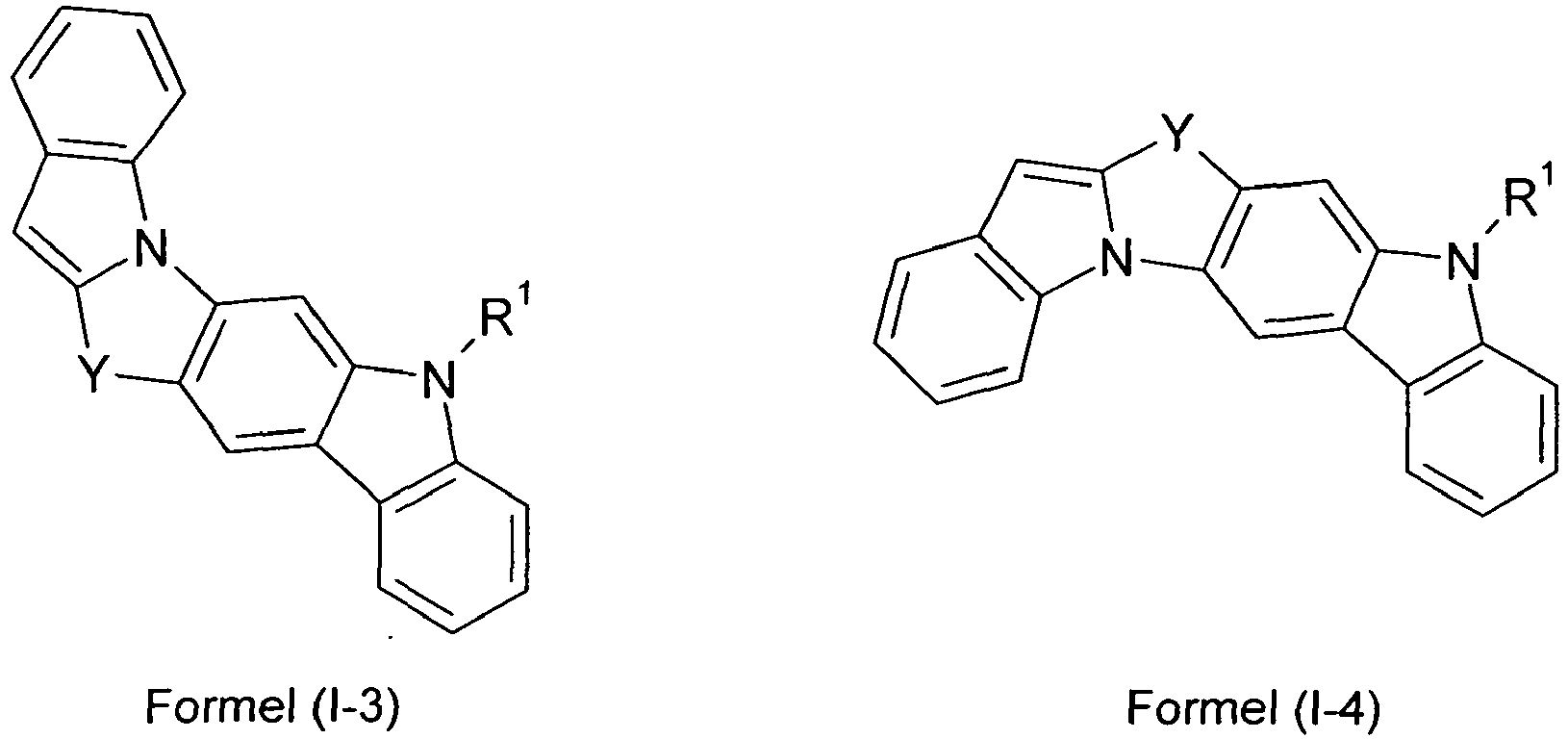


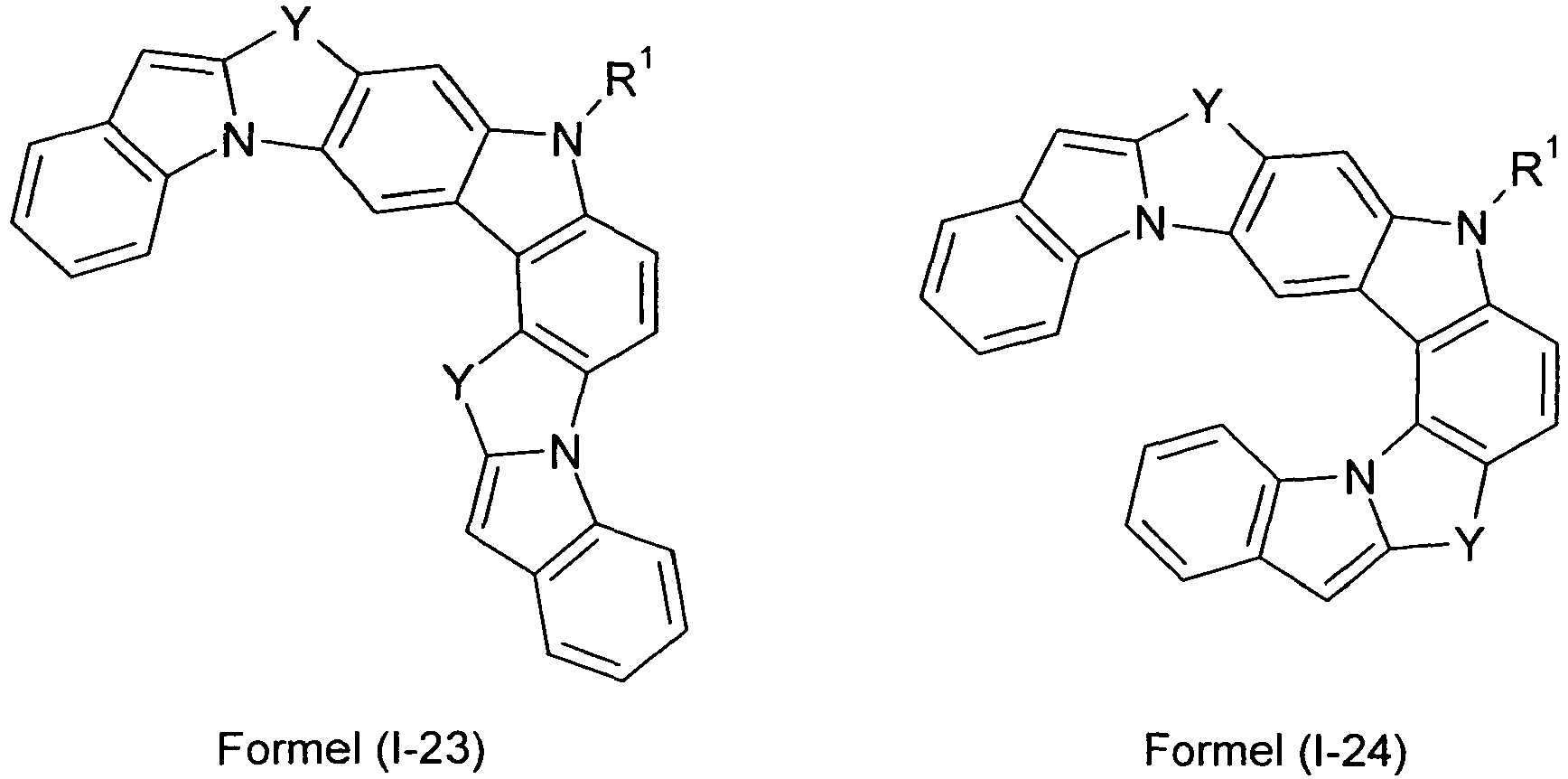


und wobei weiterhin die auftretenden Symbole wie oben definiert sind.In a further preferred embodiment of the invention, compounds of the formula (I) correspond to one of the following formulas (I-1) to (I-27)
and further wherein the occurring symbols are as defined above.
Bevorzugte Ausführungsformen von Verbindungen der Formel (II) stellen Verbindungen gemäß Formel (II-D) dar

Bevorzugte Ausführungsformen von Verbindungen der Formel (II-A) stellen weiterhin die folgenden Verbindungen der Formeln (II-A-1) bis (II-A-48) dar

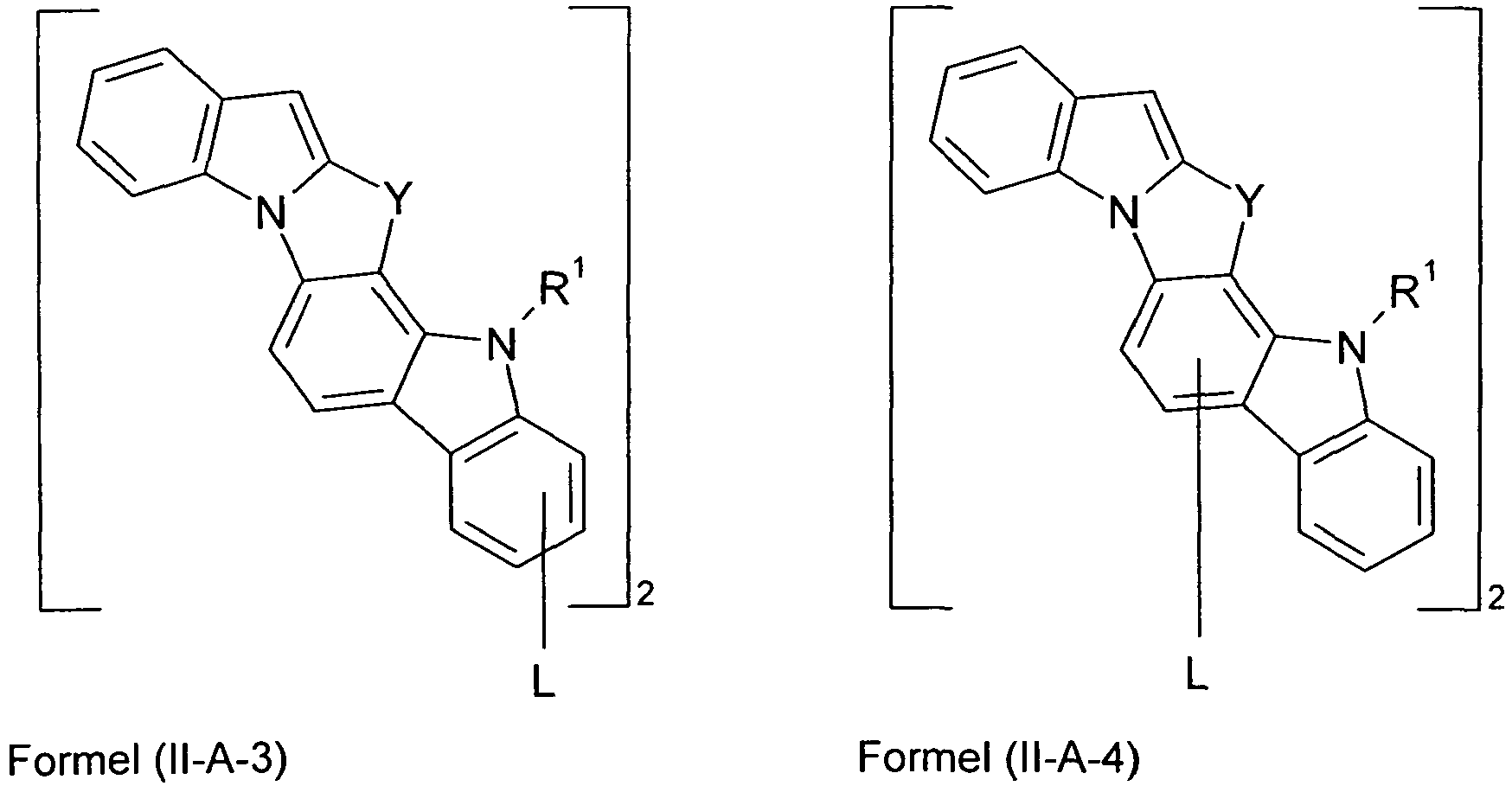

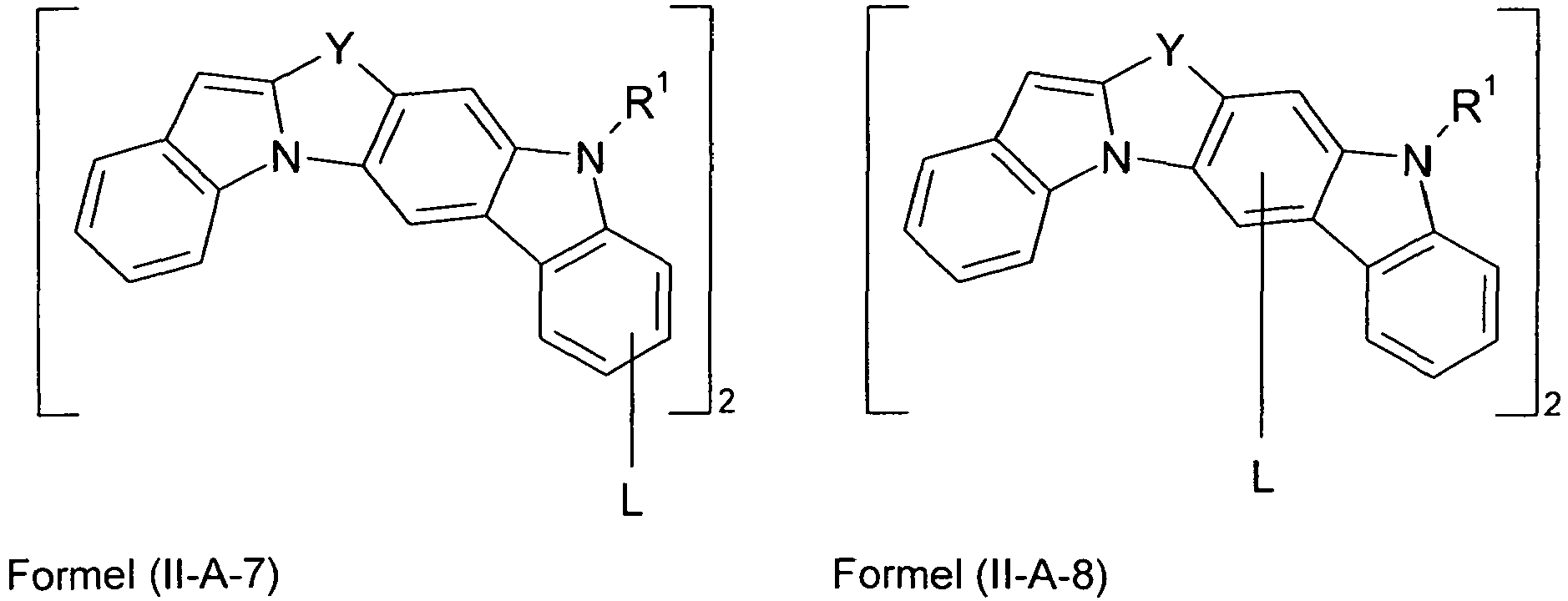
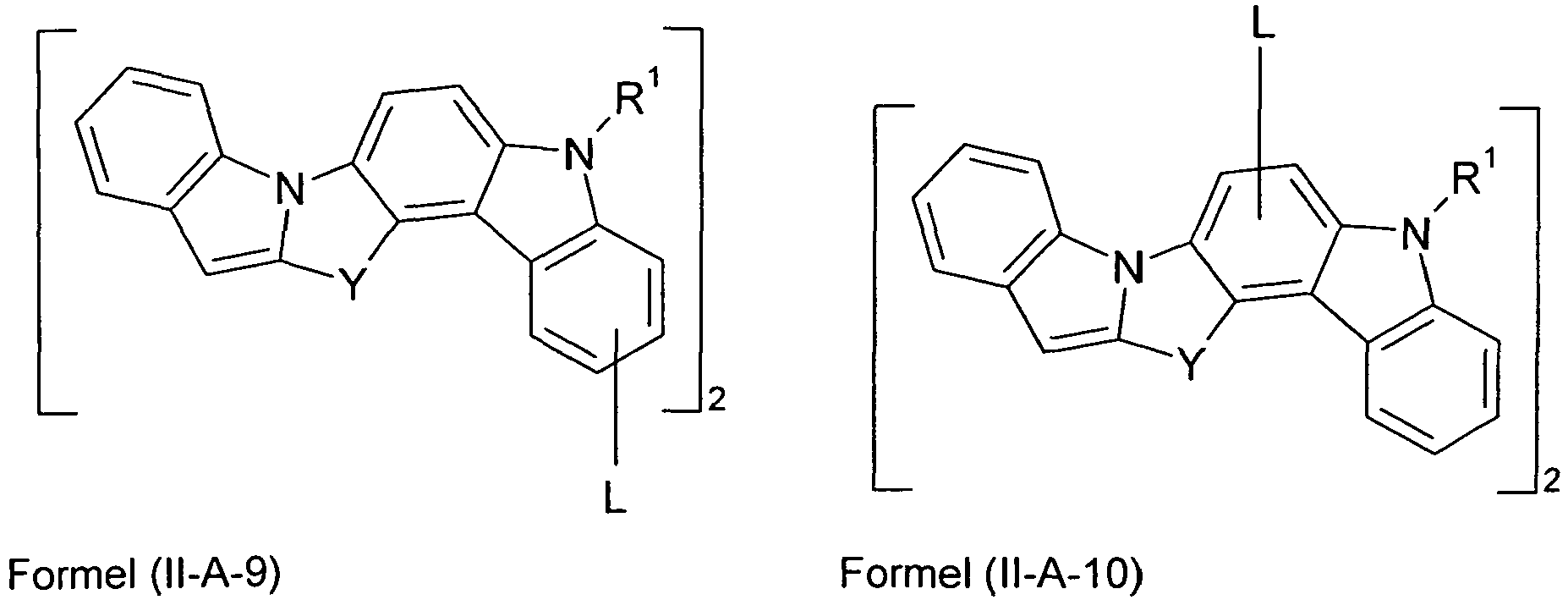


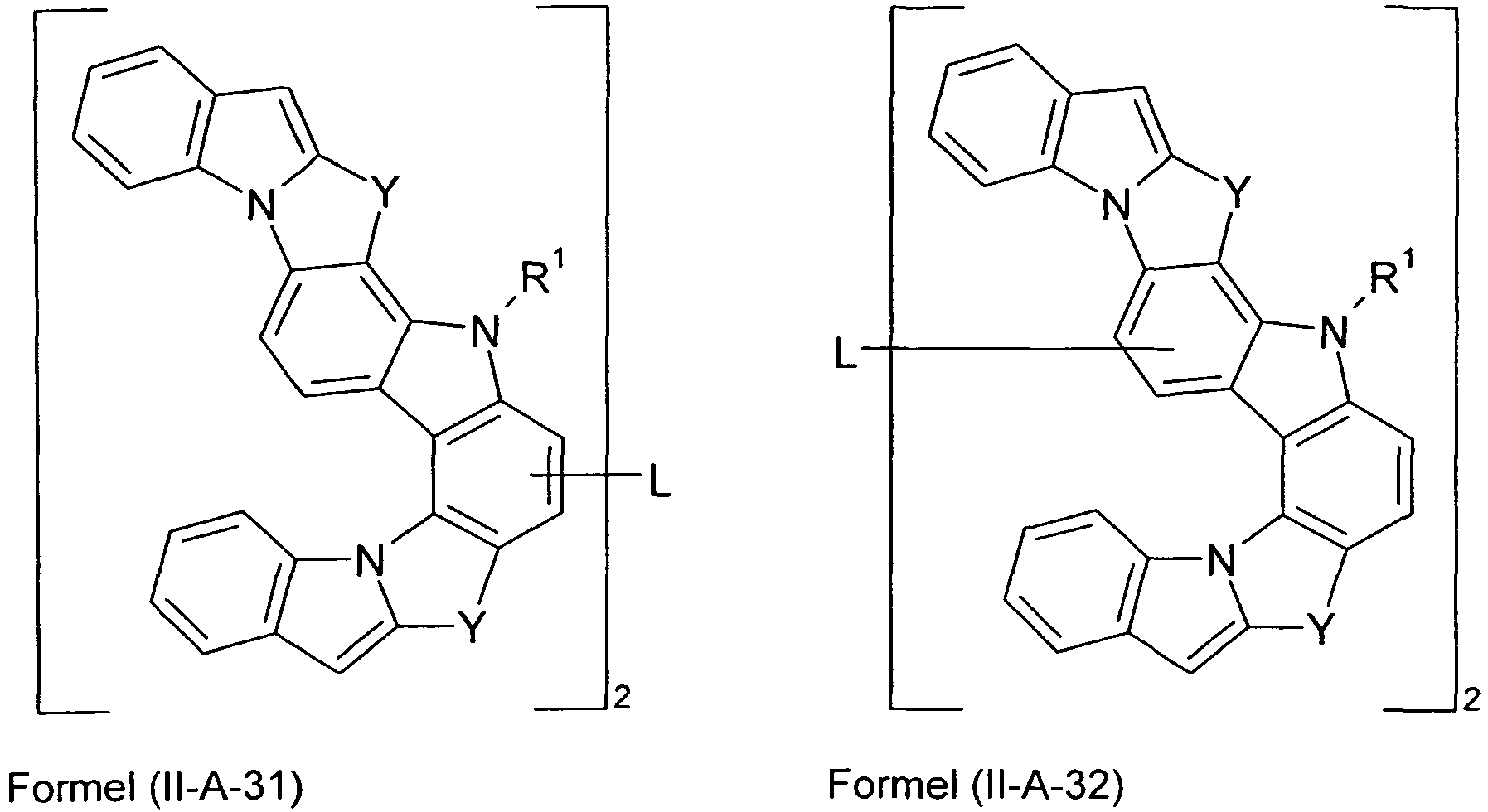


wobei die an L bindenden Molekülteile in eckigen Klammern gleich oder verschieden sein können;
und wobei die auftretenden Symbole wie oben definiert sind.Preferred embodiments of compounds of the formula (II-A) furthermore represent the following compounds of the formulas (II-A-1) to (II-A-48)
wherein the L-binding moieties in square brackets may be the same or different;
and wherein the occurring symbols are as defined above.
Bevorzugt sind in den Verbindungen der Formeln (II-A-1) bis (II-A-48) die an L bindenden Molekülteile in eckigen Klammern gleich.Preferably, in the compounds of formulas (II-A-1) to (II-A-48), the moieties that bind to L are the same in square brackets.
Weiterhin bevorzugt liegt L in einer der oben definierten bevorzugten Ausführungsformen vor.Furthermore, L is preferably present in one of the preferred embodiments defined above.
Besonders bevorzugte Ausführungsformen der erfindungsgemäßen Verbindungen sind Verbindungen der folgenden Formeln


wobei die an L bindenden Molekülteile in eckigen Klammern gleich oder verschieden sein können;
und wobei die auftretenden Symbole wie oben definiert sind.Particularly preferred embodiments of the compounds according to the invention are compounds of the following formulas
wherein the L-binding moieties in square brackets may be the same or different;
and wherein the occurring symbols are as defined above.
Dabei gilt für die genannten besonders bevorzugten Formeln weiterhin, dass L bevorzugt eine Einfachbindung oder eine Arylen- oder Heteroarylengruppe mit 5 bis 18 aromatischen Ringatomen, welche mit einem oder mehreren Resten R1 substituiert sein kann, oder ein divalentes aromatisches oder heteroaromatisches Ringsystem der Formel (L-1), wie oben definiert, darstellt.In this case, furthermore, for the abovementioned particularly preferred formulas, L preferably represents a single bond or an arylene or heteroarylene group having 5 to 18 aromatic ring atoms, which is substituted by one or more radicals R 1 , or a divalent aromatic or heteroaromatic ring system of the formula (L-1), as defined above.
Es ist weiterhin bevorzugt, dass die erfindungsgemäßen Verbindungen als Substituent R1 mindestens eine Gruppe tragen, welche ausgewählt ist aus Gruppen R1-I, R1-II und R1-III, für die gilt:
- R1-I
- ist eine Heteroarylgruppe mit 5 bis 20 aromatischen Ringatomen oder eine Ketogruppe oder eine Phosphoroxidgruppe oder eine Schwefeloxidgruppe, welche jeweils direkt oder über eine oder mehrere divalente Aryl- oder Heteroarylgruppen gebunden ist und welche mit einem oder mehreren Resten R2 substituiert sein kann;
- R1-II
- ist ein aromatisches oder heteroaromatisches Ringsystem mit 5 bis 24 aromatischen Ringatomen, welches mit einem oder mehreren Resten R2 substituiert sein kann, und
- R1-III
- ist eine Arylamingruppe, welche mit einem oder mehreren Resten R2 substituiert sein kann.
- R 1 -I
- R eine is a heteroaryl group having from 5 to 20 aromatic ring atoms or a keto group or a phosphorous oxide group or a sulfur oxide group which is bonded each directly or through one or more divalent aryl or heteroaryl groups and which may be substituted with one or more R 2 groups;
- R 1 -II
- is an aromatic or heteroaromatic ring system having 5 to 24 aromatic ring atoms, which may be substituted by one or more radicals R 2 , and
- R 1 -III
- is an arylamine group which may be substituted with one or more R 2 radicals.
Unter einer Ketogruppe, welche direkt oder über eine oder mehrere divalente Arylgruppen gebunden ist und welche mit einem Rest R2 substituiert sein kann, wird im Rahmen der vorliegenden Erfindung eine Gruppe der folgenden Formel verstanden

- q
- gleich 0, 1, 2, 3, 4 oder 5 sein kann,
- Ar2
- bei jedem Auftreten gleich oder verschieden eine Aryl- oder Heteroarylgruppe mit 5 bis 20 aromatischen Ringatomen darstellt, welche mit einem oder mehreren Resten R2 substituiert sein kann, wobei die Gruppen Ar2 untereinander über eine oder mehrere Gruppen U verbunden sein können; und
- U
- bei jedem Auftreten gleich oder verschieden ausgewählt ist aus einer Einfachbindung, BR2, C(R2)2, C=O, C=S, C=NR2, C=C(R2)2, CR2=CR2, Si(R2)2, NR2, PR2, P(=O)R2, O, S, S=O und S(=O)2; und
- R2
- wie oben definiert ist.
- q
- may be 0, 1, 2, 3, 4 or 5,
- Ar 2
- in each instance, identically or differently represents an aryl or heteroaryl group having 5 to 20 aromatic ring atoms, which may be substituted by one or more radicals R 2 , wherein the groups Ar 2 may be connected to one another via one or more groups U; and
- U
- each occurrence is identically or differently selected from a single bond, BR 2 , C (R 2 ) 2 , C = O, C = S, C = NR 2 , C = C (R 2 ) 2 , CR 2 = CR 2 , Si (R 2 ) 2 , NR 2 , PR 2 , P (= O) R 2 , O, S, S = O and S (= O) 2 ; and
- R 2
- as defined above.
Unter einer Phosphoroxidgruppe, welche direkt oder über eine oder mehrere divalente Arylgruppen gebunden ist und welche mit einem Rest R2 substituiert sein kann, wird im Rahmen der vorliegenden Erfindung eine Gruppe der folgenden Formel verstanden

Unter einer Schwefeloxidgruppe, welche direkt oder über eine oder mehrere divalente Arylgruppen gebunden ist und welche mit einem Rest R2 substituiert sein kann, wird im Rahmen der vorliegenden Erfindung eine Gruppe der folgenden Formel verstanden

- a
- gleich 1 oder 2 sein kann,
- a
- equal to 1 or 2,
Diee oben genannten Gruppen R1-I stellen bevorzugt Gruppen der folgenden Formel dar

q und Ar2 wie oben definiert sind, wobei die Gruppen Ar2 untereinander über eine oder mehrere Gruppen U, wie oben definiert, verbunden sein können; und
- HetAr1
- eine Heteroarylgruppe mit 5 bis 20 aromatischen Ringatomen darstellt, welche mit einem oder mehreren Resten R2 substituiert sein kann.
q and Ar 2 are as defined above, wherein the groups Ar 2 may be connected to one another via one or more groups U, as defined above; and
- HetAr 1
- represents a heteroaryl group having 5 to 20 aromatic ring atoms, which may be substituted by one or more R 2 radicals.
Bevorzugt ist HetAr1 ausgewählt aus Pyridin, Pyrimidin, Pyridazin, Pyrazin, Triazin und Benzimidazol, die jeweils mit einem oder mehreren Resten R2 substituiert sein können.Preferably, HetAr 1 is selected from pyridine, pyrimidine, pyridazine, pyrazine, triazine and benzimidazole, each of which may be substituted by one or more R 2 radicals.
Die oben genannten Gruppen R1-II sind bevorzugt ausgewählt aus Phenyl, Naphthyl, Anthracenyl, Phenanthrenyl, Benzanthracenyl, Pyrenyl, Biphenyl, Terphenyl und Quaterphenyl, welche mit einem oder mehreren Resten R2 substituiert sein können.The abovementioned groups R 1 -II are preferably selected from phenyl, naphthyl, anthracenyl, phenanthrenyl, benzanthracenyl, pyrenyl, biphenyl, terphenyl and quaterphenyl, which may be substituted by one or more radicals R 2 .
Die oben genannten Gruppen R1-III stellen bevorzugt Gruppen der folgenden Formel dar

q und Ar2 wie oben definiert sind, wobei die Gruppen Ar2 untereinander über eine oder mehrere Gruppen U, wie oben definiert, verbunden sein können.The abovementioned groups R 1 -III preferably represent groups of the following formula
q and Ar 2 are as defined above, wherein the groups Ar 2 may be connected to one another via one or more groups U, as defined above.
Beispiele für erfindungsgemäße Verbindungen sind in der folgenden Tabelle aufgeführt:


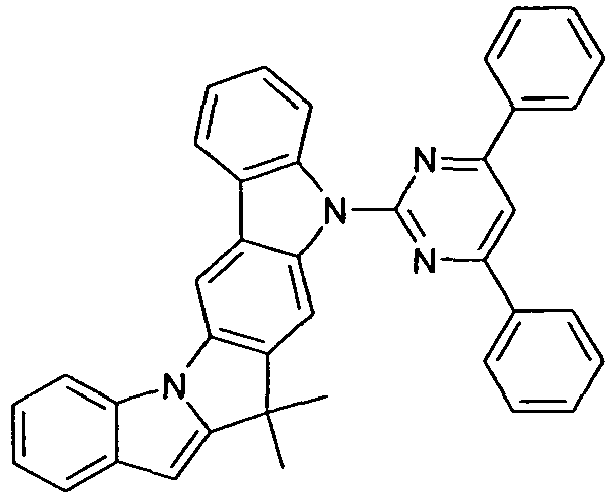


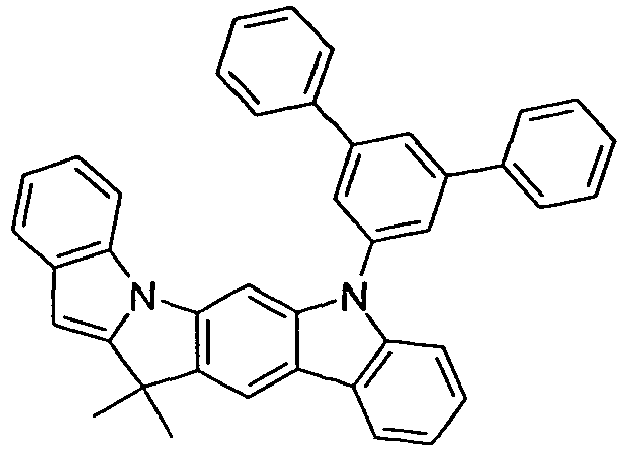
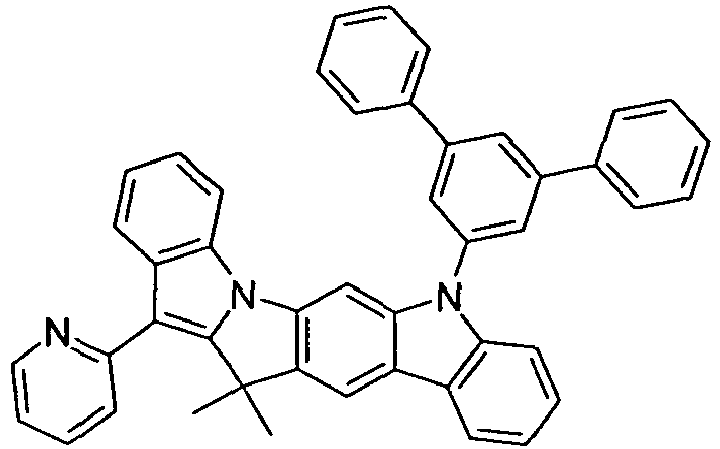


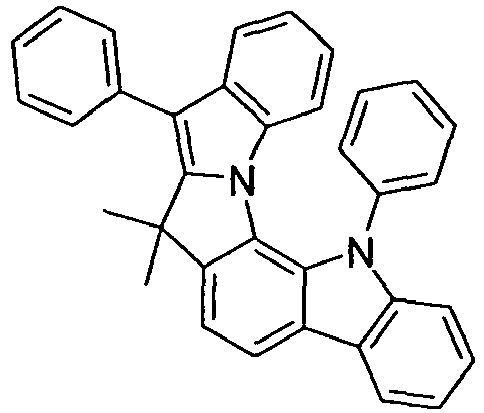


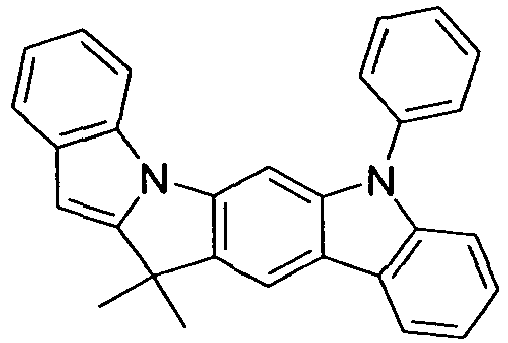


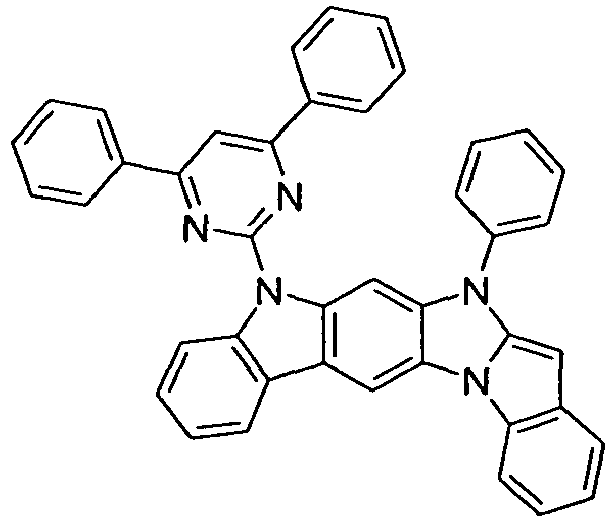


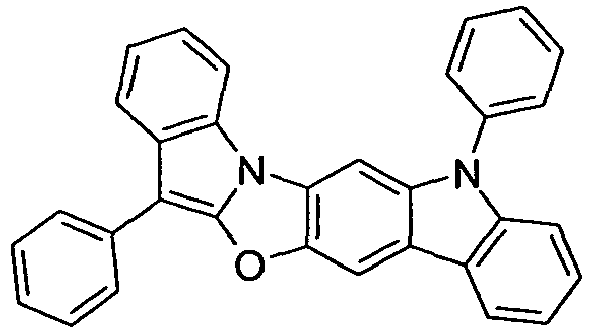


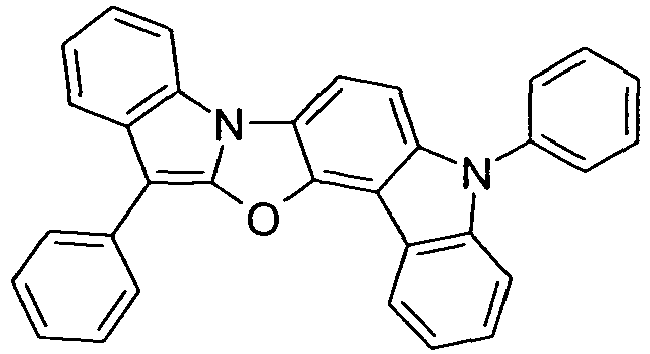

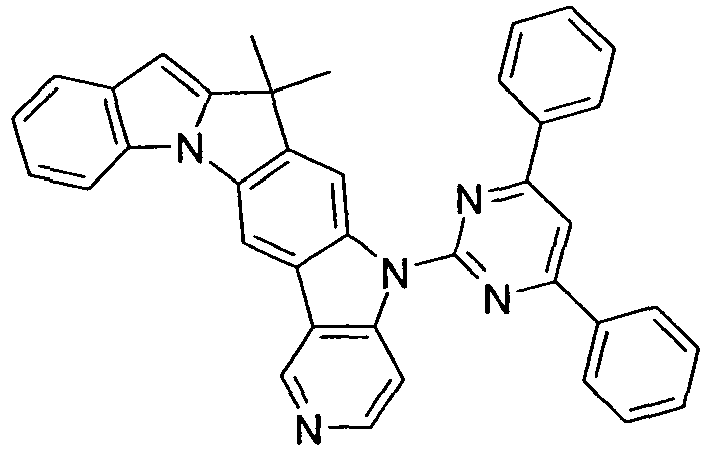


Die erfindungsgemäßen Verbindungen können durch bekannte organischchemische Syntheseverfahren hergestellt werden. Dazu zählen beispielsweise die Ullmann-Kupplung, die Hartwig-Buchwald-Kupplung sowie Palladium-katalysierte oxidative Zyklisierungen.The compounds of the invention can be prepared by known organic chemical synthesis methods. These include For example, the Ullmann coupling, the Hartwig-Buchwald coupling and palladium-catalyzed oxidative cyclizations.
Das folgende Schema 1 zeigt die Synthese der Grundkörper A und B, aus denen über Folgereaktionen erfindungsgemäße Verbindungen hergestellt werden können.
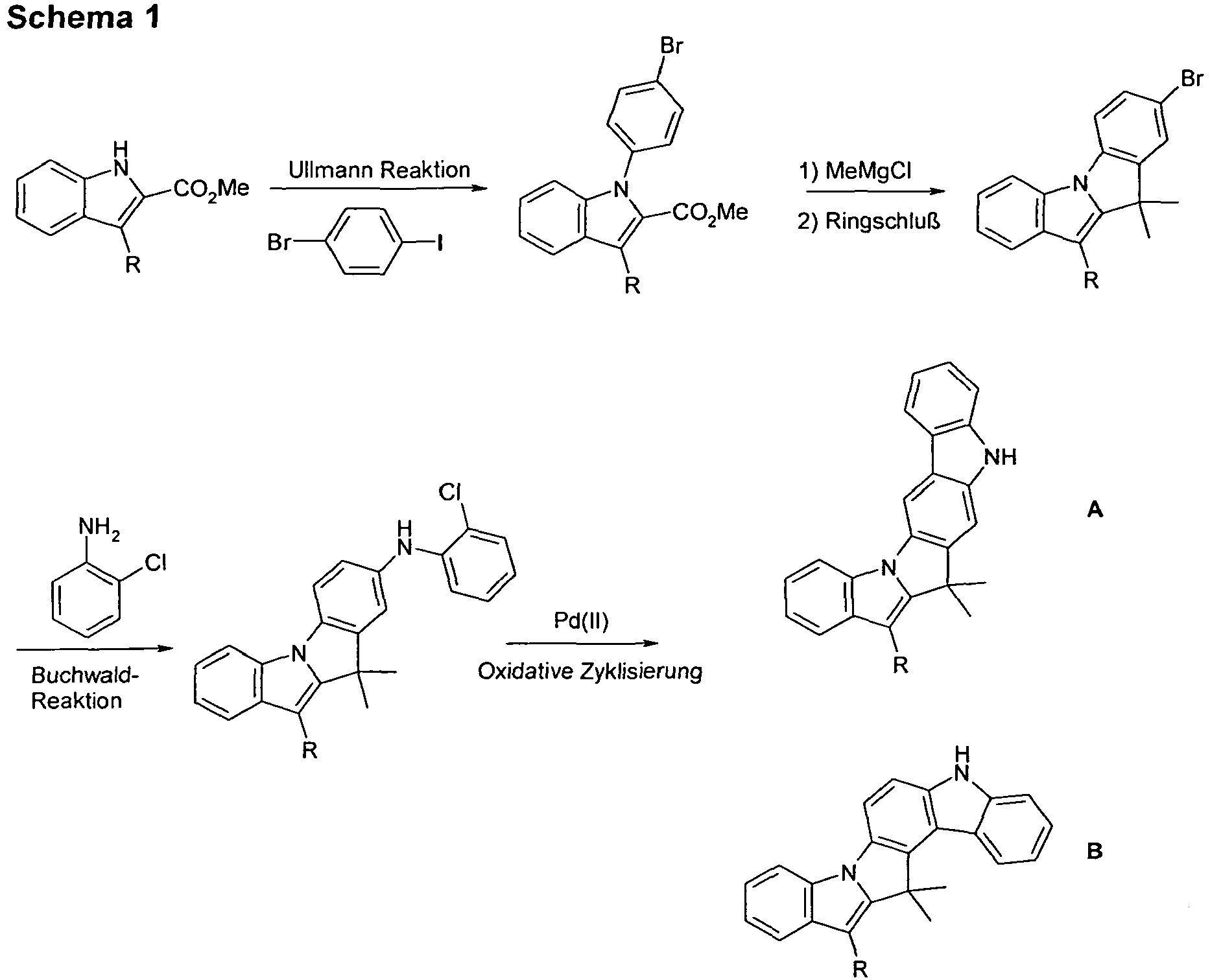
Zur Synthese der Grundkörper A und B wird an 1H-Indolo-2-carbonsäuremethylester zuerst in einer Ullmann-Reaktion 1-Brom-4-Iodbenzol gekuppelt. Die Umsetzung der resultierenden Verbindung mit Methylmagnesiumchlorid gefolgt von einer Ringschlussreaktion unter wasserentziehenden Bedingungen ergibt das entsprechende verbrückte Indolo-bromphenyl-Derivat. Diese Verbindung wird zunächst in einer Buchwald-Kupplung mit 2-Chloranilin umgesetzt. Anschließend wird in einer Palladium-katalysierten Zyklisierungsreaktion die Carbazolgruppe gebildet. Es werden dabei die beiden isomeren Grundkörper A und B erhalten, welche säulenchromatographisch getrennt werden können.For the synthesis of the main bodies A and B, 1-bromo-4-iodobenzene is first coupled to 1H-indolo-2-carboxylic acid methyl ester in an Ullmann reaction. Reaction of the resulting compound with methylmagnesium chloride followed by a ring closure reaction under dehydrating conditions yields the corresponding bridged indolo-bromophenyl derivative. This compound is first reacted in a Buchwald coupling with 2-chloroaniline. Subsequently, in a palladium-catalyzed cyclization reaction formed the carbazole group. There are obtained the two isomeric bodies A and B, which can be separated by column chromatography.
Schema 2 zeigt die Synthese des Grundkörpers C. Sie unterscheidet sich von der in Schema 1 gezeigten Synthese lediglich dadurch, dass statt 1-Brom-4-lodbenzol das isomere 1-Brom-3-lodbenzol in der Ullmann-Kupplung eingesetzt wird. In der im letzten Schritt stattfindenden oxidativen Zyklisierung wird der Grundkörper C gebildet.

Gemäß einem alternativen Syntheseweg zur Herstellung der Grundkörper A, B und C kann die Ullmann-Kupplung des Indolderivats direkt mit einem bromsubstituierten Carbazolderivat erfolgen. Wie im zuvor vorgestellten Syntheseweg finden im Anschluss an die Ullmann-Kupplung die Addition von Methylmagnesiumbromid an die Carbonsäureestergruppe und die Ringschlussreaktion statt. Der Syntheseweg ist exemplarisch für die Herstellung des Grundkörpers C in Schema 3 gezeigt.

In Schema 4 werden exemplarisch für den Grundkörper A verschiedene Möglichkeiten gezeigt, durch Derivatisierungsreaktionen erfindungsgemäße Vebindungen zu erhalten. Für die Grundkörper B und C kann analog verfahren werden. In der ersten gezeigten Reaktion wird eine Hartwig-Buchwald-Reaktion mit einem mono-Brom-funktionalisierten Arylderivat durchgeführt. In der zweiten gezeigten Reaktion wird durch eine nukleophile Substitution an einem Heteroarylchlorid eine entsprechende Heteroarylgruppe als Substituent am Carbazol-Stickstoffatom eingeführt.

Die im folgenden Schema 5 gezeigte Reaktion liefert erfindungsgemäße Verbindungen der Formel (II). Hierzu werden zwei Äquivalente des Grundkörpers A mit einem Di-Bromo-Arylderivat umgesetzt, wie explizit anhand von 4,4'-Dibromobiphenyl gezeigt.

Entsprechend können in Reaktionen gemäß Schema 5 anstelle von Verbindungen des Grundkörpers A auch Verbindungen der Grundkörper B und C eingesetzt werden, um alternative Verbindungen der Formel (II) zu erhalten. Weiterhin können in solchen Reaktionen auch andere divalente Arylgruppen in der Buchwald-Kupplung eingesetzt werden, beispielsweise Heteroarylgruppen wie Dibenzothiophen oder andere Arylgruppen wie Benzol, Fluoren oder Terphenyl.Accordingly, in reactions according to Scheme 5 instead of compounds of the main body A, compounds of the main body B and C can be used to obtain alternative compounds of the formula (II). Furthermore, other divalent aryl groups in the Buchwald coupling can also be used in such reactions, for example heteroaryl groups such as dibenzothiophene or other aryl groups such as benzene, fluorene or terphenyl.
Die oben beschriebenen Synthesewege sollen lediglich als Beispiele dienen. Der Fachmann kann zur Synthese der erfindungsgemäßen Verbindungen auf alternative Syntheseverfahren zurückgreifen, wenn ihm dies unter den gegebenen Umständen vorteilhaft erscheint. Weiterhin kann er unter Heranziehung seines allgemeinen Fachwissens auf dem Gebiet der organischen Synthesechemie die gezeigten Synthesen erweitern und/oder modifizieren, um erfindungsgemäße Verbindungen herzustellen.The synthetic routes described above are intended to serve as examples only. The person skilled in the art can resort to alternative synthesis methods for the synthesis of the compounds according to the invention if this appears advantageous under the given circumstances. Furthermore, by using his general knowledge in the field of organic synthetic chemistry, he can extend and / or modify the syntheses shown to produce compounds of the invention.
Gegenstand der Erfindung ist somit weiterhin ein Verfahren zur Herstellung einer Verbindung gemäß Formel (I) oder (II), dadurch gekennzeichnet, dass mindestens eine metallorganische Kupplungsreaktion zwischen einem Indolderivat und einer halogensubstituierten aromatischen oder heteroaromatischen Verbindung und mindestens eine Ringschlussreaktion zwischen dem Indolderivat und der gekuppelten aromatischen oder heteroaromatischen Verbindung umfasst sind.The invention thus further provides a process for the preparation of a compound according to formula (I) or (II), characterized in that at least one organometallic coupling reaction between an indole derivative and a halogen-substituted aromatic or heteroaromatic compound and at least one ring-closure reaction between the indole derivative and the coupled aromatic or heteroaromatic compound are included.
Die oben beschriebenen erfindungsgemäßen Verbindungen, insbesondere Verbindungen, welche mit reaktiven Abgangsgruppen, wie Brom, Iod, Chlor, Boronsäure oder Boronsäureester, substituiert sind, können als Monomere zur Erzeugung entsprechender Oligomere, Dendrimere oder Polymere Verwendung finden. Die Oligomerisation bzw. Polymerisation erfolgt dabei bevorzugt über die Halogenfunktionalität bzw. die Boronsäurefunktionalität.The compounds according to the invention described above, in particular compounds which are substituted by reactive leaving groups, such as bromine, iodine, chlorine, boronic acid or boronic acid esters, can be used as monomers for the production of corresponding oligomers, dendrimers or polymers. The oligomerization or polymerization is preferably carried out via the halogen functionality or the boronic acid functionality.
Weiterer Gegenstand der Erfindung sind daher Oligomere, Polymere oder Dendrimere enthaltend eine oder mehrere Verbindungen gemäß Formel (I) oder (II), wobei die Bindung(en) zum Polymer, Oligomer oder Dendrimer an beliebigen, in Formel (I) oder (II) mit R1 oder R2 substituierten Positionen lokalisiert sein können. Je nach Verknüpfung der Verbindung gemäß Formel (I) oder (II) ist die Verbindung Bestandteil einer Seitenkette des Oligomers oder Polymers oder Bestandteil der Hauptkette. Unter einem Oligomer im Sinne dieser Erfindung wird eine Verbindung verstanden, welche aus mindestens drei Monomereinheiten aufgebaut ist. Unter einem Polymer im Sinne der Erfindung wird eine Verbindung verstanden, die aus mindestens zehn Monomereinheiten aufgebaut ist. Die erfindungsgemäßen Polymere, Oligomere oder Dendrimere können konjugiert, teilkonjugiert oder nicht-konjugiert sein. Die erfindungsgemäßen Oligomere oder Polymere können linear, verzweigt oder dendritisch sein. In den linear verknüpften Strukturen können die Einheiten gemäß Formel (I) oder (II) direkt miteinander verknüpft sein oder sie können über eine bivalente Gruppe, beispielsweise über eine substituierte oder unsubstituierte Alkylengruppe, über ein Heteroatom oder über eine bivalente aromatische oder heteroaromatische Gruppe miteinander verknüpft sein. In verzweigten und dendritischen Strukturen können beispielsweise drei oder mehrere Einheiten gemäß Formel (I) oder (II) über eine trivalente oder höhervalente Gruppe, beispielsweise über eine trivalente oder höhervalente aromatische oder heteroaromatische Gruppe, zu einem verzweigten bzw. dendritischen Oligomer oder Polymer verknüpft sein. Für die Wiederholeinheiten gemäß Formel (I) oder (II) in Oligomeren, Dendrimeren und Polymeren gelten dieselben Bevorzugungen wie oben für Verbindungen gemäß Formel (I) oder (II) beschrieben.The invention therefore further provides oligomers, polymers or dendrimers containing one or more compounds of the formula (I) or (II), where the bond (s) to the polymer, oligomer or dendrimer can be replaced by any one of formula (I) or (II) can be localized with R 1 or R 2 substituted positions. Depending on the linking of the compound of the formula (I) or (II), the compound is part of a side chain of the oligomer or polymer or constituent of the main chain. An oligomer in the context of this invention is understood as meaning a compound which is composed of at least three monomer units. A polymer in the context of the invention is understood as meaning a compound which is composed of at least ten monomer units. The polymers, oligomers or dendrimers of the invention may be conjugated, partially conjugated or non-conjugated. The oligomers or polymers of the invention may be linear, branched or dendritic. In the linearly linked structures, the units of formula (I) or (II) may be directly linked or may be linked together via a divalent group, for example via a substituted or unsubstituted alkylene group, via a heteroatom or via a divalent aromatic or heteroaromatic group be. In branched and dendritic structures, for example, three or more units of the formula (I) or (II) may have a trivalent one or higher valent group, for example via a trivalent or higher valence aromatic or heteroaromatic group, to be a branched or dendritic oligomer or polymer. The repeat units of the formula (I) or (II) in oligomers, dendrimers and polymers have the same preferences as described above for compounds of the formula (I) or (II).
Zur Herstellung der Oligomere oder Polymere werden die erfindungsgemäßen Monomere homopolymerisiert oder mit weiteren Monomeren copolymerisiert. Geeignete und bevorzugte Comonomere sind gewählt aus Fluorenen (z. B. gemäß
Die erfindungsgemäßen Polymere, Oligomere und Dendrimere weisen vorteilhafte Eigenschaften, insbesondere hohe Lebensdauern, hohe Effizienzen und gute Farbkoordinaten auf.The polymers, oligomers and dendrimers according to the invention have advantageous properties, in particular high lifetimes, high efficiencies and good color coordinates.
Die erfindungsgemäßen Polymere und Oligomere werden in der Regel durch Polymerisation von einer oder mehreren Monomersorten hergestellt, von denen mindestens ein Monomer im Polymer zu Wiederholungseinheiten der Formel (I) oder (II) führt. Geeignete Polymerisationsreaktionen sind dem Fachmann bekannt und in der Literatur beschrieben. Besonders geeignete und bevorzugte Polymerisationsreaktionen, die zu C-C- bzw. C-N-Verknüpfungen führen, sind folgende:
- (A) SUZUKI-Polymerisation;
- (B) YAMAMOTO-Polymerisation;
- (C) STILLE-Polymerisation; und
- (D) HARTWIG-BUCHWALD-Polymerisation.
- (A) SUZUKI polymerization;
- (B) YAMAMOTO polymerization;
- (C) SILENT polymerization; and
- (D) HARTWIG-BUCHWALD polymerization.
Wie die Polymerisation nach diesen Methoden durchgeführt werden kann und wie die Polymere dann vom Reaktionsmedium abgetrennt und aufgereinigt werden können, ist dem Fachmann bekannt und in der Literatur, beispielsweise in
Gegenstand der vorliegenden Erfindung ist somit auch ein Verfahren zur Herstellung der erfindungsgemäßen Polymere, Oligomere und Dendrimere, das dadurch gekennzeichnet ist, dass sie durch Polymerisation gemäß SUZUKI, Polymerisation gemäß YAMAMOTO, Polymerisation gemäß STILLE oder Polymerisation gemäß HARTWIG-BUCHWALD hergestellt werden. Die erfindungsgemäßen Dendrimere können gemäß dem Fachmann bekannten Verfahren oder in Analogie dazu hergestellt werden. Geeignete Verfahren sind in der Literatur beschrieben, wie z. B. in
Für die Verarbeitung der erfindungsgemäßen Verbindungen aus flüssiger Phase, beispielsweise durch Spin-Coating oder durch Druckverfahren, sind Formulierungen der erfindungsgemäßen Verbindungen erforderlich. Diese Formulierungen können beispielsweise Lösungen, Dispersionen oder Miniemulsionen sein.For the processing of the compounds according to the invention from the liquid phase, for example by spin coating or by printing processes, formulations of the compounds according to the invention are required. These formulations may be, for example, solutions, dispersions or miniemulsions.
Gegenstand der Erfindung ist daher weiterhin eine Formulierung, insbesondere eine Lösung, Dispersion oder Miniemulsion, enthaltend mindestens eine Verbindung gemäß Formel (I) oder (II) oder mindestens ein Polymer, Oligomer oder Dendrimer enthaltend mindestens eine Einheit gemäß Formel (I) oder (II) sowie mindestens ein Lösungsmittel, bevorzugt ein organisches Lösungsmittel. Wie solche Lösungen hergestellt werden können, ist dem Fachmann bekannt und beispielsweise in den Anmeldungen
Die erfindungsgemäßen Verbindungen gemäß Formel (I) oder (II) eignen sich für den Einsatz in elektronischen Vorrichtungen, insbesondere in organischen Elektrolumineszenzvorrichtungen (OLEDs). Abhängig von der Substitution werden die Verbindungen bevorzugt in bestimmten Funktionen und/oder Schichten eingesetzt.The compounds of the formula (I) or (II) according to the invention are suitable for use in electronic devices, in particular in organic electroluminescent devices (OLEDs). Depending on the substitution, the compounds are preferably used in certain functions and / or layers.
Beispielsweise sind erfindungsgemäße Verbindungen, welche als Substituent R1 mindestens eine Gruppe R1-I tragen, wie oben definiert, besonders zur Verwendung als Matrixmaterial für phosphoreszierende Dotanden, als Elektronentransportmaterial oder als Lochblockiermaterial geeignet. Bevorzugt umfasst dabei die Gruppe R1-I mindestens eine elektronenarme Gruppe wie Sechsring-Heteroarylgruppen mit einem oder mehreren Stickstoffatomen oder Fünfring-Heteroarylgruppen mit zwei oder mehr Stickstoffatomen.For example, compounds according to the invention which as substituent R 1 bear at least one group R 1 -I, as defined above, are particularly suitable for use as matrix material for phosphorescent dopants, as electron-transport material or as hole-blocking material. The group R 1 -I preferably comprises at least one electron-deficient group such as six-membered heteroaryl groups having one or more nitrogen atoms or five-membered heteroaryl groups having two or more nitrogen atoms.
Weiterhin sind erfindungsgemäße Verbindungen, welche als Substituent R1 mindestens eine Gruppe R1-II und/oder R1-III tragen, wie oben definiert, besonders zur Verwendung als Lochtransportmaterialien oder zur Verwendung als fluoreszierende Dotanden geeignet. Bevorzugt umfasst die Gruppe R1-II dabei ein aromatisches Ringsystem mit 12 bis 24 aromatischen Ringatomen.Furthermore, compounds according to the invention which as substituent R 1 bear at least one group R 1 -II and / or R 1 -III, as defined above, are particularly suitable for use as hole transport materials or for use as fluorescent dopants. The group R 1 -II preferably comprises an aromatic ring system having 12 to 24 aromatic ring atoms.
Bevorzugt werden die erfindungsgemäßen Verbindungen als Elektronentransportmaterial in einer Elektronentransportschicht, als Matrixmaterial in einer emittierenden Schicht und/oder als Lochtransportmaterial in einer Lochtransportschicht eingesetzt. Wenn die Verbindungen als Matrixmaterialien in einer emittierenden Schicht eingesetzt werden, umfasst die emittierende Schicht bevorzugt mindestens eine phosphoreszierende Emitterverbindung. Die Verbindungen können aber auch in anderen Schichten und/oder Funktionen eingesetzt werden, beispielsweise als fluoreszierende Dotanden in einer emittierenden Schicht oder als Loch- oder Elektronenblockiermaterialien.The compounds according to the invention are preferably used as electron transport material in an electron transport layer, as matrix material in an emitting layer and / or as Hole transport material used in a hole transport layer. When the compounds are used as matrix materials in an emitting layer, the emitting layer preferably comprises at least one phosphorescent emitter compound. However, the compounds can also be used in other layers and / or functions, for example as fluorescent dopants in an emitting layer or as hole or electron blocking materials.
Ein weiterer Gegenstand der Erfindung ist daher die Verwendung der erfindungsgemäßen Verbindungen in elektronischen Vorrichtungen. Dabei sind die elektronischen Vorrichtungen bevorzugt ausgewählt aus der Gruppe bestehend aus organischen integrierten Schaltungen (O-ICs), organischen Feld-Effekt-Transistoren (O-FETs), organischen Dünnfilmtransistoren (O-TFTs), organischen lichtemittierenden Transistoren (O-LETs), organischen Solarzellen (O-SCs), organischen optischen Detektoren, organischen Photorezeptoren, organischen Feld-Quench-Devices (O-FQDs), lichtemittierenden elektrochemischen Zellen (LECs), organischen Laserdioden (O-Laser) und besonders bevorzugt ausgewählt aus organischen Elektrolumineszenzvorrichtungen (OLEDs).Another object of the invention is therefore the use of the compounds of the invention in electronic devices. In this case, the electronic devices are preferably selected from the group consisting of organic integrated circuits (O-ICs), organic field-effect transistors (O-FETs), organic thin-film transistors (O-TFTs), organic light-emitting transistors (O-LETs), organic solar cells (O-SCs), organic optical detectors, organic photoreceptors, organic field quench devices (O-FQDs), light-emitting electrochemical cells (LECs), organic laser diodes (O-lasers) and more preferably selected from organic electroluminescent devices (OLEDs ).
Nochmals ein weiterer Gegenstand der Erfindung sind elektronische Vorrichtungen, enthaltend mindestens eine Verbindung gemäß Formel (I) oder (II). Dabei sind die elektronischen Vorrichtungen bevorzugt ausgewählt aus den oben genannten Vorrichtungen. Besonders bevorzugt sind organische Elektrolumineszenzvorrichtungen, enthaltend Anode, Kathode und mindestens eine emittierende Schicht, dadurch gekennzeichnet, dass mindestens eine organische Schicht, die eine emittierende Schicht, eine Elektronentransportschicht oder eine andere Schicht sein kann, mindestens eine Verbindung gemäß Formel (I) oder (II) enthält.Yet another subject of the invention are electronic devices containing at least one compound of formula (I) or (II). In this case, the electronic devices are preferably selected from the above-mentioned devices. Particularly preferred are organic electroluminescent devices containing anode, cathode and at least one emitting layer, characterized in that at least one organic layer, which may be an emitting layer, an electron transport layer or another layer, at least one compound according to formula (I) or (II ) contains.
Außer Kathode, Anode und der emittierenden Schicht kann die organische Elektrolumineszenzvorrichtung noch weitere Schichten enthalten. Diese sind beispielsweise gewählt aus jeweils einer oder mehreren Lochinjektionsschichten, Lochtransportschichten, Lochbiockierschichten, Elektronentransportschichten, Elektroneninjektionsschichten, Elektronenblockierschichten, Excitonenblockierschichten, Ladungserzeugungsschichten (Charge-Generation Layers) (IDMC 2003, Taiwan; Session 21 OLED (5),
Es ist erfindungsgemäß bevorzugt, wenn die Verbindung gemäß Formel (I) oder (II) in einer elektronischen Vorrichtung enthaltend einen oder mehrere phosphoreszierende Dotanden eingesetzt wird. Dabei kann die Verbindung in unterschiedlichen Schichten, bevorzugt in einer Elektronentransportschicht, einer Lochtransportschicht, einer Lochinjektionsschicht oder in der emittierenden Schicht verwendet werden. Die Verbindung gemäß Formel (I) oder (II) kann aber auch erfindungsgemäß in einer elektronischen Vorrichtung, enthaltend einen oder mehrere fluoreszierende Dotanden und keine phosphoreszierenden Dotanden, eingesetzt werden.It is preferred according to the invention if the compound according to formula (I) or (II) is used in an electronic device containing one or more phosphorescent dopants. In this case, the compound can be used in different layers, preferably in an electron transport layer, a hole transport layer, a hole injection layer or in the emitting layer. However, the compound according to formula (I) or (II) can also be used according to the invention in an electronic device containing one or more fluorescent dopants and no phosphorescent dopants.
Vom Begriff phosphoreszierende Dotanden sind typischerweise Verbindungen umfasst, bei denen die Lichtemission durch einen spinverbotenen Übergang erfolgt, beispielsweise einen Übergang aus einem angeregten Triplettzustand oder einem Zustand mit einer höheren Spinquantenzahl, beispielsweise einem Quintett-Zustand.The term phosphorescent dopants typically includes compounds in which the light emission takes place by a spin-forbidden transition, for example a transition from a triplet excited state or a state with a higher spin quantum number, for example a quintet state.
Als phosphoreszierende Dotanden eignen sich insbesondere Verbindungen, die bei geeigneter Anregung Licht, vorzugsweise im sichtbaren Bereich, emittieren und außerdem mindestens ein Atom der Ordnungszahl größer 20, bevorzugt größer 38 und kleiner 84, besonders bevorzugt größer 56 und kleiner 80 enthalten. Bevorzugt werden als phosphoreszierende Dotanden Verbindungen, die Kupfer, Molybdän, Wolfram, Rhenium, Ruthenium, Osmium, Rhodium, Iridi um, Palladium, Platin, Silber, Gold oder Europium enthalten, verwendet, insbesondere Verbindungen, die Iridium, Platin oder Kupfer enthalten.Particularly suitable as phosphorescent dopants are compounds which emit light, preferably in the visible range, with suitable excitation and also contain at least one atom of atomic number greater than 20, preferably greater than 38 and less than 84, particularly preferably greater than 56 and less than 80. As phosphorescent dopants, compounds which are copper, molybdenum, Tungsten, rhenium, ruthenium, osmium, rhodium, iridium, palladium, platinum, silver, gold or europium, especially compounds containing iridium, platinum or copper.
Dabei werden im Sinne der vorliegenden Erfindung alle lumineszierenden Iridium-, Platin- oder Kupferkomplexe als phosphoreszierende Verbindungen angesehen.For the purposes of the present invention, all luminescent iridium, platinum or copper complexes are regarded as phosphorescent compounds.
Beispiele der oben beschriebenen phosphoreszierenden Dotanden können den Anmeldungen
In einer bevorzugten Ausführungsform der vorliegenden Erfindung werden die Verbindungen der Formel (I) oder (II) als Matrixmaterial in Kombination mit einem oder mehreren Dotanden, vorzugsweise phosphoreszierenden Dotanden, eingesetzt. Die Verbindungen sind insbesondere dann zur Verwendung als Matrixmaterial geeignet, wenn sie eine oder mehrere Gruppen der Formel R1-I enthalten, wie zum Beispiel Sechsring-Heteroarylgruppen mit einem oder mehreren Stickstoffatomen oder Fünfring-Heteroarylgruppen mit zwei oder mehr Stickstoffatomen.In a preferred embodiment of the present invention, the compounds of the formula (I) or (II) are used as matrix material in combination with one or more dopants, preferably phosphorescent dopants. The compounds are particularly suitable for use as a matrix material if they contain one or more groups of the formula R 1 -I, for example six-membered heteroaryl groups having one or more nitrogen atoms or five-membered heteroaryl groups having two or more nitrogen atoms.
Unter einem Dotanden wird in einem System enthaltend ein Matrixmaterial und einen Dotanden diejenige Komponente verstanden, deren Anteil in der Mischung der kleinere ist. Entsprechend wird unter einem Matrixmaterial in einem System enthaltend ein Matrixmaterial und einen Dotanden diejenige Komponente verstanden, deren Anteil in der Mischung der größere ist. Der Anteil des Matrixmaterials in der emittierenden Schicht beträgt in diesem Fall zwischen 50.0 und 99.9 Vol.%, bevorzugt zwischen 80.0 und 99.5 Vol.-% und besonders bevorzugt für fluoreszierende emittierende Schichten zwischen 92.0 und 99.5 Vol.-% sowie für phosphoreszierende emittierende Schichten zwischen 85.0 und 97.0 Vol.-%. Entsprechend beträgt der Anteil des Dotanden zwischen 0.1 und 50.0 Vol.-%, bevorzugt zwischen 0.5 und 20.0 Vol.-% und besonders bevorzugt für fluoreszierende emittierende Schichten zwischen 0.5 und 8.0 Vol.-% sowie für phosphoreszierende emittierende Schichten zwischen 3.0 und 15.0 Vol.-%.In a system comprising a matrix material and a dopant, a dopant is understood to mean the component whose proportion in the mixture is the smaller. Correspondingly, a matrix material in a system containing a matrix material and a dopant is understood to mean the component whose proportion in the mixture is the larger. The proportion of the matrix material in the emitting layer in this case is between 50.0 and 99.9% by volume, preferably between 80.0 and 99.5% by volume and particularly preferred for fluorescent emitting layers between 92.0 and 99.5% by volume and for phosphorescent emitting layers between 85.0 and 97.0 vol.%. Accordingly, the proportion of the dopant is between 0.1 and 50.0% by volume, preferably between 0.5 and 20.0% by volume and particularly preferred for fluorescent emitting layers between 0.5 and 8.0% by volume and for phosphorescent emitting layers between 3.0 and 15.0% by volume. -%.
Eine emittierende Schicht einer organischen Elektrolumineszenzvorrichtung kann auch Systeme umfassend mehrere Matrixmaterialien (Mixed-Matrix-Systeme) und/oder mehrere Dotanden enthalten. Auch in diesem Fall sind die Dotanden im Allgemeinen diejenigen Materialien, deren Anteil im System der kleinere ist und die Matrixmaterialien sind diejenigen Materialien, deren Anteil im System der größere ist. In Einzelfällen kann jedoch der Anteil eines einzelnen Matrixmaterials im System kleiner sein als der Anteil eines einzelnen Dotanden.An emitting layer of an organic electroluminescent device may also contain systems comprising a plurality of matrix materials (mixed-matrix systems) and / or multiple dopants. Also in this case, the dopants are generally those materials whose proportion in the system is smaller and the matrix materials are those materials whose proportion in the system is larger. In individual cases, however, the proportion of a single matrix material in the system may be smaller than the proportion of a single dopant.
In einer weiteren bevorzugten Ausführungsform der Erfindung werden die Verbindungen gemäß Formel (I) oder (II) als eine Komponente von Mixed-Matrix-Systemen verwendet. Die Mixed-Matrix-Systeme umfassen bevorzugt zwei oder drei verschiedene Matrixmaterialien, besonders bevorzugt zwei verschiedene Matrixmaterialien. Bevorzugt stellt dabei eines der beiden Materialien ein Material mit lochtransportierenden Eigenschaften und das andere Material ein Material mit elektronentransportierenden Eigenschaften dar. Die beiden unterschiedlichen Matrixmaterialien können dabei in einem Verhältnis von 1:50 bis 1:1, bevorzugt 1:20 bis 1:1, besonders bevorzugt 1:10 bis 1:1 und ganz besonders bevorzugt 1:4 bis 1:1 vorliegen. Bevorzugt werden Mixed-Matrix-Systeme in phosphoreszierenden organischen Elektrolumineszenzvorrichtungen eingesetzt.In a further preferred embodiment of the invention, the compounds according to formula (I) or (II) are used as a component of mixed-matrix systems. The mixed-matrix systems preferably comprise two or three different matrix materials, more preferably two different matrix materials. In this case, one of the two materials preferably constitutes a material with hole-transporting properties and the other material a material with electron-transporting properties. The two different matrix materials can be present in a ratio of 1:50 to 1: 1, preferably 1:20 to 1: 1, particularly preferably 1:10 to 1: 1 and very particularly preferably 1: 4 to 1: 1 are present. Preference is given to using mixed-matrix systems in phosphorescent organic electroluminescent devices.
Die Mixed-Matrix-Systeme können einen oder mehrere Dotanden umfassen. Die Dotandverbindung bzw. die Dotandverbindungen zusammen haben erfindungsgemäß einen Anteil von 0.1 bis 50.0 Vol.-% an der Gesamtmischung und bevorzugt einen Anteil von 0.5 bis 20.0 Vol.-% an der Gesamtmischung. Entsprechend haben die Matrixkomponenten zusammen einen Anteil von 50.0 bis 99.9 Vol-% an der Gesamtmischung und bevorzugt einen Anteil von 80.0 bis 99.5 Vol.-% an der Gesamtmischung.The mixed-matrix systems may comprise one or more dopants. The dopant compound or the dopant compounds together according to the invention have a proportion of 0.1 to 50.0% by volume of the total mixture and preferably a proportion of 0.5 to 20.0% by volume of the total mixture. Accordingly, the matrix components together have a proportion of 50.0 to 99.9% by volume of the total mixture and preferably a proportion of 80.0 to 99.5% by volume of the total mixture.
Besonders geeignete Matrixmaterialien, welche in Kombination mit den erfindungsgemäßen Verbindungen als Matrixkomponenten eines Mixed-Matrix-Systems eingesetzt werden können, sind aromatische Ketone, aromatische Phosphinoxide oder aromatische Sulfoxide oder Sulfone, z. B. gemäß
Bevorzugte phosphoreszierende Dotanden zur Verwendung in Mixed-Matrix-Systemen enthaltend die erfindungsgemäßen Verbindungen sind die in einer folgenden Tabelle aufgeführten phosphoreszierenden Dotanden.Preferred phosphorescent dopants for use in mixed-matrix systems comprising the compounds according to the invention are the phosphorescent dopants listed in a table below.
In einer weiteren bevorzugten Ausführungsform der Erfindung werden die Verbindungen gemäß Formel (I) oder (II) als Lochtransportmaterial eingesetzt. Die Verbindungen werden dann bevorzugt in einer Lochtransportschicht und/oder in einer Lochinjektionsschicht eingesetzt. Eine Lochinjektionsschicht im Sinne dieser Erfindung ist eine Schicht, die direkt an die Anode angrenzt. Eine Lochtransportschicht im Sinne dieser Erfindung ist eine Schicht, die zwischen der Lochinjektionsschicht und der Emissionsschicht liegt. Die Verbindungen sind insbesondere dann zur Verwendung als Lochtransportmaterial geeignet, wenn sie mit einem oder mehreren aromatischen Ringsystemen mit 12 bis 20 aromatischen Ringatomen und/oder mit einer oder mehreren Arylaminogruppen substituiert sind.In a further preferred embodiment of the invention, the compounds of the formula (I) or (II) are used as hole transport material. The compounds are then preferably used in a hole transport layer and / or in a hole injection layer. A hole injection layer in the sense of this invention is a layer which is directly adjacent to the anode. A hole transport layer in the sense of this invention is a layer that lies between the hole injection layer and the emission layer. The compounds are particularly suitable for use as a hole transport material when substituted with one or more aromatic ring systems having from 12 to 20 aromatic ring atoms and / or having one or more arylamino groups.
Wird die Verbindung gemäß Formel (I) oder (II) als Lochtransportmaterial in einer Lochtransportschicht eingesetzt, so kann die Verbindung als Reinmaterial, d.h. in einem Anteil von 100 % in der Lochtransportschicht eingesetzt werden, oder sie kann in Kombination mit weiteren Verbindungen in der Lochtransportschicht eingesetzt werden.When the compound of the formula (I) or (II) is used as a hole transporting material in a hole transporting layer, the compound may be used as a pure material, i. in a proportion of 100% in the hole transport layer, or it can be used in combination with other compounds in the hole transport layer.
In einer weiteren Ausführungsform der Erfindung werden die die Verbindungen gemäß Formel (I) oder (II) als fluoreszierende Dotanden in einer emittierenden Schicht eingesetzt. Die Verbindungen sind insbesondere dann zur Verwendung als fluoreszierende Dotanden geeignet, wenn sie mit einem oder mehreren aromatischen Systemen, bevorzugt aromatischen Systemen enthaltend 12 bis 24 aromatische Ringatome, substituiert sind. Die erfindungsgemäßen Verbindungen werden bevorzugt als grüne oder blaue Emitter verwendet.In a further embodiment of the invention, the compounds of the formula (I) or (II) are used as fluorescent dopants in an emitting layer. The compounds are particularly suitable for use as fluorescent dopants when substituted with one or more aromatic systems, preferably aromatic systems containing from 12 to 24 aromatic ring atoms. The compounds of the invention are preferably used as green or blue emitters.
Der Anteil der Verbindung gemäß Formel (I) oder (II) als Dotand in der Mischung der emittierenden Schicht beträgt in diesem Fall zwischen 0.1 und 50.0 Vol.-%, bevorzugt zwischen 0.5 und 20.0 Vol.-%, besonders bevorzugt zwischen 0.5 und 8.0 Vol.-%. Entsprechend beträgt der Anteil des Matrixmaterials zwischen 50.0 und 99.9 Vol.-%, bevorzugt zwischen 80.0 und 99.5 Vol.-%, besonders bevorzugt zwischen 92.0 und 99.5 Vol.-%.The proportion of the compound according to formula (I) or (II) as dopant in the mixture of the emitting layer in this case is between 0.1 and 50.0% by volume, preferably between 0.5 and 20.0% by volume, particularly preferably between 0.5 and 8.0 Vol .-%. Accordingly, the proportion of the matrix material is between 50.0 and 99.9% by volume, preferably between 80.0 and 99.5% by volume, particularly preferably between 92.0 and 99.5% by volume.
Bevorzugte Matrixmaterialien zur Verwendung in Kombination mit den erfindungsgemäßen Verbindungen als fluoreszierende Dotanden sind in einem der folgenden Abschnitte aufgeführt. Sie entsprechen den als bevorzugt aufgeführten Matrixmaterialien für fluoreszierende Dotanden.Preferred matrix materials for use in combination with the compounds of the invention as fluorescent dopants are listed in one of the following sections. They correspond to the preferred matrix materials for fluorescent dopants.
In einer weiteren Ausführungsform der Erfindung werden die Verbindungen als Elektronentransportmaterialien in einer Elektronentransportschicht einer organischen Elektrolumineszenzvorrichtung eingesetzt. Die Verbindungen sind insbesondere dann zur Verwendung als Elektronentransportmaterial geeignet, wenn sie eine oder mehrere Gruppen der Formel R1-I enthalten, wie zum Beispiel Sechsring-Heteroarylgruppen mit einem oder mehreren Stickstoffatomen oder Fünfring-Heteroarylgruppen mit zwei oder mehr Stickstoffatomen.In a further embodiment of the invention, the compounds are used as electron transport materials in an electron transport layer of an organic electroluminescent device. The compounds are particularly suitable for use as an electron transport material if they contain one or more groups of the formula R 1 -I, for example six-membered heteroaryl groups having one or more nitrogen atoms or five-membered heteroaryl groups having two or more nitrogen atoms.
Die organische Elektrolumineszenzvorrichtung kann auch mehrere emittierende Schichten enthalten. Besonders bevorzugt weisen diese Emissionsschichten in diesem Fall insgesamt mehrere Emissionsmaxima zwischen 380 nm und 750 nm auf, so dass insgesamt weiße Emission resultiert, d. h. in den emittierenden Schichten werden verschiedene emittierende Verbindungen verwendet, die fluoreszieren oder phosphoreszieren können und die blaues oder gelbes oder orangefarbenes oder rotes Licht emittieren, wobei die verschiedenen Farben in dieser Ausführungsform der Erfindung zusammen weißes Licht ergeben. Insbesondere bevorzugt sind Dreischichtsysteme, also Systeme mit drei emittierenden Schichten, wobei eine oder mehrere dieser Schichten eine Verbindung gemäß Formel (I) oder (II) enthalten kann und wobei die drei Schichten blaue, grüne und orangefarbene oder rote Emission zeigen (für den prinzipiellen Aufbau siehe z. B.
Im Folgenden werden die in den elektronischen Vorrichtungen enthaltend eine oder mehrere erfindungsgemäße Verbindungen bevorzugt eingesetzten weiteren Funktionsmaterialien aufgeführt.In the following, the further functional materials preferably used in the electronic devices containing one or more compounds according to the invention are listed.
Die in der folgenden Tabelle aufgeführten Verbindungen stellen besonders geeignete phosphoreszierende Dotanden dar.


Bevorzugte fluoreszierende Dotanden sind ausgewählt aus der Klasse der Arylamine. Unter einem Arylamin bzw. einem aromatischen Amin im Sinne dieser Erfindung wird eine Verbindung verstanden, die drei substituierte oder unsubstituierte aromatische oder heteroaromatische Ringsysteme direkt an den Stickstoff gebunden enthält. Bevorzugt ist mindestens eines dieser aromatischen oder heteroaromatischen Ringsysteme ein kondensiertes Ringsystem, besonders bevorzugt mit mindestens 14 aromatischen Ringatomen. Bevorzugte Beispiele hierfür sind aromatische Anthracenamine, aromatische Anthracendiamine, aromatische Pyrenamine, aromatische Pyrendiamine, aromatische Chrysenamine oder aromatische Chrysendiamine. Unter einem aromatischen Anthracenamin wird eine Verbindung verstanden, in der eine Diarylaminogruppe direkt an eine Anthracengruppe gebunden ist, vorzugsweise in 9-Position. Unter einem aromatischen Anthracendiamin wird eine Verbindung verstanden, in der zwei Diarylaminogruppen direkt an eine Anthracengruppe gebunden sind, vorzugsweise in 9,10-Position. Aromatische Pyrenamine, Pyrendiamine, Chrysenamine und Chrysendiamine sind analog dazu definiert, wobei die Diarylaminogruppen am Pyren bevorzugt in 1-Position bzw. in 1,6-Position gebunden sind. Weitere bevorzugte fluoreszierende Dotanden sind gewählt aus Indenofluorenaminen bzw. -diaminen, beispielsweise gemäß
Geeignete fluoreszierende Dotanden sind weiterhin die in
Als Matrixmaterialien, bevorzugt für fluoreszierende Dotanden, kommen Materialien verschiedener Stoffklassen in Frage. Bevorzugte Matrixmaterialien sind ausgewählt aus den Klassen der Oligoarylene (z. B. 2,2',7,7'-Tetraphenylspirobifluoren gemäß
Geeignete Matrixmaterialien, bevorzugt für fluoreszierende Dotanden, sind beispielsweise in
Bevorzugte Matrixmaterialien für phosphoreszierende Dotanden sind Carbazolderivate (z. B. CBP (N,N-Biscarbazolylbiphenyl) oder Verbindungen gemäß
Geeignete Ladungstransportmaterialien, wie sie in der Lochinjektions- bzw. Lochtransportschicht oder in der Elektronentransportschicht der erfindungsgemäßen organischen Elektrolumineszenzvorrichtung verwendet werden können, sind neben den erfindungsgemäßen Verbindungenbeispielsweise die in
Als Kathode der organischen Elektrolumineszenzvorrichtung sind Metalle mit geringer Austrittsarbeit, Metalllegierungen oder mehrlagige Strukturen aus verschiedenen Metallen bevorzugt, wie beispielsweise Erdalkalimetalle, Alkalimetalle, Hauptgruppenmetalle oder Lanthanoide (z. B. Ca, Ba, Mg, Al, In, Mg, Yb, Sm, etc.). Weiterhin eignen sich Legierungen aus einem Alkali- oder Erdalkalimetall und Silber, beispielsweise eine Legierung aus Magnesium und Silber. Bei mehrlagigen Strukturen können auch zusätzlich zu den genannten Metallen weitere Metalle verwendet werden, die eine relativ hohe Austrittsarbeit aufweisen, wie z. B. Ag oder Al, wobei dann in der Regel Kombinationen der Metalle, wie beispielsweise Ca/Ag, Ba/Ag oder Mg/Ag verwendet werden. Es kann auch bevorzugt sein, zwischen einer metallischen Kathode und dem organischen Halbleiter eine dünne Zwischenschicht eines Materials mit einer hohen Dielektrizitätskonstante einzubringen. Hierfür kommen beispielsweise Alkalimetall- oder Erdalkalimetallfluoride, aber auch die entsprechenden Oxide oder Carbonate in Frage (z. B. LiF, Li2O, BaF2, MgO, NaF, CsF, Cs2CO3, etc.). Weiterhin kann dafür Lithiumchinolinat (LiQ) verwendet werden. Die Schichtdicke dieser Schicht beträgt bevorzugt zwischen 0.5 und 5 nm.Preferred as the cathode of the organic electroluminescent device are low work function metals, metal alloys or multilayer structures of various metals, such as alkaline earth metals, alkali metals, main group metals or lanthanides (eg Ca, Ba, Mg, Al, In, Mg, Yb, Sm, Etc.). Furthermore, alloys of an alkali or alkaline earth metal and silver, For example, an alloy of magnesium and silver. In multilayer structures, it is also possible, in addition to the metals mentioned, to use further metals which have a relatively high work function, such as, for example, As Ag or Al, which then usually combinations of metals, such as Ca / Ag, Ba / Ag or Mg / Ag are used. It may also be preferred to introduce between a metallic cathode and the organic semiconductor a thin intermediate layer of a material with a high dielectric constant. Suitable examples of these are alkali metal or alkaline earth metal fluorides, but also the corresponding oxides or carbonates (eg LiF, Li 2 O, BaF 2 , MgO, NaF, CsF, Cs 2 CO 3 , etc.). Furthermore, lithium quinolinate (LiQ) can be used for this purpose. The layer thickness of this layer is preferably between 0.5 and 5 nm.
Als Anode sind Materialien mit hoher Austrittsarbeit bevorzugt. Bevorzugt weist die Anode eine Austrittsarbeit größer 4.5 eV vs. Vakuum auf. Hierfür sind einerseits Metalle mit hohem Redoxpotential geeignet, wie beispielsweise Ag, Pt oder Au. Es können andererseits auch Metall/Metalloxid-Elektroden (z. B. Al/Ni/NiOx, Al/PtOx) bevorzugt sein. Für einige Anwendungen muss mindestens eine der Elektroden transparent oder teiltransparent sein, um entweder die Bestrahlung des organischen Materials (organische Solarzelle) oder die Auskopplung von Licht (OLED, O-LASER) zu ermöglichen. Bevorzugte Anodenmaterialien sind hier leitfähige gemischte Metalloxide. Besonders bevorzugt sind Indium-ZinnOxid (ITO) oder Indium-Zink-Oxid (IZO). Bevorzugt sind weiterhin leitfähige, dotierte organische Materialien, insbesondere leitfähige dotierte Polymere.As the anode, high workfunction materials are preferred. Preferably, the anode has a work function greater than 4.5 eV. Vacuum up. On the one hand, metals with a high redox potential, such as Ag, Pt or Au, are suitable for this purpose. On the other hand, metal / metal oxide electrodes (for example Al / Ni / NiO x , Al / PtO x ) may also be preferred. For some applications, at least one of the electrodes must be transparent or partially transparent to allow either the irradiation of the organic material (organic solar cell) or the outcoupling of light (OLED, O-LASER). Preferred anode materials here are conductive mixed metal oxides. Particularly preferred are indium tin oxide (ITO) or indium zinc oxide (IZO). Preference is furthermore given to conductive, doped organic materials, in particular conductive doped polymers.
Die Vorrichtung wird entsprechend (je nach Anwendung) strukturiert, kontaktiert und schließlich versiegelt, da sich die Lebensdauer der erfindungsgemäßen Vorrichtungen bei Anwesenheit von Wasser und/oder Luft verkürzt.The device is structured accordingly (depending on the application), contacted and finally sealed, since the life of the devices according to the invention is shortened in the presence of water and / or air.
In einer bevorzugten Ausführungsform ist die erfindungsgemäße organische Elektrolumineszenzvorrichtung dadurch gekennzeichnet, dass eine oder mehrere Schichten mit einem Sublimationsverfahren beschichtet werden. Dabei werden die Materialien in Vakuum-Sublimationsanlagen bei einem Anfangsdruck kleiner 10-5 mbar, bevorzugt kleiner 10-6 mbar aufgedampft. Dabei ist es jedoch auch möglich, dass der Anfangsdruck noch geringer ist, beispielsweise kleiner 10-7 mbar.In a preferred embodiment, the organic electroluminescent device according to the invention is characterized in that one or more layers are coated with a sublimation method become. The materials are vapor-deposited in vacuum sublimation systems at an initial pressure of less than 10 -5 mbar, preferably less than 10 -6 mbar. However, it is also possible that the initial pressure is even lower, for example less than 10 -7 mbar.
Bevorzugt ist ebenfalls eine organische Elektrolumineszenzvorrichtung, dadurch gekennzeichnet, dass eine oder mehrere Schichten mit dem OVPD (Organic Vapour Phase Deposition) Verfahren oder mit Hilfe einer Trägergassublimation beschichtet werden. Dabei werden die Materialien bei einem Druck zwischen 10-5 mbar und 1 bar aufgebracht. Ein Spezialfall dieses Verfahrens ist das OVJP (Organic Vapour Jet Printing) Verfahren, bei dem die Materialien direkt durch eine Düse aufgebracht und so strukturiert werden (z. B.
Weiterhin bevorzugt ist eine organische Elektrolumineszenzvorrichtung, dadurch gekennzeichnet, dass eine oder mehrere Schichten aus Lösung, wie z. B. durch Spincoating, oder mit einem beliebigen Druckverfahren, wie z. B. Siebdruck, Flexodruck, Nozzle Printing oder Offsetdruck, besonders bevorzugt aber LITI (Light Induced Thermal Imaging, Thermotransferdruck) oder Ink-Jet Druck (Tintenstrahldruck), hergestellt werden. Hierfür sind lösliche Verbindungen gemäß Formel (I) oder (II) nötig. Hohe Löslichkeit lässt sich durch geeignete Substitution der Verbindungen erreichen.Further preferred is an organic electroluminescent device, characterized in that one or more layers of solution, such. B. by spin coating, or with any printing process, such. As screen printing, flexographic printing, Nozzle Printing or offset printing, but particularly preferably LITI (Light Induced Thermal Imaging, thermal transfer printing) or ink-jet printing (ink jet printing), are produced. For this purpose, soluble compounds according to formula (I) or (II) are necessary. High solubility can be achieved by suitable substitution of the compounds.
Weiterhin bevorzugt ist es, dass zur Herstellung einer erfindungsgemäßen organischen Elektrolumineszenzvorrichtung eine oder mehrere Schichten aus Lösung und eine oder mehrere Schichten durch ein Sublimationsverfahren aufgetragen werden.It is further preferred that, to produce an organic electroluminescent device according to the invention, one or more layers of solution and one or more layers are applied by a sublimation method.
Die organischen Elektrolumineszenzvorrichtungen enthaltend eine oder mehrere erfindungsgemäße Verbindungen können in Displays, als Lichtquellen in Beleuchtungsanwendungen sowie als Lichtquellen in medizinischen und/oder kosmetischen Anwendungen (z.B. Lichttherapie) eingesetzt werden.The organic electroluminescent devices comprising one or more compounds according to the invention can be used in displays, as light sources in illumination applications and as light sources in medical and / or cosmetic applications (eg light therapy).
Bei Verwendung der Verbindungen gemäß Formel (I) oder (II) in einer organischen Elektrolumineszenzvorrichtung können einer oder mehrere der im Folgenden genannten Vorteile realisiert werden:
- Die erfindungsgemäßen Verbindungen eignen sich sehr gut zur Verwendung als Matrixmaterialien für phosphoreszierende Dotanden sowie zur Verwendung als Elektronentransportmaterialien. Bei Verwendung der erfindungsgemäßen Verbindungen in diesen Funktionen werden gute Leistungseffizienzen, geringe Betriebsspannungen und gute Lebensdauern der organischen Elektrolumineszenzvorrichtungen erhalten.
- The compounds according to the invention are very suitable for use as matrix materials for phosphorescent dopants and for use as electron-transport materials. When using the compounds according to the invention in these functions good power efficiencies, low operating voltages and good lifetimes of the organic electroluminescent devices are obtained.
Weiterhin zeichnen sich die erfindungsgemäßen Verbindungen durch eine hohe Oxidationsstabilität in Lösung aus, was sich vorteilhaft bei der Aufreinigung und Handhabung der Verbindungen sowie bei ihrer Verwendung in elektronischen Vorrichtungen auswirkt.Furthermore, the compounds of the invention are characterized by a high oxidation stability in solution, which is advantageous in the purification and handling of the compounds and their use in electronic devices.
Ferner sind die erfindungsgemäßen Verbindungen temperaturstabil und können somit weitgehend zersetzungsfrei sublimiert werden. Die Aufreinigung der Verbindungen wird dadurch erleichtert, und die Verbindungen können in höherer Reinheit erhalten werden, was sich positiv auf die Leistungsdaten der elektronischen Vorrichtungen enthaltend die Materialien auswirkt. Insbesondere können dadurch Vorrichtungen mit längeren operativen Lebensdauern hergestellt werden.Furthermore, the compounds according to the invention are temperature-stable and can thus be sublimated largely without decomposition. The purification of the compounds is thereby facilitated, and the compounds can be obtained in higher purity, which has a positive effect on the performance data of the electronic devices containing the materials. In particular, devices with longer operational lifetimes can be produced thereby.
Die Erfindung wird durch die nachfolgenden Anwendungsbeispiele näher erläutert, wobei die Erfindung nicht auf den Umfang der Beispiele beschränkt ist.The invention is further illustrated by the following application examples, the invention is not limited to the scope of the examples.

50 g (245 mmol) 2-Methylindol-2-carboxylat, 161.5 g (571 mmol) 1-Brom-4-lodbenzol und 108.7 g K3PO4 werden in 1 L Dioxan suspendiert. Zu dieser Suspension werden 21.71 g (114 mmol) Cul und 10.06 g N,N'-Dimethylendiamin (114 mmol) gegeben. Die Reaktionsmischung wird 48 h unter Rückfluss erhitzt. Nach Erkalten wird der Niederschlag über einen Faltenfilter abfiltriert. Die Reaktionslösung wird im Anschluss zwischen Essigester und Wasser verteilt, die organische Phase dreimal mit Wasser gewaschen und über Na2SO4 getrocknet und einrotiert. Das zurückgebliebene schwarzgrüne Öl wird mit Heptan:Toluol über Kieselgel filtriert. Der eingedampfte Filtrat-Rückstand wird aus Methanol umkristallisiert. Ausbeute: 43 g 1-Phenyl-1H-indol-2-methylcarboxylat (60%).50 g (245 mmol) of 2-methylindole-2-carboxylate, 161.5 g (571 mmol) of 1-bromo-4-iodobenzene and 108.7 g of K 3 PO 4 are suspended in 1 L of dioxane. 21.71 g (114 mmol) of Cul and 10.06 g of N, N'-dimethylendiamine (114 mmol) are added to this suspension. The reaction mixture is heated under reflux for 48 h. After cooling, the precipitate is filtered off through a pleated filter. The reaction solution is then distributed between ethyl acetate and water, the organic phase washed three times with water and dried over Na 2 SO 4 and concentrated by rotary evaporation. The remaining black-green oil is filtered through silica gel with heptane: toluene. The evaporated filtrate residue is recrystallized from methanol. Yield: 43 g of 1-phenyl-1H-indole-2-methylcarboxylate (60%).
32.8 g wasserfreies Cer(III)-chlorid (133.26 mmol) werden in 500 mL trockenem THF vorgelegt. Zu dieser Lösung werden 40 g (121 mmol) 1-Phenyl-1 H-indol-2-methylcarboxylat portionsweise zudosiert und 1 h gerührt. Die Reaktionsmischung wird abgekühlt und bei 5 °C werden 121 mL (363.44 mmol) Methylmagnesiumchlorid-Lösung (3 mol/L in THF) innerhalb von 40 min zugetropft. Nach einer Stunde wird das Reaktionsgemisch vorsichtig auf Eis gegossen und dreimal mit Dichlormethan extrahiert. Die vereinigten organischen Phasen werden über Na2SO4 getrocknet und eingeengt. Der Rückstand wird aus Toluol umkristallisiert. Ausbeute: 37.5 g (93.6 %)32.8 g of anhydrous cerium (III) chloride (133.26 mmol) are placed in 500 mL of dry THF. 40 g (121 mmol) of 1-phenyl-1H-indole-2-methylcarboxylate are added in portions to this solution and stirred for 1 h. The reaction mixture is cooled and 121 mL (363.44 mmol) of methylmagnesium chloride solution (3 mol / L in THF) are added dropwise at 5 ° C. within 40 min. After an hour that will be Carefully pour the reaction onto ice and extract three times with dichloromethane. The combined organic phases are dried over Na 2 SO 4 and concentrated. The residue is recrystallized from toluene. Yield: 37.5 g (93.6%)
89 g Polyphosphorsäure (968 mmol) und 59 g Methansulfonsäure werden in 600 mL CH2Cl2 vorgelegt. Zu dieser Lösung werden 37 g (112 mmol) 2-(1-(4-Bromphenyl)-1 H-indol-2-yl)-propan-2-ol in CH2Cl2-Lösung (150 mL) innerhalb von 30 min zugetropft und 1 h bei 50 °C gerührt. Nach dieser Zeit wird das Reaktionsgemisch abgekühlt, vorsichtig auf Eis gegossen und dreimal mit Dichlormethan extrahiert. Die vereinigten organischen Phasen werden über Na2SO4 getrocknet und eingeengt. Der Rückstand wird aus Toluol umkristallisiert. Ausbeute: 30 g 8-Bromo-10,10-dimethyl-10H-indolo[1,2-a]indol (85 %)89 g of polyphosphoric acid (968 mmol) and 59 g of methanesulfonic acid are placed in 600 mL of CH 2 Cl 2 . 37 g (112 mmol) of 2- (1- (4-bromophenyl) -1H-indol-2-yl) -propan-2-ol in CH 2 Cl 2 solution (150 ml) are added dropwise to this solution over the course of 30 minutes and Stirred at 50 ° C for 1 h. After this time the reaction mixture is cooled, poured cautiously on ice and extracted three times with dichloromethane. The combined organic phases are dried over Na 2 SO 4 and concentrated. The residue is recrystallized from toluene. Yield: 30 g of 8-bromo-10,10-dimethyl-10H-indolo [1,2-a] indole (85%).
30 g 8-Bromo-10,10-dimethyl-10H-indolo[1,2-a]indol (96 mmol), 10.9 ml 2-Chloranilin (104 mmol), 0.79 g DPPF (1.43 mmol), 0.26 g Palladium(II)acetat (1.143 mmol) und 23.8 g Natrium-tert-butylat (248 mmol) werden in 600 mL Toluol 18 h unter Schutzatmosphäre zum Sieden erhitzt. Das Gemisch wird im Anschluss zwischen Toluol und Wasser verteilt, die organische Phase dreimal mit Wasser gewaschen und über Na2SO4 getrocknet und einrotiert. Der verbleibende Rückstand wird aus Heptan/Essigester umkristallisiert. Die Ausbeute beträgt 27.6 g (77 mmol, 80%).30 g of 8-bromo-10,10-dimethyl-10H-indolo [1,2-a] indole (96 mmol), 10.9 ml of 2-chloroaniline (104 mmol), 0.79 g of DPPF (1.43 mmol), 0.26 g of palladium ( II) acetate (1143 mmol) and 23.8 g of sodium tert-butoxide (248 mmol) are heated in 600 ml of toluene for 18 h under a protective atmosphere to boiling. The mixture is then distributed between toluene and water, the organic phase washed three times with water and dried over Na 2 SO 4 and concentrated by rotary evaporation. The remaining residue is recrystallized from heptane / ethyl acetate. The yield is 27.6 g (77 mmol, 80%).
25 g 2-Chlorophenyl-amin-Verbindung (70 mmol), 0.78 g Palladium(II)acetat (3 mmol) und 24 g Kaliumcarbonat (174 mmol), 5.6 mL 1 M Lösung P(t-Bu)3 in Toluol (5.6 mmol) und 5.3 ml Pivalinsäure (21 mmol) werden in 500 mL NMP versetzt und das Gemisch wird unter Stickstoff bei 150°C für 5 h gerührt. Anschließend wird das Gemisch zwischen Toluol und Wasser verteilt, die organische Phase wird dreimal mit Wasser gewaschen und über Na2SO4 getrocknet und einrotiert. Der Rückstand wird aus Toluol/Heptan umkristallisiert. Die Ausbeute beträgt 15 g (67%) als Mischung von A und B. Die Verbindungen A und B werden über Silicagel getrennt (Laufmittel Heptan/Toluol).

20 g (62 mmol) des Carbazol-Derivats A aus der vorangegangenen Stufe, 20.6 g (66.8 mmol) 5'-Bromo-[1,1';3',1"]-terphenyl und 17.9 g NaOtBu (186.1 mmol) werden in 500 mL p-Xylol suspendiert. Zu dieser Suspension werden 0.28 g (1.24 mmol) Pd(OAc)2 und 3.7 mL einer 1M Tri-tert-butylphosphin-Lösung gegeben. Die Reaktionsmischung wird 16 h unter Rückfluss erhitzt. Nach Erkalten wird die organische Phase abgetrennt, dreimal mit 200 mL Wasser gewaschen und anschließend zur Trockene eingeengt. Der Rückstand wird mit Toluol heiß extrahiert, aus Toluol umkristallisiert und anschließend im Hochvakuum sublimiert. Die Reinheit beträgt 99.9%.20 g (62 mmol) of the carbazole derivative A from the previous step, 20.6 g (66.8 mmol) of 5'-bromo- [1,1 ', 3', 1 "] terphenyl and 17.9 g of NaOtBu (186.1 mmol) suspended in 500 ml of p-xylene, 0.28 g (1.24 mmol) of Pd (OAc) 2 and 3.7 ml of a 1M tri-tert-butylphosphine solution are added to this suspension and the mixture is refluxed for 16 h The residue is extracted with hot toluene, recrystallised from toluene and then sublimed under high vacuum to give a purity of 99.9%.

75 g (0.41 mmol) 1,3,5-Trichlorpyrimidin, 100 g (0.82 mol) Phenyl-boronsäure und 625 ml 4 M NaHCO3-Lösung werden in 2.5 L Ethylenglycoldimethyether suspendiert. Zu dieser Suspension werden 2.3 g (10.23 mmol) Pd(OAc)2 und 10.35 g (34 mmol) (o-Tol)3P gegeben und die Reaktionsmischung wird 16 h unter Rückfluss erhitzt. Das Gemisch wird im Anschluss zwischen Essigester und Wasser verteilt, die organische Phase wird dreimal mit Wasser gewaschen, über Na2SO4 getrocknet und einrotiert. Der verbleibende Rückstand wird aus Heptan/Toluol umkristallisiert. Die Ausbeute beträgt 43 g (0.15 mol, 38%).75 g (0.41 mmol) of 1,3,5-trichloropyrimidine, 100 g (0.82 mol) of phenyl boronic acid and 625 ml of 4 M NaHCO 3 solution are dissolved in 2.5 L ethylene glycol dimethyl ether suspended. 2.3 g (10.23 mmol) of Pd (OAc) 2 and 10.35 g (34 mmol) of (o-tol) 3 P are added to this suspension and the reaction mixture is heated under reflux for 16 h. The mixture is then distributed between ethyl acetate and water, the organic phase is washed three times with water, dried over Na 2 SO 4 and concentrated by rotary evaporation. The remaining residue is recrystallized from heptane / toluene. The yield is 43 g (0.15 mol, 38%).
2.48 g NaH 60%ig in Mineralöl (62 mmol) werden in 150 mL Dimethylformamid unter Schutzatmosphäre gelöst. 20 g (62 mmol) ) der Verbindung aus der 5. Stufe des Beispiels 1 werden in 100 mL DMF gelöst und zu der Reaktionsmischung zugetropft. Nach 1 h bei Raumtemperatur wird eine Lösung von 2-Chlor-4,6-Diphenyl-[1,3]pyrimidin (20.2 g, 71.2 mmol) in 100 mL THF zugetropft. Das Reaktionsgemisch wird anschließend 12 h bei Raumtemperatur gerührt. Nach dieser Zeit wird das Reaktionsgemisch auf Eis gegossen und dreimal mit Dichlormethan extrahiert. Die vereinigten organischen Phasen werden über Na2SO4 getrocknet und eingeengt. Der Rückstand wird mit Toluol heiß extrahiert, aus Toluol / n-Heptan umkristallisiert und abschließend im Hochvakuum sublimiert. Die Reinheit beträgt 99.9%, die Ausbeute beträgt 27 g (80 %).2.48 g NaH 60% in mineral oil (62 mmol) are dissolved in 150 mL dimethylformamide under protective atmosphere. 20 g (62 mmol)) of the compound from the 5th stage of Example 1 are dissolved in 100 ml of DMF and added dropwise to the reaction mixture. After 1 h at room temperature, a solution of 2-chloro-4,6-diphenyl- [1,3] pyrimidine (20.2 g, 71.2 mmol) in 100 mL THF is added dropwise. The reaction mixture is then stirred for 12 h at room temperature. After this time, the reaction mixture is poured onto ice and extracted three times with dichloromethane. The combined organic phases are dried over Na 2 SO 4 and concentrated. The residue is extracted with hot toluene, recrystallized from toluene / n-heptane and finally sublimed under high vacuum. The purity is 99.9%, the yield is 27 g (80%).

Analog zur Beispielverbindung 2 wird die Beispielverbindung 3 synthetisiert. Die Reinheit nach Sublimation beträgt 99.9 %, die Ausbeute beträgt 45 %.Analogously to example compound 2, example compound 3 is synthesized. The purity after sublimation is 99.9%, the yield is 45%.

31 g (96 mmol) der Verbindung aus der 5. Stufe von Beispiel 1, 15 g (48 mmol) 4,4'-Dibromo-biphenyl und 25.9 g (270 mmol) NaOtBu werden in 800 mL p-Xylol suspendiert. Zu dieser Suspension werden 0.54 g (2.4 mmol) Pd(OAc)2 und 4.8 ml einer 1 M Tri-tert-butylphosphin-Lösung gegeben. Die Reaktionsmischung wird 16 h unter Rückfluss erhitzt. Nach Erkalten wird die organische Phase abgetrennt, dreimal mit 200 mL Wasser gewaschen und anschließend zur Trockne eingeengt. Der Rückstand wird mit Toluol heiß extrahiert, aus Toluol umkristallisiert und abschließend im Hochvakuum sublimiert. Die Reinheit beträgt 99.9%.31 g (96 mmol) of the compound from the 5th stage of Example 1, 15 g (48 mmol) of 4,4'-dibromo-biphenyl and 25.9 g (270 mmol) of NaOtBu are suspended in 800 ml of p-xylene. To this suspension, 0.54 g (2.4 mmol) of Pd (OAc) 2 and 4.8 ml of a 1 M tri-tert-butylphosphine solution are added. The reaction mixture is refluxed for 16 h. After cooling, the organic phase is separated off, washed three times with 200 ml of water and then concentrated to dryness. The residue is extracted with hot toluene, recrystallized from toluene and finally sublimed under high vacuum. The purity is 99.9%.

15 g (47 mmol) der Verbindung aus der 5. Stufe von Beispiel 1, 25.7 g (47 mmol) Bis-biphenyl-4-yl-(4'-bromo-biphenyl-4-yl)-amin und 13.4 g NaOtBu (139.6 mmol) werden in 400 mL p-Xylol suspendiert. Zu dieser Suspension werden 0.21 g (0.93 mmol) Pd(OAc)2 und 0.7 mL (2.79 mmol) einer 1M Tri-tert-butylphosphin-Lösung gegeben. Die Reaktionsmischung wird 18 h unter Rückfluss erhitzt. Nach Erkalten wird die organische Phase abgetrennt, dreimal mit 200 mL Wasser gewaschen und anschließend zur Trockne eingeengt. Der Rückstand wird mit Toluol heiß extrahiert, aus Toluol umkristallisiert und anschließend im Hochvakuum sublimiert. Die Reinheit beträgt 99.9%.15 g (47 mmol) of the compound from the 5th stage of Example 1, 25.7 g (47 mmol) of bis-biphenyl-4-yl- (4'-bromo-biphenyl-4-yl) -amine and 13.4 g of NaOtBu ( 139.6 mmol) are suspended in 400 mL p-xylene. 0.21 g (0.93 mmol) of Pd (OAc) 2 and 0.7 mL (2.79 mmol) of a 1M tri-tert-butylphosphine solution are added to this suspension. The reaction mixture is heated under reflux for 18 h. After cooling, the organic phase is separated off, washed three times with 200 ml of water and then concentrated to dryness. The residue is extracted with hot toluene, recrystallized from toluene and then sublimed under high vacuum. The purity is 99.9%.

30 g (96 mmol) der Verbindung aus der 3. Stufe von Beispiel 1, 11 ml 3-Chlor-4-pyridin-4-ylamin (104 mmol), 0.79 g DPPF (1.43 mmol), 0.26 g Palladium(II)acetat (1.143 mmol) und 23.8 g Natrium-tert-butylat (248 mmol) werden in 600 mL Toluol 18 h unter Schutzatmosphäre zum Sieden erhitzt. Das Gemisch wird im Anschluss zwischen Toluol und Wasser verteilt, die organische Phase wird dreimal mit Wasser gewaschen und über Na2SO4 getrocknet und einrotiert. Der verbleibende Rückstand wird aus Heptan/Essigester umkristallisiert. Die Ausbeute beträgt 27.6 g (77 mmol, 80%).30 g (96 mmol) of the compound from the 3rd stage of Example 1, 11 ml of 3-chloro-4-pyridin-4-ylamine (104 mmol), 0.79 g of DPPF (1.43 mmol), 0.26 g of palladium (II) acetate (1.143 mmol) and 23.8 g of sodium tert-butoxide (248 mmol) are heated in 600 ml of toluene for 18 h under a protective atmosphere to boiling. The mixture is then distributed between toluene and water, the organic phase is washed three times with water and dried over Na 2 SO 4 and concentrated by rotary evaporation. The remaining residue is recrystallized from heptane / ethyl acetate. The yield is 27.6 g (77 mmol, 80%).
25 g (70 mmol) der Verbindung aus der vorangegangenen Stufe, 0.78 g Palladium(II)acetat (3 mmol), 24.07 g Kaliumcarbonat (174 mmol), 5.6 mL 1 M Lösung von (tBu)3P in Toluol (5.6 mmol) und 2.1 g Pivalinsäure (21 mmol) werden in 300 mL NMP versetzt und das Gemisch wird unter Stickstoff bei 130°C für 5 h gerührt. Das Gemisch wird im Anschluss zwischen Toluol und Wasser verteilt und die organische Phase wird dreimal mit Wasser gewaschen und über Na2SO4 getrocknet und einrotiert. Der Rückstand wird aus Toluol/Heptan umkristallisiert. Die Ausbeute beträgt 15 g (67%) als Mischung von C und D. Die Verbindungen C und D werden über Silicagel getrennt (Laufmittel Heptan/Toluol).

2.13 g NaH 60%ig in Mineralöl (53.3 mol) werden in 150 mL Dimethylformamid unter Schutzatmosphäre gelöst. 15 g (0.31 mol) der Verbindung C aus der vorangegangenen Stufe werden in 100 mL DMF gelöst und zu der Reaktionsmischung zugetropft. Nach 1 Stunde bei Raumtemperatur wird eine Lösung von 2-Chlor-4,6-Diphenyl-[1,3]pyrimidin (14.21 g, 53.3 mmol) in 100 mL THF zugetropft. Das Reaktionsgemisch wird dann 12 h bei Raumtemperatur gerührt. Nach dieser Zeit wird das Reaktionsgemisch auf Eis gegossen und dreimal mit Dichlormethan extrahiert. Die vereinigten organischen Phasen werden über Na2SO4 getrocknet und eingeengt. Der Rückstand wird mit Toluol heiß extrahiert, aus Toluol / n-Heptan umkristallisiert und anschließend im Hochvakuum sublimiert. Die Reinheit beträgt 99,9%.2.13 g NaH 60% in mineral oil (53.3 mol) are dissolved in 150 mL dimethylformamide under protective atmosphere. 15 g (0.31 mol) of the compound C from the preceding stage are dissolved in 100 ml of DMF and added dropwise to the reaction mixture. After 1 hour at room temperature, a solution of 2-chloro-4,6-diphenyl- [1,3] pyrimidine (14.21 g, 53.3 mmol) in 100 mL THF is added dropwise. The reaction mixture is then stirred for 12 h at room temperature. After this time, the reaction mixture is poured onto ice and extracted three times with dichloromethane. The combined organic phases are dried over Na 2 SO 4 and concentrated. The residue is extracted with hot toluene, recrystallized from toluene / n-heptane and then sublimed under high vacuum. The purity is 99.9%.

50 g (285 mmol) 2-Methylindol-2-carboxylat, 98.8g (285 mmol) 2-Brom-N-Boc-Carbazol und 151 g K3PO4 (714 mmol) werden in 800 mL Dioxan suspendiert. Zu dieser Suspension werden 21.7 g (114 mmol) Cul und 10.06 g N,N-Dimethylendiamin (114 mmol) gegeben. Die Reaktionsmischung wird 48 h unter Rückfluss erhitzt. Nach Erkalten wird der Niederschlag über einen Faltenfilter abfiltriert. Die Reaktionslösung wird im Anschluss zwischen Essigester und Wasser verteilt, die organische Phase wird dreimal mit Wasser gewaschen, über Na2SO4 getrocknet und einrotiert. Das zurückgebliebene schwarzgrüne Öl wird mit Heptan:Toluol über Kieselgel filtriert. Der eingedampfte Filtrat-Rückstand wird aus Methanol umkristallisiert. Die Ausbeute beträgt 72.8 g (58%).50 g (285 mmol) of 2-methylindole-2-carboxylate, 98.8g (285 mmol) of 2-bromo-N-Boc-carbazole and 151 g of K 3 PO 4 (714 mmol) are suspended in 800 mL of dioxane. 21.7 g (114 mmol) of Cul and 10.06 g of N, N-dimethylendiamine (114 mmol) are added to this suspension. The reaction mixture is heated under reflux for 48 h. After cooling, the precipitate is filtered off through a pleated filter. The reaction solution is then distributed between ethyl acetate and water, the organic phase is washed three times with water, dried over Na 2 SO 4 and concentrated by rotary evaporation. The remaining black-green oil is filtered through silica gel with heptane: toluene. The evaporated filtrate residue is recrystallized from methanol. The yield is 72.8 g (58%).
72 g (163.4 mmol) der Verbindung aus der vorangegangenen Stufe werden in 500 mL Dichlormethan gelöst und anschließend mit 12.4 mL Trifluoressigsäure (163.4 mmol) versetzt. Es wird bei 40°C für 3 h gerührt und nach vollständigem Umsatz mit Eiswasser und 20%iger NaOH-Lösung neutralisiert. Es wird mit Methylenchlorid extrahiert, getrocknet und mittels Umkristallisation aus Toluol/ Heptan aufgereinigt. Man erhält 52.8 g (95%) des Produktes als weißen Feststoff.72 g (163.4 mmol) of the compound from the previous step are dissolved in 500 mL dichloromethane and then treated with 12.4 mL trifluoroacetic acid (163.4 mmol). It is stirred at 40 ° C for 3 h and neutralized after complete conversion with ice water and 20% NaOH solution. It is extracted with methylene chloride, dried and purified by recrystallization from toluene / heptane. This gives 52.8 g (95%) of the product as a white solid.
23.9 g wasserfreies Cer(III)-chlorid (97 mmol) werden in 300 mL trockenem THF vorgelegt. Zu dieser Lösung werden 30 g (88 mmol) 1-(9H-Carbazol-2-yl)-1 H-indol-2-methylcarboxylat portionsweise zudosiert und 30 min gerührt. Die Reaktionsmischung wird abgekühlt und bei 5 °C werden 88 mL (264 mmol) Methylmagnesiumchlorid-Lösung (3 mol/L in THF) innerhalb von 30 min zugetropft. Nach einer Stunde wird das Reaktionsgemisch vorsichtig auf Eis gegossen und dreimal mit Dichlormethan extrahiert. Die vereinigten organischen Phasen werden über Na2SO4 getrocknet und eingeengt. Der Rückstand wird aus Toluol umkristallisiert. Ausbeute: 27.5 g (92 %).23.9 g of anhydrous cerium (III) chloride (97 mmol) are placed in 300 mL of dry THF. 30 g (88 mmol) of 1- (9H-carbazol-2-yl) -1H-indole-2-methylcarboxylate are added in portions to this solution and the mixture is stirred for 30 minutes. The reaction mixture is cooled and at 5 ° C., 88 ml (264 mmol) of methyl magnesium chloride solution (3 mol / l in THF) are added dropwise within 30 min. After one hour, the reaction mixture is carefully poured onto ice and extracted three times with dichloromethane. The combined organic phases are dried over Na 2 SO 4 and concentrated. The residue is recrystallized from toluene. Yield: 27.5 g (92%).
58.7 g Polyphosphorsäure (600 mmol) und 38.9 g Methansulfonsäure werden in 500 mL CH2Cl2 vorgelegt. Zu dieser Lösung werden 25 g (73 mmol) 2-[1-(9H-Carbazol-3-yl)-1H-indol-2-yl]-propan-2-ol in CH2Cl2-Lösung (150 mL) innerhalb von 30 min zugetropft und 1 h bei 50 °C gerührt. Nach dieser Zeit wird das Reaktionsgemisch abgekühlt, vorsichtig auf Eis gegossen und dreimal mit Dichlormethan extrahiert. Die vereinigten organischen Phasen werden über Na2SO4 getrocknet und eingeengt. Der Rückstand wird aus Toluol umkristallisiert. Die Ausbeute beträgt 17.8 g des entsprechenden zyklisierten Produktes (75 %).58.7 g of polyphosphoric acid (600 mmol) and 38.9 g of methanesulfonic acid are placed in 500 mL of CH 2 Cl 2 . 25 g (73 mmol) of 2- [1- (9H-carbazol-3-yl) -1H-indol-2-yl] -propan-2-ol in CH 2 Cl 2 solution (150 ml) are added to this solution. added dropwise within 30 min and stirred at 50 ° C for 1 h. After this time the reaction mixture is cooled, poured cautiously on ice and extracted three times with dichloromethane. The combined organic phases are dried over Na 2 SO 4 and concentrated. The residue is recrystallized from toluene. The yield is 17.8 g of the corresponding cyclized product (75%).
15 g (47 mmol) der Verbindung aus der vorangegangenen Stufe, 14.4 g (47 mmol) 5'-Bromo-[1,1';3',1"]terphenyl und 13.4 g NaOtBu (139.6 mmol) werden in 400mL p-Xylol suspendiert. Zu dieser Suspension werden 0.21 g (0.93 mmol) Pd(OAc)2 und 0.7 mL (2.79 mmol) einer 1M Tri-tert-butylphosphin-Lösung gegeben. Die Reaktionsmischung wird 18 h unter Rückfluss erhitzt. Nach Erkalten wird die organische Phase abgetrennt, dreimal mit 200 mL Wasser gewaschen und anschließend zur Trockne eingeengt. Der Rückstand wird mit Toluol heiß extrahiert, aus Toluol umkristallisiert und abschließend im Hochvakuum sublimiert. Die Reinheit beträgt 99.9%.15 g (47 mmol) of the compound from the preceding stage, 14.4 g (47 mmol) of 5'-bromo- [1,1 ', 3', 1 "] terphenyl and 13.4 g of NaOtBu (139.6 mmol) are dissolved in 400 mL of 0.21 g (0.93 mmol) of Pd (OAc) 2 and 0.7 mL (2.79 mmol) of a 1M tri-tert-butylphosphine solution are added to this suspension and the reaction mixture is heated under reflux for 18 h The residue is extracted with hot toluene, recrystallized from toluene and finally sublimed under high vacuum, the purity is 99.9%.

101.9 g (240 mmol) 2-Methylindol-2-carboxylat, 20 g (114 mmol) 3,6-Dibrom-N-Boc-Carbazol und 151 g K3PO4 (714 mmol) werden in 1.2 L Dioxan suspendiert. Zu dieser Suspension werden 17.4 g (92 mmol) Cul und 8 g N,N-Dimethylendiamin (92 mmol) gegeben. Die Reaktionsmischung wird 48 h unter Rückfluss erhitzt. Nach Erkalten wird der Niederschlag über einen Faltenfilter abfiltriert. Die Reaktionslösung wurde im Anschluss zwischen Essigester und Wasser verteilt, die organische Phase dreimal mit Wasser gewaschen und über Na2SO4 getrocknet und einrotiert organische Phase abgetrennt dreimal mit 200 mL Wasser gewaschen und anschließend zur Trockene eingeengt. Das zurückgebliebene schwarzgrüne Öl wird mit Heptan:Toluol über Kieselgel filtriert. Der eingedampfte Filtrat-Rückstand wird aus Methanol umkristallisiert. Die Ausbeute beträgt 49 g (70%).101.9 g (240 mmol) of 2-methylindole-2-carboxylate, 20 g (114 mmol) of 3,6-dibromo-N-Boc-carbazole and 151 g of K 3 PO 4 (714 mmol) are dissolved in 1.2 L Dioxane suspended. To this suspension are added 17.4 g (92 mmol) of Cul and 8 g of N, N-dimethylendiamine (92 mmol). The reaction mixture is heated under reflux for 48 h. After cooling, the precipitate is filtered off through a pleated filter. The reaction solution was then distributed between ethyl acetate and water, the organic phase washed three times with water and dried over Na 2 SO 4 and evaporated organic phase separated washed three times with 200 mL of water and then concentrated to dryness. The remaining black-green oil is filtered through silica gel with heptane: toluene. The evaporated filtrate residue is recrystallized from methanol. The yield is 49 g (70%).
Die weiteren Schritte werden analog zur Synthese der Beispielverbindung 1 durchgeführt, wobei Brombenzol anstelle von Bromterphenyl in der letzten Stufe eingesetzt wird.The further steps are carried out analogously to the synthesis of example compound 1, bromobenzene being used instead of bromoterphenyl in the last step.
Die Herstellung von erfindungsgemäßen OLEDs sowie OLEDs nach dem Stand der Technik erfolgt nach einem allgemeinen Verfahren gemäß
In den folgenden Beispielen E1 bis E13 (siehe Tabellen 1 und 2) werden die Daten verschiedener OLEDs vorgestellt. Glasplättchen, die mit strukturiertem ITO (Indium Zinn Oxid) der Dicke 150 nm beschichtet sind, werden zur verbesserten Prozessierung mit 20 nm PEDOT beschichtet (Poly(3,4-ethylendioxy-2,5-thiophen), aus Wasser aufgeschleudert; bezogen von H. C. Starck, Goslar, Deutschland). Diese beschichteten Glasplättchen bilden die Substrate, auf welche die OLEDs aufgebracht werden. Die OLEDs haben prinzipiell folgenden Schichtaufbau: Substrat / Optionale Lochinjektionsschicht (HIL) / Lochtransportschicht (HTL) / Optionale Zwischenschicht (IL) / Elektronenblockierschicht (EBL) / Emissionsschicht (EML) / Optionale Lochblockierschicht (HBL) / Elektronentransportschicht (ETL) / Optionale Elektroneninjektionsschicht (EIL) und abschließend eine Kathode. Die Kathode wird durch eine 100 nm dicke Aluminiumschicht gebildet. Der genaue Aufbau der OLEDs ist Tabelle 1 zu entnehmen. Die zur Herstellung der OLEDs benötigten Materialien sind in Tabelle 3 gezeigt.In the following examples E1 to E13 (see Tables 1 and 2) the data of different OLEDs are presented. Glass slides coated with structured ITO (Indium Tin Oxide) 150 nm thick are coated with 20 nm PEDOT for improved processing (poly (3,4-ethylenedioxy-2,5-thiophene) spin-on from water; Starck, Goslar, Germany). These coated glass plates form the substrates to which the OLEDs are applied. The OLEDs have in principle the following layer structure: Substrate / Optional Hole Injection Layer (HIL) / Hole Transport Layer (HTL) / Optional Interlayer (IL) / Electron Blocking Layer (EBL) / Emission Layer (EML) / Optional Hole Blocking Layer (HBL) / Electron Transport Layer (ETL) / Optional Electron Injection Layer (EIL) and finally a cathode. The cathode is formed by a 100 nm thick aluminum layer. The exact structure of the OLEDs is shown in Table 1. The materials needed to make the OLEDs are shown in Table 3.
Alle Materialien werden in einer Vakuumkammer thermisch aufgedampft. Dabei besteht die Emissionsschicht immer aus mindestens einem Matrixmaterial (Hostmaterial, Wirtsmaterial) und einem emittierenden Dotierstoff (Dotand, Emitter), der dem Matrixmaterial bzw. den Matrixmaterialien durch Coverdampfung in einem bestimmten Volumenanteil beigemischt wird. Eine Angabe wie ST1:H4:TER1 (50%:40%:10%) bedeutet hierbei, dass das Material ST1 in einem Volumenanteil von 50%, H4 in einem Anteil von 40% und TER1 in einem Anteil von 10% in der Schicht vorliegt. Analog kann auch die Elektronentransportschicht aus einer Mischung von zwei Materialien bestehen.All materials are thermally evaporated in a vacuum chamber. In this case, the emission layer always consists of at least one matrix material (host material, host material) and an emitting dopant (dopant, emitter), which is admixed to the matrix material or the matrix materials by co-evaporation in a specific volume fraction. An indication such as ST1: H4: TER1 (50%: 40%: 10%) here means that the material ST1 in a volume fraction of 50%, H4 in a proportion of 40% and TER1 in a proportion of 10% in the layer is present. Similarly, the electron transport layer may consist of a mixture of two materials.
Die OLEDs werden standardmäßig charakterisiert. Hierfür werden die Elektrolumineszenzspektren, die Stromeffizienz (gemessen in cd/A), die Leistungseffizienz (gemessen in Im/W) und die externe Quanteneffizienz (EQE, gemessen in Prozent) in Abhängigkeit der Leuchtdichte, berechnet aus Strom-Spannungs-Leuchtdichte-Kennlinien (IUL-Kennlinien) unter Annahme einer lambertschen Abstrahlcharakteristik sowie die Lebensdauer bestimmt. Die Elektrolumineszenzspektren werden bei einer Leuchtdichte von 1000 cd/m2 bestimmt und daraus die CIE 1931 x und y Farbkoordinaten berechnet. Die Angabe U1000 in Tabelle 2 bezeichnet die Spannung, die für eine Leuchtdichte von 1000 cd/m2 benötigt wird. SE1000 und LE1000 bezeichnen die Strom- bzw. Leistungseffizienz, die bei 1000 cd/m2 erreicht werden. EQE1000 schließlich bezeichnet die externe Quanteneffizienz bei einer Betriebsleuchtdichte von 1000 cd/m2. Die Daten der verschiedenen OLEDs sind in Tabelle 2 zusammengefasst.The OLEDs are characterized by default. For this, the electroluminescence spectra, the current efficiency (measured in cd / A), the power efficiency (measured in Im / W) and the external quantum efficiency (EQE, measured in percent) as a function of the luminance, calculated from current-voltage-luminance characteristics ( IUL characteristics) assuming a Lambertian radiation characteristic and the lifetime determined. The electroluminescence spectra are determined at a luminance of 1000 cd / m 2 and from this the CIE 1931 x and y color coordinates are calculated. The indication U1000 in Table 2 denotes the voltage required for luminance of 1000 cd / m 2. SE1000 and LE1000 indicate the power efficiency achieved at 1000 cd / m 2 . Finally, EQE1000 refers to external quantum efficiency at an operating luminance of 1000 cd / m 2 . The data of the different OLEDs are summarized in Table 2.
Insbesondere eignen sich erfindungsgemäße Verbindungen als Matrixmaterialien für phosphoreszierende Dotanden. Sie eignen sich als Einzelmatrix (Beispiele E6 bis E9) oder als Komponente in einem Mixed-Matrix-System, also in Kombination mit einem zweiten Matrixmaterial (Beispiele E1 bis E5). Es werden hierbei sehr gute Werte für Spannung und Effizienz erreicht. So erhält man bei Verwendung von H7 in Kombination mit IC2 z.B. eine Spannung von nur 3.3 V für 1000 cd/m2 und eine externe Quanteneffizienz von etwa 16%. Auch für die Lebensdauer erhält man gute Werte. So dauert z.B. für Beispiel E1 der Abfall von 8000 auf 6400 cd/m2 Leuchtdichte etwa 270 h bei Betrieb mit konstanter Stromdichte.In particular, compounds of the invention are suitable as matrix materials for phosphorescent dopants. They are suitable as Single matrix (examples E6 to E9) or as a component in a mixed-matrix system, ie in combination with a second matrix material (examples E1 to E5). Very good values for voltage and efficiency are achieved here. Thus, when using H7 in combination with IC2, for example, a voltage of only 3.3 V for 1000 cd / m 2 and an external quantum efficiency of about 16% are obtained. Also for the life you get good values. For example, for Example E1, the drop from 8000 to 6400 cd / m 2 luminescence takes about 270 hours during constant current density operation.
Weiterhin lassen sich erfindungsgemäße Verbindungen in der Lochtransportschicht von OLEDs einsetzen. Hierbei erhält man in blau fluoreszierenden OLEDs gute Werte für Spannung und vor allem auch Effizienz (Beispiele E11 und E12). Das gleiche gilt bei Verwendung in grün phosphoreszierenden OLEDs (Beispiele E10 und E13). Wiederum erreicht man gute Lebensdauern, in Beispiel E10 fällt die Leuchtdichte bei Betrieb mit konstanter Stromdichte innerhalb von etwa 170 h von 8000 auf 6400 cd/m2 ab.


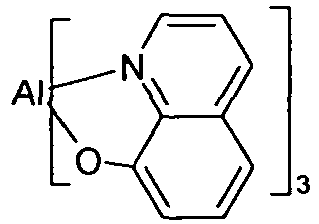


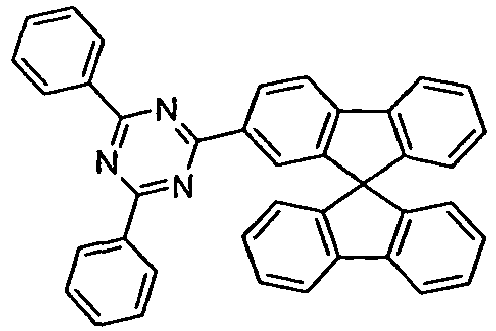


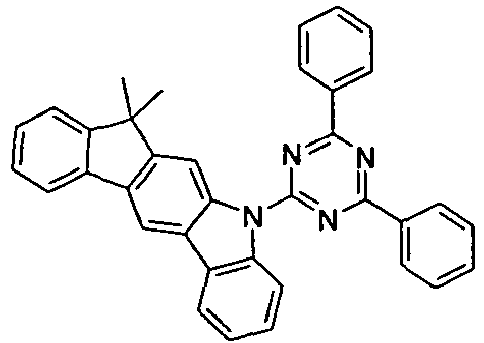


Claims (12)
- Compound of a formula (I) or (II)

 Y is selected on each occurrence, identically or differently, from BR1, C(R1)2, C=O, C=NR1, C=C(R1)2, C=S, Si(R1)2, NR1, PR1, P(=O)R1, O, S, S=O and S(=O)2;L is selected from C=O, C=NR1, Si(R1)2, NR1, P(=O)(R1), O, S, SO, SO2, alkylene groups having 1 to 20 C atoms or alkenylene or alkynylene groups having 2 to 20 C atoms, where one or more CH2 groups in the said groups may be replaced by Si(R1)2, O, S, C=O, C=NR1, C(=O)O, (C=O)NR1, NR1, P(=O)(R1), SO or SO2 and where one or more H atoms in the said groups may be replaced by D, F, Cl, Br, l, CN or NO2, and aromatic or heteroaromatic ring systems having 5 to 60 aromatic ring atoms, which may in each case be substituted by one or more radicals R1, and any desired combinations of 1, 2, 3, 4 or 5 identical or different groups selected from the above-mentioned groups; or L is a single bond, where p in this case must be equal to 2;R1 is on each occurrence, identically or differently, H, D, F, Cl, Br, I, B(OR2)2, CHO, C(=O)R2, CR2=C(R2)2, CN, C(=O)OR2 , C(=O)N(R2)2, Si(R2)3, N(R2)2, NO2, P(=O)(R2)2, OSO2R2, OR2, S(=O)R2, S(=O)2R2, a straight-chain alkyl, alkoxy or thioalkyl group having 1 to 20 C atoms or a branched or cyclic alkyl, alkoxy or thioalkyl group having 3 to 20 C atoms or an alkenyl or alkynyl group having 2 to 20 C atoms, where the above-mentioned groups may each be substituted by one or more radicals R2 and where one or more adjacent or non-adjacent CH2 groups in the above-mentioned groups may be replaced by -R2C=CR2-, -C=C-, Si(R2)2, Ge(R2)2, Sn(R2)2, C=O, C=S, C=Se, C=NR2, -C(=O)O-, -C(=O)NR2-, NR2, P(=O)(R2), -O-, -S-, SO or SO2 and where one or more H atoms in the above-mentioned groups may be replaced by D, F, Cl, Br, l, CN or NO2, or an aromatic or heteroaromatic ring system having 5 to 60 aromatic ring atoms, which may in each case be substituted by one or more radicals R2, or an aryloxy or heteroaryloxy group having 5 to 60 aromatic ring atoms, which may be substituted by one or more radicals R2, where two or more radicals R1 may be linked to one another and may form a ring or ring system;R2 is on each occurrence, identically or differently, H, D, F, Cl, Br, I, B(OR3)2, CHO, C(=O)R3, CR3=C(R3)2, CN, C(=O)OR3, C(=O)N(R3)2, Si(R3)3, N(R3)2, NO2, P(=O)(R3)2, OSO2R3, OR3, S(=O)R3, S(=O)2R3, a straight-chain alkyl, alkoxy or thioalkyl group having 1 to 20 C atoms or a branched or cyclic alkyl, alkoxy or thioalkyl group having 3 to 20 C atoms or an alkenyl or alkynyl group having 2 to 20 C atoms, where the above-mentioned groups may each be substituted by one or more radicals R3 and where one or more adjacent or non-adjacent CH2 groups in the above-mentioned groups may be replaced by -R3C=CR3-, -C≡C-, Si(R3)2, Ge(R3)2, Sn(R3)2, C=O, C=S, C=Se, C=NR3, -C(=O)O-, -C(=O)NR3-, NR3, P(=O)(R3), -O-, -S-, SO or SO2 and where one or more H atoms in the above-mentioned groups may be replaced by D, F, Cl Br, l, CN or NO2, or an aromatic or heteroaromatic ring system having 5 to 60 aromatic ring atoms, which may in each case be substituted by one or more radicals R3, or an aryloxy or heteroaryloxy group having 5 to 60 aromatic ring atoms, which may be substituted by one or more radicals R3, where two or more radicals R2 may be linked to one another and may form a ring or ring system;R3 is on each occurrence, identically or differently, H, D, F or an aliphatic, aromatic and/or heteroaromatic organic radical having 1 to 20 C atoms, in which, in addition, one or more H atoms may be replaced by D or F; two or more substituents R3 here may also be linked to one another and form a ring or a ring system;n is equal to 0 or 1; andp is equal to 2 or 3;where a benzene ring may optionally be condensed on at the positions marked by *, and
where the group Y and the nitrogen atom are bonded to the six-membered ring of the carbazole derivative in vicinal positions, and
where furthermore the compound of the formula (I) or (II) may be substituted by a radical R1 at one or more positions depicted as unsubstituted; and
where, in formula (II), the moieties in square brackets that are bonded to L may be identical or different; and
where, in formula (II), the group L may be bonded at any desired position of the moiety placed in square brackets. - Compound according to Claim 1, characterised in that n is equal to zero.
- Compound according to Claim 1 or 2, characterised in that p is equal to 2.
- Compound according to one or more of Claims 1 to 3, characterised in that the nitrogen atom of the heteroaromatic five-membered ring is bonded in the 3 position of the carbazole skeleton, and the group Y is bonded in the 2 position or in the 4 position.
- Compound according to one or more of Claims 1 to 4, characterised in that L is selected from a single bond, where p must be = 2, or from C=O, NR1, O, S, alkylene groups having 1 to 10 C atoms, alkenylene groups having 2 to 10 C atoms, where one or more CH2 groups in the said groups may be replaced by C=O, NR1, P(=O)(R1), O or S, and arylene or heteroarylene groups having 5 to 20 aromatic ring atoms, which may be substituted by one or more radicals R1, or from divalent aromatic or heteroaromatic ring systems of the formula (L-1)
 Ar1 is on each occurrence, identically or differently, an aryl or heteroaryl group having 5 to 20 aromatic ring atoms, which may in each case be substituted by one or more radicals R1;E is on each occurrence, identically or differently, a single bond, C=O, NAr1, P(=O)(R1), O, S, SO or SO2;i is on each occurrence, identically or differently, 0 or 1;k,l are on each occurrence, identically or differently, 0, 1, 2 or 3, where the sum of the values of k and I must be greater than 0; andwhere furthermore the groups Ar1 may be connected to one another
via one or more divalent groups T, whereT is selected on each occurrence, identically or differently, from a single bond, BR1, C(R1)2, C=O, C=S, C=NR1, C=C(R1)2, CR1=CR1, Si(R1)2, NR1, PR1, P(=O)R1, O, S, S=O and S(=O)2; andthe symbols * mark bonds from the group L to the remainder of the compound. - Compound according to one or more of Claims 1 to 5, characterised in that Y is selected on each occurrence, identically or differently, from C(R1)2, C=O, NR1, O and S.
- Compound of the formula (I) according to one or more of Claims 1 to 6, characterised in that the compound is selected from the following formulae:


and where furthermore the symbols occurring are defined as in Claim 1. - Compound of the formula (II) according to one or more of Claims 1 to 6, characterised in that the compound conforms to one of the formulae (II-A) to (II-D)


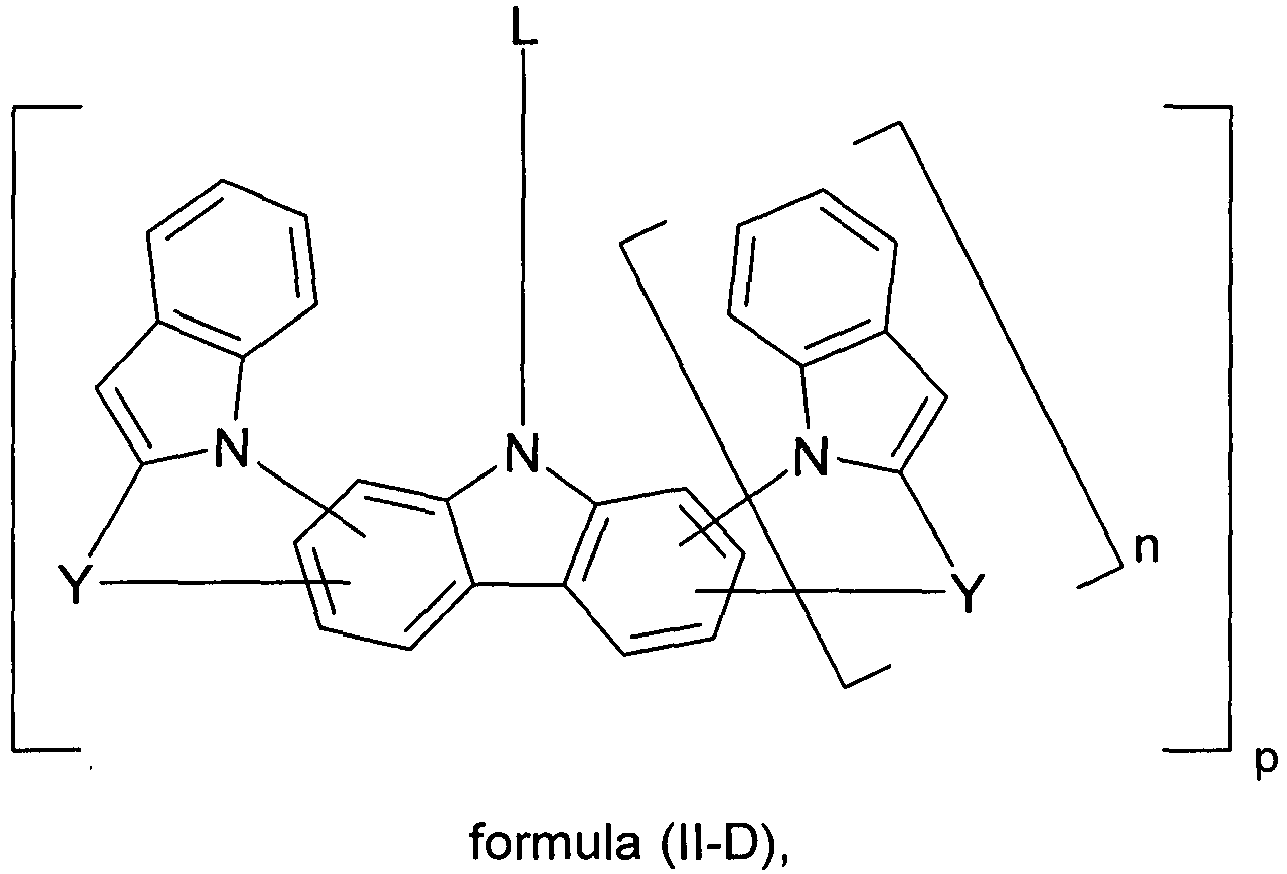
- Oligomer, polymer or dendrimer containing one or more compounds according to one or more of Claims 1 to 8, where the bond(s) to the polymer, oligomer or dendrimer may be localised at any desired positions in formula (I) or (II) that are substituted by R1 or R2.
- Formulation comprising at least one compound according to one or more of Claims 1 to 8 or at least one polymer, oligomer or dendrimer according to Claim 9 and at least one solvent.
- Electronic device comprising at least one compound according to one or more of Claims 1 to 8 or at least one polymer, dendrimer or oligomer according to Claim 9, preferably selected from the group consisting of organic integrated circuits (O-ICs), organic field-effect transistors (O-FETs), organic thin-film transistors (O-TFTs), organic light-emitting transistors (O-LETs), organic solar cells (O-SCs), organic optical detectors, organic photoreceptors, organic field-quench devices (O-FQDs), light-emitting electrochemical cells (LECs), organic laser diodes (O-lasers) and organic electroluminescent devices (OLEDs).
- Electronic device according to Claim 11, selected from organic electroluminescent devices, characterised in that the compound according to one or more of Claims 1 to 8 or the polymer, dendrimer or oligomer according to Claim 9 is present as hole-transport material in a hole-transport layer, as matrix material in an emitting layer and/or as electron-transport material in an electron-transporting layer.
Priority Applications (1)
| Application Number | Priority Date | Filing Date | Title |
|---|---|---|---|
| EP12709019.9A EP2697226B1 (en) | 2011-04-13 | 2012-03-15 | Compounds for electronic devices |
Applications Claiming Priority (3)
| Application Number | Priority Date | Filing Date | Title |
|---|---|---|---|
| EP11003107 | 2011-04-13 | ||
| PCT/EP2012/001157 WO2012139693A1 (en) | 2011-04-13 | 2012-03-15 | Compounds for electronic devices |
| EP12709019.9A EP2697226B1 (en) | 2011-04-13 | 2012-03-15 | Compounds for electronic devices |
Publications (2)
| Publication Number | Publication Date |
|---|---|
| EP2697226A1 EP2697226A1 (en) | 2014-02-19 |
| EP2697226B1 true EP2697226B1 (en) | 2017-01-18 |
Family
ID=45841442
Family Applications (1)
| Application Number | Title | Priority Date | Filing Date |
|---|---|---|---|
| EP12709019.9A Active EP2697226B1 (en) | 2011-04-13 | 2012-03-15 | Compounds for electronic devices |
Country Status (6)
| Country | Link |
|---|---|
| US (1) | US9768385B2 (en) |
| EP (1) | EP2697226B1 (en) |
| JP (1) | JP5922223B2 (en) |
| KR (1) | KR102013465B1 (en) |
| CN (1) | CN103459391A (en) |
| WO (1) | WO2012139693A1 (en) |
Families Citing this family (4)
| Publication number | Priority date | Publication date | Assignee | Title |
|---|---|---|---|---|
| KR20140131133A (en) * | 2013-05-03 | 2014-11-12 | 삼성디스플레이 주식회사 | Compound and organic light emitting device comprising same |
| KR101571597B1 (en) | 2013-08-05 | 2015-11-24 | 주식회사 두산 | Organic compound and organic electroluminescent device comprising the same |
| KR102824094B1 (en) * | 2017-09-26 | 2025-06-25 | 삼성디스플레이 주식회사 | Organic light-emitting device |
| EP3467894B1 (en) * | 2017-09-26 | 2023-08-02 | Samsung Display Co., Ltd. | Organic light-emitting device |
Family Cites Families (98)
| Publication number | Priority date | Publication date | Assignee | Title |
|---|---|---|---|---|
| US4539507A (en) | 1983-03-25 | 1985-09-03 | Eastman Kodak Company | Organic electroluminescent devices having improved power conversion efficiencies |
| DE4111878A1 (en) | 1991-04-11 | 1992-10-15 | Wacker Chemie Gmbh | LADDER POLYMERS WITH CONJUGATED DOUBLE BINDINGS |
| US5151629A (en) | 1991-08-01 | 1992-09-29 | Eastman Kodak Company | Blue emitting internal junction organic electroluminescent device (I) |
| JPH07133483A (en) | 1993-11-09 | 1995-05-23 | Shinko Electric Ind Co Ltd | Organic light emitting material for EL device and EL device |
| EP0676461B1 (en) | 1994-04-07 | 2002-08-14 | Covion Organic Semiconductors GmbH | Spiro compounds and their application as electroluminescence materials |
| DE69511755T2 (en) | 1994-04-26 | 2000-01-13 | Tdk Corp | Phenylanthracene derivative and organic EL element |
| DE4436773A1 (en) | 1994-10-14 | 1996-04-18 | Hoechst Ag | Conjugated polymers with spirocenters and their use as electroluminescent materials |
| WO1997005184A1 (en) | 1995-07-28 | 1997-02-13 | The Dow Chemical Company | 2,7-aryl-9-substituted fluorenes and 9-substituted fluorene oligomers and polymers |
| DE19614971A1 (en) | 1996-04-17 | 1997-10-23 | Hoechst Ag | Polymers with spiro atoms and their use as electroluminescent materials |
| DE19652261A1 (en) | 1996-12-16 | 1998-06-18 | Hoechst Ag | Aryl-substituted poly (p-arylenevinylenes), process for their preparation and their use in electroluminescent devices |
| US5935721A (en) | 1998-03-20 | 1999-08-10 | Eastman Kodak Company | Organic electroluminescent elements for stable electroluminescent |
| DE19846766A1 (en) | 1998-10-10 | 2000-04-20 | Aventis Res & Tech Gmbh & Co | A conjugated fluorene-based polymer useful as an organic semiconductor, electroluminescence material, and for display elements |
| JP4429438B2 (en) | 1999-01-19 | 2010-03-10 | 出光興産株式会社 | Amino compound and organic electroluminescence device using the same |
| US6166172A (en) | 1999-02-10 | 2000-12-26 | Carnegie Mellon University | Method of forming poly-(3-substituted) thiophenes |
| WO2000070655A2 (en) | 1999-05-13 | 2000-11-23 | The Trustees Of Princeton University | Very high efficiency organic light emitting devices based on electrophosphorescence |
| KR100946314B1 (en) | 1999-12-01 | 2010-03-09 | 더 트러스티즈 오브 프린스턴 유니버시티 | Organic light emitting device comprising a phosphorescent organo metallic compound |
| US6660410B2 (en) | 2000-03-27 | 2003-12-09 | Idemitsu Kosan Co., Ltd. | Organic electroluminescence element |
| US20020121638A1 (en) | 2000-06-30 | 2002-09-05 | Vladimir Grushin | Electroluminescent iridium compounds with fluorinated phenylpyridines, phenylpyrimidines, and phenylquinolines and devices made with such compounds |
| CN101924190B (en) | 2000-08-11 | 2012-07-04 | 普林斯顿大学理事会 | Organometallic compounds and emission-shifting organic electrophosphorescence |
| JP4154138B2 (en) | 2000-09-26 | 2008-09-24 | キヤノン株式会社 | Light emitting element, display device and metal coordination compound |
| JP4154140B2 (en) | 2000-09-26 | 2008-09-24 | キヤノン株式会社 | Metal coordination compounds |
| JP4154139B2 (en) | 2000-09-26 | 2008-09-24 | キヤノン株式会社 | Light emitting element |
| GB0104177D0 (en) | 2001-02-20 | 2001-04-11 | Isis Innovation | Aryl-aryl dendrimers |
| EP1370619B1 (en) | 2001-03-10 | 2006-06-21 | MERCK PATENT GmbH | Solutions and dispersions of organic semiconductors |
| DE10141624A1 (en) | 2001-08-24 | 2003-03-06 | Covion Organic Semiconductors | Solutions of polymeric semiconductors |
| DE10159946A1 (en) | 2001-12-06 | 2003-06-18 | Covion Organic Semiconductors | Process for the production of aryl-aryl coupled compounds |
| ITRM20020411A1 (en) | 2002-08-01 | 2004-02-02 | Univ Roma La Sapienza | SPIROBIFLUORENE DERIVATIVES, THEIR PREPARATION AND USE. |
| KR100924462B1 (en) | 2002-08-23 | 2009-11-03 | 이데미쓰 고산 가부시키가이샤 | Organic Electroluminescent Devices and Anthracene Derivatives |
| DE10249723A1 (en) | 2002-10-25 | 2004-05-06 | Covion Organic Semiconductors Gmbh | Conjugated polymers containing arylamine units, their preparation and use |
| GB0226010D0 (en) | 2002-11-08 | 2002-12-18 | Cambridge Display Tech Ltd | Polymers for use in organic electroluminescent devices |
| JP4287198B2 (en) | 2002-11-18 | 2009-07-01 | 出光興産株式会社 | Organic electroluminescence device |
| JP2006511939A (en) | 2002-12-23 | 2006-04-06 | コビオン・オーガニック・セミコンダクターズ・ゲーエムベーハー | Organic electroluminescence device |
| DE10304819A1 (en) | 2003-02-06 | 2004-08-19 | Covion Organic Semiconductors Gmbh | Carbazole-containing conjugated polymers and blends, their preparation and use |
| DE10310887A1 (en) | 2003-03-11 | 2004-09-30 | Covion Organic Semiconductors Gmbh | Matallkomplexe |
| JP4411851B2 (en) | 2003-03-19 | 2010-02-10 | コニカミノルタホールディングス株式会社 | Organic electroluminescence device |
| CN101789496B (en) | 2003-04-10 | 2011-12-28 | 出光兴产株式会社 | Aromatic amine derivative and organic electroluminescence element using the same |
| JP5318347B2 (en) | 2003-04-15 | 2013-10-16 | メルク パテント ゲーエムベーハー | Mixture of matrix material and organic semiconductor capable of emitting light, use thereof, and electronic component comprising said mixture |
| EP2236579B1 (en) | 2003-04-23 | 2014-04-09 | Konica Minolta Holdings, Inc. | Organic electroluminescent element and display |
| TWI224473B (en) | 2003-06-03 | 2004-11-21 | Chin-Hsin Chen | Doped co-host emitter system in organic electroluminescent devices |
| EP1491568A1 (en) | 2003-06-23 | 2004-12-29 | Covion Organic Semiconductors GmbH | Semiconductive Polymers |
| DE10328627A1 (en) | 2003-06-26 | 2005-02-17 | Covion Organic Semiconductors Gmbh | New materials for electroluminescence |
| KR101105619B1 (en) | 2003-07-07 | 2012-01-18 | 메르크 파텐트 게엠베하 | Mixtures of organic emissive semiconductors and matrix materials, their use and electronic components comprising said materials |
| DE10333232A1 (en) | 2003-07-21 | 2007-10-11 | Merck Patent Gmbh | Organic electroluminescent element |
| DE10337346A1 (en) | 2003-08-12 | 2005-03-31 | Covion Organic Semiconductors Gmbh | Conjugated polymers containing dihydrophenanthrene units and their use |
| DE10338550A1 (en) | 2003-08-19 | 2005-03-31 | Basf Ag | Transition metal complexes with carbene ligands as emitters for organic light-emitting diodes (OLEDs) |
| WO2005026144A1 (en) | 2003-09-12 | 2005-03-24 | Sumitomo Chemical Company, Limited | Dendrimer compound and organic luminescent element employing the same |
| DE10345572A1 (en) | 2003-09-29 | 2005-05-19 | Covion Organic Semiconductors Gmbh | metal complexes |
| US7795801B2 (en) | 2003-09-30 | 2010-09-14 | Konica Minolta Holdings, Inc. | Organic electroluminescent element, illuminator, display and compound |
| US7659540B2 (en) | 2003-10-22 | 2010-02-09 | Merck Patent Gmbh | Materials for electroluminescence and the utilization thereof |
| DE10356099A1 (en) | 2003-11-27 | 2005-07-07 | Covion Organic Semiconductors Gmbh | Organic electroluminescent element |
| US7241779B2 (en) * | 2003-12-23 | 2007-07-10 | Cephalon, Inc. | Fused pyrrolocarbazoles |
| US7252893B2 (en) | 2004-02-17 | 2007-08-07 | Eastman Kodak Company | Anthracene derivative host having ranges of dopants |
| DE102004008304A1 (en) | 2004-02-20 | 2005-09-08 | Covion Organic Semiconductors Gmbh | Organic electronic devices |
| US7326371B2 (en) | 2004-03-25 | 2008-02-05 | Eastman Kodak Company | Electroluminescent device with anthracene derivative host |
| US7790890B2 (en) | 2004-03-31 | 2010-09-07 | Konica Minolta Holdings, Inc. | Organic electroluminescence element material, organic electroluminescence element, display device and illumination device |
| DE102004020298A1 (en) | 2004-04-26 | 2005-11-10 | Covion Organic Semiconductors Gmbh | Electroluminescent polymers and their use |
| DE102004023277A1 (en) | 2004-05-11 | 2005-12-01 | Covion Organic Semiconductors Gmbh | New material mixtures for electroluminescence |
| US7598388B2 (en) | 2004-05-18 | 2009-10-06 | The University Of Southern California | Carbene containing metal complexes as OLEDs |
| TWI327563B (en) | 2004-05-24 | 2010-07-21 | Au Optronics Corp | Anthracene compound and organic electroluminescent device including the anthracene compound |
| JP4862248B2 (en) | 2004-06-04 | 2012-01-25 | コニカミノルタホールディングス株式会社 | Organic electroluminescence element, lighting device and display device |
| JP2006001973A (en) | 2004-06-15 | 2006-01-05 | Fujitsu Ltd | POLYLACTIC ACID RESIN COMPOSITION, MOLDED BODY, ITS MANUFACTURING METHOD, AND OA DEVICE |
| DE102004031000A1 (en) | 2004-06-26 | 2006-01-12 | Covion Organic Semiconductors Gmbh | Organic electroluminescent devices |
| TW200613515A (en) | 2004-06-26 | 2006-05-01 | Merck Patent Gmbh | Compounds for organic electronic devices |
| DE102004032527A1 (en) | 2004-07-06 | 2006-02-02 | Covion Organic Semiconductors Gmbh | Electroluminescent polymers |
| ITRM20040352A1 (en) | 2004-07-15 | 2004-10-15 | Univ Roma La Sapienza | OLIGOMERIC DERIVATIVES OF SPIROBIFLUORENE, THEIR PREPARATION AND THEIR USE. |
| JP5055689B2 (en) | 2004-08-26 | 2012-10-24 | コニカミノルタホールディングス株式会社 | ORGANIC ELECTROLUMINESCENT ELEMENT MATERIAL, ORGANIC ELECTROLUMINESCENT ELEMENT, LIGHTING DEVICE AND DISPLAY DEVICE |
| EP1655359A1 (en) | 2004-11-06 | 2006-05-10 | Covion Organic Semiconductors GmbH | Organic electroluminescent device |
| TW200639140A (en) | 2004-12-01 | 2006-11-16 | Merck Patent Gmbh | Compounds for organic electronic devices |
| EP1669386A1 (en) | 2004-12-06 | 2006-06-14 | Covion Organic Semiconductors GmbH | Conjugated polymers, representation thereof, and use |
| JP4263700B2 (en) | 2005-03-15 | 2009-05-13 | 出光興産株式会社 | Aromatic amine derivative and organic electroluminescence device using the same |
| CN101171320B (en) | 2005-05-03 | 2013-04-10 | 默克专利有限公司 | Organic electroluminescent device |
| DE102005023437A1 (en) | 2005-05-20 | 2006-11-30 | Merck Patent Gmbh | Connections for organic electronic devices |
| BRPI0613785A2 (en) | 2005-07-08 | 2011-02-01 | Unilever Nv | starch-containing food product, process for preparing intact starch-containing plant cells and process for preparing starch-containing food product |
| DE102005037734B4 (en) | 2005-08-10 | 2018-02-08 | Merck Patent Gmbh | Electroluminescent polymers, their use and bifunctional monomeric compounds |
| EP1956022B1 (en) | 2005-12-01 | 2012-07-25 | Nippon Steel Chemical Co., Ltd. | Compound for organic electroluminescent element and organic electroluminescent element |
| DE102005058543A1 (en) | 2005-12-08 | 2007-06-14 | Merck Patent Gmbh | Organic electroluminescent devices |
| DE102005058557A1 (en) | 2005-12-08 | 2007-06-14 | Merck Patent Gmbh | Organic electroluminescent device |
| DE102005060473A1 (en) | 2005-12-17 | 2007-06-28 | Merck Patent Gmbh | Conjugated polymers, their preparation and use |
| DE102006015183A1 (en) | 2006-04-01 | 2007-10-04 | Merck Patent Gmbh | Materials for organic electroluminescent devices |
| DE102006025777A1 (en) | 2006-05-31 | 2007-12-06 | Merck Patent Gmbh | New materials for organic electroluminescent devices |
| DE102006025846A1 (en) | 2006-06-02 | 2007-12-06 | Merck Patent Gmbh | New materials for organic electroluminescent devices |
| DE102006031990A1 (en) | 2006-07-11 | 2008-01-17 | Merck Patent Gmbh | New materials for organic electroluminescent devices |
| US8062769B2 (en) | 2006-11-09 | 2011-11-22 | Nippon Steel Chemical Co., Ltd. | Indolocarbazole compound for use in organic electroluminescent device and organic electroluminescent device |
| DE102007002714A1 (en) | 2007-01-18 | 2008-07-31 | Merck Patent Gmbh | New materials for organic electroluminescent devices |
| DE102007024850A1 (en) | 2007-05-29 | 2008-12-04 | Merck Patent Gmbh | New materials for organic electroluminescent devices |
| DE102007053771A1 (en) | 2007-11-12 | 2009-05-14 | Merck Patent Gmbh | Organic electroluminescent devices |
| EP2145936A3 (en) * | 2008-07-14 | 2010-03-17 | Gracel Display Inc. | Fluorene and pyrene derivatives and organic electroluminescent device using the same |
| DE102008033943A1 (en) | 2008-07-18 | 2010-01-21 | Merck Patent Gmbh | New materials for organic electroluminescent devices |
| DE102008035413A1 (en) | 2008-07-29 | 2010-02-04 | Merck Patent Gmbh | Connections for organic electronic devices |
| DE102008036982A1 (en) | 2008-08-08 | 2010-02-11 | Merck Patent Gmbh | Organic electroluminescent device |
| KR20110097612A (en) | 2008-11-11 | 2011-08-31 | 메르크 파텐트 게엠베하 | Organic electroluminescent devices |
| DE102008056688A1 (en) | 2008-11-11 | 2010-05-12 | Merck Patent Gmbh | Materials for organic electroluminescent devices |
| DE102009014513A1 (en) | 2009-03-23 | 2010-09-30 | Merck Patent Gmbh | Organic electroluminescent device |
| DE102009023155A1 (en) | 2009-05-29 | 2010-12-02 | Merck Patent Gmbh | Materials for organic electroluminescent devices |
| DE102009031021A1 (en) | 2009-06-30 | 2011-01-05 | Merck Patent Gmbh | Materials for organic electroluminescent devices |
| DE102010005697A1 (en) | 2010-01-25 | 2011-07-28 | Merck Patent GmbH, 64293 | Connections for electronic devices |
| DE102010014933A1 (en) * | 2010-04-14 | 2011-10-20 | Merck Patent Gmbh | Materials for electronic devices |
| DE102010024335A1 (en) | 2010-06-18 | 2011-12-22 | Merck Patent Gmbh | Connections for electronic devices |
-
2012
- 2012-03-15 EP EP12709019.9A patent/EP2697226B1/en active Active
- 2012-03-15 US US14/111,237 patent/US9768385B2/en not_active Expired - Fee Related
- 2012-03-15 JP JP2014504191A patent/JP5922223B2/en not_active Expired - Fee Related
- 2012-03-15 CN CN2012800180234A patent/CN103459391A/en active Pending
- 2012-03-15 KR KR1020137030012A patent/KR102013465B1/en not_active Expired - Fee Related
- 2012-03-15 WO PCT/EP2012/001157 patent/WO2012139693A1/en not_active Ceased
Non-Patent Citations (1)
| Title |
|---|
| None * |
Also Published As
| Publication number | Publication date |
|---|---|
| JP5922223B2 (en) | 2016-05-24 |
| EP2697226A1 (en) | 2014-02-19 |
| US20140034879A1 (en) | 2014-02-06 |
| KR102013465B1 (en) | 2019-08-22 |
| US9768385B2 (en) | 2017-09-19 |
| WO2012139693A1 (en) | 2012-10-18 |
| KR20140023353A (en) | 2014-02-26 |
| CN103459391A (en) | 2013-12-18 |
| JP2014524884A (en) | 2014-09-25 |
Similar Documents
| Publication | Publication Date | Title |
|---|---|---|
| DE112011101314B4 (en) | materials for electronic devices | |
| DE102010019306B4 (en) | Organic electroluminescent devices | |
| EP2737554B1 (en) | Compounds for electronic devices | |
| EP2705550B1 (en) | Compounds for electronic devices | |
| DE112010004381B4 (en) | materials for electronic devices | |
| EP2705552B1 (en) | Compounds for electronic devices | |
| EP3131901B1 (en) | Materials for electronic devices | |
| EP3027707B1 (en) | Materials for electronic devices | |
| EP2915199B1 (en) | Electronic device | |
| EP2699571B1 (en) | Materials for organic electroluminescent devices | |
| DE112011103412B4 (en) | materials for electronic devices | |
| EP2697225B1 (en) | Materials for electronic devices | |
| WO2012048780A1 (en) | Compounds for electronic devices | |
| EP3016952B1 (en) | Spiro-condensed lactam compounds for organic electroluminescent devices | |
| WO2011160757A1 (en) | Materials for electronic devices | |
| DE102010009903A1 (en) | Connections for electronic devices | |
| DE102010033548A1 (en) | Materials for electronic devices | |
| WO2014106522A1 (en) | Materials for electronic devices | |
| EP3033405A1 (en) | Materials for electronic devices | |
| DE112011102056B4 (en) | connections for electronic devices | |
| WO2011057701A1 (en) | Organic compounds for electroluminescent devices | |
| WO2013139431A1 (en) | 9,9'-spirobixanthene derivatives for electroluminescent devices | |
| WO2012143079A1 (en) | Compounds for electronic devices | |
| WO2014106524A2 (en) | Materials for electronic devices | |
| DE102012022880B4 (en) | Electronic devices containing organic layers |
Legal Events
| Date | Code | Title | Description |
|---|---|---|---|
| PUAI | Public reference made under article 153(3) epc to a published international application that has entered the european phase |
Free format text: ORIGINAL CODE: 0009012 |
|
| 17P | Request for examination filed |
Effective date: 20130816 |
|
| AK | Designated contracting states |
Kind code of ref document: A1 Designated state(s): AL AT BE BG CH CY CZ DE DK EE ES FI FR GB GR HR HU IE IS IT LI LT LU LV MC MK MT NL NO PL PT RO RS SE SI SK SM TR |
|
| DAX | Request for extension of the european patent (deleted) | ||
| 17Q | First examination report despatched |
Effective date: 20150921 |
|
| GRAP | Despatch of communication of intention to grant a patent |
Free format text: ORIGINAL CODE: EPIDOSNIGR1 |
|
| INTG | Intention to grant announced |
Effective date: 20160830 |
|
| GRAS | Grant fee paid |
Free format text: ORIGINAL CODE: EPIDOSNIGR3 |
|
| GRAA | (expected) grant |
Free format text: ORIGINAL CODE: 0009210 |
|
| AK | Designated contracting states |
Kind code of ref document: B1 Designated state(s): AL AT BE BG CH CY CZ DE DK EE ES FI FR GB GR HR HU IE IS IT LI LT LU LV MC MK MT NL NO PL PT RO RS SE SI SK SM TR |
|
| REG | Reference to a national code |
Ref country code: GB Ref legal event code: FG4D Free format text: NOT ENGLISH |
|
| REG | Reference to a national code |
Ref country code: CH Ref legal event code: EP |
|
| REG | Reference to a national code |
Ref country code: AT Ref legal event code: REF Ref document number: 862826 Country of ref document: AT Kind code of ref document: T Effective date: 20170215 |
|
| REG | Reference to a national code |
Ref country code: IE Ref legal event code: FG4D Free format text: LANGUAGE OF EP DOCUMENT: GERMAN |
|
| REG | Reference to a national code |
Ref country code: DE Ref legal event code: R096 Ref document number: 502012009363 Country of ref document: DE |
|
| REG | Reference to a national code |
Ref country code: NL Ref legal event code: MP Effective date: 20170118 |
|
| REG | Reference to a national code |
Ref country code: LT Ref legal event code: MG4D |
|
| PG25 | Lapsed in a contracting state [announced via postgrant information from national office to epo] |
Ref country code: NL Free format text: LAPSE BECAUSE OF FAILURE TO SUBMIT A TRANSLATION OF THE DESCRIPTION OR TO PAY THE FEE WITHIN THE PRESCRIBED TIME-LIMIT Effective date: 20170118 |
|
| PG25 | Lapsed in a contracting state [announced via postgrant information from national office to epo] |
Ref country code: FI Free format text: LAPSE BECAUSE OF FAILURE TO SUBMIT A TRANSLATION OF THE DESCRIPTION OR TO PAY THE FEE WITHIN THE PRESCRIBED TIME-LIMIT Effective date: 20170118 Ref country code: NO Free format text: LAPSE BECAUSE OF FAILURE TO SUBMIT A TRANSLATION OF THE DESCRIPTION OR TO PAY THE FEE WITHIN THE PRESCRIBED TIME-LIMIT Effective date: 20170418 Ref country code: GR Free format text: LAPSE BECAUSE OF FAILURE TO SUBMIT A TRANSLATION OF THE DESCRIPTION OR TO PAY THE FEE WITHIN THE PRESCRIBED TIME-LIMIT Effective date: 20170419 Ref country code: HR Free format text: LAPSE BECAUSE OF FAILURE TO SUBMIT A TRANSLATION OF THE DESCRIPTION OR TO PAY THE FEE WITHIN THE PRESCRIBED TIME-LIMIT Effective date: 20170118 Ref country code: LT Free format text: LAPSE BECAUSE OF FAILURE TO SUBMIT A TRANSLATION OF THE DESCRIPTION OR TO PAY THE FEE WITHIN THE PRESCRIBED TIME-LIMIT Effective date: 20170118 Ref country code: IS Free format text: LAPSE BECAUSE OF FAILURE TO SUBMIT A TRANSLATION OF THE DESCRIPTION OR TO PAY THE FEE WITHIN THE PRESCRIBED TIME-LIMIT Effective date: 20170518 |
|
| PG25 | Lapsed in a contracting state [announced via postgrant information from national office to epo] |
Ref country code: PL Free format text: LAPSE BECAUSE OF FAILURE TO SUBMIT A TRANSLATION OF THE DESCRIPTION OR TO PAY THE FEE WITHIN THE PRESCRIBED TIME-LIMIT Effective date: 20170118 Ref country code: PT Free format text: LAPSE BECAUSE OF FAILURE TO SUBMIT A TRANSLATION OF THE DESCRIPTION OR TO PAY THE FEE WITHIN THE PRESCRIBED TIME-LIMIT Effective date: 20170518 Ref country code: LV Free format text: LAPSE BECAUSE OF FAILURE TO SUBMIT A TRANSLATION OF THE DESCRIPTION OR TO PAY THE FEE WITHIN THE PRESCRIBED TIME-LIMIT Effective date: 20170118 Ref country code: RS Free format text: LAPSE BECAUSE OF FAILURE TO SUBMIT A TRANSLATION OF THE DESCRIPTION OR TO PAY THE FEE WITHIN THE PRESCRIBED TIME-LIMIT Effective date: 20170118 Ref country code: ES Free format text: LAPSE BECAUSE OF FAILURE TO SUBMIT A TRANSLATION OF THE DESCRIPTION OR TO PAY THE FEE WITHIN THE PRESCRIBED TIME-LIMIT Effective date: 20170118 Ref country code: BG Free format text: LAPSE BECAUSE OF FAILURE TO SUBMIT A TRANSLATION OF THE DESCRIPTION OR TO PAY THE FEE WITHIN THE PRESCRIBED TIME-LIMIT Effective date: 20170418 Ref country code: SE Free format text: LAPSE BECAUSE OF FAILURE TO SUBMIT A TRANSLATION OF THE DESCRIPTION OR TO PAY THE FEE WITHIN THE PRESCRIBED TIME-LIMIT Effective date: 20170118 |
|
| REG | Reference to a national code |
Ref country code: DE Ref legal event code: R097 Ref document number: 502012009363 Country of ref document: DE |
|
| PG25 | Lapsed in a contracting state [announced via postgrant information from national office to epo] |
Ref country code: CZ Free format text: LAPSE BECAUSE OF FAILURE TO SUBMIT A TRANSLATION OF THE DESCRIPTION OR TO PAY THE FEE WITHIN THE PRESCRIBED TIME-LIMIT Effective date: 20170118 Ref country code: EE Free format text: LAPSE BECAUSE OF FAILURE TO SUBMIT A TRANSLATION OF THE DESCRIPTION OR TO PAY THE FEE WITHIN THE PRESCRIBED TIME-LIMIT Effective date: 20170118 Ref country code: RO Free format text: LAPSE BECAUSE OF FAILURE TO SUBMIT A TRANSLATION OF THE DESCRIPTION OR TO PAY THE FEE WITHIN THE PRESCRIBED TIME-LIMIT Effective date: 20170118 Ref country code: SK Free format text: LAPSE BECAUSE OF FAILURE TO SUBMIT A TRANSLATION OF THE DESCRIPTION OR TO PAY THE FEE WITHIN THE PRESCRIBED TIME-LIMIT Effective date: 20170118 Ref country code: IT Free format text: LAPSE BECAUSE OF FAILURE TO SUBMIT A TRANSLATION OF THE DESCRIPTION OR TO PAY THE FEE WITHIN THE PRESCRIBED TIME-LIMIT Effective date: 20170118 |
|
| REG | Reference to a national code |
Ref country code: CH Ref legal event code: PL |
|
| PLBE | No opposition filed within time limit |
Free format text: ORIGINAL CODE: 0009261 |
|
| STAA | Information on the status of an ep patent application or granted ep patent |
Free format text: STATUS: NO OPPOSITION FILED WITHIN TIME LIMIT |
|
| PG25 | Lapsed in a contracting state [announced via postgrant information from national office to epo] |
Ref country code: MC Free format text: LAPSE BECAUSE OF FAILURE TO SUBMIT A TRANSLATION OF THE DESCRIPTION OR TO PAY THE FEE WITHIN THE PRESCRIBED TIME-LIMIT Effective date: 20170118 Ref country code: SM Free format text: LAPSE BECAUSE OF FAILURE TO SUBMIT A TRANSLATION OF THE DESCRIPTION OR TO PAY THE FEE WITHIN THE PRESCRIBED TIME-LIMIT Effective date: 20170118 Ref country code: DK Free format text: LAPSE BECAUSE OF FAILURE TO SUBMIT A TRANSLATION OF THE DESCRIPTION OR TO PAY THE FEE WITHIN THE PRESCRIBED TIME-LIMIT Effective date: 20170118 |
|
| 26N | No opposition filed |
Effective date: 20171019 |
|
| GBPC | Gb: european patent ceased through non-payment of renewal fee |
Effective date: 20170418 |
|
| REG | Reference to a national code |
Ref country code: IE Ref legal event code: MM4A |
|
| REG | Reference to a national code |
Ref country code: FR Ref legal event code: ST Effective date: 20171130 |
|
| PG25 | Lapsed in a contracting state [announced via postgrant information from national office to epo] |
Ref country code: LU Free format text: LAPSE BECAUSE OF NON-PAYMENT OF DUE FEES Effective date: 20170315 Ref country code: FR Free format text: LAPSE BECAUSE OF NON-PAYMENT OF DUE FEES Effective date: 20170331 |
|
| PG25 | Lapsed in a contracting state [announced via postgrant information from national office to epo] |
Ref country code: CH Free format text: LAPSE BECAUSE OF NON-PAYMENT OF DUE FEES Effective date: 20170331 Ref country code: IE Free format text: LAPSE BECAUSE OF NON-PAYMENT OF DUE FEES Effective date: 20170315 Ref country code: SI Free format text: LAPSE BECAUSE OF FAILURE TO SUBMIT A TRANSLATION OF THE DESCRIPTION OR TO PAY THE FEE WITHIN THE PRESCRIBED TIME-LIMIT Effective date: 20170118 Ref country code: LI Free format text: LAPSE BECAUSE OF NON-PAYMENT OF DUE FEES Effective date: 20170331 Ref country code: GB Free format text: LAPSE BECAUSE OF NON-PAYMENT OF DUE FEES Effective date: 20170418 |
|
| REG | Reference to a national code |
Ref country code: BE Ref legal event code: MM Effective date: 20170331 |
|
| REG | Reference to a national code |
Ref country code: AT Ref legal event code: MM01 Ref document number: 862826 Country of ref document: AT Kind code of ref document: T Effective date: 20170315 |
|
| PG25 | Lapsed in a contracting state [announced via postgrant information from national office to epo] |
Ref country code: BE Free format text: LAPSE BECAUSE OF NON-PAYMENT OF DUE FEES Effective date: 20170331 |
|
| PG25 | Lapsed in a contracting state [announced via postgrant information from national office to epo] |
Ref country code: AT Free format text: LAPSE BECAUSE OF NON-PAYMENT OF DUE FEES Effective date: 20170315 |
|
| PG25 | Lapsed in a contracting state [announced via postgrant information from national office to epo] |
Ref country code: MT Free format text: LAPSE BECAUSE OF FAILURE TO SUBMIT A TRANSLATION OF THE DESCRIPTION OR TO PAY THE FEE WITHIN THE PRESCRIBED TIME-LIMIT Effective date: 20170118 |
|
| PG25 | Lapsed in a contracting state [announced via postgrant information from national office to epo] |
Ref country code: HU Free format text: LAPSE BECAUSE OF FAILURE TO SUBMIT A TRANSLATION OF THE DESCRIPTION OR TO PAY THE FEE WITHIN THE PRESCRIBED TIME-LIMIT; INVALID AB INITIO Effective date: 20120315 |
|
| PG25 | Lapsed in a contracting state [announced via postgrant information from national office to epo] |
Ref country code: CY Free format text: LAPSE BECAUSE OF NON-PAYMENT OF DUE FEES Effective date: 20170118 |
|
| PG25 | Lapsed in a contracting state [announced via postgrant information from national office to epo] |
Ref country code: MK Free format text: LAPSE BECAUSE OF FAILURE TO SUBMIT A TRANSLATION OF THE DESCRIPTION OR TO PAY THE FEE WITHIN THE PRESCRIBED TIME-LIMIT Effective date: 20170118 |
|
| PG25 | Lapsed in a contracting state [announced via postgrant information from national office to epo] |
Ref country code: TR Free format text: LAPSE BECAUSE OF FAILURE TO SUBMIT A TRANSLATION OF THE DESCRIPTION OR TO PAY THE FEE WITHIN THE PRESCRIBED TIME-LIMIT Effective date: 20170118 |
|
| PG25 | Lapsed in a contracting state [announced via postgrant information from national office to epo] |
Ref country code: AL Free format text: LAPSE BECAUSE OF FAILURE TO SUBMIT A TRANSLATION OF THE DESCRIPTION OR TO PAY THE FEE WITHIN THE PRESCRIBED TIME-LIMIT Effective date: 20170118 |
|
| P01 | Opt-out of the competence of the unified patent court (upc) registered |
Effective date: 20230518 |
|
| PGFP | Annual fee paid to national office [announced via postgrant information from national office to epo] |
Ref country code: DE Payment date: 20241231 Year of fee payment: 14 |