DE102006031990A1 - New materials for organic electroluminescent devices - Google Patents
New materials for organic electroluminescent devices Download PDFInfo
- Publication number
- DE102006031990A1 DE102006031990A1 DE102006031990A DE102006031990A DE102006031990A1 DE 102006031990 A1 DE102006031990 A1 DE 102006031990A1 DE 102006031990 A DE102006031990 A DE 102006031990A DE 102006031990 A DE102006031990 A DE 102006031990A DE 102006031990 A1 DE102006031990 A1 DE 102006031990A1
- Authority
- DE
- Germany
- Prior art keywords
- atoms
- group
- radicals
- compounds
- same
- Prior art date
- Legal status (The legal status is an assumption and is not a legal conclusion. Google has not performed a legal analysis and makes no representation as to the accuracy of the status listed.)
- Withdrawn
Links
- 239000000463 material Substances 0.000 title claims abstract description 37
- 150000001875 compounds Chemical class 0.000 claims abstract description 116
- 239000002019 doping agent Substances 0.000 claims abstract description 14
- 230000005525 hole transport Effects 0.000 claims abstract description 10
- 125000003118 aryl group Chemical group 0.000 claims description 67
- 239000010410 layer Substances 0.000 claims description 42
- 150000003254 radicals Chemical class 0.000 claims description 42
- 125000004432 carbon atom Chemical group C* 0.000 claims description 40
- MWPLVEDNUUSJAV-UHFFFAOYSA-N anthracene Chemical compound C1=CC=CC2=CC3=CC=CC=C3C=C21 MWPLVEDNUUSJAV-UHFFFAOYSA-N 0.000 claims description 22
- 229910052760 oxygen Inorganic materials 0.000 claims description 22
- -1 NR 2 Inorganic materials 0.000 claims description 21
- 125000000217 alkyl group Chemical group 0.000 claims description 19
- UFWIBTONFRDIAS-UHFFFAOYSA-N Naphthalene Chemical compound C1=CC=CC2=CC=CC=C21 UFWIBTONFRDIAS-UHFFFAOYSA-N 0.000 claims description 18
- 229910052799 carbon Inorganic materials 0.000 claims description 17
- 125000001072 heteroaryl group Chemical group 0.000 claims description 17
- 229910052717 sulfur Inorganic materials 0.000 claims description 17
- 229910052731 fluorine Inorganic materials 0.000 claims description 16
- 125000001424 substituent group Chemical group 0.000 claims description 15
- 238000002347 injection Methods 0.000 claims description 13
- 239000007924 injection Substances 0.000 claims description 13
- YNPNZTXNASCQKK-UHFFFAOYSA-N phenanthrene Chemical compound C1=CC=C2C3=CC=CC=C3C=CC2=C1 YNPNZTXNASCQKK-UHFFFAOYSA-N 0.000 claims description 13
- IJGRMHOSHXDMSA-UHFFFAOYSA-N Atomic nitrogen Chemical compound N#N IJGRMHOSHXDMSA-UHFFFAOYSA-N 0.000 claims description 12
- 125000004435 hydrogen atom Chemical group [H]* 0.000 claims description 12
- 229920000642 polymer Polymers 0.000 claims description 12
- 238000005859 coupling reaction Methods 0.000 claims description 11
- 229910052794 bromium Inorganic materials 0.000 claims description 10
- 125000004122 cyclic group Chemical group 0.000 claims description 9
- 239000000412 dendrimer Substances 0.000 claims description 9
- 229920000736 dendritic polymer Polymers 0.000 claims description 9
- 229910052757 nitrogen Inorganic materials 0.000 claims description 9
- 150000001412 amines Chemical class 0.000 claims description 8
- 230000008878 coupling Effects 0.000 claims description 8
- 238000010168 coupling process Methods 0.000 claims description 8
- 229910052739 hydrogen Inorganic materials 0.000 claims description 8
- 125000005259 triarylamine group Chemical group 0.000 claims description 8
- 229910052751 metal Inorganic materials 0.000 claims description 7
- 239000002184 metal Substances 0.000 claims description 7
- NIHNNTQXNPWCJQ-UHFFFAOYSA-N o-biphenylenemethane Natural products C1=CC=C2CC3=CC=CC=C3C2=C1 NIHNNTQXNPWCJQ-UHFFFAOYSA-N 0.000 claims description 7
- 238000002360 preparation method Methods 0.000 claims description 7
- RMBPEFMHABBEKP-UHFFFAOYSA-N fluorene Chemical compound C1=CC=C2C3=C[CH]C=CC3=CC2=C1 RMBPEFMHABBEKP-UHFFFAOYSA-N 0.000 claims description 6
- 238000000034 method Methods 0.000 claims description 6
- ICPSWZFVWAPUKF-UHFFFAOYSA-N 1,1'-spirobi[fluorene] Chemical group C1=CC=C2C=C3C4(C=5C(C6=CC=CC=C6C=5)=CC=C4)C=CC=C3C2=C1 ICPSWZFVWAPUKF-UHFFFAOYSA-N 0.000 claims description 5
- 230000008569 process Effects 0.000 claims description 5
- 125000003545 alkoxy group Chemical group 0.000 claims description 4
- 125000004429 atom Chemical group 0.000 claims description 4
- 238000006243 chemical reaction Methods 0.000 claims description 4
- 229910052801 chlorine Inorganic materials 0.000 claims description 4
- 230000026030 halogenation Effects 0.000 claims description 4
- 238000005658 halogenation reaction Methods 0.000 claims description 4
- 229910052740 iodine Inorganic materials 0.000 claims description 4
- 239000011159 matrix material Substances 0.000 claims description 4
- 125000002950 monocyclic group Chemical group 0.000 claims description 4
- 239000000243 solution Substances 0.000 claims description 4
- 125000005309 thioalkoxy group Chemical group 0.000 claims description 4
- 239000002253 acid Substances 0.000 claims description 3
- 239000012039 electrophile Substances 0.000 claims description 3
- 239000012044 organic layer Substances 0.000 claims description 3
- 238000007363 ring formation reaction Methods 0.000 claims description 3
- 239000004215 Carbon black (E152) Substances 0.000 claims description 2
- 125000001931 aliphatic group Chemical group 0.000 claims description 2
- 230000029936 alkylation Effects 0.000 claims description 2
- 238000005804 alkylation reaction Methods 0.000 claims description 2
- 125000001769 aryl amino group Chemical group 0.000 claims description 2
- 125000004104 aryloxy group Chemical group 0.000 claims description 2
- 239000003153 chemical reaction reagent Substances 0.000 claims description 2
- 125000006165 cyclic alkyl group Chemical group 0.000 claims description 2
- 230000005669 field effect Effects 0.000 claims description 2
- 125000005553 heteroaryloxy group Chemical group 0.000 claims description 2
- 229930195733 hydrocarbon Natural products 0.000 claims description 2
- 125000004437 phosphorous atom Chemical group 0.000 claims description 2
- 229910052698 phosphorus Inorganic materials 0.000 claims description 2
- 108091008695 photoreceptors Proteins 0.000 claims description 2
- 239000010409 thin film Substances 0.000 claims description 2
- RICKKZXCGCSLIU-UHFFFAOYSA-N 2-[2-[carboxymethyl-[[3-hydroxy-5-(hydroxymethyl)-2-methylpyridin-4-yl]methyl]amino]ethyl-[[3-hydroxy-5-(hydroxymethyl)-2-methylpyridin-4-yl]methyl]amino]acetic acid Chemical compound CC1=NC=C(CO)C(CN(CCN(CC(O)=O)CC=2C(=C(C)N=CC=2CO)O)CC(O)=O)=C1O RICKKZXCGCSLIU-UHFFFAOYSA-N 0.000 claims 1
- 238000004246 ligand exchange chromatography Methods 0.000 claims 1
- 238000006263 metalation reaction Methods 0.000 claims 1
- 238000004768 lowest unoccupied molecular orbital Methods 0.000 description 8
- BBEAQIROQSPTKN-UHFFFAOYSA-N pyrene Chemical compound C1=CC=C2C=CC3=CC=CC4=CC=C1C2=C43 BBEAQIROQSPTKN-UHFFFAOYSA-N 0.000 description 8
- 125000005842 heteroatom Chemical group 0.000 description 7
- UHOVQNZJYSORNB-UHFFFAOYSA-N Benzene Chemical compound C1=CC=CC=C1 UHOVQNZJYSORNB-UHFFFAOYSA-N 0.000 description 6
- SMWDFEZZVXVKRB-UHFFFAOYSA-N Quinoline Chemical compound N1=CC=CC2=CC=CC=C21 SMWDFEZZVXVKRB-UHFFFAOYSA-N 0.000 description 6
- GVEPBJHOBDJJJI-UHFFFAOYSA-N fluoranthrene Natural products C1=CC(C2=CC=CC=C22)=C3C2=CC=CC3=C1 GVEPBJHOBDJJJI-UHFFFAOYSA-N 0.000 description 6
- 125000001997 phenyl group Chemical group [H]C1=C([H])C([H])=C(*)C([H])=C1[H] 0.000 description 6
- VFUDMQLBKNMONU-UHFFFAOYSA-N 9-[4-(4-carbazol-9-ylphenyl)phenyl]carbazole Chemical group C12=CC=CC=C2C2=CC=CC=C2N1C1=CC=C(C=2C=CC(=CC=2)N2C3=CC=CC=C3C3=CC=CC=C32)C=C1 VFUDMQLBKNMONU-UHFFFAOYSA-N 0.000 description 5
- ZUOUZKKEUPVFJK-UHFFFAOYSA-N diphenyl Chemical compound C1=CC=CC=C1C1=CC=CC=C1 ZUOUZKKEUPVFJK-UHFFFAOYSA-N 0.000 description 5
- 239000000203 mixture Substances 0.000 description 5
- 239000000178 monomer Substances 0.000 description 5
- 125000005504 styryl group Chemical group 0.000 description 5
- JUJWROOIHBZHMG-UHFFFAOYSA-N Pyridine Chemical compound C1=CC=NC=C1 JUJWROOIHBZHMG-UHFFFAOYSA-N 0.000 description 4
- YTPLMLYBLZKORZ-UHFFFAOYSA-N Thiophene Chemical compound C=1C=CSC=1 YTPLMLYBLZKORZ-UHFFFAOYSA-N 0.000 description 4
- 230000015572 biosynthetic process Effects 0.000 description 4
- 150000001642 boronic acid derivatives Chemical class 0.000 description 4
- AWJUIBRHMBBTKR-UHFFFAOYSA-N isoquinoline Chemical compound C1=NC=CC2=CC=CC=C21 AWJUIBRHMBBTKR-UHFFFAOYSA-N 0.000 description 4
- 150000002576 ketones Chemical class 0.000 description 4
- 238000004519 manufacturing process Methods 0.000 description 4
- MPQXHAGKBWFSNV-UHFFFAOYSA-N oxidophosphanium Chemical class [PH3]=O MPQXHAGKBWFSNV-UHFFFAOYSA-N 0.000 description 4
- WKBOTKDWSSQWDR-UHFFFAOYSA-N Bromine atom Chemical compound [Br] WKBOTKDWSSQWDR-UHFFFAOYSA-N 0.000 description 3
- 238000006069 Suzuki reaction reaction Methods 0.000 description 3
- 125000005428 anthryl group Chemical group [H]C1=C([H])C([H])=C2C([H])=C3C(*)=C([H])C([H])=C([H])C3=C([H])C2=C1[H] 0.000 description 3
- 150000004982 aromatic amines Chemical class 0.000 description 3
- JFDZBHWFFUWGJE-UHFFFAOYSA-N benzonitrile Chemical compound N#CC1=CC=CC=C1 JFDZBHWFFUWGJE-UHFFFAOYSA-N 0.000 description 3
- GDTBXPJZTBHREO-UHFFFAOYSA-N bromine Substances BrBr GDTBXPJZTBHREO-UHFFFAOYSA-N 0.000 description 3
- 125000001495 ethyl group Chemical group [H]C([H])([H])C([H])([H])* 0.000 description 3
- 230000009477 glass transition Effects 0.000 description 3
- 150000002367 halogens Chemical group 0.000 description 3
- 125000000623 heterocyclic group Chemical group 0.000 description 3
- 239000001257 hydrogen Substances 0.000 description 3
- RAXXELZNTBOGNW-UHFFFAOYSA-N imidazole Natural products C1=CNC=N1 RAXXELZNTBOGNW-UHFFFAOYSA-N 0.000 description 3
- 125000001449 isopropyl group Chemical group [H]C([H])([H])C([H])(*)C([H])([H])[H] 0.000 description 3
- 125000000843 phenylene group Chemical group C1(=C(C=CC=C1)*)* 0.000 description 3
- 239000004065 semiconductor Substances 0.000 description 3
- 238000000859 sublimation Methods 0.000 description 3
- 230000008022 sublimation Effects 0.000 description 3
- 238000006467 substitution reaction Methods 0.000 description 3
- 150000003462 sulfoxides Chemical class 0.000 description 3
- 125000000999 tert-butyl group Chemical group [H]C([H])([H])C(*)(C([H])([H])[H])C([H])([H])[H] 0.000 description 3
- 229930192474 thiophene Natural products 0.000 description 3
- YJTKZCDBKVTVBY-UHFFFAOYSA-N 1,3-Diphenylbenzene Chemical group C1=CC=CC=C1C1=CC=CC(C=2C=CC=CC=2)=C1 YJTKZCDBKVTVBY-UHFFFAOYSA-N 0.000 description 2
- FCEHBMOGCRZNNI-UHFFFAOYSA-N 1-benzothiophene Chemical compound C1=CC=C2SC=CC2=C1 FCEHBMOGCRZNNI-UHFFFAOYSA-N 0.000 description 2
- 125000001637 1-naphthyl group Chemical group [H]C1=C([H])C([H])=C2C(*)=C([H])C([H])=C([H])C2=C1[H] 0.000 description 2
- WJFKNYWRSNBZNX-UHFFFAOYSA-N 10H-phenothiazine Chemical compound C1=CC=C2NC3=CC=CC=C3SC2=C1 WJFKNYWRSNBZNX-UHFFFAOYSA-N 0.000 description 2
- TZMSYXZUNZXBOL-UHFFFAOYSA-N 10H-phenoxazine Chemical compound C1=CC=C2NC3=CC=CC=C3OC2=C1 TZMSYXZUNZXBOL-UHFFFAOYSA-N 0.000 description 2
- 125000001622 2-naphthyl group Chemical group [H]C1=C([H])C([H])=C2C([H])=C(*)C([H])=C([H])C2=C1[H] 0.000 description 2
- UWRZIZXBOLBCON-UHFFFAOYSA-N 2-phenylethenamine Chemical class NC=CC1=CC=CC=C1 UWRZIZXBOLBCON-UHFFFAOYSA-N 0.000 description 2
- KDCGOANMDULRCW-UHFFFAOYSA-N 7H-purine Chemical compound N1=CNC2=NC=NC2=C1 KDCGOANMDULRCW-UHFFFAOYSA-N 0.000 description 2
- UJOBWOGCFQCDNV-UHFFFAOYSA-N 9H-carbazole Chemical compound C1=CC=C2C3=CC=CC=C3NC2=C1 UJOBWOGCFQCDNV-UHFFFAOYSA-N 0.000 description 2
- YLQBMQCUIZJEEH-UHFFFAOYSA-N Furan Chemical compound C=1C=COC=1 YLQBMQCUIZJEEH-UHFFFAOYSA-N 0.000 description 2
- UFHFLCQGNIYNRP-UHFFFAOYSA-N Hydrogen Chemical compound [H][H] UFHFLCQGNIYNRP-UHFFFAOYSA-N 0.000 description 2
- SIKJAQJRHWYJAI-UHFFFAOYSA-N Indole Chemical compound C1=CC=C2NC=CC2=C1 SIKJAQJRHWYJAI-UHFFFAOYSA-N 0.000 description 2
- KDLHZDBZIXYQEI-UHFFFAOYSA-N Palladium Chemical compound [Pd] KDLHZDBZIXYQEI-UHFFFAOYSA-N 0.000 description 2
- PCNDJXKNXGMECE-UHFFFAOYSA-N Phenazine Natural products C1=CC=CC2=NC3=CC=CC=C3N=C21 PCNDJXKNXGMECE-UHFFFAOYSA-N 0.000 description 2
- KYQCOXFCLRTKLS-UHFFFAOYSA-N Pyrazine Chemical compound C1=CN=CC=N1 KYQCOXFCLRTKLS-UHFFFAOYSA-N 0.000 description 2
- CZPWVGJYEJSRLH-UHFFFAOYSA-N Pyrimidine Chemical compound C1=CN=CN=C1 CZPWVGJYEJSRLH-UHFFFAOYSA-N 0.000 description 2
- KAESVJOAVNADME-UHFFFAOYSA-N Pyrrole Chemical compound C=1C=CNC=1 KAESVJOAVNADME-UHFFFAOYSA-N 0.000 description 2
- DZBUGLKDJFMEHC-UHFFFAOYSA-N acridine Chemical compound C1=CC=CC2=CC3=CC=CC=C3N=C21 DZBUGLKDJFMEHC-UHFFFAOYSA-N 0.000 description 2
- 230000010933 acylation Effects 0.000 description 2
- 150000001543 aryl boronic acids Chemical class 0.000 description 2
- IOJUPLGTWVMSFF-UHFFFAOYSA-N benzothiazole Chemical compound C1=CC=C2SC=NC2=C1 IOJUPLGTWVMSFF-UHFFFAOYSA-N 0.000 description 2
- 235000010290 biphenyl Nutrition 0.000 description 2
- 239000004305 biphenyl Substances 0.000 description 2
- WDECIBYCCFPHNR-UHFFFAOYSA-N chrysene Chemical compound C1=CC=CC2=CC=C3C4=CC=CC=C4C=CC3=C21 WDECIBYCCFPHNR-UHFFFAOYSA-N 0.000 description 2
- 238000000354 decomposition reaction Methods 0.000 description 2
- TXCDCPKCNAJMEE-UHFFFAOYSA-N dibenzofuran Chemical compound C1=CC=C2C3=CC=CC=C3OC2=C1 TXCDCPKCNAJMEE-UHFFFAOYSA-N 0.000 description 2
- IYYZUPMFVPLQIF-UHFFFAOYSA-N dibenzothiophene Chemical compound C1=CC=C2C3=CC=CC=C3SC2=C1 IYYZUPMFVPLQIF-UHFFFAOYSA-N 0.000 description 2
- 229910052736 halogen Inorganic materials 0.000 description 2
- 238000007641 inkjet printing Methods 0.000 description 2
- 229910052741 iridium Inorganic materials 0.000 description 2
- GKOZUEZYRPOHIO-UHFFFAOYSA-N iridium atom Chemical compound [Ir] GKOZUEZYRPOHIO-UHFFFAOYSA-N 0.000 description 2
- 125000002496 methyl group Chemical group [H]C([H])([H])* 0.000 description 2
- 125000001624 naphthyl group Chemical group 0.000 description 2
- 125000001792 phenanthrenyl group Chemical group C1(=CC=CC=2C3=CC=CC=C3C=CC12)* 0.000 description 2
- RDOWQLZANAYVLL-UHFFFAOYSA-N phenanthridine Chemical compound C1=CC=C2C3=CC=CC=C3C=NC2=C1 RDOWQLZANAYVLL-UHFFFAOYSA-N 0.000 description 2
- 229950000688 phenothiazine Drugs 0.000 description 2
- BASFCYQUMIYNBI-UHFFFAOYSA-N platinum Chemical compound [Pt] BASFCYQUMIYNBI-UHFFFAOYSA-N 0.000 description 2
- 238000007639 printing Methods 0.000 description 2
- 150000003220 pyrenes Chemical class 0.000 description 2
- UMJSCPRVCHMLSP-UHFFFAOYSA-N pyridine Natural products COC1=CC=CN=C1 UMJSCPRVCHMLSP-UHFFFAOYSA-N 0.000 description 2
- XSCHRSMBECNVNS-UHFFFAOYSA-N quinoxaline Chemical compound N1=CC=NC2=CC=CC=C21 XSCHRSMBECNVNS-UHFFFAOYSA-N 0.000 description 2
- 125000003003 spiro group Chemical group 0.000 description 2
- 238000010561 standard procedure Methods 0.000 description 2
- 235000021286 stilbenes Nutrition 0.000 description 2
- 238000003786 synthesis reaction Methods 0.000 description 2
- MDDUHVRJJAFRAU-YZNNVMRBSA-N tert-butyl-[(1r,3s,5z)-3-[tert-butyl(dimethyl)silyl]oxy-5-(2-diphenylphosphorylethylidene)-4-methylidenecyclohexyl]oxy-dimethylsilane Chemical compound C1[C@@H](O[Si](C)(C)C(C)(C)C)C[C@H](O[Si](C)(C)C(C)(C)C)C(=C)\C1=C/CP(=O)(C=1C=CC=CC=1)C1=CC=CC=C1 MDDUHVRJJAFRAU-YZNNVMRBSA-N 0.000 description 2
- 238000007832 transition metal-catalyzed coupling reaction Methods 0.000 description 2
- HQDYNFWTFJFEPR-UHFFFAOYSA-N 1,2,3,3a-tetrahydropyrene Chemical compound C1=C2CCCC(C=C3)C2=C2C3=CC=CC2=C1 HQDYNFWTFJFEPR-UHFFFAOYSA-N 0.000 description 1
- ZFXBERJDEUDDMX-UHFFFAOYSA-N 1,2,3,5-tetrazine Chemical compound C1=NC=NN=N1 ZFXBERJDEUDDMX-UHFFFAOYSA-N 0.000 description 1
- FNQJDLTXOVEEFB-UHFFFAOYSA-N 1,2,3-benzothiadiazole Chemical compound C1=CC=C2SN=NC2=C1 FNQJDLTXOVEEFB-UHFFFAOYSA-N 0.000 description 1
- UGUHFDPGDQDVGX-UHFFFAOYSA-N 1,2,3-thiadiazole Chemical compound C1=CSN=N1 UGUHFDPGDQDVGX-UHFFFAOYSA-N 0.000 description 1
- JYEUMXHLPRZUAT-UHFFFAOYSA-N 1,2,3-triazine Chemical compound C1=CN=NN=C1 JYEUMXHLPRZUAT-UHFFFAOYSA-N 0.000 description 1
- HTJMXYRLEDBSLT-UHFFFAOYSA-N 1,2,4,5-tetrazine Chemical compound C1=NN=CN=N1 HTJMXYRLEDBSLT-UHFFFAOYSA-N 0.000 description 1
- BBVIDBNAYOIXOE-UHFFFAOYSA-N 1,2,4-oxadiazole Chemical compound C=1N=CON=1 BBVIDBNAYOIXOE-UHFFFAOYSA-N 0.000 description 1
- YGTAZGSLCXNBQL-UHFFFAOYSA-N 1,2,4-thiadiazole Chemical compound C=1N=CSN=1 YGTAZGSLCXNBQL-UHFFFAOYSA-N 0.000 description 1
- FYADHXFMURLYQI-UHFFFAOYSA-N 1,2,4-triazine Chemical compound C1=CN=NC=N1 FYADHXFMURLYQI-UHFFFAOYSA-N 0.000 description 1
- UDGKZGLPXCRRAM-UHFFFAOYSA-N 1,2,5-thiadiazole Chemical compound C=1C=NSN=1 UDGKZGLPXCRRAM-UHFFFAOYSA-N 0.000 description 1
- UUSUFQUCLACDTA-UHFFFAOYSA-N 1,2-dihydropyrene Chemical compound C1=CC=C2C=CC3=CCCC4=CC=C1C2=C43 UUSUFQUCLACDTA-UHFFFAOYSA-N 0.000 description 1
- FKASFBLJDCHBNZ-UHFFFAOYSA-N 1,3,4-oxadiazole Chemical compound C1=NN=CO1 FKASFBLJDCHBNZ-UHFFFAOYSA-N 0.000 description 1
- MBIZXFATKUQOOA-UHFFFAOYSA-N 1,3,4-thiadiazole Chemical compound C1=NN=CS1 MBIZXFATKUQOOA-UHFFFAOYSA-N 0.000 description 1
- JIHQDMXYYFUGFV-UHFFFAOYSA-N 1,3,5-triazine Chemical compound C1=NC=NC=N1 JIHQDMXYYFUGFV-UHFFFAOYSA-N 0.000 description 1
- BCMCBBGGLRIHSE-UHFFFAOYSA-N 1,3-benzoxazole Chemical compound C1=CC=C2OC=NC2=C1 BCMCBBGGLRIHSE-UHFFFAOYSA-N 0.000 description 1
- FLBAYUMRQUHISI-UHFFFAOYSA-N 1,8-naphthyridine Chemical compound N1=CC=CC2=CC=CN=C21 FLBAYUMRQUHISI-UHFFFAOYSA-N 0.000 description 1
- UHXOHPVVEHBKKT-UHFFFAOYSA-N 1-(2,2-diphenylethenyl)-4-[4-(2,2-diphenylethenyl)phenyl]benzene Chemical compound C=1C=C(C=2C=CC(C=C(C=3C=CC=CC=3)C=3C=CC=CC=3)=CC=2)C=CC=1C=C(C=1C=CC=CC=1)C1=CC=CC=C1 UHXOHPVVEHBKKT-UHFFFAOYSA-N 0.000 description 1
- QWENRTYMTSOGBR-UHFFFAOYSA-N 1H-1,2,3-Triazole Chemical compound C=1C=NNN=1 QWENRTYMTSOGBR-UHFFFAOYSA-N 0.000 description 1
- HYZJCKYKOHLVJF-UHFFFAOYSA-N 1H-benzimidazole Chemical compound C1=CC=C2NC=NC2=C1 HYZJCKYKOHLVJF-UHFFFAOYSA-N 0.000 description 1
- BAXOFTOLAUCFNW-UHFFFAOYSA-N 1H-indazole Chemical compound C1=CC=C2C=NNC2=C1 BAXOFTOLAUCFNW-UHFFFAOYSA-N 0.000 description 1
- USYCQABRSUEURP-UHFFFAOYSA-N 1h-benzo[f]benzimidazole Chemical compound C1=CC=C2C=C(NC=N3)C3=CC2=C1 USYCQABRSUEURP-UHFFFAOYSA-N 0.000 description 1
- JUUZQMUWOVDZSD-UHFFFAOYSA-N 1h-imidazole;pyrazine Chemical compound C1=CNC=N1.C1=CN=CC=N1 JUUZQMUWOVDZSD-UHFFFAOYSA-N 0.000 description 1
- IGHOZKDBCCFNNC-UHFFFAOYSA-N 1h-imidazole;quinoxaline Chemical compound C1=CNC=N1.N1=CC=NC2=CC=CC=C21 IGHOZKDBCCFNNC-UHFFFAOYSA-N 0.000 description 1
- PLJDGKPRGUMSAA-UHFFFAOYSA-N 2,2',7,7'-tetraphenyl-1,1'-spirobi[fluorene] Chemical compound C12=CC=C(C=3C=CC=CC=3)C=C2C=C(C23C(=CC=C4C5=CC=C(C=C5C=C43)C=3C=CC=CC=3)C=3C=CC=CC=3)C1=CC=C2C1=CC=CC=C1 PLJDGKPRGUMSAA-UHFFFAOYSA-N 0.000 description 1
- 125000004206 2,2,2-trifluoroethyl group Chemical group [H]C([H])(*)C(F)(F)F 0.000 description 1
- PFRPMHBYYJIARU-UHFFFAOYSA-N 2,3-diazatetracyclo[6.6.2.04,16.011,15]hexadeca-1(14),2,4,6,8(16),9,11(15),12-octaene Chemical compound C1=CC=C2N=NC3=CC=CC4=CC=C1C2=C43 PFRPMHBYYJIARU-UHFFFAOYSA-N 0.000 description 1
- VEPOHXYIFQMVHW-XOZOLZJESA-N 2,3-dihydroxybutanedioic acid (2S,3S)-3,4-dimethyl-2-phenylmorpholine Chemical compound OC(C(O)C(O)=O)C(O)=O.C[C@H]1[C@@H](OCCN1C)c1ccccc1 VEPOHXYIFQMVHW-XOZOLZJESA-N 0.000 description 1
- UXGVMFHEKMGWMA-UHFFFAOYSA-N 2-benzofuran Chemical compound C1=CC=CC2=COC=C21 UXGVMFHEKMGWMA-UHFFFAOYSA-N 0.000 description 1
- LYTMVABTDYMBQK-UHFFFAOYSA-N 2-benzothiophene Chemical compound C1=CC=CC2=CSC=C21 LYTMVABTDYMBQK-UHFFFAOYSA-N 0.000 description 1
- 125000004493 2-methylbut-1-yl group Chemical group CC(C*)CC 0.000 description 1
- VHMICKWLTGFITH-UHFFFAOYSA-N 2H-isoindole Chemical compound C1=CC=CC2=CNC=C21 VHMICKWLTGFITH-UHFFFAOYSA-N 0.000 description 1
- CPDDXQJCPYHULE-UHFFFAOYSA-N 4,5,14,16-tetrazapentacyclo[9.7.1.12,6.015,19.010,20]icosa-1(18),2,4,6,8,10(20),11(19),12,14,16-decaene Chemical group C1=CC(C2=CC=CC=3C2=C2C=NN=3)=C3C2=CC=NC3=N1 CPDDXQJCPYHULE-UHFFFAOYSA-N 0.000 description 1
- NSPMIYGKQJPBQR-UHFFFAOYSA-N 4H-1,2,4-triazole Chemical compound C=1N=CNN=1 NSPMIYGKQJPBQR-UHFFFAOYSA-N 0.000 description 1
- IUKNPBPXZUWMNO-UHFFFAOYSA-N 5,12-diazatetracyclo[6.6.2.04,16.011,15]hexadeca-1(15),2,4,6,8(16),9,11,13-octaene Chemical compound N1=CC=C2C=CC3=NC=CC4=CC=C1C2=C43 IUKNPBPXZUWMNO-UHFFFAOYSA-N 0.000 description 1
- NHWJSCHQRMCCAD-UHFFFAOYSA-N 5,14-diazatetracyclo[6.6.2.04,16.011,15]hexadeca-1(14),2,4,6,8(16),9,11(15),12-octaene Chemical compound C1=CN=C2C=CC3=NC=CC4=CC=C1C2=C43 NHWJSCHQRMCCAD-UHFFFAOYSA-N 0.000 description 1
- PODJSIAAYWCBDV-UHFFFAOYSA-N 5,6-diazatetracyclo[6.6.2.04,16.011,15]hexadeca-1(14),2,4(16),5,7,9,11(15),12-octaene Chemical compound C1=NN=C2C=CC3=CC=CC4=CC=C1C2=C43 PODJSIAAYWCBDV-UHFFFAOYSA-N 0.000 description 1
- KJCRNHQXMXUTEB-UHFFFAOYSA-N 69637-93-0 Chemical compound C1=CC=C2N=C(N=C3NC=4C(=CC=CC=4)NC3=N3)C3=NC2=C1 KJCRNHQXMXUTEB-UHFFFAOYSA-N 0.000 description 1
- GWNJZSGBZMLRBW-UHFFFAOYSA-N 9,10-dinaphthalen-1-ylanthracene Chemical class C12=CC=CC=C2C(C=2C3=CC=CC=C3C=CC=2)=C(C=CC=C2)C2=C1C1=CC=CC2=CC=CC=C12 GWNJZSGBZMLRBW-UHFFFAOYSA-N 0.000 description 1
- VIZUPBYFLORCRA-UHFFFAOYSA-N 9,10-dinaphthalen-2-ylanthracene Chemical compound C12=CC=CC=C2C(C2=CC3=CC=CC=C3C=C2)=C(C=CC=C2)C2=C1C1=CC=C(C=CC=C2)C2=C1 VIZUPBYFLORCRA-UHFFFAOYSA-N 0.000 description 1
- SNFCXVRWFNAHQX-UHFFFAOYSA-N 9,9'-spirobi[fluorene] Chemical compound C12=CC=CC=C2C2=CC=CC=C2C21C1=CC=CC=C1C1=CC=CC=C21 SNFCXVRWFNAHQX-UHFFFAOYSA-N 0.000 description 1
- BPMFPOGUJAAYHL-UHFFFAOYSA-N 9H-Pyrido[2,3-b]indole Chemical compound C1=CC=C2C3=CC=CC=C3NC2=N1 BPMFPOGUJAAYHL-UHFFFAOYSA-N 0.000 description 1
- 239000005964 Acibenzolar-S-methyl Substances 0.000 description 1
- FMMWHPNWAFZXNH-UHFFFAOYSA-N Benz[a]pyrene Chemical compound C1=C2C3=CC=CC=C3C=C(C=C3)C2=C2C3=CC=CC2=C1 FMMWHPNWAFZXNH-UHFFFAOYSA-N 0.000 description 1
- ROFVEXUMMXZLPA-UHFFFAOYSA-N Bipyridyl Chemical compound N1=CC=CC=C1C1=CC=CC=N1 ROFVEXUMMXZLPA-UHFFFAOYSA-N 0.000 description 1
- ZPIPUFJBRZFYKJ-UHFFFAOYSA-N C1=NC=C2C=CC3=CN=CC4=CC=C1C2=C34 Chemical compound C1=NC=C2C=CC3=CN=CC4=CC=C1C2=C34 ZPIPUFJBRZFYKJ-UHFFFAOYSA-N 0.000 description 1
- 0 CC1*2****(C(C)*3C4C3)c2-c2*4*(C(C)*C(C)(C)*c3c-4*(*C5C)**c3*=**)c-4*5*2*1 Chemical compound CC1*2****(C(C)*3C4C3)c2-c2*4*(C(C)*C(C)(C)*c3c-4*(*C5C)**c3*=**)c-4*5*2*1 0.000 description 1
- RYGMFSIKBFXOCR-UHFFFAOYSA-N Copper Chemical compound [Cu] RYGMFSIKBFXOCR-UHFFFAOYSA-N 0.000 description 1
- 229910052693 Europium Inorganic materials 0.000 description 1
- PXGOKWXKJXAPGV-UHFFFAOYSA-N Fluorine Chemical compound FF PXGOKWXKJXAPGV-UHFFFAOYSA-N 0.000 description 1
- 238000005863 Friedel-Crafts acylation reaction Methods 0.000 description 1
- 238000003547 Friedel-Crafts alkylation reaction Methods 0.000 description 1
- ZOKXTWBITQBERF-UHFFFAOYSA-N Molybdenum Chemical compound [Mo] ZOKXTWBITQBERF-UHFFFAOYSA-N 0.000 description 1
- ZCQWOFVYLHDMMC-UHFFFAOYSA-N Oxazole Chemical compound C1=COC=N1 ZCQWOFVYLHDMMC-UHFFFAOYSA-N 0.000 description 1
- WTKZEGDFNFYCGP-UHFFFAOYSA-N Pyrazole Chemical compound C=1C=NNC=1 WTKZEGDFNFYCGP-UHFFFAOYSA-N 0.000 description 1
- KJTLSVCANCCWHF-UHFFFAOYSA-N Ruthenium Chemical compound [Ru] KJTLSVCANCCWHF-UHFFFAOYSA-N 0.000 description 1
- BQCADISMDOOEFD-UHFFFAOYSA-N Silver Chemical compound [Ag] BQCADISMDOOEFD-UHFFFAOYSA-N 0.000 description 1
- PJANXHGTPQOBST-VAWYXSNFSA-N Stilbene Natural products C=1C=CC=CC=1/C=C/C1=CC=CC=C1 PJANXHGTPQOBST-VAWYXSNFSA-N 0.000 description 1
- DPOPAJRDYZGTIR-UHFFFAOYSA-N Tetrazine Chemical compound C1=CN=NN=N1 DPOPAJRDYZGTIR-UHFFFAOYSA-N 0.000 description 1
- FZWLAAWBMGSTSO-UHFFFAOYSA-N Thiazole Chemical compound C1=CSC=N1 FZWLAAWBMGSTSO-UHFFFAOYSA-N 0.000 description 1
- DGEZNRSVGBDHLK-UHFFFAOYSA-N [1,10]phenanthroline Chemical compound C1=CN=C2C3=NC=CC=C3C=CC2=C1 DGEZNRSVGBDHLK-UHFFFAOYSA-N 0.000 description 1
- VGRJHHLDEYYRNF-UHFFFAOYSA-N ac1lasce Chemical compound C1C2=CC=CC=C2C(C=2C3=CC=CC=C3CC=22)=C1C1=C2CC2=CC=CC=C21 VGRJHHLDEYYRNF-UHFFFAOYSA-N 0.000 description 1
- 238000005903 acid hydrolysis reaction Methods 0.000 description 1
- 238000005917 acylation reaction Methods 0.000 description 1
- HSFWRNGVRCDJHI-UHFFFAOYSA-N alpha-acetylene Natural products C#C HSFWRNGVRCDJHI-UHFFFAOYSA-N 0.000 description 1
- 150000001454 anthracenes Chemical class 0.000 description 1
- 125000000732 arylene group Chemical group 0.000 description 1
- RFRXIWQYSOIBDI-UHFFFAOYSA-N benzarone Chemical compound CCC=1OC2=CC=CC=C2C=1C(=O)C1=CC=C(O)C=C1 RFRXIWQYSOIBDI-UHFFFAOYSA-N 0.000 description 1
- WMUIZUWOEIQJEH-UHFFFAOYSA-N benzo[e][1,3]benzoxazole Chemical compound C1=CC=C2C(N=CO3)=C3C=CC2=C1 WMUIZUWOEIQJEH-UHFFFAOYSA-N 0.000 description 1
- RWCCWEUUXYIKHB-UHFFFAOYSA-N benzophenone Chemical compound C=1C=CC=CC=1C(=O)C1=CC=CC=C1 RWCCWEUUXYIKHB-UHFFFAOYSA-N 0.000 description 1
- 239000012965 benzophenone Substances 0.000 description 1
- QRUDEWIWKLJBPS-UHFFFAOYSA-N benzotriazole Chemical compound C1=CC=C2N[N][N]C2=C1 QRUDEWIWKLJBPS-UHFFFAOYSA-N 0.000 description 1
- 239000012964 benzotriazole Substances 0.000 description 1
- 125000002529 biphenylenyl group Chemical group C1(=CC=CC=2C3=CC=CC=C3C12)* 0.000 description 1
- 230000000903 blocking effect Effects 0.000 description 1
- ZADPBFCGQRWHPN-UHFFFAOYSA-N boronic acid Chemical compound OBO ZADPBFCGQRWHPN-UHFFFAOYSA-N 0.000 description 1
- 125000005620 boronic acid group Chemical group 0.000 description 1
- 230000031709 bromination Effects 0.000 description 1
- 238000005893 bromination reaction Methods 0.000 description 1
- 125000004369 butenyl group Chemical group C(=CCC)* 0.000 description 1
- 125000000480 butynyl group Chemical group [*]C#CC([H])([H])C([H])([H])[H] 0.000 description 1
- 150000001716 carbazoles Chemical class 0.000 description 1
- 239000012159 carrier gas Substances 0.000 description 1
- 239000002800 charge carrier Substances 0.000 description 1
- 150000001846 chrysenes Chemical class 0.000 description 1
- WCZVZNOTHYJIEI-UHFFFAOYSA-N cinnoline Chemical compound N1=NC=CC2=CC=CC=C21 WCZVZNOTHYJIEI-UHFFFAOYSA-N 0.000 description 1
- 238000010276 construction Methods 0.000 description 1
- 229910052802 copper Inorganic materials 0.000 description 1
- 239000010949 copper Substances 0.000 description 1
- 125000001162 cycloheptenyl group Chemical group C1(=CCCCCC1)* 0.000 description 1
- 125000000582 cycloheptyl group Chemical group [H]C1([H])C([H])([H])C([H])([H])C([H])([H])C([H])(*)C([H])([H])C1([H])[H] 0.000 description 1
- 125000000596 cyclohexenyl group Chemical group C1(=CCCCC1)* 0.000 description 1
- 125000000113 cyclohexyl group Chemical group [H]C1([H])C([H])([H])C([H])([H])C([H])(*)C([H])([H])C1([H])[H] 0.000 description 1
- 125000000522 cyclooctenyl group Chemical group C1(=CCCCCCC1)* 0.000 description 1
- 125000000640 cyclooctyl group Chemical group [H]C1([H])C([H])([H])C([H])([H])C([H])([H])C([H])(*)C([H])([H])C([H])([H])C1([H])[H] 0.000 description 1
- 125000002433 cyclopentenyl group Chemical group C1(=CCCC1)* 0.000 description 1
- 125000001511 cyclopentyl group Chemical group [H]C1([H])C([H])([H])C([H])([H])C([H])(*)C1([H])[H] 0.000 description 1
- 150000001987 diarylethers Chemical class 0.000 description 1
- XXPBFNVKTVJZKF-UHFFFAOYSA-N dihydrophenanthrene Natural products C1=CC=C2CCC3=CC=CC=C3C2=C1 XXPBFNVKTVJZKF-UHFFFAOYSA-N 0.000 description 1
- 238000005516 engineering process Methods 0.000 description 1
- 125000002534 ethynyl group Chemical group [H]C#C* 0.000 description 1
- OGPBJKLSAFTDLK-UHFFFAOYSA-N europium atom Chemical compound [Eu] OGPBJKLSAFTDLK-UHFFFAOYSA-N 0.000 description 1
- 239000011737 fluorine Substances 0.000 description 1
- 238000007306 functionalization reaction Methods 0.000 description 1
- JKFAIQOWCVVSKC-UHFFFAOYSA-N furazan Chemical compound C=1C=NON=1 JKFAIQOWCVVSKC-UHFFFAOYSA-N 0.000 description 1
- PCHJSUWPFVWCPO-UHFFFAOYSA-N gold Chemical compound [Au] PCHJSUWPFVWCPO-UHFFFAOYSA-N 0.000 description 1
- 229910052737 gold Inorganic materials 0.000 description 1
- 239000010931 gold Substances 0.000 description 1
- 125000006038 hexenyl group Chemical group 0.000 description 1
- 125000005980 hexynyl group Chemical group 0.000 description 1
- 230000006872 improvement Effects 0.000 description 1
- PJULCNAVAGQLAT-UHFFFAOYSA-N indeno[2,1-a]fluorene Chemical class C1=CC=C2C=C3C4=CC5=CC=CC=C5C4=CC=C3C2=C1 PJULCNAVAGQLAT-UHFFFAOYSA-N 0.000 description 1
- PZOUSPYUWWUPPK-UHFFFAOYSA-N indole Natural products CC1=CC=CC2=C1C=CN2 PZOUSPYUWWUPPK-UHFFFAOYSA-N 0.000 description 1
- RKJUIXBNRJVNHR-UHFFFAOYSA-N indolenine Natural products C1=CC=C2CC=NC2=C1 RKJUIXBNRJVNHR-UHFFFAOYSA-N 0.000 description 1
- HOBCFUWDNJPFHB-UHFFFAOYSA-N indolizine Chemical compound C1=CC=CN2C=CC=C21 HOBCFUWDNJPFHB-UHFFFAOYSA-N 0.000 description 1
- PNDPGZBMCMUPRI-UHFFFAOYSA-N iodine Chemical compound II PNDPGZBMCMUPRI-UHFFFAOYSA-N 0.000 description 1
- 125000000959 isobutyl group Chemical group [H]C([H])([H])C([H])(C([H])([H])[H])C([H])([H])* 0.000 description 1
- ZLTPDFXIESTBQG-UHFFFAOYSA-N isothiazole Chemical compound C=1C=NSC=1 ZLTPDFXIESTBQG-UHFFFAOYSA-N 0.000 description 1
- CTAPFRYPJLPFDF-UHFFFAOYSA-N isoxazole Chemical compound C=1C=NOC=1 CTAPFRYPJLPFDF-UHFFFAOYSA-N 0.000 description 1
- 125000000468 ketone group Chemical group 0.000 description 1
- 238000006138 lithiation reaction Methods 0.000 description 1
- 239000008204 material by function Substances 0.000 description 1
- 238000001465 metallisation Methods 0.000 description 1
- 229910052750 molybdenum Inorganic materials 0.000 description 1
- 239000011733 molybdenum Substances 0.000 description 1
- FGGAOQTXQHKQOW-UHFFFAOYSA-N n,n-diphenylnaphthalen-1-amine Chemical compound C1=CC=CC=C1N(C=1C2=CC=CC=C2C=CC=1)C1=CC=CC=C1 FGGAOQTXQHKQOW-UHFFFAOYSA-N 0.000 description 1
- 125000004108 n-butyl group Chemical group [H]C([H])([H])C([H])([H])C([H])([H])C([H])([H])* 0.000 description 1
- 125000003136 n-heptyl group Chemical group [H]C([H])([H])C([H])([H])C([H])([H])C([H])([H])C([H])([H])C([H])([H])C([H])([H])* 0.000 description 1
- 125000001280 n-hexyl group Chemical group C(CCCCC)* 0.000 description 1
- 125000000740 n-pentyl group Chemical group [H]C([H])([H])C([H])([H])C([H])([H])C([H])([H])C([H])([H])* 0.000 description 1
- 125000004123 n-propyl group Chemical group [H]C([H])([H])C([H])([H])C([H])([H])* 0.000 description 1
- 125000004433 nitrogen atom Chemical group N* 0.000 description 1
- 125000004365 octenyl group Chemical group C(=CCCCCCC)* 0.000 description 1
- 238000007645 offset printing Methods 0.000 description 1
- 229910052762 osmium Inorganic materials 0.000 description 1
- SYQBFIAQOQZEGI-UHFFFAOYSA-N osmium atom Chemical compound [Os] SYQBFIAQOQZEGI-UHFFFAOYSA-N 0.000 description 1
- WCPAKWJPBJAGKN-UHFFFAOYSA-N oxadiazole Chemical compound C1=CON=N1 WCPAKWJPBJAGKN-UHFFFAOYSA-N 0.000 description 1
- 230000003647 oxidation Effects 0.000 description 1
- 238000007254 oxidation reaction Methods 0.000 description 1
- 125000004430 oxygen atom Chemical group O* 0.000 description 1
- 229910052763 palladium Inorganic materials 0.000 description 1
- SLIUAWYAILUBJU-UHFFFAOYSA-N pentacene Chemical compound C1=CC=CC2=CC3=CC4=CC5=CC=CC=C5C=C4C=C3C=C21 SLIUAWYAILUBJU-UHFFFAOYSA-N 0.000 description 1
- 125000006340 pentafluoro ethyl group Chemical group FC(F)(F)C(F)(F)* 0.000 description 1
- 125000002255 pentenyl group Chemical group C(=CCCC)* 0.000 description 1
- 125000005981 pentynyl group Chemical group 0.000 description 1
- 125000002080 perylenyl group Chemical group C1(=CC=C2C=CC=C3C4=CC=CC5=CC=CC(C1=C23)=C45)* 0.000 description 1
- CSHWQDPOILHKBI-UHFFFAOYSA-N peryrene Natural products C1=CC(C2=CC=CC=3C2=C2C=CC=3)=C3C2=CC=CC3=C1 CSHWQDPOILHKBI-UHFFFAOYSA-N 0.000 description 1
- 150000002987 phenanthrenes Chemical class 0.000 description 1
- 229910052697 platinum Inorganic materials 0.000 description 1
- 238000006116 polymerization reaction Methods 0.000 description 1
- 125000004368 propenyl group Chemical group C(=CC)* 0.000 description 1
- 125000002568 propynyl group Chemical group [*]C#CC([H])([H])[H] 0.000 description 1
- CPNGPNLZQNNVQM-UHFFFAOYSA-N pteridine Chemical compound N1=CN=CC2=NC=CN=C21 CPNGPNLZQNNVQM-UHFFFAOYSA-N 0.000 description 1
- PBMFSQRYOILNGV-UHFFFAOYSA-N pyridazine Chemical compound C1=CC=NN=C1 PBMFSQRYOILNGV-UHFFFAOYSA-N 0.000 description 1
- GDISDVBCNPLSDU-UHFFFAOYSA-N pyrido[2,3-g]quinoline Chemical compound C1=CC=NC2=CC3=CC=CN=C3C=C21 GDISDVBCNPLSDU-UHFFFAOYSA-N 0.000 description 1
- 238000010791 quenching Methods 0.000 description 1
- JWVCLYRUEFBMGU-UHFFFAOYSA-N quinazoline Chemical compound N1=CN=CC2=CC=CC=C21 JWVCLYRUEFBMGU-UHFFFAOYSA-N 0.000 description 1
- 230000009103 reabsorption Effects 0.000 description 1
- 230000009467 reduction Effects 0.000 description 1
- 229910052702 rhenium Inorganic materials 0.000 description 1
- WUAPFZMCVAUBPE-UHFFFAOYSA-N rhenium atom Chemical compound [Re] WUAPFZMCVAUBPE-UHFFFAOYSA-N 0.000 description 1
- 229910052703 rhodium Inorganic materials 0.000 description 1
- 239000010948 rhodium Substances 0.000 description 1
- MHOVAHRLVXNVSD-UHFFFAOYSA-N rhodium atom Chemical compound [Rh] MHOVAHRLVXNVSD-UHFFFAOYSA-N 0.000 description 1
- 229910052707 ruthenium Inorganic materials 0.000 description 1
- 238000007650 screen-printing Methods 0.000 description 1
- 125000002914 sec-butyl group Chemical group [H]C([H])([H])C([H])([H])C([H])(*)C([H])([H])[H] 0.000 description 1
- 229910052709 silver Inorganic materials 0.000 description 1
- 239000004332 silver Substances 0.000 description 1
- 239000007787 solid Substances 0.000 description 1
- 238000004528 spin coating Methods 0.000 description 1
- PJANXHGTPQOBST-UHFFFAOYSA-N stilbene Chemical compound C=1C=CC=CC=1C=CC1=CC=CC=C1 PJANXHGTPQOBST-UHFFFAOYSA-N 0.000 description 1
- 150000001629 stilbenes Chemical class 0.000 description 1
- 238000005092 sublimation method Methods 0.000 description 1
- 239000000126 substance Substances 0.000 description 1
- 150000001911 terphenyls Chemical class 0.000 description 1
- 150000003509 tertiary alcohols Chemical class 0.000 description 1
- IFLREYGFSNHWGE-UHFFFAOYSA-N tetracene Chemical compound C1=CC=CC2=CC3=CC4=CC=CC=C4C=C3C=C21 IFLREYGFSNHWGE-UHFFFAOYSA-N 0.000 description 1
- 150000003536 tetrazoles Chemical class 0.000 description 1
- 238000001931 thermography Methods 0.000 description 1
- 150000003577 thiophenes Chemical class 0.000 description 1
- 238000010023 transfer printing Methods 0.000 description 1
- 125000002023 trifluoromethyl group Chemical group FC(F)(F)* 0.000 description 1
- ODHXBMXNKOYIBV-UHFFFAOYSA-N triphenylamine Chemical compound C1=CC=CC=C1N(C=1C=CC=CC=1)C1=CC=CC=C1 ODHXBMXNKOYIBV-UHFFFAOYSA-N 0.000 description 1
- 125000006617 triphenylamine group Chemical group 0.000 description 1
- YGPLLMPPZRUGTJ-UHFFFAOYSA-N truxene Chemical compound C1C2=CC=CC=C2C(C2=C3C4=CC=CC=C4C2)=C1C1=C3CC2=CC=CC=C21 YGPLLMPPZRUGTJ-UHFFFAOYSA-N 0.000 description 1
- WFKWXMTUELFFGS-UHFFFAOYSA-N tungsten Chemical compound [W] WFKWXMTUELFFGS-UHFFFAOYSA-N 0.000 description 1
- 229910052721 tungsten Inorganic materials 0.000 description 1
- 239000010937 tungsten Substances 0.000 description 1
- 238000002061 vacuum sublimation Methods 0.000 description 1
- 238000001947 vapour-phase growth Methods 0.000 description 1
- 125000000391 vinyl group Chemical group [H]C([*])=C([H])[H] 0.000 description 1
Classifications
-
- C—CHEMISTRY; METALLURGY
- C09—DYES; PAINTS; POLISHES; NATURAL RESINS; ADHESIVES; COMPOSITIONS NOT OTHERWISE PROVIDED FOR; APPLICATIONS OF MATERIALS NOT OTHERWISE PROVIDED FOR
- C09K—MATERIALS FOR MISCELLANEOUS APPLICATIONS, NOT PROVIDED FOR ELSEWHERE
- C09K11/00—Luminescent, e.g. electroluminescent, chemiluminescent materials
- C09K11/06—Luminescent, e.g. electroluminescent, chemiluminescent materials containing organic luminescent materials
-
- C—CHEMISTRY; METALLURGY
- C07—ORGANIC CHEMISTRY
- C07D—HETEROCYCLIC COMPOUNDS
- C07D209/00—Heterocyclic compounds containing five-membered rings, condensed with other rings, with one nitrogen atom as the only ring hetero atom
- C07D209/56—Ring systems containing three or more rings
- C07D209/80—[b, c]- or [b, d]-condensed
- C07D209/82—Carbazoles; Hydrogenated carbazoles
-
- C—CHEMISTRY; METALLURGY
- C07—ORGANIC CHEMISTRY
- C07C—ACYCLIC OR CARBOCYCLIC COMPOUNDS
- C07C13/00—Cyclic hydrocarbons containing rings other than, or in addition to, six-membered aromatic rings
- C07C13/28—Polycyclic hydrocarbons or acyclic hydrocarbon derivatives thereof
- C07C13/32—Polycyclic hydrocarbons or acyclic hydrocarbon derivatives thereof with condensed rings
- C07C13/62—Polycyclic hydrocarbons or acyclic hydrocarbon derivatives thereof with condensed rings with more than three condensed rings
-
- C—CHEMISTRY; METALLURGY
- C07—ORGANIC CHEMISTRY
- C07C—ACYCLIC OR CARBOCYCLIC COMPOUNDS
- C07C211/00—Compounds containing amino groups bound to a carbon skeleton
- C07C211/43—Compounds containing amino groups bound to a carbon skeleton having amino groups bound to carbon atoms of six-membered aromatic rings of the carbon skeleton
- C07C211/57—Compounds containing amino groups bound to a carbon skeleton having amino groups bound to carbon atoms of six-membered aromatic rings of the carbon skeleton having amino groups bound to carbon atoms of six-membered aromatic rings being part of condensed ring systems of the carbon skeleton
- C07C211/61—Compounds containing amino groups bound to a carbon skeleton having amino groups bound to carbon atoms of six-membered aromatic rings of the carbon skeleton having amino groups bound to carbon atoms of six-membered aromatic rings being part of condensed ring systems of the carbon skeleton with at least one of the condensed ring systems formed by three or more rings
-
- C—CHEMISTRY; METALLURGY
- C07—ORGANIC CHEMISTRY
- C07C—ACYCLIC OR CARBOCYCLIC COMPOUNDS
- C07C25/00—Compounds containing at least one halogen atom bound to a six-membered aromatic ring
- C07C25/18—Polycyclic aromatic halogenated hydrocarbons
- C07C25/22—Polycyclic aromatic halogenated hydrocarbons with condensed rings
-
- C—CHEMISTRY; METALLURGY
- C07—ORGANIC CHEMISTRY
- C07C—ACYCLIC OR CARBOCYCLIC COMPOUNDS
- C07C49/00—Ketones; Ketenes; Dimeric ketenes; Ketonic chelates
- C07C49/76—Ketones containing a keto group bound to a six-membered aromatic ring
- C07C49/782—Ketones containing a keto group bound to a six-membered aromatic ring polycyclic
- C07C49/792—Ketones containing a keto group bound to a six-membered aromatic ring polycyclic containing rings other than six-membered aromatic rings
-
- C—CHEMISTRY; METALLURGY
- C07—ORGANIC CHEMISTRY
- C07D—HETEROCYCLIC COMPOUNDS
- C07D265/00—Heterocyclic compounds containing six-membered rings having one nitrogen atom and one oxygen atom as the only ring hetero atoms
- C07D265/28—1,4-Oxazines; Hydrogenated 1,4-oxazines
- C07D265/34—1,4-Oxazines; Hydrogenated 1,4-oxazines condensed with carbocyclic rings
- C07D265/38—[b, e]-condensed with two six-membered rings
-
- C—CHEMISTRY; METALLURGY
- C07—ORGANIC CHEMISTRY
- C07D—HETEROCYCLIC COMPOUNDS
- C07D277/00—Heterocyclic compounds containing 1,3-thiazole or hydrogenated 1,3-thiazole rings
- C07D277/60—Heterocyclic compounds containing 1,3-thiazole or hydrogenated 1,3-thiazole rings condensed with carbocyclic rings or ring systems
- C07D277/84—Naphthothiazoles
-
- C—CHEMISTRY; METALLURGY
- C07—ORGANIC CHEMISTRY
- C07D—HETEROCYCLIC COMPOUNDS
- C07D307/00—Heterocyclic compounds containing five-membered rings having one oxygen atom as the only ring hetero atom
- C07D307/77—Heterocyclic compounds containing five-membered rings having one oxygen atom as the only ring hetero atom ortho- or peri-condensed with carbocyclic rings or ring systems
-
- C—CHEMISTRY; METALLURGY
- C07—ORGANIC CHEMISTRY
- C07D—HETEROCYCLIC COMPOUNDS
- C07D333/00—Heterocyclic compounds containing five-membered rings having one sulfur atom as the only ring hetero atom
- C07D333/02—Heterocyclic compounds containing five-membered rings having one sulfur atom as the only ring hetero atom not condensed with other rings
- C07D333/04—Heterocyclic compounds containing five-membered rings having one sulfur atom as the only ring hetero atom not condensed with other rings not substituted on the ring sulphur atom
- C07D333/06—Heterocyclic compounds containing five-membered rings having one sulfur atom as the only ring hetero atom not condensed with other rings not substituted on the ring sulphur atom with only hydrogen atoms, hydrocarbon or substituted hydrocarbon radicals, directly attached to the ring carbon atoms
- C07D333/22—Radicals substituted by doubly bound hetero atoms, or by two hetero atoms other than halogen singly bound to the same carbon atom
-
- C—CHEMISTRY; METALLURGY
- C07—ORGANIC CHEMISTRY
- C07D—HETEROCYCLIC COMPOUNDS
- C07D333/00—Heterocyclic compounds containing five-membered rings having one sulfur atom as the only ring hetero atom
- C07D333/50—Heterocyclic compounds containing five-membered rings having one sulfur atom as the only ring hetero atom condensed with carbocyclic rings or ring systems
- C07D333/52—Benzo[b]thiophenes; Hydrogenated benzo[b]thiophenes
- C07D333/54—Benzo[b]thiophenes; Hydrogenated benzo[b]thiophenes with only hydrogen atoms, hydrocarbon or substituted hydrocarbon radicals, directly attached to carbon atoms of the hetero ring
-
- C—CHEMISTRY; METALLURGY
- C07—ORGANIC CHEMISTRY
- C07D—HETEROCYCLIC COMPOUNDS
- C07D333/00—Heterocyclic compounds containing five-membered rings having one sulfur atom as the only ring hetero atom
- C07D333/50—Heterocyclic compounds containing five-membered rings having one sulfur atom as the only ring hetero atom condensed with carbocyclic rings or ring systems
- C07D333/76—Dibenzothiophenes
-
- C—CHEMISTRY; METALLURGY
- C07—ORGANIC CHEMISTRY
- C07D—HETEROCYCLIC COMPOUNDS
- C07D493/00—Heterocyclic compounds containing oxygen atoms as the only ring hetero atoms in the condensed system
- C07D493/02—Heterocyclic compounds containing oxygen atoms as the only ring hetero atoms in the condensed system in which the condensed system contains two hetero rings
- C07D493/06—Peri-condensed systems
-
- C—CHEMISTRY; METALLURGY
- C07—ORGANIC CHEMISTRY
- C07D—HETEROCYCLIC COMPOUNDS
- C07D495/00—Heterocyclic compounds containing in the condensed system at least one hetero ring having sulfur atoms as the only ring hetero atoms
- C07D495/02—Heterocyclic compounds containing in the condensed system at least one hetero ring having sulfur atoms as the only ring hetero atoms in which the condensed system contains two hetero rings
- C07D495/06—Peri-condensed systems
-
- C—CHEMISTRY; METALLURGY
- C07—ORGANIC CHEMISTRY
- C07F—ACYCLIC, CARBOCYCLIC OR HETEROCYCLIC COMPOUNDS CONTAINING ELEMENTS OTHER THAN CARBON, HYDROGEN, HALOGEN, OXYGEN, NITROGEN, SULFUR, SELENIUM OR TELLURIUM
- C07F5/00—Compounds containing elements of Groups 3 or 13 of the Periodic Table
- C07F5/02—Boron compounds
- C07F5/027—Organoboranes and organoborohydrides
-
- C—CHEMISTRY; METALLURGY
- C07—ORGANIC CHEMISTRY
- C07F—ACYCLIC, CARBOCYCLIC OR HETEROCYCLIC COMPOUNDS CONTAINING ELEMENTS OTHER THAN CARBON, HYDROGEN, HALOGEN, OXYGEN, NITROGEN, SULFUR, SELENIUM OR TELLURIUM
- C07F7/00—Compounds containing elements of Groups 4 or 14 of the Periodic Table
- C07F7/02—Silicon compounds
- C07F7/08—Compounds having one or more C—Si linkages
- C07F7/0803—Compounds with Si-C or Si-Si linkages
- C07F7/0805—Compounds with Si-C or Si-Si linkages comprising only Si, C or H atoms
-
- C—CHEMISTRY; METALLURGY
- C09—DYES; PAINTS; POLISHES; NATURAL RESINS; ADHESIVES; COMPOSITIONS NOT OTHERWISE PROVIDED FOR; APPLICATIONS OF MATERIALS NOT OTHERWISE PROVIDED FOR
- C09B—ORGANIC DYES OR CLOSELY-RELATED COMPOUNDS FOR PRODUCING DYES, e.g. PIGMENTS; MORDANTS; LAKES
- C09B1/00—Dyes with anthracene nucleus not condensed with any other ring
-
- C—CHEMISTRY; METALLURGY
- C09—DYES; PAINTS; POLISHES; NATURAL RESINS; ADHESIVES; COMPOSITIONS NOT OTHERWISE PROVIDED FOR; APPLICATIONS OF MATERIALS NOT OTHERWISE PROVIDED FOR
- C09B—ORGANIC DYES OR CLOSELY-RELATED COMPOUNDS FOR PRODUCING DYES, e.g. PIGMENTS; MORDANTS; LAKES
- C09B23/00—Methine or polymethine dyes, e.g. cyanine dyes
- C09B23/0008—Methine or polymethine dyes, e.g. cyanine dyes substituted on the polymethine chain
-
- C—CHEMISTRY; METALLURGY
- C09—DYES; PAINTS; POLISHES; NATURAL RESINS; ADHESIVES; COMPOSITIONS NOT OTHERWISE PROVIDED FOR; APPLICATIONS OF MATERIALS NOT OTHERWISE PROVIDED FOR
- C09B—ORGANIC DYES OR CLOSELY-RELATED COMPOUNDS FOR PRODUCING DYES, e.g. PIGMENTS; MORDANTS; LAKES
- C09B23/00—Methine or polymethine dyes, e.g. cyanine dyes
- C09B23/14—Styryl dyes
-
- C—CHEMISTRY; METALLURGY
- C09—DYES; PAINTS; POLISHES; NATURAL RESINS; ADHESIVES; COMPOSITIONS NOT OTHERWISE PROVIDED FOR; APPLICATIONS OF MATERIALS NOT OTHERWISE PROVIDED FOR
- C09B—ORGANIC DYES OR CLOSELY-RELATED COMPOUNDS FOR PRODUCING DYES, e.g. PIGMENTS; MORDANTS; LAKES
- C09B3/00—Dyes with an anthracene nucleus condensed with one or more carbocyclic rings
- C09B3/14—Perylene derivatives
-
- C—CHEMISTRY; METALLURGY
- C09—DYES; PAINTS; POLISHES; NATURAL RESINS; ADHESIVES; COMPOSITIONS NOT OTHERWISE PROVIDED FOR; APPLICATIONS OF MATERIALS NOT OTHERWISE PROVIDED FOR
- C09B—ORGANIC DYES OR CLOSELY-RELATED COMPOUNDS FOR PRODUCING DYES, e.g. PIGMENTS; MORDANTS; LAKES
- C09B57/00—Other synthetic dyes of known constitution
-
- C—CHEMISTRY; METALLURGY
- C09—DYES; PAINTS; POLISHES; NATURAL RESINS; ADHESIVES; COMPOSITIONS NOT OTHERWISE PROVIDED FOR; APPLICATIONS OF MATERIALS NOT OTHERWISE PROVIDED FOR
- C09B—ORGANIC DYES OR CLOSELY-RELATED COMPOUNDS FOR PRODUCING DYES, e.g. PIGMENTS; MORDANTS; LAKES
- C09B57/00—Other synthetic dyes of known constitution
- C09B57/001—Pyrene dyes
-
- C—CHEMISTRY; METALLURGY
- C09—DYES; PAINTS; POLISHES; NATURAL RESINS; ADHESIVES; COMPOSITIONS NOT OTHERWISE PROVIDED FOR; APPLICATIONS OF MATERIALS NOT OTHERWISE PROVIDED FOR
- C09B—ORGANIC DYES OR CLOSELY-RELATED COMPOUNDS FOR PRODUCING DYES, e.g. PIGMENTS; MORDANTS; LAKES
- C09B57/00—Other synthetic dyes of known constitution
- C09B57/008—Triarylamine dyes containing no other chromophores
-
- H—ELECTRICITY
- H05—ELECTRIC TECHNIQUES NOT OTHERWISE PROVIDED FOR
- H05B—ELECTRIC HEATING; ELECTRIC LIGHT SOURCES NOT OTHERWISE PROVIDED FOR; CIRCUIT ARRANGEMENTS FOR ELECTRIC LIGHT SOURCES, IN GENERAL
- H05B33/00—Electroluminescent light sources
- H05B33/12—Light sources with substantially two-dimensional radiating surfaces
- H05B33/14—Light sources with substantially two-dimensional radiating surfaces characterised by the chemical or physical composition or the arrangement of the electroluminescent material, or by the simultaneous addition of the electroluminescent material in or onto the light source
-
- H—ELECTRICITY
- H10—SEMICONDUCTOR DEVICES; ELECTRIC SOLID-STATE DEVICES NOT OTHERWISE PROVIDED FOR
- H10K—ORGANIC ELECTRIC SOLID-STATE DEVICES
- H10K85/00—Organic materials used in the body or electrodes of devices covered by this subclass
- H10K85/60—Organic compounds having low molecular weight
- H10K85/615—Polycyclic condensed aromatic hydrocarbons, e.g. anthracene
- H10K85/626—Polycyclic condensed aromatic hydrocarbons, e.g. anthracene containing more than one polycyclic condensed aromatic rings, e.g. bis-anthracene
-
- H—ELECTRICITY
- H10—SEMICONDUCTOR DEVICES; ELECTRIC SOLID-STATE DEVICES NOT OTHERWISE PROVIDED FOR
- H10K—ORGANIC ELECTRIC SOLID-STATE DEVICES
- H10K85/00—Organic materials used in the body or electrodes of devices covered by this subclass
- H10K85/60—Organic compounds having low molecular weight
- H10K85/631—Amine compounds having at least two aryl rest on at least one amine-nitrogen atom, e.g. triphenylamine
- H10K85/633—Amine compounds having at least two aryl rest on at least one amine-nitrogen atom, e.g. triphenylamine comprising polycyclic condensed aromatic hydrocarbons as substituents on the nitrogen atom
-
- C—CHEMISTRY; METALLURGY
- C07—ORGANIC CHEMISTRY
- C07C—ACYCLIC OR CARBOCYCLIC COMPOUNDS
- C07C2603/00—Systems containing at least three condensed rings
- C07C2603/56—Ring systems containing bridged rings
- C07C2603/90—Ring systems containing bridged rings containing more than four rings
-
- C—CHEMISTRY; METALLURGY
- C09—DYES; PAINTS; POLISHES; NATURAL RESINS; ADHESIVES; COMPOSITIONS NOT OTHERWISE PROVIDED FOR; APPLICATIONS OF MATERIALS NOT OTHERWISE PROVIDED FOR
- C09K—MATERIALS FOR MISCELLANEOUS APPLICATIONS, NOT PROVIDED FOR ELSEWHERE
- C09K2211/00—Chemical nature of organic luminescent or tenebrescent compounds
- C09K2211/10—Non-macromolecular compounds
- C09K2211/1003—Carbocyclic compounds
- C09K2211/1007—Non-condensed systems
-
- C—CHEMISTRY; METALLURGY
- C09—DYES; PAINTS; POLISHES; NATURAL RESINS; ADHESIVES; COMPOSITIONS NOT OTHERWISE PROVIDED FOR; APPLICATIONS OF MATERIALS NOT OTHERWISE PROVIDED FOR
- C09K—MATERIALS FOR MISCELLANEOUS APPLICATIONS, NOT PROVIDED FOR ELSEWHERE
- C09K2211/00—Chemical nature of organic luminescent or tenebrescent compounds
- C09K2211/10—Non-macromolecular compounds
- C09K2211/1003—Carbocyclic compounds
- C09K2211/1011—Condensed systems
-
- C—CHEMISTRY; METALLURGY
- C09—DYES; PAINTS; POLISHES; NATURAL RESINS; ADHESIVES; COMPOSITIONS NOT OTHERWISE PROVIDED FOR; APPLICATIONS OF MATERIALS NOT OTHERWISE PROVIDED FOR
- C09K—MATERIALS FOR MISCELLANEOUS APPLICATIONS, NOT PROVIDED FOR ELSEWHERE
- C09K2211/00—Chemical nature of organic luminescent or tenebrescent compounds
- C09K2211/10—Non-macromolecular compounds
- C09K2211/1003—Carbocyclic compounds
- C09K2211/1014—Carbocyclic compounds bridged by heteroatoms, e.g. N, P, Si or B
-
- C—CHEMISTRY; METALLURGY
- C09—DYES; PAINTS; POLISHES; NATURAL RESINS; ADHESIVES; COMPOSITIONS NOT OTHERWISE PROVIDED FOR; APPLICATIONS OF MATERIALS NOT OTHERWISE PROVIDED FOR
- C09K—MATERIALS FOR MISCELLANEOUS APPLICATIONS, NOT PROVIDED FOR ELSEWHERE
- C09K2211/00—Chemical nature of organic luminescent or tenebrescent compounds
- C09K2211/10—Non-macromolecular compounds
- C09K2211/1018—Heterocyclic compounds
- C09K2211/1025—Heterocyclic compounds characterised by ligands
- C09K2211/1029—Heterocyclic compounds characterised by ligands containing one nitrogen atom as the heteroatom
-
- C—CHEMISTRY; METALLURGY
- C09—DYES; PAINTS; POLISHES; NATURAL RESINS; ADHESIVES; COMPOSITIONS NOT OTHERWISE PROVIDED FOR; APPLICATIONS OF MATERIALS NOT OTHERWISE PROVIDED FOR
- C09K—MATERIALS FOR MISCELLANEOUS APPLICATIONS, NOT PROVIDED FOR ELSEWHERE
- C09K2211/00—Chemical nature of organic luminescent or tenebrescent compounds
- C09K2211/10—Non-macromolecular compounds
- C09K2211/1018—Heterocyclic compounds
- C09K2211/1025—Heterocyclic compounds characterised by ligands
- C09K2211/1029—Heterocyclic compounds characterised by ligands containing one nitrogen atom as the heteroatom
- C09K2211/1033—Heterocyclic compounds characterised by ligands containing one nitrogen atom as the heteroatom with oxygen
-
- C—CHEMISTRY; METALLURGY
- C09—DYES; PAINTS; POLISHES; NATURAL RESINS; ADHESIVES; COMPOSITIONS NOT OTHERWISE PROVIDED FOR; APPLICATIONS OF MATERIALS NOT OTHERWISE PROVIDED FOR
- C09K—MATERIALS FOR MISCELLANEOUS APPLICATIONS, NOT PROVIDED FOR ELSEWHERE
- C09K2211/00—Chemical nature of organic luminescent or tenebrescent compounds
- C09K2211/10—Non-macromolecular compounds
- C09K2211/1018—Heterocyclic compounds
- C09K2211/1025—Heterocyclic compounds characterised by ligands
- C09K2211/1029—Heterocyclic compounds characterised by ligands containing one nitrogen atom as the heteroatom
- C09K2211/1037—Heterocyclic compounds characterised by ligands containing one nitrogen atom as the heteroatom with sulfur
-
- C—CHEMISTRY; METALLURGY
- C09—DYES; PAINTS; POLISHES; NATURAL RESINS; ADHESIVES; COMPOSITIONS NOT OTHERWISE PROVIDED FOR; APPLICATIONS OF MATERIALS NOT OTHERWISE PROVIDED FOR
- C09K—MATERIALS FOR MISCELLANEOUS APPLICATIONS, NOT PROVIDED FOR ELSEWHERE
- C09K2211/00—Chemical nature of organic luminescent or tenebrescent compounds
- C09K2211/10—Non-macromolecular compounds
- C09K2211/1018—Heterocyclic compounds
- C09K2211/1025—Heterocyclic compounds characterised by ligands
- C09K2211/1044—Heterocyclic compounds characterised by ligands containing two nitrogen atoms as heteroatoms
-
- C—CHEMISTRY; METALLURGY
- C09—DYES; PAINTS; POLISHES; NATURAL RESINS; ADHESIVES; COMPOSITIONS NOT OTHERWISE PROVIDED FOR; APPLICATIONS OF MATERIALS NOT OTHERWISE PROVIDED FOR
- C09K—MATERIALS FOR MISCELLANEOUS APPLICATIONS, NOT PROVIDED FOR ELSEWHERE
- C09K2211/00—Chemical nature of organic luminescent or tenebrescent compounds
- C09K2211/10—Non-macromolecular compounds
- C09K2211/1018—Heterocyclic compounds
- C09K2211/1025—Heterocyclic compounds characterised by ligands
- C09K2211/1059—Heterocyclic compounds characterised by ligands containing three nitrogen atoms as heteroatoms
-
- C—CHEMISTRY; METALLURGY
- C09—DYES; PAINTS; POLISHES; NATURAL RESINS; ADHESIVES; COMPOSITIONS NOT OTHERWISE PROVIDED FOR; APPLICATIONS OF MATERIALS NOT OTHERWISE PROVIDED FOR
- C09K—MATERIALS FOR MISCELLANEOUS APPLICATIONS, NOT PROVIDED FOR ELSEWHERE
- C09K2211/00—Chemical nature of organic luminescent or tenebrescent compounds
- C09K2211/10—Non-macromolecular compounds
- C09K2211/1018—Heterocyclic compounds
- C09K2211/1025—Heterocyclic compounds characterised by ligands
- C09K2211/1088—Heterocyclic compounds characterised by ligands containing oxygen as the only heteroatom
-
- C—CHEMISTRY; METALLURGY
- C09—DYES; PAINTS; POLISHES; NATURAL RESINS; ADHESIVES; COMPOSITIONS NOT OTHERWISE PROVIDED FOR; APPLICATIONS OF MATERIALS NOT OTHERWISE PROVIDED FOR
- C09K—MATERIALS FOR MISCELLANEOUS APPLICATIONS, NOT PROVIDED FOR ELSEWHERE
- C09K2211/00—Chemical nature of organic luminescent or tenebrescent compounds
- C09K2211/10—Non-macromolecular compounds
- C09K2211/1018—Heterocyclic compounds
- C09K2211/1025—Heterocyclic compounds characterised by ligands
- C09K2211/1092—Heterocyclic compounds characterised by ligands containing sulfur as the only heteroatom
-
- H—ELECTRICITY
- H10—SEMICONDUCTOR DEVICES; ELECTRIC SOLID-STATE DEVICES NOT OTHERWISE PROVIDED FOR
- H10K—ORGANIC ELECTRIC SOLID-STATE DEVICES
- H10K50/00—Organic light-emitting devices
- H10K50/10—OLEDs or polymer light-emitting diodes [PLED]
- H10K50/11—OLEDs or polymer light-emitting diodes [PLED] characterised by the electroluminescent [EL] layers
-
- H—ELECTRICITY
- H10—SEMICONDUCTOR DEVICES; ELECTRIC SOLID-STATE DEVICES NOT OTHERWISE PROVIDED FOR
- H10K—ORGANIC ELECTRIC SOLID-STATE DEVICES
- H10K50/00—Organic light-emitting devices
- H10K50/10—OLEDs or polymer light-emitting diodes [PLED]
- H10K50/14—Carrier transporting layers
-
- H—ELECTRICITY
- H10—SEMICONDUCTOR DEVICES; ELECTRIC SOLID-STATE DEVICES NOT OTHERWISE PROVIDED FOR
- H10K—ORGANIC ELECTRIC SOLID-STATE DEVICES
- H10K85/00—Organic materials used in the body or electrodes of devices covered by this subclass
- H10K85/60—Organic compounds having low molecular weight
- H10K85/615—Polycyclic condensed aromatic hydrocarbons, e.g. anthracene
- H10K85/624—Polycyclic condensed aromatic hydrocarbons, e.g. anthracene containing six or more rings
-
- Y—GENERAL TAGGING OF NEW TECHNOLOGICAL DEVELOPMENTS; GENERAL TAGGING OF CROSS-SECTIONAL TECHNOLOGIES SPANNING OVER SEVERAL SECTIONS OF THE IPC; TECHNICAL SUBJECTS COVERED BY FORMER USPC CROSS-REFERENCE ART COLLECTIONS [XRACs] AND DIGESTS
- Y02—TECHNOLOGIES OR APPLICATIONS FOR MITIGATION OR ADAPTATION AGAINST CLIMATE CHANGE
- Y02E—REDUCTION OF GREENHOUSE GAS [GHG] EMISSIONS, RELATED TO ENERGY GENERATION, TRANSMISSION OR DISTRIBUTION
- Y02E10/00—Energy generation through renewable energy sources
- Y02E10/50—Photovoltaic [PV] energy
- Y02E10/549—Organic PV cells
Landscapes
- Chemical & Material Sciences (AREA)
- Organic Chemistry (AREA)
- Engineering & Computer Science (AREA)
- Materials Engineering (AREA)
- Physics & Mathematics (AREA)
- Spectroscopy & Molecular Physics (AREA)
- Electroluminescent Light Sources (AREA)
- Indole Compounds (AREA)
- Organic Low-Molecular-Weight Compounds And Preparation Thereof (AREA)
- Furan Compounds (AREA)
- Low-Molecular Organic Synthesis Reactions Using Catalysts (AREA)
Abstract
Die vorliegende Erfindung betrifft organische Elektrolumineszenzvorrichtungen, insbesondere blau emittierende Vorrichtungen, in denen Verbindungen gemäß der Formel (1) bis (4) als Hostmaterial oder Dotand in der emittierenden Schicht und/oder als Lochtransportmaterial und/oder als Elektronentransportmaterial verwendet werden.The present invention relates to organic electroluminescent devices, in particular blue emitting devices, in which compounds of the formula (1) to (4) are used as host material or dopant in the emitting layer and / or as hole transport material and / or as electron transport material.
Description
Die vorliegende Erfindung betrifft organische Halbleiter und deren Verwendung in organischen elektronischen Vorrichtungen.The The present invention relates to organic semiconductors and their use in organic electronic devices.
Organische
Halbleiter werden für
eine Reihe verschiedenartiger Anwendungen, die im weitesten Sinne
der Elektronikindustrie zugerechnet werden können, entwickelt. Der Aufbau
organischer Elektrolumineszenzvorrichtungen (OLEDs), in denen diese
organischen Halbleiter als funktionelle Materialien eingesetzt werden,
ist beispielsweise in
- 1. Die üblicherweise verwendeten Verbindungen weisen kein ausreichend tiefes LUMO (niedrigstes unbesetztes Molekülorbital) auf. Verbindungen mit niedrigerem LUMO werden für leichtere Elektroneninjektion und damit für eine Verringerung der Betriebsspannung benötigt.
- 2. Die Farbkoordinaten vieler blauer Emitter sind noch nicht zufriedenstellend.
- 3. Die thermische Stabilität insbesondere blauer Dotanden ist nicht ausreichend.
- 1. The compounds commonly used do not have a sufficiently low LUMO (lowest unoccupied molecular orbital). Lower LUMO compounds are needed for easier electron injection and therefore lower operating voltage.
- 2. The color coordinates of many blue emitters are still unsatisfactory.
- 3. The thermal stability, in particular blue dopants is not sufficient.
Für fluoreszierende
OLEDs werden gemäß dem Stand
der Technik vor allem kondensierte Aromaten, insbesondere Anthracen-
oder Pyrenderivate, als Host-Materialien vor allem für blau emittierende
Elektrolumineszenzvorrichtungen verwendet, z. B. 9,10-Bis(2-naphthyl)anthracen
(
Als
Stand der Technik bei blau emittierenden Verbindungen kann die Verwendung
von Arylvinylaminen genannt werden (z. B.
In
phosphoreszierenden OLEDs wird als Matrixmaterial häufig 4,4'-Bis-(N-carbazolyl)biphenyl
(CBP) verwendet. Die Nachteile sind kurze Lebensdauern der mit ihnen
hergestellten Devices und häufig
hohe Betriebsspannungen, die zu geringen Leistungseffizienzen führen. Außerdem weist
CBP eine nicht ausreichend hohe Glasübergangstemperatur auf. Des
Weiteren hat sich gezeigt, dass CBP für blau emittierende Elektrolumineszenzvorrichtungen
ungeeignet ist, was in einer schlechten Effizienz resultiert. Außerdem ist
der Aufbau der Devices mit CBP komplex, da zusätzlich eine Lochblockierschicht
und eine Elektronentransportschicht verwendet werden müssen. Verbesserte
Triplett-Matrixmaterialien, basierend auf Ketoverbindungen, sind
in
Als
Elektronentransportverbindung in organischen Elektrolumineszenzvorrichtungen
wird meist AlQ3 (Aluminium-trishydroxychinolinat)
verwendet (
Es besteht also weiterhin Bedarf an verbesserten Materialien, insbesondere emittierenden Verbindungen, vor allem blau emittierenden Verbindungen, aber auch Host-Materialien für fluoreszierende und phosphoreszierende Emitter, Lochtransportmaterialien und Elektronentransportmaterialien, die thermisch stabil sind, die in organischen elektronischen Vorrichtungen zu guten Effizienzen und gleichzeitig zu hohen Lebensdauern führen, die bei der Herstellung und beim Betrieb der Vorrichtung zu reproduzierbaren Ergebnissen führen und die synthetisch einfach zugänglich sind.Thus, there is still a need for improved materials, particularly emissive compounds, especially blue-emitting compounds, but also host materials for fluorescent and phosphorescent emitters, hole transport materials and electron transport materials that are thermally stable, which in organic electronic devices to good efficiencies and at the same time lead to high lifetimes, which lead to the production and operation of the device to reproducible results and are easily accessible synthetically.
Überraschend wurde gefunden, dass Verbindungen, in denen eine Phenylengruppe mit einer Naphthyl-, Anthryl- oder Phenanthrenylgruppe und mit einer Phenylgruppe verknüpft ist und in denen noch zusätzlich jeweils mindestens eine Brücke zwischen der Phenylengruppe und der Phenylgruppe und zwischen der Phenylengruppe und der Naphthyl- bzw. Anthryl- bzw. Phenanthrenylgruppe existiert, und heterocyclische Derivate dieser Verbindungen sich sehr gut für die Verwendung in organischen Elektrolumineszenzvorrichtungen eignen. Diese Verbindungen weisen eine hohe thermische Stabilität auf. Mit diesen Materialien ist weiterhin eine Steigerung der Effizienz und der Lebensdauer der organischen elektronischen Vorrichtung im Vergleich zu Materialien gemäß dem Stand der Technik möglich. Weiterhin sind diese Materialien sehr gut für die Verwendung in organischen elektronischen Vorrichtungen geeignet, da sie eine hohe Glasübergangstemperatur aufweisen. Diese Materialien und deren Verwendung in organischen elektronischen Vorrichtungen sind daher der Gegenstand der vorliegenden Erfindung.Surprised it was found that compounds in which a phenylene group with a naphthyl, anthryl or phenanthrenyl group and with a Phenyl group linked is and in which additional at least one bridge each between the phenylene group and the phenyl group and between the phenylene group and the naphthyl or anthryl or phenanthrenyl group exists, and heterocyclic derivatives of these compounds are very suitable for use in organic electroluminescent devices are suitable. These connections have a high thermal stability. With these materials continues to be an increase in efficiency and lifetime the organic electronic device compared to materials according to the state the technology possible. Furthermore, these materials are very good for use in organic electronic devices are suitable because they have a high glass transition temperature. These materials and their use in organic electronic Devices are therefore the subject of the present invention.
Gegenstand
der Erfindung sind Verbindungen gemäß Formel (1) bis (4), 
Y ist bei jedem Auftreten gleich
oder verschieden CR1 oder N;
Z ist
gleich C, falls an die Gruppe Z eine Brücke X gebunden ist, und ist
gleich Y, falls an die Gruppe Z keine Brücke X gebunden ist;
X
ist bei jedem Auftreten gleich oder verschieden eine bivalente Brücke, ausgewählt aus
B(R1), C(R1)2, Si(R1)2, C=O, C=NR1, C=C(R1)2, O, S, S=O, SO2, N(R1), P(R1) und P(O)R1;
R1 ist bei jedem Auftreten gleich oder verschieden
H, F, Cl, Br, I, CHO, N(Ar)2, C(=O)Ar, P(=O)Ar2, S(O)Ar, S(=O)2Ar,
CR2=CR2Ar, CN, NO2, Si(R2)3, B(OR2)2, OSO2R2,
eine geradkettige Alkyl-, Alkoxy- oder Thioalkoxygruppe mit 1 bis
40 C-Atomen oder eine verzweigte oder cyclische Alkyl-, Alkoxy- oder Thioalkoxygruppe
mit 3 bis 40 C-Atomen, die jeweils mit einem oder mehreren Resten
R2 substituiert sein kann, wobei eine oder mehrere
nicht benachbarte CH2-Gruppen durch R2C=CR2, C=C, Si(R2)2, Ge(R2)2, Sn(R2)2, C=O, C=S, C=Se, C=NR2, P(=O)(R2), SO,
SO2, NR2, O, S oder
CONR2 ersetzt sein können und wobei ein oder mehrere
H-Atome durch F, Cl, Br, I, CN oder NO2 ersetzt
sein können,
oder ein aromatisches oder heteroaromatisches Ringsystem mit 5 bis
40 aromatischen Ringatomen, das jeweils durch einen oder mehrere
Reste R2 substituiert sein kann, oder eine
Aryloxy- oder Heteroaryloxygruppe mit 5 bis 40 aromatischen Ringatomen,
die durch einen oder mehrere Reste R2 substituiert
sein kann, oder eine Kombination dieser Systeme; dabei können zwei
oder mehrere benachbarte Substituenten R1 auch
miteinander ein mono- oder polycyclisches aliphatisches Ringsystem
bilden;
Ar ist bei jedem Auftreten gleich oder verschieden
ein aromatisches oder heteroaromatisches Ringsystem mit 5 bis 30
aromatischen Ringatomen, das mit einem oder mehreren nicht-aromatischen Resten
R1 substituiert sein kann; dabei können auch
zwei Reste Ar, welche an dasselbe Stickstoff- oder Phosphoratom
binden, durch eine Einfachbindung oder eine Brücke, ausgewählt aus B(R1),
C(R1)2, Si(R1)2, C=O, C=NR1, C=C(R1)2, O, S, S=O, SO2,
N(R1), P(R1) und
P(=O)R1, miteinander verknüpft sein;
R2 ist bei jedem Auftreten gleich oder verschieden
H oder ein aliphatischer, aromatischer und/oder heteroaromatischer
Kohlenwasserstoffrest mit 1 bis 20 C-Atomen, in dem auch H-Atome
durch F ersetzt sein können; dabei
können
zwei oder mehrere benachbarte Substituenten R2 auch
miteinander ein mono- oder polycyclisches aliphatisches oder aromatisches
Ringsystem bilden;
a, b, c, d ist bei jedem Auftreten gleich
oder verschieden 0 oder 1, mit der Maßgabe, dass a + b = 1 oder
2 und c + d = 1 oder 2 ist, wobei a = 0 bzw. b = 0 bzw. c = 0 bzw.
d = 0 jeweils bedeutet, dass die entsprechende Brücke X nicht
vorhanden ist; die Brücke
X steht dann nicht für
eine Einfachbindung.The invention provides compounds of the formulas (1) to (4)
Y is the same or different CR 1 or N at each occurrence;
Z is equal to C if a bridge X is bound to the group Z, and Y is equal if no bridge X is bound to the group Z;
X is the same or different at each occurrence and is a bivalent bridge selected from B (R 1 ), C (R 1 ) 2 , Si (R 1 ) 2 , C = O, C = NR 1 , C = C (R 1 ) 2 , O, S, S = O, SO 2 , N (R 1 ), P (R 1 ) and P (O) R 1 ;
R 1 is the same or different at each occurrence H, F, Cl, Br, I, CHO, N (Ar) 2 , C (= O) Ar, P (= O) Ar 2 , S (O) Ar, S ( = O) 2 Ar, CR 2 = CR 2 Ar, CN, NO 2 , Si (R 2 ) 3 , B (OR 2 ) 2 , OSO 2 R 2 , a straight chain alkyl, alkoxy or thioalkoxy group of 1 to 40 C atoms or a branched or cyclic alkyl, alkoxy or thioalkoxy group having 3 to 40 carbon atoms, each of which may be substituted by one or more radicals R 2 , wherein one or more non-adjacent CH 2 groups by R 2 C = CR 2 , C = C, Si (R 2 ) 2 , Ge (R 2 ) 2 , Sn (R 2 ) 2 , C = O, C = S, C = Se, C = NR 2 , P (= O ) (R 2 ), SO, SO 2 , NR 2 , O, S or CONR 2 may be replaced and wherein one or more H atoms may be replaced by F, Cl, Br, I, CN or NO 2 , or a aromatic or heteroaromatic ring system having 5 to 40 aromatic ring atoms, each of which may be substituted by one or more radicals R 2 , or an aryloxy or heteroaryloxy group having 5 to 40 aromatic ring atoms, which by a n or more radicals R 2 may be substituted, or a combination of these systems; In this case, two or more adjacent substituents R 1 can also be a mono- or polycyclic aliphatic ring with one another form a system;
Ar is the same or different at each occurrence, an aromatic or heteroaromatic ring system having 5 to 30 aromatic ring atoms, which may be substituted with one or more non-aromatic radicals R 1 ; in this case also two radicals Ar, which bind to the same nitrogen or phosphorus atom, by a single bond or a bridge selected from B (R 1 ), C (R 1 ) 2 , Si (R 1 ) 2 , C = O, C = NR 1 , C = C (R 1 ) 2 , O, S, S = O, SO 2 , N (R 1 ), P (R 1 ) and P (= O) R 1 ;
R 2 is the same or different at each occurrence, H or an aliphatic, aromatic and / or heteroaromatic hydrocarbon radical having 1 to 20 carbon atoms, in which H atoms may also be replaced by F; two or more adjacent substituents R 2 may also together form a mono- or polycyclic aliphatic or aromatic ring system;
a, b, c, d are the same or different at each occurrence 0 or 1, with the proviso that a + b = 1 or 2 and c + d = 1 or 2, where a = 0 or b = 0 resp c = 0 or d = 0 respectively means that the corresponding bridge X does not exist; the bridge X does not stand for a single bond.
Bevorzugt weisen die Verbindungen gemäß Formel (1) eine Glasübergangstemperatur Tg von größer als 70°C auf, besonders bevorzugt größer als 100°C, ganz besonders bevorzugt größer als 130°C.The compounds of the formula (1) preferably have a glass transition temperature T g of greater than 70 ° C., more preferably greater than 100 ° C., very particularly preferably greater than 130 ° C.
Unter benachbarten Resten R1 bzw. R2 im Sinne dieser Erfindung werden Reste verstanden, die entweder am selben Kohlenstoffatom bzw. am selben Heteroatom gebunden sind oder die an benachbarten Kohlenstoffatomen gebunden sind.Among neighboring residues R 1 and R 2 radicals in the sense of this invention are understood, which are either bonded to the same carbon atom or on the same heteroatom or which are bonded to adjacent carbon atoms.
Eine Arylgruppe im Sinne dieser Erfindung enthält 6 bis 40 C-Atome; eine Heteroarylgruppe im Sinne dieser Erfindung enthält 2 bis 40 C-Atome und mindestens 1 Heteroatom, mit der Maßgabe, dass die Summe aus C-Atomen und Heteroatomen mindestens 5 ergibt. Die Heteroatome sind bevorzugt ausgewählt aus N, O und/oder S. Dabei wird unter einer Arylgruppe bzw. Heteroarylgruppe entweder ein einfacher aromatischer Cyclus, also Benzol, bzw. ein einfacher heteroaromatischer Cyclus, beispielsweise Pyridin, Pyrimidin, Thiophen, etc., oder eine kondensierte Aryl- oder Heteroarylgruppe, beispielsweise Naphthalin, Anthracen, Pyren, Chinolin, Isochinolin, etc., verstanden.A Aryl group for the purposes of this invention contains 6 to 40 carbon atoms; a heteroaryl group contains within the meaning of this invention 2 to 40 C atoms and at least 1 heteroatom, with the proviso that the sum of C atoms and heteroatoms is at least 5. The Heteroatoms are preferably selected from N, O and / or S. In this case becomes either simpler under an aryl group or heteroaryl group aromatic cycle, ie benzene, or a simple heteroaromatic Cyclus, for example pyridine, pyrimidine, thiophene, etc., or a fused aryl or heteroaryl group, for example naphthalene, Anthracene, pyrene, quinoline, isoquinoline, etc., understood.
Ein aromatisches Ringsystem im Sinne dieser Erfindung enthält 6 bis 40 C-Atome im Ringsystem. Ein heteroaromatisches Ringsystem im Sinne dieser Erfindung enthält 2 bis 40 C-Atome und mindestens ein Heteroatom im Ringsystem, mit der Maßgabe, dass die Summe aus C-Atomen und Heteroatomen mindestens 5 ergibt. Die Heteroatome sind bevorzugt ausgewählt aus N, O und/oder S. Unter einem aromatischen oder heteroaromatischen Ringsystem im Sinne dieser Erfindung soll ein System verstanden werden, das nicht notwendigerweise nur Aryl- oder Heteroarylgruppen enthält, sondern in dem auch mehrere Aryl- oder Heteroarylgruppen durch eine kurze, nicht-aromatische Einheit (bevorzugt weniger als 10 % der von H verschiedenen Atome), wie z. B. ein sp3-hybridisiertes C-, N- oder O-Atom, unterbrochen sein können. So sollen beispielsweise auch Systeme wie 9,9'-Spirobifluoren, 9,9-Diarylfluoren, Triarylamin, Diarylether, Stilben, Benzophenon, etc. als aromatische Ringsysteme im Sinne dieser Erfindung verstanden werden. Ebenso werden unter einem aromatischen bzw. heteroaromatischen Ringsystem Systeme verstanden, in denen mehrere Aryl- bzw. Heteroarylgruppen durch Einfachbindungen miteinander verknüpft sind, beispielsweise Biphenyl, Terphenyl oder Bipyridin.An aromatic ring system in the sense of this invention contains 6 to 40 carbon atoms in the ring system. A heteroaromatic ring system in the sense of this invention contains 2 to 40 C atoms and at least one heteroatom in the ring system, with the proviso that the sum of C atoms and heteroatoms gives at least 5. The heteroatoms are preferably selected from N, O and / or S. An aromatic or heteroaromatic ring system in the sense of this invention is to be understood as meaning a system which does not necessarily contain only aryl or heteroaryl groups but in which also several aryl or heteroaryl groups a short, non-aromatic moiety (preferably less than 10% of the atoms other than H), e.g. As an sp 3 -hybridized C, N or O atom, may be interrupted. Thus, for example, systems such as 9,9'-spirobifluorene, 9,9-diaryl fluorene, triarylamine, diaryl ether, stilbene, benzophenone, etc. are to be understood as aromatic ring systems in the context of this invention. Likewise, an aromatic or heteroaromatic ring system is understood as meaning systems in which a plurality of aryl or heteroaryl groups are linked together by single bonds, for example biphenyl, terphenyl or bipyridine.
Im Rahmen der vorliegenden Erfindung werden unter einer C1- bis C40-Alkylgruppe, in der auch einzelne H-Atome oder CH2-Gruppen durch die oben genannten Gruppen substituiert sein können, besonders bevorzugt die Reste Methyl, Ethyl, n-Propyl, i-Propyl, n-Butyl, i-Butyl, s-Butyl, t-Butyl, 2-Methylbutyl, n-Pentyl, s-Pentyl, Cyclopentyl, n-Hexyl, Cyclohexyl, n-Heptyl, Cycloheptyl, n-Octyl, Cyclooctyl, 2-Ethylhexyl, Trifluormethyl, Pentafluorethyl, 2,2,2-Trifluorethyl, Ethenyl, Propenyl, Butenyl, Pentenyl, Cyclopentenyl, Hexenyl, Cyclohexenyl, Heptenyl, Cycloheptenyl, Octenyl, Cyclooctenyl, Ethinyl, Propinyl, Butinyl, Pentinyl, Hexinyl oder Octinyl verstanden. Unter einer C1- bis C40-Alkoxygruppe werden besonders bevorzugt Methoxy, Trifluormethoxy, Ethoxy, n-Propoxy, i-Propoxy, n-Butoxy, i-Butoxy, s-Butoxy, t-Butoxy oder 2-Methylbutoxy verstanden. Unter einem aromatischen oder heteroaromatischen Ringsystem mit 5-40 aromatischen Ringatomen, welches noch jeweils mit den oben genannten Resten R substituiert sein kann und welches über beliebige Positionen am Aromaten bzw. Heteroaromaten verknüpft sein kann, werden insbesondere Gruppen verstanden, die abgeleitet sind von Benzol, Naphthalin, Anthracen, Phenanthren, Pyren, Chrysen, Perylen, Fluoranthen, Naphthacen, Pentacen, Benzpyren, Biphenyl, Biphenylen, Terphenyl, Terphenylen, Fluoren, Spirobifluoren, Dihydrophenanthren, Dihydropyren, Tetrahydropyren, cis- oder trans-Indenofluoren, Truxen, Isotruxen, Spirotruxen, Spiroisotruxen, Furan, Benzofuran, Isobenzofuran, Dibenzofuran, Thiophen, Benzothiophen, Isobenzothiophen, Dibenzothiophen, Pyrrol, Indol, Isoindol, Carbazol, Pyridin, Chinolin, Isochinolin, Acridin, Phenanthridin, Benzo-5,6-chinolin, Benzo-6,7-chinolin, Benzo-7,8-chinolin, Phenothiazin, Phenoxazin, Pyrazol, Indazol, imidazol, Benzimidazol, Naphthimidazol, Phenanthrimidazol, Pyridimidazol, Pyrazinimidazol, Chinoxalinimidazol, Oxazol, Benzoxazol, Naphthoxazol, Anthroxazol, Phenanthroxazol, Isoxazol, 1,2-Thiazol, 1,3-Thiazol, Benzothiazol, Pyridazin, Benzopyridazin, Pyrimidin, Benzpyrimidin, Chinoxalin, 1,5-Diazaanthracen, 2,7-Diazapyren, 2,3-Diazapyren, 1,6-Diazapyren, 1,8-Diazapyren, 4,5-Diazapyren, 4,5,9,10-Tetraazaperylen, Pyrazin, Phenazin, Phenoxazin, Phenothiazin, Fluorubin, Naphthyridin, Azacarbazol, Benzocarbolin, Phenanthrolin, 1,2,3-Triazol, 1,2,4-Triazol, Benzotriazol, 1,2,3-Oxadiazol, 1,2,4-Oxadiazol, 1,2,5-Oxadiazol, 1,3,4-Oxadiazol, 1,2,3-Thiadiazol, 1,2,4-Thiadiazol, 1,2,5-Thiadiazol, 1,3,4-Thiadiazol, 1,3,5-Triazin, 1,2,4-Triazin, 1,2,3-Triazin, Tetrazol, 1,2,4,5-Tetrazin, 1,2,3,4-Tetrazin, 1,2,3,5-Tetrazin, Purin, Pteridin, Indolizin und Benzothiadiazol.In the context of the present invention, a C 1 - to C 40 -alkyl group in which also individual H atoms or CH 2 groups can be substituted by the abovementioned groups, particularly preferably the radicals methyl, ethyl, n-propyl, i-propyl, n-butyl, i-butyl, s-butyl, t-butyl, 2-methylbutyl, n-pentyl, s-pentyl, cyclopentyl, n-hexyl, cyclohexyl, n-heptyl, cycloheptyl, n-octyl, Cyclooctyl, 2-ethylhexyl, trifluoromethyl, pentafluoroethyl, 2,2,2-trifluoroethyl, ethenyl, propenyl, butenyl, pentenyl, cyclopentenyl, hexenyl, cyclohexenyl, heptenyl, cycloheptenyl, octenyl, cyclooctenyl, ethynyl, propynyl, butynyl, pentynyl, hexynyl or Octinyl understood. A C 1 - to C 40 -alkoxy group is particularly preferably understood as meaning methoxy, trifluoromethoxy, ethoxy, n-propoxy, isopropoxy, n-butoxy, isobutoxy, s-butoxy, t-butoxy or 2-methylbutoxy. By an aromatic or heteroaromatic ring system having 5-40 aromatic ring atoms, which may be substituted in each case with the abovementioned radicals R and which may be linked via any positions on the aromatic or heteroaromatic, are understood in particular groups which are derived from benzene, Naphthalene, anthracene, phenanthrene, pyrene, chrysene, perylene, fluoranthene, naphthacene, pentacene, benzpyrene, biphenyl, biphenylene, terphenyl, terphenyls, fluorene, spirobifluorene, dihydrophenanthrene, dihydropyrene, tetrahydropyrene, cis- or trans-indenofluorene, truxene, isotruxene, spirotruxene , Spiroisotruxene, furan, benzofuran, isobenzofuran, dibenzofuran, thiophene, benzothiophene, isobenzothiophene, dibenzothiophene, pyrrole, indole, isoindole, carbazole, pyridine, quinoline, isoquinoline, acridine, phenanthridine, benzo-5,6-quinoline, benzo-6,7 quinoline, benzo-7,8-quinoline, phenothiazine, phenoxazine, pyrazole, indazole, imidazole, benzimidazole, naphthimidazole, phenanthrimidazole, pyridimidazole, pyrazine imidazole, quinoxaline imidazole, oxazole, benzoxazole, naphthoxazole, anthroxazole, phenanthroxazole, isoxazole, 1,2-thiazole, 1,3-thiazole, benzothiazole, pyridazine, benzopyridazine, pyrimidine, benzpyrimidine, quinoxaline, 1,5-diazaanthracene, 2,7-diazapyrene, 2,3-diazapyrene, 1,6-diazapyrene, 1,8-diazapyrene, 4,5-diazapyrene, 4,5,9,10-tetraazaperylene, pyrazine, phenazine, Phenoxazine, phenothiazine, fluorubin, naphthyridine, azacarbazole, benzocarboline, phenanthroline, 1,2,3-triazole, 1,2,4-triazole, benzotriazole, 1,2,3-oxadiazole, 1,2,4-oxadiazole, 1, 2,5-oxadiazole, 1,3,4-oxadiazole, 1,2,3-thiadiazole, 1,2,4-thiadiazole, 1,2,5-thiadiazole, 1,3,4-thiadiazole, 1,3, 5-triazine, 1,2,4-triazine, 1,2,3-triazine, tetrazole, 1,2,4,5-tetrazine, 1,2,3,4-tetrazine, 1,2,3,5- Tetrazine, purine, pteridine, indolizine and benzothiadiazole.
Bevorzugt sind Strukturen gemäß Formel (1) bis (4), bei denen a + b = 1 und c + d = 1 ist.Prefers are structures according to formula (1) to (4), where a + b = 1 and c + d = 1.
Bevorzugt
sind weiterhin die Strukturen gemäß den Formeln (5) bis (20), 

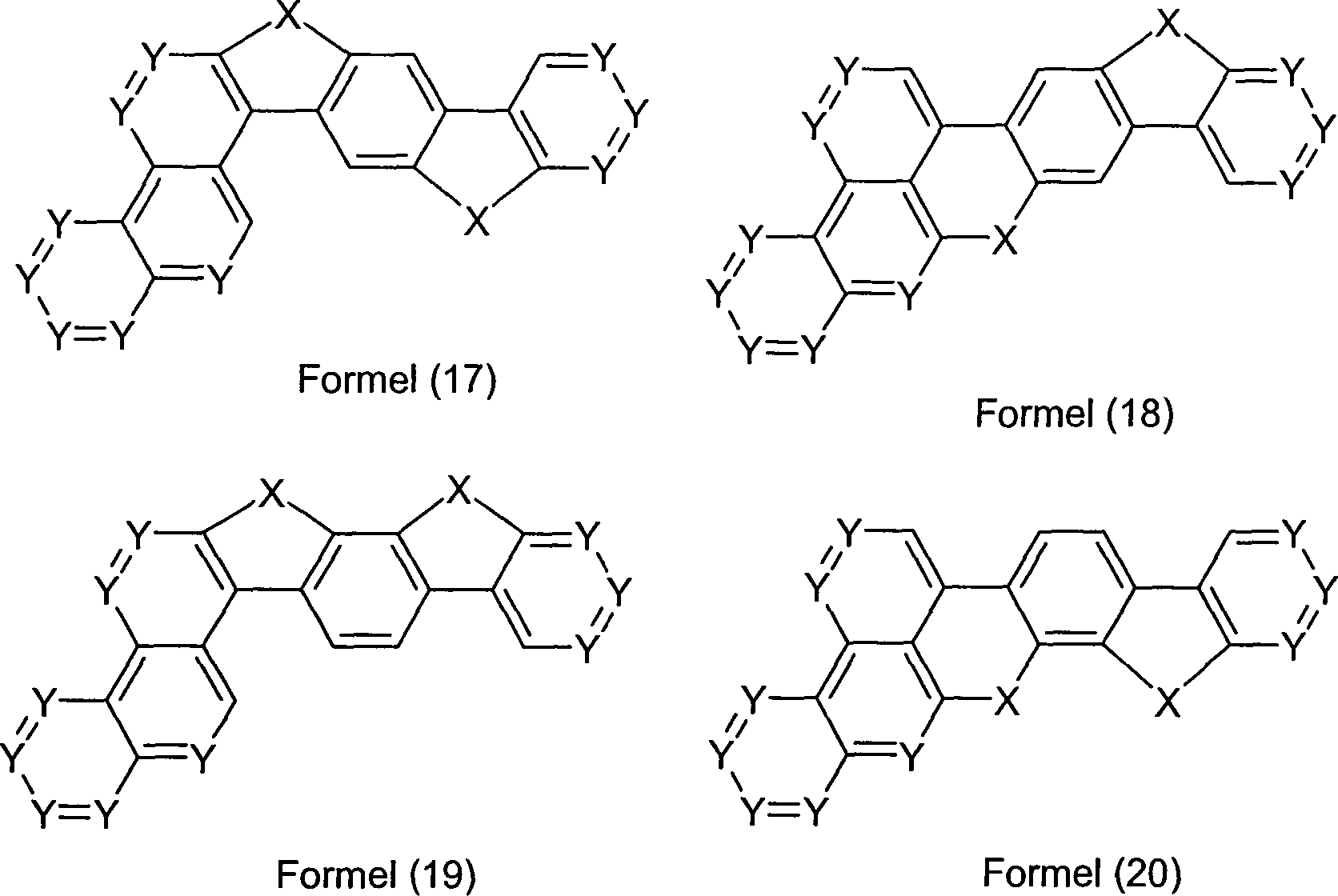
Bevorzugt
sind weiterhin Verbindungen gemäß Formel
(1) bis (4), in denen das Symbol Y insgesamt 0, 1, 2, 3 oder 4 Mal
für Stickstoff
steht, wobei die anderen Symbole Y für CR1 stehen.
Besonders bevorzugt sind Verbindungen gemäß Formel (1) bis (4), in denen
das Symbol Y insgesamt 0, 1 oder 2 Mal für Stickstoff steht. In einer
besonders bevorzugten Ausführungsform
der Erfindung steht das Symbol Y für CR1.
In einer ganz besonders bevorzugten Ausführungsform sind die Strukturen
gemäß Formel
(1) bis (4) gewählt
aus den Formeln (5a) bis (20a), 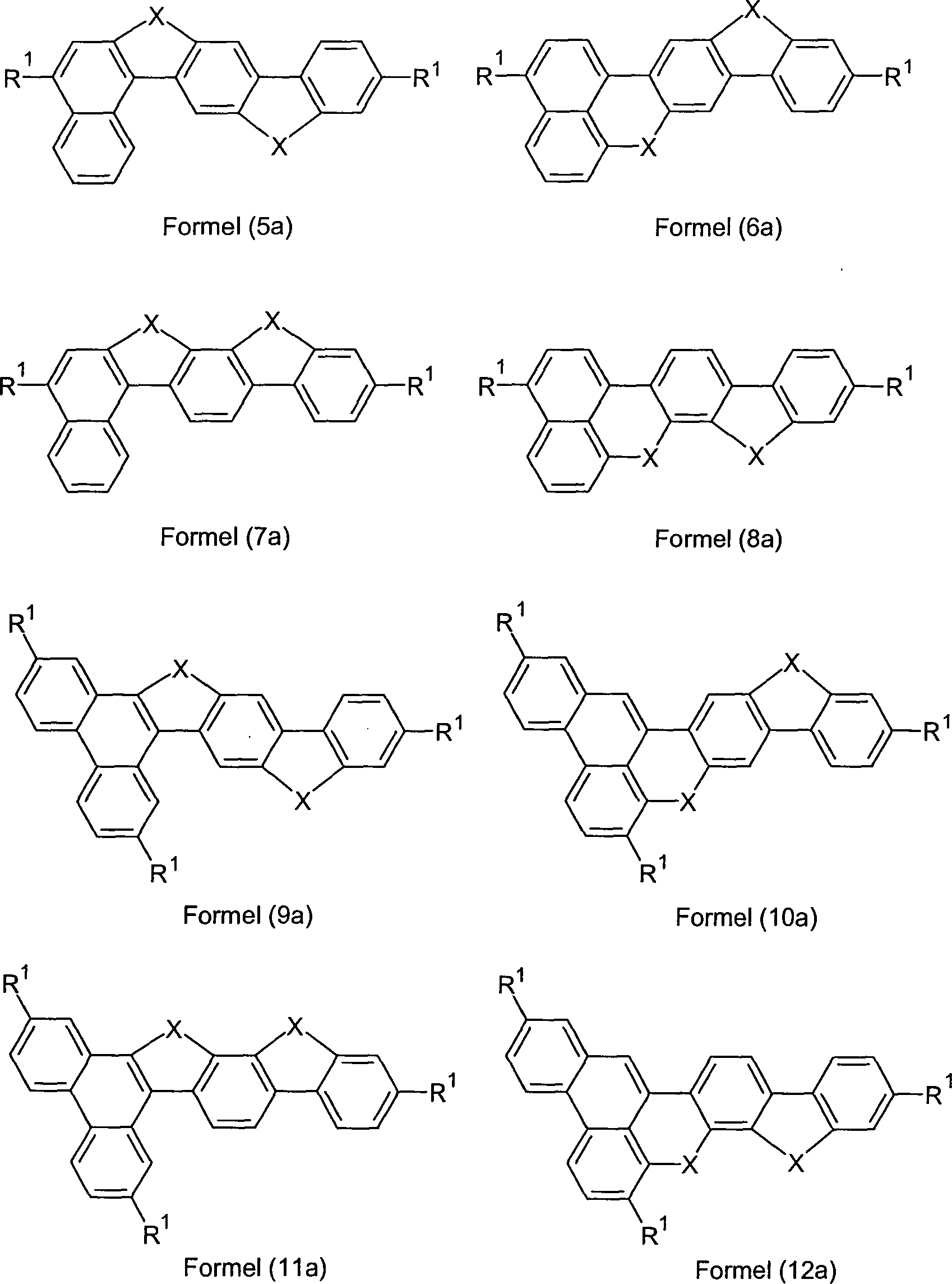

Besonders bevorzugt sind in den Strukturen gemäß Formel (5a) bis (8a) alle Reste R1 ungleich Wasserstoff. In den Strukturen gemäß Formel (9a) bis (20a) sind bevorzugt mindestens ein Rest R1 ungleich Wasserstoff, besonders bevorzugt sind mindestens zwei Reste R1 ungleich Wasserstoff.In the structures of the formulas (5a) to (8a), particular preference is given to all radicals R 1 other than hydrogen. In the structures of the formulas (9a) to (20a), at least one radical R 1 is preferably not hydrogen, more preferably at least two radicals R 1 are not hydrogen.
Bevorzugt sind weiterhin Verbindungen gemäß Formel (1) bis (20) bzw. (5a) bis (20a), in denen das Symbol R1, welches an den aromatischen Grundkörper der Formel (1) bis (4) bindet, gleich oder verschieden bei jedem Auftreten für eine Gruppe NAr2, wie unten aufgeführt, oder für H, F, Br, C(=O)Ar, P(=O)Ar2, CR2=CR2Ar, eine geradkettige Alkylgruppe mit 1 bis 5 C-Atomen oder verzweigte Alkylgruppe mit 3 bis 5 C-Atomen, wobei eine oder mehrere nicht benachbarte CH2-Gruppen durch -R2C=CR2-, -C=C- oder -O- ersetzt sein können und wobei ein oder mehrere H-Atome durch F ersetzt sein können, oder eine Triarylamingruppe mit 18 bis 30 C-Atomen, die mit einem oder mehreren Resten R2 substituiert sein kann, oder eine Arylgruppe mit 6 bis 16 C-Atomen oder Heteroarylgruppe mit 2 bis 16 C-Atomen oder eine Spirobifluorengruppe, die jeweils mit einem oder mehreren Resten R2 substituiert sein kann, oder eine Kombination aus zwei oder drei dieser Systeme steht. Besonders bevorzugte Reste R1 sind gleich oder verschieden bei jedem Auftreten eine Gruppe NAr2, wie unten aufgeführt, oder H, F, Br, C(=O)Ar, P(=O)Ar2, Methyl, Ethyl, iso-Propyl, tert-Butyl, wobei ein oder mehrere H-Atome jeweils durch F ersetzt sein können, oder eine Triphenylamingruppe, die mit einem oder mehreren Resten R2 substituiert sein kann, oder eine Arylgruppe mit 6 bis 14 C-Atomen oder eine Spirobifluorengruppe, die jeweils mit einem oder mehreren Resten R2 substituiert sein kann, oder eine Kombination aus zwei dieser Systeme. Bei Einbau in Polymere, Oligomere oder Dendrimere und bei Verbindungen, die aus Lösung verarbeitet werden, sind auch lineare oder verzweigte Alkylketten mit bis zu 10 C-Atomen bevorzugt. Brom als Substituent ist vor allem für die Verwendung dieser Verbindung als Zwischenstufe zur Herstellung anderer erfindungsgemäßer Verbindungen oder zur Verwendung als Monomer zur Herstellung von Polymeren bevorzugt.Preference is furthermore given to compounds of the formulas (1) to (20) or (5a) to (20a) in which the symbol R 1 which bonds to the aromatic parent of the formula (1) to (4) is identical or different each occurrence for a group NAr 2 as listed below or for H, F, Br, C (= O) Ar, P (= O) Ar 2 , CR 2 = CR 2 Ar, a straight-chain alkyl group having 1 to 5 C Atoms or branched alkyl group having 3 to 5 C atoms, wherein one or more non-adjacent CH 2 groups may be replaced by -R 2 C = CR 2 -, -C = C- or -O- and wherein one or more H atoms can be replaced by F, or a triarylamine group with 18 to 30 carbon atoms which may be substituted by one or more radicals R 2 , or an aryl group having 6 to 16 C atoms or heteroaryl group having 2 to 16 C atoms or a spirobifluorene group, each having one or more radicals R 2 may be substituted or a combination of two or three of these systems. Particularly preferred radicals R 1 are identical or different at each occurrence, a group NAr 2 , as listed below, or H, F, Br, C (= O) Ar, P (= O) Ar 2 , methyl, ethyl, iso-propyl , tert-butyl, wherein one or more H atoms may each be replaced by F, or a triphenylamine group which may be substituted by one or more R 2 groups, or an aryl group having 6 to 14 C atoms, or a spirobifluorene group each may be substituted with one or more radicals R 2 , or a combination of two of these systems. When incorporated into polymers, oligomers or dendrimers and compounds processed from solution, linear or branched alkyl chains of up to 10 carbon atoms are also preferred. Bromine as a substituent is particularly preferred for the use of this compound as an intermediate for the preparation of other compounds of the invention or for use as a monomer for the preparation of polymers.
Bevorzugt
sind, wie oben aufgeführt,
ebenfalls Verbindungen der Formel (1) bis (20) bzw. (5a) bis (20a),
in denen mindestens ein Symbol R1 für eine Gruppe
N(Ar)2 der Formel (21) oder (22) steht, 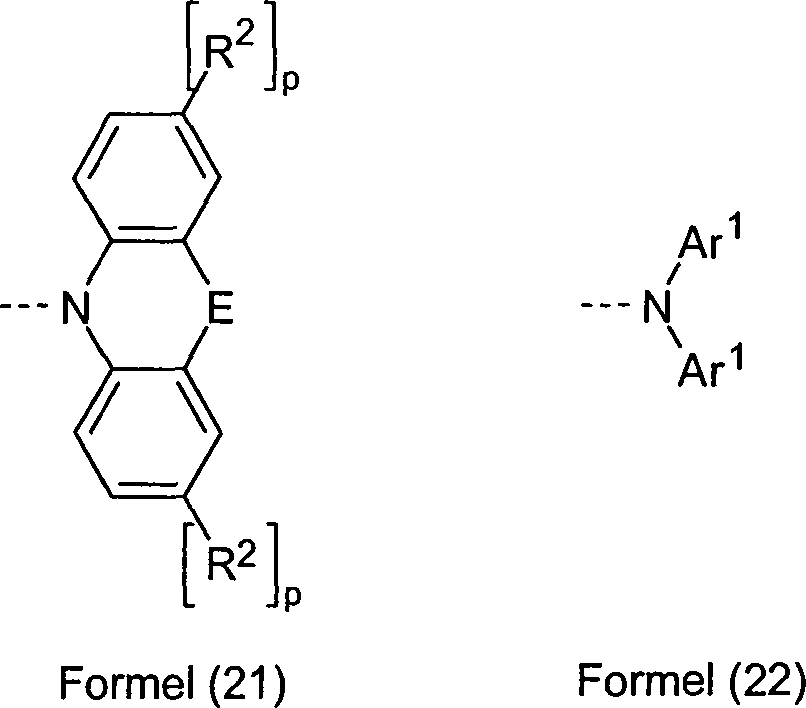
E steht für eine Einfachbindung, O, S,
N(R2) oder C(R2)2;
Ar1 ist gleich
oder verschieden bei jedem Auftreten eine Aryl- oder Heteroarylgruppe
mit 5 bis 20 aromatischen Ringatomen oder eine Triarylamingruppe
mit 15 bis 30 aromatischen Ringatomen, welche jeweils mit einem oder
mehreren Resten R2 substituiert sein kann,
bevorzugt eine Aryl- oder Heteroarylgruppe mit 6 bis 14 aromatischen
Ringatomen oder eine Triarylamingruppe mit 18 bis 22 aromatischen
Ringatomen, welche jeweils mit einem oder mehreren Resten R2 substituiert sein kann;
p ist bei
jedem Auftreten gleich oder verschieden 0 oder 1.Also preferred, as listed above, are compounds of the formulas (1) to (20) or (5a) to (20a) in which at least one symbol R 1 represents a group N (Ar) 2 of the formula (21) or ( 22),
E is a single bond, O, S, N (R 2 ) or C (R 2 ) 2 ;
Ar 1 is the same or different on each occurrence, an aryl or heteroaryl group having 5 to 20 aromatic ring atoms or a triarylamine group having 15 to 30 aromatic ring atoms, which may be substituted by one or more radicals R 2 , preferably an aryl or heteroaryl group 6 to 14 aromatic ring atoms or a triarylamine group having 18 to 22 aromatic ring atoms, each of which may be substituted by one or more radicals R 2 ;
p is the same or different 0 or 1 at each occurrence.
Besonders bevorzugt steht Ar1 gleich oder verschieden für Phenyl, 1-Naphthyl, 2-Naphthyl, Triphenylamin, Naphthyldiphenylamin oder Dinaphthylphenylamin, welches jeweils durch eine oder mehrere Alkylgruppen mit 1 bis 4 C-Atomen oder durch Fluor substituiert sein kann.Ar 1 is more preferably identical or different to phenyl, 1-naphthyl, 2-naphthyl, triphenylamine, naphthyldiphenylamine or dinaphthylphenylamine, which may each be substituted by one or more alkyl groups having 1 to 4 C atoms or by fluorine.
Bevorzugt sind weiterhin Verbindungen gemäß Formel (1) bis (20) bzw. (5a) bis (20a), in denen die Symbole X bei jedem Auftreten gleich oder verschieden eine bivalente Brücke sind, ausgewählt aus C(R1)2, C=O, C=NR1, O, S, S=O, SO2, N(R1), P(R1) oder P(=O)R1. Besonders bevorzugt sind Verbindungen gemäß Formel (1) bis (20) bzw. (5a) bis (20a), in denen die Symbole X bei jedem Auftreten gleich oder verschieden ausgewählt sind aus C(R1)2, N(R1), P(R1) und P(=O)(R1), ganz besonders bevorzugt C(R1)2 oder N(R1), insbesondere C(R1)2. Dabei sei hier nochmals explizit darauf hingewiesen, dass hier auch mehrere benachbarte Reste R1 miteinander ein aromatisches oder aliphatisches Ringsystem bilden können. Wenn mehrere Reste R1 an einer Gruppe C(R1)2 miteinander ein Ringsystem bilden, führt dies zu Spirostrukturen. Die Ausbildung derartiger Spirostrukturen durch Bildung von Ringsystemen zwischen zwei Gruppen R1 an C(R1)2 ist eine weitere bevorzugte Ausführungsform der Erfindung. Dies gilt insbesondere, wenn R1 für eine substituierte oder unsubstituierte Phenylgruppe steht und die beiden Phenylgruppen zusammen mit dem C-Atom der Brücke ein Ringsystem bilden.Preference is furthermore given to compounds of the formulas (1) to (20) or (5a) to (20a) in which the symbols X at each occurrence, identically or differently, are a divalent bridge selected from C (R 1 ) 2 , C = O, C = NR 1 , O, S, S = O, SO 2 , N (R 1 ), P (R 1 ) or P (= O) R 1 . Particular preference is given to compounds of the formulas (1) to (20) or (5a) to (20a) in which the symbols X on each occurrence are identically or differently selected from C (R 1 ) 2 , N (R 1 ) P (R 1 ) and P (= O) (R 1 ), very particularly preferably C (R 1 ) 2 or N (R 1 ), in particular C (R 1 ) 2 . It should again be explicitly pointed out here that several neighboring radicals R 1 can together form an aromatic or aliphatic ring system. If several radicals R 1 on a group C (R 1 ) 2 together form a ring system, this leads to spiro structures. The formation of such spiro structures by formation of ring systems between two groups R 1 to C (R 1 ) 2 is another preferred embodiment of the invention. This is especially true when R 1 is a substituted or unsubstituted phenyl group and the two phenyl groups form a ring system together with the C atom of the bridge.
Bevorzugte Reste R1, die an die Brücken X gebunden sind, sind gleich oder verschieden und sind ausgewählt aus H, geradkettigen Alkylgruppen mit 1 bis 5 C-Atomen oder verzweigten Alkylgruppen mit 3 bis 5 C-Atomen, wobei eine oder mehrere nicht benachbarte CH2-Gruppen durch -R2C=CR2-, -C=C- oder -O- ersetzt sein können und wobei ein oder mehrere H-Atome durch F ersetzt sein können, oder Arylgruppen mit 6 bis 16 C-Atomen oder Heteroarylgruppen mit 2 bis 16 C-Atomen, die jeweils mit einem oder mehreren Resten R2 substituiert sein können, oder eine Kombination aus zwei oder drei dieser Systeme; dabei können zwei der Reste R1, die an dasselbe Brückenatom gebunden sind, auch miteinander ein Ringsystem bilden. Besonders bevorzugte Reste R1, die an die Brücken X gebunden sind, sind gleich oder verschieden und sind ausgewählt aus Methyl, Ethyl, iso-Propyl, tert-Butyl, wobei jeweils ein oder mehrere H-Atome durch F ersetzt sein können, oder Arylgruppen mit 6 bis 14 C-Atomen, die mit einem oder mehreren Resten R2 substituiert sein können, oder eine Kombination aus zwei dieser Systeme; dabei können zwei der Reste R1, die an dasselbe Brückenatom gebunden sind, auch miteinander ein Ringsystem bilden. Bei Verbindungen, die aus Lösung verarbeitet werden, sind auch lineare oder verzweigte Alkylketten mit bis zu 10 C-Atomen bevorzugt.Preferred radicals R 1 which are bonded to the bridges X are identical or different and are selected from H, straight-chain alkyl groups having 1 to 5 C atoms or branched alkyl groups having 3 to 5 C atoms, one or more non-adjacent CH 2 groups replaced by -R 2 C = CR 2 -, -C = C or -O- or wherein one or more H atoms may be replaced by F, or aryl groups having 6 to 16 C atoms or heteroaryl groups having 2 to 16 C atoms, each of which may be substituted by one or more R 2 radicals, or a Combination of two or three of these systems; In this case, two of the radicals R 1 , which are bonded to the same bridge atom, also together form a ring system. Particularly preferred radicals R 1 , which are bonded to the bridges X, are identical or different and are selected from methyl, ethyl, iso-propyl, tert-butyl, where in each case one or more H atoms may be replaced by F, or aryl groups with 6 to 14 carbon atoms, which may be substituted by one or more R 2 radicals, or a combination of two of these systems; In this case, two of the radicals R 1 , which are bonded to the same bridge atom, also together form a ring system. For compounds processed from solution, linear or branched alkyl chains of up to 10 carbon atoms are also preferred.
Weiterhin bevorzugt sind symmetrisch substituierte Verbindungen, also Verbindungen, in denen die Substituenten R1 in den Formeln (5a) bis (20a) gleich gewählt.Also preferred are symmetrically substituted compounds, ie compounds in which the substituents R 1 in the formulas (5a) to (20a) are the same.
Beispiele für bevorzugte Verbindungen gemäß Formel (1) bis (4) sind die im Folgenden abgebildeten Strukturen (1) bis (114).Examples for preferred Compounds according to formula (1) to (4) are the structures (1) to (114).

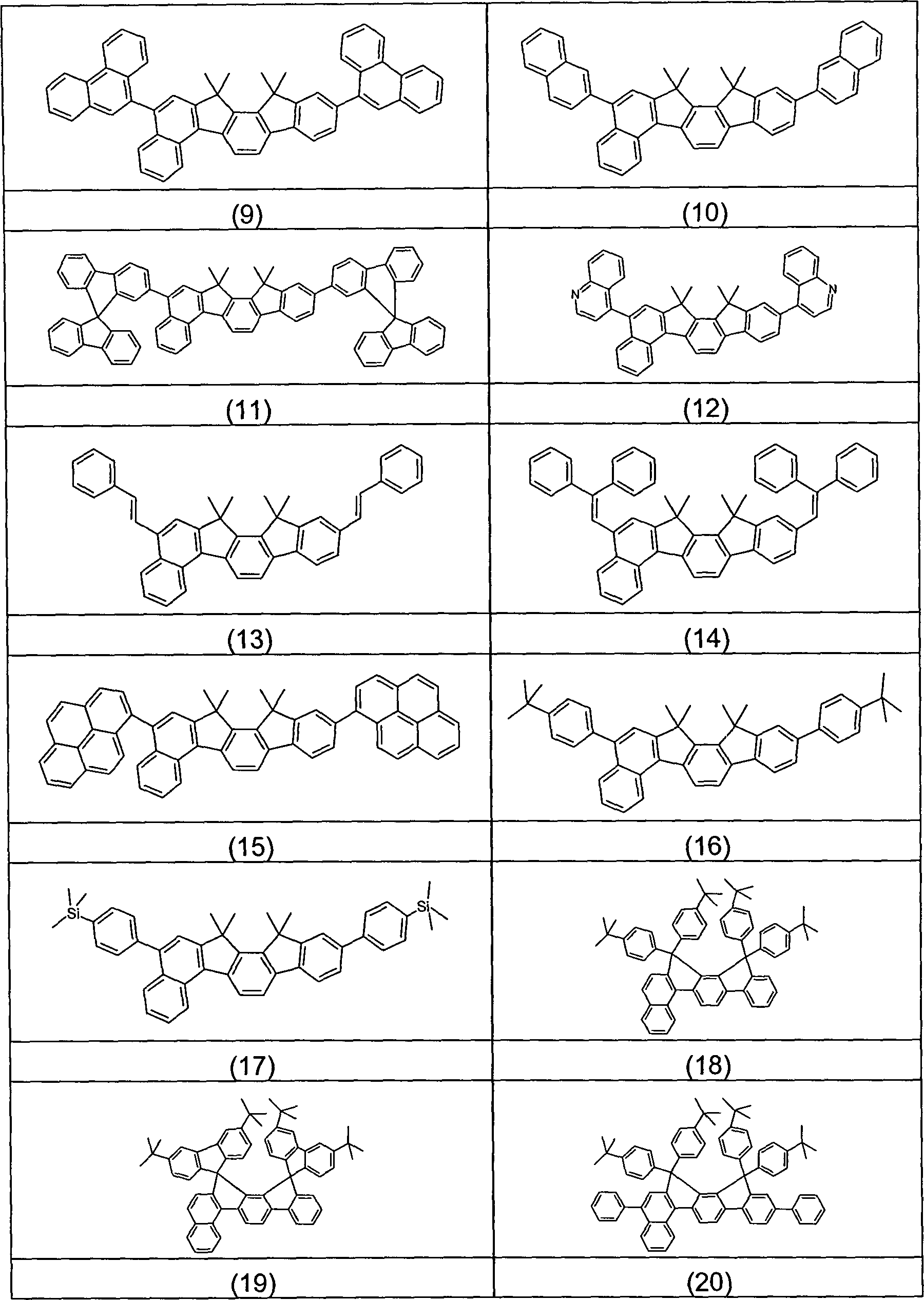

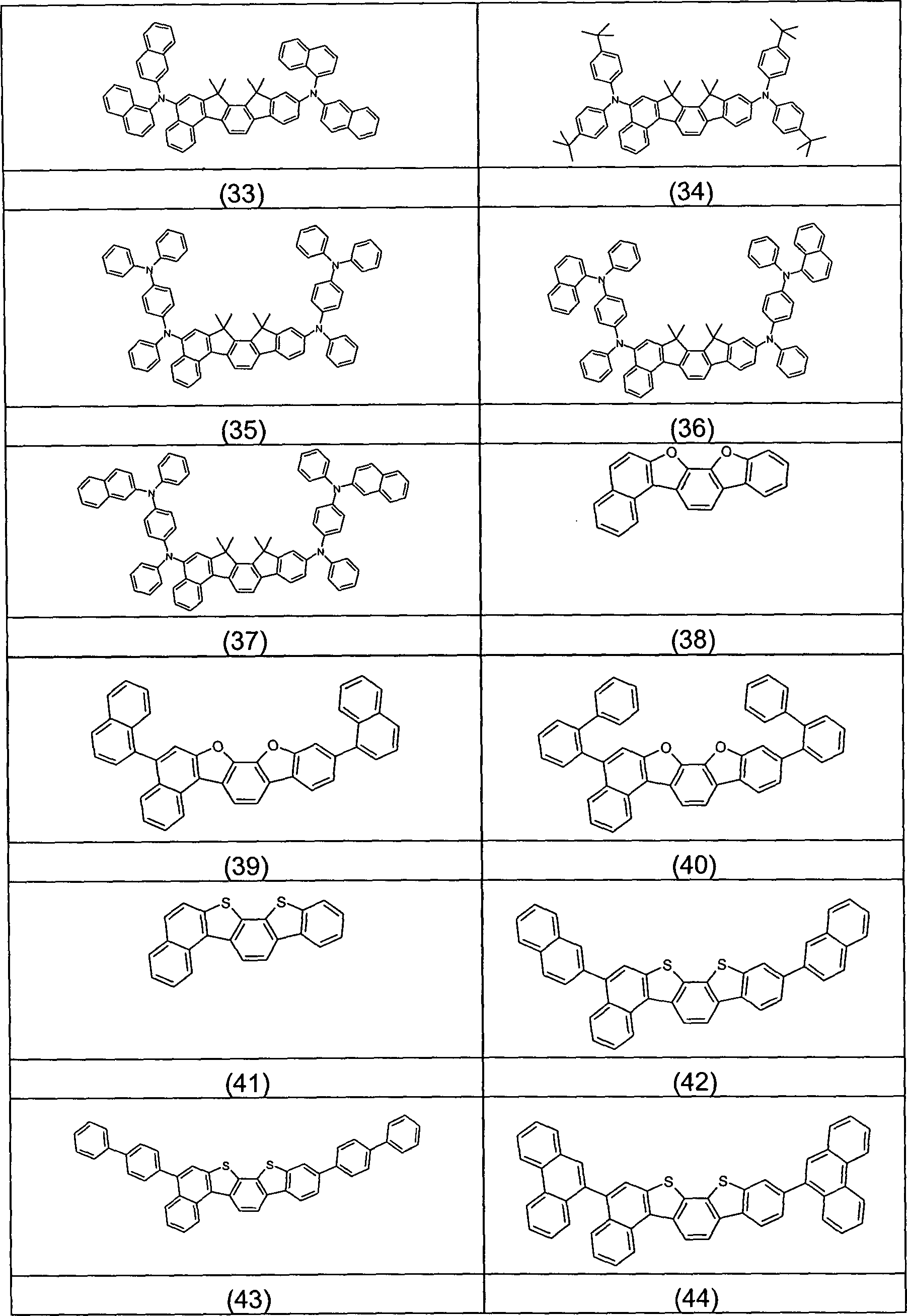
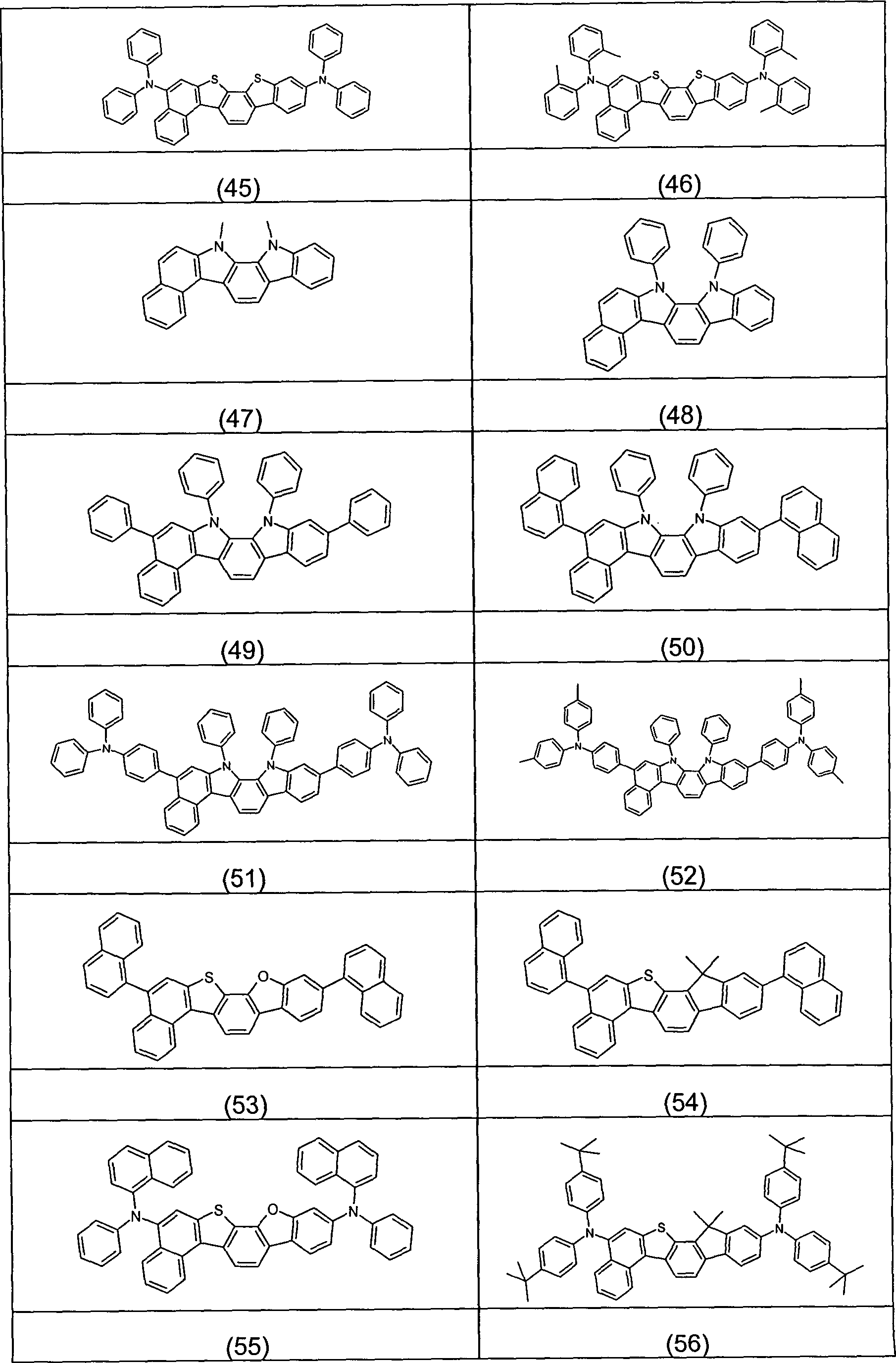


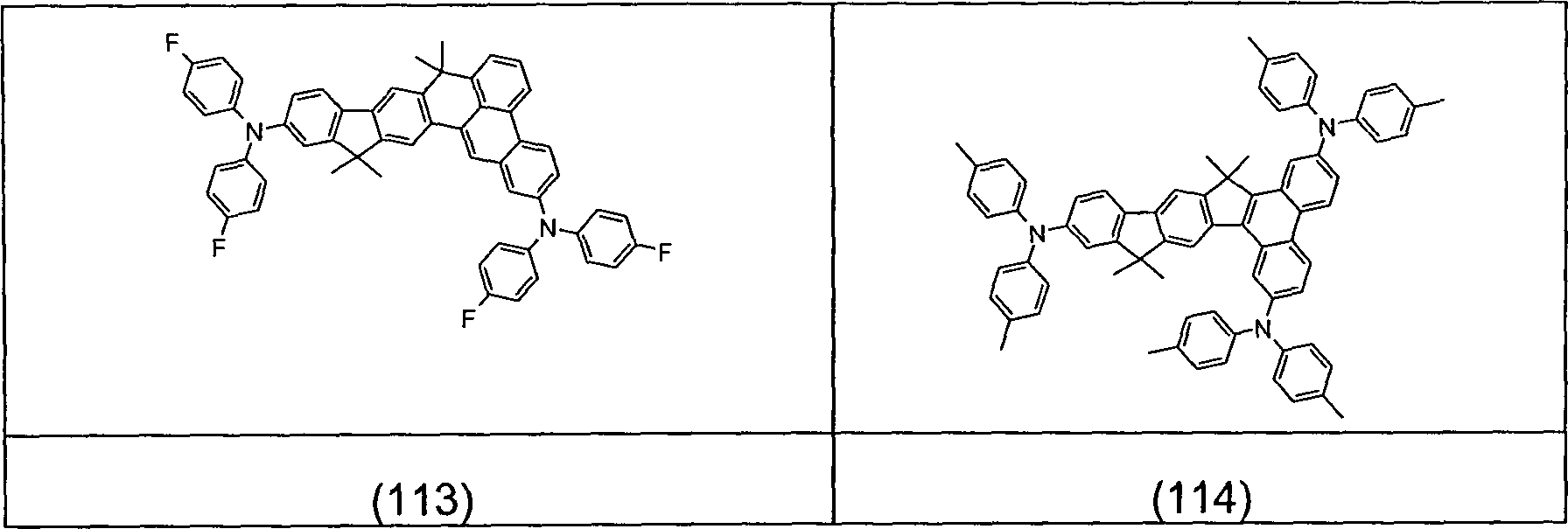
Die oben beschriebenen erfindungsgemäßen Verbindungen, insbesondere Verbindungen, welche mit reaktiven Abgangsgruppen, wie Brom, Iod, Boronsäure oder Boronsäureester, substituiert sind, können auch als Monomere zur Erzeugung entsprechender Polymere, Oligomere oder als Kern von Dendrimeren Verwendung finden. Die Polymerisation erfolgt dabei bevorzugt über die Halogenfunktionalität bzw. die Boronsäurefunktionalität.The above-described compounds of the invention, in particular compounds which react with reactive leaving groups, such as bromine, iodine, boronic acid or boronic acid ester, may be substituted also as monomers for the production of corresponding polymers, oligomers or as the core of dendrimers. The polymerization takes place preferably over the halogen functionality or the boronic acid functionality.
Weiterer Gegenstand der Erfindung sind daher Polymere, Oligomere oder Dendrimere enthaltend eine oder mehrere Verbindungen gemäß Formel (1), (2), (3) und/oder (4), wobei ein oder mehrere Reste R1 Bindungen der Verbindung gemäß Formel (1), (2), (3) bzw. (4) zum Polymer oder Dendrimer darstellen. Die Polymere, Oligomere oder Dendrimere können konjugiert, teilkonjugiert oder nichtkonjugiert sein.Another object of the invention are therefore polymers, oligomers or dendrimers containing one or more compounds of the formula (1), (2), (3) and / or (4), wherein one or more radicals R 1 bonds of the compound of formula (1 ), (2), (3) or (4) to the polymer or dendrimer. The polymers, oligomers or dendrimers may be conjugated, partially conjugated or non-conjugated.
Für die Wiederholeinheiten gemäß Formel (1) bis (4) gelten dieselben Bevorzugungen wie oben beschrieben.For the repeat units according to formula (1) to (4), the same preferences as described above apply.
Diese
Monomere werden homopolymerisiert oder mit weiteren Monomeren copolymerisiert.
Geeignete und bevorzugte Comonomere sind gewählt aus Fluorenen (z. B. gemäß
Die erfindungsgemäßen Verbindungen gemäß Formel (1) bis (4) können nach dem Fachmann bekannten Syntheseschritten dargestellt werden. So lassen sich die verschiedenen Grundgerüste beispielsweise Kupplung eines Fluorens mit einem Carbonyl-substituierten Naphthalin, Anthracen bzw. Phenanthren, Addition eines Alkyl- bzw. Arylmetallderivats und säurekatalysierter Cyclisierung des entsprechenden tertiären Alkohols darstellen, wie in Schema 1 am Beispiel des Naphthalins gezeigt. Werden statt Naphthalin, Anthracen oder Phenanthren entsprechend funktionalisierte Heterocyclen eingesetzt, sind die heterocyclischen Grundgerüste zugänglich. Diese Grundgerüste lassen sich nach Standardmethoden funktionalisieren, beispielsweise durch Friedel-Crafts-Alkylierung oder -Acylierung. Weiterhin lassen sich die Grundgerüste nach Standardmethoden der organischen Chemie bromieren. Die bromierten Verbindungen stellen die Basis für weitere Funktionalisierungen dar. So können sie durch Suzuki-Kupplung mit Arylboronsäuren oder Arylboronsäurederivaten oder mit Organozinnverbindungen gemäß Stille zu erweiterten aromatischen Verbindungen umgesetzt werden. Durch Kupplung mit aromatischen oder aliphatischen Aminen gemäß Hartwig-Buchwald erhält man die entsprechenden Amine, wie in Schema 1 gezeigt. Weiterhin können sie via Lithiierung und Reaktion mit Elektrophilen wie Benzonitril und anschließender saurer Hydrolyse zu Ketonen oder mit Chlordiarylphosphinen und anschließender Oxidation zu Phosphinoxiden umgesetzt werden.The Compounds of the invention according to formula (1) to (4) can be represented by synthetic steps known in the art. This is how the different basic frameworks, for example, can be clutches a fluorene with a carbonyl-substituted naphthalene, anthracene or phenanthrene, addition of an alkyl or aryl metal derivative and acid catalyzed Cyclization of the corresponding tertiary alcohol, as in Scheme 1 using the example of naphthalene shown. Be replaced by naphthalene, Anthracene or phenanthrene according to functionalized heterocycles used, the heterocyclic backbones are accessible. Leave these frameworks Functionalize by standard methods, for example by Friedel-Crafts alkylation or Acylation. Furthermore, the skeletons can be determined by standard methods of brominate organic chemistry. Put the brominated compounds the basis for further functionalizations. So they can by Suzuki coupling with arylboronic acids or arylboronic acid derivatives or with organotin compounds in accordance with silence extended to aromatic Connections are implemented. By coupling with aromatic or aliphatic amines according to Hartwig-Buchwald you get the corresponding amines, as shown in Scheme 1. They can continue via lithiation and reaction with electrophiles such as benzonitrile and followed by acid hydrolysis to ketones or with chlorodiarylphosphines and subsequent oxidation be converted to phosphine oxides.
Schema
1 
Ein weiterer Gegenstand der Erfindung ist ein Verfahren zur Herstellung der Grundgerüste der Verbindungen gemäß Formel (1) bis (4) durch Kupplung eines Fluorens, welches eine reaktive Gruppe trägt, mit einem Carbonyl-funktionalisierten Naphthalin, Phenanthren oder Anthracen, welches jeweils eine reaktive Gruppe trägt, gefolgt von Addition eines Alkyl- oder Arylmetallreagenz und säurekatalyisierter Cyclisierungs reaktion. Als Kupplungsreaktion zwischen dem Fluoren und dem Naphthalin bzw. Anthracen bzw. Phenanthren eignen sich insbesondere übergangsmetallkatalysierte Kupplungsreaktionen, insbesondere Suzuki-Kupplung, so dass sich hier insbesondere die Kupplung eines Boronsäurederivats, beispielsweise eines Fluorenboronsäurederivats, mit einem Halogenderivat, beispielsweise einem Naphthalin-, Anthracen- oder Phenanthrenhalogenderivat anbietet. Die reaktiven Gruppen sind also bevorzugt Halogen, insbesondere Brom, und Boronsäurederivate. Für die Addition des Alkyl- bzw. Arylmetallreagenzes eignen sich insbesondere Alkyl- bzw. Aryllithiumverbindungen und Grignardverbindungen.One Another object of the invention is a process for the preparation the skeletons the compounds according to formula (1) to (4) by coupling a fluorene, which is a reactive Group wears, with a carbonyl-functionalized naphthalene, phenanthrene or Anthracene, each carrying a reactive group, followed of addition of an alkyl or aryl metal reagent and acid catalyzed Cyclization reaction. As a coupling reaction between the fluorene and the naphthalene or anthracene or phenanthrene are in particular transition metal catalyzed Coupling reactions, in particular Suzuki coupling, so here in particular the coupling of a boronic acid derivative, for example, a Fluorenboronsäurederivats, with a halogen derivative, for example, a naphthalene, anthracene or phenanthrene halide derivative offering. The reactive groups are therefore preferably halogen, in particular Bromine, and boronic acid derivatives. For the Addition of the alkyl or Arylmetallreagenzes are particularly suitable Alkyl or aryllithium compounds and Grignard compounds.
Nochmals ein weiterer Gegenstand der Erfindung ist ein Verfahren zur Herstellung funktionalisierter Verbindungen gemäß Formel (1) bis (4) durch Alkylierung oder Acylierung der entsprechenden nicht-funktionalisierten Verbindung oder durch Halogenierung der nicht-funktionalisierten Verbindung, gefolgt von Kupplung mit einem funktionalisierten Aromaten oder mit einem mono- oder disubstituierten Amin oder gefolgt von Metallierung und Reaktion mit Elektrophilen. Die Halogenierung ist bevorzugt eine Bromierung. Als Kupplungsreaktion zwischen dem Grundgerüst gemäß Formel (1) bis (4) und dem Arylsubstituenten eignen sich vor allem übergangsmetallkatalysierte Kupplungsreaktionen, insbesondere Suzuki-Kupplung, so dass sich hier insbesondere die Kupplung eines Boronsäurederivats mit einem Halogenderivat anbietet. Als Kupplungsreaktion mit einem mono- oder disubstituierten Amin eignet sich insbesondere die palladiumkatalysierte Kupplung nach Hartwig-Buchwald.Yet another object of the invention is a process for the preparation of functionalized compounds according to formula (1) to (4) by alkylation or acylation of the corresponding non-functionalized compound or by halogenation of the non-functionalized compound, followed by coupling with a functionalized aromatic or with a mono- or disubstituted amine or followed by Metallization and reaction with electrophiles. The halogenation is preferably a bromination. Suitable coupling reactions between the backbone of the formula (1) to (4) and the aryl substituent are especially transition metal-catalyzed coupling reactions, in particular Suzuki coupling, so that in particular the coupling of a boronic acid derivative with a halogenated derivative is suitable. As a coupling reaction with a mono- or disubstituted amine, the palladium-catalyzed coupling according to Hartwig-Buchwald is particularly suitable.
Weiterhin können die funktionalisieren Verbindungen, beispielsweise die bromierten Verbindungen, entweder direkt oder nach Überführung in ein Boronsäurederivat als Monomere zur Herstellung von Polymeren, Oligomeren oder Dendrimeren eingesetzt werden.Farther can the functionalizing compounds, for example the brominated ones Compounds, either directly or after conversion to a Boronsäurederivat as monomers for the preparation of polymers, oligomers or dendrimers be used.
Bei der Synthese können sowohl die 5-Ring/5-Ring-Derivate wie auch die 5-Ring/6-Ring-Derivate oder Mischungen dieser Verbindungen entstehen. Welche Isomere entstehen und in welchem Verhältnis sie entstehen, hängt von den exakten Synthesebedingungen ab. Falls Mischungen entstehen, können diese entweder getrennt und als Reinverbindungen weiterverarbeitet werden, oder sie können als Mischung eingesetzt werden.at the synthesis can both the 5-ring / 5-ring derivatives as well as the 5-ring / 6-ring derivatives or mixtures of these compounds arise. Which isomers are formed and in what proportion they arise, hangs from the exact synthesis conditions. If mixtures are formed, can these either separately and further processed as pure compounds be or they can be used as a mixture.
Die Verbindungen gemäß Formel (1) bis (4) eignen sich für den Einsatz in elektronischen Vorrichtungen, insbesondere in organischen Elektrolumineszenzvorrichtungen (OLEDs, PLEDs). Abhängig von der Substitution werden die Verbindungen in unterschiedlichen Funktionen und Schichten eingesetzt.The Compounds according to formula (1) to (4) are suitable for the use in electronic devices, in particular in organic Electroluminescent devices (OLEDs, PLEDs). Depending on the substitution becomes the compounds in different functions and layers used.
Ein weiterer Gegenstand der Erfindung ist daher die Verwendung von Verbindungen gemäß Formel (1) bis (4) in elektronischen Vorrichtungen, insbesondere in organischen Elektrolumineszenzvorrichtungen.One Another object of the invention is therefore the use of compounds according to formula (1) to (4) in electronic devices, in particular in organic Electroluminescent devices.
Nochmals ein weiterer Gegenstand der Erfindung sind organische elektronische Vorrichtungen, enthaltend mindestens eine Verbindung gemäß Formel (1), (2), (3) und/oder (4), insbesondere organische Elektrolumineszenzvorrichtungen, enthaltend Anode, Kathode und mindestens eine emittierende Schicht, dadurch gekennzeichnet, dass mindestens eine organische Schicht, die eine emittierende Schicht oder eine andere Schicht sein kann, mindestens eine Verbindung gemäß Formel (1), (2), (3) und/oder (4) enthält.again Another object of the invention are organic electronic Devices containing at least one compound according to formula (1), (2), (3) and / or (4), in particular organic electroluminescent devices, containing anode, cathode and at least one emitting layer, characterized in that at least one organic layer, which may be an emitting layer or another layer, at least one compound according to formula (1), (2), (3) and / or (4).
Außer Kathode,
Anode und der emittierenden Schicht kann die organische Elektrolumineszenzvorrichtung
noch weitere Schichten enthalten. Diese sind beispielsweise gewählt aus
Lochinjektionsschicht, Lochtransportschicht, Elektronentransportschicht,
Elektroneninjektionsschicht und/oder Charge-Generation Layer (
In
einer weiteren bevorzugten Ausführungsform
der Erfindung enthält
die organische Elektrolumineszenzvorrichtung mehrere emittierende
Schichten, wobei mindestens eine organische Schicht mindestens eine Verbindung
gemäß Formel
(1), (2), (3) und/oder (4) enthält.
Besonders bevorzugt weisen diese Emissionsschichten insgesamt mehrere
Emissionsmaxima zwischen 380 nm und 750 nm auf, so dass insgesamt
weiße Emission
resultiert, d. h. in den emittierenden Schichten werden verschiedene
emittierende Verbindungen verwendet, die fluoreszieren oder phosphoreszieren
können
und die gelbes, orange oder rotes Licht emittieren. Insbesondere
bevorzugt sind Dreischichtsysteme, wobei mindestens eine dieser
Schichten mindestens eine Verbindung gemäß Formel (1), (2), (3) und/oder
(4) enthält
und wobei die drei Schichten blaue, grüne und orange oder rote Emission
zeigen (für
den prinzipiellen Aufbau siehe z. B.
In einer Ausführungsform der Erfindung werden die Verbindungen gemäß Formel (1) bis (4) als Host für einen fluoreszierenden Dotanden eingesetzt. In diesem Fall sind bevorzugt ein oder mehrere Substituenten R1 aus einfachen oder kondensierten Aryl- oder Heteroarylgruppen gewählt, insbesondere Phenyl, o-, m- oder p-Biphenyl, 1- oder 2-Naphthyl, Anthryl, insbesondere Phenylanthryl oder 1- oder 2-Naphthylanthryl, 2-Fluorenyl und 2-Spirobifluorenyl, welche jeweils durch einen oder mehrere Reste R2 substituiert sein können. Dies gilt insbesondere für die Reste R1 an den Strukturen gemäß Formel (5a) bis (20a).In one embodiment of the invention, the compounds of the formula (1) to (4) are used as a host for a fluorescent dopant. In this case, one or more substituents R 1 are preferably selected from simple or condensed aryl or heteroaryl groups, in particular phenyl, o-, m- or p-biphenyl, 1- or 2-naphthyl, anthryl, in particular phenylanthryl or 1- or 2 Naphthylanthryl, 2-fluorenyl and 2-spirobifluorenyl, each of which may be substituted by one or more R 2 radicals. This applies in particular to the radicals R 1 on the structures of the formula (5a) to (20a).
Unter einem Hostmaterial wird in einem System aus Host und Dotand diejenige Komponente verstanden, die in dem System im höheren Anteil vorliegt. Bei einem System aus einem Host und mehreren Dotanden wird als Host diejenige Komponente verstanden, deren Anteil der höchste in der Mischung ist.Under a host material becomes the one in a system of host and dopant Component understood that is present in the system in the higher proportion. at a system of one host and multiple dopants will host the component whose share is the highest in the mix is.
Der Anteil des Hostmaterials gemäß Formel (1) bis (4) in der emittierenden Schicht beträgt zwischen 50.0 und 99.9 Gew.-%, bevorzugt zwischen 80.0 und 99.5 Gew.-%, besonders bevorzugt zwischen 90.0 und 99.0 Gew.-%. Entsprechend beträgt der Anteil des Dotanden zwischen 0.1 und 50.0 Gew.-%, bevorzugt zwischen 0.5 und 20.0 Gew.-%, besonders bevorzugt zwischen 1.0 und 10.0 Gew.-%.Of the Proportion of host material according to formula (1) to (4) in the emitting layer is between 50.0 and 99.9 wt%, preferably between 80.0 and 99.5% by weight, more preferably between 90.0 and 99.0 wt .-%. Accordingly, the proportion of the dopant between 0.1 and 50.0% by weight, preferably between 0.5 and 20.0% by weight, more preferably between 1.0 and 10.0 wt .-%.
Bevorzugte
Dotanden in fluoreszierenden Vorrichtungen sind gewählt aus
der Klasse der Monostyrylamine, der Distyrylamine, der Tristyrylamine,
der Tetrastyrylamine und der Arylamine. Unter einem Monostyrylamin
wird eine Verbindung verstanden, die eine Styrylgruppe und mindestens
ein Amin enthält,
welches bevorzugt aromatisch ist. Unter einem Distyrylamin wird
eine Verbindung verstanden, die zwei Styrylgruppen und mindestens
ein Amin enthält,
welches bevorzugt aromatisch ist. Unter einem Tristyrylamin wird
eine Verbindung verstanden, die drei Styrylgruppen und mindestens
ein Amin enthält,
welches bevorzugt aromatisch ist. Unter einem Tetrastyrylamin wird
eine Verbindung verstanden, die vier Styrylgruppen und mindestens
ein Amin enthält,
welches bevorzugt aromatisch ist. Unter einem Arylamin bzw. einem
aromatischen Amin im Sinne dieser Erfindung wird eine Verbindung
verstanden, die drei aromatische oder heteroaromatische Ringsysteme
direkt an den Stickstoff gebunden enthält, davon bevorzugt mindestens
ein kondensiertes Ringsystem mit mindestens 14 aromatischen Ringatomen.
Die Styrylgruppen sind besonders bevorzugt Stilbene, die auch an
der Doppelbindung oder an den Aromaten weiter substituiert sein
können.
Beispiele für
derartige Dotanden sind substituierte oder unsubstituierte Tristilbenamine
oder weitere Dotanden, die beispielsweise in
In einer weiteren Ausführungsform der Erfindung werden die Verbindungen gemäß Formel (1) bis (4) als Matrix für phosphoreszierende Dotanden eingesetzt. In diesem Fall enthalten bevorzugt ein oder mehrere Substituenten R1 und/oder Brücken X mindestens eine Gruppe C=O, P(=O) und/oder SO2. Besonders bevorzugt sind diese Gruppen direkt an die erfindungsgemäße zentrale Einheit gebunden und enthalten weiterhin besonders bevorzugt noch einen bzw. im Fall des Phosphinoxids zwei weitere aromatische Substituenten. Dies gilt insbesondere für die Reste R1 an den Strukturen gemäß Formel (5a) bis (20a).In a further embodiment of the invention, the compounds of the formula (1) to (4) are used as a matrix for phosphorescent dopants. In this case, preferably one or more substituents R 1 and / or bridges X contain at least one group C = O, P (= O) and / or SO 2 . With particular preference, these groups are bonded directly to the central unit according to the invention and more preferably still contain one or, in the case of the phosphine oxide, two further aromatic substituents. This applies in particular to the radicals R 1 on the structures of the formula (5a) to (20a).
In phosphoreszierenden Vorrichtungen ist der Dotand bevorzugt ausgewählt aus der Klasse der Metallkomplexe, enthaltend mindestens ein Element der Ordnungszahl größer 20, bevorzugt größer 38 und kleiner 84, besonders bevorzugt größer 56 und kleiner 80. Bevorzugt werden Metallkomplexe verwendet, die Kupfer, Molybdän, Wolfram, Rhenium, Ruthenium, Osmium, Rhodium, Iridium, Palladium, Platin, Silber, Gold oder Europium enthalten, insbesondere Iridium. Generell eignen sich hierfür phosphoreszierende Materialien, wie sie gemäß dem Stand der Technik verwendet werden.In For phosphorescent devices, the dopant is preferably selected from the class of metal complexes containing at least one element the atomic number greater than 20, preferably greater than 38 and less than 84, more preferably greater than 56 and less than 80. Preferred are used metal complexes containing copper, molybdenum, tungsten, Rhenium, ruthenium, osmium, rhodium, iridium, palladium, platinum, Contain silver, gold or europium, in particular iridium. As a general rule are suitable for this Phosphorescent materials, as used in the prior art become.
In nochmals einer weiteren Ausführungsform der Erfindung werden die Verbindungen gemäß Formel (1) bis (4) als emittierende Materialien eingesetzt. Die Verbindungen sind insbesondere dann als emittierende Verbindungen geeignet, wenn mindestens ein Substituent R1 mindestens eine Vinylaryl-Einheit, mindestens eine Vinylarylamin-Einheit und/oder mindestens eine Arylamino-Einheit enthält. Dies gilt insbesondere für die Reste R1 an den Strukturen gemäß Formel (5a) bis (20a).In yet another embodiment of the invention, the compounds of the formula (1) to (4) are used as emitting materials. The compounds are particularly suitable as emitting compounds when at least one substituent R 1 contains at least one vinylaryl unit, at least one vinylarylamine unit and / or at least one arylamino unit. This applies in particular to the radicals R 1 on the structures of the formula (5a) to (20a).
Der Anteil der Verbindung gemäß Formel (1) bis (4) in der Mischung der emittierenden Schicht beträgt zwischen 0.1 und 50.0 Gew.-%, bevorzugt zwischen 0.5 und 20.0 Gew.-%, besonders bevorzugt zwischen 1.0 und 10.0 Gew.-%. Entsprechend beträgt der Anteil des Hostmaterials zwischen 50.0 und 99.9 Gew.-%, bevorzugt zwischen 80.0 und 99.5 Gew.-%, besonders bevorzugt zwischen 90.0 und 99.0 Gew.-%.Of the Proportion of the compound according to formula (1) to (4) in the mixture of the emitting layer is between 0.1 and 50.0 wt .-%, preferably between 0.5 and 20.0 wt .-%, especially preferably between 1.0 and 10.0 wt .-%. The proportion is accordingly of the host material is between 50.0 and 99.9% by weight, preferably between 80.0 and 99.5 wt .-%, more preferably between 90.0 and 99.0 Wt .-%.
Als
Hostmaterialien kommen hierfür
Materialien verschiedene Stoffklassen in Frage. Bevorzugte Hostmaterialien
sind ausgewählt
aus den Klassen der Oligoarylene (z. B. 2,2',7,7'-Tetraphenylspirobifluoren
gemäß
In
nochmals einer weiteren Ausführungsform
der Erfindung werden die Verbindungen gemäß Formel (1) bis (4) als Lochtransportmaterial
bzw. als Lochinjektionsmaterial eingesetzt. Die Verbindungen sind
dann bevorzugt mit mindestens einer Gruppe N(Ar)2 substituiert,
bevorzugt mit mindestens zwei Gruppen N(Ar)2.
Die Gruppen N(Ar)2 sind bevorzugt ausgewählt aus
den oben beschriebenen Formeln (21) oder (22). Dies gilt insbesondere
für die
Reste R1 an den Strukturen gemäß Formel
(5a) bis (20a). Die Verbindung wird bevorzugt in einer Lochtransport-
bzw. in einer Lochinjektionsschicht eingesetzt. Eine Lochinjektionsschicht
im Sinne dieser Erfindung ist eine Schicht, die direkt an die Anode
angrenzt. Eine Lochtransportschicht im Sinne dieser Erfindung ist
eine Schicht, die zwischen einer Lochinjektionsschicht und einer
Emissionsschicht liegt. Wenn die Verbindungen gemäß Formel
(1) bis (4) als Lochtransport- bzw. als Lochinjektionsmaterial verwendet
werden, kann es bevorzugt sein, wenn sie mit Elektronenakzeptor-Verbindungen
dotiert werden, beispielsweise mit F4-TCNQ
oder mit Verbindungen, wie in
In nochmals einer weiteren Ausführungsform der Erfindung werden die Verbindungen gemäß Formel (1) bis (4) als Elektronentransportmaterial eingesetzt. Hier ist es bevorzugt, wenn ein oder mehrere Substituenten R1 mindestens eine Einheit C=O, P(=O) und/oder SO2 enthalten. Besonders bevorzugt sind diese Gruppen direkt an die erfindungsgemäße zentrale Einheit gebunden und enthalten weiterhin besonders bevorzugt noch einen bzw. im Fall des Phosphinoxids zwei weitere aromatische Substituenten. Dies gilt insbesondere für die Reste R1 an den Strukturen gemäß Formel (5a) bis (20a). Weiterhin kann es bevorzugt sein, wenn die Verbindung mit Elektronendonator-Verbindungen dotiert ist.In yet another embodiment of the invention, the compounds of the formula (1) to (4) are used as the electron transport material. Here it is preferred if one or more substituents R 1 contain at least one unit C =O, P (OO) and / or SO 2 . With particular preference, these groups are bonded directly to the central unit according to the invention and more preferably still contain one or, in the case of the phosphine oxide, two further aromatic substituents. This applies in particular to the radicals R 1 on the structures of the formula (5a) to (20a). Furthermore, it may be preferred if the compound is doped with electron donor compounds.
Auch in Polymeren können Wiederholeinheiten gemäß Formel (1) bis (4) entweder als Polymergrundgerüst (Backbone), als emittierende Einheit, als lochtransportierende Einheit und/oder als elektronentransportierende Einheit eingesetzt werden. Dabei entsprechen die bevorzugten Substitutionsmuster den oben beschriebenen.Also in polymers can Repeating units according to formula (1) to (4) either as a polymer backbone, as an emissive Unit, as a hole-transporting unit and / or as an electron-transporting unit Unit be used. The preferred substitution patterns correspond the one described above.
Weiterhin bevorzugt ist eine organische Elektrolumineszenzvorrichtung, dadurch gekennzeichnet, dass eine oder mehrere Schichten mit einem Sublimationsverfahren beschichtet werden. Dabei werden die Materialien in Vakuum-Sublimationsanlagen bei einem Druck kleiner 10–5 mbar, bevorzugt kleiner 10–6 mbar, besonders bevorzugt kleiner 10–7 mbar aufgedampft.Further preferred is an organic electroluminescent device, characterized in that one or more layers are coated with a sublimation process. The materials are vapor-deposited in vacuum sublimation systems at a pressure of less than 10 -5 mbar, preferably less than 10 -6 mbar, particularly preferably less than 10 -7 mbar.
Bevorzugt ist ebenfalls eine organische Elektrolumineszenzvorrichtung, dadurch gekennzeichnet, dass eine oder mehrere Schichten mit dem OVPD (Organic Vapour Phase Deposition) Verfahren oder mit Hilfe einer Trägergassublimation beschichtet werden. Dabei werden die Materialien bei einem Druck zwischen 10–5 mbar und 1 bar aufgebracht.Also preferred is an organic electroluminescent device, characterized in that one or more layers are coated with the OVPD (Organic Vapor Phase Deposition) method or with the aid of a carrier gas sublimation. The materials are applied at a pressure between 10 -5 mbar and 1 bar.
Weiterhin bevorzugt ist eine organische Elektrolumineszenzvorrichtung, dadurch gekennzeichnet, dass eine oder mehrere Schichten aus Lösung, wie z. B. durch Spincoating, oder mit einem beliebigen Druckverfahren, wie z. B. Siebdruck, Flexodruck oder Offsetdruck, besonders bevorzugt aber LITI (Light Induced Thermal Imaging, Thermotransferdruck) oder Ink-Jet Druck (Tintenstrahldruck), hergestellt werden. Hierfür sind lösliche Verbindungen nötig. Hohe Löslichkeit lässt sich durch geeignete Substitution der Verbindungen erreichen.Farther preferred is an organic electroluminescent device, characterized characterized in that one or more layers of solution, such as z. B. by spin coating, or with any printing process, such as As screen printing, flexographic printing or offset printing, particularly preferred but LITI (Light Induced Thermal Imaging, Thermal Transfer Printing) or Ink-jet printing (ink-jet printing), getting produced. For this are soluble Connections needed. High solubility let yourself by suitable substitution of the compounds.
Die erfindungsgemäßen Verbindungen weisen bei Verwendung in organischen Elektrolumineszenzvorrichtungen folgende überraschende Vorteile gegenüber dem Stand der Technik auf:
- 1. Die erfindungsgemäßen Verbindungen weisen ein tieferes LUMO (niedrigstes unbesetztes Molekülorbital) auf als Verbindungen, welche üblicherweise gemäß dem Stand der Technik verwendet werden, und sind dadurch leichter reduzierbar. Daraus resultiert eine verbesserte Elektroneninjektion und damit eine Verringerung der Betriebsspannung.
- 2. Die erfindungsgemäßen Verbindungen, insbesondere solche, die mit Diarylaminosubstituenten substituiert sind, weisen sehr gute blaue Farbkoordinaten auf und eignen sich daher sehr gut als blaue Emitter.
- 3. Die mit den erfindungsgemäßen Verbindungen hergestellten OLEDs weisen eine gute Ladungsbalance auf, was in niedrigen Betriebsspannungen resultiert.
- 4. Die erfindungsgemäßen Verbindungen weisen eine hohe thermische Stabilität auf und lassen sich unzersetzt sublimieren.
- 1. The compounds of the invention have a lower LUMO (lowest unoccupied molecular orbital) than compounds commonly used in the art, and are thereby more readily reducible. This results in an improved electron injection and thus a reduction of the operating voltage.
- 2. The compounds according to the invention, in particular those which are substituted by diarylamino substituents, have very good blue color coordinates and are therefore very suitable as blue emitters.
- 3. The OLEDs produced with the compounds according to the invention have a good charge balance, which results in low operating voltages.
- 4. The compounds according to the invention have a high thermal stability and can be sublimated without decomposition.
Im vorliegenden Anmeldetext wird auf die Verwendung der erfindungsgemäßen Verbindungen in Bezug auf OLEDs und PLEDs und die entsprechenden Displays abgezielt. Trotz dieser Beschränkung der Beschreibung ist es für den Fachmann ohne weiteres erfinderisches Zutun möglich, die erfindungsgemäßen Verbindungen auch in anderen elektronischen Vorrichtungen einzusetzen, z. B. in organischen Feld-Effekt-Transistoren (O-FETs), organischen Dünnfilmtransistoren (O-TFTs), organischen lichtemittierenden Transistoren (O-LETs), organischen integrierten Schaltungen (O-ICs), organischen Solarzellen (O-SCs), organischen Feld-Quench-Devices (O-FQDs), lichtemittierenden elektrochemischen Zellen (LECs), organischen Laserdioden (O-Laser) oder organischen Photorezeptoren.The present application text refers to the use of the compounds according to the invention in Be aimed at OLEDs and PLEDs and the corresponding displays. Despite this limitation of the description, it is possible for the skilled artisan without further inventive step to use the compounds of the invention in other electronic devices, such. In organic field-effect transistors (O-FETs), organic thin-film transistors (O-TFTs), organic light-emitting transistors (O-LETs), organic integrated circuits (O-ICs), organic solar cells (O-SCs), organic Field quench devices (O-FQDs), light-emitting electrochemical cells (LECs), organic laser diodes (O-lasers) or organic photoreceptors.
Die Verwendung der erfindungsgemäßen Verbindungen in den entsprechenden Vorrichtungen ebenso wie diese Vorrichtungen selbst sind ebenfalls ein Gegenstand der vorliegenden Erfindung.The Use of the compounds of the invention in the corresponding devices as well as these devices themselves are also an object of the present invention.
Claims (16)
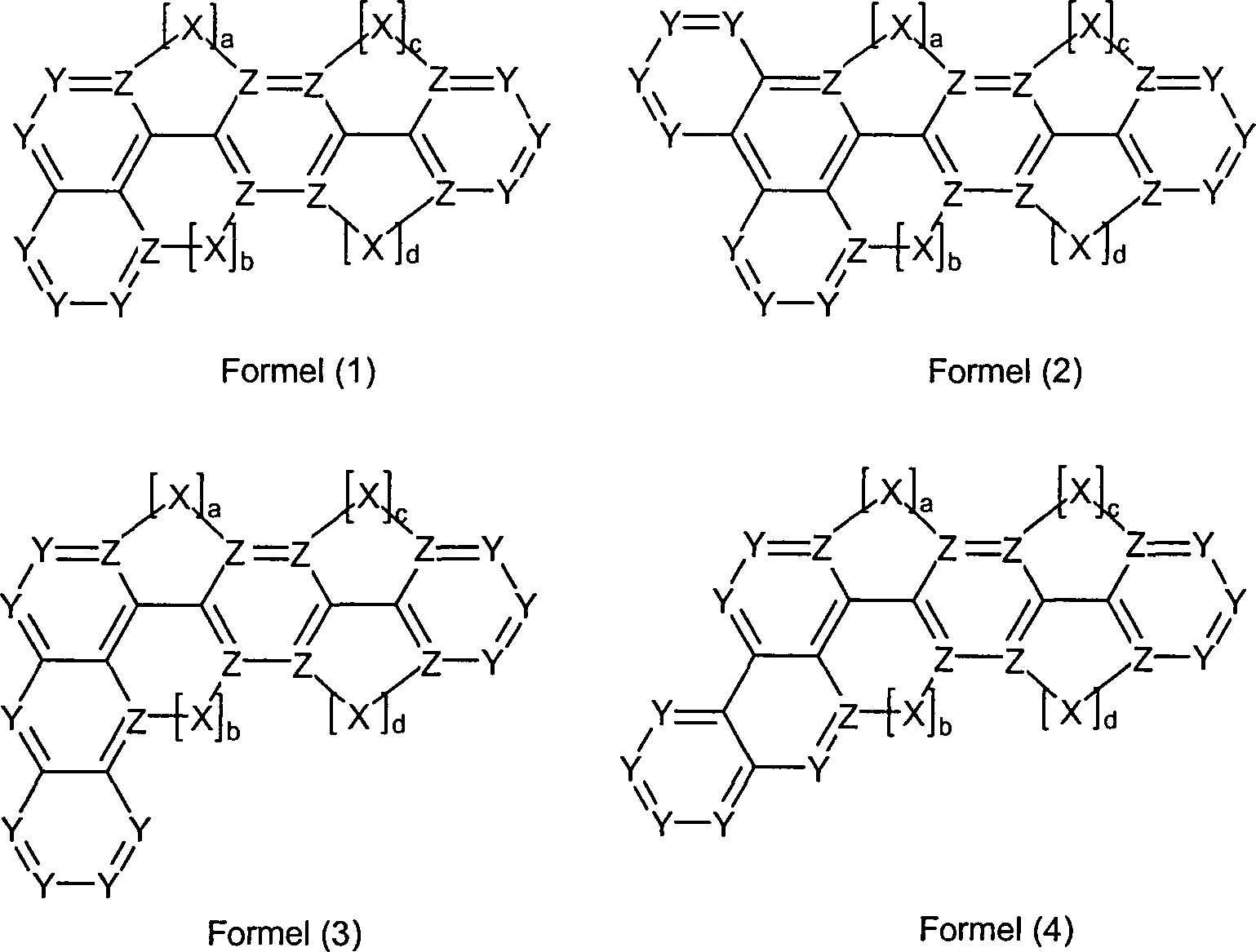
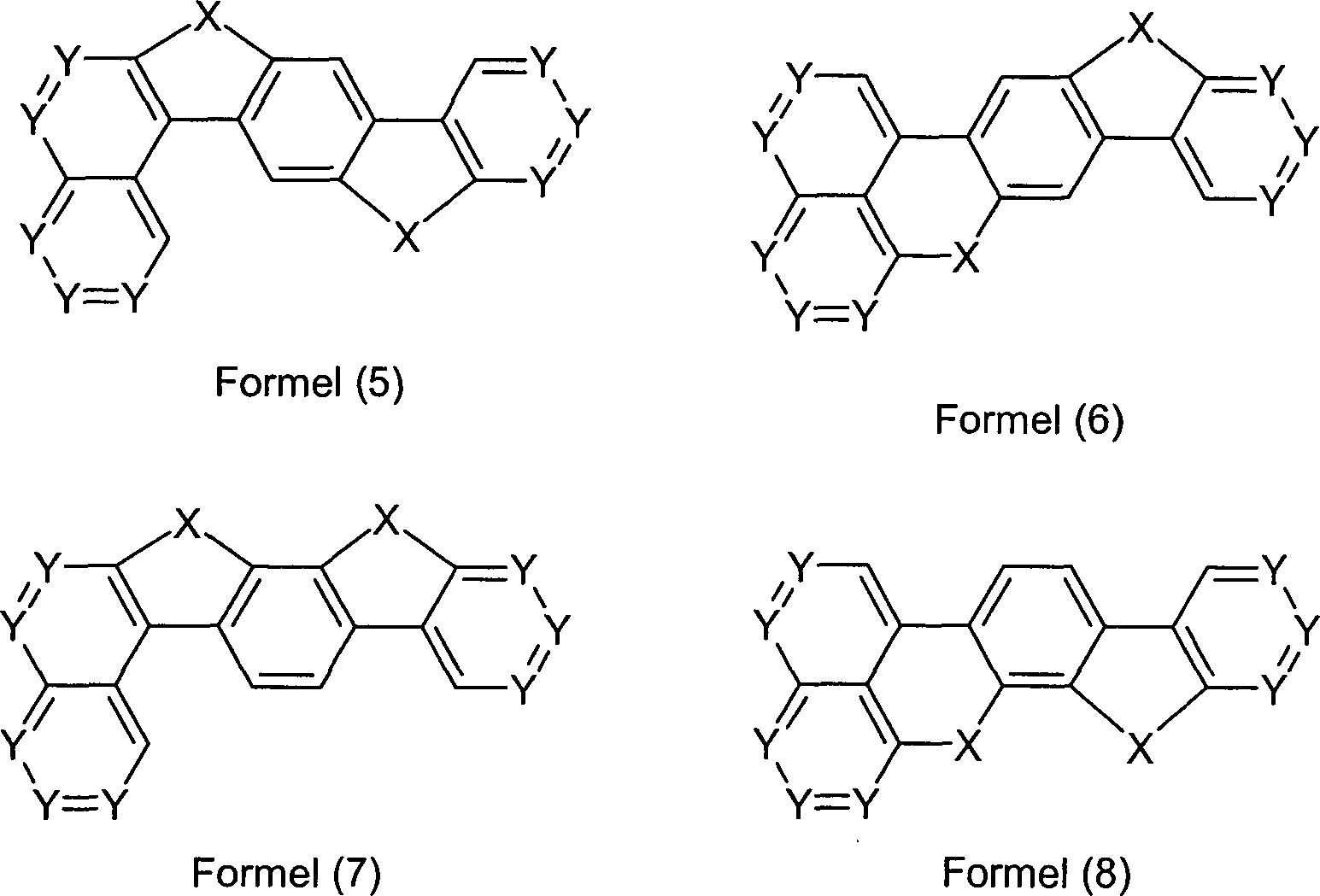

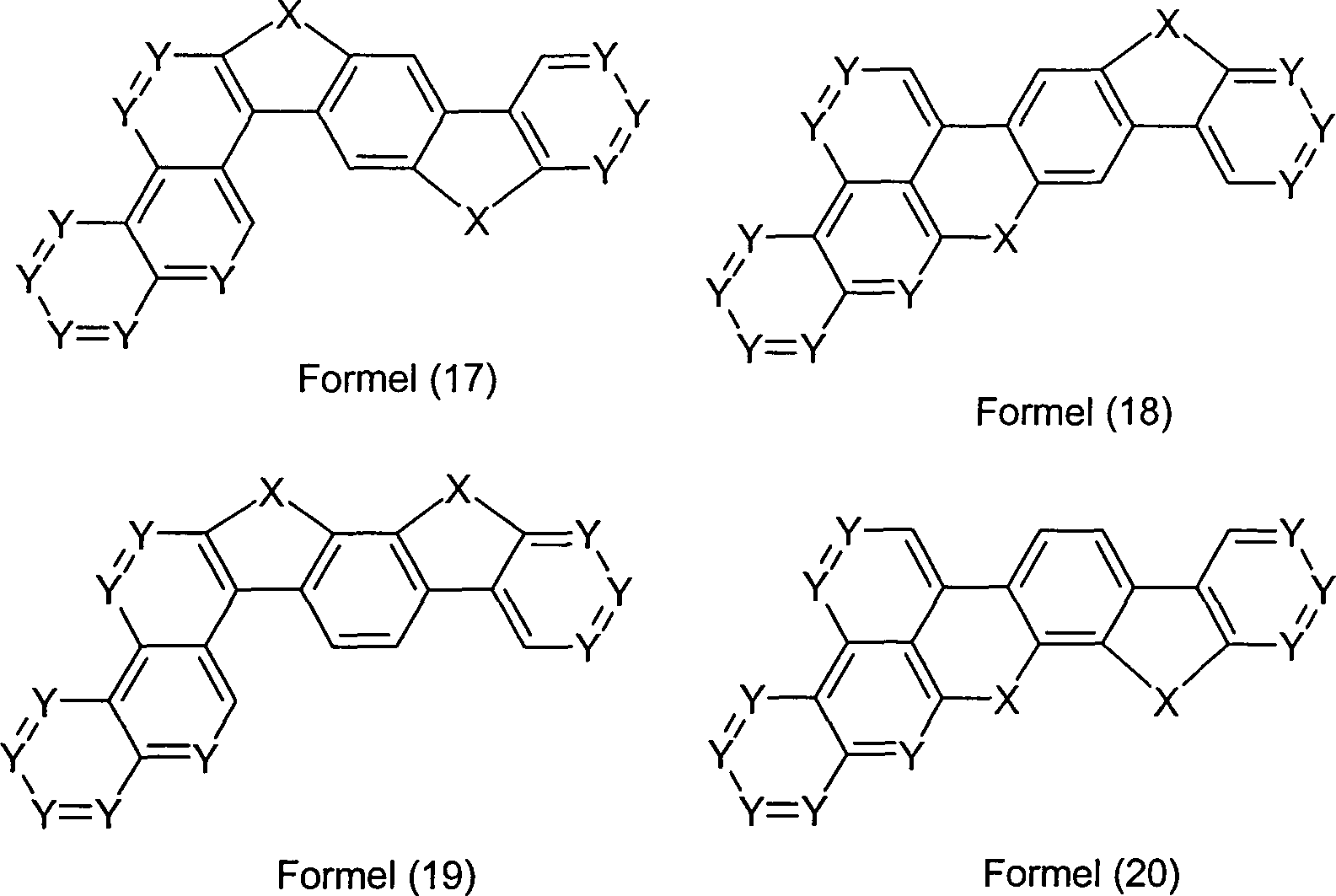

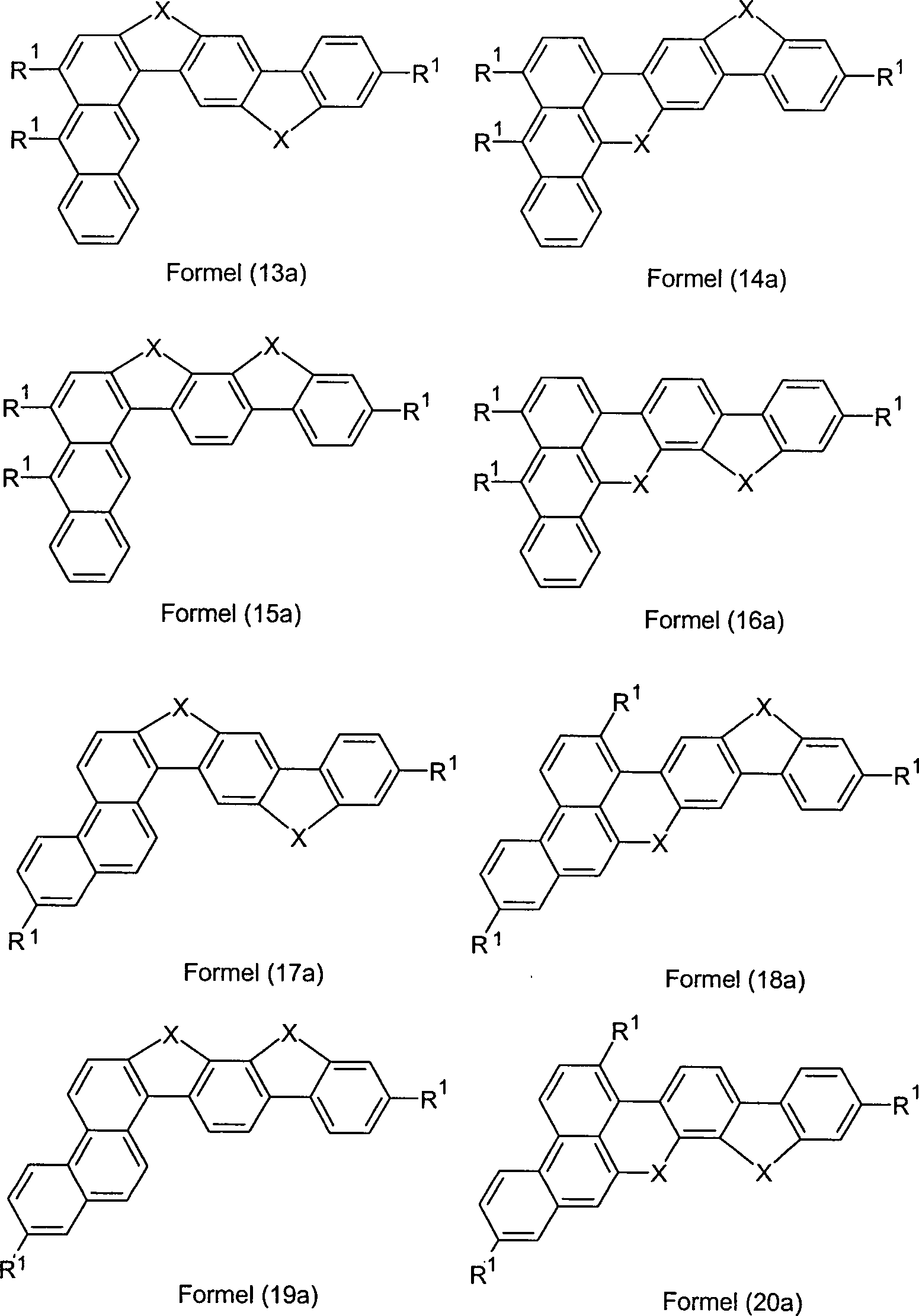
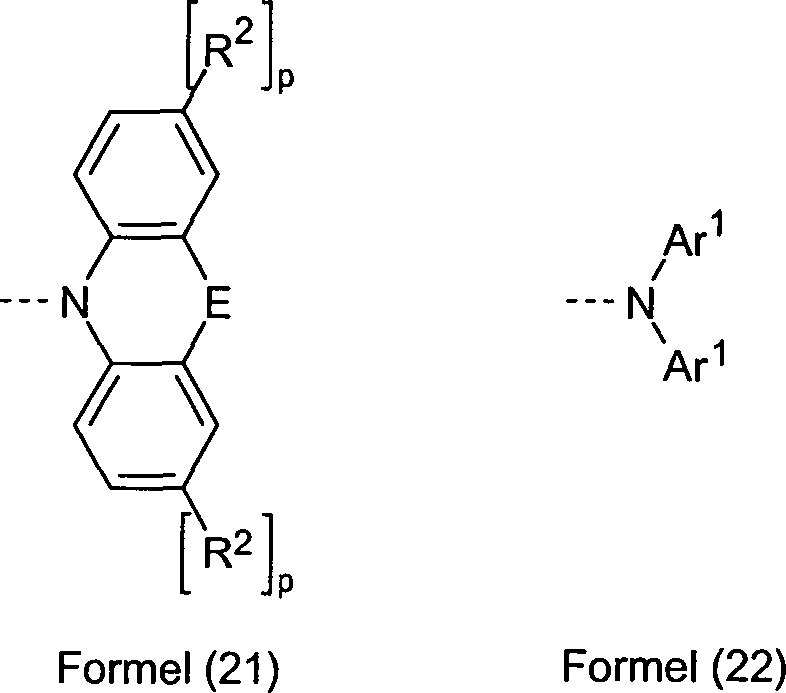
Priority Applications (10)
| Application Number | Priority Date | Filing Date | Title |
|---|---|---|---|
| DE102006031990A DE102006031990A1 (en) | 2006-07-11 | 2006-07-11 | New materials for organic electroluminescent devices |
| JP2009518737A JP5666130B2 (en) | 2006-07-11 | 2007-06-20 | Novel materials for organic electroluminescent devices |
| KR1020087023277A KR20080109000A (en) | 2006-07-11 | 2007-06-20 | New Materials for Organic Electroluminescent Devices |
| CN2007800261599A CN101490207B (en) | 2006-07-11 | 2007-06-20 | Novel materials for organic electroluminescent devices |
| EP07764736A EP2038370B1 (en) | 2006-07-11 | 2007-06-20 | Novel materials for organic electroluminescent devices |
| US12/373,070 US8241763B2 (en) | 2006-07-11 | 2007-06-20 | Materials for organic electroluminescent devices |
| PCT/EP2007/005413 WO2008006449A1 (en) | 2006-07-11 | 2007-06-20 | Novel materials for organic electroluminescent devices |
| AT07764736T ATE555181T1 (en) | 2006-07-11 | 2007-06-20 | NEW MATERIALS FOR ORGANIC ELECTROLUMINESCENCE DEVICES |
| TW096124774A TW200808683A (en) | 2006-07-11 | 2007-07-06 | Novel materials for organic electroluminescent devices |
| JP2014146961A JP2015007050A (en) | 2006-07-11 | 2014-07-17 | Novel materials for organic electroluminescent devices |
Applications Claiming Priority (1)
| Application Number | Priority Date | Filing Date | Title |
|---|---|---|---|
| DE102006031990A DE102006031990A1 (en) | 2006-07-11 | 2006-07-11 | New materials for organic electroluminescent devices |
Publications (1)
| Publication Number | Publication Date |
|---|---|
| DE102006031990A1 true DE102006031990A1 (en) | 2008-01-17 |
Family
ID=38326992
Family Applications (1)
| Application Number | Title | Priority Date | Filing Date |
|---|---|---|---|
| DE102006031990A Withdrawn DE102006031990A1 (en) | 2006-07-11 | 2006-07-11 | New materials for organic electroluminescent devices |
Country Status (9)
| Country | Link |
|---|---|
| US (1) | US8241763B2 (en) |
| EP (1) | EP2038370B1 (en) |
| JP (2) | JP5666130B2 (en) |
| KR (1) | KR20080109000A (en) |
| CN (1) | CN101490207B (en) |
| AT (1) | ATE555181T1 (en) |
| DE (1) | DE102006031990A1 (en) |
| TW (1) | TW200808683A (en) |
| WO (1) | WO2008006449A1 (en) |
Cited By (9)
| Publication number | Priority date | Publication date | Assignee | Title |
|---|---|---|---|---|
| DE102007024850A1 (en) | 2007-05-29 | 2008-12-04 | Merck Patent Gmbh | New materials for organic electroluminescent devices |
| WO2009127307A1 (en) * | 2008-04-14 | 2009-10-22 | Merck Patent Gmbh | Novel materials for organic electroluminescence devices |
| WO2010049050A1 (en) | 2008-10-31 | 2010-05-06 | Merck Patent Gmbh | Novel materials for organic electroluminescence devices |
| WO2010083873A1 (en) * | 2009-01-20 | 2010-07-29 | Merck Patent Gmbh | Materials for organic electroluminescence devices |
| WO2011091946A1 (en) * | 2010-01-30 | 2011-08-04 | Merck Patent Gmbh | Organic electroluminescent device comprising an integrated layer for colour conversion |
| EP2447334A4 (en) * | 2009-06-25 | 2013-01-02 | Cheil Ind Inc | COMPOUND FOR ORGANIC PHOTOELECTRIC ELEMENT, AND ORGANIC PHOTOELECTRIC ELEMENT COMPRISING SAME |
| EP2450975A3 (en) * | 2010-11-04 | 2013-04-10 | Cheil Industries Inc. | Compound for organic optoelectronic device and organic light emitting diode including the same |
| WO2017108152A1 (en) * | 2015-12-21 | 2017-06-29 | Merck Patent Gmbh | Materials for electronic devices |
| CN113173943A (en) * | 2021-05-10 | 2021-07-27 | 清华大学 | Fused ring compound, application thereof and organic electroluminescent device comprising fused ring compound |
Families Citing this family (365)
| Publication number | Priority date | Publication date | Assignee | Title |
|---|---|---|---|---|
| DE102005023437A1 (en) * | 2005-05-20 | 2006-11-30 | Merck Patent Gmbh | Connections for organic electronic devices |
| JP5552316B2 (en) * | 2007-10-04 | 2014-07-16 | 東京エレクトロン株式会社 | Plasma processing apparatus and plasma processing method |
| JP5400623B2 (en) * | 2008-02-04 | 2014-01-29 | 出光興産株式会社 | Aromatic amine derivative and organic electroluminescence device using the same |
| DE102008008953B4 (en) * | 2008-02-13 | 2019-05-09 | Merck Patent Gmbh | New materials for organic electroluminescent devices |
| DE102008017591A1 (en) | 2008-04-07 | 2009-10-08 | Merck Patent Gmbh | New materials for organic electroluminescent devices |
| US8049411B2 (en) | 2008-06-05 | 2011-11-01 | Idemitsu Kosan Co., Ltd. | Material for organic electroluminescence device and organic electroluminescence device using the same |
| DE102008033943A1 (en) | 2008-07-18 | 2010-01-21 | Merck Patent Gmbh | New materials for organic electroluminescent devices |
| DE102008035413A1 (en) | 2008-07-29 | 2010-02-04 | Merck Patent Gmbh | Connections for organic electronic devices |
| CN102224148B (en) * | 2008-09-23 | 2015-07-15 | 株式会社Lg化学 | Compound, method for preparing same, and organic electronic component using same |
| DE102008050841B4 (en) | 2008-10-08 | 2019-08-01 | Merck Patent Gmbh | New materials for organic electroluminescent devices |
| DE102008063490B4 (en) | 2008-12-17 | 2023-06-15 | Merck Patent Gmbh | Organic electroluminescent device and method for adjusting the color locus of a white-emitting electroluminescent device |
| DE102008064200A1 (en) | 2008-12-22 | 2010-07-01 | Merck Patent Gmbh | Organic electroluminescent device |
| DE102009005289B4 (en) | 2009-01-20 | 2023-06-22 | Merck Patent Gmbh | Materials for organic electroluminescent devices, methods for their production and electronic devices containing them |
| DE102009005746A1 (en) | 2009-01-23 | 2010-07-29 | Merck Patent Gmbh | Materials for organic electroluminescent devices |
| DE102009009277B4 (en) | 2009-02-17 | 2023-12-07 | Merck Patent Gmbh | Organic electronic device, process for its production and use of compounds |
| DE102009012346B4 (en) | 2009-03-09 | 2024-02-15 | Merck Patent Gmbh | Organic electroluminescent device and method for producing the same |
| KR101293320B1 (en) * | 2009-03-19 | 2013-08-05 | 미쓰이 가가쿠 가부시키가이샤 | Aromatic amine derivative and organic electroluminescent element using same |
| KR101511072B1 (en) * | 2009-03-20 | 2015-04-10 | 롬엔드하스전자재료코리아유한회사 | Novel organic electroluminescent compounds and organic electroluminescent device using the same |
| DE102009014513A1 (en) | 2009-03-23 | 2010-09-30 | Merck Patent Gmbh | Organic electroluminescent device |
| KR20100109293A (en) * | 2009-03-31 | 2010-10-08 | 다우어드밴스드디스플레이머티리얼 유한회사 | Novel organic electroluminescent compounds and organic electroluminescent device using the same |
| KR101427605B1 (en) * | 2009-03-31 | 2014-08-07 | 롬엔드하스전자재료코리아유한회사 | Novel organic light emitting compounds and organic electroluminescent devices employing the same |
| DE102009017064A1 (en) | 2009-04-09 | 2010-10-14 | Merck Patent Gmbh | Organic electroluminescent device |
| US8629430B2 (en) * | 2009-05-29 | 2014-01-14 | Idemitsu Kosan Co., Ltd. | Anthracene derivative and organic electroluminescent element using the same |
| DE102009023155A1 (en) | 2009-05-29 | 2010-12-02 | Merck Patent Gmbh | Materials for organic electroluminescent devices |
| EP2445976A2 (en) | 2009-06-22 | 2012-05-02 | Merck Patent GmbH | Conducting formulation |
| KR20100137198A (en) * | 2009-06-22 | 2010-12-30 | 다우어드밴스드디스플레이머티리얼 유한회사 | Novel organic light emitting compound and organic electroluminescent device comprising same |
| KR101174088B1 (en) * | 2009-06-25 | 2012-08-14 | 제일모직주식회사 | Compounds?for organic photoelectric?device and organic photoelectric?device containing the same |
| DE102009031021A1 (en) | 2009-06-30 | 2011-01-05 | Merck Patent Gmbh | Materials for organic electroluminescent devices |
| DE102009033371A1 (en) | 2009-07-16 | 2011-05-12 | Merck Patent Gmbh | Materials for electronic devices |
| KR20110009920A (en) * | 2009-07-23 | 2011-01-31 | 다우어드밴스드디스플레이머티리얼 유한회사 | Novel organic light emitting compound and organic electroluminescent device comprising same |
| DE102009034625A1 (en) | 2009-07-27 | 2011-02-03 | Merck Patent Gmbh | New materials for organic electroluminescent devices |
| EP2462203B1 (en) | 2009-08-04 | 2016-03-02 | Merck Patent GmbH | Electronic devices comprising multi cyclic hydrocarbons |
| KR101117723B1 (en) * | 2009-09-04 | 2012-03-07 | 삼성모바일디스플레이주식회사 | Organic light emitting device |
| JP5784608B2 (en) | 2009-09-16 | 2015-09-24 | メルク パテント ゲーエムベーハー | Formulations for electronic device manufacturing |
| DE102009041289A1 (en) | 2009-09-16 | 2011-03-17 | Merck Patent Gmbh | Organic electroluminescent device |
| DE102009053644B4 (en) | 2009-11-17 | 2019-07-04 | Merck Patent Gmbh | Materials for organic electroluminescent devices |
| DE102009042693A1 (en) | 2009-09-23 | 2011-03-24 | Merck Patent Gmbh | Materials for electronic devices |
| DE102009042680A1 (en) | 2009-09-23 | 2011-03-24 | Merck Patent Gmbh | Organic electroluminescent device |
| DE102009051172A1 (en) | 2009-10-29 | 2011-05-05 | Merck Patent Gmbh | Materials for electronic devices |
| DE102009053191A1 (en) | 2009-11-06 | 2011-05-12 | Merck Patent Gmbh | Materials for electronic devices |
| DE102009052428A1 (en) | 2009-11-10 | 2011-05-12 | Merck Patent Gmbh | Connection for electronic devices |
| WO2011076323A1 (en) | 2009-12-22 | 2011-06-30 | Merck Patent Gmbh | Formulations comprising phase-separated functional materials |
| EP2517278B1 (en) | 2009-12-22 | 2019-07-17 | Merck Patent GmbH | Electroluminescent formulations |
| JP5897472B2 (en) | 2009-12-22 | 2016-03-30 | メルク パテント ゲーエムベーハー | Electroluminescent functional surfactant |
| KR20170093267A (en) | 2009-12-23 | 2017-08-14 | 메르크 파텐트 게엠베하 | Compositions comprising organic semiconducting compounds |
| WO2011076325A1 (en) | 2009-12-23 | 2011-06-30 | Merck Patent Gmbh | Compositions comprising polymeric binders |
| DE102010005697A1 (en) | 2010-01-25 | 2011-07-28 | Merck Patent GmbH, 64293 | Connections for electronic devices |
| DE102010006377A1 (en) | 2010-01-29 | 2011-08-04 | Merck Patent GmbH, 64293 | Styrene-based copolymers, in particular for use in optoelectronic components |
| DE102010007938A1 (en) * | 2010-02-12 | 2011-10-06 | Merck Patent Gmbh | Electroluminescent polymers, process for their preparation and their use |
| DE102010009903A1 (en) | 2010-03-02 | 2011-09-08 | Merck Patent Gmbh | Connections for electronic devices |
| DE102010010481A1 (en) | 2010-03-06 | 2011-09-08 | Merck Patent Gmbh | Organic electroluminescent device |
| DE102010010631A1 (en) | 2010-03-09 | 2011-09-15 | Merck Patent Gmbh | Materials for electronic devices |
| WO2011110277A1 (en) | 2010-03-11 | 2011-09-15 | Merck Patent Gmbh | Fibers in therapy and cosmetics |
| US9373807B2 (en) | 2010-03-11 | 2016-06-21 | Merck Patent Gmbh | Radiative fibers |
| DE102010013068A1 (en) | 2010-03-26 | 2011-09-29 | Merck Patent Gmbh | Connections for electronic devices |
| WO2011128034A1 (en) | 2010-04-12 | 2011-10-20 | Merck Patent Gmbh | Composition having improved performance |
| US20130026421A1 (en) | 2010-04-12 | 2013-01-31 | Merck Patent Gmbh | Composition and method for preparation of organic electronic devices |
| DE102010014933A1 (en) | 2010-04-14 | 2011-10-20 | Merck Patent Gmbh | Materials for electronic devices |
| KR101778825B1 (en) | 2010-05-03 | 2017-09-14 | 메르크 파텐트 게엠베하 | Formulations and electronic devices |
| DE102010020044A1 (en) | 2010-05-11 | 2011-11-17 | Merck Patent Gmbh | Organic electroluminescent device |
| EP2576723B1 (en) * | 2010-05-27 | 2017-09-20 | Merck Patent GmbH | Compositions comprising quantum dots |
| KR101943110B1 (en) | 2010-05-27 | 2019-01-28 | 메르크 파텐트 게엠베하 | Formulation and method for preparation of organic electronic devices |
| WO2011147521A1 (en) | 2010-05-27 | 2011-12-01 | Merck Patent Gmbh | Down conversion |
| DE102010024335A1 (en) | 2010-06-18 | 2011-12-22 | Merck Patent Gmbh | Connections for electronic devices |
| DE102010024542A1 (en) | 2010-06-22 | 2011-12-22 | Merck Patent Gmbh | Materials for electronic devices |
| KR101202351B1 (en) * | 2010-07-16 | 2012-11-16 | 삼성디스플레이 주식회사 | Dendrimer and organic light emitting device using the same |
| JP2013539584A (en) | 2010-07-26 | 2013-10-24 | メルク パテント ゲーエムベーハー | Quantum dots and hosts |
| US20130226268A1 (en) | 2010-07-26 | 2013-08-29 | Merck Patent Gmbh | Nanocrystals in devices |
| KR101918304B1 (en) * | 2010-07-30 | 2018-11-13 | 호도가야 가가쿠 고교 가부시키가이샤 | Compound having indenocarbazole ring structure and organic electroluminescent element |
| DE102010033548A1 (en) | 2010-08-05 | 2012-02-09 | Merck Patent Gmbh | Materials for electronic devices |
| KR101423066B1 (en) | 2010-09-17 | 2014-07-25 | 롬엔드하스전자재료코리아유한회사 | Novel organic electroluminescent compounds and organic electroluminescent device using the same |
| DE102010048074A1 (en) | 2010-10-09 | 2012-04-12 | Merck Patent Gmbh | Materials for electronic devices |
| DE102010048607A1 (en) | 2010-10-15 | 2012-04-19 | Merck Patent Gmbh | Connections for electronic devices |
| DE102010048608A1 (en) | 2010-10-15 | 2012-04-19 | Merck Patent Gmbh | Materials for organic electroluminescent devices |
| KR101832171B1 (en) | 2010-10-25 | 2018-04-16 | 삼성디스플레이 주식회사 | A condensed-cyclic compound, an organic light emitting diode comprising the same and flat display device |
| CN102464794B (en) * | 2010-11-16 | 2014-05-07 | 海洋王照明科技股份有限公司 | Copolymer containing benzotriazol group as well as preparation method and application of copolymer |
| DE102010054316A1 (en) | 2010-12-13 | 2012-06-14 | Merck Patent Gmbh | Substituted tetraarylbenzenes |
| DE102010054525A1 (en) | 2010-12-15 | 2012-04-26 | Merck Patent Gmbh | Organic electroluminescent device |
| DE102010055902A1 (en) | 2010-12-23 | 2012-06-28 | Merck Patent Gmbh | Organic electroluminescent device |
| DE102010055901A1 (en) | 2010-12-23 | 2012-06-28 | Merck Patent Gmbh | Organic electroluminescent device |
| EP2663567B1 (en) | 2011-01-13 | 2016-06-01 | Merck Patent GmbH | Compounds for organic electroluminescent devices |
| US9184395B2 (en) | 2011-01-14 | 2015-11-10 | Idemitsu Kosan Co., Ltd. | Aromatic amine derivative and organic electroluminescent element using same |
| CN102617626B (en) | 2011-01-17 | 2016-12-14 | 三星显示有限公司 | Condensed-cyclic compound and the Organic Light Emitting Diode including this condensed-cyclic compound |
| US9653689B2 (en) | 2011-01-17 | 2017-05-16 | Samsung Display Co., Ltd. | Condensed-cyclic compound and organic light-emitting diode including the same |
| DE102011011104A1 (en) | 2011-02-12 | 2012-08-16 | Merck Patent Gmbh | Substituted dibenzonaphthacenes |
| JP6351974B2 (en) | 2011-02-14 | 2018-07-04 | メルク パテント ゲーエムベーハー | Devices and methods for treatment of cells and cellular tissues |
| DE102011011539A1 (en) | 2011-02-17 | 2012-08-23 | Merck Patent Gmbh | Connections for electronic devices |
| WO2012126566A1 (en) | 2011-03-24 | 2012-09-27 | Merck Patent Gmbh | Organic ionic functional materials |
| EP2697226B1 (en) | 2011-04-13 | 2017-01-18 | Merck Patent GmbH | Compounds for electronic devices |
| CN103476774B (en) | 2011-04-13 | 2017-02-15 | 默克专利有限公司 | Materials for Electronic Devices |
| EP2699641B1 (en) | 2011-04-18 | 2017-05-17 | Merck Patent GmbH | Compounds for electronic devices |
| KR101123047B1 (en) * | 2011-04-29 | 2012-03-16 | 덕산하이메탈(주) | Chemical and organic electronic element using the same, electronic device thereof |
| WO2012149992A1 (en) | 2011-05-04 | 2012-11-08 | Merck Patent Gmbh | Device for preserving fresh goods |
| JP6195823B2 (en) | 2011-05-05 | 2017-09-13 | メルク パテント ゲーエムベーハー | Compounds for electronic devices |
| JP6223961B2 (en) | 2011-05-12 | 2017-11-01 | メルク パテント ゲーエムベーハー | Organic ionic functional material, composition and electronic device |
| DE102011104745A1 (en) | 2011-06-17 | 2012-12-20 | Merck Patent Gmbh | Materials for organic electroluminescent devices |
| US9373793B2 (en) | 2011-06-27 | 2016-06-21 | Lg Chem, Ltd. | Compound and organic light-emitting device using same |
| WO2013013754A1 (en) | 2011-07-25 | 2013-01-31 | Merck Patent Gmbh | Copolymers with functionalized side chains |
| US9780311B2 (en) | 2011-07-29 | 2017-10-03 | Merck Patent Gmbh | Compounds for electronic devices |
| WO2013017192A1 (en) | 2011-08-03 | 2013-02-07 | Merck Patent Gmbh | Materials for electronic devices |
| DE102012016192A1 (en) | 2011-08-19 | 2013-02-21 | Merck Patent Gmbh | New compounds capable of forming hydrogen bonds are useful in electronic device, e.g. organic electroluminescent device, organic light-emitting transistor and organic light-emitting electrochemical cell |
| KR102051790B1 (en) | 2011-08-22 | 2019-12-04 | 메르크 파텐트 게엠베하 | Organic electroluminescence device |
| JP2015013804A (en) * | 2011-09-16 | 2015-01-22 | 出光興産株式会社 | Aromatic amine derivative and organic electroluminescent element using the same |
| CN102437290B (en) * | 2011-09-28 | 2016-03-23 | 昆山维信诺显示技术有限公司 | A kind of display of organic electroluminescence blue-light device and preparation method thereof |
| US9356242B2 (en) | 2011-10-06 | 2016-05-31 | Merck Patent Gmbh | Organic electroluminescent device |
| JP6223984B2 (en) | 2011-10-27 | 2017-11-01 | メルク パテント ゲーエムベーハー | Materials for electronic devices |
| DE102011117422A1 (en) | 2011-10-28 | 2013-05-02 | Merck Patent Gmbh | Hyperbranched polymers, process for their preparation and their use in electronic devices |
| KR101954980B1 (en) * | 2011-11-03 | 2019-05-31 | 삼성디스플레이 주식회사 | Heterocyclic compound and organic light-emitting diode comprising the same |
| EP2776386B1 (en) * | 2011-11-11 | 2019-11-20 | Merck Patent GmbH | Process for producing arylamines |
| DE102011121022A1 (en) | 2011-12-13 | 2013-06-13 | Merck Patent Gmbh | Organic sensitizers for up-conversion |
| DE102012022880B4 (en) | 2011-12-22 | 2024-12-24 | Merck Patent Gmbh | Electronic devices containing organic layers |
| KR20140123555A (en) | 2012-01-30 | 2014-10-22 | 메르크 파텐트 게엠베하 | Nanocrystals on fibers |
| KR102357439B1 (en) | 2012-02-14 | 2022-02-08 | 메르크 파텐트 게엠베하 | Spirobifluorene compounds for organic electroluminescent devices |
| CN104205390B (en) | 2012-03-15 | 2017-08-25 | 默克专利有限公司 | Electronic device |
| KR101973166B1 (en) | 2012-03-27 | 2019-04-29 | 삼성디스플레이 주식회사 | Organic light-emitting device and organic light-emitting display apparatus including the same |
| DE102012011335A1 (en) | 2012-06-06 | 2013-12-12 | Merck Patent Gmbh | Connections for Organic Electronic Devices |
| CN108054293B (en) | 2012-07-23 | 2020-05-22 | 默克专利有限公司 | Derivatives of 2-diarylaminofluorene and organic electronic complexes containing said 2-diarylaminofluorene derivatives |
| KR20210076207A (en) | 2012-07-23 | 2021-06-23 | 메르크 파텐트 게엠베하 | Fluorenes and electronic devices containing them |
| CN110444694B (en) | 2012-07-23 | 2023-04-07 | 默克专利有限公司 | Compound and organic electroluminescent device |
| CN103570628B (en) * | 2012-07-27 | 2016-01-20 | 昆山维信诺显示技术有限公司 | A kind of benzo indeno fluorene derivatives and application containing pyrimidine or pyrazine or triazine group |
| JP6284940B2 (en) * | 2012-09-04 | 2018-02-28 | メルク パテント ゲーエムベーハー | Compounds for electronic devices |
| KR102184852B1 (en) | 2012-09-18 | 2020-12-01 | 메르크 파텐트 게엠베하 | Materials for electronic devices |
| JP6091151B2 (en) * | 2012-10-15 | 2017-03-08 | 富士フイルム株式会社 | Organic thin film transistor, organic semiconductor thin film and organic semiconductor material |
| KR101963104B1 (en) | 2012-10-31 | 2019-03-28 | 메르크 파텐트 게엠베하 | Electronic device |
| WO2014072017A1 (en) | 2012-11-12 | 2014-05-15 | Merck Patent Gmbh | Materials for electronic devices |
| KR102173856B1 (en) | 2012-11-30 | 2020-11-04 | 메르크 파텐트 게엠베하 | Electronic device |
| WO2014106523A1 (en) | 2013-01-03 | 2014-07-10 | Merck Patent Gmbh | Electronic device |
| EP2941472B1 (en) * | 2013-01-03 | 2018-07-25 | Merck Patent GmbH | Materials for electronic devices |
| US20150340627A1 (en) | 2013-01-03 | 2015-11-26 | Merck Patent Gmbh | Materials for electronic devices |
| KR102029696B1 (en) * | 2013-03-07 | 2019-10-08 | 덕산네오룩스 주식회사 | Compound for organic electronic element, organic electronic element using the same, and an electronic device thereof |
| WO2014141725A1 (en) | 2013-03-15 | 2014-09-18 | 出光興産株式会社 | Anthracene derivative and organic electroluminescence element using same |
| US8945978B2 (en) * | 2013-06-28 | 2015-02-03 | Sunpower Corporation | Formation of metal structures in solar cells |
| JP6348113B2 (en) * | 2013-07-01 | 2018-06-27 | 出光興産株式会社 | COMPOUND, MATERIAL FOR ORGANIC ELECTROLUMINESCENT ELEMENT, ORGANIC ELECTROLUMINESCENT ELEMENT, AND ELECTRONIC DEVICE |
| EP3028318A1 (en) | 2013-07-29 | 2016-06-08 | Merck Patent GmbH | Electro-optical device and the use thereof |
| JP6567519B2 (en) | 2013-07-29 | 2019-08-28 | メルク、パテント、ゲゼルシャフト、ミット、ベシュレンクテル、ハフツングMerck Patent GmbH | Electroluminescence element |
| WO2015014434A1 (en) | 2013-07-30 | 2015-02-05 | Merck Patent Gmbh | Materials for electronic devices |
| WO2015014435A1 (en) | 2013-07-30 | 2015-02-05 | Merck Patent Gmbh | Materials for electronic devices |
| EP3057947B1 (en) * | 2013-10-14 | 2018-10-17 | Merck Patent GmbH | Materials for electronic devices |
| WO2015082037A1 (en) | 2013-12-06 | 2015-06-11 | Merck Patent Gmbh | Compositions containing a polymeric binder which comprises acrylic and/or methacrylic acid ester units |
| KR102380808B1 (en) | 2013-12-06 | 2022-03-30 | 메르크 파텐트 게엠베하 | Substituted oxepines |
| EP3080229B1 (en) | 2013-12-12 | 2018-01-17 | Merck Patent GmbH | Materials for electronic devices |
| WO2015091716A1 (en) | 2013-12-20 | 2015-06-25 | Basf Se | Highly efficient oled devices with very short decay times |
| KR102184675B1 (en) * | 2014-03-19 | 2020-12-01 | 삼성디스플레이 주식회사 | Condensed-cyclic compound and organic light emitting diode comprising the same |
| CN106255687B (en) | 2014-04-30 | 2020-06-05 | 默克专利有限公司 | Material for electronic devices |
| DE102014008722B4 (en) | 2014-06-18 | 2024-08-22 | Merck Patent Gmbh | Compositions for electronic devices, formulation containing them, use of the composition, use of the formulation and organic electronic device containing the composition |
| WO2016031785A1 (en) * | 2014-08-26 | 2016-03-03 | 出光興産株式会社 | Organic electroluminescent element and electronic device |
| EP3189551B1 (en) | 2014-09-05 | 2021-01-27 | Merck Patent GmbH | Formulations and method of producing an organic electroluminescent device |
| WO2016056640A1 (en) | 2014-10-09 | 2016-04-14 | 出光興産株式会社 | Compound, organic electroluminescent element material, organic electroluminescent element, and electronic apparatus |
| WO2016086885A1 (en) | 2014-12-04 | 2016-06-09 | 广州华睿光电材料有限公司 | Deuterated organic compound, mixture and composition containing said compound, and organic electronic device |
| EP3229288B1 (en) * | 2014-12-04 | 2019-05-01 | Guangzhou Chinaray Optoelectronic Materials Ltd. | Polymer, and mixture, formulation and organic electronic device containing the same, and monomer thereof |
| US10510967B2 (en) | 2014-12-11 | 2019-12-17 | Guangzhou Chinaray Optoelectronic Materials Ltd. | Organic compound, and mixture, formulation and organic device comprising the same |
| CN107001336A (en) | 2014-12-11 | 2017-08-01 | 广州华睿光电材料有限公司 | A kind of organometallic complex, polymer comprising it, mixture, composition, organic electronic device and application |
| WO2016107663A1 (en) | 2014-12-30 | 2016-07-07 | Merck Patent Gmbh | Formulations and electronic devices |
| KR102360091B1 (en) * | 2014-12-31 | 2022-02-09 | 삼성디스플레이 주식회사 | Condensed-cyclic compound and organic light emitting device comprising the same |
| EP3250658B1 (en) | 2015-01-30 | 2019-06-19 | Merck Patent GmbH | Materials for electronic devices |
| JP7030519B2 (en) | 2015-01-30 | 2022-03-07 | メルク パテント ゲーエムベーハー | Formulations with low particle content |
| JP6772188B2 (en) | 2015-02-03 | 2020-10-21 | メルク、パテント、ゲゼルシャフト、ミット、ベシュレンクテル、ハフツングMerck Patent GmbH | Metal complex |
| WO2016150544A1 (en) * | 2015-03-25 | 2016-09-29 | Merck Patent Gmbh | Materials for organic electroluminescent devices |
| WO2016155866A1 (en) | 2015-03-30 | 2016-10-06 | Merck Patent Gmbh | Formulation of an organic functional material comprising a siloxane solvent |
| KR102610370B1 (en) | 2015-05-18 | 2023-12-05 | 메르크 파텐트 게엠베하 | Materials for organic electroluminescent devices |
| US20160351817A1 (en) * | 2015-05-27 | 2016-12-01 | Samsung Display Co., Ltd. | Organic light-emitting device |
| EP4060757A1 (en) | 2015-06-03 | 2022-09-21 | UDC Ireland Limited | Highly efficient oled devices with very short decay times |
| KR102654992B1 (en) | 2015-06-12 | 2024-04-04 | 메르크 파텐트 게엠베하 | Esters containing non-aromatic cycles as solvents for oled formulations |
| US20180212166A1 (en) | 2015-07-15 | 2018-07-26 | Merck Patent Gmbh | Composition comprising organic semiconducting compounds |
| GB201513037D0 (en) | 2015-07-23 | 2015-09-09 | Merck Patent Gmbh | Phenyl-derived compound for use in organic electronic devices |
| JP6786591B2 (en) | 2015-08-14 | 2020-11-18 | メルク、パテント、ゲゼルシャフト、ミット、ベシュレンクテル、ハフツングMerck Patent GmbH | Phenoxazine derivatives for organic electroluminescence devices |
| EP3341981B1 (en) | 2015-08-28 | 2020-08-19 | Merck Patent GmbH | Formulation of an organic functional material comprising an epoxy group containing solvent |
| US20180327339A1 (en) | 2015-08-28 | 2018-11-15 | Merck Patent Gmbh | Compounds for electronic devices |
| KR102487494B1 (en) * | 2015-10-20 | 2023-01-12 | 솔루스첨단소재 주식회사 | Organic compound and organic electroluminescent device comprising the same |
| CN108291103B (en) | 2015-11-12 | 2021-12-07 | 广州华睿光电材料有限公司 | Printing composition, electronic device comprising same and preparation method of functional material film |
| KR20170061227A (en) | 2015-11-25 | 2017-06-05 | 삼성디스플레이 주식회사 | An organic film forming composition and electronic apparatus comprising a cured product thereof |
| CN108368361A (en) | 2015-12-10 | 2018-08-03 | 默克专利有限公司 | Preparation containing the ketone comprising non-aromatic ring |
| JP7051684B2 (en) | 2015-12-15 | 2022-04-11 | メルク パテント ゲーエムベーハー | Esters containing aromatic groups as solvents for organic electronic formulations |
| KR20180095028A (en) | 2015-12-16 | 2018-08-24 | 메르크 파텐트 게엠베하 | A formulation containing a mixture of two or more different solvents |
| EP3390549B1 (en) | 2015-12-16 | 2022-06-29 | Merck Patent GmbH | Formulations containing a solid solvent |
| KR102602194B1 (en) * | 2016-01-05 | 2023-11-15 | 삼성디스플레이 주식회사 | Condensed-cyclic compound and organic light-emitting device comprising the same |
| KR102547684B1 (en) * | 2016-01-05 | 2023-06-27 | 삼성디스플레이 주식회사 | Condensed-cyclic compound and organic light-emitting device comprising the same |
| US10553800B2 (en) * | 2016-01-05 | 2020-02-04 | Samsung Display Co., Ltd. | Condensed cyclic compound and an organic light-emitting device including the same |
| WO2017133829A1 (en) | 2016-02-05 | 2017-08-10 | Merck Patent Gmbh | Materials for electronic devices |
| US10840448B2 (en) | 2016-02-17 | 2020-11-17 | Merck Patent Gmbh | Formulation of an organic functional material |
| DE102016003104A1 (en) | 2016-03-15 | 2017-09-21 | Merck Patent Gmbh | Container comprising a formulation containing at least one organic semiconductor |
| KR102498304B1 (en) * | 2016-04-20 | 2023-02-10 | 덕산네오룩스 주식회사 | Compound for organic electric element, organic electric element comprising the same and electronic device thereof |
| KR102498307B1 (en) * | 2016-04-22 | 2023-02-09 | 덕산네오룩스 주식회사 | Compound for organic electric element, organic electric element comprising the same and electronic device thereof |
| CN105924325B (en) * | 2016-05-18 | 2018-11-30 | 东阳市天齐知识产权运营有限公司 | A kind of preparation method of 6,6,12,12- tetramethyl -6,12- dihydro indeno [1,2-b] fluorenes |
| CN105949020B (en) * | 2016-05-18 | 2018-09-28 | 烟台新特路新材料科技有限公司 | A kind of preparation method of 6,6,12,12- tetramethyls -6,12- dihydros indeno [1,2-b] fluorenes |
| CN106008136B (en) * | 2016-05-18 | 2018-09-28 | 上海博栋化学科技有限公司 | A kind of preparation method of 6,6,12,12- tetramethyls -6,12- dihydros indeno [1,2-b] fluorenes |
| KR101872961B1 (en) * | 2016-05-27 | 2018-06-29 | 엘지디스플레이 주식회사 | Organic compounds and light emitting diode and organic light emitting diode display device using the compounds |
| CN109153871A (en) | 2016-06-16 | 2019-01-04 | 默克专利有限公司 | The preparation of organic functional material |
| JP2019523998A (en) | 2016-06-17 | 2019-08-29 | メルク パテント ゲーエムベーハー | Formulation of organic functional materials |
| TW201815998A (en) | 2016-06-28 | 2018-05-01 | 德商麥克專利有限公司 | Organic functional material formulation |
| CN107573925B (en) * | 2016-07-05 | 2020-02-21 | 上海和辉光电有限公司 | Organic electroluminescent compound |
| US11365167B2 (en) | 2016-07-08 | 2022-06-21 | Merck Patent Gmbh | Materials for organic electroluminescent devices |
| WO2018024719A1 (en) | 2016-08-04 | 2018-02-08 | Merck Patent Gmbh | Formulation of an organic functional material |
| CN106397398A (en) * | 2016-08-31 | 2017-02-15 | 北京绿人科技有限责任公司 | Organic compound and application thereof to organic electroluminescent devices |
| TWI764942B (en) | 2016-10-10 | 2022-05-21 | 德商麥克專利有限公司 | Electronic device |
| DE102017008794A1 (en) | 2016-10-17 | 2018-04-19 | Merck Patent Gmbh | Materials for use in electronic devices |
| CN109863223B (en) | 2016-10-31 | 2023-06-20 | 默克专利有限公司 | Formulation of organic functional materials |
| JP7013459B2 (en) | 2016-10-31 | 2022-01-31 | メルク パテント ゲーエムベーハー | Formulation of organic functional materials |
| JP2020512273A (en) | 2016-11-02 | 2020-04-23 | メルク パテント ゲーエムベーハー | Materials for electronic devices |
| JP7073388B2 (en) | 2016-11-08 | 2022-05-23 | メルク パテント ゲーエムベーハー | Compounds for electronic devices |
| TW201833118A (en) | 2016-11-22 | 2018-09-16 | 德商麥克專利有限公司 | Materials for electronic devices |
| WO2018095389A1 (en) | 2016-11-23 | 2018-05-31 | 广州华睿光电材料有限公司 | Nitrogen-containing fused heterocyclic ring compound and application thereof |
| CN109790407B (en) | 2016-11-23 | 2021-12-07 | 广州华睿光电材料有限公司 | Printing ink composition, preparation method and application thereof |
| US11512039B2 (en) | 2016-11-23 | 2022-11-29 | Guangzhou Chinaray Optoelectronic Materials Ltd. | Aromatic amine derivatives, preparation methods therefor, and uses thereof |
| US20190378991A1 (en) | 2016-11-23 | 2019-12-12 | Guangzhou Chinaray Optoelectronic Materials Ltd. | Organic mixture, composition, and organic electronic component |
| WO2018095395A1 (en) | 2016-11-23 | 2018-05-31 | 广州华睿光电材料有限公司 | High polymer, mixture containing same, composition, organic electronic component, and monomer for polymerization |
| US11518723B2 (en) | 2016-11-23 | 2022-12-06 | Guangzhou Chinaray Optoelectronic Materials Ltd. | Fused ring compound, high polymer, mixture, composition and organic electronic component |
| CN109790194B (en) | 2016-11-23 | 2021-07-23 | 广州华睿光电材料有限公司 | Metal-organic complexes, polymers, compositions and organic electronic devices |
| JP7101670B2 (en) | 2016-11-25 | 2022-07-15 | メルク パテント ゲゼルシャフト ミット ベシュレンクテル ハフツング | Bisbenzofuran Condensation 2,8-diaminoindeno [1,2-B] Fluorene Derivatives and Related Compounds as Materials for Organic Electroluminescence Devices (OLEDs) |
| US11453680B2 (en) | 2016-11-25 | 2022-09-27 | Merck Patent Gmbh | Bisbenzofuran-fused indeno[1,2-B]fluorene derivatives and related compounds as materials for organic electroluminescent devices (OLED) |
| CN108129431B (en) * | 2016-12-01 | 2023-04-07 | 北京鼎材科技有限公司 | Fluorenonaphthofuran derivative and application thereof |
| KR102472751B1 (en) | 2016-12-06 | 2022-11-30 | 메르크 파텐트 게엠베하 | Manufacturing method of electronic device |
| US11672174B2 (en) | 2016-12-08 | 2023-06-06 | Guangzhou Chinaray Optoelectronic Materials Ltd. | Pyrene-triazine derivative and applications thereof in organic electronic component |
| EP3553152B1 (en) | 2016-12-08 | 2021-02-17 | Guangzhou Chinaray Optoelectronic Materials Ltd. | Mixture, composition and organic electronic device |
| CN109790118A (en) | 2016-12-13 | 2019-05-21 | 广州华睿光电材料有限公司 | Conjugated polymer and its application in organic electronic device |
| CN110168047B (en) | 2016-12-13 | 2023-08-08 | 默克专利有限公司 | Preparation of organic functional material |
| US11261291B2 (en) | 2016-12-22 | 2022-03-01 | Merck Patent Gmbh | Materials for electronic devices |
| KR102109545B1 (en) | 2016-12-22 | 2020-05-12 | 삼성에스디아이 주식회사 | Composition for organic optoelectric device and organic optoelectric device and display device |
| US11289654B2 (en) | 2016-12-22 | 2022-03-29 | Guangzhou Chinaray Optoelectronic Materials Ltd. | Polymers containing furanyl crosslinkable groups and uses thereof |
| KR102504432B1 (en) | 2016-12-22 | 2023-02-27 | 메르크 파텐트 게엠베하 | A mixture comprising at least two organo-functional compounds |
| CN109792003B (en) | 2016-12-22 | 2020-10-16 | 广州华睿光电材料有限公司 | Diels-Alder Reaction-Based Crosslinkable Polymers and Their Applications in Organic Electronic Devices |
| CN110177855A (en) | 2017-01-23 | 2019-08-27 | 默克专利有限公司 | Material for organic electroluminescence device |
| TW201833300A (en) * | 2017-01-25 | 2018-09-16 | 德商麥克專利有限公司 | Carbazole derivatives |
| TWI763772B (en) | 2017-01-30 | 2022-05-11 | 德商麥克專利有限公司 | Method for forming an organic element of an electronic device |
| TWI791481B (en) | 2017-01-30 | 2023-02-11 | 德商麥克專利有限公司 | Method for forming an organic electroluminescence (el) element |
| CN110291064B (en) | 2017-02-02 | 2023-04-28 | 默克专利有限公司 | Materials for Electronic Devices |
| KR20190126097A (en) | 2017-03-01 | 2019-11-08 | 메르크 파텐트 게엠베하 | Organic electroluminescent devices |
| CN110325524A (en) | 2017-03-02 | 2019-10-11 | 默克专利有限公司 | Material for organic electronic device |
| JP7175259B2 (en) * | 2017-03-03 | 2022-11-18 | 株式会社半導体エネルギー研究所 | organic compounds, light-emitting elements, light-emitting devices, electronic devices, and lighting devices |
| JP7123967B2 (en) | 2017-03-31 | 2022-08-23 | メルク パテント ゲーエムベーハー | Printing method for organic light emitting diodes (OLEDs) |
| CN110494514A (en) | 2017-04-10 | 2019-11-22 | 默克专利有限公司 | Formulation of organic functional materials |
| WO2018189134A1 (en) | 2017-04-13 | 2018-10-18 | Merck Patent Gmbh | Composition for organic electronic devices |
| CN110573515B (en) | 2017-04-25 | 2023-07-25 | 默克专利有限公司 | Compounds for electronic devices |
| JP7330898B2 (en) | 2017-05-03 | 2023-08-22 | メルク パテント ゲーエムベーハー | Formulation of organic functional material |
| TW201920343A (en) | 2017-06-21 | 2019-06-01 | 德商麥克專利有限公司 | Materials for electronic devices |
| US11767299B2 (en) | 2017-06-23 | 2023-09-26 | Merck Patent Gmbh | Materials for organic electroluminescent devices |
| CN110770363A (en) | 2017-06-26 | 2020-02-07 | 默克专利有限公司 | Homogeneous mixture |
| TW201920070A (en) | 2017-06-28 | 2019-06-01 | 德商麥克專利有限公司 | Material for electronic devices |
| TWI813576B (en) | 2017-07-03 | 2023-09-01 | 德商麥克專利有限公司 | Formulations with a low content of phenol type impurities |
| TWI786143B (en) | 2017-07-03 | 2022-12-11 | 德商麥克專利有限公司 | Organic electroluminescent device and method for producing the same |
| CN110785415A (en) | 2017-07-05 | 2020-02-11 | 默克专利有限公司 | Composition for organic electronic device |
| WO2019007867A1 (en) | 2017-07-05 | 2019-01-10 | Merck Patent Gmbh | COMPOSITION FOR ORGANIC ELECTRONIC DEVICES |
| WO2019016184A1 (en) | 2017-07-18 | 2019-01-24 | Merck Patent Gmbh | Formulation of an organic functional material |
| TWI776926B (en) | 2017-07-25 | 2022-09-11 | 德商麥克專利有限公司 | Metal complexes |
| TWI779067B (en) | 2017-07-28 | 2022-10-01 | 德商麥克專利有限公司 | Materials for electronic devices |
| CN107445954B (en) * | 2017-08-14 | 2019-04-02 | 中节能万润股份有限公司 | A kind of electroluminescent organic material, preparation method and application with fluorenes and ferrosin structure |
| CN107501101A (en) * | 2017-08-30 | 2017-12-22 | 华南理工大学 | A kind of organic light emission small molecule material of the fluorenes of indenes containing naphtho- unit and preparation method and application |
| CN118405981A (en) | 2017-09-08 | 2024-07-30 | 默克专利有限公司 | Materials for electronic devices |
| CN109575054A (en) * | 2017-09-29 | 2019-04-05 | 江苏三月光电科技有限公司 | A kind of boracic hexa-member heterocycle derivative and its application in organic electroluminescence device |
| CN107629197B (en) * | 2017-09-30 | 2019-12-03 | 华南协同创新研究院 | Blue-light polymer luminescent material based on naphtho-indene carbazole unit and preparation method and application thereof |
| CN108675975A (en) | 2017-10-17 | 2018-10-19 | 默克专利有限公司 | Material for organic electroluminescence device |
| TWI785142B (en) | 2017-11-14 | 2022-12-01 | 德商麥克專利有限公司 | Composition for organic electronic devices |
| CN107879968B (en) * | 2017-11-14 | 2021-03-16 | 华南协同创新研究院 | A class of luminescent materials containing polar substituted naphthoindenecarbazole units and their preparation and application |
| EP4242286A3 (en) | 2017-11-23 | 2023-10-04 | Merck Patent GmbH | Materials for electronic devices |
| TWI838352B (en) | 2017-11-24 | 2024-04-11 | 德商麥克專利有限公司 | Materials for organic electroluminescent devices |
| TWI820057B (en) | 2017-11-24 | 2023-11-01 | 德商麥克專利有限公司 | Materials for organic electroluminescent devices |
| CN107954921B (en) * | 2017-11-29 | 2020-12-22 | 华南协同创新研究院 | A kind of electroluminescent material capped with 9-phenylfluorene and its preparation method and application |
| KR102087487B1 (en) * | 2017-11-30 | 2020-03-10 | 주식회사 엘지화학 | New compound and organic light emitting device comprising the same |
| TWI791701B (en) | 2017-12-13 | 2023-02-11 | 德商麥克專利有限公司 | Metal complexes |
| CN111418081B (en) | 2017-12-15 | 2024-09-13 | 默克专利有限公司 | Preparation of organic functional materials |
| KR102638811B1 (en) | 2017-12-15 | 2024-02-21 | 메르크 파텐트 게엠베하 | Substituted aromatic amines for organic electroluminescent devices |
| KR20200100699A (en) | 2017-12-20 | 2020-08-26 | 메르크 파텐트 게엠베하 | Heteroaromatic compounds |
| JP7422668B2 (en) | 2018-02-13 | 2024-01-26 | ユー・ディー・シー アイルランド リミテッド | metal complex |
| JP7247231B2 (en) | 2018-02-26 | 2023-03-28 | メルク パテント ゲーエムベーハー | Formulation of organic functional material |
| TWI802656B (en) | 2018-03-06 | 2023-05-21 | 德商麥克專利有限公司 | Materials for organic electroluminescent devices |
| TW201938761A (en) | 2018-03-06 | 2019-10-01 | 德商麥克專利有限公司 | Materials for organic electroluminescent devices |
| US20210020843A1 (en) | 2018-03-16 | 2021-01-21 | Merck Patent Gmbh | Materials for organic electroluminescent devices |
| CN111655697B (en) * | 2018-05-21 | 2023-05-19 | 株式会社Lg化学 | Compound and organic light emitting diode containing same |
| EP3802520A1 (en) | 2018-05-30 | 2021-04-14 | Merck Patent GmbH | Composition for organic electronic devices |
| EP3807367B1 (en) | 2018-06-15 | 2023-07-19 | Merck Patent GmbH | Formulation of an organic functional material |
| KR102645608B1 (en) * | 2018-08-07 | 2024-03-07 | 엘지디스플레이 주식회사 | Organic compounds, organic light emitting diode and organic light emittid device having the compounds |
| TWI823993B (en) | 2018-08-28 | 2023-12-01 | 德商麥克專利有限公司 | Materials for organic electroluminescent devices |
| TWI837167B (en) | 2018-08-28 | 2024-04-01 | 德商麥克專利有限公司 | Materials for organic electroluminescent devices |
| KR20210052487A (en) | 2018-08-28 | 2021-05-10 | 메르크 파텐트 게엠베하 | Materials for organic electroluminescent devices |
| JP7459065B2 (en) | 2018-09-12 | 2024-04-01 | メルク パテント ゲーエムベーハー | Materials for organic electroluminescent devices |
| KR20210056432A (en) | 2018-09-24 | 2021-05-18 | 메르크 파텐트 게엠베하 | Method of manufacturing granular material |
| KR20210088597A (en) | 2018-10-31 | 2021-07-14 | 메르크 파텐트 게엠베하 | Materials for organic electroluminescent devices |
| WO2020094538A1 (en) | 2018-11-06 | 2020-05-14 | Merck Patent Gmbh | Method for forming an organic element of an electronic device |
| CN112805846B (en) * | 2018-11-29 | 2024-09-13 | 保土谷化学工业株式会社 | Organic electroluminescent element |
| KR102094830B1 (en) * | 2018-11-30 | 2020-03-30 | 에스에프씨 주식회사 | Polycyclic aromatic compound and organoelectroluminescent device using the same |
| US11985891B2 (en) | 2018-11-30 | 2024-05-14 | Sfc Co., Ltd. | Polycyclic aromatic compounds and organic electroluminescent devices using the same |
| CN109929095A (en) * | 2018-12-31 | 2019-06-25 | 华南理工大学 | A kind of blue light conjugated polymer luminescent material and the preparation method and application thereof based on double sulphur oxindoles carbazole units |
| CN112867719B (en) * | 2019-01-14 | 2023-09-29 | 株式会社Lg化学 | Heterocyclic compounds and organic light-emitting devices containing the same |
| TWI850329B (en) | 2019-02-11 | 2024-08-01 | 愛爾蘭商Udc愛爾蘭責任有限公司 | Metal complexes |
| US20230080974A1 (en) | 2019-02-18 | 2023-03-16 | Merck Patent Gmbh | Composition for organic electronic devices |
| US20220127286A1 (en) | 2019-03-04 | 2022-04-28 | Merck Patent Gmbh | Ligands for nano-sized materials |
| WO2020208051A1 (en) | 2019-04-11 | 2020-10-15 | Merck Patent Gmbh | Materials for organic electroluminescent devices |
| KR20210154262A (en) * | 2019-05-10 | 2021-12-20 | 듀폰 일렉트로닉스, 인크. | electroactive compound |
| CN110078755B (en) * | 2019-05-30 | 2022-01-11 | 武汉天马微电子有限公司 | Compound, display panel and display device |
| DE102019005700A1 (en) * | 2019-08-15 | 2021-02-18 | Merck Patent Gmbh | Electronic device |
| CN114342103B (en) | 2019-09-19 | 2025-12-23 | 默克专利有限公司 | A mixture of two host materials and an organic electroluminescent device containing the mixture |
| TW202130783A (en) | 2019-11-04 | 2021-08-16 | 德商麥克專利有限公司 | Organic electroluminescent device |
| CN114641482A (en) | 2019-11-04 | 2022-06-17 | 默克专利有限公司 | Material for organic electroluminescent device |
| TW202134252A (en) | 2019-11-12 | 2021-09-16 | 德商麥克專利有限公司 | Materials for organic electroluminescent devices |
| TW202136181A (en) | 2019-12-04 | 2021-10-01 | 德商麥克專利有限公司 | Materials for organic electroluminescent devices |
| KR20220110534A (en) | 2019-12-04 | 2022-08-08 | 메르크 파텐트 게엠베하 | metal complex |
| JP7463755B2 (en) * | 2020-02-14 | 2024-04-09 | 三菱ケミカル株式会社 | Aromatic diamine derivatives |
| KR20210110441A (en) | 2020-02-28 | 2021-09-08 | 삼성디스플레이 주식회사 | Organic electroluminescence device and compound for organic electroluminescence device |
| TW202146625A (en) | 2020-03-11 | 2021-12-16 | 德商麥克專利有限公司 | Organic electroluminescent device |
| KR20220151192A (en) | 2020-03-11 | 2022-11-14 | 메르크 파텐트 게엠베하 | organic electroluminescent device |
| TW202200529A (en) | 2020-03-13 | 2022-01-01 | 德商麥克專利有限公司 | Materials for organic electroluminescent devices |
| EP4126884B1 (en) | 2020-03-23 | 2025-07-09 | Merck Patent GmbH | Materials for organic electroluminescent devices |
| WO2021213918A1 (en) | 2020-04-21 | 2021-10-28 | Merck Patent Gmbh | Formulation of an organic functional material |
| EP4139971A1 (en) | 2020-04-21 | 2023-03-01 | Merck Patent GmbH | Emulsions comprising organic functional materials |
| US20230255106A1 (en) | 2020-05-29 | 2023-08-10 | Merck Patent Gmbh | Organic electroluminescent apparatus |
| WO2021259824A1 (en) | 2020-06-23 | 2021-12-30 | Merck Patent Gmbh | Method for producing a mixture |
| WO2022017997A1 (en) | 2020-07-22 | 2022-01-27 | Merck Patent Gmbh | Materials for organic electroluminescent devices |
| TW202216953A (en) | 2020-07-22 | 2022-05-01 | 德商麥克專利有限公司 | Materials for organic electroluminescent devices |
| TWI727889B (en) * | 2020-09-16 | 2021-05-11 | 晶宜科技股份有限公司 | Organic electroluminescent devices and material thereof |
| KR20230074754A (en) | 2020-09-29 | 2023-05-31 | 메르크 파텐트 게엠베하 | Mononuclear tripodal hexadentate iridium complexes for use in OLEDs |
| WO2022067630A1 (en) * | 2020-09-30 | 2022-04-07 | 京东方科技集团股份有限公司 | Blue light oled device, display panel, and display apparatus |
| CN116391007A (en) | 2020-10-14 | 2023-07-04 | 浙江光昊光电科技有限公司 | Organic Compounds and Their Applications in Optoelectronics |
| EP4231064A4 (en) | 2020-10-14 | 2024-10-30 | Zhejiang Brilliant Optoelectronic Technology Co., Ltd. | COMPOSITIONS AND THEIR USE IN PHOTOELECTRIC FIELD |
| TW202237797A (en) | 2020-11-30 | 2022-10-01 | 德商麥克專利有限公司 | Materials for organic electroluminescent devices |
| WO2022122607A1 (en) | 2020-12-08 | 2022-06-16 | Merck Patent Gmbh | An ink system and a method for inkjet printing |
| EP4320649A1 (en) | 2021-04-09 | 2024-02-14 | Merck Patent GmbH | Materials for organic electroluminescent devices |
| KR20230165916A (en) | 2021-04-09 | 2023-12-05 | 메르크 파텐트 게엠베하 | Materials for organic electroluminescent devices |
| TW202309243A (en) | 2021-04-09 | 2023-03-01 | 德商麥克專利有限公司 | Materials for organic electroluminescent devices |
| EP4079742A1 (en) | 2021-04-14 | 2022-10-26 | Merck Patent GmbH | Metal complexes |
| WO2022223675A1 (en) | 2021-04-23 | 2022-10-27 | Merck Patent Gmbh | Formulation of an organic functional material |
| CN117355364A (en) | 2021-05-21 | 2024-01-05 | 默克专利有限公司 | Method for the continuous purification of at least one functional material and device for the continuous purification of at least one functional material |
| DE112022003409A5 (en) | 2021-07-06 | 2024-05-23 | MERCK Patent Gesellschaft mit beschränkter Haftung | MATERIALS FOR ORGANIC ELECTROLUMINESCENCE DEVICES |
| CN117730638A (en) | 2021-08-02 | 2024-03-19 | 默克专利有限公司 | Printing method by combining inks |
| CN117917983A (en) | 2021-09-13 | 2024-04-23 | 默克专利有限公司 | Material for organic electroluminescent device |
| KR20240075872A (en) | 2021-09-28 | 2024-05-29 | 메르크 파텐트 게엠베하 | Materials for Electronic Devices |
| WO2023052313A1 (en) | 2021-09-28 | 2023-04-06 | Merck Patent Gmbh | Materials for electronic devices |
| WO2023052275A1 (en) | 2021-09-28 | 2023-04-06 | Merck Patent Gmbh | Materials for electronic devices |
| KR20240075888A (en) | 2021-09-28 | 2024-05-29 | 메르크 파텐트 게엠베하 | Materials for Electronic Devices |
| TW202349760A (en) | 2021-10-05 | 2023-12-16 | 德商麥克專利有限公司 | Method for forming an organic element of an electronic device |
| EP4437814A1 (en) | 2021-11-25 | 2024-10-02 | Merck Patent GmbH | Materials for electronic devices |
| KR20240128020A (en) | 2021-12-21 | 2024-08-23 | 메르크 파텐트 게엠베하 | Method for producing deuterated organic compounds |
| US20250160204A1 (en) | 2022-02-14 | 2025-05-15 | Merck Patent Gmbh | Materials for electronic devices |
| CN118923233A (en) | 2022-04-28 | 2024-11-08 | 默克专利有限公司 | Material for organic electroluminescent device |
| EP4526279A1 (en) | 2022-05-18 | 2025-03-26 | Merck Patent GmbH | Process for preparing deuterated organic compounds |
| TW202411366A (en) | 2022-06-07 | 2024-03-16 | 德商麥克專利有限公司 | Method of printing a functional layer of an electronic device by combining inks |
| EP4544888A1 (en) | 2022-06-24 | 2025-04-30 | Merck Patent GmbH | Composition for organic electronic devices |
| EP4544889A1 (en) | 2022-06-24 | 2025-04-30 | Merck Patent GmbH | Composition for organic electronic devices |
| KR20250037489A (en) | 2022-07-11 | 2025-03-17 | 메르크 파텐트 게엠베하 | Materials for electronic devices |
| WO2024033282A1 (en) | 2022-08-09 | 2024-02-15 | Merck Patent Gmbh | Materials for organic electroluminescent devices |
| CN117998922A (en) | 2022-11-04 | 2024-05-07 | 默克专利有限公司 | Materials for organic electroluminescent devices |
| WO2024105066A1 (en) | 2022-11-17 | 2024-05-23 | Merck Patent Gmbh | Materials for organic electroluminescent devices |
| TW202440819A (en) | 2022-12-16 | 2024-10-16 | 德商麥克專利有限公司 | Formulation of an organic functional material |
| TW202438505A (en) | 2022-12-19 | 2024-10-01 | 德商麥克專利有限公司 | Materials for organic electroluminescent devices |
| WO2024132993A1 (en) | 2022-12-19 | 2024-06-27 | Merck Patent Gmbh | Materials for electronic devices |
| WO2024133048A1 (en) | 2022-12-20 | 2024-06-27 | Merck Patent Gmbh | Method for preparing deuterated aromatic compounds |
| KR20250152618A (en) | 2023-02-17 | 2025-10-23 | 메르크 파텐트 게엠베하 | Materials for organic electroluminescent devices |
| WO2024170605A1 (en) | 2023-02-17 | 2024-08-22 | Merck Patent Gmbh | Materials for organic electroluminescent devices |
| WO2024218109A1 (en) | 2023-04-20 | 2024-10-24 | Merck Patent Gmbh | Materials for electronic devices |
| WO2024240725A1 (en) | 2023-05-25 | 2024-11-28 | Merck Patent Gmbh | Tris[1,2,4]triazolo[1,5-a:1',5'-c:1'',5''-e][1,3,5]triazine derivatives for use in organic electroluminescent devices |
| WO2025012253A1 (en) | 2023-07-12 | 2025-01-16 | Merck Patent Gmbh | Materials for electronic devices |
| WO2025021855A1 (en) | 2023-07-27 | 2025-01-30 | Merck Patent Gmbh | Materials for organic light-emitting devices and organic sensors |
| WO2025032039A1 (en) | 2023-08-07 | 2025-02-13 | Merck Patent Gmbh | Process for the preparation of an electronic device |
| WO2025045843A1 (en) | 2023-08-30 | 2025-03-06 | Merck Patent Gmbh | Materials for organic light-emitting devices |
| WO2025045851A1 (en) | 2023-08-30 | 2025-03-06 | Merck Patent Gmbh | Materials for organic light-emitting devices |
| WO2025045842A1 (en) | 2023-08-30 | 2025-03-06 | Merck Patent Gmbh | Materials for organic light-emitting devices |
| WO2025083015A1 (en) | 2023-10-19 | 2025-04-24 | Merck Patent Gmbh | Materials for organic electroluminescent devices |
| WO2025119821A1 (en) | 2023-12-05 | 2025-06-12 | Merck Patent Gmbh | Material composition for organic electroluminescent devices |
| WO2025119813A1 (en) | 2023-12-06 | 2025-06-12 | Merck Patent Gmbh | Materials for organic electroluminescent devices |
| WO2025132547A1 (en) | 2023-12-21 | 2025-06-26 | Merck Patent Gmbh | Mechanochemical method for deuterating organic compounds |
| WO2025132551A1 (en) | 2023-12-22 | 2025-06-26 | Merck Patent Gmbh | Materials for electronic devices |
| WO2025195961A1 (en) | 2024-03-19 | 2025-09-25 | Merck Patent Gmbh | Organic light-emitting devices |
| WO2025196145A1 (en) | 2024-03-22 | 2025-09-25 | Merck Patent Gmbh | Materials for organic light emitting devices |
| WO2025210013A1 (en) | 2024-04-04 | 2025-10-09 | Merck Patent Gmbh | Compounds for electronic devices, in particular compounds for oleds |
| WO2026008710A1 (en) | 2024-07-05 | 2026-01-08 | Merck Patent Gmbh | Cyclic silicon compounds for organic electroluminescent devices |
| WO2026017611A1 (en) | 2024-07-15 | 2026-01-22 | Merck Patent Gmbh | Organic light emitting device |
Family Cites Families (50)
| Publication number | Priority date | Publication date | Assignee | Title |
|---|---|---|---|---|
| US373004A (en) * | 1887-11-08 | Henry f | ||
| EP0676461B1 (en) | 1994-04-07 | 2002-08-14 | Covion Organic Semiconductors GmbH | Spiro compounds and their application as electroluminescence materials |
| US5942340A (en) * | 1997-10-02 | 1999-08-24 | Xerox Corporation | Indolocarbazole electroluminescent devices |
| JP3792029B2 (en) | 1997-11-25 | 2006-06-28 | 三井化学株式会社 | Organic electroluminescence device |
| JP3792052B2 (en) * | 1998-07-15 | 2006-06-28 | 三井化学株式会社 | Hydrocarbon compounds and organic electroluminescent devices |
| KR100799799B1 (en) | 1999-09-21 | 2008-02-01 | 이데미쓰 고산 가부시키가이샤 | Organic Electroluminescent Devices and Organic Light Emitting Media |
| JP3792100B2 (en) * | 2000-03-23 | 2006-06-28 | 三井化学株式会社 | Hydrocarbon compounds and organic electroluminescent devices |
| JP4094203B2 (en) | 2000-03-30 | 2008-06-04 | 出光興産株式会社 | Organic electroluminescence device and organic light emitting medium |
| US6479172B2 (en) * | 2001-01-26 | 2002-11-12 | Xerox Corporation | Electroluminescent (EL) devices |
| JP4860849B2 (en) * | 2001-09-14 | 2012-01-25 | 一般財団法人石油エネルギー技術センター | Novel aromatic compound having amino group and organic electroluminescence device using the same |
| JP4322457B2 (en) * | 2002-01-22 | 2009-09-02 | 財団法人石油産業活性化センター | Novel azaaromatic compound having amino group and organic electroluminescence device using the same |
| JP3829982B2 (en) * | 2002-02-19 | 2006-10-04 | 財団法人石油産業活性化センター | Novel condensed aromatic compound and organic electroluminescence device using the same |
| DE10207859A1 (en) | 2002-02-20 | 2003-09-04 | Univ Dresden Tech | Doped organic semiconductor material and process for its production |
| JP4170655B2 (en) | 2002-04-17 | 2008-10-22 | 出光興産株式会社 | Novel aromatic compound and organic electroluminescence device using the same |
| EP2199361B2 (en) | 2002-07-19 | 2016-06-15 | Idemitsu Kosan Co., Ltd. | Organic electroluminescent devices and organic luminescent medium |
| JP4025137B2 (en) | 2002-08-02 | 2007-12-19 | 出光興産株式会社 | Anthracene derivative and organic electroluminescence device using the same |
| JP2004075567A (en) | 2002-08-12 | 2004-03-11 | Idemitsu Kosan Co Ltd | Oligoarylene derivatives and organic electroluminescent devices using the same |
| KR100924462B1 (en) | 2002-08-23 | 2009-11-03 | 이데미쓰 고산 가부시키가이샤 | Organic Electroluminescent Devices and Anthracene Derivatives |
| JP3902993B2 (en) * | 2002-08-27 | 2007-04-11 | キヤノン株式会社 | Fluorene compound and organic light emitting device using the same |
| GB0226010D0 (en) * | 2002-11-08 | 2002-12-18 | Cambridge Display Tech Ltd | Polymers for use in organic electroluminescent devices |
| JP2006511939A (en) | 2002-12-23 | 2006-04-06 | コビオン・オーガニック・セミコンダクターズ・ゲーエムベーハー | Organic electroluminescence device |
| US6849348B2 (en) * | 2002-12-31 | 2005-02-01 | Eastman Kodak Company | Complex fluorene-containing compounds |
| DE10310887A1 (en) | 2003-03-11 | 2004-09-30 | Covion Organic Semiconductors Gmbh | Matallkomplexe |
| JP2004292743A (en) * | 2003-03-28 | 2004-10-21 | Toyo Ink Mfg Co Ltd | Optical functional materials |
| JP5318347B2 (en) | 2003-04-15 | 2013-10-16 | メルク パテント ゲーエムベーハー | Mixture of matrix material and organic semiconductor capable of emitting light, use thereof, and electronic component comprising said mixture |
| EP1491568A1 (en) * | 2003-06-23 | 2004-12-29 | Covion Organic Semiconductors GmbH | Semiconductive Polymers |
| DE10333232A1 (en) | 2003-07-21 | 2007-10-11 | Merck Patent Gmbh | Organic electroluminescent element |
| JP4177737B2 (en) * | 2003-09-18 | 2008-11-05 | 三井化学株式会社 | Amine compound and organic electroluminescence device containing the amine compound |
| DE10357044A1 (en) | 2003-12-04 | 2005-07-14 | Novaled Gmbh | Process for doping organic semiconductors with quinonediimine derivatives |
| DE102004008304A1 (en) | 2004-02-20 | 2005-09-08 | Covion Organic Semiconductors Gmbh | Organic electronic devices |
| DE102004020299A1 (en) * | 2004-04-26 | 2005-12-01 | Covion Organic Semiconductors Gmbh | Conjugated polymers, their preparation and use |
| US7402681B2 (en) * | 2004-12-14 | 2008-07-22 | Xerox Corporation | Compound with indolocarbazole moieties and devices containing such compound |
| DE102004031000A1 (en) | 2004-06-26 | 2006-01-12 | Covion Organic Semiconductors Gmbh | Organic electroluminescent devices |
| TW200613515A (en) | 2004-06-26 | 2006-05-01 | Merck Patent Gmbh | Compounds for organic electronic devices |
| EP1762553A4 (en) * | 2004-06-28 | 2008-11-12 | Idemitsu Kosan Co | POLYCYCLIC AROMATIC COMPOUND, MATERIAL FOR FORMING LIGHT-EMITTING COATING FILM, AND LIGHT-EMITTING DEVICE USING THE SAME |
| ITRM20040352A1 (en) * | 2004-07-15 | 2004-10-15 | Univ Roma La Sapienza | OLIGOMERIC DERIVATIVES OF SPIROBIFLUORENE, THEIR PREPARATION AND THEIR USE. |
| JP5055689B2 (en) * | 2004-08-26 | 2012-10-24 | コニカミノルタホールディングス株式会社 | ORGANIC ELECTROLUMINESCENT ELEMENT MATERIAL, ORGANIC ELECTROLUMINESCENT ELEMENT, LIGHTING DEVICE AND DISPLAY DEVICE |
| EP1655359A1 (en) | 2004-11-06 | 2006-05-10 | Covion Organic Semiconductors GmbH | Organic electroluminescent device |
| JP2006140235A (en) * | 2004-11-10 | 2006-06-01 | Idemitsu Kosan Co Ltd | Organic electroluminescence device |
| TW200639140A (en) | 2004-12-01 | 2006-11-16 | Merck Patent Gmbh | Compounds for organic electronic devices |
| US20060226402A1 (en) * | 2005-04-08 | 2006-10-12 | Beon-Kyu Kim | Ophthalmic devices comprising photochromic materials having extended PI-conjugated systems |
| WO2006108497A1 (en) * | 2005-04-14 | 2006-10-19 | Merck Patent Gmbh | Compounds for organic electronic devices |
| CN101171320B (en) | 2005-05-03 | 2013-04-10 | 默克专利有限公司 | Organic electroluminescent device |
| DE102005023437A1 (en) * | 2005-05-20 | 2006-11-30 | Merck Patent Gmbh | Connections for organic electronic devices |
| JP2007119454A (en) * | 2005-09-30 | 2007-05-17 | Chisso Corp | Phenalene compound |
| JP2007123863A (en) * | 2005-09-30 | 2007-05-17 | Chisso Corp | Material for light emitting device and organic electroluminescent device using the same |
| KR100828173B1 (en) * | 2005-11-22 | 2008-05-08 | (주)그라쎌 | Organic Electroluminescent Compounds and Display Device using The Same |
| DE102005058543A1 (en) | 2005-12-08 | 2007-06-14 | Merck Patent Gmbh | Organic electroluminescent devices |
| DE102006015183A1 (en) | 2006-04-01 | 2007-10-04 | Merck Patent Gmbh | Materials for organic electroluminescent devices |
| DE102006025846A1 (en) * | 2006-06-02 | 2007-12-06 | Merck Patent Gmbh | New materials for organic electroluminescent devices |
-
2006
- 2006-07-11 DE DE102006031990A patent/DE102006031990A1/en not_active Withdrawn
-
2007
- 2007-06-20 KR KR1020087023277A patent/KR20080109000A/en not_active Ceased
- 2007-06-20 WO PCT/EP2007/005413 patent/WO2008006449A1/en not_active Ceased
- 2007-06-20 AT AT07764736T patent/ATE555181T1/en active
- 2007-06-20 CN CN2007800261599A patent/CN101490207B/en active Active
- 2007-06-20 EP EP07764736A patent/EP2038370B1/en active Active
- 2007-06-20 US US12/373,070 patent/US8241763B2/en active Active
- 2007-06-20 JP JP2009518737A patent/JP5666130B2/en active Active
- 2007-07-06 TW TW096124774A patent/TW200808683A/en unknown
-
2014
- 2014-07-17 JP JP2014146961A patent/JP2015007050A/en active Pending
Cited By (15)
| Publication number | Priority date | Publication date | Assignee | Title |
|---|---|---|---|---|
| DE102007024850A1 (en) | 2007-05-29 | 2008-12-04 | Merck Patent Gmbh | New materials for organic electroluminescent devices |
| WO2009127307A1 (en) * | 2008-04-14 | 2009-10-22 | Merck Patent Gmbh | Novel materials for organic electroluminescence devices |
| US8927117B2 (en) | 2008-04-14 | 2015-01-06 | Merck Patent Gmbh | Materials for organic electroluminescence device |
| US8901298B2 (en) | 2008-10-31 | 2014-12-02 | Merck Patent Gmbh | Materials for organic electroluminescence devices |
| WO2010049050A1 (en) | 2008-10-31 | 2010-05-06 | Merck Patent Gmbh | Novel materials for organic electroluminescence devices |
| KR101781216B1 (en) | 2008-10-31 | 2017-09-22 | 메르크 파텐트 게엠베하 | Novel materials for organic electroluminescence devices |
| WO2010083873A1 (en) * | 2009-01-20 | 2010-07-29 | Merck Patent Gmbh | Materials for organic electroluminescence devices |
| US9017827B2 (en) | 2009-06-25 | 2015-04-28 | Cheil Industries, Inc. | Indenocarbazole compound for optoelectronic device, organic light emitting diode including the same and display including the organic light emitting diode |
| EP2447334A4 (en) * | 2009-06-25 | 2013-01-02 | Cheil Ind Inc | COMPOUND FOR ORGANIC PHOTOELECTRIC ELEMENT, AND ORGANIC PHOTOELECTRIC ELEMENT COMPRISING SAME |
| WO2011091946A1 (en) * | 2010-01-30 | 2011-08-04 | Merck Patent Gmbh | Organic electroluminescent device comprising an integrated layer for colour conversion |
| EP2450975A3 (en) * | 2010-11-04 | 2013-04-10 | Cheil Industries Inc. | Compound for organic optoelectronic device and organic light emitting diode including the same |
| US9246107B2 (en) | 2010-11-04 | 2016-01-26 | Cheil Industries, Inc. | Compound for organic optoelectronic device, organic light emitting diode including the same and display device including the organic light emitting diode |
| WO2017108152A1 (en) * | 2015-12-21 | 2017-06-29 | Merck Patent Gmbh | Materials for electronic devices |
| CN113173943A (en) * | 2021-05-10 | 2021-07-27 | 清华大学 | Fused ring compound, application thereof and organic electroluminescent device comprising fused ring compound |
| WO2022237668A1 (en) * | 2021-05-10 | 2022-11-17 | 清华大学 | Fused ring compound, application thereof, and organic electroluminescent device containing same |
Also Published As
| Publication number | Publication date |
|---|---|
| JP2009542735A (en) | 2009-12-03 |
| EP2038370B1 (en) | 2012-04-25 |
| WO2008006449A1 (en) | 2008-01-17 |
| JP5666130B2 (en) | 2015-02-12 |
| KR20080109000A (en) | 2008-12-16 |
| EP2038370A1 (en) | 2009-03-25 |
| ATE555181T1 (en) | 2012-05-15 |
| JP2015007050A (en) | 2015-01-15 |
| US8241763B2 (en) | 2012-08-14 |
| US20090261717A1 (en) | 2009-10-22 |
| TW200808683A (en) | 2008-02-16 |
| CN101490207B (en) | 2013-05-22 |
| CN101490207A (en) | 2009-07-22 |
Similar Documents
| Publication | Publication Date | Title |
|---|---|---|
| DE112009003904B4 (en) | Materials for organic electroluminescent devices | |
| DE102006031990A1 (en) | New materials for organic electroluminescent devices | |
| EP2024310B1 (en) | Materials for organic electroluminescent devices | |
| EP2046915B1 (en) | New materials for organic electroluminescent devices | |
| EP3211058B1 (en) | New materials for organic electroluminescent devices | |
| DE112009004294B4 (en) | Materials for organic electroluminescent devices, their use, processes for their preparation and electronic device | |
| EP2663567B1 (en) | Compounds for organic electroluminescent devices | |
| EP1999226B1 (en) | New materials for organic electroluminescent devices | |
| DE102009005289B4 (en) | Materials for organic electroluminescent devices, methods for their production and electronic devices containing them | |
| EP2340290B1 (en) | Novel materials for organic electroluminescence devices | |
| DE102009009277B4 (en) | Organic electronic device, process for its production and use of compounds | |
| EP1888707B1 (en) | New materials for organic electroluminescence devices | |
| EP1765750A2 (en) | Organic electroluminescent device | |
| DE102007024850A1 (en) | New materials for organic electroluminescent devices | |
| DE102009034625A1 (en) | New materials for organic electroluminescent devices | |
| DE102009032922A1 (en) | Materials for organic electroluminescent devices | |
| EP2248869A2 (en) | Compounds for organic electronic devices | |
| WO2011006568A1 (en) | Materials for electronic devices | |
| DE102008050841B4 (en) | New materials for organic electroluminescent devices |
Legal Events
| Date | Code | Title | Description |
|---|---|---|---|
| R119 | Application deemed withdrawn, or ip right lapsed, due to non-payment of renewal fee |
Effective date: 20120201 |