CN108054293B - Derivatives of 2-diarylaminofluorene and organic electronic complexes containing said 2-diarylaminofluorene derivatives - Google Patents
Derivatives of 2-diarylaminofluorene and organic electronic complexes containing said 2-diarylaminofluorene derivatives Download PDFInfo
- Publication number
- CN108054293B CN108054293B CN201810004275.0A CN201810004275A CN108054293B CN 108054293 B CN108054293 B CN 108054293B CN 201810004275 A CN201810004275 A CN 201810004275A CN 108054293 B CN108054293 B CN 108054293B
- Authority
- CN
- China
- Prior art keywords
- groups
- atoms
- substituted
- group
- aromatic
- Prior art date
- Legal status (The legal status is an assumption and is not a legal conclusion. Google has not performed a legal analysis and makes no representation as to the accuracy of the status listed.)
- Active
Links
- 150000001875 compounds Chemical class 0.000 claims abstract description 167
- 239000000203 mixture Substances 0.000 claims abstract description 22
- 238000000034 method Methods 0.000 claims abstract description 15
- 238000009472 formulation Methods 0.000 claims abstract description 6
- 125000003118 aryl group Chemical group 0.000 claims description 101
- 239000000463 material Substances 0.000 claims description 82
- ZUOUZKKEUPVFJK-UHFFFAOYSA-N diphenyl Chemical compound C1=CC=CC=C1C1=CC=CC=C1 ZUOUZKKEUPVFJK-UHFFFAOYSA-N 0.000 claims description 40
- 125000001072 heteroaryl group Chemical group 0.000 claims description 39
- 125000006413 ring segment Chemical group 0.000 claims description 29
- 230000005525 hole transport Effects 0.000 claims description 26
- 229920000642 polymer Polymers 0.000 claims description 25
- 229910052794 bromium Inorganic materials 0.000 claims description 23
- 229910052799 carbon Inorganic materials 0.000 claims description 21
- 229910052801 chlorine Inorganic materials 0.000 claims description 21
- 125000004122 cyclic group Chemical group 0.000 claims description 21
- 125000000217 alkyl group Chemical group 0.000 claims description 20
- 239000004305 biphenyl Substances 0.000 claims description 20
- 235000010290 biphenyl Nutrition 0.000 claims description 20
- YJTKZCDBKVTVBY-UHFFFAOYSA-N 1,3-Diphenylbenzene Chemical group C1=CC=CC=C1C1=CC=CC(C=2C=CC=CC=2)=C1 YJTKZCDBKVTVBY-UHFFFAOYSA-N 0.000 claims description 19
- 125000003545 alkoxy group Chemical group 0.000 claims description 19
- 239000000412 dendrimer Substances 0.000 claims description 19
- 229920000736 dendritic polymer Polymers 0.000 claims description 19
- 125000004435 hydrogen atom Chemical group [H]* 0.000 claims description 19
- 125000003983 fluorenyl group Chemical group C1(=CC=CC=2C3=CC=CC=C3CC12)* 0.000 claims description 18
- 229910052731 fluorine Inorganic materials 0.000 claims description 18
- 229910052740 iodine Inorganic materials 0.000 claims description 18
- 125000004432 carbon atom Chemical group C* 0.000 claims description 17
- NIHNNTQXNPWCJQ-UHFFFAOYSA-N o-biphenylenemethane Natural products C1=CC=C2CC3=CC=CC=C3C2=C1 NIHNNTQXNPWCJQ-UHFFFAOYSA-N 0.000 claims description 17
- 238000002347 injection Methods 0.000 claims description 15
- 239000007924 injection Substances 0.000 claims description 15
- 125000004001 thioalkyl group Chemical group 0.000 claims description 14
- 125000006165 cyclic alkyl group Chemical group 0.000 claims description 13
- 125000003367 polycyclic group Chemical group 0.000 claims description 12
- 125000003342 alkenyl group Chemical group 0.000 claims description 10
- 125000000304 alkynyl group Chemical group 0.000 claims description 10
- 229910052805 deuterium Inorganic materials 0.000 claims description 10
- 229910052739 hydrogen Inorganic materials 0.000 claims description 10
- 230000000903 blocking effect Effects 0.000 claims description 7
- 238000005859 coupling reaction Methods 0.000 claims description 7
- 229910052710 silicon Inorganic materials 0.000 claims description 7
- 230000008878 coupling Effects 0.000 claims description 6
- 238000010168 coupling process Methods 0.000 claims description 6
- 150000003413 spiro compounds Chemical class 0.000 claims description 6
- 238000010791 quenching Methods 0.000 claims description 5
- 239000002904 solvent Substances 0.000 claims description 5
- 229910052760 oxygen Inorganic materials 0.000 claims description 4
- 229910052717 sulfur Inorganic materials 0.000 claims description 4
- 125000004104 aryloxy group Chemical group 0.000 claims description 3
- 230000000171 quenching effect Effects 0.000 claims description 3
- 125000001931 aliphatic group Chemical group 0.000 claims description 2
- 239000004020 conductor Substances 0.000 claims description 2
- 230000005669 field effect Effects 0.000 claims description 2
- 125000005553 heteroaryloxy group Chemical group 0.000 claims description 2
- 230000003287 optical effect Effects 0.000 claims description 2
- 108091008695 photoreceptors Proteins 0.000 claims description 2
- 239000010409 thin film Substances 0.000 claims description 2
- 238000003541 multi-stage reaction Methods 0.000 claims 1
- 125000000962 organic group Chemical group 0.000 claims 1
- 125000001792 phenanthrenyl group Chemical class C1(=CC=CC=2C3=CC=CC=C3C=CC12)* 0.000 claims 1
- 150000002220 fluorenes Chemical class 0.000 abstract description 6
- 150000003254 radicals Chemical class 0.000 description 110
- 239000010410 layer Substances 0.000 description 88
- -1 7-substituted fluorenes Chemical group 0.000 description 59
- YXFVVABEGXRONW-UHFFFAOYSA-N Toluene Chemical compound CC1=CC=CC=C1 YXFVVABEGXRONW-UHFFFAOYSA-N 0.000 description 39
- 239000011159 matrix material Substances 0.000 description 27
- 239000002019 doping agent Substances 0.000 description 24
- 239000000460 chlorine Substances 0.000 description 16
- GVEPBJHOBDJJJI-UHFFFAOYSA-N fluoranthrene Natural products C1=CC(C2=CC=CC=C22)=C3C2=CC=CC3=C1 GVEPBJHOBDJJJI-UHFFFAOYSA-N 0.000 description 14
- 239000000243 solution Substances 0.000 description 14
- BBEAQIROQSPTKN-UHFFFAOYSA-N pyrene Chemical compound C1=CC=C2C=CC3=CC=CC4=CC=C1C2=C43 BBEAQIROQSPTKN-UHFFFAOYSA-N 0.000 description 13
- KAESVJOAVNADME-UHFFFAOYSA-N Pyrrole Chemical compound C=1C=CNC=1 KAESVJOAVNADME-UHFFFAOYSA-N 0.000 description 12
- 238000006116 polymerization reaction Methods 0.000 description 12
- 229910052751 metal Inorganic materials 0.000 description 11
- 239000002184 metal Substances 0.000 description 11
- XLYOFNOQVPJJNP-UHFFFAOYSA-N water Substances O XLYOFNOQVPJJNP-UHFFFAOYSA-N 0.000 description 11
- IMNFDUFMRHMDMM-UHFFFAOYSA-N N-Heptane Chemical compound CCCCCCC IMNFDUFMRHMDMM-UHFFFAOYSA-N 0.000 description 10
- MWPLVEDNUUSJAV-UHFFFAOYSA-N anthracene Chemical compound C1=CC=CC2=CC3=CC=CC=C3C=C21 MWPLVEDNUUSJAV-UHFFFAOYSA-N 0.000 description 10
- 230000015572 biosynthetic process Effects 0.000 description 10
- 238000003786 synthesis reaction Methods 0.000 description 10
- UHOVQNZJYSORNB-UHFFFAOYSA-N Benzene Chemical compound C1=CC=CC=C1 UHOVQNZJYSORNB-UHFFFAOYSA-N 0.000 description 9
- XEKOWRVHYACXOJ-UHFFFAOYSA-N Ethyl acetate Chemical compound CCOC(C)=O XEKOWRVHYACXOJ-UHFFFAOYSA-N 0.000 description 9
- YTPLMLYBLZKORZ-UHFFFAOYSA-N Thiophene Chemical compound C=1C=CSC=1 YTPLMLYBLZKORZ-UHFFFAOYSA-N 0.000 description 9
- 238000006467 substitution reaction Methods 0.000 description 9
- UJOBWOGCFQCDNV-UHFFFAOYSA-N 9H-carbazole Chemical group C1=CC=C2C3=CC=CC=C3NC2=C1 UJOBWOGCFQCDNV-UHFFFAOYSA-N 0.000 description 8
- SIKJAQJRHWYJAI-UHFFFAOYSA-N Indole Chemical compound C1=CC=C2NC=CC2=C1 SIKJAQJRHWYJAI-UHFFFAOYSA-N 0.000 description 8
- UFWIBTONFRDIAS-UHFFFAOYSA-N Naphthalene Chemical compound C1=CC=CC2=CC=CC=C21 UFWIBTONFRDIAS-UHFFFAOYSA-N 0.000 description 8
- TXCDCPKCNAJMEE-UHFFFAOYSA-N dibenzofuran Chemical group C1=CC=C2C3=CC=CC=C3OC2=C1 TXCDCPKCNAJMEE-UHFFFAOYSA-N 0.000 description 8
- YNPNZTXNASCQKK-UHFFFAOYSA-N phenanthrene Chemical compound C1=CC=C2C3=CC=CC=C3C=CC2=C1 YNPNZTXNASCQKK-UHFFFAOYSA-N 0.000 description 8
- 239000000178 monomer Substances 0.000 description 7
- BASFCYQUMIYNBI-UHFFFAOYSA-N platinum Chemical compound [Pt] BASFCYQUMIYNBI-UHFFFAOYSA-N 0.000 description 7
- 229910052709 silver Inorganic materials 0.000 description 7
- OKKJLVBELUTLKV-UHFFFAOYSA-N Methanol Chemical compound OC OKKJLVBELUTLKV-UHFFFAOYSA-N 0.000 description 6
- JUJWROOIHBZHMG-UHFFFAOYSA-N Pyridine Chemical compound C1=CC=NC=C1 JUJWROOIHBZHMG-UHFFFAOYSA-N 0.000 description 6
- SMWDFEZZVXVKRB-UHFFFAOYSA-N Quinoline Chemical compound N1=CC=CC2=CC=CC=C21 SMWDFEZZVXVKRB-UHFFFAOYSA-N 0.000 description 6
- 125000004429 atom Chemical group 0.000 description 6
- IYYZUPMFVPLQIF-UHFFFAOYSA-N dibenzothiophene Chemical compound C1=CC=C2C3=CC=CC=C3SC2=C1 IYYZUPMFVPLQIF-UHFFFAOYSA-N 0.000 description 6
- 125000005842 heteroatom Chemical group 0.000 description 6
- 150000002739 metals Chemical class 0.000 description 6
- 239000012074 organic phase Substances 0.000 description 6
- 239000011541 reaction mixture Substances 0.000 description 6
- MFRIHAYPQRLWNB-UHFFFAOYSA-N sodium tert-butoxide Chemical compound [Na+].CC(C)(C)[O-] MFRIHAYPQRLWNB-UHFFFAOYSA-N 0.000 description 6
- BWHDROKFUHTORW-UHFFFAOYSA-N tritert-butylphosphane Chemical compound CC(C)(C)P(C(C)(C)C)C(C)(C)C BWHDROKFUHTORW-UHFFFAOYSA-N 0.000 description 6
- DXBHBZVCASKNBY-UHFFFAOYSA-N 1,2-Benz(a)anthracene Chemical compound C1=CC=C2C3=CC4=CC=CC=C4C=C3C=CC2=C1 DXBHBZVCASKNBY-UHFFFAOYSA-N 0.000 description 5
- LVIUPPAVDPAFJB-UHFFFAOYSA-N 9,9-diphenyl-n-(2-phenylphenyl)-n-(4-phenylphenyl)fluoren-3-amine Chemical compound C1=CC=CC=C1C1=CC=C(N(C=2C=C3C(C(C4=CC=CC=C43)(C=3C=CC=CC=3)C=3C=CC=CC=3)=CC=2)C=2C(=CC=CC=2)C=2C=CC=CC=2)C=C1 LVIUPPAVDPAFJB-UHFFFAOYSA-N 0.000 description 5
- WKBOTKDWSSQWDR-UHFFFAOYSA-N Bromine atom Chemical compound [Br] WKBOTKDWSSQWDR-UHFFFAOYSA-N 0.000 description 5
- SLGBZMMZGDRARJ-UHFFFAOYSA-N Triphenylene Natural products C1=CC=C2C3=CC=CC=C3C3=CC=CC=C3C2=C1 SLGBZMMZGDRARJ-UHFFFAOYSA-N 0.000 description 5
- GDTBXPJZTBHREO-UHFFFAOYSA-N bromine Substances BrBr GDTBXPJZTBHREO-UHFFFAOYSA-N 0.000 description 5
- 239000012043 crude product Substances 0.000 description 5
- 125000001997 phenyl group Chemical group [H]C1=C([H])C([H])=C(*)C([H])=C1[H] 0.000 description 5
- 238000007639 printing Methods 0.000 description 5
- 238000006798 ring closing metathesis reaction Methods 0.000 description 5
- FCEHBMOGCRZNNI-UHFFFAOYSA-N 1-benzothiophene Chemical compound C1=CC=C2SC=CC2=C1 FCEHBMOGCRZNNI-UHFFFAOYSA-N 0.000 description 4
- KDCGOANMDULRCW-UHFFFAOYSA-N 7H-purine Chemical compound N1=CNC2=NC=NC2=C1 KDCGOANMDULRCW-UHFFFAOYSA-N 0.000 description 4
- YLQBMQCUIZJEEH-UHFFFAOYSA-N Furan Chemical compound C=1C=COC=1 YLQBMQCUIZJEEH-UHFFFAOYSA-N 0.000 description 4
- 239000007832 Na2SO4 Substances 0.000 description 4
- PCNDJXKNXGMECE-UHFFFAOYSA-N Phenazine Natural products C1=CC=CC2=NC3=CC=CC=C3N=C21 PCNDJXKNXGMECE-UHFFFAOYSA-N 0.000 description 4
- KYQCOXFCLRTKLS-UHFFFAOYSA-N Pyrazine Chemical compound C1=CN=CC=N1 KYQCOXFCLRTKLS-UHFFFAOYSA-N 0.000 description 4
- VYPSYNLAJGMNEJ-UHFFFAOYSA-N Silicium dioxide Chemical compound O=[Si]=O VYPSYNLAJGMNEJ-UHFFFAOYSA-N 0.000 description 4
- DZBUGLKDJFMEHC-UHFFFAOYSA-N acridine Chemical compound C1=CC=CC2=CC3=CC=CC=C3N=C21 DZBUGLKDJFMEHC-UHFFFAOYSA-N 0.000 description 4
- 150000001412 amines Chemical class 0.000 description 4
- 150000004982 aromatic amines Chemical class 0.000 description 4
- IOJUPLGTWVMSFF-UHFFFAOYSA-N benzothiazole Chemical compound C1=CC=C2SC=NC2=C1 IOJUPLGTWVMSFF-UHFFFAOYSA-N 0.000 description 4
- 150000002367 halogens Chemical class 0.000 description 4
- AWJUIBRHMBBTKR-UHFFFAOYSA-N isoquinoline Chemical compound C1=NC=CC2=CC=CC=C21 AWJUIBRHMBBTKR-UHFFFAOYSA-N 0.000 description 4
- 150000002576 ketones Chemical class 0.000 description 4
- 125000002080 perylenyl group Chemical group C1(=CC=C2C=CC=C3C4=CC=CC5=CC=CC(C1=C23)=C45)* 0.000 description 4
- CSHWQDPOILHKBI-UHFFFAOYSA-N peryrene Natural products C1=CC(C2=CC=CC=3C2=C2C=CC=3)=C3C2=CC=CC3=C1 CSHWQDPOILHKBI-UHFFFAOYSA-N 0.000 description 4
- RDOWQLZANAYVLL-UHFFFAOYSA-N phenanthridine Chemical compound C1=CC=C2C3=CC=CC=C3C=NC2=C1 RDOWQLZANAYVLL-UHFFFAOYSA-N 0.000 description 4
- 229910052697 platinum Inorganic materials 0.000 description 4
- 230000008569 process Effects 0.000 description 4
- XSCHRSMBECNVNS-UHFFFAOYSA-N quinoxaline Chemical compound N1=CC=NC2=CC=CC=C21 XSCHRSMBECNVNS-UHFFFAOYSA-N 0.000 description 4
- 239000000741 silica gel Substances 0.000 description 4
- 229910002027 silica gel Inorganic materials 0.000 description 4
- 229910052938 sodium sulfate Inorganic materials 0.000 description 4
- 229930192474 thiophene Natural products 0.000 description 4
- 125000005580 triphenylene group Chemical group 0.000 description 4
- LIBHEMBTFRBMOV-UHFFFAOYSA-N 2-phenyl-n-(4-phenylphenyl)aniline Chemical compound C=1C=CC=C(C=2C=CC=CC=2)C=1NC(C=C1)=CC=C1C1=CC=CC=C1 LIBHEMBTFRBMOV-UHFFFAOYSA-N 0.000 description 3
- BCHZICNRHXRCHY-UHFFFAOYSA-N 2h-oxazine Chemical class N1OC=CC=C1 BCHZICNRHXRCHY-UHFFFAOYSA-N 0.000 description 3
- REEQYOKOKNXMAG-UHFFFAOYSA-N 9,9-dimethyl-2-phenylfluorene Chemical compound C1=C2C(C)(C)C3=CC=CC=C3C2=CC=C1C1=CC=CC=C1 REEQYOKOKNXMAG-UHFFFAOYSA-N 0.000 description 3
- QTBSBXVTEAMEQO-UHFFFAOYSA-N Acetic acid Chemical compound CC(O)=O QTBSBXVTEAMEQO-UHFFFAOYSA-N 0.000 description 3
- 101100275159 Arabidopsis thaliana COBL7 gene Proteins 0.000 description 3
- 101100180341 Arabidopsis thaliana IWS1 gene Proteins 0.000 description 3
- ZAMOUSCENKQFHK-UHFFFAOYSA-N Chlorine atom Chemical compound [Cl] ZAMOUSCENKQFHK-UHFFFAOYSA-N 0.000 description 3
- CZPWVGJYEJSRLH-UHFFFAOYSA-N Pyrimidine Chemical compound C1=CN=CN=C1 CZPWVGJYEJSRLH-UHFFFAOYSA-N 0.000 description 3
- 101150005224 SBH1 gene Proteins 0.000 description 3
- 101100256357 Schizosaccharomyces pombe (strain 972 / ATCC 24843) seb1 gene Proteins 0.000 description 3
- BQCADISMDOOEFD-UHFFFAOYSA-N Silver Chemical compound [Ag] BQCADISMDOOEFD-UHFFFAOYSA-N 0.000 description 3
- WYURNTSHIVDZCO-UHFFFAOYSA-N Tetrahydrofuran Chemical compound C1CCOC1 WYURNTSHIVDZCO-UHFFFAOYSA-N 0.000 description 3
- 229910052784 alkaline earth metal Inorganic materials 0.000 description 3
- 229910052782 aluminium Inorganic materials 0.000 description 3
- 238000009835 boiling Methods 0.000 description 3
- 150000001716 carbazoles Chemical class 0.000 description 3
- 238000006243 chemical reaction Methods 0.000 description 3
- 238000007872 degassing Methods 0.000 description 3
- 150000002148 esters Chemical class 0.000 description 3
- 238000001914 filtration Methods 0.000 description 3
- 229910052736 halogen Inorganic materials 0.000 description 3
- 230000006872 improvement Effects 0.000 description 3
- PZOUSPYUWWUPPK-UHFFFAOYSA-N indole Natural products CC1=CC=CC2=C1C=CN2 PZOUSPYUWWUPPK-UHFFFAOYSA-N 0.000 description 3
- RKJUIXBNRJVNHR-UHFFFAOYSA-N indolenine Natural products C1=CC=C2CC=NC2=C1 RKJUIXBNRJVNHR-UHFFFAOYSA-N 0.000 description 3
- PNDPGZBMCMUPRI-UHFFFAOYSA-N iodine Chemical compound II PNDPGZBMCMUPRI-UHFFFAOYSA-N 0.000 description 3
- 229910052741 iridium Inorganic materials 0.000 description 3
- GKOZUEZYRPOHIO-UHFFFAOYSA-N iridium atom Chemical compound [Ir] GKOZUEZYRPOHIO-UHFFFAOYSA-N 0.000 description 3
- 229910052749 magnesium Inorganic materials 0.000 description 3
- 239000011777 magnesium Substances 0.000 description 3
- MPQXHAGKBWFSNV-UHFFFAOYSA-N oxidophosphanium Chemical class [PH3]=O MPQXHAGKBWFSNV-UHFFFAOYSA-N 0.000 description 3
- LXNAVEXFUKBNMK-UHFFFAOYSA-N palladium(II) acetate Substances [Pd].CC(O)=O.CC(O)=O LXNAVEXFUKBNMK-UHFFFAOYSA-N 0.000 description 3
- YJVFFLUZDVXJQI-UHFFFAOYSA-L palladium(ii) acetate Chemical compound [Pd+2].CC([O-])=O.CC([O-])=O YJVFFLUZDVXJQI-UHFFFAOYSA-L 0.000 description 3
- SLIUAWYAILUBJU-UHFFFAOYSA-N pentacene Chemical compound C1=CC=CC2=CC3=CC4=CC5=CC=CC=C5C=C4C=C3C=C21 SLIUAWYAILUBJU-UHFFFAOYSA-N 0.000 description 3
- 230000001681 protective effect Effects 0.000 description 3
- UMJSCPRVCHMLSP-UHFFFAOYSA-N pyridine Natural products COC1=CC=CN=C1 UMJSCPRVCHMLSP-UHFFFAOYSA-N 0.000 description 3
- 125000004076 pyridyl group Chemical group 0.000 description 3
- 239000004332 silver Substances 0.000 description 3
- 239000007787 solid Substances 0.000 description 3
- 150000003462 sulfoxides Chemical class 0.000 description 3
- IFLREYGFSNHWGE-UHFFFAOYSA-N tetracene Chemical compound C1=CC=CC2=CC3=CC4=CC=CC=C4C=C3C=C21 IFLREYGFSNHWGE-UHFFFAOYSA-N 0.000 description 3
- CXWXQJXEFPUFDZ-UHFFFAOYSA-N tetralin Chemical compound C1=CC=C2CCCCC2=C1 CXWXQJXEFPUFDZ-UHFFFAOYSA-N 0.000 description 3
- 125000005259 triarylamine group Chemical group 0.000 description 3
- 238000007740 vapor deposition Methods 0.000 description 3
- ICPSWZFVWAPUKF-UHFFFAOYSA-N 1,1'-spirobi[fluorene] Chemical compound C1=CC=C2C=C3C4(C=5C(C6=CC=CC=C6C=5)=CC=C4)C=CC=C3C2=C1 ICPSWZFVWAPUKF-UHFFFAOYSA-N 0.000 description 2
- ZFXBERJDEUDDMX-UHFFFAOYSA-N 1,2,3,5-tetrazine Chemical compound C1=NC=NN=N1 ZFXBERJDEUDDMX-UHFFFAOYSA-N 0.000 description 2
- FNQJDLTXOVEEFB-UHFFFAOYSA-N 1,2,3-benzothiadiazole Chemical compound C1=CC=C2SN=NC2=C1 FNQJDLTXOVEEFB-UHFFFAOYSA-N 0.000 description 2
- UGUHFDPGDQDVGX-UHFFFAOYSA-N 1,2,3-thiadiazole Chemical compound C1=CSN=N1 UGUHFDPGDQDVGX-UHFFFAOYSA-N 0.000 description 2
- JYEUMXHLPRZUAT-UHFFFAOYSA-N 1,2,3-triazine Chemical compound C1=CN=NN=C1 JYEUMXHLPRZUAT-UHFFFAOYSA-N 0.000 description 2
- HTJMXYRLEDBSLT-UHFFFAOYSA-N 1,2,4,5-tetrazine Chemical compound C1=NN=CN=N1 HTJMXYRLEDBSLT-UHFFFAOYSA-N 0.000 description 2
- YGTAZGSLCXNBQL-UHFFFAOYSA-N 1,2,4-thiadiazole Chemical compound C=1N=CSN=1 YGTAZGSLCXNBQL-UHFFFAOYSA-N 0.000 description 2
- FYADHXFMURLYQI-UHFFFAOYSA-N 1,2,4-triazine Chemical compound C1=CN=NC=N1 FYADHXFMURLYQI-UHFFFAOYSA-N 0.000 description 2
- UDGKZGLPXCRRAM-UHFFFAOYSA-N 1,2,5-thiadiazole Chemical compound C=1C=NSN=1 UDGKZGLPXCRRAM-UHFFFAOYSA-N 0.000 description 2
- UUSUFQUCLACDTA-UHFFFAOYSA-N 1,2-dihydropyrene Chemical compound C1=CC=C2C=CC3=CCCC4=CC=C1C2=C43 UUSUFQUCLACDTA-UHFFFAOYSA-N 0.000 description 2
- FKASFBLJDCHBNZ-UHFFFAOYSA-N 1,3,4-oxadiazole Chemical compound C1=NN=CO1 FKASFBLJDCHBNZ-UHFFFAOYSA-N 0.000 description 2
- MBIZXFATKUQOOA-UHFFFAOYSA-N 1,3,4-thiadiazole Chemical compound C1=NN=CS1 MBIZXFATKUQOOA-UHFFFAOYSA-N 0.000 description 2
- JIHQDMXYYFUGFV-UHFFFAOYSA-N 1,3,5-triazine Chemical compound C1=NC=NC=N1 JIHQDMXYYFUGFV-UHFFFAOYSA-N 0.000 description 2
- ZKAMEFMDQNTDFK-UHFFFAOYSA-N 1h-imidazo[4,5-b]pyrazine Chemical class C1=CN=C2NC=NC2=N1 ZKAMEFMDQNTDFK-UHFFFAOYSA-N 0.000 description 2
- VEPOHXYIFQMVHW-XOZOLZJESA-N 2,3-dihydroxybutanedioic acid (2S,3S)-3,4-dimethyl-2-phenylmorpholine Chemical compound OC(C(O)C(O)=O)C(O)=O.C[C@H]1[C@@H](OCCN1C)c1ccccc1 VEPOHXYIFQMVHW-XOZOLZJESA-N 0.000 description 2
- UXGVMFHEKMGWMA-UHFFFAOYSA-N 2-benzofuran Chemical compound C1=CC=CC2=COC=C21 UXGVMFHEKMGWMA-UHFFFAOYSA-N 0.000 description 2
- LYTMVABTDYMBQK-UHFFFAOYSA-N 2-benzothiophene Chemical compound C1=CC=CC2=CSC=C21 LYTMVABTDYMBQK-UHFFFAOYSA-N 0.000 description 2
- MHIHHDLETNVZHE-UHFFFAOYSA-N 2-bromo-9,9-dimethyl-7-phenylfluorene Chemical compound C1=C2C(C)(C)C3=CC(Br)=CC=C3C2=CC=C1C1=CC=CC=C1 MHIHHDLETNVZHE-UHFFFAOYSA-N 0.000 description 2
- WNXNWOBGPRKOJF-UHFFFAOYSA-N 2-bromo-9,9-diphenylfluorene Chemical compound C12=CC(Br)=CC=C2C2=CC=CC=C2C1(C=1C=CC=CC=1)C1=CC=CC=C1 WNXNWOBGPRKOJF-UHFFFAOYSA-N 0.000 description 2
- VHMICKWLTGFITH-UHFFFAOYSA-N 2H-isoindole Chemical compound C1=CC=CC2=CNC=C21 VHMICKWLTGFITH-UHFFFAOYSA-N 0.000 description 2
- DMEVMYSQZPJFOK-UHFFFAOYSA-N 3,4,5,6,9,10-hexazatetracyclo[12.4.0.02,7.08,13]octadeca-1(18),2(7),3,5,8(13),9,11,14,16-nonaene Chemical group N1=NN=C2C3=CC=CC=C3C3=CC=NN=C3C2=N1 DMEVMYSQZPJFOK-UHFFFAOYSA-N 0.000 description 2
- HCCNHYWZYYIOFM-UHFFFAOYSA-N 3h-benzo[e]benzimidazole Chemical class C1=CC=C2C(N=CN3)=C3C=CC2=C1 HCCNHYWZYYIOFM-UHFFFAOYSA-N 0.000 description 2
- ALGIYXGLGIECNT-UHFFFAOYSA-N 3h-benzo[e]indole Chemical class C1=CC=C2C(C=CN3)=C3C=CC2=C1 ALGIYXGLGIECNT-UHFFFAOYSA-N 0.000 description 2
- GAMYYCRTACQSBR-UHFFFAOYSA-N 4-azabenzimidazole Chemical class C1=CC=C2NC=NC2=N1 GAMYYCRTACQSBR-UHFFFAOYSA-N 0.000 description 2
- BPMFPOGUJAAYHL-UHFFFAOYSA-N 9H-Pyrido[2,3-b]indole Chemical compound C1=CC=C2C3=CC=CC=C3NC2=N1 BPMFPOGUJAAYHL-UHFFFAOYSA-N 0.000 description 2
- 239000005964 Acibenzolar-S-methyl Substances 0.000 description 2
- IJGRMHOSHXDMSA-UHFFFAOYSA-N Atomic nitrogen Chemical compound N#N IJGRMHOSHXDMSA-UHFFFAOYSA-N 0.000 description 2
- FMMWHPNWAFZXNH-UHFFFAOYSA-N Benz[a]pyrene Chemical compound C1=C2C3=CC=CC=C3C=C(C=C3)C2=C2C3=CC=CC2=C1 FMMWHPNWAFZXNH-UHFFFAOYSA-N 0.000 description 2
- HEDRZPFGACZZDS-UHFFFAOYSA-N CHCl3 Substances ClC(Cl)Cl HEDRZPFGACZZDS-UHFFFAOYSA-N 0.000 description 2
- 101100394073 Caenorhabditis elegans hil-1 gene Proteins 0.000 description 2
- 101100506090 Caenorhabditis elegans hil-2 gene Proteins 0.000 description 2
- RYGMFSIKBFXOCR-UHFFFAOYSA-N Copper Chemical compound [Cu] RYGMFSIKBFXOCR-UHFFFAOYSA-N 0.000 description 2
- VEXZGXHMUGYJMC-UHFFFAOYSA-N Hydrochloric acid Chemical compound Cl VEXZGXHMUGYJMC-UHFFFAOYSA-N 0.000 description 2
- CTQNGGLPUBDAKN-UHFFFAOYSA-N O-Xylene Chemical group CC1=CC=CC=C1C CTQNGGLPUBDAKN-UHFFFAOYSA-N 0.000 description 2
- KDLHZDBZIXYQEI-UHFFFAOYSA-N Palladium Chemical compound [Pd] KDLHZDBZIXYQEI-UHFFFAOYSA-N 0.000 description 2
- URLKBWYHVLBVBO-UHFFFAOYSA-N Para-Xylene Chemical group CC1=CC=C(C)C=C1 URLKBWYHVLBVBO-UHFFFAOYSA-N 0.000 description 2
- 229920000265 Polyparaphenylene Polymers 0.000 description 2
- 238000006069 Suzuki reaction reaction Methods 0.000 description 2
- XBDYBAVJXHJMNQ-UHFFFAOYSA-N Tetrahydroanthracene Natural products C1=CC=C2C=C(CCCC3)C3=CC2=C1 XBDYBAVJXHJMNQ-UHFFFAOYSA-N 0.000 description 2
- DPOPAJRDYZGTIR-UHFFFAOYSA-N Tetrazine Chemical compound C1=CN=NN=N1 DPOPAJRDYZGTIR-UHFFFAOYSA-N 0.000 description 2
- FZWLAAWBMGSTSO-UHFFFAOYSA-N Thiazole Chemical compound C1=CSC=N1 FZWLAAWBMGSTSO-UHFFFAOYSA-N 0.000 description 2
- 150000001298 alcohols Chemical class 0.000 description 2
- 150000001342 alkaline earth metals Chemical class 0.000 description 2
- 229910045601 alloy Inorganic materials 0.000 description 2
- 239000000956 alloy Substances 0.000 description 2
- AZDRQVAHHNSJOQ-UHFFFAOYSA-N alumane Chemical class [AlH3] AZDRQVAHHNSJOQ-UHFFFAOYSA-N 0.000 description 2
- 125000003277 amino group Chemical group 0.000 description 2
- RDOXTESZEPMUJZ-UHFFFAOYSA-N anisole Chemical compound COC1=CC=CC=C1 RDOXTESZEPMUJZ-UHFFFAOYSA-N 0.000 description 2
- 125000005577 anthracene group Chemical group 0.000 description 2
- 125000000732 arylene group Chemical group 0.000 description 2
- 229910052788 barium Inorganic materials 0.000 description 2
- RFRXIWQYSOIBDI-UHFFFAOYSA-N benzarone Chemical compound CCC=1OC2=CC=CC=C2C=1C(=O)C1=CC=C(O)C=C1 RFRXIWQYSOIBDI-UHFFFAOYSA-N 0.000 description 2
- 150000001556 benzimidazoles Chemical class 0.000 description 2
- UFVXQDWNSAGPHN-UHFFFAOYSA-K bis[(2-methylquinolin-8-yl)oxy]-(4-phenylphenoxy)alumane Chemical compound [Al+3].C1=CC=C([O-])C2=NC(C)=CC=C21.C1=CC=C([O-])C2=NC(C)=CC=C21.C1=CC([O-])=CC=C1C1=CC=CC=C1 UFVXQDWNSAGPHN-UHFFFAOYSA-K 0.000 description 2
- ZADPBFCGQRWHPN-UHFFFAOYSA-N boronic acid Chemical compound OBO ZADPBFCGQRWHPN-UHFFFAOYSA-N 0.000 description 2
- 150000001642 boronic acid derivatives Chemical class 0.000 description 2
- 125000005620 boronic acid group Chemical group 0.000 description 2
- 238000012512 characterization method Methods 0.000 description 2
- MVPPADPHJFYWMZ-UHFFFAOYSA-N chlorobenzene Chemical compound ClC1=CC=CC=C1 MVPPADPHJFYWMZ-UHFFFAOYSA-N 0.000 description 2
- WCZVZNOTHYJIEI-UHFFFAOYSA-N cinnoline Chemical compound N1=NC=CC2=CC=CC=C21 WCZVZNOTHYJIEI-UHFFFAOYSA-N 0.000 description 2
- 230000000052 comparative effect Effects 0.000 description 2
- 229910052802 copper Inorganic materials 0.000 description 2
- 239000010949 copper Substances 0.000 description 2
- 239000002537 cosmetic Substances 0.000 description 2
- 150000004985 diamines Chemical class 0.000 description 2
- 125000004986 diarylamino group Chemical group 0.000 description 2
- 239000006185 dispersion Substances 0.000 description 2
- 238000001194 electroluminescence spectrum Methods 0.000 description 2
- 238000005516 engineering process Methods 0.000 description 2
- JKFAIQOWCVVSKC-UHFFFAOYSA-N furazan Chemical compound C=1C=NON=1 JKFAIQOWCVVSKC-UHFFFAOYSA-N 0.000 description 2
- 230000009477 glass transition Effects 0.000 description 2
- 229910052737 gold Inorganic materials 0.000 description 2
- 239000010931 gold Substances 0.000 description 2
- 229920006150 hyperbranched polyester Polymers 0.000 description 2
- 150000002460 imidazoles Chemical class 0.000 description 2
- WUNJCKOTXFSWBK-UHFFFAOYSA-N indeno[2,1-a]carbazole Chemical compound C1=CC=C2C=C3C4=NC5=CC=CC=C5C4=CC=C3C2=C1 WUNJCKOTXFSWBK-UHFFFAOYSA-N 0.000 description 2
- AMGQUBHHOARCQH-UHFFFAOYSA-N indium;oxotin Chemical compound [In].[Sn]=O AMGQUBHHOARCQH-UHFFFAOYSA-N 0.000 description 2
- 150000002473 indoazoles Chemical class 0.000 description 2
- HOBCFUWDNJPFHB-UHFFFAOYSA-N indolizine Chemical compound C1=CC=CN2C=CC=C21 HOBCFUWDNJPFHB-UHFFFAOYSA-N 0.000 description 2
- VVVPGLRKXQSQSZ-UHFFFAOYSA-N indolo[3,2-c]carbazole Chemical compound C1=CC=CC2=NC3=C4C5=CC=CC=C5N=C4C=CC3=C21 VVVPGLRKXQSQSZ-UHFFFAOYSA-N 0.000 description 2
- ZLTPDFXIESTBQG-UHFFFAOYSA-N isothiazole Chemical compound C=1C=NSC=1 ZLTPDFXIESTBQG-UHFFFAOYSA-N 0.000 description 2
- CTAPFRYPJLPFDF-UHFFFAOYSA-N isoxazole Chemical compound C=1C=NOC=1 CTAPFRYPJLPFDF-UHFFFAOYSA-N 0.000 description 2
- IVSZLXZYQVIEFR-UHFFFAOYSA-N m-xylene Chemical group CC1=CC=CC(C)=C1 IVSZLXZYQVIEFR-UHFFFAOYSA-N 0.000 description 2
- 238000004519 manufacturing process Methods 0.000 description 2
- 239000008204 material by function Substances 0.000 description 2
- QPJVMBTYPHYUOC-UHFFFAOYSA-N methyl benzoate Chemical compound COC(=O)C1=CC=CC=C1 QPJVMBTYPHYUOC-UHFFFAOYSA-N 0.000 description 2
- 239000004530 micro-emulsion Substances 0.000 description 2
- JAUCCASEHMVMPM-UHFFFAOYSA-N naphtho[2,1-e][1,3]benzoxazole Chemical compound C1=CC2=CC=CC=C2C2=C1C(N=CO1)=C1C=C2 JAUCCASEHMVMPM-UHFFFAOYSA-N 0.000 description 2
- 229910052757 nitrogen Inorganic materials 0.000 description 2
- 125000004433 nitrogen atom Chemical group N* 0.000 description 2
- 239000012044 organic layer Substances 0.000 description 2
- 239000011368 organic material Substances 0.000 description 2
- WCPAKWJPBJAGKN-UHFFFAOYSA-N oxadiazole Chemical compound C1=CON=N1 WCPAKWJPBJAGKN-UHFFFAOYSA-N 0.000 description 2
- 125000004430 oxygen atom Chemical group O* 0.000 description 2
- NFHFRUOZVGFOOS-UHFFFAOYSA-N palladium;triphenylphosphane Chemical compound [Pd].C1=CC=CC=C1P(C=1C=CC=CC=1)C1=CC=CC=C1.C1=CC=CC=C1P(C=1C=CC=CC=1)C1=CC=CC=C1.C1=CC=CC=C1P(C=1C=CC=CC=1)C1=CC=CC=C1.C1=CC=CC=C1P(C=1C=CC=CC=1)C1=CC=CC=C1 NFHFRUOZVGFOOS-UHFFFAOYSA-N 0.000 description 2
- 150000002990 phenothiazines Chemical class 0.000 description 2
- HXITXNWTGFUOAU-UHFFFAOYSA-N phenylboronic acid Chemical compound OB(O)C1=CC=CC=C1 HXITXNWTGFUOAU-UHFFFAOYSA-N 0.000 description 2
- 238000001126 phototherapy Methods 0.000 description 2
- 238000002360 preparation method Methods 0.000 description 2
- CPNGPNLZQNNVQM-UHFFFAOYSA-N pteridine Chemical compound N1=CN=CC2=NC=CN=C21 CPNGPNLZQNNVQM-UHFFFAOYSA-N 0.000 description 2
- 150000003217 pyrazoles Chemical class 0.000 description 2
- PBMFSQRYOILNGV-UHFFFAOYSA-N pyridazine Chemical compound C1=CC=NN=C1 PBMFSQRYOILNGV-UHFFFAOYSA-N 0.000 description 2
- JWVCLYRUEFBMGU-UHFFFAOYSA-N quinazoline Chemical compound N1=CN=CC2=CC=CC=C21 JWVCLYRUEFBMGU-UHFFFAOYSA-N 0.000 description 2
- 150000004756 silanes Chemical class 0.000 description 2
- 238000004528 spin coating Methods 0.000 description 2
- 238000000859 sublimation Methods 0.000 description 2
- 230000008022 sublimation Effects 0.000 description 2
- 238000005092 sublimation method Methods 0.000 description 2
- 239000000126 substance Substances 0.000 description 2
- 239000000758 substrate Substances 0.000 description 2
- 150000003536 tetrazoles Chemical class 0.000 description 2
- 230000007704 transition Effects 0.000 description 2
- ABDKAPXRBAPSQN-UHFFFAOYSA-N veratrole Chemical compound COC1=CC=CC=C1OC ABDKAPXRBAPSQN-UHFFFAOYSA-N 0.000 description 2
- HQDYNFWTFJFEPR-UHFFFAOYSA-N 1,2,3,3a-tetrahydropyrene Chemical compound C1=C2CCCC(C=C3)C2=C2C3=CC=CC2=C1 HQDYNFWTFJFEPR-UHFFFAOYSA-N 0.000 description 1
- 150000000177 1,2,3-triazoles Chemical class 0.000 description 1
- BBVIDBNAYOIXOE-UHFFFAOYSA-N 1,2,4-oxadiazole Chemical compound C=1N=CON=1 BBVIDBNAYOIXOE-UHFFFAOYSA-N 0.000 description 1
- 150000000178 1,2,4-triazoles Chemical class 0.000 description 1
- RYHBNJHYFVUHQT-UHFFFAOYSA-N 1,4-Dioxane Chemical compound C1COCCO1 RYHBNJHYFVUHQT-UHFFFAOYSA-N 0.000 description 1
- 125000001140 1,4-phenylene group Chemical group [H]C1=C([H])C([*:2])=C([H])C([H])=C1[*:1] 0.000 description 1
- FLBAYUMRQUHISI-UHFFFAOYSA-N 1,8-naphthyridine Chemical compound N1=CC=CC2=CC=CN=C21 FLBAYUMRQUHISI-UHFFFAOYSA-N 0.000 description 1
- UHXOHPVVEHBKKT-UHFFFAOYSA-N 1-(2,2-diphenylethenyl)-4-[4-(2,2-diphenylethenyl)phenyl]benzene Chemical compound C=1C=C(C=2C=CC(C=C(C=3C=CC=CC=3)C=3C=CC=CC=3)=CC=2)C=CC=1C=C(C=1C=CC=CC=1)C1=CC=CC=C1 UHXOHPVVEHBKKT-UHFFFAOYSA-N 0.000 description 1
- BLMBNEVGYRXFNA-UHFFFAOYSA-N 1-methoxy-2,3-dimethylbenzene Chemical compound COC1=CC=CC(C)=C1C BLMBNEVGYRXFNA-UHFFFAOYSA-N 0.000 description 1
- WJFKNYWRSNBZNX-UHFFFAOYSA-N 10H-phenothiazine Chemical compound C1=CC=C2NC3=CC=CC=C3SC2=C1 WJFKNYWRSNBZNX-UHFFFAOYSA-N 0.000 description 1
- MYKQKWIPLZEVOW-UHFFFAOYSA-N 11h-benzo[a]carbazole Chemical class C1=CC2=CC=CC=C2C2=C1C1=CC=CC=C1N2 MYKQKWIPLZEVOW-UHFFFAOYSA-N 0.000 description 1
- QWENRTYMTSOGBR-UHFFFAOYSA-N 1H-1,2,3-Triazole Chemical compound C=1C=NNN=1 QWENRTYMTSOGBR-UHFFFAOYSA-N 0.000 description 1
- LPHIYKWSEYTCLW-UHFFFAOYSA-N 1h-azaborole Chemical compound N1B=CC=C1 LPHIYKWSEYTCLW-UHFFFAOYSA-N 0.000 description 1
- PLJDGKPRGUMSAA-UHFFFAOYSA-N 2,2',7,7'-tetraphenyl-1,1'-spirobi[fluorene] Chemical compound C12=CC=C(C=3C=CC=CC=3)C=C2C=C(C23C(=CC=C4C5=CC=C(C=C5C=C43)C=3C=CC=CC=3)C=3C=CC=CC=3)C1=CC=C2C1=CC=CC=C1 PLJDGKPRGUMSAA-UHFFFAOYSA-N 0.000 description 1
- 125000004206 2,2,2-trifluoroethyl group Chemical group [H]C([H])(*)C(F)(F)F 0.000 description 1
- IXHWGNYCZPISET-UHFFFAOYSA-N 2-[4-(dicyanomethylidene)-2,3,5,6-tetrafluorocyclohexa-2,5-dien-1-ylidene]propanedinitrile Chemical compound FC1=C(F)C(=C(C#N)C#N)C(F)=C(F)C1=C(C#N)C#N IXHWGNYCZPISET-UHFFFAOYSA-N 0.000 description 1
- ZNOVTXRBGFNYRX-UHFFFAOYSA-N 2-[[4-[(2-amino-5-methyl-4-oxo-1,6,7,8-tetrahydropteridin-6-yl)methylamino]benzoyl]amino]pentanedioic acid Chemical compound C1NC=2NC(N)=NC(=O)C=2N(C)C1CNC1=CC=C(C(=O)NC(CCC(O)=O)C(O)=O)C=C1 ZNOVTXRBGFNYRX-UHFFFAOYSA-N 0.000 description 1
- FXSCJZNMWILAJO-UHFFFAOYSA-N 2-bromo-9h-fluorene Chemical compound C1=CC=C2C3=CC=C(Br)C=C3CC2=C1 FXSCJZNMWILAJO-UHFFFAOYSA-N 0.000 description 1
- 125000004493 2-methylbut-1-yl group Chemical group CC(C*)CC 0.000 description 1
- CPDDXQJCPYHULE-UHFFFAOYSA-N 4,5,14,16-tetrazapentacyclo[9.7.1.12,6.015,19.010,20]icosa-1(18),2,4,6,8,10(20),11(19),12,14,16-decaene Chemical group C1=CC(C2=CC=CC=3C2=C2C=NN=3)=C3C2=CC=NC3=N1 CPDDXQJCPYHULE-UHFFFAOYSA-N 0.000 description 1
- HHVGZHHLRBNWAD-UHFFFAOYSA-N 4,6-diphenyltriazine Chemical compound C1=CC=CC=C1C1=CC(C=2C=CC=CC=2)=NN=N1 HHVGZHHLRBNWAD-UHFFFAOYSA-N 0.000 description 1
- NSPMIYGKQJPBQR-UHFFFAOYSA-N 4H-1,2,4-triazole Chemical compound C=1N=CNN=1 NSPMIYGKQJPBQR-UHFFFAOYSA-N 0.000 description 1
- XUOBGQDRHNORQR-UHFFFAOYSA-N 4H-diazasilole Chemical compound N=1N=[SiH]CC=1 XUOBGQDRHNORQR-UHFFFAOYSA-N 0.000 description 1
- IUKNPBPXZUWMNO-UHFFFAOYSA-N 5,12-diazatetracyclo[6.6.2.04,16.011,15]hexadeca-1(15),2,4,6,8(16),9,11,13-octaene Chemical compound N1=CC=C2C=CC3=NC=CC4=CC=C1C2=C43 IUKNPBPXZUWMNO-UHFFFAOYSA-N 0.000 description 1
- NHWJSCHQRMCCAD-UHFFFAOYSA-N 5,14-diazatetracyclo[6.6.2.04,16.011,15]hexadeca-1(14),2,4,6,8(16),9,11(15),12-octaene Chemical compound C1=CN=C2C=CC3=NC=CC4=CC=C1C2=C43 NHWJSCHQRMCCAD-UHFFFAOYSA-N 0.000 description 1
- PODJSIAAYWCBDV-UHFFFAOYSA-N 5,6-diazatetracyclo[6.6.2.04,16.011,15]hexadeca-1(14),2,4(16),5,7,9,11(15),12-octaene Chemical compound C1=NN=C2C=CC3=CC=CC4=CC=C1C2=C43 PODJSIAAYWCBDV-UHFFFAOYSA-N 0.000 description 1
- SNFCXVRWFNAHQX-UHFFFAOYSA-N 9,9'-spirobi[fluorene] Chemical compound C12=CC=CC=C2C2=CC=CC=C2C21C1=CC=CC=C1C1=CC=CC=C21 SNFCXVRWFNAHQX-UHFFFAOYSA-N 0.000 description 1
- 208000002874 Acne Vulgaris Diseases 0.000 description 1
- ZPIPUFJBRZFYKJ-UHFFFAOYSA-N C1=NC=C2C=CC3=CN=CC4=CC=C1C2=C34 Chemical compound C1=NC=C2C=CC3=CN=CC4=CC=C1C2=C34 ZPIPUFJBRZFYKJ-UHFFFAOYSA-N 0.000 description 1
- FJDQFPXHSGXQBY-UHFFFAOYSA-L Cs2CO3 Substances [Cs+].[Cs+].[O-]C([O-])=O FJDQFPXHSGXQBY-UHFFFAOYSA-L 0.000 description 1
- 206010012438 Dermatitis atopic Diseases 0.000 description 1
- XTHFKEDIFFGKHM-UHFFFAOYSA-N Dimethoxyethane Chemical compound COCCOC XTHFKEDIFFGKHM-UHFFFAOYSA-N 0.000 description 1
- LFQSCWFLJHTTHZ-UHFFFAOYSA-N Ethanol Chemical compound CCO LFQSCWFLJHTTHZ-UHFFFAOYSA-N 0.000 description 1
- IAYPIBMASNFSPL-UHFFFAOYSA-N Ethylene oxide Chemical compound C1CO1 IAYPIBMASNFSPL-UHFFFAOYSA-N 0.000 description 1
- 229910052693 Europium Inorganic materials 0.000 description 1
- 238000006736 Huisgen cycloaddition reaction Methods 0.000 description 1
- 206010061218 Inflammation Diseases 0.000 description 1
- FYYHWMGAXLPEAU-UHFFFAOYSA-N Magnesium Chemical compound [Mg] FYYHWMGAXLPEAU-UHFFFAOYSA-N 0.000 description 1
- ZOKXTWBITQBERF-UHFFFAOYSA-N Molybdenum Chemical compound [Mo] ZOKXTWBITQBERF-UHFFFAOYSA-N 0.000 description 1
- 201000004681 Psoriasis Diseases 0.000 description 1
- 229910002842 PtOx Inorganic materials 0.000 description 1
- KJTLSVCANCCWHF-UHFFFAOYSA-N Ruthenium Chemical compound [Ru] KJTLSVCANCCWHF-UHFFFAOYSA-N 0.000 description 1
- 229910052772 Samarium Inorganic materials 0.000 description 1
- 208000000453 Skin Neoplasms Diseases 0.000 description 1
- 241001128518 Tabris Species 0.000 description 1
- DHXVGJBLRPWPCS-UHFFFAOYSA-N Tetrahydropyran Chemical compound C1CCOCC1 DHXVGJBLRPWPCS-UHFFFAOYSA-N 0.000 description 1
- DGEZNRSVGBDHLK-UHFFFAOYSA-N [1,10]phenanthroline Chemical compound C1=CN=C2C3=NC=CC=C3C=CC2=C1 DGEZNRSVGBDHLK-UHFFFAOYSA-N 0.000 description 1
- JZXXUZWBECTQIC-UHFFFAOYSA-N [Li].C1=CC=CC2=NC(O)=CC=C21 Chemical compound [Li].C1=CC=CC2=NC(O)=CC=C21 JZXXUZWBECTQIC-UHFFFAOYSA-N 0.000 description 1
- 230000002378 acidificating effect Effects 0.000 description 1
- 206010000496 acne Diseases 0.000 description 1
- 238000007259 addition reaction Methods 0.000 description 1
- 239000003513 alkali Substances 0.000 description 1
- 229910052783 alkali metal Inorganic materials 0.000 description 1
- 229910001515 alkali metal fluoride Inorganic materials 0.000 description 1
- 150000001340 alkali metals Chemical class 0.000 description 1
- 229910001618 alkaline earth metal fluoride Inorganic materials 0.000 description 1
- 125000002947 alkylene group Chemical group 0.000 description 1
- HSFWRNGVRCDJHI-UHFFFAOYSA-N alpha-acetylene Natural products C#C HSFWRNGVRCDJHI-UHFFFAOYSA-N 0.000 description 1
- 239000004411 aluminium Substances 0.000 description 1
- XAGFODPZIPBFFR-UHFFFAOYSA-N aluminium Chemical compound [Al] XAGFODPZIPBFFR-UHFFFAOYSA-N 0.000 description 1
- 239000010405 anode material Substances 0.000 description 1
- 201000008937 atopic dermatitis Diseases 0.000 description 1
- 150000001540 azides Chemical class 0.000 description 1
- 229910001632 barium fluoride Inorganic materials 0.000 description 1
- QPNTVQDJTQUQFX-UHFFFAOYSA-N benzo[b][1,10]phenanthroline Chemical class C1=CN=C2C3=NC4=CC=CC=C4C=C3C=CC2=C1 QPNTVQDJTQUQFX-UHFFFAOYSA-N 0.000 description 1
- QRUDEWIWKLJBPS-UHFFFAOYSA-N benzotriazole Chemical compound C1=CC=C2N[N][N]C2=C1 QRUDEWIWKLJBPS-UHFFFAOYSA-N 0.000 description 1
- 239000012964 benzotriazole Substances 0.000 description 1
- 150000001565 benzotriazoles Chemical class 0.000 description 1
- 150000005130 benzoxazines Chemical class 0.000 description 1
- 235000013361 beverage Nutrition 0.000 description 1
- KGBXLFKZBHKPEV-UHFFFAOYSA-N boric acid Chemical compound OB(O)O KGBXLFKZBHKPEV-UHFFFAOYSA-N 0.000 description 1
- 239000004327 boric acid Substances 0.000 description 1
- 230000031709 bromination Effects 0.000 description 1
- 238000005893 bromination reaction Methods 0.000 description 1
- 125000004369 butenyl group Chemical group C(=CCC)* 0.000 description 1
- 125000000480 butynyl group Chemical group [*]C#CC([H])([H])C([H])([H])[H] 0.000 description 1
- 229910000024 caesium carbonate Inorganic materials 0.000 description 1
- 229910052791 calcium Inorganic materials 0.000 description 1
- 150000004649 carbonic acid derivatives Chemical class 0.000 description 1
- 150000007942 carboxylates Chemical group 0.000 description 1
- 150000001732 carboxylic acid derivatives Chemical class 0.000 description 1
- 239000012159 carrier gas Substances 0.000 description 1
- 230000008859 change Effects 0.000 description 1
- 239000002800 charge carrier Substances 0.000 description 1
- 238000010549 co-Evaporation Methods 0.000 description 1
- JNGZXGGOCLZBFB-IVCQMTBJSA-N compound E Chemical compound N([C@@H](C)C(=O)N[C@@H]1C(N(C)C2=CC=CC=C2C(C=2C=CC=CC=2)=N1)=O)C(=O)CC1=CC(F)=CC(F)=C1 JNGZXGGOCLZBFB-IVCQMTBJSA-N 0.000 description 1
- 239000000470 constituent Substances 0.000 description 1
- 238000001816 cooling Methods 0.000 description 1
- 150000001879 copper Chemical class 0.000 description 1
- 238000006352 cycloaddition reaction Methods 0.000 description 1
- 125000001162 cycloheptenyl group Chemical group C1(=CCCCCC1)* 0.000 description 1
- 125000000582 cycloheptyl group Chemical group [H]C1([H])C([H])([H])C([H])([H])C([H])([H])C([H])(*)C([H])([H])C1([H])[H] 0.000 description 1
- 125000000596 cyclohexenyl group Chemical group C1(=CCCCC1)* 0.000 description 1
- 125000000113 cyclohexyl group Chemical group [H]C1([H])C([H])([H])C([H])([H])C([H])(*)C([H])([H])C1([H])[H] 0.000 description 1
- 125000000522 cyclooctenyl group Chemical group C1(=CCCCCCC1)* 0.000 description 1
- 125000000640 cyclooctyl group Chemical group [H]C1([H])C([H])([H])C([H])([H])C([H])([H])C([H])(*)C([H])([H])C([H])([H])C1([H])[H] 0.000 description 1
- 125000002433 cyclopentenyl group Chemical group C1(=CCCC1)* 0.000 description 1
- 125000001511 cyclopentyl group Chemical group [H]C1([H])C([H])([H])C([H])([H])C([H])(*)C1([H])[H] 0.000 description 1
- 238000000354 decomposition reaction Methods 0.000 description 1
- 238000011161 development Methods 0.000 description 1
- 230000018109 developmental process Effects 0.000 description 1
- 150000001987 diarylethers Chemical class 0.000 description 1
- 150000007858 diazaphosphole derivatives Chemical class 0.000 description 1
- 150000001993 dienes Chemical class 0.000 description 1
- XXPBFNVKTVJZKF-UHFFFAOYSA-N dihydrophenanthrene Natural products C1=CC=C2CCC3=CC=CC=C3C2=C1 XXPBFNVKTVJZKF-UHFFFAOYSA-N 0.000 description 1
- 201000010099 disease Diseases 0.000 description 1
- 208000037265 diseases, disorders, signs and symptoms Diseases 0.000 description 1
- 208000027386 essential tremor 1 Diseases 0.000 description 1
- 125000005678 ethenylene group Chemical class [H]C([*:1])=C([H])[*:2] 0.000 description 1
- 125000001495 ethyl group Chemical group [H]C([H])([H])C([H])([H])* 0.000 description 1
- 125000002534 ethynyl group Chemical group [H]C#C* 0.000 description 1
- OGPBJKLSAFTDLK-UHFFFAOYSA-N europium atom Chemical compound [Eu] OGPBJKLSAFTDLK-UHFFFAOYSA-N 0.000 description 1
- 150000002219 fluoranthenes Chemical class 0.000 description 1
- 235000013305 food Nutrition 0.000 description 1
- 229920001002 functional polymer Polymers 0.000 description 1
- 239000007789 gas Substances 0.000 description 1
- 230000014509 gene expression Effects 0.000 description 1
- 238000007429 general method Methods 0.000 description 1
- 239000011521 glass Substances 0.000 description 1
- PCHJSUWPFVWCPO-UHFFFAOYSA-N gold Chemical compound [Au] PCHJSUWPFVWCPO-UHFFFAOYSA-N 0.000 description 1
- 230000026030 halogenation Effects 0.000 description 1
- 238000005658 halogenation reaction Methods 0.000 description 1
- 238000010438 heat treatment Methods 0.000 description 1
- 125000006038 hexenyl group Chemical group 0.000 description 1
- 125000005980 hexynyl group Chemical group 0.000 description 1
- 229910052738 indium Inorganic materials 0.000 description 1
- 229960005544 indolocarbazole Drugs 0.000 description 1
- 230000004054 inflammatory process Effects 0.000 description 1
- 238000007641 inkjet printing Methods 0.000 description 1
- 239000011229 interlayer Substances 0.000 description 1
- 125000000959 isobutyl group Chemical group [H]C([H])([H])C([H])(C([H])([H])[H])C([H])([H])* 0.000 description 1
- 125000001449 isopropyl group Chemical group [H]C([H])([H])C([H])(*)C([H])([H])[H] 0.000 description 1
- 229910052747 lanthanoid Inorganic materials 0.000 description 1
- 150000002602 lanthanoids Chemical class 0.000 description 1
- 238000004246 ligand exchange chromatography Methods 0.000 description 1
- 239000007791 liquid phase Substances 0.000 description 1
- 235000012054 meals Nutrition 0.000 description 1
- AUHZEENZYGFFBQ-UHFFFAOYSA-N mesitylene Substances CC1=CC(C)=CC(C)=C1 AUHZEENZYGFFBQ-UHFFFAOYSA-N 0.000 description 1
- 125000001827 mesitylenyl group Chemical group [H]C1=C(C(*)=C(C([H])=C1C([H])([H])[H])C([H])([H])[H])C([H])([H])[H] 0.000 description 1
- 229910001092 metal group alloy Inorganic materials 0.000 description 1
- 229910044991 metal oxide Inorganic materials 0.000 description 1
- 150000004706 metal oxides Chemical class 0.000 description 1
- UZKWTJUDCOPSNM-UHFFFAOYSA-N methoxybenzene Substances CCCCOC=C UZKWTJUDCOPSNM-UHFFFAOYSA-N 0.000 description 1
- YEAGZMZAILTJSB-UHFFFAOYSA-N methyl 2-(4-bromophenyl)benzoate Chemical compound COC(=O)C1=CC=CC=C1C1=CC=C(Br)C=C1 YEAGZMZAILTJSB-UHFFFAOYSA-N 0.000 description 1
- 229940095102 methyl benzoate Drugs 0.000 description 1
- 125000002496 methyl group Chemical group [H]C([H])([H])* 0.000 description 1
- 229910003455 mixed metal oxide Inorganic materials 0.000 description 1
- 229910052750 molybdenum Inorganic materials 0.000 description 1
- 239000011733 molybdenum Substances 0.000 description 1
- 125000004108 n-butyl group Chemical group [H]C([H])([H])C([H])([H])C([H])([H])C([H])([H])* 0.000 description 1
- 125000003136 n-heptyl group Chemical group [H]C([H])([H])C([H])([H])C([H])([H])C([H])([H])C([H])([H])C([H])([H])C([H])([H])* 0.000 description 1
- 125000001280 n-hexyl group Chemical group C(CCCCC)* 0.000 description 1
- 125000000740 n-pentyl group Chemical group [H]C([H])([H])C([H])([H])C([H])([H])C([H])([H])C([H])([H])* 0.000 description 1
- 125000004123 n-propyl group Chemical group [H]C([H])([H])C([H])([H])C([H])([H])* 0.000 description 1
- 150000005054 naphthyridines Chemical class 0.000 description 1
- 125000005244 neohexyl group Chemical group [H]C([H])([H])C(C([H])([H])[H])(C([H])([H])[H])C([H])([H])C([H])([H])* 0.000 description 1
- 125000001971 neopentyl group Chemical group [H]C([*])([H])C(C([H])([H])[H])(C([H])([H])[H])C([H])([H])[H] 0.000 description 1
- 229940078552 o-xylene Drugs 0.000 description 1
- 125000004365 octenyl group Chemical group C(=CCCCCCC)* 0.000 description 1
- 125000005069 octynyl group Chemical group [H]C([H])([H])C([H])([H])C([H])([H])C([H])([H])C([H])([H])C([H])([H])C#C* 0.000 description 1
- 238000007645 offset printing Methods 0.000 description 1
- 238000006384 oligomerization reaction Methods 0.000 description 1
- 150000002894 organic compounds Chemical class 0.000 description 1
- 239000003960 organic solvent Substances 0.000 description 1
- 229910052762 osmium Inorganic materials 0.000 description 1
- SYQBFIAQOQZEGI-UHFFFAOYSA-N osmium atom Chemical compound [Os] SYQBFIAQOQZEGI-UHFFFAOYSA-N 0.000 description 1
- AHHWIHXENZJRFG-UHFFFAOYSA-N oxetane Chemical compound C1COC1 AHHWIHXENZJRFG-UHFFFAOYSA-N 0.000 description 1
- 230000001590 oxidative effect Effects 0.000 description 1
- 229910052763 palladium Inorganic materials 0.000 description 1
- 125000006340 pentafluoro ethyl group Chemical group FC(F)(F)C(F)(F)* 0.000 description 1
- 125000002255 pentenyl group Chemical group C(=CCCC)* 0.000 description 1
- 125000005981 pentynyl group Chemical group 0.000 description 1
- 239000012071 phase Substances 0.000 description 1
- 150000002987 phenanthrenes Chemical class 0.000 description 1
- 150000005041 phenanthrolines Chemical class 0.000 description 1
- 229950000688 phenothiazine Drugs 0.000 description 1
- 230000000379 polymerizing effect Effects 0.000 description 1
- 239000000047 product Substances 0.000 description 1
- 125000004368 propenyl group Chemical group C(=CC)* 0.000 description 1
- 125000002568 propynyl group Chemical group [*]C#CC([H])([H])[H] 0.000 description 1
- LVTJOONKWUXEFR-FZRMHRINSA-N protoneodioscin Natural products O(C[C@@H](CC[C@]1(O)[C@H](C)[C@@H]2[C@]3(C)[C@H]([C@H]4[C@@H]([C@]5(C)C(=CC4)C[C@@H](O[C@@H]4[C@H](O[C@H]6[C@@H](O)[C@@H](O)[C@@H](O)[C@H](C)O6)[C@@H](O)[C@H](O[C@H]6[C@@H](O)[C@@H](O)[C@@H](O)[C@H](C)O6)[C@H](CO)O4)CC5)CC3)C[C@@H]2O1)C)[C@H]1[C@H](O)[C@H](O)[C@H](O)[C@@H](CO)O1 LVTJOONKWUXEFR-FZRMHRINSA-N 0.000 description 1
- 125000005581 pyrene group Chemical group 0.000 description 1
- GDISDVBCNPLSDU-UHFFFAOYSA-N pyrido[2,3-g]quinoline Chemical compound C1=CC=NC2=CC3=CC=CN=C3C=C21 GDISDVBCNPLSDU-UHFFFAOYSA-N 0.000 description 1
- 230000005855 radiation Effects 0.000 description 1
- 239000012429 reaction media Substances 0.000 description 1
- 229920013730 reactive polymer Polymers 0.000 description 1
- 230000009467 reduction Effects 0.000 description 1
- 239000012925 reference material Substances 0.000 description 1
- 238000010992 reflux Methods 0.000 description 1
- 238000011160 research Methods 0.000 description 1
- 238000012552 review Methods 0.000 description 1
- 229910052702 rhenium Inorganic materials 0.000 description 1
- WUAPFZMCVAUBPE-UHFFFAOYSA-N rhenium atom Chemical compound [Re] WUAPFZMCVAUBPE-UHFFFAOYSA-N 0.000 description 1
- 229910052703 rhodium Inorganic materials 0.000 description 1
- 239000010948 rhodium Substances 0.000 description 1
- MHOVAHRLVXNVSD-UHFFFAOYSA-N rhodium atom Chemical compound [Rh] MHOVAHRLVXNVSD-UHFFFAOYSA-N 0.000 description 1
- 229910052707 ruthenium Inorganic materials 0.000 description 1
- 238000007650 screen-printing Methods 0.000 description 1
- 125000002914 sec-butyl group Chemical group [H]C([H])([H])C([H])([H])C([H])(*)C([H])([H])[H] 0.000 description 1
- 125000003548 sec-pentyl group Chemical group [H]C([H])([H])C([H])([H])C([H])([H])C([H])(*)C([H])([H])[H] 0.000 description 1
- 239000004065 semiconductor Substances 0.000 description 1
- 239000010944 silver (metal) Substances 0.000 description 1
- 125000003808 silyl group Chemical group [H][Si]([H])([H])[*] 0.000 description 1
- 230000009759 skin aging Effects 0.000 description 1
- 201000000849 skin cancer Diseases 0.000 description 1
- CDBYLPFSWZWCQE-UHFFFAOYSA-L sodium carbonate Substances [Na+].[Na+].[O-]C([O-])=O CDBYLPFSWZWCQE-UHFFFAOYSA-L 0.000 description 1
- 229910000029 sodium carbonate Inorganic materials 0.000 description 1
- 238000010561 standard procedure Methods 0.000 description 1
- 239000007858 starting material Substances 0.000 description 1
- 150000001629 stilbenes Chemical class 0.000 description 1
- 235000021286 stilbenes Nutrition 0.000 description 1
- 238000003756 stirring Methods 0.000 description 1
- 150000003457 sulfones Chemical class 0.000 description 1
- 239000000725 suspension Substances 0.000 description 1
- 238000010189 synthetic method Methods 0.000 description 1
- 125000000999 tert-butyl group Chemical group [H]C([H])([H])C(*)(C([H])([H])[H])C([H])([H])[H] 0.000 description 1
- 238000001931 thermography Methods 0.000 description 1
- 150000003577 thiophenes Chemical class 0.000 description 1
- 238000012546 transfer Methods 0.000 description 1
- 150000003918 triazines Chemical class 0.000 description 1
- 125000002023 trifluoromethyl group Chemical group FC(F)(F)* 0.000 description 1
- WFKWXMTUELFFGS-UHFFFAOYSA-N tungsten Chemical compound [W] WFKWXMTUELFFGS-UHFFFAOYSA-N 0.000 description 1
- 229910052721 tungsten Inorganic materials 0.000 description 1
- 239000010937 tungsten Substances 0.000 description 1
- 238000002061 vacuum sublimation Methods 0.000 description 1
- 125000000391 vinyl group Chemical group [H]C([*])=C([H])[H] 0.000 description 1
- 229920002554 vinyl polymer Polymers 0.000 description 1
- 230000037303 wrinkles Effects 0.000 description 1
- 150000003751 zinc Chemical class 0.000 description 1
- YVTHLONGBIQYBO-UHFFFAOYSA-N zinc indium(3+) oxygen(2-) Chemical compound [O--].[Zn++].[In+3] YVTHLONGBIQYBO-UHFFFAOYSA-N 0.000 description 1
Classifications
-
- C—CHEMISTRY; METALLURGY
- C07—ORGANIC CHEMISTRY
- C07D—HETEROCYCLIC COMPOUNDS
- C07D307/00—Heterocyclic compounds containing five-membered rings having one oxygen atom as the only ring hetero atom
- C07D307/77—Heterocyclic compounds containing five-membered rings having one oxygen atom as the only ring hetero atom ortho- or peri-condensed with carbocyclic rings or ring systems
- C07D307/91—Dibenzofurans; Hydrogenated dibenzofurans
-
- C—CHEMISTRY; METALLURGY
- C07—ORGANIC CHEMISTRY
- C07C—ACYCLIC OR CARBOCYCLIC COMPOUNDS
- C07C211/00—Compounds containing amino groups bound to a carbon skeleton
- C07C211/43—Compounds containing amino groups bound to a carbon skeleton having amino groups bound to carbon atoms of six-membered aromatic rings of the carbon skeleton
- C07C211/57—Compounds containing amino groups bound to a carbon skeleton having amino groups bound to carbon atoms of six-membered aromatic rings of the carbon skeleton having amino groups bound to carbon atoms of six-membered aromatic rings being part of condensed ring systems of the carbon skeleton
- C07C211/61—Compounds containing amino groups bound to a carbon skeleton having amino groups bound to carbon atoms of six-membered aromatic rings of the carbon skeleton having amino groups bound to carbon atoms of six-membered aromatic rings being part of condensed ring systems of the carbon skeleton with at least one of the condensed ring systems formed by three or more rings
-
- C—CHEMISTRY; METALLURGY
- C09—DYES; PAINTS; POLISHES; NATURAL RESINS; ADHESIVES; COMPOSITIONS NOT OTHERWISE PROVIDED FOR; APPLICATIONS OF MATERIALS NOT OTHERWISE PROVIDED FOR
- C09K—MATERIALS FOR MISCELLANEOUS APPLICATIONS, NOT PROVIDED FOR ELSEWHERE
- C09K11/00—Luminescent, e.g. electroluminescent, chemiluminescent materials
- C09K11/06—Luminescent, e.g. electroluminescent, chemiluminescent materials containing organic luminescent materials
-
- H—ELECTRICITY
- H05—ELECTRIC TECHNIQUES NOT OTHERWISE PROVIDED FOR
- H05B—ELECTRIC HEATING; ELECTRIC LIGHT SOURCES NOT OTHERWISE PROVIDED FOR; CIRCUIT ARRANGEMENTS FOR ELECTRIC LIGHT SOURCES, IN GENERAL
- H05B33/00—Electroluminescent light sources
- H05B33/12—Light sources with substantially two-dimensional radiating surfaces
- H05B33/20—Light sources with substantially two-dimensional radiating surfaces characterised by the chemical or physical composition or the arrangement of the material in which the electroluminescent material is embedded
-
- H—ELECTRICITY
- H10—SEMICONDUCTOR DEVICES; ELECTRIC SOLID-STATE DEVICES NOT OTHERWISE PROVIDED FOR
- H10K—ORGANIC ELECTRIC SOLID-STATE DEVICES
- H10K50/00—Organic light-emitting devices
- H10K50/10—OLEDs or polymer light-emitting diodes [PLED]
- H10K50/11—OLEDs or polymer light-emitting diodes [PLED] characterised by the electroluminescent [EL] layers
-
- H—ELECTRICITY
- H10—SEMICONDUCTOR DEVICES; ELECTRIC SOLID-STATE DEVICES NOT OTHERWISE PROVIDED FOR
- H10K—ORGANIC ELECTRIC SOLID-STATE DEVICES
- H10K50/00—Organic light-emitting devices
- H10K50/10—OLEDs or polymer light-emitting diodes [PLED]
- H10K50/14—Carrier transporting layers
- H10K50/15—Hole transporting layers
-
- H—ELECTRICITY
- H10—SEMICONDUCTOR DEVICES; ELECTRIC SOLID-STATE DEVICES NOT OTHERWISE PROVIDED FOR
- H10K—ORGANIC ELECTRIC SOLID-STATE DEVICES
- H10K50/00—Organic light-emitting devices
- H10K50/10—OLEDs or polymer light-emitting diodes [PLED]
- H10K50/17—Carrier injection layers
-
- H—ELECTRICITY
- H10—SEMICONDUCTOR DEVICES; ELECTRIC SOLID-STATE DEVICES NOT OTHERWISE PROVIDED FOR
- H10K—ORGANIC ELECTRIC SOLID-STATE DEVICES
- H10K50/00—Organic light-emitting devices
- H10K50/10—OLEDs or polymer light-emitting diodes [PLED]
- H10K50/18—Carrier blocking layers
-
- H—ELECTRICITY
- H10—SEMICONDUCTOR DEVICES; ELECTRIC SOLID-STATE DEVICES NOT OTHERWISE PROVIDED FOR
- H10K—ORGANIC ELECTRIC SOLID-STATE DEVICES
- H10K85/00—Organic materials used in the body or electrodes of devices covered by this subclass
- H10K85/10—Organic polymers or oligomers
- H10K85/111—Organic polymers or oligomers comprising aromatic, heteroaromatic, or aryl chains, e.g. polyaniline, polyphenylene or polyphenylene vinylene
- H10K85/115—Polyfluorene; Derivatives thereof
-
- H—ELECTRICITY
- H10—SEMICONDUCTOR DEVICES; ELECTRIC SOLID-STATE DEVICES NOT OTHERWISE PROVIDED FOR
- H10K—ORGANIC ELECTRIC SOLID-STATE DEVICES
- H10K85/00—Organic materials used in the body or electrodes of devices covered by this subclass
- H10K85/60—Organic compounds having low molecular weight
- H10K85/615—Polycyclic condensed aromatic hydrocarbons, e.g. anthracene
-
- H—ELECTRICITY
- H10—SEMICONDUCTOR DEVICES; ELECTRIC SOLID-STATE DEVICES NOT OTHERWISE PROVIDED FOR
- H10K—ORGANIC ELECTRIC SOLID-STATE DEVICES
- H10K85/00—Organic materials used in the body or electrodes of devices covered by this subclass
- H10K85/60—Organic compounds having low molecular weight
- H10K85/615—Polycyclic condensed aromatic hydrocarbons, e.g. anthracene
- H10K85/626—Polycyclic condensed aromatic hydrocarbons, e.g. anthracene containing more than one polycyclic condensed aromatic rings, e.g. bis-anthracene
-
- H—ELECTRICITY
- H10—SEMICONDUCTOR DEVICES; ELECTRIC SOLID-STATE DEVICES NOT OTHERWISE PROVIDED FOR
- H10K—ORGANIC ELECTRIC SOLID-STATE DEVICES
- H10K85/00—Organic materials used in the body or electrodes of devices covered by this subclass
- H10K85/60—Organic compounds having low molecular weight
- H10K85/631—Amine compounds having at least two aryl rest on at least one amine-nitrogen atom, e.g. triphenylamine
-
- H—ELECTRICITY
- H10—SEMICONDUCTOR DEVICES; ELECTRIC SOLID-STATE DEVICES NOT OTHERWISE PROVIDED FOR
- H10K—ORGANIC ELECTRIC SOLID-STATE DEVICES
- H10K85/00—Organic materials used in the body or electrodes of devices covered by this subclass
- H10K85/60—Organic compounds having low molecular weight
- H10K85/631—Amine compounds having at least two aryl rest on at least one amine-nitrogen atom, e.g. triphenylamine
- H10K85/633—Amine compounds having at least two aryl rest on at least one amine-nitrogen atom, e.g. triphenylamine comprising polycyclic condensed aromatic hydrocarbons as substituents on the nitrogen atom
-
- H—ELECTRICITY
- H10—SEMICONDUCTOR DEVICES; ELECTRIC SOLID-STATE DEVICES NOT OTHERWISE PROVIDED FOR
- H10K—ORGANIC ELECTRIC SOLID-STATE DEVICES
- H10K85/00—Organic materials used in the body or electrodes of devices covered by this subclass
- H10K85/60—Organic compounds having low molecular weight
- H10K85/631—Amine compounds having at least two aryl rest on at least one amine-nitrogen atom, e.g. triphenylamine
- H10K85/636—Amine compounds having at least two aryl rest on at least one amine-nitrogen atom, e.g. triphenylamine comprising heteroaromatic hydrocarbons as substituents on the nitrogen atom
-
- H—ELECTRICITY
- H10—SEMICONDUCTOR DEVICES; ELECTRIC SOLID-STATE DEVICES NOT OTHERWISE PROVIDED FOR
- H10K—ORGANIC ELECTRIC SOLID-STATE DEVICES
- H10K85/00—Organic materials used in the body or electrodes of devices covered by this subclass
- H10K85/60—Organic compounds having low molecular weight
- H10K85/649—Aromatic compounds comprising a hetero atom
- H10K85/657—Polycyclic condensed heteroaromatic hydrocarbons
- H10K85/6574—Polycyclic condensed heteroaromatic hydrocarbons comprising only oxygen in the heteroaromatic polycondensed ring system, e.g. cumarine dyes
-
- C—CHEMISTRY; METALLURGY
- C07—ORGANIC CHEMISTRY
- C07C—ACYCLIC OR CARBOCYCLIC COMPOUNDS
- C07C2603/00—Systems containing at least three condensed rings
- C07C2603/02—Ortho- or ortho- and peri-condensed systems
- C07C2603/04—Ortho- or ortho- and peri-condensed systems containing three rings
- C07C2603/06—Ortho- or ortho- and peri-condensed systems containing three rings containing at least one ring with less than six ring members
- C07C2603/10—Ortho- or ortho- and peri-condensed systems containing three rings containing at least one ring with less than six ring members containing five-membered rings
- C07C2603/12—Ortho- or ortho- and peri-condensed systems containing three rings containing at least one ring with less than six ring members containing five-membered rings only one five-membered ring
- C07C2603/18—Fluorenes; Hydrogenated fluorenes
-
- C—CHEMISTRY; METALLURGY
- C09—DYES; PAINTS; POLISHES; NATURAL RESINS; ADHESIVES; COMPOSITIONS NOT OTHERWISE PROVIDED FOR; APPLICATIONS OF MATERIALS NOT OTHERWISE PROVIDED FOR
- C09K—MATERIALS FOR MISCELLANEOUS APPLICATIONS, NOT PROVIDED FOR ELSEWHERE
- C09K2211/00—Chemical nature of organic luminescent or tenebrescent compounds
- C09K2211/10—Non-macromolecular compounds
- C09K2211/1003—Carbocyclic compounds
- C09K2211/1011—Condensed systems
-
- C—CHEMISTRY; METALLURGY
- C09—DYES; PAINTS; POLISHES; NATURAL RESINS; ADHESIVES; COMPOSITIONS NOT OTHERWISE PROVIDED FOR; APPLICATIONS OF MATERIALS NOT OTHERWISE PROVIDED FOR
- C09K—MATERIALS FOR MISCELLANEOUS APPLICATIONS, NOT PROVIDED FOR ELSEWHERE
- C09K2211/00—Chemical nature of organic luminescent or tenebrescent compounds
- C09K2211/10—Non-macromolecular compounds
- C09K2211/1003—Carbocyclic compounds
- C09K2211/1014—Carbocyclic compounds bridged by heteroatoms, e.g. N, P, Si or B
-
- C—CHEMISTRY; METALLURGY
- C09—DYES; PAINTS; POLISHES; NATURAL RESINS; ADHESIVES; COMPOSITIONS NOT OTHERWISE PROVIDED FOR; APPLICATIONS OF MATERIALS NOT OTHERWISE PROVIDED FOR
- C09K—MATERIALS FOR MISCELLANEOUS APPLICATIONS, NOT PROVIDED FOR ELSEWHERE
- C09K2211/00—Chemical nature of organic luminescent or tenebrescent compounds
- C09K2211/10—Non-macromolecular compounds
- C09K2211/1018—Heterocyclic compounds
- C09K2211/1025—Heterocyclic compounds characterised by ligands
- C09K2211/1029—Heterocyclic compounds characterised by ligands containing one nitrogen atom as the heteroatom
-
- C—CHEMISTRY; METALLURGY
- C09—DYES; PAINTS; POLISHES; NATURAL RESINS; ADHESIVES; COMPOSITIONS NOT OTHERWISE PROVIDED FOR; APPLICATIONS OF MATERIALS NOT OTHERWISE PROVIDED FOR
- C09K—MATERIALS FOR MISCELLANEOUS APPLICATIONS, NOT PROVIDED FOR ELSEWHERE
- C09K2211/00—Chemical nature of organic luminescent or tenebrescent compounds
- C09K2211/10—Non-macromolecular compounds
- C09K2211/1018—Heterocyclic compounds
- C09K2211/1025—Heterocyclic compounds characterised by ligands
- C09K2211/1088—Heterocyclic compounds characterised by ligands containing oxygen as the only heteroatom
-
- C—CHEMISTRY; METALLURGY
- C09—DYES; PAINTS; POLISHES; NATURAL RESINS; ADHESIVES; COMPOSITIONS NOT OTHERWISE PROVIDED FOR; APPLICATIONS OF MATERIALS NOT OTHERWISE PROVIDED FOR
- C09K—MATERIALS FOR MISCELLANEOUS APPLICATIONS, NOT PROVIDED FOR ELSEWHERE
- C09K2211/00—Chemical nature of organic luminescent or tenebrescent compounds
- C09K2211/14—Macromolecular compounds
- C09K2211/1408—Carbocyclic compounds
- C09K2211/1433—Carbocyclic compounds bridged by heteroatoms, e.g. N, P, Si or B
-
- C—CHEMISTRY; METALLURGY
- C09—DYES; PAINTS; POLISHES; NATURAL RESINS; ADHESIVES; COMPOSITIONS NOT OTHERWISE PROVIDED FOR; APPLICATIONS OF MATERIALS NOT OTHERWISE PROVIDED FOR
- C09K—MATERIALS FOR MISCELLANEOUS APPLICATIONS, NOT PROVIDED FOR ELSEWHERE
- C09K2211/00—Chemical nature of organic luminescent or tenebrescent compounds
- C09K2211/18—Metal complexes
- C09K2211/185—Metal complexes of the platinum group, i.e. Os, Ir, Pt, Ru, Rh or Pd
-
- Y—GENERAL TAGGING OF NEW TECHNOLOGICAL DEVELOPMENTS; GENERAL TAGGING OF CROSS-SECTIONAL TECHNOLOGIES SPANNING OVER SEVERAL SECTIONS OF THE IPC; TECHNICAL SUBJECTS COVERED BY FORMER USPC CROSS-REFERENCE ART COLLECTIONS [XRACs] AND DIGESTS
- Y02—TECHNOLOGIES OR APPLICATIONS FOR MITIGATION OR ADAPTATION AGAINST CLIMATE CHANGE
- Y02E—REDUCTION OF GREENHOUSE GAS [GHG] EMISSIONS, RELATED TO ENERGY GENERATION, TRANSMISSION OR DISTRIBUTION
- Y02E10/00—Energy generation through renewable energy sources
- Y02E10/50—Photovoltaic [PV] energy
- Y02E10/549—Organic PV cells
Landscapes
- Chemical & Material Sciences (AREA)
- Organic Chemistry (AREA)
- Engineering & Computer Science (AREA)
- Materials Engineering (AREA)
- Physics & Mathematics (AREA)
- Spectroscopy & Molecular Physics (AREA)
- Optics & Photonics (AREA)
- Electroluminescent Light Sources (AREA)
- Organic Low-Molecular-Weight Compounds And Preparation Thereof (AREA)
- Furan Compounds (AREA)
Abstract
本发明涉及2‑二芳基氨基芴的衍生物和含有所述2‑二芳基氨基芴衍生物的有机电子复合体。具体地,本发明涉及特殊的芴,涉及所述化合物在电子器件中的用途,并且涉及包含这些化合物中的至少一种的电子器件。本发明还涉及用于制备所述化合物的方法并且涉及包含所述化合物中的一种或多种的制剂和组合物。The present invention relates to 2-diarylaminofluorene derivatives and organic electronic complexes containing the 2-diarylaminofluorene derivatives. In particular, the present invention relates to specific fluorenes, to the use of said compounds in electronic devices, and to electronic devices comprising at least one of these compounds. The present invention also relates to methods for preparing the compounds and to formulations and compositions comprising one or more of the compounds.
Description
The application is a divisional application of Chinese patent application with the application date of 2013, 6 and 27, and the application number of 201380039281.5, and the invention name of the application is '2-diarylaminofluorene derivative and organic electronic complex containing the 2-diarylaminofluorene derivative'.
Technical Field
The present invention relates to derivatives of 2-diarylaminofluorene and organic electronic complexes containing the same. In particular, the present invention relates to novel organic compounds, to the use of said compounds in electroluminescent devices, and to electroluminescent devices comprising at least one of said compounds. The invention also relates to processes for preparing said compounds and to compositions and formulations comprising at least one of said compounds.
Background
The development of functional compounds for use in electronic devices is the subject of intense research at the present time. The object here is in particular to develop compounds with which an improvement in the properties of the electroluminescent device, such as the power efficiency, the lifetime or the color coordinate of the emitted light, can be achieved at one or more relevant points.
According to the present invention, the term electroluminescent device is considered to refer to, inter alia, Organic Light Emitting Transistors (OLETs), Organic Field Quenching Devices (OFQDs), organic light emitting electrochemical cells (OLECs, LECs or LEECs), organic laser diodes (O-lasers) and Organic Light Emitting Diodes (OLEDs).
Of particular interest is the provision of compounds for use in the last-mentioned electronic devices known as OLEDs. The general structural and functional principles of OLEDs are known to the person skilled in the art and are disclosed in particular in US 4539507, US5151629, EP 0676461 and WO 1998/27136.
In particular in view of the wide commercial use, for example in display devices or as light sources, there is still a need for further improvements in the performance data of OLEDs. In this regard, the lifetime, efficiency and operating voltage of the OLED as well as the color value achieved are of particular importance. Furthermore, for use as a functional material in electronic devices, it is desirable that the compound has high thermal stability and a high glass transition temperature, and can be sublimated without decomposition.
In this regard, there is a particular need for alternative hole transport materials. In hole transport materials according to the prior art, the voltage generally increases with the layer thickness of the hole transport layer. In practice, it is generally desirable for the hole transport layer to have a larger layer thickness, but this generally results in a higher operating voltage and poorer performance data. In this connection, new hole transport materials with high charge carrier mobility are required, so that thicker hole transport layers can be obtained with only a slight increase in the operating voltage.
The prior art describes the use of various fluorenes as charge transport materials in electronic and electroluminescent devices.
JP 3824385B 2 discloses 2-substituted and 7-substituted fluorenes substituted with dibenzofuran or carbazole.
US 2012/20012832 discloses fluorenes substituted with fused aromatic groups.
WO 2004/020387 discloses fluorenes substituted in the 2-position by amino groups, wherein the amino groups themselves are in each case disubstituted by one phenyl group.
JP 05-303221 discloses the use of 2-substituted and 4-substituted fluorenes as photosensitive compounds. The use in electroluminescent devices such as OLEDs or OLECs is not described here.
Although such compounds are known, there is still a need for new hole transporting and hole injecting materials for use in OLEDs. In particular, there is a need for materials with which the above-mentioned highly desirable improvements in OLED performance data and properties can be achieved.
There is also a need for new matrix materials for use in OLEDs and other electronic devices. In particular, there is a need for host materials for phosphorescent dopants and for mixed host systems, which preferably lead to good efficiency, long lifetime and low operating voltage of electronic devices.
Disclosure of Invention
The present invention is therefore based on the object of providing electroluminescent devices and compounds which are suitable for use in electroluminescent devices, for example OLEDs, and which can be used in particular as hole transport materials and/or as hole injection materials and/or as matrix materials.
As part of the present invention, it has been unexpectedly found that the compounds of formula (1) shown below are very suitable for the above-mentioned use in electroluminescent devices.
The present invention therefore relates to an electroluminescent device comprising at least one compound of the formula (1)
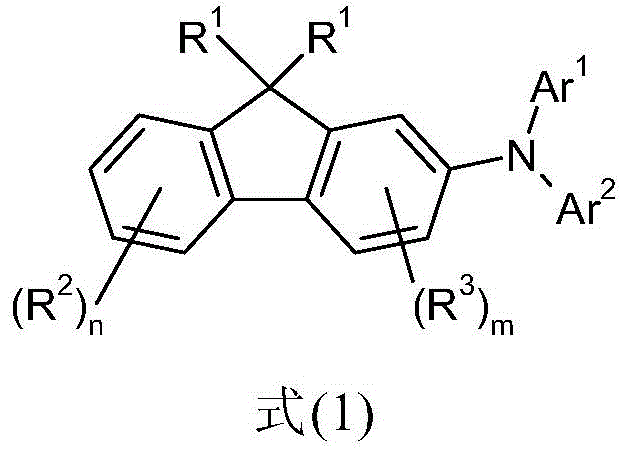
Wherein the following applies to the symbols and signs used:
Ar1、Ar2identical or different at each occurrence is an aromatic or heteroaromatic radical having from 10 to 60 aromatic ring atoms, which may be substituted by one or more radicals R which may be identical to or different from one another4Substituted in which two radicals Ar1And Ar2Each containing at least two or more aromatic or heteroaromatic rings;
R1identical or different at each occurrence is H, D, F, Cl, Br, I, C (═ O) R5,CN,Si(R5)3,NO2,P(=O)(R5)2,S(=O)R5,S(=O)2R5A linear alkyl, alkoxy or thioalkyl group having 1 to 20C atoms, or a branched or cyclic alkyl, alkoxy or thioalkyl group having 3 to 20C atoms, or an alkenyl or alkynyl group having 2 to 20C atoms, where the above radicals may each be substituted by one or more radicals R5Substituted, and wherein one or more CH of the above groups2The group may be represented by-R5C=CR5-、-C≡C-、Si(R5)2、C=O、C=S、C=NR5、-C(=O)O-、-C(=O)NR5-、P(=O)(R5) -O-, -S-, SO or SO2And wherein one or more H atoms in the above radicals may be replaced by D, F, Cl, Br, I, CN or NO2Instead of, or as aromatic or heteroaromatic ring systems having from 6 to 30 ring atoms,the ring systems may in each case be substituted by one or more radicals R5Substituted, or condensed ring systems having 9 to 30 ring atoms, which may in each case be substituted by one or more radicals R5Substitution wherein in the case of aromatic or heteroaromatic fused rings no more than 10 ring atoms may be present; two radicals R1Can also form ring closure with one another, thus forming spiro compounds in which no aromatic or heteroaromatic ring is fused from the two radicals R1On the formed ring;
R2、R3and R4Identical or different at each occurrence is H, D, F, Cl, Br, I, C (═ O) R5,CN,Si(R5)3,NO2,P(=O)(R5)2,S(=O)R5,S(=O)2R5A linear alkyl, alkoxy or thioalkyl group having 1 to 20C atoms, or a branched or cyclic alkyl, alkoxy or thioalkyl group having 3 to 20C atoms, or an alkenyl or alkynyl group having 2 to 20C atoms, where the above radicals may each be substituted by one or more radicals R5Substituted, and wherein one or more CH of the above groups2The group may be represented by-R5C=CR5-、-C≡C-、Si(R5)2、C=O、C=S、C=NR5、-C(=O)O-、-C(=O)NR5-、P(=O)(R5) -O-, -S-, SO or SO2And wherein one or more H atoms in the above radicals may be replaced by D, F, Cl, Br, I, CN or NO2Instead of, or as aromatic or heteroaromatic ring systems having 6 to 30 ring atoms, which may in each case be substituted by one or more radicals R5Substitution;
R5identical or different at each occurrence is H, D, F, Cl, Br, I, C (═ O) R6,CN,Si(R6)3,NO2,P(=O)(R6)2,S(=O)R6,S(=O)2R6A linear alkyl, alkoxy or thioalkyl radical having 1 to 20C atoms, or a branched or cyclic alkyl, alkoxy or thioalkyl radical having 3 to 20C atoms, or having 2 to 20Alkenyl or alkynyl groups of 20C atoms, where the above groups may each be substituted by one or more radicals R6Substituted, and wherein one or more CH of the above groups2The group may be represented by-R6C=CR6-、-C≡C-、Si(R6)2、C=O、C=S、C=NR6、-C(=O)O-、-C(=O)NR6-、P(=O)(R6) -O-, -S-, SO or SO2And wherein one or more H atoms in the above radicals may be replaced by D, F, Cl, Br, I, CN or NO2Instead of, or as aromatic or heteroaromatic ring systems having from 5 to 30 aromatic ring atoms, which may in each case be substituted by one or more radicals R6Substituted, or aryloxy or heteroaryloxy radicals having 5 to 30 aromatic ring atoms, which radicals may be substituted by one or more radicals R6Substitution;
R6identically or differently on each occurrence is H, D, F, or an aliphatic, aromatic or heteroaromatic organic radical having 1 to 20C atoms, where one or more H atoms may also be replaced by D or F;
n is 0, 1,2,3 or 4;
m is 0, 1,2 or 3;
with the proviso that the compound of formula (1) does not contain further polycyclic or fused groups, except for one fluorene group and except for possible fused or polycyclic groups at the 9-position of the fluorene.
The numbering on fluorene is defined as follows:

preference is given to electroluminescent devices comprising at least one compound of the formula (1) in which two radicals R are1Are the same.
It is preferred that the electroluminescent device comprises at least one compound of formula (1), characterized in that m is equal to 1 or 0, very preferably m is equal to 0.
It is furthermore preferred that the electroluminescent device comprises at least one compound of formula (1), characterized in that n is equal to 2, 1 or 0, very preferably n is equal to 0 or 1.
The compound of formula (1) is preferably selected from compounds of formula (2),
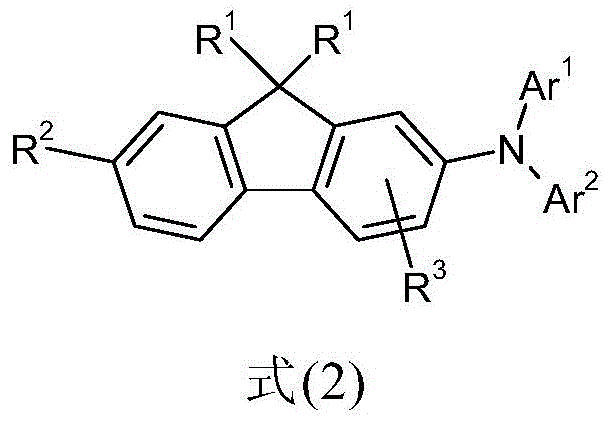
wherein the symbols are defined as indicated above.
Most preferred are those in which two radicals R1The same compound of formula (2).
In another preferred embodiment of the present invention, the electroluminescent device comprises at least one compound of formula (3), wherein preference is also given to compounds in which the radical R is1The same compound of formula (3).

In a very preferred embodiment of the invention, R2Equal to H or a linear alkyl radical having 1 to 20C atoms or a branched or cyclic alkyl radical having 3 to 20C atoms, where the above radicals may each be substituted by one or more radicals R5And wherein one or more H atoms in the above radicals may be replaced by D, F, Cl, Br, I, CN or NO2Instead of, or as an aromatic ring system having 6 to 30 aromatic ring atoms, which ring system may in each case be substituted by one or more radicals R5And (4) substitution.
R2Particular preference is given to an aromatic ring system which is equal to H or has from 6 to 30 aromatic ring atoms, which ring system may in each case be substituted by one or more radicals R5And (4) substitution.
In a very particularly preferred embodiment, the electroluminescent device comprises at least one compound of the formula (3) in which R is2Equal to H, and two R1Identical or different, preferably identical, to one another are aromatic or heteroaromatic ring systems having from 6 to 30 aromatic ring atoms, which may be substituted in each case by one or more radicals R5And (4) substitution.
R in the formulae (1) to (3)2Particularly preferably equal to phenyl, biphenyl,Terphenyl or quaterphenyl radicals, each of which may be substituted by one or more radicals R5Preference is also given, among others, to these radicals being unsubstituted or being H.
In another very particularly preferred embodiment, the electroluminescent device comprises at least one compound of the formula (3) in which R2Is an aromatic ring system having from 6 to 30 aromatic ring atoms, which ring system may be substituted in each case by one or more radicals R5Substituted, and R1Identical or different, preferably identical, to one another are straight-chain alkyl radicals having 1 to 20C atoms or branched or cyclic alkyl radicals having 3 to 20C atoms, where the abovementioned radicals may each be substituted by one or more radicals R5And wherein one or more H atoms in the above radicals may be replaced by D, F, Cl, Br, I, CN or NO2Instead.
It is furthermore preferred that the electroluminescent device comprises at least one compound of the formula (4),

wherein X, identically or differently at each occurrence, is N or CR4Wherein only 3 of the groups X per ring may be N. Very preferably, X in formula (4) is equal to CR4Wherein the above definitions apply to the radical R1、R2And R4。
Preferred radicals Ar1And Ar2Selected from the groups having the formulae (5) to (60) shown in the following table, where the groups may be as already indicated above by one or more radicals R which may be identical or different from one another4Substitution;

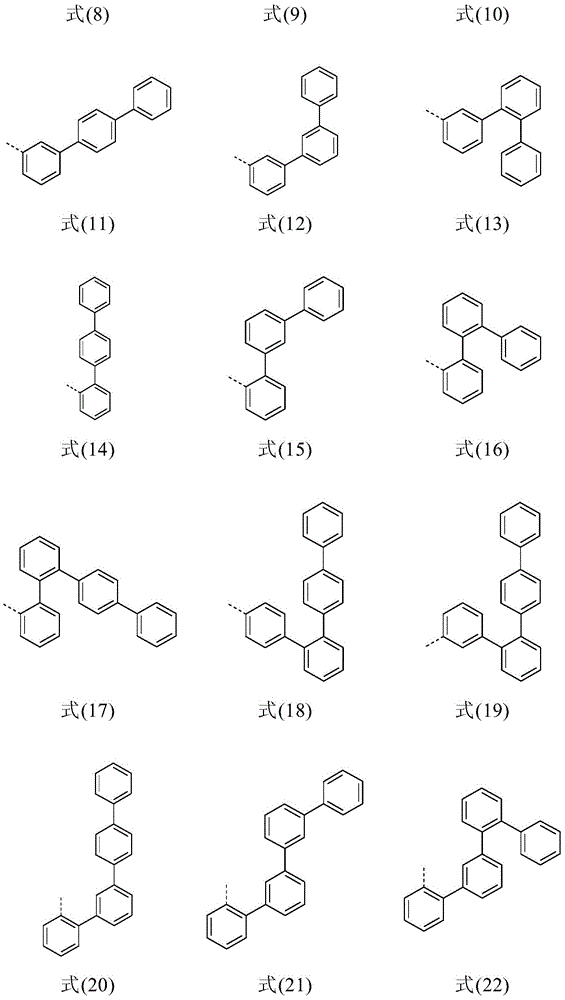
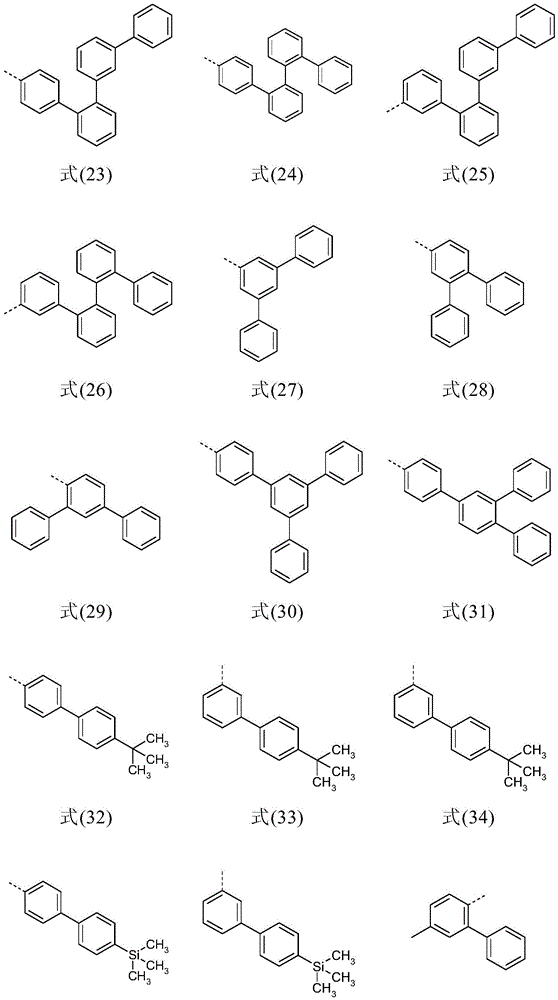
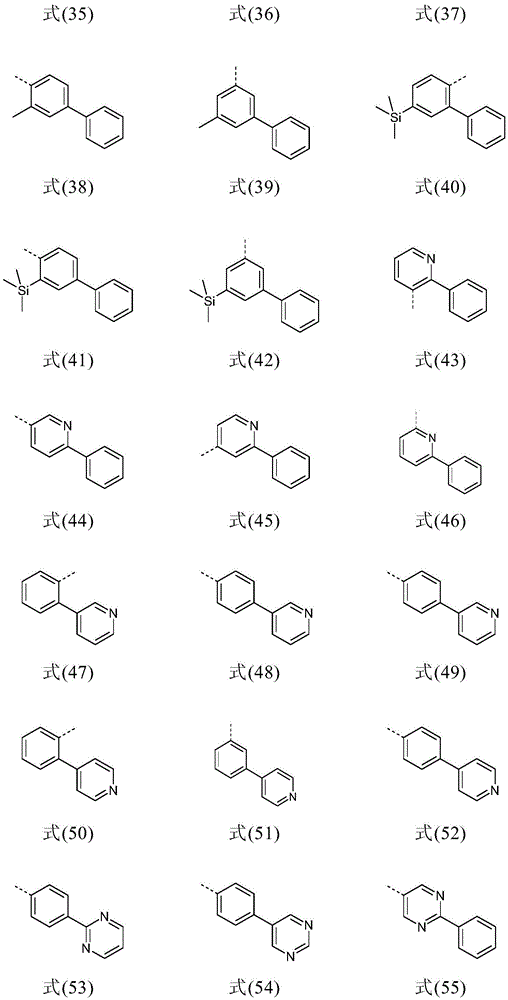

preferred in the sense of the present invention are electroluminescent devices comprising at least one compound of the formula (1) in which Ar is1And Ar2Containing only aromatic rings, not heteroaromatic rings.
Ar1And Ar2Particularly preferably identically or differently, biphenyl, terphenyl or quaterphenyl, each of which may be substituted by one or more radicals R4Of these, it is also preferred that these groups are unsubstituted.
In another very preferred embodiment of the present invention, in the compound of formula (1),
the two radicals R1Are identical and are selected from straight-chain alkyl, alkoxy or thioalkyl groups having 1 to 20C atoms or branched or cyclic alkyl, alkoxy or thioalkyl groups having 3 to 20C atoms, where the above radicals may each be substituted by one or more radicals R5And wherein one or more H atoms in the above radicals may be replaced by D, F, Cl, Br, I, CN or NO2Instead of, or as aromatic or heteroaromatic ring systems having 6 to 30 ring atoms, which may in each case be substituted by one or more radicals R5Substituted, or condensed ring systems having 9 to 30 ring atoms, which may in each case be substituted by one or more radicals R5Wherein, in the case of aromatic or heteroaromatic fused rings, no more than 10 ring atoms may be present; the two radicals R1Can also form ring closure with one another, thus forming spiro compounds in which no aromatic or heteroaromatic ring is fused from the two radicals R1On the formed ring;
n is equal to 1, and the radical R2At the 7-position of fluorene;
m is equal to 0;
R2equal to an alkyl group having 1 to 20C atoms, or a branched or cyclic alkyl group having 3 to 20C atoms, a pyridyl, phenyl, biphenyl, terphenyl or quaterphenyl group, wherein the groups may be substituted by one or more radicals R5Where it is also preferred that the aromatic or heteroaromatic group is unsubstituted or equal to H;
Ar1and Ar2Are identical or different and are selected from biphenyl, terphenyl and quaterphenyl radicals, each of which may be substituted by one or more radicals R4Of these, it is also preferred that these groups are unsubstituted.
In another very preferred embodiment of the present invention, in the compound of formula (1),
two radicals R1Are identical and are selected from linear alkyl radicals having 1 to 20C atoms or branched or cyclic alkyl radicals having 3 to 20C atoms, where the radicals may each be substituted by one or more radicals R5And wherein one or more H atoms in the above radicals may be replaced by D, F, Cl, Br, I, CN or NO2Replacing;
n is equal to 1, and the radical R2At the 7-position of fluorene;
m is equal to 0;
R2equal to H or an alkyl group having 1 to 20C atoms or a branched or cyclic alkyl group having 3 to 20C atoms, wherein the groups may be substituted by one or more radicals R5Is substituted in which R2Preferably equal to H;
Ar1and Ar2Are identical or different and are selected from biphenyl, terphenyl and quaterphenyl radicals, each of which may be substituted by one or more radicals R4Of these, it is also preferred that these groups are unsubstituted.
In another very preferred embodiment of the present invention, in the compound of formula (1),
the two radicals R1Are identical and are selected from linear alkyl radicals having 1 to 20C atoms or from linear alkyl radicals having 1 to 20C atomsBranched or cyclic alkyl groups of 3 to 20C atoms, wherein the groups may each be substituted by one or more radicals R5And wherein one or more H atoms in the above radicals may be replaced by D, F, Cl, Br, I, CN or NO2Replacing;
n is equal to 1, and the radical R2At the 7-position of fluorene;
m is equal to 0;
R2equal to a pyridyl, phenyl, biphenyl, terphenyl or quaterphenyl group, wherein said groups may be substituted by one or more radicals R5Substituted, wherein it is also preferred that the aromatic or heteroaromatic group is unsubstituted;
Ar1and Ar2Are identical or different and are selected from biphenyl, terphenyl and quaterphenyl radicals, each of which may be substituted by one or more radicals R4Of these, it is also preferred that these groups are unsubstituted.
In another very preferred embodiment of the present invention, in the compound of formula (1),
the two radicals R1Are identical and are selected from aromatic or heteroaromatic ring systems having 6 to 30 ring atoms which may in each case be substituted by one or more radicals R5Substituted, or condensed ring systems having 9 to 30 ring atoms, which may in each case be substituted by one or more radicals R5Wherein, in the case of aromatic or heteroaromatic fused rings, no more than 10 ring atoms may be present;
n is equal to 1, and the radical R2At the 7-position of fluorene;
m is equal to 0;
R2equal to an alkyl group having 1 to 20C atoms or a branched or cyclic alkyl group having 3 to 20C atoms, a pyridyl, phenyl, biphenyl, terphenyl or quaterphenyl group, wherein the groups may be substituted by one or more radicals R5Substituted, wherein it is also preferred that the aromatic or heteroaromatic radical is unsubstituted or equal to H, wherein R is2Preferably equal to H;
Ar1and Ar2Are identical or different and are selected from biphenyl, terphenylPhenyl and tetraphenyl, each of which may be substituted by one or more radicals R4Of these, it is also preferred that these groups are unsubstituted.
Also preferred in the sense of the present invention are electroluminescent devices comprising at least one compound of formula (1) which, apart from the one fluorene group, contains no further polycyclic or fused groups.
The compounds according to the invention can be synthesized using methods known to those of ordinary skill in the art from the prior art. The preparation can be carried out, for example, by means of halogenation, Buchwald coupling and Suzuki coupling.
The following scheme shows a preferred synthetic route for the preparation of the compounds of formula (1) according to the invention. For the synthesis of the compounds according to the invention, the fluorene compound a is reacted with Ar of the formula in a Buchwald coupling1-NH-Ar2The amine B of (a) is reacted,

y as a leaving group, e.g. halogen
Another preferred synthetic route for preparing the compounds according to the invention is depicted in the following scheme. The carboxylate group in compound C is converted to the corresponding alcohol D by an addition reaction of an alkyl or aryl metal compound, such as an alkyl or aryl lithium compound or an alkyl or aryl grignard compound. This alcohol can be cyclized under acidic conditions to give compound E. Finally, the reaction is carried out with the formula Ar1-NH-Ar2Buchwald coupling of amine B.

Y as a leaving group, e.g. halogen
X=Cl、OR
The following scheme shows another preferred synthetic route for preparing the compounds according to the invention. For this purpose, fluorene A is reacted with Ar of the formula in a Suzuki coupling3-B(OH)2And (3) reacting the boric acid F. Bromination of the resulting compound is carried out using, for example, bromine, followed by Buchwald coupling to formula Ar1-NH-Ar2To give the corresponding compounds according to the invention.
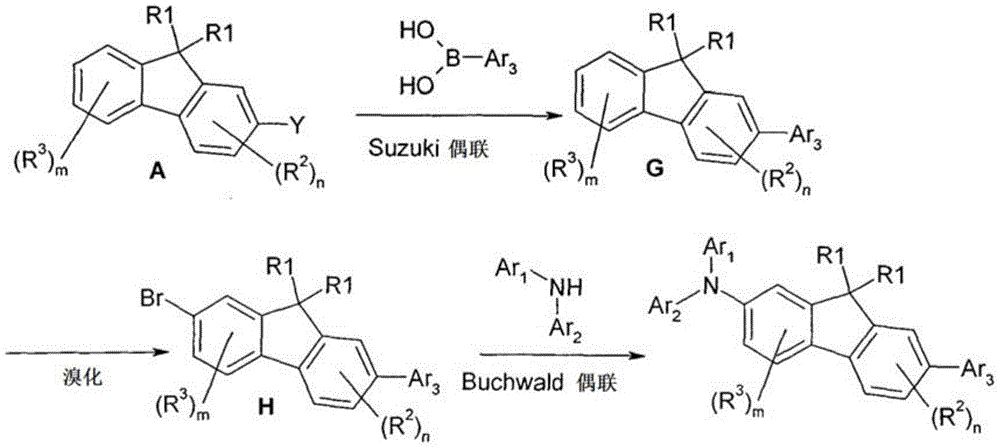
Y as a leaving group, e.g. halogen
Synthetic routes to starting compounds A, B and C used in the synthesis of the compounds of the present invention are known to those of ordinary skill in the art. In addition, some exact synthetic methods are detailed in the examples.
The preferred coupling reaction here is the Buchwald coupling.
The above compounds, in particular those substituted with a reactive leaving group such as bromine, iodine, chlorine, boronic acid or boronic ester, can be used as monomers to prepare corresponding oligomers, dendrimers or polymers. Preference is given here to carrying out the oligomerization or polymerization via halogen functions or boronic acid functions.
Preferred compounds for use in the electroluminescent device of the invention are shown by way of example in the table below.


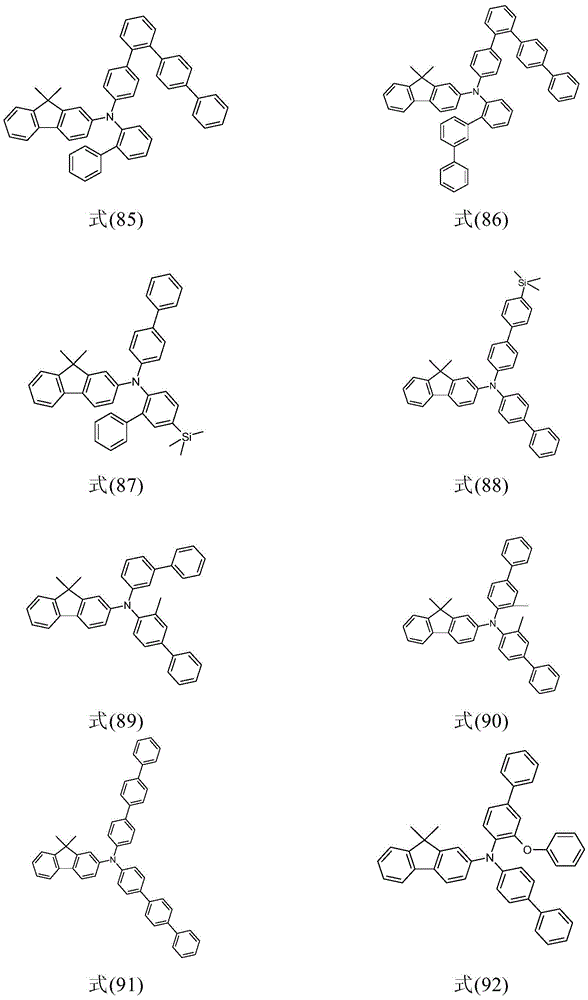


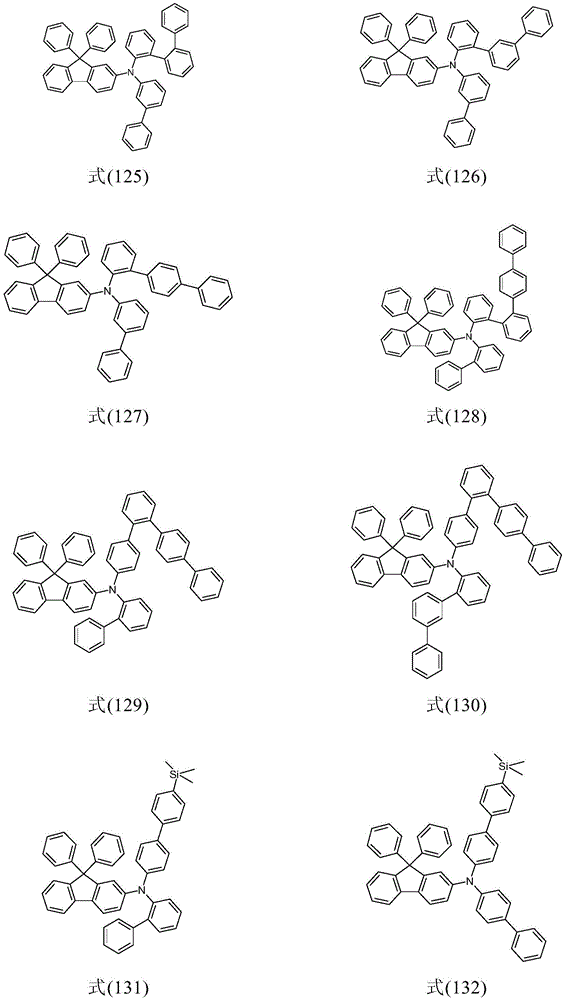
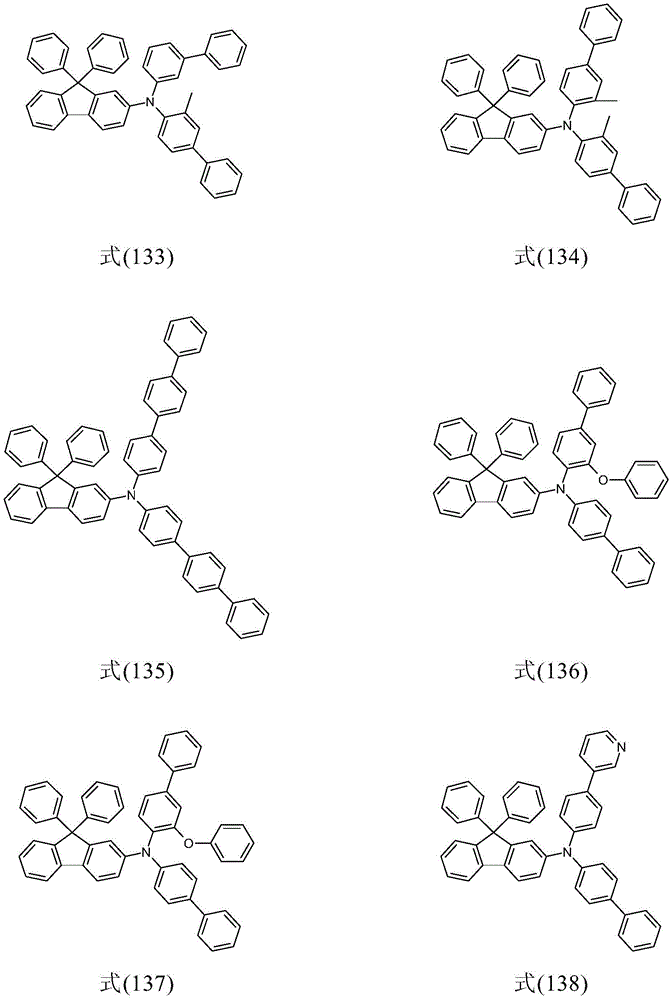


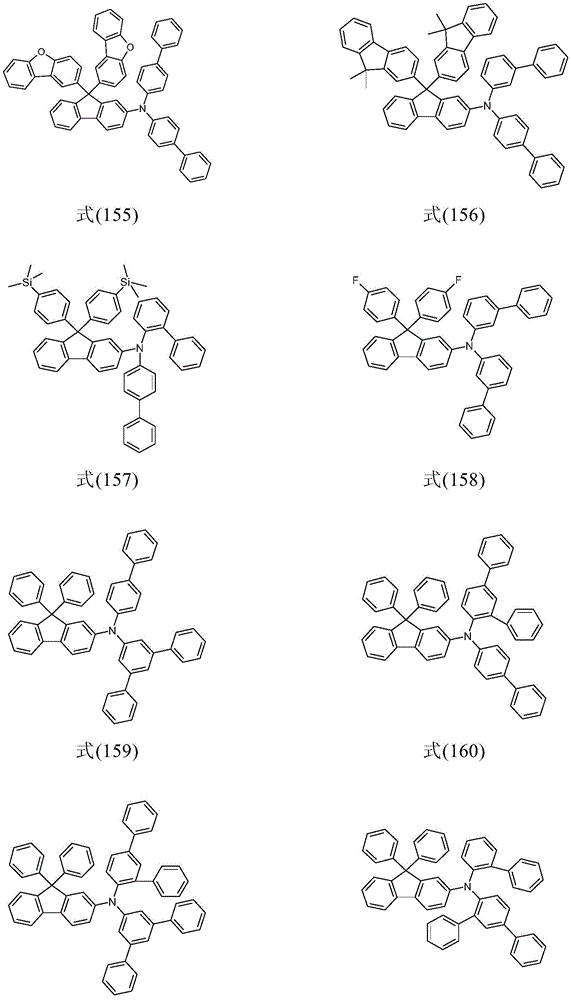

Wherein the following applies to the symbols used in formula (167):
Ar3、Ar4identical or different at each occurrence is an aromatic or heteroaromatic ring system having from 10 to 60 ring atoms which may be interrupted by one or more radicals R which may be identical or different from one another5Substituted, wherein the two groups Ar3And Ar4Each containing at least two or more aromatic or heteroaromatic, preferably aromatic, rings;
R7is the same at each occurrence, and is selected from the group consisting of having 1 to 20A straight-chain alkyl, alkoxy or thioalkyl radical having 3 to 20C atoms, or a branched or cyclic alkyl, alkoxy or thioalkyl radical having 3 to 20C atoms, or an alkenyl or alkynyl radical having 2 to 20C atoms, where the abovementioned radicals may each be substituted by one or more radicals R5And wherein one or more H atoms in the above radicals may be replaced by D, CN or NO2Instead of, or as aromatic or heteroaromatic ring systems having 6 to 30 ring atoms, which may in each case be substituted by one or more radicals R5Is substituted in which R5As indicated above, or a fused ring system having 9 to 30 ring atoms which may in each case be substituted by one or more radicals R5Substituted, wherein in the case of aromatic or heteroaromatic fused rings no more than 10 ring atoms may be present in the fused ring system; two radicals R7Can also form ring closure with one another, thus forming spiro compounds in which no aromatic or heteroaromatic ring is fused from the two radicals R7On the ring formed, and wherein if R is7Is a straight-chain or branched alkyl group, then R8Is an aromatic or heteroaromatic ring system having from 6 to 30 ring atoms which may be substituted in each case by one or more radicals R5Substituted, and wherein R5As indicated above;
R8is H, D, or an aromatic or heteroaromatic ring system having from 6 to 30 ring atoms which may be substituted in each case by one or more radicals R5Is substituted in which R5Is defined as indicated above, and wherein if R is8Is equal to H, then R7Is an aromatic or heteroaromatic ring system having from 6 to 30 aromatic ring atoms which may be substituted in each case by one or more radicals R5Is substituted in which R5As indicated above;
a is 1,2,3 or 4, preferably 1 or 2, very preferably 1;
with the proviso that the compound of formula (167) contains no further polycyclic or fused groups other than one fluorene group and other than a possible fused or polycyclic group at the 9-position of the fluorene,
and with the proviso that the compound is halogen-free.
Preferably, the compound of formula (167) contains no additional polycyclic or fused groups other than the one fluorene group.
Preferably wherein a is 1 and R8The compound of formula (167) at the 7-position of fluorene, i.e., the compound of formula (168)

Particularly preferred are compounds of formulae (167) and (168), wherein the following applies to the symbols used:
Ar3、Ar4selected, identically or differently on each occurrence, from biphenyl, terphenyl and quaterphenyl radicals, each of which may be substituted by one or more radicals R5Substituted, wherein it is also preferred that these groups are unsubstituted;
R7identical at each occurrence and selected from aromatic or heteroaromatic ring systems having from 6 to 30 ring atoms which may in each case be substituted by one or more radicals R5Is substituted in which R5As indicated above, or a fused ring system having 9 to 30 ring atoms which may in each case be substituted by one or more radicals R5Substituted, wherein in the case of aromatic or heteroaromatic fused rings, no more than 10 ring atoms may be present in the fused ring system;
with the proviso that the compound of formula (168) does not contain further polycyclic or fused groups in addition to the one fluorene group and in addition to possible fused or polycyclic groups at the 9-position of the fluorene,
and with the proviso that the compound is halogen-free.
Further preferred compounds of formula (167) are compounds of general formula (169)

Wherein X, identically or differently at each occurrence, is NOr CR5And R is5、Ar3And Ar4As indicated above. Preferably, X in formula (169) is equal to CR5。
Ar in formula (169)1And Ar3Preferably selected, identically or differently on each occurrence, from biphenyl, terphenyl and quaterphenyl radicals, each of which may be substituted by one or more radicals R5Of these, it is also preferred that these groups are unsubstituted.
Most preferred are compounds of formula (170)

Ar in formula (170)1And Ar3Preferably selected, identically or differently on each occurrence, from biphenyl, terphenyl and quaterphenyl radicals, each of which may be substituted by one or more radicals R5Of these, it is also preferred that these groups are unsubstituted.
In another preferred embodiment of the invention, the compound is selected from the general formula (171)

Wherein the above definitions apply to the symbols used.
Ar in formula (171)1And Ar3Preferably selected, identically or differently on each occurrence, from biphenyl, terphenyl and quaterphenyl radicals, each of which may be substituted by one or more radicals R5Of these, it is also preferred that these groups are unsubstituted.
Further preferred compounds of formula (5) are compounds of formula (172)
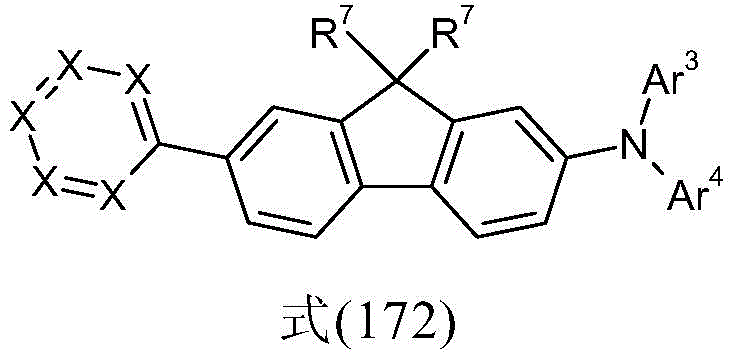
Wherein the following applies to the symbols used:
x is the same or different at each occurrenceGround is N or CR5Is preferably CR5And R5As indicated above;
R7is a straight-chain alkyl radical having 1 to 20C atoms or a branched or cyclic alkyl radical having 3 to 20C atoms, where the radicals mentioned above may each be substituted by one or more radicals R5And wherein one or more H atoms in the above radicals may be replaced by D, CN or NO2In which two radicals R are substituted7Can also form ring closure with one another, thus forming spiro compounds in which no aromatic or heteroaromatic ring is fused from the two radicals R7On the formed ring;
and wherein Ar3And Ar4As indicated above.
Ar in formula (172)1And Ar3Preferably selected, identically or differently on each occurrence, from biphenyl, terphenyl and quaterphenyl radicals, each of which may be substituted by one or more radicals R5Of these, it is also preferred that these groups are unsubstituted.
In another preferred embodiment of the present invention, the compound is selected from the group consisting of formula (173)

Wherein the following applies to the symbols used:
R7is a straight-chain alkyl radical having 1 to 20C atoms or a branched or cyclic alkyl radical having 3 to 20C atoms, where the radicals mentioned above may each be substituted by one or more radicals R5And wherein one or more H atoms in the above radicals may be replaced by D, CN or NO2In which two radicals R are substituted7Can also form a ring closure, thus forming a spiro compound in which no aromatic or heteroaromatic ring is fused from the two radicals R7On the formed ring.
Ar in formula (173)1And Ar3Preferably selected, identically or differently on each occurrence, from biphenyl, terphenyl and quaterphenyl radicals, each of which radicalsMay be substituted by one or more radicals R5Of these, it is also preferred that these groups are unsubstituted.
Very particular preference is given to the compounds of the formulae (174) to (236) shown by way of example:
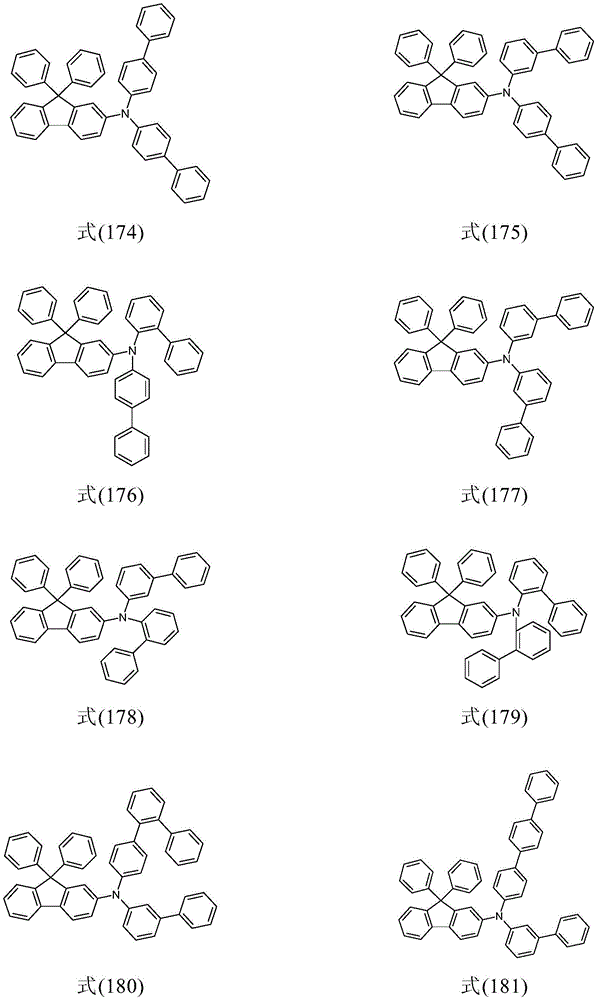
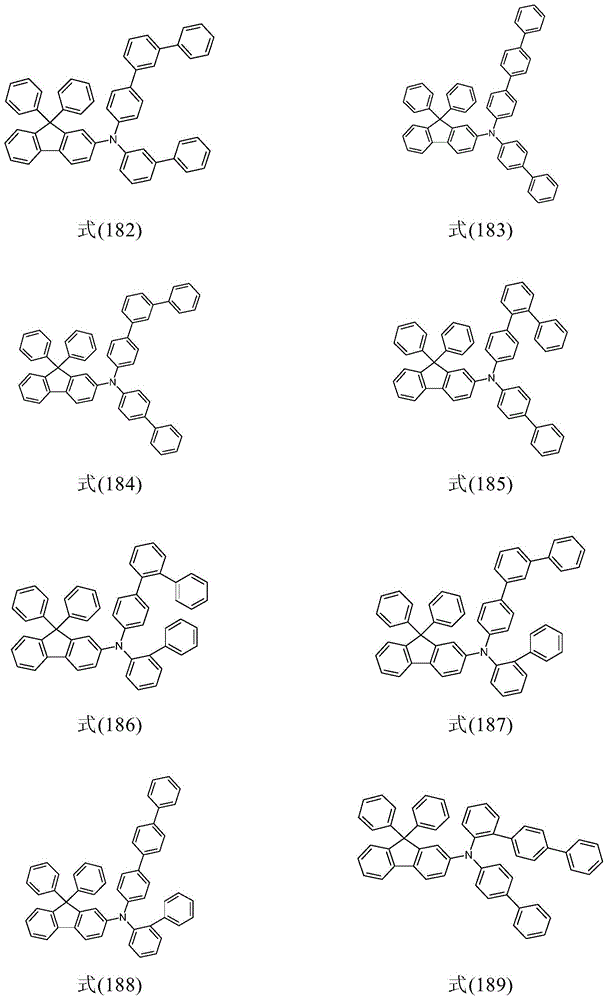
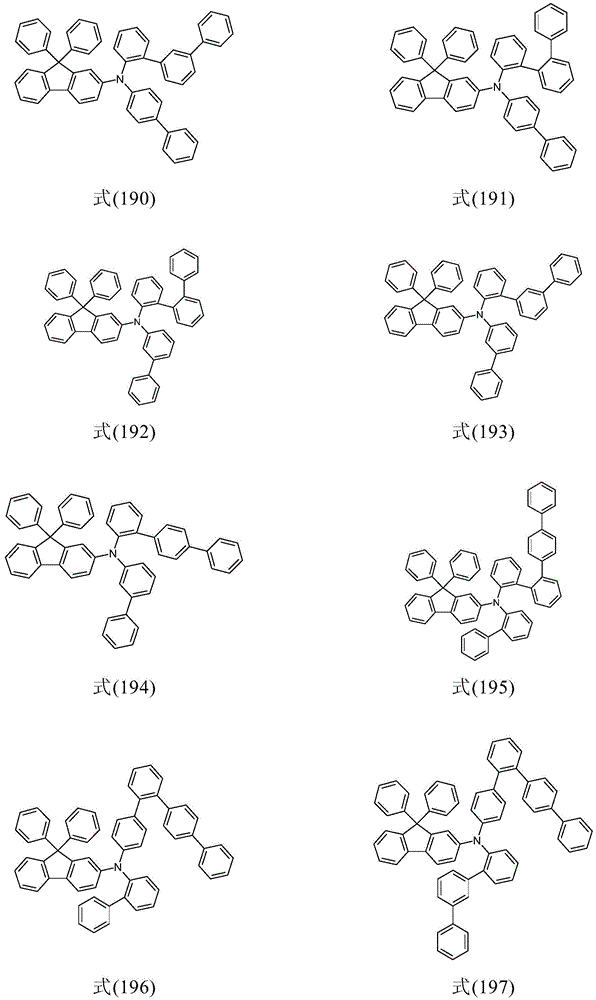
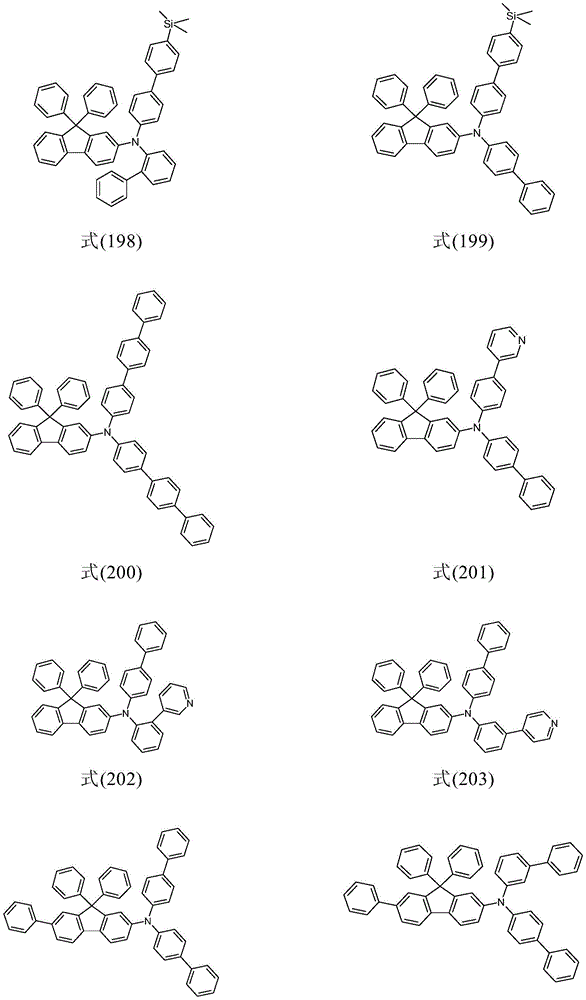
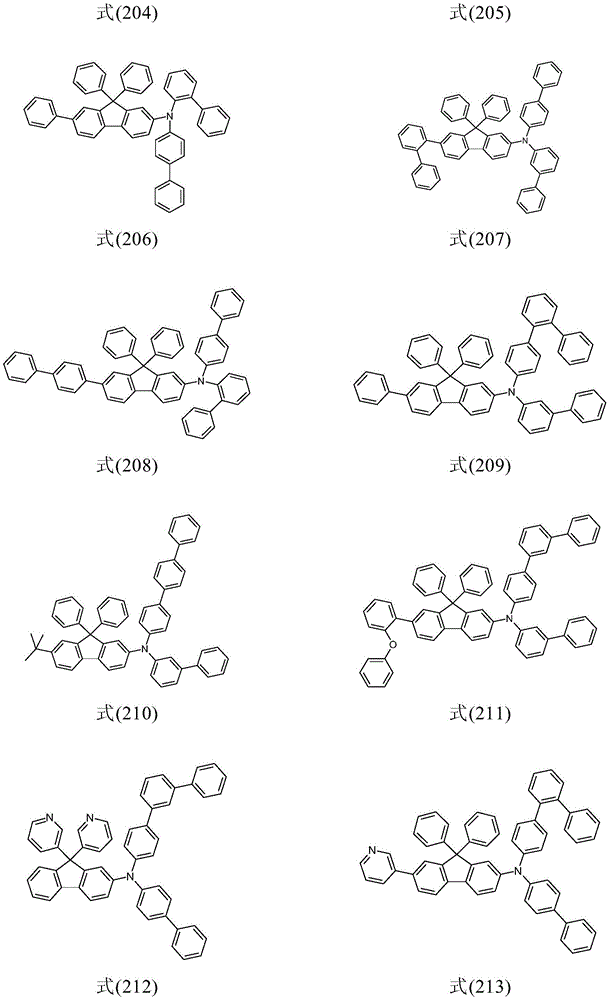
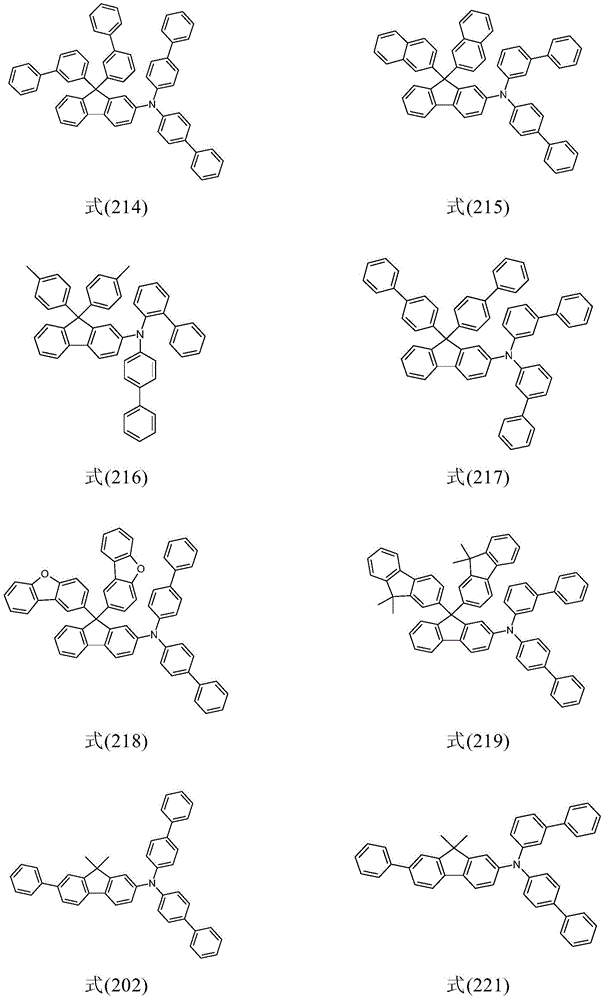
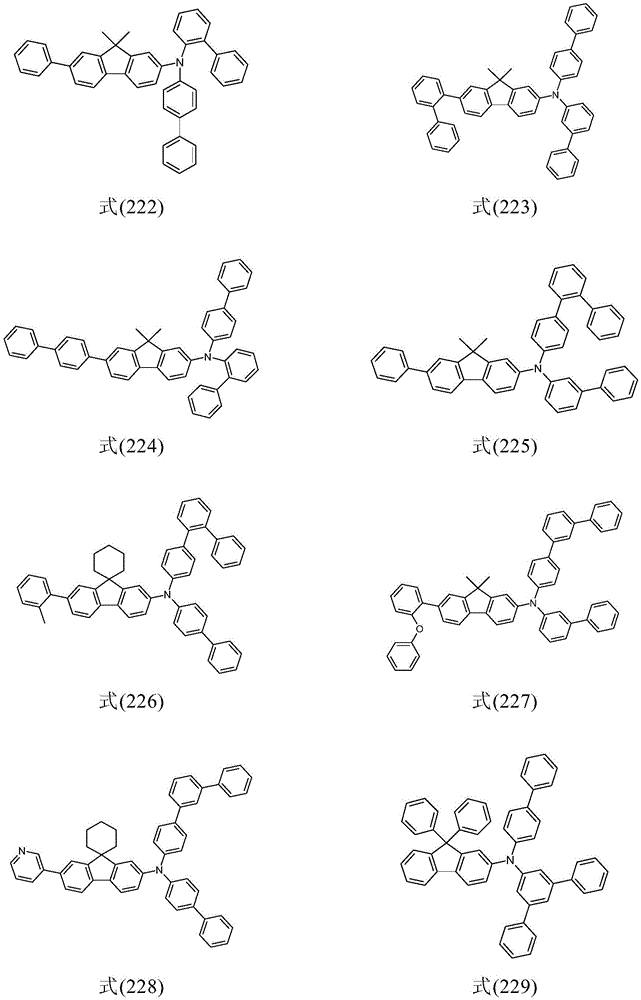
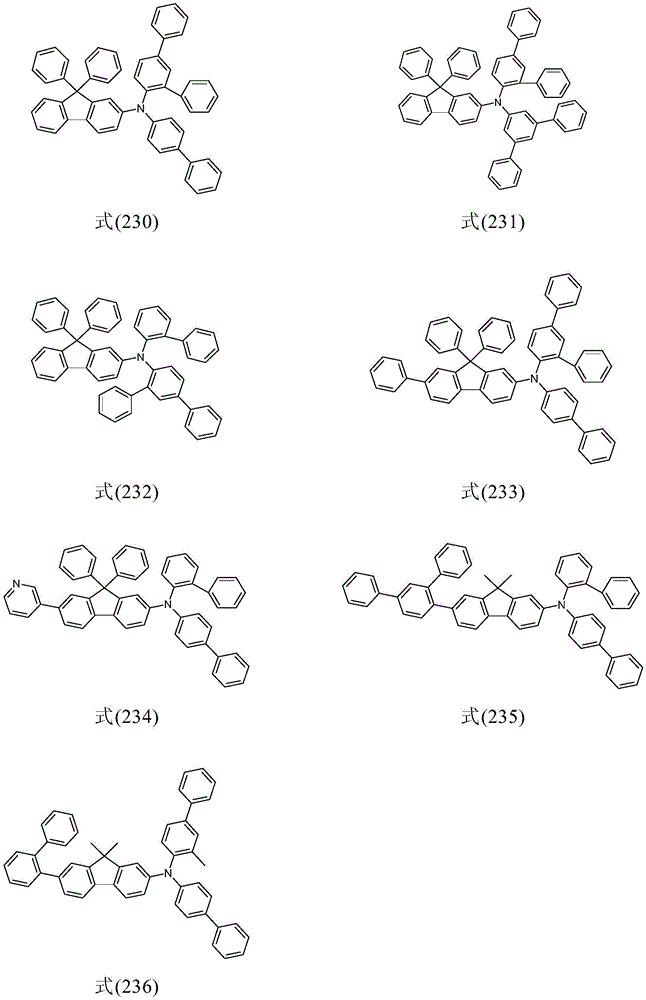
the compounds according to the invention can be used in combination with other organic functional materials used in electronic devices. A variety of possible organic functional materials are known to those of ordinary skill in the art from the prior art. The present invention therefore also relates to a composition comprising one or more compounds of the formula (167) according to the invention and at least one further organic functional material selected from the group consisting of fluorescent emitters, phosphorescent emitters, host materials, matrix materials, electron-transporting materials, electron-injecting materials, hole-conductor materials, hole-injecting materials, electron-blocking materials and hole-blocking materials.
In order to process the compounds according to the invention from the liquid phase, for example by spin coating or by a printing process, a formulation of the compounds according to the invention is necessary. These formulations may be, for example, solutions, dispersions or microemulsions. For this purpose, mixtures of two or more solvents can preferably be used. Suitable and preferred solvents are, for example, toluene, anisole, o-xylene, m-xylene or p-xylene, methyl benzoate, dimethylanisole, mesitylene, tetralin, o-dimethoxybenzene, THF, methyl-THF, THP, chlorobenzene, dioxane Alkanes, or mixtures of these solvents.
The invention therefore also relates to a formulation, in particular a solution, dispersion or microemulsion, comprising at least one compound of the formula (167) or at least one polymer, oligomer or dendrimer containing at least one unit of the formula (167), and at least one solvent, preferably an organic solvent. Methods in which solutions of this type can be prepared are known to the person skilled in the art and are described, for example, in WO 2002/072714, WO 2003/019694 and the documents cited therein.
The compounds according to the invention are suitable for use in electronic devices, in particular in organic electroluminescent devices (e.g. OLEDs or OLECs). Depending on the substitution, the compounds are used in different functions and layers.
The invention therefore also relates to the use of compounds of formula (167) in electronic devices, and to electronic devices per se comprising one or more compounds of formula (167). The electronic device here is preferably selected from the group consisting of Organic Integrated Circuits (OIC), Organic Field Effect Transistors (OFET), Organic Thin Film Transistors (OTFT), Organic Light Emitting Transistors (OLET), Organic Solar Cells (OSC), organic optical detectors, organic photoreceptors, Organic Field Quench Devices (OFQD), organic light emitting electrochemical cells (OLEC), organic laser diodes (O-laser), particularly preferably organic electroluminescent devices (OLED and OLEC).
As described above, the present invention relates to an electronic device comprising at least one compound of formula (167). The electronic device herein is preferably selected from the above-mentioned devices. Particularly preferred are organic electroluminescent devices (OLEDs) comprising an anode, a cathode and at least one light-emitting layer, characterized in that at least one organic layer comprises at least one compound of the formula (167), wherein the at least one organic layer can be a light-emitting layer, a hole-transporting layer or a further layer.
An aryl group in the sense of the present invention contains 6 to 60 aromatic ring atoms; heteroaryl groups in the sense of the present invention contain 5 to 60 aromatic ring atoms, at least one of which is a heteroatom. The heteroatom is preferably selected from N, O and S. This represents a fundamental limitation. If other preferences are indicated in the description of the invention, for example in terms of the number of aromatic ring atoms or heteroatoms present, these preferences apply.
An aryl group or heteroaryl group is here taken to mean a simple aromatic ring, i.e. benzene, or a simple heteroaromatic ring, such as pyridine, pyrimidine or thiophene, or a fused (condensed) aromatic or heteroaromatic polycyclic ring, such as naphthalene, phenanthrene, quinoline or carbazole. Fused (condensed) aromatic or heteroaromatic polycycles in the sense of this application consist of two or more simple aromatic or heteroaromatic rings fused to one another.
Aryl or heteroaryl groups which may be substituted in each case by the abovementioned groups and may be attached to the aromatic or heteroaromatic ring system via any desired position are in particular to be understood as meaning groups which are derived from: benzene, naphthalene, anthracene, phenanthrene, pyrene, dihydropyrene, Perylene, fluoranthene, benzanthracene, triphenylene, tetracene, pentacene, benzopyrene, furan, benzofuran, isobenzofuran, dibenzofuran, thiophene, benzothiophene, isobenzothiophene, dibenzothiophene, pyrrole, indole, isoindole, carbazole, pyridine, quinoline, isoquinoline, acridine, phenanthridine, benzo-5, 6-quinoline, benzo-6, 7-quinoline, benzo-7, 8-quinoline, perylene, fluoranthene, benzophenanthrene, triphenylene, naphthacene, pentacene, dibenzofuran, dibenzothiophene, pyrrole, indole,Phenothiazines, thiophenes
 Oxazines, pyrazoles, indazoles, imidazoles, benzimidazoles, naphthoimidazoles, phenanthroimidazoles, pyridoimidazoles, pyrazinoimidazoles, quinoxaloimidazoles,
 Azole, benzo
 Azoles, naphtho
 Azoles, anthracenes
 Azole, phenanthro
 Oxazole, iso
 Oxazole, 1, 2-thiazole, 1, 3-thiazole, benzothiazole, pyridazine, benzopyridazine, pyrimidine, benzopyrimidine, quinoxaline, pyrazine, phenazine, naphthyridine, azacarbazole, benzocarbazine, phenanthroline, 1,2, 3-triazole, 1,2, 4-triazole, benzotriazole, 1,2,3-
 Oxadiazole, 1,2,4-
 Diazoles, 1,2,5
 Oxadiazole, 1,3,4-
 Oxadiazole, 1,2, 3-thiadiazole, 1,2, 4-thiadiazole, 1,2, 5-thiadiazole, 1,3, 4-thiadiazole, 1,3, 5-triazine, 1,2, 4-triazine, 1,2, 3-triazine, tetrazole, 1,2,4, 5-tetrazine, 1,2,3, 4-tetrazine, 1,2,3, 5-tetrazine, purine, pteridine, indolizine and benzothiadiazole.
An aryloxy group as defined according to the present invention is understood to mean an aryl group as defined above bonded through an oxygen atom. Similar definitions apply to heteroaryloxy groups.
An aromatic ring system in the sense of the present invention contains 6 to 60C atoms in the ring system. Heteroaromatic ring systems in the sense of the present invention contain 5 to 60 aromatic ring atoms, at least one of which is a heteroatom. The heteroatom is preferably selected from N, O and/or S. An aromatic or heteroaromatic ring system in the sense of the present invention is intended to be taken to mean a system which does not necessarily contain only aryl or heteroaryl groups, but in which a plurality of aryl or heteroaryl groups may also be linked by non-aromatic units (preferably less than 10% of the atoms other than H), for example sp3Hybridized C, Si, N or O atoms, sp2A hybridized C or N atom, or an sp hybridized C atom. Thus, for example, systems such as 9,9 '-spirobifluorene, 9' -diarylfluorene, triarylamines, diaryl ethers, stilbenes, and the like, as well as systems in which two or more aryl groups are linked, for example, by a linear or cyclic alkyl, alkenyl, or alkynyl group or by a silyl group, are likewise intended to be considered aromatic ring systems in the sense of the present invention. Furthermore, systems in which two or more aryl or heteroaryl groups are connected to one another by single bonds, for example systems such as biphenyl, terphenyl or diphenyltriazine, are also to be regarded as aromatic or heteroaromatic ring systems in the sense of the present invention.
Aromatic or heteroaromatic ring systems having from 5 to 60 aromatic ring atoms which may in each case also be substituted by the radicals defined above and may be attached to the aromatic or heteroaromatic radical via any desired position, are in particular to be understood as meaning radicals which are derived from: benzene, naphthalene, anthracene, benzanthracene, phenanthrene, triphenylene, pyrene, Perylene, fluoranthene, tetracene, pentacene, benzopyrene, biphenyl, idobenzene, terphenyl, quaterphenyl, fluorene, spirobifluorene, dihydrophenanthrene, phenanthrene,Dihydropyrene, tetrahydropyrene, cis-or trans-indenofluorene, triindene, isotridene, spirotriindene, spiroisotridene, furan, benzofuran, isobenzofuran, dibenzofuran, thiophene, benzothiophene, isobenzothiophene, dibenzothiophene, pyrrole, indole, isoindole, carbazole, indolocarbazole, indenocarbazole, pyridine, quinoline, isoquinoline, acridine, phenanthridine, benzo-5, 6-quinoline, benzo-6, 7-quinoline, benzo-7, 8-quinoline, phenothiazine, thiophene
 Oxazines, pyrazoles, indazoles, imidazoles, benzimidazoles, naphthoimidazoles, phenanthroimidazoles, pyridoimidazoles, pyrazinoimidazoles, quinoxaloimidazoles,
 Azole, benzo
 Azoles, naphtho
 Azoles, anthracenes
 Azole, phenanthro
 Oxazole, iso
 Oxazole, 1, 2-thiazole, 1, 3-thiazole, benzothiazole, pyridazine, benzopyridazine, pyrimidine, benzopyrimidine, quinoxaline, 1, 5-diaza anthracene, 2, 7-diaza pyrene, 2, 3-diaza pyrene, 1, 6-diaza pyrene, 1, 8-diaza pyrene, 4,5,9, 10-tetraazaperylene, pyrazine, phenazine, thiophene
 Oxazines, phenothiazines, fluoranthenes, naphthyridines, azacarbazoles, benzocarbazoles, phenanthrolines, 1,2, 3-triazoles, 1,2, 4-triazoles, benzotriazoles, benzophenanthrolines, benzoxazines, benzoxaz,1,2,3-
 Oxadiazole, 1,2,4-
 Oxadiazole, 1,2,5-
 Oxadiazole, 1,3,4-
 Oxadiazole, 1,2, 3-thiadiazole, 1,2, 4-thiadiazole, 1,2, 5-thiadiazole, 1,3, 4-thiadiazole, 1,3, 5-triazine, 1,2, 4-triazine, 1,2, 3-triazine, tetrazole, 1,2,4, 5-tetrazine, 1,2,3, 4-tetrazine, 1,2,3, 5-tetrazine, purine, pteridine, indolizine and benzothiadiazole, or combinations of these groups.
For the purposes of the present invention, where the individual H atoms or CH2A straight-chain alkyl group having 1 to 40C atoms or a branched or cyclic alkyl group having 3 to 40C atoms or an alkenyl or alkynyl group having 2 to 40C atoms, which groups may also be substituted by the groups described above under the definition of said groups, is preferably considered to mean the following groups: methyl, ethyl, n-propyl, isopropyl, n-butyl, isobutyl, sec-butyl, tert-butyl, 2-methylbutyl, n-pentyl, sec-pentyl, cyclopentyl, neopentyl, n-hexyl, cyclohexyl, neohexyl, n-heptyl, cycloheptyl, n-octyl, cyclooctyl, 2-ethylhexyl, trifluoromethyl, pentafluoroethyl, 2,2, 2-trifluoroethyl, ethenyl, propenyl, butenyl, pentenyl, cyclopentenyl, hexenyl, cyclohexenyl, heptenyl, cycloheptenyl, octenyl, cyclooctenyl, ethynyl, propynyl, butynyl, pentynyl, hexynyl or octynyl. Alkoxy or thioalkyl radicals having 1 to 40C atoms are preferably understood to mean methoxy, trifluoromethoxy, ethoxy, n-propoxy, isopropoxy, n-butoxy, isobutoxy, sec-butoxy, tert-butoxy, n-pentoxy, sec-pentoxy, 2-methylbutoxy, n-hexoxy, cyclohexoxy, n-heptoxy, cycloheptoxy, n-octoxyCyclooctyloxy, 2-ethylhexyloxy, pentafluoroethoxy, 2,2, 2-trifluoroethoxy, methylthio, ethylthio, n-propylthio, isopropylthio, n-butylthio, isobutylthio, sec-butylthio, tert-butylthio, n-pentylthio, sec-pentylthio, n-hexylthio, cyclohexylthio, n-heptylthio, cycloheptylthio, n-octylthio, cyclooctylthio, 2-ethylhexylthio, trifluoromethylthio, pentafluoroethylthio, 2,2, 2-trifluoroethylthio, vinylthio, propenylthio, butenylthio, pentenylthio, cyclopentenylthio, hexenylthio, cyclohexenylthio, heptenylthio, octenylthio, cyclooctenylthio, ethynylthio, propynylthio, butynylthio, pentynylthio, hexynylthio, heptynylthio or octynylthio.
The compound of formula (1) above may be substituted with a reactive leaving group such as bromine, iodine, chlorine, a boronic acid or a boronic ester. These can be used as monomers to prepare the corresponding oligomers, dendrimers or polymers. Suitable reactive leaving groups are, for example, bromine, iodine, chlorine, boronic acids, boronic esters, amines, alkenyl or alkynyl groups having a terminal C-C double bond or C-C triple bond, ethylene oxide, oxetane, groups which undergo cycloaddition, for example 1, 3-dipolar cycloaddition, for example dienes or azides, carboxylic acid derivatives, alcohols, and silanes.
The present invention therefore also relates to oligomers, polymers or dendrimers containing one or more compounds of formula (1), wherein one or more of the bonds forming the polymer, oligomer or dendrimer may be located at any desired possible position in formula (1). Depending on the attachment of the compound of formula (1), the compound is a constituent of a side chain or of a main chain of an oligomer or polymer. Oligomers in the sense of the present invention are understood to mean compounds built up from at least three monomer units. A polymer in the sense of the present invention is understood to mean a compound built up from at least ten monomer units. The polymers, oligomers or dendrimers according to the invention may be conjugated, partially conjugated or non-conjugated. The oligomers or polymers according to the invention may be linear, branched or dendritic. In structures that are linked in a linear fashion, the units of formula (1) may be linked directly to one another, or they may be linked to one another via a divalent group, for example via a substituted or unsubstituted alkylene group, via a heteroatom, or via a divalent aromatic or heteroaromatic group. In branched and dendritic structures, for example, three or more units of formula (1) may be linked via a trivalent or multivalent group, for example via a trivalent or multivalent aromatic or heteroaromatic group, to form a branched or dendritic oligomer or polymer.
The same preferences as described above for the compounds of formula (1) apply to the repeating units of formula (1) in oligomers, dendrimers and polymers.
To prepare the oligomers or polymers, the monomers according to the invention are homopolymerized or copolymerized with further monomers. Suitable and preferred comonomers are selected from the group consisting of fluorenes (for example according to EP 842208 or WO 2000/022026), spirobifluorenes (for example according to EP 707020, EP 894107 or WO 2006/061181), p-phenylenes (for example according to WO 1992/18552), carbazoles (for example according to WO 2004/070772 or WO 2004/113468), thiophenes (for example according to EP 1028136), dihydrophenanthrenes (for example according to WO 2005/014689 or WO 2007/006383), cis-and trans-indenofluorenes (for example according to WO2004/041901 or WO 2004/113412), ketones (for example according to WO 2005/040302), phenanthrenes (for example according to WO 2005/104264 or WO 2007/017066) or a plurality of these units. The polymers, oligomers and dendrimers may generally also contain further units, for example luminescent (fluorescent or phosphorescent) units, for example vinyl triarylamines (for example according to WO 2007/068325) or phosphorescent metal complexes (for example according to WO 2006/003000), and/or charge transport units, in particular those based on triarylamines.
The polymers, oligomers and dendrimers according to the invention have advantageous properties, in particular a long lifetime, high efficiency and good color coordinates.
The polymers and oligomers according to the present invention are typically prepared by polymerizing one or more types of monomers, at least one of which produces a repeating unit of formula (1) in the polymer. Suitable polymerization reactions are known to those skilled in the art and are described in the literature. Particularly suitable and preferred polymerization reactions leading to C-C or C-N linkages are the following reactions:
(A) SUZUKI (SUZUKI) polymerization;
(B) YAMAMOTO (YAMAMOTO) polymerization;
(C) STILLE (STILLE) polymerization; and
(D) HARTWIG (Hartvigh) -BUCHWALD polymerization.
The manner in which the polymerization can be carried out by these processes and the manner in which the polymer can subsequently be isolated from the reaction medium and purified are known to the person skilled in the art and are described in detail in the literature, for example in WO 2003/048225, WO 2004/037887 and WO 2004/037887.
The invention therefore also relates to a process for preparing the polymers, oligomers and dendrimers according to the invention, which are characterized in that they are prepared by SUZUKI polymerization, YAMAMOTO polymerization, STILLE polymerization or HARTWIG-BUCHWALD polymerization. The dendrimers according to the invention can be prepared by methods known to the person skilled in the art or analogously thereto. Suitable methods are described in the literature, for example Frechet, Jean m.j.; hawker, Craig j., "Hyperbranched polyphenylenes and Hyperbranched polyesters" ("Hyperbranched polyphenylenes and Hyperbranched polyesters: novel soluble three-dimensional Reactive Polymers"), Reactive & Functional Polymers (1995),26(1-3), 127-36; janssen, h.m.; meijer, E.W. "Synthesis and characterization of dendrimers", Materials Science and Technology (1999),20(Synthesis of Polymers)), 403-; tomalia, Donald a., "Dendrimer molecules" (dendrimers), Scientific American (1995),272(5), 62-6; WO 2002/067343A1 and WO 2005/026144A 1.
The organic electroluminescent device may comprise other layers in addition to the cathode, the anode and the light-emitting layer. These layers are selected, for example, in each case from one or more hole-injection layers, hole-transport layers, hole-blocking layers, electron-transport layers, electron-injection layers, electron-blocking layers, exciton-blocking layers, interlayers, Charge-Generation layers (IDMC 2003, taiwan; Session 21OLED (5), t.matsumoto, t.nakada, j.endo, k.mori, n.kawamura, a.yokoi, j.kido, multiphoton organic EL Device Having a Charge-Generation Layer)) and/or organic or inorganic p/n junctions. It should be noted, however, that each of these layers does not have to be present, and the choice of layer generally depends on the compound used and in particular also on whether the electroluminescent device is fluorescent or phosphorescent.
The organic electroluminescent device according to the present invention may comprise a plurality of light emitting layers. In this case it is particularly preferred that the light-emitting layers in total have a plurality of emission peaks between 380nm and 750nm, resulting in overall white emission, i.e. a plurality of light-emitting compounds capable of fluorescence or phosphorescence and blue or yellow or orange or red emission are used in the light-emitting layer. Particularly preferred are three-layer systems, i.e. systems with three light-emitting layers, wherein the three layers exhibit blue, green and orange or red emission (for the basic structure, see, for example, WO 2005/011013). The compounds according to the invention may be present in the hole transport layer, the light-emitting layer and/or in further layers in these devices. It should be noted that, for the production of white light, it may likewise be suitable not to use a plurality of emitter compounds which emit light in one color, but to use emitter compounds which emit light in a wide wavelength range alone.
According to the present invention, it is preferred that the compounds of formula (1) are used in electroluminescent devices comprising one or more phosphorescent dopants. The compounds can be used here in a plurality of layers, preferably in a hole transport layer, a hole injection layer or in a light-emitting layer. However, according to the present invention, the compounds of formula (1) may also be used in electronic devices comprising one or more fluorescent dopants.
The term phosphorescent dopant generally encompasses the following compounds: in this case, light is emitted by a transition of spin forbidden resistance, for example, a transition from an excited triplet state or a state with a relatively high spin quantum number, for example, a quintet state.
Suitable phosphorescent dopants (═ triplet emitters) are, in particular, compounds which, when excited appropriately, emit light, preferably in the visible region, and which additionally contain at least one atom having an atomic number of greater than 20, preferably greater than 38 and less than 84, particularly preferably greater than 56 and less than 80. The phosphorescent emitters used are preferably compounds containing copper, molybdenum, tungsten, rhenium, ruthenium, osmium, rhodium, iridium, palladium, platinum, silver, gold or europium, in particular compounds containing iridium, platinum or copper.
For the purposes of the present invention, all luminescent iridium, platinum or copper complexes are considered phosphorescent compounds.
Applications WO 00/70655, WO 01/41512, WO 02/02714, WO 02/15645, EP 1191613, EP1191612, EP 1191614, WO 05/033244, WO 2005/019373 and US 2005/0258742 disclose examples of such luminophores. In general, all phosphorescent complexes known to the person skilled in the art for phosphorescent OLEDs and in the field of organic electroluminescent devices are suitable according to the prior art. The person skilled in the art will also be able to combine other phosphorescent complexes with the compounds of the formula (1) in organic electroluminescent devices without inventive effort.
Furthermore, the following table discloses specific examples of suitable phosphorescent emitter compounds.
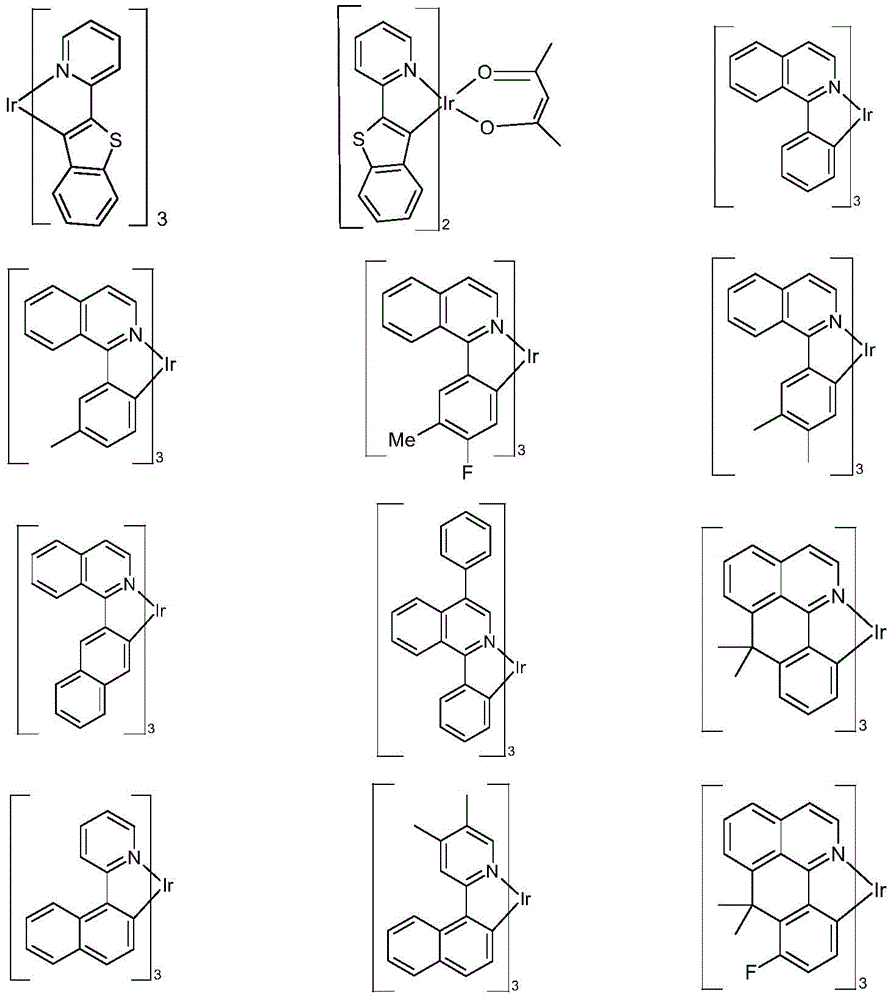
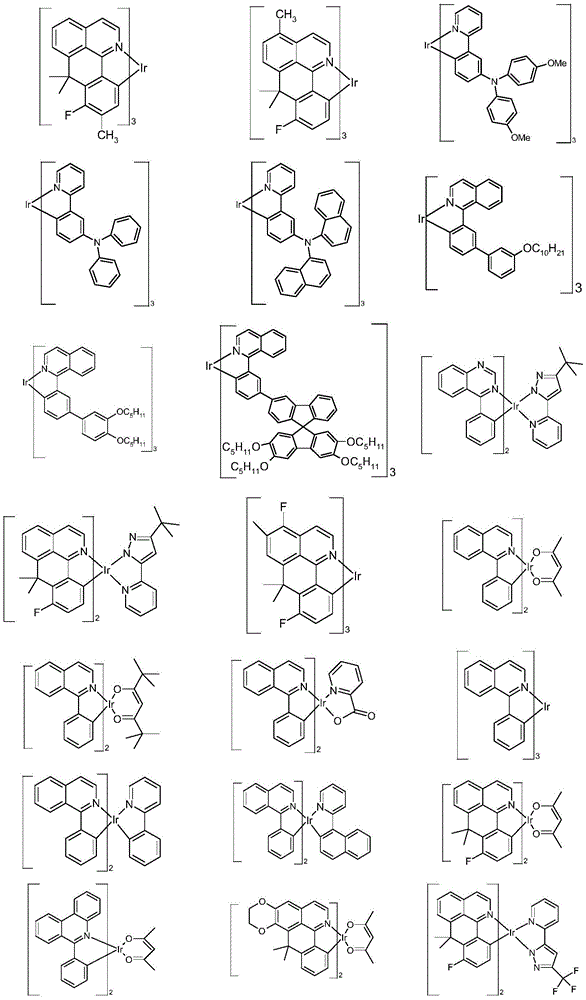


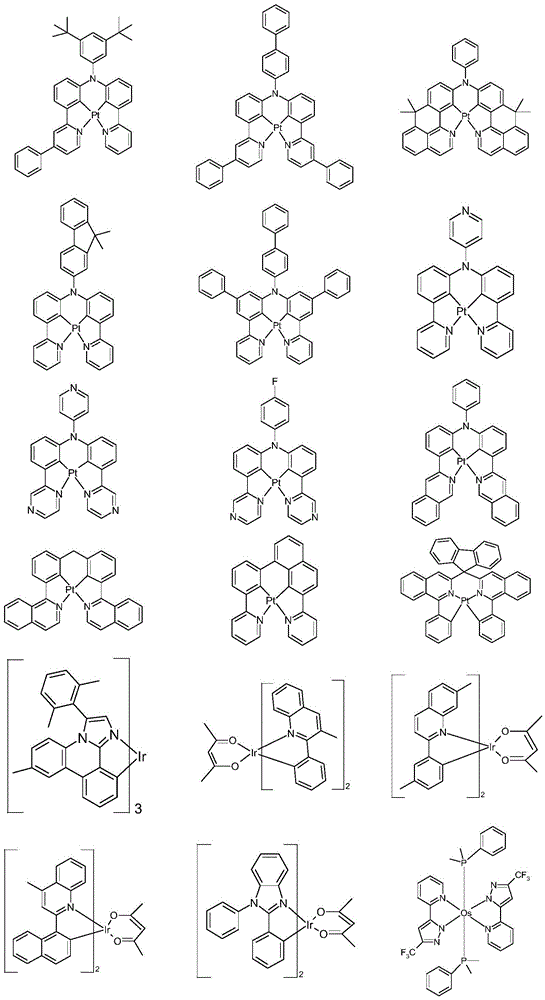
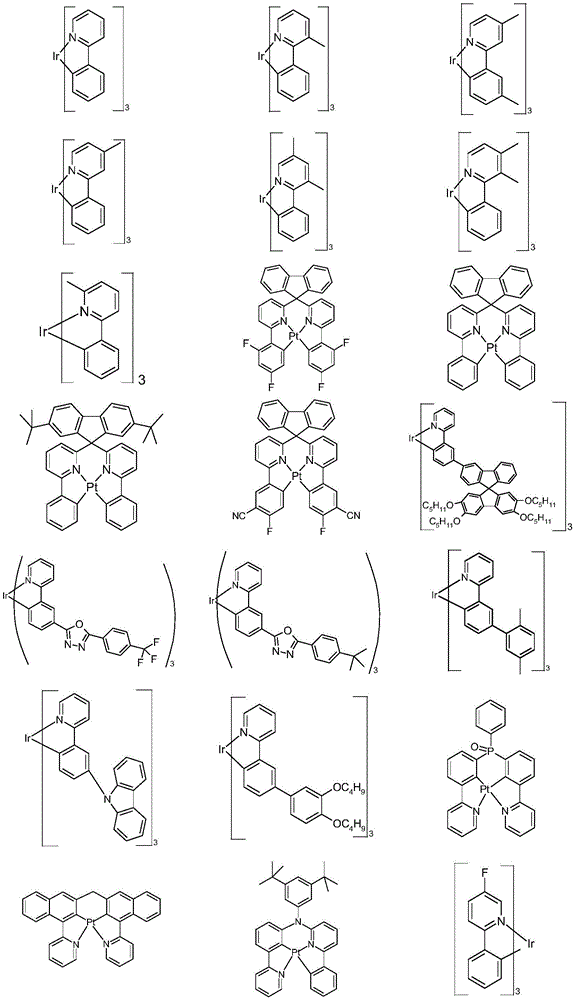


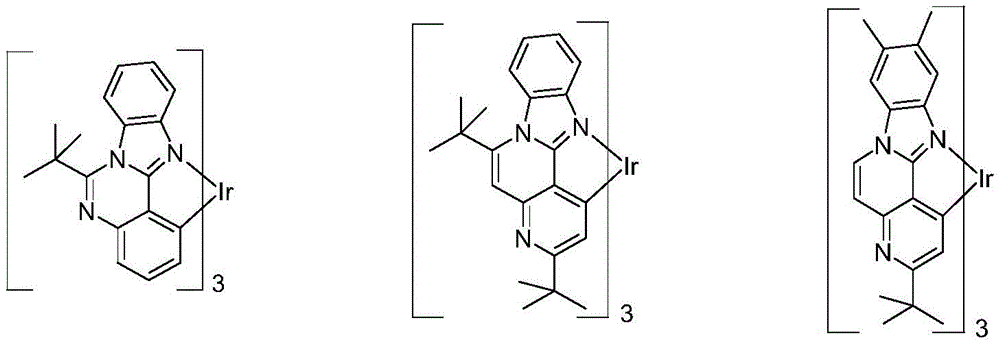
In a preferred embodiment of the present invention, a compound of formula (1) or (167) is used as the hole transporting material. The compounds are thus preferably used in hole transport layers and/or hole injection layers. A hole injection layer in the sense of the present invention is a layer directly adjacent to the anode. A hole-transporting layer in the sense of the present invention is a layer located between the hole-injecting layer and the light-emitting layer. The hole transport layer may be directly adjacent to the light emitting layer. If the compound of the formula (1) is used as hole-transporting material or as hole-injecting material, it can preferably be doped with an electron-acceptor compound, for example with F4-TCNQ or a compound as described in EP 1476881 or EP 1596445. In another preferred embodiment of the present invention, the compounds of formula (1) are used as hole transport materials in combination with hexaazatriphenylene derivatives, as described in US 2007/0092755. The hexaazatriphenylene derivatives are particularly preferably used here in separate layers.
If the compound of formula (1) or (167) is used as hole transport material in the hole transport layer, the compound can be used as pure substance, i.e. in a proportion of 100%, in the hole transport layer, or it can be used in combination with one or more further compounds in the hole transport layer.
In another embodiment of the present invention, a compound of formula (1) or (167) is used as a light-emitting material. For this purpose, the compounds are preferably used in the light-emitting layer. In addition to the at least one compound of the formula (1) or (167), the light-emitting layer furthermore comprises at least one host material. A person skilled in the art will be able to select from known host materials without difficulty and without inventive effort.
In another embodiment of the present invention, the compounds of formula (1) or (167) are used as host material in combination with one or more dopants, preferably phosphorescent dopants.
The dopant in a system comprising a host material and a dopant is considered to refer to the component in the mixture in a minor proportion. Accordingly, host material is understood to mean the component in the mixture in which the proportion is greater in a system comprising host material and dopant.
In this case, the proportion of the host material in the light-emitting layer is 50.0 to 99.9 vol%, preferably 80.0 to 99.5 vol%, particularly preferably 92.0 to 99.5 vol%, for the fluorescent light-emitting layer and 85.0 to 97.0 vol% for the phosphorescent light-emitting layer.
Accordingly, the proportion of the dopant is 0.1 to 50.0 vol%, preferably 0.5 to 20.0 vol%, particularly preferably 0.5 to 8.0 vol% for the fluorescent light-emitting layer, and 3.0 to 15.0 vol% for the phosphorescent light-emitting layer.
The light-emitting layer of the organic electroluminescent device may also comprise a system comprising a plurality of host materials (mixed host system) and/or a plurality of dopants. Also in this case, the dopant is generally the material in a smaller proportion in the system, while the host material is the material in a larger proportion in the system. However, in individual cases, the proportion of the host material alone in the system may be less than the proportion of the dopant alone.
In another preferred embodiment of the present invention, compounds of formula (1) or (167) are used as components of the mixed matrix system. The mixed matrix system preferably comprises two or three different matrix materials, particularly preferably two different matrix materials. Here, one of the two materials is preferably a material having a hole transporting property, and the other material is a material having an electron transporting property. However, the desired electron transporting and hole transporting properties of the mixed matrix component may also be combined primarily or entirely in a single mixed matrix component, with one or more other mixed matrix components performing other functions. The two different matrix materials can be present here in a ratio of from 1:50 to 1:1, preferably from 1:20 to 1:1, particularly preferably from 1:10 to 1:1, very particularly preferably from 1:4 to 1: 1. The mixed matrix system is preferably used in phosphorescent organic electroluminescent devices. More precise information on mixed matrix systems is provided in particular in application WO 2010/108579.
The mixed matrix system may comprise one or more dopants, preferably one or more phosphorescent dopants. In general, mixed matrix systems are preferred for use in phosphorescent organic electroluminescent devices.
Particularly suitable matrix materials for use as matrix components of the mixed matrix system which can be combined with the compounds according to the invention are selected from the preferred matrix materials for the phosphorescent dopants indicated below or the preferred matrix materials for the fluorescent dopants, depending on which type of dopant is used in the mixed matrix system.
Preferred phosphorescent dopants for use in the mixed matrix system are those shown in the above table.
The following shows materials that are preferred for use in the relevant functions of the device of the present invention.
Preferred fluorescent dopants are selected from the following classes of arylamines. Arylamines or aromatic amines in the sense of the present invention are understood to mean compounds which contain three substituted or unsubstituted aromatic or heteroaromatic ring systems which are bonded directly to the nitrogen. At least one of these aromatic or heteroaromatic ring systems is preferably a fused ring system, particularly preferably having at least 14 aromatic ring atoms. Preferred examples thereof are aromatic anthracenamines, aromatic anthracenediamines, aromatic pyreneamines, aromatic pyrenediamines, aromatic pyrene diamines Amines or aromatics
 A diamine. Aromatic anthracenamines are understood to mean one of the diarylaminesCompounds in which the radical is bonded directly to the anthracene group, preferably in the 9 position. Aromatic anthracenediamines are understood to mean compounds in which two diarylamino groups are bonded directly to the anthracene group, preferably in the 9,10 positions. In a similar manner to this, aromatic pyrene amines, pyrene diamines, perylene,
 Amines and
 a diamine, wherein the diarylamino group is preferably bonded to pyrene at position 1 or at positions 1, 6.
Suitable matrix materials for the fluorescent dopants, in addition to the compounds according to the invention, are preferably materials from a wide variety of classes. Preferred matrix materials are selected from the following classes: oligoarylene (e.g. 2,2',7,7' -tetraphenylspirobifluorene according to EP 676461, or dinaphthylanthracene), in particular oligoarylene containing fused aromatic groups, oligoarylenevinylene (e.g. DPVBi or spiro-DPVBi according to EP 676461), polypod metal complexes (e.g. according to WO2004/081017), hole-conducting compounds (e.g. according to WO 2004/058911), electron-conducting compounds, in particular ketones, phosphine oxides, sulfoxides and the like (e.g. according to WO 2005/084081 and WO 2005/084082), atropisomers (e.g. according to WO2006/048268), boronic acid derivatives (e.g. according to WO 2006/117052) or benzanthracenes (e.g. according to WO 2008/145239). Particularly preferred matrix materials are selected from the following classes: oligoarylene containing naphthalene, anthracene, benzanthracene and/or pyrene or atropisomers of these compounds, oligoarylene vinylenes, ketones, phosphine oxides and sulfoxides. Very particularly preferred matrix materials are selected from the following classes: comprising an oligo (arylene) of anthracene, benzanthracene, triphenylene and/or pyrene or atropisomers of these compounds. An oligoarylene in the sense of the present invention is intended to be taken to mean a compound in which at least three aryl or arylene groups are bonded to one another.
Preferred host materials for phosphorescent dopants, in addition to the compounds according to the invention, are aromatic amines, in particular triarylamines, for example according to US 2005/0069729; carbazole derivatives (e.g. CBP, N-biscarbazolylbiphenyl) or compounds according to WO 2005/039246, US 2005/0069729, JP 2004/288381, EP 1205527 or WO 2008/086851), bridged carbazole derivatives, e.g. indenocarbazole derivatives according to WO 2011/088877 and WO 2011/128017, e.g. according to WO 2010/136109 and WO 2011/000455, azacarbazole derivatives, e.g. indolocarbazole derivatives according to EP1617710, EP 1617711, EP 1731584, JP 2005/347160, e.g. according to WO2007/063754 or WO 2008/056746, ketones, e.g. according to WO 2004/093207 or WO 2010/006680, phosphine oxides, sulfoxides and sulfones, e.g. according to WO 2005/003253, oligophenylenes, matrix ambipolar materials, e.g. according to WO2007/137725, silanes, for example according to WO 2005/111172, azaborole or borate esters, for example according to WO 2006/117052, triazine derivatives, for example according to WO 2010/015306, WO2007/063754 or WO 2008/056746, zinc complexes, for example according to EP 652273 or WO 2009/062578, aluminum complexes, for example of BAlq, diazasilacyclopentadiene and tetraazasilacyclopentadiene derivatives, for example according to WO 2010/054729, diazaphosphole derivatives, for example according to WO 2010/054730, and aluminum complexes, for example BAlq.
Suitable charge transport materials which can be used in the hole injection or hole transport layer or in the electron transport layer of the organic electroluminescent device according to the invention are, for example, the compounds disclosed in Y.Shirota et al, chem.Rev. (chemical review) 2007,107(4),953-1010, or other materials used in these layers according to the prior art.
The cathode of the organic electroluminescent device preferably comprises a metal, a metal alloy or a multilayer structure with a low work function comprising different metals, such as alkaline earth metals, alkali metals, main group metals or lanthanides (e.g. Ca, Ba, Mg, Al, In, Mg, Yb, Sm, etc.). Also suitable are alloys comprising an alkali or alkaline earth metal and silver, for example alloys comprising magnesium and silver. In the case of a multilayer structure, in addition to the metals mentioned, other metals having a relatively high work function, such as Ag or Al, can also be used, in which case combinations of metals, such as Ca/Ag, Mg/Ag or Ba/A, are generally usedg. It may also be preferred to introduce a thin intermediate layer of a material having a high dielectric constant between the metal cathode and the organic semiconductor. Suitable for this purpose are, for example, alkali metal fluorides or alkaline earth metal fluorides, but also the corresponding oxides or carbonates (e.g. LiF, Li)2O、BaF2、MgO、NaF、CsF、Cs2CO3Etc.). In addition, lithium hydroxyquinoline (LiQ) can be used for this purpose. The layer thickness of such a layer is preferably 0.5 to 5 nm.
The anode preferably comprises a material having a high work function. The anode preferably has a work function greater than 4.5eV relative to vacuum. One aspect suitable for this purpose is metals with a high redox potential, such as Ag, Pt or Au. On the other hand, metal/metal oxide electrodes (e.g., Al/Ni/NiO) may also be preferredx、Al/PtOx). For some applications, at least one electrode must be transparent or partially transparent to facilitate the radiation of the organic material (organic solar cells) or the outcoupling of light (OLED, O-laser). Preferred anode materials herein are conductive mixed metal oxides. Particularly preferred is Indium Tin Oxide (ITO) or Indium Zinc Oxide (IZO). Preference is furthermore given to conductively doped organic materials, in particular conductively doped polymers.
The device is suitably (depending on the application) structured, provided to be in contact and finally sealed, since the lifetime of the device according to the invention is shortened in the presence of water and/or air.
In a preferred embodiment, the organic electroluminescent device according to the invention is characterized in that the layer or layers are applied by means of a sublimation process, wherein in a vacuum sublimation apparatus less than 10-5Mbar, preferably less than 10-6The material is applied by vapor deposition at an initial pressure of mbar. However, the initial pressure may also be even lower here, for example less than 10-7Millibar.
Also preferred are organic electroluminescent devices which are characterized in that one or more layers are applied by the OVPD (organic vapor deposition) method or sublimation with the aid of a carrier gas, where 10 is the range-5Applying at a pressure of mbar to 1 barA material. A particular example of such a method is the OVJP (organic vapour jet printing) method, in which the material is applied directly through a nozzle and is therefore structured (for example m.s. arnold et al, appl.phys. lett. (applied physical bulletin) 2008,92, 053301).
Preference is furthermore given to organic electroluminescent devices which are characterized in that one or more layers are produced from solution, for example by spin coating, or by means of any desired printing method, for example screen printing, flexographic printing, nozzle printing or offset printing, but particularly preferably LITI (light induced thermal imaging, thermal transfer) or inkjet printing. For this purpose, a soluble compound of formula (1) is necessary. High solubility can be achieved by suitable substitution of the compounds.
To produce the organic electroluminescent device according to the invention, it is furthermore preferred to apply one or more layers from solution and to apply one or more layers by the sublimation method.
According to the present invention, electronic devices comprising one or more compounds of formula (1) or (167) can be used in displays, as light sources in lighting applications and as light sources in medical and/or cosmetic applications, such as phototherapy.
Devices comprising compounds of formula (1) or (167) can be used in a very versatile manner. Thus, for example, electroluminescent devices comprising one or more compounds of formula (1) or (167) can be used in displays for televisions, mobile telephones, computers and cameras. However, the device may also be used in lighting applications. Furthermore, electroluminescent devices, for example in OLEDs or OLECs, comprising at least one compound of formula (1) or (167) can be used for phototherapy in the pharmaceutical or cosmetic industry. Thus, a number of diseases (psoriasis, atopic dermatitis, inflammation, acne, skin cancer, etc.) can be treated, or skin wrinkles, skin redness, and skin aging can be prevented or reduced. Furthermore, the light emitting device may be used to keep beverages, meals or food fresh or to disinfect equipment (e.g. medical equipment).
The compounds according to the invention and the organic electroluminescent devices according to the invention are distinguished over the prior art by the following unexpected advantages:
1. the compounds according to the invention are very suitable, in particular because of their high hole mobility, for use in electronic devices, for example in hole transport layers or hole injection layers in organic electroluminescent devices.
2. The compounds according to the invention have relatively low sublimation temperatures, high temperature stability and high oxidative stability with high glass transition temperatures, which are advantageous for example for processability from solution or from the gas phase and for use in electronic devices.
3. The use of the compounds according to the invention in electronic devices, in particular as hole-transporting or hole-injecting materials, results in high efficiencies, low operating voltages and long lifetimes.
It should be noted that variations of the embodiments described in the present invention are within the scope of the invention. Each feature disclosed in this specification may be replaced by an alternative feature serving the same, equivalent, or similar purpose, unless expressly excluded. Thus, unless stated otherwise, each feature disclosed in this disclosure should be viewed as an example of a generic series or as an equivalent or similar feature.
All features of the invention can be combined with each other in any way, unless the specific features and/or steps are mutually exclusive. This applies in particular to the preferred features of the invention. Likewise, features in non-essential combinations may be used separately (not in combination).
Furthermore, it should be noted that many of the features, in particular those of the preferred embodiments of the invention, are inventive per se and should not be seen as only part of the embodiments of the invention. Protection may additionally be sought for these features in addition to or as an alternative to each of the inventions presently claimed.
The teachings regarding the functioning of the disclosed technology can be extracted and combined with other embodiments.
Detailed Description
The invention is explained in more detail by the following examples, without wishing to restrict the invention accordingly.
Examples
Material
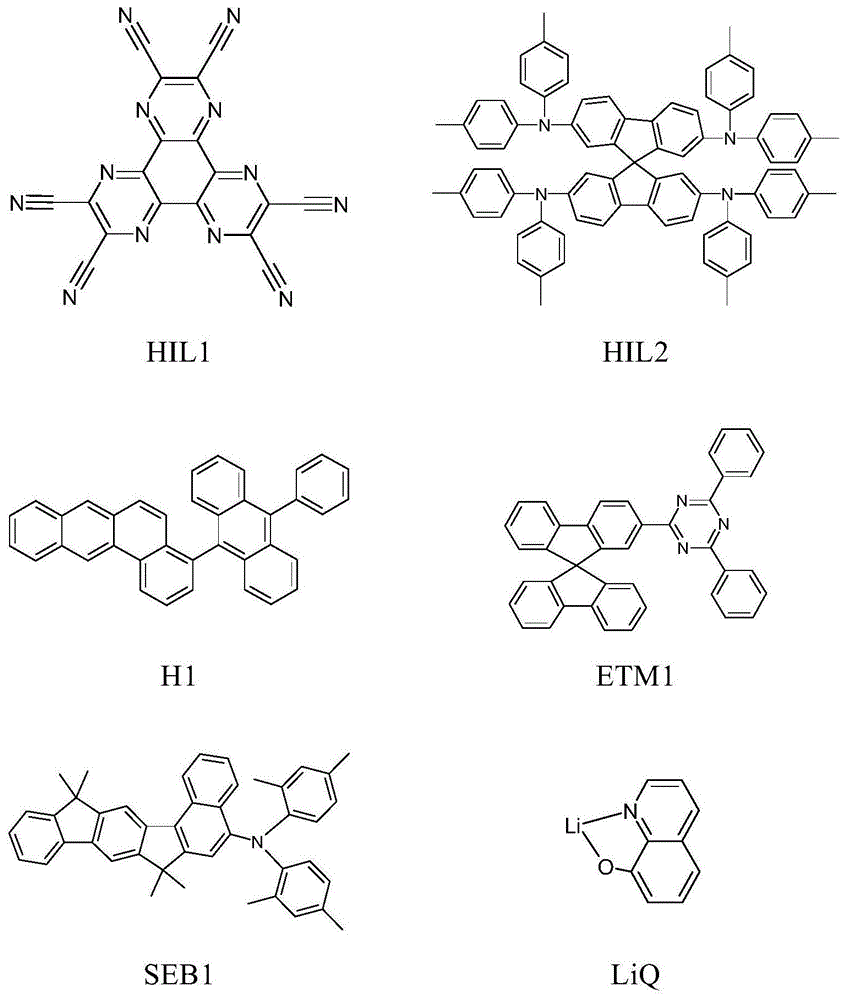
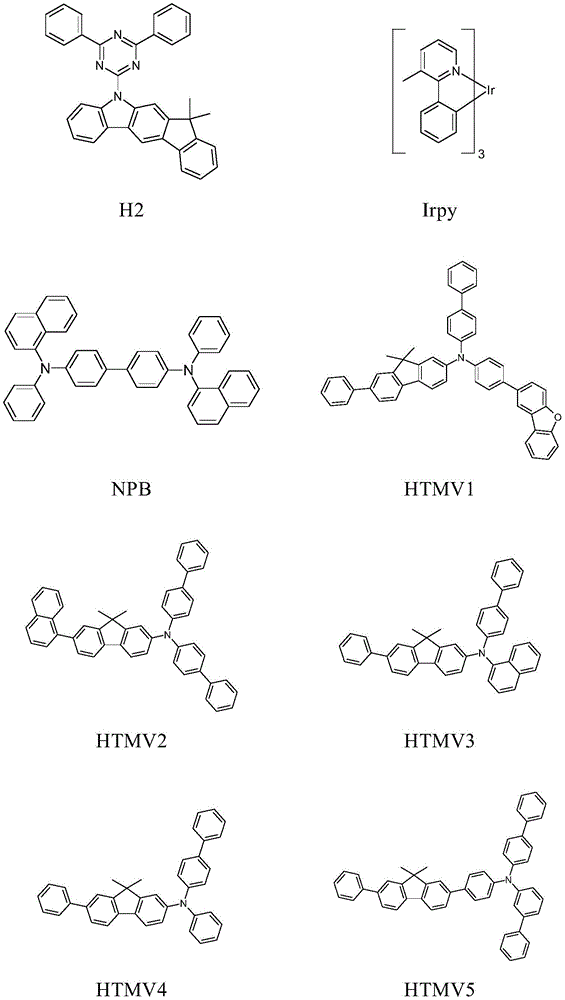
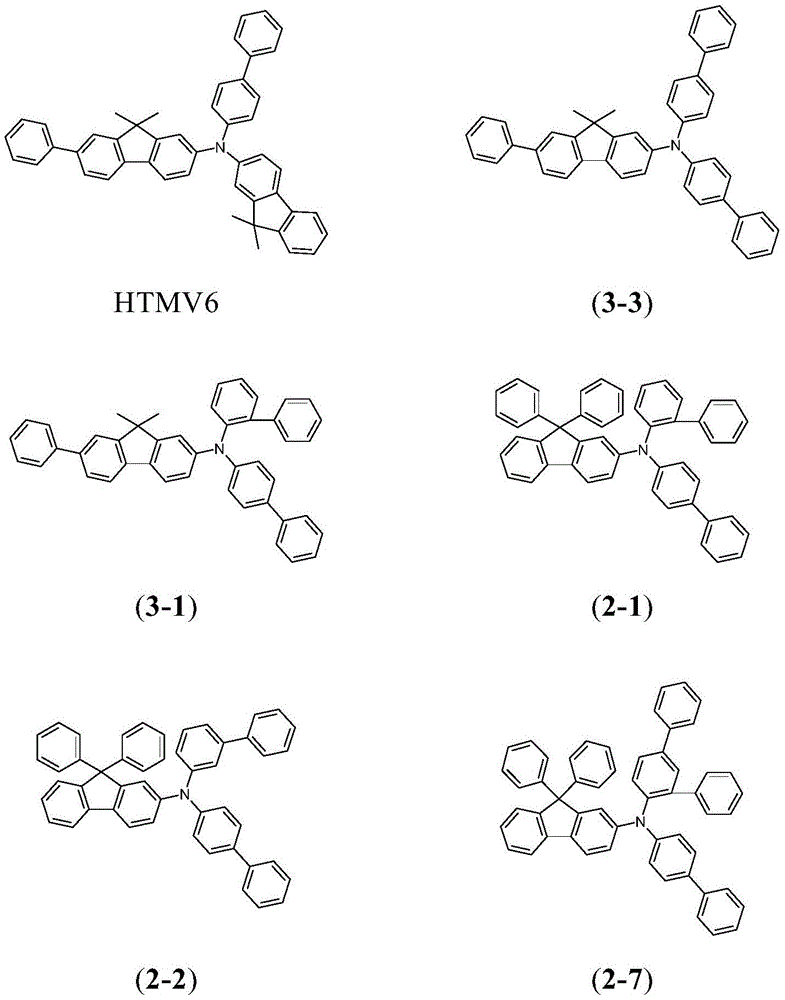
Materials HIL1, HIL2(EP 0676461), H1(WO 2008/145239), ETM1(WO 2005/053055), SEB1(WO 2008/006449), LiQ and NPB are well known to those of ordinary skill in the art. The nature and synthesis thereof are known from the prior art. The compounds (3-3), (3-1), (2-1) and (2-2) and (2-7) are according to the invention.
Example 1
Synthesis of Compound Biphenyl-2-ylbiphenyl-4-yl- (9, 9-dimethyl-9H-fluoren-2-yl) amine (1-1) and Compounds (1-2) to (1-5)
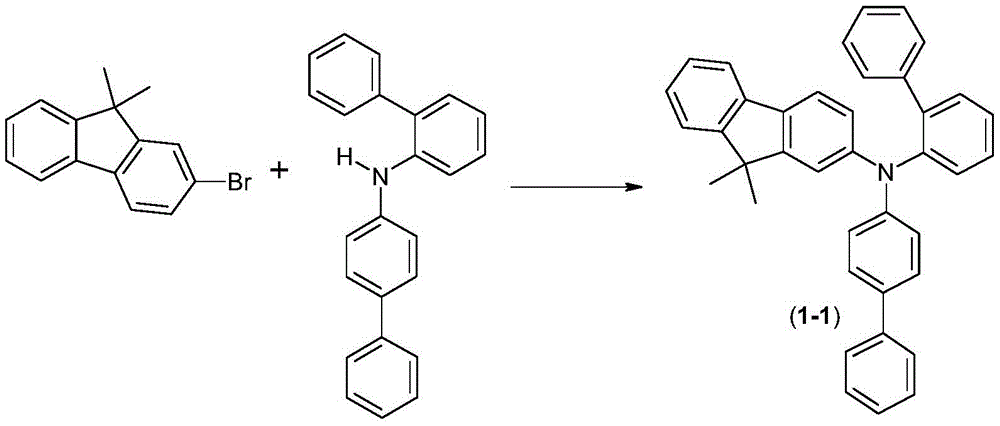
23.5g of biphenyl-2-ylbiphenyl-4-ylamine (73mmol) and 20.0g of 2-bromofluorene (73mmol) were dissolved in 500ml of toluene: degassing the solution and adding N2And (4) saturation. Then 2.52g (2.93mmol) of tri-tert-butylphosphine and 0.33g (1.46mmol) of palladium (II) acetate were added. 10.8g of sodium tert-butoxide (110mmol) were subsequently added. The reaction mixture was heated at boiling under a protective atmosphere for 6 hours. The mixture was then partitioned between toluene and water, and the organic phase was washed three times with water, over Na2SO4Dried and evaporated in a rotary evaporator. After filtration of the crude product with toluene over silica gel, the residue left is recrystallized from heptane/toluene and finally sublimed in high vacuum. The purity was 99.9%. The yield was 32.0g (85% of theory).
The following compounds (1-2) to (1-5) were similarly prepared:

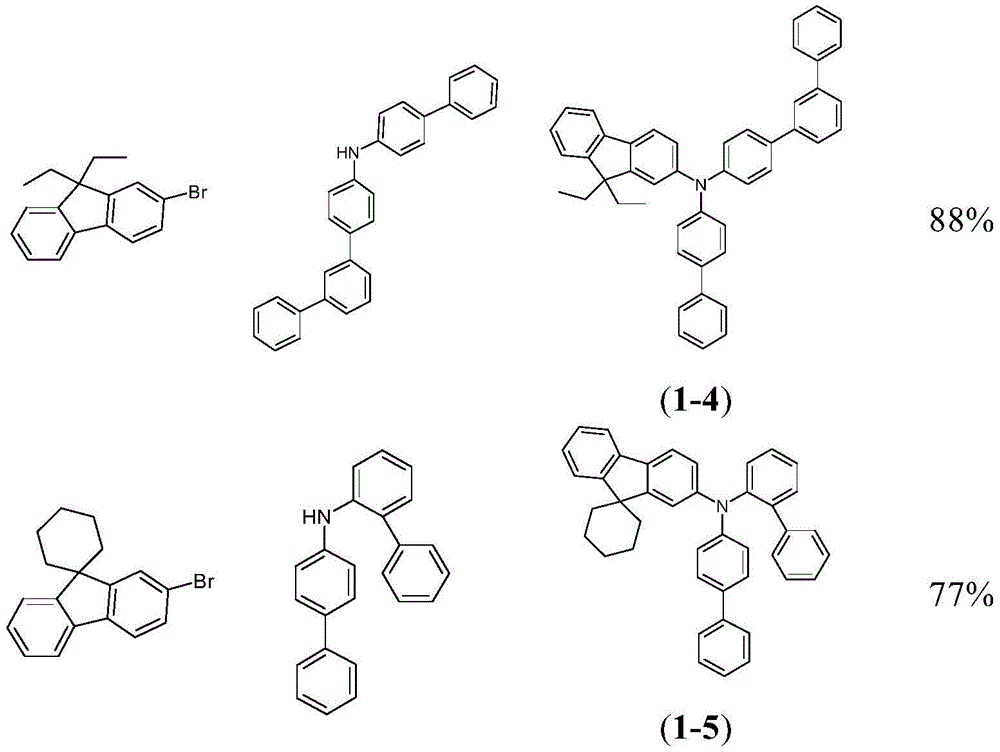
example 2
Synthesis of Compound Biphenyl-2-ylbiphenyl-4-yl- (9, 9-diphenyl-9H-fluoren-3-yl) amine (2-1) and Compounds (2-2) to (2-10)

2-bromo-9, 9-diphenyl-9H-fluorene (2-1)
30g (103mmol) of methyl 4' -bromobiphenyl-2-carboxylate were dissolved in 500ml of dry THF in a flask which had been dried by heating. The clear solution was cooled to-10 ℃ and 102ml (307mmol) of freshly prepared 3M 2-phenylmagnesium bromide solution was added. The reaction mixture was slowly warmed to room temperature and then NH was used4Cl (500ml) quench. The mixture was then partitioned between ethyl acetate and water, and the organic phase was washed three times with water, over Na2SO4Dried and evaporated in a rotary evaporator. 400ml of acetic acid are carefully added to the residue. 80ml of fuming hydrochloric acid are subsequently added. The batch was heated to 75 ℃ and held at this temperature for 5 hours. During which a white solid precipitated. The batch was then cooled to room temperature and the precipitated solid was filtered off with suction and rinsed with methanol. The residue was dried in vacuo at 40 ℃. The yield was 29.4g (74mmol) (72% of theory).
The following brominated compounds were prepared analogously:

biphenyl-2-ylbiphenyl-4-yl- (9, 9-diphenyl-9H-fluoren-3-yl) amine (2-1)
17g of biphenyl-2-ylbiphenyl-4-ylamine (53mmol) and 21g of 2-bromo-9,9-Diphenyl-9H-fluorene (53mmol) was dissolved in 350ml toluene: degassing the solution and adding N2And (4) saturation. Then 2.1ml (2.1mmol) of a 1M solution of tri-tert-butylphosphine and 0.24g (1.06mmol) of palladium (II) acetate were added, followed by 12.7g of sodium tert-butoxide (132 mmol). The reaction mixture was heated at boiling under a protective atmosphere for 5 hours. The mixture was then partitioned between toluene and water, and the organic phase was washed three times with water, over Na2SO4Dried and evaporated in a rotary evaporator. After filtration of the crude product with toluene over silica gel, the residue left is recrystallized from heptane/toluene and finally sublimed in high vacuum. The purity was 99.9%. The yield was 25g (74% of theory).
The following compounds (2-2) to (2-10) can be similarly prepared.


Example 3
Synthesis of Compound Biphenyl-4-ylbiphenyl-2-yl- (9, 9-dimethyl-7-phenyl-9H-fluoren-2-yl) amine (3-1) and Compounds (3-2) to (3-8)

9, 9-dimethyl-7-phenyl-9H-fluorene
8.9g (73mmol) of phenylboronic acid and 20g (73mmol) of 2-bromo-9, 9' -dimethyl-9H-fluorene are suspended in 330ml of dimethoxyethane and 110ml of 2M Na2CO3In solution. To this suspension was added 2.54g (2.0mmol) of tetrakis (triphenylphosphine) palladium. The reaction mixture was heated at reflux for 16 hours. After cooling, the reaction mixture was diluted with ethyl acetate and the organic phase was separated and washedIt was washed three times with 100ml of water and subsequently evaporated to dryness. The crude product was filtered through silica gel using heptane/ethyl acetate (20:1) to give 18.8g (95%) of 9, 9-dimethyl-7-phenyl-9H-fluorene.
The following fluorenes were prepared analogously.

2-bromo-9, 9-dimethyl-7-phenyl-9H-fluorene
29.0g (107mmol) of 9, 9-dimethyl-2-phenyl-9H-fluorene were dissolved in 250ml of CHCl3And slowly added at-10 ℃ dissolved in 50ml of CHCl317.2g (107mmol) of bromine. When the reaction is complete, water is added and the organic phase is separated off, dried and evaporated. The crude product was subsequently washed several times by stirring with hot MeOH/heptane (1: 1). 33.3g (89% of theory) of the product are obtained as a white solid.
The following brominated compounds were prepared analogously.
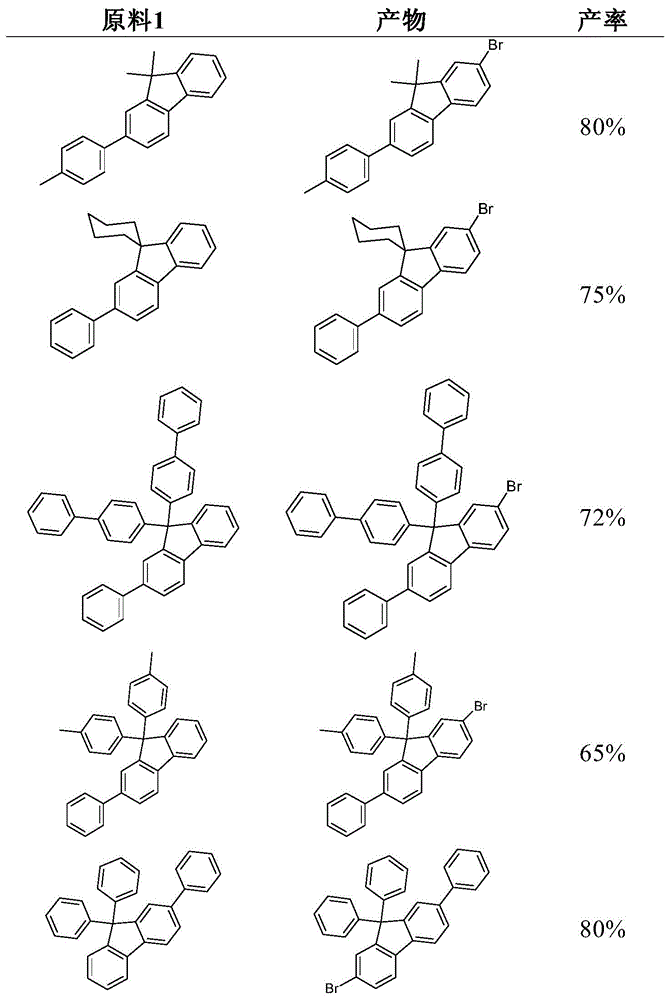
Biphenyl-4-ylbiphenyl-2-yl- (9, 9-dimethyl-7-phenyl-9H-fluoren-2-yl) amine (3-1)
19.9g of biphenyl-2-ylbiphenyl-4-ylamine (62mmol) and 21.6g of 2-bromo-9, 9-dimethyl-7-phenyl-9H-fluorene (62mmol) were dissolved in 400ml of toluene. Degassing the solution and applying N2And (4) saturation. Then 3ml (3mmol) of a 1M solution of tri-tert-butylphosphine and 0.57g (2mmol) of palladium (II) acetate were added. 14.9g of sodium tert-butoxide (155mmol) were subsequently added. The reaction mixture was heated at boiling under a protective atmosphere for 5 hours. The mixture was then partitioned between toluene and water, and the organic phase was washed three times with water, over Na2SO4Dried and evaporated in a rotary evaporator. After filtration of the crude product with toluene over silica gel, the residue left is recrystallized from heptane/toluene and finally sublimed in high vacuum. The purity was 99.9%. The yield is 29.7g (82% of theory).
Compounds (3-2) to (3-8) were prepared similarly.
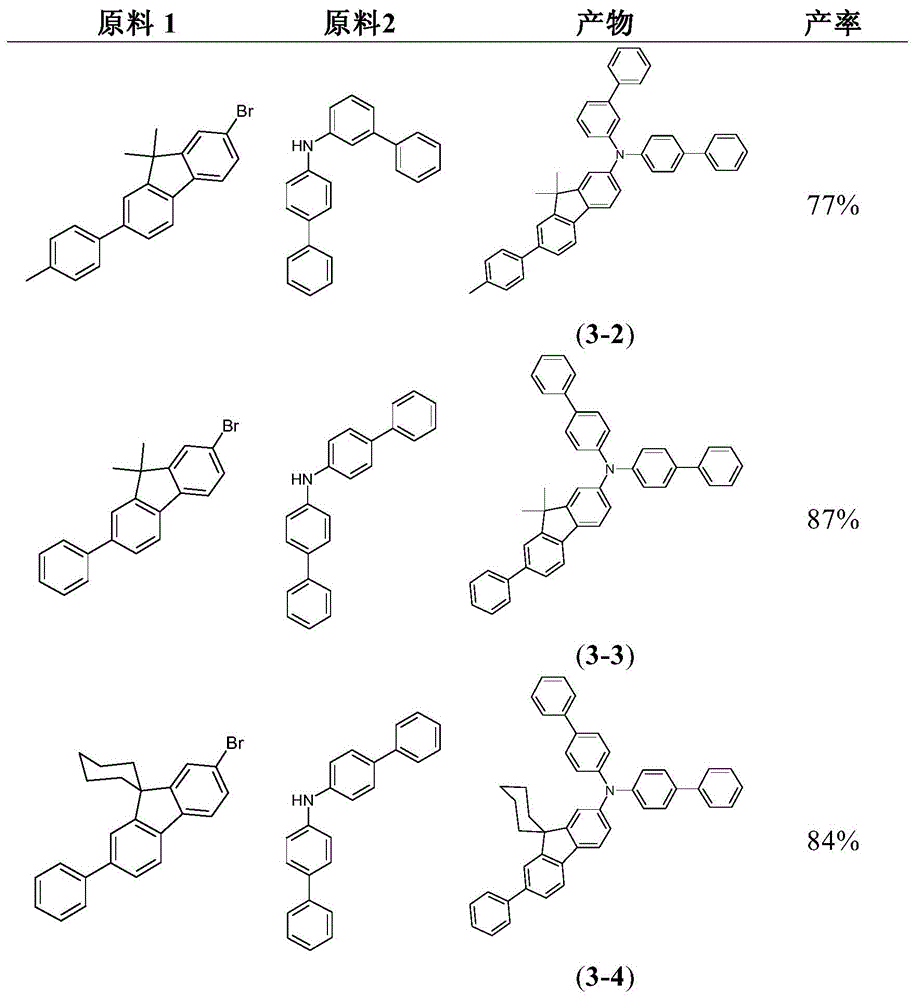
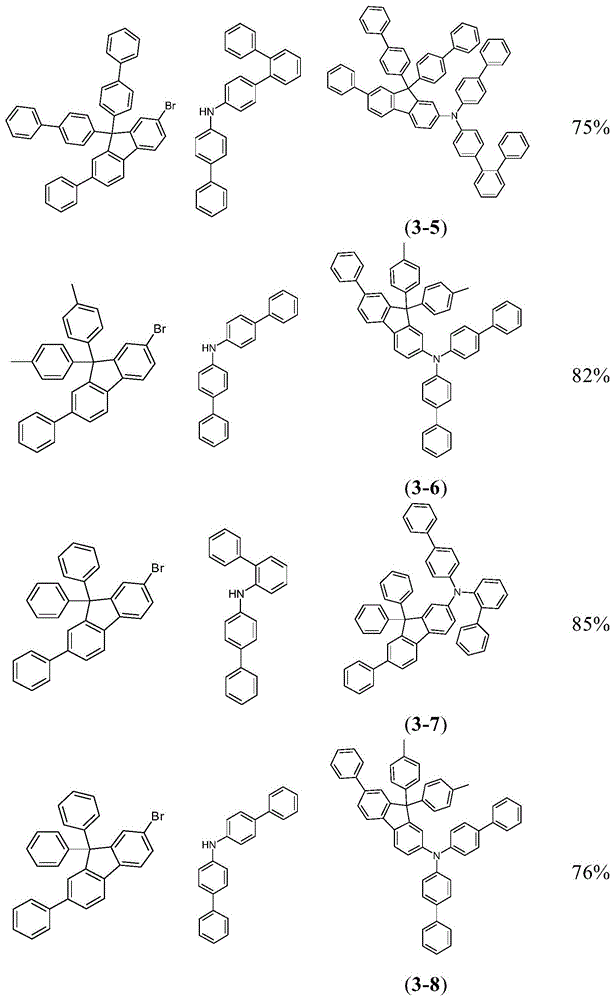
Example 4
Synthesis of comparative compounds HTMV1 to HTMV6
In analogy to the synthesis of compound (3-1) described in example 3, the following comparative compounds (HTMV1) to (HTMV6) were also prepared.
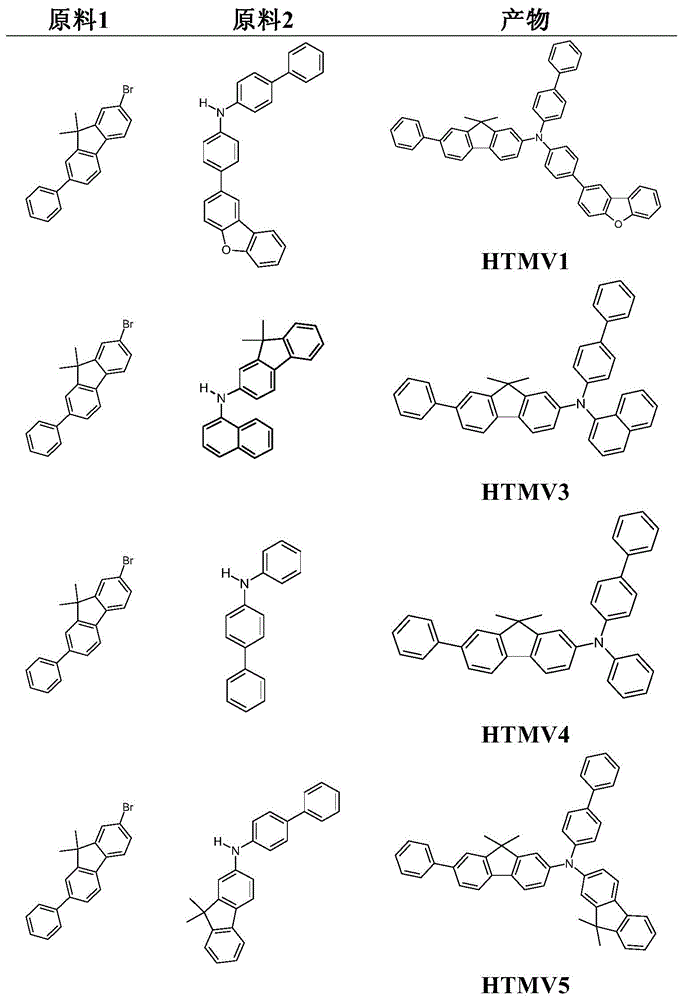
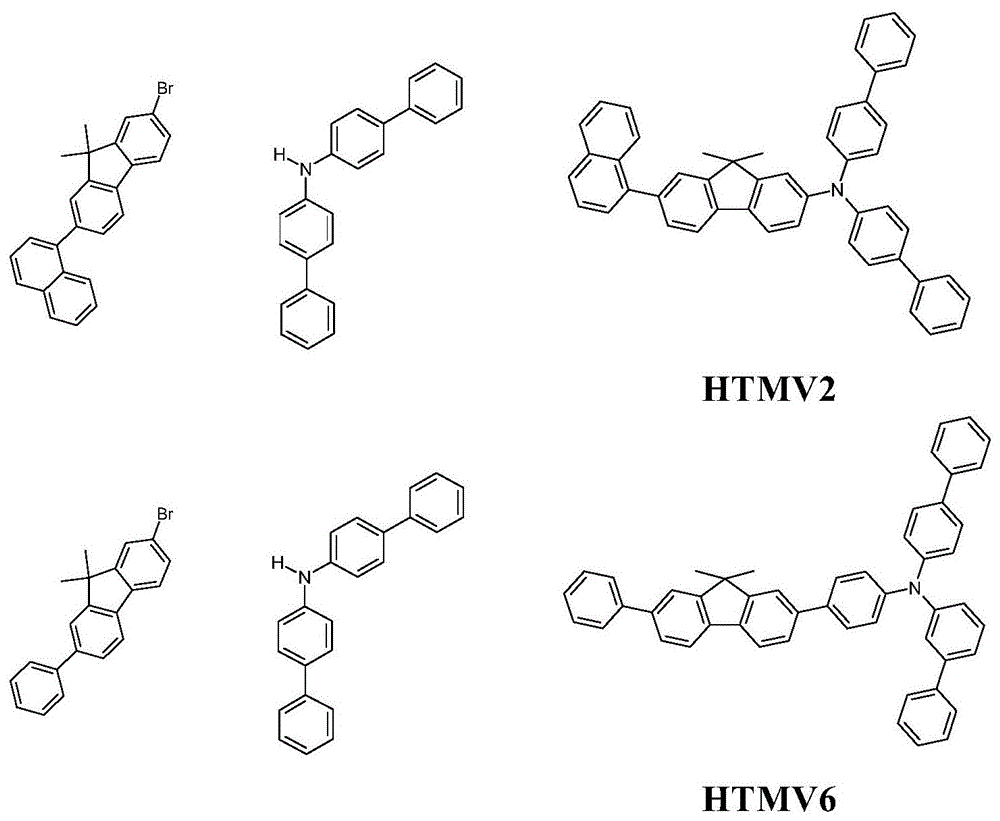
Example 5
Characterization of the Complex (Verbindungen)
The OLEDs according to the invention and the OLEDs according to the prior art are manufactured by the general method according to WO 04/058911, which is adapted to the situation described here (layer thickness change, material).
Data for various OLEDs are presented in the following examples (see tables 1,3 and 2, 4). The substrate used was a glass plate which had been coated with structured ITO (indium tin oxide) to a thickness of 50 nm. The OLED has essentially the following layer structure: substrate/optional hole injection layer (HIL 1)/Hole Transport Layer (HTL)/hole injection layer (HIL 2)/Electron Blocking Layer (EBL)/light emitting layer (EML)/Electron Transport Layer (ETL)/optional Electron Injection Layer (EIL) and finally a cathode. The cathode is formed from a layer of aluminium having a thickness of 100 nm. The exact structures of the OLEDs are shown in tables 1 and 3. The materials required to fabricate an OLED are shown above.
All materials were applied by thermal vapor deposition in a vacuum chamber. The light-emitting layer here always consists of at least one host material (host material) and a light-emitting dopant (emitter), with which the host material or host materials are mixed by co-evaporation in a specific volume ratio. Expressions such as H1: SEB1 (95%: 5%) here mean that the material H1 is present in a proportion of 95% by volume in the layer and SEB1 is present in a proportion of 5% in the layer. Similarly, the electron transport layer may also be composed of a mixture of two materials.
OLEDs were characterized by standard methods. For this purpose, the electroluminescence spectrum, the current efficiency (measured in cd/a), the power efficiency (measured in lm/W), and the external quantum efficiency (EQE, measured in percent) are determined, which are calculated as a function of the luminous density from a current/voltage/luminous density characteristic line (IUL characteristic line) which exhibits lambert emission characteristics, and the lifetime is determined. At 1000cd/m2The electroluminescence spectrum is determined and the CIE 1931x and y color coordinates are calculated therefrom. Expressed in 1000cd/m2EQE at the lower is indicated at 1000cd/m2External quantum efficiency at the operating luminous density of (a). At 6000cd/m2LT80 at bottom is a reduction in the luminance of an OLED from 6000cd/m2 to 80% of the initial intensity, i.e., to 4800cd/m2The life of (2). Data for the various OLEDs are summarized in tables 2 and 4.
Use of the compounds according to the invention as hole transport materials in fluorescent and phosphorescent OLEDs
The compounds according to the invention are particularly suitable as HIL, HTL or EBL in OLEDs. They are suitable as individual layers, as well as mixed components of the HIL, HTL, EBL or within the EML.
The samples comprising the compounds according to the invention exhibit, in addition to higher efficiency, a significantly improved lifetime, both for the singlet blue and for the triplet green, compared to the NPB reference components (V1, V8).
The compounds according to the invention have the same or better efficiency and improved lifetime compared with the reference materials HTMV1-HTMV6 (V2-V10).
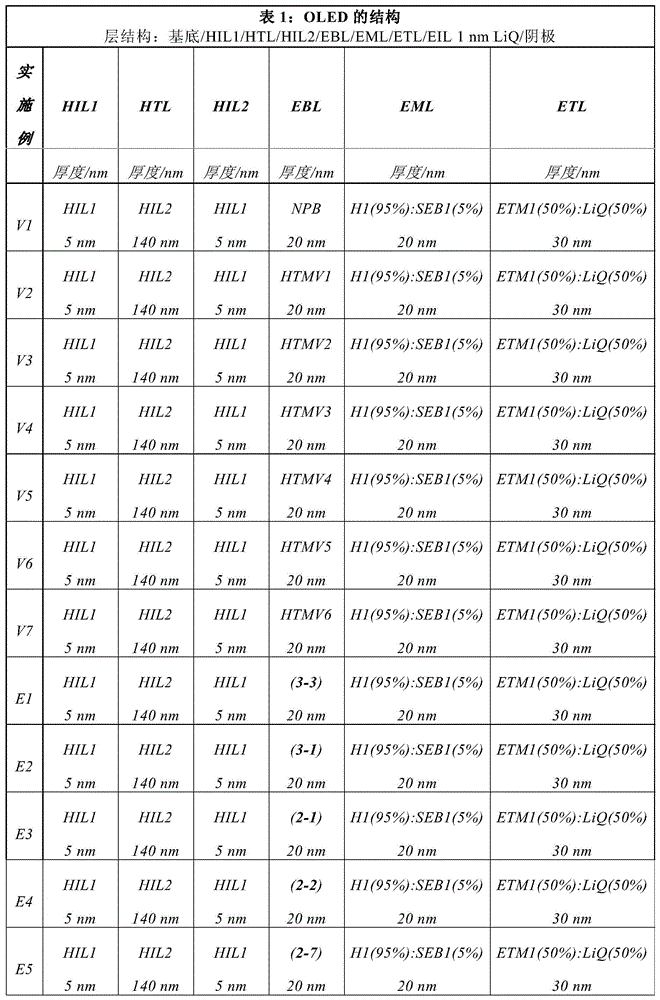
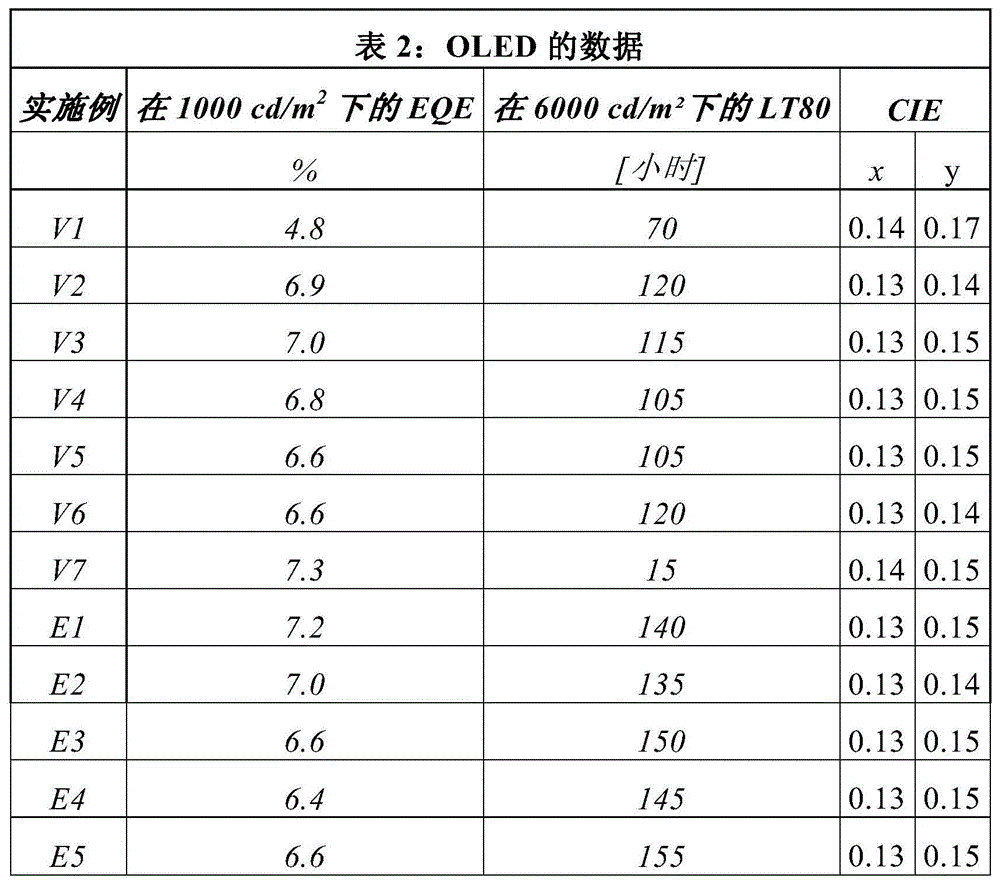


Claims (20)

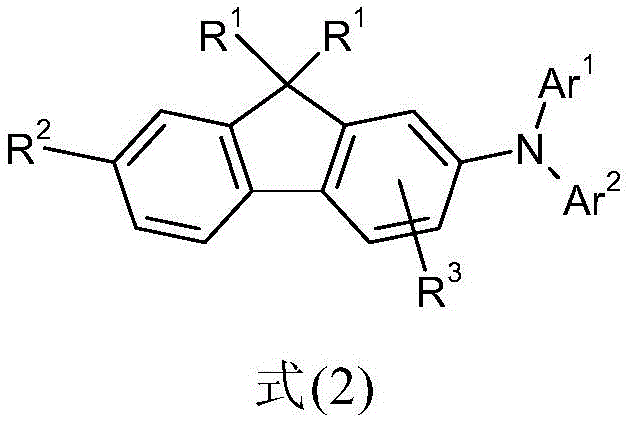
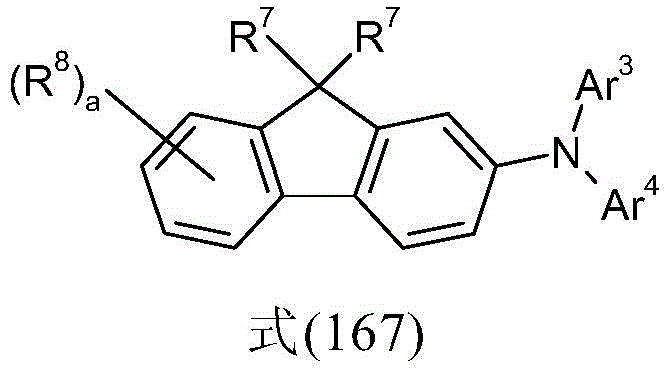
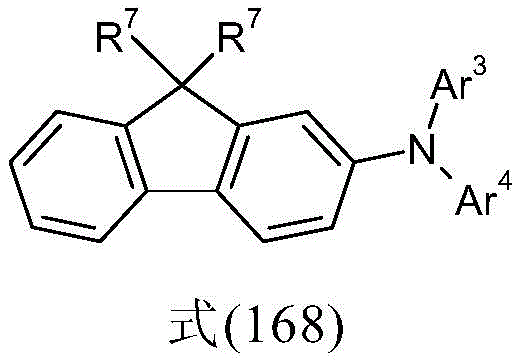

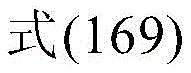
Applications Claiming Priority (3)
| Application Number | Priority Date | Filing Date | Title |
|---|---|---|---|
| EP12005370.7 | 2012-07-23 | ||
| EP12005370 | 2012-07-23 | ||
| CN201380039281.5A CN104488359B (en) | 2012-07-23 | 2013-06-27 | Derivatives of 2-diarylaminofluorenes and organic electronic complexes containing said 2-diarylaminofluorene derivatives |
Related Parent Applications (1)
| Application Number | Title | Priority Date | Filing Date |
|---|---|---|---|
| CN201380039281.5A Division CN104488359B (en) | 2012-07-23 | 2013-06-27 | Derivatives of 2-diarylaminofluorenes and organic electronic complexes containing said 2-diarylaminofluorene derivatives |
Publications (2)
| Publication Number | Publication Date |
|---|---|
| CN108054293A CN108054293A (en) | 2018-05-18 |
| CN108054293B true CN108054293B (en) | 2020-05-22 |
Family
ID=48703409
Family Applications (2)
| Application Number | Title | Priority Date | Filing Date |
|---|---|---|---|
| CN201810004275.0A Active CN108054293B (en) | 2012-07-23 | 2013-06-27 | Derivatives of 2-diarylaminofluorene and organic electronic complexes containing said 2-diarylaminofluorene derivatives |
| CN201380039281.5A Active CN104488359B (en) | 2012-07-23 | 2013-06-27 | Derivatives of 2-diarylaminofluorenes and organic electronic complexes containing said 2-diarylaminofluorene derivatives |
Family Applications After (1)
| Application Number | Title | Priority Date | Filing Date |
|---|---|---|---|
| CN201380039281.5A Active CN104488359B (en) | 2012-07-23 | 2013-06-27 | Derivatives of 2-diarylaminofluorenes and organic electronic complexes containing said 2-diarylaminofluorene derivatives |
Country Status (7)
| Country | Link |
|---|---|
| US (3) | US9768391B2 (en) |
| EP (1) | EP2875699B1 (en) |
| JP (4) | JP6430378B2 (en) |
| KR (5) | KR20150038193A (en) |
| CN (2) | CN108054293B (en) |
| TW (6) | TWI639677B (en) |
| WO (1) | WO2014015938A1 (en) |
Families Citing this family (149)
| Publication number | Priority date | Publication date | Assignee | Title |
|---|---|---|---|---|
| CN108054293B (en) * | 2012-07-23 | 2020-05-22 | 默克专利有限公司 | Derivatives of 2-diarylaminofluorene and organic electronic complexes containing said 2-diarylaminofluorene derivatives |
| CN110444694B (en) * | 2012-07-23 | 2023-04-07 | 默克专利有限公司 | Compound and organic electroluminescent device |
| JP5849160B2 (en) | 2012-08-31 | 2016-01-27 | 出光興産株式会社 | Aromatic amine derivative and organic electroluminescence device using the same |
| US9748492B2 (en) | 2012-11-02 | 2017-08-29 | Idemitsu Kosan Co., Ltd. | Organic electroluminescent device |
| KR101476231B1 (en) * | 2013-10-02 | 2014-12-24 | 롬엔드하스전자재료코리아유한회사 | An Organic Electroluminescent Compound and an Organic Electroluminescent Device Comprising the Same |
| EP3018119A4 (en) * | 2013-10-11 | 2017-03-22 | Idemitsu Kosan Co., Ltd | Aromatic amine compound, organic electroluminescent element and electronic device |
| WO2015082056A1 (en) * | 2013-12-06 | 2015-06-11 | Merck Patent Gmbh | Compounds and organic electronic devices |
| WO2015129896A1 (en) | 2014-02-28 | 2015-09-03 | 出光興産株式会社 | Compound, material for organic electroluminescent element, organic electroluminescent element, and electronic apparatus |
| DE102014008722B4 (en) | 2014-06-18 | 2024-08-22 | Merck Patent Gmbh | Compositions for electronic devices, formulation containing them, use of the composition, use of the formulation and organic electronic device containing the composition |
| CN106688119B (en) * | 2014-07-09 | 2019-07-23 | 保土谷化学工业株式会社 | Organic Electroluminescent Devices |
| KR102346674B1 (en) * | 2014-07-22 | 2022-01-05 | 삼성디스플레이 주식회사 | Organic light-emitting device |
| KR101631063B1 (en) * | 2014-08-08 | 2016-06-16 | 경상대학교산학협력단 | Organic semiconductor compounds Containing Fluorene derivatives and Solar Cell Device Using This Material |
| KR20190131609A (en) * | 2014-10-24 | 2019-11-26 | 메르크 파텐트 게엠베하 | Materials for electronic devices |
| JP6772188B2 (en) | 2015-02-03 | 2020-10-21 | メルク、パテント、ゲゼルシャフト、ミット、ベシュレンクテル、ハフツングMerck Patent GmbH | Metal complex |
| JP2016192464A (en) | 2015-03-31 | 2016-11-10 | 三星ディスプレイ株式會社Samsung Display Co.,Ltd. | Material for organic electroluminescent element, organic electroluminescent element employing the same |
| KR102610370B1 (en) * | 2015-05-18 | 2023-12-05 | 메르크 파텐트 게엠베하 | Materials for organic electroluminescent devices |
| WO2016194714A1 (en) * | 2015-05-29 | 2016-12-08 | 出光興産株式会社 | High molecular compound, organic electroluminescence element material, organic electroluminescence element, and electronic device |
| KR101796227B1 (en) | 2015-08-21 | 2017-11-10 | 삼성디스플레이 주식회사 | Organic light-emitting device |
| US20180327339A1 (en) | 2015-08-28 | 2018-11-15 | Merck Patent Gmbh | Compounds for electronic devices |
| KR101958833B1 (en) * | 2015-09-21 | 2019-03-15 | 삼성에스디아이 주식회사 | Organic optoelectric device and display device |
| KR101708176B1 (en) | 2015-12-31 | 2017-02-20 | 머티어리얼사이언스 주식회사 | Organic compound and organic electroluminescent device comprising the same |
| KR102077369B1 (en) * | 2016-02-02 | 2020-02-13 | 주식회사 엘지화학 | Amine-based compound and organic light emitting device comprising the same |
| WO2017133829A1 (en) | 2016-02-05 | 2017-08-10 | Merck Patent Gmbh | Materials for electronic devices |
| GB2547645A (en) * | 2016-02-22 | 2017-08-30 | Cambridge Display Tech Ltd | Compound,composition and organic light-emitting device |
| KR102844041B1 (en) * | 2016-02-26 | 2025-08-11 | 가부시키가이샤 한도오따이 에네루기 켄큐쇼 | Organic compound, light-emitting element, light-emitting device, electronic device, and lighting device |
| KR102087473B1 (en) * | 2016-04-25 | 2020-03-10 | 주식회사 엘지화학 | Compound and organic light emitting device containing the same |
| KR102661473B1 (en) | 2016-04-29 | 2024-04-29 | 삼성디스플레이 주식회사 | Organic light emitting device |
| JP6806312B2 (en) * | 2016-05-27 | 2021-01-06 | エルジー・ケム・リミテッド | Organic light emitting element |
| US11365167B2 (en) | 2016-07-08 | 2022-06-21 | Merck Patent Gmbh | Materials for organic electroluminescent devices |
| TWI764942B (en) | 2016-10-10 | 2022-05-21 | 德商麥克專利有限公司 | Electronic device |
| CN107963973B (en) * | 2016-10-20 | 2023-07-25 | 东进世美肯株式会社 | Novel compound and organic light-emitting device comprising same |
| KR102650409B1 (en) * | 2016-10-20 | 2024-03-25 | 주식회사 동진쎄미켐 | Novel compound and organic electroluminescent divice including the same |
| KR101956790B1 (en) | 2016-10-20 | 2019-03-13 | 주식회사 엘지화학 | Polycyclic compound and organic light emitting device comprising the same |
| KR102639784B1 (en) | 2016-10-25 | 2024-02-26 | 삼성디스플레이 주식회사 | Monoamine compound and organic electroluminescence device including the same |
| JP2020512273A (en) | 2016-11-02 | 2020-04-23 | メルク パテント ゲーエムベーハー | Materials for electronic devices |
| JP7018895B2 (en) * | 2016-11-16 | 2022-02-14 | 保土谷化学工業株式会社 | Organic electroluminescence element |
| TW201833118A (en) | 2016-11-22 | 2018-09-16 | 德商麥克專利有限公司 | Materials for electronic devices |
| KR102714767B1 (en) | 2016-12-14 | 2024-10-10 | 주식회사 동진쎄미켐 | Novel compound and organic electroluminescent divice including the same |
| KR102700186B1 (en) | 2016-12-27 | 2024-08-29 | 주식회사 동진쎄미켐 | Novel compound and organic electroluminescent divice including the same |
| KR102714780B1 (en) | 2017-01-02 | 2024-10-10 | 주식회사 동진쎄미켐 | Novel compound and organic electroluminescent divice including the same |
| KR102798572B1 (en) | 2017-01-02 | 2025-04-23 | 주식회사 동진쎄미켐 | Novel compound and organic electroluminescent divice including the same |
| CN110177855A (en) | 2017-01-23 | 2019-08-27 | 默克专利有限公司 | Material for organic electroluminescence device |
| CN110291064B (en) | 2017-02-02 | 2023-04-28 | 默克专利有限公司 | Materials for Electronic Devices |
| KR20190126097A (en) | 2017-03-01 | 2019-11-08 | 메르크 파텐트 게엠베하 | Organic electroluminescent devices |
| CN110325524A (en) * | 2017-03-02 | 2019-10-11 | 默克专利有限公司 | Material for organic electronic device |
| KR102321647B1 (en) | 2017-03-14 | 2021-11-05 | 주식회사 동진쎄미켐 | Novel compound and organic electroluminescent divice including the same |
| KR102022691B1 (en) * | 2017-04-13 | 2019-09-18 | 주식회사 엘지화학 | Novel hetero-cyclic compound and organic light emitting device comprising the same |
| WO2018190682A1 (en) * | 2017-04-13 | 2018-10-18 | 주식회사 엘지화학 | Novel heterocyclic compound and organic light emitting device using same |
| CN110573515B (en) | 2017-04-25 | 2023-07-25 | 默克专利有限公司 | Compounds for electronic devices |
| US11767299B2 (en) | 2017-06-23 | 2023-09-26 | Merck Patent Gmbh | Materials for organic electroluminescent devices |
| TW201920070A (en) | 2017-06-28 | 2019-06-01 | 德商麥克專利有限公司 | Material for electronic devices |
| CN109206327B (en) | 2017-06-30 | 2024-03-08 | 东进世美肯株式会社 | Novel compound and organic light emitting device comprising the same |
| WO2019007867A1 (en) | 2017-07-05 | 2019-01-10 | Merck Patent Gmbh | COMPOSITION FOR ORGANIC ELECTRONIC DEVICES |
| CN110785415A (en) | 2017-07-05 | 2020-02-11 | 默克专利有限公司 | Composition for organic electronic device |
| KR102559469B1 (en) | 2017-07-07 | 2023-07-25 | 주식회사 동진쎄미켐 | Novel compound and organic electroluminescent divice including the same |
| KR20190011090A (en) | 2017-07-24 | 2019-02-01 | 주식회사 동진쎄미켐 | Novel compound and organic electroluminescent divice including the same |
| TWI776926B (en) | 2017-07-25 | 2022-09-11 | 德商麥克專利有限公司 | Metal complexes |
| TWI779067B (en) | 2017-07-28 | 2022-10-01 | 德商麥克專利有限公司 | Materials for electronic devices |
| KR102618983B1 (en) | 2017-08-28 | 2023-12-29 | 도레이 카부시키가이샤 | Compounds, light-emitting devices, display devices, and lighting devices using them |
| CN118405981A (en) | 2017-09-08 | 2024-07-30 | 默克专利有限公司 | Materials for electronic devices |
| KR102649025B1 (en) | 2017-09-13 | 2024-03-20 | 주식회사 동진쎄미켐 | Novel compound and organic electroluminescent divice including the same |
| TWI785142B (en) | 2017-11-14 | 2022-12-01 | 德商麥克專利有限公司 | Composition for organic electronic devices |
| EP4242286A3 (en) | 2017-11-23 | 2023-10-04 | Merck Patent GmbH | Materials for electronic devices |
| US11038111B2 (en) | 2017-11-28 | 2021-06-15 | Samsung Display Co., Ltd. | Organic electroluminescence device and monoamine compound for organic electroluminescence device |
| TWI791701B (en) | 2017-12-13 | 2023-02-11 | 德商麥克專利有限公司 | Metal complexes |
| KR102638811B1 (en) * | 2017-12-15 | 2024-02-21 | 메르크 파텐트 게엠베하 | Substituted aromatic amines for organic electroluminescent devices |
| JP7422668B2 (en) | 2018-02-13 | 2024-01-26 | ユー・ディー・シー アイルランド リミテッド | metal complex |
| US20210020843A1 (en) | 2018-03-16 | 2021-01-21 | Merck Patent Gmbh | Materials for organic electroluminescent devices |
| EP3802520A1 (en) | 2018-05-30 | 2021-04-14 | Merck Patent GmbH | Composition for organic electronic devices |
| TWI837167B (en) | 2018-08-28 | 2024-04-01 | 德商麥克專利有限公司 | Materials for organic electroluminescent devices |
| KR20210052487A (en) | 2018-08-28 | 2021-05-10 | 메르크 파텐트 게엠베하 | Materials for organic electroluminescent devices |
| TWI823993B (en) | 2018-08-28 | 2023-12-01 | 德商麥克專利有限公司 | Materials for organic electroluminescent devices |
| CN109251148A (en) * | 2018-09-11 | 2019-01-22 | 武汉华星光电半导体显示技术有限公司 | Coating molecular structure, production method and corresponding OLED device |
| KR102766462B1 (en) | 2018-10-18 | 2025-02-14 | 삼성디스플레이 주식회사 | Organic electroluminescence device and amine compound for organic electroluminescence device |
| KR20210088597A (en) | 2018-10-31 | 2021-07-14 | 메르크 파텐트 게엠베하 | Materials for organic electroluminescent devices |
| KR20250048398A (en) | 2018-12-20 | 2025-04-08 | 메르크 파텐트 게엠베하 | Materials for electronic devices |
| US12219874B2 (en) | 2018-12-20 | 2025-02-04 | Merck Patent Gmbh | Materials for electronic devices |
| TWI850329B (en) | 2019-02-11 | 2024-08-01 | 愛爾蘭商Udc愛爾蘭責任有限公司 | Metal complexes |
| US20230080974A1 (en) | 2019-02-18 | 2023-03-16 | Merck Patent Gmbh | Composition for organic electronic devices |
| KR102041137B1 (en) * | 2019-04-02 | 2019-11-07 | 머티어리얼사이언스 주식회사 | Organic compound and organic electroluminescent device comprising the same |
| WO2020208051A1 (en) | 2019-04-11 | 2020-10-15 | Merck Patent Gmbh | Materials for organic electroluminescent devices |
| TW202110788A (en) | 2019-05-03 | 2021-03-16 | 德商麥克專利有限公司 | Electronic device |
| TW202110789A (en) | 2019-05-03 | 2021-03-16 | 德商麥克專利有限公司 | Electronic device |
| DE102020117123A1 (en) * | 2019-07-05 | 2021-01-07 | Semiconductor Energy Laboratory Co., Ltd. | MATERIAL FOR HOLE TRANSPORT LAYER, MATERIAL FOR HOLE INJECTION LAYER, ORGANIC COMPOUND, LIGHT EMITTING DEVICE, LIGHT EMITTING DEVICE, ELECTRONIC DEVICE AND LIGHTING DEVICE |
| DE102019005700A1 (en) * | 2019-08-15 | 2021-02-18 | Merck Patent Gmbh | Electronic device |
| CN114342103B (en) | 2019-09-19 | 2025-12-23 | 默克专利有限公司 | A mixture of two host materials and an organic electroluminescent device containing the mixture |
| TW202130783A (en) | 2019-11-04 | 2021-08-16 | 德商麥克專利有限公司 | Organic electroluminescent device |
| CN114641482A (en) | 2019-11-04 | 2022-06-17 | 默克专利有限公司 | Material for organic electroluminescent device |
| TW202134252A (en) | 2019-11-12 | 2021-09-16 | 德商麥克專利有限公司 | Materials for organic electroluminescent devices |
| TW202136181A (en) | 2019-12-04 | 2021-10-01 | 德商麥克專利有限公司 | Materials for organic electroluminescent devices |
| KR20220110534A (en) | 2019-12-04 | 2022-08-08 | 메르크 파텐트 게엠베하 | metal complex |
| KR20220116008A (en) * | 2019-12-19 | 2022-08-19 | 메르크 파텐트 게엠베하 | Polycyclic compound for organic electroluminescent device |
| TW202146625A (en) | 2020-03-11 | 2021-12-16 | 德商麥克專利有限公司 | Organic electroluminescent device |
| KR20220151192A (en) | 2020-03-11 | 2022-11-14 | 메르크 파텐트 게엠베하 | organic electroluminescent device |
| TW202200529A (en) | 2020-03-13 | 2022-01-01 | 德商麥克專利有限公司 | Materials for organic electroluminescent devices |
| EP4126884B1 (en) | 2020-03-23 | 2025-07-09 | Merck Patent GmbH | Materials for organic electroluminescent devices |
| KR102349733B1 (en) * | 2020-04-03 | 2022-01-10 | 원광대학교 산학협력단 | Hole transporting material and Organic electroluminescent display device using the same |
| DE102021107060A1 (en) | 2020-04-03 | 2021-10-07 | Semiconductor Energy Laboratory Co., Ltd. | Arylamine compound, material for hole transport layer, material for hole injection layer, light-emitting device, light-emitting device, electronic device and lighting device |
| KR102599003B1 (en) * | 2020-04-20 | 2023-11-03 | 삼성에스디아이 주식회사 | Composition for organic optoelectronic device, organic optoelectronic device and display device |
| WO2022017997A1 (en) | 2020-07-22 | 2022-01-27 | Merck Patent Gmbh | Materials for organic electroluminescent devices |
| TW202216953A (en) | 2020-07-22 | 2022-05-01 | 德商麥克專利有限公司 | Materials for organic electroluminescent devices |
| KR102870803B1 (en) * | 2020-08-20 | 2025-10-14 | 삼성디스플레이 주식회사 | Amine compound and light emitting device including the same |
| CN114141972A (en) * | 2020-09-04 | 2022-03-04 | 株式会社半导体能源研究所 | Light-emitting device, light-emitting device, electronic equipment and lighting device |
| KR20230074754A (en) | 2020-09-29 | 2023-05-31 | 메르크 파텐트 게엠베하 | Mononuclear tripodal hexadentate iridium complexes for use in OLEDs |
| TW202237797A (en) | 2020-11-30 | 2022-10-01 | 德商麥克專利有限公司 | Materials for organic electroluminescent devices |
| TW202309243A (en) | 2021-04-09 | 2023-03-01 | 德商麥克專利有限公司 | Materials for organic electroluminescent devices |
| EP4320649A1 (en) | 2021-04-09 | 2024-02-14 | Merck Patent GmbH | Materials for organic electroluminescent devices |
| KR20230165916A (en) | 2021-04-09 | 2023-12-05 | 메르크 파텐트 게엠베하 | Materials for organic electroluminescent devices |
| EP4079742A1 (en) | 2021-04-14 | 2022-10-26 | Merck Patent GmbH | Metal complexes |
| CN117917983A (en) | 2021-09-13 | 2024-04-23 | 默克专利有限公司 | Material for organic electroluminescent device |
| WO2023052313A1 (en) | 2021-09-28 | 2023-04-06 | Merck Patent Gmbh | Materials for electronic devices |
| WO2023052275A1 (en) | 2021-09-28 | 2023-04-06 | Merck Patent Gmbh | Materials for electronic devices |
| KR20240075872A (en) | 2021-09-28 | 2024-05-29 | 메르크 파텐트 게엠베하 | Materials for Electronic Devices |
| KR20240075888A (en) | 2021-09-28 | 2024-05-29 | 메르크 파텐트 게엠베하 | Materials for Electronic Devices |
| EP4437814A1 (en) | 2021-11-25 | 2024-10-02 | Merck Patent GmbH | Materials for electronic devices |
| KR20240128020A (en) | 2021-12-21 | 2024-08-23 | 메르크 파텐트 게엠베하 | Method for producing deuterated organic compounds |
| CN114230789B (en) * | 2021-12-24 | 2023-10-13 | 重庆硕盈峰新能源科技有限公司 | Hyperbranched polymer and preparation method and application thereof |
| US20250160204A1 (en) | 2022-02-14 | 2025-05-15 | Merck Patent Gmbh | Materials for electronic devices |
| CN118923233A (en) | 2022-04-28 | 2024-11-08 | 默克专利有限公司 | Material for organic electroluminescent device |
| EP4519383B1 (en) | 2022-05-06 | 2026-01-14 | Merck Patent GmbH | Cyclic compounds for organic electroluminescent devices |
| EP4526279A1 (en) | 2022-05-18 | 2025-03-26 | Merck Patent GmbH | Process for preparing deuterated organic compounds |
| KR20250037489A (en) | 2022-07-11 | 2025-03-17 | 메르크 파텐트 게엠베하 | Materials for electronic devices |
| WO2024033282A1 (en) | 2022-08-09 | 2024-02-15 | Merck Patent Gmbh | Materials for organic electroluminescent devices |
| WO2024061948A1 (en) | 2022-09-22 | 2024-03-28 | Merck Patent Gmbh | Nitrogen-containing hetreocycles for organic electroluminescent devices |
| CN119894856A (en) | 2022-09-22 | 2025-04-25 | 默克专利有限公司 | Nitrogen-containing compounds for organic electroluminescent devices |
| CN117998922A (en) | 2022-11-04 | 2024-05-07 | 默克专利有限公司 | Materials for organic electroluminescent devices |
| WO2024105066A1 (en) | 2022-11-17 | 2024-05-23 | Merck Patent Gmbh | Materials for organic electroluminescent devices |
| WO2024132993A1 (en) | 2022-12-19 | 2024-06-27 | Merck Patent Gmbh | Materials for electronic devices |
| TW202438505A (en) | 2022-12-19 | 2024-10-01 | 德商麥克專利有限公司 | Materials for organic electroluminescent devices |
| WO2024133048A1 (en) | 2022-12-20 | 2024-06-27 | Merck Patent Gmbh | Method for preparing deuterated aromatic compounds |
| CN120457803A (en) | 2022-12-23 | 2025-08-08 | 默克专利有限公司 | Electronic devices |
| KR20250152618A (en) | 2023-02-17 | 2025-10-23 | 메르크 파텐트 게엠베하 | Materials for organic electroluminescent devices |
| WO2024170605A1 (en) | 2023-02-17 | 2024-08-22 | Merck Patent Gmbh | Materials for organic electroluminescent devices |
| WO2024218109A1 (en) | 2023-04-20 | 2024-10-24 | Merck Patent Gmbh | Materials for electronic devices |
| WO2024240725A1 (en) | 2023-05-25 | 2024-11-28 | Merck Patent Gmbh | Tris[1,2,4]triazolo[1,5-a:1',5'-c:1'',5''-e][1,3,5]triazine derivatives for use in organic electroluminescent devices |
| WO2025012253A1 (en) | 2023-07-12 | 2025-01-16 | Merck Patent Gmbh | Materials for electronic devices |
| WO2025021855A1 (en) | 2023-07-27 | 2025-01-30 | Merck Patent Gmbh | Materials for organic light-emitting devices and organic sensors |
| WO2025045851A1 (en) | 2023-08-30 | 2025-03-06 | Merck Patent Gmbh | Materials for organic light-emitting devices |
| WO2025045843A1 (en) | 2023-08-30 | 2025-03-06 | Merck Patent Gmbh | Materials for organic light-emitting devices |
| WO2025045842A1 (en) | 2023-08-30 | 2025-03-06 | Merck Patent Gmbh | Materials for organic light-emitting devices |
| KR20250036002A (en) | 2023-09-06 | 2025-03-13 | 듀폰스페셜티머터리얼스코리아 유한회사 | Organic electroluminescent compound and organic electroluminescent device |
| US20250098528A1 (en) | 2023-09-06 | 2025-03-20 | Dupont Specialty Materials Korea Ltd. | Organic electroluminescent compound and organic electroluminescent device |
| WO2025083015A1 (en) | 2023-10-19 | 2025-04-24 | Merck Patent Gmbh | Materials for organic electroluminescent devices |
| WO2025119821A1 (en) | 2023-12-05 | 2025-06-12 | Merck Patent Gmbh | Material composition for organic electroluminescent devices |
| WO2025132547A1 (en) | 2023-12-21 | 2025-06-26 | Merck Patent Gmbh | Mechanochemical method for deuterating organic compounds |
| WO2025132551A1 (en) | 2023-12-22 | 2025-06-26 | Merck Patent Gmbh | Materials for electronic devices |
| WO2025196145A1 (en) | 2024-03-22 | 2025-09-25 | Merck Patent Gmbh | Materials for organic light emitting devices |
| WO2025210013A1 (en) | 2024-04-04 | 2025-10-09 | Merck Patent Gmbh | Compounds for electronic devices, in particular compounds for oleds |
| WO2026017611A1 (en) | 2024-07-15 | 2026-01-22 | Merck Patent Gmbh | Organic light emitting device |
Citations (3)
| Publication number | Priority date | Publication date | Assignee | Title |
|---|---|---|---|---|
| JP3824385B2 (en) * | 1996-08-02 | 2006-09-20 | 三井化学株式会社 | Organic electroluminescence device |
| JP2010222268A (en) * | 2009-03-19 | 2010-10-07 | Mitsui Chemicals Inc | Aromatic amine derivative and organic electroluminescent element using the same |
| CN104093696A (en) * | 2012-02-10 | 2014-10-08 | 出光兴产株式会社 | Aromatic amine derivatives, organic electroluminescent elements and electronic devices |
Family Cites Families (100)
| Publication number | Priority date | Publication date | Assignee | Title |
|---|---|---|---|---|
| US4539507A (en) | 1983-03-25 | 1985-09-03 | Eastman Kodak Company | Organic electroluminescent devices having improved power conversion efficiencies |
| DE4111878A1 (en) | 1991-04-11 | 1992-10-15 | Wacker Chemie Gmbh | LADDER POLYMERS WITH CONJUGATED DOUBLE BINDINGS |
| US5151629A (en) | 1991-08-01 | 1992-09-29 | Eastman Kodak Company | Blue emitting internal junction organic electroluminescent device (I) |
| JP2933149B2 (en) * | 1992-04-23 | 1999-08-09 | キヤノン株式会社 | Electrophotographic photosensitive member, electrophotographic apparatus having the same, and facsimile |
| JPH07133483A (en) | 1993-11-09 | 1995-05-23 | Shinko Electric Ind Co Ltd | Organic light emitting material for EL device and EL device |
| EP0676461B1 (en) | 1994-04-07 | 2002-08-14 | Covion Organic Semiconductors GmbH | Spiro compounds and their application as electroluminescence materials |
| DE4436773A1 (en) | 1994-10-14 | 1996-04-18 | Hoechst Ag | Conjugated polymers with spirocenters and their use as electroluminescent materials |
| WO1997005184A1 (en) | 1995-07-28 | 1997-02-13 | The Dow Chemical Company | 2,7-aryl-9-substituted fluorenes and 9-substituted fluorene oligomers and polymers |
| DE19614971A1 (en) | 1996-04-17 | 1997-10-23 | Hoechst Ag | Polymers with spiro atoms and their use as electroluminescent materials |
| DE19652261A1 (en) | 1996-12-16 | 1998-06-18 | Hoechst Ag | Aryl-substituted poly (p-arylenevinylenes), process for their preparation and their use in electroluminescent devices |
| JP3877419B2 (en) | 1998-02-03 | 2007-02-07 | 三井化学株式会社 | Organic electroluminescence device |
| DE19846766A1 (en) | 1998-10-10 | 2000-04-20 | Aventis Res & Tech Gmbh & Co | A conjugated fluorene-based polymer useful as an organic semiconductor, electroluminescence material, and for display elements |
| US6166172A (en) | 1999-02-10 | 2000-12-26 | Carnegie Mellon University | Method of forming poly-(3-substituted) thiophenes |
| WO2000070655A2 (en) | 1999-05-13 | 2000-11-23 | The Trustees Of Princeton University | Very high efficiency organic light emitting devices based on electrophosphorescence |
| JP4799717B2 (en) | 1999-05-24 | 2011-10-26 | 三井化学株式会社 | Amine compounds |
| JP3947326B2 (en) * | 1999-07-02 | 2007-07-18 | 三井化学株式会社 | Fluorene compound |
| KR100946314B1 (en) | 1999-12-01 | 2010-03-09 | 더 트러스티즈 오브 프린스턴 유니버시티 | Organic light emitting device comprising a phosphorescent organo metallic compound |
| US6660410B2 (en) | 2000-03-27 | 2003-12-09 | Idemitsu Kosan Co., Ltd. | Organic electroluminescence element |
| US20020121638A1 (en) | 2000-06-30 | 2002-09-05 | Vladimir Grushin | Electroluminescent iridium compounds with fluorinated phenylpyridines, phenylpyrimidines, and phenylquinolines and devices made with such compounds |
| CN101924190B (en) | 2000-08-11 | 2012-07-04 | 普林斯顿大学理事会 | Organometallic compounds and emission-shifting organic electrophosphorescence |
| JP4154138B2 (en) | 2000-09-26 | 2008-09-24 | キヤノン株式会社 | Light emitting element, display device and metal coordination compound |
| JP4154139B2 (en) | 2000-09-26 | 2008-09-24 | キヤノン株式会社 | Light emitting element |
| JP4154140B2 (en) | 2000-09-26 | 2008-09-24 | キヤノン株式会社 | Metal coordination compounds |
| GB0104177D0 (en) | 2001-02-20 | 2001-04-11 | Isis Innovation | Aryl-aryl dendrimers |
| EP1370619B1 (en) | 2001-03-10 | 2006-06-21 | MERCK PATENT GmbH | Solutions and dispersions of organic semiconductors |
| DE10141624A1 (en) | 2001-08-24 | 2003-03-06 | Covion Organic Semiconductors | Solutions of polymeric semiconductors |
| DE10159946A1 (en) | 2001-12-06 | 2003-06-18 | Covion Organic Semiconductors | Process for the production of aryl-aryl coupled compounds |
| JP4276398B2 (en) | 2001-12-10 | 2009-06-10 | 三井化学株式会社 | A method for producing an asymmetric arylamine compound, an asymmetric arylamine compound produced by the production method, and an organic electroluminescence device using the asymmetric arylamine compound. |
| DE10207859A1 (en) | 2002-02-20 | 2003-09-04 | Univ Dresden Tech | Doped organic semiconductor material and process for its production |
| JP2003324174A (en) | 2002-04-30 | 2003-11-14 | Toshiba Corp | Electronics |
| JP4125076B2 (en) * | 2002-08-30 | 2008-07-23 | キヤノン株式会社 | Monoaminofluorene compound and organic light-emitting device using the same |
| DE10249723A1 (en) | 2002-10-25 | 2004-05-06 | Covion Organic Semiconductors Gmbh | Conjugated polymers containing arylamine units, their preparation and use |
| GB0226010D0 (en) | 2002-11-08 | 2002-12-18 | Cambridge Display Tech Ltd | Polymers for use in organic electroluminescent devices |
| JP2006511939A (en) | 2002-12-23 | 2006-04-06 | コビオン・オーガニック・セミコンダクターズ・ゲーエムベーハー | Organic electroluminescence device |
| DE10304819A1 (en) | 2003-02-06 | 2004-08-19 | Covion Organic Semiconductors Gmbh | Carbazole-containing conjugated polymers and blends, their preparation and use |
| DE10310887A1 (en) | 2003-03-11 | 2004-09-30 | Covion Organic Semiconductors Gmbh | Matallkomplexe |
| JP4411851B2 (en) | 2003-03-19 | 2010-02-10 | コニカミノルタホールディングス株式会社 | Organic electroluminescence device |
| JP5318347B2 (en) | 2003-04-15 | 2013-10-16 | メルク パテント ゲーエムベーハー | Mixture of matrix material and organic semiconductor capable of emitting light, use thereof, and electronic component comprising said mixture |
| EP2236579B1 (en) | 2003-04-23 | 2014-04-09 | Konica Minolta Holdings, Inc. | Organic electroluminescent element and display |
| EP1491568A1 (en) | 2003-06-23 | 2004-12-29 | Covion Organic Semiconductors GmbH | Semiconductive Polymers |
| DE10328627A1 (en) | 2003-06-26 | 2005-02-17 | Covion Organic Semiconductors Gmbh | New materials for electroluminescence |
| KR101105619B1 (en) | 2003-07-07 | 2012-01-18 | 메르크 파텐트 게엠베하 | Mixtures of organic emissive semiconductors and matrix materials, their use and electronic components comprising said materials |
| DE10333232A1 (en) | 2003-07-21 | 2007-10-11 | Merck Patent Gmbh | Organic electroluminescent element |
| DE10337346A1 (en) | 2003-08-12 | 2005-03-31 | Covion Organic Semiconductors Gmbh | Conjugated polymers containing dihydrophenanthrene units and their use |
| DE10338550A1 (en) | 2003-08-19 | 2005-03-31 | Basf Ag | Transition metal complexes with carbene ligands as emitters for organic light-emitting diodes (OLEDs) |
| WO2005026144A1 (en) | 2003-09-12 | 2005-03-24 | Sumitomo Chemical Company, Limited | Dendrimer compound and organic luminescent element employing the same |
| DE10345572A1 (en) | 2003-09-29 | 2005-05-19 | Covion Organic Semiconductors Gmbh | metal complexes |
| US7795801B2 (en) | 2003-09-30 | 2010-09-14 | Konica Minolta Holdings, Inc. | Organic electroluminescent element, illuminator, display and compound |
| US7659540B2 (en) | 2003-10-22 | 2010-02-09 | Merck Patent Gmbh | Materials for electroluminescence and the utilization thereof |
| DE10356099A1 (en) | 2003-11-27 | 2005-07-07 | Covion Organic Semiconductors Gmbh | Organic electroluminescent element |
| DE10357044A1 (en) | 2003-12-04 | 2005-07-14 | Novaled Gmbh | Process for doping organic semiconductors with quinonediimine derivatives |
| DE102004008304A1 (en) | 2004-02-20 | 2005-09-08 | Covion Organic Semiconductors Gmbh | Organic electronic devices |
| US7790890B2 (en) | 2004-03-31 | 2010-09-07 | Konica Minolta Holdings, Inc. | Organic electroluminescence element material, organic electroluminescence element, display device and illumination device |
| KR100573137B1 (en) * | 2004-04-02 | 2006-04-24 | 삼성에스디아이 주식회사 | Fluorene compound and organic electroluminescent device using same |
| DE102004020298A1 (en) | 2004-04-26 | 2005-11-10 | Covion Organic Semiconductors Gmbh | Electroluminescent polymers and their use |
| DE102004023277A1 (en) | 2004-05-11 | 2005-12-01 | Covion Organic Semiconductors Gmbh | New material mixtures for electroluminescence |
| US7598388B2 (en) | 2004-05-18 | 2009-10-06 | The University Of Southern California | Carbene containing metal complexes as OLEDs |
| JP4862248B2 (en) | 2004-06-04 | 2012-01-25 | コニカミノルタホールディングス株式会社 | Organic electroluminescence element, lighting device and display device |
| DE102004032527A1 (en) | 2004-07-06 | 2006-02-02 | Covion Organic Semiconductors Gmbh | Electroluminescent polymers |
| EP1655359A1 (en) | 2004-11-06 | 2006-05-10 | Covion Organic Semiconductors GmbH | Organic electroluminescent device |
| EP1669386A1 (en) | 2004-12-06 | 2006-06-14 | Covion Organic Semiconductors GmbH | Conjugated polymers, representation thereof, and use |
| CN101171320B (en) | 2005-05-03 | 2013-04-10 | 默克专利有限公司 | Organic electroluminescent device |
| BRPI0613785A2 (en) | 2005-07-08 | 2011-02-01 | Unilever Nv | starch-containing food product, process for preparing intact starch-containing plant cells and process for preparing starch-containing food product |
| DE102005037734B4 (en) | 2005-08-10 | 2018-02-08 | Merck Patent Gmbh | Electroluminescent polymers, their use and bifunctional monomeric compounds |
| US20070092755A1 (en) | 2005-10-26 | 2007-04-26 | Eastman Kodak Company | Organic element for low voltage electroluminescent devices |
| EP1956022B1 (en) | 2005-12-01 | 2012-07-25 | Nippon Steel Chemical Co., Ltd. | Compound for organic electroluminescent element and organic electroluminescent element |
| DE102005060473A1 (en) | 2005-12-17 | 2007-06-28 | Merck Patent Gmbh | Conjugated polymers, their preparation and use |
| JP5268247B2 (en) | 2005-12-20 | 2013-08-21 | キヤノン株式会社 | 4-aminofluorene compound and organic light-emitting device |
| JP4653061B2 (en) * | 2005-12-20 | 2011-03-16 | キヤノン株式会社 | Amine compound, organic light emitting device and blue organic light emitting device |
| US20090066227A1 (en) | 2005-12-20 | 2009-03-12 | Canon Kabushiki Kaisha | Organic light-emitting device |
| KR100812178B1 (en) | 2006-01-27 | 2008-03-12 | (주)그라쎌 | Electroluminescent compounds comprising fluorene group and organic electroluminescent device using the same |
| DE102006025777A1 (en) | 2006-05-31 | 2007-12-06 | Merck Patent Gmbh | New materials for organic electroluminescent devices |
| DE102006031990A1 (en) | 2006-07-11 | 2008-01-17 | Merck Patent Gmbh | New materials for organic electroluminescent devices |
| US8062769B2 (en) | 2006-11-09 | 2011-11-22 | Nippon Steel Chemical Co., Ltd. | Indolocarbazole compound for use in organic electroluminescent device and organic electroluminescent device |
| DE102007002714A1 (en) | 2007-01-18 | 2008-07-31 | Merck Patent Gmbh | New materials for organic electroluminescent devices |
| DE102007024850A1 (en) | 2007-05-29 | 2008-12-04 | Merck Patent Gmbh | New materials for organic electroluminescent devices |
| CN101687837A (en) | 2007-08-06 | 2010-03-31 | 出光兴产株式会社 | Aromatic amine derivative and organic electroluminescent element using the same |
| DE102007053771A1 (en) | 2007-11-12 | 2009-05-14 | Merck Patent Gmbh | Organic electroluminescent devices |
| KR20100007639A (en) | 2008-07-14 | 2010-01-22 | 덕산하이메탈(주) | Novel phenyl-fluorene derivatives and organic electroluminescent device comprising the same |
| DE102008033943A1 (en) | 2008-07-18 | 2010-01-21 | Merck Patent Gmbh | New materials for organic electroluminescent devices |
| DE102008036982A1 (en) | 2008-08-08 | 2010-02-11 | Merck Patent Gmbh | Organic electroluminescent device |
| WO2010044130A1 (en) | 2008-10-17 | 2010-04-22 | 三井化学株式会社 | Aromatic amine derivative and organic electroluminescent device using the same |
| DE102008056688A1 (en) | 2008-11-11 | 2010-05-12 | Merck Patent Gmbh | Materials for organic electroluminescent devices |
| KR20110097612A (en) | 2008-11-11 | 2011-08-31 | 메르크 파텐트 게엠베하 | Organic electroluminescent devices |
| KR101293320B1 (en) | 2009-03-19 | 2013-08-05 | 미쓰이 가가쿠 가부시키가이샤 | Aromatic amine derivative and organic electroluminescent element using same |
| DE102009014513A1 (en) | 2009-03-23 | 2010-09-30 | Merck Patent Gmbh | Organic electroluminescent device |
| DE102009023155A1 (en) | 2009-05-29 | 2010-12-02 | Merck Patent Gmbh | Materials for organic electroluminescent devices |
| KR101120917B1 (en) * | 2009-06-19 | 2012-02-27 | 주식회사 두산 | Amino anthracene derivative and organic electroluminescence device using the same |
| DE102009031021A1 (en) | 2009-06-30 | 2011-01-05 | Merck Patent Gmbh | Materials for organic electroluminescent devices |
| KR101137384B1 (en) | 2009-08-28 | 2012-04-20 | 삼성모바일디스플레이주식회사 | Heteroarylamine compound and organic luminescence display device using the same |
| US8642190B2 (en) * | 2009-10-22 | 2014-02-04 | Semiconductor Energy Laboratory Co., Ltd. | Fluorene derivative, light-emitting element, light-emitting device, electronic device, and lighting device |
| TW201129546A (en) | 2009-11-16 | 2011-09-01 | Idemitsu Kosan Co | Aromatic amine derivative, and organic electroluminescent element comprising same |
| DE102010005697A1 (en) | 2010-01-25 | 2011-07-28 | Merck Patent GmbH, 64293 | Connections for electronic devices |
| KR20110105285A (en) | 2010-03-18 | 2011-09-26 | 에스에프씨 주식회사 | Triazine compound and organic light emitting device comprising the same |
| DE102010014933A1 (en) | 2010-04-14 | 2011-10-20 | Merck Patent Gmbh | Materials for electronic devices |
| DE102010045405A1 (en) * | 2010-09-15 | 2012-03-15 | Merck Patent Gmbh | Materials for organic electroluminescent devices |
| KR101029082B1 (en) * | 2010-12-28 | 2011-04-12 | 덕산하이메탈(주) | Compound, organic electric element using same, electronic device thereof |
| JP5713686B2 (en) * | 2011-01-07 | 2015-05-07 | キヤノン株式会社 | Organic compound, organic light emitting device and image display device |
| KR101298483B1 (en) | 2011-04-01 | 2013-08-21 | 덕산하이메탈(주) | Chemical and Organic Electronic Element using the same, Electronic Device thereof |
| CN108054293B (en) | 2012-07-23 | 2020-05-22 | 默克专利有限公司 | Derivatives of 2-diarylaminofluorene and organic electronic complexes containing said 2-diarylaminofluorene derivatives |
-
2013
- 2013-06-27 CN CN201810004275.0A patent/CN108054293B/en active Active
- 2013-06-27 KR KR1020157004436A patent/KR20150038193A/en not_active Ceased
- 2013-06-27 WO PCT/EP2013/001892 patent/WO2014015938A1/en not_active Ceased
- 2013-06-27 CN CN201380039281.5A patent/CN104488359B/en active Active
- 2013-06-27 KR KR1020207011399A patent/KR102284234B1/en active Active
- 2013-06-27 KR KR1020227045752A patent/KR20230008244A/en active Pending
- 2013-06-27 KR KR1020177017461A patent/KR102104855B1/en active Active
- 2013-06-27 KR KR1020217023771A patent/KR20210097213A/en not_active Ceased
- 2013-06-27 EP EP13732368.9A patent/EP2875699B1/en active Active
- 2013-06-27 JP JP2015523437A patent/JP6430378B2/en active Active
- 2013-06-27 US US14/416,863 patent/US9768391B2/en active Active
- 2013-07-18 TW TW102125726A patent/TWI639677B/en not_active IP Right Cessation
- 2013-07-18 TW TW109123761A patent/TWI748557B/en not_active IP Right Cessation
- 2013-07-18 TW TW106134757A patent/TWI656193B/en not_active IP Right Cessation
- 2013-07-18 TW TW106131039A patent/TWI646171B/en not_active IP Right Cessation
- 2013-07-18 TW TW108139527A patent/TWI709636B/en not_active IP Right Cessation
- 2013-07-18 TW TW107144826A patent/TWI686460B/en not_active IP Right Cessation
-
2017
- 2017-07-14 US US15/650,363 patent/US10497877B2/en active Active
-
2018
- 2018-09-03 JP JP2018164497A patent/JP6808694B2/en active Active
-
2019
- 2019-05-22 US US16/419,089 patent/US11258018B2/en active Active
-
2020
- 2020-12-09 JP JP2020204009A patent/JP7234192B2/en active Active
-
2022
- 2022-10-27 JP JP2022172367A patent/JP7719045B2/en active Active
Patent Citations (3)
| Publication number | Priority date | Publication date | Assignee | Title |
|---|---|---|---|---|
| JP3824385B2 (en) * | 1996-08-02 | 2006-09-20 | 三井化学株式会社 | Organic electroluminescence device |
| JP2010222268A (en) * | 2009-03-19 | 2010-10-07 | Mitsui Chemicals Inc | Aromatic amine derivative and organic electroluminescent element using the same |
| CN104093696A (en) * | 2012-02-10 | 2014-10-08 | 出光兴产株式会社 | Aromatic amine derivatives, organic electroluminescent elements and electronic devices |
Also Published As
Similar Documents
| Publication | Publication Date | Title |
|---|---|---|
| JP7719045B2 (en) | 2-Diarylaminofluorene derivatives and organic electronic devices containing them | |
| CN107922402B (en) | Phenoxazine derivatives for organic electroluminescent devices | |
| CN107848911B (en) | 6,9,15,18-Tetrahydro-symmetric indo[1,2-B:5,6-B']difluorene derivatives and their use in electronic devices | |
| CN107949561B (en) | Phenoxazine Derivatives for Organic Electroluminescent Devices | |
| KR101772371B1 (en) | Compounds and organic electronic devices | |
| CN104487541B (en) | Compounds and organic electroluminescent devices | |
| CN107721861B (en) | phenanthrene compounds for organic electronic devices | |
| CN103503187B (en) | Compounds for Electronic Devices | |
| CN108863814A (en) | Fluorenes and electronic device containing the fluorenes | |
| CN104813496A (en) | electronic device |
Legal Events
| Date | Code | Title | Description |
|---|---|---|---|
| PB01 | Publication | ||
| PB01 | Publication | ||
| SE01 | Entry into force of request for substantive examination | ||
| SE01 | Entry into force of request for substantive examination | ||
| GR01 | Patent grant | ||
| GR01 | Patent grant |