CN107922402B - Phenoxazine derivatives for organic electroluminescent devices - Google Patents
Phenoxazine derivatives for organic electroluminescent devices Download PDFInfo
- Publication number
- CN107922402B CN107922402B CN201680048517.5A CN201680048517A CN107922402B CN 107922402 B CN107922402 B CN 107922402B CN 201680048517 A CN201680048517 A CN 201680048517A CN 107922402 B CN107922402 B CN 107922402B
- Authority
- CN
- China
- Prior art keywords
- organic
- alkyl group
- atoms
- compounds
- group
- Prior art date
- Legal status (The legal status is an assumption and is not a legal conclusion. Google has not performed a legal analysis and makes no representation as to the accuracy of the status listed.)
- Active
Links
Classifications
-
- C—CHEMISTRY; METALLURGY
- C07—ORGANIC CHEMISTRY
- C07D—HETEROCYCLIC COMPOUNDS
- C07D265/00—Heterocyclic compounds containing six-membered rings having one nitrogen atom and one oxygen atom as the only ring hetero atoms
- C07D265/28—1,4-Oxazines; Hydrogenated 1,4-oxazines
- C07D265/34—1,4-Oxazines; Hydrogenated 1,4-oxazines condensed with carbocyclic rings
-
- C—CHEMISTRY; METALLURGY
- C07—ORGANIC CHEMISTRY
- C07D—HETEROCYCLIC COMPOUNDS
- C07D265/00—Heterocyclic compounds containing six-membered rings having one nitrogen atom and one oxygen atom as the only ring hetero atoms
- C07D265/28—1,4-Oxazines; Hydrogenated 1,4-oxazines
- C07D265/34—1,4-Oxazines; Hydrogenated 1,4-oxazines condensed with carbocyclic rings
- C07D265/38—[b, e]-condensed with two six-membered rings
-
- C—CHEMISTRY; METALLURGY
- C07—ORGANIC CHEMISTRY
- C07D—HETEROCYCLIC COMPOUNDS
- C07D413/00—Heterocyclic compounds containing two or more hetero rings, at least one ring having nitrogen and oxygen atoms as the only ring hetero atoms
- C07D413/02—Heterocyclic compounds containing two or more hetero rings, at least one ring having nitrogen and oxygen atoms as the only ring hetero atoms containing two hetero rings
- C07D413/10—Heterocyclic compounds containing two or more hetero rings, at least one ring having nitrogen and oxygen atoms as the only ring hetero atoms containing two hetero rings linked by a carbon chain containing aromatic rings
-
- C—CHEMISTRY; METALLURGY
- C07—ORGANIC CHEMISTRY
- C07D—HETEROCYCLIC COMPOUNDS
- C07D413/00—Heterocyclic compounds containing two or more hetero rings, at least one ring having nitrogen and oxygen atoms as the only ring hetero atoms
- C07D413/14—Heterocyclic compounds containing two or more hetero rings, at least one ring having nitrogen and oxygen atoms as the only ring hetero atoms containing three or more hetero rings
-
- C—CHEMISTRY; METALLURGY
- C07—ORGANIC CHEMISTRY
- C07D—HETEROCYCLIC COMPOUNDS
- C07D498/00—Heterocyclic compounds containing in the condensed system at least one hetero ring having nitrogen and oxygen atoms as the only ring hetero atoms
- C07D498/12—Heterocyclic compounds containing in the condensed system at least one hetero ring having nitrogen and oxygen atoms as the only ring hetero atoms in which the condensed system contains three hetero rings
- C07D498/14—Ortho-condensed systems
-
- C—CHEMISTRY; METALLURGY
- C07—ORGANIC CHEMISTRY
- C07F—ACYCLIC, CARBOCYCLIC OR HETEROCYCLIC COMPOUNDS CONTAINING ELEMENTS OTHER THAN CARBON, HYDROGEN, HALOGEN, OXYGEN, NITROGEN, SULFUR, SELENIUM OR TELLURIUM
- C07F7/00—Compounds containing elements of Groups 4 or 14 of the Periodic Table
- C07F7/02—Silicon compounds
- C07F7/08—Compounds having one or more C—Si linkages
- C07F7/0803—Compounds with Si-C or Si-Si linkages
- C07F7/081—Compounds with Si-C or Si-Si linkages comprising at least one atom selected from the elements N, O, halogen, S, Se or Te
- C07F7/0812—Compounds with Si-C or Si-Si linkages comprising at least one atom selected from the elements N, O, halogen, S, Se or Te comprising a heterocyclic ring
- C07F7/0816—Compounds with Si-C or Si-Si linkages comprising at least one atom selected from the elements N, O, halogen, S, Se or Te comprising a heterocyclic ring said ring comprising Si as a ring atom
-
- C—CHEMISTRY; METALLURGY
- C09—DYES; PAINTS; POLISHES; NATURAL RESINS; ADHESIVES; COMPOSITIONS NOT OTHERWISE PROVIDED FOR; APPLICATIONS OF MATERIALS NOT OTHERWISE PROVIDED FOR
- C09K—MATERIALS FOR MISCELLANEOUS APPLICATIONS, NOT PROVIDED FOR ELSEWHERE
- C09K11/00—Luminescent, e.g. electroluminescent, chemiluminescent materials
- C09K11/06—Luminescent, e.g. electroluminescent, chemiluminescent materials containing organic luminescent materials
-
- H—ELECTRICITY
- H10—SEMICONDUCTOR DEVICES; ELECTRIC SOLID-STATE DEVICES NOT OTHERWISE PROVIDED FOR
- H10K—ORGANIC ELECTRIC SOLID-STATE DEVICES
- H10K50/00—Organic light-emitting devices
- H10K50/10—OLEDs or polymer light-emitting diodes [PLED]
- H10K50/11—OLEDs or polymer light-emitting diodes [PLED] characterised by the electroluminescent [EL] layers
-
- H—ELECTRICITY
- H10—SEMICONDUCTOR DEVICES; ELECTRIC SOLID-STATE DEVICES NOT OTHERWISE PROVIDED FOR
- H10K—ORGANIC ELECTRIC SOLID-STATE DEVICES
- H10K85/00—Organic materials used in the body or electrodes of devices covered by this subclass
- H10K85/40—Organosilicon compounds, e.g. TIPS pentacene
-
- H—ELECTRICITY
- H10—SEMICONDUCTOR DEVICES; ELECTRIC SOLID-STATE DEVICES NOT OTHERWISE PROVIDED FOR
- H10K—ORGANIC ELECTRIC SOLID-STATE DEVICES
- H10K85/00—Organic materials used in the body or electrodes of devices covered by this subclass
- H10K85/60—Organic compounds having low molecular weight
- H10K85/615—Polycyclic condensed aromatic hydrocarbons, e.g. anthracene
- H10K85/622—Polycyclic condensed aromatic hydrocarbons, e.g. anthracene containing four rings, e.g. pyrene
-
- H—ELECTRICITY
- H10—SEMICONDUCTOR DEVICES; ELECTRIC SOLID-STATE DEVICES NOT OTHERWISE PROVIDED FOR
- H10K—ORGANIC ELECTRIC SOLID-STATE DEVICES
- H10K85/00—Organic materials used in the body or electrodes of devices covered by this subclass
- H10K85/60—Organic compounds having low molecular weight
- H10K85/615—Polycyclic condensed aromatic hydrocarbons, e.g. anthracene
- H10K85/623—Polycyclic condensed aromatic hydrocarbons, e.g. anthracene containing five rings, e.g. pentacene
-
- H—ELECTRICITY
- H10—SEMICONDUCTOR DEVICES; ELECTRIC SOLID-STATE DEVICES NOT OTHERWISE PROVIDED FOR
- H10K—ORGANIC ELECTRIC SOLID-STATE DEVICES
- H10K85/00—Organic materials used in the body or electrodes of devices covered by this subclass
- H10K85/60—Organic compounds having low molecular weight
- H10K85/615—Polycyclic condensed aromatic hydrocarbons, e.g. anthracene
- H10K85/624—Polycyclic condensed aromatic hydrocarbons, e.g. anthracene containing six or more rings
-
- H—ELECTRICITY
- H10—SEMICONDUCTOR DEVICES; ELECTRIC SOLID-STATE DEVICES NOT OTHERWISE PROVIDED FOR
- H10K—ORGANIC ELECTRIC SOLID-STATE DEVICES
- H10K85/00—Organic materials used in the body or electrodes of devices covered by this subclass
- H10K85/60—Organic compounds having low molecular weight
- H10K85/615—Polycyclic condensed aromatic hydrocarbons, e.g. anthracene
- H10K85/626—Polycyclic condensed aromatic hydrocarbons, e.g. anthracene containing more than one polycyclic condensed aromatic rings, e.g. bis-anthracene
-
- H—ELECTRICITY
- H10—SEMICONDUCTOR DEVICES; ELECTRIC SOLID-STATE DEVICES NOT OTHERWISE PROVIDED FOR
- H10K—ORGANIC ELECTRIC SOLID-STATE DEVICES
- H10K85/00—Organic materials used in the body or electrodes of devices covered by this subclass
- H10K85/60—Organic compounds having low molecular weight
- H10K85/649—Aromatic compounds comprising a hetero atom
- H10K85/654—Aromatic compounds comprising a hetero atom comprising only nitrogen as heteroatom
-
- H—ELECTRICITY
- H10—SEMICONDUCTOR DEVICES; ELECTRIC SOLID-STATE DEVICES NOT OTHERWISE PROVIDED FOR
- H10K—ORGANIC ELECTRIC SOLID-STATE DEVICES
- H10K85/00—Organic materials used in the body or electrodes of devices covered by this subclass
- H10K85/60—Organic compounds having low molecular weight
- H10K85/649—Aromatic compounds comprising a hetero atom
- H10K85/656—Aromatic compounds comprising a hetero atom comprising two or more different heteroatoms per ring
-
- H—ELECTRICITY
- H10—SEMICONDUCTOR DEVICES; ELECTRIC SOLID-STATE DEVICES NOT OTHERWISE PROVIDED FOR
- H10K—ORGANIC ELECTRIC SOLID-STATE DEVICES
- H10K85/00—Organic materials used in the body or electrodes of devices covered by this subclass
- H10K85/60—Organic compounds having low molecular weight
- H10K85/649—Aromatic compounds comprising a hetero atom
- H10K85/657—Polycyclic condensed heteroaromatic hydrocarbons
-
- H—ELECTRICITY
- H10—SEMICONDUCTOR DEVICES; ELECTRIC SOLID-STATE DEVICES NOT OTHERWISE PROVIDED FOR
- H10K—ORGANIC ELECTRIC SOLID-STATE DEVICES
- H10K85/00—Organic materials used in the body or electrodes of devices covered by this subclass
- H10K85/60—Organic compounds having low molecular weight
- H10K85/649—Aromatic compounds comprising a hetero atom
- H10K85/657—Polycyclic condensed heteroaromatic hydrocarbons
- H10K85/6572—Polycyclic condensed heteroaromatic hydrocarbons comprising only nitrogen in the heteroaromatic polycondensed ring system, e.g. phenanthroline or carbazole
-
- H—ELECTRICITY
- H10—SEMICONDUCTOR DEVICES; ELECTRIC SOLID-STATE DEVICES NOT OTHERWISE PROVIDED FOR
- H10K—ORGANIC ELECTRIC SOLID-STATE DEVICES
- H10K85/00—Organic materials used in the body or electrodes of devices covered by this subclass
- H10K85/60—Organic compounds having low molecular weight
- H10K85/649—Aromatic compounds comprising a hetero atom
- H10K85/657—Polycyclic condensed heteroaromatic hydrocarbons
- H10K85/6574—Polycyclic condensed heteroaromatic hydrocarbons comprising only oxygen in the heteroaromatic polycondensed ring system, e.g. cumarine dyes
-
- H—ELECTRICITY
- H10—SEMICONDUCTOR DEVICES; ELECTRIC SOLID-STATE DEVICES NOT OTHERWISE PROVIDED FOR
- H10K—ORGANIC ELECTRIC SOLID-STATE DEVICES
- H10K85/00—Organic materials used in the body or electrodes of devices covered by this subclass
- H10K85/60—Organic compounds having low molecular weight
- H10K85/649—Aromatic compounds comprising a hetero atom
- H10K85/657—Polycyclic condensed heteroaromatic hydrocarbons
- H10K85/6576—Polycyclic condensed heteroaromatic hydrocarbons comprising only sulfur in the heteroaromatic polycondensed ring system, e.g. benzothiophene
-
- C—CHEMISTRY; METALLURGY
- C09—DYES; PAINTS; POLISHES; NATURAL RESINS; ADHESIVES; COMPOSITIONS NOT OTHERWISE PROVIDED FOR; APPLICATIONS OF MATERIALS NOT OTHERWISE PROVIDED FOR
- C09K—MATERIALS FOR MISCELLANEOUS APPLICATIONS, NOT PROVIDED FOR ELSEWHERE
- C09K2211/00—Chemical nature of organic luminescent or tenebrescent compounds
- C09K2211/10—Non-macromolecular compounds
- C09K2211/1018—Heterocyclic compounds
-
- C—CHEMISTRY; METALLURGY
- C09—DYES; PAINTS; POLISHES; NATURAL RESINS; ADHESIVES; COMPOSITIONS NOT OTHERWISE PROVIDED FOR; APPLICATIONS OF MATERIALS NOT OTHERWISE PROVIDED FOR
- C09K—MATERIALS FOR MISCELLANEOUS APPLICATIONS, NOT PROVIDED FOR ELSEWHERE
- C09K2211/00—Chemical nature of organic luminescent or tenebrescent compounds
- C09K2211/10—Non-macromolecular compounds
- C09K2211/1018—Heterocyclic compounds
- C09K2211/1025—Heterocyclic compounds characterised by ligands
- C09K2211/1029—Heterocyclic compounds characterised by ligands containing one nitrogen atom as the heteroatom
- C09K2211/1033—Heterocyclic compounds characterised by ligands containing one nitrogen atom as the heteroatom with oxygen
-
- H—ELECTRICITY
- H10—SEMICONDUCTOR DEVICES; ELECTRIC SOLID-STATE DEVICES NOT OTHERWISE PROVIDED FOR
- H10K—ORGANIC ELECTRIC SOLID-STATE DEVICES
- H10K10/00—Organic devices specially adapted for rectifying, amplifying, oscillating or switching; Organic capacitors or resistors having potential barriers
- H10K10/40—Organic transistors
- H10K10/46—Field-effect transistors, e.g. organic thin-film transistors [OTFT]
- H10K10/462—Insulated gate field-effect transistors [IGFETs]
- H10K10/484—Insulated gate field-effect transistors [IGFETs] characterised by the channel regions
-
- H—ELECTRICITY
- H10—SEMICONDUCTOR DEVICES; ELECTRIC SOLID-STATE DEVICES NOT OTHERWISE PROVIDED FOR
- H10K—ORGANIC ELECTRIC SOLID-STATE DEVICES
- H10K30/00—Organic devices sensitive to infrared radiation, light, electromagnetic radiation of shorter wavelength or corpuscular radiation
-
- H—ELECTRICITY
- H10—SEMICONDUCTOR DEVICES; ELECTRIC SOLID-STATE DEVICES NOT OTHERWISE PROVIDED FOR
- H10K—ORGANIC ELECTRIC SOLID-STATE DEVICES
- H10K50/00—Organic light-emitting devices
- H10K50/10—OLEDs or polymer light-emitting diodes [PLED]
- H10K50/11—OLEDs or polymer light-emitting diodes [PLED] characterised by the electroluminescent [EL] layers
- H10K50/12—OLEDs or polymer light-emitting diodes [PLED] characterised by the electroluminescent [EL] layers comprising dopants
-
- H—ELECTRICITY
- H10—SEMICONDUCTOR DEVICES; ELECTRIC SOLID-STATE DEVICES NOT OTHERWISE PROVIDED FOR
- H10K—ORGANIC ELECTRIC SOLID-STATE DEVICES
- H10K50/00—Organic light-emitting devices
- H10K50/10—OLEDs or polymer light-emitting diodes [PLED]
- H10K50/14—Carrier transporting layers
- H10K50/15—Hole transporting layers
-
- H—ELECTRICITY
- H10—SEMICONDUCTOR DEVICES; ELECTRIC SOLID-STATE DEVICES NOT OTHERWISE PROVIDED FOR
- H10K—ORGANIC ELECTRIC SOLID-STATE DEVICES
- H10K50/00—Organic light-emitting devices
- H10K50/10—OLEDs or polymer light-emitting diodes [PLED]
- H10K50/17—Carrier injection layers
-
- H—ELECTRICITY
- H10—SEMICONDUCTOR DEVICES; ELECTRIC SOLID-STATE DEVICES NOT OTHERWISE PROVIDED FOR
- H10K—ORGANIC ELECTRIC SOLID-STATE DEVICES
- H10K50/00—Organic light-emitting devices
- H10K50/10—OLEDs or polymer light-emitting diodes [PLED]
- H10K50/18—Carrier blocking layers
-
- H—ELECTRICITY
- H10—SEMICONDUCTOR DEVICES; ELECTRIC SOLID-STATE DEVICES NOT OTHERWISE PROVIDED FOR
- H10K—ORGANIC ELECTRIC SOLID-STATE DEVICES
- H10K50/00—Organic light-emitting devices
- H10K50/10—OLEDs or polymer light-emitting diodes [PLED]
- H10K50/18—Carrier blocking layers
- H10K50/181—Electron blocking layers
-
- H—ELECTRICITY
- H10—SEMICONDUCTOR DEVICES; ELECTRIC SOLID-STATE DEVICES NOT OTHERWISE PROVIDED FOR
- H10K—ORGANIC ELECTRIC SOLID-STATE DEVICES
- H10K50/00—Organic light-emitting devices
- H10K50/30—Organic light-emitting transistors
-
- Y—GENERAL TAGGING OF NEW TECHNOLOGICAL DEVELOPMENTS; GENERAL TAGGING OF CROSS-SECTIONAL TECHNOLOGIES SPANNING OVER SEVERAL SECTIONS OF THE IPC; TECHNICAL SUBJECTS COVERED BY FORMER USPC CROSS-REFERENCE ART COLLECTIONS [XRACs] AND DIGESTS
- Y02—TECHNOLOGIES OR APPLICATIONS FOR MITIGATION OR ADAPTATION AGAINST CLIMATE CHANGE
- Y02E—REDUCTION OF GREENHOUSE GAS [GHG] EMISSIONS, RELATED TO ENERGY GENERATION, TRANSMISSION OR DISTRIBUTION
- Y02E10/00—Energy generation through renewable energy sources
- Y02E10/50—Photovoltaic [PV] energy
- Y02E10/549—Organic PV cells
Landscapes
- Chemical & Material Sciences (AREA)
- Organic Chemistry (AREA)
- Engineering & Computer Science (AREA)
- Materials Engineering (AREA)
- Physics & Mathematics (AREA)
- Spectroscopy & Molecular Physics (AREA)
- Optics & Photonics (AREA)
- Electroluminescent Light Sources (AREA)
- Heterocyclic Carbon Compounds Containing A Hetero Ring Having Nitrogen And Oxygen As The Only Ring Hetero Atoms (AREA)
- Plural Heterocyclic Compounds (AREA)
- Low-Molecular Organic Synthesis Reactions Using Catalysts (AREA)
Abstract
本发明涉及式(1)和(2)的化合物并且涉及有机电致发光器件,特别是蓝色发光器件,其中这些化合物用作发光层中的主体材料或掺杂剂和/或用作空穴传输材料和/或用作电子传输材料。 The present invention relates to compounds of formulae (1) and (2) and to organic electroluminescent devices, in particular blue light-emitting devices, wherein these compounds are used as host materials or dopants in the light-emitting layer and/or as holes transport material and/or as electron transport material. 
Description
The present invention relates to a compound of formula (1) or (2), to the use of said compound in an electronic device and to an electronic device comprising a compound of formula (1) or (2). Furthermore, the present invention relates to a process for the preparation of compounds of formula (1) or (2) and to formulations comprising one or more compounds of formula (1) or (2).
At present, the development of functional compounds for electronic devices is the subject of a great deal of research. The object here is in particular to develop compounds which can achieve an improvement in the properties of the electronic device at one or more relevant points, such as the power efficiency, the lifetime or the color coordinates of the luminescence.
According to the present invention, the term electronic device especially refers to Organic Integrated Circuits (OIC), Organic Field Effect Transistors (OFET), Organic Thin Film Transistors (OTFT), Organic Light Emitting Transistors (OLET), Organic Solar Cells (OSC), organic optical detectors, organic photoreceptors, Organic Field Quench Devices (OFQD), organic light emitting electrochemical cells (OLEC), organic laser diodes (O-laser) and organic electroluminescent devices (OLED).
Of particular interest is the provision of compounds for use in the last-mentioned electronic devices known as OLEDs. The general structural and functional principles of OLEDs are known to the person skilled in the art and are described in particular in US 4539507, US 5151629, EP 0676461 and WO 1998/27136.
Further improvements are needed with regard to the performance data of OLEDs, especially in view of the wide commercial use (in e.g. display devices or as light sources). Of particular importance in this connection are the lifetime, efficiency and operating voltage of the OLEDs and the color values obtained. Especially in the case of blue emitting OLEDs, there is potential for improvement in device lifetime. In addition, for use as a functional material in electronic devices, it is desirable that the compound has high thermal stability and high glass transition temperature, and is capable of sublimation without decomposition.
One important starting point for achieving such improvements is the choice of emitter compounds for use in electronic devices.
Blue fluorescent emitters known from the prior art are a variety of compounds, in particular arylamines which contain one or more fused aryl groups and/or indenofluorene groups. Examples thereof are pyrene-arylamines disclosed in US 5,153,073 and pyrene-arylamines disclosed in WO 2012/048780. Further examples of arylamine emitters are benzindenofluoreneamines, for example according to WO 2008/006449 or WO 2008/003464, and dibenzoindenofluoreneamines, for example according to WO 2007/140847.
Furthermore, it is known in the prior art to use fluorenamines which contain aromatic groups fused to the fluorene system. Compounds containing two or more arylamino groups are used as fluorescent emitters (US 2012/0161615). However, the compound exhibits green to green-blue emission instead of blue emission.
Furthermore, KR 2009/131536 and WO 2004/061048 disclose benzofluorene derivatives carrying diphenylamino groups. However, compounds of this type have very short wavelength emission and cannot be used as blue fluorescent emitters, or their efficiency and lifetime are unsatisfactory for use in OLEDs.
Thiophenes are also known in the prior art Use of oxazine derivatives as light-emitting compounds in OLEDs (WO 2012/150001, US 2007/0176541, KR 2013/0115855).
However, there is still a need for further improvement in the color values obtained in the case of blue-emitting OLEDs. More particularly, there is a need for deep blue fluorescent emitters for OLEDs, which exhibit very good color properties in terms of color depth and narrow emission band and at the same time still exhibit good properties in terms of lifetime, efficiency and operating voltage of the OLED.
In addition, there is a need for alternative hole transport materials. In hole transport materials according to the prior art, the voltage generally increases with the layer thickness of the hole transport layer. In practice, it is often desirable for the hole transport layer to have a larger layer thickness, but this generally results in a higher operating voltage and poorer performance data. In this respect, new hole transport materials with high charge-carrier mobilities are required, enabling thicker hole transport layers to be obtained with only a slight increase in the operating voltage.
The prior art discloses, inter alia, the use of arylamine compounds and carbazole compounds as hole transport materials for OLEDs.
Applications WO 2010/083871, WO 2011/107186 and WO 2012/150001 disclose the use of heterocyclic derivatives of anthracene substituted with one or more arylamino groups or one or more carbazole groups as functional materials in OLEDs, preferably as hole transporting and hole injecting materials.
Furthermore, application US2010/0019658 discloses the use of an dihydroacridine derivative bearing an aryl or heteroaryl group as a substituent of the methylene group of the dihydroacridine as a functional material in OLEDs.
However, there is a continuing need for alternative hole transport and hole injection materials for OLEDs. In particular, there is a need for materials that can achieve the above-mentioned highly desirable improvements to the performance data and characteristics of OLEDs.
There is also a need for alternative host materials for use in OLEDs and other electronic devices. In particular, there is a need for host materials for phosphorescent dopants and for mixed host systems which preferably result in good efficiency, long lifetime and low operating voltage of electronic devices.
The present invention is therefore based on the technical object of providing compounds which are suitable for use in electronic devices, such as OLEDs, and which are particularly useful as blue emitters, as hole transport materials and/or as matrix materials.
Surprisingly, it has been found that compounds in which an aromatic (or heteroaromatic) ring system or a diarylamino group is linked to a thiophene are very suitable for use in organic electroluminescent devices Para to the oxygen atom of the oxazine compound. These compounds exhibit very good color properties in terms of color depth and narrow emission bands and at the same time still exhibit good properties in terms of lifetime, efficiency and operating voltage of the OLEDs. Furthermore, these compounds are very suitable as hole-transporting and hole-injecting materials and as matrix materials for phosphorescent emitters. The use of these materials leads to an increase in the efficiency and lifetime of the organic electronic device compared to materials according to the prior art. Furthermore, these materials are very suitable for organic electronic devices because of their high glass transition temperature. The invention therefore relates to these materials andto the use thereof in organic electronic devices.
As part of the present invention, it has now been found that compounds of formula (1) or (2) shown below are very suitable for the above-mentioned uses.
The invention therefore relates to a compound of the formula (1) or (2)

Where the following applies to symbols and labels:
ar is an aromatic or heteroaromatic ring system having 5 to 30 aromatic ring atoms which may be substituted by one or more radicals R2Substitution;
Ar1the same or different at each occurrence being a group of one of the following formulae (Ar1-1) to (Ar1-4)

Wherein the dotted bond indicates a bond with the group ArSIs attached to or at ArSIn the absence of a thiophene Linking of an oxazine structure;
v is equal to CR, the same or different at each occurrence2N, or two adjacent groups V represent a group of formula (V-1) or (V-2);

wherein the dashed key indicates the connection of the cell;
Ar2identically or differently on each occurrence, is an aryl radical having 10 to 18 aromatic ring atoms which may be substituted by one or more radicals R2Substitution;
ArSbeing, identically or differently on each occurrence, aromatic or hetero having from 5 to 40 aromatic ring atomsAn aromatic ring system which may in each case also be substituted by one or more radicals R2Substitution;
E1、E2、E3selected from B (R), identically or differently on each occurrence1)、C(R1)2、 Si(R1)2、C=O、C=NR1、C=C(R1)2、O、S、S=O、SO2、N(R1)、P(R1) And P (═ O) R1;
Or E1、E2And/or E3Represents a group of the following formula (E-1),

wherein the dotted line indicates and contains E1、E2Or E3Bonding of the 5-membered ring;
R、R1、R2、R3at each occurrence, identically or differently, H, D, F, Br, Cl, I, C (═ O) R4,CN,Si(R4)3,N(R4)2,P(=O)(R4)2,S(=O)R4,S(=O)2R4Straight-chain alkyl or alkoxy groups having 1 to 20C atoms or branched or cyclic alkyl or alkoxy groups having 3 to 20C atoms or alkenyl or alkynyl groups having 2 to 20C atoms, where the above-mentioned groups may each be substituted by one or more radicals R4Substituted and wherein one or more CH of the above-mentioned groups2The group may be represented by-R4C=CR4-、 -C≡C-、Si(R4)2、C=O、C=NR4、-C(=O)O-、-C(=O)NR4-、NR4、P(=O)(R4) -O-, -S-, SO or SO2Instead of, or as aromatic or heteroaromatic ring systems having from 5 to 30 aromatic ring atoms, which may in each case be substituted by one or more radicals R4Substituted, or aryloxy or heteroaryloxy radicals having 5 to 30 aromatic ring atoms, which may be substituted by one or more radicals R4Substitution, wherein two adjacent substituents R, two adjacent substituents R1Two adjacent substituents R2And/or two adjacent substituents R3May be linked to each other and may form an aliphatic or aromatic ring;
R4at each occurrence, identically or differently, H, D, F, Br, Cl, I, C (═ O) R5, CN,Si(R5)3,N(R5)2,P(=O)(R5)2,S(=O)R5,S(=O)2R5Straight-chain alkyl or alkoxy groups having 1 to 20C atoms or branched or cyclic alkyl or alkoxy groups having 3 to 20C atoms or alkenyl or alkynyl groups having 2 to 20C atoms, where the above-mentioned groups may each be substituted by one or more radicals R5Substituted and wherein one or more CH of the above-mentioned groups2The group may be represented by-R5C=CR5-、-C≡C-、 Si(R5)2、C=O、C=NR5、-C(=O)O-、-C(=O)NR5-、NR5、P(=O)(R5) -O-, -S-, SO or SO2Instead of, or as aromatic or heteroaromatic ring systems having from 5 to 30 aromatic ring atoms, which may in each case be substituted by one or more radicals R5Substituted, or aryloxy or heteroaryloxy radicals having 5 to 30 aromatic ring atoms, which may be substituted by one or more radicals R5By substitution, in which two adjacent substituents R4May be linked to each other and may form an aliphatic or aromatic ring;
R5identically or differently on each occurrence is H or an aliphatic, aromatic and/or heteroaromatic hydrocarbon radical having 1 to 20C atoms, where H atoms may also be replaced by F; two adjacent substituents R here5Aliphatic or aromatic ring systems which may also form a single ring or multiple rings with one another;
a. b, c, d are selected, identically or differently, from 0 or 1; wherein a ═ 0, b ═ 0, c ═ 0, or d ═ 0 means that the corresponding bridging group is absent;
wherein a + b is 1 or 2; and is
c + d is 1 or 2;
f is, identically or differently on each occurrence, 0, 1, 2 or 3;
g. h is, identically or differently on each occurrence, 0, 1 or 2; wherein g + a + b is less than or equal to 3 and h + c + d is less than or equal to 3;
m is, identically or differently on each occurrence, 0, 1, 2, 3 or 4;
i is, identically or differently on each occurrence, 0, 1, 2 or 3, where i ═ 0 denotes the group ArsAbsent and replaced by a single bond.
In the sense of the present invention, an aryl group contains 6 to 60 aromatic ring atoms; in the sense of the present invention, heteroaryl groups contain 5 to 60 aromatic ring atoms, at least one of which is a heteroatom. The heteroatom is preferably selected from N, O and S. This represents a basic definition. If other preferences are indicated in the description of the invention, for example with respect to the number of aromatic ring atoms or heteroatoms present, these preferences apply.
An aryl group or heteroaryl group is herein understood to mean a simple aromatic ring (i.e. benzene), or a simple heteroaromatic ring (e.g. pyridine, pyrimidine or thiophene), or a fused (condensed) aromatic or heteroaromatic polycyclic ring (e.g. naphthalene, phenanthrene, quinoline or carbazole). In the sense of the present application, a fused (condensed) aromatic or heteroaromatic polycyclic consists of two or more simple aromatic or heteroaromatic rings fused to one another.
Aryl or heteroaryl groups which may be substituted in each case by the abovementioned groups and may be attached to the aromatic or heteroaromatic ring system via any desired position are to be understood as meaning in particular groups which derive from: benzene, naphthalene, anthracene, phenanthrene, pyrene, dihydropyrene, Perylene, fluoranthene, benzanthracene, triphenylene, tetracene, pentacene, benzopyrene, furan, benzofuran, isobenzofuran, dibenzofuran, thiophene, benzothiophene, isobenzothiophene, dibenzothiophene, pyrrole, indole, isoindole, carbazole, pyridine, quinoline, isoquinoline, acridine, phenanthridine, benzo-5, 6-quinoline, benzo-6, 7-quinoline, benzo-7, 8-quinoline, phenothiazine, thiophene
 Oxazines, pyrazoles, indazoles, imidazoles, benzimidazoles, naphthoimidazoles, phenanthroimidazoles, pyridoimidazoles, pyrazinoimidazoles, quinoxaloimidazoles,
 Azole, benzo
 Azoles, naphtho
 Azoles, anthracenes
 Azole, phenanthro
 Oxazole, iso
 Oxazole, 1, 2-thiazole, 1, 3-thiazole, benzothiazole, pyridazine, benzopyridazine, pyrimidine, benzopyrimidine, quinoxaline, pyrazine, phenazine, naphthyridine, azacarbazole, benzocarbazine, phenanthroline, 1, 2, 3-triazole, 1, 2, 4-triazole, benzotriazole, 1, 2, 3-
 Oxadiazole, 1, 2, 4-
 Oxadiazole, 1, 2, 5-
 Oxadiazole, 1, 3, 4-
 Oxadiazole, 1, 2, 3-thiadiazole, 1, 2, 4-thiadiazole, 1, 2, 5-thiadiazole, 1, 3, 4-thiadiazole, 1, 3, 5-triazine, 1, 2, 4-triazine, 1, 2, 3-triazineTetrazole, 1, 2, 4, 5-tetrazine, 1, 2, 3, 4-tetrazine, 1, 2, 3, 5-tetrazine, purine, pteridine, indolizine, and benzothiadiazole.
An aryloxy group as defined according to the present invention is taken to mean an aryl group as defined above, which is bonded via an oxygen atom. Similar definitions apply to heteroaryloxy groups.
In the sense of the present invention, an aromatic ring system contains 6 to 60C atoms in the ring system. In the sense of the present invention, heteroaromatic ring systems contain 5 to 60 aromatic ring atoms, of which at least one is a heteroatom. The heteroatoms are preferably selected from N, O and/or S. In the sense of the present invention, aromatic or heteroaromatic ring systems are intended to be taken to mean systems which do not necessarily contain only aryl or heteroaryl groups, but in which a plurality of aryl or heteroaryl groups may also be linked by non-aromatic units (preferably less than 10% of the atoms other than H), for example sp3Hybridized C, Si, N or O atoms, sp2Hybridized C or N atoms, or sp hybridized C atoms. Thus, for example, systems such as 9, 9 '-spirobifluorene, 9' -diarylfluorene, triarylamines, diaryl ethers, stilbenes, etc., are also intended to be considered aromatic ring systems in the sense of the present invention, wherein systems in which two or more aryl groups are connected, for example, by a linear or cyclic alkyl, alkenyl or alkynyl group or by a silyl group, are also considered aromatic ring systems. Furthermore, systems in which two or more aryl or heteroaryl groups are connected to one another by single bonds, for example systems such as biphenyl, terphenyl or diphenyltriazine, are also to be regarded as aromatic or heteroaromatic ring systems in the sense of the present invention.
Aromatic or heteroaromatic ring systems having from 5 to 60 aromatic ring atoms which may in each case also be substituted by a group as defined above and may be attached to the aromatic or heteroaromatic group via any desired position are to be understood as meaning in particular groups which originate from: benzene, naphthalene, anthracene, benzanthracene, phenanthrene, triphenylene, pyrene, Perylene, fluoranthene, tetracene, pentacene, benzopyrene, biphenyl, idobenzene, terphenyl,Terphenyl, tetrabiphenyl, fluorene, spirobifluorene, dihydrophenanthrene, dihydropyrene, tetrahydropyrene, cis-or trans-indenofluorene, triindene, isotridecyl, spirotriindene, spiroisotridecyl, furan, benzofuran, isobenzofuran, dibenzofuran, thiophene, benzothiophene, isobenzothiophene, dibenzothiophene, pyrrole, indole, isoindole, carbazole, indolocarbazole, indenocarbazole, pyridine, quinoline, isoquinoline, acridine, phenanthridine, benzo-5, 6-quinoline, benzo-6, 7-quinoline, benzo-7, 8-quinoline, phenothiazine, thiophene
 Oxazines, pyrazoles, indazoles, imidazoles, benzimidazoles, naphthoimidazoles, phenanthroimidazoles, pyridoimidazoles, pyrazinoimidazoles, quinoxaloimidazoles,
 Azole, benzo
 Azoles, naphtho
 Azoles, anthracenes
 Azole, phenanthro
 Oxazole, iso
 Oxazole, 1, 2-thiazole, 1, 3-thiazole, benzothiazole, pyridazine, benzopyridazine, pyrimidine, benzopyrimidine, quinoxaline, 1, 5-diaza anthracene, 2, 7-diaza pyrene, 2, 3-diaza pyrene, 1, 6-diaza pyrene, 1, 8-diaza pyrene, 4, 5, 9, 10-tetraazaperylene, pyrazine, phenazine, thiophene
 Oxazines, phenothiazines, fluoresceins, naphthalenesPyridine, azacarbazole, benzocarbazine, phenanthroline, 1, 2, 3-triazole, 1, 2, 4-triazole, benzotriazole, 1, 2, 3-
 Oxadiazole, 1, 2, 4-
 Oxadiazole, 1, 2, 5-
 Oxadiazole, 1, 3, 4-
 Oxadiazoles, 1, 2, 3-thiadiazoles, 1, 2, 4-thiadiazoles, 1, 2, 5-thiadiazoles, 1, 3, 4-thiadiazoles, 1, 3, 5-triazines, 1, 2, 4-triazines, 1, 2, 3-triazines, tetrazoles, 1, 2, 4, 5-tetrazines, 1, 2, 3, 4-tetrazines, 1, 2, 3, 5-tetrazines, purines, pteridines, indolizines and benzothiadiazoles or combinations of these groups.
For the purposes of the present invention, linear alkyl groups having 1 to 40C atoms or branched or cyclic alkyl groups having 3 to 40C atoms or alkenyl or alkynyl groups having 2 to 40C atoms (where the individual H atoms or CH are2Groups may also be substituted by the groups mentioned above in the definition of groups) are preferably taken to mean the groups methyl, ethyl, n-propyl, isopropyl, n-butyl, isobutyl, sec-butyl, tert-butyl, 2-methylbutyl, n-pentyl, sec-pentyl, cyclopentyl, neopentyl, n-hexyl, cyclohexyl, neohexyl, n-heptyl, cycloheptyl, n-octyl, cyclooctyl, 2-ethylhexyl, trifluoromethyl, pentafluoroethyl, 2, 2, 2-trifluoroethyl, ethenyl, propenyl, butenyl, pentenyl, cyclopentenyl, hexenyl, cyclohexenyl, heptenyl, cycloheptenyl, octenyl, cyclooctenyl, ethynyl, propynyl, butynyl, pentynyl, hexynyl or octynyl. Alkoxy or thioalkyl radicals having 1 to 40C atoms are preferably understood to mean methoxy, trifluoromethoxy, ethoxy, n-propoxy, isopropoxy, n-butoxy, isobutoxy, methoxy, n-propoxy, n-butoxy, and,Sec-butoxy, tert-butoxy, n-pentyloxy, sec-pentyloxy, 2-methylbutyloxy, n-hexyloxy, cyclohexyloxy, n-heptyloxy, cycloheptyloxy, n-octyloxy, cyclooctyloxy, 2-ethylhexyloxy, pentafluoroethoxy, 2, 2, 2-trifluoroethoxy, methylthio, ethylthio, n-propylthio, isopropylthio, n-butylthio, isobutylthio, sec-butylthio, tert-butylthio, n-pentylthio, sec-pentylthio, n-hexylthio, cyclohexylthio, n-heptylthio, cycloheptylthio, n-octylthio, cyclooctylthio, 2-ethylhexylthio, trifluoromethylthio, pentafluoroethylthio, 2, 2, 2-trifluoroethylthio, vinylthio, propenylthio, butenylthio, pentenylthio, cyclopentenylthio, hexenylthio, cyclohexenylthio, heptenylthio, octenylthio, heptenylthio, a, Cyclooctylthio, ethynylthio, propynylthio, butynylthio, pentynylthio, hexynylthio, heptynylthio or octynylthio.
For the purposes of this application, the statement that two groups are adjacent is taken to mean:
-two groups are attached to two C atoms, wherein the two C atoms are directly attached to each other; or
Two groups are attached to the same C atom.
For the purposes of the present application, the statement that two or more groups may form a ring with one another is intended to be taken to mean in particular that the two groups are linked to one another by a chemical bond. This is illustrated by the following scheme:

however, in addition, the above statement is also intended to be taken to mean that in the case where one of the two groups represents hydrogen, the second group is bonded at the position where the hydrogen atom is bonded, thereby forming a ring. This is illustrated by the following scheme:

according to a preferred embodiment, the following applies to the labels a, b, c and d in formula (2):
a + c is 1 and b + d is 0; or
b + d is 1 and a + c is 0.
According to a preferred embodiment, E0Is a single bond, and Ar1At each occurrence identically a group of one of the following formulae (Ar1 '-1) to (Ar 1' -4)

According to a preferred embodiment, the group Ar is an aromatic or heteroaromatic ring system having from 5 to 18 aromatic ring atoms. More preferably, Ar is an aromatic ring system having 5 to 18 aromatic ring atoms.
Ar is particularly preferably selected from the group consisting of phenyl, fluorenyl, spirobifluorenyl, benzofluorenyl, biphenyl, terphenyl, quaterphenyl, naphthyl, anthracenyl, phenanthrenyl, spirobifluorenyl, benzofluorenyl, biphenyl, terphenyl, biphenyl, phenanthrenyl, and biphenyl, Pyrenyl, each of which may be substituted by one or more radicals R2And (4) substitution.
Ar is very particularly preferably selected from one of the following formulae (ArN-1) to (ArN-32)


Wherein the dotted bond indicates a bond with the thiophene depicted in formula (1) or (2) A nitrogen atom-bound bond of an oxazine structure, wherein R2Have the same meanings as above and wherein the radicals of formulae (ArN-1) to (ArN-32) may be substituted in each free position by one or more radicals R2And (4) substitution.
Among formulae (ArN-1) to (ArN-32), formulae (ArN-1) to (ArN-22) are preferred.
According to a preferred embodiment, the group Ar1A group of formulae (A-1) to (A-4), wherein E1Is selected from C (R)1)2、Si(R1)2O, N or S, or E1Represents a group of formula (E-1) as defined above.
Ar1Very particular preference is given to one from the formulae


Wherein the dotted bond indicates a bond with the group ArSOr in ArSIn the absence of a thiophene A bond of oxazine structure, wherein R1Have the same meanings as above and wherein the radicals of formulae (Ar1-1) to (Ar1-24) may be substituted in each free position by one or more radicals R2And (4) substitution.
According to a preferred embodiment, the group Ar2Selected from naphthyl, anthryl, phenanthryl, Pyrenyl and pyrenyl, preferably naphthyl, each of which may be substituted by one or more radicals R2And (4) substitution.
In a preferred embodiment of the present invention, the compound of formula (1) or (2) is selected from the group consisting of compounds of the following formulae (1-1-a), (2-1-a) and (2-2-a),

wherein Ar is2A group of one of the following formulae (Ar2-1) to (Ar2-3)

Wherein the dotted bond indicates Connection of the oxazine structure, and symbol indicates the bond to the group E2The connection position of (a); and wherein the naphthyl groups in formulae (Ar2-1) to (Ar2-3) may each be substituted by a group R2Substitution; and is
Wherein the other symbols Ar, V, R and E1And the indices i, f, g and h have the same meaning as described in claim 1; and with the proviso that in the formula (1-1-a), when it is reacted with a thiophene Oxazines or phenylphenanes
 When the linkage of the oxazine structure occurs through V, such group V is C.
In a particularly preferred embodiment of the present invention, the compounds of the formulae (1-1-a), (2-1-a) and (2-2-a) are selected from the compounds of the formulae (1-1-b) to (2-2-e)


Wherein the symbols and indices have the same meanings as described above, and wherein the centers in the formulae (1-1-b) to (2-2-d) Each of the two benzene rings fused on the oxazine ring may be substituted by a group R at a position.
According to another preferred embodiment, a maximum of three V groups in the aromatic ring is equal to N, particularly preferably a maximum of two V groups in the aromatic ring is equal to N, very particularly preferably a maximum of one V group in the aromatic ring is equal to N.
It is furthermore preferred that not more than two adjacent radicals V in the six-membered ring are equal to N.
When the group V is not part of a group of formula (V-1) or (V-2), V is particularly preferably equal to CR2。
Furthermore, radicals E1、E2And E3Preferably selected from C (R), which may be the same or different at each occurrence1)2、Si(R1)2A divalent bridging group of O, N and S, or a group of formula (E-1) as defined above, a group C (R)1)2Or a group of the formula (E-1), the group C (R)1)2Are very particularly preferred.
R, R according to a preferred embodiment1、R2And R3Selected, identically or differently on each occurrence, from H, D, F, CN, straight-chain alkyl groups having 1 to 20C atoms or branched or cyclic alkyl groups having 3 to 20C atoms, where the above-mentioned groups may each be substituted by one or more radicals R4Substituted and wherein one or more CH of the above-mentioned groups2The group may be represented by-R4C=CR4-, -C.ident.C-, C.ident.O, -O-, -S-in place of, an aromatic or heteroaromatic ring system having 5 to 30 aromatic ring atoms, which may in each case be substituted by one or more radicals R4Substitution, wherein two adjacent substituents R, two adjacent substituents R1Two adjacent onesSubstituent R2And/or two adjacent substituents R3May be linked to each other and may form an aliphatic or aromatic ring.
Particularly preferably, R is selected, identically or differently on each occurrence, from H, D, F, linear alkyl radicals having 1 to 10C atoms or branched or cyclic alkyl radicals having 3 to 10C atoms, where the above-mentioned radicals may each be substituted by one or more radicals R4And (4) substitution.
Particularly preferably, R1Selected, identically or differently on each occurrence, from H, D, F, straight-chain alkyl radicals having 1 to 10C atoms or branched or cyclic alkyl radicals having 3 to 10C atoms, where the above-mentioned radicals may each be substituted by one or more radicals R4Substituted and wherein one or more CH of the above-mentioned groups2The group may be represented by-R4C=CR4-, -C.ident.C-, C.ident.O, -O-, -S-in place of, an aryl or heteroaryl radical having 5 to 14 aromatic ring atoms, which may in each case be substituted by one or more radicals R4By substitution, in which two adjacent substituents R1May be linked to each other and may form an aliphatic or aromatic ring.
Particularly preferably, R2Selected, identically or differently on each occurrence, from H, D, F, straight-chain alkyl radicals having 1 to 10C atoms or branched or cyclic alkyl radicals having 3 to 10C atoms, where the above-mentioned radicals may each be substituted by one or more radicals R4Substituted and wherein one or more CH of the above-mentioned groups2The group may be represented by-R4C=CR4-, -C.ident.C-, C.ident.O, -O-, -S-substituted aryl or heteroaryl ring systems having 5 to 14 aromatic ring atoms, which may in each case be substituted by one or more radicals R4By substitution, in which two adjacent substituents R2May be linked to each other and may form an aliphatic or aromatic ring. Very particularly preferably, R2H, F, a tert-butyl or phenyl group.
Preferably, R4Identically or differently on each occurrence H, F, a linear alkyl radical having 1 to 10C atoms or having 3 to 1Branched or cyclic alkyl radicals having 0C atoms, where the radicals mentioned above may each be substituted by one or more radicals R5Substituted, or aryl or heteroaryl radicals having 5 to 14 aromatic ring atoms, which may in each case be substituted by one or more radicals R5And (4) substitution.
For compounds treated by vacuum evaporation, the alkyl group preferably has not more than 4C atoms, particularly preferably not more than 1C atom. For compounds which are treated from solution, suitable compounds are also those which are substituted by linear, branched or cyclic alkyl groups having up to 10C atoms or by oligoarylene groups, for example ortho-, meta-, para-or branched terphenyl or quaterphenyl groups.
Examples of suitable compounds according to the invention are the compounds shown in the following table:


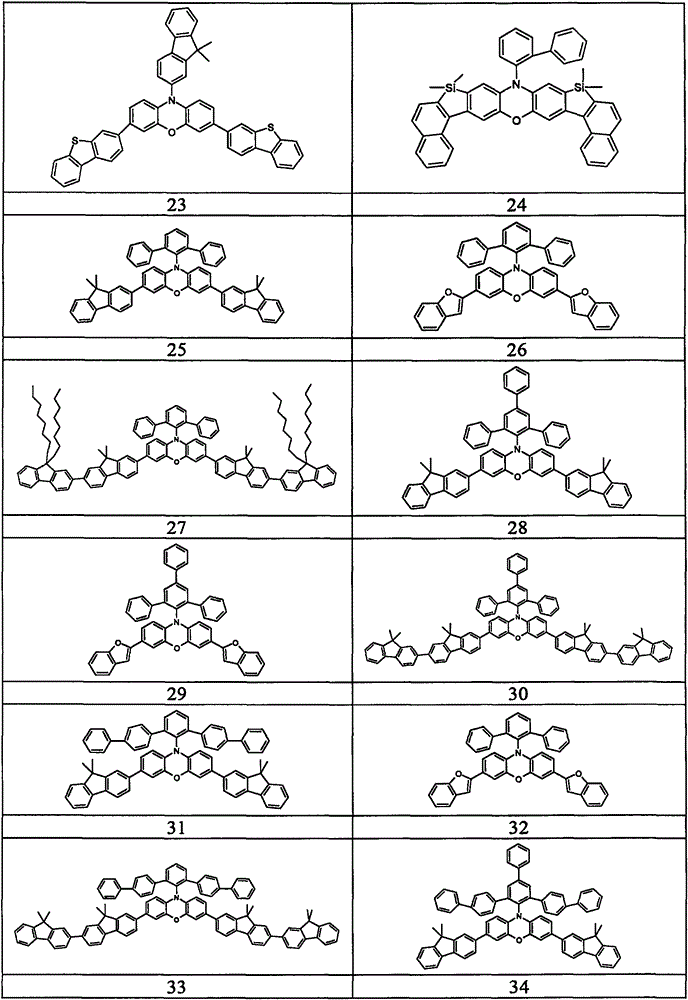
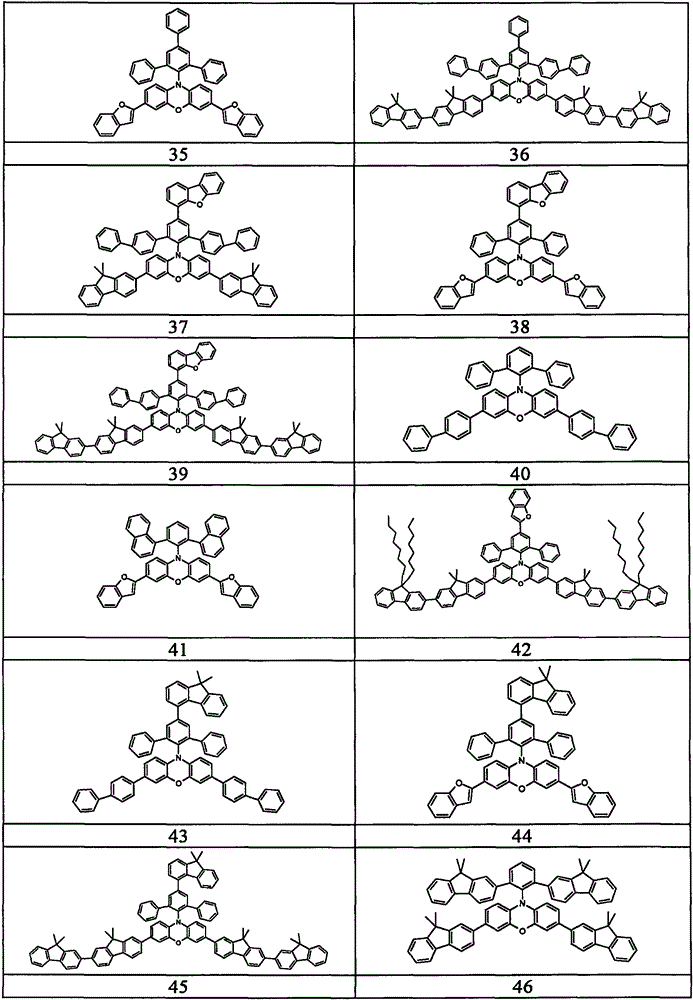
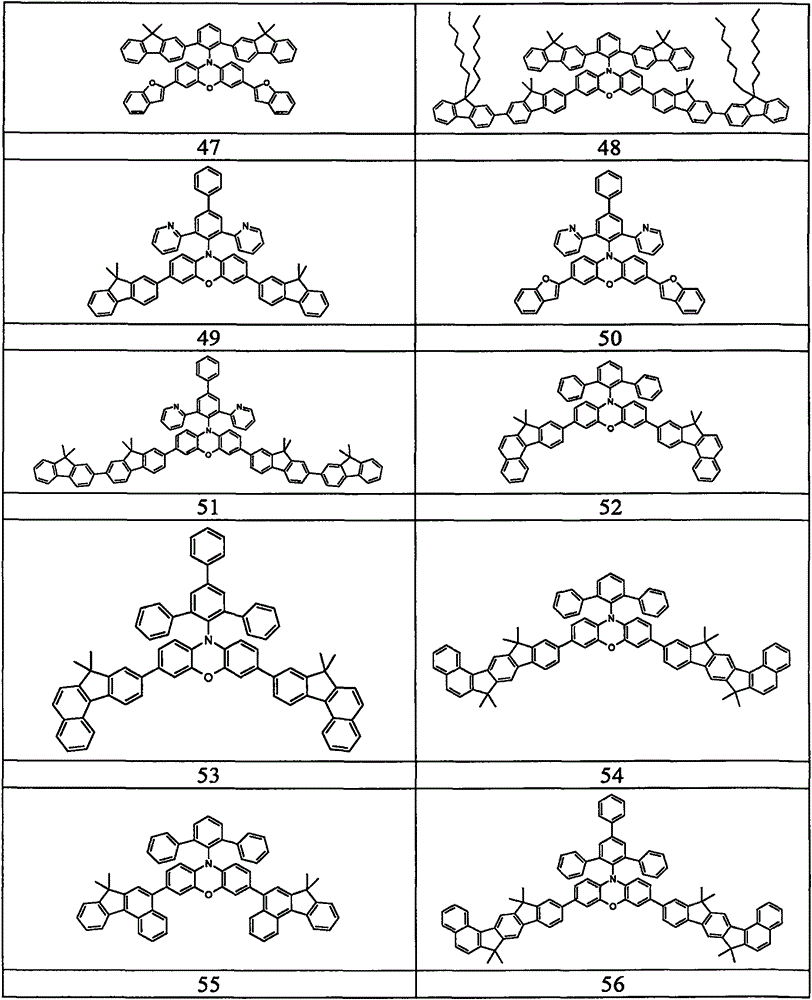


the synthesis of the compounds according to the invention can be carried out by methods of preparative organic chemistry generally known to the person skilled in the art. Examples of reactions which are preferably used are halogenation and transition metal-catalyzed coupling reactions, preferably Suzuki coupling and Buchwald coupling.
Exemplary methods for preparing compounds according to the present invention are provided below. The process shown is particularly suitable for the preparation of the compounds according to the invention. However, alternative methods are conceivable and may be preferred in certain circumstances. Thus, the person skilled in the art will be able to modify the methods shown below within the scope of his general expert knowledge.
The compounds according to the present invention are preferably synthesized as shown in scheme 1 and scheme 2 or as shown in scheme 1 and scheme 3. All compounds shown may be optionally substituted with one or more organic groups.
Scheme 1

Ar ═ aryl or heteroaryl
Hal-halogen or other reactive leaving group
X ═ any halogen or other reactive leaving group
Reacting said compound with an aromatic hydrocarbonThe aryl or heteroaryl compound Ar-X is reacted in a Suzuki coupling to give the thiophene Substituents are introduced para to the N atom on the oxazine backbone (scheme 2).
Scheme 2

Ar ═ aryl or heteroaryl
Hal-halogen or other reactive leaving group
X ═ any halogen or other reactive leaving group
R ═ organic group
Alternatively, the compound is reacted with an aryl or heteroaryl compound containing a carboxylate group ROOC-Ar-X in a Suzuki coupling, thereby reacting in a thiophene Substituents are introduced para to the N atom on the oxazine backbone (scheme 3). The carboxylate substituents are then alkylated by reaction using an organometallic and finally the compounds are fused.
Scheme 3

The synthetic methods shown above have exemplary characteristics and can be modified in a suitable manner by a person skilled in the art of organic synthesis, in the case of particular embodiments which facilitate the synthesis of the compounds according to the invention.
The invention therefore also relates to a process for preparing compounds of the formula (1) or (2), characterized by one or more transition metal-catalyzed coupling reactions, in which aromatic or heteroaromatic ring systems are introduced as thiophenes by means of the coupling reaction A substituent para to the N atom of the oxazine derivative. The transition metal catalyzed coupling reaction is preferably selected from the group consisting of a Hartwig-Buchwald coupling and a Suzuki coupling.
The compounds according to the invention described above, in particular those substituted by reactive leaving groups such as bromine, iodine, chlorine, boronic acids or boronic esters, can be used as monomers for the manufacture of corresponding oligomers, dendrimers or polymers. Suitable reactive leaving groups are, for example, bromine, iodine, chlorine, boronic acids, boronic esters, amines, alkenyl or alkynyl groups having a terminal C-C double or C-C triple bond, ethylene oxide, oxetane, groups which undergo cycloaddition (e.g.1, 3-dipolar cycloaddition), such as dienes or azides, carboxylic acid derivatives, alcohols and silanes.
The present invention therefore also relates to oligomers, polymers or dendrimers containing one or more compounds of formula (1) or (2), wherein one or more bonds to the polymer, oligomer or dendrimer may be located in formula (1) or (2) by R or R2At any desired position of substitution. Linking of compounds according to formula (1) or (2), said compounds being a constituent of the side chains or of the main chain of the oligomer or polymer. In the sense of the present invention, oligomers are understood to mean compounds which are composed of at least three monomer units. In the sense of the present invention, a polymer is understood to mean a compound composed of at least ten monomer units. The polymers, oligomers or dendrimers according to the invention may be conjugated, partially conjugated or non-conjugated. The oligomers or polymers according to the invention may be linear, branched or dendritic. In structures that are linked in a linear fashion, the units of formula (1) or (2) may be linked directly to one another, or they may be linked to one another by divalent groups, for example by substituted or unsubstituted alkylene groups, by heteroatoms or by divalent aromatic or heteroaromatic groups. In branched and dendritic structures, for example, three or more units of formula (1) or (2) can be linked by a trivalent or multivalent group (e.g., by a trivalent or multivalent aromatic or heteroaromatic group) to form a branched or dendritic oligomer or polymer.
The same preferred means as described above for the compounds of formula (1) or (2) apply to the repeating units of formulae (1) and (2) in oligomers, dendrimers and polymers.
To prepare the oligomers or polymers, the monomers according to the invention are homopolymerized or copolymerized with other monomers. Suitable and preferred comonomers are selected from the group consisting of fluorene (for example according to EP 842208 or WO 2000/22026), spirobifluorenes (for example according to EP 707020, EP 894107 or WO 2006/061181), p-phenylene (for example according to WO 1992/18552), carbazole (for example according to WO 2004/070772 or WO 2004/113468), thiophenes (for example according to EP 1028136), dihydrophenanthrenes (for example according to WO 2005/014689 or WO 2007/006383), cis-and trans-indenofluorenes (for example according to WO 2004/041901 or WO 2004/113412), ketones (for example according to WO 2005/040302), phenanthrenes (for example according to WO 2005/104264 or WO 2007/017066) or a plurality of these units. The polymers, oligomers and dendrimers generally also contain further units, for example luminescent (fluorescent or phosphorescent) units, for example vinyl triarylamines (for example according to WO 2007/068325) or phosphorescent metal complexes (for example according to WO 2006/003000), and/or charge transport units, in particular those based on triarylamines.
The polymers and oligomers according to the invention are generally prepared by polymerizing one or more types of monomers, at least one of which gives rise to a repeating unit of formula (1) or (2) in the polymer. Suitable polymerization reactions are known to the person skilled in the art and are described in the literature. Particularly suitable and preferred polymerization reactions to produce C-C or C-N linkages are as follows:
(A) polymerizing SUZUKI;
(B) YAMAMOTO polymerization;
(C) STILLE polymerization; and
(D) HARTWIG-BUCHWALD polymerization.
The manner in which the polymerization can be carried out by these processes and the manner in which the polymer can then be isolated from the reaction medium and purified are known to the person skilled in the art and are described in detail in the literature (for example in WO 2003/048225, WO 2004/037887 and WO 2004/037887).
The invention therefore also relates to a process for preparing the polymers, oligomers and dendrimers according to the invention, which are characterized in that they are prepared by SUZUKI polymerization, YAMAMOTO polymerization, STILLE polymerization or HARTWIG-BUCHWALD polymerization. The dendrimers according to the invention can be prepared by methods known to the person skilled in the art or by analogous methods. Suitable methods are described in the following documents, such as Frechet, Jean m.j.; hawker, Craig j., "hyperbranched polyphenylene and hyperbranched polyester: new soluble three-dimensional Reactive Polymers (superabsorbent Polymers and superabsorbent Polymers: new soluble, thread-dimensional, Reactive Polymers), Reactive and Functional Polymers (Reactive & Functional Polymers) (1995), 26(1-3), 127-36; janssen, h.m.; meijer, e.w., "Synthesis and characterization of dendrimers", Materials Science and Technology (1999), 20 (Synthesis of Polymers), 403-; tomalia, Donald a., "dendrimers", Scientific americans (Scientific American) (1995), 272(5), 62-6; WO 2002/067343A 1 and WO 2005/026144A 1.
For processing the compounds according to the invention from the liquid phase, for example by spin coating or by printing methods, a formulation of the compounds according to the invention is required. These formulations may be, for example, solutions, dispersions or emulsions. For this purpose, it may be preferred to use a mixture of two or more solvents. Suitable and preferred solvents are, for example, toluene, anisole, o-, m-or p-xylene, methyl benzoate, mesitylene, tetralin, o-dimethoxybenzene, THF, methyl-THF, THP, chlorobenzene, bis-xylene Alkanes, phenoxytoluene (especially 3-phenoxytoluene), (-) -fenchone, 1, 2, 3, 5-tetramethylbenzene, 1, 2, 4, 5-tetramethylbenzene, 1-methylnaphthalene, 2-methylbenzothiazole, 2-phenoxyethanol, 2-pyrrolidone, 3-methylanisole, 4-methylanisole, 3, 4-dimethylanisole, 3, 5-dimethylanisole, acetophenone, terpineol, benzothiazole,butyl benzoate, cumene, cyclohexanol, cyclohexanone, cyclohexylbenzene, decalin, dodecylbenzene, ethyl benzoate, indane, methyl benzoate, NMP, p-cymene, phenetole, 1, 4-diisopropylbenzene, dibenzyl ether, diethylene glycol butyl methyl ether, triethylene glycol butyl methyl ether, diethylene glycol dibutyl ether, triethylene glycol dimethyl ether, diethylene glycol monobutyl ether, tripropylene glycol dimethyl ether, tetraethylene glycol dimethyl ether, 2-isopropylnaphthalene, pentylbenzene, hexylbenzene, heptylbenzene, octylbenzene, 1, 1-bis (3, 4-dimethylphenyl) ethane, or a mixture of these solvents.
The invention therefore also relates to a formulation, in particular a solution, dispersion or emulsion, comprising at least one compound of formula (1) or (2) or at least one polymer, oligomer or dendrimer containing at least one unit of formula (1) or (2) and at least one solvent, preferably an organic solvent. The ways in which solutions of this type can be prepared are known to the person skilled in the art and are described, for example, in WO 2002/072714, WO 2003/019694 and the documents cited therein.
The compounds of the formula (1) or (2) according to the invention are suitable for use in electronic devices, in particular organic electroluminescent devices (OLEDs). Depending on the substitution, the compounds are used in different functions and layers.
The invention therefore also relates to the use of compounds of formula (1) or (2) in electronic devices. Here, the electronic device is preferably selected from the group consisting of Organic Integrated Circuits (OIC), Organic Field Effect Transistors (OFET), Organic Thin Film Transistors (OTFT), Organic Light Emitting Transistors (OLET), Organic Solar Cells (OSC), organic optical detectors, organic photoreceptors, Organic Field Quench Devices (OFQD), organic light emitting electrochemical cells (OLEC), organic laser diodes (O-laser) and particularly preferred organic electroluminescent devices (OLED).
Furthermore, the invention relates to an electronic device comprising at least one compound of formula (1) or (2). The electronic device is preferably selected from the devices listed above. Particular preference is given to organic electroluminescent devices comprising an anode, a cathode and at least one light-emitting layer, characterized in that at least one organic layer comprises at least one compound of the formula (1) or (2).
The organic electroluminescent device may comprise other layers in addition to the cathode, the anode and the light-emitting layer. In each case, it is selected, for example, from one or more hole-injection layers, hole-transport layers, hole-blocking layers, electron-transport layers, electron-injection layers, electron-blocking layers, exciton-blocking layers, interlayers, Charge-Generation layers (IDMC 2003, Taiwan; Session 21 OLED (5), T. Matsumoto, T.Nakada, J.endo, K.Mori, N.Kawamura, A.Yokoi, J.Kido, Multiphoton Organic EL devices (Multiphoton Organic EL Device with Charge Generation Layer)) and/or Organic or inorganic p/n junctions. It should be noted, however, that each of these layers does not necessarily have to be present, and that the choice of layer always depends on the compound used, in particular also on whether the electroluminescent device is fluorescent or phosphorescent.
The sequence of the layers of the organic electroluminescent device is preferably as follows: anode-hole injection layer-hole transport layer-light emitting layer-electron transport layer-electron injection layer-cathode.
Here, it should again be pointed out that not all of the layers described have to be present and/or that further layers may be present in addition.
The organic electroluminescent device according to the present invention may comprise a plurality of light emitting layers. In this case, the light-emitting layers particularly preferably have a plurality of emission peaks in total between 380nm and 750nm, resulting in white emission as a whole, i.e., a plurality of light-emitting compounds capable of fluorescence or phosphorescence and emission of blue or yellow or orange or red light are used in the light-emitting layer. Particularly preferred are three-layer systems, i.e. systems having three light-emitting layers, wherein at least one of these layers preferably comprises at least one compound of the formula (1) or (2), and wherein the three layers exhibit blue, green and orange or red emission (for the basic structure, see, for example, WO 2005/011013). It should be noted that, instead of a plurality of emitter compounds emitting colored light, a single-use emitter compound emitting light in a broad wavelength range may also be applicable in order to generate white light.
Alternatively and/or additionally, the compounds according to the invention may also be present in the hole transport layer or in other layers.
The compound of formula (1) or (2) is preferably used in the light-emitting layer. In particular, compounds of the formula (1) or (2) are suitable as light-emitting materials (emitter compounds). The compounds of the formula (1) or (2) are very particularly suitable as light-emitting materials.
The compounds according to the invention are particularly suitable as blue-emitting emitter compounds. The electronic device concerned may comprise a single light-emitting layer comprising the compound according to the invention, or it may comprise two or more light-emitting layers. Here, the further light-emitting layer may comprise one or more compounds according to the invention or further compounds.
If the compounds according to the invention are used as light-emitting materials in a light-emitting layer, they are preferably used in combination with one or more matrix materials.
In this case, the proportion of the compound according to the invention in the mixture of the light-emitting layer is preferably from 0.1 to 50.0% by volume, particularly preferably from 0.5 to 20.0% by volume, very particularly preferably from 1.0 to 10.0% by volume. Accordingly, the proportion of the matrix material or matrix materials is 50.0 to 99.9% by volume, particularly preferably 80.0 to 99.5% by volume, very particularly preferably 90.0 to 99.0% by volume.
Preferred matrix materials for use in combination with the material according to the invention as luminophore are selected from the following classes: oligoarylene (for example dinaphthylanthracene or 2, 2 ', 7, 7' -tetraphenylspirobifluorene according to EP 676461), in particular oligoarylene containing fused aromatic groups, oligoarylenevinylene (for example DPVBi or spiro-DPVBi according to EP 676461), polypentametal complexes (for example according to WO 2004/081017), hole-conducting compounds (for example according to WO 2004/058911), electron-conducting compounds, in particular ketones, phosphine oxides, sulfoxides and the like (for example according to WO 2005/084081 and WO 2005/084082), atropisomers (for example according to WO 2006/048268), boronic acid derivatives (for example according to WO 2006/117052), or benzanthracene (for example according to WO 2008/145239). Particularly preferred matrix materials are selected from the following classes: oligoarylene comprising naphthalene, anthracene, benzanthracene and/or pyrene or atropisomers of these compounds, oligoarylene vinylenes, ketones, phosphine oxides and sulfoxides. Very particularly preferred matrix materials are selected from the group of oligoarylene groups, which comprise anthracene, benzanthracene, triphenylene and/or pyrene or atropisomers of these compounds. An oligoarylene in the sense of the present invention is intended to be taken to mean a compound in which at least three aryl or arylene groups are bonded to one another.
Preferred matrix materials for use in the light-emitting layer in combination with the compounds of formula (1) or (2) are depicted in the table below.

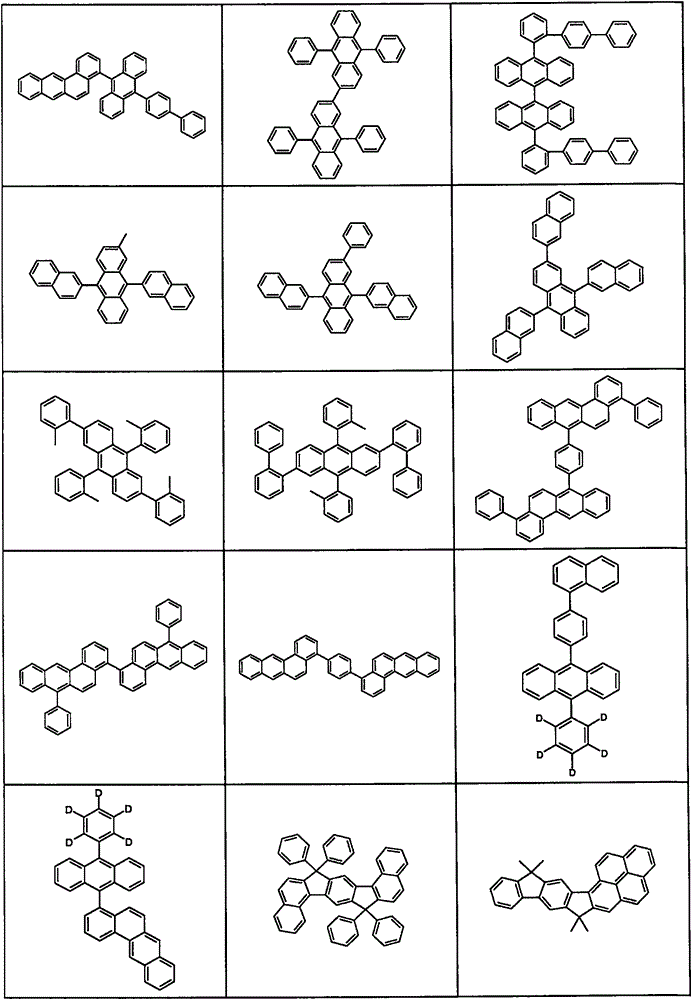

The compounds according to the invention can also be used in other layers, for example as hole-transport materials in hole-injection or hole-transport layers or electron-blocking layers or as matrix materials in light-emitting layers, preferably as matrix materials for fluorescent emitters. The compounds of the formula (1) or (2) are very particularly suitable as hole transport materials or matrix materials.
If the compound of formula (1) or (2) is used as a hole-transporting material in a hole-transporting layer, a hole-injecting layer or an electron-blocking layer, the compound may be used in the hole-transporting layer in the form of a pure material, i.e. in a proportion of 100%, or it may be used in combination with one or more other compounds. According to a preferred embodiment, the organic layer comprising the compound of formula (1) or (2) then also comprises one or more p-type dopants. The p-type dopant used according to the invention is preferably an organic electron acceptor compound capable of oxidizing one or more of the other compounds in the mixture.
particularly preferred embodiments of p-type dopants are the compounds disclosed in WO 2011/073149, EP 1968131, EP 2276085, EP 2213662, EP 1722602, EP 2045848, DE 102007031220, US 8044390, US 8057712, WO 2009/003455, WO 2010/094378, WO 2011/120709, US 2010/0096600 and WO 2012/095143.
As the p-type dopant, particularly preferred are quinodimethane compounds, azaindenofluorenediones, azaphenalenes, azatriphenylenes, I2Metal halides, preferably transition metal halides, metal oxides, preferably metal oxides containing at least one transition metal or group iii metal, and transition metal complexes, preferably complexes of Cu, Co, Ni, Pd and Pt with ligands containing at least one oxygen atom as binding site. As dopants, transition metal oxides are also preferred, with rhenium, molybdenum and tungsten oxides being preferred, and Re being particularly preferred2O7、MoO3、WO3And ReO3。
The p-type dopant is preferably substantially uniformly distributed in the p-type doped layer. This can be achieved, for example, by co-evaporation of the p-type dopant with the hole transport material matrix.
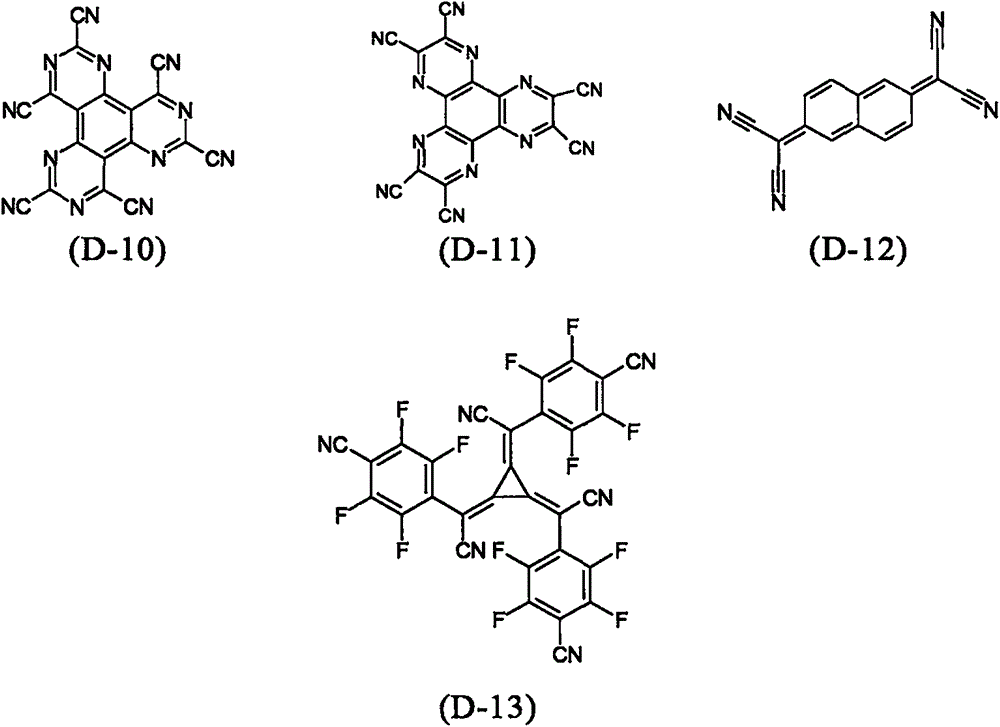
Particularly preferred p-type dopants are selected from the compounds (D-1) to (D-13):

in one embodiment of the invention, the compounds of formula (1) or (2) or of the preferred embodiments are used in hole transporting or injecting layers in combination with a layer comprising a hexaazatriphenylene derivative, in particular hexacyanohexaazatriphenylene (for example according to EP 1175470). Thus, for example, the following combinations are preferred: an anode-hexaazatriphenylene derivative-hole transport layer, wherein the hole transport layer comprises one or more compounds of formula (1) or (2) or a preferred embodiment. In this structure, too, a plurality of successive hole transport layers can be used, at least one of the hole transport layers containing at least one compound of the formulae (1) or (2) or preferred embodiments. Further preferred combinations are as follows: anode-hole transport layer-hexaazatriphenylene derivative-hole transport layer, wherein at least one of the two hole transports comprises one or more compounds of formula (1) or (2) or a preferred embodiment. In this structure, a plurality of successive hole transport layers can likewise be used instead of one hole transport layer, at least one hole transport layer containing at least one compound of the formulae (1) or (2) or preferred embodiments.
If the compounds of the formula (1) or (2) are used as matrix material in combination with phosphorescent emitters in the light-emitting layer, the phosphorescent emitters are preferably selected from the classes and embodiments of phosphorescent emitters indicated below. Furthermore, in this case, one or more other host materials are preferably present in the light-emitting layer.
So-called mixed matrix systems of this type preferably comprise two or three different matrix materials, particularly preferably two different matrix materials. Here, it is preferable that one of the two materials is a material having a hole transporting property, and the other material is a material having an electron transporting property. The compound of formula (1) or (2) is preferably a material having a hole transporting property.
However, the desired electron transporting and hole transporting properties of the mixed matrix component may also be combined primarily or entirely in a single mixed matrix component, with one or more other mixed matrix components fulfilling other functions. Here, the two different matrix materials may be present in a ratio of from 1: 50 to 1: 1, preferably from 1: 20 to 1: 1, particularly preferably from 1: 10 to 1: 1, very particularly preferably from 1: 4 to 1: 1. The mixed matrix system is preferably used in phosphorescent organic electroluminescent devices. Further details regarding mixed matrix systems are contained in the application WO 2010/108579, among others.
Particularly suitable matrix materials which can be used as matrix components of the mixed matrix system in combination with the compounds according to the invention are selected from the preferred matrix materials for phosphorescent emitters indicated below or the preferred matrix materials for fluorescent emitters, depending on the type of emitter compound used in the mixed matrix system.
The following indicates generally preferred classes of materials for use as corresponding functional materials in the organic electroluminescent device according to the invention.
Suitable phosphorescent emitters are in particular compounds which emit light under suitable excitation, preferably in the visible region, and which additionally contain at least one atom having an atomic number of greater than 20, preferably greater than 38 and less than 84, particularly preferably greater than 56 and less than 80. The phosphorescent emitters used are preferably compounds containing copper, molybdenum, tungsten, rhenium, ruthenium, osmium, rhodium, iridium, palladium, platinum, silver, gold or europium, in particular compounds containing iridium, platinum or copper.
For the purposes of the present invention, all luminescent iridium, platinum or copper complexes are considered phosphorescent compounds.
Examples of such phosphorescent emitters are disclosed by applications WO 2000/70655, WO 2001/41512, WO 2002/02714, WO 2002/15645, EP 1191613, EP 1191612, EP 1191614, WO 2005/033244, WO 2005/019373 and US 2005/0258742. In general, all phosphorescent complexes which are used in phosphorescent OLEDs according to the prior art and are known to the person skilled in the art of organic electroluminescent devices are suitable for use in the devices according to the invention. The person skilled in the art will also be able to use other phosphorescent complexes in combination with the compounds according to the invention in OLEDs without inventive steps.
Preferred fluorescent emitters, in addition to the compounds according to the invention, are selected from the group of arylamines. In the sense of the present invention, arylamines or aromatic amines are understood to mean compounds which contain three substituted or unsubstituted aromatic or heteroaromatic ring systems which are bonded directly to the nitrogen. At least one of these aromatic or heteroaromatic ring systems is preferably a condensed ring system, particularly preferably a condensed ring system having at least 14 aromatic ring atoms. Preferred examples thereof are aromatic anthracenediamines, aromatic pyreneamines, aromatic pyrenediamines, aromatic pyrene diamines Amines or aromatics
 A diamine. Aromatic anthracenamines are understood to mean compounds in which one diaryleThe alkylamino group is bonded directly to the anthracene group, preferably at the 9 position. Aromatic anthracenediamines are understood to mean compounds in which two diarylamino groups are bonded directly to the anthracene group, preferably in the 9, 10 positions. Aromatic pyrene amines, pyrene diamines, and the like,
 Amines and
 diamines, wherein the diarylamino groups are preferably bonded to the pyrene at the 1-position or 1, 6-position.
Preferred matrix materials for the fluorescent emitter compounds are shown above.
Preferred matrix materials for phosphorescent emitters are aromatic ketones, aromatic phosphine oxides or aromatic sulfoxides or sulfones, for example according to WO 2004/013080, WO 2004/093207, WO 2006/005627 or WO 2010/006680, triarylamines, carbazole derivatives, for example CBP (N, N-biscarbazolylbiphenyl), or carbazole derivatives disclosed in WO 2005/039246, US 2005/0069729, JP 2004/288381, EP 1205527 or WO 2008/086851, indolocarbazole derivatives, for example according to WO 2007/063754 or WO 2008/056746, indenocarbazole derivatives, for example according to WO 2010/136109, WO 2011/000455 or WO 2013/041176, azacarbazole derivatives, for example according to EP 1617710, EP 1617711, EP 1731584, JP 2005/347160, matrix ambipolar materials, for example according to WO 2007/137725, silanes, for example according to WO 2005/111172, azaboroles or borates, triazine derivatives, for example according to WO 2006/117052, for example according to WO 2010/015306, WO 2007/063754 or WO 2008/056746, zinc complexes, for example, diazasilacyclopentadiene or tetraazasilacyclopentadiene derivatives according to EP 652273 or WO 2009/062578, for example, diazaphosphole derivatives according to WO 2010/054729, for example according to WO 2010/054730, bridged carbazole derivatives, for example according to US 2009/0136779, WO 2010/050778, WO 2011/042107, WO 2011/088877 or WO 2012/143080, triphenylene derivatives, for example according to WO 2012/048781, or lactams, for example according to WO 2011/116865 or WO 2011/137951.
Suitable charge transport materials which, in addition to the compounds according to the invention, can be used in the hole-injecting or hole-transporting layer or in the electron-blocking or electron-transporting layer of the electronic device according to the invention are, for example, the compounds disclosed in Y.Shirota et al, chemical review (chem.Rev.)2007, 107(4), 953-1010 or other materials used in these layers according to the prior art.
Materials which can be used for the electron transport layer are all materials which are used according to the prior art as electron transport materials in electron transport layers. Particularly suitable are aluminum complexes, for example Alq3Zirconium complexes, e.g. Zrq4Lithium complexes, such as Liq, benzimidazole derivatives, triazine derivatives, pyrimidine derivatives, pyridine derivatives, pyrazine derivatives, quinoxaline derivatives, quinoline derivatives, oxadiazole derivatives, aromatic ketones, lactams, boranes, diazaphosphole derivatives and phosphine oxide derivatives. Further, suitable materials are derivatives of the above mentioned compounds, as disclosed in JP 2000/053957, WO 2003/060956, WO 2004/028217, WO 2004/080975 and WO 2010/072300.
Preferred hole-transporting materials which can be used for the hole-transporting, hole-injecting or electron-blocking layer in the electroluminescent device according to the invention are indenofluorenamine derivatives (for example according to WO 06/122630 or WO 06/100896), amine derivatives disclosed in EP 1661888, hexaazatriphenylene derivatives (for example according to WO 01/049806), amine derivatives containing fused aromatic rings (for example according to U.S. Pat. No. 5,061,569), amine derivatives disclosed in WO 95/09147, monobenzoindenofluorenamines (for example according to WO 08/006449), dibenzoindenofluorenamines (for example according to WO 07/140847), spirobifluorenylamines (for example according to WO 2012/034627 or WO 2013/120577), fluorenamines (for example according to the unpublished applications EP 12005369.9, EP 12005370.7 and EP 12005371.5), spirodibenzopyranamines (for example according to WO 2013/083216) and dihydroacridine derivatives (for example according to WO 2012/150001) ). The compounds according to the invention can also be used as hole transport materials.
The cathode of the organic electroluminescent device preferably comprises a metal having a low work function, a metal alloy or a multilayer structure comprising a plurality of metals, for example alkaline earth metals, alkali metals, main group metals or lanthanides (e.g. Ca, Ba, Mg, Al, In, Mg, Yb, Sm, etc.). Also suitable are alloys comprising an alkali or alkaline earth metal and silver, for example alloys comprising magnesium and silver. In the case of a multilayer structure, in addition to the metals, it is also possible to use further metals having a relatively high work function, for example Ag or Al, in which case combinations of the metals, for example Ca/Ag, Mg/Ag or Ag/Ag, are generally used. It may also be preferred to introduce a thin intermediate layer of a material with a high dielectric constant between the metal cathode and the organic semiconductor. Suitable for this purpose are, for example, alkali metal fluorides or alkaline earth metal fluorides, and also the corresponding oxides or carbonates (e.g. LiF, Li)2O、BaF2、MgO、NaF、CsF、Cs2CO3Etc.). Lithium quinolinate (LiQ) may also be used for this purpose. The layer thickness of this layer is preferably between 0.5nm and 5 nm.
The anode preferably comprises a material having a high work function. The work function of the anode is preferably greater than 4.5eV relative to vacuum. On the one hand, metals with a high redox potential (such as Ag, Pt or Au) are suitable for this purpose. On the other hand, metal/metal oxide electrodes (e.g., Al/Ni/NiO)x、Al/PtOx) May also be preferred. For some applications, at least one of the electrodes must be transparent or translucent in order to facilitate the radiation (organic solar cells) or the light outcoupling (OLED, O-laser) of the organic material. Here, the preferred anode material is a conductive mixed metal oxide. Indium Tin Oxide (ITO) or Indium Zinc Oxide (IZO) is particularly preferable. Furthermore, conductively doped organic materials, in particular conductively doped polymers, are preferred.
The device is suitably structured (depending on the application), provides contact and finally is sealed, since the lifetime of the device according to the invention is shortened in the presence of water and/or air.
In a preferred embodimentIn an embodiment, the organic electroluminescent device according to the invention is characterized in that the one or more layers are applied by means of a sublimation process, wherein the material passes through less than 10 deg.f-5Mbar, preferably less than 10-6Vapor deposition was applied in a vacuum sublimation unit at an initial pressure of mbar. Here, however, the initial pressure may also be even lower, for example less than 10-7Millibar.
Preference is likewise given to organic electroluminescent devices which are characterized in that one or more layers are applied by means of the OVPD (organic vapor deposition) method or by means of carrier gas sublimation, the material being at 10-5Applied at a pressure of mbar to 1 bar. A particular example of this method is the OVJP (organic vapour jet printing) method, in which the material is applied directly through a nozzle and is therefore structured (for example m.s. arnold et al, applied physical flash (appl. phys. lett.)2008, 92, 053301).
Furthermore, preference is given to organic electroluminescent devices which are characterized in that one or more layers are produced from solution, for example by spin coating, or by any desired printing method, for example screen printing, flexographic printing, nozzle printing or offset printing, but more preferably LITI (photo induced thermal imaging, thermal transfer) or inkjet printing. For this purpose, soluble compounds of formula (1) or (2) are required. High solubility can be achieved by appropriate substitution of the compounds.
For the production of the organic electroluminescent device according to the invention, it is furthermore preferred to apply one or more layers from solution and one or more layers by the sublimation method.
According to the invention, electronic devices comprising one or more compounds according to the invention can be used in displays, as light sources in lighting applications and as light sources in medical and/or cosmetic applications (e.g. phototherapy).
Examples
A) Synthesis example
A-1) Compound A
The synthesis was performed according to the following general scheme:


compound Int-a1
Subjecting a thiophene to Oxazine (23g, 0.12mol), p-bromophenylbenzene (31.22g, 0.13mol) and sodium tert-butoxide (35.83g, 0.37mol) were suspended in 800ml of toluene. The solution was degassed and saturated with argon. After that, palladium (II) acetate (1.37g, 1.88mmol) and tri-tert-butylphosphine (1mol/L in toluene, 0.01mol) were added. The reaction mixture was heated at reflux overnight. The suspension was cooled and then treated with water. The collected organic phase was concentrated under vacuum and the remaining solid was purified by thermal extraction. The yield was 32.4g (0.1mol, 79% of theory) as a white solid.
Compounds Int-a2 to Int-a5 were prepared analogously to Int-a 1.
Compound Int-F-H (compound Int-a6) and
compound Int-F-Ph (Compound Int-a7)

Step 1:
preparation of Int-F-H
10g (54.6mmol) of thiophen Oxazine, 14.2g (82mmol)1, 3-dichloro-2-fluoro-benzene and 25g (0.11mol) potassium phosphate were dissolved in 250mL DMF and stirred at reflux for 16 h. After cooling to room temperature, 300ml of toluene and 500ml of water are added and the phases are separated. By usingThe organic phase was washed with water (3X 300ml) and the aqueous phase was extracted twice with toluene. The combined organic phases were concentrated to dryness and purified by recrystallization from toluene/heptane.
Yield: 16g (0.05 mol; 90%)
Preparation of Int-F-Ph

This compound can be prepared analogously to Int-F-H (89% yield).
Step 2:
Int-F-H:
14g (43mmol) of 10- (2, 6-dichloro-phenyl) -10H-thiophene Oxazine, 13.7g (107 mmol) of phenylboronic acid, 26g (171mmol) of cesium fluoride and 1.6g (2.1mmol) of trans-dichlorobis (tricyclohexylphosphine) palladium (II) in 600ml of bis
 Refluxing in alkane for 16 hours. After cooling to room temperature, toluene (300ml) and water (400ml) were added. The organic phase was washed with water (3X 300ml) and the aqueous phase was extracted twice with toluene. The combined organic phases were concentrated to dryness and purified by recrystallization from toluene/heptane.
Yield: 14.6g (35 mmol; 82%)
For Int-F-Ph:

the compound can be prepared analogously to Int-F-H (78% yield).


Compound Int-b1
Compound Int-a1(32g, 0.1mol) was dissolved in 800ml of glacial acetic acid and 800ml of chloroform. Next, N-bromosuccinimide (34.8g, 0.2mol) was slowly added in the dark. After 4 hours, the reaction was quenched with water and the organic phase was washed several times with water. The resulting solid was extracted twice with hot ethanol. The yield is 43.8g (0.1mol, 98% of theory) as a white solid.
Compounds Int-b2 to Int-b7 were prepared analogously to Int-b 1.


Compound A1
Compound Int-b1(20g, 0.04mol), 2- (9, 9-dimethylfluorene) -4, 4, 5, 5-tetramethyldioxaborolan (27.27g, 0.085mol) and tripotassium phosphate monohydrate (37.35g, 0.16 mol) were suspended in 200ml of water, 200ml of toluene and 200ml of 1, 4-dipotassium phosphate monohydrate In an alkane. The solution was degassed and saturated with argon. Next, palladium (II) acetate (0.36g, 1.6mmol) and tri-o-tolylphosphine (1.48g, 4.87mmol) were added and the reaction was boiled under reflux overnight. The suspension was cooled and then treated with water. The collected organic phase was concentrated in vacuo and the remaining solid was purified by thermal extraction (toluene) and recrystallization (toluene and EtOAc in sequence). The yield is 17.0g (23.6 mmol, 59% of theory) as a yellow solid.
Compounds a2 to a7 were prepared analogously to a 1.
A-2) Compound B
The synthesis was performed according to the following general scheme:


compound Int-c1
Compound Int-b1(21.45g, 0.05M), bis-pinacolato diborane (31.35g, 0.12mol) and potassium acetate (30.3g, 0.31mol) were suspended in 500ml of 1, 4-bis In an alkane. The reaction mixture was degassed and saturated with argon. Followed by addition of [1, 1' -bisdiphenylphosphino-ferrocene]Palladium (II) dichloride (3.35g, 4.1mmol) and the reaction stirred at reflux overnight. The suspension was cooled and filtered directly through alumina. The resulting solid was stirred in hot ethanol. The yield is 17.25 g (0.033mol, 66% of theory) as a white solid.
Compounds Int-c2 to Int-c4 were prepared analogously to Int-c 1.


Compound Int-d1
Compound Int-c1(17g, 0.033mol), 1-bromo-phenyl-ethyl ester (18.74g, 0.067 mol) and tripotassium phosphate monohydrate (30.39g, 0.132mol) were suspended in 50ml of water, 50ml of toluene and 50ml of 1, 4-di-potassium phosphate monohydrate In an alkane. Will dissolveThe liquid was degassed and saturated with argon. Next, palladium (II) acetate (0.29g, 1.32mmol) and tri-o-tolylphosphine (1.21g, 3.96mmol) were added and the reaction was boiled under reflux overnight. The suspension was cooled and then treated with water. The collected organic phase was concentrated under vacuum and the remaining solid was purified by thermal extraction (toluene) and recrystallization (toluene/heptane). The yield is 14.1g (00.21mol, 65% of theory) as a yellow solid.
Compound Int-d3 is prepared analogously to Int-d 1.


Compound Int-e1
Cerium (III) chloride (11.3g, 0.046mol) was first added to anhydrous THF, then compound Int-d1(14g, 0.021mol) was dissolved in anhydrous THF, and the solution was added dropwise to the reaction mixture, followed by stirring for one hour. Thereafter, a MeMgCl solution (3M THF solution, 0.13mol) was added dropwise to the reaction mixture. After 2 hours, the reaction was allowed to warm to room temperature overnight. The reaction was quenched with water under ice cooling. After phase separation, the organic phase is dried and the solvent is evaporated. The organic phase is subsequently purified by recrystallization from heptane/toluene. The yield is 12.5g (0.02mol, 95% of theory) as a yellow solid.
Compound Int-e3 was prepared analogously to Int-e 1.


Compound B1
Polyphosphoric acid (13.1g, 0.13mol) and methanesulfonic acid (12.5g, 0.13mol) were placed in a flask. Next, a solution containing compound Int-e1(12g, 0.019mol) suspended in DCM was slowly added to the reaction mixture and cooled with an ice bath. The reaction mixture was stirred for a further 2 hours and then treated with ethanol. After addition of water, phase separation occurred. The organic phase is washed with water, then dried and the solvent is evaporated. The remaining residue was recrystallized several times with toluene/heptane. The yield is 8.65g (0.15mol, 77% of theory) as a yellow solid.
Compound B3 was prepared in analogy to B1.
B) Example of the device
Fabrication of OLED devices
The manufacture of OLED devices was carried out according to WO 04/05891, wherein the film thickness and the layer sequence were adjusted. The following examples V1 through E5 (see table 1) show data for various OLED devices.
Pretreatment of substrates for examples V1-E5:
with a 20nm PEDOT: PSS (poly (3, 4-ethylenedioxythiophene) poly (styrene-sulfonate, CLEVOS)TMP VP AI 4083, from heili Metals GmbH Germany, spin-coated from a water-based solution with a glass plate of structured ITO (50nm, indium-tin oxide) formed on a substrate on which OLED devices were fabricated.
OLED devices have in principle the following layer structure:
-a substrate,
-ITO(50nm),
-a buffer layer (20nm),
a hole-injecting layer (HTL 195%, HIL 5%) (20nm),
-a hole transport layer (HTL1) (see Table 1),
-an emitting layer (EML) (20nm),
-an Electron Transport Layer (ETL) (30nm),
an Electron Injection Layer (EIL) (3nm),
-a cathode.
The cathode is formed from a 100nm thick layer of aluminum. The detailed lamination sequence is shown in table 1. Materials used for OLED fabrication are presented in table 3.
All materials were applied by thermal vapor deposition in a vacuum chamber. The light-emitting layer is composed of at least one host material (host material H) and a light-emitting dopant (emitter material D) which is mixed by co-evaporation with one or more host materials in a specific volume ratio. Here, expressions such as H1: D1 (97%: 3%) refer to the material H1 being present in the layer in a proportion of 97% by volume, while D1 is present in the layer in a proportion of 3%. Similarly, the electron transport layer may also be composed of a mixture of two or more materials.
The OLED devices were characterized by standard methods. For this purpose, the electroluminescence spectrum, the current efficiency (measured in cd/A) and the external quantum efficiency (EQE at 1000 cd/m) are determined from the current/voltage/luminance characteristic lines (IUL characteristic lines) which exhibit the properties of Lambertian emission2Measured in%). At 1000cd/m2Recording an Electroluminescence (EL) spectrum at the emission density of (a), and then calculating CIE 1931x and y coordinates from the EL spectrum. EQE @1000cd/m2Is defined as being in 1000cd/m2External quantum efficiency at a luminous density of (a). For all experiments, the lifetime LT95 was determined. Life LT95 @1000cd/m2Is defined as 1000cd/m2The initial luminous density of (a) decreased by 5%. Device data for various OLED devices are summarized in table 2.
Example V1 represents a comparative example according to the prior art. Examples E1-E5 show data for OLED devices of the invention.
Several embodiments will be described in more detail in the following sections to show the advantages of the OLED device of the invention.
Use of the compounds according to the invention as light-emitting materials in fluorescent OLEDs
The compounds of the present invention are particularly useful as emitters (dopants) when incorporated into a fluorescent blue host to form the light-emitting layer of a fluorescent blue OLED device. Representative examples are D1, D2, D3, D4 and D5. Comparative compounds of the prior art are represented by VD (see table 3 for structure).
The use of the compounds of the invention as emitters (dopants) in fluorescent blue OLED devices leads to a significant improvement in the device data compared to the prior art examples (V1), in particular in terms of external quantum efficiency and device lifetime (E1, E2, E3, E4 and E5). This shows that the compounds of the present invention are suitable for use as light emitting materials in fluorescent blue OLED devices. The material may also be used as a hole transport material.
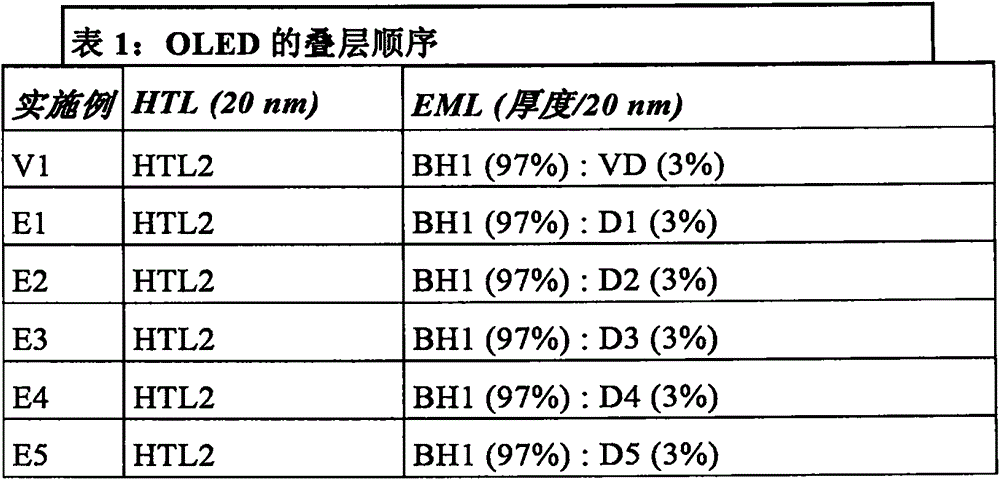


Claims (5)
1. A compound of the formulae (1-1-b) to (1-1-e),


wherein the center in formulae (1-1-b) to (1-1-e) Each of the two phenyl rings fused on the oxazine ring is optionally substituted by a group R; and is
Where the following applies to symbols and labels:
ar is a group selected from one of the following formulae (ArN-1) to (ArN-14):

wherein the dotted bond indicates A bond to a nitrogen atom of the oxazine structure, and wherein the groups of formulae (ArN-1) to (ArN-14) are optionally substituted at each free position by one or more groups R2Substitution;
v is equal to CR, the same or different at each occurrence2;
E1Selected from C (R), identically or differently on each occurrence1)2、Si(R1)2O and S;
r is selected, identically or differently on each occurrence, from H, D, F, a linear alkyl group having 1 to 10C atoms or a branched or cyclic alkyl group having 3 to 10C atoms, wherein the linear alkyl group and the branched or cyclic alkyl group are optionally each substituted by one or more radicals R4Substitution;
R1selected, identically or differently on each occurrence, from H, D, F, a linear alkyl group having 1 to 10C atoms or a branched or cyclic alkyl group having 3 to 10C atoms, wherein the linear alkyl group and the branched or cyclic alkyl group are optionally each substituted by one or more radicals R4Substitution;
R2selected, identically or differently on each occurrence, from H, D, F, a linear alkyl group having 1 to 10C atoms or a branched or cyclic alkyl group having 3 to 10C atoms, wherein the linear alkyl group and the branched or cyclic alkyl group are optionally each substituted by one or more radicals R4Substituted, and phenyl groups;
R4identically or differently on each occurrence is H, F, a linear alkyl group having 1 to 10C atoms or a branched or cyclic alkyl group having 3 to 10C atoms;
i is 0, wherein i ═ 0 means that the group between parentheses is absent and is replaced by a single bond.
2. A formulation comprising at least one compound according to claim 1 and at least one solvent.
3. An electronic device comprising at least one compound of claim 1.
4. Electronic device according to claim 3, characterized in that the electronic device is selected from the group consisting of organic integrated circuits, organic field effect transistors, organic thin film transistors, organic light emitting transistors, organic solar cells, organic optical detectors, organic photoreceptors, organic field quenching devices, light emitting electrochemical cells, organic laser diodes and organic electroluminescent devices.
5. Electronic device according to claim 4, selected from organic electroluminescent devices, characterized in that the compound according to claim 1 is used in one or more of the following functions:
as blue light emitters in the light-emitting layer,
as hole-transporting material in the hole-transporting or hole-injecting layer,
as a matrix material in the light-emitting layer,
-as an electron-blocking material,
as exciton blocking material.
Applications Claiming Priority (3)
| Application Number | Priority Date | Filing Date | Title |
|---|---|---|---|
| EP15181177 | 2015-08-14 | ||
| EP15181177.5 | 2015-08-14 | ||
| PCT/EP2016/001242 WO2017028941A1 (en) | 2015-08-14 | 2016-07-15 | Phenoxazine derivatives for organic electroluminescent devices |
Publications (2)
| Publication Number | Publication Date |
|---|---|
| CN107922402A CN107922402A (en) | 2018-04-17 |
| CN107922402B true CN107922402B (en) | 2021-12-31 |
Family
ID=54014491
Family Applications (1)
| Application Number | Title | Priority Date | Filing Date |
|---|---|---|---|
| CN201680048517.5A Active CN107922402B (en) | 2015-08-14 | 2016-07-15 | Phenoxazine derivatives for organic electroluminescent devices |
Country Status (7)
| Country | Link |
|---|---|
| US (1) | US11189801B2 (en) |
| EP (1) | EP3334732B1 (en) |
| JP (1) | JP6843834B2 (en) |
| KR (1) | KR102587272B1 (en) |
| CN (1) | CN107922402B (en) |
| TW (1) | TWI721001B (en) |
| WO (1) | WO2017028941A1 (en) |
Families Citing this family (74)
| Publication number | Priority date | Publication date | Assignee | Title |
|---|---|---|---|---|
| JP6786591B2 (en) * | 2015-08-14 | 2020-11-18 | メルク、パテント、ゲゼルシャフト、ミット、ベシュレンクテル、ハフツングMerck Patent GmbH | Phenoxazine derivatives for organic electroluminescence devices |
| JP6806312B2 (en) * | 2016-05-27 | 2021-01-06 | エルジー・ケム・リミテッド | Organic light emitting element |
| TWI764942B (en) | 2016-10-10 | 2022-05-21 | 德商麥克專利有限公司 | Electronic device |
| JP2020512273A (en) | 2016-11-02 | 2020-04-23 | メルク パテント ゲーエムベーハー | Materials for electronic devices |
| TW201833118A (en) | 2016-11-22 | 2018-09-16 | 德商麥克專利有限公司 | Materials for electronic devices |
| US11261291B2 (en) | 2016-12-22 | 2022-03-01 | Merck Patent Gmbh | Materials for electronic devices |
| CN110325524A (en) | 2017-03-02 | 2019-10-11 | 默克专利有限公司 | Material for organic electronic device |
| CN110573515B (en) | 2017-04-25 | 2023-07-25 | 默克专利有限公司 | Compounds for electronic devices |
| TW201920343A (en) | 2017-06-21 | 2019-06-01 | 德商麥克專利有限公司 | Materials for electronic devices |
| US11767299B2 (en) | 2017-06-23 | 2023-09-26 | Merck Patent Gmbh | Materials for organic electroluminescent devices |
| TW201920070A (en) | 2017-06-28 | 2019-06-01 | 德商麥克專利有限公司 | Material for electronic devices |
| TWI779067B (en) | 2017-07-28 | 2022-10-01 | 德商麥克專利有限公司 | Materials for electronic devices |
| CN118405981A (en) | 2017-09-08 | 2024-07-30 | 默克专利有限公司 | Materials for electronic devices |
| CN108675975A (en) | 2017-10-17 | 2018-10-19 | 默克专利有限公司 | Material for organic electroluminescence device |
| TWI838352B (en) | 2017-11-24 | 2024-04-11 | 德商麥克專利有限公司 | Materials for organic electroluminescent devices |
| TWI820057B (en) | 2017-11-24 | 2023-11-01 | 德商麥克專利有限公司 | Materials for organic electroluminescent devices |
| KR102638811B1 (en) | 2017-12-15 | 2024-02-21 | 메르크 파텐트 게엠베하 | Substituted aromatic amines for organic electroluminescent devices |
| TWI802656B (en) | 2018-03-06 | 2023-05-21 | 德商麥克專利有限公司 | Materials for organic electroluminescent devices |
| TW201938761A (en) | 2018-03-06 | 2019-10-01 | 德商麥克專利有限公司 | Materials for organic electroluminescent devices |
| US20210020843A1 (en) | 2018-03-16 | 2021-01-21 | Merck Patent Gmbh | Materials for organic electroluminescent devices |
| EP3823965A1 (en) * | 2018-07-22 | 2021-05-26 | cynora GmbH | Organic molecules for optoelectronic devices |
| TWI823993B (en) | 2018-08-28 | 2023-12-01 | 德商麥克專利有限公司 | Materials for organic electroluminescent devices |
| TWI837167B (en) | 2018-08-28 | 2024-04-01 | 德商麥克專利有限公司 | Materials for organic electroluminescent devices |
| KR20210052487A (en) | 2018-08-28 | 2021-05-10 | 메르크 파텐트 게엠베하 | Materials for organic electroluminescent devices |
| JP7459065B2 (en) | 2018-09-12 | 2024-04-01 | メルク パテント ゲーエムベーハー | Materials for organic electroluminescent devices |
| KR102154590B1 (en) * | 2018-10-31 | 2020-09-10 | 엘티소재주식회사 | Heterocyclic compound and organic light emitting device comprising the same |
| KR20210088597A (en) | 2018-10-31 | 2021-07-14 | 메르크 파텐트 게엠베하 | Materials for organic electroluminescent devices |
| CN111349055B (en) * | 2018-12-24 | 2023-04-21 | 烟台显华光电材料研究院有限公司 | Polycyclic compound used as electroluminescent material and application thereof |
| US20220127286A1 (en) | 2019-03-04 | 2022-04-28 | Merck Patent Gmbh | Ligands for nano-sized materials |
| WO2020208051A1 (en) | 2019-04-11 | 2020-10-15 | Merck Patent Gmbh | Materials for organic electroluminescent devices |
| CN114641482A (en) | 2019-11-04 | 2022-06-17 | 默克专利有限公司 | Material for organic electroluminescent device |
| TW202134252A (en) | 2019-11-12 | 2021-09-16 | 德商麥克專利有限公司 | Materials for organic electroluminescent devices |
| TW202200529A (en) | 2020-03-13 | 2022-01-01 | 德商麥克專利有限公司 | Materials for organic electroluminescent devices |
| EP4126884B1 (en) | 2020-03-23 | 2025-07-09 | Merck Patent GmbH | Materials for organic electroluminescent devices |
| TW202216953A (en) | 2020-07-22 | 2022-05-01 | 德商麥克專利有限公司 | Materials for organic electroluminescent devices |
| WO2022017997A1 (en) | 2020-07-22 | 2022-01-27 | Merck Patent Gmbh | Materials for organic electroluminescent devices |
| TW202237797A (en) | 2020-11-30 | 2022-10-01 | 德商麥克專利有限公司 | Materials for organic electroluminescent devices |
| TW202309243A (en) | 2021-04-09 | 2023-03-01 | 德商麥克專利有限公司 | Materials for organic electroluminescent devices |
| EP4320649A1 (en) | 2021-04-09 | 2024-02-14 | Merck Patent GmbH | Materials for organic electroluminescent devices |
| KR20230165916A (en) | 2021-04-09 | 2023-12-05 | 메르크 파텐트 게엠베하 | Materials for organic electroluminescent devices |
| EP4079742A1 (en) | 2021-04-14 | 2022-10-26 | Merck Patent GmbH | Metal complexes |
| JP2022189480A (en) * | 2021-06-11 | 2022-12-22 | キヤノン株式会社 | Phenoxazines, organic light-emitting element having the same, display device, imaging apparatus, electronic device, lighting device, and mobile body |
| CN117917983A (en) | 2021-09-13 | 2024-04-23 | 默克专利有限公司 | Material for organic electroluminescent device |
| KR20240075888A (en) | 2021-09-28 | 2024-05-29 | 메르크 파텐트 게엠베하 | Materials for Electronic Devices |
| WO2023052313A1 (en) | 2021-09-28 | 2023-04-06 | Merck Patent Gmbh | Materials for electronic devices |
| KR20240075872A (en) | 2021-09-28 | 2024-05-29 | 메르크 파텐트 게엠베하 | Materials for Electronic Devices |
| WO2023052275A1 (en) | 2021-09-28 | 2023-04-06 | Merck Patent Gmbh | Materials for electronic devices |
| EP4437814A1 (en) | 2021-11-25 | 2024-10-02 | Merck Patent GmbH | Materials for electronic devices |
| KR20240128020A (en) | 2021-12-21 | 2024-08-23 | 메르크 파텐트 게엠베하 | Method for producing deuterated organic compounds |
| US20250160204A1 (en) | 2022-02-14 | 2025-05-15 | Merck Patent Gmbh | Materials for electronic devices |
| CN118923233A (en) | 2022-04-28 | 2024-11-08 | 默克专利有限公司 | Material for organic electroluminescent device |
| EP4526279A1 (en) | 2022-05-18 | 2025-03-26 | Merck Patent GmbH | Process for preparing deuterated organic compounds |
| KR20250037489A (en) | 2022-07-11 | 2025-03-17 | 메르크 파텐트 게엠베하 | Materials for electronic devices |
| WO2024033282A1 (en) | 2022-08-09 | 2024-02-15 | Merck Patent Gmbh | Materials for organic electroluminescent devices |
| WO2024105066A1 (en) | 2022-11-17 | 2024-05-23 | Merck Patent Gmbh | Materials for organic electroluminescent devices |
| WO2024132993A1 (en) | 2022-12-19 | 2024-06-27 | Merck Patent Gmbh | Materials for electronic devices |
| TW202438505A (en) | 2022-12-19 | 2024-10-01 | 德商麥克專利有限公司 | Materials for organic electroluminescent devices |
| WO2024133048A1 (en) | 2022-12-20 | 2024-06-27 | Merck Patent Gmbh | Method for preparing deuterated aromatic compounds |
| JPWO2024135589A1 (en) * | 2022-12-23 | 2024-06-27 | ||
| WO2024170605A1 (en) | 2023-02-17 | 2024-08-22 | Merck Patent Gmbh | Materials for organic electroluminescent devices |
| WO2024218109A1 (en) | 2023-04-20 | 2024-10-24 | Merck Patent Gmbh | Materials for electronic devices |
| WO2024240725A1 (en) | 2023-05-25 | 2024-11-28 | Merck Patent Gmbh | Tris[1,2,4]triazolo[1,5-a:1',5'-c:1'',5''-e][1,3,5]triazine derivatives for use in organic electroluminescent devices |
| WO2025012253A1 (en) | 2023-07-12 | 2025-01-16 | Merck Patent Gmbh | Materials for electronic devices |
| WO2025021855A1 (en) | 2023-07-27 | 2025-01-30 | Merck Patent Gmbh | Materials for organic light-emitting devices and organic sensors |
| WO2025045851A1 (en) | 2023-08-30 | 2025-03-06 | Merck Patent Gmbh | Materials for organic light-emitting devices |
| WO2025045842A1 (en) | 2023-08-30 | 2025-03-06 | Merck Patent Gmbh | Materials for organic light-emitting devices |
| WO2025045843A1 (en) | 2023-08-30 | 2025-03-06 | Merck Patent Gmbh | Materials for organic light-emitting devices |
| WO2025083015A1 (en) | 2023-10-19 | 2025-04-24 | Merck Patent Gmbh | Materials for organic electroluminescent devices |
| WO2025119821A1 (en) | 2023-12-05 | 2025-06-12 | Merck Patent Gmbh | Material composition for organic electroluminescent devices |
| WO2025119813A1 (en) | 2023-12-06 | 2025-06-12 | Merck Patent Gmbh | Materials for organic electroluminescent devices |
| WO2025132547A1 (en) | 2023-12-21 | 2025-06-26 | Merck Patent Gmbh | Mechanochemical method for deuterating organic compounds |
| WO2025195961A1 (en) | 2024-03-19 | 2025-09-25 | Merck Patent Gmbh | Organic light-emitting devices |
| WO2025196145A1 (en) | 2024-03-22 | 2025-09-25 | Merck Patent Gmbh | Materials for organic light emitting devices |
| WO2026008710A1 (en) | 2024-07-05 | 2026-01-08 | Merck Patent Gmbh | Cyclic silicon compounds for organic electroluminescent devices |
Citations (4)
| Publication number | Priority date | Publication date | Assignee | Title |
|---|---|---|---|---|
| CN1547597A (en) * | 2001-08-31 | 2004-11-17 | �ձ�����Э�� | Phosphorescent compound, phosphorescent composition, and organic light-emitting device |
| JP2007291191A (en) * | 2006-04-24 | 2007-11-08 | Sumitomo Chemical Co Ltd | Polymer light-emitting device, organic transistor and composition useful for them |
| CN101878241A (en) * | 2007-11-30 | 2010-11-03 | 住友化学株式会社 | Amine-based polymer compound and light-emitting device using the amine-based polymer compound |
| CN102040728A (en) * | 2009-10-09 | 2011-05-04 | 三星移动显示器株式会社 | Polymer and organic light-emitting device including the same |
Family Cites Families (12)
| Publication number | Priority date | Publication date | Assignee | Title |
|---|---|---|---|---|
| US7250226B2 (en) * | 2001-08-31 | 2007-07-31 | Nippon Hoso Kyokai | Phosphorescent compound, a phosphorescent composition and an organic light-emitting device |
| US7282275B2 (en) * | 2002-04-19 | 2007-10-16 | 3M Innovative Properties Company | Materials for organic electronic devices |
| US6984461B2 (en) * | 2002-06-21 | 2006-01-10 | Samsung Sdi Co., Ltd. | Blue electroluminescent polymer and organic-electroluminescent device using the same |
| KR100552683B1 (en) * | 2002-06-21 | 2006-02-20 | 삼성에스디아이 주식회사 | Blue electroluminescent polymer and organic-electroluminescent device manufactured by using the same |
| US6916902B2 (en) * | 2002-12-19 | 2005-07-12 | Dow Global Technologies Inc. | Tricyclic arylamine containing polymers and electronic devices therefrom |
| KR101328972B1 (en) * | 2006-01-26 | 2013-11-13 | 삼성디스플레이 주식회사 | Electroluminescent Polymer And Organic-electroluminescent Device Manufactured By Using The Same |
| GB2462122B (en) | 2008-07-25 | 2013-04-03 | Cambridge Display Tech Ltd | Electroluminescent materials |
| JP5532824B2 (en) * | 2008-11-20 | 2014-06-25 | 住友化学株式会社 | Amine-based polymer compound and light emitting device using the same |
| WO2012029253A1 (en) * | 2010-08-31 | 2012-03-08 | 出光興産株式会社 | Nitrogen-containing aromatic heterocyclic derivative and organic electroluminescence device using same |
| JP2015155378A (en) * | 2012-04-18 | 2015-08-27 | 保土谷化学工業株式会社 | Compound having triphenylene ring structure and organic electroluminescent element |
| JP2016122672A (en) * | 2013-03-18 | 2016-07-07 | 出光興産株式会社 | Light emitting device |
| JP6786591B2 (en) * | 2015-08-14 | 2020-11-18 | メルク、パテント、ゲゼルシャフト、ミット、ベシュレンクテル、ハフツングMerck Patent GmbH | Phenoxazine derivatives for organic electroluminescence devices |
-
2016
- 2016-07-15 WO PCT/EP2016/001242 patent/WO2017028941A1/en not_active Ceased
- 2016-07-15 KR KR1020187006838A patent/KR102587272B1/en active Active
- 2016-07-15 CN CN201680048517.5A patent/CN107922402B/en active Active
- 2016-07-15 EP EP16741536.3A patent/EP3334732B1/en active Active
- 2016-07-15 US US15/752,718 patent/US11189801B2/en active Active
- 2016-07-15 JP JP2018507562A patent/JP6843834B2/en active Active
- 2016-08-11 TW TW105125631A patent/TWI721001B/en not_active IP Right Cessation
Patent Citations (4)
| Publication number | Priority date | Publication date | Assignee | Title |
|---|---|---|---|---|
| CN1547597A (en) * | 2001-08-31 | 2004-11-17 | �ձ�����Э�� | Phosphorescent compound, phosphorescent composition, and organic light-emitting device |
| JP2007291191A (en) * | 2006-04-24 | 2007-11-08 | Sumitomo Chemical Co Ltd | Polymer light-emitting device, organic transistor and composition useful for them |
| CN101878241A (en) * | 2007-11-30 | 2010-11-03 | 住友化学株式会社 | Amine-based polymer compound and light-emitting device using the amine-based polymer compound |
| CN102040728A (en) * | 2009-10-09 | 2011-05-04 | 三星移动显示器株式会社 | Polymer and organic light-emitting device including the same |
Also Published As
| Publication number | Publication date |
|---|---|
| US20180240983A1 (en) | 2018-08-23 |
| WO2017028941A1 (en) | 2017-02-23 |
| EP3334732B1 (en) | 2024-03-06 |
| EP3334732A1 (en) | 2018-06-20 |
| JP2018531893A (en) | 2018-11-01 |
| JP6843834B2 (en) | 2021-03-17 |
| KR20180035913A (en) | 2018-04-06 |
| US11189801B2 (en) | 2021-11-30 |
| TW201718532A (en) | 2017-06-01 |
| CN107922402A (en) | 2018-04-17 |
| TWI721001B (en) | 2021-03-11 |
| KR102587272B1 (en) | 2023-10-10 |
Similar Documents
| Publication | Publication Date | Title |
|---|---|---|
| CN107922402B (en) | Phenoxazine derivatives for organic electroluminescent devices | |
| CN107949561B (en) | Phenoxazine Derivatives for Organic Electroluminescent Devices | |
| CN107848911B (en) | 6,9,15,18-Tetrahydro-symmetric indo[1,2-B:5,6-B']difluorene derivatives and their use in electronic devices | |
| KR102540425B1 (en) | Bisbenzofuran-fused 2,8-diaminoindeno[1,2-B]fluorene derivatives and related compounds as materials for organic electroluminescent devices (OLED) | |
| CN109311784B (en) | Material for organic electroluminescent device | |
| CN106132910B (en) | Materials for Electronic Devices | |
| CN104781247B (en) | Materials for Electronic Devices | |
| KR101772371B1 (en) | Compounds and organic electronic devices | |
| CN107406352B (en) | Materials for organic electroluminescent devices | |
| CN108054293B (en) | Derivatives of 2-diarylaminofluorene and organic electronic complexes containing said 2-diarylaminofluorene derivatives | |
| CN107112439B (en) | Materials for Electronic Devices | |
| KR101993129B1 (en) | Materials for electronic devices | |
| CN104884572B (en) | Materials for Electronic Devices | |
| CN103503187B (en) | Compounds for Electronic Devices | |
| CN107924999B (en) | Material for organic electroluminescent device | |
| CN115003654A (en) | Material for electronic devices | |
| CN108603107B (en) | Material for electronic devices | |
| CN104105777B (en) | Material for electronic device | |
| KR20190084314A (en) | Bisbenzofuran-fused indeno [1,2-b] fluorene derivatives as materials for organic electroluminescent devices (OLEDs) and related compounds | |
| CN111051294B (en) | Materials for electronic devices | |
| CN105492574A (en) | Materials for Electronic Devices | |
| CN112851613A (en) | Heterocyclic spiro compounds | |
| CN113195465A (en) | Material for electronic devices | |
| CN106414404A (en) | Materials for Organic Electroluminescent Devices | |
| CN110914244A (en) | Spirobifluorene derivatives for use in electronic devices |
Legal Events
| Date | Code | Title | Description |
|---|---|---|---|
| PB01 | Publication | ||
| PB01 | Publication | ||
| SE01 | Entry into force of request for substantive examination | ||
| SE01 | Entry into force of request for substantive examination | ||
| GR01 | Patent grant | ||
| GR01 | Patent grant |