TWI837167B - Materials for organic electroluminescent devices - Google Patents
Materials for organic electroluminescent devices Download PDFInfo
- Publication number
- TWI837167B TWI837167B TW108130241A TW108130241A TWI837167B TW I837167 B TWI837167 B TW I837167B TW 108130241 A TW108130241 A TW 108130241A TW 108130241 A TW108130241 A TW 108130241A TW I837167 B TWI837167 B TW I837167B
- Authority
- TW
- Taiwan
- Prior art keywords
- substituted
- compound
- atoms
- group
- groups
- Prior art date
Links
Classifications
-
- C—CHEMISTRY; METALLURGY
- C09—DYES; PAINTS; POLISHES; NATURAL RESINS; ADHESIVES; COMPOSITIONS NOT OTHERWISE PROVIDED FOR; APPLICATIONS OF MATERIALS NOT OTHERWISE PROVIDED FOR
- C09K—MATERIALS FOR MISCELLANEOUS APPLICATIONS, NOT PROVIDED FOR ELSEWHERE
- C09K11/00—Luminescent, e.g. electroluminescent, chemiluminescent materials
- C09K11/06—Luminescent, e.g. electroluminescent, chemiluminescent materials containing organic luminescent materials
-
- C—CHEMISTRY; METALLURGY
- C07—ORGANIC CHEMISTRY
- C07D—HETEROCYCLIC COMPOUNDS
- C07D493/00—Heterocyclic compounds containing oxygen atoms as the only ring hetero atoms in the condensed system
-
- H—ELECTRICITY
- H10—SEMICONDUCTOR DEVICES; ELECTRIC SOLID-STATE DEVICES NOT OTHERWISE PROVIDED FOR
- H10K—ORGANIC ELECTRIC SOLID-STATE DEVICES
- H10K85/00—Organic materials used in the body or electrodes of devices covered by this subclass
- H10K85/60—Organic compounds having low molecular weight
- H10K85/631—Amine compounds having at least two aryl rest on at least one amine-nitrogen atom, e.g. triphenylamine
- H10K85/633—Amine compounds having at least two aryl rest on at least one amine-nitrogen atom, e.g. triphenylamine comprising polycyclic condensed aromatic hydrocarbons as substituents on the nitrogen atom
-
- H—ELECTRICITY
- H10—SEMICONDUCTOR DEVICES; ELECTRIC SOLID-STATE DEVICES NOT OTHERWISE PROVIDED FOR
- H10K—ORGANIC ELECTRIC SOLID-STATE DEVICES
- H10K85/00—Organic materials used in the body or electrodes of devices covered by this subclass
- H10K85/60—Organic compounds having low molecular weight
- H10K85/631—Amine compounds having at least two aryl rest on at least one amine-nitrogen atom, e.g. triphenylamine
- H10K85/636—Amine compounds having at least two aryl rest on at least one amine-nitrogen atom, e.g. triphenylamine comprising heteroaromatic hydrocarbons as substituents on the nitrogen atom
-
- H—ELECTRICITY
- H10—SEMICONDUCTOR DEVICES; ELECTRIC SOLID-STATE DEVICES NOT OTHERWISE PROVIDED FOR
- H10K—ORGANIC ELECTRIC SOLID-STATE DEVICES
- H10K85/00—Organic materials used in the body or electrodes of devices covered by this subclass
- H10K85/60—Organic compounds having low molecular weight
- H10K85/649—Aromatic compounds comprising a hetero atom
- H10K85/657—Polycyclic condensed heteroaromatic hydrocarbons
- H10K85/6574—Polycyclic condensed heteroaromatic hydrocarbons comprising only oxygen in the heteroaromatic polycondensed ring system, e.g. cumarine dyes
-
- C—CHEMISTRY; METALLURGY
- C09—DYES; PAINTS; POLISHES; NATURAL RESINS; ADHESIVES; COMPOSITIONS NOT OTHERWISE PROVIDED FOR; APPLICATIONS OF MATERIALS NOT OTHERWISE PROVIDED FOR
- C09K—MATERIALS FOR MISCELLANEOUS APPLICATIONS, NOT PROVIDED FOR ELSEWHERE
- C09K2211/00—Chemical nature of organic luminescent or tenebrescent compounds
- C09K2211/10—Non-macromolecular compounds
- C09K2211/1003—Carbocyclic compounds
- C09K2211/1011—Condensed systems
-
- H—ELECTRICITY
- H10—SEMICONDUCTOR DEVICES; ELECTRIC SOLID-STATE DEVICES NOT OTHERWISE PROVIDED FOR
- H10K—ORGANIC ELECTRIC SOLID-STATE DEVICES
- H10K50/00—Organic light-emitting devices
- H10K50/10—OLEDs or polymer light-emitting diodes [PLED]
- H10K50/11—OLEDs or polymer light-emitting diodes [PLED] characterised by the electroluminescent [EL] layers
-
- Y—GENERAL TAGGING OF NEW TECHNOLOGICAL DEVELOPMENTS; GENERAL TAGGING OF CROSS-SECTIONAL TECHNOLOGIES SPANNING OVER SEVERAL SECTIONS OF THE IPC; TECHNICAL SUBJECTS COVERED BY FORMER USPC CROSS-REFERENCE ART COLLECTIONS [XRACs] AND DIGESTS
- Y02—TECHNOLOGIES OR APPLICATIONS FOR MITIGATION OR ADAPTATION AGAINST CLIMATE CHANGE
- Y02E—REDUCTION OF GREENHOUSE GAS [GHG] EMISSIONS, RELATED TO ENERGY GENERATION, TRANSMISSION OR DISTRIBUTION
- Y02E10/00—Energy generation through renewable energy sources
- Y02E10/50—Photovoltaic [PV] energy
- Y02E10/549—Organic PV cells
Landscapes
- Chemical & Material Sciences (AREA)
- Engineering & Computer Science (AREA)
- Materials Engineering (AREA)
- Physics & Mathematics (AREA)
- Spectroscopy & Molecular Physics (AREA)
- Organic Chemistry (AREA)
- Optics & Photonics (AREA)
- Electroluminescent Light Sources (AREA)
- Plural Heterocyclic Compounds (AREA)
- Heterocyclic Carbon Compounds Containing A Hetero Ring Having Oxygen Or Sulfur (AREA)
Abstract
Description
本發明關於式(1)的化合物、該化合物於電子裝置的用途、以及包含式(1)之化合物的電子裝置。再者,本發明關於式(1)之化合物的製備方法和包含一或多種式(1)之化合物的調配物。The present invention relates to compounds of formula (1), uses of the compounds in electronic devices, and electronic devices comprising the compounds of formula (1). Furthermore, the present invention relates to methods for preparing the compounds of formula (1) and formulations comprising one or more compounds of formula (1).
目前,用於電子裝置的功能性化合物的開發是深入研究的主題。尤其,目的在於開發能夠在一或多個相關點實現電子裝置之改良性質(諸如例如,裝置的功率效率和壽命以及發射光的顏色坐標)的化合物。The development of functional compounds for electronic devices is currently the subject of intensive research. In particular, the aim is to develop compounds which enable improved properties of the electronic device to be achieved in one or more relevant points, such as, for example, the power efficiency and lifetime of the device and the color coordinates of the emitted light.
根據本發明,術語電子裝置尤其是指有機積體電路(organic integrated circuit,OIC)、有機場效電晶體(organic field-effect transistor,OFET)、有機薄膜電晶體(organic thin-film transistor,OTFT)、有機發光電晶體(organic light-emitting transistor,OLET)、有機太陽能電池(organic solar cell,OSC)、有機光學偵測器、有機光接收器、有機場淬滅裝置(organic field-quench device,OFQD)、有機發光電化學電池(organic light-emitting electrochemical cell,OLEC)、有機雷射二極體(organic laser diode,O-laser)以及有機電致發光裝置(organic electroluminescent device,OLED)。According to the present invention, the term electronic device refers in particular to an organic integrated circuit (OIC), an organic field-effect transistor (OFET), an organic thin-film transistor (OTFT), an organic light-emitting transistor (OLET), an organic solar cell (OSC), an organic optical detector, an organic optical receiver, an organic field-quench device (OFQD), an organic light-emitting electrochemical cell (OLEC), an organic laser diode (O-laser) and an organic electroluminescent device (OLED).
特別感興趣的是提供用於最後提到的稱為OLED的電子裝置之化合物。OLED的一般結構和功能原理是熟習該技術之人士已知的,並且描述於例如US 4539507中。Of particular interest is the provision of compounds for the last-mentioned electronic devices known as OLEDs. The general structure and functional principles of OLEDs are known to those skilled in the art and are described, for example, in US Pat. No. 4,539,507.
OLED的性能數據(特別是考慮到廣泛的商業用途(例如在顯示裝置中或作為光源))仍然需要進一步的改良。在這方面特別重要的是OLED的壽命、效率和操作電壓以及獲得的色值。特別地,在發藍色光OLED的情況下,對於裝置的壽命和效率方面有改良的潛力。The performance data of OLEDs, especially with regard to widespread commercial use (e.g. in display devices or as light sources), still require further improvement. Of particular importance in this regard are the lifetime, efficiency and operating voltage of the OLEDs and the color values achieved. In particular, in the case of blue-emitting OLEDs, there is potential for improvement in terms of the lifetime and efficiency of the device.
達到所述改良的重要起點是選擇電子裝置中所使用的發射體化合物和主體化合物。An important starting point for achieving such improvements is the selection of emitter compounds and host compounds used in the electronic device.
先前技術中已知的藍色螢光發光體是多種化合物。從先前技術中已知含有一或多種稠合芳基的芳胺。從先前技術還已知含有二苯并呋喃基團(如在US 2017/0012214中所揭示)或茚并二苯并呋喃基團(如在CN 10753308中所揭示)的芳胺。The blue fluorescent luminescent bodies known in the prior art are various compounds. Aromatic amines containing one or more fused aromatic groups are known in the prior art. Aromatic amines containing dibenzofuranyl groups (such as disclosed in US 2017/0012214) or indenodibenzofuranyl groups (such as disclosed in CN 10753308) are also known in the prior art.
然而,仍然需要可以在OLED中使用並且導致OLED在壽命、顏色發射和效率方面具有非常好的特性之其他螢光發光體,特別是藍色螢光發光體。更特別地,需要結合非常高效率、非常好的使用壽命和合適的顏色坐標以及高色純度的藍色螢光發光體。However, there is still a need for other fluorescent emitters, in particular blue fluorescent emitters, that can be used in OLEDs and that result in OLEDs having very good properties in terms of lifetime, color emission and efficiency. More particularly, there is a need for blue fluorescent emitters that combine very high efficiency, very good lifetime and suitable color coordinates with high color purity.
此外,已知OLED可包括不同的層,其可藉由在真空室中的氣相沉積或藉由從溶液處理來施加。基於氣相沉積的方法可獲得良好的結果,但是這種方法複雜且昂貴。因此,還需要可以容易且可靠地從溶液進行加工的OLED材料。在這種情況下,該材料在包含它們的溶液中應具有良好的溶解性。另外,從溶液處理的OLED材料應該能夠在沉積的薄膜中自身定向,以提高OLED的整體效率。該術語定向在這裡是指化合物的水平分子定向,如在Zhao et al., Horizontal molecular orientation in solution-processed organic light-emitting diodes, Appl. Phys. Lett. 106063301, 2015中所述。Furthermore, it is known that OLEDs can comprise different layers which can be applied by vapor deposition in a vacuum chamber or by processing from a solution. Methods based on vapor deposition give good results, but such methods are complex and expensive. Therefore, there is also a need for OLED materials that can be easily and reliably processed from a solution. In this case, the materials should have good solubility in the solution containing them. In addition, OLED materials processed from a solution should be able to orient themselves in the deposited film in order to increase the overall efficiency of the OLED. The term orientation here refers to the horizontal molecular orientation of the compound, as described in Zhao et al., Horizontal molecular orientation in solution-processed organic light-emitting diodes, Appl. Phys. Lett. 106063301, 2015.
因此,本發明基於以下技術目的:提供適用於電子裝置(諸如OLED)的化合物,更特別地用作藍色螢光發光體或基質材料,並且適用於真空處理或溶液處理的化合物。Therefore, the present invention is based on the following technical purpose: to provide a compound suitable for electronic devices (such as OLED), more particularly a compound suitable for use as a blue fluorescent light emitting body or matrix material, and suitable for vacuum processing or solution processing.
在對用於電子裝置中的新穎化合物的研究中,現已發現,以下定義之式(1)的化合物非常適合用於電子裝置中。特別地,它們實現了上述技術目的中的一或多個,較佳地是全部。In the search for novel compounds for use in electronic devices, it has now been found that the compounds of formula (1) defined below are very suitable for use in electronic devices. In particular, they achieve one or more, preferably all, of the above-mentioned technical objects.
因此,本發明關於式(1)的化合物, Therefore, the present invention relates to compounds of formula (1):
其中以下內容適用於所使用的符號和標示:The following applies to the symbols and signs used:
Ar1 、ArN 在每次出現時相同或不同地選自具有5至60個芳族環原子的芳族或雜芳族環系統,其在每種情況下可經一或多個基團R取代;Ar 1 , Ar N are selected, identically or differently on each occurrence, from aromatic or heteroaromatic ring systems having 5 to 60 aromatic ring atoms, which may in each case be substituted by one or more radicals R;
E1 在每次出現時相同或不同地選自-BR0 -、 -C(R0 )2 -、-C(R0 )2 -C(R0 )2 -、-C(R0 )2 -O-、-C(R0 )2 -S-、 -R0 C=CR0 -、-R0 C=N-、Si(R0 )2 、-Si(R0 )2 -Si(R0 )2 -、 -C(=O)-、-C(=NR0 )-、-C(=C(R0 )2 )-、-O-、-S-、-S(=O)-、-SO2 -、-N(R0 )-、-P(R0 )-和-P((=O)R0 )-;或E1 為式(E-1)的基團, E1 is selected, identically or differently at each occurrence, from -BR0- , -C( R0 ) 2- , -C( R0 ) 2 - C( R0 ) 2- , -C(R0 ) 2 -O-, -C( R0 ) 2 -S-, -R0C=CR0- , -R0C=N-, Si( R0 ) 2 , -Si( R0 ) 2 -Si( R0 ) 2- , -C(=O)-, -C(= NR0 )-, -C(=C( R0 ) 2 )-, -O-, -S-, -S(=O)-, -SO2- , -N( R0 )-, -P( R0 )- and -P((=O) R0 )-; or E1 is a group of formula (E-1),
其中式(E-1)中的符號*表示式(1)中對應的基團E1 ;且The symbol * in formula (E-1) represents the corresponding group E 1 in formula (1); and
E0 在每次出現時相同或不同地選自由以下所組成之群組:單鍵、-BR0 -、-C(R0 )2 -、-C(R0 )2 -C(R0 )2 -、 -C(R0 )2 -O-、-C(R0 )2 -S-、-R0 C=CR0 -、-R0 C=N-、Si(R0 )2 、-Si(R0 )2 -Si(R0 )2 -、-C(=O)-、-C(=NR0 )-、-C(=C(R0 )2 )-、 -O-、-S-、-S(=O)-、-SO2 -、-N(R0 )-、-P(R0 )-和 -P((=O)R0 )-; E0 is selected, at each occurrence, identically or differently, from the group consisting of a single bond, -BR0- , -C( R0 ) 2- , -C( R0 ) 2 -C( R0 ) 2- , -C( R0 ) 2 -O-, -C( R0 ) 2 -S-, -R0C= CR0- , -R0C =N-, Si( R0 ) 2 , -Si( R0 ) 2 -Si( R0 ) 2- , -C(=O)-, -C(= NR0 )-, -C(=C( R0 ) 2 )-, -O-, -S-, -S(=O)-, -SO2- , -N( R0 )-, -P( R0 )-, and -P((=O) R0 )-;
E2 在每次出現時相同或不同地選自由以下所組成之群組:-O-、-S-、-S(=O)-和-SO2 -;E 2 is identically or differently selected at each occurrence from the group consisting of: -O-, -S-, -S(=O)- and -SO 2 -;
R0 至R5 在每次出現時相同或不同地代表H、D、F、Cl、Br、I、CHO、CN、N(Ar)2 、C(=O)Ar、P(=O)(Ar)2 、S(=O)Ar、S(=O)2 Ar、NO2 、Si(R)3 、B(OR)2 、OSO2 R、具有1至40個C原子的直鏈烷基、烷氧基或烷硫基(thioalkyl)或是具有3至40個C原子的支鏈或環狀烷基、烷氧基或烷硫基(其各自可經一或多個基團R取代,其中在每種情況下,一或多個非相鄰的CH2 基團可經RC=CR、C≡C、Si(R)2 、Ge(R)2 、Sn(R)2 、C=O、C=S、C=Se、P(=O)(R)、SO、SO2 、O、S或CONR置換,且其中一或多個H原子可經D、F、Cl、Br、I、CN或NO2 置換)、具有5至60個芳族環原子的芳族或雜芳族環系統(其在每種情況下可經一或多個基團R取代)、或具有5至60個芳族環原子的芳氧基(其可經一或多個基團R取代),其中二個相鄰的取代基R0 、及/或二個相鄰的取代基R1 、及/或二個相鄰的取代基R2 、及/或二個相鄰的取代基R3 、及/或二個相鄰的取代基R4 、及/或二個相鄰的取代基R5 可形成單-或多環脂族環系統或芳族環系統(其可經一或多個基團R取代); R0 to R5, at each occurrence, identically or differently, represent H, D, F, Cl, Br, I, CHO, CN, N(Ar) 2 , C(=O)Ar, P(=O)(Ar) 2 , S(=O)Ar, S(=O) 2Ar , NO2 , Si(R) 3 , B(OR) 2 , OSO2R , linear alkyl, alkoxy or thioalkyl having 1 to 40 C atoms, or branched or cyclic alkyl, alkoxy or thioalkyl having 3 to 40 C atoms (each of which may be substituted by one or more radicals R, wherein in each case one or more non-adjacent CH2 radicals may be substituted by RC=CR, C≡C, Si(R) 2 , Ge(R) 2 , Sn(R) 2 , C═O, C═S, C═Se, P(═O)(R), SO, SO 2 , O, S or CONR, and one or more H atoms may be replaced by D, F, Cl, Br, I, CN or NO 2 ), an aromatic or heteroaromatic ring system having 5 to 60 aromatic ring atoms (which may be substituted by one or more radicals R in each case), or an aryloxy group having 5 to 60 aromatic ring atoms (which may be substituted by one or more radicals R), wherein two adjacent substituents R 0 and/or two adjacent substituents R 1 and/or two adjacent substituents R 2 and/or two adjacent substituents R 3 and/or two adjacent substituents R 4 and/or two adjacent substituents R 5 may form a mono- or polycyclic aliphatic ring system or an aromatic ring system (which may be substituted by one or more groups R);
m、n、q在每次出現時相同或不同地代表選自0、1、2、3或4的整數;m, n, q each time appearing, represent the same or different integers selected from 0, 1, 2, 3 or 4;
p在每次出現時相同或不同地代表選自0、1、2或3的整數;p represents an integer selected from 0, 1, 2 or 3, the same or different on each occurrence;
R在每次出現時相同或不同地代表H、D、F、Cl、Br、I、CHO、CN、N(Ar)2 、C(=O)Ar、P(=O)(Ar)2 、S(=O)Ar、S(=O)2 Ar、NO2 、Si(R´)3 、B(OR´)2 、OSO2 R´ 、具有1至40個C原子的直鏈烷基、烷氧基或烷硫基或是具有3至40個C原子的支鏈或環狀烷基、烷氧基或烷硫基(其各自可經一或多個基團R´取代,其中在每種情況下,一或多個非相鄰的CH2 基團可經R´C=CR´、C≡C、Si(R´)2 、Ge(R´)2 、Sn(R´)2 、C=O、C=S、C=Se、P(=O)(R´)、SO、SO2 、O、S或CONR´置換,且其中一或多個H原子可經D、F、Cl、Br、I、CN或NO2 置換)、具有5至60個芳族環原子的芳族或雜芳族環系統(其在每種情況下可經一或多個基團R´取代)、或具有5至60個芳族環原子的芳氧基(其可經一或多個基團R´取代),其中二個相鄰的取代基R可形成單或多環脂族環系統或芳族環系統(其可經一或多個基團R´取代);R, identically or differently on each occurrence, represents H, D, F, Cl, Br, I, CHO, CN, N(Ar) 2 , C(═O)Ar, P(═O)(Ar) 2 , S(═O)Ar, S(═O) 2 Ar, NO 2 , Si(R´) 3 , B(OR´) 2 , OSO 2 R ´ , linear alkyl, alkoxy or alkylthio having 1 to 40 C atoms or branched or cyclic alkyl, alkoxy or alkylthio having 3 to 40 C atoms (each of which may be substituted by one or more radicals R´, wherein in each case one or more non-adjacent CH 2 radicals may be substituted by R´C═CR´, C≡C, Si(R´) 2 , Ge(R´) 2 , Sn(R´) 2 , C═O, C═S, C═Se, P(═O)(R'), SO, SO 2 , O, S or CONR', and one or more H atoms may be replaced by D, F, Cl, Br, I, CN or NO 2 ), an aromatic or heteroaromatic ring system having 5 to 60 aromatic ring atoms (which may be substituted by one or more radicals R' in each case), or an aryloxy group having 5 to 60 aromatic ring atoms (which may be substituted by one or more radicals R'), wherein two adjacent substituents R may form a mono- or polycyclic aliphatic ring system or an aromatic ring system (which may be substituted by one or more radicals R');
Ar在每次出現時相同或不同地為具有5至24個芳族環原子的芳族或雜芳族環系統,其在每種情況下亦可經一或多個基團R´取代;Ar is, identically or differently on each occurrence, an aromatic or heteroaromatic ring system having 5 to 24 aromatic ring atoms, which may in each case also be substituted by one or more radicals R';
R´ 在每次出現時相同或不同地代表H、D、F、Cl、Br、I、CN、具有1至20個C原子的直鏈烷基、烷氧基或烷硫基或是具有3至20個C原子的支鏈或環狀烷基、烷氧基或烷硫基(其中在每種情況下,一或多個非相鄰的CH2 基團可經SO、SO2 、O、S置換,且其中一或多個H原子可經D、F、Cl、Br或I置換)、或是具有5至24個C原子的芳族或雜芳族環系統。R ´, identically or differently on each occurrence, represents H, D, F, Cl, Br, I, CN, straight-chain alkyl, alkoxy or alkylthio having 1 to 20 C atoms or branched or cyclic alkyl, alkoxy or alkylthio having 3 to 20 C atoms, in which in each case one or more non-adjacent CH 2 groups may be replaced by SO, SO 2 , O, S and in which one or more H atoms may be replaced by D, F, Cl, Br or I, or an aromatic or heteroaromatic ring system having 5 to 24 C atoms.
在本發明之意義中,相鄰的取代基是鍵結至彼此直接連接的原子或是鍵結至相同原子之取代基。In the meaning of the present invention, adjacent substituents are substituents which are bonded to atoms which are directly connected to each other or which are bonded to the same atom.
再者,化學基團的以下定義適用於本申請案之目的:Furthermore, the following definition of chemical group applies for the purpose of this application:
在本發明之意義中的芳基含有6至60個芳族環原子,較佳為6至40個芳族環原子,更佳為6至20個芳族環原子;在本發明之意義中的雜芳基含有5至60個芳族環原子,較佳為5至40個芳族環原子,更佳為5至20個芳族環原子,其中至少一個為雜原子。雜原子較佳為選自N、O與S。這代表基本定義。若在本發明的描述中指出了其他較佳者,例如關於存在的芳族環原子或雜原子的數目,則適用較佳者。An aryl group in the sense of the present invention contains 6 to 60 aromatic ring atoms, preferably 6 to 40 aromatic ring atoms, more preferably 6 to 20 aromatic ring atoms; a heteroaryl group in the sense of the present invention contains 5 to 60 aromatic ring atoms, preferably 5 to 40 aromatic ring atoms, more preferably 5 to 20 aromatic ring atoms, of which at least one is a heteroatom. The heteroatom is preferably selected from N, O and S. This represents a basic definition. If other preferences are indicated in the description of the present invention, for example with regard to the number of aromatic ring atoms or heteroatoms present, then this preference applies.
本文的芳基或雜芳基是指簡單的芳族環(亦即,苯),或是簡單的雜芳族環(例如,吡啶、嘧啶或噻吩),或是縮合(稠合(annellated))芳族或雜芳族多環(例如萘(naphthalene)、菲(phenanthrene)、喹啉(quinoline)或咔唑(carbazole))。在本案之意義中的縮合(稠合)芳族或雜芳族多環是由二個或多個彼此縮合的簡單芳族或雜芳族環所組成。The aryl or heteroaryl group herein refers to a simple aromatic ring (i.e., benzene), or a simple heteroaromatic ring (e.g., pyridine, pyrimidine, or thiophene), or a condensed (annellated) aromatic or heteroaromatic polycyclic ring (e.g., naphthalene, phenanthrene, quinoline, or carbazole). In the present case, the condensed (annellated) aromatic or heteroaromatic polycyclic ring is composed of two or more simple aromatic or heteroaromatic rings condensed with each other.
可在每種情況下被上述基團取代並且可經由任何期望的位置與芳族或雜芳族環系統連接之芳基或雜芳基是指特別是衍生自苯、萘、蒽(anthracene)、菲、芘(pyrene)、二氫芘(dihydropyrene)、(chrysene)、苝(perylene)、1,2-苯并苊(fluoranthene)、苯并蒽(benzanthracene)、苯并菲(benzophenanthrene)、稠四苯(tetracene)、稠五苯(pentacene)、苯并芘(benzopyrene)、呋喃、苯并呋喃、異苯并呋喃、二苯并呋喃、噻吩、苯并噻吩、異苯并噻吩、二苯并噻吩、吡咯、吲哚、異吲哚、咔唑、吡啶、喹啉、異喹啉、吖啶(acridine)、啡啶(phenanthridine)、苯并-5,6-喹啉、苯并-6,7-喹啉、苯并-7,8-喹啉、啡噻𠯤(phenothiazine)、啡㗁𠯤(phenoxazine)、吡唑(pyrazole)、吲唑(indazole)、咪唑(imidazole)、苯并咪唑(benzimidazole)、萘并咪唑(naphthimidazole)、菲并咪唑(phenanthrimidazole)、吡啶咪唑(pyridimidazole)、吡𠯤并咪唑(pyrazinimidazole)、喹㗁啉并咪唑(quinoxalinimidazole)、㗁唑(oxazole)、苯并㗁唑(benzoxazole)、萘并㗁唑(naphthoxazole)、蒽并㗁唑(anthroxazole)、菲并㗁唑(phenanthroxazole)、異㗁唑(isoxazole)、1,2-噻唑、1,3-噻唑、苯并噻唑、嗒𠯤(pyridazine)、苯并嗒𠯤(benzopyridazine)、嘧啶、苯并嘧啶、喹㗁啉(quinoxaline)、吡𠯤(pyrazine)、啡𠯤(phenazine)、萘啶(naphthyridine)、吖咔唑(azacarbazole)、苯并咔啉(benzocarboline)、啡啉(phenanthroline)、1,2,3-三唑、1,2,4-三唑、苯并三唑、1,2,3-㗁二唑(1,2,3-oxadiazole)、1,2,4-㗁二唑、1,2,5-㗁二唑、1,3,4-㗁二唑、1,2,3-噻二唑、1,2,4-噻二唑、1,2,5-噻二唑、1,3,4-噻二唑、1,3,5-三𠯤(1,3,5-triazine)、1,2,4-三𠯤、1,2,3-三𠯤、四唑、1,2,4,5-四𠯤、1,2,3,4-四𠯤、1,2,3,5-四𠯤、嘌呤、喋啶(pteridine)、吲(indolizine)與苯并噻二唑(benzothiadiazole)的基團。Aryl or heteroaryl radicals which may in each case be substituted by the abovementioned radicals and which may be bonded to the aromatic or heteroaromatic ring system via any desired position are, in particular, radicals derived from benzene, naphthalene, anthracene, phenanthrene, pyrene, dihydropyrene, chrysene, perylene, 1,2-benzoacenaphthene, benzanthracene, benzophenanthrene, tetracene, pentacene, benzopyrene, furan, benzofuran, isobenzofuran, dibenzofuran, thiophene, benzothiophene, isobenzothiophene, dibenzothiophene, pyrrole, indole, isoindole, carbazole, pyridine, quinoline, isoquinoline, acridine, phenanthridine, benzo-5,6-quinoline, benzo-6,7 -quinoline, benzo-7,8-quinoline, phenothiazine, phenoxazine, pyrazole, indazole, imidazole, benzimidazole, naphthimidazole, phenanthrimidazole, pyridimidazole, pyrazinimidazole, quinoxalinimidazole, oxazole, benzoxazole (benzoxazole), naphthoxazole, anthroxazole, phenanthroxazole, isoxazole, 1,2-thiazole, 1,3-thiazole, benzothiazole, pyridazine, benzopyridazine, pyrimidine, benzopyrimidine, quinoxaline, pyrazine, phenazine, naphthyridine, azacarbazole, benzocarbazole arboline), phenanthroline, 1,2,3-triazole, 1,2,4-triazole, benzotriazole, 1,2,3-oxadiazole, 1,2,4-oxadiazole, 1,2,5-oxadiazole, 1,3,4-oxadiazole, 1,2,3-thiadiazole, 1,2,4-thiadiazole, 1,2,5-thiadiazole, 1,3,4-thiadiazole, 1,3,5-triazine, 1,2,4-triazine, 1,2,3-triazine, tetrazole, 1,2,4,5-tetraazine, 1,2,3,4-tetraazine, 1,2,3,5-tetraazine, purine, pteridine, indole Indolizine and benzothiadiazole groups.
根據本發明之定義,芳氧基是指經由氧原子鍵結的如上所定義之芳基。類似的定義適用於雜芳氧基。According to the definition of the present invention, aryloxy refers to an aryl group as defined above bonded via an oxygen atom. A similar definition applies to heteroaryloxy.
在本發明之意義中的芳族環系統含有6至60個C原子於該環系統中,較佳為6至40個C原子,更佳為6至20個C原子。在本發明之意義中的雜芳族環系統含有5至60個芳族環原子,較佳為5至40個芳族環原子,更佳為5至20個芳族環原子,其中至少一個為雜原子。雜原子較佳為選自N、O與/或S。在本發明之意義中的芳族或雜芳族環系統意圖表示不一定僅含有芳基或雜芳基的系統,而是其中,除此之外,複數個芳基或雜芳基可藉由非芳族單元(較佳為少於10%之除了H的原子),諸如例如sp3 -混成的(sp3 -hybridised)C、Si、N或O原子、sp2 -混成的C或N原子或sp-混成的C原子連接。因此,例如,諸如9,9’-螺雙茀(9,9’-spirobifluorene)、9,9’-二芳基茀(9,9’-diarylfluorene)、三芳基胺、二芳基醚、二苯乙烯(stilbene)等的系統亦可視為本發明之意義中的芳族環系統,如其中二個或更多個芳基連接(例如,藉由直鏈或環狀烷基、烯基或炔基或藉由矽基(silyl)連接)的系統。再者,其中二個或多個芳基或雜芳基經由單鍵彼此連接的系統亦被認為是本發明之意義中的芳族或雜芳族環系統,諸如,例如,諸如聯苯、聯三苯(terphenyl)或二苯基三𠯤(diphenyltriazine)之系統。An aromatic ring system in the sense of the present invention contains 6 to 60 C atoms in the ring system, preferably 6 to 40 C atoms, more preferably 6 to 20 C atoms. A heteroaromatic ring system in the sense of the present invention contains 5 to 60 aromatic ring atoms, preferably 5 to 40 aromatic ring atoms, more preferably 5 to 20 aromatic ring atoms, of which at least one is a heteroatom. The heteroatom is preferably selected from N, O and/or S. Aromatic or heteroaromatic ring systems in the sense of the present invention are intended to mean systems which do not necessarily contain only aryl or heteroaryl groups, but rather systems in which, in addition, a plurality of aryl or heteroaryl groups may be linked via non-aromatic units (preferably less than 10% of atoms other than H), such as, for example, sp 3 -hybridised C, Si, N or O atoms, sp 2 -hybridised C or N atoms or sp - hybridised C atoms. Thus, for example, systems such as 9,9'-spirobifluorene, 9,9'-diarylfluorene, triarylamines, diaryl ethers, stilbene etc. are also to be regarded as aromatic ring systems in the sense of the present invention, such as systems in which two or more aryl groups are linked (e.g. via linear or cyclic alkyl, alkenyl or alkynyl groups or via silyl groups). Furthermore, systems in which two or more aryl or heteroaryl groups are linked to each other via a single bond are also to be regarded as aromatic or heteroaromatic ring systems in the sense of the present invention, such as, for example, systems such as biphenyl, terphenyl or diphenyltriazine.
具有5至60個芳族環原子的芳族或雜芳族環系統(其在每種情況下可由上述所定義的基團取代且其可經由任何所欲之位置而連接至芳族或雜芳族基團)是指特別是衍生自苯、萘、蒽(anthracene)、苯并蒽(benzanthracene)、菲(phenanthrene)、苯并菲(benzophenanthrene)、芘(pyrene)、(chrysene)、苝(perylene)、1,2-苯并苊(fluoranthene)、稠四苯(naphthacene)、稠五苯(pentacene)、苯并芘(benzopyrene)、聯苯、聯伸二苯(biphenylene)、聯三苯(terphenyl)、伸聯三苯(terphenylene)、聯四苯(quaterphenyl)、茀(fluorene)、螺雙茀、二氫菲(dihydrophenanthrene)、二氫芘(dihydropyrene)、四氫芘(tetrahydropyrene)、順式或反式-茚并茀、參茚并苯(truxene)、異參茚并苯(isotruxene)、螺參茚并苯(spirotruxene)、螺異參茚并苯(spiroisotruxene)、呋喃、苯并呋喃、異苯并呋喃、二苯并呋喃、噻吩、苯并噻吩、異苯并噻吩、二苯并噻吩、吡咯、吲哚、異吲哚、咔唑、吲哚并咔唑(indolocarbazole)、茚并咔唑(indenocarbazole)、吡啶、喹啉(quinoline)、異喹啉、吖啶(acridine)、啡啶(phenanthridine)、苯并-5,6-喹啉、苯并-6,7-喹啉、苯并-7,8-喹啉、啡噻𠯤(phenothiazine)、啡㗁𠯤(phenoxazine)、吡唑(pyrazole)、吲唑(indazole)、咪唑(imidazole)、苯并咪唑(benzimidazole)、萘并咪唑(naphthimidazole)、菲并咪唑(phenanthrimidazole)、吡啶咪唑(pyridimidazole)、吡𠯤并咪唑(pyrazinimidazole)、喹㗁啉并咪唑(quinoxalinimidazole)、㗁唑(oxazole)、苯并㗁唑(benzoxazole)、萘并㗁唑(naphthoxazole)、蒽并㗁唑(anthroxazole)、菲并㗁唑(phenanthroxazole)、異㗁唑(isoxazole)、1,2-噻唑、1,3-噻唑、苯并噻唑、嗒𠯤(pyridazine)、苯并嗒𠯤(benzopyridazine)、嘧啶、苯并嘧啶、喹㗁啉(quinoxaline)、1,5-二氮雜蒽(1,5-diazaanthracene)、2,7-二氮雜芘(2,7-diazapyrene)、2,3-二氮雜芘、1,6-二氮雜芘、1,8-二氮雜芘、4,5-二氮雜芘、4,5,9,10-四氮雜苝(4,5,9,10-tetraazaperylene)、吡𠯤(pyrazine)、啡𠯤(phenazine)、啡㗁𠯤(phenoxazine)、啡噻𠯤(phenothiazine)、螢紅環(fluorubin)、萘啶(naphthyridine)、吖咔唑(azacarbazole)、苯并咔啉(benzocarboline)、啡啉(phenanthroline)、1,2,3-三唑、1,2,4-三唑、苯并三唑、1,2,3-㗁二唑(1,2,3-oxadiazole)、1,2,4-㗁二唑、1,2,5-㗁二唑、1,3,4-㗁二唑、1,2,3-噻二唑、1,2,4-噻二唑、1,2,5-噻二唑、1,3,4-噻二唑、1,3,5-三𠯤(1,3,5-triazine)、1,2,4-三𠯤、1,2,3-三𠯤、四唑、1,2,4,5-四𠯤、1,2,3,4-四𠯤、1,2,3,5-四𠯤、嘌呤、喋啶(pteridine)、吲(indolizine)與苯并噻二唑(benzothiadiazole)的基團,或這些基團的組合。Aromatic or heteroaromatic ring systems with 5 to 60 aromatic ring atoms, which in each case may be substituted by radicals defined above and which may be attached to the aromatic or heteroaromatic radical via any desired position, are in particular those derived from benzene, naphthalene, anthracene, benzanthracene, phenanthrene, benzophenanthrene, pyrene, chrysene, perylene, 1,2-benzoacenaphthene, naphthacene, pentacene, benzopyrene, biphenyl, biphenylene, terphenyl, terphenylene, quaterphenyl, fluorene, spirobifren, dihydrophenanthrene, dihydropyrene, tetrahydropyrene, cis- or trans-indenofluorene, truxene, isotruxene, spirotruxene, spiroisotruxene, furan, benzofuran, isobenzofuran, dibenzofuran, thiophenanthrene, phene, benzothiophene, isobenzothiophene, dibenzothiophene, pyrrole, indole, isoindole, carbazole, indolocarbazole, indenocarbazole, pyridine, quinoline, isoquinoline, acridine, phenanthridine, benzo-5,6-quinoline, benzo-6,7-quinoline, benzo-7,8-quinoline, phenothiazine, phenoxazine, pyrazole, indazole, imidazole, benzimidazole, naphthimidazole, phenanthrimidazole, pyridimidazole, pyrazinimidazole, quinolineimidazole uinoxalinimidazole), oxazole, benzoxazole, naphthoxazole, anthroxazole, phenanthroxazole, isoxazole, 1,2-thiazole, 1,3-thiazole, benzothiazole, pyridazine, benzopyridazine ine), pyrimidine, benzopyrimidine, quinoxaline, 1,5-diazaanthracene, 2,7-diazapyrene, 2,3-diazapyrene, 1,6-diazapyrene, 1,8-diazapyrene, 4,5-diazapyrene, 4,5,9,10-tetraazaperylene, pyrazine, phenanthrene (phenazine), phenoxazine, phenothiazine, fluorubin, naphthyridine, azacarbazole, benzocarboline, phenanthroline, 1,2,3-triazole, 1,2,4-triazole, benzotriazole, 1,2,3-oxadiazole (1,2,3- oxadiazole), 1,2,4-oxadiazole, 1,2,5-oxadiazole, 1,3,4-oxadiazole, 1,2,3-thiadiazole, 1,2,4-thiadiazole, 1,2,5-thiadiazole, 1,3,4-thiadiazole, 1,3,5-triazine, 1,2,4-triazine, 1,2,3-triazine, tetrazole, 1,2,4,5-tetraazine, 1,2,3,4-tetraazine, 1,2,3,5-tetraazine, purine, pteridine, indole Indolizine and benzothiadiazole groups, or a combination of these groups.
為了本發明之目的,具有1至40個C原子的直鏈烷基或具有3至40個C原子的支鏈或環狀烷基或具有2至40個C原子的烯基或炔基,其中,除此之外,個別的H原子或CH2 基團可在基團的定義下經上述基團取代,較佳是指基團:甲基、乙基、正丙基、異丙基、正丁基、異丁基、第二丁基、第三丁基、2-甲基丁基、正戊基、第二戊基、環戊基、新戊基、正己基、環己基、新己基、正庚基、環庚基、正辛基、環辛基、2-乙基己基、三氟甲基、五氟乙基、2,2,2-三氟乙基、乙烯基、丙烯基、丁烯基、戊烯基、環戊烯基、己烯基、環己烯基、庚烯基、環庚烯基、辛烯基、環辛烯基、乙炔基、丙炔基、丁炔基、戊炔基、己炔基或辛炔基。具有1至40個C原子的烷氧基或烷硫基較佳是指甲氧基、三氟甲氧基、乙氧基、正丙氧基、異丙氧基、正丁氧基、異丁氧基、第二丁氧基、第三丁氧基、正戊氧基、第二戊氧基、2-甲基丁氧基、正己氧基、環己氧基、正庚氧基、環庚氧基、正辛氧基、環辛氧基、2-乙基己氧基、五氟乙氧基、2,2,2-三氟乙氧基、甲硫基、乙硫基、正丙硫基、異丙硫基、正丁硫基、異丁硫基、第二丁硫基、第三丁硫基、正戊硫基、第二戊硫基、正己硫基、環己硫基、正庚硫基、環庚硫基、正辛硫基、環辛硫基、2-乙基己硫基、三氟甲硫基、五氟乙硫基、2,2,2-三氟乙硫基、乙烯基硫基、丙烯基硫基、丁烯基硫基、戊烯基硫基、環戊烯基硫基、己烯硫基、環己烯硫基、庚烯基硫基、環庚烯基硫基、辛烯基硫基、環辛烯基硫基、乙炔基硫基、丙炔基硫基、丁炔基硫基、戊炔基硫基、己炔基硫基、庚炔基硫基或辛炔基硫基。For the purposes of the present invention, straight-chain alkyl radicals having 1 to 40 C atoms or branched or cyclic alkyl radicals having 3 to 40 C atoms or alkenyl or alkynyl radicals having 2 to 40 C atoms, where, in addition, individual H atoms or CH The 2 radical may be substituted by the above radicals under the definition of the radical, preferably refers to the radical: methyl, ethyl, n-propyl, isopropyl, n-butyl, isobutyl, sec-butyl, t-butyl, 2-methylbutyl, n-pentyl, sec-pentyl, cyclopentyl, neopentyl, n-hexyl, cyclohexyl, neohexyl, n-heptyl, cycloheptyl, n-octyl, cyclooctyl, 2-ethylhexyl, trifluoromethyl, pentafluoroethyl, 2,2,2-trifluoroethyl, vinyl, propenyl, butenyl, pentenyl, cyclopentenyl, hexenyl, cyclohexenyl, heptenyl, cycloheptenyl, octenyl, cyclooctenyl, ethynyl, propynyl, butynyl, pentynyl, hexynyl or octynyl. Alkoxy or alkylthio having 1 to 40 C atoms is preferably methoxy, trifluoromethoxy, ethoxy, n-propoxy, isopropoxy, n-butoxy, isobutoxy, sec-butoxy, t-butoxy, n-pentoxy, sec-pentoxy, 2-methylbutoxy, n-hexyloxy, cyclohexyloxy, n-heptyloxy, cycloheptyloxy, n-octyloxy, cyclooctyloxy, 2-ethylhexyloxy, pentafluoroethoxy, 2,2,2-trifluoroethoxy, methylthio, ethylthio, n-propylthio, isopropylthio, n-butylthio, isobutylthio, sec-butylthio, t-butylthio, n-pentylthio, 2-pentylthio, n-hexylthio, cyclohexylthio, n-heptylthio, cycloheptylthio, n-octylthio, cyclooctylthio, 2-ethylhexylthio, trifluoromethylthio, pentafluoroethylthio, 2,2,2-trifluoroethylthio, vinylthio, propenylthio, butenylthio, pentenylthio, cyclopentenylthio, hexenylthio, cyclohexenylthio, heptenylthio, cycloheptenylthio, octenylthio, cyclooctenylthio, ethynylthio, propynylthio, butynylthio, pentynylthio, hexynylthio, heptynylthio or octynylthio.
為了本申請案之目的,有二個或多個基團可與彼此形成環的配方(formulation)意圖是指尤其該二個基團藉由化學鍵而彼此連接。這藉由以下方案而說明: For the purposes of this application, a formulation in which two or more groups can form a ring with each other is intended to mean in particular that the two groups are linked to each other via a chemical bond. This is illustrated by the following scheme:
再者,然而,上述配方亦意圖是指在該二個基團其中之一代表氫、第二個基團鍵結在該氫原子鍵結之位置的情況下,形成環。這藉由以下方案而說明: Furthermore, however, the above formula is also intended to refer to the case where one of the two radicals represents hydrogen and the second radical is bonded to the position where the hydrogen atom is bonded, forming a ring. This is illustrated by the following scheme:
根據一個較佳實施態樣,基團E1 在每次出現時相同或不同地選自-C(R0 )2 -、-Si(R0 )2 -、-O-、-S-、 -N(R0 )-;或E1 是式(E-1)的基團, According to a preferred embodiment, the group E1 is selected from -C( R0 ) 2- , -Si( R0 ) 2- , -O-, -S-, -N( R0 )- in each occurrence, the same or different; or E1 is a group of formula (E-1),
其中,式(E-1)中的符號*表示式(1)中的相應基團E1 ,且其中E0 具有與上述相同的含義。The symbol * in formula (E-1) represents the corresponding group E 1 in formula (1), and E 0 has the same meaning as above.
根據非常佳的實施態樣,基團E1 代表 -C(R0 )2 -。According to a very preferred embodiment, the group E1 represents -C(R 0 ) 2 -.
根據另一個非常佳的實施態樣,基團E1 代表式(E-1)的基團,其中E0 代表單鍵或-C(R0 )2 -。According to another very preferred embodiment, the group E1 represents a group of formula (E-1), wherein E0 represents a single bond or -C( R0 ) 2- .
較佳地,基團E2 在每次出現時相同或不同地選自-O-或-S-。非常佳地,基團E2 代表-O-。Preferably, the group E2 is selected, identically or differently, on each occurrence from -O- or -S-. Very preferably, the group E2 represents -O-.
較佳地,ArN 代表苯基、聯苯、茀、螺二茀、萘、菲、二苯并呋喃、二苯并噻吩、咔唑、吡啶、嘧啶、吡𠯤、嗒𠯤、三𠯤、苯并吡啶、苯并嗒𠯤、苯并嘧啶或喹唑啉、或這些基團中的兩個至六個基團的組合,其各自可經一或多個基團R取代。Preferably, ArN represents phenyl, biphenyl, fluorene, spirobifluorene, naphthalene, phenanthrene, dibenzofuran, dibenzothiophene, carbazole, pyridine, pyrimidine, pyrrole, pyrimidine, trithionine, benzopyridine, benzothionine, benzopyrimidine or quinazoline, or a combination of two to six of these groups, each of which may be substituted by one or more groups R.
非常佳地,ArN 代表苯基、聯苯、茀、萘、菲、二苯并呋喃、二苯并噻吩、咔唑、或這些基團中的兩個至六個基團的組合,其各自可以經一或多個基團R取代。Very preferably, ArN represents phenyl, biphenyl, fluorene, naphthalene, phenanthrene, dibenzofuran, dibenzothiophene, carbazole, or a combination of two to six of these groups, each of which may be substituted by one or more groups R.
特佳地,ArN 代表式(ArN-1)至(ArN-22)之一的基團,如下表所示: Particularly preferably, Ar N represents a group of one of the formulae (ArN-1) to (ArN-22), as shown in the following table:
其中在式(ArN-1)至(ArN-22)中: - 虛線鍵表示與式(1)結構的氮之鍵結; - 式(ArN-14)中的基團RN 在每次出現時相同或不同地代表H、D、具有1至40個,較佳1至20個,更佳1至10個C原子的直鏈烷基或具有3至40個,較佳3至20個,更佳3至10個C原子的支鏈或環狀烷基(其各自可經一或多個基團R取代,其中在每種情況下,一或多個非相鄰的CH2 基團可經RC=CR、C≡C、C=O、C=S、SO、SO2 、O或S置換,且其中一或多個H原子可經D、F或CN置換)、具有5至60,較佳5至40,更佳5至30,特佳5至18個芳族環原子的芳族或雜芳族環系統(其在每種情況下可經一或多個基團R取代),其中兩個相鄰的取代基RN 可形成單-或多環脂族環系統或芳族環系統(其可經一或多個基團R取代),其中R具有與上述相同的含義; - 式(ArN-12)和(ArN-19)至(ArN-22)中的基團R0a 具有與上述所界定的基團R0 相同的定義;且 - 式(ArN-1)至(ArN-22)的基團在每個自由位置可經基團R(其具有與上述相同的含義)取代。wherein in formulae (ArN-1) to (ArN-22): - the dotted bond represents a bond to the nitrogen of the structure of formula (1); - the group RN in formula (ArN-14) represents, at each occurrence, H, D, a linear alkyl group having 1 to 40, preferably 1 to 20, more preferably 1 to 10 C atoms, or a branched or cyclic alkyl group having 3 to 40, preferably 3 to 20, more preferably 3 to 10 C atoms (each of which may be substituted by one or more groups R, wherein in each case, one or more non-adjacent CH2 groups may be substituted by RC=CR, C≡C, C=O, C=S, SO, SO2 , O or S, and one or more H atoms may be replaced by D, F or CN), an aromatic or heteroaromatic ring system with 5 to 60, preferably 5 to 40, more preferably 5 to 30, particularly preferably 5 to 18 aromatic ring atoms (which may be substituted by one or more radicals R in each case), wherein two adjacent substituents RN may form a mono- or polycyclic aliphatic ring system or an aromatic ring system (which may be substituted by one or more radicals R), wherein R has the same meaning as above; - the radical R0a in formulae (ArN-12) and (ArN-19) to (ArN-22) has the same definition as the radical R0 defined above; and - the radicals of formulae (ArN-1) to (ArN-22) may be substituted by a radical R (which has the same meaning as above) at each free position.
根據一個較佳的實施態樣,Ar1 在每次出現時相同或不同地為選自以下之芳族或雜芳族環系統:苯、聯苯、茀(fluorene)、螺二茀、萘、菲、二苯并呋喃、二苯并噻吩、咔唑、吡啶、嘧啶、吡𠯤、嗒𠯤、三𠯤、苯并吡啶、苯并嗒𠯤、苯并嘧啶、喹唑啉或這些基團中的兩個至六個基團的組合,其各自可經一或多個基團R取代。According to a preferred embodiment, Ar 1 is, at each occurrence, identically or differently, an aromatic or heteroaromatic ring system selected from the following: benzene, biphenyl, fluorene, spirobifluorene, naphthalene, phenanthrene, dibenzofuran, dibenzothiophene, carbazole, pyridine, pyrimidine, pyrrole, pyrimidine, trithionium, benzopyridine, benzothionium, benzopyrimidine, quinazoline or a combination of two to six of these groups, each of which may be substituted by one or more groups R.
非常佳的是基團Ar1 在每次出現時相同或不同地為選自以下之芳族或雜芳族環系統:苯、聯苯、茀或萘(其各自可經一或多個基團R取代),或選自以下之兩個至六個基團的組合:苯、聯苯、茀或萘(其各自可經一或多個基團R取代)。Very preferably, the group Ar 1 is, identically or differently on each occurrence, an aromatic or heteroaromatic ring system selected from the group consisting of benzene, biphenyl, fluorene or naphthalene (each of which may be substituted by one or more groups R), or a combination of two to six groups selected from the group consisting of benzene, biphenyl, fluorene or naphthalene (each of which may be substituted by one or more groups R).
合適的基團Ar1 之實例為以下所示之式(Ar1-1)至(Ar1-22)的基團: Examples of suitable groups Ar1 are groups of formulae (Ar1-1) to (Ar1-22) shown below:
其中,在式(Ar1-1)至(Ar1-22)中: - 虛線鍵表示與式(1)結構之鍵結; - 式(Ar1-14)中的基團RN 具有與上述相同的定義; - 基團R0a 具有與上述相同的定義;且 - 式(Ar1-1)至(Ar1-22)的基團在每個自由位置可經基團R(其具有與上述相同的含義)取代。Wherein, in formulae (Ar1-1) to (Ar1-22): - the dotted bond represents the bond to the structure of formula (1); - the group RN in formula (Ar1-14) has the same definition as above; - the group R0a has the same definition as above; and - the groups of formulae (Ar1-1) to (Ar1-22) may be substituted by a group R (which has the same meaning as above) at each free position.
較佳地,式(1)的化合物為選自式(2)的化合物, Preferably, the compound of formula (1) is a compound selected from formula (2),
其中符號ArN 、E1 、E2 、Ar1 、R1 至R5 以及標示m、n、p和q具有如上述之相同的含義。wherein the symbols ArN , E1 , E2 , Ar1 , R1 to R5 and the indices m, n, p and q have the same meanings as above.
非常佳地,式(1)的化合物為選自式(3)的化合物, Very preferably, the compound of formula (1) is a compound selected from formula (3),
其中符號ArN 、E2 、Ar1 、R0 、R1 至R5 以及標示m、n、p和q具有如上述之相同的含義。wherein the symbols ArN , E2 , Ar1 , R0 , R1 to R5 and the indices m, n, p and q have the same meanings as described above.
特佳地,式(1)的化合物為選自式(4)的化合物, Particularly preferably, the compound of formula (1) is a compound selected from formula (4),
其中符號ArN 、E2 、Ar1 、R0 、R1 至R5 以及標示m、n、p和q具有如上述之相同的含義。wherein the symbols ArN , E2 , Ar1 , R0 , R1 to R5 and the indices m, n, p and q have the same meanings as described above.
非常特佳地,式(1)的化合物為選自式(4-1)至(4-4)的化合物, Very preferably, the compound of formula (1) is a compound selected from formula (4-1) to (4-4),
其中符號ArN 、E2 、Ar1 、R0 、R1 至R5 具有如上述之相同的含義。wherein the symbols ArN , E2 , Ar1 , R0 , R1 to R5 have the same meanings as above.
根據一較佳的實施態樣,式(4-1)至(4-4)的化合物為選自式(4-1a)至(4-4a)的化合物, According to a preferred embodiment, the compounds of formula (4-1) to (4-4) are selected from the compounds of formula (4-1a) to (4-4a),
其中符號ArN 、E2 、Ar1 、R0 及R1 具有如上述之相同的含義。wherein the symbols ArN , E2 , Ar1 , R0 and R1 have the same meanings as above.
根據另一個較佳的實施態樣,式(4-1)至(4-4)的化合物為選自式(4-1b)至(4-4b)的化合物, According to another preferred embodiment, the compounds of formula (4-1) to (4-4) are selected from the compounds of formula (4-1b) to (4-4b),
其中符號ArN 、E2 、Ar1 及R0 具有如上述之相同的含義。wherein the symbols ArN , E2 , Ar1 and R0 have the same meanings as above.
較佳地,基團R0 和R0a 在每次出現時相同或不同地代表H、D、F、CN、具有1至40個,較佳1至20個,更佳1至10個C原子的直鏈烷基或是具有3至40個,較佳3至20個,更佳3至10個C原子的支鏈或環狀烷基(其各自可經一或多個基團R取代,其中在每種情況下,一或多個非相鄰的CH2 基團可經RC=CR、C≡C、C=O、C=S、SO、SO2 、O或S置換,且其中一或多個H原子可經D、F、Cl、Br、I、CN或NO2 置換)、具有5至60個,較佳5至40個,更佳5至25個,甚至更佳5至18個芳族環原子的芳族或雜芳族環系統(其在每種情況下可經一或多個基團R取代);其中二個相鄰的取代基R0 及/或R0a 可形成單-或多環脂族環系統或芳族環系統(其可經一或多個基團R取代)。Preferably, the radicals R 0 and R 0a, at each occurrence, identically or differently, represent H, D, F, CN, a linear alkyl radical having 1 to 40, preferably 1 to 20, more preferably 1 to 10 C atoms, or a branched or cyclic alkyl radical having 3 to 40, preferably 3 to 20, more preferably 3 to 10 C atoms (each of which may be substituted by one or more radicals R, wherein in each case one or more non-adjacent CH 2 radicals may be replaced by RC=CR, C≡C, C=O, C=S, SO, SO 2 , O or S, and wherein one or more H atoms may be replaced by D, F, Cl, Br, I, CN or NO 2 substitution), an aromatic or heteroaromatic ring system having 5 to 60, preferably 5 to 40, more preferably 5 to 25, even more preferably 5 to 18 aromatic ring atoms (which in each case may be substituted by one or more radicals R); wherein two adjacent substituents R0 and/or R0a may form a mono- or polycyclic aliphatic ring system or an aromatic ring system (which may be substituted by one or more radicals R).
非常佳地,基團R0 和R0a 在每次出現時相同或不同地代表H、具有1至10個C原子的直鏈烷基或具有3至10個C原子的支鏈或環狀烷基(其各自可經一或多個基團R取代,其中一或多個H原子可經D、F、Cl、Br、I、CN或NO2 置換)、具有5至18個芳族環原子的芳族或雜芳族環系統(其在每種情況下可經一或多個基團R取代),其中二個相鄰的取代基R0 及/或R0a 可形成單或多環脂族環系統或芳族環系統(其可經一或多個基團R取代)。Very preferably, the radicals R0 and R0a, identically or differently on each occurrence, represent H, linear alkyl having 1 to 10 C atoms or branched or cyclic alkyl having 3 to 10 C atoms, each of which may be substituted by one or more radicals R, wherein one or more H atoms may be replaced by D, F, Cl, Br, I, CN or NO2 , an aromatic or heteroaromatic ring system having 5 to 18 aromatic ring atoms, which in each case may be substituted by one or more radicals R, wherein two adjacent substituents R0 and/or R0a may form a mono- or polycyclic aliphatic ring system or an aromatic ring system, which may be substituted by one or more radicals R.
特佳地,基團R0 和/或R0a 在每次出現時相同或不同地代表具有1至10個C原子的直鏈烷基(其可經一或多個基團R取代)、或具有5至18個芳族環原子的芳族或雜芳族環系統(其在每種情況下可經一或多個基團R取代),其中二個相鄰的取代基R0 可形成單-或多環脂族環系統或芳族環系統(其可經一或多個基團R取代)。Particularly preferably, the radicals R0 and/or R0a, identically or differently on each occurrence, represent a straight-chain alkyl radical having 1 to 10 C atoms (which may be substituted by one or more radicals R), or an aromatic or heteroaromatic ring system having 5 to 18 aromatic ring atoms (which may be substituted by one or more radicals R in each case), wherein two adjacent substituents R0 may form a mono- or polycyclic aliphatic ring system or an aromatic ring system (which may be substituted by one or more radicals R).
非常特佳地,R0 在每次出現時相同或不同地代表甲基或苯基(其可經一或多個基團R取代)。Very particularly preferably, R 0 represents, identically or differently on each occurrence, a methyl group or a phenyl group (which may be substituted by one or more radicals R).
非常特佳地,基團R0a 在每次出現時相同或不同地代表具有1至10個C原子的直鏈烷基(其可經一或多個基團R取代)。Very particularly preferably, the radical R 0a represents, identically or differently on each occurrence, a straight-chain alkyl radical having 1 to 10 C atoms (which may be substituted by one or more radicals R).
根據一個較佳的實施態樣,式(ArN-12)和(Ar1-12)的基團包含1或2個基團R0a (其代表具有3至10個,較佳5至10個,更佳6至10個C原子的直鏈烷基),且式(ArN-19)至(ArN-22)、(Ar1-19)至(Ar1-22)的基團包含1、2、3或4個基團R0a (其代表具有3至10個,較佳5至10個,更佳6至10個C原子的直鏈烷基)。According to a preferred embodiment, the groups of formula (ArN-12) and (Ar1-12) contain 1 or 2 groups R 0a (which represent a straight-chain alkyl group having 3 to 10, preferably 5 to 10, and more preferably 6 to 10 C atoms), and the groups of formula (ArN-19) to (ArN-22), (Ar1-19) to (Ar1-22) contain 1, 2, 3 or 4 groups R 0a (which represent a straight-chain alkyl group having 3 to 10, preferably 5 to 10, and more preferably 6 to 10 C atoms).
較佳地,R1 至R5 在每次出現時相同或不同地代表H、D、F、CN、N(Ar)2 、Si(R)3 、具有1至40個,較佳1至20個,更佳1至10個C原子的直鏈烷基、烷氧基或烷硫基或是具有3至40個,較佳3至20個,更佳3至10個C原子的支鏈或環狀烷基、烷氧基或烷硫基(其各自可經一或多個基團R取代,其中在每種情況下,一或多個非相鄰的CH2 基團可經RC=CR、C≡C、C=O、C=S、SO、SO2 、O或S置換,且其中一或多個H原子可經D、F、Cl、Br、I、CN或NO2 置換)、具有5至60個,較佳5至40個,更佳5至25個,甚至更佳5至18個芳族環原子的芳族或雜芳族環系統(其在每種情況下可經一或多個基團R取代)、或具有5至60個,較佳5至40個,更佳5至25個,甚至更佳5至18個芳族環原子的芳氧基(其可經一或多個基團R取代),其中二個相鄰的取代基R1 、及/或二個相鄰的取代基R2 、及/或二個相鄰的取代基R3 、及/或二個相鄰的取代基R4 、及/或二個相鄰的取代基R5 可形成單-或多環脂族環系統或芳族環系統(其可經一或多個基團R取代)。Preferably, R1 to R5, at each occurrence, identically or differently, represent H, D, F, CN, N(Ar) 2 , Si(R) 3 , a linear alkyl, alkoxy or alkylthio group having 1 to 40, preferably 1 to 20, more preferably 1 to 10 C atoms, or a branched or cyclic alkyl, alkoxy or alkylthio group having 3 to 40, preferably 3 to 20, more preferably 3 to 10 C atoms (each of which may be substituted by one or more radicals R, wherein in each case one or more non-adjacent CH2 groups may be replaced by RC=CR, C≡C, C=O, C=S, SO, SO2 , O or S, and wherein one or more H atoms may be replaced by D, F, Cl, Br, I, CN or NO 2 -substituted), an aromatic or heteroaromatic ring system having 5 to 60, preferably 5 to 40, more preferably 5 to 25, even more preferably 5 to 18 aromatic ring atoms (which may be substituted by one or more radicals R in each case), or an aryloxy group having 5 to 60, preferably 5 to 40, more preferably 5 to 25, even more preferably 5 to 18 aromatic ring atoms (which may be substituted by one or more radicals R), wherein two adjacent substituents R 1 and/or two adjacent substituents R 2 and/or two adjacent substituents R 3 and/or two adjacent substituents R 4 and/or two adjacent substituents R 5 may form a mono- or polycyclic aliphatic ring system or an aromatic ring system (which may be substituted by one or more groups R).
更佳地,R1 在每次出現時相同或不同地代表H、D、F、CN、具有1至40個,較佳1至20個,更佳1至10個C原子的直鏈烷基或是具有3至40個,較佳3至20個,更佳3至10個C原子的支鏈或環狀烷基(其各自可經一或多個基團R取代)、具有5至60個,較佳5至40個,更佳5至25個,甚至更佳5至18個芳族環原子的芳族或雜芳族環系統,其在每種情況下可經一或多個基團R取代,其可經一或多個基團R取代。More preferably, R represents, identically or differently on each occurrence, H, D, F, CN, linear alkyl having 1 to 40, preferably 1 to 20, more preferably 1 to 10 C atoms or branched or cyclic alkyl having 3 to 40, preferably 3 to 20, more preferably 3 to 10 C atoms, each of which may be substituted by one or more radicals R, an aromatic or heteroaromatic ring system having 5 to 60, preferably 5 to 40, more preferably 5 to 25, even more preferably 5 to 18 aromatic ring atoms, which may in each case be substituted by one or more radicals R.
根據一個較佳的實施態樣,R1 為H。According to a preferred embodiment, R1 is H.
根據另一個較佳的實施態樣,式(1)的化合物包含至少一個基團R1 ,其選自由具有5至60個芳族環原子的芳族或雜芳族環系統。According to another preferred embodiment, the compound of formula (1) comprises at least one group R 1 which is chosen from aromatic or heteroaromatic ring systems having 5 to 60 aromatic ring atoms.
當式(1)的化合物包含選自由具有5至60個芳族環原子的芳族或雜芳族環系統之至少一個基團R1 時,則R1 較佳地代表選自由以下所組成之群組的基團:苯基、聯苯、茀、螺二茀、萘、菲、二苯并呋喃、二苯并噻吩、咔唑、吡啶、嘧啶、吡𠯤、嗒𠯤、三𠯤、苯并吡啶、苯并嗒𠯤、苯并嘧啶、喹唑啉、或這些基團中兩個至六個基團的組合,其各自可經一或多個基團R取代。When the compound of formula (1) comprises at least one group R1 selected from an aromatic or heteroaromatic ring system having 5 to 60 aromatic ring atoms, R1 preferably represents a group selected from the group consisting of phenyl, biphenyl, fluorene, spirobifluorene, naphthalene, phenanthrene, dibenzofuran, dibenzothiophene, carbazole, pyridine, pyrimidine, pyrrole, pyrimidine, trithium, benzopyridine, benzothiazine, benzopyrimidine, quinazoline, or a combination of two to six of these groups, each of which may be substituted by one or more groups R.
當式(1)的化合物包含選自由具有5至60個芳族環原子的芳族或雜芳族環系統之至少一個基團R1 時,則R1 非常佳地代表選自由以下所組成之群組的基團:苯基、聯苯、茀和萘(其各自可經一或多個基團R取代),或代表選自由苯基、聯苯、茀或萘(其各自可經一或多個基團R取代)之兩個至六個基團的組合。When the compound of formula (1) comprises at least one group R1 selected from an aromatic or heteroaromatic ring system having 5 to 60 aromatic ring atoms, then R1 very preferably represents a group selected from the group consisting of phenyl, biphenyl, fluorene and naphthalene (each of which may be substituted by one or more groups R), or represents a combination of two to six groups selected from phenyl, biphenyl, fluorene or naphthalene (each of which may be substituted by one or more groups R).
特佳地,式(1)的化合物包含至少一個基團R1 ,其代表選自如上所述之式(Ar1-1)至(Ar1-22)的基團。非常特佳地,式(1)的化合物包含至少一個基團R1 ,其代表選自如上所述之式(Ar1-19)至(Ar1-22)的基團。Particularly preferably, the compound of formula (1) comprises at least one group R 1 which represents a group selected from the group consisting of formulae (Ar1-1) to (Ar1-22) as described above. Very particularly preferably, the compound of formula (1) comprises at least one group R 1 which represents a group selected from the group consisting of formulae (Ar1-19) to (Ar1-22) as described above.
根據一個較佳的實施態樣,R2 至R5 在每次出現時相同或不同地代表H、D、F、CN、具有1至40個,較佳1至20個,更佳1至10個C原子的直鏈烷基或是具有3至40個,較佳3至20個,更佳3至10個C原子的支鏈或環狀烷基(其各自可經一或多個基團R取代)、或具有5至18個芳族環原子的芳族或雜芳族環系統(其在每種情況下可經一或多個基團R取代)。特佳地,R2 至R5 在每次出現時相同或不同地代表H、具有1至10個C原子的直鏈烷基或是具有3至10個C原子的支鏈或環狀烷基(其各自可經一或多個基團R取代),或具有5至18個芳族環原子的芳族或雜芳族環系統(其在每種情況下可經一或多個基團R取代)。非常特佳地,R2 至R5 代表H。According to a preferred embodiment, R2 to R5, identically or differently on each occurrence, represent H, D, F, CN, a linear alkyl group having 1 to 40, preferably 1 to 20, more preferably 1 to 10 C atoms, or a branched or cyclic alkyl group having 3 to 40, preferably 3 to 20, more preferably 3 to 10 C atoms (each of which may be substituted by one or more radicals R), or an aromatic or heteroaromatic ring system having 5 to 18 aromatic ring atoms (which may in each case be substituted by one or more radicals R). Particularly preferably, R2 to R5, identically or differently on each occurrence, represent H, linear alkyl having 1 to 10 C atoms or branched or cyclic alkyl having 3 to 10 C atoms, each of which may be substituted by one or more radicals R, or an aromatic or heteroaromatic ring system having 5 to 18 aromatic ring atoms, which in each case may be substituted by one or more radicals R. Very particularly preferably, R2 to R5 represent H.
根據一個較佳的實施態樣,R在每次出現時相同或不同地代表H、D、F、CN、N(Ar)2 、Si(R’)3 、具有1至40個,較佳1至20個,更佳1至10個C原子的直鏈烷基、烷氧基或烷硫基或是具有3至40個,較佳3至20個,更佳3至10個C原子的支鏈或環狀烷基、烷氧基或烷硫基(其各自可經一或多個基團R’取代,其中在每種情況下,一或多個非相鄰的CH2 基團可經R’C=CR’、C≡C、C=O、C=S、SO、SO2 、O或S置換,且其中一或多個H原子可經D、F、Cl、Br、I、CN或NO2 置換)、具有5至60個,較佳5至40個,更佳5至25個,甚至更佳5至18個芳族環原子的芳族或雜芳族環系統(其在每種情況下可經一或多個基團R’取代),或具有5至60個,較佳5至40個,更佳5至25個,甚至更佳5至18個芳族環原子的芳氧基(其可經一或多個基團R’取代),其中二個相鄰的取代基R可形成單-或多環脂族環系統或芳族環系統(其可經一或多個基團R’取代)。According to a preferred embodiment, R, at each occurrence, identically or differently, represents H, D, F, CN, N(Ar) 2 , Si(R') 3 , a linear alkyl, alkoxy or alkylthio group having 1 to 40, preferably 1 to 20, more preferably 1 to 10 C atoms, or a branched or cyclic alkyl, alkoxy or alkylthio group having 3 to 40, preferably 3 to 20, more preferably 3 to 10 C atoms (each of which may be substituted by one or more radicals R', wherein in each case one or more non-adjacent CH 2 groups may be replaced by R'C=CR', C≡C, C=O, C=S, SO, SO 2 , O or S, and wherein one or more H atoms may be replaced by D, F, Cl, Br, I, CN or NO 2 -substituted), an aromatic or heteroaromatic ring system having 5 to 60, preferably 5 to 40, better still 5 to 25, even better still 5 to 18 aromatic ring atoms (which in each case may be substituted by one or more radicals R'), or an aryloxy group having 5 to 60, preferably 5 to 40, better still 5 to 25, even better still 5 to 18 aromatic ring atoms (which may be substituted by one or more radicals R'), wherein two adjacent substituents R may form a mono- or polycyclic aliphatic ring system or an aromatic ring system (which may be substituted by one or more radicals R').
根據一個較佳的實施態樣,R'在每次出現時相同或不同地代表H、D、F、Cl、Br、I、CN、具有1至10個C原子的直鏈烷基或是具有3至10個C原子的支鏈或環狀烷基、或具有5至18個C原子的芳族或雜芳族環系統。According to a preferred embodiment, R' represents, identically or differently on each occurrence, H, D, F, Cl, Br, I, CN, a linear alkyl group having 1 to 10 C atoms or a branched or cyclic alkyl group having 3 to 10 C atoms, or an aromatic or heteroaromatic ring system having 5 to 18 C atoms.
下列化合物是式(1)化合物的實例: The following compounds are examples of compounds of formula (1):
根據本發明之化合物可藉由本領域技術人士已知的合成步驟來製備,諸如,例如溴化、Suzuki偶聯、Ullmann偶聯、Hartwig-Buchwald偶聯等。合適的合成方法之實例係在以下方案1和2中以通用術語描述。The compounds according to the present invention can be prepared by synthetic procedures known to those skilled in the art, such as, for example, bromination, Suzuki coupling, Ullmann coupling, Hartwig-Buchwald coupling, etc. Examples of suitable synthetic methods are described in general terms in Schemes 1 and 2 below.
方案1 步驟1-合成中間物1 步驟2-合成中間物2 步驟3-合成式(1)之化合物 plan 1 Step 1-Synthesis of Intermediate 1 Step 2-Synthesis of Intermediate 2 Step 3-Synthesis of the compound of formula (1)
方案2 步驟1-合成中間物1 與方案1相同 步驟2-合成中間物3 步驟3-合成中間物4 步驟4-合成式(1)之化合物 Scheme 2 Step 1 - Synthesis of intermediate 1 Step 2 - Synthesis of intermediate 3, same as Scheme 1 Step 3-Synthesis of intermediate 4 Step 4-Synthesis of the compound of formula (1)
在方案1和2中,符號Ar1 、ArN 、E2 、R、R0 和R1 具有如上述相同的含義,符號X1 至X5 表示離去基團(例如鹵素、亞硼酸酯(boronic ester)或三氟甲磺酸酯)。In Schemes 1 and 2, the symbols Ar 1 , Ar N , E 2 , R, R 0 and R 1 have the same meanings as above, and the symbols X 1 to X 5 represent a leaving group (eg, halogen, boronic ester or triflate).
因此,本發明關於根據本發明之化合物的合成方法,其包含將經胺化的氧參茚并苯(oxatruxene)衍生物與茚并二苯并呋喃衍生物反應的步驟。Therefore, the present invention relates to a method for synthesizing the compounds according to the present invention, which comprises the step of reacting an aminated oxatruxene derivative with an indenodibenzofuran derivative.
為了從液相處理根據本發明之化合物,例如藉由旋塗或藉由印刷方法,需要根據本發明之化合物的調配物。這些調配物可為例如溶液、分散液或乳液。為此目的,較佳可使用二種或更多種溶劑的混合物。合適且較佳的溶劑為例如甲苯、苯甲醚(anisole)、鄰二甲苯、間二甲苯或對二甲苯、苯甲酸甲酯,均三甲苯(mesitylene)、四氫萘(tetralin)、藜蘆素(veratrol)、THF、甲基-THF、THP、氯苯、二㗁烷(dioxane)、苯氧基甲苯,特別是3-苯氧基甲苯、(-)-葑酮((-)-fenchone)、1,2,3,5-四甲基苯、1,2,4,5-四甲基苯、1-甲基萘、2-甲基苯并噻唑(2-methylbenzothiazole)、2-苯氧基乙醇、2-吡咯酮(2-pyrrolidinone)、3-甲基苯甲醚(3-methylanisole)、4-甲基苯甲醚、3,4-二甲基苯甲醚、3,5-二甲基苯甲醚、苯乙酮(acetophenone)、α-萜品醇(α-terpineol)、苯并噻唑(benzothiazole)、苯甲酸丁酯、異丙苯(cumene)、環己醇、環己酮、環己苯、十氫萘(decalin)、十二烷基苯(dodecylbenzene)、苯甲酸乙酯、茚烷、苯甲酸甲酯、NMP、對異丙甲苯(p-cymene)、苯基乙基醚(phenetole)、1,4-二異丙基苯、二苄醚(dibenzyl ether)、二乙二醇丁基甲基醚、三乙二醇丁基甲基醚、二乙二醇二丁基醚、三乙二醇二甲基醚、二乙二醇單丁基醚、三丙二醇二甲基醚、四乙二醇二甲基醚、2-異丙基萘、戊基苯、己基苯、庚基苯、辛基苯、1,1-雙(3,4-二甲基苯基)乙烷或這些溶劑的混合物。In order to process the compounds according to the invention from the liquid phase, for example by spin coating or by printing methods, formulations of the compounds according to the invention are required. These formulations can be, for example, solutions, dispersions or emulsions. For this purpose, mixtures of two or more solvents can preferably be used. Suitable and preferred solvents are, for example, toluene, anisole, o-xylene, m-xylene or p-xylene, methyl benzoate, mesitylene, tetralin, veratrol, THF, methyl-THF, THP, chlorobenzene, dioxane, phenoxytoluene, in particular 3-phenoxytoluene, (-)-fenchone, 1,2,3,5-tetramethylbenzene, 1,2,4,5-tetramethylbenzene, 1-methylnaphthalene, 2-methylbenzothiazole, 2-phenoxyethanol, 2-pyrrolidinone, e), 3-methylanisole, 4-methylanisole, 3,4-dimethylanisole, 3,5-dimethylanisole, acetophenone, α-terpineol, benzothiazole, butyl benzoate, cumene, cyclohexanol, cyclohexanone, cyclohexylbenzene, decalin, dodecylbenzene, ethyl benzoate, indane, methyl benzoate, NMP, p-cymene, phenetole, 1,4-diisopropylbenzene, dibenzyl ether, ether), diethylene glycol butyl methyl ether, triethylene glycol butyl methyl ether, diethylene glycol dibutyl ether, triethylene glycol dimethyl ether, diethylene glycol monobutyl ether, tripropylene glycol dimethyl ether, tetraethylene glycol dimethyl ether, 2-isopropylnaphthalene, pentylbenzene, hexylbenzene, heptylbenzene, octylbenzene, 1,1-bis(3,4-dimethylphenyl)ethane or a mixture of these solvents.
因此,本發明進一步關於包含根據本發明之化合物和至少一種另外之化合物的調配物。該另外之化合物可為,例如,溶劑,特別是上述溶劑中的一種或這些溶劑的混合物。然而,該另外的化合物亦可為至少一種另外的同樣用於電子裝置之有機或無機化合物,例如發光化合物,特別是磷光摻雜劑、和/或另外的基質材料。下面指出結合有機電致發光裝置之合適的發射化合物和另外的基質材料。該另外的化合物亦可為聚合物。Therefore, the present invention further relates to a formulation comprising a compound according to the present invention and at least one further compound. The further compound may be, for example, a solvent, in particular one of the above-mentioned solvents or a mixture of these solvents. However, the further compound may also be at least one further organic or inorganic compound, which is also used in electronic devices, such as a luminescent compound, in particular a phosphorescent dopant, and/or a further matrix material. Suitable emitting compounds and further matrix materials for combining organic electroluminescent devices are indicated below. The further compound may also be a polymer.
根據本發明之化合物和混合物適用於電子裝置。這裡的電子裝置是指包含至少一層的裝置,該層包含至少一種有機化合物。然而,這裡的組件亦可包含無機材料或完全由無機材料構成的層。The compounds and mixtures according to the invention are suitable for use in electronic devices. An electronic device here is a device comprising at least one layer, which comprises at least one organic compound. However, the components here may also comprise inorganic materials or layers consisting entirely of inorganic materials.
因此,本發明還關於根據本發明之化合物或混合物在電子裝置中(特別是在有機電致發光裝置中)的用途。The present invention therefore also relates to the use of the compounds or mixtures according to the invention in electronic devices, in particular in organic electroluminescent devices.
此外,本發明還關於包含至少一種根據上述之發明的化合物或混合物的電子裝置。上述之較佳化合物也適用於電子裝置。In addition, the present invention also relates to an electronic device comprising at least one compound or mixture according to the above invention. The above preferred compounds are also suitable for use in electronic devices.
電子裝置較佳係選自由以下所組成之群組:有機電致發光裝置(OLED、PLED)、有機積體電路(organic integrated circuit,O-IC)、有機場效電晶體(O-FET)、有機薄膜電晶體(O-TFT)、有機發光電晶體(O-LET)、有機太陽能電池(O-SC)、有機染料敏化太陽能電池、有機光學偵測器、有機光接收器、有機場淬滅裝置(O-FQD)、發光電化學電池(LEC)、有機雷射二極體(O-laser)及“有機等離子體發射裝置(organic plasmon emitting devices)”(D. M. Kolleret al. ,Nature Photonics 2008, 1-4),較佳為有機電致發光裝置(OLED、PLED),特別是磷光OLED。The electronic device is preferably selected from the group consisting of: organic electroluminescent devices (OLED, PLED), organic integrated circuits (organic integrated circuits, O-IC), organic field effect transistors (O-FET), organic thin film transistors (O-TFT), organic light emitting transistors (O-LET), organic solar cells (O-SC), organic dye-sensitized solar cells, organic optical detectors, organic light receivers, organic field quenching devices (O-FQD), light emitting electrochemical cells (LEC), organic laser diodes (O-laser) and "organic plasma emitting devices" (DM Koller et al. , Nature Photonics 2008, 1-4), preferably organic electroluminescent devices (OLED, PLED), especially phosphorescent OLED.
有機電致發光裝置包含括陰極、陽極和至少一個發光層。除了這些層之外,其亦可包含其他層,例如在每種情況下一或多個電洞注入層、電洞傳輸層、電洞阻擋層、電子傳輸層、電子注入層、激子阻擋層、電子阻擋層及/或電荷產生層。同樣可能的,在兩個發光層之間引入具有例如激子阻擋功能的中間層。然而,應該指出的是,這些層中的每一者不一定都必須存在。在此,有機電致發光裝置可包含一發光層或多層發光層。若存在多層發光層,它們較佳總共具有在380nm和750nm之間的複數個發射最大值,導致總體上發射白色,亦即,在發光層中使用能夠發螢光或發磷光的各種發射化合物。特佳為提供具有三層發光層的系統,其中該三層展現出藍色、綠色和橙色或紅色發光(關於基本結構,參見例如WO 2005/011013)。這些可以是螢光或磷光發光層或混合系統,其中螢光和磷光發光層彼此組合。An organic electroluminescent device comprises a cathode, an anode and at least one luminescent layer. In addition to these layers, it may also comprise other layers, for example in each case one or more hole injection layers, hole transport layers, hole blocking layers, electron transport layers, electron injection layers, exciton blocking layers, electron blocking layers and/or charge generation layers. It is also possible to introduce an intermediate layer between two luminescent layers, which has, for example, an exciton blocking function. However, it should be pointed out that each of these layers does not necessarily have to be present. Here, an organic electroluminescent device may comprise one luminescent layer or multiple luminescent layers. If multiple luminescent layers are present, they preferably have in total a plurality of emission maxima between 380 nm and 750 nm, resulting in an overall white emission, i.e., various luminescent compounds are used in the luminescent layers which are capable of fluorescing or phosphorescing. It is particularly preferred to provide a system with three luminescent layers, wherein the three layers exhibit blue, green and orange or red emission (for basic structures, see, for example, WO 2005/011013). These can be fluorescent or phosphorescent luminescent layers or hybrid systems in which fluorescent and phosphorescent luminescent layers are combined with one another.
符合上述實施態樣的根據本發明之化合物可以用於多種層中,這取決於精確的結構和取代。較佳為提供有機電致發光裝置,其包含式(1)或符合較佳實施態樣的化合物作為螢光發光體、顯示TADF(Thermally Activated Delayed Fluorescence,熱活化延遲螢光)的發射體、用於螢光發光體的基質材料。特佳的有機電致發光裝置包含式(1)或符合較佳實施態樣的化合物作為螢光發光體,更特別是發藍光的螢光化合物。The compounds according to the invention in accordance with the above embodiments can be used in a variety of layers, depending on the exact structure and substitution. Preferably, an organic electroluminescent device is provided, which comprises a compound of formula (1) or in accordance with a preferred embodiment as a fluorescent luminescent body, an emitter exhibiting TADF (Thermal Activated Delayed Fluorescence), and a matrix material for a fluorescent luminescent body. Particularly preferred organic electroluminescent devices comprise a compound of formula (1) or in accordance with a preferred embodiment as a fluorescent luminescent body, more particularly a fluorescent compound emitting blue light.
根據精確的取代,式(1)的化合物亦可用於電子傳輸層和/或電子阻擋層或激子阻擋層和/或電洞傳輸層中。上面指出的較佳實施態樣亦適用於有機電子裝置中材料的使用。Depending on the exact substitution, the compounds of formula (1) can also be used in electron transport layers and/or electron blocking layers or exciton blocking layers and/or hole transport layers. The preferred embodiments indicated above also apply to the use of the material in organic electronic devices.
根據本發明之化合物特別適合用作發藍光的發射體化合物。有關的電子裝置可包含含有根據本發明之化合物的單一發光層,或者其可包含兩個或更多個發光層。在此,另外的發光層可包含一或多種根據本發明之化合物或者是替代地其他化合物。The compounds according to the invention are particularly suitable for use as blue-light-emitting emitter compounds. The relevant electronic device may comprise a single luminescent layer containing the compound according to the invention, or it may comprise two or more luminescent layers. Here, the further luminescent layer may comprise one or more compounds according to the invention or alternatively other compounds.
若將根據本發明之化合物用作發光層中的發螢光化合物,則較佳與一或多種基質材料組合使用。在此,基質材料是指存在於發光層中(較佳作為主要成分),並且在裝置操作時不發光的材料。If the compound according to the present invention is used as a fluorescent compound in a light-emitting layer, it is preferably used in combination with one or more matrix materials. Here, the matrix material refers to a material that is present in the light-emitting layer (preferably as a main component) and does not emit light when the device is in operation.
發光化合物在發光層的混合物中之比例為0.1至50.0%,較佳為0.5至20.0%,特佳為1.0至10.0%。相應地,一或多種基質材料的比例為50.0至99.9%,較佳為80.0至99.5%,特佳為90.0至99.0%。The proportion of the luminescent compound in the mixture of the luminescent layer is 0.1 to 50.0%, preferably 0.5 to 20.0%, particularly preferably 1.0 to 10.0%. Correspondingly, the proportion of one or more matrix materials is 50.0 to 99.9%, preferably 80.0 to 99.5%, particularly preferably 90.0 to 99.0%.
為了本申請案之目的,若化合物是由氣相施用的,以%表示之比例的規格是指體積%,且若化合物是由溶液施用的,則是指重量%。For the purposes of this application, specifications of proportions expressed in % refer to % by volume if the compound is applied from the gas phase and to % by weight if the compound is applied from a solution.
與發螢光化合物組合使用的較佳基質材料是選自寡聚伸芳基(oligoarylene)的類別(例如根據EP 676461的2,2‘,7,7‘-四苯基螺雙茀或是二萘基蒽(dinaphthylanthracene)),特別是含有縮合的芳族基團之寡聚伸芳基、寡聚伸芳基伸乙烯(oligoarylenevinylene)(例如根據EP 676461的DPVBi或螺-DPVBi)、多足金屬錯合物(polypodal metal complex)(例如根據WO 2004/081017)、電洞傳導化合物(例如根據WO 2004/058911)、電子傳導化合物,特別是酮、膦氧化物、亞碸(sulfoxide)等(例如根據WO 2005/084081與WO 2005/084082)、阻轉異構物(atropisomer)(例如根據WO 2006/048268)、亞硼酸衍生物(例如根據WO 2006/117052)、或是苯并蒽(benzanthracene) (例如根據WO 2008/145239)。特佳之基質材料是選自於寡聚伸芳基(oligoarylene)的類別,包括萘、蒽、苯并蒽與/或芘或是這些化合物的阻轉異構物(atropisomer)、寡聚伸芳基伸乙烯(oligoarylenevinylene)、酮、膦氧化物以及亞碸。非常特佳之基質材料是選自寡聚伸芳基(oligoarylene)的類別,包括蒽、苯并蒽、苯并菲(benzophenanthrene)與/或芘或是這些化合物的阻轉異構物。在本發明之意義中的寡聚伸芳基是指其中至少三個芳基或伸芳基彼此鍵結的化合物。Preferred matrix materials for use in combination with the fluorescent compound are selected from the class of oligoarylene (e.g. 2,2',7,7'-tetraphenylspirobifluorene or dinaphthylanthracene according to EP 676461), in particular oligoarylene containing condensed aromatic groups, oligoarylene vinylene (e.g. DPVBi or spiro-DPVBi according to EP 676461), polypodal metal complex (e.g. according to WO 2004/081017), hole conducting compounds (e.g. according to WO 2004/058911), electron conducting compounds, in particular ketones, phosphine oxides, sulfoxides, etc. (e.g. according to WO 2005/084081 and WO 2006/084082). 2005/084082), atropisomers (e.g. according to WO 2006/048268), boronic acid derivatives (e.g. according to WO 2006/117052), or benzanthracene (e.g. according to WO 2008/145239). Particularly preferred matrix materials are selected from the class of oligoarylenes, including naphthalene, anthracene, benzanthracene and/or pyrene or atropisomers thereof, oligoarylenevinylene, ketones, phosphine oxides and sulfones. Very particularly preferred matrix materials are selected from the class of oligoarylenes, including anthracene, benzanthracene, benzophenanthrene and/or pyrene or atropisomers thereof. Oligoarylene in the sense of the present invention is a compound in which at least three aryl or arylene groups are bonded to one another.
下表描述了與發光層中的式(1)化合物組合使用之特佳的基質材料。 The following table describes particularly preferred matrix materials for use in combination with the compound of formula (1) in the light-emitting layer.
若根據本發明之化合物在發光層中用作發螢光化合物,則其可與一或多種其他發螢光化合物組合使用。If the compound according to the present invention is used as a fluorescent compound in a light-emitting layer, it may be used in combination with one or more other fluorescent compounds.
除了根據本發明之化合物,較佳的螢光發光體是選自於芳基胺的類別。在本發明之意義中的芳基胺是指含有三個直接鍵結至氮的經取代或未經取代的芳族或雜芳族環系統之化合物。這些芳族或雜芳族環系統中的至少一者較佳為縮合的環系統,特佳為具有至少14個芳族環原子。其較佳的實例為芳族蒽胺(aromatic anthracenamine)、芳族蒽二胺(aromatic anthracenediamine)、芳族芘胺(aromatic pyrenamine)、芳族芘二胺(aromatic pyrenediamine)、芳族䓛胺(aromatic chrysenamine)或芳族䓛二胺(aromatic chrysenediamine)。芳族蒽胺是指其中一個二芳基胺基直接與蒽基鍵結的化合物,較佳為在9-位置。芳族蒽二胺是指其中兩個二芳基胺基直接與蒽基鍵結的化合物,較佳為在9,10-位置。芳族芘胺、芘二胺、䓛胺和䓛二胺與此類似地定義,其中二芳基胺基較佳為在1-位置或在1,6-位置鍵結至芘。進一步較佳的發射體為茚并茀胺(indenofluorenamine)或茚并茀二胺,例如根據WO 2006/108497或WO 2006/122630;苯并茚并茀胺或苯并茚并茀二胺,例如根據WO 2008/006449;以及二苯并茚并茀胺或二苯并茚并茀二胺,例如根據WO 2007/140847;以及含有縮合的芳基之茚并茀(indenofluorene)衍生物,其揭示於WO 2010/012328中。又另外較佳的發射體是如WO 2015/158409中所揭示的苯并蒽衍生物、如WO 2017/036573中所揭示的蒽衍生物、如WO 2016/150544中的茀二聚體或如WO 2017/028940和WO 2017/028941中所揭示的苯㗁𠯤衍生物。同樣較佳為WO 2012/048780與WO 2013/185871中所揭示的芘芳基胺(pyrenarylamine)。同樣較佳為WO 2014/037077中所揭示的苯并茚并茀胺、WO 2014/106522中所揭示的苯并茀胺及WO 2014/111269或WO 2017/036574中所揭示的茚并茀。In addition to the compounds according to the invention, preferred fluorescent luminophores are selected from the class of arylamines. Arylamines in the sense of the present invention are compounds containing three substituted or unsubstituted aromatic or heteroaromatic ring systems directly bonded to nitrogen. At least one of these aromatic or heteroaromatic ring systems is preferably a condensed ring system, particularly preferably having at least 14 aromatic ring atoms. Preferred examples thereof are aromatic anthracenamine, aromatic anthracenediamine, aromatic pyrenamine, aromatic pyrenediamine, aromatic chrysenamine or aromatic chrysenediamine. Aromatic anthracenamines are compounds in which one diarylamine group is directly bonded to anthracene groups, preferably at the 9-position. Aromatic anthracenediamines are compounds in which two diarylamine groups are directly bonded to anthracene groups, preferably at the 9,10-position. Aromatic pyrenamines, pyrenediamines, phenamines and phenediamines are defined similarly, in which the diarylamine groups are preferably bonded to pyrene at the 1-position or at the 1,6-position. Further preferred emitters are indenofluorenamine or indenofluorenyl diamine, for example according to WO 2006/108497 or WO 2006/122630; benzoindenofluorenamine or benzoindenofluorenyl diamine, for example according to WO 2008/006449; and dibenzoindenofluorenamine or dibenzoindenofluorenyl diamine, for example according to WO 2007/140847; and indenofluorene derivatives containing condensed aromatic groups, which are disclosed in WO 2010/012328. Still another preferred emitter is a benzanthracene derivative as disclosed in WO 2015/158409, an anthracene derivative as disclosed in WO 2017/036573, a fluorene dimer as disclosed in WO 2016/150544, or a benzophenone derivative as disclosed in WO 2017/028940 and WO 2017/028941. Also preferred are pyrenarylamines as disclosed in WO 2012/048780 and WO 2013/185871. Also preferred are the benzoindenofluorene amine disclosed in WO 2014/037077, the benzofluorene amine disclosed in WO 2014/106522, and the indenofluorene disclosed in WO 2014/111269 or WO 2017/036574.
除了根據本發明之化合物,下表中描述了較佳的發螢光化合物的實例(其可以與本發明之化合物組合用於發光層中或者其可以用於同一裝置的另一發光層中): In addition to the compounds according to the present invention, examples of preferred fluorescent compounds are described in the following table (which can be used in the light-emitting layer in combination with the compounds of the present invention or which can be used in another light-emitting layer of the same device):
根據本發明之化合物還可用於其他層中,例如作為電洞注入層或電洞傳輸層或電子阻擋層中的電洞傳輸材料,或作為發光層中的基質材料,較佳作為用於磷光發光體的基質材料。The compound according to the present invention can also be used in other layers, for example, as a hole transport material in a hole injection layer, a hole transport layer or an electron blocking layer, or as a matrix material in a light-emitting layer, preferably as a matrix material for a phosphorescent light-emitting body.
若將式(I)之化合物用作電洞傳輸層、電洞注入層或電子阻擋層中的電洞傳輸材料,則該化合物可用作電洞傳輸層中的純材料(即比例為100%),或者其可以與一或多種其他化合物組合使用。根據較佳實施態樣,包含式(I)化合物的有機層然後另外包含一或多種p-摻雜劑。根據本發明所使用的p-摻雜劑較佳是能夠將混合物中一或多種其他化合物氧化的有機電子受體化合物。If the compound of formula (I) is used as a hole transport material in a hole transport layer, a hole injection layer or an electron blocking layer, the compound can be used as a pure material in the hole transport layer (i.e., the ratio is 100%), or it can be used in combination with one or more other compounds. According to a preferred embodiment, the organic layer comprising the compound of formula (I) then further comprises one or more p-doping agents. The p-doping agent used according to the present invention is preferably an organic electron acceptor compound capable of oxidizing one or more other compounds in the mixture.
p-摻雜劑的特佳實施態樣是在WO 2011/073149、EP 1968131、EP 2276085、EP 2213662、EP 1722602、EP 2045848、DE 102007031220、US 8044390、US 8057712、WO 2009/003455、WO 2010/094378、WO 2011/120709、US 2010/0096600和WO 2012/095143中所揭示的化合物。Particularly preferred embodiments of the p-dopant are the compounds disclosed in WO 2011/073149, EP 1968131, EP 2276085, EP 2213662, EP 1722602, EP 2045848, DE 102007031220, US 8044390, US 8057712, WO 2009/003455, WO 2010/094378, WO 2011/120709, US 2010/0096600 and WO 2012/095143.
若將式(I)的化合物與磷光發光體組合用作發光層中的基質材料,則磷光發光體較佳選自以下指出的磷光發光體之類別和實施態樣。此外,在這種情況下,發光層中較佳存在一或多種其他基質材料。If the compound of formula (I) is used in combination with a phosphorescent luminescent body as a matrix material in a light-emitting layer, the phosphorescent luminescent body is preferably selected from the categories and embodiments of phosphorescent luminescent bodies indicated below. In addition, in this case, one or more other matrix materials are preferably present in the light-emitting layer.
這種所謂的混合基質體系較佳地包含兩種或三種不同的基質材料,特佳地兩種不同的基質材料。在此,較佳地,兩種材料中的一種是具有電洞傳輸性質的材料,而另一種材料是具有電子傳輸性質的材料。式(I)之化合物較佳是具有電洞傳輸性質的材料。The so-called mixed matrix system preferably comprises two or three different matrix materials, particularly preferably two different matrix materials. Preferably, one of the two materials is a material having hole transport properties, and the other material is a material having electron transport properties. The compound of formula (I) is preferably a material having hole transport properties.
然而,混合基質組分之所期望的電子傳輸和電洞傳輸性質亦可主要或完全地結合在單一的混合基質組分中,其中另外的一或多種混合基質組分滿足其他功能。兩種不同的基質材料在此可以以1:50至1:1,較佳1:20至1:1,特佳1:10至1:1和非常特佳1:4至1:1的比例存在。混合基質體系較佳用於磷光有機電致發光裝置。關於混合基質體系的進一步細節尤其包含在申請案WO 2010/108579中。However, the desired electron transport and hole transport properties of the mixed matrix components can also be mainly or completely combined in a single mixed matrix component, wherein one or more other mixed matrix components fulfill other functions. The two different matrix materials can be present in a ratio of 1:50 to 1:1, preferably 1:20 to 1:1, particularly preferably 1:10 to 1:1 and very particularly preferably 1:4 to 1:1. The mixed matrix system is preferably used for phosphorescent organic electroluminescent devices. Further details about the mixed matrix system are contained in particular in the application WO 2010/108579.
可以與根據本發明之化合物組合用作混合基質體系的基質組分之特別合適的基質材料係選自以下所述之用於磷光發光體的較佳基質材料或用於螢光發光體的較佳基質材料,此取決於混合基質體系中使用了哪一種類型的發射體化合物。Particularly suitable matrix materials that can be used in combination with the compounds according to the present invention as a matrix component of a mixed matrix system are selected from the preferred matrix materials for phosphorescent emitters or the preferred matrix materials for fluorescent emitters described below, depending on which type of emitter compound is used in the mixed matrix system.
通常較佳的用作根據本發明之有機電致發光裝置中的相應功能材料的材料類別如下所示。The material categories that are generally preferred for use as corresponding functional materials in the organic electroluminescent device according to the present invention are as follows.
合適的磷光發光體特別是在合適的激發下較佳在可見光區域發光的化合物,且此外含有至少一種原子序大於20,較佳為大於38且小於84,特佳為大於56且小於80的原子。所使用的磷光發光體較佳為含有銅、鉬、鎢、錸、釕、鋨、銠、銥、鈀、鉑、銀、金或銪的化合物,特別是含有銥、鉑或銅的化合物。Suitable phosphorescent luminescent materials are, in particular, compounds which emit light preferably in the visible region under suitable excitation and which furthermore contain at least one atom having an atomic number greater than 20, preferably greater than 38 and less than 84, particularly preferably greater than 56 and less than 80. The phosphorescent luminescent materials used are preferably compounds containing copper, molybdenum, tungsten, ruthenium, ruthenium, nirconium, rhodium, iridium, palladium, platinum, silver, gold or iridium, in particular compounds containing iridium, platinum or copper.
為了本發明之目的,所有發光的銥、鉑或銅錯合物皆被視為磷光化合物。For the purposes of this invention, all luminescent iridium, platinum or copper complexes are considered phosphorescent compounds.
申請案WO 2000/70655、WO 2001/41512、WO 2002/02714、WO 2002/15645、EP 1191613、EP 1191612、EP 1191614、WO 2005/033244、WO 2005/ 019373和US 2005/0258742揭示上述之磷光發光體的實例。通常,根據先前技術用於磷光OLED以及如熟習本技術人士在有機電致發光裝置領域中已知的所有磷光錯合物皆適用於根據本發明之裝置。在不具有進步性的情況下,熟習本技術人士亦將能夠使用其他磷光錯合物與根據本發明之化合物組合於OLED中。Applications WO 2000/70655, WO 2001/41512, WO 2002/02714, WO 2002/15645, EP 1191613, EP 1191612, EP 1191614, WO 2005/033244, WO 2005/019373 and US 2005/0258742 disclose examples of the above-mentioned phosphorescent luminescent bodies. Generally, all phosphorescent complexes used in phosphorescent OLEDs according to the prior art and as known to those skilled in the art in the field of organic electroluminescent devices are suitable for the device according to the invention. Those skilled in the art will also be able to use other phosphorescent complexes in combination with the compounds according to the invention in OLEDs without being an improvement.
用於磷光發光體的較佳基質材料是芳族酮、芳族膦氧化物或芳族亞碸或碸(sulfone)(例如根據WO 2004/013080、WO 2004/093207、WO 2006/005627或WO 2010/006680)、三芳基胺、咔唑衍生物(例如CBP(N,N-biscarbazolylbiphenyl)或是WO 2005/039246、US 2005/ 0069729、JP 2004/288381、EP 1205527或WO 2008/086851中所揭示的咔唑衍生物)、吲哚咔唑衍生物(例如根據WO 2007/063754或WO 2008/056746)、茚并咔唑衍生物(例如根據WO 2010/136109、WO 2011/000455或WO 2013/ 041176)、氮雜咔唑衍生物(例如根據EP 1617710、EP 1617711、EP 1731584、JP 2005/347160)、雙極性基質材料(例如根據WO 2007/137725)、矽烷(例如根據WO 2005/111172)、氮硼雜環戊烯(azaborole)或亞硼酸酯(例如根據WO 2006/117052)、三氮雜苯(triazine)衍生物(例如根據WO 2010/015306、WO 2007/063754或WO 2008/ 056746)、鋅錯合物(例如根據EP 652273或WO 2009/062578)、二氮矽雜環戊烯(diazasilole)或四氮矽雜環戊烯(tetraazasilole)衍生物(例如根據WO 2010/054729)、二氮磷雜環戊烯(diazaphosphole)衍生物(例如根據WO 2010/054730)、橋聯咔唑(bridged carbazole)衍生物(例如根據US 2009/0136779、WO 2010/050778、WO 2011/ 042107、WO 2011/088877或WO 2012/143080)、三亞苯 (triphenylene)衍生物(例如根據WO 2012/048781)、或是內醯胺(例如根據WO 2011/116865或WO 2011/137951)。Preferred matrix materials for phosphorescent emitters are aromatic ketones, aromatic phosphine oxides or aromatic sulfones (e.g. according to WO 2004/013080, WO 2004/093207, WO 2006/005627 or WO 2010/006680), triarylamines, carbazole derivatives (e.g. CBP (N,N-biscarbazolylbiphenyl) or carbazole derivatives disclosed in WO 2005/039246, US 2005/0069729, JP 2004/288381, EP 1205527 or WO 2008/086851), indolecarbazole derivatives (e.g. according to WO 2007/063754 or WO 2008/056746), indenocarbazole derivatives (e.g. according to WO 2010/136109, WO 2011/000455 or WO 2013/041176), azacarbazole derivatives (for example according to EP 1617710, EP 1617711, EP 1731584, JP 2005/347160), bipolar matrix materials (for example according to WO 2007/137725), silanes (for example according to WO 2005/111172), azaborole or borate esters (for example according to WO 2006/117052), triazine derivatives (for example according to WO 2010/015306, WO 2007/063754 or WO 2008/ 056746), zinc complexes (for example according to EP 652273 or WO 2009/062578), diazasilole or tetraazasilole derivatives (for example according to WO 2010/054729), diazaphosphole derivatives (for example according to WO 2010/054730), bridged carbazole derivatives (for example according to US 2009/0136779, WO 2010/050778, WO 2011/042107, WO 2011/088877 or WO 2012/143080), triphenylene derivatives (for example according to WO 2012/048781), or lactam (e.g. according to WO 2011/116865 or WO 2011/137951).
除了根據本發明的化合物之外,可用於根據本發明之電子裝置的電洞注入或電洞傳輸層或電子阻擋層中或電子傳輸層中之合適的電荷傳輸材料為例如Y. Shirota et al., Chem. Rev. 2007, 107(4), 953-1010中所揭示的化合物,或是根據先前技術的這些層中所使用的其他材料。In addition to the compounds according to the present invention, suitable charge transport materials that can be used in the hole injection or hole transport layer or electron blocking layer or electron transport layer of the electronic device according to the present invention are, for example, the compounds disclosed in Y. Shirota et al., Chem. Rev. 2007, 107(4), 953-1010, or other materials used in these layers according to the prior art.
可用於電子傳輸層的材料為根據先前技術之用作電子傳輸層中的電子傳輸材料的所有材料。特別合適的是鋁錯合物(例如Alq3 )、鋯錯合物(例如Zrq4 )、鋰錯合物(例如LiQ)、苯并咪唑衍生物、三𠯤衍生物、嘧啶衍生物、吡啶衍生物、吡𠯤(pyrazine)衍生物、喹㗁啉(quinoxaline)衍生物、喹啉(quinoline)衍生物、㗁二唑(oxadiazole)衍生物、芳族酮、內醯胺(lactam)、硼烷、二氮雜磷環戊烯(diazaphosphole)衍生物以及膦氧化物衍生物。其他合適的材料為如JP 2000/053957、WO 2003/060956、WO 2004/028217、WO 2004/080975與WO 2010/072300中所揭示之上述化合物的衍生物。Materials that can be used for the electron transport layer are all materials that are used as electron transport materials in the electron transport layer according to the prior art. Particularly suitable are aluminum complexes (e.g. Alq 3 ), zirconium complexes (e.g. Zrq 4 ), lithium complexes (e.g. LiQ), benzimidazole derivatives, tris(II) derivatives, pyrimidine derivatives, pyridine derivatives, pyrazine derivatives, quinoxaline derivatives, quinoline derivatives, oxadiazole derivatives, aromatic ketones, lactams, boranes, diazaphosphole derivatives and phosphine oxide derivatives. Other suitable materials are derivatives of the above compounds as disclosed in JP 2000/053957, WO 2003/060956, WO 2004/028217, WO 2004/080975 and WO 2010/072300.
可以用在根據本發明的電致發光裝置中的電洞傳輸、電洞注入或電子阻擋層中的較佳電洞傳輸材料為茚并茀胺(indenofluorenamine)衍生物(例如根據WO 06/122630或WO 06/100896)、揭示於EP 1661888中的胺衍生物、六氮雜三亞苯(hexaazatriphenylene)衍生物(例如根據WO 01/049806)、含有縮合的芳族環之胺衍生物(例如根據US 5,061,569)、揭示於WO 95/09147中的胺衍生物、 單苯并茚并茀胺(monobenzoindenofluorenamine) (例如根據WO 08/006449)、二苯并茚并茀胺(dibenzoindenofluorenamine)(例如根據WO 07/140847)、螺聯茀胺(spirobifluorenamine)(例如根據WO 2012/034627或WO 2013/120577)、茀胺(fluorenamine)(例如根據如申請案EP 2875092、EP 2875699與EP 2875004)、螺二苯並哌喃胺(spirodibenzopyranamine)(例如根據WO 2013/083216)以及二氫吖啶(dihydroacridine)衍生物(例如根據WO 2012/150001)。亦可將根據本發明之化合物作為電洞傳輸材料。Preferred hole transport materials that can be used in the hole transport, hole injection or electron blocking layer in the electroluminescent device according to the present invention are indenofluorenamine derivatives (for example according to WO 06/122630 or WO 06/100896), amine derivatives disclosed in EP 1661888, hexaazatriphenylene derivatives (for example according to WO 01/049806), amine derivatives containing condensed aromatic rings (for example according to US 5,061,569), amine derivatives disclosed in WO 95/09147, monobenzoindenofluorenamine (for example according to WO 08/006449), dibenzoindenofluorenamine (for example according to WO 07/140847), spirobifluorenamine (for example according to WO 2012/034627 or WO 2013/120577), fluorenamine (for example according to applications EP 2875092, EP 2875699 and EP 2875004), spirodibenzopyranamine (for example according to WO 2013/083216) and dihydroacridine derivatives (for example according to WO 2012/150001). The compounds according to the present invention can also be used as hole transport materials.
有機電致發光裝置的陰極較佳地包含具有低功函數的金屬、包含各種金屬(諸如例如鹼土金屬、鹼金屬、主族金屬或鑭系元素,例如Ca、Ba、Mg、Al、In、Mg、Yb、Sm等等)的金屬合金或多層結構。亦合適的是包含鹼金屬或鹼土金屬和銀的合金,例如包含鎂和銀的合金。在多層結構的情況下,除了所述金屬之外,亦可使用具有相對高功函數的其他金屬,諸如例如Ag或Al,在這種情況下,通常使用金屬的組合,諸如例如Ca/Ag、Mg/Ag或Ag/Ag。較佳亦可在金屬陰極與有機半導體之間引入具有高介電常數的材料之薄的中間層(thin interlayer)。適用於此目的是例如鹼金屬氟化物或鹼土金屬氟化物,以及相應的氧化物或碳酸鹽(例如LiF、Li2 O、BaF2 、MgO、NaF、CsF、Cs2 CO3 等等)。再者,可使用喹啉酸鋰(LiQ)用於此目的。此層之層厚度較佳是介於0.5與5nm之間。The cathode of the organic electroluminescent device preferably comprises a metal having a low work function, a metal alloy or a multilayer structure comprising various metals (such as, for example, alkali earth metals, alkali metals, main group metals or indium elements, such as Ca, Ba, Mg, Al, In, Mg, Yb, Sm, etc.). Also suitable are alloys comprising alkali metals or alkali earth metals and silver, such as alloys comprising magnesium and silver. In the case of a multilayer structure, in addition to the metals, other metals having a relatively high work function, such as, for example, Ag or Al, may also be used, in which case a combination of metals, such as, for example, Ca/Ag, Mg/Ag or Ag/Ag, is generally used. Preferably, a thin interlayer of a material with a high dielectric constant can also be introduced between the metal cathode and the organic semiconductor. Suitable for this purpose are, for example, alkali metal fluorides or alkali earth metal fluorides, and the corresponding oxides or carbonates (e.g. LiF, Li2O , BaF2 , MgO, NaF, CsF , Cs2CO3 , etc.). Furthermore, lithium quinolinate (LiQ) can be used for this purpose. The layer thickness of this layer is preferably between 0.5 and 5 nm.
陽極較佳地包含具有高功函數的材料。陽極較佳為具有相對於真空大於4.5 eV的功函數。適用於此目的是一方面具有高氧化還原電位的金屬,諸如例如Ag、Pt或Au。另一方面,亦較佳為金屬/金屬氧化物電極(例如Al/Ni/NiOx 、Al/PtOx )。對於一些應用,至少一個電極必須是透明的或部分透明的,以便於有機材料(有機太陽能電池)的照射或光的耦合輸出(OLED、O-雷射器)。本文中的陽極材料較佳為導電的混合金屬氧化物。特佳的是銦錫氧化物(ITO)或銦鋅氧化物(IZO)。再者,較佳為導電的經摻雜有機材料,特別是導電的經摻雜聚合物。The anode preferably comprises a material with a high work function. The anode preferably has a work function greater than 4.5 eV relative to a vacuum. Suitable for this purpose are metals with a high redox potential, such as, for example, Ag, Pt or Au. On the other hand, metal/metal oxide electrodes (e.g., Al/Ni/NiO x , Al/PtO x ) are also preferred. For some applications, at least one electrode must be transparent or partially transparent to facilitate irradiation of organic materials (organic solar cells) or coupling-out of light (OLED, O-laser). The anode material herein is preferably a conductive mixed metal oxide. Particularly preferred are indium tin oxide (ITO) or indium zinc oxide (IZO). Furthermore, conductive doped organic materials are preferred, particularly conductive doped polymers.
由於根據本發明之裝置的壽命在水與/或空氣的存在下縮短,因此該裝置被適當地(取決於應用)結構化、提供接點並且最終密封。Since the life of the device according to the invention is shortened in the presence of water and/or air, the device is appropriately (depending on the application) structured, provided with contacts and ultimately sealed.
在較佳實施態樣中,根據本發明之有機電致發光裝置的特徵在於藉由昇華製程塗覆一或多層,其中藉由蒸氣沉積在真空昇華單元中以小於10‑5 mbar,較佳小於10‑6 mbar的初始壓力施加材料。然而,本文中的初始壓力甚至亦可能更低,例如小於10‑7 mbar。In a preferred embodiment, the organic electroluminescent device according to the invention is characterized in that one or more layers are coated by a sublimation process, wherein the material is applied by vapor deposition in a vacuum sublimation cell with an initial pressure of less than 10 ‑5 mbar, preferably less than 10 ‑6 mbar. However, the initial pressure here may also be even lower, for example less than 10 ‑7 mbar.
提供同樣較佳的有機電致發光裝置,其特徵在於藉由OVPD(有機氣相沉積)製程或借助於載體-氣體昇華塗覆一層或多層,其中在10‑5 mabr和1巴之間的壓力下施加材料。這個製程的一個特例是OVJP(有機蒸汽噴射印刷)製程,其中直接經由噴嘴施加材料,因而將其結構化(例如M. S. Arnoldet al. ,Appl. Phys. Lett. 2008,92 , 053301)。An organic electroluminescent device is also provided, characterized in that one or more layers are applied by an OVPD (organic vapor phase deposition) process or by means of carrier-gas sublimation, wherein the material is applied at a pressure of between 10 ‑5 mabr and 1 bar. A special case of this process is the OVJP (organic vapor jet printing) process, wherein the material is applied directly via a nozzle and thus structured (e.g. MS Arnold et al. , Appl. Phys. Lett. 2008, 92 , 053301).
再者,較佳為有機電致發光裝置,其特徵在於從溶液產生一層或多層,諸如例如藉由旋塗、或藉由任何所需的印刷製程,諸如例如網印、柔版印刷、噴嘴印刷或平版印刷,但特佳為LITI(光誘導熱成像、熱轉移印刷)或噴墨印刷。為此目的,式(I)之可溶性化合物是必要的。經由化合物之合適取代可實現高溶解度。Furthermore, organic electroluminescent devices are preferred, characterized in that one or more layers are produced from a solution, such as, for example, by spin coating, or by any desired printing process, such as, for example, screen printing, flexographic printing, nozzle printing or lithographic printing, but particularly preferably LITI (light-induced thermal imaging, thermal transfer printing) or inkjet printing. For this purpose, soluble compounds of formula (I) are necessary. High solubility can be achieved through appropriate substitution of the compounds.
混合方法也是可行的,其中例如由溶液施加一或多層,並且藉由氣相沉積施加一或多層其他層。因此,例如可施加來自溶液的發光層,並且藉由氣相沉積來施加電子傳輸層。Hybrid methods are also possible, in which, for example, one or more layers are applied from solution and one or more other layers are applied by vapor deposition. Thus, for example, a luminescent layer can be applied from solution and an electron transport layer can be applied by vapor deposition.
這些方法是本領域技術人士通常已知的,並且可以在不具進步性的情況下將其應用至包含根據本發明之化合物的有機電致發光裝置中。These methods are generally known to those skilled in the art and can be applied to organic electroluminescent devices comprising the compounds according to the present invention without further development.
根據本發明,可將包含根據本發明之一或多種化合物的電子裝置用於顯示器中,作為照明應用中的光源以及作為醫學與/或化妝品應用中的光源(例如光療法)。According to the invention, electronic devices comprising one or more compounds according to the invention can be used in displays, as light sources in lighting applications and as light sources in medical and/or cosmetic applications (e.g. phototherapy).
現在將藉由以下實例更詳細地說明本發明,而不希望由此限制本發明。The present invention will now be described in more detail by means of the following examples without wishing to limit the present invention thereby.
A)合成實例A) Synthesis Example
A-1)第1部分A-1) Part 1
合成結構單元BB-I: 將117.9 g(401 mmol)起始材料a、100 g(401 mmol)起始材料b和203.1 g(882 mmol)磷酸鉀一水合物在1.6 L甲苯/水/二㗁烷(2:1:1)中混合並脫氣。向混合物中加入乙酸鈀(0.9 g,4 mmol)和三鄰甲苯基膦(2.44 g,8 mmol),並將混合物在回流下攪拌16 h。將混合物冷卻至室溫後,分離各相。將水相進一步用乙酸乙酯(2×300mL)萃取。將合併的有機相用水洗滌數次,用硫酸鈉乾燥,最後真空移除。使用乙酸乙酯作為溶劑,以SiO2 /Al2 O3 塞過濾粗產物。在真空中移除溶劑後,以定量產率(quantitative yield)得到油。Synthetic structural unit BB-I: 117.9 g (401 mmol) of starting material a, 100 g (401 mmol) of starting material b and 203.1 g (882 mmol) of potassium phosphate monohydrate were mixed in 1.6 L of toluene/water/dioxane (2:1:1) and degassed. To the mixture were added potassium acetate (0.9 g, 4 mmol) and tri-o-tolylphosphine (2.44 g, 8 mmol), and the mixture was stirred under reflux for 16 h. After the mixture was cooled to room temperature, the phases were separated. The aqueous phase was further extracted with ethyl acetate (2×300 mL). The combined organic phases were washed several times with water, dried over sodium sulfate, and finally removed in vacuo. The crude product was filtered through a SiO 2 /Al 2 O 3 plug using ethyl acetate as solvent. After removal of the solvent in vacuo, an oil was obtained in quantitative yield.
可以以類似方式合成以下化合物: The following compounds can be synthesized in a similar manner:
合成BB-II: 將MeMgCl(461 mL,3M的THF,1.38 mol)滴加到化合物BB-I(135 g,0.4 mol)和CeCl3 (199 g,0.8 mol)的預冷THF懸浮液(0℃,1.5 L)。在反應完成後,加入飽和NH4 Cl水溶液以淬滅過量的MeMgCl,並將有機相用乙酸乙酯萃取3次。合併有機部分,並依次用水和鹽水洗滌。在真空中移除揮發物,以得到所需產物,129克(96%)。Synthetic BB-II: MeMgCl (461 mL, 3M in THF, 1.38 mol) was added dropwise to a pre-cooled THF suspension (0°C, 1.5 L) of compound BB-I (135 g, 0.4 mol) and CeCl 3 (199 g, 0.8 mol). After the reaction was completed, saturated aqueous NH 4 Cl solution was added to quench the excess MeMgCl, and the organic phase was extracted 3 times with ethyl acetate. The organic portions were combined and washed with water and brine in sequence. The volatiles were removed in vacuo to give the desired product, 129 g (96%).
可以以類似方式合成以下化合物: The following compounds can be synthesized in a similar manner:
合成BB-III: 向化合物BB-II(129g,383mmol)的甲苯(1L)溶液加入50g的Amberlyst-15。將混合物在回流下攪拌過夜。將混合物冷卻至室溫,並濾出Amberlyst-15。在真空中移除溶劑,並將粗產物藉由管柱色層分析法(SiO2 、庚烷)純化。產率:106.2g(87%)。Synthesis of BB-III: To a solution of compound BB-II (129 g, 383 mmol) in toluene (1 L) was added 50 g of Amberlyst-15. The mixture was stirred under reflux overnight. The mixture was cooled to room temperature and Amberlyst-15 was filtered off. The solvent was removed in vacuo and the crude product was purified by column chromatography (SiO 2 , heptane). Yield: 106.2 g (87%).
可以以類似方式合成以下化合物: The following compounds can be synthesized in a similar manner:
合成BB-IV: 向化合物BB-III(100g,314mmol)的CH2 Cl2 (1.2 L)溶液添加N-溴琥珀醯亞胺(55.83g,314mmol)和HBr(32%的乙酸溶液,0.5mL)。將反應在30℃下加熱4天。反應完成後,加入Na2 S2 O3 (300mL,飽和水溶液),並將混合物劇烈攪拌30分鐘。將各相分離,並將有機相用水洗滌數次。在真空中移除溶劑,並將粗產物與乙醇劇烈攪拌,以得到白色固體。產率:119.8g(96%)。Synthetic BB-IV: To a solution of compound BB-III (100 g, 314 mmol) in CH 2 Cl 2 (1.2 L) was added N-bromosuccinimide (55.83 g, 314 mmol) and HBr (32% in acetic acid, 0.5 mL). The reaction was heated at 30 °C for 4 days. After the reaction was complete, Na 2 S 2 O 3 (300 mL, saturated aqueous solution) was added and the mixture was stirred vigorously for 30 minutes. The phases were separated and the organic phase was washed several times with water. The solvent was removed in vacuo and the crude product was stirred vigorously with ethanol to give a white solid. Yield: 119.8 g (96%).
可以以類似方式合成以下化合物: The following compounds can be synthesized in a similar manner:
合成中間物BB-V: 將30.0 g(75.4 mmol)BB-IV、9.2 g(75.4 mmol)苯基亞硼酸和16.0 g(151 mmol)碳酸鈉在600 mL甲苯/二㗁烷/水(2:1:2)中混合並脫氣。向該混合物加入四(三苯基膦)鈀(2.2 g,1.9 mmol),並將該混合物在回流下攪拌4h。將混合物冷卻至室溫後,加入400mL乙酸乙酯,並分離各相。用水洗滌有機相多次,並且在真空中移除溶劑。然後,將有機相用乙酸乙酯作為溶劑以矽膠塞進行過濾。在真空中移除溶劑,並將粗產物與乙醇劇烈攪拌,以得到白色固體。產率:28.3g(95%)。Synthetic intermediate BB-V: 30.0 g (75.4 mmol) of BB-IV, 9.2 g (75.4 mmol) of phenylboronic acid and 16.0 g (151 mmol) of sodium carbonate were mixed in 600 mL of toluene/dioxane/water (2:1:2) and degassed. To the mixture was added tetrakis(triphenylphosphine)palladium (2.2 g, 1.9 mmol), and the mixture was stirred under reflux for 4 h. After the mixture was cooled to room temperature, 400 mL of ethyl acetate was added, and the phases were separated. The organic phase was washed several times with water, and the solvent was removed in vacuo. The organic phase was then filtered through a silica gel plug using ethyl acetate as solvent. The solvent was removed in vacuo, and the crude product was vigorously stirred with ethanol to obtain a white solid. Yield: 28.3 g (95%).
可以以類似方式合成以下化合物: The following compounds can be synthesized in a similar manner:
A-2)第2部分A-2) Part 2
中間物VII-a的方案合成實例 Example of the synthesis of intermediate VII-a
合成中間物V-a: 將27.5 g(69.1 mmol)BB-IV、13.1 g(72.6 mmol)(2-甲氧基羰基苯基)亞硼酸和35.0 g(152.1 mmol)磷酸鉀一水合物在300 mL甲苯中混合並脫氣。向混合物添加甲磺酸2-二環己基膦基-2',4',6'-三異丙基-1,1'-聯苯)[2-(2'-胺基-1,1'-聯苯)]鈀(II)(1.18g,2.07mmol),並將混合物在回流下攪拌3h。將混合物冷卻至室溫後,加入300mL水,並分離各相。用水洗滌有機相多次,並且在真空中移除溶劑。然後,藉由管柱色層分析法(SiO2 ,甲苯)純化粗產物。產率:28.2g(90%)。Synthesis of intermediate Va: 27.5 g (69.1 mmol) of BB-IV, 13.1 g (72.6 mmol) of (2-methoxycarbonylphenyl)boronic acid and 35.0 g (152.1 mmol) of potassium phosphate monohydrate were mixed in 300 mL of toluene and degassed. 2-Dicyclohexylphosphino-2',4',6'-triisopropyl-1,1'-biphenyl)[2-(2'-amino-1,1'-biphenyl)]palladium (II) methanesulfonate (1.18 g, 2.07 mmol) was added to the mixture, and the mixture was stirred under reflux for 3 h. After the mixture was cooled to room temperature, 300 mL of water was added, and the phases were separated. The organic phase was washed several times with water, and the solvent was removed in vacuo. The crude product was then purified by column chromatography (SiO 2 , toluene). Yield: 28.2 g (90%).
以類似的方式,亦可製備以下化合物: In a similar manner, the following compounds can also be prepared:
合成中間物VI-a: 可以按照與中間物II-a類似的方式,從V-a(28.0 g,61.8 mmol)、MeMgCl(71 mL,3 M的THF,213 mmol)和CeCl3 (30.5 g,124 mmol) 之350 mL THF開始製備中間物VI-a。產率:25.5g(91%)。Synthesis of intermediate VI-a: Intermediate VI-a can be prepared in a similar manner to intermediate II-a starting from Va (28.0 g, 61.8 mmol), MeMgCl (71 mL, 3 M in THF, 213 mmol) and CeCl 3 (30.5 g, 124 mmol) in 350 mL THF. Yield: 25.5 g (91%).
以類似的方式,亦可製備以下化合物: In a similar manner, the following compounds can also be prepared:
合成中間物VII-a: 可以按照與中間物III-a相同的步驟,從25 g(55 mmol)的VI-a和12 g的Amberlyst-15之300 mL甲苯開始合成中間物VII-a。產率:20.4g(85%)。Synthesis of intermediate VII-a: Intermediate VII-a can be synthesized by following the same procedure as intermediate III-a, starting from 25 g (55 mmol) of VI-a and 12 g of Amberlyst-15 in 300 mL of toluene. Yield: 20.4 g (85%).
以類似的方式,亦可製備以下化合物: In a similar manner, the following compounds can also be prepared:
合成中間物VIII-a和VIII-b 中間物VIII-a和VIII-b可以類似於BB-IV的方式合成。Synthesis of intermediates VIII-a and VIII-b Intermediates VIII-a and VIII-b can be synthesized in a similar manner to BB-IV.
合成中間物IX-a和IX-b 可以類似於BB-V的方式,藉由使用CAS 1010100-76-1作為亞硼酸酯起始材料,合成中間物IX-a和IX-b。Synthesis of intermediates IX-a and IX-b Intermediates IX-a and IX-b can be synthesized in a manner similar to BB-V by using CAS 1010100-76-1 as the boronate starting material.
A-3)第3部分A-3) Part 3
合成胺Int1.1: 將4.41 g(26.0 mmol)聯苯-2-基胺、11.31 g(26.0 mmol)VII-a和6.82 g(70.9 mmol)三級丁酸鈉在300 mL甲苯中混合並脫氣。然後,加入563mg(1.4mmol) S-Phos和151mg(0.7mmol)乙酸鈀,並將混合物在回流下攪拌16h。在室溫下冷卻混合物後,加入200mL水,並分離各相。用甲苯作為溶劑,將粗產物以氧化鋁塞進行過濾。藉由從甲苯/庚烷中再結晶(recrystallization)以進一步純化產物。產率:10.48g(71%)。Synthetic amine Int1.1: 4.41 g (26.0 mmol) of biphenyl-2-ylamine, 11.31 g (26.0 mmol) of VII-a and 6.82 g (70.9 mmol) of sodium tert-butyrate were mixed in 300 mL of toluene and degassed. Then, 563 mg (1.4 mmol) of S-Phos and 151 mg (0.7 mmol) of sodium acetate were added, and the mixture was stirred under reflux for 16 h. After cooling the mixture at room temperature, 200 mL of water were added and the phases were separated. Using toluene as solvent, the crude product was filtered through an alumina plug. The product was further purified by recrystallization from toluene/heptane. Yield: 10.48 g (71%).
可以以類似方式合成以下化合物: The following compounds can be synthesized in a similar manner:
A-4)第4部分A-4) Part 4
合成化合物1: 將17.5 g(30.8 mmol)Int1.1、12.2 g(30.8 mmol)VII-a和17.8 g(185 mmol)三級丁酸鈉在700 mL甲苯中混合並脫氣。然後,加入1.45g(3.5mmol)S-Phos和389mg(1.7mmol)乙酸鈀,並將混合物在回流下攪拌16h。在室溫下冷卻混合物後,加入200mL水,並分離各相。用甲苯作為溶劑,將粗產物以氧化鋁塞進行過濾。藉由從甲苯/庚烷中再結晶以進一步純化產物,直到HPLC達到>99.9%的純度。產率:13.1g(46%)。Synthesis of compound 1: 17.5 g (30.8 mmol) of Int1.1, 12.2 g (30.8 mmol) of VII-a and 17.8 g (185 mmol) of sodium tertiary butyrate were mixed in 700 mL of toluene and degassed. Then, 1.45 g (3.5 mmol) of S-Phos and 389 mg (1.7 mmol) of sodium acetate were added, and the mixture was stirred under reflux for 16 h. After cooling the mixture at room temperature, 200 mL of water were added and the phases were separated. Using toluene as solvent, the crude product was filtered through an alumina plug. The product was further purified by recrystallization from toluene/heptane until a purity of >99.9% was achieved by HPLC. Yield: 13.1 g (46%).
可以以類似方式合成以下化合物: The following compounds can be synthesized in a similar manner:
B)製造OLEDB) Manufacturing OLED
製造建基於溶液之OLED已經在文獻中被描述多次,例如在WO 2004/037887和WO 2010/097155中。該程序適合以下所述之情況(層厚度變化、材料)。The production of solution-based OLEDs has been described several times in the literature, for example in WO 2004/037887 and WO 2010/097155. The procedure is suitable for the cases described below (layer thickness variation, materials).
按下列之層順序使用本發明的材料組合: - 基質, - ITO(50 nm), - 緩衝液(40 nm), - 發光層(EML)(40 nm), - 電洞阻擋層(HBL)(10 nm) - 電子傳輸層(ETL)(30 nm), - 陰極(Al)(100 nm)。The material combination of the present invention is used in the following layer order: - Substrate, - ITO (50 nm), - Buffer (40 nm), - Light-emitting layer (EML) (40 nm), - Hole blocking layer (HBL) (10 nm) - Electron transport layer (ETL) (30 nm), - Cathode (Al) (100 nm).
將塗覆有50 nm厚度的結構化ITO(銦錫氧化物)的玻璃板用作基板。將這些基板以緩衝液(PEDOT) Clevios P VP AI 4083進行塗覆(Heraeus Clevios GmbH, Leverkusen)。緩衝液的旋塗是由空氣中的水所進行的。該層隨後藉由在180℃加熱以乾燥10分鐘。將發光層以此方式施加到該經塗覆的玻璃板上。Glass plates coated with structured ITO (indium tin oxide) with a thickness of 50 nm were used as substrates. These substrates were coated with a buffer (PEDOT) Clevios P VP AI 4083 (Heraeus Clevios GmbH, Leverkusen). The buffer was spun on with water in air. The layer was then dried by heating at 180° C. for 10 minutes. The luminescent layer was applied to the coated glass plates in this way.
發光層(EML)係由基質材料(主體材料)H和發射摻雜劑(發射體)D所組成。兩種材料以97重量%的H和3重量%的D之比例存在發光層中。將發光層的混合物溶在甲苯中。如本文所述,若用於裝置的典型40 nm層厚度係藉由旋塗所實現,則此種溶液的固含量為約9 mg/ml。藉由在惰性氣體氣氛中旋塗來施加各層,並藉由在120℃下加熱10分鐘而乾燥。表A中顯示了目前情況下所使用的材料。The luminescent layer (EML) consists of a matrix material (host material) H and an emitting dopant (emitter) D. The two materials are present in the luminescent layer in a ratio of 97 wt. % H and 3 wt. % D. The mixture of luminescent layers is dissolved in toluene. If a typical layer thickness of 40 nm for the device is achieved by spin coating as described herein, the solid content of such a solution is about 9 mg/ml. The layers are applied by spin coating in an inert gas atmosphere and dried by heating at 120°C for 10 minutes. The materials used in the present case are shown in Table A.
表A:在EML中經溶液處理之材料的結構式 Table A: Structural formula of solution processed materials in EML
電洞阻擋層和電子傳輸層的材料同樣藉由在真空室中的熱氣相沉積來施加,並且顯示在表B中。電洞阻擋層(HBL)由ETM所組成。電子傳輸層(ETL)由兩種材料ETM和LiQ所組成,其係以藉由共蒸鍍(co-evaporation)各50體積%的比例互相混合。陰極係藉由熱蒸鍍(thermal evaporation)100 nm厚度的鋁層所形成。The materials of the hole blocking layer and the electron transport layer are also applied by thermal vapor deposition in a vacuum chamber and are shown in Table B. The hole blocking layer (HBL) consists of ETM. The electron transport layer (ETL) consists of two materials, ETM and LiQ, which are mixed with each other in a ratio of 50 volume % each by co-evaporation. The cathode is formed by thermal evaporation of an aluminum layer with a thickness of 100 nm.
表B:經氣相處理之OLED材料的結構式 Table B: Structural formula of OLED materials processed by gas phase
藉由標準方法表徵該OLED。為此目的,記錄電致發光光譜,電流效率(以cd/A測量)和外部量子效率(EQE,以百分比測量)作為呈現蘭柏特發射特性(Lambert emission characteristic)之發光密度的函數,其係從電流/電壓/發光密度特性線(IUL特性線)計算。記錄在1000 cd/m²的發光密度下的電致發光光譜,並根據此數據計算CIE 1931 x和y顏色坐標。術語EQE1000表示在1000 cd/m²的工作發光密度下的外部量子效率。The OLED is characterized by standard methods. For this purpose, the electroluminescence spectrum, the current efficiency (measured in cd/A) and the external quantum efficiency (EQE, measured in percent) are recorded as a function of the luminescence density exhibiting the Lambert emission characteristic, which is calculated from the current/voltage/luminescence density characteristic line (IUL characteristic line). The electroluminescence spectrum is recorded at a luminescence density of 1000 cd/m² and the CIE 1931 x and y color coordinates are calculated from this data. The term EQE1000 stands for the external quantum efficiency at an operating luminescence density of 1000 cd/m².
表C中總結了各種OLED的性能。實例V1和V2是比較例,而E3至E6顯示了含有本發明材料之OLED的性能。The performance of various OLEDs is summarized in Table C. Examples V1 and V2 are comparative examples, while E3 to E6 show the performance of OLEDs containing materials according to the invention.
表C:經溶液處理之OLED的裝置數據 Table C: Device data of solution processed OLED
表C顯示,當用作螢光藍色發射光體時,使用根據本發明之材料(D1至D4)相對於先前技術(SdT1和SdT2)產生了改良,特別是在效率方面。Table C shows that the use of materials according to the invention (D1 to D4) results in improvements compared to the prior art (SdT1 and SdT2), especially in terms of efficiency, when used as fluorescent blue-emitting light-emitting bodies.
Claims (18)

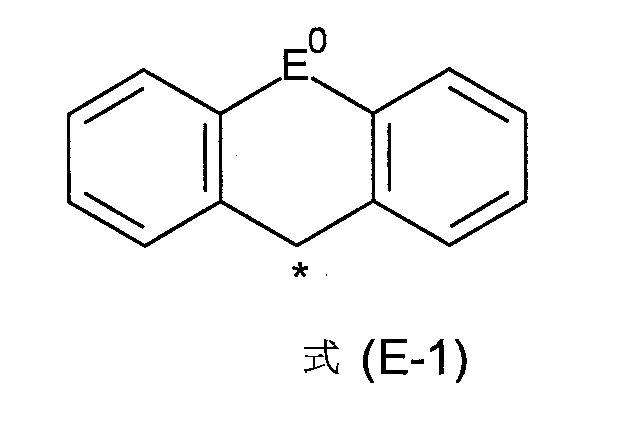


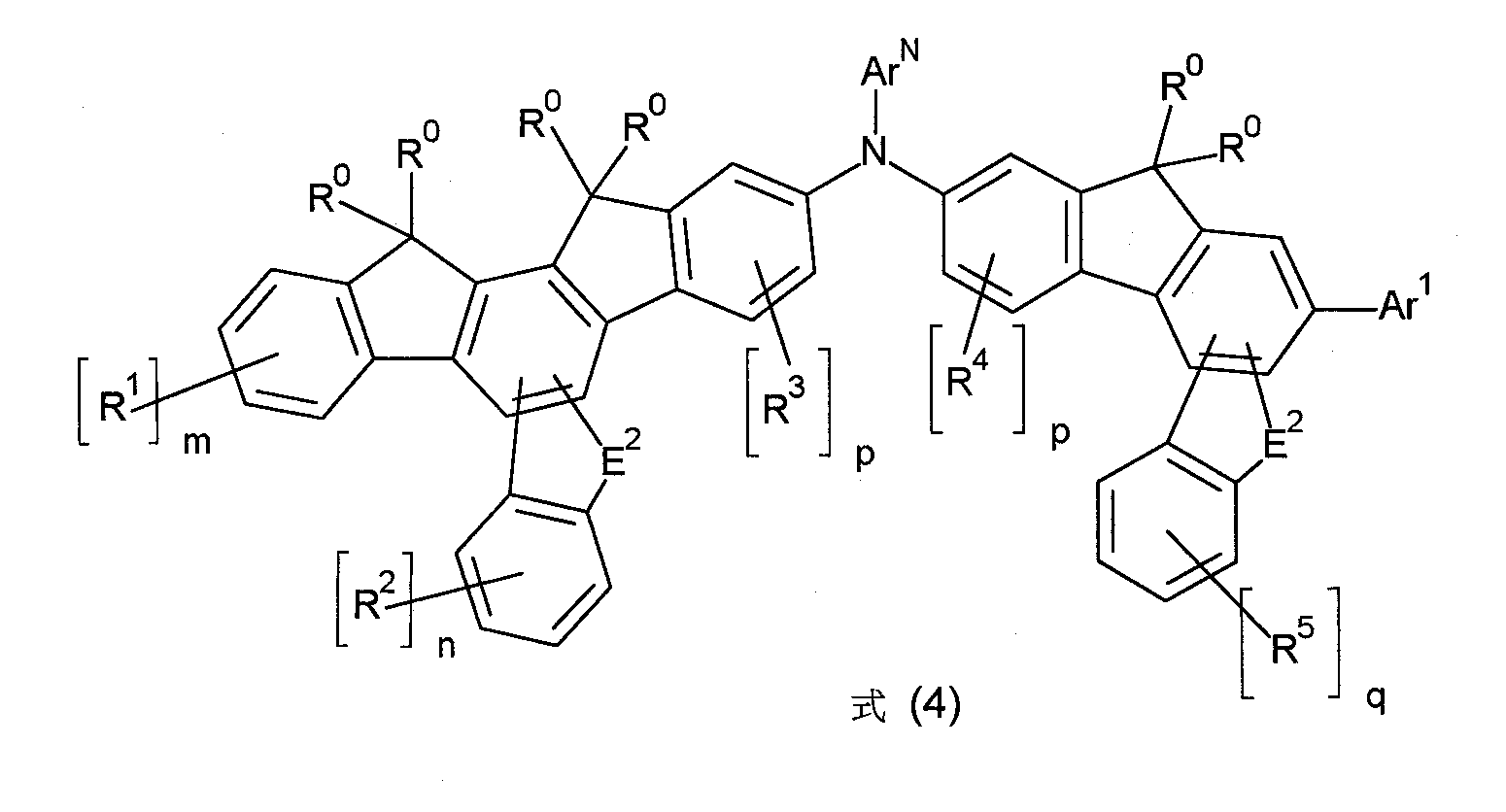
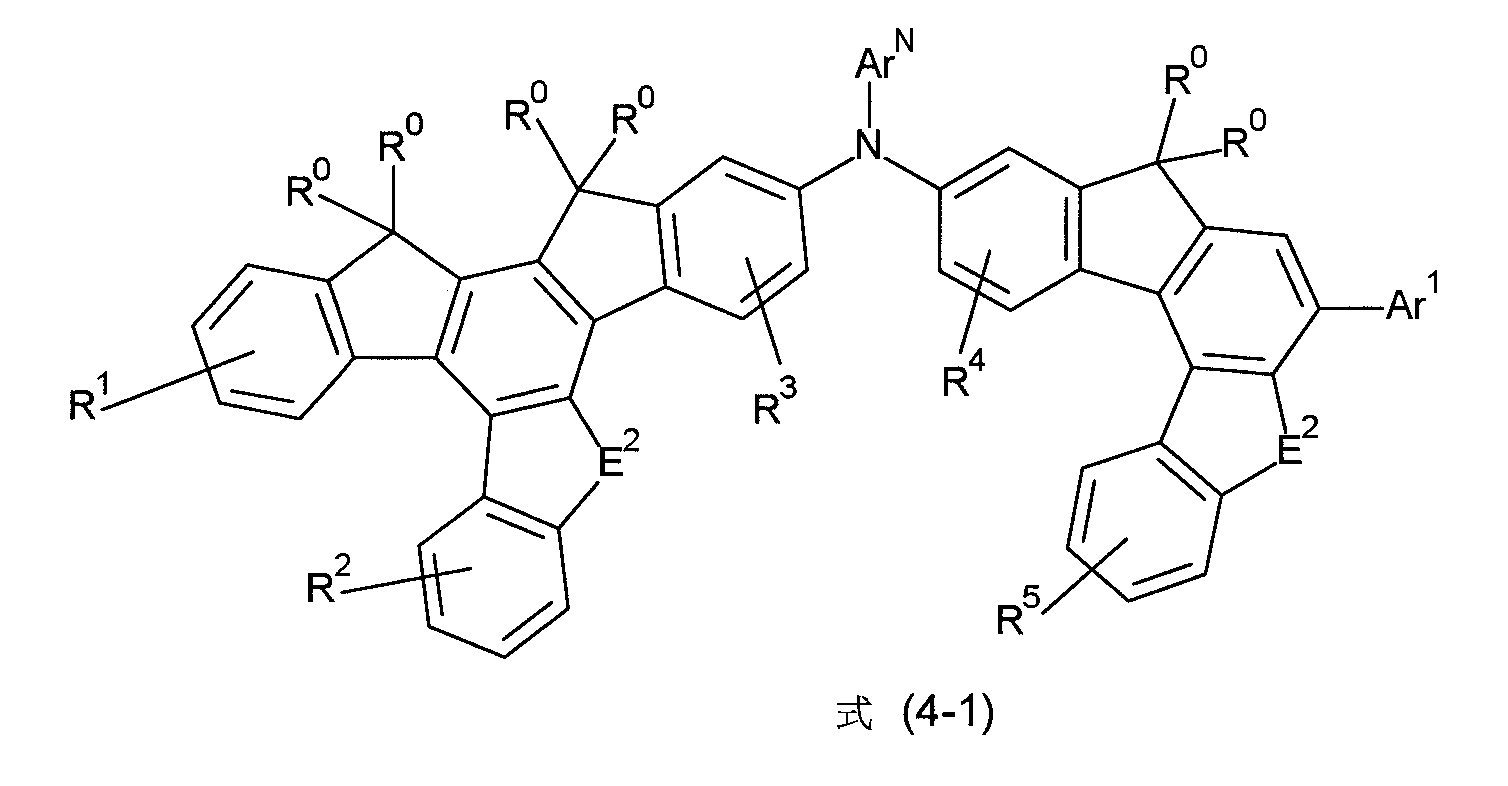
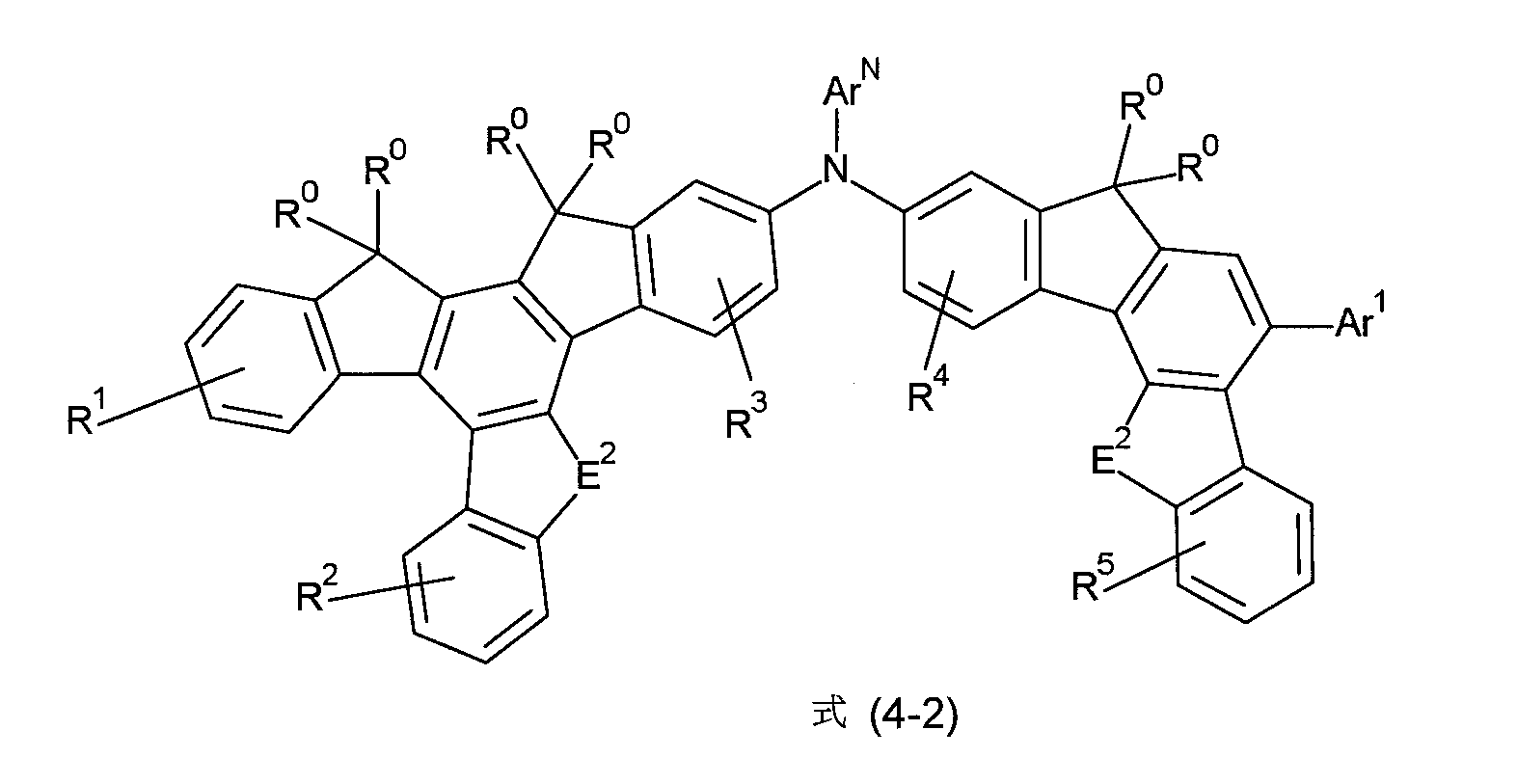

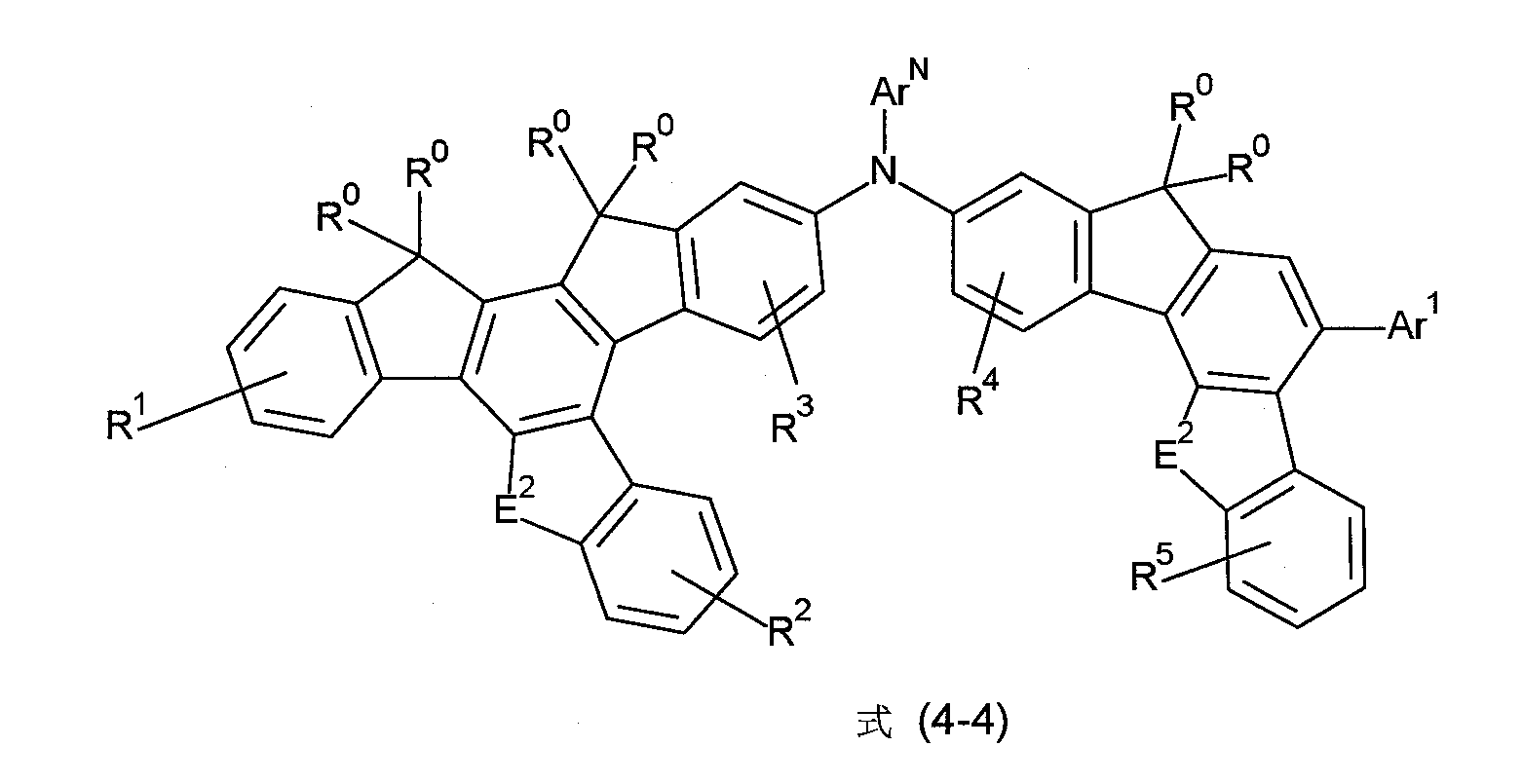

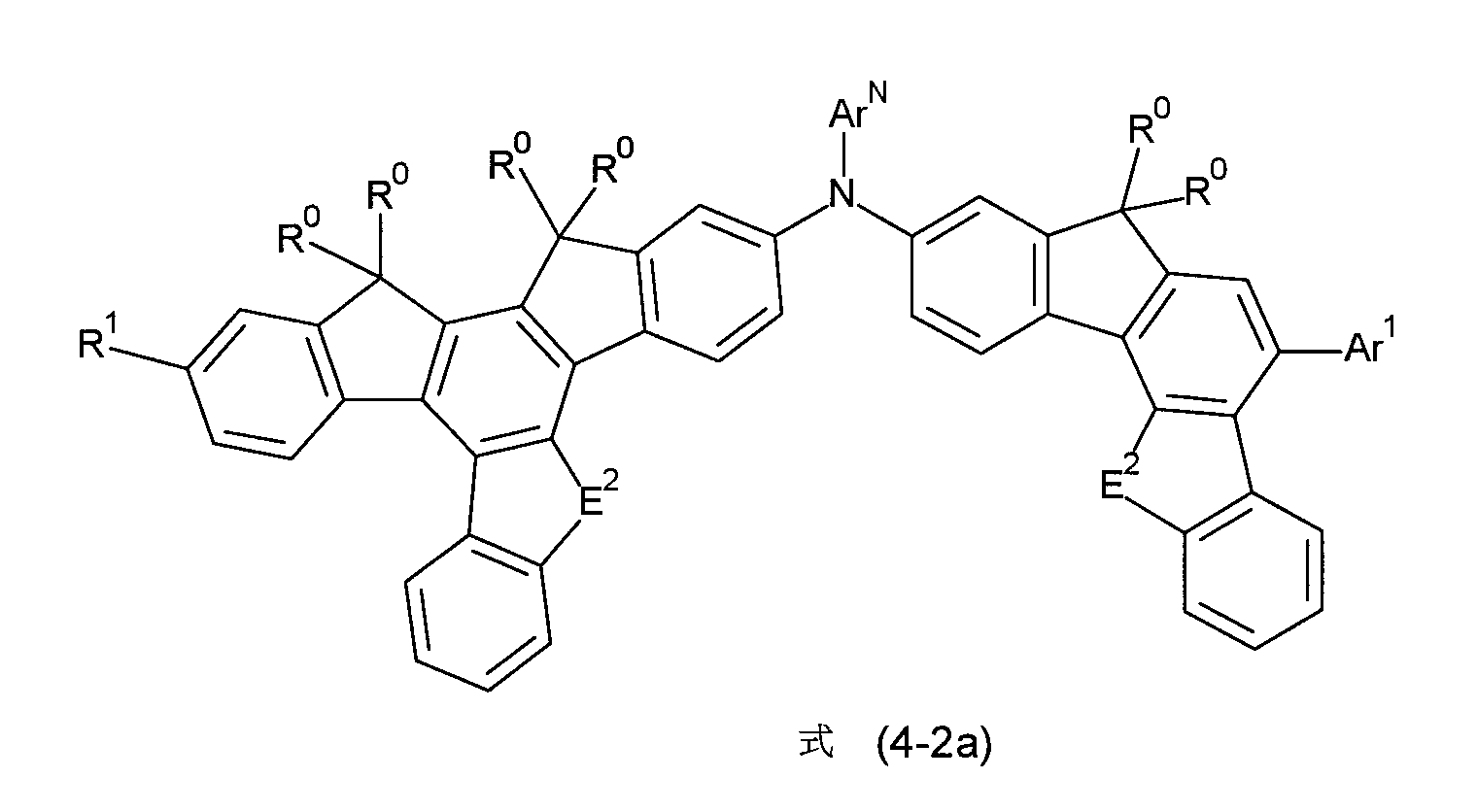


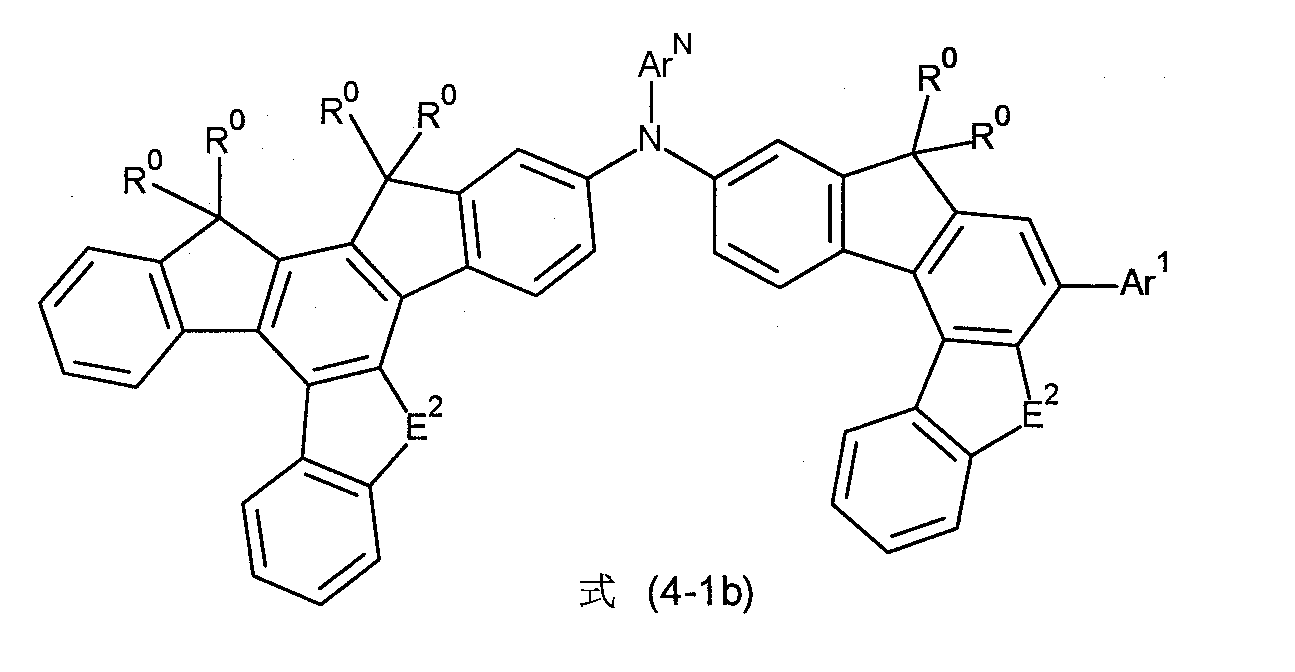


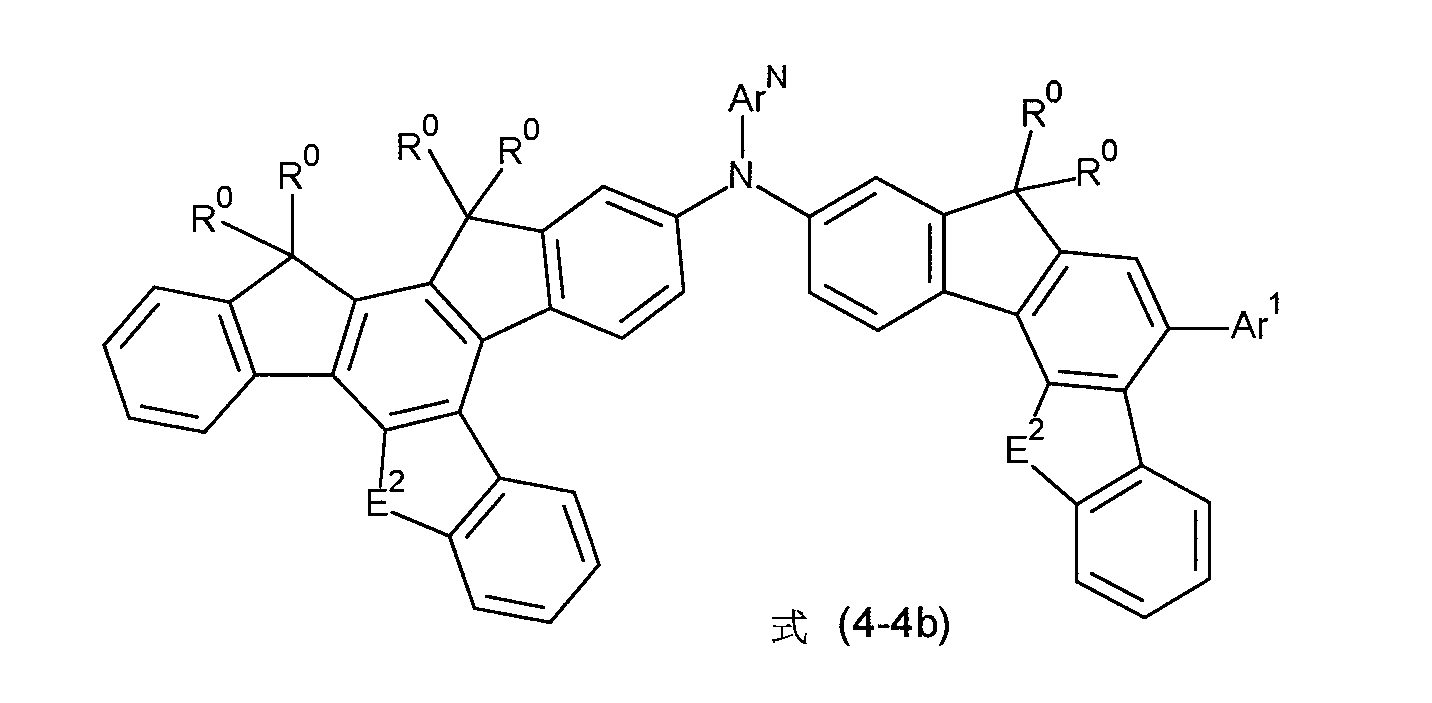


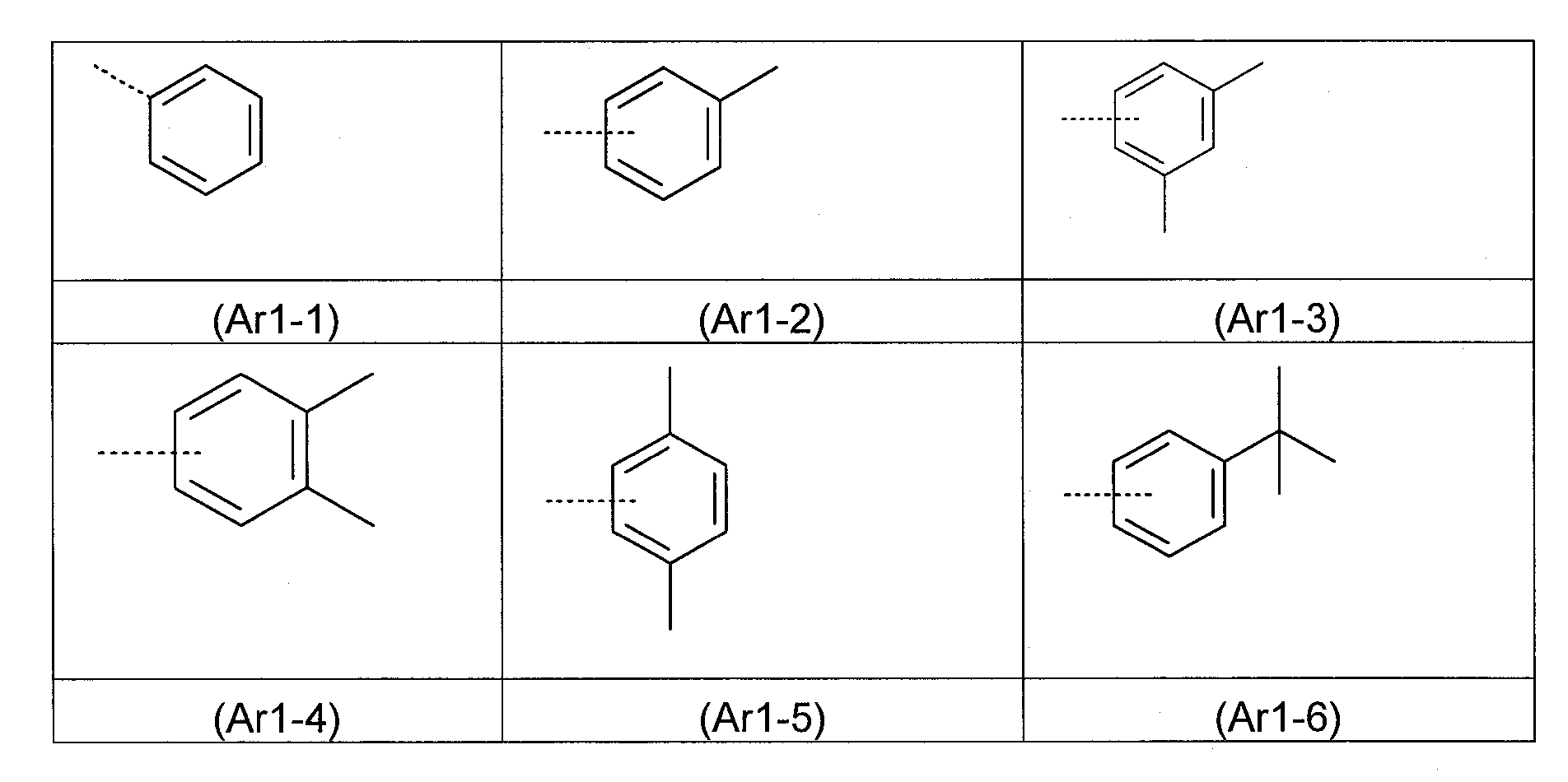
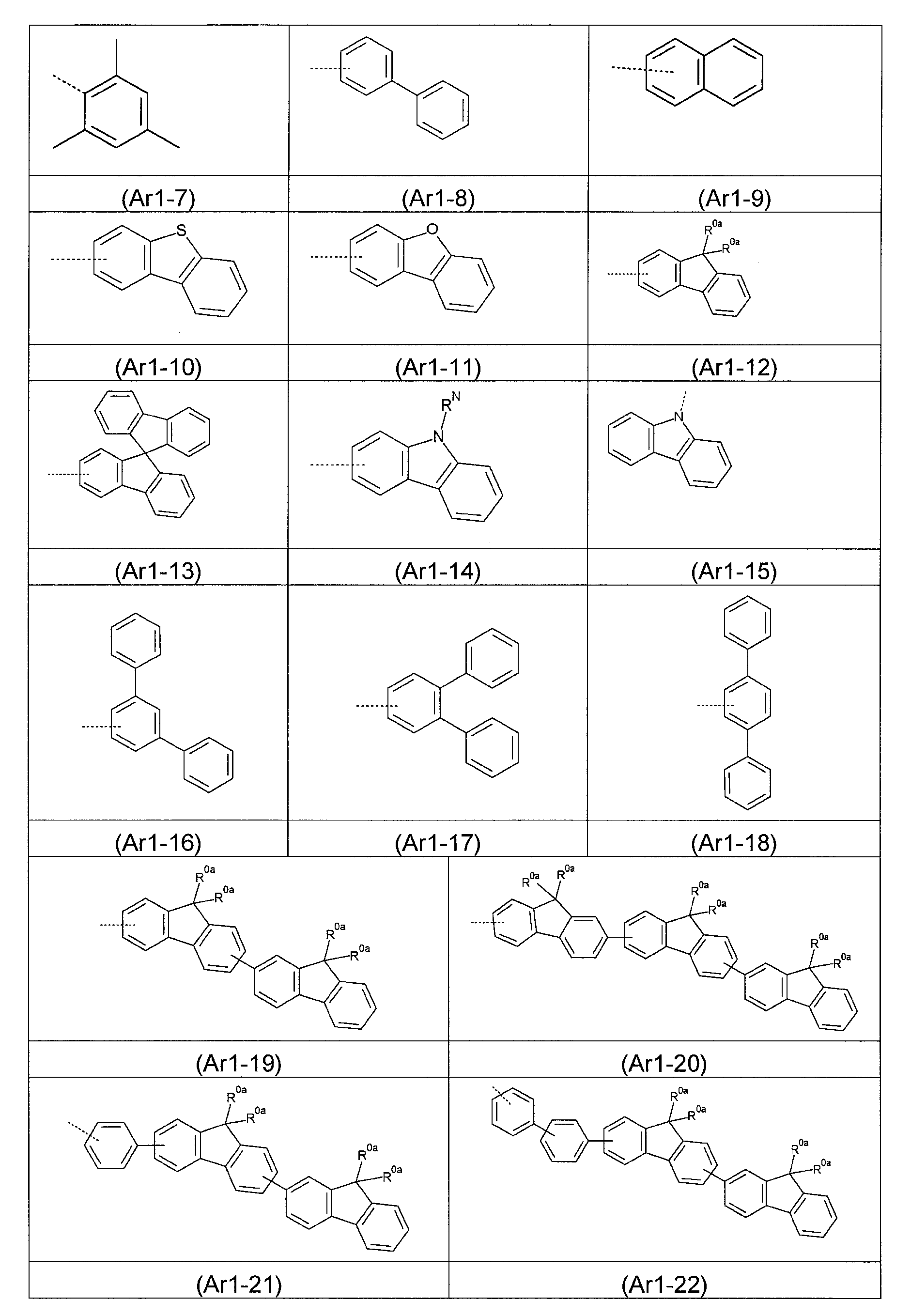
Applications Claiming Priority (2)
| Application Number | Priority Date | Filing Date | Title |
|---|---|---|---|
| EP18191175.1 | 2018-08-28 | ||
| EP18191175 | 2018-08-28 |
Publications (2)
| Publication Number | Publication Date |
|---|---|
| TW202021959A TW202021959A (en) | 2020-06-16 |
| TWI837167B true TWI837167B (en) | 2024-04-01 |
Family
ID=63442471
Family Applications (1)
| Application Number | Title | Priority Date | Filing Date |
|---|---|---|---|
| TW108130241A TWI837167B (en) | 2018-08-28 | 2019-08-23 | Materials for organic electroluminescent devices |
Country Status (6)
| Country | Link |
|---|---|
| US (1) | US11466022B2 (en) |
| EP (1) | EP3844244B1 (en) |
| KR (1) | KR20210052486A (en) |
| CN (1) | CN112639053A (en) |
| TW (1) | TWI837167B (en) |
| WO (1) | WO2020043657A1 (en) |
Families Citing this family (10)
| Publication number | Priority date | Publication date | Assignee | Title |
|---|---|---|---|---|
| US11177446B2 (en) | 2017-09-14 | 2021-11-16 | Beijing Summer Sprout Technology Co., Ltd. | Silicon containing organic fluorescent materials |
| EP4079742A1 (en) | 2021-04-14 | 2022-10-26 | Merck Patent GmbH | Metal complexes |
| CN117917983A (en) | 2021-09-13 | 2024-04-23 | 默克专利有限公司 | Material for organic electroluminescent device |
| CN118923233A (en) | 2022-04-28 | 2024-11-08 | 默克专利有限公司 | Material for organic electroluminescent device |
| WO2024033282A1 (en) | 2022-08-09 | 2024-02-15 | Merck Patent Gmbh | Materials for organic electroluminescent devices |
| WO2024115426A1 (en) * | 2022-12-01 | 2024-06-06 | Merck Patent Gmbh | Polymers containing spirotruxene derivatives as the repeating units, and electroluminescent devices containing said polymers |
| TW202438505A (en) | 2022-12-19 | 2024-10-01 | 德商麥克專利有限公司 | Materials for organic electroluminescent devices |
| WO2025083015A1 (en) | 2023-10-19 | 2025-04-24 | Merck Patent Gmbh | Materials for organic electroluminescent devices |
| WO2025119821A1 (en) | 2023-12-05 | 2025-06-12 | Merck Patent Gmbh | Material composition for organic electroluminescent devices |
| WO2025119813A1 (en) | 2023-12-06 | 2025-06-12 | Merck Patent Gmbh | Materials for organic electroluminescent devices |
Citations (2)
| Publication number | Priority date | Publication date | Assignee | Title |
|---|---|---|---|---|
| CN107573306A (en) * | 2016-07-05 | 2018-01-12 | 上海和辉光电有限公司 | A kind of organic electroluminescent compounds |
| CN107573925A (en) * | 2016-07-05 | 2018-01-12 | 上海和辉光电有限公司 | A kind of organic electroluminescent compounds |
Family Cites Families (109)
| Publication number | Priority date | Publication date | Assignee | Title |
|---|---|---|---|---|
| US4539507A (en) | 1983-03-25 | 1985-09-03 | Eastman Kodak Company | Organic electroluminescent devices having improved power conversion efficiencies |
| US5061569A (en) | 1990-07-26 | 1991-10-29 | Eastman Kodak Company | Electroluminescent device with organic electroluminescent medium |
| DE69432054T2 (en) | 1993-09-29 | 2003-10-09 | Idemitsu Kosan Co | ORGANIC ELECTROLUMINESCENT ELEMENTS AND ARYLENE DIAMINE DERIVATIVES |
| JPH07133483A (en) | 1993-11-09 | 1995-05-23 | Shinko Electric Ind Co Ltd | Organic light emitting material for EL device and EL device |
| EP0676461B1 (en) | 1994-04-07 | 2002-08-14 | Covion Organic Semiconductors GmbH | Spiro compounds and their application as electroluminescence materials |
| JP3302945B2 (en) | 1998-06-23 | 2002-07-15 | ネースディスプレイ・カンパニー・リミテッド | Novel organometallic luminescent material and organic electroluminescent device containing the same |
| WO2000070655A2 (en) | 1999-05-13 | 2000-11-23 | The Trustees Of Princeton University | Very high efficiency organic light emitting devices based on electrophosphorescence |
| KR100946314B1 (en) | 1999-12-01 | 2010-03-09 | 더 트러스티즈 오브 프린스턴 유니버시티 | Organic light emitting device comprising a phosphorescent organo metallic compound |
| KR100377321B1 (en) | 1999-12-31 | 2003-03-26 | 주식회사 엘지화학 | Electronic device comprising organic compound having p-type semiconducting characteristics |
| US6660410B2 (en) | 2000-03-27 | 2003-12-09 | Idemitsu Kosan Co., Ltd. | Organic electroluminescence element |
| US20020121638A1 (en) | 2000-06-30 | 2002-09-05 | Vladimir Grushin | Electroluminescent iridium compounds with fluorinated phenylpyridines, phenylpyrimidines, and phenylquinolines and devices made with such compounds |
| CN101924190B (en) | 2000-08-11 | 2012-07-04 | 普林斯顿大学理事会 | Organometallic compounds and emission-shifting organic electrophosphorescence |
| JP4154139B2 (en) | 2000-09-26 | 2008-09-24 | キヤノン株式会社 | Light emitting element |
| JP4154138B2 (en) | 2000-09-26 | 2008-09-24 | キヤノン株式会社 | Light emitting element, display device and metal coordination compound |
| JP4154140B2 (en) | 2000-09-26 | 2008-09-24 | キヤノン株式会社 | Metal coordination compounds |
| KR100691543B1 (en) | 2002-01-18 | 2007-03-09 | 주식회사 엘지화학 | New material for electron transport and organic light emitting device using the same |
| ITRM20020411A1 (en) | 2002-08-01 | 2004-02-02 | Univ Roma La Sapienza | SPIROBIFLUORENE DERIVATIVES, THEIR PREPARATION AND USE. |
| EP1549112A4 (en) | 2002-09-20 | 2009-01-07 | Idemitsu Kosan Co | ORGANIC ELECTROLUMINESCENT ELEMENT |
| DE10249723A1 (en) | 2002-10-25 | 2004-05-06 | Covion Organic Semiconductors Gmbh | Conjugated polymers containing arylamine units, their preparation and use |
| JP2006511939A (en) | 2002-12-23 | 2006-04-06 | コビオン・オーガニック・セミコンダクターズ・ゲーエムベーハー | Organic electroluminescence device |
| DE10310887A1 (en) | 2003-03-11 | 2004-09-30 | Covion Organic Semiconductors Gmbh | Matallkomplexe |
| US7851071B2 (en) | 2003-03-13 | 2010-12-14 | Idemitsu Kosan Co., Ltd. | Nitrogen-containing heterocycle derivative and organic electroluminescent element using the same |
| JP4411851B2 (en) | 2003-03-19 | 2010-02-10 | コニカミノルタホールディングス株式会社 | Organic electroluminescence device |
| JP5318347B2 (en) | 2003-04-15 | 2013-10-16 | メルク パテント ゲーエムベーハー | Mixture of matrix material and organic semiconductor capable of emitting light, use thereof, and electronic component comprising said mixture |
| EP2236579B1 (en) | 2003-04-23 | 2014-04-09 | Konica Minolta Holdings, Inc. | Organic electroluminescent element and display |
| DE10333232A1 (en) | 2003-07-21 | 2007-10-11 | Merck Patent Gmbh | Organic electroluminescent element |
| DE10338550A1 (en) | 2003-08-19 | 2005-03-31 | Basf Ag | Transition metal complexes with carbene ligands as emitters for organic light-emitting diodes (OLEDs) |
| DE10345572A1 (en) | 2003-09-29 | 2005-05-19 | Covion Organic Semiconductors Gmbh | metal complexes |
| US7795801B2 (en) | 2003-09-30 | 2010-09-14 | Konica Minolta Holdings, Inc. | Organic electroluminescent element, illuminator, display and compound |
| DE102004008304A1 (en) | 2004-02-20 | 2005-09-08 | Covion Organic Semiconductors Gmbh | Organic electronic devices |
| EP1722602A1 (en) | 2004-03-05 | 2006-11-15 | Idemitsu Kosan Co., Ltd. | Organic electroluminescent device and organic electroluminescent display |
| US7790890B2 (en) | 2004-03-31 | 2010-09-07 | Konica Minolta Holdings, Inc. | Organic electroluminescence element material, organic electroluminescence element, display device and illumination device |
| KR100787425B1 (en) | 2004-11-29 | 2007-12-26 | 삼성에스디아이 주식회사 | Phenylcarbazole compound and organic electroluminescent device using same |
| DE102004023277A1 (en) | 2004-05-11 | 2005-12-01 | Covion Organic Semiconductors Gmbh | New material mixtures for electroluminescence |
| US7598388B2 (en) | 2004-05-18 | 2009-10-06 | The University Of Southern California | Carbene containing metal complexes as OLEDs |
| JP4862248B2 (en) | 2004-06-04 | 2012-01-25 | コニカミノルタホールディングス株式会社 | Organic electroluminescence element, lighting device and display device |
| ITRM20040352A1 (en) | 2004-07-15 | 2004-10-15 | Univ Roma La Sapienza | OLIGOMERIC DERIVATIVES OF SPIROBIFLUORENE, THEIR PREPARATION AND THEIR USE. |
| EP1655359A1 (en) | 2004-11-06 | 2006-05-10 | Covion Organic Semiconductors GmbH | Organic electroluminescent device |
| WO2006100896A1 (en) | 2005-03-18 | 2006-09-28 | Idemitsu Kosan Co., Ltd. | Aromatic amine derivative and organic electroluminescence device utilizing the same |
| WO2006108497A1 (en) | 2005-04-14 | 2006-10-19 | Merck Patent Gmbh | Compounds for organic electronic devices |
| CN101171320B (en) | 2005-05-03 | 2013-04-10 | 默克专利有限公司 | Organic electroluminescent device |
| DE102005023437A1 (en) | 2005-05-20 | 2006-11-30 | Merck Patent Gmbh | Connections for organic electronic devices |
| EP1956022B1 (en) | 2005-12-01 | 2012-07-25 | Nippon Steel Chemical Co., Ltd. | Compound for organic electroluminescent element and organic electroluminescent element |
| EP1968131A4 (en) | 2005-12-27 | 2009-08-19 | Idemitsu Kosan Co | ORGANIC ELECTROLUMINESCENT DEVICE AND MATERIAL THEREFOR |
| DE102006025777A1 (en) | 2006-05-31 | 2007-12-06 | Merck Patent Gmbh | New materials for organic electroluminescent devices |
| DE102006025846A1 (en) | 2006-06-02 | 2007-12-06 | Merck Patent Gmbh | New materials for organic electroluminescent devices |
| DE102006031990A1 (en) | 2006-07-11 | 2008-01-17 | Merck Patent Gmbh | New materials for organic electroluminescent devices |
| US8062769B2 (en) | 2006-11-09 | 2011-11-22 | Nippon Steel Chemical Co., Ltd. | Indolocarbazole compound for use in organic electroluminescent device and organic electroluminescent device |
| DE102007002714A1 (en) | 2007-01-18 | 2008-07-31 | Merck Patent Gmbh | New materials for organic electroluminescent devices |
| JP2008244471A (en) * | 2007-03-01 | 2008-10-09 | Hitachi Chem Co Ltd | Material for organic electronics, thin-film employing the material, organic electronics element and organic electroluminescence element |
| US8044390B2 (en) | 2007-05-25 | 2011-10-25 | Idemitsu Kosan Co., Ltd. | Material for organic electroluminescent device, organic electroluminescent device, and organic electroluminescent display |
| DE102007024850A1 (en) | 2007-05-29 | 2008-12-04 | Merck Patent Gmbh | New materials for organic electroluminescent devices |
| DE102007031220B4 (en) | 2007-07-04 | 2022-04-28 | Novaled Gmbh | Quinoid compounds and their use in semiconducting matrix materials, electronic and optoelectronic components |
| EP2045848B1 (en) | 2007-07-18 | 2017-09-27 | Idemitsu Kosan Co., Ltd. | Organic electroluminescent device material and organic electroluminescent device |
| DE102007053771A1 (en) | 2007-11-12 | 2009-05-14 | Merck Patent Gmbh | Organic electroluminescent devices |
| US7862908B2 (en) | 2007-11-26 | 2011-01-04 | National Tsing Hua University | Conjugated compounds containing hydroindoloacridine structural elements, and their use |
| JP5329429B2 (en) | 2007-11-30 | 2013-10-30 | 出光興産株式会社 | Aza indenofluor orange-on derivatives, materials for organic electroluminescence elements, and organic electroluminescence elements |
| TWI478624B (en) | 2008-03-27 | 2015-03-21 | Nippon Steel & Sumikin Chem Co | Organic electroluminescent elements |
| US8057712B2 (en) | 2008-04-29 | 2011-11-15 | Novaled Ag | Radialene compounds and their use |
| DE102008033943A1 (en) | 2008-07-18 | 2010-01-21 | Merck Patent Gmbh | New materials for organic electroluminescent devices |
| DE102008035413A1 (en) | 2008-07-29 | 2010-02-04 | Merck Patent Gmbh | Connections for organic electronic devices |
| DE102008036982A1 (en) | 2008-08-08 | 2010-02-11 | Merck Patent Gmbh | Organic electroluminescent device |
| US8119037B2 (en) | 2008-10-16 | 2012-02-21 | Novaled Ag | Square planar transition metal complexes and organic semiconductive materials using them as well as electronic or optoelectric components |
| KR101506919B1 (en) | 2008-10-31 | 2015-03-30 | 롬엔드하스전자재료코리아유한회사 | Novel compounds for organic electronic material and organic electronic device using the same |
| DE102008056688A1 (en) | 2008-11-11 | 2010-05-12 | Merck Patent Gmbh | Materials for organic electroluminescent devices |
| KR20110097612A (en) | 2008-11-11 | 2011-08-31 | 메르크 파텐트 게엠베하 | Organic electroluminescent devices |
| DE102008064200A1 (en) | 2008-12-22 | 2010-07-01 | Merck Patent Gmbh | Organic electroluminescent device |
| DE102009009277B4 (en) | 2009-02-17 | 2023-12-07 | Merck Patent Gmbh | Organic electronic device, process for its production and use of compounds |
| KR101732199B1 (en) | 2009-02-27 | 2017-05-02 | 메르크 파텐트 게엠베하 | Polymer having aldehyde groups, converting and cross-linking of said polymer, cross-linked polymer, and electroluminescent device comprising said polymer |
| DE102009014513A1 (en) | 2009-03-23 | 2010-09-30 | Merck Patent Gmbh | Organic electroluminescent device |
| DE102009023155A1 (en) | 2009-05-29 | 2010-12-02 | Merck Patent Gmbh | Materials for organic electroluminescent devices |
| DE102009031021A1 (en) | 2009-06-30 | 2011-01-05 | Merck Patent Gmbh | Materials for organic electroluminescent devices |
| DE102009048791A1 (en) | 2009-10-08 | 2011-04-14 | Merck Patent Gmbh | Materials for organic electroluminescent devices |
| WO2011073149A1 (en) | 2009-12-14 | 2011-06-23 | Basf Se | Metal complexes comprising diazabenzimidazol carbene-ligands and the use thereof in oleds |
| DE102010005697A1 (en) | 2010-01-25 | 2011-07-28 | Merck Patent GmbH, 64293 | Connections for electronic devices |
| DE102010012738A1 (en) | 2010-03-25 | 2011-09-29 | Merck Patent Gmbh | Materials for organic electroluminescent devices |
| DE102010013495A1 (en) | 2010-03-31 | 2011-10-06 | Siemens Aktiengesellschaft | Dopant for a hole conductor layer for organic semiconductor devices and use thereof |
| DE102010019306B4 (en) | 2010-05-04 | 2021-05-20 | Merck Patent Gmbh | Organic electroluminescent devices |
| DE102010045405A1 (en) | 2010-09-15 | 2012-03-15 | Merck Patent Gmbh | Materials for organic electroluminescent devices |
| DE102010048608A1 (en) | 2010-10-15 | 2012-04-19 | Merck Patent Gmbh | Materials for organic electroluminescent devices |
| DE102010048607A1 (en) | 2010-10-15 | 2012-04-19 | Merck Patent Gmbh | Connections for electronic devices |
| EP2663567B1 (en) | 2011-01-13 | 2016-06-01 | Merck Patent GmbH | Compounds for organic electroluminescent devices |
| CN105762279B (en) * | 2011-03-25 | 2018-04-17 | 出光兴产株式会社 | Organic electroluminescent device |
| KR101979469B1 (en) | 2011-04-18 | 2019-05-16 | 메르크 파텐트 게엠베하 | Materials for organic electroluminescent devices |
| KR101884496B1 (en) | 2011-05-05 | 2018-08-01 | 메르크 파텐트 게엠베하 | Compounds for electronic devices |
| CA2849087A1 (en) | 2011-09-21 | 2013-03-28 | Merck Patent Gmbh | Carbazole derivatives for organic electroluminescent devices |
| CN103946215B (en) | 2011-11-17 | 2016-09-28 | 默克专利有限公司 | Spiroacridine derivatives and their use as materials for organic electroluminescent devices |
| KR102357439B1 (en) | 2012-02-14 | 2022-02-08 | 메르크 파텐트 게엠베하 | Spirobifluorene compounds for organic electroluminescent devices |
| WO2013185871A1 (en) | 2012-06-12 | 2013-12-19 | Merck Patent Gmbh | Compounds for electronic devices |
| CN110444694B (en) | 2012-07-23 | 2023-04-07 | 默克专利有限公司 | Compound and organic electroluminescent device |
| CN108054293B (en) | 2012-07-23 | 2020-05-22 | 默克专利有限公司 | Derivatives of 2-diarylaminofluorene and organic electronic complexes containing said 2-diarylaminofluorene derivatives |
| KR20210076207A (en) | 2012-07-23 | 2021-06-23 | 메르크 파텐트 게엠베하 | Fluorenes and electronic devices containing them |
| JP6284940B2 (en) | 2012-09-04 | 2018-02-28 | メルク パテント ゲーエムベーハー | Compounds for electronic devices |
| EP2941472B1 (en) | 2013-01-03 | 2018-07-25 | Merck Patent GmbH | Materials for electronic devices |
| EP3057947B1 (en) | 2013-10-14 | 2018-10-17 | Merck Patent GmbH | Materials for electronic devices |
| CN113527032A (en) | 2014-04-16 | 2021-10-22 | 默克专利有限公司 | Materials for Electronic Devices |
| WO2016150544A1 (en) | 2015-03-25 | 2016-09-29 | Merck Patent Gmbh | Materials for organic electroluminescent devices |
| KR102002034B1 (en) | 2015-07-09 | 2019-07-22 | 에스에프씨주식회사 | organic light-emitting diode with High efficiency and long lifetime |
| JP6786591B2 (en) | 2015-08-14 | 2020-11-18 | メルク、パテント、ゲゼルシャフト、ミット、ベシュレンクテル、ハフツングMerck Patent GmbH | Phenoxazine derivatives for organic electroluminescence devices |
| WO2017028941A1 (en) | 2015-08-14 | 2017-02-23 | Merck Patent Gmbh | Phenoxazine derivatives for organic electroluminescent devices |
| KR102602818B1 (en) | 2015-08-28 | 2023-11-15 | 메르크 파텐트 게엠베하 | 6,9,15,18-tetrahydro-S-indaceno[1,2-B:5,6-B']difluorene derivatives and their uses in electronic devices |
| US20180327339A1 (en) | 2015-08-28 | 2018-11-15 | Merck Patent Gmbh | Compounds for electronic devices |
| CN107573308A (en) | 2016-07-05 | 2018-01-12 | 上海和辉光电有限公司 | A kind of organic electroluminescent compounds |
| CN108017606B (en) | 2016-10-31 | 2021-07-20 | 株式会社Lg化学 | A compound and an organic electroluminescent element comprising the same |
| US11453680B2 (en) * | 2016-11-25 | 2022-09-27 | Merck Patent Gmbh | Bisbenzofuran-fused indeno[1,2-B]fluorene derivatives and related compounds as materials for organic electroluminescent devices (OLED) |
| CN106590632A (en) * | 2016-12-20 | 2017-04-26 | 盐城工学院 | Organic electroluminescent material and device and preparation method |
| TWI820057B (en) * | 2017-11-24 | 2023-11-01 | 德商麥克專利有限公司 | Materials for organic electroluminescent devices |
| CN108341795A (en) | 2018-02-09 | 2018-07-31 | 长春海谱润斯科技有限公司 | A kind of triarylamine derivative and its organic electroluminescence device |
| KR102216472B1 (en) * | 2018-06-08 | 2021-02-17 | 삼성에스디아이 주식회사 | Compound for optoelectronic device and composition for optoelectronic device and organic optoelectronic device and display device |
-
2019
- 2019-08-23 TW TW108130241A patent/TWI837167B/en active
- 2019-08-26 US US17/272,361 patent/US11466022B2/en active Active
- 2019-08-26 KR KR1020217008861A patent/KR20210052486A/en active Pending
- 2019-08-26 WO PCT/EP2019/072697 patent/WO2020043657A1/en not_active Ceased
- 2019-08-26 EP EP19756199.6A patent/EP3844244B1/en not_active Not-in-force
- 2019-08-26 CN CN201980055333.5A patent/CN112639053A/en active Pending
Patent Citations (2)
| Publication number | Priority date | Publication date | Assignee | Title |
|---|---|---|---|---|
| CN107573306A (en) * | 2016-07-05 | 2018-01-12 | 上海和辉光电有限公司 | A kind of organic electroluminescent compounds |
| CN107573925A (en) * | 2016-07-05 | 2018-01-12 | 上海和辉光电有限公司 | A kind of organic electroluminescent compounds |
Also Published As
| Publication number | Publication date |
|---|---|
| EP3844244A1 (en) | 2021-07-07 |
| EP3844244B1 (en) | 2022-08-03 |
| US20220204520A1 (en) | 2022-06-30 |
| CN112639053A (en) | 2021-04-09 |
| WO2020043657A1 (en) | 2020-03-05 |
| US11466022B2 (en) | 2022-10-11 |
| TW202021959A (en) | 2020-06-16 |
| KR20210052486A (en) | 2021-05-10 |
Similar Documents
| Publication | Publication Date | Title |
|---|---|---|
| KR102824797B1 (en) | Materials for organic electroluminescent devices | |
| TWI837167B (en) | Materials for organic electroluminescent devices | |
| TWI782115B (en) | Materials for organic electroluminescent devices | |
| KR102599160B1 (en) | Materials for organic electroluminescent devices | |
| KR102474330B1 (en) | Materials for organic electroluminescent devices | |
| KR102337198B1 (en) | Compounds and organic electroluminescent devices | |
| TWI823993B (en) | Materials for organic electroluminescent devices | |
| KR102279289B1 (en) | Materials for electronic devices | |
| EP3844243B1 (en) | Materials for organic electroluminescent devices | |
| CN102823010B (en) | compound for electronic device | |
| KR20200139746A (en) | Materials for electronic devices | |
| TWI838352B (en) | Materials for organic electroluminescent devices | |
| KR102610950B1 (en) | Materials for organic electroluminescent devices | |
| KR102777515B1 (en) | Materials for electronic devices | |
| KR20250027268A (en) | Composition for organic electronic devices | |
| JP2019501871A (en) | Materials for organic electroluminescent devices | |
| KR20240096594A (en) | Compounds for electronic devices | |
| KR102592391B1 (en) | Organoboron complexes for organic electroluminescent devices | |
| KR20240091097A (en) | Compounds for electronic devices | |
| KR102766682B1 (en) | Materials for organic electroluminescent devices | |
| KR102650253B1 (en) | Materials for organic electroluminescent devices | |
| KR102671945B1 (en) | Materials for organic electroluminescent devices | |
| KR20250037517A (en) | Materials for electronic devices |