CN109863223B - Formulation of organic functional materials - Google Patents
Formulation of organic functional materials Download PDFInfo
- Publication number
- CN109863223B CN109863223B CN201780065480.1A CN201780065480A CN109863223B CN 109863223 B CN109863223 B CN 109863223B CN 201780065480 A CN201780065480 A CN 201780065480A CN 109863223 B CN109863223 B CN 109863223B
- Authority
- CN
- China
- Prior art keywords
- organic solvent
- organic
- materials
- compounds
- formulation according
- Prior art date
- Legal status (The legal status is an assumption and is not a legal conclusion. Google has not performed a legal analysis and makes no representation as to the accuracy of the status listed.)
- Active
Links
Images




Classifications
-
- C—CHEMISTRY; METALLURGY
- C09—DYES; PAINTS; POLISHES; NATURAL RESINS; ADHESIVES; COMPOSITIONS NOT OTHERWISE PROVIDED FOR; APPLICATIONS OF MATERIALS NOT OTHERWISE PROVIDED FOR
- C09K—MATERIALS FOR MISCELLANEOUS APPLICATIONS, NOT PROVIDED FOR ELSEWHERE
- C09K11/00—Luminescent, e.g. electroluminescent, chemiluminescent materials
- C09K11/06—Luminescent, e.g. electroluminescent, chemiluminescent materials containing organic luminescent materials
-
- C—CHEMISTRY; METALLURGY
- C09—DYES; PAINTS; POLISHES; NATURAL RESINS; ADHESIVES; COMPOSITIONS NOT OTHERWISE PROVIDED FOR; APPLICATIONS OF MATERIALS NOT OTHERWISE PROVIDED FOR
- C09D—COATING COMPOSITIONS, e.g. PAINTS, VARNISHES OR LACQUERS; FILLING PASTES; CHEMICAL PAINT OR INK REMOVERS; INKS; CORRECTING FLUIDS; WOODSTAINS; PASTES OR SOLIDS FOR COLOURING OR PRINTING; USE OF MATERIALS THEREFOR
- C09D11/00—Inks
- C09D11/02—Printing inks
- C09D11/03—Printing inks characterised by features other than the chemical nature of the binder
- C09D11/033—Printing inks characterised by features other than the chemical nature of the binder characterised by the solvent
-
- C—CHEMISTRY; METALLURGY
- C09—DYES; PAINTS; POLISHES; NATURAL RESINS; ADHESIVES; COMPOSITIONS NOT OTHERWISE PROVIDED FOR; APPLICATIONS OF MATERIALS NOT OTHERWISE PROVIDED FOR
- C09D—COATING COMPOSITIONS, e.g. PAINTS, VARNISHES OR LACQUERS; FILLING PASTES; CHEMICAL PAINT OR INK REMOVERS; INKS; CORRECTING FLUIDS; WOODSTAINS; PASTES OR SOLIDS FOR COLOURING OR PRINTING; USE OF MATERIALS THEREFOR
- C09D11/00—Inks
- C09D11/30—Inkjet printing inks
- C09D11/36—Inkjet printing inks based on non-aqueous solvents
-
- H—ELECTRICITY
- H10—SEMICONDUCTOR DEVICES; ELECTRIC SOLID-STATE DEVICES NOT OTHERWISE PROVIDED FOR
- H10K—ORGANIC ELECTRIC SOLID-STATE DEVICES
- H10K71/00—Manufacture or treatment specially adapted for the organic devices covered by this subclass
- H10K71/10—Deposition of organic active material
- H10K71/12—Deposition of organic active material using liquid deposition, e.g. spin coating
- H10K71/13—Deposition of organic active material using liquid deposition, e.g. spin coating using printing techniques, e.g. ink-jet printing or screen printing
- H10K71/135—Deposition of organic active material using liquid deposition, e.g. spin coating using printing techniques, e.g. ink-jet printing or screen printing using ink-jet printing
-
- H—ELECTRICITY
- H10—SEMICONDUCTOR DEVICES; ELECTRIC SOLID-STATE DEVICES NOT OTHERWISE PROVIDED FOR
- H10K—ORGANIC ELECTRIC SOLID-STATE DEVICES
- H10K71/00—Manufacture or treatment specially adapted for the organic devices covered by this subclass
- H10K71/10—Deposition of organic active material
- H10K71/12—Deposition of organic active material using liquid deposition, e.g. spin coating
- H10K71/15—Deposition of organic active material using liquid deposition, e.g. spin coating characterised by the solvent used
-
- H—ELECTRICITY
- H10—SEMICONDUCTOR DEVICES; ELECTRIC SOLID-STATE DEVICES NOT OTHERWISE PROVIDED FOR
- H10K—ORGANIC ELECTRIC SOLID-STATE DEVICES
- H10K30/00—Organic devices sensitive to infrared radiation, light, electromagnetic radiation of shorter wavelength or corpuscular radiation
- H10K30/30—Organic devices sensitive to infrared radiation, light, electromagnetic radiation of shorter wavelength or corpuscular radiation comprising bulk heterojunctions, e.g. interpenetrating networks of donor and acceptor material domains
- H10K30/353—Organic devices sensitive to infrared radiation, light, electromagnetic radiation of shorter wavelength or corpuscular radiation comprising bulk heterojunctions, e.g. interpenetrating networks of donor and acceptor material domains comprising blocking layers, e.g. exciton blocking layers
-
- H—ELECTRICITY
- H10—SEMICONDUCTOR DEVICES; ELECTRIC SOLID-STATE DEVICES NOT OTHERWISE PROVIDED FOR
- H10K—ORGANIC ELECTRIC SOLID-STATE DEVICES
- H10K30/00—Organic devices sensitive to infrared radiation, light, electromagnetic radiation of shorter wavelength or corpuscular radiation
- H10K30/50—Photovoltaic [PV] devices
-
- H—ELECTRICITY
- H10—SEMICONDUCTOR DEVICES; ELECTRIC SOLID-STATE DEVICES NOT OTHERWISE PROVIDED FOR
- H10K—ORGANIC ELECTRIC SOLID-STATE DEVICES
- H10K50/00—Organic light-emitting devices
- H10K50/10—OLEDs or polymer light-emitting diodes [PLED]
- H10K50/14—Carrier transporting layers
- H10K50/15—Hole transporting layers
- H10K50/155—Hole transporting layers comprising dopants
-
- H—ELECTRICITY
- H10—SEMICONDUCTOR DEVICES; ELECTRIC SOLID-STATE DEVICES NOT OTHERWISE PROVIDED FOR
- H10K—ORGANIC ELECTRIC SOLID-STATE DEVICES
- H10K50/00—Organic light-emitting devices
- H10K50/10—OLEDs or polymer light-emitting diodes [PLED]
- H10K50/14—Carrier transporting layers
- H10K50/16—Electron transporting layers
- H10K50/165—Electron transporting layers comprising dopants
-
- H—ELECTRICITY
- H10—SEMICONDUCTOR DEVICES; ELECTRIC SOLID-STATE DEVICES NOT OTHERWISE PROVIDED FOR
- H10K—ORGANIC ELECTRIC SOLID-STATE DEVICES
- H10K50/00—Organic light-emitting devices
- H10K50/10—OLEDs or polymer light-emitting diodes [PLED]
- H10K50/17—Carrier injection layers
- H10K50/171—Electron injection layers
-
- Y—GENERAL TAGGING OF NEW TECHNOLOGICAL DEVELOPMENTS; GENERAL TAGGING OF CROSS-SECTIONAL TECHNOLOGIES SPANNING OVER SEVERAL SECTIONS OF THE IPC; TECHNICAL SUBJECTS COVERED BY FORMER USPC CROSS-REFERENCE ART COLLECTIONS [XRACs] AND DIGESTS
- Y02—TECHNOLOGIES OR APPLICATIONS FOR MITIGATION OR ADAPTATION AGAINST CLIMATE CHANGE
- Y02E—REDUCTION OF GREENHOUSE GAS [GHG] EMISSIONS, RELATED TO ENERGY GENERATION, TRANSMISSION OR DISTRIBUTION
- Y02E10/00—Energy generation through renewable energy sources
- Y02E10/50—Photovoltaic [PV] energy
- Y02E10/549—Organic PV cells
Landscapes
- Chemical & Material Sciences (AREA)
- Engineering & Computer Science (AREA)
- Materials Engineering (AREA)
- Organic Chemistry (AREA)
- Life Sciences & Earth Sciences (AREA)
- Wood Science & Technology (AREA)
- Manufacturing & Machinery (AREA)
- Chemical Kinetics & Catalysis (AREA)
- General Chemical & Material Sciences (AREA)
- Electroluminescent Light Sources (AREA)
- Inks, Pencil-Leads, Or Crayons (AREA)
- Liquid Deposition Of Substances Of Which Semiconductor Devices Are Composed (AREA)
Abstract
Description
技术领域Technical Field
本发明涉及一种制剂,其含有至少一种有机功能材料和至少四种不同的有机溶剂,即第一有机溶剂A、第二有机溶剂B、第三有机溶剂C和第四有机溶剂D,其特征在于The present invention relates to a preparation containing at least one organic functional material and at least four different organic solvents, namely a first organic solvent A, a second organic solvent B, a third organic solvent C and a fourth organic solvent D, characterized in that
-所述第一有机溶剂A包含能够接受或给予氢键的基团,- the first organic solvent A comprises a group capable of accepting or donating hydrogen bonds,
-所述第二有机溶剂B的沸点在150至350℃的范围内,- the boiling point of the second organic solvent B is in the range of 150 to 350° C.,
-所述第三有机溶剂C的沸点在100至300℃的范围内,并且- the boiling point of the third organic solvent C is in the range of 100 to 300° C., and
-所述第四有机溶剂D的沸点在200至400℃的范围内,其以0.01至15体积%的量存在并具有≥15mPas的粘度,- the fourth organic solvent D has a boiling point in the range of 200 to 400° C., is present in an amount of 0.01 to 15% by volume and has a viscosity of ≥15 mPas,
-所述至少一种有机功能材料在所述第二有机溶剂B中和在所述第四有机溶剂D中的溶解度≥5g/l,- the solubility of the at least one organic functional material in the second organic solvent B and in the fourth organic solvent D is ≥ 5 g/l,
-所述第三有机溶剂C的沸点比所述第二有机溶剂B的沸点低至少10℃;并且- the boiling point of the third organic solvent C is at least 10°C lower than the boiling point of the second organic solvent B; and
-所述第四有机溶剂D的沸点比所述第二有机溶剂B的沸点高至少10℃;- the boiling point of the fourth organic solvent D is at least 10°C higher than the boiling point of the second organic solvent B;
以及涉及通过使用这些制剂制备的电致发光器件。And also relates to electroluminescent devices prepared by using these preparations.
背景技术Background Art
有机发光器件(OLED)长期以来已通过真空沉积工艺制造。最近已经充分研究了诸如喷墨印刷的其它技术,因为它们具有诸如节省成本和可按比例放大的优点。多层印刷中的主要挑战之一是确定相关参数以在基底上获得均匀的油墨沉积。为了触发这些参数如表面张力、粘度或沸点,可以将一些添加剂添加到制剂中。Organic light emitting devices (OLEDs) have long been manufactured by vacuum deposition processes. Other technologies such as inkjet printing have recently been well studied because they have advantages such as cost savings and scalability. One of the main challenges in multilayer printing is to determine the relevant parameters to obtain uniform ink deposition on the substrate. In order to trigger these parameters such as surface tension, viscosity or boiling point, some additives can be added to the formulation.
技术问题和发明目的Technical Problem and Purpose of the Invention
已经提出了许多在有机电子器件中用于喷墨印刷的溶剂。然而,在沉积和干燥过程中起作用的重要参数的数量使得溶剂的选择非常具有挑战性。因此,含有用于通过喷墨印刷沉积的有机半导体的制剂仍需要改进。本发明的一个目的是提供一种有机半导体的制剂,所述制剂使得能够进行受控沉积以形成具有良好层特性和高效性能的有机半导体层。本发明的另一个目的是提供一种有机半导体的制剂,当使用例如喷墨印刷方法在基底上沉积和干燥时,所述制剂能够实现优异的膜均匀性,从而提供良好的层特性和效率性能。Many solvents have been proposed for inkjet printing in organic electronic devices. However, the number of important parameters that play a role in the deposition and drying process makes the selection of solvents very challenging. Therefore, formulations containing organic semiconductors for deposition by inkjet printing still need to be improved. One object of the present invention is to provide a formulation of an organic semiconductor that enables controlled deposition to form an organic semiconductor layer with good layer properties and efficient performance. Another object of the present invention is to provide a formulation of an organic semiconductor that can achieve excellent film uniformity when deposited and dried on a substrate using, for example, an inkjet printing method, thereby providing good layer properties and efficiency performance.
在JP 2015/191792 A2中公开了一种溶质,所述溶质由溶解于第一和第二溶剂中的功能层的构成材料或其前体组成,其中第一溶剂具有第一溶解度参数和第一沸点,第二溶剂具有比第一溶解度参数小的第二溶解度参数和比第一沸点低的第二沸点,第一沸点是≥250℃,第二沸点是≥170℃,第二沸点与第一沸点之差是≥40℃,且第二溶解度参数是9.0(cal/cm3)1/2或更小。JP 2015/191792 A2 discloses a solute consisting of a constituent material of a functional layer or a precursor thereof dissolved in first and second solvents, wherein the first solvent has a first solubility parameter and a first boiling point, the second solvent has a second solubility parameter smaller than the first solubility parameter and a second boiling point lower than the first boiling point, the first boiling point is ≥250°C, the second boiling point is ≥170°C, the difference between the second boiling point and the first boiling point is ≥40°C, and the second solubility parameter is 9.0 (cal/cm 3 ) 1/2 or less.
在EP 2924083 A1中公开了一种用于功能层形成的油墨,所述油墨包括作为溶质的第一组分,作为第一组分的良好溶剂的、沸点在280-350℃范围内的第二组分,所述第二组分是选自以下的至少一种类型:包括至少两个芳族环的芳烃、芳族乙二醇醚、脂族乙二醇醚、脂族乙酸酯和脂族酯,以及作为第一组分的良好溶剂的、沸点在200-300℃范围内的第三组分,所述第三组分是选自以下的至少一种类型:芳族烃、芳族醚和脂族醚,其中第二组分在包括第二组分和第三组分的混合溶剂中的比例是10重量%或更大。EP 2924083 A1 discloses an ink for forming a functional layer, the ink comprising a first component as a solute, a second component as a good solvent for the first component and having a boiling point in the range of 280-350°C, the second component being at least one type selected from the following: aromatic hydrocarbons including at least two aromatic rings, aromatic glycol ethers, aliphatic glycol ethers, aliphatic acetates and aliphatic esters, and a third component as a good solvent for the first component and having a boiling point in the range of 200-300°C, the third component being at least one type selected from the following: aromatic hydrocarbons, aromatic ethers and aliphatic ethers, wherein the proportion of the second component in the mixed solvent comprising the second component and the third component is 10% by weight or more.
在US 2013/256636 A1中公开了用于通过液体涂布方法形成功能层的功能层油墨,其中功能层材料包含大分子或低分子量材料和混合溶剂,所述混合溶剂包含0.1重量%或更多的粘度在0.01-0.05Pa·s范围内的溶剂A和粘度小于0.01Pa·s且沸点低于溶剂A的溶剂B,所述混合溶剂具有小于0.02Pa·s的粘度和200-350℃范围内的沸点。US 2013/256636 A1 discloses a functional layer ink for forming a functional layer by a liquid coating method, wherein the functional layer material comprises a macromolecular or low molecular weight material and a mixed solvent, wherein the mixed solvent comprises 0.1 wt % or more of a solvent A having a viscosity in the range of 0.01-0.05 Pa·s and a solvent B having a viscosity of less than 0.01 Pa·s and a boiling point lower than that of solvent A, and the mixed solvent has a viscosity of less than 0.02 Pa·s and a boiling point in the range of 200-350°C.
在WO 2005/083814 A1中,公开了至少一种含有至少一种高分子量成分的有机半导体在至少三种不同的溶剂A、B和C的溶剂混合物中的溶液。溶剂A和B是所述有机半导体的良好溶剂,溶剂C是所述有机半导体的不良溶剂。In WO 2005/083814 A1, a solution of at least one organic semiconductor containing at least one high molecular weight component in a solvent mixture of at least three different solvents A, B and C is disclosed. Solvents A and B are good solvents for the organic semiconductor, solvent C is a poor solvent for the organic semiconductor.
在WO 2005/112145 A1中公开了单相的液体组合物(溶液),其包括至少一种有机半导体和至少一种有机溶剂A和至少一种有机溶剂B,其中所述有机半导体包括至少一种高分子量组分,所述有机溶剂A是所述有机半导体的良好溶剂,所述有机溶剂B是有机半导体的不良溶剂,其特征在于溶剂A与B的沸点(b.p.)适用如下关系:b.p.(A)>b.p.(B)。WO 2005/112145 A1 discloses a single-phase liquid composition (solution), which comprises at least one organic semiconductor and at least one organic solvent A and at least one organic solvent B, wherein the organic semiconductor comprises at least one high molecular weight component, the organic solvent A is a good solvent for the organic semiconductor, and the organic solvent B is a poor solvent for the organic semiconductor, characterized in that the boiling points (b.p.) of solvents A and B are subject to the following relationship: b.p.(A)>b.p.(B).
问题的解决方案Solution to the problem
本发明的上述目的通过提供一种制剂来解决,所述制剂包含至少一种有机功能材料和至少四种不同的有机溶剂,即第一有机溶剂A、第二有机溶剂B、第三有机溶剂C和第四有机溶剂D,其特征在于,所述第一有机溶剂A包含能够接受或给予氢键的基团,所述第二有机溶剂B的沸点在150至350℃的范围内,所述第三有机溶剂C的沸点在100至300℃的范围内,并且所述第四有机溶剂D的沸点在200至400℃的范围内,其以0.01至15体积%的量存在并具有≥15mPas的粘度,所述至少一种有机功能材料在所述第二有机溶剂B中和在所述第四有机溶剂D中的溶解度≥5g/l,所述第三有机溶剂C的沸点比所述第二有机溶剂B的沸点低至少10℃;并且所述第四有机溶剂D的沸点比所述第二有机溶剂B的沸点高至少10℃。The above-mentioned object of the present invention is solved by providing a preparation, which comprises at least one organic functional material and at least four different organic solvents, namely a first organic solvent A, a second organic solvent B, a third organic solvent C and a fourth organic solvent D, characterized in that the first organic solvent A comprises a group capable of accepting or donating hydrogen bonds, the second organic solvent B has a boiling point in the range of 150 to 350°C, the third organic solvent C has a boiling point in the range of 100 to 300°C, and the fourth organic solvent D has a boiling point in the range of 200 to 400°C, which is present in an amount of 0.01 to 15% by volume and has a viscosity of ≥15 mPas, the solubility of the at least one organic functional material in the second organic solvent B and in the fourth organic solvent D is ≥5 g/l, the boiling point of the third organic solvent C is at least 10°C lower than the boiling point of the second organic solvent B; and the boiling point of the fourth organic solvent D is at least 10°C higher than the boiling point of the second organic solvent B.
发明的有益效果Advantageous Effects of the Invention
发明人令人惊讶地发现,使用本发明的制剂使得能够实现有效的油墨沉积以形成均匀且清晰可辨的功能材料有机层,所述有机层具有良好的层性质和性能。The inventors surprisingly found that the use of the formulations according to the invention enables efficient ink deposition to form uniform and clearly discernible organic layers of functional materials with good layer properties and performance.
附图说明BRIEF DESCRIPTION OF THE DRAWINGS
图1示出了器件的典型层结构,所述器件包含基底、ITO阳极、空穴注入层(HIL)、空穴传输层(HTL)、绿色发光层(G-EML)、空穴阻挡层(HBL)、电子传输层(ETL)和Al阴极。Figure 1 shows a typical layer structure of the device, which includes a substrate, an ITO anode, a hole injection layer (HIL), a hole transport layer (HTL), a green light-emitting layer (G-EML), a hole blocking layer (HBL), an electron transport layer (ETL), and an Al cathode.
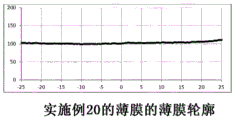
图2至22示出了参考例以及实施例1至20中制备的薄膜的薄膜轮廓。2 to 22 show film profiles of the films prepared in Reference Example and Examples 1 to 20. FIG.
图23至25示出了参考1的器件以及实施例1和2的器件的电致发光(EL)图像。23 to 25 show electroluminescence (EL) images of the device of Reference 1 and the devices of Examples 1 and 2. FIG.
具体实施方式DETAILED DESCRIPTION
本发明涉及一种制剂,其含有至少一种有机功能材料和至少四种不同的有机溶剂,即第一有机溶剂A、第二有机溶剂B、第三有机溶剂C和第四有机溶剂D,其特征在于,所述第一有机溶剂A包含能够接受或给予氢键的基团,所述第二有机溶剂B的沸点在150至350℃的范围内,所述第三有机溶剂C的沸点在100至300℃的范围内,并且所述第四有机溶剂D的沸点在200至400℃的范围内,其以0.01至15体积%的量存在并具有≥15mPas的粘度,所述至少一种有机功能材料在所述第二有机溶剂B中和在所述第四有机溶剂D中的溶解度为≥5g/l,所述第三有机溶剂C的沸点比所述第二有机溶剂B的沸点低至少10℃,并且所述第四有机溶剂D的沸点比所述第二有机溶剂B的沸点高至少10℃。The present invention relates to a preparation containing at least one organic functional material and at least four different organic solvents, namely a first organic solvent A, a second organic solvent B, a third organic solvent C and a fourth organic solvent D, characterized in that the first organic solvent A contains groups capable of accepting or donating hydrogen bonds, the second organic solvent B has a boiling point in the range of 150 to 350° C., the third organic solvent C has a boiling point in the range of 100 to 300° C., and the fourth organic solvent D has a boiling point in the range of 200 to 400° C., which is present in an amount of 0.01 to 15% by volume and has a viscosity of ≥15 mPas, the solubility of the at least one organic functional material in the second organic solvent B and in the fourth organic solvent D is ≥5 g/l, the boiling point of the third organic solvent C is at least 10° C. lower than the boiling point of the second organic solvent B, and the boiling point of the fourth organic solvent D is at least 10° C. higher than the boiling point of the second organic solvent B.
氢键供体/受体的明确定义可见于CRC Handbook of solubility parametersand other cohesion parameters(溶解度参数和其它内聚参数的CRC手册),第二版,AllanF.M Barton,1991。提到以下定义:“氢键相互作用是路易斯酸碱反应的一个特定类型,其中电子受体是布朗斯特酸。方便的定义是氢键是由共价结合的氢原子与另一个原子形成的第二键。”在下面的方案中,原子X和Y具有高于H的电负性(键合原子吸引电子的相对倾向),例如C、N、P、O、S、F、Cl、Br或I:A clear definition of hydrogen bond donors/acceptors can be found in the CRC Handbook of solubility parameters and other cohesion parameters, 2nd edition, Allan F. M Barton, 1991. The following definition is mentioned: "Hydrogen bonding interactions are a specific type of Lewis acid-base reaction in which the electron acceptor is a Bronsted acid. A convenient definition is that a hydrogen bond is a secondary bond formed by a covalently bonded hydrogen atom to another atom." In the scheme below, atoms X and Y have a higher electronegativity (the relative tendency of bonding atoms to attract electrons) than H, such as C, N, P, O, S, F, Cl, Br or I:

此外,Pimentel和McClellan(The hydrogen Bond(氢键),W.H.Freeman,SanFrancisco,1960)根据液体的氢键特性对液体的分类也被广泛使用:In addition, the classification of liquids by Pimentel and McClellan (The hydrogen bond, W.H. Freeman, San Francisco, 1960) based on the hydrogen bonding characteristics of liquids is also widely used:
-质子供体,例如三氯甲烷,- a proton donor, such as chloroform,
-质子受体,例如酮、醛、酯、醚、叔胺、芳烃、烯烃,- proton acceptors, such as ketones, aldehydes, esters, ethers, tertiary amines, aromatics, alkenes,
-质子供体/受体,例如醇、羧酸、水、伯胺和仲胺。- Proton donors/acceptors, such as alcohols, carboxylic acids, water, primary and secondary amines.
优选的实施方式Preferred Embodiments
在一个优选的实施方式中,所述制剂的特征在于第一有机溶剂A包含能够给予氢键的至少一个基团,优选一个基团。In a preferred embodiment, the preparation is characterized in that the first organic solvent A comprises at least one group, preferably one group, capable of donating a hydrogen bond.
在一个更优选的实施方式中,所述制剂的特征在于第一有机溶剂A的能够给予氢键的至少一个基团、优选一个基团是OH-或NH-基团。In a more preferred embodiment, the preparation is characterized in that at least one group, preferably one group, of the first organic solvent A capable of donating a hydrogen bond is an OH- or NH-group.
在一个优选的实施方式中,本发明的制剂的特征在于,第一有机溶剂A是根据通式(I)的溶剂,In a preferred embodiment, the formulation according to the invention is characterized in that the first organic solvent A is a solvent according to the general formula (I),

其中in
X是O或NR4,X is O or NR 4 ,
R1、R2和R3在每次出现时相同或不同,并且是H,D,具有1至12个碳原子的直链烷基基团或具有3至12个碳原子的支链或环状的烷基基团,其中一个或多个非相邻的CH2基团可被-O-、-S-、-NR5-、-CO-O-、-C=O-、-CH=CH-或-C≡C-代替,并且其中一个或多个氢原子可被F代替,或具有4至14个碳原子并且可被一个或多个非芳族R5基团取代的芳基或杂芳基基团,并且在同一环上或两个不同环上的多个取代基R5又可一起形成单环或多环的脂族、芳族或杂芳族环系,所述环系可被多个取代基R5取代,或者R1、R2和R3中的两个又可一起形成具有4至14个碳原子的单环或多环的脂族、芳族或杂芳族环系,所述环系可被多个取代基R5取代;R 1 , R 2 and R 3 are identical or different at each occurrence and are H, D, a straight-chain alkyl group having 1 to 12 carbon atoms or a branched or cyclic alkyl group having 3 to 12 carbon atoms, in which one or more non-adjacent CH 2 groups may be replaced by -O-, -S-, -NR 5 -, -CO-O-, -C=O-, -CH=CH- or -C≡C-, and in which one or more hydrogen atoms may be replaced by F, or an aryl or heteroaryl group having 4 to 14 carbon atoms and which may be substituted by one or more non-aromatic R 5 groups, and multiple substituents R 5 on the same ring or on two different rings may together form a monocyclic or polycyclic aliphatic, aromatic or heteroaromatic ring system, which may be substituted by multiple substituents R 5 , or ... Two of 3 can together form a monocyclic or polycyclic aliphatic, aromatic or heteroaromatic ring system having 4 to 14 carbon atoms, which can be substituted by multiple substituents R 5 ;
R4是H,具有1至12个碳原子的直链烷基基团,具有3至12个碳原子的支链或环状的烷基基团或具有4至14个碳原子的芳基或杂芳基基团,所述基团可被一个或多个非芳族R5基团取代,并且 R4 is H, a straight chain alkyl group having 1 to 12 carbon atoms, a branched or cyclic alkyl group having 3 to 12 carbon atoms, or an aryl or heteroaryl group having 4 to 14 carbon atoms, which may be substituted by one or more non-aromatic R5 groups, and
R5在每种情况下相同或不同,并且是H,具有1至12个碳原子的直链的烷基或烷氧基基团或具有3至20个碳原子的支链或环状的烷基或烷氧基基团,其中一个或多个非相邻的CH2基团可被-O-、-S-、-CO-O-、-C=O-、-CH=CH-或-C≡C-代替。R 5 is identical or different in each case and is H, a straight-chain alkyl or alkoxy group having 1 to 12 carbon atoms or a branched or cyclic alkyl or alkoxy group having 3 to 20 carbon atoms, in which one or more non-adjacent CH 2 groups may be replaced by -O-, -S-, -CO-O-, -C=O-, -CH=CH- or -C≡C-.
在一个更优选的实施方式中,本发明的制剂的特征在于,第一有机溶剂A是根据通式(II)的溶剂,In a more preferred embodiment, the formulation according to the invention is characterized in that the first organic solvent A is a solvent according to the general formula (II),

其中R1、R2和R3如上文所述定义。wherein R 1 , R 2 and R 3 are as defined above.
在另一个更优选的实施方式中,本发明的制剂的特征在于,第一有机溶剂A是根据通式(III)的溶剂,In another more preferred embodiment, the formulation according to the invention is characterized in that the first organic solvent A is a solvent according to the general formula (III),

其中R1、R2、R3和R4如上文所述定义。wherein R 1 , R 2 , R 3 and R 4 are as defined above.
在第三和第四最优选的实施方式中,本发明的制剂的特征在于,第一有机溶剂A是根据通式(II)或(III)的溶剂,In a third and fourth most preferred embodiment, the formulation according to the invention is characterized in that the first organic solvent A is a solvent according to the general formula (II) or (III),
其中in
R1、R2和R3在每种情况下相同或不同,并且是具有1至8个碳原子的直链烷基基团或具有3至8个碳原子的支链或环状的烷基基团,其中一个或多个非相邻的CH2基团可被-O-、-NH-、-CO-O-、-C=O-、-CH=CH-或-C≡C-代替,并且其中一个或多个氢原子可被F代替,或具有4至10个碳原子并且可被一个或多个非芳族R5基团取代的芳基或杂芳基基团,并且其中R5如上文所述定义。R 1 , R 2 and R 3 are in each case identical or different and are a straight-chain alkyl group having 1 to 8 carbon atoms or a branched or cyclic alkyl group having 3 to 8 carbon atoms, in which one or more non-adjacent CH 2 groups may be replaced by -O-, -NH-, -CO-O-, -C=O-, -CH=CH- or -C≡C-, and in which one or more hydrogen atoms may be replaced by F, or an aryl or heteroaryl group having 4 to 10 carbon atoms and which may be substituted by one or more non-aromatic R 5 groups, and in which R 5 is as defined above.
在第一更优选的实施方式中,本发明的制剂的特征在于,第一有机溶剂A是根据式(I)的溶剂,其中X是O并且R3是Ar1-Y-,其由下式(IV)说明,In a first more preferred embodiment, the formulation according to the invention is characterized in that the first organic solvent A is a solvent according to formula (I), wherein X is O and R 3 is Ar 1 -Y-, which is illustrated by the following formula (IV),

其中in
R1、R2在每种情况下相同或不同,并且是H或具有1至5个碳原子、优选1至3个碳原子并且更优选1个碳原子的直链烷基基团,R 1 , R 2 are in each case identical or different and are H or a straight-chain alkyl group having 1 to 5 carbon atoms, preferably 1 to 3 carbon atoms and more preferably 1 carbon atom,
Ar1是具有4至14个碳原子并且可被一个或多个非芳族R5基团取代的芳基或杂芳基基团,所述基团可被多个取代基R5取代,Ar 1 is an aryl or heteroaryl group having 4 to 14 carbon atoms and which may be substituted by one or more non-aromatic R 5 groups, which may be substituted by multiple substituents R 5 ,
R5在每种情况下相同或不同,并且是H,具有1至12个碳原子的直链烷基或烷氧基基团或具有3至20个碳原子的支链或环状的烷基或烷氧基基团,其中一个或多个非相邻的CH2基团可被-O-、-S-、-CO-O-、-C=O-、-CH=CH-或-C≡C-代替,并且 R5 is identical or different in each case and is H, a straight-chain alkyl or alkoxy group having 1 to 12 carbon atoms or a branched or cyclic alkyl or alkoxy group having 3 to 20 carbon atoms, in which one or more non-adjacent CH2 groups may be replaced by -O-, -S-, -CO-O-, -C=O-, -CH=CH- or -C≡C-, and
Y是直链或支链的-CnH2n-基团,其中n=1至10个碳原子,其中所述基团Y的一个或多个非相邻的CH2基团可被-O-代替。Y is a linear or branched -C n H 2n - group, where n=1 to 10 carbon atoms, wherein one or more non-adjacent CH 2 groups of the group Y may be replaced by -O-.
在第二更优选的实施方式中,本发明的制剂的特征在于,第一有机溶剂A是根据式(II)的溶剂In a second more preferred embodiment, the formulation according to the invention is characterized in that the first organic solvent A is a solvent according to formula (II)
其中in
R1、R2在每种情况下相同或不同,并且是H或具有1至3个、优选1个碳原子的直链烷基基团,并且R 1 , R 2 are in each case identical or different and are H or a straight-chain alkyl group having 1 to 3, preferably 1, carbon atoms, and
R3是H,D,具有1至12个碳原子的直链烷基基团或具有3至12个碳原子的支链或环状的烷基基团,其中一个或多个非相邻的CH2基团可被-O-、-S-、-NR5-、-CO-O-、-C=O-、-CH=CH-或-C≡C-代替,并且其中一个或多个氢原子可被F代替。R 3 is H, D, a straight-chain alkyl group having 1 to 12 carbon atoms or a branched or cyclic alkyl group having 3 to 12 carbon atoms, wherein one or more non-adjacent CH 2 groups may be replaced by -O-, -S-, -NR 5 -, -CO-O-, -C=O-, -CH=CH- or -C≡C-, and wherein one or more hydrogen atoms may be replaced by F.
在一个最优选的实施方式中,本发明的制剂的特征在于,第一有机溶剂A是根据式(III)的溶剂,其中R4是H。In a most preferred embodiment, the formulation according to the invention is characterized in that the first organic solvent A is a solvent according to formula (III) wherein R 4 is H.
在一个最优选的实施方式中,本发明的制剂的特征在于,第一有机溶剂A是根据式(II)或(IV)的溶剂,其中R1是H并且R2是H或CH3。In a most preferred embodiment, the formulation according to the invention is characterized in that the first organic solvent A is a solvent according to formula (II) or (IV), wherein R 1 is H and R 2 is H or CH 3 .
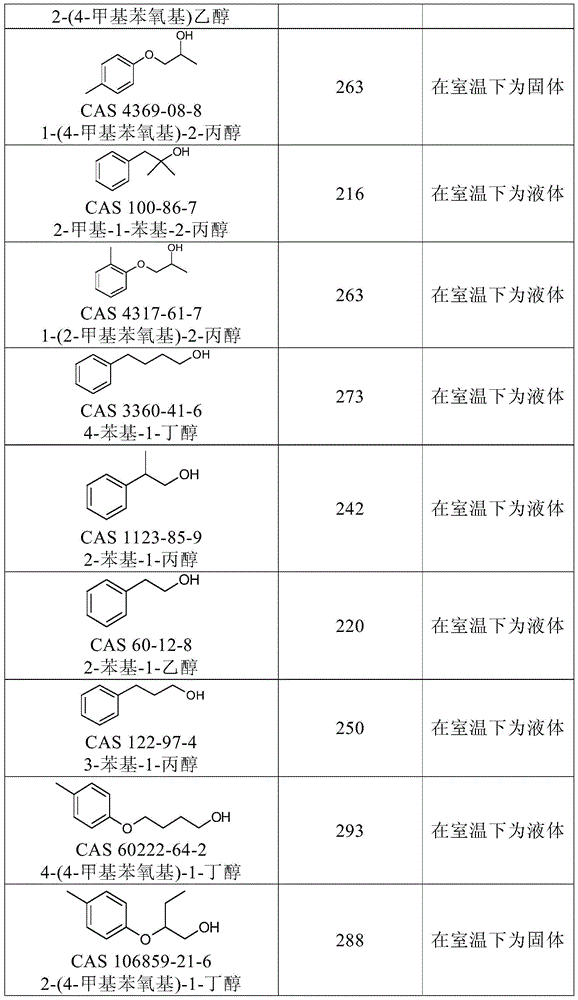
优选的第一溶剂及其沸点(BP)和熔点(MP)的实例示于下表1中。Examples of preferred first solvents and their boiling points (BP) and melting points (MP) are shown in Table 1 below.
表1:优选的第一有机溶剂A及其沸点(BP)和熔点(MP)。Table 1: Preferred first organic solvents A and their boiling points (BP) and melting points (MP).



优选地,第一有机溶剂A的表面张力为≥20mN/m。更优选地,第一有机溶剂A的表面张力在25至50mN/m的范围内并且最优选在28至45mN/m的范围内。Preferably, the surface tension of the first organic solvent A is ≥ 20 mN/m. More preferably, the surface tension of the first organic solvent A is in the range of 25 to 50 mN/m and most preferably in the range of 28 to 45 mN/m.
优选地,第一有机溶剂A的沸点在150至350℃的范围内,更优选在175至325℃的范围内并且最优选在200至300℃的范围内。Preferably, the boiling point of the first organic solvent A is in the range of 150 to 350°C, more preferably in the range of 175 to 325°C and most preferably in the range of 200 to 300°C.
以制剂中的溶剂总量计,第一溶剂A的含量在5至60体积%的范围内,优选在10至60体积%的范围内,更优选在15至55体积%的范围内,并且最优选在20至50体积%的范围内。The content of the first solvent A is in the range of 5 to 60 volume %, preferably in the range of 10 to 60 volume %, more preferably in the range of 15 to 55 volume %, and most preferably in the range of 20 to 50 volume %, based on the total amount of solvents in the formulation.
本发明的制剂至少包含第二有机溶剂B,其不同于第一有机溶剂A。第二有机溶剂B与第一有机溶剂A一起使用。The formulation of the present invention comprises at least a second organic solvent B, which is different from the first organic solvent A. The second organic solvent B is used together with the first organic solvent A.
合适的第二有机溶剂B优选是有机溶剂,其尤其包括酮,醚,酯,酰胺如二-C1-2烷基甲酰胺,硫化合物,硝基化合物,烃,卤代烃(例如氯代烃),芳族或杂芳族烃(例如萘衍生物)和卤代芳族或杂芳族烃。Suitable second organic solvents B are preferably organic solvents which include, inter alia, ketones, ethers, esters, amides such as di-C 1-2 alkylformamides, sulfur compounds, nitro compounds, hydrocarbons, halogenated hydrocarbons (e.g. chlorinated hydrocarbons), aromatic or heteroaromatic hydrocarbons (e.g. naphthalene derivatives) and halogenated aromatic or heteroaromatic hydrocarbons.
优选地,第二有机溶剂B可以选自以下组之一:取代和未取代的芳族或直链醚,如3-苯氧基甲苯或苯甲醚;取代或未取代的芳烃衍生物;取代或未取代的茚满,如六甲基-茚满;取代和未取代的芳族或直链酮;取代和未取代的杂环化合物,如吡咯烷酮、吡啶、吡嗪;其它氟化或氯化芳族烃,取代或未取代的萘如烷基取代的萘,如1-乙基萘。Preferably, the second organic solvent B can be selected from one of the following groups: substituted and unsubstituted aromatic or linear ethers, such as 3-phenoxytoluene or anisole; substituted or unsubstituted aromatic derivatives; substituted or unsubstituted indanes, such as hexamethyl-indanes; substituted and unsubstituted aromatic or linear ketones; substituted and unsubstituted heterocyclic compounds, such as pyrrolidone, pyridine, pyrazine; other fluorinated or chlorinated aromatic hydrocarbons, substituted or unsubstituted naphthalenes such as alkyl-substituted naphthalenes, such as 1-ethylnaphthalene.
特别优选的第二有机溶剂B是例如1-乙基-萘,2-乙基萘,2-丙基萘,2-(1-甲基乙基)-萘,1-(1-甲基乙基)-萘,2-丁基萘,1,6-二甲基萘,2,2'-二甲基联苯,3,3'-二甲基联苯,1-乙酰基萘,1,2,3,4-四甲基苯,1,2,3,5-四甲基-苯,1,2,3-三甲基苯,1,2,4,5-四甲基苯,1,2,4-三氯苯,1,2,4-三甲基苯,1,2-二氢萘,1,2-二甲基萘,1,3-苯并二氧杂环戊烯,1,3-二异丙基苯,1,3-二甲基萘,1,4-苯并二
第二有机溶剂B的沸点在150至350℃的范围内,优选在175至325℃的范围内并且最优选在200至300℃的范围内。The boiling point of the second organic solvent B is in the range of 150 to 350°C, preferably in the range of 175 to 325°C and most preferably in the range of 200 to 300°C.
以制剂中的有机溶剂总量计,第二有机溶剂B的含量在5至95体积%的范围内,优选在10至75体积%的范围内,更优选在15至70体积%的范围内,并且最优选在20至65体积%的范围内。The content of the second organic solvent B is in the range of 5 to 95 volume %, preferably in the range of 10 to 75 volume %, more preferably in the range of 15 to 70 volume %, and most preferably in the range of 20 to 65 volume %, based on the total amount of organic solvents in the formulation.
至少一种有机功能材料在第二有机溶剂B中的溶解度为≥5g/l,优选≥10g/l并且更优选≥15g/l。The solubility of the at least one organic functional material in the second organic solvent B is ≥5 g/l, preferably ≥10 g/l and more preferably ≥15 g/l.
表2:优选的第二有机溶剂B及其沸点(BP)和熔点(MP)。Table 2: Preferred second organic solvents B and their boiling points (BP) and melting points (MP).


本发明的制剂至少包含第三有机溶剂C,其不同于第一有机溶剂A和第二有机溶剂B。第三有机溶剂C与第一有机溶剂A和第二有机溶剂B一起使用。The formulation of the present invention comprises at least a third organic solvent C, which is different from the first organic solvent A and the second organic solvent B. The third organic solvent C is used together with the first organic solvent A and the second organic solvent B.
第三有机溶剂C的沸点在100至300℃的范围内,优选在125至275℃的范围内,并且最优选在150至250℃的范围内。此外,第三有机溶剂C的沸点比第二有机溶剂B的沸点低至少10℃,优选低至少20℃并且更优选低至少30℃。The boiling point of the third organic solvent C is in the range of 100 to 300° C., preferably in the range of 125 to 275° C., and most preferably in the range of 150 to 250° C. In addition, the boiling point of the third organic solvent C is at least 10° C. lower than the boiling point of the second organic solvent B, preferably at least 20° C. lower and more preferably at least 30° C. lower.
以制剂中的有机溶剂总量计,第三有机溶剂C的含量优选在1至30体积%的范围内,更优选在3至25体积%的范围内,并且最优选在5至20体积%的范围内。The content of the third organic solvent C is preferably in the range of 1 to 30 volume %, more preferably in the range of 3 to 25 volume %, and most preferably in the range of 5 to 20 volume %, based on the total amount of organic solvents in the formulation.
表3:优选的第三有机溶剂C及其沸点(BP)和熔点(MP)。Table 3: Preferred third organic solvents C and their boiling points (BP) and melting points (MP).


本发明的制剂至少包含第四有机溶剂D,其不同于第一有机溶剂A、第二有机溶剂B和第三有机溶剂C。第四有机溶剂D与第一有机溶剂A、第二有机溶剂B和第三有机溶剂C一起使用。The formulation of the present invention comprises at least a fourth organic solvent D, which is different from the first organic solvent A, the second organic solvent B and the third organic solvent C. The fourth organic solvent D is used together with the first organic solvent A, the second organic solvent B and the third organic solvent C.
合适的第四有机溶剂D优选是有机溶剂,其尤其包括单取代或多取代的萘衍生物,部分或完全氢化的单取代或多取代的萘衍生物,单取代或多取代的茚满衍生物和完全氢化的蒽衍生物。Suitable fourth organic solvents D are preferably organic solvents which include, in particular, mono- or polysubstituted naphthalene derivatives, partially or fully hydrogenated mono- or polysubstituted naphthalene derivatives, mono- or polysubstituted indane derivatives and fully hydrogenated anthracene derivatives.
特别优选的第四有机溶剂D是例如1-环己基萘、1-苯基萘、1-环己基十氢萘和1-苯基-1,2,3,4-四氢萘。Particularly preferred fourth organic solvents D are, for example, 1-cyclohexylnaphthalene, 1-phenylnaphthalene, 1-cyclohexyldecalin and 1-phenyl-1,2,3,4-tetrahydronaphthalene.
第四有机溶剂D的沸点在200至400℃的范围内,优选在225至375℃的范围内并且最优选在250至350℃的范围内。The boiling point of the fourth organic solvent D is in the range of 200 to 400°C, preferably in the range of 225 to 375°C and most preferably in the range of 250 to 350°C.
以制剂中的有机溶剂总量计,第四有机溶剂D的含量为0.01至15体积%,优选0.1至≤15体积%。The content of the fourth organic solvent D is 0.01 to 15% by volume, preferably 0.1 to ≤15% by volume, based on the total amount of organic solvents in the preparation.
第四有机溶剂D的粘度为≥15mPas,优选≥20mPas并且最优选≥25mPas。The viscosity of the fourth organic solvent D is ≥15 mPas, preferably ≥20 mPas and most preferably ≥25 mPas.
所述至少一种有机功能材料在第四有机溶剂D中的溶解度为≥5g/l。The solubility of the at least one organic functional material in the fourth organic solvent D is ≥5 g/l.
表4:优选的第四有机溶剂D及其沸点(BP)和熔点(MP)。Table 4: Preferred fourth organic solvents D and their boiling points (BP) and melting points (MP).


以制剂的总量计,所述制剂中的所述至少一种有机功能材料的含量在0.001至20重量%的范围内,优选在0.01至10重量%的范围内,更优选在0.1至5重量%的范围内并且最优选在0.3至5重量%的范围内。The content of the at least one organic functional material in the formulation is in the range of 0.001 to 20 wt %, preferably in the range of 0.01 to 10 wt %, more preferably in the range of 0.1 to 5 wt % and most preferably in the range of 0.3 to 5 wt %, based on the total amount of the formulation.
此外,根据本发明的制剂的粘度优选在1至50mPa.s的范围内,更优选在2至40mPa.s的范围内,并且最优选在2至20mPa.s的范围内。Furthermore, the viscosity of the preparation according to the present invention is preferably in the range of 1 to 50 mPa.s, more preferably in the range of 2 to 40 mPa.s, and most preferably in the range of 2 to 20 mPa.s.
利用Discovery AR3型1°锥板旋转流变仪(Thermo Scientific)测量根据本发明的制剂和溶剂的粘度。所述设备能够精确控制温度和剪切速度。粘度测量在25.0℃(+/-0.2℃)的温度和500s-1的剪切速率下进行。每个样品测量三次,并将获得的测量值取平均值。The viscosity of the formulations and solvents according to the invention was measured using a Discovery AR3 1° cone-plate rotational rheometer (Thermo Scientific). The device enables precise control of temperature and shear rate. Viscosity measurements were performed at a temperature of 25.0°C (+/-0.2°C) and a shear rate of 500 s -1 . Each sample was measured three times, and the obtained measurements were averaged.
根据本发明的制剂的表面张力优选在15至50mN/m的范围内,更优选在20至45mN/m的范围内并且最优选在25至40mN/m的范围内。The surface tension of the preparation according to the invention is preferably in the range of 15 to 50 mN/m, more preferably in the range of 20 to 45 mN/m and most preferably in the range of 25 to 40 mN/m.
优选地,有机溶剂共混物的表面张力在15至50mN/m的范围内,更优选在20至45mN/m的范围内并且最优选在25至40mN/m的范围内。Preferably, the surface tension of the organic solvent blend is in the range of 15 to 50 mN/m, more preferably in the range of 20 to 45 mN/m and most preferably in the range of 25 to 40 mN/m.
可以使用FTA(First Ten Angstrom)1000接触角测角仪在20℃下测量表面张力。所述方法的细节可从Roger P.Woodward,Ph.D.“使用滴液形状方法的表面张力测量(Surface Tension Measurements Using the Drop Shape Method)”公布的First TenAngstrom获得。优选地,可使用悬滴法来确定表面张力。该测量技术把从针头排出的液滴分散在整体的液相或气相中。液滴的形状由表面张力、重力和密度差异之间的关系产生。使用悬滴法,使用http://www.kruss.de/services/education-theory/glossary/drop-shape-analysis从悬滴的阴影图像计算表面张力。一种常用的和商业上可获得的高精度液滴形状分析工具,即来自First Ten
根据本发明的制剂包含至少一种有机功能材料,其可用于制造电子器件的功能层。功能材料通常是在电子器件的阳极与阴极之间引入的有机材料。The formulation according to the invention contains at least one organic functional material which can be used to produce a functional layer of an electronic device. The functional material is usually an organic material introduced between the anode and cathode of the electronic device.
术语有机功能材料尤其表示有机导体、有机半导体、有机荧光化合物、有机磷光化合物、有机光吸收化合物、有机光敏化合物、有机光敏剂和其它有机光活性化合物。术语有机功能材料还涵盖过渡金属、稀土元素、镧系元素和锕系元素的有机金属络合物。The term organic functional material refers in particular to organic conductors, organic semiconductors, organic fluorescent compounds, organic phosphorescent compounds, organic light absorbing compounds, organic photosensitizers and other organic photoactive compounds. The term organic functional material also encompasses organic metal complexes of transition metals, rare earth elements, lanthanides and actinides.
有机功能材料选自荧光发光体、磷光发光体、主体材料、基质材料、激子阻挡材料、电子传输材料、电子注入材料、空穴导体材料、空穴注入材料、n型掺杂剂、p型掺杂剂、宽带隙材料、电子阻挡材料和空穴阻挡材料。The organic functional material is selected from fluorescent light emitters, phosphorescent light emitters, host materials, matrix materials, exciton blocking materials, electron transport materials, electron injection materials, hole conductor materials, hole injection materials, n-type dopants, p-type dopants, wide bandgap materials, electron blocking materials and hole blocking materials.
有机功能材料的优选实施方式详细公开于WO 2011/076314 A1中,其中该文献以引用的方式并入本申请中。Preferred embodiments of the organic functional material are disclosed in detail in WO 2011/076314 A1, which is incorporated by reference into the present application.
在一个优选的实施方式中,所述有机功能材料是选自空穴注入材料、空穴传输材料、发光材料、电子传输材料和电子注入材料的有机半导体。In a preferred embodiment, the organic functional material is an organic semiconductor selected from hole injection materials, hole transport materials, light emitting materials, electron transport materials and electron injection materials.
有机功能材料可以是具有低分子量的化合物,聚合物,低聚物或树枝状大分子,其中有机功能材料也可以是混合物的形式。因此,根据本发明的制剂可包含两种或更多种不同的具有低分子量的化合物、一种具有低分子量的化合物和一种聚合物或者两种聚合物(共混物)。The organic functional material can be a compound with a low molecular weight, a polymer, an oligomer or a dendrimer, wherein the organic functional material can also be in the form of a mixture. Thus, the preparation according to the invention can contain two or more different compounds with a low molecular weight, a compound with a low molecular weight and a polymer or two polymers (blend).
有机功能材料常常通过在下文更详细描述的前线轨道的性质来描述。所述材料的分子轨道,特别是最高占据分子轨道(HOMO)和最低未占分子轨道(LUMO),它们的能级以及最低三重态T1的能量或最低激发单重态S1的能量可以基于量子-化学计算来估算。为了计算没有金属的有机物质的这些性质,首先使用“基态/半经验/默认自旋/AM1/电荷0/自旋单重态”方法进行几何结构优化。随后,基于优化的几何结构实施能量计算。在此使用“TD-SFC/DFT/默认自旋/B3PW91”方法与“6-31G(d)”基组(电荷0,自旋单重态)。对于含金属化合物,经由“基态/Hartree-Fock/默认自旋/LanL2MB/电荷0/自旋单重态”方法优化几何结构。类似于上述关于有机物质的方法进行能量计算,区别在于对于金属原子使用“LanL2DZ”基组,而对于配体使用“6-31G(d)”基组。能量计算得到以哈特里单位计量的HOMO能级HEh或LUMO能级LEh。参考循环伏安法测量校准的以电子伏特计的HOMO和LUMO能级由此确定如下:Organic functional materials are often described by the properties of the frontier orbitals described in more detail below. The molecular orbitals of the material, particularly the highest occupied molecular orbital (HOMO) and the lowest unoccupied molecular orbital (LUMO), their energy levels and the energy of the lowest triplet T 1 or the energy of the lowest excited singlet S 1 can be estimated based on quantum-chemical calculations. In order to calculate these properties of organic substances without metal, first use the "ground state/semi-empirical/default spin/AM1/
HOMO(eV)=((HEh*27.212)-0.9899)/1.1206HOMO(eV)=((HEh*27.212)-0.9899)/1.1206
LUMO(eV)=((LEh*27.212)-2.0041)/1.385LUMO(eV)=((LEh*27.212)-2.0041)/1.385
为了本申请的目的,这些值分别被视为所述材料的HOMO和LUMO能级。For the purposes of this application, these values are considered to be the HOMO and LUMO energy levels, respectively, of the material in question.
最低三重态T1被定义为由所描述的量子-化学计算产生的具有最低能量的三重态的能量。The lowest triplet state T1 is defined as the energy of the triplet state with the lowest energy resulting from the described quantum-chemical calculation.
最低激发单重态S1被定义为由所描述的量子-化学计算产生的具有最低能量的激发单重态的能量。The lowest excited singlet state S1 is defined as the energy of the excited singlet state with the lowest energy resulting from the described quantum-chemical calculation.
本文所述的方法与所用的软件包无关并且始终给出相同的结果。为此目的的常用程序的实例是“Gaussian09W”(Gaussian公司)和Q-Chem 4.1(Q-Chem公司)。The method described here is independent of the software package used and always gives the same results. Examples of commonly used programs for this purpose are "Gaussian09W" (Gaussian Corporation) and Q-Chem 4.1 (Q-Chem Corporation).
具有空穴注入特性的化合物,在本文中也称为空穴注入材料,简化或促进空穴即正电荷从阳极转移到有机层中。通常,空穴注入材料的HOMO能级在阳极能级的区域或高于阳极能级,即通常为至少-5.3eV。Compounds with hole injection properties, also referred to herein as hole injection materials, simplify or facilitate the transfer of holes, i.e. positive charges, from the anode to the organic layer. Typically, the HOMO energy level of the hole injection material is in the region of or above the anode energy level, i.e., typically at least -5.3 eV.
具有空穴传输特性的化合物,在本文中也称为空穴传输材料,能够传输通常从阳极或相邻层例如空穴注入层注入的空穴,即正电荷。空穴传输材料通常具有优选至少-5.4eV的高HOMO能级。取决于电子器件的结构,还可以使用空穴传输材料作为空穴注入材料。Compounds with hole transport properties, also referred to herein as hole transport materials, are capable of transporting holes, i.e. positive charges, which are usually injected from the anode or an adjacent layer, such as a hole injection layer. Hole transport materials generally have a high HOMO energy level of preferably at least -5.4 eV. Depending on the structure of the electronic device, hole transport materials can also be used as hole injection materials.
具有空穴注入和/或空穴传输特性的优选化合物包括例如三芳基胺,联苯胺,四芳基对苯二胺,三芳基膦,吩噻嗪,吩


作为具有空穴注入和/或空穴传输特性的化合物,可特别提及苯二胺衍生物(US3615404),芳基胺衍生物(US 3567450),氨基取代的查耳酮衍生物(US 3526501),苯乙烯基蒽衍生物(JP-A-56-46234),多环芳族化合物(EP 1009041),多芳基烷烃衍生物(US3615402),芴酮衍生物(JP-A-54-110837),腙衍生物(US 3717462),酰基腙,茋衍生物(JP-A-61-210363),硅氮烷衍生物(US 4950950),聚硅烷(JP-A-2-204996),苯胺共聚物(JP-A-2-282263),噻吩低聚物(JP平成1(1989)211399),聚噻吩,聚(N-乙烯基咔唑)(PVK),聚吡咯,聚苯胺和其它导电大分子,卟啉化合物(JP-A-63-2956965、US 4720432),芳族二甲亚基型化合物,咔唑化合物,例如CDBP、CBP、mCP,芳族叔胺和苯乙烯胺化合物(US 4127412),例如苯二胺型的三苯胺、苯乙烯胺型的三苯胺和二胺型的三苯胺。还可以使用芳基胺树枝状大分子(JP平成8(1996)193191),单体三芳基胺(US 3180730),含有一个或多个乙烯基基团和/或至少一个含有活性氢的官能团的三芳基胺(US 3567450和US 3658520),或四芳基二胺(两个叔胺单元是通过芳基基团连接的)。更多的三芳基氨基基团也可存在于分子中。酞菁衍生物、萘酞菁衍生物、丁二烯衍生物和喹啉衍生物,例如二吡嗪并[2,3-f:2',3'-h]喹喔啉六甲腈也是合适的。As compounds having hole injection and/or hole transport properties, mention may be made in particular of phenylenediamine derivatives (US 3615404), arylamine derivatives (US 3567450), amino-substituted chalcone derivatives (US 3526501), styrylanthracene derivatives (JP-A-56-46234), polycyclic aromatic compounds (EP 1009041), polyarylalkane derivatives (US 3615402), fluorenone derivatives (JP-A-54-110837), hydrazone derivatives (US 3717462), acylhydrazones, stilbene derivatives (JP-A-61-210363), silazane derivatives (US 3615402), acylhydrazones, stilbene derivatives (JP-A-61-210363), silazane derivatives (US 3615403), acylhydrazones, stilbene derivatives (JP-A-61-210363), ... 4950950), polysilane (JP-A-2-204996), aniline copolymer (JP-A-2-282263), thiophene oligomer (JP Heisei 1 (1989) 211399), polythiophene, poly (N-vinyl carbazole) (PVK), polypyrrole, polyaniline and other conductive macromolecules, porphyrin compounds (JP-A-63-2956965, US Pat. No. 4,720,432), aromatic dimethylidene type compounds, carbazole compounds such as CDBP, CBP, mCP, aromatic tertiary amines and styrylamine compounds (US Pat. No. 4,127,412), such as triphenylamine of phenylenediamine type, triphenylamine of styrylamine type and triphenylamine of diamine type. Arylamine dendrimers (JP Heisei 8 (1996) 193191), monomeric triarylamines (US 3180730), triarylamines containing one or more vinyl groups and/or at least one functional group containing active hydrogen (US 3567450 and US 3658520), or tetraaryldiamines (two tertiary amine units are linked by aryl groups) can also be used. More triarylamino groups can also be present in the molecule. Phthalocyanine derivatives, naphthalocyanine derivatives, butadiene derivatives and quinoline derivatives, such as dipyrazino[2,3-f:2',3'-h]quinoxalinehexacarbonitrile are also suitable.
优选的是含有至少两个叔胺单元的芳族叔胺(US 2008/0102311 A1、US 4720432和US 5061569),例如,NPD(α-NPD=4,4'-双[N-(1-萘基)-N-苯基氨基]联苯)(US5061569)、TPD 232(=N,N'-双(N,N'-二苯基-4-氨基苯基)-N,N-二苯基-4,4'-二氨基-1,1'-联苯)或MTDATA(MTDATA或m-MTDATA=4,4',4”-三[3-甲基苯基)苯基氨基]三苯胺)(JP-A-4-308688)、TBDB(=N,N,N',N'-四(4-联苯)二氨基联二苯叉)、TAPC(=1,1-双(4-二对甲苯基氨基苯基)环己烷)、TAPPP(=1,1-双(4-二对甲苯基氨基苯基)-3-苯基丙烷)、BDTAPVB(=1,4-双[2-[4-[N,N-二(对甲苯基)氨基]苯基]乙烯基]苯)、TTB(=N,N,N',N'-四对甲苯基-4,4'-二氨基联苯)、TPD(=4,4'-双[N-3-甲基苯基]-N-苯基氨基)联苯),N,N,N',N'-四苯基-4,4”'-二氨基-1,1',4',1”,4”,1”'-四联苯,类似的含有咔唑单元的叔胺,例如TCTA(=4-(9H-咔唑-9-基)-N,N-双[4-(9H-咔唑-9-基)苯基]苯胺)。同样优选的是根据US2007/0092755 A1的六氮杂联三苯叉化合物和酞菁衍生物(例如H2Pc、CuPc(=铜酞菁)、CoPc、NiPc、ZnPc、PdPc、FePc、MnPc、ClAlPc、ClGaPc、ClInPc、ClSnPc、Cl2SiPc、(HO)AlPc、(HO)GaPc、VOPc、TiOPc、MoOPc、GaPc-O-GaPc)。Preferred are aromatic tertiary amines containing at least two tertiary amine units (US 2008/0102311 A1, US 4720432 and US 5061569), for example, NPD (α-NPD=4,4′-bis[N-(1-naphthyl)-N-phenylamino]biphenyl) (US 5061569), TPD 232 (=N,N'-bis(N,N'-diphenyl-4-aminophenyl)-N,N-diphenyl-4,4'-diamino-1,1'-biphenyl) or MTDATA (MTDATA or m-MTDATA=4,4',4"-tris[3-methylphenyl)phenylamino]triphenylamine) (JP-A-4-308688), TBDB (=N,N,N',N'-tetrakis(4-biphenyl)diaminobiphenylidene), TAPC (=1,1-bis(4-di-p-tolylaminophenyl)cyclohexane), TAPPP (=1,1-bis(4-di-p-tolylaminophenyl)-3-phenylpropane), BDTAPVB (=1,4 -bis[2-[4-[N,N-di(p-tolyl)amino]phenyl]vinyl]benzene), TTB (=N,N,N',N'-tetra-p-tolyl-4,4'-diaminobiphenyl), TPD (=4,4'-bis[N-3-methylphenyl]-N-phenylamino)biphenyl), N,N,N',N'-tetraphenyl-4,4"'-diamino-1,1',4',1",4",1"'-tetraphenyl, similar tertiary amines containing carbazole units, for example TCTA (=4-(9H-carbazol-9-yl)-N,N-bis[4-(9H-carbazol-9-yl)phenyl]aniline). Also preferred are tertiary amines according to US 2007/0092755 Hexaazaterphenylidene compounds of A1 and phthalocyanine derivatives (e.g. H2Pc , CuPc (=copper phthalocyanine), CoPc, NiPc, ZnPc, PdPc, FePc, MnPc, ClAlPc, ClGaPc, ClInPc, ClSnPc, Cl2SiPc, (HO)AlPc, ( HO )GaPc, VOPc, TiOPc, MoOPc, GaPc-O-GaPc).
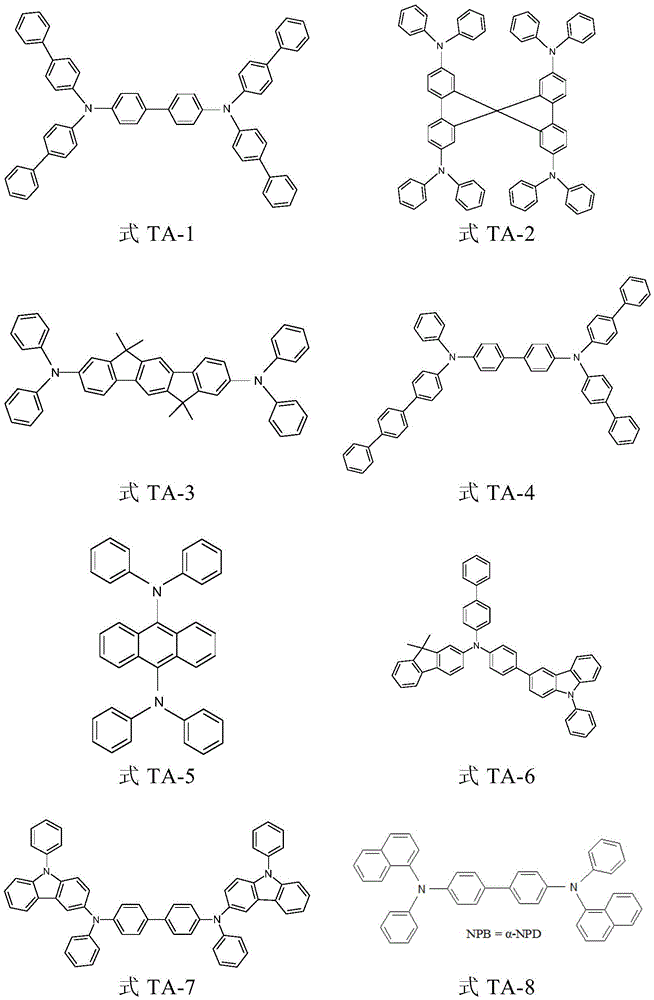
特别优选的是以下式(TA-1)至(TA-12)的三芳基胺化合物,其公开于EP 1162193B1,EP 650 955 B1,Synth.Metals(合成金属),1997,91(1-3),209,DE 19646119 A1,WO2006/122630A1,EP 1 860 097 A1,EP 1834945 A1,JP 08053397 A,US 6251531 B1,US2005/0221124,JP 08292586 A,US 7399537 B2,US 2006/0061265 A1,EP 1 661 888和WO2009/041635中。所述式(TA-1)至(TA-12)的化合物也可被取代:Particularly preferred are triarylamine compounds of the following formulae (TA-1) to (TA-12), which are disclosed in EP 1162193 B1, EP 650 955 B1, Synth. Metals, 1997, 91 (1-3), 209, DE 19646119 A1, WO 2006/122630 A1, EP 1 860 097 A1, EP 1834945 A1, JP 08053397 A, US 6251531 B1, US 2005/0221124, JP 08292586 A, US 7399537 B2, US 2006/0061265 A1, EP 1 661 888 and WO 2009/041635. The compounds of formula (TA-1) to (TA-12) may also be substituted:

可以用作空穴注入材料的其它化合物描述于EP 0891121 A1和EP 1029909 A1中,注入层一般性描述于US 2004/0174116 A1中。Further compounds which can be used as hole injection materials are described in EP 0891121 A1 and EP 1029909 A1, injection layers are generally described in US 2004/0174116 A1.
通常用作空穴注入和/或空穴传输材料的这些芳基胺和杂环化合物优选导致聚合物中的HOMO大于-5.8eV(相对于真空能级),特别优选大于-5.5eV。These aromatic amines and heterocyclic compounds which are usually used as hole-injection and/or hole-transport materials preferably lead to a HOMO in the polymer of greater than −5.8 eV (relative to the vacuum level), particularly preferably greater than −5.5 eV.
具有电子注入和/或电子传输特性的化合物是例如吡啶、嘧啶、哒嗪、吡嗪、
用于电子传输和电子注入层的特别合适的化合物是8-羟基喹啉的金属螯合物(例如LiQ、AlQ3、GaQ3、MgQ2、ZnQ2、InQ3、ZrQ4),BAlQ,Ga羟基喹啉络合物,4-氮杂菲-5-醇-Be络合物(US 5529853 A,参看式ET-1),丁二烯衍生物(US 4356429),杂环光学增亮剂(US4539507),苯并咪唑衍生物(US 2007/0273272 A1),例如TPBI(US 5766779,参看式ET-2),1,3,5-三嗪,例如螺二芴基三嗪衍生物(例如根据DE 102008064200),芘,蒽,并四苯,芴,螺芴,树枝状大分子,并四苯(例如红荧烯衍生物),1,10-菲咯啉衍生物(JP 2003-115387、JP2004-311184、JP-2001-267080、WO 02/043449),硅杂环戊二烯衍生物(EP 1480280、EP1478032、EP 1469533),硼烷衍生物,例如含Si的三芳基硼烷衍生物(US 2007/0087219A1,参看式ET-3),吡啶衍生物(JP 2004-200162),菲咯啉,特别是1,10-菲咯啉衍生物,例如BCP和Bphen,以及通过联苯基或其它芳族基团连接的多种菲咯啉(US-2007-0252517 A1)或与蒽连接的菲咯啉(US 2007-0122656 A1,参看式ET-4和ET-5)。Particularly suitable compounds for the electron transport and electron injection layer are metal chelates of 8-hydroxyquinoline (e.g. LiQ, AlQ 3 , GaQ 3 , MgQ 2 , ZnQ 2 , InQ 3 , ZrQ 4 ), BAlQ, Ga hydroxyquinoline complexes, 4-azaphenanthren-5-ol-Be complexes ( US 5529853 A , see formula ET-1), butadiene derivatives ( US 4356429 ), heterocyclic optical brighteners ( US 4539507 ), benzimidazole derivatives ( US 2007/0273272 A1 ), e.g. TPBI ( US 5766779 , see formula ET-2), 1,3,5-triazines, e.g. spirobifluorenyltriazine derivatives (e.g. according to DE 102008064200), pyrene, anthracene, tetracene, fluorene, spirofluorene, dendrimers, tetracene (e.g., rubrene derivatives), 1,10-phenanthroline derivatives (JP 2003-115387, JP2004-311184, JP-2001-267080, WO 02/043449), silylene derivatives (EP 1480280, EP1478032, EP 1469533), borane derivatives, e.g., triaryl borane derivatives containing Si (US 2007/0087219A1, see formula ET-3), pyridine derivatives (JP 2004-200162), phenanthroline, in particular 1,10-phenanthroline derivatives, such as BCP and Bphen, and various phenanthrolines linked via biphenyl or other aromatic groups (US-2007-0252517 A1) or phenanthrolines linked to anthracene (US 2007-0122656 A1, see formula ET-4 and ET-5).

同样合适的是杂环有机化合物,例如,噻喃二氧化物、


还可使用有机化合物,例如芴酮、芴亚基甲烷、苝四碳酸、蒽醌二甲烷、二苯醌、蒽酮和蒽醌二乙二胺及其衍生物。Organic compounds such as fluorenone, fluorenylidene methane, perylene tetracarbonic acid, anthraquinone dimethane, dibenzoquinone, anthrone and anthraquinone diethylenediamine and derivatives thereof may also be used.
优选的是2,9,10-取代的蒽(具有1-萘基或2-萘基和4-联苯基或3-联苯基)或含有两个蒽单元的分子(US2008/0193796 A1,参看式ET-11)。此外非常有利的是9,10-取代的蒽单元与苯并咪唑衍生物的连接(US 2006 147747 A和EP 1551206 A1,参看式ET-12和ET-13)。Preference is given to 2,9,10-substituted anthracenes (having 1-naphthyl or 2-naphthyl and 4-biphenyl or 3-biphenyl) or molecules containing two anthracene units (US 2008/0193796 A1, see formula ET-11). Also very advantageous is the connection of 9,10-substituted anthracene units to benzimidazole derivatives (US 2006 147747 A and EP 1551206 A1, see formulas ET-12 and ET-13).

能够产生电子注入和/或电子传输特性的化合物优选导致小于-2.5eV(相对于真空能级)、特别优选小于-2.7eV的LUMO。The compound capable of producing electron injection and/or electron transport properties preferably leads to a LUMO of less than −2.5 eV (relative to the vacuum level), particularly preferably less than −2.7 eV.
本发明制剂可包含发光体。术语发光体表示在通过任何类型的能量转移而发生的激发之后允许辐射跃迁到基态并发光的材料。一般来说,已知两类发光体,即荧光和磷光发光体。术语荧光发光体表示其中发生从激发单重态到基态的辐射跃迁的材料或化合物。术语磷光发光体优选表示含有过渡金属的发光材料或化合物。The preparations according to the invention may contain luminophores. The term luminophore denotes a material which, after excitation by any type of energy transfer, allows a radiative transition to the ground state and emits light. In general, two classes of luminophores are known, namely fluorescent and phosphorescent luminophores. The term fluorescent luminophore denotes a material or compound in which a radiative transition from an excited singlet state to the ground state occurs. The term phosphorescent luminophore preferably denotes a luminescent material or compound containing a transition metal.
如果掺杂剂引起体系中的上述特性,则发光体通常也称为掺杂剂。包含基质材料和掺杂剂的体系中的掺杂剂被认为是指在混合物中比例较小的组分。相应地,包含基质材料和掺杂剂的体系中的基质材料被认为是指在混合物中比例较大的组分。因此,术语磷光发光体也可以被认为是指例如磷光掺杂剂。If the dopant causes the above-mentioned properties in the system, the emitter is also often referred to as a dopant. The dopant in a system comprising a matrix material and a dopant is considered to mean the component with the smaller proportion in the mixture. Correspondingly, the matrix material in a system comprising a matrix material and a dopant is considered to mean the component with the larger proportion in the mixture. Thus, the term phosphorescent emitter can also be considered to mean, for example, a phosphorescent dopant.
能够发光的化合物尤其包括荧光发光体和磷光发光体。这些尤其包括含有茋、茋胺、苯乙烯胺、香豆素、红荧烯、罗丹明、噻唑、噻二唑、花青、噻吩、对苯亚基、苝、酞菁、卟啉、酮、喹啉、亚胺、蒽和/或芘结构的化合物。特别优选的是能够甚至在室温下以高效率从三重态发光,即表现出电致磷光而不是电致荧光的化合物,其通常导致能量效率增加。适合于此目的的首先是含有原子序数大于36的重原子的化合物。优选的是满足上述条件的含有d或f过渡金属的化合物。此处特别优选的是含有第8至10族元素(Ru、Os、Rh、Ir、Pd、Pt)的相应化合物。此处合适的功能化合物是例如各种络合物,如例如在WO 02/068435 A1、WO 02/081488 A1、EP 1239526 A2和WO 2004/026886 A2中所述。Compounds capable of luminescence include fluorescent luminophores and phosphorescent luminophores in particular. These include compounds containing stilbene, stilbeneamine, styrylamine, coumarin, rubrene, rhodamine, thiazole, thiadiazole, cyanine, thiophene, p-phenylene, perylene, phthalocyanine, porphyrin, ketone, quinoline, imine, anthracene and/or pyrene structures in particular. Particularly preferred are compounds capable of emitting light from triplet states with high efficiency even at room temperature, that is, compounds that exhibit electrophosphorescence rather than electrofluorescence, which generally result in increased energy efficiency. Compounds containing heavy atoms having an atomic number greater than 36 are first suitable for this purpose. Compounds containing d or f transition metals that meet the above conditions are preferred. Particularly preferred here are corresponding compounds containing elements of Groups 8 to 10 (Ru, Os, Rh, Ir, Pd, Pt). Suitable functional compounds here are, for example, various complexes, as described, for example, in WO 02/068435 A1, WO 02/081488 A1, EP 1239526 A2 and WO 2004/026886 A2.
可以用作荧光发光体的优选化合物通过以下实例描述。优选的荧光发光体选自如下类别:单苯乙烯基胺、二(苯乙烯基)胺、三(苯乙烯基)胺、四(苯乙烯基)胺、苯乙烯基膦、苯乙烯基醚和芳基胺。Preferred compounds which can be used as fluorescent emitters are described by way of example below.Preferred fluorescent emitters are selected from the classes of monostyrylamines, di(styryl)amines, tri(styryl)amines, tetra(styryl)amines, styrylphosphines, styrylethers and arylamines.
单苯乙烯胺是指含有一个取代的或未取代的苯乙烯基基团和至少一个胺、优选芳族胺的化合物。二苯乙烯胺是指含有二个取代的或未取代的苯乙烯基基团和至少一个胺、优选芳族胺的化合物。三苯乙烯胺是指含有三个取代的或未取代的苯乙烯基基团和至少一个胺、优选芳族胺的化合物。四苯乙烯胺是指含有四个取代的或未取代的苯乙烯基基团和至少一个胺、优选芳族胺的化合物。苯乙烯基基团特别优选地是二苯乙烯,其还可以被进一步取代。相应膦和醚以与胺类似的方式定义。在本发明意义上的芳基胺或芳族胺是指含有三个直接键合于氮的取代的或未取代的芳族或杂芳族环系的化合物。这些芳族或杂芳族环系中的至少一个优选是稠环体系,优选具有至少14个芳族环原子的稠环体系。其优选的实例是芳族蒽胺、芳族蒽二胺、芳族芘胺、芳族芘二胺、芳族苣胺、或芳族苣二胺。芳族蒽胺是指其中一个二芳基氨基基团直接键合于、优选在9-位直接键合于蒽基团的化合物。芳族蒽二胺是指其中两个二芳基氨基基团直接键合于、优选在2,6-位或9,10-位直接键合于蒽基团的化合物。芳族芘胺、芳族芘二胺、芳族苣胺和芳族苣二胺与之类似地定义,其中二芳基氨基基团优选地键合于芘的1位或1,6-位。Monostyrylamine refers to a compound containing one substituted or unsubstituted styryl group and at least one amine, preferably an aromatic amine. Distyrylamine refers to a compound containing two substituted or unsubstituted styryl groups and at least one amine, preferably an aromatic amine. Tristyrylamine refers to a compound containing three substituted or unsubstituted styryl groups and at least one amine, preferably an aromatic amine. Tetrastyrylamine refers to a compound containing four substituted or unsubstituted styryl groups and at least one amine, preferably an aromatic amine. The styryl group is particularly preferably distyryl, which can also be further substituted. The corresponding phosphine and ether are defined in a similar manner to amines. Arylamine or aromatic amine in the sense of the present invention refers to a compound containing three substituted or unsubstituted aromatic or heteroaromatic ring systems directly bonded to nitrogen. At least one of these aromatic or heteroaromatic ring systems is preferably a condensed ring system, preferably a condensed ring system having at least 14 aromatic ring atoms. Preferred examples thereof are aromatic anthraceneamine, aromatic anthracene diamine, aromatic pyrene amine, aromatic pyrene diamine, aromatic leticidal amine, or aromatic leticidal diamine. Aromatic anthracenamines are compounds in which one diarylamino group is directly bonded to an anthracene group, preferably in the 9-position. Aromatic anthracenediamines are compounds in which two diarylamino groups are directly bonded to an anthracene group, preferably in the 2,6-position or the 9,10-position. Aromatic pyrenamines, aromatic pyrenediamines, aromatic tert-butylamines and aromatic tert-butyldiamines are defined analogously, with the diarylamino groups preferably being bonded to the 1-position or the 1,6-position of pyrene.
其它优选的荧光发光体选自茚并芴胺或茚并芴二胺,其尤其描述于WO 2006/122630中;苯并茚并芴胺或苯并茚并芴二胺,其尤其描述于WO 2008/006449中;和二苯并茚并芴胺或二苯并茚并芴二胺,其尤其描述于WO 2007/140847中。Further preferred fluorescent emitters are selected from indenofluorenamine or indenofluorenediamine, which are described in particular in WO 2006/122630; benzoindenofluorenamine or benzoindenofluorenediamine, which are described in particular in WO 2008/006449; and dibenzoindenofluorenamine or dibenzoindenofluorenediamine, which are described in particular in WO 2007/140847.
可以用作荧光发光体的来自苯乙烯基胺类化合物的实例是取代或未取代的三茋胺或描述于WO 2006/000388、WO 2006/058737、WO 2006/000389、WO 2007/065549和WO2007/115610中的掺杂剂。二(苯乙烯基)苯和二(苯乙烯基)联苯衍生物描述于US 5121029中。其它苯乙烯基胺可见于US 2007/0122656 A1中。Examples of compounds from the class of styrylamines which can be used as fluorescent emitters are substituted or unsubstituted tristilbenamines or the dopants described in WO 2006/000388, WO 2006/058737, WO 2006/000389, WO 2007/065549 and WO 2007/115610. Di(styryl)benzene and di(styryl)biphenyl derivatives are described in US 5121029. Other styrylamines can be found in US 2007/0122656 A1.
特别优选的苯乙烯基胺化合物是US 7250532 B2中所述的式EM-1的化合物和DE10 2005 058557 A1中所述的式EM-2的化合物:Particularly preferred styrylamine compounds are the compounds of formula EM-1 described in US Pat. No. 7,250,532 B2 and the compounds of formula EM-2 described in


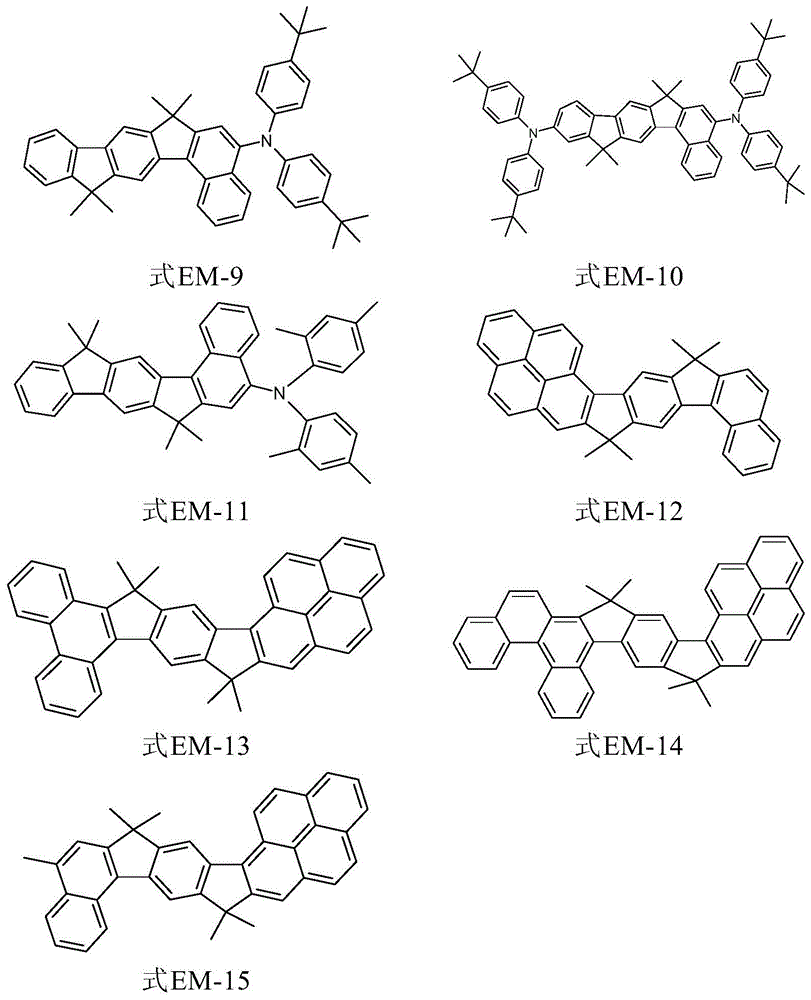
特别优选的三芳基胺化合物是CN 1583691 A、JP 08/053397 A和US 6251531 B1、EP 1957606 A1、US 2008/0113101 A1、US 2006/210830 A、WO 2008/006449和DE102008035413中公开的式EM-3至EM-15的化合物及其衍生物:Particularly preferred triarylamine compounds are compounds of formula EM-3 to EM-15 and derivatives thereof disclosed in CN 1583691 A, JP 08/053397 A and US 6251531 B1, EP 1957606 A1, US 2008/0113101 A1, US 2006/210830 A, WO 2008/006449 and DE102008035413:

可以用作荧光发光体的其它优选化合物选自以下物质的衍生物:萘、蒽、并四苯、苯并蒽、苯并菲(DE 10 2009 005746)、芴、荧蒽、二茚并苝、茚并苝、菲、苝(US 2007/0252517 A1)、芘、苣、十环烯、六苯并苯、四苯基环戊二烯、五苯基环戊二烯、芴、螺芴、红荧烯、香豆素(US 4769292、US 6020078、US 2007/0252517 A1)、吡喃、

在蒽化合物中,特别优选的是9,10-取代的蒽,例如,9,10-二苯基蒽和9,10-双(苯基乙炔基)蒽。1,4-双(9'-乙炔基蒽基)苯也是优选的掺杂剂。Among the anthracene compounds, particularly preferred are 9,10-substituted anthracenes, for example, 9,10-diphenylanthracene and 9,10-bis(phenylethynyl)anthracene. 1,4-bis(9'-ethynylanthracenyl)benzene is also a preferred dopant.
同样优选的是以下物质的衍生物:红荧烯、香豆素、罗丹明、喹吖啶酮例如DMQA(=N,N'-二甲基喹吖啶酮)、二氰基甲亚基吡喃例如DCM(=4-(二氰基乙亚基)-6-(4-二甲基氨基苯乙烯基-2-甲基)-4H-吡喃)、噻喃、聚甲炔、吡喃

蓝色荧光发光体优选是聚芳族化合物,例如,9,10-二(2-萘基蒽)和其它蒽衍生物,并四苯、呫吨、苝的衍生物例如2,5,8,11-四叔丁基苝、苯亚基的衍生物例如4,4'-双(9-乙基-3-咔唑乙烯亚基)-1,1'-联苯、芴、荧蒽、芳基芘(US 2006/0222886 A1)、芳亚基乙烯亚基(US 5121029、US 5130603)、双(吖嗪基)亚胺-硼化合物(US 2007/0092753 A1)、双(吖嗪基)甲亚基化合物和喹啉-2-酮化合物的衍生物。The blue fluorescent emitter is preferably a polyaromatic compound, for example, 9,10-di(2-naphthylanthracene) and other anthracene derivatives, derivatives of tetracene, xanthene, perylene, for example 2,5,8,11-tetra-tert-butylperylene, derivatives of phenylene, for example 4,4′-bis(9-ethyl-3-carbazolylvinylidene)-1,1′-biphenyl, fluorene, fluoranthene, arylpyrene (US 2006/0222886 A1), arylidenevinylidene (US 5121029, US 5130603), bis(azinyl)imine-boron compounds (US 2007/0092753 A1), bis(azinyl)methylidene compounds and derivatives of quinolin-2-one compounds.
其它优选的蓝色荧光发光体描述于C.H.Chen等:“Recent developments inorganic electroluminescent materials”Macromol.Symp.(大分子研讨会),125,(1997)1-48和“Recent progress of molecular organic electroluminescent materials anddevices”Mat.Sci.and Eng.R(材料科学与工程报告),39(2002),143-222中。Other preferred blue fluorescent emitters are described in C.H. Chen et al.: "Recent developments inorganic electroluminescent materials" Macromol. Symp. (Macromolecular Symposium), 125, (1997) 1-48 and "Recent progress of molecular organic electroluminescent materials and devices" Mat. Sci. and Eng. R (Materials Science and Engineering Reports), 39 (2002), 143-222.
其它优选的蓝色荧光发光体是WO 2010/012328 A1、WO 2014/111269 A2和PCT/EP2017/066712中公开的烃。Other preferred blue fluorescent emitters are the hydrocarbons disclosed in WO 2010/012328 A1, WO 2014/111269 A2 and PCT/EP2017/066712.
可以用作磷光发光体的优选的化合物在下文举例描述。Preferred compounds which can be employed as phosphorescent emitters are described by way of example below.
WO 00/70655、WO 01/41512、WO 02/02714、WO 02/15645、EP 1191613、EP1191612、EP 1191614和WO 2005/033244公开了磷光发光体的实例。一般来说,根据现有技术用于磷光OLED的和有机电致发光领域的技术人员已知的所有磷光络合物都是合适的,并且本领域技术人员将能够在不付出创造性劳动的情况下使用其它磷光络合物。Examples of phosphorescent emitters are disclosed in WO 00/70655, WO 01/41512, WO 02/02714, WO 02/15645, EP 1191613, EP 1191612, EP 1191614 and WO 2005/033244. In general, all phosphorescent complexes known to the person skilled in the art for phosphorescent OLEDs according to the prior art and in the field of organic electroluminescence are suitable, and the person skilled in the art will be able to use other phosphorescent complexes without inventive step.
磷光金属络合物优选含有Ir、Ru、Pd、Pt、Os或Re,更优选Ir。The phosphorescent metal complex preferably contains Ir, Ru, Pd, Pt, Os or Re, more preferably Ir.
优选的配体是2-苯基吡啶衍生物、7,8-苯并喹啉衍生物、2-(2-噻吩基)吡啶衍生物、2-(1-萘基)吡啶衍生物、1-苯基异喹啉衍生物、3-苯基异喹啉衍生物或2-苯基喹啉衍生物。所有这些化合物可被取代,例如被氟、氰基和/或三氟甲基取代基取代用于蓝光。辅助配体优选是乙酰丙酮化物或吡啶甲酸。Preferred ligands are 2-phenylpyridine derivatives, 7,8-benzoquinoline derivatives, 2-(2-thienyl)pyridine derivatives, 2-(1-naphthyl)pyridine derivatives, 1-phenylisoquinoline derivatives, 3-phenylisoquinoline derivatives or 2-phenylquinoline derivatives. All of these compounds may be substituted, for example, by fluorine, cyano and/or trifluoromethyl substituents for blue light. The auxiliary ligand is preferably acetylacetonate or picolinic acid.
特别地,式EM-16的Pt或Pd与四齿配体的络合物是合适的。In particular, complexes of Pt or Pd of formula EM-16 with a tetradentate ligand are suitable.

式EM-16的化合物更详细地描述于US 2007/0087219 A1中,其中,为了解释上式中的取代基和标记,出于公开目的引用说明书。此外,具有扩大环系的Pt-卟啉络合物(US2009/0061681 A1)和Ir络合物,例如2,3,7,8,12,13,17,18-八乙基-21H,23H-卟啉-Pt(II)、四苯基-Pt(II)四苯并卟啉(US 2009/0061681 A1)、顺式-双(2-苯基吡啶根合-N,C2')Pt(II)、顺式-双(2-(2'-噻吩基)吡啶根合-N,C3')Pt(II)、顺式-双(2-(2'-噻吩基)喹啉根合-N,C5')Pt(II)、(2-(4,6-二氟苯基)吡啶根合-N,C2')Pt(II)(乙酰丙酮化物)或三(2-苯基吡啶根合-N,C2')Ir(III)(=Ir(ppy)3,绿光)、双(2-苯基吡啶根合-N,C2)Ir(III)(乙酰丙酮化物)(=Ir(ppy)2乙酰丙酮化物,绿光,US 2001/0053462 A1,Baldo,Thompson等,Nature(自然),403,(2000),750-753)、双(1-苯基异喹啉根合-N,C2')(2-苯基吡啶根合-N,C2')铱(III)、双(2-苯基吡啶根合-N,C2')(1-苯基异喹啉根合-N,C2')铱(III)、双(2-(2'-苯并噻吩基)吡啶根合-N,C3')铱(III)(乙酰丙酮化物)、双(2-(4',6'-二氟苯基)吡啶根合-N,C2')铱(III)(吡啶甲酸盐)(FIrpic,蓝光)、双(2-(4',6'-二氟苯基)吡啶根合-N,C2')Ir(III)(四(1-吡唑基)硼酸盐)、三(2-(联苯-3-基)-4-叔丁基吡啶)铱(III)、(ppz)2Ir(5phdpym)(US 2009/0061681 A1)、(45ooppz)2Ir(5phdpym)(US 2009/0061681 A1),2-苯基吡啶-Ir络合物的衍生物,例如,PQIr(=双(2-苯基喹啉基-N,C2')乙酰丙酮根合铱(III))、三(2-苯基异喹啉根合-N,C)Ir(III)(红光)、双(2-(2'-苯并[4,5-a]噻吩基)吡啶根合-N,C3)Ir(乙酰丙酮化物)([Btp2Ir(acac)],红光,Adachi等,Appl.Phys.Lett.(应用物理学快报),78(2001),1622-1624)。Compounds of formula EM-16 are described in more detail in US 2007/0087219 A1, wherein, for the purpose of explaining the substituents and notations in the above formula, reference is made to the specification for disclosure purposes. In addition, Pt-porphyrin complexes with enlarged ring systems (US 2009/0061681 A1) and Ir complexes, such as 2,3,7,8,12,13,17,18-octaethyl-21H,23H-porphyrin-Pt(II), tetraphenyl-Pt(II)tetrabenzoporphyrin (US 2009/0061681 A1), cis-bis(2-phenylpyridinato-N,C 2 ′)Pt(II), cis-bis(2-(2′-thienyl)pyridinato-N,C 3 ′)Pt(II), cis-bis(2-(2′-thienyl)quinolinato-N,C 5 ′)Pt(II), (2-(4,6-difluorophenyl)pyridinato-N,C 2 ')Pt(II)(acetylacetonate) or tris(2-phenylpyridinato-N,C 2' )Ir(III)(=Ir(ppy) 3 , green light), bis(2-phenylpyridinato-N,C 2 )Ir(III)(acetylacetonate)(=Ir(ppy) 2 acetylacetonate, green light, US 2001/0053462 A1, Baldo, Thompson et al., Nature, 403, (2000), 750-753), bis(1-phenylisoquinolinato-N,C 2 ')(2-phenylpyridinato-N,C 2 ')iridium(III), bis(2-phenylpyridinato-N,C 2 ')(1-phenylisoquinolinato-N,C 2 ')iridium(III), bis(2-(2'-benzothienyl)pyridinyl-N,C 3 ')iridium(III) (acetylacetonate), bis(2-(4',6'-difluorophenyl)pyridinyl-N,C 2 ')iridium(III) (picolinate) (FIrpic, blue light), bis(2-(4',6'-difluorophenyl)pyridinyl-N,C 2 ')Ir(III) (tetrakis(1-pyrazolyl)borate), tris(2-(biphenyl-3-yl)-4-tert-butylpyridine)iridium(III), (ppz) 2 Ir(5phdpym) (US 2009/0061681 A1), (45ooppz) 2 Ir(5phdpym) (US 2009/0061681 A1), derivatives of 2-phenylpyridine-Ir complexes, for example, PQIr (=bis(2-phenylquinolyl-N,C 2 ') acetylacetonato iridium(III)), tris(2-phenylisoquinolyl-N,C)Ir(III) (red light), bis(2-(2'-benzo[4,5-a]thienyl)pyridinato-N,C 3 )Ir(acetylacetonate) ([Btp 2 Ir(acac)], red light, Adachi et al., Appl. Phys. Lett. (Applied Physics Letters), 78 (2001), 1622-1624).
同样合适的是三价镧系元素例如Tb3+和Eu3+的络合物(J.Kido等,Appl.Phys.Lett.(应用物理学快报),65(1994),2124;Kido等,Chem.Lett.(化学快报),657,1990;US 2007/0252517 A1),或Pt(II)、Ir(I)、Rh(I)与马来腈二硫烯的磷光络合物(Johnson等,JACS 105,1983,1795),Re(I)三羰基-二亚胺络合物(尤其Wrighton,JACS 96,1974,998),Os(II)与氰基配体和联吡啶基或菲咯啉配体的络合物(Ma等,Synth.Metals(合成金属),94,1998,245)。Also suitable are complexes of trivalent lanthanides such as Tb 3+ and Eu 3+ (J. Kido et al., Appl. Phys. Lett., 65 (1994), 2124; Kido et al., Chem. Lett., 657, 1990; US 2007/0252517 A1), or phosphorescent complexes of Pt(II), Ir(I), Rh(I) with maleonitrile disulfide (Johnson et al., JACS 105, 1983, 1795), Re(I) tricarbonyl-diimine complexes (especially Wrighton, JACS 96, 1974, 998), complexes of Os(II) with cyano ligands and bipyridyl or phenanthroline ligands (Ma et al., Synth. Metals, 94, 1998, 245).
具有三齿配体的其它磷光发光体描述于US 6824895和US 10/729238中。发红光的磷光络合物见于US 6835469和US 6830828中。Other phosphorescent emitters with tridentate ligands are described in US Pat. No. 6,824,895 and US Pat. No. 10/729,238. Red-emitting phosphorescent complexes are described in US Pat. No. 6,835,469 and US Pat. No. 6,830,828.
用作磷光掺杂剂的特别优选的化合物尤其是式EM-17的化合物,尤其描述于US2001/0053462 A1和Inorg.Chem.(无机化学),2001,40(7),1704-1711;JACS 2001,123(18),4304-4312中,及其衍生物。Particularly preferred compounds for use as phosphorescent dopants are in particular compounds of the formula EM-17, described in particular in US 2001/0053462 A1 and Inorg. Chem. (Inorganic Chemistry), 2001, 40 (7), 1704-1711; JACS 2001, 123 (18), 4304-4312, and derivatives thereof.

衍生物描述于US 7378162 B2、US 6835469 B2和JP 2003/253145 A中。Derivatives are described in US 7378162 B2, US 6835469 B2 and JP 2003/253145 A.
此外,US 7238437 B2、US 2009/008607 A1和EP 1348711中描述的式EM-18至EM-21的化合物及其衍生物可以用作发光体。Furthermore, compounds of the formulae EM-18 to EM-21 and derivatives thereof described in US Pat. No. 7,238,437 B2, US 2009/008607 A1 and EP 1,348,711 can be used as emitters.

量子点同样可以用作发光体,这些材料详细公开于WO 2011/076314 A1中。Quantum dots can likewise be used as emitters; these materials are disclosed in detail in WO 2011/076314 A1.
特别是与发光化合物一起用作主体材料的化合物包括来自各种类别的物质的材料。Compounds used as host materials, in particular together with light-emitting compounds, include materials from various classes of matter.
主体材料通常相比于所用的发光体材料具有更大的HOMO与LUMO之间的带隙。此外,优选的主体材料表现出空穴传输或电子传输材料的特性。此外,主体材料可以具有电子传输和空穴传输特性两者。The host material generally has a larger band gap between HOMO and LUMO than the luminophore material used. In addition, preferred host materials exhibit the properties of hole transport or electron transport materials. In addition, the host material can have both electron transport and hole transport properties.
主体材料在一些情况下也称为基质材料,特别是在主体材料与磷光发光体在OLED中组合使用时。Host materials are in some cases also referred to as matrix materials, in particular when host materials are used in combination with phosphorescent emitters in OLEDs.
特别是与荧光掺杂剂一起使用的优选的主体材料或共主体材料选自如下的类别:低聚芳亚基(例如根据EP 676461的2,2',7,7'-四苯基螺二芴,或二萘基蒽),特别是含有稠合芳族基团的低聚芳亚基,例如蒽、苯并蒽、苯并菲(DE 10 2009 005746、WO 2009/069566)、菲、并四苯、六苯并苯、苣、芴、螺芴、苝、酞并苝、萘并苝、十环烯、红荧烯,低聚芳亚基乙烯亚基(例如根据EP 676461的DPVBi=4,4'-双(2,2-二苯基乙烯基)-1,1'-联苯或螺-DPVBi),多足金属络合物(例如根据WO 04/081017),特别是8-羟基喹啉的金属络合物,例如AlQ3(=三(8-羟基喹啉)铝(III))或双(2-甲基-8-羟基喹啉)-(4-苯基苯氧基)铝,以及咪唑螯合物(US 2007/0092753 A1)和喹啉-金属络合物,氨基喹啉-金属络合物,苯并喹啉-金属络合物,空穴传导化合物(例如根据WO 2004/058911),电子传导化合物,特别是酮、氧化膦、亚砜等(例如根据WO 2005/084081和WO 2005/084082),阻转异构体(例如根据WO 2006/048268),硼酸衍生物(例如根据WO 2006/117052)或苯并蒽(例如根据WO 2008/145239)。Preferred host materials or co-host materials for use, in particular together with fluorescent dopants, are selected from the following classes: oligoarylene groups (e.g. 2,2′,7,7′-tetraphenylspirobifluorene according to EP 676461, or dinaphthylanthracene), in particular oligoarylene groups containing fused aromatic groups, such as anthracene, benzanthracene, triphenylene (DE 10 2009 005746, WO 2009/069566), phenanthrene, tetracene, hexabenzophenone, lettuce, fluorene, spirofluorene, perylene, phthaloperylene, naphthoperylene, decacyclopentene, rubrene, oligoarylenevinylene (e.g. DPVBi=4,4′-bis(2,2-diphenylvinyl)-1,1′-biphenyl or spiro-DPVBi according to EP 676461), polypodal metal complexes (e.g. pyro-DPVBi according to WO 2009/069566), pyro-DPVBi, ... 04/081017), in particular metal complexes of 8-hydroxyquinoline, for example AlQ3 (=tris(8-hydroxyquinolinolato)aluminum(III)) or bis(2-methyl-8-hydroxyquinolinolato)-(4-phenylphenoxy)aluminum, as well as imidazole chelates (US 2007/0092753 A1) and quinoline-metal complexes, aminoquinoline-metal complexes, benzoquinoline-metal complexes, hole-conducting compounds (for example according to WO 2004/058911), electron-conducting compounds, in particular ketones, phosphine oxides, sulfoxides and the like (for example according to WO 2005/084081 and WO 2005/084082), atropisomers (for example according to WO 2006/048268), boronic acid derivatives (for example according to WO 2006/117052) or benzanthracene (for example according to WO 2008/145239).
可以充当主体材料或共主体材料的特别优选的化合物选自包含蒽、苯并蒽和/或芘的低聚芳亚基的类别,或这些化合物的阻转异构体。在本发明的意义上,低聚芳亚基意指如下化合物,其中至少三个芳基或芳亚基基团彼此键合。Particularly preferred compounds that can serve as host materials or co-host materials are selected from the class of oligoarylene groups comprising anthracene, benzanthracene and/or pyrene, or atropisomers of these compounds. In the sense of the present invention, oligoarylene means compounds in which at least three aryl or arylene groups are bonded to one another.
优选的主体材料特别选自式(H-1)的化合物Preferred host materials are particularly selected from compounds of formula (H-1)
Ar4-(Ar5)p-Ar6 (H-1)Ar 4 -(Ar 5 ) p -Ar 6 (H-1)
其中Ar4、Ar5、Ar6在每次出现时相同或不同地是具有5至30个芳族环原子的芳基或杂芳基基团,所述基团可任选地被取代,并且p表示1至5范围内的整数;Ar4、Ar5和Ar6中的π电子总和,如果p=1,则为至少30个,如果p=2则为至少36个,并且如果p=3则为至少42个。wherein Ar 4 , Ar 5 , Ar 6 are, at each occurrence, identically or differently, an aryl or heteroaryl group having 5 to 30 aromatic ring atoms, which may be optionally substituted, and p represents an integer ranging from 1 to 5; the sum of the π electrons in Ar 4 , Ar 5 and Ar 6 is at least 30 if p=1, at least 36 if p=2, and at least 42 if p=3.
在式(H-1)的化合物中,基团Ar5特别优选地代表蒽,并且基团Ar4和Ar6在9位和10位键合,其中这些基团可任选被取代。非常特别优选地,基团Ar4和/或Ar6中的至少一个是稠合芳基基团,其选自1-萘基或2-萘基、2-菲基、3-菲基或9-菲基或者2-苯并蒽基、3-苯并蒽基、4-苯并蒽基、5-苯并蒽基、6-苯并蒽基或7-苯并蒽基。基于蒽的化合物描述于US 2007/0092753 A1和US 2007/0252517 A1中,例如2-(4-甲基苯基)-9,10-二(2-萘基)蒽、9-(2-萘基)-10-(1,1'-联苯基)蒽和9,10-双[4-(2,2-二苯基乙烯基)苯基]蒽、9,10-二苯基蒽、9,10-双(苯基乙炔基)蒽和1,4-双(9'-乙炔基蒽基)苯。此外优选的是含有两个蒽单元的化合物(US 2008/0193796 A1),例如10,10'-双[1,1',4',1”]三联苯-2-基-9,9'-联蒽。In the compounds of formula (H-1), the group Ar 5 particularly preferably represents anthracene, and the groups Ar 4 and Ar 6 are bonded in the 9- and 10-positions, wherein these groups may be optionally substituted. Very particularly preferably, at least one of the groups Ar 4 and/or Ar 6 is a fused aryl group selected from 1-naphthyl or 2-naphthyl, 2-phenanthryl, 3-phenanthryl or 9-phenanthryl or 2-benzanthryl, 3-benzanthryl, 4-benzanthryl, 5-benzanthryl, 6-benzanthryl or 7-benzanthryl. Anthracene-based compounds are described in US 2007/0092753 A1 and US 2007/0252517 A1, for example 2-(4-methylphenyl)-9,10-di(2-naphthyl)anthracene, 9-(2-naphthyl)-10-(1,1′-biphenyl)anthracene and 9,10-bis[4-(2,2-diphenylvinyl)phenyl]anthracene, 9,10-diphenylanthracene, 9,10-bis(phenylethynyl)anthracene and 1,4-bis(9′-ethynylanthryl)benzene. Also preferred are compounds containing two anthracene units (US 2008/0193796 A1), for example 10,10′-bis[1,1′,4′,1″]terphenyl-2-yl-9,9′-bianthracene.
其它优选的化合物是如下物质的衍生物:芳基胺、苯乙烯基胺、荧光素、二苯基丁二烯、四苯基丁二烯、环戊二烯、四苯基环戊二烯、五苯基环戊二烯、香豆素、


特别优选的是芳基胺和苯乙烯基胺的衍生物,例如TNB(=4,4'-双[N-(1-萘基)-N-(2-萘基)氨基]联苯)。金属-羟基喹啉络合物,例如LiQ或AlQ3,可以用作共主体。Particularly preferred are derivatives of arylamines and styrylamines, such as TNB (=4,4′-bis[N-(1-naphthyl)-N-(2-naphthyl)amino]biphenyl). Metal-hydroxyquinoline complexes, such as LiQ or AlQ 3 , can be used as co-hosts.
作为基质的优选的具有低聚芳亚基的化合物公开于US 2003/0027016 A1、US7326371 B2、US 2006/043858 A、WO 2007/114358、WO 2008/145239、JP 3148176 B2、EP1009044、US 2004/018383、WO 2005/061656 A1、EP 0681019B1、WO 2004/013073A1、US5077142、WO 2007/065678和DE 102009005746中,其中特别优选的化合物由式H-2至H-8描述。Preferred compounds having oligoaromatic subunits as matrices are disclosed in US 2003/0027016 A1, US Pat. No. 7,326,371 B2, US 2006/043858 A, WO 2007/114358, WO 2008/145239, JP 3148176 B2, EP 1009044, US 2004/018383, WO 2005/061656 A1, EP 0681019 B1, WO 2004/013073 A1, US Pat. No. 5,077,142, WO 2007/065678 and DE 102009005746, wherein particularly preferred compounds are described by formulae H-2 to H-8.


此外,可以用作主体或基质的化合物包括与磷光发光体一起使用的材料。Furthermore, compounds that can be used as hosts or matrices include materials used with phosphorescent light emitters.
还可以用作聚合物中的结构元件的这些化合物包括CBP(N,N-双咔唑基联苯),咔唑衍生物(例如根据WO 2005/039246、US 2005/0069729、JP 2004/288381、EP 1205527或WO2008/086851),氮杂咔唑(例如根据EP 1617710、EP 1617711、EP 1731584或JP 2005/347160),酮(例如根据WO 2004/093207或根据DE 102008033943),氧化膦,亚砜和砜(例如根据WO 2005/003253),低聚苯亚基,芳族胺(例如根据US 2005/0069729),双极性基质材料(例如根据WO 2007/137725),硅烷(例如根据WO 2005/111172),9,9-二芳基芴衍生物(例如根据DE 102008017591),氮杂硼杂环戊二烯或硼酸酯(例如根据WO 2006/117052),三嗪衍生物(例如根据DE 102008036982),吲哚并咔唑衍生物(例如根据WO 2007/063754或WO2008/056746),茚并咔唑衍生物(例如根据DE 102009023155和DE 102009031021),二氮杂磷杂环戊二烯衍生物(例如根据DE 102009022858),三唑衍生物,

优选的咔唑衍生物的实例是mCP(=1,3-N,N-二咔唑基苯(=9,9'-(1,3-苯亚基)双-9H-咔唑))(式H-9)、CDBP(=9,9'-(2,2'-二甲基[1,1'-联苯]-4,4'-二基)双-9H-咔唑)、1,3-双(N,N'-二咔唑基)苯(=1,3-双(咔唑-9-基)苯)、PVK(聚乙烯基咔唑)、3,5-二(9H-咔唑-9-基)联苯和CMTTP(式H-10)。特别优选的化合物公开于US 2007/0128467 A1和US 2005/0249976 A1(式H-11和H-13)中。Examples of preferred carbazole derivatives are mCP (=1,3-N,N-dicarbazolylbenzene (=9,9'-(1,3-phenylene)bis-9H-carbazole)) (formula H-9), CDBP (=9,9'-(2,2'-dimethyl[1,1'-biphenyl]-4,4'-diyl)bis-9H-carbazole), 1,3-bis(N,N'-dicarbazolyl)benzene (=1,3-bis(carbazol-9-yl)benzene), PVK (polyvinylcarbazole), 3,5-di(9H-carbazol-9-yl)biphenyl and CMTTP (formula H-10). Particularly preferred compounds are disclosed in US 2007/0128467 A1 and US 2005/0249976 A1 (formulas H-11 and H-13).

优选的四芳基-Si化合物例如公开于US 2004/0209115、US 2004/0209116、US2007/0087219 A1以及H.Gilman,E.A.Zuech,Chemistry&Industry(化学与工业)(英国伦敦),1960,120中。Preferred tetraaryl-Si compounds are disclosed, for example, in US 2004/0209115, US 2004/0209116, US 2007/0087219 A1 and H. Gilman, E. A. Zuech, Chemistry & Industry (London, England), 1960, 120.
特别优选的四芳基-Si化合物由式H-14至H-21描述。Particularly preferred tetraaryl-Si compounds are described by formulae H-14 to H-21.

用于制备磷光掺杂剂的基质的特别优选的来自第4类的化合物尤其公开于DE102009022858、DE 102009023155、EP 652273 B1、WO 2007/063754和WO 2008/056746中,其中特别优选的化合物由式H-22至H-25描述。Particularly preferred compounds from class 4 for preparing matrices for phosphorescent dopants are disclosed inter alia in

关于可以根据本发明使用并且可以充当主体材料的功能化合物,特别优选的是含有至少一个氮原子的物质。这些优选包括芳族胺、三嗪衍生物和咔唑衍生物。因此,咔唑衍生物特别表现出令人惊讶的高效率。三嗪衍生物导致电子器件的出乎意料的长寿命。With regard to the functional compounds that can be used according to the invention and that can serve as host materials, substances containing at least one nitrogen atom are particularly preferred. These preferably include aromatic amines, triazine derivatives and carbazole derivatives. Therefore, carbazole derivatives particularly exhibit surprisingly high efficiency. Triazine derivatives lead to unexpectedly long lifetimes of electronic devices.
此外可优选使用呈混合物形式的多种不同的基质材料,特别是至少一种电子传导基质材料和至少一种空穴传导基质材料。如例如WO 2010/108579中所述的,还优选使用电荷传输基质材料与电惰性基质材料的混合物,所述电惰性基质材料即使参与电荷传输,也不会在很大程度上参与电荷传输。It is furthermore preferred to use a plurality of different matrix materials in the form of a mixture, in particular at least one electron-conducting matrix material and at least one hole-conducting matrix material. It is also preferred to use a mixture of a charge-transporting matrix material with an electrically inert matrix material which does not participate to a large extent, if at all, in the charge transport, as described, for example, in WO 2010/108579.
还可以使用如下化合物,所述化合物改善从单重态向三重态的跃迁,并且用于承载具有发光体性质的功能化合物,改善这些化合物的磷光性质。特别地,如例如WO 2004/070772 A2和WO 2004/113468 A1中所述的,咔唑和桥连咔唑二聚体单元适用于这个目的。如例如WO 2005/040302 A1中所述的,酮、氧化膦、亚砜、砜、硅烷衍生物和类似化合物也适用于这个目的。It is also possible to use compounds which improve the transition from the singlet state to the triplet state and which are used to carry functional compounds with emitter properties, improving the phosphorescence properties of these compounds. In particular, carbazole and bridged carbazole dimer units are suitable for this purpose, as described, for example, in WO 2004/070772 A2 and WO 2004/113468 A1. Ketones, phosphine oxides, sulfoxides, sulfones, silane derivatives and similar compounds are also suitable for this purpose, as described, for example, in WO 2005/040302 A1.
在本文中,n型掺杂剂意指还原剂,即电子供体。n型掺杂剂的优选实例为根据WO2005/086251 A2的W(hpp)4和其它富电子金属络合物、P=N化合物(例如WO 2012/175535A1、WO 2012/175219 A1)、萘亚基碳化二亚胺(例如WO 2012/168358 A1)、芴(例如WO 2012/031735A1)、自由基和双自由基(例如EP 1837926 A1、WO 2007/107306 A1)、吡啶(例如EP2452946 A1、EP 2463927 A1)、N-杂环化合物(例如WO 2009/000237 A1)和吖啶以及吩嗪(例如US 2007/145355 A1)。In this context, n-type dopant means a reducing agent, ie, an electron donor. Preferred examples of n-type dopants are W(hpp) 4 and other electron-rich metal complexes according to WO 2005/086251 A2, P=N compounds (e.g. WO 2012/175535 A1, WO 2012/175219 A1), naphthylidenecarbodiimides (e.g. WO 2012/168358 A1), fluorenes (e.g. WO 2012/031735 A1), radicals and diradicals (e.g. EP 1837926 A1, WO 2007/107306 A1), pyridines (e.g. EP 2452946 A1, EP 2463927 A1), N-heterocyclic compounds (e.g. WO 2009/000237 A1) and acridines and phenazines (e.g. US 2007/145355 A1).
此外,所述制剂可包含宽带隙材料作为功能材料。宽带隙材料被认为是指在US 7,294,849的公开内容意义上的材料。这些体系在电致发光器件中显示特别有利的性能数据。Furthermore, the preparations may comprise wide bandgap materials as functional materials. Wide bandgap materials are taken to mean materials in the sense of the disclosure of US Pat. No. 7,294,849. These systems show particularly advantageous performance data in electroluminescent devices.
用作宽带隙材料的化合物可以优选具有2.5eV或更大、优选地3.0eV或更大、特别优选地3.5eV或更大的带隙。带隙尤其可以通过最高占据分子轨道(HOMO)和最低未占分子轨道(LUMO)的能级来计算。Compounds used as wide bandgap materials may preferably have a bandgap of 2.5 eV or more, preferably 3.0 eV or more, particularly preferably 3.5 eV or more. The bandgap can be calculated in particular from the energy levels of the highest occupied molecular orbital (HOMO) and the lowest unoccupied molecular orbital (LUMO).
此外,所述制剂可以包含空穴阻挡材料(HBM)作为功能材料。空穴阻挡材料表示如下材料,其阻止或最小化多层体系中空穴(正电荷)的传输,特别在这种材料以层形式相邻于发光层或空穴传导层布置时更是如此。一般来说,空穴阻挡材料的HOMO能级比相邻层中空穴传输材料的HOMO能级低。空穴阻挡层经常布置在OLED中的发光层与电子传输层之间。In addition, the formulation may contain a hole blocking material (HBM) as a functional material. A hole blocking material is a material which prevents or minimizes the transport of holes (positive charges) in a multilayer system, in particular when such a material is arranged in a layer adjacent to a light-emitting layer or a hole-conducting layer. In general, the HOMO level of the hole blocking material is lower than the HOMO level of the hole-transporting material in the adjacent layer. The hole blocking layer is often arranged between the light-emitting layer and the electron-transporting layer in an OLED.
基本上可使用任何已知的空穴阻挡材料。除了本申请其它地方描述的其它空穴阻挡材料之外,有利的空穴阻挡材料是金属络合物(US 2003/0068528),例如,例如双(2-甲基-8-羟基喹啉)(4-苯基苯氧基)铝(III)(BAlQ)。为此目的,同样使用面式-三(1-苯基吡唑根合-N,C2)铱(III)(Ir(ppz)3)(US 2003/0175553 A1)。同样可以使用菲咯啉衍生物,例如BCP,或邻苯二甲酰亚胺,例如TMPP。Basically, any known hole-blocking material can be used. In addition to other hole-blocking materials described elsewhere in this application, advantageous hole-blocking materials are metal complexes (US 2003/0068528), for example, for example, bis(2-methyl-8-hydroxyquinolinato)(4-phenylphenoxy)aluminum(III) (BAlQ). For this purpose, fac-tris(1-phenylpyrazolo-N,C2)iridium(III) (Ir(ppz) 3 ) (US 2003/0175553 A1) can also be used. Phenanthroline derivatives, for example BCP, or phthalimides, for example TMPP, can also be used.
此外,有利的空穴阻挡材料描述于WO 00/70655 A2、WO 01/41512和WO 01/93642A1中。Advantageous hole-blocking materials are described, inter alia, in WO 00/70655 A2, WO 01/41512 and WO 01/93642 A1.
此外,所述制剂可包含电子阻挡材料(EBM)作为功能材料。电子阻挡材料表示在多层体系中防止或最小化电子传输的材料,特别是在该材料以邻近发光层或电子传导层的层形式布置时。一般来说,电子阻挡材料相比于相邻层中的电子传输材料具有更高的LUMO能级。In addition, the formulation may contain an electron blocking material (EBM) as a functional material. An electron blocking material refers to a material that prevents or minimizes electron transport in a multilayer system, especially when the material is arranged in a layer adjacent to a light-emitting layer or an electron-conducting layer. Generally speaking, an electron blocking material has a higher LUMO energy level than an electron-transporting material in an adjacent layer.
基本上可使用任何已知的电子阻挡材料。除了本申请其它地方描述的其它电子阻挡材料之外,有利的电子阻挡材料是过渡金属络合物,例如,Ir(ppz)3(US 2003/0175553)。Essentially any known electron-blocking material can be used. Advantageous electron-blocking materials are, besides other electron-blocking materials described elsewhere in this application, transition metal complexes, for example Ir(ppz) 3 ( US 2003/0175553 ).
所述电子阻挡材料可以优选选自胺、三芳基胺及其衍生物。The electron blocking material may preferably be selected from amines, triarylamines and derivatives thereof.
此外,如果可以用作所述制剂中的有机功能材料的功能化合物是低分子量化合物,则所述功能化合物优选具有≤3,000g/mol、更优选≤2,000g/mol并且最优选≤1,000g/mol的分子量。Furthermore, if the functional compound that can be used as the organic functional material in the formulation is a low molecular weight compound, the functional compound preferably has a molecular weight of ≤3,000 g/mol, more preferably ≤2,000 g/mol, and most preferably ≤1,000 g/mol.
此外,特别关注的是以高玻璃化转变温度为特征的功能化合物。在这方面,可以用作所述制剂中的有机功能材料的特别优选的功能化合物是具有根据DIN 51005测定为≥70℃、优选≥100℃、更优选≥125℃并且最优选≥150℃的玻璃化转变温度的那些。Furthermore, functional compounds characterized by a high glass transition temperature are of particular interest. In this respect, particularly preferred functional compounds that can be used as organic functional materials in the formulations are those having a glass transition temperature determined according to DIN 51005 of ≥70°C, preferably ≥100°C, more preferably ≥125°C and most preferably ≥150°C.
所述制剂还可以包含聚合物作为有机功能材料。还可以将上述作为有机功能材料的通常具有相对低分子量的化合物与聚合物混合。还可以将这些化合物共价引入聚合物中。这可以特别地用如下化合物实现,所述化合物被反应性离去基团如溴、碘、氯、硼酸或硼酸酯或反应性可聚合基团如烯烃或氧杂环丁烷取代。这些可以用作制造相应的低聚物、树枝状大分子或聚合物的单体。此处,低聚或聚合优选通过卤素官能团或硼酸官能团或者通过可聚合基团进行。还可以通过此类基团将聚合物交联。根据本发明的化合物和聚合物可以用作交联或非交联层。The preparation can also include polymer as organic functional material. The above-mentioned compound with relatively low molecular weight as organic functional material can also be mixed with polymer. These compounds can also be covalently introduced into polymer. This can be realized with the following compound in particular, the compound is replaced by reactive leaving groups such as bromine, iodine, chlorine, boric acid or boric ester or reactive polymerizable groups such as olefin or oxetane. These can be used as monomers for making corresponding oligomers, dendritic macromolecules or polymers. Here, oligomerization or polymerization is preferably carried out by halogen functional group or boric acid functional group or by polymerizable group. Polymer can also be cross-linked by such group. Compound and polymer according to the present invention can be used as crosslinked or non-crosslinked layer.
可以用作有机功能材料的聚合物通常含有在上述化合物的意义下描述的单元或结构元素,尤其是WO 02/077060 A1、WO 2005/014689 A2和WO 2011/076314 A1中公开和广泛列出的单元或结构元素。所述案以引用的方式并入本申请中。功能材料可以例如来自以下类别:Polymers that can be used as organic functional materials generally contain units or structural elements described in the sense of the above-mentioned compounds, especially units or structural elements disclosed and extensively listed in WO 02/077060 A1, WO 2005/014689 A2 and WO 2011/076314 A1. The cases are incorporated into the present application by reference. Functional materials can, for example, come from the following categories:
第1类:能够产生空穴注入和/或空穴传输性质的结构元素;Category 1: structural elements that can produce hole injection and/or hole transport properties;
第2类:能够产生电子注入和/或电子传输性质的结构元素;Category 2: structural elements that can produce electron injection and/or electron transport properties;
第3类:组合关于第1类和第2类所述的性质的结构元素;Category 3: structural elements combining the properties described in categories 1 and 2;
第4类:具有发光性质、特别是磷光基团的结构元素;Category 4: Structural elements with luminescent properties, especially phosphorescent groups;
第5类:改善从所谓的单重态向三重态的跃迁的结构元素;Class 5: structural elements which improve the transition from the so-called singlet state to the triplet state;
第6类:影响所得聚合物的形态或发光颜色的结构元素;Category 6: Structural elements that affect the morphology or emission color of the resulting polymer;
第7类:通常用作骨架的结构元素。Class 7: Structural elements usually used as skeletons.
这里所述结构元素还可以具有多种功能,因此明确的归类未必是有利的。例如,第1类的结构元素也可以充当骨架。The structural elements described here can also have multiple functions, so a clear classification is not necessarily helpful. For example, the structural elements of category 1 can also serve as a skeleton.
用作有机功能材料的含有来自第1类的结构元素的具有空穴传输或空穴注入性质的聚合物优选可以含有对应于上述空穴传输或空穴注入材料的单元。The polymer having hole transport or hole injection properties containing a structural element from the first group used as an organic functional material may preferably contain a unit corresponding to the above-mentioned hole transport or hole injection material.
第1类的其它优选结构元素为例如三芳基胺、联苯胺、四芳基-对苯二胺、咔唑、薁、噻吩、吡咯和呋喃以及它们的衍生物和其它具有高HOMO的含O、S或N的杂环化合物。这些芳基胺和杂环化合物的HOMO优选为高于-5.8eV(相对于真空能级),特别优选高于-5.5eV。Other preferred structural elements of class 1 are, for example, triarylamines, benzidines, tetraaryl-p-phenylenediamines, carbazoles, azules, thiophenes, pyrroles and furans and their derivatives and other O-, S- or N-containing heterocyclic compounds with a high HOMO. The HOMO of these arylamines and heterocyclic compounds is preferably above -5.8 eV (relative to the vacuum level), particularly preferably above -5.5 eV.
尤其优选的是包含至少一个以下式HTP-1的重复单元的、具有空穴传输或空穴注入性能的聚合物:Particularly preferred are polymers having hole transport or hole injection properties which comprise at least one repeating unit of the following formula HTP-1:

其中各符号具有以下含义:The symbols have the following meanings:
Ar1对于不同的重复单元在各情况下相同或不同,为单键或单环或多环的芳基基团,其可以任选地被取代;Ar 1 is the same or different in each case for different repeating units and is a single bond or a monocyclic or polycyclic aryl group which may be optionally substituted;
Ar2对于不同的重复单元在各情况下相同或不同,为单环或多环的芳基基团,其可以任选地被取代;Ar 2 is the same or different in each case for different repeating units and is a monocyclic or polycyclic aryl group which may be optionally substituted;
Ar3对于不同的重复单元在各情况下相同或不同,为单环或多环的芳基基团,其可以任选地被取代;Ar 3 is the same or different in each case for different repeating units and is a monocyclic or polycyclic aryl group which may be optionally substituted;
m为1、2或3。m is 1, 2 or 3.
特别优选的是选自HTP-1A至HTP-1C的单元的式HTP-1的重复单元:Particularly preferred are repeating units of the formula HTP-1 selected from the group consisting of units HTP-1A to HTP-1C:


其中符号具有以下含义:The symbols have the following meanings:
Ra在每次出现时相同或不同地是H,取代或未取代的芳族或杂芳族基团,烷基,环烷基,烷氧基,芳烷基,芳氧基,芳硫基,烷氧基羰基,甲硅烷基或羧基基团,卤素原子,氰基基团,硝基基团或羟基基团;R a is, identically or differently on each occurrence, H, a substituted or unsubstituted aromatic or heteroaromatic group, an alkyl group, a cycloalkyl group, an alkoxy group, an aralkyl group, an aryloxy group, an arylthio group, an alkoxycarbonyl group, a silyl group or a carboxyl group, a halogen atom, a cyano group, a nitro group or a hydroxyl group;
r是0、1、2、3或4,并且r is 0, 1, 2, 3, or 4, and
s是0、1、2、3、4或5。s is 0, 1, 2, 3, 4, or 5.
优选尤其是具有空穴传输或空穴注入特性的聚合物,其含有至少一个以下式HTP-2的重复单元:Preference is especially given to polymers having hole-transport or hole-injection properties which contain at least one repeating unit of the following formula HTP-2:
-(T1)c-(Ar7)d-(T2)e-(Ar8)f- HTP-2-(T 1 ) c -(Ar 7 ) d -(T 2 ) e -(Ar 8 ) f - HTP-2
其中符号具有以下含义:The symbols have the following meanings:
T1和T2独立地选自噻吩、硒吩、噻吩并[2,3-b]噻吩、噻吩并[3,2-b]噻吩、二噻吩并噻吩、吡咯和苯胺,其中这些基团可被一个或多个基团Rb取代;T 1 and T 2 are independently selected from thiophene, selenophene, thieno[2,3-b]thiophene, thieno[3,2-b]thiophene, dithienothiophene, pyrrole and aniline, wherein these groups may be substituted by one or more groups R b ;
Rb在每次出现时独立地选自卤素,-CN,-NC,-NCO,-NCS,-OCN,-SCN,-C(=O)NR0R00,-C(=O)X,-C(=O)R0,-NH2,-NR0R00,-SH,-SR0,-SO3H,-SO2R0,-OH,-NO2,-CF3,-SF5,任选被取代的具有1至40个碳原子的甲硅烷基、二价碳基或烃基基团,所述基团可任选被取代并且可任选含有一个或多个杂原子; Rb is independently selected at each occurrence from halogen, -CN, -NC, -NCO, -NCS, -OCN, -SCN, -C(=O) NR0R00 , -C(=O) X , -C(=O) R0 , -NH2 , -NR0R00, -SH , -SR0 , -SO3H , -SO2R0 , -OH, -NO2 , -CF3 , -SF5 , an optionally substituted silyl, carbyl or hydrocarbyl group having 1 to 40 carbon atoms, which may be optionally substituted and may optionally contain one or more heteroatoms;
R0和R00各自独立地是H或任选被取代的具有1至40个碳原子的二价碳基或烃基基团,所述基团可任选被取代并且可任选含有一个或多个杂原子; R0 and R00 are each independently H or an optionally substituted divalent carbonyl or hydrocarbyl group having 1 to 40 carbon atoms, which may be optionally substituted and may optionally contain one or more heteroatoms;
Ar7和Ar8彼此独立地表示单环或多环的芳基或杂芳基基团,所述基团可任选被取代并且可任选键合到一个或两个相邻的噻吩或硒吩基团的2,3位;Ar 7 and Ar 8 independently represent a monocyclic or polycyclic aryl or heteroaryl group, which may be optionally substituted and may be optionally bonded to the 2,3 position of one or two adjacent thiophene or selenophene groups;
c和e彼此独立地是0、1、2、3或4,其中1<c+e≤6;c and e are independently 0, 1, 2, 3 or 4, where 1<c+e≤6;
d和f彼此独立地是0、1、2、3或4。d and f are independently 0, 1, 2, 3 or 4.
具有空穴传输或空穴注入特性的聚合物的优选实例尤其描述于WO 2007/131582A1和WO 2008/009343 A1中。Preferred examples of polymers having hole-transport or hole-injection properties are described, inter alia, in WO 2007/131582 A1 and WO 2008/009343 A1.
用作有机功能材料的含有来自第2类的结构元素的具有电子注入和/或电子传输性质的聚合物优选可以含有对应于上述电子注入和/或电子传输材料的单元。The polymer having electron injecting and/or electron transporting properties containing a structural element from the second group, which is used as an organic functional material, may preferably contain a unit corresponding to the above-mentioned electron injecting and/or electron transporting material.
具有电子注入和/或电子传输性质的其它优选第2类结构元素源自例如吡啶、嘧啶、哒嗪、吡嗪、
有机功能材料优选可以为含有来自第3类的结构元素的聚合物,其中改善空穴和电子迁移率的结构元素(即来自第1类和第2类的结构元素)彼此直接连接。此处,这些结构元素中的一些可以充当发光体,其中发光颜色可以转变为例如绿色、红色或黄色。因此,它们的使用对于例如由原来发蓝光的聚合物产生其它发光颜色或宽带发光是有利的。The organic functional material can preferably be a polymer containing structural elements from class 3, wherein the structural elements that improve the mobility of holes and electrons (i.e. structural elements from class 1 and class 2) are directly connected to each other. Here, some of these structural elements can act as luminophores, wherein the luminescent color can be converted to, for example, green, red or yellow. Therefore, their use is advantageous for, for example, generating other luminescent colors or broadband luminescence from an originally blue-emitting polymer.
用作有机功能材料的含有来自第4类的结构元素的具有发光性质的聚合物可以优选地含有对应于上述发光体材料的单元。此处,优选含有磷光基团的聚合物,特别是上述发光金属络合物,其含有相应的包含来自第8族至第10族的元素(Ru、Os、Rh、Ir、Pd、Pt)的单元。The polymer with luminescent properties containing structural elements from group 4 used as organic functional materials may preferably contain units corresponding to the above-mentioned luminophore materials. Here, polymers containing phosphorescent groups are preferred, in particular the above-mentioned luminescent metal complexes, which contain corresponding units containing elements from groups 8 to 10 (Ru, Os, Rh, Ir, Pd, Pt).
含有改善从所谓单重态向三重态的跃迁的第5类单元的用作有机功能材料的聚合物可以优选用于承载磷光化合物、优选含有上述第4类结构元素的聚合物。此处可以使用聚合三重态基质。Polymers used as organic functional materials containing units of
特别地,如例如DE 10304819 A1和DE 10328627 A1中所述的咔唑和连接的咔唑二聚体单元适用于这个目的。如例如DE 10349033 A1中所述的酮、氧化膦、亚砜、砜和硅烷衍生物和类似化合物也适用于这个目的。此外,优选结构单元可以源自上文关于与磷光化合物一起使用的基质材料描述的化合物。In particular, carbazole and linked carbazole dimer units, as described, for example, in DE 10304819 A1 and DE 10328627 A1, are suitable for this purpose. Ketones, phosphine oxides, sulfoxides, sulfones and silane derivatives and similar compounds, as described, for example, in DE 10349033 A1, are also suitable for this purpose. In addition, preferred structural units may be derived from the compounds described above with respect to the matrix materials used with the phosphorescent compounds.
其它有机功能材料优选为含有影响聚合物的形态和/或发光颜色的第6类单元的聚合物。除上述聚合物以外,这些聚合物为具有至少一种其它芳族结构或另一种共轭结构的不在上述类别中的聚合物。因此,这些类别对电荷载流子迁移率、非有机金属络合物或单重态-三重态跃迁的影响很小或没有影响。Other organic functional materials are preferably polymers containing Class 6 units that influence the morphology and/or luminescent color of the polymer. In addition to the above polymers, these polymers are polymers that are not in the above categories and have at least one other aromatic structure or another conjugated structure. Therefore, these categories have little or no effect on charge carrier mobility, non-organic metal complexes or singlet-triplet transitions.
这种类型的结构单元能够影响所得聚合物的形态学和/或发光颜色。取决于所述结构单位,这些聚合物由此也可以用作发光体。Structural units of this type can influence the morphology and/or the emission color of the resulting polymers. Depending on the structural units, these polymers can thus also be used as emitters.
因此,在荧光OLED的情况下,优选具有6至40个C原子的芳族结构元素或此外二苯乙炔、茋或双苯乙烯基芳亚基衍生物单元,其各自可以被一个或多个基团取代。此处特别优选使用源自以下物质的基团:1,4-苯亚基,1,4-萘亚基,1,4-或9,10-蒽亚基,1,6-、2,7-或4,9-芘亚基,3,9或3,10-苝亚基,4,4'-联二苯叉,4,4”-三联苯亚基,4,4'-联-1,1'-萘亚基,4,4'-二苯乙炔亚基,4,4'-茋亚基或4,4”-双苯乙烯基芳亚基衍生物。In the case of fluorescent OLEDs, preference is therefore given to aromatic structural elements having 6 to 40 C atoms or further tolan, stilbene or bisstyrylarene derivative units, which may each be substituted by one or more radicals. Particular preference is given here to using radicals derived from 1,4-phenylene, 1,4-naphthalene, 1,4- or 9,10-anthracenene, 1,6-, 2,7- or 4,9-pyrene, 3,9 or 3,10-perylene, 4,4′-biphenylidene, 4,4″-terphenylene, 4,4′-bi-1,1′-naphthalene, 4,4′-tolane, 4,4′-stilbene or 4,4″-bisstyrylarene derivatives.
用作有机功能材料的聚合物优选包含第7类的单元,其优选包含经常用作骨架的具有6-40个碳原子的芳族结构。The polymer used as the organic functional material preferably contains units of Class 7, which preferably contain an aromatic structure having 6 to 40 carbon atoms, which is often used as a backbone.
这些尤其包括4,5-二氢芘衍生物,4,5,9,10-四氢芘衍生物,芴衍生物,其例如公开于US 5962631、WO 2006/052457 A2和WO 2006/118345A1中,9,9-螺二芴衍生物,其例如公开于WO 2003/020790 A1中,9,10-菲衍生物,其例如公开于WO 2005/104264 A1中,9,10-二氢菲衍生物,其例如公开于WO 2005/014689 A2中,5,7-二氢二苯并氧杂环庚三烯衍生物以及顺式-和反式-茚并芴衍生物,其例如公开于WO 2004/041901 A1和WO 2004/113412 A2中,和联二萘叉衍生物,其例如公开于WO 2006/063852 A1中,和例如公开于WO 2005/056633A1、EP 1344788A1、WO 2007/043495A1、WO 2005/033174 A1、WO 2003/099901 A1和DE 102006003710中的其它单元。These include in particular 4,5-dihydropyrene derivatives, 4,5,9,10-tetrahydropyrene derivatives, fluorene derivatives, as disclosed, for example, in US Pat. No. 5,962,631, WO 2006/052457 A2 and WO 2006/118345 A1, 9,9-spirobifluorene derivatives, as disclosed, for example, in WO 2003/020790 A1, 9,10-phenanthrene derivatives, as disclosed, for example, in WO 2005/104264 A1, 9,10-dihydrophenanthrene derivatives, as disclosed, for example, in WO 2005/014689 A2, 5,7-dihydrodibenzoxepin derivatives and cis- and trans-indenofluorene derivatives, as disclosed, for example, in WO 2004/041901 A1 and WO 2004/113412 A1. A2, and binaphthylidene derivatives, which are disclosed, for example, in WO 2006/063852 A1, and other units disclosed, for example, in WO 2005/056633 A1, EP 1344788 A1, WO 2007/043495 A1, WO 2005/033174 A1, WO 2003/099901 A1 and DE 102006003710.
特别优选的第7类结构单元选自芴衍生物,其例如公开于US 5,962,631、WO 2006/052457 A2和WO 2006/118345 A1中,螺二芴衍生物,其例如公开于WO 2003/020790 A1中,苯并芴,二苯并芴,苯并噻吩和二苯并芴基团和它们的衍生物,其例如公开于WO 2005/056633 A1、EP 1344788 A1和WO 2007/043495 A1中。Particularly preferred structural units of class 7 are selected from fluorene derivatives, which are disclosed, for example, in US 5,962,631, WO 2006/052457 A2 and WO 2006/118345 A1, spirobifluorene derivatives, which are disclosed, for example, in WO 2003/020790 A1, benzofluorene, dibenzofluorene, benzothiophene and dibenzofluorene groups and their derivatives, which are disclosed, for example, in WO 2005/056633 A1, EP 1344788 A1 and WO 2007/043495 A1.
特别优选的第7类的结构元素由通式PB-1表示:Particularly preferred structural elements of Class 7 are represented by the general formula PB-1:
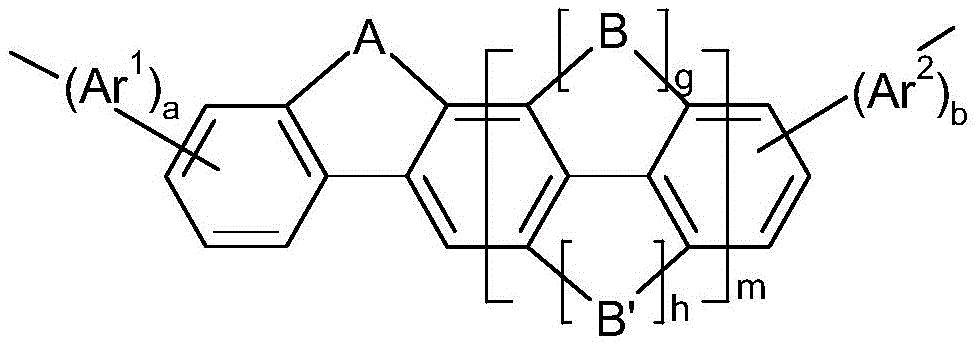
其中符号和标记具有以下含义:The symbols and marks have the following meanings:
A、B和B'对于不同重复单元也各自相同或不同地是二价基团,所述基团优选选自-CRcRd-、-NRc-、-PRc-、-O-、-S-、-SO-、-SO2-、-CO-、-CS-、-CSe-、-P(=O)Rc-、-P(=S)Rc-和-SiRcRd-;A, B and B' are also each the same or different for different repeating units and are divalent groups, preferably selected from -CRcRd- , -NRc- , -PRc- , -O- , -S-, -SO-, -SO2- , -CO-, -CS-, -CSe-, -P(=O) Rc- , -P(=S) Rc- and -SiRcRd- ;
Rc和Rd在各情况中独立地选自H、卤素、-CN、-NC、-NCO、-NCS、-OCN、-SCN、-C(=O)NR0R00、-C(=O)X、-C(=O)R0、-NH2、-NR0R00、-SH、-SR0、-SO3H、-SO2R0、-OH、-NO2、-CF3、-SF5、任选被取代的具有1-40个碳原子的甲硅烷基、二价碳基或烃基基团,所述基团可以任选地被取代且可以任选地含有一个或多个杂原子,其中基团Rc和Rd可以任选地与它们所键合的芴基团形成螺基团;R c and R d are independently selected in each case from H, halogen, -CN, -NC, -NCO, -NCS, -OCN, -SCN, -C(=O)NR 0 R 00 , -C(=O)X, -C(=O)R 0 , -NH 2 , -NR 0 R 00 , -SH, -SR 0 , -SO 3 H, -SO 2 R 0 , -OH, -NO 2 , -CF 3 , -SF 5 , an optionally substituted silyl, divalent carbyl or hydrocarbon group having 1 to 40 carbon atoms, which may be optionally substituted and may optionally contain one or more heteroatoms, wherein the groups R c and R d may optionally form a spiro group with the fluorene group to which they are bound;
X是卤素;X is a halogen;
R0和R00各自独立地是H或任选被取代的具有1至40个碳原子的二价碳基或烃基基团,所述基团可任选被取代并且可任选含有一个或多个杂原子; R0 and R00 are each independently H or an optionally substituted divalent carbyl or hydrocarbyl group having 1 to 40 carbon atoms, which may be optionally substituted and may optionally contain one or more heteroatoms;
g在每种情况下独立地是0或1并且h在每种情况下独立地是0或1,其中亚单元中的g和h的总和优选为1;g is independently at each
m是≥1的整数;m is an integer ≥ 1;
Ar1和Ar2彼此独立地表示单环或多环的芳基或杂芳基基团,所述基团可任选被取代并且可任选键合至茚并芴基团的7,8位或8,9位;并且Ar 1 and Ar 2 independently represent a monocyclic or polycyclic aryl or heteroaryl group, which may be optionally substituted and may be optionally bonded to the 7, 8 or 8, 9 position of the indenofluorene group; and
a和b彼此独立地是0或1。a and b are independently 0 or 1.
如果所述基团Rc和Rd与这些基团所键合的芴基团形成螺基团,则该基团优选表示螺二芴。If the radicals R c and R d form a spiro group with the fluorene group to which these radicals are bonded, the radical preferably represents spirobifluorene.
特别优选的是下述式PB-1的重复单元,其选自式PB-1A至PB-1E的单元:Particularly preferred are repeating units of the following formula PB-1 selected from the units of formulae PB-1A to PB-1E:

其中Rc具有上文关于式PB-1所述的含义,r是0、1、2、3或4,并且Re具有与基团Rc相同的含义。wherein R c has the meaning described above for formula PB-1, r is 0, 1, 2, 3 or 4, and Re has the same meaning as the group R c .
Re优选为-F、-Cl、-Br、-I、-CN、-NO2、-NCO、-NCS、-OCN、-SCN、-C(=O)NR0R00、-C(=O)X、-C(=O)R0、-NR0R00、任选被取代的具有4-40个、优选6-20个C原子的甲硅烷基、芳基或杂芳基基团、或具有1-20个、优选1-12个C原子的直链、支链的或环状的烷基、烷氧基、烷基羰基、烷氧基羰基、烷基羰氧基或烷氧基羰氧基基团,其中一个或多个氢原子可以任选地被F或Cl取代,且基团R0、R00和X具有上述对于式PB-1所述的相同含义。R e is preferably -F, -Cl, -Br, -I, -CN, -NO 2 , -NCO, -NCS, -OCN, -SCN, -C(=O)NR 0 R 00 , -C(=O)X, -C(=O)R 0 , -NR 0 R 00 , an optionally substituted silyl, aryl or heteroaryl group having 4 to 40, preferably 6 to 20 C atoms, or a linear, branched or cyclic alkyl, alkoxy, alkylcarbonyl, alkoxycarbonyl, alkylcarbonyloxy or alkoxycarbonyloxy group having 1 to 20, preferably 1 to 12 C atoms, wherein one or more hydrogen atoms may be optionally substituted by F or Cl, and the groups R 0 , R 00 and X have the same meanings as described above for formula PB-1.
特别优选的是下述式PB-1的重复单元,其选自式PB-1F至PB-1I的单元:Particularly preferred are repeating units of the following formula PB-1 selected from the units of formulae PB-1F to PB-1I:


其中符号具有以下含义:The symbols have the following meanings:
L是H,卤素或任选氟化的具有1至12个C原子的直链或支链的烷基或烷氧基基团,并且优选代表H、F、甲基、异丙基、叔丁基、正戊氧基或三氟甲基;并且L is H, halogen or an optionally fluorinated straight-chain or branched alkyl or alkoxy group having 1 to 12 C atoms, and preferably represents H, F, methyl, isopropyl, tert-butyl, n-pentyloxy or trifluoromethyl; and
L'是任选氟化的具有1至12个C原子的直链或支链的烷基或烷氧基基团,并且优选代表正辛基或正辛氧基。L′ is an optionally fluorinated, linear or branched alkyl or alkoxy group having 1 to 12 C atoms and preferably represents n-octyl or n-octyloxy.
为了实施本发明,优选的是包含超过一种上述第1类至第7类所述结构元素的聚合物。此外所述聚合物可以优选包含超过一种的来自上述一个类别中的结构元素,即包括选自一个类别的结构元素的混合物。For the implementation of the invention, polymers are preferred which contain more than one structural element from the abovementioned classes 1 to 7. Furthermore, the polymers may preferably contain more than one structural element from one of the abovementioned classes, ie a mixture of structural elements selected from one class.
特别地,特别优选如下聚合物,所述聚合物除至少一种具有发光性质的结构元素(第4类)、优选至少一种磷光基团以外,另外含有上述第1类至第3类、第5类或第6类的至少一种其它结构元素,其中所述结构元素优选选自第1类至第3类。In particular, polymers are particularly preferred which, in addition to at least one structural element with luminescent properties (class 4), preferably at least one phosphorescent group, further contain at least one other structural element from the above-mentioned classes 1 to 3,
如果存在于聚合物中,则多种类别的基团的比例可以在宽的范围内,其中这为本领域技术人员所已知。如果存在于聚合物中的一个类别的比例优选在每种情况下≥5mol%、特别优选在每种情况下≥10mol%,那么可以获得令人惊讶的优势,所述一个类别在每种情况下选自上述第1至7类的结构元素。If present in the polymer, the proportions of the groups of the various classes may be within wide ranges, which is known to the person skilled in the art. Surprising advantages can be achieved if the proportion of one class present in the polymer is preferably in each case ≥ 5 mol %, particularly preferably in each case ≥ 10 mol %, which class is in each case selected from the structural elements of the above-mentioned classes 1 to 7.
发白光的共聚物的制备尤其详细描述于DE 10343606 A1中。The preparation of white-emitting copolymers is described in detail, inter alia, in DE 10343606 A1.
为了提高溶解性,所述聚合物可含有相应的基团。优选可能提供的是,所述聚合物含有取代基,以使得每个重复单元存在平均至少2个非芳族碳原子,特别优选地至少4个并且尤其优选地至少8个非芳族碳原子,其中平均值涉及数量平均。此处单个碳原子可被例如O或S代替。然而,特定比例、任选地所有的重复单元可不包含含有非芳族碳原子的取代基。此处优选的是短链取代基,因为长链取代基可以对可使用有机功能材料获得的层具有不利影响。所述取代基优选在直链中含有至多12个碳原子,优选至多8个碳原子并且特别优选至多6个碳原子。In order to improve solubility, the polymer may contain the corresponding group. It is preferably possible to provide that the polymer contains a substituent so that there are an average of at least 2 non-aromatic carbon atoms per repeating unit, particularly preferably at least 4 and especially preferably at least 8 non-aromatic carbon atoms, wherein the average value relates to the number average. Here, a single carbon atom can be replaced by, for example, O or S. However, a specific ratio, optionally all repeating units, may not contain a substituent containing a non-aromatic carbon atom. It is preferred here that a short-chain substituent has an adverse effect on the layer that can be obtained using an organic functional material, because a long-chain substituent can have an adverse effect on the layer that can be obtained using an organic functional material. The substituent preferably contains up to 12 carbon atoms in a straight chain, preferably up to 8 carbon atoms and particularly preferably up to 6 carbon atoms.
根据本发明用作有机功能材料的聚合物可以是无规、交替或区域规则共聚物、嵌段共聚物或这些共聚物形式的组合。The polymers used as organic functional materials according to the present invention may be random, alternating or regioregular copolymers, block copolymers or a combination of these copolymer forms.
在另一个实施方式中,用作有机功能材料的聚合物可以是具有侧链的非共轭聚合物,其中该实施方式对于基于聚合物的磷光OLED是特别重要的。一般来说,磷光聚合物可以通过乙烯基化合物的自由基共聚获得,其中这些乙烯基化合物含有至少一个具有磷光发光体的单元和/或至少一个电荷传输单元,如尤其公开于US 7250226 B2中。其它的磷光聚合物尤其描述于JP 2007/211243 A2、JP 2007/197574 A2、US 7250226 B2和JP 2007/059939A中。In another embodiment, the polymer used as organic functional material can be a non-conjugated polymer with side chains, wherein this embodiment is particularly important for polymer-based phosphorescent OLEDs. In general, phosphorescent polymers can be obtained by free radical copolymerization of vinyl compounds, wherein these vinyl compounds contain at least one unit with a phosphorescent emitter and/or at least one charge transport unit, as disclosed in particular in US 7250226 B2. Other phosphorescent polymers are described in particular in JP 2007/211243 A2, JP 2007/197574 A2, US 7250226 B2 and JP 2007/059939A.
在另一个优选的实施方式中,非共轭聚合物含有骨架单元,其通过间隔基单元彼此连接。以基于骨架单元的非共轭聚合物为基础的这种三重态发光体的实例例如公开于DE102009023154中。In a further preferred embodiment, the non-conjugated polymer contains backbone units which are linked to one another via spacer units. Examples of such triplet emitters based on non-conjugated polymers based on backbone units are disclosed, for example, in DE102009023154.
在另一个优选的实施方式中,非共轭聚合物可以被设计为荧光发光体。基于具有侧链的非共轭聚合物的优选的荧光发光体在侧链中含有蒽或苯并蒽基团或这些基团的衍生物,其中这些聚合物公开于例如JP 2005/108556、JP 2005/285661和JP 2003/338375中。In another preferred embodiment, non-conjugated polymers can be designed as fluorescent emitters. Preferred fluorescent emitters based on non-conjugated polymers with side chains contain anthracene or benzanthracene groups or derivatives of these groups in the side chains, wherein these polymers are disclosed in, for example, JP 2005/108556, JP 2005/285661 and JP 2003/338375.
这些聚合物通常可以用作电子传输或空穴传输材料,其中这些聚合物优选被设计为非共轭聚合物。These polymers can generally be used as electron transport or hole transport materials, wherein these polymers are preferably designed as non-conjugated polymers.
此外,在所述制剂中用作有机功能材料的功能化合物,在聚合物化合物的情况下,优选具有≥10,000g/mol、特别优选≥20,000g/mol并且尤其优选≥40,000g/mol的分子量Mw。Furthermore, the functional compounds used as organic functional materials in the preparations, in the case of polymer compounds, preferably have a molecular weight M w of ≧10,000 g/mol, particularly preferably ≧20,000 g/mol and especially preferably ≧40,000 g/mol.
此处聚合物的分子量Mw优选在10,000至2,000,000g/mol的范围内,特别优选在20,000至1,000,000g/mol的范围内并且非常特别优选在40,000至300,000g/mol的范围内。通过相对于内部聚苯乙烯标准的GPC(=凝胶渗透色谱法)来测定分子量Mw。The molecular weight Mw of the polymers here is preferably in the range from 10,000 to 2,000,000 g/mol, particularly preferably in the range from 20,000 to 1,000,000 g/mol and very particularly preferably in the range from 40,000 to 300,000 g/mol. The molecular weight Mw is determined by GPC (=gel permeation chromatography) relative to internal polystyrene standards.
上文为了描述功能化合物而引用的出版物出于公开目的以引用的方式并入本申请中。The publications cited above for describing functional compounds are incorporated herein by reference for the purposes of disclosure.
根据本发明的制剂可以包含制造电子器件的相应功能层所必需的所有有机功能材料。例如,如果空穴传输、空穴注入、电子传输或电子注入层正好由一种功能化合物构建,则所述制剂正好包含这种化合物作为有机功能材料。如果发光层包含例如发光体与基质或主体材料的组合,则如本申请别处更详细描述的,所述制剂正好包含发光体与基质或主体材料的混合物作为有机功能材料。The formulation according to the invention may contain all the organic functional materials necessary for the manufacture of the corresponding functional layers of the electronic device. For example, if the hole transport, hole injection, electron transport or electron injection layer is constructed from just one functional compound, the formulation contains just this compound as the organic functional material. If the luminescent layer contains, for example, a combination of a luminophore and a matrix or host material, the formulation contains just a mixture of a luminophore and a matrix or host material as the organic functional material, as described in more detail elsewhere in the present application.
除所述组分以外,根据本发明的制剂可以包含其它添加剂和加工助剂。这些尤其包括表面活性物质(表面活性剂)、润滑剂和油脂、调节粘度的添加剂、提高传导性的添加剂、分散剂、疏水剂、助粘剂、流动改善剂、消泡剂、脱气剂、反应性或非反应性的稀释剂、填充剂、助剂、加工助剂、染料、颜料、稳定剂、敏化剂、纳米粒子和抑制剂。In addition to the components mentioned, the preparations according to the invention may contain further additives and processing aids. These include, in particular, surface-active substances (surfactants), lubricants and greases, viscosity-regulating additives, conductivity-enhancing additives, dispersants, hydrophobic agents, adhesion promoters, flow improvers, defoamers, deaerators, reactive or non-reactive diluents, fillers, auxiliaries, processing aids, dyes, pigments, stabilizers, sensitizers, nanoparticles and inhibitors.
本发明还涉及一种用于制备根据本发明的制剂的方法,其中将可以用于制造电子器件的功能层的至少一种有机功能材料和至少四种不同的有机溶剂A、B、C和D混合。The invention furthermore relates to a process for producing a preparation according to the invention, wherein at least one organic functional material which can be used to produce a functional layer of an electronic component and at least four different organic solvents A, B, C and D are mixed.
根据本发明的制剂可以用于制造层或多层结构,其中有机功能材料如用于制造优选的电子或光电子组件(如OLED)所需的存在于层中。The preparations according to the invention can be used for producing layer or multilayer structures in which organic functional materials, as are required for the production of preferred electronic or optoelectronic components such as OLEDs, are present in the layers.
本发明制剂可以优选地用于在基底上或在施加于基底的层之一上形成功能层。所述基底可具有或不具有堤岸结构。The preparations according to the invention can preferably be used to form a functional layer on a substrate or on one of the layers applied to a substrate. The substrate may or may not have a bank structure.
本发明也涉及一种制造电子器件的方法,其中将根据本发明的制剂施加至基底并且干燥。The invention also relates to a method for producing an electronic component, in which the preparation according to the invention is applied to a substrate and dried.
功能层可以例如通过在基底上或在施加于基底的层之一上溢涂、浸涂、喷涂、旋涂、丝网印刷、凸版印刷、凹版印刷、轮转印刷、辊涂、柔性版印刷、胶版印刷或喷嘴印刷、优选喷墨印刷来制造。The functional layer can be produced, for example, by flood coating, dip coating, spray coating, spin coating, screen printing, relief printing, gravure printing, rotary printing, roller coating, flexographic printing, offset printing or nozzle printing, preferably inkjet printing, on the substrate or on one of the layers applied to the substrate.
向基底或已经施加的功能层施加根据本发明的制剂后,可以进行干燥步骤以便从上述连续相去除溶剂。干燥可以优选在相对低温下进行相对长时间以避免气泡形成,并且获得均匀涂层。干燥可以优选在80℃至300℃、更优选150℃至250℃并且最优选160℃至200℃范围内的温度下进行。此处,干燥优选可以在10-6毫巴至2巴范围内、更优选在10-2毫巴至1巴范围内并且最优选在10-1毫巴至100毫巴范围内的压力下进行。在干燥工序期间,基底的温度可以从-15℃到250℃变动。干燥持续时间取决于欲实现的干燥程度,其中少量水可以任选地在相对高温度下结合烧结去除,烧结是优选进行的。After applying the formulation according to the invention to the substrate or the already applied functional layer, a drying step may be performed to remove the solvent from the above-mentioned continuous phase. Drying may preferably be performed at a relatively low temperature for a relatively long time to avoid bubble formation and obtain a uniform coating. Drying may preferably be performed at a temperature in the range of 80°C to 300°C, more preferably 150°C to 250°C and most preferably 160°C to 200°C. Here, drying may preferably be performed at a pressure in the range of 10-6 mbar to 2 bar, more preferably in the range of 10-2 mbar to 1 bar and most preferably in the range of 10-1 mbar to 100 mbar. During the drying process, the temperature of the substrate may vary from -15°C to 250°C. The drying duration depends on the degree of drying to be achieved, wherein a small amount of water may optionally be removed at a relatively high temperature in conjunction with sintering, which is preferably performed.
可将该工艺重复多次来形成不同或相同的多个功能层。此处可以进行所形成功能层的交联以防止其溶解,如例如EP 0 637 899 A1中所公开的。This process can be repeated several times to form different or identical functional layers. Crosslinking of the functional layer formed can be carried out here to prevent its dissolution, as disclosed, for example, in
本发明还涉及一种电子器件,其可通过用于制造电子器件的方法来获得。The invention also relates to an electronic device obtainable by a method for producing an electronic device.
本发明还涉及一种电子器件,所述电子器件具有至少一个包含至少一种有机功能材料的功能层,所述电子器件可通过上述用于制造电子器件的方法获得。The present invention also relates to an electronic device having at least one functional layer comprising at least one organic functional material, which is obtainable by the above-mentioned method for producing an electronic device.
电子器件是指包括阳极、阴极和至少一个位于两者之间的功能层的器件,其中所述功能层包括至少一种有机的或有机金属的化合物。An electronic device is a device comprising an anode, a cathode and at least one functional layer located therebetween, wherein the functional layer comprises at least one organic or organometallic compound.
有机电子器件优选为有机电致发光器件(OLED)、聚合物电致发光器件(PLED)、有机集成电路(O-IC)、有机场效应晶体管(O-FET)、有机薄膜晶体管(O-TFT)、有机发光晶体管(O-LET)、有机太阳能电池(O-SC)、有机光伏(OPV)电池、有机光检测器、有机光感受器、有机场猝熄器件(O-FQD)、有机电传感器、发光电化学电池(LEC)或有机激光二极管(O-laser),更优选地是有机电致发光器件(OLED)或聚合物电致发光器件(PLED)。The organic electronic device is preferably an organic electroluminescent device (OLED), a polymer electroluminescent device (PLED), an organic integrated circuit (O-IC), an organic field effect transistor (O-FET), an organic thin film transistor (O-TFT), an organic light emitting transistor (O-LET), an organic solar cell (O-SC), an organic photovoltaic (OPV) cell, an organic photodetector, an organic photoreceptor, an organic field quenching device (O-FQD), an organic electrical sensor, a light emitting electrochemical cell (LEC) or an organic laser diode (O-laser), more preferably an organic electroluminescent device (OLED) or a polymer electroluminescent device (PLED).
有源组分通常为引入阳极与阴极之间的有机或无机材料,其中这些有源组分实现、维持和/或改善电子器件的性质,例如其性能和/或其寿命,有源组分例如为电荷注入、电荷传输或电荷阻挡材料,但特别是发光材料和基质材料。因此,可以用于制造电子器件的功能层的有机功能材料优选包含电子器件的有源组分。Active components are generally organic or inorganic materials introduced between the anode and the cathode, wherein these active components realize, maintain and/or improve the properties of the electronic device, such as its performance and/or its lifetime, such as charge injection, charge transport or charge blocking materials, but in particular luminescent materials and matrix materials. Therefore, the organic functional materials that can be used to produce the functional layers of the electronic device preferably comprise the active components of the electronic device.
有机电致发光器件为本发明的一个优选实施方式。有机电致发光器件包含阴极、阳极和至少一个发光层。An organic electroluminescent device is a preferred embodiment of the present invention. The organic electroluminescent device comprises a cathode, an anode and at least one light-emitting layer.
此外,优选使用两种或更多种三重态发光体与基质的混合物。具有较短波发光光谱的三重态发光体在此处充当具有较长波发光光谱的三重态发光体的共基质。Furthermore, preference is given to using a mixture of two or more triplet emitters with a matrix. The triplet emitter with a shorter-wave emission spectrum serves here as a co-matrix for the triplet emitter with a longer-wave emission spectrum.
在这种情况下,发光层中基质材料的比例,对于荧光发光层优选为50体积%至99.9体积%,更优选为80体积%至99.5体积%并且最优选为92体积%至99.5体积%,并且对于磷光发光层为85体积%至97体积%。In this case, the proportion of the host material in the light-emitting layer is preferably 50% to 99.9% by volume, more preferably 80% to 99.5% by volume and most preferably 92% to 99.5% by volume for the fluorescent light-emitting layer, and 85% to 97% by volume for the phosphorescent light-emitting layer.
相应地,掺杂剂的比例对于荧光发光层优选为0.1体积%至50体积%,更优选为0.5体积%至20体积%并且最优选为0.5体积%至8体积%,并且对于磷光发光层为3体积%至15体积%。Accordingly, the proportion of the dopant is preferably 0.1 to 50% by volume, more preferably 0.5 to 20% by volume and most preferably 0.5 to 8% by volume for the fluorescent light-emitting layer, and 3 to 15% by volume for the phosphorescent light-emitting layer.
有机电致发光器件的发光层还可以包括包含多种基质材料(混合基质体系)和/或多种掺杂剂的体系。此外,在这种情况下,掺杂剂通常为在体系中的比例较小的材料,并且基质材料为在体系中的比例较大的材料。然而,在个别情况下,个别基质材料在体系中的比例可以小于个别掺杂剂的比例。The light-emitting layer of the organic electroluminescent device can also include a system comprising a plurality of host materials (mixed host system) and/or a plurality of dopants. In addition, in this case, the dopant is generally a material having a smaller proportion in the system, and the host material is a material having a larger proportion in the system. However, in individual cases, the proportion of an individual host material in the system may be less than the proportion of an individual dopant.
混合基质体系优选包含两种或三种不同基质材料,更优选两种不同基质材料。此处,所述两种材料之一优选为具有空穴传输性质的材料,并且另一种材料为具有电子传输性质的材料。然而,混合基质组分的期望电子传输和空穴传输性质还可以主要或完全合并在单一混合基质组分中,其中其它的一种或多种混合基质组分满足其它功能。此处,所述两种不同基质材料可以以1:50至1:1、优选1:20至1:1、更优选1:10至1:1并且最优选1:4至1:1的比存在。混合基质体系优选用于磷光有机电致发光器件中。关于混合基质体系的其它细节可以见于例如WO 2010/108579中。The mixed matrix system preferably comprises two or three different host materials, more preferably two different host materials. Here, one of the two materials is preferably a material with hole transport properties, and the other material is a material with electron transport properties. However, the desired electron transport and hole transport properties of the mixed matrix component can also be mainly or completely merged in a single mixed matrix component, wherein other one or more mixed matrix components meet other functions. Here, the two different host materials can be present in a ratio of 1:50 to 1:1, preferably 1:20 to 1:1, more preferably 1:10 to 1:1 and most preferably 1:4 to 1:1. The mixed matrix system is preferably used in phosphorescent organic electroluminescent devices. Other details about the mixed matrix system can be found in, for example, WO 2010/108579.
除了这些层之外,有机电致发光器件还可包括另外的层,例如在每种情况下一个或多个空穴注入层、空穴传输层、空穴阻挡层、电子传输层、电子注入层、激子阻挡层、电子阻挡层、电荷产生层(IDMC 2003,台湾;Session 21OLED(5),T.Matsumoto,T.Nakada,J.Endo,K.Mori,N.Kawamura,A.Yokoi,J.Kido,Multiphoton Organic EL Device HavingCharge Generation Layer(具有电荷产生层的多光子有机EL器件))和/或有机或无机p/n结。此处一个或多个空穴传输层可例如用金属氧化物如MoO3或WO3或用(全)氟化缺电子芳族化合物进行p型掺杂,和/或一个或多个电子传输层可被n型掺杂。也可将中间层引入两个发光层之间,所述中间层具有例如激子阻挡功能和/或控制电致发光器件中的电荷平衡。然而,应该指出这些层中的每个不必都存在。如上文所定义,这些层也可以在使用根据本发明的制剂时存在。In addition to these layers, the organic electroluminescent device may also comprise further layers, for example in each case one or more hole injection layers, hole transport layers, hole blocking layers, electron transport layers, electron injection layers, exciton blocking layers, electron blocking layers, charge generation layers (IDMC 2003, Taiwan; Session 21 OLED (5), T. Matsumoto, T. Nakada, J. Endo, K. Mori, N. Kawamura, A. Yokoi, J. Kido, Multiphoton Organic EL Device Having Charge Generation Layer (Multiphoton Organic EL Device Having Charge Generation Layer)) and/or organic or inorganic p/n junctions. Here, one or more hole transport layers may be p-doped, for example with metal oxides such as MoO 3 or WO 3 or with (per) fluorinated electron-deficient aromatic compounds, and/or one or more electron transport layers may be n-doped. Interlayers may also be introduced between two emitting layers, which interlayers have, for example, an exciton blocking function and/or control the charge balance in the electroluminescent device. However, it should be pointed out that each of these layers does not necessarily have to be present. As defined above, these layers may also be present when using the formulation according to the invention.
在本发明的另一个实施方式中,所述器件包括多个层。根据本发明的制剂在此可优选用于制造空穴传输、空穴注入、电子传输、电子注入和/或发光层。In a further embodiment of the invention, the device comprises a plurality of layers. The preparations according to the invention can preferably be used here for producing hole-transporting, hole-injecting, electron-transporting, electron-injecting and/or emitting layers.
因此,本发明还涉及一种电子器件,其包括来自空穴注入、空穴传输、发光、电子传输、电子注入、电荷阻挡和/或电荷产生层的至少三个层,但在一个优选的实施方式中,所述电子器件包括所有所述层,并且其中至少一个层已经通过根据本发明使用的制剂获得。所述层例如空穴传输和/或空穴注入层的厚度可以优选在1至500nm的范围内,更优选在2至200nm的范围内。Therefore, the present invention also relates to an electronic device comprising at least three layers from hole injection, hole transport, light emitting, electron transport, electron injection, charge blocking and/or charge generating layers, but in a preferred embodiment, the electronic device comprises all of the layers, and at least one of the layers has been obtained by the formulation used according to the present invention. The thickness of the layer, such as the hole transport and/or hole injection layer, may preferably be in the range of 1 to 500 nm, more preferably in the range of 2 to 200 nm.
此外,所述器件可包括由其它低分子量化合物或聚合物构成的层,其尚未通过使用根据本发明的制剂来施加。这些也可以通过在高真空中蒸发低分子量化合物来制造。Furthermore, the device may comprise layers composed of other low molecular weight compounds or polymers which have not yet been applied using the formulations according to the invention. These can also be produced by evaporating low molecular weight compounds in a high vacuum.
根据本发明的一个优选实施方式,所述器件包括通过蒸发低分子量化合物而施加的发光层。根据这样的实施方式,可以使用现有技术中已知的用于真空施加发光层的任何基质材料和发光体。作为用于此目的的三重态基质材料,特别地,可以使用以下材料:According to a preferred embodiment of the invention, the device comprises a light-emitting layer applied by evaporating a low molecular weight compound. According to such an embodiment, any matrix material and luminophore known in the prior art for vacuum-applied light-emitting layers can be used. As triplet matrix materials for this purpose, in particular, the following materials can be used:


这些材料也可以用作通过气相沉积施加的空穴传输层中的空穴传输材料。这些化合物的合成如果没有在现有技术中具体公开,则可以由技术人员根据现有技术中公知的方法进行。例如,化合物(22)的合成可以如WO 2007/072952中关于该申请的化合物3的合成所述进行(参见第32-33页)。These materials can also be used as hole transport materials in hole transport layers applied by vapor deposition. The synthesis of these compounds, if not specifically disclosed in the prior art, can be carried out by a skilled person according to methods known in the prior art. For example, the synthesis of compound (22) can be carried out as described in WO 2007/072952 for the synthesis of compound 3 of that application (see pages 32-33).
另外,可以优选使用这样的化合物,其不以纯物质形式使用,而是以与任何期望类型的其它聚合物、低聚物、树枝状大分子或低分子量物质的混合物(共混物)形式使用。这些可以例如改善电子性质或其自身发光。In addition, it may be preferred to use compounds not in pure form but in mixtures (blends) with other polymers, oligomers, dendrimers or low molecular weight substances of any desired type. These may, for example, improve the electronic properties or themselves emit light.
在本发明的一个优选实施方式中,根据本发明的制剂包含有机功能材料,其用作发光层中的主体材料或基质材料。此处,除主体材料或基质材料以外,制剂可以包含上述发光体。此处,有机电致发光器件可以包含一个或多个发光层。如果存在多个发光层,那么这些发光层优选在380nm至750nm之间具有多个发光峰值,使整体发白光,即,能够发荧光或发磷光的多种发光化合物被用于发光层中。非常特别优选三层体系,其中所述三个层表现蓝色、绿色和橙色或红色发光(对于基本结构,参见例如WO 2005/011013)。白色发光的器件例如适合用作LCD显示器的背光或用于一般照明应用。In a preferred embodiment of the present invention, the preparation according to the present invention comprises an organic functional material, which is used as a host material or a matrix material in a light-emitting layer. Here, in addition to the host material or the matrix material, the preparation may comprise the above-mentioned luminophore. Here, the organic electroluminescent device may comprise one or more light-emitting layers. If there are multiple light-emitting layers, then these light-emitting layers preferably have multiple luminescence peaks between 380nm and 750nm, so that the entirety of the light-emitting layer is white-lighted, that is, a variety of light-emitting compounds that can emit fluorescence or phosphorescence are used in the light-emitting layer. Very particularly preferably a three-layer system, wherein the three layers exhibit blue, green and orange or red light emission (for basic structure, see, for example, WO 2005/011013). The device of white light emission is, for example, suitable for use as a backlight of an LCD display or for general lighting applications.
多个OLED还可以以层叠方式布置,使得关于待实现的光输出的效率进一步提高。A plurality of OLEDs can also be arranged in a stacked manner, so that the efficiency with regard to the light output to be achieved is further increased.
为了改善光的耦合输出,OLED中出光侧上的最终有机层例如也可以呈纳米泡沫的形式,从而引起全反射比例降低。In order to improve the coupling-out of light, the last organic layer on the light-exiting side of the OLED can also be in the form of a nanofoam, for example, so that the proportion of total reflection is reduced.
还优选如下有机电致发光器件,其中一个或多个层借助于升华方法施加,其中通过在真空升华单元中在低于10-5毫巴、优选低于10-6毫巴、更优选低于10-7毫巴的压力下的气相沉积来施加所述材料。Preference is also given to organic electroluminescent devices in which one or more layers are applied by means of a sublimation process, wherein the material is applied by vapor deposition in a vacuum sublimation unit at a pressure of less than 10 −5 mbar, preferably less than 10 −6 mbar, more preferably less than 10 −7 mbar.
还可以提供的是,根据本发明的电子器件的一个或多个层借助于OVPD(有机气相沉积)方法或借助于载气升华来施加,其中在10-5毫巴至1巴的压力下施加所述材料。It may also be provided that one or more layers of the electronic device according to the invention are applied by means of an OVPD (Organic Vapor Phase Deposition) method or by means of carrier gas sublimation, wherein the material is applied at a pressure of 10 −5 mbar to 1 bar.
还可以提供的是,从溶液例如通过旋涂或借助于任何期望印刷方法如丝网印刷、柔性版印刷或胶版印刷,但特别优选LITI(光引发热成像,热转印)或喷墨印刷来产生根据本发明的电子器件的一个或多个层。It can also be provided that one or more layers of the electronic device according to the invention are produced from solution, for example by spin coating or by means of any desired printing method such as screen printing, flexographic printing or offset printing, but particularly preferably LITI (light-induced thermal imaging, thermal transfer) or inkjet printing.
所述器件通常包含阴极和阳极(电极)。出于本发明的目的,选择电极(阴极、阳极),使得其能带能量尽可能接近地对应于相邻有机层的能带能量,以确保高效的电子或空穴注入。The device generally comprises a cathode and an anode (electrodes). For the purposes of the present invention, the electrodes (cathode, anode) are selected such that their energy band energies correspond as closely as possible to the energy band energies of the adjacent organic layers to ensure efficient electron or hole injection.
所述阴极优选包含金属络合物、具有低逸出功的金属、金属合金或多层结构,所述金属合金或多层结构包含多种金属,例如碱土金属、碱金属、主族金属或镧系元素(例如Ca、Ba、Mg、Al、In、Mg、Yb、Sm等)。在多层结构情况下,除所述金属之外,也可以使用具有相对高逸出功的其它金属例如Ag和Ag纳米线(Ag NW),在这种情况下,通常使用金属的组合,例如Ca/Ag或Ba/Ag。还可优选在金属阴极和有机半导体之间引入具有高介电常数的材料的薄中间层。适合于该目的的是例如碱金属氟化物或碱土金属氟化物,以及相应的氧化物(例如LiF、Li2O、BaF2、MgO、NaF等)。该层的层厚度优选为0.1nm至10nm,更优选0.2nm至8nm,尤其优选为0.5nm至5nm。The cathode preferably comprises a metal complex, a metal with a low work function, a metal alloy or a multilayer structure, the metal alloy or multilayer structure comprising a plurality of metals, such as alkaline earth metals, alkali metals, main group metals or lanthanides (e.g. Ca, Ba, Mg, Al, In, Mg, Yb, Sm, etc.). In the case of a multilayer structure, in addition to the metals, other metals with a relatively high work function, such as Ag and Ag nanowires (Ag NW), can also be used, in which case a combination of metals, such as Ca/Ag or Ba/Ag, is usually used. It is also preferred to introduce a thin intermediate layer of a material with a high dielectric constant between the metal cathode and the organic semiconductor. Suitable for this purpose are, for example, alkali metal fluorides or alkaline earth metal fluorides, and the corresponding oxides (e.g. LiF, Li 2 O, BaF 2 , MgO, NaF, etc.). The layer thickness of this layer is preferably 0.1 nm to 10 nm, more preferably 0.2 nm to 8 nm, and particularly preferably 0.5 nm to 5 nm.
所述阳极优选包含具有高逸出功的材料。该阳极优选具有相对于真空大于4.5eV的电势。一方面,适合于该目的的是具有高氧化还原电势的金属,例如Ag、Pt或Au。另一方面,也可以优选金属/金属氧化物电极(例如Al/Ni/NiOx、Al/PtOx)。对于一些应用,所述电极的至少一个必须是透明的,以便促进有机材料的辐射(O-SC)或光的耦合输出(OLED/PLED、O-laser)。优选的结构使用透明阳极。此处优选的阳极材料是导电的混合金属氧化物。特别优选氧化铟锡(ITO)或氧化铟锌(IZO)。此外,优选导电的掺杂有机材料,特别是导电的掺杂聚合物,如聚(乙烯基二氧基噻吩)(PEDOT)和聚苯胺(PANI)或这些聚合物的衍生物。此外,优选将p型掺杂的空穴传输材料作为空穴注入层施加至阳极,其中适合的p型掺杂剂是金属氧化物(例如MoO3或WO3)或(全)氟化缺电子芳族化合物。其它适合的p型掺杂剂为HAT-CN(六氰基六氮杂联三苯叉)或化合物NPD9(来自Novaled)。这种类型的层简化了具有低HOMO(即具有大的值的HOMO)的材料中的空穴注入。The anode preferably comprises a material with a high work function. The anode preferably has a potential greater than 4.5 eV relative to a vacuum. On the one hand, metals with high redox potentials, such as Ag, Pt or Au, are suitable for this purpose. On the other hand, metal/metal oxide electrodes (such as Al/Ni/NiO x , Al/PtO x ) may also be preferred. For some applications, at least one of the electrodes must be transparent to promote the radiation (O-SC) of organic materials or the coupling-out of light (OLED/PLED, O-laser). The preferred structure uses a transparent anode. The preferred anode material here is a conductive mixed metal oxide. Indium tin oxide (ITO) or indium zinc oxide (IZO) are particularly preferred. In addition, conductive doped organic materials are preferred, particularly conductive doped polymers, such as poly (ethylenedioxythiophene) (PEDOT) and polyaniline (PANI) or derivatives of these polymers. Furthermore, preferably a p-doped hole transport material is applied to the anode as a hole injection layer, wherein suitable p-type dopants are metal oxides (e.g. MoO 3 or WO 3 ) or (per)fluorinated electron-deficient aromatic compounds. Other suitable p-type dopants are HAT-CN (hexacyanohexaazaterphenylidene) or the compound NPD9 (from Novaled). This type of layer simplifies hole injection in materials with a low HOMO (i.e. a HOMO with a large value).
一般来说,根据现有技术用于所述层的所有材料可以用于其它层中,并且本领域技术人员将能够不付出创造性劳动而将这些材料中的每一种与根据本发明的材料组合于电子器件中。In general, all materials used according to the prior art for the layers mentioned can be used in the other layers, and a person skilled in the art will be able to combine each of these materials with the material according to the invention in an electronic device without inventive step.
依据应用而定,将器件以本身已知的方式相应地结构化,设置接触点并且最后被气密密封,这是因为这类器件的寿命在水和/或空气存在下急剧地缩短。Depending on the application, the component is structured accordingly in a manner known per se, contact points are provided and finally hermetically sealed, since the service life of such components is drastically shortened in the presence of water and/or air.
根据本发明的制剂和可由其获得的电子器件、特别是有机电致发光器件,相比于现有技术的突出之处在于以下令人惊讶的优点中的一个或多个:The preparations according to the invention and the electronic devices obtainable therefrom, in particular organic electroluminescent devices, are distinguished by one or more of the following surprising advantages compared to the prior art:
1.与使用常规方法获得的电子器件相比,可使用根据本发明的制剂获得的电子器件表现极高的稳定性和极长的寿命。1. The electronic devices obtainable using the formulation according to the present invention exhibit extremely high stability and extremely long lifespan compared to electronic devices obtained using conventional methods.
2.根据本发明的制剂可以使用常规方法处理,从而还可以实现成本优势。2. The preparation according to the present invention can be processed using conventional methods, so that cost advantages can also be achieved.
3.用于根据本发明的制剂中的有机功能材料不受任何特定限制,使得本发明方法能够被全面使用。3. The organic functional materials used in the preparations according to the invention are not subject to any particular restrictions, so that the method of the invention can be used universally.
4.可使用本发明的制剂获得的涂层表现优异的质量,特别是在涂层的均匀性方面。4. The coatings obtainable using the formulations according to the invention exhibit excellent quality, in particular with regard to the uniformity of the coating.
这些上述优势不伴有其他电子性质的受损。These aforementioned advantages are not accompanied by a loss of other electronic properties.
应该指出,本发明中描述的实施方式的变化落入本发明的范围。除非明确排除,否则本发明中公开的各个特征可以由用于相同、等效或类似目的的替代特征代替。因此,除非另外说明,否则本发明中公开的各个特征应被视为通用系列的实例或视为等效或类似特征。It should be noted that variations of the embodiments described in the present invention fall within the scope of the present invention. Unless expressly excluded, each feature disclosed in the present invention may be replaced by an alternative feature for the same, equivalent or similar purpose. Therefore, unless otherwise stated, each feature disclosed in the present invention should be regarded as an example of a general series or as an equivalent or similar feature.
本发明的所有特征可以以任何方式彼此组合,除非某些特征和/或步骤互相排斥。这特别适用于本发明的优选特征。同样地,非必要组合的特征可以单独使用(而不是组合使用)。All features of the present invention can be combined with each other in any way, unless some features and/or steps are mutually exclusive. This is particularly applicable to the preferred features of the present invention. Similarly, features of non-essential combinations can be used alone (rather than in combination).
还应该指出,许多特征,特别是本发明优选实施方式的特征,本身是具备创造性的,并且不应仅仅被视为本发明实施方式的一部分。对于这些特征,除了目前要求保护的各发明之外,还可以寻求独立的保护,或寻求独立的保护以作为目前要求保护的各发明的替代方案。It should also be noted that many features, especially those of the preferred embodiments of the present invention, are inventive in themselves and should not be considered merely as part of the embodiments of the present invention. For these features, independent protection may be sought in addition to the inventions currently claimed, or as an alternative to the inventions currently claimed.
可以提炼关于本发明所公开的技术行为的教导,并与其它实例组合。The teachings regarding the technical behaviors disclosed in the present invention may be refined and combined with other examples.
下文参考实施例更详细地说明本发明,但不由此限制本发明。The present invention is explained in more detail below with reference to Examples, but the present invention is not limited thereby.
本领域技术人员将能够使用该说明书来制造根据本发明的其它电子器件,而无需付出创造性劳动,由此可以在要求保护的范围内实施本发明。A person skilled in the art will be able to use this description to produce other electronic devices according to the invention without inventive step, thereby enabling the invention to be implemented within the scope of the claims.
实施例Example
A)膜形成A) Film formation
对于空穴注入层(HIL),制备21种浓度为7g/L的油墨,如表5所示。所述组合物与用于器件实施例(见下文)的油墨相同。将所述油墨喷墨印刷并在干燥后测量薄膜轮廓。溶剂3-苯氧基甲苯被选择作为参照并显示U形薄膜轮廓,如从图2可见。通常,通过向1-乙基萘/戊基苯的混合物中加入含有氢键的溶剂(2-苯氧基乙醇),薄膜轮廓显示出显著的改进,这意味着可以获得平坦的膜。然而,实施例1中的薄膜稍微粗糙(中心区域中的粗糙度为1.8nm)。为了降低粗糙度,加入另一种溶剂1-苯基-萘(实施例2至8)。从表5中可以看出,粗糙度改善到小于1nm。通过将1-苯基-萘的比率从0调节至5%可以实现平坦的膜。当制剂中存在太多的1-苯基-萘时,薄膜轮廓变为W形(实施例8,具有10%1-苯基-萘)。制备另外的油墨,其包含含有氢键的各种溶剂(参见表5中的实施例9至20)和1-乙基萘/戊基-苯/1-苯基-萘。与参照相比,所有这些薄膜轮廓都得到显著改善并显示出更高的平坦度。For the hole injection layer (HIL), 21 inks with a concentration of 7 g/L were prepared, as shown in Table 5. The composition was the same as the ink used for the device embodiment (see below). The ink was inkjet printed and the film profile was measured after drying. The solvent 3-phenoxytoluene was selected as a reference and showed a U-shaped film profile, as can be seen from Figure 2. Generally, by adding a solvent (2-phenoxyethanol) containing hydrogen bonds to a mixture of 1-ethylnaphthalene/pentylbenzene, the film profile shows a significant improvement, which means that a flat film can be obtained. However, the film in Example 1 is slightly rough (the roughness in the central area is 1.8 nm). In order to reduce the roughness, another solvent 1-phenyl-naphthalene (Examples 2 to 8) is added. As can be seen from Table 5, the roughness is improved to less than 1 nm. A flat film can be achieved by adjusting the ratio of 1-phenyl-naphthalene from 0 to 5%. When there is too much 1-phenyl-naphthalene in the formulation, the film profile becomes W-shaped (Example 8, with 10% 1-phenyl-naphthalene). Additional inks were prepared containing various solvents containing hydrogen bonds (see Examples 9 to 20 in Table 5) and 1-ethylnaphthalene/pentyl-benzene/1-phenyl-naphthalene. All of these film profiles were significantly improved and showed higher flatness compared to the reference.
使用来自KLA-Tencor公司的具有2μm触针的表面轮廓测量仪Alpha-step D120来测量薄膜轮廓。平坦因子通过下式计算并用于确定平坦度:The film profile was measured using a surface profiler Alpha-step D120 from KLA-Tencor with a 2 μm stylus. The flatness factor was calculated and used to determine the flatness:

其中in
H边缘是像素边缘的高度,并且H中心是像素中心的高度,其横跨像素的短轴测量。 Hedge is the height of the edge of the pixel, and Hcenter is the height of the center of the pixel, measured across the minor axis of the pixel.
当平坦因子等于或小于10%时,薄膜被认为是平坦的。When the flatness factor is equal to or less than 10%, the film is considered to be flat.
通过以下公式计算沿着像素的短轴在像素中心周围10μm的范围内的均方根粗糙度The root mean square roughness within 10 μm around the pixel center along the short axis of the pixel is calculated by the following formula:

其中Hi是位置i处的高度值,并且H平均是中心10μm中的高度值的平均值。where Hi is the height value at position i, and Havg is the average of the height values in the central 10 μm.
表5:溶剂体系及其相应轮廓和粗糙度。Table 5: Solvent systems and their corresponding profiles and roughnesses.


B)器件性能B) Device Performance
为了进一步检查油墨是否适合器件性能,选择来自表4的HIL油墨的几个实施例来制造器件。器件结构如图1所示。To further examine whether the ink is suitable for device performance, several examples of HIL inks from Table 4 were selected to fabricate devices. The device structure is shown in FIG1 .
制造工艺的描述Description of the manufacturing process
在异丙醇中、继而在去离子水中使用超声波来清洁覆盖有预结构化的ITO和堤岸材料的玻璃基底,然后使用气枪干燥并且随后在热板上在230℃退火2小时。The glass substrate covered with the pre-structured ITO and bank material was cleaned using ultrasound in isopropanol followed by deionized water, then dried using an air gun and subsequently annealed on a hot plate at 230° C. for 2 hours.
将使用如PCT/EP2015/002476中所述的聚合物(例如聚合物P2)和盐(例如盐D1)的组合物的空穴注入层(HIL)喷墨印刷到基底上并在真空中干燥。使用表5中提到的溶剂混合物对每个实施例制备HIL油墨。然后将HIL在185℃下在空气中退火30分钟。A hole injection layer (HIL) using a composition of a polymer (e.g., polymer P2) and a salt (e.g., salt D1) as described in PCT/EP2015/002476 was inkjet printed onto a substrate and dried in vacuum. The HIL ink was prepared for each example using the solvent mixture mentioned in Table 5. The HIL was then annealed at 185°C in air for 30 minutes.
在HIL之上,喷墨印刷空穴传输层(HTL),在真空中干燥并在氮气气氛中在210℃下退火30分钟。作为空穴传输层的材料,使用以7g/l的浓度溶解在3-苯氧基甲苯中的聚合物HTM-1。聚合物HTM-1的结构如下:On top of the HIL, a hole transport layer (HTL) was inkjet printed, dried in vacuum and annealed at 210°C for 30 minutes in a nitrogen atmosphere. As the material for the hole transport layer, polymer HTM-1 dissolved in 3-phenoxytoluene at a concentration of 7 g/l was used. The structure of polymer HTM-1 is as follows:

还喷墨印刷了绿色发光层(G-EML),真空干燥并在氮气气氛中在160℃下退火10分钟。用于绿色发光层的油墨在所有实施例中包含在3-苯氧基甲苯中制备的浓度为12g/l的两种主体材料(即HM-1和HM-2)以及一种三重态发光体(EM-1)。所述材料以下列比率使用:HM-1:HM-2:EM-1=40:40:20。所述材料的结构如下:A green emitting layer (G-EML) was also inkjet printed, vacuum dried and annealed at 160° C. for 10 minutes in a nitrogen atmosphere. The ink used for the green emitting layer contained two host materials (i.e., HM-1 and HM-2) prepared in 3-phenoxytoluene at a concentration of 12 g/l and a triplet emitter (EM-1) in all examples. The materials were used in the following ratio: HM-1:HM-2:EM-1=40:40:20. The structure of the materials is as follows:


所有喷墨印刷工艺均在黄光下和环境条件下进行。All inkjet printing processes were performed under yellow light and ambient conditions.
然后将器件转移到真空沉积室中,使用热蒸发沉积共同的空穴阻挡层(HBL)、电子传输层(ETL)和阴极(Al)(参见图1)。然后在手套箱中对器件进行表征。The device was then transferred to a vacuum deposition chamber where a common hole blocking layer (HBL), electron transport layer (ETL) and cathode (Al) were deposited using thermal evaporation (see Figure 1). The device was then characterized in a glove box.
在空穴阻挡层(HBL)中,ETM-1用作空穴阻挡材料。所述材料具有以下结构:In the hole blocking layer (HBL), ETM-1 is used as a hole blocking material. The material has the following structure:

在电子传输层(ETL)中,使用ETM-1和LiQ的50:50混合物。LiQ是8-羟基喹啉锂。In the electron transport layer (ETL), a 50:50 mixture of ETM-1 and LiQ was used. LiQ is 8-hydroxyquinolate lithium.
最后,气相沉积Al电极。然后在手套箱中将器件封装,并在环境空气中进行物理表征。图1示出了器件结构。Finally, Al electrodes were vapor deposited. The device was then packaged in a glove box and physically characterized in ambient air. Figure 1 shows the device structure.
所述器件由Keithley 230电压源提供的恒定电压驱动。用两个Keithley 199DMM万用表测量器件上的电压以及通过器件的电流。用SPL-025Y亮度传感器(光电二极管与光子滤波器的组合)来检测器件的亮度。用Keithley 617静电计测量光电流。对于光谱,用连接到光谱仪输入的玻璃纤维代替亮度传感器。在给定电流下利用初始亮度测量器件寿命。接着通过经校准的光电二极管随时间测量亮度。The device is driven by a constant voltage provided by a Keithley 230 voltage source. Two Keithley 199DMM multimeters are used to measure the voltage on the device and the current through the device. The brightness of the device is detected with a SPL-025Y brightness sensor (a combination of a photodiode and a photon filter). The photocurrent is measured with a Keithley 617 electrometer. For the spectrum, a glass fiber connected to the input of the spectrometer is used to replace the brightness sensor. The device life is measured using initial brightness at a given current. Then the brightness is measured over time by a calibrated photodiode.
结果和讨论Results and discussion
制备了三种器件,包括参照1(来自3-PT,U形HIL轮廓),器件Three devices were fabricated, including reference 1 (from 3-PT, U-shaped HIL profile), device
实施例1(三溶剂体系,具有粗糙表面的平坦HIL)和器件实施例2(四溶剂体系,具有光滑表面的平坦HIL)。用于实施例1的器件的溶剂是1-乙基-萘:2-苯氧基乙醇:戊基苯(30:35:35)。用于实施例2的器件的溶剂是1-乙基萘:2-苯氧基-乙醇:戊基苯:1-苯基萘(40:40:17:3)。图23、图24和图25示出了3种器件的电致发光(EL)图像。图24中的图片清楚地显示了一些表面纹理(由于HIL层的三溶剂混合物产生的高表面粗糙度)。这个问题可以通过添加少量的1-苯基-萘来解决,如图25所示。表6总结了在1000cd/m2下的发光效率和外量子效率(EQE),以及在3000cd/m2下的器件寿命(LT80)。令人惊讶的是,在具有或不具有表面粗糙度的情况下,器件结果没有观察到较大差异。寿命特别表现出与参照一样高的值。这些结果表明,新的四溶剂体系不会对器件造成损害,并且大大改善了薄膜轮廓。可以注意到,在具有平坦薄膜轮廓的实施例中,工作电压较低。这表明电流和电压均匀分布在像素中,从而产生更好的操作条件和发光颜色。Example 1 (three-solvent system, flat HIL with rough surface) and device example 2 (four-solvent system, flat HIL with smooth surface). The solvent used for the device of Example 1 was 1-ethyl-naphthalene:2-phenoxyethanol:pentylbenzene (30:35:35). The solvent used for the device of Example 2 was 1-ethyl-naphthalene:2-phenoxy-ethanol:pentylbenzene:1-phenylnaphthalene (40:40:17:3). Figures 23, 24 and 25 show the electroluminescence (EL) images of the three devices. The picture in Figure 24 clearly shows some surface texture (due to the high surface roughness generated by the three-solvent mixture of the HIL layer). This problem can be solved by adding a small amount of 1-phenyl-naphthalene, as shown in Figure 25. Table 6 summarizes the luminous efficiency and external quantum efficiency (EQE) at 1000 cd/m 2 , as well as the device lifetime (LT80) at 3000 cd/m 2. Surprisingly, no major differences were observed in the device results with or without surface roughness. The lifetime in particular shows values as high as the reference. These results show that the new four-solvent system does not cause damage to the device and greatly improves the film profile. It can be noticed that the operating voltage is lower in the examples with a flat film profile. This indicates that the current and voltage are evenly distributed in the pixel, resulting in better operating conditions and emission color.
表6:发光效率、外量子效率、工作电压和器件寿命。Table 6: Luminous efficiency, external quantum efficiency, operating voltage and device lifetime.

Claims (22)


Applications Claiming Priority (3)
| Application Number | Priority Date | Filing Date | Title |
|---|---|---|---|
| EP16196589.2 | 2016-10-31 | ||
| EP16196589 | 2016-10-31 | ||
| PCT/EP2017/076429 WO2018077660A1 (en) | 2016-10-31 | 2017-10-17 | Formulation of an organic functional material |
Publications (2)
| Publication Number | Publication Date |
|---|---|
| CN109863223A CN109863223A (en) | 2019-06-07 |
| CN109863223B true CN109863223B (en) | 2023-06-20 |
Family
ID=57286246
Family Applications (1)
| Application Number | Title | Priority Date | Filing Date |
|---|---|---|---|
| CN201780065480.1A Active CN109863223B (en) | 2016-10-31 | 2017-10-17 | Formulation of organic functional materials |
Country Status (7)
| Country | Link |
|---|---|
| US (1) | US11538992B2 (en) |
| EP (1) | EP3532565B1 (en) |
| JP (1) | JP7046938B2 (en) |
| KR (1) | KR102451842B1 (en) |
| CN (1) | CN109863223B (en) |
| TW (1) | TWI754691B (en) |
| WO (1) | WO2018077660A1 (en) |
Families Citing this family (7)
| Publication number | Priority date | Publication date | Assignee | Title |
|---|---|---|---|---|
| KR102285565B1 (en) * | 2017-12-12 | 2021-08-04 | 주식회사 엘지화학 | Ink composition and method of manufacturing organic light emitting device |
| CN108948865B (en) * | 2017-12-18 | 2020-07-10 | 广东聚华印刷显示技术有限公司 | Electroluminescent material ink and electroluminescent device thereof |
| EP3807367B1 (en) * | 2018-06-15 | 2023-07-19 | Merck Patent GmbH | Formulation of an organic functional material |
| KR102736230B1 (en) * | 2019-05-17 | 2024-11-28 | 삼성전자주식회사 | Photoelectric conversion device and organic sensor and electronic device |
| JP2021136402A (en) * | 2020-02-28 | 2021-09-13 | 三菱ケミカル株式会社 | Ink for creating photoelectric conversion layer, manufacturing method of photoelectric conversion element, photoelectric conversion element, and optical sensor |
| WO2021213918A1 (en) * | 2020-04-21 | 2021-10-28 | Merck Patent Gmbh | Formulation of an organic functional material |
| CN116003817B (en) * | 2022-12-31 | 2023-12-12 | 长江师范学院 | An aggregate material based on perylene tetracarboxylic anhydride and its preparation method and application |
Citations (5)
| Publication number | Priority date | Publication date | Assignee | Title |
|---|---|---|---|---|
| CN1922744A (en) * | 2004-02-18 | 2007-02-28 | 默克专利有限公司 | Solutions of organic semiconductors |
| GB0900451D0 (en) * | 2009-01-12 | 2009-02-11 | Cambridge Display Tech Ltd | Interlayer formulation for flat films |
| CN103262278A (en) * | 2010-12-21 | 2013-08-21 | E.I.内穆尔杜邦公司 | Liquid composition for deposition of organic electroactive materials |
| CN103360862A (en) * | 2012-04-02 | 2013-10-23 | 精工爱普生株式会社 | Function layer forming ink, method for manufacturing light-emitting element, light-emitting device, and electronic apparatus |
| CN104946006A (en) * | 2014-03-24 | 2015-09-30 | 精工爱普生株式会社 | Ink for functional layer formation, method for manufacturing light emitting element, light emitting device, and electronic apparatus |
Family Cites Families (207)
| Publication number | Priority date | Publication date | Assignee | Title |
|---|---|---|---|---|
| NL250330A (en) | 1959-04-09 | |||
| US3526501A (en) | 1967-02-03 | 1970-09-01 | Eastman Kodak Co | 4-diarylamino-substituted chalcone containing photoconductive compositions for use in electrophotography |
| US3567450A (en) | 1968-02-20 | 1971-03-02 | Eastman Kodak Co | Photoconductive elements containing substituted triarylamine photoconductors |
| US3658520A (en) | 1968-02-20 | 1972-04-25 | Eastman Kodak Co | Photoconductive elements containing as photoconductors triarylamines substituted by active hydrogen-containing groups |
| US3615404A (en) | 1968-04-25 | 1971-10-26 | Scott Paper Co | 1 3-phenylenediamine containing photoconductive materials |
| US3717462A (en) | 1969-07-28 | 1973-02-20 | Canon Kk | Heat treatment of an electrophotographic photosensitive member |
| BE756943A (en) | 1969-10-01 | 1971-03-16 | Eastman Kodak Co | NEW PHOTOCONDUCTIVE COMPOSITIONS AND PRODUCTS CONTAINING THEM, USED IN PARTICULAR IN ELECTROPHOTOGRAPHY |
| US4127412A (en) | 1975-12-09 | 1978-11-28 | Eastman Kodak Company | Photoconductive compositions and elements |
| JPS54110837A (en) | 1978-02-17 | 1979-08-30 | Ricoh Co Ltd | Electrophotographic photoreceptor |
| JPS5646234A (en) | 1979-09-21 | 1981-04-27 | Ricoh Co Ltd | Electrophotographic receptor |
| US4356429A (en) | 1980-07-17 | 1982-10-26 | Eastman Kodak Company | Organic electroluminescent cell |
| US4539507A (en) | 1983-03-25 | 1985-09-03 | Eastman Kodak Company | Organic electroluminescent devices having improved power conversion efficiencies |
| JPS61210363A (en) | 1985-03-15 | 1986-09-18 | Canon Inc | electrophotographic photoreceptor |
| US4720432A (en) | 1987-02-11 | 1988-01-19 | Eastman Kodak Company | Electroluminescent device with organic luminescent medium |
| US4769292A (en) | 1987-03-02 | 1988-09-06 | Eastman Kodak Company | Electroluminescent device with modified thin film luminescent zone |
| US5121029A (en) | 1987-12-11 | 1992-06-09 | Idemitsu Kosan Co., Ltd. | Electroluminescence device having an organic electroluminescent element |
| JPH02282263A (en) | 1988-12-09 | 1990-11-19 | Nippon Oil Co Ltd | Hole transferring material |
| JP2727620B2 (en) | 1989-02-01 | 1998-03-11 | 日本電気株式会社 | Organic thin film EL device |
| US5130603A (en) | 1989-03-20 | 1992-07-14 | Idemitsu Kosan Co., Ltd. | Organic electroluminescence device |
| US5077142A (en) | 1989-04-20 | 1991-12-31 | Ricoh Company, Ltd. | Electroluminescent devices |
| US4950950A (en) | 1989-05-18 | 1990-08-21 | Eastman Kodak Company | Electroluminescent device with silazane-containing luminescent zone |
| US5061569A (en) | 1990-07-26 | 1991-10-29 | Eastman Kodak Company | Electroluminescent device with organic electroluminescent medium |
| JP3016896B2 (en) | 1991-04-08 | 2000-03-06 | パイオニア株式会社 | Organic electroluminescence device |
| US5529853A (en) | 1993-03-17 | 1996-06-25 | Sanyo Electric Co., Ltd. | Organic electroluminescent element |
| DE4325885A1 (en) | 1993-08-02 | 1995-02-09 | Basf Ag | Electroluminescent arrangement |
| DE69432054T2 (en) | 1993-09-29 | 2003-10-09 | Idemitsu Kosan Co | ORGANIC ELECTROLUMINESCENT ELEMENTS AND ARYLENE DIAMINE DERIVATIVES |
| DE69412567T2 (en) | 1993-11-01 | 1999-02-04 | Hodogaya Chemical Co., Ltd., Tokio/Tokyo | Amine compound and electroluminescent device containing it |
| JPH07133483A (en) | 1993-11-09 | 1995-05-23 | Shinko Electric Ind Co Ltd | Organic light emitting material for EL device and EL device |
| EP0676461B1 (en) | 1994-04-07 | 2002-08-14 | Covion Organic Semiconductors GmbH | Spiro compounds and their application as electroluminescence materials |
| DE69511755T2 (en) | 1994-04-26 | 2000-01-13 | Tdk Corp | Phenylanthracene derivative and organic EL element |
| JP2686418B2 (en) | 1994-08-12 | 1997-12-08 | 東洋インキ製造株式会社 | Diarylamine derivative, production method and use thereof |
| JP3306735B2 (en) | 1995-01-19 | 2002-07-24 | 出光興産株式会社 | Organic electroluminescent device and organic thin film |
| JPH08292586A (en) | 1995-04-21 | 1996-11-05 | Hodogaya Chem Co Ltd | Electrophotographic photoreceptor |
| US5708130A (en) | 1995-07-28 | 1998-01-13 | The Dow Chemical Company | 2,7-aryl-9-substituted fluorenes and 9-substituted fluorene oligomers and polymers |
| EP1146034A1 (en) | 1995-09-25 | 2001-10-17 | Toyo Ink Manufacturing Co., Ltd. | Light-emitting material for organic electroluminescence device, and organic electroluminescence device for which the light-emitting material is adapted |
| US5766779A (en) | 1996-08-20 | 1998-06-16 | Eastman Kodak Company | Electron transporting materials for organic electroluminescent devices |
| DE19646119A1 (en) | 1996-11-08 | 1998-05-14 | Hoechst Ag | Electroluminescent device |
| US6344283B1 (en) | 1996-12-28 | 2002-02-05 | Tdk Corporation | Organic electroluminescent elements |
| JP3148176B2 (en) | 1998-04-15 | 2001-03-19 | 日本電気株式会社 | Organic electroluminescence device |
| JPH11211399A (en) | 1998-01-29 | 1999-08-06 | Tama Electric Co Ltd | Electric igniter for gas generator |
| US6541129B1 (en) | 1998-09-09 | 2003-04-01 | Idemitsu Kosan Co., Ltd. | Organic electroluminescence device and phenylenediamine derivative |
| US6830828B2 (en) | 1998-09-14 | 2004-12-14 | The Trustees Of Princeton University | Organometallic complexes as phosphorescent emitters in organic LEDs |
| US6361886B2 (en) | 1998-12-09 | 2002-03-26 | Eastman Kodak Company | Electroluminescent device with improved hole transport layer |
| US6465115B2 (en) | 1998-12-09 | 2002-10-15 | Eastman Kodak Company | Electroluminescent device with anthracene derivatives hole transport layer |
| US6020078A (en) | 1998-12-18 | 2000-02-01 | Eastman Kodak Company | Green organic electroluminescent devices |
| WO2000070655A2 (en) | 1999-05-13 | 2000-11-23 | The Trustees Of Princeton University | Very high efficiency organic light emitting devices based on electrophosphorescence |
| KR100946314B1 (en) | 1999-12-01 | 2010-03-09 | 더 트러스티즈 오브 프린스턴 유니버시티 | Organic light emitting device comprising a phosphorescent organo metallic compound |
| US6821645B2 (en) | 1999-12-27 | 2004-11-23 | Fuji Photo Film Co., Ltd. | Light-emitting material comprising orthometalated iridium complex, light-emitting device, high efficiency red light-emitting device, and novel iridium complex |
| JP4876311B2 (en) | 2000-01-14 | 2012-02-15 | 東レ株式会社 | Light emitting element |
| US6660410B2 (en) | 2000-03-27 | 2003-12-09 | Idemitsu Kosan Co., Ltd. | Organic electroluminescence element |
| JP4024009B2 (en) | 2000-04-21 | 2007-12-19 | Tdk株式会社 | Organic EL device |
| JP4048521B2 (en) | 2000-05-02 | 2008-02-20 | 富士フイルム株式会社 | Light emitting element |
| US6645645B1 (en) | 2000-05-30 | 2003-11-11 | The Trustees Of Princeton University | Phosphorescent organic light emitting devices |
| US20020121638A1 (en) | 2000-06-30 | 2002-09-05 | Vladimir Grushin | Electroluminescent iridium compounds with fluorinated phenylpyridines, phenylpyrimidines, and phenylquinolines and devices made with such compounds |
| CN101924190B (en) | 2000-08-11 | 2012-07-04 | 普林斯顿大学理事会 | Organometallic compounds and emission-shifting organic electrophosphorescence |
| JP4154140B2 (en) | 2000-09-26 | 2008-09-24 | キヤノン株式会社 | Metal coordination compounds |
| JP4154139B2 (en) | 2000-09-26 | 2008-09-24 | キヤノン株式会社 | Light emitting element |
| JP4154138B2 (en) | 2000-09-26 | 2008-09-24 | キヤノン株式会社 | Light emitting element, display device and metal coordination compound |
| CN100481571C (en) | 2000-11-24 | 2009-04-22 | 东丽株式会社 | Luminescent element material and luminescent element comprising the same |
| CN1285601C (en) | 2000-11-30 | 2006-11-22 | 佳能株式会社 | Light emitting devices and displays |
| DE10109027A1 (en) | 2001-02-24 | 2002-09-05 | Covion Organic Semiconductors | Rhodium and iridium complexes |
| JP4438042B2 (en) | 2001-03-08 | 2010-03-24 | キヤノン株式会社 | Metal coordination compound, electroluminescent element and display device |
| CN100379049C (en) | 2001-03-14 | 2008-04-02 | 普林斯顿大学理事会 | Materials and Devices for Blue Phosphorescent-Based Organic Light-Emitting Diodes |
| CN1271041C (en) | 2001-03-16 | 2006-08-23 | 出光兴产株式会社 | Process for producing aromatic amino compound |
| KR100888910B1 (en) | 2001-03-24 | 2009-03-16 | 메르크 파텐트 게엠베하 | Conjugated polymers containing spirobifluorene units and fluorene units and uses thereof |
| DE10116962A1 (en) | 2001-04-05 | 2002-10-10 | Covion Organic Semiconductors | Rhodium and iridium complexes |
| US7071615B2 (en) | 2001-08-20 | 2006-07-04 | Universal Display Corporation | Transparent electrodes |
| EP1421827B1 (en) | 2001-08-29 | 2012-02-22 | The Trustees Of Princeton University | Organic light emitting devices having carrier blocking layers comprising metal complexes |
| US7250226B2 (en) | 2001-08-31 | 2007-07-31 | Nippon Hoso Kyokai | Phosphorescent compound, a phosphorescent composition and an organic light-emitting device |
| JP4629643B2 (en) | 2001-08-31 | 2011-02-09 | 日本放送協会 | Organic light emitting device and display device |
| DE10143353A1 (en) | 2001-09-04 | 2003-03-20 | Covion Organic Semiconductors | Conjugated polymers containing spirobifluorene units and their use |
| JP2003115387A (en) | 2001-10-04 | 2003-04-18 | Junji Kido | Organic light emitting element and its manufacturing method |
| US6835469B2 (en) | 2001-10-17 | 2004-12-28 | The University Of Southern California | Phosphorescent compounds and devices comprising the same |
| US6863997B2 (en) | 2001-12-28 | 2005-03-08 | The Trustees Of Princeton University | White light emitting OLEDs from combined monomer and aggregate emission |
| JP2003253145A (en) | 2002-02-28 | 2003-09-10 | Jsr Corp | Luminescent composition |
| JP4256182B2 (en) | 2002-03-14 | 2009-04-22 | Tdk株式会社 | Organic EL device |
| SG128438A1 (en) | 2002-03-15 | 2007-01-30 | Sumitomo Chemical Co | Polymer compound and polymer light emitting deviceusing the same |
| EP1489155A4 (en) | 2002-03-22 | 2006-02-01 | Idemitsu Kosan Co | MATERIAL FOR ORGANIC ELECTROLUMINESCENT DEVICES AND ORGANIC ELECTROLUMINESCENT DEVICES PRODUCED WITH THIS MATERIAL |
| AU2003241788A1 (en) | 2002-05-28 | 2003-12-12 | Sumitomo Chemical Company, Limited | Polymer and polymeric luminescent element comprising the same |
| US7169482B2 (en) | 2002-07-26 | 2007-01-30 | Lg.Philips Lcd Co., Ltd. | Display device with anthracene and triazine derivatives |
| JP4025137B2 (en) | 2002-08-02 | 2007-12-19 | 出光興産株式会社 | Anthracene derivative and organic electroluminescence device using the same |
| KR100924462B1 (en) | 2002-08-23 | 2009-11-03 | 이데미쓰 고산 가부시키가이샤 | Organic Electroluminescent Devices and Anthracene Derivatives |
| DE10238903A1 (en) | 2002-08-24 | 2004-03-04 | Covion Organic Semiconductors Gmbh | New heteroaromatic rhodium and iridium complexes, useful in electroluminescent and/or phosphorescent devices as the emission layer and for use in solar cells, photovoltaic devices and organic photodetectors |
| JPWO2004034751A1 (en) | 2002-10-09 | 2006-02-09 | 出光興産株式会社 | Organic electroluminescence device |
| JP4142404B2 (en) | 2002-11-06 | 2008-09-03 | 出光興産株式会社 | Aromatic amine derivative and organic electroluminescence device using the same |
| GB0226010D0 (en) | 2002-11-08 | 2002-12-18 | Cambridge Display Tech Ltd | Polymers for use in organic electroluminescent devices |
| JP2004200162A (en) | 2002-12-05 | 2004-07-15 | Toray Ind Inc | Light emitting element |
| JP2006511939A (en) | 2002-12-23 | 2006-04-06 | コビオン・オーガニック・セミコンダクターズ・ゲーエムベーハー | Organic electroluminescence device |
| DE10304819A1 (en) | 2003-02-06 | 2004-08-19 | Covion Organic Semiconductors Gmbh | Carbazole-containing conjugated polymers and blends, their preparation and use |
| DE10310887A1 (en) | 2003-03-11 | 2004-09-30 | Covion Organic Semiconductors Gmbh | Matallkomplexe |
| US7851071B2 (en) | 2003-03-13 | 2010-12-14 | Idemitsu Kosan Co., Ltd. | Nitrogen-containing heterocycle derivative and organic electroluminescent element using the same |
| JP4411851B2 (en) | 2003-03-19 | 2010-02-10 | コニカミノルタホールディングス株式会社 | Organic electroluminescence device |
| JP2004311184A (en) | 2003-04-04 | 2004-11-04 | Junji Kido | Electron transportation material formed of multinucleate phenanthroline derivative, charge control material, and organic luminescent element using them |
| KR20040089567A (en) | 2003-04-14 | 2004-10-21 | 가부시키가이샤 도요다 지도숏키 | Organic electroluminescent element that suppresses generation of ultraviolet light and lighting system that has organic electroluminescent element |
| JP5318347B2 (en) | 2003-04-15 | 2013-10-16 | メルク パテント ゲーエムベーハー | Mixture of matrix material and organic semiconductor capable of emitting light, use thereof, and electronic component comprising said mixture |
| US20040209116A1 (en) | 2003-04-21 | 2004-10-21 | Xiaofan Ren | Organic light emitting devices with wide gap host materials |
| US20040209115A1 (en) | 2003-04-21 | 2004-10-21 | Thompson Mark E. | Organic light emitting devices with wide gap host materials |
| EP2236579B1 (en) | 2003-04-23 | 2014-04-09 | Konica Minolta Holdings, Inc. | Organic electroluminescent element and display |
| EP1478032A2 (en) | 2003-05-16 | 2004-11-17 | Kabushiki Kaisha Toyota Jidoshokki | Light emitting diode method for forming the same |
| JP2004349138A (en) | 2003-05-23 | 2004-12-09 | Toyota Industries Corp | Organic electroluminescent element and its manufacturing method |
| EP1491568A1 (en) | 2003-06-23 | 2004-12-29 | Covion Organic Semiconductors GmbH | Semiconductive Polymers |
| DE10328627A1 (en) | 2003-06-26 | 2005-02-17 | Covion Organic Semiconductors Gmbh | New materials for electroluminescence |
| KR101105619B1 (en) | 2003-07-07 | 2012-01-18 | 메르크 파텐트 게엠베하 | Mixtures of organic emissive semiconductors and matrix materials, their use and electronic components comprising said materials |
| DE10333232A1 (en) | 2003-07-21 | 2007-10-11 | Merck Patent Gmbh | Organic electroluminescent element |
| DE10337346A1 (en) | 2003-08-12 | 2005-03-31 | Covion Organic Semiconductors Gmbh | Conjugated polymers containing dihydrophenanthrene units and their use |
| DE10343606A1 (en) | 2003-09-20 | 2005-04-14 | Covion Organic Semiconductors Gmbh | White-emitting copolymers, their preparation and use |
| DE10345572A1 (en) | 2003-09-29 | 2005-05-19 | Covion Organic Semiconductors Gmbh | metal complexes |
| JP2005108556A (en) | 2003-09-29 | 2005-04-21 | Tdk Corp | Organic el element and organic el display |
| US7795801B2 (en) | 2003-09-30 | 2010-09-14 | Konica Minolta Holdings, Inc. | Organic electroluminescent element, illuminator, display and compound |
| DE112004001856T5 (en) | 2003-10-01 | 2006-07-27 | Sumitomo Chemical Co., Ltd. | Light emitting polymer material and light emitting polymeric device |
| US7659540B2 (en) | 2003-10-22 | 2010-02-09 | Merck Patent Gmbh | Materials for electroluminescence and the utilization thereof |
| DE10349033A1 (en) | 2003-10-22 | 2005-05-25 | Covion Organic Semiconductors Gmbh | Organic semiconductor, for use in organic LEDs and solar cells and laser diodes, contains a polymer and structural units which emit light from the triplet state and a triplet emitter |
| US6824895B1 (en) | 2003-12-05 | 2004-11-30 | Eastman Kodak Company | Electroluminescent device containing organometallic compound with tridentate ligand |
| TW200530373A (en) | 2003-12-12 | 2005-09-16 | Sumitomo Chemical Co | Polymer and light-emitting element using said polymer |
| WO2005061656A1 (en) | 2003-12-19 | 2005-07-07 | Idemitsu Kosan Co., Ltd. | Light-emitting material for organic electroluminescent device, organic electroluminescent device using same, and material for organic electroluminescent device |
| CN1918260B (en) | 2003-12-26 | 2010-06-09 | 出光兴产株式会社 | Material for organic electroluminescent element and organic electroluminescent element using the same |
| DE102004008304A1 (en) | 2004-02-20 | 2005-09-08 | Covion Organic Semiconductors Gmbh | Organic electronic devices |
| DE102004010954A1 (en) | 2004-03-03 | 2005-10-06 | Novaled Gmbh | Use of a metal complex as an n-dopant for an organic semiconductive matrix material, organic semiconductor material and electronic component |
| US7326371B2 (en) | 2004-03-25 | 2008-02-05 | Eastman Kodak Company | Electroluminescent device with anthracene derivative host |
| JP4466160B2 (en) | 2004-03-30 | 2010-05-26 | Tdk株式会社 | Organic EL element and organic EL display |
| US7790890B2 (en) | 2004-03-31 | 2010-09-07 | Konica Minolta Holdings, Inc. | Organic electroluminescence element material, organic electroluminescence element, display device and illumination device |
| KR100787425B1 (en) | 2004-11-29 | 2007-12-26 | 삼성에스디아이 주식회사 | Phenylcarbazole compound and organic electroluminescent device using same |
| KR100573137B1 (en) | 2004-04-02 | 2006-04-24 | 삼성에스디아이 주식회사 | Fluorene compound and organic electroluminescent device using same |
| DE102004020298A1 (en) | 2004-04-26 | 2005-11-10 | Covion Organic Semiconductors Gmbh | Electroluminescent polymers and their use |
| DE102004023276A1 (en) | 2004-05-11 | 2005-12-01 | Covion Organic Semiconductors Gmbh | Solutions of organic semiconductors |
| DE102004023277A1 (en) | 2004-05-11 | 2005-12-01 | Covion Organic Semiconductors Gmbh | New material mixtures for electroluminescence |
| JP4862248B2 (en) | 2004-06-04 | 2012-01-25 | コニカミノルタホールディングス株式会社 | Organic electroluminescence element, lighting device and display device |
| CN100368363C (en) | 2004-06-04 | 2008-02-13 | 友达光电股份有限公司 | Anthracene compound and organic electroluminescent device comprising the same |
| DE102004031000A1 (en) | 2004-06-26 | 2006-01-12 | Covion Organic Semiconductors Gmbh | Organic electroluminescent devices |
| TW200613515A (en) | 2004-06-26 | 2006-05-01 | Merck Patent Gmbh | Compounds for organic electronic devices |
| US20060094859A1 (en) | 2004-11-03 | 2006-05-04 | Marrocco Matthew L Iii | Class of bridged biphenylene polymers |
| EP1655359A1 (en) | 2004-11-06 | 2006-05-10 | Covion Organic Semiconductors GmbH | Organic electroluminescent device |
| TW200639140A (en) | 2004-12-01 | 2006-11-16 | Merck Patent Gmbh | Compounds for organic electronic devices |
| TW200639193A (en) | 2004-12-18 | 2006-11-16 | Merck Patent Gmbh | Electroluminescent polymers and their use |
| EP2371810A1 (en) | 2005-01-05 | 2011-10-05 | Idemitsu Kosan Co., Ltd. | Aromatic amine derivative and organic electroluminescent device using same |
| KR100803125B1 (en) | 2005-03-08 | 2008-02-14 | 엘지전자 주식회사 | Red phosphorescent compound and organic light emitting device using the same |
| JP4263700B2 (en) | 2005-03-15 | 2009-05-13 | 出光興産株式会社 | Aromatic amine derivative and organic electroluminescence device using the same |
| WO2006100896A1 (en) | 2005-03-18 | 2006-09-28 | Idemitsu Kosan Co., Ltd. | Aromatic amine derivative and organic electroluminescence device utilizing the same |
| US20060222886A1 (en) | 2005-04-04 | 2006-10-05 | Raymond Kwong | Arylpyrene compounds |
| CN101184789B (en) | 2005-04-28 | 2012-05-30 | 住友化学株式会社 | High-molecular compound and high-molecular luminescent device using the same |
| CN101171320B (en) | 2005-05-03 | 2013-04-10 | 默克专利有限公司 | Organic electroluminescent device |
| DE102005023437A1 (en) | 2005-05-20 | 2006-11-30 | Merck Patent Gmbh | Connections for organic electronic devices |
| GB2445519B (en) | 2005-10-07 | 2010-11-24 | Sumitomo Chemical Co | Copolymer and polymer light emitting device using the same |
| US7588839B2 (en) | 2005-10-19 | 2009-09-15 | Eastman Kodak Company | Electroluminescent device |
| US20070092755A1 (en) | 2005-10-26 | 2007-04-26 | Eastman Kodak Company | Organic element for low voltage electroluminescent devices |
| US20070092753A1 (en) | 2005-10-26 | 2007-04-26 | Eastman Kodak Company | Organic element for low voltage electroluminescent devices |
| US7553558B2 (en) | 2005-11-30 | 2009-06-30 | Eastman Kodak Company | Electroluminescent device containing an anthracene derivative |
| EP1956022B1 (en) | 2005-12-01 | 2012-07-25 | Nippon Steel Chemical Co., Ltd. | Compound for organic electroluminescent element and organic electroluminescent element |
| DE102005058557A1 (en) | 2005-12-08 | 2007-06-14 | Merck Patent Gmbh | Organic electroluminescent device |
| DE102005058543A1 (en) | 2005-12-08 | 2007-06-14 | Merck Patent Gmbh | Organic electroluminescent devices |
| US7709105B2 (en) | 2005-12-14 | 2010-05-04 | Global Oled Technology Llc | Electroluminescent host material |
| JP5268247B2 (en) | 2005-12-20 | 2013-08-21 | キヤノン株式会社 | 4-aminofluorene compound and organic light-emitting device |
| US7919010B2 (en) | 2005-12-22 | 2011-04-05 | Novaled Ag | Doped organic semiconductor material |
| DE102006003710A1 (en) | 2006-01-26 | 2007-08-02 | Merck Patent Gmbh | New polymer containing an unit exhibiting electron injection and -conducting characteristics, useful for the preparation of a solution and formulation, and in an organic electronic devices, preferably organic optoelectronic device |
| JP4879591B2 (en) | 2006-01-26 | 2012-02-22 | 昭和電工株式会社 | Polymer light-emitting material, organic electroluminescence element, and display device |
| EP1837927A1 (en) | 2006-03-22 | 2007-09-26 | Novaled AG | Use of heterocyclic radicals for doping of organic semiconductors |
| ATE394800T1 (en) | 2006-03-21 | 2008-05-15 | Novaled Ag | HETEROCYCLIC RADICAL OR DIRADICAL, THEIR DIMERS, OLIGOMERS, POLYMERS, DISPIR COMPOUNDS AND POLYCYCLES, THEIR USE, ORGANIC SEMICONDUCTIVE MATERIAL AND ELECTRONIC COMPONENT |
| DE102006015183A1 (en) | 2006-04-01 | 2007-10-04 | Merck Patent Gmbh | Materials for organic electroluminescent devices |
| JP4995475B2 (en) | 2006-04-03 | 2012-08-08 | 出光興産株式会社 | Benzanthracene derivative and organic electroluminescence device using the same |
| US20070252517A1 (en) | 2006-04-27 | 2007-11-01 | Eastman Kodak Company | Electroluminescent device including an anthracene derivative |
| CN101443928A (en) | 2006-05-12 | 2009-05-27 | 默克专利有限公司 | Indenofluorene polymer based organic semiconductor materials |
| DE102006025777A1 (en) | 2006-05-31 | 2007-12-06 | Merck Patent Gmbh | New materials for organic electroluminescent devices |
| DE102006025846A1 (en) | 2006-06-02 | 2007-12-06 | Merck Patent Gmbh | New materials for organic electroluminescent devices |
| DE102006031990A1 (en) | 2006-07-11 | 2008-01-17 | Merck Patent Gmbh | New materials for organic electroluminescent devices |
| ATE538157T1 (en) | 2006-07-21 | 2012-01-15 | Merck Patent Gmbh | INDENOFLUORENE AND THIOPHENE COPOLYMERS |
| JPWO2008016018A1 (en) | 2006-08-04 | 2009-12-24 | 出光興産株式会社 | Material for organic electroluminescence device and organic electroluminescence device using the same |
| US8062769B2 (en) | 2006-11-09 | 2011-11-22 | Nippon Steel Chemical Co., Ltd. | Indolocarbazole compound for use in organic electroluminescent device and organic electroluminescent device |
| JP2008124156A (en) | 2006-11-09 | 2008-05-29 | Idemitsu Kosan Co Ltd | Organic EL material-containing solution, organic EL material thin film formation method, organic EL material thin film, organic EL element |
| WO2008062773A1 (en) | 2006-11-20 | 2008-05-29 | Idemitsu Kosan Co., Ltd. | Organic electroluminescent device |
| DE102007002714A1 (en) | 2007-01-18 | 2008-07-31 | Merck Patent Gmbh | New materials for organic electroluminescent devices |
| JP4902381B2 (en) | 2007-02-07 | 2012-03-21 | 昭和電工株式会社 | Polymer of polymerizable compound |
| DE102007024850A1 (en) | 2007-05-29 | 2008-12-04 | Merck Patent Gmbh | New materials for organic electroluminescent devices |
| EP2009014B1 (en) | 2007-06-22 | 2018-10-24 | Novaled GmbH | Application of a precursor of an n-dopant for doping an organic semi-conducting material, precursor and electronic or optoelectronic component |
| WO2009008201A1 (en) | 2007-07-07 | 2009-01-15 | Idemitsu Kosan Co., Ltd. | Naphthalene derivative, material for organic el element, and organic el element using the material |
| US7645142B2 (en) | 2007-09-05 | 2010-01-12 | Vivant Medical, Inc. | Electrical receptacle assembly |
| JPWO2009041635A1 (en) | 2007-09-28 | 2011-01-27 | 出光興産株式会社 | Organic EL device |
| US8507106B2 (en) | 2007-11-29 | 2013-08-13 | Idemitsu Kosan Co., Ltd. | Benzophenanthrene derivative and organic electroluminescent device employing the same |
| DE102008017591A1 (en) | 2008-04-07 | 2009-10-08 | Merck Patent Gmbh | New materials for organic electroluminescent devices |
| DE102008033943A1 (en) | 2008-07-18 | 2010-01-21 | Merck Patent Gmbh | New materials for organic electroluminescent devices |
| DE102008035413A1 (en) | 2008-07-29 | 2010-02-04 | Merck Patent Gmbh | Connections for organic electronic devices |
| DE102008036982A1 (en) | 2008-08-08 | 2010-02-11 | Merck Patent Gmbh | Organic electroluminescent device |
| DE102009022858A1 (en) | 2009-05-27 | 2011-12-15 | Merck Patent Gmbh | Organic electroluminescent devices |
| DE102008064200A1 (en) | 2008-12-22 | 2010-07-01 | Merck Patent Gmbh | Organic electroluminescent device |
| DE102009005746A1 (en) | 2009-01-23 | 2010-07-29 | Merck Patent Gmbh | Materials for organic electroluminescent devices |
| DE102009014513A1 (en) | 2009-03-23 | 2010-09-30 | Merck Patent Gmbh | Organic electroluminescent device |
| EP2413663A1 (en) | 2009-03-27 | 2012-02-01 | FUJIFILM Corporation | Coating solution for organic electroluminescent element |
| DE102009023154A1 (en) | 2009-05-29 | 2011-06-16 | Merck Patent Gmbh | A composition comprising at least one emitter compound and at least one polymer having conjugation-interrupting units |
| DE102009023155A1 (en) | 2009-05-29 | 2010-12-02 | Merck Patent Gmbh | Materials for organic electroluminescent devices |
| DE102009031021A1 (en) | 2009-06-30 | 2011-01-05 | Merck Patent Gmbh | Materials for organic electroluminescent devices |
| JP2011109016A (en) | 2009-11-20 | 2011-06-02 | Panasonic Corp | Coating liquid composition for organic el element |
| EP2517278B1 (en) | 2009-12-22 | 2019-07-17 | Merck Patent GmbH | Electroluminescent formulations |
| WO2011128034A1 (en) | 2010-04-12 | 2011-10-20 | Merck Patent Gmbh | Composition having improved performance |
| US8916066B2 (en) * | 2010-05-27 | 2014-12-23 | Corning Incorporated | Polymeric fused thiophene semiconductor formulation |
| WO2012001744A1 (en) | 2010-07-01 | 2012-01-05 | パナソニック株式会社 | Ink for organic light emitting element, method for manufacturing organic light emitting element, organic display panel, organic display device, organic light emitting device, ink, method for forming functional layer, and organic light emitting element |
| US20140144509A1 (en) | 2010-09-10 | 2014-05-29 | Novaled Ag | Compounds for Organic Photovoltaic Devices |
| US8841443B2 (en) * | 2010-09-13 | 2014-09-23 | Ocean's King Lighting & Science Technology Co., Ltd. | Silafluorene metalloporphyrin-benzene organic semiconductor material and preparing method and uses thereof |
| EP2452946B1 (en) | 2010-11-16 | 2014-05-07 | Novaled AG | Pyridylphosphinoxides for organic electronic device and organic electronic device |
| EP2463927B1 (en) | 2010-12-08 | 2013-08-21 | Novaled AG | Material for organic electronic device and organic electronic device |
| US9142781B2 (en) | 2011-06-09 | 2015-09-22 | Novaled Ag | Compound for organic electronic device |
| WO2012175535A1 (en) | 2011-06-22 | 2012-12-27 | Novaled Ag | Organic electronic component |
| JP6461599B2 (en) | 2011-06-22 | 2019-01-30 | ノヴァレッド ゲーエムベーハー | Electronic equipment |
| WO2013040468A1 (en) | 2011-09-16 | 2013-03-21 | Kateeva, Inc | Film-forming formulations for substrate printing |
| JP6201538B2 (en) | 2013-09-03 | 2017-09-27 | セイコーエプソン株式会社 | Method for producing functional layer forming ink, method for producing organic EL element |
| EP3057947B1 (en) | 2013-10-14 | 2018-10-17 | Merck Patent GmbH | Materials for electronic devices |
| KR102145424B1 (en) * | 2013-11-11 | 2020-08-18 | 엘지디스플레이 주식회사 | Ink for display device manufacturing and method for manufacturing of the same, method for manufacturing using the same |
| JP6531347B2 (en) | 2014-03-28 | 2019-06-19 | セイコーエプソン株式会社 | Method for producing functional layer forming ink and light emitting device |
| JP6645132B2 (en) * | 2015-11-13 | 2020-02-12 | セイコーエプソン株式会社 | Ink composition |
-
2017
- 2017-10-17 CN CN201780065480.1A patent/CN109863223B/en active Active
- 2017-10-17 WO PCT/EP2017/076429 patent/WO2018077660A1/en not_active Ceased
- 2017-10-17 JP JP2019522418A patent/JP7046938B2/en not_active Expired - Fee Related
- 2017-10-17 KR KR1020197015473A patent/KR102451842B1/en active Active
- 2017-10-17 US US16/344,569 patent/US11538992B2/en active Active
- 2017-10-17 EP EP17781524.8A patent/EP3532565B1/en active Active
- 2017-10-27 TW TW106137139A patent/TWI754691B/en active
Patent Citations (5)
| Publication number | Priority date | Publication date | Assignee | Title |
|---|---|---|---|---|
| CN1922744A (en) * | 2004-02-18 | 2007-02-28 | 默克专利有限公司 | Solutions of organic semiconductors |
| GB0900451D0 (en) * | 2009-01-12 | 2009-02-11 | Cambridge Display Tech Ltd | Interlayer formulation for flat films |
| CN103262278A (en) * | 2010-12-21 | 2013-08-21 | E.I.内穆尔杜邦公司 | Liquid composition for deposition of organic electroactive materials |
| CN103360862A (en) * | 2012-04-02 | 2013-10-23 | 精工爱普生株式会社 | Function layer forming ink, method for manufacturing light-emitting element, light-emitting device, and electronic apparatus |
| CN104946006A (en) * | 2014-03-24 | 2015-09-30 | 精工爱普生株式会社 | Ink for functional layer formation, method for manufacturing light emitting element, light emitting device, and electronic apparatus |
Also Published As
| Publication number | Publication date |
|---|---|
| US11538992B2 (en) | 2022-12-27 |
| EP3532565A1 (en) | 2019-09-04 |
| EP3532565B1 (en) | 2021-04-21 |
| WO2018077660A1 (en) | 2018-05-03 |
| CN109863223A (en) | 2019-06-07 |
| US20200127203A1 (en) | 2020-04-23 |
| TWI754691B (en) | 2022-02-11 |
| KR102451842B1 (en) | 2022-10-07 |
| JP2020503640A (en) | 2020-01-30 |
| TW201829658A (en) | 2018-08-16 |
| KR20190077044A (en) | 2019-07-02 |
| JP7046938B2 (en) | 2022-04-04 |
Similar Documents
| Publication | Publication Date | Title |
|---|---|---|
| CN111477768B (en) | Aromatic group-containing esters as solvents for organic electronic formulations | |
| JP7309778B2 (en) | Esters containing non-aromatic rings as solvents for OLED formulations | |
| CN109890939B (en) | Formulation of organic functional materials | |
| CN109863223B (en) | Formulation of organic functional materials | |
| KR102776731B1 (en) | Formulation of organic functional materials | |
| JP7293298B2 (en) | Formulation of organic functional material containing epoxy group-containing solvent | |
| KR102346774B1 (en) | Formulation of organic functional materials | |
| CN109563402B (en) | Preparation of organic functional materials | |
| CN107431139B (en) | Formulations of Organic Functional Materials Containing Siloxane Solvents | |
| KR102374183B1 (en) | Formulation of organic functional materials | |
| JP7379389B2 (en) | Formulations of organic functional materials | |
| KR102710151B1 (en) | Formulation of organic functional materials | |
| CN111418081B (en) | Preparation of organic functional materials | |
| CN110168047B (en) | Preparation of organic functional material | |
| KR102632027B1 (en) | Formulation of organic functional materials | |
| KR102698061B1 (en) | Formulation of organic functional materials | |
| JP7330898B2 (en) | Formulation of organic functional material | |
| JP2019523997A (en) | Formulation of organic functional materials | |
| CN118044354A (en) | Method for forming organic element of electronic device |
Legal Events
| Date | Code | Title | Description |
|---|---|---|---|
| PB01 | Publication | ||
| PB01 | Publication | ||
| SE01 | Entry into force of request for substantive examination | ||
| SE01 | Entry into force of request for substantive examination | ||
| GR01 | Patent grant | ||
| GR01 | Patent grant |