DE102004010954A1 - Use of a metal complex as an n-dopant for an organic semiconductive matrix material, organic semiconductor material and electronic component - Google Patents
Use of a metal complex as an n-dopant for an organic semiconductive matrix material, organic semiconductor material and electronic component Download PDFInfo
- Publication number
- DE102004010954A1 DE102004010954A1 DE102004010954A DE102004010954A DE102004010954A1 DE 102004010954 A1 DE102004010954 A1 DE 102004010954A1 DE 102004010954 A DE102004010954 A DE 102004010954A DE 102004010954 A DE102004010954 A DE 102004010954A DE 102004010954 A1 DE102004010954 A1 DE 102004010954A1
- Authority
- DE
- Germany
- Prior art keywords
- atom
- metal
- ligand
- group
- complex
- Prior art date
- Legal status (The legal status is an assumption and is not a legal conclusion. Google has not performed a legal analysis and makes no representation as to the accuracy of the status listed.)
- Ceased
Links
- 239000011159 matrix material Substances 0.000 title claims abstract description 68
- 239000002019 doping agent Substances 0.000 title claims abstract description 63
- 150000004696 coordination complex Chemical class 0.000 title claims abstract description 53
- 239000004065 semiconductor Substances 0.000 title claims abstract description 26
- 239000000463 material Substances 0.000 title claims description 18
- 125000004429 atom Chemical group 0.000 claims abstract description 274
- 239000003446 ligand Substances 0.000 claims abstract description 207
- 229910052751 metal Inorganic materials 0.000 claims abstract description 108
- 239000002184 metal Substances 0.000 claims abstract description 107
- 150000001875 compounds Chemical class 0.000 claims abstract description 78
- 229910052799 carbon Inorganic materials 0.000 claims abstract description 61
- -1 germylene Chemical group 0.000 claims abstract description 56
- 230000007935 neutral effect Effects 0.000 claims abstract description 28
- 150000003624 transition metals Chemical group 0.000 claims abstract description 28
- 229910052718 tin Inorganic materials 0.000 claims abstract description 24
- HZVOZRGWRWCICA-UHFFFAOYSA-N methanediyl Chemical compound [CH2] HZVOZRGWRWCICA-UHFFFAOYSA-N 0.000 claims abstract description 20
- 229910052745 lead Inorganic materials 0.000 claims abstract description 16
- 125000004432 carbon atom Chemical group C* 0.000 claims abstract description 11
- BTBUEUYNUDRHOZ-UHFFFAOYSA-N Borate Chemical compound [O-]B([O-])[O-] BTBUEUYNUDRHOZ-UHFFFAOYSA-N 0.000 claims abstract description 10
- BLRPTPMANUNPDV-UHFFFAOYSA-N Silane Chemical group [SiH4] BLRPTPMANUNPDV-UHFFFAOYSA-N 0.000 claims abstract 4
- 125000005842 heteroatom Chemical group 0.000 claims description 56
- 229910052698 phosphorus Inorganic materials 0.000 claims description 46
- 229910052757 nitrogen Inorganic materials 0.000 claims description 45
- 229910052717 sulfur Inorganic materials 0.000 claims description 41
- 125000001424 substituent group Chemical group 0.000 claims description 37
- 229910052759 nickel Inorganic materials 0.000 claims description 36
- 229910052725 zinc Inorganic materials 0.000 claims description 35
- 229910052804 chromium Inorganic materials 0.000 claims description 34
- 229910052802 copper Inorganic materials 0.000 claims description 29
- 229910052750 molybdenum Inorganic materials 0.000 claims description 29
- 229910052711 selenium Inorganic materials 0.000 claims description 29
- 229910052748 manganese Inorganic materials 0.000 claims description 28
- 125000003118 aryl group Chemical group 0.000 claims description 26
- 229910052710 silicon Inorganic materials 0.000 claims description 26
- 229910052785 arsenic Inorganic materials 0.000 claims description 25
- 229910052732 germanium Inorganic materials 0.000 claims description 25
- 125000000217 alkyl group Chemical group 0.000 claims description 24
- 229910052714 tellurium Inorganic materials 0.000 claims description 24
- XMWRBQBLMFGWIX-UHFFFAOYSA-N C60 fullerene Chemical class C12=C3C(C4=C56)=C7C8=C5C5=C9C%10=C6C6=C4C1=C1C4=C6C6=C%10C%10=C9C9=C%11C5=C8C5=C8C7=C3C3=C7C2=C1C1=C2C4=C6C4=C%10C6=C9C9=C%11C5=C5C8=C3C3=C7C1=C1C2=C4C6=C2C9=C5C3=C12 XMWRBQBLMFGWIX-UHFFFAOYSA-N 0.000 claims description 18
- 229910052787 antimony Inorganic materials 0.000 claims description 17
- 238000000034 method Methods 0.000 claims description 16
- 229910052739 hydrogen Inorganic materials 0.000 claims description 13
- 239000001257 hydrogen Substances 0.000 claims description 13
- 229910052721 tungsten Inorganic materials 0.000 claims description 13
- 229910003472 fullerene Inorganic materials 0.000 claims description 12
- 150000001642 boronic acid derivatives Chemical class 0.000 claims description 10
- 125000004435 hydrogen atom Chemical class [H]* 0.000 claims description 10
- 230000003647 oxidation Effects 0.000 claims description 10
- 238000007254 oxidation reaction Methods 0.000 claims description 10
- 229910052796 boron Inorganic materials 0.000 claims description 9
- 229910052782 aluminium Inorganic materials 0.000 claims description 8
- 150000007942 carboxylates Chemical class 0.000 claims description 8
- 230000008569 process Effects 0.000 claims description 8
- 239000000758 substrate Substances 0.000 claims description 8
- UFHFLCQGNIYNRP-UHFFFAOYSA-N Hydrogen Chemical compound [H][H] UFHFLCQGNIYNRP-UHFFFAOYSA-N 0.000 claims description 5
- KTWOOEGAPBSYNW-UHFFFAOYSA-N ferrocene Chemical compound [Fe+2].C=1C=C[CH-]C=1.C=1C=C[CH-]C=1 KTWOOEGAPBSYNW-UHFFFAOYSA-N 0.000 claims description 5
- 229910052733 gallium Inorganic materials 0.000 claims description 5
- 150000004820 halides Chemical class 0.000 claims description 5
- 229930192474 thiophene Natural products 0.000 claims description 5
- 230000008859 change Effects 0.000 claims description 4
- BOXSCYUXSBYGRD-UHFFFAOYSA-N cyclopenta-1,3-diene;iron(3+) Chemical compound [Fe+3].C=1C=C[CH-]C=1.C=1C=C[CH-]C=1 BOXSCYUXSBYGRD-UHFFFAOYSA-N 0.000 claims description 4
- 230000005669 field effect Effects 0.000 claims description 4
- 239000007789 gas Substances 0.000 claims description 4
- 150000002460 imidazoles Chemical class 0.000 claims description 4
- 150000003233 pyrroles Chemical class 0.000 claims description 4
- 229910052738 indium Inorganic materials 0.000 claims description 3
- 150000002916 oxazoles Chemical class 0.000 claims description 3
- 150000003217 pyrazoles Chemical class 0.000 claims description 3
- 150000003557 thiazoles Chemical class 0.000 claims description 3
- 150000003577 thiophenes Chemical class 0.000 claims description 3
- JOZPEVMCAKXSEY-UHFFFAOYSA-N pyrimido[5,4-d]pyrimidine Chemical class N1=CN=CC2=NC=NC=C21 JOZPEVMCAKXSEY-UHFFFAOYSA-N 0.000 claims description 2
- 239000000470 constituent Substances 0.000 claims 1
- 125000006574 non-aromatic ring group Chemical group 0.000 claims 1
- 239000011368 organic material Substances 0.000 claims 1
- 230000009467 reduction Effects 0.000 abstract description 8
- 239000010410 layer Substances 0.000 description 63
- PXHVJJICTQNCMI-UHFFFAOYSA-N nickel Substances [Ni] PXHVJJICTQNCMI-UHFFFAOYSA-N 0.000 description 29
- 210000000080 chela (arthropods) Anatomy 0.000 description 27
- 239000011701 zinc Substances 0.000 description 27
- XEEYBQQBJWHFJM-UHFFFAOYSA-N iron Substances [Fe] XEEYBQQBJWHFJM-UHFFFAOYSA-N 0.000 description 25
- 239000010949 copper Substances 0.000 description 21
- 229910052742 iron Inorganic materials 0.000 description 19
- 229910052760 oxygen Inorganic materials 0.000 description 18
- 230000015572 biosynthetic process Effects 0.000 description 15
- 238000003786 synthesis reaction Methods 0.000 description 15
- IJGRMHOSHXDMSA-UHFFFAOYSA-N Atomic nitrogen Chemical compound N#N IJGRMHOSHXDMSA-UHFFFAOYSA-N 0.000 description 14
- 125000004122 cyclic group Chemical group 0.000 description 13
- 125000004433 nitrogen atom Chemical group N* 0.000 description 13
- 150000001721 carbon Chemical group 0.000 description 12
- RAXXELZNTBOGNW-UHFFFAOYSA-N imidazole Natural products C1=CNC=N1 RAXXELZNTBOGNW-UHFFFAOYSA-N 0.000 description 12
- 229910052723 transition metal Inorganic materials 0.000 description 12
- IEQIEDJGQAUEQZ-UHFFFAOYSA-N phthalocyanine Chemical compound N1C(N=C2C3=CC=CC=C3C(N=C3C4=CC=CC=C4C(=N4)N3)=N2)=C(C=CC=C2)C2=C1N=C1C2=CC=CC=C2C4=N1 IEQIEDJGQAUEQZ-UHFFFAOYSA-N 0.000 description 10
- 150000003254 radicals Chemical class 0.000 description 10
- XUIMIQQOPSSXEZ-UHFFFAOYSA-N Silicon Chemical compound [Si] XUIMIQQOPSSXEZ-UHFFFAOYSA-N 0.000 description 9
- WREOTYWODABZMH-DTZQCDIJSA-N [[(2r,3s,4r,5r)-3,4-dihydroxy-5-[2-oxo-4-(2-phenylethoxyamino)pyrimidin-1-yl]oxolan-2-yl]methoxy-hydroxyphosphoryl] phosphono hydrogen phosphate Chemical compound O[C@@H]1[C@H](O)[C@@H](COP(O)(=O)OP(O)(=O)OP(O)(O)=O)O[C@H]1N(C=C\1)C(=O)NC/1=N\OCCC1=CC=CC=C1 WREOTYWODABZMH-DTZQCDIJSA-N 0.000 description 8
- UHOVQNZJYSORNB-UHFFFAOYSA-N benzene Substances C1=CC=CC=C1 UHOVQNZJYSORNB-UHFFFAOYSA-N 0.000 description 8
- 229940125758 compound 15 Drugs 0.000 description 8
- ZSWFCLXCOIISFI-UHFFFAOYSA-N endo-cyclopentadiene Natural products C1C=CC=C1 ZSWFCLXCOIISFI-UHFFFAOYSA-N 0.000 description 8
- HCHKCACWOHOZIP-UHFFFAOYSA-N Zinc Chemical compound [Zn] HCHKCACWOHOZIP-UHFFFAOYSA-N 0.000 description 7
- 125000000058 cyclopentadienyl group Chemical group C1(=CC=CC1)* 0.000 description 7
- 238000001704 evaporation Methods 0.000 description 7
- 230000008020 evaporation Effects 0.000 description 7
- 229920006395 saturated elastomer Polymers 0.000 description 7
- OKTJSMMVPCPJKN-UHFFFAOYSA-N Carbon Chemical compound [C] OKTJSMMVPCPJKN-UHFFFAOYSA-N 0.000 description 6
- JUJWROOIHBZHMG-UHFFFAOYSA-N Pyridine Chemical compound C1=CC=NC=C1 JUJWROOIHBZHMG-UHFFFAOYSA-N 0.000 description 6
- KAESVJOAVNADME-UHFFFAOYSA-N Pyrrole Chemical compound C=1C=CNC=1 KAESVJOAVNADME-UHFFFAOYSA-N 0.000 description 6
- 150000001450 anions Chemical class 0.000 description 6
- 238000006243 chemical reaction Methods 0.000 description 6
- 125000000623 heterocyclic group Chemical group 0.000 description 6
- 150000004032 porphyrins Chemical class 0.000 description 6
- 239000002243 precursor Substances 0.000 description 6
- NDVLTYZPCACLMA-UHFFFAOYSA-N silver oxide Chemical compound [O-2].[Ag+].[Ag+] NDVLTYZPCACLMA-UHFFFAOYSA-N 0.000 description 6
- 239000000243 solution Substances 0.000 description 6
- 125000004434 sulfur atom Chemical group 0.000 description 6
- YTPLMLYBLZKORZ-UHFFFAOYSA-N Thiophene Chemical compound C=1C=CSC=1 YTPLMLYBLZKORZ-UHFFFAOYSA-N 0.000 description 5
- 230000000694 effects Effects 0.000 description 5
- 238000004519 manufacturing process Methods 0.000 description 5
- 150000003839 salts Chemical class 0.000 description 5
- 0 *C1(*)N(*)*SC1(*)* Chemical compound *C1(*)N(*)*SC1(*)* 0.000 description 4
- 239000004215 Carbon black (E152) Substances 0.000 description 4
- YLQBMQCUIZJEEH-UHFFFAOYSA-N Furan Chemical compound C=1C=COC=1 YLQBMQCUIZJEEH-UHFFFAOYSA-N 0.000 description 4
- KYQCOXFCLRTKLS-UHFFFAOYSA-N Pyrazine Chemical compound C1=CN=CC=N1 KYQCOXFCLRTKLS-UHFFFAOYSA-N 0.000 description 4
- WTKZEGDFNFYCGP-UHFFFAOYSA-N Pyrazole Chemical compound C=1C=NNC=1 WTKZEGDFNFYCGP-UHFFFAOYSA-N 0.000 description 4
- 150000005840 aryl radicals Chemical class 0.000 description 4
- 125000002915 carbonyl group Chemical group [*:2]C([*:1])=O 0.000 description 4
- 239000002800 charge carrier Substances 0.000 description 4
- ILZSSCVGGYJLOG-UHFFFAOYSA-N cobaltocene Chemical compound [Co+2].C=1C=C[CH-]C=1.C=1C=C[CH-]C=1 ILZSSCVGGYJLOG-UHFFFAOYSA-N 0.000 description 4
- 230000021615 conjugation Effects 0.000 description 4
- 239000003792 electrolyte Substances 0.000 description 4
- 229910052736 halogen Inorganic materials 0.000 description 4
- 150000002367 halogens Chemical class 0.000 description 4
- 229930195733 hydrocarbon Natural products 0.000 description 4
- 125000002496 methyl group Chemical group [H]C([H])([H])* 0.000 description 4
- 238000002360 preparation method Methods 0.000 description 4
- 150000008520 pyrimidinopyrimidines Chemical class 0.000 description 4
- 125000006413 ring segment Chemical group 0.000 description 4
- 229910052707 ruthenium Inorganic materials 0.000 description 4
- 229910052709 silver Inorganic materials 0.000 description 4
- XYFCBTPGUUZFHI-UHFFFAOYSA-N Phosphine Chemical compound P XYFCBTPGUUZFHI-UHFFFAOYSA-N 0.000 description 3
- QVGXLLKOCUKJST-UHFFFAOYSA-N atomic oxygen Chemical compound [O] QVGXLLKOCUKJST-UHFFFAOYSA-N 0.000 description 3
- 229910017052 cobalt Inorganic materials 0.000 description 3
- 239000010941 cobalt Substances 0.000 description 3
- GUTLYIVDDKVIGB-UHFFFAOYSA-N cobalt atom Chemical group [Co] GUTLYIVDDKVIGB-UHFFFAOYSA-N 0.000 description 3
- 239000003574 free electron Substances 0.000 description 3
- 239000012044 organic layer Substances 0.000 description 3
- 239000001301 oxygen Substances 0.000 description 3
- 150000004892 pyridazines Chemical class 0.000 description 3
- UMJSCPRVCHMLSP-UHFFFAOYSA-N pyridine Natural products COC1=CC=CN=C1 UMJSCPRVCHMLSP-UHFFFAOYSA-N 0.000 description 3
- 150000003230 pyrimidines Chemical class 0.000 description 3
- 229910001923 silver oxide Inorganic materials 0.000 description 3
- 125000006850 spacer group Chemical group 0.000 description 3
- FHCPAXDKURNIOZ-UHFFFAOYSA-N tetrathiafulvalene Chemical compound S1C=CSC1=C1SC=CS1 FHCPAXDKURNIOZ-UHFFFAOYSA-N 0.000 description 3
- 230000007704 transition Effects 0.000 description 3
- 150000003852 triazoles Chemical class 0.000 description 3
- 229910052727 yttrium Inorganic materials 0.000 description 3
- FCEHBMOGCRZNNI-UHFFFAOYSA-N 1-benzothiophene Chemical compound C1=CC=C2SC=CC2=C1 FCEHBMOGCRZNNI-UHFFFAOYSA-N 0.000 description 2
- UJOBWOGCFQCDNV-UHFFFAOYSA-N 9H-carbazole Chemical compound C1=CC=C2C3=CC=CC=C3NC2=C1 UJOBWOGCFQCDNV-UHFFFAOYSA-N 0.000 description 2
- ROFVEXUMMXZLPA-UHFFFAOYSA-N Bipyridyl Chemical compound N1=CC=CC=C1C1=CC=CC=N1 ROFVEXUMMXZLPA-UHFFFAOYSA-N 0.000 description 2
- KAKZBPTYRLMSJV-UHFFFAOYSA-N Butadiene Chemical compound C=CC=C KAKZBPTYRLMSJV-UHFFFAOYSA-N 0.000 description 2
- OAKJQQAXSVQMHS-UHFFFAOYSA-N Hydrazine Chemical compound NN OAKJQQAXSVQMHS-UHFFFAOYSA-N 0.000 description 2
- SIKJAQJRHWYJAI-UHFFFAOYSA-N Indole Chemical compound C1=CC=C2NC=CC2=C1 SIKJAQJRHWYJAI-UHFFFAOYSA-N 0.000 description 2
- FYYHWMGAXLPEAU-UHFFFAOYSA-N Magnesium Chemical compound [Mg] FYYHWMGAXLPEAU-UHFFFAOYSA-N 0.000 description 2
- PCNDJXKNXGMECE-UHFFFAOYSA-N Phenazine Natural products C1=CC=CC2=NC3=CC=CC=C3N=C21 PCNDJXKNXGMECE-UHFFFAOYSA-N 0.000 description 2
- OAICVXFJPJFONN-UHFFFAOYSA-N Phosphorus Chemical compound [P] OAICVXFJPJFONN-UHFFFAOYSA-N 0.000 description 2
- CZPWVGJYEJSRLH-UHFFFAOYSA-N Pyrimidine Chemical compound C1=CN=CN=C1 CZPWVGJYEJSRLH-UHFFFAOYSA-N 0.000 description 2
- SMWDFEZZVXVKRB-UHFFFAOYSA-N Quinoline Chemical compound N1=CC=CC2=CC=CC=C21 SMWDFEZZVXVKRB-UHFFFAOYSA-N 0.000 description 2
- BQCADISMDOOEFD-UHFFFAOYSA-N Silver Chemical compound [Ag] BQCADISMDOOEFD-UHFFFAOYSA-N 0.000 description 2
- DZBUGLKDJFMEHC-UHFFFAOYSA-N acridine Chemical compound C1=CC=CC2=CC3=CC=CC=C3N=C21 DZBUGLKDJFMEHC-UHFFFAOYSA-N 0.000 description 2
- XAGFODPZIPBFFR-UHFFFAOYSA-N aluminium Chemical compound [Al] XAGFODPZIPBFFR-UHFFFAOYSA-N 0.000 description 2
- 150000004945 aromatic hydrocarbons Chemical class 0.000 description 2
- 229910052793 cadmium Inorganic materials 0.000 description 2
- BDOSMKKIYDKNTQ-UHFFFAOYSA-N cadmium atom Chemical compound [Cd] BDOSMKKIYDKNTQ-UHFFFAOYSA-N 0.000 description 2
- 150000001768 cations Chemical class 0.000 description 2
- 239000013522 chelant Substances 0.000 description 2
- 238000007796 conventional method Methods 0.000 description 2
- 150000004985 diamines Chemical class 0.000 description 2
- 238000009792 diffusion process Methods 0.000 description 2
- 238000007714 electro crystallization reaction Methods 0.000 description 2
- 239000011521 glass Substances 0.000 description 2
- 229910052737 gold Inorganic materials 0.000 description 2
- 150000002390 heteroarenes Chemical class 0.000 description 2
- 150000002430 hydrocarbons Chemical class 0.000 description 2
- 239000004615 ingredient Substances 0.000 description 2
- 238000002347 injection Methods 0.000 description 2
- 239000007924 injection Substances 0.000 description 2
- 229910052741 iridium Inorganic materials 0.000 description 2
- AWJUIBRHMBBTKR-UHFFFAOYSA-N isoquinoline Chemical compound C1=NC=CC2=CC=CC=C21 AWJUIBRHMBBTKR-UHFFFAOYSA-N 0.000 description 2
- 229910052749 magnesium Inorganic materials 0.000 description 2
- 239000011777 magnesium Substances 0.000 description 2
- 150000002736 metal compounds Chemical class 0.000 description 2
- 238000005649 metathesis reaction Methods 0.000 description 2
- 239000000178 monomer Substances 0.000 description 2
- 230000005693 optoelectronics Effects 0.000 description 2
- 150000002894 organic compounds Chemical class 0.000 description 2
- 239000013110 organic ligand Substances 0.000 description 2
- 125000002524 organometallic group Chemical group 0.000 description 2
- 125000001997 phenyl group Chemical group [H]C1=C([H])C([H])=C(*)C([H])=C1[H] 0.000 description 2
- 150000003003 phosphines Chemical class 0.000 description 2
- 239000011574 phosphorus Substances 0.000 description 2
- 229910052697 platinum Inorganic materials 0.000 description 2
- 229920000642 polymer Polymers 0.000 description 2
- PBMFSQRYOILNGV-UHFFFAOYSA-N pyridazine Chemical compound C1=CC=NN=C1 PBMFSQRYOILNGV-UHFFFAOYSA-N 0.000 description 2
- 150000003222 pyridines Chemical class 0.000 description 2
- XSCHRSMBECNVNS-UHFFFAOYSA-N quinoxaline Chemical compound N1=CC=NC2=CC=CC=C21 XSCHRSMBECNVNS-UHFFFAOYSA-N 0.000 description 2
- 239000004332 silver Substances 0.000 description 2
- 239000002904 solvent Substances 0.000 description 2
- 238000000859 sublimation Methods 0.000 description 2
- 230000008022 sublimation Effects 0.000 description 2
- 125000000547 substituted alkyl group Chemical group 0.000 description 2
- 238000006467 substitution reaction Methods 0.000 description 2
- 229910052715 tantalum Inorganic materials 0.000 description 2
- 238000007669 thermal treatment Methods 0.000 description 2
- 229910052720 vanadium Inorganic materials 0.000 description 2
- JFJNVIPVOCESGZ-UHFFFAOYSA-N 2,3-dipyridin-2-ylpyridine Chemical compound N1=CC=CC=C1C1=CC=CN=C1C1=CC=CC=N1 JFJNVIPVOCESGZ-UHFFFAOYSA-N 0.000 description 1
- PPCNVVQFRWNXBR-UHFFFAOYSA-N 2-(4,5-dimethylpyridin-2-yl)-4,5-dimethylpyridine Chemical compound C1=C(C)C(C)=CN=C1C1=CC(C)=C(C)C=N1 PPCNVVQFRWNXBR-UHFFFAOYSA-N 0.000 description 1
- IKOKHHBZFDFMJW-UHFFFAOYSA-N 2-[4-[2-(2,3-dihydro-1H-inden-2-ylamino)pyrimidin-5-yl]-3-(2-morpholin-4-ylethoxy)pyrazol-1-yl]-1-(2,4,6,7-tetrahydrotriazolo[4,5-c]pyridin-5-yl)ethanone Chemical compound C1C(CC2=CC=CC=C12)NC1=NC=C(C=N1)C=1C(=NN(C=1)CC(=O)N1CC2=C(CC1)NN=N2)OCCN1CCOCC1 IKOKHHBZFDFMJW-UHFFFAOYSA-N 0.000 description 1
- YSUIQYOGTINQIN-UZFYAQMZSA-N 2-amino-9-[(1S,6R,8R,9S,10R,15R,17R,18R)-8-(6-aminopurin-9-yl)-9,18-difluoro-3,12-dihydroxy-3,12-bis(sulfanylidene)-2,4,7,11,13,16-hexaoxa-3lambda5,12lambda5-diphosphatricyclo[13.2.1.06,10]octadecan-17-yl]-1H-purin-6-one Chemical compound NC1=NC2=C(N=CN2[C@@H]2O[C@@H]3COP(S)(=O)O[C@@H]4[C@@H](COP(S)(=O)O[C@@H]2[C@@H]3F)O[C@H]([C@H]4F)N2C=NC3=C2N=CN=C3N)C(=O)N1 YSUIQYOGTINQIN-UZFYAQMZSA-N 0.000 description 1
- TVTJUIAKQFIXCE-HUKYDQBMSA-N 2-amino-9-[(2R,3S,4S,5R)-4-fluoro-3-hydroxy-5-(hydroxymethyl)oxolan-2-yl]-7-prop-2-ynyl-1H-purine-6,8-dione Chemical group NC=1NC(C=2N(C(N(C=2N=1)[C@@H]1O[C@@H]([C@H]([C@H]1O)F)CO)=O)CC#C)=O TVTJUIAKQFIXCE-HUKYDQBMSA-N 0.000 description 1
- 125000003903 2-propenyl group Chemical group [H]C([*])([H])C([H])=C([H])[H] 0.000 description 1
- FVKFHMNJTHKMRX-UHFFFAOYSA-N 3,4,6,7,8,9-hexahydro-2H-pyrimido[1,2-a]pyrimidine Chemical compound C1CCN2CCCNC2=N1 FVKFHMNJTHKMRX-UHFFFAOYSA-N 0.000 description 1
- RINNIXRPLZSNJJ-UHFFFAOYSA-N 5-[3-tert-butyl-4-phenyl-5-(4-phenylphenyl)phenyl]-1h-1,2,4-triazole Chemical class C=1C=CC=CC=1C=1C(C(C)(C)C)=CC(C2=NNC=N2)=CC=1C(C=C1)=CC=C1C1=CC=CC=C1 RINNIXRPLZSNJJ-UHFFFAOYSA-N 0.000 description 1
- XFJBGINZIMNZBW-CRAIPNDOSA-N 5-chloro-2-[4-[(1r,2s)-2-[2-(5-methylsulfonylpyridin-2-yl)oxyethyl]cyclopropyl]piperidin-1-yl]pyrimidine Chemical compound N1=CC(S(=O)(=O)C)=CC=C1OCC[C@H]1[C@@H](C2CCN(CC2)C=2N=CC(Cl)=CN=2)C1 XFJBGINZIMNZBW-CRAIPNDOSA-N 0.000 description 1
- YSYSCJKUUFTREM-UHFFFAOYSA-N 6h-pyrimido[1,2-a]pyrimidine Chemical class N1=CC=CN2CC=CN=C21 YSYSCJKUUFTREM-UHFFFAOYSA-N 0.000 description 1
- KDCGOANMDULRCW-UHFFFAOYSA-N 7H-purine Chemical group N1=CNC2=NC=NC2=C1 KDCGOANMDULRCW-UHFFFAOYSA-N 0.000 description 1
- ZOXJGFHDIHLPTG-UHFFFAOYSA-N Boron Chemical compound [B] ZOXJGFHDIHLPTG-UHFFFAOYSA-N 0.000 description 1
- CPELXLSAUQHCOX-UHFFFAOYSA-M Bromide Chemical compound [Br-] CPELXLSAUQHCOX-UHFFFAOYSA-M 0.000 description 1
- ZVFQEOPUXVPSLB-UHFFFAOYSA-N CC(C)(C)c(cc1)ccc1-c1nnc(-c(cc2)ccc2-c2ccccc2)[n]1-c1ccccc1 Chemical compound CC(C)(C)c(cc1)ccc1-c1nnc(-c(cc2)ccc2-c2ccccc2)[n]1-c1ccccc1 ZVFQEOPUXVPSLB-UHFFFAOYSA-N 0.000 description 1
- RYGMFSIKBFXOCR-UHFFFAOYSA-N Copper Chemical compound [Cu] RYGMFSIKBFXOCR-UHFFFAOYSA-N 0.000 description 1
- 229920000742 Cotton Polymers 0.000 description 1
- PDQAZBWRQCGBEV-UHFFFAOYSA-N Ethylenethiourea Chemical compound S=C1NCCN1 PDQAZBWRQCGBEV-UHFFFAOYSA-N 0.000 description 1
- 244000299507 Gossypium hirsutum Species 0.000 description 1
- YZCKVEUIGOORGS-UHFFFAOYSA-N Hydrogen atom Chemical compound [H] YZCKVEUIGOORGS-UHFFFAOYSA-N 0.000 description 1
- 229910013684 LiClO 4 Inorganic materials 0.000 description 1
- MZRVEZGGRBJDDB-UHFFFAOYSA-N N-Butyllithium Chemical compound [Li]CCCC MZRVEZGGRBJDDB-UHFFFAOYSA-N 0.000 description 1
- 229910052779 Neodymium Inorganic materials 0.000 description 1
- 241001606091 Neophasia menapia Species 0.000 description 1
- 206010034962 Photopsia Diseases 0.000 description 1
- ZLMJMSJWJFRBEC-UHFFFAOYSA-N Potassium Chemical compound [K] ZLMJMSJWJFRBEC-UHFFFAOYSA-N 0.000 description 1
- 239000012327 Ruthenium complex Substances 0.000 description 1
- 229910003902 SiCl 4 Inorganic materials 0.000 description 1
- QAOWNCQODCNURD-UHFFFAOYSA-L Sulfate Chemical compound [O-]S([O-])(=O)=O QAOWNCQODCNURD-UHFFFAOYSA-L 0.000 description 1
- NINIDFKCEFEMDL-UHFFFAOYSA-N Sulfur Chemical compound [S] NINIDFKCEFEMDL-UHFFFAOYSA-N 0.000 description 1
- FZWLAAWBMGSTSO-UHFFFAOYSA-N Thiazole Chemical compound C1=CSC=N1 FZWLAAWBMGSTSO-UHFFFAOYSA-N 0.000 description 1
- 241000656145 Thyrsites atun Species 0.000 description 1
- 239000007983 Tris buffer Substances 0.000 description 1
- LJOOWESTVASNOG-UFJKPHDISA-N [(1s,3r,4ar,7s,8s,8as)-3-hydroxy-8-[2-[(4r)-4-hydroxy-6-oxooxan-2-yl]ethyl]-7-methyl-1,2,3,4,4a,7,8,8a-octahydronaphthalen-1-yl] (2s)-2-methylbutanoate Chemical compound C([C@H]1[C@@H](C)C=C[C@H]2C[C@@H](O)C[C@@H]([C@H]12)OC(=O)[C@@H](C)CC)CC1C[C@@H](O)CC(=O)O1 LJOOWESTVASNOG-UFJKPHDISA-N 0.000 description 1
- PSLUFJFHTBIXMW-WYEYVKMPSA-N [(3r,4ar,5s,6s,6as,10s,10ar,10bs)-3-ethenyl-10,10b-dihydroxy-3,4a,7,7,10a-pentamethyl-1-oxo-6-(2-pyridin-2-ylethylcarbamoyloxy)-5,6,6a,8,9,10-hexahydro-2h-benzo[f]chromen-5-yl] acetate Chemical compound O([C@@H]1[C@@H]([C@]2(O[C@](C)(CC(=O)[C@]2(O)[C@@]2(C)[C@@H](O)CCC(C)(C)[C@@H]21)C=C)C)OC(=O)C)C(=O)NCCC1=CC=CC=N1 PSLUFJFHTBIXMW-WYEYVKMPSA-N 0.000 description 1
- WILCROQRLHMVAL-UHFFFAOYSA-N [GeH2]=[Ge] Chemical group [GeH2]=[Ge] WILCROQRLHMVAL-UHFFFAOYSA-N 0.000 description 1
- SKMZXFQZLKAAJT-UHFFFAOYSA-N [Si]=[SiH2] Chemical group [Si]=[SiH2] SKMZXFQZLKAAJT-UHFFFAOYSA-N 0.000 description 1
- 239000002253 acid Substances 0.000 description 1
- 229910052768 actinide Inorganic materials 0.000 description 1
- 150000001255 actinides Chemical class 0.000 description 1
- 230000004913 activation Effects 0.000 description 1
- 125000002877 alkyl aryl group Chemical group 0.000 description 1
- 150000001350 alkyl halides Chemical class 0.000 description 1
- 230000029936 alkylation Effects 0.000 description 1
- 238000005804 alkylation reaction Methods 0.000 description 1
- AZDRQVAHHNSJOQ-UHFFFAOYSA-N alumane Chemical class [AlH3] AZDRQVAHHNSJOQ-UHFFFAOYSA-N 0.000 description 1
- 150000001412 amines Chemical class 0.000 description 1
- 125000005365 aminothiol group Chemical group 0.000 description 1
- 125000000129 anionic group Chemical group 0.000 description 1
- RQNWIZPPADIBDY-UHFFFAOYSA-N arsenic atom Chemical group [As] RQNWIZPPADIBDY-UHFFFAOYSA-N 0.000 description 1
- 238000006254 arylation reaction Methods 0.000 description 1
- RFRXIWQYSOIBDI-UHFFFAOYSA-N benzarone Chemical compound CCC=1OC2=CC=CC=C2C=1C(=O)C1=CC=C(O)C=C1 RFRXIWQYSOIBDI-UHFFFAOYSA-N 0.000 description 1
- 150000001555 benzenes Chemical class 0.000 description 1
- 125000005605 benzo group Chemical group 0.000 description 1
- 125000001797 benzyl group Chemical group [H]C1=C([H])C([H])=C(C([H])=C1[H])C([H])([H])* 0.000 description 1
- KGNDCEVUMONOKF-UGPLYTSKSA-N benzyl n-[(2r)-1-[(2s,4r)-2-[[(2s)-6-amino-1-(1,3-benzoxazol-2-yl)-1,1-dihydroxyhexan-2-yl]carbamoyl]-4-[(4-methylphenyl)methoxy]pyrrolidin-1-yl]-1-oxo-4-phenylbutan-2-yl]carbamate Chemical compound C1=CC(C)=CC=C1CO[C@H]1CN(C(=O)[C@@H](CCC=2C=CC=CC=2)NC(=O)OCC=2C=CC=CC=2)[C@H](C(=O)N[C@@H](CCCCN)C(O)(O)C=2OC3=CC=CC=C3N=2)C1 KGNDCEVUMONOKF-UGPLYTSKSA-N 0.000 description 1
- 229910052797 bismuth Inorganic materials 0.000 description 1
- 229910052794 bromium Inorganic materials 0.000 description 1
- 229910002091 carbon monoxide Inorganic materials 0.000 description 1
- SKOLWUPSYHWYAM-UHFFFAOYSA-N carbonodithioic O,S-acid Chemical compound SC(S)=O SKOLWUPSYHWYAM-UHFFFAOYSA-N 0.000 description 1
- 125000002091 cationic group Chemical group 0.000 description 1
- 229910052801 chlorine Inorganic materials 0.000 description 1
- 239000011651 chromium Substances 0.000 description 1
- 150000004700 cobalt complex Chemical class 0.000 description 1
- 230000000295 complement effect Effects 0.000 description 1
- 230000000536 complexating effect Effects 0.000 description 1
- 229940125833 compound 23 Drugs 0.000 description 1
- 229940125851 compound 27 Drugs 0.000 description 1
- 229940127204 compound 29 Drugs 0.000 description 1
- 229940125898 compound 5 Drugs 0.000 description 1
- 238000010276 construction Methods 0.000 description 1
- 229920001577 copolymer Polymers 0.000 description 1
- 238000002484 cyclic voltammetry Methods 0.000 description 1
- 150000001925 cycloalkenes Chemical class 0.000 description 1
- 125000000753 cycloalkyl group Chemical group 0.000 description 1
- HWEQKSVYKBUIIK-UHFFFAOYSA-N cyclobuta-1,3-diene Chemical group C1=CC=C1 HWEQKSVYKBUIIK-UHFFFAOYSA-N 0.000 description 1
- OJOSABWCUVCSTQ-UHFFFAOYSA-N cyclohepta-2,4,6-trienylium Chemical compound C1=CC=C[CH+]=C[CH]1 OJOSABWCUVCSTQ-UHFFFAOYSA-N 0.000 description 1
- 125000002188 cycloheptatrienyl group Chemical group C1(=CC=CC=CC1)* 0.000 description 1
- 125000000582 cycloheptyl group Chemical group [H]C1([H])C([H])([H])C([H])([H])C([H])([H])C([H])(*)C([H])([H])C1([H])[H] 0.000 description 1
- 125000000113 cyclohexyl group Chemical group [H]C1([H])C([H])([H])C([H])([H])C([H])(*)C([H])([H])C1([H])[H] 0.000 description 1
- 238000000151 deposition Methods 0.000 description 1
- 230000008021 deposition Effects 0.000 description 1
- 230000001627 detrimental effect Effects 0.000 description 1
- RAABOESOVLLHRU-UHFFFAOYSA-N diazene Chemical compound N=N RAABOESOVLLHRU-UHFFFAOYSA-N 0.000 description 1
- 229910000071 diazene Inorganic materials 0.000 description 1
- URSLCTBXQMKCFE-UHFFFAOYSA-N dihydrogenborate Chemical compound OB(O)[O-] URSLCTBXQMKCFE-UHFFFAOYSA-N 0.000 description 1
- 238000010494 dissociation reaction Methods 0.000 description 1
- 230000005593 dissociations Effects 0.000 description 1
- 150000004662 dithiols Chemical class 0.000 description 1
- 230000005670 electromagnetic radiation Effects 0.000 description 1
- 125000001495 ethyl group Chemical group [H]C([H])([H])C([H])([H])* 0.000 description 1
- 230000005281 excited state Effects 0.000 description 1
- 230000007717 exclusion Effects 0.000 description 1
- 230000001815 facial effect Effects 0.000 description 1
- 229910052731 fluorine Inorganic materials 0.000 description 1
- 125000000524 functional group Chemical group 0.000 description 1
- QHGIKMVOLGCZIP-UHFFFAOYSA-N germanium dichloride Chemical compound Cl[Ge]Cl QHGIKMVOLGCZIP-UHFFFAOYSA-N 0.000 description 1
- 238000010438 heat treatment Methods 0.000 description 1
- 150000004693 imidazolium salts Chemical class 0.000 description 1
- 125000002883 imidazolyl group Chemical group 0.000 description 1
- 150000002466 imines Chemical class 0.000 description 1
- 230000006872 improvement Effects 0.000 description 1
- AMGQUBHHOARCQH-UHFFFAOYSA-N indium;oxotin Chemical compound [In].[Sn]=O AMGQUBHHOARCQH-UHFFFAOYSA-N 0.000 description 1
- PZOUSPYUWWUPPK-UHFFFAOYSA-N indole Natural products CC1=CC=CC2=C1C=CN2 PZOUSPYUWWUPPK-UHFFFAOYSA-N 0.000 description 1
- RKJUIXBNRJVNHR-UHFFFAOYSA-N indolenine Natural products C1=CC=C2CC=NC2=C1 RKJUIXBNRJVNHR-UHFFFAOYSA-N 0.000 description 1
- 239000011261 inert gas Substances 0.000 description 1
- 229910052740 iodine Inorganic materials 0.000 description 1
- 229910052747 lanthanoid Inorganic materials 0.000 description 1
- 150000002602 lanthanoids Chemical class 0.000 description 1
- 229910052753 mercury Inorganic materials 0.000 description 1
- MJGFBOZCAJSGQW-UHFFFAOYSA-N mercury sodium Chemical compound [Na].[Hg] MJGFBOZCAJSGQW-UHFFFAOYSA-N 0.000 description 1
- 229910001507 metal halide Inorganic materials 0.000 description 1
- 150000005309 metal halides Chemical class 0.000 description 1
- 238000006263 metalation reaction Methods 0.000 description 1
- 150000002739 metals Chemical class 0.000 description 1
- 239000000203 mixture Substances 0.000 description 1
- 229910052758 niobium Inorganic materials 0.000 description 1
- GQPLMRYTRLFLPF-UHFFFAOYSA-N nitrous oxide Inorganic materials [O-][N+]#N GQPLMRYTRLFLPF-UHFFFAOYSA-N 0.000 description 1
- 125000002971 oxazolyl group Chemical group 0.000 description 1
- 125000004430 oxygen atom Chemical group O* 0.000 description 1
- 229910052763 palladium Inorganic materials 0.000 description 1
- VLTRZXGMWDSKGL-UHFFFAOYSA-M perchlorate Inorganic materials [O-]Cl(=O)(=O)=O VLTRZXGMWDSKGL-UHFFFAOYSA-M 0.000 description 1
- VLTRZXGMWDSKGL-UHFFFAOYSA-N perchloric acid Chemical compound OCl(=O)(=O)=O VLTRZXGMWDSKGL-UHFFFAOYSA-N 0.000 description 1
- 150000005041 phenanthrolines Chemical class 0.000 description 1
- 229910000065 phosphene Inorganic materials 0.000 description 1
- 229910000073 phosphorus hydride Inorganic materials 0.000 description 1
- 239000011591 potassium Substances 0.000 description 1
- 229910052700 potassium Inorganic materials 0.000 description 1
- 125000002924 primary amino group Chemical group [H]N([H])* 0.000 description 1
- ZHPZIYGKAJRWIE-UHFFFAOYSA-N pteridine Chemical compound N1=CN=CC2=NC=CN=C21.N1=CN=CC2=NC=CN=C21 ZHPZIYGKAJRWIE-UHFFFAOYSA-N 0.000 description 1
- 150000003216 pyrazines Chemical class 0.000 description 1
- ASRAWSBMDXVNLX-UHFFFAOYSA-N pyrazolynate Chemical compound C=1C=C(Cl)C=C(Cl)C=1C(=O)C=1C(C)=NN(C)C=1OS(=O)(=O)C1=CC=C(C)C=C1 ASRAWSBMDXVNLX-UHFFFAOYSA-N 0.000 description 1
- 230000005855 radiation Effects 0.000 description 1
- 238000006479 redox reaction Methods 0.000 description 1
- 229910052703 rhodium Inorganic materials 0.000 description 1
- 229910052706 scandium Inorganic materials 0.000 description 1
- SIXSYDAISGFNSX-UHFFFAOYSA-N scandium atom Chemical compound [Sc] SIXSYDAISGFNSX-UHFFFAOYSA-N 0.000 description 1
- MABNMNVCOAICNO-UHFFFAOYSA-N selenophene Chemical class C=1C=C[se]C=1 MABNMNVCOAICNO-UHFFFAOYSA-N 0.000 description 1
- 239000010703 silicon Substances 0.000 description 1
- FDNAPBUWERUEDA-UHFFFAOYSA-N silicon tetrachloride Chemical compound Cl[Si](Cl)(Cl)Cl FDNAPBUWERUEDA-UHFFFAOYSA-N 0.000 description 1
- 229910001023 sodium amalgam Inorganic materials 0.000 description 1
- 241000894007 species Species 0.000 description 1
- 238000004528 spin coating Methods 0.000 description 1
- 238000010561 standard procedure Methods 0.000 description 1
- 239000000126 substance Substances 0.000 description 1
- 239000011593 sulfur Substances 0.000 description 1
- 238000001308 synthesis method Methods 0.000 description 1
- 239000010409 thin film Substances 0.000 description 1
- ZWZVWGITAAIFPS-UHFFFAOYSA-N thiophosgene Chemical compound ClC(Cl)=S ZWZVWGITAAIFPS-UHFFFAOYSA-N 0.000 description 1
- 125000005259 triarylamine group Chemical group 0.000 description 1
- WRECIMRULFAWHA-UHFFFAOYSA-N trimethyl borate Chemical compound COB(OC)OC WRECIMRULFAWHA-UHFFFAOYSA-N 0.000 description 1
- LENZDBCJOHFCAS-UHFFFAOYSA-N tris Chemical compound OCC(N)(CO)CO LENZDBCJOHFCAS-UHFFFAOYSA-N 0.000 description 1
- 238000007738 vacuum evaporation Methods 0.000 description 1
- 125000005287 vanadyl group Chemical group 0.000 description 1
- 238000007740 vapor deposition Methods 0.000 description 1
- 239000008096 xylene Substances 0.000 description 1
- VWQVUPCCIRVNHF-UHFFFAOYSA-N yttrium atom Chemical compound [Y] VWQVUPCCIRVNHF-UHFFFAOYSA-N 0.000 description 1
Classifications
-
- C—CHEMISTRY; METALLURGY
- C09—DYES; PAINTS; POLISHES; NATURAL RESINS; ADHESIVES; COMPOSITIONS NOT OTHERWISE PROVIDED FOR; APPLICATIONS OF MATERIALS NOT OTHERWISE PROVIDED FOR
- C09K—MATERIALS FOR MISCELLANEOUS APPLICATIONS, NOT PROVIDED FOR ELSEWHERE
- C09K11/00—Luminescent, e.g. electroluminescent, chemiluminescent materials
- C09K11/06—Luminescent, e.g. electroluminescent, chemiluminescent materials containing organic luminescent materials
-
- H—ELECTRICITY
- H10—SEMICONDUCTOR DEVICES; ELECTRIC SOLID-STATE DEVICES NOT OTHERWISE PROVIDED FOR
- H10K—ORGANIC ELECTRIC SOLID-STATE DEVICES
- H10K50/00—Organic light-emitting devices
- H10K50/10—OLEDs or polymer light-emitting diodes [PLED]
- H10K50/17—Carrier injection layers
- H10K50/171—Electron injection layers
-
- H—ELECTRICITY
- H10—SEMICONDUCTOR DEVICES; ELECTRIC SOLID-STATE DEVICES NOT OTHERWISE PROVIDED FOR
- H10K—ORGANIC ELECTRIC SOLID-STATE DEVICES
- H10K71/00—Manufacture or treatment specially adapted for the organic devices covered by this subclass
- H10K71/30—Doping active layers, e.g. electron transporting layers
-
- H—ELECTRICITY
- H10—SEMICONDUCTOR DEVICES; ELECTRIC SOLID-STATE DEVICES NOT OTHERWISE PROVIDED FOR
- H10K—ORGANIC ELECTRIC SOLID-STATE DEVICES
- H10K85/00—Organic materials used in the body or electrodes of devices covered by this subclass
- H10K85/30—Coordination compounds
-
- H—ELECTRICITY
- H10—SEMICONDUCTOR DEVICES; ELECTRIC SOLID-STATE DEVICES NOT OTHERWISE PROVIDED FOR
- H10K—ORGANIC ELECTRIC SOLID-STATE DEVICES
- H10K85/00—Organic materials used in the body or electrodes of devices covered by this subclass
- H10K85/30—Coordination compounds
- H10K85/321—Metal complexes comprising a group IIIA element, e.g. Tris (8-hydroxyquinoline) gallium [Gaq3]
- H10K85/322—Metal complexes comprising a group IIIA element, e.g. Tris (8-hydroxyquinoline) gallium [Gaq3] comprising boron
-
- H—ELECTRICITY
- H10—SEMICONDUCTOR DEVICES; ELECTRIC SOLID-STATE DEVICES NOT OTHERWISE PROVIDED FOR
- H10K—ORGANIC ELECTRIC SOLID-STATE DEVICES
- H10K85/00—Organic materials used in the body or electrodes of devices covered by this subclass
- H10K85/30—Coordination compounds
- H10K85/341—Transition metal complexes, e.g. Ru(II)polypyridine complexes
-
- C—CHEMISTRY; METALLURGY
- C09—DYES; PAINTS; POLISHES; NATURAL RESINS; ADHESIVES; COMPOSITIONS NOT OTHERWISE PROVIDED FOR; APPLICATIONS OF MATERIALS NOT OTHERWISE PROVIDED FOR
- C09K—MATERIALS FOR MISCELLANEOUS APPLICATIONS, NOT PROVIDED FOR ELSEWHERE
- C09K2211/00—Chemical nature of organic luminescent or tenebrescent compounds
- C09K2211/10—Non-macromolecular compounds
- C09K2211/1018—Heterocyclic compounds
- C09K2211/1025—Heterocyclic compounds characterised by ligands
- C09K2211/1029—Heterocyclic compounds characterised by ligands containing one nitrogen atom as the heteroatom
-
- C—CHEMISTRY; METALLURGY
- C09—DYES; PAINTS; POLISHES; NATURAL RESINS; ADHESIVES; COMPOSITIONS NOT OTHERWISE PROVIDED FOR; APPLICATIONS OF MATERIALS NOT OTHERWISE PROVIDED FOR
- C09K—MATERIALS FOR MISCELLANEOUS APPLICATIONS, NOT PROVIDED FOR ELSEWHERE
- C09K2211/00—Chemical nature of organic luminescent or tenebrescent compounds
- C09K2211/10—Non-macromolecular compounds
- C09K2211/1018—Heterocyclic compounds
- C09K2211/1025—Heterocyclic compounds characterised by ligands
- C09K2211/1029—Heterocyclic compounds characterised by ligands containing one nitrogen atom as the heteroatom
- C09K2211/1037—Heterocyclic compounds characterised by ligands containing one nitrogen atom as the heteroatom with sulfur
-
- C—CHEMISTRY; METALLURGY
- C09—DYES; PAINTS; POLISHES; NATURAL RESINS; ADHESIVES; COMPOSITIONS NOT OTHERWISE PROVIDED FOR; APPLICATIONS OF MATERIALS NOT OTHERWISE PROVIDED FOR
- C09K—MATERIALS FOR MISCELLANEOUS APPLICATIONS, NOT PROVIDED FOR ELSEWHERE
- C09K2211/00—Chemical nature of organic luminescent or tenebrescent compounds
- C09K2211/10—Non-macromolecular compounds
- C09K2211/1018—Heterocyclic compounds
- C09K2211/1025—Heterocyclic compounds characterised by ligands
- C09K2211/1044—Heterocyclic compounds characterised by ligands containing two nitrogen atoms as heteroatoms
-
- C—CHEMISTRY; METALLURGY
- C09—DYES; PAINTS; POLISHES; NATURAL RESINS; ADHESIVES; COMPOSITIONS NOT OTHERWISE PROVIDED FOR; APPLICATIONS OF MATERIALS NOT OTHERWISE PROVIDED FOR
- C09K—MATERIALS FOR MISCELLANEOUS APPLICATIONS, NOT PROVIDED FOR ELSEWHERE
- C09K2211/00—Chemical nature of organic luminescent or tenebrescent compounds
- C09K2211/10—Non-macromolecular compounds
- C09K2211/1018—Heterocyclic compounds
- C09K2211/1025—Heterocyclic compounds characterised by ligands
- C09K2211/1059—Heterocyclic compounds characterised by ligands containing three nitrogen atoms as heteroatoms
-
- C—CHEMISTRY; METALLURGY
- C09—DYES; PAINTS; POLISHES; NATURAL RESINS; ADHESIVES; COMPOSITIONS NOT OTHERWISE PROVIDED FOR; APPLICATIONS OF MATERIALS NOT OTHERWISE PROVIDED FOR
- C09K—MATERIALS FOR MISCELLANEOUS APPLICATIONS, NOT PROVIDED FOR ELSEWHERE
- C09K2211/00—Chemical nature of organic luminescent or tenebrescent compounds
- C09K2211/10—Non-macromolecular compounds
- C09K2211/1018—Heterocyclic compounds
- C09K2211/1025—Heterocyclic compounds characterised by ligands
- C09K2211/1092—Heterocyclic compounds characterised by ligands containing sulfur as the only heteroatom
-
- C—CHEMISTRY; METALLURGY
- C09—DYES; PAINTS; POLISHES; NATURAL RESINS; ADHESIVES; COMPOSITIONS NOT OTHERWISE PROVIDED FOR; APPLICATIONS OF MATERIALS NOT OTHERWISE PROVIDED FOR
- C09K—MATERIALS FOR MISCELLANEOUS APPLICATIONS, NOT PROVIDED FOR ELSEWHERE
- C09K2211/00—Chemical nature of organic luminescent or tenebrescent compounds
- C09K2211/18—Metal complexes
- C09K2211/186—Metal complexes of the light metals other than alkali metals and alkaline earth metals, i.e. Be, Al or Mg
-
- C—CHEMISTRY; METALLURGY
- C09—DYES; PAINTS; POLISHES; NATURAL RESINS; ADHESIVES; COMPOSITIONS NOT OTHERWISE PROVIDED FOR; APPLICATIONS OF MATERIALS NOT OTHERWISE PROVIDED FOR
- C09K—MATERIALS FOR MISCELLANEOUS APPLICATIONS, NOT PROVIDED FOR ELSEWHERE
- C09K2211/00—Chemical nature of organic luminescent or tenebrescent compounds
- C09K2211/18—Metal complexes
- C09K2211/188—Metal complexes of other metals not provided for in one of the previous groups
-
- H—ELECTRICITY
- H10—SEMICONDUCTOR DEVICES; ELECTRIC SOLID-STATE DEVICES NOT OTHERWISE PROVIDED FOR
- H10K—ORGANIC ELECTRIC SOLID-STATE DEVICES
- H10K10/00—Organic devices specially adapted for rectifying, amplifying, oscillating or switching; Organic capacitors or resistors having potential barriers
- H10K10/40—Organic transistors
- H10K10/46—Field-effect transistors, e.g. organic thin-film transistors [OTFT]
-
- H—ELECTRICITY
- H10—SEMICONDUCTOR DEVICES; ELECTRIC SOLID-STATE DEVICES NOT OTHERWISE PROVIDED FOR
- H10K—ORGANIC ELECTRIC SOLID-STATE DEVICES
- H10K85/00—Organic materials used in the body or electrodes of devices covered by this subclass
- H10K85/30—Coordination compounds
- H10K85/321—Metal complexes comprising a group IIIA element, e.g. Tris (8-hydroxyquinoline) gallium [Gaq3]
- H10K85/324—Metal complexes comprising a group IIIA element, e.g. Tris (8-hydroxyquinoline) gallium [Gaq3] comprising aluminium, e.g. Alq3
-
- H—ELECTRICITY
- H10—SEMICONDUCTOR DEVICES; ELECTRIC SOLID-STATE DEVICES NOT OTHERWISE PROVIDED FOR
- H10K—ORGANIC ELECTRIC SOLID-STATE DEVICES
- H10K85/00—Organic materials used in the body or electrodes of devices covered by this subclass
- H10K85/60—Organic compounds having low molecular weight
- H10K85/649—Aromatic compounds comprising a hetero atom
-
- H—ELECTRICITY
- H10—SEMICONDUCTOR DEVICES; ELECTRIC SOLID-STATE DEVICES NOT OTHERWISE PROVIDED FOR
- H10K—ORGANIC ELECTRIC SOLID-STATE DEVICES
- H10K85/00—Organic materials used in the body or electrodes of devices covered by this subclass
- H10K85/60—Organic compounds having low molecular weight
- H10K85/649—Aromatic compounds comprising a hetero atom
- H10K85/654—Aromatic compounds comprising a hetero atom comprising only nitrogen as heteroatom
-
- H—ELECTRICITY
- H10—SEMICONDUCTOR DEVICES; ELECTRIC SOLID-STATE DEVICES NOT OTHERWISE PROVIDED FOR
- H10K—ORGANIC ELECTRIC SOLID-STATE DEVICES
- H10K85/00—Organic materials used in the body or electrodes of devices covered by this subclass
- H10K85/60—Organic compounds having low molecular weight
- H10K85/649—Aromatic compounds comprising a hetero atom
- H10K85/657—Polycyclic condensed heteroaromatic hydrocarbons
-
- Y—GENERAL TAGGING OF NEW TECHNOLOGICAL DEVELOPMENTS; GENERAL TAGGING OF CROSS-SECTIONAL TECHNOLOGIES SPANNING OVER SEVERAL SECTIONS OF THE IPC; TECHNICAL SUBJECTS COVERED BY FORMER USPC CROSS-REFERENCE ART COLLECTIONS [XRACs] AND DIGESTS
- Y02—TECHNOLOGIES OR APPLICATIONS FOR MITIGATION OR ADAPTATION AGAINST CLIMATE CHANGE
- Y02E—REDUCTION OF GREENHOUSE GAS [GHG] EMISSIONS, RELATED TO ENERGY GENERATION, TRANSMISSION OR DISTRIBUTION
- Y02E10/00—Energy generation through renewable energy sources
- Y02E10/50—Photovoltaic [PV] energy
- Y02E10/549—Organic PV cells
-
- Y—GENERAL TAGGING OF NEW TECHNOLOGICAL DEVELOPMENTS; GENERAL TAGGING OF CROSS-SECTIONAL TECHNOLOGIES SPANNING OVER SEVERAL SECTIONS OF THE IPC; TECHNICAL SUBJECTS COVERED BY FORMER USPC CROSS-REFERENCE ART COLLECTIONS [XRACs] AND DIGESTS
- Y02—TECHNOLOGIES OR APPLICATIONS FOR MITIGATION OR ADAPTATION AGAINST CLIMATE CHANGE
- Y02P—CLIMATE CHANGE MITIGATION TECHNOLOGIES IN THE PRODUCTION OR PROCESSING OF GOODS
- Y02P70/00—Climate change mitigation technologies in the production process for final industrial or consumer products
- Y02P70/50—Manufacturing or production processes characterised by the final manufactured product
Landscapes
- Chemical & Material Sciences (AREA)
- Engineering & Computer Science (AREA)
- Materials Engineering (AREA)
- Inorganic Chemistry (AREA)
- Physics & Mathematics (AREA)
- Organic Chemistry (AREA)
- Crystallography & Structural Chemistry (AREA)
- Optics & Photonics (AREA)
- Manufacturing & Machinery (AREA)
- Electroluminescent Light Sources (AREA)
- Pyridine Compounds (AREA)
- Organic Low-Molecular-Weight Compounds And Preparation Thereof (AREA)
- Heterocyclic Carbon Compounds Containing A Hetero Ring Having Oxygen Or Sulfur (AREA)
- Crystals, And After-Treatments Of Crystals (AREA)
- Polymers With Sulfur, Phosphorus Or Metals In The Main Chain (AREA)
Abstract
Die Erfindung betrifft die Verwendung eines Metallkomplexes als n-Dotand zur Dotierung eines organischen halbleitenden Matrixmaterials zur Veränderung der elektrischen Eigenschaften desselben, wobei die Verbindung bezüglich des Matrixmaterials einen n-Dotanden darstellt. Um n-dotierte organische Halbleiter auch bei Matrixmaterialien mit geringem Reduktionspotential unter Erzielung hoher Leitfähigkeiten bereitzustellen, wird vorgeschlagen, als Dotandenverbindung einen neutralen elektronenreichen Metallkomplex mit einem Zentralatom als vorzugsweise neutrales oder geladenes Übergangsmetallatom mit einer Valenzelektronenzahl von zumindest 16 einzusetzen. Der Komplex kann insbesondere mehrkernig sein und zumindest eine Metall-Metall-Bindung aufweisen. Zumindest ein Ligand kann mit dem Zentralatom einen Pi-Komplex bilden, ein Brückenligand, insbesondere hpp, sein, ein Borat, Carboran oder Triazacycloalkan sein oder zumindest ein Carbanionkohlenstoffatom oder ein zweibindiges Atom, ausgewählt aus der Gruppe C (Carben), Si (Silylen), Ge (Germylen), Sn, Pb, enthalten.The invention relates to the use of a metal complex as an n-dopant for doping an organic semiconductive matrix material for altering its electrical properties, wherein the compound represents an n-dopant with respect to the matrix material. In order to provide n-doped organic semiconductors even with matrix materials with low reduction potential while achieving high conductivities, it is proposed to use as dopant compound a neutral electron-rich metal complex having a central atom as preferably neutral or charged transition metal atom with a valence electron number of at least 16. In particular, the complex can be polynuclear and have at least one metal-metal bond. At least one ligand may form with the central atom a Pi complex, a bridging ligand, in particular hpp, be a borate, carborane or triazacycloalkane or at least one carbanion carbon atom or a divalent atom selected from the group C (carbene), Si (silylene) , Ge (germylene), Sn, Pb.
Description
Die Erfindung betrifft die Verwendung eines Metallkomplexes als Dotand zur Dotierung eines organischen halbleitenden Matrixmaterials zur Veränderung der elektrischen Eigenschaften desselben, wobei die Verbindung bezüglich des Matrixmaterials einen n-Dotanden darstellt, sowie ein organisches halbleitendes Material enthaltend ein organisches Matrixmaterial und eines Metallkomplexes als n-Dotanden, ein Verfahren zur Herstellung eines derartigen organischen halbleitenden Materials sowie ein elektronisches Bauelement mit einem organischen halbleitenden Material, welches mit einem Metallkomplex als n-Dotanden dotiert ist.The The invention relates to the use of a metal complex as a dopant for doping an organic semiconductive matrix material for change the electrical properties thereof, the connection with respect to the Matrix material represents an n-dopant, as well as an organic Semiconductive material containing an organic matrix material and a metal complex as n-dopant, a process for production such an organic semiconductive material and an electronic Component with an organic semiconducting material, which doped with a metal complex as n-dopant.
Es ist bekannt, organische Halbleiter durch Dotierung hinsichtlich ihrer elektrischen Eigenschaften, insbesondere ihrer elektrischen Leitfähigkeit, zu verändern, wie dies auch bei anorganischen Halbleitern wie Siliciumhalbleitern der Fall ist. Hierbei wird durch Erzeugung von Ladungsträgern im Matrixmaterial eine Erhöhung der zunächst recht niedrigen Leitfähigkeit sowie je nach Art des verwendeten Dotanden eine Veränderung im Fermi-Niveau des Halbleiters erreicht. Eine Dotierung führt hierbei zu einer Erhöhung der Leitfähigkeit von Ladungstrans portschichten, wodurch ohmsche Verluste verringert werden, und zu einem verbesserten Übergang der Ladungsträger zwischen Kontakten und organischer Schicht. Anorganische Dotanden sind bei organischen Matrixmaterialien aufgrund ihrer hohen Diffusionskoeffizienten meist nachteilig, die die Funktion und Stabilität der elektronischen Bauelemente beeinträchtigen. Ferner ist es bekannt, Dotanden über chemische Reaktionen in dem halbleitenden Matrixmaterial freizusetzen, um Dotanden bereitzustellen. Das Oxidationspotential der derart freigesetzten Dotanden ist jedoch für verschiedene Anwendungsfälle wie insbesondere für organische Leuchtdioden (OLED) oftmals nicht ausreichend. Ferner werden bei Freisetzung der Dotanden auch weitere Verbindungen und/oder Atome, beispielsweise atomarer Wasserstoff, erzeugt, wodurch die Eigenschaften der dotierten Schicht bzw. des korrespondierenden elektronischen Bauelementes beeinträchtigt werden.It It is known to treat organic semiconductors by doping their electrical properties, in particular their electrical Conductivity, to change, as with inorganic semiconductors such as silicon semiconductors the case is. This is done by generating charge carriers in the Matrix material an increase the first very low conductivity and depending on the type of dopant used a change achieved in the Fermi level of the semiconductor. A doping leads here to an increase the conductivity of Charge transport layers, thereby reducing ohmic losses, and an improved transition the charge carrier between contacts and organic layer. Inorganic dopants are organic matrix materials due to their high diffusion coefficients mostly detrimental to the function and stability of the electronic components affect. Furthermore, it is known to use dopants to release chemical reactions in the semiconductive matrix material, to provide dopants. The oxidation potential of such released dopants is, however, for various applications such as especially for organic light-emitting diodes (OLED) often insufficient. Further When the dopants are released, further compounds and / or Atoms, such as atomic hydrogen, generates, thereby increasing the properties the doped layer or the corresponding electronic Component be affected.
Ferner haben als Dotanden verwendete organische Verbindungen oftmals nicht ein ausreichend niedriges Oxidationspotential für den jeweiligen Anwendungsfall.Further often have organic compounds used as dopants a sufficiently low oxidation potential for the particular application.
Der Erfindung liegt die Aufgabe zugrunde, eine Verwendung von Metallkomplexen als n-Dotanden zur Herstellung elektronischer Bauelemente anzugeben, die insbesondere auch zur Herstellung von Elektronentransportmaterialien für organische Leuchtdioden (OLED) ausreichend niedrige Oxidationspotentiale aufweisen, ohne störende Einflüsse auf das Matrixmaterial zu haben, und eine wirksame Erhöhung der Ladungsträgeranzahl in dem Matrixmaterial erhöhen und vorzugsweise vergleichsweise einfach handhabbar sind.Of the Invention is based on the object, a use of metal complexes indicate as n-dopants for the production of electronic components, in particular also for the production of electron transport materials for organic Light-emitting diodes (OLED) have sufficiently low oxidation potentials, without disturbing influences to have on the matrix material, and an effective increase in the Carrier number increase in the matrix material and preferably comparatively easy to handle.
Diese Aufgabe wird durch die Verwendung von neutralen elektronenreichen Metallkomplexen gelöst. Ferner wird die Aufgabe durch die Bereitstellung eines organischen halbleitenden Materials mit einer Verbindung eines solchen neutralen elektronenreichen Metallkomplexes als n-Dotand sowie durch ein Verfahren zur Herstellung eines elektronischen Bauelementes gemäß Anspruch 20 und durch Bereitstellung eines elektronischen Bauelementes gemäß Anspruch 21 gelöst.These Task is through the use of neutral electron-rich Metal complexes solved. Further The task is accomplished by providing an organic semiconducting Materials with a compound of such a neutral electron-rich Metal complex as n-dopant and by a process for the preparation an electronic component according to claim 20 and by providing an electronic component according to claim 21 solved.
Dadurch, dass ein elektronenreicher Metallkomplex in neutraler Form als n-Dotand gegenüber dem organischen halbleitenden Matrixmaterial eingesetzt wird, liegt ein wesentlich stärkerer Donor vor, als bei bisher bekannten organischen Donorverbindungen. Ferner können durch die Bereitstellung eines neutralen elektronenreichen Metallkomplexes gegenüber anderen n-Dotanden in Form organischer Verbindung die Donor-Eigenschaften der Verbindung durch Auswahl eines geeigneten Zentralatoms und damit deren Oxidationspotential variiert werden. Die erfindungsgemäßen n-Dotanden weisen somit vorzugsweise ein sehr niedriges Oxidationspotential auf. Vorzugsweise weist der Komplex wenigstens einen organischen Liganden auf, ohne hierauf beschränkt zu sein. Insbesondere kann durch die erfindungsgemäßen n-Dotanden die Leitfähigkeit von Ladungstransportschichten wesentlich erhöht und/oder der Übergang der Ladungsträger zwischen Kontakten und organischer Schicht bei Anwendungen als elektronisches Bauelement wesentlich verbessert werden.Thereby, that an electron-rich metal complex in neutral form as n-dopant across from the organic semiconductive matrix material is used, is located a much stronger one Donor before, as in previously known organic donor compounds. Furthermore, can by providing a neutral electron-rich metal complex across from other n-dopants in the form of organic compound donor properties the connection by selecting a suitable central atom and thus their oxidation potential can be varied. The n-dopants according to the invention thus, preferably have a very low oxidation potential on. Preferably, the complex has at least one organic Ligands include, but are not limited to. In particular, can by the n-dopants according to the invention the conductivity significantly increased by charge transport layers and / or the transition the charge carrier between contacts and organic layer in applications as electronic Component can be significantly improved.
Die erfindungsgemäß verwendeten Metallkomplexe stellen vorzugsweise isolierte Moleküle dar, die somit vorzugsweise in der jeweiligen halbleitenden Schicht als isolierte Moleküle vorliegen, die nicht durch chemische Bindungen untereinander und/oder an eine Matrix und/oder an eine andere Komponente fixiert sind. Vorzugsweise werden die Valenzelektronen der Metallzentralatome, abgesehen von dem dem Metallatom unmittelbar zuzuordnenden Valenzelektronen des Komplexes somit im wesentlichen oder vollständig von den Liganden des Komplexes und den Metallatomen des Komplexes, die innerhalb der durch die Liganden gebildeten vorzugsweise zumindest im wesentlichen geschlossenen Koordinationssphäre angeordnet sind, bereitgestellt. Vorzugsweise sind sämtliche Metallatome des Komplexes oder sämtliche Metallatome eines äußeren Sphäre des Metallkomplexes an nichtmetallische Liganden, vorzugsweise organische Liganden, koordiniert. Es versteht sich, dass einzelne Metallkomplexe jeweils untereinander oder mit anderen Komponenten wie dem Matrixmaterial gebunden sein können, um gegebenenfalls die Metallkomplexe zu immobilisieren. Hierzu können beispielsweise die Liganden geeignete funktionelle Gruppen aufweisen, die miteinander verbindbar sind, beispielsweise ungesättigte Gruppen, die miteinander unter Bildung eines Oligomeren oder Polymeren linear oder erzweigt vernetzen können.The metal complexes used according to the invention are preferably isolated molecules which are thus preferably present in the respective semiconductive layer as isolated molecules which are not fixed by chemical bonds to one another and / or to a matrix and / or to another component. Preferably, the valence electrons of the metal central atoms, apart from the valence electrons of the complex which are directly attributable to the metal atom, are thus substantially or completely absorbed by the Li provided the complex and the metal atoms of the complex, which are arranged within the preferably at least substantially closed coordination sphere formed by the ligands. Preferably, all metal atoms of the complex or all metal atoms of an outer sphere of the metal complex are coordinated to non-metallic ligands, preferably organic ligands. It is understood that individual metal complexes can each be bonded to one another or to other components such as the matrix material in order to immobilize the metal complexes, if appropriate. For this purpose, for example, the ligands may have suitable functional groups which are connectable to one another, for example unsaturated groups which can crosslink with one another linear or branched to form an oligomer or polymer.
Das komplexierte Zentralatom kann eine formale Valenzelektronenzahl VE von 16 oder mehr aufweisen, beispielsweise 18 oder 19 oder 20 oder 21 oder mehr Valenzelektronen. Das Zentralatom kann hierbei insbesondere ein Metallatom der ersten Übergangsmetallperiode, ein Metallatom der zweiten Übergangsmetallperiode oder ein Metallatom der dritten Übergangsmetallperiode darstellen. Unabhängig hiervon oder in Kombination hiermit können die erfindungsgemäßen Komplexe zumindest zweikernige Komplexe mit zumindest einer Metall-Metall-Bindung zwischen den Zentralatomen sein, wodurch jeweils besonders elektronenreiche Metallkomplexe mit einer hohen Elektronendichte am Zentralatom des Metallkomplexes bereitgestellt werden können.The complexed central atom can have a formal valence electron number Have VE of 16 or more, for example 18 or 19 or 20 or 21 or more valence electrons. The central atom may in particular a metal atom of the first transition metal period, a metal atom of the second transition metal period or a metal atom of the third transition metal period represent. Independently hereof or in combination with it, the complexes of the invention at least dinuclear complexes with at least one metal-metal bond between the central atoms, whereby in each case particularly electron-rich Metal complexes with a high electron density at the central atom of the Metal complex can be provided.
Besonders bevorzugt ist das Zentralatom des elektronenreichen Metallkomplexes ein neutrales oder geladenes Übergangsmetallatom. Das Zentralatom kann beispielsweise ein Metallatom aus der Gruppe der ersten Übergangsmetallperiode (Scandium bis Zink) sein, oder ein Metall der zweiten Übergangsmetallperiode (Yttrium bis Cadmium), z.B. Rodium, Paladium, Silber und Cadmium sein, oder ein Metall der dritten Übergangsmetallperiode, einschließlich jeweils Lanthaniden und Actiniden. Das Zentralatom kann insbesondere ein Metall der 7. bis 10. Gruppe sein. Das Übergangsmetall des mindestens einen Zentralatoms kann auch jeweils eines der folgenden Elemente sein: V, Cr, Mn, Fe, Co, Ni, Cu, Zn, Nd, Ta, Mo, W, Rh, Ir, Pd, Pt. Besonders bevorzugt ist das Übergangsmetallatom ausgewählt aus der Gruppe Mn, Fe, Co, Ni, Cu, Zn, beispielsweise ausgewählt aus der Gruppe Fe, Co, Ni. Ferner kann das Übergangsmetallatom ausgewählt sein aus der Gruppe Cr, Mo, W. Das Übergangsmetallatom kann auch ausgewählt sein aus der Gruppe V, Nb, Ta oder aus der Gruppe Ir, Pt, Au, Hg. Für verschiedene Anwendungszwecke sind jedoch auch Metallkomplexe mit einer geringeren formalen Valenzelektronenzahl am Metallzentralatom des Komplexes bzw. mit einer niedrigeren Elektronendichte am Metallzentralatom einsetzbar.Especially preferred is the central atom of the electron-rich metal complex a neutral or charged transition metal atom. The central atom may, for example, be a metal atom from the group the first transition metal period (Scandium to zinc), or a metal of the second transition metal period (yttrium to cadmium), e.g. Rodium, paladium, silver and cadmium, or a metal of the third transition metal period, including each lanthanides and actinides. The central atom can in particular one Be metal of the 7th to 10th group. The transition metal of at least A central atom can also be one of the following elements V, Cr, Mn, Fe, Co, Ni, Cu, Zn, Nd, Ta, Mo, W, Rh, Ir, Pd, Pt. Particularly preferred is the transition metal atom selected from the group Mn, Fe, Co, Ni, Cu, Zn, for example selected from the group Fe, Co, Ni. Further, the transition metal atom may be selected from the group Cr, Mo, W. The transition metal atom can also be selected be from the group V, Nb, Ta or from the group Ir, Pt, Au, Hg. For different However, applications are also metal complexes with a lower formal valence electron number at the metal central atom of the complex or with a lower electron density at the central metal atom used.
Das Übergangsmetallatom kann in dem erfindungsgemäß verwendeten neutralen Metallkomplex als Neutralatom vorliegen oder als geladenes Übergangsmetallatom, vorzugsweise mit einer Formalladung von 0 bis 3, beispielsweise einer Formalladung von 0, 1 oder 2, wobei das Zentralatom insbesondere ein Atom der ersten Übergangsmetallperiode darstellen kann. Die Ladung des Zentralatoms, welches ein Atom der ersten, zweiten oder dritten Übergangsmetallperiode darstellen kann, kann auch von 0 verschieden sein.The transition metal atom can be used in the invention neutral metal complex as a neutral atom or as a charged transition metal atom, preferably with a formal charge of 0 to 3, for example a formal charge of 0, 1 or 2, wherein the central atom in particular an atom of the first transition metal period can represent. The charge of the central atom, which is an atom of the first, second or third transition metal period can also be different from 0.
Zumindest ein, zwei oder mehr oder sämtliche an das Zentralatom bindende Ligandenatome (Donoratom) können verschieden von einem aromatischen Stickstoffatom sein, welches Bestandteil eines aromatischen 6-gliedrigen Ringes ist, in welchem das Stickstoffatom eine Doppelbindung zu einem benachbarten Atom, insbesondere einem Kohlenstoffatom, aufweist. Als derartige Liganden sind in der Komplexchemie oftmals Pyridin, Pyrimidin, Pyridazin oder Pyrazin eingesetzt. Zumindest ein, zwei oder mehr oder sämtliche an das Zentralatom bindende Ligandenatome können gegebenenfalls auch verschieden von einem aromatischen Stickstoffatom eines 5-gliedrigen Ringes sein, beispielsweise einem Pyrrol- oder Imidazolring. Der aromatische Ring des Substituenten kann in diesen Fällen jedoch ein nicht koordinierendes Stickstoffatom aufweisen oder einen Substituenten mit einem N-Atom. Insbesondere kann mindestens ein an mindestens ein Zentralatom bindendes Ligandatom vorhanden sein, welches verschieden von dem Stickstoffatom eines Pyridins, 2,2'-Terpyridins oder Bipy ridin, insbesondere verschieden von 4,4',5,5'-Tetramethyl 2,2'-bipyridin ist. Das oben gesagte kann jeweils für substituierten oder unsubstituierten Liganden gelten. Insbesondere kann das oben Gesagte für Cr- oder Ru-Komplexe gelten. Es versteht sich jedoch, dass derartige Liganden nicht generell von der Erfindung ausgeschlossen sind, gegebenenfalls können ein, zwei oder mehr oder sämtliche Donoratome die oben genannten Eigenschaft aufweisen.At least one, two or more or all ligand atoms (donor atom) which bind to the central atom can vary of an aromatic nitrogen atom which is an ingredient of an aromatic 6-membered ring in which the nitrogen atom a double bond to an adjacent atom, in particular one Carbon atom. As such ligands are in complex chemistry often pyridine, pyrimidine, pyridazine or pyrazine used. At least one, two or more or all Optionally, ligand atoms which bind to the central atom may also differ of an aromatic nitrogen atom of a 5-membered ring be, for example, a pyrrole or imidazole ring. The aromatic However, ring of the substituent in these cases can be a non-coordinating Have nitrogen atom or a substituent with an N atom. In particular, at least one binding to at least one central atom Ligand atom which is different from the nitrogen atom a pyridine, 2,2'-terpyridine or bipyridine, especially unlike 4,4 ', 5,5'-tetramethyl 2,2'-bipyridine. The above can be said for each substituted or unsubstituted ligands apply. Especially can the above for Cr or Ru complexes apply. It is understood, however, that such Ligands are not generally excluded from the invention, optionally can one, two or more or all Donor atoms have the above property.
Insbesondere kann auch mindestens ein Ligand zumindest zweizähnig oder dreizähnig sein und zumindest ein, zwei oder mehr an ein Zentralatom bindendes Donoratom des Liganden kann verschieden von Stickstoff sein.Especially At least one ligand can also be at least bidentate or tridentate and at least one, two or more donor atoms bonding to a central atom The ligand may be different from nitrogen.
Zumindest ein, zwei oder mehr Donoratome des zumindest einen Liganden oder 1, 2, 3 oder 4 oder mehr oder sämtliche Donoratome des Komplexes können beispielsweise ein sp3-konfiguriertes Stickstoffatom, beispielsweise das Stickstoffatom eines als substituierten oder unsubstituierten Alkylaminrestes sein, das von dem oben Gesagten nicht mit erfasst ist. Gegebenfalls sind ein, zwei oder mehr, beispielsweise 3, 4 oder sämtliche der an zumindest ein Zentralatom des neutralen Metallkomplexes bindenden Ligandenatome verschieden von einem aromatischen Stickstoffatom oder generell verschieden von Stickstoff. Unabhängig hiervon oder gleichzeitig können ein, zwei, drei, vier oder mehr oder sämtliche Donoratome zumindest eines oder sämtlicher Zentralatome des Komplexes verschieden von Sauerstoff sein, ohne dass dies zwingend ist.At least one, two or more donor atoms of the at least one ligand or 1, 2, 3 or 4 or More or all of the donor atoms of the complex may be, for example, an sp 3 -configured nitrogen atom, for example the nitrogen atom of a substituted or unsubstituted alkylamine radical, which is not included in the above. Optionally, one, two or more, for example 3, 4 or all of the ligand atoms which bind to at least one central atom of the neutral metal complex are different from an aromatic nitrogen atom or generally different from nitrogen. Regardless or simultaneously, one, two, three, four or more or all of the donor atoms of at least one or all of the central atoms of the complex may be different from oxygen without being mandatory.
Vorzugsweise ist zumindest ein an das Zentralatom bindendes Ligandenatom ausgewählt aus der Gruppe bestehend aus B, Al, Ga, In, C, Si, Ge, Sn, Pb, P, As, Sb, Bi, S, Se, Te und gegebenenfalls auch 0, wobei 2, 3, 4 oder mehr oder sämtliche der an das Zentralatom bindenden Ligandenatome aus dieser Gruppe ausgewählt sein können. Vorzugsweise ist zumindest 1, 2, 3 oder 4 oder mehr oder sämtliche der Donoratome ausgewählt aus der Gruppe bestehend aus B, C, Si, Ge, Sn, S, P, Se, As, Sb, Te (gegebenenfalls einschließlich N), insbesondere ausgewählt aus der Gruppe B, C, S, P, Se (gegebenenfalls einschließlich N) oder ausgewählt aus der Gruppe. Es versteht sich, dass zumindest eines der Ligandenatome jeweils zusätzlich auch ausgewählt sein kann aus der Gruppe Si, Ge, Sn, As, Sb, Te.Preferably At least one ligand atom binding to the central atom is selected from the group consisting of B, Al, Ga, In, C, Si, Ge, Sn, Pb, P, As, Sb, Bi, S, Se, Te and optionally also 0, where 2, 3, 4 or more or all the ligand atoms binding to the central atom are selected from this group can. Preferably at least 1, 2, 3 or 4 or more or all the donor atoms selected from the group consisting of B, C, Si, Ge, Sn, S, P, Se, As, Sb, Te (optionally including N), especially selected from the group B, C, S, P, Se (optionally including N) or selected from the group. It is understood that at least one of the ligand atoms each in addition also selected may be from the group Si, Ge, Sn, As, Sb, Te.
Zumindest 1, 2, 3 oder 4 oder mehr, insbesondere auch sämtliche der an das Zentralatom bindenden Ligandenatome können eine niedrigere Elektronegativität als Stickstoff (Elektronegativität nach Allred-Rochow für N: 3,07).At least 1, 2, 3 or 4 or more, especially all of the central atom binding ligand atoms can a lower electronegativity as nitrogen (electronegativity to Allred-Rochow for N: 3.07).
Es versteht sich, dass die obigen Ausführungen bezüglich der an das Zentralatom bindende Ligandenatom (Donoratome) für einkernige Metallkomplexe gelten, aber auch für mehrkernige Metallkomplexe, bei welchen das an das Zentralatom bindende Ligandenatom an nur ein Zentralatom aber auch an beispielsweise zwei oder drei Zentralatome im Falle eines mehrkernigen Komplexes binden kann. Der jeweilige Ligand kann hierbei ein einzähniger Ligand sein oder auch ein zwei-, drei- oder mehrzähniger Ligand, wobei verschiedene Ligandenatome an unterschiedliche Metallatome des erfindungsgemäßen Metallkomplexes binden und hierbei beispielsweise Brückenliganden ausbilden können. Es versteht sich ferner, dass im Fall von mehrkernigen Metallkomplexen mit vorzugsweise zwei aber auch drei oder mehr Zentralatomen, die jeweils vorzugsweise Übergangsmetallatome sind, die neutral oder geladen sein können, Metall-Metall-Bindungen zwischen zwei oder mehr Zentralatomen existieren können. Diese Metall-Metall-Bindungen können bezüglich der Valenzelektronen formal einer Einfachbindung aber gegebenenfalls auch einer Metall-Metall-Mehrfachbindung entsprechen, eine Metall-Metall-Bindung kann jedoch auch bereits dann vorliegen, wenn die Elektronendichte zwischen den Metallatomen kleiner als die für eine Metall-Metall-Einfachbindung ist. Es versteht sich, dass die weiteren Metallatome eines mehrkernigen Metallkomplexes nicht als Ligandatom im Sinne der Erfindung aufzufassen sind.It It is understood that the above statements regarding the to the central atom binding ligand atom (donor atoms) for mononuclear metal complexes apply, but also for polynuclear metal complexes in which the bonding to the central atom Ligand atom on only one central atom but also on, for example, two or bind three central atoms in the case of a polynuclear complex can. The respective ligand can be a monodentate ligand or else a two-, three- or mehrzähniger Ligand, with different ligand atoms to different metal atoms the metal complex of the invention bind and in this case can form, for example, bridging ligands. It It is further understood that in the case of polynuclear metal complexes with preferably two but also three or more central atoms, the in each case preferably transition metal atoms are neutral or charged metal-metal bonds between two or more central atoms can exist. These Metal-metal bonds can in terms of the valence electrons formally a single bond but optionally may also correspond to a metal-metal multiple bond, but a metal-metal bond may be already present when the electron density between the metal atoms are smaller than those for a metal-metal single bond is. It is understood that the other metal atoms of a polynuclear Metal complex not to be understood as a ligand atom in the context of the invention are.
Zumindest 1, gegebenenfalls auch 2, 3 oder 4 oder mehr oder sämtliche Donoratome des Metallkomplexes können Bestandteil eines heterocyclischen ungesättigten Ringes sein, wobei vorzugsweise das Heteroatom das zu dem Zentralatom des Metallkomplexes bindende Atom ist. Das Heteroatom kann insbesondere ein N, S, P oder Se-Atom sein, gegebenenfalls aber auch ein O-Atom, ohne hierauf beschränkt zu sein. Gegebenenfalls kann der heterocyclische ungesättigte Ring weitere Heteroatome aufweisen, die auch von dem ersten Heteroatom verschieden sein können. Der Metallkomplex kann 1, 2, 3, 4 oder mehr oder sämtliche Ligandenatome als Bestandteil eines derartigen heterocyclischen ungesättigten Ringes aufweisen. Der heterocyclische ungesättigte Ring kann 5, 6 oder 7 Ringatome aufweisen, ohne hierauf beschränkt zu sein.At least 1, optionally also 2, 3 or 4 or more or all Donor atoms of the metal complex can Component of a heterocyclic unsaturated ring, wherein preferably the heteroatom to the central atom of the metal complex binding atom is. The heteroatom may in particular be an N, S, P or Se atom, but optionally also an O atom, without it limited to be. Optionally, the heterocyclic unsaturated ring have further heteroatoms, which also from the first heteroatom can be different. The metal complex can be 1, 2, 3, 4 or more or all Ligand atoms as part of such a heterocyclic unsaturated Ring have. The heterocyclic unsaturated ring may be 5, 6 or Have 7 ring atoms, without being limited thereto.
Vorzugsweise sind 1, 2, 3, 4 oder mehr oder sämtliche Donoratome des Komplexes Bestandteil eines aromatisches Ringes oder eines konjugierten, beispielsweise mesomeren, Systems des Liganden, wobei das Donoratom z.B. an ein oder zwei mehrfachgebundene Atome binden kann.Preferably are 1, 2, 3, 4 or more or all Donor atoms of the complex are part of an aromatic ring or a conjugated, for example mesomeric, system of the ligand, where the donor atom is e.g. to one or two multiply bonded atoms can bind.
Im Folgenden seien einige vorteilhafte Verbindungsklassen näher beschrieben:in the Below are some advantageous classes of compounds described in more detail:
Pi-KomplexePi-complexes
Gemäß einer vorteilhaften Ausführungsform bildet zumindest ein Ligand des neutralen Metallkomplexes mit dem Zentralatom einen Pi-Komplex. Der Ligand des Pi-Komplexes kann mit einer Mehrfachbindung, d. h. einer Doppelbindung oder einer Dreifachbindung an das Zentralatom koordinieren, wobei die Mehrfachbindung beispielsweise eine C-C, C-O, C-N, S-O, N-O-'', eine C-C oder C-N''' darstellen kann, ohne hierauf beschränkt zu sein. Der den Pi-Komplex bildende Ligand kann ein mesomeres oder aromatisches System aufweisen, welches den Pi-Komplex mit dem Zentralmetallatom bildet. Der Pi-Komplex kann beispielsweise ein 2- Elektronendonor wie beispielsweise eine Doppel- oder Dreifachbindung, ein 3-Elektronendonor wie beispielsweise eine Alylgruppe oder eine η3 1-3-Cyclohexinyl-Gruppe, einen 4-Elektronen-Donor wie beispielsweise eine Butadien oder Cyclobutadiengruppe, einen 5-Elektronen-Donor wie beispielsweise eine η5 1-5-Cyclohexadienyl-Gruppe oder insbesondere eine 6-Elektronen-Donorgruppe wie beispielsweise ein Benzolkern, ein Cyclopentadienylanion, ein Cycloheptatrienylkation, Cycloheptatrienyltrianion, Cyclooktadienyldianion oder dergleichen sein. Es versteht sich, dass der Komplex auch zwei oder mehr Liganden aufweisen kann, die mit dem Zentralatom einen Pi-Komplex bilden. Insbesondere kann der Komplex zwei mit dem Zentralatom einen Pi-Komplex bildende Liganden umfassen, die das Zentralatom insbesondere linear koordinieren können. Es versteht sich, dass der Pi-Komplex auch weitere Liganden umfassen kann, die nicht über ein Pi-Elektronensystem mit dem Zentralatom koordinieren. Derartige Liganden können beispielsweise Carbonyl, Phosphine oder dergleichen sein, ohne hierauf beschränkt zu sein. Es versteht sich ferner, dass der Pi-Komplex auch zwei oder gegebenenfalls mehr über ein Pi-Bindungssystem mit dem Zentralatom koordinierende Liganden aufweisen kann, wobei diese Liganden verschieden voneinander sind, insbesondere bezüglich der Anzahl der Elektronen des Pi-Elektronensystems und/oder bezüglich der Anzahl der koordinierenden Atome, insbesondere der Anzahl der Ringatome im Falle aromatischer Pi-Komplexe. So kann das Zentralatom beispielsweise durch einen Pi-Benzol-Liganden und/oder einen Pi-Cyclopentadienyl-Liganden koordiniert sein oder durch zwei Pi-Cyclopentadienyl-Liganden oder zwei Pi-Benzolliganden wie z.B. Dibenzoleisen, die unterschiedlich substituiert sind, oder durch einen Cyclopentadienyl oder Benzo-Liganden einerseits und einen über eine Doppel- oder Dreifachbindung komplexierenden Liganden andererseits, wobei die Doppel- oder Dreifachbindung gegebenenfalls auch ein Heteroatom aufweisen kann. Die Biscyclopentadienylkomplexe können als Pi-Komplexe η5-Komplexe sein, ohne hierauf beschränkt zu sein.According to an advantageous embodiment, at least one ligand of the neutral metal complex with the central atom forms a Pi complex. The ligand of the Pi complex can coordinate to the central atom with a multiple bond, ie, a double bond or a triple bond, where the multiple bond represents, for example, a CC, CO, CN, SO, NO-, CC, or C-N ''' can, without being limited to. The Pi complex forming ligand may have a mesomeric or aromatic system which forms the Pi complex with the central metal atom. For example, the pi complex may be a 2-electron donor such as a double or triple bond, a 3-electron donor as in for example, an allyl group or an η 3 1-3 -cyclohexynyl group, a 4-electron donor such as a butadiene or cyclobutadiene group, a 5-electron donor such as a η 5 1-5-cyclohexadienyl group or especially a 6 Electron donor group such as a benzene nucleus, a cyclopentadienyl anion, a cycloheptatrienyl cation, cycloheptatrienyltrianione, cyclooctadienyl dianion or the like. It is understood that the complex may also have two or more ligands which form a Pi complex with the central atom. In particular, the complex can comprise two ligands forming a Pi complex with the central atom, which can in particular coordinate the central atom linearly. It is understood that the Pi complex may also comprise other ligands that do not coordinate with the central atom via a Pi electron system. Such ligands may include, but are not limited to, carbonyl, phosphines, or the like. It is further understood that the Pi complex may also have two or possibly more ligands coordinating with the central atom via a Pi binding system, these ligands being different from each other, in particular with respect to the number of electrons of the Pi electron system and / or with respect to the Number of coordinating atoms, in particular the number of ring atoms in the case of aromatic Pi complexes. Thus, the central atom can be coordinated, for example, by a pi-benzene ligand and / or a pi-cyclopentadienyl ligand or by two pi-cyclopentadienyl ligands or two pi-benzene ligands such as dibenzo-iron, which are substituted differently, or by a cyclopentadienyl or On the other hand, benzo ligands on the one hand and a ligand complexing via a double or triple bond, on the other hand, where the double or triple bond may optionally also have a heteroatom. The biscyclopentadienyl complexes may be, as pi complexes, η 5 complexes, without being limited thereto.
Allgemein können einer mehrere oder sämtliche Liganden des Komplexes ausgewählt sein aus der Gruppe (mit Verbindung 5 insbesondere als einfach oder zweifach geladenes Anion oder Kation). In den Stammverbindungen 1–10 können eine oder mehrere oder eventuell auch sämtliche C, CR, CR2, C–, CR–, CR2 – Gruppen isoelektronisch oder nicht isoelektronisch durch entsprechende gleiche oder verschiedene Heteroatome substituiert werden. Insbesondere können eine oder mehrere der Gruppen CR oder C– ersetzt sein durch P. Gleichzeitig oder alternativ können eine oder mehrere der Gruppen CR2 oder CR– ersetzt sein durch S. Als Heteroatome können folgende Elemente zum Einsatz kommen: B, Al, Ga, In, N, P, As, Sb, Bi, Si, Ge, Sn, Pb, 0, S, Se, Te, gegebenenfalls auch ohne O. Insbesondere können die Heteroatome ausgewählt sein aus der Gruppe B, Al, Ga. Ferner können die Heteroatome ausgewählt sein insbesondere aus der Gruppe N, P, As, Bi, bevorzugt ausgewählt aus der Gruppe N, P, As. Ferner können die Heteroatome ausgewählt sein aus der Gruppe Si, Ge, Sn, Pb, insbesondere aus der Gruppe Si, Ge. Des Weiteren können die Heteroatome ausgewählt sein aus der Gruppe 0, S, Se, Te, insbesondere aus der Gruppe 0, S, Se. Insbesondere können die Heteroatome aus den genannten Gruppen auch jeweils Atome der dritten Hauptgruppenperiode (Ordnungszahlen insbesondere zwischen 13 und 16) oder der vierten Hauptgruppenperiode (Ordnungszahlen insbesondere zwischen 31 und 34) sein.In general, one or more or all of the ligands of the complex can be selected from the group (with compound 5, in particular as singly or doubly charged anion or cation). In the parent compounds 1-10, one or more, or possibly all of C, CR, CR 2, C - CR - CR 2 - groups are isoelectronic isoelectronic or not substituted by corresponding identical or different hetero atoms. In particular, one or more of the groups CR or C - may be replaced by P. At the same time or alternatively one or more of the groups CR 2 or CR - may be replaced by S. As heteroatoms the following elements may be used: B, Al, Ga, In, N, P, As, Sb, Bi, Si, Ge, Sn, Pb, O, S, Se, Te, optionally also without O. In particular, the heteroatoms may be selected from the group B, Al, Ga. Further the heteroatoms are selected in particular from the group N, P, As, Bi, preferably selected from the group N, P, As. Furthermore, the heteroatoms may be selected from the group Si, Ge, Sn, Pb, in particular from the group Si, Ge. Furthermore, the heteroatoms can be selected from the group 0, S, Se, Te, in particular from the group 0, S, Se. In particular, the heteroatoms from the groups mentioned can also be in each case atoms of the third main group period (atomic numbers in particular between 13 and 16) or of the fourth main group period (atomic numbers in particular between 31 and 34).
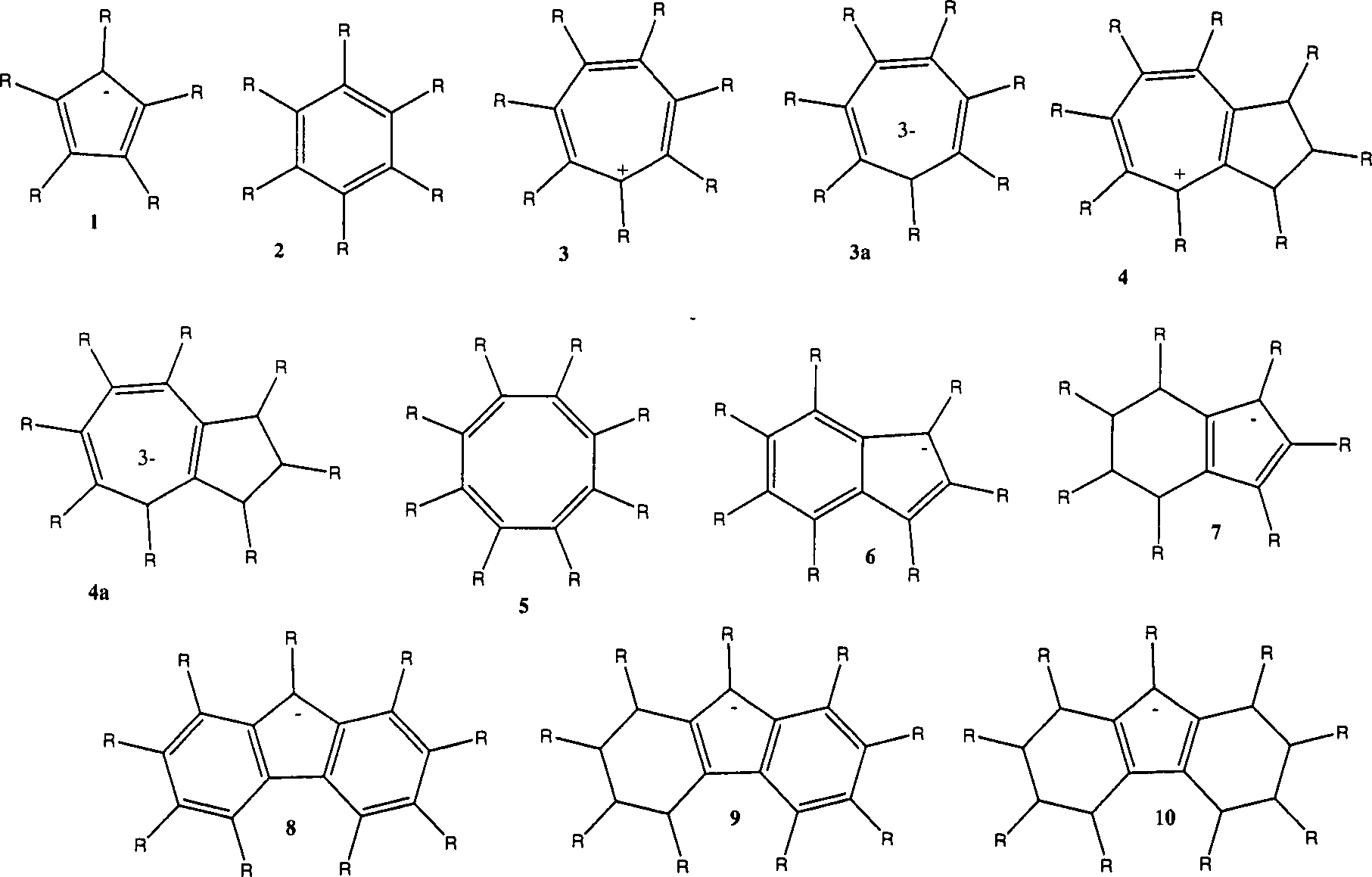
Die Reste R in den Stammverbindungen 1–10 können gleich oder verschieden sein, offenkettig oder Bestandteil eines Ringes oder Ringsystems sein und sind vorzugsweise ausgesucht aus: Alkyl, einschließlich Cycloalkyl, Aryl, obigen Heteroatomen. Die Alkyl- bzw. Arylgruppen können ganz oder teilweise mit einem oder mehreren, gleichen oder unterschiedlichen Heteroatomen aus obiger Liste substituiert sein. Es versteht sich, dass die obigen Reste R aber auch ganz allgemein Reste gemäß der Erfindung solche mit einem +I-Effekt und/oder +M-Effekt auf einen ungesättigten oder aromatischen Ring sein können (oder P anstelle von N). Allgemein können auch die Reste R in erfindungsgemäßen Verbindungen auch ungesättigte Gruppen aufweisen, z.B. mit C=C, C=N Bindungen oder dergleichen.The Radicals R in the parent compounds 1-10 may be the same or different be open-chain or part of a ring or ring system and are preferably selected from: alkyl, including cycloalkyl, Aryl, above heteroatoms. The alkyl or aryl groups can completely or partially with one or more, the same or different Heteroatoms be substituted from the above list. It is understood that the above radicals R but also very generally radicals according to the invention those with a + I effect and / or + M effect on an unsaturated one or aromatic ring (or P instead of N). In general, the radicals R can also be used in compounds according to the invention also unsaturated Have groups, e.g. with C = C, C = N bonds or the like.
Das Zentralatomen der Komplexe kann jeweils ausgewählt sein aus der Gruppe Mn, Fe, Co, Ni, Cu, Zn oder ausgewählt aus der Gruppe Cr, Mo, W, besonders bevorzugt solche ausgewählt aus der Gruppe Fe, Co, Ni, beispielsweise Komplexe mit Fe oder Co. Das Zentralatom kann auch ein anderes Metallatom der Gruppen 6 oder 7 bis 10 darstellen.The Central atoms of the complexes can each be selected from the group Mn, Fe, Co, Ni, Cu, Zn or selected from the group Cr, Mo, W, particularly preferably those selected from the group Fe, Co, Ni, for example complexes with Fe or Co. The Central atom can also be another group 6 or metal atom 7 to 10 represent.
Insbesondere können jeweils 1, 2 oder sämtliche der Liganden Cyclopentadienyl oder Benzol sein oder ausgewählt sein aus der Gruppe der Verbindungen 3, 4 und 5 oder ausgewählt sein aus der Gruppe der Verbindungen 6, 8 und 9, insbesondere auch die Verbindung 8 sein, oder ausgewählt sein aus der Gruppe der Verbindungen 7, 10, wobei die Liganden jeweils substituiert oder unsubstituiert sein können.Especially can each 1, 2 or all be the ligand cyclopentadienyl or benzene or selected be selected from the group of compounds 3, 4 and 5 or from the group of compounds 6, 8 and 9, in particular also the Compound 8, or selected be from the group of compounds 7, 10, wherein the ligands respectively may be substituted or unsubstituted.
Paddlewheel-Komplexe und mehrkernige Komplexe allgemein Nach einer vorteilhaften Ausführungsform ist der erfindungsgemäße Metallkomplex ein mehrkerniger Metallkomplex. Insbesondere kann der Metallkomplex ein mehrkerniger Metallkomplex mit zumindest einem, zwei, drei oder vier oder gegebenenfalls auch mehr Liganden sein, die an zumindest zwei Metallzentralatome binden. Der Metallkomplex kann hierbei auch eine, zwei oder mehr Metall-Metall-Bindungen aufweisen, die jeweils Metall-Metall-Einfachbindungen oder Metall-Metall-Mehrfachbindungen darstellen können. Der mehrkernige Komplex kann zwei, drei oder auch vier oder mehr Metallzentralatome aufweisen. Vorzugsweise enthält der Komplex nicht mehr als 20 oder nicht mehr als 10 Metallatome oder nicht mehr als 6 oder 4, insbesondere nicht mehr als 3 Metallatome. Die Metallkomplexe stellen jeweils vorzugsweise isolierte Moleküle dar. Mehrkernige Komplexe können insbesondere Carbonyl- oder Cyclopendienyl-Komplexe sein.Paddlewheel complexes and polynuclear complexes in general According to an advantageous embodiment is the metal complex according to the invention a polynuclear metal complex. In particular, the metal complex a polynuclear metal complex having at least one, two, three or four or optionally also more ligands, which at least bind two metal central atoms. The metal complex can also be a, have two or more metal-to-metal bonds, each metal-to-metal single bonds or metal-metal multiple bonds. Of the polynuclear complex may have two, three or even four or more central metal atoms exhibit. Preferably contains the complex does not contain more than 20 or not more than 10 metal atoms or not more than 6 or 4, in particular not more than 3 metal atoms. The metal complexes are each preferably isolated molecules. Multinuclear complexes can especially carbonyl or cyclopendienyl complexes.
Die Metallatome mehrkerniger Metallkomplexe sind vorzugsweise überwiegend oder sämtlich Übergangsmetallatome, insbesondere der 6ten oder 7ten bis 10ten Gruppe, beispielsweise ausgewählt aus der Gruppe Cr, Mn, Fe, Co, Ni, Cu, Zn, Mo, W.The Metal atoms of polynuclear metal complexes are preferably predominant or all transition metal atoms, in particular the 6th or 7th to 10th group, for example selected from the group Cr, Mn, Fe, Co, Ni, Cu, Zn, Mo, W.
Ein
derartiger Metallkomplex kann beispielsweise ein sogenannter Paddlewheel-Komplex
65 sein, wobei zwei Metallzentralatome, insbesondere Übergangsmetallzentralatome
durch 1, 2, 3, 4 oder mehr zweizähnige
Liganden, die an beide Metallzentralatome jeweils ein Ligandenatom
binden, überbrückt werden.
Die Metall atome sind hierbei zumeist 4-fach oder gegebenenfalls
auch 5-fach oder
höher koordiniert: 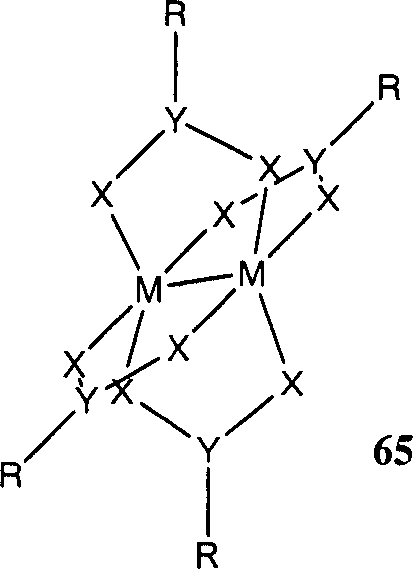
Insbesondere können die mehrkernigen Metallkomplexe mindestens ein Atom aus der Gruppe Mn, Fe, Co, Ni, Cu, Zn, insbesondere ein Atom aus der Gruppe Fe, Co, Ni oder mindestens ein Atom ausgewählt aus der Gruppe Cr, Mo, W, insbesondere auch Mo, W aufweisen, wobei vorzugsweise sämtliche Zentralatome des neutralen Metallkomplexes identisch sind. Generell kann M ein beliebiges Metallatom, insbesondere ein Übergangsmetallatom sein, beispielsweise ein Übergangsmetallatom der ersten, der zweiten oder der dritten Übergangsmetallperiode oder ein Atom der 6ten oder 7ten bis 10ten Übergangsmetallgruppe. Beide Metallaotme M können hierbei jeweils gleich oder verschieden voneinander sein.In particular, the polynuclear metal complexes may comprise at least one atom from the group Mn, Fe, Co, Ni, Cu, Zn, in particular one atom from the group Fe, Co, Ni or at least one atom selected from the group Cr, Mo, W, in particular also Mo, W, wherein preferably all the central atoms of the neutral metal complex are identical. In general, M can be any metal atom, in particular a transition metal atom, for example a transition metal atom of the first, the second or the third transition transition metal period or an atom of the 6th or 7th to 10th transition metal group. Both Metallaotme M can each be the same or different from each other here.
Anstelle des zweizähnigen, beide Metallzentralatome miteinander überbrückenden Liganden RYX2, können auch ein oder mehrere der Brückenliganden durch einzähnige Liganden ersetzt sein, beispielsweise durch Carbonyl, RCN, substituierte oder unsubstituierte Phosphine oder andere, wobei der Substituent R ein belie biger organischer Rest einschließlich Wasserstoff, insbesondere auch ein Kohlenwasserstoffrest oder ein substituierter oder unsubstituierter Alkylrest, im besonderen ein Alkylrest mit C1 bis C10, insbesondere C1 bis C4 oder bis C6, sein kann.Instead of the bidentate, both metal central atoms bridging ligands RYX 2 , and one or more of the bridging ligands may be replaced by monodentate ligands, for example by carbonyl, RCN, substituted or unsubstituted phosphines or others, wherein the substituent R is a belie biger organic radical including hydrogen, in particular, a hydrocarbon radical or a substituted or unsubstituted alkyl radical, in particular an alkyl radical having C1 to C10, in particular C1 to C4 or to C6, may be.
Mindestens ein, mehrere oder sämtliche der an das Metallatom bindenden Ligandatom(e) X kann können) ausgewählt sein aus der Gruppe F, Cl, Br, I, O, S, Se, N, P, beispielsweise Halogen, vorzugsweise ausgewählt aus der Gruppe O, S, Se, N, P, besonders bevorzugt ausgewählt aus der Gruppe S, Se, N, P, wobei mindestens ein, zwei, drei oder vier oder sämtliche Ligandatome von N verschieden sein können. X kann jedoch auch ein anderes geeignetes Atom sein. Die verschiedenen an das Metallatom bindenden Atome X können innerhalb eines Liganden oder innerhalb des Komplexes gleich oder verschieden sein. Es können somit auch unterschiedliche Liganden L, L' als zweizähnige die beiden Metallatome überbrückende Liganden eingesetzt werden. Das Atom Y ist vorzugsweise ein Hauptgruppenelement, insbesondere ein zwei, drei- oder vierbindiges Hauptgruppenelement. Das Atom Y ist vorzugsweise ausgewählt aus der Gruppe B, C, N, O, Si, P, S, As, Se, Sb, Te, besonders bevorzugt ausgewählt aus der Gruppe O, S, Se, N, P, C, insbesondere ausgewählt aus der Gruppe S, Se, N, P (gegebenenfalls auch O), ohne auf diese beschränkt zu sein.At least one, several or all the ligand atom (s) X binding to the metal atom may be selected) from the group F, Cl, Br, I, O, S, Se, N, P, for example halogen, preferably selected from the group O, S, Se, N, P, particularly preferably selected from the group S, Se, N, P, where at least one, two, three or four or all Ligand atoms of N may be different. However, X can also be one be another suitable atom. The different to the metal atom binding atoms X can within a ligand or within the complex same or to be different. It can thus also different ligands L, L 'as a bidentate ligand bridging the two metal atoms be used. The atom Y is preferably a main group element, in particular a two, three or vierbindiges main group element. The atom Y is preferably selected from the group B, C, N, O, Si, P, S, As, Se, Sb, Te, particularly preferably selected from the group O, S, Se, N, P, C, in particular selected from the group S, Se, N, P (optionally also O), without being limited thereto.
Vorzugsweise ist zumindest ein Ligand, zwei, mehrere oder sämtliche Liganden ausgewählt aus der Gruppe der Halogenide, Carboxylate, Formamidinate, Pyrimidino-Pyrimidine einschließlich deren Anionen, insbesondere substituierte oder unsubstituierte Pyrimido[1,2-a]pyrimidine oder deren Anionen, insbesondere hpp (hpp: Anion von 1,3,4,6,7,8-Hexahydro-2H-pyrimido[1,2-a]pyrimidin), und Guadinate, gegebenenfalls auch Diketonate. Die Liganden können hierbei jeweils gleich oder verschieden voneinander sein. Insbesondere ist mindestens ein Ligand ein Carboxylat, ein Formamidilat, ein Pyrimidino-Pyrimidine, insbesondere hpp, oder ein Guadinin. Insbesondere sind sämtliche Liganden des Komplexes jeweils ein Carboxylat, ein Formamidilat, ein Pyrimidino-Pyrimidine, insbesondere hpp, oder ein Guadinin, wobei sämtliche Liganden des Komplexes vorzugsweise gleich sind. Besonders bevorzugt sind die Liganden ausgewählt aus der Gruppe der Carboxylate, Formamidinate, Pyrimido-Pyrimidine und Guadinate. Die Gruppen Y aber auch X, im speziellen die Carboxylate, Formamidilate, Pyrimidino-Pyrimidine und Guadinate, gegebenenfalls auch Diketonate können jeweils substituiert oder unsubstituiert sein, beispielsweise substituierte oder unsubstituierte Alkylreste oder Kohlenwasserstoffreste aufweisen, beispielsweise jeweils mit C1 bis C10 oder höher, insbesondere C1 bis C6 oder C2 bis C4, oder andere Substituenten.Preferably At least one ligand, two, several or all ligands is selected from the group of halides, carboxylates, formamidinates, pyrimidino-pyrimidines including their anions, in particular substituted or unsubstituted pyrimido [1,2-a] pyrimidines or their anions, in particular hpp (hpp: anion of 1,3,4,6,7,8-hexahydro-2H-pyrimido [1,2-a] pyrimidine), and guadinate, optionally also diketonates. The ligands can hereby each be the same or different from each other. In particular at least one ligand, a carboxylate, a formamidilate, a pyrimidino-pyrimidines, especially hpp, or a guadinin. In particular, all are Ligands of the complex in each case a carboxylate, a formamidilate, a pyrimidino-pyrimidines, especially hpp, or a guadinin, where all Ligands of the complex are preferably the same. Especially preferred the ligands are selected from the group of carboxylates, formamidinates, pyrimido-pyrimidines and Guadinate. The groups Y but also X, in particular the carboxylates, Formamidilates, pyrimidino-pyrimidines and guadinates, optionally also Diketonate can each substituted or unsubstituted, for example substituted or unsubstituted alkyl radicals or hydrocarbon radicals, for example, in each case with C1 to C10 or higher, in particular C1 to C6 or C2 to C4, or other substituents.
An dieser Stelle aber auch generell im Rahmen dieser Erfindung umfasst der Begriff „Alkylrest" auch Cycloalkylreste mit, insbesondere Cycloheptyl-, Cyclohexyl- oder Cyclopentylreste.At but also generally within the scope of this invention the term "alkyl" also cycloalkyl radicals with, in particular cycloheptyl, cyclohexyl or cyclopentyl radicals.
Weitere KomplexligandenFurther complex ligands
Vorzugsweise ist zumindest ein, zwei oder mehr oder sämtliche der Liganden ausgewählt aus der Gruppe der Borate, Carborane, Triazacycloalkane, Triazacycloalkene, Pyrrole, Thiophene, Pyrazole, Imidazole, Thiazole, Oxazole, Pyridine, Pyridazine, Pyrimidine, Pyrazine. Insbesondere sind zumindest ein, zwei oder mehr oder sämtliche Liganden ausgewählt aus der Gruppe der Borate, Carborane. Es können mindestens einer, mehrere oder sämtliche der Liganden ausgewählt sein aus der Gruppe der Triazacycloalkane, Triazacycloalkene, gegebenenfalls auch andere Amine. Es können mindestens ein, zwei oder mehrere oder sämtliche Liganden ausgewählt sein aus der Gruppe der Pyrrole, Thiophene, Pyrazole, Imidazole, Thiazole und gegebenenfalls Oxazole. Zumindest ein, zwei oder mehrere oder sämtliche der Liganden können ausgewählt sein aus der Gruppe Pyrine, Pyridazine, Pyrimidine, Pyradzine. Die Liganden können jeweils gleich oder verschieden sein und jeweils aus einer der genannten Gruppen oder aus mehreren der genannten Gruppen ausgewählt sein. Insbesondere kann dann, wenn ein Ligand ausgewählt ist aus der Gruppe der Borate und Carborane, ein anderer Ligand ein Aren- bzw. Arenyl-Pi-Ligand wie beispielsweise ein substituiertes oder unsubstituiertes Cyclopentadienyl, Benzol oder Cycloheptatrienyl-Ion sein kann.Preferably At least one, two or more or all of the ligands are selected from the group of borates, carboranes, triazacycloalkanes, triazacycloalkenes, Pyrroles, thiophenes, pyrazoles, imidazoles, thiazoles, oxazoles, pyridines, Pyridazines, pyrimidines, pyrazines. In particular, at least one, two or more or all Ligands selected from the group of borates, carborane. At least one, several or all the ligands selected from the group of triazacycloalkanes, triazacycloalkenes, if appropriate also other amines. It can at least one, two or more or all ligands selected from the group of pyrroles, thiophenes, pyrazoles, imidazoles, thiazoles and optionally oxazoles. At least one, two or more or all the ligands can selected be from the group pyrines, pyridazines, pyrimidines, pyradzines. The Ligands can each be the same or different and each one of the above Groups or selected from several of the groups mentioned. In particular, when a ligand is selected from the group of borates and carborane, another ligand an arene or arenyl Pi ligand such as a substituted or unsubstituted cyclopentadienyl, benzene or cycloheptatrienyl ion.
Das Zentralatom des jeweiligen Komplexes kann jeweils ausgewählt sein aus der Gruppe Mn, Fe, Co, Ni, Cu, Zn oder ausgewählt aus der Gruppe Cr, Mo, W, besonders bevorzugt solche ausgewählt aus der Gruppe Fe, Co, Ni, beispielsweise Komplexe mit Fe oder Co. Das Zentralatom kann auch ein anderes Metallatom der Gruppen 6 oder 7 bis 10 darstellen.The Central atom of the respective complex can be selected in each case from the group Mn, Fe, Co, Ni, Cu, Zn or selected from the group Cr, Mo, W, particularly preferably those selected from the group Fe, Co, Ni, for example complexes with Fe or Co. The Central atom can also be another group 6 or metal atom 7 to 10 represent.
Carboranecarborane
Bevorzugte Carborane sind solche des Typs [R2C2B4]–, [R2C2B9H9]2– [R2C2B10H10l2, wobei R beliebige Substituenten sein können, insbesondere Alkylsubstituenten, insbesondere niedere Alkylsubstituenten mit C1–6. Die Substituenten R können jeweils gleich oder verschieden sein.Preferred carboranes are those of the type [R 2 C 2 B 4 ] - , [R 2 C 2 B 9 H 9 ] 2- [R 2 C 2 B 10 H 10 l 2 , where R can be any substituents, in particular alkyl substituents, in particular lower alkyl substituents with C 1-6 . The substituents R may each be the same or different.
Borateborates
Ist der Ligand ein Borat-Anion, so weist das Borat vorzugsweise die allgemeine Struktur 15 (Tabelle 2) auf, wobei R ein beliebiger Substituent, bevorzugt H, Alkyl, insbesondere Niederalkyl mit C1–C6 oder Aryl, insbesondere Benzyl, oder allgemein ein Kohlenwasserstoffrest, ist. Es versteht sich, dass der Substituent R auch Heteroatome aufweisen kann, insbesondere N, O oder Halogen. R' ist ein beliebiger Substituent, bevorzugt Alkyl, insbesondere Niederalkyl mit C1 bis C6 oder Aryl, wobei R' Heteroatome wie insbesondere N, O, Halogen aufweisen kann. R' kann auch ein reiner Kohlenwasserstoff sein. Für R'' gelten die Ausführungen zu R. Die verschiedenen Substituenten R, R' oder R'' können jeweils gleich oder verschieden sein. Zwei Substituenten R'' können Teil eines Ringsystems sein, insbesondere Teil eines gleichen Ringsystems, bevorzugt Teil eines am Grundgerüst bzw. Stammkörper ankondensierten Ringsystems. Das Ringsystem kann gesättigt, ungesättigt, insbesondere aromatisch, sein. E ist ein zumindest zweibindiges Atom und kann ausgewählt sein aus der Gruppe O, S, Se, Te, gegebenenfalls ausgewählt aus der Gruppe O, S, Se oder ausgewählt aus der Gruppe S, Se und Te. Die Gruppe E der verschiedenen Ringsysteme kann jeweils gleich oder verschieden sein. X stellt einen „Spacer" dar, wobei in der Verbindung 15 gegebenenfalls 1, 2 oder 3 der Gruppen X fehlen können. X kann eine verzweigte oder unverzweigte Alkylkette mit oder ohne Heteroatomsubstituenten, insbesondere eine Alkylkette mit 1 bis 6, insbesondere 1 bis 4 oder 1 bis 2 sein, ein Arylsubstituent, einschließlich eines heterosubstituierten Arylsubstituenten, ein kondensierter Arylsubstituent mit oder ohne Heteroatomen, ein Alkylarylsubstituent mit oder ohne Heteroatom oder ein Heteroatom sein. Das Heteroatom ist jeweils bevorzugt ausgewählt aus der Gruppe N, P, S, Se, Ge, Sn, ohne hierauf beschränkt zu sein. Die verschiedenen Gruppen X in der Verbindung 15 können jeweils gleich oder verschieden sein. Bevorzugt ist X eine Alkylkette, besonders bevorzugt eine Niederalkylkette mit C1 bis C6. Y ist ein donorfähiges Hetero- oder Kohlenstoffatom, bevorzugt ausgewählt aus der Gruppe N, P, S, Se, Ge, Sn, gegebenenfalls ausgewählt aus der Gruppe N, P, S, Se oder ausgewählt aus der Gruppe P, S, Se, Ge, Sn. Die verschiedenen Donoratome Y können in der Verbindung 15 jeweils gleich oder verschieden sein. Y kann Teil eines Ringes oder eines Ringsystems sein, insbesondere eines ungesättigten Ringes oder Ringsystems, einschließlich eines aromatischen bzw. heteroaromatischen Ringsystems. Der das donorfähige Hetero- oder Kohlenstoffatom Y aufweisende Ring umfasst vorzugsweise 5 bis 7 Ringatome, beispielsweise 5 oder 6. Der das Donoratom Y enthaltende Ring kann jeweils mehrere Heteroatome aufweisen, die gleich oder verschieden sein können, beispielsweise zwei oder drei. Die Heteroatome können jeweils beispielsweise N-Atome sein oder mindestens ein N-Atom aufweisen.is the ligand is a borate anion, the borate preferably has the general structure 15 (Table 2), where R is any substituent, preferably H, alkyl, in particular lower alkyl with C1-C6 or Aryl, in particular benzyl, or in general a hydrocarbon radical, is. It is understood that the substituent R also have heteroatoms can, in particular N, O or halogen. R 'is any substituent, preferably alkyl, in particular lower alkyl having C 1 to C 6 or aryl, where R 'is heteroatoms such as in particular N, O, halogen may have. R 'can also be a pure hydrocarbon be. For R '' apply the statements to R. The various substituents R, R 'or R "may each be be the same or different. Two substituents R "can Be part of a ring system, in particular part of a same ring system, preferably part of the backbone or parent body fused ring system. The ring system can be saturated, unsaturated, in particular be aromatic. E is at least a divalent atom and can selected from the group O, S, Se, Te, optionally selected from the group O, S, Se or selected from group S, Se and Te. The group E of the different ring systems can each be the same or different. X represents a "spacer", wherein in the Compound 15 optionally 1, 2 or 3 of the groups X may be missing. X may be a branched or unbranched alkyl chain with or without Heteroatom substituents, in particular an alkyl chain with 1 to 6, in particular 1 to 4 or 1 to 2, an aryl substituent, including one hetero-substituted aryl substituent, a fused aryl substituent with or without heteroatoms, an alkylaryl substituent with or without Heteroatom or a heteroatom. The heteroatom is respectively preferably selected from the group N, P, S, Se, Ge, Sn, without being limited thereto. The various groups X in compound 15 can each be the same or different. Preferably, X is an alkyl chain, especially preferably a lower alkyl chain with C1 to C6. Y is a donor-capable heterozygous or carbon atom, preferably selected from the group N, P, S, Se, Ge, Sn, optionally selected from the group N, P, S, Se or selected from the group P, S, Se, Ge, Sn. The different donor atoms Y can in compound 15, each may be the same or different. Y can Part of a ring or a ring system, in particular one unsaturated Ring or ring system, including an aromatic or heteroaromatic ring system. The donor-capable hetero or carbon atom Y ring preferably comprises 5 to 7 ring atoms, for example 5 or 6. The donor atom Y-containing ring may each have several Have heteroatoms, which may be the same or different, for example two or three. The heteroatoms may each be, for example Be N atoms or have at least one N-atom.
Insbesondere kann das Borat weniger als drei, als zwei als ein oder kein Sauerstoff-Donoratom aufweisen.Especially For example, the borate may be less than three, as two as one or no oxygen donor atom exhibit.
Insbesondere kann das Borat eine der Verbindungen 11, 12, 13, 14 oder 16 sein, wobei der Metallkomplex auch unterschiedliche Borat-Liganden, insbesondere unterschiedliche Borat-Liganden der genannten Gruppe der Verbindungen 11, 12, 13, 14, 16 aufweisen kann.Especially the borate may be one of the compounds 11, 12, 13, 14 or 16, wherein the metal complex also different borate ligands, in particular different borate ligands of said group of compounds 11, 12, 13, 14, 16 may have.
Das Atom Y kann hierbei, wie auch allgemein bei Boraten, insbesondere Boraten gemäß der Verbindung 15, jeweils auch Bestandteil eines Pyrrol-, Indol, Carbazol-, Furan-, Benzofuran-, Thiophen-, Benzothiophen, Pyradzol-, Imidazol-, Thiazol-, oder Oxazol-Ringes sein. Eines oder mehrere der Atome Y können auch Bestandteil eines Pyridin-, Chinolin-, Isochinolin-, Acridin-, Pyridazin-, Pyrimidin-, Pyrazin-, Chinoxalin-, Pteridin-, oder Purin-Ringes sein, wobei das an das Zentralatom bindende Donoratom Y Bestandteil eines 5- oder 6-gliedrigen Ringes sein kann. Allgemein kann Y Bestandteil eines (hetero)aromatischen Ringes sein. Die genannten Ringe können jeweils auch teilweise oder vollständig gesättigt sein. Allgemein kann Y Bestandteil eines 3- bis 8-gliedrigen, insbesondere 3, 3- bis 6-gliedrigen, insbesondere 5- oder 6-gliedrigen Ringes sein. Y kann, insbesondere als Ring, die Heteroatome O, N, P, S, Se, Ge, Sn aufweisen, insbesondere die Heteroatome O, N, P, S. C kann hierbei ein Carbanion bilden; C, Ge und Si können Carbene (C(II)), Germylene (Ge(II)) und Silylene (Si(II)) bilden. Vorzugsweise weist der Ring eine oder zwei Mehrfachbindungen auf, die mit dem Donoratom Y in Konjugation stehen.The Atom Y can hereby, as well as in general with borates, in particular Borates according to the compound 15, each also part of a pyrrole, indole, carbazole, furan, Benzofuran, thiophene, benzothiophene, pyrazole, imidazole, thiazole, or oxazole ring. One or more of the atoms Y can also be part of it a pyridine, quinoline, isoquinoline, acridine, pyridazine, pyrimidine, Pyrazine, quinoxaline, pteridine, or purine ring, wherein the donor atom Y binding to the central atom is part of a 5- or 6-membered ring. Generally, Y can be component of a (hetero) aromatic ring. The rings mentioned can each also partially or completely saturated be. In general, Y can be part of a 3- to 8-membered, in particular 3-, 3- to 6-membered, in particular 5- or 6-membered ring be. Y can, in particular as a ring, the heteroatoms O, N, P, S, Se, Ge, Sn, in particular the heteroatoms O, N, P, S. C can form a carbanion here; C, Ge and Si can Carbene (C (II)), germylene (Ge (II)) and silylenes (Si (II)). Preferably the ring has one or two multiple bonds with the donor atom Y in conjugation.
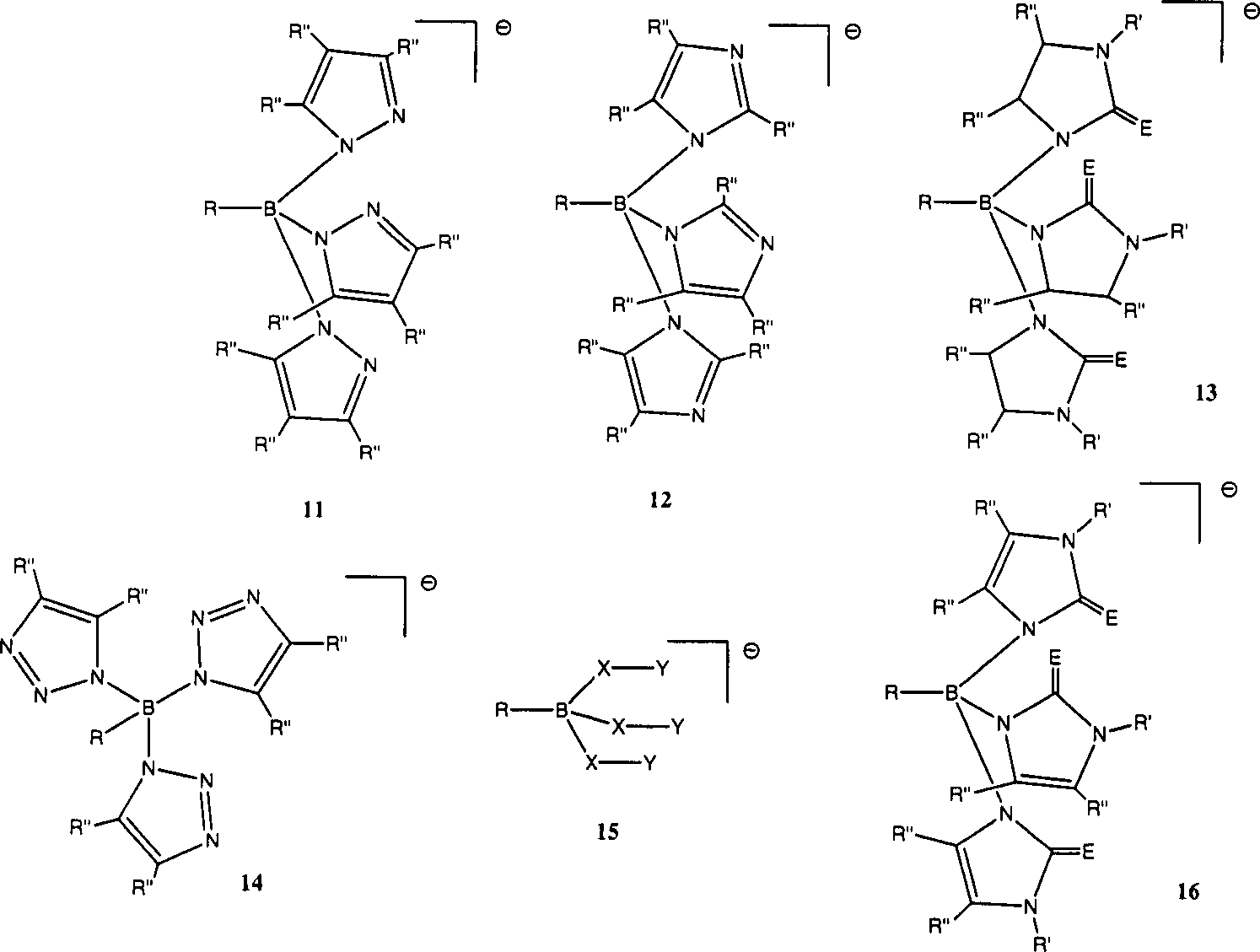
Es versteht sich, dass die Reste Y in der Verbindung 15 gleich oder verschieden sein können.It it is understood that the radicals Y in the compound 15 are the same or can be different.
Gegebenenfalls kann das Borat ausgehend von der Verbindung 15 oder von einer der Verbindungen 11, 12, 13, 14 oder 16 auch lediglich ein zweizähniger oder auch nur einzähniger Ligand sein, in dem eine oder zwei der X-Y-Gruppen durch jeweils einen Substituenten R, unabhängig voneinander, einschließlich H, ersetzt sind, wobei zwei Substituenten R auch einen gesättigten oder ungesättigten Ring bilden können. Die dreizähnigen Boratliganden können hierbei insbesondere facial an das Zentralatom koordinieren.Possibly For example, borate may be derived from compound 15 or from one of the Compounds 11, 12, 13, 14 or 16 also merely a bidentate or also only monodentate Ligand, in which one or two of the X-Y groups by respectively a substituent R, independently from each other, including H, are replaced, where two substituents R are also saturated or unsaturated Can form a ring. The tridentate ones Borate ligands can in particular, coordinate facial to the central atom.
Gegebenenfalls kann in der Verbindung 15 das B-Atom auch durch ein Al- oder ein Ga-Atom ersetzt sein.Possibly can in compound 15, the B atom also by an Al or a Ga atom be replaced.
Das Zentralatom der Carboran- oder Borat-Metallkomplexe, insbesondere der Verbindungen 11, 12, 13, 14, 16, kann vorzugsweise ausgewählt sein aus der Gruppe Cr, Mn, Fe, Co, Ni, Cu, Zn, insbesondere aus der Gruppe Fe, Co, Ni, das Metallatom kann auch ausgewählt sein aus der Gruppe Cr, Mo, W, beispielsweise Cr, Mo oder W sein, oder ein Metall der Übergangsmetallgruppen 7 bis 10 darstellen.The Central atom of the carborane or borate metal complexes, in particular Compounds 11, 12, 13, 14, 16 may preferably be selected from the group Cr, Mn, Fe, Co, Ni, Cu, Zn, in particular from Fe, Co, Ni group, the metal atom may also be selected from the group Cr, Mo, W, for example Cr, Mo or W, or a metal of the transition metal groups 7 to 10 represent.
Tripod-LigandenTripod ligands
Nach
einer weiteren vorteilhaften Ausführungsform kann mindestens
ein, zwei oder sämtliche
der Liganden des neutralen Metallkomplexes Tripod-Liganden 18 sein,
die somit drei Ligandatome aufweisen, 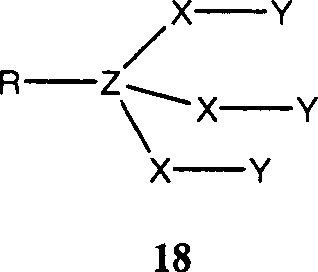
Insbesondere ist im Tripodliganden ferner Y allgemein ein donorfähiges Atom, das ein Heteroatom oder ein Kohlenstoffatom sein kann. Mindestens eines, mehrere oder sämtliche Heteroatome des Tripodliganden sind vorzugsweise ausgewählt aus der Gruppe N, P, S, Se, Ge, Sn, gegebenenfalls auch Si, ohne hierauf beschränkt zu sein. Das Donoratom kann jeweils eine Ladung tra gen, insbesondere eine negative Ladung, beispielsweise ein carbanionisches Kohlenstoff sein. Das Donoratom kann auch in einer niedrigeren Valenz als seiner maximalen Valenz auftreten, beispielsweise ein Carben-Kohlenstoffatom, ein Germylen-Germaniumatom, ein Silylen-Siliziumatom, ein Sn(II) oder auch ein Pb(II)-Atom sein. Vorzugsweise ist mindestens ein Donoratom des Liganden ein Carbanion-Kohlenstoffatom oder ein Atom mit niedrigerer als maximaler Valenz, insbesondere C, Ge, Si, besonders bevorzugt gilt dies für sämtliche Donoratome des Liganden. Gegebenenfalls kann Y auch Bestandteil eines Ringes oder Ringsystems sein. Vorzugsweise sind die Donoratome des Tripodliganden untereinander gleich, sie können aber auch verschieden voneinander sein.Especially in the tripod ligand, furthermore, Y is generally a donor-capable atom, which may be a heteroatom or a carbon atom. At least one, several or all Heteroatoms of the tripod ligand are preferably selected from the group N, P, S, Se, Ge, Sn, optionally also Si, without being limited thereto. The donor atom can each carry a charge, in particular a negative charge, for example a carbanionic carbon be. The donor atom may also be in a lower valence than its maximum valence, for example a carbene carbon atom, a germylene germanium atom, be a silylene silicon atom, a Sn (II) or a Pb (II) atom. Preferably, at least one donor atom of the ligand is a carbanion carbon atom or an atom of lower than maximum valence, in particular C, Ge, Si, more preferably this applies to all donor atoms of the ligand. Optionally, Y may also be part of a ring or ring system be. Preferably, the donor atoms of the tripod ligand are mutually exclusive the same, you can but also be different from each other.
Vorzugsweise
weist der Ligand zumindestens ein oder zwei an das zumindest eine
Metallzentralatom bindende Donoratome als Carbanionkohlenstoffatom
oder bezogen auf den Liganden ein formal zweibindiges bzw. zweiwertiges
Atom ausgewählt
aus der Gruppe C (Carben), Si (Silylen), Ge (Germylen), gegebenenfalls auch
Sn oder Pb, auf, die jeweils Bestandteil eines aromatischen oder
nicht aromatischen, vorzugsweise ungesättigten Ringes sind, wobei
die Mehrfachbindung in Konjugation mit den freien Elektronen des
Donoratoms stehen kann. Vorzugsweise weist der das Donoratom aufweisende
Ring zumindest ein oder zwei weitere Heteroatom auf, vorzugsweise
ausgewählt
aus der Gruppe N, P, As, S, Se oder Te, insbesondere N, S, Se, die jeweils
gleich oder verschieden sein können. Triazacycloalkane 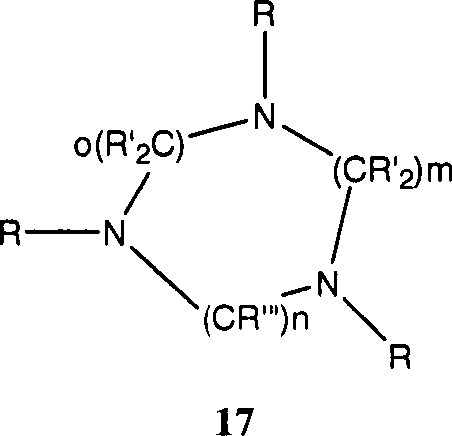
Einer, zwei, mehrere oder sämtliche der Liganden des erfindungsgemäßen Metallkomplexes können Triazacycloalkane sein, insbesondere solche der allgemeinen Formel 17, wobei m, n, o ganze Zahlen sind, vorzugsweise jeweils unabhängig voneinander ganze Zahlen von 0 bis 6, vorzugsweise von 0 bis 4, besonders bevorzugt jeweils unabhängig voneinander 1 oder 2. m, n und o können jeweils gleich oder verschieden voneinander sein. Substituenten R können beliebige Reste, bevorzugt Alkylreste, insbesondere Niederalkylreste mit C1 bis C6, oder Arylreste sein, einschließlich Wasserstoff. Die Alkyl- oder Arylreste können substituiert oder unsubstituiert sein. Die Reste können jeweils gleich oder verschieden sein. Alle oder mehrere der Substituenten R können freie Elektronenpaare sein, wodurch der Ligand formal eine oder mehrere negative Ladungen erhält. Die Reste R' können beliebige Substituenten, bevorzugt Wasserstoff, Alkyl oder Aryl sein, wobei im Einzelnen die Ausführungen zu dem Rest R entsprechend gelten. Die verschiedenen Reste R' können gleich oder verschieden sein. Es versteht sich, dass eines oder mehrere der N-Atome der Triazacycloalkane auch durch ein Atom ausgewählt aus der Gruppe P, As, Sb ersetzt sein können. Bevorzugt sind hierbei Triphosphacycloalkane.a, two, several or all the ligands of the metal complex according to the invention can triazacycloalkanes in particular those of the general formula 17, where m, n, o are integers, preferably in each case independently of one another integers from 0 to 6, preferably from 0 to 4, more preferably in each case independently each other 1 or 2. m, n and o may each be the same or different be from each other. Substituents R can be any radicals, preferably Alkyl radicals, in particular lower alkyl radicals with C1 to C6, or aryl radicals be inclusive Hydrogen. The alkyl or aryl radicals may be substituted or unsubstituted be. The remains can each same or different. All or more of the substituents R can be free electron pairs, whereby the ligand formally a or receives several negative charges. The radicals R 'can be any Substituents, preferably hydrogen, alkyl or aryl, wherein in detail, the versions apply to the rest R accordingly. The different radicals R 'can be the same or be different. It is understood that one or more the N atoms of Triazacycloalkane also selected by an atom the group P, As, Sb can be replaced. Preference is given here Triphosphacycloalkane.
Ferner versteht es sich, dass für den Fall, dass m, n und/oder o ganze Zahlen von 2 oder größer sind, die genannten Gruppen zwischen den Heteroatomen des zyklischen Liganden auch ungesättigt sein können, beispielsweise unter Ausbildung von Triaza(hetero)cycloalkenen, -dialkenen, -trialkenen oder dergleichen. Die Alkyl- oder Arylreste der Substituenten R und/oder R' können jeweils auch Heteroatome aufweisen.Further it is understood that for the case that m, n and / or o are integers of 2 or greater, the groups between the heteroatoms of the cyclic ligand also unsaturated can be, for example with formation of triaza (hetero) cycloalkenes, dialkens, -trialkenes or similar. The alkyl or aryl radicals of the substituents R and / or R 'can each also have heteroatoms.
Fullerenefullerenes
Bevorzugt sind weiterhin Komplexe, bei welchen mindestens ein, zwei oder sämtliche der Liganden Buckminster-Fullerene sind, die an das Zentralatom des Komplexes binden. Die Buckminster-Fullerene können insbesondere C60- und/oder C70-Fulerene sein. Derivate dieser Fullerene, insbesondere substituierte Fullere ne, seien hiermit mit umfasst. Die Fullerene stellen hierbei letztlich substituierte Cyclopentadienyl-Liganden dar, da diese über den Cyclopentadienyl-Ring das Zentralmetallatom komplexieren.Prefers are furthermore complexes in which at least one, two or all the ligands are Buckminster fullerenes attached to the central atom of the complex. The Buckminster fullerenes can in particular C60 and / or C70-Fulerene. Derivatives of these fullerenes, in particular substituted fullerenes ne, are hereby included. The fullerenes ultimately represent this substituted cyclopentadienyl ligands, since these on the Cyclopentadienyl ring complex the central metal atom.
Pincer-LigandenPincer ligands
Besonders bevorzugt sind ferner sogenannte Pincer-Liganden, die gegenüber dem Zentralmetallatom des Komplexes als dreizähnige Liganden wirken. Insbesondere können derartige Pincer-Liganden meridional an das Zentralatom gebunden sein. Die Pincer-Liganden können insbesondere 6-Elektronendonatoren darstellen. Die (formal unkomlexierten) Pincer-Liganden können neutral oder geladen sein, vorzugsweise negativ geladen.Especially Also preferred are so-called pincer ligands which are opposite to the Central metal atom of the complex act as tridentate ligands. Especially can such pincer ligands meridional bound to the central atom be. The pincer ligands can in particular represent 6-electron donors. The (formally uncomplicated) Pincer ligands can be neutral or charged, preferably negatively charged.
Vorzugsweise weisen ein, zwei oder sämtliche der Pincer-Liganden des Komplexes eine der allgemeinen Strukturen 27, 27a, 28 oder 28a gemäß untenstehenden Formeln auf, beispielsweise weisen ein, zwei oder sämtliche Pincer-Liganden des Komplexes eine der Strukturen 27 oder 28 bzw. 27a oder 28a auf. Insbesondere können sämtliche Liganden des Komplexes eine der Strukturen 27 oder 27a oder 28 oder 28a aufweisen. Es versteht sich, dass die Pincer-Liganden eines Komplexes gleich oder verschieden sein können. Die Pincer-Liganden weisen somit einen zentralen Ring mit einem Heteroatom Z oder C=Atom (Carbanion), welches an das Zentralmetallatom bindet, sowie zwei weitere Ligandenatome Y auf, die über Brückenatome oder verbrückende Atomgruppen X mit dem das Heteroatom Z aufweisenden Ring verbunden sind. Gegebenenfalls können auch eine oder mehrere der Gruppen X in dem Liganden gemäß den Verbindungen 27, 27a, 28 oder 28a fehlen. Die Gruppen X und/oder Y innerhalb des Liganden 27, 27a, 28 oder 28a können jeweils gleich oder verschieden sein. Insbesondere kann der das mittlere Ligandatom des Pincer-Liganden tragende Ring ein 5-gliedriger oder 6-gliedriger Ring sein, der gegebenenfalls ein oder mehr Heteroatome aufweisen kann, von denen eines ein Donoratom sein kann. Eine oder beide der X-Y-Gruppen können hierbei ebenfalls Ringe oder Bestandteile von Ringsyste men darstellen, insbesondere Bestandteile von 5- oder 6-gliedrigen Ringen, die jeweils neben dem Atom Y weitere Heteroatome aufweisen kann. Das Atom Y kann jeweils auch ein Kohlenstoffatom sein. Zumindest eines, zwei oder drei Donoratome Y, Y' und Z des Pincer-Liganden oder eines, zwei oder drei oder mehr der Donoratome des mindestens zwei Pincer-Liganden aufweisenden Komplexes können verschieden von Stickstoff sein. Der Pincer-Ligand kann zumindest einen oder zwei oder mehr jeweils ein Ligandatom enthaltenden Ring mit einer Anzahl von Ringatomen aufweisen, die von 6 verschieden ist, insbesondere einen 5-Ring. Dieser Ring kann der das mittlere Ligandenatom Z enthaltende Ring sein oder eine der X-Y-Gruppen bilden. Sämtliche Donatoratome können Bestandteil eines 5-gliedrigen Ringes sein, der jeweils ungesättigt oder aromatisch sein kann.Preferably have one, two or all the pincer ligands of the complex one of the common structures 27, 27a, 28 or 28a below Formulas include, for example, one, two or all Pincer ligands of the complex one of the structures 27 or 28 or 27a or 28a on. In particular, you can all Ligands of the complex one of the structures 27 or 27a or 28 or 28a have. It is understood that the pincer ligands of a Complex may be the same or different. The pincer ligands point thus a central ring with a heteroatom Z or C = atom (carbanion), which binds to the central metal atom, and two other ligand atoms Y on, over bridge atoms or bridging Atom groups X connected to the heteroatom Z having ring are. If necessary, you can also one or more of the groups X in the ligand according to the compounds 27, 27a, 28 or 28a are missing. The groups X and / or Y within of ligand 27, 27a, 28 or 28a may each be the same or different be. In particular, it may be the middle ligand atom of the pincer ligand supporting ring be a 5-membered or 6-membered ring, the optionally one or more heteroatoms may have, of which one may be a donor atom. One or both of the X-Y groups can be used here also represent rings or components of Ringsyste men, in particular Ingredients of 5- or 6-membered Rings, each having in addition to the atom Y further heteroatoms can. The atom Y can also be a carbon atom in each case. At least one, two or three donor atoms Y, Y 'and Z of the pincer ligand or one, two or three or more of the donor atoms of the at least two pincer ligands having complex can be different from nitrogen. The pincer ligand can at least one or two or more rings each containing a ligand atom having a number of ring atoms other than 6 is, in particular a 5-ring. This ring may contain the ring containing the middle ligand atom Z. or form one of the X-Y groups. All donor atoms can be part of it be a 5-membered ring, each unsaturated or can be aromatic.

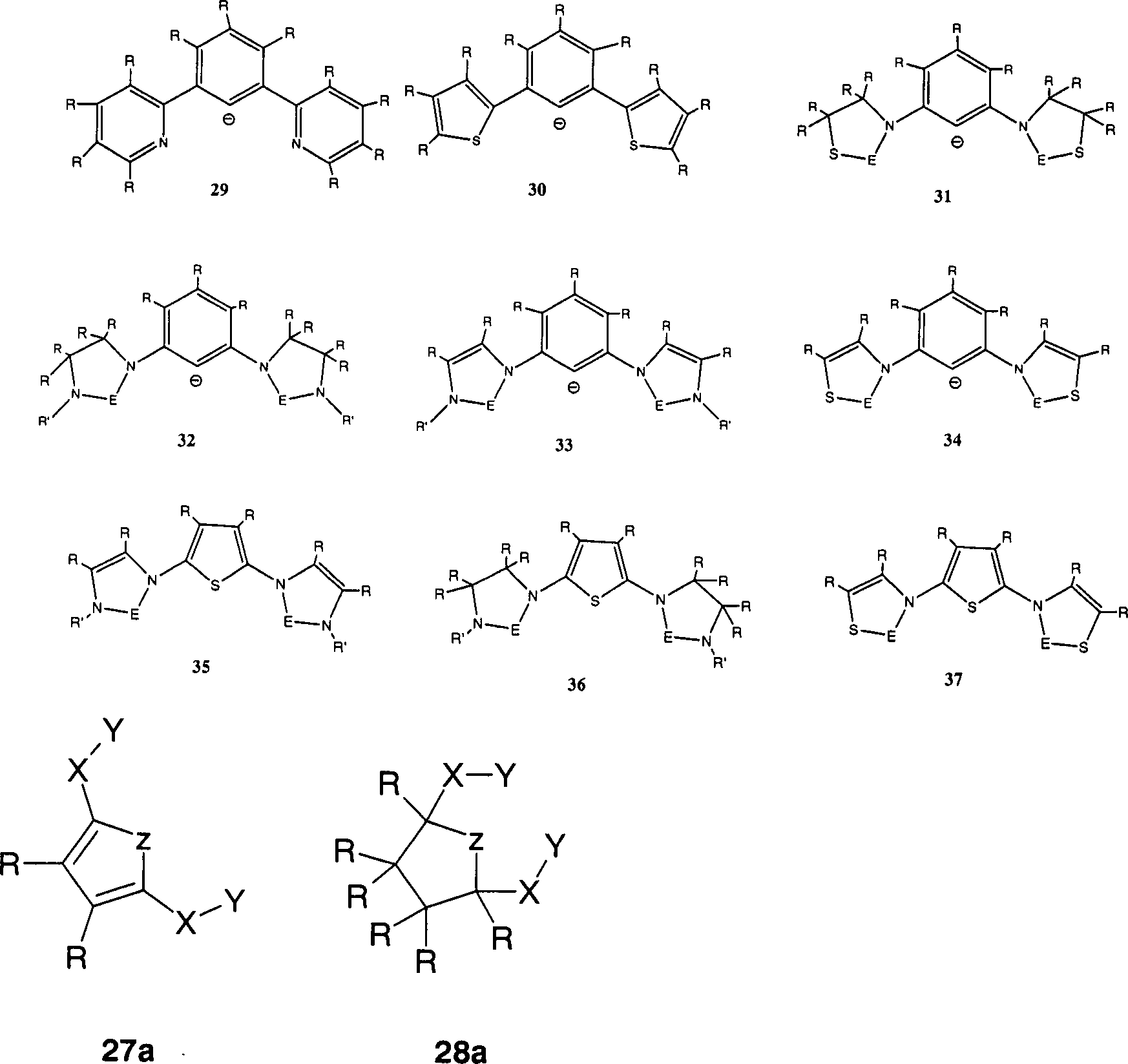
Ein, zwei oder mehr Donoratome des Liganden oder alle Donoratome des Komplexes können jeweils Bestandteil eines aromatischen Ringes oder eines konjugierten, ungesättigten Systems sein. Dies gilt insbesondere für Donoratome S, C(II)(Carben), C(Carbanion), Si(II) und/oder Ge(II). Im Falle niedervalenter Donoratome, z.B. divalenter Donoratome wie Carben, Germylen, Silylen, kann das Donoratom insbesondere auch benachbart zu einem oder zwei Heteroatomen mit freiem Elektronenpaar wie N, P, As, Ab, S, Se Te sein, das vorzugsweise mit leeren oder nicht maximal besetzten Orbitalen des Donoratoms in Konjugation steht. Dies kann sowohl für die Pincer-Liganden als auch die unstehenden en- oder zweizähnigen Liganden gelten.One, two or more donor atoms of the ligand or all donor atoms of the ligand Complex can each part of an aromatic ring or a conjugated, unsaturated Be system. This applies in particular to donor atoms S, C (II) (carbenes), C (carbanion), Si (II) and / or Ge (II). In the case of low-valent donor atoms, e.g. divalent donor atoms such as carbene, germylene, silylene, the Donor atom in particular also adjacent to one or two heteroatoms with free electron pair such as N, P, As, Ab, S, Se Te, preferably with empty or not maximally occupied orbitals of the donor atom in conjugation. This can be done for both the pincer ligands as well the pending en- or bidentate ones Ligands apply.
In den Verbindungen 27, 27a, 28, 28a ist Y ein donorfähiges He tero- oder Kohlenstoffatom, bevorzugt ausgewählt aus der Gruppe N, P, O, S, Se, Te, C, Si, Ge, Sn, Pb, beispielsweise ausgewählt aus der Gruppe C, N, P, O, S, Se, ohne hierauf beschränkt zu sein. Das Atom Y kann von N verschieden sein. Die beiden Atome Y können gleich oder verschieden sein. Y kann Teil eines Ringes oder Ringsystems sein. Insbesondere kann Y ein Kohlenstoffatom, z.B. ein Carbanion- oder Carbenkohlenstoffatom sein, oder ein Ge-Atom sein, insbesondere ein Germylen (Ge(II)), oder ein Si-Atom sein, insbesondere ein Silylen (Si(II)), oder ein Schwefelatom sein.In Y is a donor-capable hetero-terminal compound 27, 27a, 28, 28a. or carbon atom, preferably selected from the group N, P, O, S, Se, Te, C, Si, Ge, Sn, Pb, for example selected from of the group C, N, P, O, S, Se, without being limited thereto. The atom Y may be different from N. The two atoms Y can be the same or be different. Y can be part of a ring or ring system be. In particular, Y may be a carbon atom, e.g. a carbanion or carbene carbon atom, or be a Ge atom, in particular a germylene (Ge (II)), or an Si atom, in particular a silylene (Si (II)), or a sulfur atom.
Z ist ein donorfähiges Heteroatom oder Kohlenstoffatom, bevorzugt ausgewählt aus der Gruppe C, N, P, O, S. Ist zumindest eines der Atome Y ein N-Atom, so kann Z von N verschieden sein. Insbesondere kann Z ein Kohlenstoffatom, z.B, ein Carbanion- oder Carbenkohlenstoffatom sein, oder ein Ge-Atom sein, insbesondere ein Germylen (Ge(II)), oder ein Si-Atom sein, insbesondere ein Silylen (Si(II)), oder ein Schwefelatom sein.Z is a donor-capable one Heteroatom or carbon atom, preferably selected from of the group C, N, P, O, S. If at least one of the atoms Y is an N atom, so Z may be different from N. In particular, Z can be a carbon atom, for example, a carbanion or Be carbene carbon atom, or be a Ge atom, in particular a germylene (Ge (II)), or an Si atom, in particular a silylene (Si (II)), or a sulfur atom.
X stellt einen „Abstandshalter" dar und kann ein beliebiges zumindest zweibindiges Atom oder Atomgruppe sein. Insbesondere kann X eine verzweigte oder unverzweigte Alkylkette, insbesondere eine Niederalkylkette mit C1 bis C6, vorzugsweise C1 bis C4 oder ein oder zwei Atomen sein, wobei X keine Heteroatome oder ein oder mehrere Heteroatome aufweisen kann. Die Heteroatome können Bestandteil der Brücke sein. X kann ein Arylsubstituent, einschließlich ein kondensierter Arylsubstituent mit oder ohne Heteroatomen sein, einschließlich ein Alkyl-Arylsubstituent mit oder ohne Heteroatom. X kann auch ein einzelnes Heteroatom, beispielsweise O, S, N, P oder dergleichen sein. R kann ein beliebiger Substituent, bevorzugt H, Alkyl, insbesondere Niederalkyl mit C1 bis C6 oder Aryl sein. Der Alkyl- oder Arylrest kann substituiert oder unsubstituiert sein und gegebenenfalls ein oder mehrere Heteroatome aufweisen. Die einzelnen Substituenten R können gleich oder verschieden sein. Zwei Substituenten R können Teil eines Ringes sein, der gesät tigt, ungesättigt, einschließlich aromatisch, sein kann und bevorzugt Teil eines an dem Grundgerüst ankondensierten Ringsystems sein kann. Für R' gelten die Ausführungen zu R, und insbesondere ein von Wasserstoff verschiedenes Atom oder Atomgruppe ist. R' kann jeweils gleich oder verschieden voneinander sein.X represents a "spacer" and may be any at least divalent atom or group of atoms, in particular X may be a branched or unbranched alkyl chain, in particular a lower alkyl chain with C1 to C6, preferably C1 to C4 or one or two atoms, where X is not a heteroatom or one or more heteroatoms The heteroatoms may be part of the bridge may be an aryl substituent, including a fused aryl substituent with or without heteroatoms, including an alkyl-aryl substituent with or without a heteroatom. X can also be a single heteroatom, for example O, S, N, P or the like. R may be any substituent, preferably H, alkyl, especially lower alkyl with C1 to C6 or aryl. The alkyl or aryl radical may be substituted or unsubstituted and optionally have one or more heteroatoms. The individual substituents R may be the same or different. Two substituents R may be part of a ring which may be saturated, unsaturated, including aromatic, and may preferably be part of a ring system fused to the backbone. For R ', the comments on R, and in particular is an atom different from hydrogen or atomic group applies. Each R 'may be the same or different from each other.
E kann jeweils ein Atom ausgewählt aus der Gruppe C, Si, Ge, Sn, Pb sein, vorzugsweise ausgewählt aus der Gruppe C, Si, Ge, insbesondere C oder Ge sein, beispielsweise jeweils in Oxidationsstufe (II). Das Donoratom E kann einen Carben, Germylen oder Silylen-Liganden bilden, vorzugsweise bilden zwei Donoratome E jeweils einen Biscarben-, Bisgermylen- oder Bissilylen-Liganden oder gemischte Liganden mit diesen Donoratomen. Der ein E-Atom aufweisende Ring des Pincer-Liganden weist vorzugsweise, gegebenenfalls abgesehen von E, mindestens ein oder zwei weitere Heteroatome auf, die vorzugsweise jeweils Bestandteil eines Ringes sind, vorzugsweise eines ungesättigten oder aromatischen Ringes. Das/die weitere Heteroatom(e) binden vorzugsweise an das Atom E, gegebenenfalls über ein ungesättigtes System wie eine Doppelbindung. Heteroatome können insbesondere N oder S sein. Der das Donoratom E (insbesondere als Carben C(II), Ge(II), Si(II)) aufweisende Ring kann zwei zusätzliche N-Atome, zwei S-Atome oder ein N- und ein S-Atom aufweisen.e You can choose one atom at a time from the group C, Si, Ge, Sn, Pb, preferably selected from the group C, Si, Ge, in particular C or Ge, for example in each case in oxidation state (II). The donor atom E can be a carbene, Germylene or silylene ligands form, preferably form two Donor atoms E each have a biscarbene, bismethylene or bissilylene ligand or mixed ligands with these donor atoms. The one having an e-atom Ring of the pincer ligand preferably has, if appropriate, apart E, at least one or two further heteroatoms, preferably are each part of a ring, preferably an unsaturated one or aromatic ring. The further heteroatom (s) preferably bind to the atom E, if necessary over an unsaturated one System like a double bond. Heteroatoms can in particular N or S be. The donor atom E (in particular as carbene C (II), Ge (II), Si (II)) ring can have two additional N atoms, two S atoms or have one N and one S atom.
Der mindestens einen, mehrere oder ausschließlich Pincer-Liganden aufweisende Komplex weist vorzugsweise zumindest ein Zentralatom ausgewählt aus der Gruppe Cr, Mn, Fe, Co, Ni, Cu, Zn, vorzugsweise ausgewählt aus der Gruppe Mn, Fe, Co, Ni, besonders bevorzugt ausgewählt aus der Gruppe Fe, Co, Ni, gegebenenfalls einschließlich Mn, auf. Das mindestens eine Zentralatom kann ausgewählt sein aus der Gruppe Cr, Mo, W und beispielsweise Mo oder W, gegebenenfalls auch Cr sein. Das Zentralatom kann auch allgemein ein Atom der 7ten bis 10ten Übergangsmetallgruppe sein, es kann hierbei verschieden von Cr oder Ru sein, ohne dass dies zwingend ist.Of the having at least one, several or exclusively pincer ligands Complex preferably has at least one central atom selected of the group Cr, Mn, Fe, Co, Ni, Cu, Zn, preferably selected from the group Mn, Fe, Co, Ni, more preferably selected from the group Fe, Co, Ni, optionally including Mn on. That at least a central atom can be selected from the group Cr, Mo, W and for example Mo or W, if appropriate also be Cr. The central atom can also generally be an atom of the 7th to the 10th transition metal group it can be different from Cr or Ru, without that this is mandatory.
Insbesondere können Verbindungen 20 bis 26, 29 bis 37 die oben genannten Zentralatome aufweisen, die gegebenenfalls verschieden von Cr oder Ru sein können. Die Verbindungen 20 bis 26, 29 bis 37 können aber auch ein anderes Zentralatom ausgewählt aus der Gruppe der ersten, der zweiten oder der dritten Übergangsmetallperiode aufweisen.Especially can Compounds 20 to 26, 29 to 37 the central atoms mentioned above which may optionally be different from Cr or Ru. The Compounds 20 to 26, 29 to 37 can also be another Central atom selected from the group of the first, the second or the third transition metal period exhibit.
Der Ligand kann ausgewählt sein aus der Gruppe der Verbindungen 20 bis 24, wobei einer oder mehrere der Atome S bzw. N der terminalen Fünfringe auch jeweils ersetzt sein können durch Se, Te oder gegebenenfalls O bzw. P, As oder Sb. Eine oder mehrere der Doppelbindungen der Fünfringe der Verbindungen 20 bis 24 können gegebenenfalls auch gesättigt sein. E kann jeweils insbesondere Carbenkohlenstoff C(II), Ge(II) (Germylen) oder Si(II) (Silylen) sein, gegebenenfalls auch O.Of the Ligand can be selected from the group of compounds 20 to 24, wherein one or also replaces several of the atoms S and N of the terminal five-membered rings, respectively could be by Se, Te or optionally O or P, As or Sb. One or more of the double bonds of the five-membered rings of compounds 20 to 24 can optionally also saturated be. E can in each case especially carbene carbon C (II), Ge (II) (germylene) or Si (II) (silylene), optionally also O.
Der Pincer-Ligand kann ferner ausgewählt sein aus der Gruppe der Verbindungen 25 oder 26, wobei das S-Atom des mittleren 5-Ringes oder eines oder beide der terminalen 5-Ringe der Verbindung 26 ein Se oder Te-Atom, gegebenenfalls auch O, sein kann. Eine oder mehrere der Doppelbindungen des Systems können auch gesättigt sein. E kann jeweils insbesondere Carbenkohlenstoff C(II), Ge(II) oder Si(II) sein.Of the Pincer ligand may also be selected be from the group of compounds 25 or 26, wherein the S atom of the middle 5-ring or one or both of the terminal 5-rings of compound 26 Se or Te atom, optionally also O, may be. One or more The double bonds of the system can also be saturated. In each case, E can in particular be carbene carbon C (II), Ge (II) or Si (II).
Beispielsweise kann der Ligand ausgewählt sein aus der Gruppe der Verbindungen 29, 30, 31, wobei eines oder mehrere der Atome S ersetzt sein können durch Se oder Te, gegebenenfalls auch O, und eines oder mehrere der Atome N ersetzt sein können durch P, As oder Sb. E kann jeweils insbesondere Carbenkohlenstoff C(II), Ge(II) oder Si(II) sein.For example the ligand can be selected be from the group of compounds 29, 30, 31, wherein one or more of the atoms S may be replaced by Se or Te, optionally also O, and one or more of the atoms N can be replaced by P, As or Sb. E can in each case in particular be carbene carbon C (II), Ge (II) or Si (II).
Der Pincer-Ligand kann ausgewählt sein aus der Gruppe der Verbindungen 32 bis 34, wobei E insbesondere ein zweibindiges C (Carben), Si-(Silylen) oder Ge(Germylen) Atom sein kann. Eines oder mehrere der Atome N können ersetzt sein durch P, As oder Sb. Eines oder mehrere der Atome S können ersetzt sein durch Se oder Te, oder gegebenenfalls O.Of the Pincer ligand can be selected be from the group of compounds 32 to 34, where E in particular a divalent C (carbene), Si (silylene) or Ge (germylene) atom can be. One or more of the atoms N may be replaced by P, As or Sb. One or more of the atoms S may be replaced by Se or Te, or optionally O.
Der Pincer-Ligand kann ferner ausgewählt sein aus der Gruppe der Verbindungen 35, 36 oder 37, wobei E vorzugsweise ein zweibindiges Kohlenstoffatom (Carben), Si(II) oder Ge(II) ist. Mindestens eines der Atome N kann ersetzt sein durch P, As oder Sb. Mindestens eines der Atome S kann ersetzt sein durch Se oder Te, oder gegebenenfalls O.Of the Pincer ligand may also be selected be from the group of compounds 35, 36 or 37, wherein E is preferably is a divalent carbon atom (carbene), Si (II) or Ge (II). At least one of the atoms N may be replaced by P, As or Sb. At least one of the atoms S may be replaced by Se or Te, or optionally O.
Weist der Ligand aus der Gruppe der Verbindungen 19 bis 26, 29 bis 37, insbesondere der Verbindungen 20 bis 26, 29 bis 37, ein zweibindiges Ligandenatom E ausgewählt aus der Gruppe C, Si, Ge, Sn, Pb, insbesondere ausgewählt aus der Gruppe C, Si, Ge auf, so ist das Zentralatom des Komplexes vorzugsweise Cobalt, insbesondere Co (II) oder Ru, insbesondere Ru(O).has the ligand from the group of compounds 19 to 26, 29 to 37, in particular the compounds 20 to 26, 29 to 37, a divalent Ligand atom E selected from the group C, Si, Ge, Sn, Pb, in particular selected from of the group C, Si, Ge, the central atom of the complex is preferably Cobalt, in particular Co (II) or Ru, in particular Ru (O).
Ferner kann der Ligand ein zweizähniger Ligand der allgemeinen Struktur 45, 45a, 46, 46a aufweisen. Die X-Y-Gruppe kann insbesondere einen heterocyclischen Ring mit Y als Heterodonoratom bilden, wobei der Ring vorzugsweise ein 5- oder 6-Ring ist. Bezüglich der Atome oder Atomgruppen Z, X und Y sowie der Substituenten R und R' sei auf die obigen Ausführungen zu den Pincer-Liganden verwiesen.Further The ligand may be a bidentate one Ligand of the general structure 45, 45a, 46, 46a have. The In particular, X-Y group can be a heterocyclic ring with Y as Heterodonoratom form, wherein the ring is preferably a 5- or 6 ring is. In terms of the atoms or atomic groups Z, X and Y and the substituent R and R 'be on the above to the pincer ligands directed.
Insbesondere können ein, zwei oder sämtliche Liganden des Komplexes ausgewählt sein aus der Gruppe der Verbindungen 45, 45a, 46, 46a, beipielsweise eine Verbindung 45 oder 45a oder 46 oder 46a, wobei für die Gruppen Z, X, Y die obigen Ausführungen zu den Pincerliganden gelten.Especially can one, two or all Ligands of the complex selected be from the group of compounds 45, 45a, 46, 46a, for example a compound 45 or 45a or 46 or 46a, wherein for the groups Z, X, Y are the above apply to the pincer ligands.
Insbesondere können ein, zwei oder sämtliche der Liganden des Komplexes ausgewählt sein aus der Gruppe der Verbindungen 38 bis 44, 47 bis 56, insbesondere aus der Gruppe der Verbindungen 39 bis 44, 47 bis 56, wobei für die Gruppen R und E die obigen Ausführungen zu den Pincer-Liganden entsprechend gelten. Insbesondere kann auch hier der Ligand einen Ring mit einem zweibin digen Donoratom S, C, Si, Ge, Sn, Pb aufweisen, insbesondere ein Donoratom C, Si, Ge, so dass entsprechende Carbanionen, Carbene, Silylene oder Germylene vorliegen.Especially can one, two or all the ligands of the complex may be selected from the group of Compounds 38 to 44, 47 to 56, in particular from the group of Compounds 39 to 44, 47 to 56, wherein for the groups R and E, the above versions apply accordingly to the pincer ligands. In particular, too here the ligand has a ring with a two-terminal donor atom S, C, Si, Ge, Sn, Pb, in particular a donor atom C, Si, Ge, so that corresponding carbanions, carbenes, silylenes or germylenes available.
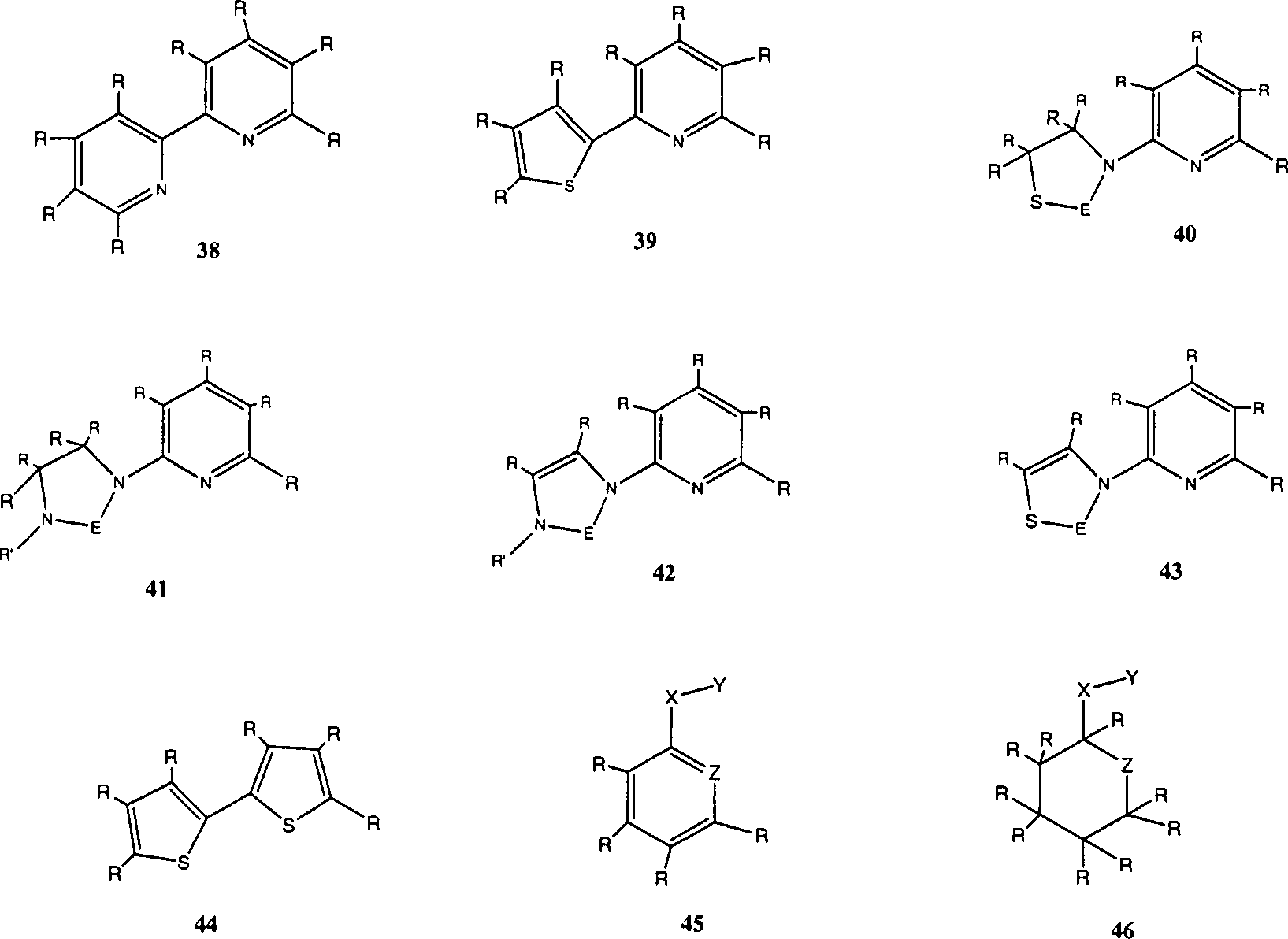
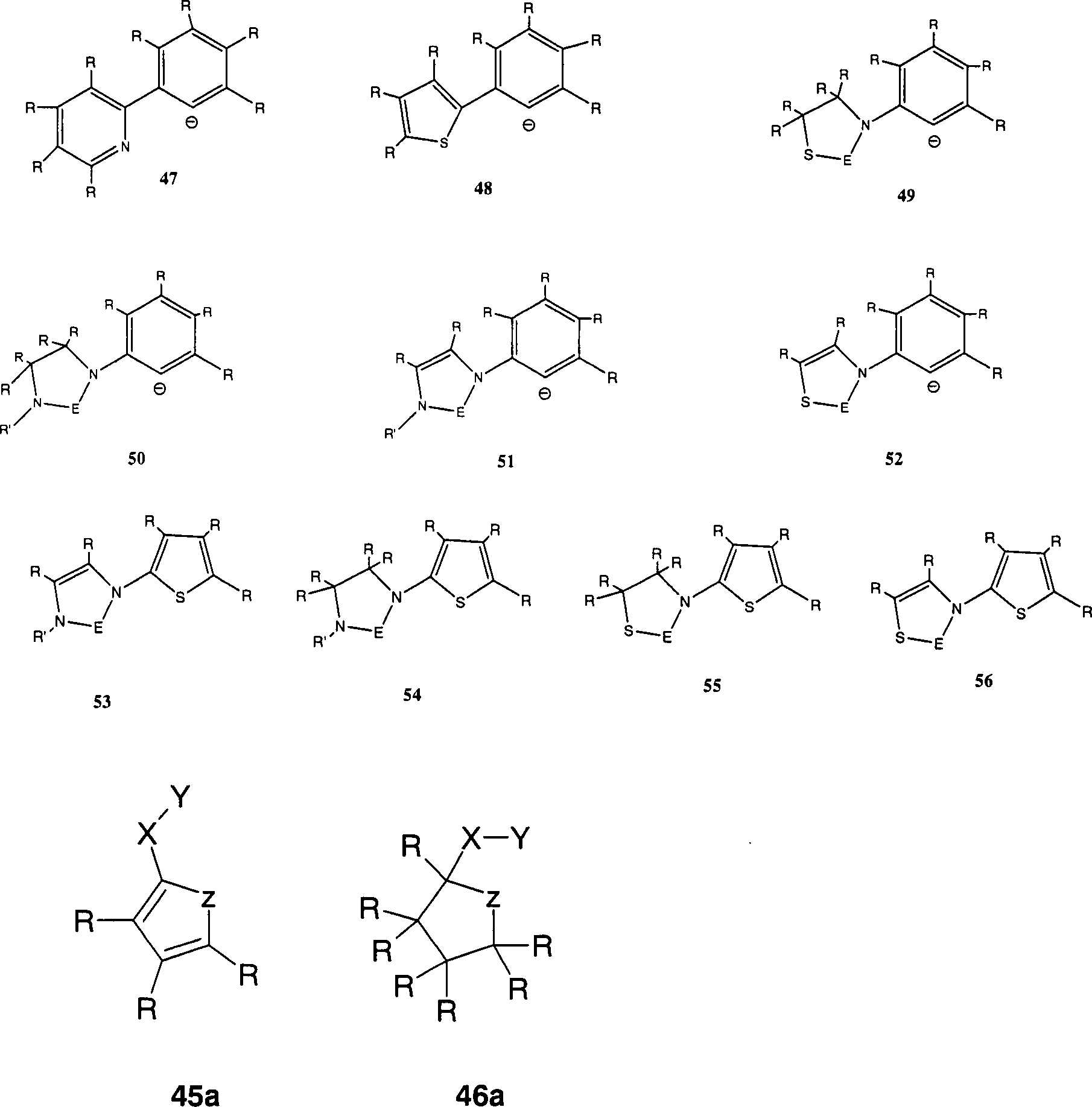
Insbesondere kann ein Ligand mit einer der allgemeinen Strukturen 27, 27a, 28, 28a, 45, 45a, 46, 46a ein Atom Z mit C- (Carbanion) oder C(II)(Carben) aufweisen. Insbesondere können dann einer oder beide der Ligandatome Y ein Atom E ausgewählt aus der Gruppe C, Si, Ge, Sn, Pb, insbesondere ausgewählt aus der Gruppe C, Si, Ge sein, wobei E (innerhalb des Liganden) zweibindig ist.Especially a ligand with one of the general structures 27, 27a, 28, 28a, 45, 45a, 46, 46a an atom Z with C- (carbanion) or C (II) (carbene) exhibit. In particular, you can then one or both of the ligand atoms Y selects an atom E selected from the group C, Si, Ge, Sn, Pb, in particular selected from of the group C, Si, Ge, where E (within the ligand) is divalent is.
Insbesondere kann das Donoratom Y einer der Verbindungen 27, 27a, 28, 28a, 45, 45a, 46, 46a das Schwefelatom eines Thiophenringes sein, dass gegebenenfalls auch durch Se oder Te ersetzt sein kann, gegebenenfalls auch durch O.Especially the donor atom Y may be one of the compounds 27, 27a, 28, 28a, 45, 45a, 46, 46a be the sulfur atom of a thiophene ring, optionally may also be replaced by Se or Te, possibly also by O.
Ferner kann der Ligand ausgewählt sein aus der Gruppe der Verbindungen 40, 41, 42, 43, wobei jeweils N auch ersetzt sein kann durch P, As oder Sb und S jeweils ersetzt sein kann durch Se, Te, gegebenenfalls auch O.Further the ligand can be selected be from the group of compounds 40, 41, 42, 43, respectively N can also be replaced by P, As or Sb and S respectively may be by Se, Te, possibly also O.
Ferner kann der Ligand ausgewählt sein aus der Gruppe der Verbindungen 47, 48, 49, 50, 51, 52, insbesondere auch aus der Gruppe der Verbindungen 49, 50, 51, 52, wobei jeweils S ersetzt sein kann durch Se oder Te oder gegebenenfalls auch O und N ersetzt sein kann durch P, As, Sb.Further the ligand can be selected be from the group of compounds 47, 48, 49, 50, 51, 52, in particular also from the group of compounds 49, 50, 51, 52, wherein in each case S can be replaced by Se or Te or optionally also O. and N can be replaced by P, As, Sb.
Der Ligand kann auch ausgewählt sein aus der Gruppe der Verbindungen 53, 54, 55 und 56, wobei S ersetzt sein kann durch Se, Te oder gegebenenfalls O und N ersetzt sein kann durch P, As oder Sb, wobei E vorzugsweise ist C(II)(Carben), Si(II)(Silylen) oder Ge(II) (Germylen).Of the Ligand can also be selected from the group of compounds 53, 54, 55 and 56, where S replaces may be replaced by Se, Te or optionally O and N. may be represented by P, As or Sb, where E is preferably C (II) (carbene), Si (II) (silylene) or Ge (II) (germylene).
Ferner kann zumindest ein, mehrere oder sämtliche der Liganden auch ein Ligand ausgewählt sein aus der Gruppe der Verbindungen 57 bis 64, insbesondere ausgewählt aus der Gruppe der Verbindungen 59 bis 64, wobei für E und R, R' die Ausführungen zu den Pincer-Liganden entsprechend gelten. Für X als Kohlenstoff- oder Heterodonoratom können die Ausführungen zu Y oder zu Z bezüglich der Pincer-Liganden gelten. Insbesondere kann die Verbindung 58 ein, gegebenenfalls substituiertes, Cyclopentadienylanion, Thiophen, Pyrrol, Selenophen, Phosphen, Furan sein. E ist vorzugsweise ein zweibindiges bzw. divalentes Atom aus der Gruppe C (Carben), Si (Silylen), Ge (Germylen), Sn, Pb, vorzugsweise ausgewählt aus der Gruppe C, Si, Ge. E kann insbesondere auch C- (Carabion) sein. Gegebenenfalls kann auch eine oder mehrere Doppelbindungen der Verbindungen 57 bis 64 gesättigt sein.Furthermore, at least one, several or all of the ligands may also be selected from the group of compounds 57 to 64, in particular selected from the group of compounds 59 to 64, where for E and R, R 'apply to the comments on the pincer ligands accordingly. For X as carbon or heterodonor atom, the statements on Y or Z with respect to the pincer ligands may apply. In particular, compound 58 may be an optionally substituted cyclopentadienyl anion, thiophene, pyrrole, selenophene, phosphene, furan. E is preferably a divalent atom from the group C (carbene), Si (silylene), Ge (germylene), Sn, Pb, preferably selected from the group C, Si, Ge. In particular, E can also be C (carabion). Optionally, one or more double bonds of compounds 57 to 64 may be saturated.
In Verbindungen des Typs 27, 27a, 28, 28a und im speziellen in den Verbindungen 19 bis 26, 29 bis 37, insbesondere 20 bis 26, 29 bis 37, sowie in den Verbindungen 45, 45a, 46, 46a, im speziellen in den Verbindungen 38 bis 44 und 47 bis 56, 39 bis 44 und 47 bis 56, sowie in den Verbindungen 57 bis 64, insbesondere in den Verbindungen 59 bis 64, weist jeweils vorzugsweise zumindest ein, mehrere oder sämtliche der ein Donoratom aufweisenden Ringe eine Kohlenwasserstoffgruppe mit 1, 2 oder 3 oder mehr, vorzugsweise 4 oder mehr Kohlenstoffatomen auf, vorzugsweise eine nicht substituierte Alkylgruppe oder auch eine substituierte Alkylgruppe. Die Anzahl der C-Atome der Gruppe ist vorzugsweise von jeweils einschließlich 4 bis 20 oder 4 bis 10, beispielsweise 4 bis 6. Vorzugsweise ist zumindest ein, zwei oder jeder der Ringe mit zumindest einem Substituenten, der gegenüber Wasserstoff oder einer Methylgruppe einen stärkeren +I Effekt und/oder einen +M-Effekt aufweist substituiert. Vorzugsweise ist zumindest einem, zwei oder jedem Donoratom ein mit diesem in Konjugation stehender +M Substituent zugeordnet. Vorzugsweise ist ein, zwei oder mehr oder jeder Ring mit zumindest einer Alkylgruppe substituiert oder einer Gruppe mit gleich oder stärkerem +I-Effekt. Es versteht sich, dass zumindest einer, mehrere oder sämtliche Ringe auch +M Substituenten aufweisen können, beispielsweise N-Alkyl- oder N-Dialkyl-Substituenten (oder P anstelle von N), wobei für Alkyl das oben Gesagte gelten kann. Es wurde gefunden, hierdurch die elektrische Leitfähigkeit des Halbleitermaterials erhöht werden kann.In Compounds of the type 27, 27a, 28, 28a and in particular in the Compounds 19 to 26, 29 to 37, in particular 20 to 26, 29 to 37, as well as in the compounds 45, 45a, 46, 46a, in particular in Compounds 38 to 44 and 47 to 56, 39 to 44 and 47 to 56, and in compounds 57 to 64, in particular in the compounds 59 to 64, each preferably has at least one, several or all the donor atom-containing rings have a hydrocarbon group with 1, 2 or 3 or more, preferably 4 or more carbon atoms on, preferably a non-substituted alkyl group or also a substituted alkyl group. The number of C atoms in the group is preferably from each including 4 to 20 or 4 to 10, For example, 4 to 6. Preferably at least one, two or each of the rings having at least one substituent opposite to hydrogen or a methyl group stronger + I effect and / or a + M effect substituted. Preferably At least one, two or each donor atom is one with this in Conjugation standing + M substituent assigned. Preferably one, two or more or each ring having at least one alkyl group substituted or a group with the same or stronger + I effect. It is understood that at least one, several or all Rings may also have + M substituents, for example N-alkyl or N-dialkyl substituents (or P instead of N), where for Alkyl the above can apply. It was found by this the electrical conductivity of the semiconductor material increases can be.
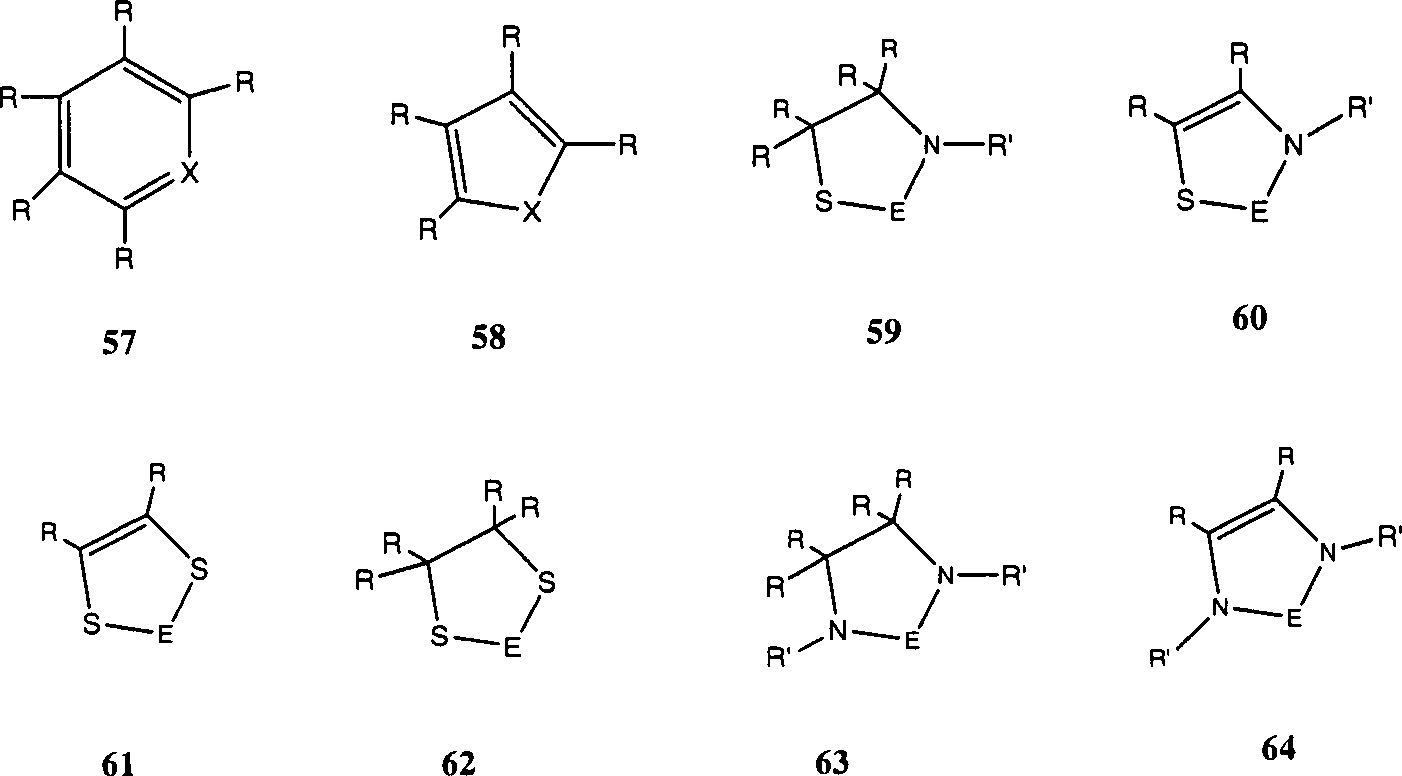
Es versteht sich, dass für den Fall, dass zumindest eines oder sämtliche Zentralatome mehrere Substituenten aufweisen, zwei oder sämtliche Substituenten dem jeweils gleichen Substituententyp zugehören oder gleich sein können.It understands that for the case that at least one or all central atoms more Substituents have two or all substituents each belong to the same substituent type or can be the same.
Ionisationspotential/OxidationspotentialIonization / oxidation potential
Vorzugsweise weist der erfindungsgemäße Metallkomplex ein Ionisationspotential in der Gasphase von ≤ 6,4 eV, vorzugsweise von ≤ 6 eV, insbesondere ≤ 5,5 eV auf. Insbesondere kann das Ionisationspotential des Komplexes in der Gasphase ≤ 5,0 eV oder ≤ 4,5 eV sein.Preferably indicates the metal complex according to the invention an ionization potential in the gas phase of ≦ 6.4 eV, preferably ≦ 6 eV, in particular ≦ 5.5 eV. In particular, the ionization potential of the complex in the Gas phase ≤ 5.0 eV or ≤ 4.5 eV.
Das Gasphasenionisationspotential Ipg der erfindungsgemäß einsetzbaren Verbindungen kann beispielsweise gegenüber Tetrathiafulvalen (TTF) bestimmt werden, welches beträgt: Ipg = 6,4 eV (siehe R. Gleiter, E. Schmidt, D. O. Cowan, J P. Ferraris, J. Electr. Spec. Rel. Phenom. 2, 207 (1973)).The Gas phase ionization potential Ipg of the inventively usable Compounds can be used, for example, against tetrathiafulvalene (TTF) to be determined, which is: Ipg = 6.4 eV (see R. Gleiter, E. Schmidt, D.O. Cowan, J P. Ferraris, J. Electr. Spec. Rel. Phenom. 2, 207 (1973)).
Das Oxidationspotential von TTF ist E1/2(ox) = –0,09 V gegenüber Fe/Fe+ (Ferrocen/Ferrocenium) (M. Iyoda, T. Takano, N. Otani, K. Ugawa, M. Yoshida, H. Matsuyama, Y. Kuwatani, Chem. Lett., 1310 (2001)). Ausgehend von diesem Referenzpunkt kann somit das Redoxpotential der erfindungsgemäßen n-Dotanden gegenüber Ferrocen/Ferrocenium ≤ –0,09 V, vorzugsweise ≤ –0,6 V, besonders bevorzugt ≤ –1,1 V betragen, beispielsweise ≤ –1,6 V oder ≤ –2,1 V betragen, ohne hierauf beschränkt zu sein.The Oxidation potential of TTF is E1 / 2 (ox) = -0.09 V over Fe / Fe + (Ferrocene / ferrocenium) (M. Iyoda, T. Takano, N. Otani, K. Ugawa, M. Yoshida, H. Matsuyama, Y. Kuwatani, Chem. Lett., 1310 (2001)). outgoing from this reference point, the redox potential of the n-dopants according to the invention can thus be compared to ferrocene / ferrocenium ≦ -0.09 V, preferably ≦ -0.6 V, particularly preferably ≦ -1.1 V, for example ≦ -1.6 V or ≦ -2.1 V, without being limited thereto to be.
Das Oxidationspotential gegenüber Ferrocen/Ferrocenium kann beispielsweise cyclovoltammetrisch bestimmt werden. Das Potential ist hierbei weitgehend unabhängig von dem gewählten Elektrolytsystem und kann gemäß IUPAC Empfehlung (Gritzner, G.; Kuta, J. Pure Appl. Chem. 1984, 56, 461–466) bestimmt werden. Das Elektrolytsystem muss ein ausreichend großes elektrochemisches Fenster und eine ausreichende Löslichkeit der Donorverbindung aufweisen. Als Elektrolytsystem ist beispielsweise geeignet A cetronitril/1M LiClO4/Pt Elektroden, wobei auch andere geeignete Elektrolytsysteme einsetzbar sind.The oxidation potential towards ferrocene / ferrocenium can be determined, for example, by cyclovoltammetry. The potential here is largely independent of the chosen electrolyte system and can be determined according to the IUPAC recommendation (Gritzner, G .; Kuta, J. Pure Appl. Chem. 1984, 56, 461-466). The electrolyte system must have a sufficiently large electrochemical window and sufficient solubility of the donor compound. As the electrolyte system is suitable, for example A cetronitrile / 1M LiClO 4 / Pt electrodes, although other suitable electrolyte systems can be used.
Dampfdruckvapor pressure
Der Dampfdruck des erfindungsgemäß eingesetzten Komplexes kann insbesondere bei 30°C < 10–3 Pa sein, beispielsweise ≤ 5 × 10⁻⁴ Pa oder ≤ 1 × 10⁻⁴ Pa.The vapor pressure of the complex used according to the invention may be, in particular at 30 ° C. <10 -3 Pa, for example ≦ 5 × 10 -4 Pa or ≦ 1 × 10 -4 Pa.
Die jeweils verwendeten erfindungsgemäßen n-Dotanden und/oder die jeweils verwendeten Komplexe können luftstabil sein, gegebenenfalls können die jeweils verwendeten erfindungsgemäßen n-Dotanden und/oder Komplexe jeweils auch luftinstabil sein.The respectively used n-dopants according to the invention and / or the each used complexes be air-stable, if necessary, the respectively used N-dopants according to the invention and / or Complex each also be air unstable.
Synthese der erfindungsgemäßen n-Dotandenkomplexe und deren LigandenSynthesis of n-dopant complexes according to the invention and their ligands
AllgemeinesGeneral
Die Synthese der erfindungsgemäßen n-Dotanden Metallkomplexe kann beispielsweise durch unmittelbare Synthese der Verbindungen oder durch Reduktion von Salzen erfolgen, wobei der resultierende neutrale Metallkomplex in dem Salz als Kation vorliegt. Das Anion kann jedes beliebige geeignete Anion darstellen, beispielsweise Halogen, Perchlorat, Sulfat oder dergleichen. Die Reduktion kann beispielsweise elektrochemisch oder chemisch erfolgen, ohne hierauf beschränkt zu sein. Die Reduktion kann beispielsweise durch Elektrokristallisation erfolgen, wobei das hierdurch gewonnene Produkt, welches an der Arbeitselektrode geerntet werden kann, nachfolgend gereinigt werden kann. Die Herstellung der erfindungsgemäßen Komplexe kann insbesondere aber auch ohne Anwendung eines derartigen Elektrokristallisationsschrittes erfolgen.The Synthesis of the n-dopants according to the invention Metal complexes can be synthesized, for example, by direct synthesis of Compounds or by reduction of salts, wherein the resulting neutral metal complex is present in the salt as a cation. The anion may be any suitable anion, for example Halogen, perchlorate, sulfate or the like. The reduction can for example, electrochemically or chemically, without aufauf limited to be. The reduction can be achieved, for example, by electrocrystallization take place, wherein the product thus obtained, which at the Working electrode can be harvested, subsequently cleaned can. The preparation of the complexes according to the invention can in particular but also without the use of such an electrocrystallization step respectively.
Syntheseverfahrensynthesis method
Die erfindungsgemäßen Komplexe lassen sich nach bekannten Verfahren synthetisieren, teilweise sind sie auch kommerziell erhältlich. Die Synthese der Liganden der erfindungsgemäßen Kom plexe und der Komplexe selber sind beispielsweise in folgenden Literaturstellen beschrieben, die hiermit jeweils vollumfänglich als Referenz von der Anmeldung mit eingeschlossen sind. Es versteht sich, dass die genannten Literaturstellen nur beispielhaft angegeben sind und die Liganden und Komplexe meist auch durch andere geeignete Verfahren synthetisierbar sind.The complexes according to the invention can be synthesized by known methods, some are They are also commercially available. The synthesis of the ligands of the invention Complexes and the complexes themselves are described, for example, in the following references, hereby each fully are included as a reference of the application. It understands that the cited references are given by way of example only and the ligands and complexes usually also by other suitable methods are synthesized.
Paddlewheel-KomplexePaddlewheel complexes
Die Paddlewheel-Komplexe können entweder durch Ligandensubstitution aus anderen Paddlewheel-Komplexen (F. A. Cotton, J. G. Norman Jr., J. Coord. Chem. 1 (1970) 161–72; F. A. Cotton, D. J. Timmons, Polyhedron 17 (1998) 179–84), durch Salzmetathese aus dem Metallhalogenid und einem anionischen Liganden (F. A. Cotton, D. J. Timmons, Polyhedron 17 (1998) 179–84), durch Reduktion eines kationischen Paddlewheel-Komplexes (F. A. Cotton, P. Huang, C. A. Murillo, X. Wang, Inorg. Chem. Commun. 6 (2003) 121–6) oder in einer Redoxreaktion aus einer Metallverbindung und dem Liganden (T. A. Stephenson, E. Bannister, G. Wilkinson, J. Chem. Soc. (1964) 2538–41) dargestellt werden.The Paddlewheel complexes can either by ligand substitution from other paddlewheel complexes (F.A. Cotton, J.G. Norman Jr., J. Coord. Chem. 1 (1970) 161-72; Cotton, D.J. Timmons, Polyhedron 17 (1998) 179-84) Salt metathesis from the metal halide and an anionic ligand (F.A. Cotton, D.J. Timmons, Polyhedron 17 (1998) 179-84) Reduction of a cationic paddlewheel complex (F.A. Cotton, P. Huang, C.A. Murillo, X. Wang, Inorg. Chem. Commun. 6 (2003) 121-6) or in a redox reaction of a metal compound and the ligand (T.A. Stephenson, E. Bannister, G. Wilkinson, J. Chem. Soc. (1964) 2538-41) being represented.
Carbenecarbenes
Für die Synthese der N-heterocyclischen Carbene NHC gibt es mehrere Literatur bekannte Standardverfahren, das Imidazolverfahren, Thioketonverfahren und das Silberoxidverfahren (Metalltransferverfahren). Siehe hierzu: W. A. Herrmann, Angew. Chem., Int. Ed. Engl. 41 (2002) 1290–1309; W. A. Herrmann, C. Kocher, Angew. Chem., Int. Ed. Engl. 36 (1997) 2162–87; A. H. Cowley, J. Organomet. Chem. 617–8 (2001) 105–9; T. Westkamp, V. P. W. Böhm, W. A. Herrmann, J. Organomet. Chem. 600 (2000) 12–22.For the synthesis the N-heterocyclic carbenes NHC there are several literature known Standard method, the imidazole method, thioketone method and the silver oxide method (metal transfer method). See also: W.A. Herrmann, Angew. Chem., Int. Ed. Engl. 41 (2002) 1290-1309; W. A. Herrmann, C. Kocher, Angew. Chem., Int. Ed. Engl. 36 (1997) 2162-87; A. Cowley, J. Organomet. Chem. 617-8 (2001) 105-9; T. Westkamp, V. P. W. Böhm, W.A. Herrmann, J. Organomet. Chem. 600 (2000) 12-22.
Das Thioketonverfahren basiert im wesentlichen auf dem Prinzip, das auch für die Silylene und Germylene angewendet wird. Allerdings wird anstelle des GeCl2 bzw SiCl4 Thiophosgen verwendet und anschließend mit Kalium, Natriumamalgam oder KC8 reduziert (N. Kuhn, T. Kratz, Synthesis (1993) 561; F. E. Hahn, L. Wittenbecher, R. Boese, D. Bläser, Chem. Eur. J. 5 (1999) 1931–5).The thioketon process is based essentially on the principle that is also applied to the silylenes and germylene. However, instead of the GeCl 2 or SiCl 4 thiophosgene is used and subsequently reduced with potassium, sodium amalgam or KC 8 (Kuhn N., T. Kratz, Synthesis (1993) 561, FE Hahn, L. Wittenbecher, R. Boese, D. Bläser , Chem. Eur. J. 5 (1999) 1931-5).
Im Imidazolverfahren wird zunächst der N-substituierte Imidazolgrundkörper dargestellt. Das zweite Stickstoffatom wird dann gewöhnlich mit einem Alkylhalogenid quarternisiert und im letzten Schritt wird das Imidazoliumsalz mit einer geeigneten Base (KOBut, Cs2CO3, BuLi etc) zum Carben umgesetzt (siehe beispielsweise: A. J. Arduengo III, R. L. Harlow, M. Kline, J. Am. Chem. Soc. 113 (1991) 361–3; M. R. Grimmet, Adv. Heterocyclic Chemistry 12 (1970) 105 und 134).In the imidazole process, the N-substituted imidazole parent is first shown. The second nitrogen atom is then usually quaternized with an alkyl halide, and in the last step, the imidazolium salt is carbene-reacted with a suitable base (KOBu t , Cs 2 CO 3 , BuLi, etc.) (see, for example: AJ Arduengo III, RL Harlow, M. Kline J. Am. Chem. Soc. 113 (1991) 361-3; MR Grimmet, Adv. Heterocyclic Chemistry 12 (1970) 105 and 134).
Das Silberoxidverfahren ist eine Variante des Imidazolverfahrens. Hier wird als Base Silberoxid verwendet. Es entsteht ein Silberkomplex des Carbens. Dieser kann das Carben auf ein anderes Metall übertragen (Metalltransfer)(Q.-X. Liu, F.-B. Xu, Q.-S. Li, X.-S. Zeng, X.-B. Leng, Y. L. Chou, Z.-Z. Zhang, Organometallics 22 (2003) 309–14; T. Ramnial, C. D. Abernethy, M. D. Spicer, I. D. McKenzie, I. D. Gay, J. A. C. Clyburne, Inorg. Chem. 42 (2003) 1391–3).The Silver oxide process is a variant of the imidazole process. Here is used as the base of silver oxide. It creates a silver complex of the carbene. This can transfer the carbene to another metal (Metal Transfer) (Q.-X. Liu, F.-B. Xu, Q.S. Li, X.S. Zeng, X.-B. Leng, Y.L. Chou, Z.-Z. Zhang, Organometallics 22 (2003) 309-14; T. Ramnial, C.D. Abernethy, M.D. Spicer, I.D. McKenzie, I.D. Gay, J.A.C. Clyburne, Inorg. Chem. 42 (2003) 1391-3).
Silylenesilylenes
Die Synthese der N-heterocyclischen Silylene geschieht analog der entsprechenden Germylene. Allerdings wird das Silicium(IV)chlorid verwendet, weshalb anschließend noch reduziert werden muß (siehe beispielsweise M. Denk, R. Lennon, R. Hayshi, R. West, A. V. Belyakov, H. P. Verne, A. Haaland, M. Wagner, N. Metzler, J. Am. Chem. Soc. 116 (1994) 2691–2; B. Gehrhus, M. F. Lappert, J. Organomet. Chem. 617–8 (2001) 209–23).The Synthesis of N-heterocyclic silylenes is analogous to the corresponding Germylenes. However, the silicon (IV) chloride is used, which is why subsequently still needs to be reduced (see For example, M. Denk, R. Lennon, R. Hayshi, R. West, A. V. Belyakov, H.P. Verne, A. Haaland, M. Wagner, N. Metzler, J. Am. Chem. Soc. 116 (1994) 2691-2; Gehrhus, M.F. Lappert, J. Organomet. Chem. 617-8 (2001) 209-23).
Germylenegermylenes
Die heterocyclischen Germylene (N, S) können zumeist durch Metallierung entsprechender Diamine, Diamine, Aminothiole oder Dithiole und anschließender Umsetzung mit Germanium(II)chlorid nach bekannten Methoden dargestellt werden (J. Pfeiffer, M. Noltemeyer, A. Meller, Z. Anorg. Allg. Chem. 572 (1989) 145–50; A. Meller, C.-P. Gräbe, Chem. Ber. 118 (1985) 2020–9; J. Pfeiffer, W. Maringgele, M. Noltemeyer, A. Meller, Chem. Ber. 122 (1989) 245–52; O. Kühl, P. Lönnecke, J. Heinicke, Polyhedron 20 (2001) 2215–22).The Heterocyclic germylene (N, S) can usually be obtained by metalation corresponding diamines, diamines, aminothiols or dithiols and subsequent reaction with germanium (II) chloride by known methods (J. Pfeiffer, M. Noltemeyer, A. Meller, Z. Anorg., Allg. Chem. 572 (1989) 145-50; A. Meller, C.-P. Gräbe, Chem. Ber. 118 (1985) 2020-9; J. Pfeiffer, W. Maringgele, M. Noltemeyer, A. Meller, Chem. Ber. 122 (1989) 245-52; O. Cool, P. Lönnecke, J. Heinicke, Polyhedron 20 (2001) 2215-22).
Die Synthese der Metallkomplexe ist beispielsweise beschrieben in: O. Kühl, P. Lönnecke, J. Heinicke, Inorg. Chem. 42 (2003) 2836–8; W. A. Herrmann, M. Denk, J. Behm, W. Scherer, F.-R. Klingan, H. Bock, B. Solouki, M. Wagner, Angew. Chem., Int. Ed. Engl. 31 (1992) 1485.The Synthesis of the metal complexes is described, for example, in: O. Cool, P. Lönnecke, J. Heinicke, Inorg. Chem. 42 (2003) 2836-8; W.A. Herrmann, M. Denk, J. Behm, W. Scherer, F.-R. Klingan, H. Bock, B. Solouki, M. Wagner, Angew. Chem., Int. Ed. Engl. 31 (1992) 1485.
Pi-PerimeterPi perimeter
Bei
den Pi-Perimeter Liganden und ihren Metallverbindungen gibt es eine
Vielzahl von Verbindungen und daher viele verschiedene Synthesewege.
Beispielhaft seien genannt:
Cyclopentadienyl: C. Janiak, H.
Schumann, Adv. Organomet. Chem. 33 (1991) 331; J. Okuda, Top. Curr. Chem.
160 (1991) 99; N. J. Coville, K. E. du Plooy, W. Pickl, Coord. Chem.
Rev. 116 (1992) 1; R. L. Halterman, Chem. Rev. 92 (1992) 965; M.
L. Hays, T. P. Hanusa, Adv. Organomet. Chem. 40 (1996) 117; S. Brydges,
L. E. Harrington, M. J. McGlinchey, Coord. Chem. Rev. 233–4 (2002)
75; T. Cuenca, P. Royo, Coord. Chem. Rev. 193–5 (1999) 447–98.
Arene:
A. S. Abd-El-Aziz, Coord. Chem. Rev. 233–4 (2002) 177; A. S. Abd-El-Aziz,
Coord. Chem. Rev. 203 (2000) 219; R. D. Pike, D. A. Sweigart, Coord.
Chem. Rev. 187 (1999) 183.
Cycloheptatrienyl: M. L. H. Green,
D. P. K. Ng, Chem. Rev. 95 (1995) 439; M. Tamm, B. Dreßel, R.
Fröhlich,
J. Org. Chem. 65 (2000) 6795; M. Tamm, T. Bannenberg, R. Dreßel, R.
Fröhlich,
D. Kunz, Organometallics 20 (2001) 900; M. Tamm, T. Bannenberg,
R. Fröhlich,
S. Grimme, M. Gerenkamp, Dalton Trans. (2004) 482–91; M.
Tamm, B. Dreßel,
T. Lügger,
R. Fröhlich,
S. Grimme, Eur. J. Inorg. Chem. (2003) 1088.
Cyclooctatetraendiyl:
F. T. Edelmann, D. M. M. Freckmann, H. Schumann, Chem. Rev. 102
(2002) 1851; P. W. Roesky, Eur. J. Inorg. Chem. (2001) 1653.
ArenFeCp:
Der Aufbau erfolgt entweder aus dem Ferrocen durch Arensubstitution
und anschließender
Reduktion oder durch Umsetzung von CpRFe(CO)2Br mit dem Aren und anschließender Reduktion:
J.-R. Hamon, D. Astruc, P. Michaud, J. Am. Chem. Soc. 103 (1981)
758–66.
Entsprechend sind auch andere ArenÜbergangsmetallMetallCp-Komplexe
darstellbar, beispielsweise mit den Metallatomen Mn, Co, Ni, Cu,
Zn oder auch Cr, Mo, W..The pi-perimeter ligands and their metal compounds have a variety of compounds and therefore many different synthetic routes. Examples include:
Cyclopentadienyl: C. Janiak, H. Schumann, Adv. Organomet. Chem. 33 (1991) 331; J. Okuda, Top. Curr. Chem. 160 (1991) 99; NJ Coville, KE du Plooy, W. Pickl, Coord. Chem. Rev. 116 (1992) 1; RL Halterman, Chem. Rev. 92 (1992) 965; ML Hays, TP Hanusa, Adv. Organomet. Chem. 40 (1996) 117; S. Brydges, LE Harrington, MJ McGlinchey, Coord. Chem. Rev. 233-4 (2002) 75; T. Cuenca, P. Royo, Coord. Chem. Rev. 193-5 (1999) 447-98.
Arene: AS Abd-El-Aziz, Coord. Chem. Rev. 233-4 (2002) 177; AS Abd-El-Aziz, Coord. Chem. Rev. 203 (2000) 219; RD Pike, DA Sweigart, Coord. Chem. Rev. 187 (1999) 183.
Cycloheptatrienyl: MLH Green, DPK Ng, Chem. Rev. 95 (1995) 439; M. Tamm, B. Dreßel, R. Fröhlich, J. Org. Chem. 65 (2000) 6795; M. Tamm, T. Bannenberg, R. Dreßel, R. Fröhlich, D. Kunz, Organometallics 20 (2001) 900; M. Tamm, T. Bannenberg, R. Frohlich, S. Grimme, M. Gerenkamp, Dalton Trans. (2004) 482-91; M. Tamm, B. Dreßel, T. Lügger, R. Fröhlich, S. Grimme, Eur. J. Inorg. Chem. (2003) 1088.
Cyclooctatetraendiyl: FT Edelmann, DMM Freckmann, H. Schumann, Chem. Rev. 102 (2002) 1851; PW Roesky, Eur. J. Inorg. Chem. (2001) 1653.
ArenFeCp: The structure is formed either from the ferrocene by arsenic substitution and subsequent reduction or by reaction of Cp R Fe (CO) 2 Br with the arene and subsequent reduction: J.-R. Hamon, D. Astruc, P. Michaud, J. Am. Chem. Soc. 103 (1981) 758-66. Accordingly, other ArenÜbergangsmetallMetallCp complexes can be represented, for example, with the metal atoms Mn, Co, Ni, Cu, Zn or Cr, Mo, W ..
Borateborates
Insbesondere Borate gemäß den Verbindungen 11 bis 14 und 16 sind beispielsweise durch folgende Synthesewege herstellbar, wobei jeweils auch andere geeignete Synthesewege möglich sein können. Es versteht sich, dass gegebenenfalls auch andere Tripodliganden durch ähnliche Synthesewege erhalten werden können:In particular, borates according to the compounds 11 to 14 and 16 can be prepared, for example, by the following synthetic routes, wherein in each case other suitable synthetic routes may be possible. It is understood that other tripod ligands may also be obtained by similar synthetic routes can:
Aufbau des Pyrazols:Structure of pyrazole:
Die Synthese erfolgt im Allgemeinen durch Umsetzung eines β-Diketons mit Hydrazin: M. B. Smith, J. March, March's Advanced Organic Chemistry, Wiley, New York, 5. Auflage, 1193The Synthesis is generally accomplished by reaction of a β-diketone with hydrazine: M. B. Smith, J. March, March's Advanced Organic Chemistry, Wiley, New York, 5th Edition, 1193
Aufbau des Chelatliganden:Structure of the chelate ligand:
Nach einer ersten Variante kann die Synthese durch Umsetzung des Pyrazols mit KBH4 erfolgen, wie beispielsweise beschrieben durch S. Trofimenko, J. Am. Chem. Soc. 89 (1967) 3170According to a first variant, the synthesis can be carried out by reacting the pyrazole with KBH 4 , as described for example by S. Trofimenko, J. Am. Chem. Soc. 89 (1967) 3170
Alternativ kann in einer Mehrstufensynthese durch Umsetzung von Borsäuretrimethylester und einer Grignardverbindung zur Isoboronsäure und anschließender Reaktion mit dem Pyrazol und Pyrazolat der Chelatligand erhalten werden: F. R. Bean, J. R. Johnson, J. Am. Chem. Soc. 54 (1932) 4415; E. Khotinsky, M. Melamed, Chem. Ber. 42 (1909) 3090; H. R. Snyder, J. A. Kuck, J. R. Johnson, J. Am Chem. Soc. 60 (1938) 105; D. L. Reger, M. E. Tarquini, Inorg. Chem. 21 (1982) 840..alternative can in a multistage synthesis by reaction of trimethyl borate and a Grignard compound to isoboronic acid and subsequent reaction with the pyrazole and pyrazolate of the chelate ligand are obtained: F.R. Bean, J.R. Johnson, J. Am. Chem. Soc. 54 (1932) 4415; E. Khotinsky, M. Melamed, Chem. Ber. 42 (1909) 3090; H.R. Snyder, J.A. Kuck, J.R. Johnson, J. Am. Chem. Soc. 60 (1938) 105; D.L. Reger, M.E. Tarquini, Inorg. Chem. 21 (1982) 840.
Der Aufbau des erfindungsgemäß verwendeten Metallkomplexes wird beispielsweise beschrieben in: S. Trofimenko, J. Am. Chem. Soc. 88 (1966) 1842; C. A. Kilner, E. J. L. McInnes, M. A. Leech, G. S. Beddard, J. A. K. Howard, F. E. Mabbs, D. Collison, A. J. Bridgeman, M. A. Halcrow, Dalton Trans. (2004) 236–43; S. Trofimenko: Scorpionates: The Coordination Chemistry of Polypyrazolylborate Ligands, Imperial College Press, London 1999; S. Trofimenko, Chem. Rev. 93 (1993) 943; S. Trofimenko, Chem. Rev. 72 (1972) 497; S. Trofimenko, J. Am. Chem. Soc. 89 (1967) 3170; S. Trofimenko, J. Am. Chem. Soc. 89 (1967) 6288; A. Paulo, J. D. G. Correia, M. P. C. Campello, I. Santos, Polyhedron 23 (2004) 331–60; S. Trofimenko, Polyhedron 23 (2004) 197–203.Of the Structure of the invention used Metal complex is described for example in: S. Trofimenko, J. Am. Chem. Soc. 88 (1966) 1842; C.A. Kilner, E.J.L. McInnes, M.A. Leech, G.S. Beddard, J.A. K. Howard, F.E. Mabbs, D. Collison, A.J. Bridgeman, M.A. Halcrow, Dalton Trans. (2004) 236-43; S. Trofimenko: Scorpionates: The Coordination Chemistry of Polypyrazolylborates Ligands, Imperial College Press, London 1999; S. Trofimenko, Chem. Rev. 93 (1993) 943; S. Trofimenko, Chem. Rev. 72 (1972) 497; S. Trofimenko, J. Am. Chem. Soc. 89 (1967) 3170; S. Trofimenko, J. Am. Chem. Soc. 89 (1967) 6288; A. Paulo, J.D. Correia, M.P.C. Campello, I. Santos, Polyhedron 23 (2004) 331-60; S. Trofimenko, Polyhedron 23 (2004) 197-203.
Entsprechende Liganden mit einem Kohlenstoffbrückenatom statt Bor sind erhältlich gemäß C. Pettinari, A. Cingolani, G. G. Lobbia, F. Marchetti, D. Martini, M. Pellei, R. Pettinari, C. Santini, Polyhedron 23 (2004) 451–69.Appropriate Ligands with a carbon bridge atom instead of boron are available according to C. Pettinari, A. Cingolani, G.G. Lobbia, F. Marchetti, D. Martini, M. Pellei, R. Pettinari, C. Santini, Polyhedron 23 (2004) 451-69.
Liganden und Komplexe auf Basis des 2-Imidazolidinthions können erhalten werden gemäß J. K. Voo, C. D. Incarvito, G. P. A. Yap, A. L. Rheingold, C. G. Riordan, Polyhedron 23 (2004) 405–12; H. M. Alvarez, J. M. Tanski, D. Rabinovich, Polyhedron 23 (2004) 395–403; C. A. Dodds, M. Jagoda, J. Reglinski, M. D. Spicer, Polyhedron 23 (2004) 445–50.ligands and complexes based on 2-imidazolidinethione can be obtained are according to J.K. Voo, C.D. Incarvito, G.P.A. Yap, A.L. Rheingold, C.G. Riordan, Polyhedron 23 (2004) 405-12; H.M. Alvarez, J.M. Tanski, D.Rabinovich, Polyhedron 23 (2004) 395-403; C.A. Dodds, M. Jagoda, J. Reglinski, M.D. Spicer, Polyhedron 23 (2004) 445-50.
Carboranecarborane
Der Aufbau des Carboransystems erfordert im Allgemeinen spezielle Bedingungen. Einige Vertreter sind kommerziell erhältlich.Of the Construction of the carborane system generally requires special conditions. Some representatives are commercially available.
Entsprechende Synthesen sind beispielsweise beschrieben durch R. A. Wiersboeck, M. F. Hawthorne, J. Am. Chem. Soc. 86 (1964) 1642–3; J. A. Dupont, M. F. Hawthorne, J. Am. Chem. Soc. 86 (1964) 1643; L. J. Todd, A. R. Burke, A. R. Garber, H. T. Silverstein, B. N. Storhoff, Inorg. Chem. 9 (1970) 2175–9.Appropriate Syntheses are described, for example, by R. A. Wiersboeck, M.F. Hawthorne, J. Am. Chem. Soc. 86 (1964) 1642-3; YES. Dupont, M.F. Hawthorne, J. Am. Chem. Soc. 86 (1964) 1643; L.J. Todd, A.R. Burke, A.R. Garber, H.T. Silverstein, B.N. Storhoff, Inorg. Chem. 9 (1970) 2175-9.
Die Synthese der korrespondierenden Metallkomplexe wurden beispielsweise beschrieben durch J. Bould, John D. Kennedy, G. Ferguson, F. T. Deeney, G. M. O'Riordan, T. R. Spalding, Dalton Trans. (2003) 4557–64.The For example, synthesis of the corresponding metal complexes described by J. Bould, John D. Kennedy, G. Ferguson, F.T. Deeney, G.M. O'Riordan, T. R. Spalding, Dalton Trans. (2003) 4557-64.
Triazacycloalkanetriazacycloalkanes
Die Substituenten am Stickstoffatom können durch Alkylierung oder Arylierung aus dem Trisammoniumbromid des Stammkörpers dargestellt werden. Anschließend erfolgt eine Umsetzung mit Metallprecursorn. Siehe beisielsweise: R. Zhou, C. Wang, Y. Hu, T. C. Flood, Organometallics 16 (1997) 434; L. Wang, C. Wang, R. Bau, T. C. Flood, Organometallics 15 (1996) 491; L. Wang. J. R. Sowa Jr., C. Wang, R. S. Lu, P.G. Gasman, T. C. Flood, Organometallics 15 (1996) 4240; S. M. Yang, M. C. W. Chan, K. K. Cheung, C. M. Che, S. M. Peng, Organometallics 16 (1997) 2819; S. M. Yang, W. C. Cheng, S. M. Peng, K. K. Cheung, C. M. Che, Dalton Trans (1995) 2955; A. L. Gott, P. C. McGowan, T. J. Podesta, C. W. Tate, Inorg. Chim. Acta 357 (2004) 689–98.The Substituents on the nitrogen atom can be replaced by alkylation or Arylation can be represented from the trisammonium bromide of the parent body. Then done an implementation with metal precursors. See, for example: R. Zhou, C. Wang, Y. Hu, T.C. Flood, Organometallics 16 (1997) 434; L. Wang, C. Wang, R. Bau, T.C. Flood, Organometallics 15 (1996) 491; L. Wang. J.R. Sowa Jr., C. Wang, R.S. Lu, P.G. Gasman, T.C. Flood, Organometallics 15 (1996) 4240; S.M. Yang, M.C.W. Chan, K.K. Cheung, C.M. Che, S.M. Peng, Organometallics 16 (1997) 2819; S. Yang, W.C. Cheng, S.M. Peng, K.K. Cheung, C.M. Che, Dalton Trans (1995) 2955; A.L. Gott, P.C. McGowan, T.J. Podesta, C. W. Tate, Inorg. Chim. Acta 357 (2004) 689-98.
Tripod-LigandenTripod ligands
Auch
die Verbindungsklasse der Tripodliganden zeichnet sich durch große Vielfalt
aus. Einige Synthesewege bezüglich
erfindungsgemäß einzusetzender
Verbindungen wurden beschrieben durch:
Liganden auf Carbenbasis,
insbesondere mit Carbendonoratom: H. Nakai, Y. Tang, P. Gantzel,
K. Meyer, Chem. Comm. (2003) 24–5;
X. Hu, I. Castro-Rodriguez, K. Meyer, J. Am. Chem. Soc. 125 (2003)
12237–45; U.
Kernbach, M. Ramm, P. Luger, W. P. Fehlhammer, Angew. Chem., Int.
Ed. Engl. 35 (1996) 310–2;
Liganden
auf Stickstoffbasis, insbesondere mit N-Donoratom: T. Rüther, N.
Braussaud, K. J. Cavell, Organometallics 20 (2001) 1247–50; L.
Peters, N. Burzlaff, Polyhedron 23 (2004) 245–51; V. V. Karambelkar, R.
C. diTargiani, C. D. Incarvito, L. N. Zakharov, A. L. Rheingold,
C. L. Stern, D. P. Goldberg, Poly hedron 23 (2004) 471–80; D.
L. Reger, J. R. Gardiner, M. D. Smith, Polyhedron 23 (2004) 291–9; M. Scarpellini,
J. C. Toledo Jr., A. Neves, J. Ellena, E. E. Castellano, D. W. Franco,
Inorg. Chim Acta 357 (2004) 707–15;
Liganden
auf Phosphorbasis, insbesondere mit P-Donoratom: H. A. Mayer, W.
C. Kaska, Chem. Rev. 94 (1994) 1239; B. C. Janssen, A. Asam, G.
Huttner, V. Sernau, L. Zsolnai, Chem. Ber. 127 (1994) 501; H. Heidel,
J. Scherer, A. Asam, G. Huttner, O. Walter, L. Zsolnai, Chem. Ber.
128 (1995) 293; S. Beyreuther, J. Hunger, G. Huttner, S. Mann, L.
Zsolnai, Chem. Ber. 129 (1996) 745; J. C. Thomas, J. C. Peters,
Polyhedron 23 (2004) 489–97.The class of compounds of the tripod ligands is characterized by great diversity. Some synthetic routes with respect to compounds to be used according to the invention have been described by:
Carbene-based ligands, in particular with a carbobenzene donor atom: H. Nakai, Y. Tang, P. Gantzel, K. Meyer, Chem. Comm. (2003) 24-5; X. Hu, I. Castro-Rodriguez, K. Meyer, J. Am. Chem. Soc. 125 (2003) 12237-45; U. Kernbach, M. Ramm, P. Luger, WP Fehlhammer, Angew. Chem., Int. Ed. Engl. 35 (1996) 310-2;
Nitrogen-based ligands, in particular with N-donor atom: T. Ruether, N. Braussaud, KJ Cavell, Organometallics 20 (2001) 1247-50; L. Peters, N. Burzlaff, Polyhedron 23 (2004) 245-51; VV Karambelkar, RC DiTargiani, CD Incarvito, LN Zakharov, AL Rheingold, CL Stern, DP Goldberg, Poly hedron 23 (2004) 471-80; DL Reger, JR Gardiner, MD Smith, Polyhedron 23 (2004) 291-9; M. Scarpellini, JC Toledo Jr., A. Neves, J. Ellena, EE Castellano, DW Franco, Inorg. Chim Acta 357 (2004) 707-15;
Phosphorus based ligands, in particular with P donor atom: HA Mayer, WC Kaska, Chem. Rev. 94 (1994) 1239; BC Janssen, A. Asam, G. Huttner, V. Sernau, L. Zsolnai, Chem. Ber. 127 (1994) 501; H. Heidel, J. Scherer, A. Asam, G. Huttner, O. Walter, L. Zsolnai, Chem. Ber. 128 (1995) 293; S. Beyreuther, J. Hunger, G. Huttner, S. Mann, L. Zsolnai, Chem. Ber. 129 (1996) 745; JC Thomas, JC Peters, Polyhedron 23 (2004) 489-97.
Liganden auf Schwefelbasis, insbesondere mit S-Donoratom: H. M. Alvarez, J. M. Tanski, D. Rabinovich, Polyhedron 23 (2004) 395–403.ligands sulfur-based, in particular with S-donor atom: H. M. Alvarez, J.M. Tanski, D. Rabinovich, Polyhedron 23 (2004) 395-403.
Die Herstellung von erfindungsgemäß einsetzbaren Metallatriphosliganden wurde beschrieben durch: O. Kühl, S. Blaurock, J. Sieler E. Hey-Hawkins, Polyhedron 20 (2001) 2171–7; G. S. Ferguson, P. T. Wolczanski, L. Parkanyi, M. C. Zonneville, Organometallics 7 (1988) 1967; S. M. Baxter, G. S. Ferguson, P. T. Wolczanski, J. Am. Chem. Soc. 110 (1988) 4231.The Production of inventively usable Metallatriphosliganden has been described by: O. Kühl, S. Blaurock, J. Sieler E. Hey-Hawkins, Polyhedron 20 (2001) 2171-7; G.S. Ferguson, P.T. Wolczanski, L. Parkanyi, M.C. Zonneville, Organometallics 7 (1988) 1967; S.M. Baxter, G.S. Ferguson, P.T. Wolczanski, J. At the. Chem. Soc. 110 (1988) 4231.
Fullerenefullerenes
Im Allgemeinen kann ähnlich wie beim Cyclopentadienyl-Liganden vorgegangen werden, ohne hierauf beschränkt zu sein. Hierzu kann die metallierte Spezies mit einem Metallprecursor umgesetzt werden. Siehe beispielsweise: L.A. Rivera-Rivera, G. Crespo-Roman, D. Acevedo-Acevedo, Y. Ocasio-Delgado, J. E. Cortes-Figueroa, Inorg. Chim. Acta 357 (2004) 881–7.in the General can be similar as with the cyclopentadienyl ligand, without being limited thereto. For this purpose, the metalated species can be reacted with a metal precursor become. See, for example: L. A. Rivera-Rivera, G. Crespo-Roman, D. Acevedo-Acevedo, Y. Ocasio-Delgado, J.E. Cortes-Figueroa, Inorg. Chim. Acta 357 (2004) 881-7.
Pincer-LigandenPincer ligands
Zur Synthese von Pincer-Liganden, die in erfindungsgemäßem Metallkomplexen einsetzbar sind, siehe beipielsweise: A. M. Magill, D. S. McGuinness, K. J. Cavell, G. J. P. Britovsek, V. C. Gibson, A. J. P. White, D. J. Williams, A. H. White, B. W. Skelton, J. Organomet. Chem. 617–8 (2001) 546–60.to Synthesis of pincer ligands in metal complexes according to the invention See, for example, A.M. Magill, D.S. McGuinness, K.J. Cavell, G.J.P. Britovsek, V.C. Gibson, A.J.P. White, D.A. J. Williams, A.H. White, B.W. Skelton, J. Organomet. Chem. 617-8 (2001) 546-60.
Pincer-Liganden auf Carbenbasis: Die Synthese des Ligandensystems kann durch Hochtemperatursynthese aus 2,6-Dibrompyridin und N-substituiertem Imidazol erfolgen.: R. S. Simons, P. Custer, C. A. Tessier, W. J. Youngs, Organometallics 22 (2003) 1979–82; J. A. Loch, M. Albrecht, E. Peris, J. Mata, J. W. Faller, R. H. Crabtree, Organometallics 21 (2002) 700; M. Poyatos, J. A. Mata, E. Falomir, R. H. Crabtree, E. Peris, Organometallics 22 (2003) 1110–4; A. A. D. Tulloch, A. A. Danopoulos, S. Winston, S. Kleinhenz, G. Eastham, Dalton Trans (2000) 4499; A. A. Danopoulos, A. A. D. Tulloch, S. Winston, G. Eastham, M. B. Hursthouse, Dalton Trans (2003) 1009–15.Pincer ligands carbene-based: The synthesis of the ligand system can be achieved by high-temperature synthesis made of 2,6-dibromopyridine and N-substituted imidazole .: R. Simons, P. Custer, C.A. Tessier, W.J. Youngs, Organometallics 22 (2003) 1979-82; J.A. Loch, M. Albrecht, E. Peris, J. Mata, J.W. Faller, R.H. Crabtree, Organometallics 21 (2002) 700; M. Poyatos, J.A. Mata, E. Falomir, R.H. Crabtree, E.Peris, Organometallics 22 (2003) 1110-4; A.A.D. Tulloch, A.A. Danopoulos, S. Winston, S. Kleinhenz, G. Eastham, Dalton Trans (2000) 4499; A. A. Danopoulos, A. A. D. Tulloch, S. Winston, G. Eastham, M.B. Hursthouse, Dalton Trans (2003) 1009-15.
Pincer-Liganden auf Phosphorbasis, insbesondere mit einem P-Donoratom, können aus einem alpha,alpha'-Xylol- oder Lutidindihalogenid durch Salzmetathese mit einem sekundären Phosphanid dargestellt werden, beispielsweise gemäß W. V. Dahlhoff, S. M. Nelson, J. Chem. Soc (A) (1971) 2184; L. Barloy, S. Y. Ku, J. A. Osborn, A. DeCian, J. Fisher, Polyhedron 16 (1997) 291; B. D. Steffey, A. Miedamer, M. L. Maciejewski-Farmer, P. R. Bernatis, A. M. Herring, V. S. Allured, V. Caperos, D. L. DuBois, Organometallics 13 (1994) 4844; C. Hahn, A. Vitagliano, F. Giordano, R. Taube, Organometallics 17 (1998) 2060; G. Vasapollo, C. F. Nobile, A. Sacco, J. Organomet. Chem. 296 (1985) 435–41; G. Jin, H. M. Lee, I. D. William, J. Organomet. Chem. 534 (1997) 173; G. Jin, H. M. Lee, H. P. Xin, I. D. William, Organometallics 15 (1996) 5453; T. Karlen, P. Dani, D. M. Grove, P. Steenwinkel, G. Van Koten, Organometallics 15 (1996) 5687;Pincer ligands Phosphorus-based, in particular with a P-donor atom, can from an alpha, alpha'-xylene or Lutidindihalogenid represented by salt metathesis with a secondary phosphanide, for example according to W.V. Dahlhoff, S.M. Nelson, J. Chem. Soc (A) (1971) 2184; L. Barloy, S.Y. Ku, J.A. Osborn, A. DeCian, J. Fisher, Polyhedron 16 (1997). 291; D. Steffey, A. Miedamer, M.L. Maciejewski-Farmer, P.R. Bernatis, A.M. Herring, V.S. Allured, V. Caperos, D.L. DuBois, Organometallics 13 (1994) 4844; C. Hahn, A. Vitagliano, F. Giordano, R. Taube, Organometallics 17 (1998) 2060; G. Vasapollo, C.F. Nobile, A. Sacco, J. Organomet. Chem. 296 (1985) 435-41; G. Jin, H.M. Lee, I. D. William, J. Organomet. Chem. 534 (1997) 173; G. Jin, H.M. Lee, H.P. Xin, I.D. William, Organometallics 15 (1996) 5453; T. Karlen, P. Dani, D.M. Grove, P. Steenwinkel, G. Van Koten, Organometallics 15 (1996) 5687;
Zweizähnige LigandenBidentate ligands
Erfindungsgemäß einsetzbare Biscarbene mit Carben-Donoratomen können bereitgestellt werden gemäß M. Poyatos, M. Sanau, E. Peris, Inorg. Chem. 42 (2003) 2572–6. Die Synthese folgt den bereits oben beschriebenen Literaturzitaten.Biscarbenes with carbene donor atoms which can be used according to the invention can be provided according to M. Poyatos, M. Sanau, E. Peris, Inorg. Chem. 42 (2003) 2572-6. The synthesis follows the literature citations already described above.
Einzähnige LigandenMonodentate ligands
Die Synthese kann den bereits oben beschriebenen Literaturzitaten folgen. Derartige Liganden sind teilweise auch kommerziell verfügbar.The Synthesis may follow the literature references already described above. Some of these ligands are also commercially available.
Matrixmaterialienmatrix materials
In der vorliegenden Erfindung werden geeignete n-Dotanden für organische halbleitende Materialien wie Elektronentransportmaterialien beschrieben, wie sie üblicherweise in elektronischen Bauelementen, einschließlich optoelektronischen Bauelementen, wie beispielsweise OLEDs, Feldeffekttransistoren oder organischen Solarzellen, verwendet werden. Die halbleitenden Materialien sind vorzugsweise intrinsisch elektronenleitend.In In the present invention, suitable n-dopants are organic described semiconducting materials such as electron transport materials, as they usually do in electronic components, including optoelectronic components, such as OLEDs, field effect transistors or organic Solar cells, to be used. The semiconducting materials are preferably intrinsically electron-conducting.
Das Matrixmaterial kann teilweise (> 10 oder > 25 Gew.-%) oder im Wesentlichen (> 50 Gew.-% oder > 75 Gew.-%)) oder vollständig bestehen aus einem Metallphtalocyanin-Komplex, einem Buckminster-Fulleren, gegebenenfalls auch einem Porphyrin-Komplex, insbesondere Metallporphyrinkomplex, einer Oligothiophen-, Oligophenyl-, Oligophenylenvinylen- oder Oligofluoren-Verbindung, wobei das Oligomere vorzugsweise 2–500 oder mehr, vorzugsweise 2–100 oder 2–50 oder 2–10 monomere Einheiten umfasst. Gegebenenfalls kann das Oligomer auch > 4, > 6 oder > 10 oder mehr monomere Einheiten umfassen, insbesondere auch für die oben angegebenen Bereiche, also beispielsweise 4 oder 6–10 monomere Einheiten, 6 oder 10–100 monomere Einheiten oder 10–500 monomere Einheiten. Die Monomere bzw. Oligomere können substituiert oder unsubstituiert sein, wobei auch Block- oder Mischpolymerisate aus den genannten Oligomeren vorliegen können. Die Matrix kann auch eine Mischung von Oligomeren mit verschiedenen Kettenlängen sein, wie es für gewöhnliche Polymerschichten der Fall ist.The Matrix material can be partially (> 10 or> 25% by weight) or essentially (> 50 Wt.% Or> 75 wt.%)) or completely consist of a metal phthalocyanine complex, a Buckminster fullerene, optionally also a porphyrin complex, in particular metal porphyrin complex, an oligothiophene, oligophenyl, oligophenylenevinylene or oligofluorene compound, wherein the oligomer is preferably 2-500 or more, preferably 2-100 or 2-50 or 2-10 comprises monomeric units. Optionally, the oligomer may also be> 4,> 6 or> 10 or more monomers Comprise units, in particular also for the areas indicated above, so for example 4 or 6-10 monomeric units, 6 or 10-100 monomeric units or 10-500 monomeric units. The monomers or oligomers can be substituted or unsubstituted, and also block or copolymers may be present from said oligomers. The matrix can too a mixture of oligomers with different chain lengths, as is for ordinary Polymer layers is the case.
Das Matrixmaterial kann auch eine Verbindung mit einer Triarylamin-Einheit oder eine Spiro-Bifluoren-Verbindung sein. Die genannten Matrixmaterialien können auch in Kombination miteinander vorliegen, gegebenenfalls auch in Kombination mit anderen Matrixmaterialien. Die Matrixmaterialien können elektronenschiebende Substituenten wie Alkyl- oder Alkoxy-Reste aufweisen, die eine verminderte Ionisierungsenergie aufweisen oder die Ionisierungsenergie des Matrixmaterials vermindern.The Matrix material may also be a compound with a triarylamine unit or a spiro-bifluorene compound. The matrix materials mentioned can also in combination with each other, possibly also in Combination with other matrix materials. The matrix materials can electron-donating substituents such as alkyl or alkoxy radicals have, which have a reduced ionization energy or reduce the ionization energy of the matrix material.
Die als Matrixmaterial eingesetzten Metallphtalocyaninkomplexe oder Porphyrinkomplexe können ein Hauptgruppenmetallatom oder Nebengruppenmetallatom aufweisen. Das Metallatom Me kann jeweils 4-, 5- oder 6-fach koordiniert sein, beispielsweise in Form von Oxo- (Me=O), Dioxo- (O=Me=O), Imin-, Diimin-, Hydroxo-Dihydroxo-, Amino- oder Diaminokomplexen, ohne hierauf beschränkt zu sein. Der Phtalocyaninkomplex oder Porphyrinkomplex kann jeweils teilweise hydriert sein, wobei jedoch vorzugsweise das mesomere Ringsystem nicht gestört wird. Die Phtalocyaninkomplexe können als Zentralatom beispielsweise Magnesium, Zink, Eisen, Nickel, Kobalt, Magnesium, Kupfer oder Vanadyl (= VO) enthalten. Die gleichen oder andere Metallatome bzw. Oxometallatome können im Falle von Porphyrinkomplexen vorliegen.The metal phthalocyanine complexes used as matrix material or Porphyrin complexes can have a main group metal atom or a subgroup metal atom. The metal atom Me can be coordinated in each case 4, 5 or 6 times. for example in the form of oxo (Me = O), dioxo (O = Me = O), imine, Diimine, hydroxo-dihydroxo, Amino or diamino complexes, without being limited thereto. The phthalocyanine complex or porphyrin complex can each partially be hydrogenated, but preferably the mesomeric ring system not disturbed becomes. The phthalocyanine complexes can as the central atom, for example magnesium, zinc, iron, nickel, cobalt, Magnesium, copper or vanadyl (= VO) included. The same or other metal atoms or oxometal atoms can be used in the case of porphyrin complexes available.
Als n-dotierbare Matrixmaterialen können auch eingesetzt werden Quinolinatokomplexe, beispielsweise des Aluminiums oder anderer Hauptgruppenmetalle, wobei die der Quinolinatoligand auch substituiert sein kann. Insbesondere kann das Matrixmaterial Tris(8-hydroxy-quinolinato)-aluminium sein. Auch andere Aluminiumkomplexe mit O und/oder N Donoratomen können gegebenenfalls eingesetzt werden.When n-dopable matrix materials can also be used Quinolinatokomplexe, for example of aluminum or other main group metals, wherein the quinolinato ligand may also be substituted. In particular, the matrix material Tris (8-hydroxy-quinolinato) aluminum. Also other aluminum complexes with O and / or N donor atoms can optionally used.
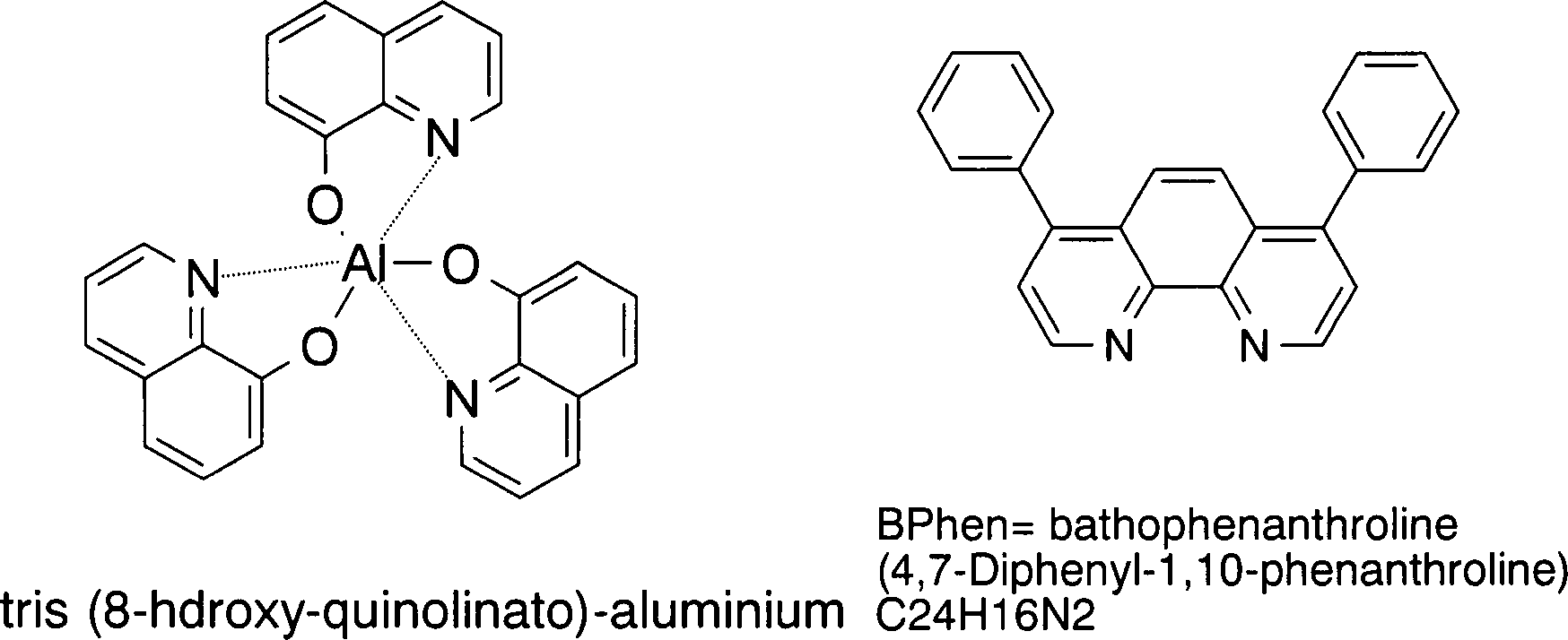
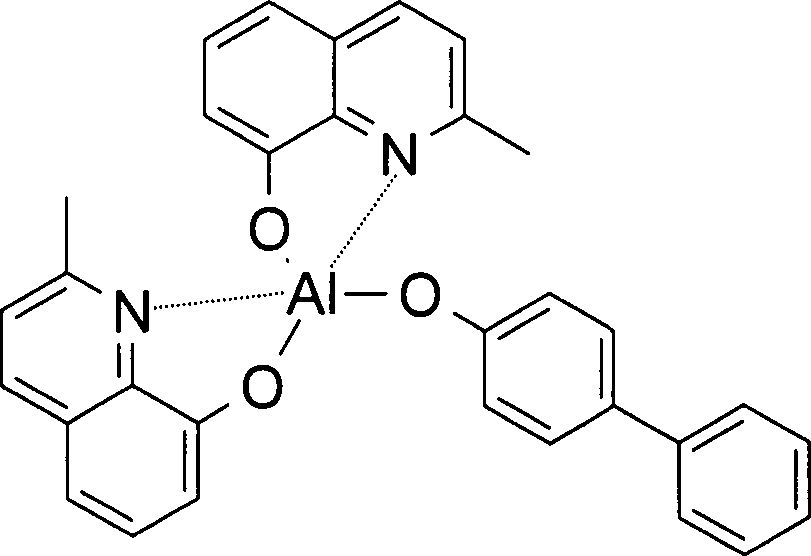
Die Quinolinatokomplexe können beispielsweise einen, zwei oder drei Quinolinatoliganden enthalten, wobei die anderen Liganden vorzugsweise mit O und/oder N-Donoratomen an das Zentralatom komplexieren, wie beispielsweise obenstehender Al-Komplex.The Quinolinato complexes can for example, contain one, two or three quinolinato ligands, wherein the other ligands preferably with O and / or N-donor atoms complex the central atom, such as the Al complex above.
Als Matrixmaterial können auch Phenanthroline eingesetzt werden, die substituiert oder unsubstituiert sein können, insbesondere Aryl-substituiert, beispielsweise Phenyl- oder Naphthyl-substituiert. Insbesondere kann Bphen als Matrixmaterial eingesetzt werden.When Matrix material can Phenanthrolines are also used which may be substituted or unsubstituted can, especially aryl-substituted, for example phenyl or naphthyl-substituted. In particular, Bphen can be used as matrix material.
Als
Matrixmaterial können
auch Heteroaromaten wie insbesondere Triazole eingesetzt werden,
gegebenenfalls auch Pyrrole, Imidazole, Triazole, Pyridine, Pyrimidine,
Pyridazine und derglei chen. Die Heteroaromaten sind vorzugsweise
substituiert, insbesondere Aryl-substituiert, beispielsweise Phenyl-
oder Naphthyl-substituiert. Insbesondere kann untenstehende Triazol
als Matrixmaterial eingesetzt werden. 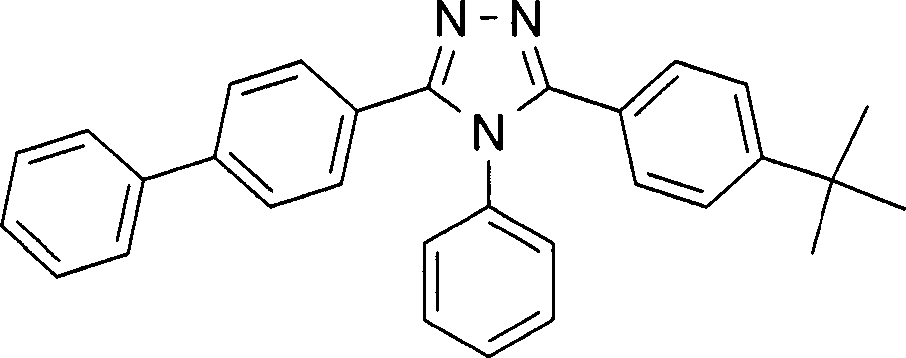
C30H27N3C30H27N3
Vorzugsweise besteht das verwendete Matrixmaterial vollständig aus einem Metallphtalocyanin-Komplex, insbesondere ZnPc, einem Porphyrin-Komplex, oder einem Buckminster-Fulleren, insbesondere Fulleren C60.Preferably the matrix material used consists entirely of a metal phthalocyanine complex, in particular ZnPc, a porphyrin complex, or a Buckminster fullerene, especially fullerene C60.
Es versteht sich, dass die genannten Matrixmaterialien auch untereinander oder mit anderen Materialien gemischt im Rahmen der Erfindung einsetzbar sind. Es versteht sich, dass auch geeignete andere organische Matrixmaterialien verwendet werden können, die halbleitende Eigenschaften aufweisen.It is understood that the matrix materials mentioned can also be used with one another or mixed with other materials in the context of the invention. It is understood that also suitable other orga nische matrix materials can be used, which have semiconducting properties.
Dotierungskonzentrationdoping concentration
Die Erfindung betrifft ferner ein organisches halbleitendes Material enthaltend einen erfindungsgemäßen Metallkomplex als n-Dotanden. Vorzugsweise liegt der Dotand in einer Dotierungskonzentration von ≤ 1:1 zu dem Matrixmolekül bzw. der monomeren Einheit eines polymeren Matrixmoleküls vor, vorzugsweise in einer Dotierungskonzentration von 1:2 oder kleiner, besonders bevorzugt von 1:5 oder kleiner oder 1:10 oder kleiner. Die Dotierungskonzentration kann sich in dem Bereich von 1:1 bis 1:100.000 oder kleiner, insbesondere in dem Bereich von 1:5 bis 10.000 oder 1:10 bis 1.000 betragen, beispielsweise in dem Bereich von 1:10 bis 1:100 oder 1:25 bis 1:50, ohne hierauf beschränkt zu sein.The The invention further relates to an organic semiconductive material containing a metal complex according to the invention as n-dopants. Preferably, the dopant is in a doping concentration of ≤ 1: 1 to the matrix molecule or the monomeric unit of a polymeric matrix molecule, preferably in a doping concentration of 1: 2 or smaller, more preferably 1: 5 or less, or 1:10 or less. The Doping concentration can range from 1: 1 to 1: 100,000 or smaller, especially in the range of 1: 5 to 10,000 or 1:10 to 1,000, for example in the range of 1:10 to 1: 100 or 1:25 to 1:50, without being limited to this.
Durchführung der DotierungCarrying out the doping
Die Dotierung des jeweiligen Matrixmaterials mit den erfindungsgemäß zu verwendenden n-Dotanden kann durch eines oder eine Kombination der folgenden Verfahren hergestellt wird:
- a) Mischverdampfung im Vakuum mit einer Quelle für das Matrixmaterial und einer für den Dotand.
- b) Sequentielles Deponieren des Matrixmaterials und des n-Dotanden auf einem Substrat mit anschliessender Eindiffusion des Dotanden, insbesondere durch thermische Behandlung
- c) Dotierung einer Matrixschicht durch eine Lösung von n-Dotanden mit anschliessendem Verdampfen des Lösungsmittels, insbesondere durch thermische Behandlung
- d) Oberflächendotierung einer Matrixmaterialschicht durch eine oberflächlich aufgebrachte Schicht von Dotanden
- e) Herstellung einer Lösung von Matrixmolekülen und Dotanden und anschließende Herstellung einer Schicht aus dieser Lösung mittels konventioneller Methoden wie beispielsweise Verdampfen des Lösungsmittels oder Aufschleudern
- a) Mixed evaporation in vacuum with a source of the matrix material and one for the dopant.
- b) sequential deposition of the matrix material and the n-dopant on a substrate with subsequent diffusion of the dopant, in particular by thermal treatment
- c) doping of a matrix layer by a solution of n-dopants with subsequent evaporation of the solvent, in particular by thermal treatment
- d) Surface doping of a matrix material layer by a surface-applied layer of dopants
- e) Preparation of a solution of matrix molecules and dopants and subsequent preparation of a layer of this solution by conventional methods such as evaporation of the solvent or spin coating
Die Dotierung kann gegebenenfalls auch derart erfolgen, dass der Dotand aus einer Precursor-Verbindung heraus verdampft wird, die beim Erhitzen und/oder Bestrahlung den Dotanden freisetzt. Als Precursor-Verbindung kann beispielsweise jeweils eine Carbonylverbidung, Distickstoffverbindung oder dergleichen eingesetzt werden, die bei der Freisetzung des Dotanden CO, Stickstoff oder dergleichen abspalten, wobei auch andere geeignete Precursor einsetzbar sind, wie beispielsweise Salze, z.B. Halogenide, oder dergleichen. Die Bestrahlung kann mittels elektromagnetischer Strahlung, insbesondere sichtbarem Licht, UV-Licht oder IR-Licht erfolgen, beispielsweise jeweils Laserlicht, oder auch durch andere Strahlungsarten. Durch die Bestrahlung kann im wesentlichen die zur Verdampfung notwendige Wärme bereitgestellt werden, es kann auch gezielt in bestimmte Banden der zu verdampfenden Verbindungen bzw. Precursor oder Verbindungskomplexe wie Charge-Transfer-Komplexe eingestrahlt werden, um beispielsweise durch Überführung in angeregte Zustände die Verdampfung der Verbindungen durch Dissoziation der Komplexe zu erleichtern. Der Komplex kann aber insbesondere auch ausreichend stabil sein, um unter den gegebenen Bedingungen undissoziiert zu verdampfen oder auf das Substrat aufgebracht zu werden. Es versteht sich, dass auch andere geeignete verfahren zur Durchführung der Dotierung eingesetzt werden können.The If appropriate, doping can also be carried out in such a way that the dopant is evaporated out of a precursor compound when heated and / or irradiation releases the dopant. As a precursor compound For example, in each case a Carbonylverbidung, nitrous compound or the like used in the release of the Dopants CO, nitrogen or the like split off, whereby others suitable precursors can be used, such as, for example, salts, e.g. Halides, or the like. The irradiation can by means of electromagnetic Radiation, in particular visible light, UV light or IR light carried out, for example, each laser light, or by others Types of radiation. By the irradiation can essentially the necessary for evaporation heat It can also be targeted in certain gangs the compounds to be vaporized or precursor or compound complexes such as charge-transfer complexes are irradiated to, for example through transfer into excited states the evaporation of the compounds by dissociation of the complexes to facilitate. But the complex can also be sufficient in particular be stable to evaporate undissociated under the given conditions or to be applied to the substrate. It is understood that Other suitable methods for carrying out the doping used can be.
Auf diese Weise können somit erfindungsgemäß n-dotierte Schichten von organischen Halbleitern hergestellt werden, die vielfältig einsetzbar sind.On this way you can thus according to the invention n-doped Layers of organic semiconductors are produced that can be used in a variety of ways are.
Halbleitende SchichtSemiconductive layer
Mittels der erfindungsgemäß verwendeten Metallkomplexe können halbleitende Schichten erzeugt werden, die gegebenenfalls aber auch eher linienförmige ausgebildet sind, wie z.B. als Leitfähigkeitspfade, Kontakte oder dergleichen. Die Metallkomplexe können hierbei als n-Dotanden zusammen mit einer anderen Verbindung, die als Matrixmaterial fungieren kann, eingesetzt werden, wobei das Dotierungsverhältnis 1:1 oder kleiner sein kann. Der erfindungsgemäß verwendete Metallkomplexe kann zu der jeweils anderen Verbindung bzw. Komponente aber auch in höheren Anteilen vorliegen, so dass das Verhältnis Metallkomplex:Verbindung im Verhältnis > 1:1 liegen kann, beispielsweise im Verhältnis ≥ 2:1, ≥ 5:1, ≥ 10:1 oder ≥ 20:1 oder höher. Die jeweils andere Komponente kann eine solche sein, wie sie als Matrixmaterial im Falle der Herstellung dotierter Schichten eingesetzt werden kann, ohne hierauf beschränkt zu sein. Gegebenenfalls kann der erfindungsgemäß verwendete Me tallkomplex auch im wesentlich in reiner Form vorliegen, beispielsweise als reine Schicht.through the invention used Metal complexes can Semiconducting layers are generated, but possibly also rather linear are formed, such. as conductivity paths, contacts or like. The metal complexes can be used as n-dopants together with another compound that act as matrix material can be used, wherein the doping ratio 1: 1 or may be smaller. The metal complexes used in the invention can to the other compound or component but also in higher Shares are present, so that the ratio of metal complex: compound in Ratio> 1: 1 may be, for example in the ratio ≥ 2: 1, ≥ 5: 1, ≥ 10: 1 or ≥ 20: 1 or higher. The other component may be one such as Matrix material used in the case of producing doped layers can be, without being limited to to be. Optionally, the Me used according to the invention may be complexed also essentially present in pure form, for example as pure layer.
Der einen erfindungsgemäßen Metallkomplex enthaltende oder im wesentlichen oder vollständig aus diesem bestehende Bereich kann insbesondere mit einem organischen halbleitenden Material und/oder einem anorganischen halbleitenden Material elektrisch stromleitend kontaktiert sein, beispielsweise auf einem derartigen Substrat angeordnet sein.The area containing a metal complex according to the invention or substantially or completely existing therefrom can in particular with an organic semiconductive material and / or a inorganic semiconducting material be electrically conductively contacted, for example, be arranged on such a substrate.
Vorzugsweise werden die genannten Metallkomplexe erfindungsgemäß als n-Dotanden eingesetzt, z.B. in einem Verhältnis ≤ 1 : 1 oder ≤ 1 : 2, oder wie weiter oben näher ausgeführt. Mittels der erfindungsgemäß als n-Dotanden eingesetzten Metallkomplexen können beispielsweise bei der Verwendung von Fulleren C60 als Matrix halbleitende Schichten mit Leitfähigkeiten bei Raumtemperatur in dem Bereich von 10–5 S/cm oder höher erzielt werden, beispielsweise von 10–3 S/cm oder höher, beispielsweise von 10–1 S/cm. Bei der Verwendung von Phthalocyanin Zink als Matrix wurde eine Leitfähigkeit von höher 10–8 S/cm erzielt, beispielsweise 10–6 S/cm. Bisher war es nicht möglich, diese Matrix mit organischen Donoren zu dotieren, da das Reduktionspotential der Matrix zu gering ist. Die Leitfähigkeit von undotiertem Phthalocyanin Zink beträgt hingegen maximal 10–10 S/cm.The metal complexes mentioned are preferably used according to the invention as n-dopants, for example in a ratio ≦ 1: 1 or ≦ 1: 2, or as explained in more detail above. By means of the metal complexes used according to the invention as n-dopants, it is possible, for example when using fullerene C 60 as matrix, to achieve semiconducting layers with conductivities at room temperature in the range of 10 -5 S / cm or higher, for example 10 -3 S / cm or higher, for example from 10 -1 S / cm. When using phthalocyanine zinc as the matrix, a conductivity of higher 10 -8 S / cm was achieved, for example 10 -6 S / cm. Previously, it was not possible to dope this matrix with organic donors because the reduction potential of the matrix is too low. The conductivity of undoped phthalocyanine zinc, however, is a maximum of 10 -10 S / cm.
Es versteht sich, dass die Schicht oder das Gebilde mit erfindungsgemäßem Metallkomplex jeweils einen oder mehrere verschiedene derartige Komplexe enthalten kann.It is understood that the layer or the structure with inventive metal complex each contain one or more different such complexes can.
Elektronisches BauelementElectronic component
Unter Verwendung der erfindungsgemäßen organischen Verbindungen zur Herstellung n-dotierter organischer halbleitender Materialien, die insbesondere in Form von Schichten oder elektrischen Leitungspfaden angeordnet sein können, können eine Vielzahl elektronischer Bauelemente oder diese enthaltende Einrichtungen mit einer n-dotierten organischen Halbleiterschicht hergestellt sein, die somit von der Erfindung mit umfasst werden. Im Sinne der Erfindung werden von dem Begriff „elektronische Bauelemente" auch optoelektronische Bauelemente mit umfasst. Durch die erfindungsgemäßen Verbindungen können die elektronischen Eigenschaften eines elektronisch funktionell wirksamen Bereichs des Bauelementes wie dessen elektrische Leitfähigkeit, lichtemittierende Eigenschaften oder dergleichen vorteilhaft verändert werden. So kann durch die erfindungsgemäßen Metallkomplexe als n-Dotanden die Leitfähigkeit der dotierten Schichten und/oder die Verbesserung der Ladungsträgerinjektion von Kontakten in die dotierte Schicht verbessert werden.Under Use of the organic according to the invention Compounds for the production of n-doped organic semiconducting Materials, in particular in the form of layers or electrical Line paths can be arranged can a variety of electronic components or containing them Devices with an n-doped organic semiconductor layer be prepared, which are thus encompassed by the invention. For the purposes of the invention, the term "electronic components" also optoelectronic Includes components. By the compounds according to the invention, the electronic properties of an electronically functionally effective Range of the device such as its electrical conductivity, light-emitting properties or the like are advantageously changed. Thus, by the metal complexes of the invention as n-dopants the conductivity the doped layers and / or the improvement of the charge carrier injection be improved by contacts in the doped layer.
Die Erfindung umfasst insbesondere organische lichtemitierende Dioden (OLED), organische Solarzellen, organische Dioden, insbesondere solchen mit hohem Gleichrichtungsverhältnis wie 103–107, vorzugsweise 104–107 oder 105–107, und organischen Feldeffekttransistoren, die mittels der neutralen Metallkomplexe nach der Erfindung hergestellt sind.In particular, the invention includes organic light emitting diodes (OLEDs), organic solar cells, organic diodes, particularly those having a high r.f. ratio, such as 10 3 -10 7 , preferably 10 4 -10 7 or 10 5 -10 7 , and organic field-effect transistors formed by the neutral ones Metal complexes are prepared according to the invention.
In
dem elektronischen Bauelement kann eine erfindungsgemäß n-dotierte Schicht
auf Basis eines organischen Matrixmaterials beispielsweise in folgenden
Schichtstrukturen vorliegen, wobei vorzugsweise die Basismaterialien
oder Matrixmaterialien der einzelnen Schichten jeweils organisch
sind:
M-i-n: Metall-Isolator-n-dotierter Halbleiter, wobei
die Schicht M den Metallgrundkontakt bildet und beispielsweise ITO,
Au, Ag, Al usw. sein kann. Der Deckkontakt bildet mit der n-dotierten Schicht
einen ohmschen Kontakt und kann beispielsweise aus Al bestehen.
Die Schicht „i" steht für eine undotierte
Schicht.
n-i-M: es gelten die Ausführungen zur M-i-n Struktur,
im Unterschied hierzu ist jedoch der ohmsche Kontakt auf dem Substrat
vorgesehen.
p-i-n: p-dotierter Halbleiter-Isolator-n-dotierter
Halbleiter,
n-i-p: n-dotierter Halbleiter-Isolator-p-dotierter
Halbleiter, „i" ist wiederum eine
undotierte Schicht, „p" ist eine p-dotierte Schicht.
Die Kontaktmaterialien sind hier löcherinjizierend, wobei p-seitig
beispielsweise eine Schicht oder ein Kontakt aus ITO oder Au vorgesehen
sein kann, oder elektroneninjizierend, wobei n-seitig eine Schicht
oder ein Kontakt aus ITO, Al oder Ag vorgesehen sein kann.In the electronic component, an n-doped layer based on an organic matrix material according to the invention can be present, for example, in the following layer structures, wherein preferably the base materials or matrix materials of the individual layers are each organic:
Min: metal-insulator-n-doped semiconductor, wherein the layer M forms the metal base contact and may be, for example, ITO, Au, Ag, Al, etc. The cover contact forms an ohmic contact with the n-doped layer and may consist of Al, for example. The layer "i" stands for an undoped layer.
niM: the statements on the Min structure apply, but in contrast to this, the ohmic contact is provided on the substrate.
pin: p-doped semiconductor-insulator-n-doped semiconductor,
nip: n-doped semiconductor-insulator-p-doped semiconductor, "i" is again an undoped layer, "p" is a p-doped layer. The contact materials are here hole injecting, wherein on the p-side, for example, a layer or a contact of ITO or Au may be provided, or electron-injecting, n-side, a layer or a contact of ITO, Al or Ag can be provided.
In obigen Strukturen kann im Bedarfsfall auch die i-Schicht ausgelassen werden, wodurch Schichtenabfolgen mit p-n oder n-p-Übergängen erhalten werden können.In If necessary, the above structures may also omit the i-layer whereby layer sequences with p-n or n-p junctions can be obtained.
Die Verwendung der erfindungsgemäßen Dotanden ist jedoch auf die oben genannten Ausführungsbeispiele nicht beschränkt, insbesondere können die Schichtstrukturen durch Einführung zusätzlicher geeigneter Schichten ergänzt bzw. modifiziert werden. Insbesondere können jeweils OLEDs mit derartigen Schichtabfolgen, insbesondere mit pin- oder mit einer dazu inversen Struktur, mit erfindungsgemäßen n-Dotanden aufgebaut werden.The Use of the dopants according to the invention however, is not limited to the above embodiments, in particular can the layer structures by introduction additional complementary layers added or modified. In particular, OLEDs with such layer sequences, in particular with pin or with an inverse structure, with N-dopants according to the invention being constructed.
Mit Hilfe der erfindungsgemäßen n-Dotanden können insbesondere organische Dioden vom Typ Metall-Isolator-n-dotierte Halbleiter (min) oder auch gegebenenfalls vom pin-Typ hergestellt werden, beispielsweise auf der Basis von Phtalozyaninzink. Diese Dioden zeigen ein Rektifizierungsverhältnis von 105 und höher. Ferner können unter Verwendung der erfindungsgemäßen Dotanden elektronische Bauelemente mit p-n-Übergängen erzeugt werden, wobei für die p- und die n-dotierte Seite jeweils dasselbe Halbleitermaterial verwendet wird (Homo-p-n-Übergang) und wobei für das n-dotierte Halbleitermaterial ein erfindungsgemäßer Metallkomplex eingesetzt wird. Derartige Bauteile sind von der Erfindung somit mit umfasst.With the aid of the n-dopants according to the invention, it is possible in particular to produce organic diodes of the metal-insulator-n-doped semiconductor type (min) or optionally of the pin type, for example based on phthalocyanine zinc. These diodes show a rectification ratio of 10 5 and higher. Furthermore, using the dopants according to the invention, electronic components having pn junctions can be produced, with the same semiconductor material being used for the p-doped and n-doped sides (homo-pn junction) and a metal complex according to the invention being used for the n-doped semiconductor material is used. Such components are thus included in the invention.
Die Metallkomplexe können erfindungsgemäß in den elektronischen Bauelementen aber auch in Schichten, Leitfähigkeitspfaden, Punktkontakten oder dergleichen eingesetzt werden, wenn diese gegenüber einer anderen Komponente überwiegen, beispielsweise als Injektionsschicht in reiner oder im wesentlichen reiner Form.The Metal complexes can according to the invention in the electronic components but also in layers, conductivity paths, Point contacts or the like can be used, if this against a outweigh other components, for example, as an injection layer in pure or substantially pure form.
Anwendungsbeispieleapplications
Es
wird ein erfindungsgemäßer elektronenreicher
neutraler Metallkomplex bereitgestellt, wobei der Metallkomplex
jeweils beispielsweise sein kann:
M-bis-(terpyridin) mit M
gleich Cr, Mn, Fe, CO, Ni, Cu, Zn, Mo, oder W; M2hpp4 mit M gleich Cr, Mn, Fe, CO, Ni, Cu, Zn,
Mo, oder W; M2(AlkylCOO)4 F
mit M gleich Cr, Mn, Fe, CO, Ni, Cu, Zn, Mo, oder W und mit jeweils Alkyl,
untereinander gleich oder verschieden, mit C1 bis C10; M2(Guadinat)4 mit
M gleich Cr, Mn, Fe, CO, Ni, Cu, Zn, Mo, oder W; M2(Formamidinat)4 mit M gleich Cr, Mn, Fe, CO, Ni, Cu, Zn,
Mo, oder W; M2(Carboxylat)4 mit
M gleich Cr, Mn, Fe, CO, Ni, Cu, Zn, Mo, oder W; M2(Halogenid)4 mit M gleich Cr, Mn, Fe, CO, Ni, Cu, Zn, Mo,
oder W; Bis(n5-cyclopentadienyl)M mit M
gleich Cr, Mn, Fe, CO, Ni, Cu, Zn, Mo, oder W;, Benzol-M-(η5-cyclopentadienyl) mit M gleich Cr, Mn,
Fe, CO, Ni, Cu, Zn, Mo, oder W; Fe (Ligand)2,
wobei der Ligand eine der Verbindungen 20 bis 37 mit E = -C- oder -Ge- oder -Si-
sein kann, wobei zumindest ein R, einige oder sämtliche R vorzugsweise jeweils
Wasserstoff oder Methyl oder Ethyl ist. Anstelle von Fe kann das
Zentralatom insbesondere auch jeweils Cr, Mn, Co, Ni, Cu oder Zn
oder Mo oder W sein. Ferner können
insbesondere die Verbindungen 21, 22, 23, 24 eingesetzt werden,
wobei R Wasserstoff oder Methyl ist. E kann hierbei insbesondere -C-
oder -Ge- sein, wodurch die entsprechenden Biscarbenliganden oder
Bisgermylenliganden vorliegen. Es versteht sich, dass gegebenenfalls
eines oder mehrere der Wasserstoffatome der Liganden durch andere
Reste einschließlich
Alkylresten ersetzt sein können.An electron-rich neutral metal complex according to the invention is provided, it being possible for the metal complex in each case to be, for example:
M bis (terpyridine) with M equal to Cr, Mn, Fe, CO, Ni, Cu, Zn, Mo, or W; M 2 hpp 4 with M equal to Cr, Mn, Fe, CO, Ni, Cu, Zn, Mo, or W; M 2 (alkylCOO) 4 F with M being Cr, Mn, Fe, CO, Ni, Cu, Zn, Mo, or W and with in each case alkyl, identically or differently, with C1 to C10; M 2 (guadinate) 4 with M equal to Cr, Mn, Fe, CO, Ni, Cu, Zn, Mo, or W; M 2 (formamidinate) 4 with M equal to Cr, Mn, Fe, CO, Ni, Cu, Zn, Mo, or W; M 2 (carboxylate) 4 with M equal to Cr, Mn, Fe, CO, Ni, Cu, Zn, Mo, or W; M 2 (halide) 4 with M equal to Cr, Mn, Fe, CO, Ni, Cu, Zn, Mo, or W; Bis (n 5 -cyclopentadienyl) M with M equal to Cr, Mn, Fe, CO, Ni, Cu, Zn, Mo, or W; benzene-M- (η 5 -cyclopentadienyl) with M being Cr, Mn, Fe, CO, Ni, Cu, Zn, Mo, or W; Fe (ligand) 2 , wherein the ligand may be one of the compounds 20 to 37 with E = -C- or -Ge- or -Si-, wherein at least one R, some or all R is preferably each hydrogen or methyl or ethyl. In particular, instead of Fe, the central atom may also be Cr, Mn, Co, Ni, Cu or Zn or Mo or W. Further, in particular the compounds 21, 22, 23, 24 can be used, wherein R is hydrogen or methyl. In this case, E can be in particular -C- or -Ge-, whereby the corresponding biscarbene ligands or bisgermylene ligands are present. It is understood that optionally one or more of the hydrogen atoms of the ligands may be replaced by other radicals including alkyl radicals.
Es kann auch beispielsweise ein Metallkomplex gemäß einer der Verbindungen 11 bis 14, 16 bereitgestellt werden, wobei R und R'' jeweils Methyl und E jeweils S ist. Das Zentralatom ist Fe.It can also be, for example, a metal complex according to one of the compounds 11 to 14, 16, wherein R and R "are each Methyl and E is each S. The central atom is Fe.
Alternativ ist das Zentralatom jeweils Cr, Mn, Co, Ni, Cu, Zn oder Mo oder W.alternative the central atom is each Cr, Mn, Co, Ni, Cu, Zn or Mo or W.
Der vorgelegte Metallkomplex wird gleichzeitig mit dem Matrixmaterial verdampft. Gemäß dem Ausführungsbeispiel ist das Matrixmaterial jeweils Phthalozyanin-Zink oder Fulleren C60. Der N-Dotand und Matrixmaterial können derart verdampft werden, dass die auf einem Substrat in einer Vakuumverdampfungsanlage niedergeschlagene Schicht ein Dotierungsverhältnis von n-Dotand zu Matrixmaterial von 1:10 aufweist.The submitted metal complex is evaporated simultaneously with the matrix material. According to the embodiment, the matrix material is in each case phthalocyanine zinc or fullerene C 60 . The N-dopant and matrix material can be evaporated in such a way that the layer deposited on a substrate in a vacuum evaporation system has a doping ratio of n-dopant to matrix material of 1:10.
Die jeweils mit dem erfindungsgemäßen n-Dotanden dotierte Schicht des organischen Halbleitermaterials ist auf einer ITO-Schicht (Indiumzinnoxid) aufgebracht, welche auf einem Glassubstrat angeordnet ist. Nach Aufbringung der erfindungsgemäßen n-dotierten organischen Halbleiterschicht wird eine Metallkatode aufgebracht, beispielsweise durch Aufdampfung eines geeigneten Metalls, um eine organische Leuchtdiode herzustellen. Es versteht sich, dass die organische Leuchtdiode auch einen sogenannten invertierten Schichtaufbau haben kann, wobei die Schichtenabfolge ist: Glassubstrat – Metallkatode -n-dotierte organische Schicht – transparente leitende Deckschicht (beispielsweise ITO). Es versteht sich, dass je nach Anwendungsfall zwischen den einzelnen genannten Schichten weitere Schichten vorgesehen sein können.The each with the n-dopant according to the invention doped layer of the organic semiconductor material is on a ITO layer (indium tin oxide) applied, which is arranged on a glass substrate. To Application of the n-doped organic according to the invention Semiconductor layer is applied a metal cathode, for example by vapor deposition of a suitable metal to produce an organic light emitting diode. It is understood that the organic light emitting diode is also a so-called can have inverted layer structure, the layer sequence is: glass substrate - metal cathode -n-doped organic layer - transparent conductive topcoat (eg ITO). It is understood that depending on the application between the individual layers mentioned further layers can be provided.
Beispiel 1:Example 1:
Der neutrale Kobalt-Komplex Kobalt-bis(phenylen-1-yl-2,6 dipyridyl) (Ligand: Verbindung 29) wurde durch konventionelle Verfahren hergestellt.Of the neutral cobalt complex cobalt bis (phenylene-1-yl-2,6 dipyridyl) (Ligand: compound 29) was prepared by conventional methods.
Der neutrale Komplex wurde unter Schutzgas in Ampullen verschweißt. Unter Sauerstoffausschluß wurde dann mit diesem Material eine Verdampferquelle befüllt. Dotierte Schichten mit einem Dotierungsverhältnis Dotand : Matrixmaterial von 1 : 10 wurden durch Mischverdampfung von Matrix und Dotand mit ZnPc als Matrixmaterial hergestellt. In Dünnschicht-Feldeffekttransistoren mit einer solcherart dotierten ZnPc-Schicht wurde eine Erhöhung des Source-Drain-Stromes für positive Gate-Spannung gefunden. Dies belegt die Anwesenheit von Elektronen als Majoritätsladungsträger in der ZnPc-Schicht. Dadurch wurde gezeigt, dass es sich tatsächlich um ein n-dotiertes Halbleitermaterial handelt.The neutral complex was sealed under inert gas in ampoules. Under exclusion of oxygen, an evaporator source was then filled with this material. Doped layers with a doping ratio dopant: matrix material of 1:10 were prepared by mixed evaporation of matrix and dopant with ZnPc as matrix material. In thin film field effect transistors having such a doped ZnPc layer, an increase in the source-drain current for positive gate voltage has been found. This be establishes the presence of electrons as a majority carrier in the ZnPc layer. As a result, it was shown that it is indeed an n-doped semiconductor material.
Entsprechendes kann für den Ruthenium-Komplex Ru-bis-(pyridin-2,6-di-(1H2H-N-imidazoyl-)) (Ligand: Verbindung 23 mit E = -C-) gelten.The same can for the ruthenium complex Ru bis (pyridine-2,6-di- (1H2H-N-imidazoyl-)) (ligand: Compound 23 with E = -C-) apply.
Beispiel 2:Example 2:
Eine Schicht aus Zink-Phthalozyanin (ZnPc) wurde mit dem Metallkomplex [Cr2(hpp)4] dotiert. Die dotierte Schicht wurde durch Mischverdampfung der ZnPc-Matrix und des Dotanden Cr2(hpp)4 im Hochvakuum hergestellt. Die Konzentration des Dotanden in der Matrix betrug 1.9 mol%. Die Sublimationstemperatur des Dotanden betrug 160°C. Die dotierte Schicht zeigte eine hohe Leitfähigkeit von 4·10^-6 S/cm. Durch Ausheizen der Schicht bei 70°C ließ sich die Leitfähigkeit auf 6·10^-5 S/cm steigern. Die Aktivierungsenergie der Leitfähigkeit betrug 0.27 eV.A Layer of zinc phthalocyanine (ZnPc) was combined with the metal complex [Cr2 (hpp) 4] doped. The doped layer was by mixed evaporation of the ZnPc matrix and the dopant Cr2 (hpp) 4 in a high vacuum. The concentration of dopant in the matrix was 1.9 mol%. The Sublimation temperature of the dopant was 160 ° C. The doped layer showed a high conductivity from 4 · 10 ^ -6 S / cm. By heating the layer at 70 ° C, the conductivity was on 6 · 10 ^ -5 Increase S / cm. The activation energy of the conductivity was 0.27 eV.
Beispiel 3:Example 3:
Eine Schicht aus Fullerene C60 wurde mit dem Metallkomplex Cobaltocene dotiert. Zunächst wurde eine reine Schicht des Fullerens durch Sublimation im Hochvakuum hergestellt. Diese Schicht hatte eine niedrige Leitfähigkeit von 1·10^-7 S/cm festgestellt. Die dotierte Schicht wurde dann in einen Behälter gebracht, in dem sich ein mit Cobaltocene gefüllter Verdampfer befand. Der Behälter wurde mit Stickstoff gefüllt. Das Cobaltocene wurde in diesem Behälter thermisch sublimiert. Das auf der Oberfläche der Fullerene-Schicht abgeschiedene Cobaltocene führt dort zur Ausbildung einer dünnen hochdotierten Schicht. Der in der Schicht gemessene Querstrom erhöhte sich dabei um 3 Größenordnungen. Die Leitfähigkeit der hochdotierten Schicht betrug also mindestens 1·10–4 S/cm. Die derart dotierte Fullereneschicht wurde nachfolgend zurück in die Vakuumkammer transferiert. Dort wurden weiterhin hohe Leitfähigkeiten von mindestens 2·10–5 S/cm gemessen. Dadurch wurde nachgewiesen, dass die beobachtete Leitfähigkeitserhöhung tatsächlich auf die Dotierung des Fullerens zurückgeht, da möglicherweise gebildete Schichten von reinem, neutralen Cobaltocene aufgrund ihres Dampfdruckes im Hochvakuum nicht stabil sind.A layer of fullerene C60 was doped with the metal complex cobaltocenes. First, a pure layer of the fullerene was prepared by sublimation in a high vacuum. This layer had a low conductivity of 1 × 10 -7 S / cm. The doped layer was then placed in a container containing a cobaltocene filled evaporator. The container was filled with nitrogen. The cobaltocene was thermally sublimated in this container. The deposited on the surface of the fullerene layer cobaltocenes leads there to form a thin highly doped layer. The measured in the layer cross-flow increased by 3 orders of magnitude. The conductivity of the highly doped layer was thus at least 1 × 10 -4 S / cm. The thus doped fullerene layer was subsequently transferred back into the vacuum chamber. High conductivities of at least 2 × 10 -5 S / cm were still measured there. It was thus demonstrated that the observed increase in conductivity is indeed due to the doping of the fullerene, since possibly formed layers of pure, neutral cobaltocenes are not stable due to their vapor pressure in a high vacuum.
Claims (30)
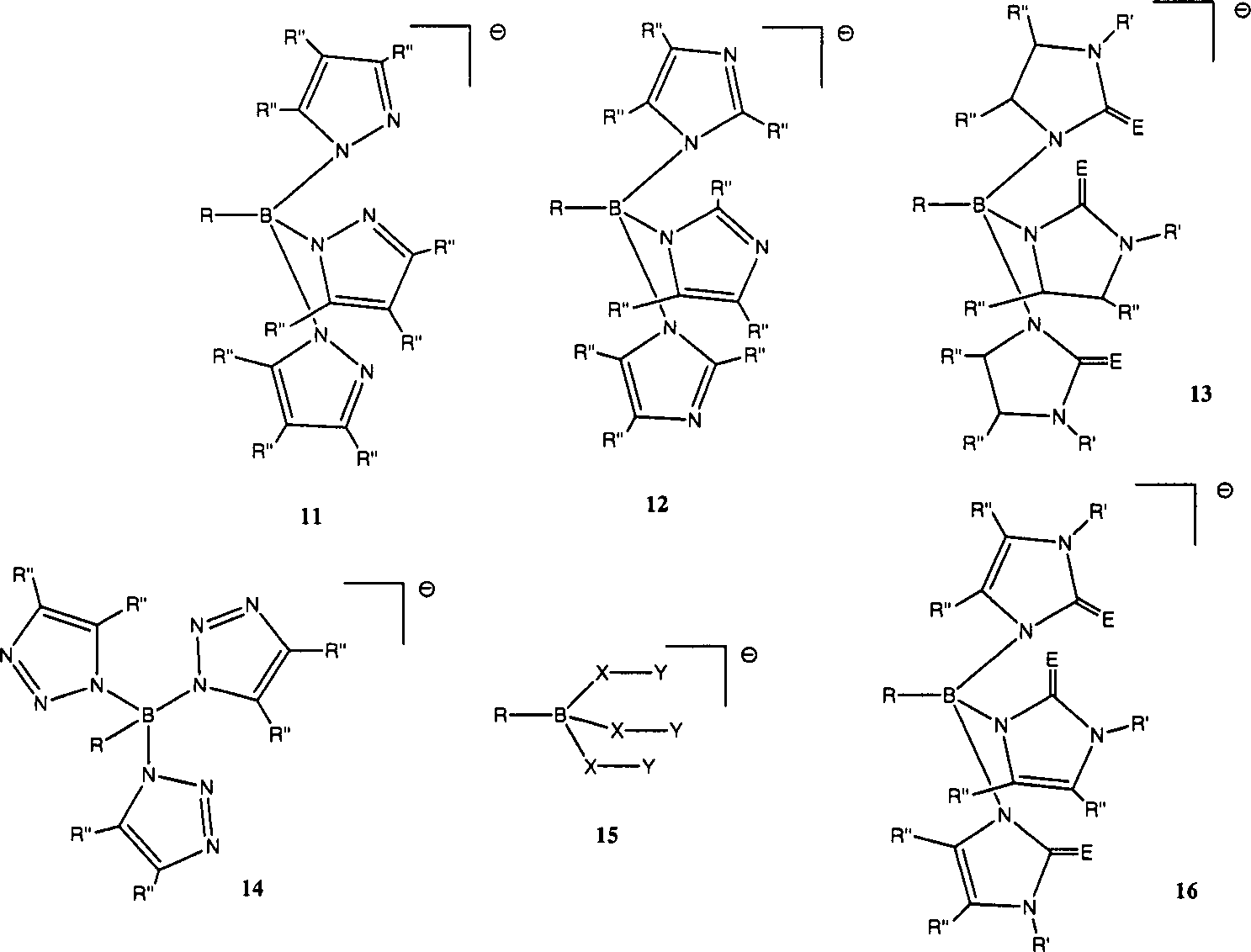


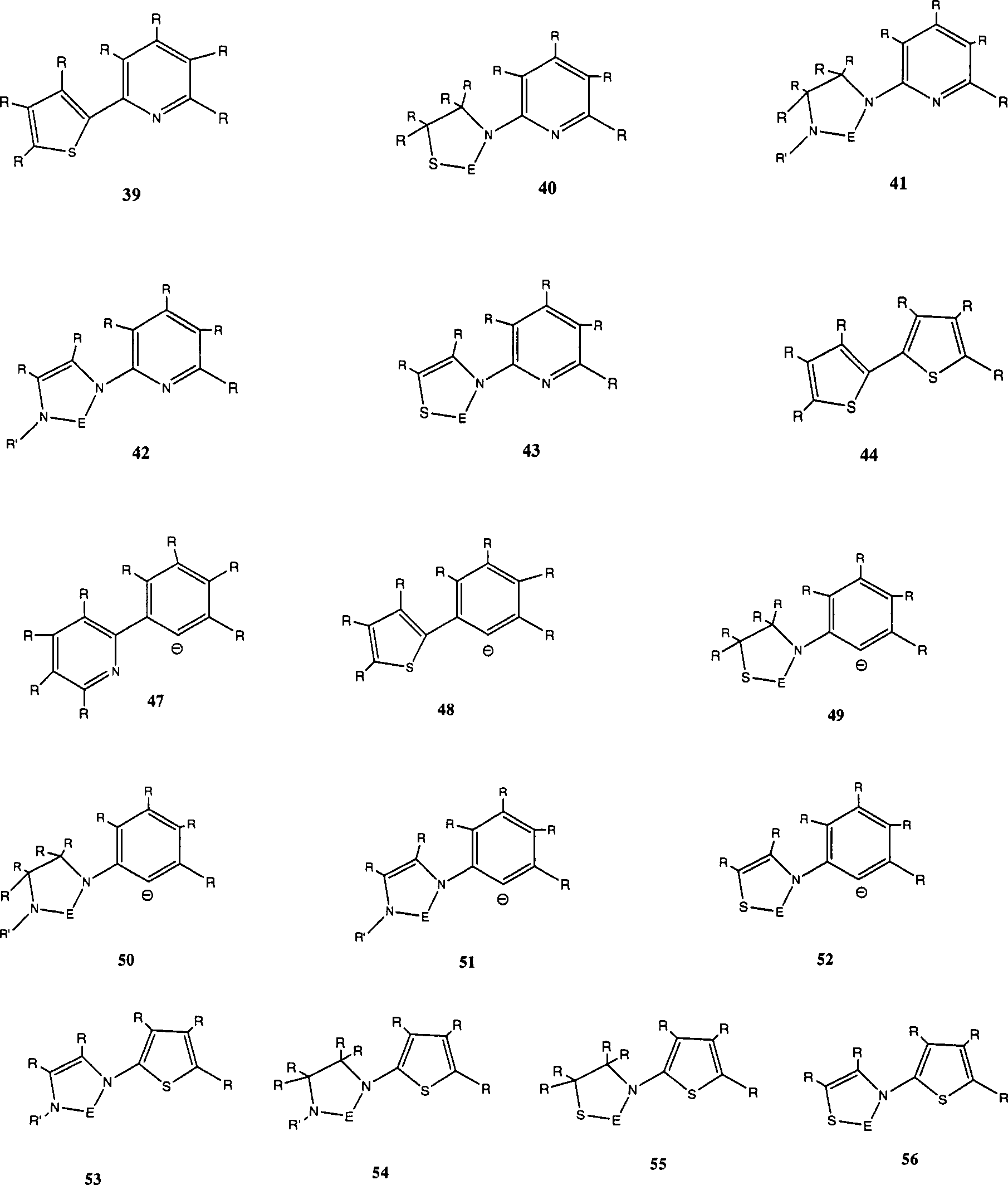

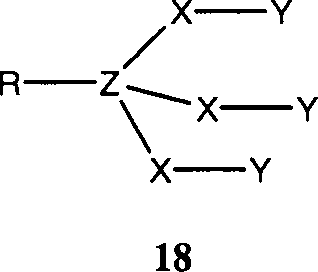
Priority Applications (15)
| Application Number | Priority Date | Filing Date | Title |
|---|---|---|---|
| DE102004010954A DE102004010954A1 (en) | 2004-03-03 | 2004-03-03 | Use of a metal complex as an n-dopant for an organic semiconductive matrix material, organic semiconductor material and electronic component |
| US10/585,215 US8258501B2 (en) | 2004-03-03 | 2005-03-03 | Use of a metal complex as an n-Dopant for an organic semiconducting matrix material, organic of semiconducting material and electronic component, and also a dopant and ligand and process for producing same |
| EP06025887A EP1768200B1 (en) | 2004-03-03 | 2005-03-03 | Dopant and its production method |
| KR1020067006767A KR100867028B1 (en) | 2004-03-03 | 2005-03-03 | Use of a metal complex as n-dopant for an organic semiconducting matrix material, organic semiconductor material and electronic component, as well as dopant and ligand and method for producing the same |
| PCT/DE2005/000372 WO2005086251A2 (en) | 2004-03-03 | 2005-03-03 | Use of metal complexes as n-dopants for organic semiconductors and production thereof including their ligands |
| CA002549309A CA2549309A1 (en) | 2004-03-03 | 2005-03-03 | Use of metal complexes as n-dopants for organic semiconductors and production thereof including their ligands |
| CNA2009101182646A CN101580519A (en) | 2004-03-03 | 2005-03-03 | Metal complex for doping an organic semiconducting matrix material |
| DE502005004031T DE502005004031D1 (en) | 2004-03-03 | 2005-03-03 | Metal complex and process for its preparation |
| EP06007372A EP1672714A3 (en) | 2004-03-03 | 2005-03-03 | Dopant and its production method |
| DE502005010680T DE502005010680D1 (en) | 2004-03-03 | 2005-03-03 | USE OF METAL COMPLEXES AS N-DOTANDES FOR ORGANIC SEMICONDUCTORS |
| EP05729708A EP1721347B1 (en) | 2004-03-03 | 2005-03-03 | Use of a metal complex as n-dopant for an organic semiconducting matrix material |
| HK07105135.8A HK1100266B (en) | 2004-03-03 | 2005-03-03 | Use of a metal complex as n-dopant for an organic semiconducting matrix material |
| CN200580003728.9A CN1914747B (en) | 2004-03-03 | 2005-03-03 | Use of metal complexes as n-dopants in organic semiconductor matrix materials, and electronic components containing organic semiconductor materials doped with the metal complexes |
| JP2007501110A JP4847947B2 (en) | 2004-03-03 | 2005-03-03 | Use of metal complexes as n-dopants for organic semiconductor matrix materials, organic semiconductors and electronic components |
| IN293MU2006 IN2006MU00293A (en) | 2004-03-03 | 2006-03-13 |
Applications Claiming Priority (1)
| Application Number | Priority Date | Filing Date | Title |
|---|---|---|---|
| DE102004010954A DE102004010954A1 (en) | 2004-03-03 | 2004-03-03 | Use of a metal complex as an n-dopant for an organic semiconductive matrix material, organic semiconductor material and electronic component |
Publications (1)
| Publication Number | Publication Date |
|---|---|
| DE102004010954A1 true DE102004010954A1 (en) | 2005-10-06 |
Family
ID=34917077
Family Applications (3)
| Application Number | Title | Priority Date | Filing Date |
|---|---|---|---|
| DE102004010954A Ceased DE102004010954A1 (en) | 2004-03-03 | 2004-03-03 | Use of a metal complex as an n-dopant for an organic semiconductive matrix material, organic semiconductor material and electronic component |
| DE502005004031T Expired - Lifetime DE502005004031D1 (en) | 2004-03-03 | 2005-03-03 | Metal complex and process for its preparation |
| DE502005010680T Expired - Lifetime DE502005010680D1 (en) | 2004-03-03 | 2005-03-03 | USE OF METAL COMPLEXES AS N-DOTANDES FOR ORGANIC SEMICONDUCTORS |
Family Applications After (2)
| Application Number | Title | Priority Date | Filing Date |
|---|---|---|---|
| DE502005004031T Expired - Lifetime DE502005004031D1 (en) | 2004-03-03 | 2005-03-03 | Metal complex and process for its preparation |
| DE502005010680T Expired - Lifetime DE502005010680D1 (en) | 2004-03-03 | 2005-03-03 | USE OF METAL COMPLEXES AS N-DOTANDES FOR ORGANIC SEMICONDUCTORS |
Country Status (9)
| Country | Link |
|---|---|
| US (1) | US8258501B2 (en) |
| EP (3) | EP1721347B1 (en) |
| JP (1) | JP4847947B2 (en) |
| KR (1) | KR100867028B1 (en) |
| CN (2) | CN101580519A (en) |
| CA (1) | CA2549309A1 (en) |
| DE (3) | DE102004010954A1 (en) |
| IN (1) | IN2006MU00293A (en) |
| WO (1) | WO2005086251A2 (en) |
Cited By (30)
| Publication number | Priority date | Publication date | Assignee | Title |
|---|---|---|---|---|
| EP1970371A1 (en) | 2007-03-16 | 2008-09-17 | Novaled AG | Pyrido(3,2-h)chinazolins and/or 5,6-Dihydro derivatives thereof, method for their manufacture and endowed organic semiconductor material containing them |
| DE102007046445A1 (en) * | 2007-09-28 | 2009-04-16 | Osram Opto Semiconductors Gmbh | Organic radiation-emitting component, useful as organic light-emitting diode, comprises substrate, lower electrode layer, organic radiation-emitting layer with matrix containing radiation emitting metal complex and upper electrode layer |
| DE102007037905A1 (en) | 2007-08-10 | 2009-04-23 | Fraunhofer-Gesellschaft zur Förderung der angewandten Forschung e.V. | Doped semiconductor material and its use |
| EP2072517A1 (en) | 2007-12-21 | 2009-06-24 | Novaled AG | Asymmetric phenanthrolins, method for their manufacture and doped organic semiconductor material containing them |
| EP2248201A1 (en) * | 2008-02-27 | 2010-11-10 | OSRAM Opto Semiconductors GmbH | Method for producing a doped organic semiconducting layer |
| DE102009051142A1 (en) | 2009-06-05 | 2010-12-09 | Heliatek Gmbh | Photoactive component with inverted layer sequence and method for its production |
| DE102010031829A1 (en) | 2009-07-21 | 2011-02-03 | Novaled Ag | Thermoelectric device useful as a temperature sensor, a thermoelectric cooler, a thermoelectric heater or a thermoelectric power generator, comprises a flexible ceramic substrate and a layer arrangement, which is formed onto the substrate |
| WO2011044867A2 (en) | 2009-10-14 | 2011-04-21 | Novaled Ag | Electro-optical, organic semiconductor component and method for the production thereof |
| WO2011073219A1 (en) | 2009-12-16 | 2011-06-23 | Heliatek Gmbh | Photoactive component having organic layers |
| DE102010004453A1 (en) | 2010-01-12 | 2011-07-14 | Novaled AG, 01307 | Organic light emitting component has connection units formed with p-doped and n-doped hole transport layers and n-type and p-type dot layers formed with organic n-dopant and p-dopant materials respectively |
| EP2385556A1 (en) | 2010-05-04 | 2011-11-09 | Heliatek GmbH | Photoactive device with organic layers |
| EP2398056A1 (en) | 2010-06-21 | 2011-12-21 | Heliatek GmbH | Organic solar cell with several transport layer systems |
| DE102010031979A1 (en) | 2010-07-22 | 2012-01-26 | Novaled Ag | Semiconductor device |
| DE102010062954A1 (en) * | 2010-12-13 | 2012-06-14 | Osram Opto Semiconductors Gmbh | Optoelectronic device and use of a copper complex in a charge generation layer sequence |
| DE102010062877A1 (en) * | 2010-12-13 | 2012-06-21 | Osram Opto Semiconductors Gmbh | Organic light emitting device and use of a copper complex in a charge transport layer |
| WO2012092972A1 (en) | 2011-01-06 | 2012-07-12 | Heliatek Gmbh | Electronic or optoelectronic component comprising organic layers |
| WO2013110268A1 (en) | 2012-01-26 | 2013-08-01 | Novaled Ag | Array of several organic semiconductor components and method for the production thereof |
| DE102012103448A1 (en) | 2012-04-19 | 2013-10-24 | Heliatek Gmbh | Method for optimization of e.g. pin tandem cell on curved surface, involves adjusting flat surface of photoactive component based on position of photoactive component on curved surface and emission angle of radiation |
| DE102012104118A1 (en) | 2012-05-10 | 2013-11-14 | Heliatek Gmbh | Hole transport materials for optoelectronic components |
| DE102012104247A1 (en) | 2012-05-16 | 2013-11-21 | Heliatek Gmbh | New heterocyclic compound, useful in an optoelectronic component such as solar cell, organic LED, organic FET and a photodetector |
| WO2013179220A2 (en) | 2012-05-30 | 2013-12-05 | Heliatek Gmbh | Solar panel to be arranged on shaped parts |
| DE102012105022A1 (en) | 2012-06-11 | 2013-12-12 | Heliatek Gmbh | System for optimizing energy consumption of e.g. refrigerator in vehicle e.g. hybrid electric car, has photovoltaic module that is arranged in vehicle and is moved in angle-independent manner to generate constant power output |
| WO2013186668A1 (en) | 2012-06-11 | 2013-12-19 | Heliatek Gmbh | Filter system for photoactive components |
| DE102012105809A1 (en) | 2012-07-02 | 2014-01-02 | Heliatek Gmbh | Optoelectronic component e.g. solar cell, has counter electrode that is provided with main layer and interlayer, and photoactive layer system which is provided between counter electrode and main electrodes |
| DE102012105812A1 (en) | 2012-07-02 | 2014-01-02 | Heliatek Gmbh | Electrode arrangement for optoelectronic components |
| DE102012105810A1 (en) | 2012-07-02 | 2014-01-02 | Heliatek Gmbh | Optoelectronic component e.g. solar cell, has counter electrode that is provided with main layer and interlayer, and photoactive layer system which is provided between counter electrode and main electrodes |
| WO2014006565A2 (en) | 2012-07-02 | 2014-01-09 | Heliatek Gmbh | Transparent electrode for optoelectronic components |
| US8734962B2 (en) | 2007-05-21 | 2014-05-27 | Osram Opto Semiconductors Gmbh | Phosphorescent metal complex compound radiation emitting component comprising a phosphorescent metal complex compound and method for production of a phosphorescent metal complex compound |
| WO2015044377A1 (en) | 2013-09-27 | 2015-04-02 | Heliatek Gmbh | Photoactive organic material for optoelectronic components |
| US9139764B2 (en) | 2007-09-28 | 2015-09-22 | Osram Opto Semiconductors Gmbh | Organic radiation-emitting component |
Families Citing this family (192)
| Publication number | Priority date | Publication date | Assignee | Title |
|---|---|---|---|---|
| US7540978B2 (en) | 2004-08-05 | 2009-06-02 | Novaled Ag | Use of an organic matrix material for producing an organic semiconductor material, organic semiconductor material and electronic component |
| DE112005002603A5 (en) | 2004-08-13 | 2007-08-09 | Novaled Gmbh | Layer arrangement for a light-emitting component |
| DE602004006275T2 (en) | 2004-10-07 | 2007-12-20 | Novaled Ag | Method for doping a semiconductor material with cesium |
| EP1705727B1 (en) | 2005-03-15 | 2007-12-26 | Novaled AG | Light emitting element |
| DE502005002218D1 (en) | 2005-04-13 | 2008-01-24 | Novaled Ag | Arrangement of a pin-type organic light emitting diode and method of manufacturing |
| DE502005009415D1 (en) | 2005-05-27 | 2010-05-27 | Novaled Ag | Transparent organic light emitting diode |
| DE502005009802D1 (en) | 2005-11-10 | 2010-08-05 | Novaled Ag | Doped organic semiconductor material |
| DE502005004675D1 (en) * | 2005-12-21 | 2008-08-21 | Novaled Ag | Organic component |
| US7919010B2 (en) | 2005-12-22 | 2011-04-05 | Novaled Ag | Doped organic semiconductor material |
| EP1804309B1 (en) * | 2005-12-23 | 2008-07-23 | Novaled AG | Electronic device with a layer structure of organic layers |
| EP1803789A1 (en) | 2005-12-28 | 2007-07-04 | Novaled AG | Use of metal complexes as emitters in organic light emitting devices and such a device |
| EP1808909A1 (en) | 2006-01-11 | 2007-07-18 | Novaled AG | Electroluminescent light-emitting device |
| EP1837927A1 (en) | 2006-03-22 | 2007-09-26 | Novaled AG | Use of heterocyclic radicals for doping of organic semiconductors |
| KR101361710B1 (en) * | 2006-03-21 | 2014-02-10 | 노발레드 아게 | Method for preparing doped organic semiconductor materials and formulation utilized therein |
| ATE394800T1 (en) | 2006-03-21 | 2008-05-15 | Novaled Ag | HETEROCYCLIC RADICAL OR DIRADICAL, THEIR DIMERS, OLIGOMERS, POLYMERS, DISPIR COMPOUNDS AND POLYCYCLES, THEIR USE, ORGANIC SEMICONDUCTIVE MATERIAL AND ELECTRONIC COMPONENT |
| WO2007115540A1 (en) | 2006-03-30 | 2007-10-18 | Novaled Ag | Use of bora-tetraazapentalenes |
| EP1848049B1 (en) | 2006-04-19 | 2009-12-09 | Novaled AG | Light emitting device |
| EP1860709B1 (en) | 2006-05-24 | 2012-08-08 | Novaled AG | Use of square planar transition metal complexes as dopants |
| DE102006035018B4 (en) | 2006-07-28 | 2009-07-23 | Novaled Ag | Oxazole triplet emitter for OLED applications |
| KR101275799B1 (en) * | 2006-11-21 | 2013-06-18 | 삼성전자주식회사 | Method of forming phase change layer using Ge precursor for low temperature deposition and method of manufacturing phase change memory device using the same |
| DE102007019260B4 (en) | 2007-04-17 | 2020-01-16 | Novaled Gmbh | Non-volatile organic storage element |
| DE102007018456B4 (en) | 2007-04-19 | 2022-02-24 | Novaled Gmbh | Use of main group element halides and/or pseudohalides, organic semiconducting matrix material, electronic and optoelectronic components |
| EP3457451B1 (en) | 2007-04-30 | 2019-07-17 | Novaled GmbH | The use of oxocarbon, pseudooxocarbon and radialene compounds |
| EP1990847B1 (en) | 2007-05-10 | 2018-06-20 | Novaled GmbH | Use of quinoid bisimidazoles and their derivatives as dopant for doping an organic semi-conductor matrix material |
| DE102007028236A1 (en) | 2007-06-20 | 2009-01-02 | Siemens Ag | Semiconducting material and organic rectifier diode |
| DE102007028237A1 (en) | 2007-06-20 | 2008-12-24 | Osram Opto Semiconductors Gmbh | Use of a metal complex as p-dopant for an organic semiconductive matrix material, organic semiconductor material and electronic component |
| DE102007028238A1 (en) * | 2007-06-20 | 2008-12-24 | Osram Opto Semiconductors Gmbh | Use of a metal complex as p-dopant for an organic semiconductive matrix material, organic semiconductor material and organic light-emitting diode |
| DE102007031220B4 (en) | 2007-07-04 | 2022-04-28 | Novaled Gmbh | Quinoid compounds and their use in semiconducting matrix materials, electronic and optoelectronic components |
| DE102007031261A1 (en) * | 2007-07-05 | 2009-01-08 | Universtität Regensburg | Luminescent metal complexes with bulky auxiliary ligands |
| DE102007045518B4 (en) | 2007-09-24 | 2010-12-16 | Siemens Ag | Solution-processed organic electronic component with improved electrode layer |
| CN101855015B (en) * | 2007-11-28 | 2013-07-17 | 林德股份公司 | Catalyst composition and process for oligomerization of ethylene |
| EP2256111A4 (en) | 2008-02-15 | 2012-12-19 | Univ Tokyo | ORGANIC SEMICONDUCTOR COMPOUND, SEMICONDUCTOR ELEMENT, SOLAR BATTERY, AND PROCESS FOR PRODUCING ORGANIC SEMICONDUCTOR COMPOUND |
| US8057712B2 (en) | 2008-04-29 | 2011-11-15 | Novaled Ag | Radialene compounds and their use |
| DE102008036247A1 (en) | 2008-08-04 | 2010-02-11 | Merck Patent Gmbh | Electronic devices containing metal complexes |
| DE102008036062B4 (en) | 2008-08-04 | 2015-11-12 | Novaled Ag | Organic field effect transistor |
| DE102008036063B4 (en) * | 2008-08-04 | 2017-08-31 | Novaled Gmbh | Organic field effect transistor |
| EP2161272A1 (en) | 2008-09-05 | 2010-03-10 | Basf Se | Phenanthrolines |
| DE102008056391B4 (en) | 2008-09-26 | 2021-04-01 | Osram Oled Gmbh | Organic electronic component and process for its manufacture |
| US8119037B2 (en) | 2008-10-16 | 2012-02-21 | Novaled Ag | Square planar transition metal complexes and organic semiconductive materials using them as well as electronic or optoelectric components |
| DE102008061843B4 (en) | 2008-12-15 | 2018-01-18 | Novaled Gmbh | Heterocyclic compounds and their use in electronic and optoelectronic devices |
| TW201035103A (en) * | 2008-12-22 | 2010-10-01 | Schering Corp | Gamma secretase modulators |
| KR101398711B1 (en) * | 2009-02-27 | 2014-05-27 | 주식회사 엘지화학 | Nitrogen containing compound and organic electronic device using the same |
| DE102009013685B4 (en) | 2009-03-20 | 2013-01-31 | Novaled Ag | Use of an organic diode as organic Zener diode and method of operation |
| DE102010023619B4 (en) | 2009-08-05 | 2016-09-15 | Novaled Ag | Organic bottom-emitting device |
| JP5836275B2 (en) * | 2009-09-18 | 2015-12-24 | オスラム オーエルイーディー ゲゼルシャフト ミット ベシュレンクテル ハフツングOSRAM OLED GmbH | Organic electronic devices and dopants for doping organic semiconductor matrix materials |
| EP2312663B1 (en) | 2009-10-19 | 2014-10-15 | Novaled AG | Organic electronic device comprising an organic semiconducting material |
| EP2367215A1 (en) * | 2010-03-15 | 2011-09-21 | Novaled AG | An organic photoactive device |
| US8796483B2 (en) | 2010-04-01 | 2014-08-05 | President And Fellows Of Harvard College | Cyclic metal amides and vapor deposition using them |
| WO2011134959A1 (en) * | 2010-04-27 | 2011-11-03 | University Of Princeton | Remote n-doping of organic thin film transistors |
| EP2395571B1 (en) | 2010-06-10 | 2013-12-04 | Novaled AG | Organic electronic device comprising an organic semiconducting material |
| WO2011157385A2 (en) | 2010-06-14 | 2011-12-22 | Novaled Ag | Organic light emitting device |
| DE102010023620B4 (en) | 2010-06-14 | 2016-09-15 | Novaled Ag | Organic, bottom-emitting device |
| US20140144509A1 (en) | 2010-09-10 | 2014-05-29 | Novaled Ag | Compounds for Organic Photovoltaic Devices |
| EP2452946B1 (en) | 2010-11-16 | 2014-05-07 | Novaled AG | Pyridylphosphinoxides for organic electronic device and organic electronic device |
| EP2463927B1 (en) | 2010-12-08 | 2013-08-21 | Novaled AG | Material for organic electronic device and organic electronic device |
| DE102010056519B4 (en) | 2010-12-27 | 2024-11-28 | Heliatek Gmbh | Optoelectronic component with doped layers |
| US10038150B2 (en) | 2011-02-25 | 2018-07-31 | Ecole Polytechnique Federale De Lausanne (Epfl) | Metal complexes for use as dopants and other uses |
| EP2551949A1 (en) * | 2011-07-28 | 2013-01-30 | Ecole Polytechnique Fédérale de Lausanne (EPFL) | Metal complexes for use as dopants and other uses |
| JP2014517807A (en) * | 2011-02-25 | 2014-07-24 | エコール ポリテクニーク フェデラル ドゥ ローザンヌ(エーペーエフエル) | Metal complexes for use as dopants and other uses |
| US9142781B2 (en) | 2011-06-09 | 2015-09-22 | Novaled Ag | Compound for organic electronic device |
| JP6461599B2 (en) | 2011-06-22 | 2019-01-30 | ノヴァレッド ゲーエムベーハー | Electronic equipment |
| DE102011080240A1 (en) * | 2011-08-02 | 2013-02-07 | Cynora Gmbh | Singlet Harvesting with binuclear copper (I) complexes for opto-electronic devices |
| DE102011055233A1 (en) | 2011-11-10 | 2013-05-16 | Novaled Ag | Light emitting device for use in planar arrangement of illumination device to emit light in different applications, has electrical line connection electrically connecting contact terminal of light-emitting component with plugs and sockets |
| US10374165B2 (en) | 2011-11-30 | 2019-08-06 | Novaled Gmbh | Organic electronic device |
| US10297767B2 (en) | 2011-11-30 | 2019-05-21 | Novaled Gmbh | Organic electronic device |
| TWI584513B (en) * | 2011-11-30 | 2017-05-21 | 諾瓦發光二極體有限公司 | Display |
| US9318705B2 (en) | 2011-12-06 | 2016-04-19 | Novaled Gmbh | Organic light emitting device with roughening layer and method of producing |
| WO2013088934A1 (en) * | 2011-12-12 | 2013-06-20 | 新日鉄住金化学株式会社 | Organic electroluminescent element material and organic electroluminescent element using same |
| DE102012209523A1 (en) | 2012-06-06 | 2013-12-12 | Osram Opto Semiconductors Gmbh | Main group metal complexes as p-dopants for organic electronic matrix materials |
| DE102012209520A1 (en) | 2012-06-06 | 2013-12-12 | Osram Opto Semiconductors Gmbh | Metal complexes as p-dopants for organic electronic matrix materials |
| JP2014053383A (en) * | 2012-09-05 | 2014-03-20 | Konica Minolta Inc | Tandem organic photoelectric conversion element and solar cell using the same |
| DE102012217587A1 (en) * | 2012-09-27 | 2014-03-27 | Siemens Aktiengesellschaft | Salts of cyclopentadiene as n-dopants for organic electronics |
| EP2811000B1 (en) * | 2013-06-06 | 2017-12-13 | Novaled GmbH | Organic electronic device |
| DE102013212018A1 (en) * | 2013-06-25 | 2015-01-08 | Evonik Industries Ag | Metal oxide precursors, coating compositions containing them, and their use |
| EP2840622B1 (en) | 2013-08-19 | 2019-02-13 | Novaled GmbH | Electronic or optoelectronic device comprising an anchored thin molecular layer, process for its preparation and compound used therein |
| DE102013013876A1 (en) | 2013-08-20 | 2015-03-12 | Merck Patent Gmbh | metal complexes |
| CN103483365B (en) * | 2013-09-03 | 2016-04-27 | 太仓碧奇新材料研发有限公司 | A kind of also three thiophene borine transistor materials and preparation method thereof |
| KR102380808B1 (en) | 2013-12-06 | 2022-03-30 | 메르크 파텐트 게엠베하 | Substituted oxepines |
| KR102618668B1 (en) | 2013-12-19 | 2023-12-27 | 메르크 파텐트 게엠베하 | Heterocyclic spiro compounds |
| EP2887416B1 (en) | 2013-12-23 | 2018-02-21 | Novaled GmbH | N-doped semiconducting material comprising phosphine oxide matrix and metal dopant |
| DE102014202718A1 (en) | 2014-02-14 | 2015-08-20 | Evonik Degussa Gmbh | Coating composition, process for its preparation and its use |
| EP2924753B1 (en) | 2014-03-25 | 2017-04-19 | Novaled GmbH | Polychromatic light emitting devices and versatile hole transporting matrix for them |
| EP2933852B2 (en) | 2014-04-17 | 2023-09-06 | Novaled GmbH | Phosphorescent OLED and hole transporting materials for phosphorescent OLEDs |
| EP2963010B1 (en) | 2014-07-04 | 2018-02-21 | Novaled GmbH | Electronic device and compound |
| JP6629291B2 (en) | 2014-07-21 | 2020-01-15 | メルク、パテント、ゲゼルシャフト、ミット、ベシュレンクテル、ハフツングMerck Patent GmbH | Materials for electronic devices |
| EP3189551B1 (en) | 2014-09-05 | 2021-01-27 | Merck Patent GmbH | Formulations and method of producing an organic electroluminescent device |
| EP3002801B1 (en) | 2014-09-30 | 2018-07-18 | Novaled GmbH | Organic electronic device |
| DE102014114224A1 (en) | 2014-09-30 | 2016-03-31 | Osram Oled Gmbh | Organic electronic component, use of a zinc complex as a p-type dopant for organic electronic matrix materials |
| WO2016107663A1 (en) | 2014-12-30 | 2016-07-07 | Merck Patent Gmbh | Formulations and electronic devices |
| KR102038124B1 (en) * | 2016-06-27 | 2019-10-29 | 숭실대학교산학협력단 | Method of manufacturing organic semiconductor device |
| WO2016155866A1 (en) | 2015-03-30 | 2016-10-06 | Merck Patent Gmbh | Formulation of an organic functional material comprising a siloxane solvent |
| KR102654992B1 (en) | 2015-06-12 | 2024-04-04 | 메르크 파텐트 게엠베하 | Esters containing non-aromatic cycles as solvents for oled formulations |
| EP3109919B1 (en) | 2015-06-23 | 2021-06-23 | Novaled GmbH | N-doped semiconducting material comprising polar matrix and metal dopant |
| EP3109916B1 (en) | 2015-06-23 | 2021-08-25 | Novaled GmbH | Organic light emitting device comprising polar matrix, metal dopant and silver cathode |
| JP2018527740A (en) | 2015-06-23 | 2018-09-20 | ノヴァレッド ゲーエムベーハー | Organic light emitting device comprising a polar matrix and a metal dopant |
| EP3341981B1 (en) | 2015-08-28 | 2020-08-19 | Merck Patent GmbH | Formulation of an organic functional material comprising an epoxy group containing solvent |
| CN108368361A (en) | 2015-12-10 | 2018-08-03 | 默克专利有限公司 | Preparation containing the ketone comprising non-aromatic ring |
| JP6711602B2 (en) * | 2015-12-10 | 2020-06-17 | キヤノン株式会社 | Organic light emitting element |
| JP7051684B2 (en) | 2015-12-15 | 2022-04-11 | メルク パテント ゲーエムベーハー | Esters containing aromatic groups as solvents for organic electronic formulations |
| EP3390549B1 (en) | 2015-12-16 | 2022-06-29 | Merck Patent GmbH | Formulations containing a solid solvent |
| KR20180095028A (en) | 2015-12-16 | 2018-08-24 | 메르크 파텐트 게엠베하 | A formulation containing a mixture of two or more different solvents |
| US10840448B2 (en) | 2016-02-17 | 2020-11-17 | Merck Patent Gmbh | Formulation of an organic functional material |
| EP3208863B1 (en) | 2016-02-22 | 2019-10-23 | Novaled GmbH | Charge transporting semi-conducting material and electronic device comprising it |
| DE102016003104A1 (en) | 2016-03-15 | 2017-09-21 | Merck Patent Gmbh | Container comprising a formulation containing at least one organic semiconductor |
| ES2950397T3 (en) * | 2016-05-04 | 2023-10-09 | Novaled Gmbh | Solar cell |
| US11871655B2 (en) * | 2016-05-10 | 2024-01-09 | Lg Chem, Ltd. | Organic electroluminescent device and manufacturing method therefor |
| DE102016208298A1 (en) * | 2016-05-13 | 2017-11-16 | Siemens Aktiengesellschaft | Organic electron-conducting layer with n-dopant |
| CN109153871A (en) | 2016-06-16 | 2019-01-04 | 默克专利有限公司 | The preparation of organic functional material |
| JP2019523998A (en) | 2016-06-17 | 2019-08-29 | メルク パテント ゲーエムベーハー | Formulation of organic functional materials |
| TW201815998A (en) | 2016-06-28 | 2018-05-01 | 德商麥克專利有限公司 | Organic functional material formulation |
| KR102078435B1 (en) * | 2016-07-14 | 2020-02-17 | 주식회사 엘지화학 | Organic light emitting diode and manufacturing method of the same |
| WO2018024719A1 (en) | 2016-08-04 | 2018-02-08 | Merck Patent Gmbh | Formulation of an organic functional material |
| US10573522B2 (en) | 2016-08-16 | 2020-02-25 | Lam Research Corporation | Method for preventing line bending during metal fill process |
| EP3312896B1 (en) | 2016-10-24 | 2021-03-31 | Novaled GmbH | Organic electroluminescent device comprising a redox-doped electron transport layer and an auxiliary electron transport layer |
| EP3312895B1 (en) | 2016-10-24 | 2021-07-28 | Novaled GmbH | Organic semiconducting material comprising an electrical n-dopant and an electron transport matrix and electronic device comprising the semiconducting material |
| JP7013459B2 (en) | 2016-10-31 | 2022-01-31 | メルク パテント ゲーエムベーハー | Formulation of organic functional materials |
| CN109863223B (en) | 2016-10-31 | 2023-06-20 | 默克专利有限公司 | Formulation of organic functional materials |
| TW201833118A (en) | 2016-11-22 | 2018-09-16 | 德商麥克專利有限公司 | Materials for electronic devices |
| KR102472751B1 (en) | 2016-12-06 | 2022-11-30 | 메르크 파텐트 게엠베하 | Manufacturing method of electronic device |
| CN110168047B (en) | 2016-12-13 | 2023-08-08 | 默克专利有限公司 | Preparation of organic functional material |
| KR102504432B1 (en) | 2016-12-22 | 2023-02-27 | 메르크 파텐트 게엠베하 | A mixture comprising at least two organo-functional compounds |
| TWI791481B (en) | 2017-01-30 | 2023-02-11 | 德商麥克專利有限公司 | Method for forming an organic electroluminescence (el) element |
| EP3355378B1 (en) | 2017-01-30 | 2022-12-28 | Novaled GmbH | Electroluminescent device comprising a defined layer arrangement comprising a light emitting layer, a hole transport layer and an electron transport layer |
| TWI763772B (en) | 2017-01-30 | 2022-05-11 | 德商麥克專利有限公司 | Method for forming an organic element of an electronic device |
| EP3369729B1 (en) | 2017-03-02 | 2022-01-12 | Novaled GmbH | Fused 9-phenyl-acridine derivatives for use in an electronic device and display device |
| JP7123967B2 (en) | 2017-03-31 | 2022-08-23 | メルク パテント ゲーエムベーハー | Printing method for organic light emitting diodes (OLEDs) |
| CN110494514A (en) | 2017-04-10 | 2019-11-22 | 默克专利有限公司 | Formulation of organic functional materials |
| WO2018189134A1 (en) | 2017-04-13 | 2018-10-18 | Merck Patent Gmbh | Composition for organic electronic devices |
| CN110573515B (en) | 2017-04-25 | 2023-07-25 | 默克专利有限公司 | Compounds for electronic devices |
| JP7330898B2 (en) | 2017-05-03 | 2023-08-22 | メルク パテント ゲーエムベーハー | Formulation of organic functional material |
| DE102017111137B4 (en) | 2017-05-22 | 2025-07-10 | Novaled Gmbh | Organic electroluminescent device |
| EP3407401A1 (en) | 2017-05-23 | 2018-11-28 | Novaled GmbH | Organic electronic device comprising an organic semiconductor layer and a device |
| EP4194442A1 (en) | 2017-05-23 | 2023-06-14 | Novaled GmbH | Organic electronic device comprising an organic semiconductor layer |
| CN110770363A (en) | 2017-06-26 | 2020-02-07 | 默克专利有限公司 | Homogeneous mixture |
| WO2019007867A1 (en) | 2017-07-05 | 2019-01-10 | Merck Patent Gmbh | COMPOSITION FOR ORGANIC ELECTRONIC DEVICES |
| CN110785415A (en) | 2017-07-05 | 2020-02-11 | 默克专利有限公司 | Composition for organic electronic device |
| WO2019016184A1 (en) | 2017-07-18 | 2019-01-24 | Merck Patent Gmbh | Formulation of an organic functional material |
| CN107501269B (en) * | 2017-08-08 | 2019-06-18 | 华中科技大学 | Organic amidine n-type dopants and their applications in semiconductor optoelectronic devices |
| EP3470412B1 (en) | 2017-10-13 | 2020-07-22 | Novaled GmbH | Organic electronic device comprising an organic semiconductor layer |
| EP3470398B1 (en) | 2017-10-13 | 2022-05-04 | Novaled GmbH | Organic electronic device comprising an organic semiconductor layer |
| EP3483153A1 (en) | 2017-11-09 | 2019-05-15 | Novaled GmbH | Compounds comprising triazine group, fluorene-group and aryl group and their use in organic electronic devices |
| EP3483154A1 (en) | 2017-11-09 | 2019-05-15 | Novaled GmbH | Compounds comprising triazine, fluorene and aryl groups and their use in organic electronic devices |
| TWI785142B (en) | 2017-11-14 | 2022-12-01 | 德商麥克專利有限公司 | Composition for organic electronic devices |
| CN111418081B (en) | 2017-12-15 | 2024-09-13 | 默克专利有限公司 | Preparation of organic functional materials |
| EP3503234B1 (en) * | 2017-12-20 | 2020-11-04 | Novaled GmbH | Organic electronic device comprising an inverse coordination complex and a method for preparing the same |
| EP3503241B1 (en) * | 2017-12-22 | 2022-08-24 | Novaled GmbH | Electronic device and method for preparing the same |
| EP4234539A1 (en) | 2018-02-07 | 2023-08-30 | Novaled GmbH | Organic material for an electronic optoelectronic device and electronic device comprising the organic material |
| JP7247231B2 (en) | 2018-02-26 | 2023-03-28 | メルク パテント ゲーエムベーハー | Formulation of organic functional material |
| EP3533788A1 (en) | 2018-02-28 | 2019-09-04 | Novaled GmbH | Organic material for an electronic optoelectronic device and electronic device comprising the organic material |
| EP3802520A1 (en) | 2018-05-30 | 2021-04-14 | Merck Patent GmbH | Composition for organic electronic devices |
| EP3582280B1 (en) | 2018-06-14 | 2024-03-20 | Novaled GmbH | Organic material for an electronic optoelectronic device and electronic device comprising the organic material |
| EP3807367B1 (en) | 2018-06-15 | 2023-07-19 | Merck Patent GmbH | Formulation of an organic functional material |
| KR20210056432A (en) | 2018-09-24 | 2021-05-18 | 메르크 파텐트 게엠베하 | Method of manufacturing granular material |
| DE102018125307A1 (en) | 2018-10-12 | 2020-04-16 | Novaled Gmbh | Organic light emitting device |
| WO2020094538A1 (en) | 2018-11-06 | 2020-05-14 | Merck Patent Gmbh | Method for forming an organic element of an electronic device |
| EP3653619A1 (en) | 2018-11-16 | 2020-05-20 | Novaled GmbH | Compound, organic electronic device comprising the same, and display device and lighting device comprising the same |
| KR20250116174A (en) | 2018-11-19 | 2025-07-31 | 램 리써치 코포레이션 | Molybdenum templates for tungsten |
| EP3667753B1 (en) | 2018-12-14 | 2025-04-23 | Novaled GmbH | Organic light emitting device and a compound for use therein |
| SG11202108217UA (en) | 2019-01-28 | 2021-08-30 | Lam Res Corp | Deposition of metal films |
| US20220127286A1 (en) | 2019-03-04 | 2022-04-28 | Merck Patent Gmbh | Ligands for nano-sized materials |
| CN113557320B (en) | 2019-03-11 | 2024-08-27 | 朗姆研究公司 | Precursors for depositing molybdenum-containing films |
| CN111825591B (en) * | 2019-04-22 | 2023-11-21 | 北京大学 | Application of triaminomethane derivatives as n-type dopants in semiconductor materials |
| US12334351B2 (en) | 2019-09-03 | 2025-06-17 | Lam Research Corporation | Molybdenum deposition |
| KR20220082023A (en) | 2019-10-15 | 2022-06-16 | 램 리써치 코포레이션 | Molybdenum filling |
| EP3840080A1 (en) | 2019-12-17 | 2021-06-23 | Novaled GmbH | Organic electronic device and display device comprising the organic electronic device |
| WO2021213918A1 (en) | 2020-04-21 | 2021-10-28 | Merck Patent Gmbh | Formulation of an organic functional material |
| WO2021259824A1 (en) | 2020-06-23 | 2021-12-30 | Merck Patent Gmbh | Method for producing a mixture |
| GB202017456D0 (en) * | 2020-11-04 | 2020-12-16 | Johnson Matthey Plc | Process |
| WO2022122607A1 (en) | 2020-12-08 | 2022-06-16 | Merck Patent Gmbh | An ink system and a method for inkjet printing |
| DE102021108497A1 (en) | 2021-04-06 | 2022-10-06 | Heliatek Gmbh | Dopants for electronic components, their use in electronic components, and electronic components with such dopants |
| WO2022223675A1 (en) | 2021-04-23 | 2022-10-27 | Merck Patent Gmbh | Formulation of an organic functional material |
| WO2022226310A1 (en) * | 2021-04-23 | 2022-10-27 | Entegris, Inc. | High quantum efficiency dry resist for low exposure dose of euv radiation |
| CN117355364A (en) | 2021-05-21 | 2024-01-05 | 默克专利有限公司 | Method for the continuous purification of at least one functional material and device for the continuous purification of at least one functional material |
| DE102021116886A1 (en) | 2021-06-30 | 2023-01-05 | Heliatek Gmbh | Process for producing at least one doped charge transport layer of a layer system of an organic electronic component |
| TW202349760A (en) | 2021-10-05 | 2023-12-16 | 德商麥克專利有限公司 | Method for forming an organic element of an electronic device |
| DE102022116253A1 (en) | 2022-06-29 | 2024-01-04 | Heliatek Gmbh | Organic electronic component with a chemical compound of the general formula I, and use of such a chemical compound as an n-dopant in an organic electronic component |
| EP4299573A1 (en) | 2022-06-30 | 2024-01-03 | Novaled GmbH | Compound, organic semiconducting material comprising the same, organic electronic device comprising the same and a method for preparing the organic electronic device |
| EP4321511A1 (en) | 2022-08-09 | 2024-02-14 | Novaled GmbH | Compound, organic semiconducting material comprising the same, organic electronic device comprising the same and display device comprising the same |
| EP4346357A1 (en) | 2022-09-29 | 2024-04-03 | Novaled GmbH | Semiconducting material, process for preparing a layer of the semiconducting material, organic semiconducting device comprising the organic semiconducting material, display device comprising the organic semiconducting device and compound |
| EP4383989A1 (en) | 2022-12-06 | 2024-06-12 | Novaled GmbH | Organic light emitting diode and device comprising the same |
| EP4383988A1 (en) | 2022-12-06 | 2024-06-12 | Novaled GmbH | Organic light emitting diode, device comprising the same and compound |
| TW202440819A (en) | 2022-12-16 | 2024-10-16 | 德商麥克專利有限公司 | Formulation of an organic functional material |
| DE102023100108A1 (en) | 2023-01-03 | 2024-07-04 | Heliatek Gmbh | Electronic component with a chemical compound of the general formula I, II and/or III |
| EP4418842A1 (en) | 2023-02-14 | 2024-08-21 | Novaled GmbH | Organic light emitting diode, display device comprising the same and compound |
| EP4472384B1 (en) | 2023-05-30 | 2025-11-19 | Novaled GmbH | Compound, organic light emitting diode, and display device |
| WO2025032039A1 (en) | 2023-08-07 | 2025-02-13 | Merck Patent Gmbh | Process for the preparation of an electronic device |
| EP4531522A1 (en) | 2023-09-27 | 2025-04-02 | Novaled GmbH | Organic light emitting device, display device comprising the same |
| EP4572585A1 (en) | 2023-12-12 | 2025-06-18 | Novaled GmbH | Compound and organic light emitting diode |
| WO2025132547A1 (en) | 2023-12-21 | 2025-06-26 | Merck Patent Gmbh | Mechanochemical method for deuterating organic compounds |
| DE102024111658B4 (en) | 2024-04-25 | 2026-01-08 | Novaled Gmbh | Compound, organic semiconducting material, organic electronic device and display device |
| EP4669067A1 (en) | 2024-06-17 | 2025-12-24 | Novaled GmbH | Organic light emitting diode, and display device |
| DE102024121413A1 (en) | 2024-07-26 | 2026-01-29 | Novaled Gmbh | Compound, organic semiconducting material, organic electronic device and display device |
Family Cites Families (15)
| Publication number | Priority date | Publication date | Assignee | Title |
|---|---|---|---|---|
| EP0022271B1 (en) | 1979-07-10 | 1985-01-09 | Japan Synthetic Rubber Co., Ltd. | Doped polyacetylenes and their production |
| IT1175989B (en) * | 1984-04-10 | 1987-08-12 | Montedison Spa | PROCESS FOR THE PREPARATION OF POLYPHENYLETERS |
| JP2001512145A (en) * | 1997-07-31 | 2001-08-21 | エコール ポリテクニーク フェデラルド ドゥ ローザンヌ | Electroluminescence device |
| US6660410B2 (en) | 2000-03-27 | 2003-12-09 | Idemitsu Kosan Co., Ltd. | Organic electroluminescence element |
| JP3965319B2 (en) * | 2001-03-08 | 2007-08-29 | ザ ユニヴァーシティ オブ ホンコン | Organometallic light emitting material |
| JP4169246B2 (en) * | 2001-03-16 | 2008-10-22 | 富士フイルム株式会社 | Heterocyclic compound and light emitting device using the same |
| US6787249B2 (en) * | 2001-03-28 | 2004-09-07 | Semiconductor Energy Laboratory Co., Ltd. | Organic light emitting element and light emitting device using the same |
| KR100937900B1 (en) * | 2001-08-29 | 2010-01-21 | 유니버시티 오브 서던 캘리포니아 | Organic light emitting device having a carrier transport layer containing a metal complex |
| US6646285B1 (en) * | 2002-04-05 | 2003-11-11 | International Business Machines Corporation | Molecular electronic device using metal-metal bonded complexes |
| AU2002323418A1 (en) * | 2002-04-08 | 2003-10-27 | The University Of Southern California | Doped organic carrier transport materials |
| GB0216154D0 (en) | 2002-07-12 | 2002-08-21 | Elam T Ltd | Metal chelates |
| IL166450A0 (en) * | 2002-07-24 | 2006-01-15 | Keddem Bio Science Ltd | Drug discovery method |
| US7482451B2 (en) | 2002-08-16 | 2009-01-27 | The University Of Southern California | Organic light emitting materials with anionic ligand |
| US20040043140A1 (en) | 2002-08-21 | 2004-03-04 | Ramesh Jagannathan | Solid state lighting using compressed fluid coatings |
| US7029766B2 (en) * | 2003-12-05 | 2006-04-18 | Eastman Kodak Company | Organic element for electroluminescent devices |
-
2004
- 2004-03-03 DE DE102004010954A patent/DE102004010954A1/en not_active Ceased
-
2005
- 2005-03-03 CN CNA2009101182646A patent/CN101580519A/en active Pending
- 2005-03-03 EP EP05729708A patent/EP1721347B1/en not_active Expired - Lifetime
- 2005-03-03 CA CA002549309A patent/CA2549309A1/en not_active Abandoned
- 2005-03-03 JP JP2007501110A patent/JP4847947B2/en not_active Expired - Fee Related
- 2005-03-03 EP EP06007372A patent/EP1672714A3/en not_active Withdrawn
- 2005-03-03 CN CN200580003728.9A patent/CN1914747B/en not_active Expired - Lifetime
- 2005-03-03 DE DE502005004031T patent/DE502005004031D1/en not_active Expired - Lifetime
- 2005-03-03 WO PCT/DE2005/000372 patent/WO2005086251A2/en not_active Ceased
- 2005-03-03 DE DE502005010680T patent/DE502005010680D1/en not_active Expired - Lifetime
- 2005-03-03 KR KR1020067006767A patent/KR100867028B1/en not_active Expired - Fee Related
- 2005-03-03 US US10/585,215 patent/US8258501B2/en active Active
- 2005-03-03 EP EP06025887A patent/EP1768200B1/en not_active Expired - Lifetime
-
2006
- 2006-03-13 IN IN293MU2006 patent/IN2006MU00293A/en unknown
Cited By (50)
| Publication number | Priority date | Publication date | Assignee | Title |
|---|---|---|---|---|
| EP1970371A1 (en) | 2007-03-16 | 2008-09-17 | Novaled AG | Pyrido(3,2-h)chinazolins and/or 5,6-Dihydro derivatives thereof, method for their manufacture and endowed organic semiconductor material containing them |
| US9966544B2 (en) | 2007-05-21 | 2018-05-08 | Osram Oled Gmbh | Phosphorescent metal complex compound radiation emitting component comprising a phosphorescent metal complex compound and method for production of a phosphorescent metal complex compound |
| US8734962B2 (en) | 2007-05-21 | 2014-05-27 | Osram Opto Semiconductors Gmbh | Phosphorescent metal complex compound radiation emitting component comprising a phosphorescent metal complex compound and method for production of a phosphorescent metal complex compound |
| DE102007037905A1 (en) | 2007-08-10 | 2009-04-23 | Fraunhofer-Gesellschaft zur Förderung der angewandten Forschung e.V. | Doped semiconductor material and its use |
| DE102007046445A1 (en) * | 2007-09-28 | 2009-04-16 | Osram Opto Semiconductors Gmbh | Organic radiation-emitting component, useful as organic light-emitting diode, comprises substrate, lower electrode layer, organic radiation-emitting layer with matrix containing radiation emitting metal complex and upper electrode layer |
| US9139764B2 (en) | 2007-09-28 | 2015-09-22 | Osram Opto Semiconductors Gmbh | Organic radiation-emitting component |
| EP2072517A1 (en) | 2007-12-21 | 2009-06-24 | Novaled AG | Asymmetric phenanthrolins, method for their manufacture and doped organic semiconductor material containing them |
| US8841153B2 (en) | 2008-02-27 | 2014-09-23 | Osram Opto Semiconductors Gmbh | Method for producing a doped organic semiconducting layer |
| EP2248201A1 (en) * | 2008-02-27 | 2010-11-10 | OSRAM Opto Semiconductors GmbH | Method for producing a doped organic semiconducting layer |
| DE102009051142A1 (en) | 2009-06-05 | 2010-12-09 | Heliatek Gmbh | Photoactive component with inverted layer sequence and method for its production |
| DE102009051142B4 (en) | 2009-06-05 | 2019-06-27 | Heliatek Gmbh | Photoactive component with inverted layer sequence and method for its production |
| DE102010031829A1 (en) | 2009-07-21 | 2011-02-03 | Novaled Ag | Thermoelectric device useful as a temperature sensor, a thermoelectric cooler, a thermoelectric heater or a thermoelectric power generator, comprises a flexible ceramic substrate and a layer arrangement, which is formed onto the substrate |
| DE102010031829B4 (en) | 2009-07-21 | 2021-11-11 | Novaled Gmbh | Thermoelectric components with thin layers |
| WO2011044867A2 (en) | 2009-10-14 | 2011-04-21 | Novaled Ag | Electro-optical, organic semiconductor component and method for the production thereof |
| WO2011073219A1 (en) | 2009-12-16 | 2011-06-23 | Heliatek Gmbh | Photoactive component having organic layers |
| US10756284B2 (en) | 2009-12-16 | 2020-08-25 | Heliatek Gmbh | Photoactive component having organic layers |
| DE102010004453A1 (en) | 2010-01-12 | 2011-07-14 | Novaled AG, 01307 | Organic light emitting component has connection units formed with p-doped and n-doped hole transport layers and n-type and p-type dot layers formed with organic n-dopant and p-dopant materials respectively |
| US9024181B2 (en) | 2010-05-04 | 2015-05-05 | Heliatek Gmbh | Photoactive component comprising organic layers |
| WO2011138021A2 (en) | 2010-05-04 | 2011-11-10 | Heliatek Gmbh | Photoactive component comprising organic layers |
| EP2385556A1 (en) | 2010-05-04 | 2011-11-09 | Heliatek GmbH | Photoactive device with organic layers |
| US9112163B2 (en) | 2010-06-21 | 2015-08-18 | Heliatek Gmbh | Photoactive component having a plurality of transport layer systems |
| WO2011161108A1 (en) | 2010-06-21 | 2011-12-29 | Heliatek Gmbh | Photoactive component having a plurality of transport layer systems |
| EP2398056A1 (en) | 2010-06-21 | 2011-12-21 | Heliatek GmbH | Organic solar cell with several transport layer systems |
| DE102010031979A1 (en) | 2010-07-22 | 2012-01-26 | Novaled Ag | Semiconductor device |
| WO2012022342A1 (en) | 2010-07-22 | 2012-02-23 | Novaled Ag | Semiconductor component |
| DE102010062877A1 (en) * | 2010-12-13 | 2012-06-21 | Osram Opto Semiconductors Gmbh | Organic light emitting device and use of a copper complex in a charge transport layer |
| DE102010062954A1 (en) * | 2010-12-13 | 2012-06-14 | Osram Opto Semiconductors Gmbh | Optoelectronic device and use of a copper complex in a charge generation layer sequence |
| US9520575B2 (en) | 2010-12-13 | 2016-12-13 | Osram Oled Gmbh | Organic light-emitting component and use of a copper complex in a charge transport layer |
| US9490438B2 (en) | 2010-12-13 | 2016-11-08 | Osram Oled Gmbh | Optoelectronic component and use of a copper complex in a charge generation layer sequence |
| WO2012092972A1 (en) | 2011-01-06 | 2012-07-12 | Heliatek Gmbh | Electronic or optoelectronic component comprising organic layers |
| WO2012093180A1 (en) | 2011-01-06 | 2012-07-12 | Heliatek Gmbh | Electronic or optoelectronic component comprising organic layers |
| WO2013110268A1 (en) | 2012-01-26 | 2013-08-01 | Novaled Ag | Array of several organic semiconductor components and method for the production thereof |
| DE102012100642A1 (en) | 2012-01-26 | 2013-08-01 | Novaled Ag | Arrangement with a plurality of organic semiconductor devices and method for manufacturing |
| DE102012103448A1 (en) | 2012-04-19 | 2013-10-24 | Heliatek Gmbh | Method for optimization of e.g. pin tandem cell on curved surface, involves adjusting flat surface of photoactive component based on position of photoactive component on curved surface and emission angle of radiation |
| WO2013168084A1 (en) | 2012-05-10 | 2013-11-14 | Heliatek Gmbh | Optoelectronic components comprising organic hole transport material |
| DE102012104118B4 (en) | 2012-05-10 | 2021-12-02 | Heliatek Gmbh | Hole transport materials for optoelectronic components |
| DE102012104118A1 (en) | 2012-05-10 | 2013-11-14 | Heliatek Gmbh | Hole transport materials for optoelectronic components |
| DE102012104247A1 (en) | 2012-05-16 | 2013-11-21 | Heliatek Gmbh | New heterocyclic compound, useful in an optoelectronic component such as solar cell, organic LED, organic FET and a photodetector |
| WO2013179220A2 (en) | 2012-05-30 | 2013-12-05 | Heliatek Gmbh | Solar panel to be arranged on shaped parts |
| DE102012105022A1 (en) | 2012-06-11 | 2013-12-12 | Heliatek Gmbh | System for optimizing energy consumption of e.g. refrigerator in vehicle e.g. hybrid electric car, has photovoltaic module that is arranged in vehicle and is moved in angle-independent manner to generate constant power output |
| WO2013186668A1 (en) | 2012-06-11 | 2013-12-19 | Heliatek Gmbh | Filter system for photoactive components |
| WO2014006565A2 (en) | 2012-07-02 | 2014-01-09 | Heliatek Gmbh | Transparent electrode for optoelectronic components |
| WO2014006566A1 (en) | 2012-07-02 | 2014-01-09 | Heliatek Gmbh | Electrode arrangement for optoelectronic components |
| DE102012105810A1 (en) | 2012-07-02 | 2014-01-02 | Heliatek Gmbh | Optoelectronic component e.g. solar cell, has counter electrode that is provided with main layer and interlayer, and photoactive layer system which is provided between counter electrode and main electrodes |
| DE102012105812A1 (en) | 2012-07-02 | 2014-01-02 | Heliatek Gmbh | Electrode arrangement for optoelectronic components |
| DE102012105809A1 (en) | 2012-07-02 | 2014-01-02 | Heliatek Gmbh | Optoelectronic component e.g. solar cell, has counter electrode that is provided with main layer and interlayer, and photoactive layer system which is provided between counter electrode and main electrodes |
| US11355719B2 (en) | 2012-07-02 | 2022-06-07 | Heliatek Gmbh | Transparent electrode for optoelectronic components |
| WO2015044377A1 (en) | 2013-09-27 | 2015-04-02 | Heliatek Gmbh | Photoactive organic material for optoelectronic components |
| DE102013110693A1 (en) | 2013-09-27 | 2015-04-02 | Heliatek Gmbh | Photoactive, organic material for optoelectronic devices |
| DE102013110693B4 (en) | 2013-09-27 | 2024-04-25 | Heliatek Gmbh | Photoactive organic material for optoelectronic components |
Also Published As
| Publication number | Publication date |
|---|---|
| EP1768200B1 (en) | 2008-05-07 |
| CN1914747A (en) | 2007-02-14 |
| EP1672714A2 (en) | 2006-06-21 |
| CN101580519A (en) | 2009-11-18 |
| EP1768200A1 (en) | 2007-03-28 |
| JP4847947B2 (en) | 2011-12-28 |
| CN1914747B (en) | 2014-12-10 |
| JP2007526640A (en) | 2007-09-13 |
| IN2006MU00293A (en) | 2007-06-22 |
| WO2005086251A3 (en) | 2006-02-16 |
| US8258501B2 (en) | 2012-09-04 |
| WO2005086251A2 (en) | 2005-09-15 |
| KR100867028B1 (en) | 2008-11-04 |
| HK1100266A1 (en) | 2007-09-14 |
| CA2549309A1 (en) | 2005-09-15 |
| US20090212280A1 (en) | 2009-08-27 |
| DE502005010680D1 (en) | 2011-01-27 |
| DE502005004031D1 (en) | 2008-06-19 |
| EP1672714A3 (en) | 2006-10-18 |
| EP1721347A2 (en) | 2006-11-15 |
| KR20060110269A (en) | 2006-10-24 |
| EP1721347B1 (en) | 2010-12-15 |
Similar Documents
| Publication | Publication Date | Title |
|---|---|---|
| DE102004010954A1 (en) | Use of a metal complex as an n-dopant for an organic semiconductive matrix material, organic semiconductor material and electronic component | |
| EP2002492B1 (en) | Use of heterocyclic radicals for doping organic semiconductors | |
| DE102006053320B4 (en) | Use of a coordination compound for doping organic semiconductors | |
| EP2173757B1 (en) | Luminescent metal complexes for organic electronic devices | |
| EP2229699B1 (en) | Dithiol transition metal complexes, and electronic or optoelectronic components | |
| WO2009000237A1 (en) | Use of a precursor of an n-dopant for doping an organic semiconductive material, precursor and electronic or optoelectronic component | |
| WO2008061517A2 (en) | Use of dithiol transition metal complexes and compounds analogous to selenium as dopants | |
| EP1786050A1 (en) | Doped organic semiconductor material | |
| WO2013153025A1 (en) | Organic electronic components having organic superdonors having at least two coupled carbene groups and use thereof as an n-type dopants | |
| EP3157072B1 (en) | Use of a metal complex as a p-dopant for an organic semiconductive matrix material, organic semiconductor material, and organic light-emitting diode | |
| DE102005010978A1 (en) | Photoactive component with organic layers | |
| DE102009031683A1 (en) | Phophorescent metal complex compound, process for the preparation thereof and radiation-emitting component | |
| DE102008013691A1 (en) | Use of compositions of neutral transition metal complexes in opto-electronic devices | |
| DE102013106949A1 (en) | Optoelectronic component, organic functional layer and method for producing an optoelectronic component | |
| WO2017055283A1 (en) | Organic electronic component having a charge generation layer and use of a zinc complex as a p-dopant in charge generation layers | |
| EP3430656B1 (en) | N-doped organic electron conducting layers | |
| WO2012172025A1 (en) | Radiation-emitting component and method for producing a radiation-emitting component | |
| WO2024146671A1 (en) | Electronic component comprising a chemical compound of general formula i, ii and/or iii | |
| DE102008058230B4 (en) | Quinoxaline compound, organic light emitting diode, organic thin film transistor and solar cell |
Legal Events
| Date | Code | Title | Description |
|---|---|---|---|
| OP8 | Request for examination as to paragraph 44 patent law | ||
| 8127 | New person/name/address of the applicant |
Owner name: TECHNISCHE UNIVERSITAET DRESDEN, 01069 DRESDEN, DE Owner name: NOVALED GMBH, 01307 DRESDEN, DE |
|
| 8127 | New person/name/address of the applicant |
Owner name: TECHNISCHE UNIVERSITAET DRESDEN, 01069 DRESDEN, DE Owner name: NOVALED AG, 01307 DRESDEN, DE |
|
| 8181 | Inventor (new situation) |
Inventor name: KUEHL, OLAF, DR., 04416 MARKKLEEBERG, DE Inventor name: WERNER, ANSGAR, DR., 01277 DRESDEN, DE Inventor name: GESSLER, SIMON, DR., 69117 HEIDELBERG, DE Inventor name: HARADA, KENTARO, NAKANO-KU, TOKYO, JP |
|
| R002 | Refusal decision in examination/registration proceedings | ||
| R003 | Refusal decision now final |
Effective date: 20121005 |