DE102008017591A1 - New materials for organic electroluminescent devices - Google Patents
New materials for organic electroluminescent devices Download PDFInfo
- Publication number
- DE102008017591A1 DE102008017591A1 DE102008017591A DE102008017591A DE102008017591A1 DE 102008017591 A1 DE102008017591 A1 DE 102008017591A1 DE 102008017591 A DE102008017591 A DE 102008017591A DE 102008017591 A DE102008017591 A DE 102008017591A DE 102008017591 A1 DE102008017591 A1 DE 102008017591A1
- Authority
- DE
- Germany
- Prior art keywords
- aromatic
- compounds
- substituted
- groups
- formula
- Prior art date
- Legal status (The legal status is an assumption and is not a legal conclusion. Google has not performed a legal analysis and makes no representation as to the accuracy of the status listed.)
- Withdrawn
Links
- OCHLUUFRAVAYIM-UHFFFAOYSA-N O=C(c(cc1)cc2c1-c1ccccc1C21c2ccccc2-c2c1cccc2)c(cc1C23c(cccc4)c4-c4c2cccc4)ccc1-c1c3cccc1 Chemical compound O=C(c(cc1)cc2c1-c1ccccc1C21c2ccccc2-c2c1cccc2)c(cc1C23c(cccc4)c4-c4c2cccc4)ccc1-c1c3cccc1 OCHLUUFRAVAYIM-UHFFFAOYSA-N 0.000 description 1
Classifications
-
- H—ELECTRICITY
- H10—SEMICONDUCTOR DEVICES; ELECTRIC SOLID-STATE DEVICES NOT OTHERWISE PROVIDED FOR
- H10K—ORGANIC ELECTRIC SOLID-STATE DEVICES
- H10K85/00—Organic materials used in the body or electrodes of devices covered by this subclass
- H10K85/60—Organic compounds having low molecular weight
- H10K85/649—Aromatic compounds comprising a hetero atom
- H10K85/657—Polycyclic condensed heteroaromatic hydrocarbons
- H10K85/6572—Polycyclic condensed heteroaromatic hydrocarbons comprising only nitrogen in the heteroaromatic polycondensed ring system, e.g. phenanthroline or carbazole
-
- C—CHEMISTRY; METALLURGY
- C07—ORGANIC CHEMISTRY
- C07C—ACYCLIC OR CARBOCYCLIC COMPOUNDS
- C07C13/00—Cyclic hydrocarbons containing rings other than, or in addition to, six-membered aromatic rings
- C07C13/28—Polycyclic hydrocarbons or acyclic hydrocarbon derivatives thereof
- C07C13/32—Polycyclic hydrocarbons or acyclic hydrocarbon derivatives thereof with condensed rings
- C07C13/54—Polycyclic hydrocarbons or acyclic hydrocarbon derivatives thereof with condensed rings with three condensed rings
- C07C13/547—Polycyclic hydrocarbons or acyclic hydrocarbon derivatives thereof with condensed rings with three condensed rings at least one ring not being six-membered, the other rings being at the most six-membered
- C07C13/567—Polycyclic hydrocarbons or acyclic hydrocarbon derivatives thereof with condensed rings with three condensed rings at least one ring not being six-membered, the other rings being at the most six-membered with a fluorene or hydrogenated fluorene ring system
-
- C—CHEMISTRY; METALLURGY
- C07—ORGANIC CHEMISTRY
- C07C—ACYCLIC OR CARBOCYCLIC COMPOUNDS
- C07C13/00—Cyclic hydrocarbons containing rings other than, or in addition to, six-membered aromatic rings
- C07C13/28—Polycyclic hydrocarbons or acyclic hydrocarbon derivatives thereof
- C07C13/32—Polycyclic hydrocarbons or acyclic hydrocarbon derivatives thereof with condensed rings
- C07C13/54—Polycyclic hydrocarbons or acyclic hydrocarbon derivatives thereof with condensed rings with three condensed rings
- C07C13/573—Polycyclic hydrocarbons or acyclic hydrocarbon derivatives thereof with condensed rings with three condensed rings with three six-membered rings
- C07C13/58—Completely or partially hydrogenated anthracenes
-
- C—CHEMISTRY; METALLURGY
- C07—ORGANIC CHEMISTRY
- C07C—ACYCLIC OR CARBOCYCLIC COMPOUNDS
- C07C205/00—Compounds containing nitro groups bound to a carbon skeleton
- C07C205/06—Compounds containing nitro groups bound to a carbon skeleton having nitro groups bound to carbon atoms of six-membered aromatic rings
-
- C—CHEMISTRY; METALLURGY
- C07—ORGANIC CHEMISTRY
- C07C—ACYCLIC OR CARBOCYCLIC COMPOUNDS
- C07C211/00—Compounds containing amino groups bound to a carbon skeleton
- C07C211/43—Compounds containing amino groups bound to a carbon skeleton having amino groups bound to carbon atoms of six-membered aromatic rings of the carbon skeleton
- C07C211/54—Compounds containing amino groups bound to a carbon skeleton having amino groups bound to carbon atoms of six-membered aromatic rings of the carbon skeleton having amino groups bound to two or three six-membered aromatic rings
-
- C—CHEMISTRY; METALLURGY
- C07—ORGANIC CHEMISTRY
- C07C—ACYCLIC OR CARBOCYCLIC COMPOUNDS
- C07C211/00—Compounds containing amino groups bound to a carbon skeleton
- C07C211/43—Compounds containing amino groups bound to a carbon skeleton having amino groups bound to carbon atoms of six-membered aromatic rings of the carbon skeleton
- C07C211/57—Compounds containing amino groups bound to a carbon skeleton having amino groups bound to carbon atoms of six-membered aromatic rings of the carbon skeleton having amino groups bound to carbon atoms of six-membered aromatic rings being part of condensed ring systems of the carbon skeleton
- C07C211/58—Naphthylamines; N-substituted derivatives thereof
-
- C—CHEMISTRY; METALLURGY
- C07—ORGANIC CHEMISTRY
- C07C—ACYCLIC OR CARBOCYCLIC COMPOUNDS
- C07C211/00—Compounds containing amino groups bound to a carbon skeleton
- C07C211/43—Compounds containing amino groups bound to a carbon skeleton having amino groups bound to carbon atoms of six-membered aromatic rings of the carbon skeleton
- C07C211/57—Compounds containing amino groups bound to a carbon skeleton having amino groups bound to carbon atoms of six-membered aromatic rings of the carbon skeleton having amino groups bound to carbon atoms of six-membered aromatic rings being part of condensed ring systems of the carbon skeleton
- C07C211/61—Compounds containing amino groups bound to a carbon skeleton having amino groups bound to carbon atoms of six-membered aromatic rings of the carbon skeleton having amino groups bound to carbon atoms of six-membered aromatic rings being part of condensed ring systems of the carbon skeleton with at least one of the condensed ring systems formed by three or more rings
-
- C—CHEMISTRY; METALLURGY
- C07—ORGANIC CHEMISTRY
- C07C—ACYCLIC OR CARBOCYCLIC COMPOUNDS
- C07C217/00—Compounds containing amino and etherified hydroxy groups bound to the same carbon skeleton
- C07C217/78—Compounds containing amino and etherified hydroxy groups bound to the same carbon skeleton having amino groups and etherified hydroxy groups bound to carbon atoms of six-membered aromatic rings of the same carbon skeleton
-
- C—CHEMISTRY; METALLURGY
- C07—ORGANIC CHEMISTRY
- C07C—ACYCLIC OR CARBOCYCLIC COMPOUNDS
- C07C217/00—Compounds containing amino and etherified hydroxy groups bound to the same carbon skeleton
- C07C217/78—Compounds containing amino and etherified hydroxy groups bound to the same carbon skeleton having amino groups and etherified hydroxy groups bound to carbon atoms of six-membered aromatic rings of the same carbon skeleton
- C07C217/80—Compounds containing amino and etherified hydroxy groups bound to the same carbon skeleton having amino groups and etherified hydroxy groups bound to carbon atoms of six-membered aromatic rings of the same carbon skeleton having amino groups and etherified hydroxy groups bound to carbon atoms of non-condensed six-membered aromatic rings
- C07C217/82—Compounds containing amino and etherified hydroxy groups bound to the same carbon skeleton having amino groups and etherified hydroxy groups bound to carbon atoms of six-membered aromatic rings of the same carbon skeleton having amino groups and etherified hydroxy groups bound to carbon atoms of non-condensed six-membered aromatic rings of the same non-condensed six-membered aromatic ring
- C07C217/92—Compounds containing amino and etherified hydroxy groups bound to the same carbon skeleton having amino groups and etherified hydroxy groups bound to carbon atoms of six-membered aromatic rings of the same carbon skeleton having amino groups and etherified hydroxy groups bound to carbon atoms of non-condensed six-membered aromatic rings of the same non-condensed six-membered aromatic ring the nitrogen atom of at least one of the amino groups being further bound to a carbon atom of a six-membered aromatic ring
-
- C—CHEMISTRY; METALLURGY
- C07—ORGANIC CHEMISTRY
- C07C—ACYCLIC OR CARBOCYCLIC COMPOUNDS
- C07C225/00—Compounds containing amino groups and doubly—bound oxygen atoms bound to the same carbon skeleton, at least one of the doubly—bound oxygen atoms not being part of a —CHO group, e.g. amino ketones
- C07C225/22—Compounds containing amino groups and doubly—bound oxygen atoms bound to the same carbon skeleton, at least one of the doubly—bound oxygen atoms not being part of a —CHO group, e.g. amino ketones having amino groups bound to carbon atoms of six-membered aromatic rings of the carbon skeleton
-
- C—CHEMISTRY; METALLURGY
- C07—ORGANIC CHEMISTRY
- C07C—ACYCLIC OR CARBOCYCLIC COMPOUNDS
- C07C25/00—Compounds containing at least one halogen atom bound to a six-membered aromatic ring
- C07C25/18—Polycyclic aromatic halogenated hydrocarbons
- C07C25/22—Polycyclic aromatic halogenated hydrocarbons with condensed rings
-
- C—CHEMISTRY; METALLURGY
- C07—ORGANIC CHEMISTRY
- C07C—ACYCLIC OR CARBOCYCLIC COMPOUNDS
- C07C255/00—Carboxylic acid nitriles
- C07C255/49—Carboxylic acid nitriles having cyano groups bound to carbon atoms of six-membered aromatic rings of a carbon skeleton
- C07C255/50—Carboxylic acid nitriles having cyano groups bound to carbon atoms of six-membered aromatic rings of a carbon skeleton to carbon atoms of non-condensed six-membered aromatic rings
- C07C255/51—Carboxylic acid nitriles having cyano groups bound to carbon atoms of six-membered aromatic rings of a carbon skeleton to carbon atoms of non-condensed six-membered aromatic rings containing at least two cyano groups bound to the carbon skeleton
-
- C—CHEMISTRY; METALLURGY
- C07—ORGANIC CHEMISTRY
- C07C—ACYCLIC OR CARBOCYCLIC COMPOUNDS
- C07C255/00—Carboxylic acid nitriles
- C07C255/49—Carboxylic acid nitriles having cyano groups bound to carbon atoms of six-membered aromatic rings of a carbon skeleton
- C07C255/56—Carboxylic acid nitriles having cyano groups bound to carbon atoms of six-membered aromatic rings of a carbon skeleton containing cyano groups and doubly-bound oxygen atoms bound to the carbon skeleton
-
- C—CHEMISTRY; METALLURGY
- C07—ORGANIC CHEMISTRY
- C07C—ACYCLIC OR CARBOCYCLIC COMPOUNDS
- C07C255/00—Carboxylic acid nitriles
- C07C255/49—Carboxylic acid nitriles having cyano groups bound to carbon atoms of six-membered aromatic rings of a carbon skeleton
- C07C255/58—Carboxylic acid nitriles having cyano groups bound to carbon atoms of six-membered aromatic rings of a carbon skeleton containing cyano groups and singly-bound nitrogen atoms, not being further bound to other hetero atoms, bound to the carbon skeleton
-
- C—CHEMISTRY; METALLURGY
- C07—ORGANIC CHEMISTRY
- C07C—ACYCLIC OR CARBOCYCLIC COMPOUNDS
- C07C317/00—Sulfones; Sulfoxides
- C07C317/14—Sulfones; Sulfoxides having sulfone or sulfoxide groups bound to carbon atoms of six-membered aromatic rings
-
- C—CHEMISTRY; METALLURGY
- C07—ORGANIC CHEMISTRY
- C07C—ACYCLIC OR CARBOCYCLIC COMPOUNDS
- C07C321/00—Thiols, sulfides, hydropolysulfides or polysulfides
- C07C321/24—Thiols, sulfides, hydropolysulfides, or polysulfides having thio groups bound to carbon atoms of six-membered aromatic rings
- C07C321/28—Sulfides, hydropolysulfides, or polysulfides having thio groups bound to carbon atoms of six-membered aromatic rings
-
- C—CHEMISTRY; METALLURGY
- C07—ORGANIC CHEMISTRY
- C07C—ACYCLIC OR CARBOCYCLIC COMPOUNDS
- C07C321/00—Thiols, sulfides, hydropolysulfides or polysulfides
- C07C321/24—Thiols, sulfides, hydropolysulfides, or polysulfides having thio groups bound to carbon atoms of six-membered aromatic rings
- C07C321/28—Sulfides, hydropolysulfides, or polysulfides having thio groups bound to carbon atoms of six-membered aromatic rings
- C07C321/30—Sulfides having the sulfur atom of at least one thio group bound to two carbon atoms of six-membered aromatic rings
-
- C—CHEMISTRY; METALLURGY
- C07—ORGANIC CHEMISTRY
- C07C—ACYCLIC OR CARBOCYCLIC COMPOUNDS
- C07C49/00—Ketones; Ketenes; Dimeric ketenes; Ketonic chelates
- C07C49/76—Ketones containing a keto group bound to a six-membered aromatic ring
- C07C49/782—Ketones containing a keto group bound to a six-membered aromatic ring polycyclic
- C07C49/784—Ketones containing a keto group bound to a six-membered aromatic ring polycyclic with all keto groups bound to a non-condensed ring
-
- C—CHEMISTRY; METALLURGY
- C07—ORGANIC CHEMISTRY
- C07C—ACYCLIC OR CARBOCYCLIC COMPOUNDS
- C07C49/00—Ketones; Ketenes; Dimeric ketenes; Ketonic chelates
- C07C49/76—Ketones containing a keto group bound to a six-membered aromatic ring
- C07C49/782—Ketones containing a keto group bound to a six-membered aromatic ring polycyclic
- C07C49/792—Ketones containing a keto group bound to a six-membered aromatic ring polycyclic containing rings other than six-membered aromatic rings
-
- C—CHEMISTRY; METALLURGY
- C07—ORGANIC CHEMISTRY
- C07C—ACYCLIC OR CARBOCYCLIC COMPOUNDS
- C07C49/00—Ketones; Ketenes; Dimeric ketenes; Ketonic chelates
- C07C49/76—Ketones containing a keto group bound to a six-membered aromatic ring
- C07C49/84—Ketones containing a keto group bound to a six-membered aromatic ring containing ether groups, groups, groups, or groups
-
- C—CHEMISTRY; METALLURGY
- C07—ORGANIC CHEMISTRY
- C07D—HETEROCYCLIC COMPOUNDS
- C07D209/00—Heterocyclic compounds containing five-membered rings, condensed with other rings, with one nitrogen atom as the only ring hetero atom
- C07D209/56—Ring systems containing three or more rings
- C07D209/80—[b, c]- or [b, d]-condensed
- C07D209/82—Carbazoles; Hydrogenated carbazoles
- C07D209/86—Carbazoles; Hydrogenated carbazoles with only hydrogen atoms, hydrocarbon or substituted hydrocarbon radicals, directly attached to carbon atoms of the ring system
-
- C—CHEMISTRY; METALLURGY
- C07—ORGANIC CHEMISTRY
- C07D—HETEROCYCLIC COMPOUNDS
- C07D209/00—Heterocyclic compounds containing five-membered rings, condensed with other rings, with one nitrogen atom as the only ring hetero atom
- C07D209/56—Ring systems containing three or more rings
- C07D209/80—[b, c]- or [b, d]-condensed
- C07D209/94—[b, c]- or [b, d]-condensed containing carbocyclic rings other than six-membered
-
- C—CHEMISTRY; METALLURGY
- C07—ORGANIC CHEMISTRY
- C07D—HETEROCYCLIC COMPOUNDS
- C07D235/00—Heterocyclic compounds containing 1,3-diazole or hydrogenated 1,3-diazole rings, condensed with other rings
- C07D235/02—Heterocyclic compounds containing 1,3-diazole or hydrogenated 1,3-diazole rings, condensed with other rings condensed with carbocyclic rings or ring systems
- C07D235/04—Benzimidazoles; Hydrogenated benzimidazoles
- C07D235/06—Benzimidazoles; Hydrogenated benzimidazoles with only hydrogen atoms, hydrocarbon or substituted hydrocarbon radicals, directly attached in position 2
- C07D235/08—Radicals containing only hydrogen and carbon atoms
-
- C—CHEMISTRY; METALLURGY
- C07—ORGANIC CHEMISTRY
- C07D—HETEROCYCLIC COMPOUNDS
- C07D235/00—Heterocyclic compounds containing 1,3-diazole or hydrogenated 1,3-diazole rings, condensed with other rings
- C07D235/02—Heterocyclic compounds containing 1,3-diazole or hydrogenated 1,3-diazole rings, condensed with other rings condensed with carbocyclic rings or ring systems
- C07D235/04—Benzimidazoles; Hydrogenated benzimidazoles
- C07D235/18—Benzimidazoles; Hydrogenated benzimidazoles with aryl radicals directly attached in position 2
-
- C—CHEMISTRY; METALLURGY
- C07—ORGANIC CHEMISTRY
- C07D—HETEROCYCLIC COMPOUNDS
- C07D251/00—Heterocyclic compounds containing 1,3,5-triazine rings
- C07D251/02—Heterocyclic compounds containing 1,3,5-triazine rings not condensed with other rings
- C07D251/12—Heterocyclic compounds containing 1,3,5-triazine rings not condensed with other rings having three double bonds between ring members or between ring members and non-ring members
- C07D251/14—Heterocyclic compounds containing 1,3,5-triazine rings not condensed with other rings having three double bonds between ring members or between ring members and non-ring members with hydrogen or carbon atoms directly attached to at least one ring carbon atom
- C07D251/24—Heterocyclic compounds containing 1,3,5-triazine rings not condensed with other rings having three double bonds between ring members or between ring members and non-ring members with hydrogen or carbon atoms directly attached to at least one ring carbon atom to three ring carbon atoms
-
- C—CHEMISTRY; METALLURGY
- C07—ORGANIC CHEMISTRY
- C07D—HETEROCYCLIC COMPOUNDS
- C07D471/00—Heterocyclic compounds containing nitrogen atoms as the only ring hetero atoms in the condensed system, at least one ring being a six-membered ring with one nitrogen atom, not provided for by groups C07D451/00 - C07D463/00
- C07D471/12—Heterocyclic compounds containing nitrogen atoms as the only ring hetero atoms in the condensed system, at least one ring being a six-membered ring with one nitrogen atom, not provided for by groups C07D451/00 - C07D463/00 in which the condensed system contains three hetero rings
- C07D471/14—Ortho-condensed systems
-
- C—CHEMISTRY; METALLURGY
- C07—ORGANIC CHEMISTRY
- C07D—HETEROCYCLIC COMPOUNDS
- C07D519/00—Heterocyclic compounds containing more than one system of two or more relevant hetero rings condensed among themselves or condensed with a common carbocyclic ring system not provided for in groups C07D453/00 or C07D455/00
-
- C—CHEMISTRY; METALLURGY
- C07—ORGANIC CHEMISTRY
- C07F—ACYCLIC, CARBOCYCLIC OR HETEROCYCLIC COMPOUNDS CONTAINING ELEMENTS OTHER THAN CARBON, HYDROGEN, HALOGEN, OXYGEN, NITROGEN, SULFUR, SELENIUM OR TELLURIUM
- C07F5/00—Compounds containing elements of Groups 3 or 13 of the Periodic Table
- C07F5/02—Boron compounds
-
- C—CHEMISTRY; METALLURGY
- C07—ORGANIC CHEMISTRY
- C07F—ACYCLIC, CARBOCYCLIC OR HETEROCYCLIC COMPOUNDS CONTAINING ELEMENTS OTHER THAN CARBON, HYDROGEN, HALOGEN, OXYGEN, NITROGEN, SULFUR, SELENIUM OR TELLURIUM
- C07F5/00—Compounds containing elements of Groups 3 or 13 of the Periodic Table
- C07F5/02—Boron compounds
- C07F5/025—Boronic and borinic acid compounds
-
- C—CHEMISTRY; METALLURGY
- C07—ORGANIC CHEMISTRY
- C07F—ACYCLIC, CARBOCYCLIC OR HETEROCYCLIC COMPOUNDS CONTAINING ELEMENTS OTHER THAN CARBON, HYDROGEN, HALOGEN, OXYGEN, NITROGEN, SULFUR, SELENIUM OR TELLURIUM
- C07F7/00—Compounds containing elements of Groups 4 or 14 of the Periodic Table
- C07F7/02—Silicon compounds
- C07F7/08—Compounds having one or more C—Si linkages
- C07F7/0803—Compounds with Si-C or Si-Si linkages
- C07F7/0805—Compounds with Si-C or Si-Si linkages comprising only Si, C or H atoms
-
- C—CHEMISTRY; METALLURGY
- C07—ORGANIC CHEMISTRY
- C07F—ACYCLIC, CARBOCYCLIC OR HETEROCYCLIC COMPOUNDS CONTAINING ELEMENTS OTHER THAN CARBON, HYDROGEN, HALOGEN, OXYGEN, NITROGEN, SULFUR, SELENIUM OR TELLURIUM
- C07F9/00—Compounds containing elements of Groups 5 or 15 of the Periodic Table
- C07F9/02—Phosphorus compounds
- C07F9/28—Phosphorus compounds with one or more P—C bonds
- C07F9/50—Organo-phosphines
- C07F9/5027—Polyphosphines
-
- C—CHEMISTRY; METALLURGY
- C07—ORGANIC CHEMISTRY
- C07F—ACYCLIC, CARBOCYCLIC OR HETEROCYCLIC COMPOUNDS CONTAINING ELEMENTS OTHER THAN CARBON, HYDROGEN, HALOGEN, OXYGEN, NITROGEN, SULFUR, SELENIUM OR TELLURIUM
- C07F9/00—Compounds containing elements of Groups 5 or 15 of the Periodic Table
- C07F9/02—Phosphorus compounds
- C07F9/28—Phosphorus compounds with one or more P—C bonds
- C07F9/50—Organo-phosphines
- C07F9/53—Organo-phosphine oxides; Organo-phosphine thioxides
- C07F9/5325—Aromatic phosphine oxides or thioxides (P-C aromatic linkage)
-
- C—CHEMISTRY; METALLURGY
- C07—ORGANIC CHEMISTRY
- C07F—ACYCLIC, CARBOCYCLIC OR HETEROCYCLIC COMPOUNDS CONTAINING ELEMENTS OTHER THAN CARBON, HYDROGEN, HALOGEN, OXYGEN, NITROGEN, SULFUR, SELENIUM OR TELLURIUM
- C07F9/00—Compounds containing elements of Groups 5 or 15 of the Periodic Table
- C07F9/02—Phosphorus compounds
- C07F9/28—Phosphorus compounds with one or more P—C bonds
- C07F9/50—Organo-phosphines
- C07F9/53—Organo-phosphine oxides; Organo-phosphine thioxides
- C07F9/5329—Polyphosphine oxides or thioxides
-
- C—CHEMISTRY; METALLURGY
- C09—DYES; PAINTS; POLISHES; NATURAL RESINS; ADHESIVES; COMPOSITIONS NOT OTHERWISE PROVIDED FOR; APPLICATIONS OF MATERIALS NOT OTHERWISE PROVIDED FOR
- C09B—ORGANIC DYES OR CLOSELY-RELATED COMPOUNDS FOR PRODUCING DYES, e.g. PIGMENTS; MORDANTS; LAKES
- C09B1/00—Dyes with anthracene nucleus not condensed with any other ring
-
- C—CHEMISTRY; METALLURGY
- C09—DYES; PAINTS; POLISHES; NATURAL RESINS; ADHESIVES; COMPOSITIONS NOT OTHERWISE PROVIDED FOR; APPLICATIONS OF MATERIALS NOT OTHERWISE PROVIDED FOR
- C09B—ORGANIC DYES OR CLOSELY-RELATED COMPOUNDS FOR PRODUCING DYES, e.g. PIGMENTS; MORDANTS; LAKES
- C09B15/00—Acridine dyes
-
- C—CHEMISTRY; METALLURGY
- C09—DYES; PAINTS; POLISHES; NATURAL RESINS; ADHESIVES; COMPOSITIONS NOT OTHERWISE PROVIDED FOR; APPLICATIONS OF MATERIALS NOT OTHERWISE PROVIDED FOR
- C09B—ORGANIC DYES OR CLOSELY-RELATED COMPOUNDS FOR PRODUCING DYES, e.g. PIGMENTS; MORDANTS; LAKES
- C09B17/00—Azine dyes
-
- C—CHEMISTRY; METALLURGY
- C09—DYES; PAINTS; POLISHES; NATURAL RESINS; ADHESIVES; COMPOSITIONS NOT OTHERWISE PROVIDED FOR; APPLICATIONS OF MATERIALS NOT OTHERWISE PROVIDED FOR
- C09B—ORGANIC DYES OR CLOSELY-RELATED COMPOUNDS FOR PRODUCING DYES, e.g. PIGMENTS; MORDANTS; LAKES
- C09B19/00—Oxazine dyes
-
- C—CHEMISTRY; METALLURGY
- C09—DYES; PAINTS; POLISHES; NATURAL RESINS; ADHESIVES; COMPOSITIONS NOT OTHERWISE PROVIDED FOR; APPLICATIONS OF MATERIALS NOT OTHERWISE PROVIDED FOR
- C09B—ORGANIC DYES OR CLOSELY-RELATED COMPOUNDS FOR PRODUCING DYES, e.g. PIGMENTS; MORDANTS; LAKES
- C09B3/00—Dyes with an anthracene nucleus condensed with one or more carbocyclic rings
- C09B3/02—Benzathrones
-
- C—CHEMISTRY; METALLURGY
- C09—DYES; PAINTS; POLISHES; NATURAL RESINS; ADHESIVES; COMPOSITIONS NOT OTHERWISE PROVIDED FOR; APPLICATIONS OF MATERIALS NOT OTHERWISE PROVIDED FOR
- C09B—ORGANIC DYES OR CLOSELY-RELATED COMPOUNDS FOR PRODUCING DYES, e.g. PIGMENTS; MORDANTS; LAKES
- C09B3/00—Dyes with an anthracene nucleus condensed with one or more carbocyclic rings
- C09B3/02—Benzathrones
- C09B3/12—Dibenzanthronyls
-
- C—CHEMISTRY; METALLURGY
- C09—DYES; PAINTS; POLISHES; NATURAL RESINS; ADHESIVES; COMPOSITIONS NOT OTHERWISE PROVIDED FOR; APPLICATIONS OF MATERIALS NOT OTHERWISE PROVIDED FOR
- C09B—ORGANIC DYES OR CLOSELY-RELATED COMPOUNDS FOR PRODUCING DYES, e.g. PIGMENTS; MORDANTS; LAKES
- C09B57/00—Other synthetic dyes of known constitution
-
- C—CHEMISTRY; METALLURGY
- C09—DYES; PAINTS; POLISHES; NATURAL RESINS; ADHESIVES; COMPOSITIONS NOT OTHERWISE PROVIDED FOR; APPLICATIONS OF MATERIALS NOT OTHERWISE PROVIDED FOR
- C09B—ORGANIC DYES OR CLOSELY-RELATED COMPOUNDS FOR PRODUCING DYES, e.g. PIGMENTS; MORDANTS; LAKES
- C09B57/00—Other synthetic dyes of known constitution
- C09B57/007—Squaraine dyes
-
- C—CHEMISTRY; METALLURGY
- C09—DYES; PAINTS; POLISHES; NATURAL RESINS; ADHESIVES; COMPOSITIONS NOT OTHERWISE PROVIDED FOR; APPLICATIONS OF MATERIALS NOT OTHERWISE PROVIDED FOR
- C09B—ORGANIC DYES OR CLOSELY-RELATED COMPOUNDS FOR PRODUCING DYES, e.g. PIGMENTS; MORDANTS; LAKES
- C09B57/00—Other synthetic dyes of known constitution
- C09B57/008—Triarylamine dyes containing no other chromophores
-
- C—CHEMISTRY; METALLURGY
- C09—DYES; PAINTS; POLISHES; NATURAL RESINS; ADHESIVES; COMPOSITIONS NOT OTHERWISE PROVIDED FOR; APPLICATIONS OF MATERIALS NOT OTHERWISE PROVIDED FOR
- C09K—MATERIALS FOR MISCELLANEOUS APPLICATIONS, NOT PROVIDED FOR ELSEWHERE
- C09K11/00—Luminescent, e.g. electroluminescent, chemiluminescent materials
- C09K11/06—Luminescent, e.g. electroluminescent, chemiluminescent materials containing organic luminescent materials
-
- H—ELECTRICITY
- H05—ELECTRIC TECHNIQUES NOT OTHERWISE PROVIDED FOR
- H05B—ELECTRIC HEATING; ELECTRIC LIGHT SOURCES NOT OTHERWISE PROVIDED FOR; CIRCUIT ARRANGEMENTS FOR ELECTRIC LIGHT SOURCES, IN GENERAL
- H05B33/00—Electroluminescent light sources
- H05B33/12—Light sources with substantially two-dimensional radiating surfaces
- H05B33/14—Light sources with substantially two-dimensional radiating surfaces characterised by the chemical or physical composition or the arrangement of the electroluminescent material, or by the simultaneous addition of the electroluminescent material in or onto the light source
-
- H—ELECTRICITY
- H10—SEMICONDUCTOR DEVICES; ELECTRIC SOLID-STATE DEVICES NOT OTHERWISE PROVIDED FOR
- H10K—ORGANIC ELECTRIC SOLID-STATE DEVICES
- H10K50/00—Organic light-emitting devices
- H10K50/10—OLEDs or polymer light-emitting diodes [PLED]
- H10K50/14—Carrier transporting layers
-
- H—ELECTRICITY
- H10—SEMICONDUCTOR DEVICES; ELECTRIC SOLID-STATE DEVICES NOT OTHERWISE PROVIDED FOR
- H10K—ORGANIC ELECTRIC SOLID-STATE DEVICES
- H10K85/00—Organic materials used in the body or electrodes of devices covered by this subclass
- H10K85/60—Organic compounds having low molecular weight
- H10K85/615—Polycyclic condensed aromatic hydrocarbons, e.g. anthracene
-
- H—ELECTRICITY
- H10—SEMICONDUCTOR DEVICES; ELECTRIC SOLID-STATE DEVICES NOT OTHERWISE PROVIDED FOR
- H10K—ORGANIC ELECTRIC SOLID-STATE DEVICES
- H10K85/00—Organic materials used in the body or electrodes of devices covered by this subclass
- H10K85/60—Organic compounds having low molecular weight
- H10K85/615—Polycyclic condensed aromatic hydrocarbons, e.g. anthracene
- H10K85/626—Polycyclic condensed aromatic hydrocarbons, e.g. anthracene containing more than one polycyclic condensed aromatic rings, e.g. bis-anthracene
-
- H—ELECTRICITY
- H10—SEMICONDUCTOR DEVICES; ELECTRIC SOLID-STATE DEVICES NOT OTHERWISE PROVIDED FOR
- H10K—ORGANIC ELECTRIC SOLID-STATE DEVICES
- H10K85/00—Organic materials used in the body or electrodes of devices covered by this subclass
- H10K85/60—Organic compounds having low molecular weight
- H10K85/631—Amine compounds having at least two aryl rest on at least one amine-nitrogen atom, e.g. triphenylamine
-
- H—ELECTRICITY
- H10—SEMICONDUCTOR DEVICES; ELECTRIC SOLID-STATE DEVICES NOT OTHERWISE PROVIDED FOR
- H10K—ORGANIC ELECTRIC SOLID-STATE DEVICES
- H10K85/00—Organic materials used in the body or electrodes of devices covered by this subclass
- H10K85/60—Organic compounds having low molecular weight
- H10K85/631—Amine compounds having at least two aryl rest on at least one amine-nitrogen atom, e.g. triphenylamine
- H10K85/633—Amine compounds having at least two aryl rest on at least one amine-nitrogen atom, e.g. triphenylamine comprising polycyclic condensed aromatic hydrocarbons as substituents on the nitrogen atom
-
- H—ELECTRICITY
- H10—SEMICONDUCTOR DEVICES; ELECTRIC SOLID-STATE DEVICES NOT OTHERWISE PROVIDED FOR
- H10K—ORGANIC ELECTRIC SOLID-STATE DEVICES
- H10K85/00—Organic materials used in the body or electrodes of devices covered by this subclass
- H10K85/60—Organic compounds having low molecular weight
- H10K85/649—Aromatic compounds comprising a hetero atom
- H10K85/654—Aromatic compounds comprising a hetero atom comprising only nitrogen as heteroatom
-
- C—CHEMISTRY; METALLURGY
- C07—ORGANIC CHEMISTRY
- C07C—ACYCLIC OR CARBOCYCLIC COMPOUNDS
- C07C2603/00—Systems containing at least three condensed rings
- C07C2603/02—Ortho- or ortho- and peri-condensed systems
- C07C2603/04—Ortho- or ortho- and peri-condensed systems containing three rings
- C07C2603/06—Ortho- or ortho- and peri-condensed systems containing three rings containing at least one ring with less than six ring members
- C07C2603/10—Ortho- or ortho- and peri-condensed systems containing three rings containing at least one ring with less than six ring members containing five-membered rings
- C07C2603/12—Ortho- or ortho- and peri-condensed systems containing three rings containing at least one ring with less than six ring members containing five-membered rings only one five-membered ring
- C07C2603/18—Fluorenes; Hydrogenated fluorenes
-
- C—CHEMISTRY; METALLURGY
- C07—ORGANIC CHEMISTRY
- C07C—ACYCLIC OR CARBOCYCLIC COMPOUNDS
- C07C2603/00—Systems containing at least three condensed rings
- C07C2603/02—Ortho- or ortho- and peri-condensed systems
- C07C2603/04—Ortho- or ortho- and peri-condensed systems containing three rings
- C07C2603/22—Ortho- or ortho- and peri-condensed systems containing three rings containing only six-membered rings
- C07C2603/24—Anthracenes; Hydrogenated anthracenes
-
- C—CHEMISTRY; METALLURGY
- C07—ORGANIC CHEMISTRY
- C07C—ACYCLIC OR CARBOCYCLIC COMPOUNDS
- C07C2603/00—Systems containing at least three condensed rings
- C07C2603/02—Ortho- or ortho- and peri-condensed systems
- C07C2603/40—Ortho- or ortho- and peri-condensed systems containing four condensed rings
- C07C2603/42—Ortho- or ortho- and peri-condensed systems containing four condensed rings containing only six-membered rings
-
- C—CHEMISTRY; METALLURGY
- C07—ORGANIC CHEMISTRY
- C07C—ACYCLIC OR CARBOCYCLIC COMPOUNDS
- C07C2603/00—Systems containing at least three condensed rings
- C07C2603/02—Ortho- or ortho- and peri-condensed systems
- C07C2603/52—Ortho- or ortho- and peri-condensed systems containing five condensed rings
-
- C—CHEMISTRY; METALLURGY
- C09—DYES; PAINTS; POLISHES; NATURAL RESINS; ADHESIVES; COMPOSITIONS NOT OTHERWISE PROVIDED FOR; APPLICATIONS OF MATERIALS NOT OTHERWISE PROVIDED FOR
- C09K—MATERIALS FOR MISCELLANEOUS APPLICATIONS, NOT PROVIDED FOR ELSEWHERE
- C09K2211/00—Chemical nature of organic luminescent or tenebrescent compounds
- C09K2211/10—Non-macromolecular compounds
- C09K2211/1003—Carbocyclic compounds
- C09K2211/1007—Non-condensed systems
-
- C—CHEMISTRY; METALLURGY
- C09—DYES; PAINTS; POLISHES; NATURAL RESINS; ADHESIVES; COMPOSITIONS NOT OTHERWISE PROVIDED FOR; APPLICATIONS OF MATERIALS NOT OTHERWISE PROVIDED FOR
- C09K—MATERIALS FOR MISCELLANEOUS APPLICATIONS, NOT PROVIDED FOR ELSEWHERE
- C09K2211/00—Chemical nature of organic luminescent or tenebrescent compounds
- C09K2211/10—Non-macromolecular compounds
- C09K2211/1003—Carbocyclic compounds
- C09K2211/1011—Condensed systems
-
- C—CHEMISTRY; METALLURGY
- C09—DYES; PAINTS; POLISHES; NATURAL RESINS; ADHESIVES; COMPOSITIONS NOT OTHERWISE PROVIDED FOR; APPLICATIONS OF MATERIALS NOT OTHERWISE PROVIDED FOR
- C09K—MATERIALS FOR MISCELLANEOUS APPLICATIONS, NOT PROVIDED FOR ELSEWHERE
- C09K2211/00—Chemical nature of organic luminescent or tenebrescent compounds
- C09K2211/10—Non-macromolecular compounds
- C09K2211/1003—Carbocyclic compounds
- C09K2211/1014—Carbocyclic compounds bridged by heteroatoms, e.g. N, P, Si or B
-
- C—CHEMISTRY; METALLURGY
- C09—DYES; PAINTS; POLISHES; NATURAL RESINS; ADHESIVES; COMPOSITIONS NOT OTHERWISE PROVIDED FOR; APPLICATIONS OF MATERIALS NOT OTHERWISE PROVIDED FOR
- C09K—MATERIALS FOR MISCELLANEOUS APPLICATIONS, NOT PROVIDED FOR ELSEWHERE
- C09K2211/00—Chemical nature of organic luminescent or tenebrescent compounds
- C09K2211/10—Non-macromolecular compounds
- C09K2211/1018—Heterocyclic compounds
- C09K2211/1025—Heterocyclic compounds characterised by ligands
- C09K2211/1029—Heterocyclic compounds characterised by ligands containing one nitrogen atom as the heteroatom
-
- C—CHEMISTRY; METALLURGY
- C09—DYES; PAINTS; POLISHES; NATURAL RESINS; ADHESIVES; COMPOSITIONS NOT OTHERWISE PROVIDED FOR; APPLICATIONS OF MATERIALS NOT OTHERWISE PROVIDED FOR
- C09K—MATERIALS FOR MISCELLANEOUS APPLICATIONS, NOT PROVIDED FOR ELSEWHERE
- C09K2211/00—Chemical nature of organic luminescent or tenebrescent compounds
- C09K2211/10—Non-macromolecular compounds
- C09K2211/1018—Heterocyclic compounds
- C09K2211/1025—Heterocyclic compounds characterised by ligands
- C09K2211/1029—Heterocyclic compounds characterised by ligands containing one nitrogen atom as the heteroatom
- C09K2211/1033—Heterocyclic compounds characterised by ligands containing one nitrogen atom as the heteroatom with oxygen
-
- C—CHEMISTRY; METALLURGY
- C09—DYES; PAINTS; POLISHES; NATURAL RESINS; ADHESIVES; COMPOSITIONS NOT OTHERWISE PROVIDED FOR; APPLICATIONS OF MATERIALS NOT OTHERWISE PROVIDED FOR
- C09K—MATERIALS FOR MISCELLANEOUS APPLICATIONS, NOT PROVIDED FOR ELSEWHERE
- C09K2211/00—Chemical nature of organic luminescent or tenebrescent compounds
- C09K2211/10—Non-macromolecular compounds
- C09K2211/1018—Heterocyclic compounds
- C09K2211/1025—Heterocyclic compounds characterised by ligands
- C09K2211/1029—Heterocyclic compounds characterised by ligands containing one nitrogen atom as the heteroatom
- C09K2211/1037—Heterocyclic compounds characterised by ligands containing one nitrogen atom as the heteroatom with sulfur
-
- C—CHEMISTRY; METALLURGY
- C09—DYES; PAINTS; POLISHES; NATURAL RESINS; ADHESIVES; COMPOSITIONS NOT OTHERWISE PROVIDED FOR; APPLICATIONS OF MATERIALS NOT OTHERWISE PROVIDED FOR
- C09K—MATERIALS FOR MISCELLANEOUS APPLICATIONS, NOT PROVIDED FOR ELSEWHERE
- C09K2211/00—Chemical nature of organic luminescent or tenebrescent compounds
- C09K2211/10—Non-macromolecular compounds
- C09K2211/1018—Heterocyclic compounds
- C09K2211/1025—Heterocyclic compounds characterised by ligands
- C09K2211/1044—Heterocyclic compounds characterised by ligands containing two nitrogen atoms as heteroatoms
-
- C—CHEMISTRY; METALLURGY
- C09—DYES; PAINTS; POLISHES; NATURAL RESINS; ADHESIVES; COMPOSITIONS NOT OTHERWISE PROVIDED FOR; APPLICATIONS OF MATERIALS NOT OTHERWISE PROVIDED FOR
- C09K—MATERIALS FOR MISCELLANEOUS APPLICATIONS, NOT PROVIDED FOR ELSEWHERE
- C09K2211/00—Chemical nature of organic luminescent or tenebrescent compounds
- C09K2211/10—Non-macromolecular compounds
- C09K2211/1018—Heterocyclic compounds
- C09K2211/1025—Heterocyclic compounds characterised by ligands
- C09K2211/1059—Heterocyclic compounds characterised by ligands containing three nitrogen atoms as heteroatoms
-
- C—CHEMISTRY; METALLURGY
- C09—DYES; PAINTS; POLISHES; NATURAL RESINS; ADHESIVES; COMPOSITIONS NOT OTHERWISE PROVIDED FOR; APPLICATIONS OF MATERIALS NOT OTHERWISE PROVIDED FOR
- C09K—MATERIALS FOR MISCELLANEOUS APPLICATIONS, NOT PROVIDED FOR ELSEWHERE
- C09K2211/00—Chemical nature of organic luminescent or tenebrescent compounds
- C09K2211/10—Non-macromolecular compounds
- C09K2211/1018—Heterocyclic compounds
- C09K2211/1025—Heterocyclic compounds characterised by ligands
- C09K2211/1088—Heterocyclic compounds characterised by ligands containing oxygen as the only heteroatom
-
- C—CHEMISTRY; METALLURGY
- C09—DYES; PAINTS; POLISHES; NATURAL RESINS; ADHESIVES; COMPOSITIONS NOT OTHERWISE PROVIDED FOR; APPLICATIONS OF MATERIALS NOT OTHERWISE PROVIDED FOR
- C09K—MATERIALS FOR MISCELLANEOUS APPLICATIONS, NOT PROVIDED FOR ELSEWHERE
- C09K2211/00—Chemical nature of organic luminescent or tenebrescent compounds
- C09K2211/10—Non-macromolecular compounds
- C09K2211/1018—Heterocyclic compounds
- C09K2211/1025—Heterocyclic compounds characterised by ligands
- C09K2211/1092—Heterocyclic compounds characterised by ligands containing sulfur as the only heteroatom
-
- H—ELECTRICITY
- H10—SEMICONDUCTOR DEVICES; ELECTRIC SOLID-STATE DEVICES NOT OTHERWISE PROVIDED FOR
- H10K—ORGANIC ELECTRIC SOLID-STATE DEVICES
- H10K50/00—Organic light-emitting devices
- H10K50/10—OLEDs or polymer light-emitting diodes [PLED]
- H10K50/18—Carrier blocking layers
-
- Y—GENERAL TAGGING OF NEW TECHNOLOGICAL DEVELOPMENTS; GENERAL TAGGING OF CROSS-SECTIONAL TECHNOLOGIES SPANNING OVER SEVERAL SECTIONS OF THE IPC; TECHNICAL SUBJECTS COVERED BY FORMER USPC CROSS-REFERENCE ART COLLECTIONS [XRACs] AND DIGESTS
- Y02—TECHNOLOGIES OR APPLICATIONS FOR MITIGATION OR ADAPTATION AGAINST CLIMATE CHANGE
- Y02E—REDUCTION OF GREENHOUSE GAS [GHG] EMISSIONS, RELATED TO ENERGY GENERATION, TRANSMISSION OR DISTRIBUTION
- Y02E10/00—Energy generation through renewable energy sources
- Y02E10/50—Photovoltaic [PV] energy
- Y02E10/549—Organic PV cells
Landscapes
- Chemical & Material Sciences (AREA)
- Organic Chemistry (AREA)
- Engineering & Computer Science (AREA)
- Materials Engineering (AREA)
- Physics & Mathematics (AREA)
- Spectroscopy & Molecular Physics (AREA)
- General Health & Medical Sciences (AREA)
- Health & Medical Sciences (AREA)
- Life Sciences & Earth Sciences (AREA)
- Biochemistry (AREA)
- Molecular Biology (AREA)
- Optics & Photonics (AREA)
- Electroluminescent Light Sources (AREA)
- Indole Compounds (AREA)
- Organic Low-Molecular-Weight Compounds And Preparation Thereof (AREA)
- Heterocyclic Carbon Compounds Containing A Hetero Ring Having Nitrogen And Oxygen As The Only Ring Hetero Atoms (AREA)
- Plural Heterocyclic Compounds (AREA)
- Nitrogen And Oxygen Or Sulfur-Condensed Heterocyclic Ring Systems (AREA)
- Pyridine Compounds (AREA)
- Nitrogen Condensed Heterocyclic Rings (AREA)
- Nitrogen- Or Sulfur-Containing Heterocyclic Ring Compounds With Rings Of Six Or More Members (AREA)
Abstract
Die vorliegende Erfindung betrifft die Fluorenderivate und organische elektronische Vorrichtungen, in denen diese Verbindungen als Matrixmaterial in der emittierenden Schicht und/oder als Lochtransportmaterial und/oder als Elektronenblockier- bzw. Excitonenblockiermaterial und/oder als Elektronentransportmittel verwendet werden.The present invention relates to fluorene derivatives and organic electronic devices in which these compounds are used as matrix material in the emitting layer and / or as hole transport material and / or as electron blocking or exciton blocking material and / or as electron transporting agent.
Description
Die vorliegende Erfindung betrifft organische Halbleiter und deren Verwendung in organischen elektronischen Vorrichtungen.The The present invention relates to organic semiconductors and their use in organic electronic devices.
Organische
Halbleiter werden für eine Reihe verschiedenartiger elektronischer
Anwendungen entwickelt. Der Aufbau organischer Elektrolumineszenzvorrichtungen
(OLEDs), in denen diese organischen Halbleiter als funktionelle
Materialien eingesetzt werden, ist beispielsweise in
Es besteht weiterhin Bedarf an verbesserten Materialien, beispielsweise Hostmaterialien für fluoreszierende und phosphoreszierende Emitter, aber insbesondere auch bei Ladungstransportmaterialien, also Loch- und Elektronentransportmaterialien, und Ladungsblockiermaterialien sind weitere Verbesserungen erforderlich. Gerade die ungenügenden Eigenschaften dieser Materialien sind häufig für die geringe Lebensdauer und Effizienz der organischen Elektrolumineszenzvorrichtung verantwortlich.It There is still a need for improved materials, for example Host materials for fluorescent and phosphorescent Emitters, but especially with charge transport materials, that is, hole and electron transport materials, and charge blocking materials Further improvements are needed. Just the insufficient Properties of these materials are common for the low life and efficiency of the organic electroluminescent device responsible.
Überraschend wurde gefunden, dass 9,9-Diphenylfluorenderivate, welche an beiden Phenylgruppen jeweils in 3'- und 5'-Position substituiert sind, sich sehr gut für die Verwendung in organischen Elektrolumineszenzvorrichtungen eignen und dort zu deutlichen Verbesserungen gegenüber dem Stand der Technik führen. Dies gilt ebenso, wenn statt des Fluorens 9,10-Dihydroanthracenderivate oder entsprechende heterocyclische Derivate verwendet werden. Diese Verbindungen und deren Anwendung in organischen elektronischen Vorrichtungen sind daher der Gegenstand der vorliegenden Erfindung. Je nach Substitution an den Phenylgruppen eignen sich die erfindungsgemäßen Verbindungen insbesondere als Lochtransportmaterialien, Elektronen- bzw. Excitonenblockiermaterialien, Matrixmaterialien für fluoreszierende oder phosphoreszierende Verbindungen, Lochblockiermaterialien und Elektronentransportmaterialien. Mit den erfindungsgemäßen Materialien ist eine Steigerung der Effizienz bei gleicher oder verbesserter Lebensdauer der organischen elektronischen Vorrichtung im Vergleich zu Materialien gemäß dem Stand der Technik möglich. Weiterhin weisen diese Verbindungen eine hohe thermische Stabilität auf. Generell sind diese Materialien sehr gut für die Verwendung in organischen elektronischen Vorrichtungen geeignet, da sie eine hohe Glasübergangstemperatur aufweisen.Surprised It was found that 9,9-Diphenylfluorenderivate, which at both Phenyl groups are each substituted in the 3 'and 5' positions, very good for use in organic electroluminescent devices suitable and there to significant improvements over lead the prior art. This also applies if held of the fluorene 9,10-Dihydroanthracenderivate or corresponding heterocyclic derivatives be used. These compounds and their use in organic electronic devices are therefore the subject of the present Invention. Depending on the substitution on the phenyl groups are suitable the compounds according to the invention in particular as hole transport materials, electron or exciton blocking materials, Matrix materials for fluorescent or phosphorescent Compounds, hole blocking materials and electron transport materials. With the materials of the invention is a Increased efficiency with the same or improved lifetime the organic electronic device compared to materials possible according to the prior art. Furthermore, these compounds have a high thermal stability on. Generally, these materials are very good for use in organic electronic devices suitable because they have a high Have glass transition temperature.
Als
nächstliegender Stand der Technik können die
Weiterhin
wird in der
Der Übersichtlichkeit
halber wird im Folgenden die Struktur und die Nummerierung des 9,9-Diphenylfluorens
dargestellt: 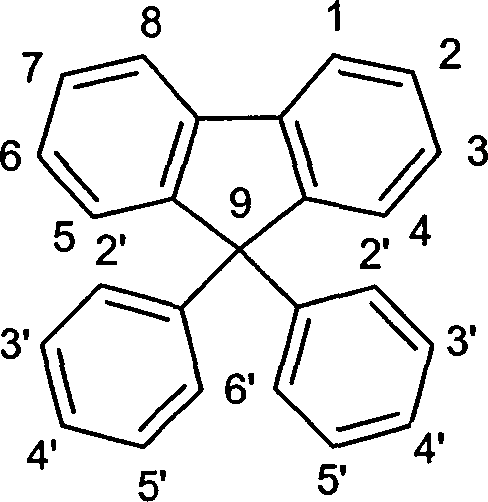

X ist bei jedem Auftreten gleich oder verschieden
CR1 oder N, wobei in jedem Cyclus maximal
3 Gruppen X für N stehen;
Y ist eine Einfachbindung
oder eine Gruppe ausgewählt aus BR1,
C(R1)2, C(=O), C(=NR1), C(=C(R1)2), Si(R1)2, NR1, PR1, P(=O)R1, O, S,
S(=O), S(=O)2, C(R1)2-C(R1)2,
C(R1)2-NR1 oder CR1=CR1;
R ist bei jedem Auftreten gleich
oder verschieden Cl, Br, I, Triflat, B(OR2)2, B(R2)2,
B(N(R2)2)2, NAr2, N(R2)2, SiAr3, Si(R2)3, C(=O)Ar, C(=O)R2,
OAr, OR2, SAr, SR2,
S(=O)Ar, S(O)R2, S(=O)2Ar,
S(=O)2R2, PAr2, P(R2)2, P(=O)Ar2, P(=O)(R2)2 oder ein aromatisches oder heteroaromatisches
Ringsystem mit 5 bis 60 aromatischen Ringatomen, welches durch einen
oder mehrere Reste R1 substituiert sein
kann;
Ar ist bei jedem Auftreten gleich oder verschieden ein
aromatisches oder heteroaromatisches Ringsystem mit 5 bis 30 aromatischen
Ringatomen, das mit einem oder mehreren nicht-aromatischen Resten
R1 substituiert sein kann; dabei können
auch zwei Reste Ar, welche an dasselbe Stickstoff- oder Phosphoratom
binden, durch eine Einfachbindung oder eine Brücke, ausgewählt
aus B(R2), C(R2)2, Si(R2)2, C=O, C=NR2, C=C(R2)2, O, S, S=O, SO2, N(R2), P(R2) und P(=O)R2, miteinander
verknüpft sein;
R1 ist bei
jedem Auftreten gleich oder verschieden H, D, F, Cl, Br, I, CHO,
N(Ar)2, C(O)Ar, P(=O)(Ar)2,
S(=O)Ar, S(=O)2Ar, CR2=CR2Ar, CN, NO2, Si(R2)3, B(OR2)2, B(R2)2, B(N(R2)2)2, OSO2R2, eine geradkettige Alkyl-, Alkoxy- oder
Thioalkoxygruppe mit 1 bis 40 C-Atomen oder eine verzweigte oder
cyclische Alkyl-, Alkoxy- oder Thioalkoxygruppe mit 3 bis 40 C-Atomen,
die jeweils mit einem oder mehreren Resten R2 substituiert
sein kann, wobei eine oder mehrere nicht benachbarte CH2-Gruppen
durch R2C=CR2, C≡C,
Si(R2)2, Ge(R2)2, Sn(R2)2, C=O, C=S, C=Se,
C=NR2, P(=O)(R2),
SO, SO2, NR2, O,
S oder CONR2 ersetzt sein können
und wobei ein oder mehrere H-Atome durch F, Cl, Br, I, CN oder NO2 ersetzt sein können, oder ein
aromatisches oder heteroaromatisches Ringsystem mit 5 bis 60 aromatischen
Ringatomen, das jeweils durch einen oder mehrere Reste R2 substituiert sein kann, oder eine Aryloxy-
oder Heteroaryloxygruppe mit 5 bis 60 aromatischen Ringatomen, die
durch einen oder mehrere Reste R2 substituiert
sein kann, oder eine Kombination dieser Systeme; dabei können
zwei oder mehrere benachbarte Substituenten R1 auch
miteinander ein mono- oder polycyclisches, aliphatisches oder aromatisches
Ringsystem bilden;
R2 ist bei jedem
Auftreten gleich oder verschieden H, D oder ein aliphatischer, aromatischer
und/oder heteroaromatischer Kohlenwasserstoffrest mit 1 bis 20 C-Atomen,
in dem auch H-Atome durch F ersetzt sein können; dabei
können zwei oder mehrere benachbarte Substituenten R2 auch miteinander ein mono- oder polycyclisches,
aliphatisches oder aromatisches Ringsystem bilden;
n ist 1
oder 2;
dabei ist die folgende Verbindung von der Erfindung
ausgenommen: 
X is the same or different CR 1 or N at each occurrence, with a maximum of 3 groups X in each cycle;
Y is a single bond or a group selected from BR 1 , C (R 1 ) 2 , C (= O), C (= NR 1 ), C (= C (R 1 ) 2 ), Si (R 1 ) 2 , NR 1 , PR 1 , P (= O) R 1 , O, S, S (= O), S (= O) 2 , C (R 1 ) 2 -C (R 1 ) 2 , C (R 1 ) 2 -NR 1 or CR 1 = CR 1 ;
R is the same or different Cl, Br, I, triflate, B (OR 2 ) 2 , B (R 2 ) 2 , B (N (R 2 ) 2 ) 2 , NAr 2 , N (R 2 ) 2 on each occurrence , SiAr 3 , Si (R 2 ) 3 , C (= O) Ar, C (= O) R 2 , OAr, OR 2 , SAr, SR 2 , S (= O) Ar, S (O) R 2 , S (= O) 2 Ar, S (= O) 2 R 2 , PAr 2 , P (R 2 ) 2 , P (= O) Ar 2 , P (= O) (R 2 ) 2 or an aromatic or heteroaromatic Ring system having 5 to 60 aromatic ring atoms, which may be substituted by one or more radicals R 1 ;
Ar is the same or different at each occurrence, an aromatic or heteroaromatic ring system having 5 to 30 aromatic ring atoms, which may be substituted with one or more non-aromatic radicals R 1 ; two radicals Ar which bind to the same nitrogen or phosphorus atom may also be replaced by a single bond or a bridge selected from B (R 2 ), C (R 2 ) 2 , Si (R 2 ) 2 , C = O, C = NR 2 , C = C (R 2 ) 2 , O, S, S = O, SO 2 , N (R 2 ), P (R 2 ) and P (= O) R 2 ;
R 1 is the same or different at each occurrence H, D, F, Cl, Br, I, CHO, N (Ar) 2 , C (O) Ar, P (= O) (Ar) 2 , S (= O) Ar, S (= O) 2 Ar, CR 2 = CR 2 Ar, CN, NO 2 , Si (R 2 ) 3 , B (OR 2 ) 2 , B (R 2 ) 2 , B (N (R 2 ) 2 ) 2 , OSO 2 R 2 , a straight-chain alkyl, alkoxy or thioalkoxy group having 1 to 40 carbon atoms or a branched or cyclic alkyl, alkoxy or thioalkoxy group having 3 to 40 carbon atoms, each with one or R 2 can be substituted by one or more non-adjacent CH 2 groups by R 2 C = CR 2 , C≡C, Si (R 2 ) 2 , Ge (R 2 ) 2 , Sn (R 2 ) 2 , C = O, C = S, C = Se, C = NR 2 , P (= O) (R 2 ), SO, SO 2 , NR 2 , O, S or CONR 2 may be substituted and wherein one or more H atoms can be replaced by F, Cl, Br, I, CN or NO 2 , or an aromatic or heteroaromatic ring system having 5 to 60 aromatic ring atoms, each of which may be substituted by one or more radicals R 2 , or an aryloxy or heteroaryloxy group having 5 to 60 ar omatic ring atoms, which may be substituted by one or more radicals R 2 , or a combination of these systems; two or more adjacent substituents R 1 may also together form a mono- or polycyclic, aliphatic or aromatic ring system;
R 2 is identical or different at each occurrence H, D or an aliphatic, aromatic and / or heteroaromatic hydrocarbon radical having 1 to 20 C atoms, in which also H atoms may be replaced by F; two or more adjacent substituents R 2 may also together form a mono- or polycyclic, aliphatic or aromatic ring system;
n is 1 or 2;
the following compound is excluded from the invention:
Bevorzugt weisen die Verbindungen gemäß Formel (1) eine Glasübergangstemperatur TG von größer als 70°C auf, besonders bevorzugt größer als 100°C, ganz besonders bevorzugt größer als 110°C.Preferably, the compounds of formula (1) have a glass transition temperature T G of greater than 70 ° C, more preferably greater than 100 ° C, most preferably greater than 110 ° C.
Wie aus der Formel (1) hervorgeht, bedeutet n = 2, dass in der Verbindung zwei Arylreste, welche in 3,5-Position substituiert sind, vorhanden sind, während n = 1 bedeutet, dass ein solcher Arylrest vorhanden ist und weiterhin eine Gruppe R1.As is apparent from the formula (1), n = 2 means that there are two aryl groups substituted in the 3,5-position in the compound, while n = 1 means that such an aryl group is present and further a group R 1 .
Eine Arylgruppe im Sinne dieser Erfindung enthält 6 bis 60 C-Atome; eine Heteroarylgruppe im Sinne dieser Erfindung enthält 2 bis 60 C-Atome und mindestens 1 Heteroatom, mit der Maßgabe, dass die Summe aus C-Atomen und Heteroatomen mindestens 5 ergibt. Die Heteroatome sind bevorzugt ausgewählt aus N, O und/oder S. Dabei wird unter einer Arylgruppe bzw. Heteroarylgruppe entweder ein einfacher aromatischer Cyclus, also Benzol, bzw. ein einfacher heteroaromatischer Cyclus, beispielsweise Pyridin, Pyrimidin, Thiophen, etc., oder eine kondensierte Aryl- oder Heteroarylgruppe, beispielsweise Naphthalin, Anthracen, Pyren, Chinolin, Isochinolin, etc., verstanden.A Aryl group for the purposes of this invention contains 6 to 60 carbon atoms; contains a heteroaryl group in the context of this invention 2 to 60 C atoms and at least 1 heteroatom, with the proviso the sum of C atoms and heteroatoms is at least 5. The heteroatoms are preferably selected from N, O and / or S. Here, either an aryl group or heteroaryl group a simple aromatic cycle, ie benzene, or a simpler one heteroaromatic cycle, for example pyridine, pyrimidine, thiophene, etc., or a fused aryl or heteroaryl group, for example Naphthalene, anthracene, pyrene, quinoline, isoquinoline, etc., understood.
Ein aromatisches Ringsystem im Sinne dieser Erfindung enthält 6 bis 60 C-Atome im Ringsystem. Ein heteroaromatisches Ringsystem im Sinne dieser Erfindung enthält 2 bis 60 C-Atome und mindestens ein Heteroatom im Ringsystem, mit der Maßgabe, dass die Summe aus C-Atomen und Heteroatomen mindestens 5 ergibt. Die Heteroatome sind bevorzugt ausgewählt aus N, O und/oder S. Unter einem aromatischen oder heteroaromatischen Ringsystem im Sinne dieser Erfindung soll ein System verstanden werden, das nicht notwendigerweise nur Aryl- oder Heteroarylgruppen enthält, sondern in dem auch mehrere Aryl- oder Heteroarylgruppen durch eine kurze, nicht-aromatische Einheit (bevorzugt weniger als 10% der von H verschiedenen Atome), wie z. B. ein sp3-hybridisiertes C-, N- oder O-Atom, unterbrochen sein können. So sollen beispielsweise auch Systeme wie 9,9'-Spirobifluoren, 9,9-Diarylfluoren, Triarylamin, Diarylether, Stilben, Benzophenon, etc. als aromatische Ringsysteme im Sinne dieser Erfindung verstanden werden. Ebenso werden unter einem aromatischen bzw. heteroaromatischen Ringsystem Systeme verstanden, in denen mehrere Aryl- bzw. Heteroarylgruppen durch Einfachbindungen miteinander verknüpft sind, beispielsweise Biphenyl, Terphenyl oder Bipyridin.An aromatic ring system in the sense of this invention contains 6 to 60 carbon atoms in the ring system. A heteroaromatic ring system in the sense of this invention contains 2 to 60 C atoms and at least one heteroatom in the ring system, with the proviso that the sum of C atoms and heteroatoms gives at least 5. The heteroatoms are preferably selected from N, O and / or S. An aromatic or heteroaromatic ring system in the sense of this invention is to be understood as meaning a system which does not necessarily contain only aryl or heteroaryl groups but in which also several aryl or heteroaryl groups a short, non-aromatic moiety (preferably less than 10% of the atoms other than H), e.g. As an sp 3 -hybridized C, N or O atom, may be interrupted. Thus, for example, systems such as 9,9'-spirobifluorene, 9,9-diaryl fluorene, triarylamine, diaryl ether, stilbene, benzophenone, etc. are to be understood as aromatic ring systems in the context of this invention. Likewise, an aromatic or heteroaromatic ring system is understood as meaning systems in which a plurality of aryl or heteroaryl groups are linked together by single bonds, for example biphenyl, terphenyl or bipyridine.
Im Rahmen der vorliegenden Erfindung werden unter einer C1- bis C40-Alkylgruppe, in der auch einzelne H-Atome oder CH2-Gruppen durch die oben genannten Gruppen substituiert sein können, besonders bevorzugt die Reste Methyl, Ethyl, n-Propyl, i-Propyl, n-Butyl, i-Butyl, s-Butyl, t-Butyl, 2-Methylbutyl, n-Pentyl, s-Pentyl, Cyclopentyl, n-Hexyl, Cyclohexyl, n-Heptyl, Cycloheptyl, n-Octyl, Cyclooctyl, 2-Ethylhexyl, Trifluormethyl, Pentafluorethyl, 2,2,2-Trifluorethyl, Ethenyl, Propenyl, Butenyl, Pentenyl, Cyclopentenyl, Hexenyl, Cyclohexenyl, Heptenyl, Cycloheptenyl, Octenyl, Cyclooctenyl, Ethinyl, Propinyl, Butinyl, Pentinyl, Hexinyl, Heptinyl oder Octinyl verstanden. Unter einer C1- bis C40-Alkoxygruppe werden besonders bevorzugt Methoxy, Trifluormethoxy, Ethoxy, n-Propoxy, i-Propoxy, n-Butoxy, i-Butoxy, s-Butoxy, t-Butoxy oder 2-Methylbutoxy verstanden. Unter einem aromatischen oder heteroaromatischen Ringsystem mit 5–60 aromatischen Ringatomen, welches noch jeweils mit den oben genannten Resten R substituiert sein kann und welches über beliebige Positionen am Aromaten bzw. Heteroaromaten verknüpft sein kann, werden insbesondere Gruppen verstanden, die abgeleitet sind von Benzol, Naphthalin, Anthracen, Phenanthren, Benzanthracen, Pyren, Chrysen, Perylen, Fluoranthen, Naphthacen, Pentacen, Benzpyren, Biphenyl, Biphenylen, Terphenyl, Terphenylen, Fluoren, Spirobifluoren, Dihydrophenanthren, Dihydropyren, Tetrahydropyren, cis- oder trans-Indenofluoren, Truxen, Isotruxen, Spirotruxen, Spiroisotruxen, Furan, Benzofuran, Isobenzofuran, Dibenzofuran, Thiophen, Benzothiophen, Isobenzothiophen, Dibenzothiophen, Pyrrol, Indol, Isoindol, Carbazol, Pyridin, Chinolin, Isochinolin, Acridin, Phenanthridin, Benzo-5,6-chinolin, Benzo-6,7-chinolin, Benzo-7,8-chinolin, Phenothiazin, Phenoxazin, Pyrazol, Indazol, Imidazol, Benzimidazol, Naphthimidazol, Phenanthrimidazol, Pyridimidazol, Pyrazinimidazol, Chinoxalinimidazol, Oxazol, Benzoxazol, Naphthoxazol, Anthroxazol, Phenanthroxazol, Isoxazol, 1,2-Thiazol, 1,3-Thiazol, Benzothiazol, Pyridazin, Benzopyridazin, Pyrimidin, Benzpyrimidin, Chinoxalin, 1,5-Diazaanthracen, 2,7-Diazapyren, 2,3-Diazapyren, 1,6-Diazapyren, 1,8-Diazapyren, 4,5-Diazapyren, 4,5,9,10-Tetraazaperylen, Pyrazin, Phenazin, Phenoxazin, Phenothiazin, Fluorubin, Naphthyridin, Azacarbazol, Benzocarbolin, Phenanthrolin, 1,2,3-Triazol, 1,2,4-Triazol, Benzotriazol, 1,2,3-Oxadiazol, 1,2,4-Oxadiazol, 1,2,5-Oxadiazol, 1,3,4-Oxadiazol, 1,2,3-Thiadiazol, 1,2,4-Thiadiazol, 1,2,5-Thiadiazol, 1,3,4-Thiadiazol, 1,3,5-Triazin, 1,2,4-Triazin, 1,2,3-Triazin, Tetrazol, 1,2,4,5-Tetrazin, 1,2,3,4-Tetrazin, 1,2,3,5-Tetrazin, Purin, Pteridin, Indolizin und Benzothiadiazol.In the context of the present invention, a C 1 - to C 40 -alkyl group in which also individual H atoms or CH 2 groups can be substituted by the abovementioned groups, particularly preferably the radicals methyl, ethyl, n-propyl, i-propyl, n-butyl, i-butyl, s-butyl, t-butyl, 2-methylbutyl, n-pentyl, s-pentyl, cyclopentyl, n-hexyl, cyclohexyl, n-heptyl, cycloheptyl, n-octyl, Cyclooctyl, 2-ethylhexyl, trifluoromethyl, pentafluoroethyl, 2,2,2-trifluoroethyl, ethenyl, propenyl, butenyl, pentenyl, cyclopentenyl, hexenyl, cyclohexenyl, heptenyl, cycloheptenyl, octenyl, cyclooctenyl, ethynyl, propynyl, butynyl, pentynyl, hexynyl, Heptinyl or octynyl understood. A C 1 - to C 40 -alkoxy group is particularly preferably understood as meaning methoxy, trifluoromethoxy, ethoxy, n-propoxy, isopropoxy, n-butoxy, isobutoxy, s-butoxy, t-butoxy or 2-methylbutoxy. By an aromatic or heteroaromatic ring system having 5-60 aromatic ring atoms, which may be substituted in each case with the abovementioned radicals R and which may be linked via any position on the aromatic or heteroaromatic, are understood in particular groups which are derived from benzene, Naphthalene, anthracene, phenanthrene, benzanthracene, pyrene, chrysene, perylene, fluoranthene, naphthacene, pentacene, benzpyrene, biphenyl, biphenylene, terphenyl, terphenyls, fluorene, spirobifluorene, dihydrophenanthrene, dihydropyrene, tetrahydropyrene, cis- or trans-indenofluorene, truxene, isotruxene , Spirotruxene, spiroisotruxene, furan, benzofuran, isobenzofuran, dibenzofuran, thiophene, benzothiophene, isobenzothiophene, dibenzothiophene, pyrrole, indole, isoindole, carbazole, pyridine, quinoline, isoquinoline, acridine, phenanthridine, benzo-5,6-quinoline, benzo-6 , 7-quinoline, benzo-7,8-quinoline, phenothiazine, Phenoxazine, pyrazole, indazole, imidazole, benzimidazole, naphthimidazole, phenanthrimidazole, pyrimididazole, pyrazine imidazole, quinoxaline imidazole, oxazole, benzoxazole, naphthoxazole, anthroxazole, phenanthroxazole, isoxazole, 1,2-thiazole, 1,3-thiazole, benzothiazole, pyridazine, benzopyridazine, Pyrimidine, benzpyrimidine, quinoxaline, 1,5-diazaanthracene, 2,7-diazapyrene, 2,3-diazapyrene, 1,6-diazapyrene, 1,8-diazapyrene, 4,5-diazapyrene, 4,5,9,10- Tetraazaperylene, pyrazine, phenazine, phenoxazine, phenothiazine, fluorubin, naphthyridine, azacarbazole, benzocarboline, phenanthroline, 1,2,3-triazole, 1,2,4-triazole, benzotriazole, 1,2,3-oxadiazole, 1,2, 4-oxadiazole, 1,2,5-oxadiazole, 1,3,4-oxadiazole, 1,2,3-thiadiazole, 1,2,4-thiadiazole, 1,2,5-thiadiazole, 1,3,4- Thiadiazole, 1,3,5-triazine, 1,2,4-triazine, 1,2,3-triazine, tetrazole, 1,2,4,5-tetrazine, 1,2,3,4-tetrazine, 1, 2,3,5-tetrazine, purine, pteridine, indolizine and benzothiadiazole.
In einer bevorzugten Ausführungsform der Erfindung steht das Symbol X gleich oder verschieden bei jedem Auftreten für CR1 oder N, wobei maximal ein Symbol X pro Cyclus in der Fluoreneinheit für N steht und wobei entweder alle Symbole X in den Substituenten in 9-Position der Fluoreneinheit für CR1 stehen oder alle Symbole X für N stehen. Die Substituenten in der 9-Position des Fluorens stehen also bevorzugt für 3,5-substutiertes Phenyl oder Triazin. Entsprechendes gilt, wenn die zentrale Einheit kein Fluoren, sondern eines der anderen von Formel (1) umfassten Derivate darstellt. Besonders bevorzugt steht das Symbol X für CR1.In a preferred embodiment of the invention, the symbol X is the same or different at each occurrence for CR 1 or N, with at most one symbol X per cycle in the fluorene unit for N and where either all the symbols X in the substituent in the 9-position of the fluorene unit stand for CR 1 or all symbols X stand for N. The substituents in the 9-position of the fluorene are thus preferably 3,5-substituted phenyl or triazine. The same applies if the central unit is not a fluorene but one of the other derivatives encompassed by formula (1). Particularly preferably, the symbol X stands for CR 1 .
Eine
bevorzugte Ausführungsform der Verbindungen gemäß Formel
(1) sind die Verbindungen gemäß Formel (2) oder
Formel (3), 
In einer bevorzugten Ausführungsform der Erfindung ist n = 2.In A preferred embodiment of the invention is n = Second
Eine
besonders bevorzugte Ausführungsform der Verbindungen gemäß Formel
(1) sind die Verbindungen gemäß Formel (4), 
In einer bevorzugten Ausführungsform der Erfindung steht das Symbol Y in Verbindungen der Formel (1), (2), (3) oder (4) für eine Einfachbindung oder für eine Gruppe ausgewählt aus C(R1)2, O oder NR1, besonders bevorzugt für eine Einfachbindung.In a preferred embodiment of the invention, the symbol Y in compounds of the formula (1), (2), (3) or (4) is a single bond or a group selected from C (R 1 ) 2 , O or NR 1 , special that is preferred for a single bond.
In einer weiteren bevorzugten Ausführungsform der Erfindung steht das Symbol R in Verbindungen der Formel (1), (2), (3) oder (4) gleich oder verschieden bei jedem Auftreten für NAr2, C(=O)Ar, P(=O)Ar2 oder für ein aromatisches oder heteroaromatisches Ringsystem mit 5 bis 30 aromatischen Ringatomen, welches durch einen oder mehrere nicht-aromatische Reste R1 substituiert sein kann. Besonders bevorzugt steht R gleich oder verschieden bei jedem Auftreten für NAr2 oder C(=O)Ar, ganz besonders bevorzugt für NAr2. Weiterhin bevorzugte Substituenten R sind Cl, Br, I und Triflat, insbesondere Br, da dies wertvolle Intermediate bei der Synthese weiterer erfindungsgemäßer Verbindungen sind.In a further preferred embodiment of the invention, the symbol R in compounds of the formula (1), (2), (3) or (4) is identical or different at each occurrence for NAr 2 , C (= O) Ar, P (= O) Ar 2 or for an aromatic or heteroaromatic ring system having 5 to 30 aromatic ring atoms, which may be substituted by one or more non-aromatic radicals R 1 . More preferably, R is the same or different each time for NAr 2 or C (= O) Ar, most preferably for NAr 2 . Further preferred substituents R are Cl, Br, I and triflate, in particular Br, since these are valuable intermediates in the synthesis of further compounds according to the invention.
In einer weiteren bevorzugten Ausführungsform der Erfindung sind alle Symbole R in Verbindungen der Formel (1), (2), (3) oder (4) gleich gewählt. Diese Bevorzugung lässt sich durch die leichtere synthetische Zugänglichkeit der Verbindungen erklären.In a further preferred embodiment of the invention all symbols R are compounds of the formula (1), (2), (3) or (4) chosen the same. This preference can be due to the easier synthetic accessibility of the compounds to explain.
Wenn
der Rest R bzw. R1 für eine Gruppe
N(Ar)2 steht, so ist diese Gruppe bevorzugt
ausgewählt aus den Gruppen der Formel (5) oder der Formel
(6), 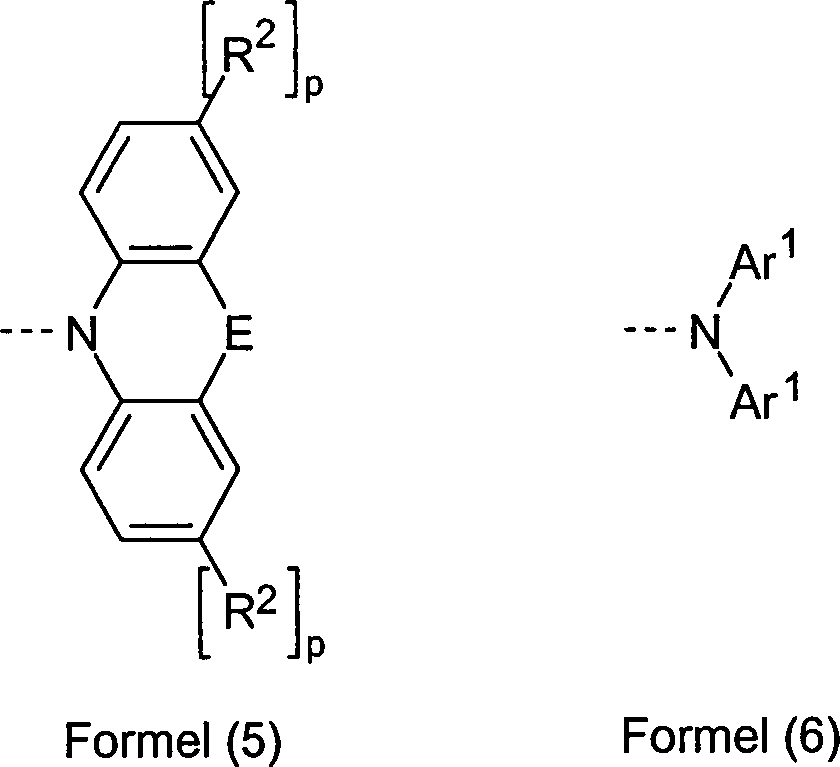
E
steht für eine Einfachbindung, O, S, N(R2)
oder C(R2)2;
Ar1 ist gleich oder verschieden bei jedem Auftreten
ein aromatisches oder heteroaromatisches Ringsystem mit 5 bis 20
aromatischen Ringatomen oder eine Triarylamingruppe mit 15 bis 30
aromatischen Ringatomen, welche jeweils mit einem oder mehreren
Resten R2 substituiert sein kann, bevorzugt
eine Aryl- oder Heteroarylgruppe mit 6 bis 14 aromatischen Ringatomen
oder eine Triarylamingruppe mit 18 bis 30 aromatischen Ringatomen,
bevorzugt mit 18 bis 22 aromatischen Ringatomen, welche jeweils
mit einem oder mehreren Resten R2 substituiert
sein kann;
p ist bei jedem Auftreten gleich oder verschieden
0 oder 1.When the radical R or R 1 stands for a group N (Ar) 2 , this group is preferably selected from the groups of the formula (5) or the formula (6),
E is a single bond, O, S, N (R 2 ) or C (R 2 ) 2 ;
Ar 1 is identical or different at each occurrence an aromatic or heteroaromatic ring system having 5 to 20 aromatic ring atoms or a triarylamine group having 15 to 30 aromatic ring atoms, which may be substituted by one or more radicals R 2 , preferably an aryl or heteroaryl group 6 to 14 aromatic ring atoms or a triarylamine group having 18 to 30 aromatic ring atoms, preferably having 18 to 22 aromatic ring atoms, which may each be substituted by one or more radicals R 2 ;
p is the same or different 0 or 1 at each occurrence.
Besonders bevorzugt steht Ar1 gleich oder verschieden bei jedem Auftreten für Phenyl, Biphenyl, 1-Naphthyl, 2-Naphthyl, 2-, 3- oder 4-Triphenylamin, 1- oder 2-Naphthyldiphenylamin, welches jeweils über die Naphthyl- oder die Phenylgruppe gebunden sein kann, oder 1- oder 2-Dinaphthylphenylamin, welches jeweils über die Naphthyl- oder die Phenylgruppe gebunden sein kann, N-Carbazolyl oder N-Phenyl-2-carbazolyl oder N-Phenyl-3-carbazolyl. Diese Gruppen können jeweils durch eine oder mehrere Alkylgruppen mit 1 bis 4 C-Atomen oder durch Fluor substituiert sein.More preferably, Ar 1 is the same or different each occurrence of phenyl, biphenyl, 1-naphthyl, 2-naphthyl, 2-, 3- or 4-triphenylamine, 1- or 2-naphthyldiphenylamine, each via the naphthyl or phenyl group or 1- or 2-dinaphthylphenylamine, which may each be bonded via the naphthyl or the phenyl group, N-carbazolyl or N-phenyl-2-carbazolyl or N-phenyl-3-carbazolyl. These groups may each be substituted by one or more alkyl groups having 1 to 4 C atoms or by fluorine.
Wenn der Rest R bzw. R1 ein aromatisches bzw. hetoroaromatisches Ringsystem darstellt, so ist dieses bevorzugt ausgewählt aus aromatischen oder heteroaromatischen Ringsystemen mit 5 bis 30 aromatischen Ringatomen, insbesondere mit 6 bis 20 aromatischen Ringatomen, ganz besonders bevorzugt aus Phenyl, 1-Naphthyl, 2-Naphthyl, Anthracenyl, Phenylanthracenyl, 1- oder 2-Naphthylanthracenyl, Binaphthyl, Pyrenyl, Fluoranthenyl, 2-, 3-, 4-, 5-, 6- oder 7-Benzanthracenyl, N-Benzimidazolyl, Phenyl-N-benzimidazolyl, N-Phenylbenzimidazolyl oder Phenyl-N-phenylbenzimidazolyl.If the radical R or R 1 represents an aromatic or heteroaromatic ring system, this is preferably selected from aromatic or heteroaromatic ring systems having 5 to 30 aromatic ring atoms, in particular having 6 to 20 aromatic ring atoms, most preferably from phenyl, 1-naphthyl , 2-naphthyl, anthracenyl, phenylanthracenyl, 1- or 2-naphthylanthracenyl, binaphthyl, pyrenyl, fluoranthenyl, 2-, 3-, 4-, 5-, 6- or 7-benzanthracenyl, N-benzimidazolyl, phenyl-N-benzimidazolyl , N-phenylbenzimidazolyl or phenyl-N-phenylbenzimidazolyl.
In einer weiteren bevorzugten Ausführungsform der Erfindung steht das Symbol R1 in Verbindungen der Formel (1), (2), (3) oder (4) gleich oder verschieden bei jedem Auftreten für H, F, N(Ar)2, C(O)Ar, P(=O)(Ar)2, S(=O)Ar, S(=O)2Ar, CR2=CR2Ar, eine geradkettige Alkylgruppe mit 1 bis 10 C-Atomen oder eine verzweigte oder cyclische Alkylgruppe mit 3 bis 10 C-Atomen, die jeweils mit einem oder mehreren Resten R2 substituiert sein kann, wobei eine oder mehrere nicht benachbarte CH2-Gruppen durch R2C=CR2 oder O ersetzt sein können und wobei ein oder mehrere H-Atome durch F ersetzt sein können, oder ein aromatisches oder heteroaromatisches Ringsystem mit 5 bis 20 aromatischen Ringatomen, das jeweils durch einen oder mehrere Reste R2 substituiert sein kann, oder eine Kombination dieser Systeme; dabei können zwei oder mehrere benachbarte Substituenten R1 auch miteinander ein mono- oder polycyclisches, aliphatisches oder aromatisches Ringsystem bilden. In einer besonders bevorzugten Ausführungsform der Erfindung steht das Symbol R1 in Verbindungen der Formel (1), (2), (3) oder (4) gleich oder verschieden bei jedem Auftreten für H, F, N(Ar)2, eine geradkettige Alkylgruppe mit 1 bis 6 C-Atomen oder eine verzweigte oder cyclische Alkylgruppe mit 3 bis 6 C-Atomen, die jeweils mit einem oder mehreren Resten R2 substituiert sein kann, wobei ein oder mehrere H-Atome durch F ersetzt sein können, oder ein aromatisches oder heteroaromatisches Ringsystem mit 5 bis 14 aromatischen Ringatomen, das jeweils durch einen oder mehrere Reste R2 substituiert sein kann; dabei können zwei oder mehrere benachbarte Substituenten R1 auch miteinander ein mono- oder polycyclisches, aliphatisches oder aromatisches Ringsystem bilden. Insbesondere steht R1 gleich oder verschieden bei jedem Auftreten für H, F, Methyl, Ethyl, iso-Propyl oder tert-Butyl, insbesondere für H. Bei Verbindungen, die aus Lösung verarbeitet werden, sind auch lineare oder verzweigte Alkylketten mit bis zu 10 C-Atomen bevorzugt.In a further preferred embodiment of the invention, the symbol R 1 in compounds of the formula (1), (2), (3) or (4) is identical or different at each occurrence for H, F, N (Ar) 2 , C ( O) Ar, P (= O) (Ar) 2 , S (= O) Ar, S (= O) 2 Ar, CR 2 = CR 2 Ar, a straight-chain alkyl group having 1 to 10 carbon atoms or a branched or cyclic alkyl group having 3 to 10 carbon atoms, each substituted with one or more R 2 radicals may be replaced, wherein one or more non-adjacent CH 2 groups may be replaced by R 2 C = CR 2 or O and wherein one or more H atoms may be replaced by F, or an aromatic or heteroaromatic ring system having 5 to 20 aromatic Ring atoms, each of which may be substituted by one or more radicals R 2 , or a combination of these systems; two or more adjacent substituents R 1 may also together form a mono- or polycyclic, aliphatic or aromatic ring system. In a particularly preferred embodiment of the invention, the symbol R 1 in compounds of the formula (1), (2), (3) or (4) is identical or different at each occurrence for H, F, N (Ar) 2 , a straight-chain Alkyl group having 1 to 6 carbon atoms or a branched or cyclic alkyl group having 3 to 6 carbon atoms, each of which may be substituted by one or more radicals R 2 , wherein one or more H atoms may be replaced by F, or a aromatic or heteroaromatic ring system having 5 to 14 aromatic ring atoms, each of which may be substituted by one or more radicals R 2 ; two or more adjacent substituents R 1 may also together form a mono- or polycyclic, aliphatic or aromatic ring system. In particular, R 1 is the same or different each occurrence of H, F, methyl, ethyl, iso-propyl or tert-butyl, especially H. In compounds which are processed from solution, are also linear or branched alkyl chains of up to 10 C atoms are preferred.
Bevorzugte Reste R1, die bei entsprechender Wahl von Y in der Brücke Y enthalten sind, sind gleich oder verschieden bei jedem Auftreten und sind bevorzugt ausgewählt aus H, geradkettigen Alkylgruppen mit 1 bis 6 C-Atomen oder verzweigten Alkylgruppen mit 3 bis 6 C-Atomen, wobei eine oder mehrere nicht benachbarte CH2-Gruppen durch -R2C=CR2-, -C≡C- oder -O- ersetzt sein können und wobei ein oder mehrere H-Atome durch F ersetzt sein können, oder Arylgruppen mit 6 bis 20 C-Atomen oder Heteroarylgruppen mit 2 bis 20 C-Atomen, die jeweils mit einem oder mehreren Resten R2 substituiert sein können, oder eine Kombination aus zwei oder drei dieser Systeme; dabei können zwei der Reste R1, die beide an Y gebunden sind, auch miteinander ein Ringsystem bilden und so ein Spirosystem bilden. Besonders bevorzugte Reste R1, die an die Brücken X gebunden sind, sind gleich oder verschieden bei jedem Auftreten und sind ausgewählt aus Methyl, Ethyl, iso-Propyl, tert-Butyl, wobei jeweils ein oder mehrere H-Atome durch F ersetzt sein können, oder Arylgruppen mit 6 bis 14 C-Atomen, die mit einem oder mehreren Resten R2 substituiert sein können; dabei können zwei Reste R1 auch miteinander ein Ringsystem bilden. Bei Verbindungen, die aus Lösung verarbeitet werden, sind auch lineare oder verzweigte Alkylketten mit bis zu 10 C-Atomen bevorzugt.Preferred radicals R 1 which, when Y is appropriately selected in the bridge Y, are identical or different at each occurrence and are preferably selected from H, straight-chain alkyl groups having 1 to 6 C atoms or branched alkyl groups having 3 to 6 C atoms. Atoms, wherein one or more non-adjacent CH 2 groups may be replaced by -R 2 C = CR 2 -, -C≡C- or -O- and wherein one or more H atoms may be replaced by F, or aryl groups having 6 to 20 carbon atoms or heteroaryl groups having 2 to 20 carbon atoms, each of which may be substituted with one or more R 2 , or a combination of two or three of these systems; in this case, two of the radicals R 1 , which are both bonded to Y, also together form a ring system and thus form a spiro system. Particularly preferred radicals R 1 , which are bonded to the bridges X, are the same or different at each occurrence and are selected from methyl, ethyl, isopropyl, tert-butyl, wherein in each case one or more H atoms may be replaced by F. or aryl groups having 6 to 14 C atoms which may be substituted by one or more R 2 radicals; two radicals R 1 can also form a ring system with each other. For compounds processed from solution, linear or branched alkyl chains of up to 10 carbon atoms are also preferred.
Beispiele für bevorzugte Verbindungen gemäß den Formeln (1) bis (4) sind die im Folgenden abgebildeten Strukturen (1) bis (248).Examples for preferred compounds according to the Formulas (1) to (4) are the structures depicted below (1) to (248).


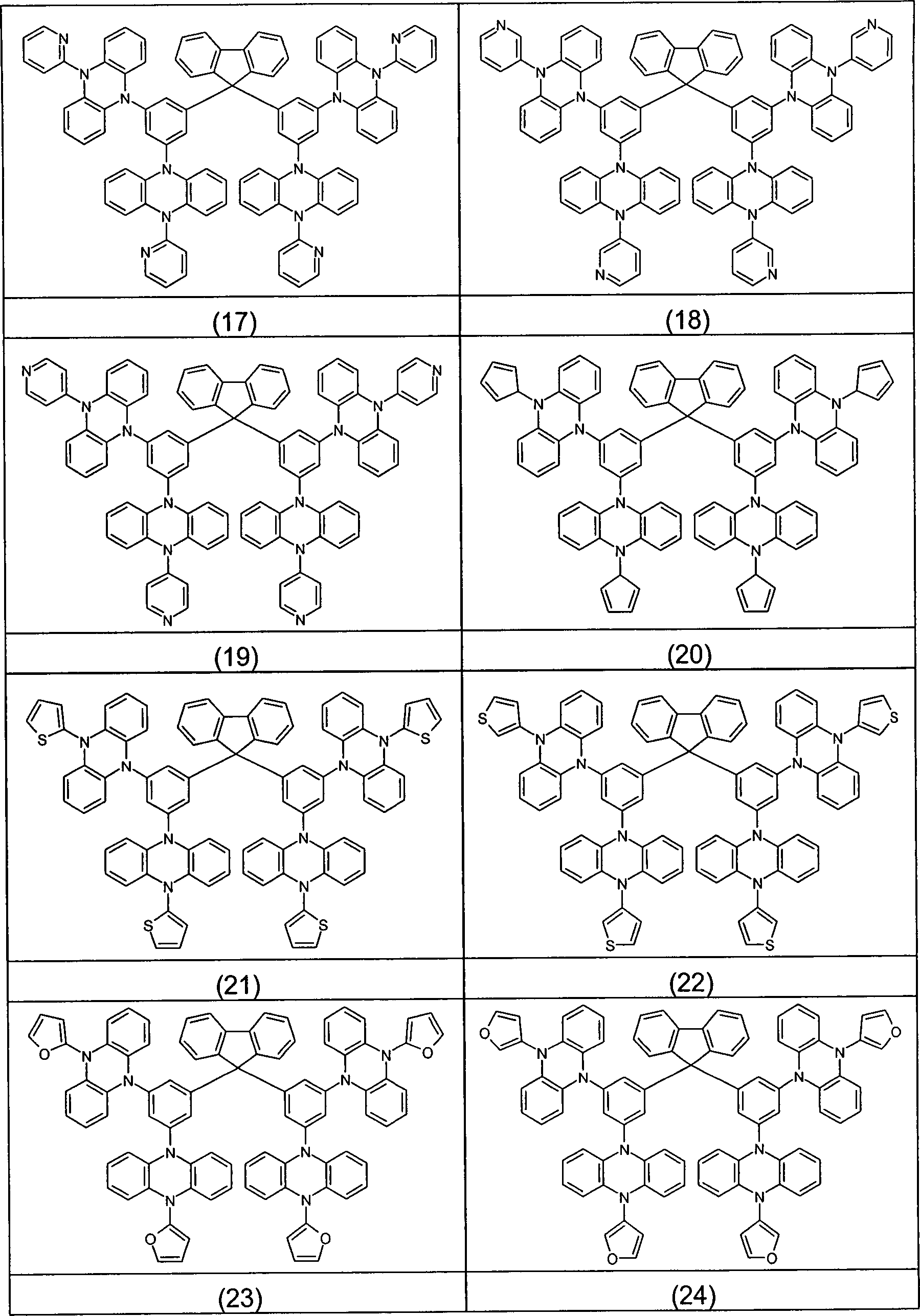
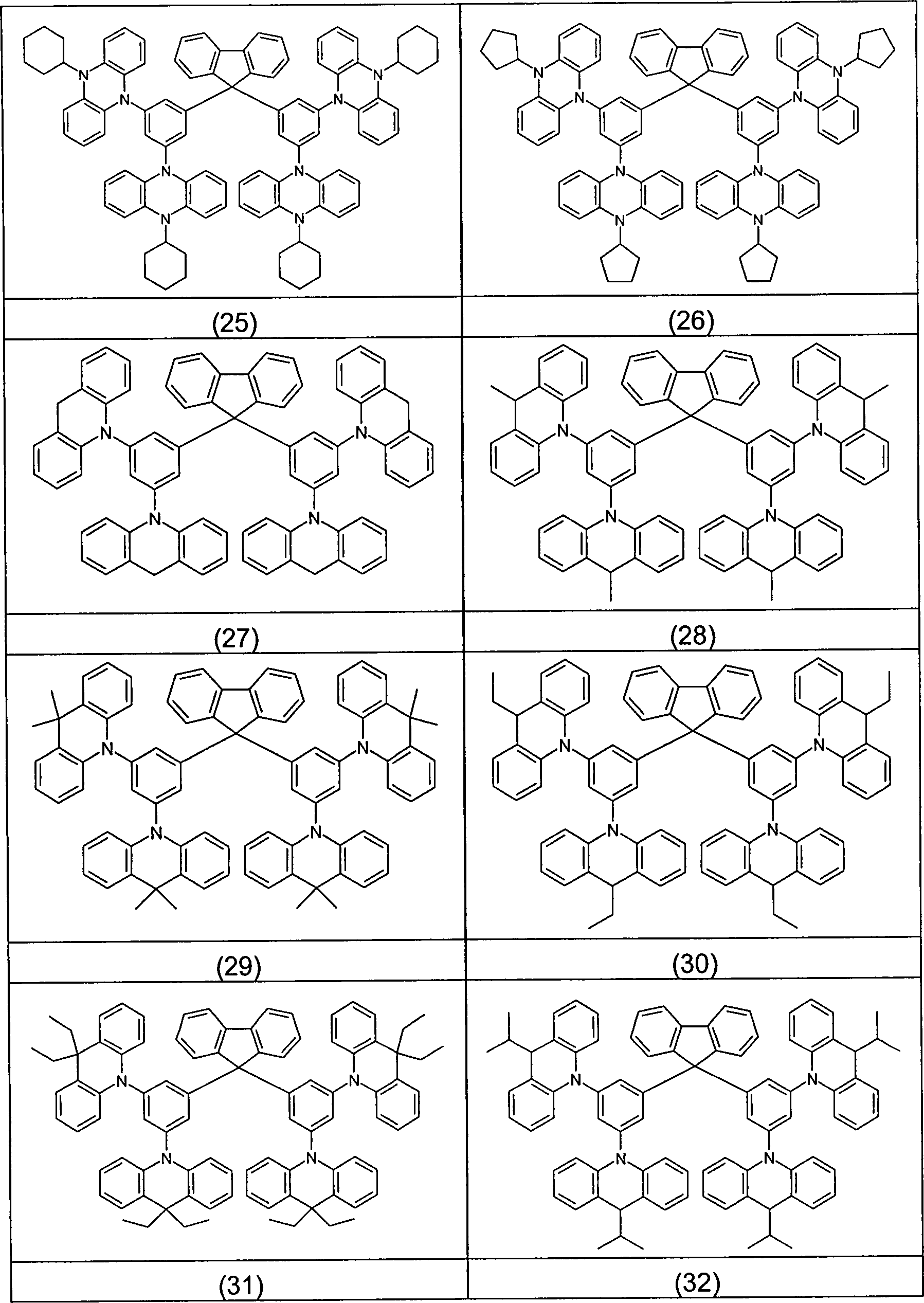
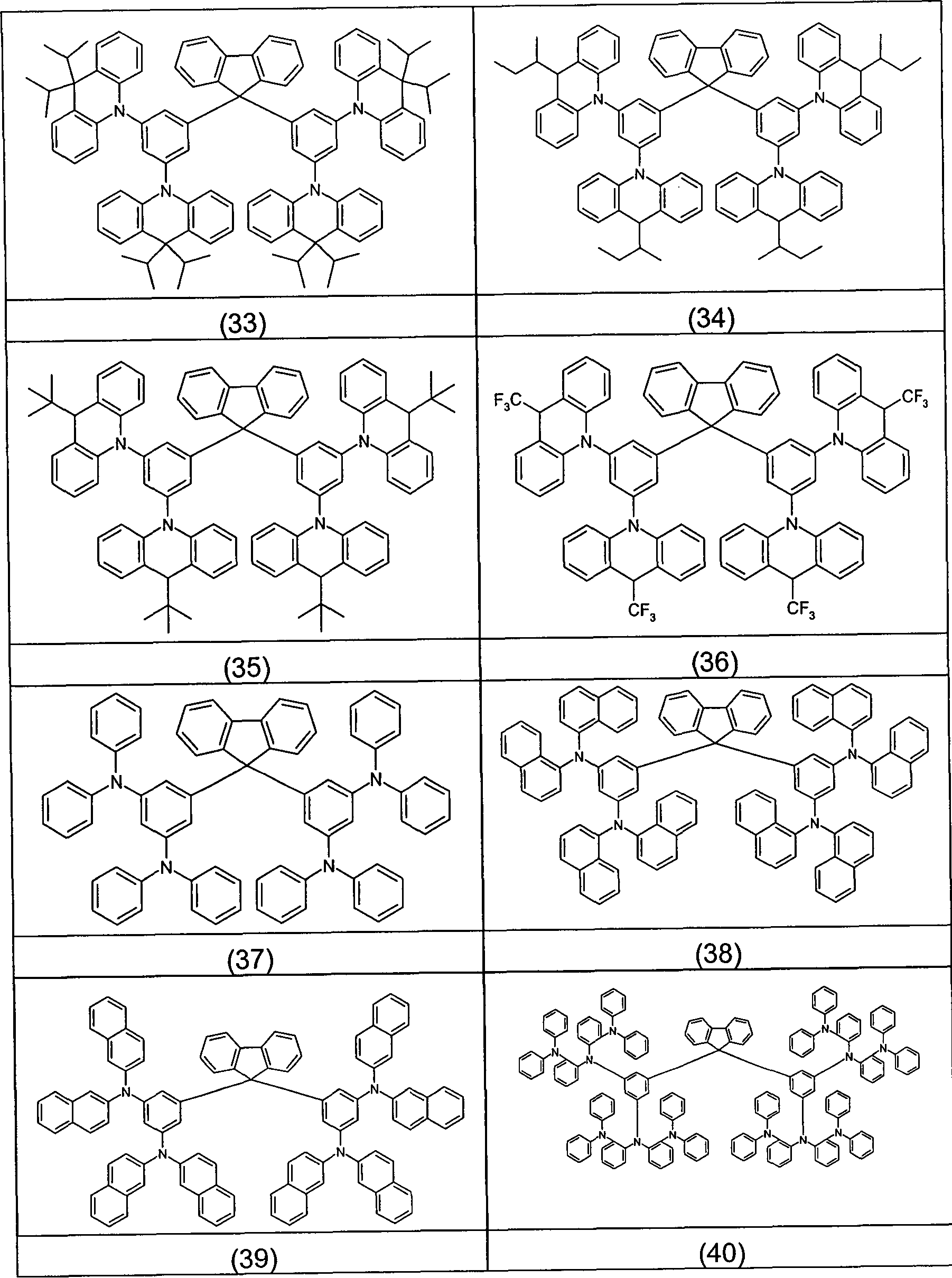


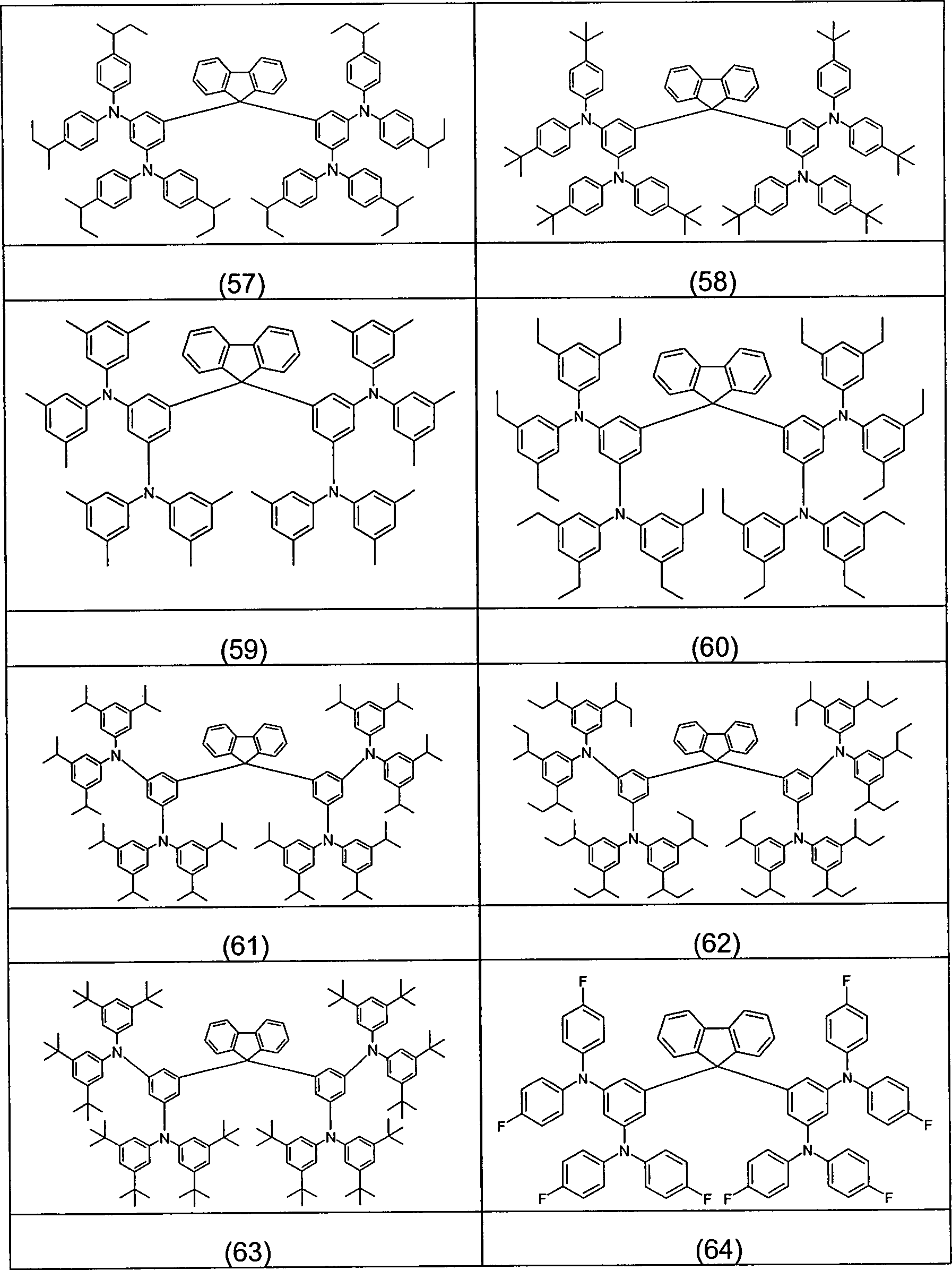


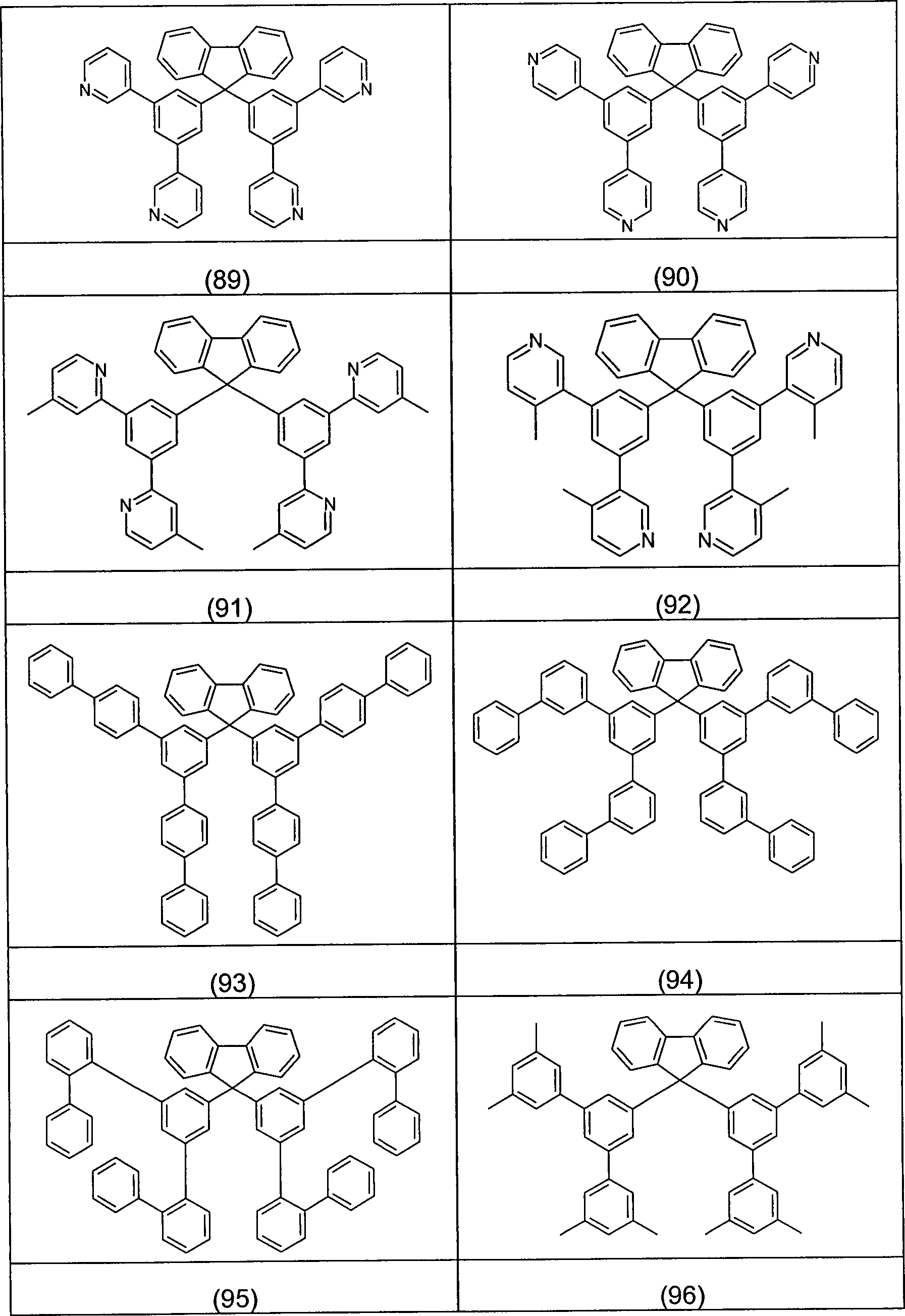


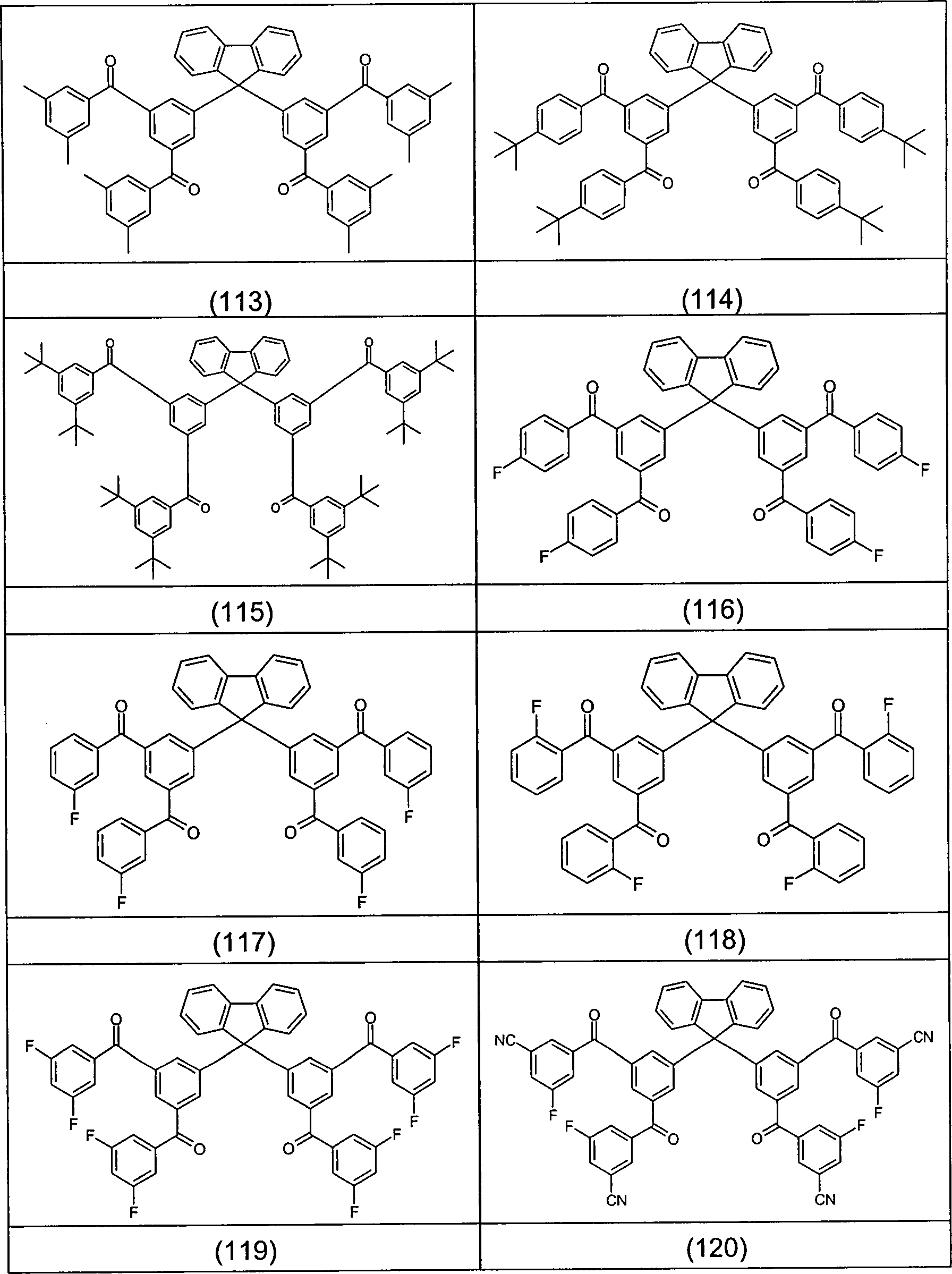

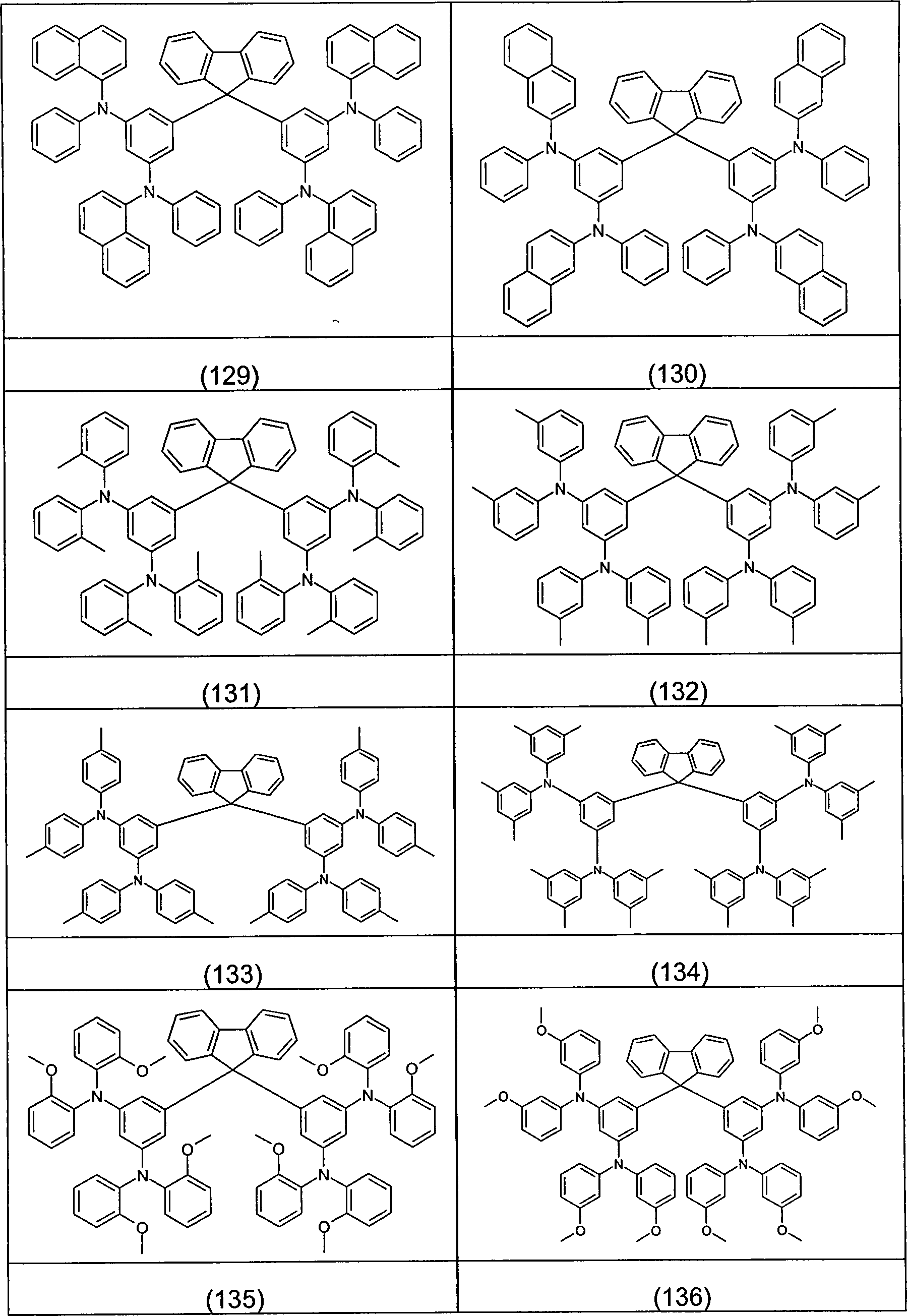


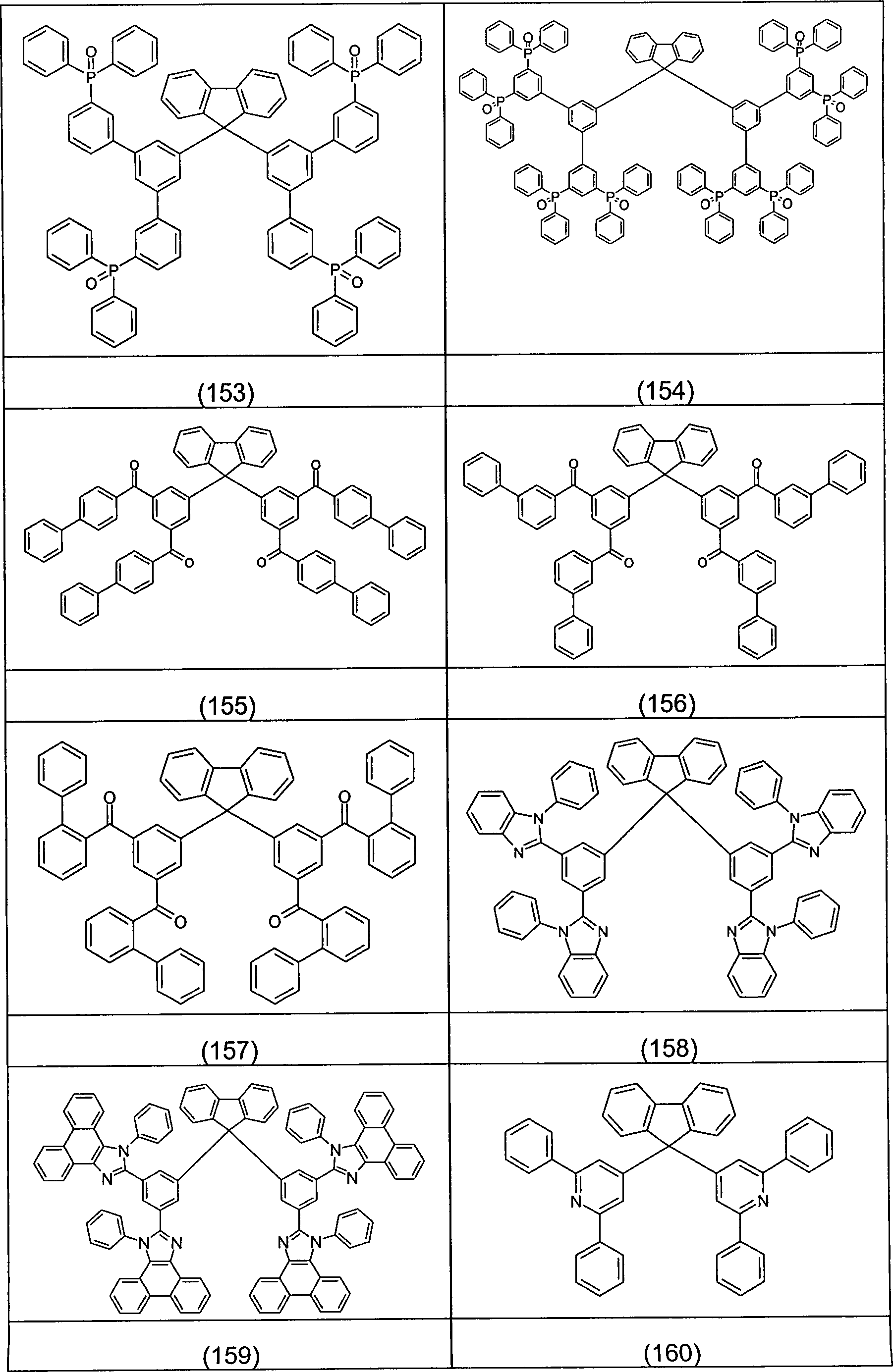

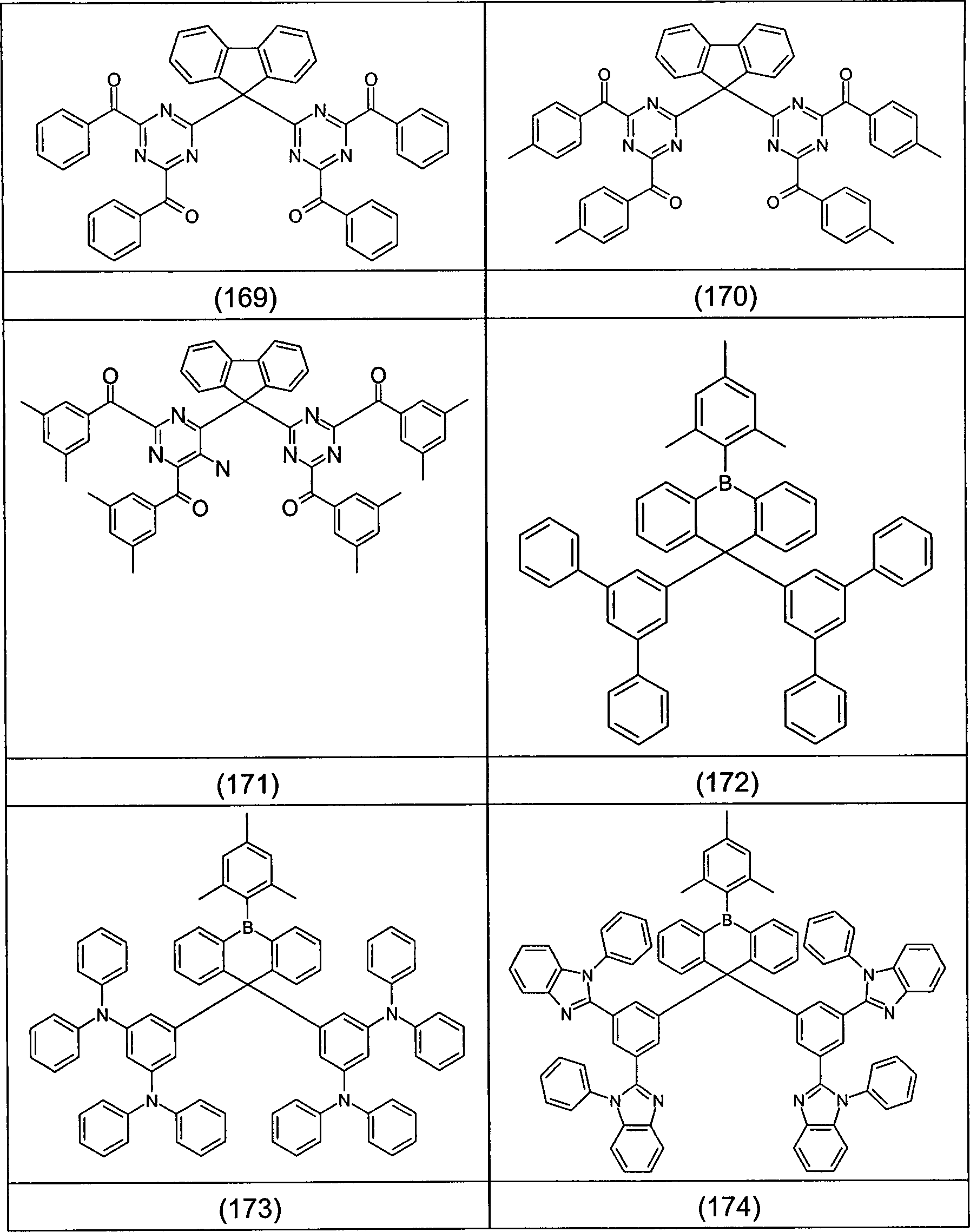
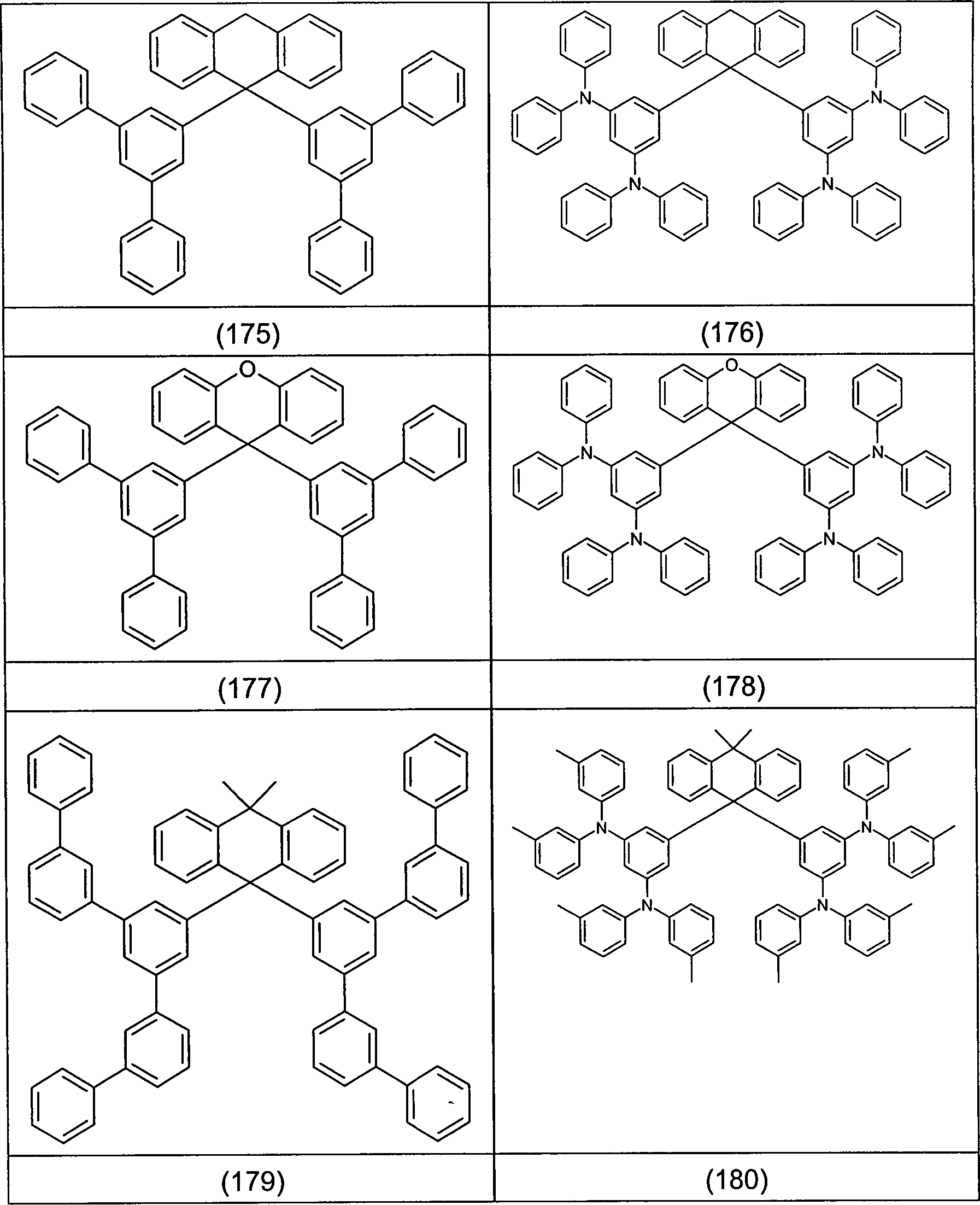


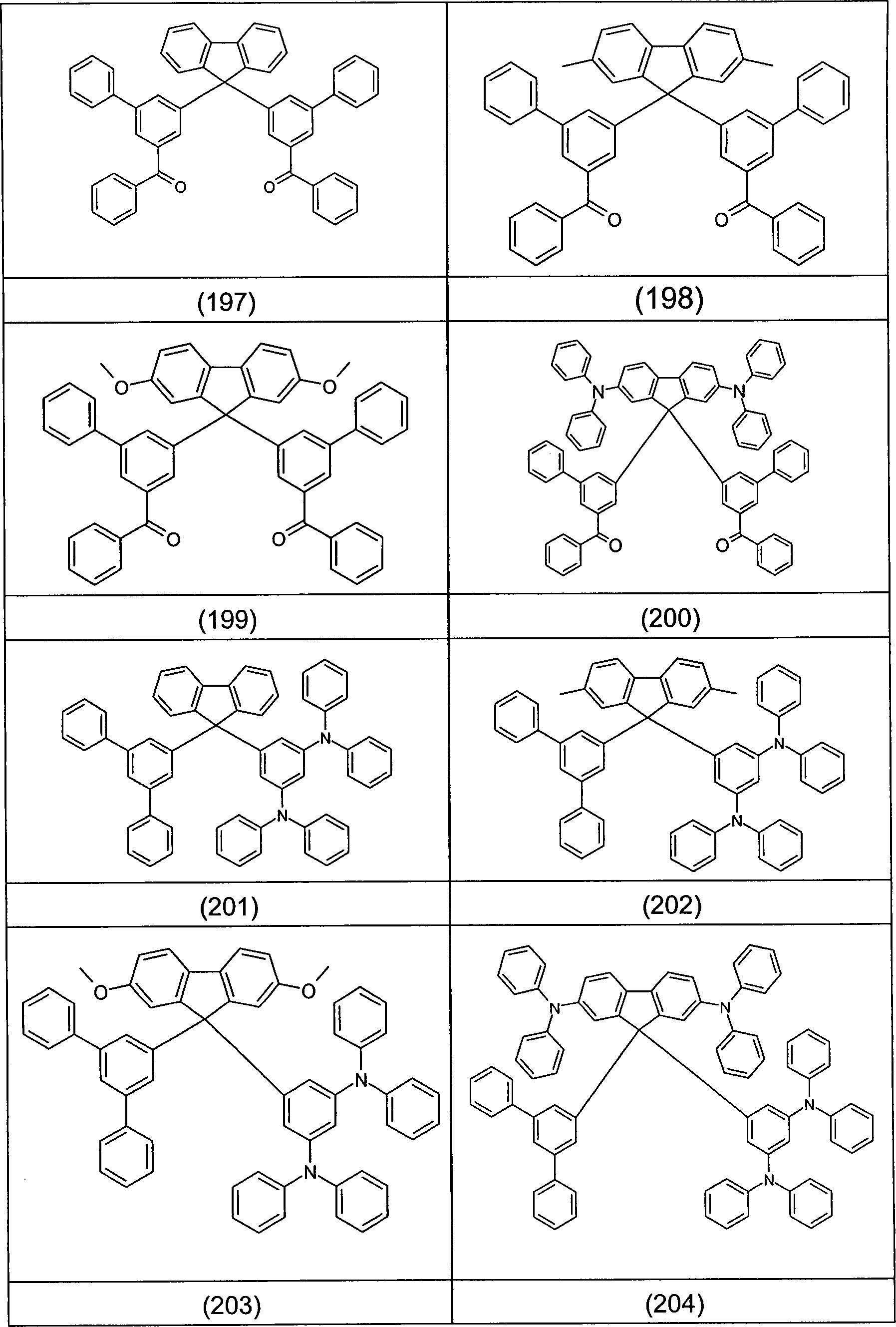


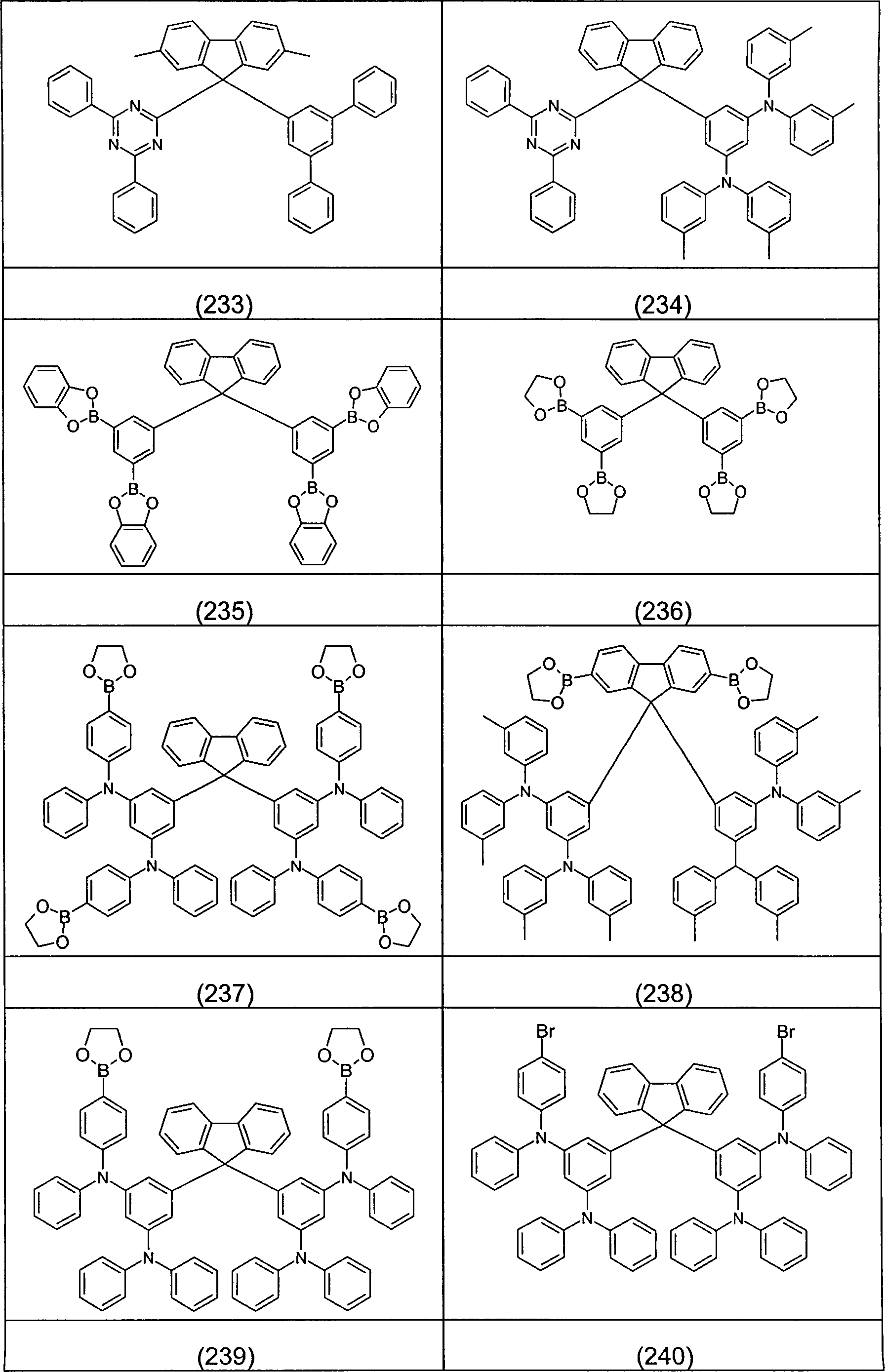
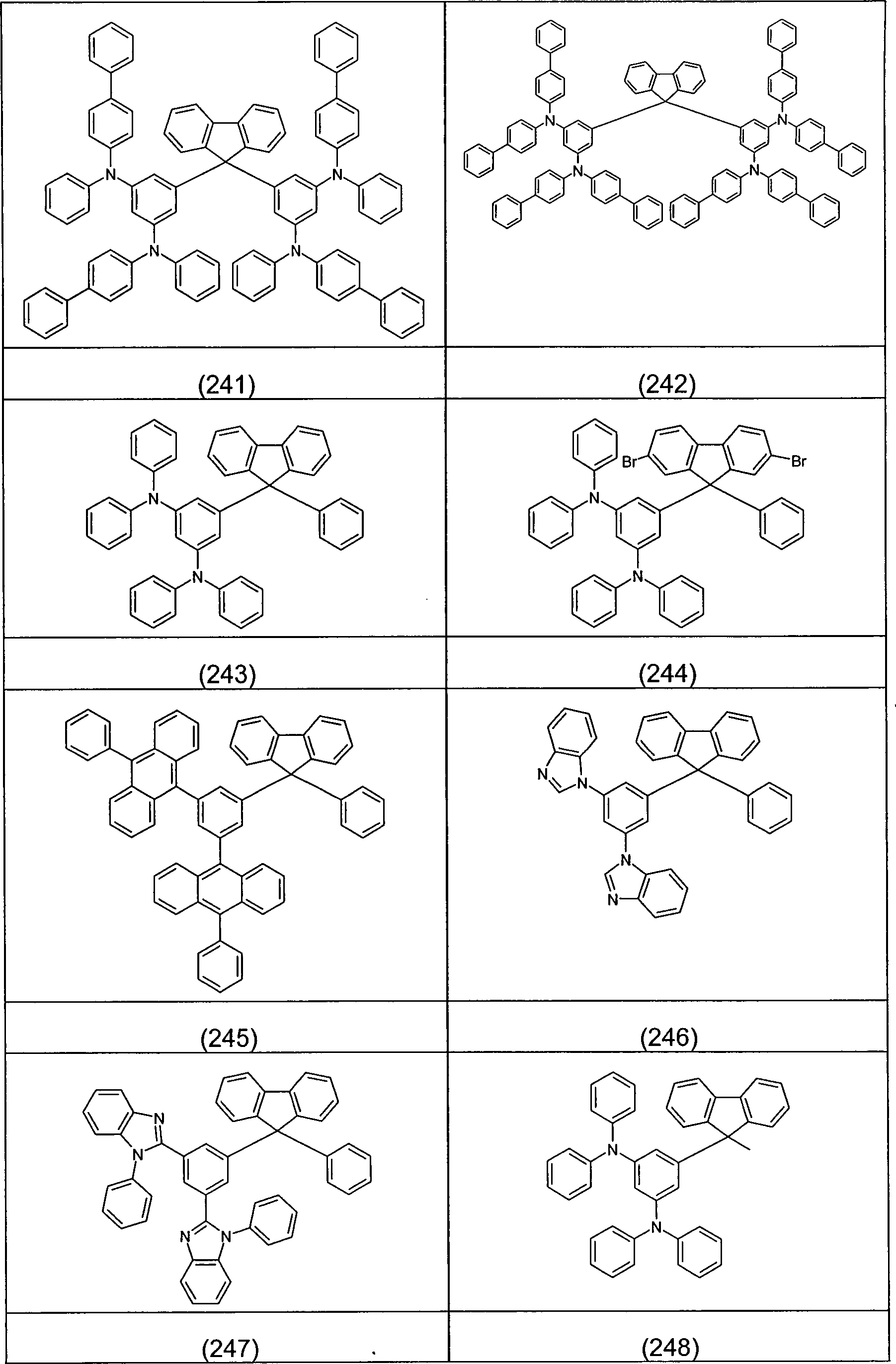
Die
erfindungsgemäßen Verbindungen gemäß Formel
(1) können nach dem Fachmann allgemein bekannten Syntheseschritten
dargestellt werden. Als Ausgangsverbindung zu symmetrisch substituierten
erfindungsgemäßen Verbindungen kann z. B. 3,3',5,5'-Tetrabrombenzophenon
(
Die
so erzeugten Tetrabromide können nach dem Fachmann bekannten
Methoden weiter umgewandelt werden. Die palladiumkatalysierte Umsetzung
mit Boronsäuren (Suzuki-Kuppung) oder palladiumkatalysierte
Umsetzung mit Organozinkverbindungen (Negishi-Kupplung) führt
zu erfindungsgemäßen aromatischen oder heteroaromatischen
Verbindungen (Schema 2). Schema
2 
Die
palladiumkatalysierte Umsetzung mit Aminen (Hartwig-Buchwald-Kupplung)
führt zu erfindungsgemäßen aromatischen
oder heteroaromatischen Aminen (Schema 3). Schema
3 
Die
Bromfunktion kann durch Transmetallierung mit Organolithiumverbindungen
bzw. Grignardverbindungen in eine elektrophile Gruppe überführt
werden, die dann mit einer Vielzahl von Elektrophilen, wie z. B. Aryl-Bor-Halogeniden,
Aldehyden, Ketonen, Nitrilen, Estern, Halogenestern, Kohlendioxid,
Arylphosphinhalogeniden, Halogensulfinsäuren, Halogenarylsulfonsäuren,
etc., gekoppelt werden, wobei die so erhaltenen Verbindungen erfindungsgemäße
Endprodukte oder aber Intermediate sein können, die weiter
umgesetzt werden können. Dies ist exemplarisch am Beispiel
der Herstellung eines erfindungsgemäßen Ketons,
eines Phosphinoxids und eines Benzimidazols verdeutlicht (Schema
4). Schema
4 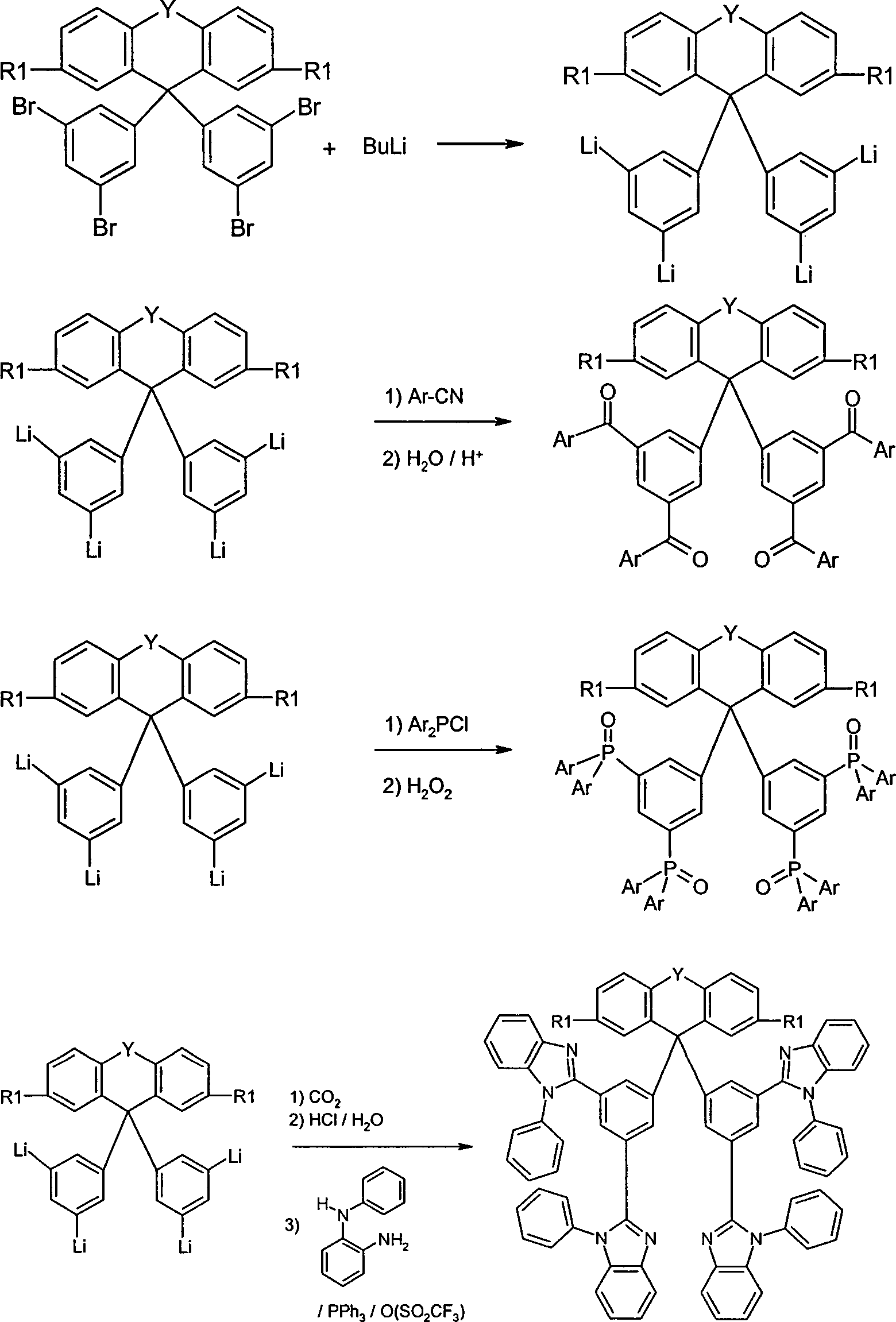
Unsymmetrisch
substituierte erfindungsgemäße Verbindungen können
durch die Sequenz gemäß Schema 5 ausgehend von
Fluorenon und analogen Arylketonen durch Addition einer Aryl-Metallverbindung, z.
B. 1-Lithio-3,5-dibrombenzol, an die Carbonylfunktion, Umwandlung
des Bromaromaten nach einer der oben genannten Methoden unter Aufbau
der einen Funktionalität und anschließender Einführung
der anderen Funktionalität via säurekatalysierter
Friedel-Crafts-Arylierung an 1,3-Dibrombenzol und Umwandlung des
Bromaromaten nach einer der oben genannten Methoden erhalten werden
(s. z. B. 
Ein weiterer Gegenstand der Erfindung ist ein Verfahren zur Herstellung der Verbindungen gemäß Formel (1) umfassend die Reaktion von Bis(3,5-dibrom)benzophenon mit einem substituierten oder unsubstituierten 2-Lithiobiphenyl, 2-Lithiodiphenylether, 2-Lithiodiphenylthioether, 2-(2-Lithiophenyl)-2-phenyl-1,3-dioxolan, 2-Lithiophenyldiphenylamin oder der entsprechenden Grignardverbindung zu den Triarylmethanolen, gefolgt von Cyclisierung unter sauren Bedingungen und gegebenenfalls gefolgt von weiterer Umsetzung der Bromgruppen.One Another object of the invention is a process for the preparation the compounds according to formula (1) comprising the Reaction of bis (3,5-dibromo) benzophenone with a substituted or unsubstituted 2-lithiobiphenyl, 2-lithiodiphenyl ether, 2-lithiodiphenyl thioether, 2- (2-Lithiophenyl) -2-phenyl-1,3-dioxolane, 2-lithiophenyldiphenylamine or the corresponding Grignard compound to the triarylmethanols, followed by cyclization under acidic conditions and optionally followed by further reaction of the bromo groups.
Die oben beschriebenen erfindungsgemäßen Verbindungen, insbesondere Verbindungen, welche mit reaktiven Abgangsgruppen, wie Brom, Iod, Triflat, Tosylat, Boronsäure oder Boronsäureester, substituiert sind, können als Monomere zur Erzeugung entsprechender Dimere, Trimere, Tetramere, Pentamere, Oligomere, Polymere oder als Kern von Dendrimeren Verwendung finden. Die Oligomerisation bzw. Polymerisation erfolgt dabei bevorzugt über die Halogenfunktionalität bzw. die Boronsäurefunktionalität. Dies gilt insbesondere für Verbindungen gemäß Formel (4), in denen die Reste R1 jeweils für eine reaktive Abgangsgruppe stehen.The compounds according to the invention described above, in particular compounds which are substituted by reactive leaving groups, such as bromine, iodine, triflate, tosylate, boronic acid or boronic acid esters, can be used as monomers for producing corresponding dimers, trimers, tetramers, pentamers, oligomers, polymers or as core find use of dendrimers. The oligomerization or polymerization is preferably carried out via the halogen functionality or the boronic acid functionality. This applies in particular to compounds of the formula (4) in which the radicals R 1 each represent a reactive leaving group.
Weiterer Gegenstand der Erfindung sind daher Dimere, Trimere, Tetramere, Pentamere, Oligomere, Polymere oder Dendrimere enthaltend eine oder mehrere Verbindungen gemäß Formel (1), wobei ein oder mehrere Reste R1 oder R2 Bindungen zwischen den Verbindungen gemäß Formel (1) im Dimer, Trimer, Tetramer bzw. Pentamer bzw. Bindungen der Verbindung gemäß Formel (1) zum Polymer, Oligomer oder Dendrimer darstellen oder wobei diese Bindung über Substituenten an den Gruppen R erfolgt. Unter einem Oligomer im Sinne dieser Erfindung wird eine Verbindung verstanden, welche mindestens sechs Einheiten gemäß Formel (1) aufweist. Die Polymere, Oligomere oder Dendrimere können konjugiert, teilkonjugiert oder nicht-konjugiert sein. Die Trimere, Tetramere, Pentamere, Oligomere oder Polymere können linear oder verzweigt sein. In den linear verknüpften Strukturen können die Einheiten gemäß Formel (1) sowohl direkt miteinander verknüpft sein oder sie können über eine bivalente Gruppe, beispielsweise über eine substituierte oder unsubstituierte Alkylengruppe, über ein Heteroatom oder über eine bivalente aromatische oder heteroaromatische Gruppe, miteinander verknüpft sein. In verzweigten Strukturen können beispielsweise drei oder mehrere Einheiten gemäß Formel (1) über eine tivalente oder höhervalente Gruppe, beispielsweise über eine trivalente oder höhervalente aromatische oder heteroaromatische Gruppe, zu einem verzweigten Trimer, Tetramer, Pentamer, Oligomer oder Polymer verknüpft sein.The invention therefore further provides dimers, trimers, tetramers, pentamers, oligomers, polymers or dendrimers containing one or more compounds of the formula (1), where one or more radicals R 1 or R 2 form bonds between the compounds of the formula (1) in the Dimer, trimer, tetramer or pentamer or bonds of the compound according to formula (1) to the polymer, oligomer or dendrimer, or wherein this bond takes place via substituents on the groups R. An oligomer in the context of this invention is understood as meaning a compound which has at least six units of the formula (1). The polymers, oligomers or dendrimers may be conjugated, partially conjugated or non-conjugated. The trimers, tetramers, pentamers, oligomers or polymers can be linear or branched. In the In the case of linearly linked structures, the units of the formula (1) can either be linked directly to one another or they can be linked together via a divalent group, for example via a substituted or unsubstituted alkylene group, via a heteroatom or via a divalent aromatic or heteroaromatic group. In branched structures, for example, three or more units of formula (1) may be linked via a tivalent or higher valent group, for example via a trivalent or higher valent aromatic or heteroaromatic group, to a branched trimer, tetramer, pentamer, oligomer or polymer.
Für die Wiederholeinheiten gemäß Formel (1) in Dimeren, Trimeren, Tetrameren, Pentameren, Oligomeren und Polymeren gelten dieselben Bevorzugungen wie oben beschrieben. Bevorzugte Wiederholeinheiten sind daher auch hier die Einheiten gemäß Formel (2), (3) und (4).For the repeat units according to formula (1) in dimers, Trimers, tetramers, pentamers, oligomers and polymers apply the same preferences as described above. Preferred repeat units are therefore also here the units according to formula (2), (3) and (4).
Zur
Herstellung der Oligomere oder Polymere werden die erfindungsgemäßen
Monomere homopolymerisiert oder mit weiteren Monomeren copolymerisiert.
Geeignete und bevorzugte Comonomere sind gewählt aus Fluorenen
(z. B. gemäß
Ein weiterer Gegenstand der vorliegenden Erfindung sind Mischungen enthaltend mindestens eine Verbindung gemäß Formel (1) oder ein entsprechendes Dimer, Trimer, Tetramer, Pentamer, Oligomer oder Polymer und mindestens eine weitere Verbindung. Die weitere Verbindung kann beispielsweise ein fluoreszierender oder phosphoreszierender Dotand sein, wenn die Verbindung der Formel (1) als Matrixmaterial verwendet wird. Geeignete fluoreszierende und phosphoreszierende Dotanden sind unten im Zusammenhang mit den organischen Elektrolumineszenzvorrichtungen aufgeführt und sind auch für die erfindungsgemäßen Mischungen bevorzugt. Die weitere Verbindung kann auch ein Dotierstoff sein, wenn die Verbindung gemäß Formel (1) eine Lochtransport- oder Elektronentransportverbindung ist. Geeignete Dotierstoffe sind unten im Zusammenhang mit den organischen Elektrolumineszenzvorrichtungen aufgeführt.One Another object of the present invention are mixtures containing at least one compound according to formula (1) or a corresponding dimer, trimer, tetramer, pentamer, oligomer or Polymer and at least one other compound. The further connection For example, a fluorescent or phosphorescent Dotand, when the compound of formula (1) as a matrix material is used. Suitable fluorescent and phosphorescent dopants are below in the context of organic electroluminescent devices listed and are also for the invention Mixtures preferred. The further compound can also be a dopant when the compound of formula (1) has a hole transport or electron transport compound. Suitable dopants are below in the context of organic electroluminescent devices listed.
Nochmals ein weiterer Gegenstand der vorliegenden Erfindung sind Lösungen enthaltend mindestens eine Verbindung gemäß Formel (1) oder ein entsprechendes Dimer, Trimer, Tetramere, Pentamer, Oligomer oder Polymer und mindestens ein organisches Lösemittel. Derartige Lösungen sind erforderlich für der Herstellung der organischen elektronischen Vorrichtung aus Lösung, beispielsweise durch Spin-Coating oder durch Druckverfahren.again Another object of the present invention are solutions containing at least one compound of the formula (1) or a corresponding dimer, trimer, tetramer, pentamer, Oligomer or polymer and at least one organic solvent. Such solutions are required for the production the organic electronic device of solution, for example by spin coating or by printing processes.
Die erfindungsgemäßen Verbindungen gemäß Formel (1) und entsprechende Dimere, Trimere, Tetramere, Pentamere, Oligomere, Polymere oder Dendrimere eignen sich für den Einsatz in elektronischen Vorrichtungen, insbesondere in organischen Elektrolumineszenzvorrichtungen (OLEDs, PLEDs). Abhängig von der Substitution werden die Verbindungen in unterschiedlichen Funktionen und Schichten eingesetzt.The Compounds of the invention according to formula (1) and corresponding dimers, trimers, tetramers, pentamers, oligomers, Polymers or dendrimers are suitable for use in electronic devices, in particular in organic electroluminescent devices (OLEDs, PLEDs). Depending on the substitution, the Connections used in different functions and layers.
Ein weiterer Gegenstand der Erfindung ist daher die Verwendung von Verbindungen gemäß Formel (1) bzw. entsprechender Dimere, Trimere, Tetramere, Pentamere, Oligomere, Polymere oder Dendrimere in elektronischen Vorrichtungen, insbesondere in organischen Elektrolumineszenzvorrichtungen.One Another object of the invention is therefore the use of compounds according to formula (1) or corresponding dimers, trimers, Tetramers, pentamers, oligomers, polymers or dendrimers in electronic Devices, in particular in organic electroluminescent devices.
Nochmals ein weiterer Gegenstand der Erfindung sind organische elektronische Vorrichtungen, enthaltend mindestens eine Verbindung gemäß Formel (1) bzw. ein entsprechendes Dimer, Trimer, Tetramer, Pentamer, Oligomer, Polymer oder Dendrimer, insbesondere organische Elektrolumineszenzvorrichtungen, enthaltend Anode, Kathode und mindestens eine emittierende Schicht, dadurch gekennzeichnet, dass mindestens eine organische Schicht, die eine emittierende Schicht oder eine andere Schicht sein kann, mindestens eine Verbindung gemäß Formel (1) oder ein entsprechendes Dimer, Trimer, Tetramer, Pentamer, Oligomer, Polymer oder Dendrimer enthält.again Another object of the invention are organic electronic Devices containing at least one compound according to formula (1) or a corresponding dimer, trimer, tetramer, pentamer, oligomer, Polymer or dendrimer, in particular organic electroluminescent devices, containing anode, cathode and at least one emitting layer, characterized in that at least one organic layer, which may be an emitting layer or another layer, at least one compound according to formula (1) or a corresponding dimer, trimer, tetramer, pentamer, oligomer, Contains polymer or dendrimer.
Außer
Kathode, Anode und der emittierenden Schicht kann die organische
Elektrolumineszenzvorrichtung noch weitere Schichten enthalten.
Diese sind beispielsweise gewählt aus jeweils einer oder
mehreren Lochinjektionsschichten, Lochtransportschichten, Lochblockierschichten,
Elektronentransportschichten, Elektroneninjektionsschichten, Elektronenblockierschichten,
Excitonenblockierschichten, Charge-Generation Lagers (
In
einer weiteren bevorzugten Ausführungsform der Erfindung
enthält die organische Elektrolumineszenzvorrichtung mehrere
emittierende Schichten, wobei mindestens eine organische Schicht
mindestens eine Verbindung gemäß Formel (1) enthält.
Besonders bevorzugt weisen diese Emissionsschichten insgesamt mehrere
Emissionsmaxima zwischen 380 nm und 750 nm auf, so dass insgesamt
weiße Emission resultiert, d. h. in den emittierenden Schichten
werden verschiedene emittierende Verbindungen verwendet, die fluoreszieren
oder phosphoreszieren können und die blaues und gelbes,
orange oder rotes Licht emittieren. Insbesondere bevorzugt sind
Dreischichtsysteme, also Systeme mit drei emittierenden Schichten,
wobei mindestens eine dieser Schichten mindestens eine Verbindung
gemäß Formel (1) enthält und wobei die
drei Schichten blaue, grüne und orange oder rote Emission
zeigen (für den prinzipiellen Aufbau siehe z. B.
In einer bevorzugten Ausführungsform der Erfindung werden die Verbindungen gemäß Formel (1) als Matrixmaterial für fluoreszierende oder phosphoreszierende Verbindungen in einer emittierenden Schicht eingesetzt. Bei einem Matrixmaterial für phosphoreszierende Verbindungen stehen bevorzugt eine oder mehrere Gruppen R und/oder R1 für C(=O)Ar, S(=O)Ar, S(=O)2Ar oder P(=O)Ar2. Dieselben Bevorzugungen gelten für die Gruppen R bzw. R1 in Strukturen gemäß Formel (2), (3) und (4). Bei einem Matrixmaterial für fluoreszierende Verbindungen stehen bevorzugt eine oder mehrere Gruppen R und/oder R1 für ein aromatisches oder heteroaromatisches Ringsystem, insbesondere für ein aromatisches Ringsystem enthaltend Anthracen. Dieselben Bevorzugungen gelten für die Gruppen R bzw. R1 in Strukturen gemäß Formel (2), (3) und (4).In a preferred embodiment of the invention, the compounds of the formula (1) are used as matrix material for fluorescent or phosphorescent compounds in an emitting layer. In the case of a matrix material for phosphorescent compounds, one or more groups R and / or R 1 are preferably C (OO) Ar, S (OO) Ar, S (OO) 2 Ar or P (OO) Ar 2 . The same preferences apply to the groups R and R 1 in structures of the formula (2), (3) and (4). In the case of a matrix material for fluorescent compounds, one or more groups R and / or R 1 preferably represents an aromatic or heteroaromatic ring system, in particular an aromatic ring system containing anthracene. The same preferences apply to the groups R and R 1 in structures of the formula (2), (3) and (4).
Unter einem Matrixmaterial wird in einem System aus Matrix und Dotand diejenige Komponente verstanden, die in dem System im höheren Anteil vorliegt. Bei einem System aus einer Matrix und mehreren Dotanden wird als Matrix diejenige Komponente verstanden, deren Anteil der höchste in der Mischung ist.Under a matrix material becomes in a system of matrix and dopant the component understood in the system in the higher Share is present. In a system of one matrix and several Dotand is understood as a matrix that component whose Share is the highest in the mix.
Wenn die Verbindung gemäß Formel (1) als Matrixmaterial für eine emittierende Verbindung in einer emittierenden Schicht eingesetzt wird, kann sie in Kombination mit einem oder mehreren phosphoreszierenden Materialien (Triplettemitter) eingesetzt. Unter Phosphoreszenz im Sinne dieser Erfindung wird die Lumineszenz aus einem angeregten Zustand mit höherer Spinmultiplizität verstanden, also einem Spinzustand > 1, insbesondere aus einem angeregten Triplettzustand. Die Mischung aus der Verbindung gemäß Formel (1) und der emittierenden Verbindung enthält dann zwischen 99 und 1 Gew.-%, vorzugsweise zwischen 98 und 10 Gew.-%, besonders bevorzugt zwischen 97 und 60 Gew.-%, insbesondere zwischen 95 und 85 Gew.-% der Verbindung gemäß Formel (1) bezogen auf die Gesamtmischung aus Emitter und Matrixmaterial. Entsprechend enthält die Mischung zwischen 1 und 99 Gew.-%, vorzugs weise zwischen 2 und 90 Gew.-%, besonders bevorzugt zwischen 3 und 40 Gew.-%, insbesondere zwischen 5 und 15 Gew.-% des Emitters bezogen auf die Gesamtmischung aus Emitter und Matrixmaterial.If the compound according to formula (1) as matrix material for an emitting compound in an emissive Layer is used in combination with one or more several phosphorescent materials (triplet emitter) used. Phosphorescence in the context of this invention is luminescence from an excited state with higher spin multiplicity understood, ie a spin state> 1, in particular from an excited Triplet state. The mixture of the compound according to formula (1) and the emitting compound then contains between 99 and 1 wt .-%, preferably between 98 and 10 wt .-%, especially preferably between 97 and 60 wt .-%, in particular between 95 and 85 wt .-% of the compound according to formula (1) based to the total mixture of emitter and matrix material. Corresponding contains the mixture between 1 and 99 wt .-%, preferably, as between 2 and 90% by weight, more preferably between 3 and 40 Wt .-%, in particular between 5 and 15 wt .-% of the emitter based to the total mixture of emitter and matrix material.
Als phosphoreszierende Verbindungen (= Triplettemitter) eignen sich insbesondere Verbindungen, die bei geeigneter Anregung Licht, vorzugsweise im sichtbaren Bereich, emittieren und außerdem mindestens ein Atom der Ordnungszahl größer 20, bevorzugt größer 38 und kleiner 84, besonders bevorzugt größer 56 und kleiner 80 enthalten. Bevorzugt werden als Phosphoreszenzemitter Verbindungen, die Kupfer, Molybdän, Wolfram, Rhenium, Ruthenium, Osmium, Rhodium, Iridium, Palladium, Platin, Silber, Gold oder Europium enthalten, verwendet, insbesondere Verbindungen, die Iridium oder Platin enthalten.When Phosphorescent compounds (= triplet emitters) are suitable in particular compounds which, with suitable excitation light, preferably in the visible range, emit and also at least an atom of atomic number greater than 20, preferably greater than 38 and less than 84, more preferably greater 56 and less than 80 included. Prefers are called phosphorescence emitters compounds that are copper, molybdenum, Tungsten, rhenium, ruthenium, osmium, rhodium, iridium, palladium, Platinum, silver, gold or europium used, in particular Compounds containing iridium or platinum.
Beispiele
der oben beschriebenen Emitter können den Anmeldungen
Wenn die Verbindung gemäß Formel (1) als Matrixmaterial für fluoreszierende Verbindungen eingesetzt wird, beträgt der Anteil des Matrixmaterials in der emittierenden Schicht zwischen 50.0 und 99.9 Gew.-%, bevorzugt zwischen 80.0 und 99.5 Gew.-%, besonders bevorzugt zwischen 90.0 und 99.0 Gew.-%. Entsprechend beträgt der Anteil des Dotanden zwischen 0.1 und 50.0 Gew.-%, bevorzugt zwischen 0.1 und 20.0 Gew.-%, besonders bevorzugt zwischen 0.5 und 15 Gew.-%, ganz besonders bevorzugt zwischen 1.0 und 10.0 Gew.-%.If the compound according to formula (1) as matrix material is used for fluorescent compounds is the proportion of matrix material in the emitting layer between 50.0 and 99.9 wt .-%, preferably between 80.0 and 99.5 wt .-%, especially preferably between 90.0 and 99.0 wt .-%. Correspondingly the proportion of dopant between 0.1 and 50.0 wt .-%, preferably between 0.1 and 20.0 wt .-%, more preferably between 0.5 and 15 wt .-%, most preferably between 1.0 and 10.0 wt .-%.
Bevorzugte
Dotanden sind ausgewählt aus der Klasse der Monostyrylamine,
der Distyrylamine, der Tristyrylamine, der Tetrastyrylamine, der Styrylphosphine,
der Styrylether und der Arylamine. Unter einem Monostyrylamin wird
eine Verbindung verstanden, die eine substituierte oder unsubstituierte
Styrylgruppe und mindestens ein, bevorzugt aromatisches, Amin enthält.
Unter einem Distyrylamin wird eine Verbindung verstanden, die zwei
substituierte oder unsubstituierte Styrylgruppen und mindestens
ein, bevorzugt aromatisches, Amin enthält. Unter einem
Tristyrylamin wird eine Verbindung verstanden, die drei substituierte
oder unsubstituierte Styrylgruppen und mindestens ein, bevorzugt
aromatisches, Amin enthält. Unter einem Tetrastyrylamin
wird eine Verbindung verstanden, die vier substituierte oder unsubstituierte
Styrylgruppen und mindestens ein, bevorzugt aromatisches, Amin enthält.
Die Styrylgruppen sind besonders bevorzugt Stilbene, die auch noch
weiter substituiert sein können. Entsprechende Phosphine
und Ether sind in Analogie zu den Aminen definiert. Unter einem
Arylamin bzw. einem aromatischen Amin im Sinne dieser Erfindung
wird eine Verbindung verstanden, die drei substituierte oder unsubstituierte
aromatische oder heteroaromatische Ringsysteme direkt an den Stickstoff
gebunden enthält. Bevorzugt ist mindestens eines dieser
aromatischen oder heteroaromatischen Ringsysteme ein kondensiertes
Ringsystem, bevorzugt mit mindestens 14 aromatischen Ringatomen.
Bevorzugte Beispiele hierfür sind aromatische Anthracenamine,
aromatische Anthracendiamine, aromatische Pyrenamine, aromatische
Pyrendiamine, aromatische Chrysenamine oder aromatische Chrysendiamine.
Unter einem aromatischen Anthracenamin wird eine Verbindung verstanden,
in der eine Diarylaminogruppe direkt an eine Anthracengruppe gebunden
ist, vorzugsweise in 9-Position. Unter einem aromatischen Anthracendiamin
wird eine Verbindung verstanden, in der zwei Diarylaminogruppen
direkt an eine Anthracengruppe gebunden sind, vorzugsweise in 9,10-Position.
Aromatische Pyrenamine, Pyrendiamine, Chrysenamine und Chrysendiamine
sind analog dazu definiert, wobei die Diarylaminogruppen am Pyren
bevorzugt in 1-Position bzw. in 1,6-Position gebunden sind. Weitere
bevorzugte Dotanden sind gewählt aus Indenofluorenaminen
bzw. -diaminen, beispielsweise gemäß
In
einer weiteren Ausführungsform der Erfindung werden die
Verbindungen gemäß Formel (1) als Lochtransportmaterial
bzw. als Lochinjektionsmaterial bzw. als Elektronenblockiermaterial
bzw. als Excitonenblockiermaterial eingesetzt. Die Verbindungen
sind dann bevorzugt mit mindestens einer Gruppe N(Ar)2 substituiert,
bevorzugt mit mindestens zwei Gruppen N(Ar)2 und/oder
sie enthalten weitere Gruppen, die den Lochtransport verbessern.
Besonders bevorzugt stehen hier alle Gruppen R für N(Ar)2. Die Gruppen N(Ar)2 sind
bevorzugt ausgewählt aus den oben beschriebenen Formeln
(5) oder (6). Dies gilt insbesondere für die Reste R an
den Strukturen gemäß Formel (1) bis (4). Weitere
bevorzugte Gruppen, die den Lochtransport verbessern, sind beispielsweise
die Gruppen N(R1), S oder O, insbesondere
N(R1) als Brücke Y oder elektronenreiche
Heteroaromaten, insbesondere Thiophen, Pyrrol oder Furan als Gruppe
R oder R1. Die Verbindung wird bevorzugt
in einer Lochtransport- bzw. in einer Lochinjektions- bzw. in einer
Elektronenblockier- bzw. in einer Excitonenblockierschicht eingesetzt.
Eine Lochinjektionsschicht im Sinne dieser Erfindung ist eine Schicht,
die direkt an die Anode angrenzt. Eine Lochtransportschicht im Sinne
dieser Erfindung ist eine Schicht, die zwischen einer Lochinjektionsschicht
und einer Emissionsschicht liegt. Eine Elektronenblockier- bzw.
Excitonenblockierschicht im Sinne dieser Erfindung ist eine Schicht,
die auf Anodenseite direkt an eine emittierende Schicht angrenzt.
Wenn die Verbindungen gemäß Formel (1) als Lochtransport-
bzw. als Lochinjektionsmaterial verwendet werden, kann es bevorzugt
sein, wenn sie mit Elektronenakzeptor-Verbindungen dotiert werden,
beispielsweise mit F4-TCNQ oder mit Verbindungen,
wie in
In nochmals einer weiteren Ausführungsform der Erfindung werden die Verbindungen gemäß Formel (1) als Elektronentransportmaterial bzw. als Lochblockiermaterial in einer Elektronentransportschicht bzw. einer Lochblockierschicht eingesetzt. Hier ist es bevorzugt, wenn die Gruppe Y für C=O, P(=O), SO oder SO2 steht und/oder mindestens einer der Substituenten R und/oder R1 für eine Heteroarylgruppe, welche einen elektronenarmen Heterocyclus darstellt, wie beispielsweise Imidazol, Pyrazol, Thiazol, Benzimidazol, Benzothiazol, Triazol, Oxadiazol, Benzothiadiazol, Phenanthrolin, etc., oder für C(=O)Ar, P(=O)Ar2, S(=O)Ar oder S(O)2Ar steht. Weiterhin kann es bevorzugt sein, wenn die Verbindung mit Elektronendonorverbindungen dotiert ist. Eine Lochblockierschicht im Sinne dieser Erfindung ist eine Schicht, die auf zwischen einer emittierenden Schicht und einer Elektronentransportschicht liegt und direkt an die emittierende Schicht angrenzt.In yet another embodiment of the invention, the compounds according to formula (1) are used as electron transport material or as hole blocking material in an electron transport layer or a hole blocking layer. Here it is preferred if the group Y is C = O, P (= O), SO or SO 2 and / or at least one of the substituents R and / or R 1 represents a heteroaryl group which has a electron-deficient heterocycle such as imidazole, pyrazole, thiazole, benzimidazole, benzothiazole, triazole, oxadiazole, benzothiadiazole, phenanthroline, etc., or for C (= O) Ar, P (= O) Ar 2 , S (= O) Ar or S (O) 2 Ar stands. Furthermore, it may be preferred if the compound is doped with electron donor compounds. A hole blocking layer in the sense of this invention is a layer which lies on between an emitting layer and an electron transport layer and directly adjoins the emitting layer.
Auch in Polymeren können Wiederholeinheiten gemäß Formel (1) entweder als Polymergrundgerüst (Backbone), als lochtransportierende Einheit und/oder als elektronentransportierende Einheit eingesetzt werden. Dabei entsprechen die bevorzugten Substitutionsmuster den oben beschriebenen.Also in polymers repeating units according to formula (1) either as a polymer backbone, as hole-transporting Unit and / or used as an electron transporting unit become. The preferred substitution patterns correspond to the described above.
Weiterhin bevorzugt ist eine organische Elektrolumineszenzvorrichtung, dadurch gekennzeichnet, dass eine oder mehrere Schichten mit einem Sublimationsverfahren beschichtet werden. Dabei werden die Materialien in Vakuum-Sublimationsanlagen bei einem Druck kleiner 10–5 mbar, bevorzugt kleiner 10–6 mbar aufgedampft. Es sei jedoch angemerkt, dass der Druck auch noch geringer sein kann, beispielsweise kleiner 10–7 mbar.Further preferred is an organic electroluminescent device, characterized in that one or more layers are coated with a sublimation process. The materials are vapor-deposited in vacuum sublimation systems at a pressure of less than 10 -5 mbar, preferably less than 10 -6 mbar. It should be noted, however, that the pressure may be even lower, for example less than 10 -7 mbar.
Bevorzugt
ist ebenfalls eine organische Elektrolumineszenzvorrichtung, dadurch
gekennzeichnet, dass eine oder mehrere Schichten mit dem OVPD (Organic
Vapour Phase Deposition) Verfahren oder mit Hilfe einer Trägergassublimation
beschichtet werden. Dabei werden die Materialien bei einem Druck
zwischen 10–5 mbar und 1 bar aufgebracht.
Ein Spezialfall dieses Verfahrens ist das OVJP (Organic Vapour Jet
Printing) Verfahren, bei dem die Materialien direkt durch eine Düse
aufgebracht und so strukturiert werden (z. B.
Weiterhin bevorzugt ist eine organische Elektrolumineszenzvorrichtung, dadurch gekennzeichnet, dass eine oder mehrere Schichten aus Lösung, wie z. B. durch Spincoating, oder mit einem beliebigen Druckverfahren, wie z. B. Siebdruck, Flexodruck oder Offsetdruck, besonders bevorzugt aber LITI (Light Induced Thermal Imaging, Thermotransferdruck) oder Ink-Jet Druck (Tintenstrahldruck), hergestellt werden. Hierfür sind lösliche Verbindungen nötig. Hohe Löslichkeit lässt sich durch geeignete Substitution der Verbindungen erreichen. Dabei können nicht nur Lösungen aus einzelnen Materialien aufgebracht werden, sondern auch Lösungen, die mehrere Verbindungen enthalten, beispielsweise Matrixmaterial und Dotand.Farther preferred is an organic electroluminescent device, characterized characterized in that one or more layers of solution, such as B. by spin coating, or with any printing process, such as As screen printing, flexographic printing or offset printing, but particularly preferred LITI (Light Induced Thermal Imaging, Thermal Transfer Printing) or Ink Jet Printing (inkjet printing) can be made. For this are soluble compounds needed. High solubility can be achieved by suitable substitution of the compounds. Not only solutions from individual can do this Materials are applied, but also solutions, which contain several compounds, for example matrix material and Dotand.
Die erfindungsgemäßen Verbindungen weisen bei Verwendung in organischen Elektrolumineszenzvorrichtungen folgende überraschende Vorteile gegenüber dem Stand der Technik auf:
- 1. Die erfindungsgemäßen Verbindungen weisen eine hohe thermische Stabilität auf und lassen sich unzersetzt sublimieren.
- 2. Die erfindungsgemäßen Verbindungen, insbesondere solche, die Diarylaminosubstituenten als Gruppen R enthalten, führen bei Verwendung in einer Elektronen-/Excitonenblockierschicht in einer phosphoreszierenden Elektrolumineszenzvorrichtung zu einer erheblichen Verbesserung der Effizienz gegenüber Materialien gemäß dem Stand der Technik.
- 3. Die erfindungsgemäßen Verbindungen, insbesondere solche, welche mit Diarylaminogruppen substituitert sind und/oder welche eine Einfachbindung oder S, O oder N(R1) als Gruppe Y enthalten und/oder welche mit elektronenreichen Heteroaromaten substituiert sind, eignen sich sehr gut für die Verwendung als Lochinjektions- und Lochtransportmaterial und führen zu einer Verringerung der Betriebsspannung.
- 4. Die mit den erfindungsgemäßen Verbindungen hergestellten OLEDs weisen generell eine sehr hohe Lebensdauer auf.
- 5. Die mit den erfindungsgemäßen Verbindungen hergestellten OLEDs weisen generell eine sehr hohe Quanteneffizienz auf.
- 1. The compounds of the invention have a high thermal stability and can sublime undecomposed.
- 2. The compounds according to the invention, in particular those which contain diarylamino substituents as groups R, when used in an electron / exciton blocking layer in a phosphorescent electroluminescent device, lead to a considerable improvement in the efficiency over materials according to the prior art.
- 3. The compounds according to the invention, in particular those which are substituted by diarylamino groups and / or which contain a single bond or S, O or N (R 1 ) as group Y and / or which are substituted by electron-rich heteroaromatics, are very suitable for the Use as a hole injection and hole transport material and lead to a reduction of the operating voltage.
- 4. The OLEDs prepared with the compounds according to the invention generally have a very long service life.
- 5. The OLEDs prepared with the compounds according to the invention generally have a very high quantum efficiency.
Im vorliegenden Anmeldetext wird auf die Verwendung der erfindungsgemäßen Verbindungen in Bezug auf OLEDs und PLEDs und die entsprechenden Displays abgezielt. Trotz dieser Beschränkung der Beschreibung ist es für den Fachmann ohne weiteres erfinderisches Zutun möglich, die erfindungsgemäßen Verbindungen auch in anderen elektronischen Vorrichtungen einzusetzen, z. B. in organischen Feld-Effekt-Transistoren (O-FETs), organischen Dünnfilmtransistoren (O-TFTs), organischen lichtemittierenden Transistoren (O-LETs), organischen integrierten Schaltungen (O-ICs), organischen Solarzellen (O-SCs), organischen Feld-Quench-Devices (O-FQDs), lichtemittierenden elektrochemischen Zellen (LECs), organischen Laserdioden (O-Laser) oder organischen Photorezeptoren.in the This application text is based on the use of the invention Links relating to OLEDs and PLEDs and the corresponding ones Targeted displays. Despite this limitation of the description it is readily for the skilled person inventive step possible, the compounds of the invention to use in other electronic devices, such. B. in organic field-effect transistors (O-FETs), organic thin-film transistors (O-TFTs), Organic Light-Emitting Transistors (O-LETs), organic integrated circuits (O-ICs), organic solar cells (O-SCs), organic field quench devices (O-FQDs), light-emitting electrochemical cells (LECs), organic laser diodes (O-lasers) or organic photoreceptors.
Die Verwendung der erfindungsgemäßen Verbindungen in den entsprechenden Vorrichtungen ebenso wie diese Vorrichtungen selbst sind ebenfalls ein Gegenstand der vorliegenden Erfindung.The Use of the compounds of the invention in the corresponding devices as well as these devices themselves are also an object of the present invention.
Die Erfindung wird durch die nachfolgenden Beispiele genauer beschrieben, ohne sie dadurch einschränken zu wollen. Der Fachmann kann ohne erfinderisch tätig zu werden weitere erfindungsgemäße Verbindungen herstellen und diese in organischen elektronischen verwenden.The Invention is more particularly described by the following examples, without wanting to restrict it. The expert can without being inventive act further inventive Make connections and these in organic electronic use.
Beispiele:Examples:
Die
nachfolgenden Synthesen werden – sofern nicht anders angegeben – unter
einer Schutzgasatmosphäre in getrockneten Lösungsmitteln
durchgeführt. Die Lösungsmittel und Reagenzien
können von den Firmen ALDRICH bzw. ABCR bezogen werden.
Die Vorstufe 3,3',5,5'-Tetrabrombenzophenon wird gemäß
Beispiel
1: Synthese von 9,9-Bis-(3,5-dibromphenyl)fluoren 
Aus
144.5 g (620 mmol) 2-Brombiphenyl und 15.3 g (580 mmol) Magnesium
wird in einem Gemisch aus 500 ml Tetrahydrofuran und 250 ml Dimethoxyethan
die entsprechende Grignard-Verbindung hergestellt. Dann wird bei
Raumtemperatur mit einer Suspension von 224.0 g (450 mmol) Bis-(3,5-dibromphenyl)keton
in 1000 ml Tetrahydrofuran versetzt und zwölf Stunden nachgerührt.
Das Lösungsmittel wird im Vakuum entfernt, der Rückstand
mit 1000 ml Eisessig und 5 ml Bromwasserstoff versetzt und eine
Stunde gerührt. Die Suspension wird eine halbe Stunde unter
Rückfluss erhitzt und zwölf Stunden bei Raumtemperatur
gerührt. Der Feststoff wird abgesaugt, dreimal mit 300
ml Ethanol gewaschen und zweimal aus Toluol umkristallisiert.
Ausbeute:
183.2 g (289 mmol), 64.3%, Reinheit ca. 99.8% (HPLC).From 144.5 g (620 mmol) of 2-bromobiphenyl and 15.3 g (580 mmol) of magnesium, the corresponding Grignard compound is prepared in a mixture of 500 ml of tetrahydrofuran and 250 ml of dimethoxyethane. Then, at room temperature, a suspension of 224.0 g (450 mmol) of bis (3,5-dibromophenyl) ketone in 1000 ml of tetrahydrofuran is added and the mixture is stirred for a further 12 hours. The solvent is removed in vacuo, the residue is treated with 1000 ml of glacial acetic acid and 5 ml of hydrogen bromide and stirred for one hour. The suspension is refluxed for half an hour and stirred for twelve hours at room temperature. The solid is filtered off, washed three times with 300 ml of ethanol and recrystallized twice from toluene.
Yield: 183.2 g (289 mmol), 64.3%, purity about 99.8% (HPLC).
Analog
zu Beispiel 1 werden aus entsprechenden Bromiden folgende erfindungsgemäße
Verbindungen erhalten (Beispiele 2 und 3): 

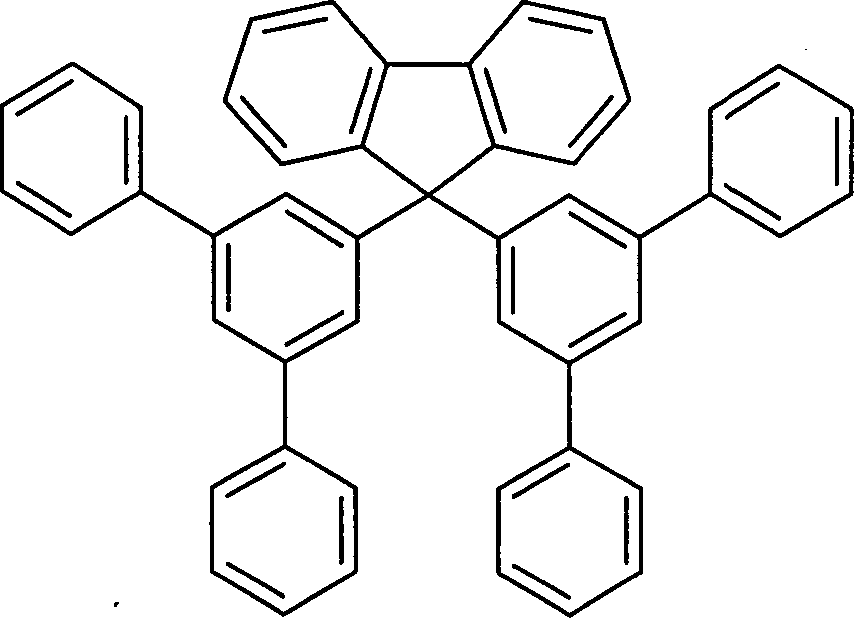
Eine gut gerührte Suspension von 30.4 g (48 mmol) 9,9-Bis-(3,5-dibromphenyl)fluoren, 35.4 g (290 mmol) Phenylboronsäure und 121.0 g (570 mmol) Trikaliumphosphat in einem Gemisch von 300 ml Toluol, 300 ml 1,4-Dioxan und 300 ml Wasser wird mit 1.0 g (3.3 mmol) Tri-o-tolylphosphin und 0.5 g (2.2 mmol) Palladium(II)acetat versetzt und anschließend drei Stunden unter Rückfluss erhitzt. Nach Erkalten wird die organische Phase abgetrennt, dreimal mit je 150 ml Wasser gewaschen und über Silicagel filtriert. Das Lösungsmittel wird im Vakuum entfernt, der Rückstand mit 200 ml Ethanol aufgenommen, abgesaugt und dreimal mit 100 ml Ethanol gewaschen. Der Feststoff wird dreimal aus Chlorbenzol umkristallisiert und nach Trocknen im Vakuum zweimal sublimiert (p = 1 × 10⁻⁵ mbar, T = 320°C). Ausbeute: 11.1 g (18 mmol), 37.1%, Reinheit ca. 99.9% (HPLC).A well-stirred suspension of 30.4 g (48 mmol) of 9,9-bis (3,5-dibromophenyl) fluorene, 35.4 g (290 mmol) of phenylboronic acid and 121.0 g (570 mmol) of tripotassium phosphate in a mixture of 300 ml of toluene, 300 ml of 1,4-dioxane and 300 ml of water is treated with 1.0 g (3.3 mmol) of tri-o-tolylphosphine and 0.5 g (2.2 mmol) of palladium (II) acetate and then heated under reflux for three hours. After cooling, the organic phase is separated, washed three times with 150 ml of water and filtered through silica gel. The solvent is removed in vacuo, the residue taken up with 200 ml of ethanol, filtered off with suction and washed three times with 100 ml of ethanol. The solid is recrystallized three times from chlorobenzene and sublimed twice after drying in vacuo (p = 1 × 10 -5 mbar, T = 320 ° C.). Yield: 11.1 g (18 mmol), 37.1%, purity about 99.9% (HPLC).
Analog
zu Beispiel 4 werden aus den entsprechenden Boronsäuren
folgende erfindungsgemäße Verbindungen erhalten
(Beispiele 5–7): 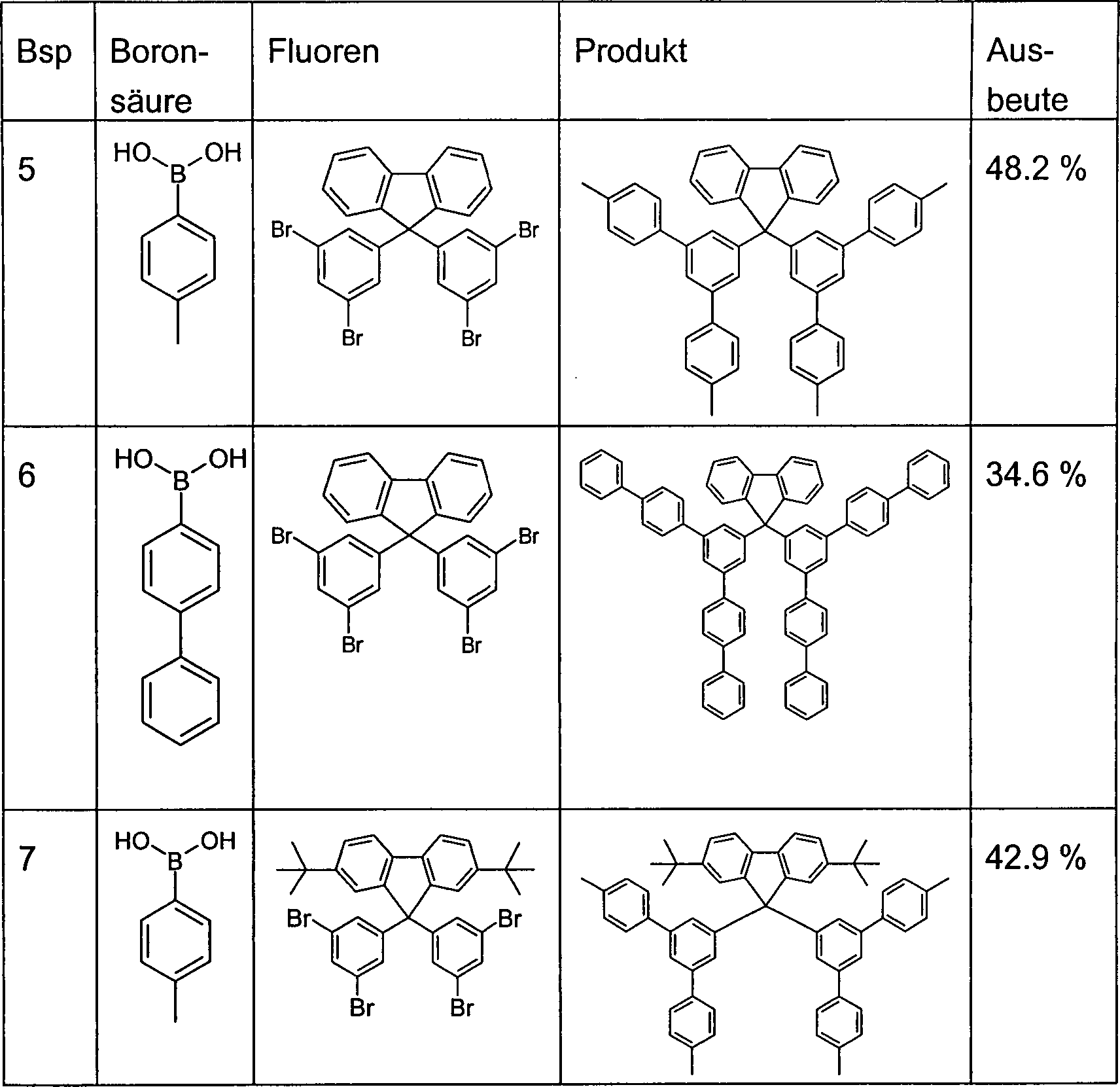
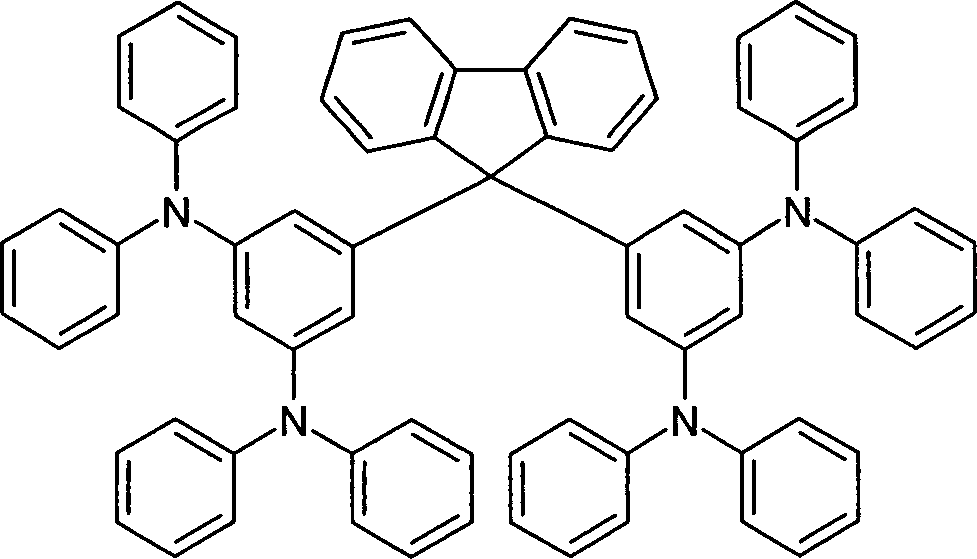
Eine gut gerührte Suspension von 29.4 g (40 mmol) 9,9-Bis-(3,5-dibromphenyl)fluoren, 33.8 g (200 mmol) Diphenylamin und 21.1 g (220 mmol) in 500 ml Toluol wird mit 101 mg (0.50 mmol) Tri-tert-butylphosphin und 56 mg (0.25 mmol) Palladium(II)acetat versetzt und fünf Stunden unter Rückfluss erhitzt. Nach Erkalten wird die Lösung über Silicagel filtriert und anschließend im Vakuum bis zur Trockne eingeengt. Der Rückstand wird eine Stunde bei 60°C in 600 ml eines 1:1 Gemisches von Ethanol und Wasser gerührt, abgesaugt, fünfmal mit 250 ml Ethanol gewaschen und im Vakuum getrocknet. Der beigefarbene Feststoff wird fünfmal aus Dimethylformamid und dreimal aus Chlorbenzol umkristallisiert, im Vakuum getrocknet und anschließend zweimal sublimiert (p = 1 × 10⁻⁵ mbar, T = 350°C). Ausbeute: 10.2 g (10 mmol), 25.0%, Reinheit 99.9% (HPLC), Tg = 99.8°C.A well-stirred suspension of 29.4 g (40 mmol) of 9,9-bis (3,5-dibromophenyl) fluorene, 33.8 g (200 mmol) of diphenylamine and 21.1 g (220 mmol) in 500 ml of toluene with 101 mg (0.50 mmol) of tri-tert-butylphosphine and 56 mg (0.25 mmol) of palladium (II) acetate and heated under reflux for five hours. After cooling, the solution is filtered through silica gel and then concentrated in vacuo to dryness. The residue is stirred for one hour at 60 ° C. in 600 ml of a 1: 1 mixture of ethanol and water, filtered off with suction, washed five times with 250 ml of ethanol and dried in vacuo. The beige solid is recrystallized five times from dimethylformamide and three times from chlorobenzene, dried in vacuo and then sublimated twice (p = 1 × 10 -5 mbar, T = 350 ° C). Yield: 10.2 g (10 mmol), 25.0%, purity 99.9% (HPLC), Tg = 99.8 ° C.
Analog
zu Beispiel 8 werden aus den entsprechenden Aminen und den entsprechenden
Fluorenen folgende erfindungsgemäße Verbindungen
erhalten (Beispiele 9–13): 


Eine Suspension von 50.7 g (80 mmol) 9,9-Bis-(3,5-dibromphenyl)fluoren, 78.6 g (470 mmol) Carbazol und 201.7 g (950 mmol) Trikaliumphosphat wird mit 500 g Glasperlen in 1000 ml p-Xylol gut gerührt. Die Suspension wird mit 1.62 g (8.0 mmol) Tri-tert-butylphospin und 894 mg (4.0 mmol) Palladium(II)acetat versetzt und fünf Tage unter Rückfluss erhitzt. Nach Erkalten wird mit 1000 ml Wasser versetzt, zwölf Stunden gerührt und dann filtriert. Die organische Phase wird abgetrennt, dreimal mit 200 ml Wasser gewaschen und anschließend im Vakuum zu einem zähen Öl eingeengt. Unter Rühren mit 300 ml Ethanol bildet sich ein kristalliner Feststoff, der abgesaugt und dreimal mit 250 ml Ethanol gewaschen wird. Eine Lösung des Feststoffs in 350 ml Dimethylformamid wird in 1500 ml siedendes Ethanol getropft. Nach Erkalten wird der Feststoff abgesaugt, dreimal aus Chlorbenzol umkristallisiert, im Vakuum getrocknet und dann zweimal im Vakuum sublimiert (p = 1 × 10⁻⁵ mbar, T = 370°C). Ausbeute: 33.2 g (34 mmol), 42.4%, Reinheit 99.8% (HPLC).A suspension of 50.7 g (80 mmol) of 9,9-bis (3,5-dibromophenyl) fluorene, 78.6 g (470 mmol) of carbazole and 201.7 g (950 mmol) of tripotassium phosphate is mixed with 500 g of glass beads in 1000 ml of p-xylene well stirred. The suspension is treated with 1.62 g (8.0 mmol) of tri-tert-butylphosphine and 894 mg (4.0 mmol) of palladium (II) acetate and heated under reflux for five days. After cooling, it is mixed with 1000 ml of water, stirred for twelve hours and then filtered. The organic phase is separated, washed three times with 200 ml of water and then concentrated in vacuo to a viscous oil. With stirring with 300 ml of ethanol, a crystalline solid is formed, which is filtered off with suction and washed three times with 250 ml of ethanol. A solution of the solid in 350 ml of dimethylformamide is added dropwise to 1500 ml of boiling ethanol. After cooling, the solid is filtered off, recrystallized three times from chlorobenzene, dried in vacuo and then sublimed twice in vacuo (p = 1 × 10 -5 mbar, T = 370 ° C). Yield: 33.2 g (34 mmol), 42.4%, purity 99.8% (HPLC).
Analog
zu Beispiel 14 werden aus den entsprechenden Carbazolderivaten folgende
erfindungsgemäße Verbindungen erhalten (Beispiele
15–16): 
Beispiel 17: Herstellung und Charakterisierung von organischen Elektrolumineszenzvorrichtungen, enthaltend die erfindungsgemäßen VerbindungenExample 17: Preparation and Characterization of organic electroluminescent devices containing the Compounds of the invention
Erfindungsgemäße
Elektrolumineszenzvorrichtungen können, wie beispielsweise
in
Die
Strukturen von Ir(ppy)3, Spiro-Keton (SK)
und Amin-1 sind der Übersichtlichkeit halber im Folgenden
abgebildet. Dabei ist Amin-1 eine Vergleichsverbindung gemäß dem
nächstliegenden Stand der Technik (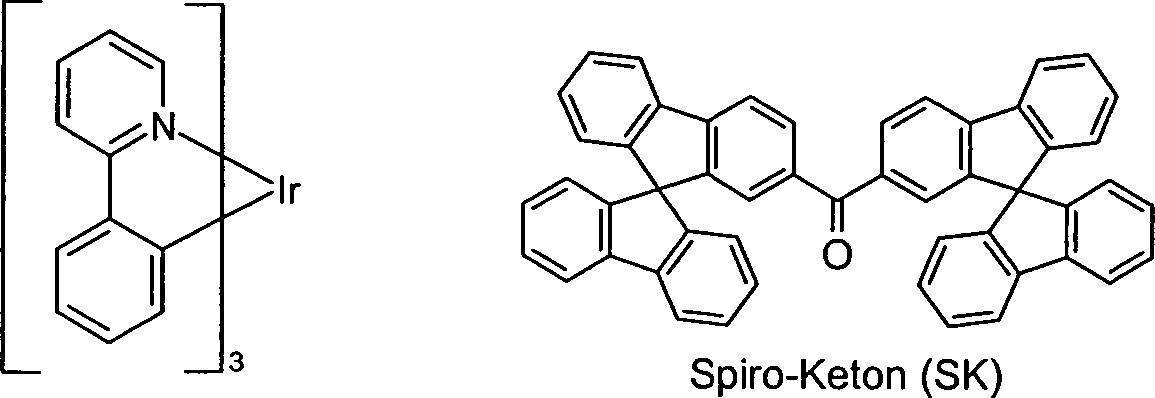
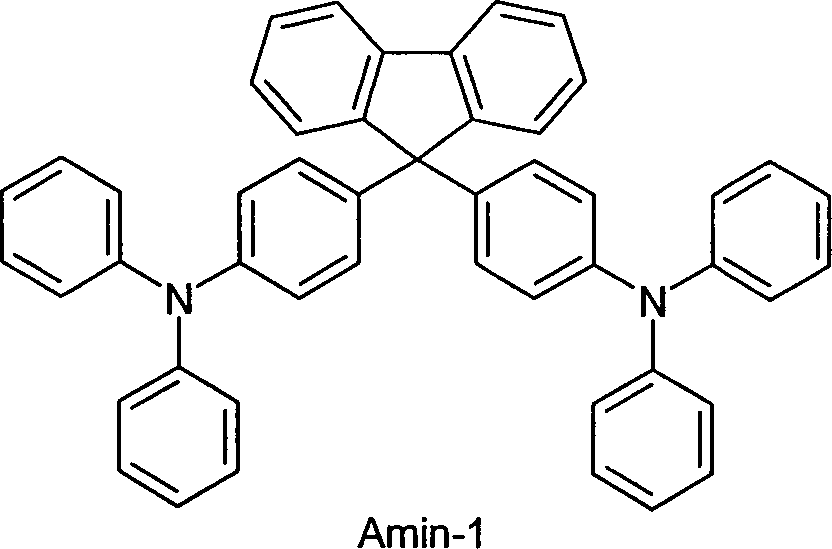
Die
erfindungsgemäßen Verbindungen 1 bis 3 sind im
Folgenden abgebildet: 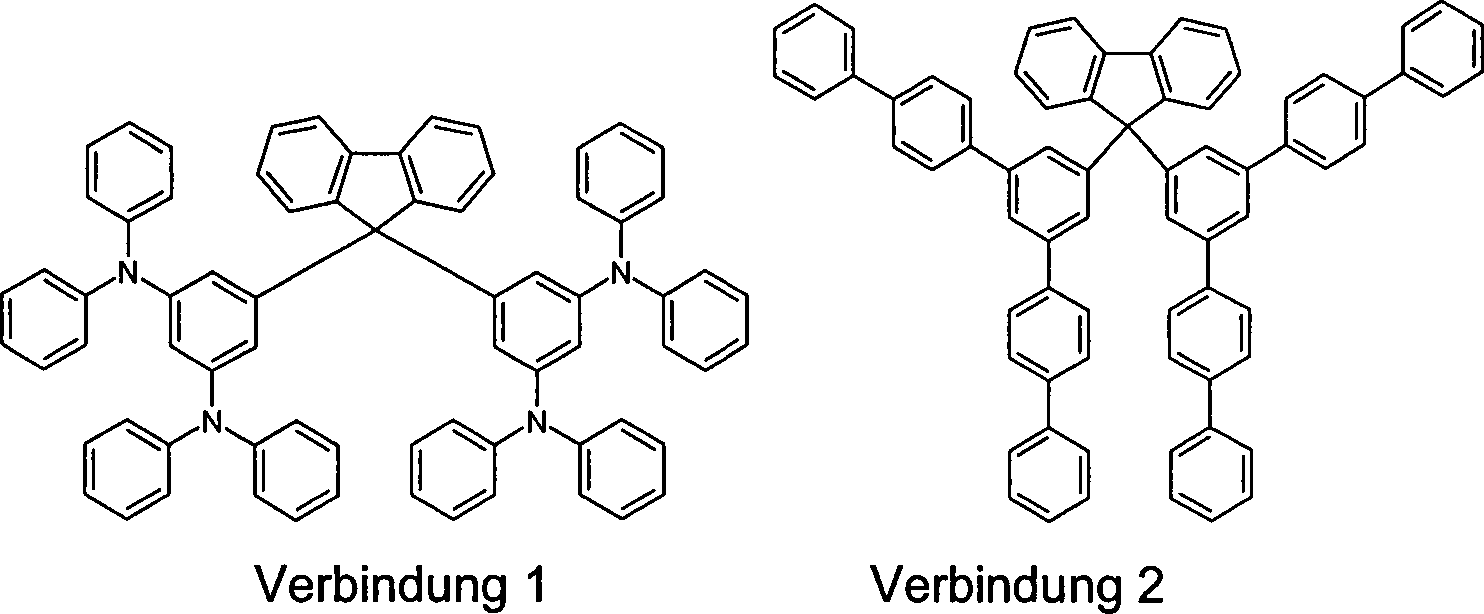

Diese noch nicht optimierten OLEDs werden standardmäßig charakterisiert; hierfür werden die Elektrolumineszenzspektren, die Effizienz (gemessen in cd/A) in Abhängigkeit von der Helligkeit, berechnet aus Strom-Spannungs-Helligkeit-Kennlinien (IUL-Kennlinien), und die Lebensdauer bestimmt.These Unoptimized OLEDs are defaulted characterized; for this the electroluminescence spectra, the efficiency (measured in cd / A) as a function of the Brightness, calculated from current-voltage-brightness characteristics (IUL characteristics), and the lifetime determined.
Mit OLEDs hergestellt nach dem oben beschriebenen Aufbau und Materialien als Vergleichsexperiment mit NPB als Lochtransportmaterial erhält man unter den oben beschriebenen Bedingungen typischerweise eine maximale Effizienz von etwa 30 cd/A bei Farbkoordinaten von CIE: x = 0.38, y = 0.57. Für die Referenzleuchtdichte von 1000 cd/m2 werden Spannungen von 4.4 V benötigt. Die Lebensdauer beträgt etwa 7700 h bei einer Anfangsleuchtdichte von 1000 cd/m2 (s. Tabelle 1, Beispiel 18). Mit Amin-1 als Lochtransportmaterial in einem ansonsten gleichen Deviceaufbau (s. Tabelle 1, Beispiel 19) erhält man zwar eine bessere maximale Effizienz im Bereich von 41 cd/A, jedoch werden für die Referenzleuchtdichte von 1000 cd/m2 Spannungen von 5.3 V benötigt und die Lebensdauer beträgt nur etwa 5600 h.Using OLEDs prepared according to the structure described above and materials as comparison experiment with NPB as hole transport material, a maximum efficiency of about 30 cd / A is typically obtained under the conditions described above for color coordinates of CIE: x = 0.38, y = 0.57. For the reference luminance of 1000 cd / m 2 voltages of 4.4 V are required. The lifetime is about 7700 h with an initial luminance of 1000 cd / m 2 (see Table 1, Example 18). Although amine-1 as hole transport material in an otherwise identical device construction (see Table 1, Example 19) gives a better maximum efficiency in the range of 41 cd / A, for the reference luminance of 1000 cd / m 2, voltages of 5.3 V are obtained needed and the life is only about 5600 h.
Im
Gegensatz dazu zeigen erfindungsgemäße OLEDs hergestellt
mit dem erfindungsgemäßen Elektronenblockiermaterial
(Verbindung 1) eine deutlich erhöhte maximale Effizienz
von 47 cd/A bei Farbkoordinaten von CIE: x = 0.38, y = 0.58, wobei
die benötigte Spannung für die Referenzleuchtdichte
von 1000 cd/m2 bei 4.4 V liegt (s. Tabelle
1, Beispiel 20). Die Lebensdauer bei einer Anfangsleuchtdichte von
1000 cd/m2 ist mit 7400 h vergleichbar mit
dem Vergleichsbeispiel 18 (s. Tabelle 1, Beispiel 20). Im Gegensatz
zum Vergleichsexperiment zeigen erfindungsgemäße
OLEDs hergestellt mit dem Wirtsmaterial (Verbindung 2) anstelle des
Spiro-Ketons bei ansonsten gleichem Aufbau eine maximale Effizienz
von 35 cd/A bei verbesserten Farbkoordinaten von CIE: x = 0.31,
y = 0.62, wobei die benötigte Spannung für die
Referenzleuchtdichte von 1000 cd/m2 bei
5.2 V liegt (s. Tabelle 1, Beispiel 21). Die Lebensdauer bei einer
Anfangsleuchtdichte von 1000 cd/m2 ist mit
6900 h vergleichbar wie bei Verwendung des Spiro-Ketons (s. Tabelle
1, Beispiel 21). Setzt man Verbindung 1 als Elektronenblockiermaterial
und Verbindung 3 als Elektronentransportmaterial anstelle von Alq
ein, so erhält man maximale Effizienzen von 54 cd/A bei
Farbkoordinaten von CIE: x = 0.37, y = 0.59, wobei die benötigte
Spannung für die Referenzleuchtdichte von 1000 cd/m2 bei 4.1 V liegt (s. Tabelle 1, Beispiel
22). Die Lebensdauer bei einer Anfangsleuchtdichte von 1000 cd/m2 ist mit 7200 h vergleichbar und die Spannung
mit 4.1 V niedriger als mit dem Referenzmaterial Alq (s. Tabelle
1, Beispiel 22). Tabelle 1: Device-Ergebnisse mit erfindungsgemäßen
Verbindungen mit Ir(ppy)3 als Dotand
ZITATE ENTHALTEN IN DER BESCHREIBUNGQUOTES INCLUDE IN THE DESCRIPTION
Diese Liste der vom Anmelder aufgeführten Dokumente wurde automatisiert erzeugt und ist ausschließlich zur besseren Information des Lesers aufgenommen. Die Liste ist nicht Bestandteil der deutschen Patent- bzw. Gebrauchsmusteranmeldung. Das DPMA übernimmt keinerlei Haftung für etwaige Fehler oder Auslassungen.This list The documents listed by the applicant have been automated generated and is solely for better information recorded by the reader. The list is not part of the German Patent or utility model application. The DPMA takes over no liability for any errors or omissions.
Zitierte PatentliteraturCited patent literature
- - US 4539507 [0002] US 4539507 [0002]
- - US 5151629 [0002] US 5151629 [0002]
- - EP 0676461 [0002] EP 0676461 [0002]
- - WO 98/27136 [0002] WO 98/27136 [0002]
- - US 5698740 [0005, 0005] US 5698740 [0005, 0005]
- - JP 2005/085599 [0005, 0070] - JP 2005/085599 [0005, 0070]
- - JP 2007/049055 [0005, 0005] - JP 2007/049055 [0005, 0005]
- - JP 2005/085588 [0005] - JP 2005/085588 [0005]
- - WO 05/053055 [0006] WO 05/053055 [0006]
- - EP 842208 [0035] - EP 842208 [0035]
- - WO 00/22026 [0035] WO 00/22026 [0035]
- - EP 707020 [0035] - EP 707020 [0035]
- - EP 894107 [0035] - EP 894107 [0035]
- - WO 06/061181 [0035] WO 06/061181 [0035]
- - WO 92/18552 [0035] WO 92/18552 [0035]
- - WO 04/070772 [0035] WO 04/070772 [0035]
- - WO 04/113468 [0035] WO 04/113468 [0035]
- - EP 1028136 [0035] - EP 1028136 [0035]
- - WO 05/014689 [0035] WO 05/014689 [0035]
- - WO 04/041901 [0035] WO 04/041901 [0035]
- - WO 04/113412 [0035] WO 04/113412 [0035]
- - WO 05/040302 [0035] WO 05/040302 [0035]
- - WO 05/104264 [0035] WO 05/104264 [0035]
- - WO 07/017066 [0035] WO 07/017066 [0035]
- - WO 07/068325 [0035] WO 07/068325 [0035]
- - WO 06/003000 [0035] WO 06/003000 [0035]
- - WO 05/011013 [0042] WO 05/011013 [0042]
- - WO 00/70655 [0047] WO 00/70655 [0047]
- - WO 01/41512 [0047] WO 01/41512 [0047]
- - WO 02/02714 [0047] WO 02/02714 [0047]
- - WO 02/15645 [0047] WO 02/15645 [0047]
- - EP 1191613 [0047] - EP 1191613 [0047]
- - EP 1191612 [0047] - EP 1191612 [0047]
- - EP 1191614 [0047] - EP 1191614 [0047]
- - WO 05/033244 [0047] WO 05/033244 [0047]
- - WO 06/122630 [0049] WO 06/122630 [0049]
- - WO 08/006449 [0049] WO 08/006449 [0049]
- - WO 07/140847 [0049] WO 07/140847 [0049]
- - WO 06/000388 [0049] WO 06/000388 [0049]
- - WO 06/058737 [0049] WO 06/058737 [0049]
- - WO 06/000389 [0049] WO 06/000389 [0049]
- - WO 07/065549 [0049] WO 07/065549 [0049]
- - WO 07/115610 [0049] WO 07/115610 [0049]
- - EP 1476881 [0050] - EP 1476881 [0050]
- - EP 1596445 [0050] - EP 1596445 [0050]
- - WO 05/003253 [0069] WO 05/003253 [0069]
- - WO 04/085449 [0069] WO 04/085449 [0069]
Zitierte Nicht-PatentliteraturCited non-patent literature
- - Eur. J. Org. Chem. 2006, 2523–2529 [0026] Eur. J. Org. Chem. 2006, 2523-2529 [0026]
- - Org. Lett. 2001, 3(15), 2285 [0030] - Org. Lett. 2001, 3 (15), 2285 [0030]
- - IDMC 2003, Taiwan; Session 21 OLED (5), T. Matsumoto, T. Nakada, J. Endo, K. Mori, N. Kawamura, A. Yokoi, J. Kido, Multiphoton Organic EL Device Having Charge Generation Lager [0041] - IDMC 2003, Taiwan; Session 21 OLED (5), T. Matsumoto, T. Nakada, J. Endo, K. Mori, N. Kawamura, A. Yokoi, J. Kido, Multiphoton Organic EL Device Having Charge Generation Bearing [0041]
- - M. S. Arnold et al., Appl. Phys. Lett. 2008, 92, 053301 [0054] MS Arnold et al., Appl. Phys. Lett. 2008, 92, 053301 [0054]
- - Eur. J. Org. Chem. 2006, 2523–2529 [0060] Eur. J. Org. Chem. 2006, 2523-2529 [0060]
Claims (15)
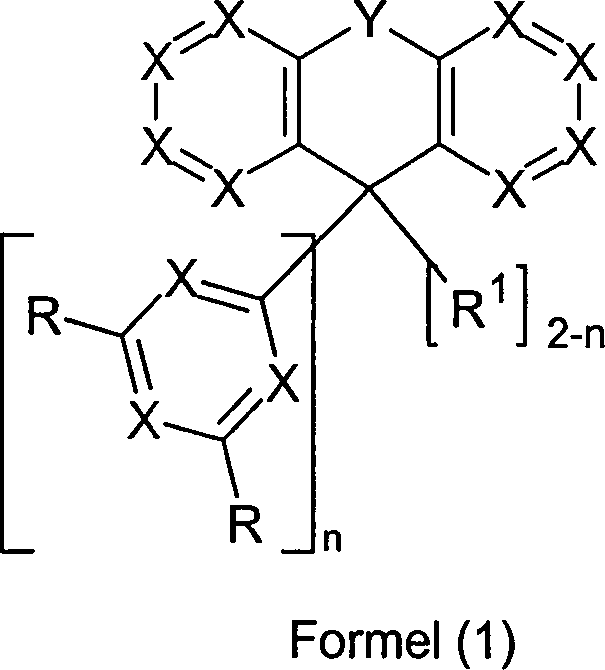


Priority Applications (11)
| Application Number | Priority Date | Filing Date | Title |
|---|---|---|---|
| DE102008017591A DE102008017591A1 (en) | 2008-04-07 | 2008-04-07 | New materials for organic electroluminescent devices |
| EP09730490A EP2260023B1 (en) | 2008-04-07 | 2009-03-11 | Fluorene derivatives for organic electroluminescence devices |
| KR1020107024955A KR101578570B1 (en) | 2008-04-07 | 2009-03-11 | Fluorine derivatives for organic electroluminescence devices |
| US12/936,644 US8361638B2 (en) | 2008-04-07 | 2009-03-11 | Fluorine derivatives for organic electroluminescence devices |
| CN201410490593.4A CN104327003B (en) | 2008-04-07 | 2009-03-11 | Fluorine derivative for organic electroluminescence device |
| JP2011503351A JP5653902B2 (en) | 2008-04-07 | 2009-03-11 | Fluorine derivatives for organic electroluminescent devices |
| AT09730490T ATE555092T1 (en) | 2008-04-07 | 2009-03-11 | FLUORENE DERIVATIVES FOR ORGANIC ELECTROLUMINESCENCE DEVICES |
| CN200980111846XA CN101983190A (en) | 2008-04-07 | 2009-03-11 | Fluorine Derivatives Used in Organic Electroluminescent Devices |
| CN201610236009.1A CN105906546B (en) | 2008-04-07 | 2009-03-11 | Fluorine derivatives for organic electroluminescent devices |
| PCT/EP2009/001736 WO2009124627A1 (en) | 2008-04-07 | 2009-03-11 | Fluorine derivatives for organic electroluminescence devices |
| TW098111009A TW201004904A (en) | 2008-04-07 | 2009-04-02 | Novel materials for organic electroluminescent devices |
Applications Claiming Priority (1)
| Application Number | Priority Date | Filing Date | Title |
|---|---|---|---|
| DE102008017591A DE102008017591A1 (en) | 2008-04-07 | 2008-04-07 | New materials for organic electroluminescent devices |
Publications (1)
| Publication Number | Publication Date |
|---|---|
| DE102008017591A1 true DE102008017591A1 (en) | 2009-10-08 |
Family
ID=40589712
Family Applications (1)
| Application Number | Title | Priority Date | Filing Date |
|---|---|---|---|
| DE102008017591A Withdrawn DE102008017591A1 (en) | 2008-04-07 | 2008-04-07 | New materials for organic electroluminescent devices |
Country Status (9)
| Country | Link |
|---|---|
| US (1) | US8361638B2 (en) |
| EP (1) | EP2260023B1 (en) |
| JP (1) | JP5653902B2 (en) |
| KR (1) | KR101578570B1 (en) |
| CN (3) | CN101983190A (en) |
| AT (1) | ATE555092T1 (en) |
| DE (1) | DE102008017591A1 (en) |
| TW (1) | TW201004904A (en) |
| WO (1) | WO2009124627A1 (en) |
Cited By (81)
| Publication number | Priority date | Publication date | Assignee | Title |
|---|---|---|---|---|
| DE102008027005A1 (en) | 2008-06-05 | 2009-12-10 | Merck Patent Gmbh | Organic electronic device containing metal complexes |
| DE102008036247A1 (en) | 2008-08-04 | 2010-02-11 | Merck Patent Gmbh | Electronic devices containing metal complexes |
| DE102008036982A1 (en) | 2008-08-08 | 2010-02-11 | Merck Patent Gmbh | Organic electroluminescent device |
| WO2011015265A2 (en) | 2009-08-04 | 2011-02-10 | Merck Patent Gmbh | Electronic devices comprising multi cyclic hydrocarbons |
| DE102009041414A1 (en) | 2009-09-16 | 2011-03-17 | Merck Patent Gmbh | metal complexes |
| WO2011032686A1 (en) | 2009-09-16 | 2011-03-24 | Merck Patent Gmbh | Formulas for producing electronic devices |
| DE102009053645A1 (en) | 2009-11-17 | 2011-05-19 | Merck Patent Gmbh | Materials for organic electroluminescent device |
| DE102009023154A1 (en) | 2009-05-29 | 2011-06-16 | Merck Patent Gmbh | A composition comprising at least one emitter compound and at least one polymer having conjugation-interrupting units |
| WO2011076323A1 (en) | 2009-12-22 | 2011-06-30 | Merck Patent Gmbh | Formulations comprising phase-separated functional materials |
| WO2011076326A1 (en) | 2009-12-22 | 2011-06-30 | Merck Patent Gmbh | Electroluminescent functional surfactants |
| WO2011076314A1 (en) | 2009-12-22 | 2011-06-30 | Merck Patent Gmbh | Electroluminescent formulations |
| DE102010009193A1 (en) | 2010-02-24 | 2011-08-25 | Merck Patent GmbH, 64293 | Fluorine-fluorine associates |
| WO2011110277A1 (en) | 2010-03-11 | 2011-09-15 | Merck Patent Gmbh | Fibers in therapy and cosmetics |
| WO2011110275A2 (en) | 2010-03-11 | 2011-09-15 | Merck Patent Gmbh | Radiative fibers |
| WO2011137922A1 (en) | 2010-05-03 | 2011-11-10 | Merck Patent Gmbh | Formulations and electronic devices |
| DE102010020567A1 (en) | 2010-05-14 | 2011-11-17 | Merck Patent Gmbh | metal complexes |
| WO2011147522A1 (en) | 2010-05-27 | 2011-12-01 | Merck Patent Gmbh | Compositions comprising quantum dots |
| DE102010027218A1 (en) | 2010-07-15 | 2012-01-19 | Merck Patent Gmbh | Organic complexes containing metals |
| WO2012013270A1 (en) | 2010-07-26 | 2012-02-02 | Merck Patent Gmbh | Nanocrystals in devices |
| WO2012013272A1 (en) | 2010-07-26 | 2012-02-02 | Merck Patent Gmbh | Quantum dots and hosts |
| WO2012038029A1 (en) | 2010-09-24 | 2012-03-29 | Merck Patent Gmbh | Phosphorus-containing metal complexes |
| DE102010046412A1 (en) | 2010-09-23 | 2012-03-29 | Merck Patent Gmbh | Metal ligand coordination compounds |
| US20120091446A1 (en) * | 2009-06-25 | 2012-04-19 | Sung-Hyun Jung | Compound for optoelectronic device, organic light emitting diode including the same and display including the organic light emitting diode |
| DE102010054525A1 (en) | 2010-12-15 | 2012-04-26 | Merck Patent Gmbh | Organic electroluminescent device |
| DE102010055901A1 (en) | 2010-12-23 | 2012-06-28 | Merck Patent Gmbh | Organic electroluminescent device |
| DE102010055902A1 (en) | 2010-12-23 | 2012-06-28 | Merck Patent Gmbh | Organic electroluminescent device |
| WO2012110178A1 (en) | 2011-02-14 | 2012-08-23 | Merck Patent Gmbh | Device and method for treatment of cells and cell tissue |
| WO2012126566A1 (en) | 2011-03-24 | 2012-09-27 | Merck Patent Gmbh | Organic ionic functional materials |
| WO2012152366A1 (en) | 2011-05-12 | 2012-11-15 | Merck Patent Gmbh | Organic ionic compounds, compositions and electronic devices |
| DE102011102586A1 (en) | 2011-05-27 | 2012-11-29 | Merck Patent Gmbh | Organic electronic device |
| WO2013060411A1 (en) | 2011-10-28 | 2013-05-02 | Merck Patent Gmbh | Hyperbranched polymers, methods for producing same, and use of same in electronic devices |
| WO2013097920A1 (en) | 2011-12-27 | 2013-07-04 | Merck Patent Gmbh | Metal complexes comprising 1,2,3-triazoles |
| WO2013107487A1 (en) | 2012-01-16 | 2013-07-25 | Merck Patent Gmbh | Organic metal complexes |
| WO2013113349A1 (en) | 2012-01-30 | 2013-08-08 | Merck Patent Gmbh | Nanocrystals on fibers |
| US8618317B2 (en) | 2008-07-17 | 2013-12-31 | Merck Patent Gmbh | Organic electroluminescence device |
| WO2015014427A1 (en) | 2013-07-29 | 2015-02-05 | Merck Patent Gmbh | Electro-optical device and the use thereof |
| WO2016034262A1 (en) | 2014-09-05 | 2016-03-10 | Merck Patent Gmbh | Formulations and electronic devices |
| WO2016055557A1 (en) | 2014-10-08 | 2016-04-14 | Cynora Gmbh | Metal complexes with tridentate ligands for optoelectronic applications |
| WO2016107663A1 (en) | 2014-12-30 | 2016-07-07 | Merck Patent Gmbh | Formulations and electronic devices |
| WO2016155866A1 (en) | 2015-03-30 | 2016-10-06 | Merck Patent Gmbh | Formulation of an organic functional material comprising a siloxane solvent |
| WO2016198141A1 (en) | 2015-06-12 | 2016-12-15 | Merck Patent Gmbh | Esters containing non-aromatic cycles as solvents for oled formulations |
| WO2017036572A1 (en) | 2015-08-28 | 2017-03-09 | Merck Patent Gmbh | Formulation of an organic functional material comprising an epoxy group containing solvent |
| WO2017097391A1 (en) | 2015-12-10 | 2017-06-15 | Merck Patent Gmbh | Formulations containing ketones comprising non-aromatic cycles |
| WO2017102049A1 (en) | 2015-12-16 | 2017-06-22 | Merck Patent Gmbh | Formulations containing a mixture of at least two different solvents |
| WO2017102052A1 (en) | 2015-12-16 | 2017-06-22 | Merck Patent Gmbh | Formulations containing a solid solvent |
| WO2017102048A1 (en) | 2015-12-15 | 2017-06-22 | Merck Patent Gmbh | Esters containing aromatic groups as solvents for organic electronic formulations |
| WO2017140404A1 (en) | 2016-02-17 | 2017-08-24 | Merck Patent Gmbh | Formulation of an organic functional material |
| DE102016003104A1 (en) | 2016-03-15 | 2017-09-21 | Merck Patent Gmbh | Container comprising a formulation containing at least one organic semiconductor |
| WO2017216128A1 (en) | 2016-06-17 | 2017-12-21 | Merck Patent Gmbh | Formulation of an organic functional material |
| WO2017216129A1 (en) | 2016-06-16 | 2017-12-21 | Merck Patent Gmbh | Formulation of an organic functional material |
| WO2018001928A1 (en) | 2016-06-28 | 2018-01-04 | Merck Patent Gmbh | Formulation of an organic functional material |
| WO2018024719A1 (en) | 2016-08-04 | 2018-02-08 | Merck Patent Gmbh | Formulation of an organic functional material |
| WO2018077662A1 (en) | 2016-10-31 | 2018-05-03 | Merck Patent Gmbh | Formulation of an organic functional material |
| WO2018077660A1 (en) | 2016-10-31 | 2018-05-03 | Merck Patent Gmbh | Formulation of an organic functional material |
| WO2018104202A1 (en) | 2016-12-06 | 2018-06-14 | Merck Patent Gmbh | Preparation process for an electronic device |
| WO2018108760A1 (en) | 2016-12-13 | 2018-06-21 | Merck Patent Gmbh | Formulation of an organic functional material |
| WO2018114883A1 (en) | 2016-12-22 | 2018-06-28 | Merck Patent Gmbh | Mixtures comprising at least two organofunctional compounds |
| WO2018138319A1 (en) | 2017-01-30 | 2018-08-02 | Merck Patent Gmbh | Method for forming an organic electroluminescence (el) element |
| WO2018138318A1 (en) | 2017-01-30 | 2018-08-02 | Merck Patent Gmbh | Method for forming an organic element of an electronic device |
| WO2018178136A1 (en) | 2017-03-31 | 2018-10-04 | Merck Patent Gmbh | Printing method for an organic light emitting diode (oled) |
| WO2018189050A1 (en) | 2017-04-10 | 2018-10-18 | Merck Patent Gmbh | Formulation of an organic functional material |
| WO2018202603A1 (en) | 2017-05-03 | 2018-11-08 | Merck Patent Gmbh | Formulation of an organic functional material |
| WO2019016184A1 (en) | 2017-07-18 | 2019-01-24 | Merck Patent Gmbh | Formulation of an organic functional material |
| WO2019115573A1 (en) | 2017-12-15 | 2019-06-20 | Merck Patent Gmbh | Formulation of an organic functional material |
| DE102008050841B4 (en) | 2008-10-08 | 2019-08-01 | Merck Patent Gmbh | New materials for organic electroluminescent devices |
| WO2019162483A1 (en) | 2018-02-26 | 2019-08-29 | Merck Patent Gmbh | Formulation of an organic functional material |
| WO2019238782A1 (en) | 2018-06-15 | 2019-12-19 | Merck Patent Gmbh | Formulation of an organic functional material |
| WO2020064582A1 (en) | 2018-09-24 | 2020-04-02 | Merck Patent Gmbh | Method for the production of a granular material |
| WO2020094538A1 (en) | 2018-11-06 | 2020-05-14 | Merck Patent Gmbh | Method for forming an organic element of an electronic device |
| WO2021213917A1 (en) | 2020-04-21 | 2021-10-28 | Merck Patent Gmbh | Emulsions comprising organic functional materials |
| WO2021213918A1 (en) | 2020-04-21 | 2021-10-28 | Merck Patent Gmbh | Formulation of an organic functional material |
| WO2021259824A1 (en) | 2020-06-23 | 2021-12-30 | Merck Patent Gmbh | Method for producing a mixture |
| WO2022122607A1 (en) | 2020-12-08 | 2022-06-16 | Merck Patent Gmbh | An ink system and a method for inkjet printing |
| WO2022223675A1 (en) | 2021-04-23 | 2022-10-27 | Merck Patent Gmbh | Formulation of an organic functional material |
| WO2022243403A1 (en) | 2021-05-21 | 2022-11-24 | Merck Patent Gmbh | Method for the continuous purification of at least one functional material and device for the continuous purification of at least one functional material |
| WO2023012084A1 (en) | 2021-08-02 | 2023-02-09 | Merck Patent Gmbh | A printing method by combining inks |
| WO2023057327A1 (en) | 2021-10-05 | 2023-04-13 | Merck Patent Gmbh | Method for forming an organic element of an electronic device |
| WO2023237458A1 (en) | 2022-06-07 | 2023-12-14 | Merck Patent Gmbh | Method of printing a functional layer of an electronic device by combining inks |
| WO2024126635A1 (en) | 2022-12-16 | 2024-06-20 | Merck Patent Gmbh | Formulation of an organic functional material |
| DE102014008722B4 (en) | 2014-06-18 | 2024-08-22 | Merck Patent Gmbh | Compositions for electronic devices, formulation containing them, use of the composition, use of the formulation and organic electronic device containing the composition |
| WO2025032039A1 (en) | 2023-08-07 | 2025-02-13 | Merck Patent Gmbh | Process for the preparation of an electronic device |
Families Citing this family (133)
| Publication number | Priority date | Publication date | Assignee | Title |
|---|---|---|---|---|
| EP2301926B1 (en) | 2008-06-05 | 2018-11-21 | Idemitsu Kosan Co., Ltd. | Halogen compound, polycyclic compound, and organic electroluminescence element comprising the polycyclic compound |
| US8049411B2 (en) | 2008-06-05 | 2011-11-01 | Idemitsu Kosan Co., Ltd. | Material for organic electroluminescence device and organic electroluminescence device using the same |
| DE102008033943A1 (en) * | 2008-07-18 | 2010-01-21 | Merck Patent Gmbh | New materials for organic electroluminescent devices |
| DE102009005288A1 (en) * | 2009-01-20 | 2010-07-22 | Merck Patent Gmbh | Materials for organic electroluminescent devices |
| EP2415773B1 (en) * | 2009-03-30 | 2016-02-17 | Duk San Neolux Co., Ltd. | Organic electronic device, compounds for same, and terminal |
| JP5400448B2 (en) * | 2009-03-31 | 2014-01-29 | ユー・ディー・シー アイルランド リミテッド | Organic electroluminescence device |
| CN106866430A (en) * | 2009-05-29 | 2017-06-20 | 株式会社半导体能源研究所 | Fluorene derivative, light-emitting component, luminescent device, electronic device and illuminating device |
| WO2011017341A2 (en) * | 2009-08-03 | 2011-02-10 | The Johns Hopkins University | Ladder-type oligo-p-phenylene-containing copolymers with high open-circuit voltages and ambient photovoltaic activity |
| DE102009053644B4 (en) | 2009-11-17 | 2019-07-04 | Merck Patent Gmbh | Materials for organic electroluminescent devices |
| DE102010004803A1 (en) | 2010-01-16 | 2011-07-21 | Merck Patent GmbH, 64293 | Materials for organic electroluminescent devices |
| JP5740830B2 (en) * | 2010-04-05 | 2015-07-01 | 住友化学株式会社 | Metal complex and compound useful therefor |
| DE102010024897A1 (en) | 2010-06-24 | 2011-12-29 | Merck Patent Gmbh | Materials for organic electroluminescent devices |
| KR101918304B1 (en) * | 2010-07-30 | 2018-11-13 | 호도가야 가가쿠 고교 가부시키가이샤 | Compound having indenocarbazole ring structure and organic electroluminescent element |
| DE102010045405A1 (en) | 2010-09-15 | 2012-03-15 | Merck Patent Gmbh | Materials for organic electroluminescent devices |
| DE102010048498A1 (en) | 2010-10-14 | 2012-04-19 | Merck Patent Gmbh | Materials for organic electroluminescent devices |
| KR101531612B1 (en) * | 2010-12-02 | 2015-06-25 | 제일모직 주식회사 | Compound for organic photoelectric device and organic photoelectric device including the same |
| DE102010054316A1 (en) | 2010-12-13 | 2012-06-14 | Merck Patent Gmbh | Substituted tetraarylbenzenes |
| DE102010056151A1 (en) * | 2010-12-28 | 2012-06-28 | Merck Patent Gmbh | Materials for organic electroluminescent devices |
| JP5996628B2 (en) | 2011-04-04 | 2016-09-21 | メルク パテント ゲーエムベーハー | Metal complex |
| UA114403C2 (en) | 2011-05-25 | 2017-06-12 | Емерікен Дай Сорс, Інк. | Compounds with oxime ester and/or acyl groups |
| KR20130015400A (en) * | 2011-08-03 | 2013-02-14 | 삼성디스플레이 주식회사 | Heterocyclic compound and organic light-emitting diode comprising the same |
| WO2013045411A1 (en) * | 2011-09-28 | 2013-04-04 | Solvay Sa | Spirobifluorene compounds for light emitting devices |
| KR101981349B1 (en) * | 2011-09-28 | 2019-05-22 | 스미또모 가가꾸 가부시키가이샤 | Spirobifluorene compounds for light emitting devices |
| TWI425076B (en) | 2011-11-01 | 2014-02-01 | Ind Tech Res Inst | Carbazole derivative and organic light-emitting diode containing the same |
| KR101954980B1 (en) * | 2011-11-03 | 2019-05-31 | 삼성디스플레이 주식회사 | Heterocyclic compound and organic light-emitting diode comprising the same |
| KR101497134B1 (en) * | 2011-12-29 | 2015-03-02 | 제일모직 주식회사 | Compound for organic optoelectronic device, organic light emitting diode including the same and display including the organic light emitting diode |
| KR101507001B1 (en) * | 2011-12-30 | 2015-03-31 | 제일모직 주식회사 | Compound for organic optoelectronic device, organic light emitting diode including the same and display including the organic light emitting diode |
| JP6020472B2 (en) * | 2012-01-10 | 2016-11-02 | コニカミノルタ株式会社 | Transparent electrode, method for producing transparent electrode, electronic device, and organic electroluminescence element |
| KR102357439B1 (en) | 2012-02-14 | 2022-02-08 | 메르크 파텐트 게엠베하 | Spirobifluorene compounds for organic electroluminescent devices |
| KR102198635B1 (en) | 2012-04-20 | 2021-01-05 | 가부시키가이샤 한도오따이 에네루기 켄큐쇼 | Organic compound, light-emitting element, light-emitting device, electronic device, and lighting device |
| US20130328018A1 (en) * | 2012-06-12 | 2013-12-12 | Academia Sinica | Fluorine-modification process and applications thereof |
| KR101401639B1 (en) | 2012-07-27 | 2014-06-02 | (주)피엔에이치테크 | Novel compound for organic electroluminescent device and organic electroluminescent device comprising the same |
| WO2014023388A1 (en) | 2012-08-10 | 2014-02-13 | Merck Patent Gmbh | Materials for organic electroluminescence devices |
| KR101537005B1 (en) | 2012-09-28 | 2015-07-20 | 제일모직 주식회사 | Compound for organic optoelectronic device, organic light emitting diode including the same and display including the organic light emitting diode |
| EP2923391A1 (en) | 2012-11-20 | 2015-09-30 | Merck Patent GmbH | Formulation in high-purity solvent for producing electronic devices |
| CN103420785A (en) * | 2012-12-05 | 2013-12-04 | 烟台九目化学制品有限公司 | Preparation method of 9, 9'-(4-halogen phenyl) fluorene derivative |
| EP2947079B1 (en) | 2013-02-07 | 2017-05-03 | LG Chem, Ltd. | Heterocyclic compound and organic light-emitting element using same |
| CN111718281A (en) * | 2013-03-22 | 2020-09-29 | 默克专利有限公司 | Synthetic structural unit for preparing material for organic electroluminescent device |
| KR102116494B1 (en) * | 2013-04-25 | 2020-05-29 | 삼성디스플레이 주식회사 | Organic light emitting diode |
| WO2014194971A1 (en) * | 2013-06-06 | 2014-12-11 | Merck Patent Gmbh | Organic electroluminescent device |
| US10734587B2 (en) | 2014-03-13 | 2020-08-04 | Merck Patent Gmbh | Formulations of luminescent compounds |
| JP6588688B2 (en) * | 2014-03-27 | 2019-10-09 | 旭有機材株式会社 | Compound, composition and cured product |
| KR102251735B1 (en) * | 2014-04-14 | 2021-05-13 | 삼성디스플레이 주식회사 | Material for organic light emitting device, organic light emitting device, and display device including the same |
| KR102030354B1 (en) * | 2014-05-13 | 2019-10-10 | 에스에프씨주식회사 | Heterocyclic compound comprising aromatic amine group and organic light-emitting diode including the same |
| JP6556764B2 (en) | 2014-06-25 | 2019-08-07 | メルク パテント ゲーエムベーハー | Materials for organic electroluminescent devices |
| US10329483B2 (en) | 2014-12-30 | 2019-06-25 | Dow Global Technologies Llc | Fluorene derivatives as light emitting elements for electroluminescent devices |
| KR102610370B1 (en) | 2015-05-18 | 2023-12-05 | 메르크 파텐트 게엠베하 | Materials for organic electroluminescent devices |
| JP6692126B2 (en) | 2015-06-03 | 2020-05-13 | 三星ディスプレイ株式會社Samsung Display Co.,Ltd. | Material for organic electroluminescence device and organic electroluminescence device using the same |
| US20180219156A1 (en) | 2015-07-22 | 2018-08-02 | Merck Patent Gmbh | Materials for organic electroluminescent devices |
| WO2017016632A1 (en) | 2015-07-29 | 2017-02-02 | Merck Patent Gmbh | Materials for organic electroluminescent devices |
| KR102595922B1 (en) | 2015-12-22 | 2023-10-31 | 삼성디스플레이 주식회사 | Carbazole-based compound and organic light emitting device comprising the same |
| GB2547645A (en) * | 2016-02-22 | 2017-08-30 | Cambridge Display Tech Ltd | Compound,composition and organic light-emitting device |
| KR101850243B1 (en) * | 2016-03-28 | 2018-04-23 | 주식회사 엘지화학 | Compound and organic electronic device comprising the same |
| WO2017194435A1 (en) | 2016-05-11 | 2017-11-16 | Merck Patent Gmbh | Compositions for electrochemical cells |
| US12486230B2 (en) | 2016-06-03 | 2025-12-02 | Merck Patent Gmbh | Materials for organic electroluminescent devices |
| KR20190086028A (en) | 2016-12-05 | 2019-07-19 | 메르크 파텐트 게엠베하 | Materials for organic electroluminescent devices |
| EP3548486B1 (en) | 2016-12-05 | 2021-10-27 | Merck Patent GmbH | Materials for organic electroluminescent devices |
| KR102633478B1 (en) * | 2016-12-23 | 2024-02-06 | 솔루스첨단소재 주식회사 | Organic compound and organic electroluminescent device using the same |
| CN108250129B (en) * | 2016-12-29 | 2021-11-30 | 中节能万润股份有限公司 | Compound with diaryl anthrone as core and application thereof in organic electroluminescent device |
| WO2018127465A1 (en) | 2017-01-04 | 2018-07-12 | Merck Patent Gmbh | Materials for organic electroluminescent devices |
| US11407766B2 (en) | 2017-01-30 | 2022-08-09 | Merck Patent Gmbh | Materials for organic electroluminescent devices |
| TW201835075A (en) | 2017-02-14 | 2018-10-01 | 德商麥克專利有限公司 | Material for organic electroluminescent device |
| KR102449219B1 (en) * | 2017-05-17 | 2022-09-30 | 삼성디스플레이 주식회사 | organic light emitting device |
| KR102653073B1 (en) | 2017-10-24 | 2024-03-29 | 메르크 파텐트 게엠베하 | Materials for organic electroluminescent devices |
| GB2569636A (en) * | 2017-12-21 | 2019-06-26 | Sumitomo Chemical Co | Composition |
| CN111868050B (en) * | 2017-12-21 | 2023-07-25 | 广州华睿光电材料有限公司 | Composition for preparing organic electronic device, organic electronic device and application |
| TWI811290B (en) | 2018-01-25 | 2023-08-11 | 德商麥克專利有限公司 | Materials for organic electroluminescent devices |
| JP7322075B2 (en) | 2018-06-07 | 2023-08-07 | メルク パテント ゲーエムベーハー | organic electroluminescent device |
| WO2020011686A1 (en) | 2018-07-09 | 2020-01-16 | Merck Patent Gmbh | Materials for organic electroluminescent devices |
| KR20210089205A (en) | 2018-11-06 | 2021-07-15 | 메르크 파텐트 게엠베하 | 5,6-diphenyl-5,6-dihydrodibenz[C,E][1,2]azaphosphorine and 6-phenyl-6H-dibenzo[C,E][ as organic electroluminescent materials for OLEDs 1,2]thiazine-5,5-dioxide derivatives and similar compounds |
| CN113195500B (en) | 2018-11-15 | 2024-05-17 | 默克专利有限公司 | Material for organic electroluminescent device |
| TW202039493A (en) | 2018-12-19 | 2020-11-01 | 德商麥克專利有限公司 | Materials for organic electroluminescent devices |
| CN109651340A (en) * | 2018-12-31 | 2019-04-19 | 瑞声科技(南京)有限公司 | A kind of double carbazole pyridine compounds and its application |
| TW202035345A (en) | 2019-01-17 | 2020-10-01 | 德商麥克專利有限公司 | Materials for organic electroluminescent devices |
| CN112250585B (en) * | 2019-07-22 | 2023-11-14 | 南京高光半导体材料有限公司 | Hole transport material and organic electroluminescent device using the material |
| TW202122558A (en) | 2019-09-03 | 2021-06-16 | 德商麥克專利有限公司 | Materials for organic electroluminescent devices |
| CN112538022A (en) * | 2019-09-23 | 2021-03-23 | 北京大学深圳研究生院 | Novel hole transport material and application thereof |
| WO2021078831A1 (en) | 2019-10-25 | 2021-04-29 | Merck Patent Gmbh | Compounds that can be used in an organic electronic device |
| JP7620631B2 (en) | 2019-12-18 | 2025-01-23 | メルク パテント ゲゼルシャフト ミット ベシュレンクテル ハフツング | Aromatic Compounds for Organic Electroluminescent Devices |
| KR20220116008A (en) | 2019-12-19 | 2022-08-19 | 메르크 파텐트 게엠베하 | Polycyclic compound for organic electroluminescent device |
| CN115052865A (en) | 2020-01-29 | 2022-09-13 | 默克专利有限公司 | Benzimidazole Derivatives |
| EP4110884B1 (en) | 2020-02-25 | 2024-11-20 | Merck Patent GmbH | Use of heterocyclic compounds in an organic electronic device |
| WO2021175706A1 (en) | 2020-03-02 | 2021-09-10 | Merck Patent Gmbh | Use of sulfone compounds in an organic electronic device |
| KR20220154751A (en) | 2020-03-17 | 2022-11-22 | 메르크 파텐트 게엠베하 | Heterocyclic compounds for organic electroluminescent devices |
| WO2021185712A1 (en) | 2020-03-17 | 2021-09-23 | Merck Patent Gmbh | Heteroaromatic compounds for organic electroluminescent devices |
| US20230157171A1 (en) | 2020-03-26 | 2023-05-18 | Merck Patent Gmbh | Cyclic compounds for organic electroluminescent devices |
| US20230183269A1 (en) | 2020-04-06 | 2023-06-15 | Merck Patent Gmbh | Polycyclic compounds for organic electroluminescent devices |
| CN115916794A (en) | 2020-06-29 | 2023-04-04 | 默克专利有限公司 | Heterocyclic Compounds for Organic Electroluminescent Devices |
| JP2023531470A (en) | 2020-06-29 | 2023-07-24 | メルク パテント ゲゼルシャフト ミット ベシュレンクテル ハフツング | Heteroaromatic compounds for organic electroluminescent devices |
| TW202222748A (en) | 2020-09-30 | 2022-06-16 | 德商麥克專利有限公司 | Compounds usable for structuring of functional layers of organic electroluminescent devices |
| TW202229215A (en) | 2020-09-30 | 2022-08-01 | 德商麥克專利有限公司 | Compounds for structuring of functional layers of organic electroluminescent devices |
| EP4229145B1 (en) | 2020-10-16 | 2025-07-23 | Merck Patent GmbH | Compounds comprising heteroatoms for organic electroluminescent devices |
| US20230389423A1 (en) | 2020-10-16 | 2023-11-30 | Merck Patent Gmbh | Heterocyclic compounds for organic electroluminescent devices |
| EP4244228A1 (en) | 2020-11-10 | 2023-09-20 | Merck Patent GmbH | Sulfurous compounds for organic electroluminescent devices |
| KR20230116023A (en) | 2020-12-02 | 2023-08-03 | 메르크 파텐트 게엠베하 | Heterocyclic compounds for organic electroluminescent devices |
| EP4263746B1 (en) | 2020-12-18 | 2025-10-01 | Merck Patent GmbH | Nitrogenous heteroaromatic compounds for organic electroluminescent devices |
| KR20230122094A (en) | 2020-12-18 | 2023-08-22 | 메르크 파텐트 게엠베하 | Indolo[3.2.1-JK]carbazole-6-carbonitrile derivatives as blue fluorescent emitters for use in OLEDs |
| US20240124769A1 (en) | 2020-12-18 | 2024-04-18 | Merck Patent Gmbh | Nitrogenous compounds for organic electroluminescent devices |
| KR20220094124A (en) | 2020-12-28 | 2022-07-05 | 롬엔드하스전자재료코리아유한회사 | Organic electroluminescent compound, a plurality of host materials, and organic electroluminescent device comprising the same |
| US20220231229A1 (en) | 2020-12-28 | 2022-07-21 | Rohm And Haas Electronic Materials Korea Ltd. | Organic electroluminescent compound, a plurality of host materials, and organic electroluminescent device comprising the same |
| WO2022157343A1 (en) | 2021-01-25 | 2022-07-28 | Merck Patent Gmbh | Nitrogenous compounds for organic electroluminescent devices |
| US20240188429A1 (en) | 2021-03-02 | 2024-06-06 | Merck Patent Gmbh | Compounds for organic electroluminescent devices |
| KR20230158657A (en) | 2021-03-18 | 2023-11-21 | 메르크 파텐트 게엠베하 | Heteroaromatic compounds for organic electroluminescent devices |
| WO2022229234A1 (en) | 2021-04-30 | 2022-11-03 | Merck Patent Gmbh | Nitrogenous heterocyclic compounds for organic electroluminescent devices |
| WO2023041454A1 (en) | 2021-09-14 | 2023-03-23 | Merck Patent Gmbh | Boronic heterocyclic compounds for organic electroluminescent devices |
| CN118159623A (en) | 2021-10-27 | 2024-06-07 | 默克专利有限公司 | Boron- and nitrogen-containing heterocyclic compounds for organic electroluminescent devices |
| KR20240127395A (en) | 2021-12-21 | 2024-08-22 | 메르크 파텐트 게엠베하 | Electronic devices |
| EP4453128A1 (en) | 2021-12-21 | 2024-10-30 | Merck Patent GmbH | Electronic devices |
| CN114369055B (en) * | 2021-12-21 | 2024-06-28 | 武汉尚赛光电科技有限公司 | An organic compound and an organic electroluminescent device containing the same |
| CN115583925B (en) * | 2021-12-23 | 2023-08-25 | 三峡大学 | Fluorescent and Mechanoluminescent Materials |
| CN118696106A (en) | 2022-02-23 | 2024-09-24 | 默克专利有限公司 | Nitrogen-containing heterocyclic compounds for organic electroluminescent devices |
| EP4482843A1 (en) | 2022-02-23 | 2025-01-01 | Merck Patent GmbH | Aromatic hetreocycles for organic electroluminescent devices |
| CN118923233A (en) | 2022-04-28 | 2024-11-08 | 默克专利有限公司 | Material for organic electroluminescent device |
| EP4519383B1 (en) | 2022-05-06 | 2026-01-14 | Merck Patent GmbH | Cyclic compounds for organic electroluminescent devices |
| CN119325755A (en) | 2022-06-20 | 2025-01-17 | 默克专利有限公司 | Organic heterocyclic compounds for optoelectronic devices |
| CN119325756A (en) | 2022-06-20 | 2025-01-17 | 默克专利有限公司 | Heterocyclic compounds for optoelectronic devices |
| WO2024061948A1 (en) | 2022-09-22 | 2024-03-28 | Merck Patent Gmbh | Nitrogen-containing hetreocycles for organic electroluminescent devices |
| CN119894856A (en) | 2022-09-22 | 2025-04-25 | 默克专利有限公司 | Nitrogen-containing compounds for organic electroluminescent devices |
| CN120152954A (en) | 2022-11-01 | 2025-06-13 | 默克专利有限公司 | Nitrogen-containing heterocyclic compounds for organic electroluminescent devices |
| WO2024149694A1 (en) | 2023-01-10 | 2024-07-18 | Merck Patent Gmbh | Nitrogenous heterocycles for organic electroluminescent devices |
| CN120569385A (en) | 2023-01-17 | 2025-08-29 | 默克专利有限公司 | Heterocyclic compounds for organic electroluminescent devices |
| WO2024184050A1 (en) | 2023-03-07 | 2024-09-12 | Merck Patent Gmbh | Cyclic nitrogen compounds for organic electroluminescent devices |
| WO2025003084A1 (en) | 2023-06-28 | 2025-01-02 | Merck Patent Gmbh | Dicyanoaryl compounds for organic electroluminescent devices |
| EP4486099A1 (en) | 2023-06-30 | 2025-01-01 | Merck Patent GmbH | Compounds for organic electroluminescent devices |
| WO2025045935A1 (en) | 2023-08-31 | 2025-03-06 | Merck Patent Gmbh | Cyano group-containing aromatic compounds for organic electroluminescent devices |
| WO2025109056A1 (en) | 2023-11-24 | 2025-05-30 | Merck Patent Gmbh | Oxygen-containing heterocycles for organic electroluminescent devices |
| WO2025132194A1 (en) | 2023-12-20 | 2025-06-26 | Merck Patent Gmbh | Novel materials for organic electroluminescent devices |
| CN117886845A (en) * | 2024-01-22 | 2024-04-16 | 阜阳欣奕华材料科技有限公司 | A carbazole compound and an organic electroluminescent device containing the same |
| WO2025181097A1 (en) | 2024-02-29 | 2025-09-04 | Merck Patent Gmbh | Nitrogen-containing hetreocycles for organic electroluminescent devices |
| WO2025181044A1 (en) | 2024-02-29 | 2025-09-04 | Merck Patent Gmbh | Nitrogen-containing compounds for organic electroluminescent devices |
| WO2025181124A1 (en) | 2024-03-01 | 2025-09-04 | Merck Patent Gmbh | Materials for organic electroluminescent devices |
| WO2026008275A1 (en) | 2024-07-04 | 2026-01-08 | Merck Patent Gmbh | Materials for organic light emitting diodes |
| CN119859149B (en) * | 2025-03-25 | 2025-09-26 | 西安瑞联新材料股份有限公司 | A spiroimidazole compound for organic electroluminescent devices |
Citations (47)
| Publication number | Priority date | Publication date | Assignee | Title |
|---|---|---|---|---|
| US4539507A (en) | 1983-03-25 | 1985-09-03 | Eastman Kodak Company | Organic electroluminescent devices having improved power conversion efficiencies |
| US5151629A (en) | 1991-08-01 | 1992-09-29 | Eastman Kodak Company | Blue emitting internal junction organic electroluminescent device (I) |
| WO1992018552A1 (en) | 1991-04-11 | 1992-10-29 | Wacker-Chemie Gmbh | Conductive polymers with conjugated double bonds |
| EP0676461A2 (en) | 1994-04-07 | 1995-10-11 | Hoechst Aktiengesellschaft | Spiro compounds and their application as electroluminescence materials |
| EP0707020A2 (en) | 1994-10-14 | 1996-04-17 | Hoechst Aktiengesellschaft | Conjugated polymers with a spiro atom and their use as electroluminescent materials |
| US5698740A (en) | 1993-10-01 | 1997-12-16 | Toyo Ink Manufacturing Co., Ltd. | Hole-transport material |
| EP0842208A1 (en) | 1995-07-28 | 1998-05-20 | The Dow Chemical Company | 2,7-aryl-9-substituted fluorenes and 9-substituted fluorene oligomers and polymers |
| WO1998027136A1 (en) | 1996-12-16 | 1998-06-25 | Aventis Research & Technologies Gmbh & Co Kg | ARYL-SUBSTITUTED POLY(p-ARYLENE VINYLENES), METHOD FOR THE PRODUCTION AND USE THEREOF IN ELECTROLUMINESCENT COMPONENTS |
| EP0894107A1 (en) | 1996-04-17 | 1999-02-03 | Hoechst Research & Technology Deutschland GmbH & Co. KG | Polymers with spiro atoms and their use as electroluminescent materials |
| WO2000022026A1 (en) | 1998-10-10 | 2000-04-20 | Celanese Ventures Gmbh | Conjugated polymers containing special fluorene structural elements with improved properties |
| EP1028136A2 (en) | 1999-02-10 | 2000-08-16 | Carnegie-Mellon University | A method of forming poly-(3-substituted) thiophenes |
| WO2000070655A2 (en) | 1999-05-13 | 2000-11-23 | The Trustees Of Princeton University | Very high efficiency organic light emitting devices based on electrophosphorescence |
| WO2001041512A1 (en) | 1999-12-01 | 2001-06-07 | The Trustees Of Princeton University | Complexes of form l2mx as phosphorescent dopants for organic leds |
| WO2002002714A2 (en) | 2000-06-30 | 2002-01-10 | E.I. Du Pont De Nemours And Company | Electroluminescent iridium compounds with fluorinated phenylpyridines, phenylpyrimidines, and phenylquinolines and devices made with such compounds |
| WO2002015645A1 (en) | 2000-08-11 | 2002-02-21 | The Trustees Of Princeton University | Organometallic compounds and emission-shifting organic electrophosphorescence |
| EP1191613A2 (en) | 2000-09-26 | 2002-03-27 | Canon Kabushiki Kaisha | Luminescence device, display apparatus and metal coordination compound |
| EP1191614A2 (en) | 2000-09-26 | 2002-03-27 | Canon Kabushiki Kaisha | Luminescence device and metal coordination compound therefor |
| EP1191612A2 (en) | 2000-09-26 | 2002-03-27 | Canon Kabushiki Kaisha | Luminescence device, display apparatus and metal coordination compound |
| WO2004041901A1 (en) | 2002-11-08 | 2004-05-21 | Covion Organic Semiconductors Gmbh | Aryl-substituted polyindenofluorenes for use in organic electroluminiscent devices |
| WO2004070772A2 (en) | 2003-02-06 | 2004-08-19 | Covion Organic Semiconductors Gmbh | Conjugated polymers and blends containing carbazole, representation and use thereof |
| WO2004085449A1 (en) | 2003-03-27 | 2004-10-07 | Covion Organic Semiconductors Gmbh | Method for producing high-purity organoiridium compounds |
| EP1476881A2 (en) | 2002-02-20 | 2004-11-17 | Novaled GmbH | Doped organic semiconductor material and method for production thereof |
| WO2004113412A2 (en) | 2003-06-23 | 2004-12-29 | Covion Organic Semiconductors Gmbh | Polymer |
| WO2004113468A1 (en) | 2003-06-26 | 2004-12-29 | Covion Organic Semiconductors Gmbh | Novel materials for electroluminescence |
| WO2005003253A2 (en) | 2003-07-07 | 2005-01-13 | Covion Organic Semiconductors Gmbh | Mixtures of organic emissive semiconductors and matrix materials, their use and electronic components comprising said materials |
| WO2005011013A1 (en) | 2003-07-21 | 2005-02-03 | Covion Organic Semiconductors Gmbh | Organic electroluminescent element |
| WO2005014689A2 (en) | 2003-08-12 | 2005-02-17 | Covion Organic Semiconductors Gmbh | Conjugated polymers containing dihydrophenanthrene units and use thereof |
| JP2005085588A (en) | 2003-09-08 | 2005-03-31 | Matsushita Electric Works Ltd | Dimming control system |
| JP2005085599A (en) | 2003-09-09 | 2005-03-31 | Toyo Ink Mfg Co Ltd | Organic electroluminescence device |
| WO2005033244A1 (en) | 2003-09-29 | 2005-04-14 | Covion Organic Semiconductors Gmbh | Metal complexes |
| WO2005040302A1 (en) | 2003-10-22 | 2005-05-06 | Merck Patent Gmbh | New materials for electroluminescence and the utilization thereof |
| WO2005053055A1 (en) | 2003-11-27 | 2005-06-09 | Merck Patent Gmbh | Organic electroluminescent element |
| WO2005104264A1 (en) | 2004-04-26 | 2005-11-03 | Merck Patent Gmbh | Electroluminescent polymers and use therof |
| EP1596445A1 (en) | 2003-12-04 | 2005-11-16 | Novaled GmbH | Process for doping organic semiconductors with derivatives of diiminoquinones |
| WO2006000388A1 (en) | 2004-06-26 | 2006-01-05 | Merck Patent Gmbh | Organic electroluminescent device |
| WO2006000389A1 (en) | 2004-06-26 | 2006-01-05 | Merck Patent Gmbh | Compounds for organic electronic devices |
| WO2006003000A1 (en) | 2004-07-06 | 2006-01-12 | Merck Patent Gmbh | Electroluminescent polymers |
| WO2006058737A1 (en) | 2004-12-01 | 2006-06-08 | Merck Patent Gmbh | Compounds for organic electronic devices |
| WO2006061181A1 (en) | 2004-12-06 | 2006-06-15 | Merck Patent Gmbh | Partially conjugated polymers, their representation and their use |
| WO2006122630A1 (en) | 2005-05-20 | 2006-11-23 | Merck Patent Gmbh | Compounds for organic electronic devices |
| WO2007017066A1 (en) | 2005-08-10 | 2007-02-15 | Merck Patent Gmbh | Electroluminescent polymers and use thereof |
| JP2007049055A (en) | 2005-08-12 | 2007-02-22 | Toyo Ink Mfg Co Ltd | Material for organic electroluminescence device and organic electroluminescence device |
| WO2007065549A1 (en) | 2005-12-08 | 2007-06-14 | Merck Patent Gmbh | Organic electroluminescent devices |
| WO2007068325A1 (en) | 2005-12-17 | 2007-06-21 | Merck Patent Gmbh | Triarylamine-arylvinylene moiety-containing conjugated polymers, their production and use |
| WO2007115610A1 (en) | 2006-04-01 | 2007-10-18 | Merck Patent Gmbh | Materials for organic electroluminescent devices |
| WO2007140847A1 (en) | 2006-06-02 | 2007-12-13 | Merck Patent Gmbh | Materials for organic electroluminescent devices |
| WO2008006449A1 (en) | 2006-07-11 | 2008-01-17 | Merck Patent Gmbh | Novel materials for organic electroluminescent devices |
Family Cites Families (21)
| Publication number | Priority date | Publication date | Assignee | Title |
|---|---|---|---|---|
| US5007945A (en) * | 1990-04-12 | 1991-04-16 | Air Products And Chemicals, Inc. | Membranes formed from aromatic polyarylates |
| US5352272A (en) | 1991-01-30 | 1994-10-04 | The Dow Chemical Company | Gas separations utilizing glassy polymer membranes at sub-ambient temperatures |
| US5176977A (en) * | 1991-07-01 | 1993-01-05 | Eastman Kodak Company | Nonpolymeric amorphous developer compositions and developing processes |
| JP3039048B2 (en) | 1991-11-01 | 2000-05-08 | 住友化学工業株式会社 | Positive radiation-sensitive resist composition |
| US5232471A (en) * | 1992-05-13 | 1993-08-03 | Air Products And Chemicals, Inc. | Membranes formed from nitrated polyarylates |
| US5447960A (en) * | 1993-10-04 | 1995-09-05 | Dowelanco | Fungicidal use of phenolic aromatic compounds |
| JP2855066B2 (en) * | 1993-11-25 | 1999-02-10 | 三菱電機株式会社 | Charged particle beam intensity distribution measurement device |
| JPH0980791A (en) | 1995-09-12 | 1997-03-28 | Canon Inc | Electrophotographic photoreceptor, process cartridge and electrophotographic apparatus |
| WO1998002379A2 (en) | 1996-07-15 | 1998-01-22 | The Dow Chemical Company | Reactor and method for synthesis of hydrogen peroxide |
| JP3824385B2 (en) | 1996-08-02 | 2006-09-20 | 三井化学株式会社 | Organic electroluminescence device |
| JPH11255859A (en) * | 1998-03-13 | 1999-09-21 | Tadao Nakaya | Polyurethane, lens material for spectacles, material for contact lens, lens and preparation of polyurethane |
| US7022772B2 (en) * | 2000-11-14 | 2006-04-04 | Ferraria Technologies S.P.A. | Optical film comprising polyarylates containing bis-(hydroxyphenyl)-fluorene-ortho-disubstituted bisphenols |
| US6734279B2 (en) * | 2001-11-05 | 2004-05-11 | Generon Igs, Inc. | Two step production of polycarbonates |
| US7371469B2 (en) | 2003-07-08 | 2008-05-13 | Konica Minolta Holdings, Inc. | Organic electroluminescent element, illuminator and display |
| CN1853141A (en) * | 2003-09-18 | 2006-10-25 | 三菱瓦斯化学株式会社 | Compound for resist and radiation-sensitive composition |
| WO2005029189A1 (en) | 2003-09-18 | 2005-03-31 | Mitsubishi Gas Chemical Company, Inc. | Compound for resist and radiation-sensitive composition |
| US20050209404A1 (en) * | 2004-02-13 | 2005-09-22 | Fuji Photo Film Co., Ltd. | Film and image display device utilizing same |
| JP4177778B2 (en) | 2004-03-24 | 2008-11-05 | 富士フイルム株式会社 | Polyurethane and optical film comprising said polyurethane |
| JP2006089541A (en) | 2004-09-22 | 2006-04-06 | Fuji Photo Film Co Ltd | Polyarylate and film made therefrom |
| US20080102226A1 (en) | 2004-09-22 | 2008-05-01 | Lg Chem, Ltd. | Polyarylate Optical Compensator Film For Lcd And Method For Preparing The Same |
| JP2009182088A (en) * | 2008-01-30 | 2009-08-13 | Konica Minolta Holdings Inc | Organic electroluminescent element, display device, and lighting device |
-
2008
- 2008-04-07 DE DE102008017591A patent/DE102008017591A1/en not_active Withdrawn
-
2009
- 2009-03-11 CN CN200980111846XA patent/CN101983190A/en active Pending
- 2009-03-11 US US12/936,644 patent/US8361638B2/en active Active
- 2009-03-11 AT AT09730490T patent/ATE555092T1/en active
- 2009-03-11 CN CN201610236009.1A patent/CN105906546B/en active Active
- 2009-03-11 KR KR1020107024955A patent/KR101578570B1/en active Active
- 2009-03-11 EP EP09730490A patent/EP2260023B1/en active Active
- 2009-03-11 JP JP2011503351A patent/JP5653902B2/en active Active
- 2009-03-11 CN CN201410490593.4A patent/CN104327003B/en active Active
- 2009-03-11 WO PCT/EP2009/001736 patent/WO2009124627A1/en not_active Ceased
- 2009-04-02 TW TW098111009A patent/TW201004904A/en unknown
Patent Citations (47)
| Publication number | Priority date | Publication date | Assignee | Title |
|---|---|---|---|---|
| US4539507A (en) | 1983-03-25 | 1985-09-03 | Eastman Kodak Company | Organic electroluminescent devices having improved power conversion efficiencies |
| WO1992018552A1 (en) | 1991-04-11 | 1992-10-29 | Wacker-Chemie Gmbh | Conductive polymers with conjugated double bonds |
| US5151629A (en) | 1991-08-01 | 1992-09-29 | Eastman Kodak Company | Blue emitting internal junction organic electroluminescent device (I) |
| US5698740A (en) | 1993-10-01 | 1997-12-16 | Toyo Ink Manufacturing Co., Ltd. | Hole-transport material |
| EP0676461A2 (en) | 1994-04-07 | 1995-10-11 | Hoechst Aktiengesellschaft | Spiro compounds and their application as electroluminescence materials |
| EP0707020A2 (en) | 1994-10-14 | 1996-04-17 | Hoechst Aktiengesellschaft | Conjugated polymers with a spiro atom and their use as electroluminescent materials |
| EP0842208A1 (en) | 1995-07-28 | 1998-05-20 | The Dow Chemical Company | 2,7-aryl-9-substituted fluorenes and 9-substituted fluorene oligomers and polymers |
| EP0894107A1 (en) | 1996-04-17 | 1999-02-03 | Hoechst Research & Technology Deutschland GmbH & Co. KG | Polymers with spiro atoms and their use as electroluminescent materials |
| WO1998027136A1 (en) | 1996-12-16 | 1998-06-25 | Aventis Research & Technologies Gmbh & Co Kg | ARYL-SUBSTITUTED POLY(p-ARYLENE VINYLENES), METHOD FOR THE PRODUCTION AND USE THEREOF IN ELECTROLUMINESCENT COMPONENTS |
| WO2000022026A1 (en) | 1998-10-10 | 2000-04-20 | Celanese Ventures Gmbh | Conjugated polymers containing special fluorene structural elements with improved properties |
| EP1028136A2 (en) | 1999-02-10 | 2000-08-16 | Carnegie-Mellon University | A method of forming poly-(3-substituted) thiophenes |
| WO2000070655A2 (en) | 1999-05-13 | 2000-11-23 | The Trustees Of Princeton University | Very high efficiency organic light emitting devices based on electrophosphorescence |
| WO2001041512A1 (en) | 1999-12-01 | 2001-06-07 | The Trustees Of Princeton University | Complexes of form l2mx as phosphorescent dopants for organic leds |
| WO2002002714A2 (en) | 2000-06-30 | 2002-01-10 | E.I. Du Pont De Nemours And Company | Electroluminescent iridium compounds with fluorinated phenylpyridines, phenylpyrimidines, and phenylquinolines and devices made with such compounds |
| WO2002015645A1 (en) | 2000-08-11 | 2002-02-21 | The Trustees Of Princeton University | Organometallic compounds and emission-shifting organic electrophosphorescence |
| EP1191613A2 (en) | 2000-09-26 | 2002-03-27 | Canon Kabushiki Kaisha | Luminescence device, display apparatus and metal coordination compound |
| EP1191614A2 (en) | 2000-09-26 | 2002-03-27 | Canon Kabushiki Kaisha | Luminescence device and metal coordination compound therefor |
| EP1191612A2 (en) | 2000-09-26 | 2002-03-27 | Canon Kabushiki Kaisha | Luminescence device, display apparatus and metal coordination compound |
| EP1476881A2 (en) | 2002-02-20 | 2004-11-17 | Novaled GmbH | Doped organic semiconductor material and method for production thereof |
| WO2004041901A1 (en) | 2002-11-08 | 2004-05-21 | Covion Organic Semiconductors Gmbh | Aryl-substituted polyindenofluorenes for use in organic electroluminiscent devices |
| WO2004070772A2 (en) | 2003-02-06 | 2004-08-19 | Covion Organic Semiconductors Gmbh | Conjugated polymers and blends containing carbazole, representation and use thereof |
| WO2004085449A1 (en) | 2003-03-27 | 2004-10-07 | Covion Organic Semiconductors Gmbh | Method for producing high-purity organoiridium compounds |
| WO2004113412A2 (en) | 2003-06-23 | 2004-12-29 | Covion Organic Semiconductors Gmbh | Polymer |
| WO2004113468A1 (en) | 2003-06-26 | 2004-12-29 | Covion Organic Semiconductors Gmbh | Novel materials for electroluminescence |
| WO2005003253A2 (en) | 2003-07-07 | 2005-01-13 | Covion Organic Semiconductors Gmbh | Mixtures of organic emissive semiconductors and matrix materials, their use and electronic components comprising said materials |
| WO2005011013A1 (en) | 2003-07-21 | 2005-02-03 | Covion Organic Semiconductors Gmbh | Organic electroluminescent element |
| WO2005014689A2 (en) | 2003-08-12 | 2005-02-17 | Covion Organic Semiconductors Gmbh | Conjugated polymers containing dihydrophenanthrene units and use thereof |
| JP2005085588A (en) | 2003-09-08 | 2005-03-31 | Matsushita Electric Works Ltd | Dimming control system |
| JP2005085599A (en) | 2003-09-09 | 2005-03-31 | Toyo Ink Mfg Co Ltd | Organic electroluminescence device |
| WO2005033244A1 (en) | 2003-09-29 | 2005-04-14 | Covion Organic Semiconductors Gmbh | Metal complexes |
| WO2005040302A1 (en) | 2003-10-22 | 2005-05-06 | Merck Patent Gmbh | New materials for electroluminescence and the utilization thereof |
| WO2005053055A1 (en) | 2003-11-27 | 2005-06-09 | Merck Patent Gmbh | Organic electroluminescent element |
| EP1596445A1 (en) | 2003-12-04 | 2005-11-16 | Novaled GmbH | Process for doping organic semiconductors with derivatives of diiminoquinones |
| WO2005104264A1 (en) | 2004-04-26 | 2005-11-03 | Merck Patent Gmbh | Electroluminescent polymers and use therof |
| WO2006000389A1 (en) | 2004-06-26 | 2006-01-05 | Merck Patent Gmbh | Compounds for organic electronic devices |
| WO2006000388A1 (en) | 2004-06-26 | 2006-01-05 | Merck Patent Gmbh | Organic electroluminescent device |
| WO2006003000A1 (en) | 2004-07-06 | 2006-01-12 | Merck Patent Gmbh | Electroluminescent polymers |
| WO2006058737A1 (en) | 2004-12-01 | 2006-06-08 | Merck Patent Gmbh | Compounds for organic electronic devices |
| WO2006061181A1 (en) | 2004-12-06 | 2006-06-15 | Merck Patent Gmbh | Partially conjugated polymers, their representation and their use |
| WO2006122630A1 (en) | 2005-05-20 | 2006-11-23 | Merck Patent Gmbh | Compounds for organic electronic devices |
| WO2007017066A1 (en) | 2005-08-10 | 2007-02-15 | Merck Patent Gmbh | Electroluminescent polymers and use thereof |
| JP2007049055A (en) | 2005-08-12 | 2007-02-22 | Toyo Ink Mfg Co Ltd | Material for organic electroluminescence device and organic electroluminescence device |
| WO2007065549A1 (en) | 2005-12-08 | 2007-06-14 | Merck Patent Gmbh | Organic electroluminescent devices |
| WO2007068325A1 (en) | 2005-12-17 | 2007-06-21 | Merck Patent Gmbh | Triarylamine-arylvinylene moiety-containing conjugated polymers, their production and use |
| WO2007115610A1 (en) | 2006-04-01 | 2007-10-18 | Merck Patent Gmbh | Materials for organic electroluminescent devices |
| WO2007140847A1 (en) | 2006-06-02 | 2007-12-13 | Merck Patent Gmbh | Materials for organic electroluminescent devices |
| WO2008006449A1 (en) | 2006-07-11 | 2008-01-17 | Merck Patent Gmbh | Novel materials for organic electroluminescent devices |
Non-Patent Citations (4)
| Title |
|---|
| Eur. J. Org. Chem. 2006, 2523-2529 |
| IDMC 2003, Taiwan; Session 21 OLED (5), T. Matsumoto, T. Nakada, J. Endo, K. Mori, N. Kawamura, A. Yokoi, J. Kido, Multiphoton Organic EL Device Having Charge Generation Lager |
| M. S. Arnold et al., Appl. Phys. Lett. 2008, 92, 053301 |
| Org. Lett. 2001, 3(15), 2285 |
Cited By (98)
| Publication number | Priority date | Publication date | Assignee | Title |
|---|---|---|---|---|
| DE102008027005A1 (en) | 2008-06-05 | 2009-12-10 | Merck Patent Gmbh | Organic electronic device containing metal complexes |
| US8618317B2 (en) | 2008-07-17 | 2013-12-31 | Merck Patent Gmbh | Organic electroluminescence device |
| DE102008036247A1 (en) | 2008-08-04 | 2010-02-11 | Merck Patent Gmbh | Electronic devices containing metal complexes |
| US8691400B2 (en) | 2008-08-04 | 2014-04-08 | Merck Patent Gmbh | Electronic devices comprising metal complexes having isonitrile ligands |
| DE102008036982A1 (en) | 2008-08-08 | 2010-02-11 | Merck Patent Gmbh | Organic electroluminescent device |
| DE102008050841B4 (en) | 2008-10-08 | 2019-08-01 | Merck Patent Gmbh | New materials for organic electroluminescent devices |
| DE102009023154A1 (en) | 2009-05-29 | 2011-06-16 | Merck Patent Gmbh | A composition comprising at least one emitter compound and at least one polymer having conjugation-interrupting units |
| US9017827B2 (en) * | 2009-06-25 | 2015-04-28 | Cheil Industries, Inc. | Indenocarbazole compound for optoelectronic device, organic light emitting diode including the same and display including the organic light emitting diode |
| US20120091446A1 (en) * | 2009-06-25 | 2012-04-19 | Sung-Hyun Jung | Compound for optoelectronic device, organic light emitting diode including the same and display including the organic light emitting diode |
| WO2011015265A2 (en) | 2009-08-04 | 2011-02-10 | Merck Patent Gmbh | Electronic devices comprising multi cyclic hydrocarbons |
| WO2011032686A1 (en) | 2009-09-16 | 2011-03-24 | Merck Patent Gmbh | Formulas for producing electronic devices |
| DE102009041414A1 (en) | 2009-09-16 | 2011-03-17 | Merck Patent Gmbh | metal complexes |
| DE102009053645A1 (en) | 2009-11-17 | 2011-05-19 | Merck Patent Gmbh | Materials for organic electroluminescent device |
| WO2011076314A1 (en) | 2009-12-22 | 2011-06-30 | Merck Patent Gmbh | Electroluminescent formulations |
| WO2011076326A1 (en) | 2009-12-22 | 2011-06-30 | Merck Patent Gmbh | Electroluminescent functional surfactants |
| WO2011076323A1 (en) | 2009-12-22 | 2011-06-30 | Merck Patent Gmbh | Formulations comprising phase-separated functional materials |
| WO2011103953A1 (en) | 2010-02-24 | 2011-09-01 | Merck Patent Gmbh | Fluorine-fluorine associates |
| DE102010009193A1 (en) | 2010-02-24 | 2011-08-25 | Merck Patent GmbH, 64293 | Fluorine-fluorine associates |
| DE102010009193B4 (en) | 2010-02-24 | 2022-05-19 | MERCK Patent Gesellschaft mit beschränkter Haftung | Composition containing fluorine-fluorine associates, processes for their production, their use and organic electronic devices containing them |
| WO2011110275A2 (en) | 2010-03-11 | 2011-09-15 | Merck Patent Gmbh | Radiative fibers |
| WO2011110277A1 (en) | 2010-03-11 | 2011-09-15 | Merck Patent Gmbh | Fibers in therapy and cosmetics |
| WO2011137922A1 (en) | 2010-05-03 | 2011-11-10 | Merck Patent Gmbh | Formulations and electronic devices |
| DE102010020567A1 (en) | 2010-05-14 | 2011-11-17 | Merck Patent Gmbh | metal complexes |
| EP3309236A1 (en) | 2010-05-27 | 2018-04-18 | Merck Patent GmbH | Compositions comprising quantum dots |
| WO2011147522A1 (en) | 2010-05-27 | 2011-12-01 | Merck Patent Gmbh | Compositions comprising quantum dots |
| EP3121183A1 (en) | 2010-07-15 | 2017-01-25 | Merck Patent GmbH | Metals containing organic complexes |
| WO2012007103A1 (en) | 2010-07-15 | 2012-01-19 | Merck Patent Gmbh | Metal complexes with organic ligands and use thereof in oleds |
| EP2896627A1 (en) | 2010-07-15 | 2015-07-22 | Merck Patent GmbH | Metals containing organic complexes |
| DE102010027218A1 (en) | 2010-07-15 | 2012-01-19 | Merck Patent Gmbh | Organic complexes containing metals |
| WO2012013272A1 (en) | 2010-07-26 | 2012-02-02 | Merck Patent Gmbh | Quantum dots and hosts |
| WO2012013270A1 (en) | 2010-07-26 | 2012-02-02 | Merck Patent Gmbh | Nanocrystals in devices |
| DE102010046412A1 (en) | 2010-09-23 | 2012-03-29 | Merck Patent Gmbh | Metal ligand coordination compounds |
| DE102010046412B4 (en) | 2010-09-23 | 2022-01-13 | Merck Patent Gmbh | metal-ligand coordination compounds |
| DE102010046512A1 (en) | 2010-09-24 | 2012-03-29 | Merck Patent Gmbh | Phosphorus-containing metal complexes |
| WO2012038029A1 (en) | 2010-09-24 | 2012-03-29 | Merck Patent Gmbh | Phosphorus-containing metal complexes |
| DE102010054525A1 (en) | 2010-12-15 | 2012-04-26 | Merck Patent Gmbh | Organic electroluminescent device |
| WO2012079673A1 (en) | 2010-12-15 | 2012-06-21 | Merck Patent Gmbh | Organic electroluminescent device |
| DE102010055901A1 (en) | 2010-12-23 | 2012-06-28 | Merck Patent Gmbh | Organic electroluminescent device |
| WO2012084114A1 (en) | 2010-12-23 | 2012-06-28 | Merck Patent Gmbh | Organic electroluminescent device |
| DE102010055902A1 (en) | 2010-12-23 | 2012-06-28 | Merck Patent Gmbh | Organic electroluminescent device |
| WO2012084115A1 (en) | 2010-12-23 | 2012-06-28 | Merck Patent Gmbh | Organic electroluminescent device |
| WO2012110178A1 (en) | 2011-02-14 | 2012-08-23 | Merck Patent Gmbh | Device and method for treatment of cells and cell tissue |
| WO2012126566A1 (en) | 2011-03-24 | 2012-09-27 | Merck Patent Gmbh | Organic ionic functional materials |
| WO2012152366A1 (en) | 2011-05-12 | 2012-11-15 | Merck Patent Gmbh | Organic ionic compounds, compositions and electronic devices |
| WO2012163480A1 (en) | 2011-05-27 | 2012-12-06 | Merck Patent Gmbh | Organic electronic device |
| DE102011102586A1 (en) | 2011-05-27 | 2012-11-29 | Merck Patent Gmbh | Organic electronic device |
| WO2013060411A1 (en) | 2011-10-28 | 2013-05-02 | Merck Patent Gmbh | Hyperbranched polymers, methods for producing same, and use of same in electronic devices |
| WO2013097920A1 (en) | 2011-12-27 | 2013-07-04 | Merck Patent Gmbh | Metal complexes comprising 1,2,3-triazoles |
| WO2013107487A1 (en) | 2012-01-16 | 2013-07-25 | Merck Patent Gmbh | Organic metal complexes |
| WO2013113349A1 (en) | 2012-01-30 | 2013-08-08 | Merck Patent Gmbh | Nanocrystals on fibers |
| WO2015014427A1 (en) | 2013-07-29 | 2015-02-05 | Merck Patent Gmbh | Electro-optical device and the use thereof |
| DE102014008722B4 (en) | 2014-06-18 | 2024-08-22 | Merck Patent Gmbh | Compositions for electronic devices, formulation containing them, use of the composition, use of the formulation and organic electronic device containing the composition |
| WO2016034262A1 (en) | 2014-09-05 | 2016-03-10 | Merck Patent Gmbh | Formulations and electronic devices |
| WO2016055557A1 (en) | 2014-10-08 | 2016-04-14 | Cynora Gmbh | Metal complexes with tridentate ligands for optoelectronic applications |
| WO2016107663A1 (en) | 2014-12-30 | 2016-07-07 | Merck Patent Gmbh | Formulations and electronic devices |
| WO2016155866A1 (en) | 2015-03-30 | 2016-10-06 | Merck Patent Gmbh | Formulation of an organic functional material comprising a siloxane solvent |
| EP3581633A1 (en) | 2015-06-12 | 2019-12-18 | Merck Patent GmbH | Esters containing non-aromatic cycles as solvents for oled formulations |
| WO2016198141A1 (en) | 2015-06-12 | 2016-12-15 | Merck Patent Gmbh | Esters containing non-aromatic cycles as solvents for oled formulations |
| WO2017036572A1 (en) | 2015-08-28 | 2017-03-09 | Merck Patent Gmbh | Formulation of an organic functional material comprising an epoxy group containing solvent |
| WO2017097391A1 (en) | 2015-12-10 | 2017-06-15 | Merck Patent Gmbh | Formulations containing ketones comprising non-aromatic cycles |
| WO2017102048A1 (en) | 2015-12-15 | 2017-06-22 | Merck Patent Gmbh | Esters containing aromatic groups as solvents for organic electronic formulations |
| EP4084109A1 (en) | 2015-12-15 | 2022-11-02 | Merck Patent GmbH | Esters containing aromatic groups as solvents for organic electronic formulations |
| WO2017102052A1 (en) | 2015-12-16 | 2017-06-22 | Merck Patent Gmbh | Formulations containing a solid solvent |
| WO2017102049A1 (en) | 2015-12-16 | 2017-06-22 | Merck Patent Gmbh | Formulations containing a mixture of at least two different solvents |
| WO2017140404A1 (en) | 2016-02-17 | 2017-08-24 | Merck Patent Gmbh | Formulation of an organic functional material |
| WO2017157783A1 (en) | 2016-03-15 | 2017-09-21 | Merck Patent Gmbh | Receptacle comprising a formulation containing at least one organic semiconductor |
| DE102016003104A1 (en) | 2016-03-15 | 2017-09-21 | Merck Patent Gmbh | Container comprising a formulation containing at least one organic semiconductor |
| WO2017216129A1 (en) | 2016-06-16 | 2017-12-21 | Merck Patent Gmbh | Formulation of an organic functional material |
| WO2017216128A1 (en) | 2016-06-17 | 2017-12-21 | Merck Patent Gmbh | Formulation of an organic functional material |
| WO2018001928A1 (en) | 2016-06-28 | 2018-01-04 | Merck Patent Gmbh | Formulation of an organic functional material |
| WO2018024719A1 (en) | 2016-08-04 | 2018-02-08 | Merck Patent Gmbh | Formulation of an organic functional material |
| WO2018077660A1 (en) | 2016-10-31 | 2018-05-03 | Merck Patent Gmbh | Formulation of an organic functional material |
| WO2018077662A1 (en) | 2016-10-31 | 2018-05-03 | Merck Patent Gmbh | Formulation of an organic functional material |
| WO2018104202A1 (en) | 2016-12-06 | 2018-06-14 | Merck Patent Gmbh | Preparation process for an electronic device |
| WO2018108760A1 (en) | 2016-12-13 | 2018-06-21 | Merck Patent Gmbh | Formulation of an organic functional material |
| WO2018114883A1 (en) | 2016-12-22 | 2018-06-28 | Merck Patent Gmbh | Mixtures comprising at least two organofunctional compounds |
| WO2018138318A1 (en) | 2017-01-30 | 2018-08-02 | Merck Patent Gmbh | Method for forming an organic element of an electronic device |
| WO2018138319A1 (en) | 2017-01-30 | 2018-08-02 | Merck Patent Gmbh | Method for forming an organic electroluminescence (el) element |
| WO2018178136A1 (en) | 2017-03-31 | 2018-10-04 | Merck Patent Gmbh | Printing method for an organic light emitting diode (oled) |
| WO2018189050A1 (en) | 2017-04-10 | 2018-10-18 | Merck Patent Gmbh | Formulation of an organic functional material |
| WO2018202603A1 (en) | 2017-05-03 | 2018-11-08 | Merck Patent Gmbh | Formulation of an organic functional material |
| WO2019016184A1 (en) | 2017-07-18 | 2019-01-24 | Merck Patent Gmbh | Formulation of an organic functional material |
| WO2019115573A1 (en) | 2017-12-15 | 2019-06-20 | Merck Patent Gmbh | Formulation of an organic functional material |
| WO2019162483A1 (en) | 2018-02-26 | 2019-08-29 | Merck Patent Gmbh | Formulation of an organic functional material |
| WO2019238782A1 (en) | 2018-06-15 | 2019-12-19 | Merck Patent Gmbh | Formulation of an organic functional material |
| WO2020064582A1 (en) | 2018-09-24 | 2020-04-02 | Merck Patent Gmbh | Method for the production of a granular material |
| WO2020094538A1 (en) | 2018-11-06 | 2020-05-14 | Merck Patent Gmbh | Method for forming an organic element of an electronic device |
| WO2021213918A1 (en) | 2020-04-21 | 2021-10-28 | Merck Patent Gmbh | Formulation of an organic functional material |
| WO2021213917A1 (en) | 2020-04-21 | 2021-10-28 | Merck Patent Gmbh | Emulsions comprising organic functional materials |
| WO2021259824A1 (en) | 2020-06-23 | 2021-12-30 | Merck Patent Gmbh | Method for producing a mixture |
| WO2022122607A1 (en) | 2020-12-08 | 2022-06-16 | Merck Patent Gmbh | An ink system and a method for inkjet printing |
| WO2022223675A1 (en) | 2021-04-23 | 2022-10-27 | Merck Patent Gmbh | Formulation of an organic functional material |
| WO2022243403A1 (en) | 2021-05-21 | 2022-11-24 | Merck Patent Gmbh | Method for the continuous purification of at least one functional material and device for the continuous purification of at least one functional material |
| WO2023012084A1 (en) | 2021-08-02 | 2023-02-09 | Merck Patent Gmbh | A printing method by combining inks |
| WO2023057327A1 (en) | 2021-10-05 | 2023-04-13 | Merck Patent Gmbh | Method for forming an organic element of an electronic device |
| WO2023237458A1 (en) | 2022-06-07 | 2023-12-14 | Merck Patent Gmbh | Method of printing a functional layer of an electronic device by combining inks |
| WO2024126635A1 (en) | 2022-12-16 | 2024-06-20 | Merck Patent Gmbh | Formulation of an organic functional material |
| WO2025032039A1 (en) | 2023-08-07 | 2025-02-13 | Merck Patent Gmbh | Process for the preparation of an electronic device |
Also Published As
| Publication number | Publication date |
|---|---|
| CN105906546B (en) | 2019-02-22 |
| CN104327003A (en) | 2015-02-04 |
| CN105906546A (en) | 2016-08-31 |
| JP2011521894A (en) | 2011-07-28 |
| TW201004904A (en) | 2010-02-01 |
| KR101578570B1 (en) | 2015-12-28 |
| JP5653902B2 (en) | 2015-01-14 |
| CN104327003B (en) | 2017-10-24 |
| US20110037027A1 (en) | 2011-02-17 |
| US8361638B2 (en) | 2013-01-29 |
| CN101983190A (en) | 2011-03-02 |
| ATE555092T1 (en) | 2012-05-15 |
| KR20100133467A (en) | 2010-12-21 |
| EP2260023A1 (en) | 2010-12-15 |
| EP2260023B1 (en) | 2012-04-25 |
| WO2009124627A1 (en) | 2009-10-15 |
Similar Documents
| Publication | Publication Date | Title |
|---|---|---|
| EP2260023B1 (en) | Fluorene derivatives for organic electroluminescence devices | |
| EP2307520B1 (en) | Materials for organic electroluminescence devices | |
| DE112009003904B4 (en) | Materials for organic electroluminescent devices | |
| EP2148909B1 (en) | Benzanthracene derivatives for organic electroluminescent devices | |
| EP2038370B1 (en) | Novel materials for organic electroluminescent devices | |
| EP2265689B1 (en) | Novel materials for organic electroluminescence devices | |
| DE102008008953B4 (en) | New materials for organic electroluminescent devices | |
| EP2663567B1 (en) | Compounds for organic electroluminescent devices | |
| EP2046915B1 (en) | New materials for organic electroluminescent devices | |
| EP1917323B1 (en) | Novel materials for organic electroluminescent devices | |
| EP2102309B1 (en) | Carbazole derivatives for organic electroluminescent devices | |
| EP1999226B1 (en) | New materials for organic electroluminescent devices | |
| EP2340290B1 (en) | Novel materials for organic electroluminescence devices | |
| DE102006025846A1 (en) | New materials for organic electroluminescent devices | |
| DE102009034625A1 (en) | New materials for organic electroluminescent devices | |
| DE102009053644A1 (en) | Materials for organic electroluminescent devices | |
| DE102008050841B4 (en) | New materials for organic electroluminescent devices |
Legal Events
| Date | Code | Title | Description |
|---|---|---|---|
| R119 | Application deemed withdrawn, or ip right lapsed, due to non-payment of renewal fee |
Effective date: 20111101 |