EP2301926B1 - Halogen compound, polycyclic compound, and organic electroluminescence element comprising the polycyclic compound - Google Patents
Halogen compound, polycyclic compound, and organic electroluminescence element comprising the polycyclic compound Download PDFInfo
- Publication number
- EP2301926B1 EP2301926B1 EP09758282.9A EP09758282A EP2301926B1 EP 2301926 B1 EP2301926 B1 EP 2301926B1 EP 09758282 A EP09758282 A EP 09758282A EP 2301926 B1 EP2301926 B1 EP 2301926B1
- Authority
- EP
- European Patent Office
- Prior art keywords
- group
- substituted
- carbon atoms
- unsubstituted
- ring formed
- Prior art date
- Legal status (The legal status is an assumption and is not a legal conclusion. Google has not performed a legal analysis and makes no representation as to the accuracy of the status listed.)
- Active
Links
- 0 CC*1c(c(-c2ccccc2*2)c2cc2)c2-c2c1cccc2 Chemical compound CC*1c(c(-c2ccccc2*2)c2cc2)c2-c2c1cccc2 0.000 description 36
- CTEGPYOUVXCDOT-UHFFFAOYSA-N Bc(cc(c(OC)c1)Br)c1OC Chemical compound Bc(cc(c(OC)c1)Br)c1OC CTEGPYOUVXCDOT-UHFFFAOYSA-N 0.000 description 1
- HUXYOHSXPKPESR-UHFFFAOYSA-N Bc(cc1)cc(c2ccc3c4c5)c1[o]c2c3[o]c4ccc5Br Chemical compound Bc(cc1)cc(c2ccc3c4c5)c1[o]c2c3[o]c4ccc5Br HUXYOHSXPKPESR-UHFFFAOYSA-N 0.000 description 1
- SJFAPQBTUPVPFZ-UHFFFAOYSA-N Bc(cc1c2c3)ccc1[o]c2cc1c3c2cc(C)ccc2[o]1 Chemical compound Bc(cc1c2c3)ccc1[o]c2cc1c3c2cc(C)ccc2[o]1 SJFAPQBTUPVPFZ-UHFFFAOYSA-N 0.000 description 1
- ALLUCXSYLUWOQA-UHFFFAOYSA-N Bc(cc1c2ccc3c4c5)ccc1[s]c2c3[s]c4ccc5Br Chemical compound Bc(cc1c2ccc3c4c5)ccc1[s]c2c3[s]c4ccc5Br ALLUCXSYLUWOQA-UHFFFAOYSA-N 0.000 description 1
- ZZRZUAZDSGGMSY-UHFFFAOYSA-N Brc1ccc2[o]c(c3c(cc4)c5cc(-c6ccccc6)ccc5[o]3)c4c2c1 Chemical compound Brc1ccc2[o]c(c3c(cc4)c5cc(-c6ccccc6)ccc5[o]3)c4c2c1 ZZRZUAZDSGGMSY-UHFFFAOYSA-N 0.000 description 1
- QZPSAPWNPYAIIJ-UHFFFAOYSA-N C(c(ccc(C1C=CC=CC1)c1)c1-c1c2)c1cc([o]c1c3)c2c1cc1c3[o]c2c1cc(c1cc(-c3ccccc3)ccc1[o]1)c1c2 Chemical compound C(c(ccc(C1C=CC=CC1)c1)c1-c1c2)c1cc([o]c1c3)c2c1cc1c3[o]c2c1cc(c1cc(-c3ccccc3)ccc1[o]1)c1c2 QZPSAPWNPYAIIJ-UHFFFAOYSA-N 0.000 description 1
- XDTMQSROBMDMFD-UHFFFAOYSA-N C1CCCCC1 Chemical compound C1CCCCC1 XDTMQSROBMDMFD-UHFFFAOYSA-N 0.000 description 1
- MTXYFVRJPITHHV-UHFFFAOYSA-N CC(C)(c1c2)c3cc(-c(cc4)cc(c5cc6c7[o]c(cc8)c6cc8-c(cc6C8(C)C)ccc6-c(cc6)c8cc6-c6ccccc6)c4[o]c5c7-c4ccccc4)ccc3-c1ccc2-c1ccccc1 Chemical compound CC(C)(c1c2)c3cc(-c(cc4)cc(c5cc6c7[o]c(cc8)c6cc8-c(cc6C8(C)C)ccc6-c(cc6)c8cc6-c6ccccc6)c4[o]c5c7-c4ccccc4)ccc3-c1ccc2-c1ccccc1 MTXYFVRJPITHHV-UHFFFAOYSA-N 0.000 description 1
- OPJKPNGFHDWDHD-UHFFFAOYSA-N CC1(C)c2cc(-c3ccc4[o]c(c(-c5ccccc5)c(c(c5c6)c7)[o]c5ccc6-c(cc5)cc6c5-c5ccccc5C6(C)C)c7c4c3)ccc2-c2ccccc12 Chemical compound CC1(C)c2cc(-c3ccc4[o]c(c(-c5ccccc5)c(c(c5c6)c7)[o]c5ccc6-c(cc5)cc6c5-c5ccccc5C6(C)C)c7c4c3)ccc2-c2ccccc12 OPJKPNGFHDWDHD-UHFFFAOYSA-N 0.000 description 1
- IPBXLJFBVNLKFE-UHFFFAOYSA-N CCCC(C)NC Chemical compound CCCC(C)NC IPBXLJFBVNLKFE-UHFFFAOYSA-N 0.000 description 1
- ZECUSTAGUXYSGH-UHFFFAOYSA-N CCc1c(C)ccc(-c2ccccc2)c1 Chemical compound CCc1c(C)ccc(-c2ccccc2)c1 ZECUSTAGUXYSGH-UHFFFAOYSA-N 0.000 description 1
- NTMSCUMUKNGLNC-UHFFFAOYSA-N COc(c(-c1cccc(-c2ccccc2)c1)ccc1)c1-c(cc(-c1cccc(-c2cc(-c3ccccc3)ccc2)c1OC)c(F)c1)c1F Chemical compound COc(c(-c1cccc(-c2ccccc2)c1)ccc1)c1-c(cc(-c1cccc(-c2cc(-c3ccccc3)ccc2)c1OC)c(F)c1)c1F NTMSCUMUKNGLNC-UHFFFAOYSA-N 0.000 description 1
- GKFXYOLGFOSYIG-UHFFFAOYSA-N C[N](c(cccc1)c1c1c2)(c1ccc2-c1ccc2[nH]c(c(-c3ccccc3)c3[o]c(ccc(-c(cc4)cc(c5c6cccc5)c4[n]6-c4ccccc4)c4)c4c3c3)c3c2c1)-c1ccccc1 Chemical compound C[N](c(cccc1)c1c1c2)(c1ccc2-c1ccc2[nH]c(c(-c3ccccc3)c3[o]c(ccc(-c(cc4)cc(c5c6cccc5)c4[n]6-c4ccccc4)c4)c4c3c3)c3c2c1)-c1ccccc1 GKFXYOLGFOSYIG-UHFFFAOYSA-N 0.000 description 1
- SUGVHUIYWYKSCW-UHFFFAOYSA-N Cc(cc1)cc(c2c3)c1[o]c2ccc3-c1ccccc1 Chemical compound Cc(cc1)cc(c2c3)c1[o]c2ccc3-c1ccccc1 SUGVHUIYWYKSCW-UHFFFAOYSA-N 0.000 description 1
- URLTVEPOVCQWFZ-UHFFFAOYSA-N c(cc1)cc(c2c3[o]c4ccccc4c3ccc22)c1[n]2-c1cccc(-[n]2c3ccc(c(cccc4)c4[o]4)c4c3c3c2cccc3)c1 Chemical compound c(cc1)cc(c2c3[o]c4ccccc4c3ccc22)c1[n]2-c1cccc(-[n]2c3ccc(c(cccc4)c4[o]4)c4c3c3c2cccc3)c1 URLTVEPOVCQWFZ-UHFFFAOYSA-N 0.000 description 1
- VFUDMQLBKNMONU-UHFFFAOYSA-N c(cc1)cc(c2ccccc22)c1[n]2-c(cc1)ccc1-c(cc1)ccc1-[n]1c(cccc2)c2c2ccccc12 Chemical compound c(cc1)cc(c2ccccc22)c1[n]2-c(cc1)ccc1-c(cc1)ccc1-[n]1c(cccc2)c2c2ccccc12 VFUDMQLBKNMONU-UHFFFAOYSA-N 0.000 description 1
- VLQOUYGIYKREKT-UHFFFAOYSA-N c(cc1)ccc1-c(cc1)cc(c2c3)c1[o]c2ccc3-c(cc1)cc2c1[o]c1c2cc(c(cc(cc2)-c(cc3c4c5)ccc3[o]c4ccc5-c3ccccc3)c2[o]2)c2c1-c1ccccc1 Chemical compound c(cc1)ccc1-c(cc1)cc(c2c3)c1[o]c2ccc3-c(cc1)cc2c1[o]c1c2cc(c(cc(cc2)-c(cc3c4c5)ccc3[o]c4ccc5-c3ccccc3)c2[o]2)c2c1-c1ccccc1 VLQOUYGIYKREKT-UHFFFAOYSA-N 0.000 description 1
- QTDQQQMPMQKEFW-UHFFFAOYSA-N c(cc1)ccc1-c(cc1)cc(c2c3ccc(-c(cc4c5cc(c6c7)c8[o]c6ccc7-c6ccccc6)ccc4[o]c5c8-c4ccccc4)c2)c1[n]3-c1ccccc1 Chemical compound c(cc1)ccc1-c(cc1)cc(c2c3ccc(-c(cc4c5cc(c6c7)c8[o]c6ccc7-c6ccccc6)ccc4[o]c5c8-c4ccccc4)c2)c1[n]3-c1ccccc1 QTDQQQMPMQKEFW-UHFFFAOYSA-N 0.000 description 1
- JAJFKFWLDIBOAA-UHFFFAOYSA-N c(cc1)ccc1-c(cc1)cc2c1[o]c1c2cc(c2cc(-c3ccccc3)ccc2[o]2)c2c1-c1nc(-c2ccccc2)cc(-c2ccccc2)n1 Chemical compound c(cc1)ccc1-c(cc1)cc2c1[o]c1c2cc(c2cc(-c3ccccc3)ccc2[o]2)c2c1-c1nc(-c2ccccc2)cc(-c2ccccc2)n1 JAJFKFWLDIBOAA-UHFFFAOYSA-N 0.000 description 1
- PAIDZLJGEPWUFR-UHFFFAOYSA-N c(cc1)ccc1-c1c2[nH]c(c(-c3ccccc3)c(c(c3ccc4)c5)[o]c3c4-c3cc(-c4nc(-c6ccccc6)cc(-c6ccccc6)n4)ccc3)c5c2ccc1 Chemical compound c(cc1)ccc1-c1c2[nH]c(c(-c3ccccc3)c(c(c3ccc4)c5)[o]c3c4-c3cc(-c4nc(-c6ccccc6)cc(-c6ccccc6)n4)ccc3)c5c2ccc1 PAIDZLJGEPWUFR-UHFFFAOYSA-N 0.000 description 1
- XCWJBXHHEQDFQT-UHFFFAOYSA-N c(cc1)ccc1-c1ccc2[o]c(c(-c3cccc(-c4nc(-c5ccccc5)cc(-c5ccccc5)n4)c3)c3[o]c(ccc(-c4ccccc4)c4)c4c3c3)c3c2c1 Chemical compound c(cc1)ccc1-c1ccc2[o]c(c(-c3cccc(-c4nc(-c5ccccc5)cc(-c5ccccc5)n4)c3)c3[o]c(ccc(-c4ccccc4)c4)c4c3c3)c3c2c1 XCWJBXHHEQDFQT-UHFFFAOYSA-N 0.000 description 1
- XYZGAMBQUKTSIJ-UHFFFAOYSA-N c1ccc2[nH]c3ccc(c(cccc4)c4[o]4)c4c3c2c1 Chemical compound c1ccc2[nH]c3ccc(c(cccc4)c4[o]4)c4c3c2c1 XYZGAMBQUKTSIJ-UHFFFAOYSA-N 0.000 description 1
Classifications
-
- C—CHEMISTRY; METALLURGY
- C09—DYES; PAINTS; POLISHES; NATURAL RESINS; ADHESIVES; COMPOSITIONS NOT OTHERWISE PROVIDED FOR; APPLICATIONS OF MATERIALS NOT OTHERWISE PROVIDED FOR
- C09K—MATERIALS FOR MISCELLANEOUS APPLICATIONS, NOT PROVIDED FOR ELSEWHERE
- C09K11/00—Luminescent, e.g. electroluminescent, chemiluminescent materials
- C09K11/06—Luminescent, e.g. electroluminescent, chemiluminescent materials containing organic luminescent materials
-
- C—CHEMISTRY; METALLURGY
- C07—ORGANIC CHEMISTRY
- C07D—HETEROCYCLIC COMPOUNDS
- C07D487/00—Heterocyclic compounds containing nitrogen atoms as the only ring hetero atoms in the condensed system, not provided for by groups C07D451/00 - C07D477/00
- C07D487/02—Heterocyclic compounds containing nitrogen atoms as the only ring hetero atoms in the condensed system, not provided for by groups C07D451/00 - C07D477/00 in which the condensed system contains two hetero rings
- C07D487/04—Ortho-condensed systems
-
- C—CHEMISTRY; METALLURGY
- C07—ORGANIC CHEMISTRY
- C07D—HETEROCYCLIC COMPOUNDS
- C07D491/00—Heterocyclic compounds containing in the condensed ring system both one or more rings having oxygen atoms as the only ring hetero atoms and one or more rings having nitrogen atoms as the only ring hetero atoms, not provided for by groups C07D451/00 - C07D459/00, C07D463/00, C07D477/00 or C07D489/00
- C07D491/02—Heterocyclic compounds containing in the condensed ring system both one or more rings having oxygen atoms as the only ring hetero atoms and one or more rings having nitrogen atoms as the only ring hetero atoms, not provided for by groups C07D451/00 - C07D459/00, C07D463/00, C07D477/00 or C07D489/00 in which the condensed system contains two hetero rings
- C07D491/04—Ortho-condensed systems
- C07D491/044—Ortho-condensed systems with only one oxygen atom as ring hetero atom in the oxygen-containing ring
- C07D491/048—Ortho-condensed systems with only one oxygen atom as ring hetero atom in the oxygen-containing ring the oxygen-containing ring being five-membered
-
- C—CHEMISTRY; METALLURGY
- C07—ORGANIC CHEMISTRY
- C07D—HETEROCYCLIC COMPOUNDS
- C07D493/00—Heterocyclic compounds containing oxygen atoms as the only ring hetero atoms in the condensed system
- C07D493/02—Heterocyclic compounds containing oxygen atoms as the only ring hetero atoms in the condensed system in which the condensed system contains two hetero rings
- C07D493/04—Ortho-condensed systems
-
- C—CHEMISTRY; METALLURGY
- C07—ORGANIC CHEMISTRY
- C07D—HETEROCYCLIC COMPOUNDS
- C07D495/00—Heterocyclic compounds containing in the condensed system at least one hetero ring having sulfur atoms as the only ring hetero atoms
- C07D495/02—Heterocyclic compounds containing in the condensed system at least one hetero ring having sulfur atoms as the only ring hetero atoms in which the condensed system contains two hetero rings
- C07D495/04—Ortho-condensed systems
-
- H—ELECTRICITY
- H05—ELECTRIC TECHNIQUES NOT OTHERWISE PROVIDED FOR
- H05B—ELECTRIC HEATING; ELECTRIC LIGHT SOURCES NOT OTHERWISE PROVIDED FOR; CIRCUIT ARRANGEMENTS FOR ELECTRIC LIGHT SOURCES, IN GENERAL
- H05B33/00—Electroluminescent light sources
- H05B33/12—Light sources with substantially two-dimensional radiating surfaces
- H05B33/22—Light sources with substantially two-dimensional radiating surfaces characterised by the chemical or physical composition or the arrangement of auxiliary dielectric or reflective layers
-
- H—ELECTRICITY
- H10—SEMICONDUCTOR DEVICES; ELECTRIC SOLID-STATE DEVICES NOT OTHERWISE PROVIDED FOR
- H10K—ORGANIC ELECTRIC SOLID-STATE DEVICES
- H10K50/00—Organic light-emitting devices
- H10K50/10—OLEDs or polymer light-emitting diodes [PLED]
- H10K50/11—OLEDs or polymer light-emitting diodes [PLED] characterised by the electroluminescent [EL] layers
-
- H—ELECTRICITY
- H10—SEMICONDUCTOR DEVICES; ELECTRIC SOLID-STATE DEVICES NOT OTHERWISE PROVIDED FOR
- H10K—ORGANIC ELECTRIC SOLID-STATE DEVICES
- H10K85/00—Organic materials used in the body or electrodes of devices covered by this subclass
- H10K85/60—Organic compounds having low molecular weight
- H10K85/649—Aromatic compounds comprising a hetero atom
- H10K85/654—Aromatic compounds comprising a hetero atom comprising only nitrogen as heteroatom
-
- H—ELECTRICITY
- H10—SEMICONDUCTOR DEVICES; ELECTRIC SOLID-STATE DEVICES NOT OTHERWISE PROVIDED FOR
- H10K—ORGANIC ELECTRIC SOLID-STATE DEVICES
- H10K85/00—Organic materials used in the body or electrodes of devices covered by this subclass
- H10K85/60—Organic compounds having low molecular weight
- H10K85/649—Aromatic compounds comprising a hetero atom
- H10K85/657—Polycyclic condensed heteroaromatic hydrocarbons
- H10K85/6574—Polycyclic condensed heteroaromatic hydrocarbons comprising only oxygen in the heteroaromatic polycondensed ring system, e.g. cumarine dyes
-
- H—ELECTRICITY
- H10—SEMICONDUCTOR DEVICES; ELECTRIC SOLID-STATE DEVICES NOT OTHERWISE PROVIDED FOR
- H10K—ORGANIC ELECTRIC SOLID-STATE DEVICES
- H10K2101/00—Properties of the organic materials covered by group H10K85/00
- H10K2101/10—Triplet emission
-
- Y—GENERAL TAGGING OF NEW TECHNOLOGICAL DEVELOPMENTS; GENERAL TAGGING OF CROSS-SECTIONAL TECHNOLOGIES SPANNING OVER SEVERAL SECTIONS OF THE IPC; TECHNICAL SUBJECTS COVERED BY FORMER USPC CROSS-REFERENCE ART COLLECTIONS [XRACs] AND DIGESTS
- Y10—TECHNICAL SUBJECTS COVERED BY FORMER USPC
- Y10S—TECHNICAL SUBJECTS COVERED BY FORMER USPC CROSS-REFERENCE ART COLLECTIONS [XRACs] AND DIGESTS
- Y10S428/00—Stock material or miscellaneous articles
- Y10S428/917—Electroluminescent
Definitions
- the present invention relates to a polycyclic compound.
- An organic electroluminescence device (hereinafter, “electroluminescence” may be abbreviated as "EL") is a spontaneous light emitting device which utilizes the principle that a fluorescent substance emits light by energy of recombination of holes injected from an anode and electrons injected from a cathode when an electric field is applied. Since an organic EL device of the laminate type driven under a low electric voltage was reported, many studies have been conducted on organic EL devices using organic materials as the constituent materials. The devices of the laminate type use tris(8-quinolinolato) aluminum for a light emitting layer and a triphenyldiamine derivative for a hole transporting layer.
- the efficiency of hole injection into the light emitting layer can be increased, that the efficiency of forming exciton which are formed by blocking and recombining electrons injected from the cathode can be increased, and that exciton formed within the light emitting layer can be enclosed.
- a two-layered structure having a hole transporting (injecting) layer and an electron transporting light emitting layer and a three-layered structure having a hole transporting (injecting) layer, a light emitting layer, and an electron transporting (injecting) layer are well known.
- the structure of the device and the process for forming the device have been studied.
- chelate complexes such as tris (8-quinolinolato) aluminum complexes, coumarine derivatives, tetraphenylbutadiene derivatives, distyrylarylene derivatives, and oxadiazole derivatives are known. It is reported that light in the visible region ranging from blue light to red light can be obtained by using these light emitting materials, and development of a device exhibiting color images is expected.
- a phosphorescent material as well as a fluorescent material be utilized in the light emitting layer of an organic EL device.
- High luminous efficiency is achieved by utilizing the singlet and triplet states of an excited state of an organic phosphorescent material in the light emitting layer of an organic EL device.
- singlet excitons and triplet excitons may be produced at a ratio of 1:3 owing to a difference in spin multiplicity between the singlet and triplet excitons, so the use of a phosphorescent material may achieve luminous efficiency three to four times as high as that of a device using fluorescence alone.
- Patent Literatures 1 to 7 are exemplary inventions each describing such materials for an organic EL device.
- Patent Literature 1 describes a compound using a structure obtained by crosslinking a terphenylene skeleton with, for example, a carbon atom, nitrogen atom, or oxygen atom as a mother skeleton.
- the document whichmainly discloses data indicative of the potential of the compound to serve as a hole transporting material, describes that the compound is used as a host material for a phosphorescent material in a light emitting layer.
- the description is limited to a red phosphorescent device, and the luminous efficiency of the device is not high enough for the device to be put into practical use.
- Patent Literature 2 describes an indolocarbazole compound having a substituent on a nitrogen atom or on an aromatic ring.
- the document recommends that the compound be used as a hole transporting material, and describes that a thermally and morphologically stable, thin hole transporting layer can be prepared from the compound.
- the document does not describe data indicative of the usefulness of the compound as a host material or electron transporting material to be used together with a phosphorescent material.
- Patent Literature 3 describes indolocarbazole compounds each having a substituent on a nitrogen atom or on an aromatic ring.
- the document discloses data on a green light emitting device using any one of those compounds as a host material for a phosphorescent material in its light emitting layer.
- a high voltage must be applied to the device to drive the device, and the device shows low luminous efficiency, so the device cannot be sufficiently put into practical use.
- Patent Literature 4 describes indolocarbazole compounds each having a substituent.
- the document describes that each of the compounds functions as a host material for a phosphorescent material in a light emitting layer.
- each of those compounds is characterized in that the compound has a dimer or trimer structure through a linking group, and each of the compounds tends to have a large molecular weight.
- the document discloses data on a green phosphorescent device using any one of those compounds, but all the compounds used each have a large molecular weight of 800 or more.
- the efficiency with which a material having a large molecular weight is deposited in a vacuum is poor, and the material may decompose owing to heating for a long time period, so the material may be insufficient in terms of practical use.
- Patent Literatures 5 and 6 describe indenofluorene compounds each having a substituent on an aromatic ring, and describe that each of the compounds functions as a fluorescent material in a light emitting layer. However, none of the documents describes data indicative of the usefulness of each of the compounds as a host material or electron transporting material to be used together with a phosphorescent material.
- Patent Literature 7 describes compounds each using a structure obtained by crosslinking a terphenylene skeleton with a sulfur atom, boron atom, or phosphorus atom as a mother skeleton.
- the document describes that each of those compounds has excellent oxidation resistance, and allows the formation of an organic semiconductor active layer by an application method.
- the document does not describe data indicative of the usefulness of each of the compounds as a host material or electron transporting material to be used together with a fluorescent material or phosphorescent material.
- Patent Literature 8 is prior art under Art. 54(3) EPC. It discloses compounds (27) to (32) which are not covered by the present claims.
- Patent Literature 9 is prior art under Art. 54(3) EPC, and the compound disclosed on p. 79 and 83 of this document is not covered by the present claims.
- Patent Literatures 10 to 15 disclose compounds of the N,N-ladder-type corresponding to formula (7) of the present invention wherein both X 7 and X 8 are N-R 1 , of formula (8) wherein both X 9 and X 10 are N-R 1 , or of formula (9) wherein both X 11 and X 12 are N-R 1 .
- Patent Literature 16 discloses polycyclic compounds having a pyrene structure.
- Compounds 137 and 217 of said document have a p-toylpyrenyl group and a p-tolyl-t-butylphenyl group, respectively, and are not according to claim 1.
- Non-Patent Literature 1 discloses compound 14 corresponding to the structure of formula (7) of the invention, which is not covered by claim 1 due to the substituent -C-ArArOH of said compound 14.
- the present invention has been made with a view to solving the above-mentioned problems, and an object of the present invention is to provide a polycyclic compound for realizing an organic EL device which shows high luminous efficiency and has a long lifetime.
- the inventors of the present invention have made extensive studies to achieve the object. As a result, the inventors have found that the use of a polycyclic compound represented by any one of the following formulae (7) to (12) as a material for an organic EL device achieves the object. Thus, the inventors have completed the present invention.
- the present invention provides a polycyclic compound represented by any one of the following formulae (7) to (12) : where:
- an organic EL device having one or more organic thin film layers including a light emitting layer between a cathode and an anode in which at least one layer of the organic thin film layers contains a polycyclic compound having a ⁇ -conjugated heteroacene skeleton crosslinked with a carbon atom, nitrogen atom, oxygen atom, or sulfur atom.
- the material for an organic EL device is effective also as a material for an organic electron device such as an organic solar cell, organic semiconductor laser, a sensor using organic matter, or an organic TFT.
- a polycyclic compound for realizing an organic EL device which shows high luminous efficiency and has a long lifetime is provided.
- the polycyclic compound of the invention is represented by any one of the following formulae (7) to (12).
- X 7 , X 8 , X 9 , X 10 , X 11 , and X 12 each independently represent Oxygen (O), Sulfur (S), N-R 1 , or CR 2 R 3 , provided that provided that X 7 , X 9 and X 11 in the general formulae (7) to (12) each independently represent oxygen (O), sulfur (S) or CR 2 R 3 , or X 8 , X 10 and X 12 in the general formulae (7) to (12) each independently represent oxygen (O), sulfur (S) or CR 2 R 3 .
- R 1 , R 2 , and R 3 each independently represent an alkyl group having 1 to 20 carbon atoms, a substituted or unsubstituted cycloalkyl group having a ring formed of 3 to 20 carbon atoms, an aralkyl group having 7 to 24 carbon atoms, a silyl group or a substituted silyl group having 3 to 20 carbon atoms, a substituted or unsubstituted aromatic hydrocarbon group wherein the aromatic hydrocarbon group is a residue of benzene, naphthalene, biphenyl, terphenyl, fluorene, phenanthrene, triphenylene, perylene, chrysene, fluoranthene, benzofluorene, benzotriphenylene, benzochrysene, or anthracene, or a substituted or unsubstituted aromatic heterocyclic group having a ring formed of 3 to 24 atoms.
- n 2, 3, or 4
- L 1 represents a single bond, an alkylene group having 1 to 20 carbon atoms, a substituted or unsubstituted cycloalkylene group having a ring formed of 3 to 20 carbon atoms, a divalent silyl group or a substituted divalent silyl group having 2 to 20 carbon atoms, a substituted or unsubstituted, divalent aromatic hydrocarbon wherein the divalent aromatic hydrocarbon group is a residue of benzene, naphthalene, biphenyl, terphenyl, fluorene, phenanthrene, triphenylene, perylene, chrysene, fluoranthene, benzofluorene, benzotriphenylene, benzochrysene, or anthracene, , or a substituted or unsubstituted, divalent aromatic heterocyclic group which has a ring formed of 3 to 24 atoms and which is linked with a benzene
- L 2 represents a single bond, an alkylene group having 1 to 20 carbon atoms, a substituted or unsubstituted cycloalkylene group having a ring formed of 3 to 20 carbon atoms, a divalent silyl group or a divalent silyl group having 2 to 20 carbon atoms, a substituted or unsubstituted, divalent aromatic hydrocarbon wherein the divalent aromatic hydrocarbon group is a residue of benzene, naphthalene, biphenyl, terphenyl, fluorene, phenanthrene, triphenylene, perylene, chrysene, fluoranthene, benzofluorene, benzotriphenylene, benzochrysene, or anthracene, or a substituted or unsubstituted, divalent aromatic heterocyclic group which has a ring formed of 3 to 24 atoms and which is linked with a benzene ring c
- L 3 represents a single bond, an alkylene group having 1 to 20 carbon atoms, a substituted or unsubstituted cycloalkylene group having a ring formed of 3 to 20 carbon atoms, a divalent silyl group or a substituted having 2 to 20 carbon atoms, a substituted or unsubstituted, divalent aromatic hydrocarbon group wherein the divalent aromatic hydrocarbon group is a residue of benzene, naphthalene, biphenyl, terphenyl, fluorene, phenanthrene, triphenylene, perylene, chrysene, fluoranthene, benzofluorene, benzotriphenylene, benzochrysene, or anthracene, or a substituted or unsubstituted, divalent aromatic heterocyclic group which has a ring formed of 3 to 24 atoms and which is linked with the benzene ring
- a 1 represents a hydrogen atom, a substituted or unsubstituted cycloalkyl group having a ring formed of 3 to 20 carbon atoms, a silyl group or a substituted silyl group having 3 to 20 carbon atoms, a substituted or unsubstituted aromatic hydrocarbon group wherein the divalent aromatic hydrocarbon group is a residue of benzene, naphthalene, biphenyl, terphenyl, fluorene, phenanthrene, triphenylene, perylene, chrysene, fluoranthene, benzofluorene, benzotriphenylene, benzochrysene, or anthracene, or an aromatic heterocyclic group which has a ring formed of 3 to 24 atoms and which is linked with L 1 through a carbon-carbon bond, provided that, when L 1 represents an alkylene group having 1 to 20 carbon atoms, a case where A 1 represents a
- a 2 represents a hydrogen atom, a substituted or unsubstituted cycloalkyl group having a ring formed of 3 to 20 carbon atoms, a silyl group or a substituted silyl group having 3 to 20 carbon atoms, a substituted or unsubstituted aromatic hydrocarbon group wherein the divalent aromatic hydrocarbon group is a residue of benzene, naphthalene, biphenyl, terphenyl, fluorene, phenanthrene, triphenylene, perylene, chrysene, fluoranthene, benzofluorene, benzotriphenylene, benzochrysene, or anthracene, or an aromatic heterocyclic group which has a ring formed of 3 to 24 atoms and which is linked with L 2 through a carbon-carbon bond, provided that, when L 2 represents an alkylene group having 1 to 20 carbon atoms, a case where A 2 represents a
- Y 1 , Y 2 , and Y 3 each represent an alkyl group having 1 to 20 carbonatoms, a substituted or unsubstituted cycloalkyl group having a ring formed of 3 to 20 carbon atoms, an alkoxy group having 1 to 20 carbon atoms, an aralkyl group having 7 to 24 carbon atoms, a silyl group or a substituted silyl group having 3 to 20 carbon atoms, a substituted or unsubstituted aromatic hydrocarbon group wherein the divalent aromatic hydrocarbon group is a residue of benzene, naphthalene, biphenyl, terphenyl, fluorene, phenanthrene, triphenylene, perylene, chrysene, fluoranthene, benzofluorene, benzotriphenylene, benzochrysene, or anthracene, or a substituted or unsubstituted aromatic heterocyclic
- a 1 , A 2 , L 1 , L 2 , and L 3 are each free of any carbonyl group.
- the compounds represented by the formulae (7) to (12) are each preferably a polycyclic compound represented by any one of the following formulae (7a) to (12a), (7b) to (12b).
- substituents such as L 1 -A 1 - and L 2 -A 2 - be bonded at meta positions, the expansion of the conjugated system is prevented, and triplet energy can be widened.
- the compounds represented by the formulae (9) and (12) are each preferably a benzofurano dibenzofuran derivative represented by one of the following formulae (17) and (18).
- n 2, 3, or 4
- L 1 represents a single bond, an alkylene group having 1 to 20 carbon atoms, a substituted or unsubstituted cycloalkylene group having a ring formed of 3 to 20 carbon atoms, a divalent silyl group or a substituted divalent silyl group having 2 to 20 carbon atoms, a substituted or unsubstituted, divalent aromatic hydrocarbon group wherein the divalent aromatic hydrocarbon group is a residue of benzene, naphthalene, biphenyl, terphenyl, fluorene, phenanthrene, triphenylene, perylene, chrysene, fluoranthene, benzofluorene, benzotriphenylene, benzochrysene, or anthracene, or a substituted or unsubstituted, divalent aromatic heterocyclic group which has a ring formed of 3 to 24 atoms and which is linked with a benzene
- L 2 represents a single bond, an alkylene group having 1 to 20 carbon atoms, a substituted or unsubstituted cycloalkylene group having a ring formed of 3 to 20 carbon atoms, a divalent silyl group or a substituted divalent silyl group having 2 to 20 carbon atoms, a substituted or unsubstituted, divalent aromatic hydrocarbon group wherein the divalent aromatic hydrocarbon group is a residue of benzene, naphthalene, biphenyl, terphenyl, fluorene, phenanthrene, triphenylene, perylene, chrysene, fluoranthene, benzofluorene, benzotriphenylene, benzochrysene, or anthracene, or a substituted or unsubstituted, divalent aromatic heterocyclic group which has a ring formed of 3 to 24 atoms and which is linked with a benzene ring c through
- L 3 represents a single bond, an alkylene group having 1 to 20 carbon atoms, a substituted or unsubstituted cycloalkylene group having a ring formed of 3 to 20 carbon atoms, a divalent silyl group or a substituted divalent silyl group having 2 to 20 carbon atoms, a substituted or unsubstituted, divalent aromatic hydrocarbon wherein the divalent aromatic hydrocarbon group is a residue of benzene, naphthalene, biphenyl, terphenyl, fluorene, phenanthrene, triphenylene, perylene, chrysene, fluoranthene, benzofluorene, benzotriphenylene, benzochrysene, or anthracene, or a substituted or unsubstituted, divalent aromatic heterocyclic group which has a ring formed of 3 to 24 atoms and which is linked with the benzene ring
- a 1 represents a hydrogen atom, a substituted or unsubstituted cycloalkyl group having a ring formed of 3 to 20 carbon atoms, a silyl group or a substituted silyl group having 3 to 20 carbon atoms, a substituted or unsubstituted aromatic hydrocarbon group wherein the divalent aromatic hydrocarbon group is a residue of benzene, naphthalene, biphenyl, terphenyl, fluorene, phenanthrene, triphenylene, perylene, chrysene, fluoranthene, benzofluorene, benzotriphenylene, benzochrysene, or anthracene, or an aromatic heterocyclic group which has a ring formed of 3 to 24 atoms and which is linked with L 1 through a carbon-carbon bond, provided that, when L 1 represents an alkylene group having 1 to 20 carbon atoms, a case where A 1 represents a
- a 2 represents a hydrogen atom, a substituted or unsubstituted cycloalkyl group having a ring formed of 3 to 20 carbon atoms, a silyl group or a substituted silyl group having 3 to 20 carbon atoms, a substituted or unsubstituted aromatic hydrocarbon group wherein the divalent aromatic hydrocarbon group is a residue of benzene, naphthalene, biphenyl, terphenyl, fluorene, phenanthrene, triphenylene, perylene, chrysene, fluoranthene, benzofluorene, benzotriphenylene, benzochrysene, or anthracene, or an aromatic heterocyclic group which has a ring formed of 3 to 24 atoms and which is linked with L 2 through a carbon-carbon bond, provided that, when L 2 represents an alkylene group having 1 to 20 carbon atoms, a case where A 2 represents a hydrogen atom is
- Y 1 , Y 2 , and Y 3 each represent an alkyl group having 1 to 20 carbon atoms, a substituted or unsubstituted cycloalkyl group having a ring formed of 3 to 20 carbon atoms, an alkoxy group having 1 to 20 carbon atoms, an aralkyl group having 7 to 24 carbon atoms, a silyl group or a substituted silyl group having 3 to 20 carbon atoms, a substituted or unsubstituted aromatic hydrocarbon group wherein the divalent aromatic hydrocarbon group is a residue of benzene, naphthalene, biphenyl, terphenyl, fluorene, phenanthrene, triphenylene, perylene, chrysene, fluoranthene, benzofluorene, benzotriphenylene, benzochrysene, or anthracene, or a substituted or unsubstituted aromatic heterocycl
- a 1 , A 2 , L 1 , L 2 , and L 3 are each free of any carbonyl group.
- Ar 1 , Ar 2 , and Ar 3 each independently represent a substituted or unsubstituted aromatic hydrocarbon group having a ring formed of 6 carbon atoms or a substituted or unsubstituted aromatic heterocyclic group having a ring formed of 6 atoms, provided that Ar 1 , Ar 2 , and Ar 3 each may have one substituent Y or a plurality of substituents Y's, in the case of the plurality of substituents Y's, the substituents Y's may be different from each other, and Y's each represent an alkyl group having 1 to 20 carbon atoms, a substituted or unsubstituted cycloalkyl group having a ring formed of 3 to 20 carbon atoms, an alkoxy group having 1 to 20 carbon atoms, an aralkyl group having 7 to 24 carbon atoms, a silyl group or a substituted silyl group having 3 to 20 carbon atoms, a substituted or
- X 30 and X 31 each independently represent oxygen (O), sulfur (S), or N-R 1 .
- R 1 represents an alkyl group having 1 to 20 carbon atoms, a substituted or unsubstituted cycloalkyl group having a ring formed of 3 to 20 carbon atoms, an aralkyl group having 7 to 24 carbon atoms, a silyl group or a substituted silyl group having 3 to 20 carbon atoms, a substituted or unsubstituted aromatic hydrocarbon group having a ring formed of 6 to 24 carbon atoms, or a substituted or unsubstituted aromatic heterocyclic group having a ring formed of 3 to 24 atoms, provided that, when both X 30 and X 31 represent N-R 1 , at least one R 1 represents a substituted or unsubstituted, monovalent fused aromatic heterocyclic group having a ring formed of 8 to 24 atoms.
- Z represents a halogen atom that is a fluorine atom, a chlorine atom, a bromine atom, or an iodine atom.
- t, u, and v each represent 0 or 1, provided that t+u+v ⁇ 1.
- Y 1 , Y 2 , and Y 3 each represent an alkyl group having 1 to 20 carbon atoms, a substituted or unsubstituted cycloalkyl group having a ring formed of 3 to 20 carbon atoms, an alkoxy group having 1 to 20 carbon atoms, an aralkyl group having 7 to 24 carbon atoms, a silyl group or a substituted silyl group having 3 to 20 carbon atoms, a substituted or unsubstituted aromatic hydrocarbon group having a ring formed of 6 to 24 carbon atoms, or a substituted or unsubstituted aromatic heterocyclic group which has a ring formed of 3 to 24 atoms and which is linked with a benzene ring a, b, or c through a carbon-carbon bond, d and f each represent the number of 0, 1, 2, or 3, and e represents the number of 0, 1, or 2.]
- the halogen compound represented by the formula (30) is preferably represented by the following formula (32), and is more preferably represented by any one of the following formulae (33) to (37).
- Y 1 , Y 2 , and Y 3 each independently represent a hydrogen atom, an alkyl group having 1 to 20 carbon atoms, a substituted or unsubstituted cycloalkyl group having a ring formed of 3 to 20 carbon atoms, an alkoxy group having 1 to 20 carbon atoms, an aralkyl group having 7 to 24 carbon atoms, a silyl group or a silyl group having 3 to 20 carbon atoms, a substituted or unsubstituted aromatic hydrocarbon group having a ring formed of 6 to 24 carbon atoms, or a substituted or unsubstituted aromatic heterocyclic group which has a ring formed of 3 to 24 atoms and which is linked with a benzene ring a, b, or c through a carbon-carbon bond, d and f each represent the number of 0, 1, 2, or 3, and e represents the number of 0, 1, or 2.
- Z represents a halogen atom that is a fluorine atom, a chlorine atom, a bromine atom, or an iodine atom.
- t, u, and v each represent 0 or 1, provided that t+u+v ⁇ 1.
- Y 1 , Y 2 , and Y 3 each independently represent a hydrogen atom, an alkyl group having 1 to 20 carbon atoms, a substituted or unsubstituted cycloalkyl group having a ring formed of 3 to 20 carbon atoms, an alkoxy group having 1 to 20 carbon atoms, an aralkyl group having 7 to 24 carbon atoms, a silyl group or a silyl group having 3 to 20 carbon atoms, a substituted or unsubstituted aromatic hydrocarbon group having a ring formed of 6 to 24 carbon atoms, or a substituted or unsubstituted aromatic heterocyclic group which has a ring formed of 3 to 24 atoms and which is linked with a benzene ring a, b, or c through a carbon-carbon bond, d and f each represent the number of 0, 1, 2, or 3, and e represents the number of 0, 1, or 2.
- Z represents a halogen atom that is a fluorine atom, a chlorine atom, a bromine atom, or an iodine atom.
- t, u, and v each represent 0 or 1, provided that t+u+v ⁇ 1.
- Y 1 , Y 2 , and Y 3 each independently represent a hydrogen atom, an alkyl group having 1 to 20 carbon atoms, a substituted or unsubstituted cycloalkyl group having a ring formed of 3 to 20 carbon atoms, an alkoxy group having 1 to 20 carbon atoms, an aralkyl group having 7 to 24 carbon atoms, a silyl group or a substituted silyl group having 3 to 20 carbon atoms, a substituted or unsubstituted aromatic hydrocarbon group having a ring formed of 6 to 24 carbon atoms, or a substituted or unsubstituted aromatic heterocyclic group which has a ring formed of 3 to 24 atoms and which is linked with a benzene ring a, b, or c through a carbon-carbon bond, d and f each represent the number of 0, 1, 2, or 3, and e represents the number of 0, 1, or 2.
- Z represents a halogen atom that is a fluorine atom, a chlorine atom, a bromine atom, or an iodine atom.
- the halogen compound represented by any one of the formulae (33) to (37) can be obtained by subjecting an aromatic halogen compound represented by the following formula (38) to an intramolecular cyclization reaction.
- Y 1 , Y 2 , and Y 3 each independently represent a hydrogen atom, an alkyl group having 1 to 20 carbon atoms, a substituted or unsubstituted cycloalkyl group having a ring formed of 3 to 20 carbon atoms, an alkoxy group having 1 to 20 carbon atoms, an aralkyl group having 7 to 24 carbon atoms, a silyl group or a silyl group having 3 to 20 carbon atoms, a substituted or unsubstituted aromatic hydrocarbon group having a ring formed of 6 to 24 carbon atoms, or a substituted or unsubstituted aromatic heterocyclic group which has a ring formed of 3 to 24 atoms and which is linked with a benzene ring a, b, or c through a carbon-carbon bond, d and f each represent the number of 0, 1, 2, or 3, and e represents the number of 0, 1, or 2.
- Z represents a halogen atom that is a fluorine atom, a chlorine atom, a bromine atom, or an iodine atom.
- t, u, and v each represent 0 or 1, provided that t+u+v ⁇ 1.
- the reaction of the aromatic halogen compound represented by the above-mentioned formula (38) is typically performed in the presence of a basic catalyst.
- the basic catalyst include sodium amide, triethylamine, tributylamine, trioctylamine, pyridine, N,N-dimethylaniline, 1,5-diazabicyclo[4,3,0]nonene-5 (DBN), 1,8-diazabicyclo[5,4,0]undecene-7 (DBU), sodium hydroxide, potassium hydroxide, sodium hydride, sodium phosphate, potassium phosphate, sodium carbonate, potassium carbonate, sodium methoxide, and potassium t-butoxide.
- the basic catalyst is used for the aromatic halogen compound represented by the formula (38) as a reaction raw material in such an amount that a molar ratio of the basic catalyst to the aromatic halogen compound is about 2 to 10 and preferably 2 to 5.
- a solvent can be used as required at the time of the reaction.
- the solvent include toluene, dimethylformamide (DMF), N,N-dimethylacetamide (DMAc), dimethyl sulfoxide (DMSO), N-methylpyrrolidone (NMP), tetrahydrofuran, and dimethoxyethane.
- DMF dimethylformamide
- DMAc N,N-dimethylacetamide
- DMSO dimethyl sulfoxide
- NMP N-methylpyrrolidone
- tetrahydrofuran tetrahydrofuran
- dimethoxyethane dimethoxyethane.
- One kind of them may be used alone, or two or more kinds of them may be used in combination.
- the reaction of the aromatic halogen compound represented by the above-mentioned formula (38) is performed at a temperature of about 0 to 250°C and preferably 150 to 200°C in ordinary cases.
- a reaction temperature is 150°C or more, a reaction rate does not reduce but becomes moderate, and hence a reaction time is shortened.
- the reaction temperature is 200°C or less, the coloring of a product is suppressed.
- a reaction time is typically about 1 minute to 24 hours, and is desirably 1 to 10 hours.
- halogen compound that both X 30 and X 31 in the above-mentioned formula (30) each represent N-R 1 can be obtained by subjecting an aromatic halogen compound represented by the following formula (39) to an intramolecular cyclization reaction in the same manner as in the foregoing.
- halogen compound that both X 30 and X 31 in the above-mentioned formula (30) each represent sulfur (S)
- an aromatic halogen compound represented by the following formula (40) to an intramolecular cyclization reaction in the same manner as in the foregoing, provided that Y 1 , Y 2 , Y 3 , Z, d, e, f, t, u, and v in the formulae (39) and (40) are identical to Y 1 , Y 2 , Y 3 , Z, d, e, f, t, u, and v in the formula (38), respectively.
- Examples of the substituted or unsubstituted aromatic hydrocarbon group having a ring formed of 6 carbon atoms represented by each of Ar 1 to Ar 3 include substituted or unsubstituted benzene.
- the substituted or unsubstituted aromatic hydrocarbon group represented by each of Y 1 to Y 3 , R 1 to R 3 , L 1 to L 3 , and A 1 and A 2 are residues having corresponding valencies of substituted or unsubstituted benzene, naphthalene, biphenyl, terphenyl, fluorene, phenanthrene, triphenylene, perylene, chrysene, fluoranthene, benzofluorene, benzotriphenylene, benzochrysene, and anthracene.
- Preferred are benzene, naphthalene, biphenyl, terphenyl, fluorene, and phenanthrene.
- Examples of the substituted or unsubstituted aromatic heterocyclic group having a ring formed of 6 atoms represented by each of Ar 1 to Ar 3 include substituted or unsubstituted pyridine, pyridazine, pyrimidine, pyrazine, and 1,3,5-triazine.
- Examples of the substituted or unsubstituted aromatic heterocyclic group having a ring formed of 3 to 24 atoms represented by each of Y, Y 1 to Y 3 , R 1 to R 3 , L 1 to L 3 , and A 1 and A 2 include residues having corresponding valencies of substituted or unsubstituted pyridine, pyridazine, pyrimidine, pyrazine, 1,3,5-triazine, carbazole, dibenzofuran, dibenzothiophene, phenoxazine, phenothiazine, and dihydroacridine.
- examples of at least one substituted or unsubstituted, monovalent fused aromatic heterocyclic group having a ring formed of 8 to 24 atoms represented by R 1 include aromatic heterocyclic groups each having a fused structure in examples of the aromatic heterocyclic groups.
- Examples of the alkyl group, alkylene group, and trivalent or tetravalent saturated hydrocarbon group, each of which has 1 to 20 carbon atoms represented by each of Y, Y 1 to Y 3 , L 1 to L 3 , and R 1 to R 3 include a methyl group, an ethyl group, a propyl group, an isopropyl group, an n-butyl group, an s-butyl group, a t-butyl group, an isobutyl group, an n-pentyl group, an n-hexyl group, an n-heptyl group, an n-octyl group, an n-nonyl group, ann-decyl group, an n-undecyl group, an n-dodecyl group, an n-tridecyl group, an n-tetradecyl group, an n-pentadecyl group, an
- Examples of the substituted or unsubstituted cycloalkyl group, cycloalkylene group, and trivalent or tetravalent cyclic saturated hydrocarbon group, each of which has a ring formed of 3 to 20 carbon atoms, represented by each of Y, Y 1 to Y 3 , L 1 to L 3 , R 1 to R 3 , and A 1 and A 2 include a cyclopropyl group, a cyclobutyl group, a cyclopentyl group, and a cyclohexyl group, and groups obtained by allowing those group to have two to four valencies.
- Preferred are a cyclobutyl group, a cyclopentyl group, and a cyclohexyl group.
- Examples of the alkoxy group having 1 to 20 carbon atoms and represented by each of Y and Y 1 to Y 3 include a methoxy group, an ethoxy group, a methoxy group, an i-propoxy group, an n-propoxy group, an n-butoxy group, an s-butoxy group, and a t-butoxy group.
- Preferred are a methoxy group, an ethoxy group, a methoxy group, an i-propoxy group, and an n-propoxy group.
- Examples of the substituted silyl group having 1 to 20 carbon atoms represented by each of Y, Y 1 to Y 3 , L 1 to L 3 , R 1 to R 3 , and A 1 and A 2 include a trimethylsilyl group, a triethylsilyl group, a tributylsilyl group, a trioctylsilyl group, a triisobutylsilyl group, a dimethylethylsilyl group, a dimethylisopropylsilyl group, a dimethylpropylsilyl group, a dimethylbutylsilyl group, a dimethyltertiary butylsilyl group, a diethylisopropylsilyl group, a phenyl dimethyl silyl group, a diphenylmethylsilyl group, a diphenyl tertiary butyl silyl group, and a triphenylsilyl group, and groups obtained
- Examples of the aralkyl group having 7 to 24 carbon atoms represented by each of Y, Y 1 to Y 3 , and R 1 to R 3 include a benzyl group, a phenethyl group, and a phenylpropyl group.
- Examples of the substituent that may substitute each of the group in the formulae (1) to (40) include alkyl groups each having 1 to 10 carbon atoms (such as a methyl group, an ethyl group, a propyl group, an isopropyl group, an n-butyl group, an s-butyl group, an isobutyl group, a t-butyl group, an n-pentyl group, an n-hexyl group, an n-heptyl group, an n-octyl group, a hydroxymethyl group, a 1-hydroxyethyl group, a 2-hydroxyethyl group, a 2-hydroxyisobutyl group, a 1,2-dihydroxyethyl group, a 1,3-dihydroxyisopropyl group, a 2,3-dihydroxy-t-butyl group, a 1,2,3-trihydroxypropyl group, a chloromethyl group, a 1-chloroeth
- an alkyl group having 1 to 6 carbon atoms a phenyl group, a pyridyl group, a carbazolyl group, and a dibenzofuranyl group are preferred and the number of substituents is preferably 1 or 2.
- n preferably represents 2.
- the total number of the substituents represented by Y 1 , Y 2 , and Y 2 is preferably 3 or less, and the total number of the substituents represented by Y 1 , Y 2 , and Y 3 in the structure of [] n in the formula (10) to (12), or (18) is preferably 3 or less.
- both X 11 and X 12 in the formula (9) or (12) each represent CR 2 R 3 .
- the triplet energy of such a compound represented by the formula (9) or (12) that X 11 and X 12 , are on the same side with respect to the benzene rings a, b, and c can be slightly widened as compared with that in the case where the substituents are on the sides opposite to each other. As a result, luminous efficiency can be improved. The same holds true for the case where X 11 and X 12 each represent CR 2 R 3 .
- the electron transporting property can be improved, and a reduction in voltage at which the device is driven can be achieved.
- the triplet energy can be widened as compared with that in the case where the benzene rings are bonded at the para positions, and hence the luminous efficiency can be improved.
- At least one of X 7 and X 8 , X 9 and X 10 , X 11 and X 12 preferably represents an oxygen atom, and both the substituents more preferably represent oxygen atoms like any one of the formulae (17) and (18).
- An oxygen atom has a high electronegativity, and can improve the electron transporting property. As a result, a reduction in voltage at which the device is driven can be achieved. Accordingly, any such compound can be particularly suitably used as a host material or an electron transporting material.
- the substituents represent oxygen atoms, the triplet energy can be widened, and hence the luminous efficiency can be improved.
- polycyclic compounds represented by the formulae (7) to (12), (17) and (18) of the present invention are shown below. However, the present invention is not limited to these exemplary compounds.
- the organic EL device disclosed herein has one or more organic thin film layers including a light emitting layer between a cathode and an anode, and at least one layer of the organic thin film layers contains a polycyclic compound having a ⁇ -conjugated heteroacene skeleton crosslinked with a carbon atom, a nitrogen atom, an oxygen atom, or a sulfur atom. Specific examples of the ⁇ -conjugated heteroacene skeleton are shown below.
- Indenofluorene (crosslinked with a carbon atom) Indolocarbazole (crosslinked with a nitrogen atom) Benzofuranodibenzofuran (crosslinked with an oxygen atom) Benzothiophenodibenzothiophene (crosslinked with a sulfur atom)
- a ⁇ -conjugated heteroacene skeleton crosslinked with a combination of two or more of a carbon atom, a nitrogen atom, an oxygen atom, and a sulfur atom is also permitted.
- Specific examples of the ⁇ -conjugated heteroacene skeleton are shown below.
- the electron and hole transporting properties can be adjusted by combining two or more of those examples.
- a combination of an oxygen atom and a nitrogen atom can achieve compatibility between the electron and hole transporting properties, and reduce the voltage at which the device is driven.
- polycyclic compound of the present invention is preferably used as the polycyclic compound.
- the organic EL device may have an electron transporting layer between the light emitting layer and the cathode, and the electron transporting layer may contain the polycyclic compound. Further, both the light emitting layer and the electron transporting layer each preferably contain the polycyclic compound.
- the organic EL device may have a hole transporting layer between the light emitting layer and the anode, and the hole transporting layer may contain the polycyclic compound.
- the polycyclic compound of the present invention is preferably incorporated into at least the light emitting layer.
- the lifetime of the organic EL device can be lengthened.
- the voltage at which the device is driven can be reduced.
- the compound is preferably incorporated into each of two or more layers including the light emitting layer and the electron transporting layer or the electron injecting layer at the same time because both the reduced voltage and the lengthened lifetime can be achieved.
- the light emitting layer preferably contains the polycyclic compound of the present invention as a host material.
- the light emitting layer preferably contains the polycyclic compound represented by the formula (9) or (12) as a host material, more preferably contains the polycyclic compound represented by the formula (17) or (18) as a host material.
- a multi-layer type organic EL device is obtained by laminating a plurality of layers; for example, the device is formed of an anode, a hole transporting layer (a hole injecting layer), a light emitting layer, and a cathode, of an anode, a light emitting layer, an electron transporting layer (an electron injecting layer), and a cathode, of an anode, a hole transporting layer (a hole injecting layer), a light emitting layer, an electron transporting layer (an electron injecting layer), and a cathode, or of an anode, a hole transporting layer (a hole injecting layer), a light emitting layer, a hole barrier layer, an electron transporting layer (an electron injecting layer), and a cathode.
- a hole transporting layer a hole injecting layer
- a light emitting layer a hole barrier layer
- an electron transporting layer an electron injecting layer
- the light emitting layer preferably contains the polycyclic compound as a host material.
- the light emitting layer be formed of a host material and a phosphorescent material, and the host material be the polycyclic compound.
- the polycyclic compound may be a host material to be used together with a phosphorescent material, or may be an electron transporting material to be used together with a phosphorescent material.
- the material has a triplet energy gap of preferably 2.2 to 3.2 eV, or more preferably 2.5 to 3.2 eV.
- the phosphorescent material is preferably a compound containing iridium (Ir), osmium (Os), ruthenium (Ru), or platinum (Pt) because the compound has a high phosphorescent quantum yield, and can additionally improve the external quantum efficiency of the light emitting device.
- the material is more preferably a metal complex such as an iridium complex, an osmium complex, a ruthenium complex, or a platinum complex. Of those, the iridium complex and the platinum complex are still more preferred, and an orthometalated iridium complex is most preferred. Specific examples of the metal complex such as an iridium complex, an osmium complex, a ruthenium complex, or a platinum complex are shown below.
- the organic EL device is preferably such that the light emitting layer contains a host material and a phosphorescent material, and contains a metal complex having a local maximum luminous wavelength of 500 nm or less.
- the material can be used together with a fluorescent dopant.
- the material can be used together with a blue, green, or red fluorescent dopant.
- the material can be more preferably used together with the blue or green fluorescent dopant.
- the material can be preferably used also as an electron transporting material for a fluorescent organic EL device.
- the organic EL device preferably has a reductive dopant in an interfacial region between the cathode and an organic thin layer (for example, an electron injecting layer or a light emitting layer) .
- the reductive dopant include at least one kind selected from an alkali metal, an alkali metal complex, an alkali metal compound, an alkaline earth metal, an alkaline earth metal complex, an alkaline earth metal compound, a rare earth metal, a rare earth metal complex, and a rare earth metal compound.
- alkali metal examples include an alkali metal having a work function of 2.9 eV or less, such as Na having a work function of 2.36 eV, K having a work function of 2.28 eV, Rb having a work function of 2.16 eV, and Cs having a work function of 1.95 eV. Of those, K, Rb, and Cs are more preferred, Rb or Cs is still more preferred, and Cs is most preferred.
- alkali earth metal examples include an alkali earth metal having a work function of 2.9 eV or less, such as Ca having a work function of 2.9 eV, Sr having a work function of 2.0 to 2.5 eV, and Ba having a work function of 2.52 eV.
- the rare earth metal include a rare earth metal having a work function of 2.9 eV or less, such as Sc, Y, Ce, Tb, and Yb.
- a preferred metal has a particularly high reductive ability, so improvement of light emission intensity and long life of organic EL device can be attained by adding a relatively small amount of the metal to an electron injecting region.
- alkali metal compound examples include an alkali oxide such as Li 2 O, Cs 2 O, or K 2 O, and an alkali halide such as LiF, NaF, CsF, or KF. Of those, LiF, Li 2 O, and NaF are preferred.
- alkali earth metal compound examples include BaO, SrO, CaO, and mixtures thereof such as Ba m Sr 1-m O (0 ⁇ m ⁇ 1) and Ba m Ca 1-m O (0 ⁇ m ⁇ 1). Of those, BaO, SrO, and CaO are preferred.
- rare earth metal compound examples include YbF 3 , ScF 3 , ScO 3 , Y 2 O 3 , Ce 2 O 3 , GdF 3 , and TbF 3 . Of those, YbF 3 , ScF 3 , and TbF 3 are preferred.
- the alkali metal complex, alkali earth metal complex, and rare earth metal complex are not particularly limited as long as they each include as a metal ion at least one of alkali metal ions, alkali earth metal ions, and rare earth metal ions.
- a ligand include, but not limited to, quinolinol, benzoquinolinol, acridinol, phenanthridinol, hydroxyphenyloxazole, hydroxyphenylthiazole, hydroxydiaryloxadiazole, hydroxydiarylthiadiazole, hydroxyphenylpyridine, hydroxyphenylbenzoimidazole, hydroxybenzotriazole, hydroxyfluborane, bipyridyl, phenanthroline, phthalocyanine, porphyrin, cyclopentadiene, ⁇ -diketones, azomethines, and derivatives thereof.
- the reductive dopant be formed in a shape of a layer or an island in the interfacial region.
- a preferred example of the forming method includes a method in which an organic substance which is a light emitting material or an electron injecting material for forming the interfacial region is deposited at the same time as the reductive dopant is deposited by a resistant heating deposition method, thereby dispersing the reductive dopant in the organic substance.
- the disperse concentration by molar ratio of the organic substance to the reductive dopant is 100:1 to 1:100 , and is preferably 5:1 to 1:5.
- the reductive dopant is formed into the shape of a layer
- the light emitting material or electron inj ectingmaterial which serves as an organic layer in the interface is formed into the shape of a layer.
- the reductive dopant is solely deposited by the resistant heating deposition method to form a layer preferably having a thickness of 0.1 to 15 nm.
- the reductive dopant is formed into the shape of an island
- the light emitting material or electron injecting material which serves as an organic layer in the interface is formed into the shape of an island.
- the reductive dopant is solely deposited by the resistant heating deposition method to form an island preferably having a thickness of 0.05 to 1 nm.
- an electron transporting material to be used in the electron injecting layer is preferably an aromatic heterocyclic compound containing one or more hetero atoms in any one of its molecules, or particularly preferably a nitrogen-containing ring derivative.
- the nitrogen-containing ring derivative is preferably, for example, a nitrogen-containing ring metal chelate complex represented by the following formula (A).
- R 2 to R 7 each independently represent a hydrogen atom, a halogen atom, an amino group, a hydrocarbon group each having 1 to 40 carbon atoms, an alkoxy group, an aryloxy group, an alkoxycarbonyl group, or a heterocyclic group, each of which may be substituted.
- L 4 in the formula (A) is a group represented by the following formula (A') or (A").
- R 8 to R 12 each independently represent a hydrogen atom, or a substituted or unsubstituted hydrocarbon group having 1 to 40 carbon atoms, and adjacent groups may form a cyclic structure.
- R 13 to R 27 each independently represent a hydrogen atom, or a substituted or unsubstituted hydrocarbon group having 1 to 40 carbon atoms, and adjacent groups may form a cyclic structure.
- a nitrogen-containing heterocyclic derivative is a nitrogen-containing heterocyclic derivative formed of an organic compound having any one of the following formulae, and a nitrogen-containing compound which is not a metal complex is also an example of the derivative.
- Examples of the derivative include a five- or six-membered ring containing a skeleton represented by the following formula (a) and a derivative of a structure represented by the following formula (b).
- X represents a carbon atom or a nitrogen atom
- Z 1 and Z 2 each independently represent an atomic group capable of forming a nitrogen-containing heterocycle.
- An organic compound having a nitrogen-containing aromatic polycycle formed of a five- or six-memberedring is preferred.
- a nitrogen-containing aromatic polycyclic organic compound having a skeleton obtained by combining the above-mentioned formulae (a) and (b) or the above-mentioned formulae (a) and (c) is more preferred.
- the nitrogen-containing group of the nitrogen-containing organic compound is selected from, for example, nitrogen-containing heterocyclic groups represented by the following formulae.
- R 28 represents an aryl group having 6 to 40 carbon atoms, a heteroaryl group having 3 to 40 carbon atoms, an alkyl group having 1 to 20 carbon atoms, or an alkoxy group having 1 to 20 carbon atoms, when the number of R 28 is two or more, a plurality of R 28 s may be identical to or different from each other.
- a preferred specific compound is, for example, a nitrogen-containing heterocyclic derivative represented by the following formula. [Chem 105] HAr a -L 6 -Ar b -Ar c
- HAr a represents a nitrogen-containing heterocycle which has 3 to 40 carbon atoms and which may have a substituent
- L 6 represents a single bond, an arylene group which has 6 to 40 carbon atoms and which may have a substituent, or a heteroarylene group which has 3 to 40 carbon atoms and which may have a substituent
- Ar b represents a divalent aromatic hydrocarbon group which has 6 to 40 carbon atoms and which may have a substituent
- Ar c represents an aryl group which has 6 to 40 carbon atoms and which may have a substituent, or a heteroaryl group which has 3 to 40 carbon atoms and which may have a substituent.
- HAr a is selected from, for example, the following group.
- L 6 is selected from, for example, the following group.
- Ar c is selected from, for example, the following group.
- Ar b is selected from, for example, the following arylanthranil group.
- R 29 to R 42 each independently represent a hydrogen atom, a halogen atom, an alkyl group having 1 to 20 carbon atoms, an alkoxy group having 1 to 20 carbon atoms, an aryloxy group having 6 to 40 carbon atoms, an aryl group which has 6 to 40 carbon atoms and which may have a substituent, or a heteroaryl group having 3 to 40 carbon atoms, and Ar d represents an aryl group which has 6 to 40 carbon atoms and which may have a substituent, or a heteroaryl group having 3 to 40 carbon atoms.
- R 43 to R 46 each independently represent a hydrogen atom, a substituted or unsubstituted aliphatic group, a substituted or unsubstituted alicyclic group, a substituted or unsubstituted carbocyclic aromatic ring group, or a substituted or unsubstituted heterocyclic group, and X 1 and X 2 each independently represent an oxygen atom, asulfuratom, or a dicyanomethylene group.
- R 47 , R 48 , R 49 , and R 50 represent groups identical to or different from one another, and each represent an aryl group represented by the following formula.
- R 51 , R 52 , R 53 , R 54 , and R 55 represent groups identical to or different from one another, and each represent a hydrogen atom, or at least one of them may represent a saturated or unsaturated alkoxyl, alkyl, amino, or alkylamino group.
- the electron transporting layer preferably contains at least one of the nitrogen-containing heterocyclic derivatives represented by the following formulae (201) to (203).
- R 56 represents a hydrogen atom, an aryl group which has 6 to 60 carbon atoms and which may have a substituent, a pyridyl group which may have a substituent, a quinolyl group which may have a substituent, an alkyl group which has 1 to 20 carbon atoms and which may have a substituent, or an alkoxy group which has 1 to 20 carbon atoms and which may have a substituent
- n represents an integer of 0 to 4
- R 57 represents an aryl group which has 6 to 60 carbon atoms and which may have a substituent, a pyridyl group which may have a substituent, a quinolyl group which may have a substituent, an alkyl group which has 1 to 20 carbon atoms and which may have a substituent, or an alkoxy group having 1 to 20 carbon atoms
- R 58 and R 59 each independently represent a hydrogen atom, an aryl group which has 6 to 60 carbon
- Ar g represents an aryl group which has 6 to 60 carbon atoms and which may have a substituent, a pyridyl group which may have a substituent, a quinolyl group which may have a substituent, an alkyl group which has 1 to 20 carbon atoms and which may have a substituent, an alkoxy group which has 1 to 20 carbon atoms and which may have a substituent, or a group represented by -Ar e -Ar f (Ar e and Ar f each have the same meaning as that described above).
- nitrogen-containing five-membered ring derivative are preferably exemplified.
- nitrogen-containing five-membered ring derivative include an imidazole ring, a triazole ring, a tetrazole ring, an oxadiazole ring, a thiadiazole ring, an oxatriazole ring, and a thiatriazole ring.
- nitrogen-containing five-membered ring derivative examples include a benzoimidazole ring, a benzotriazole ring, apyridinoimidazole ring, apyrimidinoimidazole ring, and a pyridazinoimidazole ring.
- Particularly preferred is the compound represented by the following formula (B).
- L B represents a divalent or more bonding group.
- Examples thereof include a carbon atom, a silicon atom, a nitrogen atom, a boron atom, an oxygen atom, a sulfur atom, metal atoms (for example, a barium atom, a beryllium atom), aromatic hydrocarbon rings, and aromatic heterocycles.
- R B71 , R B72 , and R B73 each have the same meaning as that of R B2 in the formula (B).
- Z B71 , Z B72 , and Z B73 each have the same meaning as that of Z B2 in the formula (B).
- L B71 , L B72 , and L B73 each represent a linking group, and examples of the linking group include examples obtained by making the examples of L B in the formula (B) divalent.
- the linking group is preferably a single bond, a divalent aromatic hydrocarbon ring group, a divalent aromatic heterocyclic group, or a linking group formed of a combination of two or more of them, or is more preferably a single bond.
- L B71 , L B72 , and L B73 may each have a substituent. Examples of the substituent include the same examples as those described for the substituent of the group represented by L B in the formula (B) .
- Y B represents a nitrogen atom, a 1,3,5-benzenetriyl group, or a 2,4,6-triazinetriyl group.
- a compound of which each of the electron injecting layer and the electron transporting layer is formed is, for example, a compound having a structure obtained by combining an electron-deficient, nitrogen-containing five-membered ring skeleton or electron-deficient, nitrogen-containing six-membered ring skeleton and a substituted or unsubstituted indole skeleton, substituted or unsubstituted carbazole skeleton, or substituted or unsubstituted azacarbazole skeleton as well as the polycyclic compound of the present invention.
- a suitable electron-deficient, nitrogen-containing five-membered ring skeleton or electron-deficient, nitrogen-containing six-membered ring skeleton is a molecular skeleton such as a pyridine, pyrimidine, pyrazine, triazine, triazole, oxadiazole, pyrazole, imidazole, quinoxaline, or pyrrole skeleton, or benzimidazole or imidazopyridine obtained when two or more of them fuse with each other.
- a preferred combination is, for example, a combination of a pyridine, pyrimidine, pyrazine, or triazine skeleton and a carbazole, indole, azacarbazole, or quinoxaline skeleton.
- the skeleton may be substituted or unsubstituted.
- Each of the electron injecting layer and the electron transporting layer may be of a monolayer structure formed of one or two or more kinds of the materials, or may be of a multi-layered structure formed of the plurality of layers identical to or different from each other in composition. Materials for those layers each preferably have a n-electron-deficient, nitrogen-containing heterocyclic group.
- an insulator or semiconductor serving as an inorganic compound as well as the nitrogen-containing ring derivative is preferably used as a component of the electron injecting layer.
- the electron injecting layer is formed of an insulator or semiconductor, current leakage can be effectively prevented, and the electron injecting property of the layer can be improved.
- the insulator at least one metal compound selected from the group consisting of alkali metal chalcogenides, alkaline earth metal chalcogenides, alkali metal halides, and alkaline earth metal halides is preferably used. It is preferred that the electron injecting layer be formed of the alkali metal chalcogenide or the like since the electron injecting property can be further improved.
- the alkali metal chalcogenide include Li 2 O, K 2 O, Na 2 S, Na 2 Se, and Na 2 O
- preferred examples of the alkaline earth metal chalcogenide include CaO, BaO, SrO, BeO, BaS, and CaSe.
- alkali metal halide examples include LiF, NaF, KF, LiCl, KCl, andNaCl.
- alkaline earth metal halide examples include fluorides such as CaF 2 , BaF 2 , SrF 2 , MgF 2 , and BeF 2 and halides other than the fluorides .
- examples of the semiconductor include oxides, nitrides, and oxide nitrides containing at least one element selected from the group consisting of Ba, Ca, Sr, Yb, Al, Ga, In, Li, Na, Cd, Mg, Si, Ta, Sb, and Zn. One kind of them may be used alone, or two or more kinds of them may be used in combination.
- the inorganic compound composing the electron injecting layer form a crystallite or amorphous insulating thin film. When the electron injecting layer is formed of the insulating thin film, a more uniform thin film can be formed, and defects of pixels such as dark spots can be decreased.
- examples of the inorganic compound include alkali metal chalcogenides, alkaline earth metal chalcogenides, alkali metal halides, and alkaline earth metal halides.
- the reducing dopant can be preferably incorporated into the electron injecting layer in the present invention.
- each of the electron injecting layer and the electron transporting layer which is not particularly limited, is preferably 1 to 100 nm.
- An aromatic amine compound such as an aromatic amine derivative represented by the formula (I) is suitably used in the hole injecting layer or hole transporting layer (a hole injecting/transporting layer is also included in this category).
- Ar 1 to Ar 4 each represent a substituted or unsubstituted aryl group having a ring formed of 6 to 50 carbon atoms, or a substituted or unsubstituted heteroaryl group having a ring formed of 5 to 50 atoms.
- L represents a linking group, and specifically, a substituted or unsubstituted arylene group having a ring formed of 6 to 50 carbon atoms, a substituted or unsubstituted heteroarylene group having a ring formed of 5 to 50 atoms, or a divalent group in which two or more arylene groups or heteroarylene groups are bonded by a single bond, an ether bond, a thioether bond, with an alkylene group having 1 to 20 carbon atoms, an alkenylene group having 2 to 20 carbon atoms, and an amino group.
- an aromatic amine represented by the following formula (II) is also suitably used in the formation of the hole injecting layer or hole transporting layer.
- the compound of the present invention can be used in each of the hole injecting layer, the hole transporting layer, the electron injecting layer, and the electron transporting layer because the compound can transport both a hole and an electron.
- the anode in the organic EL device has the function of injecting holes into the hole transporting layer or the light emitting layer. It is effective that the anode has a work function of 4.5 eV or more.
- Specific examples of the material for the anode used in the present invention include indium tin oxide alloys (ITO), tin oxide (NESA), gold, silver, platinum, and copper.
- ITO indium tin oxide alloys
- NESA tin oxide
- gold silver, platinum, and copper
- a material having a small work function is preferred in view to inject an electron into an electron-injecting layer or a light-emitting layer.
- cathode material examples are not particularly limited, and specifically, indium, aluminum, magnesium, a magnesium-indium alloy, a magnesium-aluminum alloy, an aluminum-lithium alloy, an aluminum-scandium-lithium alloy, and a magnesium-silver alloy may be used.
- the method of forming the layers in the organic EL device is not particularly limited.
- a conventionally known process such as the vacuum vapor deposition process or the spin coating process can be used.
- the organic thin film layer which is used in the organic EL device and includes the compound represented by the formula (1) can be formed in accordance with a known process such as the vacuum vapor deposition process or the molecular beam epitaxy process (MBE process) or, using a solution prepared by dissolving the compounds into a solvent, in accordance with a coating process such as the dipping process, the spin coating process, the casting process, the bar coating process, or the roll coating process.
- MBE process molecular beam epitaxy process
- each layer in the organic thin film layer in the organic EL device is not particularly limited.
- an excessively thin layer tends to have defects such as pin holes, whereas an excessively thick layer requires a high applied voltage to decrease the efficiency. Therefore, a thickness in the range of several nanometers to 1 ⁇ m is typically preferred.
- DMF refers to dimethylformamide
- THF refers to tetrahydrofuran
- DME dimethoxyethane
- NBS refers to N-bromosuccine imide
- Ph refers to a phenyl group
- AcOEt refers to ethyl acetate
- NMP refers to N-methyl pyrrolidone.
- 1,2-difluor-3,6-diiodobenzene (65.9 g, 180.0 mmol), 2-methoxyphenylboronic acid (65.6 g, 432.0 mmol), and a 2 M aqueous solution of Na 2 CO 3 (360 mL, 720 mmol), DME (360 mL), toluene (360 mL), and Pd[PPh 3 ] 4 (20.8 g, 18.0 mmol) were loaded into a three-necked flask, and the mixture was refluxed under an Ar atmosphere for 8 hours.
- 1,3-dibromo-4,6-difluorobenzene (50.0 g, 183.9 mmol), 2-methoxyphenylboronic acid (67.1 g, 441.4 mmol), a 2 M aqueous solution of Na 2 CO 3 (368 mL, 736 mmol), DME (370 mL), toluene (370 mL), and Pd [PPh 3 ] 4 (21 g, 18.0 mmol) were loaded into a three-necked flask, and the mixture was refluxed under an Ar atmosphere for 8 hours.
- 1,2-dibromo-3,6-difluorobenzene (50.0 g, 183.9 mmol), 2-methoxyphenylboronic acid (67.1 g, 441.4 mmol), a 2 M aqueous solution of Na 2 CO 3 (368 mL, 736 mmol), DME (370 mL), toluene (370 mL), andPd[PPh 3 ] 4 (21.3g, 18.4 mmol) were loaded into a three-necked flask, and the mixture was refluxed under an Ar atmosphere for 8 hours.
- 2,4-dibromo-1,5-dimethoxybenzene (5.92 g, 20 mmol), Compound 36 (14.02 g, 48 mmol), a 2 M aqueous solution of Na 2 CO 3 (40 mL), Pd[PPh 3 ] 4 (1.15 g, 1 mmol), DME (20 mL), and toluene (20 mL) were loaded into a three-necked flask, and the mixture was refluxed under an Ar atmosphere for 36 hours.
- the resultant was concentrated to about the half volume. 1 N HCl (200 mL) was added to the concentrated resultant, followed by stirring at room temperature for 1 hour. The resultant sample was transferred to a separating funnel, and the mixture was extracted with ethyl acetate. The extract was dried with MgSO 4 , and was then concentrated. The concentrated product was subjected to dispersion washing with a toluene/hexane mixed solvent, whereby a white solid was obtained in an amount of 13.7 g in 91% yield.
- 1,2-difluoro-3,6-diiodobenzene (7.3 g, 20.0 mmol), Compound 45 (12.8 g, 42.0 mmol), a 2 M aqueous solution of Na 2 CO 3 (40 mL, 80.0 mmol), DME (40 mL), toluene (40 mL), and Pd[PPh 3 ] 4 (1.2 g, 1.0 mmol) were loaded into a three-necked flask, and the mixture was refluxed under an Ar atmosphere for 8 hours.
- 1,3-dibromo-4,6-difluorobenzene (5.4 g, 20.0 mmol), Compound 45 (12.8 g, 42.0 mmol), a 2 M aqueous solution of Na 2 CO 3 (40 mL, 80.0 mmol), DME (40 mL), toluene (40 mL), and Pd[PPh 3 ] 4 (1.2 g, 1.0 mmol) were loaded into a three-necked flask, and the mixture was refluxed under an Ar atmosphere for 8 hours.
- 1, 3-diiodobenzene (3.3 g, 10. 0 mmol), Compound 51 (6.2 g, 24.0 mmol), CuI (1.9 g, 10 mmol), trans-cyclohexane-1,2-diamine (3.4 g, 30 mmol), K 3 PO 4 (8.5 g, 40 mmol), and 1,4-dioxane (15 mL) were loaded into a three-necked flask, and the mixture was refluxed under an Ar atmosphere for 10 hours.
- 1,3-dibromo-4,6-difluorobenzene (6.8 g, 25.0 mmol), 2,4 -dimethoxyphenylboronic acid (10.0 g, 54. 9 mmol), and a 2 Maqueous solution of Na 2 CO 3 (62 mL, 124 mmol), DME (60 mL), toluene (60 mL), and Pd [PPh 3 ] 4 (2.9 g, 2.5 mmol) were loaded into a three-necked flask, and the mixture was refluxed under an Ar atmosphere for 12 hours.
- a glass substrate provided with an ITO transparent electrode measuring 25 mm by 75 mm by 1.1 mm was subjected to ultrasonic cleaning in isopropyl alcohol for 5 minutes. Further, the substrate was subjected to ultraviolet (UV)-ozone cleaning for 30 minutes.
- UV ultraviolet
- the glass substrate provided with a transparent electrode thus cleaned was mounted on a substrate holder of a vacuum deposition apparatus.
- Compound A was deposited from the vapor onto the surface of the glass substrate on the side where a transparent electrode line was formed so as to cover the transparent electrode, whereby a hole transporting layer having a thickness of 30 nm was obtained.
- Compound No. 11 (not according to the invention) as a host for phosphorescence and Ir (Ph-ppy) 3 as a dopant for phosphorescence were co-deposited from the vapor onto the hole transporting layer, whereby a phosphorescent layer having a thickness of 30 nm was obtained.
- the concentration of Ir(Ph-ppy) 3 was 5 mass%.
- Compound B having a thickness of 10 nm, Compound C having a thickness of 20 nm, LiF having a thickness of 1 nm, and metal Al having a thickness of 80 nm were sequentially laminated on the phosphorescent layer, whereby a cathode was obtained. It should be noted that LiF as an electron injectable electrode was formed at a rate of 1 ⁇ /min.
- the organic EL device thus produced was caused to emit light by being driven with a direct current.
- the luminance (L) and the current density were measured.
- the current efficiency (L/J) at a luminance of 1000 cd/m 2 was determined.
- the lifetime of the device at a luminance of 20, 000 cd/m 2 was determined. Table 1 shows the results.
- Organic EL devices were each produced in the same manner as in Example 1 except that a host material listed in Table 1 was used instead of Host Compound No. 11 (not according to the invention) in Example 1 (not according to the invention), and the devices were each evaluated in the same manner as in Example 1.
- Table 1 shows the results of the evaluation for light emitting performance.
- Organic EL devices were each produced in the same manner as in Example 1 except that the following compounds (a) to (g) described in EP 0908787 A were each used as a host material instead of Host Compound No. 11 (not according to the invention) in Example 1 (not according to the invention), and the devices were each evaluated in the same manner as in Example 1.
- Table 2 shows the results of the evaluation for light emitting performance.
- Organic EL devices were each produced in the same manner as in Example 1 except that the following compounds (h) to (k) described in WO 2006-122630 A1 were each used as a host material instead of Host Compound No. 11 (not according to the invention) in Example 1, and the devices were each evaluated in the same manner as in Example 1.
- Table 2 shows the results of the evaluation for light emitting performance.
- Organic EL devices were each produced in the same manner as in Example 1 except that the following compounds (1) and (m) described in WO 2007-063754 A1 were each used as a host material instead of Host Compound No. 11 (not according to the invention) in Example 1, and the devices were each evaluated in the same manner as in Example 1.
- Table 2 shows the results of the evaluation for light emitting performance.
- An organic EL device was produced in the same manner as in Example 1 except that the following compound (n) described in US 2002-0132134 A and US 2003-0044646 A was used as a host material instead of Host Compound No. 11 (not according to the invention) in Example 1, and the device was evaluated in the same manner as in Example 1.
- Table 2 shows the results of the evaluation for light emitting performance.
- An organic EL device was produced in the same manner as in Example 1 except that the following compound (o) described in JP 2008-81494 A was used as a host material instead of Host Compound No. 11 (not according to the invention) in Example 1, and the device was evaluated in the same manner as in Example 1.
- Table 2 shows the results of the evaluation for light emitting performance.
- the glass substrate provided with a transparent electrode cleaned in the same manner as described above was mounted on a substrate holder of a vacuum deposition apparatus.
- Compound A was deposited from the vapor onto the surface of the glass substrate on the side where a transparent electrode line was formed so as to cover the transparent electrode, whereby a hole transporting layer having a thickness of 30 nm was obtained.
- Compound No. 108 as a host for phosphorescence and Ir(Ph-ppy) 3 as a dopant for phosphorescence were co-deposited from the vapor onto the hole transporting layer, whereby a phosphorescent layer having a thickness of 30 nm was obtained.
- the concentration of Ir(Ph-ppy) 3 was 10 mass%.
- Compound No. 92 (not according to the invention) having a thickness of 10 nm, Compound C having a thickness of 20 nm, LiF having a thickness of 1 nm, and metal A1 having a thickness of 80 nm were sequentially laminated on the phosphorescent layer, whereby a cathode was obtained. It should be noted that LiF as an electron injectable electrode was formed at a rate of 1 ⁇ /min.
- the organic EL device thus produced was caused to emit light by being driven with a direct current.
- the luminance (L) and the current density were measured.
- the current efficiency (L/J) at a luminance of 1000 cd/m 2 was determined.
- the lifetime of the device at a luminance of 20,000 cd/m 2 was determined. Table 3 shows the results.
- Organic EL devices were each produced in the same manner as in Example 35 except that a host compound and an electron transportable compound listed in Table 3 were used instead of Host Compound No. 108 and Electron Transportable Compound No. 92 (not according to the invention) in Example 35, and the devices were each evaluated in the same manner as in Example 35.
- Table 3 shows the results of the evaluation for light emitting performance.
- Example 35 An organic EL device was produced in the same manner as in Example 35 except that: CBP was used instead of Host Compound No. 108 in Example 35 ; andBAlq was used instead of Electron Transportable Compound No. 92 (not according to the invention) in Example 35. Then, the device was evaluated in the same manner as in Example 35. Table 3 shows the results of the evaluation for light emitting performance.
- Each of the organic EL devices of the comparative examples showed a lower current efficiency, was driven at a higher voltage, and had a shorter lifetime than those of each of the organic EL devices of the examples.
- the utilization of the polycyclic compound of the present invention as a material for an organic EL device can provide an organic EL device which shows high luminous efficiency, and has a long lifetime. Accordingly, the organic EL device of the present invention is extremely useful as, for example, a light source for various electronic instruments.
- the halogen compound of the present invention is suitable for an intermediate of the polycyclic compound.
- the polycyclic compound of the present invention can be effectively used also as a material for an organic electron device, and is extremely useful in an organic solar cell, organic semiconductor laser, a sensor using organic matter, or an organic TFT.
Landscapes
- Chemical & Material Sciences (AREA)
- Organic Chemistry (AREA)
- Engineering & Computer Science (AREA)
- Materials Engineering (AREA)
- Physics & Mathematics (AREA)
- Spectroscopy & Molecular Physics (AREA)
- Optics & Photonics (AREA)
- Heterocyclic Carbon Compounds Containing A Hetero Ring Having Oxygen Or Sulfur (AREA)
- Electroluminescent Light Sources (AREA)
- Furan Compounds (AREA)
- Nitrogen Condensed Heterocyclic Rings (AREA)
- Nitrogen And Oxygen Or Sulfur-Condensed Heterocyclic Ring Systems (AREA)
- Plural Heterocyclic Compounds (AREA)
Description
- The present invention relates to a polycyclic compound.
- An organic electroluminescence device (hereinafter, "electroluminescence" may be abbreviated as "EL") is a spontaneous light emitting device which utilizes the principle that a fluorescent substance emits light by energy of recombination of holes injected from an anode and electrons injected from a cathode when an electric field is applied. Since an organic EL device of the laminate type driven under a low electric voltage was reported, many studies have been conducted on organic EL devices using organic materials as the constituent materials. The devices of the laminate type use tris(8-quinolinolato) aluminum for a light emitting layer and a triphenyldiamine derivative for a hole transporting layer. Advantages of the laminate structure are that the efficiency of hole injection into the light emitting layer can be increased, that the efficiency of forming exciton which are formed by blocking and recombining electrons injected from the cathode can be increased, and that exciton formed within the light emitting layer can be enclosed. As described above, for the structure of the organic EL device, a two-layered structure having a hole transporting (injecting) layer and an electron transporting light emitting layer and a three-layered structure having a hole transporting (injecting) layer, a light emitting layer, and an electron transporting (injecting) layer are well known. To increase the efficiency of recombination of injected holes and electrons in the devices of the laminate type, the structure of the device and the process for forming the device have been studied.
- As the light emitting material of the organic EL device, chelate complexes such as tris (8-quinolinolato) aluminum complexes, coumarine derivatives, tetraphenylbutadiene derivatives, distyrylarylene derivatives, and oxadiazole derivatives are known. It is reported that light in the visible region ranging from blue light to red light can be obtained by using these light emitting materials, and development of a device exhibiting color images is expected.
- In addition, it has been recently proposed that a phosphorescent material as well as a fluorescent material be utilized in the light emitting layer of an organic EL device. High luminous efficiency is achieved by utilizing the singlet and triplet states of an excited state of an organic phosphorescent material in the light emitting layer of an organic EL device. Upon recombination of an electron and a hole in an organic EL device, singlet excitons and triplet excitons may be produced at a ratio of 1:3 owing to a difference in spin multiplicity between the singlet and triplet excitons, so the use of a phosphorescent material may achieve luminous efficiency three to four times as high as that of a device using fluorescence alone.
- Patent Literatures 1 to 7 are exemplary inventions each describing such materials for an organic EL device.
- Patent Literature 1 describes a compound using a structure obtained by crosslinking a terphenylene skeleton with, for example, a carbon atom, nitrogen atom, or oxygen atom as a mother skeleton. The document, whichmainly discloses data indicative of the potential of the compound to serve as a hole transporting material, describes that the compound is used as a host material for a phosphorescent material in a light emitting layer. However, the description is limited to a red phosphorescent device, and the luminous efficiency of the device is not high enough for the device to be put into practical use.
- Patent Literature 2 describes an indolocarbazole compound having a substituent on a nitrogen atom or on an aromatic ring. The document recommends that the compound be used as a hole transporting material, and describes that a thermally and morphologically stable, thin hole transporting layer can be prepared from the compound. However, the document does not describe data indicative of the usefulness of the compound as a host material or electron transporting material to be used together with a phosphorescent material.
- Patent Literature 3 describes indolocarbazole compounds each having a substituent on a nitrogen atom or on an aromatic ring. The document discloses data on a green light emitting device using any one of those compounds as a host material for a phosphorescent material in its light emitting layer. However, a high voltage must be applied to the device to drive the device, and the device shows low luminous efficiency, so the device cannot be sufficiently put into practical use.
- Patent Literature 4 describes indolocarbazole compounds each having a substituent. The document describes that each of the compounds functions as a host material for a phosphorescent material in a light emitting layer. However, each of those compounds is characterized in that the compound has a dimer or trimer structure through a linking group, and each of the compounds tends to have a large molecular weight. The document discloses data on a green phosphorescent device using any one of those compounds, but all the compounds used each have a large molecular weight of 800 or more. The efficiency with which a material having a large molecular weight is deposited in a vacuum is poor, and the material may decompose owing to heating for a long time period, so the material may be insufficient in terms of practical use.
- Patent Literatures 5 and 6 describe indenofluorene compounds each having a substituent on an aromatic ring, and describe that each of the compounds functions as a fluorescent material in a light emitting layer. However, none of the documents describes data indicative of the usefulness of each of the compounds as a host material or electron transporting material to be used together with a phosphorescent material.
- Patent Literature 7 describes compounds each using a structure obtained by crosslinking a terphenylene skeleton with a sulfur atom, boron atom, or phosphorus atom as a mother skeleton. The document describes that each of those compounds has excellent oxidation resistance, and allows the formation of an organic semiconductor active layer by an application method. However, the document does not describe data indicative of the usefulness of each of the compounds as a host material or electron transporting material to be used together with a fluorescent material or phosphorescent material.
- Patent Literature 8 is prior art under Art. 54(3) EPC. It discloses compounds (27) to (32) which are not covered by the present claims.
- Patent Literature 9 is prior art under Art. 54(3) EPC, and the compound disclosed on p. 79 and 83 of this document is not covered by the present claims.
- Patent Literatures 10 to 15 disclose compounds of the N,N-ladder-type corresponding to formula (7) of the present invention wherein both X7 and X8 are N-R1, of formula (8) wherein both X9 and X10 are N-R1, or of formula (9) wherein both X11 and X12 are N-R1.
- Patent Literature 16 discloses polycyclic compounds having a pyrene structure. Compounds 137 and 217 of said document have a p-toylpyrenyl group and a p-tolyl-t-butylphenyl group, respectively, and are not according to claim 1.
- Non-Patent Literature 1 discloses compound 14 corresponding to the structure of formula (7) of the invention, which is not covered by claim 1 due to the substituent -C-ArArOH of said compound 14.
-
- [PTL 1]
WO 2006/122630 A1 - [PTL 2]
EP 0908787 A - [PTL 3]
WO 2007/063796 A1 - [PTL 4]
WO 2007/063754 A1 - [PTL 5]
US 2002/0132134 A1 - [PTL 6]
US 2003/0044646 A1 - [PTL 7]
JP 2008-81494 A - [PTL 8]
EP 2 284 920 A1 - [PTL 9]
WO 2009/124627 A1 - [PTL 10]
WO 2008/056746 A1 - [PTL 11]
WO 2007/063796 A1 - [PTL 12]
WO 2007/063754 A1 - [PTL 13]
JP 2006 193729 - [PTL 14]
JP 11 176578 A - [PTL 15]
JP 11 167215 A - [PTL 16]
WO 2007/029798 A1 - [NPL 1] Organic Lett. 2006, Vol. 8, No. 22, 5033-5036
- The present invention has been made with a view to solving the above-mentioned problems, and an object of the present invention is to provide a polycyclic compound for realizing an organic EL device which shows high luminous efficiency and has a long lifetime.
- The inventors of the present invention have made extensive studies to achieve the object. As a result, the inventors have found that the use of a polycyclic compound represented by any one of the following formulae (7) to (12) as a material for an organic EL device achieves the object. Thus, the inventors have completed the present invention.
- That is, the present invention provides a polycyclic compound represented by any one of the following formulae (7) to (12) :


- X7, X8, X9, X10, X11, and X12 each independently represent oxygen (O), sulfur (S), N-R1 or CR2R3; , provided that X7, X9 and X11 in the general formulae (7) to (12) each independently represent oxygen (O), sulfur (S) or CR2R3, or X8, X10 and X12 in the general formulae (7) to (12) each independently represent oxygen (O), sulfur (S) or CR2R3;
- R1, R2, and R3 each independently represent an alkyl group having 1 to 20 carbon atoms, a substituted or unsubstituted cycloalkyl group having a ring formed of 3 to 20 carbon atoms, an aralkyl group having 7 to 24 carbon atoms, a silyl group or a substituted silyl group having 3 to 20 carbon atoms, a substituted or unsubstituted aromatic hydrocarbon group, wherein the aromatic hydrocarbon group is a residue of benzene, naphthalene, biphenyl, terphenyl, fluorene, phenanthrene, triphenylene, perylene, chrysene, fluoranthene, benzofluorene, benzotriphenylene, benzochrysene, or anthracene, or a substituted or unsubstituted aromatic heterocyclic group having a ring formed of 3 to 24 atoms;
- n represents 2, 3, or 4, and the compound represented by any one of the formulae (10) to (12) comprises a dimer using L3 as a linking group for n=2, a trimer using L3 as a linking group for n=3, or a tetramer using L3 as a linking group for n=4;
- L1 represents a single bond, an alkylene group having 1 to 20 carbon atoms, a substituted or unsubstituted cycloalkylene group having a ring formed of 3 to 20 carbon atoms, a divalent silyl group or divalent silyl group having 2 to 20 carbon atoms, a substituted or unsubstituted, divalent aromatic hydrocarbon group, wherein the divalent aromatic hydrocarbon group is a residue of benzene, naphthalene, biphenyl, terphenyl, fluorene, phenanthrene, triphenylene, perylene, chrysene, fluoranthene, benzofluorene, benzotriphenylene, benzochrysene, or anthracene, or a substituted or unsubstituted, divalent aromatic heterocyclic group which has a ring formed of 3 to 24 atoms and which is linked with a benzene ring a through a carbon-carbon bond;
- L2 represents a single bond, an alkylene group having 1 to 20 carbon atoms, a substituted or unsubstituted cycloalkylene group having a ring formed of 3 to 20 carbon atoms, a divalent silyl group or divalent silyl group having 2 to 20 carbon atoms, a substituted or unsubstituted, divalent aromatic hydrocarbon group, wherein the divalent aromatic hydrocarbon group is a residue of benzene, naphthalene, biphenyl, terphenyl, fluorene, phenanthrene, triphenylene, perylene, chrysene, fluoranthene, benzofluorene, benzotriphenylene, benzochrysene, or anthracene, or a substituted or unsubstituted, divalent aromatic heterocyclic group which has a ring formed of 3 to 24 atoms and which is linked with a benzene ring c through a carbon-carbon bond,
provided that, when both X7 and X8, both X9 and X10, or both X11 and X12 represent CR2R3 and both L1 and L2 represent the substituted or unsubstituted, divalent aromatic hydrocarbon groups, a case where L1 is linked to the benzene ring a at the para position with respect to the benzene ring b and L2 is linked to the benzene ring c at the para position with respect to the benzene ring b is excluded; - when n represents 2, L3 represents a single bond, an alkylene group having 1 to 20 carbon atoms, a substituted or unsubstituted cycloalkylene group having a ring formed of 3 to 20 carbon atoms, a divalent silyl group or a substituted divalent silyl group having 2 to 20 carbon atoms, a substituted or unsubstituted, divalent aromatic hydrocarbon group, wherein the divalent aromatic hydrocarbon group is a residue of benzene, naphthalene, biphenyl, terphenyl, fluorene, phenanthrene, triphenylene, perylene, chrysene, fluoranthene, benzofluorene, benzotriphenylene, benzochrysene, or anthracene, or a substituted or unsubstituted, divalent aromatic heterocyclic group which has a ring formed of 3 to 24 atoms and which is linked with the benzene ring c through a carbon-carbon bond,
when n represents 3, L3 represents a trivalent saturated hydrocarbon group having 1 to 20 carbon atoms, a substituted or unsubstituted, trivalent cyclic saturated hydrocarbon group having a ring formed of 3 to 20 carbon atoms, a trivalent silyl group or a substituted trivalent silyl group having 1 to 20 carbon atoms, a substituted or unsubstituted, trivalent aromatic hydrocarbon group, wherein the trivalent aromatic hydrocarbon group is a residue of benzene, naphthalene, biphenyl, terphenyl, fluorene, phenanthrene, triphenylene, perylene, chrysene, fluoranthene, benzofluorene, benzotriphenylene, benzochrysene, or anthracene, or a substituted or unsubstituted, trivalent aromatic heterocyclic group which has 3 to 24 atoms and which is linked with the benzene ring c through a carbon-carbon bond, or - when n represents 4, L3 represents a tetravalent saturated hydrocarbon group having 1 to 20 carbon atoms, a substituted or unsubstituted, tetravalent cyclic saturated hydrocarbon group having a ring formed of 3 to 20 carbon atoms, a silicon atom, a substituted or unsubstituted, tetravalent aromatic hydrocarbon group, wherein the tetravalent aromatic hydrocarbon group is a residue of benzene, naphthalene, biphenyl, terphenyl, fluorene, phenanthrene, triphenylene, perylene, chrysene, fluoranthene, benzofluorene, benzotriphenylene, benzochrysene, or anthracene, or a substituted or unsubstituted, tetravalent aromatic heterocyclic group which has a ring formed of 3 to 24 atoms and which is linked with the benzene ring c through a carbon-carbon bond,
- provided that, when both X7 and X8, both X9 and X10, or both X11 and X12 represent CR2R3 and both L1 and L3 represent the substituted or unsubstituted, divalent, trivalent, or tetravalent aromatic hydrocarbon groups, a case where L1 is linked to the benzene ring a at the para position with respect to the benzene ring b and L3 is linked to the benzene ring c at the para position with respect to the benzene ring b is excluded;
- A1 represents a hydrogen atom, a substituted or unsubstituted cycloalkyl group having a ring formed of 3 to 20 carbon atoms, a silyl group or a substituted silyl group having 3 to 20 carbon atoms, a substituted or unsubstituted aromatic hydrocarbon group, wherein the aromatic hydrocarbon group is a residue of benzene, naphthalene, biphenyl, terphenyl, fluorene, phenanthrene, triphenylene, perylene, chrysene, fluoranthene, benzofluorene, benzotriphenylene, benzochrysene, or anthracene, or an aromatic heterocyclic group which has a ring formed of 3 to 24 atoms and which is linked with L1 through a carbon-carbon bond,
- provided that, when L1 represents an alkylene group having 1 to 20 carbon atoms, a case where A1 represents a hydrogen atom is excluded;
A2 represents a hydrogen atom, a substituted or unsubstituted cycloalkyl group having a ring formed of 3 to 20 carbon atoms, a silyl group or a substituted silyl group having 3 to 20 carbon atoms, a substituted or unsubstituted aromatic hydrocarbon group having a ring, wherein the aromatic hydrocarbon group is a residue of benzene, naphthalene, biphenyl, terphenyl, fluorene, phenanthrene, triphenylene, perylene, chrysene, fluoranthene, benzofluorene, benzotriphenylene, benzochrysene, or anthracene, or an aromatic heterocyclic group which has a ring formed of 3 to 24 atoms and which is linked with L2 through a carbon-carbon bond, - provided that, when L2 represents an alkylene group having 1 to 20 carbon atoms, a case where A2 represents a hydrogen atom is excluded;
- Y1, Y2, and Y3 each represent an alkyl group having 1 to 20 carbon atoms, a substituted or unsubstituted cycloalkyl group having a ring formed of 3 to 20 carbon atoms, an alkoxy group having 1 to 20 carbon atoms, an aralkyl group having 7 to 24 carbon atoms, a silyl group or a substituted silyl group having 3 to 20 carbon atoms, a substituted or unsubstituted aromatic hydrocarbon group, wherein the aromatic hydrocarbon group is a residue of benzene, naphthalene, biphenyl, terphenyl, fluorene, phenanthrene, triphenylene, perylene, chrysene, fluoranthene, benzofluorene, benzotriphenylene, benzochrysene, or anthracene, or a substituted or unsubstituted aromatic heterocyclic group which has a ring formed of 3 to 24 atoms and which is linked with the benzene ring a, b, or c through a carbon-carbon bond,
- d and f each represent a number of 0, 1, 2, or 3, and e represents a number of 0, 1, or 2,
- provided that, when both X7 and X8, both X9 and X10, or both X11 and X12 represent oxygen (O), sulfur (S), or CR2R3, both L1 and L2 represent single bonds, and both A1 and A2 represent hydrogen atoms, the benzene ring b has one or two Y2's, and a case where Y2 represents a methyl group or an unsubstituted phenyl group is excluded;
- A1, A2, L1, L2, and L3 are each free of any carbonyl group, and
- the substituent that may substitute each of the groups in formulae (7) to (12) includes alkyl groups each having 1 to 6 carbon atoms, a phenyl group, a pyridyl group, a carbazolyl group, and a dibenzofuranyl group,
- provided that the following compound is excluded:
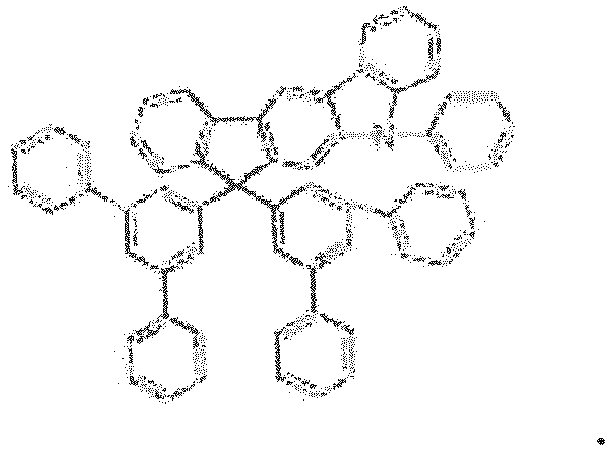
- Further, disclosed is an organic EL device having one or more organic thin film layers including a light emitting layer between a cathode and an anode in which at least one layer of the organic thin film layers contains a polycyclic compound having a π-conjugated heteroacene skeleton crosslinked with a carbon atom, nitrogen atom, oxygen atom, or sulfur atom.
- Further, the material for an organic EL device is effective also as a material for an organic electron device such as an organic solar cell, organic semiconductor laser, a sensor using organic matter, or an organic TFT.
- According to the present invention, a polycyclic compound for realizing an organic EL device which shows high luminous efficiency and has a long lifetime is provided.
- The polycyclic compound of the invention is represented by any one of the following formulae (7) to (12).
- [In the formulae (7) to (12), X7, X8, X9, X10, X11, and X12 each independently represent Oxygen (O), Sulfur (S), N-R1, or CR2R3, provided that provided that X7, X9 and X11 in the general formulae (7) to (12) each independently represent oxygen (O), sulfur (S) or CR2R3, or X8, X10 and X12 in the general formulae (7) to (12) each independently represent oxygen (O), sulfur (S) or CR2R3. R1, R2, and R3 each independently represent an alkyl group having 1 to 20 carbon atoms, a substituted or unsubstituted cycloalkyl group having a ring formed of 3 to 20 carbon atoms, an aralkyl group having 7 to 24 carbon atoms, a silyl group or a substituted silyl group having 3 to 20 carbon atoms, a substituted or unsubstituted aromatic hydrocarbon group wherein the aromatic hydrocarbon group is a residue of benzene, naphthalene, biphenyl, terphenyl, fluorene, phenanthrene, triphenylene, perylene, chrysene, fluoranthene, benzofluorene, benzotriphenylene, benzochrysene, or anthracene, or a substituted or unsubstituted aromatic heterocyclic group having a ring formed of 3 to 24 atoms.
- In the formulae (10) to (12), n represents 2, 3, or 4, and the compound represented by any one of the formulae (10) to (12) includes a dimer using L3 as a linking group for n=2, a trimer using L3 as a linking group for n=3, or a tetramer using L3 as a linking group for n=4.
- In the formulae (7) to (12), L1 represents a single bond, an alkylene group having 1 to 20 carbon atoms, a substituted or unsubstituted cycloalkylene group having a ring formed of 3 to 20 carbon atoms, a divalent silyl group or a substituted divalent silyl group having 2 to 20 carbon atoms, a substituted or unsubstituted, divalent aromatic hydrocarbon wherein the divalent aromatic hydrocarbon group is a residue of benzene, naphthalene, biphenyl, terphenyl, fluorene, phenanthrene, triphenylene, perylene, chrysene, fluoranthene, benzofluorene, benzotriphenylene, benzochrysene, or anthracene, , or a substituted or unsubstituted, divalent aromatic heterocyclic group which has a ring formed of 3 to 24 atoms and which is linked with a benzene ring a through a carbon-carbon bond.
- In the formulae (7) to (9), L2 represents a single bond, an alkylene group having 1 to 20 carbon atoms, a substituted or unsubstituted cycloalkylene group having a ring formed of 3 to 20 carbon atoms, a divalent silyl group or a divalent silyl group having 2 to 20 carbon atoms, a substituted or unsubstituted, divalent aromatic hydrocarbon wherein the divalent aromatic hydrocarbon group is a residue of benzene, naphthalene, biphenyl, terphenyl, fluorene, phenanthrene, triphenylene, perylene, chrysene, fluoranthene, benzofluorene, benzotriphenylene, benzochrysene, or anthracene, or a substituted or unsubstituted, divalent aromatic heterocyclic group which has a ring formed of 3 to 24 atoms and which is linked with a benzene ring c through a carbon-carbon bond, provided that, when both X7 and X8, both X9 and X10, or both X11 and X12 represent CR2R3 and both L1 and L2 represent the substituted or unsubstituted, divalent aromatic hydrocarbon a case where L1 and L2 are simultaneously linked at para positions with respect to a benzene ring b is excluded.
- In the formulae (10) to (12), when n represents 2, L3 represents a single bond, an alkylene group having 1 to 20 carbon atoms, a substituted or unsubstituted cycloalkylene group having a ring formed of 3 to 20 carbon atoms, a divalent silyl group or a substituted having 2 to 20 carbon atoms, a substituted or unsubstituted, divalent aromatic hydrocarbon group wherein the divalent aromatic hydrocarbon group is a residue of benzene, naphthalene, biphenyl, terphenyl, fluorene, phenanthrene, triphenylene, perylene, chrysene, fluoranthene, benzofluorene, benzotriphenylene, benzochrysene, or anthracene, or a substituted or unsubstituted, divalent aromatic heterocyclic group which has a ring formed of 3 to 24 atoms and which is linked with the benzene ring c through a carbon-carbon bond,
when n represents 3, L3 represents a trivalent saturated hydrocarbon group having 1 to 20 carbon atoms, a substituted or unsubstituted trivalent saturated hydrocarbon group having a ring formed of 3 to 20 carbon atoms, a trivalent silyl group or a substituted trivalent silyl group having 1 to 20 carbon atoms, a substituted or unsubstituted, trivalent aromatic hydrocarbon wherein the trivalent aromatic hydrocarbon group is a residue of benzene, naphthalene, biphenyl, terphenyl, fluorene, phenanthrene, triphenylene, perylene, chrysene, fluoranthene, benzofluorene, benzotriphenylene, benzochrysene, or anthracene, , or a substituted or unsubstituted, trivalent aromatic heterocyclic group which has 3 to 24 atoms and which is linked with the benzene ring c through a carbon-carbon bond,
or when n represents 4, L3 represents a tetravalent saturated hydrocarbon group having 1 to 20 carbon atoms, a substituted or unsubstituted, tetravalent cyclic saturated hydrocarbon group having a ring formed of 3 to 20 carbon atoms, a silicon atom, a substituted or unsubstituted, tetravalent aromatic hydrocarbon group wherein the divalent aromatic hydrocarbon group is a residue of benzene, naphthalene, biphenyl, terphenyl, fluorene, phenanthrene, triphenylene, perylene, chrysene, fluoranthene, benzofluorene, benzotriphenylene, benzochrysene, or anthracene, or a substituted or unsubstituted, tetravalent aromatic heterocyclic group which has a ring formed of 3 to 24 atoms and which is linked with the benzene ring c through a carbon-carbon bond,
provided that, when both X7 and X8, both X9 and X10, or both X11 and X12 represent CR2R3 and both L1 and L3 represent the substituted or unsubstituted, divalent, trivalent, or tetravalent aromatic hydrocarbon groups, a case where L1 and L3 are simultaneously linked at para positions with respect to the benzene ring b is excluded. - In the formulae (7) to (12), A1 represents a hydrogen atom, a substituted or unsubstituted cycloalkyl group having a ring formed of 3 to 20 carbon atoms, a silyl group or a substituted silyl group having 3 to 20 carbon atoms, a substituted or unsubstituted aromatic hydrocarbon group wherein the divalent aromatic hydrocarbon group is a residue of benzene, naphthalene, biphenyl, terphenyl, fluorene, phenanthrene, triphenylene, perylene, chrysene, fluoranthene, benzofluorene, benzotriphenylene, benzochrysene, or anthracene, or an aromatic heterocyclic group which has a ring formed of 3 to 24 atoms and which is linked with L1 through a carbon-carbon bond,
provided that, when L1 represents an alkylene group having 1 to 20 carbon atoms, a case where A1 represents a hydrogen atom is excluded. - In the formulae (7) to (9), A2 represents a hydrogen atom, a substituted or unsubstituted cycloalkyl group having a ring formed of 3 to 20 carbon atoms, a silyl group or a substituted silyl group having 3 to 20 carbon atoms, a substituted or unsubstituted aromatic hydrocarbon group wherein the divalent aromatic hydrocarbon group is a residue of benzene, naphthalene, biphenyl, terphenyl, fluorene, phenanthrene, triphenylene, perylene, chrysene, fluoranthene, benzofluorene, benzotriphenylene, benzochrysene, or anthracene, or an aromatic heterocyclic group which has a ring formed of 3 to 24 atoms and which is linked with L2 through a carbon-carbon bond,
provided that, when L2 represents an alkylene group having 1 to 20 carbon atoms, a case where A2 represents a hydrogen atom is excluded. - In the formulae (7) to (12), Y1, Y2, and Y3 each represent an alkyl group having 1 to 20 carbonatoms, a substituted or unsubstituted cycloalkyl group having a ring formed of 3 to 20 carbon atoms, an alkoxy group having 1 to 20 carbon atoms, an aralkyl group having 7 to 24 carbon atoms, a silyl group or a substituted silyl group having 3 to 20 carbon atoms, a substituted or unsubstituted aromatic hydrocarbon group wherein the divalent aromatic hydrocarbon group is a residue of benzene, naphthalene, biphenyl, terphenyl, fluorene, phenanthrene, triphenylene, perylene, chrysene, fluoranthene, benzofluorene, benzotriphenylene, benzochrysene, or anthracene, or a substituted or unsubstituted aromatic heterocyclic group which has a ring formed of 3 to 24 atoms and which is linked with the benzene ring a, b, or c through a carbon-carbon bond,
d and f each represent the number of 0, 1, 2, or 3, and e represents the number of 0, 1, or 2,
provided that, when both X7 and X8, both X9 and X10, or both X11 and X12 each represent oxygen (O), sulfur (S), or CR2R3, both L1 and L2 represent single bonds, and both A1 and A2 represent hydrogen atoms, the benzene ring b has one or two Y2's, and a case where Y2 represents a methyl group or an unsubstituted phenyl group is excluded. - In the formulae (7) to (12), A1, A2, L1, L2, and L3 are each free of any carbonyl group.]
- The compounds represented by the formulae (7) to (12) are each preferably a polycyclic compound represented by any one of the following formulae (7a) to (12a), (7b) to (12b).
- Thus, it is preferred that substituents such as L1-A1- and L2-A2- be bonded at meta positions, the expansion of the conjugated system is prevented, and triplet energy can be widened.


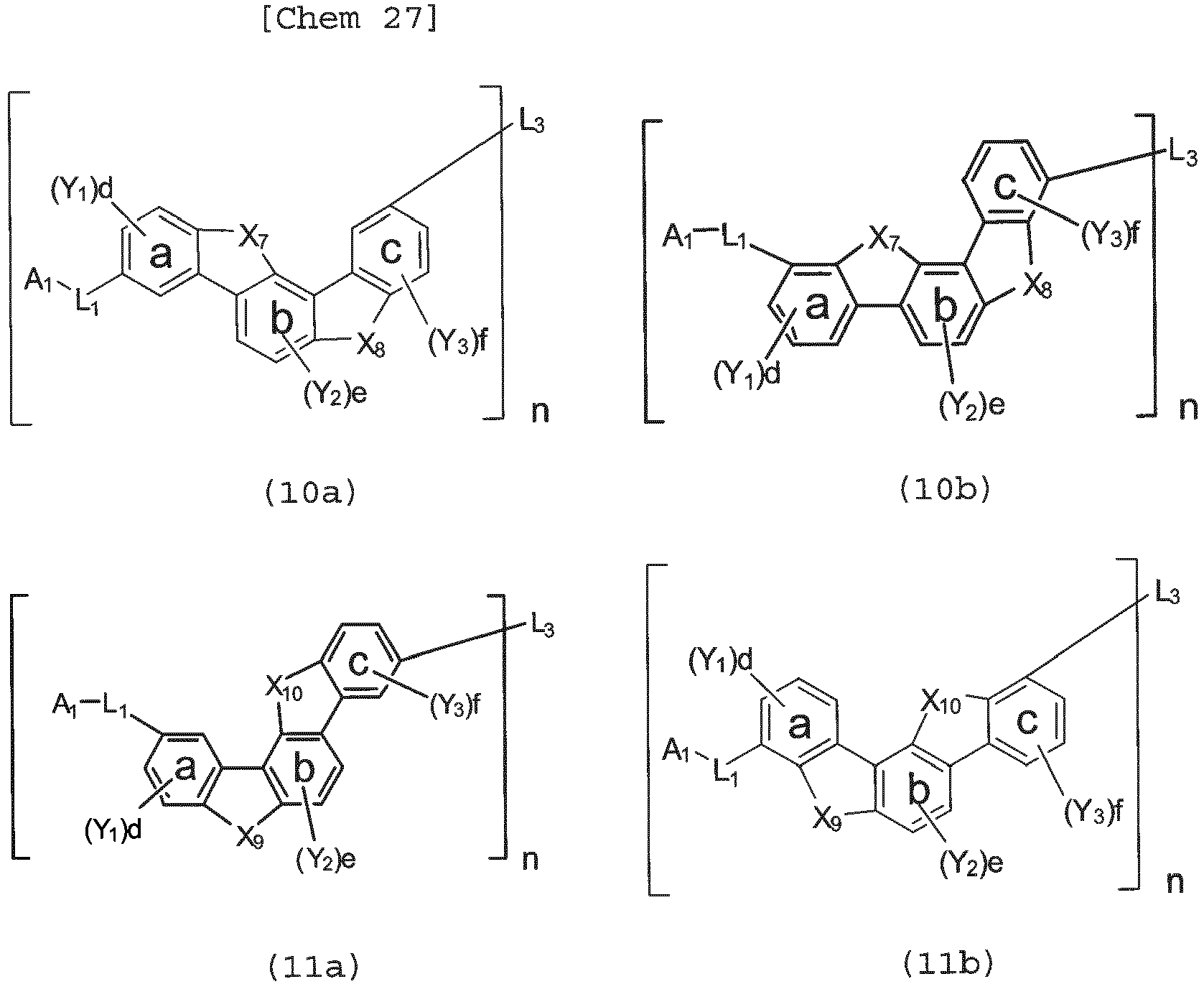
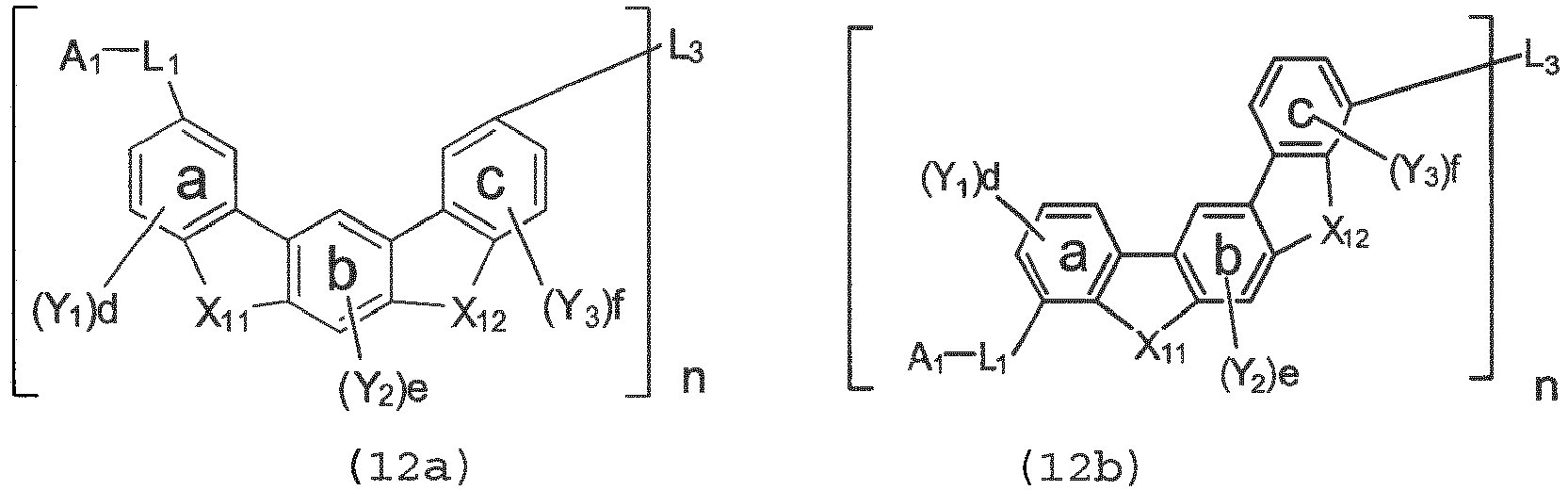
- [In the formulae (7a) to (12a), and (7b) to (12b), X7 to X12, L1, L2, L3, A1, A2, Y1, Y2, Y3, n, d, f, and e each have the same meaning as that described above.]
- The compounds represented by the formulae (9) and (12) are each preferably a benzofurano dibenzofuran derivative represented by one of the following formulae (17) and (18).
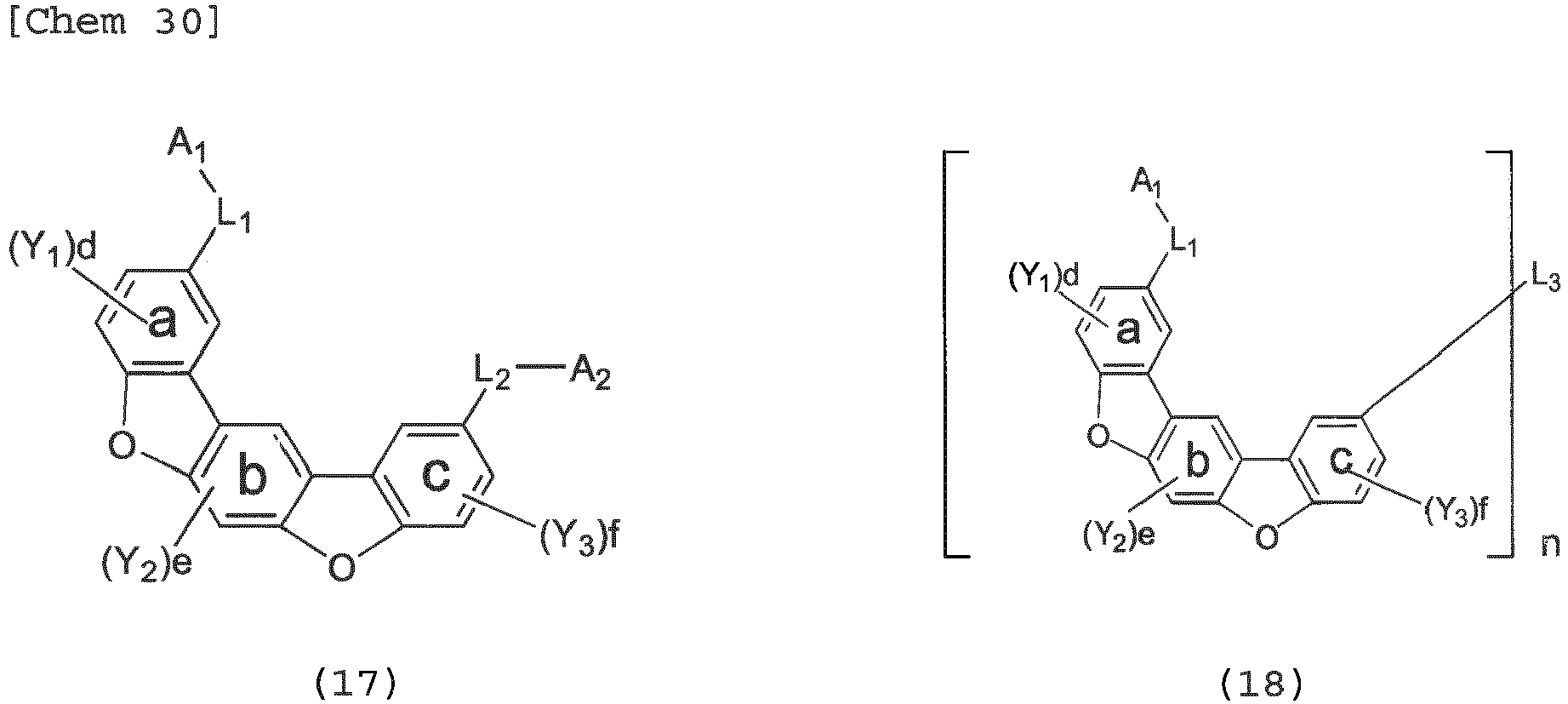
- [In the formula (18), n represents 2, 3, or 4, and the compound represented by the formula (18) includes a dimer using L3 as a linking group for n=2, a trimer using L3 as a linking group for n=3, or a tetramer using L3 as a linking group for n=4.
- In the formulae (17) and (18), L1 represents a single bond, an alkylene group having 1 to 20 carbon atoms, a substituted or unsubstituted cycloalkylene group having a ring formed of 3 to 20 carbon atoms, a divalent silyl group or a substituted divalent silyl group having 2 to 20 carbon atoms, a substituted or unsubstituted, divalent aromatic hydrocarbon group wherein the divalent aromatic hydrocarbon group is a residue of benzene, naphthalene, biphenyl, terphenyl, fluorene, phenanthrene, triphenylene, perylene, chrysene, fluoranthene, benzofluorene, benzotriphenylene, benzochrysene, or anthracene, or a substituted or unsubstituted, divalent aromatic heterocyclic group which has a ring formed of 3 to 24 atoms and which is linked with a benzene ring a through a carbon-carbon bond.
- In the formula (17), L2 represents a single bond, an alkylene group having 1 to 20 carbon atoms, a substituted or unsubstituted cycloalkylene group having a ring formed of 3 to 20 carbon atoms, a divalent silyl group or a substituted divalent silyl group having 2 to 20 carbon atoms, a substituted or unsubstituted, divalent aromatic hydrocarbon group wherein the divalent aromatic hydrocarbon group is a residue of benzene, naphthalene, biphenyl, terphenyl, fluorene, phenanthrene, triphenylene, perylene, chrysene, fluoranthene, benzofluorene, benzotriphenylene, benzochrysene, or anthracene, or a substituted or unsubstituted, divalent aromatic heterocyclic group which has a ring formed of 3 to 24 atoms and which is linked with a benzene ring c through a carbon-carbon bond.
- In the formula (18), when n represents 2, L3 represents a single bond, an alkylene group having 1 to 20 carbon atoms, a substituted or unsubstituted cycloalkylene group having a ring formed of 3 to 20 carbon atoms, a divalent silyl group or a substituted divalent silyl group having 2 to 20 carbon atoms, a substituted or unsubstituted, divalent aromatic hydrocarbon wherein the divalent aromatic hydrocarbon group is a residue of benzene, naphthalene, biphenyl, terphenyl, fluorene, phenanthrene, triphenylene, perylene, chrysene, fluoranthene, benzofluorene, benzotriphenylene, benzochrysene, or anthracene, or a substituted or unsubstituted, divalent aromatic heterocyclic group which has a ring formed of 3 to 24 atoms and which is linked with the benzene ring c through a carbon-carbon bond,
when n represents 3, L3 represents a trivalent saturated hydrocarbon group having 1 to 20 carbon atoms, a substituted or unsubstituted, trivalent cyclic saturated hydrocarbon group having a ring formed of 3 to 20 carbon atoms, a trivalent silyl group or a substituted trivalent silyl group having 1 to 20 carbon atoms, a substituted or unsubstituted, trivalent aromatic hydrocarbon group wherein the divalent aromatic hydrocarbon group is a residue of benzene, naphthalene, biphenyl, terphenyl, fluorene, phenanthrene, triphenylene, perylene, chrysene, fluoranthene, benzofluorene, benzotriphenylene, benzochrysene, or anthracene, or a substituted or unsubstituted, trivalent aromatic heterocyclic group which has 3 to 24 atoms and which is linked with the benzene ring c through a carbon-carbon bond,
or when n represents 4, L3 represents a tetravalent saturated hydrocarbon group having 1 to 20 carbon atoms, a substituted or unsubstituted, tetravalent cyclic saturated hydrocarbon group having a ring formed of 3 to 20 carbon atoms, a silicon atom, a substituted or unsubstituted, tetravalent aromatic hydrocarbon group wherein the divalent aromatic hydrocarbon group is a residue of benzene, naphthalene, biphenyl, terphenyl, fluorene, phenanthrene, triphenylene, perylene, chrysene, fluoranthene, benzofluorene, benzotriphenylene, benzochrysene, or anthracene, or a substituted or unsubstituted, tetravalent aromatic heterocyclic group which has a ring formed of 3 to 24 atoms and which is linked with the benzene ring c through a carbon-carbon bond. - In the formulae (17) and (18), A1 represents a hydrogen atom, a substituted or unsubstituted cycloalkyl group having a ring formed of 3 to 20 carbon atoms, a silyl group or a substituted silyl group having 3 to 20 carbon atoms, a substituted or unsubstituted aromatic hydrocarbon group wherein the divalent aromatic hydrocarbon group is a residue of benzene, naphthalene, biphenyl, terphenyl, fluorene, phenanthrene, triphenylene, perylene, chrysene, fluoranthene, benzofluorene, benzotriphenylene, benzochrysene, or anthracene, or an aromatic heterocyclic group which has a ring formed of 3 to 24 atoms and which is linked with L1 through a carbon-carbon bond,
provided that, when L1 represents an alkylene group having 1 to 20 carbon atoms, a case where A1 represents a hydrogen atom is excluded. - In the formula (17), A2 represents a hydrogen atom, a substituted or unsubstituted cycloalkyl group having a ring formed of 3 to 20 carbon atoms, a silyl group or a substituted silyl group having 3 to 20 carbon atoms, a substituted or unsubstituted aromatic hydrocarbon group wherein the divalent aromatic hydrocarbon group is a residue of benzene, naphthalene, biphenyl, terphenyl, fluorene, phenanthrene, triphenylene, perylene, chrysene, fluoranthene, benzofluorene, benzotriphenylene, benzochrysene, or anthracene, or an aromatic heterocyclic group which has a ring formed of 3 to 24 atoms and which is linked with L2 through a carbon-carbon bond, provided that, when L2 represents an alkylene group having 1 to 20 carbon atoms, a case where A2 represents a hydrogen atom is excluded.
- In the formulae (17) and (18), Y1, Y2, and Y3 each represent an alkyl group having 1 to 20 carbon atoms, a substituted or unsubstituted cycloalkyl group having a ring formed of 3 to 20 carbon atoms, an alkoxy group having 1 to 20 carbon atoms, an aralkyl group having 7 to 24 carbon atoms, a silyl group or a substituted silyl group having 3 to 20 carbon atoms, a substituted or unsubstituted aromatic hydrocarbon group wherein the divalent aromatic hydrocarbon group is a residue of benzene, naphthalene, biphenyl, terphenyl, fluorene, phenanthrene, triphenylene, perylene, chrysene, fluoranthene, benzofluorene, benzotriphenylene, benzochrysene, or anthracene, or a substituted or unsubstituted aromatic heterocyclic group which has a ring formed of 3 to 24 atoms and which is linked with the benzene ring a, b, or c through a carbon-carbon bond,
d and f each represent the number of 0, 1, 2, or 3, and e represents the number of 0, 1, or 2,
provided that, when both L1 and L2 represent single bonds, and both A1 and A2 represent hydrogen atoms, the benzene ring b has one or two Y2's, and a case where Y2 represents a methyl group or an unsubstituted phenyl group is excluded. - In the formulae (17) and (18), A1, A2, L1, L2, and L3 are each free of any carbonyl group.]
- There is also disclosed a halogen compound represented by the following formula (30), which is not claimed, as an intermediate suitable for use in the synthesis of the polycyclic compound of the present invention.
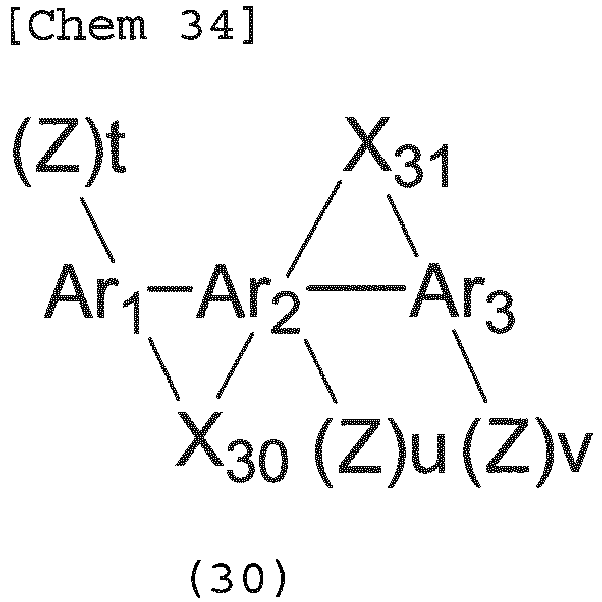
- [In the formula (30), Ar1, Ar2, and Ar3 each independently represent a substituted or unsubstituted aromatic hydrocarbon group having a ring formed of 6 carbon atoms or a substituted or unsubstituted aromatic heterocyclic group having a ring formed of 6 atoms, provided that Ar1, Ar2, and Ar3 each may have one substituent Y or a plurality of substituents Y's, in the case of the plurality of substituents Y's, the substituents Y's may be different from each other, and Y's each represent an alkyl group having 1 to 20 carbon atoms, a substituted or unsubstituted cycloalkyl group having a ring formed of 3 to 20 carbon atoms, an alkoxy group having 1 to 20 carbon atoms, an aralkyl group having 7 to 24 carbon atoms, a silyl group or a substituted silyl group having 3 to 20 carbon atoms, a substituted or unsubstituted aromatic hydrocarbon group having a ring formed of 6 to 24 carbon atoms, or a substituted or unsubstituted aromatic heterocyclic group which has a ring formed of 3 to 24 atoms and which is linked with Ar1, Ar2, or Ar3 through a carbon-carbon bond.
- X30 and X31 each independently represent oxygen (O), sulfur (S), or N-R1.
- R1 represents an alkyl group having 1 to 20 carbon atoms, a substituted or unsubstituted cycloalkyl group having a ring formed of 3 to 20 carbon atoms, an aralkyl group having 7 to 24 carbon atoms, a silyl group or a substituted silyl group having 3 to 20 carbon atoms, a substituted or unsubstituted aromatic hydrocarbon group having a ring formed of 6 to 24 carbon atoms, or a substituted or unsubstituted aromatic heterocyclic group having a ring formed of 3 to 24 atoms, provided that, when both X30 and X31 represent N-R1, at least one R1 represents a substituted or unsubstituted, monovalent fused aromatic heterocyclic group having a ring formed of 8 to 24 atoms.
- Z represents a halogen atom that is a fluorine atom, a chlorine atom, a bromine atom, or an iodine atom.
- t, u, and v each represent 0 or 1, provided that t+u+v≥1.
- The case where the formula (30) adopts a structure represented by the following formula (31) is excluded,

- In the formula (31), Y1, Y2, and Y3 each represent an alkyl group having 1 to 20 carbon atoms, a substituted or unsubstituted cycloalkyl group having a ring formed of 3 to 20 carbon atoms, an alkoxy group having 1 to 20 carbon atoms, an aralkyl group having 7 to 24 carbon atoms, a silyl group or a substituted silyl group having 3 to 20 carbon atoms, a substituted or unsubstituted aromatic hydrocarbon group having a ring formed of 6 to 24 carbon atoms, or a substituted or unsubstituted aromatic heterocyclic group which has a ring formed of 3 to 24 atoms and which is linked with a benzene ring a, b, or c through a carbon-carbon bond, d and f each represent the number of 0, 1, 2, or 3, and e represents the number of 0, 1, or 2.]
- The halogen compound represented by the formula (30) is preferably represented by the following formula (32), and is more preferably represented by any one of the following formulae (33) to (37).
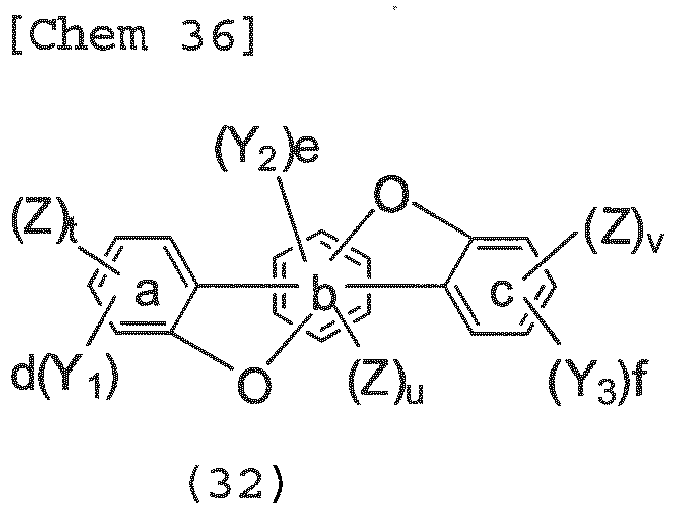
- [In the formula (32), Y1, Y2, and Y3 each independently represent a hydrogen atom, an alkyl group having 1 to 20 carbon atoms, a substituted or unsubstituted cycloalkyl group having a ring formed of 3 to 20 carbon atoms, an alkoxy group having 1 to 20 carbon atoms, an aralkyl group having 7 to 24 carbon atoms, a silyl group or a silyl group having 3 to 20 carbon atoms, a substituted or unsubstituted aromatic hydrocarbon group having a ring formed of 6 to 24 carbon atoms, or a substituted or unsubstituted aromatic heterocyclic group which has a ring formed of 3 to 24 atoms and which is linked with a benzene ring a, b, or c through a carbon-carbon bond, d and f each represent the number of 0, 1, 2, or 3, and e represents the number of 0, 1, or 2.
- Z represents a halogen atom that is a fluorine atom, a chlorine atom, a bromine atom, or an iodine atom.
- t, u, and v each represent 0 or 1, provided that t+u+v≥1.]
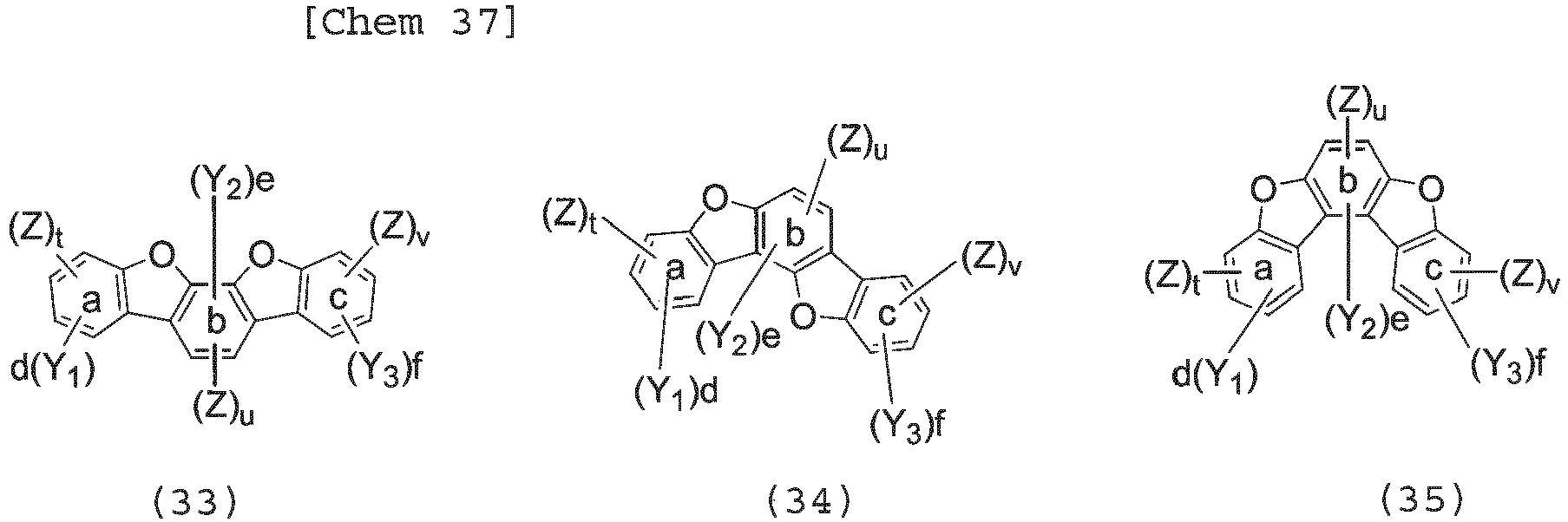
- [In the formulae (33) to (35), Y1, Y2, and Y3 each independently represent a hydrogen atom, an alkyl group having 1 to 20 carbon atoms, a substituted or unsubstituted cycloalkyl group having a ring formed of 3 to 20 carbon atoms, an alkoxy group having 1 to 20 carbon atoms, an aralkyl group having 7 to 24 carbon atoms, a silyl group or a silyl group having 3 to 20 carbon atoms, a substituted or unsubstituted aromatic hydrocarbon group having a ring formed of 6 to 24 carbon atoms, or a substituted or unsubstituted aromatic heterocyclic group which has a ring formed of 3 to 24 atoms and which is linked with a benzene ring a, b, or c through a carbon-carbon bond, d and f each represent the number of 0, 1, 2, or 3, and e represents the number of 0, 1, or 2.
- Z represents a halogen atom that is a fluorine atom, a chlorine atom, a bromine atom, or an iodine atom.
- t, u, and v each represent 0 or 1, provided that t+u+v≥1.]

- [In the formulae (36) and (37), Y1, Y2, and Y3 each independently represent a hydrogen atom, an alkyl group having 1 to 20 carbon atoms, a substituted or unsubstituted cycloalkyl group having a ring formed of 3 to 20 carbon atoms, an alkoxy group having 1 to 20 carbon atoms, an aralkyl group having 7 to 24 carbon atoms, a silyl group or a substituted silyl group having 3 to 20 carbon atoms, a substituted or unsubstituted aromatic hydrocarbon group having a ring formed of 6 to 24 carbon atoms, or a substituted or unsubstituted aromatic heterocyclic group which has a ring formed of 3 to 24 atoms and which is linked with a benzene ring a, b, or c through a carbon-carbon bond, d and f each represent the number of 0, 1, 2, or 3, and e represents the number of 0, 1, or 2.
- Z represents a halogen atom that is a fluorine atom, a chlorine atom, a bromine atom, or an iodine atom.
- m1 to m8 each represent 0 or 1, provided that, m1+m2=1, m5+m6≤1, m6+m7+m8≥1.]
- The halogen compound represented by any one of the formulae (33) to (37) can be obtained by subjecting an aromatic halogen compound represented by the following formula (38) to an intramolecular cyclization reaction.
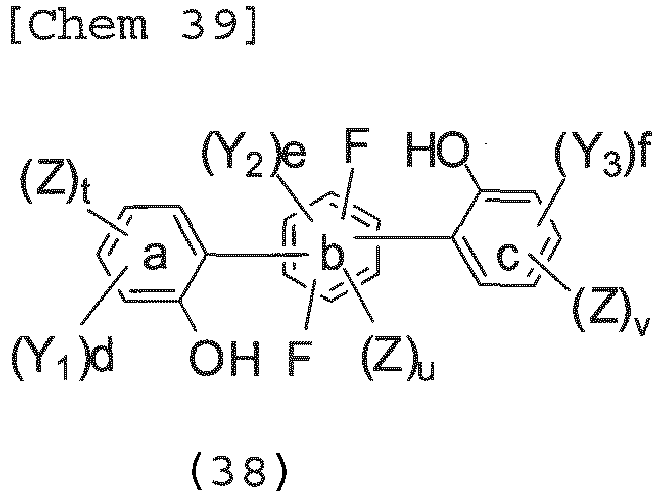
- [In the formula (38), Y1, Y2, and Y3 each independently represent a hydrogen atom, an alkyl group having 1 to 20 carbon atoms, a substituted or unsubstituted cycloalkyl group having a ring formed of 3 to 20 carbon atoms, an alkoxy group having 1 to 20 carbon atoms, an aralkyl group having 7 to 24 carbon atoms, a silyl group or a silyl group having 3 to 20 carbon atoms, a substituted or unsubstituted aromatic hydrocarbon group having a ring formed of 6 to 24 carbon atoms, or a substituted or unsubstituted aromatic heterocyclic group which has a ring formed of 3 to 24 atoms and which is linked with a benzene ring a, b, or c through a carbon-carbon bond, d and f each represent the number of 0, 1, 2, or 3, and e represents the number of 0, 1, or 2.
- Z represents a halogen atom that is a fluorine atom, a chlorine atom, a bromine atom, or an iodine atom.
- t, u, and v each represent 0 or 1, provided that t+u+v≥1.]
- The reaction of the aromatic halogen compound represented by the above-mentioned formula (38) is typically performed in the presence of a basic catalyst. Examples of the basic catalyst include sodium amide, triethylamine, tributylamine, trioctylamine, pyridine, N,N-dimethylaniline, 1,5-diazabicyclo[4,3,0]nonene-5 (DBN), 1,8-diazabicyclo[5,4,0]undecene-7 (DBU), sodium hydroxide, potassium hydroxide, sodium hydride, sodium phosphate, potassium phosphate, sodium carbonate, potassium carbonate, sodium methoxide, and potassium t-butoxide.
- The basic catalyst is used for the aromatic halogen compound represented by the formula (38) as a reaction raw material in such an amount that a molar ratio of the basic catalyst to the aromatic halogen compound is about 2 to 10 and preferably 2 to 5.
- A solvent can be used as required at the time of the reaction. Specific examples of the solvent include toluene, dimethylformamide (DMF), N,N-dimethylacetamide (DMAc), dimethyl sulfoxide (DMSO), N-methylpyrrolidone (NMP), tetrahydrofuran, and dimethoxyethane. One kind of them may be used alone, or two or more kinds of them may be used in combination.
- The reaction of the aromatic halogen compound represented by the above-mentioned formula (38) is performed at a temperature of about 0 to 250°C and preferably 150 to 200°C in ordinary cases. When the reaction temperature is 150°C or more, a reaction rate does not reduce but becomes moderate, and hence a reaction time is shortened. In addition, when the reaction temperature is 200°C or less, the coloring of a product is suppressed. A reaction time is typically about 1 minute to 24 hours, and is desirably 1 to 10 hours.
- In addition, such a halogen compound that both X30 and X31 in the above-mentioned formula (30) each represent N-R1 can be obtained by subjecting an aromatic halogen compound represented by the following formula (39) to an intramolecular cyclization reaction in the same manner as in the foregoing.
- Further, such a halogen compound that both X30 and X31 in the above-mentioned formula (30) each represent sulfur (S) can be obtained by subjecting an aromatic halogen compound represented by the following formula (40) to an intramolecular cyclization reaction in the same manner as in the foregoing,
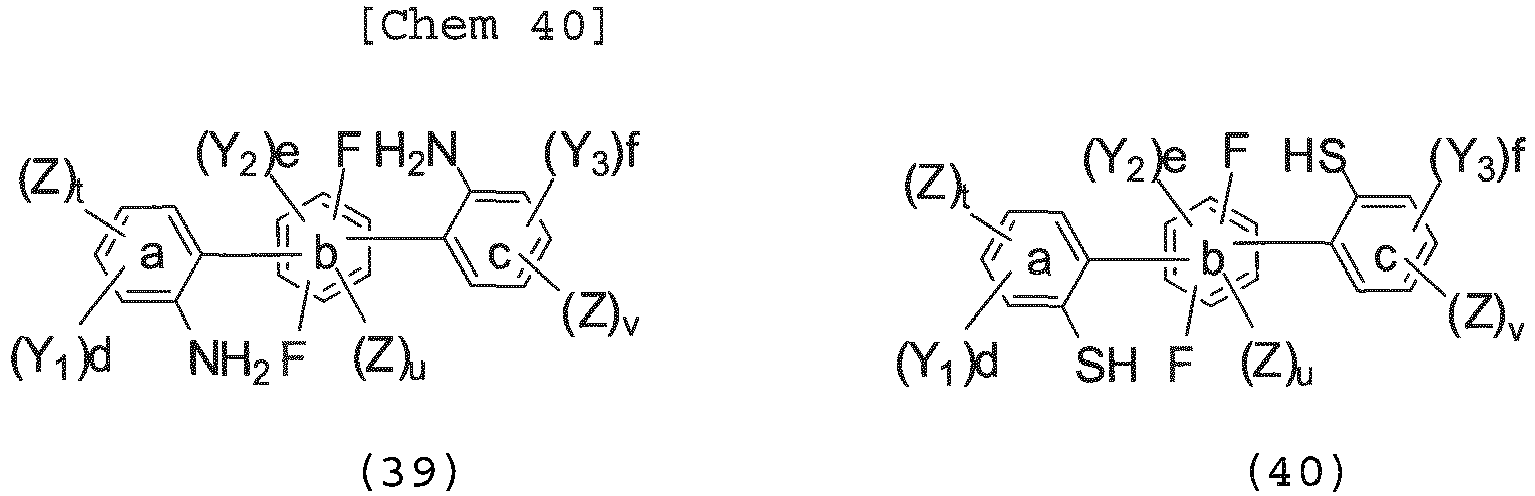
- In the formulae (7) to (12), (17), (18) and (30) to (40), specific examples of each group are described below.
- Examples of the substituted or unsubstituted aromatic hydrocarbon group having a ring formed of 6 carbon atoms represented by each of Ar1 to Ar3 include substituted or unsubstituted benzene. The substituted or unsubstituted aromatic hydrocarbon group represented by each of Y1 to Y3, R1 to R3, L1 to L3, and A1 and A2 are residues having corresponding valencies of substituted or unsubstituted benzene, naphthalene, biphenyl, terphenyl, fluorene, phenanthrene, triphenylene, perylene, chrysene, fluoranthene, benzofluorene, benzotriphenylene, benzochrysene, and anthracene. Preferred are benzene, naphthalene, biphenyl, terphenyl, fluorene, and phenanthrene.
- Examples of the substituted or unsubstituted aromatic heterocyclic group having a ring formed of 6 atoms represented by each of Ar1 to Ar3 include substituted or unsubstituted pyridine, pyridazine, pyrimidine, pyrazine, and 1,3,5-triazine. Examples of the substituted or unsubstituted aromatic heterocyclic group having a ring formed of 3 to 24 atoms represented by each of Y, Y1 to Y3, R1 to R3, L1 to L3, and A1 and A2 include residues having corresponding valencies of substituted or unsubstituted pyridine, pyridazine, pyrimidine, pyrazine, 1,3,5-triazine, carbazole, dibenzofuran, dibenzothiophene, phenoxazine, phenothiazine, and dihydroacridine. Preferred are pyridine, pyridazine, pyrimidine, pyrazine, carbazole, dibenzofuran, dibenzothiophene, phenoxazine, and dihydroacridine. In addition, examples of at least one substituted or unsubstituted, monovalent fused aromatic heterocyclic group having a ring formed of 8 to 24 atoms represented by R1 include aromatic heterocyclic groups each having a fused structure in examples of the aromatic heterocyclic groups.
- Examples of the alkyl group, alkylene group, and trivalent or tetravalent saturated hydrocarbon group, each of which has 1 to 20 carbon atoms represented by each of Y, Y1 to Y3, L1 to L3, and R1 to R3 include a methyl group, an ethyl group, a propyl group, an isopropyl group, an n-butyl group, an s-butyl group, a t-butyl group, an isobutyl group, an n-pentyl group, an n-hexyl group, an n-heptyl group, an n-octyl group, an n-nonyl group, ann-decyl group, an n-undecyl group, an n-dodecyl group, an n-tridecyl group, an n-tetradecyl group, an n-pentadecyl group, an n-hexadecyl group, an n-heptadecyl group, an n-octadecyl group, a neopentyl group, a 1-methylpentyl group, a 2-methylpentyl group, a 1-pentylhexyl group, a 1-butylpentyl group, a 1-heptyloctyl group, and a 3-methylpentyl group, and groups obtained by allowing those groups to have two to four valencies. Preferred are a methyl group, an ethyl group, a propyl group, an isopropyl group, an n-butyl group, an s-butyl group, an isobutyl group, a t-butyl group, an n-pentyl group, an n-hexyl group, an n-heptyl group, an n-octyl group, an n-nonyl group, an n-decyl group, an n-undecyl group, an n-dodecyl group, an n-tridecyl group, an n-tetradecyl group, an n-pentadecyl group, an n-hexadecyl group, an n-heptadecyl group, an n-octadecyl group, a neopentyl group, a 1-methylpentyl group, a 1-pentylhexyl group, a 1-butylpentyl group, and a 1-heptyloctyl group.
- Examples of the substituted or unsubstituted cycloalkyl group, cycloalkylene group, and trivalent or tetravalent cyclic saturated hydrocarbon group, each of which has a ring formed of 3 to 20 carbon atoms, represented by each of Y, Y1 to Y3, L1 to L3, R1 to R3, and A1 and A2 include a cyclopropyl group, a cyclobutyl group, a cyclopentyl group, and a cyclohexyl group, and groups obtained by allowing those group to have two to four valencies. Preferred are a cyclobutyl group, a cyclopentyl group, and a cyclohexyl group.
- Examples of the alkoxy group having 1 to 20 carbon atoms and represented by each of Y and Y1 to Y3 include a methoxy group, an ethoxy group, a methoxy group, an i-propoxy group, an n-propoxy group, an n-butoxy group, an s-butoxy group, and a t-butoxy group. Preferred are a methoxy group, an ethoxy group, a methoxy group, an i-propoxy group, and an n-propoxy group.
- Examples of the substituted silyl group having 1 to 20 carbon atoms represented by each of Y, Y1 to Y3, L1 to L3, R1 to R3, and A1 and A2 include a trimethylsilyl group, a triethylsilyl group, a tributylsilyl group, a trioctylsilyl group, a triisobutylsilyl group, a dimethylethylsilyl group, a dimethylisopropylsilyl group, a dimethylpropylsilyl group, a dimethylbutylsilyl group, a dimethyltertiary butylsilyl group, a diethylisopropylsilyl group, a phenyl dimethyl silyl group, a diphenylmethylsilyl group, a diphenyl tertiary butyl silyl group, and a triphenylsilyl group, and groups obtained by allowing those groups to have two or three valencies. Preferred are a trimethylsilyl group, a triethylsilyl group, and a tributylsilyl group.
- Examples of the aralkyl group having 7 to 24 carbon atoms represented by each of Y, Y1 to Y3, and R1 to R3 include a benzyl group, a phenethyl group, and a phenylpropyl group.
- Examples of the substituent that may substitute each of the group in the formulae (1) to (40) include alkyl groups each having 1 to 10 carbon atoms (such as a methyl group, an ethyl group, a propyl group, an isopropyl group, an n-butyl group, an s-butyl group, an isobutyl group, a t-butyl group, an n-pentyl group, an n-hexyl group, an n-heptyl group, an n-octyl group, a hydroxymethyl group, a 1-hydroxyethyl group, a 2-hydroxyethyl group, a 2-hydroxyisobutyl group, a 1,2-dihydroxyethyl group, a 1,3-dihydroxyisopropyl group, a 2,3-dihydroxy-t-butyl group, a 1,2,3-trihydroxypropyl group, a chloromethyl group, a 1-chloroethyl group, a 2-chloroethyl group, a 2-chloroisobutyl group, a 1,2-dichloroethyl group, a 1,3-dichloroisopropyl group, a 2,3-dichloro-t-butyl group, a 1,2,3-trichloropropyl group, a bromomethyl group, a 1-bromoethyl group, a 2-bromoethyl group, a 2-bromoisobutyl group, a 1,2-dibromoethyl group, a 1,3-dibromoisopropyl group, a 2,3-dibromo-t-butyl group, a 1,2,3-tribromopropyl group, a iodomethyl group, a 1-iodoethyl group, a 2-iodoethyl group, a 2-iodoisobutyl group, a1,2-diiodoethyl group, a 1,3-diiodoisopropyl group, a 2,3-diiodo-t-butyl group, a 1,2,3-triiodopropyl group, an aminomethyl group, a 1-aminoethyl group, a 2-aminoethyl group, a 2-aminoisobutyl group, a 1,2-diaminoethyl group, a 1,3-diaminoisopropyl group, a 2,3-diamino-t-butyl group, a 1,2,3-triaminopropyl group, a cyanomethyl group, a 1-cyanoethyl group, a 2-cyanoethyl group, a 2-cyanoisobutyl group, a 1,2-dicyanoethyl group, 1,3-dicyanoisopropyl group, a 2,3-dicyano-t-butyl group, a 1,2,3-tricyanopropyl group, a nitromethyl group, a 1-nitroethyl group, a 2-nitroethyl group, a 2-nitroisobutyl group, a 1,2-dinitroethyl group, a 1,3-dinitroisopropyl group, a 2,3-dinitro-t-butyl group, and a 1,2,3-trinitropropyl group), cycloalkyl groups each having a ring formed of 3 to 40 carbon atoms (such as a cyclopropyl group, a cyclobutyl group, a cyclopentyl group, a cyclohexyl group, a 4-methylcyclohexyl group, a1-adamantyl group, a 2-adamantyl group, a 1-norbornyl group, and a 2-norbornyl group), alkoxy groups each having 1 to 6 carbon atoms (such as an ethoxy group, a methoxy group, an i-propoxy group, an n-propoxy group, an s-butoxy group, a t-butoxy group, a pentoxy group, and a hexyloxy group), cycloalkoxy groups each having a ring formed of 3 to 10 carbon atoms (such as a cyclopentoxy group and a cyclohexyloxy group), aromatic hydrocarbon groups each having a ring formed of 6 to 40 carbon atoms, aromatic heterocyclic groups each having a ring formed of 3 to 40 atoms, amino groups each substituted with an aromatic hydrocarbon group having a ring formed of 6 to 40 carbon atoms, ester groups each having an aromatic hydrocarbon group having a ring formed of 6 to 40 carbon atoms, an ester group, cyano group, and nitro group, each of which has an alkyl group having 1 to 6 carbon atoms, and halogen atom.
- Of those, an alkyl group having 1 to 6 carbon atoms, a phenyl group, a pyridyl group, a carbazolyl group, and a dibenzofuranyl group are preferred and the number of substituents is preferably 1 or 2.
- In the polycyclic compound represented by the formula (10) to (12) or (18), n preferably represents 2.
- In the formula (7) to (9), or (17), the total number of the substituents represented by Y1, Y2, and Y2 is preferably 3 or less, and the total number of the substituents represented by Y1, Y2, and Y3 in the structure of []n in the formula (10) to (12), or (18) is preferably 3 or less.
- Compounds wherein two groups X are both NR are not according to the invention.
- It is preferred that both X11 and X12 in the formula (9) or (12) each represent CR2R3. In addition, the triplet energy of such a compound represented by the formula (9) or (12) that X11 and X12, are on the same side with respect to the benzene rings a, b, and c can be slightly widened as compared with that in the case where the substituents are on the sides opposite to each other. As a result, luminous efficiency can be improved. The same holds true for the case where X11 and X12 each represent CR2R3.
- In addition, when the benzene rings a and c are bonded at para positions with respect to the benzene ring b like any one of the formulae (5), (6), (15), (16), (19), and (25) (not claimed), the electron transporting property can be improved, and a reduction in voltage at which the device is driven can be achieved.
- Alternatively, when the benzene rings a and c are bonded at meta positions with respect to the benzene ring b like any one of the formulae (7) to (12), (17) and (18), the triplet energy can be widened as compared with that in the case where the benzene rings are bonded at the para positions, and hence the luminous efficiency can be improved.
- In any one of the formulae (7) to (12, at least one of X7 and X8, X9 and X10, X11 and X12, preferably represents an oxygen atom, and both the substituents more preferably represent oxygen atoms like any one of the formulae (17) and (18). An oxygen atom has a high electronegativity, and can improve the electron transporting property. As a result, a reduction in voltage at which the device is driven can be achieved. Accordingly, any such compound can be particularly suitably used as a host material or an electron transporting material. In addition, when both the substituents represent oxygen atoms, the triplet energy can be widened, and hence the luminous efficiency can be improved. In addition, when A1, A2, L1, L2, and L3 in any one of the formulae (7) to (12), (17) and (18) are each free of a carbonyl group, that is, a terminal structure is free of a carbonyl group, the shortening of the lifetime is suppressed.
- Specific examples of the polycyclic compounds represented by the formulae (7) to (12), (17) and (18) of the present invention are shown below. However, the present invention is not limited to these exemplary compounds.
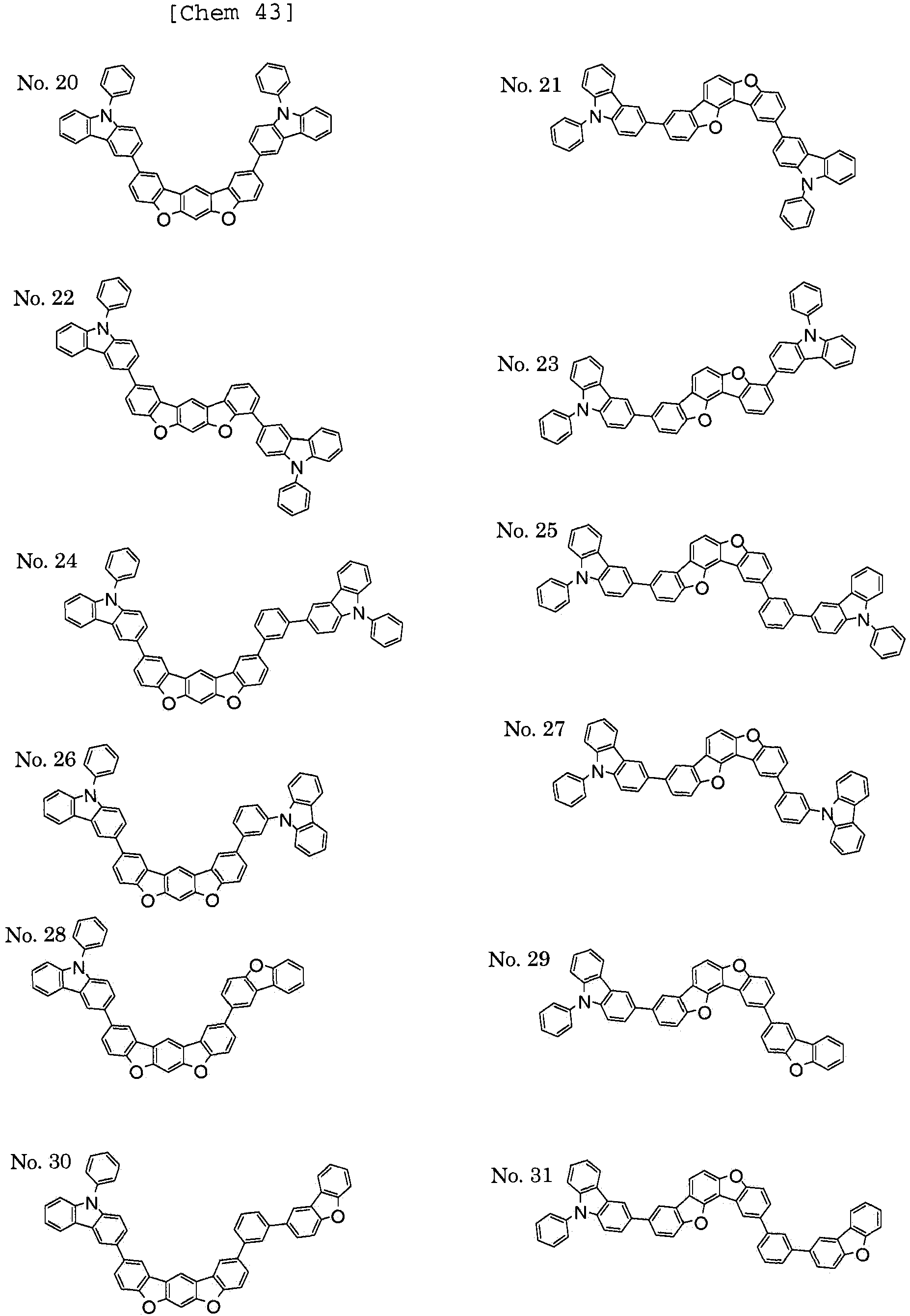

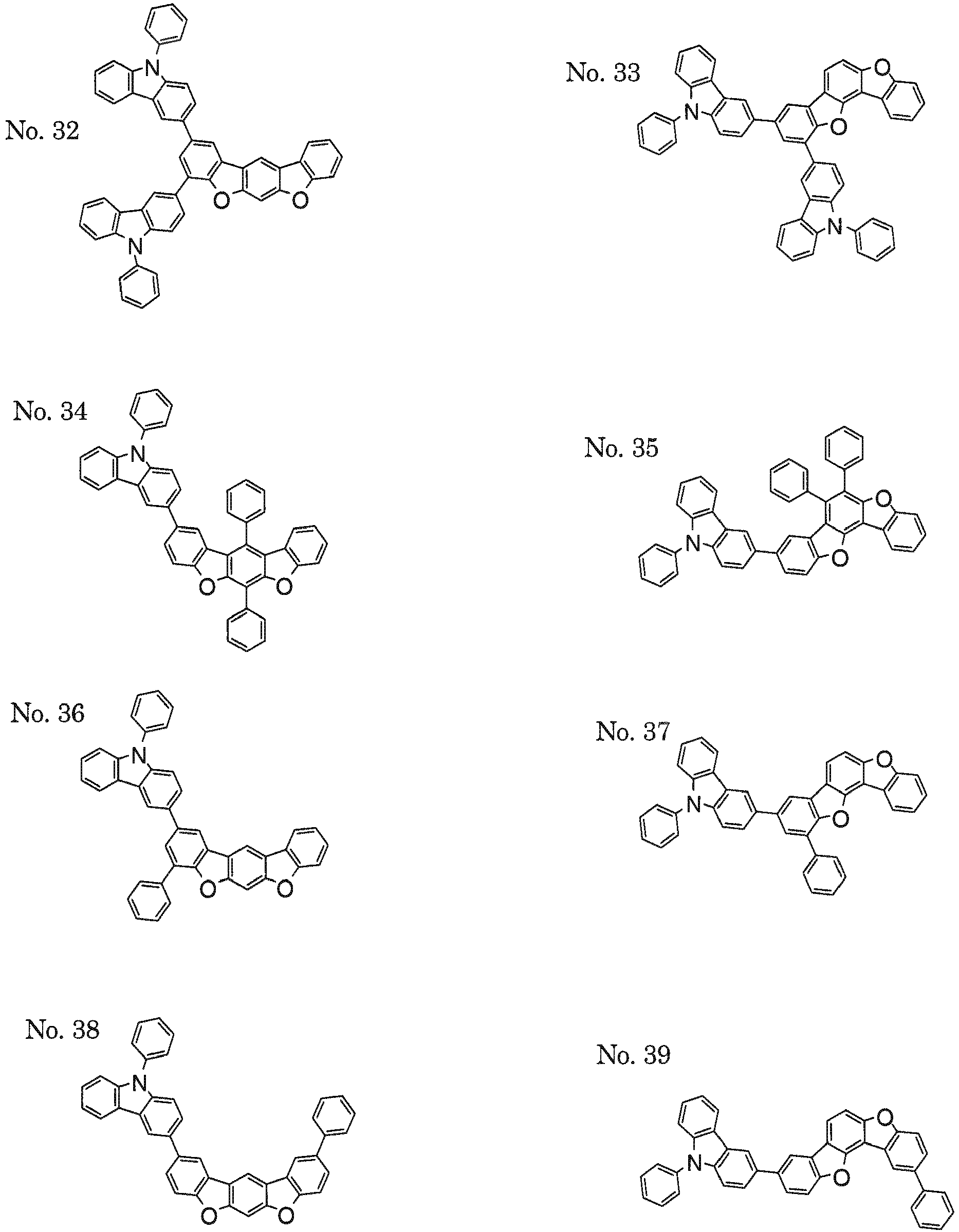

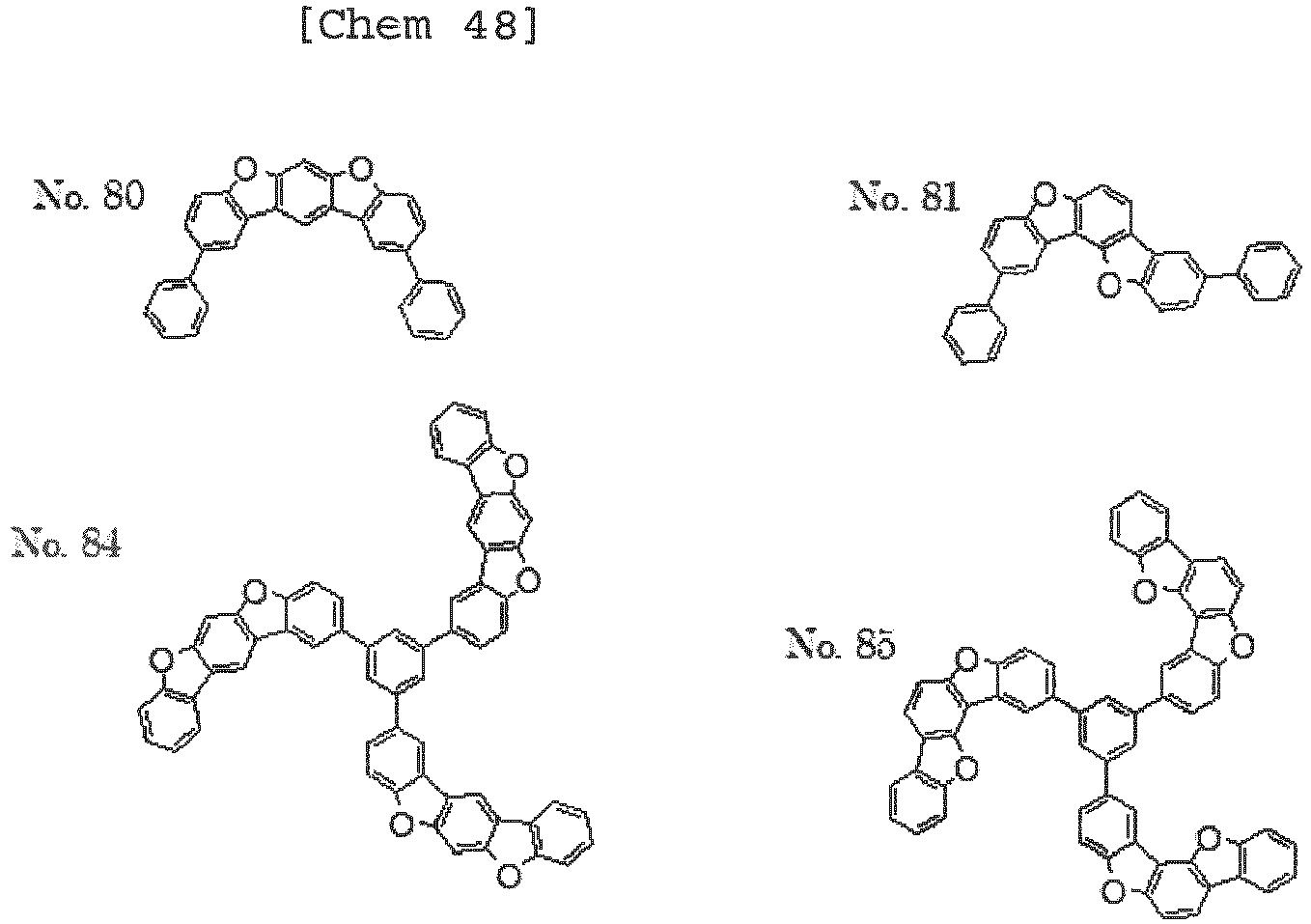
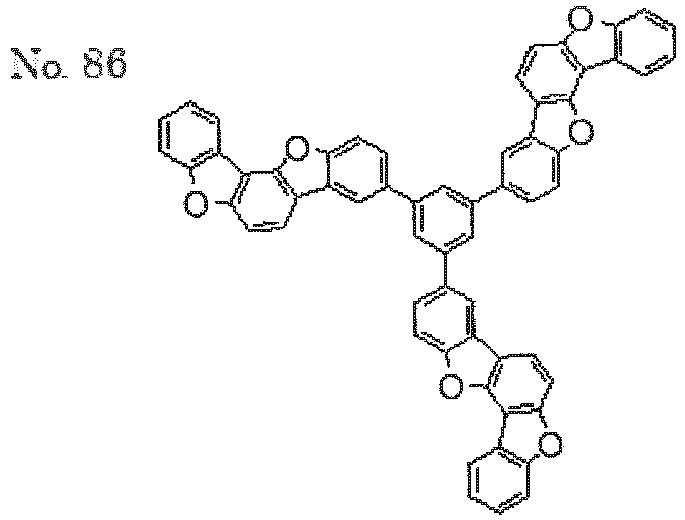
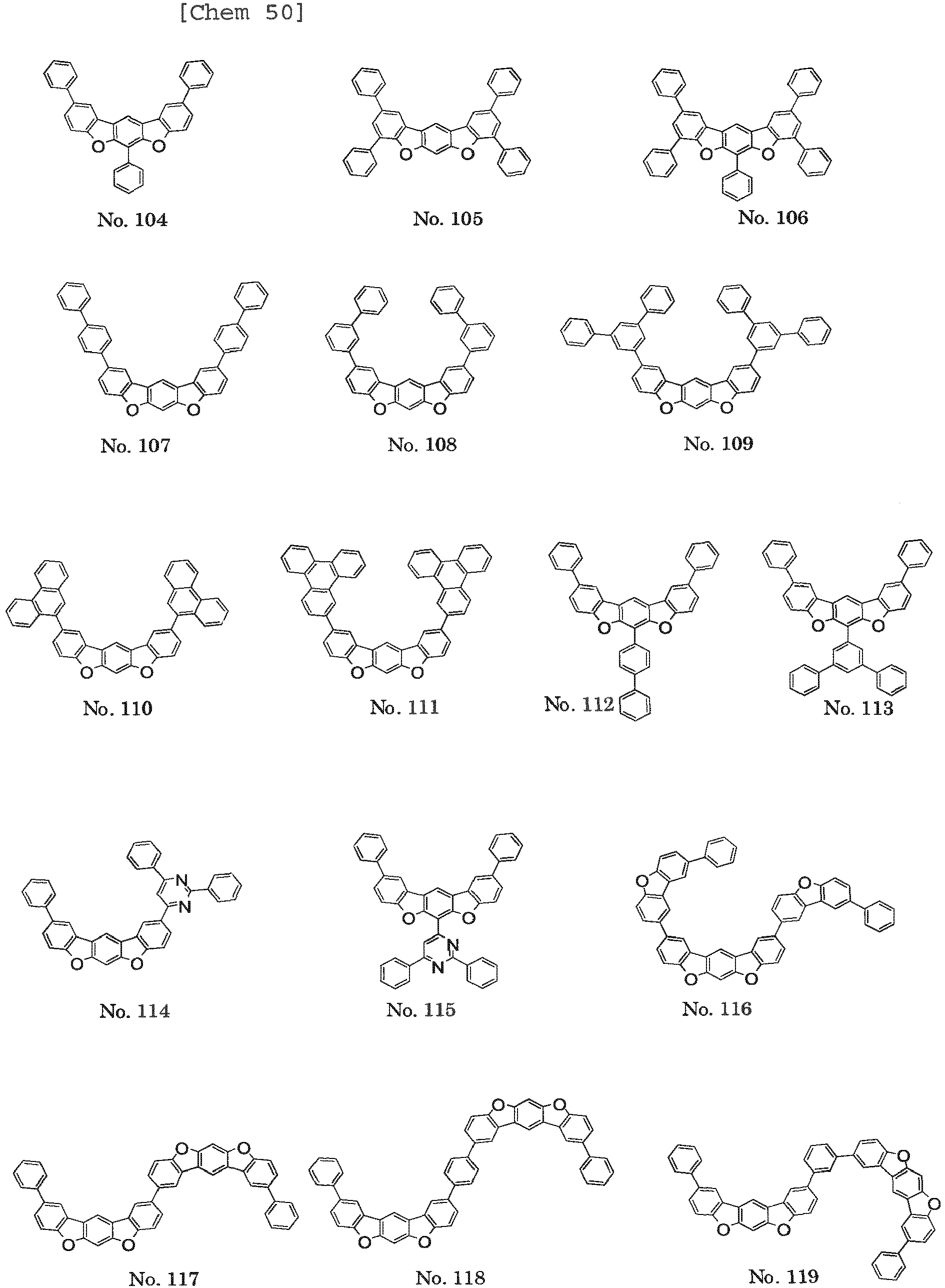
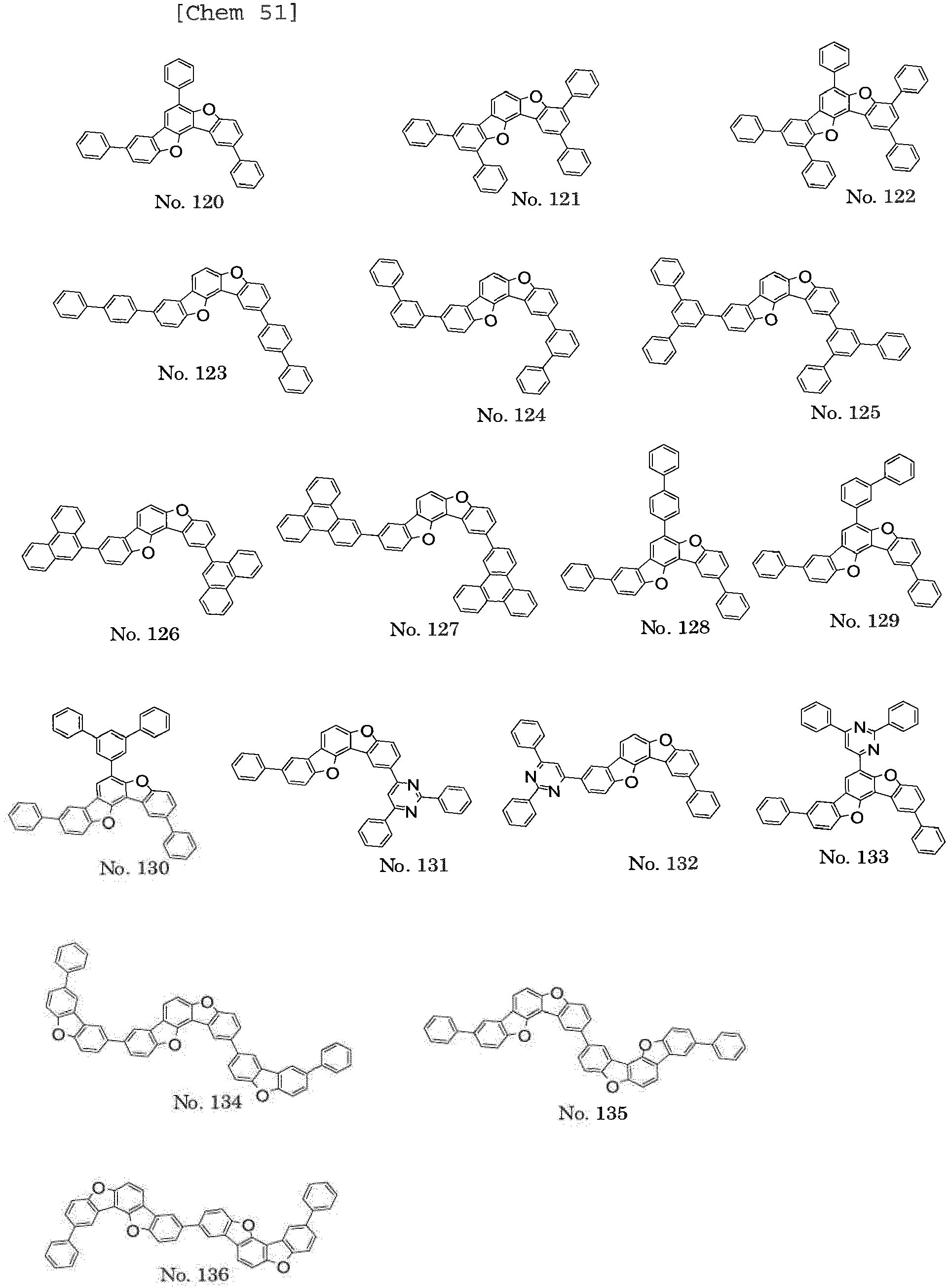


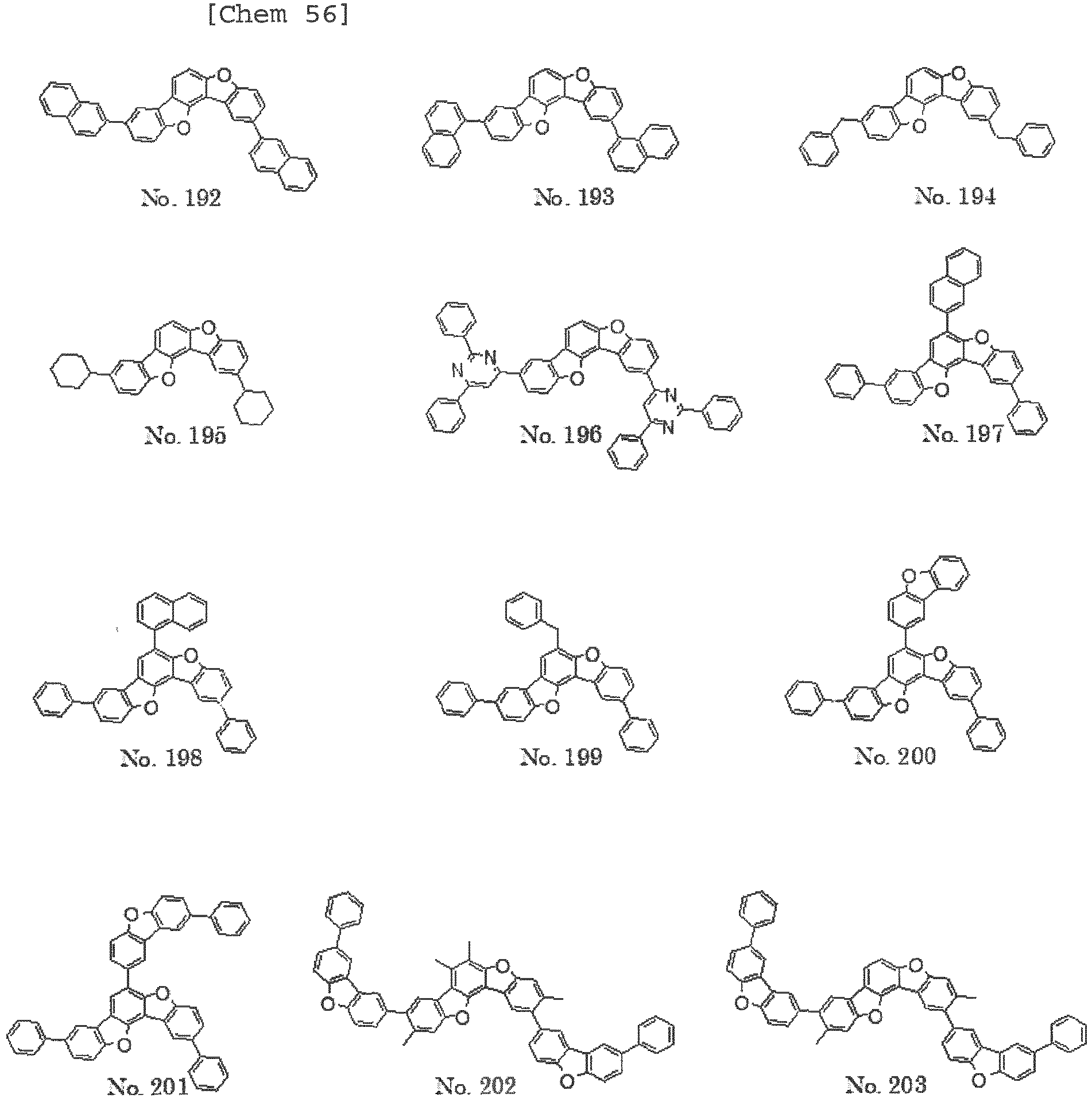
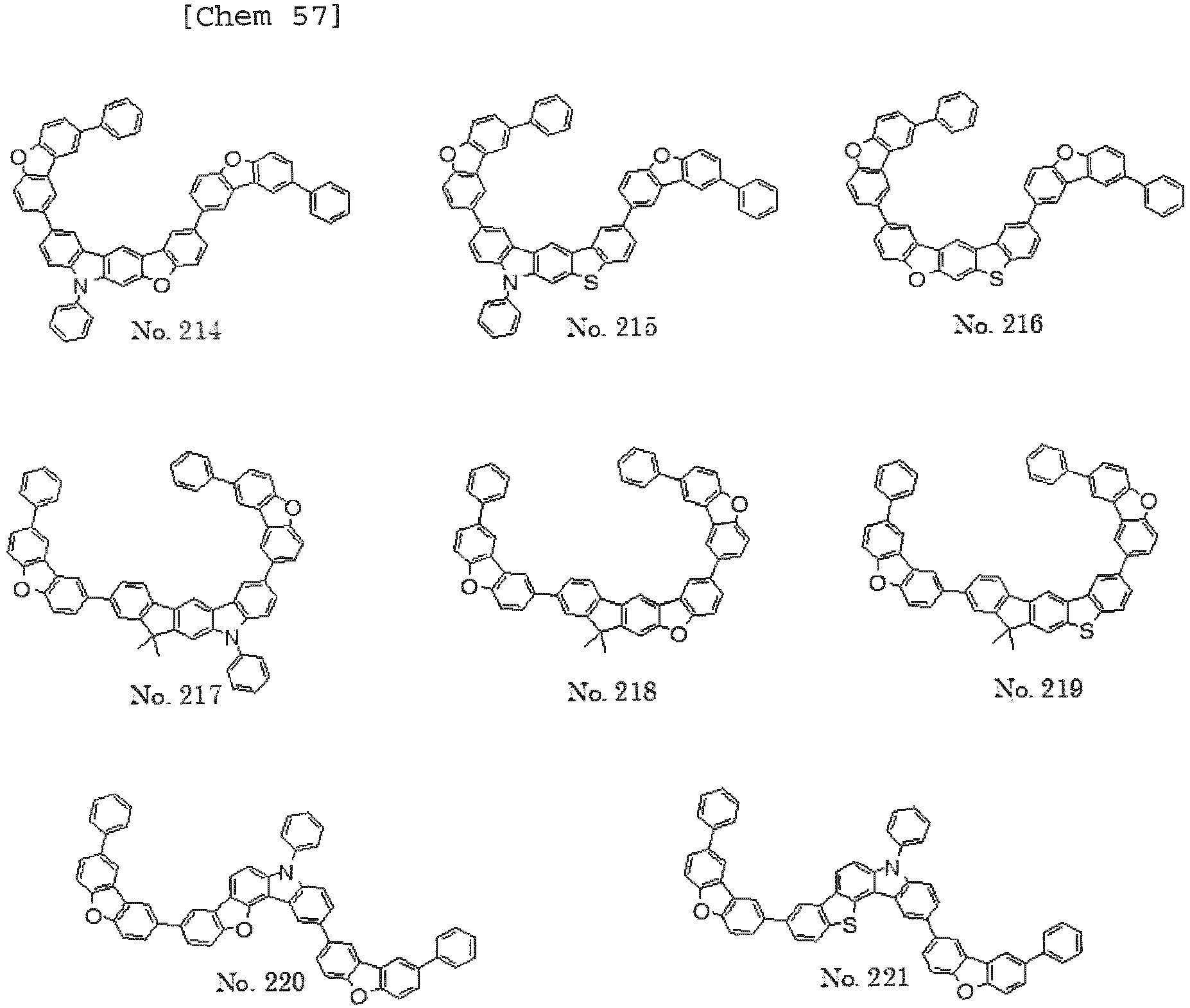
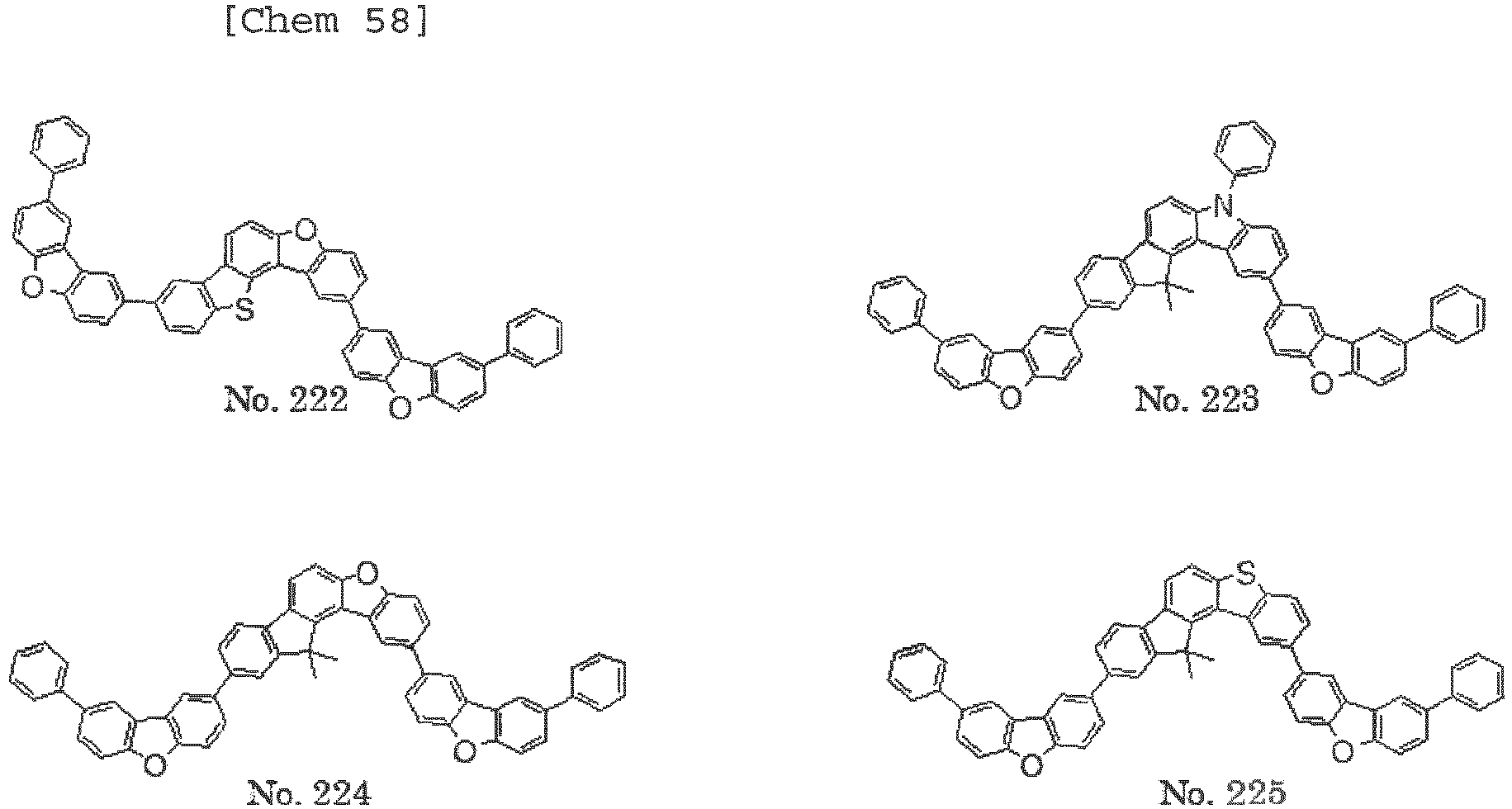

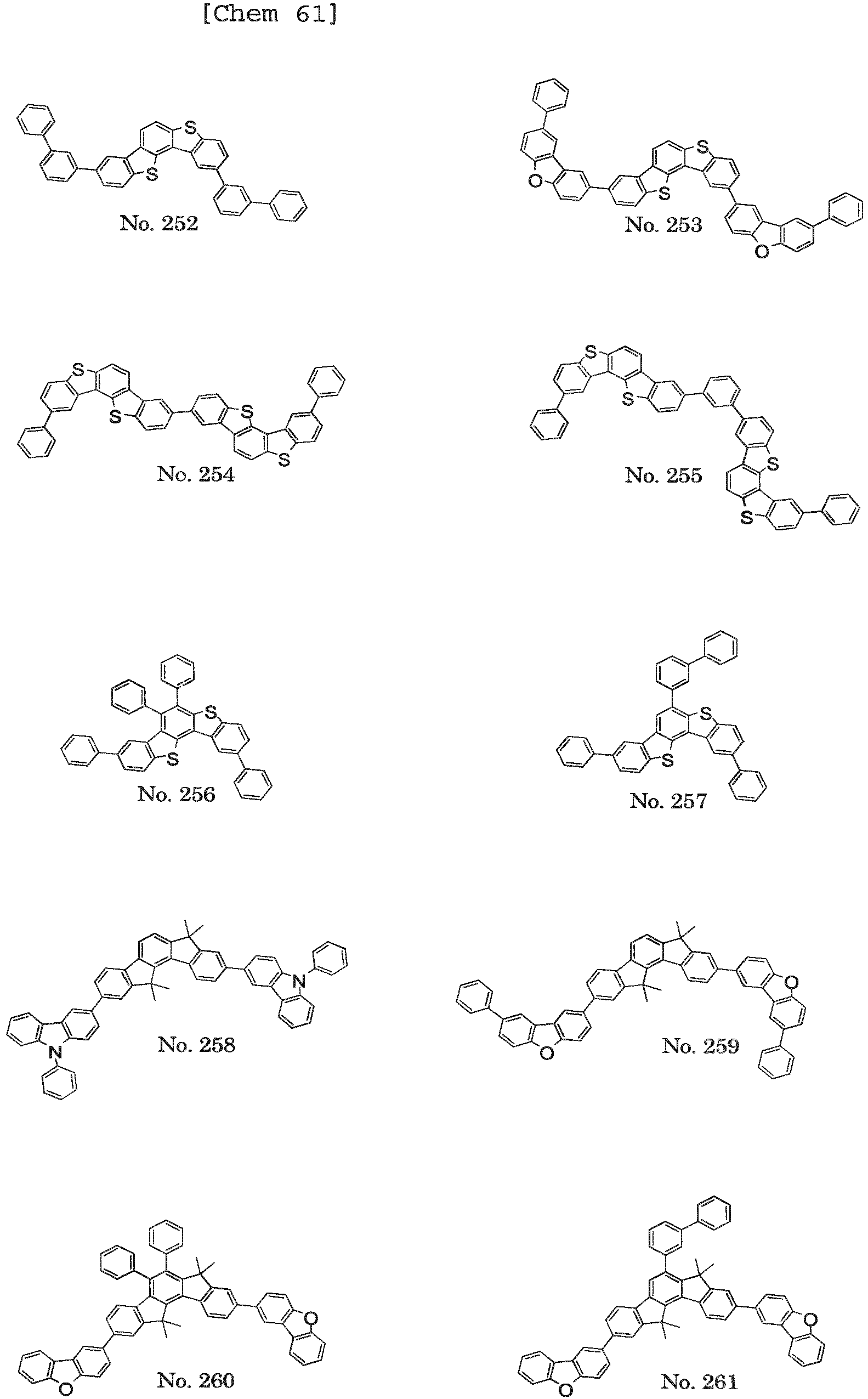
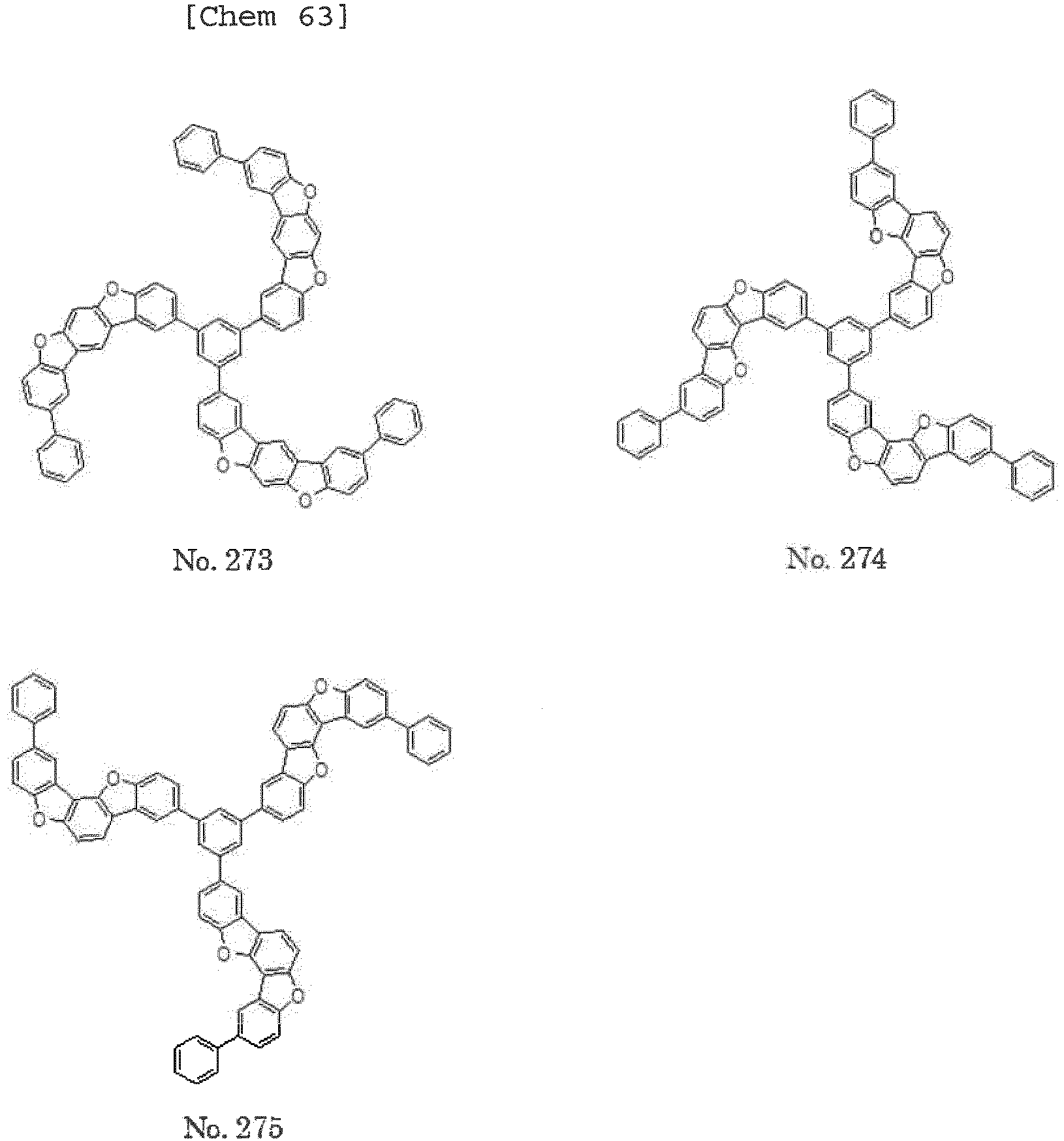

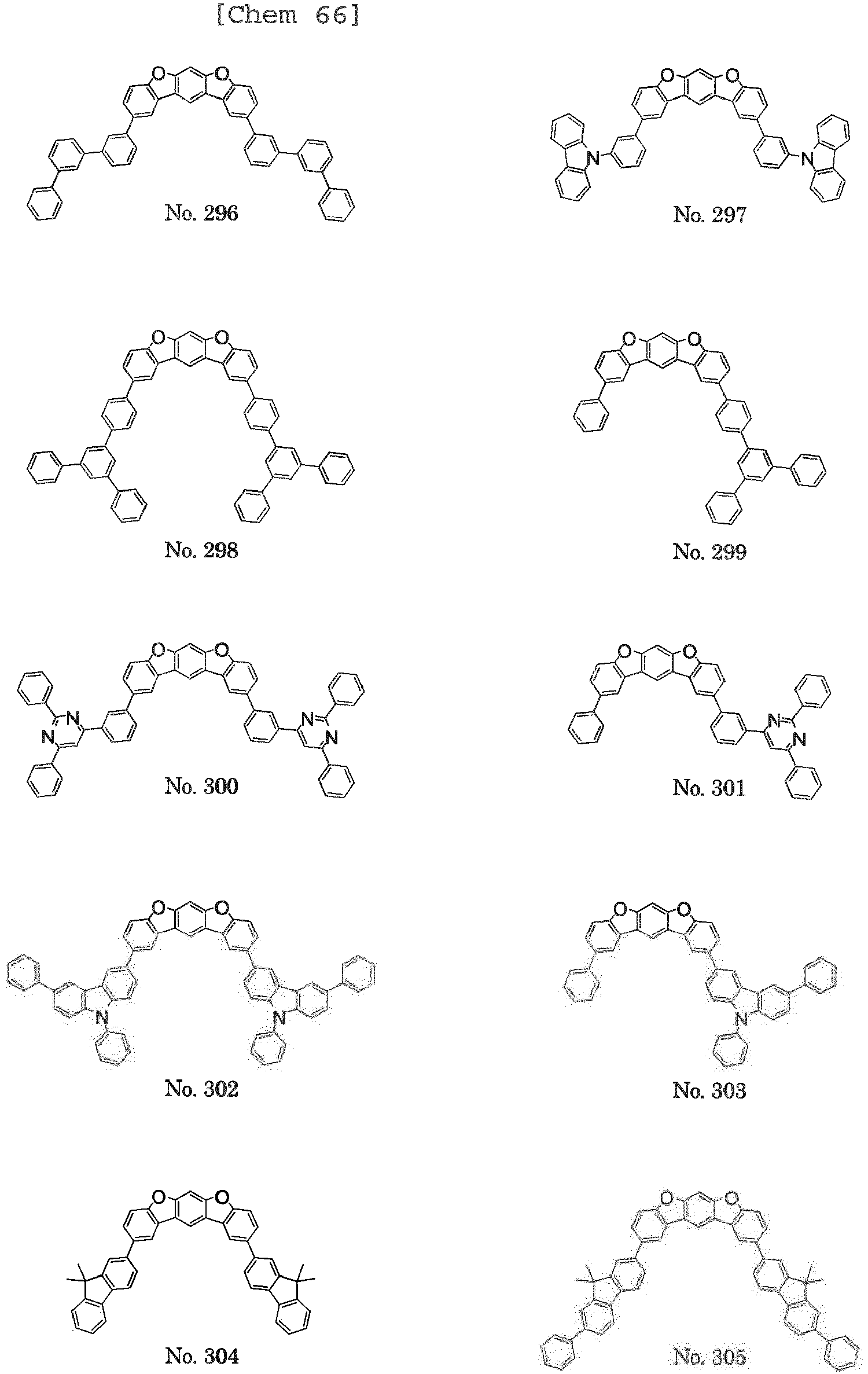
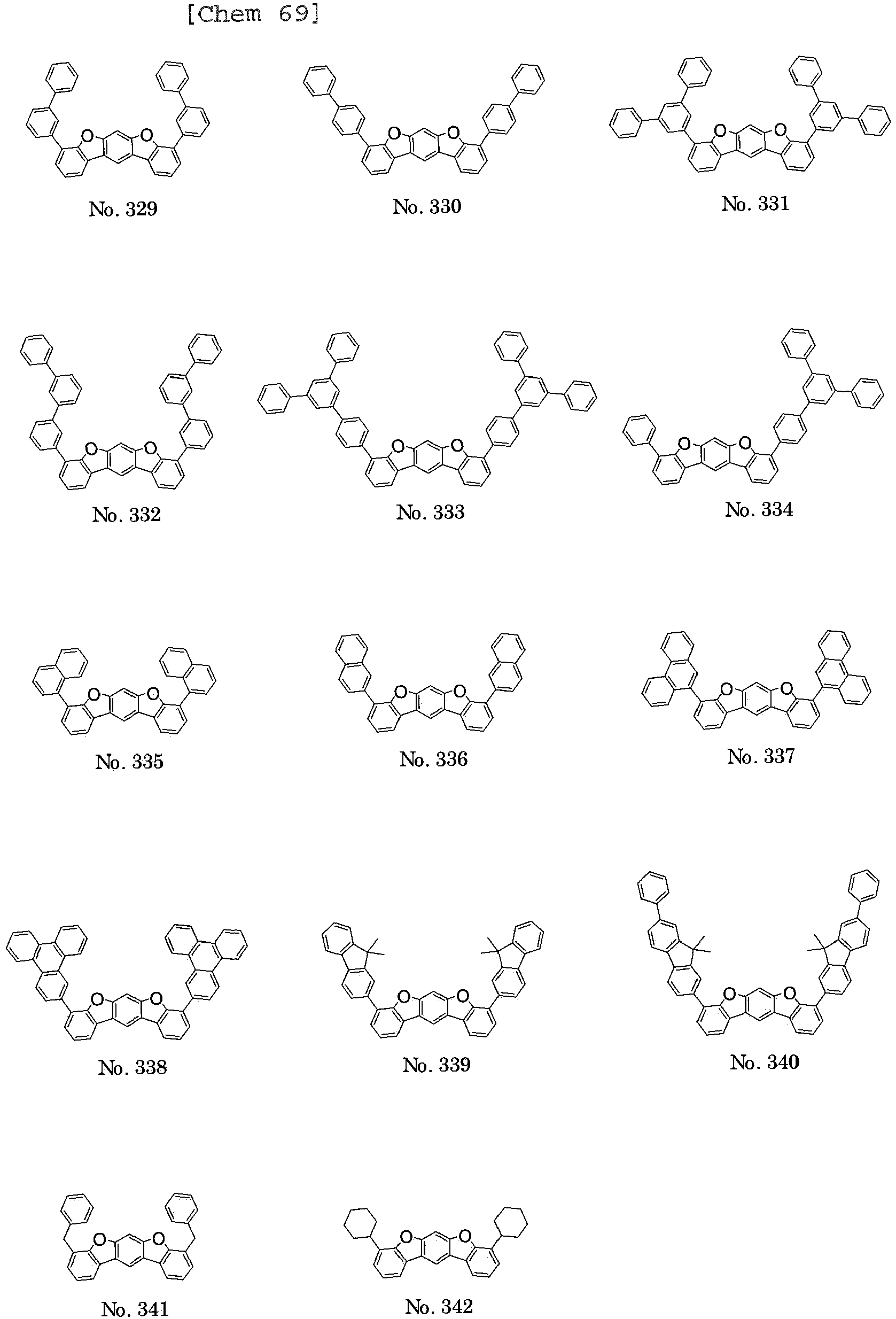
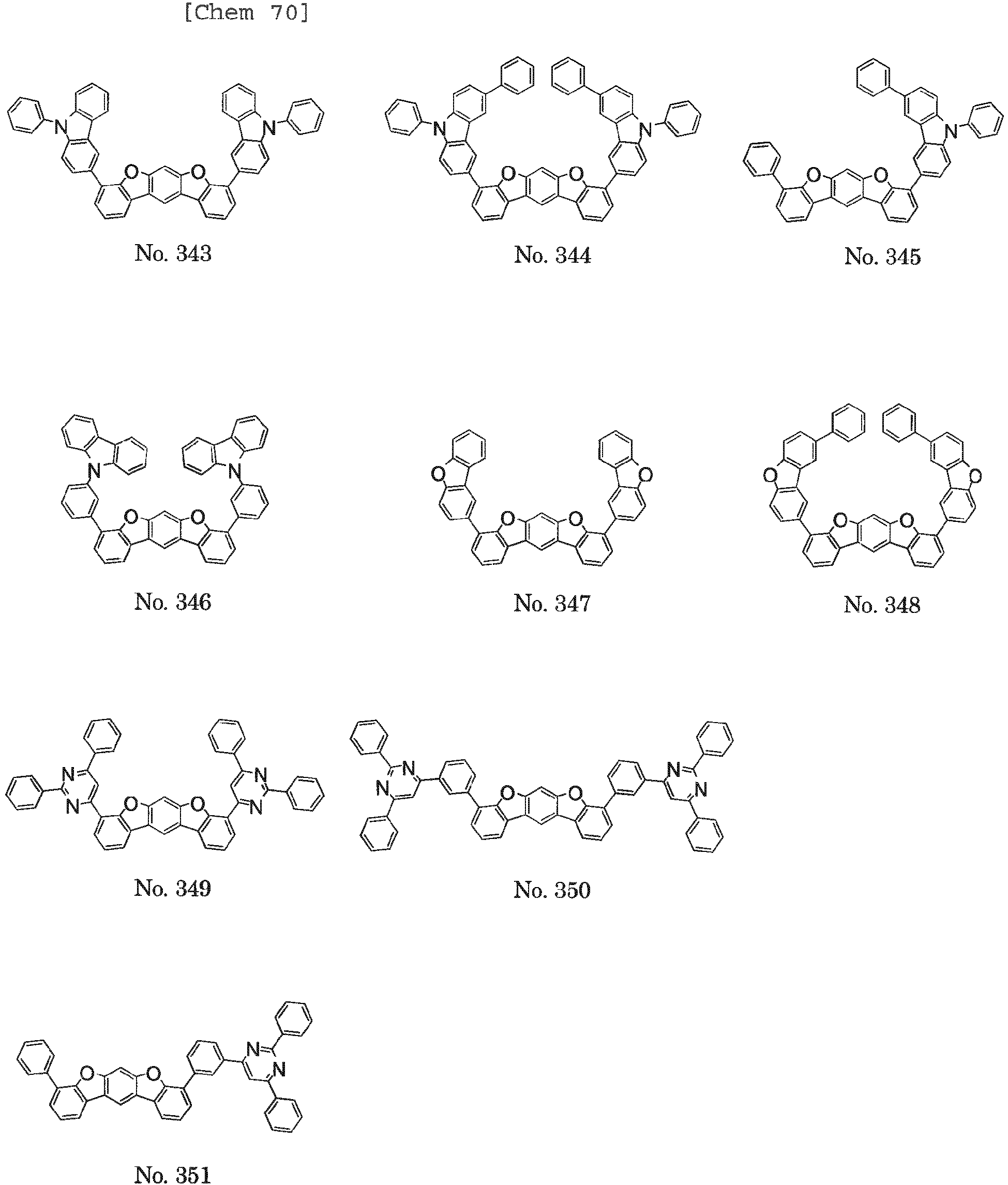
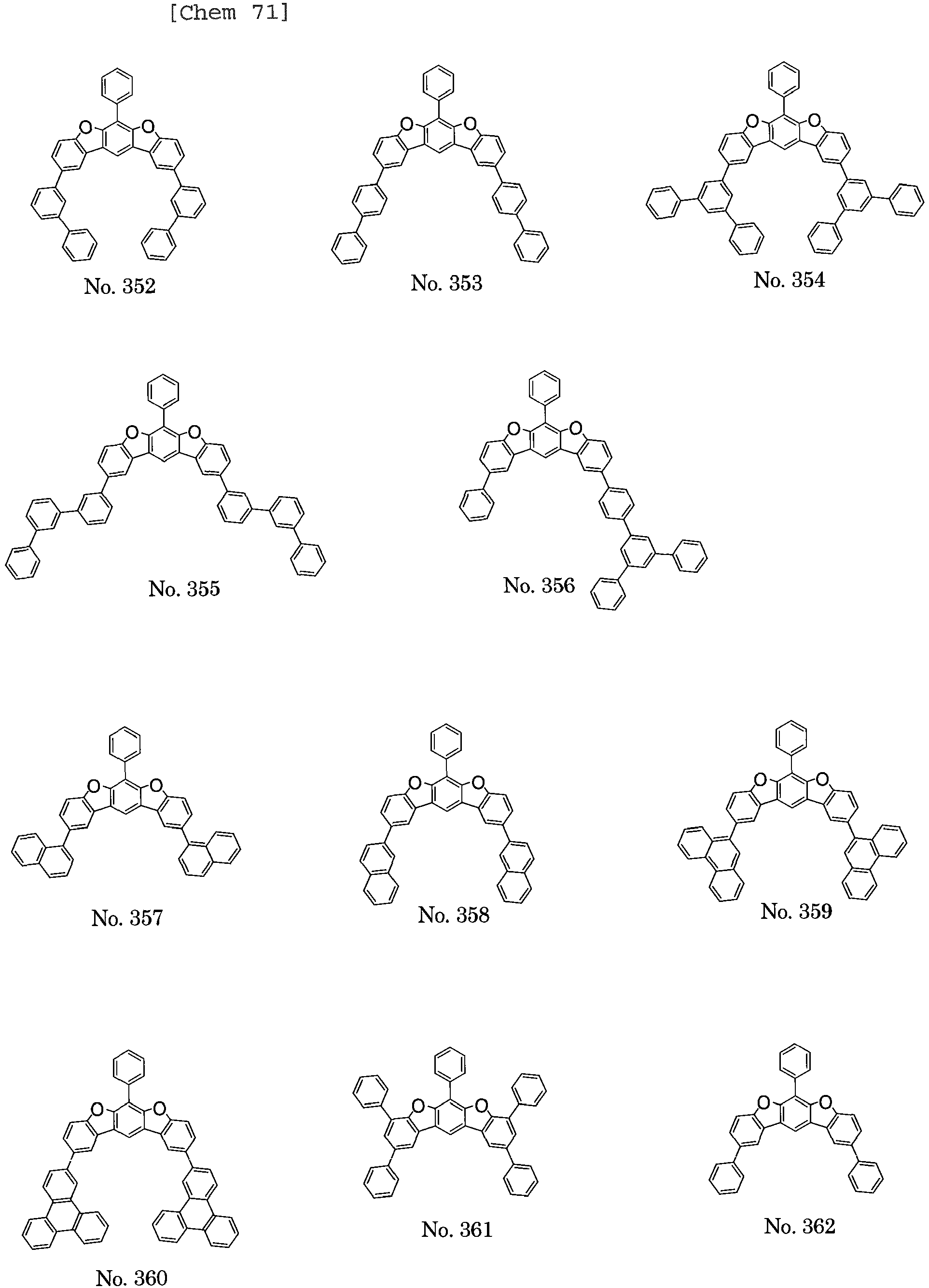
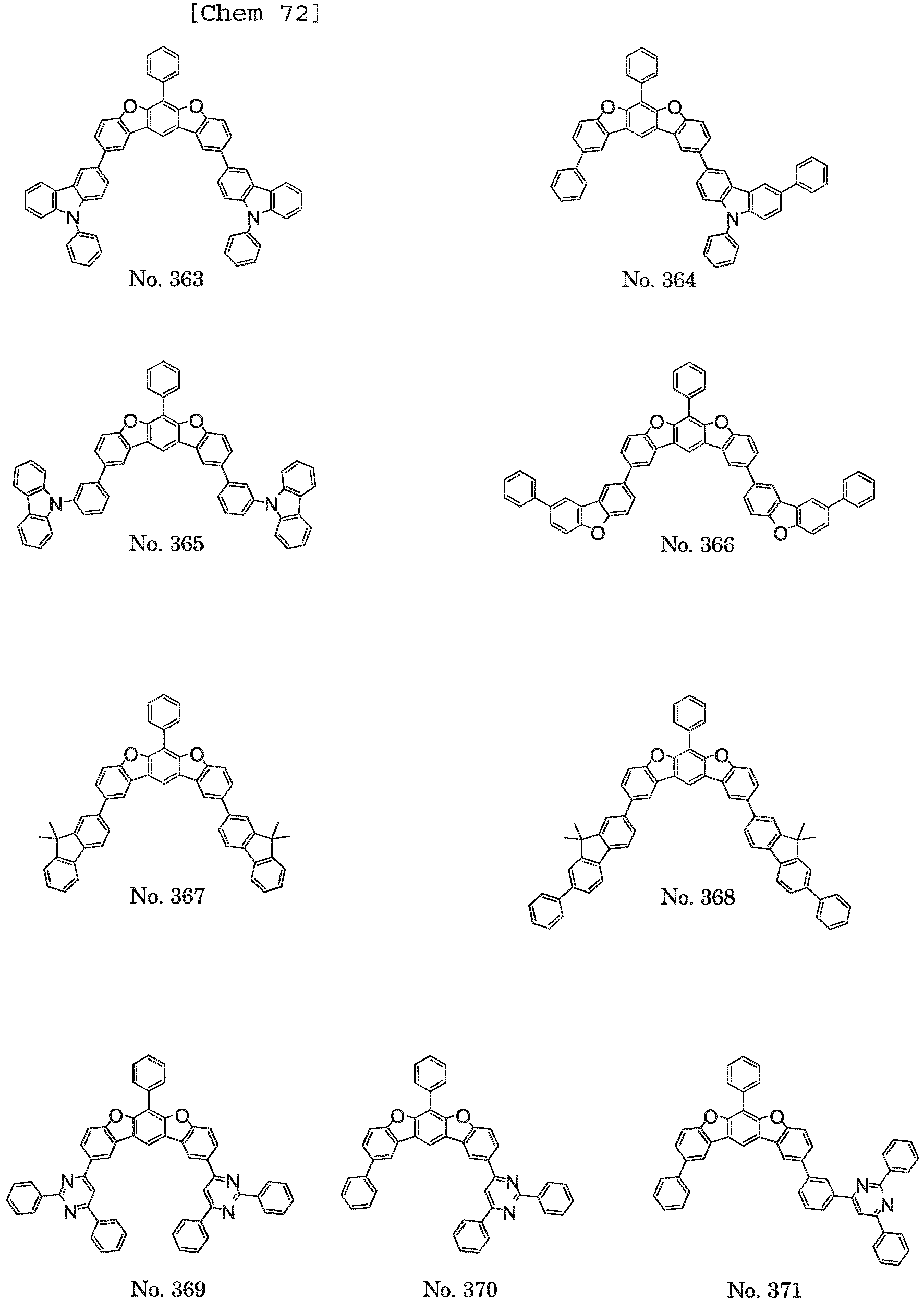
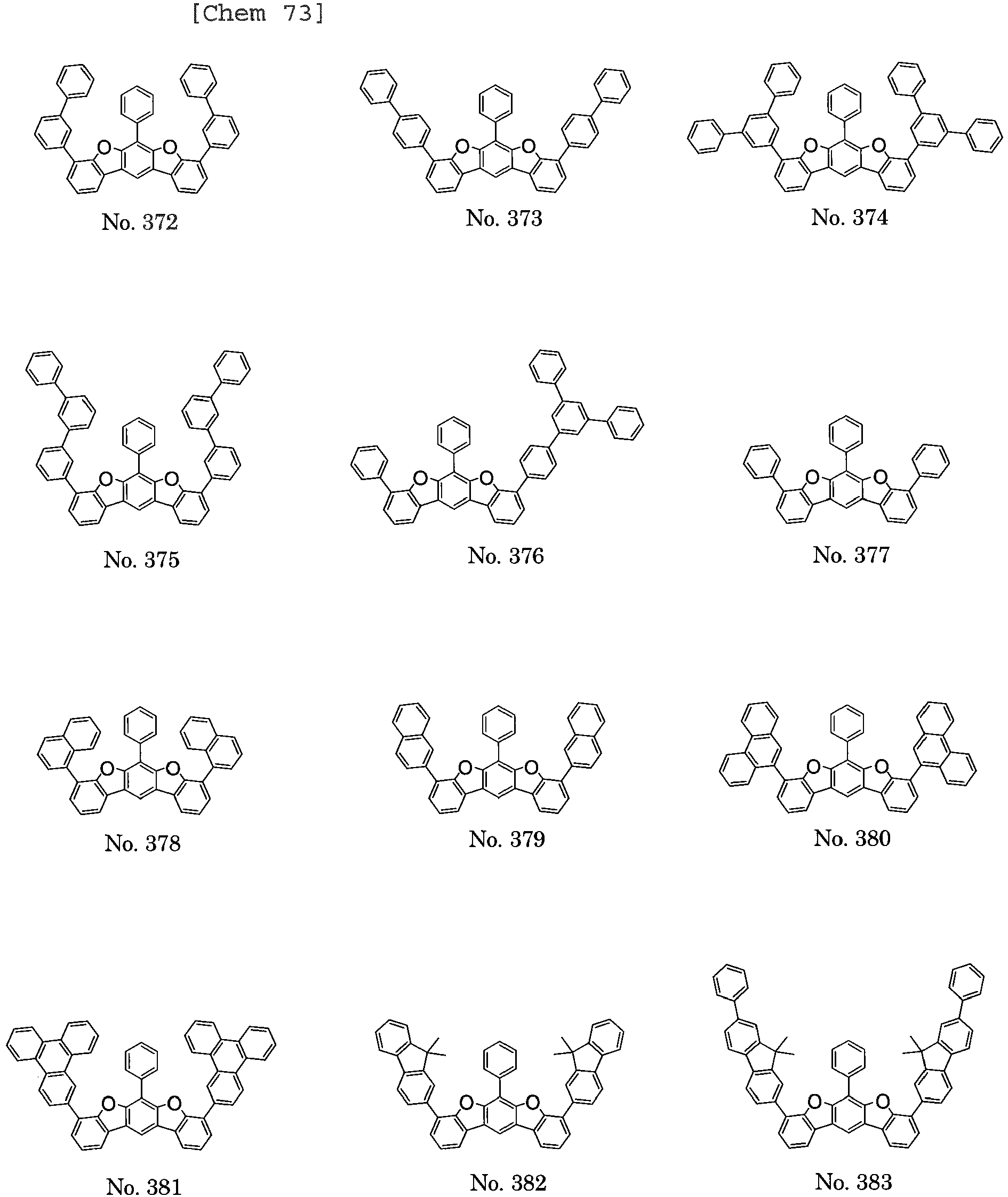

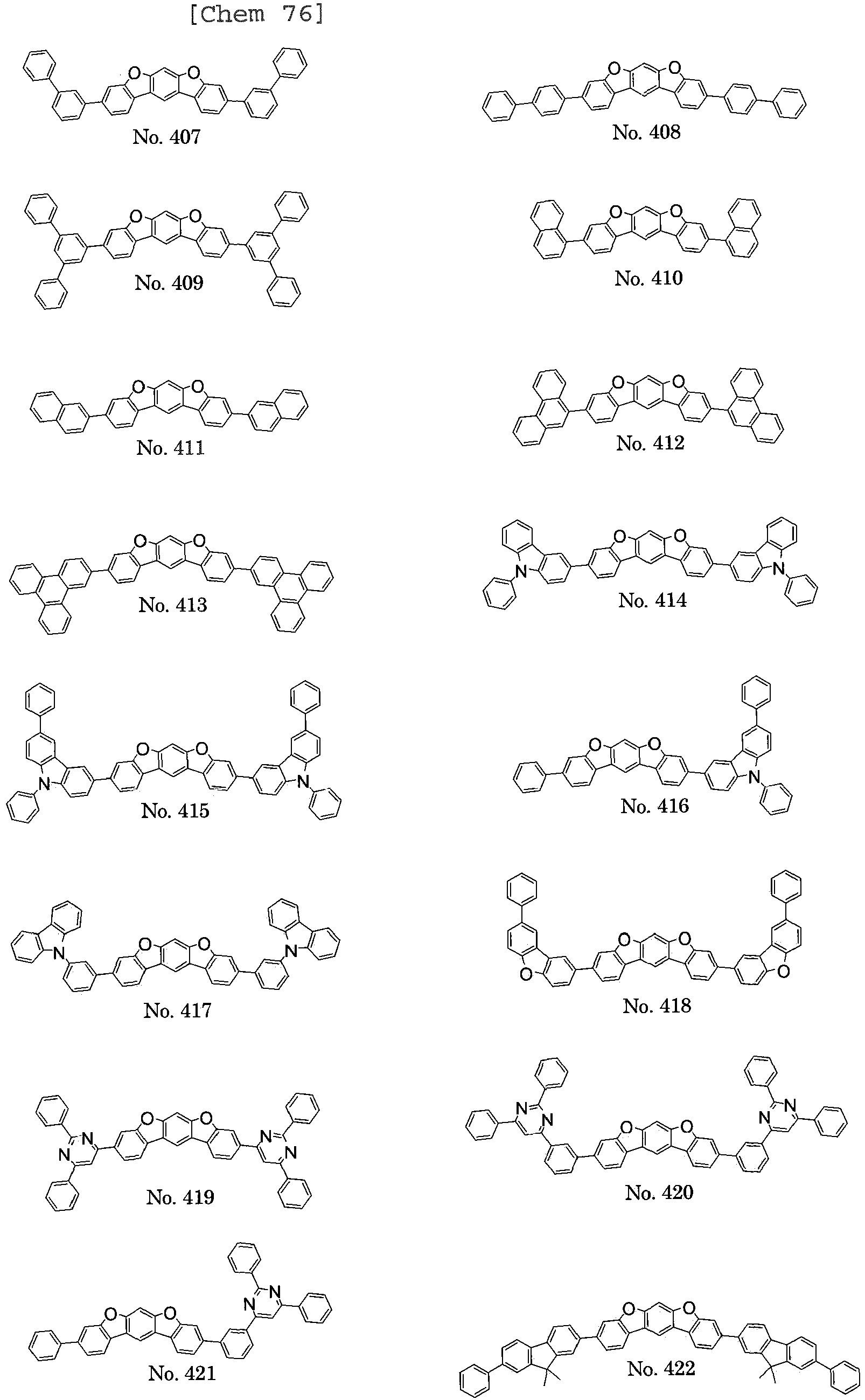
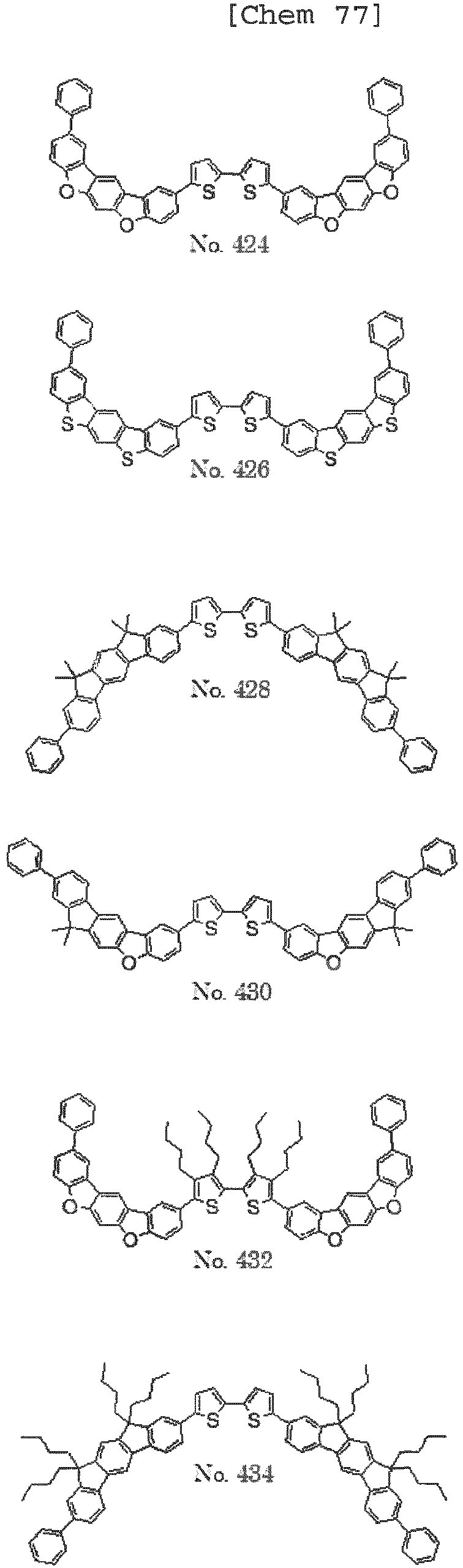


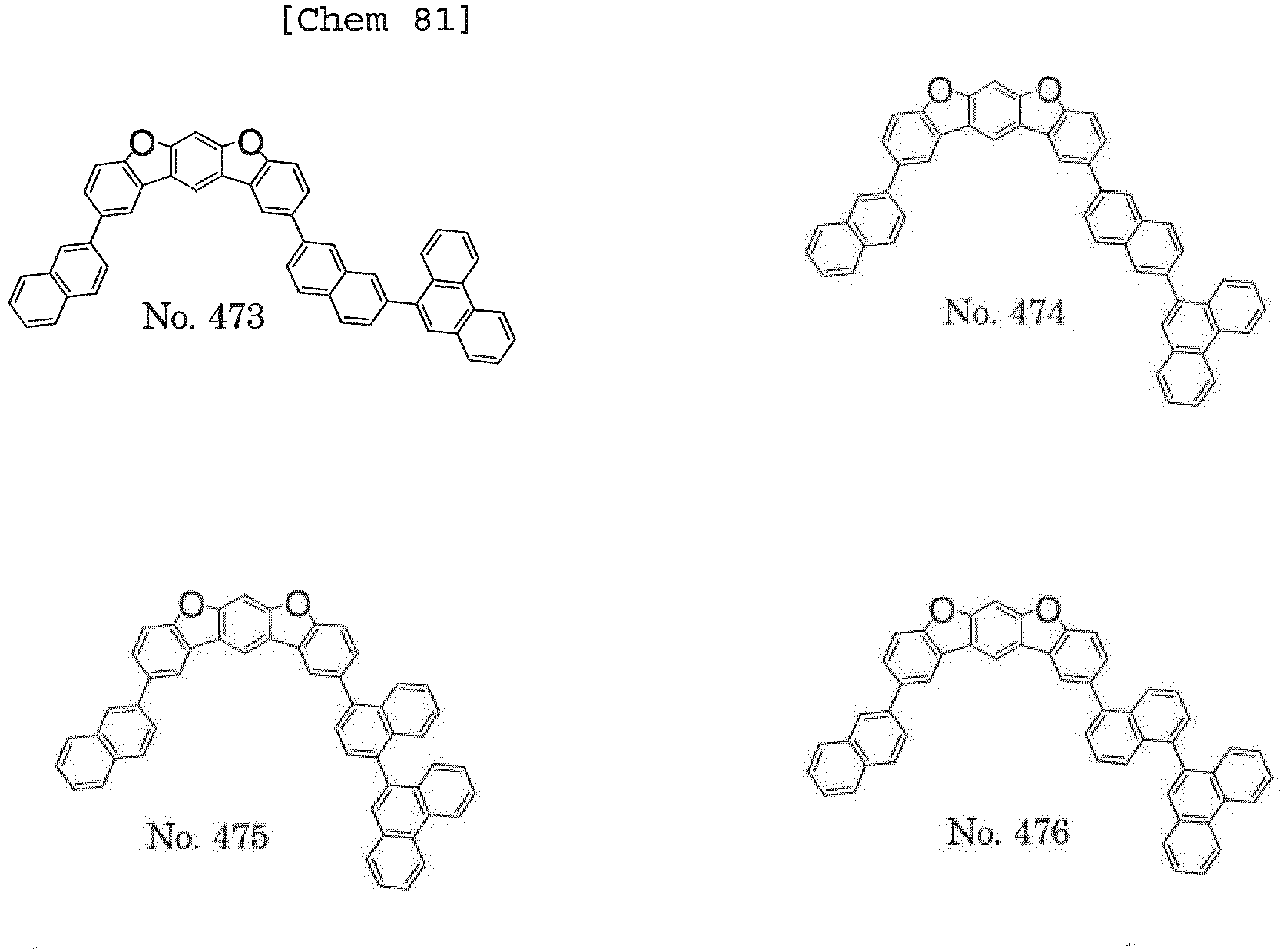
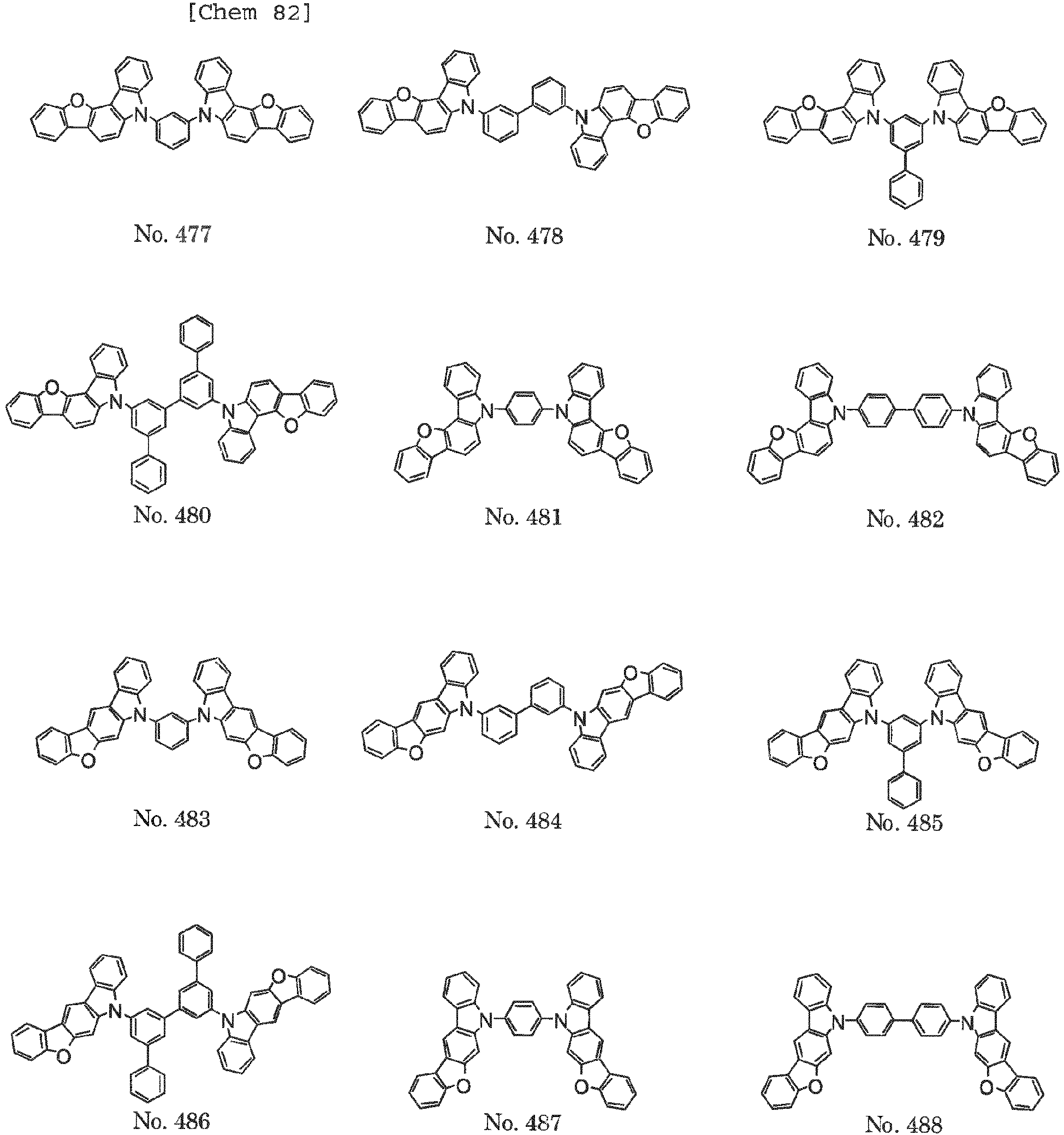
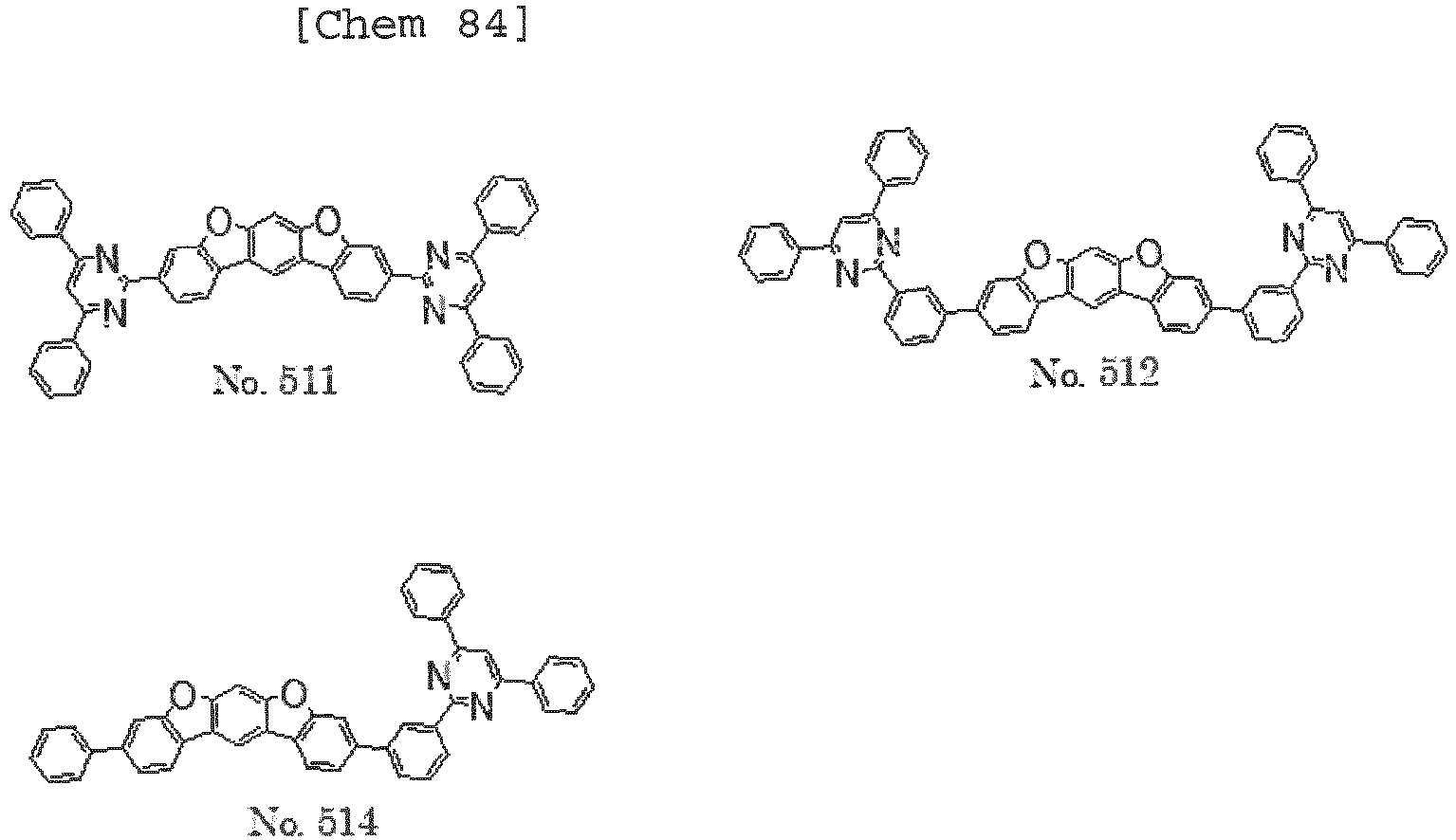
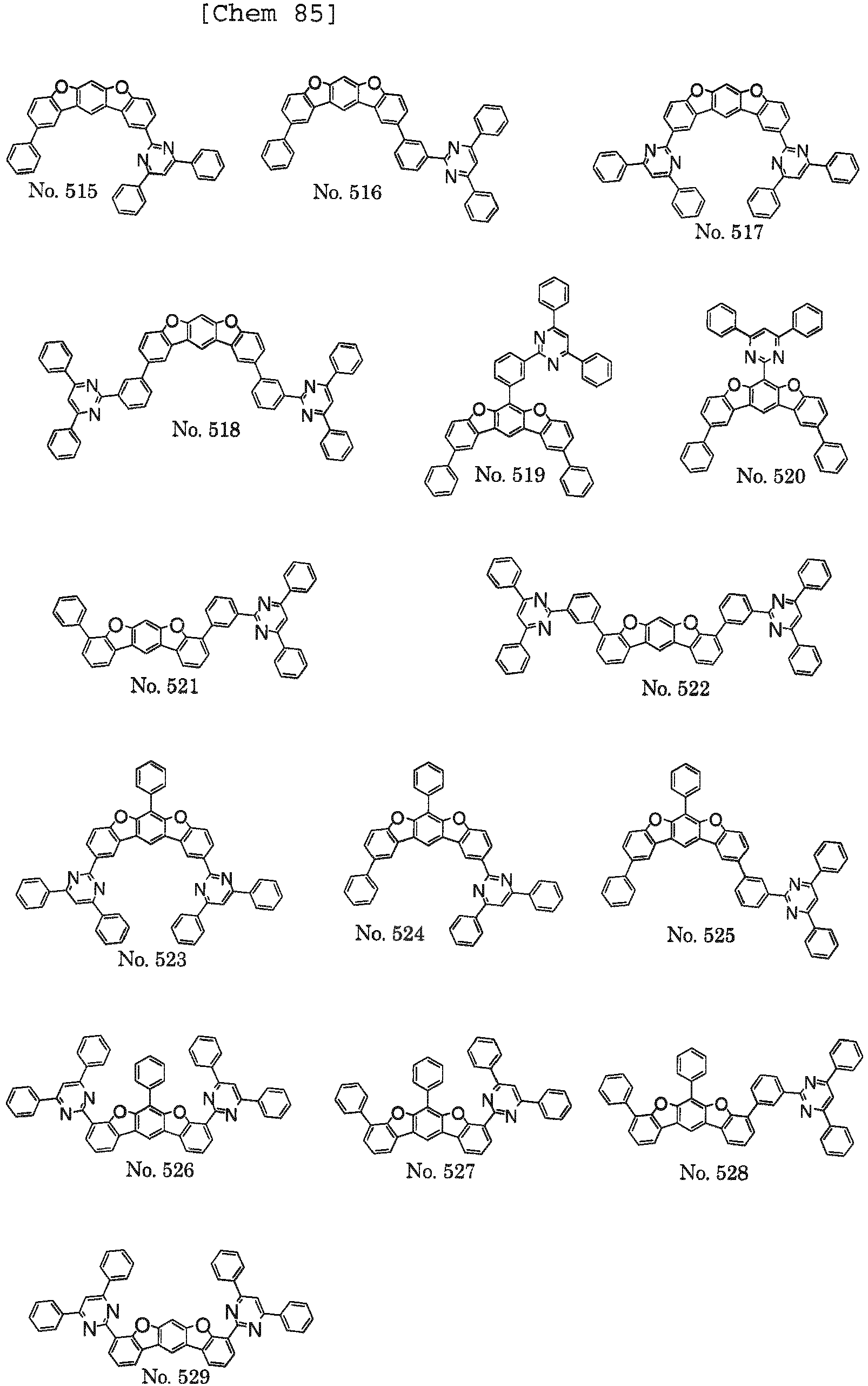
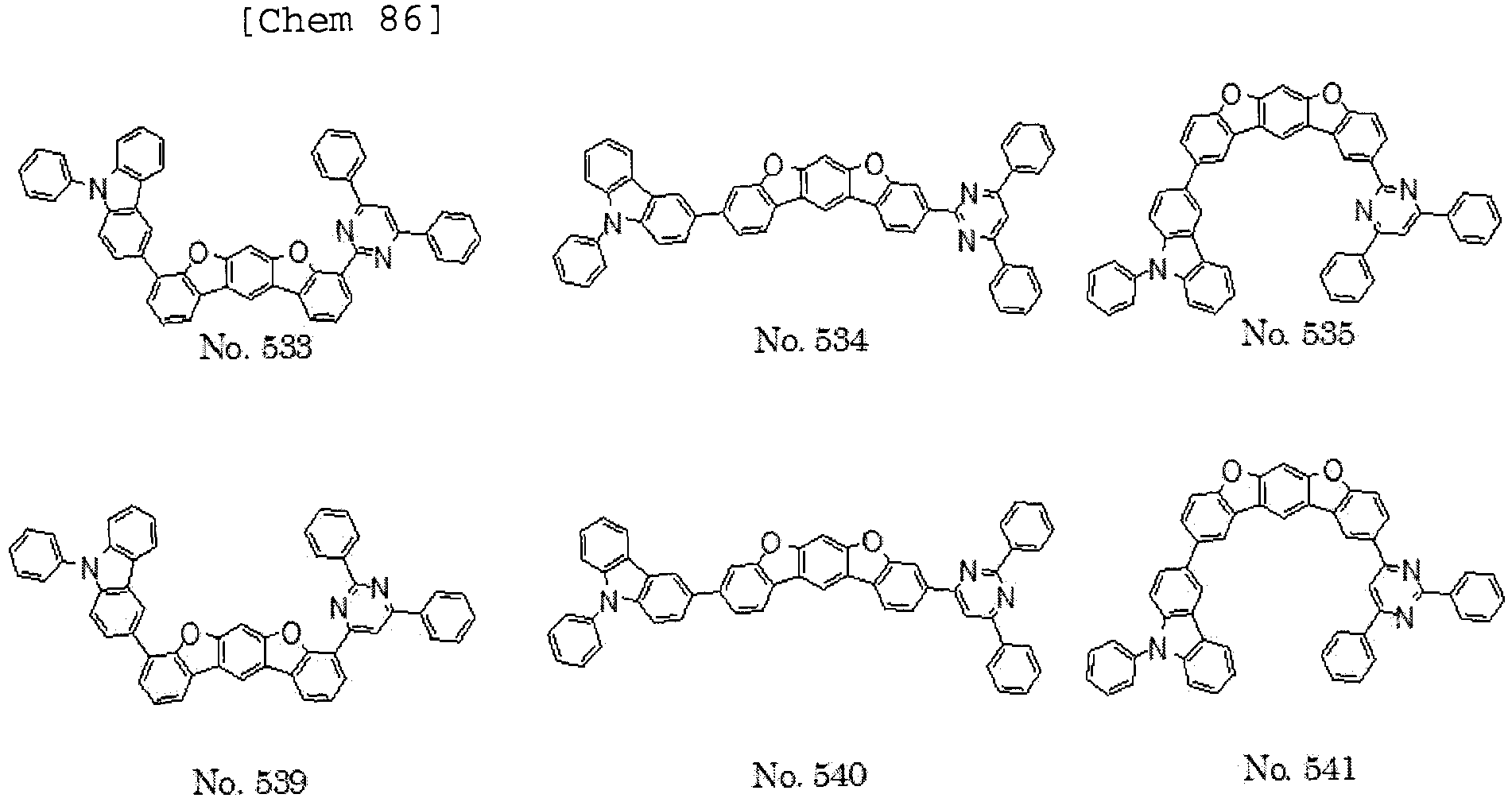

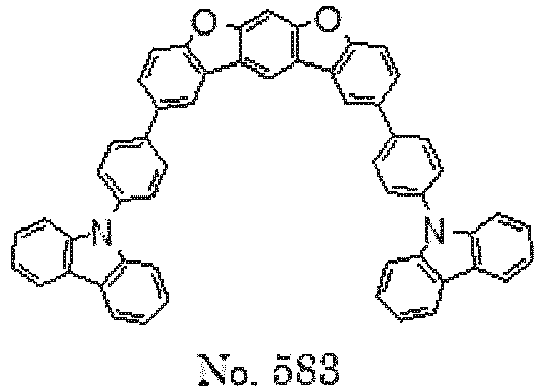
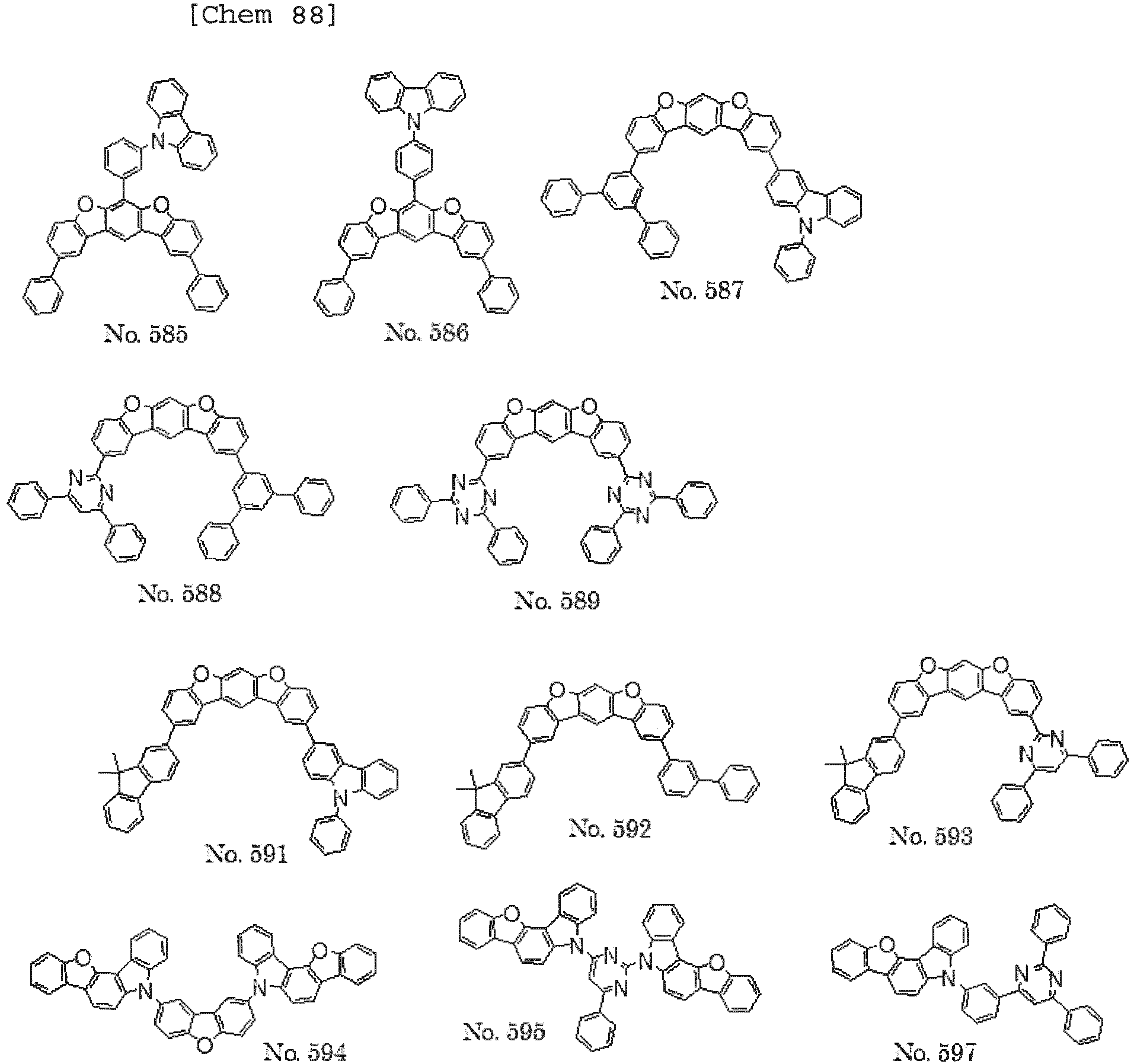
- Specific examples of the halogen compound represented by the formula (30) are shown below
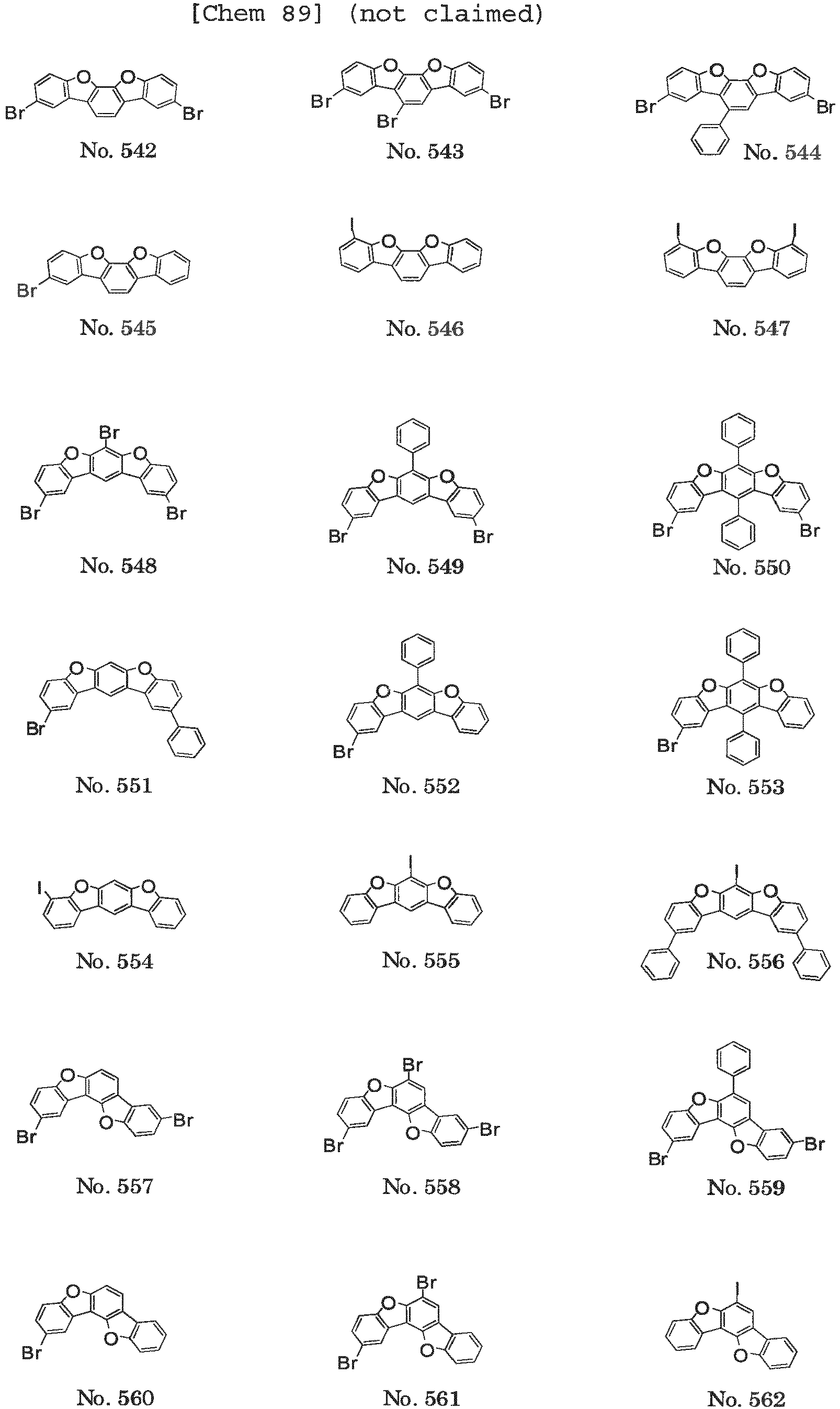

- Next, an organic EL device is described.
- The organic EL device disclosed herein has one or more organic thin film layers including a light emitting layer between a cathode and an anode, and at least one layer of the organic thin film layers contains a polycyclic compound having a π-conjugated heteroacene skeleton crosslinked with a carbon atom, a nitrogen atom, an oxygen atom, or a sulfur atom. Specific examples of the π-conjugated heteroacene skeleton are shown below.
- Indenofluorene (crosslinked with a carbon atom)



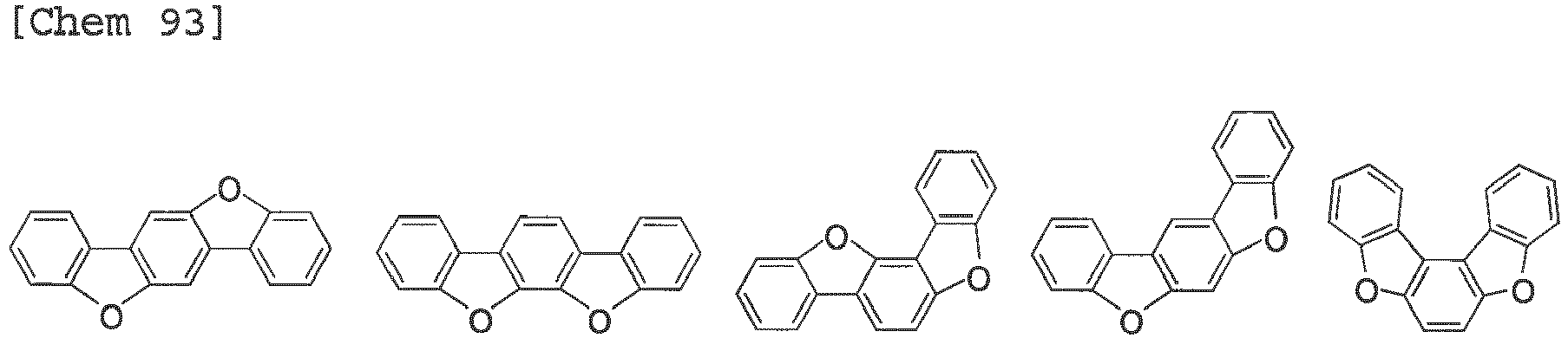
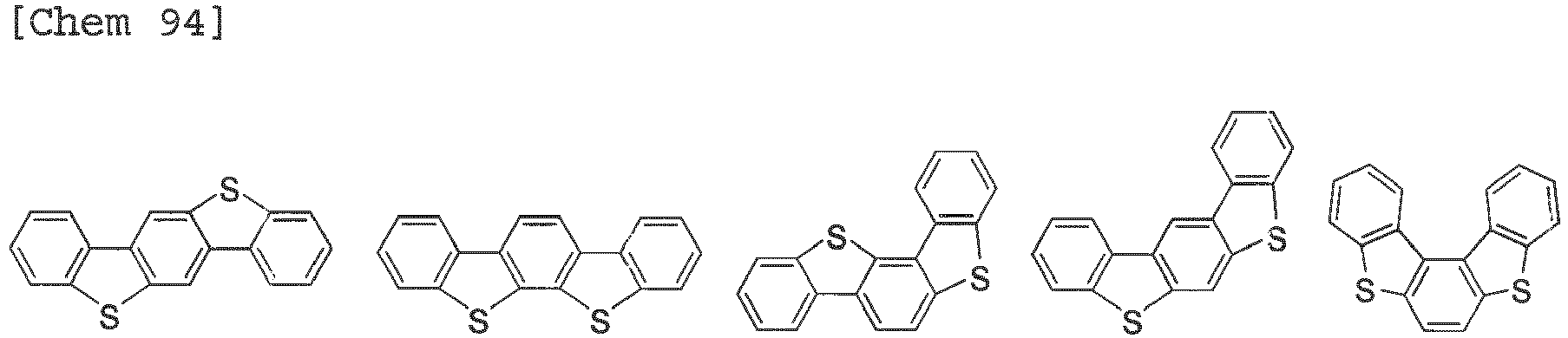
- In addition to the foregoing, a π-conjugated heteroacene skeleton crosslinked with a combination of two or more of a carbon atom, a nitrogen atom, an oxygen atom, and a sulfur atom is also permitted. Specific examples of the π-conjugated heteroacene skeleton are shown below. The electron and hole transporting properties can be adjusted by combining two or more of those examples. In particular, a combination of an oxygen atom and a nitrogen atom can achieve compatibility between the electron and hole transporting properties, and reduce the voltage at which the device is driven.

- In addition, the above-mentioned polycyclic compound of the present invention is preferably used as the polycyclic compound.
- The organic EL device may have an electron transporting layer between the light emitting layer and the cathode, and the electron transporting layer may contain the polycyclic compound. Further, both the light emitting layer and the electron transporting layer each preferably contain the polycyclic compound.
- Alternatively, the organic EL device may have a hole transporting layer between the light emitting layer and the anode, and the hole transporting layer may contain the polycyclic compound.
- Further, the polycyclic compound of the present invention is preferably incorporated into at least the light emitting layer. When the compound is used in the light emitting layer, the lifetime of the organic EL device can be lengthened. When the compound is used in the electron transporting layer or the electron injecting layer, the voltage at which the device is driven can be reduced. The compound is preferably incorporated into each of two or more layers including the light emitting layer and the electron transporting layer or the electron injecting layer at the same time because both the reduced voltage and the lengthened lifetime can be achieved.
- In particular, in addition to the electron transporting layer or the electron injecting layer, the light emitting layer preferably contains the polycyclic compound of the present invention as a host material. The light emitting layer preferably contains the polycyclic compound represented by the formula (9) or (12) as a host material, more preferably contains the polycyclic compound represented by the formula (17) or (18) as a host material.
- A multi-layer type organic EL device is obtained by laminating a plurality of layers; for example, the device is formed of an anode, a hole transporting layer (a hole injecting layer), a light emitting layer, and a cathode, of an anode, a light emitting layer, an electron transporting layer (an electron injecting layer), and a cathode, of an anode, a hole transporting layer (a hole injecting layer), a light emitting layer, an electron transporting layer (an electron injecting layer), and a cathode, or of an anode, a hole transporting layer (a hole injecting layer), a light emitting layer, a hole barrier layer, an electron transporting layer (an electron injecting layer), and a cathode.
- In the organic EL device, the light emitting layer preferably contains the polycyclic compound as a host material. In addition, it is preferred that the light emitting layer be formed of a host material and a phosphorescent material, and the host material be the polycyclic compound.
- In addition, the polycyclic compound may be a host material to be used together with a phosphorescent material, or may be an electron transporting material to be used together with a phosphorescent material. The material has a triplet energy gap of preferably 2.2 to 3.2 eV, or more preferably 2.5 to 3.2 eV.
- The phosphorescent material is preferably a compound containing iridium (Ir), osmium (Os), ruthenium (Ru), or platinum (Pt) because the compound has a high phosphorescent quantum yield, and can additionally improve the external quantum efficiency of the light emitting device. The material is more preferably a metal complex such as an iridium complex, an osmium complex, a ruthenium complex, or a platinum complex. Of those, the iridium complex and the platinum complex are still more preferred, and an orthometalated iridium complex is most preferred. Specific examples of the metal complex such as an iridium complex, an osmium complex, a ruthenium complex, or a platinum complex are shown below.
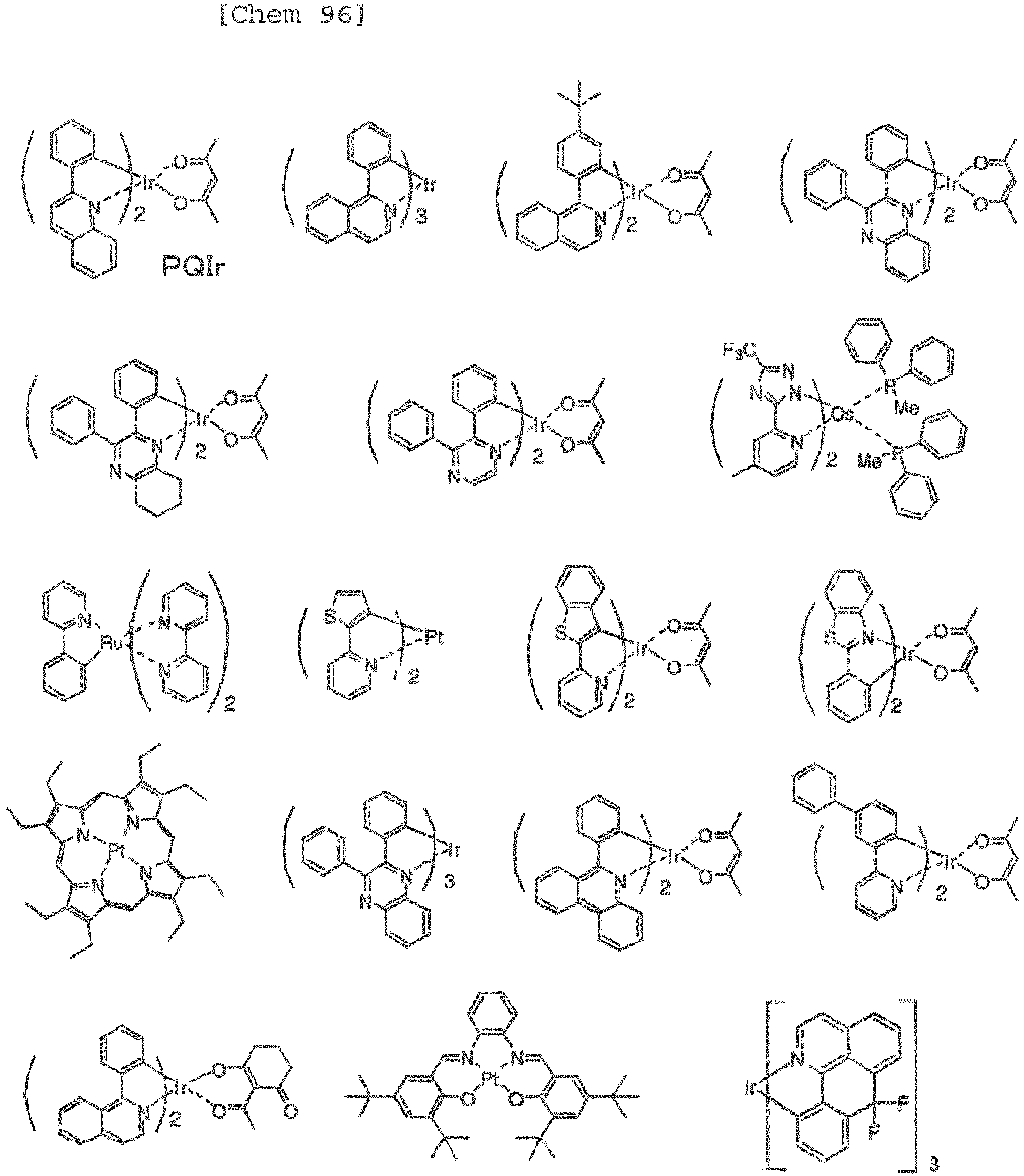

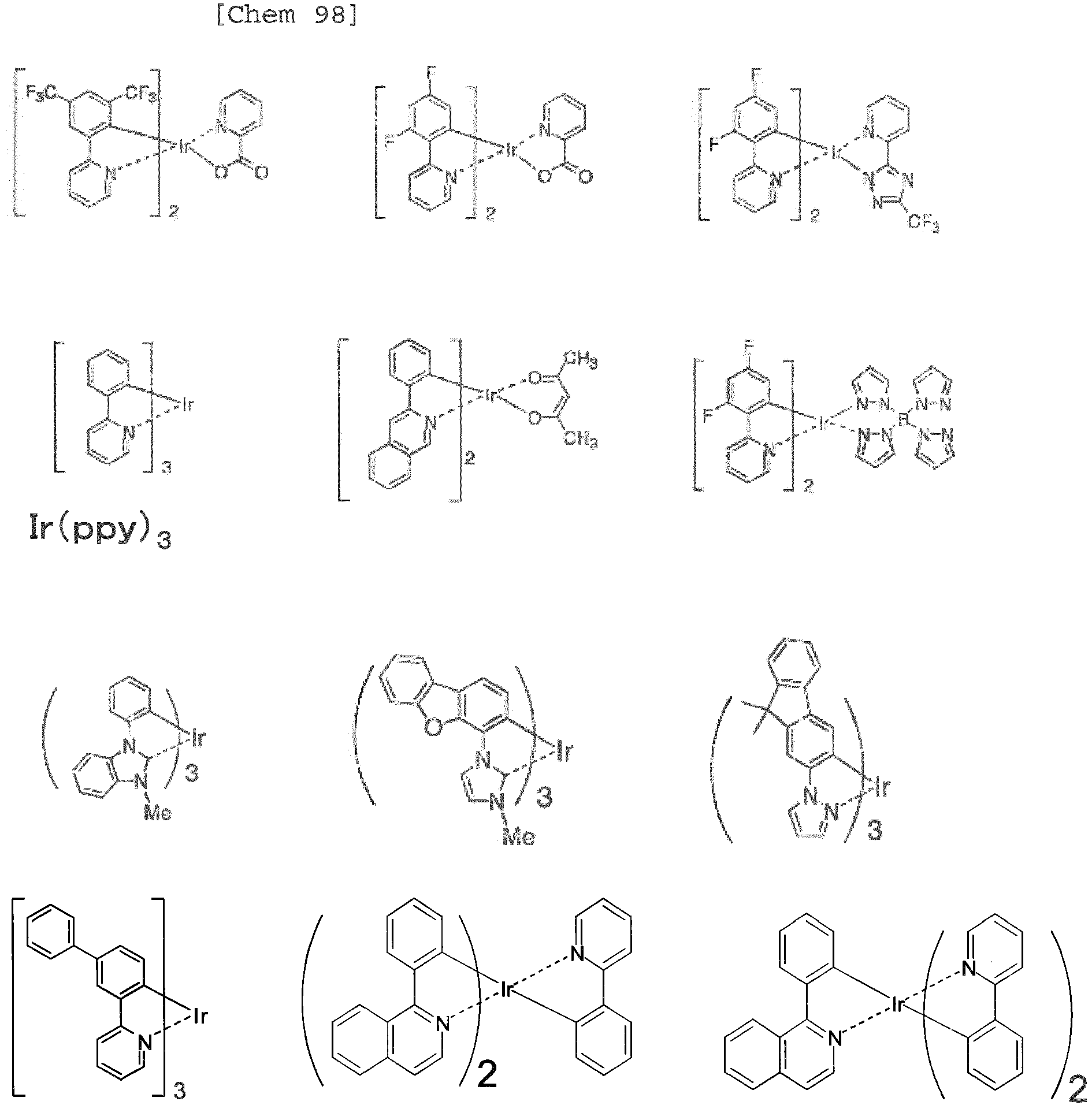

- In addition, the organic EL device is preferably such that the light emitting layer contains a host material and a phosphorescent material, and contains a metal complex having a local maximum luminous wavelength of 500 nm or less. Further, the material can be used together with a fluorescent dopant. The material can be used together with a blue, green, or red fluorescent dopant. In particular, the material can be more preferably used together with the blue or green fluorescent dopant. Further, the material can be preferably used also as an electron transporting material for a fluorescent organic EL device.
- The organic EL device preferably has a reductive dopant in an interfacial region between the cathode and an organic thin layer (for example, an electron injecting layer or a light emitting layer) . Examples of the reductive dopant include at least one kind selected from an alkali metal, an alkali metal complex, an alkali metal compound, an alkaline earth metal, an alkaline earth metal complex, an alkaline earth metal compound, a rare earth metal, a rare earth metal complex, and a rare earth metal compound.
- Preferred examples of the alkali metal include an alkali metal having a work function of 2.9 eV or less, such as Na having a work function of 2.36 eV, K having a work function of 2.28 eV, Rb having a work function of 2.16 eV, and Cs having a work function of 1.95 eV. Of those, K, Rb, and Cs are more preferred, Rb or Cs is still more preferred, and Cs is most preferred.
- Preferred examples of the alkali earth metal include an alkali earth metal having a work function of 2.9 eV or less, such as Ca having a work function of 2.9 eV, Sr having a work function of 2.0 to 2.5 eV, and Ba having a work function of 2.52 eV.
- Preferred examples of the rare earth metal include a rare earth metal having a work function of 2.9 eV or less, such as Sc, Y, Ce, Tb, and Yb.
- Of those metals, a preferred metal has a particularly high reductive ability, so improvement of light emission intensity and long life of organic EL device can be attained by adding a relatively small amount of the metal to an electron injecting region.
- Examples of the alkali metal compound include an alkali oxide such as Li2O, Cs2O, or K2O, and an alkali halide such as LiF, NaF, CsF, or KF. Of those, LiF, Li2O, and NaF are preferred.
- Examples of the alkali earth metal compound include BaO, SrO, CaO, and mixtures thereof such as BamSr1-mO (0<m<1) and BamCa1-mO (0<m<1). Of those, BaO, SrO, and CaO are preferred.
- Examples of the rare earth metal compound include YbF3, ScF3, ScO3, Y2O3, Ce2O3, GdF3, and TbF3. Of those, YbF3, ScF3, and TbF3 are preferred.
- The alkali metal complex, alkali earth metal complex, and rare earth metal complex are not particularly limited as long as they each include as a metal ion at least one of alkali metal ions, alkali earth metal ions, and rare earth metal ions. Meanwhile, preferred examples of a ligand include, but not limited to, quinolinol, benzoquinolinol, acridinol, phenanthridinol, hydroxyphenyloxazole, hydroxyphenylthiazole, hydroxydiaryloxadiazole, hydroxydiarylthiadiazole, hydroxyphenylpyridine, hydroxyphenylbenzoimidazole, hydroxybenzotriazole, hydroxyfluborane, bipyridyl, phenanthroline, phthalocyanine, porphyrin, cyclopentadiene, β-diketones, azomethines, and derivatives thereof.
- For the addition form of the reductive dopant, it is preferred that the reductive dopant be formed in a shape of a layer or an island in the interfacial region. A preferred example of the forming method includes a method in which an organic substance which is a light emitting material or an electron injecting material for forming the interfacial region is deposited at the same time as the reductive dopant is deposited by a resistant heating deposition method, thereby dispersing the reductive dopant in the organic substance. The disperse concentration by molar ratio of the organic substance to the reductive dopant is 100:1 to 1:100 , and is preferably 5:1 to 1:5.
- In a case where the reductive dopant is formed into the shape of a layer, the light emitting material or electron inj ectingmaterial which serves as an organic layer in the interface is formed into the shape of a layer. After that, the reductive dopant is solely deposited by the resistant heating deposition method to form a layer preferably having a thickness of 0.1 to 15 nm.
- In a case where the reductive dopant is formed into the shape of an island, the light emitting material or electron injecting material which serves as an organic layer in the interface is formed into the shape of an island. After that, the reductive dopant is solely deposited by the resistant heating deposition method to form an island preferably having a thickness of 0.05 to 1 nm.
- When the organic EL device has an electron injecting layer between the light emitting layer and the cathode, an electron transporting material to be used in the electron injecting layer is preferably an aromatic heterocyclic compound containing one or more hetero atoms in any one of its molecules, or particularly preferably a nitrogen-containing ring derivative.
- The nitrogen-containing ring derivative is preferably, for example, a nitrogen-containing ring metal chelate complex represented by the following formula (A).

- R2 to R7 each independently represent a hydrogen atom, a halogen atom, an amino group, a hydrocarbon group each having 1 to 40 carbon atoms, an alkoxy group, an aryloxy group, an alkoxycarbonyl group, or a heterocyclic group, each of which may be substituted.
- Mrepresentsaluminum (Al), gallium (Ga), or indium (In). Indium is preferred.
- L4 in the formula (A) is a group represented by the following formula (A') or (A").
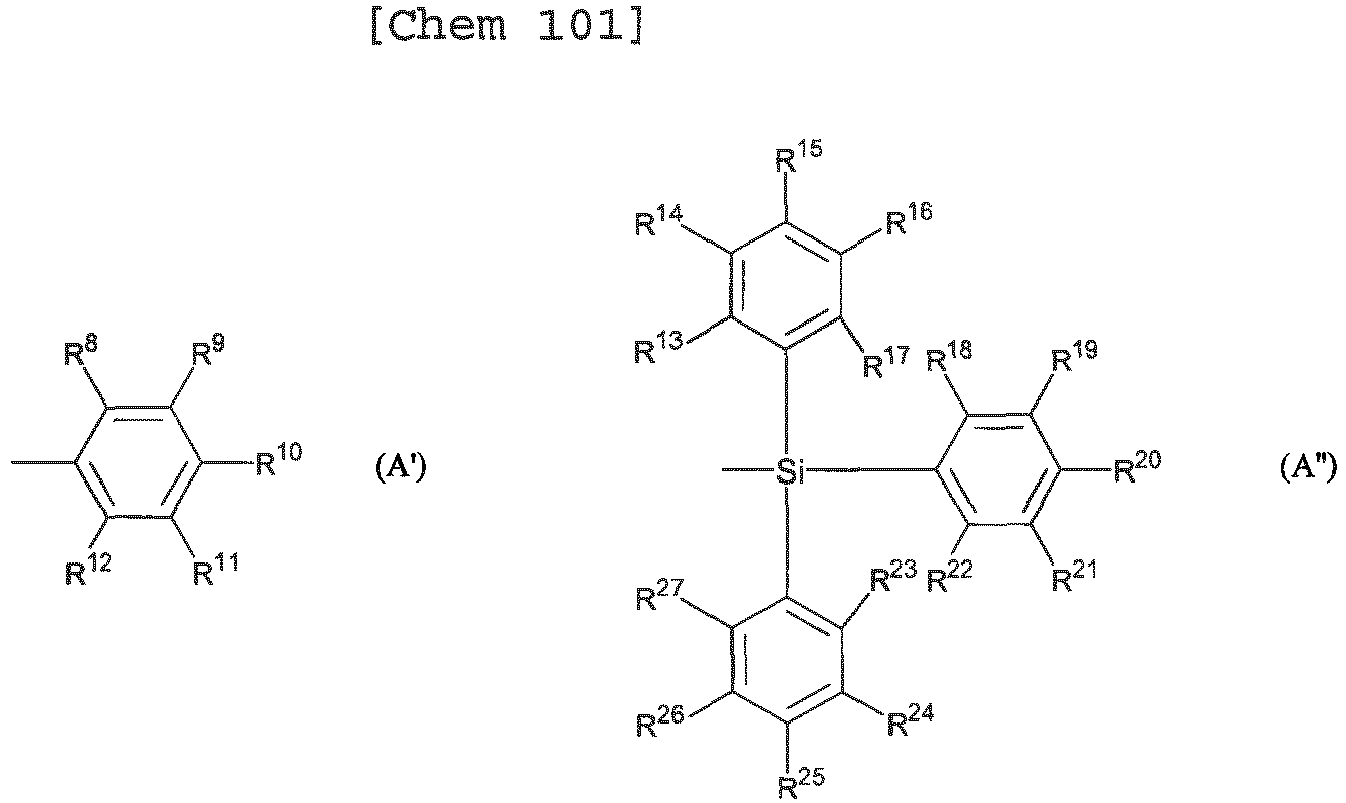
- (In the formula, R8 to R12 each independently represent a hydrogen atom, or a substituted or unsubstituted hydrocarbon group having 1 to 40 carbon atoms, and adjacent groups may form a cyclic structure. In addition, R13 to R27 each independently represent a hydrogen atom, or a substituted or unsubstituted hydrocarbon group having 1 to 40 carbon atoms, and adjacent groups may form a cyclic structure.)
- A nitrogen-containing heterocyclic derivative is a nitrogen-containing heterocyclic derivative formed of an organic compound having any one of the following formulae, and a nitrogen-containing compound which is not a metal complex is also an example of the derivative. Examples of the derivative include a five- or six-membered ring containing a skeleton represented by the following formula (a) and a derivative of a structure represented by the following formula (b).

- (In the formula (b), X represents a carbon atom or a nitrogen atom, and Z1 and Z2 each independently represent an atomic group capable of forming a nitrogen-containing heterocycle.)
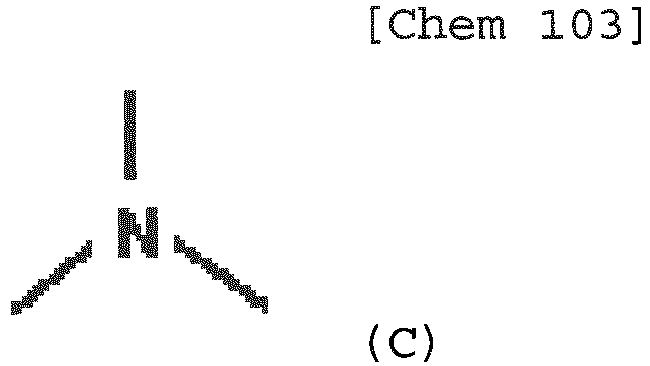
- An organic compound having a nitrogen-containing aromatic polycycle formed of a five- or six-memberedring is preferred. In the case of such nitrogen-containing aromatic polycycle having a plurality of nitrogen atoms, a nitrogen-containing aromatic polycyclic organic compound having a skeleton obtained by combining the above-mentioned formulae (a) and (b) or the above-mentioned formulae (a) and (c) is more preferred.
- The nitrogen-containing group of the nitrogen-containing organic compound is selected from, for example, nitrogen-containing heterocyclic groups represented by the following formulae.

- (In each of the formulae, R28 represents an aryl group having 6 to 40 carbon atoms, a heteroaryl group having 3 to 40 carbon atoms, an alkyl group having 1 to 20 carbon atoms, or an alkoxy group having 1 to 20 carbon atoms, when the number of R28 is two or more, a plurality of R28s may be identical to or different from each other.)
- Further, a preferred specific compound is, for example, a nitrogen-containing heterocyclic derivative represented by the following formula.
[Chem 105] HAra-L6-Arb-Arc
- (In the formula, HAra represents a nitrogen-containing heterocycle which has 3 to 40 carbon atoms and which may have a substituent, L6 represents a single bond, an arylene group which has 6 to 40 carbon atoms and which may have a substituent, or a heteroarylene group which has 3 to 40 carbon atoms and which may have a substituent, Arb represents a divalent aromatic hydrocarbon group which has 6 to 40 carbon atoms and which may have a substituent, and Arc represents an aryl group which has 6 to 40 carbon atoms and which may have a substituent, or a heteroaryl group which has 3 to 40 carbon atoms and which may have a substituent.)
- HAra is selected from, for example, the following group.
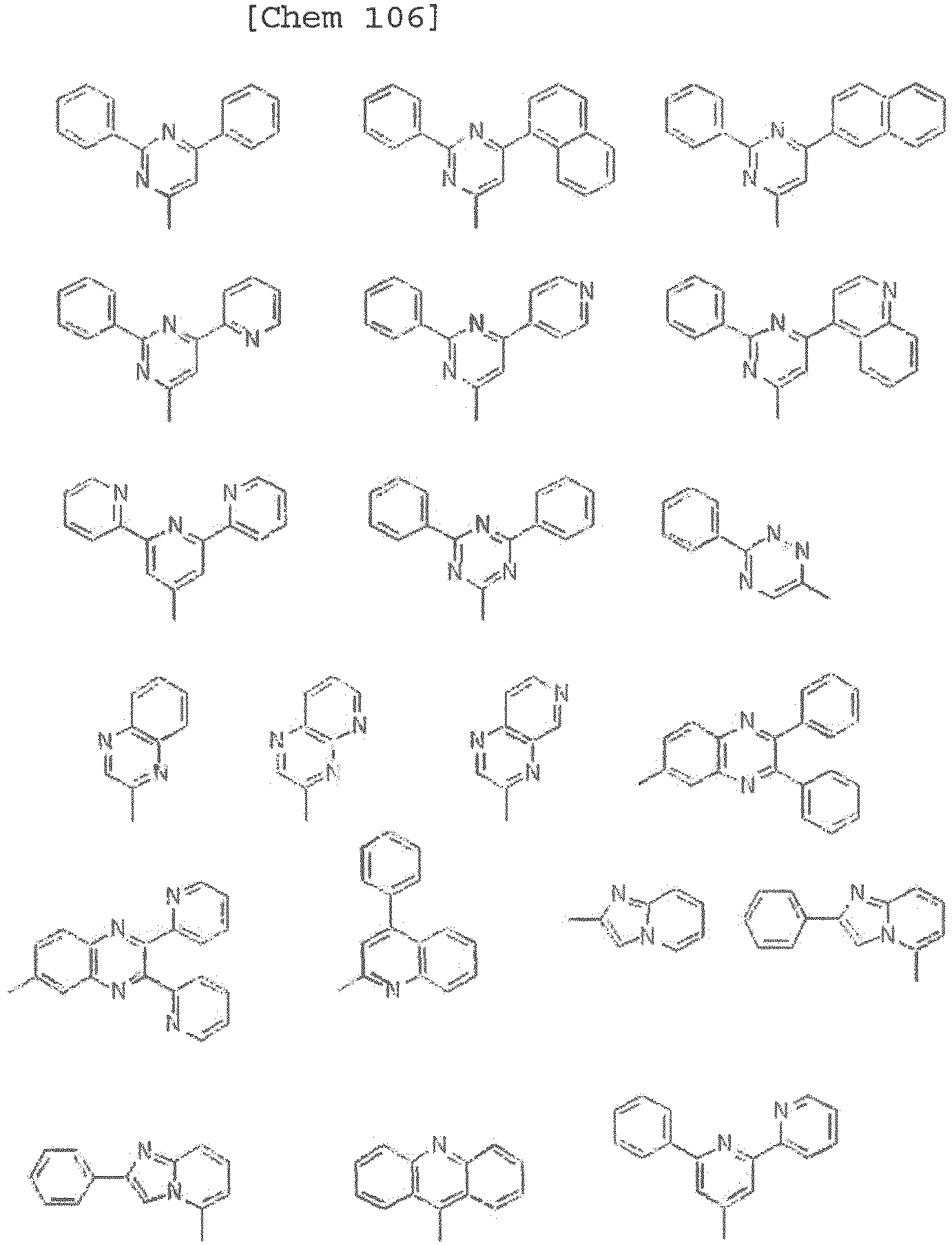
- L6 is selected from, for example, the following group.
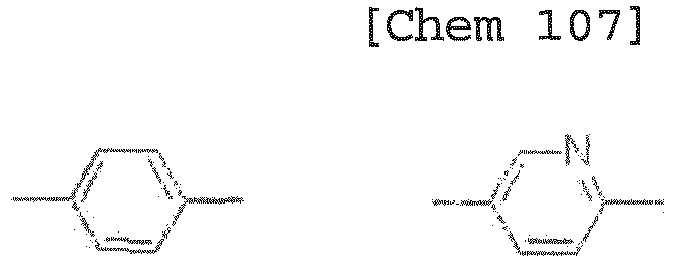
- Arc is selected from, for example, the following group.

- Arb is selected from, for example, the following arylanthranil group.
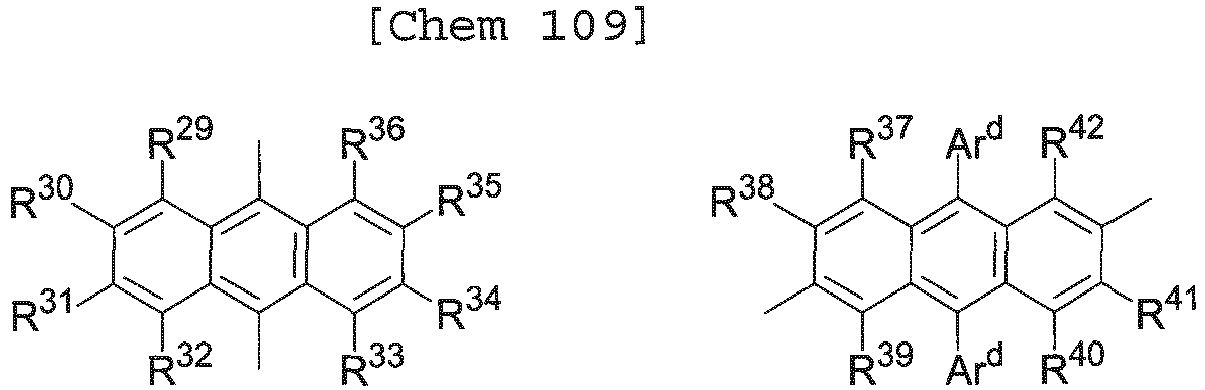
- (In the formulae, R29 to R42 each independently represent a hydrogen atom, a halogen atom, an alkyl group having 1 to 20 carbon atoms, an alkoxy group having 1 to 20 carbon atoms, an aryloxy group having 6 to 40 carbon atoms, an aryl group which has 6 to 40 carbon atoms and which may have a substituent, or a heteroaryl group having 3 to 40 carbon atoms, and Ard represents an aryl group which has 6 to 40 carbon atoms and which may have a substituent, or a heteroaryl group having 3 to 40 carbon atoms.)
- In addition, a nitrogen-containing heterocyclic derivative in which R29 to R36 in Arb represented by the above-mentioned formula each represent a hydrogen atom is preferred.
- In addition to the foregoing, the following compound (see
JP 09-3448 A 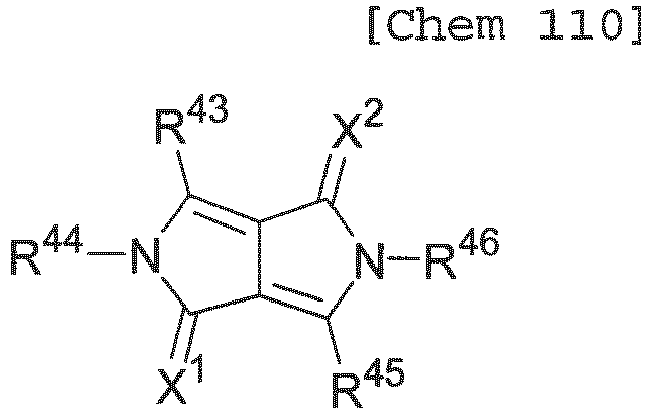
- (In the formula, R43 to R46 each independently represent a hydrogen atom, a substituted or unsubstituted aliphatic group, a substituted or unsubstituted alicyclic group, a substituted or unsubstituted carbocyclic aromatic ring group, or a substituted or unsubstituted heterocyclic group, and X1 and X2 each independently represent an oxygen atom, asulfuratom, or a dicyanomethylene group.)
- In addition, the following compound (see
JP 2000-173774 A 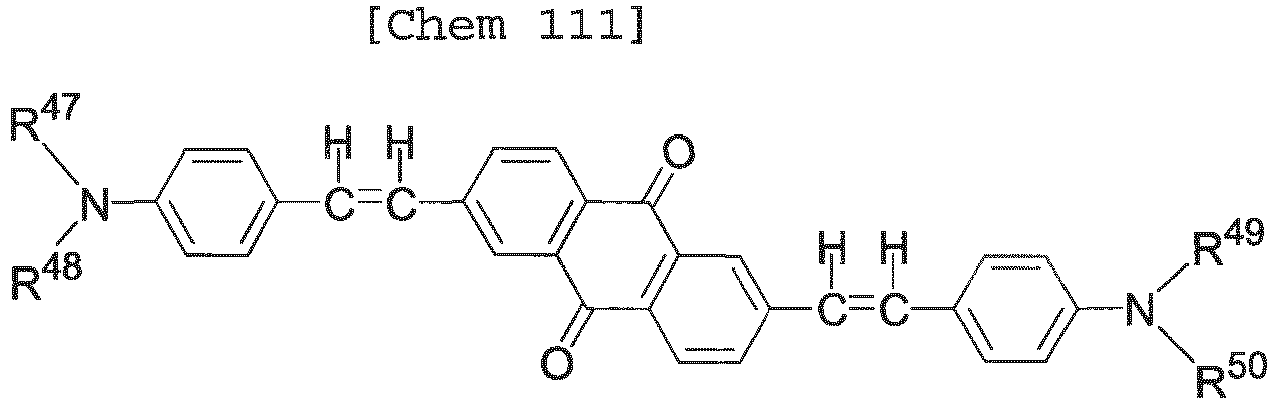
- In the formula, R47, R48, R49, and R50 represent groups identical to or different from one another, and each represent an aryl group represented by the following formula.
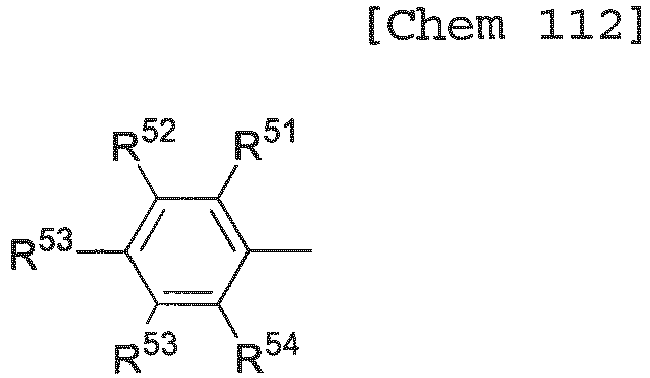
- (In the formula, R51, R52, R53, R54, and R55 represent groups identical to or different from one another, and each represent a hydrogen atom, or at least one of them may represent a saturated or unsaturated alkoxyl, alkyl, amino, or alkylamino group.)
- Further, a polymer compound containing the nitrogen-containing heterocyclic group or nitrogen-containing heterocyclic derivative is also permitted.
- In addition, the electron transporting layer preferably contains at least one of the nitrogen-containing heterocyclic derivatives represented by the following formulae (201) to (203).

- In the formulae (201) to (203), R56 represents a hydrogen atom, an aryl group which has 6 to 60 carbon atoms and which may have a substituent, a pyridyl group which may have a substituent, a quinolyl group which may have a substituent, an alkyl group which has 1 to 20 carbon atoms and which may have a substituent, or an alkoxy group which has 1 to 20 carbon atoms and which may have a substituent, n represents an integer of 0 to 4, R57 represents an aryl group which has 6 to 60 carbon atoms and which may have a substituent, a pyridyl group which may have a substituent, a quinolyl group which may have a substituent, an alkyl group which has 1 to 20 carbon atoms and which may have a substituent, or an alkoxy group having 1 to 20 carbon atoms, R58 and R59 each independently represent a hydrogen atom, an aryl group which has 6 to 60 carbon atoms and which may have a substituent, a pyridyl group which may have a substituent, a quinolyl group which may have a substituent, an alkyl group which has 1 to 20 carbon atoms and which may have a substituent, or an alkoxy group which has 1 to 20 carbon atoms and which may have a substituent, L7 represents a single bond, an arylene group which has 6 to 60 carbon atoms and which may have a substituent, a pyridinylene group which may have a substituent, a quinolinylene group which may have a substituent, or a fluorenylene group which may have a substituent, Are represents an arylene group which has 6 to 60 carbon atoms and which may have a substituent, a pyridinylene group which may have a substituent, or a quinolinylene group which may have a substituent, and Arf represents a hydrogen atom, an aryl group which has 6 to 60 carbon atoms and which may have a substituent, a pyridyl group which may have a substituent, a quinolyl group which may have a substituent, an alkyl group which has 1 to 20 carbon atoms and which may have a substituent, or an alkoxy group which has 1 to 20 carbon atoms and which may have a substituent.
- Arg represents an aryl group which has 6 to 60 carbon atoms and which may have a substituent, a pyridyl group which may have a substituent, a quinolyl group which may have a substituent, an alkyl group which has 1 to 20 carbon atoms and which may have a substituent, an alkoxy group which has 1 to 20 carbon atoms and which may have a substituent, or a group represented by -Are-Arf (Are and Arf each have the same meaning as that described above).
- In addition, as the nitrogen-containing ring derivative, nitrogen-containing five-membered ring derivative are preferably exemplified. Examples of the nitrogen-containing five-membered ring include an imidazole ring, a triazole ring, a tetrazole ring, an oxadiazole ring, a thiadiazole ring, an oxatriazole ring, and a thiatriazole ring. Examples of the nitrogen-containing five-membered ring derivative include a benzoimidazole ring, a benzotriazole ring, apyridinoimidazole ring, apyrimidinoimidazole ring, and a pyridazinoimidazole ring. Particularly preferred is the compound represented by the following formula (B).
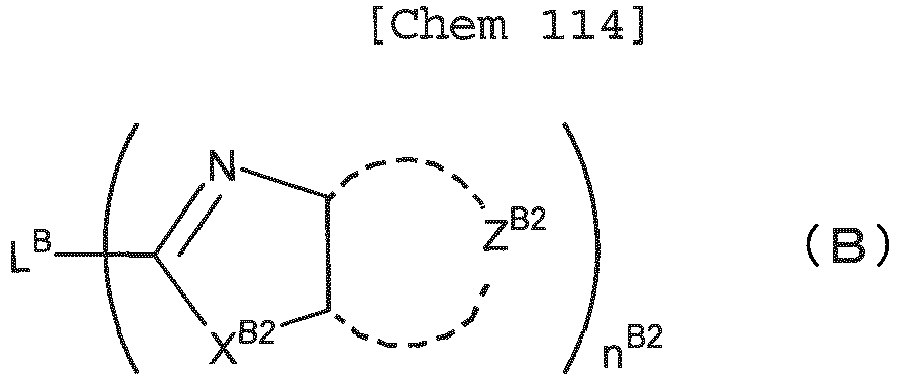
- In the formula (B), LB represents a divalent or more bonding group. Examples thereof include a carbon atom, a silicon atom, a nitrogen atom, a boron atom, an oxygen atom, a sulfur atom, metal atoms (for example, a barium atom, a beryllium atom), aromatic hydrocarbon rings, and aromatic heterocycles.
- Of the nitrogen-containing five-membered ring derivatives each represented by the formula (B), a derivative represented by the following formula (B') is more preferred.
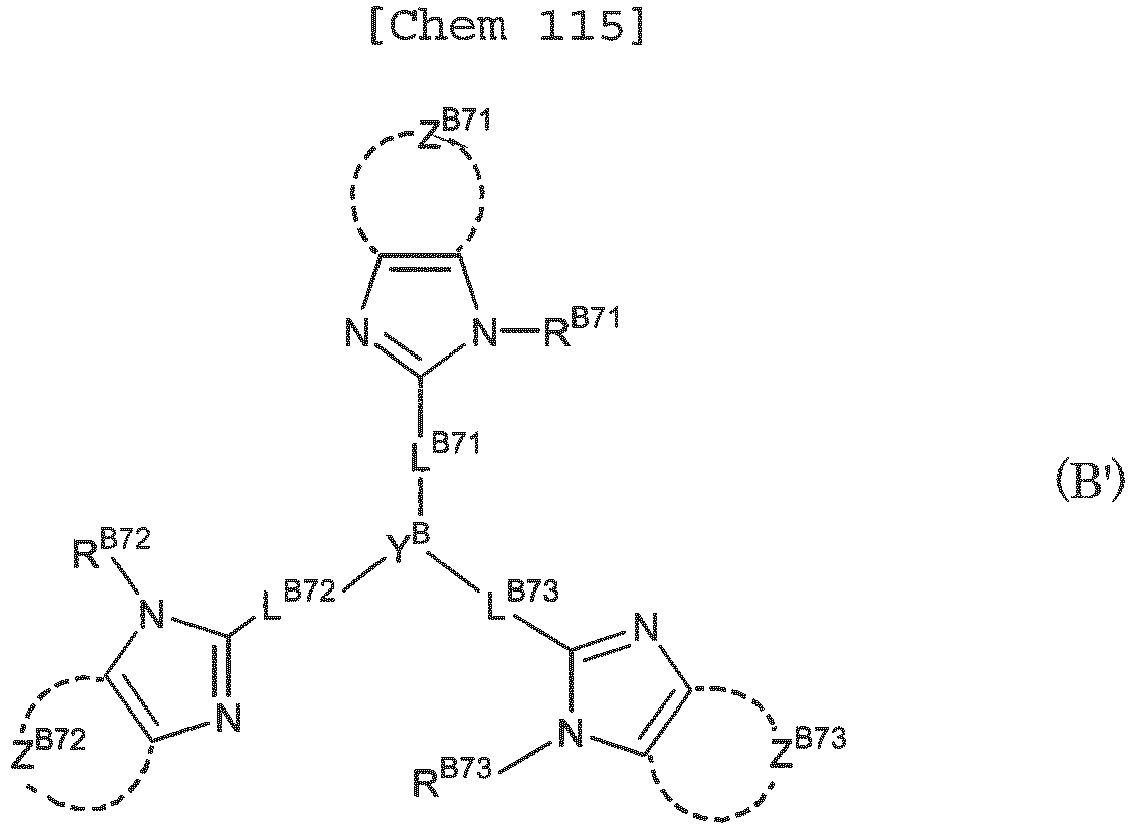
- In the formula (B'), RB71, RB72, and RB73 each have the same meaning as that of RB2 in the formula (B).
- ZB71, ZB72, and ZB73 each have the same meaning as that of ZB2 in the formula (B).
- LB71, LB72, and LB73 each represent a linking group, and examples of the linking group include examples obtained by making the examples of LB in the formula (B) divalent. The linking group is preferably a single bond, a divalent aromatic hydrocarbon ring group, a divalent aromatic heterocyclic group, or a linking group formed of a combination of two or more of them, or is more preferably a single bond. LB71, LB72, and LB73 may each have a substituent. Examples of the substituent include the same examples as those described for the substituent of the group represented by LB in the formula (B) .
- YB represents a nitrogen atom, a 1,3,5-benzenetriyl group, or a 2,4,6-triazinetriyl group.
- A compound of which each of the electron injecting layer and the electron transporting layer is formed is, for example, a compound having a structure obtained by combining an electron-deficient, nitrogen-containing five-membered ring skeleton or electron-deficient, nitrogen-containing six-membered ring skeleton and a substituted or unsubstituted indole skeleton, substituted or unsubstituted carbazole skeleton, or substituted or unsubstituted azacarbazole skeleton as well as the polycyclic compound of the present invention. In addition, a suitable electron-deficient, nitrogen-containing five-membered ring skeleton or electron-deficient, nitrogen-containing six-membered ring skeleton is a molecular skeleton such as a pyridine, pyrimidine, pyrazine, triazine, triazole, oxadiazole, pyrazole, imidazole, quinoxaline, or pyrrole skeleton, or benzimidazole or imidazopyridine obtained when two or more of them fuse with each other. Of those combinations, a preferred combination is, for example, a combination of a pyridine, pyrimidine, pyrazine, or triazine skeleton and a carbazole, indole, azacarbazole, or quinoxaline skeleton. The skeleton may be substituted or unsubstituted.
- Each of the electron injecting layer and the electron transporting layer may be of a monolayer structure formed of one or two or more kinds of the materials, or may be of a multi-layered structure formed of the plurality of layers identical to or different from each other in composition. Materials for those layers each preferably have a n-electron-deficient, nitrogen-containing heterocyclic group.
- In addition, an insulator or semiconductor serving as an inorganic compound as well as the nitrogen-containing ring derivative is preferably used as a component of the electron injecting layer. When the electron injecting layer is formed of an insulator or semiconductor, current leakage can be effectively prevented, and the electron injecting property of the layer can be improved.
- As the insulator, at least one metal compound selected from the group consisting of alkali metal chalcogenides, alkaline earth metal chalcogenides, alkali metal halides, and alkaline earth metal halides is preferably used. It is preferred that the electron injecting layer be formed of the alkali metal chalcogenide or the like since the electron injecting property can be further improved. To be specific, preferred examples of the alkali metal chalcogenide include Li2O, K2O, Na2S, Na2Se, and Na2O, and preferred examples of the alkaline earth metal chalcogenide include CaO, BaO, SrO, BeO, BaS, and CaSe. In addition, preferred examples of the alkali metal halide include LiF, NaF, KF, LiCl, KCl, andNaCl. Further, preferred examples of the alkaline earth metal halide include fluorides such as CaF2, BaF2, SrF2, MgF2, and BeF2 and halides other than the fluorides .
- In addition, examples of the semiconductor include oxides, nitrides, and oxide nitrides containing at least one element selected from the group consisting of Ba, Ca, Sr, Yb, Al, Ga, In, Li, Na, Cd, Mg, Si, Ta, Sb, and Zn. One kind of them may be used alone, or two or more kinds of them may be used in combination. In addition, it is preferred that the inorganic compound composing the electron injecting layer form a crystallite or amorphous insulating thin film. When the electron injecting layer is formed of the insulating thin film, a more uniform thin film can be formed, and defects of pixels such as dark spots can be decreased. It should be noted that examples of the inorganic compound include alkali metal chalcogenides, alkaline earth metal chalcogenides, alkali metal halides, and alkaline earth metal halides.
- Inaddition, the reducing dopant can be preferably incorporated into the electron injecting layer in the present invention.
- It should be noted that the thickness of each of the electron injecting layer and the electron transporting layer, which is not particularly limited, is preferably 1 to 100 nm.
- An aromatic amine compound such as an aromatic amine derivative represented by the formula (I) is suitably used in the hole injecting layer or hole transporting layer (a hole injecting/transporting layer is also included in this category).

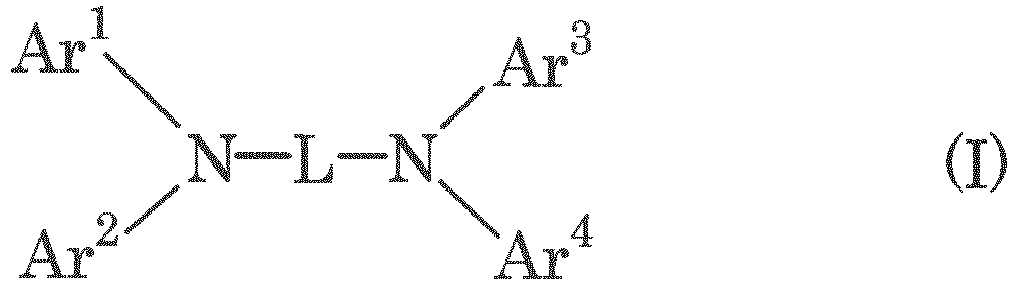
- In the formula (I), Ar1 to Ar4 each represent a substituted or unsubstituted aryl group having a ring formed of 6 to 50 carbon atoms, or a substituted or unsubstituted heteroaryl group having a ring formed of 5 to 50 atoms.
- L represents a linking group, and specifically, a substituted or unsubstituted arylene group having a ring formed of 6 to 50 carbon atoms, a substituted or unsubstituted heteroarylene group having a ring formed of 5 to 50 atoms, or a divalent group in which two or more arylene groups or heteroarylene groups are bonded by a single bond, an ether bond, a thioether bond, with an alkylene group having 1 to 20 carbon atoms, an alkenylene group having 2 to 20 carbon atoms, and an amino group.
- In addition, an aromatic amine represented by the following formula (II) is also suitably used in the formation of the hole injecting layer or hole transporting layer.

- In the formula (II), the definition of Ar1 to Ar3 is the same as that of Ar1 to Ar4 in the formula (I).
- The compound of the present invention can be used in each of the hole injecting layer, the hole transporting layer, the electron injecting layer, and the electron transporting layer because the compound can transport both a hole and an electron.
- The anode in the organic EL device has the function of injecting holes into the hole transporting layer or the light emitting layer. It is effective that the anode has a work function of 4.5 eV or more. Specific examples of the material for the anode used in the present invention include indium tin oxide alloys (ITO), tin oxide (NESA), gold, silver, platinum, and copper. In addition, as the cathode, a material having a small work function is preferred in view to inject an electron into an electron-injecting layer or a light-emitting layer. Examples of the cathode material are not particularly limited, and specifically, indium, aluminum, magnesium, a magnesium-indium alloy, a magnesium-aluminum alloy, an aluminum-lithium alloy, an aluminum-scandium-lithium alloy, and a magnesium-silver alloy may be used.
- The method of forming the layers in the organic EL device is not particularly limited. A conventionally known process such as the vacuum vapor deposition process or the spin coating process can be used. The organic thin film layer which is used in the organic EL device and includes the compound represented by the formula (1) can be formed in accordance with a known process such as the vacuum vapor deposition process or the molecular beam epitaxy process (MBE process) or, using a solution prepared by dissolving the compounds into a solvent, in accordance with a coating process such as the dipping process, the spin coating process, the casting process, the bar coating process, or the roll coating process.
- The thickness of each layer in the organic thin film layer in the organic EL device is not particularly limited. In general, an excessively thin layer tends to have defects such as pin holes, whereas an excessively thick layer requires a high applied voltage to decrease the efficiency. Therefore, a thickness in the range of several nanometers to 1 µm is typically preferred.
- Next, the present invention is described in detail by way of examples, but the present invention is not limited to the following examples. Note that, in the synthetic examples below, DMF refers to dimethylformamide, THF refers to tetrahydrofuran, DME refers to dimethoxyethane, NBS refers to N-bromosuccine imide, Ph refers to a phenyl group, AcOEt refers to ethyl acetate, and NMP refers to N-methyl pyrrolidone.
-
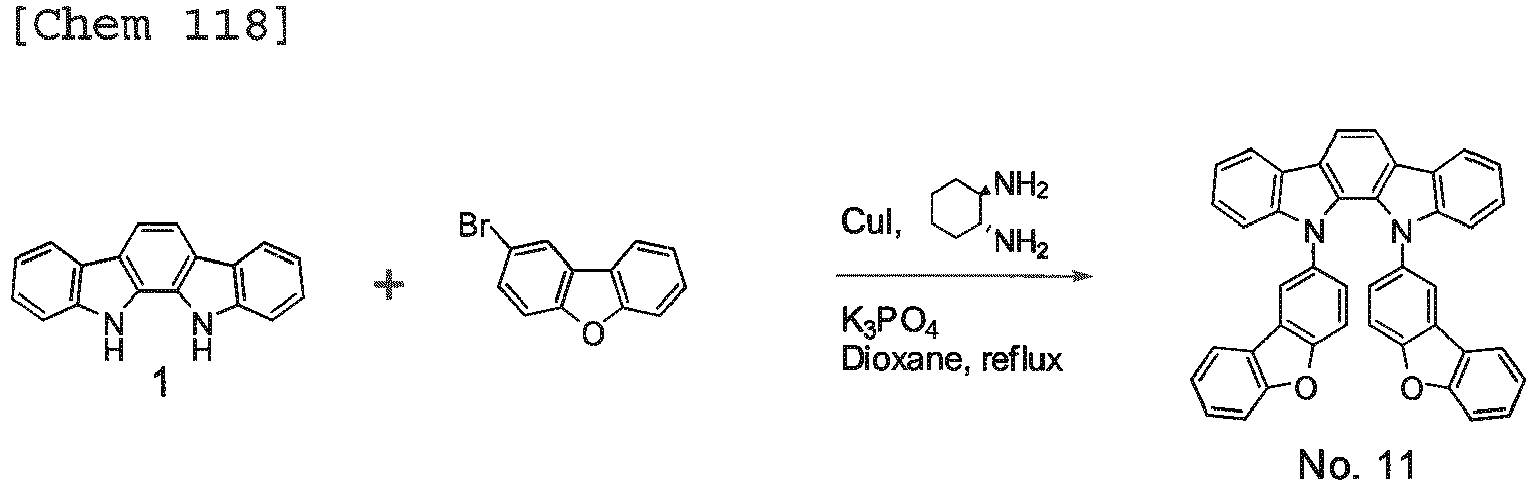
- Compound 1 (2.6 g, 10 mmol), 2-bromodibenzofuran (5.0 g, 20 mmol), CuI (1.9 g, 10 mmol), trans-cyclohexane-1,2-diamine (3.4 g, 30 mmol), K3PO4 (8.5 g, 40 mmol), and 1,4-dioxane (10 mL) were loaded into a three-necked flask, and the mixture was refluxed under an argon atmosphere for 10 hours.
- After the completion of the reaction, the resultant was cooled to room temperature. The resultant sample was transferred to a separating funnel, and water (50 mL) was charged into the funnel. Then, the mixture was extracted with CH2Cl2. The resultant sample was purified by column chromatography. The purified product was concentrated to dryness, and was then recrystallized twice, whereby a white powder (Compound No. 11 (not according to the invention)) was obtained. The powder was purified by sublimation, whereby a white solid was obtained in an amount of 0.7g in 12% yield.
FD-MS analysis C42H24N2O2: theoretical value 588, observed value 588 -

- Compound 2 (2.6 g, 10 mmol), 2-bromodibenzofuran (5.0 g, 20 mmol), CuI (1.9 g, 10 mmol), trans-cyclohexane-1,2-diamine (3.4 g, 30 mmol), K3PO4 (8.5 g, 40 mmol), and 1,4-dioxane (10 mL) were loaded into a three-necked flask, and the mixture was refluxed under an argon atmosphere for 10 hours.
- After the completion of the reaction, the resultant was cooled to room temperature. The resultant sample was transferred to a separating funnel, and water (50 mL) was charged into the funnel. Then, the mixture was extracted with CH2Cl2. The resultant sample was purified by column chromatography. The purified product was concentrated to dryness, and was then recrystallized twice, whereby a white powder (Compound No. 40 (not according to the invention)) was obtained. The powder was purified by sublimation, whereby a white solid was obtained in an amount of 1.9 g in 33% yield.
FD-MS analysis C42H24N2O2: theoretical value 588, observed value 588 -

- Compound 3 (2.6 g, 10 mmol), 2-bromodibenzofuran (5.0 g, 20 mmol), CuI (1.9 g, 10 mmol), trans-cyclohexane-1,2-diamine (3.4 g, 30 mmol), K3PO4 (8.5 g, 40 mmol), and 1,4-dioxane (10 mL) were loaded into a three-necked flask, and the mixture was refluxed under an argon atmosphere for 10 hours.
- After the completion of the reaction, the resultant was cooled to room temperature. The resultant sample was transferred to a separating funnel, and water (50 mL) was charged into the funnel. Then, the mixture was extracted with CH2Cl2. The resultant sample was purified by column chromatography. The purified product was concentrated to dryness, and was then recrystallized twice, whereby a white powder (Compound No. 47 (not according to the invention)) was obtained. The powder was purified by sublimation, whereby a white solid was obtained in an amount of 1.5 g in 25% yield.
FD-MS analysis C42H24N2O2: theoretical value 588, observed value 588 -

- Compound 4 (2.6 g, 10 mmol), 2-bromodibenzofuran (5.0 g, 20 mmol), CuI (1.9 g, 10 mmol), trans-cyclohexane-1,2-diamine (3.4 g, 30 mmol), K3PO4 (8.5 g, 40 mmol), and 1,4-dioxane (10 mL) were loaded into a three-necked flask, and the mixture was refluxed under an argon atmosphere for 10 hours.
- After the completion of the reaction, the resultant was cooled to room temperature. The resultant sample was transferred to a separating funnel, and water (50 mL) was charged into the funnel. Then, the mixture was extracted with CH2Cl2. The resultant sample was purified by column chromatography. The purified product was concentrated to dryness, and was then recrystallized twice, whereby a white powder (Compound No. 66 (not according to the invention)) was obtained. The powder was purified by sublimation, whereby a white solid was obtained in an amount of 2.4 g in 40% yield.
FD-MS analysis C42H24N2O2: theoretical value 588, observed value 588 -
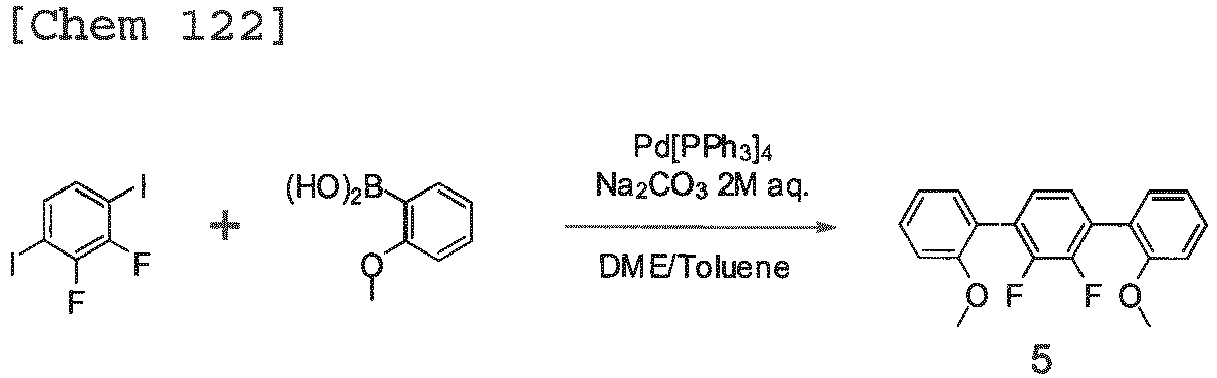
- 1,2-difluor-3,6-diiodobenzene (65.9 g, 180.0 mmol), 2-methoxyphenylboronic acid (65.6 g, 432.0 mmol), and a 2 M aqueous solution of Na2CO3 (360 mL, 720 mmol), DME (360 mL), toluene (360 mL), and Pd[PPh3]4 (20.8 g, 18.0 mmol) were loaded into a three-necked flask, and the mixture was refluxed under an Ar atmosphere for 8 hours.
- After the completion of the reaction, the resultant was cooled to room temperature. The resultant sample was transferred to a separating funnel, and water (500 mL) was charged into the funnel. Then, the mixture was extracted with CH2Cl2. The extract was dried with MgSO4, and was then filtered and concentrated. The resultant sample was purified by silica gel column chromatography, whereby a white solid was obtained in an amount of 38.2 g in 65% yield.
FD-MS analysis C20H16F2O2: theoretical value 326, observed value 326 -

- Compound 5 (38.0g, 116.4mmol), NBS (41.5g, 232.9mmol), and DMF (1000 mL) were loaded into a three-necked flask, and the mixture was stirred under an Ar atmosphere at room temperature for 8 hours . After the completion of the reaction, the resultant sample was transferred to a separating funnel, and water (1000 mL) was charged into the funnel. Then, the mixture was extracted with AcOEt. The resultant sample was purified by column chromatography, whereby a white solid was obtained in an amount of 45.1 g in 80% yield.
FD-MS analysis C20H14Br2F2O2: theoretical value 484, observed value 484 -
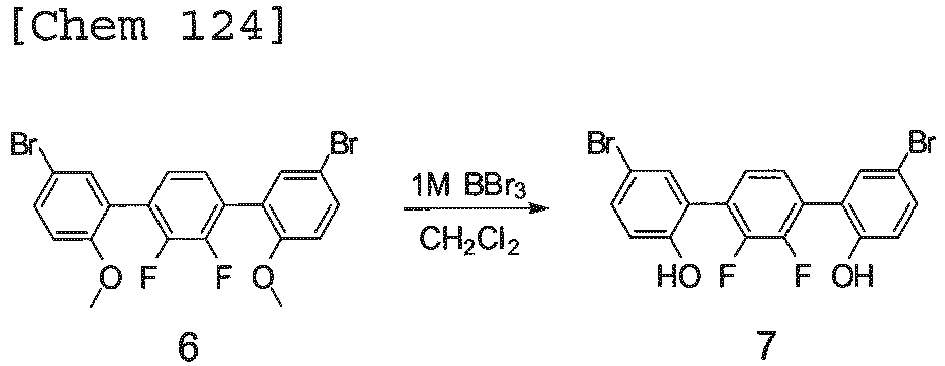
- Compound 6 (45.0 g, 93.0 mmol), a 1 M solution of BBr3 in CH2Cl2 (218 mL, 218 mmol), and CH2Cl2 (560 mL) were loaded into a three-necked flask, and the mixture was stirred under an Ar atmosphere at 0°C for 8 hours. After that, the mixture was left to stand at room temperature overnight. After the completion of the reaction, the resultant was neutralized with a saturated aqueous solution of NaHCO3. The resultant sample was transferred to a separating funnel, and was extracted with CH2Cl2. The resultant sample was purified by column chromatography, whereby a white solid was obtained in an amount of 35.2 g in 83% yield.
FD-MS analysis C18H10Br2F2O2: theoretical value 456, observed value 456 -
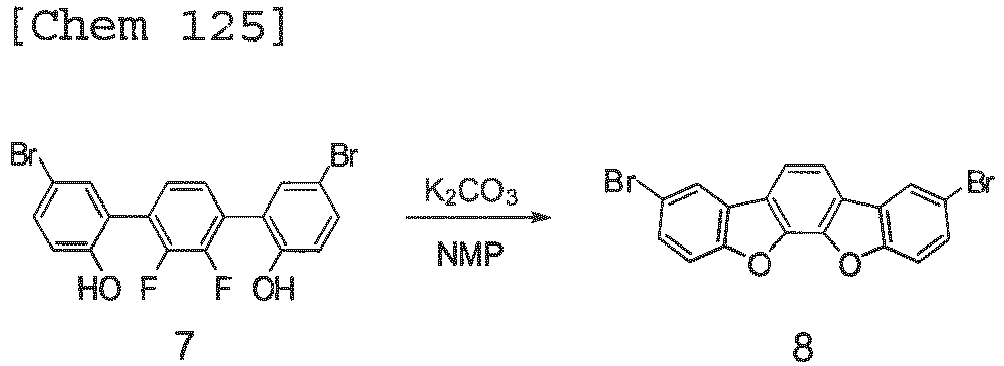
- Compound 7 (35.0 g, 76.7 mmol), K2CO3 (23.3 g, 168.8 mmol), and NMP (320 mL) were loaded into a three-necked flask, and the mixture was stirred under an Ar atmosphere at 150°C for 8 hours. After the completion of the reaction, the resultant was cooled to room temperature. The resultant sample was transferred to a separating funnel, and water (500 mL) was charged into the funnel. Then, the mixture was extracted with AcOEt. The resultant sample was purified by column chromatography, whereby a white solid was obtained in an amount of 27.1 g in 85% yield.
FD-MS analysis C18H8Br2O2: theoretical value 416, observed value 416 -

- Compound 8 (2.5 g, 6.0 mmol), Compound 9 (3.8 g, 13.2 mmol), a 2 M aqueous solution of Na2CO3 (12 mL, 24 mmol), DME (12 mL), toluene (12 mL), and Pd[PPh3]4 (0.35 g, 0.3 mmol) were loaded into a three-necked flask, and the mixture was refluxed under an Ar atmosphere for 8 hours.
- After the completion of the reaction, the resultant was cooled to room temperature. The resultant sample was transferred to a separating funnel, and water (50 mL) was charged into the funnel. Then, the mixture was extracted with CH2Cl2. The extract was dried with MgSO4, and was then filtered and concentrated. The resultant sample was purified by silica gel column chromatography. The purified product was concentrated to dryness, and was then recrystallized twice, whereby a white powder (Compound No. 100 (not according to the invention)) was obtained. The powder was purified by sublimation, whereby a white solid was obtained in an amount of 2.0 g in 45% yield.
FD-MS analysis C54H30O4: theoretical value 742, observed value 742 -
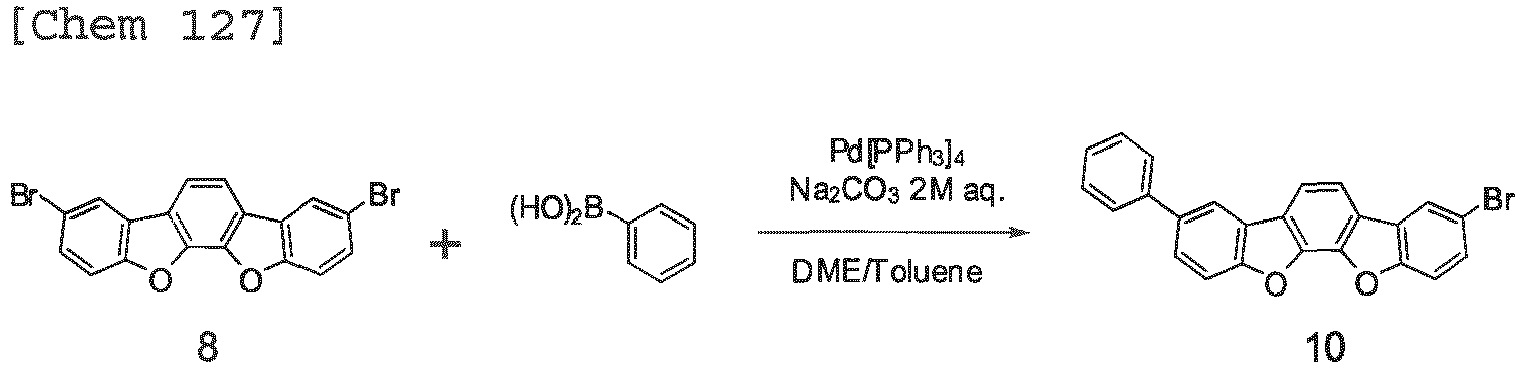
- Compound 8 (16.8 g, 40 mmol), phenylboronic acid (4.8 g, 40 mmol), a 2 M aqueous solution of Na2CO3 (80 mL, 160 mmol), DME (80 mL), toluene (80 mL), and Pd[PPh3]4 (2.3 g, 2.0 mmol) were loaded into a three-necked flask, and the mixture was refluxed under an Ar atmosphere for 8 hours.
- After the completion of the reaction, the resultant was cooled to room temperature. The resultant sample was transferred to a separating funnel, and water (150 mL) was charged into the funnel. Then, the mixture was extracted with CH2Cl2. The extract was dried with MgSO4, and was then filtered and concentrated. The resultant sample was purified by silica gel column chromatography, whereby a white solid was obtained in an amount of 12.4 g in 75% yield. FD-MS analysis C24H13BrO2: theoretical value 413, observed value 413
-
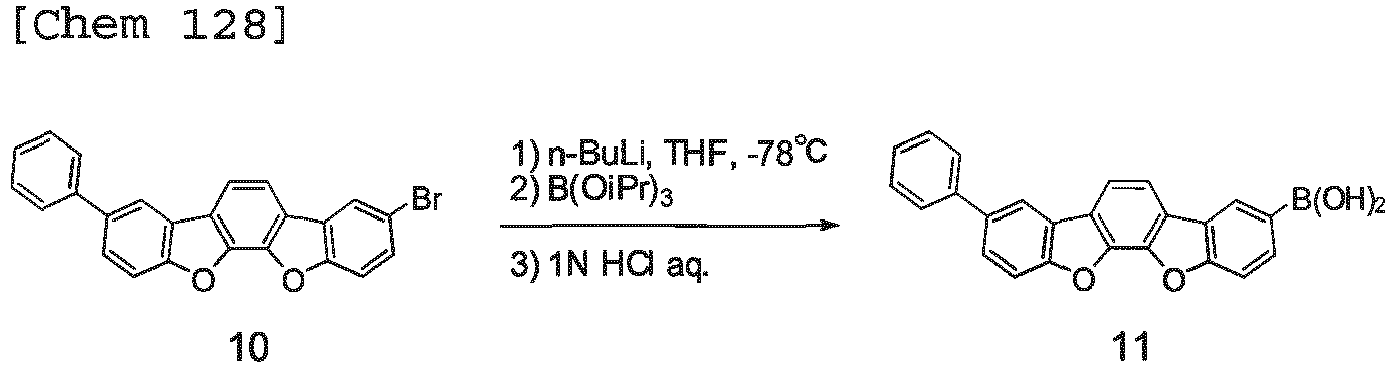
- Compound 10 (12.0 g, 29.0 mmol) and THF (288 mL) were loaded into a three-necked flask, and the mixture was cooled to -78°C. Then, n-BuLi (1.65 M solution in n-hexane, 19.4 mL, 31.9 mmol) was added dropwise to the flask, and the resultant mixture was stirred at -78°C for 20 minutes. Triisopropyl borate (16.4 g, 87.0 mmol) was added to the resultant, and the mixture was stirred at -78°C for 1 hour. After that, the resultant was left to stand overnight at room temperature. Then, 1 N HCl (100 mL) was charged into the resultant, and the mixture was stirred at room temperature for 1 hour. The resultant sample was concentrated, and was then transferred to a separating funnel. Water (100 mL) was charged into the funnel, and the mixture was extracted with CH2Cl2. The extract was dried with MgSO4, and was then filtered and concentrated. The resultant sample was purified by recrystallization (toluene-hexane), whereby a white solid was obtained in an amount of 7.1 g in 65% yield.
-
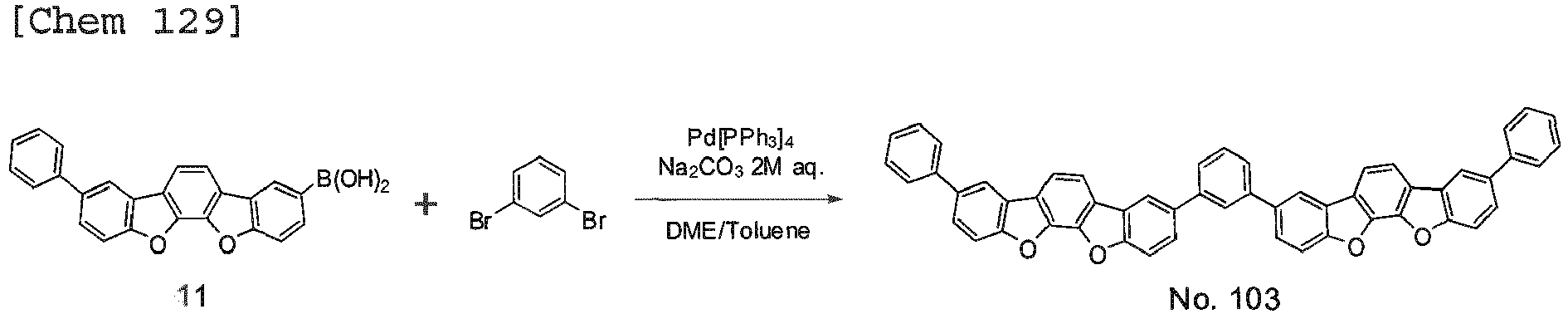
- Compound 11 (5.5g, 14.5 mmol), 1,3-dibromobenzene (1.7 g, 7.3 mmol), a 2 M aqueous solution of Na2CO3 (15 mL, 30 mmol), DME (15 mL), toluene (15 mL), and Pd[PPh3]4 (0.42 g, 0.37 mmol) were loaded into a three-necked flask, and the mixture was refluxed under an Ar atmosphere for 8 hours.
- After the completion of the reaction, the resultant was cooled to room temperature. The resultant sample was transferred to a separating funnel, and water (50 mL) was charged into the funnel. Then, the mixture was extracted with CH2Cl2. The extract was dried with MgSO4, and was then filtered and concentrated. The resultant sample was purified by silica gel column chromatography. The purified product was concentrated to dryness, and was then recrystallized twice, whereby a white powder (Compound No. 103 (not according to the invention)) was obtained. The powder was purified by sublimation, whereby a white solid was obtained in an amount of 2.4 g in 45% yield.
FD-MS analysis C54H30O4: theoretical value 742, observed value 742 -
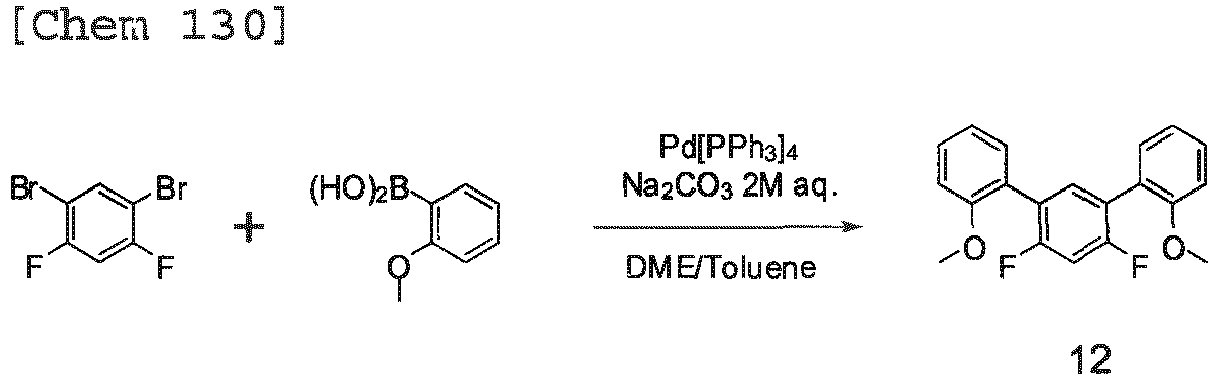
- 1,3-dibromo-4,6-difluorobenzene (50.0 g, 183.9 mmol), 2-methoxyphenylboronic acid (67.1 g, 441.4 mmol), a 2 M aqueous solution of Na2CO3 (368 mL, 736 mmol), DME (370 mL), toluene (370 mL), and Pd [PPh3]4 (21 g, 18.0 mmol) were loaded into a three-necked flask, and the mixture was refluxed under an Ar atmosphere for 8 hours.
- After the completion of the reaction, the resultant was cooled to room temperature. The resultant sample was transferred to a separating funnel, and water (500 mL) was charged into the funnel. Then, the mixture was extracted with CH2Cl2. The extract was dried with MgSO4, and was then filtered and concentrated. The resultant sample was purified by silica gel column chromatography, whereby a white solid was obtained in an amount of 40.2 g in 67% yield. FD-MS analysis C20H16F2O2: theoretical value 326, observed value 326
-
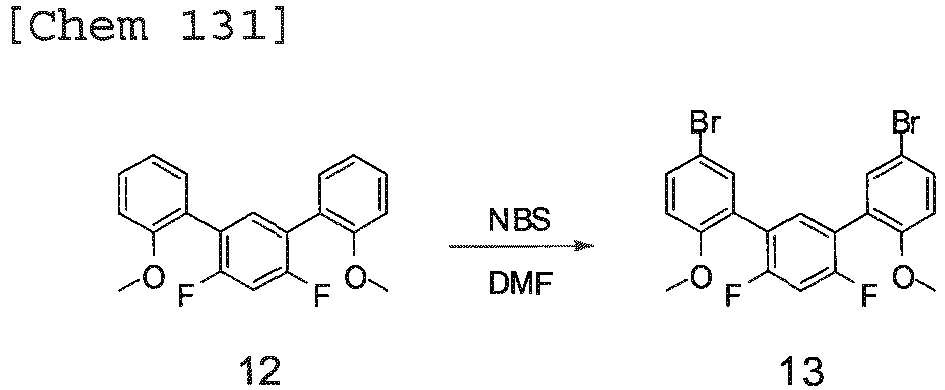
- Compound 12 (40.0 g, 122.6 mmol), NBS (43.6 g, 245 mmol), and DMF (1000 mL) were loaded into a three-necked flask, and the mixture was stirred under an Ar atmosphere at room temperature for 8 hours. After the completion of the reaction, the resultant sample was transferred to a separating funnel, and water (1000 mL) was charged into the funnel. Then, the mixture was extracted with AcOEt. The resultant sample was purified by column chromatography, whereby a white solid was obtained in an amount of 42.1 g in 71% yield. FD-MS analysis C20H14Br2F2O2: theoretical value 484, observed value 484
-

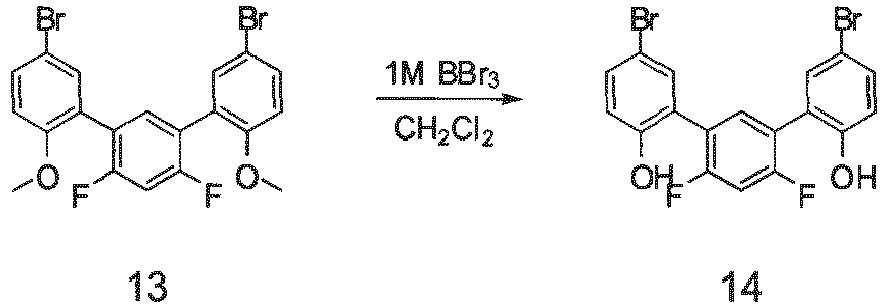
- Compound 13 (40.0 g, 82.6 mmol), a 1 M solution of BBr3 in CH2Cl2 (194 mL, 194 mmol), and CH2Cl2 (500 mL) were loaded into a three-necked flask, and the mixture was stirred under an Ar atmosphere at 0°C for 8 hours. After that, the mixture was left to stand at room temperature overnight. After the completion of the reaction, the resultant was neutralized with a saturated aqueous solution of NaHCO3. The resultant sample was transferred to a separating funnel, and was extracted with CH2Cl2. The resultant sample was purified by column chromatography, whereby a white solid was obtained in an amount of 30.2 g in 80% yield.
FD-MS analysis C18H10Br2F2O2: theoretical value 456, observed value 456 -
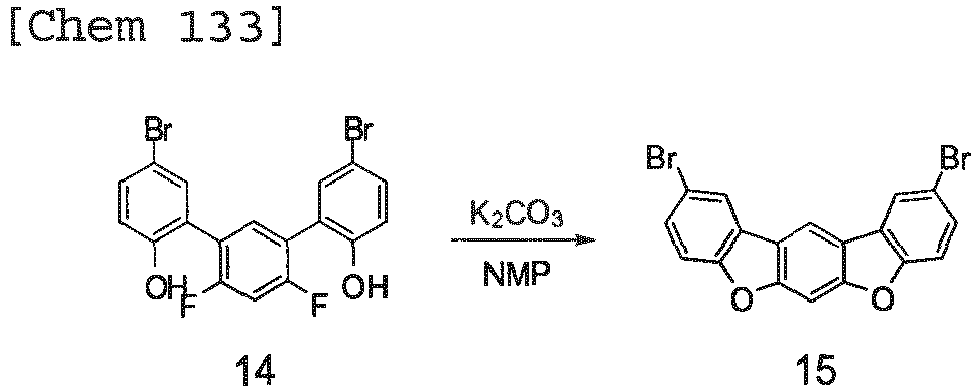
- Compound 14 (30.0 g, 65.7 mmol), K2CO3 (19.9 g, 144.5 mmol), and NMP (270 mL) were loaded into a three-necked flask, and the mixture was stirred under an Ar atmosphere at 150°C for 8 hours. After the completion of the reaction, the resultant was cooled to room temperature. The resultant sample was transferred to a separating funnel, and water (500 mL) was charged into the funnel. Then, the mixture was extracted with AcOEt. The resultant sample was purified by column chromatography, whereby a white solid was obtained in an amount of 21.9 g in 80% yield.
FD-MS analysis C18H8Br2O2: theoretical value 416, observed value 416 -
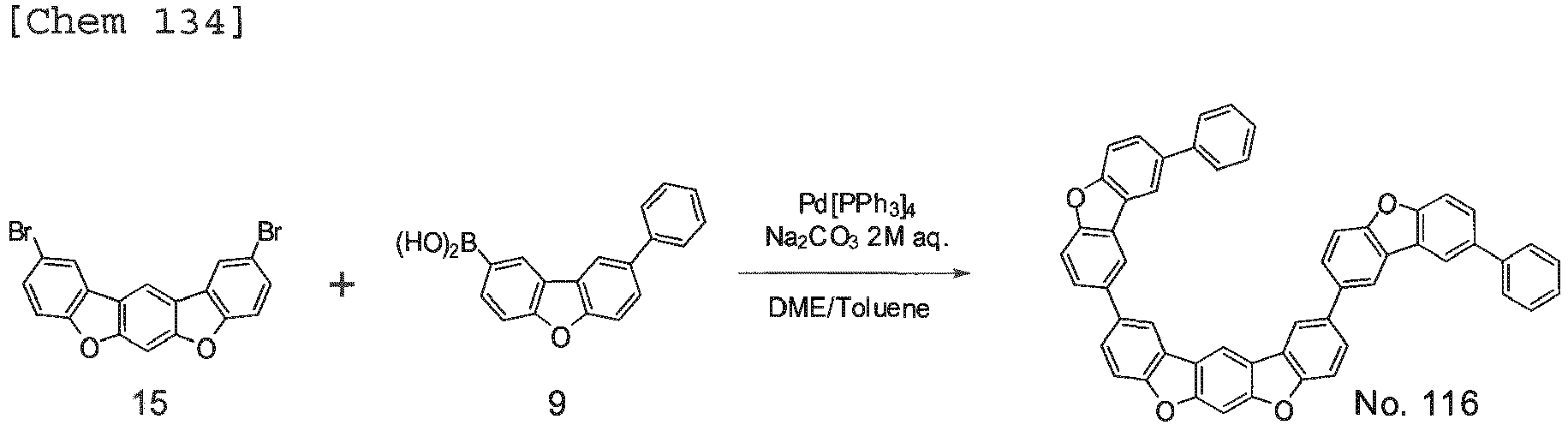
- Compound 15 (2.5 g, 6.0 mmol), Compound 9 (3.8 g, 13.2 mmol), a 2 M aqueous solution of Na2CO3 (12 mL, 24 mmol), DME (12 mL), toluene (12 mL), and Pd[PPh3]4 (0.35 g, 0.3 mmol) were loaded into a three-necked flask, and the mixture was refluxed under an Ar atmosphere for 8 hours.
- After the completion of the reaction, the resultant was cooled to room temperature. The resultant sample was transferred to a separating funnel, and water (50 mL) was charged into the funnel. Then, the mixture was extracted with CH2Cl2. The extract was dried with MgSO4, and was then filtered and concentrated. The resultant sample was purified by silica gel column chromatography. The purified product was concentrated to dryness, and was then recrystallized twice, whereby a white powder (Compound No. 116) was obtained. The powder was purified by sublimation, whereby a white solid was obtained in an amount of 2.7 g in 60% yield. FD-MS analysis C54H30O4: theoretical value 742, observed value 742
-

- Compound 15 (16.8 g, 40. 0 mmol), phenylboronic acid (4.8 g, 40 mmol), a 2 M aqueous solution of Na2CO3 (80 mL, 160 mmol), DME (80 mL), toluene (80 mL), and Pd[PPh3]4 (2.3 g, 2.0 mmol) were loaded into a three-necked flask, and the mixture was refluxed under an Ar atmosphere for 8 hours.
- After the completion of the reaction, the resultant was cooled to room temperature. The resultant sample was transferred to a separating funnel, and water (150 mL) was charged into the funnel. Then, the mixture was extracted with CH2Cl2. The extract was dried with MgSO4, and was then filtered and concentrated. The resultant sample was purified by silica gel column chromatography, whereby a white solid was obtained in an amount of 11.6 g in 70% yield. FD-MS analysis C24H13BrO2: theoretical value 413, observed value 413
-
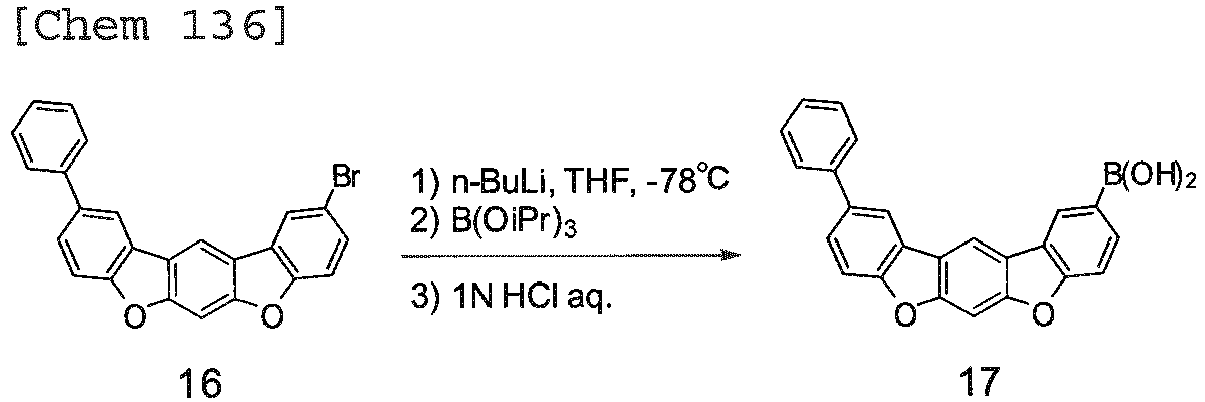
- Compound 16 (11.0 g, 26.6 mmol) and THF (264 mL) were loaded into a three-necked flask, and the mixture was cooled to -78°C. Then, n-BuLi (1.65 M solution in n-hexane, 17.7 mL, 29.3 mmol) was added dropwise to the flask, and the resultant mixture was stirred at -78°C for 20 minutes. Triisopropyl borate (15.1 g, 80 mmol) was added to the resultant, and the mixture was stirred at -78°C for 1 hour. After that, the resultant was left to stand overnight at room temperature. Then, 1 N HCl (100 mL) was charged into the resultant, and the mixture was stirred at room temperature for 1 hour. The resultant sample was concentrated, and was then transferred to a separating funnel. Water (100 mL) was charged into the funnel, and the mixture was extracted with CH2Cl2. The extract was dried with MgSO4, and was then filtered and concentrated. The resultant sample was purified by recrystallization (toluene-hexane), whereby a white solid was obtained in an amount of 6.1 g in 61% yield.
-
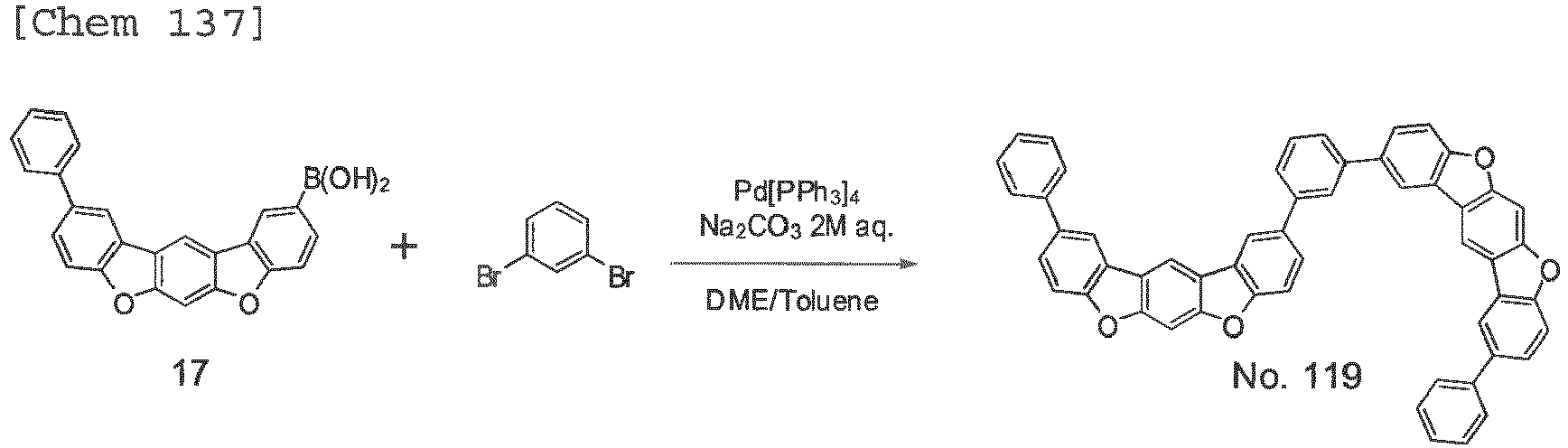
- Compound 17 (5.5 g, 14.5 mmol), 1,3-dibromobenzene (1.7 g, 7.3 mmol), a 2 M aqueous solution of Na2CO3 (15 mL, 30 mmol), DME (15 mL), toluene (15 mL), and Pd[PPh3]4 (0.42 g, 0.37 mmol) were loaded into a three-necked flask, and the mixture was refluxed under an Ar atmosphere for 8 hours.
- After the completion of the reaction, the resultant was cooled to room temperature. The resultant sample was transferred to a separating funnel, and water (50 mL) was charged into the funnel. Then, the mixture was extracted with CH2Cl2. The extract was dried with MgSO4, and was then filtered and concentrated. The resultant sample was purified by silica gel column chromatography. The purified product was concentrated to dryness, and was then recrystallized twice, whereby a white powder (Compound No. 119) was obtained. The powder was purified by sublimation, whereby a white solid was obtained in an amount of 1.9 g in 35% yield.
FD-MS analysis C54H30O4: theoretical value 742, observed value 742 -

- Compound 18 (2.5 g, 6.0 mmol), Compound 9 (3.8 g, 13.2 mmol), a 2 M aqueous solution of Na2CO3 (12 mL, 24 mmol), DME (12 mL), toluene (12 mL), and Pd[PPh3]4 (0.35 g, 0.3 mmol) were loaded into a three-necked flask, and the mixture was refluxed under an Ar atmosphere for 8 hours.
- After the completion of the reaction, the resultant was cooled to room temperature. The resultant sample was transferred to a separating funnel, and water (50 mL) was charged into the funnel. Then, the mixture was extracted with CH2Cl2. The extract was dried with MgSO4, and was then filtered and concentrated. The resultant sample was purified by silica gel column chromatography. The purified product was concentrated to dryness, and was then recrystallized twice, whereby a white powder (Compound No. 134) was obtained. The powder was purified by sublimation, whereby a white solid was obtained in an amount of 1.8 g in 41% yield.
FD-MS analysis C54H30O4: theoretical value 742, observed value 742 -
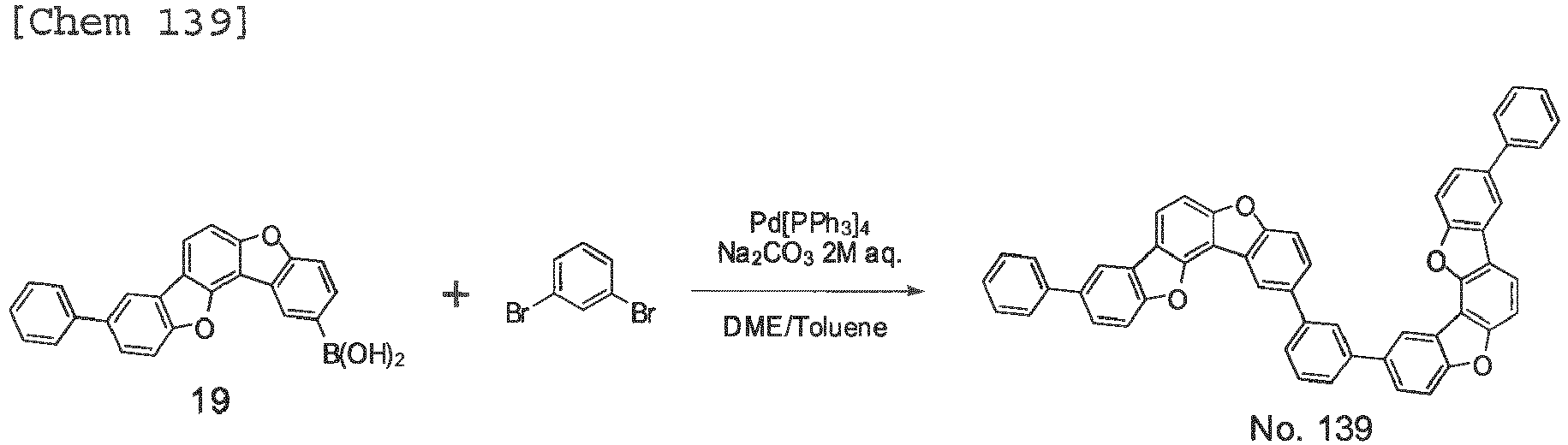
- Compound 19 (5.0 g, 13.2 mmol), 1, 3-dibromobenzene (1.5 g, 6.6 mmol), a 2 M aqueous solution of Na2CO3 (14 mL, 28 mmol), DME (14 mL), toluene (14 mL), and Pd[PPh3]4 (0.38 g, 0.34 mmol) were loaded into a three-necked flask, and the mixture was refluxed under an Ar atmosphere for 8 hours.
- After the completion of the reaction, the resultant was cooled to room temperature. The resultant sample was transferred to a separating funnel, and water (50 mL) was charged into the funnel. Then, the mixture was extracted with CH2Cl2. The extract was dried with MgSO4, and was then filtered and concentrated. The resultant sample was purified by silica gel column chromatography. The purified product was concentrated to dryness, and was then recrystallized twice, whereby a white powder (Compound No. 139) was obtained. The powder was purified by sublimation, whereby a white solid was obtained in an amount of 1.9 g in 39% yield. FD-MS analysis C54H38O4: theoretical value 742, observed value 742
-
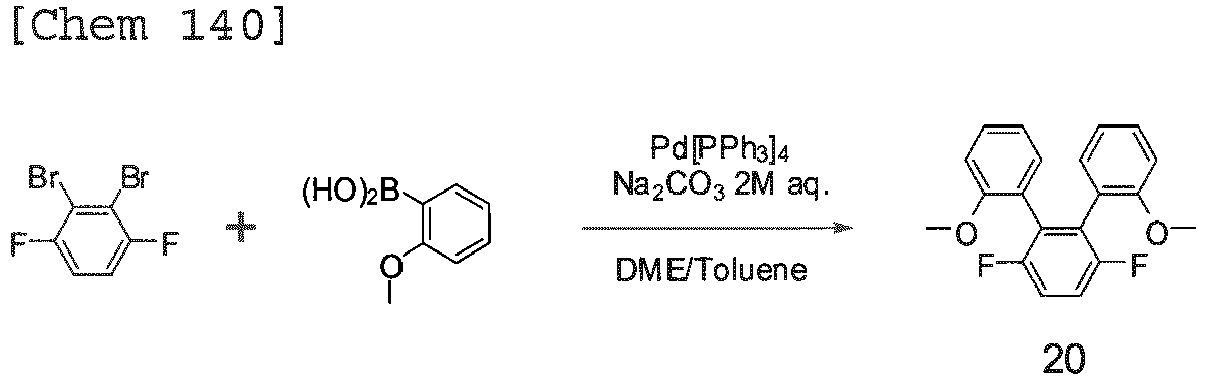
- 1,2-dibromo-3,6-difluorobenzene (50.0 g, 183.9 mmol), 2-methoxyphenylboronic acid (67.1 g, 441.4 mmol), a 2 M aqueous solution of Na2CO3 (368 mL, 736 mmol), DME (370 mL), toluene (370 mL), andPd[PPh3]4 (21.3g, 18.4 mmol) were loaded into a three-necked flask, and the mixture was refluxed under an Ar atmosphere for 8 hours.
- After the completion of the reaction, the resultant was cooled to room temperature. The resultant sample was transferred to a separating funnel, and water (500 mL) was charged into the funnel. Then, the mixture was extracted with CH2Cl2. The extract was dried with MgSO4, and was then filtered and concentrated. The resultant sample was purified by silica gel column chromatography, whereby a white solid was obtained in an amount of 30.6 g in 51% yield. FD-MS analysis C20H16F2O2: theoretical value 326, observed value 326
-
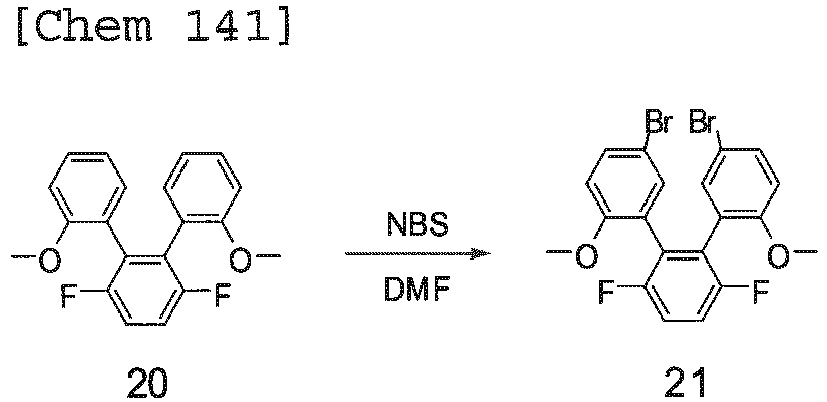
- Compound 20 (30.0 g, 91.9 mmol), NBS (32.8 g, 184 mmol), and DMF (820 mL) were loaded into a three-necked flask, and the mixture was stirred under an Ar atmosphere at room temperature for 8 hours . After the completion of the reaction, the resultant sample was transferred to a separating funnel, and water (1000 mL) was charged into the funnel. Then, the mixture was extracted with AcOEt . The resultant sample was purified by column chromatography, whereby a white solid was obtained in an amount of 32 g in 72% yield. FD-MS analysis C20H14Br2F2O2: theoretical value 484, observed value 484
-
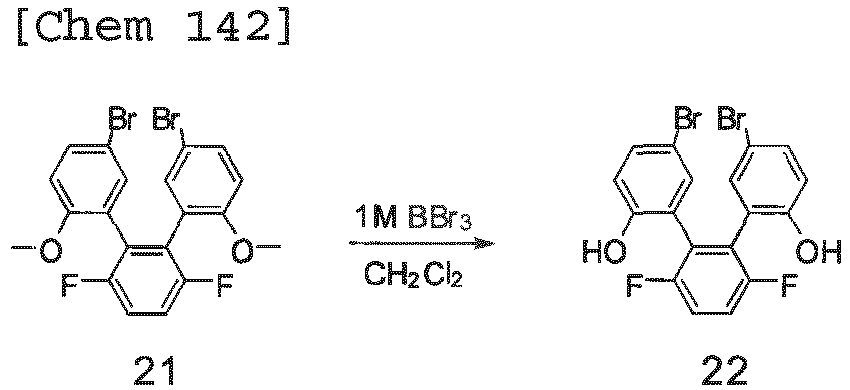
- Compound 21 (32.0 g, 66.1 mmol), a 1 M solution of BBr3 in CH2Cl2 (155 mL, 155 mmol), and CH2Cl2 (430 mL) were loaded into a three-necked flask, and the mixture was stirred under an Ar atmosphere at 0°C for 8 hours. After that, the mixture was left to stand at room temperature overnight. After the completion of the reaction, the resultant was neutralized with a saturated aqueous solution of NaHCO3. The resultant sample was transferred to a separating funnel, and was extracted with CH2Cl2. The resultant sample was purified by column chromatography, whereby a white solid was obtained in an amount of 24.1 g in 80% yield.
FD-MS analysis C18H10Br2F2O2: theoretical value 456, observed value 456 -
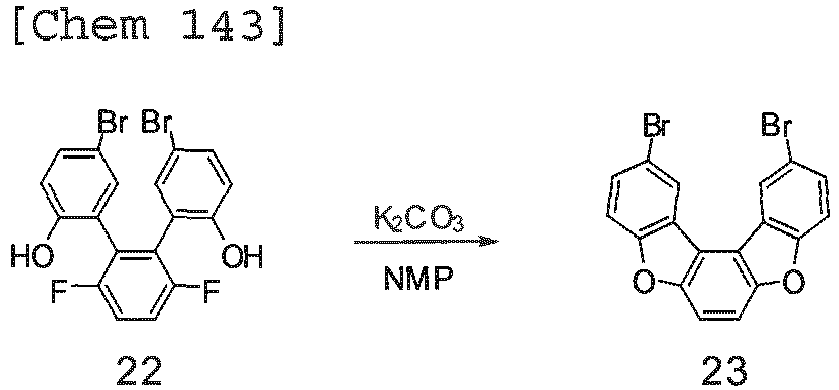
- Compound 22 (24.1 g, 52.8 mmol), K2CO3 (16.0 g, 116 mmol), and NMP (220 mL) were loaded into a three-necked flask, and the mixture was stirred under an Ar atmosphere at 150°C for 8 hours. After the completion of the reaction, the resultant was cooled to room temperature. The resultant sample was transferred to a separating funnel, and water (500 mL) was charged into the funnel. Then, the mixture was extracted with AcOEt. The resultant sample was purified by column chromatography, whereby a white solid was obtained in an amount of 18.7 g in 85% yield.
FD-MS analysis C18H8Br2O2: theoretical value 416, observed value 416 -

- Compound 23 (2.5 g, 6.0 mmol), Compound 9 (3.8 g, 13.2 mmol), a 2 M aqueous solution of Na2CO3 (12 mL, 24 mmol), DME (12 mL), toluene (12 mL), and Pd[PPh3]4 (0.35 g, 0.3 mmol) were loaded into a three-necked flask, and the mixture was refluxed under an Ar atmosphere for 8 hours.
- After the completion of the reaction, the resultant was cooled to room temperature. The resultant sample was transferred to a separating funnel, and water (50 mL) was charged into the funnel. Then, the mixture was extracted with CH2Cl2. The extract was dried with MgSO4, and was then filtered and concentrated. The resultant sample was purified by silica gel column chromatography. The purified product was concentrated to dryness, and was then recrystallized twice, whereby a white powder (Compound No. 154 (not according to the invention)) was obtained. The powder was purified by sublimation, whereby a white solid was obtained in an amount of 0.9 g in 20% yield.
FD-MS analysis C54H30O4: theoretical value 742, observed value 742 -

- Compound 23 (16.8 g, 40 mmol), phenylboronic acid (4.8 g, 40 mmol), a 2 M aqueous solution of Na2CO3 (80 mL, 160 mmol), DME (80 mL), toluene (80 mL), and Pd[PPh3]4 (2.3 g, 2.0 mmol) were loaded into a three-necked flask, and the mixture was refluxed under an Ar atmosphere for 8 hours.
- After the completion of the reaction, the resultant was cooled to room temperature. The resultant sample was transferred to a separating funnel, and water (150 mL) was charged into the funnel. Then, the mixture was extracted with CH2Cl2. The extract was dried with MgSO4, and was then filtered and concentrated. The resultant sample was purified by silica gel column chromatography, whereby a white solid was obtained in an amount of 9.1 g in 55% yield.
FD-MS analysis C24H13BrO2: theoretical value 413, observed value 413 -
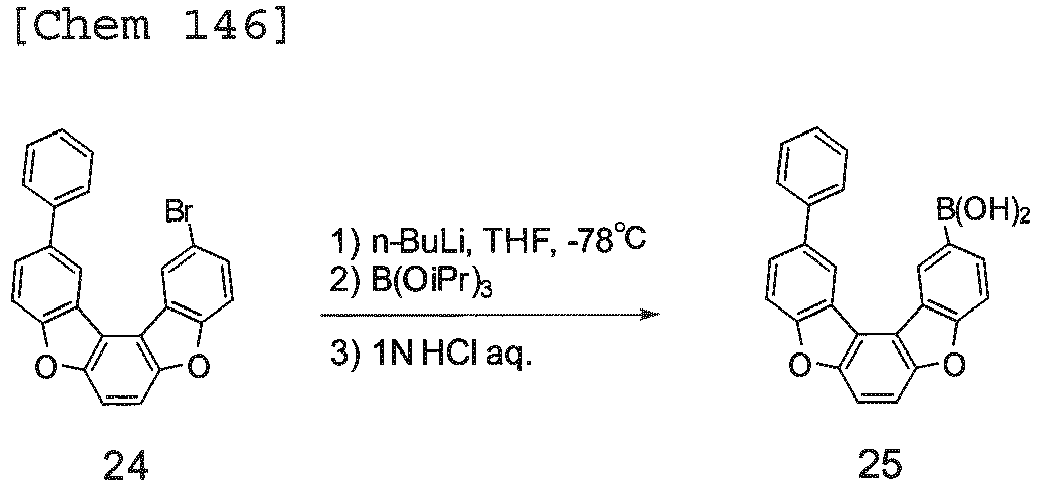
- Compound 24 (9.0 g, 21.8 mmol) and THF (220 mL) were loaded into a three-necked flask, and the mixture was cooled to -78°C. Then, n-BuLi (1.65 M solution in n-hexane, 14.5 mL, 23.9 mmol) was added dropwise to the flask, and the resultant mixture was stirred at -78°C for 20 minutes. Triisopropyl borate (12.3 g, 65.3 mmol) was added to the resultant, and the mixture was stirred at -78°C for 1 hour. After that, the resultant was left to stand overnight at room temperature. Then, 1 N HCl (100 mL) was charged into the resultant, and the mixture was stirred at room temperature for 1 hour. The resultant sample was concentrated, and was then transferred to a separating funnel. Water (100 mL) was charged into the funnel, and the mixture was extracted with CH2Cl2. The extract was dried with MgSO4, and was then filtered and concentrated. The resultant sample was purified by recrystallization (toluene-hexane), whereby a white solid was obtained in an amount of 4.1 g in 50% yield.
-
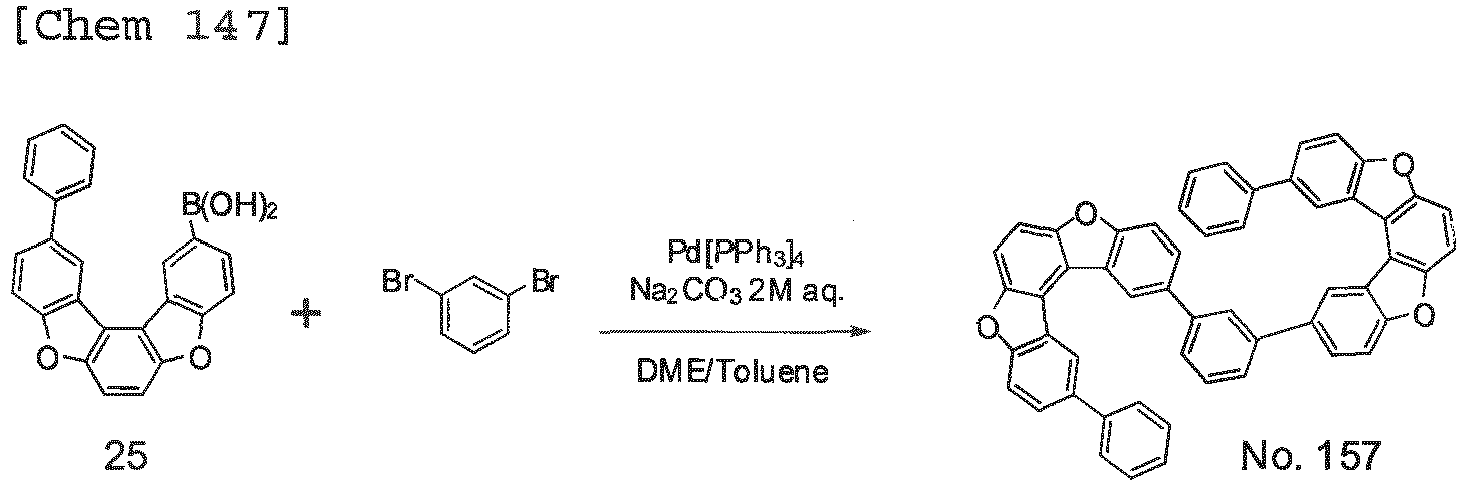
- Compound 25 (4.0 g, 10.6 mmol), 1,3-dibromobenzene (1.2 g, 5.3 mmol), a 2 M aqueous solution of Na2CO3 (11 mL, 22 mmol), DME (11 mL), toluene (11 mL), and Pd[PPh3]4 (0.31 g, 0.27 mmol) were loaded into a three-necked flask, and the mixture was refluxed under an Ar atmosphere for 8 hours.
- After the completion of the reaction, the resultant was cooled to room temperature. The resultant sample was transferred to a separating funnel, and water (50 mL) was charged into the funnel. Then, the mixture was extracted with CH2Cl2. The extract was dried with MgSO4, and was then filtered and concentrated. The resultant sample was purified by silica gel column chromatography. The purified product was concentrated to dryness, and was then recrystallized twice, whereby a white powder (Compound No. 157 (not according to the invention)) was obtained. The powder was purified by sublimation, whereby a white solid was obtained in an amount of 0.63 g in 16% yield.
FD-MS analysis C54H30O4: theoretical value 742, observed value 742 -
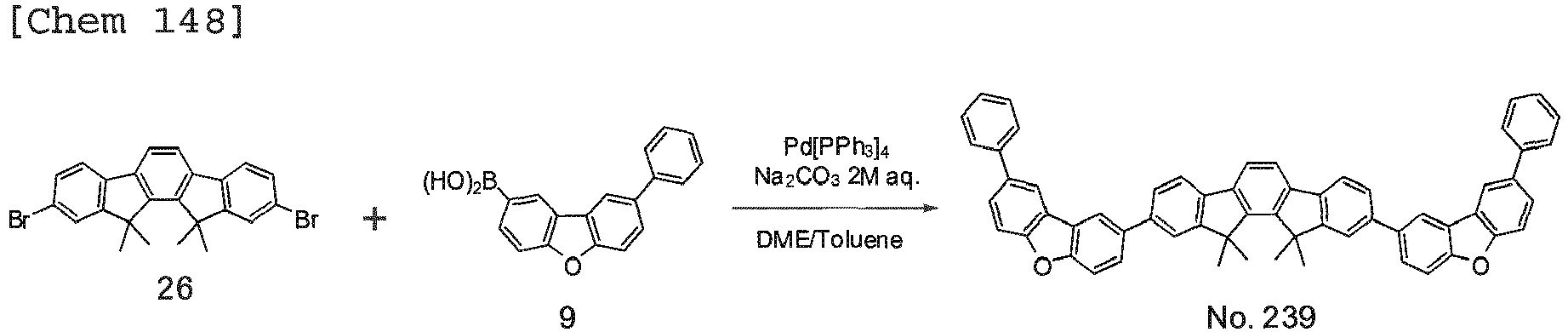
- Compound 26 (2.8 g, 6.0 mmol), Compound 9 (3.8 g, 13.2 mmol), a 2 M aqueous solution of Na2CO3 (12 mL, 24 mmol), DME (12 mL), toluene (12 mL), and Pd[PPh3]4 (0.35 g, 0.3 mmol) were loaded into a three-necked flask, and the mixture was refluxed under an Ar atmosphere for 8 hours.
- After the completion of the reaction, the resultant was cooled to room temperature. The resultant sample was transferred to a separating funnel, and water (50 mL) was charged into the funnel. Then, the mixture was extracted with CH2Cl2. The extract was dried with MgSO4, and was then filtered and concentrated. The resultant sample was purified by silica gel column chromatography. The purified product was concentrated to dryness, and was then recrystallized twice, whereby a white powder (Compound No. 239 (not according to the invention)) was obtained. The powder was purified by sublimation, whereby a white solid was obtained in an amount of 2.1 g in 45% yield.
FD-MS analysis C60H42O2: theoretical value 794, observed value 794 -
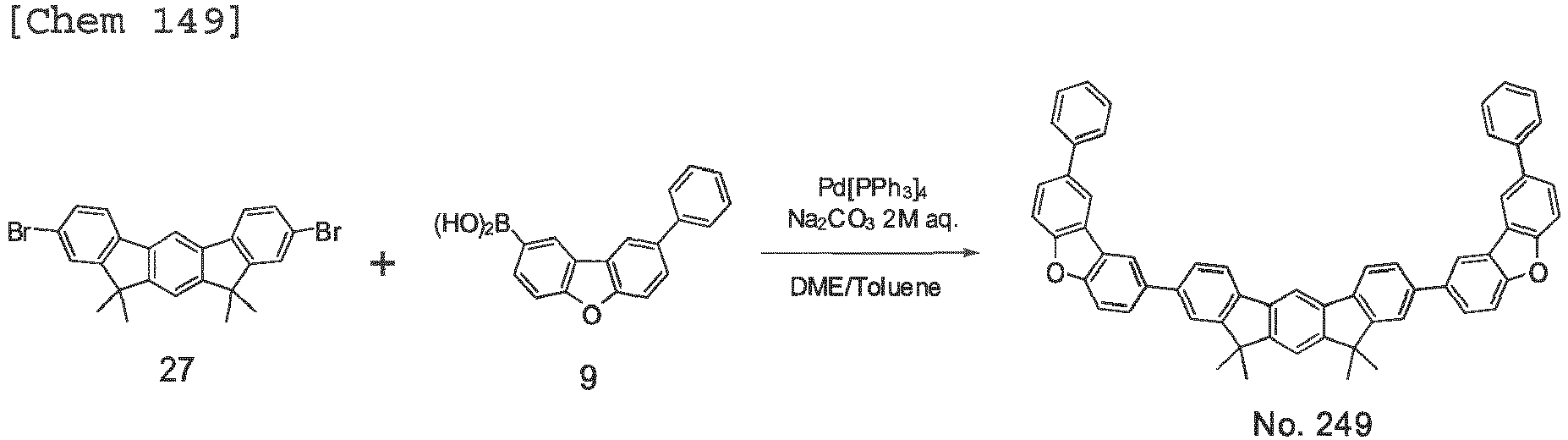
- Compound 27 (2.8 g, 6.0 mmol), Compound 9 (3.8 g, 13.2 mmol), a 2 M aqueous solution of Na2CO3 (12 mL, 24 mmol), DME (12 mL), toluene (12 mL), and Pd[PPh3]4 (0.35 g, 0.3 mmol) were loaded into a three-necked flask, and the mixture was refluxed under an Ar atmosphere for 8 hours.
- After the completion of the reaction, the resultant was cooled to room temperature. The resultant sample was transferred to a separating funnel, and water (50 mL) was charged into the funnel. Then, the mixture was extracted with CH2Cl2. The extract was dried with MgSO4, and was then filtered and concentrated. The resultant sample was purified by silica gel column chromatography. The purified product was concentrated to dryness, and was then recrystallized twice, whereby a white powder (Compound No. 249) was obtained. The powder was purified by sublimation, whereby a white solid was obtained in an amount of 2.5 g in 52% yield.
FD-MS analysis C60H42O2: theoretical value 794, observed value 794 -
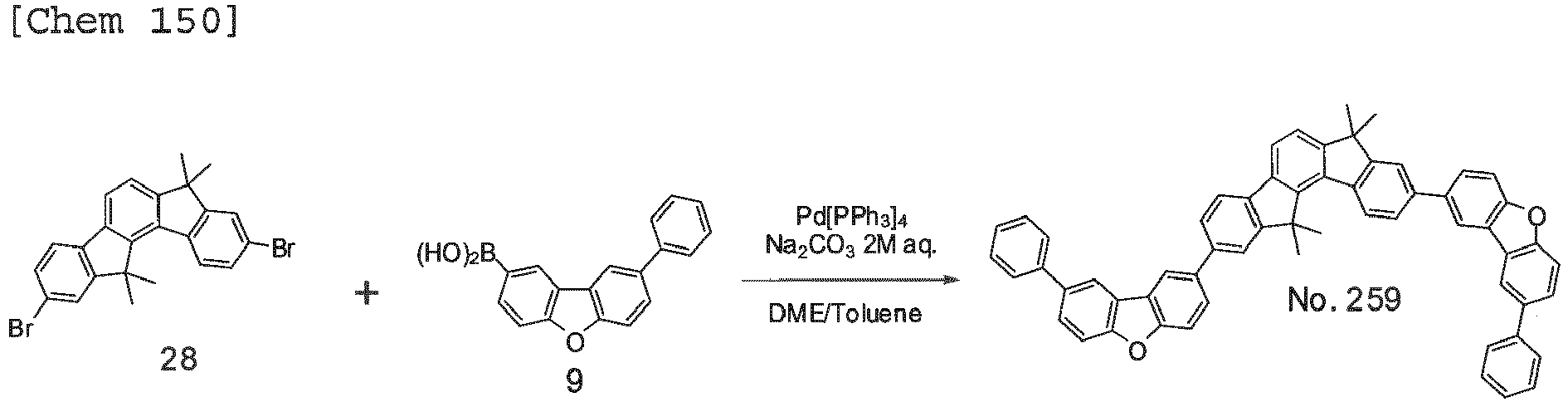
- Compound 28 (2.8 g, 6.0 mmol), Compound 9 (3.8 g, 13. 2 mmol), a 2 M aqueous solution of Na2CO3 (12 mL, 24 mmol), DME (12 mL), toluene (12 mL), and Pd[PPh3]4 (0.35 g, 0.3 mmol) were loaded into a three-necked flask, and the mixture was refluxed under an Ar atmosphere for 8 hours.
- After the completion of the reaction, the resultant was cooled to room temperature. The resultant sample was transferred to a separating funnel, and water (50 mL) was charged into the funnel. Then, the mixture was extracted with CH2Cl2. The extract was dried with MgSO4, and was then filtered and concentrated. The resultant sample was purified by silica gel column chromatography. The purified product was concentrated to dryness, and was then recrystallized twice, whereby a white powder (Compound No. 259) was obtained. The powder was purified by sublimation, whereby a white solid was obtained in an amount of 1.9 g in 40% yield.
FD-MS analysis C60H42O2: theoretical value 794, observed value 794 -
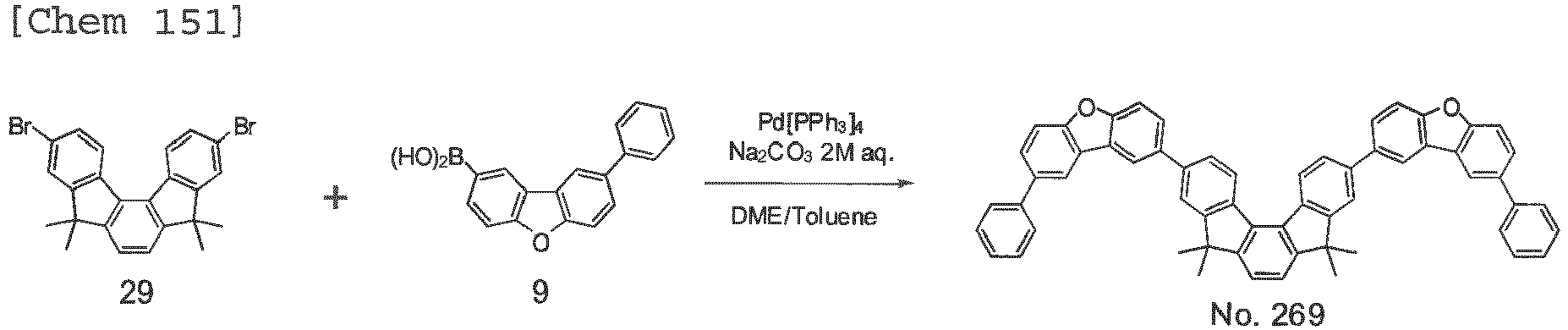
- Compound 29 (2.8 g, 6.0 mmol), Compound 9 (3.8 g, 13. 2 mmol), a 2 M aqueous solution of Na2CO3 (12 mL, 24 mmol), DME (12 mL), toluene (12 mL), and Pd[PPh3]4 (0.35 g, 0.3 mmol) were loaded into a three-necked flask, and the mixture was refluxed under an Ar atmosphere for 8 hours.
- After the completion of the reaction, the resultant was cooled to room temperature. The resultant sample was transferred to a separating funnel, and water (50 mL) was charged into the funnel. Then, the mixture was extracted with CH2Cl2. The extract was dried with MgSO4, and was then filtered and concentrated. The resultant sample was purified by silica gel column chromatography. The purified product was concentrated to dryness, and was then recrystallized twice, whereby a white powder (Compound No. 269 (not according to the invention)) was obtained. The powder was purified by sublimation, whereby a white solid was obtained in an amount of 1.0 g in 21% yield.
FD-MS analysis C60H42O2: theoretical value 794, observed value 794 -

- Compound 30 (2.7 g, 6.0 mmol), Compound 9 (3.8 g, 13.2 mmol), a 2 M aqueous solution of Na2CO3 (12 mL, 24 mmol), DME (12 mL), toluene (12 mL), and Pd[PPh3]4 (0.35 g, 0.3 mmol) were loaded into a three-necked flask, and the mixture was refluxed under an Ar atmosphere for 8 hours.
- After the completion of the reaction, the resultant was cooled to room temperature. The resultant sample was transferred to a separating funnel, and water (50 mL) was charged into the funnel. Then, the mixture was extracted with CH2Cl2. The extract was dried with MgSO4, and was then filtered and concentrated. The resultant sample was purified by silica gel column chromatography. The purified product was concentrated to dryness, and was then recrystallized twice, whereby a white powder (Compound No. 233 (not according to the invention)) was obtained. The powder was purified by sublimation, whereby a white solid was obtained in an amount of 1.9 g in 40% yield.
FD-MS analysis C54H30O2S2: theoretical value 774, observed value 774 -
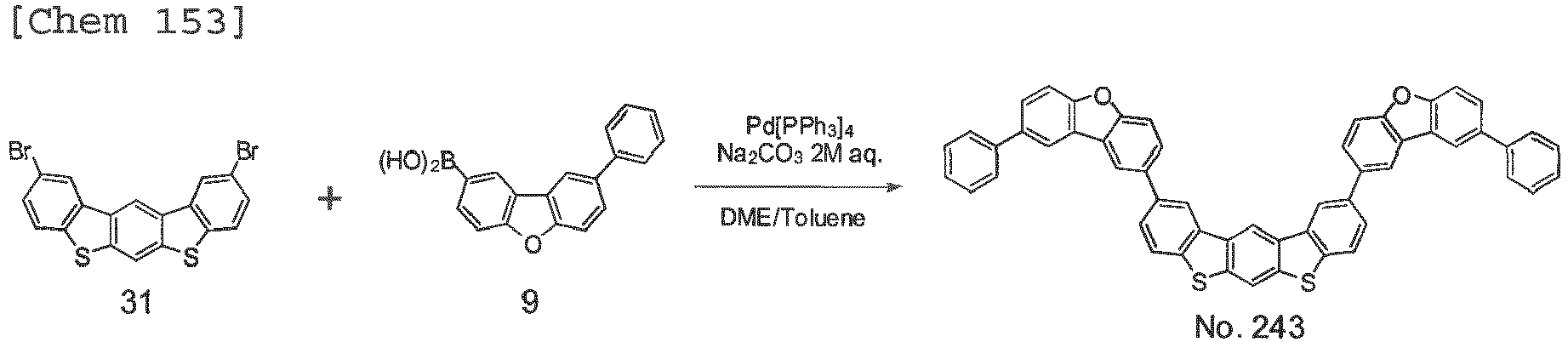
- Compound 31 (2.7 g, 6.0 mmol), Compound 9 (3.8 g, 13.2 mmol), a 2 M aqueous solution of Na2CO3 (12 mL, 24 mmol), DME (12 mL), toluene (12 mL), and Pd[PPh3]4 (0.35 g, 0.3 mmol) were loaded into a three-necked flask, and the mixture was refluxed under an Ar atmosphere for 8 hours.
- After the completion of the reaction, the resultant was cooled to room temperature. The resultant sample was transferred to a separating funnel, and water (50 mL) was charged into the funnel. Then, the mixture was extracted with CH2Cl2. The extract was dried with MgSO4, and was then filtered and concentrated. The resultant sample was purified by silica gel column chromatography. The purified product was concentrated to dryness, and was then recrystallized twice, whereby a white powder (Compound No. 243) was obtained. The powder was purified by sublimation, whereby a white solid was obtained in an amount of 2.1 g in 45% yield.
FD-MS analysis C54H30O2S2: theoretical value 774, observed value 774 -
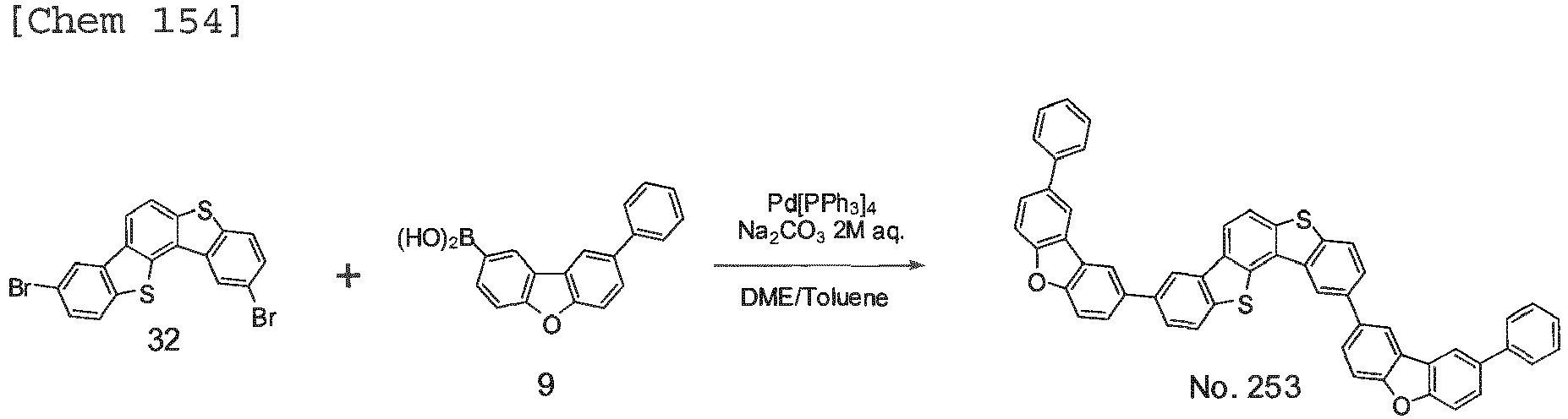
- Compound 32 (2.7 g, 6.0 mmol), Compound 9 (3.8 g, 13.2 mmol), a 2 M aqueous solution of Na2CO3 (12 mL, 24 mmol), DME (12 mL), toluene (12 mL), and Pd[PPh3]4 (0.35 g, 0.3 mmol) were loaded into a three-necked flask, and the mixture was refluxed under an Ar atmosphere for 8 hours.
- After the completion of the reaction, the resultant was cooled to room temperature. The resultant sample was transferred to a separating funnel, and water (50 mL) was charged into the funnel. Then, the mixture was extracted with CH2Cl2. The extract was dried with MgSO4, and was then filtered and concentrated. The resultant sample was purified by silica gel column chromatography. The purified product was concentrated to dryness, and was then recrystallized twice, whereby a white powder (Compound No. 253) was obtained. The powder was purified by sublimation, whereby a white solid was obtained in an amount of 1.8 g in 38% yield. FD-MS analysis C54H30O2S2: theoretical value 774, observed value 774
-
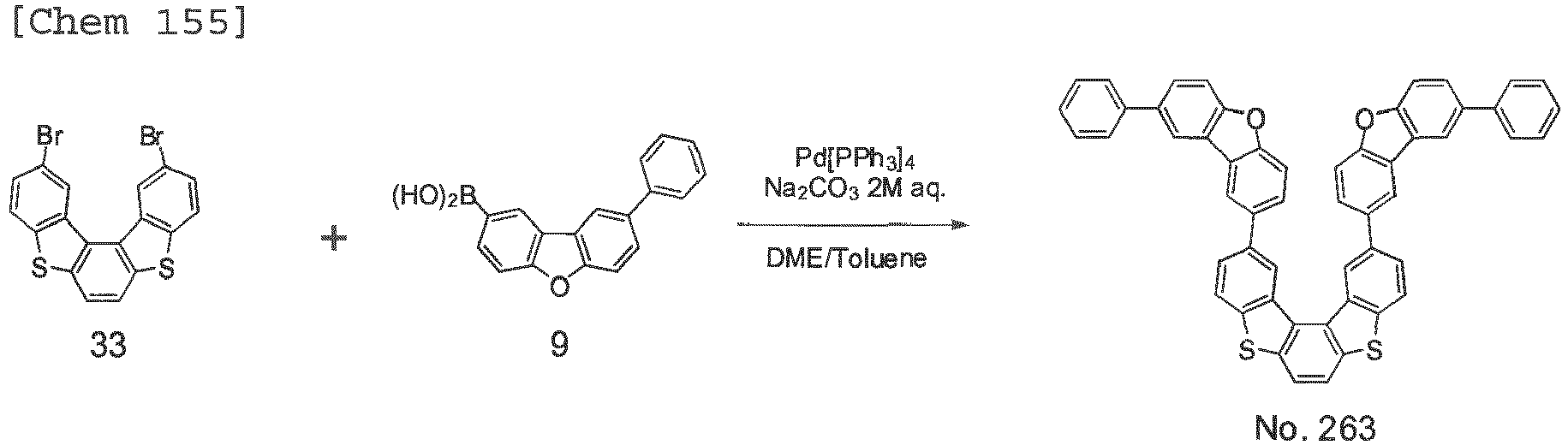
- Compound 33 (2.7 g, 6.0 mmol), Compound 9 (3.8 g, 13.2 mmol), a 2 M aqueous solution of Na2CO3 (12 mL, 24 mmol), DME (12 mL), toluene (12 mL), and Pd[PPh3]4 (0.35 g, 0.3 mmol) were loaded into a three-necked flask, and the mixture was refluxed under an Ar atmosphere for 8 hours.
- After the completion of the reaction, the resultant was cooled to room temperature. The resultant sample was transferred to a separating funnel, and water (50 mL) was charged into the funnel. Then, the mixture was extracted with CH2Cl2. The extract was dried with MgSO4, and was then filtered and concentrated. The resultant sample was purified by silica gel column chromatography. The purified product was concentrated to dryness, and was then recrystallized twice, whereby a white powder (Compound No. 263 (not according to the invention)) was obtained. The powder was purified by sublimation, whereby a white solid was obtained in an amount of 0.6 g in 13% yield.
FD-MS analysis C54H30O2S2: theoretical value 774, observed value 774 -
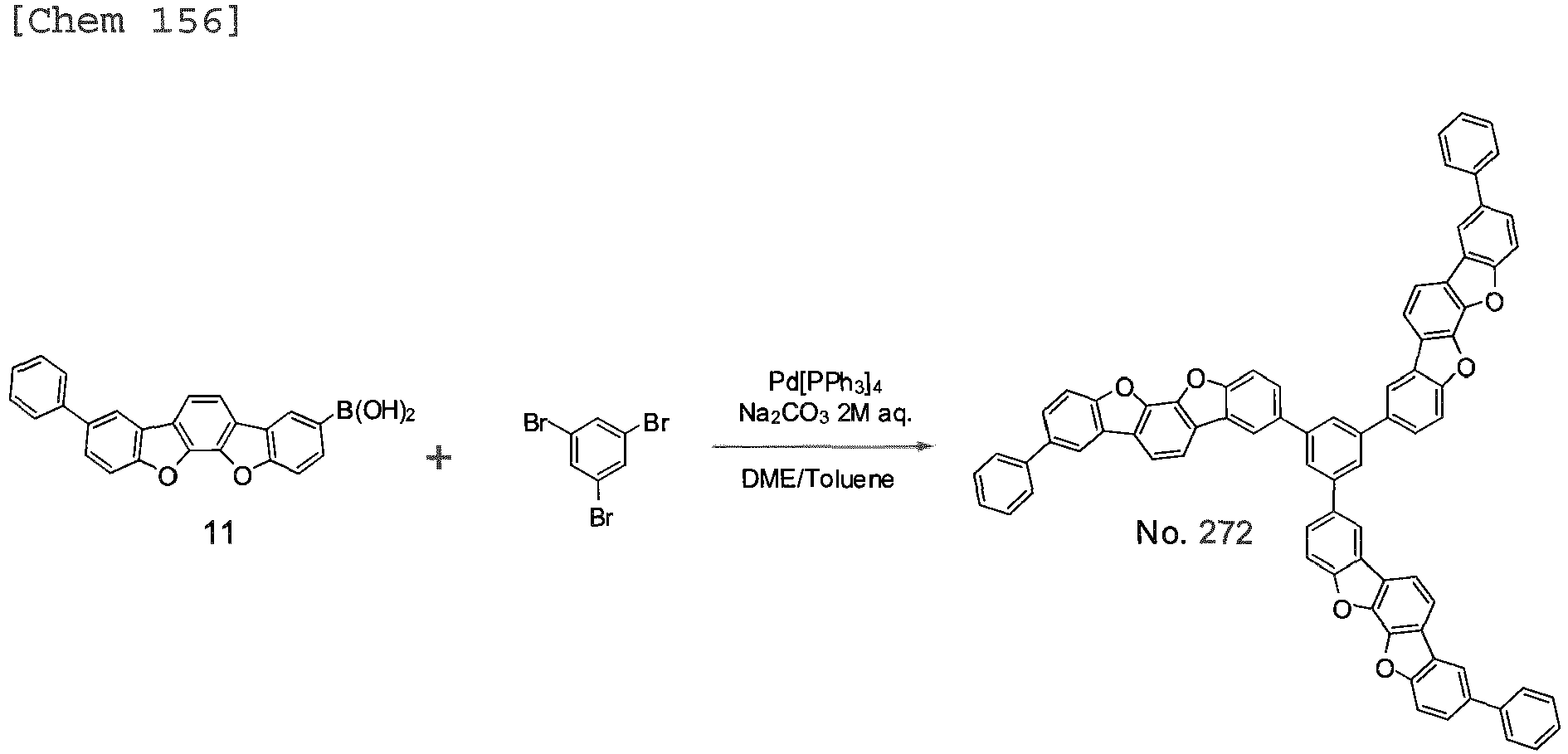
- Compound 11 (8.3 g, 21.9 mmol), 1,3,5-tribromobenzene (2.3 g, 7.3 mmol), a 2 M aqueous solution of Na2CO3 (22.5 mL, 45 mmol), DME (15 mL), toluene (15 mL), and Pd[PPh3]4 (0.63 g, 0.56 mmol) were loaded into a three-necked flask, and the mixture was refluxed under an Ar atmosphere for 8 hours.
- After the completion of the reaction, the resultant was cooled to room temperature. The resultant sample was transferred to a separating funnel, and water (50 mL) was charged into the funnel. Then, the mixture was extracted with CH2Cl2. The extract was dried with MgSO4, and was then filtered and concentrated. The resultant sample was purified by silica gel column chromatography. The purified product was concentrated to dryness, and was then recrystallized twice, whereby a white powder (Compound No. 272 (not according to the invention)) was obtained. The powder was purified by sublimation, whereby a white solid was obtained in an amount of 1.0 g in 13% yield.
FD-MS analysis C78H42O6: theoretical value 1075, observed value 1075 -
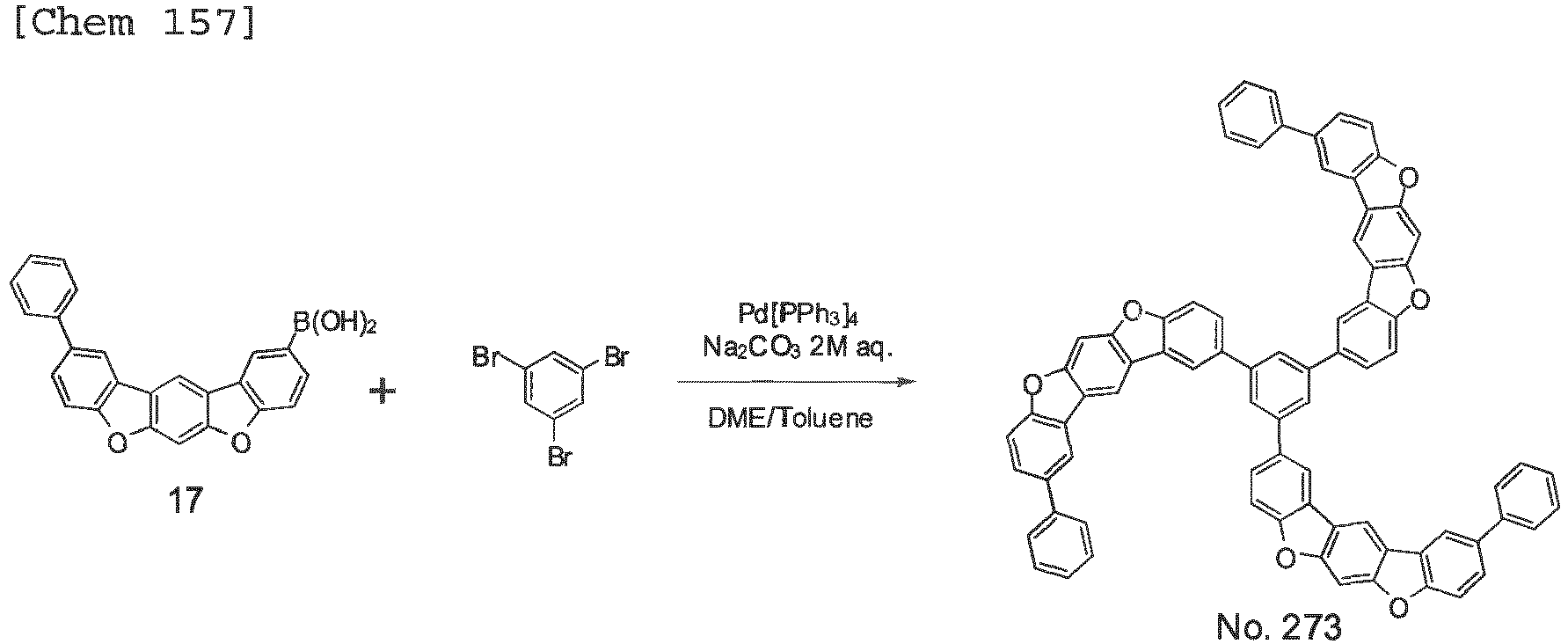
- Compound 17 (8.3 g, 21.9 mmol), 1,3,5-tribromobenzene (2.3 g, 7.3 mmol), a 2 M aqueous solution of Na2CO3 (22.5 mL, 45 mmol), DME (15 mL), toluene (15 mL), and Pd[PPh3]4 (0.63 g, 0.56 mmol) were loaded into a three-necked flask, and the mixture was refluxed under an Ar atmosphere for 8 hours.
- After the completion of the reaction, the resultant was cooled to room temperature. The resultant sample was transferred to a separating funnel, and water (50 mL) was charged into the funnel. Then, the mixture was extracted with CH2Cl2. The extract was dried with MgSO4, and was then filtered and concentrated. The resultant sample was purified by silica gel column chromatography. The purified product was concentrated to dryness, and was then recrystallized twice, whereby a white powder (Compound No. 273) was obtained. The powder was purified by sublimation, whereby a white solid was obtained in an amount of 1.2 g in 15% yield.
FD-MS analysis C78H42O6: theoretical value 1075, observed value 1075 -
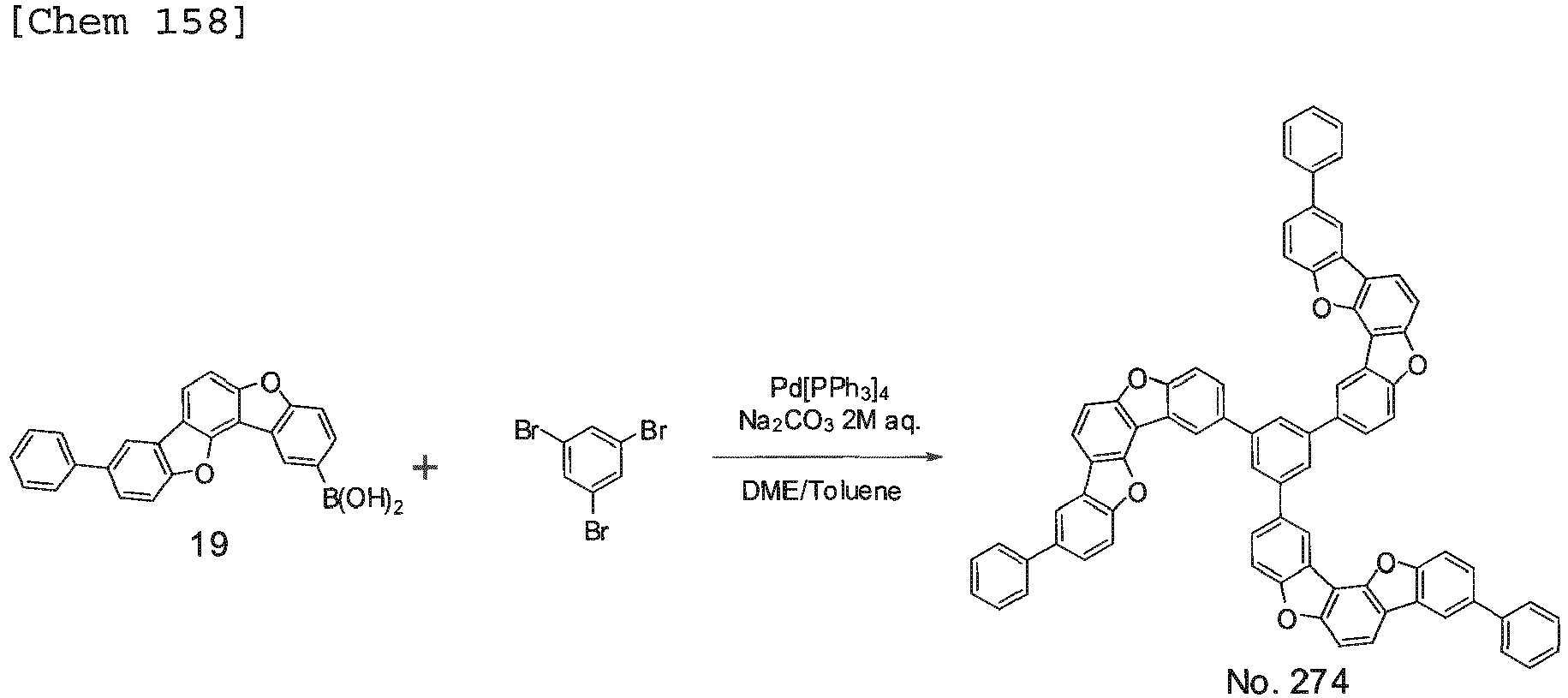
- Compound 19 (8.3 g, 21.9 mmol), 1,3,5-tribromobenzene (2.3 g, 7.3 mmol), a 2 M aqueous solution of Na2CO3 (22.5 mL, 45 mmol), DME (15 mL), toluene (15 mL), and Pd[PPh3]4 (0.63 g, 0.56 mmol) were loaded into a three-necked flask, and the mixture was refluxed under an Ar atmosphere for 8 hours.
- After the completion of the reaction, the resultant was cooled to room temperature. The resultant sample was transferred to a separating funnel, and water (50 mL) was charged into the funnel. Then, the mixture was extracted with CH2Cl2. The extract was dried with MgSO4, and was then filtered and concentrated. The resultant sample was purified by silica gel column chromatography. The purified product was concentrated to dryness, and was then recrystallized twice, whereby a white powder (Compound No. 274) was obtained. The powder was purified by sublimation, whereby a white solid was obtained in an amount of 0.94 g in 12% yield.
FD-MS analysis C78H42O6: theoretical value 1075, observed value 1075 -

- Compound 25 (8.3 g, 21.9 mmol), 1,3,5-tribromobenzene (2.3 g, 7.3 mmol), a 2 M aqueous solution of Na2CO3 (22.5 mL, 45 mmol), DME (15 mL), toluene (15 mL), and Pd[PPh3]4 (0.63 g, 0.56 mmol) were loaded into a three-necked flask, and the mixture was refluxed under an Ar atmosphere for 8 hours.
- After the completion of the reaction, the resultant was cooled to room temperature. The resultant sample was transferred to a separating funnel, and water (50 mL) was charged into the funnel. Then, the mixture was extracted with CH2Cl2. The extract was dried with MgSO4, and was then filtered and concentrated. The resultant sample was purified by silica gel column chromatography. The purified product was concentrated to dryness, and was then recrystallized twice, whereby a white powder (Compound No. 276 (not according to the invention)) was obtained. The powder was purified by sublimation, whereby a white solid was obtained in an amount of 0.55 g in 7% yield. FD-MS analysis C78H42O6: theoretical value 1075, observed value 1075
-

- Compound 8 (2.5 g, 6.0 mmol), Compound 34 (3.8 g, 13.2 mmol), a 2 M aqueous solution of Na2CO3 (12 mL, 24 mmol), DME (12 mL), toluene (12 mL), and Pd[PPh3]4 (0.35 g, 0.3 mmol) were loaded into a three-necked flask, and the mixture was refluxed under an Ar atmosphere for 8 hours.
- After the completion of the reaction, the resultant was cooled to room temperature. The resultant sample was transferred to a separating funnel, and water (50 mL) was charged into the funnel. Then, the mixture was extracted with CH2Cl2. The extract was dried with MgSO4, and was then filtered and concentrated. The resultant sample was purified by silica gel column chromatography. The purified product was concentrated to dryness, and was then recrystallized twice, whereby a white powder (Compound No. 1 (not according to the invention) was obtained. The powder was purified by sublimation, whereby a white solid was obtained in an amount of 1.2 g in 27% yield.
FD-MS analysis C54H32N2O2: theoretical value 740, observed value 740 -
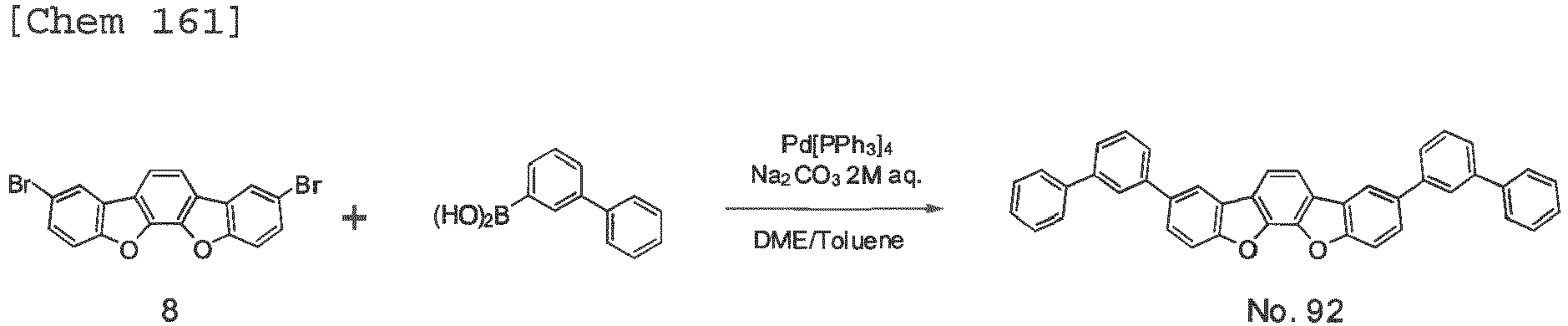
- Compound 8 (2.5 g, 6.0 mmol), 3-biphenylboronic acid (2.6 g, 13.2 mmol), a 2 M aqueous solution of Na2CO3 (12 mL, 24 mmol), DME (12 mL), toluene (12 mL), and Pd[PPh3]4 (0.35 g, 0.3 mmol) were loaded into a three-necked flask, and the mixture was refluxed under an Ar atmosphere for 8 hours.
- After the completion of the reaction, the resultant was cooled to room temperature. The resultant sample was transferred to a separating funnel, and water (50 mL) was charged into the funnel. Then, the mixture was extracted with CH2Cl2. The extract was dried with MgSO4, and was then filtered and concentrated. The resultant sample was purified by silica gel column chromatography. The purified product was concentrated to dryness, and was then recrystallized twice, whereby a white powder (Compound No. 92 (not according to the invention)) was obtained. The powder was purified by sublimation, whereby a white solid was obtained in an amount of 1.1 g in 32% yield.
FD-MS analysis C42H26O2: theoretical value 562, observed value 562 -
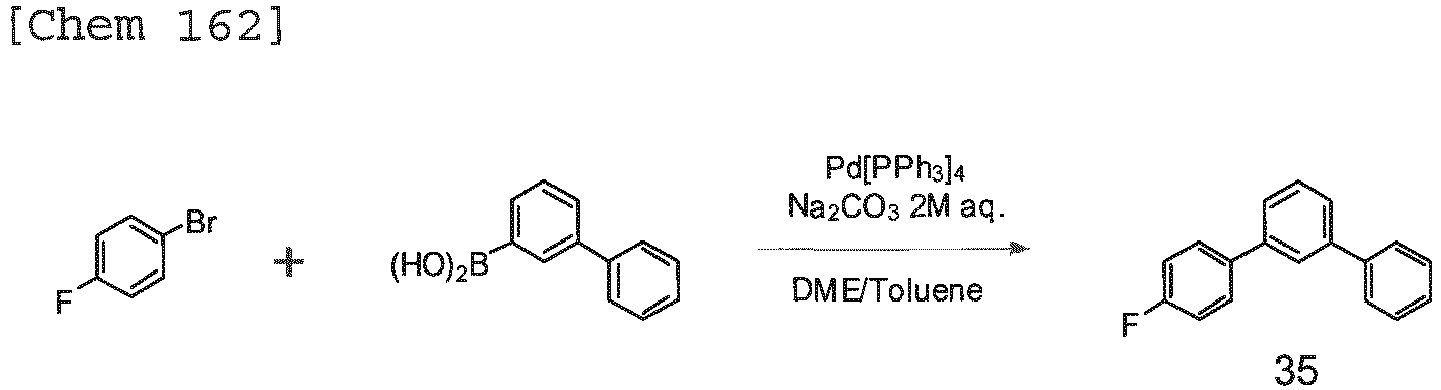
- 4-bromofluorobenzene (81.55 g, 466 mmol), 3-biphenylboronic acid (92.33 g, 466 mmol), a 2 M aqueous solution of Na2CO3 (530 mL), Pd[PPh3]4 (14.7 g, 12.7 mmol), DME (500 mL), and toluene (500 mL) were loaded into a three-necked flask, and the mixture was refluxed under an Ar atmosphere for 6 hours.
- After the completion of the reaction, the resultant was cooled to room temperature. The resultant sample was transferred to a separating funnel, and water (350 mL) was charged into the funnel. Then, the mixture was extracted with toluene. The extract was dried with MgSO4, and was then filtered and concentrated. The resultant sample was purified by silica gel column chromatography. The purified product was concentrated to dryness, and was then recrystallized, whereby a white solid was obtained in an amount of 31.7 g in 27% yield.
FD-MS analysis C18H13F: theoretical value 248, observed value 248 -
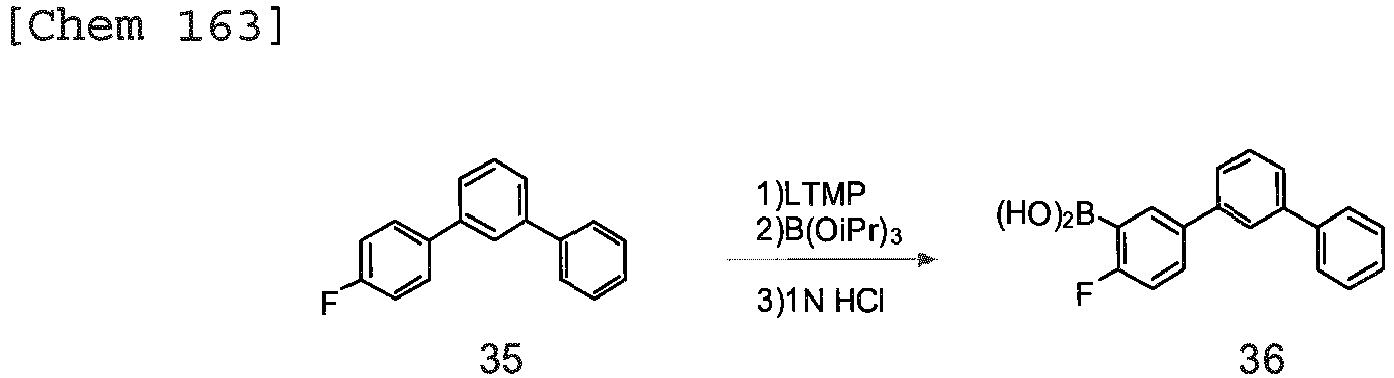
- Compound 35 (31.7 g, 127 mmol) and THF (200 mL) were loaded into a three-necked flask, and then the mixture was cooled to -78°C. A lithium 2,2,6,6-tetramethylpiperidine solution prepared in advance from a 1.55-M solution of n-BuLi in hexane (82 mL, 127 mmol), 2,2,6,6-tetramethylpiperidine (17.9 g, 127 mmol), and THF (50 mL) was added to the mixture, and then the whole was stirred at -78°C under an Ar atmosphere for 2 hours. After that, triisopropyl borate (71.6 g, 381 mmol) was added to the resultant, and then the mixture was stirred at -78°C for 2 hours. After that, the temperature of the mixture was slowly returned to room temperature, and then the mixture was left to stand overnight.
- After the completion of the reaction, methanol (50 mL) was added to deactivate the resultant, and then the mixture was concentrated so that its volume might be reduced by about half. CH2Cl2 (200 mL) and 2N HCl (120 mL) were added to the resultant, and then the mixture was stirred at room temperature for 2 hours. The resultant sample was transferred to a separating funnel and extracted with CH2Cl2. The solution was dried with MgSO4, and was then purified by silica gel column chromatography. The purified product was concentrated to dryness, and then the solid was subjected to dispersion washing with toluene. Thus, a white solid was obtained in an amount of 27.5 g in 74% yield.
- (2) Synthesis of Compound 37
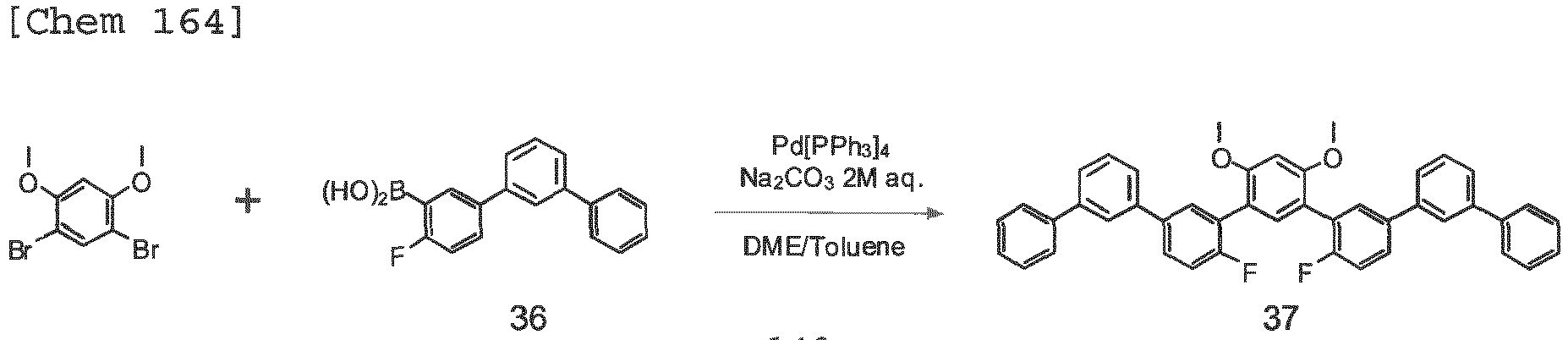
- 2,4-dibromo-1,5-dimethoxybenzene (5.92 g, 20 mmol), Compound 36 (14.02 g, 48 mmol), a 2 M aqueous solution of Na2CO3 (40 mL), Pd[PPh3]4 (1.15 g, 1 mmol), DME (20 mL), and toluene (20 mL) were loaded into a three-necked flask, and the mixture was refluxed under an Ar atmosphere for 36 hours.
- After the completion of the reaction, the resultant was cooled to room temperature. The resultant sample was transferred to a separating funnel, and water (100 mL) was charged into the funnel. Then, the mixture was extracted with toluene. The extract was dried with MgSO4, and was then filtered and concentrated. The resultant sample was purified by silica gel column chromatography. The purified product was concentrated to dryness, and was then recrystallized, whereby a white solid was obtained in an amount of 9.49 g in 75% yield.
FD-MS analysis C44H32F2O2: theoretical value 630, observed value 630 -
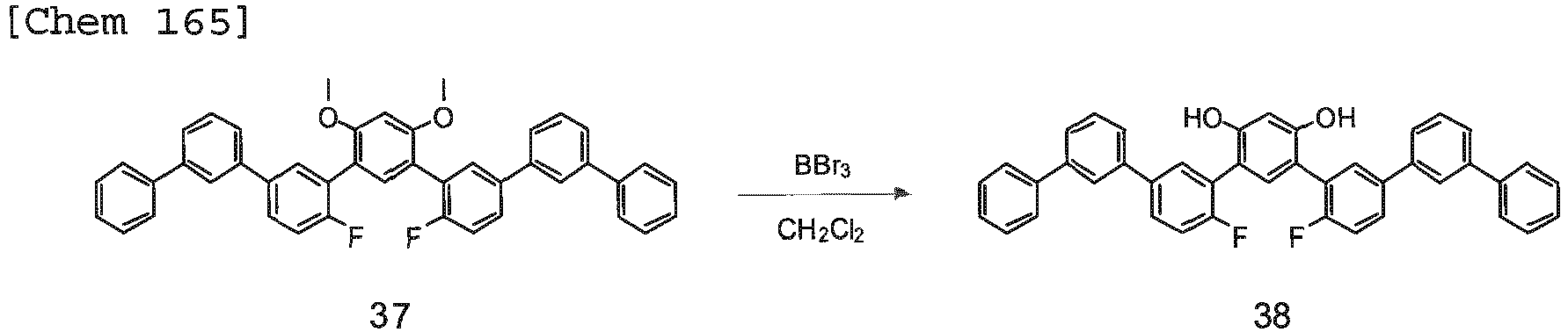
- Compound 37 (9.49 g, 5 mmol) and CH2Cl2 (75 mL) were loaded into a three-necked flask, and the mixture was cooled to 0°C. Then, BBr3 (15.03 g, 60 mmol) was added to the flask, and the resultant mixture was stirred under an Ar atmosphere at room temperature for 24 hours.
- After the completion of the reaction, the obtained solution was cooled to -78°C, and inactivated using methanol (50 mL) and water (100 mL). The sample was transferred to a separating funnel, and water (100 mL) was charged into the funnel. Then, the mixture was extracted with CH2Cl2. The extract was dried with MgSO4, and was then filtered and concentrated. The obtained sample was purified by silica gel column chromatography. The purified product was concentrated to dryness, whereby a white solid was obtained in an amount of 9.04 g in 100% yield.
FD-MS analysis C42H28F2O2: theoretical value 602, observed value 602 -
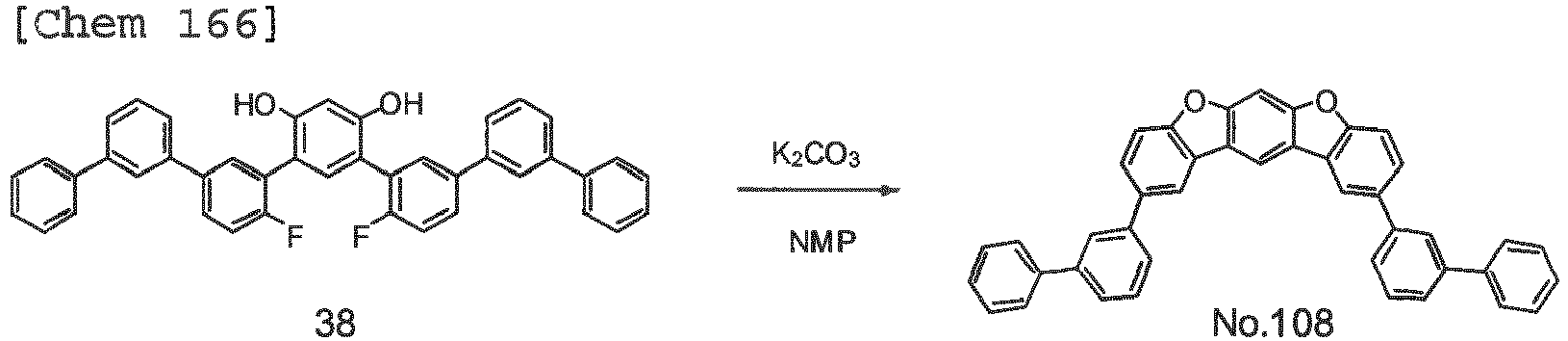
- Compound 38 (9.04g, 15 mmol) andNMP (150 mL) were loaded into a three-necked flask, and Compound 38 was dissolved completely. K2CO3 (8.30 g, 60 mmol) was added to the flask, followed by stirring at 200°C for 2 hours.
- After the completion of the reaction, the obtained solution was cooled to room temperature. Toluene (1.5 L) was added to the resultant sample, and the sample was transferred to a separating funnel and washed with water. The resultant was dried with MgSO4 and then filtered and concentrated. The resultant sample was purified by silica gel column chromatography. The purified product was concentrated to dryness, and was then recrystallized, whereby a white powder (Compound No. 108) was obtained. The powder was purified by sublimation, whereby a white solid was obtained in an amount of 3.37 g in 40% yield.
FD-MS analysis C42H26O2: theoretical value 562, observed value 562 -
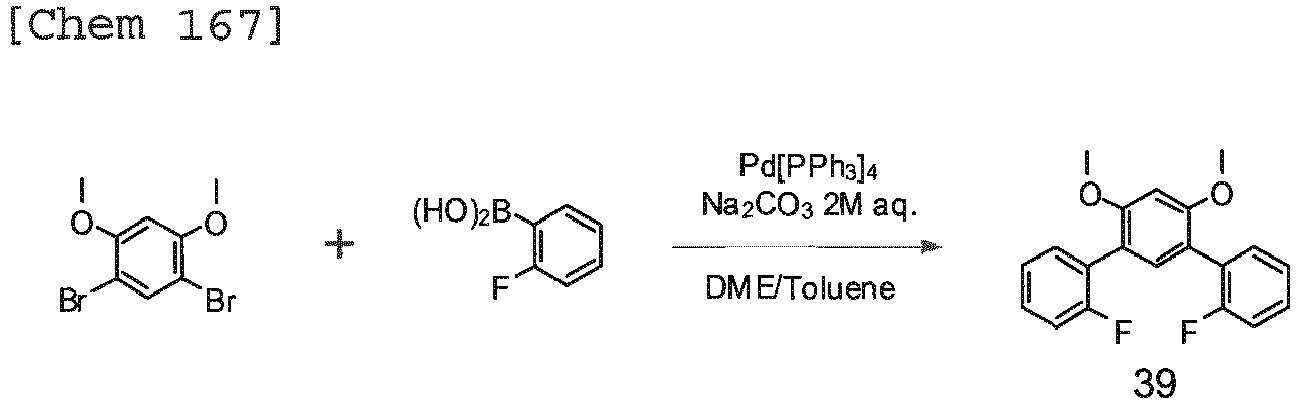
- 2,4-dibromo-1,5-dimethoxybenzene (88.8 g, 300 mmol), 2-fluorophenyl boric acid (100.7 g, 720 mmol), 2 M aqueous solution of Na2CO3 (600 mL), Pd[PPh3]4 (6.73 g, 6 mmol), DME (150 mL), and toluene (150 mL) were loaded into a three-necked flask, and the mixture was refluxed under an Ar atmosphere for 36 hours.
- After the completion of the reaction, the obtained solution was cooled to room temperature. The resultant sample was transferred to a separating funnel, and water (500 mL) was charged into the funnel. Then, the mixture was extracted with toluene. The extract was dried with MgSO4, and was then filtered and concentrated. The resultant sample was purified by silica gel column chromatography. The purified product was concentrated to dryness, and was then recrystallized, whereby a white solid was obtained in an amount of 86.5 g in 88% yield.
FD-MS analysis C20H16F2O2: theoretical value 326, observed value 326 -
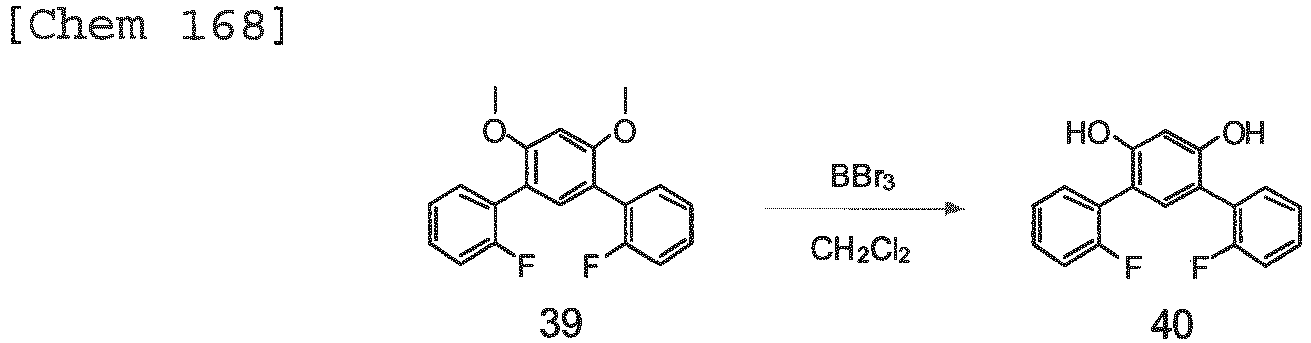
- Compound 39 (48.3 g, 148 mmol) and CH2Cl2 (740 mL) were loaded into a three-necked flask, and the mixture was cooled to 0°C. Then, BBr3 (89.0 g, 355 mmol) was added to the flask, and the resultant mixture was stirred at room temperature for 24 hours.
- After the completion of the reaction, the obtained solution was cooled to -78°C, and inactivated using methanol (50 mL) and water (100 mL). The sample was transferred to a separating funnel. Then, the mixture was extracted with CH2Cl2. The extract was dried with MgSO4, and was then filtered and concentrated. The obtained sample was purified by silica gel column chromatography. The purified product was concentrated to dryness, whereby a white solid was obtained in an amount of 44.14 g in 100% yield.
FD-MS analysis C18H12F2O2: theoretical value 298, observed value 298 -

- Compound 40 (44.14 g, 148 mmol) and NMP (888 mL) were loaded into a three-necked flask, and Compound 40 was dissolved completely. K2CO3 (81.8 g, 592 mmol) was added to the flask, followed by stirring at 200°C for 2 hours.
- After the completion of the reaction, the obtained solution was cooled to room temperature. The sample was transferred to a separating funnel, toluene (2L) was added, and the resultant was washed with water. The resultant was dried with MgSO4 and then filtered and concentrated. The resultant sample was purified by silica gel column chromatography. The purified product was concentrated to dryness, and was then recrystallized, whereby a white solid was obtained in an amount of 27.9 g in 73% yield.
FD-MS analysis C18H10O2: theoretical value 258, observed value 258 -

- Compound 41 (12.9 g, 50 mmol) andTHF (300 mL) were loaded into a three-necked flask, and the mixture was cooled to -78°C. Then, n-BuLi (2.63 M solution in hexane, 20.0 ml, 52.5 mmol) was added to the flask, and the resultant mixture was stirred at room temperature under an Ar atmosphere for 1 hour. Next, the resultant was cooled to -78°C again, trimethyl borate (10.4 g, 100 mmol) was added to the resultant. After being stirred at -78°C for 10 minutes, the mixture was stirred at room temperature for 1 hour.
- After the completion of the reaction, the resultant was concentrated to about the half volume. 1 N HCl (200 mL) was added to the concentrated resultant, followed by stirring at room temperature for 1 hour. The resultant sample was transferred to a separating funnel, and the mixture was extracted with ethyl acetate. The extract was dried with MgSO4, and was then concentrated. The concentrated product was subjected to dispersion washing with a toluene/hexane mixed solvent, whereby a white solid was obtained in an amount of 13.7 g in 91% yield.
-

- Compound 42 (3.8 g, 12.6 mmol), 1, 3-dibromobenzene (1.4 g, 6.0 mmol), a 2 M aqueous solution of Na2CO3 (12 mL, 24 mmol), DME (12 mL), toluene (12 mL), and Pd[PPh3]4 (0.35 g, 0.3 mmol) were loaded into a three-necked flask, and the mixture was refluxed under an Ar atmosphere for 8 hours.
- After the completion of the reaction, the resultant was cooled to room temperature. The resultant sample was transferred to a separating funnel, and water (50 mL) was charged into the funnel. Then, the mixture was extracted with CH2Cl2. The extract was dried with MgSO4, and was then filtered and concentrated. The resultant sample was purified by silica gel column chromatography. The purified product was concentrated to dryness, and was then recrystallized twice, whereby a white powder (Compound No. 281) was obtained. The powder was purified by sublimation, whereby a white solid was obtained in an amount of 1.3 g in 37% yield.
FD-MS analysis C42H22O4: theoretical value 590, observed value 590 -
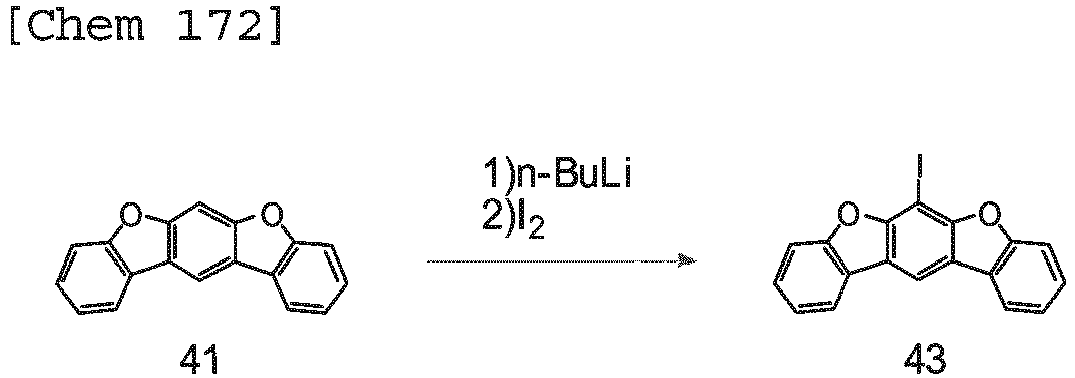
- Compound 41 (2.69 g, 10.4 mmol) and THF (62 mL) were loaded into a three-necked flask, and the mixture was cooled to -78°C. Then, n-BuLi (1.66 M solution in hexane, 6.6 ml, 10.9 mmol) was added to the flask, and the resultant mixture was stirred at room temperature for 30 minutes. Next, the resultant was cooled to -78°C again, I2 (2.69 g, 10.6 mmol) was added to the resultant. After being stirred at -78°C for 10 minutes, the mixture was stirred at room temperature for 1 hour.
- After the completion of the reaction, water (30 mL) was added to inactivate the obtained solution, followed by concentration. After being subjected to dispersion washing with water, the sample was collected by filtration and then dissolved in toluene. After being dried with MgSO4, the resultant was filtered and concentrated. The obtained sample was purified by silica gel column chromatography. The purified product was concentrated to dryness, and was then recrystallized, whereby a white solid was obtained in an amount of 3.77 g in 94% yield.
FD-MS analysis C18H9IO2: theoretical value 384, observed value 384 -
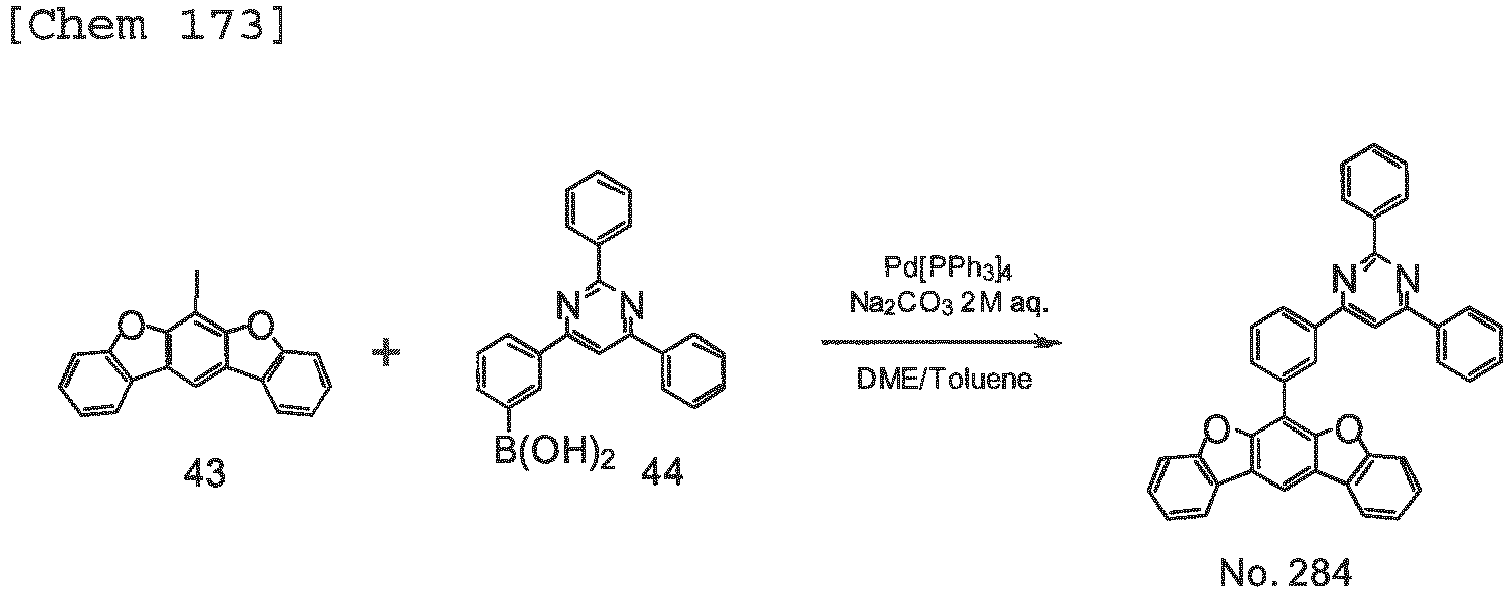
- Compound 43 (2.3 g, 6.0 mmol), Compound 44 (2.2 g, 6.3 mmol), a 2 M aqueous solution of Na2CO3 (12 mL, 24 mmol), DME (12 mL), toluene (12 mL), and Pd[PPh3]4 (0.35 g, 0.30 mmol) were loaded into a three-necked flask, and the mixture was refluxed under an Ar atmosphere for 8 hours.
- After the completion of the reaction, the resultant was cooled to room temperature. The resultant sample was transferred to a separating funnel, and water (50 mL) was charged into the funnel. Then, the mixture was extracted with CH2Cl2. The extract was dried with MgSO4, and was then filtered and concentrated. The resultant sample was purified by silica gel column chromatography. The purified product was concentrated to dryness, and was then recrystallized twice, whereby a white powder (Compound No. 284) was obtained. The powder was purified by sublimation, whereby a white solid was obtained in an amount of 1.0 g in 30% yield. FD-MS analysis C40H24N2O2: theoretical value 564, observed value 564
-
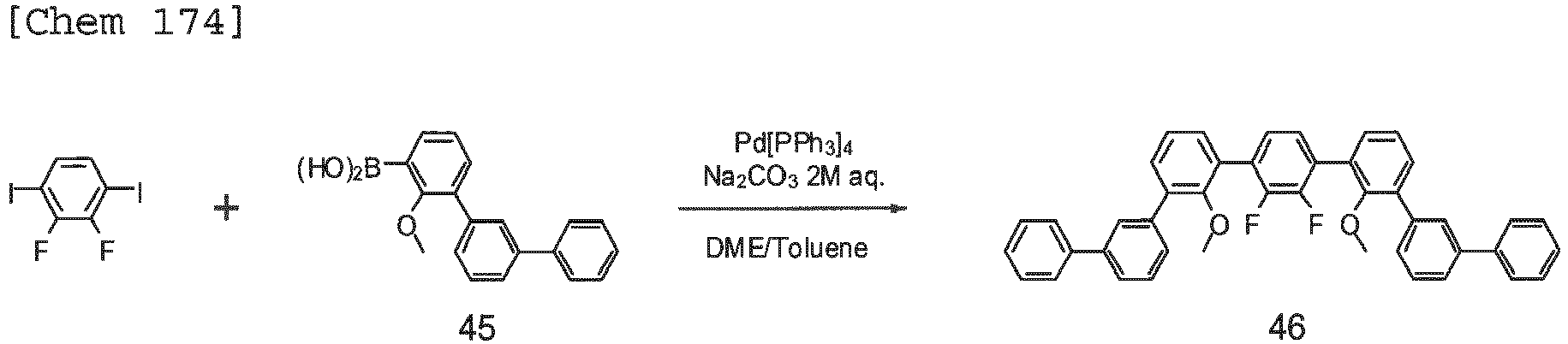
- 1,2-difluoro-3,6-diiodobenzene (7.3 g, 20.0 mmol), Compound 45 (12.8 g, 42.0 mmol), a 2 M aqueous solution of Na2CO3 (40 mL, 80.0 mmol), DME (40 mL), toluene (40 mL), and Pd[PPh3]4 (1.2 g, 1.0 mmol) were loaded into a three-necked flask, and the mixture was refluxed under an Ar atmosphere for 8 hours.
- After the completion of the reaction, the resultant was cooled to room temperature. The resultant sample was transferred to a separating funnel, and water (100 mL) was charged into the funnel. Then, the mixture was extracted with CH2Cl2. The extract was dried with MgSO4, and was then filtered and concentrated. The resultant sample was purified by silica gel column chromatography, whereby a white solid was obtained in an amount of 8.2 g in 65% yield.
FD-MS analysis C44H32F2O2: theoretical value 630, observed value 630 -
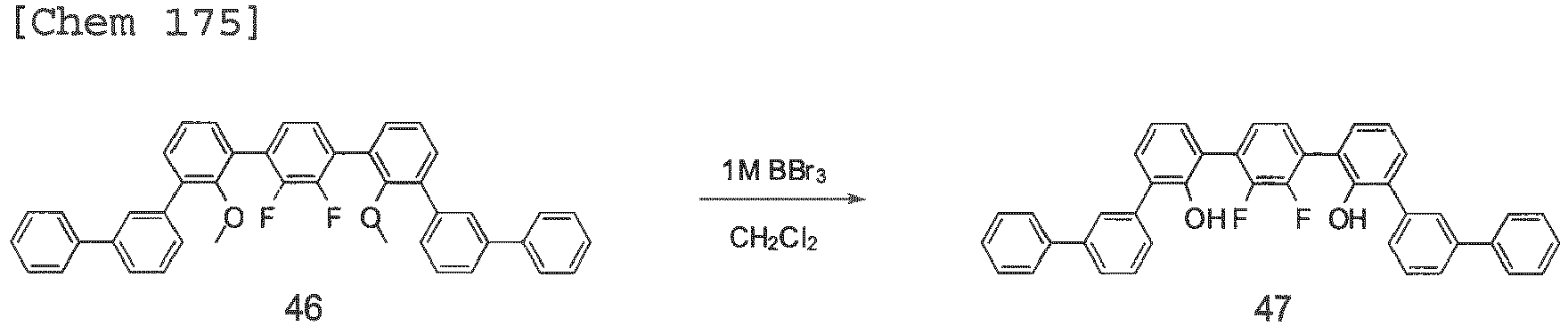
- Compound 46 (8.2 g, 13.0 mmol), a 1 M solution of BBr3 in CH2Cl2 (32 mL, 32.0 mmol), and CH2Cl2 (100 mL) were loaded into a three-necked flask, and the mixture was stirred under an Ar atmosphere at 0°C for 8 hours. After that, the mixture was left to stand at room temperature overnight.
- After the completion of the reaction, the resultant was neutralized with a saturated aqueous solution of NaHCO3. The resultant sample was transferred to a separating funnel, and was extracted with CH2Cl2. The resultant sample was purified by silica gel column chromatography, whereby a white solid was obtained in an amount of 7.6 g in 97% yield.
FD-MS analysis C42H28F2O2: theoretical value 602, observed value 602 -
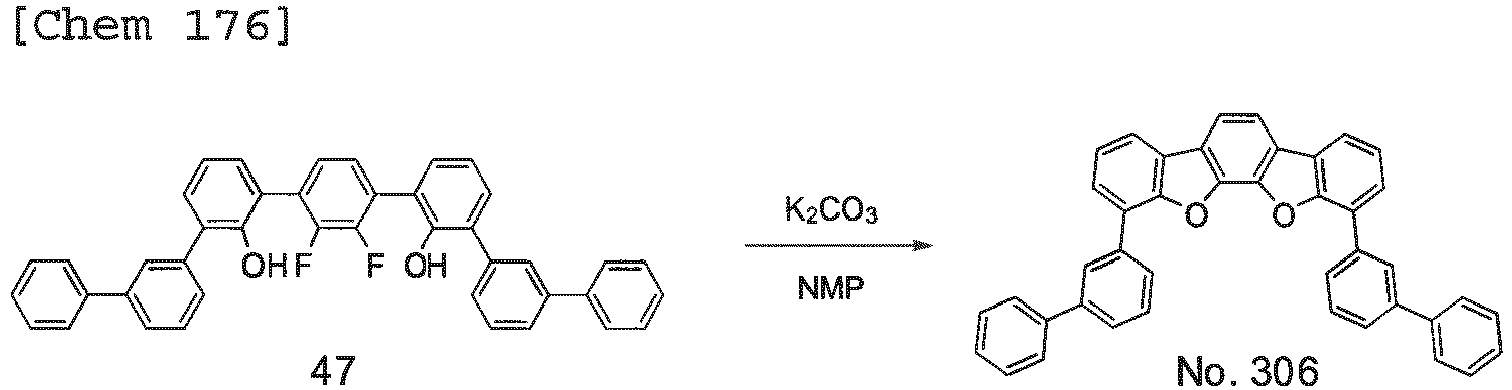
- Compound 47 (7.6 g, 12.6 mmol), K2CO3 (7.0 g, 50.4 mmol), and NMP (50 mL) were loaded into a three-necked flask, and the mixture was stirred under an Ar atmosphere at 200°C for 3 hours.
- After the completion of the reaction, the resultant was cooled to room temperature. Toluene (500 mL) was charged into the resultant sample. The mixture was transferred to a separating funnel, and was washed with water. The washed product was dried with MgSO4, and was then filtered and concentrated. The resultant sample was purified by silica gel column chromatography. The purified product was concentrated to dryness, and was then recrystallized twice, whereby a white powder (Compound No. 306 (not according to the invention)) was obtained. The powder was purified by sublimation, whereby a white solid was obtained in an amount of 2.9 g in 41% yield.
FD-MS analysis C42H26O2: theoretical value 562, observed value 562 -
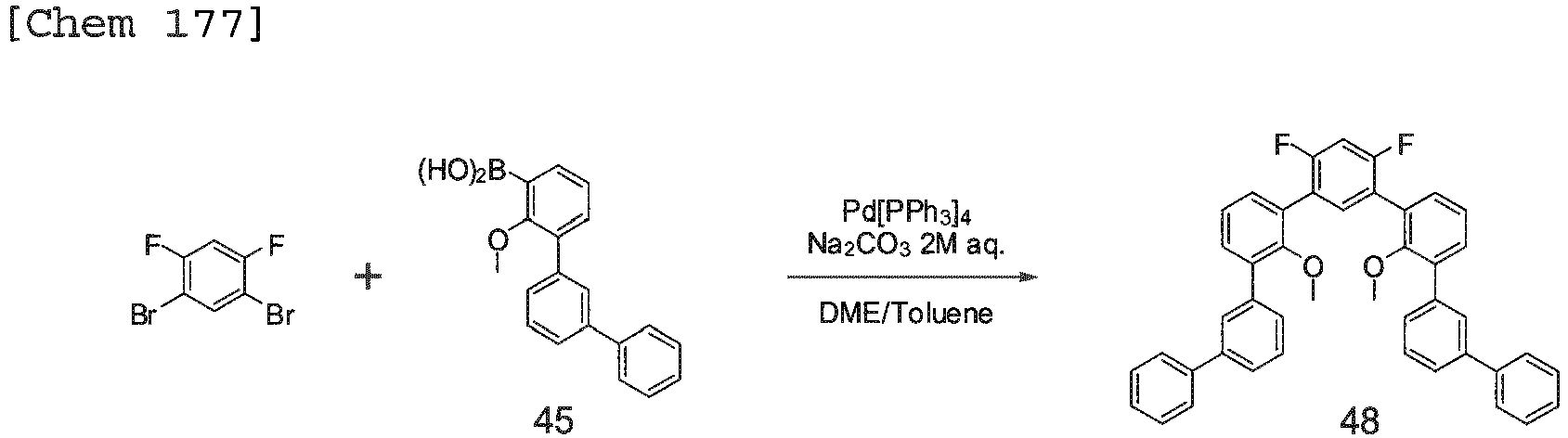
- 1,3-dibromo-4,6-difluorobenzene (5.4 g, 20.0 mmol), Compound 45 (12.8 g, 42.0 mmol), a 2 M aqueous solution of Na2CO3 (40 mL, 80.0 mmol), DME (40 mL), toluene (40 mL), and Pd[PPh3]4 (1.2 g, 1.0 mmol) were loaded into a three-necked flask, and the mixture was refluxed under an Ar atmosphere for 8 hours.
- After the completion of the reaction, the resultant was cooled to room temperature. The resultant sample was transferred to a separating funnel, and water (100 mL) was charged into the funnel. Then, the mixture was extracted with CH2Cl2. The extract was dried with MgSO4, and was then filtered and concentrated. The resultant sample was purified by silica gel column chromatography, whereby a white solid was obtained in an amount of 7.2 g in 57% yield.
FD-MS analysis C44H32F2O2: theoretical value 630, observed value 630 -
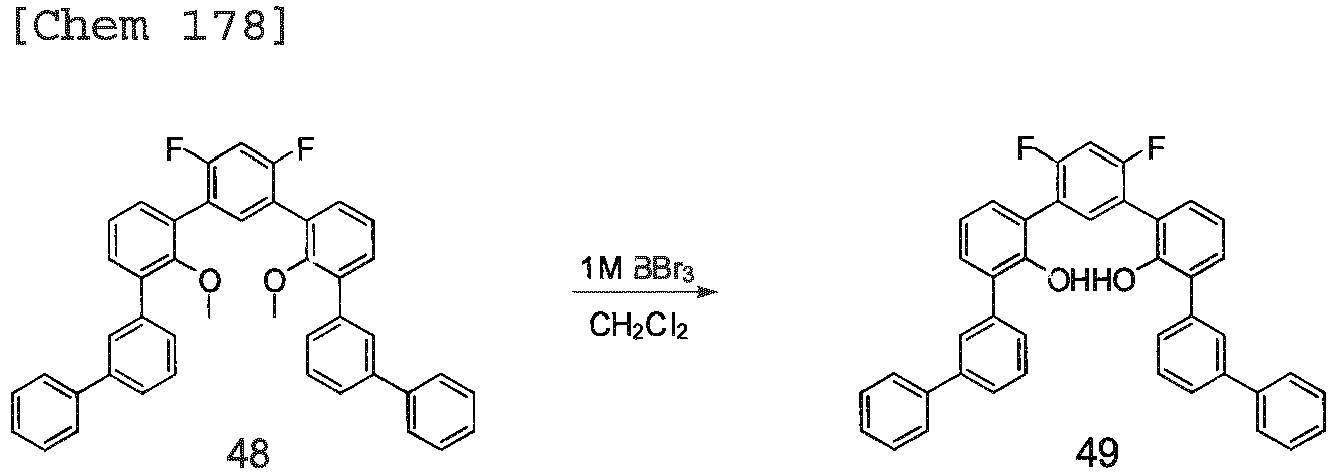
- Compound 46 (7.2 g, 11.4 mmol), a 1 M solution of BBr3 in CH2Cl2 (28 mL, 28.0 mmol), and CH2Cl2 (85 mL) were loaded into a three-necked flask, and the mixture was stirred under an Ar atmosphere at 0°C for 8 hours. After that, the mixture was left to stand at room temperature overnight.
- After the completion of the reaction, the resultant was neutralized with a saturated aqueous solution of NaHCO3. The resultant sample was transferred to a separating funnel, and was extracted with CH2Cl2. The resultant sample was purified by silica gel column chromatography, whereby a white solid was obtained in an amount of 6.9 g in 100% yield.
FD-MS analysis C42H28F2O2: theoretical value 602, observed value 602 -
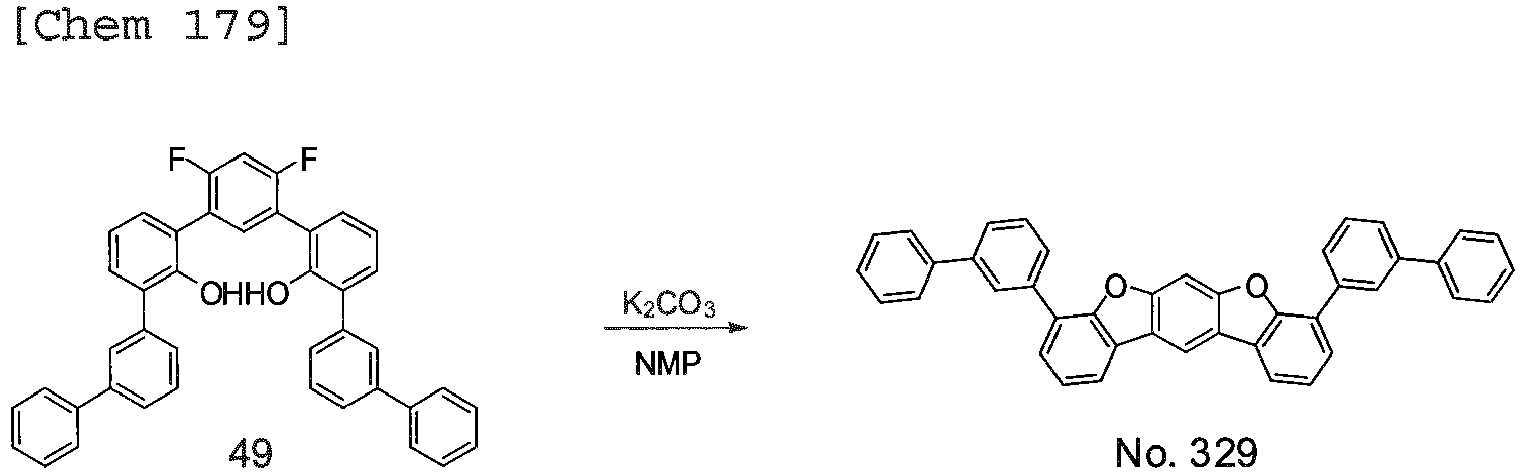
- Compound 47 (6.9 g, 11.4 mmol), K2CO3 (6.3 g, 45.6 mmol), and NMP (50 mL) were loaded into a three-necked flask, and the mixture was stirred under an Ar atmosphere at 200°C for 3 hours.
- After the completion of the reaction, the resultant was cooled to room temperature. Toluene (500 mL) was charged into the resultant sample. The mixture was transferred to a separating funnel, and was washed with water. The washed product was dried with MgSO4, and was then filtered and concentrated. The resultant sample was purified by silica gel column chromatography. The purified product was concentrated to dryness, and was then recrystallized twice, whereby a white powder (Compound No. 329) was obtained. The powder was purified by sublimation, whereby a white solid was obtained in an amount of 2.3 g in 36% yield.
FD-MS analysis C42H26O2: theoretical value 562, observed value 562 -
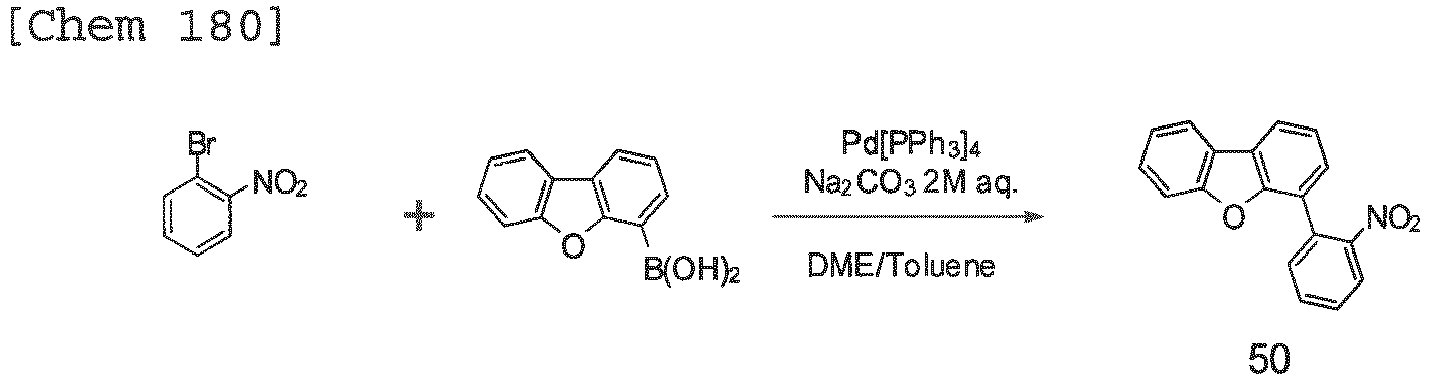
- Compound 2-bromonitrobenzene (25.0 g, 123.8 mmol), 4-dibenzofuranboronic acid (31.5 g, 148.5 mmol), a 2 M aqueous solution of Na2CO3 (124 mL, 248 mmol), DME (250 mL), toluene (250 mL), and Pd [PPh3]4 (7.2 g, 6.2 mmol) were loaded into a three-necked flask, and the mixture was refluxed under an Ar atmosphere for 12 hours.
- After the completion of the reaction, the resultant was cooled to room temperature. The resultant sample was transferred to a separating funnel, and water (500 mL) was charged into the funnel. Then, the mixture was extracted with CH2Cl2. The extract was dried with MgSO4, and was then filtered and concentrated. The resultant sample was purified by silica gel column chromatography, whereby a white solid was obtained in an amount of 24.0 g in 67% yield. FD-MS analysis C18H11NO3: theoretical value 289, observed value 289
-
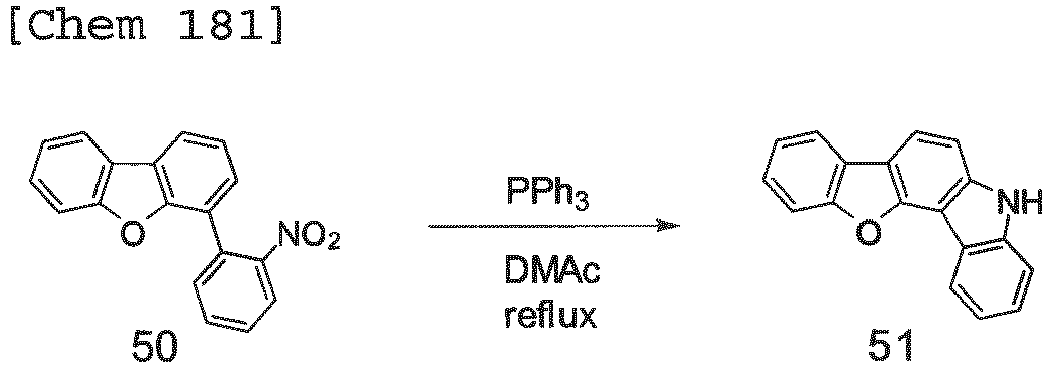
- Compound 50 (24.0 g, 83.0 mmol), triphenylphosphine (54.4 g, 207.4 mmol), and dimethylacetamide (166 mL) were loaded into a three-necked flask, and the mixture was refluxed under an Ar atmosphere for 20 hours.
- After the completion of the reaction, the resultant sample was cooled to room temperature. The resultant sample was transferred to a separating funnel, and water (400 mL) was charged into the funnel. Then, the mixture was extracted with CH2Cl2. The extract was dried with MgSO4, and was then filtered and concentrated. The resultant sample was purified by silica gel column chromatography, whereby a white solid was obtained in an amount of 14.5 g in 68% yield.
FD-MS analysis C18H11NO: theoretical value 257, observed value 257 -
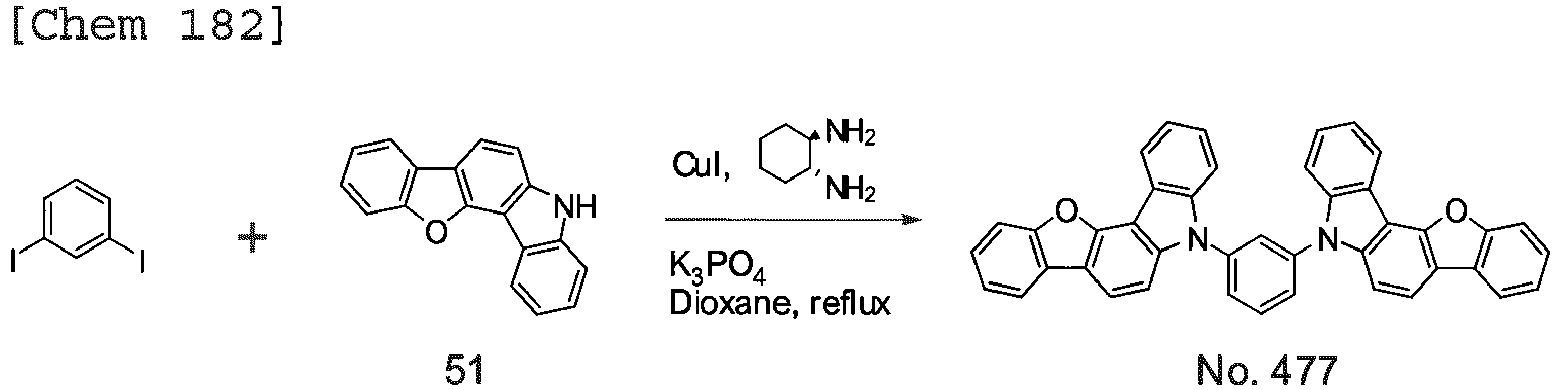
- 1, 3-diiodobenzene (3.3 g, 10. 0 mmol), Compound 51 (6.2 g, 24.0 mmol), CuI (1.9 g, 10 mmol), trans-cyclohexane-1,2-diamine (3.4 g, 30 mmol), K3PO4 (8.5 g, 40 mmol), and 1,4-dioxane (15 mL) were loaded into a three-necked flask, and the mixture was refluxed under an Ar atmosphere for 10 hours.
- After the completion of the reaction, the resultant was cooled to room temperature. The resultant sample was transferred to a separating funnel, and water (100 mL) was charged into the funnel. Then, the mixture was extracted with CH2Cl2. The resultant sample was purified by column chromatography. The purified product was concentrated to dryness, and was then recrystallized twice, whereby a white powder (Compound No. 477) was obtained. The powder was purified by sublimation, whereby a white solid was obtained in an amount of 1.8 g in 30% yield.
FD-MS analysis C42H24N2O2: theoretical value 588, observed value 588 -
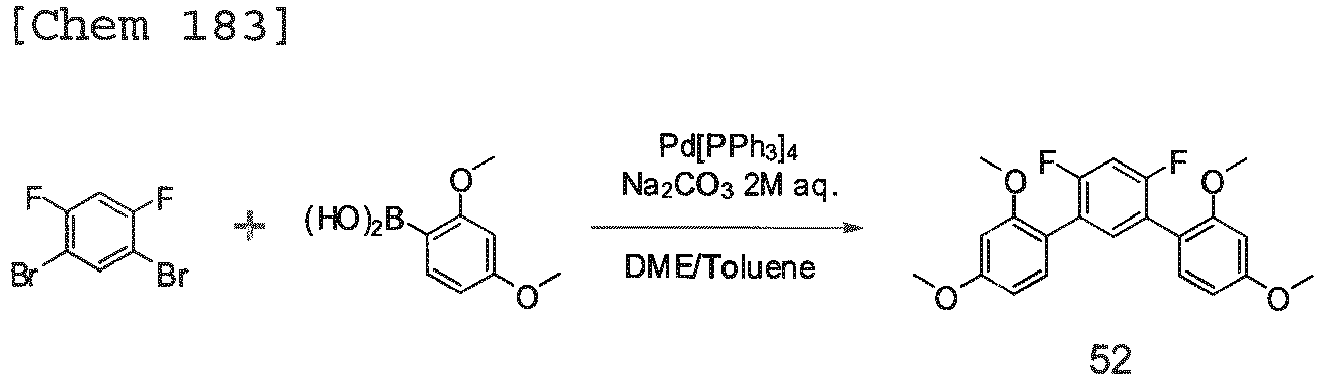
- 1,3-dibromo-4,6-difluorobenzene (6.8 g, 25.0 mmol), 2,4 -dimethoxyphenylboronic acid (10.0 g, 54. 9 mmol), and a 2 Maqueous solution of Na2CO3 (62 mL, 124 mmol), DME (60 mL), toluene (60 mL), and Pd [PPh3]4 (2.9 g, 2.5 mmol) were loaded into a three-necked flask, and the mixture was refluxed under an Ar atmosphere for 12 hours.
- After the completion of the reaction, the resultant was cooled to room temperature. The resultant sample was transferred to a separating funnel, and water (500 mL) was charged into the funnel. Then, the mixture was extracted with toluene. The extract was dried with MgSO4, and was then filtered and concentrated. The resultant sample was purified by silica gel column chromatography, whereby a white solid was obtained in an amount of 8.0 g in 83% yield.
FD-MS analysis C22H20F2O4: theoretical value 386, observed value 386 -
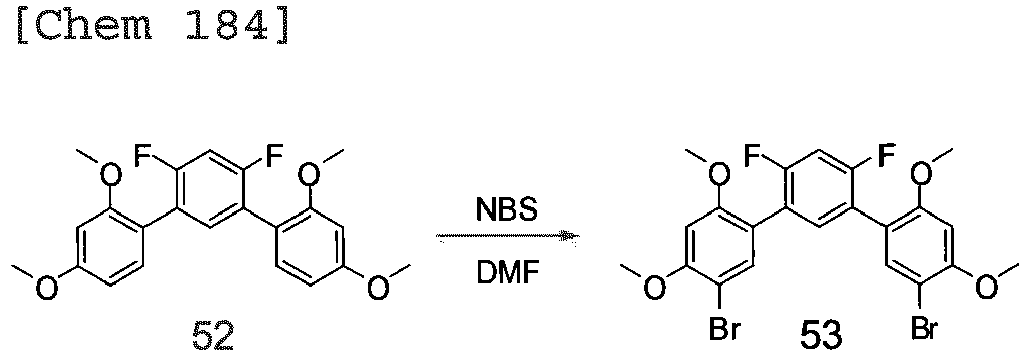
- Compound 52 (8.0 g, 20.8 mmol), NBS (7.4 g, 41.6 mmol), and DMF (200 mL) were loaded into a three-necked flask, and the mixture was stirred under an Ar atmosphere at room temperature for 20 hours. After the completion of the reaction, the resultant sample was transferred to a separating funnel, and water (500mL) was charged into the funnel. Then, the mixture was extracted with AcOEt. The resultant sample was purified by column chromatography, whereby a white solid was obtained in an amount of 7.4 g in 65% yield.
FD-MS analysis C22H18Br2F2O4: theoretical value 544, observed value 544 -
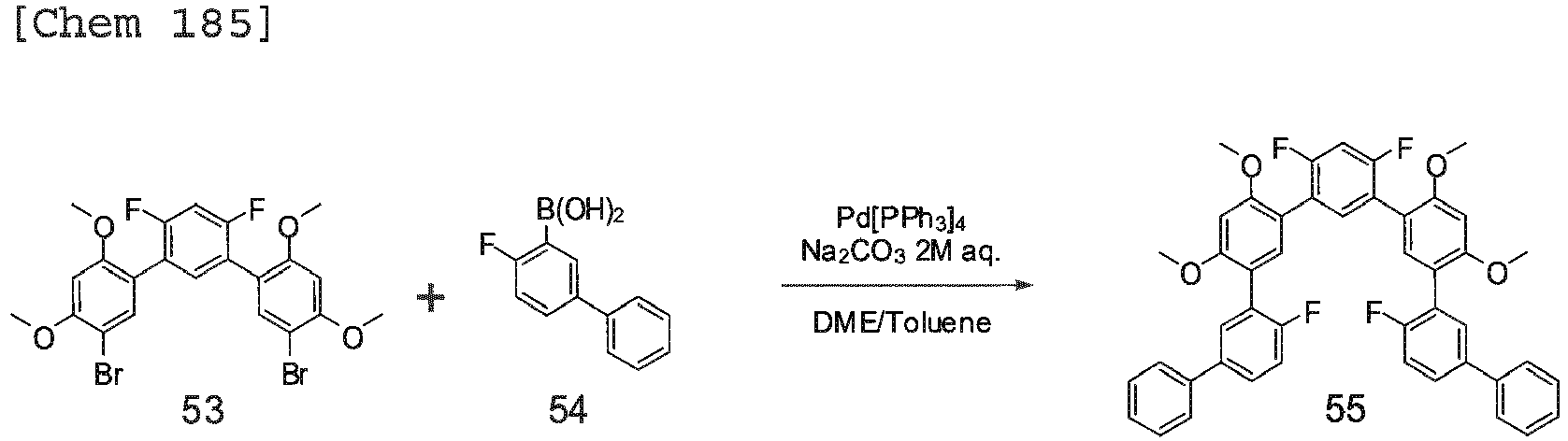
- Compound 53 (7.4 g, 13.6 mmol), Compound 54 (12.8 g, 32.6 mmol), a 2 M aqueous solution of Na2CO3 (28 mL, 56.0 mmol), DME (28 mL), toluene (28 mL), and Pd[PPh3]4 (0.79 g, 0.68 mmol) were loaded into a three-necked flask, and the mixture was refluxed under an Ar atmosphere for 20 hours.
- After the completion of the reaction, the resultant was cooled to room temperature. The resultant sample was transferred to a separating funnel, and water (300 mL) was charged into the funnel. Then, the mixture was extracted with CH2Cl2. The extract was dried with MgSO4, and was then filtered and concentrated. The resultant sample was purified by silica gel column chromatography, whereby a white solid was obtained in an amount of 6.2 g in 63% yield.
FD-MS analysis C46H34F4O4: theoretical value 726, observed value 726 -
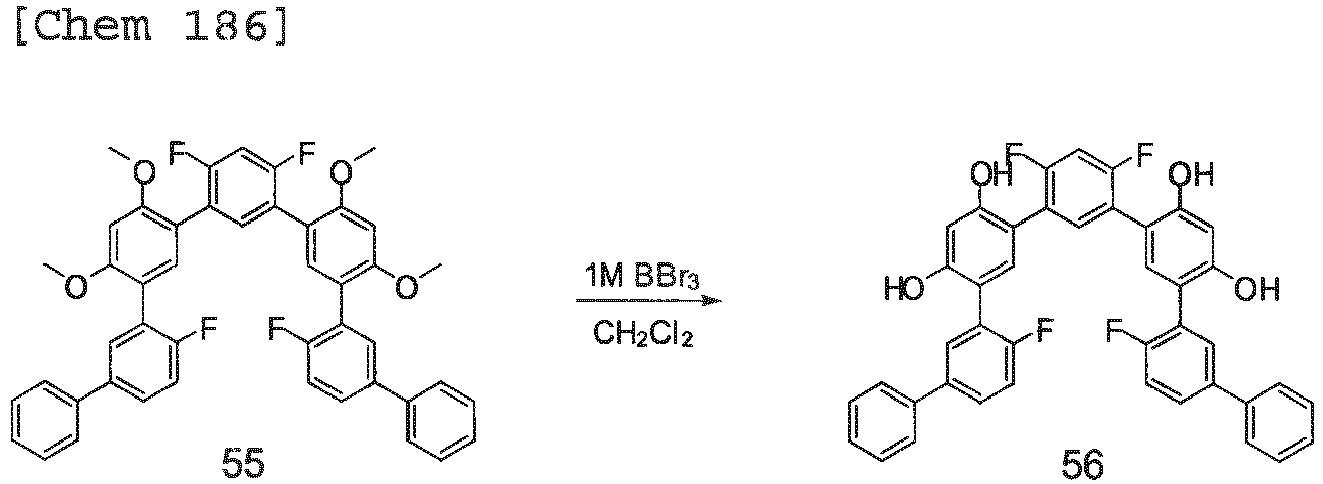
- Compound 55 (6.2 g, 8.5 mmol), a 1 M solution of BBr3 in CH2Cl2 (20.5 mL, 20.5 mmol), and CH2Cl2 (85 mL) were loaded into a three-necked flask, and the mixture was stirred under an Ar atmosphere at 0°C for 8 hours. After that, the mixture was left to stand at room temperature overnight.
- After the completion of the reaction, the resultant was neutralized with a saturated aqueous solution of NaHCO3. The resultant sample was transferred to a separating funnel, and was extracted with CH2Cl2. The resultant sample was purified by silica gel column chromatography, whereby a white solid was obtained in an amount of 5.1 g in 90% yield.
FD-MS analysis C42H26F4O4: theoretical value 670, observed value 670 -
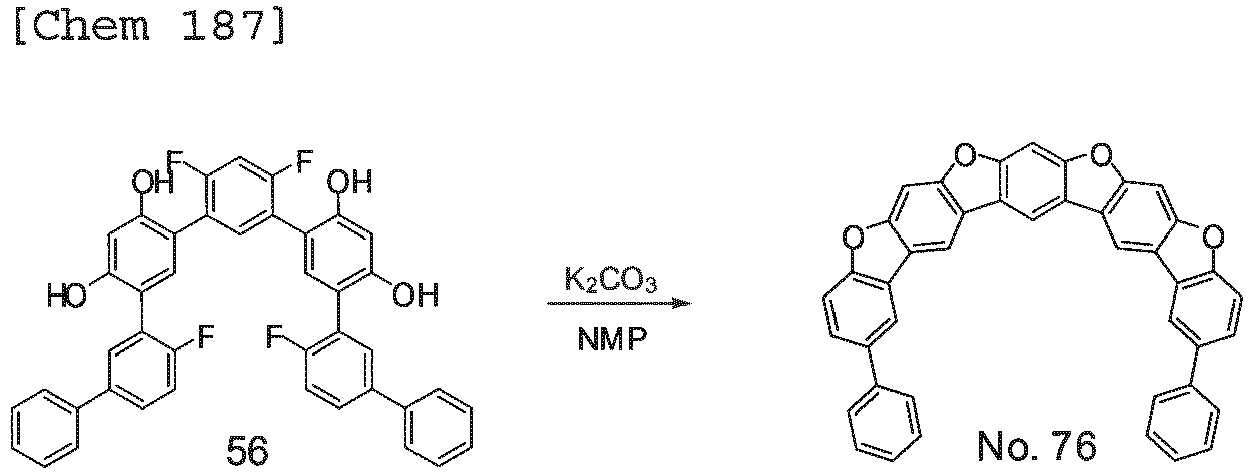
- Compound 56 (5.1 g, 7.6 mmol), K2CO3 (4.2 g, 30.4 mmol), and NMP (80 mL) were loaded into a three-necked flask, and the mixture was refluxed under an Ar atmosphere at 200 °C for 4 hours. After the completion of the reaction, the resultant was cooled to room temperature. The resultant sample was transferred to a separating funnel, and water (500 mL) was charged into the funnel. Then, the mixture was extracted with toluene. The resultant sample was purified by column chromatography. The purified product was concentrated to dryness, and was then recrystallized twice, whereby a white powder (Compound No. 76 (not according to the invention)) was obtained. The powder was purified by sublimation, whereby a white solid was obtained in an amount of 1.4 g in 31% yield.
FD-MS analysis C42H22O4: theoretical value 590, observed value 590 -
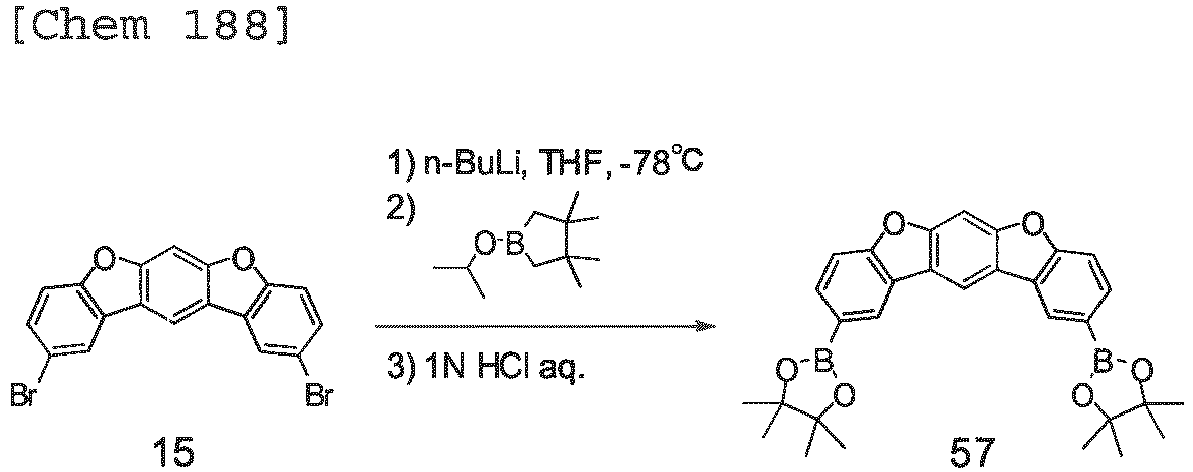
- Under an Ar atmosphere, Compound 41 (5.0 g, 12.0 mmol) and THF (250 mL) were loaded into a three-necked flask, and then the mixture was cooled to -78°C. n-BuLi (2.64 M in hexane, 10.0 ml, 26.4 mmol) was added to the mixture, and then the whole was stirred at -78°C for 2 hours. Next, 2-isopropoxy-4,4,5,5-tetramethyl-1,3,2-dioxaborolane (5.59 g, 30.0 mmol) was added to the resultant, and then the mixture was stirred at -78°C for 2 hours. After that, the mixture was left to stand at room temperature overnight.
- After the completion of the reaction, water (100 mL) was added to the mixture, and then the whole was stirred at room temperature for 1 hour. The reaction solution was concentrated so that THF might be removed by distillation. After that, the resultant sample was transferred to a separating funnel and extracted with CH2Cl2. The solution was dried with MgSO4, and was then concentrated. The sample was recrystallized from toluene. Thus, a white solid was obtained in an amount of 2.77 g in 45% yield.
-
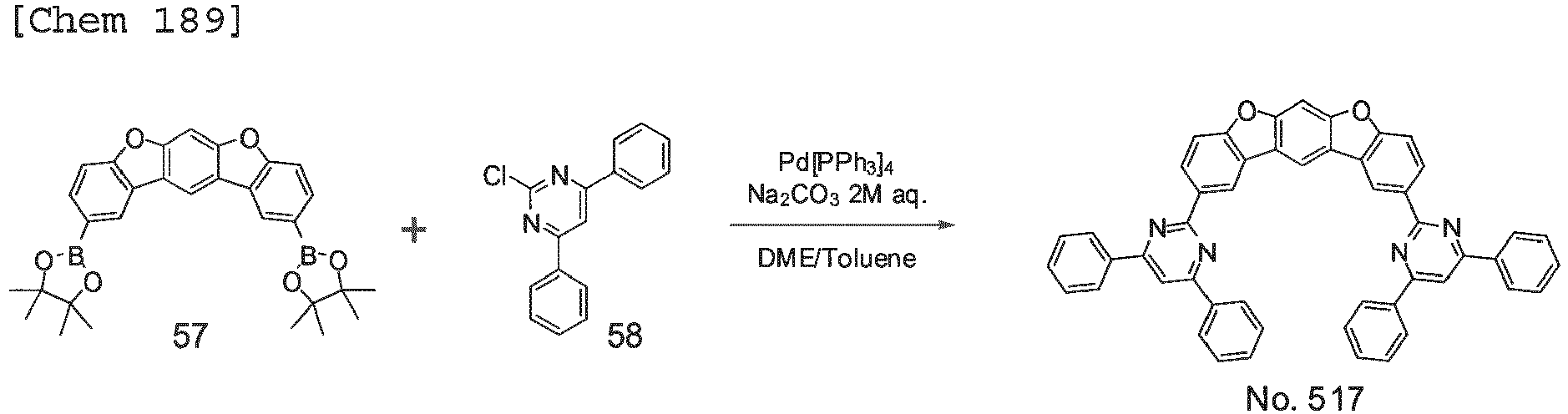
- Compound 57 (2.77 g, 5.43 mmol), Compound 58 (3.48 g, 13.0 mmol), a 2 M aqueous solution of Na2CO3 (26 mL, 52 mmol), DME (25 mL), toluene (25 mL), and Pd[PPh3]4 (0.75 g, 0.65 mmol) were loaded into a three-necked flask, and the mixture was refluxed under an Ar atmosphere for 12 hours.
- After the completion of the reaction, the resultant was cooled to room temperature. The resultant sample was transferred to a separating funnel, and water (500 mL) was charged into the funnel. Then, the mixture was extracted with toluene . The extract was dried with MgSO4, and was then filtered and concentrated. The resultant sample was purified by silica gel column chromatography. The purified product was concentrated to dryness, and was then recrystallized twice, whereby a white powder (Compound No. 517) was obtained. The powder was purified by sublimation, whereby a white solid was obtained in an amount of 1.3 g in 33% yield.
FD-MS analysis C50H30N4O2: theoretical value 718, observed value 718 -


- Compound 57 (2.77 g, 5.43 mmol), Compound 59 (3.48 g, 13.0 mmol), a 2 M aqueous solution of Na2CO3 (26 mL, 52 mmol), DME (25 mL), toluene (25 mL), and Pd[PPh3]4 (0.75 g, 0.65 mmol) were loaded into a three-necked flask, and the mixture was refluxed under an Ar atmosphere for 12 hours.
- After the completion of the reaction, the resultant was cooled to room temperature. The resultant sample was transferred to a separating funnel, and water (500 mL) was charged into the funnel. Then, the mixture was extracted with toluene. The extract was dried with MgSO4, and was then filtered and concentrated. The resultant sample was purified by silica gel column chromatography. The purified product was concentrated to dryness, and was then recrystallized twice, whereby a white powder (Compound No. 589) was obtained. The powder was purified by sublimation, whereby a white solid was obtained in an amount of 1.2 g in 30% yield.
FD-MS analysis C48H28N6O2: theoretical value 720, observed value 720 -

- Compound 3-biphenylboronic acid (1.98 g, 10 mmol), 1-bromo-3-iodobenzene (2.83 g, 10 mmol), a 2 M aqueous solution of Na2CO3 (10 mL, 20 mmol), toluene (40 mL), and Pd[PPh3]4 (0.35 g, 0.30 mmol) were loaded into a three-necked flask, and the mixture was refluxed under an Ar atmosphere for 10 hours.
- After the completion of the reaction, the resultant was cooled to room temperature. The resultant sample was transferred to a separating funnel, and water (500 mL) was charged into the funnel. Then, the mixture was extracted with toluene. The extract was dried with MgSO4, and was then filtered and concentrated. The resultant sample was purified by silica gel column chromatography. The purified product was concentrated to dryness, whereby a colorless oily product was obtained in an amount of 2.9 g in 93% yield.
FD-MS analysis C18H13Br: theoretical value 309, observed value 309 -
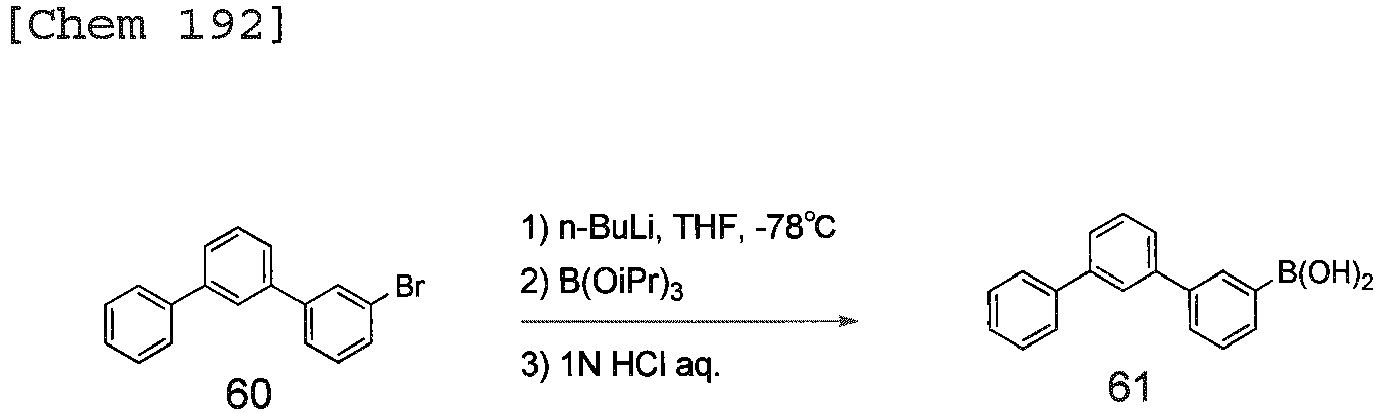
- Compound 60 (2.9 g, 9.38 mmol) and THF (30 mL) were loaded into a three-necked flask under an Ar atmosphere, and the mixture was cooled to -78°C. Then, n-BuLi (1.59 M in n-hexane, 6.1 ml, 9.70 mmol) was added dropwise to the flask, and the resultant mixture was stirred at -78°C for 2 hours. Next, triisopropyl borate (5.45 g, 29.0 mmol) was added to the resultant, and the mixture was stirred at -78°C for 2 hours. After that, the resultant was left to stand at room temperature overnight. Then, 1 N HCl (20 mL) was charged into the resultant, and the mixture was stirred at room temperature for 1 hour. The resultant sample was concentrated, and was then transferred to a separating funnel. Water (100 mL) was charged into the funnel, and the mixture was extracted with CH2Cl2. The extract was dried with MgSO4, and was then filtered and concentrated. The resultant sample was purified by recrystallization (toluene-hexane), whereby a white solid was obtained in an amount of 1.74 g in 68% yield.
-
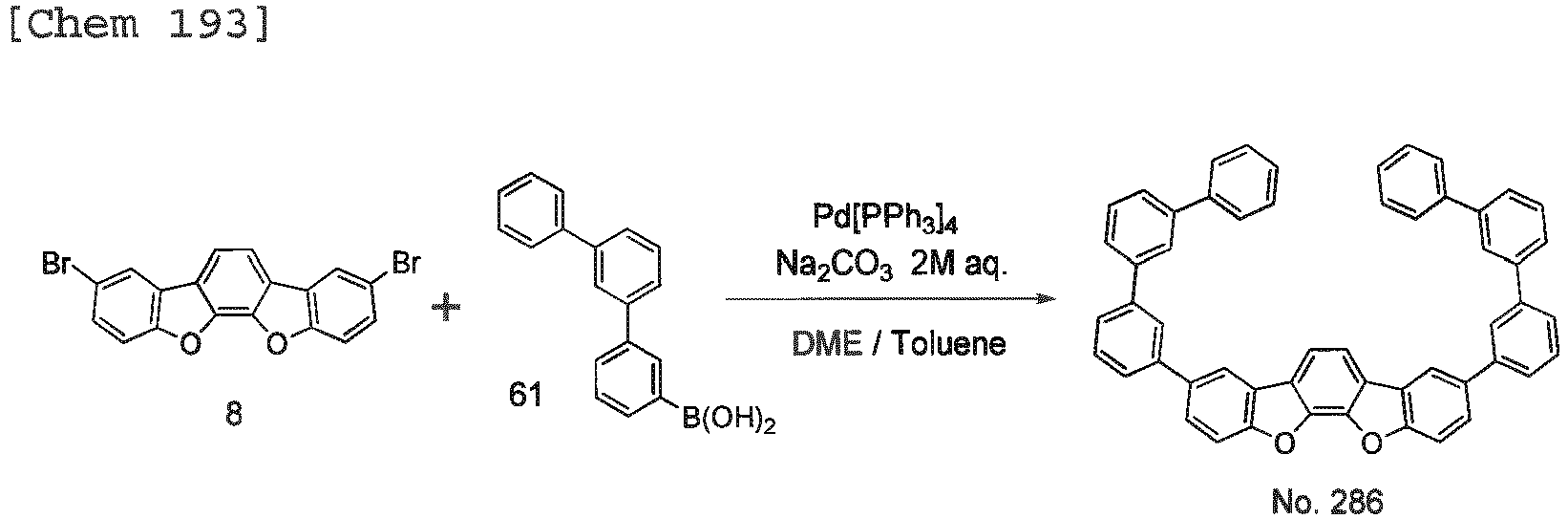
- Compound 8 (1.20 g, 2.88 mmol), Compound 61 (1.74 g, 6.35 mmol), a 2 M aqueous solution of Na2CO3 (7.2 mL, 14.4 mmol), DME (10 mL), toluene (10 mL), and Pd[PPh3]4 (0.33 g, 0.29 mmol) were loaded into a three-necked flask, and the mixture was refluxed under an Ar atmosphere for 12 hours.
- After the completion of the reaction, the resultant was cooled to room temperature. The resultant sample was transferred to a separating funnel, and water (500 mL) was charged into the funnel. Then, the mixture was extracted with toluene . The extract was dried with MgSO4, and was then filtered and concentrated. The resultant sample was purified by silica gel column chromatography. The purified product was concentrated to dryness, and was then recrystallized twice, whereby a white powder (Compound No. 286 (not according to the invention)) was obtained. The powder was purified by sublimation, whereby a white solid was obtained in an amount of 0.9 g in 43% yield.
FD-MS analysis C54H34O2: theoretical value 714, observed value 714 -
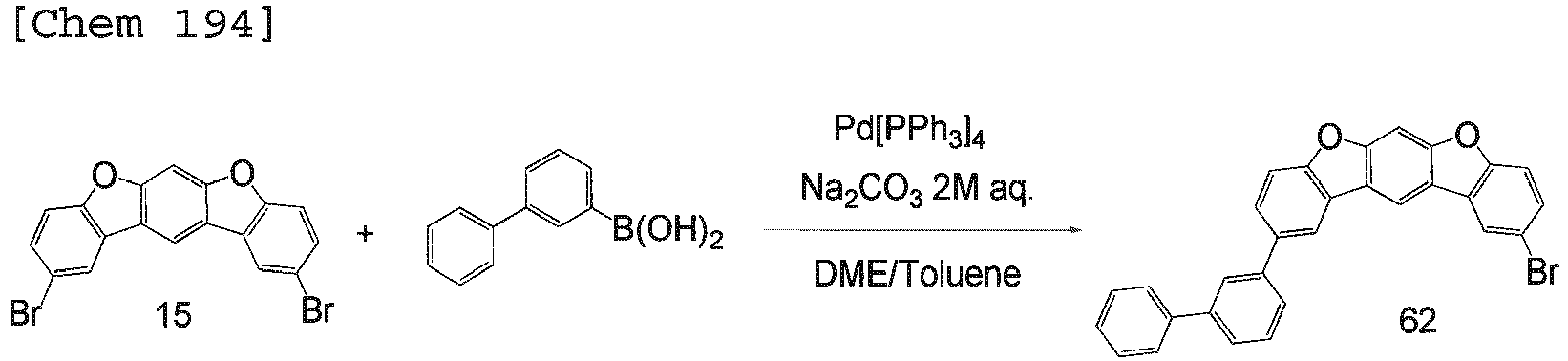
- Compound 15 (16.6 g, 40 mmol), 3-biphenylboronic acid (7.9 g, 40 mmol), a 2 M aqueous solution of Na2CO3 (80 mL, 160 mmol), DME (120 mL), toluene (120 mL), and Pd[PPh3]4 (2.3 g, 2.0 mmol) were loaded into a three-necked flask, and the mixture was refluxed under an Ar atmosphere for 12 hours.
- After the completion of the reaction, the resultant was cooled to room temperature. The resultant sample was transferred to a separating funnel, and water (200 mL) was charged into the funnel. Then, the mixture was extracted with toluene. The extract was dried with MgSO4, and was then filtered and concentrated. The resultant sample was purified by silica gel column chromatography, whereby a white solid was obtained in an amount of 10.7 g in 54% yield. FD-MS analysis C30H17BrO2: theoretical value 489, observed value 489
-
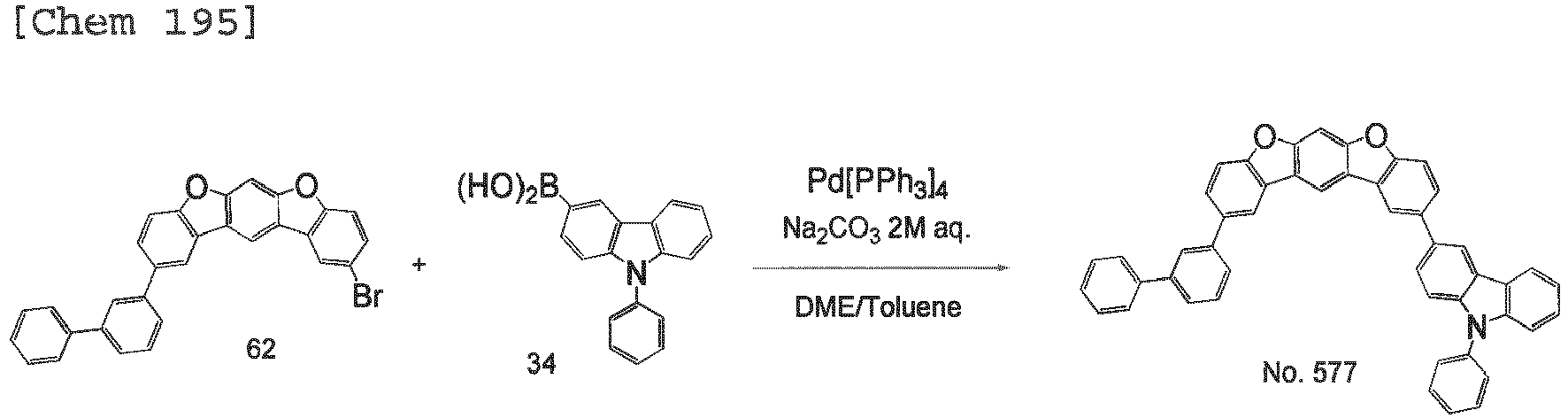
- Compound 62 (4.89 g, 10 mmol), Compound 34 (3.16 g, 11 mmol), a 2 M aqueous solution of Na2CO3 (20 mL, 40 mmol), DME (100 mL), toluene (100 mL), and Pd[PPh3]4 (1.2 g, 1.0 mmol) were loaded into a three-necked flask, and the mixture was refluxed under an Ar atmosphere for 12 hours.
- After the completion of the reaction, the resultant was cooled to room temperature. The resultant sample was transferred to a separating funnel, and water (200 mL) was charged into the funnel. Then, the mixture was extracted with toluene. The extract was dried with MgSO4, and was then filtered and concentrated. The resultant sample was purified by silica gel column chromatography. The purified product was concentrated to dryness, and was then recrystallized twice, whereby a white powder (Compound No. 577) was obtained. The powder was purified by sublimation, whereby a white solid was obtained in an amount of 1.3 g in 20% yield. FD-MS analysis C48H29NO2: theoretical value 651, observed value 651
-
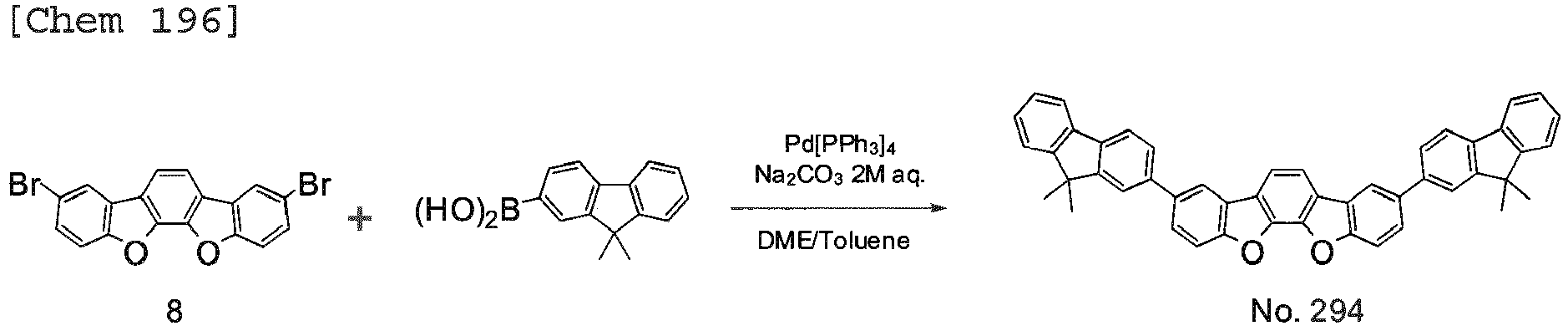
- Compound 8 (2.5 g, 6.0 mmol), 9,9-dimethylfluorene-2-boronic acid (3.1 g, 13.2 mmol), a 2 Maqueous solution of Na2CO3 (12 mL, 24 mmol), DME (12 mL), toluene (12 mL), and Pd[PPh3]4 (0.35 g, 0.3 mmol) were loaded into a three-necked flask, and the mixture was refluxed under an Ar atmosphere for 8 hours.
- After the completion of the reaction, the resultant was cooled to room temperature. The resultant sample was transferred to a separating funnel, and water (50 mL) was charged into the funnel. Then, the mixture was extracted with CH2Cl2. The extract was dried with MgSO4, and was then filtered and concentrated. The resultant sample was purified by silica gel column chromatography. The purified product was concentrated to dryness, and was then recrystallized twice, whereby a white powder (Compound No. 294 (not according to the invention) was obtained. The powder was purified by sublimation, whereby a white solid was obtained in an amount of 1.1 g in 30% yield.
FD-MS analysis C48H34O2: theoretical value 642, observed value 642 -
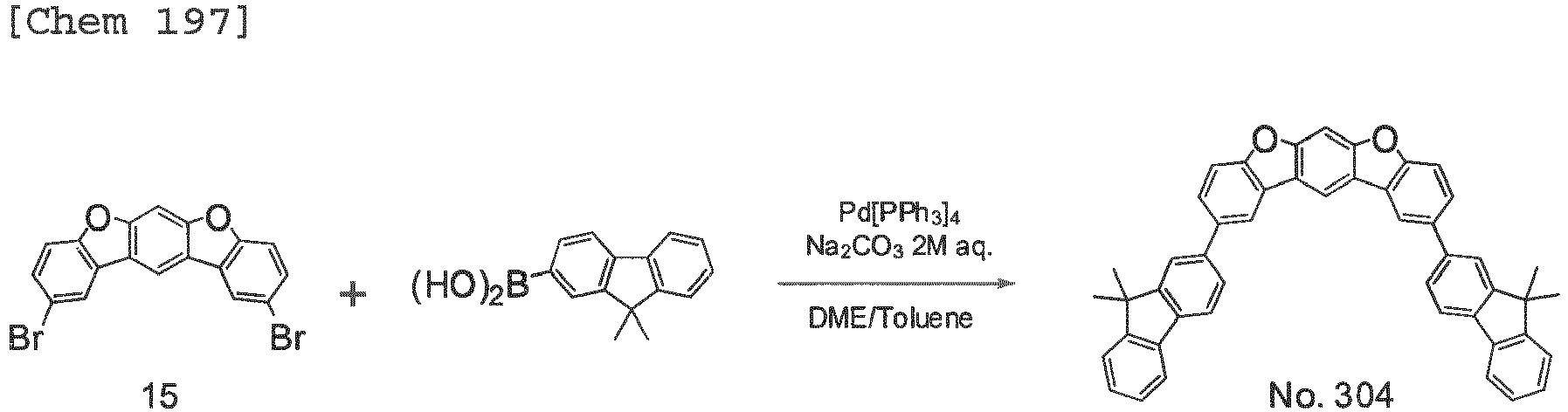
- Compound 15 (2.5 g, 6.0 mmol), 9,9-dimethylfluorene-2-boronicacid (3.1g, 13.2 mmol), a 2 Maqueous solution of Na2CO3 (12 mL, 24 mmol), DME (12 mL), toluene (12 mL), and Pd[PPh3]4 (0.35 g, 0.3 mmol) were loaded into a three-necked flask, and the mixture was refluxed under an Ar atmosphere for 8 hours.
- After the completion of the reaction, the resultant was cooled to room temperature. The resultant sample was transferred to a separating funnel, and water (50 mL) was charged into the funnel. Then, the mixture was extracted with CH2Cl2. The extract was dried with MgSO4, and was then filtered and concentrated. The resultant sample was purified by silica gel column chromatography. The purified product was concentrated to dryness, and was then recrystallized twice, whereby a white powder (Compound No. 304) was obtained. The powder was purified by sublimation, whereby a white solid was obtained in an amount of 1.3 g in 35% yield.
FD-MS analysis C48H34O2: theoretical value 642, observed value 642 - An apparatus and measurement conditions adopted for field desorption mass spectrometry (FD-MS) in each of Synthesis Examples 1 to 39 are shown below.
- Apparatus: HX110 (manufactured by JEOL Ltd.)
- Conditions: accelerating voltage 8 kV
scan range m/z=50 to 1500
emitter kind: carbon
emitter current: 0 mA→2 mA/min→40 mA (held for 10 minutes) - A glass substrate provided with an ITO transparent electrode measuring 25 mm by 75 mm by 1.1 mm (manufactured by GEOMATEC Co. , Ltd.) was subjected to ultrasonic cleaning in isopropyl alcohol for 5 minutes. Further, the substrate was subjected to ultraviolet (UV)-ozone cleaning for 30 minutes.
- The glass substrate provided with a transparent electrode thus cleaned was mounted on a substrate holder of a vacuum deposition apparatus. First, Compound A was deposited from the vapor onto the surface of the glass substrate on the side where a transparent electrode line was formed so as to cover the transparent electrode, whereby a hole transporting layer having a thickness of 30 nm was obtained.
- Compound No. 11 (not according to the invention) as a host for phosphorescence and Ir (Ph-ppy)3 as a dopant for phosphorescence were co-deposited from the vapor onto the hole transporting layer, whereby a phosphorescent layer having a thickness of 30 nm was obtained. The concentration of Ir(Ph-ppy)3 was 5 mass%.
- Subsequently, Compound B having a thickness of 10 nm, Compound C having a thickness of 20 nm, LiF having a thickness of 1 nm, and metal Al having a thickness of 80 nm were sequentially laminated on the phosphorescent layer, whereby a cathode was obtained. It should be noted that LiF as an electron injectable electrode was formed at a rate of 1 Å/min.
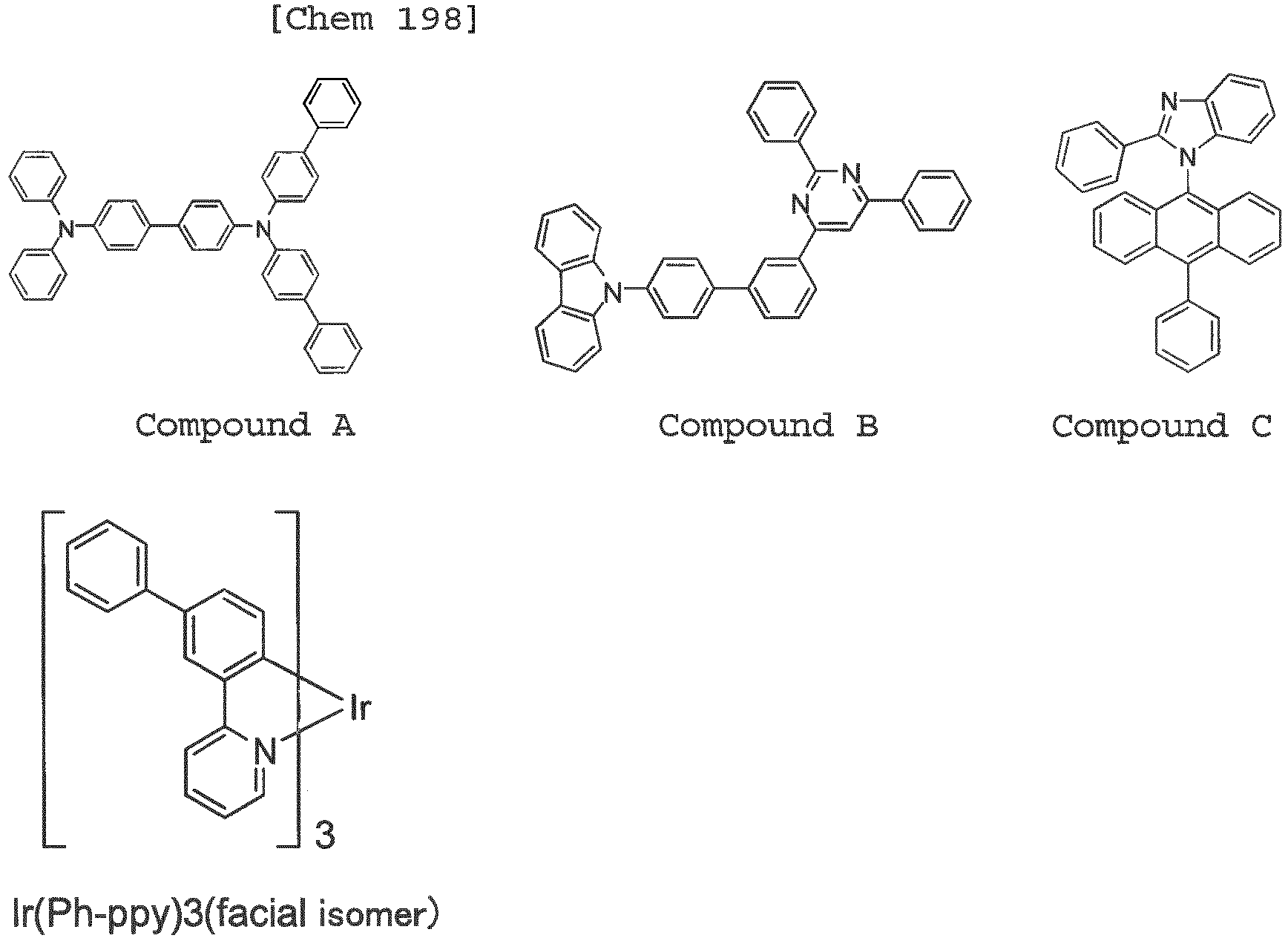
- The organic EL device thus produced was caused to emit light by being driven with a direct current. The luminance (L) and the current density were measured. Then, the current efficiency (L/J) at a luminance of 1000 cd/m2 was determined. Further, the lifetime of the device at a luminance of 20, 000 cd/m2 was determined. Table 1 shows the results.
- Organic EL devices were each produced in the same manner as in Example 1 except that a host material listed in Table 1 was used instead of Host Compound No. 11 (not according to the invention) in Example 1 (not according to the invention), and the devices were each evaluated in the same manner as in Example 1. Table 1 shows the results of the evaluation for light emitting performance.
- Organic EL devices were each produced in the same manner as in Example 1 except that the following compounds (a) to (g) described in
EP 0908787 A were each used as a host material instead of Host Compound No. 11 (not according to the invention) in Example 1 (not according to the invention), and the devices were each evaluated in the same manner as in Example 1. Table 2 shows the results of the evaluation for light emitting performance. - Organic EL devices were each produced in the same manner as in Example 1 except that the following compounds (h) to (k) described in
WO 2006-122630 A1 were each used as a host material instead of Host Compound No. 11 (not according to the invention) in Example 1, and the devices were each evaluated in the same manner as in Example 1. Table 2 shows the results of the evaluation for light emitting performance. - Organic EL devices were each produced in the same manner as in Example 1 except that the following compounds (1) and (m) described in
WO 2007-063754 A1 were each used as a host material instead of Host Compound No. 11 (not according to the invention) in Example 1, and the devices were each evaluated in the same manner as in Example 1. Table 2 shows the results of the evaluation for light emitting performance. - An organic EL device was produced in the same manner as in Example 1 except that the following compound (n) described in
US 2002-0132134 A andUS 2003-0044646 A was used as a host material instead of Host Compound No. 11 (not according to the invention) in Example 1, and the device was evaluated in the same manner as in Example 1. Table 2 shows the results of the evaluation for light emitting performance. - An organic EL device was produced in the same manner as in Example 1 except that the following compound (o) described in
JP 2008-81494 A 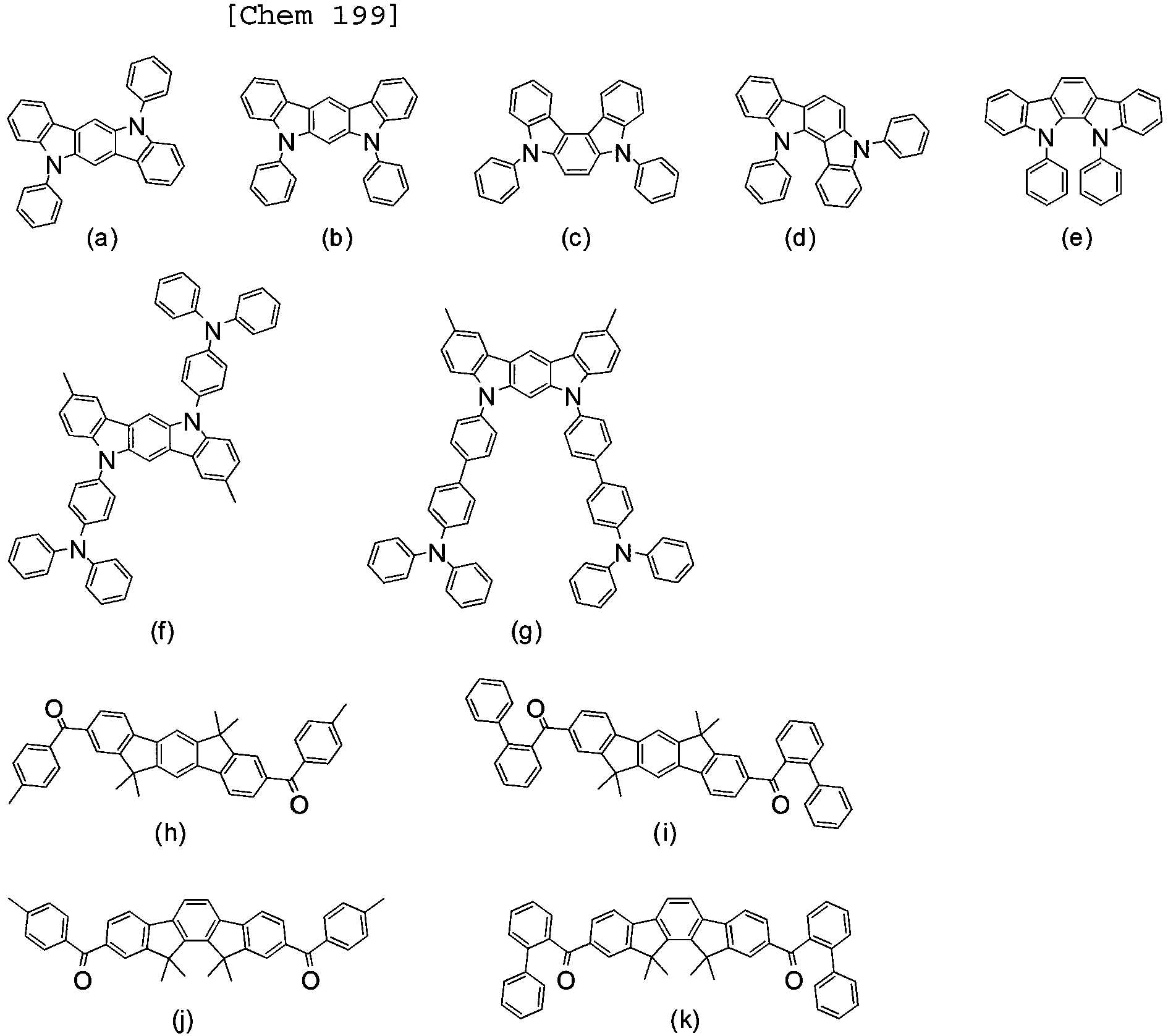
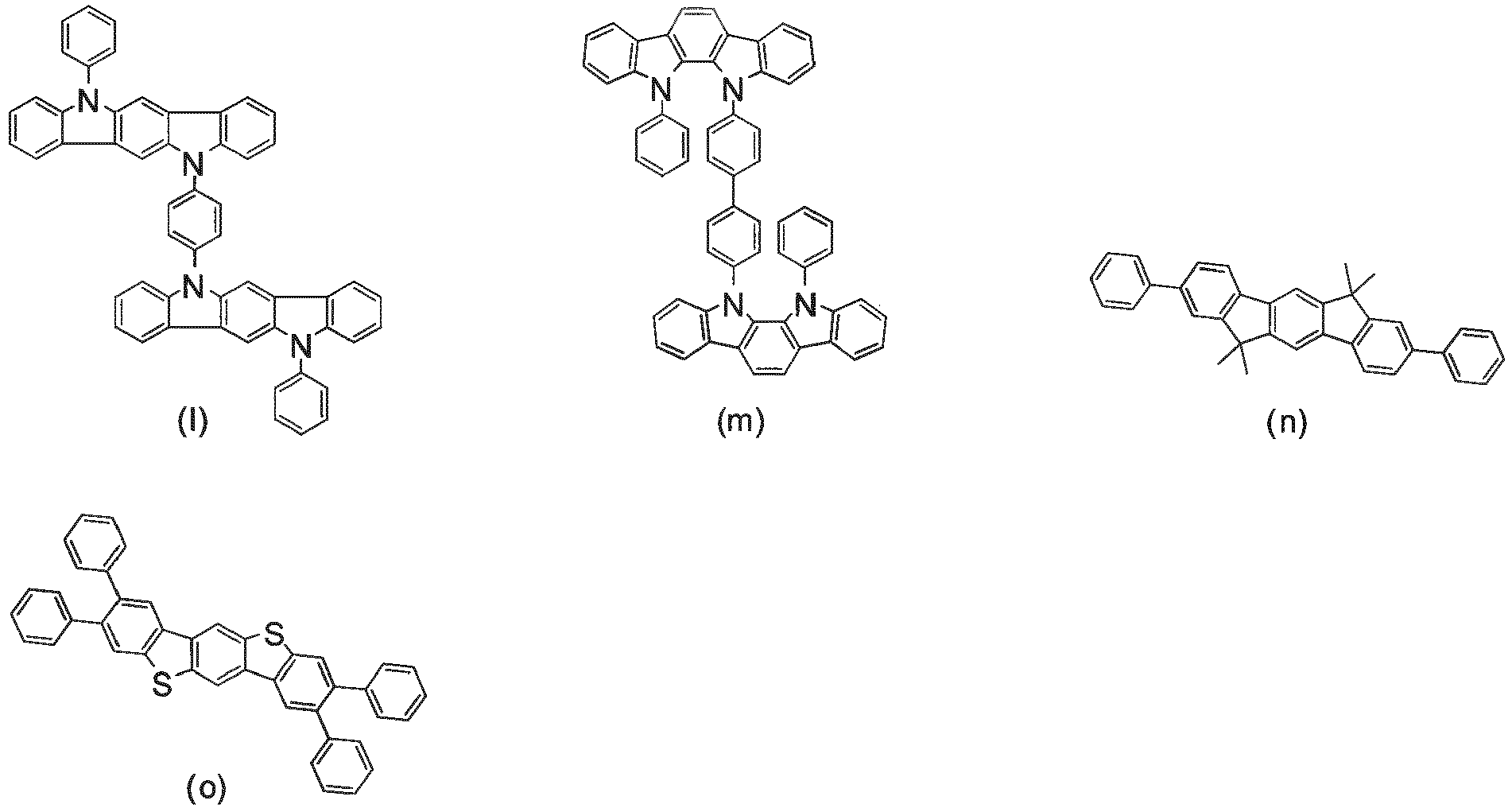
-
Table 1 Host Compound Voltage (V) @20 mA/cm2 Efficiency (cd/A) @1000 cd/m2 Lifetime (hr) @20,000 cd/m2 Example 1* (11) 5.3 47.6 190 Example 2* (40) 5.2 46.2 200 Example 3* (47) 5.3 47.1 200 Example 4* (66) 5.4 49.1 160 Example 5* (100) 5.5 58.2 250 Example 6* (103) 5.6 59.1 230 Example 7 (116) 5.5 58.3 300 Example 8 (119) 5.5 57.1 320 Example 9 (134) 5.2 54.9 290 Example 10 (139) 5.3 55.3 280 Example 11* (154) 5.5 59.3 200 Example 12* (157) 5.6 60.1 180 Example 13* (233) 5.3 54.3 150 Example 14* (239) 5.5 58.5 420 Example 15 (243) 5.5 55.9 90 Example 16 (249) 5.6 58.3 440 Example 17 (253) 5.6 56.6 80 Example 18 (259) 5.8 59.7 400 Example 19* (263) 5.7 57.2 70 Example 20* (269) 5.9 59.8 360 Example 21* (272) 5.5 55.7 420 Example 22 (273) 5.4 55.8 470 Example 23 (274) 5.4 59.7 410 Example 24* (276) 5.6 59.9 250 Example 25* (1) 5.4 54.3 510 Example 26 (108) 6.1 58.7 530 Example 27 (281) 5.1 60.7 350 Example 28 (284) 5.2 61.2 350 Example 29 (477) 4.8 58.7 390 Example 30* (76) 5.0 60.1 420 Example 31 (517) 4.8 54.8 250 Example 32* (286) 5.8 60.3 540 Example 33* (294) 5.2 50.1 210 Example 34 (304) 5.6 52.7 320 * not according to the invention -
Table 2 Host Compound Voltage (V) @20 mA/cm2 Efficiency (cd/A) @1000 cd/m2 Lifetime (hr) @20,000 cd/m2 Comparative Example 1 (a) 4.6 26.5 50 Comparative Example 2 (b) 4.7 28.9 60 Comparative Example 3 (c) 4.5 23.1 50 Comparative Example 4 (d) 4.7 28.1 60 Comparative Example 5 (e) 4.7 26.1 30 Comparative Example 6 (f) 4.2 17.6 30 Comparative Example 7 (g) 4.3 18.5 30 Comparative Example 8 (h) 4.9 37.5 50 Comparative Example 9 (i) 4.7 35.9 60 Comparative Example 10 (j) 4.7 35.5 50 Comparative Example 11 (k) 4.5 35.7 50 Comparative Example 12 (1) 4.3 17.3 30 Comparative Example 13 (m) 4.5 17.7 20 Comparative Example 14 (n) 5.4 28.7 60 Comparative Example 15 (o) 5.5 38.2 50 - The glass substrate provided with a transparent electrode cleaned in the same manner as described above was mounted on a substrate holder of a vacuum deposition apparatus. First, Compound A was deposited from the vapor onto the surface of the glass substrate on the side where a transparent electrode line was formed so as to cover the transparent electrode, whereby a hole transporting layer having a thickness of 30 nm was obtained.
- Compound No. 108 as a host for phosphorescence and Ir(Ph-ppy)3 as a dopant for phosphorescence were co-deposited from the vapor onto the hole transporting layer, whereby a phosphorescent layer having a thickness of 30 nm was obtained. The concentration of Ir(Ph-ppy)3 was 10 mass%.
- Subsequently, Compound No. 92 (not according to the invention) having a thickness of 10 nm, Compound C having a thickness of 20 nm, LiF having a thickness of 1 nm, and metal A1 having a thickness of 80 nm were sequentially laminated on the phosphorescent layer, whereby a cathode was obtained. It should be noted that LiF as an electron injectable electrode was formed at a rate of 1 Å/min.
- The organic EL device thus produced was caused to emit light by being driven with a direct current. The luminance (L) and the current density were measured. Then, the current efficiency (L/J) at a luminance of 1000 cd/m2 was determined. Further, the lifetime of the device at a luminance of 20,000 cd/m2 was determined. Table 3 shows the results.
- Organic EL devices were each produced in the same manner as in Example 35 except that a host compound and an electron transportable compound listed in Table 3 were used instead of Host Compound No. 108 and Electron Transportable Compound No. 92 (not according to the invention) in Example 35, and the devices were each evaluated in the same manner as in Example 35. Table 3 shows the results of the evaluation for light emitting performance.
- An organic EL device was produced in the same manner as in Example 35 except that: CBP was used instead of Host Compound No. 108 in Example 35 ; andBAlq was used instead of Electron Transportable Compound No. 92 (not according to the invention) in Example 35. Then, the device was evaluated in the same manner as in Example 35. Table 3 shows the results of the evaluation for light emitting performance.
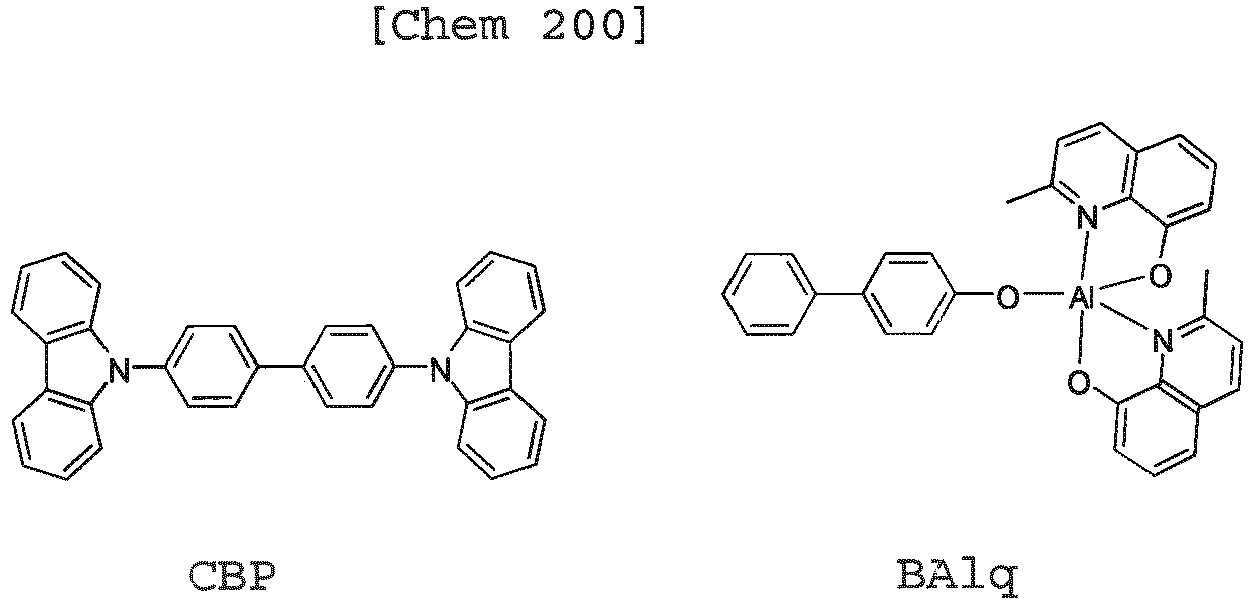
-
Table 3 Host Compound Electron Transportable Compound Voltage (V) @20 mA/cm2 Efficiency (cd/A) @1000 cd/m2 Lifetime (hr) @20, 000 cd/m2 Example 35 (108) (92) 5.8 60.2 580 Example 36* (108) (306) 5.7 62.1 560 Example 37 (108) (108) 6.0 63.7 600 Example 38 (108) (329) 5.9 62.3 550 Example 39* (1) (92) 4.8 55.6 550 Example 40* (103) (92) 5.5 66.1 590 Example 41 (119) (92) 5.7 68.9 570 Example 42 (108) (517) 4.8 62.1 560 Example 43 (1) (517) 4.7 59.7 600 Example 44* CBP (92) 5.7 48.5 100 Example 45* CBP (306) 5.6 49.6 120 Example 46 CBP (108) 5.9 48.2 100 Example 47 CBP (329) 5.8 49.3 120 Example 48 CBP (517) 5.2 44.2 150 Comparative Example 16 CBP BAlq 6.5 45.1 30 * not according to the invention - Each of the organic EL devices of the comparative examples showed a lower current efficiency, was driven at a higher voltage, and had a shorter lifetime than those of each of the organic EL devices of the examples.
- As described above in detail, the utilization of the polycyclic compound of the present invention as a material for an organic EL device can provide an organic EL device which shows high luminous efficiency, and has a long lifetime. Accordingly, the organic EL device of the present invention is extremely useful as, for example, a light source for various electronic instruments. In addition, the halogen compound of the present invention is suitable for an intermediate of the polycyclic compound. In addition, the polycyclic compound of the present invention can be effectively used also as a material for an organic electron device, and is extremely useful in an organic solar cell, organic semiconductor laser, a sensor using organic matter, or an organic TFT.
- The following embodiments were originally disclosed, but are only according to the invention as far as specified in the claims:
- [Item 1] A polycyclic compound represented by the following formula (1) or (2):
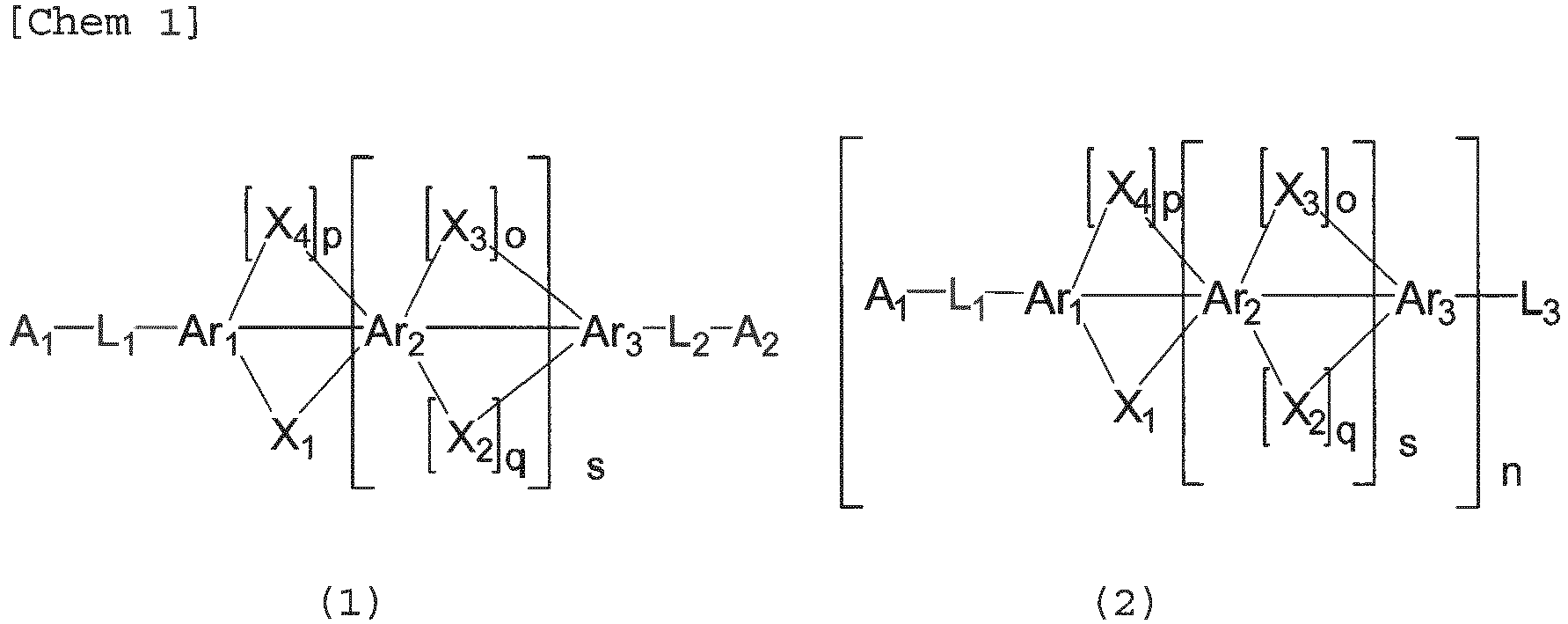
- Ar1, Ar2, and Ar3 each independently represent a substituted or unsubstituted aromatic hydrocarbon group having a ring formed of 6 carbon atoms or a substituted or unsubstituted aromatic heterocyclic group having a ring formed of 6 atoms, provided that, Ar1, Ar2, and Ar3 each may have one substituent Y or a plurality of substituents Y's, in the case of the plurality of substituents Y's, the substituent Y's maybe different from eachother, Y represents an alkyl group having 1 to 20 carbon atoms, a substituted or unsubstituted cycloalkyl group having a ring formed of 3 to 20 carbon atoms, an alkoxy group having 1 to 20 carbon atoms, an aralkyl group having 7 to 24 carbon atoms, a silyl group or a substituted silyl group having 3 to 20 carbon atoms, a substituted or unsubstituted aromatic hydrocarbon group having a ring formed of 6 to 24 carbon atoms, or a substituted or unsubstituted aromatic heterocyclic group which has a ring formed of 3 to 24 atoms and which is linked with Ar1, Ar2, or Ar3 through a carbon-carbon bond;
- X1, X2, X3, and X4 each independently represent oxygen (O), sulfur (S), N-R1 or CR2R3;
- R1, R2, and R3 each independently represent an alkyl group having 1 to 20 carbon atoms, a substituted or unsubstituted cycloalkyl group having a ring formed of 3 to 20 carbon atoms, an aralkyl group having 7 to 24 carbon atoms, a silyl group or a substituted silyl group having 3 to 20 carbon atoms, a substituted or unsubstituted aromatic hydrocarbon group having a ring formed of 6 to 24 carbon atoms, or a substituted or unsubstituted aromatic heterocyclic group having a ring formed of 3 to 24 atoms, provided that, when both X1 and X2 represent N-R1, o and p each represent 0, and q represents 1, or when both X1 and X3 represent N-R1, p and q each represent 0, and o represents 1, at least one R1 represents a substituted or unsubstituted, monovalent fused aromatic heterocyclic group having a ring formed of 8 to 24 atoms;
- o, p, and q each represent 0 or 1, s represents 1, 2, or 3, and n represents 2, 3, or 4, and the compound represented by the formula (2) comprises a dimer using L3 as a linking group for n=2, a trimer using L3 as a linking group for n=3, or a tetramer using L3 as a linking group for n=4;
- L1 represents a single bond, an alkylene group having 1 to 20 carbon atoms, a substituted or unsubstituted cycloalkylene group having a ring formed of 3 to 20 carbon atoms, a divalent silyl group or a substituted divalent silyl group having 2 to 20 carbon atoms, a substituted or unsubstituted, divalent aromatic hydrocarbon group having a ring formed of 6 to 24 carbon atoms, or a substituted or unsubstituted, monovalent or divalent aromatic heterocyclic group which has a ring formed of 3 to 24 atoms and which is linked with Ar1 through a carbon-carbon bond;
- L2 represents a single bond, an alkylene group having 1 to 20 carbon atoms, a substituted or unsubstituted cycloalkylene group having a ring formed of 3 to 20 carbon atoms, a divalent silyl group or a substituted divalent silyl group having 2 to 20 carbon atoms, a substituted or unsubstituted, divalent aromatic hydrocarbon group having a ring formed of 6 to 24 carbon atoms, or a substituted or unsubstituted, divalent aromatic heterocyclic group which has a ring formed of 3 to 24 atoms and which is linked with Ar3 through a carbon-carbon bond, provided that, when both X1 and X2 represent CR2R3, o and p each represent 0, q represents 1, and both L1 and L2 represent substituted or unsubstituted, divalent aromatic hydrocarbon groups each having a ring formed of 6 to 24 carbon atoms, or when both X1 and X3 represent CR2R3, p and q each represent 0, o represents 1, and both L1 and L2 represent substituted or unsubstituted, divalent aromatic hydrocarbon groups each having a rings formed of 6 to 24 carbon atoms, a case where L1 and L2 are simultaneously linked at para positions with respect to Ar2 is excluded;
- when n represents 2, L3 represents a single bond, an alkylene group having 1 to 20 carbon atoms, a substituted or unsubstituted cycloalkylene group having a ring formed of 3 to 20 carbon atoms, a divalent silyl group or a substituted divalent silyl group having 2 to 20 carbon atoms, a substituted or unsubstituted, divalent aromatic hydrocarbon group having a ring formed of 6 to 24 carbon atoms, or a substituted or unsubstituted, divalent aromatic heterocyclic group which has a ring formed of 3 to 24 atoms and which is linked with Ar3 through a carbon-carbon bond, when n represents 3, L3 represents a trivalent saturated hydrocarbon group having 1 to 20 carbonatoms, a substituted orunsubstituted, trivalent cyclic saturated hydrocarbon group having a ring formed of 3 to 20 carbon atoms, a trivalent silyl group, a silyl group, or a substituted trivalent silyl group having 1 to 20 carbon atoms, a substituted or unsubstituted, trivalent aromatic hydrocarbon group having a ring formed of 6 to 24 carbon atoms, or a substituted or unsubstituted, trivalent aromatic heterocyclic group which has a ring formed of 3 to 24 atoms and which is linked with Ar3 through a carbon-carbon bond, or when n represents 4, L3 represents a tetravalent saturated hydrocarbon group having 1 to 20 carbon atoms, a substituted or unsubstituted, tetravalent cyclic saturated hydrocarbon group having a ring formed of 3 to 20 carbon atoms, a silicon atom, a substituted or unsubstituted, tetravalent aromatic hydrocarbon group having a ring formed of 6 to 24 carbon atoms, or a substituted or unsubstituted, tetravalent aromatic heterocyclic group which has a ring formed of 3 to 24 atoms and which is linked with Ar3 through a carbon-carbon bond, provided that, when both X1 and X2 represent CR2R3, o and p each represent 0, q represents 1, and both L1 and L3 represent substituted or unsubstituted, divalent, trivalent, or tetravalent aromatic hydrocarbon groups each having a ring formed of 6 to 24 carbon atoms, or when both X1 and X3 represent CR2R3, p and q each represent 0, o represents 1, and both L1 and L3 represent substituted or unsubstituted, divalent, trivalent, or tetravalent aromatic hydrocarbon groups each having a ring formed of 6 to 24 carbon atoms, a case where L1 and L3 are simultaneously linked at para positions with respect to Ar2 is excluded;
- A1 represents a hydrogen atom, a substituted or unsubstituted cycloalkyl group having a ring formed of 3 to 20 carbon atoms, a silyl group or a substituted silyl group having 3 to 20 carbon atoms, a substituted or unsubstituted aromatic hydrocarbon group having a ring formed of 6 to 24 carbon atoms, or a substituted or unsubstituted aromatic heterocyclic group which has a ring formed of 3 to 24 atoms and which is linked with L1 through a carbon-carbon bond, provided that, when L1 represents an alkylene group having 1 to 20 carbon atoms, a case where A1 represents a hydrogen atom is excluded;
- A2 represents a hydrogen atom, a substituted or unsubstituted cycloalkyl group having a ring formed of 3 to 20 carbon atoms, a silyl group or a substituted silyl group having 3 to 20 carbon atoms, a substituted or unsubstituted aromatic hydrocarbon group having a ring formed of 6 to 24 carbon atoms, or a substituted or unsubstituted aromatic heterocyclic group which has a ring formed of 3 to 24 atoms and which is linked with L2 through a carbon-carbon bond, provided that, when L2 represents an alkyl or alkylene group having 1 to 20 carbon atoms, a case where A2 represents a hydrogen atom is excluded, and, when X1 and X2 each represent oxygen (O), sulfur (S), or CR2R3, o and p each represent 0, q represents 1, both L1 and L2 represent single bonds, and both A1 and A2 represent hydrogen atom, or when X1 and X3 each represent oxygen (O), sulfur (S), or CR2R3, p and q each represent 0, o represents 1, both L1 and L2 represent single bonds, and both A1 and A2 represent hydrogen atom, Ar2 has one substituent Y or a plurality of substituents Y's and a case where Y represents a methyl group or an unsubstituted phenyl group is excluded;
- A1, A2, L1, L2, and L3 are each free of any carbonyl group;
- a case where the formula (1) has a structure represented by the following formula (3) is excluded;
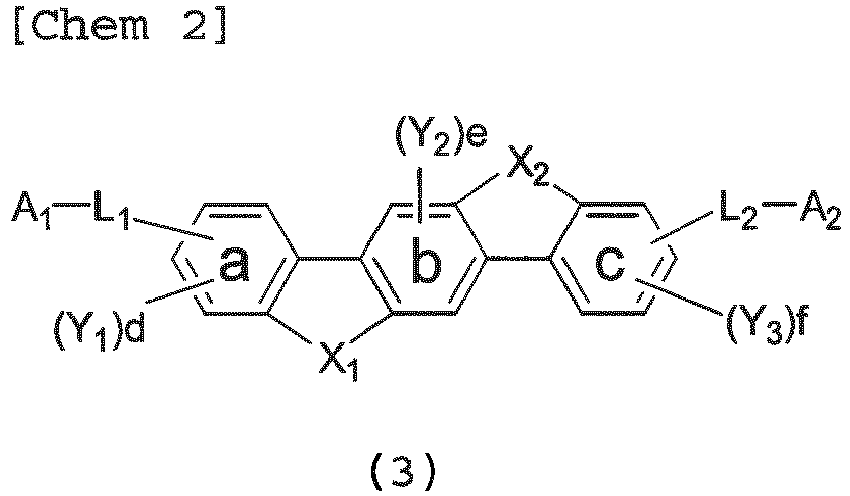
- provided that, X1, X2, A1, A2, L1, and L2 in the formula (3) has the same meaning of X1, X2, A1, A2, L1, and L2 in the formula (1), respectively;
- Y1, Y2, and Y3 in the formula (3) each represent an alkyl group having 1 to 20 carbon atoms, a substituted or unsubstituted cycloalkyl group having a ring formed of 3 to 20 carbon atoms, an alkoxy group having 1 to 20 carbon atoms, an aralkyl group having 7 to 24 carbon atoms, a silyl group having 3 to 20 carbon atoms, a substituted or unsubstituted aromatic hydrocarbon group having a ring formed of 6 to 24 carbon atoms, or a substituted or unsubstituted aromatic heterocyclic group which has a ring formed of 3 to 24 atoms and which is linked with a benzene ring a, b, or c through a carbon-carbon bond, d and f each represent a number of 0, 1, 2, or 3, and e represents a number of 0, 1, or 2;
- a case where the formula (2) has a structure represented by the following formula (4) is excluded;
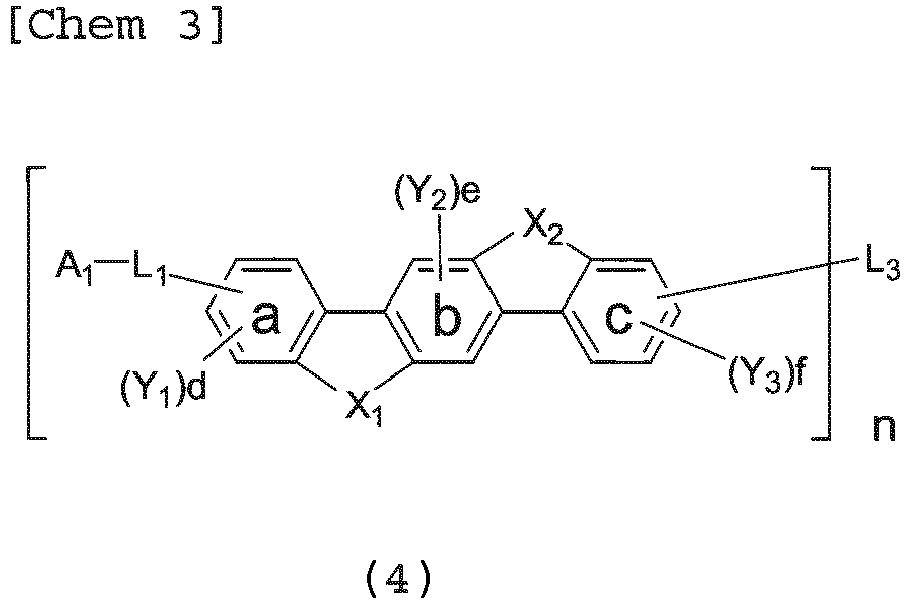
- provided that, X1, X2, A1, L1, L3, and n in the formula (4) has the same meaning of X1, X2, A1, L1, L3, and n in the formula (2), respectively; and
- Y1, Y2, and Y3 in the formula (4) each represent an alkyl group having 1 to 20 carbon atoms, a substituted or unsubstituted cycloalkyl group having a ring formed of 3 to 20 carbon atoms, an alkoxy group having 1 to 20 carbon atoms, an aralkyl group having 7 to 24 carbon atoms, a silyl group having 3 to 20 carbon atoms, a substituted or unsubstituted aromatic hydrocarbon group having a ring formed of 6 to 24 carbon atoms, or a substituted or unsubstituted aromatic heterocyclic group which has a ring formed of 3 to 24 atoms and whichis linked with the benzene ring a, b, or c through a carbon-carbon bond, d and f each represent a number of 0, 1, 2, or 3, and e represents a number of 0, 1, or 2.
- [Item 2] The polycyclic compound according to item 1, wherein A1 and/or A2 each represent/represents a pyrimidyl group, triazyl group, or fluorenyl group having at least one substituent selected from a phenyl group, a biphenyl group, a terphenyl group, and a quaterphenyl group.
- [Item 3] The polycyclic compound according to item 1, wherein A1 and/or A2 each represent/represents a carbazolyl group having at least one substituent selected from a phenyl group, a biphenyl group, a terphenyl group, and a quaterphenyl group.
- [Item 4] The polycyclic compound according to item 1, wherein A1 and/or A2 each represent/represents a dibenzofuranyl group having at least one substituent selected from a phenyl group, a biphenyl group, a terphenyl group, and a quaterphenyl group.
- [Item 5] The polycyclic compound according to item 1, wherein A1 and/or A2 each represent/represents an aromatic hydrocarbon group having a structure in which two or more benzene rings are bonded to each other at meta positions.
- [Item 6] The polycyclic compound according to item 1, which is represented by one of the following formulae (5) and (6):

- X5 and X6 each independently represent oxygen (O), sulfur (S), N-R1, or CR2R3;
- R1, R2, and R3 each independently represent an alkyl group having 1 to 20 carbon atoms, a substituted or unsubstituted cycloalkyl group having a ring formed of 3 to 20 carbon atoms, an aralkyl group having 7 to 24 carbon atoms, a silyl group or a substituted silyl group having 3 to 20 carbon atoms, a substituted or unsubstituted aromatic hydrocarbon group having a ring formed of 6 to 24 carbon atoms, or a substituted or unsubstituted aromatic heterocyclic group having a ring formed of 3 to 24 atoms, provided that, when both X5 and X6 represent N-R1, at least one R1 represents a substituted or unsubstituted, monovalent fused aromatic heterocyclic group having a ring formed of 8 to 24 atoms;
- n represents 2, 3, or 4, and the compound represented by the formula (6) comprises a dimer using L3 as a linking group for n=2, a trimer using L3 as a linking group for n=3, or a tetramer using L3 as a linking group for n=4;
- L1 represents a single bond, an alkylene group having 1 to 20 carbon atoms, a substituted or unsubstituted cycloalkylene group having a ring formed of 3 to 20 carbon atoms, a divalent silyl group or a divalent silyl group having 2 to 20 carbon atoms, a substituted or unsubstituted, divalent aromatic hydrocarbon group having a ring formed of 6 to 24 carbon atoms, or a substituted or unsubstituted, divalent aromatic heterocyclic group which has a ring formed of 3 to 24 atoms and which is linked with a benzene ring a through a carbon-carbon bond;
- L2 represents a single bond, an alkylene group having 1 to 20 carbon atoms, a substituted or unsubstituted cycloalkylene group having a ring formed of 3 to 20 carbon atoms, a divalent silyl group or a substituted divalent silyl group having 2 to 20 carbon atoms, a substituted or unsubstituted, divalent aromatic hydrocarbon group having a ring formed of 6 to 24 carbon atoms, or a substituted or unsubstituted, divalent aromatic heterocyclic group which has a ring formed of 3 to 24 atoms and which is linked with a benzene ring c through a carbon-carbon bond, provided that, when both X5 and X6 represent CR2R3 and both L1 and L2 represent substituted or unsubstituted, monovalent or divalent aromatic hydrocarbon groups each having a ring formed of 6 to 24 carbon atoms, a case where L1 and L2 are simultaneously linked at para positions with respect to a benzene ring b is excluded;
- when n represents 2, L3 represents a single bond, an alkylene group having 1 to 20 carbon atoms, a substituted unsubstituted cycloalkylene group having a ring formed of 3 to 20 carbon atoms, a divalent silyl group or a substituted divalent silyl group having 2 to 20 carbon atoms, a substituted or unsubstituted, divalent aromatic hydrocarbon group having a ring formed of 6 to 24 carbon atoms, or a substituted or unsubstituted, divalent aromatic heterocyclic group which has a ring formed of 3 to 24 atoms and which is linked with the benzene ring c through a carbon-carbon bond, when n represents 3, L3 represents a trivalent saturated hydrocarbon group having 1 to 20 carbon atoms, a substituted or unsubstituted, trivalent cyclic saturated hydrocarbon group having a ring formed of 3 to 20 carbon atoms, a trivalent silyl group or a substituted trivalent silyl group having 1 to 20 carbon atoms, a substituted or unsubstituted, trivalent aromatic hydrocarbon group having a ring formed of 6 to 24 carbon atoms, or a substituted or unsubstituted, trivalent aromatic heterocyclic group which has 3 to 24 atoms and which is linked with the benzene ring c through a carbon-carbon bond, or when n represents 4, L3 represents a tetravalent saturated hydrocarbon group having 1 to 20 carbon atoms, a substituted or unsubstituted, tetravalent cyclic saturated hydrocarbon group having a ring formed of 3 to 20 carbon atoms, a silicon atom, a substituted or unsubstituted, tetravalent aromatic hydrocarbon group having a ring formed of 6 to 24 carbon atoms, or a substituted or unsubstituted, tetravalent aromatic heterocyclic group which has a ring formed of 3 to 24 atoms and which is linked with the benzene ring c through a carbon-carbon bond, provided that, when both X5 and X6 represent CR2R3 and both L1 and L3 represent substituted or unsubstituted, divalent, trivalent, or tetravalent aromatic hydrocarbon groups each having a ring formed of 6 to 24 carbon atoms, a case where L1 and L3 are simultaneously linked at para positions with respect to the benzene ring b is excluded;
- A1 represents a hydrogen atom, a substituted or unsubstituted cycloalkyl group having a ring formed of 3 to 20 carbon atoms, a silyl group having 3 to 20 carbon atoms, a substituted or unsubstituted aromatic hydrocarbon group having a ring formed of 6 to 24 carbon atoms, or an aromatic heterocyclic group which has a ring formed of 3 to 24 atoms and which is linked with L1 through a carbon-carbon bond, provided that, when L1 represents an alkyl or alkylene group having 1 to 20 carbon atoms, a case where A1 represents a hydrogen atom is excluded;
- A2 represents a hydrogen atom, a substituted or unsubstituted cycloalkyl group having a ring formed of 3 to 20 carbon atoms, a silyl group or a substituted silyl group having 3 to 20 carbon atoms, a substituted or unsubstituted aromatic hydrocarbon group having a ring formed of 6 to 24 carbon atoms, or an aromatic heterocyclic group which has a ring formed of 3 to 24 atoms and which is linked with L2 through a carbon-carbon bond, provided that, when L2 represents an alkylene group having 1 to 20 carbon atoms, a case where A2 represents a hydrogen atom is excluded;
- Y1, Y2, and Y3 each represent an alkyl group having 1 to 20 carbon atoms, a substituted or unsubstituted cycloalkyl group having a ring formed of 3 to 20 carbon atoms, an alkoxy group having 1 to 20 carbon atoms, an aralkyl group having 7 to 24 carbon atoms, a silyl group or a substituted silyl group having 3 to 20 carbon atoms, a substituted or unsubstituted aromatic hydrocarbon group having a ring formed of 6 to 24 carbon atoms, or a substituted or unsubstituted aromatic heterocyclic group which has a ring formed of 3 to 24 atoms and which is linked with the benzene ring a, b, or c through a carbon-carbon bond, d and f each represent a number of 0, 1, 2, or 3, and e represents a number of 0, 1, or 2, provided that, when X5 and X6 each represent oxygen (O), sulfur (S), or CR2R3, both L1 and L2 represent single bonds, and both A1 and A2 represent hydrogen atoms, the benzene ring b has one or two Y2's, and a case where Y2 represents a methyl group or an unsubstituted phenyl group is excluded; and
- A1, A2, L1, L2, and L3 are each free of any carbonyl group.
- [Item 7] The polycyclic compound according to item 6, wherein the formula (5) is represented by one of the following formulae (5a) and (5b), and the formula (6) is represented by one of the following formulae (6a) and (6b):
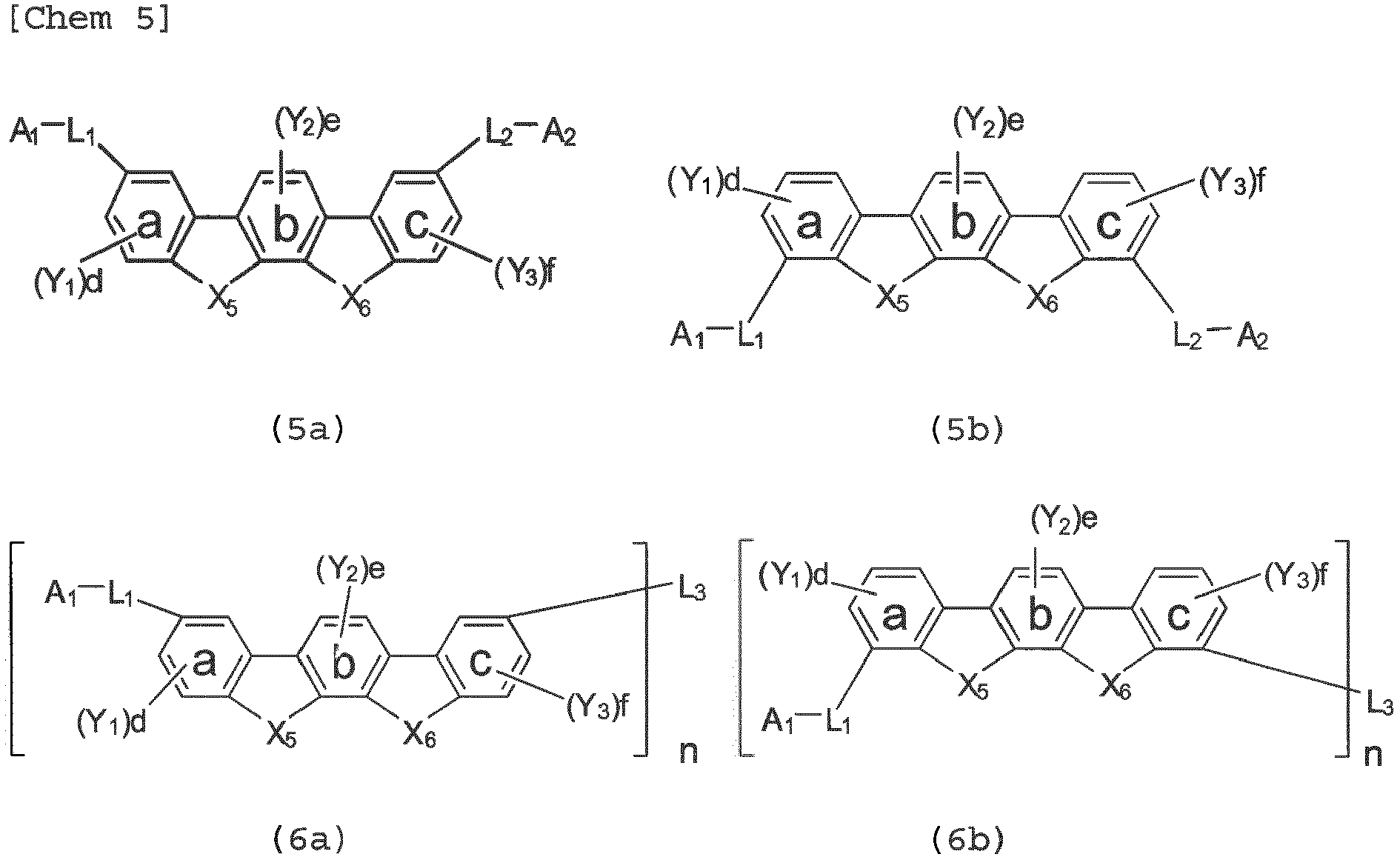
- [Item 8] The polycyclic compound according to item 1, wherein the polycyclic compound is represented by any one of the following formulae (7) to (12):

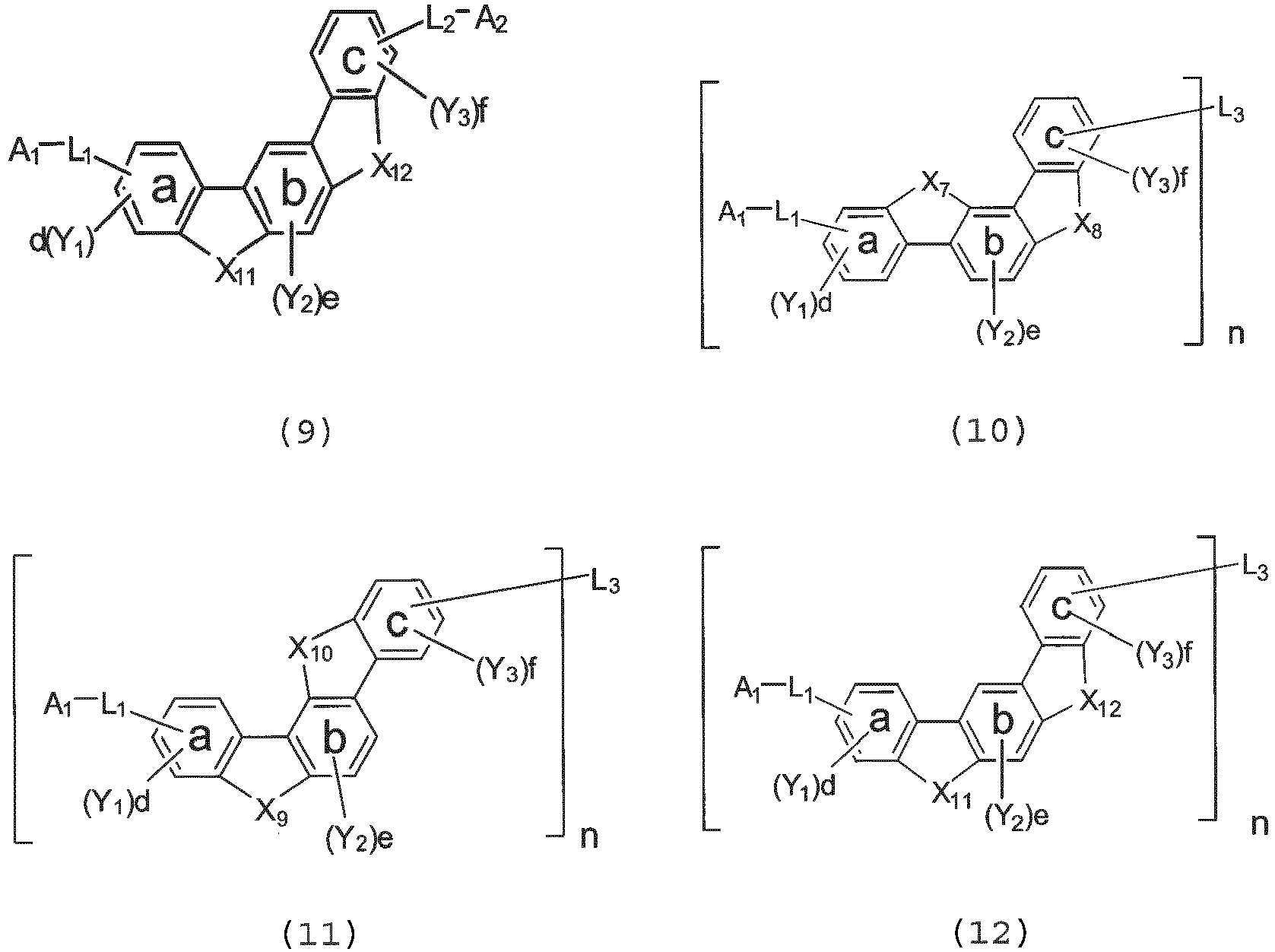
- X7, X8, X9, X10, X11, and X12 each independently represent oxygen (O), sulfur (S), N-R1 or CR2R3;
- R1, R2, and R3 each independently represent an alkyl group having 1 to 20 carbon atoms, a substituted or unsubstituted cycloalkyl group having a ring formed of 3 to 20 carbon atoms, an aralkyl group having 7 to 24 carbon atoms, a silyl group or a substituted silyl group having 3 to 20 carbon atoms, a substituted or unsubstituted aromatic hydrocarbon group having a ring formed of 6 to 24 carbon atoms, or substituted or unsubstituted aromatic heterocyclic group having a ring formed of 3 to 24 atoms, provided that, when both X7 and X8, both X9 and X10, or both X11 and X12 represent N-R1, at least one R1 represents a substituted or unsubstituted, monovalent fused aromatic heterocyclic group having a ring formed of 8 to 24 atoms;
- n represents 2, 3, or 4, and the compound represented by any one of the formulae (10) to (12) comprises a dimer using L3 as a linking group for n=2, a trimer using L3 as a linking group for n=3, or a tetramer using L3 as a linking group for n=4;
- L1 represents a single bond, an alkylene group having 1 to 20 carbon atoms, a substituted or unsubstituted cycloalkylene group having a ring formed of 3 to 20 carbon atoms, a divalent silyl group or divalent silyl group having 2 to 20 carbon atoms, a substituted or unsubstituted, divalent aromatic hydrocarbon group having a ring formed of 6 to 24 carbon atoms, or a substituted or unsubstituted, monovalent or divalent aromatic heterocyclic group which has a ring formed of 3 to 24 atoms and which is linked with a benzene ring a through a carbon-carbon bond;
- L2 represents a single bond, an alkylene group having 1 to 20 carbon atoms, a substituted or unsubstituted cycloalkylene group having a ring formed of 3 to 20 carbon atoms, a divalent silyl group or divalent silyl group having 2 to 20 carbon atoms, a substituted or unsubstituted, monovalent or divalent aromatic hydrocarbon group having a ring formed of 6 to 24 carbon atoms, or a substituted or unsubstituted, divalent aromatic heterocyclic group which has a ring formed of 3 to 24 atoms and which is linked with a benzene ring c through a carbon-carbon bond, provided that, when both X7 and X8, both X9 and X10, or both X11 and X12 represent CR2R3 and both L1 and L2 represent substituted or unsubstituted, monovalent or divalent aromatic hydrocarbon groups having a ring formed of 6 to 24 carbon atoms, a case where L1 and L2 are simultaneously linked at para positions with respect to a benzene ring b is excluded;
- when n represents 2, L3 represents a single bond, an alkylene group having 1 to 20 carbon atoms, a substituted or unsubstituted cycloalkylene group having a ring formed of 3 to 20 carbon atoms, a divalent silyl group or a substituted divalent silyl group having 2 to 20 carbon atoms, a substituted or unsubstituted, divalent aromatic hydrocarbon group having a ring formed of 6 to 24 carbon atoms, or a substituted or unsubstituted, divalent aromatic heterocyclic group which has a ring formed of 3 to 24 atoms and which is linked with the benzene ring c through a carbon-carbon bond, when n represents 3, L3 represents a trivalent saturated hydrocarbon group having 1 to 20 carbon atoms, a substituted or unsubstituted, trivalent cyclic saturated hydrocarbon group having a ring formed of 3 to 20 carbon atoms, a trivalent silyl group or a substituted trivalent silyl group having 1 to 20 carbon atoms, a substituted or unsubstituted, trivalent aromatic hydrocarbon group having a ring formed of 6 to 24 carbon atoms, or a substituted or unsubstituted, trivalent aromatic heterocyclic group which has 3 to 24 atoms and which is linked with the benzene ring c through a carbon-carbon bond, or when n represents 4, L3 represents a tetravalent saturated hydrocarbon group having 1 to 20 carbon atoms, a substituted or unsubstituted, tetravalent cyclic saturated hydrocarbon group having a ring formed of 3 to 20 carbon atoms, a silicon atom, a substituted or unsubstituted, tetravalent aromatic hydrocarbon group having a ring formed of 6 to 24 carbon atoms, or a substituted or unsubstituted, tetravalent aromatic heterocyclic group which has a ring formed of 3 to 24 atoms and which is linked with the benzene ring c through a carbon-carbon bond, provided that, when both X7 and X8, both X9 and X10, or both X11 and X12 represent CR2R3 and both L1 and L3 represent substituted or unsubstituted, divalent, trivalent, or tetravalent aromatic hydrocarbon groups having a ring formed of 6 to 24 carbon atoms, a case where L1 and L3 are simultaneously linked at para positions with respect to the benzene ring b is excluded;
- A1 represents a hydrogen atom, a substituted or unsubstituted cycloalkyl group having a ring formed of 3 to 20 carbon atoms, a silyl group or a substituted silyl group having 3 to 20 carbon atoms, a substituted or unsubstituted aromatic hydrocarbon group having a ring formed of 6 to 24 carbon atoms, or an aromatic heterocyclic group which has a ring formed of 3 to 24 atoms and which is linked with L1 through a carbon-carbonbond, provided that, when L1 represents an alkylene group having 1 to 20 carbon atoms, a case where A1 represents a hydrogen atom is excluded;
- A2 represents a hydrogen atom, a substituted or unsubstituted cycloalkyl group having a ring formed of 3 to 20 carbon atoms, a silyl group or a substituted silyl group having 3 to 20 carbon atoms, a substituted or unsubstituted aromatic hydrocarbon group having a ring formed of 6 to 24 carbon atoms, or an aromatic heterocyclic group which has a ring formed of 3 to 24 atoms and which is linked with L2 through a carbon-carbon bond, provided that, when L2 represents an alkylene group having 1 to 20 carbon atoms, a case where A2 represents a hydrogen atom is excluded;
- Y1, Y2, and Y3 each represent an alkyl group having 1 to 20 carbon atoms, a substituted or unsubstituted cycloalkyl group having a ring formed of 3 to 20 carbon atoms, an alkoxy group having 1 to 20 carbon atoms, an aralkyl group having 7 to 24 carbon atoms, a silyl group or a substituted silyl group having 3 to 20 carbon atoms, a substituted or unsubstituted aromatic hydrocarbon group having a ring formed of 6 to 24 carbon atoms, or a substituted or unsubstituted aromatic heterocyclic group which has a ring formed of 3 to 24 atoms and which is linked with the benzene ring a, b, or c through a carbon-carbon bond, d and f each represent a number of 0, 1, 2, or 3, and e represents a number of 0, 1, or 2, provided that, when both X7 and X8, both X9 and X10, or both X11 and X12 represent oxygen (O), sulfur (S), or CR2R3, both L1 and L2 represent single bonds, and both A1 and A2 represent hydrogen atoms, the benzene ring b has one or two Y2's, and a case where Y2 represents a methyl group or an unsubstituted phenyl group is excluded; and
- A1, A2, L1, L2, and L3 are each free of any carbonyl group.
- [Item 9] The polycyclic compound according to item 8, wherein the formulae (7) to (12) are each represented by any one of the following formulae (7a) to (12a) and (7b) to (12b):
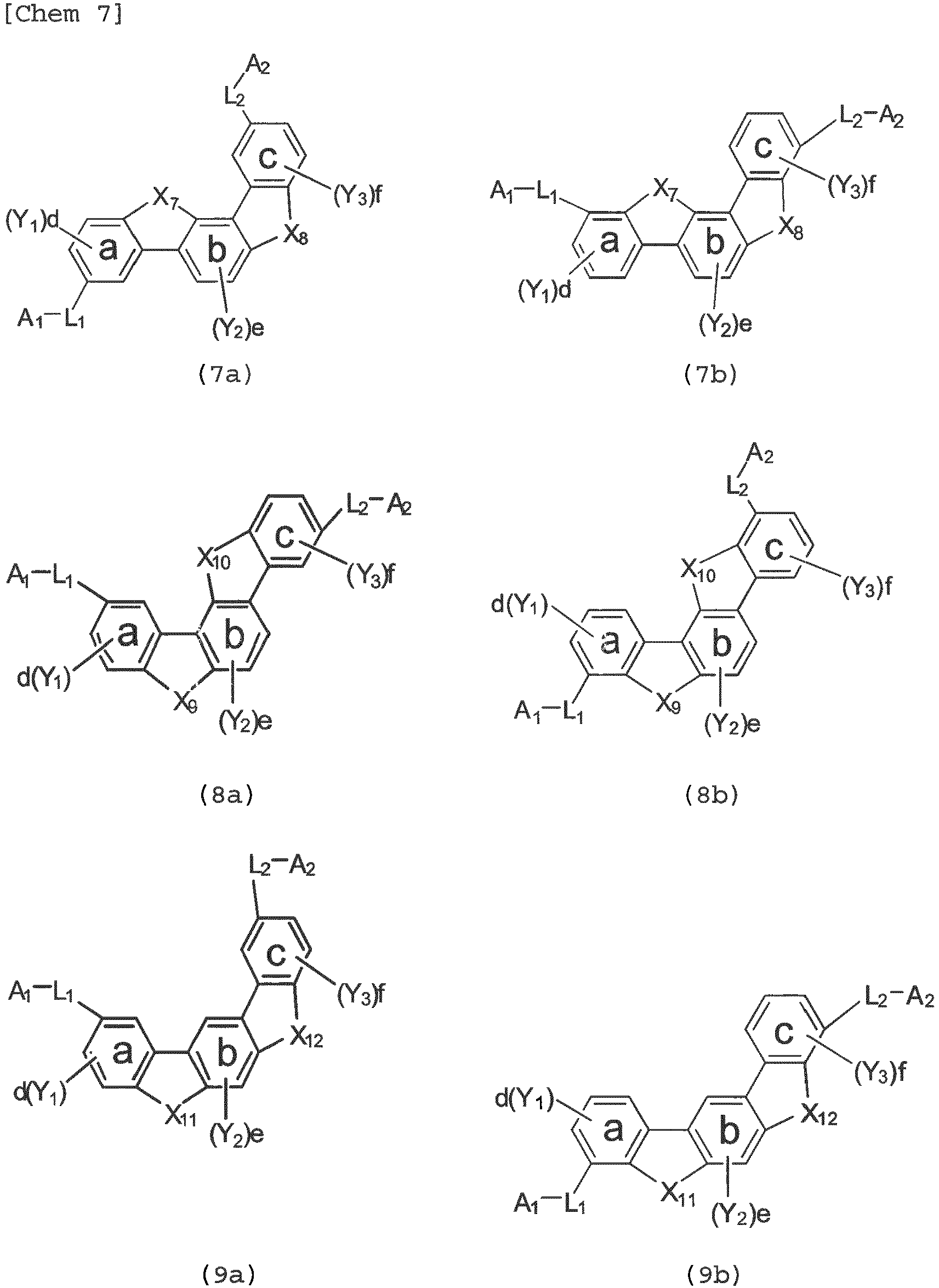
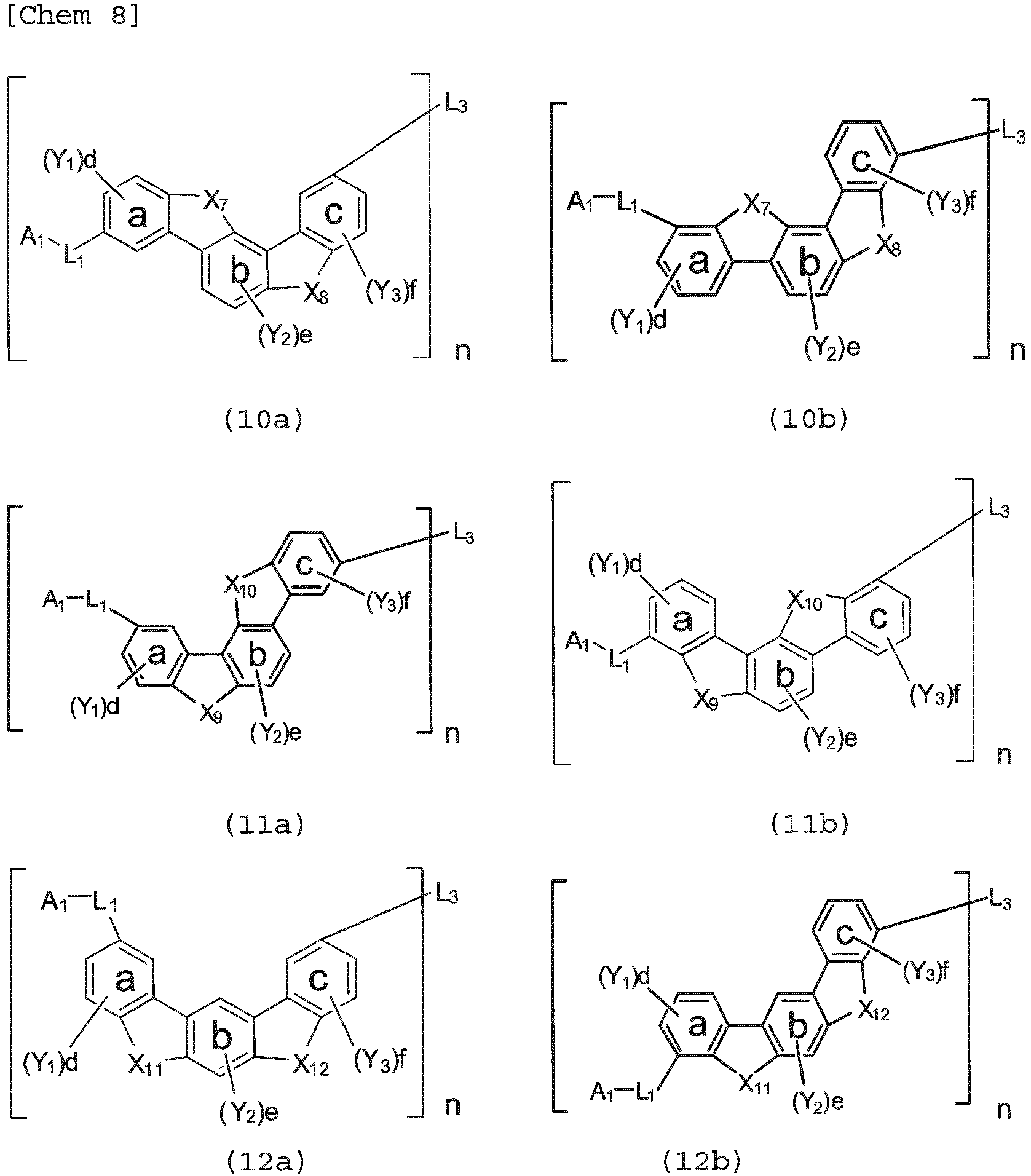
- [Item 10] The polycyclic compound according to item 1, wherein the polycyclic compound is represented by one of the following formulae (13) and (14):

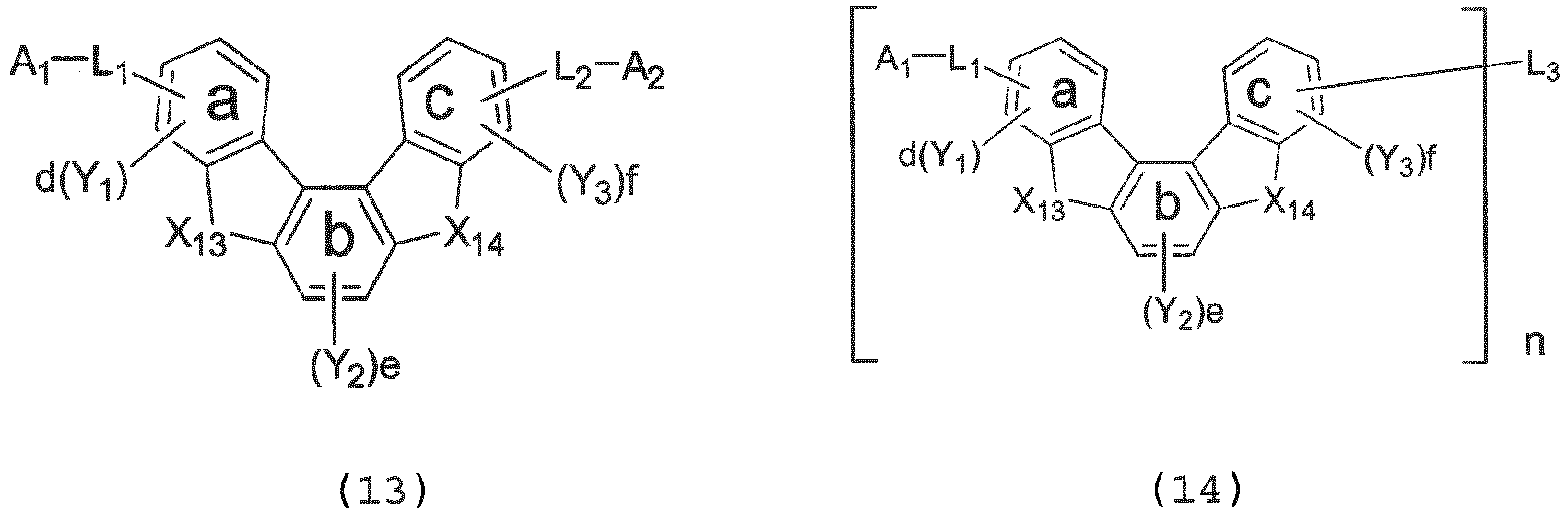
- X13, and X14 each independently represent oxygen (O), sulfur (S), N-R1, or CR2R3;
- R1, R2, and R3 each independently represent an alkyl group having 1 to 20 carbon atoms, a substituted or unsubstituted cycloalkyl group having a ring formed of 3 to 20 carbon atoms, an aralkyl group having 7 to 24 carbon atoms, a silyl group or a substituted silyl group having 3 to 20 carbon atoms, a substituted or unsubstituted aromatic hydrocarbon group having a ring formed of 6 to 24 carbon atoms, or substituted or unsubstituted aromatic heterocyclic group having a ring formed of 3 to 24 atoms, provided that, when both X13 and X14 represent N-R1, at least one R1 represents a substituted or unsubstituted, monovalent fused aromatic heterocyclic group having a ring formed of 8 to 24 atoms;
- n represents 2, 3, or 4, and the compound represented by the formula (14) comprises a dimer using L3 as a linking group for n=2, a trimer using L3 as a linking group for n=3, or a tetramer using L3 as a linking group for n=4;
- L1 represents a single bond, an alkylene group having 1 to 20 carbon atoms, a substituted or unsubstituted cycloalkylene group having a ring formed of 3 to 20 carbon atoms, a divalent silyl group or divalent silyl group having 2 to 20 carbon atoms, a substituted or unsubstituted, divalent aromatic hydrocarbon group having a ring formed of 6 to 24 carbon atoms, or a substituted or unsubstituted, divalent aromatic heterocyclic group which has a ring formed of 3 to 24 atoms and which is linked with a benzene ring a through a carbon-carbon bond;
- L2 represents a single bond, an alkylene group having 1 to 20 carbon atoms, a substituted or unsubstituted cycloalkylene group having a ring formed of 3 to 20 carbon atoms, a divalent silyl group or a substituted divalent silyl group having 2 to 20 carbon atoms, a substituted or unsubstituted, divalent aromatic hydrocarbon group having a ring formed of 6 to 24 carbon atoms, or a substituted or unsubstituted, divalent aromatic heterocyclic group which has a ring formed of 3 to 24 atoms and which is linked with a benzene ring c through a carbon-carbon bond, provided that, when both X13 and X14 represent CR2R3 and both L1 and L2 represent substituted or unsubstituted, divalent aromatic hydrocarbon groups having a ring formed of 6 to 24 carbon atoms, a case where L1 and L2 are simultaneously linked at para positions with respect to a benzene ring b is excluded;
- when n represents 2, L3 represents a single bond, an alkylene group having 1 to 20 carbon atoms, a substituted or unsubstituted cycloalkylene group having a ring formed of 3 to 20 carbon atoms, a divalent silyl group or a substituted divalent silyl group having 2 to 20 carbon atoms, a substituted or unsubstituted, divalent aromatic hydrocarbon group having a ring formed of 6 to 24 carbon atoms, or a substituted or unsubstituted, divalent aromatic heterocyclic group which has a ring formed of 3 to 24 atoms and which is linked with the benzene ring c through a carbon-carbon bond, when n represents 3, L3 represents a trivalent saturated hydrocarbon group having 1 to 20 carbon atoms, a substituted or unsubstituted, trivalent cyclic saturated hydrocarbon group having a ring formed of 3 to 20 carbon atoms, a trivalent silyl group or a substituted trivalent silyl group having 1 to 20 carbon atoms, a substituted or unsubstituted, trivalent aromatic hydrocarbon group having a ring formed of 6 to 24 carbon atoms, or a substituted or unsubstituted, trivalent aromatic heterocyclic group which has 3 to 24 atoms and which is linked with the benzene ring c through a carbon-carbon bond, or when n represents 4, L3 represents a tetravalent saturated hydrocarbon group having 1 to 20 carbon atoms, a substituted or unsubstituted, tetravalent cyclic saturated hydrocarbon group having a ring formed of 3 to 20 carbon atoms, a silicon atom, a substituted or unsubstituted, tetravalent aromatic hydrocarbon group having a ring formed of 6 to 24 carbon atoms, or a substituted or unsubstituted, tetravalent aromatic heterocyclic group which has a ring formed of 3 to 24 atoms and which is linked with the benzene ring c through a carbon-carbon bond, provided that, when both X13 and X14 represent CR2R3 and both L1 and L3 represent substituted or unsubstituted, divalent, trivalent, or tetravalent aromatic hydrocarbon groups having a ring formed of 6 to 24 carbon atoms, a case where L1 and L3 are simultaneously linked at para positions with respect to the benzene ring b is excluded;
- A1 represents a hydrogen atom, a substituted or unsubstituted cycloalkyl group having a ring formed of 3 to 20 carbon atoms, a silyl group or a substituted silyl group having 3 to 20 carbon atoms, a substituted or unsubstituted aromatic hydrocarbon group having a ring formed of 6 to 24 carbon atoms, or an aromatic heterocyclic group which has a ring formed of 3 to 24 atoms and which is linked with L1 through a carbon-carbon bond, provided that, when L1 represents an alkylene group having 1 to 20 carbon atoms, a case where A1 represents a hydrogen atom is excluded;
- A2 represents a hydrogen atom, a substituted or unsubstituted cycloalkyl group having a ring formed of 3 to 20 carbon atoms, a silyl group or a substituted silyl group having 3 to 20 carbon atoms, a substituted or unsubstituted aromatic hydrocarbon group having a ring formed of 6 to 24 carbon atoms, or an aromatic heterocyclic group which has a ring formed of 3 to 24 atoms and which is linked with L2 through a carbon-carbon bond, provided that, when L2 represents an alkylene group having 1 to 20 carbon atoms, a case where A2 represents a hydrogen atom is excluded;
- Y1, Y2, and Y3 each represent an alkyl group having 1 to 20 carbon atoms, a substituted or unsubstituted cycloalkyl group having a ring formed of 3 to 20 carbon atoms, an alkoxy group having 1 to 20 carbon atoms, an aralkyl group having 7 to 24 carbon atoms, a silyl group or a substituted silyl group having 3 to 20 carbon atoms, a substituted or unsubstituted aromatic hydrocarbon group having a ring formed of 6 to 24 carbon atoms, or a substituted or unsubstituted aromatic heterocyclic group which has a ring formed of 3 to 24 atoms and which is linked with the benzene ring a, b, or c through a carbon-carbon bond, d and f each represent a number of 0, 1, 2, or 3, and e represents a number of 0, 1, or 2, provided that, when both X13 and X14 represent oxygen (O), sulfur (S), or CR2R3, both L1 and L2 represent single bonds, and both A1 and A2 represent hydrogen atom, the benzene ring b has one or two Y2's, and a case where Y2 represents a methyl group or an unsubstituted phenyl group is excluded; and
- A1, A2, L1, L2, and L3 are each free of any carbonyl group.
- [Item 11] The polycyclic compound according to item 10, wherein the formula (13) is represented by one of the following formulae (13a) and (13b), and the formula (14) is represented by one of the following formulae (14a) and (14b):
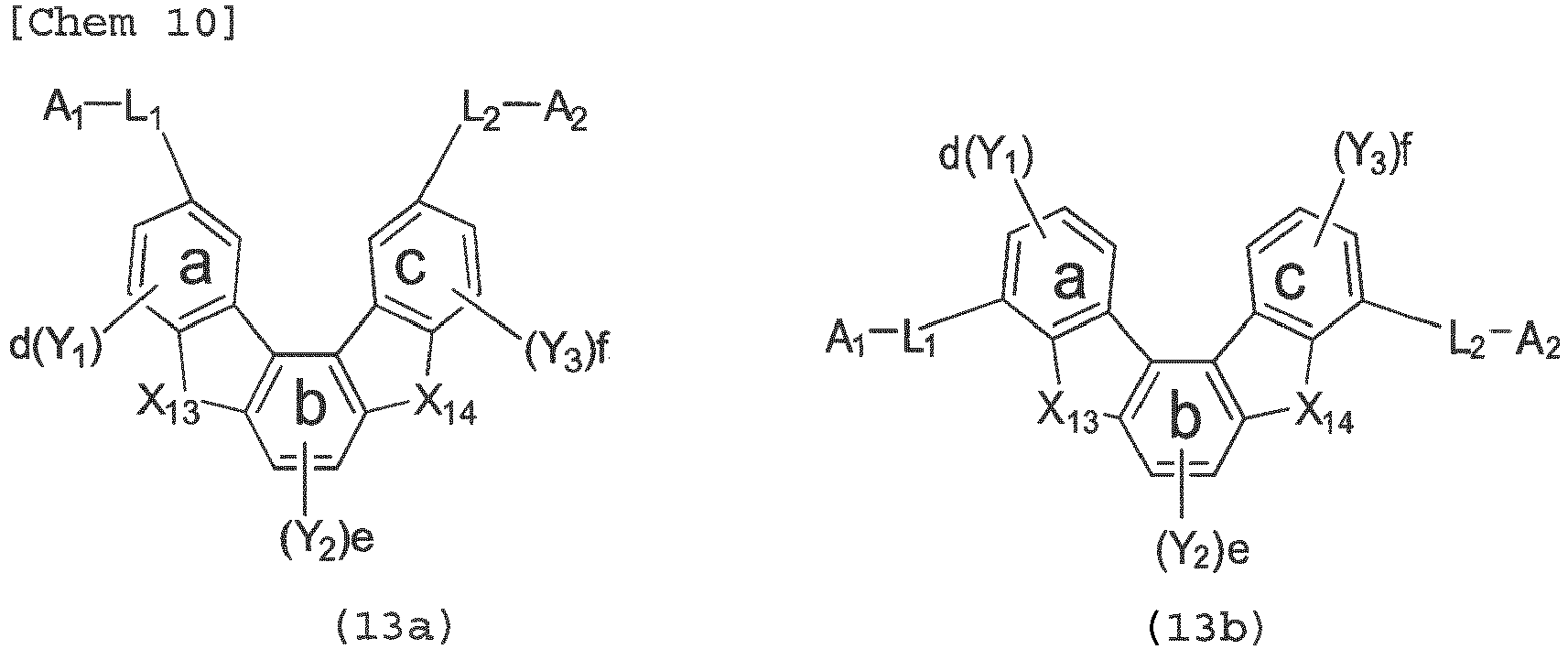
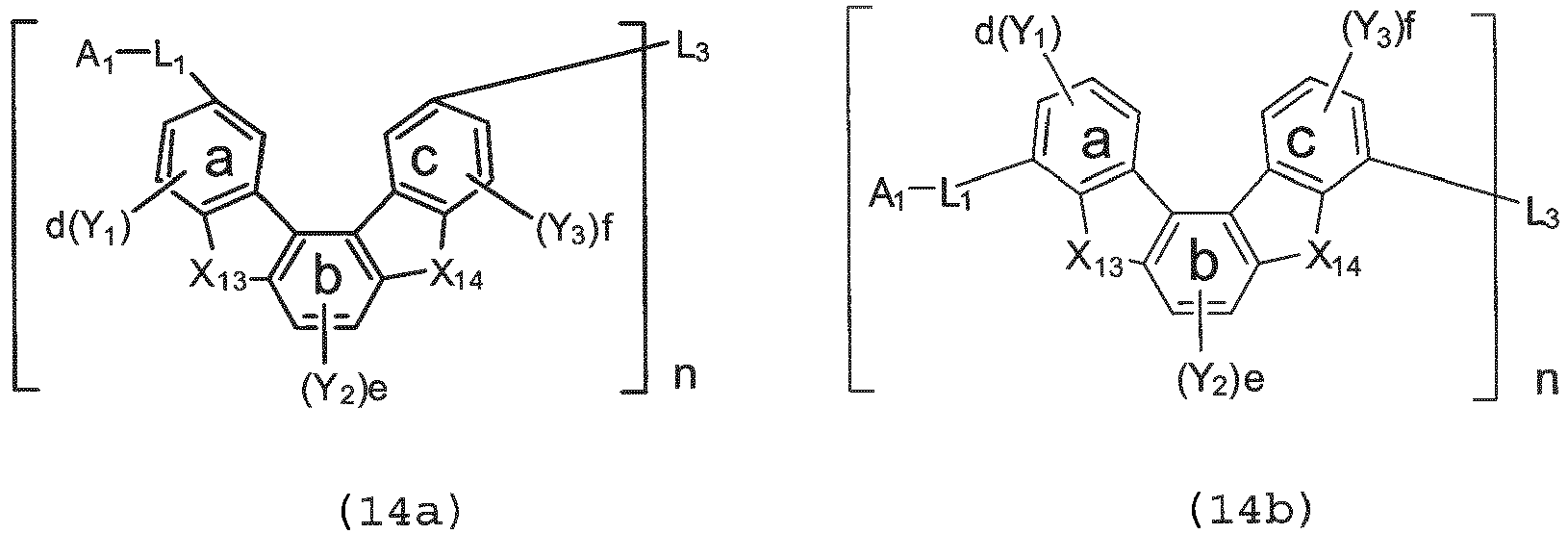
- [Item 12] The polycyclic compound according to item 1, wherein n represents 2 in the formula (2).
- [Item 13] The polycyclic compound according to item 6, 8, or 10, wherein n represents 2 in any one of the formulae (6), (10) to (12), and (14) .
- [Item 14] The polycyclic compound according to item 6, wherein a total number of substituents represented by Y1, Y2, and Y3 in the formula (5) is 3 or less, and a total number of the substituents represented by Y1, Y2, and Y3 in the structure of [ ]n in the formula (6) is 3 or less.
- [Item 15] The polycyclic compound according to item 8, wherein a total number of substituents represented by Y1, Y2, and Y3 in the formulae (7) to (9) is 3 or less, and a total number of the substituents represented by Y1, Y2, and Y3 in the structure of [ ]n in the general formulae (10) to (12) is 3 or less.
- [Item 16] The polycyclic compound according to item 10, wherein a total number of substituents represented by Y1, Y2, and Y3 in the formula (13) is 3 or less, and a total number of the substituents represented by Y1, Y2, and Y3 in the structure of [ ]n in the formula (14) is 3 or less.
- [Item 17] The polycyclic compound according to item 1, wherein both X1 and X2 or both X3 and X4 in the formula (1) or (2) represent N-R1.
- [Item 18] The polycyclic compound according to item 6, wherein both X5 and X6 in the formula (5) or (6) represent N-R1.
- [Item 19] The polycyclic compound according to item 8, wherein both X7 and X8, both X9 and X10, or both X11 and X12 in the formulae (7) to (12) represent N-R1.
- [Item 20] The polycyclic compound according to item 10, wherein both X13 and X14 in the formula (13) or (14) represent N-R1.
- [Item 21] The polycyclic compound according to item 1, wherein both X1 and X2 or both X3 and X4 in the formula (1) or (2) represent N-R1, and at least one R1 represents a dibenzofuran residue or a carbazole residue.
- [Item 22] The polycyclic compound according to item 6, wherein both X5 and X6 in the formula (5) or (6) represent N-R1, and at least one R1 represents a dibenzofuran residue or a carbazole residue.
- [Item 23] The polycyclic compound according to item 8, wherein both X7 and X8, both X9 and X10 or, both X11 and X12 in the formulae (7) to (12) represent N-R1, and at least one R1 represents a dibenzofuran residue or a carbazole residue.
- [Item 24] The polycyclic compound according to item 10, wherein both X13 and X14 in the formula (13) or (14) represent N-R1, and at least one R1 represents a dibenzofuran residue or a carbazole residue.
- [Item 25] The polycyclic compound according to item 1, wherein X1 and X2 or X3 and X4 in the formula (1) or (2) are each represented by N-R1, and N-R1 represented by X1 and N-R1 represented by X2, or N-R1 represented by X3 and N-R1 represented by X4 are different from each other.
- [Item 26] The polycyclic compound according to item 6, wherein X5 and X6 in the formula (5) or (6) are each represented by N-R1, and N-R1 represented by X5 and N-R1 represented by X6 are different from each other.
- [Item 27] The polycyclic compound according to item 8, wherein X7 and X8, X9 and X10, or X11 and X12 in the formulae (7) to (12) are each represented by N-R1, and N-R1 represented by X7 and N-R1 represented by X8, or N-R1 represented by X9 and N-R1 represented by X10, or N-R1 represented by X11 and N-R1 represented by X12 are different from each other.
- [Item 28] The polycyclic compound according to item 10, wherein X13 and X14 in the formula (13) or (14) are each represented by N-R1, and N-R1 represented by X13 and N-R1 represented by X14 are different from each other.
- [Item 29] The polycyclic compound according to item 6, wherein both X5 and X6 in the formula (5) or (6) represent CR2R3.
- [Item 30] The polycyclic compound according to item 8, wherein both X11 and X12 in the formula (9) or (12) represent CR2R3.
- [Item 31] The polycyclic compound according to item 10, wherein both X13 and X14 in the formula (13) or (14) represent CR2R3 .
- [Item 32] The polycyclic compound according to item 1, wherein at least one of X1 and X2 or X3 and X4 in the formula (1) or (2) represents an oxygen atom.
- [Item 33] The polycyclic compound according to item 6, wherein at least one of X5 and X6 in the formula (5) or (6) represents an oxygen atom.
- [Item 34] The polycyclic compound according to item 8, wherein at least one of X7 and X2, X9 and X10, or X11 and X12 in the formula (7) to (12) represents an oxygen atom.
- [Item 35] The polycyclic compound according to item 10, wherein at least one of X13 and X14 in the formula (13) or (14) represents an oxygen atom.
- [Item 36] The polycyclic compound according to item 1, which is a benzofurano dibenzofuran derivative in which both X1 and X2 or both X3 and X4 in the formula (1) or (2) represent oxygen atoms.
- [Item 37] The polycyclic compound according to item 6, which is a benzofurano dibenzofuran derivative in which both X5 and X6 in the formula (5) or (6) represent oxygen atoms.
- [Item 38] The polycyclic compound according to item 8, which is a benzofurano dibenzofuran derivative in which both X7 and X8, both X9 and X10, or both X11 and X12 in the formulae (7) to (12) represent oxygen atoms.
- [Item 39] The polycyclic compound according to item 10, which is a benzofurano dibenzofuran derivative in which both X13 and X14 in the formula (13) or (14) represent oxygen atoms.
- [Item 40] The polycyclic compound according to item 6, which is a benzofurano dibenzofuran derivative represented by one of the following formulae (15) and (16):
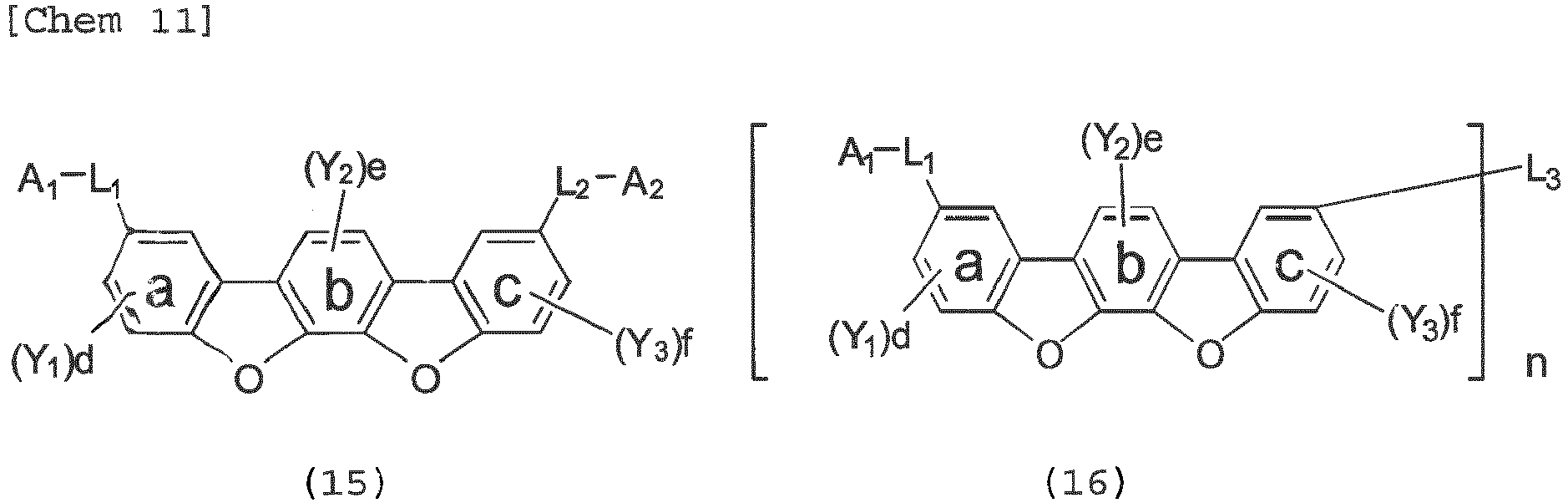
- n represents 2, 3, or 4, and the compound represented by the formula (16) comprises a dimer using L3 as a linking group for n=2, a trimer using L3 as a linking group for n=3, or a tetramer using L3 as a linking group for n=4;
- L1 represents a single bond, an alkylene group having 1 to 20 carbon atoms, a substituted or unsubstituted cycloalkylene group having a ring formed of 3 to 20 carbon atoms, a divalent silyl group or a divalent silyl group having 2 to 20 carbon atoms, a substituted or unsubstituted, divalent aromatic hydrocarbon group having a ring formed of 6 to 24 carbon atoms, or a substituted or unsubstituted, divalent aromatic heterocyclic group which has a ring formed of 3 to 24 atoms and which is linked with a benzene ring a through a carbon-carbon bond;
- L2 represents a single bond, an alkylene group having 1 to 20 carbon atoms, a substituted or unsubstituted cycloalkylene group having a ring formed of 3 to 20 carbon atoms, a divalent silyl group or a substituted divalent silyl group having 2 to 20 carbon atoms, a substituted or unsubstituted, divalent aromatic hydrocarbon group having a ring formed of 6 to 24 carbon atoms, or a substituted or unsubstituted, divalent aromatic heterocyclic group which has a ring formed of 3 to 24 atoms and which is linked with a benzene ring c through a carbon-carbon bond;
- when n represents 2, L3 represents a single bond, an alkylene group having 1 to 20 carbon atoms, a substituted or unsubstituted cycloalkylene group having a ring formed of 3 to 20 carbon atoms, a divalent silyl group or a silyl group having 2 to 20 carbon atoms, a substituted or unsubstituted, divalent aromatic hydrocarbon group having a ring formed of 6 to 24 carbon atoms, or a substituted or unsubstituted, divalent aromatic heterocyclic group which has a ring formed of 3 to 24 atoms and which is linked with the benzene ring c through a carbon-carbon bond, when n represents 3, L3 represents a trivalent saturated hydrocarbon group having 1 to 20 carbon atoms, a substituted or unsubstituted, trivalent cyclic saturated hydrocarbon group having a ring formed of 3 to 20 carbon atoms, a trivalent silyl group or a substituted trivalent silyl group having 1 to 20 carbon atoms, a substituted or unsubstituted, trivalent aromatic hydrocarbon group having a ring formed of 6 to 24 carbon atoms, or a substituted or unsubstituted, trivalent aromatic heterocyclic group which has 3 to 24 atoms and which is linked with the benzene ring c through a carbon-carbon bond, or when n represents 4, L3 represents a tetravalent saturated hydrocarbon group having 1 to 20 carbon atoms, a substituted or unsubstituted, tetravalent cyclic saturated hydrocarbon group having a ring formed of 3 to 20 carbon atoms, a silicon atom, a substituted or unsubstituted, tetravalent aromatic hydrocarbon group having a ring formed of 6 to 24 carbon atoms, or a substituted or unsubstituted, tetravalent aromatic heterocyclic group which has a ring formed of 3 to 24 atoms and which is linked with the benzene ring c through a carbon-carbon bond;
- A1 represents a hydrogen atom, a substituted or unsubstituted cycloalkyl group having a ring formed of 3 to 20 carbon atoms, a silyl group or a substituted silyl group having 3 to 20 carbon atoms, a substituted or unsubstituted aromatic hydrocarbon group having a ring formed of 6 to 24 carbon atoms, or an aromatic heterocyclic group which has a ring formed of 3 to 24 atoms and which is linked with L1 through a carbon-carbon bond, provided that, when L1 represents an alkylene group having 1 to 20 carbon atoms, a case where A1 represents a hydrogen atom is excluded;
- A2 represents a hydrogen atom, a substituted or unsubstituted cycloalkyl group having a ring formed of 3 to 20 carbon atoms, a silyl group or a substituted silyl group having 3 to 20 carbon atoms, a substituted or unsubstituted aromatic hydrocarbon group having a ring formed of 6 to 24 carbon atoms, or an aromatic heterocyclic group which has a ring formed of 3 to 24 atoms and which is linked with L2 through a carbon-carbon bond, provided that, when L2 represents an alkylene group having 1 to 20 carbon atoms, a case where A2 represents a hydrogen atom is excluded;
- Y1, Y2, and Y3 each represent an alkyl group having 1 to 20 carbon atoms, a substituted or unsubstituted cycloalkyl group having a ring formed of 3 to 20 carbon atoms, an alkoxy group having 1 to 20 carbon atoms, an aralkyl group having 7 to 24 carbon atoms, a silyl group or a substituted silyl group having 3 to 20 carbon atoms, a substituted or unsubstituted aromatic hydrocarbon group having a ring formed of 6 to 24 carbon atoms, or a substituted or unsubstituted aromatic heterocyclic group which has a ring formed of 3 to 24 atoms and which is linked with the benzene ring a, b, or c through a carbon-carbon bond, d and f each represent a number of 0, 1, 2, or 3, and e represents a number of 0, 1, or 2, provided that, when both L1 and L2 represent single bonds, and both A1 and A2 represent hydrogen atom, the benzene ring b has one or two Y2's, and a case where Y2 represents a methyl group or an unsubstituted phenyl group is excluded; and
- A1, A2, L1, L2, and L3 are each free of any carbonyl group.
- [Item 41] The polycyclic compound according to item 8, which is a benzofurano dibenzofuran derivative represented by one of the following formulae (17) and (18):
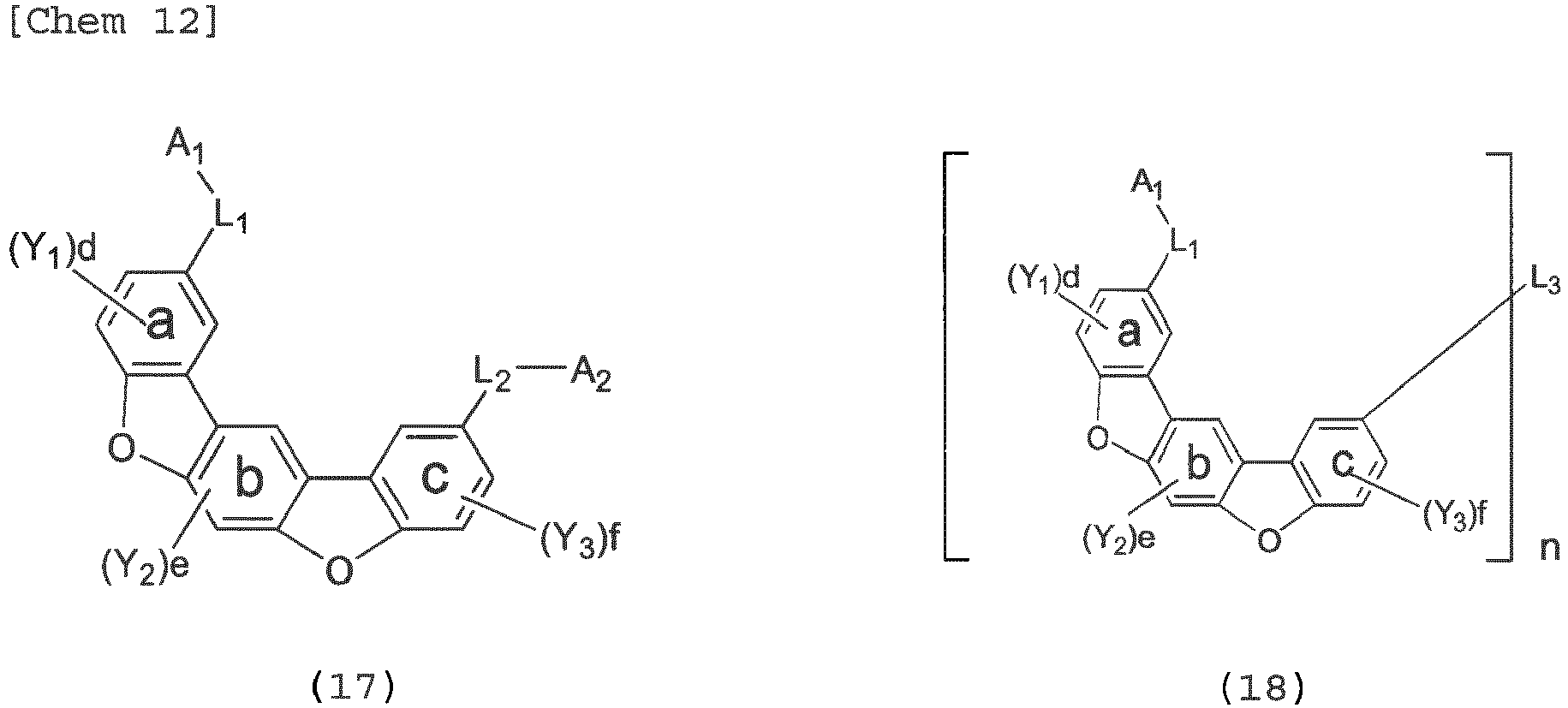
- n represents 2, 3, or 4, and the compound represented by the formula (18) comprises a dimer using L3 as a linking group for n=2, a trimer using L3 as a linking group for n=3, or a tetramer using L3 as a linking group for n=4;
- L1 represents a single bond, an alkylene group having 1 to 20 carbon atoms, a substituted or unsubstituted cycloalkylene group having a ring formed of 3 to 20 carbon atoms, a divalent silyl group or a substituted divalent silyl group having 2 to 20 carbon atoms, a substituted or unsubstituted, divalent aromatic hydrocarbon group having a ring formed of 6 to 24 carbon atoms, or a substituted or unsubstituted, divalent aromatic heterocyclic group which has a ring formed of 3 to 24 atoms and which is linked with a benzene ring a through a carbon-carbon bond;
- L2 represents a single bond, an alkylene group having 1 to 20 carbon atoms, a substituted or unsubstituted cycloalkylene group having a ring formed of 3 to 20 carbon atoms, a divalent silyl group or a substituted divalent silyl group having 2 to 20 carbon atoms, a substituted or unsubstituted, divalent aromatic hydrocarbon group having a ring formed of 6 to 24 carbon atoms, or a substituted or unsubstituted, divalent aromatic heterocyclic group which has a ring formed of 3 to 24 atoms and which is linked with a benzene ring c through a carbon-carbon bond;
- when n represents 2, L3 represents a single bond, an alkylene group having 1 to 20 carbon atoms, a substituted or unsubstituted cycloalkylene group having a ring formed of 3 to 20 carbon atoms, a divalent silyl group or a substituted divalent silyl group having 2 to 20 carbon atoms, a substituted or unsubstituted, divalent aromatic hydrocarbon group having a ring formed of 6 to 24 carbon atoms, or a substituted or unsubstituted, divalent aromatic heterocyclic group which has a ring formed of 3 to 24 atoms and which is linked with the benzene ring c through a carbon-carbon bond, when n represents 3, L3 represents a trivalent saturated hydrocarbon group having 1 to 20 carbon atoms, a substituted or unsubstituted, trivalent cyclic saturated hydrocarbon group having a ring formed of 3 to 20 carbon atoms, a trivalent silyl group or a substituted trivalent silyl group having 1 to 20 carbon atoms, a substituted or unsubstituted, trivalent aromatic hydrocarbon group having a ring formed of 6 to 24 carbon atoms, or a substituted or unsubstituted, trivalent aromatic heterocyclic group which has 3 to 24 atoms and which is linked with the benzene ring c through a carbon-carbon bond, or when n represents 4, L3 represents a tetravalent saturated hydrocarbon group having 1 to 20 carbon atoms, a substituted or unsubstituted, tetravalent cyclic saturated hydrocarbon group having a ring formed of 3 to 20 carbon atoms, a silicon atom, a substituted or unsubstituted, tetravalent aromatic hydrocarbon group having a ring formed of 6 to 24 carbon atoms, or a substituted or unsubstituted, tetravalent aromatic heterocyclic group which has a ring formed of 3 to 24 atoms and which is linked with the benzene ring c through a carbon-carbon bond;
- A1 represents a hydrogen atom, a substituted or unsubstituted cycloalkyl group having a ring formed of 3 to 20 carbon atoms, a silyl group or a substituted silyl group having 3 to 20 carbon atoms, a substituted or unsubstituted aromatic hydrocarbon group having a ring formed of 6 to 24 carbon atoms, or an aromatic heterocyclic group which has a ring formed of 3 to 24 atoms and which is linked with L1 through a carbon-carbonbond, provided that, when L1 represents analkylene group having 1 to 20 carbon atoms, a case where A1 represents a hydrogen atom is excluded;
- A2 represents a hydrogen atom, a substituted or unsubstituted cycloalkyl group having a ring formed of 3 to 20 carbon atoms, a silyl group or a substituted silyl group having 3 to 20 carbon atoms, a substituted or unsubstituted aromatic hydrocarbon group having a ring formed of 6 to 24 carbon atoms, or an aromatic heterocyclic group which has a ring formed of 3 to 24 atoms and which is linked with L2 through a carbon-carbon bond, provided that, when L2 represents an alkylene group having 1 to 20 carbon atoms, a case where A2 represents a hydrogen atom is excluded;
- Y1, Y2, and Y3 each represent an alkyl group having 1 to 20 carbon atoms, a substituted or unsubstituted cycloalkyl group having a ring formed of 3 to 20 carbon atoms, an alkoxy group having 1 to 20 carbon atoms, an aralkyl group having 7 to 24 carbon atoms, a silyl group or a substituted silyl group having 3 to 20 carbon atoms, a substituted or unsubstituted aromatic hydrocarbon group having a ring formed of 6 to 24 carbon atoms, or a substituted or unsubstituted aromatic heterocyclic group which has a ring formed of 3 to 24 atoms and which is linked with the benzene ring a, b, or c through a carbon-carbon bond, d and f each represent a number of 0, 1, 2, or 3, and e represents a number of 0, 1, or 2, provided that, when both L1 and L2 represent single bonds, and both A1 and A2 represent hydrogen atom, the benzene ring b has one or two Y2's, and a case where Y2 represents a methyl group or an unsubstituted phenyl group is excluded; and
- A1, A2, L1, L2, and L3 are each free of any carbonyl group.
- [Item 42] A polycyclic, which is represented by one of the following formulae (19) to (23):
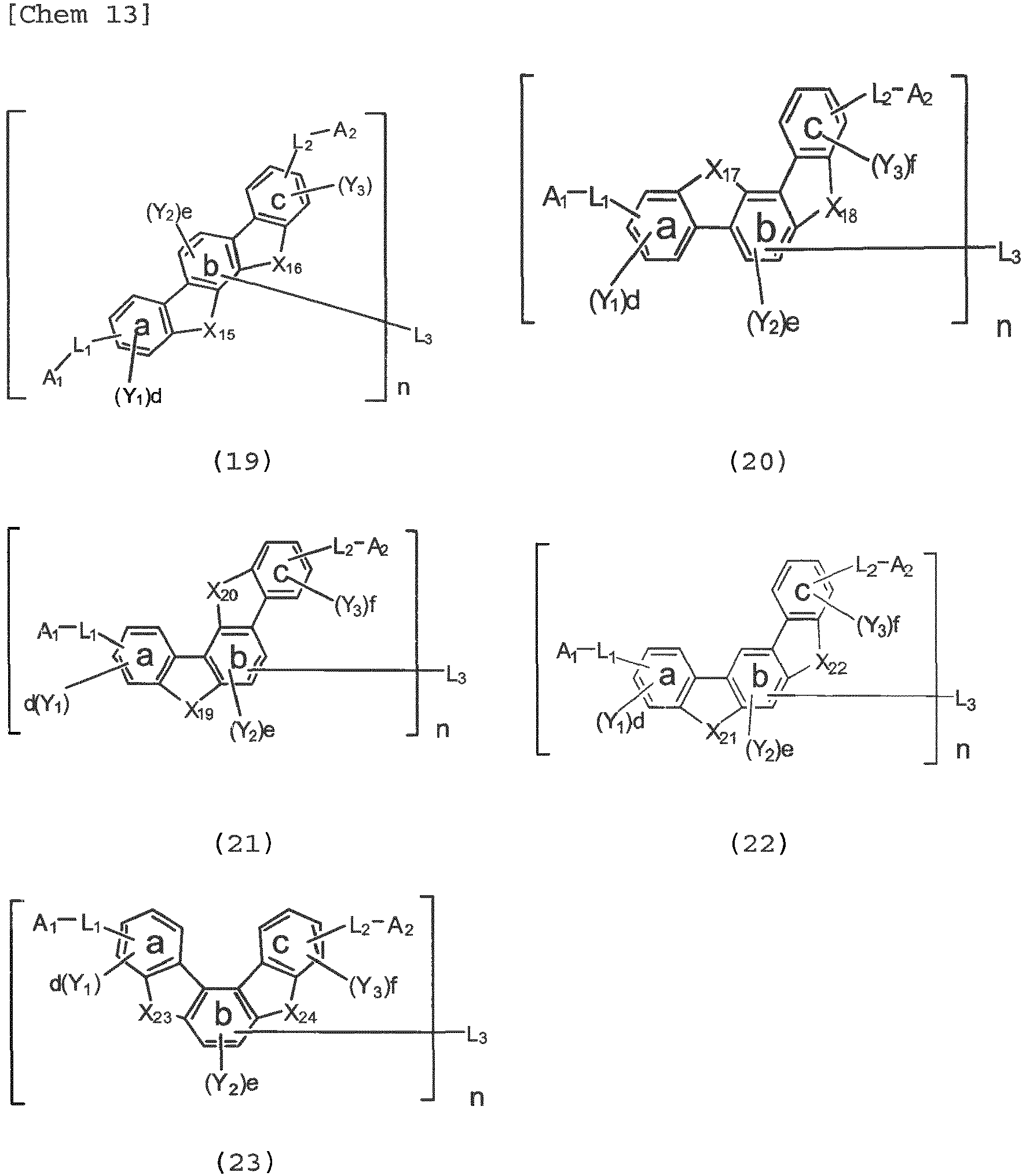
- X15, X16, X17, X18, X19, X20, X21, X22, X23, and X24 each independently represent oxygen (O), sulfur (S), N-R1, or CR2R3;
- R1, R2, and R3 each independently represent an alkyl group having 1 to 20 carbon atoms, a substituted or unsubstituted cycloalkyl group having a ring formed of 3 to 20 carbon atoms, an aralkyl group having 7 to 24 carbon atoms, a silyl group or a substituted silyl group having 3 to 20 carbon atoms, a substituted or unsubstituted aromatic hydrocarbon group having a ring formed of 6 to 24 carbon atoms, or a substituted or unsubstituted aromatic heterocyclic group having a ring formed of 3 to 24 atoms, provided that, when both X15 and X16, both X17 and X18, both X19 and X20, both X21 and X22, or both X23 and X24 represent N-R1, at least one R1 represents a substituted or unsubstituted, monovalent fused aromatic heterocyclic group having a ring formed of 8 to 24 atoms;
- n represents 2, 3, or 4, and the compound represented by any one of the formulae (19) to (23) comprise a dimer using L3 as a linking group for n=2, a trimer using L3 as a linking group for n=3, or a tetramer using L3 as a linking group for n=4;
- L1 represents a single bond, an alkylene group having 1 to 20 carbon atoms, a substituted or unsubstituted cycloalkylene group having a ring formed of 3 to 20 carbon atoms, a divalent silyl group or a substituted divalent silyl group having 2 to 20 carbon atoms, a substituted or unsubstituted, divalent aromatic hydrocarbon group having a ring formed of 6 to 24 carbon atoms, or a substituted or unsubstituted, divalent aromatic heterocyclic group which has a ring formed of 3 to 24 atoms and which is linked with a benzene ring a through a carbon-carbon bond;
- L2 represents a single bond, an alkylene group having 1 to 20 carbon atoms, a substituted or unsubstituted cycloalkylene group having a ring formed of 3 to 20 carbon atoms, a divalent silyl group or a substituted divalent silyl group having 2 to 20 carbon atoms, a substituted or unsubstituted, divalent aromatic hydrocarbon group having a ring formed of 6 to 24 carbon atoms, or a substituted or unsubstituted, divalent aromatic heterocyclic group which has a ring formed of 3 to 24 atoms and which is linked with a benzene ring c through a carbon-carbon bond, provided that, when both X15 and X16, both X17 and X18, both X19 and X20, both X21 and X22, or both X23 and X24 represent CR2R3 and both L1 and L2 represent substituted or unsubstituted, monovalent or divalent aromatic hydrocarbon groups each having a rings formed of 6 to 24 carbon atoms, a case where L1 and L2 are simultaneously linked at para positions with respect to a benzene ring b is excluded;
- when n represents 2, L3 represents a single bond, an alkylene group having 1 to 20 carbon atoms, a substituted or unsubstituted cycloalkylene group having a ring formed of 3 to 20 carbon atoms, a divalent silyl group or a substituted divalent silyl group having 2 to 20 carbon atoms, a substituted or unsubstituted, divalent aromatic hydrocarbon group having a ring formed of 6 to 24 carbon atoms, or a substituted or unsubstituted, divalent aromatic heterocyclic group which has a ring formed of 3 to 24 atoms and which is linked with the benzene ring b through a carbon-carbon bond, when n represents 3, L3 represents a trivalent saturated hydrocarbon group having 1 to 20 carbon atoms, a substituted or unsubstituted, trivalent cyclic saturated hydrocarbon group having a ring formed of 3 to 20 carbon atoms, a trivalent silyl group or a substituted trivalent silyl group having 1 to 20 carbon atoms, a substituted or unsubstituted, trivalent aromatic hydrocarbon group having a ring formed of 6 to 24 carbon atoms, or a substituted or unsubstituted, trivalent aromatic heterocyclic group which has 3 to 24 atoms and which is linked with the benzene ring b through a carbon-carbon bond, or when n represents 4, L3 represents a tetravalent saturated hydrocarbon group having 1 to 20 carbon atoms, a substituted or unsubstituted, tetravalent cyclic saturated hydrocarbon group having a ring formed of 3 to 20 carbon atoms, a silicon atom, a substituted or unsubstituted, tetravalent aromatic hydrocarbon group having a ring formed of 6 to 24 carbon atoms, or a substituted or unsubstituted, tetravalent aromatic heterocyclic group which has a ring formed of 3 to 24 atoms and which is linked with the benzene ring b through a carbon-carbon bond;
- A1 represents a hydrogen atom, a substituted or unsubstituted cycloalkyl group having a ring formed of 3 to 20 carbon atoms, a silyl group or a substituted silyl group having 3 to 20 carbon atoms, a substituted or unsubstituted aromatic hydrocarbon group having a ring formed of 6 to 24 carbon atoms, or an aromatic heterocyclic group which has a ring formed of 3 to 24 atoms and which is linked with L1 through a carbon-carbon bond, provided that, when L1 represents an alkylene group having 1 to 20 carbon atoms, a case where A1 represents a hydrogen atom is excluded;
- A2 represents a hydrogen atom, a substituted or unsubstituted cycloalkyl group having a ring formed of 3 to 20 carbon atoms, a silyl group or a substituted silyl group having 3 to 20 carbon atoms, a substituted or unsubstituted aromatic hydrocarbon group having a ring formed of 6 to 24 carbon atoms, or an aromatic heterocyclic group which has a ring formed of 3 to 24 atoms and which is linked with L2 through a carbon-carbon bond, provided that, when L2 represents an alkylene group having 1 to 20 carbon atoms, a case where A2 represents a hydrogen atom is excluded;
- Y1, Y2, and Y3 each represent an alkyl group having 1 to 20 carbon atoms, a substituted or unsubstituted cycloalkyl group having a ring formed of 3 to 20 carbon atoms, an alkoxy group having 1 to 20 carbon atoms, an aralkyl group having 7 to 24 carbon atoms, a silyl group or a substituted silyl group having 3 to 20 carbon atoms, a substituted or unsubstituted aromatic hydrocarbon group having a ring formed of 6 to 24 carbon atoms, or a substituted or unsubstituted aromatic heterocyclic group which has a ring formed of 3 to 24 atoms and which is linked with the benzene ring a, b, or c through a carbon-carbon bond, a number of each of d and f is 0, 1, 2, or 3, and a number of e is 0 or 1; and
- A1, A2, L1, L2, and L3 are each free of a carbonyl group.
- [Item 43] The polycyclic compound according to item 42, which is a benzofurano dibenzofuran derivative represented by the following formula (24):
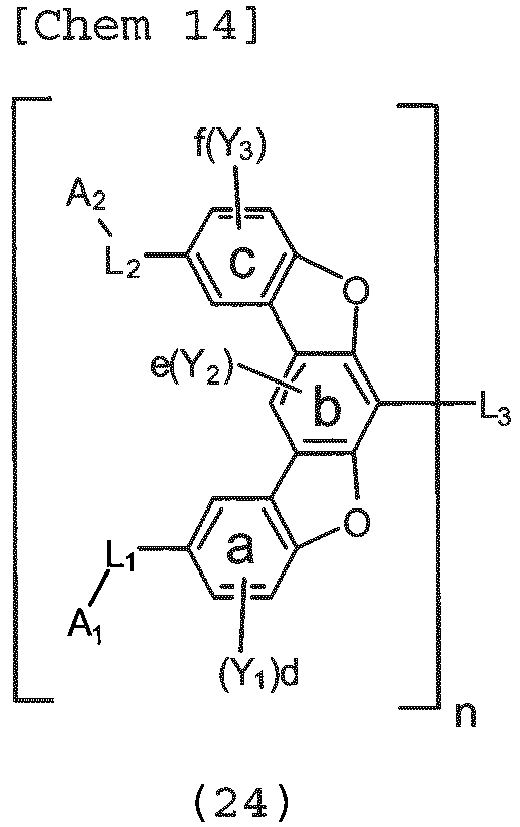
- n represents 2, 3, or 4, and the compound represented by the formula (24) comprises a dimer using L3 as a linking group for n=2, a trimer using L3 as a linking group for n=3, or a tetramer using L3 as a linking group for n=4;
- L1 represents a single bond, an alkylene group having 1 to 20 carbon atoms, a substituted or unsubstituted cycloalkylene group having a ring formed of 3 to 20 carbon atoms, a divalent silyl group or a substituted divalent silyl group having 2 to 20 carbon atoms, a substituted or unsubstituted, divalent aromatic hydrocarbon group having a ring formed of 6 to 24 carbon atoms, or a substituted or unsubstituted, divalent aromatic heterocyclic group which has a ring formed of 3 to 24 atoms and which is linked with a benzene ring a through a carbon-carbon bond;
- L2 represents a single bond, an alkylene group having 1 to 20 carbon atoms, a substituted or unsubstituted cycloalkylene group having a ring formed of 3 to 20 carbon atoms, a divalent silyl group or a substituted divalent silyl group having 2 to 20 carbon atoms, a substituted or unsubstituted, divalent aromatic hydrocarbon group having a ring formed of 6 to 24 carbon atoms, or a substituted or unsubstituted, divalent aromatic heterocyclic group which has a ring formed of 3 to 24 atoms and which is linked with a benzene ring c through a carbon-carbon bond;
- when n represents 2, L3 represents a single bond, an alkylene group having 1 to 20 carbon atoms, a substituted or unsubstituted cycloalkylene group having a ring formed of 3 to 20 carbon atoms, a divalent silyl group or a substituted divalent silyl group having 2 to 20 carbon atoms, a substituted or unsubstituted, divalent aromatic hydrocarbon group having a ring formed of 6 to 24 carbon atoms, or a substituted or unsubstituted, divalent aromatic heterocyclic group which has a ring formed of 3 to 24 atoms and which is linked with the benzene ring b through a carbon-carbon bond, when n represents 3, L3 represents a trivalent saturated hydrocarbon group having 1 to 20 carbon atoms, a substituted or unsubstituted, trivalent cyclic saturated hydrocarbon group having a ring formed of 3 to 20 carbon atoms, a trivalent silyl group or a substituted trivalent silyl group having 1 to 20 carbon atoms, a substituted or unsubstituted, trivalent aromatic hydrocarbon group having a ring formed of 6 to 24 carbon atoms, or a substituted or unsubstituted, trivalent aromatic heterocyclic group which has 3 to 24 atoms and which is linked with the benzene ring b through a carbon-carbon bond, or when n represents 4, L3 represents a tetravalent saturated hydrocarbon group having 1 to 20 carbon atoms, a substituted or unsubstituted, tetravalent cyclic saturated hydrocarbon group having a ring formed of 3 to 20 carbon atoms, a silicon atom, a substituted or unsubstituted, tetravalent aromatic hydrocarbon group having a ring formed of 6 to 24 carbon atoms, or a substituted or unsubstituted, tetravalent aromatic heterocyclic group which has a ring formed of 3 to 24 atoms and which is linked with the benzene ring b through a carbon-carbon bond;
- A1 represents a hydrogen atom, a substituted or unsubstituted cycloalkyl group having a ring formed of 3 to 20 carbon atoms, a silyl group or a substituted silyl group having 3 to 20 carbon atoms, a substituted or unsubstituted aromatic hydrocarbon group having a ring formed of 6 to 24 carbon atoms, or an aromatic heterocyclic group which has a ring formed of 3 to 24 atoms and which is linked with L1 through a carbon-carbon bond, provided that, when L1 represents an alkylene group having 1 to 20 carbon atoms, a case where A1 represents a hydrogen atom is excluded;
- A2 represents a hydrogen atom, a substituted or unsubstituted cycloalkyl group having a ring formed of 3 to 20 carbon atoms, a silyl group or a substituted silyl group having 3 to 20 carbon atoms, a substituted or unsubstituted aromatic hydrocarbon group having a ring formed of 6 to 24 carbon atoms, or an aromatic heterocyclic group which has a ring formed of 3 to 24 atoms and which is linked with L2 through a carbon-carbonbond, provided that, when L2 represents an alkylene group having 1 to 20 carbon atoms, a case where A2 represents a hydrogen atom is excluded;
- Y1, Y2, and Y3 each represent an alkyl group having 1 to 20 carbon atoms, a substituted or unsubstituted cycloalkyl group having a ring formed of 3 to 20 carbon atoms, an alkoxy group having 1 to 20 carbon atoms, an aralkyl group having 7 to 24 carbon atoms, a silyl group or a substituted silyl group having 3 to 20 carbon atoms, a substituted or unsubstituted aromatic hydrocarbon group having a ring formed of 6 to 24 carbon atoms, or a substituted or unsubstituted aromatic heterocyclic group which has a ring formed of 3 to 24 atoms and which is linked with the benzene ring a, b, or c through a carbon-carbon bond, a number of each of d and f is 0, 1, 2, or 3, and a number of e is 0 or 1; and
- A1, A2, L1, L2, and L3 are each free of any carbonyl group.
- [Item 44] A polycyclic compound, which is represented by any one of the following formulae (25) to (29):
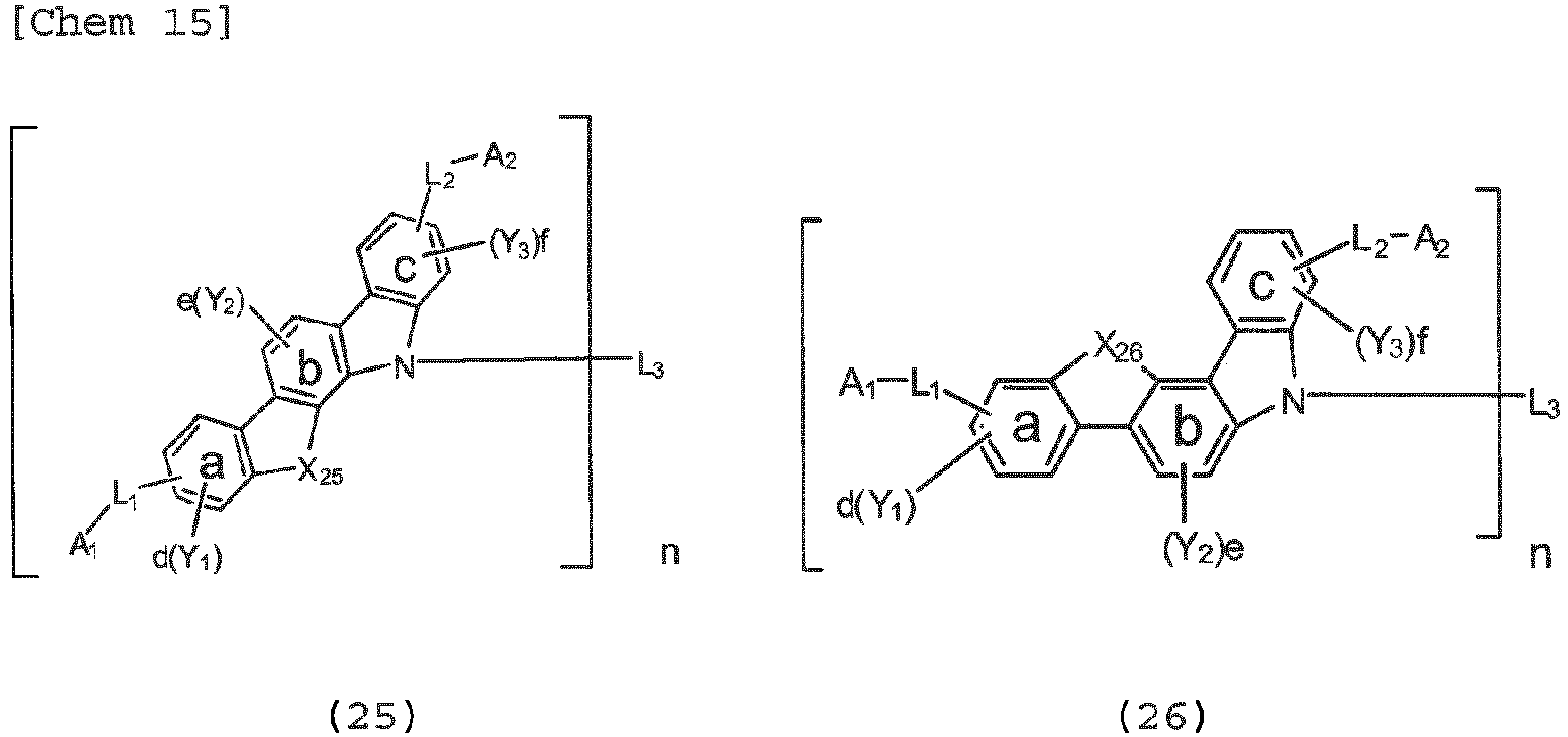
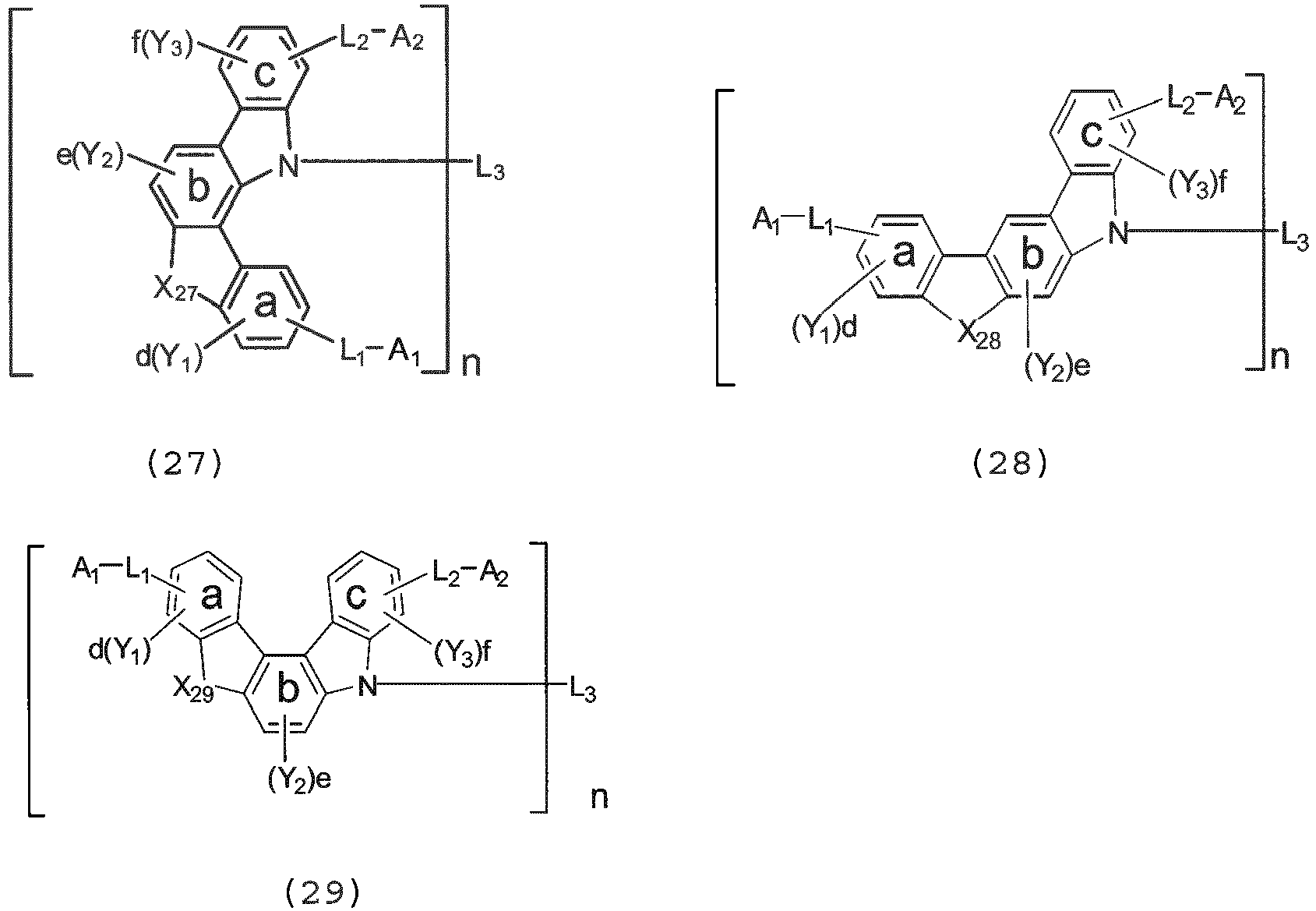
- X25, X26, X27, X28, and X29 each independently represent oxygen (O), sulfur (S), N-R1, or CR2R3;
- R2 and R3 each independently represent an alkyl group having 1 to 20 carbon atoms, a substituted or unsubstituted cycloalkyl group having a ring formed of 3 to 20 carbon atoms, an aralkyl group having 7 to 24 carbon atoms, a silyl group or a substituted silyl group having 3 to 20 carbon atoms, a substituted or unsubstituted aromatic hydrocarbon group having a ring formed of 6 to 24 carbon atoms, or a substituted or unsubstituted aromatic heterocyclic group having a ring formed of 3 to 24 atoms;
- n represents 2, 3, or 4, and the compound represented by any one of the formulae (25) to (29) comprises a dimer using L3 as a linking group for n=2, a trimer using L3 as a linking group for n=3, or a tetramer using L3 as a linking group for n=4;
- L1 represents a single bond, an alkylene group having 1 to 20 carbon atoms, a substituted or unsubstituted cycloalkylene group having a ring formed of 3 to 20 carbon atoms, a divalent silyl group or a substituted divalent silyl group having 2 to 20 carbon atoms, a substituted or unsubstituted, divalent aromatic hydrocarbon group having a ring formed of 6 to 24 carbon atoms, or a substituted or unsubstituted, monovalent or divalent aromatic heterocyclic group which has a ring formed of 3 to 24 atoms and which is linked with a benzene ring a through a carbon-carbon bond;
- L2 represents a single bond, an alkylene group having 1 to 20 carbon atoms, a substituted or unsubstituted cycloalkylene group having a ring formed of 3 to 20 carbon atoms, a divalent silyl group or a substituted divalent silyl group having 2 to 20 carbon atoms, a substituted or unsubstituted, divalent aromatic hydrocarbon group having a ring formed of 6 to 24 carbon atoms, or a substituted or unsubstituted, divalent aromatic heterocyclic group which has a ring formed of 3 to 24 atoms and which is linked with a benzene ring c through a carbon-carbon bond;
- when n represents 2, L3 represents a single bond, an alkylene group having 1 to 20 carbon atoms, a substituted or unsubstituted cycloalkylene group having a ring formed of 3 to 20 carbon atoms, a divalent silyl group or a substituted divalent silyl group having 2 to 20 carbon atoms, a substituted or unsubstituted, divalent aromatic hydrocarbon group having a ring formed of 6 to 24 carbon atoms, or a substituted or unsubstituted, divalent aromatic heterocyclic group which has a ring formed of 3 to 24 atoms, when n represents 3, L3 represents a trivalent saturated hydrocarbon group having 1 to 20 carbon atoms, a substituted or unsubstituted, trivalent cyclic saturated hydrocarbon group having a ring formed of 3 to 20 carbon atoms, a trivalent silyl group or a substituted trivalent silyl group having 1 to 20 carbon atoms, a substituted or unsubstituted, trivalent aromatic hydrocarbon group having a ring formed of 6 to 24 carbon atoms, or a substituted or unsubstituted, trivalent aromatic heterocyclic group which has a ring formed of 3 to 24 atoms, or when n represents 4, L3 represents a tetravalent saturated hydrocarbon group having 1 to 20 carbon atoms, a substituted or unsubstituted, tetravalent cyclic saturated hydrocarbon group having a ring formed of 3 to 20 carbon atoms, a silicon atom, a substituted or unsubstituted, tetravalent aromatic hydrocarbon group having a ring formed of 6 to 24 carbon atoms, or a substituted or unsubstituted, tetravalent aromatic heterocyclic group which has a ring formed of 3 to 24 atoms;
- A1 represents a hydrogen atom, a substituted or unsubstituted cycloalkyl group having a ring formed of 3 to 20 carbon atoms, a silyl group or a substituted silyl group having 3 to 20 carbon atoms, a substituted or unsubstituted aromatic hydrocarbon group having a ring formed of 6 to 24 carbon atoms, or an aromatic heterocyclic group which has a ring formed of 3 to 24 atoms and which is linked with L1 through a carbon-carbon bond, provided that, when L1 represents an alkylene group having 1 to 20 carbon atoms, a case where A1 represents a hydrogen atom is excluded;
- A2 represents a hydrogen atom, a substituted or unsubstituted cycloalkyl group having a ring formed of 3 to 20 carbon atoms, a silyl group or a substituted silyl group having 3 to 20 carbon atoms, a substituted or unsubstituted aromatic hydrocarbon group having a ring formed of 6 to 24 carbon atoms, or an aromatic heterocyclic group which has a ring formed of 3 to 24 atoms and which is linked with L2 through a carbon-carbon bond, provided that, when L2 represents an alkylene group having 1 to 20 carbon atoms, a case where A2 represents a hydrogen atom is excluded;
- Y1, Y2, and Y3 each represent an alkyl group having 1 to 20 carbon atoms, a substituted or unsubstituted cycloalkyl group having a ring formed of 3 to 20 carbon atoms, an alkoxy group having 1 to 20 carbon atoms, an aralkyl group having 7 to 24 carbon atoms, a silyl group or a substituted silyl group having 3 to 20 carbon atoms, a substituted or unsubstituted aromatic hydrocarbon group having a ring formed of 6 to 24 carbon atoms, or a substituted or unsubstituted aromatic heterocyclic group which has a ring formed of 3 to 24 atoms and which is linked with the benzene ring a, b, or c through a carbon-carbon bond, d and f each represent a number of 0, 1, 2, or 3, and e represents a number of 0, 1, or 2; and A1, A2, L1, L2, and L3 are each free of any carbonyl group.
- [Item 45] A material for an organic electron device, wherein the material for an organic electron device is a benzofurano dibenzofuran derivative.
- [Item 46] A material for an organic electron device, wherein the material for an organic electron device is a benzofurano dibenzofuran derivative in which both X1 and X2 or both X3 and X4 in the formula (1) or (2) according to item 1 represent oxygen atoms.
- [Item 47] A halogen compound represented by the following formula (30) :
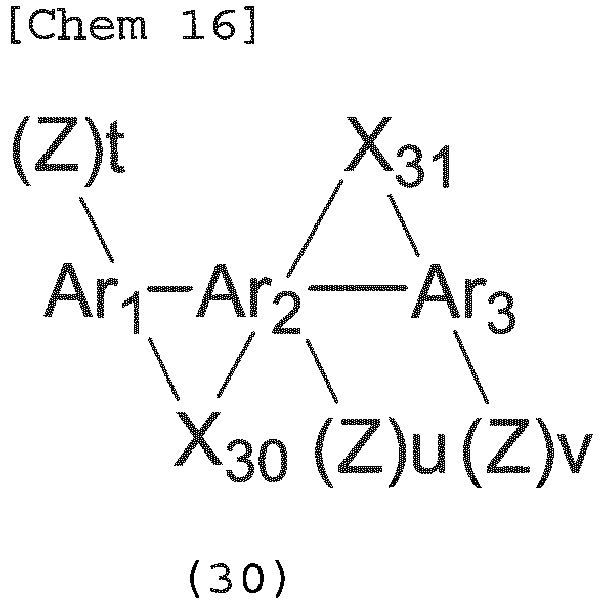
- Ar1, Ar2, and Ar3 each independently represent a substituted or unsubstituted aromatic hydrocarbon group having a ring formed of 6 carbon atoms or a substituted or unsubstituted aromatic heterocyclic group having a ring formed of 6 atoms, provided that, Ar1, Ar2, and Ar3 each may have one substituent Y or a plurality of substituents Y's, in the case of the plurality of substituents Y's, the substituent Y's may be different from each other, Y represents an alkyl group having 1 to 20 carbon atoms, a substituted or unsubstituted cycloalkyl group having a ring formed of 3 to 20 carbon atoms, an alkoxy group having 1 to 20 carbon atoms, an aralkyl group having 7 to 24 carbon atoms, a silyl group or a substituted silyl group having 3 to 20 carbon atoms, a substituted or unsubstituted aromatic hydrocarbon group having a ring formed of 6 to 24 carbon atoms, or a substituted or unsubstituted aromatic heterocyclic group which has a ring formed of 3 to 24 atoms and which is linked with Ar1, Ar2, or Ar3 through a carbon-carbon bond;
- X30 and X31 each independently represent oxygen (O), sulfur (S), or N-R1;
- R1 represents an alkyl group having 1 to 20 carbon atoms, a substituted or unsubstituted cycloalkyl group having a ring formed of 3 to 20 carbon atoms, an aralkyl group having 7 to 24 carbon atoms, a silyl group or a substituted silyl group having 3 to 20 carbon atoms, a substituted or unsubstituted aromatic hydrocarbon group having a ring formed of 6 to 24 carbon atoms, or a substituted or unsubstituted aromatic heterocyclic group having a ring formed of 3 to 24 atoms, provided that, when both X30 and X31 represent N-R1, at least one R1 represents a substituted or unsubstituted, monovalent fused aromatic heterocyclic group having a ring formed of 8 to 24 atoms;
- Z represents a halogen atom that comprises a fluorine atom, a chlorine atom, a bromine atom, and an iodine atom;
- t, u, and v each represent 0 or 1; provided that, t+u+v≥1;
- a case where the formula (30) has a structure represented by the following formula (31) is excluded;
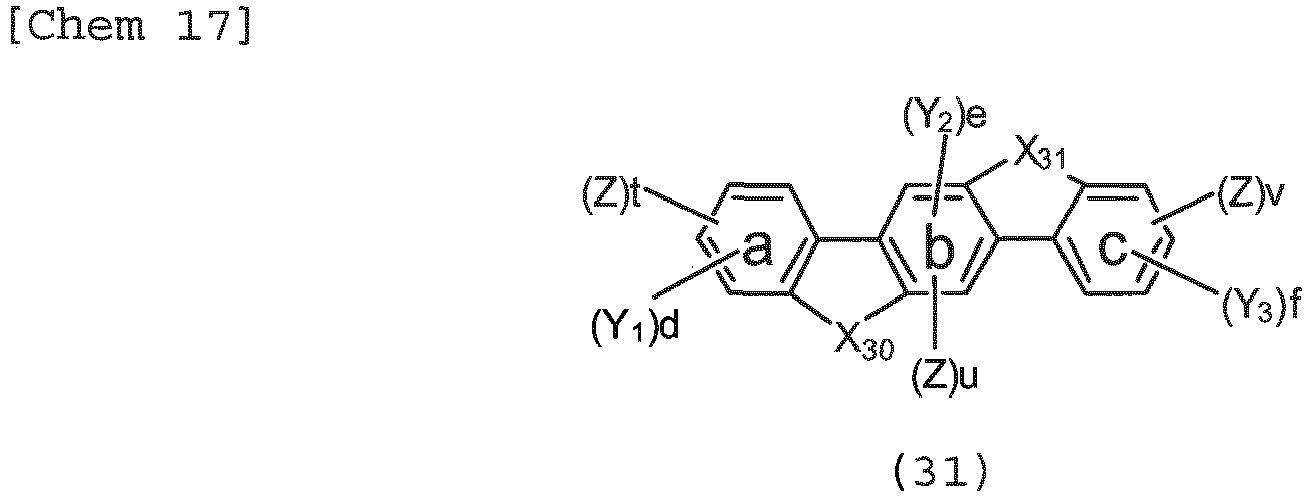
- provided that, X30, X31, Z, t, and u in the formula (31) has the same meaning of X30, X31, Z, t, and u in the formula (30), respectively; and
- Y1, Y2, and Y3 in the formula (31) each represent an alkyl group having 1 to 20 carbon atoms, a substituted or unsubstituted cycloalkyl group having a ring formed of 3 to 20 carbon atoms, an alkoxy group having 1 to 20 carbon atoms, an aralkyl group having 7 to 24 carbon atoms, a silyl group or a substituted a silyl group having 3 to 20 carbon atoms, a substituted or unsubstituted aromatic hydrocarbon group having a ring formed of 6 to 24 carbon atoms, or a substituted or unsubstituted aromatic heterocyclic group which has a ring formed of 3 to 24 atoms and which is linked with the benzene ring a, b, or c through a carbon-carbon bond, d and f each represent a number of 0, 1, 2, or 3, and e represents a number of 0, 1, or 2.
- [Item 48] The halogen compound according to item 47, wherein the halogen compound is represented by the following formula (32):
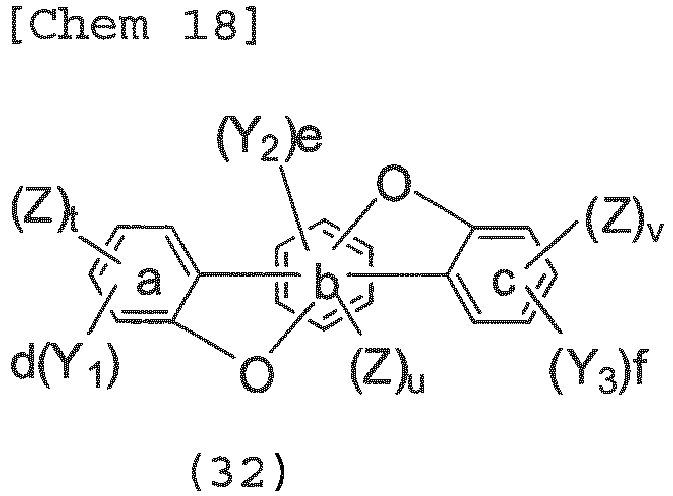
- Y1, Y2, and Y3 each independently represent a hydrogen atom, an alkyl group having 1 to 20 carbon atoms, a substituted or unsubstituted cycloalkyl group having a ring formed of 3 to 20 carbon atoms, an alkoxy group having 1 to 20 carbon atoms, an aralkyl group having 7 to 24 carbon atoms, a silyl group or a silyl group having 3 to 20 carbon atoms, a substituted or unsubstituted aromatic hydrocarbon group having a ring formed of 6 to 24 carbon atoms, or a substituted or unsubstituted aromatic heterocyclic group which has a ring formed of 3 to 24 atoms and which is linked with a benzene ring a, b, or c through a carbon-carbon bond;
- d and f each represent a number of 0, 1, 2, or 3, and e represents a number of 0, 1, or 2;
- Z represents a halogen atom that comprises a fluorine atom, a chlorine atom, a bromine atom, or an iodine atom; and
- t, u, and v each represent 0 or 1, provided that, t+u+v≥1.
- [Item 49] The halogen compound according to item 47, wherein the halogen compound is represented by one of the following formulae (33) to (35):
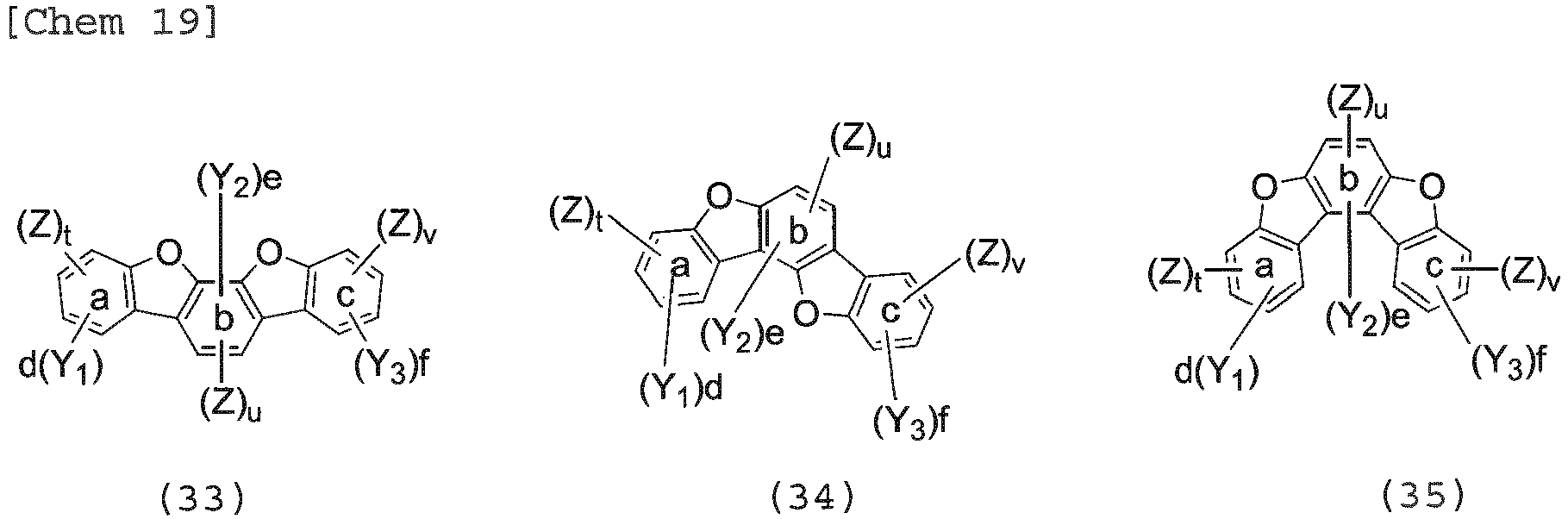
- Y1, Y2, and Y3 each independently represent a hydrogen atom, an alkyl group having 1 to 20 carbon atoms, a substituted or unsubstituted cycloalkyl group having a ring formed of 3 to 20 carbon atoms, an alkoxy group having 1 to 20 carbon atoms, an aralkyl group having 7 to 24 carbon atoms, a silyl group or a unsubstituted silyl group having 3 to 20 carbon atoms, a substituted or unsubstituted aromatic hydrocarbon group having a ring formed of 6 to 24 carbon atoms, or a substituted or unsubstituted aromatic heterocyclic group which has a ring formed of 3 to 24 atoms and which is linked with a benzene ring a, b, or c through a carbon-carbon bond, d and f each represent a number of 0, 1, 2, or 3, and e represents a number of 0, 1, or 2;
- Z represents a halogen atom that comprises a fluorine atom, a chlorine atom, a bromine atom, or an iodine atom; and
- t, u, and v each represent 0 or 1, provided that t+u+v≥1,
- [Item 50] The halogen compound according to item 47, wherein the halogen compound is represented by the following formula (36) or (37) :
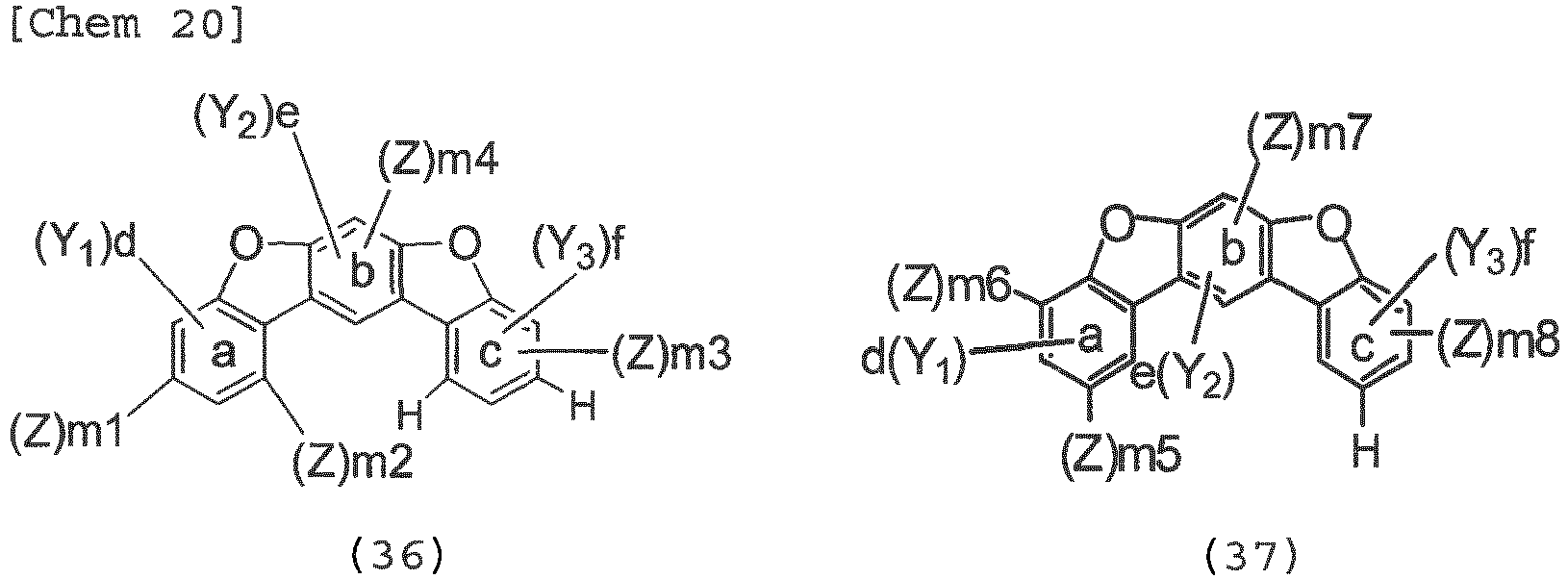
- Y1, Y2, and Y3 each independently represent a hydrogen atom, an alkyl group having 1 to 20 carbon atoms, a substituted or unsubstituted cycloalkyl group having a ring formed of 3 to 20 carbon atoms, an alkoxy group having 1 to 20 carbon atoms, an aralkyl group having 7 to 24 carbon atoms, a silyl group or a substituted silyl group having 3 to 20 carbon atoms, a substituted or unsubstituted aromatic hydrocarbon group having a ring formed of 6 to 24 carbon atoms, or a substituted or unsubstituted aromatic heterocyclic group which has a ring formed of 3 to 24 atoms and which is linked with a benzene ring a, b, or c through a carbon-carbon bond, d and f each represent a number of 0, 1, 2, or 3, and e represents a number of 0, 1, or 2;
- Z represents a halogen atom that comprises a fluorine atom, a chlorine atom, a bromine atom, or an iodine atom; and
- ml to m8 each represent 0 or 1, provided that, m1+m2=1, m5+m6≤1, m6+m7+m8≥1.
- [Item 51] An organic electroluminescence device comprising one or more organic thin film layers including a light emitting layer between a cathode and an anode, wherein at least one layer of the organic thin film layers contains a polycyclic compound having a π-conjugated heteroacene skeleton crosslinked with a carbon atom, nitrogen atom, oxygen atom, or sulfur atom.
- [Item 52] The organic electroluminescence device according to Item 51, wherein the polycyclic compound comprises the polycyclic compound according to any one of items 1, 42, and 44.
- [Item 53] The organic electroluminescence device according to item 51, wherein the light emitting layer contains the polycyclic compound as a host material.
- [Item 54] The organic electroluminescence device according to item 51, wherein the light emitting layer further contains a phosphorescent material.
- [Item 55] The organic electroluminescence device according to item 51, wherein the light emitting layer contains a host material and a phosphorescent material, and the phosphorescent material comprises an orthometalated complex of an iridium (Ir), osmium (Os), or platinum (Pt) metal.
- [Item 56] The organic electroluminescence device according to Item 51, further comprising an electron injecting layer between the light emitting layer and the cathode, wherein the electron injecting layer contains a nitrogen-containing ring derivative.
- [Item 57] The organic electroluminescence device according to Item 51, further comprising an electron transporting layer between the light emitting layer and the cathode, wherein the electron transporting layer contains the polycyclic compound.
- [Item 58] The organic electroluminescence device according to Item 57, wherein the light emitting layer contains the polycyclic compound as a host material.
- [Item 59] The organic electroluminescence device according to Item 57, wherein the light emitting layer contains, as a host material, the polycyclic compound represented by the formula (5) or (6) according to item 6, or the formula (9) or (12) according to item 8.
- [Item 60] The organic electroluminescence device according to item 57, wherein the light emitting layer contains, as a host material, the polycyclic compound represented by the formula (15) or (16) according to item 40, or the formula (17) or (18) according to item 41.
- [Item 61] The organic electroluminescence device according to item 51, further comprising a hole transporting layer between the light emitting layer and the anode, wherein the hole transporting layer contains the polycyclic compound.
- [Item 62] The organic electroluminescence device according to item 51, further comprising a reducing dopant at an interfacial region between the cathode and the organic thin film layers.
Claims (8)
- A polycyclic compound represented by any one of the following formulae (7) to (12):
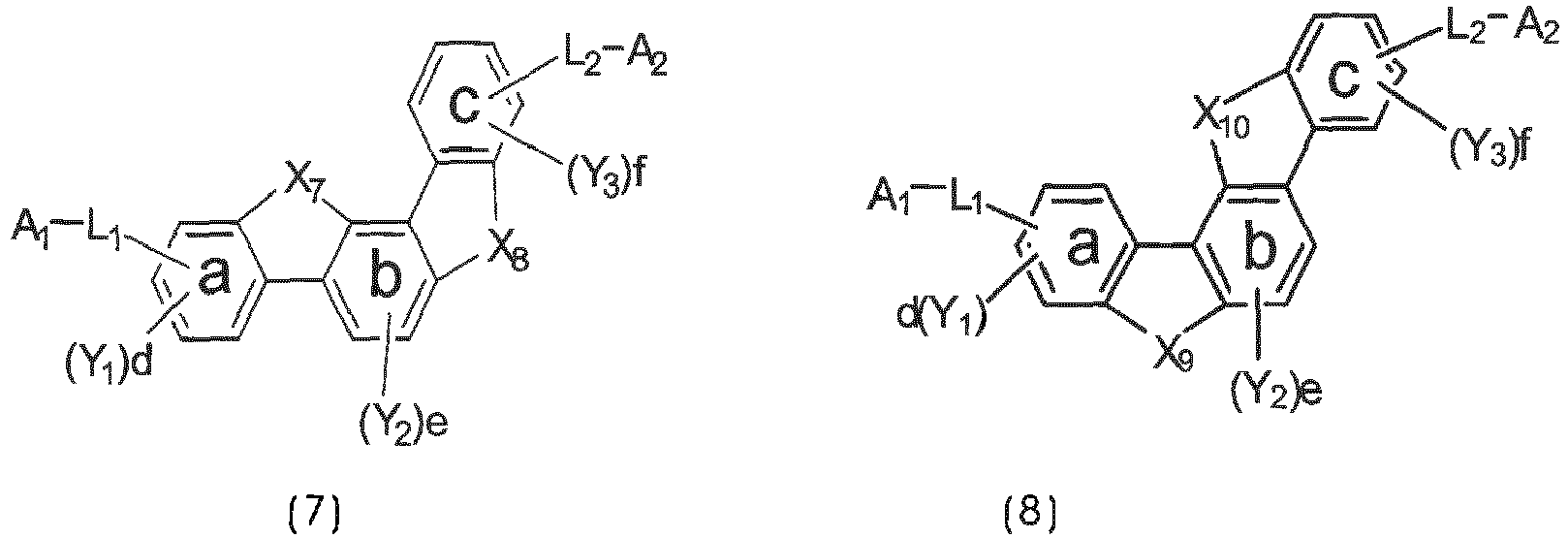

 X7, X8, X9, X10, X11, and X12 each independently represent oxygen (O), sulfur (S), N-R1 or CR2R3; provided that X7, X9 and X11 in the general formulae (7) to (12) each independently represent oxygen (O), sulfur (S) or CR2R3, or X8, X10 and X12 in the general formulae (7) to (12) each independently represent oxygen (O), sulfur (S) or CR2R3;R1, R2, and R3 each independently represent an alkyl group having 1 to 20 carbon atoms, a substituted or unsubstituted cycloalkyl group having a ring formed of 3 to 20 carbon atoms, an aralkyl group having 7 to 24 carbon atoms, a silyl group or a substituted silyl group having 3 to 20 carbon atoms, a substituted or unsubstituted aromatic hydrocarbon group, wherein the aromatic hydrocarbon group is a residue of benzene, naphthalene, biphenyl, terphenyl, fluorene, phenanthrene, triphenylene, perylene, chrysene, fluoranthene, benzofluorene, benzotriphenylene, benzochrysene, or anthracene, or a substituted or unsubstituted aromatic heterocyclic group having a ring formed of 3 to 24 atoms;n represents 2, 3, or 4, and the compound represented by any one of the formulae (10) to (12) comprises a dimer using L3 as a linking group for n = 2, a trimer using L3 as a linking group for n = 3, or a tetramer using L3 as a linking group for n=4;L1 represents a single bond, an alkylene group having 1 to 20 carbon atoms, a substituted or unsubstituted cycloalkylene group having a ring formed of 3 to 20 carbon atoms, a divalent silyl group or divalent silyl group having 2 to 20 carbon atoms, a substituted or unsubstituted, divalent aromatic hydrocarbon group, wherein the divalent aromatic hydrocarbon group is a residue of benzene, naphthalene, biphenyl, terphenyl, fluorene, phenanthrene, triphenylene, perylene, chrysene, fluoranthene, benzofluorene, benzotriphenylene, benzochrysene, or anthracene, or a substituted or unsubstituted, divalent aromatic heterocyclic group which has a ring formed of 3 to 24 atoms and which is linked with a benzene ring a through a carbon-carbon bond;L2 represents a single bond, an alkylene group having 1 to 20 carbon atoms, a substituted or unsubstituted cycloalkylene group having a ring formed of 3 to 20 carbon atoms, a divalent silyl group or divalent silyl group having 2 to 20 carbon atoms, a substituted or unsubstituted, divalent aromatic hydrocarbon group, wherein the divalent aromatic hydrocarbon group is a residue of benzene, naphthalene, biphenyl, terphenyl, fluorene, phenanthrene, triphenylene, perylene, chrysene, fluoranthene, benzofluorene, benzotriphenylene, benzochrysene, or anthracene, or a substituted or unsubstituted, divalent aromatic heterocyclic group which has a ring formed of 3 to 24 atoms and which is linked with a benzene ring c through a carbon-carbon bond,provided that, when both X7 and X8, both X9 and X10, or both X11 and X12 represent CR2R3 and both L1 and L2 represent the substituted or unsubstituted, divalent aromatic hydrocarbon groups, a case where L1 is linked to the benzene ring a at the para position with respect to the benzene ring b and L2 is linked to the benzene ring c at the para position with respect to the benzene ring b is excluded;when n represents 2, L3 represents a single bond, an alkylene group having 1 to 20 carbon atoms, a substituted or unsubstituted cycloalkylene group having a ring formed of 3 to 20 carbon atoms, a divalent silyl group or a substituted divalent silyl group having 2 to 20 carbon atoms, a substituted or unsubstituted, divalent aromatic hydrocarbon group, wherein the divalent aromatic hydrocarbon group is a residue of benzene, naphthalene, biphenyl, terphenyl, fluorene, phenanthrene, triphenylene, perylene, chrysene, fluoranthene, benzofluorene, benzotriphenylene, benzochrysene, or anthracene, or a substituted or unsubstituted, divalent aromatic heterocyclic group which has a ring formed of 3 to 24 atoms and which is linked with the benzene ring c through a carbon-carbon bond,when n represents 3, L3 represents a trivalent saturated hydrocarbon group having 1 to 20 carbon atoms, a substituted or unsubstituted, trivalent cyclic saturated hydrocarbon group having a ring formed of 3 to 20 carbon atoms, a trivalent silyl group or a substituted trivalent silyl group having 1 to 20 carbon atoms, a substituted or unsubstituted, trivalent aromatic hydrocarbon group, wherein the trivalent aromatic hydrocarbon group is a residue of benzene, naphthalene, biphenyl, terphenyl, fluorene, phenanthrene, triphenylene, perylene, chrysene, fluoranthene, benzofluorene, benzotriphenylene, benzochrysene, or anthracene, or a substituted or unsubstituted, trivalent aromatic heterocyclic group which has 3 to 24 atoms and which is linked with the benzene ring c through a carbon-carbon bond, orwhen n represents 4, L3 represents a tetravalent saturated hydrocarbon group having 1 to 20 carbon atoms, a substituted or unsubstituted, tetravalent cyclic saturated hydrocarbon group having a ring formed of 3 to 20 carbon atoms, a silicon atom, a substituted or unsubstituted, tetravalent aromatic hydrocarbon group, wherein the tetravalent aromatic hydrocarbon group is a residue of benzene, naphthalene, biphenyl, terphenyl, fluorene, phenanthrene, triphenylene, perylene, chrysene, fluoranthene, benzofluorene, benzotriphenylene, benzochrysene, or anthracene, or a substituted or unsubstituted, tetravalent aromatic heterocyclic group which has a ring formed of 3 to 24 atoms and which is linked with the benzene ring c through a carbon-carbon bond,provided that, when both X7 and X8, both X9 and X10, or both X11 and X12 represent CR2R3 and both L1 and L3 represent the substituted or unsubstituted, divalent, trivalent, or tetravalent aromatic hydrocarbon groups, a case where L1 is linked to the benzene ring a at the para position with respect to the benzene ring b and L3 is linked to the benzene ring c at the para position with respect to the benzene ring b is excluded;A1 represents a hydrogen atom, a substituted or unsubstituted cycloalkyl group having a ring formed of 3 to 20 carbon atoms, a silyl group or a substituted silyl group having 3 to 20 carbon atoms, a substituted or unsubstituted aromatic hydrocarbon group, wherein the aromatic hydrocarbon group is a residue of benzene, naphthalene, biphenyl, terphenyl, fluorene, phenanthrene, triphenylene, perylene, chrysene, fluoranthene, benzofluorene, benzotriphenylene, benzochrysene, or anthracene, or an aromatic heterocyclic group which has a ring formed of 3 to 24 atoms and which is linked with L1 through a carbon-carbon bond,provided that, when L1 represents an alkylene group having 1 to 20 carbon atoms, a case where A1 represents a hydrogen atom is excluded;A2 represents a hydrogen atom, a substituted or unsubstituted cycloalkyl group having a ring formed of 3 to 20 carbon atoms, a silyl group or a substituted silyl group having 3 to 20 carbon atoms, a substituted or unsubstituted aromatic hydrocarbon group having a ring, wherein the aromatic hydrocarbon group is a residue of benzene, naphthalene, biphenyl, terphenyl, fluorene, phenanthrene, triphenylene, perylene, chrysene, fluoranthene, benzofluorene, benzotriphenylene, benzochrysene, or anthracene, or an aromatic heterocyclic group which has a ring formed of 3 to 24 atoms and which is linked with L2 through a carbon-carbon bond,provided that, when L2 represents an alkylene group having 1 to 20 carbon atoms, a case where A2 represents a hydrogen atom is excluded;Y,, Y2, and Y3 each represent an alkyl group having 1 to 20 carbon atoms, a substituted or unsubstituted cycloalkyl group having a ring formed of 3 to 20 carbon atoms, an alkoxy group having 1 to 20 carbon atoms, an aralkyl group having 7 to 24 carbon atoms, a silyl group or a substituted silyl group having 3 to 20 carbon atoms, a substituted or unsubstituted aromatic hydrocarbon group, wherein the aromatic hydrocarbon group is a residue of benzene, naphthalene, biphenyl, terphenyl, fluorene, phenanthrene, triphenylene, perylene, chrysene, fluoranthene, benzofluorene, benzotriphenylene, benzochrysene, or anthracene, or a substituted or unsubstituted aromatic heterocyclic group which has a ring formed of 3 to 24 atoms and which is linked with the benzene ring a, b, or c through a carbon-carbon bond,d and f each represent a number of 0, 1, 2, or 3, and e represents a number of 0, 1, or 2,provided that, when both X7 and X8, both X9 and X10, or both X11 and X12 represent oxygen (O), sulfur (S), or CR2R3, both L1 and L2 represent single bonds, and both A1 and A2 represent hydrogen atoms, the benzene ring b has one or two Y2's, and a case where Y2 represents a methyl group or an unsubstituted phenyl group is excluded;A1, A2, L1, L2, and L3 are each free of any carbonyl group, andthe substituent that may substitute each of the groups in formulae (7) to (12) includes alkyl groups each having 1 to 6 carbon atoms, a phenyl group, a pyridyl group, a carbazolyl group, and a dibenzofuranyl group,provided that the following compound is excluded:
- The polycyclic compound according to claim 1, wherein the formulae (7) to (12) are each represented by any one of the following formulae (7a) to (12a) and (7b) to (12b):


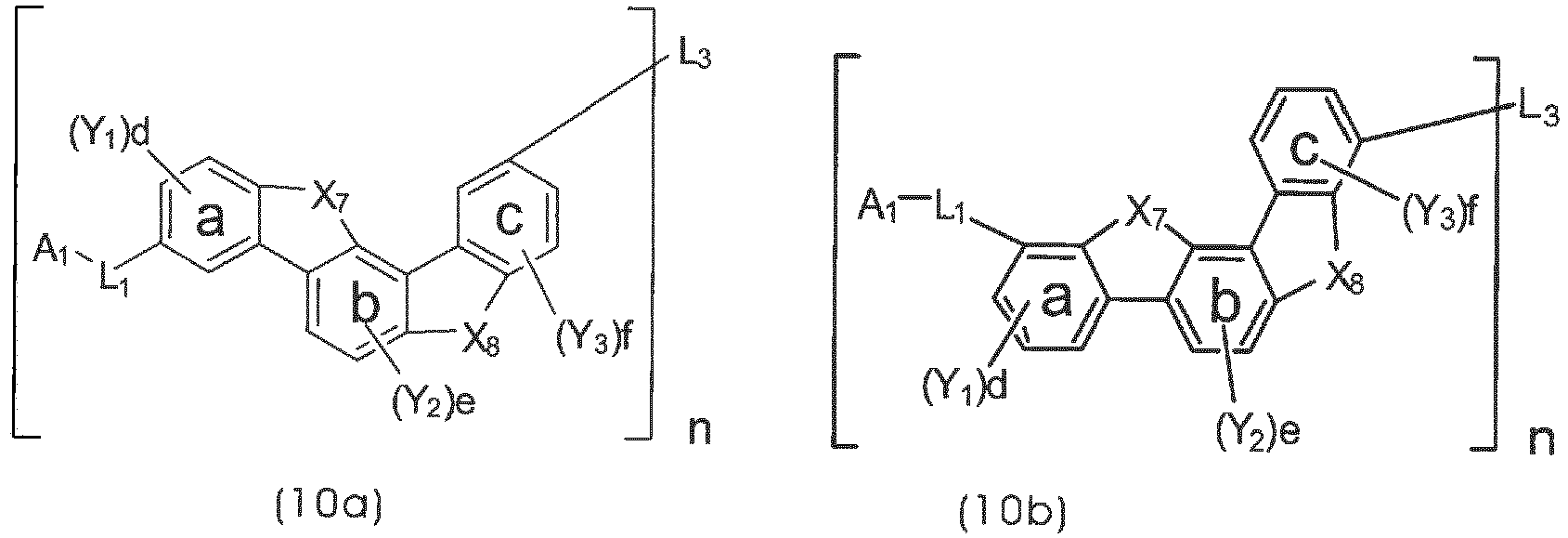
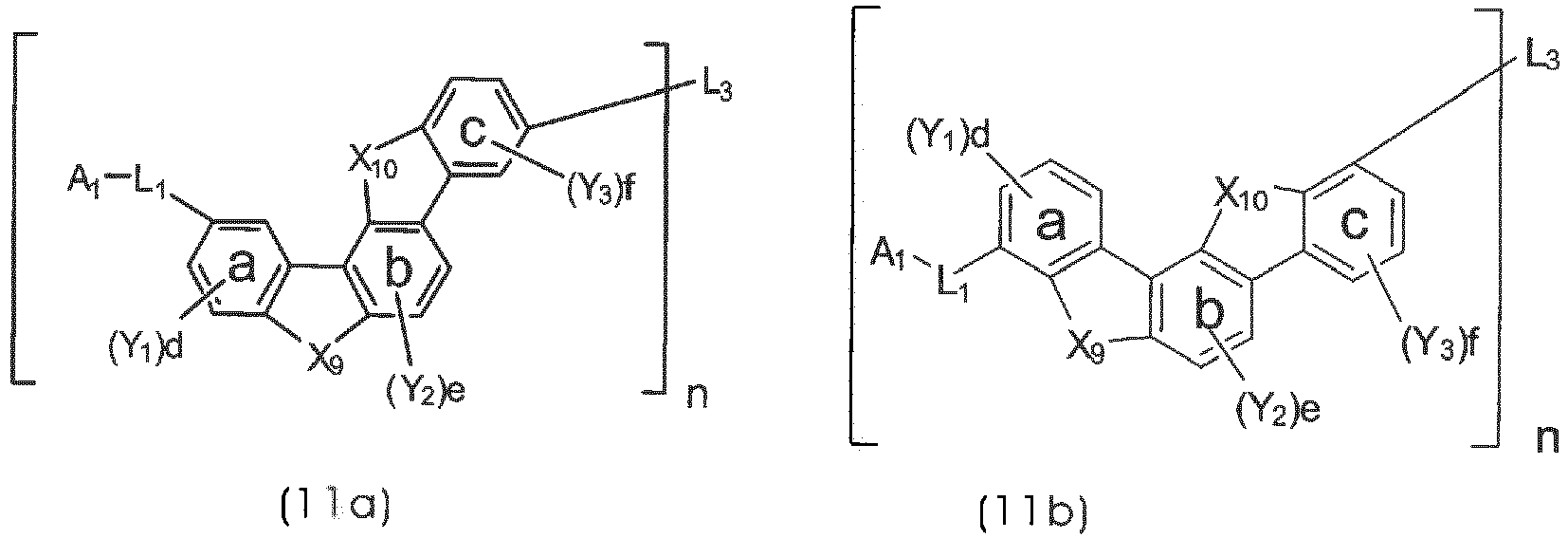
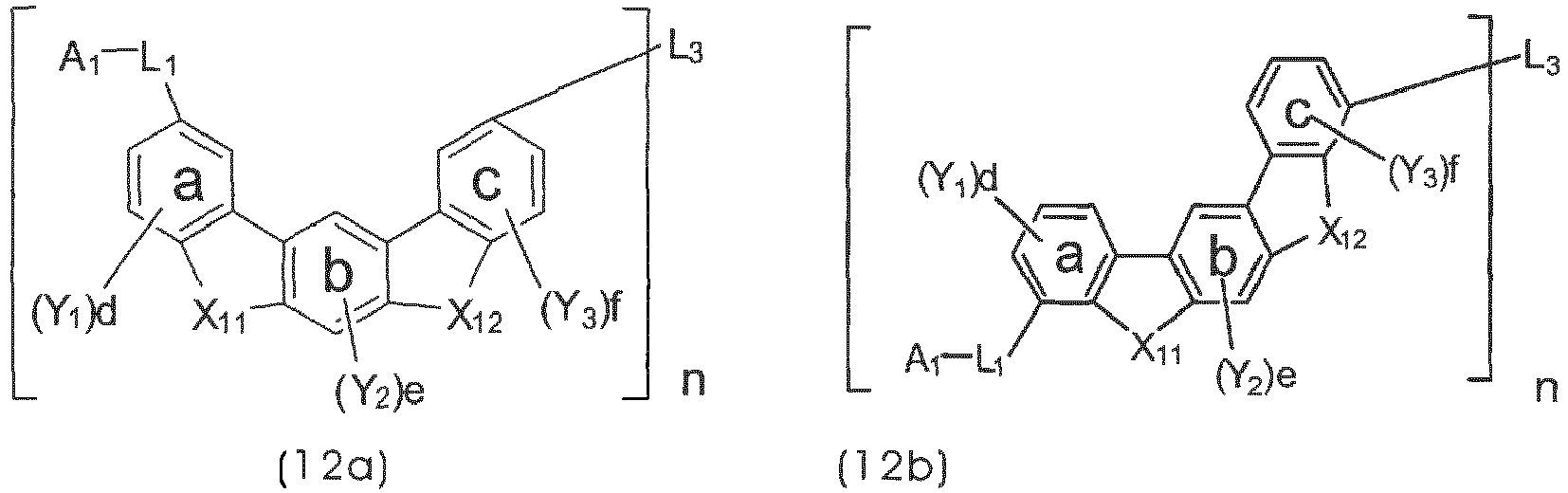
- The polycyclic compound according to claim 1, wherein n represents 2 in the formulae (10) to (12).
- The polycyclic compound according to claim 1, wherein a total number of substituents represented by Y1, Y2, and Y3 in the formulae (7) to (9) is 3 or less, and a total number of the substituents represented by Y1, Y2, and Y3 in the structure of []n in the general formulae (10) to (12) is 3 or less.
- The polycyclic compound according to claim 1, wherein both X11 and X12 in the formula (9) or (12) represent CR2R3.
- The polycyclic compound according to claim 1, wherein at least one of X7 and X8, X9 and X10, or X11 and X12 in the formulae (7) to (12) represents an oxygen atom.
- The polycyclic compound according to claim 1, which is a benzofurano dibenzofuran derivative in which both X7 and X8, both X9 and X10, or both X11 and X12 in the formulae (7) to (12) represent oxygen atoms.
- The polycyclic compound according to claim 1, which is a benzofurano dibenzofuran derivative represented by one of the following formulae (17) and (18):
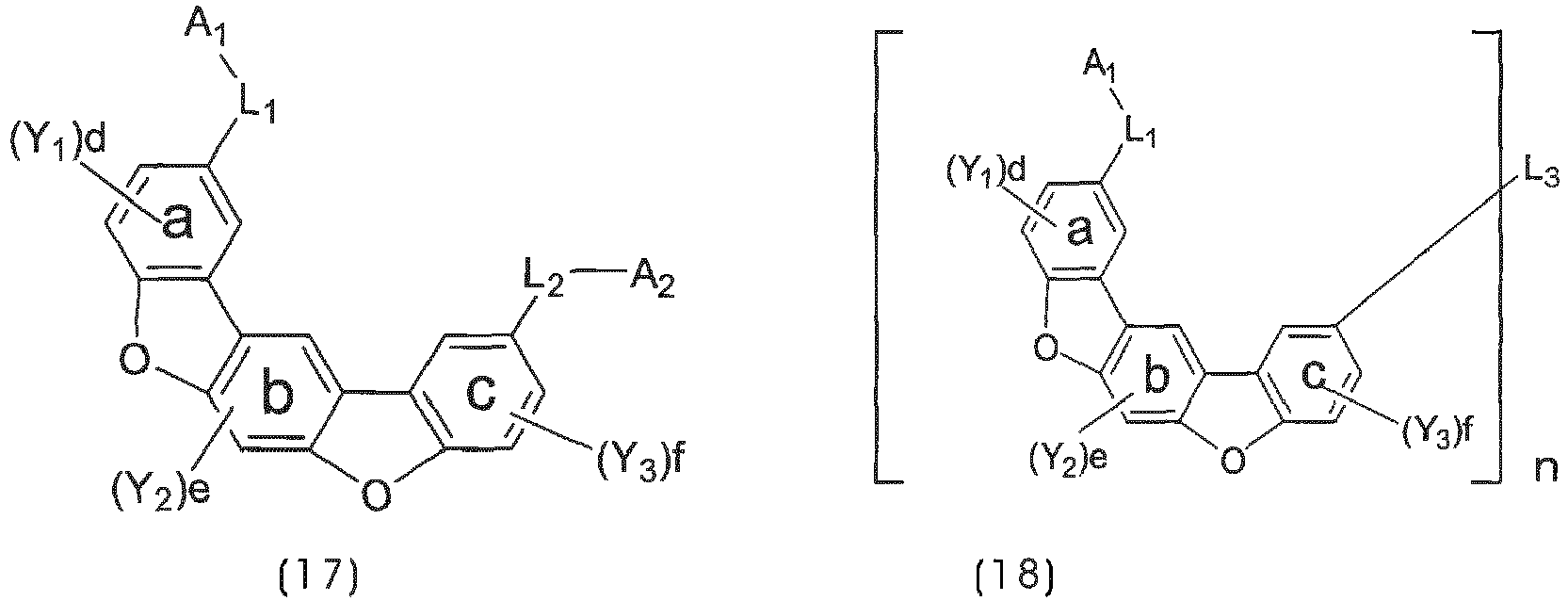 n represents 2, 3, or 4, and the compound represented by the formula (18) comprises a dimer using L3 as a linking group for n=2, a trimer using L3 as a linking group for n=3, or a tetramer using L3 as a linking group for n=4;L1 represents a single bond, an alkylene group having 1 to 20 carbon atoms, a substituted or unsubstituted cycloalkylene group having a ring formed of 3 to 20 carbon atoms, a divalent silyl group or a substituted divalent silyl group having 2 to 20 carbon atoms, a substituted or unsubstituted, divalent aromatic hydrocarbon group, wherein the divalent aromatic hydrocarbon group is a residue of benzene, naphthalene, biphenyl, terphenyl, fluorene, phenanthrene, triphenylene, perylene, chrysene, fluoranthene, benzofluorene, benzotriphenylene, benzochrysene, or anthracene, or a substituted or unsubstituted, divalent aromatic heterocyclic group which has a ring formed of 3 to 24 atoms and which is linked with a benzene ring a through a carbon-carbon bond;L2 represents a single bond, an alkylene group having 1 to 20 carbon atoms, a substituted or unsubstituted cycloalkylene group having a ring formed of 3 to 20 carbon atoms, a divalent silyl group or a substituted divalent silyl group having 2 to 20 carbon atoms, a substituted or unsubstituted, divalent aromatic hydrocarbon group, wherein the aromatic hydrocarbon group is a residue of benzene, naphthalene, biphenyl, terphenyl, fluorene, phenanthrene, triphenylene, perylene, chrysene, fluoranthene, benzofluorene, benzotriphenylene, benzochrysene, or anthracene, or a substituted or unsubstituted, divalent aromatic heterocyclic group which has a ring formed of 3 to 24 atoms and which is linked with a benzene ring c through a carbon-carbon bond;when n represents 2, L3 represents a single bond, an alkylene group having 1 to 20 carbon atoms, a substituted or unsubstituted cycloalkylene group having a ring formed of 3 to 20 carbon atoms, a divalent silyl group or a substituted divalent silyl group having 2 to 20 carbon atoms, a substituted or unsubstituted, divalent aromatic hydrocarbon group, wherein the divalent aromatic hydrocarbon group is a residue of benzene, naphthalene, biphenyl, terphenyl, fluorene, phenanthrene, triphenylene, perylene, chrysene, fluoranthene, benzofluorene, benzotriphenylene, benzochrysene, or anthracene, or a substituted or unsubstituted, divalent aromatic heterocyclic group which has a ring formed of 3 to 24 atoms and which is linked with the benzene ring c through a carbon-carbon bond,when n represents 3, L3 represents a trivalent saturated hydrocarbon group having 1 to 20 carbon atoms, a substituted or unsubstituted, trivalent cyclic saturated hydrocarbon group having a ring formed of 3 to 20 carbon atoms, a trivalent silyl group or a substituted trivalent silyl group having 1 to 20 carbon atoms, a substituted or unsubstituted, trivalent aromatic hydrocarbon group, wherein the trivalent aromatic hydrocarbon group is a residue of benzene, naphthalene, biphenyl, terphenyl, fluorene, phenanthrene, triphenylene, perylene, chrysene, fluoranthene, benzofluorene, benzotriphenylene, benzochrysene, or anthracene, or a substituted or unsubstituted, trivalent aromatic heterocyclic group which has 3 to 24 atoms and which is linked with the benzene ring c through a carbon-carbon bond, orwhen n represents 4, L3 represents a tetravalent saturated hydrocarbon group having 1 to 20 carbon atoms, a substituted or unsubstituted, tetravalent cyclic saturated hydrocarbon group having a ring formed of 3 to 20 carbon atoms, a silicon atom, a substituted or unsubstituted, tetravalent aromatic hydrocarbon group, wherein the tetravalent aromatic hydrocarbon group is a residue of benzene, naphthalene, biphenyl, terphenyl, fluorene, phenanthrene, triphenylene, perylene, chrysene, fluoranthene, benzofluorene, benzotriphenylene, benzochrysene, or anthracene, or a substituted or unsubstituted, tetravalent aromatic heterocyclic group which has a ring formed of 3 to 24 atoms and which is linked with the benzene ring c through a carbon-carbon bond;A1 represents a hydrogen atom, a substituted or unsubstituted cycloalkyl group having a ring formed of 3 to 20 carbon atoms, a silyl group or a substituted silyl group having 3 to 20 carbon atoms, a substituted or unsubstituted aromatic hydrocarbon group, wherein the aromatic hydrocarbon group is a residue of benzene, naphthalene, biphenyl, terphenyl, fluorene, phenanthrene, triphenylene, perylene, chrysene, fluoranthene, benzofluorene, benzotriphenylene, benzochrysene, or anthracene, or an aromatic heterocyclic group which has a ring formed of 3 to 24 atoms and which is linked with L1 through a carbon-carbon bond,provided that, when L1 represents an alkylene group having 1 to 20 carbon atoms, a case where A1 represents a hydrogen atom is excluded;A2 represents a hydrogen atom, a substituted or unsubstituted cycloalkyl group having a ring formed of 3 to 20 carbon atoms, a silyl group or a substituted silyl group having 3 to 20 carbon atoms, a substituted or unsubstituted aromatic hydrocarbon group, wherein the aromatic hydrocarbon group is a residue of benzene, naphthalene, biphenyl, terphenyl, fluorene, phenanthrene, triphenylene, perylene, chrysene, fluoranthene, benzofluorene, benzotriphenylene, benzochrysene, or anthracene, or an aromatic heterocyclic group which has a ring formed of 3 to 24 atoms and which is linked with L2 through a carbon-carbon bond,provided that, when L2 represents an alkylene group having 1 to 20 carbon atoms, a case where A2 represents a hydrogen atom is excluded;Y1, Y2, and Y3 each represent an alkyl group having 1 to 20 carbon atoms, a substituted or unsubstituted cycloalkyl group having a ring formed of 3 to 20 carbon atoms, an alkoxy group having 1 to 20 carbon atoms, an aralkyl group having 7 to 24 carbon atoms, a silyl group or a substituted silyl group having 3 to 20 carbon atoms, a substituted or unsubstituted aromatic hydrocarbon group, wherein the aromatic hydrocarbon group is a residue of benzene, naphthalene, biphenyl, terphenyl, fluorene, phenanthrene, triphenylene, perylene, chrysene, fluoranthene, benzofluorene, benzotriphenylene, benzochrysene, or anthracene, or a substituted or unsubstituted aromatic heterocyclic group which has a ring formed of 3 to 24 atoms and which is linked with the benzene ring a, b, or c through a carbon-carbon bond,d and f each represent a number of 0, 1, 2, or 3, and e represents a number of 0, 1, or 2,provided that, when both L1 and L2 represent single bonds, and both A1 and A2 represent hydrogen atom, the benzene ring b has one or two Y2's, and a case where Y2 represents a methyl group or an unsubstituted phenyl group is excluded; andA1, A2, L1, L2, and L3 are each free of any carbonyl group.
Applications Claiming Priority (4)
| Application Number | Priority Date | Filing Date | Title |
|---|---|---|---|
| JP2008148514 | 2008-06-05 | ||
| US12/253,586 US8049411B2 (en) | 2008-06-05 | 2008-10-17 | Material for organic electroluminescence device and organic electroluminescence device using the same |
| JP2009100319 | 2009-04-16 | ||
| PCT/JP2009/059980 WO2009148015A1 (en) | 2008-06-05 | 2009-06-01 | Halogen compound, polycyclic compound, and organic electroluminescence element comprising the polycyclic compound |
Publications (3)
| Publication Number | Publication Date |
|---|---|
| EP2301926A1 EP2301926A1 (en) | 2011-03-30 |
| EP2301926A4 EP2301926A4 (en) | 2012-01-04 |
| EP2301926B1 true EP2301926B1 (en) | 2018-11-21 |
Family
ID=43608401
Family Applications (1)
| Application Number | Title | Priority Date | Filing Date |
|---|---|---|---|
| EP09758282.9A Active EP2301926B1 (en) | 2008-06-05 | 2009-06-01 | Halogen compound, polycyclic compound, and organic electroluminescence element comprising the polycyclic compound |
Country Status (6)
| Country | Link |
|---|---|
| EP (1) | EP2301926B1 (en) |
| JP (3) | JP5357150B2 (en) |
| KR (1) | KR101523124B1 (en) |
| CN (2) | CN102056911B (en) |
| TW (1) | TWI450897B (en) |
| WO (1) | WO2009148015A1 (en) |
Families Citing this family (151)
| Publication number | Priority date | Publication date | Assignee | Title |
|---|---|---|---|---|
| JP5493309B2 (en) * | 2008-08-18 | 2014-05-14 | コニカミノルタ株式会社 | ORGANIC ELECTROLUMINESCENT ELEMENT MATERIAL, ORGANIC ELECTROLUMINESCENT ELEMENT, DISPLAY DEVICE AND LIGHTING DEVICE |
| KR101511072B1 (en) * | 2009-03-20 | 2015-04-10 | 롬엔드하스전자재료코리아유한회사 | Novel organic electroluminescent compounds and organic electroluminescent device using the same |
| KR101477613B1 (en) * | 2009-03-31 | 2014-12-30 | 롬엔드하스전자재료코리아유한회사 | Novel compounds for organic electronic materials and organic electronic devices containing them |
| US10020452B2 (en) * | 2011-12-15 | 2018-07-10 | Samsung Mobile Display Co., Ltd. | Compound containing a 5-membered heterocycle and organic light-emitting diode using same, and terminal for same |
| US8629430B2 (en) * | 2009-05-29 | 2014-01-14 | Idemitsu Kosan Co., Ltd. | Anthracene derivative and organic electroluminescent element using the same |
| DE102009023155A1 (en) * | 2009-05-29 | 2010-12-02 | Merck Patent Gmbh | Materials for organic electroluminescent devices |
| DE102009031021A1 (en) | 2009-06-30 | 2011-01-05 | Merck Patent Gmbh | Materials for organic electroluminescent devices |
| KR20110009920A (en) * | 2009-07-23 | 2011-01-31 | 다우어드밴스드디스플레이머티리얼 유한회사 | Novel organic light emitting compound and organic electroluminescent device comprising same |
| DE102009041289A1 (en) | 2009-09-16 | 2011-03-17 | Merck Patent Gmbh | Organic electroluminescent device |
| DE102009041414A1 (en) | 2009-09-16 | 2011-03-17 | Merck Patent Gmbh | metal complexes |
| TWI429650B (en) * | 2010-02-12 | 2014-03-11 | Nippon Steel & Sumikin Chem Co | Organic electroluminescent elements |
| TWI477579B (en) | 2010-02-12 | 2015-03-21 | Nippon Steel & Sumikin Chem Co | Organic electroluminescent elements |
| DE102010010481A1 (en) | 2010-03-06 | 2011-09-08 | Merck Patent Gmbh | Organic electroluminescent device |
| US8637857B2 (en) | 2010-04-06 | 2014-01-28 | Basf Se | Substituted carbazole derivatives and use thereof in organic electronics |
| KR20110120994A (en) * | 2010-04-30 | 2011-11-07 | 다우어드밴스드디스플레이머티리얼 유한회사 | Novel organic light emitting compound and organic electroluminescent device employing the same |
| DE112011102008B4 (en) | 2010-06-15 | 2022-04-21 | Merck Patent Gmbh | metal complexes |
| DE102010027316A1 (en) | 2010-07-16 | 2012-01-19 | Merck Patent Gmbh | metal complexes |
| DE102010027319A1 (en) | 2010-07-16 | 2012-01-19 | Merck Patent Gmbh | metal complexes |
| DE102010027317A1 (en) | 2010-07-16 | 2012-01-19 | Merck Patent Gmbh | metal complexes |
| JP2012028634A (en) * | 2010-07-26 | 2012-02-09 | Idemitsu Kosan Co Ltd | Organic electroluminescent element |
| US9236578B2 (en) | 2010-07-30 | 2016-01-12 | Merck Patent Gmbh | Organic electroluminescent device |
| TW201300501A (en) * | 2010-07-30 | 2013-01-01 | 羅門哈斯電子材料韓國公司 | Electroluminescent device using electroluminescent compound as luminescent material |
| KR20120042633A (en) * | 2010-08-27 | 2012-05-03 | 롬엔드하스전자재료코리아유한회사 | Novel organic electroluminescent compounds and organic electroluminescent device using the same |
| KR20120030941A (en) * | 2010-09-20 | 2012-03-29 | 롬엔드하스전자재료코리아유한회사 | Novel organic electroluminescent compounds and organic electroluminescent device using the same |
| KR20120052879A (en) * | 2010-11-16 | 2012-05-24 | 롬엔드하스전자재료코리아유한회사 | Novel compound for organic electronic material and organic electroluminescent device using the same |
| TW201229052A (en) * | 2010-12-02 | 2012-07-16 | Nippon Steel Chemical Co | Heteroacene compound, organic semiconductor material, and organic electronic device |
| KR101670964B1 (en) | 2010-12-13 | 2016-11-09 | 삼성전자주식회사 | Polymer and organic light emitting diode comprising the same |
| DE102011106849A1 (en) | 2010-12-15 | 2012-06-21 | Merck Patent Gmbh | Process for the synthesis of N-N linked and around the N-N bond of rotation-inhibited bis-N-heterocyclic carbenes and their use as ligands for metal complexes |
| DE102010056151A1 (en) | 2010-12-28 | 2012-06-28 | Merck Patent Gmbh | Materials for organic electroluminescent devices |
| CN103582641B (en) | 2011-03-16 | 2016-05-04 | 新日铁住金化学株式会社 | Nitrogen-containing aromatic compound and organic electroluminescent device |
| JP5996628B2 (en) | 2011-04-04 | 2016-09-21 | メルク パテント ゲーエムベーハー | Metal complex |
| US9385335B2 (en) | 2011-04-05 | 2016-07-05 | Merck Patent Gmbh | Organic electroluminescent device |
| WO2012149992A1 (en) | 2011-05-04 | 2012-11-08 | Merck Patent Gmbh | Device for preserving fresh goods |
| DE102012007810A1 (en) | 2011-05-16 | 2012-11-22 | Merck Patent Gmbh | Electronic device, preferably organic electroluminescent device comprises a transition metal compound exhibiting a transition metal-tin bond |
| KR101972184B1 (en) | 2011-06-03 | 2019-04-24 | 메르크 파텐트 게엠베하 | Metal complexes |
| KR101943676B1 (en) | 2011-06-28 | 2019-01-29 | 메르크 파텐트 게엠베하 | Metal complexes |
| JP5938175B2 (en) | 2011-07-15 | 2016-06-22 | 出光興産株式会社 | Nitrogen-containing aromatic heterocyclic derivative and organic electroluminescence device using the same |
| KR101967014B1 (en) | 2011-08-10 | 2019-04-08 | 메르크 파텐트 게엠베하 | Metal complexes |
| DE102012016192A1 (en) | 2011-08-19 | 2013-02-21 | Merck Patent Gmbh | New compounds capable of forming hydrogen bonds are useful in electronic device, e.g. organic electroluminescent device, organic light-emitting transistor and organic light-emitting electrochemical cell |
| KR102051790B1 (en) | 2011-08-22 | 2019-12-04 | 메르크 파텐트 게엠베하 | Organic electroluminescence device |
| CA2849087A1 (en) | 2011-09-21 | 2013-03-28 | Merck Patent Gmbh | Carbazole derivatives for organic electroluminescent devices |
| KR101380335B1 (en) | 2011-10-10 | 2014-04-10 | 삼성디스플레이 주식회사 | Heterocyclic compound, organic light-emitting diode comprising the heterocyclic compound and flat display device comprising the organic light-emitting diode |
| EP2768808B1 (en) * | 2011-10-20 | 2017-11-15 | Merck Patent GmbH | Materials for organic electroluminescent devices |
| JP2014225484A (en) * | 2011-11-24 | 2014-12-04 | ユー・ディー・シー アイルランド リミテッド | Organic electroluminescent element, and light emitting device, display device and lighting system using the organic electroluminescent element |
| WO2013081315A1 (en) * | 2011-11-28 | 2013-06-06 | 덕산하이메탈(주) | Compound for organic electronic device, organic electronic device comprising same and electronic device comprising the organic electronic device |
| KR101497124B1 (en) | 2011-11-28 | 2015-03-06 | 덕산네오룩스 주식회사 | Compound for organic electronic element, organic electronic element using the same, and an electronic device thereof |
| KR101497123B1 (en) * | 2011-12-30 | 2015-03-09 | 덕산네오룩스 주식회사 | Compound Containing 5-Membered Heterocycle And Organic Electronic Element Using The Same, Terminal Thereof |
| KR20130084093A (en) * | 2012-01-16 | 2013-07-24 | 롬엔드하스전자재료코리아유한회사 | Novel organic electroluminescence compounds and organic electroluminescence device using the same |
| KR101498969B1 (en) * | 2012-04-06 | 2015-03-04 | (주)피엔에이치테크 | Novel compound for organic electroluminescent device and organic electroluminescent device comprising the same |
| KR20130127563A (en) * | 2012-05-02 | 2013-11-25 | 롬엔드하스전자재료코리아유한회사 | Novel organic electroluminescence compounds and organic electroluminescence device containing the same |
| WO2013179645A1 (en) * | 2012-05-30 | 2013-12-05 | 出光興産株式会社 | Organic-electroluminescent-element material, and organic electroluminescent element using same |
| EP2872590B1 (en) | 2012-07-13 | 2018-11-14 | Merck Patent GmbH | Metal complexes |
| KR102125199B1 (en) | 2012-07-23 | 2020-06-22 | 메르크 파텐트 게엠베하 | Materials for organic electroluminescent devices |
| JP6363075B2 (en) | 2012-08-07 | 2018-07-25 | メルク パテント ゲーエムベーハー | Metal complex |
| CN104583202B (en) * | 2012-08-21 | 2018-08-10 | 第一毛织株式会社 | Compound for organic photoelectric device, the Organic Light Emitting Diode comprising it and the display including Organic Light Emitting Diode |
| WO2014044347A1 (en) | 2012-09-20 | 2014-03-27 | Merck Patent Gmbh | Metal complexes |
| WO2014057685A1 (en) * | 2012-10-11 | 2014-04-17 | 出光興産株式会社 | Organic electroluminescent element |
| DE102012020167A1 (en) | 2012-10-13 | 2014-04-17 | Eberhard Karls Universität Tübingen | metal complexes |
| DE102012021650A1 (en) | 2012-11-03 | 2014-05-08 | Eberhard Karls Universität Tübingen | metal complexes |
| US9647220B2 (en) | 2012-11-15 | 2017-05-09 | Sony Corporation | Organic multicolor light-emitting apparatus |
| EP2923391A1 (en) | 2012-11-20 | 2015-09-30 | Merck Patent GmbH | Formulation in high-purity solvent for producing electronic devices |
| KR101995191B1 (en) | 2012-12-10 | 2019-07-02 | 코니카 미놀타 가부시키가이샤 | Material for organic electroluminescent element, organic electroluminescent element, illumination device, and display device |
| DE102013008189A1 (en) | 2013-05-14 | 2014-12-04 | Eberhard Karls Universität Tübingen | metal complexes |
| US9985216B2 (en) | 2013-06-06 | 2018-05-29 | Hodogaya Chemical Co., Ltd. | Indenoindole derivative and organic electroluminescent element |
| KR101627755B1 (en) | 2013-06-13 | 2016-06-07 | 제일모직 주식회사 | Organic compound and organic optoelectric device and display device |
| KR101653338B1 (en) | 2013-08-05 | 2016-09-01 | 제일모직 주식회사 | Organic compound and organic optoelectric device and display device |
| KR101759238B1 (en) | 2013-09-05 | 2017-07-18 | 제일모직 주식회사 | Compound for optoelectric device, organic optoelectric device including the same, and display device |
| CN105612164A (en) | 2013-10-02 | 2016-05-25 | 默克专利有限公司 | Boron-containing compounds for use in OLEDs |
| CN103936749B (en) * | 2013-12-12 | 2016-06-22 | 石家庄诚志永华显示材料有限公司 | Compound containing hetero atom bridging carbazole structure unit and preparation method thereof and application |
| KR102618668B1 (en) | 2013-12-19 | 2023-12-27 | 메르크 파텐트 게엠베하 | Heterocyclic spiro compounds |
| KR101680093B1 (en) | 2014-01-16 | 2016-11-28 | 덕산네오룩스 주식회사 | Compound for organic electronic element, organic electronic element using the same, and an electronic device thereof |
| JP6033802B2 (en) * | 2014-02-06 | 2016-11-30 | 富士フイルム株式会社 | Organic thin film transistor, organic semiconductor thin film and organic semiconductor material |
| KR102151753B1 (en) | 2014-02-13 | 2020-09-04 | 삼성디스플레이 주식회사 | Condensed compound and organic light emitting diode comprising the same |
| EP3140302B1 (en) | 2014-05-05 | 2019-08-21 | Merck Patent GmbH | Materials for organic light emitting devices |
| CN111205270B (en) * | 2014-06-11 | 2023-04-28 | 保土谷化学工业株式会社 | Pyrimidine Derivatives and Organic Electroluminescent Devices |
| DE102015006708A1 (en) | 2014-06-12 | 2015-12-17 | Merck Patent Gmbh | metal complexes |
| US10797247B2 (en) | 2014-07-24 | 2020-10-06 | Duk San Neolux Co., Ltd. | Compound for organic electric element, organic electric element comprising the same and electronic device thereof |
| DE102014012818A1 (en) | 2014-08-28 | 2016-03-03 | Eberhard Karls Universität Tübingen | metal complexes |
| JP2017537085A (en) | 2014-11-11 | 2017-12-14 | メルク パテント ゲーエムベーハー | Materials for organic electroluminescent devices |
| JP6772188B2 (en) | 2015-02-03 | 2020-10-21 | メルク、パテント、ゲゼルシャフト、ミット、ベシュレンクテル、ハフツングMerck Patent GmbH | Metal complex |
| KR101555680B1 (en) | 2015-03-03 | 2015-09-25 | 덕산네오룩스 주식회사 | Compound for organic electric element, organic electric element comprising the same and electronic device thereof |
| US20160293854A1 (en) | 2015-04-06 | 2016-10-06 | Universal Display Corporation | Organic Electroluminescent Materials and Devices |
| US9997725B2 (en) * | 2015-06-25 | 2018-06-12 | Semiconductor Energy Laboratory Co., Ltd. | Heterocyclic compound, light-emitting element, light-emitting device, electronic device, and lighting device |
| GB201513037D0 (en) | 2015-07-23 | 2015-09-09 | Merck Patent Gmbh | Phenyl-derived compound for use in organic electronic devices |
| KR101861159B1 (en) | 2015-07-27 | 2018-05-25 | 덕산네오룩스 주식회사 | Compound for organic electric element, organic electric element comprising the same and electronic device thereof |
| JP6862420B2 (en) | 2015-08-13 | 2021-04-21 | メルク パテント ゲーエムベーハー | Hexamethyl indane |
| KR102626916B1 (en) | 2015-09-09 | 2024-01-19 | 삼성전자주식회사 | Condensed cyclic compound and organic light emitting device including the same |
| DE102015013381A1 (en) | 2015-10-14 | 2017-04-20 | Eberhard Karls Universität Tübingen | metal complexes |
| EP3379590A4 (en) | 2015-11-20 | 2018-12-05 | Fujifilm Corporation | Organic semiconductor composition, organic semiconductor film, organic thin film transistor and method for manufacturing organic thin film transistor |
| DE102015016016A1 (en) | 2015-12-10 | 2017-06-14 | Eberhard Karls Universität Tübingen | metal complexes |
| KR101928934B1 (en) * | 2016-02-23 | 2018-12-13 | 주식회사 엘지화학 | Hetero-cyclic compound and organic light emitting device comprising the same |
| KR101928935B1 (en) * | 2016-02-23 | 2018-12-13 | 주식회사 엘지화학 | Hetero-cyclic compound and organic light emitting device comprising the same |
| WO2017160089A1 (en) | 2016-03-16 | 2017-09-21 | 덕산네오룩스 주식회사 | Compound for organic electric element, organic electric element using same, and electronic device therefrom |
| CN108884087A (en) | 2016-04-11 | 2018-11-23 | 默克专利有限公司 | Heterocyclic compound comprising dibenzofurans and/or dibenzothiophenes structure |
| US11192909B2 (en) | 2016-06-30 | 2021-12-07 | Merck Patent Gmbh | Method for the separation of enantiomeric mixtures from metal complexes |
| KR102018683B1 (en) | 2016-07-14 | 2019-09-04 | 덕산네오룩스 주식회사 | Compound for organic electronic element, organic electronic element using the same, and an electronic device thereof |
| JP7039549B2 (en) | 2016-07-14 | 2022-03-22 | メルク パテント ゲゼルシャフト ミット ベシュレンクテル ハフツング | Metal complex |
| CN116987124A (en) | 2016-07-25 | 2023-11-03 | 默克专利有限公司 | Metal complexes as luminophores in organic electroluminescent devices |
| TW201817738A (en) | 2016-07-25 | 2018-05-16 | 德商麥克專利有限公司 | Metal complexes |
| KR102435083B1 (en) * | 2016-07-27 | 2022-08-24 | 롬엔드하스전자재료코리아유한회사 | Organic Electroluminescent Compound and Organic Electroluminescent Device Comprising the Same |
| WO2018021737A1 (en) | 2016-07-29 | 2018-02-01 | 덕산네오룩스 주식회사 | Compound for organic electronic element, organic electronic element using same, and electronic device thereof |
| KR102555741B1 (en) | 2016-08-17 | 2023-07-14 | 덕산네오룩스 주식회사 | Compound for organic electronic element, organic electronic element comprising the same, and electronic device thereof |
| WO2018041769A1 (en) | 2016-08-30 | 2018-03-08 | Merck Patent Gmbh | Binuclear and trinuclear metal complexes composed of two inter-linked tripodal hexadentate ligands for use in electroluminescent devices |
| CN109715642A (en) | 2016-09-21 | 2019-05-03 | 默克专利有限公司 | PROCESS FOR PRODUCTION OF BINUCLEAR as the illuminator in organic electroluminescence device |
| WO2018069197A1 (en) | 2016-10-12 | 2018-04-19 | Merck Patent Gmbh | Metal complexes |
| WO2018069196A1 (en) | 2016-10-12 | 2018-04-19 | Merck Patent Gmbh | Binuclear metal complexes and electronic devices, in particular organic electroluminescent devices containing said metal complexes |
| JP7023946B2 (en) | 2016-10-13 | 2022-02-22 | メルク パテント ゲゼルシャフト ミット ベシュレンクテル ハフツング | Metal complex |
| US20190280220A1 (en) | 2016-10-25 | 2019-09-12 | Merck Patent Gmbh | Metal complexes |
| US11345687B2 (en) | 2016-11-09 | 2022-05-31 | Merck Patent Gmbh | Materials for organic electroluminescent devices |
| US11453680B2 (en) | 2016-11-25 | 2022-09-27 | Merck Patent Gmbh | Bisbenzofuran-fused indeno[1,2-B]fluorene derivatives and related compounds as materials for organic electroluminescent devices (OLED) |
| JP7101670B2 (en) * | 2016-11-25 | 2022-07-15 | メルク パテント ゲゼルシャフト ミット ベシュレンクテル ハフツング | Bisbenzofuran Condensation 2,8-diaminoindeno [1,2-B] Fluorene Derivatives and Related Compounds as Materials for Organic Electroluminescence Devices (OLEDs) |
| WO2018110989A1 (en) * | 2016-12-14 | 2018-06-21 | 주식회사 엘지화학 | Heterocyclic compound and organic light emitting device comprising same |
| US11264576B2 (en) | 2016-12-19 | 2022-03-01 | Idemitsu Kosan Co., Ltd. | Specifically substituted ladder type compounds for organic light emitting devices |
| KR101944005B1 (en) * | 2016-12-28 | 2019-01-30 | 주식회사 엘지화학 | Hetero-cyclic compound and organic light emitting device comprising the same |
| KR102597731B1 (en) | 2017-03-29 | 2023-11-02 | 메르크 파텐트 게엠베하 | aromatic compounds |
| CN110494436B (en) * | 2017-05-12 | 2022-04-12 | 株式会社Lg化学 | Heterocyclic compound and organic light-emitting element including the same |
| KR102129508B1 (en) | 2017-07-14 | 2020-07-02 | 삼성에스디아이 주식회사 | Composition for organic optoelectronic device and organic optoelectronic device and display device |
| TWI776926B (en) | 2017-07-25 | 2022-09-11 | 德商麥克專利有限公司 | Metal complexes |
| CN110291077B (en) * | 2017-09-12 | 2022-05-17 | 株式会社Lg化学 | Novel heterocyclic compounds and organic light-emitting devices containing the same |
| TWI791701B (en) | 2017-12-13 | 2023-02-11 | 德商麥克專利有限公司 | Metal complexes |
| JP7422668B2 (en) | 2018-02-13 | 2024-01-26 | ユー・ディー・シー アイルランド リミテッド | metal complex |
| TWI828664B (en) | 2018-03-19 | 2024-01-11 | 愛爾蘭商Udc愛爾蘭責任有限公司 | Metal complexes |
| EP3569603A1 (en) | 2018-05-14 | 2019-11-20 | Idemitsu Kosan Co., Ltd. | Polycyclic compound, and organic electroluminescence element comprising the polycyclic compound |
| KR102278531B1 (en) | 2018-07-03 | 2021-07-16 | 주식회사 엘지화학 | Novel compound and organic light emitting device comprising the same |
| KR102278532B1 (en) | 2018-07-03 | 2021-07-16 | 주식회사 엘지화학 | Novel compound and organic light emitting device comprising the same |
| WO2020009441A1 (en) * | 2018-07-03 | 2020-01-09 | 주식회사 엘지화학 | Novel compound and organic light emitting device using same |
| WO2020009442A1 (en) * | 2018-07-03 | 2020-01-09 | 주식회사 엘지화학 | Novel compound and organic light emitting device using same |
| KR102575479B1 (en) | 2018-07-31 | 2023-09-08 | 삼성디스플레이 주식회사 | Organic electroluminescence device and polycyclic compound for organic electroluminescence device |
| EP3617210A1 (en) | 2018-08-31 | 2020-03-04 | Idemitsu Kosan Co., Ltd. | Polycyclic compound, and an organic electroluminescence device comprising the polycyclic compound |
| US11987592B2 (en) | 2018-12-05 | 2024-05-21 | Lg Chem, Ltd. | Compound and organic light emitting device comprising the same |
| KR102853709B1 (en) * | 2018-12-06 | 2025-09-02 | 삼성디스플레이 주식회사 | Organic light-emitting device |
| KR102354500B1 (en) | 2019-01-15 | 2022-01-21 | 주식회사 엘지화학 | Novel compound and organic light emitting device comprising the same |
| TWI850329B (en) | 2019-02-11 | 2024-08-01 | 愛爾蘭商Udc愛爾蘭責任有限公司 | Metal complexes |
| KR102770946B1 (en) * | 2019-04-12 | 2025-02-24 | 삼성디스플레이 주식회사 | Organic electroluminescence device and polycyclic compound for organic electroluminescence device |
| WO2020212296A1 (en) | 2019-04-15 | 2020-10-22 | Merck Patent Gmbh | Metal complexes |
| JP7194651B2 (en) | 2019-07-12 | 2022-12-22 | 信越化学工業株式会社 | COMPOSITION FOR FORMING RESIST UNDERLAYER FILM, PATTERN FORMING METHOD AND POLYMER |
| KR102688760B1 (en) * | 2019-07-19 | 2024-07-26 | 덕산네오룩스 주식회사 | Compound for organic electronic element, organic electronic element using the same, and an electronic device thereof |
| KR20220110534A (en) | 2019-12-04 | 2022-08-08 | 메르크 파텐트 게엠베하 | metal complex |
| TW202208594A (en) | 2020-05-27 | 2022-03-01 | 德商麥克專利有限公司 | Materials for electronic devices |
| KR102645135B1 (en) | 2020-06-02 | 2024-03-06 | 삼성에스디아이 주식회사 | Composition for optoelectronic device and organic optoelectronic device and display device |
| KR102689562B1 (en) | 2020-06-09 | 2024-07-26 | 삼성에스디아이 주식회사 | Composition for optoelectronic device and organic optoelectronic device and display device |
| EP4196486B1 (en) | 2020-08-13 | 2025-07-09 | UDC Ireland Limited | Metal complexes |
| CN116209663A (en) | 2020-08-17 | 2023-06-02 | 安力高医药股份有限公司 | Methods and compositions for targeting PD-L1 |
| KR102761653B1 (en) * | 2020-09-04 | 2025-01-31 | 삼성에스디아이 주식회사 | Composition for organic optoelectronic device, organic optoelectronic device and display device |
| KR20230074754A (en) | 2020-09-29 | 2023-05-31 | 메르크 파텐트 게엠베하 | Mononuclear tripodal hexadentate iridium complexes for use in OLEDs |
| EP4068404A1 (en) | 2021-03-31 | 2022-10-05 | Idemitsu Kosan Co., Ltd. | An organic electroluminescence device comprising a light emitting layer comprising three different compounds and an electronic equipment comprising said organic electroluminescence device |
| EP4079742A1 (en) | 2021-04-14 | 2022-10-26 | Merck Patent GmbH | Metal complexes |
| EP4199130A1 (en) | 2021-12-15 | 2023-06-21 | Idemitsu Kosan Co.,Ltd. | An organic electroluminescence device comprising a light emitting layer comprising three different compounds and an electronic equipment comprising said organic electroluminescence device |
| CN114195812A (en) * | 2021-12-30 | 2022-03-18 | 大连联化化学有限公司 | Method for synthesizing 2, 4-bis (trifluoromethyl) phenylboronic acid |
| TW202340423A (en) | 2022-01-20 | 2023-10-16 | 德商麥克專利有限公司 | Organic electric element with mixed host system |
| EP4311849B1 (en) | 2022-07-27 | 2025-01-29 | UDC Ireland Limited | Metal complexes |
Citations (1)
| Publication number | Priority date | Publication date | Assignee | Title |
|---|---|---|---|---|
| WO2007029798A1 (en) * | 2005-09-08 | 2007-03-15 | Toray Industries, Inc. | Light-emitting device material and light-emitting device |
Family Cites Families (38)
| Publication number | Priority date | Publication date | Assignee | Title |
|---|---|---|---|---|
| US7011A (en) * | 1850-01-08 | Mill foe | ||
| JP3704748B2 (en) | 1995-06-23 | 2005-10-12 | 東洋インキ製造株式会社 | Electron transport material for organic electroluminescence device and organic electroluminescence device using the same |
| US5942340A (en) * | 1997-10-02 | 1999-08-24 | Xerox Corporation | Indolocarbazole electroluminescent devices |
| US5843607A (en) * | 1997-10-02 | 1998-12-01 | Xerox Corporation | Indolocarbazole photoconductors |
| US5952115A (en) * | 1997-10-02 | 1999-09-14 | Xerox Corporation | Electroluminescent devices |
| JP2000173774A (en) | 1998-12-09 | 2000-06-23 | Sony Corp | Organic electroluminescent device |
| US6479172B2 (en) | 2001-01-26 | 2002-11-12 | Xerox Corporation | Electroluminescent (EL) devices |
| JP4590825B2 (en) * | 2003-02-21 | 2010-12-01 | コニカミノルタホールディングス株式会社 | White light emitting organic electroluminescence device |
| US20050040757A1 (en) * | 2003-07-25 | 2005-02-24 | University Of Rochester | Light-emitting organic oligomer compositions |
| JP4585786B2 (en) * | 2004-04-01 | 2010-11-24 | キヤノン株式会社 | Light emitting element and display device |
| US7396852B2 (en) * | 2005-11-16 | 2008-07-08 | Xerox Corporation | Compound having indolocarbazole moiety and divalent linkage |
| US7402681B2 (en) * | 2004-12-14 | 2008-07-22 | Xerox Corporation | Compound with indolocarbazole moieties and devices containing such compound |
| EP1762553A4 (en) * | 2004-06-28 | 2008-11-12 | Idemitsu Kosan Co | POLYCYCLIC AROMATIC COMPOUND, MATERIAL FOR FORMING LIGHT-EMITTING COATING FILM, AND LIGHT-EMITTING DEVICE USING THE SAME |
| EP1627891A1 (en) * | 2004-08-11 | 2006-02-22 | Covion Organic Semiconductors GmbH | Polymers for use in organic electroluminescent devices |
| KR20120082938A (en) * | 2004-12-24 | 2012-07-24 | 미쓰비시 가가꾸 가부시키가이샤 | Organic compound, charge-transporting material, and organic electroluminescent element |
| WO2006100896A1 (en) * | 2005-03-18 | 2006-09-28 | Idemitsu Kosan Co., Ltd. | Aromatic amine derivative and organic electroluminescence device utilizing the same |
| WO2006108497A1 (en) * | 2005-04-14 | 2006-10-19 | Merck Patent Gmbh | Compounds for organic electronic devices |
| DE102005023437A1 (en) * | 2005-05-20 | 2006-11-30 | Merck Patent Gmbh | Connections for organic electronic devices |
| JP2006339577A (en) * | 2005-06-06 | 2006-12-14 | Konica Minolta Holdings Inc | Organic semiconductor thin film and organic thin film transistor |
| JP2007039406A (en) * | 2005-08-05 | 2007-02-15 | Idemitsu Kosan Co Ltd | Nitrogen-containing heterocyclic derivative and organic electroluminescence device using the same |
| JP2007088222A (en) * | 2005-09-22 | 2007-04-05 | Konica Minolta Holdings Inc | Organic semiconductor material, organic semiconductor film, organic semiconductor device, and organic thin film transistor |
| KR20080085000A (en) * | 2005-12-01 | 2008-09-22 | 신닛테츠가가쿠 가부시키가이샤 | Organic electroluminescent device |
| EP1956022B1 (en) * | 2005-12-01 | 2012-07-25 | Nippon Steel Chemical Co., Ltd. | Compound for organic electroluminescent element and organic electroluminescent element |
| EP1962354A4 (en) * | 2005-12-15 | 2010-02-24 | Idemitsu Kosan Co | MATERIAL FOR ORGANIC ELECTROLUMINESCENCE ELEMENT AND CORRESPONDING ORGANIC ELECTROLUMINESCENT ELEMENT |
| ATE538157T1 (en) * | 2006-07-21 | 2012-01-15 | Merck Patent Gmbh | INDENOFLUORENE AND THIOPHENE COPOLYMERS |
| JP5272345B2 (en) | 2006-08-28 | 2013-08-28 | 東ソー株式会社 | Heteroacene derivatives, tetrahaloterphenyl derivatives and methods for producing them |
| US8062769B2 (en) * | 2006-11-09 | 2011-11-22 | Nippon Steel Chemical Co., Ltd. | Indolocarbazole compound for use in organic electroluminescent device and organic electroluminescent device |
| WO2010131855A2 (en) * | 2009-05-13 | 2010-11-18 | 덕산하이메탈(주) | Compound containing a 5-membered heterocycle and organic light-emitting diode using same, and terminal for same |
| WO2008132103A1 (en) * | 2007-04-26 | 2008-11-06 | Basf Se | Pentaphenylene derivatives as photosensitizers in solar cells |
| TWI468489B (en) * | 2007-05-29 | 2015-01-11 | Nippon Steel & Sumikin Chem Co | Organic electroluminescent element compounds and organic electroluminescent elements |
| JP4519946B2 (en) * | 2007-05-30 | 2010-08-04 | 新日鐵化学株式会社 | Compound for organic electroluminescent device and organic electroluminescent device |
| KR101528945B1 (en) * | 2007-07-27 | 2015-06-15 | 도레이 카부시키가이샤 | Light-emitting device material and light-emitting device |
| JP2009087907A (en) * | 2007-10-03 | 2009-04-23 | Rohm Co Ltd | Organic semiconductor light emitting device |
| JP2009190999A (en) * | 2008-02-13 | 2009-08-27 | Osaka Univ | Fused ring compound, method for producing the same, polymer, organic thin film containing them, and organic thin film element and organic thin film transistor including the same. |
| DE102008017591A1 (en) * | 2008-04-07 | 2009-10-08 | Merck Patent Gmbh | New materials for organic electroluminescent devices |
| WO2009136595A1 (en) * | 2008-05-08 | 2009-11-12 | 新日鐵化学株式会社 | Compound for organic electric field light-emitting element and organic electric field light-emitting element |
| WO2009148062A1 (en) * | 2008-06-05 | 2009-12-10 | 出光興産株式会社 | Polycyclic compound and organic electroluminescent device using the same |
| JP5666907B2 (en) * | 2008-06-05 | 2015-02-12 | 出光興産株式会社 | Halogen compound, polycyclic compound, and organic electroluminescence device using the same |
-
2009
- 2009-06-01 EP EP09758282.9A patent/EP2301926B1/en active Active
- 2009-06-01 CN CN200980120694.XA patent/CN102056911B/en active Active
- 2009-06-01 CN CN201510333890.2A patent/CN105037368B/en active Active
- 2009-06-01 KR KR1020107027215A patent/KR101523124B1/en active Active
- 2009-06-01 WO PCT/JP2009/059980 patent/WO2009148015A1/en not_active Ceased
- 2009-06-01 JP JP2010515858A patent/JP5357150B2/en active Active
- 2009-06-05 TW TW098118788A patent/TWI450897B/en active
-
2013
- 2013-08-29 JP JP2013178412A patent/JP2014028819A/en active Pending
-
2015
- 2015-02-12 JP JP2015025867A patent/JP6140205B2/en active Active
Patent Citations (2)
| Publication number | Priority date | Publication date | Assignee | Title |
|---|---|---|---|---|
| WO2007029798A1 (en) * | 2005-09-08 | 2007-03-15 | Toray Industries, Inc. | Light-emitting device material and light-emitting device |
| EP1942171A1 (en) * | 2005-09-08 | 2008-07-09 | Toray Industries, Inc. | Light-emitting device material and light-emitting device |
Non-Patent Citations (1)
| Title |
|---|
| WONG K-T ET AL: "Syntheses and Structures of Novel Heteroarene-Fused Coplanar pi-Conjugated Chromophores", ORGANIC LETTERS, AMERICAN CHEMICAL SOCIETY, US, vol. 8, no. 22, 1 January 2006 (2006-01-01), pages 5033 - 5036, XP002607245, ISSN: 1523-7060, [retrieved on 20060928], DOI: 10.1021/OL061791Y * |
Also Published As
| Publication number | Publication date |
|---|---|
| JP6140205B2 (en) | 2017-05-31 |
| EP2301926A4 (en) | 2012-01-04 |
| JP5357150B2 (en) | 2013-12-04 |
| JP2014028819A (en) | 2014-02-13 |
| WO2009148015A1 (en) | 2009-12-10 |
| CN102056911A (en) | 2011-05-11 |
| CN105037368B (en) | 2017-08-29 |
| CN105037368A (en) | 2015-11-11 |
| JPWO2009148015A1 (en) | 2011-10-27 |
| JP2015145370A (en) | 2015-08-13 |
| CN102056911B (en) | 2015-07-22 |
| KR20110018340A (en) | 2011-02-23 |
| KR101523124B1 (en) | 2015-05-26 |
| TWI450897B (en) | 2014-09-01 |
| TW201008932A (en) | 2010-03-01 |
| EP2301926A1 (en) | 2011-03-30 |
Similar Documents
| Publication | Publication Date | Title |
|---|---|---|
| EP2301926B1 (en) | Halogen compound, polycyclic compound, and organic electroluminescence element comprising the polycyclic compound | |
| JP5666907B2 (en) | Halogen compound, polycyclic compound, and organic electroluminescence device using the same | |
| JP5238025B2 (en) | POLYCYCLIC COMPOUND AND ORGANIC ELECTROLUMINESCENT DEVICE USING SAME | |
| EP2896621B1 (en) | Novel compound, material for organic electroluminescence element, organic electroluminescence element, and electronic device | |
| KR102193824B1 (en) | Organic electroluminescent element and electronic device | |
| KR102138351B1 (en) | Biscarbazole derivative and organic electroluminescence element using same | |
| EP2790239B1 (en) | Material for organic electroluminescent element and organic electroluminescent element | |
| KR102126877B1 (en) | Carbazole compound, organic electroluminescent material, and organic electroluminescent element | |
| EP2581957A1 (en) | Organic electroluminescence element | |
| JP6376727B2 (en) | Organic electroluminescence device and electronic device | |
| WO2007069569A1 (en) | Organic electroluminescence element material and organic electroluminescence element using same | |
| KR20180095916A (en) | Heterocondensated phenylquinazolines and their use in electronic devices | |
| JP2015216135A (en) | ORGANIC ELECTROLUMINESCENT ELEMENT AND ELECTRONIC DEVICE | |
| JPWO2007142083A1 (en) | Material for organic electroluminescence device and organic electroluminescence device using the same | |
| EP3569603A1 (en) | Polycyclic compound, and organic electroluminescence element comprising the polycyclic compound |
Legal Events
| Date | Code | Title | Description |
|---|---|---|---|
| PUAI | Public reference made under article 153(3) epc to a published international application that has entered the european phase |
Free format text: ORIGINAL CODE: 0009012 |
|
| 17P | Request for examination filed |
Effective date: 20110103 |
|
| AK | Designated contracting states |
Kind code of ref document: A1 Designated state(s): AT BE BG CH CY CZ DE DK EE ES FI FR GB GR HR HU IE IS IT LI LT LU LV MC MK MT NL NO PL PT RO SE SI SK TR |
|
| AX | Request for extension of the european patent |
Extension state: AL BA RS |
|
| DAX | Request for extension of the european patent (deleted) | ||
| A4 | Supplementary search report drawn up and despatched |
Effective date: 20111206 |
|
| RIC1 | Information provided on ipc code assigned before grant |
Ipc: C07D 487/04 20060101ALI20111125BHEP Ipc: H01L 51/50 20060101ALI20111125BHEP Ipc: C09K 11/06 20060101ALI20111125BHEP Ipc: C07D 493/04 20060101ALI20111125BHEP Ipc: C07D 491/048 20060101ALI20111125BHEP Ipc: C07D 495/04 20060101ALI20111125BHEP Ipc: C07D 307/91 20060101AFI20111125BHEP |
|
| 17Q | First examination report despatched |
Effective date: 20121009 |
|
| TPAC | Observations filed by third parties |
Free format text: ORIGINAL CODE: EPIDOSNTIPA |
|
| STAA | Information on the status of an ep patent application or granted ep patent |
Free format text: STATUS: EXAMINATION IS IN PROGRESS |
|
| TPAC | Observations filed by third parties |
Free format text: ORIGINAL CODE: EPIDOSNTIPA |
|
| REG | Reference to a national code |
Ref country code: DE Ref legal event code: R079 Ref document number: 602009055788 Country of ref document: DE Free format text: PREVIOUS MAIN CLASS: C07D0307910000 Ipc: C07D0487040000 |
|
| RIC1 | Information provided on ipc code assigned before grant |
Ipc: H01L 51/00 20060101ALI20180503BHEP Ipc: H01L 51/50 20060101ALN20180503BHEP Ipc: C07D 495/04 20060101ALI20180503BHEP Ipc: C07D 491/048 20060101ALI20180503BHEP Ipc: H05B 33/22 20060101ALI20180503BHEP Ipc: C07D 487/04 20060101AFI20180503BHEP Ipc: C07D 493/04 20060101ALI20180503BHEP |
|
| GRAP | Despatch of communication of intention to grant a patent |
Free format text: ORIGINAL CODE: EPIDOSNIGR1 |
|
| STAA | Information on the status of an ep patent application or granted ep patent |
Free format text: STATUS: GRANT OF PATENT IS INTENDED |
|
| RIC1 | Information provided on ipc code assigned before grant |
Ipc: C07D 493/04 20060101ALI20180522BHEP Ipc: H01L 51/00 20060101ALI20180522BHEP Ipc: C07D 487/04 20060101AFI20180522BHEP Ipc: H05B 33/22 20060101ALI20180522BHEP Ipc: C07D 495/04 20060101ALI20180522BHEP Ipc: H01L 51/50 20060101ALN20180522BHEP Ipc: C07D 491/048 20060101ALI20180522BHEP |
|
| INTG | Intention to grant announced |
Effective date: 20180613 |
|
| GRAS | Grant fee paid |
Free format text: ORIGINAL CODE: EPIDOSNIGR3 |
|
| GRAA | (expected) grant |
Free format text: ORIGINAL CODE: 0009210 |
|
| STAA | Information on the status of an ep patent application or granted ep patent |
Free format text: STATUS: THE PATENT HAS BEEN GRANTED |
|
| AK | Designated contracting states |
Kind code of ref document: B1 Designated state(s): AT BE BG CH CY CZ DE DK EE ES FI FR GB GR HR HU IE IS IT LI LT LU LV MC MK MT NL NO PL PT RO SE SI SK TR |
|
| REG | Reference to a national code |
Ref country code: CH Ref legal event code: EP |
|
| REG | Reference to a national code |
Ref country code: IE Ref legal event code: FG4D |
|
| REG | Reference to a national code |
Ref country code: DE Ref legal event code: R096 Ref document number: 602009055788 Country of ref document: DE |
|
| REG | Reference to a national code |
Ref country code: AT Ref legal event code: REF Ref document number: 1067378 Country of ref document: AT Kind code of ref document: T Effective date: 20181215 |
|
| REG | Reference to a national code |
Ref country code: NL Ref legal event code: MP Effective date: 20181121 |
|
| REG | Reference to a national code |
Ref country code: AT Ref legal event code: MK05 Ref document number: 1067378 Country of ref document: AT Kind code of ref document: T Effective date: 20181121 |
|
| PG25 | Lapsed in a contracting state [announced via postgrant information from national office to epo] |
Ref country code: AT Free format text: LAPSE BECAUSE OF FAILURE TO SUBMIT A TRANSLATION OF THE DESCRIPTION OR TO PAY THE FEE WITHIN THE PRESCRIBED TIME-LIMIT Effective date: 20181121 Ref country code: LV Free format text: LAPSE BECAUSE OF FAILURE TO SUBMIT A TRANSLATION OF THE DESCRIPTION OR TO PAY THE FEE WITHIN THE PRESCRIBED TIME-LIMIT Effective date: 20181121 Ref country code: FI Free format text: LAPSE BECAUSE OF FAILURE TO SUBMIT A TRANSLATION OF THE DESCRIPTION OR TO PAY THE FEE WITHIN THE PRESCRIBED TIME-LIMIT Effective date: 20181121 Ref country code: BG Free format text: LAPSE BECAUSE OF FAILURE TO SUBMIT A TRANSLATION OF THE DESCRIPTION OR TO PAY THE FEE WITHIN THE PRESCRIBED TIME-LIMIT Effective date: 20190221 Ref country code: HR Free format text: LAPSE BECAUSE OF FAILURE TO SUBMIT A TRANSLATION OF THE DESCRIPTION OR TO PAY THE FEE WITHIN THE PRESCRIBED TIME-LIMIT Effective date: 20181121 Ref country code: IS Free format text: LAPSE BECAUSE OF FAILURE TO SUBMIT A TRANSLATION OF THE DESCRIPTION OR TO PAY THE FEE WITHIN THE PRESCRIBED TIME-LIMIT Effective date: 20190321 Ref country code: NO Free format text: LAPSE BECAUSE OF FAILURE TO SUBMIT A TRANSLATION OF THE DESCRIPTION OR TO PAY THE FEE WITHIN THE PRESCRIBED TIME-LIMIT Effective date: 20190221 Ref country code: ES Free format text: LAPSE BECAUSE OF FAILURE TO SUBMIT A TRANSLATION OF THE DESCRIPTION OR TO PAY THE FEE WITHIN THE PRESCRIBED TIME-LIMIT Effective date: 20181121 Ref country code: LT Free format text: LAPSE BECAUSE OF FAILURE TO SUBMIT A TRANSLATION OF THE DESCRIPTION OR TO PAY THE FEE WITHIN THE PRESCRIBED TIME-LIMIT Effective date: 20181121 |
|
| PG25 | Lapsed in a contracting state [announced via postgrant information from national office to epo] |
Ref country code: SE Free format text: LAPSE BECAUSE OF FAILURE TO SUBMIT A TRANSLATION OF THE DESCRIPTION OR TO PAY THE FEE WITHIN THE PRESCRIBED TIME-LIMIT Effective date: 20181121 Ref country code: NL Free format text: LAPSE BECAUSE OF FAILURE TO SUBMIT A TRANSLATION OF THE DESCRIPTION OR TO PAY THE FEE WITHIN THE PRESCRIBED TIME-LIMIT Effective date: 20181121 Ref country code: GR Free format text: LAPSE BECAUSE OF FAILURE TO SUBMIT A TRANSLATION OF THE DESCRIPTION OR TO PAY THE FEE WITHIN THE PRESCRIBED TIME-LIMIT Effective date: 20190222 Ref country code: PT Free format text: LAPSE BECAUSE OF FAILURE TO SUBMIT A TRANSLATION OF THE DESCRIPTION OR TO PAY THE FEE WITHIN THE PRESCRIBED TIME-LIMIT Effective date: 20190321 |
|
| PG25 | Lapsed in a contracting state [announced via postgrant information from national office to epo] |
Ref country code: CZ Free format text: LAPSE BECAUSE OF FAILURE TO SUBMIT A TRANSLATION OF THE DESCRIPTION OR TO PAY THE FEE WITHIN THE PRESCRIBED TIME-LIMIT Effective date: 20181121 Ref country code: PL Free format text: LAPSE BECAUSE OF FAILURE TO SUBMIT A TRANSLATION OF THE DESCRIPTION OR TO PAY THE FEE WITHIN THE PRESCRIBED TIME-LIMIT Effective date: 20181121 Ref country code: DK Free format text: LAPSE BECAUSE OF FAILURE TO SUBMIT A TRANSLATION OF THE DESCRIPTION OR TO PAY THE FEE WITHIN THE PRESCRIBED TIME-LIMIT Effective date: 20181121 Ref country code: IT Free format text: LAPSE BECAUSE OF FAILURE TO SUBMIT A TRANSLATION OF THE DESCRIPTION OR TO PAY THE FEE WITHIN THE PRESCRIBED TIME-LIMIT Effective date: 20181121 |
|
| REG | Reference to a national code |
Ref country code: DE Ref legal event code: R097 Ref document number: 602009055788 Country of ref document: DE |
|
| PG25 | Lapsed in a contracting state [announced via postgrant information from national office to epo] |
Ref country code: RO Free format text: LAPSE BECAUSE OF FAILURE TO SUBMIT A TRANSLATION OF THE DESCRIPTION OR TO PAY THE FEE WITHIN THE PRESCRIBED TIME-LIMIT Effective date: 20181121 Ref country code: SK Free format text: LAPSE BECAUSE OF FAILURE TO SUBMIT A TRANSLATION OF THE DESCRIPTION OR TO PAY THE FEE WITHIN THE PRESCRIBED TIME-LIMIT Effective date: 20181121 Ref country code: EE Free format text: LAPSE BECAUSE OF FAILURE TO SUBMIT A TRANSLATION OF THE DESCRIPTION OR TO PAY THE FEE WITHIN THE PRESCRIBED TIME-LIMIT Effective date: 20181121 |
|
| PLBE | No opposition filed within time limit |
Free format text: ORIGINAL CODE: 0009261 |
|
| STAA | Information on the status of an ep patent application or granted ep patent |
Free format text: STATUS: NO OPPOSITION FILED WITHIN TIME LIMIT |
|
| 26N | No opposition filed |
Effective date: 20190822 |
|
| PG25 | Lapsed in a contracting state [announced via postgrant information from national office to epo] |
Ref country code: SI Free format text: LAPSE BECAUSE OF FAILURE TO SUBMIT A TRANSLATION OF THE DESCRIPTION OR TO PAY THE FEE WITHIN THE PRESCRIBED TIME-LIMIT Effective date: 20181121 |
|
| PG25 | Lapsed in a contracting state [announced via postgrant information from national office to epo] |
Ref country code: MC Free format text: LAPSE BECAUSE OF FAILURE TO SUBMIT A TRANSLATION OF THE DESCRIPTION OR TO PAY THE FEE WITHIN THE PRESCRIBED TIME-LIMIT Effective date: 20181121 |
|
| REG | Reference to a national code |
Ref country code: CH Ref legal event code: PL |
|
| REG | Reference to a national code |
Ref country code: BE Ref legal event code: MM Effective date: 20190630 |
|
| PG25 | Lapsed in a contracting state [announced via postgrant information from national office to epo] |
Ref country code: TR Free format text: LAPSE BECAUSE OF FAILURE TO SUBMIT A TRANSLATION OF THE DESCRIPTION OR TO PAY THE FEE WITHIN THE PRESCRIBED TIME-LIMIT Effective date: 20181121 |
|
| PG25 | Lapsed in a contracting state [announced via postgrant information from national office to epo] |
Ref country code: IE Free format text: LAPSE BECAUSE OF NON-PAYMENT OF DUE FEES Effective date: 20190601 |
|
| PG25 | Lapsed in a contracting state [announced via postgrant information from national office to epo] |
Ref country code: BE Free format text: LAPSE BECAUSE OF NON-PAYMENT OF DUE FEES Effective date: 20190630 Ref country code: LU Free format text: LAPSE BECAUSE OF NON-PAYMENT OF DUE FEES Effective date: 20190601 Ref country code: LI Free format text: LAPSE BECAUSE OF NON-PAYMENT OF DUE FEES Effective date: 20190630 Ref country code: CH Free format text: LAPSE BECAUSE OF NON-PAYMENT OF DUE FEES Effective date: 20190630 |
|
| PG25 | Lapsed in a contracting state [announced via postgrant information from national office to epo] |
Ref country code: CY Free format text: LAPSE BECAUSE OF FAILURE TO SUBMIT A TRANSLATION OF THE DESCRIPTION OR TO PAY THE FEE WITHIN THE PRESCRIBED TIME-LIMIT Effective date: 20181121 |
|
| PG25 | Lapsed in a contracting state [announced via postgrant information from national office to epo] |
Ref country code: MT Free format text: LAPSE BECAUSE OF FAILURE TO SUBMIT A TRANSLATION OF THE DESCRIPTION OR TO PAY THE FEE WITHIN THE PRESCRIBED TIME-LIMIT Effective date: 20181121 Ref country code: HU Free format text: LAPSE BECAUSE OF FAILURE TO SUBMIT A TRANSLATION OF THE DESCRIPTION OR TO PAY THE FEE WITHIN THE PRESCRIBED TIME-LIMIT; INVALID AB INITIO Effective date: 20090601 |
|
| PG25 | Lapsed in a contracting state [announced via postgrant information from national office to epo] |
Ref country code: MK Free format text: LAPSE BECAUSE OF FAILURE TO SUBMIT A TRANSLATION OF THE DESCRIPTION OR TO PAY THE FEE WITHIN THE PRESCRIBED TIME-LIMIT Effective date: 20181121 |
|
| P01 | Opt-out of the competence of the unified patent court (upc) registered |
Effective date: 20230522 |
|
| PGFP | Annual fee paid to national office [announced via postgrant information from national office to epo] |
Ref country code: DE Payment date: 20250429 Year of fee payment: 17 |
|
| PGFP | Annual fee paid to national office [announced via postgrant information from national office to epo] |
Ref country code: GB Payment date: 20250501 Year of fee payment: 17 |
|
| PGFP | Annual fee paid to national office [announced via postgrant information from national office to epo] |
Ref country code: FR Payment date: 20250508 Year of fee payment: 17 |