WO2009136595A1 - Compound for organic electric field light-emitting element and organic electric field light-emitting element - Google Patents
Compound for organic electric field light-emitting element and organic electric field light-emitting element Download PDFInfo
- Publication number
- WO2009136595A1 WO2009136595A1 PCT/JP2009/058524 JP2009058524W WO2009136595A1 WO 2009136595 A1 WO2009136595 A1 WO 2009136595A1 JP 2009058524 W JP2009058524 W JP 2009058524W WO 2009136595 A1 WO2009136595 A1 WO 2009136595A1
- Authority
- WO
- WIPO (PCT)
- Prior art keywords
- group
- organic
- compound
- ring
- layer
- Prior art date
- Legal status (The legal status is an assumption and is not a legal conclusion. Google has not performed a legal analysis and makes no representation as to the accuracy of the status listed.)
- Ceased
Links
Images

Classifications
-
- C—CHEMISTRY; METALLURGY
- C09—DYES; PAINTS; POLISHES; NATURAL RESINS; ADHESIVES; COMPOSITIONS NOT OTHERWISE PROVIDED FOR; APPLICATIONS OF MATERIALS NOT OTHERWISE PROVIDED FOR
- C09K—MATERIALS FOR MISCELLANEOUS APPLICATIONS, NOT PROVIDED FOR ELSEWHERE
- C09K11/00—Luminescent, e.g. electroluminescent, chemiluminescent materials
- C09K11/06—Luminescent, e.g. electroluminescent, chemiluminescent materials containing organic luminescent materials
-
- H—ELECTRICITY
- H10—SEMICONDUCTOR DEVICES; ELECTRIC SOLID-STATE DEVICES NOT OTHERWISE PROVIDED FOR
- H10K—ORGANIC ELECTRIC SOLID-STATE DEVICES
- H10K85/00—Organic materials used in the body or electrodes of devices covered by this subclass
- H10K85/60—Organic compounds having low molecular weight
- H10K85/649—Aromatic compounds comprising a hetero atom
- H10K85/657—Polycyclic condensed heteroaromatic hydrocarbons
- H10K85/6572—Polycyclic condensed heteroaromatic hydrocarbons comprising only nitrogen in the heteroaromatic polycondensed ring system, e.g. phenanthroline or carbazole
-
- C—CHEMISTRY; METALLURGY
- C07—ORGANIC CHEMISTRY
- C07D—HETEROCYCLIC COMPOUNDS
- C07D487/00—Heterocyclic compounds containing nitrogen atoms as the only ring hetero atoms in the condensed system, not provided for by groups C07D451/00 - C07D477/00
- C07D487/02—Heterocyclic compounds containing nitrogen atoms as the only ring hetero atoms in the condensed system, not provided for by groups C07D451/00 - C07D477/00 in which the condensed system contains two hetero rings
- C07D487/04—Ortho-condensed systems
-
- C—CHEMISTRY; METALLURGY
- C09—DYES; PAINTS; POLISHES; NATURAL RESINS; ADHESIVES; COMPOSITIONS NOT OTHERWISE PROVIDED FOR; APPLICATIONS OF MATERIALS NOT OTHERWISE PROVIDED FOR
- C09B—ORGANIC DYES OR CLOSELY-RELATED COMPOUNDS FOR PRODUCING DYES, e.g. PIGMENTS; MORDANTS; LAKES
- C09B47/00—Porphines; Azaporphines
-
- C—CHEMISTRY; METALLURGY
- C09—DYES; PAINTS; POLISHES; NATURAL RESINS; ADHESIVES; COMPOSITIONS NOT OTHERWISE PROVIDED FOR; APPLICATIONS OF MATERIALS NOT OTHERWISE PROVIDED FOR
- C09B—ORGANIC DYES OR CLOSELY-RELATED COMPOUNDS FOR PRODUCING DYES, e.g. PIGMENTS; MORDANTS; LAKES
- C09B57/00—Other synthetic dyes of known constitution
-
- C—CHEMISTRY; METALLURGY
- C09—DYES; PAINTS; POLISHES; NATURAL RESINS; ADHESIVES; COMPOSITIONS NOT OTHERWISE PROVIDED FOR; APPLICATIONS OF MATERIALS NOT OTHERWISE PROVIDED FOR
- C09B—ORGANIC DYES OR CLOSELY-RELATED COMPOUNDS FOR PRODUCING DYES, e.g. PIGMENTS; MORDANTS; LAKES
- C09B57/00—Other synthetic dyes of known constitution
- C09B57/10—Metal complexes of organic compounds not being dyes in uncomplexed form
-
- C—CHEMISTRY; METALLURGY
- C09—DYES; PAINTS; POLISHES; NATURAL RESINS; ADHESIVES; COMPOSITIONS NOT OTHERWISE PROVIDED FOR; APPLICATIONS OF MATERIALS NOT OTHERWISE PROVIDED FOR
- C09B—ORGANIC DYES OR CLOSELY-RELATED COMPOUNDS FOR PRODUCING DYES, e.g. PIGMENTS; MORDANTS; LAKES
- C09B67/00—Influencing the physical, e.g. the dyeing or printing properties of dyestuffs without chemical reactions, e.g. by treating with solvents grinding or grinding assistants, coating of pigments or dyes; Process features in the making of dyestuff preparations; Dyestuff preparations of a special physical nature, e.g. tablets, films
- C09B67/0033—Blends of pigments; Mixtured crystals; Solid solutions
-
- H—ELECTRICITY
- H05—ELECTRIC TECHNIQUES NOT OTHERWISE PROVIDED FOR
- H05B—ELECTRIC HEATING; ELECTRIC LIGHT SOURCES NOT OTHERWISE PROVIDED FOR; CIRCUIT ARRANGEMENTS FOR ELECTRIC LIGHT SOURCES, IN GENERAL
- H05B33/00—Electroluminescent light sources
- H05B33/12—Light sources with substantially two-dimensional radiating surfaces
- H05B33/20—Light sources with substantially two-dimensional radiating surfaces characterised by the chemical or physical composition or the arrangement of the material in which the electroluminescent material is embedded
-
- H—ELECTRICITY
- H10—SEMICONDUCTOR DEVICES; ELECTRIC SOLID-STATE DEVICES NOT OTHERWISE PROVIDED FOR
- H10K—ORGANIC ELECTRIC SOLID-STATE DEVICES
- H10K50/00—Organic light-emitting devices
- H10K50/10—OLEDs or polymer light-emitting diodes [PLED]
- H10K50/11—OLEDs or polymer light-emitting diodes [PLED] characterised by the electroluminescent [EL] layers
-
- C—CHEMISTRY; METALLURGY
- C09—DYES; PAINTS; POLISHES; NATURAL RESINS; ADHESIVES; COMPOSITIONS NOT OTHERWISE PROVIDED FOR; APPLICATIONS OF MATERIALS NOT OTHERWISE PROVIDED FOR
- C09K—MATERIALS FOR MISCELLANEOUS APPLICATIONS, NOT PROVIDED FOR ELSEWHERE
- C09K2211/00—Chemical nature of organic luminescent or tenebrescent compounds
- C09K2211/10—Non-macromolecular compounds
- C09K2211/1003—Carbocyclic compounds
- C09K2211/1007—Non-condensed systems
-
- C—CHEMISTRY; METALLURGY
- C09—DYES; PAINTS; POLISHES; NATURAL RESINS; ADHESIVES; COMPOSITIONS NOT OTHERWISE PROVIDED FOR; APPLICATIONS OF MATERIALS NOT OTHERWISE PROVIDED FOR
- C09K—MATERIALS FOR MISCELLANEOUS APPLICATIONS, NOT PROVIDED FOR ELSEWHERE
- C09K2211/00—Chemical nature of organic luminescent or tenebrescent compounds
- C09K2211/10—Non-macromolecular compounds
- C09K2211/1003—Carbocyclic compounds
- C09K2211/1011—Condensed systems
-
- C—CHEMISTRY; METALLURGY
- C09—DYES; PAINTS; POLISHES; NATURAL RESINS; ADHESIVES; COMPOSITIONS NOT OTHERWISE PROVIDED FOR; APPLICATIONS OF MATERIALS NOT OTHERWISE PROVIDED FOR
- C09K—MATERIALS FOR MISCELLANEOUS APPLICATIONS, NOT PROVIDED FOR ELSEWHERE
- C09K2211/00—Chemical nature of organic luminescent or tenebrescent compounds
- C09K2211/10—Non-macromolecular compounds
- C09K2211/1018—Heterocyclic compounds
- C09K2211/1025—Heterocyclic compounds characterised by ligands
- C09K2211/1029—Heterocyclic compounds characterised by ligands containing one nitrogen atom as the heteroatom
-
- C—CHEMISTRY; METALLURGY
- C09—DYES; PAINTS; POLISHES; NATURAL RESINS; ADHESIVES; COMPOSITIONS NOT OTHERWISE PROVIDED FOR; APPLICATIONS OF MATERIALS NOT OTHERWISE PROVIDED FOR
- C09K—MATERIALS FOR MISCELLANEOUS APPLICATIONS, NOT PROVIDED FOR ELSEWHERE
- C09K2211/00—Chemical nature of organic luminescent or tenebrescent compounds
- C09K2211/10—Non-macromolecular compounds
- C09K2211/1018—Heterocyclic compounds
- C09K2211/1025—Heterocyclic compounds characterised by ligands
- C09K2211/1044—Heterocyclic compounds characterised by ligands containing two nitrogen atoms as heteroatoms
-
- C—CHEMISTRY; METALLURGY
- C09—DYES; PAINTS; POLISHES; NATURAL RESINS; ADHESIVES; COMPOSITIONS NOT OTHERWISE PROVIDED FOR; APPLICATIONS OF MATERIALS NOT OTHERWISE PROVIDED FOR
- C09K—MATERIALS FOR MISCELLANEOUS APPLICATIONS, NOT PROVIDED FOR ELSEWHERE
- C09K2211/00—Chemical nature of organic luminescent or tenebrescent compounds
- C09K2211/18—Metal complexes
- C09K2211/185—Metal complexes of the platinum group, i.e. Os, Ir, Pt, Ru, Rh or Pd
-
- H—ELECTRICITY
- H10—SEMICONDUCTOR DEVICES; ELECTRIC SOLID-STATE DEVICES NOT OTHERWISE PROVIDED FOR
- H10K—ORGANIC ELECTRIC SOLID-STATE DEVICES
- H10K2101/00—Properties of the organic materials covered by group H10K85/00
- H10K2101/10—Triplet emission
-
- H—ELECTRICITY
- H10—SEMICONDUCTOR DEVICES; ELECTRIC SOLID-STATE DEVICES NOT OTHERWISE PROVIDED FOR
- H10K—ORGANIC ELECTRIC SOLID-STATE DEVICES
- H10K2102/00—Constructional details relating to the organic devices covered by this subclass
-
- Y—GENERAL TAGGING OF NEW TECHNOLOGICAL DEVELOPMENTS; GENERAL TAGGING OF CROSS-SECTIONAL TECHNOLOGIES SPANNING OVER SEVERAL SECTIONS OF THE IPC; TECHNICAL SUBJECTS COVERED BY FORMER USPC CROSS-REFERENCE ART COLLECTIONS [XRACs] AND DIGESTS
- Y10—TECHNICAL SUBJECTS COVERED BY FORMER USPC
- Y10S—TECHNICAL SUBJECTS COVERED BY FORMER USPC CROSS-REFERENCE ART COLLECTIONS [XRACs] AND DIGESTS
- Y10S428/00—Stock material or miscellaneous articles
- Y10S428/917—Electroluminescent
Definitions
- the present invention relates to a novel compound for organic electroluminescence device and an organic electroluminescence device using the same (hereinafter referred to as organic EL device).
- an organic electroluminescent element has a light emitting layer and a pair of counter electrodes sandwiching the layer as the simplest structure. That is, in an organic EL element, when an electric field is applied between both electrodes, electrons are injected from the cathode, holes are injected from the anode, and these are recombined in the light emitting layer to emit light. .
- CBP 4,4′-bis (9-carbazolyl) biphenyl
- CBP is used as the host material of the tris (2-phenylpyridine) iridium complex (hereinafter referred to as Ir (ppy) 3), which is a green phosphorescent light emitting material
- Ir (ppy) 3 which is a green phosphorescent light emitting material
- CBP is inferior to the hole transport ability, The balance of charges in the light emitting layer is lost, and excess holes flow out to the cathode side, resulting in a decrease in luminous efficiency due to a decrease in recombination probability in the light emitting layer.
- the recombination region of the light emitting layer is limited to a narrow region near the interface on the cathode side, electron transport such as Alq3 having a low energy level of the lowest excited triplet state with respect to Ir (ppy) 3
- the luminous efficiency may be lowered due to the transfer of triplet excitation energy from the dopant to the electron transport material.
- TAZ 3-phenyl-4- (1'-naphthyl) -5-phenyl-1,2,4-triazole
- NPB 4,4'-bis (N- (1-naphthyl) -N-phenylamino) biphenyl
- Patent Documents 4, 5, and 6 disclose that certain kinds of indolocarbazole compounds are used in organic EL elements, but compounds for organic EL elements having better performance are desired.
- An object of this invention is to provide the practically useful organic EL element which has high efficiency and high drive stability in view of the said present condition, and a compound suitable for it.
- the present invention relates to an organic EL device using a specific indolocarbazole skeleton compound and a compound for an organic EL device suitable for the organic EL device.
- the compound for organic electroluminescent elements of the present invention is represented by the following general formula (1).
- the ring a represents an aromatic ring or a heterocyclic ring represented by the formula (a1) or (a2) fused with two adjacent rings
- the ring a ′ is a formula (a1) fused with three adjacent rings.
- An aromatic ring or a heterocyclic ring represented by Ring b represents a heterocycle represented by the formula (b1) fused with two adjacent rings.
- X represents CR or N.
- L represents an n + 1 valent aromatic heterocyclic group having a condensed ring structure.
- Ar 1 to Ar 3 independently represent an alkyl group, an aralkyl group, a substituted or unsubstituted aromatic hydrocarbon group or an aromatic heterocyclic group, but Ar 2 and Ar 3 are a nitrogen-containing six-membered ring.
- R and R 1 to R 7 are independently hydrogen, alkyl group, aralkyl group, alkenyl group, alkynyl group, cyano group, dialkylamino group, diarylamino group, diaralkylamino group, amino group, nitro group, acyl group, An alkoxycarbonyl group, a carboxyl group, an alkoxyl group, an alkylsulfonyl group, a haloalkyl group, a hydroxyl group, an amide group, a substituted or unsubstituted aromatic hydrocarbon group or an aromatic heterocyclic group, and when two of them are adjacent, They may combine to form a ring.
- n represents an integer of 0 to 5.
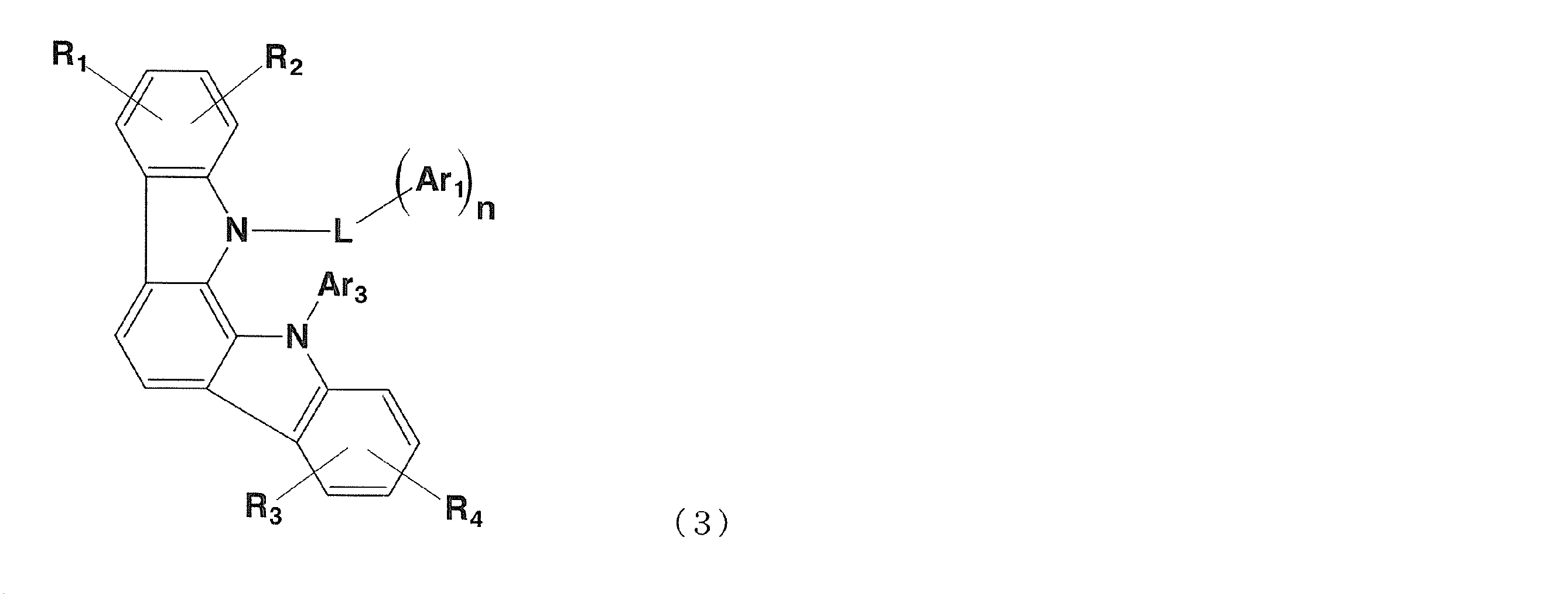
- the compound for organic electroluminescent elements represented by the general formula (1) includes a compound represented by the following general formula (2) or (3).
- ring b, L, Ar 1, R 1 ⁇ R 4, n has ring b in formula (1), L, the same meaning as Ar 1, R 1 ⁇ R 4 , n.
- L, Ar 1, Ar 3 , R 1 ⁇ R 4, n is, L in the general formula (1), has the same meaning as Ar 1, Ar 3, R 1 ⁇ R 4, n.
- the present invention also relates to an organic electroluminescence device having an organic layer containing the above compound for organic electroluminescence device.
- the organic layer is at least one layer selected from a light emitting layer, a hole transport layer, a hole injection layer, an electron transport layer, an electron injection layer and a hole blocking element layer. More advantageously, the organic layer is a light emitting layer, and the light emitting layer relates to an organic electroluminescent device containing a phosphorescent dopant and the compound for organic electroluminescent device as a host material.
- FIG. 1 is a cross-sectional view showing an example of an organic EL element.
- the compound for an organic EL device of the present invention is represented by the above general formula (1).
- the compound represented by the general formula (1) typically has an indolocarbazole skeleton in which a carbazole ring and an indole ring are condensed. N of the carbazole ring is bonded to an aromatic heterocyclic group L having a condensed ring structure.
- the ring a represents an aromatic ring or a heterocyclic ring represented by the formula (a1) or (a2) fused with two adjacent rings.
- the ring a is a heterocyclic ring represented by the formula (a2)
- the ring a ′ represents an aromatic ring or a heterocyclic ring represented by the formula (a1) that is condensed with three adjacent rings.
- X represents CR or N.
- R represents the same group as R 1 to R 7 but is preferably a hydrogen atom.
- Ring b represents a heterocycle represented by the formula (b1) fused with two adjacent rings.
- L represents an n + 1 valent aromatic heterocyclic group having a condensed ring structure.
- n is a number from 0 to 5, preferably 0 to 2.
- aromatic heterocyclic group having a condensed ring structure examples include groups formed by removing n + 1 hydrogen atoms from the aromatic heterocyclic compound shown below.
- aromatic heterocyclic compound examples include benzothiophene, benzothiazole, thianthrene, isobenzofuran, benzoxazole, chromene, xanthene, phenoxathiin, indolizine, isoindole, indole, benzimidazole, indazole, benzotriazole, Examples include purine, quinolidine, isoquinoline, quinoline, phthalazine, naphthyridine, quinoxaline, quinazoline, cinnoline, pteridine, carbazole, carboline, phenanthridine, acridine, perimidine, phenanthroline, phenazine, phenothiazine, phenoxazine, dibenzodioxin and the like.
- Ar 1 to Ar 3 each independently represents an alkyl group, an aralkyl group, a substituted or unsubstituted aromatic hydrocarbon group or an aromatic heterocyclic group.
- Ar 2 and Ar 3 are not nitrogen-containing six-membered rings when they are aromatic heterocyclic groups.
- the carbon number is preferably 1 to 6, and when Ar 1 to Ar 3 is an aralkyl group, the carbon number is It is preferably 7 to 13, and in the case of a substituted or unsubstituted aromatic hydrocarbon group or aromatic heterocyclic group, the carbon number is preferably 3 to 15.
- Preferred specific examples of the unsubstituted aromatic hydrocarbon group include a monovalent group formed by removing one hydrogen atom from benzene, naphthalene, anthracene, phenanthrene, indene, biphenyl, terphenyl, quaterphenyl, and the like. More preferably, a monovalent group formed by removing one hydrogen atom from benzene, biphenyl, terphenyl and the like can be mentioned.
- unsubstituted aromatic heterocyclic group examples include thiophene, thiazole, furan, oxazole, pyran, pyrrole, imidazole, pyrazole, isothiazole, isoxazole, furazane, triazole, pyridine, pyrazine, pyrimidine, pyridazine, triazine.
- R 1 to R 7 are independently hydrogen, alkyl group, aralkyl group, alkenyl group, alkynyl group, cyano group, dialkylamino group, diarylamino group, diaralkylamino group, amino group, nitro group, acyl group, alkoxycarbonyl A group, a carboxyl group, an alkoxyl group, an alkylsulfonyl group, a haloalkyl group, a hydroxyl group, an amide group, a substituted or unsubstituted aromatic hydrocarbon group or an aromatic heterocyclic group; When two of them are adjacent, they may combine with each other to form a condensed ring.
- it is hydrogen or an alkyl group.
- R 1 to R 7 are alkyl groups
- the carbon number is preferably 1 to 6, and when they are alkenyl groups or alkynyl groups, the carbon number is preferably 2 to 6, and the aralkyl group is In some cases, the carbon number is preferably 7 to 13, and in the case of a substituted or unsubstituted aromatic hydrocarbon group or aromatic heterocyclic group, the carbon number is preferably 3 to 15.
- the carbon number is preferably 2 to 10, and in the case of a diarylamino group or a diaralkylamino group alkyl, the carbon number is preferably 6 to 20, and an acyl group
- the carbon number is preferably 2 to 10
- the carbon number is preferably 1 to 6.
- Ar 1 to Ar 3 and R 1 to R 7 when these are an aromatic hydrocarbon group or an aromatic heterocyclic group having a substituent, preferred substituents include an alkyl group having 1 to 6 carbon atoms, carbon Alkoxy groups having 1 to 6 carbon atoms, aryloxy groups having 6 to 12 carbon atoms, alkylthio groups, substituted amino groups, acetyl groups, phenyl groups, biphenylyl groups, terphenylyl groups, naphthyl groups, pyridyl groups, pyrimidyl groups, triazyl groups, imidazolyl groups Group, thienyl group, carbazolyl group and the like.
- General formulas (2) and (3) show preferred formulas of general formula (1)
- general formula (2) is a structure in which ring a of general formula (1) is specified as a benzene ring
- General formula (3) is a structure in which the bond type of ring b is specified.
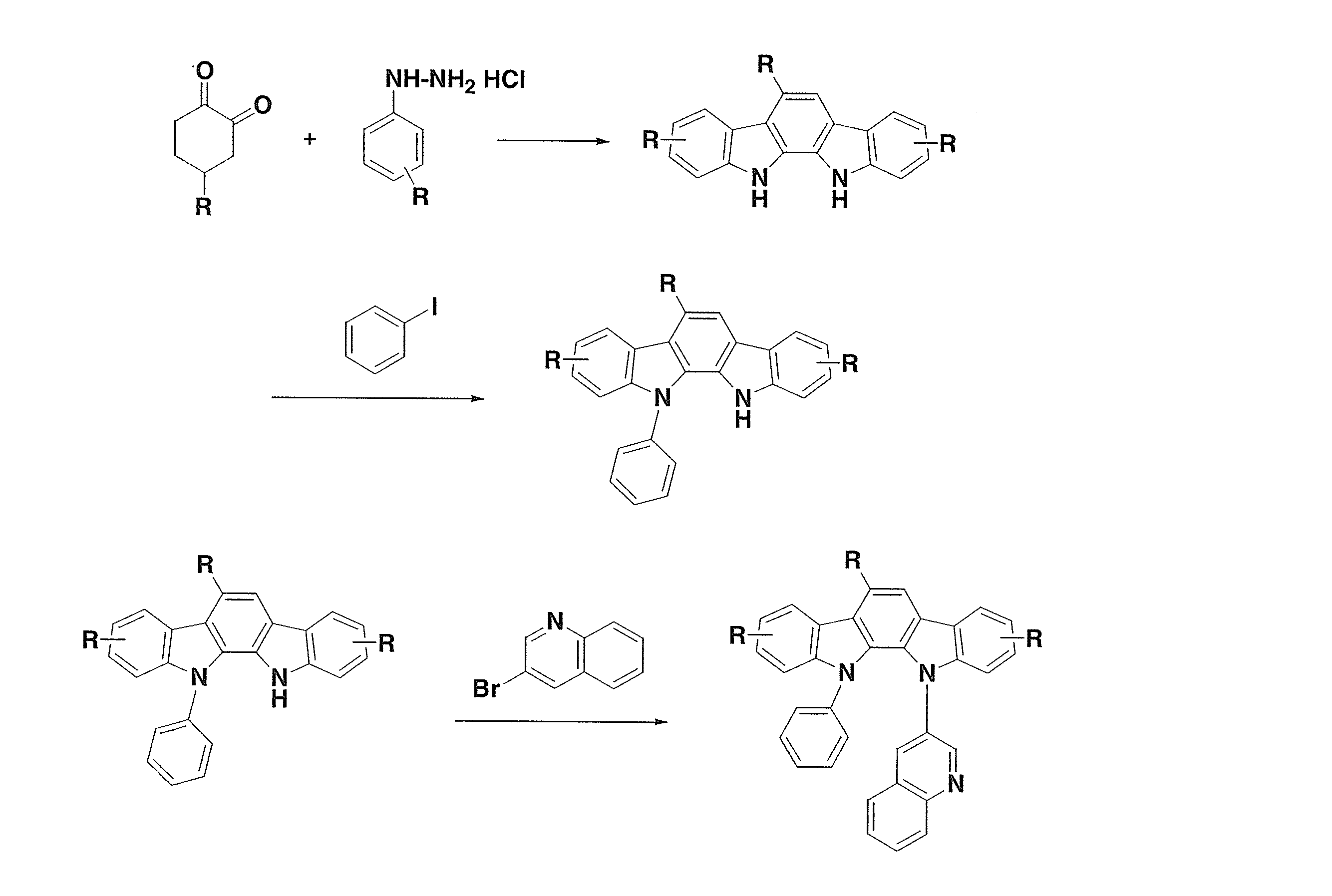
- the compound for an organic EL device of the present invention can be easily produced by a known method.
- the compound represented by the general formula (1) can be produced by the following reaction formula with reference to the synthesis example shown in Synlett, 2005, No. 1, p42-48.
- the compound for an organic electroluminescence device of the present invention gives an excellent organic electroluminescence device by being contained in the organic layer of the organic EL device.
- it may be contained in at least one organic layer selected from a light emitting layer, a hole transport layer, an electron transport layer and a hole blocking element layer. More preferably, it may be contained as a host material of a light emitting layer containing a phosphorescent dopant.
- the phosphorescent dopant material in the light emitting layer preferably contains an organometallic complex containing at least one metal selected from ruthenium, rhodium, palladium, silver, rhenium, osmium, iridium, platinum and gold.
- organometallic complexes are known in the above-mentioned patent documents and the like, and these can be selected and used.
- Preferable phosphorescent dopants include complexes such as Ir (ppy) 3 having a noble metal element such as Ir as a central metal, complexes such as Ir (bt) 2 ⁇ acac3, and complexes such as PtOEt3. Specific examples of these complexes are shown below, but are not limited to the following compounds.
- the amount of the phosphorescent dopant contained in the light emitting layer is 2 to 20% by weight, preferably 5 to 10% by weight.
- the compound for an organic EL device of the present invention is used, and the amount contained in the light emitting layer is 50% by weight or more, preferably 80 to 95% by weight.
- the structure of the organic EL element of the present invention will be described with reference to the drawings.
- the structure of the organic EL element of the present invention is not limited to the illustrated one.
- FIG. 1 is a cross-sectional view schematically showing a structural example of a general organic EL element used in the present invention, wherein 1 is a substrate, 2 is an anode, 3 is a hole injection layer, 4 is a hole transport layer, Represents a light emitting layer, 6 represents an electron transport layer, and 7 represents a cathode.
- the organic EL device of the present invention has a substrate, an anode, a light emitting layer and a cathode as essential layers, but it is preferable to have a hole injecting and transporting layer and an electron injecting and transporting layer in layers other than the essential layers, and further emit light. It is preferable to have a hole blocking layer between the layer and the electron injecting and transporting layer.
- the hole injection / transport layer means either or both of a hole injection layer and a hole transport layer, and the electron injection / transport layer means either or both of an electron injection layer and an electron transport layer.
- the substrate 1 serves as a support for the organic EL element, and quartz, a glass plate, a metal plate, a metal foil, a plastic film, a sheet, or the like is used.
- a glass plate is preferable.
- the anode 2 plays a role of hole injection into the hole injection layer 3.
- the anode 2 is usually a metal such as aluminum, gold, silver, nickel, palladium, or platinum, a metal oxide such as indium and / or tin oxide (ITO), a metal halide such as copper iodide, or carbon black.
- a metal such as aluminum, gold, silver, nickel, palladium, or platinum
- a metal oxide such as indium and / or tin oxide (ITO)
- ITO indium and / or tin oxide
- metal halide such as copper iodide
- carbon black carbon black
- the light-emitting layer 5 is injected between the electrodes to which an electric field is applied, from the anode 2 to move through the hole transport layer 4 and from the cathode 7 to move through the electron transport layer 6. It is formed of a luminescent substance that emits light when excited by recombination.
- the light emitting layer 5 preferably includes a host material made of a dopant material that is a light emitting substance and the compound for an organic EL element.
- the cathode 7 serves to inject electrons into the light emitting layer 5 through the electron transport layer 6.
- the material used as the cathode 7 is preferably a metal having a low work function in order to efficiently inject electrons, and an appropriate metal such as tin, magnesium, indium, calcium, cesium, aluminum, silver, or an alloy thereof is used. Used. Specific examples include a magnesium-silver alloy, a magnesium-indium alloy, and an aluminum-lithium alloy.
- the hole injection layer 3, the hole transport layer 4, and the electron transport layer 6 are arbitrary organic layers, but the hole injection layer 3 has an efficiency of injecting holes from the anode 2 into the hole transport layer 4.
- the hole transport layer 4 and the electron transport layer 6 serve to move holes and electrons to the light emitting layer 5, respectively.
- an electron injection layer can be provided between the cathode 7 and the electron transport layer 6. The materials used for these layers are known.
- the hole injection material examples include phthalocyanine compounds such as copper phthalocyanine (CuPC), organic compounds such as polyaniline and polythiophene, and metal oxides such as vanadium oxide, ruthenium oxide, and molybdenum oxide.
- phthalocyanine compounds such as copper phthalocyanine (CuPC)
- organic compounds such as polyaniline and polythiophene
- metal oxides such as vanadium oxide, ruthenium oxide, and molybdenum oxide.
- hole transport materials include triazole derivatives, oxadiazole derivatives, imidazole derivatives, polyarylalkane derivatives, pyrazoline derivatives and pyrazolone derivatives, phenylenediamine derivatives, arylamine derivatives such as NPB, amino-substituted chalcone derivatives, oxazole derivatives, styrylanthracene.
- Derivatives, fluorenone derivatives, hydrazone derivatives, stilbene derivatives, silazane derivatives, aniline copolymers, conductive polymer oligomers, particularly thiophene oligomers, and the like can be given.
- Electron transport materials include metal complexes such as Alq3, metal complexes of 10-hydroxybenzo [h] quinoline, oxadiazole derivatives, distyrylbiphenyl derivatives, silole derivatives, 3- or 5-hydroxyflavone metal complexes, benzoxazole metals Complex, benzothiazole metal complex, trisbenzimidazolylbenzenequinoxaline compound, phenanthroline derivative, 2-t-butyl-9,10-N, N′-dicyanoanthraquinonediimine, n-type hydrogenated amorphous silicon carbide, n-type sulfide Examples include zinc and n-type zinc selenide.
- metal complexes such as Alq3, metal complexes of 10-hydroxybenzo [h] quinoline, oxadiazole derivatives, distyrylbiphenyl derivatives, silole derivatives, 3- or 5-hydroxyflavone metal complexes, benzoxazole metals
- the organic EL element of the present invention can be applied to any of a single element, an element having a structure arranged in an array, and a structure in which an anode and a cathode are arranged in an XY matrix.
- the light emitting layer contains a compound having a specific skeleton and a phosphorescent light emitting dopant, so that the light emitting efficiency is higher than that of a conventional device using light emission from a singlet state and driving.
- a device with greatly improved stability can be obtained, and excellent performance can be exhibited in application to full-color or multi-color panels.
- the filtrate was transferred to a 2000 ml separatory funnel and separated into an organic layer and an aqueous layer.
- the organic layer was washed with 500 ml of water three times, and then the obtained organic layer was dehydrated with magnesium sulfate. After magnesium sulfate was filtered off once, the solvent was distilled off under reduced pressure. Thereafter, the residue was purified by column chromatography to obtain 13.7 g (41.2 mmol, yield 40.6%) of white solid A.
- the resulting white solid A is 11-phenylindolo [2,3-a] carbazole.
- Example 2 an organic EL element having a configuration in which an electron injection layer was added was prepared. Each thin film was laminated at a vacuum degree of 4.0 ⁇ 10 ⁇ 4 Pa by a vacuum deposition method on a glass substrate on which an anode made of ITO having a thickness of 150 nm was formed. First, copper phthalocyanine (CuPC) was formed to a thickness of 20 nm on ITO as a hole injection layer. Next, NPB was formed to a thickness of 40 nm as a hole transport layer.
- CuPC copper phthalocyanine
- compound 3 as a host material of the light emitting layer and Ir (ppy) 3 as a dopant were co-deposited from different vapor deposition sources to form a light emitting layer with a thickness of 35 nm.
- concentration of Ir (ppy) 3 was 7.0 wt%.
- Alq3 was formed to a thickness of 40 nm as an electron transport layer.
- lithium fluoride (LiF) was formed to a thickness of 0.5 nm as an electron injection layer on the electron transport layer.
- aluminum (Al) was formed as an electrode to a thickness of 170 nm, and an organic EL element was produced.
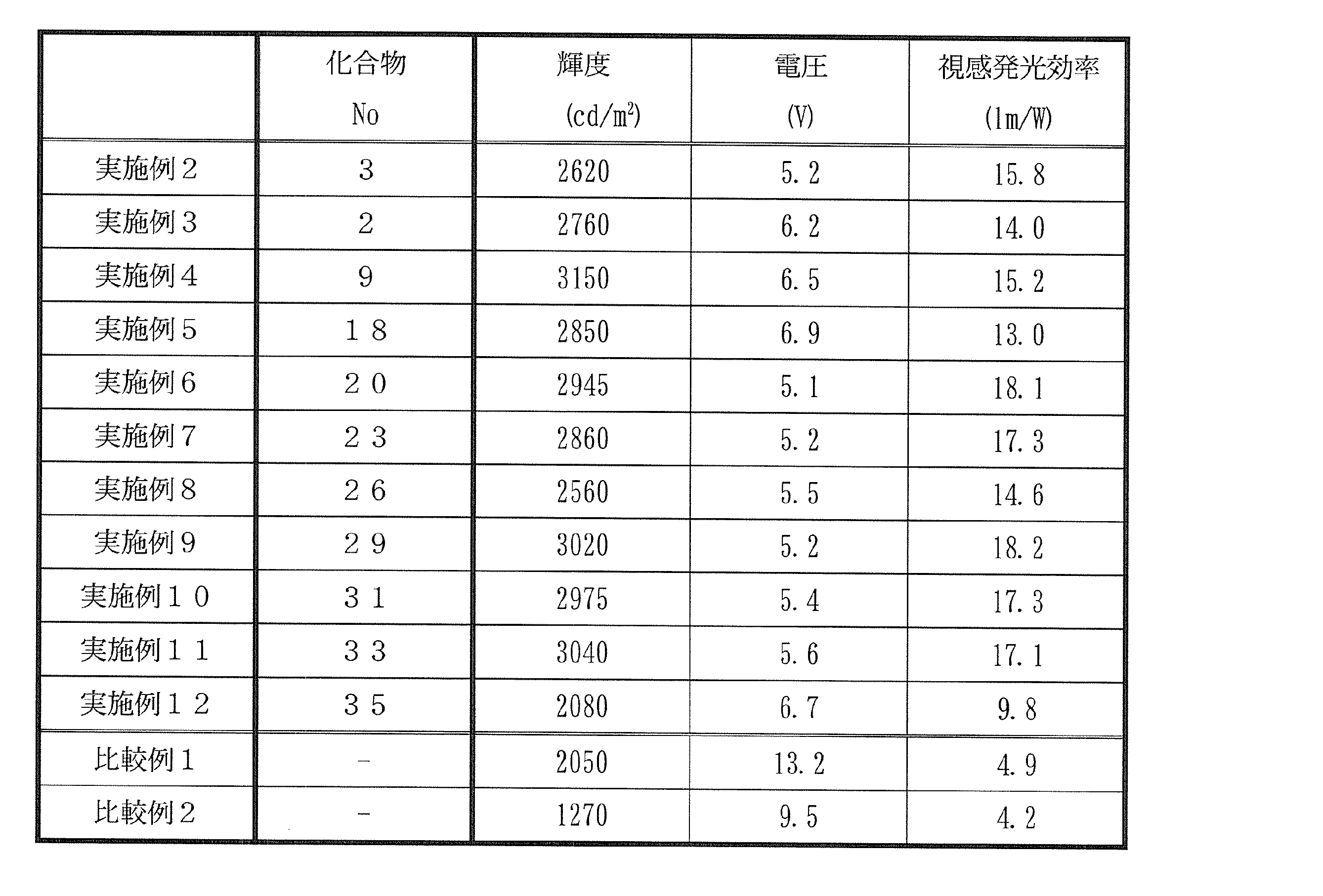
- the organic EL element had light emission characteristics as shown in Table 1.
- Table 1 the luminance, voltage, and luminous efficiency show values at 10 mA / cm 2 .
- the maximum wavelength of the device emission spectrum was 517 nm, indicating that light emission from Ir (ppy) 3 was obtained.
- Example 3 An organic EL device was produced in the same manner as in Example 2 except that Compound 2 was used as the host material for the light emitting layer.
- Example 4 An organic EL device was produced in the same manner as in Example 2 except that Compound 9 was used as the host material for the light emitting layer.
- Example 5 An organic EL device was produced in the same manner as in Example 2 except that Compound 18 was used as the host material for the light emitting layer.
- Example 6 An organic EL device was produced in the same manner as in Example 2 except that Compound 20 was used as the host material for the light emitting layer.
- Example 7 An organic EL device was produced in the same manner as in Example 2 except that Compound 23 was used as the host material for the light emitting layer.
- Example 8 An organic EL device was produced in the same manner as in Example 2 except that Compound 26 was used as the host material for the light emitting layer.
- Example 9 An organic EL device was produced in the same manner as in Example 2 except that Compound 29 was used as the host material for the light emitting layer.
- Example 10 An organic EL device was produced in the same manner as in Example 2 except that Compound 31 was used as the host material for the light emitting layer.
- Example 11 An organic EL device was produced in the same manner as in Example 2 except that Compound 33 was used as the host material for the light emitting layer.
- Example 12 An organic EL device was prepared in the same manner as in Example 2 except that Compound 35 was used as the host material for the light emitting layer.
- Comparative Example 1 An organic EL device was produced in the same manner as in Example 2 except that HMTPD was used as the hole transport layer and TAZ was used as the host material of the light emitting layer.
- Comparative Example 2 An organic EL device was produced in the same manner as in Example 2 except that TAZ was used as the host material for the light emitting layer.
- Table 1 summarizes the results of evaluating the light emission characteristics.
- the luminance, voltage, and luminous efficiency show values at 10 mA / cm 2 .
- the organic EL devices obtained in Examples 2 to 12 and Comparative Examples 1 and 2 each have a maximum wavelength of the device emission spectrum of 517 nm, and light emission from Ir (ppy) 3 is obtained. It was confirmed.
- the organic EL element of the present invention can emit light with high luminance and high efficiency at a low voltage.
- the organic EL device according to the present invention is a flat panel display (for example, for OA computers or wall-mounted televisions), an in-vehicle display device, a light source utilizing characteristics of a mobile phone display or a surface light emitter (for example, a light source of a copying machine, a liquid crystal). It can be applied to backlight sources for displays and instruments, display panels, and indicator lights, and its technical value is great.
Landscapes
- Chemical & Material Sciences (AREA)
- Organic Chemistry (AREA)
- Engineering & Computer Science (AREA)
- Materials Engineering (AREA)
- Physics & Mathematics (AREA)
- Spectroscopy & Molecular Physics (AREA)
- Chemical Kinetics & Catalysis (AREA)
- Optics & Photonics (AREA)
- Electroluminescent Light Sources (AREA)
- Nitrogen Condensed Heterocyclic Rings (AREA)
Abstract
Description
本発明は新規な有機電界発光素子用化合物及びこれを用いた有機電界発光素子(以下、有機EL素子という)に関するものである。 The present invention relates to a novel compound for organic electroluminescence device and an organic electroluminescence device using the same (hereinafter referred to as organic EL device).
一般に、有機電界発光素子は、その最も簡単な構造としては発光層及び該層を挟んだ一対の対向電極から構成されている。すなわち、有機EL素子では、両電極間に電界が印加されると、陰極から電子が注入され、陽極から正孔が注入され、これらが発光層において再結合し、光を放出する現象を利用する。 In general, an organic electroluminescent element has a light emitting layer and a pair of counter electrodes sandwiching the layer as the simplest structure. That is, in an organic EL element, when an electric field is applied between both electrodes, electrons are injected from the cathode, holes are injected from the anode, and these are recombined in the light emitting layer to emit light. .
近年、有機薄膜を用いた有機EL素子の開発が行われるようになった。特に、発光効率を高めるため、電極からキャリアー注入の効率向上を目的として電極の種類の最適化を行い、芳香族ジアミンからなる正孔輸送層と8-ヒドロキシキノリンアルミニウム錯体(以下、Alq3という)からなる発光層とを電極間に薄膜として設けた素子の開発により、従来のアントラセン等の単結晶を用いた素子と比較して大幅な発光効率の改善がなされたことから、自発光・高速応答性といった特徴を持つ高性能フラットパネルへの実用化を目指して進められてきた。 In recent years, organic EL elements using organic thin films have been developed. In particular, in order to increase luminous efficiency, the type of electrode was optimized for the purpose of improving the efficiency of carrier injection from the electrode. From the hole transport layer made of aromatic diamine and 8-hydroxyquinoline aluminum complex (hereinafter referred to as Alq3) As a result of the development of a device with a light emitting layer as a thin film between the electrodes, the luminous efficiency has been greatly improved compared to conventional devices using single crystals such as anthracene. It has been promoted with the aim of putting it into practical use for high-performance flat panels with these characteristics.
また、素子の発光効率を上げる試みとして、蛍光ではなく燐光を用いることも検討されている。上記の芳香族ジアミンからなる正孔輸送層とAlq3からなる発光層とを設けた素子をはじめとした多くの素子が蛍光発光を利用したものであったが、三重項励起状態からの燐光発光を用いることにより、従来の蛍光(一重項)を用いた素子と比べて、3~4倍程度の効率向上が期待される。この目的のためにクマリン誘導体やベンゾフェノン誘導体を発光層とすることが検討されてきたが、極めて低い輝度しか得られなかった。また、三重項状態を利用する試みとして、ユーロピウム錯体を用いることが検討されてきたが、これも高効率の発光には至らなかった。近年では、特許文献1に挙げられるように発光の高効率化や長寿命化を目的にイリジウム錯体等の有機金属錯体を中心に研究が多数行われている。 In addition, as an attempt to increase the luminous efficiency of the device, it has been studied to use phosphorescence instead of fluorescence. Many devices, including those with the hole transport layer composed of the above aromatic diamine and the light emitting layer composed of Alq3, used fluorescent light emission, but did not emit phosphorescence from the triplet excited state. By using it, the efficiency is expected to be improved by about 3 to 4 times compared to a conventional device using fluorescence (singlet). For this purpose, it has been studied to use a coumarin derivative or a benzophenone derivative as a light emitting layer, but only an extremely low luminance was obtained. Further, as an attempt to use the triplet state, use of a europium complex has been studied, but this has not led to highly efficient light emission. In recent years, as described in Patent Document 1, many studies have been conducted focusing on organometallic complexes such as iridium complexes for the purpose of increasing the efficiency of light emission and extending the lifetime.
高い発光効率を得るには、ドーパント材料と同時に、使用するホスト材料が重要になる。ホスト材料として提案されている代表的なものとして、特許文献2で紹介されているカルバゾール化合物の4,4'-ビス(9-カルバゾリル)ビフェニル(以下、CBPという)が挙げられる。緑色燐光発光材料のトリス(2-フェニルピリジン)イリジウム錯体(以下、Ir(ppy)3という)のホスト材料にCBPを用いると、CBPは正孔輸送能に対して電子輸送能が劣るために、発光層中の電荷のバランスが崩れ、過剰の正孔は陰極側に流出し、発光層中の再結合確率の低下による発光効率低下を招く。更に、この場合、発光層の再結合領域は陰極側の界面近傍の狭い領域に限られるために、Ir(ppy)3に対して最低励起三重項状態のエネルギーレベルが低いAlq3のような電子輸送材料を用いた場合、ドーパントから電子輸送材料への三重項励起エネルギーの移動による発光効率低下も起こり得る。
In order to obtain high luminous efficiency, the host material to be used is important as well as the dopant material. A representative example of a host material proposed is 4,4′-bis (9-carbazolyl) biphenyl (hereinafter referred to as CBP), which is a carbazole compound introduced in
一方、特許文献3で開示されている3-フェニル-4-(1'-ナフチル)-5-フェニル-1,2,4-トリアゾール(以下、TAZという)も燐光有機EL素子のホスト材として提案されているが、TAZは電子輸送能に対して正孔輸送能が劣るために、発光領域が正孔輸送層側となる。この場合、使用する正孔輸送材料がIr(ppy)3からの発光効率に影響する。例えば、正孔輸送層として高性能、高信頼性、長寿命の点から最も良く使用されている4,4'-ビス(N-(1-ナフチル) -N-フェニルアミノ)ビフェニル(以下、NPBという)を用いた場合、最低励起三重項状態のエネルギーレベルの関係より、Ir(ppy)3からNPBに三重項励起エネルギーが移動し、発光効率が低下するという問題がある。 On the other hand, 3-phenyl-4- (1'-naphthyl) -5-phenyl-1,2,4-triazole (hereinafter referred to as TAZ) disclosed in Patent Document 3 is also proposed as a host material for phosphorescent organic EL devices. However, since TAZ is inferior in electron transport ability to hole transport ability, the light emitting region is on the hole transport layer side. In this case, the hole transport material used affects the light emission efficiency from Ir (ppy) 3. For example, 4,4'-bis (N- (1-naphthyl) -N-phenylamino) biphenyl (hereinafter referred to as NPB), which is most commonly used as a hole transport layer in terms of high performance, high reliability, and long life Is used, the triplet excitation energy is transferred from Ir (ppy) 3 to NPB due to the relationship between the energy levels of the lowest excited triplet state, and the light emission efficiency is lowered.
更に、CBPやTAZなどの化合物は容易に結晶化・凝集して薄膜形状が劣化する上、Tgは結晶性の高さから観測さえ困難である。こうした発光層内の薄膜形状が安定でないことは、素子の駆動寿命を短くし、耐熱性も低下させるという悪影響をもたらす。 Furthermore, compounds such as CBP and TAZ easily crystallize and aggregate to deteriorate the shape of the thin film, and Tg is difficult to observe due to its high crystallinity. Such a thin film shape in the light-emitting layer has an adverse effect that the drive life of the device is shortened and the heat resistance is also lowered.
前述の例より、有機EL素子で高い発光効率を得るには、高い正孔輸送能と高い電子輸送能を同時に併せ持ち、かつ両電荷(正孔・電子)輸送能のバランスが良いホスト材料が求められることがわかる。更に、電気化学的に安定であり、高い耐熱性と共に優れたアモルファス安定性を備える化合物が望まれる。 From the above example, in order to obtain high luminous efficiency in an organic EL element, a host material having both a high hole transport ability and a high electron transport ability at the same time and a good balance of both charge (hole / electron) transport ability is required. I understand that Furthermore, a compound that is electrochemically stable and has excellent amorphous stability as well as high heat resistance is desired.
また、特許文献4、5及び6等においてある種のインドロカルバゾール化合物を有機EL素子に使用することが開示されているが、より優れた性能を有する有機EL素子用化合物が望まれている。
In addition,
有機EL素子をフラットパネル・ディスプレイ等の表示素子に応用するためには、素子の発光効率を改善すると同時に駆動時の安定性を十分に確保する必要がある。本発明は、上記現状に鑑み、高効率かつ高い駆動安定性を有した実用上有用な有機EL素子及びそれに適する化合物を提供することを目的とする。 In order to apply an organic EL element to a display element such as a flat panel display, it is necessary to improve the light emission efficiency of the element and at the same time to ensure sufficient stability during driving. An object of this invention is to provide the practically useful organic EL element which has high efficiency and high drive stability in view of the said present condition, and a compound suitable for it.
本発明者らは、鋭意検討した結果、特定構造の化合物を有機EL素子に使用することで、上記課題を解決することができることを見出し、本発明を完成するに至った。 As a result of intensive studies, the present inventors have found that the above problem can be solved by using a compound having a specific structure in an organic EL device, and have completed the present invention.
すなわち、本発明は、特定のインドロカルバゾール骨格の化合物を使用した有機EL素子及びそれに適する有機EL素子用化合物に関するものである。 That is, the present invention relates to an organic EL device using a specific indolocarbazole skeleton compound and a compound for an organic EL device suitable for the organic EL device.
本発明の有機電界発光素子用化合物は、下記一般式(1)で表される。
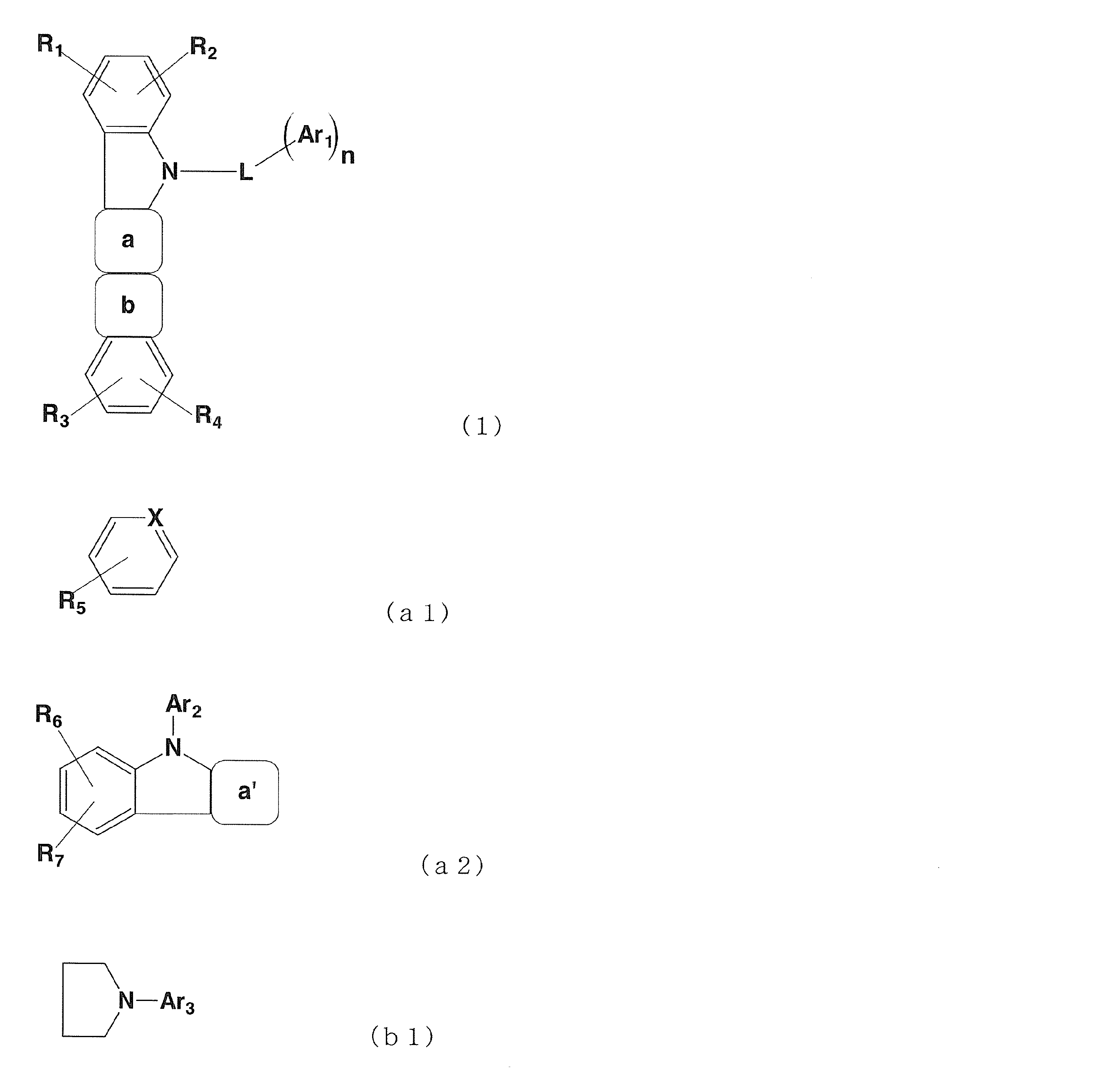
ここで、環aは、2つの隣接環と縮合する式(a1)又は(a2)で表される芳香環又は複素環を示し、環a'は、3つの隣接環と縮合する式(a1)で表される芳香環又は複素環を示す。環bは、2つの隣接環と縮合する式(b1)で表される複素環を示す。Xは、CR又はNを示す。Lは縮環構造を有するn+1価の芳香族複素環基を示す。Ar1~Ar3は独立に、アルキル基、アラルキル基、置換若しくは未置換の芳香族炭化水素基又は芳香族複素環基を示すが、Ar2、Ar3は含窒素六員環であることはない。R及びR1~R7は独立に、水素、アルキル基、アラルキル基、アルケニル基、アルキニル基、シアノ基、ジアルキルアミノ基、ジアリールアミノ基、ジアラルキルアミノ基、アミノ基、ニトロ基、アシル基、アルコキシカルボニル基、カルボキシル基、アルコキシル基、アルキルスルホニル基、ハロアルキル基、水酸基、アミド基、置換若しくは未置換の芳香族炭化水素基又は芳香族複素環基を示し、そのうちの二つが隣接する場合、互いに結合して環を形成してもよい。nは0~5の整数を表す。 Here, the ring a represents an aromatic ring or a heterocyclic ring represented by the formula (a1) or (a2) fused with two adjacent rings, and the ring a ′ is a formula (a1) fused with three adjacent rings. An aromatic ring or a heterocyclic ring represented by Ring b represents a heterocycle represented by the formula (b1) fused with two adjacent rings. X represents CR or N. L represents an n + 1 valent aromatic heterocyclic group having a condensed ring structure. Ar 1 to Ar 3 independently represent an alkyl group, an aralkyl group, a substituted or unsubstituted aromatic hydrocarbon group or an aromatic heterocyclic group, but Ar 2 and Ar 3 are a nitrogen-containing six-membered ring. Absent. R and R 1 to R 7 are independently hydrogen, alkyl group, aralkyl group, alkenyl group, alkynyl group, cyano group, dialkylamino group, diarylamino group, diaralkylamino group, amino group, nitro group, acyl group, An alkoxycarbonyl group, a carboxyl group, an alkoxyl group, an alkylsulfonyl group, a haloalkyl group, a hydroxyl group, an amide group, a substituted or unsubstituted aromatic hydrocarbon group or an aromatic heterocyclic group, and when two of them are adjacent, They may combine to form a ring. n represents an integer of 0 to 5.
一般式(1)で表される有機電界発光素子用化合物には、下記一般式(2)又は(3)で表される化合物がある。 The compound for organic electroluminescent elements represented by the general formula (1) includes a compound represented by the following general formula (2) or (3).
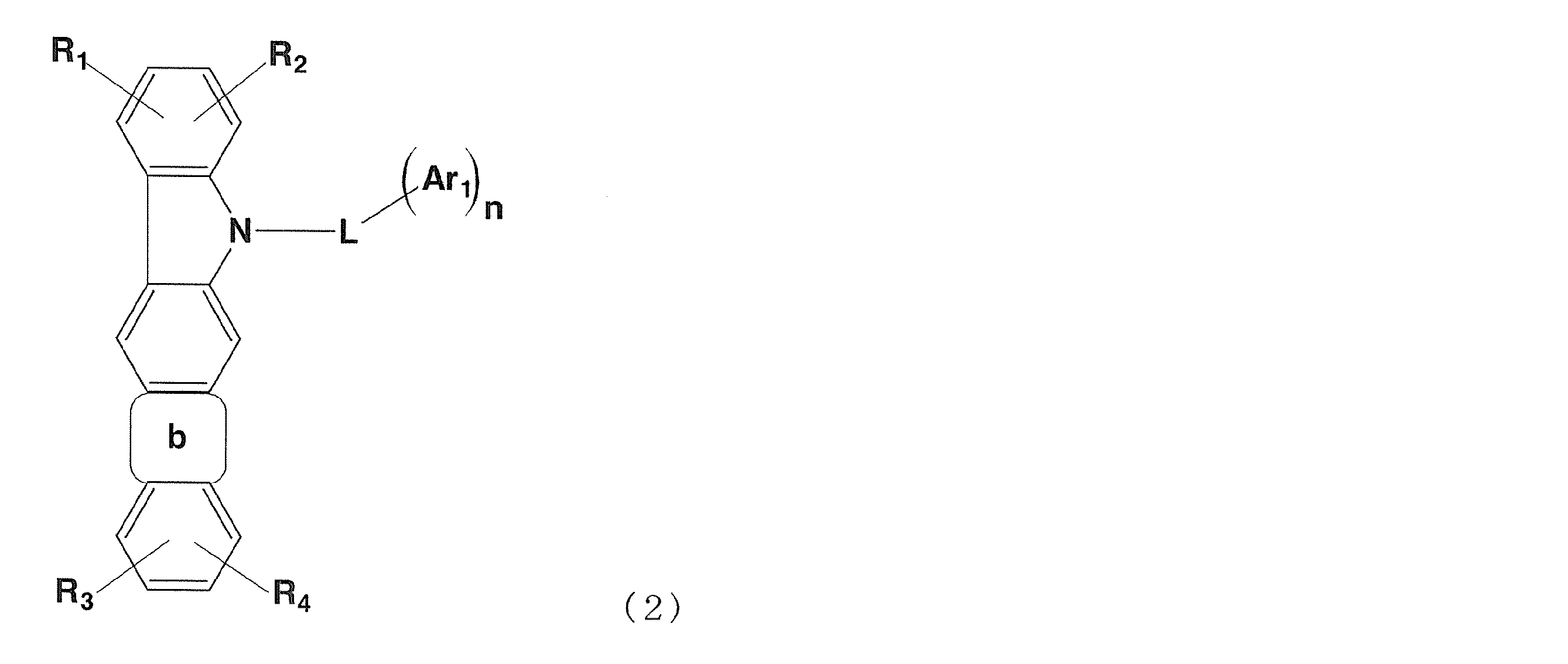
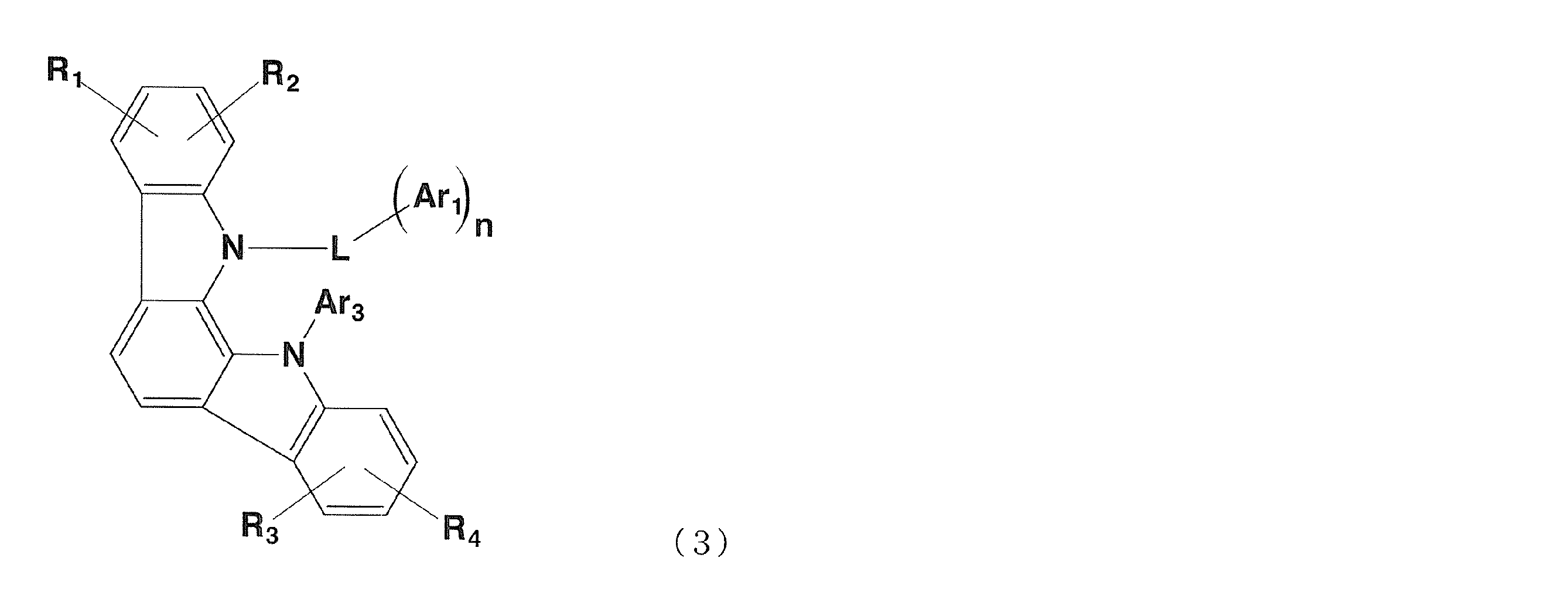
また本発明は、上記の有機電界発光素子用化合物を含む有機層を有する有機電界発光素子に関する。有利には、該有機層が、発光層、正孔輸送層、正孔注入層、電子輸送層、電子注入層及び正孔阻止素子層から選ばれる少なくとも一つの層である。更に有利には、該有機層が発光層であり、該発光層が燐光発光性ドーパントと上記の有機電界発光素子用化合物をホスト材料として含有する有機電界発光素子関する。 The present invention also relates to an organic electroluminescence device having an organic layer containing the above compound for organic electroluminescence device. Advantageously, the organic layer is at least one layer selected from a light emitting layer, a hole transport layer, a hole injection layer, an electron transport layer, an electron injection layer and a hole blocking element layer. More advantageously, the organic layer is a light emitting layer, and the light emitting layer relates to an organic electroluminescent device containing a phosphorescent dopant and the compound for organic electroluminescent device as a host material.
本発明の有機EL素子用化合物は、上記一般式(1)で表される。一般式(1)で表される化合物は、典型的には、カルバゾール環とインドール環が縮合したインドロカルバゾール骨格を有する。カルバゾール環のNは、縮環構造を有する芳香族複素環基Lと結合する。 The compound for an organic EL device of the present invention is represented by the above general formula (1). The compound represented by the general formula (1) typically has an indolocarbazole skeleton in which a carbazole ring and an indole ring are condensed. N of the carbazole ring is bonded to an aromatic heterocyclic group L having a condensed ring structure.
一般式(1)において、環aは2つの隣接環と縮合する式(a1)又は(a2)で表される芳香環又は複素環を示す。環aが式(a2)で表される複素環である場合は、環a'は3つの隣接環と縮合する式(a1)で表される芳香環又は複素環を示す。式(a1)において、XはCR又はNを示す。ここでRは、R1~R7と同様な基を示すが、好ましくは水素原子である。環bは、2つの隣接環と縮合する式(b1)で表される複素環を示す。 In the general formula (1), the ring a represents an aromatic ring or a heterocyclic ring represented by the formula (a1) or (a2) fused with two adjacent rings. When the ring a is a heterocyclic ring represented by the formula (a2), the ring a ′ represents an aromatic ring or a heterocyclic ring represented by the formula (a1) that is condensed with three adjacent rings. In the formula (a1), X represents CR or N. Here, R represents the same group as R 1 to R 7 but is preferably a hydrogen atom. Ring b represents a heterocycle represented by the formula (b1) fused with two adjacent rings.
一般式(1)において、Lは縮環構造を有するn+1価の芳香族複素環基を示す。ここで、nは0~5、好ましくは0~2の数である。 In the general formula (1), L represents an n + 1 valent aromatic heterocyclic group having a condensed ring structure. Here, n is a number from 0 to 5, preferably 0 to 2.
縮環構造を有する芳香族複素環基の好ましい具体例としては、下記に示す芳香族複素環化合物から水素原子をn+1個除いてできる基が挙げられる。 Preferable specific examples of the aromatic heterocyclic group having a condensed ring structure include groups formed by removing n + 1 hydrogen atoms from the aromatic heterocyclic compound shown below.
上記芳香族複素環化合物の具体例としては、ベンゾチオフェン、ベンゾチアゾール、チアントレン、イソベンゾフラン、ベンゾオキサゾール、クロメン、キサンテン、フェノキサチイン、インドリジン、イソインドール、インドール、ベンゾイミダゾール、インダゾール、ベンゾトリアゾール、プリン、キノリジン、イソキノリン、キノリン、フタラジン、ナフチリジン、キノキサリン、キナゾリン、シンノリン、プテリジン、カルバゾール、カルボリン、フェナントリジン、アクリジン、ペリミジン、フェナントロリン、フェナジン、フェノチアジン、フェノキサジン、ジベンゾジオキシン等が挙げられる。 Specific examples of the aromatic heterocyclic compound include benzothiophene, benzothiazole, thianthrene, isobenzofuran, benzoxazole, chromene, xanthene, phenoxathiin, indolizine, isoindole, indole, benzimidazole, indazole, benzotriazole, Examples include purine, quinolidine, isoquinoline, quinoline, phthalazine, naphthyridine, quinoxaline, quinazoline, cinnoline, pteridine, carbazole, carboline, phenanthridine, acridine, perimidine, phenanthroline, phenazine, phenothiazine, phenoxazine, dibenzodioxin and the like.
一般式(1)、(2)及び(3)において、Ar1~Ar3は独立に、アルキル基、アラルキル基、置換若しくは未置換の芳香族炭化水素基又は芳香族複素環基を示す。但し、Ar2、Ar3については、芳香族複素環基である場合、含窒素六員環であることはない。 In the general formulas (1), (2) and (3), Ar 1 to Ar 3 each independently represents an alkyl group, an aralkyl group, a substituted or unsubstituted aromatic hydrocarbon group or an aromatic heterocyclic group. However, Ar 2 and Ar 3 are not nitrogen-containing six-membered rings when they are aromatic heterocyclic groups.
一般式(1)、(2)及び(3)において、Ar1~Ar3がアルキル基である場合、その炭素数は1~6であることが好ましく、アラルキル基である場合、その炭素数は7~13であることが好ましく、置換若しくは未置換の芳香族炭化水素基又は芳香族複素環基である場合、その炭素数は3~15であることが好ましい。 In the general formulas (1), (2) and (3), when Ar 1 to Ar 3 are alkyl groups, the carbon number is preferably 1 to 6, and when Ar 1 to Ar 3 is an aralkyl group, the carbon number is It is preferably 7 to 13, and in the case of a substituted or unsubstituted aromatic hydrocarbon group or aromatic heterocyclic group, the carbon number is preferably 3 to 15.
未置換の芳香族炭化水素基の好ましい具体例としては、ベンゼン、ナフタレン、アントラセン、フェナントレン、インデン、ビフェニル、ターフェニル、クオターフェニルから水素原子を1個除いてできる1価基等が挙げられ、より好ましくは、ベンゼン、ビフェニル、ターフェニルから水素原子を1個除いてできる1価基等が挙げられる。 Preferred specific examples of the unsubstituted aromatic hydrocarbon group include a monovalent group formed by removing one hydrogen atom from benzene, naphthalene, anthracene, phenanthrene, indene, biphenyl, terphenyl, quaterphenyl, and the like. More preferably, a monovalent group formed by removing one hydrogen atom from benzene, biphenyl, terphenyl and the like can be mentioned.
未置換の芳香族複素環基の好ましい具体例としては、チオフェン、チアゾール、フラン、オキサゾール、ピラン、ピロール、イミダゾール、ピラゾール、イソチアゾール、イソオキサゾール、フラザン、トリアゾール、ピリジン、ピラジン、ピリミジン、ピリダジン、トリアジン、ベンゾチオフェン、ベンゾチアゾール、チアントレン、イソベンゾフラン、ベンゾオキサゾール、クロメン、キサンテン、フェノキサチイン、インドリジン、イソインドール、インドール、ベンゾイミダゾール、インダゾール、ベンゾトリアゾール、プリン、キノリジン、イソキノリン、キノリン、フタラジン、ナフチリジン、キノキサリン、キナゾリン、シンノリン、プテリジン、カルバゾール、カルボリン、フェナントリジン、アクリジン、ペリミジン、フェナントロリン、フェナジン、フェノチアジン、フェノキサジン、ジベンゾジオキシンから水素原子を1個除いてできる1価基等が挙げられ、より好ましくは、ピリジン、ピラジン、ピリミジン、ピリダジン、トリアジンから水素原子を1個除いてできる1価基等が挙げられる。 Preferable specific examples of the unsubstituted aromatic heterocyclic group include thiophene, thiazole, furan, oxazole, pyran, pyrrole, imidazole, pyrazole, isothiazole, isoxazole, furazane, triazole, pyridine, pyrazine, pyrimidine, pyridazine, triazine. , Benzothiophene, benzothiazole, thianthrene, isobenzofuran, benzoxazole, chromene, xanthene, phenoxathiin, indolizine, isoindole, indole, benzimidazole, indazole, benzotriazole, purine, quinolidine, isoquinoline, quinoline, phthalazine, naphthyridine Quinoxaline, quinazoline, cinnoline, pteridine, carbazole, carboline, phenanthridine, acridine, perimidine, Examples include monovalent groups formed by removing one hydrogen atom from enanthroline, phenazine, phenothiazine, phenoxazine, and dibenzodioxin, and more preferably, one hydrogen atom can be removed from pyridine, pyrazine, pyrimidine, pyridazine, and triazine. A monovalent group etc. are mentioned.
R1~R7は独立に、水素、アルキル基、アラルキル基、アルケニル基、アルキニル基、シアノ基、ジアルキルアミノ基、ジアリールアミノ基、ジアラルキルアミノ基、アミノ基、ニトロ基、アシル基、アルコキシカルボニル基、カルボキシル基、アルコキシル基、アルキルスルホニル基、ハロアルキル基、水酸基、アミド基、置換若しくは未置換の芳香族炭化水素基又は芳香族複素環基を示す。そのうちの二つが隣接する場合、互いに結合して縮環を形成してもよい。好ましくは、水素又はアルキル基である。 R 1 to R 7 are independently hydrogen, alkyl group, aralkyl group, alkenyl group, alkynyl group, cyano group, dialkylamino group, diarylamino group, diaralkylamino group, amino group, nitro group, acyl group, alkoxycarbonyl A group, a carboxyl group, an alkoxyl group, an alkylsulfonyl group, a haloalkyl group, a hydroxyl group, an amide group, a substituted or unsubstituted aromatic hydrocarbon group or an aromatic heterocyclic group; When two of them are adjacent, they may combine with each other to form a condensed ring. Preferably, it is hydrogen or an alkyl group.
R1~R7がアルキル基である場合、その炭素数は1~6であることが好ましく、アルケニル基、アルキニル基である場合、その炭素数は2~6であることが好ましく、アラルキル基である場合、その炭素数は7~13であることが好ましく、置換若しくは未置換の芳香族炭化水素基又は芳香族複素環基である場合、その炭素数は3~15であることが好ましい。また、ジアルキルアミノ基である場合、その炭素数は2~10であることが好ましく、ジアリールアミノ基、ジアラルキルアミノ基アルキルである場合、その炭素数は6~20であることが好ましく、アシル基、アルコキシカルボニル基である場合、その炭素数は2~10であることが好ましく、アルコキシル基、アルキルスルホニル基、ハロアルキル基である場合、その炭素数は1~6であることが好ましい。
R1~R7のうち二つが隣接する場合、互いに結合して縮環を形成してもよい。例えば、二つのビニル基が隣接する場合、互いに結合し、ビニル基がそれぞれ結合しているインドロカルバゾール骨格中の二つの炭素と共に六員環を形成し、含窒素縮合六環となる。また、二つの隣接する置換基が二組ある場合、含窒素縮合七環を形成することもできる。
When R 1 to R 7 are alkyl groups, the carbon number is preferably 1 to 6, and when they are alkenyl groups or alkynyl groups, the carbon number is preferably 2 to 6, and the aralkyl group is In some cases, the carbon number is preferably 7 to 13, and in the case of a substituted or unsubstituted aromatic hydrocarbon group or aromatic heterocyclic group, the carbon number is preferably 3 to 15. In the case of a dialkylamino group, the carbon number is preferably 2 to 10, and in the case of a diarylamino group or a diaralkylamino group alkyl, the carbon number is preferably 6 to 20, and an acyl group In the case of an alkoxycarbonyl group, the carbon number is preferably 2 to 10, and in the case of an alkoxyl group, an alkylsulfonyl group or a haloalkyl group, the carbon number is preferably 1 to 6.
When two of R 1 to R 7 are adjacent to each other, they may combine with each other to form a condensed ring. For example, when two vinyl groups are adjacent to each other, they are bonded to each other to form a six-membered ring together with two carbons in the indolocarbazole skeleton to which the vinyl groups are bonded, thereby forming a nitrogen-containing condensed hexacycle. In addition, when there are two pairs of two adjacent substituents, a nitrogen-containing fused heptacycle can be formed.
上記Ar1~Ar3及びR1~R7において、これらが置換基を有する芳香族炭化水素基又は芳香族複素環基である場合、好ましい置換基としては炭素数1~6のアルキル基、炭素数1~6のアルコキシ基、炭素数6~12のアリールオキシ基、アルキルチオ基、置換アミノ基、アセチル基、フェニル基、ビフェニリル基、ターフェニリル基、ナフチル基、ピリジル基、ピリミジル基、トリアジル基、イミダゾリル基、チエニル基、カルバゾリル基等が挙げられる。 In the above Ar 1 to Ar 3 and R 1 to R 7 , when these are an aromatic hydrocarbon group or an aromatic heterocyclic group having a substituent, preferred substituents include an alkyl group having 1 to 6 carbon atoms, carbon Alkoxy groups having 1 to 6 carbon atoms, aryloxy groups having 6 to 12 carbon atoms, alkylthio groups, substituted amino groups, acetyl groups, phenyl groups, biphenylyl groups, terphenylyl groups, naphthyl groups, pyridyl groups, pyrimidyl groups, triazyl groups, imidazolyl groups Group, thienyl group, carbazolyl group and the like.
一般式(2)及び(3)は、一般式(1)の好ましい式を示すものであり、一般式(2)は一般式(1)の環aがベンゼン環に特定された構造であり、一般式(3)は環bの結合形式が特定された構造である。 General formulas (2) and (3) show preferred formulas of general formula (1), general formula (2) is a structure in which ring a of general formula (1) is specified as a benzene ring, General formula (3) is a structure in which the bond type of ring b is specified.
本発明の有機EL素子用化合物は公知の方法で容易に製造することができる。例えば、一般式(1)で表される化合物は、Synlett,2005,No.1,p42-48に示される合成例を参考にして以下の反応式により製造することができる。 The compound for an organic EL device of the present invention can be easily produced by a known method. For example, the compound represented by the general formula (1) can be produced by the following reaction formula with reference to the synthesis example shown in Synlett, 2005, No. 1, p42-48.
一般式(1)又は一般式(2)、(3)で表される化合物の好ましい具体例を以下に示すが、これらに限定するものではない。 Although the preferable specific example of a compound represented by General formula (1) or General formula (2), (3) is shown below, it is not limited to these.

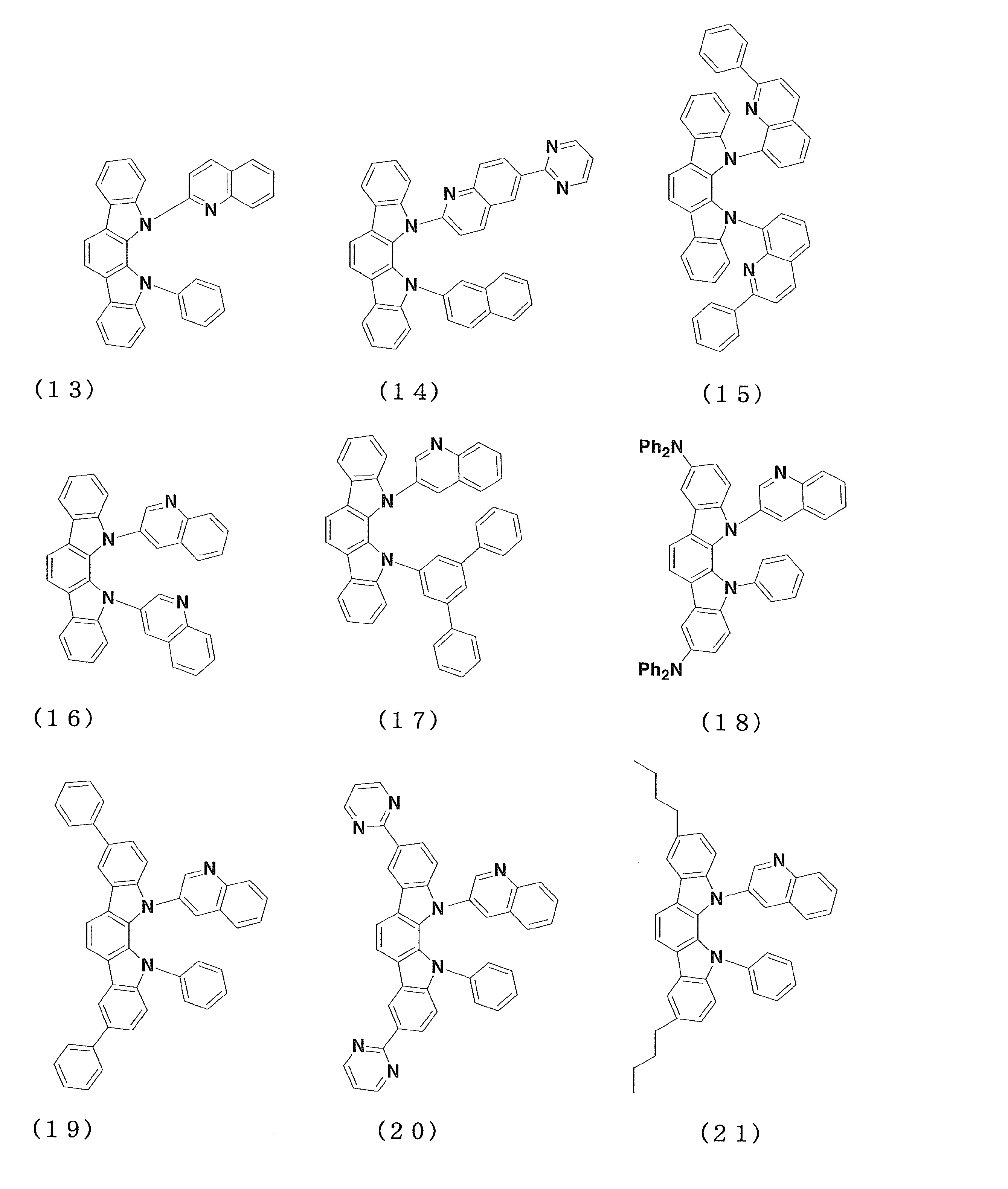
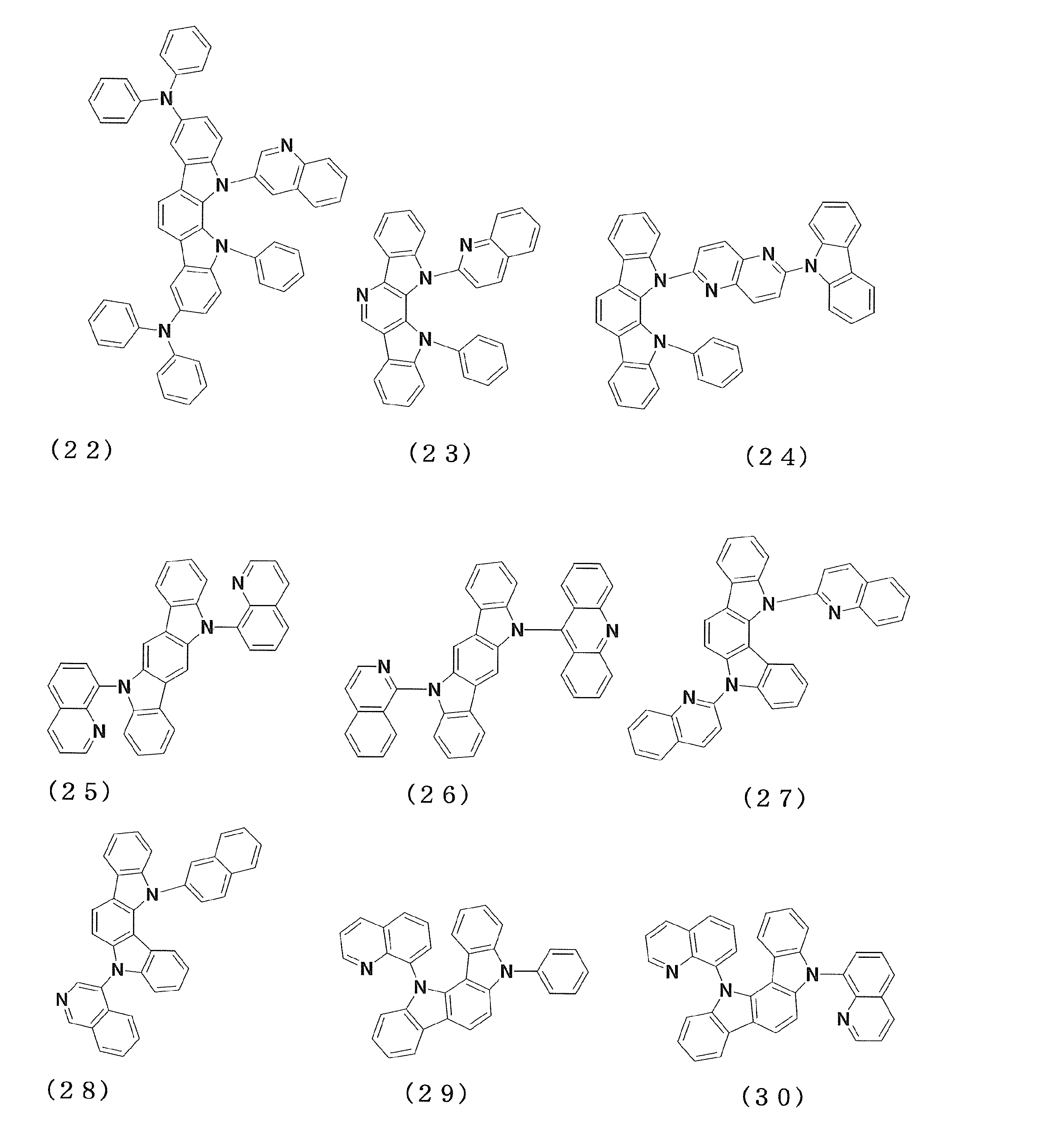
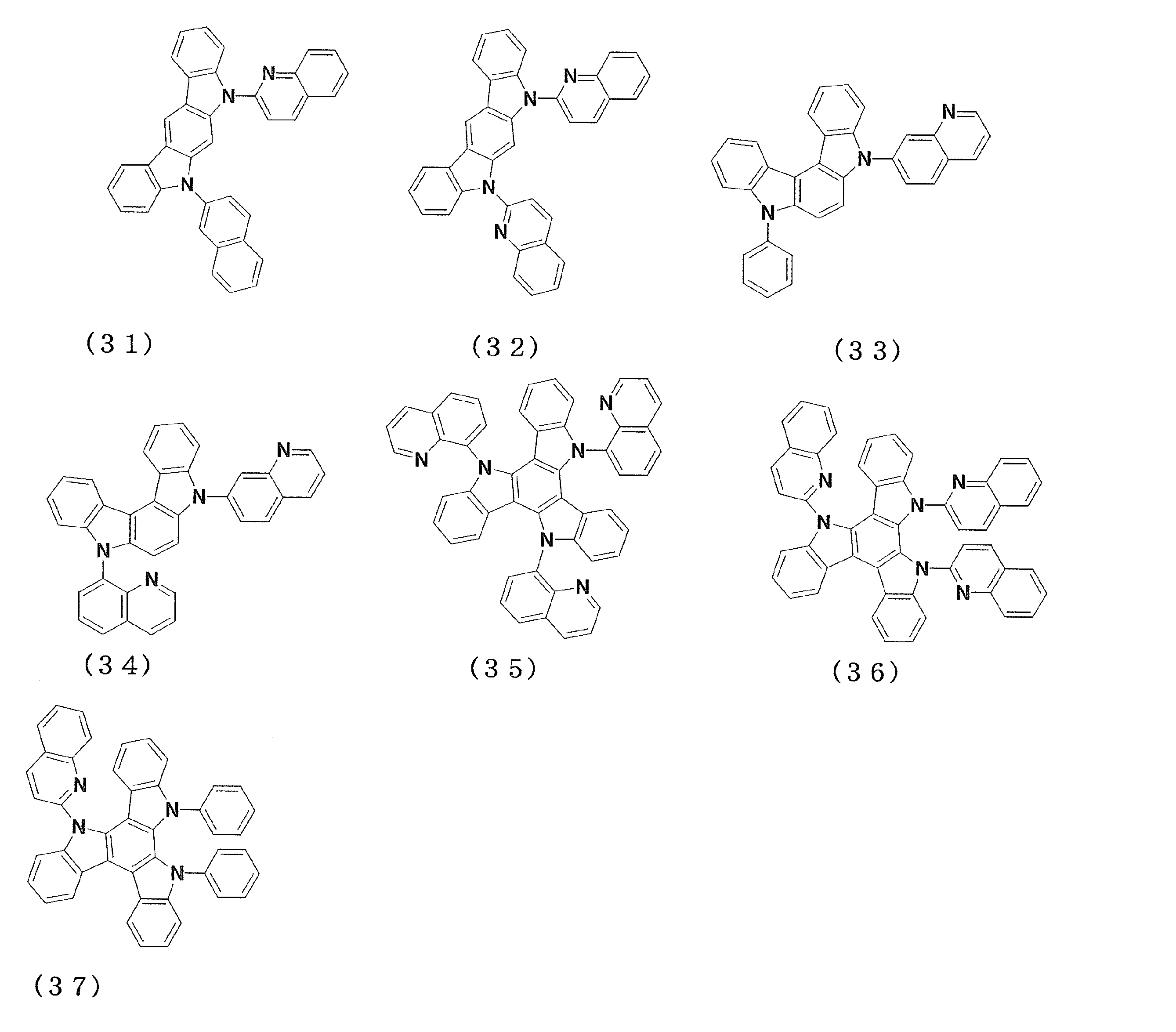
本発明の有機電界発光素子用化合物は、有機EL素子の有機層に含有させることにより、優れた有機電界発光素子を与える。有利には、発光層、正孔輸送層、電子輸送層及び正孔阻止素子層から選ばれる少なくとも一つの有機層に含有させることがよい。更に好ましくは、燐光発光ドーパントを含有する発光層のホスト材料として含有させることがよい。 The compound for an organic electroluminescence device of the present invention gives an excellent organic electroluminescence device by being contained in the organic layer of the organic EL device. Advantageously, it may be contained in at least one organic layer selected from a light emitting layer, a hole transport layer, an electron transport layer and a hole blocking element layer. More preferably, it may be contained as a host material of a light emitting layer containing a phosphorescent dopant.
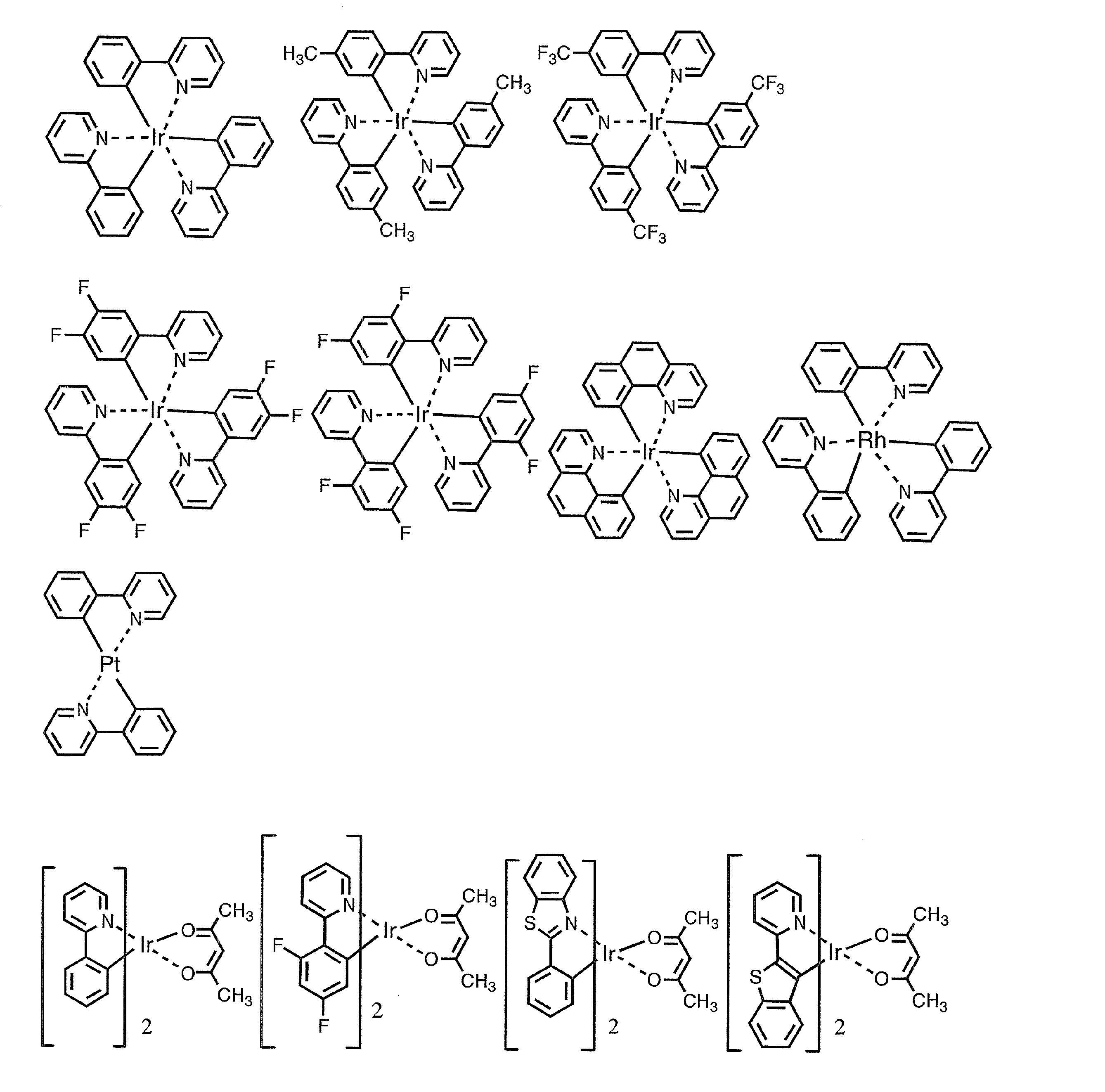
発光層における燐光発光ドーパント材料としては、ルテニウム、ロジウム、パラジウム、銀、レニウム、オスミウム、イリジウム、白金及び金から選ばれる少なくとも一つの金属を含む有機金属錯体を含有するものがよい。かかる有機金属錯体は、前記特許文献等で公知であり、これらが選択されて使用可能である。 The phosphorescent dopant material in the light emitting layer preferably contains an organometallic complex containing at least one metal selected from ruthenium, rhodium, palladium, silver, rhenium, osmium, iridium, platinum and gold. Such organometallic complexes are known in the above-mentioned patent documents and the like, and these can be selected and used.
好ましい燐光発光ドーパントとしては、Ir等の貴金属元素を中心金属として有するIr(ppy)3等の錯体類、Ir(bt)2・acac3等の錯体類、PtOEt3等の錯体類が挙げられる。これらの錯体類の具体例を以下に示すが、下記の化合物に限定されない。 Preferable phosphorescent dopants include complexes such as Ir (ppy) 3 having a noble metal element such as Ir as a central metal, complexes such as Ir (bt) 2 · acac3, and complexes such as PtOEt3. Specific examples of these complexes are shown below, but are not limited to the following compounds.

前記燐光発光ドーパントが発光層中に含有される量は、2~20重量%、好ましくは5~10重量%の範囲にあることがよい。この場合、ホスト材料としては、本発明の有機EL素子用化合物を使用し、発光層中に含有される量を50重量%以上、好ましくは80~95重量%の範囲とすることがよい。 The amount of the phosphorescent dopant contained in the light emitting layer is 2 to 20% by weight, preferably 5 to 10% by weight. In this case, as the host material, the compound for an organic EL device of the present invention is used, and the amount contained in the light emitting layer is 50% by weight or more, preferably 80 to 95% by weight.
次に、本発明の有機EL素子の構造について、図面を参照しながら説明するが、本発明の有機EL素子の構造は何ら図示のものに限定されるものではない。 Next, the structure of the organic EL element of the present invention will be described with reference to the drawings. However, the structure of the organic EL element of the present invention is not limited to the illustrated one.
図1は本発明に用いられる一般的な有機EL素子の構造例を模式的に示す断面図であり、1は基板、2は陽極、3は正孔注入層、4は正孔輸送層、5は発光層、6は電子輸送層、7は陰極を各々表わす。本発明の有機EL素子では、基板、陽極、発光層及び陰極を必須の層として有するが、必須の層以外の層に、正孔注入輸送層、電子注入輸送層を有することがよく、更に発光層と電子注入輸送層の間に正孔阻止層を有することがよい。なお、正孔注入輸送層は、正孔注入層と正孔輸送層のいずれか又は両者を意味し、電子注入輸送層は、電子注入層と電子輸送層のいずれか又は両者を意味する。 FIG. 1 is a cross-sectional view schematically showing a structural example of a general organic EL element used in the present invention, wherein 1 is a substrate, 2 is an anode, 3 is a hole injection layer, 4 is a hole transport layer, Represents a light emitting layer, 6 represents an electron transport layer, and 7 represents a cathode. The organic EL device of the present invention has a substrate, an anode, a light emitting layer and a cathode as essential layers, but it is preferable to have a hole injecting and transporting layer and an electron injecting and transporting layer in layers other than the essential layers, and further emit light. It is preferable to have a hole blocking layer between the layer and the electron injecting and transporting layer. The hole injection / transport layer means either or both of a hole injection layer and a hole transport layer, and the electron injection / transport layer means either or both of an electron injection layer and an electron transport layer.
基板1は、有機EL素子の支持体となるものであり、石英やガラス板、金属板や金属箔、プラスチックフィルムやシートなどが用いられる。特に、ガラス板が好ましい。 The substrate 1 serves as a support for the organic EL element, and quartz, a glass plate, a metal plate, a metal foil, a plastic film, a sheet, or the like is used. In particular, a glass plate is preferable.
陽極2は、正孔注入層3への正孔注入の役割を果たすものである。陽極2は、通常、アルミニウム、金、銀、ニッケル、パラジウム、白金等の金属、インジウム及び/または、スズの酸化物(ITO)などの金属酸化物、ヨウ化銅などのハロゲン化金属、カーボンブラック、或いは、ポリ(3-メチルチオフェン)、ポリピロール、ポリアニリン等の導電性高分子などにより構成される。
The
発光層5は、電界を与えられた電極間において、陽極2から注入されて、正孔輸送層4を移動する正孔と、陰極7から注入されて、電子輸送層6を移動する電子との再結合により励起されて発光を示す発光物質により形成される。発光層5は、発光物質であるドーパント材料と前記有機EL素子用化合物からなるホスト材料を含むことがよい。
The light-emitting
陰極7は、電子輸送層6を介して発光層5に電子を注入する役割を果たす。陰極7として用いられる材料は、効率よく電子注入を行うために、仕事関数の低い金属が好ましく、スズ、マグネシウム、インジウム、カルシウム、セシウム、アッルミニウム、銀等の適当な金属又は、それらの合金が用いられる。具体例としては、マグネシウム-銀合金、マグネシウム-インジウム合金、アルミニウム-リチウム合金等が挙げられる。
The
正孔注入層3、正孔輸送層4、電子輸送層6に関しては、任意の有機層となるが、正孔注入層3は、陽極2より、正孔輸送層4へ正孔を注入する効率を高める目的で使用されるものであり、正孔輸送層4及び電子輸送層6は、それぞれ、正孔、電子を発光層5へ移動させる役割を果たすものである。また、電子注入層を陰極7と電子輸送層6の間に設けることもできる。これらの層に使用される材料は公知である。
The hole injection layer 3, the hole transport layer 4, and the
正孔注入材料としては、銅フタロシアニン(CuPC)等のフタロシアニン化合物、ポリアニリン、ポリチオフェン等の有機化合物や、バナジウム酸化物、ルテニウム酸化物、モリブデン酸化物等の金属酸化物が挙げられる。 Examples of the hole injection material include phthalocyanine compounds such as copper phthalocyanine (CuPC), organic compounds such as polyaniline and polythiophene, and metal oxides such as vanadium oxide, ruthenium oxide, and molybdenum oxide.
正孔輸送材料としては、トリアゾール誘導体、オキサジアゾール誘導体、イミダゾール誘導体、ポリアリールアルカン誘導体、ピラゾリン誘導体及びピラゾロン誘導体、フェニレンジアミン誘導体、NPB等のアリールアミン誘導体、アミノ置換カルコン誘導体、オキサゾール誘導体、スチリルアントラセン誘導体、フルオレノン誘導体、ヒドラゾン誘導体、スチルベン誘導体、シラザン誘導体、アニリン系共重合体、また、導電性高分子オリゴマー、特にチオフェンオリゴマー等が挙げられる。 Examples of hole transport materials include triazole derivatives, oxadiazole derivatives, imidazole derivatives, polyarylalkane derivatives, pyrazoline derivatives and pyrazolone derivatives, phenylenediamine derivatives, arylamine derivatives such as NPB, amino-substituted chalcone derivatives, oxazole derivatives, styrylanthracene. Derivatives, fluorenone derivatives, hydrazone derivatives, stilbene derivatives, silazane derivatives, aniline copolymers, conductive polymer oligomers, particularly thiophene oligomers, and the like can be given.
電子輸送材料としては、Alq3などの金属錯体、10-ヒドロキシベンゾ[h]キノリンの金属錯体、オキサジアゾール誘導体、ジスチリルビフェニル誘導体、シロール誘導体、3-又は5-ヒドロキシフラボン金属錯体、ベンズオキサゾール金属錯体、ベンゾチアゾール金属錯体、トリスベンズイミダゾリルベンゼンキノキサリン化合物、フェナントロリン誘導体、2-t-ブチル-9,10-N,N'-ジシアノアントラキノンジイミン、n型水素化非晶質炭化シリコン、n型硫化亜鉛、n型セレン化亜鉛などが挙げられる。 Electron transport materials include metal complexes such as Alq3, metal complexes of 10-hydroxybenzo [h] quinoline, oxadiazole derivatives, distyrylbiphenyl derivatives, silole derivatives, 3- or 5-hydroxyflavone metal complexes, benzoxazole metals Complex, benzothiazole metal complex, trisbenzimidazolylbenzenequinoxaline compound, phenanthroline derivative, 2-t-butyl-9,10-N, N′-dicyanoanthraquinonediimine, n-type hydrogenated amorphous silicon carbide, n-type sulfide Examples include zinc and n-type zinc selenide.
なお、図1とは逆の構造、すなわち、基板1上に陰極7、電子輸送層6、発光層5、正孔輸送層4、陽極2の順に積層することも可能であり、既述したように少なくとも一方が透明性の高い2枚の基板の間に本発明の有機EL素子を設けることも可能である。この場合も、必要により層を追加したり、省略したりすることが可能である。
In addition, it is also possible to laminate | stack the
本発明の有機EL素子は、単一の素子、アレイ状に配置された構造からなる素子、陽極と陰極がX-Yマトリックス状に配置された構造のいずれにおいても適用することができる。本発明の有機EL素子によれば、発光層に特定の骨格を有する化合物と、燐光発光ドーパントを含有させることにより、従来の一重項状態からの発光を用いた素子よりも発光効率が高くかつ駆動安定性においても大きく改善された素子が得られ、フルカラーあるいはマルチカラーのパネルへの応用において優れた性能を発揮できる。 The organic EL element of the present invention can be applied to any of a single element, an element having a structure arranged in an array, and a structure in which an anode and a cathode are arranged in an XY matrix. According to the organic EL device of the present invention, the light emitting layer contains a compound having a specific skeleton and a phosphorescent light emitting dopant, so that the light emitting efficiency is higher than that of a conventional device using light emission from a singlet state and driving. A device with greatly improved stability can be obtained, and excellent performance can be exhibited in application to full-color or multi-color panels.
以下、本発明につき、実施例によって更に詳しく説明するが、本発明は勿論、これらの実施例に限定されるものではなく、その要旨を越えない限りにおいて、種々の形態で実施することが可能である。なお、化合物番号は上記化学式に付した番号に対応する。 Hereinafter, the present invention will be described in more detail with reference to examples. However, the present invention is of course not limited to these examples, and can be implemented in various forms as long as the gist thereof is not exceeded. is there. The compound number corresponds to the number given to the above chemical formula.
実施例1

窒素置換した2000ml三口フラスコに、1,2-シクロヘキサンジオン33.3g(297.0mmol)、フェニルヒドラジン塩酸塩86.0g(594.7mmol)を加え、これにエタノール1000mlを加えて攪拌した。その後、同フラスコ内に濃硫酸3.0g(30.6mmol)を5分間かけて滴下した後、65℃まで加熱し、4時間攪拌した。室温まで冷却した後、生じた紫茶色結晶を濾取し、得られた結晶をエタノール500mlで二回、リスラリー洗浄した。これを、減圧乾燥して紫茶色粉末80.0g(280.5mmol、収率96.3%)を得た。
次に、1000ml三口フラスコに上記紫茶色粉末72.0g(261.5mmol)を加え、これに酢酸720g、トリフルオロ酢酸72.0gを加えて攪拌した。その後100℃まで加熱し、15時間攪拌した。室温まで冷却した後、生じた黄色結晶を濾取し、得られた結晶を酢酸200 mlでリンス洗浄した後、ヘキサン200mlでリンス洗浄した。これを、減圧乾燥して白色粉末A’30.0g(117.1mmol、収率44.8%)を得た。得られた白色粉末A’は、インドロ[2,3-a]カルバゾールである。
To a 2000-ml three-necked flask purged with nitrogen, 33.3 g (297.0 mmol) of 1,2-cyclohexanedione and 86.0 g (594.7 mmol) of phenylhydrazine hydrochloride were added, and 1000 ml of ethanol was added thereto and stirred. Thereafter, 3.0 g (30.6 mmol) of concentrated sulfuric acid was dropped into the flask over 5 minutes, and then heated to 65 ° C. and stirred for 4 hours. After cooling to room temperature, the resulting purple brown crystals were collected by filtration, and the resulting crystals were washed twice with 500 ml of ethanol and reslurried. This was dried under reduced pressure to obtain 80.0 g (280.5 mmol, yield 96.3%) of a purple brown powder.
Next, 72.0 g (261.5 mmol) of the above purple brown powder was added to a 1000 ml three-necked flask, and 720 g of acetic acid and 72.0 g of trifluoroacetic acid were added and stirred. Thereafter, the mixture was heated to 100 ° C. and stirred for 15 hours. After cooling to room temperature, the resulting yellow crystals were collected by filtration, and the resulting crystals were rinsed with 200 ml of acetic acid and then rinsed with 200 ml of hexane. This was dried under reduced pressure to obtain 30.0 g (117.1 mmol, yield 44.8%) of white powder A ′. The resulting white powder A ′ is indolo [2,3-a] carbazole.

次に、窒素置換した1000ml三口フラスコに、上記で得た白色粉末26.0g(101.4mmol)、ヨードベンゼン122.7g(601.4mmol)、よう化銅54.7g(287.2mmol)、炭酸カリウム66.7g(482.6mmol)、キノリン8 00mlを加えて攪拌した。その後190℃まで加熱し、72時間攪拌した。一旦、室温まで冷却した後、水500ml、ジクロロメタン500mlを加え、攪拌を行った後、生じた黄色結晶を濾取した。濾液を2000ml分液ロートへ移し、有機層と水層に分画した。有機層を500mlの水で三回洗浄し、その後、得られた有機層を硫酸マグネシウムで脱水し、一旦、硫酸マグネシウムを濾別した後、溶媒を減圧留去した。その後、カラムクロマトグラフィーで精製し、白色固体A 13.7g(41.2mmol、収率40.6%)を得た。得られた白色固体Aは、11-フェニルインドロ[2,3-a]カルバゾールである。 Next, nitrogen-substituted 1000 ml three-necked flask was charged with 26.0 g (101.4 mmol) of the white powder obtained above, 122.7 g (601.4 mmol) of iodobenzene, 54.7 g (287.2 mmol) of copper iodide, 66.7 g (482.6 mmol) of potassium carbonate. ), And 8 to 00 ml of quinoline was added and stirred. Thereafter, the mixture was heated to 190 ° C. and stirred for 72 hours. After cooling to room temperature, 500 ml of water and 500 ml of dichloromethane were added and stirred, and the resulting yellow crystals were collected by filtration. The filtrate was transferred to a 2000 ml separatory funnel and separated into an organic layer and an aqueous layer. The organic layer was washed with 500 ml of water three times, and then the obtained organic layer was dehydrated with magnesium sulfate. After magnesium sulfate was filtered off once, the solvent was distilled off under reduced pressure. Thereafter, the residue was purified by column chromatography to obtain 13.7 g (41.2 mmol, yield 40.6%) of white solid A. The resulting white solid A is 11-phenylindolo [2,3-a] carbazole.

脱気窒素置換した100ml三口フラスコに酢酸パラジウム(II) 0.52g (2.33mmol)、トリ-tert-ブチルホスフィン1.97g (9.74mmol)、脱水キシレン45mlを加えて攪拌させた。その後80℃まで加熱し、30分攪拌して、触媒の調製を行った。次に、脱気窒素置換した1000ml三口フラスコに11-フェニルインドロ[2,3-a]カルバゾール15.4g (46.3mmol)、3-ブロモキノリン14.5g (69.7mmol)、ナトリウム-tert-ブトキシド18.8g (195mmol)、脱水キシレン430mlを加えて攪拌させた。80℃まで加熱した後に、上記で調製した触媒溶液を加えた。その後130℃まで加熱し、17時間攪拌した。室温まで冷却した後、水340mlを加え、攪拌を行った後、生じた黄色結晶を濾取した。濾取した結晶をメタノール200mlで2回、リスラリー洗浄を行った。カラムクロマトグラフィーで精製した後に、トルエンで加熱リスラリーを行い、黄色結晶12.0g (26.1mmol、収率56.4%)を得た。この黄色結晶は化合物3である。
APCI-MS, m/z 460 [M+H]+
To a 100 ml three-necked flask purged with degassed nitrogen, 0.52 g (2.33 mmol) of palladium (II) acetate, 1.97 g (9.74 mmol) of tri-tert-butylphosphine and 45 ml of dehydrated xylene were added and stirred. Thereafter, the mixture was heated to 80 ° C. and stirred for 30 minutes to prepare a catalyst. Next, 11-phenylindolo [2,3-a] carbazole 15.4 g (46.3 mmol), 3-bromoquinoline 14.5 g (69.7 mmol), sodium tert-butoxide 18.8 g were placed in a 1000 ml three-necked flask purged with degassed nitrogen. (195 mmol) and 430 ml of dehydrated xylene were added and stirred. After heating to 80 ° C., the catalyst solution prepared above was added. Thereafter, the mixture was heated to 130 ° C. and stirred for 17 hours. After cooling to room temperature, 340 ml of water was added and stirred, and the resulting yellow crystals were collected by filtration. The crystals collected by filtration were subjected to reslurry washing twice with 200 ml of methanol. After purification by column chromatography, reslurry with heating was performed with toluene to obtain 12.0 g (26.1 mmol, yield 56.4%) of yellow crystals. This yellow crystal is compound 3.
APCI-MS, m / z 460 [M + H] +
実施例2
図1において、電子注入層を追加した構成の有機EL素子を作成した。膜厚150nmのITOからなる陽極が形成されたガラス基板上に、各薄膜を真空蒸着法にて、真空度4.0×10⁻⁴ Paで積層させた。まず、ITO 上に正孔注入層として、銅フタロシアニン(CuPC) を 20 nm の厚さに形成した。次に、正孔輸送層として NPB を 40 nm の厚さに形成した。次に、正孔輸送層上に、発光層のホスト材料として化合物3と、ドーパントとしてのIr(ppy)3とを異なる蒸着源から、共蒸着し、35nmの厚さに発光層を形成した。この時、Ir(ppy)3の濃度は7.0 wt%であった。次に、電子輸送層としてAlq3を40nmの厚さに形成した。更に、電子輸送層上に、電子注入層としてフッ化リチウム(LiF)を0.5nmの厚さに形成した。最後に、電子注入層上に、電極としてアルミニウム(Al)を170nmの厚さに形成し、有機EL素子を作成した。
Example 2
In FIG. 1, an organic EL element having a configuration in which an electron injection layer was added was prepared. Each thin film was laminated at a vacuum degree of 4.0 × 10 −4 Pa by a vacuum deposition method on a glass substrate on which an anode made of ITO having a thickness of 150 nm was formed. First, copper phthalocyanine (CuPC) was formed to a thickness of 20 nm on ITO as a hole injection layer. Next, NPB was formed to a thickness of 40 nm as a hole transport layer. Next, on the hole transport layer, compound 3 as a host material of the light emitting layer and Ir (ppy) 3 as a dopant were co-deposited from different vapor deposition sources to form a light emitting layer with a thickness of 35 nm. At this time, the concentration of Ir (ppy) 3 was 7.0 wt%. Next, Alq3 was formed to a thickness of 40 nm as an electron transport layer. Further, lithium fluoride (LiF) was formed to a thickness of 0.5 nm as an electron injection layer on the electron transport layer. Finally, on the electron injection layer, aluminum (Al) was formed as an electrode to a thickness of 170 nm, and an organic EL element was produced.
得られた有機EL素子に外部電源を接続し直流電圧を印加したところ、表1に示すような発光特性を有することが確認された。表1において、輝度、電圧及び発光効率は、10mA/cm2での値を示す。なお、素子発光スペクトルの極大波長は517 nmであり、Ir(ppy)3からの発光が得られていることがわかった。 When an external power source was connected to the obtained organic EL element and a DC voltage was applied, it was confirmed that the organic EL element had light emission characteristics as shown in Table 1. In Table 1, the luminance, voltage, and luminous efficiency show values at 10 mA / cm 2 . The maximum wavelength of the device emission spectrum was 517 nm, indicating that light emission from Ir (ppy) 3 was obtained.
実施例3
発光層のホスト材料として、化合物2を用いた以外は実施例2と同様にして有機EL素子を作成した。
Example 3
An organic EL device was produced in the same manner as in Example 2 except that
実施例4
発光層のホスト材料として、化合物9を用いた以外は実施例2と同様にして有機EL素子を作成した。
Example 4
An organic EL device was produced in the same manner as in Example 2 except that Compound 9 was used as the host material for the light emitting layer.
実施例5
発光層のホスト材料として、化合物18を用いた以外は実施例2と同様にして有機EL素子を作成した。
Example 5
An organic EL device was produced in the same manner as in Example 2 except that Compound 18 was used as the host material for the light emitting layer.
実施例6
発光層のホスト材料として、化合物20を用いた以外は実施例2と同様にして有機EL素子を作成した。
Example 6
An organic EL device was produced in the same manner as in Example 2 except that Compound 20 was used as the host material for the light emitting layer.
実施例7
発光層のホスト材料として、化合物23を用いた以外は実施例2と同様にして有機EL素子を作成した。
Example 7
An organic EL device was produced in the same manner as in Example 2 except that Compound 23 was used as the host material for the light emitting layer.
実施例8
発光層のホスト材料として、化合物26を用いた以外は実施例2と同様にして有機EL素子を作成した。
Example 8
An organic EL device was produced in the same manner as in Example 2 except that Compound 26 was used as the host material for the light emitting layer.
実施例9
発光層のホスト材料として、化合物29を用いた以外は実施例2と同様にして有機EL素子を作成した。
Example 9
An organic EL device was produced in the same manner as in Example 2 except that Compound 29 was used as the host material for the light emitting layer.
実施例10
発光層のホスト材料として、化合物31を用いた以外は実施例2と同様にして有機EL素子を作成した。
Example 10
An organic EL device was produced in the same manner as in Example 2 except that Compound 31 was used as the host material for the light emitting layer.
実施例11
発光層のホスト材料として、化合物33を用いた以外は実施例2と同様にして有機EL素子を作成した。
Example 11
An organic EL device was produced in the same manner as in Example 2 except that Compound 33 was used as the host material for the light emitting layer.
実施例12
発光層のホスト材料として、化合物35を用いた以外は実施例2と同様にして有機EL素子を作成した。
Example 12
An organic EL device was prepared in the same manner as in Example 2 except that Compound 35 was used as the host material for the light emitting layer.
比較例1
正孔輸送層としてHMTPDを用い、発光層のホスト材料としてTAZを用いた以外は実施例2と同様にして有機EL素子を作成した。
Comparative Example 1
An organic EL device was produced in the same manner as in Example 2 except that HMTPD was used as the hole transport layer and TAZ was used as the host material of the light emitting layer.
比較例2
発光層のホスト材料として、TAZを用いた以外は実施例2と同様にして有機EL素子を作成した。
Comparative Example 2
An organic EL device was produced in the same manner as in Example 2 except that TAZ was used as the host material for the light emitting layer.
発光特性を評価した結果をまとめて表1に示す。表1において、輝度、電圧及び発光効率は、10mA/cm2での値を示す。なお、実施例2~12及び比較例1~2において得られた有機EL素子は、いずれも素子発光スペクトルの極大波長は517 nmであり、Ir(ppy)3からの発光が得られていることを確認した。 Table 1 summarizes the results of evaluating the light emission characteristics. In Table 1, the luminance, voltage, and luminous efficiency show values at 10 mA / cm 2 . The organic EL devices obtained in Examples 2 to 12 and Comparative Examples 1 and 2 each have a maximum wavelength of the device emission spectrum of 517 nm, and light emission from Ir (ppy) 3 is obtained. It was confirmed.
本発明の有機EL素子は、低電圧において高輝度・高効率で発光させることが可能となる。従って、本発明による有機EL素子はフラットパネル・ディスプレイ(例えばOAコンピュータ用や壁掛けテレビ)、車載表示素子、携帯電話表示や面発光体としての特徴を生かした光源(例えば、複写機の光源、液晶ディスプレイや計器類のバックライト光源)、表示板、標識灯への応用が考えられ、その技術的価値は大きいものである。 The organic EL element of the present invention can emit light with high luminance and high efficiency at a low voltage. Accordingly, the organic EL device according to the present invention is a flat panel display (for example, for OA computers or wall-mounted televisions), an in-vehicle display device, a light source utilizing characteristics of a mobile phone display or a surface light emitter (for example, a light source of a copying machine, a liquid crystal). It can be applied to backlight sources for displays and instruments, display panels, and indicator lights, and its technical value is great.
Claims (7)


Priority Applications (4)
| Application Number | Priority Date | Filing Date | Title |
|---|---|---|---|
| CN200980116415.2A CN102017220B (en) | 2008-05-08 | 2009-04-30 | Compound for organic electroluminescence element and organic electroluminescence element |
| US12/991,129 US8795848B2 (en) | 2008-05-08 | 2009-04-30 | Indolocarbazole derivative with fused heterocyclic aromatic group for organic electroluminescent device and organic electroluminescent device containing same |
| EP09742719.9A EP2284920B1 (en) | 2008-05-08 | 2009-04-30 | Compound for organic electric field light-emitting element and organic electric field light-emitting element |
| JP2010511065A JP4819181B2 (en) | 2008-05-08 | 2009-04-30 | Compound for organic electroluminescence device and organic electroluminescence device |
Applications Claiming Priority (2)
| Application Number | Priority Date | Filing Date | Title |
|---|---|---|---|
| JP2008122059 | 2008-05-08 | ||
| JP2008-122059 | 2008-05-08 |
Publications (1)
| Publication Number | Publication Date |
|---|---|
| WO2009136595A1 true WO2009136595A1 (en) | 2009-11-12 |
Family
ID=41264651
Family Applications (1)
| Application Number | Title | Priority Date | Filing Date |
|---|---|---|---|
| PCT/JP2009/058524 Ceased WO2009136595A1 (en) | 2008-05-08 | 2009-04-30 | Compound for organic electric field light-emitting element and organic electric field light-emitting element |
Country Status (7)
| Country | Link |
|---|---|
| US (1) | US8795848B2 (en) |
| EP (1) | EP2284920B1 (en) |
| JP (1) | JP4819181B2 (en) |
| KR (1) | KR101082144B1 (en) |
| CN (1) | CN102017220B (en) |
| TW (1) | TWI452114B (en) |
| WO (1) | WO2009136595A1 (en) |
Cited By (48)
| Publication number | Priority date | Publication date | Assignee | Title |
|---|---|---|---|---|
| WO2010113755A1 (en) * | 2009-03-31 | 2010-10-07 | 新日鐵化学株式会社 | Material for phosphorescent light-emitting element and organic electroluminescent element using same |
| WO2011014039A1 (en) * | 2009-07-31 | 2011-02-03 | Rohm And Haas Electronic Materials Korea Ltd. | Novel organic electroluminescent compounds and organic electroluminescent device using the same |
| EP2166011A4 (en) * | 2007-05-29 | 2011-08-17 | Nippon Steel Chemical Co | COMPOUND FOR ORGANIC ELECTROLUMINESCENCE DEVICE AND ORGANIC ELECTROLUMINESCENCE DEVICE |
| WO2011099451A1 (en) * | 2010-02-12 | 2011-08-18 | 新日鐵化学株式会社 | Organic electroluminescent element |
| WO2011125020A1 (en) * | 2010-04-06 | 2011-10-13 | Basf Se | Substituted carbazole derivatives and use thereof in organic electronics |
| WO2011137951A1 (en) | 2010-05-04 | 2011-11-10 | Merck Patent Gmbh | Organic electroluminescence devices |
| WO2012050371A1 (en) * | 2010-10-13 | 2012-04-19 | Rohm And Haas Electronic Materials Korea Ltd. | Novel compounds for organic electronic material and organic electroluminescent device using the same |
| JP2012515733A (en) * | 2009-01-20 | 2012-07-12 | メルク パテント ゲーエムベーハー | Materials for organic electroluminescence devices |
| JP2012140365A (en) * | 2010-12-28 | 2012-07-26 | Idemitsu Kosan Co Ltd | Condensed polycyclic compound, material for organic electroluminescent element, and organic electroluminescent element using the material |
| CN102625806A (en) * | 2009-07-31 | 2012-08-01 | 罗门哈斯电子材料韩国有限公司 | New organic electroluminescent compound and organic electroluminescent device using the same |
| JP2012520872A (en) * | 2009-03-20 | 2012-09-10 | ローム・アンド・ハース・エレクトロニック・マテリアルズ・コリア・リミテッド | Novel organic electroluminescent compound and organic electroluminescent device using the same |
| WO2012124412A1 (en) * | 2011-03-16 | 2012-09-20 | 新日鐵化学株式会社 | Nitrogen-containing aromatic compounds and organic electroluminescent elements |
| JP2012522040A (en) * | 2009-03-31 | 2012-09-20 | ローム・アンド・ハース・エレクトロニック・マテリアルズ・コリア・リミテッド | Novel compounds for organic electronic materials and organic electronic devices using the same |
| CN102781979A (en) * | 2010-02-26 | 2012-11-14 | 新日铁化学株式会社 | Polymer for organic electroluminescent element, and organic electroluminescent element using same |
| WO2013011891A1 (en) * | 2011-07-15 | 2013-01-24 | 出光興産株式会社 | Nitrogenated aromatic heterocyclic derivative, and organic electroluminescent element using same |
| WO2013002509A3 (en) * | 2011-06-27 | 2013-02-28 | 주식회사 엘지화학 | Novel compound and organic light-emitting device using same |
| WO2013035329A1 (en) * | 2011-09-09 | 2013-03-14 | 出光興産株式会社 | Organic electroluminescence element |
| JP2013510803A (en) * | 2009-11-14 | 2013-03-28 | メルク パテント ゲーエムベーハー | Materials for electronic devices |
| JP5215481B2 (en) * | 2010-02-12 | 2013-06-19 | 新日鉄住金化学株式会社 | Organic electroluminescence device |
| WO2013088973A1 (en) * | 2011-12-15 | 2013-06-20 | 新日鉄住金化学株式会社 | Organic electroluminescent element |
| JP2013180979A (en) * | 2012-03-01 | 2013-09-12 | Mitsubishi Chemicals Corp | Charge transport material, composition for charge transport film, organic electroluminescent device, organic el display, and organic el illumination |
| WO2013165189A1 (en) * | 2012-05-02 | 2013-11-07 | Rohm And Haas Electronic Materials Korea Ltd. | Novel organic electroluminescence compounds and organic electroluminescence device containing the same |
| CN103403045A (en) * | 2011-03-31 | 2013-11-20 | 新日铁住金化学株式会社 | Polymer for organic electroluminescent elements, and organic electroluminescent element using cured product of same |
| JP2014028819A (en) * | 2008-06-05 | 2014-02-13 | Idemitsu Kosan Co Ltd | Halogen compound, polycyclic compound, and organic electroluminescent element using the same |
| WO2014046221A1 (en) * | 2012-09-21 | 2014-03-27 | Semiconductor Energy Laboratory Co., Ltd. | Light-emitting element, light-emitting device, electronic device, and lighting device |
| EP2511360A4 (en) * | 2009-12-07 | 2014-05-21 | Nippon Steel & Sumikin Chem Co | ORGANIC ELECTROLUMINESCENT MATERIAL AND ORGANIC ELECTROLUMINESCENT ELEMENT |
| JP2014198696A (en) * | 2013-03-29 | 2014-10-23 | 出光興産株式会社 | Nitrogen-containing aromatic heterocyclic derivative, material for organic electroluminescent element and organic electroluminescent element |
| US8927118B2 (en) | 2008-06-05 | 2015-01-06 | Idemitsu Kosan Co., Ltd. | Material for organic electroluminescence device and organic electroluminescence device using the same |
| WO2015015397A1 (en) * | 2013-07-30 | 2015-02-05 | Karlsruher Institut Für Technologie Lichttechnisches Institut | Substituted naphthyridines as acceptor molecules for electronic devices |
| JP5666907B2 (en) * | 2008-06-05 | 2015-02-12 | 出光興産株式会社 | Halogen compound, polycyclic compound, and organic electroluminescence device using the same |
| JP2015530991A (en) * | 2012-08-17 | 2015-10-29 | ドゥーサン コーポレイション | Novel compound and organic electroluminescence device containing the same |
| KR20150135220A (en) | 2013-03-29 | 2015-12-02 | 이데미쓰 고산 가부시키가이샤 | Heterocyclic compound, material for organic electroluminescent elements using same, organic electroluminescent element using same, and electronic device |
| WO2016033167A1 (en) * | 2014-08-28 | 2016-03-03 | E. I. Du Pont De Nemours And Company | Compositions for electronic applications |
| CN105849107A (en) * | 2013-12-27 | 2016-08-10 | 罗门哈斯电子材料韩国有限公司 | Novel organic electroluminescent compounds and organic electroluminescent device comprising the same |
| JP2016189468A (en) * | 2010-07-30 | 2016-11-04 | ローム・アンド・ハース・エレクトロニック・マテリアルズ・コリア・リミテッド | Electroluminescent device using electroluminescent compound as luminescent material |
| JP2017502509A (en) * | 2013-12-27 | 2017-01-19 | ローム・アンド・ハース・エレクトロニック・マテリアルズ・コリア・リミテッド | NOVEL ORGANIC ELECTROLUMINESCENT COMPOUND, MULTI-COMPONENT HOST MATERIAL CONTAINING THE SAME AND ORGANIC ELECTROLUMINESCENT DEVICE |
| JP2017503338A (en) * | 2013-12-18 | 2017-01-26 | ローム・アンド・ハース・エレクトロニック・マテリアルズ・コリア・リミテッド | Organic electroluminescent compound, multi-component host material containing the same, and organic electroluminescent device |
| JP2017521525A (en) * | 2014-07-09 | 2017-08-03 | ローム・アンド・ハース・エレクトロニック・マテリアルズ・コリア・リミテッド | Organic electroluminescent compound and organic electroluminescent device comprising the same |
| KR101791739B1 (en) | 2015-07-30 | 2017-10-30 | 이-레이 옵토일렉트로닉스 테크놀로지 컴퍼니 리미티드 | Phosphorescent materials for organic electroluminescent devices |
| US9991445B2 (en) | 2013-05-29 | 2018-06-05 | Idemitsu Kosan Co., Ltd. | Heterocyclic compound, material for organic electroluminescence device including the same, and organic electroluminescence device and electronic equipment employing the same |
| US10396294B2 (en) | 2013-12-27 | 2019-08-27 | Samsung Electronics Co., Ltd. | Carbazole compound and organic light-emitting device including the same |
| JP2020510615A (en) * | 2016-11-25 | 2020-04-09 | メルク、パテント、ゲゼルシャフト、ミット、ベシュレンクテル、ハフツングMerck Patent GmbH | Bisbenzofuran condensed 2,8-diaminoindeno [1,2-B] fluorene derivatives and related compounds as materials for organic electroluminescent devices (OLEDs) |
| US10658594B2 (en) | 2017-12-06 | 2020-05-19 | Idemitsu Kosan Co., Ltd. | Organic electroluminescence device and novel compound |
| JP2021100108A (en) * | 2019-12-20 | 2021-07-01 | ローム・アンド・ハース・エレクトロニック・マテリアルズ・コリア・リミテッド | Multiple host materials and organic electroluminescent device comprising the same |
| US11283028B2 (en) | 2016-10-05 | 2022-03-22 | Rohm And Haas Electronic Materials Korea Ltd. | Organic electroluminescent compound and organic electroluminescent device comprising the same |
| US11723269B2 (en) | 2017-08-22 | 2023-08-08 | Universal Display Corporation | Organic electroluminescent materials and devices |
| KR20250013189A (en) | 2022-05-25 | 2025-01-31 | 닛테츠 케미컬 앤드 머티리얼 가부시키가이샤 | Materials for photoelectric conversion elements for imaging and photoelectric conversion elements |
| KR20250013188A (en) | 2022-05-25 | 2025-01-31 | 닛테츠 케미컬 앤드 머티리얼 가부시키가이샤 | Material for a photoelectric conversion element for imaging and a photoelectric conversion element for imaging using the same |
Families Citing this family (47)
| Publication number | Priority date | Publication date | Assignee | Title |
|---|---|---|---|---|
| TWI606051B (en) * | 2011-11-22 | 2017-11-21 | Udc愛爾蘭有限公司 | Organic electric field light-emitting element, material for organic electric field light-emitting element, light-emitting device using the same, display device, illumination device, and compound for the same |
| KR101497133B1 (en) * | 2011-12-23 | 2015-02-27 | 제일모직 주식회사 | Compound for organic OPTOELECTRONIC device, ORGANIC LIGHT EMITTING DIODE INCLUDING THE SAME and DISPLAY INCLUDING THE organic LIGHT EMITTING DIODE |
| WO2013122364A2 (en) * | 2012-02-13 | 2013-08-22 | 덕산하이메탈(주) | Compound for organic electrical element, organic electrical element comprising same, and electronic device therewith |
| WO2013133575A1 (en) * | 2012-03-09 | 2013-09-12 | 주식회사 두산 | Novel compound and organic electroluminescence element including same |
| WO2013147431A1 (en) * | 2012-03-28 | 2013-10-03 | 주식회사 두산 | Novel compound and organic electroluminescent element comprising same |
| KR20130114785A (en) * | 2012-04-10 | 2013-10-21 | 롬엔드하스전자재료코리아유한회사 | Novel organic electroluminescent compounds and organic electroluminescent device containing the same |
| KR101447959B1 (en) * | 2012-05-25 | 2014-10-13 | (주)피엔에이치테크 | Novel compound for organic electroluminescent device and organic electroluminescent device comprising the same |
| KR101366492B1 (en) * | 2012-06-20 | 2014-02-25 | 주식회사 두산 | Novel compound and organic electroluminescent device comprising the same |
| KR101521790B1 (en) * | 2012-06-22 | 2015-05-20 | (주)피엔에이치테크 | Novel compound for organic electroluminescent device and organic electroluminescent device comprising the same |
| KR101740486B1 (en) * | 2012-07-25 | 2017-05-29 | 삼성디스플레이 주식회사 | Heteroring compound and organic light-emitting device including the same |
| KR102086544B1 (en) | 2012-07-31 | 2020-03-10 | 삼성디스플레이 주식회사 | Condensed compound and organic light emitting diode comprising the same |
| WO2014025114A1 (en) * | 2012-08-10 | 2014-02-13 | 주식회사 두산 | Organic light-emitting compound and organic electroluminescent device using same |
| TWI599570B (en) * | 2012-09-28 | 2017-09-21 | 新日鐵住金化學股份有限公司 | Compounds for organic electroluminescent devices and organic electroluminescent devices |
| US9825239B2 (en) * | 2012-10-18 | 2017-11-21 | Toray Industries, Inc. | Benzindolocarbazole derivative, light-emitting element material produced using same, and light-emitting element |
| CN104797571A (en) * | 2012-12-04 | 2015-07-22 | 罗门哈斯电子材料韩国有限公司 | Organic electroluminescent compounds and organic electroluminescent device comprising the same |
| KR102261104B1 (en) * | 2012-12-26 | 2021-06-04 | 에스에프씨 주식회사 | An electroluminescent compound and an electroluminescent device comprising the same |
| WO2015093878A1 (en) * | 2013-12-18 | 2015-06-25 | Rohm And Haas Electronic Materials Korea Ltd. | Organic electroluminescent compound, and multi-component host material and organic electroluminescent device comprising the same |
| JP2015122356A (en) | 2013-12-20 | 2015-07-02 | 三星ディスプレイ株式會社Samsung Display Co.,Ltd. | Material for organic electroluminescent element, and organic electroluminescent element using the same |
| JP2015122371A (en) | 2013-12-20 | 2015-07-02 | 三星ディスプレイ株式會社Samsung Display Co.,Ltd. | Material for organic electroluminescent elements, and organic electroluminescent element arranged by use thereof |
| KR102215783B1 (en) | 2014-04-02 | 2021-02-17 | 에스에프씨주식회사 | Novel aromatic compounds for organic light-emitting diode and organic light-emitting diode including the same |
| US9741941B2 (en) | 2014-04-29 | 2017-08-22 | Universal Display Corporation | Organic electroluminescent materials and devices |
| US9502671B2 (en) | 2014-07-28 | 2016-11-22 | Arizona Board Of Regents On Behalf Of Arizona State University | Tridentate cyclometalated metal complexes with six-membered coordination rings |
| US9818959B2 (en) | 2014-07-29 | 2017-11-14 | Arizona Board of Regents on behlaf of Arizona State University | Metal-assisted delayed fluorescent emitters containing tridentate ligands |
| KR102398064B1 (en) | 2014-12-26 | 2022-05-16 | 삼성디스플레이 주식회사 | An organic light emitting device |
| US11495749B2 (en) * | 2015-04-06 | 2022-11-08 | Universal Display Corporation | Organic electroluminescent materials and devices |
| US20160293854A1 (en) * | 2015-04-06 | 2016-10-06 | Universal Display Corporation | Organic Electroluminescent Materials and Devices |
| US11818949B2 (en) * | 2015-04-06 | 2023-11-14 | Universal Display Corporation | Organic electroluminescent materials and devices |
| KR102062022B1 (en) | 2015-05-11 | 2020-01-03 | 롬엔드하스전자재료코리아유한회사 | Organic electroluminescent compounds and organic electroluminescent device comprising the same |
| KR102396293B1 (en) * | 2015-12-29 | 2022-05-11 | 삼성디스플레이 주식회사 | Organic light-emitting device |
| KR102044946B1 (en) | 2016-02-03 | 2019-11-14 | 삼성에스디아이 주식회사 | Organic compound and organic optoelectronic device and display device |
| US11094891B2 (en) * | 2016-03-16 | 2021-08-17 | Universal Display Corporation | Organic electroluminescent materials and devices |
| KR102696804B1 (en) | 2016-06-22 | 2024-08-21 | 삼성디스플레이 주식회사 | Organic light emitting device |
| KR20180007617A (en) | 2016-07-13 | 2018-01-23 | 삼성에스디아이 주식회사 | Composition for organic optoelectronic device and organic optoelectronic device and display device |
| KR102049419B1 (en) | 2016-07-19 | 2019-11-27 | 삼성에스디아이 주식회사 | Composition for organic optoelectronic device and organic optoelectronic device and display device |
| KR20180010533A (en) | 2016-07-21 | 2018-01-31 | 삼성에스디아이 주식회사 | Composition for organic optoelectric device and organic optoelectric device and display device |
| KR102001478B1 (en) * | 2016-08-11 | 2019-07-24 | 삼성에스디아이 주식회사 | Composition for organic optoelectric device and organic optoelectric device and display device |
| KR102863646B1 (en) | 2016-09-30 | 2025-09-24 | 듀폰스페셜티머터리얼스코리아 유한회사 | Organic electroluminescent material and organic electroluminescent device comprising the same |
| KR102809315B1 (en) | 2016-12-07 | 2025-05-21 | 듀폰스페셜티머터리얼스코리아 유한회사 | Organic electroluminescent material and organic electroluminescent device comprising the same |
| GB201717193D0 (en) * | 2017-10-19 | 2017-12-06 | Univ Durham | Thermally activated delayed fluorescence molecules, materials comprising said molecules, and devices comprising said materials |
| KR102471570B1 (en) * | 2017-11-30 | 2022-11-28 | 덕산네오룩스 주식회사 | Compound for organic electronic element, organic electronic element comprising the same, and electronic device thereof |
| WO2019111971A1 (en) | 2017-12-06 | 2019-06-13 | 出光興産株式会社 | Organic electroluminescent element and novel compound |
| CN110294760A (en) * | 2018-03-22 | 2019-10-01 | 北京鼎材科技有限公司 | It phosphorescent light body material and its is applied in organic electroluminescence device |
| US10593889B1 (en) | 2018-09-26 | 2020-03-17 | Idemitsu Kosan Co., Ltd. | Compound and organic electroluminescence device |
| CN111072666A (en) * | 2018-10-19 | 2020-04-28 | 北京鼎材科技有限公司 | Organic electroluminescent materials and their applications |
| US11834459B2 (en) | 2018-12-12 | 2023-12-05 | Universal Display Corporation | Host materials for electroluminescent devices |
| CN112341460A (en) * | 2020-11-04 | 2021-02-09 | 浙江华显光电科技有限公司 | Organic compound and organic light-emitting device using same |
| CN113956258B (en) * | 2021-10-25 | 2023-04-28 | 中钢集团南京新材料研究院有限公司 | Preparation method of indolo [2,3-A ] carbazole by adopting acidic ionic liquid |
Citations (12)
| Publication number | Priority date | Publication date | Assignee | Title |
|---|---|---|---|---|
| JPH11162650A (en) | 1997-10-02 | 1999-06-18 | Xerox Corp | Electroluminescent device |
| JPH11167215A (en) * | 1997-10-02 | 1999-06-22 | Xerox Corp | Photoconductive image forming member containing indolocarbazole |
| JPH11176578A (en) | 1997-10-02 | 1999-07-02 | Xerox Corp | Electroluminescent device using indolo carbazole |
| WO2001041512A1 (en) * | 1999-12-01 | 2001-06-07 | The Trustees Of Princeton University | Complexes of form l2mx as phosphorescent dopants for organic leds |
| JP2001313178A (en) | 2000-04-28 | 2001-11-09 | Pioneer Electronic Corp | Organic electroluminescent element |
| JP2002352957A (en) | 2001-05-23 | 2002-12-06 | Honda Motor Co Ltd | Organic electroluminescence device |
| JP2004204234A (en) * | 2002-12-24 | 2004-07-22 | Samsung Sdi Co Ltd | Blue light emitting polymer and organic EL device employing the same |
| JP2006193729A (en) * | 2004-12-14 | 2006-07-27 | Xerox Corp | Compounds containing indolocarbazole residues, and electronic devices and thin film transistors containing such compounds |
| WO2006122630A1 (en) * | 2005-05-20 | 2006-11-23 | Merck Patent Gmbh | Compounds for organic electronic devices |
| WO2007063754A1 (en) * | 2005-12-01 | 2007-06-07 | Nippon Steel Chemical Co., Ltd. | Compound for organic electroluminescent element and organic electroluminescent element |
| WO2007063796A1 (en) | 2005-12-01 | 2007-06-07 | Nippon Steel Chemical Co., Ltd. | Organic electroluminescent device |
| WO2008146839A1 (en) * | 2007-05-29 | 2008-12-04 | Nippon Steel Chemical Co., Ltd. | Compound for organic electroluminescent device and organic electroluminescent device |
Family Cites Families (5)
| Publication number | Priority date | Publication date | Assignee | Title |
|---|---|---|---|---|
| JP4734333B2 (en) | 2004-09-20 | 2011-07-27 | エルジー・ケム・リミテッド | Carbazole derivative and organic light emitting device using the same |
| US20060124921A1 (en) * | 2004-12-14 | 2006-06-15 | Xerox Corporation | Compound with indolocarbazole moieties and devices containing such compound |
| JP2007088016A (en) * | 2005-09-20 | 2007-04-05 | Konica Minolta Holdings Inc | Organic semiconductor material, organic semiconductor film, organic semiconductor device, organic thin-film transistor, and organic electroluminescent element |
| KR101328973B1 (en) * | 2006-05-24 | 2013-11-13 | 삼성디스플레이 주식회사 | Diarylethene derivatives, organic electroluminescence device manufactured hereby and the preparation method of the organic electroluminescence device |
| US8057919B2 (en) * | 2008-06-05 | 2011-11-15 | Idemitsu Kosan Co., Ltd. | Material for organic electroluminescence device and organic electroluminescence device using the same |
-
2009
- 2009-04-30 WO PCT/JP2009/058524 patent/WO2009136595A1/en not_active Ceased
- 2009-04-30 EP EP09742719.9A patent/EP2284920B1/en active Active
- 2009-04-30 CN CN200980116415.2A patent/CN102017220B/en active Active
- 2009-04-30 KR KR1020107026859A patent/KR101082144B1/en active Active
- 2009-04-30 US US12/991,129 patent/US8795848B2/en active Active
- 2009-04-30 JP JP2010511065A patent/JP4819181B2/en active Active
- 2009-05-05 TW TW098114872A patent/TWI452114B/en active
Patent Citations (13)
| Publication number | Priority date | Publication date | Assignee | Title |
|---|---|---|---|---|
| JPH11162650A (en) | 1997-10-02 | 1999-06-18 | Xerox Corp | Electroluminescent device |
| JPH11167215A (en) * | 1997-10-02 | 1999-06-22 | Xerox Corp | Photoconductive image forming member containing indolocarbazole |
| JPH11176578A (en) | 1997-10-02 | 1999-07-02 | Xerox Corp | Electroluminescent device using indolo carbazole |
| JP2003515897A (en) | 1999-12-01 | 2003-05-07 | ザ、トラスティーズ オブ プリンストン ユニバーシティ | Complexes of Formula L2MX as phosphorescent dopants for organic LEDs |
| WO2001041512A1 (en) * | 1999-12-01 | 2001-06-07 | The Trustees Of Princeton University | Complexes of form l2mx as phosphorescent dopants for organic leds |
| JP2001313178A (en) | 2000-04-28 | 2001-11-09 | Pioneer Electronic Corp | Organic electroluminescent element |
| JP2002352957A (en) | 2001-05-23 | 2002-12-06 | Honda Motor Co Ltd | Organic electroluminescence device |
| JP2004204234A (en) * | 2002-12-24 | 2004-07-22 | Samsung Sdi Co Ltd | Blue light emitting polymer and organic EL device employing the same |
| JP2006193729A (en) * | 2004-12-14 | 2006-07-27 | Xerox Corp | Compounds containing indolocarbazole residues, and electronic devices and thin film transistors containing such compounds |
| WO2006122630A1 (en) * | 2005-05-20 | 2006-11-23 | Merck Patent Gmbh | Compounds for organic electronic devices |
| WO2007063754A1 (en) * | 2005-12-01 | 2007-06-07 | Nippon Steel Chemical Co., Ltd. | Compound for organic electroluminescent element and organic electroluminescent element |
| WO2007063796A1 (en) | 2005-12-01 | 2007-06-07 | Nippon Steel Chemical Co., Ltd. | Organic electroluminescent device |
| WO2008146839A1 (en) * | 2007-05-29 | 2008-12-04 | Nippon Steel Chemical Co., Ltd. | Compound for organic electroluminescent device and organic electroluminescent device |
Non-Patent Citations (2)
| Title |
|---|
| See also references of EP2284920A4 |
| SYNLETT., 2005, pages 42 - 48 |
Cited By (106)
| Publication number | Priority date | Publication date | Assignee | Title |
|---|---|---|---|---|
| EP2166011A4 (en) * | 2007-05-29 | 2011-08-17 | Nippon Steel Chemical Co | COMPOUND FOR ORGANIC ELECTROLUMINESCENCE DEVICE AND ORGANIC ELECTROLUMINESCENCE DEVICE |
| US9056870B2 (en) | 2008-06-05 | 2015-06-16 | Idemitsu Kosan Co., Ltd. | Material for organic electroluminescence device and organic electroluminescence device using the same |
| US9847493B2 (en) | 2008-06-05 | 2017-12-19 | Idemitsu Kosan Co., Ltd. | Material for organic electroluminescence device and organic electroluminescence device using the same |
| US11895917B2 (en) | 2008-06-05 | 2024-02-06 | Idemitsu Kosan Co., Ltd. | Material for organic electroluminescence device and organic electroluminescence device using the same |
| US11069862B2 (en) | 2008-06-05 | 2021-07-20 | Idemitsu Kosan Co., Ltd. | Material for organic electroluminescence device and organic electroluminescence device using the same |
| JP5666907B2 (en) * | 2008-06-05 | 2015-02-12 | 出光興産株式会社 | Halogen compound, polycyclic compound, and organic electroluminescence device using the same |
| US10026907B2 (en) | 2008-06-05 | 2018-07-17 | Idemitsu Kosan Co., Ltd. | Material for organic electroluminescence device and organic electroluminescence device using the same |
| US8927118B2 (en) | 2008-06-05 | 2015-01-06 | Idemitsu Kosan Co., Ltd. | Material for organic electroluminescence device and organic electroluminescence device using the same |
| US10020454B2 (en) | 2008-06-05 | 2018-07-10 | Idemitsu Kosan Co., Ltd. | Material for organic electroluminescence device and organic electroluminescence device using the same |
| JP2014028819A (en) * | 2008-06-05 | 2014-02-13 | Idemitsu Kosan Co Ltd | Halogen compound, polycyclic compound, and organic electroluminescent element using the same |
| JP2015145370A (en) * | 2008-06-05 | 2015-08-13 | 出光興産株式会社 | Halogen compound, polycyclic compound, and organic electroluminescence element comprising the same |
| US9660203B2 (en) | 2008-06-05 | 2017-05-23 | Idemitsu Kosan Co., Ltd. | Material for organic electroluminescence device and organic electroluminescence device using the same |
| JP2012515733A (en) * | 2009-01-20 | 2012-07-12 | メルク パテント ゲーエムベーハー | Materials for organic electroluminescence devices |
| US9475792B2 (en) | 2009-01-20 | 2016-10-25 | Merck Patent Gmbh | Materials for organic electroluminescence devices |
| JP2015120702A (en) * | 2009-03-20 | 2015-07-02 | ローム・アンド・ハース・エレクトロニック・マテリアルズ・コリア・リミテッド | Novel organic electroluminescent compounds and organic electroluminescent element using the same |
| JP2012520872A (en) * | 2009-03-20 | 2012-09-10 | ローム・アンド・ハース・エレクトロニック・マテリアルズ・コリア・リミテッド | Novel organic electroluminescent compound and organic electroluminescent device using the same |
| CN102318101A (en) * | 2009-03-31 | 2012-01-11 | 新日铁化学株式会社 | Material for phosphorescent light-emitting element and organic electroluminescent element using same |
| JP2012522040A (en) * | 2009-03-31 | 2012-09-20 | ローム・アンド・ハース・エレクトロニック・マテリアルズ・コリア・リミテッド | Novel compounds for organic electronic materials and organic electronic devices using the same |
| JP4870245B2 (en) * | 2009-03-31 | 2012-02-08 | 新日鐵化学株式会社 | Phosphorescent light emitting device material and organic electroluminescent device using the same |
| WO2010113755A1 (en) * | 2009-03-31 | 2010-10-07 | 新日鐵化学株式会社 | Material for phosphorescent light-emitting element and organic electroluminescent element using same |
| CN102318101B (en) * | 2009-03-31 | 2013-05-29 | 新日铁化学株式会社 | Material for phosphorescent light-emitting element and organic electroluminescent element using same |
| US8962158B2 (en) | 2009-03-31 | 2015-02-24 | Nippon Steel & Sumikin Chemical Co., Ltd. | Material having indolocarbazole compound for phosphorescent light-emitting element and organic electroluminescent element using the same |
| JP2018115194A (en) * | 2009-03-31 | 2018-07-26 | ローム・アンド・ハース・エレクトロニック・マテリアルズ・コリア・リミテッド | Novel compound for organic electronic material, and organic electronic device using the same |
| CN102625806A (en) * | 2009-07-31 | 2012-08-01 | 罗门哈斯电子材料韩国有限公司 | New organic electroluminescent compound and organic electroluminescent device using the same |
| WO2011014039A1 (en) * | 2009-07-31 | 2011-02-03 | Rohm And Haas Electronic Materials Korea Ltd. | Novel organic electroluminescent compounds and organic electroluminescent device using the same |
| US9334260B2 (en) | 2009-11-14 | 2016-05-10 | Merck Patent Gmbh | Materials for electronic devices |
| JP2013510803A (en) * | 2009-11-14 | 2013-03-28 | メルク パテント ゲーエムベーハー | Materials for electronic devices |
| EP3176241A1 (en) * | 2009-12-07 | 2017-06-07 | Nippon Steel & Sumikin Chemical Co., Ltd. | Organic light-emitting material and organic light-emitting element |
| EP2511360A4 (en) * | 2009-12-07 | 2014-05-21 | Nippon Steel & Sumikin Chem Co | ORGANIC ELECTROLUMINESCENT MATERIAL AND ORGANIC ELECTROLUMINESCENT ELEMENT |
| CN102754238B (en) * | 2010-02-12 | 2015-06-10 | 新日铁住金化学株式会社 | Organic electroluminescent element |
| US9156843B2 (en) | 2010-02-12 | 2015-10-13 | Nippon Steel & Sumikin Chemical Co., Ltd. | Organic electroluminescent device comprising an organic layer containing an indolocarbazole compound |
| JPWO2011099451A1 (en) * | 2010-02-12 | 2013-06-13 | 新日鉄住金化学株式会社 | Organic electroluminescence device |
| WO2011099451A1 (en) * | 2010-02-12 | 2011-08-18 | 新日鐵化学株式会社 | Organic electroluminescent element |
| TWI477579B (en) * | 2010-02-12 | 2015-03-21 | Nippon Steel & Sumikin Chem Co | Organic electroluminescent elements |
| JP5215481B2 (en) * | 2010-02-12 | 2013-06-19 | 新日鉄住金化学株式会社 | Organic electroluminescence device |
| CN102754238A (en) * | 2010-02-12 | 2012-10-24 | 新日铁化学株式会社 | Organic electroluminescent element |
| CN102781979A (en) * | 2010-02-26 | 2012-11-14 | 新日铁化学株式会社 | Polymer for organic electroluminescent element, and organic electroluminescent element using same |
| CN102781979B (en) * | 2010-02-26 | 2015-07-08 | 新日铁住金化学株式会社 | Polymer for organic electroluminescent element, and organic electroluminescent element using same |
| JP2013528929A (en) * | 2010-04-06 | 2013-07-11 | ビーエーエスエフ ソシエタス・ヨーロピア | Substituted carbazole derivatives and their use in organic electronics |
| CN102933582A (en) * | 2010-04-06 | 2013-02-13 | 巴斯夫欧洲公司 | Substituted carbazole derivatives and their use in organic electronic devices |
| WO2011125020A1 (en) * | 2010-04-06 | 2011-10-13 | Basf Se | Substituted carbazole derivatives and use thereof in organic electronics |
| EP2556075A4 (en) * | 2010-04-06 | 2013-10-02 | Basf Se | SUBSTITUTED CARBAZOLE DERIVATIVES AND THEIR USE IN ORGANIC ELECTRONICS |
| DE102010019306A1 (en) | 2010-05-04 | 2011-11-10 | Merck Patent Gmbh | Organic electroluminescent devices |
| WO2011137951A1 (en) | 2010-05-04 | 2011-11-10 | Merck Patent Gmbh | Organic electroluminescence devices |
| JP2016189468A (en) * | 2010-07-30 | 2016-11-04 | ローム・アンド・ハース・エレクトロニック・マテリアルズ・コリア・リミテッド | Electroluminescent device using electroluminescent compound as luminescent material |
| CN103249722B (en) * | 2010-10-13 | 2016-08-10 | 罗门哈斯电子材料韩国有限公司 | New compounds for organic electronic materials and organic electroluminescent devices using the compounds |
| US20140061609A1 (en) * | 2010-10-13 | 2014-03-06 | Nam Kyun Kim | Novel compounds for organic electronic material and organic electroluminescent device using the same |
| JP2014501699A (en) * | 2010-10-13 | 2014-01-23 | ローム・アンド・ハース・エレクトロニック・マテリアルズ・コリア・リミテッド | Novel compounds for organic electronic materials and organic electroluminescent devices using the same |
| KR101531904B1 (en) * | 2010-10-13 | 2015-06-29 | 롬엔드하스전자재료코리아유한회사 | Novel compounds for organic electronic material and organic electroluminescent device using the same |
| CN103249722A (en) * | 2010-10-13 | 2013-08-14 | 罗门哈斯电子材料韩国有限公司 | New compounds for organic electronic materials and organic electroluminescent devices using the compounds |
| WO2012050371A1 (en) * | 2010-10-13 | 2012-04-19 | Rohm And Haas Electronic Materials Korea Ltd. | Novel compounds for organic electronic material and organic electroluminescent device using the same |
| JP2012140365A (en) * | 2010-12-28 | 2012-07-26 | Idemitsu Kosan Co Ltd | Condensed polycyclic compound, material for organic electroluminescent element, and organic electroluminescent element using the material |
| KR20140023316A (en) * | 2011-03-16 | 2014-02-26 | 신닛테츠 수미킨 가가쿠 가부시키가이샤 | Nitrogen-containing aromatic compounds and organic electroluminescent elements |
| CN103582641A (en) * | 2011-03-16 | 2014-02-12 | 新日铁住金化学株式会社 | Nitrogen-containing aromatic compounds and organic electroluminescent elements |
| US9543526B2 (en) | 2011-03-16 | 2017-01-10 | Nippon Steel & Sumikin Chemical Co., Ltd. | Nitrogen-containing aromatic compounds and organic electroluminescent device |
| CN103582641B (en) * | 2011-03-16 | 2016-05-04 | 新日铁住金化学株式会社 | Nitrogen-containing aromatic compound and organic electroluminescent device |
| WO2012124412A1 (en) * | 2011-03-16 | 2012-09-20 | 新日鐵化学株式会社 | Nitrogen-containing aromatic compounds and organic electroluminescent elements |
| KR101941529B1 (en) | 2011-03-16 | 2019-01-23 | 닛테츠 케미컬 앤드 머티리얼 가부시키가이샤 | Nitrogen-containing aromatic compounds and organic electroluminescent elements |
| JP5778756B2 (en) * | 2011-03-16 | 2015-09-16 | 新日鉄住金化学株式会社 | Nitrogen-containing aromatic compound and organic electroluminescence device |
| CN103403045B (en) * | 2011-03-31 | 2015-10-14 | 新日铁住金化学株式会社 | Organic electroluminescent device polymkeric substance and employ the organic electroluminescent device of its cured article |
| CN103403045A (en) * | 2011-03-31 | 2013-11-20 | 新日铁住金化学株式会社 | Polymer for organic electroluminescent elements, and organic electroluminescent element using cured product of same |
| US9728728B2 (en) | 2011-06-27 | 2017-08-08 | Lg Chem, Ltd. | Compound and organic light-emitting device using same |
| US9373793B2 (en) | 2011-06-27 | 2016-06-21 | Lg Chem, Ltd. | Compound and organic light-emitting device using same |
| WO2013002509A3 (en) * | 2011-06-27 | 2013-02-28 | 주식회사 엘지화학 | Novel compound and organic light-emitting device using same |
| US12063851B2 (en) | 2011-07-15 | 2024-08-13 | Idemitsu Kosan Co., Ltd. | Nitrogenated aromatic heterocyclic derivative and organic electroluminescent element using same |
| US10043977B2 (en) | 2011-07-15 | 2018-08-07 | Idemitsu Kosan Co., Ltd. | Nitrogenated aromatic heterocyclic derivative, and organic electroluminescent element using same |
| JP2013040105A (en) * | 2011-07-15 | 2013-02-28 | Idemitsu Kosan Co Ltd | Nitrogenated aromatic heterocyclic derivative, and organic electroluminescent element using the same |
| WO2013011891A1 (en) * | 2011-07-15 | 2013-01-24 | 出光興産株式会社 | Nitrogenated aromatic heterocyclic derivative, and organic electroluminescent element using same |
| JPWO2013035329A1 (en) * | 2011-09-09 | 2015-03-23 | 出光興産株式会社 | Organic electroluminescence device |
| WO2013035329A1 (en) * | 2011-09-09 | 2013-03-14 | 出光興産株式会社 | Organic electroluminescence element |
| JPWO2013088973A1 (en) * | 2011-12-15 | 2015-04-27 | 新日鉄住金化学株式会社 | Organic electroluminescence device |
| WO2013088973A1 (en) * | 2011-12-15 | 2013-06-20 | 新日鉄住金化学株式会社 | Organic electroluminescent element |
| KR20140113672A (en) | 2011-12-15 | 2014-09-24 | 신닛테츠 수미킨 가가쿠 가부시키가이샤 | Organic electroluminescent element |
| JP2013180979A (en) * | 2012-03-01 | 2013-09-12 | Mitsubishi Chemicals Corp | Charge transport material, composition for charge transport film, organic electroluminescent device, organic el display, and organic el illumination |
| WO2013165189A1 (en) * | 2012-05-02 | 2013-11-07 | Rohm And Haas Electronic Materials Korea Ltd. | Novel organic electroluminescence compounds and organic electroluminescence device containing the same |
| CN104271582A (en) * | 2012-05-02 | 2015-01-07 | 罗门哈斯电子材料韩国有限公司 | New organic electroluminescent compound and organic electroluminescent device comprising the same |
| JP2015530991A (en) * | 2012-08-17 | 2015-10-29 | ドゥーサン コーポレイション | Novel compound and organic electroluminescence device containing the same |
| CN104641484A (en) * | 2012-09-21 | 2015-05-20 | 株式会社半导体能源研究所 | Light-emitting element, light-emitting device, electronic device, and lighting device |
| WO2014046221A1 (en) * | 2012-09-21 | 2014-03-27 | Semiconductor Energy Laboratory Co., Ltd. | Light-emitting element, light-emitting device, electronic device, and lighting device |
| US9502666B2 (en) | 2012-09-21 | 2016-11-22 | Semiconductor Energy Laboratory Co., Ltd. | Light-emitting element, light-emitting device, electronic device, and lighting device |
| US10439150B2 (en) | 2012-09-21 | 2019-10-08 | Semiconductor Energy Laboratory Co., Ltd. | Light-emitting element, light-emitting device, electronic device, and lighting device |
| KR20150135220A (en) | 2013-03-29 | 2015-12-02 | 이데미쓰 고산 가부시키가이샤 | Heterocyclic compound, material for organic electroluminescent elements using same, organic electroluminescent element using same, and electronic device |
| JP2014198696A (en) * | 2013-03-29 | 2014-10-23 | 出光興産株式会社 | Nitrogen-containing aromatic heterocyclic derivative, material for organic electroluminescent element and organic electroluminescent element |
| US9887367B2 (en) | 2013-03-29 | 2018-02-06 | Idemitsu Kosan Co., Ltd. | Heterocyclic compound, material for organic electroluminescent elements using same, organic electroluminescent element using same, and electronic device |
| KR20160129917A (en) | 2013-03-29 | 2016-11-09 | 이데미쓰 고산 가부시키가이샤 | Heterocyclic compound, material for organic electroluminescent elements using same, organic electroluminescent element using same, and electronic device |
| US9991445B2 (en) | 2013-05-29 | 2018-06-05 | Idemitsu Kosan Co., Ltd. | Heterocyclic compound, material for organic electroluminescence device including the same, and organic electroluminescence device and electronic equipment employing the same |
| WO2015015397A1 (en) * | 2013-07-30 | 2015-02-05 | Karlsruher Institut Für Technologie Lichttechnisches Institut | Substituted naphthyridines as acceptor molecules for electronic devices |
| JP2017503338A (en) * | 2013-12-18 | 2017-01-26 | ローム・アンド・ハース・エレクトロニック・マテリアルズ・コリア・リミテッド | Organic electroluminescent compound, multi-component host material containing the same, and organic electroluminescent device |
| US10396294B2 (en) | 2013-12-27 | 2019-08-27 | Samsung Electronics Co., Ltd. | Carbazole compound and organic light-emitting device including the same |
| CN105849107B (en) * | 2013-12-27 | 2019-03-01 | 罗门哈斯电子材料韩国有限公司 | Organic electroluminescent compound and organic electroluminescent device comprising the same |
| CN105849107A (en) * | 2013-12-27 | 2016-08-10 | 罗门哈斯电子材料韩国有限公司 | Novel organic electroluminescent compounds and organic electroluminescent device comprising the same |
| JP2017502509A (en) * | 2013-12-27 | 2017-01-19 | ローム・アンド・ハース・エレクトロニック・マテリアルズ・コリア・リミテッド | NOVEL ORGANIC ELECTROLUMINESCENT COMPOUND, MULTI-COMPONENT HOST MATERIAL CONTAINING THE SAME AND ORGANIC ELECTROLUMINESCENT DEVICE |
| JP2017521525A (en) * | 2014-07-09 | 2017-08-03 | ローム・アンド・ハース・エレクトロニック・マテリアルズ・コリア・リミテッド | Organic electroluminescent compound and organic electroluminescent device comprising the same |
| US9944846B2 (en) | 2014-08-28 | 2018-04-17 | E I Du Pont De Nemours And Company | Compositions for electronic applications |
| WO2016033167A1 (en) * | 2014-08-28 | 2016-03-03 | E. I. Du Pont De Nemours And Company | Compositions for electronic applications |
| KR101791739B1 (en) | 2015-07-30 | 2017-10-30 | 이-레이 옵토일렉트로닉스 테크놀로지 컴퍼니 리미티드 | Phosphorescent materials for organic electroluminescent devices |
| US11283028B2 (en) | 2016-10-05 | 2022-03-22 | Rohm And Haas Electronic Materials Korea Ltd. | Organic electroluminescent compound and organic electroluminescent device comprising the same |
| JP2020510615A (en) * | 2016-11-25 | 2020-04-09 | メルク、パテント、ゲゼルシャフト、ミット、ベシュレンクテル、ハフツングMerck Patent GmbH | Bisbenzofuran condensed 2,8-diaminoindeno [1,2-B] fluorene derivatives and related compounds as materials for organic electroluminescent devices (OLEDs) |
| JP7101670B2 (en) | 2016-11-25 | 2022-07-15 | メルク パテント ゲゼルシャフト ミット ベシュレンクテル ハフツング | Bisbenzofuran Condensation 2,8-diaminoindeno [1,2-B] Fluorene Derivatives and Related Compounds as Materials for Organic Electroluminescence Devices (OLEDs) |
| US11584753B2 (en) | 2016-11-25 | 2023-02-21 | Merck Patent Gmbh | Bisbenzofuran-fused 2,8-diaminoindeno[1,2-b]fluorene derivatives and related compounds as materials for organic electroluminescent devices (OLED) |
| US11723269B2 (en) | 2017-08-22 | 2023-08-08 | Universal Display Corporation | Organic electroluminescent materials and devices |
| US10672989B2 (en) | 2017-12-06 | 2020-06-02 | Idemitsu Kosan Co., Ltd. | Organic electroluminescence device and novel compound |
| US10658594B2 (en) | 2017-12-06 | 2020-05-19 | Idemitsu Kosan Co., Ltd. | Organic electroluminescence device and novel compound |
| JP2021100108A (en) * | 2019-12-20 | 2021-07-01 | ローム・アンド・ハース・エレクトロニック・マテリアルズ・コリア・リミテッド | Multiple host materials and organic electroluminescent device comprising the same |
| KR20250013189A (en) | 2022-05-25 | 2025-01-31 | 닛테츠 케미컬 앤드 머티리얼 가부시키가이샤 | Materials for photoelectric conversion elements for imaging and photoelectric conversion elements |
| KR20250013188A (en) | 2022-05-25 | 2025-01-31 | 닛테츠 케미컬 앤드 머티리얼 가부시키가이샤 | Material for a photoelectric conversion element for imaging and a photoelectric conversion element for imaging using the same |
Also Published As
| Publication number | Publication date |
|---|---|
| KR20110010750A (en) | 2011-02-07 |
| KR101082144B1 (en) | 2011-11-09 |
| CN102017220B (en) | 2012-11-07 |
| EP2284920A1 (en) | 2011-02-16 |
| JP4819181B2 (en) | 2011-11-24 |
| JPWO2009136595A1 (en) | 2011-09-08 |
| EP2284920B1 (en) | 2015-07-29 |
| US8795848B2 (en) | 2014-08-05 |
| US20110062429A1 (en) | 2011-03-17 |
| TW201006908A (en) | 2010-02-16 |
| TWI452114B (en) | 2014-09-11 |
| CN102017220A (en) | 2011-04-13 |
| EP2284920A4 (en) | 2012-08-22 |
Similar Documents
| Publication | Publication Date | Title |
|---|---|---|
| JP4819181B2 (en) | Compound for organic electroluminescence device and organic electroluminescence device | |
| JP5200099B2 (en) | Compound for organic electroluminescence device and organic electroluminescence device | |
| JP4593631B2 (en) | Compound for organic electroluminescence device and organic electroluminescence device | |
| JP5215481B2 (en) | Organic electroluminescence device | |
| JP4388590B2 (en) | Compound for organic electroluminescence device and organic electroluminescence device | |
| JP4519946B2 (en) | Compound for organic electroluminescent device and organic electroluminescent device | |
| JP6140146B2 (en) | Organic electroluminescence device | |
| JP4870245B2 (en) | Phosphorescent light emitting device material and organic electroluminescent device using the same | |
| JP5399418B2 (en) | Organic electroluminescence device | |
| JP5027947B2 (en) | Phosphorescent light emitting device material and organic electroluminescent device using the same | |
| JP5421242B2 (en) | Compound for organic electroluminescent device and organic electroluminescent device using the same |
Legal Events
| Date | Code | Title | Description |
|---|---|---|---|
| WWE | Wipo information: entry into national phase |
Ref document number: 200980116415.2 Country of ref document: CN |
|
| 121 | Ep: the epo has been informed by wipo that ep was designated in this application |
Ref document number: 09742719 Country of ref document: EP Kind code of ref document: A1 |
|
| WWE | Wipo information: entry into national phase |
Ref document number: 2010511065 Country of ref document: JP |
|
| WWE | Wipo information: entry into national phase |
Ref document number: 12991129 Country of ref document: US |
|
| NENP | Non-entry into the national phase |
Ref country code: DE |
|
| WWE | Wipo information: entry into national phase |
Ref document number: 2009742719 Country of ref document: EP |
|
| ENP | Entry into the national phase |
Ref document number: 20107026859 Country of ref document: KR Kind code of ref document: A |