WO2011137951A1 - Organic electroluminescence devices - Google Patents
Organic electroluminescence devices Download PDFInfo
- Publication number
- WO2011137951A1 WO2011137951A1 PCT/EP2011/001573 EP2011001573W WO2011137951A1 WO 2011137951 A1 WO2011137951 A1 WO 2011137951A1 EP 2011001573 W EP2011001573 W EP 2011001573W WO 2011137951 A1 WO2011137951 A1 WO 2011137951A1
- Authority
- WO
- WIPO (PCT)
- Prior art keywords
- formula
- group
- aromatic
- atoms
- substituted
- Prior art date
- Legal status (The legal status is an assumption and is not a legal conclusion. Google has not performed a legal analysis and makes no representation as to the accuracy of the status listed.)
- Ceased
Links
- OBLXANOWESXIOV-UHFFFAOYSA-N c(cc1)ccc1[Si+](c1ccccc1)(c(cccc1)c1-c1ccc2)[n]3c1c2c1ccccc31 Chemical compound c(cc1)ccc1[Si+](c1ccccc1)(c(cccc1)c1-c1ccc2)[n]3c1c2c1ccccc31 OBLXANOWESXIOV-UHFFFAOYSA-N 0.000 description 1
Classifications
-
- C—CHEMISTRY; METALLURGY
- C07—ORGANIC CHEMISTRY
- C07D—HETEROCYCLIC COMPOUNDS
- C07D471/00—Heterocyclic compounds containing nitrogen atoms as the only ring hetero atoms in the condensed system, at least one ring being a six-membered ring with one nitrogen atom, not provided for by groups C07D451/00 - C07D463/00
- C07D471/02—Heterocyclic compounds containing nitrogen atoms as the only ring hetero atoms in the condensed system, at least one ring being a six-membered ring with one nitrogen atom, not provided for by groups C07D451/00 - C07D463/00 in which the condensed system contains two hetero rings
- C07D471/04—Ortho-condensed systems
-
- C—CHEMISTRY; METALLURGY
- C07—ORGANIC CHEMISTRY
- C07D—HETEROCYCLIC COMPOUNDS
- C07D471/00—Heterocyclic compounds containing nitrogen atoms as the only ring hetero atoms in the condensed system, at least one ring being a six-membered ring with one nitrogen atom, not provided for by groups C07D451/00 - C07D463/00
- C07D471/12—Heterocyclic compounds containing nitrogen atoms as the only ring hetero atoms in the condensed system, at least one ring being a six-membered ring with one nitrogen atom, not provided for by groups C07D451/00 - C07D463/00 in which the condensed system contains three hetero rings
- C07D471/14—Ortho-condensed systems
-
- C—CHEMISTRY; METALLURGY
- C07—ORGANIC CHEMISTRY
- C07D—HETEROCYCLIC COMPOUNDS
- C07D471/00—Heterocyclic compounds containing nitrogen atoms as the only ring hetero atoms in the condensed system, at least one ring being a six-membered ring with one nitrogen atom, not provided for by groups C07D451/00 - C07D463/00
- C07D471/12—Heterocyclic compounds containing nitrogen atoms as the only ring hetero atoms in the condensed system, at least one ring being a six-membered ring with one nitrogen atom, not provided for by groups C07D451/00 - C07D463/00 in which the condensed system contains three hetero rings
- C07D471/16—Peri-condensed systems
-
- C—CHEMISTRY; METALLURGY
- C07—ORGANIC CHEMISTRY
- C07D—HETEROCYCLIC COMPOUNDS
- C07D471/00—Heterocyclic compounds containing nitrogen atoms as the only ring hetero atoms in the condensed system, at least one ring being a six-membered ring with one nitrogen atom, not provided for by groups C07D451/00 - C07D463/00
- C07D471/22—Heterocyclic compounds containing nitrogen atoms as the only ring hetero atoms in the condensed system, at least one ring being a six-membered ring with one nitrogen atom, not provided for by groups C07D451/00 - C07D463/00 in which the condensed systems contains four or more hetero rings
-
- C—CHEMISTRY; METALLURGY
- C07—ORGANIC CHEMISTRY
- C07D—HETEROCYCLIC COMPOUNDS
- C07D487/00—Heterocyclic compounds containing nitrogen atoms as the only ring hetero atoms in the condensed system, not provided for by groups C07D451/00 - C07D477/00
- C07D487/02—Heterocyclic compounds containing nitrogen atoms as the only ring hetero atoms in the condensed system, not provided for by groups C07D451/00 - C07D477/00 in which the condensed system contains two hetero rings
- C07D487/04—Ortho-condensed systems
-
- C—CHEMISTRY; METALLURGY
- C07—ORGANIC CHEMISTRY
- C07D—HETEROCYCLIC COMPOUNDS
- C07D495/00—Heterocyclic compounds containing in the condensed system at least one hetero ring having sulfur atoms as the only ring hetero atoms
- C07D495/12—Heterocyclic compounds containing in the condensed system at least one hetero ring having sulfur atoms as the only ring hetero atoms in which the condensed system contains three hetero rings
- C07D495/14—Ortho-condensed systems
-
- C—CHEMISTRY; METALLURGY
- C07—ORGANIC CHEMISTRY
- C07D—HETEROCYCLIC COMPOUNDS
- C07D513/00—Heterocyclic compounds containing in the condensed system at least one hetero ring having nitrogen and sulfur atoms as the only ring hetero atoms, not provided for in groups C07D463/00, C07D477/00 or C07D499/00 - C07D507/00
- C07D513/02—Heterocyclic compounds containing in the condensed system at least one hetero ring having nitrogen and sulfur atoms as the only ring hetero atoms, not provided for in groups C07D463/00, C07D477/00 or C07D499/00 - C07D507/00 in which the condensed system contains two hetero rings
- C07D513/04—Ortho-condensed systems
-
- C—CHEMISTRY; METALLURGY
- C07—ORGANIC CHEMISTRY
- C07D—HETEROCYCLIC COMPOUNDS
- C07D513/00—Heterocyclic compounds containing in the condensed system at least one hetero ring having nitrogen and sulfur atoms as the only ring hetero atoms, not provided for in groups C07D463/00, C07D477/00 or C07D499/00 - C07D507/00
- C07D513/12—Heterocyclic compounds containing in the condensed system at least one hetero ring having nitrogen and sulfur atoms as the only ring hetero atoms, not provided for in groups C07D463/00, C07D477/00 or C07D499/00 - C07D507/00 in which the condensed system contains three hetero rings
- C07D513/14—Ortho-condensed systems
-
- C—CHEMISTRY; METALLURGY
- C07—ORGANIC CHEMISTRY
- C07D—HETEROCYCLIC COMPOUNDS
- C07D513/00—Heterocyclic compounds containing in the condensed system at least one hetero ring having nitrogen and sulfur atoms as the only ring hetero atoms, not provided for in groups C07D463/00, C07D477/00 or C07D499/00 - C07D507/00
- C07D513/12—Heterocyclic compounds containing in the condensed system at least one hetero ring having nitrogen and sulfur atoms as the only ring hetero atoms, not provided for in groups C07D463/00, C07D477/00 or C07D499/00 - C07D507/00 in which the condensed system contains three hetero rings
- C07D513/16—Peri-condensed systems
-
- C—CHEMISTRY; METALLURGY
- C07—ORGANIC CHEMISTRY
- C07F—ACYCLIC, CARBOCYCLIC OR HETEROCYCLIC COMPOUNDS CONTAINING ELEMENTS OTHER THAN CARBON, HYDROGEN, HALOGEN, OXYGEN, NITROGEN, SULFUR, SELENIUM OR TELLURIUM
- C07F13/00—Compounds containing elements of Groups 7 or 17 of the Periodic Table
-
- C—CHEMISTRY; METALLURGY
- C07—ORGANIC CHEMISTRY
- C07F—ACYCLIC, CARBOCYCLIC OR HETEROCYCLIC COMPOUNDS CONTAINING ELEMENTS OTHER THAN CARBON, HYDROGEN, HALOGEN, OXYGEN, NITROGEN, SULFUR, SELENIUM OR TELLURIUM
- C07F5/00—Compounds containing elements of Groups 3 or 13 of the Periodic Table
- C07F5/02—Boron compounds
- C07F5/025—Boronic and borinic acid compounds
-
- C—CHEMISTRY; METALLURGY
- C07—ORGANIC CHEMISTRY
- C07F—ACYCLIC, CARBOCYCLIC OR HETEROCYCLIC COMPOUNDS CONTAINING ELEMENTS OTHER THAN CARBON, HYDROGEN, HALOGEN, OXYGEN, NITROGEN, SULFUR, SELENIUM OR TELLURIUM
- C07F7/00—Compounds containing elements of Groups 4 or 14 of the Periodic Table
- C07F7/02—Silicon compounds
- C07F7/08—Compounds having one or more C—Si linkages
- C07F7/10—Compounds having one or more C—Si linkages containing nitrogen having a Si-N linkage
-
- C—CHEMISTRY; METALLURGY
- C07—ORGANIC CHEMISTRY
- C07F—ACYCLIC, CARBOCYCLIC OR HETEROCYCLIC COMPOUNDS CONTAINING ELEMENTS OTHER THAN CARBON, HYDROGEN, HALOGEN, OXYGEN, NITROGEN, SULFUR, SELENIUM OR TELLURIUM
- C07F7/00—Compounds containing elements of Groups 4 or 14 of the Periodic Table
- C07F7/02—Silicon compounds
- C07F7/08—Compounds having one or more C—Si linkages
- C07F7/12—Organo silicon halides
-
- C—CHEMISTRY; METALLURGY
- C09—DYES; PAINTS; POLISHES; NATURAL RESINS; ADHESIVES; COMPOSITIONS NOT OTHERWISE PROVIDED FOR; APPLICATIONS OF MATERIALS NOT OTHERWISE PROVIDED FOR
- C09B—ORGANIC DYES OR CLOSELY-RELATED COMPOUNDS FOR PRODUCING DYES, e.g. PIGMENTS; MORDANTS; LAKES
- C09B17/00—Azine dyes
-
- C—CHEMISTRY; METALLURGY
- C09—DYES; PAINTS; POLISHES; NATURAL RESINS; ADHESIVES; COMPOSITIONS NOT OTHERWISE PROVIDED FOR; APPLICATIONS OF MATERIALS NOT OTHERWISE PROVIDED FOR
- C09B—ORGANIC DYES OR CLOSELY-RELATED COMPOUNDS FOR PRODUCING DYES, e.g. PIGMENTS; MORDANTS; LAKES
- C09B21/00—Thiazine dyes
-
- C—CHEMISTRY; METALLURGY
- C09—DYES; PAINTS; POLISHES; NATURAL RESINS; ADHESIVES; COMPOSITIONS NOT OTHERWISE PROVIDED FOR; APPLICATIONS OF MATERIALS NOT OTHERWISE PROVIDED FOR
- C09B—ORGANIC DYES OR CLOSELY-RELATED COMPOUNDS FOR PRODUCING DYES, e.g. PIGMENTS; MORDANTS; LAKES
- C09B57/00—Other synthetic dyes of known constitution
-
- C—CHEMISTRY; METALLURGY
- C09—DYES; PAINTS; POLISHES; NATURAL RESINS; ADHESIVES; COMPOSITIONS NOT OTHERWISE PROVIDED FOR; APPLICATIONS OF MATERIALS NOT OTHERWISE PROVIDED FOR
- C09K—MATERIALS FOR MISCELLANEOUS APPLICATIONS, NOT PROVIDED FOR ELSEWHERE
- C09K11/00—Luminescent, e.g. electroluminescent, chemiluminescent materials
- C09K11/06—Luminescent, e.g. electroluminescent, chemiluminescent materials containing organic luminescent materials
-
- H—ELECTRICITY
- H05—ELECTRIC TECHNIQUES NOT OTHERWISE PROVIDED FOR
- H05B—ELECTRIC HEATING; ELECTRIC LIGHT SOURCES NOT OTHERWISE PROVIDED FOR; CIRCUIT ARRANGEMENTS FOR ELECTRIC LIGHT SOURCES, IN GENERAL
- H05B33/00—Electroluminescent light sources
- H05B33/12—Light sources with substantially two-dimensional radiating surfaces
- H05B33/14—Light sources with substantially two-dimensional radiating surfaces characterised by the chemical or physical composition or the arrangement of the electroluminescent material, or by the simultaneous addition of the electroluminescent material in or onto the light source
-
- H—ELECTRICITY
- H10—SEMICONDUCTOR DEVICES; ELECTRIC SOLID-STATE DEVICES NOT OTHERWISE PROVIDED FOR
- H10K—ORGANIC ELECTRIC SOLID-STATE DEVICES
- H10K85/00—Organic materials used in the body or electrodes of devices covered by this subclass
- H10K85/40—Organosilicon compounds, e.g. TIPS pentacene
-
- H—ELECTRICITY
- H10—SEMICONDUCTOR DEVICES; ELECTRIC SOLID-STATE DEVICES NOT OTHERWISE PROVIDED FOR
- H10K—ORGANIC ELECTRIC SOLID-STATE DEVICES
- H10K85/00—Organic materials used in the body or electrodes of devices covered by this subclass
- H10K85/60—Organic compounds having low molecular weight
- H10K85/649—Aromatic compounds comprising a hetero atom
- H10K85/657—Polycyclic condensed heteroaromatic hydrocarbons
-
- C—CHEMISTRY; METALLURGY
- C09—DYES; PAINTS; POLISHES; NATURAL RESINS; ADHESIVES; COMPOSITIONS NOT OTHERWISE PROVIDED FOR; APPLICATIONS OF MATERIALS NOT OTHERWISE PROVIDED FOR
- C09K—MATERIALS FOR MISCELLANEOUS APPLICATIONS, NOT PROVIDED FOR ELSEWHERE
- C09K2211/00—Chemical nature of organic luminescent or tenebrescent compounds
- C09K2211/10—Non-macromolecular compounds
- C09K2211/1003—Carbocyclic compounds
- C09K2211/1007—Non-condensed systems
-
- C—CHEMISTRY; METALLURGY
- C09—DYES; PAINTS; POLISHES; NATURAL RESINS; ADHESIVES; COMPOSITIONS NOT OTHERWISE PROVIDED FOR; APPLICATIONS OF MATERIALS NOT OTHERWISE PROVIDED FOR
- C09K—MATERIALS FOR MISCELLANEOUS APPLICATIONS, NOT PROVIDED FOR ELSEWHERE
- C09K2211/00—Chemical nature of organic luminescent or tenebrescent compounds
- C09K2211/10—Non-macromolecular compounds
- C09K2211/1003—Carbocyclic compounds
- C09K2211/1011—Condensed systems
-
- C—CHEMISTRY; METALLURGY
- C09—DYES; PAINTS; POLISHES; NATURAL RESINS; ADHESIVES; COMPOSITIONS NOT OTHERWISE PROVIDED FOR; APPLICATIONS OF MATERIALS NOT OTHERWISE PROVIDED FOR
- C09K—MATERIALS FOR MISCELLANEOUS APPLICATIONS, NOT PROVIDED FOR ELSEWHERE
- C09K2211/00—Chemical nature of organic luminescent or tenebrescent compounds
- C09K2211/10—Non-macromolecular compounds
- C09K2211/1018—Heterocyclic compounds
- C09K2211/1025—Heterocyclic compounds characterised by ligands
- C09K2211/1029—Heterocyclic compounds characterised by ligands containing one nitrogen atom as the heteroatom
-
- C—CHEMISTRY; METALLURGY
- C09—DYES; PAINTS; POLISHES; NATURAL RESINS; ADHESIVES; COMPOSITIONS NOT OTHERWISE PROVIDED FOR; APPLICATIONS OF MATERIALS NOT OTHERWISE PROVIDED FOR
- C09K—MATERIALS FOR MISCELLANEOUS APPLICATIONS, NOT PROVIDED FOR ELSEWHERE
- C09K2211/00—Chemical nature of organic luminescent or tenebrescent compounds
- C09K2211/10—Non-macromolecular compounds
- C09K2211/1018—Heterocyclic compounds
- C09K2211/1025—Heterocyclic compounds characterised by ligands
- C09K2211/1044—Heterocyclic compounds characterised by ligands containing two nitrogen atoms as heteroatoms
-
- C—CHEMISTRY; METALLURGY
- C09—DYES; PAINTS; POLISHES; NATURAL RESINS; ADHESIVES; COMPOSITIONS NOT OTHERWISE PROVIDED FOR; APPLICATIONS OF MATERIALS NOT OTHERWISE PROVIDED FOR
- C09K—MATERIALS FOR MISCELLANEOUS APPLICATIONS, NOT PROVIDED FOR ELSEWHERE
- C09K2211/00—Chemical nature of organic luminescent or tenebrescent compounds
- C09K2211/10—Non-macromolecular compounds
- C09K2211/1018—Heterocyclic compounds
- C09K2211/1025—Heterocyclic compounds characterised by ligands
- C09K2211/1059—Heterocyclic compounds characterised by ligands containing three nitrogen atoms as heteroatoms
-
- C—CHEMISTRY; METALLURGY
- C09—DYES; PAINTS; POLISHES; NATURAL RESINS; ADHESIVES; COMPOSITIONS NOT OTHERWISE PROVIDED FOR; APPLICATIONS OF MATERIALS NOT OTHERWISE PROVIDED FOR
- C09K—MATERIALS FOR MISCELLANEOUS APPLICATIONS, NOT PROVIDED FOR ELSEWHERE
- C09K2211/00—Chemical nature of organic luminescent or tenebrescent compounds
- C09K2211/10—Non-macromolecular compounds
- C09K2211/1018—Heterocyclic compounds
- C09K2211/1025—Heterocyclic compounds characterised by ligands
- C09K2211/1088—Heterocyclic compounds characterised by ligands containing oxygen as the only heteroatom
-
- C—CHEMISTRY; METALLURGY
- C09—DYES; PAINTS; POLISHES; NATURAL RESINS; ADHESIVES; COMPOSITIONS NOT OTHERWISE PROVIDED FOR; APPLICATIONS OF MATERIALS NOT OTHERWISE PROVIDED FOR
- C09K—MATERIALS FOR MISCELLANEOUS APPLICATIONS, NOT PROVIDED FOR ELSEWHERE
- C09K2211/00—Chemical nature of organic luminescent or tenebrescent compounds
- C09K2211/10—Non-macromolecular compounds
- C09K2211/1018—Heterocyclic compounds
- C09K2211/1025—Heterocyclic compounds characterised by ligands
- C09K2211/1092—Heterocyclic compounds characterised by ligands containing sulfur as the only heteroatom
-
- H—ELECTRICITY
- H10—SEMICONDUCTOR DEVICES; ELECTRIC SOLID-STATE DEVICES NOT OTHERWISE PROVIDED FOR
- H10K—ORGANIC ELECTRIC SOLID-STATE DEVICES
- H10K50/00—Organic light-emitting devices
- H10K50/10—OLEDs or polymer light-emitting diodes [PLED]
- H10K50/11—OLEDs or polymer light-emitting diodes [PLED] characterised by the electroluminescent [EL] layers
-
- H—ELECTRICITY
- H10—SEMICONDUCTOR DEVICES; ELECTRIC SOLID-STATE DEVICES NOT OTHERWISE PROVIDED FOR
- H10K—ORGANIC ELECTRIC SOLID-STATE DEVICES
- H10K50/00—Organic light-emitting devices
- H10K50/10—OLEDs or polymer light-emitting diodes [PLED]
- H10K50/18—Carrier blocking layers
-
- Y—GENERAL TAGGING OF NEW TECHNOLOGICAL DEVELOPMENTS; GENERAL TAGGING OF CROSS-SECTIONAL TECHNOLOGIES SPANNING OVER SEVERAL SECTIONS OF THE IPC; TECHNICAL SUBJECTS COVERED BY FORMER USPC CROSS-REFERENCE ART COLLECTIONS [XRACs] AND DIGESTS
- Y02—TECHNOLOGIES OR APPLICATIONS FOR MITIGATION OR ADAPTATION AGAINST CLIMATE CHANGE
- Y02E—REDUCTION OF GREENHOUSE GAS [GHG] EMISSIONS, RELATED TO ENERGY GENERATION, TRANSMISSION OR DISTRIBUTION
- Y02E10/00—Energy generation through renewable energy sources
- Y02E10/50—Photovoltaic [PV] energy
- Y02E10/549—Organic PV cells
Definitions
- the present invention relates to electronic devices, in particular organic electroluminescent devices, as well as materials for use in electronic devices, in particular in organic electroluminescent devices.
- OLEDs organic electroluminescent devices
- OLEDs organic electroluminescent devices
- Organometallic complexes which exhibit phosphorescence instead of fluorescence are increasingly used as emitting materials (M.A. Baldo et al., Appl. Phys. Lett. 1999, 75, 4-6).
- organometallic compounds for quantum mechanical reasons, up to four times energy and power efficiency is possible using organometallic compounds as phosphorescence emitters.
- OLEDs in particular OLEDs, show triplet emission (phosphorescence) but still need to be improved, for example with regard to efficiency, operating voltage and service life. This applies in particular to OLEDs which emit in the shorter wavelength range, for example green.
- the properties of phosphorescent OLEDs are not only determined by the triplet emitters used.
- the other materials used such as matrix materials, hole blocking materials, electron transport materials, hole transport materials and electron or exciton blocking materials are of particular importance. Improvements to these materials can thus also lead to significant improvements in the OLED properties. Even for fluorescent OLEDs there is still room for improvement with these materials.
- ketones eg.
- the object of the present invention is to provide compounds which are suitable for use in a fluorescent or phosphorescent OLED, in particular a phosphorescent OLED, for example as matrix material or as hole transport /
- Electron transport or hole blocking material it is the object of the present invention to provide matrix materials which are suitable for green and red phosphorescent OLEDs.
- the present invention is an electronic device containing a compound according to the following formula (1)
- Ar 2 , Ar 3 is identical or different at each occurrence together with the explicitly illustrated carbon atoms, an aromatic or heteroaromatic ring system having 5 to 30 aromatic ring atoms, which may be substituted by one or more radicals R;
- Ar 4 is the same or different at each occurrence and is an aromatic or heteroaromatic ring system having 5-30 aromatic ring atoms which may be substituted with one or more non-aromatic radicals R 2 ; two Ar 4 radicals which bind to the same N atom or P atom may also be bridged together by a single bond or a bridge selected from N (R 2 ), C (R 2 ) 2 or O;
- R 2 is selected from the group consisting of H, D, F, CN, an aliphatic hydrocarbon radical having 1 to 20 C atoms, an aromatic or heteroaromatic ring system having 5 to 30 aromatic ring atoms, in which one or more H atoms by D , F, Cl, Br, I or CN may be replaced, wherein two or more adjacent substituents R 2 may together form a mono- or polycyclic, aliphatic, aromatic or heteroaromatic ring system.
- An electronic device in the sense of the present invention is a device which contains at least one layer which contains at least one organic compound.
- the component may also contain inorganic materials or even layers which are completely composed of inorganic materials.
- the electronic device is preferably selected from the group consisting of organic electroluminescent devices (OLEDs), organic integrated circuits (O-ICs), organic field effect transistors (O-FETs), organic thin-film transistors (O-TFTs), organic light-emitting transistors ( O-LETs), organic solar cells (O-SCs), organic dye-sensitized solar cells (O-DSSC), organic optical detectors, organic photoreceptors, organic field quench devices (O-FQDs), light-emitting electrochemical cells (LECs), organic laser diodes (O-lasers) and "Organic plasmon emitting devices” (DM Koller et al., Nature Photonics 2008, 1-4), but preferably organic electroluminescent devices (OLEDs), particularly preferably phosphorescent OLEDs.
- OLEDs organic electroluminescent devices
- O-ICs organic integrated circuits
- O-FETs organic field effect transistors
- OF-TFTs organic thin-film transistors
- An aryl group in the sense of this invention contains 6 to 60 C atoms;
- a heteroaryl group contains 2 to 60 C atoms and at least one heteroatom, with the proviso that the sum of C atoms and heteroatoms gives at least 5.
- the heteroatoms are preferably selected from N, O and / or S.
- aryl group or heteroaryl either a simple aromatic cycle, ie benzene, or a simple heteroaromatic cycle, for example pyridine, pyrimidine, thiophene, etc., or a fused (fused) aryl or heteroaryl group, for example naphthalene, anthracene, phenanthrene, quinoline, isoquinoline, etc., understood.
- aromatics linked to one another by a single bond such as, for example, biphenyl, are not referred to as aryl or heteroaryl groups but as aromatic ring systems.
- An aromatic ring system in the sense of this invention contains 6 to 80 carbon atoms in the ring system.
- a heteroaromatic ring system in the sense of this invention contains 2 to 60 C atoms and at least one heteroatom in the ring system, with the proviso that the sum of C atoms and heteroatoms gives at least 5.
- the heteroatoms are preferably selected from N, O and / or S.
- An aromatic or heteroaromatic ring system in the sense of this invention is to be understood as meaning a system which does not necessarily contain only aryl or heteroaryl groups but in which also several aryl or heteroaryl groups Heteroaryl groups by a non-aromatic moiety, such as. As a C, N or O atom can be connected.
- systems such as fluorene, 9,9'-spirobifluorene, 9,9-diaryl fluorene, triarylamine, diaryl ether, stilbene, etc. as aromatic ring systems in the context of this invention and systems in which two or more aryl groups are linked, for example, by a short alkyl group.
- an aliphatic hydrocarbon radical or an alkyl group or an alkenyl or alkynyl group which may contain 1 to 40 C atoms, and in which also individual H atoms or CH 2 groups by the abovementioned Groups may be substituted, preferably the radicals methyl, ethyl, n-propyl, i-propyl, n-butyl, i-butyl, s-butyl, t-butyl, 2-methylbutyl, n-pentyl, s-pentyl, neo Pentyl, cyclopentyl, n-hexyl, neo-hexyl, cyclohexyl, n-heptyl, cycloheptyl, n-octyl, cyclooctyl, 2-ethylhexyl, trifluoromethyl, pentafluoroethyl, 2,
- alkoxy group having 1 to 40 carbon atoms methoxy, trifluoromethoxy, ethoxy, n-propoxy, i-propoxy, n-butoxy, i-butoxy, s-butoxy, t-butoxy, n-pentoxy, s-pentoxy, 2-methylbutoxy, n-hexoxy, cyclohexyloxy, n-heptoxy, cycloheptyloxy, n-octyloxy, cyclooctyloxy, 2-ethylhexyloxy, pentafluoroethoxy and 2,2,2-trifluoroethoxy understood.
- a thioalkyl group having 1 to 40 carbon atoms methylthio, ethylthio, n-propylthio, i-propylthio, n-butylthio,
- alkyl, alkoxy or thioalkyl groups according to the present invention may be straight-chain, branched or cyclic, wherein one or more non-adjacent CH 2 groups may be replaced by the above-mentioned groups;
- one or more H atoms can also be replaced by D, F, Cl, Br, I, CN or NO 2 , preferably F, Cl or CN, more preferably F or CN, particularly preferably CN.
- aromatic or heteroaromatic ring system with 5-80 aromatic ring atoms which may be substituted in each case with the above-mentioned radicals R 2 or a hydrocarbon radical and which may be linked via any position on the aromatic or heteroaromatic, are understood in particular groups derived are benzene, naphthalene, anthracene, benzanthracene, phenanthrene, pyrene, chrysene, perylene, fluoranthene, naphthacene,
- the group Ar 1 represents a group of the following formula (2), (3), (4), (5) or (6),
- W is the same or different every occurrence CR or N; or two adjacent groups W stand for a group of the following formula (7) or (8),
- V is NR, O or S.
- the group Ar 2 is a group according to one of the following formulas (9), (10) or (11),
- Formula (9) Formula (10) Formula (11) wherein the dashed bond indicates the linkage with N, # indicates the position of the linkage with E, * indicates the linkage with Ar 1 and W and V have the meanings given above.
- the group Ar 3 is a group according to one of the following formulas (12), (13), (14) or (15),
- Ar 1 is selected from the groups of the above formulas (2), (3), (4), (5) or (6);
- Ar 2 is selected from the groups of the above formulas (9), (10) or (11);
- Ar 3 is selected from the groups of the above-mentioned formulas (12), (13), (14) or (15).
- Ar 1 , Ar 2 and Ar 3 are a 6-membered aryl or a 6-membered heteroaryl group.
- Ar 1 is particularly preferably a group of the formula (2) and at the same time Ar 2 is a group of the formula (9) or Ar 1 is a group of the formula (2) and at the same time Ar 3 is a group of the formula (12), or Ar 2 represents a group of the formula (9) and at the same time Ar 3 represents a group of the formula (12).
- two adjacent groups W can also stand for a group of the abovementioned formula (7) or (8).
- structures are obtained as exemplified by the following formulas (26) to (31). These structures of the formulas (26) to (30) are derived from the above-mentioned formula (16), and the structure of the formula (31) is derived from the above-mentioned formula (25). Analogously, further corresponding structures can be derived from the abovementioned formulas (17) to (25).
- E is preferably a single bond, CR 2 , NR, O or S.
- R in the abovementioned formulas is the same or different at each occurrence selected from the group consisting of H, D, F, Cl, Br, CN, N (Ar 1 ) 2 ,
- Ar 1 a straight-chain alkyl or alkoxy group having 1 to 10 C atoms or a branched or cyclic alkyl or alkoxy group having 3 to 10 C atoms or an alkenyl or alkynyl group having 2 to 10 C atoms , which are each substituted by one or more radicals R 1 wherein one or more non-adjacent CH 2 groups may be replaced by O and wherein one or more H atoms may be replaced by D or F, an aromatic or heteroaromatic ring system having from 5 to 30 aromatic ring atoms, each containing one or a plurality of radicals R 1 , an aryloxy or heteroaryl oxy group having 5 to 30 aromatic ring atoms which may be substituted by one or more radicals R 1 , or a combination of these systems.
- R in the abovementioned formulas is the same or different at each occurrence selected from the group consisting of H, D, F, Cl, Br, CN, a straight-chain alkyl group having 1 to 10 C atoms or a a branched or cyclic alkyl group having 3 to 10 carbon atoms, each of which may be substituted by one or more R 1 radicals, wherein one or more H atoms may be replaced by D or F, an aromatic or heteroaromatic ring system having 5 to 18 aromatic Ring atoms, which may each be substituted by one or more radicals R 1 , or a combination of these systems.
- electron-poor heterocycles are five-membered heterocycles having at least two heteroatoms or six-membered heterocycles to which one or more aromatic or heteroaromatic groups can each be further fused.
- the alkyl groups preferably have not more than five carbon atoms, more preferably not more than 4 carbon atoms, most preferably not more than 1 carbon atom.
- compounds which are substituted by alkyl groups having up to 10 carbon atoms or are substituted by oligoarylene groups, for example ortho, meta, para or branched terphenyl groups, are also suitable.
- Examples of preferred compounds according to the above-mentioned embodiments are the compounds of the following structures.
- the organic electroluminescent device includes cathode, anode and at least one emitting layer.
- they may also contain further layers, for example in each case one or more hole injection layers, hole transport layers, hole blocking layers, electron transport layers, electron injection layers, Exciton blocking layers, electron blocking layers and / or
- interlayer may be introduced between two emitting layers which, for example, have an exciton-blocking function. It should be noted, however, that not necessarily each of these layers must be present.
- the organic electroluminescent device may contain an emitting layer, or it may contain a plurality of emitting layers. If multiple emission layers are present, they preferably have a total of several emission maxima between 380 nm and 750 nm, so that overall white emission results, ie. H.
- various emitting compounds are used which can fluoresce or phosphoresce. Particular preference is given to systems having three emitting layers, the three layers exhibiting blue, green and orange or red emission (for the basic structure see, for example, WO 2005/011013).
- Embodiments can be used in different layers, depending on the exact structure. Preference is given to an organic electroluminescent device comprising a compound according to formula (1) or the preferred embodiments described above as matrix material for fluorescent or phosphorescent emitters, in particular for phosphorescent emitters, and / or in a hole blocking layer and / or in an electron transport layer and / or or in an electron-blocking or exciton-blocking layer and / or in a hole-transport layer, depending on the exact substitution.
- the organic electroluminescent device contains the compound according to formula (1) or the above-described preferred embodiments in an optical coupling-out layer.
- An optical coupling-out layer is understood to be a layer which does not lie between the anode and the cathode, but which is applied to an electrode outside the actual device, for example between an electrode and a substrate, in order to improve the optical coupling-out.
- the compound according to formula (1) or the above-described preferred embodiments is used as matrix material for a fluorescent or phosphorescent compound, in particular for a phosphorescent compound, in an emitting layer.
- the organic electroluminescent device may contain an emitting layer, or it may contain a plurality of emitting layers, wherein at least one emitting layer contains at least one compound according to the invention as matrix material.
- the compound according to formula (1) or the preferred embodiments outlined above is used as the matrix material for an emitting compound in an emitting layer, it is preferably used in combination with one or more phosphorescent materials (triplet emitters).
- phosphorescence is understood as meaning the luminescence from an excited state with a higher spin multiplicity, ie a spin state> 1, in particular from an excited triplet state. In the sense of this
- luminescent complexes with transition metals or lanthanides in particular all iridium, platinum and copper complexes, should be regarded as phosphorescent compounds.
- the mixture of the compound according to formula (1) or the above-described preferred embodiments and the emitting compound contains between 99 and 1 vol.%, Preferably between 98 and 10 vol.%, Particularly preferably between 97 and 60 vol. %, in particular between 95 and 80 vol .-% of the compound according to formula (1) or the above-described preferred embodiments based on the total mixture of emitter and matrix material. Accordingly, the mixture contains between 1 and 99% by volume, preferably between 2 and 90% by volume, more preferably between 3 and 40% by volume, in particular between 5 and 20% by volume of the emitter, based on the total mixture Emitter and matrix material.
- a further preferred embodiment of the present invention is the use of the compound of the formula (1) or of the above-described preferred embodiments as a matrix material for a phosphorescent emitter in combination with another matrix material.
- Particularly suitable matrix materials which can be used in combination with the compounds according to formula (1) or the above-described preferred embodiments are aromatic ketones, aromatic phosphine oxides or aromatic sulfoxides or sulfones, eg. B. according to WO 2004/013080, WO 2004/093207, WO 2006/005627 or WO 2010/006680, triarylamines, carbazole derivatives, z. CBP (N, N-biscarbazolylbiphenyl) or those disclosed in WO 2005/039246, US 2005/0069729, JP 2004/288381, EP 1205527 or WO 2008/086851
- Carbazole derivatives indolocarbazole derivatives, e.g. B. according to WO 2007/063754 or WO 2008/056746, indenocarbazole derivatives, for. B. according to WO
- a further phosphorescent emitter which emits shorter wavelength than the actual emitter, may be present as a co-host in the mixture.
- Suitable phosphorescent compounds are, in particular, compounds which emit light, preferably in the visible range, with suitable excitation and also contain at least one atom of atomic number greater than 20, preferably greater than 38 and less than 84, particularly preferably greater than 56 and less than 80, in particular a metal with this atomic number.
- Preferred phosphorescence emitters are compounds comprising copper, molybdenum, tungsten, rhenium, Ruthenium, osmium, rhodium, iridium, palladium, platinum, silver, gold or europium, especially compounds containing iridium or platinum.
- the organic electroluminescent device according to the invention contains no separate
- the compound according to formula (1) or the above-described preferred embodiments is used as an electron transport material in an electron transport or electron injection layer.
- the emitting layer may be fluorescent or phosphorescent.
- the compound when used as an electron transport material, it may be preferred if it is doped, for example, with alkali metal complexes, such as. B. LiQ (Lithiumhydroxychinolinat).
- the compound according to formula (1) or the preferred embodiments outlined above are used in a hole blocking layer.
- a hole blocking layer is understood as meaning a layer which directly adjoins an emitting layer on the cathode side.
- an organic electroluminescent device characterized in that one or more layers are coated with a sublimation process.
- the materials in vacuum sublimation systems become smaller at an initial pressure
- an organic electroluminescent device characterized in that one or more layers are coated with the OVPD (Organic Vapor Phase Deposition) method or with the aid of a carrier gas sublimation. In the process, the materials become at a pressure between 10 "5 mbar and 1 bar.
- OVPD Organic Vapor Phase Deposition
- a special case of this method is the OVJP (organic vapor jet printing) method in which the materials are applied directly through a nozzle and patterned (eg. BMS Arnold et a /. Appl. Phys. Lett., 2008, 92, 053301).
- an organic electroluminescent device characterized in that one or more layers of solution, such. B. by spin coating, or with any printing process such.
- any printing process such as screen printing, flexographic printing, offset printing, LITI (Light Induced Thermal Imaging, thermal transfer printing), ink-jet printing (ink jet printing) or Nozzle Printing, are produced.
- soluble compounds are necessary, which are obtained for example by suitable substitution. These methods are particularly suitable for oligomers, dendrimers and polymers.
- hybrid processes are possible in which, for example, one or more layers are applied from solution and one or more further layers are vapor-deposited.
- a further subject of the present invention are the compounds of the following formula (1 ') listed above as being preferred,
- Y is C when Ar 1 represents a 6-ring aryl or heteroaryl group, or is C or N when Ar 1 represents a 5-membered heteroaryl group;
- Ar 1 is together with the group Y and explicitly shown
- Carbon atom is an aromatic or heteroaromatic ring system having 5 to 30 aromatic ring atoms, which may be substituted by one or more radicals R;
- Ar 4 is the same or different at each occurrence and is an aromatic or heteroaromatic ring system having 5-30 aromatic ring atoms which may be substituted with one or more non-aromatic radicals R 2 ; two Ar 4 radicals which bind to the same N atom or P atom may also be bridged together by a single bond or a bridge selected from N (R 2 ), C (R 2 ) 2 or O;
- R 2 is selected from the group consisting of H, D, F, CN, an aliphatic hydrocarbon radical having 1 to 20 C atoms, an aromatic or heteroaromatic ring system having 5 to 30 aromatic ring atoms, in which one or more H atoms by D , F, Cl, Br, I or CN may be replaced, wherein two or more adjacent substituents R 2 may together form a mono- or polycyclic, aliphatic, aromatic or heteroaromatic ring system; the following compounds are excluded from the invention:
- the functionalized, in particular brominated compounds represent the central building block for the further functionalization, as shown in Schemes 1 to 3.
- these functionalized compounds can easily by Suzuki coupling or coupling with diarylamines Hartwig-Buchwald with carbazole derivatives or triarylamine derivatives to compounds according to formula (1) or formula (V) implement.
- the brominated compounds may further be lithiated and reacted by reaction with electrophiles such as benzonitrile followed by acid hydrolysis to ketones or with chlorodiphenylphosphines and subsequent oxidation to phosphine oxides.
- electrophiles such as benzonitrile followed by acid hydrolysis to ketones or with chlorodiphenylphosphines and subsequent oxidation to phosphine oxides.
- Another object of the present invention is therefore a process for the preparation of a compound according to formula (V), comprising the reaction steps:
- the reactive leaving group is preferably selected from Cl, Br, I, boronic acid or boronic acid derivatives, triflate or tosylate or V is NH, ie the reactive leaving group is hydrogen, if a bond between N and R is attached.
- the compounds according to the invention described above, in particular compounds which are substituted with reactive leaving groups, such as bromine, iodine, chlorine, boronic acid or boronic acid esters, or with reactive, polymerizable groups, such as olefins or oxetanes, can be used as monomers for producing corresponding oligomers, Dendrimers or polymers find use.
- the oligomerization or polymerization takes place preferably via the halogen functionality or the boronic acid functionality or via the polymerizable group. It is also possible to crosslink the polymers via such groups.
- Compounds of the invention and polymers can be used as a crosslinked or uncrosslinked layer.
- the invention therefore further oligomers, polymers or dendrimers containing one or more of the compounds of the invention listed above, wherein one or more bonds of the inventive compound to the polymer, oligomer or
- Dendrimer are present. Depending on the linkage of the compound according to the invention, this therefore forms a side chain of the oligomer or polymer or is linked in the main chain.
- the polymers, oligomers or dendrimers may be conjugated, partially conjugated or non-conjugated.
- the oligomers or polymers may be linear, branched or dendritic.
- the repeat units of the compounds according to the invention in oligomers, dendrimers and polymers have the same preferences as described above.
- the monomers according to the invention are homopolymerized or copolymerized with further monomers. Preference is given to homopolymers or copolymers in which the units of the formula (V) or the preferred embodiments described above are present at from 0.01 to 99.9 mol%, preferably from 5 to 90 mol%, particularly preferably from 20 to 80 mol%.
- Suitable and preferred comonomers which form the polymer backbone are selected from fluorenes (eg according to EP 842208 or WO 2000/22026), spirobifluorenes (eg according to EP 707020, EP 894107 or WO
- ketones eg according to
- WO 2005/040302 phenanthrenes (for example according to WO 2005/104264 or WO 2007/017066) or also several of these units.
- the polymers, oligomers and dendrimers may also contain other units, for example hole transport units, in particular those based on triarylamines, and / or electron transport units.
- the polymers may either be copolymerized or mixed in as a blend containing triplet emitters. Especially the combination of units according to formula (1 ') or the above-described preferred embodiments with triplet emitters leads to particularly good results.
- the compounds according to formula (1 ') or the preferred embodiments described above can also be further functionalized and thus converted to extended structures.
- the compounds of the formula (1 ') or the above-described preferred embodiments can also be bound directly to phosphorescent metal complexes or else to other metal complexes.
- Another object of the present invention is therefore the
- the compounds of the invention have a high thermal stability.
- Electroluminescent devices lead to high efficiencies and steep current-voltage curves with low threshold voltages.
- Compounds according to the invention have very good properties in terms of efficiency, lifetime and operating voltage of organic electroluminescent devices.
- the starting materials can be obtained from the companies ALDRICH or ABCR (palladium (II) acetate, tri-o-tolylphosphine, inorganics, solvents).
- the synthesis of 3-phenyl-4- (phenylsulfonyl) -4H-furo [3,4-b] indole can be carried out according to the literature (Journal of Organic Chemistry 2002, 67 (3), 1001-1003).
- the syntheses of 11,12-dihydro-11-phenyl-indolo [2,3-a] carbazole (WO
- the following compounds are obtained analogously.
- the isomers can be separated by recrystallization from toluene / isopropanol.
- the mixture is then filtered off from the glass beads and the salts over Celite, the organic phase is concentrated, the residue is recrystallised five times from DMF and sublimed twice in a high vacuum.
- the yield is 17.4 g (41 mmol), corresponding to 41% of theory.
- inventive OLEDs and OLEDs according to the prior art is carried out according to a general method according to WO 2004/058911, which is adapted to the conditions described here (layer thickness variation, materials).
- the OLEDs have in principle the following layer structure: substrate / optional hole injection layer (HIL) / hole transport layer (HTL) / optional intermediate layer (IL) / electron blocker layer (EBL) /
- HIL hole injection layer
- HTL hole transport layer
- IL optional intermediate layer
- EBL electron blocker layer
- Emission Layer Emission Layer
- HBL Optional Hole Blocking Layer
- the cathode is formed by a 100 nm thick aluminum layer.
- Table 1 A designation such as “3a” here refers to the materials shown in the tables above for the example 3a The others required for the production of the OLEDs
- the emission layer always consists of at least one matrix material (host material, host material) and an emitting dopant (dopant, emitter), which is admixed to the matrix material or the matrix materials by co-evaporation in a specific volume fraction.
- the electron transport layer may consist of a mixture of two materials.
- the OLEDs are characterized by default.
- the electroluminescence spectra are determined at a luminance of 1000 cd / m 2 and from this the CIE 1931 x and y color coordinates are calculated.
- the indication U1000 in Table 2 indicates the voltage required for a luminance of 1000 cd / m 2 .
- SE1000 and LE1000 indicate the power efficiency achieved at 1000 cd / m 2 .
- EQE1000 is the external quantum efficiency at an operating luminance of 1000 cd / m 2 .
- HATCN SpA1 NPB M1 D1 (95%: 5%) 8n: LiQ (50%: 50%)
- SpA1 HATCN BPA1 3h TEG1 (90%: 10%)
- ST1 ST1 LiQ (50%: 50%)
- SpA1 HATCN BPA1 6a TEG1 (90%: 10%>)
- ST1 ST1 LiQ (50%: 50%)
- SpA1 HATCN BPA1 6c TEG1 (90%: 10%)
- ST1 ST1 LiQ (50%: 50%)
- SpA1 HATCN BPA1 7o TEG1 (90%: 10%)
- ST1 ST1 LiQ (50%: 50%)
- SpA1 HATCN BPA1 7w TEG1 (90%: 10%)
- ST1 ST1 LiQ (50%: 50%)
- SpA1 HATCN BPA1 8k TEG1 (90%: 10%)
- ST1 ST1 LiQ (50%: 50%)
- SpA1 HATCN BPA1 8I TEG1 (90%: 10%)
- ST1 ST1 üQ (50%: 50%)
- SpA1 HATCN BPA1 8m TEG1 (90%: 10%)
- ST1 ST1 LiQ (50%: 50%)
- SpA1 HATCN BPA1 8o TEG1 (90%: 10%)
- ST1 ST1 LiQ (50%: 50%)
- SpA1 HATCN NPB 3a TER1 (85%: 15%) ST1 ST1: UQ (50%: 50%)
Landscapes
- Chemical & Material Sciences (AREA)
- Organic Chemistry (AREA)
- Engineering & Computer Science (AREA)
- Materials Engineering (AREA)
- Physics & Mathematics (AREA)
- Spectroscopy & Molecular Physics (AREA)
- Electroluminescent Light Sources (AREA)
- Nitrogen Condensed Heterocyclic Rings (AREA)
- Heterocyclic Carbon Compounds Containing A Hetero Ring Having Oxygen Or Sulfur (AREA)
- Nitrogen And Oxygen Or Sulfur-Condensed Heterocyclic Ring Systems (AREA)
- Low-Molecular Organic Synthesis Reactions Using Catalysts (AREA)
Abstract
Description
Organische Elektrolumineszenzvorrichtungen Organic electroluminescent devices
Die vorliegende Erfindung betrifft elektronische Vorrichtungen, insbesondere organische Elektrolumineszenzvorrichtungen, sowie Materialien für die Verwendung in elektronischen Vorrichtungen, insbesondere in organischen Elektrolumineszenzvorrichtungen. The present invention relates to electronic devices, in particular organic electroluminescent devices, as well as materials for use in electronic devices, in particular in organic electroluminescent devices.
Der Aufbau organischer Elektrolumineszenzvorrichtungen (OLEDs), in denen organische Halbleiter als funktionelle Materialien eingesetzt werden, ist beispielsweise in US 4539507, US 5151629, EP 0676461 und The structure of organic electroluminescent devices (OLEDs), in which organic semiconductors are used as functional materials, is described for example in US 4539507, US 5151629, EP 0676461 and US Pat
WO 98/27136 beschrieben. Als emittierende Materialien werden hierbei zunehmend metallorganische Komplexe eingesetzt, die Phosphoreszenz statt Fluoreszenz zeigen (M. A. Baldo et al., Appl. Phys. Lett. 1999, 75, 4- 6). Aus quantenmechanischen Gründen ist unter Verwendung metallorganischer Verbindungen als Phosphoreszenzemitter eine bis zu vierfache Energie- und Leistungseffizienz möglich. Generell gibt es bei OLEDs, insbesondere auch bei OLEDs, die Triplettemission (Phosphoreszenz) zeigen, jedoch immer noch Verbesserungsbedarf, beispielsweise im Hinblick auf Effizienz, Betriebsspannung und Lebensdauer. Dies gilt insbesondere für OLEDs, welche im kürzerwelligen Bereich, beispielsweise grün, emittieren. WO 98/27136. Organometallic complexes which exhibit phosphorescence instead of fluorescence are increasingly used as emitting materials (M.A. Baldo et al., Appl. Phys. Lett. 1999, 75, 4-6). For quantum mechanical reasons, up to four times energy and power efficiency is possible using organometallic compounds as phosphorescence emitters. In general, OLEDs, in particular OLEDs, show triplet emission (phosphorescence) but still need to be improved, for example with regard to efficiency, operating voltage and service life. This applies in particular to OLEDs which emit in the shorter wavelength range, for example green.
Die Eigenschaften von phosphoreszierenden OLEDs werden nicht nur von den eingesetzten Triplettemittern bestimmt. Hier sind insbesondere auch die anderen verwendeten Materialien, wie Matrixmaterialien, Lochblockiermaterialien, Elektronentransportmaterialien, Lochtransportmaterialien und Elektronen- bzw. Exzitonenblockiermaterialien von besonderer Bedeutung. Verbesserungen dieser Materialien können somit auch zu deutlichen Verbesserungen der OLED-Eigenschaften führen. Auch für fluoreszierende OLEDs gibt es bei diesen Materialien noch Verbesserungsbedarf. The properties of phosphorescent OLEDs are not only determined by the triplet emitters used. Here, in particular, the other materials used, such as matrix materials, hole blocking materials, electron transport materials, hole transport materials and electron or exciton blocking materials are of particular importance. Improvements to these materials can thus also lead to significant improvements in the OLED properties. Even for fluorescent OLEDs there is still room for improvement with these materials.
Gemäß dem Stand der Technik werden unter anderem Ketone (z. B. According to the prior art, ketones (eg.
gemäß WO 2004/093207 oder WO 2010/006680) oder Phosphinoxide (z. B. gemäß WO 2005/003253) als Matrixmaterialien für phosphoreszierende Emitter verwendet. Allerdings besteht bei Verwendung dieser Matrixmaterialien ebenso wie bei anderen Matrixmaterialien noch Verbesserungsbedarf, insbesondere in Bezug auf die Effizienz und die Lebensdauer der Vorrichtung. according to WO 2004/093207 or WO 2010/006680) or phosphine oxides (eg according to WO 2005/003253) are used as matrix materials for phosphorescent emitters. However, using these matrix materials, as with other matrix materials, still exists Improvement needs, especially with regard to the efficiency and the life of the device.
Gemäß dem Stand der Technik werden weiterhin Carbazolderivate, z. B. gemäß WO 2005/039246, US 2005/0069729, JP 2004/288381 , EP According to the prior art carbazole derivatives, z. B. according to WO 2005/039246, US 2005/0069729, JP 2004/288381, EP
1205527 oder WO 2008/086851 , und Indolocarbazolderivate, z. B. gemäß WO 2007/063754 oder WO 2008/056746, als Matrixmaterialien für phosphoreszierende Emitter in organischen Elektrolumineszenzvorrichtungen eingesetzt. Diese weisen den Nachteil auf, dass sie häufig sehr oxidations- empfindlich sind, was die Herstellung, Reinigung und Lagerung der Materialien sowie die Langzeitstabilität von Lösungen enthaltend die Materialien beeinträchtigt. Hier sind weitere Verbesserungen wünschenswert, ebenso wie in Bezug auf die Effizienz, die Lebensdauer und die thermische Stabilität der Materialien. 1205527 or WO 2008/086851, and indolocarbazole derivatives, e.g. B. according to WO 2007/063754 or WO 2008/056746, used as matrix materials for phosphorescent emitters in organic electroluminescent devices. These have the disadvantage that they are often very sensitive to oxidation, which impairs the production, purification and storage of the materials and the long-term stability of solutions containing the materials. Here further improvements are desirable, as well as in terms of the efficiency, lifetime and thermal stability of the materials.
Aufgabe der vorliegenden Erfindung ist die Bereitstellung von Verbindungen, welche sich für den Einsatz in einer fluoreszierenden oder phosphoreszierenden OLED, insbesondere einer phosphoreszierenden OLED, eignen, beispielsweise als Matrixmaterial oder als Lochtransport-/ The object of the present invention is to provide compounds which are suitable for use in a fluorescent or phosphorescent OLED, in particular a phosphorescent OLED, for example as matrix material or as hole transport /
Elektronenblockiermaterial bzw. Exzitonenblockiermaterial oder als Electron blocking material or exciton blocking material or as
Elektronentransport- bzw. Lochblockiermaterial. Insbesondere ist es die Aufgabe der vorliegenden Erfindung, Matrixmaterialien bereitzustellen, welche sich für grün und rot phosphoreszierende OLEDs eignen. Electron transport or hole blocking material. In particular, it is the object of the present invention to provide matrix materials which are suitable for green and red phosphorescent OLEDs.
Überraschend wurde gefunden, dass bestimmte, unten näher Surprisingly, it was found that certain, below closer
beschriebene Verbindungen diese Aufgabe lösen und zu deutlichen Verbesserungen der organischen Elektrolumineszenzvorrichtung führen, insbesondere hinsichtlich der Lebensdauer, der Effizienz und der Betriebsspannung. Dies gilt insbesondere für rot und grün phosphoreszierende Elektrolumineszenzvorrichtungen, vor allem bei Einsatz der erfindungsgemäßen Verbindungen als Matrixmaterial. Die Materialien zeichnen sich weiterhin durch hohe Oxidationsstabilität in Lösung sowie durch eine hohe Temperaturstabilität aus. Elektronische Vorrichtungen, insbesondere organische Elektrolumineszenzvorrichtungen, welche derartige Verbindungen enthalten, sind daher der Gegenstand der vorliegenden Erfindung. Gegenstand der vorliegenden Erfindung ist eine elektronische Vorrichtung enthaltend eine Verbindung gemäß der folgenden Formel (1), described compounds solve this problem and lead to significant improvements of the organic electroluminescent device, in particular with regard to the life, the efficiency and the operating voltage. This is especially true for red and green phosphorescent electroluminescent devices, especially when using the compounds of the invention as a matrix material. The materials are further characterized by high oxidation stability in solution and by a high temperature stability. Electronic devices, in particular organic electroluminescent devices containing such compounds, are therefore the subject of the present invention. The present invention is an electronic device containing a compound according to the following formula (1)
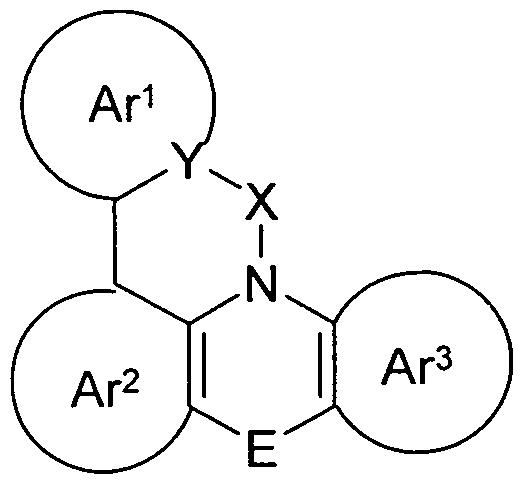
Formel (1) wobei für die verwendeten Symbole und Indizes gilt: Formula (1) where the symbols and indices used are:
X ist C=0, C(R)2, NR, O, S, C=S, C=NR, C=C(R)2, Si(R)2, BR, PR, X is C = O, C (R) 2 , NR, O, S, C = S, C = NR, C = C (R) 2 , Si (R) 2 , BR, PR,
P(=O)R, SO oder SO2; P (= O) R, SO or SO 2 ;
Y ist C, wenn Ar1 eine 6-Ring-Aryl- oder Heteroarylgruppe darstellt, bzw. ist C oder N, wenn Ar1 eine 5-Ring-Heteroarylgruppe darstellt; ist eine Einfachbindung, C(R)2, NR, O, S, C=O, C=S, C=NR, C=C(R)2, Si(R)2, BR, PR, P(=O)R, SO oder SO2; ist zusammen mit der Gruppe Y und dem explizit dargestellten Kohlenstoffatom ein aromatisches oder heteroaromatisches Ringsystem mit 5 bis 30 aromatischen Ringatomen, welches durch einen oder mehrere Reste R substituiert sein kann; Y is C when Ar 1 represents a 6-ring aryl or heteroaryl group, or is C or N when Ar 1 represents a 5-membered heteroaryl group; is a single bond, C (R) 2 , NR, O, S, C = O, C = S, C = NR, C = C (R) 2 , Si (R) 2 , BR, PR, P (= O ) R, SO or SO 2 ; together with the group Y and the explicitly represented carbon atom is an aromatic or heteroaromatic ring system having 5 to 30 aromatic ring atoms, which may be substituted by one or more radicals R;
Ar2, Ar3 ist gleich oder verschieden bei jedem Auftreten zusammen mit den explizit dargestellten Kohlenstoffatomen ein aromatisches oder heteroaromatisches Ringsystem mit 5 bis 30 aromatischen Ringatomen, welches durch einen oder mehrere Reste R substituiert sein kann; Ar 2 , Ar 3 is identical or different at each occurrence together with the explicitly illustrated carbon atoms, an aromatic or heteroaromatic ring system having 5 to 30 aromatic ring atoms, which may be substituted by one or more radicals R;
R ist bei jedem Auftreten gleich oder verschieden ausgewählt aus der Gruppe bestehend aus H, D, F, Cl, Br, I, CN, NO2, N(Ar4)2, N(R1)2, C(=0)Ar4, C(=0)R1, P(=O)(Ar4)2, einer geradkettigen Alkyl-, Alkoxy- oder Thioalkylgruppe mit 1 bis 40 C-Atomen oder einer verzweigten oder cyclischen Alkyl-, Alkoxy- oder Thioalkylgruppe mit 3 bis 40 C-Atomen oder einer Alkenyl- oder Alkinylgruppe mit 2 bis 40 C-Atomen, die jeweils mit einem oder mehreren Resten R1 substituiert sein kann, wobei eine oder mehrere nicht-benachbarte CH2-Gruppen durch R C=CR1, C=C, Si(R1)2, Ge(R1)2, Sn(R )2, C=O, C=S, C=Se, C=NR1, P(=0)(R ), SO, S02, NR1, O, S oder CONR1 ersetzt sein können und wobei ein oder mehrere H-Atome durch D, F, Cl, Br, I, CN oder NO2 ersetzt sein können, einem aromatischen oder heteroaromatischen Ringsystem mit 5 bis 80, bevorzugt 5 bis 60, aromatischen Ringatomen, das jeweils mit einem oder mehreren Resten R1 substituiert sein kann, einer Aryloxy- oder Heteroaryloxygruppe mit 5 bis 60 aromatischen Ringatomen, die mit einem oder mehreren Resten R1 substituiert sein kann, oder einer Kombination dieser Systeme, wobei optional zwei oder mehr benachbarte Substituenten R ein monocyclisches oder polycyclisches, aliphatisches, aromatisches oder heteroaromatisches Ringsystem bilden können, das mit einem oder mehreren Resten R1 substituiert sein kann; ist bei jedem Auftreten gleich oder verschieden ausgewählt aus der Gruppe bestehend aus H, D, F, Cl, Br, I, CN, N02, N(Ar4)2, N(R2)2, C(=0)Ar4, C(=0)R2, P(=0)(Ar4)2, einer geradkettigen Alkyl-, Alkoxy- oder Thioalkylgruppe mit 1 bis 40 C-Atomen oder einer verzweigten oder cyclischen Alkyl-, Alkoxy- oder Thioalkylgruppe mit 3 bis 40 C-Atomen oder einer Alkenyl- oder Alkinylgruppe mit 2 bis 40 C-Atomen, die jeweils mit einem oder mehreren Resten R2 substituiert sein kann, wobei eine oder mehrere nicht-benachbarte CH2-Gruppen durch R2C=CR2, CEC, Si(R2)2, Ge(R2)2, Sn(R2)2, C=O, C=S, C=Se, C=NR2, P(=0)(R2), SO, SO2, NR2, O, S oder CONR2 ersetzt sein können und wobei ein oder mehrere H-Atome durch D, F, Cl, Br, I, CN oder NO2 ersetzt sein können, einem aromatischen oder heteroaromatischen Ringsystem mit 5 bis 60 aromatischen Ringatomen, das jeweils mit einem oder mehreren Resten R2 substituiert sein kann, einer Aryloxy- oder Heteroaryl- oxygruppe mit 5 bis 60 aromatischen Ringatomen, die mit einem oder mehreren Resten R2 substituiert sein kann, oder einer Kombination dieser Systeme, wobei optional zwei oder mehr benachbarte Substituenten R ein monocyclisches oder polycyclisches, aliphatisches, aromatisches oder heteroaromatisches Ringsystem bilden können, das mit einem oder mehreren Resten R2 R is the same or different on each occurrence selected from the group consisting of H, D, F, Cl, Br, I, CN, NO 2 , N (Ar 4 ) 2 , N (R 1 ) 2 , C (= O) Ar 4 , C (= O) R 1 , P (= O) (Ar 4 ) 2 , a straight-chain alkyl, alkoxy or thioalkyl group having 1 to 40 C atoms or a branched or cyclic alkyl, alkoxy or thioalkyl group having from 3 to 40 carbon atoms or an alkenyl or alkynyl group having from 2 to 40 carbon atoms, each of which may be substituted with one or more R 1 , wherein one or more non-adjacent CH 2 groups by RC = CR 1 , C = C, Si (R 1 ) 2 , Ge (R 1 ) 2 , Sn (R) 2 , C = O, C = S, C = Se, C = NR 1 , P (= O) (R), SO, SO 2 , NR 1 , O, S or CONR 1 , and wherein one or more H atoms are represented by D, F, Cl, Br, I, CN or NO 2 can be replaced, an aromatic or heteroaromatic ring system having 5 to 80, preferably 5 to 60, aromatic ring atoms, each of which may be substituted by one or more radicals R 1 , an aryloxy or heteroaryloxy group having 5 to 60 aromatic ring atoms, which may be substituted by one or more radicals R 1 , or a com bination of these systems, optionally two or more adjacent substituents R can form a monocyclic or polycyclic, aliphatic, aromatic or heteroaromatic ring system which may be substituted by one or more radicals R 1 ; is the same or different on each occurrence selected from the group consisting of H, D, F, Cl, Br, I, CN, NO 2 , N (Ar 4 ) 2 , N (R 2 ) 2 , C (= O) Ar 4 , C (= O) R 2 , P (= O) (Ar 4 ) 2 , a straight-chain alkyl, alkoxy or thioalkyl group having 1 to 40 carbon atoms or a branched or cyclic alkyl, alkoxy or thioalkyl group with From 3 to 40 carbon atoms or an alkenyl or alkynyl group having from 2 to 40 carbon atoms, each of which may be substituted with one or more R 2 radicals, wherein one or more non-adjacent CH 2 groups are represented by R 2 C = CR 2 , CEC, Si (R 2 ) 2 , Ge (R 2 ) 2 , Sn (R 2 ) 2 , C = O, C = S, C = Se, C = NR 2 , P (= O) (R 2 ), SO, SO 2 , NR 2 , O, S or CONR 2 may be replaced and wherein one or more H atoms may be replaced by D, F, Cl, Br, I, CN or NO 2 , an aromatic or heteroaromatic Ring system having 5 to 60 aromatic ring atoms, each of which may be substituted by one or more radicals R 2 , an aryloxy or heteroaryl oxy group having 5 to 60 aromatic ring atoms which may be substituted by one or more R 2 radicals, or a combination of these systems, optionally two or more adjacent substituents R may form a monocyclic or polycyclic, aliphatic, aromatic or heteroaromatic ring system containing one or more radicals R 2
substituiert sein kann; may be substituted;
Ar4 ist bei jedem Auftreten gleich oder verschieden ein aromatisches oder heteroaromatisches Ringsystem mit 5-30 aromatischen Ringatomen, das mit einem oder mehreren nicht-aromatischen Resten R2 substituiert sein kann; dabei können zwei Reste Ar4, welche an dasselbe N-Atom oder P-Atom binden, auch durch eine Einfachbindung oder eine Brücke, ausgewählt aus N(R2), C(R2)2 oder O, miteinander verbrückt sein; Ar 4 is the same or different at each occurrence and is an aromatic or heteroaromatic ring system having 5-30 aromatic ring atoms which may be substituted with one or more non-aromatic radicals R 2 ; two Ar 4 radicals which bind to the same N atom or P atom may also be bridged together by a single bond or a bridge selected from N (R 2 ), C (R 2 ) 2 or O;
R2 ist ausgewählt aus der Gruppe bestehend aus H, D, F, CN, einem aliphatischem Kohlenwasserstoffrest mit 1 bis 20 C-Atomen, einem aromatischem oder heteroaromatischem Ringsystem mit 5 bis 30 aromatischen Ringatomen, in dem ein oder mehrere H- Atome durch D, F, Cl, Br, I oder CN ersetzt sein können, wobei zwei oder mehr benachbarte Substituenten R2 miteinander ein mono- oder polycyclisches, aliphatisches, aromatisches oder heteroaromatisches Ringsystem bilden können. R 2 is selected from the group consisting of H, D, F, CN, an aliphatic hydrocarbon radical having 1 to 20 C atoms, an aromatic or heteroaromatic ring system having 5 to 30 aromatic ring atoms, in which one or more H atoms by D , F, Cl, Br, I or CN may be replaced, wherein two or more adjacent substituents R 2 may together form a mono- or polycyclic, aliphatic, aromatic or heteroaromatic ring system.
Eine elektronische Vorrichtung im Sinne der vorliegenden Erfindung ist eine Vorrichtung, welche mindestens eine Schicht enthält, die mindestens eine organische Verbindung enthält. Das Bauteil kann dabei aber auch anorganische Materialien enthalten oder auch Schichten, welche vollständig aus anorganischen Materialien aufgebaut sind. An electronic device in the sense of the present invention is a device which contains at least one layer which contains at least one organic compound. However, the component may also contain inorganic materials or even layers which are completely composed of inorganic materials.
Die elektronische Vorrichtung ist bevorzugt ausgewählt aus der Gruppe bestehend aus organischen Elektrolumineszenzvorrichtungen (OLEDs), organischen integrierten Schaltungen (O-ICs), organischen Feld-Effekt- Transistoren (O-FETs), organischen Dünnfilmtransistoren (O-TFTs), organischen lichtemittierenden Transistoren (O-LETs), organischen Solar- zellen (O-SCs), organischen farbstoffsensibilisierten Solarzellen (O- DSSC), organischen optischen Detektoren, organischen Photorezeptoren, organischen Feld-Quench-Devices (O-FQDs), lichtemittierenden elektrochemischen Zellen (LECs), organischen Laserdioden (O-Laser) und „organic plasmon emitting devices" (D. M. Koller et at., Nature Photonics 2008, 1-4), bevorzugt aber organischen Elektrolumineszenzvorrichtungen (OLEDs), besonders bevorzugt phosphoreszierenden OLEDs. The electronic device is preferably selected from the group consisting of organic electroluminescent devices (OLEDs), organic integrated circuits (O-ICs), organic field effect transistors (O-FETs), organic thin-film transistors (O-TFTs), organic light-emitting transistors ( O-LETs), organic solar cells (O-SCs), organic dye-sensitized solar cells (O-DSSC), organic optical detectors, organic photoreceptors, organic field quench devices (O-FQDs), light-emitting electrochemical cells (LECs), organic laser diodes (O-lasers) and "Organic plasmon emitting devices" (DM Koller et al., Nature Photonics 2008, 1-4), but preferably organic electroluminescent devices (OLEDs), particularly preferably phosphorescent OLEDs.
Eine Arylgruppe im Sinne dieser Erfindung enthält 6 bis 60 C-Atome; eine Heteroaryigruppe im Sinne dieser Erfindung enthält 2 bis 60 C-Atome und mindestens ein Heteroatom, mit der Maßgabe, dass die Summe aus C-Atomen und Heteroatomen mindestens 5 ergibt. Die Heteroatome sind bevorzugt ausgewählt aus N, O und/oder S. Dabei wird unter einer Arylgruppe bzw. Heteroaryigruppe entweder ein einfacher aromatischer Cyclus, also Benzol, bzw. ein einfacher heteroaromatischer Cyclus, beispielsweise Pyridin, Pyrimidin, Thiophen, etc., oder eine kondensierte (anellierte) Aryl- oder Heteroaryigruppe, beispielsweise Naphthalin, Anthracen, Phenanthren, Chinolin, Isochinolin, etc., verstanden. Miteinander durch Einfachbindung verknüpfte Aromaten, wie zum Beispiel Biphenyl, werden dagegen nicht als Aryl- oder Heteroaryigruppe, sondern als aromatisches Ringsystem bezeichnet. An aryl group in the sense of this invention contains 6 to 60 C atoms; For the purposes of this invention, a heteroaryl group contains 2 to 60 C atoms and at least one heteroatom, with the proviso that the sum of C atoms and heteroatoms gives at least 5. The heteroatoms are preferably selected from N, O and / or S. Here, under an aryl group or heteroaryl either a simple aromatic cycle, ie benzene, or a simple heteroaromatic cycle, for example pyridine, pyrimidine, thiophene, etc., or a fused (fused) aryl or heteroaryl group, for example naphthalene, anthracene, phenanthrene, quinoline, isoquinoline, etc., understood. By contrast, aromatics linked to one another by a single bond, such as, for example, biphenyl, are not referred to as aryl or heteroaryl groups but as aromatic ring systems.
Ein aromatisches Ringsystem im Sinne dieser Erfindung enthält 6 bis 80 C-Atome im Ringsystem. Ein heteroaromatisches Ringsystem im Sinne dieser Erfindung enthält 2 bis 60 C-Atome und mindestens ein Heteroatom im Ringsystem, mit der Maßgabe, dass die Summe aus C-Atomen und Heteroatomen mindestens 5 ergibt. Die Heteroatome sind bevorzugt ausgewählt aus N, O und/oder S. Unter einem aromatischen oder heteroaromatischen Ringsystem im Sinne dieser Erfindung soll ein System verstanden werden, das nicht notwendigerweise nur Aryl- oder Heteroaryl- gruppen enthält, sondern in dem auch mehrere Aryl- oder Heteroaryl- gruppen durch eine nicht-aromatische Einheit, wie z. B. ein C-, N- oder O- Atom, verbunden sein können. So sollen beispielsweise auch Systeme wie Fluoren, 9,9'-Spirobifluoren, 9,9-Diarylfluoren, Triarylamin, Diarylether, Stilben, etc. als aromatische Ringsysteme im Sinne dieser Erfindung verstanden werden, und ebenso Systeme, in denen zwei oder mehrere Arylgruppen beispielsweise durch eine kurze Alkylgruppe verbunden sind. An aromatic ring system in the sense of this invention contains 6 to 80 carbon atoms in the ring system. A heteroaromatic ring system in the sense of this invention contains 2 to 60 C atoms and at least one heteroatom in the ring system, with the proviso that the sum of C atoms and heteroatoms gives at least 5. The heteroatoms are preferably selected from N, O and / or S. An aromatic or heteroaromatic ring system in the sense of this invention is to be understood as meaning a system which does not necessarily contain only aryl or heteroaryl groups but in which also several aryl or heteroaryl groups Heteroaryl groups by a non-aromatic moiety, such as. As a C, N or O atom can be connected. Thus, for example, systems such as fluorene, 9,9'-spirobifluorene, 9,9-diaryl fluorene, triarylamine, diaryl ether, stilbene, etc. as aromatic ring systems in the context of this invention and systems in which two or more aryl groups are linked, for example, by a short alkyl group.
Im Rahmen der vorliegenden Erfindung werden unter einem aliphatischen Kohlen wasserstoffrest bzw. einer Alkylgruppe bzw. einer Alkenyl- oder Alkinylgruppe, die 1 bis 40 C-Atome enthalten kann, und in der auch einzelne H-Atome oder CH2-Gruppen durch die oben genannten Gruppen substituiert sein können, bevorzugt die Reste Methyl, Ethyl, n-Propyl, i- Propyl, n-Butyl, i-Butyl, s-Butyl, t-Butyl, 2-Methylbutyl, n-Pentyl, s-Pentyl, neo-Pentyl, Cyclopentyl, n-Hexyl, neo-Hexyl, Cyclohexyl, n-Heptyl, Cyclo- heptyl, n-Octyl, Cyclooctyl, 2-Ethylhexyl, Trifluormethyl, Pentafluorethyl, 2,2,2-Trifluorethyl, Ethenyl, Propenyl, Butenyl, Pentenyl, Cyclopentenyl, Hexenyl, Cyclohexenyl, Heptenyl, Cycloheptenyl, Octenyl, Cyclooctenyl, Ethinyl, Propinyl, Butinyl, Pentinyl, Hexinyl, Heptinyl oder Octinyl verstanden. Unter einer Alkoxygruppe mit 1 bis 40 C-Atomen werden bevorzugt Methoxy, Trifluormethoxy, Ethoxy, n-Propoxy, i-Propoxy, n-Butoxy, i-Butoxy, s-Butoxy, t-Butoxy, n-Pentoxy, s-Pentoxy, 2-Methyl- butoxy, n-Hexoxy, Cyclohexyloxy, n-Heptoxy, Cycloheptyloxy, n-Octyloxy, Cyclooctyloxy, 2-Ethylhexyloxy, Pentafluorethoxy und 2,2,2-Trifluorethoxy verstanden. Unter einer Thioalkylgruppe mit 1 bis 40 C-Atomen werden insbesondere Methylthio, Ethylthio, n-Propylthio, i-Propylthio, n-Butylthio,In the context of the present invention, an aliphatic hydrocarbon radical or an alkyl group or an alkenyl or alkynyl group which may contain 1 to 40 C atoms, and in which also individual H atoms or CH 2 groups by the abovementioned Groups may be substituted, preferably the radicals methyl, ethyl, n-propyl, i-propyl, n-butyl, i-butyl, s-butyl, t-butyl, 2-methylbutyl, n-pentyl, s-pentyl, neo Pentyl, cyclopentyl, n-hexyl, neo-hexyl, cyclohexyl, n-heptyl, cycloheptyl, n-octyl, cyclooctyl, 2-ethylhexyl, trifluoromethyl, pentafluoroethyl, 2,2,2-trifluoroethyl, ethenyl, propenyl, butenyl, Pentenyl, cyclopentenyl, hexenyl, cyclohexenyl, heptenyl, cycloheptenyl, octenyl, cyclooctenyl, ethynyl, propynyl, butynyl, pentynyl, hexynyl, heptynyl or octynyl. Among an alkoxy group having 1 to 40 carbon atoms, methoxy, trifluoromethoxy, ethoxy, n-propoxy, i-propoxy, n-butoxy, i-butoxy, s-butoxy, t-butoxy, n-pentoxy, s-pentoxy, 2-methylbutoxy, n-hexoxy, cyclohexyloxy, n-heptoxy, cycloheptyloxy, n-octyloxy, cyclooctyloxy, 2-ethylhexyloxy, pentafluoroethoxy and 2,2,2-trifluoroethoxy understood. Among a thioalkyl group having 1 to 40 carbon atoms, methylthio, ethylthio, n-propylthio, i-propylthio, n-butylthio,
1- Butylthio, s-Butylthio, t-Butylthio, n-Pentylthio, s-Pentylthio, n-Hexylthio, Cyclohexylthio, n-Heptylthio, Cycloheptylthio, n-Octylthio, Cyclooctylthio,1-butylthio, s-butylthio, t-butylthio, n-pentylthio, s-pentylthio, n-hexylthio, cyclohexylthio, n-heptylthio, cycloheptylthio, n-octylthio, cyclooctylthio,
2- Ethylhexylthio, Trifluormethylthio, Pentafluorethylthio, 2,2,2-Trifluorethyl- thio, Ethenylthio, Propenylthio, Butenylthio, Pentenylthio, Cyclopentenyl- thio, Hexenylthio, Cyclohexenylthio, Heptenylthio, Cycloheptenylthio, Octenylthio, Cyclooctenylthio, Ethinylthio, Propinylthio, Butinylthio, Pentinylthio, Hexinylthio, Heptinylthio oder Octinylthio verstanden. Allgemein können Alkyl-, Alkoxy- oder Thioalkylgruppen gemäß der vorliegenden Erfindung geradkettig, verzweigt oder cyclisch sein, wobei eine oder mehrere nicht-benachbarte CH2-Gruppen durch die oben genannten Gruppen ersetzt sein können; weiterhin können auch ein oder mehrere H- Atome durch D, F, Cl, Br, I, CN oder N02, bevorzugt F, Cl oder CN, weiter bevorzugt F oder CN, besonders bevorzugt CN ersetzt sein. Unter einem aromatischen oder heteroaromatischen Ringsystem mit 5 - 80 aromatischen Ringatomen, welches noch jeweils mit den oben genannten Resten R2 oder einem Kohlenwasserstoffrest substituiert sein kann und welches über beliebige Positionen am Aromaten bzw. Heteroaromaten verknüpft sein kann, werden insbesondere Gruppen verstanden, die abgeleitet sind von Benzol, Naphthalin, Anthracen, Benzanthracen, Phenanthren, Pyren, Chrysen, Perylen, Fluoranthen, Naphthacen, 2-ethylhexylthio, trifluoromethylthio, pentafluoroethylthio, 2,2,2-trifluoroethylthio, ethenylthio, propenylthio, butenylthio, pentenylthio, cyclopentenylthio, hexenylthio, cyclohexenylthio, heptenylthio, cycloheptenylthio, octenylthio, cyclooctenylthio, ethynylthio, propynylthio, butynylthio, pentinylthio, Hexinylthio, heptynylthio or octynylthio understood. In general, alkyl, alkoxy or thioalkyl groups according to the present invention may be straight-chain, branched or cyclic, wherein one or more non-adjacent CH 2 groups may be replaced by the above-mentioned groups; Furthermore, one or more H atoms can also be replaced by D, F, Cl, Br, I, CN or NO 2 , preferably F, Cl or CN, more preferably F or CN, particularly preferably CN. Under an aromatic or heteroaromatic ring system with 5-80 aromatic ring atoms, which may be substituted in each case with the above-mentioned radicals R 2 or a hydrocarbon radical and which may be linked via any position on the aromatic or heteroaromatic, are understood in particular groups derived are benzene, naphthalene, anthracene, benzanthracene, phenanthrene, pyrene, chrysene, perylene, fluoranthene, naphthacene,
Pentacen, Benzpyren, Biphenyl, Biphenylen, Terphenyl, Triphenylen, Fluoren, Spirobifluoren, Dihydrophenanthren, Dihydropyren, Tetrahydro- pyren, eis- oder trans-lndenofluoren, eis- oder trans-lndenocarbazol, cis- oder trans-lndolocarbazol, Truxen, Isotruxen, Spirotruxen, Spiroisotruxen, Furan, Benzofuran, Isobenzofuran, Dibenzofuran, Thiophen, Benzo- thiophen, Isobenzothiophen, Dibenzothiophen, Pyrrol, Indol, Isoindol, Carbazol, Pyridin, Chinoiin, Isochinolin, Acridin, Phenanthridin, Benzo-5,6- chinolin, Benzo-6,7-chinolin, Benzo-7,8-chinolin, Phenothiazin, Pentacene, benzpyrene, biphenyl, biphenylene, terphenyl, triphenylene, fluorene, spirobifluorene, dihydrophenanthrene, dihydropyrene, tetrahydropyrenes, cis or trans indenofluorene, cis or trans indolocarbazole, cis or trans indolocarbazole, truxene, isotruxene, spirotruxene , Spiroisotruxene, furan, benzofuran, isobenzofuran, dibenzofuran, thiophene, benzothiophene, isobenzothiophene, dibenzothiophene, pyrrole, indole, isoindole, carbazole, pyridine, quinoline, isoquinoline, acridine, phenanthridine, benzo-5,6-quinoline, benzo-6 , 7-quinoline, benzo-7,8-quinoline, phenothiazine,
Phenoxazin, Pyrazol, Indazol, Imidazol, Benzimidazol, Naphthimidazol, Phenanthrimidazol, Pyridimidazol, Pyrazinimidazol, Chinoxalinimidazol, Oxazol, Benzoxazol, Naphthoxazol, Anthroxazol, Phenanthroxazol, Isoxazol, 1 ,2-Thiazol, 1 ,3-Thiazol, Benzothiazol, Pyridazin, Hexaazatri- phenylen, Benzopyridazin, Pyrimidin, Benzpyrimidin, Chinoxalin, 1 ,5- Diazaanthracen, 2,7-Diazapyren, 2,3-Diazapyren, 1 ,6-Diazapyren, 1 ,8- Diazapyren, 4,5-Diazapyren, 4,5,9, 10-Tetraazaperylen, Pyrazin, Phenazin, Phenoxazin, Phenothiazin, Fluorubin, Naphthyridin, Azacarbazol, Benzo- carbolin, Phenanthrolin, 1 ,2,3-Triazol, ,2,4-Triazol, Benzotriazol, 1 ,2,3- Oxadiazol, 1 ,2,4-Oxadiazol, 1 ,2,5-Oxadiazol, 1 ,3,4-Oxadiazol, 1 ,2,3- Thiadiazol, 1 ,2,4-Thiadiazol, 1 ,2,5-Thiadiazol, 1 ,3,4-Thiadiazol, 1 ,3,5- Triazin, 1 ,2,4-Triazin, 1 ,2,3-Triazin, Tetrazol, 1 ,2,4,5-Tetrazin, 1 ,2,3,4- Tetrazin, 1 ,2,3,5-Tetrazin, Purin, Pteridin, Indolizin und Benzothiadiazol oder Gruppen, die abgeleitet sind von Kombination dieser Systeme. Phenoxazine, pyrazole, indazole, imidazole, benzimidazole, naphthimidazole, phenanthrimidazole, pyrimididazole, pyrazine imidazole, quinoxalinimidazole, oxazole, benzoxazole, naphthoxazole, anthroxazole, phenanthroxazole, isoxazole, 1, 2-thiazole, 1, 3-thiazole, benzothiazole, pyridazine, hexaazatri- phenylenes, benzopyridazine, pyrimidine, benzpyrimidine, quinoxaline, 1, 5-diazaanthracene, 2,7-diazapyrene, 2,3-diazapyrene, 1, 6-diazapyrene, 1, 8-diazapyrene, 4,5-diazapyrene, 4,5, 9, 10-Tetraazaperylene, pyrazine, phenazine, phenoxazine, phenothiazine, fluorubin, naphthyridine, azacarbazole, benzo-carboline, phenanthroline, 1, 2,3-triazole,, 2,4-triazole, benzotriazole, 1, 2,3-oxadiazole , 1, 2,4-oxadiazole, 1, 2,5-oxadiazole, 1, 3,4-oxadiazole, 1, 2,3-thiadiazole, 1, 2,4-thiadiazole, 1, 2,5-thiadiazole, 1 , 3,4-thiadiazole, 1, 3,5-triazine, 1, 2,4-triazine, 1, 2,3-triazine, tetrazole, 1, 2,4,5-tetrazine, 1, 2,3,4 Tetrazine, 1, 2,3,5-tetrazine, purine, pteridine, indolizine and benzothiadiazole or groups derived from combination d these systems.
In einer bevorzugten Ausführungsform der Erfindung steht X für C=0, CR2) SiR2, P(=0)R oder SO2, besonders bevorzugt für C=0, SiR2 oder S02. In a preferred embodiment of the invention, X is C = 0, CR 2) SiR 2 , P (= O) R or SO 2 , particularly preferably C = 0, SiR 2 or S0 2 .
In einer weiteren bevorzugten Ausführungsform der Erfindung steht E für eine Einfachbindung, CR2, C=O, NR, O oder S, besonders bevorzugt für eine Einfachbindung, CR2, C=0 oder NR, ganz besonders bevorzugt für eine Einfachbindung, CR2 oder C=0, insbesondere für eine In a further preferred embodiment of the invention E is a single bond, CR 2, C = O, NR, O or S, particularly preferably represents a single bond, CR 2, C = 0 or NR, very particularly preferably a single bond, CR 2 or C = 0, especially for one
Einfachbindung. Single bond.
In einer weiteren bevorzugten Ausführungsform der Erfindung steht die Gruppe Ar1 für eine Gruppe der folgenden Formel (2), (3), (4), (5) oder (6),

Formel (3) Formel (4) Formel (5) Formel (6) wobei die gestrichelte Bindung die Verknüpfung mit X andeutet, * die Position der Verknüpfung mit Ar2 andeutet und weiterhin gilt: Formula (3) Formula (4) Formula (5) Formula (6) wherein the dashed bond indicates the linkage with X, * indicates the position of the linkage with Ar 2, and furthermore:
W ist gleich oder verschieden bei jedem Auftreten CR oder N; oder zwei benachbarte Gruppen W stehen für eine Gruppe der folgenden Formel (7) oder (8),

Formel (7) Formel (8) wobei E die oben genannte Bedeutung aufweist, jedoch bevorzugt keine Einfachbindung darstellt, Z gleich oder verschieden bei jedem Auftreten für CR oder N steht und Λ die entsprechenden benachbarten Gruppen W in der Formel (2) bis (6) andeuten; Formula (7) wherein E has the above-mentioned meaning, but preferably does not represent a single bond, Z is identical or different at each occurrence is CR or N and Λ the corresponding adjacent groups W in the formula (2) to (6 ) indicate;
V ist NR, O oder S. V is NR, O or S.
In einer weiteren bevorzugten Ausführungsform der Erfindung steht die Gruppe Ar2 für eine Gruppe gemäß einer der folgenden Formeln (9), (10) oder (11),

Formel (9) Formel (10) Formel (11) wobei die gestrichelte Bindung die Verknüpfung mit N andeutet, # die Position der Verknüpfung mit E andeutet, * die Verknüpfung mit Ar1 andeutet und W und V die oben genannten Bedeutungen aufweisen. Formula (9) Formula (10) Formula (11) wherein the dashed bond indicates the linkage with N, # indicates the position of the linkage with E, * indicates the linkage with Ar 1 and W and V have the meanings given above.
In einer weiteren bevorzugten Ausführungsform der Erfindung steht die Gruppe Ar3 für eine Gruppe gemäß einer der folgenden Formeln (12), (13), (14) oder (15),

Formel (12) Formel (13) Formel (14) Formel (15) wobei die gestrichelte Bindung die Verknüpfung mit N andeutet, Formula (12) Formula (13) Formula (14) Formula (15) wherein the dashed bond indicates linkage with N,
Verknüpfung mit E andeutet und W und V die oben genannten Linking with E implies and W and V the above
Bedeutungen aufweisen. Have meanings.
In einer besonders bevorzugten Ausführungsform der Erfindung treten die oben genannten Bevorzugungen gleichzeitig auf. Besonders bevorzugt sind daher Verbindungen gemäß Formel (1), für die gilt: In a particularly preferred embodiment of the invention, the abovementioned preferences occur simultaneously. Particular preference is therefore given to compounds of the formula (1) in which
X ist C=0, CR2, SiR2, P(=0)R oder S02; ist gleich oder verschieden bei jedem Auftreten eine Einfachbindung CR2, C=O, NR, O oder S; ist ausgewählt aus den Gruppen der oben genannten Formeln (2), (3), (4), (5) oder (6); ist ausgewählt aus den Gruppen der oben genannten Formeln (9), (10) oder (11); Ar3 ist ausgewählt aus den Gruppen der oben genannten Formeln (12), (13), (14) oder (15). X is C = O, CR 2 , SiR 2 , P (= 0) R or S0 2 ; is the same or different each occurrence of a single bond CR 2 , C = O, NR, O or S; is selected from the groups of the above-mentioned formulas (2), (3), (4), (5) or (6); is selected from the groups of the above formulas (9), (10) or (11); Ar 3 is selected from the groups of the above-mentioned formulas (12), (13), (14) or (15).
In einer ganz besonders bevorzugten Ausführungsform der Erfindung gilt für Verbindungen der Formel (1): In a very particularly preferred embodiment of the invention, for compounds of the formula (1):
X ist C=O, SiR2 oder S02; X is C = O, SiR 2 or S0 2 ;
E ist gleich oder verschieden bei jedem Auftreten eine Einfachbindung, CR2, C=O oder NR, bevorzugt eine Einfachbindung, CR2 oder C=0, besonders bevorzugt eine Einfachbindung; E is the same or different at each occurrence as a single bond, CR 2 , C = O or NR, preferably a single bond, CR 2 or C = O, more preferably a single bond;
Ar1 ist ausgewählt aus den Gruppen der oben genannten Formeln (2), (3), (4), (5) oder (6); Ar 1 is selected from the groups of the above formulas (2), (3), (4), (5) or (6);
Ar2 ist ausgewählt aus den Gruppen der oben genannten Formeln (9), (10) oder (11); Ar 2 is selected from the groups of the above formulas (9), (10) or (11);
Ar3 ist ausgewählt aus den Gruppen der oben genannten Formeln (12), (13), (14) oder (15). Ar 3 is selected from the groups of the above-mentioned formulas (12), (13), (14) or (15).
Dabei können die oben genannten bevorzugten Gruppen Ar1, Ar2 und Ar3 beliebig miteinander kombiniert werden. Geeignete Kombinationen sind also die folgenden: In this case, the above-mentioned preferred groups Ar 1 , Ar 2 and Ar 3 can be combined with each other as desired. Suitable combinations are therefore the following:
Ar1 Ar ArJ Ar 1 Ar Ar J
Formel (2) Formel (9) Formel (12) Formula (2) Formula (9) Formula (12)
Formel (2) Formel (9) Formel (13) Formula (2) Formula (9) Formula (13)
Formel (2) Formel (9) Formel (14) Formula (2) Formula (9) Formula (14)
Formel (2) Formel (9) Formel (15) Formula (2) Formula (9) Formula (15)
Formel (2) Formel (10) Formel (12) Formula (2) Formula (10) Formula (12)
Formel (2) Formel (10) Formel (13) Formula (2) Formula (10) Formula (13)
Formel (2) Formel (10) Formel (14) Formula (2) Formula (10) Formula (14)
Formel (2) Formel (10) Formel (15) Formula (2) Formula (10) Formula (15)
Formel (2) Formel (11) Formel (12) Formula (2) Formula (11) Formula (12)
Formel (2) Formel (11) Formel (13) Formula (2) Formula (11) Formula (13)
Formel (2) Formel (11) Formel (14) Formula (2) Formula (11) Formula (14)
Formel (2) Formel (11) Formel (15) Formel (2) Formel (12) Formel (12)Formula (2) Formula (11) Formula (15) Formula (2) Formula (12) Formula (12)
Formel (2) Formel (12) Formel (13)Formula (2) Formula (12) Formula (13)
Formel (2) Formel (12) Formel (14)Formula (2) Formula (12) Formula (14)
Formel (2) Formel (12) Formel (15)Formula (2) Formula (12) Formula (15)
Formel (3) Formel (9) Formel (12)Formula (3) Formula (9) Formula (12)
Formel (3) Formel (9) Formel (13)Formula (3) Formula (9) Formula (13)
Formel (3) Formel (9) Formel (14)Formula (3) Formula (9) Formula (14)
Formel (3) Formel (9) Formel (15)Formula (3) Formula (9) Formula (15)
Formel (3) Formel (10) Formel (12)Formula (3) Formula (10) Formula (12)
Formel (3) Formel (10) Formel (13)Formula (3) Formula (10) Formula (13)
Formel (3) Formel (10) Formel (14)Formula (3) Formula (10) Formula (14)
Formel (3) Formel (10) Formel (15)Formula (3) Formula (10) Formula (15)
Formel (3) Formel (11) Formel (12)Formula (3) Formula (11) Formula (12)
Formel (3) Formel (11) Formel (13)Formula (3) Formula (11) Formula (13)
Formel (3) Formel (11) Formel (14)Formula (3) Formula (11) Formula (14)
Formel (3) Formel (11) Formel (15)Formula (3) Formula (11) Formula (15)
Formel (3) Formel (12) Formel (12)Formula (12) Formula (12) Formula (12)
Formel (3) Formel (12) Formel (13)Formula (3) Formula (12) Formula (13)
Formel (3) Formel (12) Formel (14)Formula (3) Formula (12) Formula (14)
Formel (3) Formel (12) Formel (15)Formula (3) Formula (12) Formula (15)
Formel (4) Formel (9) Formel (12)Formula (4) Formula (9) Formula (12)
Formel (4) Formel (9) Formel (13)Formula (4) Formula (9) Formula (13)
Formel (4) Formel (9) Formel (14)Formula (4) Formula (9) Formula (14)
Formel (4) Formel (9) Formel (15)Formula (4) Formula (9) Formula (15)
Formel (4) Formel (10) Formel (12)Formula (4) Formula (10) Formula (12)
Formel (4) Formel (10) Formel (13)Formula (10) Formula (10) Formula (13)
Formel (4) Formel (10) Formel (14)Formula (4) Formula (10) Formula (14)
Formel (4) Formel (10) Formel (15)Formula (4) Formula (10) Formula (15)
Formel (4) Formel (11) Formel (12)Formula (4) Formula (11) Formula (12)
Formel (4) Formel (11) Formel (13)Formula (4) Formula (11) Formula (13)
Formel (4) Formel (11) Formel (14)Formula (4) Formula (11) Formula (14)
Formel (4) Formel (11) Formel (15)Formula (4) Formula (11) Formula (15)
Formel (4) Formel (12) Formel (12)Formula (4) Formula (12) Formula (12)
Formel (4) Formel (12) Formel (13)Formula (4) Formula (12) Formula (13)
Formel (4) Formel (12) Formel (14)Formula (4) Formula (12) Formula (14)
Formel (4) Formel (12) Formel (15)Formula (4) Formula (12) Formula (15)
Formel (5) Formel (9) Formel (12)Formula (5) Formula (9) Formula (12)
Formel (5) Formel (9) Formel (13)Formula (5) Formula (9) Formula (13)
Formel (5) Formel (9) Formel (14)Formula (5) Formula (9) Formula (14)
Formel (5) Formel (9) Formel (15)Formula (5) Formula (9) Formula (15)
Formel (5) Formel (10) Formel (12)Formula (5) Formula (10) Formula (12)
Formel (5) Formel (10) Formel (13)Formula (5) Formula (10) Formula (13)
Formel (5) Formel (10) Formel (14)Formula (5) Formula (10) Formula (14)
Formel (5) Formel (10) Formel (15)Formula (5) Formula (10) Formula (15)
Formel (5) Formel (11) Formel (12)Formula (5) Formula (11) Formula (12)
Formel (5) Formel (11) Formel (13) Formel (5) Formel (11) Formel (14) Formula (5) Formula (11) Formula (13) Formula (5) Formula (11) Formula (14)
Formel (5) Formel ( 1) Formel (15) Formula (5) Formula (1) Formula (15)
Formel (5) Formel (12) Formel (12) Formula (5) Formula (12) Formula (12)
Formel (5) Formel (12) Formel (13) Formula (5) Formula (12) Formula (13)
Formel (5) Formel (12) Formel (14) Formula (5) Formula (12) Formula (14)
Formel (5) Formel (12) Formel (15) Formula (5) Formula (12) Formula (15)
Formel (6) Formel (9) Formel (12) Formula (6) Formula (9) Formula (12)
Formel (6) Formel (9) Formel ( 3) Formula (6) Formula (9) Formula (3)
Formel (6) Formel (9) Formel (14) Formula (6) Formula (9) Formula (14)
Formel (6) Formel (9) Formel (15) Formula (6) Formula (9) Formula (15)
Formel (6) Formel (10) Formel (12) Formula (6) Formula (10) Formula (12)
Formel (6) Formel (10) Formel (13) Formula (6) Formula (10) Formula (13)
Formel (6) Formel (10) Formel (14) Formula (6) Formula (10) Formula (14)
Formel (6) Formel (10) Formel (15) Formula (6) Formula (10) Formula (15)
Formel (6) Formel (11) Formel (12) Formula (6) Formula (11) Formula (12)
Formel (6) Formel ( 1) Formel (13) Formula (6) Formula (1) Formula (13)
Formel (6) Formel ( 1) Formel (14) Formula (6) Formula (1) Formula (14)
Formel (6) Formel ( 1) Formel (15) Formula (6) Formula (1) Formula (15)
Formel (6) Formel (12) Formel (12) Formula (6) Formula (12) Formula (12)
Formel (6) Formel (12) Formel (13) Formula (6) Formula (12) Formula (13)
Formel (6) Formel (12) Formel (14) Formula (6) Formula (12) Formula (14)
Formel (6) Formel (12) Formel (15) Formula (6) Formula (12) Formula (15)
Besonders bevorzugt stehen mindestens zwei der Gruppen Ar1, Ar2 und Ar3 für eine 6-Ring-Aryl- oder eine 6-Ring-Heteroarylgruppe. Besonders bevorzugt steht also Ar1 für eine Gruppe der Formel (2) und gleichzeitig steht Ar2 für eine Gruppe der Formel (9), oder Ar1 steht für eine Gruppe der Formel (2) und gleichzeitig steht Ar3 für eine Gruppe der Formel (12), oder Ar2 steht für eine Gruppe der Formel (9) und gleichzeitig steht Ar3 für eine Gruppe der Formel (12). Particularly preferably, at least two of the groups Ar 1 , Ar 2 and Ar 3 are a 6-membered aryl or a 6-membered heteroaryl group. Thus Ar 1 is particularly preferably a group of the formula (2) and at the same time Ar 2 is a group of the formula (9) or Ar 1 is a group of the formula (2) and at the same time Ar 3 is a group of the formula (12), or Ar 2 represents a group of the formula (9) and at the same time Ar 3 represents a group of the formula (12).
Besonders bevorzugte Ausführungsformen der Erfindung sind daher die Verbindungen der folgenden Formeln (16) bis (25), Particularly preferred embodiments of the invention are therefore the compounds of the following formulas (16) to (25),
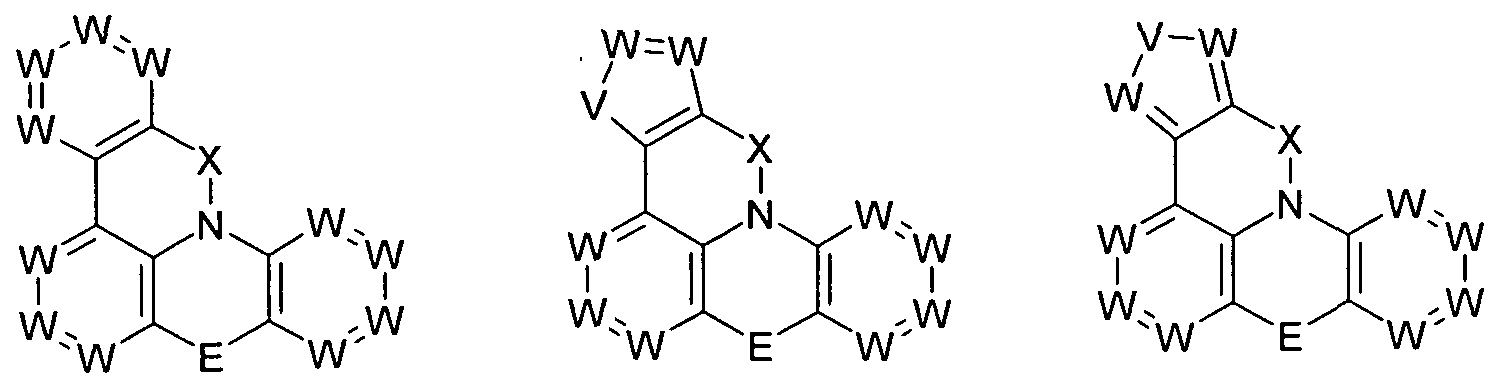
Formel (16) Formel (17) Form Formula (16) Formula (17) Form


Formel (21 ) Formel (22) Formula (21) Formula (22)
Formel (23) Formel (24) Formel (25) wobei die verwendeten Symbole die oben genannten Bedeutunge aufweisen. Formula (23) Formula (24) Formula (25) wherein the symbols used have the meanings given above.
Wie oben bereits ausgeführt, können zwei benachbarte Gruppen W auch für eine Gruppe der oben genannten Formel (7) oder (8) stehen. Wenn zwei benachbarte Gruppen W für eine Gruppe der oben genannten Formel (7) stehen, erhält man Strukturen, wie exemplarisch durch die folgenden Formeln (26) bis (31) dargestellt. Diese Strukturen der Formeln (26) bis (30) leiten sich von der oben genannten Formel (16) ab und die Struktur der Formel (31) leitet sich von der oben genannten Formel (25) ab. Ganz analog lassen sich weitere entsprechende Strukturen von den oben genannten Formeln (17) bis (25) ableiten. As already explained above, two adjacent groups W can also stand for a group of the abovementioned formula (7) or (8). When two adjacent groups W stand for a group of the above-mentioned formula (7), structures are obtained as exemplified by the following formulas (26) to (31). These structures of the formulas (26) to (30) are derived from the above-mentioned formula (16), and the structure of the formula (31) is derived from the above-mentioned formula (25). Analogously, further corresponding structures can be derived from the abovementioned formulas (17) to (25).

Wenn zwei benachbarte Gruppen W für eine Gruppe der oben genannten Formel (8) stehen, erhält man Strukturen, wie exemplarisch durch die folgenden Formeln (32) bis (37) dargestellt. Diese Strukturen leiten sich von der oben genannten Formel (16) ab. Ganz analog lassen sich entsprechende Strukturen von den oben genannten Formeln (17) bis (25) ableiten. When two adjacent groups W stand for a group of the above-mentioned formula (8), structures are obtained as exemplified by the following formulas (32) to (37). These structures are derived from the above-mentioned formula (16). Analogously, corresponding structures can be derived from the abovementioned formulas (17) to (25).
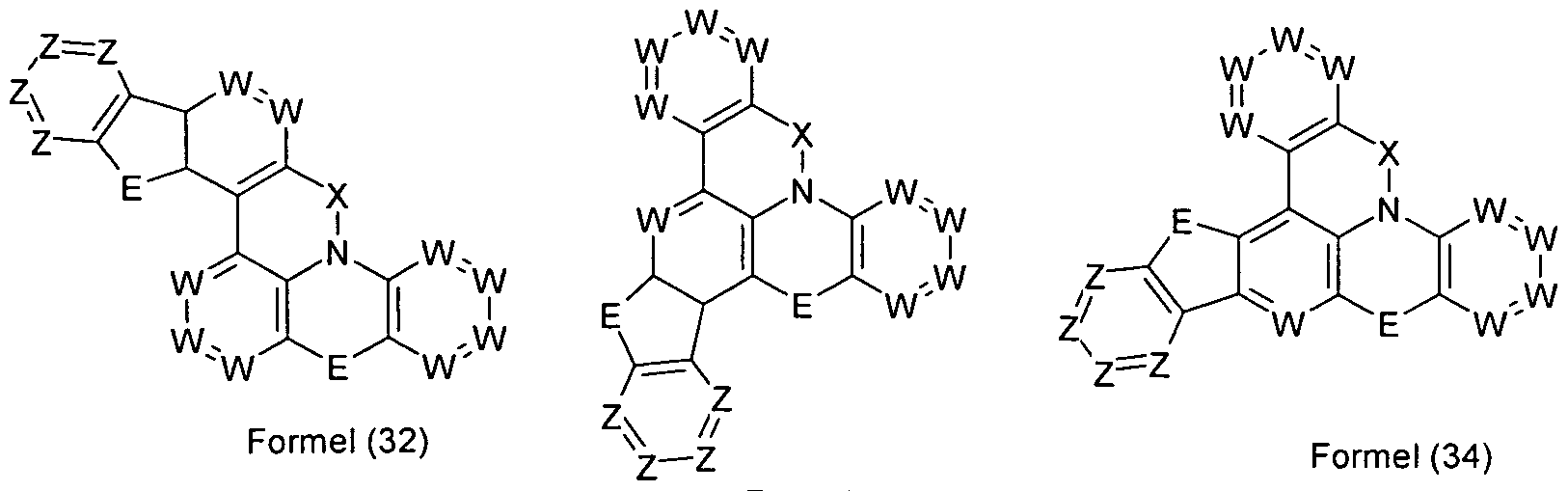

Dabei haben die verwendeten Symbole die oben genannten Bedeutungen. The symbols used have the meanings mentioned above.
In einer weiteren bevorzugten Ausführungsform der Verbindungen gemäß Formel (16) bis (25) steht pro Cyclus insgesamt maximal ein Symbol W für N, und die verbleibenden Symbole W, die nicht für eine Gruppe der Formel (7) oder (8) stehen, stehen für CR. In einer besonders bevorzugten Ausführungsform der Erfindung stehen alle Symbole W, die nicht für eine Gruppe der Formel (7) oder (8) stehen, für CR. Besonders bevorzugt sind daher die Verbindungen gemäß den folgenden Formeln (16a) bis (25a), In a further preferred embodiment of the compounds of the formula (16) to (25), a maximum of one symbol W for N and the remaining symbols W, which do not stand for a group of the formula (7) or (8), are present for each cycle for CR. In a particularly preferred embodiment of the invention, all symbols W which do not stand for a group of the formula (7) or (8) stand for CR. Particular preference is therefore given to the compounds according to the following formulas (16a) to (25a),

Formel (19a) Formel (20a) Formula (19a) Formula (20a)
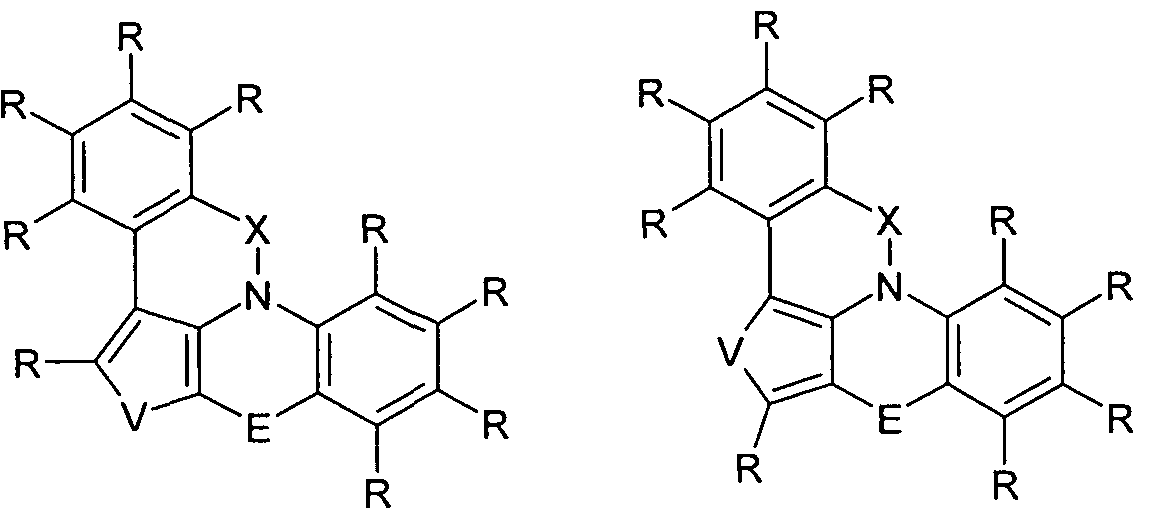
Formel (21 a) Formel (22a) Formula (21a) Formula (22a)

Formel (23a) Formel (24a) Formel (25a) wobei die verwendeten Symbole die oben genannten Bedeutungen aufweisen. Formula (23a) Formula (24a) Formula (25a) wherein the symbols used have the meanings given above.
Ganz besonders bevorzugt sind die Verbindungen gemäß den folgend Formeln (16b) bis (25b), Very particular preference is given to the compounds according to the following formulas (16b) to (25b),

Formel (16b) Formel (17b) Formel (18b) Formula (16b) Formula (17b) Formula (18b)

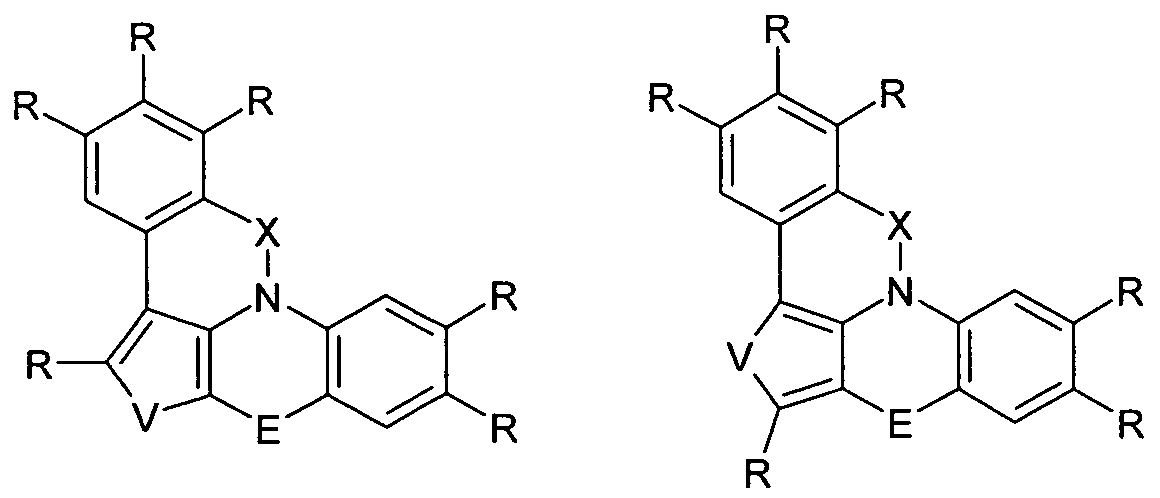
Formel (21 b) Formel (22b) Formula (21b) Formula (22b)

Formel (23b) Formel (24b) Formel (25b) wobei die verwendeten Symbole die oben genannten Bedeutungen aufweisen. Formula (23b) Formula (24b) Formula (25b) wherein the symbols used have the meanings given above.
Insbesondere bevorzugt sind die Strukturen der Formeln (16c) bis (25c), Particularly preferred are the structures of the formulas (16c) to (25c),

Formel (16c) Formel (17c) Formel (18c)

Formel (19c) Formel (20c)

Formel (21 c) Formel (22c)

Formel (23c) Formel (24c) Formel (25c) wobei die verwendeten Symbole die oben genannten Bedeutungen aufweisen. Formula (23c) Formula (24c) Formula (25c) wherein the symbols used have the meanings given above.
Dabei steht in den Formeln (16) bis (25), (16a) bis (25a), (16b) bis (25b) und (16c) bis (25c) X bevorzugt für C=0, CR2, SiR2 oder S02. In this case, in the formulas (16) to (25), (16a) to (25a), (16b) to (25b) and (16c) to (25c) X is preferably C = 0, CR 2 , SiR 2 or S0 2 .
Weiterhin steht in den Formeln (16) bis (25), (16a) bis (25a), (16b) bis (25b) und (16c) bis (25c) E bevorzugt für eine Einfachbindung, CR2, NR, O oder S. Furthermore, in the formulas (16) to (25), (16a) to (25a), (16b) to (25b) and (16c) to (25c) E is preferably a single bond, CR 2 , NR, O or S. ,
Besonders bevorzugt steht in den Formeln (16) bis (25), (16a) bis (25a), (16b) bis (25b) und (16c) bis (25c) X für C=0, CR2, SiR2 oder S02 und gleichzeitig E für eine Einfachbindung, CR2, NR, O oder S. Particularly preferably, in the formulas (16) to (25), (16a) to (25a), (16b) to (25b) and (16c) to (25c) X is C = 0, CR 2 , SiR 2 or S0 2 and at the same time E for a single bond, CR 2 , NR, O or S.
Besonders bevorzugte Kombinationen der Symbole X, E und V in den Verbindungen der Formeln (16) bis (25), (16a) bis (25a), (16b) bis (25b) und (16c) bis (25c) sind daher die folgenden Kombinationen: Particularly preferred combinations of the symbols X, E and V in the compounds of the formulas (16) to (25), (16a) to (25a), (16b) to (25b) and (16c) to (25c) are therefore the following combinations:


Weiterhin ist es bevorzugt, falls zwei benachbarte Gruppen W für eine Gruppe der Formel (7) oder (8) stehen, dass dann maximal eine Gruppe Z für N steht. Besonders bevorzugt stehen alle Gruppen Z für CR. Weiterhin ist es bevorzugt, wenn zwei benachbarte Gruppen W für eine Gruppe der Formel (8) stehen, dass dann in der Gruppe der Formel (8) E für CR2, C=0 oder NR steht. Furthermore, it is preferred if two adjacent groups W stand for a group of the formula (7) or (8), then that a maximum of one group Z is N. Particularly preferably, all groups Z stand for CR. Furthermore, it is preferred if two adjacent groups W stand for a group of the formula (8), then in the group of the formula (8) E stands for CR 2 , C = 0 or NR.
In einer bevorzugten Ausführungsform der Erfindung ist R in den oben genannten Formeln gleich oder verschieden bei jedem Auftreten ausgewählt aus der Gruppe bestehend aus H, D, F, Cl, Br, CN, N(Ar1)2, In a preferred embodiment of the invention R in the abovementioned formulas is the same or different at each occurrence selected from the group consisting of H, D, F, Cl, Br, CN, N (Ar 1 ) 2 ,
C(=O)Ar1, einer geradkettigen Alkyl- oder Alkoxygruppe mit 1 bis 10 C- Atomen oder einer verzweigten oder cyclischen Alkyl- oder Alkoxygruppe mit 3 bis 10 C-Atomen oder einer Alkenyl- oder Alkinylgruppe mit 2 bis 10 C-Atomen, die jeweils mit einem oder mehreren Resten R1 substituiert sein kann, wobei eine oder mehrere nicht-benachbarte CH2-Gruppen durch O ersetzt sein können und wobei ein oder mehrere H-Atome durch D oder F ersetzt sein können, einem aromatischen oder heteroaromatischen Ringsystem mit 5 bis 30 aromatischen Ringatomen, das jeweils mit einem oder mehreren Resten R1 substituiert sein kann, einer Aryloxy- oder Heteroaryl- oxygruppe mit 5 bis 30 aromatischen Ringatomen, die mit einem oder mehreren Resten R1 substituiert sein kann, oder einer Kombination dieser Systeme. C (= O) Ar 1 , a straight-chain alkyl or alkoxy group having 1 to 10 C atoms or a branched or cyclic alkyl or alkoxy group having 3 to 10 C atoms or an alkenyl or alkynyl group having 2 to 10 C atoms , which are each substituted by one or more radicals R 1 wherein one or more non-adjacent CH 2 groups may be replaced by O and wherein one or more H atoms may be replaced by D or F, an aromatic or heteroaromatic ring system having from 5 to 30 aromatic ring atoms, each containing one or a plurality of radicals R 1 , an aryloxy or heteroaryl oxy group having 5 to 30 aromatic ring atoms which may be substituted by one or more radicals R 1 , or a combination of these systems.
In einer besonders bevorzugten Ausführungsform der Erfindung ist R in den oben genannten Formeln gleich oder verschieden bei jedem Auftreten ausgewählt aus der Gruppe bestehend aus H, D, F, Cl, Br, CN, einer geradkettigen Alkylgruppe mit 1 bis 10 C-Atomen oder einer verzweigten oder cyclischen Alkylgruppe mit 3 bis 10 C-Atomen, die jeweils mit einem oder mehreren Resten R1 substituiert sein kann, wobei ein oder mehrere H-Atome durch D oder F ersetzt sein können, einem aromatischen oder heteroaromatischen Ringsystem mit 5 bis 18 aromatischen Ringatomen, das jeweils mit einem oder mehreren Resten R1 substituiert sein kann, oder einer Kombination dieser Systeme. In a particularly preferred embodiment of the invention, R in the abovementioned formulas is the same or different at each occurrence selected from the group consisting of H, D, F, Cl, Br, CN, a straight-chain alkyl group having 1 to 10 C atoms or a a branched or cyclic alkyl group having 3 to 10 carbon atoms, each of which may be substituted by one or more R 1 radicals, wherein one or more H atoms may be replaced by D or F, an aromatic or heteroaromatic ring system having 5 to 18 aromatic Ring atoms, which may each be substituted by one or more radicals R 1 , or a combination of these systems.
Wenn die Verbindungen der Formel (1) bzw. die bevorzugten Ausführungsformen als Elektronentransportmaterial verwendet werden, ist es bevorzugt, wenn die Gruppe X für C=0 oder SO2 steht und/oder wenn mindestens einer der Reste R für ein aromatisches Ringsystem oder ein elektronenarmes heteroaromatisches Ringsystem steht. Elektronenarme Heterocyclen sind erfindungsgemäß Fünfringheterocyclen mit mindestens zwei Heteroatomen oder Sechsringheterocyclen, an die jeweils noch ein oder mehrere aromatische oder heteroaromatische Gruppen ankondensiert sein können. When the compounds of the formula (1) or the preferred embodiments are used as the electron transport material, it is preferred that the group X is C = O or SO 2 and / or if at least one of the radicals R is an aromatic ring system or an electron-poor heteroaromatic Ring system is. According to the invention, electron-poor heterocycles are five-membered heterocycles having at least two heteroatoms or six-membered heterocycles to which one or more aromatic or heteroaromatic groups can each be further fused.
Wenn die Verbindungen der Formel (1) bzw. die bevorzugten Ausführungsformen als Matrixmaterial für einen phosphoreszierenden Emitter verwendet werden, ist es bevorzugt, wenn die Gruppe X für C=0 steht und/oder wenn mindestens einer der Reste R für ein substituiertes oder unsubstituiertes Carbazol, Indenocarbazol oder Indolocarbazol steht, welches jeweils über ein Kohlenstoffatom oder ein Stickstoffatom When the compounds of the formula (1) or the preferred embodiments are used as the matrix material for a phosphorescent emitter, it is preferred if the group X is C = 0 and / or if at least one of the radicals R is a substituted or unsubstituted carbazole , Indenocarbazole or indolocarbazole, which each have a carbon atom or a nitrogen atom
gebunden sein kann. can be bound.
Dabei haben für Verbindungen, die durch Vakuumverdampfung verarbeitet werden, die Alkylgruppen bevorzugt nicht mehr als fünf C-Atome, besonders bevorzugt nicht mehr als 4 C-Atome, ganz besonders bevorzugt nicht mehr als 1 C-Atom. Für Verbindungen, die aus Lösung verarbeitet werden, eignen sich auch Verbindungen, die mit Alkylgruppen mit bis zu 10 C-Atomen substituiert sind oder die mit Oligoarylengruppen, beispielsweise ortho-, meta-, para- oder verzweigten Terphenylgruppen, substituiert sind. In this case, for compounds which are processed by vacuum evaporation, the alkyl groups preferably have not more than five carbon atoms, more preferably not more than 4 carbon atoms, most preferably not more than 1 carbon atom. For compounds which are processed from solution, compounds which are substituted by alkyl groups having up to 10 carbon atoms or are substituted by oligoarylene groups, for example ortho, meta, para or branched terphenyl groups, are also suitable.
Beispiele für bevorzugte Verbindungen gemäß den oben aufgeführten Ausführungsformen sind die Verbindungen der folgenden Strukturen. Examples of preferred compounds according to the above-mentioned embodiments are the compounds of the following structures.


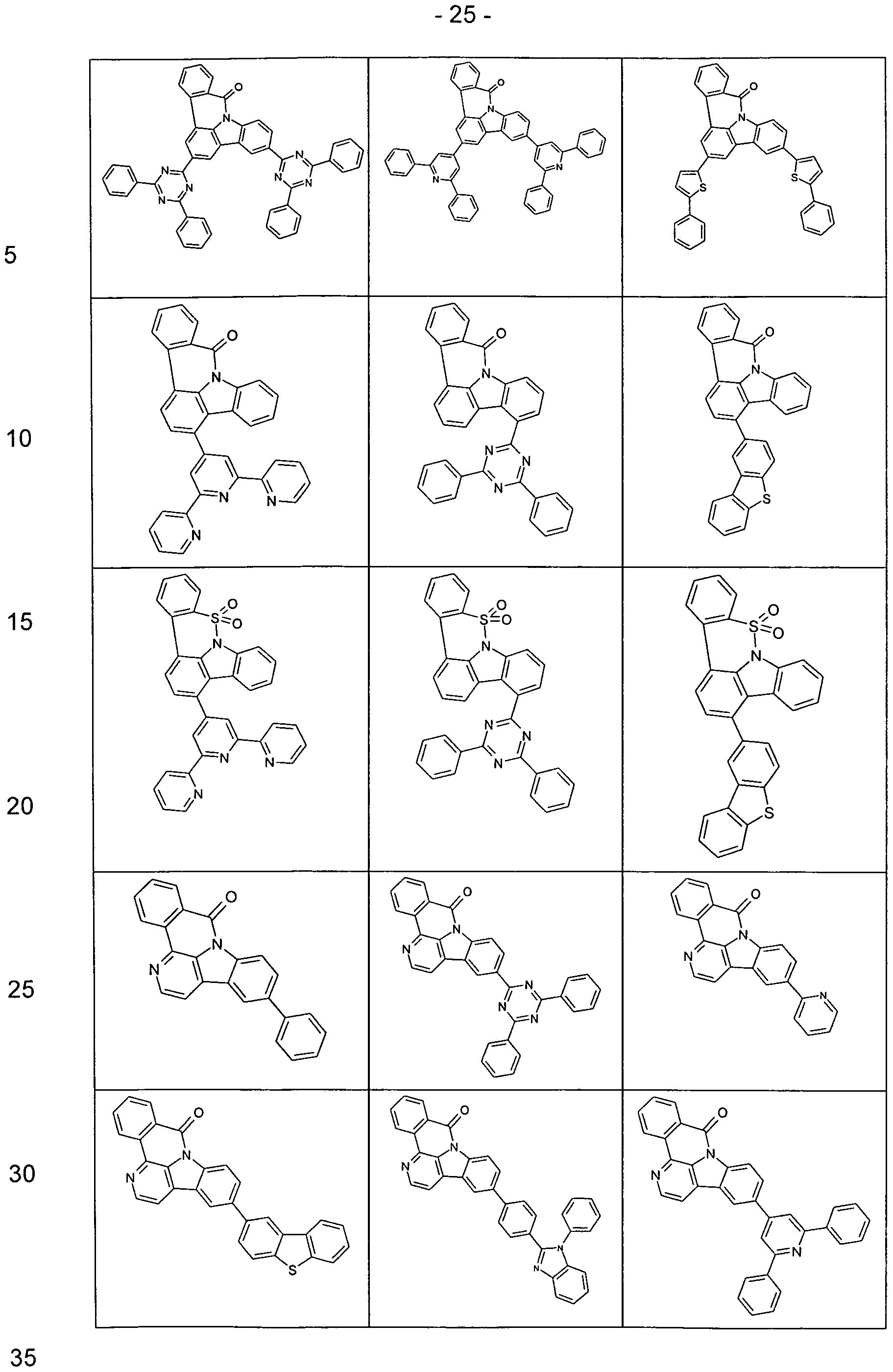

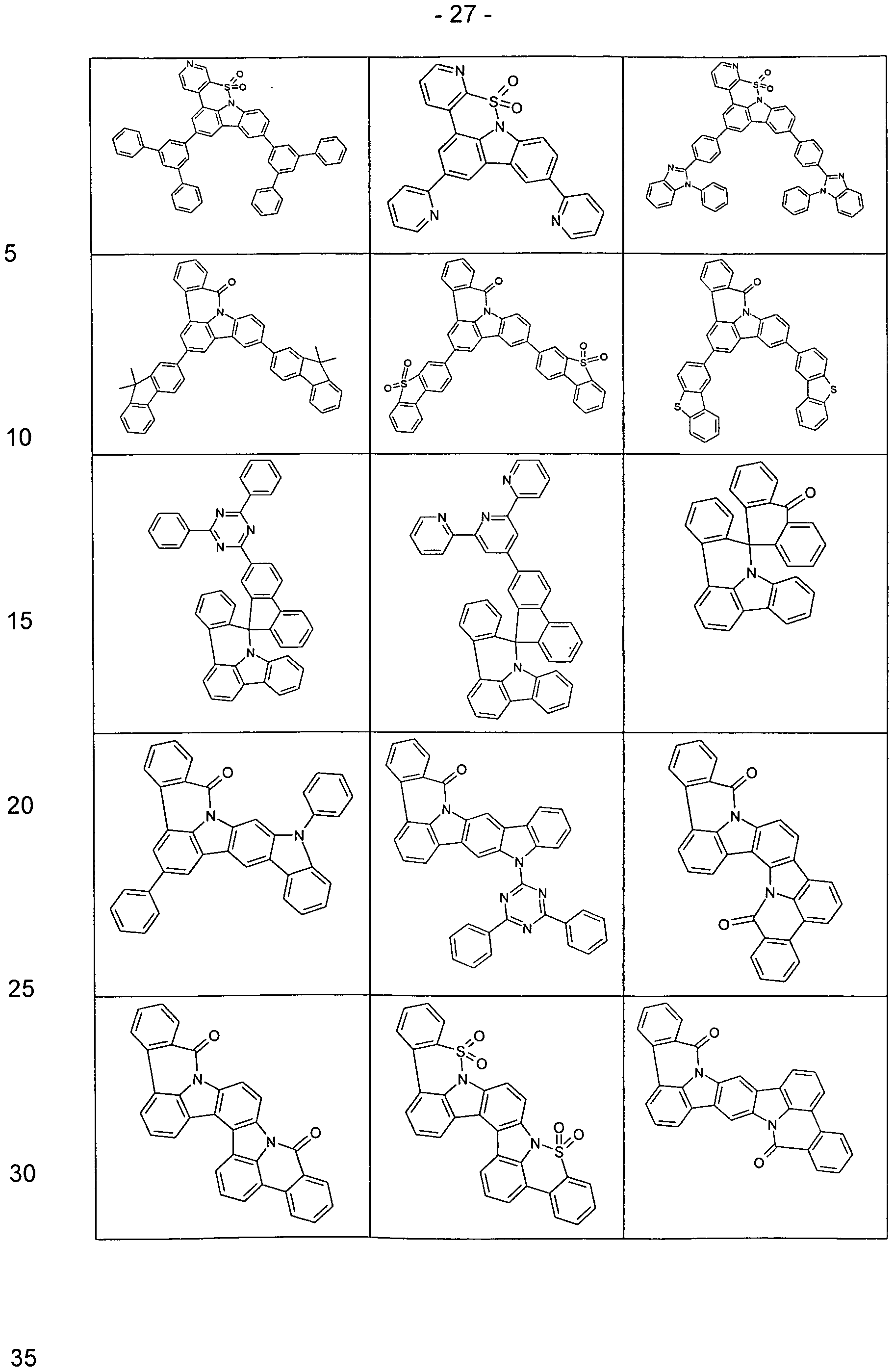


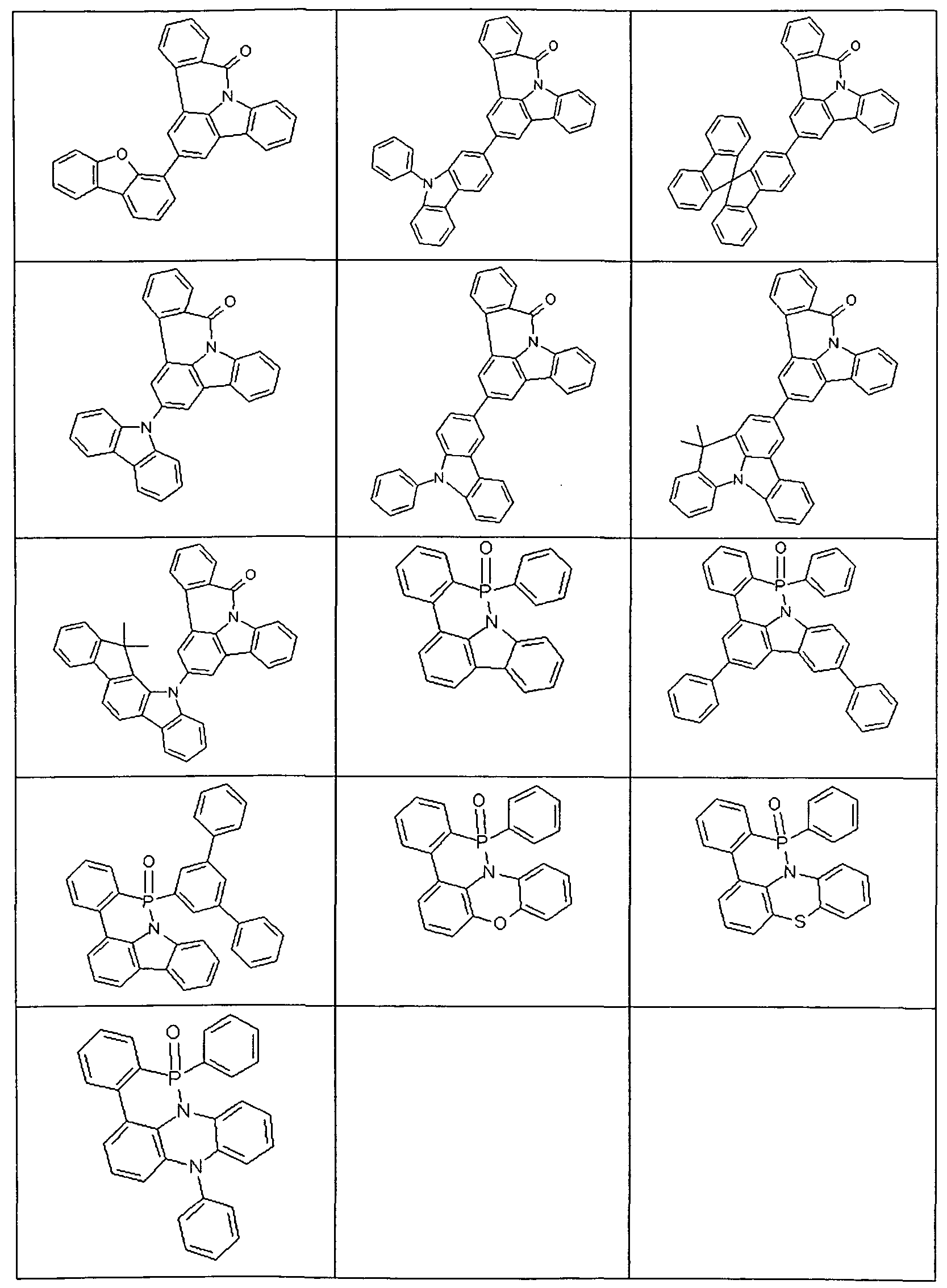
Die organische Elektrolumineszenzvorrichtung enthält Kathode, Anode und mindestens eine emittierende Schicht. Außer diesen Schichten kann sie noch weitere Schichten enthalten, beispielsweise jeweils eine oder mehrere Lochinjektionsschichten, Lochtransportschichten, Lochblockierschichten, Elektronentransportschichten, Elektroneninjektionsschichten, Exzitonenblockierschichten, Elektronenblockierschichten und/oder The organic electroluminescent device includes cathode, anode and at least one emitting layer. In addition to these layers, they may also contain further layers, for example in each case one or more hole injection layers, hole transport layers, hole blocking layers, electron transport layers, electron injection layers, Exciton blocking layers, electron blocking layers and / or
Ladungserzeugungsschichten (Charge-Generation Layers). Ebenso können zwischen zwei emittierende Schichten Interlayer eingebracht sein, welche beispielsweise eine exzitonenblockierende Funktion aufweisen. Es sei aber darauf hingewiesen, dass nicht notwendigerweise jede dieser Schichten vorhanden sein muss. Dabei kann die organische Elektro- lumineszenzvorrichtung eine emittierende Schicht enthalten, oder sie kann mehrere emittierende Schichten enthalten. Wenn mehrere Emissionsschichten vorhanden sind, weisen diese bevorzugt insgesamt mehrere Emissionsmaxima zwischen 380 nm und 750 nm auf, so dass insgesamt weiße Emission resultiert, d. h. in den emittierenden Schichten werden verschiedene emittierende Verbindungen verwendet, die fluoreszieren oder phosphoreszieren können. Insbesondere bevorzugt sind Systeme mit drei emittierenden Schichten, wobei die drei Schichten blaue, grüne und orange oder rote Emission zeigen (für den prinzipiellen Aufbau siehe z. B. WO 2005/011013). Charge Generation Layers (Charge Generation Layers). Likewise, interlayer may be introduced between two emitting layers which, for example, have an exciton-blocking function. It should be noted, however, that not necessarily each of these layers must be present. In this case, the organic electroluminescent device may contain an emitting layer, or it may contain a plurality of emitting layers. If multiple emission layers are present, they preferably have a total of several emission maxima between 380 nm and 750 nm, so that overall white emission results, ie. H. In the emitting layers, various emitting compounds are used which can fluoresce or phosphoresce. Particular preference is given to systems having three emitting layers, the three layers exhibiting blue, green and orange or red emission (for the basic structure see, for example, WO 2005/011013).
Die erfindungsgemäße Verbindung gemäß den oben aufgeführten The compound of the invention according to the above
Ausführungsformen kann dabei in unterschiedlichen Schichten eingesetzt werden, je nach genauer Struktur. Bevorzugt ist eine organische Elektro- lumineszenzvorrichtung, enthaltend eine Verbindung gemäß Formel (1) bzw. die oben ausgeführten bevorzugten Ausführungsformen als Matrixmaterial für fluoreszierende oder phosphoreszierende Emitter, insbesondere für phosphoreszierende Emitter, und/oder in einer Lochblockierschicht und/oder in einer Elektronentransportschicht und/oder in einer elektronenblockierenden bzw. exzitonenblockierenden Schicht und/oder in einer Lochtransportschicht, je nach genauer Substitution. Embodiments can be used in different layers, depending on the exact structure. Preference is given to an organic electroluminescent device comprising a compound according to formula (1) or the preferred embodiments described above as matrix material for fluorescent or phosphorescent emitters, in particular for phosphorescent emitters, and / or in a hole blocking layer and / or in an electron transport layer and / or or in an electron-blocking or exciton-blocking layer and / or in a hole-transport layer, depending on the exact substitution.
In einer weiteren Ausführungsform der Erfindung enthält die organische Elektrolumineszenzvorrichtung die Verbindung gemäß Formel (1) bzw. die oben ausgeführten bevorzugten Ausführungsformen in einer optischen Auskopplungsschicht. Unter einer optischen Auskopplungsschicht wird dabei eine Schicht verstanden, die nicht zwischen der Anode und der Kathode liegt, sondern die außerhalb der eigentlichen Vorrichtung auf eine Elektrode aufgebracht wird, beispielsweise zwischen einer Elektrode und einem Substrat, um die optische Auskopplung zu verbessern. ln einer bevorzugten Ausführungsform der Erfindung wird die Verbindung gemäß Formel (1) bzw. die oben ausgeführten bevorzugten Ausführungsformen als Matrixmaterial für eine fluoreszierende oder phosphoreszierende Verbindung, insbesondere für eine phosphoreszierende Verbindung, in einer emittierenden Schicht eingesetzt. Dabei kann die organische Elektrolumineszenzvorrichtung eine emittierende Schicht enthalten, oder sie kann mehrere emittierende Schichten enthalten, wobei mindestens eine emittierende Schicht mindestens eine erfindungsgemäße Verbindung als Matrixmaterial enthält. In a further embodiment of the invention, the organic electroluminescent device contains the compound according to formula (1) or the above-described preferred embodiments in an optical coupling-out layer. An optical coupling-out layer is understood to be a layer which does not lie between the anode and the cathode, but which is applied to an electrode outside the actual device, for example between an electrode and a substrate, in order to improve the optical coupling-out. In a preferred embodiment of the invention, the compound according to formula (1) or the above-described preferred embodiments is used as matrix material for a fluorescent or phosphorescent compound, in particular for a phosphorescent compound, in an emitting layer. In this case, the organic electroluminescent device may contain an emitting layer, or it may contain a plurality of emitting layers, wherein at least one emitting layer contains at least one compound according to the invention as matrix material.
Wenn die Verbindung gemäß Formel (1) bzw. die oben ausgeführten bevorzugten Ausführungsformen als Matrixmaterial für eine emittierende Verbindung in einer emittierenden Schicht eingesetzt wird, wird sie bevorzugt in Kombination mit einem oder mehreren phosphoreszierenden Materialien (Triplettemitter) eingesetzt. Unter Phosphoreszenz im Sinne dieser Erfindung wird die Lumineszenz aus einem angeregten Zustand mit höherer Spinmultiplizität verstanden, also einem Spinzustand > 1 , insbesondere aus einem angeregten Triplettzustand. Im Sinne dieser When the compound according to formula (1) or the preferred embodiments outlined above is used as the matrix material for an emitting compound in an emitting layer, it is preferably used in combination with one or more phosphorescent materials (triplet emitters). In the context of this invention, phosphorescence is understood as meaning the luminescence from an excited state with a higher spin multiplicity, ie a spin state> 1, in particular from an excited triplet state. In the sense of this
Anmeldung sollen alle lumineszierenden Komplexe mit Übergangsmetallen oder Lanthaniden, insbesondere alle Iridium-, Platin- und Kupferkomplexe als phosphoreszierende Verbindungen angesehen werden. All the luminescent complexes with transition metals or lanthanides, in particular all iridium, platinum and copper complexes, should be regarded as phosphorescent compounds.
Die Mischung aus der Verbindung gemäß Formel (1) bzw. der oben ausgeführten bevorzugten Ausführungsformen und der emittierenden Verbindung enthält zwischen 99 und 1 Vol.-%, vorzugsweise zwischen 98 und 10 Vol.-%, besonders bevorzugt zwischen 97 und 60 Vol.-%, insbesondere zwischen 95 und 80 Vol.-% der Verbindung gemäß Formel (1) bzw. der oben ausgeführten bevorzugten Ausführungsformen bezogen auf die Gesamtmischung aus Emitter und Matrixmaterial. Entsprechend enthält die Mischung zwischen 1 und 99 Vol.-%, vorzugsweise zwischen 2 und 90 Vol.-%, besonders bevorzugt zwischen 3 und 40 Vol.-%, insbesondere zwischen 5 und 20 Vol.-% des Emitters bezogen auf die Gesamtmischung aus Emitter und Matrixmaterial. Eine weitere bevorzugte Ausführungsform der vorliegenden Erfindung ist der Einsatz der Verbindung gemäß Formel (1) bzw. der oben ausgeführten bevorzugten Ausführungsformen als Matrixmaterial für einen phosphoreszierenden Emitter in Kombination mit einem weiteren Matrixmaterial. The mixture of the compound according to formula (1) or the above-described preferred embodiments and the emitting compound contains between 99 and 1 vol.%, Preferably between 98 and 10 vol.%, Particularly preferably between 97 and 60 vol. %, in particular between 95 and 80 vol .-% of the compound according to formula (1) or the above-described preferred embodiments based on the total mixture of emitter and matrix material. Accordingly, the mixture contains between 1 and 99% by volume, preferably between 2 and 90% by volume, more preferably between 3 and 40% by volume, in particular between 5 and 20% by volume of the emitter, based on the total mixture Emitter and matrix material. A further preferred embodiment of the present invention is the use of the compound of the formula (1) or of the above-described preferred embodiments as a matrix material for a phosphorescent emitter in combination with another matrix material.
Besonders geeignete Matrixmaterialien, welche in Kombination mit den Verbindungen gemäß Formel (1) bzw. der oben ausgeführten bevorzugten Ausführungsformen eingesetzt werden können, sind aromatische Ketone, aromatische Phosphinoxide oder aromatische Sulfoxide oder Sulfone, z. B. gemäß WO 2004/013080, WO 2004/093207, WO 2006/005627 oder WO 2010/006680, Triarylamine, Carbazolderivate, z. B. CBP (N,N-Bis- carbazolylbiphenyl) oder die in WO 2005/039246, US 2005/0069729, JP 2004/288381 , EP 1205527 oder WO 2008/086851 offenbarten Particularly suitable matrix materials which can be used in combination with the compounds according to formula (1) or the above-described preferred embodiments are aromatic ketones, aromatic phosphine oxides or aromatic sulfoxides or sulfones, eg. B. according to WO 2004/013080, WO 2004/093207, WO 2006/005627 or WO 2010/006680, triarylamines, carbazole derivatives, z. CBP (N, N-biscarbazolylbiphenyl) or those disclosed in WO 2005/039246, US 2005/0069729, JP 2004/288381, EP 1205527 or WO 2008/086851
Carbazolderivate, Indolocarbazolderivate, z. B. gemäß WO 2007/063754 oder WO 2008/056746, Indenocarbazolderivate, z. B. gemäß WO Carbazole derivatives, indolocarbazole derivatives, e.g. B. according to WO 2007/063754 or WO 2008/056746, indenocarbazole derivatives, for. B. according to WO
2010/136109 oder WO 2011/000455, Azacarbazolderivate, z. B. gemäß EP 1617710, EP 1617711 , EP 1731584, JP 2005/347160, bipolare Matrixmaterialien, z. B. gemäß WO 2007/137725, Silane, z. B. gemäß WO 2005/111172, Azaborole oder Boronester, z. B. gemäß WO 2006/1 7052, Triazinderivate, z. B. gemäß WO 2007/063754, WO 2008/056746, WO 2010/015306 oder den nicht offen gelegten Anmeldungen DE 2010/136109 or WO 2011/000455, Azacarbazolderivate, z. B. according to EP 1617710, EP 1617711, EP 1731584, JP 2005/347160, bipolar matrix materials, for. B. according to WO 2007/137725, silanes, z. B. according to WO 2005/111172, azaborole or boronic esters, z. B. according to WO 2006/1 7052, triazine derivatives, z. B. according to WO 2007/063754, WO 2008/056746, WO 2010/015306 or not disclosed applications DE
102009053382.6, DE 102009053644.2 oder DE 102009053645.0, Zinkkomplexe, z. B. gemäß EP 652273 oder WO 2009/062578, Diazasilol- bzw. Tetraazasilol-Derivate, z. B. gemäß WO 2010/054729, Diaza- phosphol-Derivate, z. B. gemäß WO 2010/054730, verbrückte Carbazol- Derivate, z. B. gemäß den nicht offen gelegten Anmeldungen DE 102009053382.6, DE 102009053644.2 or DE 102009053645.0, zinc complexes, for. B. according to EP 652273 or WO 2009/062578, diazasilol or tetraazasilol derivatives, z. B. according to WO 2010/054729, diazaphosphole derivatives, z. B. according to WO 2010/054730, bridged carbazole derivatives, z. B. according to the unpublished applications DE
102009048791.3 und DE 102009053836.4. Ebenso kann ein weiterer phosphoreszierender Emitter, welcher kürzerwellig als der eigentliche Emitter emittiert, als Co-Host in der Mischung vorhanden sein. 102009048791.3 and DE 102009053836.4. Likewise, a further phosphorescent emitter, which emits shorter wavelength than the actual emitter, may be present as a co-host in the mixture.
Als phosphoreszierende Verbindungen (= Triplettemitter) eignen sich insbesondere Verbindungen, die bei geeigneter Anregung Licht, vorzugsweise im sichtbaren Bereich, emittieren und außerdem mindestens ein Atom der Ordnungszahl größer 20, bevorzugt größer 38 und kleiner 84, besonders bevorzugt größer 56 und kleiner 80 enthalten, insbesondere ein Metall mit dieser Ordnungszahl. Bevorzugt werden als Phosphoreszenzemitter Verbindungen, die Kupfer, Molybdän, Wolfram, Rhenium, Ruthenium, Osmium, Rhodium, Iridium, Palladium, Platin, Silber, Gold oder Europium enthalten, verwendet, insbesondere Verbindungen, die Iridium oder Platin enthalten. Suitable phosphorescent compounds (= triplet emitters) are, in particular, compounds which emit light, preferably in the visible range, with suitable excitation and also contain at least one atom of atomic number greater than 20, preferably greater than 38 and less than 84, particularly preferably greater than 56 and less than 80, in particular a metal with this atomic number. Preferred phosphorescence emitters are compounds comprising copper, molybdenum, tungsten, rhenium, Ruthenium, osmium, rhodium, iridium, palladium, platinum, silver, gold or europium, especially compounds containing iridium or platinum.
Beispiele der oben beschriebenen Emitter können den Anmeldungen WO 00/70655, WO 01/41512, WO 02/02714, WO 02/15645, EP 1191613, EP 191612, EP 1191614, WO 05/033244, WO 05/019373 und Examples of the emitters described above can be found in the applications WO 00/70655, WO 01/41512, WO 02/02714, WO 02/15645, EP 1191613, EP 191612, EP 1191614, WO 05/033244, WO 05/019373 and
US 2005/0258742 entnommen werden. Generell eignen sich alle phosphoreszierenden Komplexe, wie sie gemäß dem Stand der Technik für phosphoreszierende OLEDs verwendet werden und wie sie dem Fachmann auf dem Gebiet der organischen Elektrolumineszenz bekannt sind, und der Fachmann kann ohne erfinderisches Zutun weitere phosphoreszierende Komplexe verwenden. US 2005/0258742 are taken. In general, all phosphorescent complexes used in the prior art for phosphorescent OLEDs and as known to those skilled in the art of organic electroluminescence are suitable, and those skilled in the art may use other phosphorescent complexes without inventive step.
In einer weiteren Ausführungsform der Erfindung enthält die erfindungsgemäße organische Elektrolumineszenzvorrichtung keine separate In a further embodiment of the invention, the organic electroluminescent device according to the invention contains no separate
Lochinjektionsschicht und/oder Lochtransportschicht und/oder Lochblockierschicht und/oder Elektronentransportschicht, d. h. die emittierende Schicht grenzt direkt an die Lochinjektionschicht oder die Anode an, und/ oder die emittierende Schicht grenzt direkt an die Elektronentransportschicht oder die Elektroneninjektionsschicht oder die Kathode an, wie zum Beispiel in WO 2005/053051 beschrieben. Weiterhin ist es möglich, einen Metallkomplex, der gleich oder ähnlich dem Metallkomplex in der emittierenden Schicht ist, direkt angrenzend an die emittierende Schicht als Lochtransport- bzw. Lochinjektionsmaterial zu verwenden, wie z. B. in WO 2009/030981 beschrieben. Hole injection layer and / or hole transport layer and / or hole blocking layer and / or electron transport layer, d. H. the emissive layer directly adjoins the hole injection layer or the anode, and / or the emissive layer directly adjoins the electron transport layer or the electron injection layer or the cathode, as described, for example, in WO 2005/053051. Furthermore, it is possible to use a metal complex, which is the same or similar to the metal complex in the emitting layer, directly adjacent to the emitting layer as a hole-transporting or hole-injection material, such as. As described in WO 2009/030981.
In einer weiteren bevorzugten Ausführungsform der Erfindung wird die Verbindung gemäß Formel (1) bzw. die oben ausgeführten bevorzugten Ausführungsformen als Elektronentransportmaterial in einer Elektronentransport- oder Elektroneninjektionsschicht eingesetzt. Dabei kann die emittierende Schicht fluoreszierend oder phosphoreszierend sein. Wenn die Verbindung als Elektronentransportmaterial eingesetzt wird, kann es bevorzugt sein, wenn sie dotiert ist, beispielsweise mit Alkalimetallkomplexen, wie z. B. LiQ (Lithiumhydroxychinolinat). ln nochmals einer weiteren bevorzugten Ausführungsform der Erfindung wird die Verbindung gemäß Formel (1) bzw. die oben ausgeführten bevorzugten Ausführungsformen in einer Lochblockierschicht eingesetzt. Unter einer Lochblockierschicht wird eine Schicht verstanden, die auf Kathodenseite direkt an eine emittierende Schicht angrenzt. In a further preferred embodiment of the invention, the compound according to formula (1) or the above-described preferred embodiments is used as an electron transport material in an electron transport or electron injection layer. In this case, the emitting layer may be fluorescent or phosphorescent. When the compound is used as an electron transport material, it may be preferred if it is doped, for example, with alkali metal complexes, such as. B. LiQ (Lithiumhydroxychinolinat). In yet another preferred embodiment of the invention, the compound according to formula (1) or the preferred embodiments outlined above are used in a hole blocking layer. A hole blocking layer is understood as meaning a layer which directly adjoins an emitting layer on the cathode side.
Es ist weiterhin möglich, die Verbindung gemäß Formel (1) bzw. die oben ausgeführten bevorzugten Ausführungsformen sowohl in einer Lochblockierschicht bzw. Elektronentransportschicht als auch als Matrix in einer emittierenden Schicht zu verwenden. It is further possible to use the compound according to formula (1) or the preferred embodiments outlined above both in a hole-blocking layer or electron-transport layer and as a matrix in an emitting layer.
In nochmals einer weiteren Ausführungsform der Erfindung wird die Verbindung gemäß Formel (1) bzw. die oben ausgeführten bevorzugten Ausführungsformen in einer Lochtransportschicht bzw. in einer In yet another embodiment of the invention, the compound according to formula (1) or the above-described preferred embodiments in a hole transport layer or in a
Elektronenblockierschicht bzw. Exzitonenblockierschicht eingesetzt. Electron blocking layer or Exzitonenblockierschicht used.
In den weiteren Schichten der erfindungsgemäßen organischen Elektro- lumineszenzvorrichtung können alle Materialien verwendet werden, wie sie üblicherweise gemäß dem Stand der Technik eingesetzt werden. Der Fachmann kann daher ohne erfinderisches Zutun alle für organische Elektrolumineszenzvorrichtungen bekannten Materialien in Kombination mit den erfindungsgemäßen Verbindungen gemäß Formel (1) bzw. den oben ausgeführten bevorzugten Ausführungsformen einsetzen. In the other layers of the organic electroluminescent device according to the invention, all materials can be used as they are commonly used according to the prior art. The person skilled in the art can therefore use, without inventive step, all materials known for organic electroluminescent devices in combination with the compounds according to the invention of formula (1) or the preferred embodiments described above.
Weiterhin bevorzugt ist eine organische Elektrolumineszenzvorrichtung, dadurch gekennzeichnet, dass eine oder mehrere Schichten mit einem Sublimationsverfahren beschichtet werden. Dabei werden die Materialien in Vakuum-Sublimationsanlagen bei einem Anfangsdruck kleiner Further preferred is an organic electroluminescent device, characterized in that one or more layers are coated with a sublimation process. The materials in vacuum sublimation systems become smaller at an initial pressure
10"5 mbar, bevorzugt kleiner 10"6 mbar aufgedampft. Es ist aber auch möglich, dass der Anfangsdruck noch geringer ist, beispielsweise kleiner 10"7 mbar. 10 "5 mbar, preferably less than 10 " 6 mbar evaporated. But it is also possible that the initial pressure is even lower, for example less than 10 "7 mbar.
Bevorzugt ist ebenfalls eine organische Elektrolumineszenzvorrichtung, dadurch gekennzeichnet, dass eine oder mehrere Schichten mit dem OVPD (Organic Vapour Phase Deposition) Verfahren oder mit Hilfe einer Trägergassublimation beschichtet werden. Dabei werden die Materialien bei einem Druck zwischen 10"5 mbar und 1 bar aufgebracht. Ein Spezialfall dieses Verfahrens ist das OVJP (Organic Vapour Jet Printing) Verfahren, bei dem die Materialien direkt durch eine Düse aufgebracht und so strukturiert werden (z. B. M. S. Arnold et a/., Appl. Phys. Lett. 2008, 92, 053301 ). Also preferred is an organic electroluminescent device, characterized in that one or more layers are coated with the OVPD (Organic Vapor Phase Deposition) method or with the aid of a carrier gas sublimation. In the process, the materials become at a pressure between 10 "5 mbar and 1 bar. A special case of this method is the OVJP (organic vapor jet printing) method in which the materials are applied directly through a nozzle and patterned (eg. BMS Arnold et a /. Appl. Phys. Lett., 2008, 92, 053301).
Weiterhin bevorzugt ist eine organische Elektrolumineszenzvorrichtung, dadurch gekennzeichnet, dass eine oder mehrere Schichten aus Lösung, wie z. B. durch Spincoating, oder mit einem beliebigen Druckverfahren, wie z. B. Siebdruck, Flexodruck, Offsetdruck, LITI (Light Induced Thermal Imaging, Thermotransferdruck), Ink-Jet Druck (Tintenstrahldruck) oder Nozzle Printing, hergestellt werden. Hierfür sind lösliche Verbindungen nötig, welche beispielsweise durch geeignete Substitution erhalten werden. Diese Verfahren eignen sich insbesondere auch für Oligomere, Dendrimere und Polymere. Further preferred is an organic electroluminescent device, characterized in that one or more layers of solution, such. B. by spin coating, or with any printing process such. As screen printing, flexographic printing, offset printing, LITI (Light Induced Thermal Imaging, thermal transfer printing), ink-jet printing (ink jet printing) or Nozzle Printing, are produced. For this purpose, soluble compounds are necessary, which are obtained for example by suitable substitution. These methods are particularly suitable for oligomers, dendrimers and polymers.
Weiterhin sind Hybridverfahren möglich, bei denen beispielsweise eine oder mehrere Schichten aus Lösung aufgebracht werden und eine oder mehrere weitere Schichten aufgedampft werden. Furthermore, hybrid processes are possible in which, for example, one or more layers are applied from solution and one or more further layers are vapor-deposited.
Diese Verfahren sind dem Fachmann generell bekannt und können von ihm ohne erfinderisches Zutun auf organische Elektrolumineszenz- vorrichtungen enthaltend die erfindungsgemäßen Verbindungen These methods are generally known to the person skilled in the art and can be used by him without inventive step on organic electroluminescent devices comprising the compounds according to the invention
angewandt werden. be applied.
Ein weiterer Gegenstand der vorliegenden Erfindung sind die oben als bevorzugt aufgeführten Verbindungen der folgenden Formel (1 '), A further subject of the present invention are the compounds of the following formula (1 ') listed above as being preferred,

Formel (T) wobei die Verbindung mit mindestens einem Rest R substituiert ist, welcher ein aromatisches oder heteroaromatisches Ringsystem darstellt, und wobei für die verwendeten Symbole und Indizes gilt: Formula (T) wherein the compound is substituted with at least one radical R, which represents an aromatic or heteroaromatic ring system, and wherein for the symbols and indices used:
X ist C=0, C(R)2, NR, O, S, C=S, C=NR, C=C(R)2l Si(R)2l BR, PR, X is C = O, C (R) 2 , NR, O, S, C = S, C = NR, C = C (R) 2l Si (R) 2l BR, PR,
P(=0)R, SO oder SO2; P (= 0) R, SO or SO 2 ;
Y ist C, wenn Ar1 eine 6-Ring-Aryl- oder Heteroarylgruppe darstellt, bzw. ist C oder N, wenn Ar1 eine 5-Ring-Heteroarylgruppe darstellt; Y is C when Ar 1 represents a 6-ring aryl or heteroaryl group, or is C or N when Ar 1 represents a 5-membered heteroaryl group;
E ist gleich oder verschieden bei jedem Auftreten eine Einfachbindung, C(R)2, NR, O, S, C=0, C=S, C=NR, C=C(R)2, Si(R)2, BR, PR, P(=O)R, SO oder SO2; E is the same or different at each occurrence as a single bond, C (R) 2 , NR, O, S, C = O, C = S, C = NR, C = C (R) 2 , Si (R) 2 , BR , PR, P (= O) R, SO or SO 2 ;
Ar1 ist zusammen mit der Gruppe Y und dem explizit dargestellten Ar 1 is together with the group Y and explicitly shown
Kohlenstoffatom ein aromatisches oder heteroaromatisches Ringsystem mit 5 bis 30 aromatischen Ringatomen, welches durch einen oder mehrere Reste R substituiert sein kann; Carbon atom is an aromatic or heteroaromatic ring system having 5 to 30 aromatic ring atoms, which may be substituted by one or more radicals R;
Ar2 ist zusammen mit den explizit dargestellten Kohlenstoffatomen ein aromatisches oder heteroaromatisches Ringsystem mit 5 bis 30 aromatischen Ringatomen, welches durch einen oder mehrere Reste R substituiert sein kann; wenn Ar2 für ein aromatisches Ringsystem mit mindestens einem Stickstoffatom steht, welches mit einem aromatischen oder heteroaromatischen Rest R substituiert ist, dann enthält dieser Rest R mehr als 6 aromatische C- Atome; ist zusammen mit den explizit dargestellten Kohlenstoffatomen ein aromatisches oder heteroaromatisches Ringsystem mit 5 bis 30 aromatischen Ringatomen, welches durch einen oder mehrere Reste R substituiert sein kann; ist bei jedem Auftreten gleich oder verschieden ausgewählt aus

substituiert sein kann; may be substituted;
Ar4 ist bei jedem Auftreten gleich oder verschieden ein aromatisches oder heteroaromatisches Ringsystem mit 5-30 aromatischen Ringatomen, das mit einem oder mehreren nicht-aromatischen Resten R2 substituiert sein kann; dabei können zwei Reste Ar4, welche an dasselbe N-Atom oder P-Atom binden, auch durch eine Einfachbindung oder eine Brücke, ausgewählt aus N(R2), C(R2)2 oder O, miteinander verbrückt sein; Ar 4 is the same or different at each occurrence and is an aromatic or heteroaromatic ring system having 5-30 aromatic ring atoms which may be substituted with one or more non-aromatic radicals R 2 ; two Ar 4 radicals which bind to the same N atom or P atom may also be bridged together by a single bond or a bridge selected from N (R 2 ), C (R 2 ) 2 or O;
R2 ist ausgewählt aus der Gruppe bestehend aus H, D, F, CN, einem aliphatischem Kohlenwasserstoffrest mit 1 bis 20 C-Atomen, einem aromatischem oder heteroaromatischem Ringsystem mit 5 bis 30 aromatischen Ringatomen, in dem ein oder mehrere H- Atome durch D, F, Cl, Br, I oder CN ersetzt sein können, wobei zwei oder mehr benachbarte Substituenten R2 miteinander ein mono- oder polycyclisches, aliphatisches, aromatisches oder heteroaromatisches Ringsystem bilden können; dabei sind die folgenden Verbindungen von der Erfindung ausgenommen: R 2 is selected from the group consisting of H, D, F, CN, an aliphatic hydrocarbon radical having 1 to 20 C atoms, an aromatic or heteroaromatic ring system having 5 to 30 aromatic ring atoms, in which one or more H atoms by D , F, Cl, Br, I or CN may be replaced, wherein two or more adjacent substituents R 2 may together form a mono- or polycyclic, aliphatic, aromatic or heteroaromatic ring system; the following compounds are excluded from the invention:
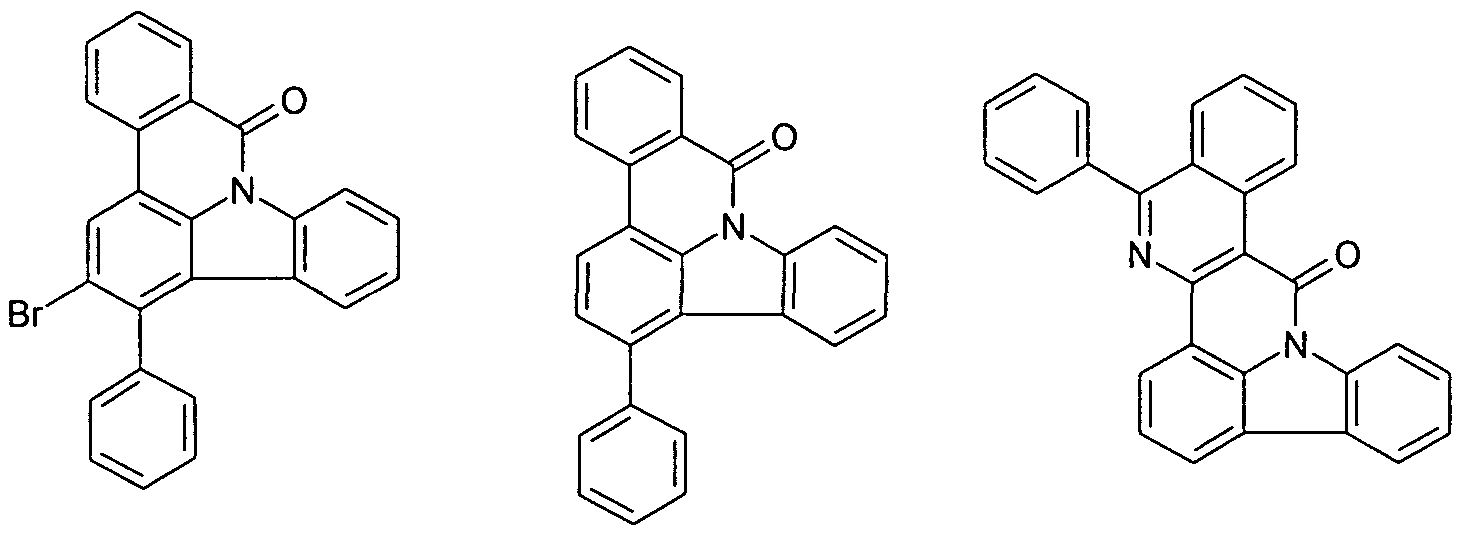

Für die erfindungsgemäßen Verbindungen der Formel (V) gelten dieselben Bevorzugungen, wie oben für die Verbindungen der Formel (1) angegeben. For the compounds of the formula (V) according to the invention, the same preferences apply as stated above for the compounds of the formula (1).
Die Verbindungen der Formel (1) bzw. bzw. die bevorzugten Ausführungsformen können nach dem Fachmann bekannten Syntheseschritten dargestellt werden, wie in Schema 1 bis 3 schematisch dargestellt. The compounds of the formula (1) or the preferred embodiments can be prepared by synthesis steps known to those skilled in the art, as shown schematically in Schemes 1 to 3.

3030
35 35
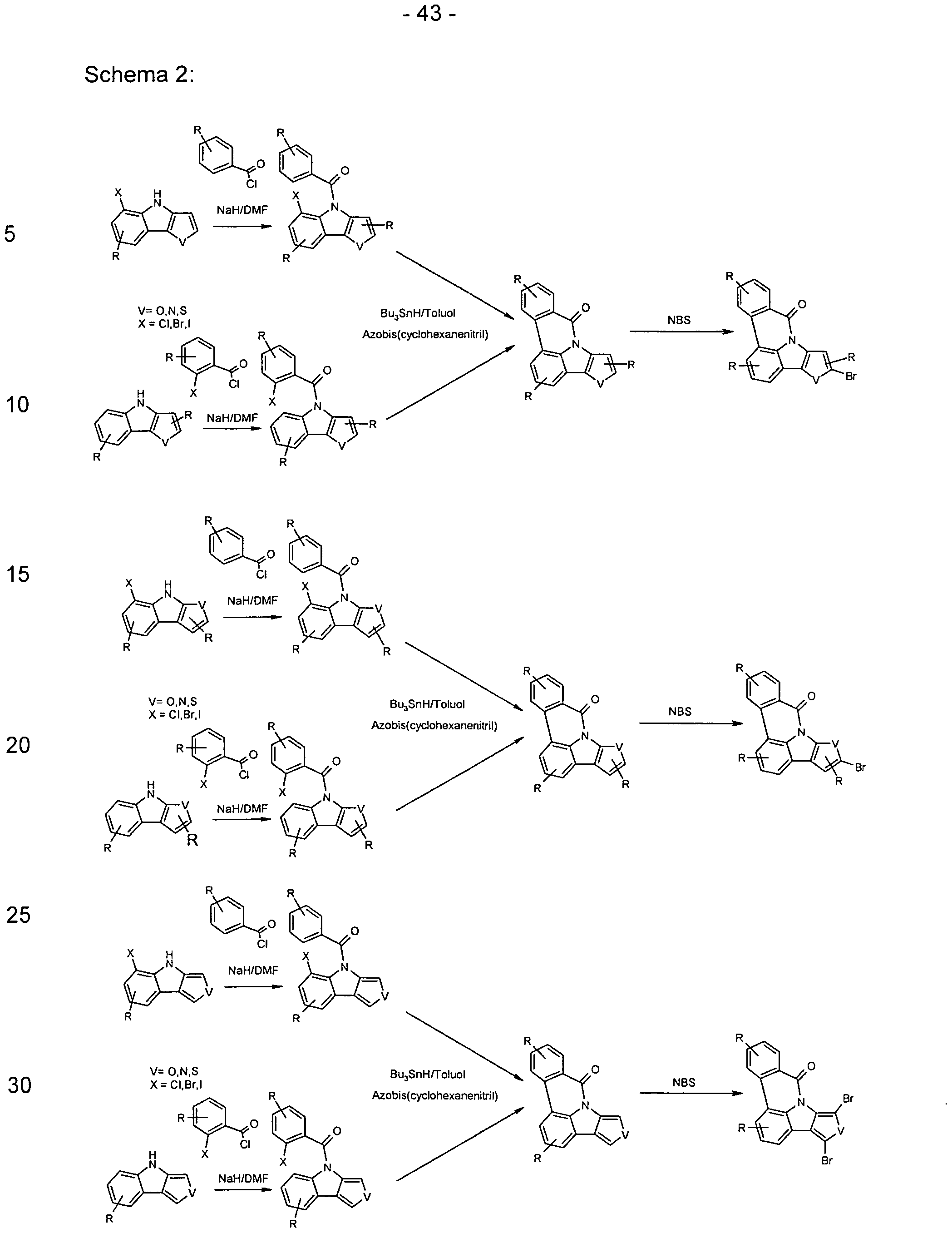
chema 3: Chema 3:

Die funktionalisierten, insbesondere bromierten Verbindungen stellen den zentralen Baustein für die weitere Funktionaiisierung dar, wie in Schema 1 bis 3 dargestellt. So lassen sich diese funktionalisierten Verbindungen leicht durch Suzuki-Kupplung oder Kupplung mit Diarylaminen nach Hartwig-Buchwald mit Carbazol-Derivaten oder Triarylamin-Derivaten zu Verbindungen gemäß Formel (1) bzw. Formel (V) umsetzen. The functionalized, in particular brominated compounds represent the central building block for the further functionalization, as shown in Schemes 1 to 3. Thus, these functionalized compounds can easily by Suzuki coupling or coupling with diarylamines Hartwig-Buchwald with carbazole derivatives or triarylamine derivatives to compounds according to formula (1) or formula (V) implement.
Die bromierten Verbindungen können weiterhin lithiiert und durch Reaktion mit Elektrophilen wie Benzonitril und anschließender saurer Hydrolyse zu Ketonen oder mit Chlordiphenylphosphinen und anschließender Oxidation zu Phosphinoxiden umgesetzt werden. The brominated compounds may further be lithiated and reacted by reaction with electrophiles such as benzonitrile followed by acid hydrolysis to ketones or with chlorodiphenylphosphines and subsequent oxidation to phosphine oxides.
Ein weiterer Gegenstand der vorliegenden Erfindung ist daher ein Verfahren zur Herstellung einer Verbindung gemäß Formel (V) , umfassend die Reaktionsschritte: Another object of the present invention is therefore a process for the preparation of a compound according to formula (V), comprising the reaction steps:
a) Synthese des Grundgerüsts, welches statt der Gruppe R eine reaktive Abgangsgruppe trägt; und a) Synthesis of the skeleton which carries a reactive leaving group instead of the group R; and
b) Einführung der Gruppe R, bevorzugt durch eine Kupplungsreaktion, beispielsweise Suzuki-Kupplung oder Hartwig-Buchwald-Kupplung. b) Introduction of the group R, preferably by a coupling reaction, for example Suzuki coupling or Hartwig-Buchwald coupling.
Dabei ist die reaktive Abgangsgruppe bevorzugt ausgewählt aus Cl, Br, I, Boronsäure bzw. Boronsäurederivaten, Triflat oder Tosylat oder V steht für NH, d. h. die reaktive Abgangsgruppe ist Wasserstoff, wenn eine Bindung zwischen N und R geknüpft wird. Die oben beschriebenen erfindungsgemäßen Verbindungen, insbesondere Verbindungen, welche mit reaktiven Abgangsgruppen, wie Brom, lod, Chlor, Boronsäure oder Boronsäureester, oder mit reaktiven, polymerisier- baren Gruppen, wie Olefinen oder Oxetanen, substituiert sind, können als Monomere zur Erzeugung entsprechender Oligomere, Dendrimere oder Polymere Verwendung finden. Die Oligomerisation bzw. Polymerisation erfolgt dabei bevorzugt über die Halogenfunktionalität bzw. die Boron- säurefunktionalität bzw. über die polymerisierbare Gruppe. Es ist weiterhin möglich, die Polymere über derartige Gruppen zu vernetzen. Die In this case, the reactive leaving group is preferably selected from Cl, Br, I, boronic acid or boronic acid derivatives, triflate or tosylate or V is NH, ie the reactive leaving group is hydrogen, if a bond between N and R is attached. The compounds according to the invention described above, in particular compounds which are substituted with reactive leaving groups, such as bromine, iodine, chlorine, boronic acid or boronic acid esters, or with reactive, polymerizable groups, such as olefins or oxetanes, can be used as monomers for producing corresponding oligomers, Dendrimers or polymers find use. The oligomerization or polymerization takes place preferably via the halogen functionality or the boronic acid functionality or via the polymerizable group. It is also possible to crosslink the polymers via such groups. The
erfindungsgemäßen Verbindungen und Polymere können als vernetzte oder unvernetzte Schicht eingesetzt werden. Compounds of the invention and polymers can be used as a crosslinked or uncrosslinked layer.
Weiterer Gegenstand der Erfindung sind daher Oligomere, Polymere oder Dendrimere enthaltend eine oder mehrere der oben aufgeführten erfindungsgemäßen Verbindungen, wobei eine oder mehrere Bindungen der erfindungsgemäßen Verbindung zum Polymer, Oligomer oder The invention therefore further oligomers, polymers or dendrimers containing one or more of the compounds of the invention listed above, wherein one or more bonds of the inventive compound to the polymer, oligomer or
Dendrimer vorhanden sind. Je nach Verknüpfung der erfindungsgemäßen Verbindung bildet diese daher eine Seitenkette des Oligomers oder Polymers oder ist in der Hauptkette verknüpft. Die Polymere, Oligomere oder Dendrimere können konjugiert, teilkonjugiert oder nicht-konjugiert sein. Die Oligomere oder Polymere können linear, verzweigt oder dendritisch sein. Für die Wiederholeinheiten der erfindungsgemäßen Verbindungen in Oligomeren, Dendrimeren und Polymeren gelten dieselben Bevorzugungen, wie oben beschrieben. Dendrimer are present. Depending on the linkage of the compound according to the invention, this therefore forms a side chain of the oligomer or polymer or is linked in the main chain. The polymers, oligomers or dendrimers may be conjugated, partially conjugated or non-conjugated. The oligomers or polymers may be linear, branched or dendritic. The repeat units of the compounds according to the invention in oligomers, dendrimers and polymers have the same preferences as described above.
Zur Herstellung der Oligomere oder Polymere werden die erfindungsgemäßen Monomere homopolymerisiert oder mit weiteren Monomeren copolymerisiert. Bevorzugt sind Homopolymere oder Copolymere, wobei die Einheiten gemäß Formel (V) bzw. die oben ausgeführten bevorzugten Ausführungsformen zu 0.01 bis 99.9 mol%, bevorzugt 5 bis 90 mol%, besonders bevorzugt 20 bis 80 mol% vorhanden sind. Geeignete und bevorzugte Comonomere, welche das Polymergrundgerüst bilden, sind gewählt aus Fluorenen (z. B. gemäß EP 842208 oder WO 2000/22026), Spirobifluorenen (z. B. gemäß EP 707020, EP 894107 oder WO To prepare the oligomers or polymers, the monomers according to the invention are homopolymerized or copolymerized with further monomers. Preference is given to homopolymers or copolymers in which the units of the formula (V) or the preferred embodiments described above are present at from 0.01 to 99.9 mol%, preferably from 5 to 90 mol%, particularly preferably from 20 to 80 mol%. Suitable and preferred comonomers which form the polymer backbone are selected from fluorenes (eg according to EP 842208 or WO 2000/22026), spirobifluorenes (eg according to EP 707020, EP 894107 or WO
2006/061 81), Para-phenylenen (z. B. gemäß WO 92/18552), Carbazolen (z. B. gemäß WO 2004/070772 oder WO 2004/113468), Thiophenen (z. B. gemäß EP 1028136), Dihydrophenanthrenen (z. B. gemäß WO 2006/061 81), para-phenylenes (eg according to WO 92/18552), carbazoles (eg according to WO 2004/070772 or WO 2004/113468), thiophenes (eg. according to EP 1028136), dihydrophenanthrenes (eg according to WO
2005/014689), eis- und trans-lndenofluorenen (z. B. gemäß WO 2005/014689), cis and trans indenofluorenes (eg according to WO
2004/041901 oder WO 2004/113412), Ketonen (z. B. gemäß 2004/041901 or WO 2004/113412), ketones (eg according to
WO 2005/040302), Phenanthrenen (z. B. gemäß WO 2005/104264 oder WO 2007/017066) oder auch mehreren dieser Einheiten. Die Polymere, Oligomere und Dendrimere können noch weitere Einheiten enthalten, beispielsweise Lochtransporteinheiten, insbesondere solche basierend auf Triarylaminen, und/oder Elektronentransporteinheiten. Außerdem können die Polymere entweder einpolymerisiert oder als Blend eingemischt Triplett-Emitter enthalten. Gerade die Kombination von Einheiten gemäß Formel (1') bzw. der oben ausgeführten bevorzugten Ausführungsformen mit Triplett-Emittern führt zu besonders guten Ergebnissen. WO 2005/040302), phenanthrenes (for example according to WO 2005/104264 or WO 2007/017066) or also several of these units. The polymers, oligomers and dendrimers may also contain other units, for example hole transport units, in particular those based on triarylamines, and / or electron transport units. In addition, the polymers may either be copolymerized or mixed in as a blend containing triplet emitters. Especially the combination of units according to formula (1 ') or the above-described preferred embodiments with triplet emitters leads to particularly good results.
Weiterhin können die Verbindungen gemäß Formel (1 ') bzw. die oben ausgeführten bevorzugten Ausführungsformen auch weiter funktionalisiert werden und so zu erweiterten Strukturen umgesetzt werden. Hier ist als Beispiel die Umsetzung mit Arylboronsäuren gemäß Suzuki oder mit primären oder sekundären Aminen gemäß Hartwig-Buchwald zu nennen. So können die Verbindungen gemäß Formel (1') bzw. die oben ausgeführten bevorzugten Ausführungsformen auch direkt an phosphoreszierende Metallkomplexe oder auch an andere Metallkomplexe gebunden werden. Furthermore, the compounds according to formula (1 ') or the preferred embodiments described above can also be further functionalized and thus converted to extended structures. Here is an example of the reaction with arylboronic acids according to Suzuki or with primary or secondary amines according to Hartwig-Buchwald mentioned. Thus, the compounds of the formula (1 ') or the above-described preferred embodiments can also be bound directly to phosphorescent metal complexes or else to other metal complexes.
Ein weiterer Gegenstand der vorliegenden Erfindung ist daher die Another object of the present invention is therefore the
Verwendung der oben ausgeführten erfindungsgemäßen Verbindungen gemäß Formel (1 ') in einer elektronischen Vorrichtung, insbesondere in einer organischen Elektrolumineszenzvorrichtung. Use of the inventive compounds of the formula (1 ') according to the invention in an electronic device, in particular in an organic electroluminescent device.
Die erfindungsgemäßen Verbindungen und die erfindungsgemäßen organischen Elektrolumineszenzvorrichtungen zeichnen sich durch folgende überraschende Vorteile gegenüber dem Stand der Technik aus: The compounds according to the invention and the organic electroluminescent devices according to the invention are distinguished by the following surprising advantages over the prior art:
1. Die erfindungsgemäßen Verbindungen bzw. Verbindungen gemäß Formel (1) bzw. die oben ausgeführten bevorzugten Ausführungsformen, eingesetzt als Matrixmaterial für fluoreszierende oder phosphoreszierende Emitter, führen zu sehr hohen Effizienzen sowie zu langen Lebensdauern. Dies gilt insbesondere, wenn die Verbindungen als Matrixmaterial für einen rot oder grün phosphoreszierenden Emitter eingesetzt werden. 1. The compounds of the invention or compounds of formula (1) or the preferred embodiments described above, used as a matrix material for fluorescent or phosphorescent emitters, lead to very high efficiencies and to long lifetimes. This is especially true when the compounds are used as matrix material for a red or green phosphorescent emitter.
2. Die erfindungsgemäßen Verbindungen weisen eine hohe thermische Stabilität auf. 2. The compounds of the invention have a high thermal stability.
3. Die erfindungsgemäßen Verbindungen, eingesetzt in organischen 3. The compounds of the invention used in organic
Elektrolumineszenzvorrichtungen, führen zu hohen Effizienzen und zu steilen Strom-Spannungs-Kurven mit niedrigen Einsatzspannungen. Electroluminescent devices lead to high efficiencies and steep current-voltage curves with low threshold voltages.
4. Auch bei Verwendung als Elektronentransportmaterial führen die 4. Even when used as an electron transport material lead the
erfindungsgemäßen Verbindungen zu sehr guten Eigenschaften in Bezug auf die Effizienz, die Lebensdauer und die Betriebsspannung von organischen Elektrolumineszenzvorrichtungen. Compounds according to the invention have very good properties in terms of efficiency, lifetime and operating voltage of organic electroluminescent devices.
Diese oben genannten Vorteile gehen nicht mit einer Verschlechterung der weiteren elektronischen Eigenschaften einher. These advantages mentioned above are not accompanied by a deterioration of the other electronic properties.
Die Erfindung wird durch die nachfolgenden Beispiele näher erläutert, ohne sie dadurch einschränken zu wollen. Der Fachmann kann aus den Schilderungen die Erfindung im gesamten offenbarten Bereich ausführen und ohne erfinderisches Zutun weitere erfindungsgemäße Verbindungen herstellen und diese in elektronischen Vorrichtungen verwenden bzw. das erfindungsgemäße Verfahren anwenden. The invention is explained in more detail by the following examples without wishing to restrict them thereby. The person skilled in the art can, from the descriptions, carry out the invention in the entire disclosed area and produce other inventive compounds without inventive step and use them in electronic devices or use the method according to the invention.
Beispiele: Examples:
Die nachfolgenden Synthesen werden, sofern nicht anders angegeben, unter einer Schutzgasatmosphäre durchgeführt. Die Edukte können von den Firmen ALDRICH bzw. ABCR (Palladium(ll)acetat, Tri-o-tolylphosphin, Anorganika, Lösemittel) bezogen werden. Die Synthese von 3-Phenyl-4- (phenylsulfonyl)-4H-Furo[3,4-b]indol kann gemäß der Literatur (Journal of Organic Chemistry 2002, 67(3), 1001-1003) erfolgen. Ebenso sind die Synthesen von 11 ,12-Dihydro-11-phenyl-indolo[2,3-a]carbazol (WO Unless stated otherwise, the following syntheses are carried out under a protective gas atmosphere. The starting materials can be obtained from the companies ALDRICH or ABCR (palladium (II) acetate, tri-o-tolylphosphine, inorganics, solvents). The synthesis of 3-phenyl-4- (phenylsulfonyl) -4H-furo [3,4-b] indole can be carried out according to the literature (Journal of Organic Chemistry 2002, 67 (3), 1001-1003). Likewise, the syntheses of 11,12-dihydro-11-phenyl-indolo [2,3-a] carbazole (WO
2009/136595) sowie 2,12-Dimethyl-10-phenyl-10,12-dihydro-10-aza- indeno[2,1-b]fluoren (nicht offen gelegte Anmeldung DE 102009023155.2) aus der Literatur bekannt. 2009/136595) and 2,12-dimethyl-10-phenyl-10,12-dihydro-10-aza- indeno [2,1-b] fluoren (unpublished application DE 102009023155.2) known from the literature.
Beispiel 1a: 3-Phenyl-4H-furo[3,4-b]indol Example 1a: 3-phenyl-4H-furo [3,4-b] indole

45 g (123 mmol) 3-Phenyl-4-(phenylsulfonyl)-4H-furo[3,4-b]indol und 48 g (856 mmol) Kaliumhydroxid in 65 ml DMSO und 21 ml Wasser werden 1 h unter Rückfluss erhitzt. Anschließend wird auf Raumtemperatur gekühlt, mit 1 M HCI-Lösung neutralisiert und mit Dichloromethan extrahiert. Das Lösungsmittel wird im Vakuum eingeengt und der Rückstand chromatographisch gereinigt (Heptan/Essigsäureethylester 10:1). Ausbeute: 22,4 g (96 mmol), 80 %. 45 g (123 mmol) of 3-phenyl-4- (phenylsulfonyl) -4H-furo [3,4-b] indole and 48 g (856 mmol) of potassium hydroxide in 65 ml of DMSO and 21 ml of water are heated under reflux for 1 h. It is then cooled to room temperature, neutralized with 1 M HCl solution and extracted with dichloromethane. The solvent is concentrated in vacuo and the residue is purified by chromatography (heptane / ethyl acetate 10: 1). Yield: 22.4 g (96 mmol), 80%.
Analog wird die folgende Verbindung erhalten: Analogously, the following compound is obtained:
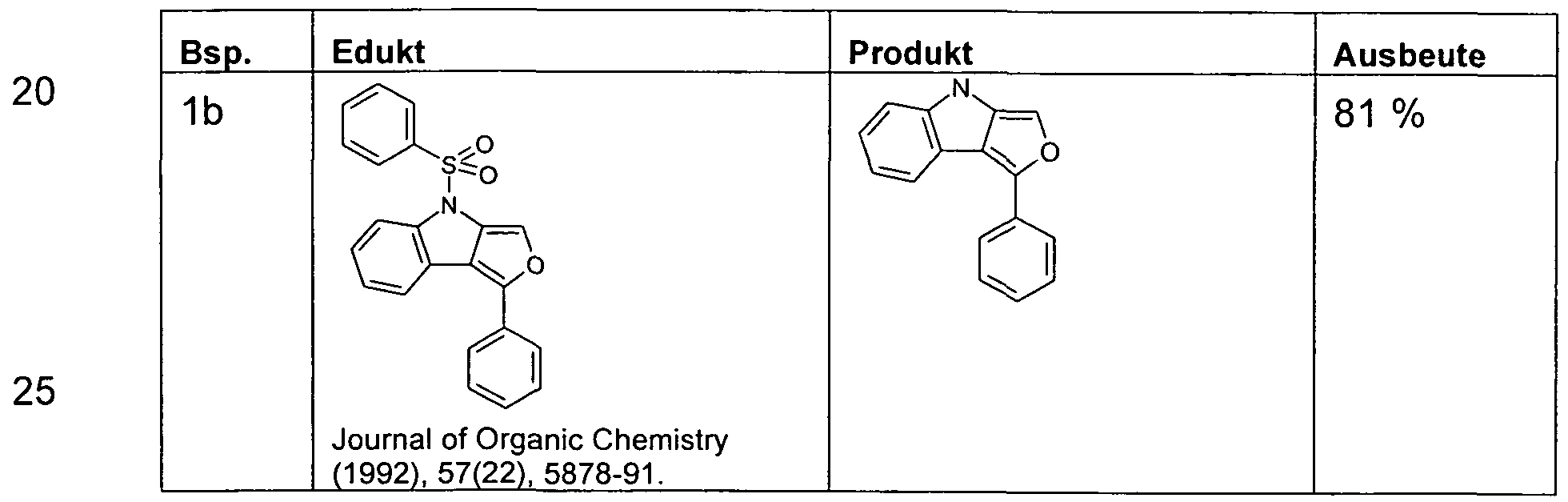
Beispiel 2 ethanon Example 2 ethanone

2.1 g (52.5 mmol) NaH (60 %ig in Mineralöl) werden in 500 mL THF unter Schutzgasatmosphäre gelöst. 1 .5 g (50mmol) 3-Phenyl-4H-furo[3,4- bjindol und 11.5 g (52.5 mmol) 15-Krone-5, gelöst in 200 ml THF, werden zugegeben . Nach 1 h bei Raumtemperatur wird eine Lösung von 12 g (55 mmol) 2-Brombenzoylchlorid in 250 mL THF zugetropft. Das Reaktionsgemisch wird 18 h bei Raumtemperatur gerührt. Nach dieser Zeit wird das Reaktionsgemisch auf Eis gegossen und dreimal mit Dichlormethan extrahiert. Die vereinigten organischen Phasen werden über Na2SO4 getrocknet und eingeengt. Der Rückstand wird mit Toluol heiß extrahiert und aus Toluol / n-Heptan umkristallisiert. Die Ausbeute beträgt 12 g (60 %). 2.1 g (52.5 mmol) of NaH (60% in mineral oil) are dissolved in 500 ml of THF under a protective gas atmosphere. 1 .5 g (50 mmol) of 3-phenyl-4H-furo [3,4- bjindol and 11.5 g (52.5 mmol) of 15-crown-5 dissolved in 200 ml of THF are added. After 1 h at room temperature, a solution of 12 g (55 mmol) 2-bromobenzoyl chloride in 250 mL THF is added dropwise. The reaction mixture is stirred for 18 h at room temperature. After this time, the reaction mixture is poured onto ice and extracted three times with dichloromethane. The combined organic phases are dried over Na 2 SO 4 and concentrated. The residue is extracted with hot toluene and recrystallized from toluene / n-heptane. The yield is 12 g (60%).
Analog werden folgende Verbindungen erhalten: The following compounds are obtained analogously:
Bsp. Edukt Produkt Ausbeute For example, starting material product yield
2b 57 % 2b 57%
2c 58 % 2c 58%
Journal of Organic Journal of Organic
Chemistry (1998), Chemistry (1998),
63(22), 7680- 7686. 63 (22), 7680-7686.
2d 61 % 2d 61%
Organic Letters Organic Letters
(2004), 6(4), 533- 535. (2004), 6 (4), 533-535.
2e 49% 2e 49%
Journal of Journal of
Heterocyclic Heterocyclic
Chemistry (1982), Chemistry (1982),
19(2), 227-31.

Beispiel 2i :(1 -Chlor-benzo[4,5]furo[3,2-b]indol-10-yl)phenylmethanon Example 2i: (1-Chloro-benzo [4,5] furo [3,2-b] indol-10-yl) -phenylmethanone
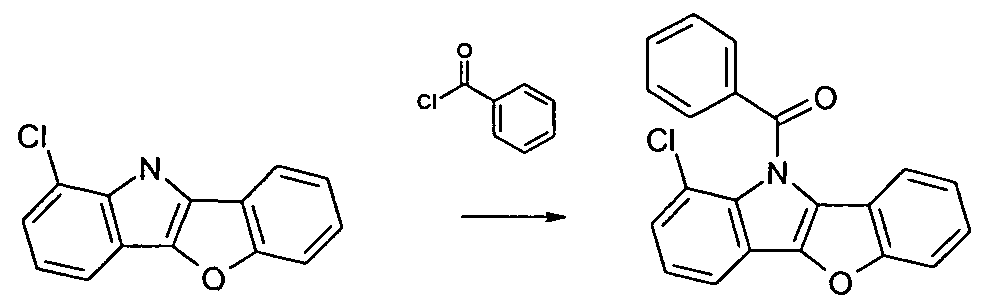
2.1 g (52.5 mmol) NaH (60%ig in Mineralöl) werden in 500 mL THF unter Schutzgasatmosphäre gelöst. 12.6 g (50mmol) 3-Phenyl-4H-furo[3,4- b]indol und 11.5 g (52.5 mmol) 15-Krone-5 gelöst in 200 ml THF werden zugegeben . Nach 1 h bei Raumtemperatur wird eine Lösung von 7.7 g (55 mmol) Benzoylchlorid in 250 mL THF zugetropft. Das Reaktionsgemisch wird dann 18 h bei Raumtemperatur gerührt. Nach dieser Zeit wird das Reaktionsgemisch auf Eis gegossen und dreimal mit Dichlormethan extrahiert. Die vereinigten organischen Phasen werden über Na2S04 getrocknet und eingeengt. Der Rückstand wird mit Toluol heiß extrahiert und aus Toluol / n-Heptan umkristallisiert. Die Ausbeute beträgt 12.5 g (69 %)· 2.1 g (52.5 mmol) of NaH (60% in mineral oil) are dissolved in 500 ml of THF under a protective gas atmosphere. 12.6 g (50 mmol) of 3-phenyl-4H-furo [3,4-b] indole and 11.5 g (52.5 mmol) of 15-crown-5 dissolved in 200 ml of THF are added. After 1 h at room temperature, a solution of 7.7 g (55 mmol) of benzoyl chloride in 250 ml of THF is added dropwise. The reaction mixture is then stirred for 18 h at room temperature. After this time, the reaction mixture is poured onto ice and extracted three times with dichloromethane. The combined organic phases are dried over Na 2 S0 4 and concentrated. The residue is extracted with hot toluene and recrystallized from toluene / n-heptane. The yield is 12.5 g (69%)
Analog werden folgende Verbindungen erhalten The following compounds are obtained analogously
Bsp. Edukt 1 Produkt Ausbeute For example, starting material 1 product yield
2j 78 % 2y 78%
DE 1197462


2.1 g (52.5 mmol) NaH (60 %ig in Mineralöl) werden in 500 mL THF unter Schutzgasatmosphäre gelöst. 11.5 g (50 mmol) 3-Phenyl-4H-furo[3,4- b]indol und 11.5 g (52.5 mmol) 15-Krone-5 gelöst in 200 ml THF werden zugegeben. Nach 1 h bei Raumtemperatur wird eine Lösung von 12.7 g (55 mmol) 2-Brom-benzolsulfonsäurechlorid in 250 mL THF zugetropft. Das Reaktionsgemisch wird 18 h bei Raumtemperatur gerührt. Nach dieser Zeit wird das Reaktionsgemisch auf Eis gegossen und dreimal mit Dichlormethan extrahiert. Die vereinigten organischen Phasen werden über Na2S04 getrocknet und eingeengt. Der Rückstand wird mit Toluol heiß extrahiert und aus Toluol / n-Heptan umkristallisiert. Die Ausbeute beträgt 16 g (75 %). 2.1 g (52.5 mmol) of NaH (60% in mineral oil) are dissolved in 500 ml of THF under a protective gas atmosphere. 11.5 g (50 mmol) of 3-phenyl-4H-furo [3,4-b] indole and 11.5 g (52.5 mmol) of 15-crown-5 dissolved in 200 ml of THF are added. After 1 h at room temperature, a solution of 12.7 g (55 mmol) of 2-bromo-benzenesulfonyl chloride in 250 ml of THF is added dropwise. The reaction mixture is stirred for 18 h at room temperature. After this time, the reaction mixture is poured onto ice and extracted three times with dichloromethane. The combined organic phases are dried over Na 2 S0 4 and concentrated. The residue is extracted with hot toluene and recrystallized from toluene / n-heptane. The yield is 16 g (75%).
Analog werden folgende Verbindungen erhalten: The following compounds are obtained analogously:
Bsp. Edukt 1 Produkt Ausbeute For example, starting material 1 product yield
2n 80 %
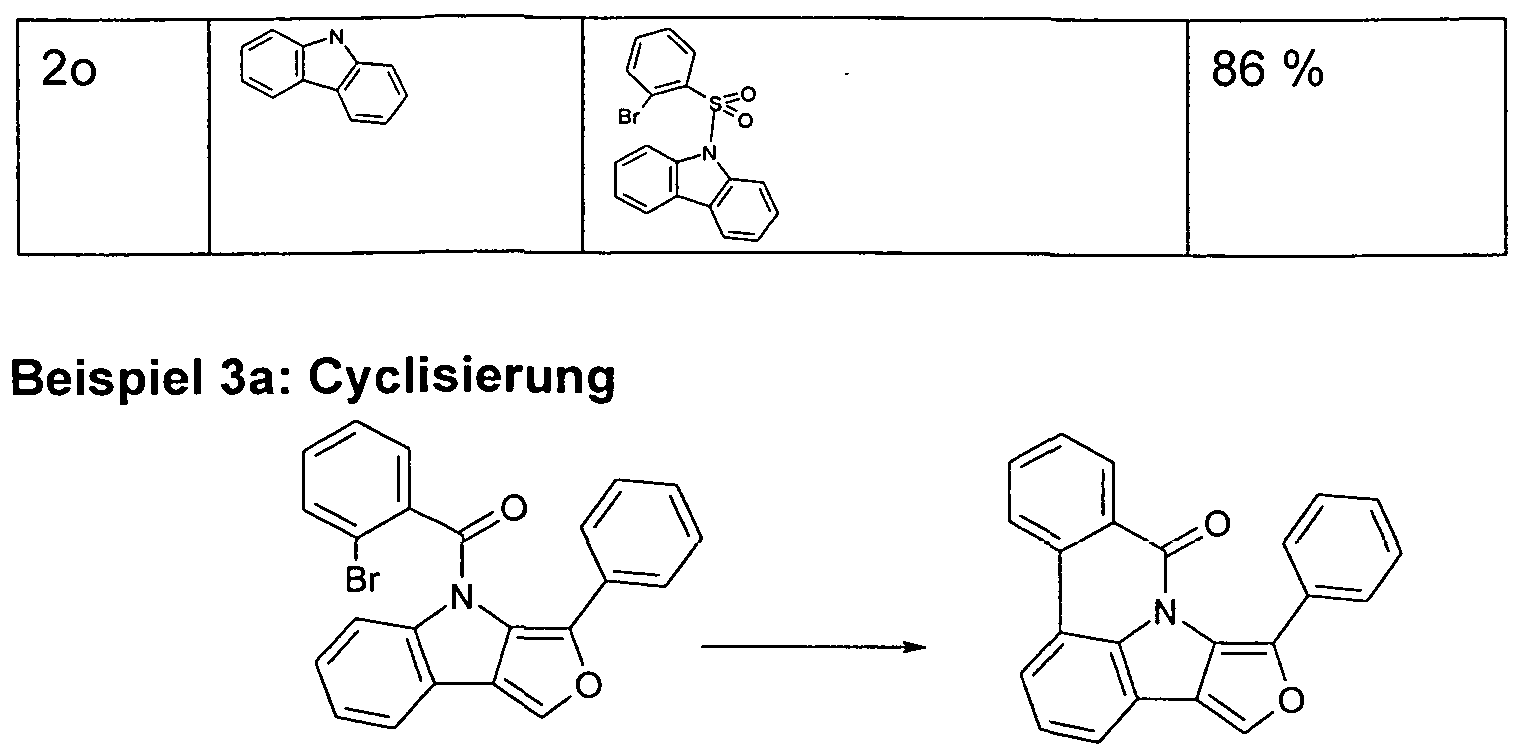
Unter Schutzgasatmosphäre werden 43 ml Tributylzinnhydrid (16 mmol) und 30 g (12.5 mmol) 1 ,1 '-Azobis(cyclohexan-1-carbonitril) in 600 ml Toluol über eine Zeitraum von 4 h zu einer siedenden Lösung aus 5.2 g (12.5 mmol) 2-Brom-phenyl-(3-phenyl-furo[3,4-b]indol-4-yl)methanon in 600 ml Toluol getropft. Anschließend wird 3 h unter Rückfluss erhitzt. Nach dieser Zeit wird das Reaktionsgemisch auf Eis gegossen und dreimal mit Dichlormethan extrahiert. Die vereinigten organischen Phasen werden über Na2S04 getrocknet und eingeengt. Der Rückstand wird aus Toluol umkristallisiert. Die Ausbeute beträgt 3.1 g (76 %). Under protective gas atmosphere, 43 ml of tributyltin hydride (16 mmol) and 30 g (12.5 mmol) 1, 1-azobis (cyclohexane-1-carbonitrile) in 600 ml of toluene over a period of 4 hours (to a boiling solution of 5.2 g 12.5 mmol ) 2-Bromo-phenyl- (3-phenyl-furo [3,4-b] indol-4-yl) -methanone in 600 ml of toluene. The mixture is then heated under reflux for 3 h. After this time, the reaction mixture is poured onto ice and extracted three times with dichloromethane. The combined organic phases are dried over Na 2 S0 4 and concentrated. The residue is recrystallized from toluene. The yield is 3.1 g (76%).
Analog werden folgende Verbindungen erhalten. Die Isomere können durch Umkristallisieren aus Toluol/Isopropanol getrennt werden. The following compounds are obtained analogously. The isomers can be separated by recrystallization from toluene / isopropanol.


Beispiel 4a: Monobromierung Example 4a: Monobromination

7.4 g (22.2 mmol) 3a werden in 150 mL CH2CI2 vorgelegt. Anschließend tropft man unter Lichtausschluss bei -15 °C eine Lösung aus 4 g (22.5 mmol) NBS in 100 ml Acetonitril zu, lässt auf Raumtemperatur kommen und rührt 4 h weiter bei dieser Temperatur. Anschließend wird die Mischung mit 150 mL Wasser versetzt und mit CH2CI2 extrahiert. Die organische Phase wird über MgS04 getrocknet und die Lösungsmittel im Vakuum entfernt. Das Produkt wird mit Hexan heiß ausgerührt und abgesaugt. Ausbeute: 7.3 g (17.7 mmol), 80 % d. Th., Reinheit nach 1H-NMR ca. 97 %. 7.4 g (22.2 mmol) of 3a are initially charged in 150 ml of CH 2 Cl 2 . A solution of 4 g (22.5 mmol) of NBS in 100 ml of acetonitrile is then added dropwise, with exclusion of light at -15 ° C., allowed to come to room temperature and stirring is continued for 4 h at this temperature. The mixture is then treated with 150 ml of water and extracted with CH 2 Cl 2 . The organic phase is dried over MgS0 4 and the solvents are removed in vacuo. The product is stirred hot with hexane and filtered with suction. Yield: 7.3 g (17.7 mmol), 80% of theory. Th., Purity according to 1 H-NMR about 97%.
Analog werden folgende Verbindungen erhalten: The following compounds are obtained analogously:
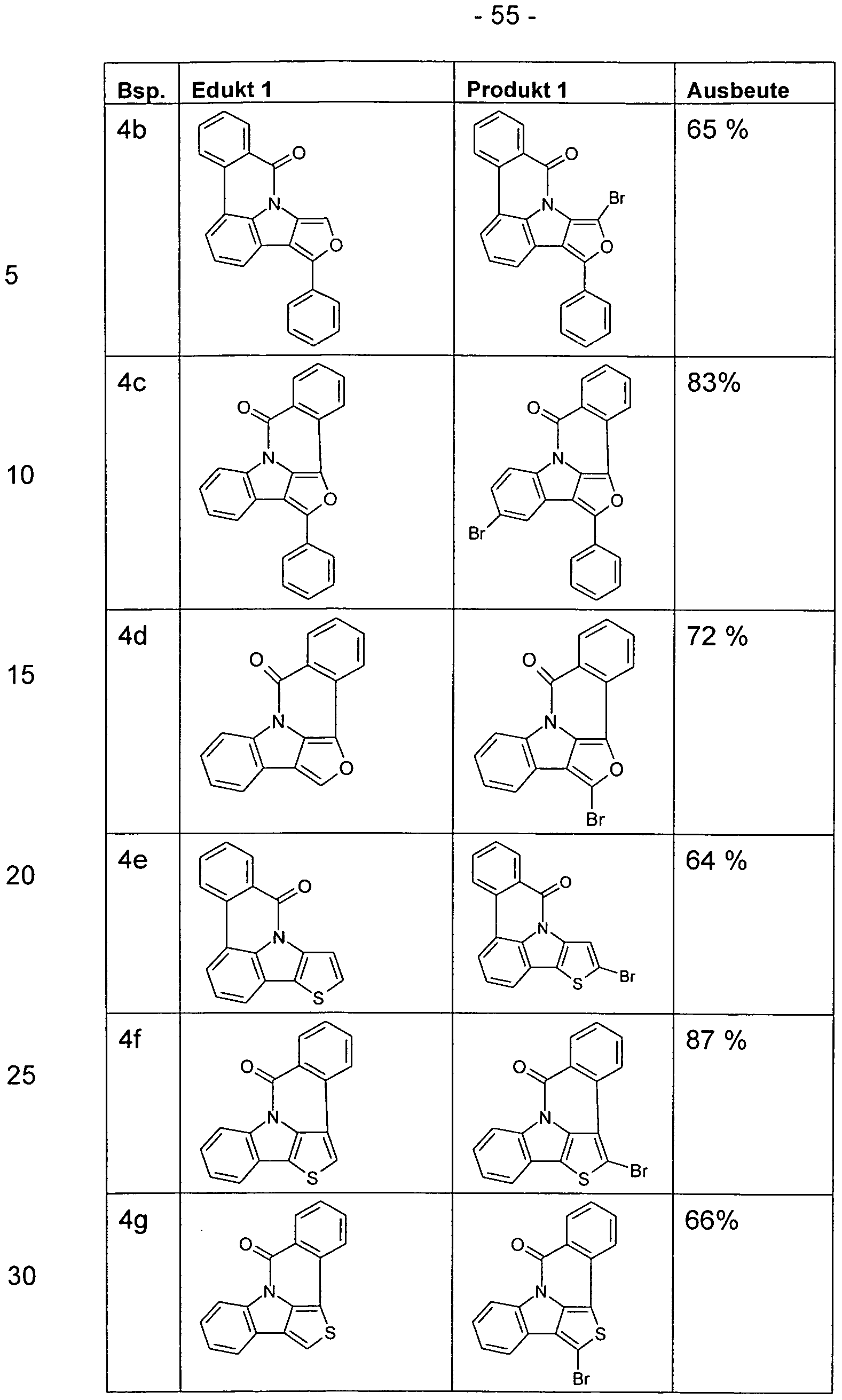


7.4 g (22.2 mmol) 3a werden in 150 mL CH2CI2 vorgelegt. Anschließend tropft man unter Lichtausschluss bei 60 °C eine Lösung aus 8 g (45.1 mmol) NBS in 100 ml Acetonitril zu, Iässt auf Raumtemperatur kommen und rührt 4 h weiter bei dieser Temperatur. Anschließend wird die Mischung mit 150 mL Wasser versetzt und mit CH2CI2 extrahiert. Die organische Phase wird über MgSO4 getrocknet und die Lösungsmittel im Vakuum entfernt. Das Produkt wird mit Hexan heiß ausgerührt und abgesaugt. Ausbeute: 10.3 g (17.7 mmol), 95 % d. Th., Reinheit nach 1H-NMR ca. 97 %. 7.4 g (22.2 mmol) of 3a are initially charged in 150 ml of CH 2 Cl 2 . Then, under exclusion of light, a solution of 8 g (45.1 mmol) of NBS in 100 ml of acetonitrile is added dropwise at 60 ° C., the mixture is allowed to come to room temperature and stirring is continued for 4 h at this temperature. The mixture is then treated with 150 ml of water and extracted with CH 2 Cl 2 . The organic phase is dried over MgSO 4 and the solvents are removed in vacuo. The product is stirred hot with hexane and filtered with suction. Yield: 10.3 g (17.7 mmol), 95% of theory. Th., Purity according to 1 H-NMR about 97%.
Analog werden folgende Verbindungen erhalten: The following compounds are obtained analogously:

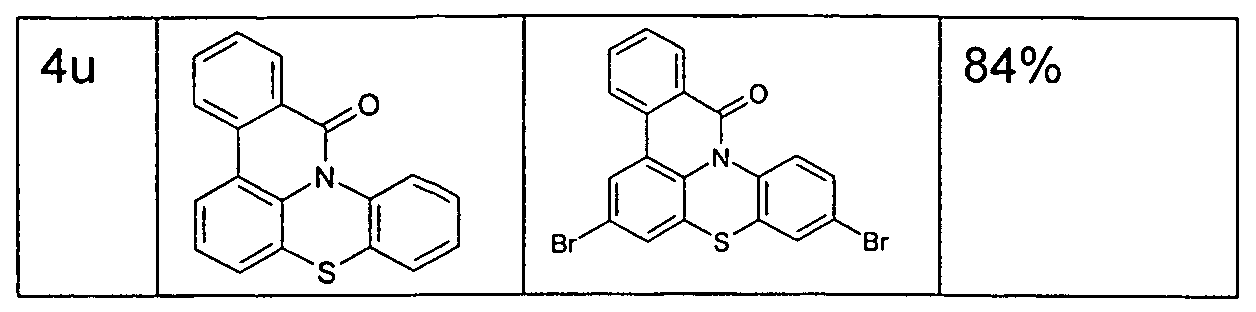

68.8 g (219 mmol) 3m werden in 820 ml_ EtOH gelöst, bei Raumtemperatur mit 143 g (755 mmol) SnCI2 versetzt, 6 h unter Rückfluss erhitzt, innerhalb 1 h auf Raumtemperatur kommen gelassen, mit 20 %iger NaOH versetzt. Nach der Phasentrennung wird das Lösungsmittel entfernt und der Rückstand chromatographisch gereinigt. Die Ausbeute beträgt 43 g (151 mmol), entsprechend 70 %. 68.8 g (219 mmol) of 3M are dissolved in 820 ml of EtOH, admixed at room temperature with 143 g (755 mmol) of SnCl 2 , heated under reflux for 6 hours, allowed to come to room temperature within 1 h, mixed with 20% NaOH. After phase separation, the solvent is removed and the residue is purified by chromatography. The yield is 43 g (151 mmol), corresponding to 70%.
Analo werden fol ende Verbindun en erhalten: Analogously, the following connections will be obtained:


6.5 g (23 mmol) 5-Amino-7b-aza-benzo[e]acephenanthrylen-8-on, 7.1 g (23 mmol) 2,2'-Dibromdiphenyl, 16 g (72 mmol) NaOtBu, 1.4 g (1.58 mmol) Pd2dba3 und 6.3 ml (6.3 mmol) t-Bu3P werden in 150 ml Toluol unter Schutzgasatmosphäre 36 h bei 110 °C erhitzt. Nach Erkalten wird der ausgefallene Feststoff abgesaugt, mit Wasser und Ethanol 6.5 g (23 mmol) of 5-amino-7b-aza-benzo [e] acephenanthrylene-8-one, 7.1 g (23 mmol) of 2,2'-dibromodiphenyl, 16 g (72 mmol) of NaOtBu, 1.4 g (1.58 mmol ) Pd 2 dba 3 and 6.3 ml (6.3 mmol) of t-Bu 3 P are heated in 150 ml of toluene under protective gas atmosphere at 110 ° C for 36 h. After cooling, the precipitated solid is filtered off with suction, with water and ethanol
gewaschen und getrocknet. Der Rückstand wird mit Toluol heiß extrahiert, aus Toluol umkristallisiert und abschließend im Hochvakuum sublimiert. Die Ausbeute beträgt nach Sublimation 7 g (16 mmol, 71 %) mit einer Reinheit von 99.9 %. washed and dried. The residue is extracted with hot toluene, recrystallized from toluene and finally sublimed under high vacuum. The yield after sublimation is 7 g (16 mmol, 71%) with a purity of 99.9%.
Analog werden folgende Verbindungen erhalten: The following compounds are obtained analogously:
Bsp. Edukt 1 Produkt 1 Ausbeute Example: starting material 1 product 1 Yield
6b 62 % 6b 62%
6c 65% 6c 65%
Beispiel 7a: Hartwig-Buchwald-Reaktion Example 7a: Hartwig-Buchwald reaction
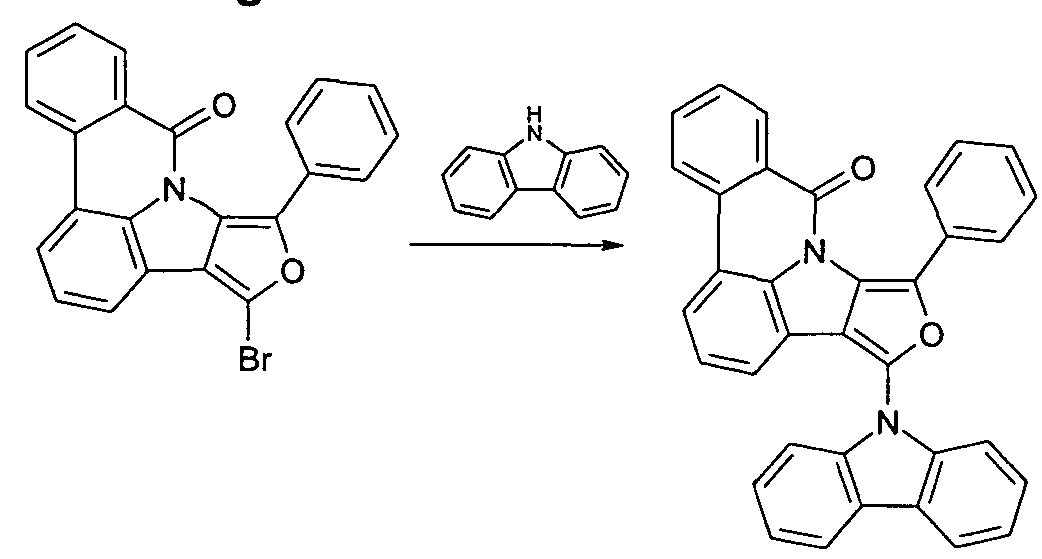
13.9 g (33.7 mmol ) 4a, 4.2 g (37.6 mmol) Carbazol und 23.34 g Rb2CO3 werden in 200 mL p-Xylol suspendiert. Zu dieser Suspension werden 0.76 g (3.4 mmol) Pd(OAc)2 und 10.1 ml einer 1 M Tri-tert-butylphosphin- Lösung gegeben. Die Reaktionsmischung wird 16 h unter Rückfluss erhitzt. Nach Erkalten wird die organische Phase abgetrennt, dreimal mit 200 mL Wasser gewaschen und anschließend zur Trockene eingeengt. Der Rückstand wird mit Toluol heiß extrahiert, aus Toluol umkristallisiert und abschließend im Hochvakuum sublimiert, Reinheit beträgt 99.9 %. Ausbeute: 12.6 g (25 mmol), 75 % der Theorie. 13.9 g (33.7 mmol) of 4a, 4.2 g (37.6 mmol) of carbazole and 23.34 g of Rb 2 CO 3 are suspended in 200 mL of p-xylene. 0.76 g (3.4 mmol) of Pd (OAc) 2 and 10.1 ml of a 1 M tri-tert-butylphosphine solution are added to this suspension. The reaction mixture is refluxed for 16 h. After cooling, the organic phase is separated off, washed three times with 200 ml of water and then concentrated to dryness. The residue is extracted with hot toluene, recrystallized from toluene and finally sublimed under high vacuum, purity is 99.9%. Yield: 12.6 g (25 mmol), 75% of theory.
Analog werden folgende Verbindungen erha ten: The following compounds will be available analogously:
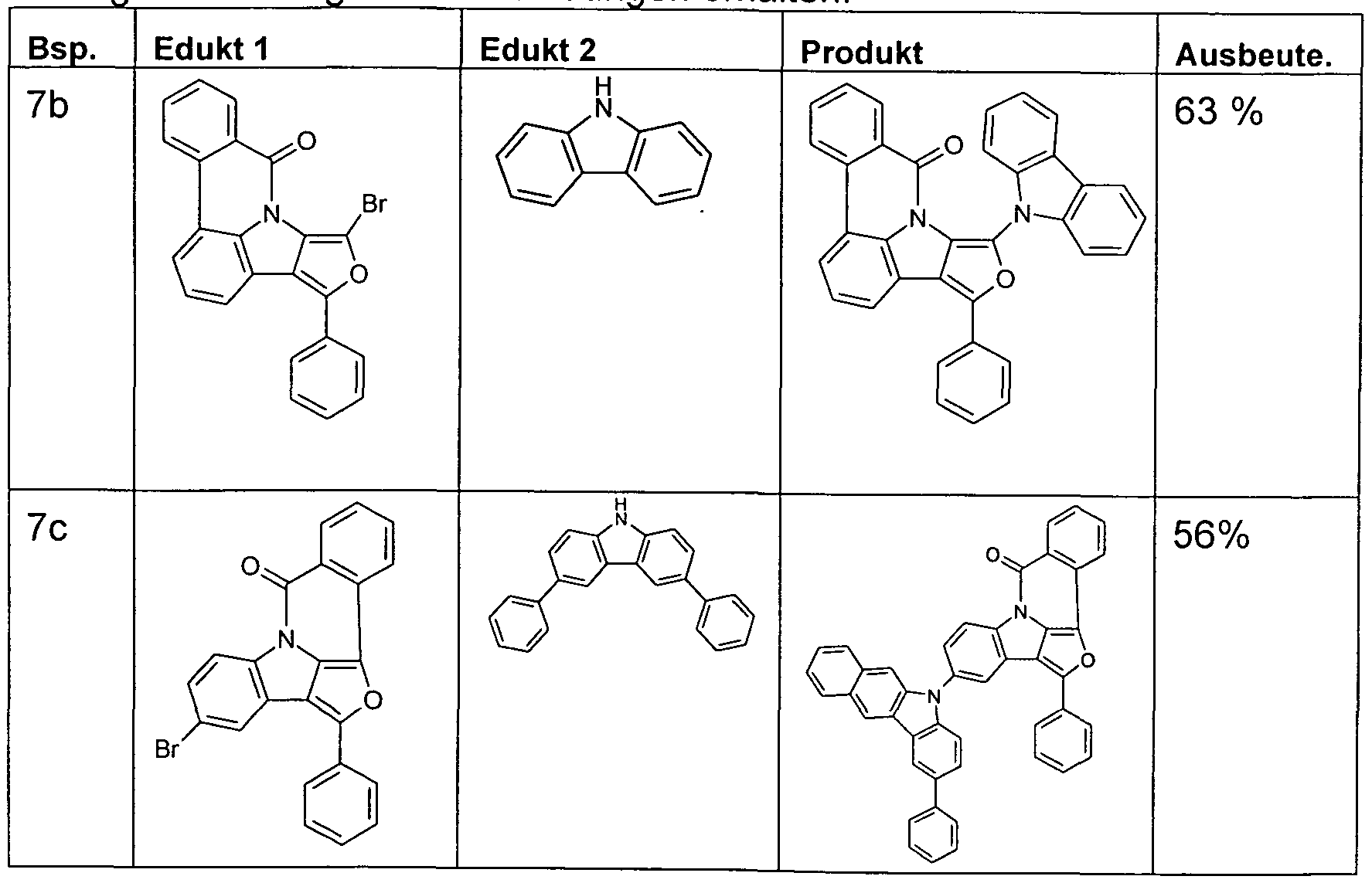


13.3 g (110.0 mmol) Phenylboronsäure, 45 g (110.0 mmol) 4a und 44.6 g (210.0 mmol) Trikaliumphosphat werden in 500 mL Toulol, 500 mL Dioxan und 500 mL Wasser suspendiert. Zu dieser Suspension werden 913 mg (3.0 mmol) Tri-o-tolylphosphin und dann 112 mg (0.5 mmol) Palladium(ll)- acetat gegeben, und die Reaktionsmischung wird 16 h unter Rückfluss erhitzt. Nach Erkalten wird die organische Phase abgetrennt, über Kieselgel filtriert, dreimal mit 200 mL Wasser gewaschen und anschließend zur Trockene eingeengt. Der Rückstand wird aus Toluol und aus Dichlor- methan / /'so-Propanol umkristallisiert und abschließend im Hochvakuum sublimiert, Reinheit beträgt 99.9 %. Die Ausbeute beträgt 37 g (90 mmol), entsprechend 83 % der Theorie. 13.3 g (110.0 mmol) of phenylboronic acid, 45 g (110.0 mmol) of 4a and 44.6 g (210.0 mmol) of tripotassium phosphate are suspended in 500 ml of toluene, 500 ml of dioxane and 500 ml of water. 913 mg (3.0 mmol) of tri-o-tolylphosphine and then 112 mg (0.5 mmol) of palladium (II) acetate are added to this suspension, and the reaction mixture is heated under reflux for 16 h. After cooling, the organic phase is separated off, filtered through silica gel, washed three times with 200 ml of water and then concentrated to dryness. The residue is recrystallized from toluene so-propanol and from dichloromethane / / 'and finally sublimed in high vacuum, purity is 99.9%. The yield is 37 g (90 mmol), corresponding to 83% of theory.


Beispiel 9a: Example 9a:

Eine Suspension von 16.7 (100 mmol) Carbazol [86-74-8], 41.1 g (110 mmol) (2-Bromphenyl)-diphenyl-chlorsilan (dargestellt in Analogie zu (2-Bromphenyl)-dimethylchlorsilan aus 1 ,2-Dibrombenzol und Dichlor- diphenylsilan nach Kawachi et al., Organometallics (2007), 26( 9), 4697), 22.2 g (200 mmol) Natriumcarbonat, 449 mg (2 mmol) Palladium(ll)acetat, 1.6 g (6 mmol) Triphenylphosphin und 100 g Glasperlen (3 mm Durchmesser) in 500 ml Xylol wird unter gutem Rühren 16 h unter Rückfluss erhitzt. Anschließend filtriert man von den Glaskugeln und den Salzen über Celite ab, engt die organische Phase ein, kristallisiert den Rückstand fünfmal aus DMF um und sublimiert zweimal im Hochvakuum. Die Ausbeute beträgt 17.4 g (41 mmol), entsprechend 41 % der Theorie. A suspension of 16.7 (100 mmol) of carbazole [86-74-8], 41.1 g (110 mmol) of (2-bromophenyl) -diphenyl-chlorosilane (prepared in analogy to (2-bromophenyl) -dimethylchlorosilane from 1, 2-dibromobenzene and dichlorodiphenylsilane according to Kawachi et al., Organometallics (2007), 26 (9), 4697), 22.2 g (200 mmol) of sodium carbonate, 449 mg (2 mmol) of palladium (II) acetate, 1.6 g (6 mmol) of triphenylphosphine and 100 g of glass beads (3 mm diameter) in 500 ml of xylene is refluxed with good stirring for 16 h. The mixture is then filtered off from the glass beads and the salts over Celite, the organic phase is concentrated, the residue is recrystallised five times from DMF and sublimed twice in a high vacuum. The yield is 17.4 g (41 mmol), corresponding to 41% of theory.
Analog werden folgende Verbindungen erhalten: The following compounds are obtained analogously:

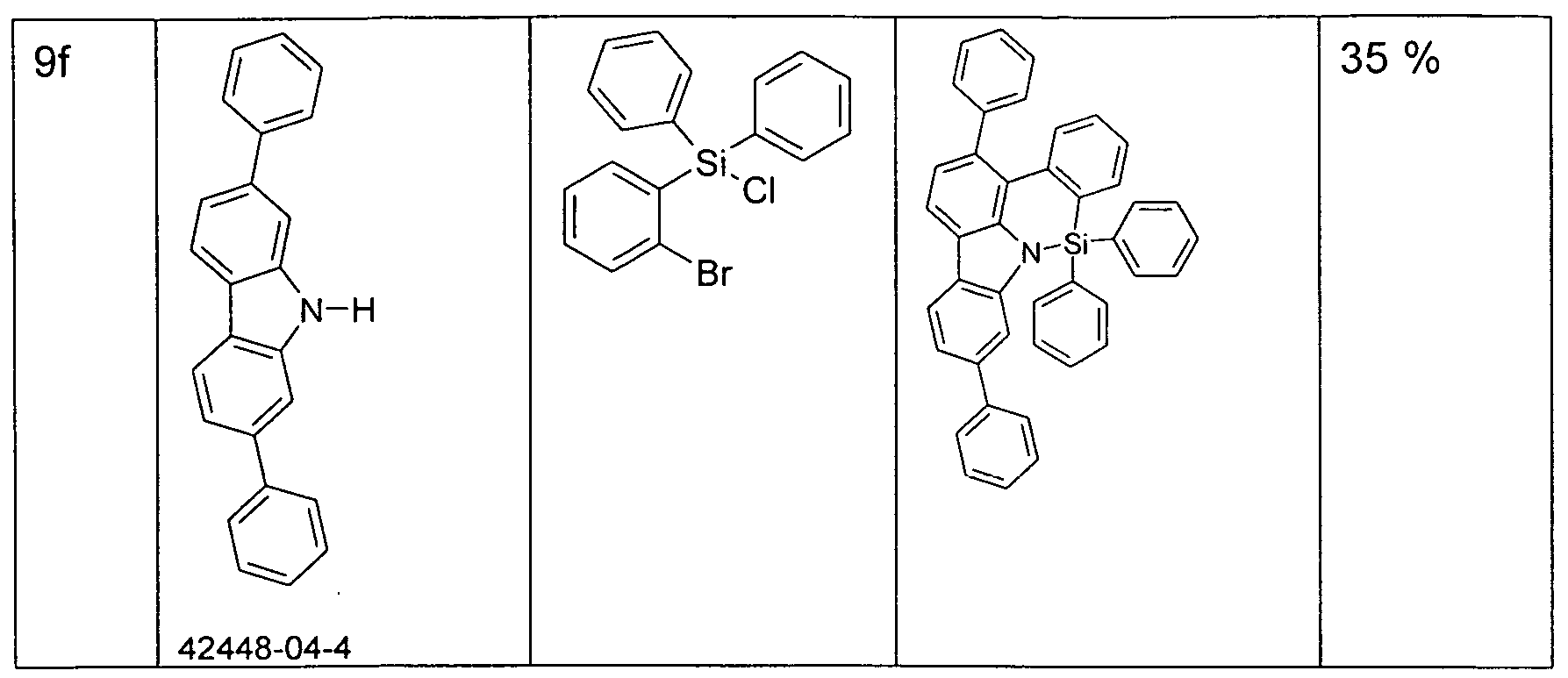
Beispiel 10: Herstellung der OLEDs Example 10: Production of the OLEDs
Die Herstellung von erfindungsgemäßen OLEDs sowie OLEDs nach dem Stand der Technik erfolgt nach einem allgemeinen Verfahren gemäß WO 2004/058911 , das auf die hier beschriebenen Gegebenheiten (Schichtdickenvariation, Materialien) angepasst wird. The preparation of inventive OLEDs and OLEDs according to the prior art is carried out according to a general method according to WO 2004/058911, which is adapted to the conditions described here (layer thickness variation, materials).
In den folgenden Beispielen E1 bis E37 (siehe Tabellen 1 und 2) werden die Daten verschiedener OLEDs vorgestellt. Glasplättchen, die mit strukturiertem ITO (Indium Zinn Oxid) der Dicke 150 nm beschichtet sind werden zur verbesserten Prozessierung mit 20 nm PEDOT beschichtet (Poly(3,4-ethylendioxy-2,5-thiophen), aus Wasser aufgeschleudert; In the following examples E1 to E37 (see Tables 1 and 2) the data of different OLEDs are presented. Glass slides coated with structured ITO (Indium Tin Oxide) of thickness 150 nm are coated with 20 nm PEDOT for improved processing (poly (3,4-ethylenedioxy-2,5-thiophene), spin-on from water;
bezogen von H. C. Starck, Goslar, Deutschland). Diese beschichteten Glasplättchen bilden die Substrate, auf weiche die OLEDs aufgebracht werden. Die OLEDs haben prinzipiell folgenden Schichtaufbau: Substrat / optionale Lochinjektionsschicht (HIL) / Lochtransportschicht (HTL) / optionale Zwischenschicht (IL) / Elektronenblockerschicht (EBL) / purchased from H.C. Starck, Goslar, Germany). These coated glass plates form the substrates to which the OLEDs are applied. The OLEDs have in principle the following layer structure: substrate / optional hole injection layer (HIL) / hole transport layer (HTL) / optional intermediate layer (IL) / electron blocker layer (EBL) /
Emissionsschicht (EML) / optionale Lochblockierschicht (HBL) / Emission Layer (EML) / Optional Hole Blocking Layer (HBL) /
Elektronentransportschicht (ETL) / optionale Elektroneninjektionsschicht (EIL) und abschließend eine Kathode. Die Kathode wird durch eine 100 nm dicke Aluminiumschicht gebildet. Der genaue Aufbau der OLEDs ist Tabelle 1 zu entnehmen. Eine Bezeichnung wie„3a" bezieht sich hierbei auf die in den Tabellen oben zu dem Beispiel 3a gezeigten Materialien. Die weiteren zur Herstellung der OLEDs benötigten Electron transport layer (ETL) / optional electron injection layer (EIL) and finally a cathode. The cathode is formed by a 100 nm thick aluminum layer. The exact structure of the OLEDs is shown in Table 1. A designation such as "3a" here refers to the materials shown in the tables above for the example 3a The others required for the production of the OLEDs
Materialien sind in Tabelle 3 gezeigt. Alle Materialien werden in einer Vakuumkammer thermisch aufgedampft. Dabei besteht die Emissionsschicht immer aus mindestens einem Matrixmaterial (Hostmaterial, Wirtsmaterial) und einem emittierenden Dotierstoff (Dotand, Emitter), der dem Matrixmaterial bzw. den Matrixmaterialien durch Coverdampfung in einem bestimmten Volumenanteil beigemischt wird. Eine Angabe wie ST1 :9a:TEG1 (30%:60%:10%) bedeutet hierbei, dass das Material ST1 in einem Volumenanteil von 30%, 9a in einem Volumenanteil von 60% und TEG1 in einem Anteil von 10% in der Schicht vorliegt. Analog kann auch die Elektronentransportschicht aus einer Mischung von zwei Materialien bestehen. Materials are shown in Table 3. All materials are thermally evaporated in a vacuum chamber. In this case, the emission layer always consists of at least one matrix material (host material, host material) and an emitting dopant (dopant, emitter), which is admixed to the matrix material or the matrix materials by co-evaporation in a specific volume fraction. An indication such as ST1: 9a: TEG1 (30%: 60%: 10%) here means that the material ST1 in a volume fraction of 30%, 9a in a volume fraction of 60% and TEG1 in a proportion of 10% in the layer is present. Similarly, the electron transport layer may consist of a mixture of two materials.
Die OLEDs werden standardmäßig charakterisiert. Hierfür werden die Elektrolumineszenzspektren, die Stromeffizienz (gemessen in cd/A), die Leistungseffizienz (gemessen in Im/W) und die externe Quanteneffizienz (EQE, gemessen in Prozent) in Abhängigkeit der Leuchtdichte, berechnet aus Strom-Spannungs-Leuchtdichte-Kennlinien (lUL-Kennlinien) sowie die Lebensdauer bestimmt. Die Elektrolumineszenzspektrum werden bei einer Leuchtdichte von 1000 cd/m2 bestimmt und daraus die CIE 1931 x und y Farbkoordinaten berechnet. Die Angabe U1000 in Tabelle 2 bezeichnet die Spannung, die für eine Leuchtdichte von 1000 cd/m2 benötigt wird. SE1000 und LE1000 bezeichnen die Strom- bzw. Leistungseffizienz, die bei 1000 cd/m2 erreicht werden. EQE1000 schließlich ist die externe Quanteneffizienz bei einer Betriebsleuchtdichte von 1000 cd/m2. The OLEDs are characterized by default. For this, the electroluminescence spectra, the current efficiency (measured in cd / A), the power efficiency (measured in Im / W) and the external quantum efficiency (EQE, measured in percent) as a function of the luminance, calculated from current-voltage-luminance characteristics ( LUL characteristics) and the service life. The electroluminescence spectra are determined at a luminance of 1000 cd / m 2 and from this the CIE 1931 x and y color coordinates are calculated. The indication U1000 in Table 2 indicates the voltage required for a luminance of 1000 cd / m 2 . SE1000 and LE1000 indicate the power efficiency achieved at 1000 cd / m 2 . Finally, EQE1000 is the external quantum efficiency at an operating luminance of 1000 cd / m 2 .
Die Daten der verschiedenen OLEDs sind in Tabelle 2 zusammengefasst. The data of the different OLEDs are summarized in Table 2.
Im Folgenden werden einige der Beispiele näher erläutert. Es sei jedoch darauf hingewiesen, dass dies nur eine Auswahl der in Tabelle 2 gezeigten Daten darstellt. Verwendung von erfindungsgemäßen Verbindungen als Elektronen- transportmaterialien In the following, some of the examples are explained in more detail. It should be noted, however, that this is only a selection of the data shown in Table 2. Use of compounds according to the invention as electron transport materials
Bei Einsatz von erfindungsgemäßen Materialien in der Elektronentransportschicht erhält man gute Spannungen, Effizienzen und Lebensdauern. In Kombination mit dem blau fluoreszierenden Dotanden D1 erhält man z.B. eine Spannung von 4.9 V (Beispiel E5). Bei Verwendung einer Misch- schicht des Materials 8n mit LiQ erhält man eine externe Quanteneffizienz von 5.3 % (Beispiel E6). OLEDs gemäß Beispiels E4 zeigen bei Betrieb mit konstantem Strom einen Abfall der Helligkeit von 6000 auf 3000 cd/m2 („LT50") nach einer Betriebsdauer von etwa 170 h, was einen sehr guten Wert darstellt. Dies entspricht einer Lebensdauer von etwa 6000h bei 1000 cd/m2. When using materials according to the invention in the electron transport layer, good voltages, efficiencies and lifetimes are obtained. In combination with the blue-fluorescent dopant D1, for example, a voltage of 4.9 V is obtained (example E5). When using a mixed layer of the material 8n with LiQ gives an external quantum efficiency of 5.3% (Example E6). OLEDs according to example E4 show a decrease of the brightness from 6000 to 3000 cd / m 2 ("LT50") after operation with a constant current of about 170 h, which represents a very good value, which corresponds to a lifetime of about 6000h at 1000 cd / m 2 .
Verwendung von erfindungsgemäßen Verbindungen als Matrixmaterialien in phosphoreszierenden OLEDs Use of compounds according to the invention as matrix materials in phosphorescent OLEDs
Bei Verwendung von erfindungsgemäßen Materialien als Matrix für phosphoreszente Emitter erhält man ebenfalls sehr gute Leistungsdaten. When using materials according to the invention as a matrix for phosphorescent emitter also gives very good performance.
Mit der Verbindung 8o z.B. erhält man in Kombination mit dem grün emittierenden Material TEG1 eine sehr gute externe Quanteneffizienz von 15.2 %, was in Verbindung mit der geringen Spannung von 3.5 V zu einer sehr guten Leistungseffizienz von 49 Im/W führt (Beispiel E16). Die entsprechenden OLEDs zeigen bei Betrieb mit konstantem Strom einen Abfall der Helligkeit von 4000 auf 3200 cd/m2 innerhalb von etwa 340 h („LT80"). Bei Verwendung von erfindungsgemäßen Materialien als zweite Matrixkomponenten erhält man noch bessere LT80 Werte von bis zu 420 h bei einer Starthelligkeit von 4000 cd/m2 (Beispiel E18). With compound 8o, for example, a very good external quantum efficiency of 15.2% is obtained in combination with the green-emitting material TEG1, which, in combination with the low voltage of 3.5 V, leads to a very good power efficiency of 49 Im / W (Example E16). The corresponding OLEDs show a decrease in brightness from 4000 to 3200 cd / m 2 within about 340 hours ("LT80") when operating at a constant current When using materials according to the invention as second matrix components, even better LT 80 values of up to 420 are obtained h at a starting brightness of 4000 cd / m 2 (example E18).
In Kombination mit dem rot emittierenden Dotanden TER1 ergeben sich ebenfalls gute Leistungsdaten. So erhält man z.B. mit Verbindung 7t als Matrix eine externe Quanteneffizienz von 13.6 %, was mit der Spannung von 4.6 V eine Leistungseffizienz von 5.9 Im/W ergibt. Für diese Kombination erhält man einen LT80 Wert von ca. 410 h bei einer Starthelligkeit von 4000 cd/m2 (Beispiel E35). Noch bessere Lebensdauern lassen sich bei Einsatz der Verbindungen 7k bzw. 71 erzielen. Man erhält hiermit LT80 Werte von etwa 520 bzw. 460 h (Beispiele E29, E30). In combination with the red-emitting dopant TER1 also good performance data are obtained. Thus, for example, with compound 7t as the matrix, an external quantum efficiency of 13.6% is obtained, which, with the voltage of 4.6 V, gives a power efficiency of 5.9 Im / W. For this combination, one obtains an LT80 value of about 410 h at a starting brightness of 4000 cd / m 2 (example E35). Even better lifetimes can be achieved when using the compounds 7k and 71, respectively. This gives LT80 values of about 520 or 460 h (examples E29, E30).
Verwendung von erfindungsgemäßen Verbindungen als Dotand in blau fluoreszierenden OLEDs Use of compounds according to the invention as dopant in blue-fluorescent OLEDs
Die Verbindung 31 lässt sich als blau fluoreszierender Dotand einsetzen. Man erhält hierbei tiefblaue Farbkoordinaten mit CIE x/y = 0.14/0.14 sowie eine externe Quanteneffizienz von 4.7% bei einer Spannung von 4.4 V The compound 31 can be used as a blue fluorescent dopant. This gives deep blue color coordinates with CIE x / y = 0.14 / 0.14 and an external quantum efficiency of 4.7% at a voltage of 4.4V
(Beispiel E20). (Example E20).
Tabelle 1 : Aufbau der OLEDs Table 1: Structure of the OLEDs
HIL HTL IL EBL EML HBL ETL EIL HIL HTL IL EBL EML HBL ETL
Bsp. Ex.
Dicke Dicke Dicke Dicke Dicke Dicke Dicke Dicke Thickness thickness thickness thickness thickness thickness thickness thickness
HATCN SpA1 NPB M1 :D1 (95%:5%) 3j LiQHATCN SpA1 NPB M1: D1 (95%: 5%) 3j LiQ
E1 — — 3nm 5nm 140nm 20nm 30nm 20nm E1 - - 3nm 5nm 140nm 20nm 30nm 20nm
HATCN SpA1 NPB M1 :D1 (95%:5%) 7m LiQ HATCN SpA1 NPB M1: D1 (95%: 5%) 7m LiQ
E2 — ... 3nm 5nm 140nm 20nm 30nm 20nm E2 - ... 3nm 5nm 140nm 20nm 30nm 20nm
HATCN SpA1 NPB M1 :D1 (95%:5%) 8d LiQ HATCN SpA1 NPB M1: D1 (95%: 5%) 8d LiQ
E3 -- — 3nm 5nm 140nm 20nm 30nm 20nm E3 - - 3nm 5nm 140nm 20nm 30nm 20nm
HATCN SpA1 NPB M1 :D1 (95%:5%) 8e LiF HATCN SpA1 NPB M1: D1 (95%: 5%) 8e LiF
E4 — — 1.5nm 5nm 140nm 20nm 30nm 20nm E4 - - 1.5nm 5nm 140nm 20nm 30nm 20nm
HATCN SpA1 NPB M1 :D1 (95%:5%) 8i LiQ HATCN SpA1 NPB M1: D1 (95%: 5%) 8i LiQ
E5 — — 3nm 5nm 140nm 20nm 30nm 20nm E5 - - 3nm 5nm 140nm 20nm 30nm 20nm
HATCN SpA1 NPB M1 :D1 (95%:5%) 8n:LiQ (50%:50%) HATCN SpA1 NPB M1: D1 (95%: 5%) 8n: LiQ (50%: 50%)
E6 — ... — 5nm 140nm 20nm 30nm 20nm E6 - ... - 5nm 140nm 20nm 30nm 20nm
SpA1 HATCN BPA1 3h:TEG1 (90%: 10%) ST1 ST1 :LiQ (50%:50%) SpA1 HATCN BPA1 3h: TEG1 (90%: 10%) ST1 ST1: LiQ (50%: 50%)
E7 — — E7 - -
70nm 5nm 20nm 30nm 10nm 30 nm 70nm 5nm 20nm 30nm 10nm 30nm
SpA1 HATCN BPA1 6a:TEG1 (90%:10%>) ST1 ST1 :LiQ (50%:50%)SpA1 HATCN BPA1 6a: TEG1 (90%: 10%>) ST1 ST1: LiQ (50%: 50%)
E8 — — E8 - -
70nm 5nm 20nm 30nm 10nm 30 nm 70nm 5nm 20nm 30nm 10nm 30nm
SpA1 HATCN BPA1 6c:TEG1 (90%: 10%) ST1 ST1 :LiQ (50%:50%)SpA1 HATCN BPA1 6c: TEG1 (90%: 10%) ST1 ST1: LiQ (50%: 50%)
E9 — — E9 - -
70nm 5nm 20nm 30nm 10nm 30 nm 70nm 5nm 20nm 30nm 10nm 30nm
SpA1 HATCN BPA1 7n:TEG1 (90%:10%) ST1 ST1 :üQ (50%:50%)SpA1 HATCN BPA1 7n: TEG1 (90%: 10%) ST1 ST1: üQ (50%: 50%)
E10 — ... E10 - ...
70nm 5nm 20nm 30nm 10nm 30 nm 70nm 5nm 20nm 30nm 10nm 30nm
SpA1 HATCN BPA1 7o:TEG1 (90%:10%) ST1 ST1 :LiQ (50%:50%)SpA1 HATCN BPA1 7o: TEG1 (90%: 10%) ST1 ST1: LiQ (50%: 50%)
E1 1 — — E1 1 - -
70nm 5nm 20nm 30nm 10nm 30 nm 70nm 5nm 20nm 30nm 10nm 30nm
SpA1 HATCN BPA1 7w:TEG1 (90%: 10%) ST1 ST1 :LiQ (50%:50%)SpA1 HATCN BPA1 7w: TEG1 (90%: 10%) ST1 ST1: LiQ (50%: 50%)
E12 — — E12 - -
70nm 5nm 20nm 30nm 10nm 30 nm 70nm 5nm 20nm 30nm 10nm 30nm
SpA1 HATCN BPA1 8k:TEG1 (90%: 10%) ST1 ST1 :LiQ (50%:50%)SpA1 HATCN BPA1 8k: TEG1 (90%: 10%) ST1 ST1: LiQ (50%: 50%)
E13 — — E13 - -
70nm 5nm 20nm 30nm 10nm 30 nm 70nm 5nm 20nm 30nm 10nm 30nm
SpA1 HATCN BPA1 8I:TEG1 (90%:10%) ST1 ST1 :üQ (50%:50%) SpA1 HATCN BPA1 8I: TEG1 (90%: 10%) ST1 ST1: üQ (50%: 50%)
E14 — — E14 - -
70nm 5nm 20nm 30nm 10nm 30 nm 70nm 5nm 20nm 30nm 10nm 30nm
SpA1 HATCN BPA1 8m:TEG1 (90%:10%) ST1 ST1 :LiQ (50%:50%) SpA1 HATCN BPA1 8m: TEG1 (90%: 10%) ST1 ST1: LiQ (50%: 50%)
E15 ... ... E15 ... ...
70nm 5nm 20nm 30nm 10nm 30 nm 70nm 5nm 20nm 30nm 10nm 30nm
SpA1 HATCN BPA1 8o:TEG1 (90%: 10%) ST1 ST1 :LiQ (50%:50%) SpA1 HATCN BPA1 8o: TEG1 (90%: 10%) ST1 ST1: LiQ (50%: 50%)
E16 — ... E16 - ...
70nm 5nm 20nm 30nm 10nm 30 nm 70nm 5nm 20nm 30nm 10nm 30nm
SpA1 HATCN BPA1 8q:TEG1 (90%: 10%) ST1 ST1 :üQ (50%:50%) SpA1 HATCN BPA1 8q: TEG1 (90%: 10%) ST1 ST1: üQ (50%: 50%)
E17 — — E17 - -
70nm 5nm 20nm 30nm 10nm 30 nm 70nm 5nm 20nm 30nm 10nm 30nm
ST1 :9a:TEG1 ST1: 9a: TEG1
SpA1 HATCN BPA1 ST1 ST1 :LiQ (50%:50%) SpA1 HATCN BPA1 ST1 ST1: LiQ (50%: 50%)
E18 — (30%:60%:10%) ... E18 - (30%: 60%: 10%) ...
70nm 5nm 20nm 10nm 30 nm 70nm 5nm 20nm 10nm 30nm
30nm 30nm
SpA1 HATCN BPA1 ST1 :9e:TEG1 ST1 ST1 :LiQ (50%:50%) SpA1 HATCN BPA1 ST1: 9e: TEG1 ST1 ST1: LiQ (50%: 50%)
E19 - ... E19 - ...
70nm 5nm 20nm (30%:60%: 0%) 0nm 30 nm 30nm 70nm 5nm 20nm (30%: 60%: 0%) 0nm 30nm 30nm
HATCN SpA1 NPB M1:3I (95%:5%) ST1 LiQ HATCN SpA1 NPB M1: 3I (95%: 5%) ST1 LiQ
E20 — ... E20 - ...
5nm 140nm 20nm 30nm 35nm 3nm 5nm 140nm 20nm 30nm 35nm 3nm
SpA1 HATCN NPB 3a:TER1 (85%: 15%) ST1 ST1 :UQ (50%:50%)SpA1 HATCN NPB 3a: TER1 (85%: 15%) ST1 ST1: UQ (50%: 50%)
E21 — — E21 - -
160nm 5nm 20nm 35nm 10nm 35nm 160nm 5nm 20nm 35nm 10nm 35nm
SpA1 HATCN NPB 6b:TER1 (85%:15%) ST1 ST1 :LiQ (50%:50%)SpA1 HATCN NPB 6b: TER1 (85%: 15%) ST1 ST1: LiQ (50%: 50%)
E22 — — E22 - -
160nm 5nm 20nm 35nm 10nm 35nm 160nm 5nm 20nm 35nm 10nm 35nm
SpA1 HATCN NPB 7a:TER1 (85%: 15%) ST1 ST1 :LiQ (50%: 50%)SpA1 HATCN NPB 7a: TER1 (85%: 15%) ST1 ST1: LiQ (50%: 50%)
E23 — — E23 - -
160nm 5nm 20nm 35nm 10nm 35nm 160nm 5nm 20nm 35nm 10nm 35nm
SpA1 HATCN NPB 7b:TER1 (85%:15%) ST1 STV.ÜQ (50%:50%)SpA1 HATCN NPB 7b: TER1 (85%: 15%) ST1 STV.ÜQ (50%: 50%)
E24 — — E24 - -
160nm 5nm 20nm 35nm 10nm 35nm 160nm 5nm 20nm 35nm 10nm 35nm
SpA1 HATCN NPB 7e:TER1 (85%: 15%) ST1 ST1 :LiQ (50%:50%)SpA1 HATCN NPB 7e: TER1 (85%: 15%) ST1 ST1: LiQ (50%: 50%)
E25 — — E25 - -
160nm 5nm 20nm 35nm 10nm 35nm 160nm 5nm 20nm 35nm 10nm 35nm
SpA1 HATCN NPB 7f:TER1 (85%: 15%) ST1 ST1 :LiQ (50%:50%)SpA1 HATCN NPB 7f: TER1 (85%: 15%) ST1 ST1: LiQ (50%: 50%)
E26 — — E26 - -
160nm 5nm 20nm 35nm 10nm 35nm 160nm 5nm 20nm 35nm 10nm 35nm
SpA1 HATCN NPB 7g:TER1 (85%:15%) ST1 ST1 :üQ (50%:50%)SpA1 HATCN NPB 7g: TER1 (85%: 15%) ST1 ST1: üQ (50%: 50%)
E27 — E27 -
160nm 5nm 20nm 35nm 10nm 35nm 160nm 5nm 20nm 35nm 10nm 35nm
SpA1 HATCN NPB 7j:TER1 (85%:15%) ST1 ST1 :üQ (50%:50%)SpA1 HATCN NPB 7j: TER1 (85%: 15%) ST1 ST1: üQ (50%: 50%)
E28 — — E28 - -
160nm 5nm 20nm 35nm 10nm 35nm 160nm 5nm 20nm 35nm 10nm 35nm
SpA1 HATCN NPB 7k:TER1 (85%: 15%) ST1 ST1 :UQ (50%:50%)SpA1 HATCN NPB 7k: TER1 (85%: 15%) ST1 ST1: UQ (50%: 50%)
E29 — — E29 - -
160nm 5nm 20nm 35nm 10nm 35nm 160nm 5nm 20nm 35nm 10nm 35nm
SpA1 HATCN NPB 7I:TER1 (85%: 15%) ST1 ST1 :LiQ (50%:50%)SpA1 HATCN NPB 7I: TER1 (85%: 15%) ST1 ST1: LiQ (50%: 50%)
E30 — — E30 - -
160nm 5nm 20nm 35nm 10nm 35nm 160nm 5nm 20nm 35nm 10nm 35nm
SpA1 HATCN NPB 7p:TER1 (85%: 15%) ST1 ST1 :LiQ (50%:50%)SpA1 HATCN NPB 7p: TER1 (85%: 15%) ST1 ST1: LiQ (50%: 50%)
E31 — — E31 - -
160nm 5nm 20nm 35nm 10nm 35nm 160nm 5nm 20nm 35nm 10nm 35nm
SpA1 HATCN NPB 7q:TER1 (85%: 15%) ST1 ST1 :LiQ (50%:50%)SpA1 HATCN NPB 7q: TER1 (85%: 15%) ST1 ST1: LiQ (50%: 50%)
E32 — — E32 - -
160nm 5nm 20nm 35nm 10nm 35nm 160nm 5nm 20nm 35nm 10nm 35nm
SpA1 HATCN NPB 7r:TER1 (85%: 15%) ST1 ST1 :LiQ (50%:50%) SpA1 HATCN NPB 7r: TER1 (85%: 15%) ST1 ST1: LiQ (50%: 50%)
E33 — — E33 - -
160nm 5nm 20nm 35nm 10nm 35nm 160nm 5nm 20nm 35nm 10nm 35nm
SpA1 HATCN NPB 7S.TER1 (85%: 15%) ST1 STV.ÜQ (50%:50%)SpA1 HATCN NPB 7S.TER1 (85%: 15%) ST1 STV.ÜQ (50%: 50%)
E34 — E34 -
160nm 5nm 20nm 35nm 10nm 35nm 160nm 5nm 20nm 35nm 10nm 35nm
SpA1 HATCN NPB 7t:TER1 (85%:15%) ST1 ST1 :LiQ (50%:50%) SpA1 HATCN NPB 7t: TER1 (85%: 15%) ST1 ST1: LiQ (50%: 50%)
E35 -- — E35 - -
160nm 5nm 20nm 35nm 10nm 35nm 160nm 5nm 20nm 35nm 10nm 35nm
SpA1 HATCN NPB 7v:TER1 (85%: 15%) ST1 ST1 :LiQ (50%:50%) SpA1 HATCN NPB 7v: TER1 (85%: 15%) ST1 ST1: LiQ (50%: 50%)
E36 — — E36 - -
160nm 5nm 20nm 35nm 10nm 35nm 160nm 5nm 20nm 35nm 10nm 35nm
ST1 :9f:TER1 ST1: 9f: TER1
SpA1 HATCN NPB ST1 ST1 :LiQ (50%:50%) SpA1 HATCN NPB ST1 ST1: LiQ (50%: 50%)
E37 — (30%:60%:10%) — E37 - (30%: 60%: 10%) -
160nm 5nm 20nm 10nm 35nm 160nm 5nm 20nm 10nm 35nm
35nm 35nm
Tabelle 2: Da ten der OLEDs Table 2: Data of the OLEDs
Bsp. U1000 SE1000 LE1000 EQE CIE x/y bei Eg U1000 SE1000 LE1000 EQE CIE x / y at
(V) (cd/A) (Im W) 1000 1000 cd/m2 (V) (cd / A) (In W) 1000 1000 cd / m 2
E1 5.9 4.8 2.6 4.0% 0.14/0.15 E1 5.9 4.8 2.6 4.0% 0.14 / 0.15
E2 6.3 4.5 2.2 3.7% 0.14/0.15 E2 6.3 4.5 2.2 3.7% 0.14 / 0.15
E3 5.8 5.5 3.0 4.5% 0.14/0.15 E4 5.5 5.8 3.3 4.8% 0.14/0.15 E3 5.8 5.5 3.0 4.5% 0.14 / 0.15 E4 5.5 5.8 3.3 4.8% 0.14 / 0.15
E5 4.9 6.3 4.0 5.2% 0.14/0.15 E5 4.9 6.3 4.0 5.2% 0.14 / 0.15
E6 5.1 6.4 3.9 5.3% 0.14/0.15 E6 5.1 6.4 3.9 5.3% 0.14 / 0.15
E7 4.3 46 34 12.7% 0.37/0.61 E7 4.3 46 34 12.7% 0.37 / 0.61
E8 4.0 43 33 11.9% 0.37/0.61 E8 4.0 43 33 11.9% 0.37 / 0.61
E9 3.9 49 39 13.7% 0.37/0.60 E9 3.9 49 39 13.7% 0.37 / 0.60
E10 3.6 39 34 10.8% 0.36/0.59 E10 3.6 39 34 10.8% 0.36 / 0.59
E11 3.5 44 40 12.3% 0.37/0.60 E11 3.5 44 40 12.3% 0.37 / 0.60
E12 3.9 51 42 14.2% 0.36/0.60 E12 3.9 51 42 14.2% 0.36 / 0.60
E13 4.1 48 37 13.4% 0.37/0.60 E13 4.1 48 37 13.4% 0.37 / 0.60
E14 3.5 41 37 11.5% 0.37/0.61 E14 3.5 41 37 11.5% 0.37 / 0.61
E15 3.8 36 30 10.1 % 0.37/0.61 E15 3.8 36 30 10.1% 0.37 / 0.61
E16 3.5 55 49 15.2% 0.37/0.60 E16 3.5 55 49 15.2% 0.37 / 0.60
E17 3.7 44 38 12.2% 0.37/0.61 E17 3.7 44 38 12.2% 0.37 / 0.61
E18 3.7 49 42 13.6% 0.37/0.61 E18 3.7 49 42 13.6% 0.37 / 0.61
E19 3.8 46 38 12.9% 0.37/0.61 E19 3.8 46 38 12.9% 0.37 / 0.61
E20 4.4 5.1 3.6 4.7% 0.14/0.14 E20 4.4 5.1 3.6 4.7% 0.14 / 0.14
E21 4.7 7.3 4.9 11.5% 0.69/0.31 E21 4.7 7.3 4.9 11.5% 0.69 / 0.31
E22 5.3 7.0 4.1 10.9% 0.69/0.31 E22 5.3 7.0 4.1 10.9% 0.69 / 0.31
E23 5.1 5.9 3.6 9.3% 0.69/0.31 E23 5.1 5.9 3.6 9.3% 0.69 / 0.31
E24 5.4 5.5 3.2 8.6% 0.69/0.31 E24 5.4 5.5 3.2 8.6% 0.69 / 0.31
E25 4.5 6.2 4.3 9.7% 0.69/0.31 E25 4.5 6.2 4.3 9.7% 0.69 / 0.31
E26 5.1 6.7 4.1 10.4% 0.69/0.31 E26 5.1 6.7 4.1 10.4% 0.69 / 0.31
E27 4.9 6.4 4.1 10.1 % 0.69/0.31 E27 4.9 6.4 4.1 10.1% 0.69 / 0.31
E28 4.3 7.2 5.3 11.5% 0.69/0.31 E28 4.3 7.2 5.3 11.5% 0.69 / 0.31
E29 4.7 8.3 5.6 13.0% 0.69/0.31 E29 4.7 8.3 5.6 13.0% 0.69 / 0.31
E30 4.4 7.8 5.6 12.2% 0.69/0.31 E30 4.4 7.8 5.6 12.2% 0.69 / 0.31
E31 6.3 5.5 2.7 8.6% 0.69/0.31 E31 6.3 5.5 2.7 8.6% 0.69 / 0.31
E32 5.9 5.3 2.8 8.3% 0.69/0.31 E32 5.9 5.3 2.8 8.3% 0.69 / 0.31
E33 5.3 6.1 3.6 9.6% 0.69/0.31 E33 5.3 6.1 3.6 9.6% 0.69 / 0.31
E34 4.8 7.2 4.7 11.3% 0.69/0.31 E34 4.8 7.2 4.7 11.3% 0.69 / 0.31
E35 4.6 8.6 5.9 13.6% 0.69/0.31 E35 4.6 8.6 5.9 13.6% 0.69 / 0.31
E36 4.9 6.8 4.3 10.7% 0.69/0.31 E36 4.9 6.8 4.3 10.7% 0.69 / 0.31
E37 4.1 7.5 5.8 11.9% 0.69/0.31 E37 4.1 7.5 5.8 11.9% 0.69 / 0.31
Tabelle 3: Strukturformeln der Materialien für die OLEDs

HATCN SpA1 HATCN SpA1

Claims


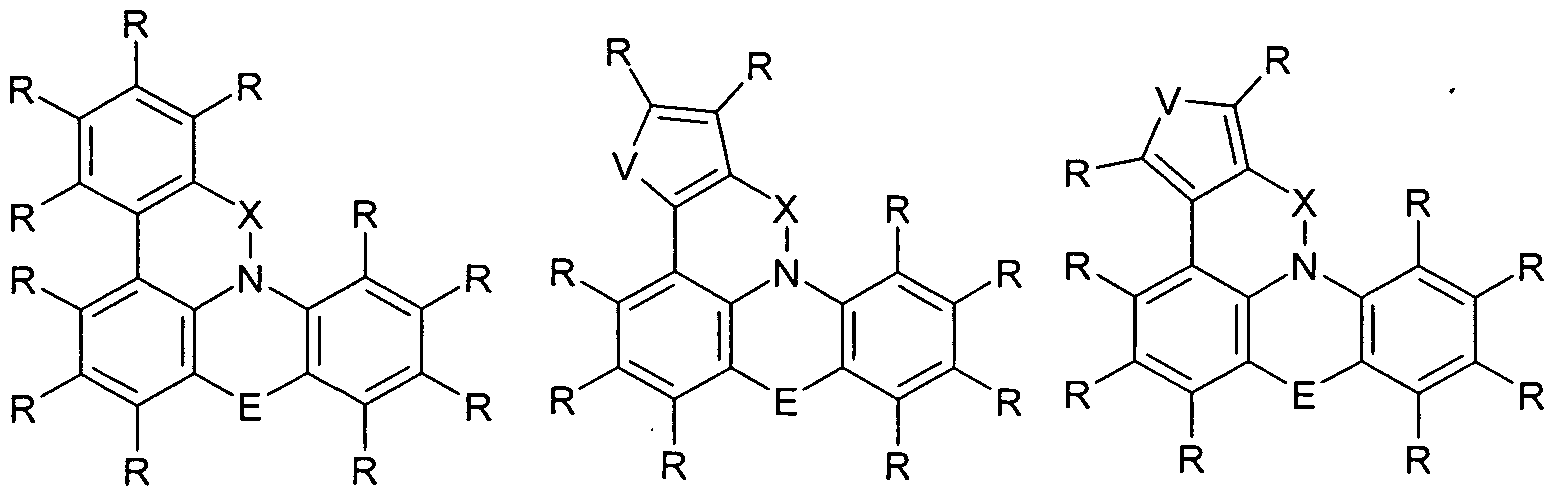


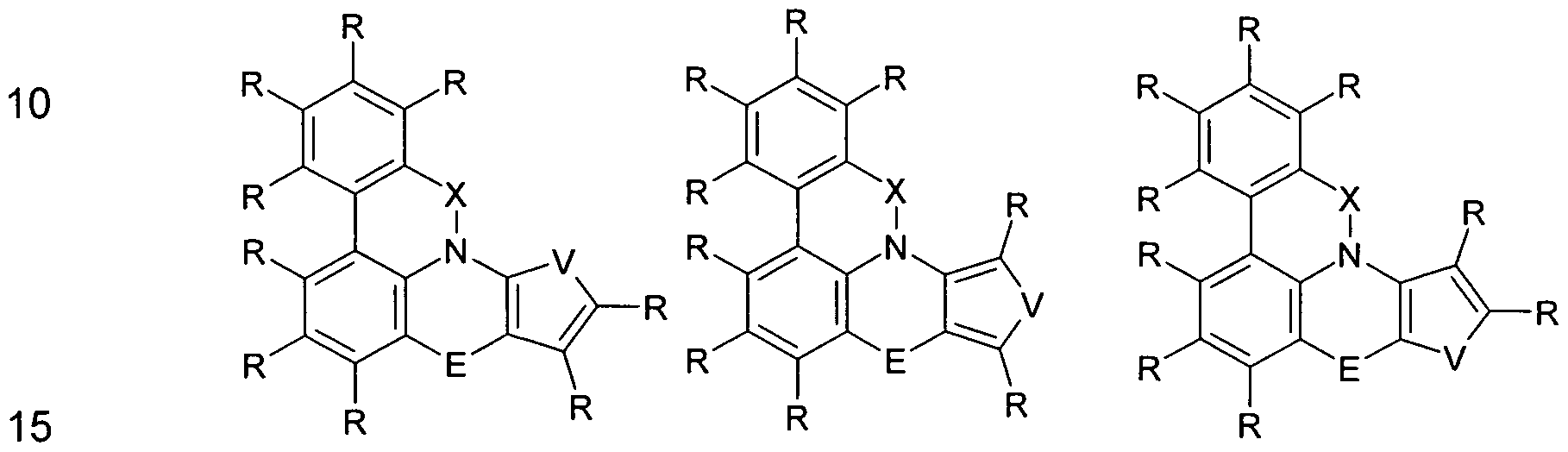


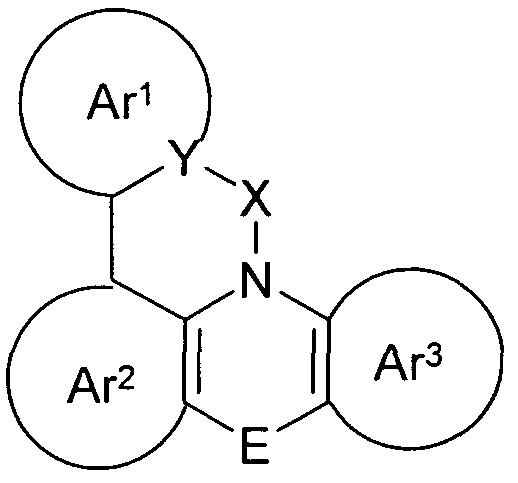

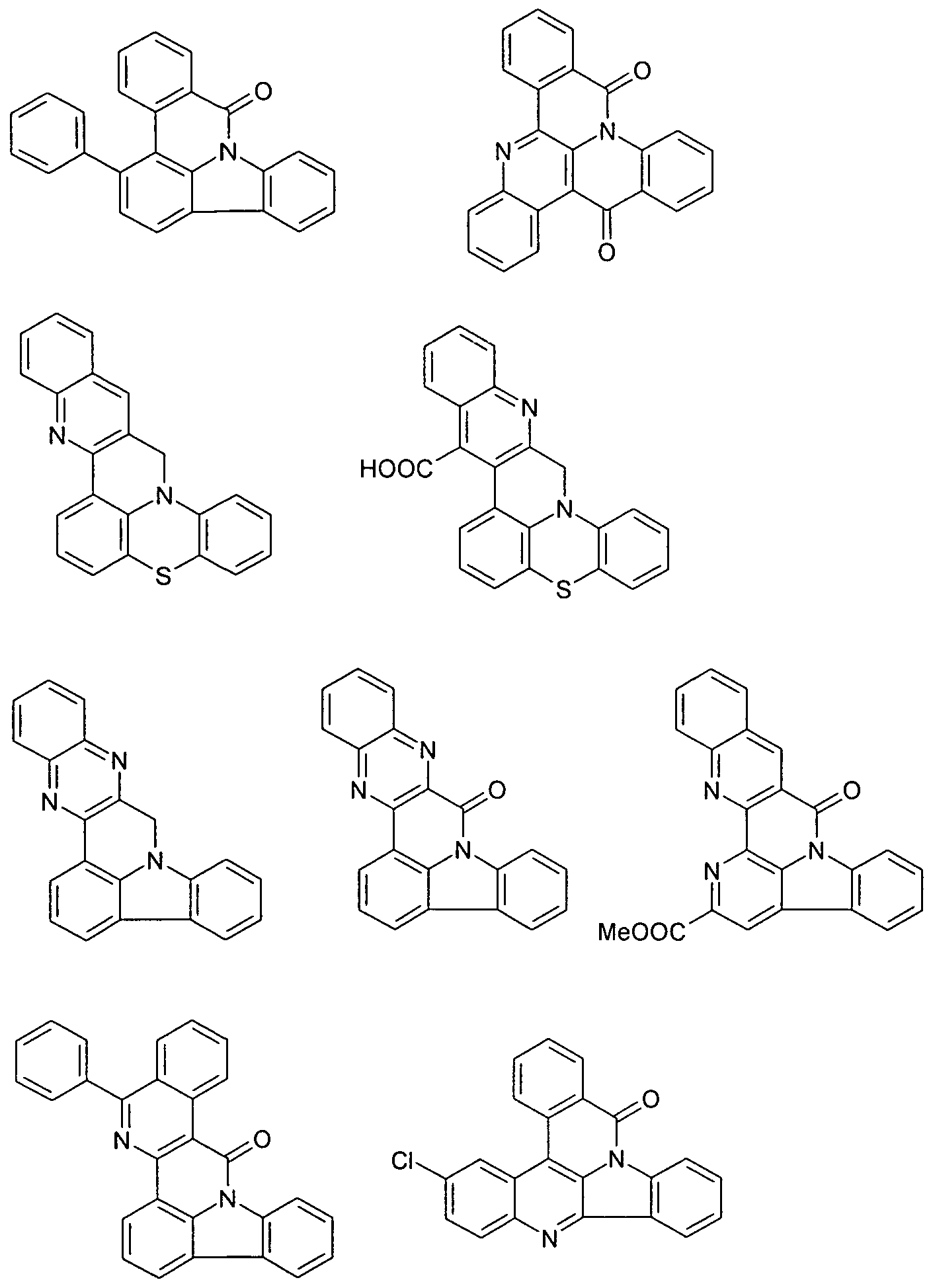
Priority Applications (4)
| Application Number | Priority Date | Filing Date | Title |
|---|---|---|---|
| US13/695,933 US9139582B2 (en) | 2010-05-04 | 2011-03-29 | Organic electroluminescent devices |
| CN201180022284.9A CN102869662B (en) | 2010-05-04 | 2011-03-29 | Organic Electroluminescent Devices |
| KR1020127031796A KR101857828B1 (en) | 2010-05-04 | 2011-03-29 | Organic electroluminescent devices |
| JP2013508381A JP6009435B2 (en) | 2010-05-04 | 2011-03-29 | Organic electroluminescence device |
Applications Claiming Priority (2)
| Application Number | Priority Date | Filing Date | Title |
|---|---|---|---|
| DE102010019306.2 | 2010-05-04 | ||
| DE102010019306.2A DE102010019306B4 (en) | 2010-05-04 | 2010-05-04 | Organic electroluminescent devices |
Publications (1)
| Publication Number | Publication Date |
|---|---|
| WO2011137951A1 true WO2011137951A1 (en) | 2011-11-10 |
Family
ID=43919961
Family Applications (1)
| Application Number | Title | Priority Date | Filing Date |
|---|---|---|---|
| PCT/EP2011/001573 Ceased WO2011137951A1 (en) | 2010-05-04 | 2011-03-29 | Organic electroluminescence devices |
Country Status (6)
| Country | Link |
|---|---|
| US (1) | US9139582B2 (en) |
| JP (1) | JP6009435B2 (en) |
| KR (1) | KR101857828B1 (en) |
| CN (1) | CN102869662B (en) |
| DE (1) | DE102010019306B4 (en) |
| WO (1) | WO2011137951A1 (en) |
Cited By (135)
| Publication number | Priority date | Publication date | Assignee | Title |
|---|---|---|---|---|
| WO2012079741A1 (en) | 2010-12-15 | 2012-06-21 | Merck Patent Gmbh | Metal complexes |
| WO2013041176A1 (en) | 2011-09-21 | 2013-03-28 | Merck Patent Gmbh | Carbazole derivatives for organic electroluminescence devices |
| WO2013120577A1 (en) | 2012-02-14 | 2013-08-22 | Merck Patent Gmbh | Spirobifluorene compounds for organic electroluminescent devices |
| WO2014015931A1 (en) | 2012-07-23 | 2014-01-30 | Merck Patent Gmbh | Materials for organic electroluminescent devices |
| WO2014056567A1 (en) | 2012-10-11 | 2014-04-17 | Merck Patent Gmbh | Materials for organic electroluminescent devices |
| WO2014067614A1 (en) | 2012-10-31 | 2014-05-08 | Merck Patent Gmbh | Electronic device |
| WO2014094964A1 (en) * | 2012-12-18 | 2014-06-26 | Merck Patent Gmbh | Organic electroluminescent device |
| WO2014106522A1 (en) | 2013-01-03 | 2014-07-10 | Merck Patent Gmbh | Materials for electronic devices |
| WO2014106524A2 (en) | 2013-01-03 | 2014-07-10 | Merck Patent Gmbh | Materials for electronic devices |
| WO2015169412A1 (en) | 2014-05-05 | 2015-11-12 | Merck Patent Gmbh | Materials for organic light emitting devices |
| KR20150140322A (en) * | 2013-04-08 | 2015-12-15 | 메르크 파텐트 게엠베하 | Organic electroluminescent device with thermally activated delayed fluorescence material |
| US20160093812A1 (en) * | 2013-04-08 | 2016-03-31 | Merck Patent Gmbh | Organic electroluminescent device |
| WO2016074755A1 (en) | 2014-11-11 | 2016-05-19 | Merck Patent Gmbh | Materials for organic electroluminescent devices |
| WO2016124304A1 (en) | 2015-02-03 | 2016-08-11 | Merck Patent Gmbh | Metal complexes |
| WO2017025166A1 (en) | 2015-08-13 | 2017-02-16 | Merck Patent Gmbh | Hexamethylindanes |
| WO2017028940A1 (en) | 2015-08-14 | 2017-02-23 | Merck Patent Gmbh | Phenoxazine derivatives for organic electroluminescent devices |
| WO2017133829A1 (en) | 2016-02-05 | 2017-08-10 | Merck Patent Gmbh | Materials for electronic devices |
| WO2017148564A1 (en) | 2016-03-03 | 2017-09-08 | Merck Patent Gmbh | Materials for organic electroluminescent devices |
| WO2017157983A1 (en) | 2016-03-17 | 2017-09-21 | Merck Patent Gmbh | Compounds with spirobifluorene-structures |
| WO2017178311A1 (en) | 2016-04-11 | 2017-10-19 | Merck Patent Gmbh | Heterocyclic compounds comprising dibenzofuran and/or dibenzothiophene structures |
| WO2017186760A1 (en) | 2016-04-29 | 2017-11-02 | Merck Patent Gmbh | Materials for organic electroluminescent devices |
| WO2018050584A1 (en) | 2016-09-14 | 2018-03-22 | Merck Patent Gmbh | Compounds with spirobifluorene-structures |
| WO2018050583A1 (en) | 2016-09-14 | 2018-03-22 | Merck Patent Gmbh | Compounds with carbazole structures |
| WO2018060218A1 (en) | 2016-09-30 | 2018-04-05 | Merck Patent Gmbh | Carbazoles with diazadibenzofurane or diazadibenzothiophene structures |
| WO2018060307A1 (en) | 2016-09-30 | 2018-04-05 | Merck Patent Gmbh | Compounds with diazadibenzofurane or diazadibenzothiophene structures |
| WO2018069167A1 (en) | 2016-10-10 | 2018-04-19 | Merck Patent Gmbh | Electronic device |
| DE102017008794A1 (en) | 2016-10-17 | 2018-04-19 | Merck Patent Gmbh | Materials for use in electronic devices |
| WO2018083053A1 (en) | 2016-11-02 | 2018-05-11 | Merck Patent Gmbh | Materials for electronic devices |
| WO2018087020A1 (en) | 2016-11-08 | 2018-05-17 | Merck Patent Gmbh | Compounds for electronic devices |
| WO2018087346A1 (en) | 2016-11-14 | 2018-05-17 | Merck Patent Gmbh | Compounds with an acceptor and a donor group |
| WO2018087022A1 (en) | 2016-11-09 | 2018-05-17 | Merck Patent Gmbh | Materials for organic electroluminescent devices |
| WO2018091435A1 (en) | 2016-11-17 | 2018-05-24 | Merck Patent Gmbh | Materials for organic electroluminescent devices |
| WO2018095839A1 (en) | 2016-11-22 | 2018-05-31 | Merck Patent Gmbh | Bridged triarylamines for electronic devices |
| WO2018099846A1 (en) | 2016-11-30 | 2018-06-07 | Merck Patent Gmbh | Compounds having valerolactam structures |
| WO2018104195A1 (en) | 2016-12-05 | 2018-06-14 | Merck Patent Gmbh | Nitrogen-containing heterocycles for use in oleds |
| WO2018114882A1 (en) | 2016-12-22 | 2018-06-28 | Merck Patent Gmbh | Materials for electronic devices |
| WO2018114883A1 (en) | 2016-12-22 | 2018-06-28 | Merck Patent Gmbh | Mixtures comprising at least two organofunctional compounds |
| WO2018138039A1 (en) | 2017-01-25 | 2018-08-02 | Merck Patent Gmbh | Carbazole derivatives |
| WO2018141706A1 (en) | 2017-02-02 | 2018-08-09 | Merck Patent Gmbh | Materials for electronic devices |
| WO2018158232A1 (en) | 2017-03-01 | 2018-09-07 | Merck Patent Gmbh | Organic electroluminescent device |
| WO2018157981A1 (en) | 2017-03-02 | 2018-09-07 | Merck Patent Gmbh | Materials for organic electronic devices |
| WO2018166932A1 (en) | 2017-03-13 | 2018-09-20 | Merck Patent Gmbh | Compounds with arylamine structures |
| WO2018166934A1 (en) | 2017-03-15 | 2018-09-20 | Merck Patent Gmbh | Materials for organic electroluminescent devices |
| WO2018189134A1 (en) | 2017-04-13 | 2018-10-18 | Merck Patent Gmbh | Composition for organic electronic devices |
| WO2018206526A1 (en) | 2017-05-11 | 2018-11-15 | Merck Patent Gmbh | Organoboron complexes for organic electroluminescent devices |
| WO2018206537A1 (en) | 2017-05-11 | 2018-11-15 | Merck Patent Gmbh | Carbazole-based bodipys for organic electroluminescent devices |
| WO2018234346A1 (en) | 2017-06-23 | 2018-12-27 | Merck Patent Gmbh | MATERIALS FOR ORGANIC ELECTROLUMINESCENT DEVICES |
| WO2018234220A1 (en) | 2017-06-21 | 2018-12-27 | Merck Patent Gmbh | MATERIALS FOR ELECTRONIC DEVICES |
| WO2019002190A1 (en) | 2017-06-28 | 2019-01-03 | Merck Patent Gmbh | Materials for electronic devices |
| WO2019002198A1 (en) | 2017-06-26 | 2019-01-03 | Merck Patent Gmbh | Homogeneous mixtures |
| WO2019007867A1 (en) | 2017-07-05 | 2019-01-10 | Merck Patent Gmbh | COMPOSITION FOR ORGANIC ELECTRONIC DEVICES |
| WO2019007866A1 (en) | 2017-07-05 | 2019-01-10 | Merck Patent Gmbh | COMPOSITION FOR ORGANIC ELECTRONIC DEVICES |
| WO2019020654A1 (en) | 2017-07-28 | 2019-01-31 | Merck Patent Gmbh | Spirobifluorene derivatives for use in electronic devices |
| WO2019048443A1 (en) | 2017-09-08 | 2019-03-14 | Merck Patent Gmbh | Materials for electronic devices |
| WO2019052933A1 (en) | 2017-09-12 | 2019-03-21 | Merck Patent Gmbh | MATERIALS FOR ORGANIC ELECTROLUMINESCENT DEVICES |
| US10249831B2 (en) | 2015-02-09 | 2019-04-02 | Merck Patent Gmbh | Electronic device containing cyclic lactams |
| WO2019068679A1 (en) | 2017-10-06 | 2019-04-11 | Merck Patent Gmbh | Materials for organic electroluminescent devices |
| WO2019076789A1 (en) | 2017-10-17 | 2019-04-25 | Merck Patent Gmbh | Materials for organic electroluminescent devices |
| WO2019096717A2 (en) | 2017-11-14 | 2019-05-23 | Merck Patent Gmbh | Composition for organic electronic devices |
| WO2019101835A1 (en) | 2017-11-24 | 2019-05-31 | Merck Patent Gmbh | Materials for organic electroluminescent devices |
| WO2019101719A1 (en) | 2017-11-23 | 2019-05-31 | Merck Patent Gmbh | Materials for electronic devices |
| WO2019101833A1 (en) | 2017-11-24 | 2019-05-31 | Merck Patent Gmbh | Materials for organic electroluminescent devices |
| WO2019115577A1 (en) | 2017-12-15 | 2019-06-20 | Merck Patent Gmbh | Substituted aromatic amines for use in organic electroluminescent devices |
| WO2019121483A1 (en) | 2017-12-20 | 2019-06-27 | Merck Patent Gmbh | Heteroaromatic compounds |
| WO2019121458A1 (en) | 2017-12-19 | 2019-06-27 | Merck Patent Gmbh | Heterocyclic compound for use in electronic devices |
| WO2019170578A1 (en) | 2018-03-06 | 2019-09-12 | Merck Patent Gmbh | Materials for organic electroluminescent devices |
| WO2019170572A1 (en) | 2018-03-06 | 2019-09-12 | Merck Patent Gmbh | Materials for organic electroluminescent devices |
| WO2019175149A1 (en) | 2018-03-16 | 2019-09-19 | Merck Patent Gmbh | Materials for organic electroluminescent devices |
| WO2020016264A1 (en) | 2018-07-20 | 2020-01-23 | Merck Patent Gmbh | Materials for organic electroluminescent devices |
| WO2020043646A1 (en) | 2018-08-28 | 2020-03-05 | Merck Patent Gmbh | Materials for organic electroluminescent devices |
| WO2020043657A1 (en) | 2018-08-28 | 2020-03-05 | Merck Patent Gmbh | Materials for organic electroluminescent devices |
| WO2020043640A1 (en) | 2018-08-28 | 2020-03-05 | Merck Patent Gmbh | Materials for organic electroluminescent devices |
| WO2020053150A1 (en) | 2018-09-12 | 2020-03-19 | Merck Patent Gmbh | Materials for organic electroluminescent devices |
| WO2020053315A1 (en) | 2018-09-12 | 2020-03-19 | Merck Patent Gmbh | Electroluminescent devices |
| WO2020053314A1 (en) | 2018-09-12 | 2020-03-19 | Merck Patent Gmbh | Electroluminescent devices |
| WO2020064662A2 (en) | 2018-09-27 | 2020-04-02 | Merck Patent Gmbh | Method for producing sterically hindered, nitrogen-containing heteroaromatic compounds |
| WO2020064666A1 (en) | 2018-09-27 | 2020-04-02 | Merck Patent Gmbh | Compounds that can be used in an organic electronic device as active compounds |
| WO2020089138A1 (en) | 2018-10-31 | 2020-05-07 | Merck Patent Gmbh | Materials for organic electroluminescent devices |
| WO2020094539A1 (en) | 2018-11-05 | 2020-05-14 | Merck Patent Gmbh | Compounds that can be used in an organic electronic device |
| WO2020094542A1 (en) | 2018-11-06 | 2020-05-14 | Merck Patent Gmbh | 5,6-diphenyl-5,6-dihydro-dibenz[c,e][1,2]azaphosphorin and 6-phenyl-6h-dibenzo[c,e][1,2]thiazin-5,5-dioxide derivatives and similar compounds as organic electroluminescent materials for oleds |
| WO2020099349A1 (en) | 2018-11-14 | 2020-05-22 | Merck Patent Gmbh | Compounds that can be used for producing an organic electronic device |
| WO2020127165A1 (en) | 2018-12-19 | 2020-06-25 | Merck Patent Gmbh | Materials for organic electroluminescent devices |
| WO2020148243A1 (en) | 2019-01-16 | 2020-07-23 | Merck Patent Gmbh | Materials for organic electroluminescent devices |
| WO2020178230A1 (en) | 2019-03-04 | 2020-09-10 | Merck Patent Gmbh | Ligands for nano-sized materials |
| WO2020182779A1 (en) | 2019-03-12 | 2020-09-17 | Merck Patent Gmbh | Materials for organic electroluminescent devices |
| WO2020193447A1 (en) | 2019-03-25 | 2020-10-01 | Merck Patent Gmbh | Materials for organic electroluminescent devices |
| US10804482B2 (en) | 2017-09-25 | 2020-10-13 | Samsung Display Co., Ltd. | Silicon-containing compound and organic electroluminescence device including the same |
| WO2020208051A1 (en) | 2019-04-11 | 2020-10-15 | Merck Patent Gmbh | Materials for organic electroluminescent devices |
| WO2021043703A1 (en) | 2019-09-02 | 2021-03-11 | Merck Patent Gmbh | Materials for organic electroluminescent devices |
| US10957864B2 (en) * | 2014-02-28 | 2021-03-23 | Merck Patent Gmbh | Materials for organic light-emitting devices |
| WO2021053046A1 (en) * | 2019-09-20 | 2021-03-25 | Merck Patent Gmbh | Peri-condensed heterocyclic compounds as materials for electronic devices |
| WO2021052924A1 (en) | 2019-09-16 | 2021-03-25 | Merck Patent Gmbh | Materials for organic electroluminescent devices |
| WO2021078710A1 (en) | 2019-10-22 | 2021-04-29 | Merck Patent Gmbh | Materials for organic electroluminescent devices |
| WO2021078831A1 (en) | 2019-10-25 | 2021-04-29 | Merck Patent Gmbh | Compounds that can be used in an organic electronic device |
| WO2021089450A1 (en) | 2019-11-04 | 2021-05-14 | Merck Patent Gmbh | Materials for organic electroluminescent devices |
| WO2021094269A1 (en) | 2019-11-12 | 2021-05-20 | Merck Patent Gmbh | Materials for organic electroluminescent devices |
| WO2021170522A1 (en) | 2020-02-25 | 2021-09-02 | Merck Patent Gmbh | Use of heterocyclic compounds in an organic electronic device |
| WO2021175706A1 (en) | 2020-03-02 | 2021-09-10 | Merck Patent Gmbh | Use of sulfone compounds in an organic electronic device |
| US11121327B2 (en) * | 2013-07-02 | 2021-09-14 | Merck Patent Gmbh | Spiro-condensed lactam compounds for organic electroluminescent devices |
| WO2021191058A1 (en) | 2020-03-23 | 2021-09-30 | Merck Patent Gmbh | Materials for organic electroluminescent devices |
| WO2021198213A1 (en) | 2020-04-02 | 2021-10-07 | Merck Patent Gmbh | Materials for organic electroluminescent devices |
| WO2021254984A1 (en) | 2020-06-18 | 2021-12-23 | Merck Patent Gmbh | Indenoazanaphthalenes |
| WO2022017997A1 (en) | 2020-07-22 | 2022-01-27 | Merck Patent Gmbh | Materials for organic electroluminescent devices |
| WO2022029096A1 (en) | 2020-08-06 | 2022-02-10 | Merck Patent Gmbh | Materials for organic electroluminescent devices |
| WO2022038065A1 (en) | 2020-08-18 | 2022-02-24 | Merck Patent Gmbh | Materials for organic electroluminescent devices |
| WO2022122682A2 (en) | 2020-12-10 | 2022-06-16 | Merck Patent Gmbh | Materials for organic electroluminescent devices |
| EP4037000A1 (en) | 2014-07-21 | 2022-08-03 | Merck Patent GmbH | Materials for electronic devices |
| WO2023052272A1 (en) | 2021-09-28 | 2023-04-06 | Merck Patent Gmbh | Materials for electronic devices |
| WO2023052313A1 (en) | 2021-09-28 | 2023-04-06 | Merck Patent Gmbh | Materials for electronic devices |
| WO2023052275A1 (en) | 2021-09-28 | 2023-04-06 | Merck Patent Gmbh | Materials for electronic devices |
| WO2023052314A1 (en) | 2021-09-28 | 2023-04-06 | Merck Patent Gmbh | Materials for electronic devices |
| WO2023094412A1 (en) | 2021-11-25 | 2023-06-01 | Merck Patent Gmbh | Materials for electronic devices |
| WO2023099543A1 (en) | 2021-11-30 | 2023-06-08 | Merck Patent Gmbh | Compounds having fluorene structures |
| WO2023117837A1 (en) | 2021-12-21 | 2023-06-29 | Merck Patent Gmbh | Process for preparing deuterated organic compounds |
| WO2023152346A1 (en) | 2022-02-14 | 2023-08-17 | Merck Patent Gmbh | Materials for electronic devices |
| WO2023222559A1 (en) | 2022-05-18 | 2023-11-23 | Merck Patent Gmbh | Process for preparing deuterated organic compounds |
| WO2024013004A1 (en) | 2022-07-11 | 2024-01-18 | Merck Patent Gmbh | Materials for electronic devices |
| WO2024105066A1 (en) | 2022-11-17 | 2024-05-23 | Merck Patent Gmbh | Materials for organic electroluminescent devices |
| WO2024133048A1 (en) | 2022-12-20 | 2024-06-27 | Merck Patent Gmbh | Method for preparing deuterated aromatic compounds |
| WO2024132993A1 (en) | 2022-12-19 | 2024-06-27 | Merck Patent Gmbh | Materials for electronic devices |
| WO2024170605A1 (en) | 2023-02-17 | 2024-08-22 | Merck Patent Gmbh | Materials for organic electroluminescent devices |
| WO2024218109A1 (en) | 2023-04-20 | 2024-10-24 | Merck Patent Gmbh | Materials for electronic devices |
| WO2024240725A1 (en) | 2023-05-25 | 2024-11-28 | Merck Patent Gmbh | Tris[1,2,4]triazolo[1,5-a:1',5'-c:1'',5''-e][1,3,5]triazine derivatives for use in organic electroluminescent devices |
| WO2025012253A1 (en) | 2023-07-12 | 2025-01-16 | Merck Patent Gmbh | Materials for electronic devices |
| WO2025021855A1 (en) | 2023-07-27 | 2025-01-30 | Merck Patent Gmbh | Materials for organic light-emitting devices and organic sensors |
| WO2025045843A1 (en) | 2023-08-30 | 2025-03-06 | Merck Patent Gmbh | Materials for organic light-emitting devices |
| WO2025045842A1 (en) | 2023-08-30 | 2025-03-06 | Merck Patent Gmbh | Materials for organic light-emitting devices |
| WO2025045851A1 (en) | 2023-08-30 | 2025-03-06 | Merck Patent Gmbh | Materials for organic light-emitting devices |
| WO2025119821A1 (en) | 2023-12-05 | 2025-06-12 | Merck Patent Gmbh | Material composition for organic electroluminescent devices |
| WO2025132547A1 (en) | 2023-12-21 | 2025-06-26 | Merck Patent Gmbh | Mechanochemical method for deuterating organic compounds |
| WO2025132551A1 (en) | 2023-12-22 | 2025-06-26 | Merck Patent Gmbh | Materials for electronic devices |
| WO2025196145A1 (en) | 2024-03-22 | 2025-09-25 | Merck Patent Gmbh | Materials for organic light emitting devices |
| WO2025195961A1 (en) | 2024-03-19 | 2025-09-25 | Merck Patent Gmbh | Organic light-emitting devices |
| WO2025210013A1 (en) | 2024-04-04 | 2025-10-09 | Merck Patent Gmbh | Compounds for electronic devices, in particular compounds for oleds |
| WO2026008710A1 (en) | 2024-07-05 | 2026-01-08 | Merck Patent Gmbh | Cyclic silicon compounds for organic electroluminescent devices |
Families Citing this family (20)
| Publication number | Priority date | Publication date | Assignee | Title |
|---|---|---|---|---|
| KR101967014B1 (en) | 2011-08-10 | 2019-04-08 | 메르크 파텐트 게엠베하 | Metal complexes |
| EP2768808B1 (en) | 2011-10-20 | 2017-11-15 | Merck Patent GmbH | Materials for organic electroluminescent devices |
| EP2773721B1 (en) | 2011-11-01 | 2015-11-25 | Merck Patent GmbH | Organic electroluminescent device |
| KR101527275B1 (en) * | 2012-05-31 | 2015-06-09 | 주식회사 엘지화학 | Organoluminescent device |
| JP2014107521A (en) * | 2012-11-30 | 2014-06-09 | Samsung Display Co Ltd | Charge transporting material for organic electroluminescent element, and organic electroluminescent element employing the same |
| KR20150058082A (en) * | 2013-11-20 | 2015-05-28 | 주식회사 동진쎄미켐 | Novel electroluminescent compound and organic electroluminescent device comprising same |
| DE102014008722B4 (en) | 2014-06-18 | 2024-08-22 | Merck Patent Gmbh | Compositions for electronic devices, formulation containing them, use of the composition, use of the formulation and organic electronic device containing the composition |
| CN104109134A (en) * | 2014-06-26 | 2014-10-22 | 陕西科技大学 | N-acyl phenothiazine and preparation method thereof |
| KR102502791B1 (en) * | 2014-10-24 | 2023-02-22 | 메르크 파텐트 게엠베하 | Organic electroluminescent device |
| CN107235990B (en) * | 2017-06-11 | 2019-01-29 | 湘潭大学 | Polysubstituted indoles bithiophene and derivative and its synthetic method |
| KR20210097741A (en) * | 2018-11-30 | 2021-08-09 | 메르크 파텐트 게엠베하 | Compounds for Electronic Devices |
| CN112430239B (en) * | 2019-08-26 | 2022-03-22 | 广州华睿光电材料有限公司 | Seven-membered ring structure-based compound, high polymer, mixture, composition, and organic electronic device |
| KR102391274B1 (en) * | 2019-12-05 | 2022-04-27 | 덕산네오룩스 주식회사 | Compound for organic electronic element, organic electronic element using the same, and an electronic device thereof |
| CN112079833A (en) * | 2020-09-18 | 2020-12-15 | 吉林奥来德光电材料股份有限公司 | Organic electroluminescent compound and preparation method and application thereof |
| CN112079834B (en) * | 2020-09-18 | 2021-07-16 | 吉林奥来德光电材料股份有限公司 | An organic electroluminescent compound and its application |
| CN112062765B (en) * | 2020-09-18 | 2021-08-31 | 吉林奥来德光电材料股份有限公司 | A kind of organic photoluminescent compound and preparation method thereof |
| AU2021401996A1 (en) * | 2020-12-14 | 2023-07-13 | Kinoxis Therapeutics Pty Ltd | Oxytocin receptor modulators |
| US20250163035A1 (en) * | 2022-02-09 | 2025-05-22 | Merck Patent Gmbh | Materials for organic electroluminescent devices |
| CN115073495B (en) * | 2022-08-09 | 2024-03-19 | 苏州大学 | An indoline compound and its preparation method |
| CN117362292B (en) * | 2023-06-15 | 2025-07-22 | 闽都创新实验室 | Amide derivative heat-activated delayed fluorescent material and preparation method and application thereof |
Citations (64)
| Publication number | Priority date | Publication date | Assignee | Title |
|---|---|---|---|---|
| US4539507A (en) | 1983-03-25 | 1985-09-03 | Eastman Kodak Company | Organic electroluminescent devices having improved power conversion efficiencies |
| US5151629A (en) | 1991-08-01 | 1992-09-29 | Eastman Kodak Company | Blue emitting internal junction organic electroluminescent device (I) |
| WO1992018552A1 (en) | 1991-04-11 | 1992-10-29 | Wacker-Chemie Gmbh | Conductive polymers with conjugated double bonds |
| EP0652273A1 (en) | 1993-11-09 | 1995-05-10 | Shinko Electric Industries Co. Ltd. | Organic material for electroluminescent device and electroluminescent device |
| EP0676461A2 (en) | 1994-04-07 | 1995-10-11 | Hoechst Aktiengesellschaft | Spiro compounds and their application as electroluminescence materials |
| EP0707020A2 (en) | 1994-10-14 | 1996-04-17 | Hoechst Aktiengesellschaft | Conjugated polymers with a spiro atom and their use as electroluminescent materials |
| WO1996026186A1 (en) * | 1995-02-23 | 1996-08-29 | Hoechst Aktiengesellschaft | Azafullerenes, method for producing them and their use |
| EP0842208A1 (en) | 1995-07-28 | 1998-05-20 | The Dow Chemical Company | 2,7-aryl-9-substituted fluorenes and 9-substituted fluorene oligomers and polymers |
| WO1998027136A1 (en) | 1996-12-16 | 1998-06-25 | Aventis Research & Technologies Gmbh & Co Kg | ARYL-SUBSTITUTED POLY(p-ARYLENE VINYLENES), METHOD FOR THE PRODUCTION AND USE THEREOF IN ELECTROLUMINESCENT COMPONENTS |
| EP0894107A1 (en) | 1996-04-17 | 1999-02-03 | Hoechst Research & Technology Deutschland GmbH & Co. KG | Polymers with spiro atoms and their use as electroluminescent materials |
| WO2000022026A1 (en) | 1998-10-10 | 2000-04-20 | Celanese Ventures Gmbh | Conjugated polymers containing special fluorene structural elements with improved properties |
| EP1028136A2 (en) | 1999-02-10 | 2000-08-16 | Carnegie-Mellon University | A method of forming poly-(3-substituted) thiophenes |
| WO2000070655A2 (en) | 1999-05-13 | 2000-11-23 | The Trustees Of Princeton University | Very high efficiency organic light emitting devices based on electrophosphorescence |
| WO2001041512A1 (en) | 1999-12-01 | 2001-06-07 | The Trustees Of Princeton University | Complexes of form l2mx as phosphorescent dopants for organic leds |
| WO2002002714A2 (en) | 2000-06-30 | 2002-01-10 | E.I. Du Pont De Nemours And Company | Electroluminescent iridium compounds with fluorinated phenylpyridines, phenylpyrimidines, and phenylquinolines and devices made with such compounds |
| WO2002015645A1 (en) | 2000-08-11 | 2002-02-21 | The Trustees Of Princeton University | Organometallic compounds and emission-shifting organic electrophosphorescence |
| EP1191614A2 (en) | 2000-09-26 | 2002-03-27 | Canon Kabushiki Kaisha | Luminescence device and metal coordination compound therefor |
| EP1191613A2 (en) | 2000-09-26 | 2002-03-27 | Canon Kabushiki Kaisha | Luminescence device, display apparatus and metal coordination compound |
| EP1191612A2 (en) | 2000-09-26 | 2002-03-27 | Canon Kabushiki Kaisha | Luminescence device, display apparatus and metal coordination compound |
| EP1205527A1 (en) | 2000-03-27 | 2002-05-15 | Idemitsu Kosan Co., Ltd. | Organic electroluminescence device |
| WO2004013080A1 (en) | 2002-08-01 | 2004-02-12 | Covion Organic Semiconductors Gmbh | Spirobifluorene derivatives, their preparation and uses thereof |
| WO2004041901A1 (en) | 2002-11-08 | 2004-05-21 | Covion Organic Semiconductors Gmbh | Aryl-substituted polyindenofluorenes for use in organic electroluminiscent devices |
| WO2004058911A2 (en) | 2002-12-23 | 2004-07-15 | Covion Organic Semiconductors Gmbh | Organic electroluminescent element |
| WO2004070772A2 (en) | 2003-02-06 | 2004-08-19 | Covion Organic Semiconductors Gmbh | Conjugated polymers and blends containing carbazole, representation and use thereof |
| JP2004288381A (en) | 2003-03-19 | 2004-10-14 | Konica Minolta Holdings Inc | Organic electroluminescent element |
| WO2004093207A2 (en) | 2003-04-15 | 2004-10-28 | Covion Organic Semiconductors Gmbh | Mixtures of matrix materials and organic semiconductors capable of emission, use of the same and electronic components containing said mixtures |
| WO2004113468A1 (en) | 2003-06-26 | 2004-12-29 | Covion Organic Semiconductors Gmbh | Novel materials for electroluminescence |
| WO2004113412A2 (en) | 2003-06-23 | 2004-12-29 | Covion Organic Semiconductors Gmbh | Polymer |
| WO2005003253A2 (en) | 2003-07-07 | 2005-01-13 | Covion Organic Semiconductors Gmbh | Mixtures of organic emissive semiconductors and matrix materials, their use and electronic components comprising said materials |
| WO2005011013A1 (en) | 2003-07-21 | 2005-02-03 | Covion Organic Semiconductors Gmbh | Organic electroluminescent element |
| WO2005014689A2 (en) | 2003-08-12 | 2005-02-17 | Covion Organic Semiconductors Gmbh | Conjugated polymers containing dihydrophenanthrene units and use thereof |
| WO2005019373A2 (en) | 2003-08-19 | 2005-03-03 | Basf Aktiengesellschaft | Transition metal complexes comprising carbene ligands serving as emitters for organic light-emitting diodes (oled's) |
| US20050069729A1 (en) | 2003-09-30 | 2005-03-31 | Konica Minolta Holdings, Inc. | Organic electroluminescent element, illuminator, display and compound |
| WO2005033244A1 (en) | 2003-09-29 | 2005-04-14 | Covion Organic Semiconductors Gmbh | Metal complexes |
| WO2005040302A1 (en) | 2003-10-22 | 2005-05-06 | Merck Patent Gmbh | New materials for electroluminescence and the utilization thereof |
| US20050121068A1 (en) * | 2002-06-22 | 2005-06-09 | Nanosolar, Inc. | Photovoltaic devices fabricated by growth from porous template |
| WO2005053051A1 (en) | 2003-11-25 | 2005-06-09 | Merck Patent Gmbh | Organic electroluminescent element |
| WO2005104264A1 (en) | 2004-04-26 | 2005-11-03 | Merck Patent Gmbh | Electroluminescent polymers and use therof |
| WO2005111172A2 (en) | 2004-05-11 | 2005-11-24 | Merck Patent Gmbh | Novel material mixtures for use in electroluminescence |
| US20050258742A1 (en) | 2004-05-18 | 2005-11-24 | Yui-Yi Tsai | Carbene containing metal complexes as OLEDs |
| JP2005347160A (en) | 2004-06-04 | 2005-12-15 | Konica Minolta Holdings Inc | Organic electroluminescence element, lighting device and display device |
| EP1617711A1 (en) | 2003-04-23 | 2006-01-18 | Konica Minolta Holdings, Inc. | Organic electroluminescent device and display |
| WO2006005627A1 (en) | 2004-07-15 | 2006-01-19 | Merck Patent Gmbh | Oligomeric derivatives of spirobifluorene, their preparation and use |
| WO2006061181A1 (en) | 2004-12-06 | 2006-06-15 | Merck Patent Gmbh | Partially conjugated polymers, their representation and their use |
| WO2006117052A1 (en) | 2005-05-03 | 2006-11-09 | Merck Patent Gmbh | Organic electroluminescent device and boric acid and borinic acid derivatives used therein |
| EP1731584A1 (en) | 2004-03-31 | 2006-12-13 | Konica Minolta Holdings, Inc. | Organic electroluminescent device material, organic electroluminescent device, display and illuminating device |
| WO2007017066A1 (en) | 2005-08-10 | 2007-02-15 | Merck Patent Gmbh | Electroluminescent polymers and use thereof |
| WO2007063754A1 (en) | 2005-12-01 | 2007-06-07 | Nippon Steel Chemical Co., Ltd. | Compound for organic electroluminescent element and organic electroluminescent element |
| WO2007137725A1 (en) | 2006-05-31 | 2007-12-06 | Merck Patent Gmbh | New materials for organic electroluminescent devices |
| WO2008056746A1 (en) | 2006-11-09 | 2008-05-15 | Nippon Steel Chemical Co., Ltd. | Compound for organic electroluminescent device and organic electroluminescent device |
| WO2008086851A1 (en) | 2007-01-18 | 2008-07-24 | Merck Patent Gmbh | Carbazole derivatives for organc electroluminescent devices |
| WO2008097272A2 (en) * | 2006-08-07 | 2008-08-14 | Wake Forest University | Composite organic materials and applications thereof |
| JP2008270395A (en) * | 2007-04-18 | 2008-11-06 | Mitsui Chemicals Inc | Organic transistor |
| JP2009033067A (en) * | 2007-07-31 | 2009-02-12 | Mitsui Chemicals Inc | Organic transistor |
| WO2009030981A2 (en) | 2006-12-28 | 2009-03-12 | Universal Display Corporation | Long lifetime phosphorescent organic light emitting device (oled) structures |
| WO2009062578A1 (en) | 2007-11-12 | 2009-05-22 | Merck Patent Gmbh | Organic electroluminescent devices comprising azomethine-metal complexes |
| WO2009136595A1 (en) | 2008-05-08 | 2009-11-12 | 新日鐵化学株式会社 | Compound for organic electric field light-emitting element and organic electric field light-emitting element |
| WO2010006680A1 (en) | 2008-07-18 | 2010-01-21 | Merck Patent Gmbh | Materials for organic electroluminescence devices |
| WO2010015306A1 (en) | 2008-08-08 | 2010-02-11 | Merck Patent Gmbh, | Organic electroluminescence device |
| WO2010054730A1 (en) | 2008-11-11 | 2010-05-20 | Merck Patent Gmbh | Organic electroluminescent devices |
| WO2010054729A2 (en) | 2008-11-11 | 2010-05-20 | Merck Patent Gmbh | Materials for organic electroluminescence devices |
| WO2010104047A1 (en) * | 2009-03-11 | 2010-09-16 | 国立大学法人京都大学 | Polycyclic aromatic compound |
| WO2010136109A1 (en) | 2009-05-29 | 2010-12-02 | Merck Patent Gmbh | Materials for organic electroluminescent devices |
| WO2011000455A1 (en) | 2009-06-30 | 2011-01-06 | Merck Patent Gmbh | Materials for organic electroluminescence devices |
Family Cites Families (6)
| Publication number | Priority date | Publication date | Assignee | Title |
|---|---|---|---|---|
| WO2006033563A1 (en) | 2004-09-24 | 2006-03-30 | Lg Chem. Ltd. | Organic light emitting device |
| DE102009053644B4 (en) | 2009-11-17 | 2019-07-04 | Merck Patent Gmbh | Materials for organic electroluminescent devices |
| DE102009053645A1 (en) | 2009-11-17 | 2011-05-19 | Merck Patent Gmbh | Materials for organic electroluminescent device |
| DE102009048791A1 (en) | 2009-10-08 | 2011-04-14 | Merck Patent Gmbh | Materials for organic electroluminescent devices |
| DE102009053382A1 (en) | 2009-11-14 | 2011-05-19 | Merck Patent Gmbh | Materials for electronic devices |
| DE102009053836A1 (en) | 2009-11-18 | 2011-05-26 | Merck Patent Gmbh | Materials for organic electroluminescent devices |
-
2010
- 2010-05-04 DE DE102010019306.2A patent/DE102010019306B4/en active Active
-
2011
- 2011-03-29 CN CN201180022284.9A patent/CN102869662B/en active Active
- 2011-03-29 KR KR1020127031796A patent/KR101857828B1/en active Active
- 2011-03-29 WO PCT/EP2011/001573 patent/WO2011137951A1/en not_active Ceased
- 2011-03-29 JP JP2013508381A patent/JP6009435B2/en active Active
- 2011-03-29 US US13/695,933 patent/US9139582B2/en active Active
Patent Citations (66)
| Publication number | Priority date | Publication date | Assignee | Title |
|---|---|---|---|---|
| US4539507A (en) | 1983-03-25 | 1985-09-03 | Eastman Kodak Company | Organic electroluminescent devices having improved power conversion efficiencies |
| WO1992018552A1 (en) | 1991-04-11 | 1992-10-29 | Wacker-Chemie Gmbh | Conductive polymers with conjugated double bonds |
| US5151629A (en) | 1991-08-01 | 1992-09-29 | Eastman Kodak Company | Blue emitting internal junction organic electroluminescent device (I) |
| EP0652273A1 (en) | 1993-11-09 | 1995-05-10 | Shinko Electric Industries Co. Ltd. | Organic material for electroluminescent device and electroluminescent device |
| EP0676461A2 (en) | 1994-04-07 | 1995-10-11 | Hoechst Aktiengesellschaft | Spiro compounds and their application as electroluminescence materials |
| EP0707020A2 (en) | 1994-10-14 | 1996-04-17 | Hoechst Aktiengesellschaft | Conjugated polymers with a spiro atom and their use as electroluminescent materials |
| WO1996026186A1 (en) * | 1995-02-23 | 1996-08-29 | Hoechst Aktiengesellschaft | Azafullerenes, method for producing them and their use |
| EP0842208A1 (en) | 1995-07-28 | 1998-05-20 | The Dow Chemical Company | 2,7-aryl-9-substituted fluorenes and 9-substituted fluorene oligomers and polymers |
| EP0894107A1 (en) | 1996-04-17 | 1999-02-03 | Hoechst Research & Technology Deutschland GmbH & Co. KG | Polymers with spiro atoms and their use as electroluminescent materials |
| WO1998027136A1 (en) | 1996-12-16 | 1998-06-25 | Aventis Research & Technologies Gmbh & Co Kg | ARYL-SUBSTITUTED POLY(p-ARYLENE VINYLENES), METHOD FOR THE PRODUCTION AND USE THEREOF IN ELECTROLUMINESCENT COMPONENTS |
| WO2000022026A1 (en) | 1998-10-10 | 2000-04-20 | Celanese Ventures Gmbh | Conjugated polymers containing special fluorene structural elements with improved properties |
| EP1028136A2 (en) | 1999-02-10 | 2000-08-16 | Carnegie-Mellon University | A method of forming poly-(3-substituted) thiophenes |
| WO2000070655A2 (en) | 1999-05-13 | 2000-11-23 | The Trustees Of Princeton University | Very high efficiency organic light emitting devices based on electrophosphorescence |
| WO2001041512A1 (en) | 1999-12-01 | 2001-06-07 | The Trustees Of Princeton University | Complexes of form l2mx as phosphorescent dopants for organic leds |
| EP1205527A1 (en) | 2000-03-27 | 2002-05-15 | Idemitsu Kosan Co., Ltd. | Organic electroluminescence device |
| WO2002002714A2 (en) | 2000-06-30 | 2002-01-10 | E.I. Du Pont De Nemours And Company | Electroluminescent iridium compounds with fluorinated phenylpyridines, phenylpyrimidines, and phenylquinolines and devices made with such compounds |
| WO2002015645A1 (en) | 2000-08-11 | 2002-02-21 | The Trustees Of Princeton University | Organometallic compounds and emission-shifting organic electrophosphorescence |
| EP1191614A2 (en) | 2000-09-26 | 2002-03-27 | Canon Kabushiki Kaisha | Luminescence device and metal coordination compound therefor |
| EP1191613A2 (en) | 2000-09-26 | 2002-03-27 | Canon Kabushiki Kaisha | Luminescence device, display apparatus and metal coordination compound |
| EP1191612A2 (en) | 2000-09-26 | 2002-03-27 | Canon Kabushiki Kaisha | Luminescence device, display apparatus and metal coordination compound |
| US20050121068A1 (en) * | 2002-06-22 | 2005-06-09 | Nanosolar, Inc. | Photovoltaic devices fabricated by growth from porous template |
| WO2004013080A1 (en) | 2002-08-01 | 2004-02-12 | Covion Organic Semiconductors Gmbh | Spirobifluorene derivatives, their preparation and uses thereof |
| WO2004041901A1 (en) | 2002-11-08 | 2004-05-21 | Covion Organic Semiconductors Gmbh | Aryl-substituted polyindenofluorenes for use in organic electroluminiscent devices |
| WO2004058911A2 (en) | 2002-12-23 | 2004-07-15 | Covion Organic Semiconductors Gmbh | Organic electroluminescent element |
| WO2004070772A2 (en) | 2003-02-06 | 2004-08-19 | Covion Organic Semiconductors Gmbh | Conjugated polymers and blends containing carbazole, representation and use thereof |
| JP2004288381A (en) | 2003-03-19 | 2004-10-14 | Konica Minolta Holdings Inc | Organic electroluminescent element |
| WO2004093207A2 (en) | 2003-04-15 | 2004-10-28 | Covion Organic Semiconductors Gmbh | Mixtures of matrix materials and organic semiconductors capable of emission, use of the same and electronic components containing said mixtures |
| EP1617710A1 (en) | 2003-04-23 | 2006-01-18 | Konica Minolta Holdings, Inc. | Material for organic electroluminescent device, organic electroluminescent device, illuminating device and display |
| EP1617711A1 (en) | 2003-04-23 | 2006-01-18 | Konica Minolta Holdings, Inc. | Organic electroluminescent device and display |
| WO2004113412A2 (en) | 2003-06-23 | 2004-12-29 | Covion Organic Semiconductors Gmbh | Polymer |
| WO2004113468A1 (en) | 2003-06-26 | 2004-12-29 | Covion Organic Semiconductors Gmbh | Novel materials for electroluminescence |
| WO2005003253A2 (en) | 2003-07-07 | 2005-01-13 | Covion Organic Semiconductors Gmbh | Mixtures of organic emissive semiconductors and matrix materials, their use and electronic components comprising said materials |
| WO2005011013A1 (en) | 2003-07-21 | 2005-02-03 | Covion Organic Semiconductors Gmbh | Organic electroluminescent element |
| WO2005014689A2 (en) | 2003-08-12 | 2005-02-17 | Covion Organic Semiconductors Gmbh | Conjugated polymers containing dihydrophenanthrene units and use thereof |
| WO2005019373A2 (en) | 2003-08-19 | 2005-03-03 | Basf Aktiengesellschaft | Transition metal complexes comprising carbene ligands serving as emitters for organic light-emitting diodes (oled's) |
| WO2005033244A1 (en) | 2003-09-29 | 2005-04-14 | Covion Organic Semiconductors Gmbh | Metal complexes |
| WO2005039246A1 (en) | 2003-09-30 | 2005-04-28 | Konica Minolta Holdings, Inc. | Organic electroluminescent device, illuminating device, and display |
| US20050069729A1 (en) | 2003-09-30 | 2005-03-31 | Konica Minolta Holdings, Inc. | Organic electroluminescent element, illuminator, display and compound |
| WO2005040302A1 (en) | 2003-10-22 | 2005-05-06 | Merck Patent Gmbh | New materials for electroluminescence and the utilization thereof |
| WO2005053051A1 (en) | 2003-11-25 | 2005-06-09 | Merck Patent Gmbh | Organic electroluminescent element |
| EP1731584A1 (en) | 2004-03-31 | 2006-12-13 | Konica Minolta Holdings, Inc. | Organic electroluminescent device material, organic electroluminescent device, display and illuminating device |
| WO2005104264A1 (en) | 2004-04-26 | 2005-11-03 | Merck Patent Gmbh | Electroluminescent polymers and use therof |
| WO2005111172A2 (en) | 2004-05-11 | 2005-11-24 | Merck Patent Gmbh | Novel material mixtures for use in electroluminescence |
| US20050258742A1 (en) | 2004-05-18 | 2005-11-24 | Yui-Yi Tsai | Carbene containing metal complexes as OLEDs |
| JP2005347160A (en) | 2004-06-04 | 2005-12-15 | Konica Minolta Holdings Inc | Organic electroluminescence element, lighting device and display device |
| WO2006005627A1 (en) | 2004-07-15 | 2006-01-19 | Merck Patent Gmbh | Oligomeric derivatives of spirobifluorene, their preparation and use |
| WO2006061181A1 (en) | 2004-12-06 | 2006-06-15 | Merck Patent Gmbh | Partially conjugated polymers, their representation and their use |
| WO2006117052A1 (en) | 2005-05-03 | 2006-11-09 | Merck Patent Gmbh | Organic electroluminescent device and boric acid and borinic acid derivatives used therein |
| WO2007017066A1 (en) | 2005-08-10 | 2007-02-15 | Merck Patent Gmbh | Electroluminescent polymers and use thereof |
| WO2007063754A1 (en) | 2005-12-01 | 2007-06-07 | Nippon Steel Chemical Co., Ltd. | Compound for organic electroluminescent element and organic electroluminescent element |
| WO2007137725A1 (en) | 2006-05-31 | 2007-12-06 | Merck Patent Gmbh | New materials for organic electroluminescent devices |
| WO2008097272A2 (en) * | 2006-08-07 | 2008-08-14 | Wake Forest University | Composite organic materials and applications thereof |
| WO2008056746A1 (en) | 2006-11-09 | 2008-05-15 | Nippon Steel Chemical Co., Ltd. | Compound for organic electroluminescent device and organic electroluminescent device |
| WO2009030981A2 (en) | 2006-12-28 | 2009-03-12 | Universal Display Corporation | Long lifetime phosphorescent organic light emitting device (oled) structures |
| WO2008086851A1 (en) | 2007-01-18 | 2008-07-24 | Merck Patent Gmbh | Carbazole derivatives for organc electroluminescent devices |
| JP2008270395A (en) * | 2007-04-18 | 2008-11-06 | Mitsui Chemicals Inc | Organic transistor |
| JP2009033067A (en) * | 2007-07-31 | 2009-02-12 | Mitsui Chemicals Inc | Organic transistor |
| WO2009062578A1 (en) | 2007-11-12 | 2009-05-22 | Merck Patent Gmbh | Organic electroluminescent devices comprising azomethine-metal complexes |
| WO2009136595A1 (en) | 2008-05-08 | 2009-11-12 | 新日鐵化学株式会社 | Compound for organic electric field light-emitting element and organic electric field light-emitting element |
| WO2010006680A1 (en) | 2008-07-18 | 2010-01-21 | Merck Patent Gmbh | Materials for organic electroluminescence devices |
| WO2010015306A1 (en) | 2008-08-08 | 2010-02-11 | Merck Patent Gmbh, | Organic electroluminescence device |
| WO2010054730A1 (en) | 2008-11-11 | 2010-05-20 | Merck Patent Gmbh | Organic electroluminescent devices |
| WO2010054729A2 (en) | 2008-11-11 | 2010-05-20 | Merck Patent Gmbh | Materials for organic electroluminescence devices |
| WO2010104047A1 (en) * | 2009-03-11 | 2010-09-16 | 国立大学法人京都大学 | Polycyclic aromatic compound |
| WO2010136109A1 (en) | 2009-05-29 | 2010-12-02 | Merck Patent Gmbh | Materials for organic electroluminescent devices |
| WO2011000455A1 (en) | 2009-06-30 | 2011-01-06 | Merck Patent Gmbh | Materials for organic electroluminescence devices |
Non-Patent Citations (13)
| Title |
|---|
| D. M. KOLLER ET AL.: "organic plasmon emitting devices", NATURE PHOTONICS, 2008, pages 1 - 4 |
| DE DIESBACH, HENRI ET AL: "Etude des dérivés de l'indigo IX", HELVETICA CHIMICA ACTA, vol. 32, 1949, pages 1214 - 1227, XP002636364, DOI: 10.1002/hlca.19490320408 * |
| FRANZ, ADAM W.; ROMINGER, FRANK; MUELLER, THOMAS J. J.: "Synthesis and Electronic Properties of Sterically Demanding N-Arylphenothiazines and Unexpected Buchwald-Hartwig Aminations", JOURNAL OF ORGANIC CHEMISTRY, vol. 73, no. 5, 2008, pages 1795 - 1802, XP002636362, DOI: 10.1021/jo702389v * |
| GOMEZ-LOR, BERTA; ECHAVARREN, ANTONIO M.: "Synthesis of a Triaza Analogue of Crushed-Fullerene by Intramolecular Palladium-Catalyzed Arylation", ORGANIC LETTERS, vol. 6, no. 17, 2004, pages 2993 - 2996, XP002543593, DOI: 10.1021/ol048760s * |
| JOURNAL OF ORGANIC CHEMISTRY, vol. 67, no. 3, 2002, pages 1001 - 1003 |
| KAWACHI ET AL., ORGANOMETALLICS, vol. 26, no. 19, 2007, pages 4697 |
| KELLY, T. ROSS; XU, WEI; SUNDARESAN, JAYASHREE: "MAXONINE: STRUCTURE CORRECTION AND SYNTHESIS", TETRAHEDRON LETTERS, vol. 34, no. 39, 1993, pages 6173 - 6176, XP002636363, DOI: 10.1016/S0040-4039(00)73702-6 * |
| M. A. BALDO ET AL., APPL. PHYS. LETT., vol. 75, 1999, pages 4 - 6 |
| M. S. ARNOLD ET AL., APPL. PHYS. LETT., vol. 92, 2008, pages 053301 |
| NOURRY, ARNAUD; LEGOUPY, STEPHANIE; HUET, FRANCOIS: "Synthesis of new lavendamycin analogues", TETRAHEDRON, vol. 64, no. 9, 2008, pages 2241 - 2250, XP002636361, ISSN: 0040-4020 * |
| TACHIKAWA, TATSUYA; TOKITA, SUMIO: "The calculation of electronic spectra of protonated benzodixanthene analogs", JOURNAL OF PHOTOPOLYMER SCIENCE AND TECHNOLOGY, vol. 15, no. 1, 2002, pages 111 - 114, XP002636360, ISSN: 0914-9244 * |
| XIE, RUI-HUA; BRYANT, GARNETT W.; SUN, GUANGYU; KAR, TAPAS; CHEN, ZHONGFANG; SMITH, VEDENE H., JR. ET AL: "Tuning spectral properties of fullerenes by substitutional doping", PHYSICAL REVIEW B: CONDENSED MATTER AND MATERIALS PHYSICS, vol. 69, no. 20, 2004, pages 201403-1 - 201403-4, XP002636359, ISSN: 0163-1829 * |
| ZHANG, HAIMING; LAROCK, RICHARD C.: "Synthesis of Annulated gamma-Carbolines and Heteropolycycles by the Palladium-Catalyzed Intramolecular Annulation of Alkynes", JOURNAL OF ORGANIC CHEMISTRY, vol. 68, no. 13, 2003, pages 5132 - 5138, XP009148028, DOI: 10.1021/jo0343228 * |
Cited By (169)
| Publication number | Priority date | Publication date | Assignee | Title |
|---|---|---|---|---|
| WO2012079741A1 (en) | 2010-12-15 | 2012-06-21 | Merck Patent Gmbh | Metal complexes |
| WO2013041176A1 (en) | 2011-09-21 | 2013-03-28 | Merck Patent Gmbh | Carbazole derivatives for organic electroluminescence devices |
| WO2013120577A1 (en) | 2012-02-14 | 2013-08-22 | Merck Patent Gmbh | Spirobifluorene compounds for organic electroluminescent devices |
| EP3235892A1 (en) | 2012-02-14 | 2017-10-25 | Merck Patent GmbH | Materials for organic electroluminescent devices |
| EP3101088A1 (en) | 2012-02-14 | 2016-12-07 | Merck Patent GmbH | Materials for organic electroluminescent devices |
| WO2014015931A1 (en) | 2012-07-23 | 2014-01-30 | Merck Patent Gmbh | Materials for organic electroluminescent devices |
| JP2016500675A (en) * | 2012-10-11 | 2016-01-14 | メルク パテント ゲーエムベーハー | Materials for organic electroluminescent devices |
| WO2014056567A1 (en) | 2012-10-11 | 2014-04-17 | Merck Patent Gmbh | Materials for organic electroluminescent devices |
| WO2014067614A1 (en) | 2012-10-31 | 2014-05-08 | Merck Patent Gmbh | Electronic device |
| EP3806176A1 (en) | 2012-10-31 | 2021-04-14 | Merck Patent GmbH | Electronic device |
| CN104871329B (en) * | 2012-12-18 | 2017-10-24 | 默克专利有限公司 | Organic electroluminescence device |
| JP2016507890A (en) * | 2012-12-18 | 2016-03-10 | メルク パテント ゲーエムベーハー | Organic electroluminescent device |
| US20150340621A1 (en) * | 2012-12-18 | 2015-11-26 | Merck Patent Gmbh | Organic electroluminescent device |
| CN104871329A (en) * | 2012-12-18 | 2015-08-26 | 默克专利有限公司 | Organic electroluminescent device |
| WO2014094964A1 (en) * | 2012-12-18 | 2014-06-26 | Merck Patent Gmbh | Organic electroluminescent device |
| KR20150097741A (en) * | 2012-12-18 | 2015-08-26 | 메르크 파텐트 게엠베하 | Organic electroluminescent device |
| TWI633106B (en) * | 2012-12-18 | 2018-08-21 | 馬克專利公司 | Organic electroluminescent device |
| KR102179608B1 (en) * | 2012-12-18 | 2020-11-17 | 메르크 파텐트 게엠베하 | Organic electroluminescent device |
| WO2014106522A1 (en) | 2013-01-03 | 2014-07-10 | Merck Patent Gmbh | Materials for electronic devices |
| WO2014106524A2 (en) | 2013-01-03 | 2014-07-10 | Merck Patent Gmbh | Materials for electronic devices |
| JP2016521455A (en) * | 2013-04-08 | 2016-07-21 | メルク パテント ゲーエムベーハー | Organic electroluminescent devices with thermally activated delayed fluorescent materials |
| US20160093812A1 (en) * | 2013-04-08 | 2016-03-31 | Merck Patent Gmbh | Organic electroluminescent device |
| US10069079B2 (en) | 2013-04-08 | 2018-09-04 | Merck Patent Gmbh | Organic electroluminescent device with thermally activated delayed fluorescence material |
| JP2019145807A (en) * | 2013-04-08 | 2019-08-29 | メルク パテント ゲーエムベーハー | Organic electroluminescent element with thermally activated delayed fluorescence material |
| KR20150140322A (en) * | 2013-04-08 | 2015-12-15 | 메르크 파텐트 게엠베하 | Organic electroluminescent device with thermally activated delayed fluorescence material |
| KR102361072B1 (en) | 2013-04-08 | 2022-02-09 | 메르크 파텐트 게엠베하 | Organic electroluminescent device with thermally activated delayed fluorescence material |
| US11121327B2 (en) * | 2013-07-02 | 2021-09-14 | Merck Patent Gmbh | Spiro-condensed lactam compounds for organic electroluminescent devices |
| US10957864B2 (en) * | 2014-02-28 | 2021-03-23 | Merck Patent Gmbh | Materials for organic light-emitting devices |
| WO2015169412A1 (en) | 2014-05-05 | 2015-11-12 | Merck Patent Gmbh | Materials for organic light emitting devices |
| EP4037000A1 (en) | 2014-07-21 | 2022-08-03 | Merck Patent GmbH | Materials for electronic devices |
| WO2016074755A1 (en) | 2014-11-11 | 2016-05-19 | Merck Patent Gmbh | Materials for organic electroluminescent devices |
| WO2016124304A1 (en) | 2015-02-03 | 2016-08-11 | Merck Patent Gmbh | Metal complexes |
| US10249831B2 (en) | 2015-02-09 | 2019-04-02 | Merck Patent Gmbh | Electronic device containing cyclic lactams |
| WO2017025166A1 (en) | 2015-08-13 | 2017-02-16 | Merck Patent Gmbh | Hexamethylindanes |
| WO2017028940A1 (en) | 2015-08-14 | 2017-02-23 | Merck Patent Gmbh | Phenoxazine derivatives for organic electroluminescent devices |
| WO2017133829A1 (en) | 2016-02-05 | 2017-08-10 | Merck Patent Gmbh | Materials for electronic devices |
| WO2017148565A1 (en) | 2016-03-03 | 2017-09-08 | Merck Patent Gmbh | Materials for organic electroluminescence devices |
| WO2017148564A1 (en) | 2016-03-03 | 2017-09-08 | Merck Patent Gmbh | Materials for organic electroluminescent devices |
| WO2017157983A1 (en) | 2016-03-17 | 2017-09-21 | Merck Patent Gmbh | Compounds with spirobifluorene-structures |
| WO2017178311A1 (en) | 2016-04-11 | 2017-10-19 | Merck Patent Gmbh | Heterocyclic compounds comprising dibenzofuran and/or dibenzothiophene structures |
| WO2017186760A1 (en) | 2016-04-29 | 2017-11-02 | Merck Patent Gmbh | Materials for organic electroluminescent devices |
| WO2018050583A1 (en) | 2016-09-14 | 2018-03-22 | Merck Patent Gmbh | Compounds with carbazole structures |
| WO2018050584A1 (en) | 2016-09-14 | 2018-03-22 | Merck Patent Gmbh | Compounds with spirobifluorene-structures |
| WO2018060307A1 (en) | 2016-09-30 | 2018-04-05 | Merck Patent Gmbh | Compounds with diazadibenzofurane or diazadibenzothiophene structures |
| WO2018060218A1 (en) | 2016-09-30 | 2018-04-05 | Merck Patent Gmbh | Carbazoles with diazadibenzofurane or diazadibenzothiophene structures |
| EP4113643A1 (en) | 2016-10-10 | 2023-01-04 | Merck Patent GmbH | Electronic device |
| EP4255151A2 (en) | 2016-10-10 | 2023-10-04 | Merck Patent GmbH | Spiro[fluorene-9,9'-(thio)xanthene] compounds |
| WO2018069167A1 (en) | 2016-10-10 | 2018-04-19 | Merck Patent Gmbh | Electronic device |
| DE102017008794A1 (en) | 2016-10-17 | 2018-04-19 | Merck Patent Gmbh | Materials for use in electronic devices |
| WO2018083053A1 (en) | 2016-11-02 | 2018-05-11 | Merck Patent Gmbh | Materials for electronic devices |
| WO2018087020A1 (en) | 2016-11-08 | 2018-05-17 | Merck Patent Gmbh | Compounds for electronic devices |
| WO2018087022A1 (en) | 2016-11-09 | 2018-05-17 | Merck Patent Gmbh | Materials for organic electroluminescent devices |
| EP4271163A2 (en) | 2016-11-14 | 2023-11-01 | Merck Patent GmbH | Compounds with an acceptor and a donor group |
| WO2018087346A1 (en) | 2016-11-14 | 2018-05-17 | Merck Patent Gmbh | Compounds with an acceptor and a donor group |
| WO2018091435A1 (en) | 2016-11-17 | 2018-05-24 | Merck Patent Gmbh | Materials for organic electroluminescent devices |
| WO2018095839A1 (en) | 2016-11-22 | 2018-05-31 | Merck Patent Gmbh | Bridged triarylamines for electronic devices |
| US11713319B2 (en) | 2016-11-30 | 2023-08-01 | Merck Patent Gmbh | Compounds having valerolactam structures |
| WO2018099846A1 (en) | 2016-11-30 | 2018-06-07 | Merck Patent Gmbh | Compounds having valerolactam structures |
| WO2018104195A1 (en) | 2016-12-05 | 2018-06-14 | Merck Patent Gmbh | Nitrogen-containing heterocycles for use in oleds |
| EP3978491A1 (en) | 2016-12-05 | 2022-04-06 | Merck Patent GmbH | Nitrogen-containing heterocycles for use in oleds |
| WO2018114882A1 (en) | 2016-12-22 | 2018-06-28 | Merck Patent Gmbh | Materials for electronic devices |
| WO2018114883A1 (en) | 2016-12-22 | 2018-06-28 | Merck Patent Gmbh | Mixtures comprising at least two organofunctional compounds |
| WO2018138039A1 (en) | 2017-01-25 | 2018-08-02 | Merck Patent Gmbh | Carbazole derivatives |
| WO2018141706A1 (en) | 2017-02-02 | 2018-08-09 | Merck Patent Gmbh | Materials for electronic devices |
| WO2018158232A1 (en) | 2017-03-01 | 2018-09-07 | Merck Patent Gmbh | Organic electroluminescent device |
| WO2018157981A1 (en) | 2017-03-02 | 2018-09-07 | Merck Patent Gmbh | Materials for organic electronic devices |
| WO2018166932A1 (en) | 2017-03-13 | 2018-09-20 | Merck Patent Gmbh | Compounds with arylamine structures |
| WO2018166934A1 (en) | 2017-03-15 | 2018-09-20 | Merck Patent Gmbh | Materials for organic electroluminescent devices |
| WO2018189134A1 (en) | 2017-04-13 | 2018-10-18 | Merck Patent Gmbh | Composition for organic electronic devices |
| US11778907B2 (en) | 2017-04-13 | 2023-10-03 | Merck Patent Gmbh | Composition for organic electronic devices |
| WO2018206537A1 (en) | 2017-05-11 | 2018-11-15 | Merck Patent Gmbh | Carbazole-based bodipys for organic electroluminescent devices |
| WO2018206526A1 (en) | 2017-05-11 | 2018-11-15 | Merck Patent Gmbh | Organoboron complexes for organic electroluminescent devices |
| WO2018234220A1 (en) | 2017-06-21 | 2018-12-27 | Merck Patent Gmbh | MATERIALS FOR ELECTRONIC DEVICES |
| WO2018234346A1 (en) | 2017-06-23 | 2018-12-27 | Merck Patent Gmbh | MATERIALS FOR ORGANIC ELECTROLUMINESCENT DEVICES |
| WO2019002198A1 (en) | 2017-06-26 | 2019-01-03 | Merck Patent Gmbh | Homogeneous mixtures |
| WO2019002190A1 (en) | 2017-06-28 | 2019-01-03 | Merck Patent Gmbh | Materials for electronic devices |
| EP4186898A1 (en) | 2017-07-05 | 2023-05-31 | Merck Patent GmbH | Composition for organic electronic compounds |
| WO2019007867A1 (en) | 2017-07-05 | 2019-01-10 | Merck Patent Gmbh | COMPOSITION FOR ORGANIC ELECTRONIC DEVICES |
| WO2019007866A1 (en) | 2017-07-05 | 2019-01-10 | Merck Patent Gmbh | COMPOSITION FOR ORGANIC ELECTRONIC DEVICES |
| US11993572B2 (en) | 2017-07-05 | 2024-05-28 | Merck Patent Gmbh | Composition for organic electronic devices |
| WO2019020654A1 (en) | 2017-07-28 | 2019-01-31 | Merck Patent Gmbh | Spirobifluorene derivatives for use in electronic devices |
| EP4603562A2 (en) | 2017-07-28 | 2025-08-20 | Merck Patent GmbH | Spirobifluorene derivatives for use in electronic devices |
| WO2019048443A1 (en) | 2017-09-08 | 2019-03-14 | Merck Patent Gmbh | Materials for electronic devices |
| WO2019052933A1 (en) | 2017-09-12 | 2019-03-21 | Merck Patent Gmbh | MATERIALS FOR ORGANIC ELECTROLUMINESCENT DEVICES |
| US10804482B2 (en) | 2017-09-25 | 2020-10-13 | Samsung Display Co., Ltd. | Silicon-containing compound and organic electroluminescence device including the same |
| WO2019068679A1 (en) | 2017-10-06 | 2019-04-11 | Merck Patent Gmbh | Materials for organic electroluminescent devices |
| WO2019076789A1 (en) | 2017-10-17 | 2019-04-25 | Merck Patent Gmbh | Materials for organic electroluminescent devices |
| WO2019096717A2 (en) | 2017-11-14 | 2019-05-23 | Merck Patent Gmbh | Composition for organic electronic devices |
| EP4242286A2 (en) | 2017-11-23 | 2023-09-13 | Merck Patent GmbH | Materials for electronic devices |
| WO2019101719A1 (en) | 2017-11-23 | 2019-05-31 | Merck Patent Gmbh | Materials for electronic devices |
| WO2019101833A1 (en) | 2017-11-24 | 2019-05-31 | Merck Patent Gmbh | Materials for organic electroluminescent devices |
| WO2019101835A1 (en) | 2017-11-24 | 2019-05-31 | Merck Patent Gmbh | Materials for organic electroluminescent devices |
| WO2019115577A1 (en) | 2017-12-15 | 2019-06-20 | Merck Patent Gmbh | Substituted aromatic amines for use in organic electroluminescent devices |
| WO2019121458A1 (en) | 2017-12-19 | 2019-06-27 | Merck Patent Gmbh | Heterocyclic compound for use in electronic devices |
| EP4451832A2 (en) | 2017-12-20 | 2024-10-23 | Merck Patent GmbH | Heteroaromatic compounds |
| WO2019121483A1 (en) | 2017-12-20 | 2019-06-27 | Merck Patent Gmbh | Heteroaromatic compounds |
| WO2019170578A1 (en) | 2018-03-06 | 2019-09-12 | Merck Patent Gmbh | Materials for organic electroluminescent devices |
| WO2019170572A1 (en) | 2018-03-06 | 2019-09-12 | Merck Patent Gmbh | Materials for organic electroluminescent devices |
| WO2019175149A1 (en) | 2018-03-16 | 2019-09-19 | Merck Patent Gmbh | Materials for organic electroluminescent devices |
| WO2020016264A1 (en) | 2018-07-20 | 2020-01-23 | Merck Patent Gmbh | Materials for organic electroluminescent devices |
| WO2020043640A1 (en) | 2018-08-28 | 2020-03-05 | Merck Patent Gmbh | Materials for organic electroluminescent devices |
| WO2020043646A1 (en) | 2018-08-28 | 2020-03-05 | Merck Patent Gmbh | Materials for organic electroluminescent devices |
| WO2020043657A1 (en) | 2018-08-28 | 2020-03-05 | Merck Patent Gmbh | Materials for organic electroluminescent devices |
| WO2020053314A1 (en) | 2018-09-12 | 2020-03-19 | Merck Patent Gmbh | Electroluminescent devices |
| WO2020053150A1 (en) | 2018-09-12 | 2020-03-19 | Merck Patent Gmbh | Materials for organic electroluminescent devices |
| DE202019005924U1 (en) | 2018-09-12 | 2023-05-10 | MERCK Patent Gesellschaft mit beschränkter Haftung | Electroluminescent devices |
| DE202019005923U1 (en) | 2018-09-12 | 2023-06-27 | MERCK Patent Gesellschaft mit beschränkter Haftung | Electroluminescent devices |
| WO2020053315A1 (en) | 2018-09-12 | 2020-03-19 | Merck Patent Gmbh | Electroluminescent devices |
| WO2020064666A1 (en) | 2018-09-27 | 2020-04-02 | Merck Patent Gmbh | Compounds that can be used in an organic electronic device as active compounds |
| EP4190880A1 (en) | 2018-09-27 | 2023-06-07 | Merck Patent GmbH | Compounds usable as active compounds in an organic electronic device |
| WO2020064662A2 (en) | 2018-09-27 | 2020-04-02 | Merck Patent Gmbh | Method for producing sterically hindered, nitrogen-containing heteroaromatic compounds |
| EP4601449A2 (en) | 2018-09-27 | 2025-08-13 | Merck Patent GmbH | Compounds usable as active compounds in an organic electronic device |
| WO2020089138A1 (en) | 2018-10-31 | 2020-05-07 | Merck Patent Gmbh | Materials for organic electroluminescent devices |
| WO2020094539A1 (en) | 2018-11-05 | 2020-05-14 | Merck Patent Gmbh | Compounds that can be used in an organic electronic device |
| WO2020094542A1 (en) | 2018-11-06 | 2020-05-14 | Merck Patent Gmbh | 5,6-diphenyl-5,6-dihydro-dibenz[c,e][1,2]azaphosphorin and 6-phenyl-6h-dibenzo[c,e][1,2]thiazin-5,5-dioxide derivatives and similar compounds as organic electroluminescent materials for oleds |
| WO2020099349A1 (en) | 2018-11-14 | 2020-05-22 | Merck Patent Gmbh | Compounds that can be used for producing an organic electronic device |
| WO2020127165A1 (en) | 2018-12-19 | 2020-06-25 | Merck Patent Gmbh | Materials for organic electroluminescent devices |
| WO2020148243A1 (en) | 2019-01-16 | 2020-07-23 | Merck Patent Gmbh | Materials for organic electroluminescent devices |
| WO2020178230A1 (en) | 2019-03-04 | 2020-09-10 | Merck Patent Gmbh | Ligands for nano-sized materials |
| WO2020182779A1 (en) | 2019-03-12 | 2020-09-17 | Merck Patent Gmbh | Materials for organic electroluminescent devices |
| WO2020193447A1 (en) | 2019-03-25 | 2020-10-01 | Merck Patent Gmbh | Materials for organic electroluminescent devices |
| WO2020208051A1 (en) | 2019-04-11 | 2020-10-15 | Merck Patent Gmbh | Materials for organic electroluminescent devices |
| US12108665B2 (en) | 2019-09-02 | 2024-10-01 | Merck Kgaa | Materials for organic electroluminescent devices |
| WO2021043703A1 (en) | 2019-09-02 | 2021-03-11 | Merck Patent Gmbh | Materials for organic electroluminescent devices |
| WO2021052924A1 (en) | 2019-09-16 | 2021-03-25 | Merck Patent Gmbh | Materials for organic electroluminescent devices |
| CN114401945A (en) * | 2019-09-20 | 2022-04-26 | 默克专利有限公司 | Peri-condensed heterocyclic compounds as materials for electronic devices |
| WO2021053046A1 (en) * | 2019-09-20 | 2021-03-25 | Merck Patent Gmbh | Peri-condensed heterocyclic compounds as materials for electronic devices |
| WO2021078710A1 (en) | 2019-10-22 | 2021-04-29 | Merck Patent Gmbh | Materials for organic electroluminescent devices |
| WO2021078831A1 (en) | 2019-10-25 | 2021-04-29 | Merck Patent Gmbh | Compounds that can be used in an organic electronic device |
| WO2021089450A1 (en) | 2019-11-04 | 2021-05-14 | Merck Patent Gmbh | Materials for organic electroluminescent devices |
| WO2021094269A1 (en) | 2019-11-12 | 2021-05-20 | Merck Patent Gmbh | Materials for organic electroluminescent devices |
| WO2021170522A1 (en) | 2020-02-25 | 2021-09-02 | Merck Patent Gmbh | Use of heterocyclic compounds in an organic electronic device |
| WO2021175706A1 (en) | 2020-03-02 | 2021-09-10 | Merck Patent Gmbh | Use of sulfone compounds in an organic electronic device |
| WO2021191058A1 (en) | 2020-03-23 | 2021-09-30 | Merck Patent Gmbh | Materials for organic electroluminescent devices |
| WO2021198213A1 (en) | 2020-04-02 | 2021-10-07 | Merck Patent Gmbh | Materials for organic electroluminescent devices |
| WO2021254984A1 (en) | 2020-06-18 | 2021-12-23 | Merck Patent Gmbh | Indenoazanaphthalenes |
| WO2022017997A1 (en) | 2020-07-22 | 2022-01-27 | Merck Patent Gmbh | Materials for organic electroluminescent devices |
| WO2022029096A1 (en) | 2020-08-06 | 2022-02-10 | Merck Patent Gmbh | Materials for organic electroluminescent devices |
| US12433160B2 (en) | 2020-08-18 | 2025-09-30 | Merck Patent Gmbh | Materials for organic electroluminescent devices |
| WO2022038065A1 (en) | 2020-08-18 | 2022-02-24 | Merck Patent Gmbh | Materials for organic electroluminescent devices |
| WO2022122682A2 (en) | 2020-12-10 | 2022-06-16 | Merck Patent Gmbh | Materials for organic electroluminescent devices |
| WO2023052272A1 (en) | 2021-09-28 | 2023-04-06 | Merck Patent Gmbh | Materials for electronic devices |
| WO2023052313A1 (en) | 2021-09-28 | 2023-04-06 | Merck Patent Gmbh | Materials for electronic devices |
| WO2023052275A1 (en) | 2021-09-28 | 2023-04-06 | Merck Patent Gmbh | Materials for electronic devices |
| WO2023052314A1 (en) | 2021-09-28 | 2023-04-06 | Merck Patent Gmbh | Materials for electronic devices |
| WO2023094412A1 (en) | 2021-11-25 | 2023-06-01 | Merck Patent Gmbh | Materials for electronic devices |
| WO2023099543A1 (en) | 2021-11-30 | 2023-06-08 | Merck Patent Gmbh | Compounds having fluorene structures |
| WO2023117837A1 (en) | 2021-12-21 | 2023-06-29 | Merck Patent Gmbh | Process for preparing deuterated organic compounds |
| WO2023152346A1 (en) | 2022-02-14 | 2023-08-17 | Merck Patent Gmbh | Materials for electronic devices |
| WO2023222559A1 (en) | 2022-05-18 | 2023-11-23 | Merck Patent Gmbh | Process for preparing deuterated organic compounds |
| WO2024013004A1 (en) | 2022-07-11 | 2024-01-18 | Merck Patent Gmbh | Materials for electronic devices |
| WO2024105066A1 (en) | 2022-11-17 | 2024-05-23 | Merck Patent Gmbh | Materials for organic electroluminescent devices |
| WO2024132993A1 (en) | 2022-12-19 | 2024-06-27 | Merck Patent Gmbh | Materials for electronic devices |
| WO2024133048A1 (en) | 2022-12-20 | 2024-06-27 | Merck Patent Gmbh | Method for preparing deuterated aromatic compounds |
| WO2024170605A1 (en) | 2023-02-17 | 2024-08-22 | Merck Patent Gmbh | Materials for organic electroluminescent devices |
| WO2024218109A1 (en) | 2023-04-20 | 2024-10-24 | Merck Patent Gmbh | Materials for electronic devices |
| WO2024240725A1 (en) | 2023-05-25 | 2024-11-28 | Merck Patent Gmbh | Tris[1,2,4]triazolo[1,5-a:1',5'-c:1'',5''-e][1,3,5]triazine derivatives for use in organic electroluminescent devices |
| WO2025012253A1 (en) | 2023-07-12 | 2025-01-16 | Merck Patent Gmbh | Materials for electronic devices |
| WO2025021855A1 (en) | 2023-07-27 | 2025-01-30 | Merck Patent Gmbh | Materials for organic light-emitting devices and organic sensors |
| WO2025045842A1 (en) | 2023-08-30 | 2025-03-06 | Merck Patent Gmbh | Materials for organic light-emitting devices |
| WO2025045851A1 (en) | 2023-08-30 | 2025-03-06 | Merck Patent Gmbh | Materials for organic light-emitting devices |
| WO2025045843A1 (en) | 2023-08-30 | 2025-03-06 | Merck Patent Gmbh | Materials for organic light-emitting devices |
| WO2025119821A1 (en) | 2023-12-05 | 2025-06-12 | Merck Patent Gmbh | Material composition for organic electroluminescent devices |
| WO2025132547A1 (en) | 2023-12-21 | 2025-06-26 | Merck Patent Gmbh | Mechanochemical method for deuterating organic compounds |
| WO2025132551A1 (en) | 2023-12-22 | 2025-06-26 | Merck Patent Gmbh | Materials for electronic devices |
| WO2025195961A1 (en) | 2024-03-19 | 2025-09-25 | Merck Patent Gmbh | Organic light-emitting devices |
| WO2025196145A1 (en) | 2024-03-22 | 2025-09-25 | Merck Patent Gmbh | Materials for organic light emitting devices |
| WO2025210013A1 (en) | 2024-04-04 | 2025-10-09 | Merck Patent Gmbh | Compounds for electronic devices, in particular compounds for oleds |
| WO2026008710A1 (en) | 2024-07-05 | 2026-01-08 | Merck Patent Gmbh | Cyclic silicon compounds for organic electroluminescent devices |
Also Published As
| Publication number | Publication date |
|---|---|
| CN102869662B (en) | 2016-08-03 |
| US9139582B2 (en) | 2015-09-22 |
| JP2013531617A (en) | 2013-08-08 |
| KR101857828B1 (en) | 2018-05-14 |
| KR20130098173A (en) | 2013-09-04 |
| CN102869662A (en) | 2013-01-09 |
| DE102010019306A1 (en) | 2011-11-10 |
| JP6009435B2 (en) | 2016-10-19 |
| DE102010019306B4 (en) | 2021-05-20 |
| US20130053555A1 (en) | 2013-02-28 |
Similar Documents
| Publication | Publication Date | Title |
|---|---|---|
| DE102010019306B4 (en) | Organic electroluminescent devices | |
| EP2773721B1 (en) | Organic electroluminescent device | |
| DE112011103450B4 (en) | Materials based on triphenyls for organic electroluminescent devices, processes for their production, their use and organic electronic devices | |
| WO2011060867A1 (en) | Nitrogen-containing condensed heterocyclic compounds for oleds | |
| WO2011116865A1 (en) | Materials for organic electroluminescence devices | |
| EP3016952B1 (en) | Spiro-condensed lactam compounds for organic electroluminescent devices | |
| EP2486036A2 (en) | Materials for organic electroluminescent devices | |
| EP2780325A1 (en) | Spiro dihydroacridine derivatives and the use thereof as materials for organic electroluminescence devices | |
| WO2012016630A1 (en) | Materials for electronic devices | |
| EP2828266A1 (en) | 9,9'-spirobixanthene derivatives for electroluminescent devices | |
| EP2699571A2 (en) | Materials for organic electroluminescent devices | |
| WO2012048780A1 (en) | Compounds for electronic devices | |
| EP2737554A1 (en) | Compounds for electronic devices | |
| DE102010005697A1 (en) | Connections for electronic devices | |
| WO2011057701A1 (en) | Organic compounds for electroluminescent devices | |
| EP2697225B1 (en) | Materials for electronic devices | |
| WO2014056567A1 (en) | Materials for organic electroluminescent devices | |
| DE102012000064A1 (en) | New heterocyclic compound excluding 9,10-dioxa-4b-aza-9a-phospha-indeno(1,2-a)indene and 9,10-dioxa-4b-aza-indeno(1,2-a)indene, useful e.g. as matrix material for fluorescent or phosphorescent emitters of electronic devices | |
| WO2011157346A1 (en) | Compounds for electronic devices | |
| WO2013091762A1 (en) | Compounds for organic electroluminescent devices | |
| WO2015128052A1 (en) | Materials for organic light-emitting devices | |
| WO2011085781A1 (en) | Materials for organic electroluminescent devices | |
| EP2697226B1 (en) | Compounds for electronic devices | |
| WO2011160758A1 (en) | Materials for organic electroluminescent devices |
Legal Events
| Date | Code | Title | Description |
|---|---|---|---|
| WWE | Wipo information: entry into national phase |
Ref document number: 201180022284.9 Country of ref document: CN |
|
| 121 | Ep: the epo has been informed by wipo that ep was designated in this application |
Ref document number: 11712765 Country of ref document: EP Kind code of ref document: A1 |
|
| WWE | Wipo information: entry into national phase |
Ref document number: 13695933 Country of ref document: US |
|
| ENP | Entry into the national phase |
Ref document number: 2013508381 Country of ref document: JP Kind code of ref document: A |
|
| NENP | Non-entry into the national phase |
Ref country code: DE |
|
| ENP | Entry into the national phase |
Ref document number: 20127031796 Country of ref document: KR Kind code of ref document: A |
|
| 122 | Ep: pct application non-entry in european phase |
Ref document number: 11712765 Country of ref document: EP Kind code of ref document: A1 |