WO2005111172A2 - Novel material mixtures for use in electroluminescence - Google Patents
Novel material mixtures for use in electroluminescence Download PDFInfo
- Publication number
- WO2005111172A2 WO2005111172A2 PCT/EP2005/005021 EP2005005021W WO2005111172A2 WO 2005111172 A2 WO2005111172 A2 WO 2005111172A2 EP 2005005021 W EP2005005021 W EP 2005005021W WO 2005111172 A2 WO2005111172 A2 WO 2005111172A2
- Authority
- WO
- WIPO (PCT)
- Prior art keywords
- formula
- mixtures
- atoms
- group
- polymer
- Prior art date
- Legal status (The legal status is an assumption and is not a legal conclusion. Google has not performed a legal analysis and makes no representation as to the accuracy of the status listed.)
- Ceased
Links
- 0 Brc1ccc(*[S+](c2ccccc2)(c2ccccc2)c(cc2)ccc2Br)cc1 Chemical compound Brc1ccc(*[S+](c2ccccc2)(c2ccccc2)c(cc2)ccc2Br)cc1 0.000 description 1
Classifications
-
- H—ELECTRICITY
- H05—ELECTRIC TECHNIQUES NOT OTHERWISE PROVIDED FOR
- H05B—ELECTRIC HEATING; ELECTRIC LIGHT SOURCES NOT OTHERWISE PROVIDED FOR; CIRCUIT ARRANGEMENTS FOR ELECTRIC LIGHT SOURCES, IN GENERAL
- H05B33/00—Electroluminescent light sources
- H05B33/12—Light sources with substantially two-dimensional radiating surfaces
- H05B33/14—Light sources with substantially two-dimensional radiating surfaces characterised by the chemical or physical composition or the arrangement of the electroluminescent material, or by the simultaneous addition of the electroluminescent material in or onto the light source
-
- C—CHEMISTRY; METALLURGY
- C09—DYES; PAINTS; POLISHES; NATURAL RESINS; ADHESIVES; COMPOSITIONS NOT OTHERWISE PROVIDED FOR; APPLICATIONS OF MATERIALS NOT OTHERWISE PROVIDED FOR
- C09K—MATERIALS FOR MISCELLANEOUS APPLICATIONS, NOT PROVIDED FOR ELSEWHERE
- C09K11/00—Luminescent, e.g. electroluminescent, chemiluminescent materials
- C09K11/06—Luminescent, e.g. electroluminescent, chemiluminescent materials containing organic luminescent materials
-
- C—CHEMISTRY; METALLURGY
- C07—ORGANIC CHEMISTRY
- C07F—ACYCLIC, CARBOCYCLIC OR HETEROCYCLIC COMPOUNDS CONTAINING ELEMENTS OTHER THAN CARBON, HYDROGEN, HALOGEN, OXYGEN, NITROGEN, SULFUR, SELENIUM OR TELLURIUM
- C07F5/00—Compounds containing elements of Groups 3 or 13 of the Periodic Table
- C07F5/003—Compounds containing elements of Groups 3 or 13 of the Periodic Table without C-Metal linkages
-
- C—CHEMISTRY; METALLURGY
- C09—DYES; PAINTS; POLISHES; NATURAL RESINS; ADHESIVES; COMPOSITIONS NOT OTHERWISE PROVIDED FOR; APPLICATIONS OF MATERIALS NOT OTHERWISE PROVIDED FOR
- C09B—ORGANIC DYES OR CLOSELY-RELATED COMPOUNDS FOR PRODUCING DYES, e.g. PIGMENTS; MORDANTS; LAKES
- C09B23/00—Methine or polymethine dyes, e.g. cyanine dyes
- C09B23/14—Styryl dyes
- C09B23/148—Stilbene dyes containing the moiety -C6H5-CH=CH-C6H5
-
- C—CHEMISTRY; METALLURGY
- C09—DYES; PAINTS; POLISHES; NATURAL RESINS; ADHESIVES; COMPOSITIONS NOT OTHERWISE PROVIDED FOR; APPLICATIONS OF MATERIALS NOT OTHERWISE PROVIDED FOR
- C09B—ORGANIC DYES OR CLOSELY-RELATED COMPOUNDS FOR PRODUCING DYES, e.g. PIGMENTS; MORDANTS; LAKES
- C09B57/00—Other synthetic dyes of known constitution
- C09B57/007—Squaraine dyes
-
- H—ELECTRICITY
- H10—SEMICONDUCTOR DEVICES; ELECTRIC SOLID-STATE DEVICES NOT OTHERWISE PROVIDED FOR
- H10K—ORGANIC ELECTRIC SOLID-STATE DEVICES
- H10K85/00—Organic materials used in the body or electrodes of devices covered by this subclass
- H10K85/10—Organic polymers or oligomers
- H10K85/111—Organic polymers or oligomers comprising aromatic, heteroaromatic, or aryl chains, e.g. polyaniline, polyphenylene or polyphenylene vinylene
-
- H—ELECTRICITY
- H10—SEMICONDUCTOR DEVICES; ELECTRIC SOLID-STATE DEVICES NOT OTHERWISE PROVIDED FOR
- H10K—ORGANIC ELECTRIC SOLID-STATE DEVICES
- H10K85/00—Organic materials used in the body or electrodes of devices covered by this subclass
- H10K85/10—Organic polymers or oligomers
- H10K85/111—Organic polymers or oligomers comprising aromatic, heteroaromatic, or aryl chains, e.g. polyaniline, polyphenylene or polyphenylene vinylene
- H10K85/115—Polyfluorene; Derivatives thereof
-
- H—ELECTRICITY
- H10—SEMICONDUCTOR DEVICES; ELECTRIC SOLID-STATE DEVICES NOT OTHERWISE PROVIDED FOR
- H10K—ORGANIC ELECTRIC SOLID-STATE DEVICES
- H10K85/00—Organic materials used in the body or electrodes of devices covered by this subclass
- H10K85/10—Organic polymers or oligomers
- H10K85/151—Copolymers
-
- H—ELECTRICITY
- H10—SEMICONDUCTOR DEVICES; ELECTRIC SOLID-STATE DEVICES NOT OTHERWISE PROVIDED FOR
- H10K—ORGANIC ELECTRIC SOLID-STATE DEVICES
- H10K85/00—Organic materials used in the body or electrodes of devices covered by this subclass
- H10K85/40—Organosilicon compounds, e.g. TIPS pentacene
-
- H—ELECTRICITY
- H10—SEMICONDUCTOR DEVICES; ELECTRIC SOLID-STATE DEVICES NOT OTHERWISE PROVIDED FOR
- H10K—ORGANIC ELECTRIC SOLID-STATE DEVICES
- H10K85/00—Organic materials used in the body or electrodes of devices covered by this subclass
- H10K85/60—Organic compounds having low molecular weight
- H10K85/615—Polycyclic condensed aromatic hydrocarbons, e.g. anthracene
-
- C—CHEMISTRY; METALLURGY
- C09—DYES; PAINTS; POLISHES; NATURAL RESINS; ADHESIVES; COMPOSITIONS NOT OTHERWISE PROVIDED FOR; APPLICATIONS OF MATERIALS NOT OTHERWISE PROVIDED FOR
- C09K—MATERIALS FOR MISCELLANEOUS APPLICATIONS, NOT PROVIDED FOR ELSEWHERE
- C09K2211/00—Chemical nature of organic luminescent or tenebrescent compounds
- C09K2211/14—Macromolecular compounds
- C09K2211/1408—Carbocyclic compounds
- C09K2211/1433—Carbocyclic compounds bridged by heteroatoms, e.g. N, P, Si or B
-
- C—CHEMISTRY; METALLURGY
- C09—DYES; PAINTS; POLISHES; NATURAL RESINS; ADHESIVES; COMPOSITIONS NOT OTHERWISE PROVIDED FOR; APPLICATIONS OF MATERIALS NOT OTHERWISE PROVIDED FOR
- C09K—MATERIALS FOR MISCELLANEOUS APPLICATIONS, NOT PROVIDED FOR ELSEWHERE
- C09K2211/00—Chemical nature of organic luminescent or tenebrescent compounds
- C09K2211/18—Metal complexes
- C09K2211/185—Metal complexes of the platinum group, i.e. Os, Ir, Pt, Ru, Rh or Pd
-
- H—ELECTRICITY
- H10—SEMICONDUCTOR DEVICES; ELECTRIC SOLID-STATE DEVICES NOT OTHERWISE PROVIDED FOR
- H10K—ORGANIC ELECTRIC SOLID-STATE DEVICES
- H10K2101/00—Properties of the organic materials covered by group H10K85/00
- H10K2101/10—Triplet emission
-
- H—ELECTRICITY
- H10—SEMICONDUCTOR DEVICES; ELECTRIC SOLID-STATE DEVICES NOT OTHERWISE PROVIDED FOR
- H10K—ORGANIC ELECTRIC SOLID-STATE DEVICES
- H10K50/00—Organic light-emitting devices
- H10K50/10—OLEDs or polymer light-emitting diodes [PLED]
- H10K50/11—OLEDs or polymer light-emitting diodes [PLED] characterised by the electroluminescent [EL] layers
-
- H—ELECTRICITY
- H10—SEMICONDUCTOR DEVICES; ELECTRIC SOLID-STATE DEVICES NOT OTHERWISE PROVIDED FOR
- H10K—ORGANIC ELECTRIC SOLID-STATE DEVICES
- H10K85/00—Organic materials used in the body or electrodes of devices covered by this subclass
- H10K85/30—Coordination compounds
- H10K85/341—Transition metal complexes, e.g. Ru(II)polypyridine complexes
- H10K85/342—Transition metal complexes, e.g. Ru(II)polypyridine complexes comprising iridium
-
- Y—GENERAL TAGGING OF NEW TECHNOLOGICAL DEVELOPMENTS; GENERAL TAGGING OF CROSS-SECTIONAL TECHNOLOGIES SPANNING OVER SEVERAL SECTIONS OF THE IPC; TECHNICAL SUBJECTS COVERED BY FORMER USPC CROSS-REFERENCE ART COLLECTIONS [XRACs] AND DIGESTS
- Y02—TECHNOLOGIES OR APPLICATIONS FOR MITIGATION OR ADAPTATION AGAINST CLIMATE CHANGE
- Y02E—REDUCTION OF GREENHOUSE GAS [GHG] EMISSIONS, RELATED TO ENERGY GENERATION, TRANSMISSION OR DISTRIBUTION
- Y02E10/00—Energy generation through renewable energy sources
- Y02E10/50—Photovoltaic [PV] energy
- Y02E10/549—Organic PV cells
-
- Y—GENERAL TAGGING OF NEW TECHNOLOGICAL DEVELOPMENTS; GENERAL TAGGING OF CROSS-SECTIONAL TECHNOLOGIES SPANNING OVER SEVERAL SECTIONS OF THE IPC; TECHNICAL SUBJECTS COVERED BY FORMER USPC CROSS-REFERENCE ART COLLECTIONS [XRACs] AND DIGESTS
- Y10—TECHNICAL SUBJECTS COVERED BY FORMER USPC
- Y10S—TECHNICAL SUBJECTS COVERED BY FORMER USPC CROSS-REFERENCE ART COLLECTIONS [XRACs] AND DIGESTS
- Y10S428/00—Stock material or miscellaneous articles
- Y10S428/917—Electroluminescent
Definitions
- PLEDs polymer (organic) light emitting diodes
- the essential conditions for practical applicability include, in particular, efficient energy transfer from the matrix to the triplet emitter (and associated efficient light emission), a long operating life and a low operating voltage.
- Matrix materials that show good results with a triplet emitter often show significantly worse results with other emitters, even with comparable emission colors. It would be desirable to have a universal matrix material available which gives good results for a large number of triplet emitters used and, if possible, also for several or all emission colors. It is therefore obvious that there is still a great need for improvement in the field of soluble triplet emitters and corresponding suitable matrix materials.
- the invention relates to mixtures (blends) containing (A) at least one polymer,
- group 14 group 14 according to IUPAC
- the mixtures according to the invention are preferably in the form of amorphous mixtures.
- a triplet emitter in the sense of the invention is to be understood as a compound which emits light from the triplet state, that is to say shows phosphorescence instead of fluorescence in electroluminescence, preferably an organometallic triplet emitter.
- Preferred structural units which contain at least one element of the fourth main group not equal to carbon contain direct silicon-silicon or germanium-germanium bonds, and / or they contain at least one partial structure according to formula (1): AY formula (1), where for the symbols apply:
- A is the same or different at each occurrence Si, Ge, Sn or Pb;
- Particularly preferred structural units which contain at least one element of the 4th main group other than carbon contain at least one structural unit according to the formulas (2) to (5),
- Polymers which contain units of the formula (2) can have direct bonds between two or more elements A.
- a suitable ratio of the individual components is, for example
- Mixture which contains a total of 1-99.5 mol%, preferably 5-80 mol%, particularly preferably 10-50 mol% of units of the formula (1) or of the formulas (2) to (5) and 0.1-95 mol%, preferably contains 0.5-80 mol%, particularly preferably 1-50 mol%, in particular 2-25 mol% of one or more triplet emitters, the details relating to the total units present (blend components or repeating units in the polymer). This is irrespective of whether the components are covalently bound to a polymer or mixed in. It has been shown that in particular a proportion of 10-50 mol% of units according to formula (1) or according to formulas (2) to (5) lead to high light emission from the triplet emitter.
- the units of the formula (1) and / or the triplet emitter are either mixed in or covalently bonded to the polymer.
- Units according to formulas (2) to (4) are covalently bound to the polymer.
- Formula (5) shows mixed-in units.
- element A ie the element of main group 4 not equal to carbon
- An aromatic or heteroaromatic ring system in the sense of this invention is to be understood as meaning a system which does not necessarily only contain aromatic or heteroaromatic groups, but also in which several aromatic or heteroaromatic groups by a short non-aromatic unit (less than 10% of the atoms different from H, preferably less than 5% of the atoms different from H), such as, for example, sp 3 -hybridized C, O, N, etc., can be interrupted.
- systems such as 9,9'-spirobifluorene, 9,9-diarylfluorene, triarylamine, diaryl ether, etc. should also be understood as aromatic systems.
- An aromatic ring system contains at least 6 carbon atoms, while a heteroaromatic one
- Ring system contains at least 2 carbon atoms and at least one heteroatom, preferably selected from N, O and / or S, and the sum of carbon atoms and heteroatoms is at least 5.
- radicals methyl, ethyl, n-propyl, i- are particularly preferably under a C to C 0 alkyl group in which individual H atoms or CH 2 groups can also be substituted by the abovementioned groups.
- a C to C 40 alkoxy group particularly preferably means methoxy, ethoxy, n-propoxy, i-propoxy, n-butoxy, i-butoxy, s-butoxy, t-butoxy or 2-methylbutoxy.
- aryl or heteroaryl group which, depending on the use, can be monovalent or bivalent, which can also be substituted in each case with the radicals R 1 mentioned above and which can be linked via any positions on the aromatic or heteroaromatic understood in particular groups which are derived from benzene, naphthalene, anthracene, phenanthrene, pyrene, chrysene, perylene, fluoranthene, tetracene, pentacene,
- Triazole benzotriazole, 1, 2,3-oxadiazole, 1, 2,4-oxadiazole, 1, 2,5-oxadiazole, 1, 3,4-oxadiazole, 1, 2,3-thiadiazole, 1, 2,4- Thiadiazole, 1, 2,5-thiadiazole, 1, 3,4-thiadiazole, 1, 3,5-triazine, 1, 2,4-triazine, 1, 2,3-triazine, tetrazole, 1, 2,4, 5-tetrazine, 1, 2,3,4-tetrazine, 1, 2,3,5-tetrazine, purine, pteridine, indolizine and benzothiadiazole.
- Aromatic ring systems also include, in particular, biphenyls, terphenyls, fluorene,
- One embodiment of the invention is mixtures BLEND1, containing (A) 5-99.9% by weight of at least one polymer POLY1, containing 1-100 mol%, preferably 5-80 mol%, particularly preferably 10-50 mol% of one or more repeating units according to the formula (1), or according to formulas (2) to (4), and also (B) 0.1-95% by weight, preferably 0.5-80% by weight, particularly preferably 1-50% by weight, in particular 2-25% by weight % of one or more triplet emitters (TRIP1).
- A 5-99.9% by weight of at least one polymer POLY1, containing 1-100 mol%, preferably 5-80 mol%, particularly preferably 10-50 mol% of one or more repeating units according to the formula (1), or according to formulas (2) to (4), and also (B) 0.1-95% by weight, preferably 0.5-80% by weight, particularly preferably 1-50% by weight, in particular 2-25% by weight % of one or more triplet emitters (TRIP1).
- TRIP1 triplet emit
- the triplet emitter (TRIP1) is mixed to form the polymer POLY1.
- a further embodiment of this invention are mixtures BLEND2, containing (A) 0.5-99% by weight of at least one polymer POLY2, containing 0.1-100 mol% of one or more triplet emitters (TRIP2), and also (B) 1-99.5 % By weight of at least one compound of the formula (1) or of the formula (5) which is able to form glass-like layers at room temperature, preferably with a glass transition temperature of more than 80 ° C., particularly preferably more than 100 ° C.
- the triplet emitter TRIP2 can be installed in the main and / or in the side chain of the polymer POLY2.
- Another embodiment of this invention are mixtures containing BLEND3
- TRIP1 triplet emitters
- the polymers POLY1 to POLY3 can be conjugated, partially conjugated or non-conjugated. They are preferably conjugated or partially conjugated.
- conjugated polymers are polymers which in the main chain are mainly sp 2 -hybridized (or also sp-hybridized)
- Contain carbon atoms which can also be replaced by corresponding heteroatoms. In the simplest case, this means alternating double and single bonds in the main chain. Mainly means that naturally occurring (without further action) defects that lead to interruptions in conjugation do not invalidate the term "conjugated polymer". Furthermore, in this application text is also referred to as conjugated if there are arylamine units, arylphosphine units and / or certain heterocycles (ie conjugation via N, O, S or P atoms) and / or organometallic complexes, such as, for example, in the main chain according to TRIP2 (conjugation via the metal atom).
- ⁇ -conjugation is also referred to as conjugation, for example the conjugation via a silicon atom.
- partially conjugated polymers are polymers which either contain longer conjugated sections in the main chain, which are interrupted by non-conjugated sections, or which contain longer conjugated sections in the side chains of a polymer which is non-conjugated in the main chain.
- units such as simple alkylene chains, (thio) ether bridges, ester, amide or imide linkages would be clearly defined as non-conjugated segments.
- the polymers POLY1, POLY2 and POLY3 can contain various further structural elements. These can be structural units, for example, which can form the polymer backbone, or structural units, which can be the charge injection or
- polymers are suitable for this purpose, as long as the compound has sufficient solubility in a solvent or solvent mixture in which the other blend components are soluble, so that all components can be processed together from solution.
- the polymers POLY1, POLY2 and POLY3 are either homopolymers, i.e. H. they contain only a single monomer structure or they are copolymers.
- the copolymers can have statistical, alternating or block-like structures or alternately have several of these structures.
- the polymers can also be linear, branched or dendritic. By using several different structural elements, properties such. B. solubility, solid phase morphology, etc., can be set.
- the polymers POLY1, POLY2 and POLY3 are produced by polymerizing one or more monomers.
- some types have proven themselves that lead to C-C linkages (SUZUKI coupling, YAMAMOTO coupling, STILLE coupling) or to C-N linkages (HARTWIG-BUCHWALD coupling). How the polymerization can be carried out according to these methods and how the polymers from
- reaction medium can be separated and purified, for example, is described in detail in WO 04/037887.
- a method for the formation of silicon aryl bonds is described in US 2003/0120124 and consists in the reaction of aryldiazonium salts with substituted chlorosilanes. These methods can also be used to carry out the synthesis of partially conjugated or non-conjugated polymers by using appropriate monomers which are not conjugated throughout.
- polystyrene derivatives For partially conjugated or non-conjugated polymers, however, other synthetic methods that are generally known from polymer chemistry, such as, for example, are also suitable Polycondensation or cationic, anionic or radical polymerizations, which take place, for example, via the reaction of alkenes and lead to polyethylene derivatives in the broadest sense, such as polystyrene derivatives, etc., which may contain the chromophores bound in the side chains.
- Polysilanes can, for example, according to the Wurtz synthesis
- the symbol A stands for Si or Ge for each occurrence, the same or different, very particularly preferably for Si.
- Y furthermore, identically or differently, stands for an aromatic ring system with 2 to 40 C atoms, which can be substituted by one or more radicals R 4 or an R 4 substituted or unsubstituted stilbene or tolane group, completely or in each occurrence particularly preferred for an aromatic ring system with 2 to 20 carbon atoms, which can be substituted by one or more radicals R 4 .
- At least one of the substituents R 1 to R 3 preferably represents an aromatic ring system having 2 to 40 C atoms, which has one or more
- Substituents R 4 may be substituted; all substituents R 1 to R 3 are particularly preferably aromatic ring systems each having 2 to 20 C atoms, which may be substituted by one or more substituents R 4 .
- index n is the same or different 1, 2 or 3, particularly preferably 1 or 2, each time it occurs.
- Units of the formulas (2) to (5) are furthermore preferably constructed symmetrically. This preference is due to the easier synthetic accessibility of these compounds.
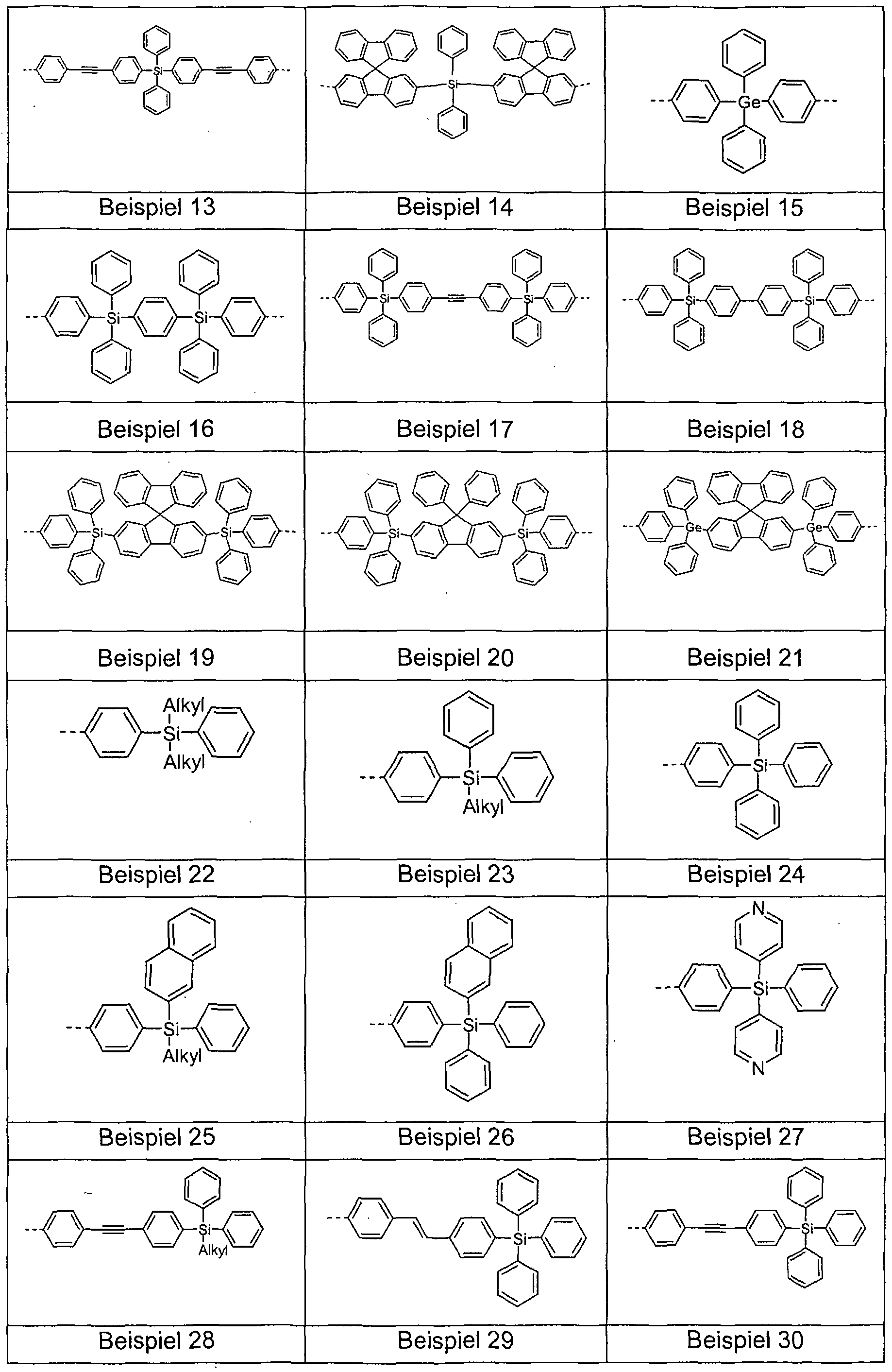
- Examples of preferred units according to formulas (2) to (5) are substituted or unsubstituted structures according to the illustrated examples (1) to (48), the dashed bonds denoting a link in the polymer;
- examples (1) to (6) are examples of the general formula (2), examples (7) to (21)
- Alkyl represents a straight-chain, branched or cyclic alkyl chain which can be substituted or unsubstituted and in which one or more H atoms can be replaced by fluorine, as defined for R 1 , R 2 and R 3 . As a rule, potential substituents are not shown due to the better clarity.
- Positions can be tied. With prochiral structural units, all possibilities of tacticity or chirality are included.
- the structural units according to formulas (2) to (4) are covalent components of the matrix polymer POLY1. It has been shown that a proportion in the range from 1 to 100 mol% of these repeat units (based on all repeat units in the polymer) achieves good results here. A proportion of 1-100 mol% of repeating units according to formulas (2) to (4) is preferred for POLY1. A proportion of 5-80 mol% repeating units according to formulas (2) to (4) is particularly preferred, a proportion of 10-50 mol% repeating units according to
- BLEND2 and BLEND3 a proportion of 1-99% by weight of compounds according to formula (5).
- a fraction of 5-80% by weight according to formula (5) is particularly preferred, a fraction of 10-50% by weight according to formula (5) is very particularly preferred.
- Another aspect of the invention is the mixing of compounds according to
- Formula (5) in BLEND1 It has been shown here that a total proportion of 1-99 mol% of structural units according to formula (1) or according to formulas (2) to (5) achieves good results, regardless of whether these units are covalently bound to the polymer or mixed in , A total proportion of 1-99 mol% of structural units according to formula (1) or according to formulas (2) to (5) is preferred.
- a total proportion of 5-80 mol% of structural units according to formula (1) or according to formulas (2) to (5) is particularly preferred.
- the triplet emitters TRIP1 mixed in BLEND1 and BLEND3, or the triplet emitters TRIP2 polymerized in POLY2 can be selected from various organometallic or inorganic substance classes which can emit light from the triplet state at room temperature, So show phosphorescence instead of fluorescence: These are primarily compounds that contain heavy atoms, ie atoms from the periodic table of the elements with an atomic number of more than 36. Compounds which contain d- and f-transition metals which meet the above-mentioned condition are particularly suitable for this. Corresponding structural units which contain elements from groups 8 to 10 (Ru, Os, Rh, Ir, Pd, Pt) are very particularly preferred here. Without wishing to be bound by any specific theory, all emitting compounds which contain these elements are referred to as triplet emitters in the sense of this application.
- the triplet emitters TRIP1 can be low molecular weight, oligomeric, dendritic or polymeric compounds. Since these are processed as a mixture component (BLEND1 or BLEND3), there must be sufficient solubility in suitable solvents (e.g. toluene, xylene, anisole, THF, etc.) so that processing from solution is possible.
- suitable solvents e.g. toluene, xylene, anisole, THF, etc.
- Various complexes are suitable as low-molecular structural units, which are described for example in the application documents WO 02/068435, WO 02/081488, EP 1239526 and WO 04/026886.
- dendritic structures for TRIP1 or TRIP3 complexes come into question, as described for example in the application documents WO 99/21935, WO 01/059030 and WO 02/066552.
- the triplet emitter TRIP2 is covalently built into the polymer chain of POLY2 (BLEND2).
- BLEND2 polymer chain of POLY2
- functional polymerizable groups must be present on TRIP2.
- Examples of corresponding brominated complexes which can be used as monomers in polycondensation are described in WO 02/068435 and in the unpublished application DE 10350606.3.
- the blend BLEND1 according to the invention is obtained by the polymer
- a triplet emitter TRIP1 can be added to POLY1.
- the blend BLEND2 according to the invention is obtained by the polymer
- the blend BLEND3 according to the invention is obtained by adding a compound of the formula (5) and a triplet emitter TRIP1 to the polymer POLY3.
- Additional component can also improve the singlet-triplet transfer.
- the addition of electronically inert compounds can also be helpful, for example to control the viscosity of a solution or the morphology of the film formed.
- the blends thus obtained are also the subject of the invention.
- BLEND1 to BLEND3 are represented as follows: The individual components are combined in a suitable mixing ratio and dissolved in a suitable solvent system.
- suitable solvents are, for example, toluene, anisole, xylenes, methylanisole,
- the components of the blend can also be dissolved individually.
- the solution of the blend is obtained in this case by combining the individual solutions in a suitable mixing ratio.
- the dissolving process is preferably carried out in an inert manner
- a suitable ratio of the individual components is, for example, a mixture which comprises a total of 1-99.5 mol%, preferably 5-80 mol%, particularly preferably 10-50 mol% of units of the formula (1) or of the formulas (2) to (5 ) contains and contains 0.1-95 mol%, preferably 0.5-80 mol%, particularly preferably 1-50 mol%, in particular 2-25 mol% of TRIP1 and / or TRIP2, the information relating to the total units present (blend components or Repeat units in the polymer). This is regardless of whether the
- Components are covalently bound or mixed into a polymer.
- Mixtures BLEND1 to BLEND3 according to the invention have the following surprising advantages over the prior art: • The efficiency of the light emission of the triplet emitter is better in mixtures BLEND1 to BLEND3 according to the invention compared to mixtures according to the prior art. • The voltages for the operation of the light emitting diode are lower compared to the prior art.
- the invention furthermore relates to solutions and formulations of a blend according to the invention in one or more solvents.
- solvents like such
- Solutions can be prepared is described for example in WO 02/072714, in WO 03/019694 and in the literature cited therein. These solutions can be used to produce thin polymer layers, for example by surface coating processes (e.g. spin coating) or printing processes (e.g. inkjet printing).
- surface coating processes e.g. spin coating
- printing processes e.g. inkjet printing
- a general procedure is generally used for the construction of PLEDs, which must be adapted accordingly for the individual case. Such a method has been described in detail, for example, in WO 04/037887.
- the invention therefore also relates to the use of a mixture BLEND1 to BLEND3 according to the invention in a PLED as electroluminescent material.
- the invention also relates to a PLED with one or more layers, at least one of these layers, preferably an emission layer, containing at least one mixture BLEND1, BLEND2 and / or BLEND3 according to the invention.
- Example 2 Synthesis of the co-monomers for the polymers The synthesis of the other co-monomers used is described in detail in WO 02/077060 and the literature cited therein. The monomer M1 used below is shown here again for the sake of clarity:
- Example 4 Structural units TRIP1 for use in blends
- the compounds TRIP1 used here as examples are derivatives of tris (phenylpyridyl) iridium (III).
- the synthesis of these compounds is described in WO 02/081488 and WO 04/026886.
- the iridium complexes used here are shown again below:
- Example 5 Preparation of the blends The mixtures were prepared by dissolving the blend components in the desired ratio and in the desired concentration in a suitable Solvents. Toluene was used as the solvent here. The dissolution process was carried out in an inert atmosphere at 60 ° C. The solution was processed directly without isolating the mixture (further precipitation of the solids).
- Example 7 Device examples
- Table 1 provides an overview of various blends made of polymers, the composition of the polymers in each case being listed, and triplet emitters.
- Table 1 Device results with blends according to the invention a
- concentration of the triplet emitter in the matrix is given in% by weight, ie 20% triplet emitter in polymer P1 or P2 means 20 parts by weight of emitter and 80 parts by weight of P1 CIE coordinates: chromaticity coordinates of the Commission Internationale de l'Eclairage from 1931 G
- the service life was extrapolated with an acceleration factor of 2 to a uniform initial luminance of 100 cd / m 2 .
Landscapes
- Chemical & Material Sciences (AREA)
- Engineering & Computer Science (AREA)
- Materials Engineering (AREA)
- Organic Chemistry (AREA)
- Physics & Mathematics (AREA)
- Spectroscopy & Molecular Physics (AREA)
- Electroluminescent Light Sources (AREA)
- Compositions Of Macromolecular Compounds (AREA)
Abstract
Description
Beschreibungdescription
Neue Materialmischungen für die ElektrolumineszenzNew material mixtures for electroluminescence
Seit ca. 13 Jahren läuft eine breit angelegte Forschung zur Kommerzialisierung vonA large-scale research on the commercialization of
Anzeige- und Beleuchtungselementen auf Basis polymerer (organischer) Leuchtdioden (PLEDs). Ausgelöst wurde diese Entwicklung durch die Grundlagenentwicklungen, welche in WO 90/13148 offenbart sind. Seit kurzem ist auch ein erstes Produkt in Form einer kleineren Anzeige (in einem Rasierapparat der Fa. PHILIPS N.V.) am Markt erhältlich. Allerdings sind immer noch deutlicheDisplay and lighting elements based on polymer (organic) light emitting diodes (PLEDs). This development was triggered by the basic developments which are disclosed in WO 90/13148. A first product in the form of a smaller display (in a shaver from PHILIPS N.V.) has recently become available on the market. However, are still clear
Verbesserungen nötig, um diese Displays zu einer echten Konkurrenz zu den derzeit marktbeherrschenden Flüssigkristallanzeigen zu machen.Improvements needed to make these displays a real competitor to the currently dominant liquid crystal displays.
Eine Entwicklung, die sich seit einigen Jahren vor allem auf dem Gebiet der „Small molecule"-Displays abzeichnet, ist der Einsatz von Materialien, die aus dem Triplett-A development that has been emerging in the field of “small molecule” displays for a number of years is the use of materials that are derived from the triplet
Zustand Licht emittieren können und somit Phosphoreszenz statt Fluoreszenz zeigen (M. A. Baldo et al., Appl. Phys. Lett 1999, 75, 4-6), wodurch eine bis zu vierfache Energie- und Leistungseffizienz möglich ist. Als wesentliche Bedingungen für die praktische Anwendbarkeit sind hier insbesondere ein effizienter Energieübertrag von der Matrix auf den Triplett-Emitter (und damit verbunden effiziente Lichtemission), eine hohe operative Lebensdauer und eine niedrige Betriebsspannung zu nennen.Condition can emit light and thus show phosphorescence instead of fluorescence (M.A. Baldo et al., Appl. Phys. Lett 1999, 75, 4-6), whereby an up to fourfold energy and power efficiency is possible. The essential conditions for practical applicability include, in particular, efficient energy transfer from the matrix to the triplet emitter (and associated efficient light emission), a long operating life and a low operating voltage.
In letzter Zeit gibt es zunehmend Bemühungen, sich die Vorteile aufdampfbarer Triplett-Emitter auch für Polymeranwendungen zu Nutze zu machen. So werden so genannte Hybrid-Device-Strukturen erwogen, die die Vorteile der "Smali-molecule"- OLEDs mit denen der Polymer-OLEDs (= PLEDs) verbinden und durch Mischen des Triplett-Emitters in das Polymer entstehen. Dies hat den Vorteil, dass die Verbindungen aus Lösung verarbeitet werden können und dass kein teurer und aufwändiger Aufdampfprozess wie für Devices auf Basis niedermolekularerIn recent times there has been an increasing effort to take advantage of evaporable triplet emitters for polymer applications as well. So-called hybrid device structures are being considered which combine the advantages of the "Smali-molecule" OLEDs with those of the polymer OLEDs (= PLEDs) and are created by mixing the triplet emitter into the polymer. This has the advantage that the compounds can be processed from solution and that there is no expensive and complex vapor deposition process as for devices based on low molecular weight
Verbindungen erforderlich ist. Das Aufbringen aus Lösung (z. B. durch hochauflösende Druckverfahren) wird langfristig deutliche Vorteile gegenüber dem heute gängigen Vakuum-Verdampfungsprozess aufweisen, v. a. hinsichtlich Skalierbarkeit, Strukturierbarkeit, Beschichtungseffizienz und Ökonomie. Auch hier ist ein geeignetes Matrixmaterial notwendig, das einen effizientenConnections is required. Application from solution (e.g. using high-resolution printing processes) will have significant long-term advantages over the current vacuum evaporation process, v. a. with regard to scalability, structurability, coating efficiency and economy. Here, too, a suitable matrix material is necessary that is efficient
Energietransfer auf den Triplett-Emitter ermöglicht und das in Verbindung mit diesem gute Lebensdauern bei niedrigen Betriebsspannungen aufweist. Trotz der in letzter Zeit auf diesem Gebiet erzielten Fortschritte gibt es immer noch erhebliches Verbessungspotenzial für entsprechende Materialien auf dem Gebiet der löslichen Triplett-Emitter. U. a. auf folgenden Feldern ist weiterhin ein deutlicher Verbesserungsbedarf zu sehen:Energy transfer to the triplet emitter is made possible and, in connection with this, has a good service life at low operating voltages. Despite recent advances in this area, there is still significant improvement potential for related materials in the area the soluble triplet emitter. Among others There is still a clear need for improvement in the following areas:
(1 ) Die Effizienz der Elektrolumineszenzelemente muss noch weiter verbessert werden. Dass prinzipiell eine höhere Effizienz möglich ist, zeigen die Ergebnisse von Elektrolumineszenzelementen auf Basis kleiner Moleküle.(1) The efficiency of the electroluminescent elements still needs to be improved. The results of electroluminescent elements based on small molecules show that higher efficiency is possible in principle.
(2) Die Spannung der Elektrolumineszenzelemente ist noch zu hoch für hochwertige elektronische Anwendungen.(2) The voltage of the electroluminescent elements is still too high for high-quality electronic applications.
(3) Matrixmaterialien, die mit einem Triplett-Emitter gute Ergebnisse zeigen, zeigen häufig mit anderen Emittern, selbst bei vergleichbarer Emissionsfarbe, deutlich schlechtere Ergebnisse. Es wäre wünschenswert, ein universelles Matrixmaterial zur Verfügung zu haben, das für eine Vielzahl verwendeter Triplett-Emitter und möglichst auch für mehrere oder alle Emissionsfarben gute Ergebnisse liefert. Es ist also offensichtlich, dass auf dem Gebiet der löslichen Triplett-Emitter und entsprechender geeigneter Matrixmaterialien weiterhin ein großer Verbesserungsbedarf besteht.(3) Matrix materials that show good results with a triplet emitter often show significantly worse results with other emitters, even with comparable emission colors. It would be desirable to have a universal matrix material available which gives good results for a large number of triplet emitters used and, if possible, also for several or all emission colors. It is therefore obvious that there is still a great need for improvement in the field of soluble triplet emitters and corresponding suitable matrix materials.
Überraschend wurde gefunden, dass - bisher unbekannte - Polymer-Mischungen, die bestimmte Struktureinheiten enthalten, in Kombination mit Triplett-Emittern hier deutliche Verbesserungen im Vergleich zu Mischungen gemäß dem Stand der Technik ergeben. Insbesondere sind diese Materialien geeignet, mit einer großenIt has surprisingly been found that — previously unknown — polymer mixtures which contain certain structural units, in combination with triplet emitters, result in significant improvements compared to mixtures according to the prior art. In particular, these materials are suitable with a large
Breite unterschiedlicher rot und grün emittierender Triplettemitter effiziente Emission zu zeigen. Diese Mischungen sind daher Gegenstand der vorliegenden Anmeldung.Wide range of different red and green emitting triplet emitters to show efficient emission. These mixtures are therefore the subject of the present application.
Gegenstand der Erfindung sind Mischungen (Blends), enthaltend (A) mindestens ein Polymer,The invention relates to mixtures (blends) containing (A) at least one polymer,
(B) mindestens eine Struktureinheit, die mindestens ein Element der 4. Hauptgruppe (Gruppe 14 gemäß IUPAC) ungleich Kohlenstoff enthält, also Silicium, Germanium, Zinn und/oder Blei, und (C) mindestens einen Triplett-Emitter.(B) at least one structural unit which contains at least one element of main group 4 (group 14 according to IUPAC) other than carbon, that is to say silicon, germanium, tin and / or lead, and (C) at least one triplet emitter.
Die erfindungsgemäßen Mischungen liegen vorzugsweise als amorphe Mischungen vor.The mixtures according to the invention are preferably in the form of amorphous mixtures.
Unter einem Triplett-Emitter im Sinne der Erfindung soll eine Verbindung verstanden werden, die aus dem Triplett-Zustand Licht emittiert, also in der Elektrolumineszenz Phosphoreszenz statt Fluoreszenz zeigt, bevorzugt ein metallorganischer Triplett- Emitter. Bevorzugte Struktureinheiten, die mindestens ein Element der 4. Hauptgruppe ungleich Kohlenstoff enthalten, enthalten direkte Silicium-Silicium- oder Germanium- Germanium-Bindungen, und/oder sie enthalten mindestens eine Teilstruktur gemäß Formel (1 ): A-Y Formel (1 ), wobei für die Symbole gilt:A triplet emitter in the sense of the invention is to be understood as a compound which emits light from the triplet state, that is to say shows phosphorescence instead of fluorescence in electroluminescence, preferably an organometallic triplet emitter. Preferred structural units which contain at least one element of the fourth main group not equal to carbon contain direct silicon-silicon or germanium-germanium bonds, and / or they contain at least one partial structure according to formula (1): AY formula (1), where for the symbols apply:
A ist bei jedem Auftreten gleich oder verschieden Si, Ge, Sn oder Pb; Y ist bei jedem Auftreten gleich oder verschieden ein aromatisches oder heteroaromatisches Ringsystem mit 2 bis 40 C-Atomen, das durch einen oder mehrere Reste R4 substituiert sein kann, eine Vinylgruppe -CR4=CR4- bzw. -CR4=C(R4)2, eine Acetylengruppe -C≡C- bzw. -C≡CR4 oder eine Kombination aus 2 bis 5 dieser Gruppen, wie beispielsweise eine Stilbengruppe oder eine Tolangruppe; dabei steht Y für eine monovalente oder eine bivalente Gruppe; R4 ist bei jedem Auftreten gleich oder verschieden H, F, Cl, Br, I, CN, OH, NO2l eine geradkettige, verzweigte oder cyclische Alkyl-, Alkoxy- oder Thioalkoxygruppe mit 1 bis 22 C-Atomen, in der auch ein oder mehrere nicht benachbarte C-Atome durch -R5C=CR5-, -C ≡C-, Si(R5)2, Ge(R5)2, Sn(R5)2, -NR5-, -O-, -S-, -CO-O-, -O-CO-O- ersetzt sein können, wobei auch ein oder mehrere H-Atome durch F, Cl, Br, I, CN oder N02 ersetzt sein können, eine Aryl-, Heteroaryl- oder Aryloxygruppe mit 1 bis 40 C-Atomen, welche auch durch ein oder mehrere Reste R5 substituiert sein können, oder OH, N(R5)2, B(R5)2 oder Si(R5)3; R5 ist bei jedem Auftreten gleich oder verschieden H oder ein aliphatischer oder aromatischer Kohlenwasserstoffrest mit 1 bis 20 C-Atomen.A is the same or different at each occurrence Si, Ge, Sn or Pb; Y is the same or different with each occurrence an aromatic or heteroaromatic ring system with 2 to 40 C atoms, which can be substituted by one or more radicals R 4 , a vinyl group -CR 4 = CR 4 - or -CR 4 = C ( R 4 ) 2 , an acetylene group -C≡C- or -C≡CR 4 or a combination of 2 to 5 of these groups, such as a stilbene group or a tolane group; Y stands for a monovalent or a bivalent group; Each time R 4 is the same or different, H, F, Cl, Br, I, CN, OH, NO 2l is a straight-chain, branched or cyclic alkyl, alkoxy or thioalkoxy group with 1 to 22 C atoms, in which also a or more non-adjacent C atoms through -R 5 C = CR 5 -, -C ≡C-, Si (R 5 ) 2 , Ge (R 5 ) 2 , Sn (R 5 ) 2 , -NR 5 -, - O-, -S-, -CO-O-, -O-CO-O- can be replaced, whereby one or more H atoms can also be replaced by F, Cl, Br, I, CN or NO 2 , one Aryl, heteroaryl or aryloxy group with 1 to 40 C atoms, which can also be substituted by one or more radicals R 5 , or OH, N (R 5 ) 2 , B (R 5 ) 2 or Si (R 5 ) 3 ; Each occurrence of R 5 is the same or different H or an aliphatic or aromatic hydrocarbon radical with 1 to 20 C atoms.
Besonders bevorzugte Struktureinheiten, die mindestens ein Element der 4. Hauptguppe ungleich Kohlenstoff enthalten, enthalten mindestens eine Struktureinheit gemäß den Formeln (2) bis (5),Particularly preferred structural units which contain at least one element of the 4th main group other than carbon contain at least one structural unit according to the formulas (2) to (5),

Dabei können Polymere, die Einheiten gemäß Formel (2) enthalten, direkte Bindungen zwischen zwei oder mehreren Elementen A aufweisen.Polymers which contain units of the formula (2) can have direct bonds between two or more elements A.
Ein geeignetes Verhältnis der einzelnen Komponenten ist beispielsweise eineA suitable ratio of the individual components is, for example
Mischung, die insgesamt 1 - 99.5 mol%, bevorzugt 5 - 80 mol%, besonders bevorzugt 10 - 50 mol% Einheiten gemäß Formel (1 ), bzw. gemäß Formeln (2) bis (5) enthält und 0.1 - 95 mol%, bevorzugt 0.5 - 80 mol%, besonders bevorzugt 1 - 50 mol%, insbesondere 2 - 25 mol% eines oder mehrerer Triplett-Emitter enthält, wobei sich die Angaben auf die gesamt vorhandenen Einheiten (Blendbestandteile bzw. Wiederholeinheiten im Polymer) beziehen. Dies ist unabhängig davon, ob die Komponenten kovalent an ein Polymer gebunden oder eingemischt sind. Dabei hat sich gezeigt, dass insbesondere ein Anteil von 10 - 50 mol% Einheiten gemäß Formel (1 ), bzw. gemäß Formeln (2) bis (5) zu hoher Lichtemission aus dem Triplett-Emitter führen.Mixture which contains a total of 1-99.5 mol%, preferably 5-80 mol%, particularly preferably 10-50 mol% of units of the formula (1) or of the formulas (2) to (5) and 0.1-95 mol%, preferably contains 0.5-80 mol%, particularly preferably 1-50 mol%, in particular 2-25 mol% of one or more triplet emitters, the details relating to the total units present (blend components or repeating units in the polymer). This is irrespective of whether the components are covalently bound to a polymer or mixed in. It has been shown that in particular a proportion of 10-50 mol% of units according to formula (1) or according to formulas (2) to (5) lead to high light emission from the triplet emitter.
Bei den erfindungsgemäßen Mischungen gibt es verschiedene Ausführungsformen, bei denen die Einheiten gemäß Formel (1 ) und/oder der Triplett-Emitter entweder eingemischt oder kovalent an das Polymer gebunden sind. Dabei sind Einheiten gemäß den Formeln (2) bis (4) kovalent an das Polymer gebunden. Formel (5) zeigt eingemischte Einheiten. Bei kovalenter Bindung an das Polymer kann das Element A (also das Element der 4. Hauptgruppe ungleich Kohlenstoff) entweder in die Hauptkette (Formeln 2 und 3) oder in die Seitenkette (Formel 4) des Polymers gebunden werden.There are various embodiments of the mixtures according to the invention in which the units of the formula (1) and / or the triplet emitter are either mixed in or covalently bonded to the polymer. Units according to formulas (2) to (4) are covalently bound to the polymer. Formula (5) shows mixed-in units. When covalently bound to the polymer, element A (ie the element of main group 4 not equal to carbon) can be bound either in the main chain (formulas 2 and 3) or in the side chain (formula 4) of the polymer.
Unter einem aromatischen bzw. heteroaromatischen Ringsystem im Sinne dieser Erfindung soll ein System verstanden werden, das nicht notwendigerweise nur aromatische bzw. heteroaromatische Gruppen enthält, sondern in dem auch mehrere aromatische bzw. heteroaromatische Gruppen durch eine kurze nicht- aromatische Einheit (weniger als 10 % der von H verschiedenen Atome, bevorzugt weniger als 5 % der von H verschiedenen Atome), wie beispielsweise sp3-hybridisierter C, O, N, etc., unterbrochen sein können. So sollen also beispielsweise auch Systeme wie 9,9'-Spirobifluoren, 9,9-Diarylfluoren, Triarylamin, Diarylether, etc. als aromatische Systeme verstanden werden. Dabei enthält ein aromatisches Ringsystem mindestens 6 C-Atome, während ein heteroaromatischesAn aromatic or heteroaromatic ring system in the sense of this invention is to be understood as meaning a system which does not necessarily only contain aromatic or heteroaromatic groups, but also in which several aromatic or heteroaromatic groups by a short non-aromatic unit (less than 10% of the atoms different from H, preferably less than 5% of the atoms different from H), such as, for example, sp 3 -hybridized C, O, N, etc., can be interrupted. For example, systems such as 9,9'-spirobifluorene, 9,9-diarylfluorene, triarylamine, diaryl ether, etc. should also be understood as aromatic systems. An aromatic ring system contains at least 6 carbon atoms, while a heteroaromatic one
Ringsystem mindestens 2 C-Atome und mindestens ein Heteroatom, bevorzugt ausgewählt aus N, O und/oder S, enthält und die Summe aus C-Atomen und Heteroatomen mindestens 5 beträgt.Ring system contains at least 2 carbon atoms and at least one heteroatom, preferably selected from N, O and / or S, and the sum of carbon atoms and heteroatoms is at least 5.
Im Rahmen der vorliegenden Erfindung werden unter einer C bis C 0-Alkylgruppe, in der auch einzelne H-Atome oder CH2-Gruppen durch die oben genannten Gruppen substituiert sein können, besonders bevorzugt die Reste Methyl, Ethyl, n-Propyl, i-Propyl, n-Butyl, i-Butyl, s-Butyl, t-Butyl, 2-Methylbutyl, n-Pentyl, s-Pentyl, Cyclopentyl, n-Hexyl, Cyclohexyl, n-Heptyl, Cycloheptyl, n-Octyl, Cyclooctyl, 2-Ethylhexyl, Trifluormethyl, Pentafluorethyl, 2,2,2-Trifluorethyl, Ethenyl, Propenyl,In the context of the present invention, the radicals methyl, ethyl, n-propyl, i- are particularly preferably under a C to C 0 alkyl group in which individual H atoms or CH 2 groups can also be substituted by the abovementioned groups. Propyl, n-butyl, i-butyl, s-butyl, t-butyl, 2-methylbutyl, n-pentyl, s-pentyl, cyclopentyl, n-hexyl, cyclohexyl, n-heptyl, cycloheptyl, n-octyl, cyclooctyl, 2-ethylhexyl, trifluoromethyl, pentafluoroethyl, 2,2,2-trifluoroethyl, ethenyl, propenyl,
Butenyl, Pentenyl, Cyclopentenyl, Hexenyl, Cyclohexenyl, Heptenyl, Cycloheptenyl, Octenyl, Cyclooctenyl, Ethinyl, Propinyl, Butinyl, Pentinyl, Hexinyl oder Octinyl verstanden. Unter einer C bis C40-Alkoxygruppe werden besonders bevorzugt Methoxy, Ethoxy, n-Propoxy, i-Propoxy, n-Butoxy, i-Butoxy, s-Butoxy, t-Butoxy oder 2-Methylbutoxy verstanden. Unter einer C2-C o Aryl- oder Heteroarylgruppe, die je nach Verwendung monovalent oder bivalent sein kann, die noch jeweils mit den oben genannten Resten R1 substituiert sein kann und die über beliebige Positionen am Aromaten bzw. Heteroaromaten verknüpft sein kann, werden insbesondere Gruppen verstanden, welche abgeleitet sind von Benzol, Naphthalin, Anthracen, Phenanthren, Pyren, Chrysen, Perylen, Fluoranthen, Tetracen, Pentacen,Butenyl, pentenyl, cyclopentenyl, hexenyl, cyclohexenyl, heptenyl, cycloheptenyl, octenyl, cyclooctenyl, ethynyl, propynyl, butynyl, pentynyl, hexynyl or octynyl. A C to C 40 alkoxy group particularly preferably means methoxy, ethoxy, n-propoxy, i-propoxy, n-butoxy, i-butoxy, s-butoxy, t-butoxy or 2-methylbutoxy. Under a C 2 -C o aryl or heteroaryl group which, depending on the use, can be monovalent or bivalent, which can also be substituted in each case with the radicals R 1 mentioned above and which can be linked via any positions on the aromatic or heteroaromatic understood in particular groups which are derived from benzene, naphthalene, anthracene, phenanthrene, pyrene, chrysene, perylene, fluoranthene, tetracene, pentacene,
Benzpyren, Furan, Benzofuran, Isobenzofuran, Dibenzofuran, Thiophen, Benzothiophen, Isobenzothiophen, Dibenzothiophen, Pyrrol, Indol, Isoindol, Carbazol, Pyridin, Chinolin, Isochinolin, Acridin, Phenanthridin, Benzo-5,6-chinolin, Benzo-6,7-chinolin, Benzo-7,8-chinolin, Phenothiazin, Phenoxazin, Pyrazol, Indazol, Imidazol, Benzimidazol, Naphthimidazol, Phenanthrimidazol, Pyridimidazol, Pyrazinimidazol, Chinoxalinimidazol, Oxazol, Benzoxazol, Naphthoxazol, Anthroxazol, Phenanthroxazol, Isoxazol, 1 ,2-Thiazol, 1 ,3-Thiazol, Benzothiazol, Pyridazin, Benzopyridazin, Pyrimidin, Benzpyrimidin, Chinoxalin, Pyrazin, Phenazin, Naphthyridin, Azacarbazol, Benzocarbolin, Phenanthrolin, 1 ,2,3-Triazol, 1 ,2,4-Benzpyrene, furan, benzofuran, isobenzofuran, dibenzofuran, thiophene, benzothiophene, isobenzothiophene, dibenzothiophene, pyrrole, indole, isoindole, carbazole, pyridine, quinoline, isoquinoline, acridine, phenanthridine, benzo-5,6-quinoline, benzo-6,7- quinoline, benzo-7,8-quinoline, phenothiazine, phenoxazine, pyrazole, indazole, Imidazole, benzimidazole, naphthimidazole, phenanthrimidazole, pyridimidazole, pyrazinimidazole, quinoxaline imidazole, oxazole, benzoxazole, naphthoxazole, anthroxazole, phenanthroxazole, isoxazole, 1, 2-thiazole, 1, 3-thiazolidine, 1, 3-thiazolidine, 1, 3-thiazolidine, Pyrazine, phenazine, naphthyridine, azacarbazole, benzocarboline, phenanthroline, 1, 2,3-triazole, 1, 2,4-
Triazol, Benzotriazol, 1 ,2,3-Oxadiazol, 1 ,2,4-Oxadiazol, 1 ,2,5-Oxadiazol, 1 ,3,4- Oxadiazol, 1 ,2,3-Thiadiazol, 1 ,2,4-Thiadiazol, 1 ,2,5-Thiadiazol, 1 ,3,4-Thiadiazol, 1 ,3,5-Triazin, 1 ,2,4-Triazin, 1 ,2,3-Triazin, Tetrazol, 1 ,2,4,5-Tetrazin, 1 ,2,3,4-Tetrazin, 1 ,2,3,5-Tetrazin, Purin, Pteridin, Indolizin und Benzothiadiazol. Unter aromatischen Ringsystemen werden weiterhin insbesondere Biphenylen, Terphenylen, Fluoren,Triazole, benzotriazole, 1, 2,3-oxadiazole, 1, 2,4-oxadiazole, 1, 2,5-oxadiazole, 1, 3,4-oxadiazole, 1, 2,3-thiadiazole, 1, 2,4- Thiadiazole, 1, 2,5-thiadiazole, 1, 3,4-thiadiazole, 1, 3,5-triazine, 1, 2,4-triazine, 1, 2,3-triazine, tetrazole, 1, 2,4, 5-tetrazine, 1, 2,3,4-tetrazine, 1, 2,3,5-tetrazine, purine, pteridine, indolizine and benzothiadiazole. Aromatic ring systems also include, in particular, biphenyls, terphenyls, fluorene,
Spirobifluoren, Dihydrophenanthren, Dihydropyren, Tetrahydropyren oder eis- oder trans-lndenofluoren verstanden.Spirobifluorene, dihydrophenanthrene, dihydropyrene, tetrahydropyrene or ice or trans-lindenofluorene understood.
Eine Ausführungsform der Erfindung sind Mischungen BLEND1 , enthaltend (A) 5 - 99.9 Gew.% mindestens eines Polymers POLY1 , enthaltend 1 - 100 mol%, bevorzugt 5 - 80 mol%, besonders bevorzugt 10 - 50 mol% einer oder mehrerer Wiederholeinheiten gemäß Formel (1 ), bzw. gemäß Formeln (2) bis (4), und außerdem (B) 0.1 - 95 Gew.%, bevorzugt 0.5 - 80 Gew.%, besonders bevorzugt 1 - 50 Gew.%, insbesondere 2 - 25 Gew.% eines oder mehrerer Triplett-Emitter (TRIP1 ).One embodiment of the invention is mixtures BLEND1, containing (A) 5-99.9% by weight of at least one polymer POLY1, containing 1-100 mol%, preferably 5-80 mol%, particularly preferably 10-50 mol% of one or more repeating units according to the formula (1), or according to formulas (2) to (4), and also (B) 0.1-95% by weight, preferably 0.5-80% by weight, particularly preferably 1-50% by weight, in particular 2-25% by weight % of one or more triplet emitters (TRIP1).
In der Ausführungsform BLEND1 ist der Triplett-Emitter (TRIP1 ) zu dem Polymer POLY1 gemischt. Die Wiederholeinheiten gemäß Formel (1 ), bzw. gemäß FormelnIn the BLEND1 embodiment, the triplet emitter (TRIP1) is mixed to form the polymer POLY1. The repeating units according to formula (1) or according to formulas
(2) bis (4) sind kovalent an das Polymer gebunden. Je nach Verknüpfung sind diese Struktureinheiten in die Hauptkette des Polymers (Formeln 2 und 3) oder in die Seitenkette (Formel 4) des Polymers eingebaut.(2) to (4) are covalently bound to the polymer. Depending on the linkage, these structural units are built into the main chain of the polymer (formulas 2 and 3) or into the side chain (formula 4) of the polymer.
Eine weitere Ausführungsform dieser Erfindung sind Mischungen BLEND2, enthaltend (A) 0.5 - 99 Gew.% mindestens eines Polymers POLY2, enthaltend 0.1 - 100 mol% eines oder mehrerer Triplett-Emitter (TRIP2) kovalent gebunden, und außerdem (B) 1 - 99.5 Gew.% mindestens einer Verbindung gemäß Formel (1 ), bzw. gemäß Formel (5), die in der Lage ist, bei Raumtemperatur glasartige Schichten zu bilden, bevorzugt mit einer Glasübergangstemperatur größer 80 °C, besonders bevorzugt größer 100 °C. Der Triplett-Emitter TRIP2 kann dabei in die Haupt- und/oder in die Seitenkette des Polymers POLY2 eingebaut werden.A further embodiment of this invention are mixtures BLEND2, containing (A) 0.5-99% by weight of at least one polymer POLY2, containing 0.1-100 mol% of one or more triplet emitters (TRIP2), and also (B) 1-99.5 % By weight of at least one compound of the formula (1) or of the formula (5) which is able to form glass-like layers at room temperature, preferably with a glass transition temperature of more than 80 ° C., particularly preferably more than 100 ° C. The triplet emitter TRIP2 can be installed in the main and / or in the side chain of the polymer POLY2.
Eine weitere Ausführungsform dieser Erfindung sind Mischungen BLEND3, enthaltendAnother embodiment of this invention are mixtures containing BLEND3
(A) 0.5 - 98.5 Gew.% mindestens eines Polymers POLY3;(A) 0.5-98.5% by weight of at least one polymer POLY3;
(B) 1 - 99 Gew.% mindestens einer Verbindung gemäß Formel (1 ), bzw. gemäß Formel (5), die in der Lage ist, bei Raumtemperatur glasartige Schichten zu bilden, bevorzugt mit einer Glasübergangstemperatur größer 80 °C, besonders bevorzugt größer 100 °C; und außerdem(B) 1-99% by weight of at least one compound of the formula (1) or of the formula (5) which is able to form glass-like layers at room temperature, preferably with a glass transition temperature greater than 80 ° C., particularly preferably greater than 100 ° C; and also
(C) 0.1 - 95 Gew.%, bevorzugt 0.5 - 80 Gew.%, besonders bevorzugt 1 - 50 Gew.%, insbesondere 2 - 25 Gew.% eines oder mehrerer Triplett-Emitter (TRIP1 ).(C) 0.1-95% by weight, preferably 0.5-80% by weight, particularly preferably 1-50% by weight, in particular 2-25% by weight, of one or more triplet emitters (TRIP1).
Die Polymere POLY1 bis POLY3 können konjugiert, teilkonjugiert oder nicht- konjugiert sein. Bevorzugt sind sie konjugiert oder teilkonjugiert.The polymers POLY1 to POLY3 can be conjugated, partially conjugated or non-conjugated. They are preferably conjugated or partially conjugated.
Konjugierte Polymere im Sinne dieser Erfindung sind Polymere, die in der Hauptkette hauptsächlich sp2-hybridisierte (bzw. auch sp-hybridisierte)For the purposes of this invention, conjugated polymers are polymers which in the main chain are mainly sp 2 -hybridized (or also sp-hybridized)
Kohlenstoffatome enthalten, die auch durch entsprechende Heteroatome ersetzt sein können. Dies bedeutet im einfachsten Fall abwechselndes Vorliegen von Doppel- und Einfachbindungen in der Hauptkette. Hauptsächlich meint, dass natürlich (ohne weiteres Zutun) auftretende Defekte, die zu Konjugationsunterbrechungen führen, den Begriff "konjugiertes Polymer" nicht entwerten. Des Weiteren wird in diesem Anmeldetext ebenfalls als konjugiert bezeichnet, wenn sich in der Hauptkette Arylamineinheiten, Arylphosphineinheiten und/oder bestimmte Heterocyclen (d. h. Konjugation über N-, O-, S- oder P-Atome) und/oder metallorganische Komplexe, wie beispielsweise Einheiten gemäß TRIP2 (Konjugation über das Metallatom), befinden. Ebenfalls als konjugiert bezeichnet wird die so genannte σ-Konjugation, also beispielsweise die Konjugation über ein Silicium-Atom. Teilkonjugierte Polymere im Sinne dieser Erfindung sind Polymere, die entweder in der Hauptkette längere konjugierte Abschnitte enthalten, die durch nicht-konjugierte Abschnitte unterbrochen werden, oder die in den Seitenketten eines in der Hauptkette nicht-konjugierten Polymers längere konjugierte Abschnitte enthalten. Hingegen würden Einheiten, wie beispielsweise einfache Alkylenketten, (Thio)Etherbrücken, Ester-, Amid- oder Imidverknüpfungen eindeutig als nicht- konjugierte Segmente definiert. Die Polymere POLY1 , POLY2 und POLY3 können außer den Einheiten gemäß Formeln (1 ), bzw. gemäß Formeln (2) bis (4) (in POLY1 ) und dem Triplett-Emitter TRIP2 (in POLY2) verschiedene weitere Strukturelemente enthalten. Diese können beispielsweise Struktureinheiten sein, die das Polymergrundgerüst bilden können, oder Struktureinheiten, die die Ladungsinjektions- bzw.Contain carbon atoms, which can also be replaced by corresponding heteroatoms. In the simplest case, this means alternating double and single bonds in the main chain. Mainly means that naturally occurring (without further action) defects that lead to interruptions in conjugation do not invalidate the term "conjugated polymer". Furthermore, in this application text is also referred to as conjugated if there are arylamine units, arylphosphine units and / or certain heterocycles (ie conjugation via N, O, S or P atoms) and / or organometallic complexes, such as, for example, in the main chain according to TRIP2 (conjugation via the metal atom). The so-called σ-conjugation is also referred to as conjugation, for example the conjugation via a silicon atom. For the purposes of this invention, partially conjugated polymers are polymers which either contain longer conjugated sections in the main chain, which are interrupted by non-conjugated sections, or which contain longer conjugated sections in the side chains of a polymer which is non-conjugated in the main chain. In contrast, units such as simple alkylene chains, (thio) ether bridges, ester, amide or imide linkages would be clearly defined as non-conjugated segments. In addition to the units according to formulas (1) or according to formulas (2) to (4) (in POLY1) and the triplet emitter TRIP2 (in POLY2), the polymers POLY1, POLY2 and POLY3 can contain various further structural elements. These can be structural units, for example, which can form the polymer backbone, or structural units, which can be the charge injection or
Ladungstransporteigenschaften verbessern. Solche Einheiten sind beispielsweise in WO 03/020790 und in WO 05/014689 ausführlich beschrieben.Improve charge transport properties. Such units are described in detail, for example, in WO 03/020790 and in WO 05/014689.
Wenn es sich bei den Polymeren POLY1 , POLY2 oder POLY3 um nicht-konjugierteIf the polymers POLY1, POLY2 or POLY3 are non-conjugated
Polymere handelt, kommen hierfür prinzipiell beliebige Verbindungsklassen in Frage, sofern die Polymere eine ausreichende Löslichkeit in einem Lösemittel oder Lösemittelgemisch aufweisen, in dem auch die anderen Blendbestandteile löslich sind, so dass alle Komponenten gemeinsam aus Lösung verarbeitet werden können.In principle, polymers are suitable for this purpose, as long as the compound has sufficient solubility in a solvent or solvent mixture in which the other blend components are soluble, so that all components can be processed together from solution.
Die Polymere POLY1 , POLY2 und POLY3 sind entweder Homopolymere, d. h. sie enthalten nur eine einzelne Monomerstruktur, oder es sind Copolymere. Die Copolymere können statistische, alternierende oder auch blockartige Strukturen aufweisen oder auch mehrere dieser Strukturen abwechselnd besitzen. Ebenso können die Polymere linear, verzweigt oder dendritisch aufgebaut sein. Durch das Verwenden mehrerer verschiedener Strukturelemente können Eigenschaften, wie z. B. Löslichkeit, Festphasenmorphologie, etc., eingestellt werden.The polymers POLY1, POLY2 and POLY3 are either homopolymers, i.e. H. they contain only a single monomer structure or they are copolymers. The copolymers can have statistical, alternating or block-like structures or alternately have several of these structures. The polymers can also be linear, branched or dendritic. By using several different structural elements, properties such. B. solubility, solid phase morphology, etc., can be set.
Die Polymere POLY1 , POLY2 und POLY3 werden durch Polymerisation von einem oder mehreren Monomeren hergestellt. Insbesondere für die Synthese konjugierter Polymere haben sich hier einige Typen bewährt, die zu C-C-Verknüpfungen (SUZUKI-Kupplung, YAMAMOTO-Kupplung, STILLE-Kupplung) oder zu C-N- Verknüpfungen (HARTWIG-BUCHWALD-Kupplung) führen. Wie die Polymerisation nach diesen Methoden durchgeführt werden kann und wie die Polymere vomThe polymers POLY1, POLY2 and POLY3 are produced by polymerizing one or more monomers. In particular for the synthesis of conjugated polymers, some types have proven themselves that lead to C-C linkages (SUZUKI coupling, YAMAMOTO coupling, STILLE coupling) or to C-N linkages (HARTWIG-BUCHWALD coupling). How the polymerization can be carried out according to these methods and how the polymers from
Reaktionsmedium abgetrennt und aufgereinigt werden können, ist beispielsweise im Detail in WO 04/037887 beschrieben. Eine Methode zur Bildung von Silicium-Aryl- Bindungen ist in US 2003/0120124 beschrieben und besteht in der Reaktion von Aryldiazonium-Salzen mit substituierten Chlorsilanen. Nach diesen Methoden kann auch die Synthese teilkonjugierter oder nicht- konjugierter Polymere durchgeführt werden, indem entsprechende Monomere verwendet werden, die nicht durchgängig konjugiert sind. Für teilkonjugierte oder nicht-konjugierte Polymere kommen aber auch andere Synthesemethoden in Frage, wie sie allgemein aus der Polymerchemie geläufig sind, wie beispielsweise Polykondensationen oder kationische, anionische oder radikalische Polymerisationen, die beispielsweise über die Reaktion von Alkenen ablaufen und zu Polyethylen-Derivaten im weitesten Sinne führen, wie beispielsweise Polystyrol- Derivate, etc., die die Chromophore gegebenenfalls in den Seitenketten gebunden enthalten. Polysilane können beispielsweise gemäß der Wurtz-Synthese durchThe reaction medium can be separated and purified, for example, is described in detail in WO 04/037887. A method for the formation of silicon aryl bonds is described in US 2003/0120124 and consists in the reaction of aryldiazonium salts with substituted chlorosilanes. These methods can also be used to carry out the synthesis of partially conjugated or non-conjugated polymers by using appropriate monomers which are not conjugated throughout. For partially conjugated or non-conjugated polymers, however, other synthetic methods that are generally known from polymer chemistry, such as, for example, are also suitable Polycondensation or cationic, anionic or radical polymerizations, which take place, for example, via the reaction of alkenes and lead to polyethylene derivatives in the broadest sense, such as polystyrene derivatives, etc., which may contain the chromophores bound in the side chains. Polysilanes can, for example, according to the Wurtz synthesis
Umsetzung entsprechend substituierter Dichlorsilane mit metallischem Natrium erzeugt werden.Implementation of appropriately substituted dichlorosilanes with metallic sodium.
In einer bevorzugten Ausführungsform der Erfindung steht das Symbol A bei jedem Auftreten gleich oder verschieden für Si oder Ge, ganz besonders bevorzugt für Si.In a preferred embodiment of the invention, the symbol A stands for Si or Ge for each occurrence, the same or different, very particularly preferably for Si.
Weiterhin bevorzugt steht das Symbol Y gleich oder verschieden bei jedem Auftreten für ein aromatisches Ringsystem mit 2 bis 40 C-Atomen, das durch einen oder mehrere Reste R4 substituiert sein kann oder eine durch R4 substituierte oder unsubstituierte Stilben- bzw. Tolangruppe, ganz besonders bevorzugt für ein aromatisches Ringsystem mit 2 bis 20 C-Atomen, das durch einen oder mehrere Reste R4 substituiert sein kann.The symbol Y furthermore, identically or differently, stands for an aromatic ring system with 2 to 40 C atoms, which can be substituted by one or more radicals R 4 or an R 4 substituted or unsubstituted stilbene or tolane group, completely or in each occurrence particularly preferred for an aromatic ring system with 2 to 20 carbon atoms, which can be substituted by one or more radicals R 4 .
Weiterhin bevorzugt steht mindestens einer der Substituenten R1 bis R3 für ein aromatisches Ringsystem mit 2 bis 40 C-Atomen, das mit einem oder mehrerenFurthermore, at least one of the substituents R 1 to R 3 preferably represents an aromatic ring system having 2 to 40 C atoms, which has one or more
Substituenten R4 substituiert sein kann; besonders bevorzugt stehen alle Substituenten R1 bis R3 für aromatische Ringsysteme mit jeweils 2 bis 20 C-Atomen, die mit einem oder mehreren Substituenten R4 substituiert sein können.Substituents R 4 may be substituted; all substituents R 1 to R 3 are particularly preferably aromatic ring systems each having 2 to 20 C atoms, which may be substituted by one or more substituents R 4 .
Weiterhin bevorzugt ist der Index n bei jedem Auftreten gleich oder verschieden 1 , 2 oder 3, besonders bevorzugt 1 oder 2.Furthermore, the index n is the same or different 1, 2 or 3, particularly preferably 1 or 2, each time it occurs.
Weiterhin bevorzugt sind Einheiten gemäß Formel (2) bis (5) symmetrisch aufgebaut. Diese Bevorzugung ist aus der leichteren synthetischen Zugänglichkeit dieser Verbindungen zu begründen. Für Verbindungen gemäß Formel (2) gilt also bevorzugt R1 = R2. Für Verbindungen gemäß Formel (3) gilt bevorzugt, dass alle Y gleich zu wählen sind und dass alle R1 = R2 sind. Für Verbindungen gemäß Formel (4) gilt bevorzugt, dass R1 = R2 = R3 ist. Für Verbindungen gemäß Formel (5) gilt bevorzugt, dass R1 = R2 = R3 und gegebenenfalls = Y ist.Units of the formulas (2) to (5) are furthermore preferably constructed symmetrically. This preference is due to the easier synthetic accessibility of these compounds. R 1 = R 2 therefore preferably applies to compounds of the formula (2). For compounds of the formula (3) it is preferred that all Y are chosen the same and that all R 1 = R 2 . For compounds of the formula (4) it is preferred that R 1 = R 2 = R 3 . For compounds of the formula (5) it is preferred that R 1 = R 2 = R 3 and optionally = Y.
Beispiele für bevorzugte Einheiten gemäß Formeln (2) bis (5) sind substituierte oder unsubstituierte Strukturen gemäß den abgebildeten Beispielen (1 ) bis (48), wobei die gestrichelten Bindungen eine Verknüpfung im Polymer bedeuten; dabei sind die Beispiele (1 ) bis (6) Beispiele für die allgemeine Formel (2), die Beispiele (7) bis (21 ) Beispiele für die allgemeine Formel (3), die Beispiele (22) bis (33) Beispiele für die allgemeine Formel (4), die Beispiele (34) bis (48) Beispiele für die allgemeine Formel (5). Alkyl steht für eine geradkettige, verzweigte oder cyclische Alkylkette, die substituiert oder unsubstituiert sein kann und in der ein oder mehrere H-Atome durch Fluor ersetzt sein können, wie für R1, R2 und R3 definiert. Potenzielle Substituenten sind wegen der besseren Übersichtlichkeit in der Regel nicht abgebildet.Examples of preferred units according to formulas (2) to (5) are substituted or unsubstituted structures according to the illustrated examples (1) to (48), the dashed bonds denoting a link in the polymer; examples (1) to (6) are examples of the general formula (2), examples (7) to (21) Examples of general formula (3), examples (22) to (33) examples of general formula (4), examples (34) to (48) examples of general formula (5). Alkyl represents a straight-chain, branched or cyclic alkyl chain which can be substituted or unsubstituted and in which one or more H atoms can be replaced by fluorine, as defined for R 1 , R 2 and R 3 . As a rule, potential substituents are not shown due to the better clarity.


Positionen gebunden sein können. Bei prochiralen Struktureinheiten sind alle Möglichkeiten der Taktizität bzw. der Chiralität miterfasst.Positions can be tied. With prochiral structural units, all possibilities of tacticity or chirality are included.
Die Struktureinheiten gemäß Formel (2) bis (4) sind kovalenter Bestandteil des Matrixpolymers POLY1. Es hat sich gezeigt, dass ein Anteil im Bereich von 1 - 100 mol% dieser Wiederholeinheiten (bezogen auf alle Wiederholeinheiten im Polymer) hier gute Ergebnisse erzielt. Bevorzugt ist für POLY1 ein Anteil von 1 - 100 mol% Wiederholeinheiten gemäß Formel (2) bis (4). Besonders bevorzugt ist ein Anteil von 5 - 80 mol% Wiederholeinheiten gemäß Formel (2) bis (4), ganz besonders bevorzugt ist ein Anteil von 10 - 50 mol% Wiederholeinheiten gemäßThe structural units according to formulas (2) to (4) are covalent components of the matrix polymer POLY1. It has been shown that a proportion in the range from 1 to 100 mol% of these repeat units (based on all repeat units in the polymer) achieves good results here. A proportion of 1-100 mol% of repeating units according to formulas (2) to (4) is preferred for POLY1. A proportion of 5-80 mol% repeating units according to formulas (2) to (4) is particularly preferred, a proportion of 10-50 mol% repeating units according to
Formel (2) bis (4).Formula (2) to (4).
Verbindungen gemäß Formel (5) sind Mischungs-Bestandteil von BLEND2 und BLEND3. Es hat sich gezeigt, dass ein Anteil im Bereich von 1 - 99 Gew.% dieser Verbindungen in der Mischung hier gute Ergebnisse erzielt. Bevorzugt ist fürCompounds according to formula (5) are part of the mixture of BLEND2 and BLEND3. It has been shown that a proportion in the range of 1-99% by weight of these compounds in the mixture achieves good results here. Is preferred for
BLEND2 und BLEND3 ein Anteil von 1 - 99 Gew.% Verbindungen gemäß Formel (5). Besonders bevorzugt ist ein Anteil von 5 - 80 Gew.% gemäß Formel (5), ganz besonders bevorzugt ist ein Anteil von 10 - 50 Gew.% gemäß Formel (5).BLEND2 and BLEND3 a proportion of 1-99% by weight of compounds according to formula (5). A fraction of 5-80% by weight according to formula (5) is particularly preferred, a fraction of 10-50% by weight according to formula (5) is very particularly preferred.
Ein weiterer Aspekt der Erfindung ist das Einmischen von Verbindungen gemäßAnother aspect of the invention is the mixing of compounds according to
Formel (5) in BLEND1. Hier hat sich gezeigt, dass ein Gesamtanteil von 1 - 99 mol% Struktureinheiten gemäß Formel (1 ), bzw. gemäß Formeln (2) bis (5) gute Ergebnisse erzielt, unabhängig davon, ob diese Einheiten kovalent an das Polymer gebunden oder eingemischt sind. Bevorzugt ist hier also ein Gesamtanteil von 1 - 99 mol% Struktureinheiten gemäß Formel (1 ), bzw. gemäß Formeln (2) bis (5).Formula (5) in BLEND1. It has been shown here that a total proportion of 1-99 mol% of structural units according to formula (1) or according to formulas (2) to (5) achieves good results, regardless of whether these units are covalently bound to the polymer or mixed in , A total proportion of 1-99 mol% of structural units according to formula (1) or according to formulas (2) to (5) is preferred.
Besonders bevorzugt ist ein Gesamtanteil von 5 - 80 mol% Struktureinheiten gemäß Formel (1 ), bzw. gemäß Formeln (2) bis (5), ganz besonders bevorzugt ist ein Gesamtanteil von 10 - 50 mol% Struktureinheiten gemäß Formel (1 ), bzw. gemäß Formeln (2) bis (5).A total proportion of 5-80 mol% of structural units according to formula (1) or according to formulas (2) to (5) is particularly preferred. A total proportion of 10-50 mol% structural units according to formula (1) or according to formulas (2) to (5).
Die in BLEND1 und BLEND3 eingemischten Triplett-Emitter TRIP1 , bzw. die in POLY2 (= BLEND2) einpolymerisierten Triplett-Emitter TRIP2 können aus verschiedenen metallorganischen bzw. anorganischen Substanzklassen ausgewählt werden, die bei Raumtemperatur aus dem Triplett-Zustand Licht emittieren können, also Phosphoreszenz statt Fluoreszenz zeigen: Dies sind zunächst vor allem Verbindungen, welche Schweratome, d. h. Atome aus dem Periodensystem der Elemente mit einer Ordnungszahl von mehr als 36, enthalten. Besonders geeignet sind hierfür Verbindungen, welche d- und f-Übergangsmetalle enthalten, die die o. g. Bedingung erfüllen. Ganz besonders bevorzugt sind hier entsprechende Struktureinheiten, welche Elemente der Gruppe 8 bis 10 (Ru, Os, Rh, Ir, Pd, Pt) enthalten. Ohne an eine spezielle Theorie gebunden sein zu wollen, werden im Sinne dieser Anmeldung alle emittierenden Verbindungen, die diese Elemente enthalten, als Triplett-Emitter bezeichnet.The triplet emitters TRIP1 mixed in BLEND1 and BLEND3, or the triplet emitters TRIP2 polymerized in POLY2 (= BLEND2) can be selected from various organometallic or inorganic substance classes which can emit light from the triplet state at room temperature, So show phosphorescence instead of fluorescence: These are primarily compounds that contain heavy atoms, ie atoms from the periodic table of the elements with an atomic number of more than 36. Compounds which contain d- and f-transition metals which meet the above-mentioned condition are particularly suitable for this. Corresponding structural units which contain elements from groups 8 to 10 (Ru, Os, Rh, Ir, Pd, Pt) are very particularly preferred here. Without wishing to be bound by any specific theory, all emitting compounds which contain these elements are referred to as triplet emitters in the sense of this application.
Die Triplett-Emitter TRIP1 können niedermolekulare, oligomere, dendritische oder polymere Verbindungen sein. Da diese als Mischungsbestandteil (BLEND1 bzw. BLEND3) verarbeitet werden, muss eine ausreichende Löslichkeit in geeigneten Lösemitteln (z. B. Toluol, Xylol, Anisol, THF, etc.) gegeben sein, damit die Verarbeitung aus Lösung möglich ist. Als niedermolekulare Struktureinheiten kommen verschiedene Komplexe in Frage, welche beispielsweise in den Anmeldeschriften WO 02/068435, WO 02/081488, EP 1239526 und WO 04/026886 beschrieben sind. Als dendritische Strukturen kommen für TRIP1 bzw. TRIP3 Komplexe in Frage, wie beispielsweise in den Anmeldeschriften WO 99/21935, WO 01/059030 und WO 02/066552 beschrieben sind.The triplet emitters TRIP1 can be low molecular weight, oligomeric, dendritic or polymeric compounds. Since these are processed as a mixture component (BLEND1 or BLEND3), there must be sufficient solubility in suitable solvents (e.g. toluene, xylene, anisole, THF, etc.) so that processing from solution is possible. Various complexes are suitable as low-molecular structural units, which are described for example in the application documents WO 02/068435, WO 02/081488, EP 1239526 and WO 04/026886. As dendritic structures for TRIP1 or TRIP3 complexes come into question, as described for example in the application documents WO 99/21935, WO 01/059030 and WO 02/066552.
Der Triplett-Emitter TRIP2 wird kovalent in die Polymerkette von POLY2 (BLEND2) eingebaut. Um den Einbau von TRIP2 in POLY2 zu ermöglichen, müssen an TRIP2 funktioneile polymerisierbare Gruppen vorhanden sein. Beispiele für entsprechende bromierte Komplexe, die als Monomere in Polykondensationen (beispielsweise gemäß SUZUKI oder gemäß YAMAMOTO) eingesetzt werden können, werden in WO 02/068435 und in der nicht offen gelegten Anmeldung DE 10350606.3 beschrieben.The triplet emitter TRIP2 is covalently built into the polymer chain of POLY2 (BLEND2). In order to enable the incorporation of TRIP2 in POLY2, functional polymerizable groups must be present on TRIP2. Examples of corresponding brominated complexes which can be used as monomers in polycondensation (for example according to SUZUKI or according to YAMAMOTO) are described in WO 02/068435 and in the unpublished application DE 10350606.3.
Die erfindungsgemäße Mischung BLEND1 wird erhalten, indem dem PolymerThe blend BLEND1 according to the invention is obtained by the polymer
POLY1 ein Triplett-Emitter TRIP1 zugemischt werden.A triplet emitter TRIP1 can be added to POLY1.
Die erfindungsgemäße Mischung BLEND2 wird erhalten, indem dem PolymerThe blend BLEND2 according to the invention is obtained by the polymer
POLY2 eine Verbindung gemäß Formel (5) zugemischt wird.POLY2 a compound of formula (5) is added.
Die erfindungsgemäße Mischung BLEND3 wird erhalten, indem dem Polymer POLY3 eine Verbindung gemäß Formel (5), sowie ein Triplett-Emitter TRIP1 zugemischt werden.The blend BLEND3 according to the invention is obtained by adding a compound of the formula (5) and a triplet emitter TRIP1 to the polymer POLY3.
Es kann außerdem bevorzugt sein, in BLEND1 bis BLEND3 noch weitere konjugierte, teilkonjugierte oder nicht-konjugierte Polymere, Oligomere, Dendrimere oder weitere niedermolekulare Verbindungen einzumischen. Die Zugabe weiterer Komponenten kann sich für manche Anwendungen als sinnvoll erweisen: So kann beispielsweise durch Zugabe einer elektronisch aktiven Substanz die Loch- bzw. Elektroneninjektion, der Loch- bzw. Elektronentransport oder das Ladungsgleichgewicht im entsprechenden Blend reguliert werden. DieIt can also be preferred to use further conjugated, partially conjugated or non-conjugated polymers, oligomers, dendrimers in BLEND1 to BLEND3 or to mix in other low molecular weight compounds. The addition of additional components can prove useful for some applications: For example, the addition of an electronically active substance can be used to regulate the hole or electron injection, the hole or electron transport or the charge balance in the corresponding blend. The
Zusatzkomponente kann auch den Singulett-Triplett-Transfer verbessern. Jedoch auch die Zugabe elektronisch inerter Verbindungen kann hilfreich sein, um beispielsweise die Viskosität einer Lösung oder die Morphologie des gebildeten Films zu kontrollieren. Die so erhaltenen Blends sind ebenfalls Gegenstand der Erfindung.Additional component can also improve the singlet-triplet transfer. However, the addition of electronically inert compounds can also be helpful, for example to control the viscosity of a solution or the morphology of the film formed. The blends thus obtained are also the subject of the invention.
Die Darstellung von BLEND1 bis BLEND3 erfolgt folgendermaßen: Die Einzelbestandteile werden in einem geeigneten Mischungsverhältnis zusammengegeben und in einem geeigneten Lösungsmittelsystem gelöst. Geeignete Lösemittel sind beispielsweise Toluol, Anisol, Xylole, Methylanisol,BLEND1 to BLEND3 are represented as follows: The individual components are combined in a suitable mixing ratio and dissolved in a suitable solvent system. Suitable solvents are, for example, toluene, anisole, xylenes, methylanisole,
Methylnaphthalin, Chlorbenzol, cyclische Ether (z. B. Dioxan, THF, Methyldioxan), Amide (z. B. NMP, DMF) oder Mischungen dieser Lösemittel. Alternativ können die Bestandteile des Blends auch einzeln gelöst werden. Die Lösung des Blends erhält man in diesem Fall durch Zusammenfügen der Einzellösungen im geeigneten Mischungsverhältnis. Dabei findet der Lösevorgang bevorzugt in einer inertenMethylnaphthalene, chlorobenzene, cyclic ethers (e.g. dioxane, THF, methyldioxane), amides (e.g. NMP, DMF) or mixtures of these solvents. Alternatively, the components of the blend can also be dissolved individually. The solution of the blend is obtained in this case by combining the individual solutions in a suitable mixing ratio. The dissolving process is preferably carried out in an inert manner
Atmosphäre und gegebenenfalls bei erhöhter Temperatur statt. Der Blend wird im Allgemeinen nicht als Feststoff (durch nochmaliges Ausfällen) isoliert, sondern direkt aus Lösung weiter verarbeitet. Ein geeignetes Verhältnis der einzelnen Komponenten ist beispielsweise eine Mischung, die insgesamt 1 - 99.5 mol%, bevorzugt 5 - 80 mol%, besonders bevorzugt 10 - 50 mol% Einheiten gemäß Formel (1 ), bzw. gemäß Formeln (2) bis (5) enthält und 0.1 - 95 mol%, bevorzugt 0.5 - 80 mol%, besonders bevorzugt 1 - 50 mol%, insbesondere 2 - 25 mol% TRIP1 und/oder TRIP2 enthält, wobei sich die Angaben auf die gesamt vorhandenen Einheiten (Blendbestandteile bzw. Wiederholeinheiten im Polymer) beziehen. Dies ist unabhängig davon, ,ob dieAtmosphere and possibly at an elevated temperature. The blend is generally not isolated as a solid (by reprecipitation), but processed directly from solution. A suitable ratio of the individual components is, for example, a mixture which comprises a total of 1-99.5 mol%, preferably 5-80 mol%, particularly preferably 10-50 mol% of units of the formula (1) or of the formulas (2) to (5 ) contains and contains 0.1-95 mol%, preferably 0.5-80 mol%, particularly preferably 1-50 mol%, in particular 2-25 mol% of TRIP1 and / or TRIP2, the information relating to the total units present (blend components or Repeat units in the polymer). This is regardless of whether the
Komponenten kovalent an ein Polymer gebunden oder eingemischt sind.Components are covalently bound or mixed into a polymer.
Die erfindungsgemäßen Mischungen BLEND1 bis BLEND3 weisen gegenüber dem Stand der Technik folgende überraschende Vorteile auf: • Die Effizienz der Lichtemission des Triplett-Emitters ist in erfindungsgemäßen Mischungen BLEND1 bis BLEND3 besser im Vergleich zu Mischungen gemäß Stand der Technik. • Die Spannungen für den Betrieb der Leuchtdiode sind im Vergleich zum Stand der Technik niedriger.Mixtures BLEND1 to BLEND3 according to the invention have the following surprising advantages over the prior art: • The efficiency of the light emission of the triplet emitter is better in mixtures BLEND1 to BLEND3 according to the invention compared to mixtures according to the prior art. • The voltages for the operation of the light emitting diode are lower compared to the prior art.
• Mit Hilfe der neuartigen Mischungen sind effiziente Triplett-Devices aus Lösung für eine große Bandbreite roter und grüner Triplett-Emitter möglich. Dies ist ein überraschendes Ergebnis, da gemäß Stand der Technik für die einzelnen Farben (und teilweise selbst für verschiedene Emitter vergleichbarer Farbe) im Allgemeinen spezifische Matrizes benötigt werden.• With the help of the novel mixtures, efficient triplet devices from solutions for a wide range of red and green triplet emitters are possible. This is a surprising result, since according to the prior art specific matrices are generally required for the individual colors (and sometimes even for different emitters of comparable color).
Gegenstand der Erfindung sind weiterhin Lösungen und Formulierungen eines erfindungsgemäßen Blends in einem oder mehreren Lösungsmitteln. Wie solcheThe invention furthermore relates to solutions and formulations of a blend according to the invention in one or more solvents. Like such
Lösungen hergestellt werden können, ist beispielsweise in WO 02/072714, in WO 03/019694 und in der darin zitierten Literatur beschrieben. Diese Lösungen können verwendet werden, um dünne Polymerschichten herzustellen, zum Beispiel durch Flächenbeschichtungsverfahren (z. B. Spin-coating) oder Druckverfahren (z. B. InkJet Printing).Solutions can be prepared is described for example in WO 02/072714, in WO 03/019694 and in the literature cited therein. These solutions can be used to produce thin polymer layers, for example by surface coating processes (e.g. spin coating) or printing processes (e.g. inkjet printing).
Die Mischungen BLEND1 bis BLEND3 können in PLEDs verwendet werden, insbesondere als Elektrolumineszenzmaterialien (= emittierende Materialien). Für den Bau von PLEDs wird in der Regel ein allgemeines Verfahren verwendet, das entsprechend für den Einzelfall anzupassen ist. Ein solches Verfahren wurde beispielsweise in WO 04/037887 ausführlich beschrieben.The mixtures BLEND1 to BLEND3 can be used in PLEDs, in particular as electroluminescent materials (= emitting materials). A general procedure is generally used for the construction of PLEDs, which must be adapted accordingly for the individual case. Such a method has been described in detail, for example, in WO 04/037887.
Gegenstand der Erfindung ist daher auch die Verwendung einer erfindungsgemäßen Mischung BLEND1 bis BLEND3 in einer PLED als Elektrolumineszenzmaterial.The invention therefore also relates to the use of a mixture BLEND1 to BLEND3 according to the invention in a PLED as electroluminescent material.
Gegenstand der Erfindung ist ebenfalls eine PLED mit einer oder mehreren Schichten, wobei mindestens eine dieser Schichten, bevorzugt eine Emissionsschicht, mindestens eine erfindungsgemäße Mischung BLEND1 , BLEND2 und/oder BLEND3 enthält.The invention also relates to a PLED with one or more layers, at least one of these layers, preferably an emission layer, containing at least one mixture BLEND1, BLEND2 and / or BLEND3 according to the invention.
Im vorliegenden Anmeldetext und in den folgenden Beispielen wird auf die Verwendung erfindungsgemäßer Mischungen BLEND1 bis BLEND3 in Bezug auf PLEDs und die entsprechenden Displays abgezielt. Trotz dieser Beschränkung der Beschreibung ist es für den Fachmann ohne weiteres erfinderisches Zutun möglich, die erfindungsgemäßen Polymere oder Blends auch für weitere Verwendungen in anderen elektronischen Devices (Vorrichtungen) zu benutzen, z. B. für organische Solarzellen (O-SCs), nicht-lineare Optik, Frequenzverdopplung (Up-conversion), organische optische Detektoren, organische Feld-Quench-Devices (O-FQDs) oder auch organische Laserdioden (O-Laser), um nur einige Anwendungen zu nennen. Auch diese sind Gegenstand der vorliegenden Erfindung.In the present application text and in the following examples, the use of mixtures BLEND1 to BLEND3 according to the invention in relation to PLEDs and the corresponding displays is aimed at. Despite this limitation of the description, it is possible for the person skilled in the art without further inventive step to use the polymers or blends according to the invention for other uses in other electronic devices (devices), for. B. for organic solar cells (O-SCs), non-linear optics, frequency doubling (up-conversion), organic optical detectors, organic field quench devices (O-FQDs) or also organic laser diodes (O-lasers), to name just a few applications. These are also the subject of the present invention.
Die Erfindung wird durch die nachfolgenden Beispiele näher erläutert, ohne sie dadurch einschränken zu wollen.The invention is explained in more detail by the following examples, without wishing to restrict it thereby.
BeispieleExamples
Beispiel 1 : Synthese von Herstellung von 4,4 -DibromtetraphenylsilanExample 1: Synthesis of preparation of 4,4-dibromotraphenylsilane
(Monomer Si1)(Monomer Si1)
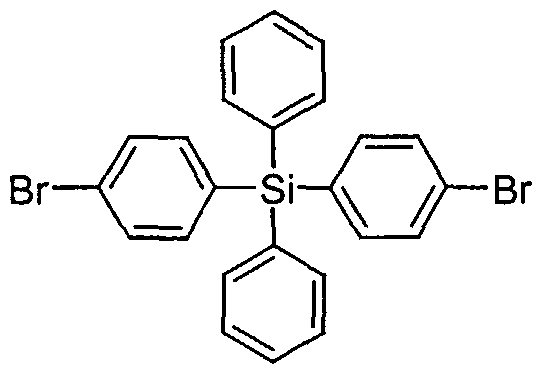
In einem ausgeheizten 1000 mL Vierhalskolben mit Innenthermometer, Rührkern,In a heated 1000 mL four-necked flask with an internal thermometer, stirrer core,
Argon-Überlagerung und Tropftrichter wurden 33.9 g (144 mmol) 1 ,4-Dibrombenzol in 300 mL absolutem THF gelöst und auf -75 °C gekühlt. Es wurden 90 mLThe argon blanket and dropping funnel were dissolved in 33.9 g (144 mmol) of 1,4-dibromobenzene in 300 ml of absolute THF and cooled to -75 ° C. There were 90 mL
(144 mmol) n-Butyllithium (1.6 M in Hexanfraktion) innerhalb von 30 Minuten zugetropft, anschließend wurde 1 h bei dieser Temperatur gerührt. Dann wurden bei(144 mmol) of n-butyllithium (1.6 M in hexane fraction) was added dropwise in the course of 30 minutes, and the mixture was then stirred at this temperature for 1 h. Then at
-75 °C 15.3 mL (18.3 g, 72 mmol) Diphenyldichlorsilan in 60 mL THF zugetropft und über Nacht auf Raumtemperatur aufgewärmt. Das Lösemittel wurde entfernt, der Rückstand in Dichlormethan suspendiert und filtriert. Das Lösemittel wurde vom Filtrat entfernt, und das Produkt wurde zweimal aus Butanol und zweimal aus Heptan/Toluol umkristallisiert. Man erhielt 16.8 g (47 % d. Th.) in einer Reinheit von-75 ° C 15.3 mL (18.3 g, 72 mmol) diphenyldichlorosilane in 60 mL THF added dropwise and warmed up to room temperature overnight. The solvent was removed, the residue was suspended in dichloromethane and filtered. The solvent was removed from the filtrate and the product was recrystallized twice from butanol and twice from heptane / toluene. 16.8 g (47% of theory) were obtained in a purity of
99.9 % gemäß HPLC. H-NMR (CDCI3): [ppm] = 7.51 (m, 8H), 7.55 (t, 3JHH = 7.7 Hz, 2 H), 7.38 (m, 8H).99.9% according to HPLC. H-NMR (CDCI 3 ): [ppm] = 7.51 (m, 8H), 7.55 (t, 3 J H H = 7.7 Hz, 2 H), 7.38 (m, 8H).
Beispiel 2: Synthese der Co-Monomere für die Polymere Die Synthese der weiteren verwendeten Co-Monomere ist in WO 02/077060 und der darin zitierten Literatur ausführlich beschrieben. Das im Folgenden verwendete Monomer M1 sei hier der Übersichtlichkeit halber nochmals abgebildet: Example 2: Synthesis of the co-monomers for the polymers The synthesis of the other co-monomers used is described in detail in WO 02/077060 and the literature cited therein. The monomer M1 used below is shown here again for the sake of clarity:
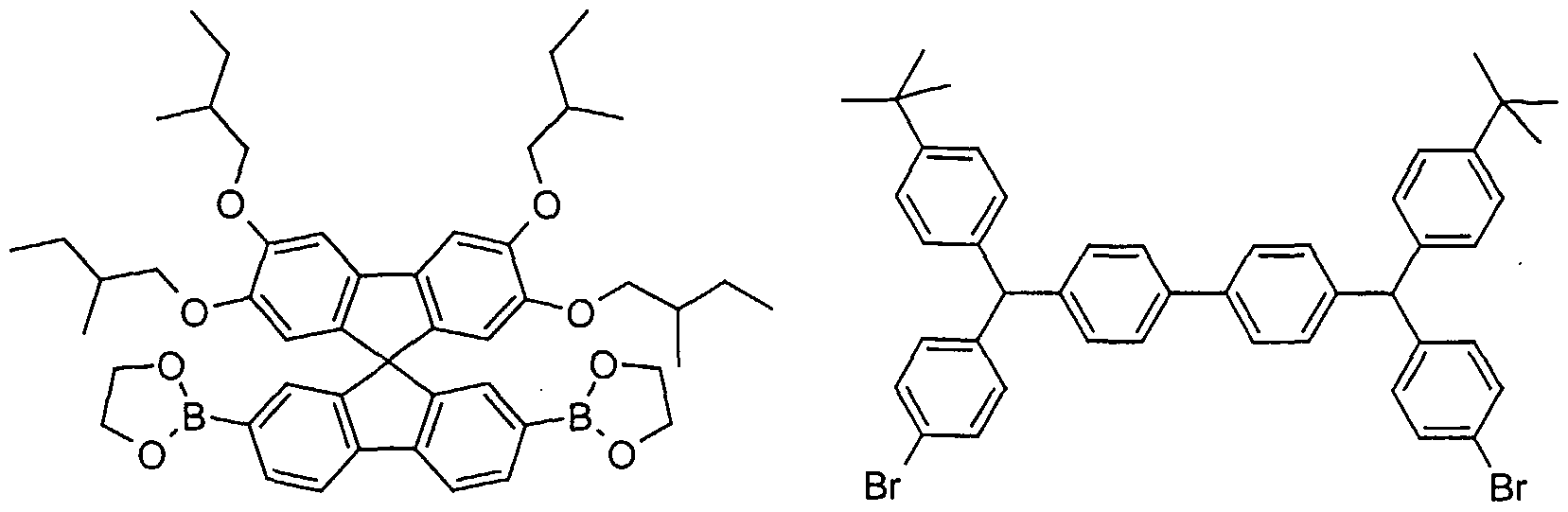
Beispiel 3: Synthese von Polymer P1 (POLY1)Example 3: Synthesis of Polymer P1 (POLY1)
Die Synthese erfolgte gemäß dem in WO 03/048224 beschriebenen Verfahren. Es wurden eingesetzt: 1.6013 g (2 mmol) Monomer M1, 0.9886 g (2 mmol) Monomer Si1 und 2.03 g (2.2 Äquivalente) Kaliumphosphat Hydrat in 19 mL Dioxan, 6 mL Toluol und 12 mL H2O. Als Katalysator wurden verwendet: 0.45 mg Pd(OAc)2 und 3.65 mg P(o-tolyl)3. Nach Aufarbeitung wurden 1.44 g Polymer erhalten, das ein Molekulargewicht Mn 57000 und Mw 192000 aufwies (GPC in THF mit Polystyrol- Standard). Die Synthese des Polymers P2 erfolgte entsprechend.The synthesis was carried out according to the method described in WO 03/048224. The following were used: 1.6013 g (2 mmol) of monomer M1, 0.9886 g (2 mmol) of monomer Si1 and 2.03 g (2.2 equivalents) of potassium phosphate hydrate in 19 ml of dioxane, 6 ml of toluene and 12 ml of H 2 O. The following were used as catalysts: 0.45 mg Pd (OAc) 2 and 3.65 mg P (o-tolyl) 3 . After working up, 1.44 g of polymer were obtained which had a molecular weight M n 57000 and M w 192000 (GPC in THF with polystyrene standard). Polymer P2 was synthesized accordingly.
Beispiel 4: Struktureinheiten TRIP1 zur Verwendung in BlendsExample 4: Structural units TRIP1 for use in blends
Bei den hier beispielhaft verwendeten Verbindungen TRIP1 handelt es sich um Derivate von tris-(Phenylpyridyl)iridium(lll). Die Synthese dieser Verbindungen ist in WO 02/081488 und WO 04/026886 beschrieben. Zur Übersicht sind die hier verwendeten Iridium-Komplexe im Folgenden nochmals abgebildet:The compounds TRIP1 used here as examples are derivatives of tris (phenylpyridyl) iridium (III). The synthesis of these compounds is described in WO 02/081488 and WO 04/026886. For an overview, the iridium complexes used here are shown again below:

Beispiel 5: Herstellung der Blends Die Herstellung der Mischungen erfolgte durch Lösen der Blendbestandteile im gewünschten Verhältnis und in der gewünschten Konzentration in einem geeigneten Lösemittel. Als Lösemittel wurde hier Toluol verwendet. Dabei wurde der Lösevorgang in einer inerten Atmosphäre bei 60 °C durchgeführt. Die Lösung wurde ohne Isolierung der Mischung (nochmaliges Ausfällen der Feststoffanteile) direkt verarbeitet.Example 5: Preparation of the blends The mixtures were prepared by dissolving the blend components in the desired ratio and in the desired concentration in a suitable Solvents. Toluene was used as the solvent here. The dissolution process was carried out in an inert atmosphere at 60 ° C. The solution was processed directly without isolating the mixture (further precipitation of the solids).
Beispiel 6: Herstellung der polymeren Leuchtdioden (PLEDs)Example 6: Production of the polymer light emitting diodes (PLEDs)
Wie PLEDs dargestellt werden können, ist in WO 04/037887 und der darin zitiertenHow PLEDs can be represented is in WO 04/037887 and the one cited therein
Literatur ausführlich beschrieben.Literature described in detail.
Beispiel 7: Device-BeispieleExample 7: Device examples
Tabelle 1 gibt eine Übersicht über verschiedene Blends aus Polymeren, wobei jeweils noch die Zusammensetzung der Polymere aufgeführt ist, und Triplettemittern. Table 1 provides an overview of various blends made of polymers, the composition of the polymers in each case being listed, and triplet emitters.
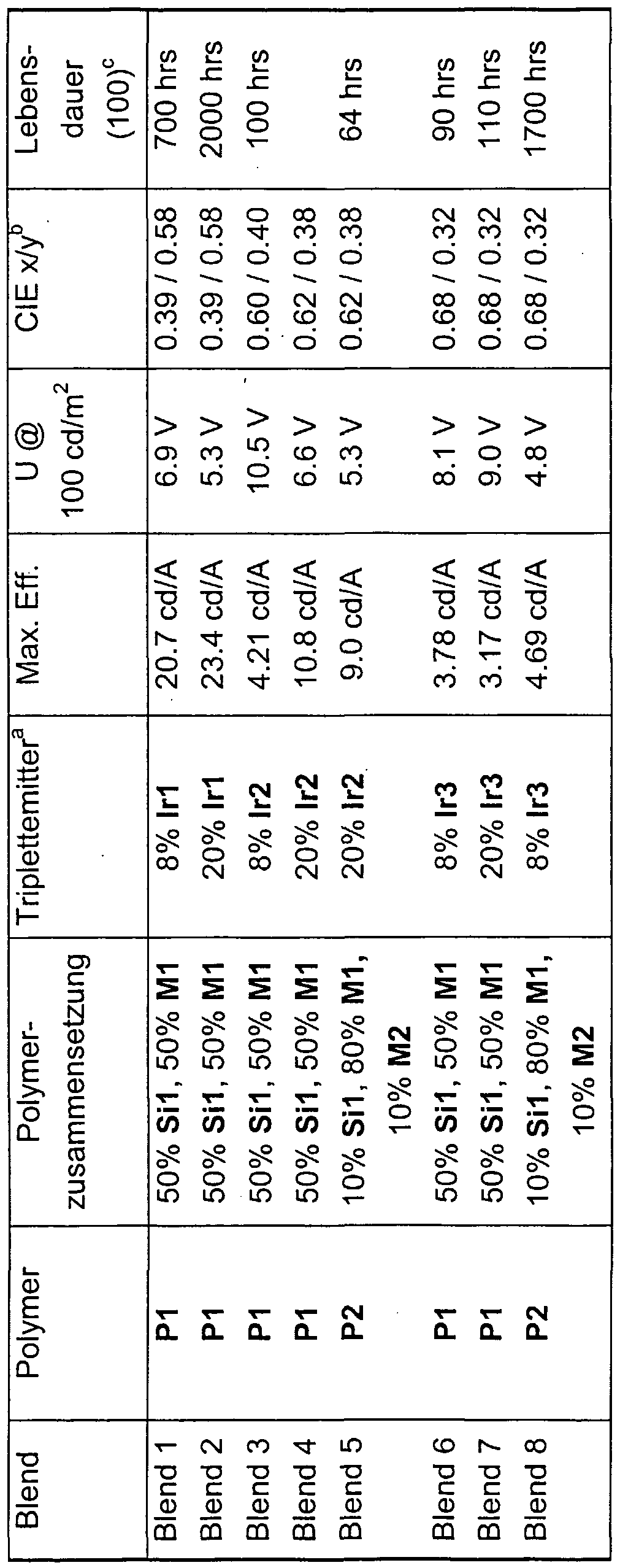
Tabelle 1 : Deviceergebnisse mit erfindungsgemäßen Blends a Die Konzentration des Triplettemitters in der Matrix ist angegeben in Gew.%, d. h. 20% Triplettemitter in Polymer P1 bzw. P2 bedeuten 20 Gewichtsanteile Emitter und 80 Gewichtsanteile P1 CIE-Koordinaten: Chromatizitäts-Koordinaten der Commission Internationale de l'Eclairage von 1931 G Die Lebensdauer wurde mit einem Beschleunigungsfaktor von 2 auf eine einheitliche Anfangsleuchtdichte von 100 cd/m2 extrapoliert. Table 1: Device results with blends according to the invention a The concentration of the triplet emitter in the matrix is given in% by weight, ie 20% triplet emitter in polymer P1 or P2 means 20 parts by weight of emitter and 80 parts by weight of P1 CIE coordinates: chromaticity coordinates of the Commission Internationale de l'Eclairage from 1931 G The service life was extrapolated with an acceleration factor of 2 to a uniform initial luminance of 100 cd / m 2 .
Claims

Priority Applications (5)
| Application Number | Priority Date | Filing Date | Title |
|---|---|---|---|
| KR1020067023563A KR101206316B1 (en) | 2004-05-11 | 2005-05-10 | Novel material mixtures for use in electroluminescence |
| CN2005800149922A CN1950480B (en) | 2004-05-11 | 2005-05-10 | Novel electroluminescent material mixture |
| JP2007512061A JP4988558B2 (en) | 2004-05-11 | 2005-05-10 | New mixtures of materials for electroluminescence |
| US11/596,210 US8058790B2 (en) | 2004-05-11 | 2005-05-10 | Material mixtures for use in electroluminescence |
| EP05759201.6A EP1745113B1 (en) | 2004-05-11 | 2005-05-10 | Novel material mixtures for use in electroluminescence |
Applications Claiming Priority (2)
| Application Number | Priority Date | Filing Date | Title |
|---|---|---|---|
| DE102004023277A DE102004023277A1 (en) | 2004-05-11 | 2004-05-11 | New material mixtures for electroluminescence |
| DE102004023277.6 | 2004-05-11 |
Publications (2)
| Publication Number | Publication Date |
|---|---|
| WO2005111172A2 true WO2005111172A2 (en) | 2005-11-24 |
| WO2005111172A3 WO2005111172A3 (en) | 2006-01-05 |
Family
ID=35079386
Family Applications (1)
| Application Number | Title | Priority Date | Filing Date |
|---|---|---|---|
| PCT/EP2005/005021 Ceased WO2005111172A2 (en) | 2004-05-11 | 2005-05-10 | Novel material mixtures for use in electroluminescence |
Country Status (7)
| Country | Link |
|---|---|
| US (1) | US8058790B2 (en) |
| EP (1) | EP1745113B1 (en) |
| JP (1) | JP4988558B2 (en) |
| KR (1) | KR101206316B1 (en) |
| CN (1) | CN1950480B (en) |
| DE (1) | DE102004023277A1 (en) |
| WO (1) | WO2005111172A2 (en) |
Cited By (443)
| Publication number | Priority date | Publication date | Assignee | Title |
|---|---|---|---|---|
| JP2008311566A (en) * | 2007-06-18 | 2008-12-25 | Canon Inc | Organic electroluminescence device |
| DE102008015526A1 (en) | 2008-03-25 | 2009-10-01 | Merck Patent Gmbh | metal complexes |
| DE102008027005A1 (en) | 2008-06-05 | 2009-12-10 | Merck Patent Gmbh | Organic electronic device containing metal complexes |
| DE102008036982A1 (en) | 2008-08-08 | 2010-02-11 | Merck Patent Gmbh | Organic electroluminescent device |
| DE102008036247A1 (en) | 2008-08-04 | 2010-02-11 | Merck Patent Gmbh | Electronic devices containing metal complexes |
| DE102008057051A1 (en) | 2008-11-13 | 2010-05-20 | Merck Patent Gmbh | Materials for organic electroluminescent devices |
| DE102008057050A1 (en) | 2008-11-13 | 2010-05-20 | Merck Patent Gmbh | Materials for organic electroluminescent devices |
| DE102008063490A1 (en) | 2008-12-17 | 2010-06-24 | Merck Patent Gmbh | Organic electroluminescent device |
| DE102008063470A1 (en) | 2008-12-17 | 2010-07-01 | Merck Patent Gmbh | Organic electroluminescent device |
| DE102009007038A1 (en) | 2009-02-02 | 2010-08-05 | Merck Patent Gmbh | metal complexes |
| DE102009009277A1 (en) | 2009-02-17 | 2010-08-19 | Merck Patent Gmbh | Organic electronic device |
| WO2010099852A1 (en) | 2009-03-02 | 2010-09-10 | Merck Patent Gmbh | Metal complexes having azaborol ligands and electronic device having the same |
| DE102009013041A1 (en) | 2009-03-13 | 2010-09-16 | Merck Patent Gmbh | Materials for organic electroluminescent devices |
| DE102009012346A1 (en) | 2009-03-09 | 2010-09-16 | Merck Patent Gmbh | Organic electroluminescent device |
| DE102009017064A1 (en) | 2009-04-09 | 2010-10-14 | Merck Patent Gmbh | Organic electroluminescent device |
| DE102009023155A1 (en) | 2009-05-29 | 2010-12-02 | Merck Patent Gmbh | Materials for organic electroluminescent devices |
| WO2010149259A2 (en) | 2009-06-22 | 2010-12-29 | Merck Patent Gmbh | Conducting formulation |
| DE102009031021A1 (en) | 2009-06-30 | 2011-01-05 | Merck Patent Gmbh | Materials for organic electroluminescent devices |
| WO2011006574A1 (en) | 2009-07-14 | 2011-01-20 | Merck Patent Gmbh | Materials for organic electroluminescent devices |
| WO2011015265A2 (en) | 2009-08-04 | 2011-02-10 | Merck Patent Gmbh | Electronic devices comprising multi cyclic hydrocarbons |
| DE102009041414A1 (en) | 2009-09-16 | 2011-03-17 | Merck Patent Gmbh | metal complexes |
| DE102009041289A1 (en) | 2009-09-16 | 2011-03-17 | Merck Patent Gmbh | Organic electroluminescent device |
| DE102009042693A1 (en) | 2009-09-23 | 2011-03-24 | Merck Patent Gmbh | Materials for electronic devices |
| WO2011032686A1 (en) | 2009-09-16 | 2011-03-24 | Merck Patent Gmbh | Formulas for producing electronic devices |
| DE102009048791A1 (en) | 2009-10-08 | 2011-04-14 | Merck Patent Gmbh | Materials for organic electroluminescent devices |
| DE102009049587A1 (en) | 2009-10-16 | 2011-04-21 | Merck Patent Gmbh | metal complexes |
| DE102009053644A1 (en) | 2009-11-17 | 2011-05-19 | Merck Patent Gmbh | Materials for organic electroluminescent devices |
| WO2011057706A2 (en) | 2009-11-14 | 2011-05-19 | Merck Patent Gmbh | Materials for electronic devices |
| DE102009053645A1 (en) | 2009-11-17 | 2011-05-19 | Merck Patent Gmbh | Materials for organic electroluminescent device |
| WO2011060867A1 (en) | 2009-11-18 | 2011-05-26 | Merck Patent Gmbh | Nitrogen-containing condensed heterocyclic compounds for oleds |
| DE102009057167A1 (en) | 2009-12-05 | 2011-06-09 | Merck Patent Gmbh | Electronic device containing metal complexes |
| DE102009023154A1 (en) | 2009-05-29 | 2011-06-16 | Merck Patent Gmbh | A composition comprising at least one emitter compound and at least one polymer having conjugation-interrupting units |
| WO2011076323A1 (en) | 2009-12-22 | 2011-06-30 | Merck Patent Gmbh | Formulations comprising phase-separated functional materials |
| WO2011076325A1 (en) | 2009-12-23 | 2011-06-30 | Merck Patent Gmbh | Compositions comprising polymeric binders |
| WO2011076326A1 (en) | 2009-12-22 | 2011-06-30 | Merck Patent Gmbh | Electroluminescent functional surfactants |
| WO2011076314A1 (en) | 2009-12-22 | 2011-06-30 | Merck Patent Gmbh | Electroluminescent formulations |
| WO2011076324A1 (en) | 2009-12-23 | 2011-06-30 | Merck Patent Gmbh | Compositions comprising organic semiconducting compounds |
| DE102010004803A1 (en) | 2010-01-16 | 2011-07-21 | Merck Patent GmbH, 64293 | Materials for organic electroluminescent devices |
| DE102010005697A1 (en) | 2010-01-25 | 2011-07-28 | Merck Patent GmbH, 64293 | Connections for electronic devices |
| WO2011091838A1 (en) | 2010-01-29 | 2011-08-04 | Merck Patent Gmbh | Styrene-based copolymers, in particular for use in optoelectronic components |
| DE102010009193A1 (en) | 2010-02-24 | 2011-08-25 | Merck Patent GmbH, 64293 | Fluorine-fluorine associates |
| DE102010010481A1 (en) | 2010-03-06 | 2011-09-08 | Merck Patent Gmbh | Organic electroluminescent device |
| DE102010009903A1 (en) | 2010-03-02 | 2011-09-08 | Merck Patent Gmbh | Connections for electronic devices |
| WO2011110277A1 (en) | 2010-03-11 | 2011-09-15 | Merck Patent Gmbh | Fibers in therapy and cosmetics |
| WO2011110275A2 (en) | 2010-03-11 | 2011-09-15 | Merck Patent Gmbh | Radiative fibers |
| WO2011116865A1 (en) | 2010-03-25 | 2011-09-29 | Merck Patent Gmbh | Materials for organic electroluminescence devices |
| DE102010013068A1 (en) | 2010-03-26 | 2011-09-29 | Merck Patent Gmbh | Connections for electronic devices |
| WO2011116857A1 (en) | 2010-03-23 | 2011-09-29 | Merck Patent Gmbh | Materials for organic electroluminescent devices |
| WO2011128035A1 (en) | 2010-04-12 | 2011-10-20 | Merck Patent Gmbh | Composition and method for preparation of organic electronic devices |
| WO2011128034A1 (en) | 2010-04-12 | 2011-10-20 | Merck Patent Gmbh | Composition having improved performance |
| DE102010014933A1 (en) | 2010-04-14 | 2011-10-20 | Merck Patent Gmbh | Materials for electronic devices |
| DE102010018321A1 (en) | 2010-04-27 | 2011-10-27 | Merck Patent Gmbh | Organic electroluminescent device |
| DE102010019306A1 (en) | 2010-05-04 | 2011-11-10 | Merck Patent Gmbh | Organic electroluminescent devices |
| WO2011137922A1 (en) | 2010-05-03 | 2011-11-10 | Merck Patent Gmbh | Formulations and electronic devices |
| DE102010020044A1 (en) | 2010-05-11 | 2011-11-17 | Merck Patent Gmbh | Organic electroluminescent device |
| WO2011141120A1 (en) | 2010-05-14 | 2011-11-17 | Merck Patent Gmbh | Metal complexes |
| WO2011147522A1 (en) | 2010-05-27 | 2011-12-01 | Merck Patent Gmbh | Compositions comprising quantum dots |
| WO2011147523A1 (en) | 2010-05-27 | 2011-12-01 | Merck Patent Gmbh | Formulation and method for preparation of organic electronic devices |
| DE102009022858A1 (en) | 2009-05-27 | 2011-12-15 | Merck Patent Gmbh | Organic electroluminescent devices |
| WO2011157339A1 (en) | 2010-06-15 | 2011-12-22 | Merck Patent Gmbh | Metal complexes |
| DE102010024335A1 (en) | 2010-06-18 | 2011-12-22 | Merck Patent Gmbh | Connections for electronic devices |
| DE102010024542A1 (en) | 2010-06-22 | 2011-12-22 | Merck Patent Gmbh | Materials for electronic devices |
| WO2011160758A1 (en) | 2010-06-24 | 2011-12-29 | Merck Patent Gmbh | Materials for organic electroluminescent devices |
| WO2012007087A1 (en) | 2010-07-16 | 2012-01-19 | Merck Patent Gmbh | Metal complexes |
| DE102010027218A1 (en) | 2010-07-15 | 2012-01-19 | Merck Patent Gmbh | Organic complexes containing metals |
| WO2012007086A1 (en) | 2010-07-16 | 2012-01-19 | Merck Patent Gmbh | Metal complexes |
| DE102010027319A1 (en) | 2010-07-16 | 2012-01-19 | Merck Patent Gmbh | metal complexes |
| WO2012007102A1 (en) | 2010-07-16 | 2012-01-19 | Merck Patent Gmbh | Polymer materials for organic electroluminescent devices |
| WO2012013270A1 (en) | 2010-07-26 | 2012-02-02 | Merck Patent Gmbh | Nanocrystals in devices |
| WO2012013272A1 (en) | 2010-07-26 | 2012-02-02 | Merck Patent Gmbh | Quantum dots and hosts |
| DE102010033548A1 (en) | 2010-08-05 | 2012-02-09 | Merck Patent Gmbh | Materials for electronic devices |
| DE102010045405A1 (en) | 2010-09-15 | 2012-03-15 | Merck Patent Gmbh | Materials for organic electroluminescent devices |
| DE102010046412A1 (en) | 2010-09-23 | 2012-03-29 | Merck Patent Gmbh | Metal ligand coordination compounds |
| DE102010046512A1 (en) | 2010-09-24 | 2012-03-29 | Merck Patent Gmbh | Phosphorus-containing metal complexes |
| WO2012045384A1 (en) | 2010-10-09 | 2012-04-12 | Merck Patent Gmbh | Materials for electronic devices |
| WO2012048781A1 (en) | 2010-10-15 | 2012-04-19 | Merck Patent Gmbh | Triphenylene-based materials for organic electroluminescent devices |
| WO2012048780A1 (en) | 2010-10-15 | 2012-04-19 | Merck Patent Gmbh | Compounds for electronic devices |
| WO2012048900A1 (en) | 2010-10-14 | 2012-04-19 | Fraunhofer-Gesellschaft Zur Förderung Der Angewandten Forschung E.V. . | Materials for organic electroluminescence devices |
| DE102010054525A1 (en) | 2010-12-15 | 2012-04-26 | Merck Patent Gmbh | Organic electroluminescent device |
| WO2012069121A1 (en) | 2010-11-24 | 2012-05-31 | Merck Patent Gmbh | Materials for organic electroluminescent devices |
| DE102010054316A1 (en) | 2010-12-13 | 2012-06-14 | Merck Patent Gmbh | Substituted tetraarylbenzenes |
| WO2012079741A1 (en) | 2010-12-15 | 2012-06-21 | Merck Patent Gmbh | Metal complexes |
| DE102010055902A1 (en) | 2010-12-23 | 2012-06-28 | Merck Patent Gmbh | Organic electroluminescent device |
| WO2012084114A1 (en) | 2010-12-23 | 2012-06-28 | Merck Patent Gmbh | Organic electroluminescent device |
| WO2012095143A1 (en) | 2011-01-13 | 2012-07-19 | Merck Patent Gmbh | Compounds for organic electroluminescent devices |
| DE102012000064A1 (en) | 2011-01-21 | 2012-07-26 | Merck Patent Gmbh | New heterocyclic compound excluding 9,10-dioxa-4b-aza-9a-phospha-indeno(1,2-a)indene and 9,10-dioxa-4b-aza-indeno(1,2-a)indene, useful e.g. as matrix material for fluorescent or phosphorescent emitters of electronic devices |
| EP2482159A2 (en) | 2011-01-28 | 2012-08-01 | Honeywell International, Inc. | Methods and reconfigurable systems to optimize the performance of a condition based health maintenance system |
| WO2012107163A1 (en) | 2011-02-12 | 2012-08-16 | Merck Patent Gmbh | Substituted dibenzonaphthacene |
| DE102011010841A1 (en) | 2011-02-10 | 2012-08-16 | Merck Patent Gmbh | (1,3) -dioxane-5-one compounds |
| WO2012110182A1 (en) | 2011-02-17 | 2012-08-23 | Merck Patent Gmbh | Compounds for electronic devices |
| WO2012110178A1 (en) | 2011-02-14 | 2012-08-23 | Merck Patent Gmbh | Device and method for treatment of cells and cell tissue |
| WO2012126566A1 (en) | 2011-03-24 | 2012-09-27 | Merck Patent Gmbh | Organic ionic functional materials |
| WO2012136295A1 (en) | 2011-04-05 | 2012-10-11 | Merck Patent Gmbh | Organic electroluminescent device |
| WO2012136296A1 (en) | 2011-04-04 | 2012-10-11 | Merck Patent Gmbh | Metal complexes |
| WO2012139692A1 (en) | 2011-04-13 | 2012-10-18 | Merck Patent Gmbh | Materials for electronic devices |
| WO2012139693A1 (en) | 2011-04-13 | 2012-10-18 | Merck Patent Gmbh | Compounds for electronic devices |
| WO2012143079A1 (en) | 2011-04-18 | 2012-10-26 | Merck Patent Gmbh | Compounds for electronic devices |
| WO2012143080A2 (en) | 2011-04-18 | 2012-10-26 | Merck Patent Gmbh | Materials for organic electroluminescent devices |
| WO2012149999A1 (en) | 2011-05-05 | 2012-11-08 | Merck Patent Gmbh | Compounds for electronic devices |
| WO2012150001A1 (en) | 2011-05-05 | 2012-11-08 | Merck Patent Gmbh | Compounds for electronic devices |
| WO2012149992A1 (en) | 2011-05-04 | 2012-11-08 | Merck Patent Gmbh | Device for preserving fresh goods |
| WO2012152366A1 (en) | 2011-05-12 | 2012-11-15 | Merck Patent Gmbh | Organic ionic compounds, compositions and electronic devices |
| DE102012007810A1 (en) | 2011-05-16 | 2012-11-22 | Merck Patent Gmbh | Electronic device, preferably organic electroluminescent device comprises a transition metal compound exhibiting a transition metal-tin bond |
| DE102011102586A1 (en) | 2011-05-27 | 2012-11-29 | Merck Patent Gmbh | Organic electronic device |
| WO2012163465A1 (en) | 2011-06-03 | 2012-12-06 | Merck Patent Gmbh | Organic electroluminescence device |
| WO2012163471A1 (en) | 2011-06-03 | 2012-12-06 | Merck Patent Gmbh | Metal complexes |
| WO2013000531A1 (en) | 2011-06-28 | 2013-01-03 | Merck Patent Gmbh | Metal complexes |
| WO2013017189A1 (en) | 2011-07-29 | 2013-02-07 | Merck Patent Gmbh | Compounds for electronic devices |
| WO2013017192A1 (en) | 2011-08-03 | 2013-02-07 | Merck Patent Gmbh | Materials for electronic devices |
| WO2013020631A1 (en) | 2011-08-10 | 2013-02-14 | Merck Patent Gmbh | Metal complexes |
| DE102012016192A1 (en) | 2011-08-19 | 2013-02-21 | Merck Patent Gmbh | New compounds capable of forming hydrogen bonds are useful in electronic device, e.g. organic electroluminescent device, organic light-emitting transistor and organic light-emitting electrochemical cell |
| WO2013026515A1 (en) | 2011-08-22 | 2013-02-28 | Merck Patent Gmbh | Organic electroluminescence device |
| WO2013041176A1 (en) | 2011-09-21 | 2013-03-28 | Merck Patent Gmbh | Carbazole derivatives for organic electroluminescence devices |
| DE102011116165A1 (en) | 2011-10-14 | 2013-04-18 | Merck Patent Gmbh | Benzodioxepin-3-one compounds |
| WO2013056776A1 (en) | 2011-10-20 | 2013-04-25 | Merck Patent Gmbh | Materials for organic electroluminescent devices |
| WO2013060411A1 (en) | 2011-10-28 | 2013-05-02 | Merck Patent Gmbh | Hyperbranched polymers, methods for producing same, and use of same in electronic devices |
| WO2013060418A1 (en) | 2011-10-27 | 2013-05-02 | Merck Patent Gmbh | Materials for electronic devices |
| WO2013064206A1 (en) | 2011-11-01 | 2013-05-10 | Merck Patent Gmbh | Organic electroluminescent device |
| WO2013083216A1 (en) | 2011-11-17 | 2013-06-13 | Merck Patent Gmbh | Spiro dihydroacridine derivatives and the use thereof as materials for organic electroluminescence devices |
| WO2013087142A1 (en) | 2011-12-12 | 2013-06-20 | Merck Patent Gmbh | Compounds for electronic devices |
| DE102012022880A1 (en) | 2011-12-22 | 2013-06-27 | Merck Patent Gmbh | Electronic device e.g. organic integrated circuits, organic field-effect transistors, organic thin-film transistors, organic light emitting transistors, comprises an organic layer comprising substituted heteroaryl compounds |
| WO2013097920A1 (en) | 2011-12-27 | 2013-07-04 | Merck Patent Gmbh | Metal complexes comprising 1,2,3-triazoles |
| WO2013107487A1 (en) | 2012-01-16 | 2013-07-25 | Merck Patent Gmbh | Organic metal complexes |
| WO2013113349A1 (en) | 2012-01-30 | 2013-08-08 | Merck Patent Gmbh | Nanocrystals on fibers |
| WO2013120577A1 (en) | 2012-02-14 | 2013-08-22 | Merck Patent Gmbh | Spirobifluorene compounds for organic electroluminescent devices |
| WO2013135352A1 (en) | 2012-03-15 | 2013-09-19 | Merck Patent Gmbh | Electronic devices |
| WO2013139431A1 (en) | 2012-03-23 | 2013-09-26 | Merck Patent Gmbh | 9,9'-spirobixanthene derivatives for electroluminescent devices |
| WO2013174471A1 (en) | 2012-05-24 | 2013-11-28 | Merck Patent Gmbh | Metal complexes comprising condensed heteroaromatic rings |
| DE102012011335A1 (en) | 2012-06-06 | 2013-12-12 | Merck Patent Gmbh | Connections for Organic Electronic Devices |
| US8610110B2 (en) | 2008-03-11 | 2013-12-17 | Merck Patent Gmbh | Optoelectronic component comprising neutral transition metal complexes |
| US8618317B2 (en) | 2008-07-17 | 2013-12-31 | Merck Patent Gmbh | Organic electroluminescence device |
| WO2014008982A1 (en) | 2012-07-13 | 2014-01-16 | Merck Patent Gmbh | Metal complexes |
| WO2014008967A2 (en) | 2012-07-10 | 2014-01-16 | Merck Patent Gmbh | Materials for organic electroluminescent devices |
| US8637168B2 (en) | 2008-10-08 | 2014-01-28 | Merck Patent Gmbh | Materials for organic electroluminescence devices |
| WO2014015935A2 (en) | 2012-07-23 | 2014-01-30 | Merck Patent Gmbh | Compounds and organic electronic devices |
| WO2014015938A1 (en) | 2012-07-23 | 2014-01-30 | Merck Patent Gmbh | Derivatives of 2-diarylaminofluorene and organic electronic compounds containing them |
| WO2014015937A1 (en) | 2012-07-23 | 2014-01-30 | Merck Patent Gmbh | Compounds and organic electroluminescent devices |
| WO2014015931A1 (en) | 2012-07-23 | 2014-01-30 | Merck Patent Gmbh | Materials for organic electroluminescent devices |
| WO2014023388A1 (en) | 2012-08-10 | 2014-02-13 | Merck Patent Gmbh | Materials for organic electroluminescence devices |
| WO2014023377A2 (en) | 2012-08-07 | 2014-02-13 | Merck Patent Gmbh | Metal complexes |
| US8658832B2 (en) | 2007-07-05 | 2014-02-25 | Merck Patent Gmbh | Luminescent metal complexes for organic electronic devices |
| EP2712000A1 (en) | 2008-09-22 | 2014-03-26 | Merck Patent GmbH | Materials for Organic Electroluminescent Devices |
| WO2014044344A1 (en) | 2012-09-18 | 2014-03-27 | Merck Patent Gmbh | Materials for electronic devices |
| WO2014044347A1 (en) | 2012-09-20 | 2014-03-27 | Merck Patent Gmbh | Metal complexes |
| DE102012020167A1 (en) | 2012-10-13 | 2014-04-17 | Eberhard Karls Universität Tübingen | metal complexes |
| WO2014056567A1 (en) | 2012-10-11 | 2014-04-17 | Merck Patent Gmbh | Materials for organic electroluminescent devices |
| WO2014067614A1 (en) | 2012-10-31 | 2014-05-08 | Merck Patent Gmbh | Electronic device |
| DE102012021650A1 (en) | 2012-11-03 | 2014-05-08 | Eberhard Karls Universität Tübingen | metal complexes |
| WO2014079532A1 (en) | 2012-11-20 | 2014-05-30 | Merck Patent Gmbh | Formulation in high-purity solvent for producing electronic devices |
| WO2014082705A1 (en) | 2012-11-30 | 2014-06-05 | Merck Patent Gmbh | Electronic device |
| WO2014106522A1 (en) | 2013-01-03 | 2014-07-10 | Merck Patent Gmbh | Materials for electronic devices |
| WO2014106524A2 (en) | 2013-01-03 | 2014-07-10 | Merck Patent Gmbh | Materials for electronic devices |
| US8865321B2 (en) | 2008-11-11 | 2014-10-21 | Merck Patent Gmbh | Organic electroluminescent devices |
| DE102013008189A1 (en) | 2013-05-14 | 2014-12-04 | Eberhard Karls Universität Tübingen | metal complexes |
| WO2015014427A1 (en) | 2013-07-29 | 2015-02-05 | Merck Patent Gmbh | Electro-optical device and the use thereof |
| WO2015082046A2 (en) | 2013-12-06 | 2015-06-11 | Merck Patent Gmbh | Substituted oxepines |
| WO2015082037A1 (en) | 2013-12-06 | 2015-06-11 | Merck Patent Gmbh | Compositions containing a polymeric binder which comprises acrylic and/or methacrylic acid ester units |
| WO2015086108A1 (en) | 2013-12-12 | 2015-06-18 | Merck Patent Gmbh | Materials for electronic devices |
| WO2015090504A2 (en) | 2013-12-19 | 2015-06-25 | Merck Patent Gmbh | Heterocyclic spiro compounds |
| EP2927221A1 (en) | 2014-03-31 | 2015-10-07 | Commonwealth Scientific and Industrial Research Organisation | Diamine compounds for phosphorescent diazaborole metal complexes and electroluminescent devices |
| EP2927300A1 (en) | 2014-03-31 | 2015-10-07 | Commonwealth Scientific and Industrial Research Organisation | Phenylenediamine compounds for phosphorescent diazaborole metal complexes |
| WO2015165563A1 (en) | 2014-04-30 | 2015-11-05 | Merck Patent Gmbh | Materials for electronic devices |
| WO2015169412A1 (en) | 2014-05-05 | 2015-11-12 | Merck Patent Gmbh | Materials for organic light emitting devices |
| DE102015006708A1 (en) | 2014-06-12 | 2015-12-17 | Merck Patent Gmbh | metal complexes |
| WO2015192941A1 (en) | 2014-06-18 | 2015-12-23 | Merck Patent Gmbh | Compositions for electronic devices |
| WO2015197156A1 (en) | 2014-06-25 | 2015-12-30 | Merck Patent Gmbh | Materials for organic electroluminescent devices |
| EP2960315A1 (en) | 2014-06-27 | 2015-12-30 | cynora GmbH | Organic electroluminescent device |
| EP2963044A1 (en) | 2014-06-30 | 2016-01-06 | cynora GmbH | Binuclear metal (I) complexes with tetradentate ligands for optoelectronic applications |
| DE102014012818A1 (en) | 2014-08-28 | 2016-03-03 | Eberhard Karls Universität Tübingen | metal complexes |
| WO2016034262A1 (en) | 2014-09-05 | 2016-03-10 | Merck Patent Gmbh | Formulations and electronic devices |
| WO2016055557A1 (en) | 2014-10-08 | 2016-04-14 | Cynora Gmbh | Metal complexes with tridentate ligands for optoelectronic applications |
| WO2016074755A1 (en) | 2014-11-11 | 2016-05-19 | Merck Patent Gmbh | Materials for organic electroluminescent devices |
| WO2016079097A1 (en) | 2014-11-18 | 2016-05-26 | Cynora Gmbh | Copper(i) complexes for optoelectronic applications |
| WO2016091353A1 (en) | 2014-12-12 | 2016-06-16 | Merck Patent Gmbh | Organic compounds with soluble groups |
| WO2016107663A1 (en) | 2014-12-30 | 2016-07-07 | Merck Patent Gmbh | Formulations and electronic devices |
| WO2016119992A1 (en) | 2015-01-30 | 2016-08-04 | Merck Patent Gmbh | Materials for electronic devices |
| WO2016120007A1 (en) | 2015-01-30 | 2016-08-04 | Merck Patent Gmbh | Formulations with a low particle content |
| WO2016124304A1 (en) | 2015-02-03 | 2016-08-11 | Merck Patent Gmbh | Metal complexes |
| WO2016155866A1 (en) | 2015-03-30 | 2016-10-06 | Merck Patent Gmbh | Formulation of an organic functional material comprising a siloxane solvent |
| WO2016198144A1 (en) | 2015-06-10 | 2016-12-15 | Merck Patent Gmbh | Materials for organic electroluminescent devices |
| WO2016198141A1 (en) | 2015-06-12 | 2016-12-15 | Merck Patent Gmbh | Esters containing non-aromatic cycles as solvents for oled formulations |
| WO2017008883A1 (en) | 2015-07-15 | 2017-01-19 | Merck Patent Gmbh | Composition comprising organic semiconducting compounds |
| WO2017012687A1 (en) | 2015-07-22 | 2017-01-26 | Merck Patent Gmbh | Materials for organic electroluminescent devices |
| WO2017012694A1 (en) | 2015-07-23 | 2017-01-26 | Merck Patent Gmbh | Phenyl derivatives substituted with at least two electron acceptors and at least two electron donors for use in organic electronic devices |
| WO2017016630A1 (en) | 2015-07-30 | 2017-02-02 | Merck Patent Gmbh | Materials for organic electroluminescent devices |
| WO2017025166A1 (en) | 2015-08-13 | 2017-02-16 | Merck Patent Gmbh | Hexamethylindanes |
| WO2017028940A1 (en) | 2015-08-14 | 2017-02-23 | Merck Patent Gmbh | Phenoxazine derivatives for organic electroluminescent devices |
| WO2017036573A1 (en) | 2015-08-28 | 2017-03-09 | Merck Patent Gmbh | Compounds for electronic devices |
| DE102015013381A1 (en) | 2015-10-14 | 2017-04-20 | Eberhard Karls Universität Tübingen | metal complexes |
| WO2017071791A1 (en) | 2015-10-27 | 2017-05-04 | Merck Patent Gmbh | Materials for organic electroluminescent devices |
| DE102015016016A1 (en) | 2015-12-10 | 2017-06-14 | Eberhard Karls Universität Tübingen | metal complexes |
| WO2017097391A1 (en) | 2015-12-10 | 2017-06-15 | Merck Patent Gmbh | Formulations containing ketones comprising non-aromatic cycles |
| WO2017102048A1 (en) | 2015-12-15 | 2017-06-22 | Merck Patent Gmbh | Esters containing aromatic groups as solvents for organic electronic formulations |
| WO2017102049A1 (en) | 2015-12-16 | 2017-06-22 | Merck Patent Gmbh | Formulations containing a mixture of at least two different solvents |
| WO2017133829A1 (en) | 2016-02-05 | 2017-08-10 | Merck Patent Gmbh | Materials for electronic devices |
| WO2017140404A1 (en) | 2016-02-17 | 2017-08-24 | Merck Patent Gmbh | Formulation of an organic functional material |
| WO2017148565A1 (en) | 2016-03-03 | 2017-09-08 | Merck Patent Gmbh | Materials for organic electroluminescence devices |
| DE102016003104A1 (en) | 2016-03-15 | 2017-09-21 | Merck Patent Gmbh | Container comprising a formulation containing at least one organic semiconductor |
| WO2017178311A1 (en) | 2016-04-11 | 2017-10-19 | Merck Patent Gmbh | Heterocyclic compounds comprising dibenzofuran and/or dibenzothiophene structures |
| WO2017186760A1 (en) | 2016-04-29 | 2017-11-02 | Merck Patent Gmbh | Materials for organic electroluminescent devices |
| WO2017207596A1 (en) | 2016-06-03 | 2017-12-07 | Merck Patent Gmbh | Materials for organic electroluminescent devices |
| WO2017216129A1 (en) | 2016-06-16 | 2017-12-21 | Merck Patent Gmbh | Formulation of an organic functional material |
| WO2017216128A1 (en) | 2016-06-17 | 2017-12-21 | Merck Patent Gmbh | Formulation of an organic functional material |
| WO2018001990A1 (en) | 2016-06-30 | 2018-01-04 | Merck Patent Gmbh | Method for the separation of enantiomeric mixtures from metal complexes |
| WO2018007421A1 (en) | 2016-07-08 | 2018-01-11 | Merck Patent Gmbh | Materials for organic electroluminescent devices |
| WO2018011186A1 (en) | 2016-07-14 | 2018-01-18 | Merck Patent Gmbh | Metal complexes |
| WO2018019688A1 (en) | 2016-07-25 | 2018-02-01 | Merck Patent Gmbh | Metal complexes for use as emitters in organic electroluminescence devices |
| WO2018019687A1 (en) | 2016-07-25 | 2018-02-01 | Merck Patent Gmbh | Dinuclear and oligonuclear metal complexes containing tripodal bidentate part ligands and their use in electronic devices |
| WO2018024719A1 (en) | 2016-08-04 | 2018-02-08 | Merck Patent Gmbh | Formulation of an organic functional material |
| WO2018041769A1 (en) | 2016-08-30 | 2018-03-08 | Merck Patent Gmbh | Binuclear and trinuclear metal complexes composed of two inter-linked tripodal hexadentate ligands for use in electroluminescent devices |
| WO2018050583A1 (en) | 2016-09-14 | 2018-03-22 | Merck Patent Gmbh | Compounds with carbazole structures |
| WO2018050584A1 (en) | 2016-09-14 | 2018-03-22 | Merck Patent Gmbh | Compounds with spirobifluorene-structures |
| WO2018054798A1 (en) | 2016-09-21 | 2018-03-29 | Merck Patent Gmbh | Binuclear metal complexes for use as emitters in organic electroluminescent devices |
| WO2018060218A1 (en) | 2016-09-30 | 2018-04-05 | Merck Patent Gmbh | Carbazoles with diazadibenzofurane or diazadibenzothiophene structures |
| WO2018060307A1 (en) | 2016-09-30 | 2018-04-05 | Merck Patent Gmbh | Compounds with diazadibenzofurane or diazadibenzothiophene structures |
| DE102017008794A1 (en) | 2016-10-17 | 2018-04-19 | Merck Patent Gmbh | Materials for use in electronic devices |
| WO2018069273A1 (en) | 2016-10-13 | 2018-04-19 | Merck Patent Gmbh | Metal complexes |
| WO2018069167A1 (en) | 2016-10-10 | 2018-04-19 | Merck Patent Gmbh | Electronic device |
| WO2018069196A1 (en) | 2016-10-12 | 2018-04-19 | Merck Patent Gmbh | Binuclear metal complexes and electronic devices, in particular organic electroluminescent devices containing said metal complexes |
| WO2018069197A1 (en) | 2016-10-12 | 2018-04-19 | Merck Patent Gmbh | Metal complexes |
| WO2018077660A1 (en) | 2016-10-31 | 2018-05-03 | Merck Patent Gmbh | Formulation of an organic functional material |
| WO2018077769A1 (en) | 2016-10-25 | 2018-05-03 | Merck Patent Gmbh | Metal complexes |
| WO2018083053A1 (en) | 2016-11-02 | 2018-05-11 | Merck Patent Gmbh | Materials for electronic devices |
| WO2018087346A1 (en) | 2016-11-14 | 2018-05-17 | Merck Patent Gmbh | Compounds with an acceptor and a donor group |
| WO2018087022A1 (en) | 2016-11-09 | 2018-05-17 | Merck Patent Gmbh | Materials for organic electroluminescent devices |
| WO2018087020A1 (en) | 2016-11-08 | 2018-05-17 | Merck Patent Gmbh | Compounds for electronic devices |
| WO2018091435A1 (en) | 2016-11-17 | 2018-05-24 | Merck Patent Gmbh | Materials for organic electroluminescent devices |
| WO2018095839A1 (en) | 2016-11-22 | 2018-05-31 | Merck Patent Gmbh | Bridged triarylamines for electronic devices |
| WO2018099846A1 (en) | 2016-11-30 | 2018-06-07 | Merck Patent Gmbh | Compounds having valerolactam structures |
| WO2018104193A1 (en) | 2016-12-05 | 2018-06-14 | Merck Patent Gmbh | Materials for organic electroluminescent devices |
| WO2018104202A1 (en) | 2016-12-06 | 2018-06-14 | Merck Patent Gmbh | Preparation process for an electronic device |
| WO2018104195A1 (en) | 2016-12-05 | 2018-06-14 | Merck Patent Gmbh | Nitrogen-containing heterocycles for use in oleds |
| WO2018104194A1 (en) | 2016-12-05 | 2018-06-14 | Merck Patent Gmbh | Materials for organic electroluminescent devices |
| WO2018108760A1 (en) | 2016-12-13 | 2018-06-21 | Merck Patent Gmbh | Formulation of an organic functional material |
| WO2018114883A1 (en) | 2016-12-22 | 2018-06-28 | Merck Patent Gmbh | Mixtures comprising at least two organofunctional compounds |
| WO2018114744A1 (en) | 2016-12-20 | 2018-06-28 | Merck Patent Gmbh | A white light emitting solid state light source |
| WO2018114882A1 (en) | 2016-12-22 | 2018-06-28 | Merck Patent Gmbh | Materials for electronic devices |
| EP3345984A1 (en) | 2013-12-06 | 2018-07-11 | Merck Patent GmbH | Connections and organic electronic devices |
| WO2018127465A1 (en) | 2017-01-04 | 2018-07-12 | Merck Patent Gmbh | Materials for organic electroluminescent devices |
| WO2018138318A1 (en) | 2017-01-30 | 2018-08-02 | Merck Patent Gmbh | Method for forming an organic element of an electronic device |
| WO2018138039A1 (en) | 2017-01-25 | 2018-08-02 | Merck Patent Gmbh | Carbazole derivatives |
| WO2018138306A1 (en) | 2017-01-30 | 2018-08-02 | Merck Patent Gmbh | Materials for organic electroluminescent devices |
| WO2018141706A1 (en) | 2017-02-02 | 2018-08-09 | Merck Patent Gmbh | Materials for electronic devices |
| WO2018149769A1 (en) | 2017-02-14 | 2018-08-23 | Merck Patent Gmbh | Materials for organic electroluminescent devices |
| WO2018158232A1 (en) | 2017-03-01 | 2018-09-07 | Merck Patent Gmbh | Organic electroluminescent device |
| WO2018157981A1 (en) | 2017-03-02 | 2018-09-07 | Merck Patent Gmbh | Materials for organic electronic devices |
| WO2018166934A1 (en) | 2017-03-15 | 2018-09-20 | Merck Patent Gmbh | Materials for organic electroluminescent devices |
| WO2018166932A1 (en) | 2017-03-13 | 2018-09-20 | Merck Patent Gmbh | Compounds with arylamine structures |
| EP3378857A1 (en) | 2012-11-12 | 2018-09-26 | Merck Patent GmbH | Materials for electronic devices |
| WO2018177981A1 (en) | 2017-03-29 | 2018-10-04 | Merck Patent Gmbh | Aromatic compounds |
| WO2018178136A1 (en) | 2017-03-31 | 2018-10-04 | Merck Patent Gmbh | Printing method for an organic light emitting diode (oled) |
| WO2018189134A1 (en) | 2017-04-13 | 2018-10-18 | Merck Patent Gmbh | Composition for organic electronic devices |
| WO2018197447A1 (en) | 2017-04-25 | 2018-11-01 | Merck Patent Gmbh | Compounds for electronic devices |
| WO2018206537A1 (en) | 2017-05-11 | 2018-11-15 | Merck Patent Gmbh | Carbazole-based bodipys for organic electroluminescent devices |
| WO2018206526A1 (en) | 2017-05-11 | 2018-11-15 | Merck Patent Gmbh | Organoboron complexes for organic electroluminescent devices |
| WO2018215318A1 (en) | 2017-05-22 | 2018-11-29 | Merck Patent Gmbh | Hexacyclic heteroaromatic compounds for electronic devices |
| WO2018234220A1 (en) | 2017-06-21 | 2018-12-27 | Merck Patent Gmbh | MATERIALS FOR ELECTRONIC DEVICES |
| WO2018234346A1 (en) | 2017-06-23 | 2018-12-27 | Merck Patent Gmbh | MATERIALS FOR ORGANIC ELECTROLUMINESCENT DEVICES |
| WO2019002198A1 (en) | 2017-06-26 | 2019-01-03 | Merck Patent Gmbh | Homogeneous mixtures |
| WO2019002190A1 (en) | 2017-06-28 | 2019-01-03 | Merck Patent Gmbh | Materials for electronic devices |
| WO2019007866A1 (en) | 2017-07-05 | 2019-01-10 | Merck Patent Gmbh | COMPOSITION FOR ORGANIC ELECTRONIC DEVICES |
| WO2019007823A1 (en) | 2017-07-03 | 2019-01-10 | Merck Patent Gmbh | Formulations with a low content of phenol type impurities |
| WO2019007867A1 (en) | 2017-07-05 | 2019-01-10 | Merck Patent Gmbh | COMPOSITION FOR ORGANIC ELECTRONIC DEVICES |
| WO2019016184A1 (en) | 2017-07-18 | 2019-01-24 | Merck Patent Gmbh | Formulation of an organic functional material |
| WO2019020654A1 (en) | 2017-07-28 | 2019-01-31 | Merck Patent Gmbh | Spirobifluorene derivatives for use in electronic devices |
| WO2019020538A1 (en) | 2017-07-25 | 2019-01-31 | Merck Patent Gmbh | METALLIC COMPLEXES |
| WO2019048443A1 (en) | 2017-09-08 | 2019-03-14 | Merck Patent Gmbh | Materials for electronic devices |
| WO2019052933A1 (en) | 2017-09-12 | 2019-03-21 | Merck Patent Gmbh | MATERIALS FOR ORGANIC ELECTROLUMINESCENT DEVICES |
| WO2019068679A1 (en) | 2017-10-06 | 2019-04-11 | Merck Patent Gmbh | Materials for organic electroluminescent devices |
| WO2019076789A1 (en) | 2017-10-17 | 2019-04-25 | Merck Patent Gmbh | Materials for organic electroluminescent devices |
| WO2019081391A1 (en) | 2017-10-24 | 2019-05-02 | Merck Patent Gmbh | MATERIALS FOR ORGANIC ELECTROLUMINESCENT DEVICES |
| WO2019096717A2 (en) | 2017-11-14 | 2019-05-23 | Merck Patent Gmbh | Composition for organic electronic devices |
| WO2019101719A1 (en) | 2017-11-23 | 2019-05-31 | Merck Patent Gmbh | Materials for electronic devices |
| WO2019101833A1 (en) | 2017-11-24 | 2019-05-31 | Merck Patent Gmbh | Materials for organic electroluminescent devices |
| WO2019101835A1 (en) | 2017-11-24 | 2019-05-31 | Merck Patent Gmbh | Materials for organic electroluminescent devices |
| WO2019115423A1 (en) | 2017-12-13 | 2019-06-20 | Merck Patent Gmbh | Metal complexes |
| WO2019115577A1 (en) | 2017-12-15 | 2019-06-20 | Merck Patent Gmbh | Substituted aromatic amines for use in organic electroluminescent devices |
| WO2019115573A1 (en) | 2017-12-15 | 2019-06-20 | Merck Patent Gmbh | Formulation of an organic functional material |
| WO2019121458A1 (en) | 2017-12-19 | 2019-06-27 | Merck Patent Gmbh | Heterocyclic compound for use in electronic devices |
| WO2019121483A1 (en) | 2017-12-20 | 2019-06-27 | Merck Patent Gmbh | Heteroaromatic compounds |
| WO2019145316A1 (en) | 2018-01-25 | 2019-08-01 | Merck Patent Gmbh | Materials for organic electroluminescent devices |
| WO2019158453A1 (en) | 2018-02-13 | 2019-08-22 | Merck Patent Gmbh | Metal complexes |
| WO2019162483A1 (en) | 2018-02-26 | 2019-08-29 | Merck Patent Gmbh | Formulation of an organic functional material |
| WO2019170572A1 (en) | 2018-03-06 | 2019-09-12 | Merck Patent Gmbh | Materials for organic electroluminescent devices |
| WO2019170578A1 (en) | 2018-03-06 | 2019-09-12 | Merck Patent Gmbh | Materials for organic electroluminescent devices |
| WO2019175149A1 (en) | 2018-03-16 | 2019-09-19 | Merck Patent Gmbh | Materials for organic electroluminescent devices |
| WO2019179909A1 (en) | 2018-03-19 | 2019-09-26 | Merck Patent Gmbh | Metal complexes |
| WO2019229011A1 (en) | 2018-05-30 | 2019-12-05 | Merck Patent Gmbh | Composition for organic electronic devices |
| WO2019233904A1 (en) | 2018-06-07 | 2019-12-12 | Merck Patent Gmbh | Organic electroluminescence devices |
| WO2019238782A1 (en) | 2018-06-15 | 2019-12-19 | Merck Patent Gmbh | Formulation of an organic functional material |
| WO2020011686A1 (en) | 2018-07-09 | 2020-01-16 | Merck Patent Gmbh | Materials for organic electroluminescent devices |
| WO2020016264A1 (en) | 2018-07-20 | 2020-01-23 | Merck Patent Gmbh | Materials for organic electroluminescent devices |
| WO2020043646A1 (en) | 2018-08-28 | 2020-03-05 | Merck Patent Gmbh | Materials for organic electroluminescent devices |
| WO2020043640A1 (en) | 2018-08-28 | 2020-03-05 | Merck Patent Gmbh | Materials for organic electroluminescent devices |
| WO2020043657A1 (en) | 2018-08-28 | 2020-03-05 | Merck Patent Gmbh | Materials for organic electroluminescent devices |
| WO2020053315A1 (en) | 2018-09-12 | 2020-03-19 | Merck Patent Gmbh | Electroluminescent devices |
| WO2020053150A1 (en) | 2018-09-12 | 2020-03-19 | Merck Patent Gmbh | Materials for organic electroluminescent devices |
| WO2020053314A1 (en) | 2018-09-12 | 2020-03-19 | Merck Patent Gmbh | Electroluminescent devices |
| WO2020064582A1 (en) | 2018-09-24 | 2020-04-02 | Merck Patent Gmbh | Method for the production of a granular material |
| WO2020064666A1 (en) | 2018-09-27 | 2020-04-02 | Merck Patent Gmbh | Compounds that can be used in an organic electronic device as active compounds |
| WO2020064662A2 (en) | 2018-09-27 | 2020-04-02 | Merck Patent Gmbh | Method for producing sterically hindered, nitrogen-containing heteroaromatic compounds |
| EP3647393A1 (en) | 2013-07-30 | 2020-05-06 | Merck Patent GmbH | Materials for electronic devices |
| WO2020089138A1 (en) | 2018-10-31 | 2020-05-07 | Merck Patent Gmbh | Materials for organic electroluminescent devices |
| WO2020094542A1 (en) | 2018-11-06 | 2020-05-14 | Merck Patent Gmbh | 5,6-diphenyl-5,6-dihydro-dibenz[c,e][1,2]azaphosphorin and 6-phenyl-6h-dibenzo[c,e][1,2]thiazin-5,5-dioxide derivatives and similar compounds as organic electroluminescent materials for oleds |
| WO2020094538A1 (en) | 2018-11-06 | 2020-05-14 | Merck Patent Gmbh | Method for forming an organic element of an electronic device |
| WO2020094539A1 (en) | 2018-11-05 | 2020-05-14 | Merck Patent Gmbh | Compounds that can be used in an organic electronic device |
| WO2020099349A1 (en) | 2018-11-14 | 2020-05-22 | Merck Patent Gmbh | Compounds that can be used for producing an organic electronic device |
| WO2020099307A1 (en) | 2018-11-15 | 2020-05-22 | Merck Patent Gmbh | Materials for organic electroluminescent devices |
| WO2020127165A1 (en) | 2018-12-19 | 2020-06-25 | Merck Patent Gmbh | Materials for organic electroluminescent devices |
| WO2020148243A1 (en) | 2019-01-16 | 2020-07-23 | Merck Patent Gmbh | Materials for organic electroluminescent devices |
| WO2020165064A1 (en) | 2019-02-11 | 2020-08-20 | Merck Patent Gmbh | Mononuclear iridium complexes containing three ortho-metallated bidentate ligands and optical orientating anistrophy |
| WO2020169241A1 (en) | 2019-02-18 | 2020-08-27 | Merck Patent Gmbh | Composition for organic electronic devices |
| WO2020178230A1 (en) | 2019-03-04 | 2020-09-10 | Merck Patent Gmbh | Ligands for nano-sized materials |
| WO2020182779A1 (en) | 2019-03-12 | 2020-09-17 | Merck Patent Gmbh | Materials for organic electroluminescent devices |
| EP3712229A1 (en) | 2013-07-30 | 2020-09-23 | Merck Patent GmbH | Materials for electronic devices |
| WO2020187865A1 (en) | 2019-03-20 | 2020-09-24 | Merck Patent Gmbh | Materials for organic electroluminescent devices |
| WO2020193447A1 (en) | 2019-03-25 | 2020-10-01 | Merck Patent Gmbh | Materials for organic electroluminescent devices |
| WO2020208051A1 (en) | 2019-04-11 | 2020-10-15 | Merck Patent Gmbh | Materials for organic electroluminescent devices |
| WO2020212296A1 (en) | 2019-04-15 | 2020-10-22 | Merck Patent Gmbh | Metal complexes |
| US10862046B2 (en) | 2017-03-30 | 2020-12-08 | Universal Display Corporation | Organic electroluminescent materials and devices |
| WO2021037401A1 (en) | 2019-08-26 | 2021-03-04 | Merck Patent Gmbh | Materials for organic electroluminescent devices |
| WO2021043703A1 (en) | 2019-09-02 | 2021-03-11 | Merck Patent Gmbh | Materials for organic electroluminescent devices |
| WO2021043755A1 (en) | 2019-09-03 | 2021-03-11 | Merck Patent Gmbh | Materials for organic electroluminescent devices |
| WO2021052924A1 (en) | 2019-09-16 | 2021-03-25 | Merck Patent Gmbh | Materials for organic electroluminescent devices |
| WO2021052921A1 (en) | 2019-09-19 | 2021-03-25 | Merck Patent Gmbh | Mixture of two host materials, and organic electroluminescent device comprising same |
| WO2021053046A1 (en) | 2019-09-20 | 2021-03-25 | Merck Patent Gmbh | Peri-condensed heterocyclic compounds as materials for electronic devices |
| WO2021078710A1 (en) | 2019-10-22 | 2021-04-29 | Merck Patent Gmbh | Materials for organic electroluminescent devices |
| WO2021078831A1 (en) | 2019-10-25 | 2021-04-29 | Merck Patent Gmbh | Compounds that can be used in an organic electronic device |
| WO2021089450A1 (en) | 2019-11-04 | 2021-05-14 | Merck Patent Gmbh | Materials for organic electroluminescent devices |
| WO2021094269A1 (en) | 2019-11-12 | 2021-05-20 | Merck Patent Gmbh | Materials for organic electroluminescent devices |
| WO2021110741A1 (en) | 2019-12-04 | 2021-06-10 | Merck Patent Gmbh | Materials for organic electroluminescent devices |
| WO2021110720A1 (en) | 2019-12-04 | 2021-06-10 | Merck Patent Gmbh | Metal complexes |
| WO2021122535A1 (en) | 2019-12-17 | 2021-06-24 | Merck Patent Gmbh | Materials for organic electroluminescent devices |
| WO2021122538A1 (en) | 2019-12-18 | 2021-06-24 | Merck Patent Gmbh | Aromatic compounds for organic electroluminescent devices |
| WO2021122740A1 (en) | 2019-12-19 | 2021-06-24 | Merck Patent Gmbh | Polycyclic compounds for organic electroluminescent devices |
| WO2021151922A1 (en) | 2020-01-29 | 2021-08-05 | Merck Patent Gmbh | Benzimidazole derivatives |
| WO2021160898A2 (en) | 2020-05-27 | 2021-08-19 | Merck Patent Gmbh | Materials for electronic devices |
| WO2021170522A1 (en) | 2020-02-25 | 2021-09-02 | Merck Patent Gmbh | Use of heterocyclic compounds in an organic electronic device |
| WO2021175706A1 (en) | 2020-03-02 | 2021-09-10 | Merck Patent Gmbh | Use of sulfone compounds in an organic electronic device |
| WO2021185829A1 (en) | 2020-03-17 | 2021-09-23 | Merck Patent Gmbh | Heterocyclic compounds for organic electroluminescent devices |
| WO2021185712A1 (en) | 2020-03-17 | 2021-09-23 | Merck Patent Gmbh | Heteroaromatic compounds for organic electroluminescent devices |
| WO2021191183A1 (en) | 2020-03-26 | 2021-09-30 | Merck Patent Gmbh | Cyclic compounds for organic electroluminescent devices |
| WO2021191117A1 (en) | 2020-03-24 | 2021-09-30 | Merck Patent Gmbh | Materials for electronic devices |
| WO2021191058A1 (en) | 2020-03-23 | 2021-09-30 | Merck Patent Gmbh | Materials for organic electroluminescent devices |
| WO2021198213A1 (en) | 2020-04-02 | 2021-10-07 | Merck Patent Gmbh | Materials for organic electroluminescent devices |
| WO2021204646A1 (en) | 2020-04-06 | 2021-10-14 | Merck Patent Gmbh | Polycyclic compounds for organic electroluminescent devices |
| WO2021213917A1 (en) | 2020-04-21 | 2021-10-28 | Merck Patent Gmbh | Emulsions comprising organic functional materials |
| EP3904361A2 (en) | 2013-10-02 | 2021-11-03 | Merck Patent GmbH | Boron containing compounds |
| WO2021254984A1 (en) | 2020-06-18 | 2021-12-23 | Merck Patent Gmbh | Indenoazanaphthalenes |
| WO2021259824A1 (en) | 2020-06-23 | 2021-12-30 | Merck Patent Gmbh | Method for producing a mixture |
| WO2022002772A1 (en) | 2020-06-29 | 2022-01-06 | Merck Patent Gmbh | Heteroaromatic compounds for organic electroluminescent devices |
| WO2022002771A1 (en) | 2020-06-29 | 2022-01-06 | Merck Patent Gmbh | Heterocyclic compounds for organic electroluminescent devices |
| WO2022017997A1 (en) | 2020-07-22 | 2022-01-27 | Merck Patent Gmbh | Materials for organic electroluminescent devices |
| WO2022029096A1 (en) | 2020-08-06 | 2022-02-10 | Merck Patent Gmbh | Materials for organic electroluminescent devices |
| WO2022034046A1 (en) | 2020-08-13 | 2022-02-17 | Merck Patent Gmbh | Metal complexes |
| WO2022038066A1 (en) | 2020-08-19 | 2022-02-24 | Merck Patent Gmbh | Materials for organic electroluminescent devices |
| WO2022038065A1 (en) | 2020-08-18 | 2022-02-24 | Merck Patent Gmbh | Materials for organic electroluminescent devices |
| WO2022069422A1 (en) | 2020-09-30 | 2022-04-07 | Merck Patent Gmbh | Compounds for structuring functional layers of organic electroluminescent devices |
| WO2022069421A1 (en) | 2020-09-30 | 2022-04-07 | Merck Patent Gmbh | Compounds that can be used for structuring functional layers of organic electroluminescent devices |
| WO2022069380A1 (en) | 2020-09-29 | 2022-04-07 | Merck Patent Gmbh | Mononuclear tripodal hexadentate iridium complexes for use in oleds |
| WO2022079067A1 (en) | 2020-10-16 | 2022-04-21 | Merck Patent Gmbh | Compounds comprising heteroatoms for organic electroluminescent devices |
| WO2022079068A1 (en) | 2020-10-16 | 2022-04-21 | Merck Patent Gmbh | Heterocyclic compounds for organic electroluminescent devices |
| WO2022101171A1 (en) | 2020-11-10 | 2022-05-19 | Merck Patent Gmbh | Sulfurous compounds for organic electroluminescent devices |
| WO2022117473A1 (en) | 2020-12-02 | 2022-06-09 | Merck Patent Gmbh | Heterocyclic compounds for organic electroluminescent devices |
| WO2022122682A2 (en) | 2020-12-10 | 2022-06-16 | Merck Patent Gmbh | Materials for organic electroluminescent devices |
| WO2022122607A1 (en) | 2020-12-08 | 2022-06-16 | Merck Patent Gmbh | An ink system and a method for inkjet printing |
| WO2022129116A1 (en) | 2020-12-18 | 2022-06-23 | Merck Patent Gmbh | Indolo[3.2.1-jk]carbazole-6-carbonitrile derivatives as blue fluorescent emitters for use in oleds |
| WO2022129114A1 (en) | 2020-12-18 | 2022-06-23 | Merck Patent Gmbh | Nitrogenous compounds for organic electroluminescent devices |
| WO2022129113A1 (en) | 2020-12-18 | 2022-06-23 | Merck Patent Gmbh | Nitrogenous heteroaromatic compounds for organic electroluminescent devices |
| WO2022148717A1 (en) | 2021-01-05 | 2022-07-14 | Merck Patent Gmbh | Materials for organic electroluminescent devices |
| WO2022157343A1 (en) | 2021-01-25 | 2022-07-28 | Merck Patent Gmbh | Nitrogenous compounds for organic electroluminescent devices |
| EP4037000A1 (en) | 2014-07-21 | 2022-08-03 | Merck Patent GmbH | Materials for electronic devices |
| WO2022184601A1 (en) | 2021-03-02 | 2022-09-09 | Merck Patent Gmbh | Compounds for organic electroluminescent devices |
| WO2022194799A1 (en) | 2021-03-18 | 2022-09-22 | Merck Patent Gmbh | Heteroaromatic compounds for organic electroluminescent devices |
| WO2022200638A1 (en) | 2021-07-06 | 2022-09-29 | Merck Patent Gmbh | Materials for organic electroluminescent devices |
| EP4079742A1 (en) | 2021-04-14 | 2022-10-26 | Merck Patent GmbH | Metal complexes |
| WO2022223675A1 (en) | 2021-04-23 | 2022-10-27 | Merck Patent Gmbh | Formulation of an organic functional material |
| WO2022229298A1 (en) | 2021-04-29 | 2022-11-03 | Merck Patent Gmbh | Materials for organic electroluminescent devices |
| WO2022229126A1 (en) | 2021-04-29 | 2022-11-03 | Merck Patent Gmbh | Materials for organic electroluminescent devices |
| WO2022229234A1 (en) | 2021-04-30 | 2022-11-03 | Merck Patent Gmbh | Nitrogenous heterocyclic compounds for organic electroluminescent devices |
| WO2022243403A1 (en) | 2021-05-21 | 2022-11-24 | Merck Patent Gmbh | Method for the continuous purification of at least one functional material and device for the continuous purification of at least one functional material |
| WO2023012084A1 (en) | 2021-08-02 | 2023-02-09 | Merck Patent Gmbh | A printing method by combining inks |
| WO2023041454A1 (en) | 2021-09-14 | 2023-03-23 | Merck Patent Gmbh | Boronic heterocyclic compounds for organic electroluminescent devices |
| WO2023052272A1 (en) | 2021-09-28 | 2023-04-06 | Merck Patent Gmbh | Materials for electronic devices |
| WO2023052314A1 (en) | 2021-09-28 | 2023-04-06 | Merck Patent Gmbh | Materials for electronic devices |
| WO2023052313A1 (en) | 2021-09-28 | 2023-04-06 | Merck Patent Gmbh | Materials for electronic devices |
| WO2023052275A1 (en) | 2021-09-28 | 2023-04-06 | Merck Patent Gmbh | Materials for electronic devices |
| WO2023057327A1 (en) | 2021-10-05 | 2023-04-13 | Merck Patent Gmbh | Method for forming an organic element of an electronic device |
| WO2023072799A1 (en) | 2021-10-27 | 2023-05-04 | Merck Patent Gmbh | Boronic and nitrogenous heterocyclic compounds for organic electroluminescent devices |
| WO2023094412A1 (en) | 2021-11-25 | 2023-06-01 | Merck Patent Gmbh | Materials for electronic devices |
| WO2023099543A1 (en) | 2021-11-30 | 2023-06-08 | Merck Patent Gmbh | Compounds having fluorene structures |
| WO2023110742A1 (en) | 2021-12-13 | 2023-06-22 | Merck Patent Gmbh | Materials for organic electroluminescent devices |
| WO2023117835A1 (en) | 2021-12-21 | 2023-06-29 | Merck Patent Gmbh | Electronic devices |
| WO2023117837A1 (en) | 2021-12-21 | 2023-06-29 | Merck Patent Gmbh | Process for preparing deuterated organic compounds |
| WO2023117836A1 (en) | 2021-12-21 | 2023-06-29 | Merck Patent Gmbh | Electronic devices |
| WO2023152346A1 (en) | 2022-02-14 | 2023-08-17 | Merck Patent Gmbh | Materials for electronic devices |
| WO2023152063A1 (en) | 2022-02-09 | 2023-08-17 | Merck Patent Gmbh | Materials for organic electroluminescent devices |
| EP4236652A2 (en) | 2015-07-29 | 2023-08-30 | Merck Patent GmbH | Materials for organic electroluminescent devices |
| WO2023161167A1 (en) | 2022-02-23 | 2023-08-31 | Merck Patent Gmbh | Nitrogenous heterocycles for organic electroluminescent devices |
| WO2023161168A1 (en) | 2022-02-23 | 2023-08-31 | Merck Patent Gmbh | Aromatic hetreocycles for organic electroluminescent devices |
| WO2023213837A1 (en) | 2022-05-06 | 2023-11-09 | Merck Patent Gmbh | Cyclic compounds for organic electroluminescent devices |
| WO2023222559A1 (en) | 2022-05-18 | 2023-11-23 | Merck Patent Gmbh | Process for preparing deuterated organic compounds |
| WO2023237458A1 (en) | 2022-06-07 | 2023-12-14 | Merck Patent Gmbh | Method of printing a functional layer of an electronic device by combining inks |
| WO2023247345A1 (en) | 2022-06-20 | 2023-12-28 | Merck Patent Gmbh | Heterocycles for photoelectric devices |
| WO2023247338A1 (en) | 2022-06-20 | 2023-12-28 | Merck Patent Gmbh | Organic heterocycles for photoelectric devices |
| WO2024013004A1 (en) | 2022-07-11 | 2024-01-18 | Merck Patent Gmbh | Materials for electronic devices |
| EP4311849A1 (en) | 2022-07-27 | 2024-01-31 | UDC Ireland Limited | Metal complexes |
| WO2024061948A1 (en) | 2022-09-22 | 2024-03-28 | Merck Patent Gmbh | Nitrogen-containing hetreocycles for organic electroluminescent devices |
| WO2024061942A1 (en) | 2022-09-22 | 2024-03-28 | Merck Patent Gmbh | Nitrogen-containing compounds for organic electroluminescent devices |
| WO2024094592A2 (en) | 2022-11-01 | 2024-05-10 | Merck Patent Gmbh | Nitrogenous heterocycles for organic electroluminescent devices |
| WO2024105066A1 (en) | 2022-11-17 | 2024-05-23 | Merck Patent Gmbh | Materials for organic electroluminescent devices |
| WO2024126635A1 (en) | 2022-12-16 | 2024-06-20 | Merck Patent Gmbh | Formulation of an organic functional material |
| WO2024132993A1 (en) | 2022-12-19 | 2024-06-27 | Merck Patent Gmbh | Materials for electronic devices |
| WO2024133048A1 (en) | 2022-12-20 | 2024-06-27 | Merck Patent Gmbh | Method for preparing deuterated aromatic compounds |
| WO2024149694A1 (en) | 2023-01-10 | 2024-07-18 | Merck Patent Gmbh | Nitrogenous heterocycles for organic electroluminescent devices |
| WO2024153568A1 (en) | 2023-01-17 | 2024-07-25 | Merck Patent Gmbh | Heterocycles for organic electroluminescent devices |
| WO2024170605A1 (en) | 2023-02-17 | 2024-08-22 | Merck Patent Gmbh | Materials for organic electroluminescent devices |
| WO2024184050A1 (en) | 2023-03-07 | 2024-09-12 | Merck Patent Gmbh | Cyclic nitrogen compounds for organic electroluminescent devices |
| WO2024194264A1 (en) | 2023-03-20 | 2024-09-26 | Merck Patent Gmbh | Materials for organic electroluminescent devices |
| WO2024218109A1 (en) | 2023-04-20 | 2024-10-24 | Merck Patent Gmbh | Materials for electronic devices |
| WO2024240725A1 (en) | 2023-05-25 | 2024-11-28 | Merck Patent Gmbh | Tris[1,2,4]triazolo[1,5-a:1',5'-c:1'',5''-e][1,3,5]triazine derivatives for use in organic electroluminescent devices |
| WO2024256357A1 (en) | 2023-06-12 | 2024-12-19 | Merck Patent Gmbh | Organic heterocycles for photoelectric devices |
| EP4486099A1 (en) | 2023-06-30 | 2025-01-01 | Merck Patent GmbH | Compounds for organic electroluminescent devices |
| WO2025003084A1 (en) | 2023-06-28 | 2025-01-02 | Merck Patent Gmbh | Dicyanoaryl compounds for organic electroluminescent devices |
| WO2025012253A1 (en) | 2023-07-12 | 2025-01-16 | Merck Patent Gmbh | Materials for electronic devices |
| WO2025021855A1 (en) | 2023-07-27 | 2025-01-30 | Merck Patent Gmbh | Materials for organic light-emitting devices and organic sensors |
| WO2025032039A1 (en) | 2023-08-07 | 2025-02-13 | Merck Patent Gmbh | Process for the preparation of an electronic device |
| WO2025045851A1 (en) | 2023-08-30 | 2025-03-06 | Merck Patent Gmbh | Materials for organic light-emitting devices |
| WO2025045842A1 (en) | 2023-08-30 | 2025-03-06 | Merck Patent Gmbh | Materials for organic light-emitting devices |
| WO2025045935A1 (en) | 2023-08-31 | 2025-03-06 | Merck Patent Gmbh | Cyano group-containing aromatic compounds for organic electroluminescent devices |
| WO2025045843A1 (en) | 2023-08-30 | 2025-03-06 | Merck Patent Gmbh | Materials for organic light-emitting devices |
| WO2025109056A1 (en) | 2023-11-24 | 2025-05-30 | Merck Patent Gmbh | Oxygen-containing heterocycles for organic electroluminescent devices |
| WO2025119821A1 (en) | 2023-12-05 | 2025-06-12 | Merck Patent Gmbh | Material composition for organic electroluminescent devices |
| WO2025132547A1 (en) | 2023-12-21 | 2025-06-26 | Merck Patent Gmbh | Mechanochemical method for deuterating organic compounds |
| WO2025132551A1 (en) | 2023-12-22 | 2025-06-26 | Merck Patent Gmbh | Materials for electronic devices |
| WO2025181044A1 (en) | 2024-02-29 | 2025-09-04 | Merck Patent Gmbh | Nitrogen-containing compounds for organic electroluminescent devices |
| WO2025181097A1 (en) | 2024-02-29 | 2025-09-04 | Merck Patent Gmbh | Nitrogen-containing hetreocycles for organic electroluminescent devices |
| WO2025181124A1 (en) | 2024-03-01 | 2025-09-04 | Merck Patent Gmbh | Materials for organic electroluminescent devices |
| WO2025195961A1 (en) | 2024-03-19 | 2025-09-25 | Merck Patent Gmbh | Organic light-emitting devices |
| WO2025196145A1 (en) | 2024-03-22 | 2025-09-25 | Merck Patent Gmbh | Materials for organic light emitting devices |
| WO2025210013A1 (en) | 2024-04-04 | 2025-10-09 | Merck Patent Gmbh | Compounds for electronic devices, in particular compounds for oleds |
| WO2026008710A1 (en) | 2024-07-05 | 2026-01-08 | Merck Patent Gmbh | Cyclic silicon compounds for organic electroluminescent devices |
| WO2026022016A1 (en) | 2024-07-22 | 2026-01-29 | Merck Patent Gmbh | Materials for organic light-emitting devices |
Families Citing this family (11)
| Publication number | Priority date | Publication date | Assignee | Title |
|---|---|---|---|---|
| DE102004023278A1 (en) * | 2004-05-11 | 2005-12-08 | Covion Organic Semiconductors Gmbh | Electroluminescent polymers |
| DE102005022903A1 (en) * | 2005-05-18 | 2006-11-23 | Merck Patent Gmbh | Solutions of organic semiconductors |
| KR101154186B1 (en) | 2005-05-25 | 2012-06-18 | 동우 화인켐 주식회사 | Organosilane Compounds Containing Stilbene Structure, Materials Comprising Thereof, and Electroluminiscent Device Containing the Materials |
| KR100886949B1 (en) * | 2007-05-17 | 2009-03-09 | 제일모직주식회사 | Polymer polymers for OLED organic films based on vinyl units containing silicon and / or tin and organic electroluminescent devices using the same |
| GB2456787B (en) * | 2008-01-23 | 2010-06-02 | Cambridge Display Tech Ltd | Pulsed driven displays |
| CN102046754B (en) * | 2008-06-02 | 2015-05-06 | 巴斯夫欧洲公司 | Dibenzofurane polymers for electroluminiscent devices |
| EP2612378B1 (en) * | 2010-09-01 | 2018-10-31 | Merck Patent GmbH | Quenching of photoluminescence in an organic device |
| CN103897689B (en) * | 2012-12-27 | 2016-06-01 | 海洋王照明科技股份有限公司 | Electroluminescent organic material and its preparation method and organic electroluminescence device |
| CN103280529B (en) * | 2013-05-30 | 2015-11-18 | 浙江大学 | Organic sun blind UV detector |
| CN104250548A (en) * | 2013-06-26 | 2014-12-31 | 海洋王照明科技股份有限公司 | Bipolar blue phosphorescence main material, preparation method thereof and organic electroluminescent device |
| CN116368957A (en) | 2020-09-18 | 2023-06-30 | 三星显示有限公司 | Organic Electroluminescent Devices |
Family Cites Families (30)
| Publication number | Priority date | Publication date | Assignee | Title |
|---|---|---|---|---|
| GB8909011D0 (en) | 1989-04-20 | 1989-06-07 | Friend Richard H | Electroluminescent devices |
| EP1027398B1 (en) | 1997-10-23 | 2004-06-09 | Isis Innovation Limited | Light-emitting dendrimers and devices |
| GB0002936D0 (en) | 2000-02-09 | 2000-03-29 | Isis Innovation | Improved dendrimers |
| JP4712232B2 (en) * | 2000-07-17 | 2011-06-29 | 富士フイルム株式会社 | Light emitting device and azole compound |
| DE60143106D1 (en) * | 2000-07-17 | 2010-11-04 | Fujifilm Corp | Light-emitting element and azole compound |
| CN1277872C (en) | 2001-02-20 | 2006-10-04 | 安德鲁斯街大学管理处 | Metal-containing dendrimers |
| DE10109027A1 (en) | 2001-02-24 | 2002-09-05 | Covion Organic Semiconductors | Rhodium and iridium complexes |
| JP4438042B2 (en) | 2001-03-08 | 2010-03-24 | キヤノン株式会社 | Metal coordination compound, electroluminescent element and display device |
| EP1370619B1 (en) | 2001-03-10 | 2006-06-21 | MERCK PATENT GmbH | Solutions and dispersions of organic semiconductors |
| KR100888910B1 (en) * | 2001-03-24 | 2009-03-16 | 메르크 파텐트 게엠베하 | Conjugated polymers containing spirobifluorene units and fluorene units and uses thereof |
| DE10116962A1 (en) | 2001-04-05 | 2002-10-10 | Covion Organic Semiconductors | Rhodium and iridium complexes |
| DE10141624A1 (en) | 2001-08-24 | 2003-03-06 | Covion Organic Semiconductors | Solutions of polymeric semiconductors |
| US7238435B2 (en) * | 2001-09-04 | 2007-07-03 | Canon Kabushiki Kaisha | Polymeric compound and organic luminescence device |
| DE10143353A1 (en) | 2001-09-04 | 2003-03-20 | Covion Organic Semiconductors | Conjugated polymers containing spirobifluorene units and their use |
| US6838585B2 (en) * | 2001-11-08 | 2005-01-04 | Board Of Supervisors Of Louisiana State University And Agricultural And Mechanical College | Palladium-catalyzed cross-coupling of aryldiazonium salts with arylsilanes |
| US7056846B2 (en) | 2001-12-04 | 2006-06-06 | 3M Innovative Properties Company | Repellent fluorochemical compositions |
| JP4048792B2 (en) | 2002-02-20 | 2008-02-20 | コニカミノルタホールディングス株式会社 | Organic electroluminescence element and display device |
| JP2003321546A (en) * | 2002-04-26 | 2003-11-14 | Nippon Hoso Kyokai <Nhk> | Phosphorescent polymer compound, light emitting material and organic EL device using the same |
| WO2003092334A1 (en) * | 2002-04-26 | 2003-11-06 | Nippon Hoso Kyokai | Phosphorescent polymer compound, light emitting material and organic electroluminescent (el) device using the compound |
| US7090929B2 (en) * | 2002-07-30 | 2006-08-15 | E.I. Du Pont De Nemours And Company | Metallic complexes covalently bound to conjugated polymers and electronic devices containing such compositions |
| DE10238903A1 (en) * | 2002-08-24 | 2004-03-04 | Covion Organic Semiconductors Gmbh | New heteroaromatic rhodium and iridium complexes, useful in electroluminescent and/or phosphorescent devices as the emission layer and for use in solar cells, photovoltaic devices and organic photodetectors |
| DE10249723A1 (en) | 2002-10-25 | 2004-05-06 | Covion Organic Semiconductors Gmbh | Conjugated polymers containing arylamine units, their preparation and use |
| JP2004303636A (en) * | 2003-03-31 | 2004-10-28 | Fuji Photo Film Co Ltd | Organic electroluminescent element |
| DE10337346A1 (en) | 2003-08-12 | 2005-03-31 | Covion Organic Semiconductors Gmbh | Conjugated polymers containing dihydrophenanthrene units and their use |
| KR100522697B1 (en) * | 2003-09-22 | 2005-10-20 | 삼성에스디아이 주식회사 | 4,4'-Bis(carbazol-9-yl)-biphenyl based silicone compound and organic electroluminescence display device |
| US7659540B2 (en) * | 2003-10-22 | 2010-02-09 | Merck Patent Gmbh | Materials for electroluminescence and the utilization thereof |
| DE10350606A1 (en) | 2003-10-30 | 2005-06-09 | Covion Organic Semiconductors Gmbh | Process for the preparation of heteroleptic, ortho-metallated organometallic compounds |
| JP4882261B2 (en) * | 2004-03-31 | 2012-02-22 | 住友化学株式会社 | Polymer complex compound and polymer light emitting device using the same |
| JP4869565B2 (en) * | 2004-04-23 | 2012-02-08 | 富士フイルム株式会社 | Organic electroluminescence device |
| US7473477B2 (en) * | 2005-03-31 | 2009-01-06 | Eastman Kodak Company | Phosphorescent iridium complexes |
-
2004
- 2004-05-11 DE DE102004023277A patent/DE102004023277A1/en not_active Withdrawn
-
2005
- 2005-05-10 KR KR1020067023563A patent/KR101206316B1/en not_active Expired - Fee Related
- 2005-05-10 US US11/596,210 patent/US8058790B2/en not_active Expired - Fee Related
- 2005-05-10 CN CN2005800149922A patent/CN1950480B/en not_active Expired - Fee Related
- 2005-05-10 WO PCT/EP2005/005021 patent/WO2005111172A2/en not_active Ceased
- 2005-05-10 EP EP05759201.6A patent/EP1745113B1/en not_active Expired - Lifetime
- 2005-05-10 JP JP2007512061A patent/JP4988558B2/en not_active Expired - Fee Related
Cited By (557)
| Publication number | Priority date | Publication date | Assignee | Title |
|---|---|---|---|---|
| JP2008311566A (en) * | 2007-06-18 | 2008-12-25 | Canon Inc | Organic electroluminescence device |
| US8658832B2 (en) | 2007-07-05 | 2014-02-25 | Merck Patent Gmbh | Luminescent metal complexes for organic electronic devices |
| US8610110B2 (en) | 2008-03-11 | 2013-12-17 | Merck Patent Gmbh | Optoelectronic component comprising neutral transition metal complexes |
| DE102008015526A1 (en) | 2008-03-25 | 2009-10-01 | Merck Patent Gmbh | metal complexes |
| DE102008015526B4 (en) | 2008-03-25 | 2021-11-11 | Merck Patent Gmbh | Metal complexes |
| US10538698B2 (en) | 2008-06-05 | 2020-01-21 | Merck Patent Gmbh | Electronic device comprising metal complexes |
| DE102008027005A1 (en) | 2008-06-05 | 2009-12-10 | Merck Patent Gmbh | Organic electronic device containing metal complexes |
| US9481826B2 (en) | 2008-06-05 | 2016-11-01 | Merck Patent Gmbh | Electronic device comprising metal complexes |
| US8618317B2 (en) | 2008-07-17 | 2013-12-31 | Merck Patent Gmbh | Organic electroluminescence device |
| DE102008036247A1 (en) | 2008-08-04 | 2010-02-11 | Merck Patent Gmbh | Electronic devices containing metal complexes |
| US8691400B2 (en) | 2008-08-04 | 2014-04-08 | Merck Patent Gmbh | Electronic devices comprising metal complexes having isonitrile ligands |
| DE102008036982A1 (en) | 2008-08-08 | 2010-02-11 | Merck Patent Gmbh | Organic electroluminescent device |
| EP2712001A1 (en) | 2008-09-22 | 2014-03-26 | Merck Patent GmbH | Materials for Organic Electroluminescent Devices |
| EP2712000A1 (en) | 2008-09-22 | 2014-03-26 | Merck Patent GmbH | Materials for Organic Electroluminescent Devices |
| US8835021B2 (en) | 2008-09-22 | 2014-09-16 | Merck Patent Gmbh | Materials for organic electroluminescence devices |
| DE102008050841B4 (en) | 2008-10-08 | 2019-08-01 | Merck Patent Gmbh | New materials for organic electroluminescent devices |
| US8637168B2 (en) | 2008-10-08 | 2014-01-28 | Merck Patent Gmbh | Materials for organic electroluminescence devices |
| US8865321B2 (en) | 2008-11-11 | 2014-10-21 | Merck Patent Gmbh | Organic electroluminescent devices |
| DE102008057050A1 (en) | 2008-11-13 | 2010-05-20 | Merck Patent Gmbh | Materials for organic electroluminescent devices |
| US8597798B2 (en) | 2008-11-13 | 2013-12-03 | Merck Patent Gmbh | Materials for organic electroluminescent devices |
| DE102008057051A1 (en) | 2008-11-13 | 2010-05-20 | Merck Patent Gmbh | Materials for organic electroluminescent devices |
| DE102008063490B4 (en) | 2008-12-17 | 2023-06-15 | Merck Patent Gmbh | Organic electroluminescent device and method for adjusting the color locus of a white-emitting electroluminescent device |
| DE102008063470A1 (en) | 2008-12-17 | 2010-07-01 | Merck Patent Gmbh | Organic electroluminescent device |
| DE102008063490A1 (en) | 2008-12-17 | 2010-06-24 | Merck Patent Gmbh | Organic electroluminescent device |
| WO2010086089A1 (en) | 2009-02-02 | 2010-08-05 | Merck Patent Gmbh | Metal complexes |
| DE102009007038A1 (en) | 2009-02-02 | 2010-08-05 | Merck Patent Gmbh | metal complexes |
| US9169282B2 (en) | 2009-02-02 | 2015-10-27 | Merck Patent Gmbh | Metal complexes |
| DE102009009277A1 (en) | 2009-02-17 | 2010-08-19 | Merck Patent Gmbh | Organic electronic device |
| WO2010094378A1 (en) | 2009-02-17 | 2010-08-26 | Merck Patent Gmbh | Organic electronic device |
| US9066410B2 (en) | 2009-02-17 | 2015-06-23 | Merck Patent Gmbh | Organic electronic device |
| DE102009009277B4 (en) | 2009-02-17 | 2023-12-07 | Merck Patent Gmbh | Organic electronic device, process for its production and use of compounds |
| WO2010099852A1 (en) | 2009-03-02 | 2010-09-10 | Merck Patent Gmbh | Metal complexes having azaborol ligands and electronic device having the same |
| US9074128B2 (en) | 2009-03-02 | 2015-07-07 | Merck Patent Gmbh | Metal complexes having azaborol ligands and electronic device having the same |
| DE102009011223A1 (en) | 2009-03-02 | 2010-09-23 | Merck Patent Gmbh | metal complexes |
| DE102009012346A1 (en) | 2009-03-09 | 2010-09-16 | Merck Patent Gmbh | Organic electroluminescent device |
| DE102009012346B4 (en) | 2009-03-09 | 2024-02-15 | Merck Patent Gmbh | Organic electroluminescent device and method for producing the same |
| WO2010102706A1 (en) | 2009-03-09 | 2010-09-16 | Merck Patent Gmbh | Organic electroluminescence device |
| US9085579B2 (en) | 2009-03-13 | 2015-07-21 | Merck Patent Gmbh | Materials for organic electroluminescent devices |
| WO2010102709A1 (en) | 2009-03-13 | 2010-09-16 | Merck Patent Gmbh | Materials for organic electroluminescence devices |
| DE102009013041A1 (en) | 2009-03-13 | 2010-09-16 | Merck Patent Gmbh | Materials for organic electroluminescent devices |
| WO2010115498A1 (en) | 2009-04-09 | 2010-10-14 | Merck Patent Gmbh | Organic electroluminescence device |
| DE102009017064A1 (en) | 2009-04-09 | 2010-10-14 | Merck Patent Gmbh | Organic electroluminescent device |
| DE102009022858A1 (en) | 2009-05-27 | 2011-12-15 | Merck Patent Gmbh | Organic electroluminescent devices |
| DE102009023155A1 (en) | 2009-05-29 | 2010-12-02 | Merck Patent Gmbh | Materials for organic electroluminescent devices |
| DE102009023154A1 (en) | 2009-05-29 | 2011-06-16 | Merck Patent Gmbh | A composition comprising at least one emitter compound and at least one polymer having conjugation-interrupting units |
| WO2010149259A2 (en) | 2009-06-22 | 2010-12-29 | Merck Patent Gmbh | Conducting formulation |
| DE102009031021A1 (en) | 2009-06-30 | 2011-01-05 | Merck Patent Gmbh | Materials for organic electroluminescent devices |
| WO2011000455A1 (en) | 2009-06-30 | 2011-01-06 | Merck Patent Gmbh | Materials for organic electroluminescence devices |
| DE102009032922B4 (en) | 2009-07-14 | 2024-04-25 | Merck Patent Gmbh | Materials for organic electroluminescent devices, processes for their preparation, their use and electronic device |
| WO2011006574A1 (en) | 2009-07-14 | 2011-01-20 | Merck Patent Gmbh | Materials for organic electroluminescent devices |
| DE102009032922A1 (en) | 2009-07-14 | 2011-01-20 | Merck Patent Gmbh | Materials for organic electroluminescent devices |
| WO2011015265A2 (en) | 2009-08-04 | 2011-02-10 | Merck Patent Gmbh | Electronic devices comprising multi cyclic hydrocarbons |
| DE102009041414A1 (en) | 2009-09-16 | 2011-03-17 | Merck Patent Gmbh | metal complexes |
| DE102009041289A1 (en) | 2009-09-16 | 2011-03-17 | Merck Patent Gmbh | Organic electroluminescent device |
| WO2011032626A1 (en) | 2009-09-16 | 2011-03-24 | Merck Patent Gmbh | Metal complexes |
| WO2011032624A1 (en) | 2009-09-16 | 2011-03-24 | Merck Patent Gmbh | Organic electroluminescent device |
| WO2011032686A1 (en) | 2009-09-16 | 2011-03-24 | Merck Patent Gmbh | Formulas for producing electronic devices |
| DE102009042693A1 (en) | 2009-09-23 | 2011-03-24 | Merck Patent Gmbh | Materials for electronic devices |
| WO2011035836A1 (en) | 2009-09-23 | 2011-03-31 | Merck Patent Gmbh | Materials for electronic devices |
| WO2011042107A2 (en) | 2009-10-08 | 2011-04-14 | Merck Patent Gmbh | Materials for organic electroluminescent devices |
| DE102009048791A1 (en) | 2009-10-08 | 2011-04-14 | Merck Patent Gmbh | Materials for organic electroluminescent devices |
| WO2011044988A1 (en) | 2009-10-16 | 2011-04-21 | Merck Patent Gmbh | Metal complexes |
| DE102009049587A1 (en) | 2009-10-16 | 2011-04-21 | Merck Patent Gmbh | metal complexes |
| DE102009053382A1 (en) | 2009-11-14 | 2011-05-19 | Merck Patent Gmbh | Materials for electronic devices |
| WO2011057706A2 (en) | 2009-11-14 | 2011-05-19 | Merck Patent Gmbh | Materials for electronic devices |
| DE102009053644A1 (en) | 2009-11-17 | 2011-05-19 | Merck Patent Gmbh | Materials for organic electroluminescent devices |
| DE102009053644B4 (en) | 2009-11-17 | 2019-07-04 | Merck Patent Gmbh | Materials for organic electroluminescent devices |
| DE102009053645A1 (en) | 2009-11-17 | 2011-05-19 | Merck Patent Gmbh | Materials for organic electroluminescent device |
| WO2011060859A1 (en) | 2009-11-17 | 2011-05-26 | Merck Patent Gmbh | Materials for organic electroluminescent devices |
| WO2011060877A2 (en) | 2009-11-17 | 2011-05-26 | Merck Patent Gmbh | Materials for organic light emitting devices |
| WO2011060867A1 (en) | 2009-11-18 | 2011-05-26 | Merck Patent Gmbh | Nitrogen-containing condensed heterocyclic compounds for oleds |
| DE102009053836A1 (en) | 2009-11-18 | 2011-05-26 | Merck Patent Gmbh | Materials for organic electroluminescent devices |
| WO2011066898A1 (en) | 2009-12-05 | 2011-06-09 | Merck Patent Gmbh | Electronic device containing metal complexes |
| DE102009057167A1 (en) | 2009-12-05 | 2011-06-09 | Merck Patent Gmbh | Electronic device containing metal complexes |
| WO2011076326A1 (en) | 2009-12-22 | 2011-06-30 | Merck Patent Gmbh | Electroluminescent functional surfactants |
| WO2011076323A1 (en) | 2009-12-22 | 2011-06-30 | Merck Patent Gmbh | Formulations comprising phase-separated functional materials |
| WO2011076314A1 (en) | 2009-12-22 | 2011-06-30 | Merck Patent Gmbh | Electroluminescent formulations |
| EP2725632A1 (en) | 2009-12-23 | 2014-04-30 | Merck Patent GmbH | Use of compositions comprising polymeric inert binders for the fabricaiton of light-emitting diode |
| WO2011076325A1 (en) | 2009-12-23 | 2011-06-30 | Merck Patent Gmbh | Compositions comprising polymeric binders |
| WO2011076380A1 (en) | 2009-12-23 | 2011-06-30 | Merck Patent Gmbh | Composition for the preparation of organic electronic (oe) devices |
| WO2011076324A1 (en) | 2009-12-23 | 2011-06-30 | Merck Patent Gmbh | Compositions comprising organic semiconducting compounds |
| DE102010004803A1 (en) | 2010-01-16 | 2011-07-21 | Merck Patent GmbH, 64293 | Materials for organic electroluminescent devices |
| WO2011085781A1 (en) | 2010-01-16 | 2011-07-21 | Merck Patent Gmbh | Materials for organic electroluminescent devices |
| DE102010005697A1 (en) | 2010-01-25 | 2011-07-28 | Merck Patent GmbH, 64293 | Connections for electronic devices |
| WO2011088877A1 (en) | 2010-01-25 | 2011-07-28 | Merck Patent Gmbh | Compounds for electronic devices |
| DE102010006377A1 (en) | 2010-01-29 | 2011-08-04 | Merck Patent GmbH, 64293 | Styrene-based copolymers, in particular for use in optoelectronic components |
| WO2011091838A1 (en) | 2010-01-29 | 2011-08-04 | Merck Patent Gmbh | Styrene-based copolymers, in particular for use in optoelectronic components |
| WO2011103953A1 (en) | 2010-02-24 | 2011-09-01 | Merck Patent Gmbh | Fluorine-fluorine associates |
| DE102010009193B4 (en) | 2010-02-24 | 2022-05-19 | MERCK Patent Gesellschaft mit beschränkter Haftung | Composition containing fluorine-fluorine associates, processes for their production, their use and organic electronic devices containing them |
| DE102010009193A1 (en) | 2010-02-24 | 2011-08-25 | Merck Patent GmbH, 64293 | Fluorine-fluorine associates |
| DE102010009903A1 (en) | 2010-03-02 | 2011-09-08 | Merck Patent Gmbh | Connections for electronic devices |
| WO2011107186A2 (en) | 2010-03-02 | 2011-09-09 | Merck Patent Gmbh | Compounds for electronic devices |
| DE102010010481A1 (en) | 2010-03-06 | 2011-09-08 | Merck Patent Gmbh | Organic electroluminescent device |
| WO2011110262A1 (en) | 2010-03-06 | 2011-09-15 | Merck Patent Gmbh | Organic electroluminescent device |
| WO2011110277A1 (en) | 2010-03-11 | 2011-09-15 | Merck Patent Gmbh | Fibers in therapy and cosmetics |
| WO2011110275A2 (en) | 2010-03-11 | 2011-09-15 | Merck Patent Gmbh | Radiative fibers |
| WO2011116857A1 (en) | 2010-03-23 | 2011-09-29 | Merck Patent Gmbh | Materials for organic electroluminescent devices |
| DE102010012738A1 (en) | 2010-03-25 | 2011-09-29 | Merck Patent Gmbh | Materials for organic electroluminescent devices |
| WO2011116865A1 (en) | 2010-03-25 | 2011-09-29 | Merck Patent Gmbh | Materials for organic electroluminescence devices |
| WO2011116869A1 (en) | 2010-03-26 | 2011-09-29 | Merck Patent Gmbh | Compounds for electronic devices |
| DE102010013068A1 (en) | 2010-03-26 | 2011-09-29 | Merck Patent Gmbh | Connections for electronic devices |
| WO2011128035A1 (en) | 2010-04-12 | 2011-10-20 | Merck Patent Gmbh | Composition and method for preparation of organic electronic devices |
| WO2011128034A1 (en) | 2010-04-12 | 2011-10-20 | Merck Patent Gmbh | Composition having improved performance |
| DE102010014933A1 (en) | 2010-04-14 | 2011-10-20 | Merck Patent Gmbh | Materials for electronic devices |
| WO2011128017A1 (en) | 2010-04-14 | 2011-10-20 | Merck Patent Gmbh | Bridged triarylamines and -phosphines as materials for electronic devices |
| DE102010018321A1 (en) | 2010-04-27 | 2011-10-27 | Merck Patent Gmbh | Organic electroluminescent device |
| WO2011134577A1 (en) | 2010-04-27 | 2011-11-03 | Merck Patent Gmbh | Organic electroluminescent device |
| WO2011137922A1 (en) | 2010-05-03 | 2011-11-10 | Merck Patent Gmbh | Formulations and electronic devices |
| DE102010019306A1 (en) | 2010-05-04 | 2011-11-10 | Merck Patent Gmbh | Organic electroluminescent devices |
| WO2011137951A1 (en) | 2010-05-04 | 2011-11-10 | Merck Patent Gmbh | Organic electroluminescence devices |
| DE102010020044A1 (en) | 2010-05-11 | 2011-11-17 | Merck Patent Gmbh | Organic electroluminescent device |
| WO2011141109A1 (en) | 2010-05-11 | 2011-11-17 | Merck Patent Gmbh | Organic electroluminescent devices |
| DE102010020567A1 (en) | 2010-05-14 | 2011-11-17 | Merck Patent Gmbh | metal complexes |
| WO2011141120A1 (en) | 2010-05-14 | 2011-11-17 | Merck Patent Gmbh | Metal complexes |
| WO2011147523A1 (en) | 2010-05-27 | 2011-12-01 | Merck Patent Gmbh | Formulation and method for preparation of organic electronic devices |
| WO2011147522A1 (en) | 2010-05-27 | 2011-12-01 | Merck Patent Gmbh | Compositions comprising quantum dots |
| EP3309236A1 (en) | 2010-05-27 | 2018-04-18 | Merck Patent GmbH | Compositions comprising quantum dots |
| WO2011157339A1 (en) | 2010-06-15 | 2011-12-22 | Merck Patent Gmbh | Metal complexes |
| DE102010024335A1 (en) | 2010-06-18 | 2011-12-22 | Merck Patent Gmbh | Connections for electronic devices |
| WO2011157346A1 (en) | 2010-06-18 | 2011-12-22 | Merck Patent Gmbh | Compounds for electronic devices |
| WO2011160757A1 (en) | 2010-06-22 | 2011-12-29 | Merck Patent Gmbh | Materials for electronic devices |
| DE102010024542A1 (en) | 2010-06-22 | 2011-12-22 | Merck Patent Gmbh | Materials for electronic devices |
| DE102010024897A1 (en) | 2010-06-24 | 2011-12-29 | Merck Patent Gmbh | Materials for organic electroluminescent devices |
| WO2011160758A1 (en) | 2010-06-24 | 2011-12-29 | Merck Patent Gmbh | Materials for organic electroluminescent devices |
| EP3121183A1 (en) | 2010-07-15 | 2017-01-25 | Merck Patent GmbH | Metals containing organic complexes |
| EP2896627A1 (en) | 2010-07-15 | 2015-07-22 | Merck Patent GmbH | Metals containing organic complexes |
| WO2012007103A1 (en) | 2010-07-15 | 2012-01-19 | Merck Patent Gmbh | Metal complexes with organic ligands and use thereof in oleds |
| DE102010027218A1 (en) | 2010-07-15 | 2012-01-19 | Merck Patent Gmbh | Organic complexes containing metals |
| DE102010027320A1 (en) | 2010-07-16 | 2012-01-19 | Merck Patent Gmbh | Polymeric materials for organic electroluminescent devices |
| WO2012007102A1 (en) | 2010-07-16 | 2012-01-19 | Merck Patent Gmbh | Polymer materials for organic electroluminescent devices |
| WO2012007086A1 (en) | 2010-07-16 | 2012-01-19 | Merck Patent Gmbh | Metal complexes |
| DE102010027319A1 (en) | 2010-07-16 | 2012-01-19 | Merck Patent Gmbh | metal complexes |
| WO2012007088A1 (en) | 2010-07-16 | 2012-01-19 | Merck Patent Gmbh | Metal complexes |
| WO2012007087A1 (en) | 2010-07-16 | 2012-01-19 | Merck Patent Gmbh | Metal complexes |
| DE102010027316A1 (en) | 2010-07-16 | 2012-01-19 | Merck Patent Gmbh | metal complexes |
| DE102010027317A1 (en) | 2010-07-16 | 2012-01-19 | Merck Patent Gmbh | metal complexes |
| WO2012013272A1 (en) | 2010-07-26 | 2012-02-02 | Merck Patent Gmbh | Quantum dots and hosts |
| WO2012013270A1 (en) | 2010-07-26 | 2012-02-02 | Merck Patent Gmbh | Nanocrystals in devices |
| WO2012016630A1 (en) | 2010-08-05 | 2012-02-09 | Merck Patent Gmbh | Materials for electronic devices |
| DE102010033548A1 (en) | 2010-08-05 | 2012-02-09 | Merck Patent Gmbh | Materials for electronic devices |
| WO2012034627A1 (en) | 2010-09-15 | 2012-03-22 | Merck Patent Gmbh | Materials for organic electroluminescent devices |
| DE102010045405A1 (en) | 2010-09-15 | 2012-03-15 | Merck Patent Gmbh | Materials for organic electroluminescent devices |
| DE102010046412B4 (en) | 2010-09-23 | 2022-01-13 | Merck Patent Gmbh | metal-ligand coordination compounds |
| DE102010046412A1 (en) | 2010-09-23 | 2012-03-29 | Merck Patent Gmbh | Metal ligand coordination compounds |
| WO2012038029A1 (en) | 2010-09-24 | 2012-03-29 | Merck Patent Gmbh | Phosphorus-containing metal complexes |
| DE102010046512A1 (en) | 2010-09-24 | 2012-03-29 | Merck Patent Gmbh | Phosphorus-containing metal complexes |
| WO2012045384A1 (en) | 2010-10-09 | 2012-04-12 | Merck Patent Gmbh | Materials for electronic devices |
| DE102010048074A1 (en) | 2010-10-09 | 2012-04-12 | Merck Patent Gmbh | Materials for electronic devices |
| EP2787053A1 (en) | 2010-10-14 | 2014-10-08 | Merck Patent GmbH | Polymeric materials |
| WO2012048900A1 (en) | 2010-10-14 | 2012-04-19 | Fraunhofer-Gesellschaft Zur Förderung Der Angewandten Forschung E.V. . | Materials for organic electroluminescence devices |
| DE102010048607A1 (en) | 2010-10-15 | 2012-04-19 | Merck Patent Gmbh | Connections for electronic devices |
| DE102010048608A1 (en) | 2010-10-15 | 2012-04-19 | Merck Patent Gmbh | Materials for organic electroluminescent devices |
| WO2012048781A1 (en) | 2010-10-15 | 2012-04-19 | Merck Patent Gmbh | Triphenylene-based materials for organic electroluminescent devices |
| WO2012048780A1 (en) | 2010-10-15 | 2012-04-19 | Merck Patent Gmbh | Compounds for electronic devices |
| WO2012069121A1 (en) | 2010-11-24 | 2012-05-31 | Merck Patent Gmbh | Materials for organic electroluminescent devices |
| WO2012079678A1 (en) | 2010-12-13 | 2012-06-21 | Merck Patent Gmbh | Substituted tetraarylbenzenes |
| DE102010054316A1 (en) | 2010-12-13 | 2012-06-14 | Merck Patent Gmbh | Substituted tetraarylbenzenes |
| DE102010054525A1 (en) | 2010-12-15 | 2012-04-26 | Merck Patent Gmbh | Organic electroluminescent device |
| WO2012079741A1 (en) | 2010-12-15 | 2012-06-21 | Merck Patent Gmbh | Metal complexes |
| WO2012079673A1 (en) | 2010-12-15 | 2012-06-21 | Merck Patent Gmbh | Organic electroluminescent device |
| WO2012084115A1 (en) | 2010-12-23 | 2012-06-28 | Merck Patent Gmbh | Organic electroluminescent device |
| DE102010055901A1 (en) | 2010-12-23 | 2012-06-28 | Merck Patent Gmbh | Organic electroluminescent device |
| WO2012084114A1 (en) | 2010-12-23 | 2012-06-28 | Merck Patent Gmbh | Organic electroluminescent device |
| DE102010055902A1 (en) | 2010-12-23 | 2012-06-28 | Merck Patent Gmbh | Organic electroluminescent device |
| WO2012095143A1 (en) | 2011-01-13 | 2012-07-19 | Merck Patent Gmbh | Compounds for organic electroluminescent devices |
| DE102012000064A1 (en) | 2011-01-21 | 2012-07-26 | Merck Patent Gmbh | New heterocyclic compound excluding 9,10-dioxa-4b-aza-9a-phospha-indeno(1,2-a)indene and 9,10-dioxa-4b-aza-indeno(1,2-a)indene, useful e.g. as matrix material for fluorescent or phosphorescent emitters of electronic devices |
| EP2482159A2 (en) | 2011-01-28 | 2012-08-01 | Honeywell International, Inc. | Methods and reconfigurable systems to optimize the performance of a condition based health maintenance system |
| DE102011010841A1 (en) | 2011-02-10 | 2012-08-16 | Merck Patent Gmbh | (1,3) -dioxane-5-one compounds |
| WO2012107158A1 (en) | 2011-02-10 | 2012-08-16 | Merck Patent Gmbh | 1,3-dioxan-5-one compounds |
| WO2012107163A1 (en) | 2011-02-12 | 2012-08-16 | Merck Patent Gmbh | Substituted dibenzonaphthacene |
| DE102011011104A1 (en) | 2011-02-12 | 2012-08-16 | Merck Patent Gmbh | Substituted dibenzonaphthacenes |
| WO2012110178A1 (en) | 2011-02-14 | 2012-08-23 | Merck Patent Gmbh | Device and method for treatment of cells and cell tissue |
| DE102011011539A1 (en) | 2011-02-17 | 2012-08-23 | Merck Patent Gmbh | Connections for electronic devices |
| WO2012110182A1 (en) | 2011-02-17 | 2012-08-23 | Merck Patent Gmbh | Compounds for electronic devices |
| WO2012126566A1 (en) | 2011-03-24 | 2012-09-27 | Merck Patent Gmbh | Organic ionic functional materials |
| WO2012136296A1 (en) | 2011-04-04 | 2012-10-11 | Merck Patent Gmbh | Metal complexes |
| WO2012136295A1 (en) | 2011-04-05 | 2012-10-11 | Merck Patent Gmbh | Organic electroluminescent device |
| WO2012139692A1 (en) | 2011-04-13 | 2012-10-18 | Merck Patent Gmbh | Materials for electronic devices |
| WO2012139693A1 (en) | 2011-04-13 | 2012-10-18 | Merck Patent Gmbh | Compounds for electronic devices |
| WO2012143079A1 (en) | 2011-04-18 | 2012-10-26 | Merck Patent Gmbh | Compounds for electronic devices |
| WO2012143080A2 (en) | 2011-04-18 | 2012-10-26 | Merck Patent Gmbh | Materials for organic electroluminescent devices |
| WO2012149992A1 (en) | 2011-05-04 | 2012-11-08 | Merck Patent Gmbh | Device for preserving fresh goods |
| WO2012149999A1 (en) | 2011-05-05 | 2012-11-08 | Merck Patent Gmbh | Compounds for electronic devices |
| WO2012150001A1 (en) | 2011-05-05 | 2012-11-08 | Merck Patent Gmbh | Compounds for electronic devices |
| WO2012152366A1 (en) | 2011-05-12 | 2012-11-15 | Merck Patent Gmbh | Organic ionic compounds, compositions and electronic devices |
| DE102012007810A1 (en) | 2011-05-16 | 2012-11-22 | Merck Patent Gmbh | Electronic device, preferably organic electroluminescent device comprises a transition metal compound exhibiting a transition metal-tin bond |
| DE102011102586A1 (en) | 2011-05-27 | 2012-11-29 | Merck Patent Gmbh | Organic electronic device |
| WO2012163480A1 (en) | 2011-05-27 | 2012-12-06 | Merck Patent Gmbh | Organic electronic device |
| WO2012163471A1 (en) | 2011-06-03 | 2012-12-06 | Merck Patent Gmbh | Metal complexes |
| WO2012163465A1 (en) | 2011-06-03 | 2012-12-06 | Merck Patent Gmbh | Organic electroluminescence device |
| WO2013000531A1 (en) | 2011-06-28 | 2013-01-03 | Merck Patent Gmbh | Metal complexes |
| WO2013017189A1 (en) | 2011-07-29 | 2013-02-07 | Merck Patent Gmbh | Compounds for electronic devices |
| WO2013017192A1 (en) | 2011-08-03 | 2013-02-07 | Merck Patent Gmbh | Materials for electronic devices |
| EP3439065A1 (en) | 2011-08-03 | 2019-02-06 | Merck Patent GmbH | Materials for electronic devices |
| WO2013020631A1 (en) | 2011-08-10 | 2013-02-14 | Merck Patent Gmbh | Metal complexes |
| DE102012016192A1 (en) | 2011-08-19 | 2013-02-21 | Merck Patent Gmbh | New compounds capable of forming hydrogen bonds are useful in electronic device, e.g. organic electroluminescent device, organic light-emitting transistor and organic light-emitting electrochemical cell |
| WO2013026515A1 (en) | 2011-08-22 | 2013-02-28 | Merck Patent Gmbh | Organic electroluminescence device |
| WO2013041176A1 (en) | 2011-09-21 | 2013-03-28 | Merck Patent Gmbh | Carbazole derivatives for organic electroluminescence devices |
| DE102011116165A1 (en) | 2011-10-14 | 2013-04-18 | Merck Patent Gmbh | Benzodioxepin-3-one compounds |
| WO2013056776A1 (en) | 2011-10-20 | 2013-04-25 | Merck Patent Gmbh | Materials for organic electroluminescent devices |
| WO2013060418A1 (en) | 2011-10-27 | 2013-05-02 | Merck Patent Gmbh | Materials for electronic devices |
| WO2013060411A1 (en) | 2011-10-28 | 2013-05-02 | Merck Patent Gmbh | Hyperbranched polymers, methods for producing same, and use of same in electronic devices |
| WO2013064206A1 (en) | 2011-11-01 | 2013-05-10 | Merck Patent Gmbh | Organic electroluminescent device |
| WO2013083216A1 (en) | 2011-11-17 | 2013-06-13 | Merck Patent Gmbh | Spiro dihydroacridine derivatives and the use thereof as materials for organic electroluminescence devices |
| WO2013087142A1 (en) | 2011-12-12 | 2013-06-20 | Merck Patent Gmbh | Compounds for electronic devices |
| DE102012022880A1 (en) | 2011-12-22 | 2013-06-27 | Merck Patent Gmbh | Electronic device e.g. organic integrated circuits, organic field-effect transistors, organic thin-film transistors, organic light emitting transistors, comprises an organic layer comprising substituted heteroaryl compounds |
| WO2013097920A1 (en) | 2011-12-27 | 2013-07-04 | Merck Patent Gmbh | Metal complexes comprising 1,2,3-triazoles |
| WO2013107487A1 (en) | 2012-01-16 | 2013-07-25 | Merck Patent Gmbh | Organic metal complexes |
| WO2013113349A1 (en) | 2012-01-30 | 2013-08-08 | Merck Patent Gmbh | Nanocrystals on fibers |
| EP3101088A1 (en) | 2012-02-14 | 2016-12-07 | Merck Patent GmbH | Materials for organic electroluminescent devices |
| WO2013120577A1 (en) | 2012-02-14 | 2013-08-22 | Merck Patent Gmbh | Spirobifluorene compounds for organic electroluminescent devices |
| EP3235892A1 (en) | 2012-02-14 | 2017-10-25 | Merck Patent GmbH | Materials for organic electroluminescent devices |
| EP4369378A2 (en) | 2012-03-15 | 2024-05-15 | Merck Patent GmbH | Electronic devices |
| WO2013135352A1 (en) | 2012-03-15 | 2013-09-19 | Merck Patent Gmbh | Electronic devices |
| EP3460864A1 (en) | 2012-03-15 | 2019-03-27 | Merck Patent GmbH | Electronic devices |
| WO2013139431A1 (en) | 2012-03-23 | 2013-09-26 | Merck Patent Gmbh | 9,9'-spirobixanthene derivatives for electroluminescent devices |
| WO2013174471A1 (en) | 2012-05-24 | 2013-11-28 | Merck Patent Gmbh | Metal complexes comprising condensed heteroaromatic rings |
| DE102012011335A1 (en) | 2012-06-06 | 2013-12-12 | Merck Patent Gmbh | Connections for Organic Electronic Devices |
| WO2013182263A1 (en) | 2012-06-06 | 2013-12-12 | Merck Patent Gmbh | Phenanthrene compounds for organic electronic devices |
| WO2014008967A2 (en) | 2012-07-10 | 2014-01-16 | Merck Patent Gmbh | Materials for organic electroluminescent devices |
| WO2014008982A1 (en) | 2012-07-13 | 2014-01-16 | Merck Patent Gmbh | Metal complexes |
| WO2014015931A1 (en) | 2012-07-23 | 2014-01-30 | Merck Patent Gmbh | Materials for organic electroluminescent devices |
| EP3424907A2 (en) | 2012-07-23 | 2019-01-09 | Merck Patent GmbH | Connections and organic electronic devices |
| DE202013012401U1 (en) | 2012-07-23 | 2016-10-12 | Merck Patent Gmbh | Connections and Organic Electronic Devices |
| WO2014015937A1 (en) | 2012-07-23 | 2014-01-30 | Merck Patent Gmbh | Compounds and organic electroluminescent devices |
| WO2014015938A1 (en) | 2012-07-23 | 2014-01-30 | Merck Patent Gmbh | Derivatives of 2-diarylaminofluorene and organic electronic compounds containing them |
| WO2014015935A2 (en) | 2012-07-23 | 2014-01-30 | Merck Patent Gmbh | Compounds and organic electronic devices |
| EP3424936A1 (en) | 2012-08-07 | 2019-01-09 | Merck Patent GmbH | Metal complexes |
| WO2014023377A2 (en) | 2012-08-07 | 2014-02-13 | Merck Patent Gmbh | Metal complexes |
| WO2014023388A1 (en) | 2012-08-10 | 2014-02-13 | Merck Patent Gmbh | Materials for organic electroluminescence devices |
| WO2014044344A1 (en) | 2012-09-18 | 2014-03-27 | Merck Patent Gmbh | Materials for electronic devices |
| WO2014044347A1 (en) | 2012-09-20 | 2014-03-27 | Merck Patent Gmbh | Metal complexes |
| WO2014056567A1 (en) | 2012-10-11 | 2014-04-17 | Merck Patent Gmbh | Materials for organic electroluminescent devices |
| DE102012020167A1 (en) | 2012-10-13 | 2014-04-17 | Eberhard Karls Universität Tübingen | metal complexes |
| EP3806176A1 (en) | 2012-10-31 | 2021-04-14 | Merck Patent GmbH | Electronic device |
| WO2014067614A1 (en) | 2012-10-31 | 2014-05-08 | Merck Patent Gmbh | Electronic device |
| DE102012021650A1 (en) | 2012-11-03 | 2014-05-08 | Eberhard Karls Universität Tübingen | metal complexes |
| EP3378857A1 (en) | 2012-11-12 | 2018-09-26 | Merck Patent GmbH | Materials for electronic devices |
| WO2014079532A1 (en) | 2012-11-20 | 2014-05-30 | Merck Patent Gmbh | Formulation in high-purity solvent for producing electronic devices |
| WO2014082705A1 (en) | 2012-11-30 | 2014-06-05 | Merck Patent Gmbh | Electronic device |
| WO2014106524A2 (en) | 2013-01-03 | 2014-07-10 | Merck Patent Gmbh | Materials for electronic devices |
| WO2014106522A1 (en) | 2013-01-03 | 2014-07-10 | Merck Patent Gmbh | Materials for electronic devices |
| DE102013008189A1 (en) | 2013-05-14 | 2014-12-04 | Eberhard Karls Universität Tübingen | metal complexes |
| WO2015014427A1 (en) | 2013-07-29 | 2015-02-05 | Merck Patent Gmbh | Electro-optical device and the use thereof |
| EP3712229A1 (en) | 2013-07-30 | 2020-09-23 | Merck Patent GmbH | Materials for electronic devices |
| EP3647393A1 (en) | 2013-07-30 | 2020-05-06 | Merck Patent GmbH | Materials for electronic devices |
| EP3904361A2 (en) | 2013-10-02 | 2021-11-03 | Merck Patent GmbH | Boron containing compounds |
| WO2015082046A2 (en) | 2013-12-06 | 2015-06-11 | Merck Patent Gmbh | Substituted oxepines |
| EP3345984A1 (en) | 2013-12-06 | 2018-07-11 | Merck Patent GmbH | Connections and organic electronic devices |
| WO2015082037A1 (en) | 2013-12-06 | 2015-06-11 | Merck Patent Gmbh | Compositions containing a polymeric binder which comprises acrylic and/or methacrylic acid ester units |
| EP3693437A1 (en) | 2013-12-06 | 2020-08-12 | Merck Patent GmbH | Compounds and organic electronic devices |
| WO2015086108A1 (en) | 2013-12-12 | 2015-06-18 | Merck Patent Gmbh | Materials for electronic devices |
| EP3708634A1 (en) | 2013-12-19 | 2020-09-16 | Merck Patent GmbH | Heterocyclic spiro compounds |
| WO2015090504A2 (en) | 2013-12-19 | 2015-06-25 | Merck Patent Gmbh | Heterocyclic spiro compounds |
| EP4438693A2 (en) | 2013-12-19 | 2024-10-02 | Merck Patent GmbH | Heterocyclic spiro compounds |
| EP2927221A1 (en) | 2014-03-31 | 2015-10-07 | Commonwealth Scientific and Industrial Research Organisation | Diamine compounds for phosphorescent diazaborole metal complexes and electroluminescent devices |
| EP2927300A1 (en) | 2014-03-31 | 2015-10-07 | Commonwealth Scientific and Industrial Research Organisation | Phenylenediamine compounds for phosphorescent diazaborole metal complexes |
| WO2015165563A1 (en) | 2014-04-30 | 2015-11-05 | Merck Patent Gmbh | Materials for electronic devices |
| EP3533794A2 (en) | 2014-04-30 | 2019-09-04 | Merck Patent GmbH | Materials for electronic devices |
| WO2015169412A1 (en) | 2014-05-05 | 2015-11-12 | Merck Patent Gmbh | Materials for organic light emitting devices |
| DE102015006708A1 (en) | 2014-06-12 | 2015-12-17 | Merck Patent Gmbh | metal complexes |
| DE102014008722B4 (en) | 2014-06-18 | 2024-08-22 | Merck Patent Gmbh | Compositions for electronic devices, formulation containing them, use of the composition, use of the formulation and organic electronic device containing the composition |
| WO2015192941A1 (en) | 2014-06-18 | 2015-12-23 | Merck Patent Gmbh | Compositions for electronic devices |
| DE102014008722A1 (en) | 2014-06-18 | 2015-12-24 | Merck Patent Gmbh | Compositions for electronic devices |
| WO2015197156A1 (en) | 2014-06-25 | 2015-12-30 | Merck Patent Gmbh | Materials for organic electroluminescent devices |
| EP2960315A1 (en) | 2014-06-27 | 2015-12-30 | cynora GmbH | Organic electroluminescent device |
| EP2963044A1 (en) | 2014-06-30 | 2016-01-06 | cynora GmbH | Binuclear metal (I) complexes with tetradentate ligands for optoelectronic applications |
| WO2016001064A1 (en) | 2014-06-30 | 2016-01-07 | Cynora Gmbh | Dinuclear metal(i) complexes having tetradentate ligands for optoelectronic applications |
| EP4037000A1 (en) | 2014-07-21 | 2022-08-03 | Merck Patent GmbH | Materials for electronic devices |
| DE102014012818A1 (en) | 2014-08-28 | 2016-03-03 | Eberhard Karls Universität Tübingen | metal complexes |
| WO2016034262A1 (en) | 2014-09-05 | 2016-03-10 | Merck Patent Gmbh | Formulations and electronic devices |
| WO2016055557A1 (en) | 2014-10-08 | 2016-04-14 | Cynora Gmbh | Metal complexes with tridentate ligands for optoelectronic applications |
| WO2016074755A1 (en) | 2014-11-11 | 2016-05-19 | Merck Patent Gmbh | Materials for organic electroluminescent devices |
| WO2016079097A1 (en) | 2014-11-18 | 2016-05-26 | Cynora Gmbh | Copper(i) complexes for optoelectronic applications |
| WO2016091353A1 (en) | 2014-12-12 | 2016-06-16 | Merck Patent Gmbh | Organic compounds with soluble groups |
| WO2016107663A1 (en) | 2014-12-30 | 2016-07-07 | Merck Patent Gmbh | Formulations and electronic devices |
| WO2016120007A1 (en) | 2015-01-30 | 2016-08-04 | Merck Patent Gmbh | Formulations with a low particle content |
| WO2016119992A1 (en) | 2015-01-30 | 2016-08-04 | Merck Patent Gmbh | Materials for electronic devices |
| WO2016124304A1 (en) | 2015-02-03 | 2016-08-11 | Merck Patent Gmbh | Metal complexes |
| WO2016155866A1 (en) | 2015-03-30 | 2016-10-06 | Merck Patent Gmbh | Formulation of an organic functional material comprising a siloxane solvent |
| WO2016198144A1 (en) | 2015-06-10 | 2016-12-15 | Merck Patent Gmbh | Materials for organic electroluminescent devices |
| WO2016198141A1 (en) | 2015-06-12 | 2016-12-15 | Merck Patent Gmbh | Esters containing non-aromatic cycles as solvents for oled formulations |
| EP3581633A1 (en) | 2015-06-12 | 2019-12-18 | Merck Patent GmbH | Esters containing non-aromatic cycles as solvents for oled formulations |
| WO2017008883A1 (en) | 2015-07-15 | 2017-01-19 | Merck Patent Gmbh | Composition comprising organic semiconducting compounds |
| WO2017012687A1 (en) | 2015-07-22 | 2017-01-26 | Merck Patent Gmbh | Materials for organic electroluminescent devices |
| WO2017012694A1 (en) | 2015-07-23 | 2017-01-26 | Merck Patent Gmbh | Phenyl derivatives substituted with at least two electron acceptors and at least two electron donors for use in organic electronic devices |
| EP4236652A2 (en) | 2015-07-29 | 2023-08-30 | Merck Patent GmbH | Materials for organic electroluminescent devices |
| EP4301110A2 (en) | 2015-07-30 | 2024-01-03 | Merck Patent GmbH | Materials for organic electroluminescent devices |
| WO2017016630A1 (en) | 2015-07-30 | 2017-02-02 | Merck Patent Gmbh | Materials for organic electroluminescent devices |
| WO2017025166A1 (en) | 2015-08-13 | 2017-02-16 | Merck Patent Gmbh | Hexamethylindanes |
| WO2017028940A1 (en) | 2015-08-14 | 2017-02-23 | Merck Patent Gmbh | Phenoxazine derivatives for organic electroluminescent devices |
| WO2017036573A1 (en) | 2015-08-28 | 2017-03-09 | Merck Patent Gmbh | Compounds for electronic devices |
| DE102015013381A1 (en) | 2015-10-14 | 2017-04-20 | Eberhard Karls Universität Tübingen | metal complexes |
| WO2017071791A1 (en) | 2015-10-27 | 2017-05-04 | Merck Patent Gmbh | Materials for organic electroluminescent devices |
| WO2017097397A1 (en) | 2015-12-10 | 2017-06-15 | Merck Patent Gmbh | Metal complexes |
| DE102015016016A1 (en) | 2015-12-10 | 2017-06-14 | Eberhard Karls Universität Tübingen | metal complexes |
| WO2017097391A1 (en) | 2015-12-10 | 2017-06-15 | Merck Patent Gmbh | Formulations containing ketones comprising non-aromatic cycles |
| WO2017102048A1 (en) | 2015-12-15 | 2017-06-22 | Merck Patent Gmbh | Esters containing aromatic groups as solvents for organic electronic formulations |
| WO2017102049A1 (en) | 2015-12-16 | 2017-06-22 | Merck Patent Gmbh | Formulations containing a mixture of at least two different solvents |
| WO2017133829A1 (en) | 2016-02-05 | 2017-08-10 | Merck Patent Gmbh | Materials for electronic devices |
| WO2017140404A1 (en) | 2016-02-17 | 2017-08-24 | Merck Patent Gmbh | Formulation of an organic functional material |
| WO2017148565A1 (en) | 2016-03-03 | 2017-09-08 | Merck Patent Gmbh | Materials for organic electroluminescence devices |
| WO2017148564A1 (en) | 2016-03-03 | 2017-09-08 | Merck Patent Gmbh | Materials for organic electroluminescent devices |
| DE102016003104A1 (en) | 2016-03-15 | 2017-09-21 | Merck Patent Gmbh | Container comprising a formulation containing at least one organic semiconductor |
| WO2017157783A1 (en) | 2016-03-15 | 2017-09-21 | Merck Patent Gmbh | Receptacle comprising a formulation containing at least one organic semiconductor |
| WO2017178311A1 (en) | 2016-04-11 | 2017-10-19 | Merck Patent Gmbh | Heterocyclic compounds comprising dibenzofuran and/or dibenzothiophene structures |
| WO2017186760A1 (en) | 2016-04-29 | 2017-11-02 | Merck Patent Gmbh | Materials for organic electroluminescent devices |
| WO2017207596A1 (en) | 2016-06-03 | 2017-12-07 | Merck Patent Gmbh | Materials for organic electroluminescent devices |
| EP3978477A2 (en) | 2016-06-03 | 2022-04-06 | Merck Patent GmbH | Materials for organic electroluminescent devices |
| WO2017216129A1 (en) | 2016-06-16 | 2017-12-21 | Merck Patent Gmbh | Formulation of an organic functional material |
| WO2017216128A1 (en) | 2016-06-17 | 2017-12-21 | Merck Patent Gmbh | Formulation of an organic functional material |
| WO2018001990A1 (en) | 2016-06-30 | 2018-01-04 | Merck Patent Gmbh | Method for the separation of enantiomeric mixtures from metal complexes |
| WO2018007421A1 (en) | 2016-07-08 | 2018-01-11 | Merck Patent Gmbh | Materials for organic electroluminescent devices |
| WO2018011186A1 (en) | 2016-07-14 | 2018-01-18 | Merck Patent Gmbh | Metal complexes |
| WO2018019688A1 (en) | 2016-07-25 | 2018-02-01 | Merck Patent Gmbh | Metal complexes for use as emitters in organic electroluminescence devices |
| WO2018019687A1 (en) | 2016-07-25 | 2018-02-01 | Merck Patent Gmbh | Dinuclear and oligonuclear metal complexes containing tripodal bidentate part ligands and their use in electronic devices |
| WO2018024719A1 (en) | 2016-08-04 | 2018-02-08 | Merck Patent Gmbh | Formulation of an organic functional material |
| WO2018041769A1 (en) | 2016-08-30 | 2018-03-08 | Merck Patent Gmbh | Binuclear and trinuclear metal complexes composed of two inter-linked tripodal hexadentate ligands for use in electroluminescent devices |
| WO2018050583A1 (en) | 2016-09-14 | 2018-03-22 | Merck Patent Gmbh | Compounds with carbazole structures |
| WO2018050584A1 (en) | 2016-09-14 | 2018-03-22 | Merck Patent Gmbh | Compounds with spirobifluorene-structures |
| WO2018054798A1 (en) | 2016-09-21 | 2018-03-29 | Merck Patent Gmbh | Binuclear metal complexes for use as emitters in organic electroluminescent devices |
| WO2018060307A1 (en) | 2016-09-30 | 2018-04-05 | Merck Patent Gmbh | Compounds with diazadibenzofurane or diazadibenzothiophene structures |
| WO2018060218A1 (en) | 2016-09-30 | 2018-04-05 | Merck Patent Gmbh | Carbazoles with diazadibenzofurane or diazadibenzothiophene structures |
| EP4255151A2 (en) | 2016-10-10 | 2023-10-04 | Merck Patent GmbH | Spiro[fluorene-9,9'-(thio)xanthene] compounds |
| EP4113643A1 (en) | 2016-10-10 | 2023-01-04 | Merck Patent GmbH | Electronic device |
| WO2018069167A1 (en) | 2016-10-10 | 2018-04-19 | Merck Patent Gmbh | Electronic device |
| WO2018069197A1 (en) | 2016-10-12 | 2018-04-19 | Merck Patent Gmbh | Metal complexes |
| WO2018069196A1 (en) | 2016-10-12 | 2018-04-19 | Merck Patent Gmbh | Binuclear metal complexes and electronic devices, in particular organic electroluminescent devices containing said metal complexes |
| WO2018069273A1 (en) | 2016-10-13 | 2018-04-19 | Merck Patent Gmbh | Metal complexes |
| DE102017008794A1 (en) | 2016-10-17 | 2018-04-19 | Merck Patent Gmbh | Materials for use in electronic devices |
| WO2018077769A1 (en) | 2016-10-25 | 2018-05-03 | Merck Patent Gmbh | Metal complexes |
| WO2018077660A1 (en) | 2016-10-31 | 2018-05-03 | Merck Patent Gmbh | Formulation of an organic functional material |
| WO2018083053A1 (en) | 2016-11-02 | 2018-05-11 | Merck Patent Gmbh | Materials for electronic devices |
| WO2018087020A1 (en) | 2016-11-08 | 2018-05-17 | Merck Patent Gmbh | Compounds for electronic devices |
| WO2018087022A1 (en) | 2016-11-09 | 2018-05-17 | Merck Patent Gmbh | Materials for organic electroluminescent devices |
| WO2018087346A1 (en) | 2016-11-14 | 2018-05-17 | Merck Patent Gmbh | Compounds with an acceptor and a donor group |
| EP4271163A2 (en) | 2016-11-14 | 2023-11-01 | Merck Patent GmbH | Compounds with an acceptor and a donor group |
| WO2018091435A1 (en) | 2016-11-17 | 2018-05-24 | Merck Patent Gmbh | Materials for organic electroluminescent devices |
| WO2018095839A1 (en) | 2016-11-22 | 2018-05-31 | Merck Patent Gmbh | Bridged triarylamines for electronic devices |
| WO2018099846A1 (en) | 2016-11-30 | 2018-06-07 | Merck Patent Gmbh | Compounds having valerolactam structures |
| WO2018104194A1 (en) | 2016-12-05 | 2018-06-14 | Merck Patent Gmbh | Materials for organic electroluminescent devices |
| EP3978491A1 (en) | 2016-12-05 | 2022-04-06 | Merck Patent GmbH | Nitrogen-containing heterocycles for use in oleds |
| WO2018104193A1 (en) | 2016-12-05 | 2018-06-14 | Merck Patent Gmbh | Materials for organic electroluminescent devices |
| WO2018104195A1 (en) | 2016-12-05 | 2018-06-14 | Merck Patent Gmbh | Nitrogen-containing heterocycles for use in oleds |
| WO2018104202A1 (en) | 2016-12-06 | 2018-06-14 | Merck Patent Gmbh | Preparation process for an electronic device |
| WO2018108760A1 (en) | 2016-12-13 | 2018-06-21 | Merck Patent Gmbh | Formulation of an organic functional material |
| WO2018114744A1 (en) | 2016-12-20 | 2018-06-28 | Merck Patent Gmbh | A white light emitting solid state light source |
| WO2018114882A1 (en) | 2016-12-22 | 2018-06-28 | Merck Patent Gmbh | Materials for electronic devices |
| WO2018114883A1 (en) | 2016-12-22 | 2018-06-28 | Merck Patent Gmbh | Mixtures comprising at least two organofunctional compounds |
| WO2018127465A1 (en) | 2017-01-04 | 2018-07-12 | Merck Patent Gmbh | Materials for organic electroluminescent devices |
| WO2018138039A1 (en) | 2017-01-25 | 2018-08-02 | Merck Patent Gmbh | Carbazole derivatives |
| WO2018138306A1 (en) | 2017-01-30 | 2018-08-02 | Merck Patent Gmbh | Materials for organic electroluminescent devices |
| WO2018138318A1 (en) | 2017-01-30 | 2018-08-02 | Merck Patent Gmbh | Method for forming an organic element of an electronic device |
| WO2018141706A1 (en) | 2017-02-02 | 2018-08-09 | Merck Patent Gmbh | Materials for electronic devices |
| WO2018149769A1 (en) | 2017-02-14 | 2018-08-23 | Merck Patent Gmbh | Materials for organic electroluminescent devices |
| WO2018158232A1 (en) | 2017-03-01 | 2018-09-07 | Merck Patent Gmbh | Organic electroluminescent device |
| WO2018157981A1 (en) | 2017-03-02 | 2018-09-07 | Merck Patent Gmbh | Materials for organic electronic devices |
| WO2018166932A1 (en) | 2017-03-13 | 2018-09-20 | Merck Patent Gmbh | Compounds with arylamine structures |
| WO2018166934A1 (en) | 2017-03-15 | 2018-09-20 | Merck Patent Gmbh | Materials for organic electroluminescent devices |
| WO2018177981A1 (en) | 2017-03-29 | 2018-10-04 | Merck Patent Gmbh | Aromatic compounds |
| US10862046B2 (en) | 2017-03-30 | 2020-12-08 | Universal Display Corporation | Organic electroluminescent materials and devices |
| WO2018178136A1 (en) | 2017-03-31 | 2018-10-04 | Merck Patent Gmbh | Printing method for an organic light emitting diode (oled) |
| WO2018189134A1 (en) | 2017-04-13 | 2018-10-18 | Merck Patent Gmbh | Composition for organic electronic devices |
| WO2018197447A1 (en) | 2017-04-25 | 2018-11-01 | Merck Patent Gmbh | Compounds for electronic devices |
| WO2018206537A1 (en) | 2017-05-11 | 2018-11-15 | Merck Patent Gmbh | Carbazole-based bodipys for organic electroluminescent devices |
| WO2018206526A1 (en) | 2017-05-11 | 2018-11-15 | Merck Patent Gmbh | Organoboron complexes for organic electroluminescent devices |
| WO2018215318A1 (en) | 2017-05-22 | 2018-11-29 | Merck Patent Gmbh | Hexacyclic heteroaromatic compounds for electronic devices |
| WO2018234220A1 (en) | 2017-06-21 | 2018-12-27 | Merck Patent Gmbh | MATERIALS FOR ELECTRONIC DEVICES |
| WO2018234346A1 (en) | 2017-06-23 | 2018-12-27 | Merck Patent Gmbh | MATERIALS FOR ORGANIC ELECTROLUMINESCENT DEVICES |
| WO2019002198A1 (en) | 2017-06-26 | 2019-01-03 | Merck Patent Gmbh | Homogeneous mixtures |
| WO2019002190A1 (en) | 2017-06-28 | 2019-01-03 | Merck Patent Gmbh | Materials for electronic devices |
| WO2019007823A1 (en) | 2017-07-03 | 2019-01-10 | Merck Patent Gmbh | Formulations with a low content of phenol type impurities |
| EP4186898A1 (en) | 2017-07-05 | 2023-05-31 | Merck Patent GmbH | Composition for organic electronic compounds |
| WO2019007866A1 (en) | 2017-07-05 | 2019-01-10 | Merck Patent Gmbh | COMPOSITION FOR ORGANIC ELECTRONIC DEVICES |
| WO2019007867A1 (en) | 2017-07-05 | 2019-01-10 | Merck Patent Gmbh | COMPOSITION FOR ORGANIC ELECTRONIC DEVICES |
| WO2019016184A1 (en) | 2017-07-18 | 2019-01-24 | Merck Patent Gmbh | Formulation of an organic functional material |
| WO2019020538A1 (en) | 2017-07-25 | 2019-01-31 | Merck Patent Gmbh | METALLIC COMPLEXES |
| EP4603562A2 (en) | 2017-07-28 | 2025-08-20 | Merck Patent GmbH | Spirobifluorene derivatives for use in electronic devices |
| WO2019020654A1 (en) | 2017-07-28 | 2019-01-31 | Merck Patent Gmbh | Spirobifluorene derivatives for use in electronic devices |
| WO2019048443A1 (en) | 2017-09-08 | 2019-03-14 | Merck Patent Gmbh | Materials for electronic devices |
| WO2019052933A1 (en) | 2017-09-12 | 2019-03-21 | Merck Patent Gmbh | MATERIALS FOR ORGANIC ELECTROLUMINESCENT DEVICES |
| WO2019068679A1 (en) | 2017-10-06 | 2019-04-11 | Merck Patent Gmbh | Materials for organic electroluminescent devices |
| WO2019076789A1 (en) | 2017-10-17 | 2019-04-25 | Merck Patent Gmbh | Materials for organic electroluminescent devices |
| WO2019081391A1 (en) | 2017-10-24 | 2019-05-02 | Merck Patent Gmbh | MATERIALS FOR ORGANIC ELECTROLUMINESCENT DEVICES |
| WO2019096717A2 (en) | 2017-11-14 | 2019-05-23 | Merck Patent Gmbh | Composition for organic electronic devices |
| EP4242286A2 (en) | 2017-11-23 | 2023-09-13 | Merck Patent GmbH | Materials for electronic devices |
| WO2019101719A1 (en) | 2017-11-23 | 2019-05-31 | Merck Patent Gmbh | Materials for electronic devices |
| WO2019101833A1 (en) | 2017-11-24 | 2019-05-31 | Merck Patent Gmbh | Materials for organic electroluminescent devices |
| WO2019101835A1 (en) | 2017-11-24 | 2019-05-31 | Merck Patent Gmbh | Materials for organic electroluminescent devices |
| WO2019115423A1 (en) | 2017-12-13 | 2019-06-20 | Merck Patent Gmbh | Metal complexes |
| WO2019115577A1 (en) | 2017-12-15 | 2019-06-20 | Merck Patent Gmbh | Substituted aromatic amines for use in organic electroluminescent devices |
| WO2019115573A1 (en) | 2017-12-15 | 2019-06-20 | Merck Patent Gmbh | Formulation of an organic functional material |
| WO2019121458A1 (en) | 2017-12-19 | 2019-06-27 | Merck Patent Gmbh | Heterocyclic compound for use in electronic devices |
| EP4451832A2 (en) | 2017-12-20 | 2024-10-23 | Merck Patent GmbH | Heteroaromatic compounds |
| WO2019121483A1 (en) | 2017-12-20 | 2019-06-27 | Merck Patent Gmbh | Heteroaromatic compounds |
| WO2019145316A1 (en) | 2018-01-25 | 2019-08-01 | Merck Patent Gmbh | Materials for organic electroluminescent devices |
| WO2019158453A1 (en) | 2018-02-13 | 2019-08-22 | Merck Patent Gmbh | Metal complexes |
| WO2019162483A1 (en) | 2018-02-26 | 2019-08-29 | Merck Patent Gmbh | Formulation of an organic functional material |
| WO2019170572A1 (en) | 2018-03-06 | 2019-09-12 | Merck Patent Gmbh | Materials for organic electroluminescent devices |
| WO2019170578A1 (en) | 2018-03-06 | 2019-09-12 | Merck Patent Gmbh | Materials for organic electroluminescent devices |
| WO2019175149A1 (en) | 2018-03-16 | 2019-09-19 | Merck Patent Gmbh | Materials for organic electroluminescent devices |
| WO2019179909A1 (en) | 2018-03-19 | 2019-09-26 | Merck Patent Gmbh | Metal complexes |
| WO2019229011A1 (en) | 2018-05-30 | 2019-12-05 | Merck Patent Gmbh | Composition for organic electronic devices |
| WO2019233904A1 (en) | 2018-06-07 | 2019-12-12 | Merck Patent Gmbh | Organic electroluminescence devices |
| WO2019238782A1 (en) | 2018-06-15 | 2019-12-19 | Merck Patent Gmbh | Formulation of an organic functional material |
| WO2020011686A1 (en) | 2018-07-09 | 2020-01-16 | Merck Patent Gmbh | Materials for organic electroluminescent devices |
| WO2020016264A1 (en) | 2018-07-20 | 2020-01-23 | Merck Patent Gmbh | Materials for organic electroluminescent devices |
| WO2020043640A1 (en) | 2018-08-28 | 2020-03-05 | Merck Patent Gmbh | Materials for organic electroluminescent devices |
| WO2020043646A1 (en) | 2018-08-28 | 2020-03-05 | Merck Patent Gmbh | Materials for organic electroluminescent devices |
| WO2020043657A1 (en) | 2018-08-28 | 2020-03-05 | Merck Patent Gmbh | Materials for organic electroluminescent devices |
| DE202019005924U1 (en) | 2018-09-12 | 2023-05-10 | MERCK Patent Gesellschaft mit beschränkter Haftung | Electroluminescent devices |
| WO2020053315A1 (en) | 2018-09-12 | 2020-03-19 | Merck Patent Gmbh | Electroluminescent devices |
| WO2020053150A1 (en) | 2018-09-12 | 2020-03-19 | Merck Patent Gmbh | Materials for organic electroluminescent devices |
| WO2020053314A1 (en) | 2018-09-12 | 2020-03-19 | Merck Patent Gmbh | Electroluminescent devices |
| DE202019005923U1 (en) | 2018-09-12 | 2023-06-27 | MERCK Patent Gesellschaft mit beschränkter Haftung | Electroluminescent devices |
| WO2020064582A1 (en) | 2018-09-24 | 2020-04-02 | Merck Patent Gmbh | Method for the production of a granular material |
| WO2020064666A1 (en) | 2018-09-27 | 2020-04-02 | Merck Patent Gmbh | Compounds that can be used in an organic electronic device as active compounds |
| EP4601449A2 (en) | 2018-09-27 | 2025-08-13 | Merck Patent GmbH | Compounds usable as active compounds in an organic electronic device |
| WO2020064662A2 (en) | 2018-09-27 | 2020-04-02 | Merck Patent Gmbh | Method for producing sterically hindered, nitrogen-containing heteroaromatic compounds |
| EP4190880A1 (en) | 2018-09-27 | 2023-06-07 | Merck Patent GmbH | Compounds usable as active compounds in an organic electronic device |
| WO2020089138A1 (en) | 2018-10-31 | 2020-05-07 | Merck Patent Gmbh | Materials for organic electroluminescent devices |
| WO2020094539A1 (en) | 2018-11-05 | 2020-05-14 | Merck Patent Gmbh | Compounds that can be used in an organic electronic device |
| WO2020094542A1 (en) | 2018-11-06 | 2020-05-14 | Merck Patent Gmbh | 5,6-diphenyl-5,6-dihydro-dibenz[c,e][1,2]azaphosphorin and 6-phenyl-6h-dibenzo[c,e][1,2]thiazin-5,5-dioxide derivatives and similar compounds as organic electroluminescent materials for oleds |
| WO2020094538A1 (en) | 2018-11-06 | 2020-05-14 | Merck Patent Gmbh | Method for forming an organic element of an electronic device |
| WO2020099349A1 (en) | 2018-11-14 | 2020-05-22 | Merck Patent Gmbh | Compounds that can be used for producing an organic electronic device |
| WO2020099307A1 (en) | 2018-11-15 | 2020-05-22 | Merck Patent Gmbh | Materials for organic electroluminescent devices |
| WO2020127165A1 (en) | 2018-12-19 | 2020-06-25 | Merck Patent Gmbh | Materials for organic electroluminescent devices |
| WO2020148243A1 (en) | 2019-01-16 | 2020-07-23 | Merck Patent Gmbh | Materials for organic electroluminescent devices |
| WO2020165064A1 (en) | 2019-02-11 | 2020-08-20 | Merck Patent Gmbh | Mononuclear iridium complexes containing three ortho-metallated bidentate ligands and optical orientating anistrophy |
| WO2020169241A1 (en) | 2019-02-18 | 2020-08-27 | Merck Patent Gmbh | Composition for organic electronic devices |
| WO2020178230A1 (en) | 2019-03-04 | 2020-09-10 | Merck Patent Gmbh | Ligands for nano-sized materials |
| WO2020182779A1 (en) | 2019-03-12 | 2020-09-17 | Merck Patent Gmbh | Materials for organic electroluminescent devices |
| WO2020187865A1 (en) | 2019-03-20 | 2020-09-24 | Merck Patent Gmbh | Materials for organic electroluminescent devices |
| WO2020193447A1 (en) | 2019-03-25 | 2020-10-01 | Merck Patent Gmbh | Materials for organic electroluminescent devices |
| WO2020208051A1 (en) | 2019-04-11 | 2020-10-15 | Merck Patent Gmbh | Materials for organic electroluminescent devices |
| WO2020212296A1 (en) | 2019-04-15 | 2020-10-22 | Merck Patent Gmbh | Metal complexes |
| WO2021037401A1 (en) | 2019-08-26 | 2021-03-04 | Merck Patent Gmbh | Materials for organic electroluminescent devices |
| WO2021043703A1 (en) | 2019-09-02 | 2021-03-11 | Merck Patent Gmbh | Materials for organic electroluminescent devices |
| WO2021043755A1 (en) | 2019-09-03 | 2021-03-11 | Merck Patent Gmbh | Materials for organic electroluminescent devices |
| WO2021052924A1 (en) | 2019-09-16 | 2021-03-25 | Merck Patent Gmbh | Materials for organic electroluminescent devices |
| WO2021052921A1 (en) | 2019-09-19 | 2021-03-25 | Merck Patent Gmbh | Mixture of two host materials, and organic electroluminescent device comprising same |
| WO2021053046A1 (en) | 2019-09-20 | 2021-03-25 | Merck Patent Gmbh | Peri-condensed heterocyclic compounds as materials for electronic devices |
| WO2021078710A1 (en) | 2019-10-22 | 2021-04-29 | Merck Patent Gmbh | Materials for organic electroluminescent devices |
| WO2021078831A1 (en) | 2019-10-25 | 2021-04-29 | Merck Patent Gmbh | Compounds that can be used in an organic electronic device |
| WO2021089450A1 (en) | 2019-11-04 | 2021-05-14 | Merck Patent Gmbh | Materials for organic electroluminescent devices |
| WO2021094269A1 (en) | 2019-11-12 | 2021-05-20 | Merck Patent Gmbh | Materials for organic electroluminescent devices |
| WO2021110720A1 (en) | 2019-12-04 | 2021-06-10 | Merck Patent Gmbh | Metal complexes |
| WO2021110741A1 (en) | 2019-12-04 | 2021-06-10 | Merck Patent Gmbh | Materials for organic electroluminescent devices |
| WO2021122535A1 (en) | 2019-12-17 | 2021-06-24 | Merck Patent Gmbh | Materials for organic electroluminescent devices |
| WO2021122538A1 (en) | 2019-12-18 | 2021-06-24 | Merck Patent Gmbh | Aromatic compounds for organic electroluminescent devices |
| WO2021122740A1 (en) | 2019-12-19 | 2021-06-24 | Merck Patent Gmbh | Polycyclic compounds for organic electroluminescent devices |
| WO2021151922A1 (en) | 2020-01-29 | 2021-08-05 | Merck Patent Gmbh | Benzimidazole derivatives |
| WO2021170522A1 (en) | 2020-02-25 | 2021-09-02 | Merck Patent Gmbh | Use of heterocyclic compounds in an organic electronic device |
| WO2021175706A1 (en) | 2020-03-02 | 2021-09-10 | Merck Patent Gmbh | Use of sulfone compounds in an organic electronic device |
| WO2021185829A1 (en) | 2020-03-17 | 2021-09-23 | Merck Patent Gmbh | Heterocyclic compounds for organic electroluminescent devices |
| WO2021185712A1 (en) | 2020-03-17 | 2021-09-23 | Merck Patent Gmbh | Heteroaromatic compounds for organic electroluminescent devices |
| WO2021191058A1 (en) | 2020-03-23 | 2021-09-30 | Merck Patent Gmbh | Materials for organic electroluminescent devices |
| WO2021191117A1 (en) | 2020-03-24 | 2021-09-30 | Merck Patent Gmbh | Materials for electronic devices |
| WO2021191183A1 (en) | 2020-03-26 | 2021-09-30 | Merck Patent Gmbh | Cyclic compounds for organic electroluminescent devices |
| WO2021198213A1 (en) | 2020-04-02 | 2021-10-07 | Merck Patent Gmbh | Materials for organic electroluminescent devices |
| WO2021204646A1 (en) | 2020-04-06 | 2021-10-14 | Merck Patent Gmbh | Polycyclic compounds for organic electroluminescent devices |
| WO2021213917A1 (en) | 2020-04-21 | 2021-10-28 | Merck Patent Gmbh | Emulsions comprising organic functional materials |
| WO2021160898A2 (en) | 2020-05-27 | 2021-08-19 | Merck Patent Gmbh | Materials for electronic devices |
| WO2021254984A1 (en) | 2020-06-18 | 2021-12-23 | Merck Patent Gmbh | Indenoazanaphthalenes |
| WO2021259824A1 (en) | 2020-06-23 | 2021-12-30 | Merck Patent Gmbh | Method for producing a mixture |
| WO2022002772A1 (en) | 2020-06-29 | 2022-01-06 | Merck Patent Gmbh | Heteroaromatic compounds for organic electroluminescent devices |
| WO2022002771A1 (en) | 2020-06-29 | 2022-01-06 | Merck Patent Gmbh | Heterocyclic compounds for organic electroluminescent devices |
| WO2022017997A1 (en) | 2020-07-22 | 2022-01-27 | Merck Patent Gmbh | Materials for organic electroluminescent devices |
| WO2022029096A1 (en) | 2020-08-06 | 2022-02-10 | Merck Patent Gmbh | Materials for organic electroluminescent devices |
| WO2022034046A1 (en) | 2020-08-13 | 2022-02-17 | Merck Patent Gmbh | Metal complexes |
| WO2022038065A1 (en) | 2020-08-18 | 2022-02-24 | Merck Patent Gmbh | Materials for organic electroluminescent devices |
| WO2022038066A1 (en) | 2020-08-19 | 2022-02-24 | Merck Patent Gmbh | Materials for organic electroluminescent devices |
| WO2022069380A1 (en) | 2020-09-29 | 2022-04-07 | Merck Patent Gmbh | Mononuclear tripodal hexadentate iridium complexes for use in oleds |
| WO2022069422A1 (en) | 2020-09-30 | 2022-04-07 | Merck Patent Gmbh | Compounds for structuring functional layers of organic electroluminescent devices |
| WO2022069421A1 (en) | 2020-09-30 | 2022-04-07 | Merck Patent Gmbh | Compounds that can be used for structuring functional layers of organic electroluminescent devices |
| WO2022079067A1 (en) | 2020-10-16 | 2022-04-21 | Merck Patent Gmbh | Compounds comprising heteroatoms for organic electroluminescent devices |
| WO2022079068A1 (en) | 2020-10-16 | 2022-04-21 | Merck Patent Gmbh | Heterocyclic compounds for organic electroluminescent devices |
| WO2022101171A1 (en) | 2020-11-10 | 2022-05-19 | Merck Patent Gmbh | Sulfurous compounds for organic electroluminescent devices |
| WO2022117473A1 (en) | 2020-12-02 | 2022-06-09 | Merck Patent Gmbh | Heterocyclic compounds for organic electroluminescent devices |
| WO2022122607A1 (en) | 2020-12-08 | 2022-06-16 | Merck Patent Gmbh | An ink system and a method for inkjet printing |
| WO2022122682A2 (en) | 2020-12-10 | 2022-06-16 | Merck Patent Gmbh | Materials for organic electroluminescent devices |
| EP4676208A2 (en) | 2020-12-18 | 2026-01-07 | Merck Patent GmbH | Nitrogen-containing hetero-aromatics for organic electroluminescent devices |
| WO2022129116A1 (en) | 2020-12-18 | 2022-06-23 | Merck Patent Gmbh | Indolo[3.2.1-jk]carbazole-6-carbonitrile derivatives as blue fluorescent emitters for use in oleds |
| WO2022129113A1 (en) | 2020-12-18 | 2022-06-23 | Merck Patent Gmbh | Nitrogenous heteroaromatic compounds for organic electroluminescent devices |
| WO2022129114A1 (en) | 2020-12-18 | 2022-06-23 | Merck Patent Gmbh | Nitrogenous compounds for organic electroluminescent devices |
| WO2022148717A1 (en) | 2021-01-05 | 2022-07-14 | Merck Patent Gmbh | Materials for organic electroluminescent devices |
| WO2022157343A1 (en) | 2021-01-25 | 2022-07-28 | Merck Patent Gmbh | Nitrogenous compounds for organic electroluminescent devices |
| WO2022184601A1 (en) | 2021-03-02 | 2022-09-09 | Merck Patent Gmbh | Compounds for organic electroluminescent devices |
| WO2022194799A1 (en) | 2021-03-18 | 2022-09-22 | Merck Patent Gmbh | Heteroaromatic compounds for organic electroluminescent devices |
| EP4079742A1 (en) | 2021-04-14 | 2022-10-26 | Merck Patent GmbH | Metal complexes |
| WO2022223675A1 (en) | 2021-04-23 | 2022-10-27 | Merck Patent Gmbh | Formulation of an organic functional material |
| WO2022229126A1 (en) | 2021-04-29 | 2022-11-03 | Merck Patent Gmbh | Materials for organic electroluminescent devices |
| WO2022229298A1 (en) | 2021-04-29 | 2022-11-03 | Merck Patent Gmbh | Materials for organic electroluminescent devices |
| WO2022229234A1 (en) | 2021-04-30 | 2022-11-03 | Merck Patent Gmbh | Nitrogenous heterocyclic compounds for organic electroluminescent devices |
| WO2022243403A1 (en) | 2021-05-21 | 2022-11-24 | Merck Patent Gmbh | Method for the continuous purification of at least one functional material and device for the continuous purification of at least one functional material |
| WO2022200638A1 (en) | 2021-07-06 | 2022-09-29 | Merck Patent Gmbh | Materials for organic electroluminescent devices |
| WO2023012084A1 (en) | 2021-08-02 | 2023-02-09 | Merck Patent Gmbh | A printing method by combining inks |
| WO2023041454A1 (en) | 2021-09-14 | 2023-03-23 | Merck Patent Gmbh | Boronic heterocyclic compounds for organic electroluminescent devices |
| WO2023052275A1 (en) | 2021-09-28 | 2023-04-06 | Merck Patent Gmbh | Materials for electronic devices |
| WO2023052313A1 (en) | 2021-09-28 | 2023-04-06 | Merck Patent Gmbh | Materials for electronic devices |
| WO2023052314A1 (en) | 2021-09-28 | 2023-04-06 | Merck Patent Gmbh | Materials for electronic devices |
| WO2023052272A1 (en) | 2021-09-28 | 2023-04-06 | Merck Patent Gmbh | Materials for electronic devices |
| WO2023057327A1 (en) | 2021-10-05 | 2023-04-13 | Merck Patent Gmbh | Method for forming an organic element of an electronic device |
| WO2023072799A1 (en) | 2021-10-27 | 2023-05-04 | Merck Patent Gmbh | Boronic and nitrogenous heterocyclic compounds for organic electroluminescent devices |
| WO2023094412A1 (en) | 2021-11-25 | 2023-06-01 | Merck Patent Gmbh | Materials for electronic devices |
| WO2023099543A1 (en) | 2021-11-30 | 2023-06-08 | Merck Patent Gmbh | Compounds having fluorene structures |
| WO2023110742A1 (en) | 2021-12-13 | 2023-06-22 | Merck Patent Gmbh | Materials for organic electroluminescent devices |
| WO2023117835A1 (en) | 2021-12-21 | 2023-06-29 | Merck Patent Gmbh | Electronic devices |
| WO2023117836A1 (en) | 2021-12-21 | 2023-06-29 | Merck Patent Gmbh | Electronic devices |
| WO2023117837A1 (en) | 2021-12-21 | 2023-06-29 | Merck Patent Gmbh | Process for preparing deuterated organic compounds |
| WO2023152063A1 (en) | 2022-02-09 | 2023-08-17 | Merck Patent Gmbh | Materials for organic electroluminescent devices |
| WO2023152346A1 (en) | 2022-02-14 | 2023-08-17 | Merck Patent Gmbh | Materials for electronic devices |
| WO2023161168A1 (en) | 2022-02-23 | 2023-08-31 | Merck Patent Gmbh | Aromatic hetreocycles for organic electroluminescent devices |
| WO2023161167A1 (en) | 2022-02-23 | 2023-08-31 | Merck Patent Gmbh | Nitrogenous heterocycles for organic electroluminescent devices |
| WO2023213837A1 (en) | 2022-05-06 | 2023-11-09 | Merck Patent Gmbh | Cyclic compounds for organic electroluminescent devices |
| WO2023222559A1 (en) | 2022-05-18 | 2023-11-23 | Merck Patent Gmbh | Process for preparing deuterated organic compounds |
| WO2023237458A1 (en) | 2022-06-07 | 2023-12-14 | Merck Patent Gmbh | Method of printing a functional layer of an electronic device by combining inks |
| WO2023247345A1 (en) | 2022-06-20 | 2023-12-28 | Merck Patent Gmbh | Heterocycles for photoelectric devices |
| WO2023247338A1 (en) | 2022-06-20 | 2023-12-28 | Merck Patent Gmbh | Organic heterocycles for photoelectric devices |
| WO2024013004A1 (en) | 2022-07-11 | 2024-01-18 | Merck Patent Gmbh | Materials for electronic devices |
| EP4311849A1 (en) | 2022-07-27 | 2024-01-31 | UDC Ireland Limited | Metal complexes |
| WO2024061948A1 (en) | 2022-09-22 | 2024-03-28 | Merck Patent Gmbh | Nitrogen-containing hetreocycles for organic electroluminescent devices |
| WO2024061942A1 (en) | 2022-09-22 | 2024-03-28 | Merck Patent Gmbh | Nitrogen-containing compounds for organic electroluminescent devices |
| WO2024094592A2 (en) | 2022-11-01 | 2024-05-10 | Merck Patent Gmbh | Nitrogenous heterocycles for organic electroluminescent devices |
| WO2024105066A1 (en) | 2022-11-17 | 2024-05-23 | Merck Patent Gmbh | Materials for organic electroluminescent devices |
| WO2024126635A1 (en) | 2022-12-16 | 2024-06-20 | Merck Patent Gmbh | Formulation of an organic functional material |
| WO2024132993A1 (en) | 2022-12-19 | 2024-06-27 | Merck Patent Gmbh | Materials for electronic devices |
| WO2024133048A1 (en) | 2022-12-20 | 2024-06-27 | Merck Patent Gmbh | Method for preparing deuterated aromatic compounds |
| WO2024149694A1 (en) | 2023-01-10 | 2024-07-18 | Merck Patent Gmbh | Nitrogenous heterocycles for organic electroluminescent devices |
| WO2024153568A1 (en) | 2023-01-17 | 2024-07-25 | Merck Patent Gmbh | Heterocycles for organic electroluminescent devices |
| WO2024170605A1 (en) | 2023-02-17 | 2024-08-22 | Merck Patent Gmbh | Materials for organic electroluminescent devices |
| WO2024184050A1 (en) | 2023-03-07 | 2024-09-12 | Merck Patent Gmbh | Cyclic nitrogen compounds for organic electroluminescent devices |
| WO2024194264A1 (en) | 2023-03-20 | 2024-09-26 | Merck Patent Gmbh | Materials for organic electroluminescent devices |
| WO2024218109A1 (en) | 2023-04-20 | 2024-10-24 | Merck Patent Gmbh | Materials for electronic devices |
| WO2024240725A1 (en) | 2023-05-25 | 2024-11-28 | Merck Patent Gmbh | Tris[1,2,4]triazolo[1,5-a:1',5'-c:1'',5''-e][1,3,5]triazine derivatives for use in organic electroluminescent devices |
| WO2024256357A1 (en) | 2023-06-12 | 2024-12-19 | Merck Patent Gmbh | Organic heterocycles for photoelectric devices |
| WO2025003084A1 (en) | 2023-06-28 | 2025-01-02 | Merck Patent Gmbh | Dicyanoaryl compounds for organic electroluminescent devices |
| EP4486099A1 (en) | 2023-06-30 | 2025-01-01 | Merck Patent GmbH | Compounds for organic electroluminescent devices |
| WO2025012253A1 (en) | 2023-07-12 | 2025-01-16 | Merck Patent Gmbh | Materials for electronic devices |
| WO2025021855A1 (en) | 2023-07-27 | 2025-01-30 | Merck Patent Gmbh | Materials for organic light-emitting devices and organic sensors |
| WO2025032039A1 (en) | 2023-08-07 | 2025-02-13 | Merck Patent Gmbh | Process for the preparation of an electronic device |
| WO2025045843A1 (en) | 2023-08-30 | 2025-03-06 | Merck Patent Gmbh | Materials for organic light-emitting devices |
| WO2025045842A1 (en) | 2023-08-30 | 2025-03-06 | Merck Patent Gmbh | Materials for organic light-emitting devices |
| WO2025045851A1 (en) | 2023-08-30 | 2025-03-06 | Merck Patent Gmbh | Materials for organic light-emitting devices |
| WO2025045935A1 (en) | 2023-08-31 | 2025-03-06 | Merck Patent Gmbh | Cyano group-containing aromatic compounds for organic electroluminescent devices |
| WO2025109056A1 (en) | 2023-11-24 | 2025-05-30 | Merck Patent Gmbh | Oxygen-containing heterocycles for organic electroluminescent devices |
| WO2025119821A1 (en) | 2023-12-05 | 2025-06-12 | Merck Patent Gmbh | Material composition for organic electroluminescent devices |
| WO2025132547A1 (en) | 2023-12-21 | 2025-06-26 | Merck Patent Gmbh | Mechanochemical method for deuterating organic compounds |
| WO2025132551A1 (en) | 2023-12-22 | 2025-06-26 | Merck Patent Gmbh | Materials for electronic devices |
| WO2025181044A1 (en) | 2024-02-29 | 2025-09-04 | Merck Patent Gmbh | Nitrogen-containing compounds for organic electroluminescent devices |
| WO2025181097A1 (en) | 2024-02-29 | 2025-09-04 | Merck Patent Gmbh | Nitrogen-containing hetreocycles for organic electroluminescent devices |
| WO2025181124A1 (en) | 2024-03-01 | 2025-09-04 | Merck Patent Gmbh | Materials for organic electroluminescent devices |
| WO2025195961A1 (en) | 2024-03-19 | 2025-09-25 | Merck Patent Gmbh | Organic light-emitting devices |
| WO2025196145A1 (en) | 2024-03-22 | 2025-09-25 | Merck Patent Gmbh | Materials for organic light emitting devices |
| WO2025210013A1 (en) | 2024-04-04 | 2025-10-09 | Merck Patent Gmbh | Compounds for electronic devices, in particular compounds for oleds |
| WO2026008710A1 (en) | 2024-07-05 | 2026-01-08 | Merck Patent Gmbh | Cyclic silicon compounds for organic electroluminescent devices |
| WO2026022016A1 (en) | 2024-07-22 | 2026-01-29 | Merck Patent Gmbh | Materials for organic light-emitting devices |
Also Published As
| Publication number | Publication date |
|---|---|
| WO2005111172A3 (en) | 2006-01-05 |
| JP2007538116A (en) | 2007-12-27 |
| CN1950480A (en) | 2007-04-18 |
| EP1745113B1 (en) | 2016-10-26 |
| JP4988558B2 (en) | 2012-08-01 |
| DE102004023277A1 (en) | 2005-12-01 |
| KR20070010055A (en) | 2007-01-19 |
| KR101206316B1 (en) | 2012-11-29 |
| EP1745113A2 (en) | 2007-01-24 |
| US20070176147A1 (en) | 2007-08-02 |
| US8058790B2 (en) | 2011-11-15 |
| CN1950480B (en) | 2011-09-28 |
Similar Documents
| Publication | Publication Date | Title |
|---|---|---|
| EP1745113B1 (en) | Novel material mixtures for use in electroluminescence | |
| EP1819749B1 (en) | Partially conjugated polymers, their representation and their use | |
| EP1741149B1 (en) | Electroluminescent polymers and use therof | |
| EP1831326B1 (en) | Electroluminescent polymers and their use | |
| EP1741148B1 (en) | Electroluminescent polymers comprising planar arylamine units the preparation and use thereof | |
| EP2052006B1 (en) | Conjugated polymers, process for their preparation and their use | |
| EP1977432A1 (en) | Electroluminescent materials and their use | |
| WO2010136111A1 (en) | Composition, containing at least one emitter compound and at least one polymer with conjugation-interrupting units | |
| DE102005060473A1 (en) | Conjugated polymers, their preparation and use | |
| DE102009023156A1 (en) | Polymers containing substituted indenofluorene derivatives as a structural unit, process for their preparation and their use | |
| DE102010048498A1 (en) | Materials for organic electroluminescent devices | |
| WO2005040302A1 (en) | New materials for electroluminescence and the utilization thereof | |
| WO2011098205A1 (en) | Electroluminescent polymers, methods for producing same and use thereof | |
| EP2867329A1 (en) | Polymers containing 2,7-pyrene structure units | |
| DE102008044868A1 (en) | Electroluminescent polymers, process for their preparation and their use | |
| WO2012019724A1 (en) | Polymers with carbazole structural units | |
| EP2603541A1 (en) | Polymers with carbazole structural units | |
| EP1745086B1 (en) | Electroluminescent polymers | |
| EP2328950A1 (en) | Novel polymers having low polydispersity | |
| WO2012007102A1 (en) | Polymer materials for organic electroluminescent devices | |
| DE102006035041A1 (en) | 1,4-bis (2-thienylvinyl) benzene derivatives and their use | |
| EP2817350A2 (en) | Polymers containing dibenzocycloheptene structural units | |
| DE102009034194A1 (en) | Materials for electronic devices |
Legal Events
| Date | Code | Title | Description |
|---|---|---|---|
| AK | Designated states |
Kind code of ref document: A2 Designated state(s): AE AG AL AM AT AU AZ BA BB BG BR BW BY BZ CA CH CN CO CR CU CZ DE DK DM DZ EC EE EG ES FI GB GD GE GH GM HR HU ID IL IN IS JP KE KG KM KP KR KZ LC LK LR LS LT LU LV MA MD MG MK MN MW MX MZ NA NG NI NO NZ OM PG PH PL PT RO RU SC SD SE SG SK SL SM SY TJ TM TN TR TT TZ UA UG US UZ VC VN YU ZA ZM ZW |
|
| AL | Designated countries for regional patents |
Kind code of ref document: A2 Designated state(s): BW GH GM KE LS MW MZ NA SD SL SZ TZ UG ZM ZW AM AZ BY KG KZ MD RU TJ TM AT BE BG CH CY CZ DE DK EE ES FI FR GB GR HU IE IS IT LT LU MC NL PL PT RO SE SI SK TR BF BJ CF CG CI CM GA GN GQ GW ML MR NE SN TD TG |
|
| 121 | Ep: the epo has been informed by wipo that ep was designated in this application | ||
| REEP | Request for entry into the european phase |
Ref document number: 2005759201 Country of ref document: EP |
|
| WWE | Wipo information: entry into national phase |
Ref document number: 2005759201 Country of ref document: EP |
|
| WWE | Wipo information: entry into national phase |
Ref document number: 1020067023563 Country of ref document: KR Ref document number: 2007512061 Country of ref document: JP Ref document number: 200580014992.2 Country of ref document: CN |
|
| NENP | Non-entry into the national phase |
Ref country code: DE |
|
| WWW | Wipo information: withdrawn in national office |
Ref document number: DE |
|
| WWE | Wipo information: entry into national phase |
Ref document number: 11596210 Country of ref document: US Ref document number: 2007176147 Country of ref document: US |
|
| WWP | Wipo information: published in national office |
Ref document number: 1020067023563 Country of ref document: KR |
|
| WWP | Wipo information: published in national office |
Ref document number: 2005759201 Country of ref document: EP |
|
| WWP | Wipo information: published in national office |
Ref document number: 11596210 Country of ref document: US |