WO2011032626A1 - Metal complexes - Google Patents
Metal complexes Download PDFInfo
- Publication number
- WO2011032626A1 WO2011032626A1 PCT/EP2010/005056 EP2010005056W WO2011032626A1 WO 2011032626 A1 WO2011032626 A1 WO 2011032626A1 EP 2010005056 W EP2010005056 W EP 2010005056W WO 2011032626 A1 WO2011032626 A1 WO 2011032626A1
- Authority
- WO
- WIPO (PCT)
- Prior art keywords
- formula
- group
- radicals
- organic
- occurrence
- Prior art date
- Legal status (The legal status is an assumption and is not a legal conclusion. Google has not performed a legal analysis and makes no representation as to the accuracy of the status listed.)
- Ceased
Links
- 0 CCC(CC)(**(c(N1CC1)c(*)c(I)c1C)c1-c1c2*)c1c(*)c(*)c2-c1cccc(*Cc2cc(*)cc(*)c2)c1 Chemical compound CCC(CC)(**(c(N1CC1)c(*)c(I)c1C)c1-c1c2*)c1c(*)c(*)c2-c1cccc(*Cc2cc(*)cc(*)c2)c1 0.000 description 6
Classifications
-
- C—CHEMISTRY; METALLURGY
- C07—ORGANIC CHEMISTRY
- C07F—ACYCLIC, CARBOCYCLIC OR HETEROCYCLIC COMPOUNDS CONTAINING ELEMENTS OTHER THAN CARBON, HYDROGEN, HALOGEN, OXYGEN, NITROGEN, SULFUR, SELENIUM OR TELLURIUM
- C07F15/00—Compounds containing elements of Groups 8, 9, 10 or 18 of the Periodic Table
- C07F15/0006—Compounds containing elements of Groups 8, 9, 10 or 18 of the Periodic Table compounds of the platinum group
- C07F15/0033—Iridium compounds
-
- C—CHEMISTRY; METALLURGY
- C09—DYES; PAINTS; POLISHES; NATURAL RESINS; ADHESIVES; COMPOSITIONS NOT OTHERWISE PROVIDED FOR; APPLICATIONS OF MATERIALS NOT OTHERWISE PROVIDED FOR
- C09K—MATERIALS FOR MISCELLANEOUS APPLICATIONS, NOT PROVIDED FOR ELSEWHERE
- C09K11/00—Luminescent, e.g. electroluminescent, chemiluminescent materials
- C09K11/06—Luminescent, e.g. electroluminescent, chemiluminescent materials containing organic luminescent materials
-
- H—ELECTRICITY
- H10—SEMICONDUCTOR DEVICES; ELECTRIC SOLID-STATE DEVICES NOT OTHERWISE PROVIDED FOR
- H10K—ORGANIC ELECTRIC SOLID-STATE DEVICES
- H10K50/00—Organic light-emitting devices
- H10K50/10—OLEDs or polymer light-emitting diodes [PLED]
- H10K50/11—OLEDs or polymer light-emitting diodes [PLED] characterised by the electroluminescent [EL] layers
-
- H—ELECTRICITY
- H10—SEMICONDUCTOR DEVICES; ELECTRIC SOLID-STATE DEVICES NOT OTHERWISE PROVIDED FOR
- H10K—ORGANIC ELECTRIC SOLID-STATE DEVICES
- H10K85/00—Organic materials used in the body or electrodes of devices covered by this subclass
- H10K85/30—Coordination compounds
- H10K85/341—Transition metal complexes, e.g. Ru(II)polypyridine complexes
- H10K85/342—Transition metal complexes, e.g. Ru(II)polypyridine complexes comprising iridium
-
- C—CHEMISTRY; METALLURGY
- C09—DYES; PAINTS; POLISHES; NATURAL RESINS; ADHESIVES; COMPOSITIONS NOT OTHERWISE PROVIDED FOR; APPLICATIONS OF MATERIALS NOT OTHERWISE PROVIDED FOR
- C09K—MATERIALS FOR MISCELLANEOUS APPLICATIONS, NOT PROVIDED FOR ELSEWHERE
- C09K2211/00—Chemical nature of organic luminescent or tenebrescent compounds
- C09K2211/10—Non-macromolecular compounds
- C09K2211/1018—Heterocyclic compounds
- C09K2211/1025—Heterocyclic compounds characterised by ligands
- C09K2211/1029—Heterocyclic compounds characterised by ligands containing one nitrogen atom as the heteroatom
-
- C—CHEMISTRY; METALLURGY
- C09—DYES; PAINTS; POLISHES; NATURAL RESINS; ADHESIVES; COMPOSITIONS NOT OTHERWISE PROVIDED FOR; APPLICATIONS OF MATERIALS NOT OTHERWISE PROVIDED FOR
- C09K—MATERIALS FOR MISCELLANEOUS APPLICATIONS, NOT PROVIDED FOR ELSEWHERE
- C09K2211/00—Chemical nature of organic luminescent or tenebrescent compounds
- C09K2211/18—Metal complexes
- C09K2211/185—Metal complexes of the platinum group, i.e. Os, Ir, Pt, Ru, Rh or Pd
-
- H—ELECTRICITY
- H10—SEMICONDUCTOR DEVICES; ELECTRIC SOLID-STATE DEVICES NOT OTHERWISE PROVIDED FOR
- H10K—ORGANIC ELECTRIC SOLID-STATE DEVICES
- H10K2101/00—Properties of the organic materials covered by group H10K85/00
- H10K2101/10—Triplet emission
-
- Y—GENERAL TAGGING OF NEW TECHNOLOGICAL DEVELOPMENTS; GENERAL TAGGING OF CROSS-SECTIONAL TECHNOLOGIES SPANNING OVER SEVERAL SECTIONS OF THE IPC; TECHNICAL SUBJECTS COVERED BY FORMER USPC CROSS-REFERENCE ART COLLECTIONS [XRACs] AND DIGESTS
- Y02—TECHNOLOGIES OR APPLICATIONS FOR MITIGATION OR ADAPTATION AGAINST CLIMATE CHANGE
- Y02E—REDUCTION OF GREENHOUSE GAS [GHG] EMISSIONS, RELATED TO ENERGY GENERATION, TRANSMISSION OR DISTRIBUTION
- Y02E10/00—Energy generation through renewable energy sources
- Y02E10/50—Photovoltaic [PV] energy
- Y02E10/549—Organic PV cells
Definitions
- OLEDs organic electroluminescent devices
- OLEDs organic electroluminescent devices
- organometallic complexes which exhibit phosphorescence instead of fluorescence are increasingly being used as emitting materials (M.A. Baldo et al., Appl. Phys. Lett. 1999, 75, 4-6).
- organometallic compounds For quantum mechanical reasons, up to four times the energy and power efficiency is possible using organometallic compounds as phosphorescence emitters.
- organometallic compounds For quantum mechanical reasons, up to four times the energy and power efficiency is possible using organometallic compounds as phosphorescence emitters.
- organometallic compounds as phosphorescence emitters.
- the ligands are often derivatives of phenylpyridine.
- solubility of such complexes is often low, which makes processing from solution difficult or completely impossible. From the prior art iridium complexes are known, which am
- Phenylring of Phenylpyridinliganden in the para position for coordination to the metal with an optionally substituted aryl or heteroaryl group are substituted (WO 2004/026886).
- WO 2004/026886 Phenylring of Phenylpyridinliganden in the para position for coordination to the metal with an optionally substituted aryl or heteroaryl group
- metal chelate complexes have improved solubility and continue to improve the organic electroluminescent zenzvorraum lead, especially in terms of efficiency and life. These metal complexes and organic electroluminescent devices containing these complexes are therefore the subject of the present invention.
- the invention thus relates to a compound according to formula (1),
- R 4 is the same or different at each occurrence H or D;
- n 1, 2 or 3 for M is iridium or rhodium and is 1 or 2 for M is platinum or palladium;
- m is 0, 1, 2, 3 or 4; It is also possible for several ligands L to be linked to one another or L to be linked to L 'via any bridge Z and thus for a tridentate, tetradentate, pentadentate or hexadentate ligand system to be spanned.
- indices n and m are chosen such that the coordination number on the metal for M equals iridium or rhodium 6 and for M equals platinum or palladium 4.
- An aryl group for the purposes of this invention contains 6 to 40 carbon atoms;
- a heteroaryl group contains 2 to 40 C atoms and at least one heteroatom, with the proviso that the sum of C atoms and heteroatoms gives at least 5.
- the heteroatoms are preferably selected from N, O and / or S.
- an aryl group or heteroaryl group is either a simple aromatic cycle, ie benzene, or a simple heteroaromatic cycle, for example pyridine, pyrimidine, thiophene, etc., or a fused aryl or heteroaryl group, for example naphthalene, anthracene, phenanthrene, quinoline, isoquinoline, etc. understood.
- An aromatic ring system in the sense of this invention contains 6 to 60 carbon atoms in the ring system.
- a heteroaromatic ring system in the sense of this invention contains 2 to 60 C atoms and at least one heteroatom in the ring system, with the proviso that the sum of C atoms and heteroatoms gives at least 5.
- the heteroatoms are preferably selected from N, O and / or S.
- An aromatic or heteroaromatic ring system in the sense of this invention is to be understood as meaning a system which does not necessarily contain only aryl or heteroaryl groups but in which also several aryl or heteroaryl groups Heteroaryl groups by a non-aromatic unit (preferably less than 10% of the atoms other than H), such as.
- systems such as 9,9'-spirobifluorene, 9,9-diaryl fluorene, triarylamine, diaryl ethers, stilbene, etc. are to be understood as aromatic ring systems in the context of this invention, and also systems in which two or more aryl groups, for example are interrupted by a linear or cyclic alkyl group or by a silyl group.
- a cyclic alkyl, alkoxy or thioalkoxy group is understood as meaning a monocyclic, a bicyclic or a polycyclic group.
- Pentenyl cyclopentenyl, hexenyl, cyclohexenyl, heptenyl, cycloheptenyl, octenyl, cyclooctenyl or cyclooctadienyl understood.
- alkynyl groups include ethynyl, propynyl, butynyl, pentynyl, Hexinyl, heptynyl or octynyl understood.
- a C to C 40 alkoxy group is meant for example methoxy, trifluoromethoxy, ethoxy, n-propoxy, i-propoxy, n-butoxy, i-butoxy, s-butoxy, t-butoxy or 2-methylbutoxy.
- aromatic or heteroaromatic ring system having 5-60 aromatic ring atoms, which may be substituted in each case with the abovementioned radicals R and which may be linked via any position on the aromatic or heteroaromatic, are understood, for example, groups which are derived from benzene, Naphthalene, anthracene, benzanthracene, phenanthrene, benzophenanthrene, pyrene, chrysene, perylene, fluoranthene, benzfluoranthene, naphthacene, pentacene, benzpyrene, biphenyl, biphenylene, terphenyl,
- the ring systems formed are aliphatic or aromatic rings fused to the ligand.
- Ring systems are fused cyclohexyl groups or fused phenyl groups.
- radicals which bind to the two different aromatic rings of the ligand that is, for example, to the phenyl group and the pyridine group, form a ring with one another, which can lead, for example, to azafluorene structures or phenanthridine structures.
- M is iridium or platinum. Most preferably, M is iridium. When M is platinum or palladium, the subscript n is 1 or 2.
- the index n 1
- the index m 1
- the index m 2
- the subscript n is 1, 2 or 3, preferably 2 or 3.
- the subscript n 1, there are four more monodentate or two bidentate or one bidentate and two monodentate or one tridentate and one a monodentate or a tetradentate ligand L ', preferably two bidentate ligands L ', coordinated to the metal.
- the index m depending on the ligand L ', is equal to 1, 2, 3 or 4.
- the index n 2
- the symbol X is the same or different at each occurrence for CR 1 . In a further preferred embodiment of the invention, either all symbols X 1 are identical or different at each occurrence for CR 1 , or all symbols X 1 stand for N.
- the symbol V is identical or different at each occurrence for O, S or NR 1 , particularly preferably for S.
- R 4 is H. It is particularly preferred if the abovementioned preferences apply simultaneously. In a particularly preferred embodiment of the invention therefore applies to the symbols used:
- M is iridium or platinum, more preferably indium;
- X is the same or different every occurrence CR 1 ;
- X 1 is chosen so that all X 1 are the same or different at each
- V is the same or different at each occurrence O, S or NR 1 , preferably S;
- R is H.
- the substructures of the formula (2) or (3) are therefore selected from the substructures of the following formulas (4), (5), (6) or (7)
- adjacent radicals R 1 can also form a ring with one another.
- quinoline or isoquinoline structures which are substituted by one or more radicals R 2 are accessible from the pyridine rings.
- the symbol R stands for a straight-chain alkyl group having 1 to 10 C atoms or for a branched or cyclic alkyl group having 3 to 10 C atoms, each containing one or more R 1 may be substituted and wherein one or more non-adjacent CH 2 groups may be replaced by O and wherein one or more H atoms may be replaced by D, F or CN, or an aromatic or heteroaromatic ring system having 5 to 30 aromatic ring atoms, which may be substituted in each case by one or more radicals R 1 .
- the symbol R is identical or different at each occurrence for an aromatic or heteroaromatic ring system having 5 to 20 aromatic ring atoms, which may be substituted by one or more radicals R 1 .
- the group R is selected from the groups of the following formulas (8) to (24),
- bridging unit 2 which links this ligand L with one or more further ligands L or L '.
- a bridging unit Z is present, so that the ligands have tridentate or polydentate or polypodal character. There may also be two such bridging units Z present. This leads to the formation of macrocyclic ligands or to the formation of cryptates.
- Preferred structures with polydentate ligands or with polydentate ligands are the metal complexes of the following formulas (25) to (28),
- Z preferably represents a bridging moiety containing 1 to 80 atoms selected from the third, fourth, fifth and / or sixth main group (Group 13, 14, 15 or 16 according to IUPAC) or a 3- to 6-membered homo- or heterocycle which covalently connects the partial ligands L with each other or L with L '.
- the bridging unit V can also be constructed asymmetrically, ie the combination of Z to L or L 'does not have to be identical.
- the bridging unit Z may be neutral, single, double or triple negative or single, double or triple positively charged.
- Z is preferably neutral or simple negatively or simply positively charged.
- the charge of Z is preferably chosen so that a total of a neutral complex is formed.
- Z is a trivalent group, ie three ligands L are bridged with one another or two ligands L with L 'or one ligand L with two ligands L', Z is preferably identical or different at each occurrence selected from the group consisting of B, B ( R 2 ) ⁇ , B (C (R 2 ) 2 ) 3 ,
- N (C O) 3 L N (C (R) 2 C (R 2 ) 2 ) 3 , (R 2 ) N (C (R 2 ) 2 C (R 2 ) 2 ) + , P, P (R 2 ) + , PO, PS, PSe, PTe, P (O) 3 , PO (O) 3 , P (OC (R 2 ) 2 ) 3 , PO (OC (R 2 ) 2 ) 3 , P (C (R 2 ) 3 ,
- the other symbols used have the meanings given above.
- Z is a divalent group, ie two ligands L linked to one another or a ligand L bridged by L '
- Formula (33) Formula (34)
- Formula (35) Formula (36) wherein the dashed bonds each indicate the bond to the partial ligands L and L 'and the other symbols used in each case have the meanings listed above.
- ligand groups L are described as they occur in formula (1).
- the ligand groups L 'can also be selected if they are bonded to L via a bridging unit Z.
- the ligands L ' are preferably neutral, monoanionic, dianionic or trianionic ligands, particularly preferably neutral or monoanionic ligands. They may be monodentate, bidentate, tridentate or tetradentate and are preferably bidentate, so preferably have two coordination sites. As described above, the ligands L 'may also be bonded to L via a bridging group Z.
- Preferred neutral, monodentate ligands L ' are selected from carbon monoxide, nitrogen monoxide, alkyl cyanides, such as.
- alkyl cyanides such as.
- amines such as. B. trimethylamine, triethylamine, morpholine, phosphines, in particular halogenophosphines, trialkylphosphines, triarylphosphines or alkylarylphosphines, such as.
- trifluorophosphine trimethylphosphine, tricyclohexylphosphine, Trifferf-butylphosphine, triphenylphosphine, tris (pentafluorophenyl) phosphine, phosphites, such as.
- trimethyl phosphite triethyl phosphite
- arsines such as.
- Trifluorostibine trimethylstibine, tricyclohexylstibin, tri-ferf-butylstibin, triphenylstibin, tris (pentafluorophenyl) stibine, nitrogen-containing heterocycles, such as.
- pyridine pyridazine, pyrazine, pyrimidine, triazine, and carbenes, in particular Arduengo carbenes.
- Propanolate, / ' so-propanolate, tert-butylate, phenolate, aliphatic or aromatic thioalcoholates such.
- Carboxylates such as. Acetate, trifluoroacetate, propionate, benzoate,
- Aryl groups such as. Phenyl, naphthyl, and anionic nitrogen-containing heterocycles such as pyrrolidine, imidazolide, pyrazolide.
- the alkyl groups in these groups are preferably C 2 -C 20 -alkyl groups, particularly preferably C 1 -C 10 -alkyl groups, very particularly preferably C 1 -C 4 -alkyl groups.
- An aryl group is also understood to mean heteroaryl groups. These groups are as defined above.
- Preferred neutral or mono- or dianionic, bidentate or higher-dentate ligands L ' are selected from diamines, such as. Example, ethylene diamine, ⁇ , ⁇ , ⁇ ', ⁇ ' tetramethylethylenediamine, propylenediamine, ⁇ , ⁇ , ⁇ ', ⁇ ' - tetramethylpropylenediamine, cis- or trans-diaminocyclohexane, cis- or trans-N, N, N ' , N'-tetramethyldiaminocyclohexane, imines, such as. B.
- Diphosphines such as, for example, bis-diphenylphosphino methane, bis-diphenylphosphinoethane, bis (diphenylphosphino) propane, bis (diphenylphosphino) butane, bis (dimethylphosphino) methane), bis (dimethylphosphino) ethane, bis (dimethylphosphino) propane, bis (diethylphosphino) methane, bis (diethylphosphino ) ethane, bis (diethylphosphino) propane, bis (di-ferf-butylphosphino) methane, bis (di-ferf-butylphosphino) ethane, bis (fer-butylphosphino) propane, 3-diketonates derived from 1,3-diketones , such as Acetylacetone, benzoylacetone, 1,5,
- Carboxylates derived from aminocarboxylic acids such as.
- pyridine-2-carboxylic acid quinoline-2-carboxylic acid, glycine, ⁇ , ⁇ -dimethylglycine, alanine, ⁇ , ⁇ -dimethylaminoalanine
- salicyliminates derived from salicylimines such as.
- methylsalicylimine, ethylsalicylimine, phenylsalicylimine dialcoholates derived from dialcohols, such as.
- ethylene glycol, 1, 3-propylene glycol and dithiolates derived from dithiols, such as. B. 1, 2-ethylenedithiol, 1, 3-propylenedithiol.
- Preferred tridentate ligands are borates of nitrogen-containing heterocycles, such as. As tetrakis (1-imidazolyl) borate and tetrakis (1-pyrazolyl) borate. Also preferred are bidentate monoanionic ligands L ', which form with the metal a cyclometall believing five-membered or six-membered ring with at least one metal-carbon bond, in particular a cyclometall striv five-membered ring.
- ligands such as are generally used in the field of phosphorescent metal complexes for organic electroluminescent devices, ie ligands of the type phenylpyridine, naphthylpyridine, phenylquinoline, phenylisoquinoline, etc., which may each be substituted by one or more radicals R 1 .
- ligands such as are generally used in the field of phosphorescent metal complexes for organic electroluminescent devices, ie ligands of the type phenylpyridine, naphthylpyridine, phenylquinoline, phenylisoquinoline, etc., which may each be substituted by one or more radicals R 1 .
- ligands such as are generally used in the field of phosphorescent metal complexes for organic electroluminescent devices, ie ligands of the type phenylpyridine, naphthylpyridine, phenylquinoline, phenylisoquinoline, etc.
- ligand L ' for compounds according to formula (1).
- the combination of two groups represented by the following formulas (42) to (69) is particularly suitable for this purpose, one group bonding via a neutral nitrogen atom or a carbene atom and the other group via a negatively charged carbon atom or a negatively charged nitrogen atom binds.
- the ligand L ' may then be formed from the groups of formulas (42) to (69) by each of these groups bonding to each other at the position indicated by #.
- the position at which the groups coordinate to the metal are indicated by *.
- These groups can also be bound to the ligand L via one or two bridging units Z.
- the symbols used have the same meaning as described above, and preferably are a maximum of three symbols X in each group for N, more preferably are a maximum of two symbols X in each group for N, most preferably is a maximum of one symbol X in each group for N.
- all symbols X are identical or different for each occurrence for CR 1 .
- 5- pentamethylcyclopentadienyl, ⁇ 6 - ⁇ or T] 7- cycloheptatrienyl which may each be substituted by one or more radicals R.
- radicals R are identically or differently selected on each occurrence from the group consisting of H, F, Br, CN, B (OR 2 ) 2 , a straight-chain alkyl group having 1 to 6 C atoms, in particular methyl, or a branched or cyclic alkyl group having 3 to 10 carbon atoms, in particular iso-propyl or tert-butyl, wherein one or more H atoms may be replaced by F, or an aromatic or heteroaromatic ring system having 5 to 12 aromatic ring atoms, each by one or several radicals R 2 may be substituted; In this case, several radicals R can also form a mono- or polycyclic, aliphatic, aromatic and / or benzoannellated ring system with one another.
- the metal complexes according to the invention can in principle be prepared by various methods. However, the methods described below have been found to be particularly suitable.
- Another object of the present invention is a process for preparing the metal complex compounds of formula (1) by reacting the corresponding free ligands with metal alkoxides of the formula (74), with metal ketoketonates of the formula (75), with metal halides of the formula ( 76) or with dimeric metal complexes of the formula (77),
- metal compounds in particular iridium compounds, which carry both alcoholate and / or halide and / or hydroxyl and also ketoketonate radicals. These connections can also be loaded.
- iridium compounds which are particularly suitable as starting materials are disclosed in WO 2004/085449.
- the synthesis of the complexes is preferably carried out as in
- Heteroleptic complexes can also be synthesized, for example, according to WO 2005/042548.
- the synthesis can be activated, for example, thermally, photochemically and / or by microwave radiation.
- the compounds according to the invention of formula (1) can be obtained in high purity, preferably more than 99% (determined by means of 1H-NMR and / or HPLC).
- structures 1 to 154 according to the invention can be prepared using the synthesis methods described here.
- An electronic device is understood to mean a device which contains anode, cathode and at least one layer, this layer containing at least one organic or organometallic compound.
- the electronic device according to the invention thus contains anode, Cathode and at least one layer, which at least one
- organic electroluminescent devices OLEDs, PLEDs
- organic integrated circuits O-ICs
- organic field effect transistors O-FETs
- organic thin film transistors O-TFTs
- organic light-emitting Transistors O-LETs
- organic solar cells O-SCs
- organic optical detectors organic photoreceptors
- organic field quench devices O-FQDs
- light-emitting electrochemical cells LOCs
- O-lasers organic laser diodes
- Active components are generally the organic or inorganic materials incorporated between the anode and cathode, for example, charge injection, charge transport or charge blocking materials, but especially emission materials and matrix materials.
- the compounds according to the invention exhibit particularly good properties as emission material in organic electroluminescent devices.
- a preferred embodiment of the invention are therefore organic electroluminescent devices.
- the organic electroluminescent device includes cathode, anode and at least one emitting layer.
- they may also contain further layers, for example one or more hole injection layers, hole transport layers, hole blocking layers, electron transport layers, electron injection layers, exciton blocking layers, charge generation layers and / or organic or inorganic p / n junctions.
- interlayers may be introduced between two emitting layers, which have, for example, an exciton-blocking function and / or the
- the organic electroluminescent device may contain an emitting layer, or it may contain a plurality of emitting layers. If multiple emission layers are present, they preferably have a total of a plurality of emission maxima between 380 nm and 750 nm, so that total white emission results, ie in the emitting layers different emitting compounds are used, which can fluoresce or phosphoresce. Particular preference is given to three-layer systems, the three layers exhibiting blue, green and orange or red emission (for the basic structure, see, for example, WO
- Organic electroluminescent device the compound according to formula (1) or the above-mentioned preferred embodiments as an emitting compound in one or more emitting layers.
- the compound of the formula (1) is used as an emitting compound in an emitting layer, it is preferably used in U.S.P.
- the mixture of the compound according to formula (1) and the matrix material contains between 1 and 99 wt .-%, preferably between 2 and
- the mixture contains between 99 and 1 wt .-%, preferably between 98 and 60 wt .-%, particularly preferably between 97 and 70 wt .-%, in particular between 95 and 75 wt .-% of the matrix material based on the total mixture Emitter and matrix material.
- Suitable matrix materials for the compounds according to the invention are ketones, phosphine oxides, sulfoxides and sulfones, for. B. according to
- Carbazole derivatives indolocarbazole derivatives, e.g. B. according to WO 07/063754 or WO 08/056746, indenocarbazole derivatives, e.g. B. according to the unpublished applications DE 102009023155.2 and DE 02009031021.5, Azacarbazole, z. B. according to EP 1617710, EP 1617711, EP 1731584, JP 2005/347160, bipolar matrix materials, for. B. according to WO 07/137725, silanes, z. B. according to WO 2005/11 72, Azaborole or Boronester, z. B. according to WO 06/117052, triazine derivatives, z. B.
- WO 2010/015306, WO 2007/063754 or WO 2008/056746 zinc complexes, for. B. according to EP 652273 or according to WO 2009/062578, diaza or tetraazasilol derivatives, z. B. according to WO 20 0/054729, diazaphosphole derivatives, for. B. according to WO 2010/054730, or Dibenzofuranderivate, z. B. according to WO 2009/148015.
- a plurality of different matrix materials as a mixture, in particular at least one electron-conducting matrix material and at least one hole-conducting matrix material.
- a preferred combination is, for example, the use of an aromatic ketone, an aromatic phosphine oxide or a triazine with a triarylamine derivative or a carbazole derivative as a mixed matrix for the metal complex according to the invention.
- low work function metals, metal alloys or multilayer structures of various metals are preferable, such as alkaline earth metals, alkali metals, main group metals or lathanoids (eg, Ca, Ba, Mg, Al, In, Mg, Yb, Sm, etc.).
- alkaline earth metals alkali metals
- main group metals or lathanoids eg, Ca, Ba, Mg, Al, In, Mg, Yb, Sm, etc.
- alloys of an alkali or alkaline earth metal and silver for example an alloy of magnesium and silver.
- further metals which have a relatively high work function such as eg. B. Ag, which then usually combinations of metals, such as Mg / Ag, Ca / Ag, or Ba / Ag are used.
- a thin intermediate layer of a material between a metallic cathode and the organic semiconductor with a high dielectric constant may also be preferable to have a thin intermediate layer of a material between a metallic cathode and the organic semiconductor with a high dielectric constant.
- Suitable examples of these are alkali metal or alkaline earth metal fluorides, but also the corresponding oxides or carbonates (eg LiF, Li 2 O, BaF 2 , MgO, NaF, CsF, Cs 2 CO 3 , etc.).
- the layer thickness of this layer is preferably between 0.5 and 5 nm.
- the anode high workfunction materials are preferred.
- the anode has a work function greater than 4.5 eV. Vacuum up.
- metals with a high redox potential such as Ag, Pt or Au, are suitable for this purpose.
- electrodes z. B. AI / Ni / NiO Xl AI / PtO x
- metal / metal oxide may be preferred, metal / metal oxide.
- at least one of the electrodes must be transparent or partially transparent to allow either the irradiation of the organic material (O-SC) or the outcoupling of light (OLED / PLED, O-LASER).
- Preferred anode materials for transparent or partially transparent anodes are conductive mixed metal oxides. Particularly preferred are indium tin oxide (ITO) or indium zinc oxide (IZO).
- conductive, doped organic materials in particular conductive doped polymers.
- the device is structured accordingly (depending on the application), contacted and finally hermetically sealed because the life of such devices drastically shortened in the presence of water and / or air.
- an organic electroluminescent device characterized in that one or more layers are coated with a sublimation process.
- an organic electroluminescent device characterized in that one or more layers are coated with the OVPD (Organic Vapor Phase Deposition) method or with the aid of a carrier gas sublimation.
- the materials are applied at a pressure between 10 "applied 5 mbar and 1 bar.
- OVJP organic vapor jet printing
- the materials are applied directly through a nozzle and patterned (eg. BMS Arnold et al., Appl. Phys. Lett., 2008, 92, 053301).
- an organic electroluminescent device characterized in that one or more layers of solution, such. B. by spin coating, or with any printing process such.
- screen printing flexographic printing, offset printing, LITI (Light Induced Thermal Imaging, thermal transfer printing), ink-jet printing (ink jet printing) or Nozzle Printing, are produced. Since the invention
- Compounds of formula (1) have a very good solubility in organic solvents, they are particularly well suited for processing from solution.
- the compounds according to the invention are therefore preferably processed from solution.
- the organic electroluminescent device can also be manufactured as a hybrid system by applying one or more layers of solution and depositing one or more other layers.
- a hybrid system by applying one or more layers of solution and depositing one or more other layers.
- Suitable and preferred solvents are, for example, toluene, anisole, o-, m- or p-xylene, methyl benzoate, dimethylanisole, mesitylene, tetralin, veratrole, THF, methyl THF, THP, chlorobenzene, dioxane or mixtures of these solvents.
- Another object of the present invention is therefore a solution or a formulation containing at least one compound according to formula (1) and one or more solvents, in particular organic solvents. How such solutions can be prepared is known to the person skilled in the art and described, for example, in WO 2002/072714, WO 2003/019694 and the literature cited therein.
- the electronic devices according to the invention are distinguished by the following surprising advantages over the prior art:
- the compounds of formula (1) have a very good solubility in a variety of common organic solvents and are therefore very well suited for processing from solution.
- the compounds according to the invention have a higher solubility than the related compounds described in the prior art
- Compounds according to formula (1) as emitting materials have an excellent lifetime. In particular, the lifetime is better than related prior art compounds.
- the educts 1, 2, 10 and 11 and solvents can be obtained commercially, for example from ALDRICH.
- Compound 4, compound 15 and compound 17 can be prepared according to WO 2002/068435 or analogously to the process described in WO 2002/068435.
- Compound 7 can be analogous to J. Mater. Chem. 2007, 77, 3714-3719.
- Potassium acetate is suspended in 800 ml of dimethylsulfoxide 4.24 g (5.2 mmol) of 1,1-bis (diphenylphosphino) ferrocene-palladium (II) * DCM are added to this suspension, and the reaction mixture is heated under reflux for 16 h 600 ml of ethyl acetate and 400 ml of water are added and the organic phase is separated off, washed three times with 200 ml of water, dried with sodium sulphate and then concentrated to dryness The crude product is recrystallised from heptane and finally dried under reduced pressure The yield is 34.5 g (80 mmol), corresponding to 46.1% of theory.
- the synthesis is analogous to the synthesis of compound 6.
- the yield is 6.52 g (3.8 mmol), corresponding to 65.6% of theory.
- TMM-1 (synthesized according to WO 2010/015306) and TMM-2 (synthesized according to WO 2009/124627), and the compounds according to the invention TEG-2 to TEG-4 and TER-2 and TER 4 are shown below for the sake of clarity.
- TMM-1 TMM-2 Inventive materials can be used from solution, resulting in much simpler devices with nevertheless good properties. The production of such components leans against the
- PLEDs polymeric light-emitting diodes
- TMG-1, TER-1 and TER-3 soluble comparative compounds
- the typical solids content of such solutions is between 16 and 25 g / L, if, as here, the typical for a device layer thickness of 80 nm is to be achieved by spin coating.
- Fig. 1 shows the typical structure of such a device, wherein for red emitting device, the composition 48 wt .-% TMM-1, 48 wt .-% TMM-2 and 4 wt.% TER is used.
- ITO substrates and the material for the so-called buffer layer are commercially available (ITO from Technoprint and others, PEDOT: PSS as aqueous dispersion Clevios Baytron P from HC Starck).
- the interlayer used is the hole injection; in this case, HIL-012 was from Merck
- the emission layer is spin-coated in an inert gas atmosphere, in the present case argon, and baked at 120 ° C. for 10 minutes. Finally, a cathode of barium and aluminum is evaporated in vacuo.
- a hole blocking layer and / or an electron transport layer can also be applied by vapor deposition between the emitting layer and the cathode, and the interlayer can also be replaced by one or more layers which merely have to fulfill the condition by the downstream processing step of the deposition the emissive layer of solution can not be peeled off again.
- the devices are characterized by default, the mentioned OLED examples are not yet optimized.
- Table 1 summarizes the data obtained. In the case of the processed devices, it is evident here that the materials according to the invention are superior to those previously available in terms of efficiency and / or lifetime.
- Table 1 Results with solutions processed from solution in the device configuration of FIG. 1 or the abovementioned composition for red emitting devices
Landscapes
- Chemical & Material Sciences (AREA)
- Organic Chemistry (AREA)
- Engineering & Computer Science (AREA)
- Materials Engineering (AREA)
- Crystallography & Structural Chemistry (AREA)
- Inorganic Chemistry (AREA)
- Physics & Mathematics (AREA)
- Optics & Photonics (AREA)
- Electroluminescent Light Sources (AREA)
- Photovoltaic Devices (AREA)
Abstract
Description
Metallkomplexe metal complexes
Der Aufbau organischer Elektrolumineszenzvorrichtungen (OLEDs), in denen organische Halbleiter als funktionelle Materialien eingesetzt werden, ist beispielsweise in US 4539507, US 5151629, EP 0676461 und The structure of organic electroluminescent devices (OLEDs), in which organic semiconductors are used as functional materials, is described for example in US 4539507, US 5151629, EP 0676461 and US Pat
WO 98/27136 beschrieben. Dabei werden als emittierende Materialien zunehmend metallorganische Komplexe eingesetzt, die Phosphoreszenz statt Fluoreszenz zeigen (M. A. Baldo et al., Appl. Phys. Lett. 1999, 75, 4- 6). Aus quantenmechanischen Gründen ist unter Verwendung metallorganischer Verbindungen als Phosphoreszenzemitter eine bis zu vier- fache Energie- und Leistungseffizienz möglich. Generell gibt es bei WO 98/27136. In the process, organometallic complexes which exhibit phosphorescence instead of fluorescence are increasingly being used as emitting materials (M.A. Baldo et al., Appl. Phys. Lett. 1999, 75, 4-6). For quantum mechanical reasons, up to four times the energy and power efficiency is possible using organometallic compounds as phosphorescence emitters. Generally there are at
OLEDs, die Triplettemission zeigen, jedoch immer noch Verbesserungsbedarf, insbesondere im Hinblick auf Effizienz, Betriebsspannung und Lebensdauer. Dies gilt insbesondere für OLEDs, welche im kürzerwelligen Bereich, also grün und blau, emittieren. Weiterhin weisen viele phos- phoreszierende Emitter keine hohe Löslichkeit für eine Verarbeitung aus Lösung auf, so dass es auch hier weiteren Verbesserungsbedarf gibt. However, there is still room for improvement in OLEDs that show triplet emission, especially in terms of efficiency, operating voltage, and lifetime. This applies in particular to OLEDs which emit in the shorter-wave range, ie green and blue. Furthermore, many phosphorescent emitters do not have high solubility for solution processing, so there is still room for improvement here as well.
Gemäß dem Stand der Technik werden in phosphoreszierenden OLEDs als Triplettemitter insbesondere Iridium- und Platinkomplexe verwendet, welche üblicherweise als cyclometallierte Komplexe eingesetzt werden.According to the prior art, in phosphorescent OLEDs as triplet emitter in particular iridium and platinum complexes are used, which are usually used as cyclometallierte complexes.
Dabei sind die Liganden häufig Derivate von Phenylpyridin. Jedoch ist die Löslichkeit derartiger Komplexe häufig gering, was eine Verarbeitung aus Lösung erschwert oder gänzlich verhindert. Aus dem Stand der Technik sind Iridiumkomplexe bekannt, welche amThe ligands are often derivatives of phenylpyridine. However, the solubility of such complexes is often low, which makes processing from solution difficult or completely impossible. From the prior art iridium complexes are known, which am
Phenylring des Phenylpyridinliganden in para-Position zur Koordination an das Metall mit einer gegebenenfalls substituierten Aryl- oder Heteroaryl- gruppe substituiert sind (WO 2004/026886). Dadurch wurde eine verbesserte Löslichkeit der Komplexe erzielt. Jedoch gibt es auch hier noch weiteren Verbesserungsbedarf in Bezug auf die Löslichkeit sowie die Effizienz und die Lebensdauer der Komplexe. Phenylring of Phenylpyridinliganden in the para position for coordination to the metal with an optionally substituted aryl or heteroaryl group are substituted (WO 2004/026886). As a result, an improved solubility of the complexes was achieved. However, there is still further need for improvement in terms of solubility and the efficiency and lifetime of the complexes.
Überraschend wurde gefunden, dass bestimmte, unten näher Surprisingly, it was found that certain, below closer
beschriebene Metallchelatkomplexe eine verbesserte Löslichkeit auf- weisen und weiterhin zu Verbesserungen der organischen Elektrolumines- zenzvorrichtung führen, insbesondere hinsichtlich der Effizienz und der Lebensdauer. Diese Metallkomplexe und organische Elektrolumineszenz- vorrichtungen, welche diese Komplexe enthalten, sind daher der Gegenstand der vorliegenden Erfindung. described metal chelate complexes have improved solubility and continue to improve the organic electroluminescent zenzvorrichtung lead, especially in terms of efficiency and life. These metal complexes and organic electroluminescent devices containing these complexes are therefore the subject of the present invention.
Gegenstand der Erfindung ist somit eine Verbindung gemäß Formel (1), The invention thus relates to a compound according to formula (1),
M(L)n(L')m Formel (1) wobei die Verbindung der allgemeinen Formel (1) eine Teilstruktur M(L)n der Formel (2) oder Formel (3) enthält: M (L) n (L ') m formula (1) wherein the compound of the general formula (1) contains a partial structure M (L) n of the formula (2) or formula (3):

Formel (2) Formula (2)
Formel (3) wobei für die verwendeten Symbole und Indizes gilt: ist ein Metall ausgewählt aus der Gruppe bestehend aus Iridium, Rhodium, Platin und Palladium; Formula (3) wherein for the symbols and indices used: is a metal selected from the group consisting of iridium, rhodium, platinum and palladium;
X, X1 ist gleich oder verschieden bei jedem Auftreten CR1 oder N; Q ist gleich oder verschieden bei jedem Auftreten R1C=CR1, R1C=N, O, S, Se oder NR1; X, X 1 is the same or different every occurrence CR 1 or N; Q is the same or different at each occurrence R 1 C = CR 1 , R 1 C = N, O, S, Se or NR 1 ;
V ist gleich oder verschieden bei jedem Auftreten O, S, Se oder NR1; ist gleich oder verschieden bei jedem Auftreten eine Einfachbindung oder eine bivalente Gruppe ausgewählt aus C(R1)2, C(=0), O, S, SO, SO2, NR1 , PR1 oder P(=0)R1; ist gleich oder verschieden bei jedem Auftreten eine geradkettige Alkyl-, Alkoxy- oder Thioalkoxygruppe mit 1 bis 40 C-Atomen oder eine geradkettige Alkenyl- oder Alkinylgruppe mit 2 bis 40 C-Atomen oder eine verzweigte oder cyclische Alkyl-, Alkenyl-, Alkinyl-, Alkoxy- oder Thioalkoxygruppe mit 3 bis 40 C-Atomen, die jeweils mit einem oder mehreren Resten R1 substituiert sein kann, wobei eine oder mehrere nicht benachbarte CH2-Gruppen durch R2C=CR2, C^C, Si(R2)2, Ge(R2)2, Sn(R2)2, C=O, C=S, C=Se, C=NR2, P(=O)(R2), SO, SO2, NR2, O, S oder CONR2 ersetzt sein können und wobei ein oder mehrere H-Atome durch D, F, Cl, Br, I, CN oder NO2 ersetzt sein können, oder ein aromatisches oder heteroaromatisches Ringsystem mit 5 bis 60 aromatischen Ringatomen, das jeweils durch einen oder mehrere Reste R1 substituiert sein kann, oder eine Aryloxy- oder Heteroaryloxygruppe mit 5 bis 60 aromatischen Ringatomen, die durch einen oder mehrere Reste R1 substituiert sein kann, oder eine Diarylaminogruppe, Diheteroarylaminogruppe oder Arylheteroaryl- aminogruppe mit 10 bis 40 aromatischen Ringatomen, welche durch einen oder mehrere Reste R1 substituiert sein kann; ist gleich oder verschieden bei jedem Auftreten H, D, F, Cl, Br, I, N(R2)2) CN, NO2, Si(R2)3, B(OR2)2, C(=0)R2, P(=O)(R2)2, S(=O)R2, S(=O)2R2, OSO2R2, eine geradkettige Alkyl-, Alkoxy- oder Thioalkoxygruppe mit 1 bis 40 C-Atomen oder eine geradkettige Alkenyl- oder Alkinylgruppe mit 2 bis 40 C-Atomen oder eine verzweigte oder cyclische Alkyl-, Alkenyl-, Alkinyl-, Alkoxy- oder Thioalkoxygruppe mit 3 bis 40 C-Atomen, die jeweils mit einem oder mehreren Resten R2 substituiert sein kann, wobei eine oder mehrere nicht benachbarte CH2-Gruppen durch R2C=CR2, C=C, Si(R2)2, Ge(R2)2, Sn(R )2, C=O, C=S, C=Se, C=NR2, P(=O)(R2), SO, SO2, NR2, O, S oder CONR2 ersetzt sein können und wobei ein oder mehrere H-Atome durch D, F, Cl, Br, I, CN oder NO2 ersetzt sein können, oder ein aromatisches oder heteroaromatisches Ringsystem mit 5 bis 60 aromatischen Ringatomen, das jeweils durch einen oder mehrere Reste R2 substituiert sein kann, oder eine Aryloxy- oder Heteroaryloxygruppe mit 5 bis 60 aromatischen Ringatomen, die durch einen oder mehrere Reste R2 substituiert sein kann, oder eine Diarylaminogruppe, Diheteroarylaminogruppe oder Arylheteroarylaminogruppe mit 10 bis 40 aromatischen Ringatomen, welche durch einen oder mehrere Reste R2 substituiert sein kann, oder eine Kombination aus zwei oder mehr dieser Gruppen; dabei können zwei oder mehr Reste R1 auch miteinander ein mono- oder polycyclisches, aliphatisches, aromatisches und/oder benzoannelliertes Ringsystem bilden; ist gleich oder verschieden bei jedem Auftreten H, D, F, Cl, Br, I, N(R3)2, CN, N02, Si(R3)3, B(OR3)2, C(=O)R3, P(=O)(R3)2, S(=0)R3, S(=0)2R3, OS02R3, eine geradkettige Alkyl-, Alkoxy- oder Thioalkoxy- gruppe mit 1 bis 40 C-Atomen oder eine geradkettige Alkenyl- oder Alkinylgruppe mit 2 bis 40 C-Atomen oder eine verzweigte oder cyclische Alkyl-, Alkenyl-, Alkinyl-, Alkoxy- oder Thioalkoxygruppe mit 3 bis 40 C-Atomen, die jeweils mit einem oder mehreren Resten R3 substituiert sein kann, wobei eine oder mehrere nicht benachbarte CH2-Gruppen durch R3C=CR3, C=C, Si(R3)2, Ge(R3)2, Sn(R3)2, C=O, C=S, C=Se, C=NR3, P(=0)(R3), SO, SO2, NR3, O, S oder CONR3 ersetzt sein können und wobei ein oder mehrere H-Atome durch D, F, Cl, Br, I, CN oder NO2 ersetzt sein können, oder ein aromatisches oder heteroaromatisches Ringsystem mit 5 bis 60 aromatischen Ringatomen, das jeweils durch einen oder mehrere Reste R3 substituiert sein kann, oder eine Aryloxy- oder Heteroaryloxygruppe mit 5 bis 60 aromatischen Ringatomen, die durch einen oder mehrere Reste R3 substituiert sein kann, oder eine Diarylaminogruppe, Diheteroarylaminogruppe oder Arylheteroarylaminogruppe mit 10 bis 40 aromatischen Ringatomen, welche durch einen oder mehrere Reste R3 substituiert sein kann, oder eine Kombination aus zwei oder mehr dieser Gruppen; dabei können zwei oder mehrere benachbarte Reste R2 miteinander ein mono- oder polycyclisches, aliphatisches oder aromatisches Ringsystem bilden; R ist gleich oder verschieden bei jedem Auftreten H, D, F oder ein aliphatischer, aromatischer und/oder heteroaromatischer Kohlenwasserstoffrest mit 1 bis 20 C-Atomen, in dem auch ein oder mehrere H-Atome durch F ersetzt sein können; dabei können zwei oder mehrere Substituenten R3 auch miteinander ein mono- oder poly- cyclisches, aliphatisches oder aromatisches Ringsystem bilden; V is the same or different at each occurrence O, S, Se or NR 1 ; is the same or different at each occurrence a single bond or a divalent group selected from C (R 1 ) 2 , C (= O), O, S, SO, SO 2 , NR 1 , PR 1 or P (= O) R 1 ; is the same or different at each occurrence a straight-chain alkyl, alkoxy or thioalkoxy group having 1 to 40 carbon atoms or a straight-chain alkenyl or alkynyl group having 2 to 40 carbon atoms or a branched or cyclic alkyl, alkenyl, alkynyl , Alkoxy or thioalkoxy group having 3 to 40 carbon atoms, each of which may be substituted with one or more R 1 radicals, wherein one or more non-adjacent CH 2 groups is represented by R 2 C = CR 2 , C 1 -C 4 , Si ( R 2 ) 2 , Ge (R 2 ) 2 , Sn (R 2 ) 2 , C = O, C = S, C = Se, C = NR 2 , P (= O) (R 2 ), SO, SO 2 , NR 2 , O, S or CONR 2 may be replaced and wherein one or more H atoms may be replaced by D, F, Cl, Br, I, CN or NO 2 , or an aromatic or heteroaromatic ring system having 5 to 60 aromatic ring atoms, each of which may be substituted by one or more radicals R 1 , or an aryloxy or heteroaryloxy group having 5 to 60 aromatic ring atoms which may be substituted by one or more radicals R 1 ka nn, or a Diarylaminogruppe, Diheteroarylaminogruppe or Arylheteroaryl- amino group having 10 to 40 aromatic ring atoms, which may be substituted by one or more radicals R 1 ; is the same or different at each occurrence H, D, F, Cl, Br, I, N (R 2 ) 2) CN, NO 2 , Si (R 2 ) 3 , B (OR 2 ) 2 , C (= 0) R 2 , P (= O) (R 2 ) 2 , S (= O) R 2 , S (= O) 2 R 2 , OSO 2 R 2 , a straight-chain alkyl, alkoxy or thioalkoxy group having 1 to 40 C. Atoms or a straight-chain alkenyl or alkynyl group having 2 to 40 C atoms or a branched or cyclic alkyl, alkenyl, alkynyl, alkoxy or thioalkoxy group having 3 to 40 C atoms, each containing one or more radicals R 2 may be substituted, wherein one or more non-adjacent CH 2 groups by R 2 C = CR 2 , C = C, Si (R 2 ) 2 , Ge (R 2 ) 2 , Sn (R) 2 , C = O , C = S, C = Se, C = NR 2 , P (= O) (R 2 ), SO, SO 2 , NR 2 , O, S or CONR 2 may be replaced and wherein one or more H atoms by D, F, Cl, Br, I, CN or NO 2 may be replaced, or an aromatic or heteroaromatic ring system having 5 to 60 aromatic Ring atoms, each of which may be substituted by one or more radicals R 2 , or an aryloxy or heteroaryloxy group having 5 to 60 aromatic ring atoms, which may be substituted by one or more radicals R 2 , or a Diarylaminogruppe, Diheteroarylaminogruppe or Arylheteroarylaminogruppe 10 to 40 aromatic ring atoms, which may be substituted by one or more radicals R 2 , or a combination of two or more of these groups; two or more radicals R 1 may also together form a mono- or polycyclic, aliphatic, aromatic and / or benzoannulated ring system; is the same or different at each occurrence H, D, F, Cl, Br, I, N (R 3 ) 2 , CN, NO 2 , Si (R 3 ) 3 , B (OR 3 ) 2 , C (= O) R 3, P (= O) (R 3) 2, S (= 0) R 3, S (= 0) 2 R 3, OS0 2 R 3, a straight-chain alkyl, alkoxy or thioalkoxy group having 1 to 40 C atoms or a straight-chain alkenyl or alkynyl group having 2 to 40 carbon atoms or a branched or cyclic alkyl, alkenyl, alkynyl, alkoxy or thioalkoxy group having 3 to 40 C atoms, each containing one or more R 3 can be substituted by one or more nonadjacent CH 2 groups by R 3 C =CR 3 , C =C, Si (R 3 ) 2 , Ge (R 3 ) 2 , Sn (R 3 ) 2 , C = O, C = S, C = Se, C = NR 3 , P (= O) (R 3 ), SO, SO 2 , NR 3 , O, S or CONR 3 may be replaced and wherein one or more H Atoms can be replaced by D, F, Cl, Br, I, CN or NO 2 , or an aromatic or heteroaromatic ring system having 5 to 60 aromatic ring atoms, each of which may be substituted by one or more R 3 radicals, or e in aryloxy or heteroaryloxy group having 5 to 60 aromatic ring atoms, which may be substituted by one or more radicals R 3 , or a Diarylaminogruppe, Diheteroarylaminogruppe or Arylheteroarylaminogruppe having 10 to 40 aromatic ring atoms, which may be substituted by one or more radicals R 3 , or a combination of two or more of these groups; two or more adjacent radicals R 2 may together form a mono- or polycyclic, aliphatic or aromatic ring system; R is the same or different at each occurrence H, D, F or an aliphatic, aromatic and / or heteroaromatic hydrocarbon radical having 1 to 20 carbon atoms, in which also one or more H atoms may be replaced by F; two or more substituents R 3 may also together form a mono- or polycyclic, aliphatic or aromatic ring system;
R4 ist gleich oder verschieden bei jedem Auftreten H oder D; R 4 is the same or different at each occurrence H or D;
L' ist gleich oder verschieden bei jedem Auftreten ein beliebiger L 'is the same or different any occurrence
Coligand; n ist 1 , 2 oder 3 für M gleich Iridium oder Rhodium und ist 1 oder 2 für M gleich Platin oder Palladium; m ist 0, 1 , 2, 3 oder 4; dabei können auch mehrere Liganden L miteinander oder L mit L' über eine beliebige Brücke Z verknüpft sein und so ein tridentates, tetra- dentates, pentadentates oder hexadentates Ligandensystem aufspannen. co-ligand; n is 1, 2 or 3 for M is iridium or rhodium and is 1 or 2 for M is platinum or palladium; m is 0, 1, 2, 3 or 4; It is also possible for several ligands L to be linked to one another or L to be linked to L 'via any bridge Z and thus for a tridentate, tetradentate, pentadentate or hexadentate ligand system to be spanned.
Dabei werden die Indizes n und m so gewählt, dass die Koordinationszahl am Metall für M gleich Iridium oder Rhodium 6 entspricht und für M gleich Platin oder Palladium 4 entspricht. Eine Arylgruppe im Sinne dieser Erfindung enthält 6 bis 40 C-Atome; eine Heteroarylgruppe im Sinne dieser Erfindung enthält 2 bis 40 C-Atome und mindestens ein Heteroatom, mit der Maßgabe, dass die Summe aus C-Atomen und Heteroatomen mindestens 5 ergibt. Die Heteroatome sind bevorzugt ausgewählt aus N, O und/oder S. Dabei wird unter einer Aryl- gruppe bzw. Heteroarylgruppe entweder ein einfacher aromatischer Cyclus, also Benzol, bzw. ein einfacher heteroaromatischer Cyclus, beispielsweise Pyridin, Pyrimidin, Thiophen, etc., oder eine kondensierte Aryl- oder Heteroarylgruppe, beispielsweise Naphthalin, Anthracen, Phenanthren, Chinolin, Isochinolin, etc., verstanden. Ein aromatisches Ringsystem im Sinne dieser Erfindung enthält 6 bis 60 C-Atome im Ringsystem. Ein heteroaromatisches Ringsystem im Sinne dieser Erfindung enthält 2 bis 60 C-Atome und mindestens ein Heteroatom im Ringsystem, mit der Maßgabe, dass die Summe aus C-Atomen und Heteroatomen mindestens 5 ergibt. Die Heteroatome sind bevorzugt ausgewählt aus N, O und/oder S. Unter einem aromatischen oder heteroaromatischen Ringsystem im Sinne dieser Erfindung soll ein System verstanden werden, das nicht notwendigerweise nur Aryl- oder Heteroaryl- gruppen enthält, sondern in dem auch mehrere Aryl- oder Heteroaryl- gruppen durch eine nicht-aromatische Einheit (bevorzugt weniger als 10 % der von H verschiedenen Atome), wie z. B. ein sp3-hybridisiertes C-, N- oder O-Atom oder eine Carbonylgruppe, unterbrochen sein können. So sollen beispielsweise auch Systeme wie 9,9'-Spirobifluoren, 9,9-Diaryl- fluoren, Triarylamin, Diarylether, Stilben, etc. als aromatische Ringsysteme im Sinne dieser Erfindung verstanden werden, und ebenso Systeme, in denen zwei oder mehrere Arylgruppen beispielsweise durch eine lineare oder cyclische Alkylgruppe oder durch eine Silylgruppe unterbrochen sind. The indices n and m are chosen such that the coordination number on the metal for M equals iridium or rhodium 6 and for M equals platinum or palladium 4. An aryl group for the purposes of this invention contains 6 to 40 carbon atoms; For the purposes of this invention, a heteroaryl group contains 2 to 40 C atoms and at least one heteroatom, with the proviso that the sum of C atoms and heteroatoms gives at least 5. The heteroatoms are preferably selected from N, O and / or S. Here, an aryl group or heteroaryl group is either a simple aromatic cycle, ie benzene, or a simple heteroaromatic cycle, for example pyridine, pyrimidine, thiophene, etc., or a fused aryl or heteroaryl group, for example naphthalene, anthracene, phenanthrene, quinoline, isoquinoline, etc. understood. An aromatic ring system in the sense of this invention contains 6 to 60 carbon atoms in the ring system. A heteroaromatic ring system in the sense of this invention contains 2 to 60 C atoms and at least one heteroatom in the ring system, with the proviso that the sum of C atoms and heteroatoms gives at least 5. The heteroatoms are preferably selected from N, O and / or S. An aromatic or heteroaromatic ring system in the sense of this invention is to be understood as meaning a system which does not necessarily contain only aryl or heteroaryl groups but in which also several aryl or heteroaryl groups Heteroaryl groups by a non-aromatic unit (preferably less than 10% of the atoms other than H), such as. As an sp 3 -hybridized C, N or O atom or a carbonyl group, may be interrupted. Thus, for example, systems such as 9,9'-spirobifluorene, 9,9-diaryl fluorene, triarylamine, diaryl ethers, stilbene, etc. are to be understood as aromatic ring systems in the context of this invention, and also systems in which two or more aryl groups, for example are interrupted by a linear or cyclic alkyl group or by a silyl group.
Unter einer cyclischen Alkyl-, Alkoxy- oder Thioalkoxygruppe im Sinne dieser Erfindung wird eine monocyclische, eine bicyclische oder eine polycyclische Gruppe verstanden. For the purposes of this invention, a cyclic alkyl, alkoxy or thioalkoxy group is understood as meaning a monocyclic, a bicyclic or a polycyclic group.
Im Rahmen der vorliegenden Erfindung werden unter einer d- bis C4o- Alkylgruppe, in der auch einzelne H-Atome oder CH2-Gruppen durch die oben genannten Gruppen substituiert sein können, beispielsweise die Reste Methyl, Ethyl, n-Propyl, i-Propyl, n-Butyl, i-Butyl, s-Butyl, t-Butyl,In the context of the present invention, under a C 1 - to C 4 -alkyl group in which individual H atoms or CH 2 groups may be substituted by the abovementioned groups, for example the radicals methyl, ethyl, n-propyl, i Propyl, n-butyl, i-butyl, s-butyl, t-butyl,
2-Methylbutyl, n-Pentyl, s-Pentyl, tert-Pentyl, 2-Pentyl, neo-Pentyl, Cyclo- pentyl, n-Hexyl, s-Hexyl, tert-Hexyl, 2-Hexyl, 3-Hexyl, neo-Hexyl, Cyclo- hexyl, 2-Methylpentyl, n-Heptyl, 2-Heptyl, 3-Heptyl, 4-Heptyl, Cycloheptyl, 1-Methylcyclohexyl, n-Octyl, 2-Ethylhexyl, Cyclooctyl, 1-Bicyclo[2,2,2]octyl, 2-Bicyclo[2,2,2]octyl, 2-(2,6-Dimethyl)octyl, 3-(3,7-Dimethyl)octyl, Trifluor- methyl, Pentafluorethyl oder 2,2, 2-Trifluorethyl verstanden. Unter einer Alkenylgruppe werden beispielsweise Ethenyl, Propenyl, Butenyl, 2-methylbutyl, n-pentyl, s-pentyl, tert-pentyl, 2-pentyl, neo-pentyl, cyclopentyl, n-hexyl, s-hexyl, tert-hexyl, 2-hexyl, 3-hexyl, neo Hexyl, cyclohexyl, 2-methylpentyl, n-heptyl, 2-heptyl, 3-heptyl, 4-heptyl, cycloheptyl, 1-methylcyclohexyl, n-octyl, 2-ethylhexyl, cyclooctyl, 1-bicyclo [2,2, 2] octyl, 2-bicyclo [2,2,2] octyl, 2- (2,6-dimethyl) octyl, 3- (3,7-dimethyl) octyl, trifluoromethyl, pentafluoroethyl or 2,2, 2 Trifluoroethyl understood. By an alkenyl group are, for example, ethenyl, propenyl, butenyl,
Pentenyl, Cyclopentenyl, Hexenyl, Cyclohexenyl, Heptenyl, Cycloheptenyl, Octenyl, Cyclooctenyl oder Cyclooctadienyl verstanden. Unter einer Alkinylgruppe werden beispielsweise Ethinyl, Propinyl, Butinyl, Pentinyl, Hexinyl, Heptinyl oder Octinyl verstanden. Unter einer C bis C40- Alkoxygruppe werden beispielsweise Methoxy, Trifluormethoxy, Ethoxy, n- Propoxy, i-Propoxy, n-Butoxy, i-Butoxy, s-Butoxy, t-Butoxy oder 2-Methyl- butoxy verstanden. Unter einem aromatischen oder heteroaromatischen Ringsystem mit 5 - 60 aromatischen Ringatomen, welches noch jeweils mit den oben genannten Resten R substituiert sein kann und welches über beliebige Positionen am Aromaten bzw. Heteroaromaten verknüpft sein kann, werden beispielsweise Gruppen verstanden, die abgeleitet sind von Benzol, Naphthalin, Anthracen, Benzanthracen, Phenanthren, Benzo- phenanthren, Pyren, Chrysen, Perylen, Fluoranthen, Benzfluoranthen, Naphthacen, Pentacen, Benzpyren, Biphenyl, Biphenylen, Terphenyl,Pentenyl, cyclopentenyl, hexenyl, cyclohexenyl, heptenyl, cycloheptenyl, octenyl, cyclooctenyl or cyclooctadienyl understood. Examples of alkynyl groups include ethynyl, propynyl, butynyl, pentynyl, Hexinyl, heptynyl or octynyl understood. By a C to C 40 alkoxy group is meant for example methoxy, trifluoromethoxy, ethoxy, n-propoxy, i-propoxy, n-butoxy, i-butoxy, s-butoxy, t-butoxy or 2-methylbutoxy. By an aromatic or heteroaromatic ring system having 5-60 aromatic ring atoms, which may be substituted in each case with the abovementioned radicals R and which may be linked via any position on the aromatic or heteroaromatic, are understood, for example, groups which are derived from benzene, Naphthalene, anthracene, benzanthracene, phenanthrene, benzophenanthrene, pyrene, chrysene, perylene, fluoranthene, benzfluoranthene, naphthacene, pentacene, benzpyrene, biphenyl, biphenylene, terphenyl,
Terphenylen, Fluoren, Spirobifluoren, Dihydrophenanthren, Dihydropyren, Tetrahydropyren, eis- oder trans-lndenofluoren, eis- oder trans-Mono- benzoindenofluoren, eis- oder trans-Dibenzoindenofluoren, Truxen, Isotruxen, Spirotruxen, Spiroisotruxen, Furan, Benzofuran, Isobenzofuran, Dibenzofuran, Thiophen, Benzothiophen, Isobenzothiophen, Dibenzo- thiophen, Pyrrol, Indol, Isoindol, Carbazol, Pyridin, Chinolin, Isochinolin, Acridin, Phenanthridin, Benzo-5,6-chinolin, Benzo-6,7-chinolin, Benzo- 7,8-chinolin, Phenothiazin, Phenoxazin, Pyrazol, Indazol, Imidazol, Benz- imidazol, Naphthimidazol, Phenanthrimidazol, Pyridimidazol, Pyrazin- imidazol, Chinoxalinimidazol, Oxazol, Benzoxazol, Naphthoxazol, Terphenylene, fluorene, spirobifluorene, dihydrophenanthrene, dihydropyrene, tetrahydropyrene, cis or trans indenofluorene, cis- or trans-monobenzoindenofluorene, cis- or trans-dibenzoindenofluorene, Truxen, isotruxene, spirotruxene, spiroisotruxene, furan, benzofuran, isobenzofuran, dibenzofuran , Thiophene, benzothiophene, isobenzothiophene, dibenzothiophene, pyrrole, indole, isoindole, carbazole, pyridine, quinoline, isoquinoline, acridine, phenanthridine, benzo-5,6-quinoline, benzo-6,7-quinoline, benzo-7,8 quinoline, phenothiazine, phenoxazine, pyrazole, indazole, imidazole, benzimidazole, naphthimidazole, phenanthrimidazole, pyridimidazole, pyrazine imidazole, quinoxalinimidazole, oxazole, benzoxazole, naphthoxazole,
Anthroxazol, Phenanthroxazol, Isoxazol, 1 ,2-Thiazol, 1 ,3-Thiazol, Benzo- thiazol, Pyridazin, Benzopyridazin, Pyrimidin, Benzpyrimidin, Chinoxalin, 1 ,5-Diazaanthracen, 2,7-Diazapyren, 2,3-Diazapyren, ,6-Diazapyren, 1 ,8-Diazapyren, 4,5-Diazapyren, 4,5,9,10-Tetraazaperylen, Pyrazin, Phenazin, Phenoxazin, Phenothiazin, Fluorubin, Naphthyridin, Aza- carbazol, Benzocarbolin, Phenanthrolin, 1,2,3-Triazol, 1 ,2,4-Triazol, Benzotriazol, 1 ,2,3-Oxadiazol, 1 ,2,4-Oxadiazol, 1 ,2,5-Oxadiazol, Anthroxazole, phenanthroxazole, isoxazole, 1, 2-thiazole, 1, 3-thiazole, benzothiazole, pyridazine, benzopyridazine, pyrimidine, benzpyrimidine, quinoxaline, 1, 5-diazaanthracene, 2,7-diazapyrene, 2,3-diazapyrene, , 6-diazapyrene, 1,8-diazapyrene, 4,5-diazapyrene, 4,5,9,10-tetraazaperylene, pyrazine, phenazine, phenoxazine, phenothiazine, fluorubin, naphthyridine, azacarbazole, benzocarboline, phenanthroline, 1,2 , 3-triazole, 1, 2,4-triazole, benzotriazole, 1, 2,3-oxadiazole, 1, 2,4-oxadiazole, 1, 2,5-oxadiazole,
1 ,3,4-Oxadiazol, 1 ,2,3-Thiadiazol, 1 ,2,4-Thiadiazol, 1 ,2,5-Thiadiazol, 1 ,3,4-Thiadiazol, 1 ,3,5-Triazin, 1 ,2,4-Triazin, 1 ,2,3-Triazin, Tetrazol, 1 ,2,4,5-Tetrazin, 1 ,2,3,4-Tetrazin, 1 ,2,3,5-Tetrazin, Purin, Pteridin, Indolizin und Benzothiadiazol. 1, 3,4-oxadiazole, 1, 2,3-thiadiazole, 1, 2,4-thiadiazole, 1, 2,5-thiadiazole, 1, 3,4-thiadiazole, 1, 3,5-triazine, 1, 2,4-triazine, 1, 2,3-triazine, tetrazole, 1, 2,4,5-tetrazine, 1, 2,3,4-tetrazine, 1, 2,3,5-tetrazine, purine, pteridine, Indolizine and benzothiadiazole.
Wenn zwei benachbarte Reste R1 bzw. R2 miteinander ein Ringsystem bilden, so sind die gebildeten Ringsysteme aliphatische oder aromatische Ringe, die an den Liganden ankondensiert sind. Beispiele für derartige Ringsysteme sind ankondensierte Cyclohexylgruppen oder ankondensierte Phenylgruppen. Es ist dabei auch möglich, dass auch Reste, die an die beiden unterschiedlichen aromatischen Ringe des Liganden binden, also beispielsweise an die Phenylgruppe und die Pyridingruppe, miteinander einen Ring bilden, was beispielsweise zu Azafluorenstrukturen oder Phenanthridinstrukturen führen kann. Weiterhin ist beispielsweise möglich, wenn Q für CR =CR1 steht, dass diese Reste miteinander einen aromatischen Ring bilden, so dass insgesamt beispielsweise eine Isochinolin- struktur gebildet wird. Bevorzugt sind Verbindungen gemäß Formel (1), dadurch gekennzeichnet, dass diese nicht geladen, d. h. elektrisch neutral, sind. Dies wird auf einfache Weise dadurch erreicht, dass die Ladung der Liganden L und L' so gewählt werden, dass sie die Ladung des komplexierten Metallatoms M kompensieren. When two adjacent radicals R 1 and R 2 together form a ring system, the ring systems formed are aliphatic or aromatic rings fused to the ligand. Examples of such Ring systems are fused cyclohexyl groups or fused phenyl groups. It is also possible that radicals which bind to the two different aromatic rings of the ligand, that is, for example, to the phenyl group and the pyridine group, form a ring with one another, which can lead, for example, to azafluorene structures or phenanthridine structures. Furthermore, it is possible, for example, if Q stands for CR = CR 1 , that these radicals form an aromatic ring with one another, so that a total of, for example, an isoquinoline structure is formed. Preference is given to compounds of the formula (1), characterized in that they are not charged, ie are electrically neutral. This is achieved in a simple way by selecting the charge of the ligands L and L 'in such a way that they compensate for the charge of the complexed metal atom M.
Bevorzugt sind weiterhin Verbindungen gemäß Formel (1), dadurch gekennzeichnet, dass die Summe der Valenzelektronen um das Metallatom für Platin und Palladium 16 und für Iridium oder Rhodium 18 beträgt. Diese Bevorzugung ist durch die besondere Stabilität dieser Metall- komplexe begründet. Preference is furthermore given to compounds of the formula (1), characterized in that the sum of the valence electrons around the metal atom is platinum and palladium 16 and iridium or rhodium 18. This preference is due to the particular stability of these metal complexes.
In einer bevorzugten Ausführungsform der Erfindung steht M für Iridium oder Platin. Besonders bevorzugt steht M für Iridium. Wenn M für Platin oder Palladium steht, steht der Index n für 1 oder 2.In a preferred embodiment of the invention, M is iridium or platinum. Most preferably, M is iridium. When M is platinum or palladium, the subscript n is 1 or 2.
Wenn der Index n = 1 ist, sind noch ein bidentater oder zwei monodentate Liganden L', bevorzugt ein bidentater Ligand L', an das Metall M koordiniert. Entsprechend ist für einen bidentaten Liganden L' der Index m = 1 und für zwei monodentate Liganden L' der Index m = 2. Wenn der Index n = 2 ist, ist der Index m = 0. When the index n = 1, one more bidentate or two monodentate ligands L ', preferably a bidentate ligand L', are coordinated to the metal M. Correspondingly, for a bidentate ligand L ', the index m = 1 and for two monodentate ligands L' the index m = 2. If the index n = 2, the index m = 0.
Wenn M für Iridium oder Rhodium steht, steht der Index n für 1 , 2 oder 3, bevorzugt für 2 oder 3. Wenn der Index n = 1 ist, sind noch vier monodentate oder zwei bidentate oder ein bidentater und zwei monodentate oder ein tridentater und ein monodentater oder ein tetradentater Ligand L', bevorzugt zwei bidentate Liganden L', an das Metall koordiniert. When M is iridium or rhodium, the subscript n is 1, 2 or 3, preferably 2 or 3. When the subscript n = 1, there are four more monodentate or two bidentate or one bidentate and two monodentate or one tridentate and one a monodentate or a tetradentate ligand L ', preferably two bidentate ligands L ', coordinated to the metal.
Entsprechend ist der Index m, je nach Liganden L', gleich 1 , 2, 3 oder 4. Wenn der Index n = 2 ist, sind noch ein bidentater oder zwei monodentate Liganden L', bevorzugt ein bidentater Ligand L', an das Metall koordiniert. Entsprechend ist der Index m, je nach Liganden L', gleich 1 oder 2. Wenn der Index n = 3 ist, ist der Index m = 0. Accordingly, the index m, depending on the ligand L ', is equal to 1, 2, 3 or 4. When the index n = 2, there are still one bidentate or two monodentate ligands L', preferably a bidentate ligand L ', to the metal coordinated. Correspondingly, the index m is 1 or 2, depending on the ligand L '. If the index n = 3, then the index m = 0.
In einer bevorzugten Ausführungsform der Erfindung steht das Symbol X gleich oder verschieden bei jedem Auftreten für CR1. In einer weiteren bevorzugten Ausführungsform der Erfindung stehen entweder alle Symbole X1 gleich oder verschieden bei jedem Auftreten für CR1, oder alle Symbole X1 stehen für N. In a preferred embodiment of the invention, the symbol X is the same or different at each occurrence for CR 1 . In a further preferred embodiment of the invention, either all symbols X 1 are identical or different at each occurrence for CR 1 , or all symbols X 1 stand for N.
In einer weiteren bevorzugten Ausführungsform der Erfindung steht das Symbol Q gleich oder verschieden bei jedem Auftreten für R1C=CR1 oder R C=N, besonders bevorzugt für R C=CR1. In a further preferred embodiment of the invention, the symbol Q is identical or different at each occurrence for R 1 C = CR 1 or RC = N, particularly preferably for RC = CR 1 .
In einer weiteren bevorzugten Ausführungsform der Erfindung steht das Symbol V gleich oder verschieden bei jedem Auftreten für O, S oder NR1, besonders bevorzugt für S. In a further preferred embodiment of the invention, the symbol V is identical or different at each occurrence for O, S or NR 1 , particularly preferably for S.
In einer weiteren bevorzugten Ausführungsform der Erfindung steht das Symbol Y gleich oder verschieden bei jedem Auftreten für eine Einfachbindung oder eine bivalente Gruppe ausgewählt aus C(=0) oder NR1, besonders bevorzugt für eine Einfachbindung. In a further preferred embodiment of the invention, the symbol Y, identically or differently on each occurrence, stands for a single bond or a divalent group selected from C (= O) or NR 1 , more preferably for a single bond.
In einer weiteren bevorzugten Ausführungsform der Erfindung ist R4 gleich H. Es ist besonders bevorzugt, wenn die oben genannten Bevorzugungen gleichzeitig gelten. In einer besonders bevorzugten Ausführungsform der Erfindung gilt daher für die verwendeten Symbole: In a further preferred embodiment of the invention, R 4 is H. It is particularly preferred if the abovementioned preferences apply simultaneously. In a particularly preferred embodiment of the invention therefore applies to the symbols used:
M ist Iridium oder Platin, besonders bevorzugt Indium; X ist gleich oder verschieden bei jedem Auftreten CR1; M is iridium or platinum, more preferably indium; X is the same or different every occurrence CR 1 ;
X1 ist so gewählt, dass alle X1 gleich oder verschieden bei jedem X 1 is chosen so that all X 1 are the same or different at each
Auftreten für CR1 stehen oder dass alle Symbole X1 für N stehen; Occur for CR 1 or that all symbols X 1 stand for N;
Q ist gleich oder verschieden bei jedem Auftreten R1C=CR1 oder R C=N, bevorzugt R1C=CR1; Q is the same or different at each occurrence R 1 C = CR 1 or RC = N, preferably R 1 C = CR 1 ;
V ist gleich oder verschieden bei jedem Auftreten O, S oder NR1 , bevorzugt S; V is the same or different at each occurrence O, S or NR 1 , preferably S;
Y ist gleich oder verschieden bei jedem Auftreten eine Einfachbindu oder eine bivalente Gruppe ausgewählt aus C(=0) oder NR1, bevorzugt eine Einfachbindung; Y is the same or different at each occurrence, a single bond or a divalent group selected from C (= O) or NR 1 , preferably a single bond;
R ist H. R is H.
In einer besonders bevorzugten Ausführungsform der Erfindung sind die Teilstrukturen der Formel (2) oder (3) daher ausgewählt aus den Teilstrukturen der folgenden Formeln (4), (5), (6) oder (7), In a particularly preferred embodiment of the invention, the substructures of the formula (2) or (3) are therefore selected from the substructures of the following formulas (4), (5), (6) or (7)

Formel (4) Formula (4)
Formel (5) Formula (5)

Formel (6) Formula (6)
Formel (7) wobei die verwendeten Symbole und Indizes die oben genannten Formula (7) wherein the symbols and indices used are the ones mentioned above
Bedeutungen aufweisen, insbesondere die oben genannten bevorzugten Bedeutungen. Have meanings, in particular the preferred meanings mentioned above.
Wie oben bereits erwähnt, können dabei auch benachbarte Reste R1 einen Ring miteinander bilden. So sind beispielsweise aus den Pyridin- ringen Chinolin- oder Isochinolinstrukturen zugänglich, die mit einem oder mehreren Resten R2 substituiert sein können. As already mentioned above, adjacent radicals R 1 can also form a ring with one another. Thus, for example, quinoline or isoquinoline structures which are substituted by one or more radicals R 2 are accessible from the pyridine rings.
In einer bevorzugten Ausführungsform der Erfindung steht das Symbol R gleich oder verschieden bei jedem Auftreten für eine geradkettige Alkyl- gruppe mit 1 bis 10 C-Atomen oder für eine verzweigte oder cyclische Alkylgruppe mit 3 bis 10 C-Atomen, die jeweils mit einem oder mehreren Resten R1 substituiert sein kann und wobei eine oder mehrere nicht benachbarte CH2-Gruppen durch O ersetzt sein können und wobei ein oder mehrere H-Atome durch D, F oder CN ersetzt sein können, oder ein aromatisches oder heteroaromatisches Ringsystem mit 5 bis 30 aromatischen Ringatomen, das jeweils durch einen oder mehrere Reste R1 substituiert sein kann. In einer besonders bevorzugten Ausführungsform der Erfindung steht das Symbol R gleich oder verschieden bei jedem Auftreten für ein aromatisches oder heteroaromatisches Ringsystem mit 5 bis 20 aromatischen Ringatomen, das jeweils durch einen oder mehrere Reste R1 substituiert sein kann. Ganz besonders bevorzugt ist die Gruppe R ausgewählt aus den Gruppen der folgenden Formeln (8) bis (24),


ormel (18) Formel (19) ormel (18) formula (19)

Formel (21 ) Formel (22) Formula (21) Formula (22)

In einer bevorzugten Ausführungsform der erfindungsgemäßen In a preferred embodiment of the invention
Verbindungen steht einer der Reste R1, entweder in den Verbindungen der Formel (4) bis (7) oder in den Gruppen R der Formel (8) bis (24) für eine Styrylgruppe bzw. für eine endständige Alkenylgruppe. Derartige Gruppen eignen sich für die Vernetzung der erfindungsgemäßen Verbindungen in der Schicht. Eine solche Vernetzung kann sinnvoll sein, um Mehrschichtdevices aus Lösung herstellen zu können. Compounds one of the radicals R 1 , either in the compounds of formula (4) to (7) or in the groups R of the formula (8) to (24) for a styryl group or for a terminal alkenyl group. Such groups are suitable for the crosslinking of the compounds according to the invention in the layer. Such networking may be useful to make multilayer devices from solution.
Wie oben beschrieben, kann auch statt einem der Reste R1 eine As described above, instead of one of the radicals R 1, a
verbrückende Einheit 2 vorhanden sein, die diesen Liganden L mit einem oder mehreren weiteren Liganden L bzw. L' verknüpft. In einer bevorzugten Ausführungsform der Erfindung ist statt einem der Reste R1 eine verbrückende Einheit Z vorhanden, so dass die Liganden dreizähnigen oder mehrzähnigen oder polypodalen Charakter aufweisen. Es können auch zwei solcher verbrückenden Einheiten Z vorhanden sein. Dies führt zur Bildung makrocyclischer Liganden bzw. zur Bildung von Kryptaten. Bevorzugte Strukturen mit mehrzähnigen Liganden bzw. mit polydentaten Liganden sind die Metallkomplexe der folgenden Formeln (25) bis (28), bridging unit 2, which links this ligand L with one or more further ligands L or L '. In a preferred embodiment of the invention, instead of one of the radicals R 1, a bridging unit Z is present, so that the ligands have tridentate or polydentate or polypodal character. There may also be two such bridging units Z present. This leads to the formation of macrocyclic ligands or to the formation of cryptates. Preferred structures with polydentate ligands or with polydentate ligands are the metal complexes of the following formulas (25) to (28),

Formel (27) Formel (28) wobei die verwendeten Symbole die oben genannten Bedeutungen aufweisen und Z bevorzugt eine verbrückende Einheit darstellt, enthaltend 1 bis 80 Atome aus der dritten, vierten, fünften und/oder sechsten Hauptgruppe (Gruppe 13, 14, 15 oder 16 gemäß IUPAC) oder einen 3- bis 6- gliedrigen Homo- oder Heterocyclus, die die Teilliganden L miteinander oder L mit L' miteinander kovalent verbindet. Dabei kann die verbrückende Einheit V auch unsymmetrisch aufgebaut sein, d. h. die Verknüpfung von Z zu L bzw. L' muss nicht identisch sein. Die verbrückende Einheit Z kann neutral, einfach, zweifach oder dreifach negativ oder einfach, zweifach oder dreifach positiv geladen sein. Bevorzugt ist Z neutral oder einfach negativ oder einfach positiv geladen. Dabei wird die Ladung von Z bevorzugt so gewählt, dass insgesamt ein neutraler Komplex entsteht. Formula (27) For mel (28) where the symbols used have the meanings given above and Z preferably represents a bridging moiety containing 1 to 80 atoms selected from the third, fourth, fifth and / or sixth main group (Group 13, 14, 15 or 16 according to IUPAC) or a 3- to 6-membered homo- or heterocycle which covalently connects the partial ligands L with each other or L with L '. In this case, the bridging unit V can also be constructed asymmetrically, ie the combination of Z to L or L 'does not have to be identical. The bridging unit Z may be neutral, single, double or triple negative or single, double or triple positively charged. Z is preferably neutral or simple negatively or simply positively charged. The charge of Z is preferably chosen so that a total of a neutral complex is formed.
Die genaue Struktur und chemische Zusammensetzung der Gruppe Z hat keinen wesentlichen Einfluss auf die elektronischen Eigenschaften des Komplexes, da die Aufgabe dieser Gruppe im Wesentlichen ist, durch die Verbrückung von L miteinander bzw. mit L' die chemische und thermische Stabilität der Komplexe zu erhöhen. The exact structure and chemical composition of the group Z has no significant influence on the electronic properties of the complex, since the task of this group is essentially to increase the chemical and thermal stability of the complexes by bridging L with each other or with L '.
Wenn Z eine trivalente Gruppe ist, also drei Liganden L miteinander bzw. zwei Liganden L mit L' oder einen Liganden L mit zwei Liganden L' verbrückt, ist Z bevorzugt gleich oder verschieden bei jedem Auftreten gewählt aus der Gruppe bestehend aus B, B(R2)~, B(C(R2)2)3, If Z is a trivalent group, ie three ligands L are bridged with one another or two ligands L with L 'or one ligand L with two ligands L', Z is preferably identical or different at each occurrence selected from the group consisting of B, B ( R 2 ) ~ , B (C (R 2 ) 2 ) 3 ,
(R2)B(C(R2)2)3 ~, B(0)3, (R2)B(0)3-, B(C(R2)2C(R2)2)3l (R2)B(C(R2)2C(R2)2)3- B(C(R2)20)3, (R2)B(C(R2)20)3-, B(OC(R2)2)3, (R2)B(OC(R2)2)3-, C(R2), CO', CN(R2)2, (R2)C(C(R2)2)3, (R2)C(O)3, (R2)C(C(R2)2C(R2)2)3, (R2)C(C(R2)20)3, (R2)C(OC(R2)2)3, (R2)C(Si(R2)2)3, (R2)C(Si(R2)2C(R2)2)3, (R 2 ) B (C (R 2 ) 2 ) 3 - , B (O) 3 , (R 2 ) B (O) 3 -, B (C (R 2 ) 2 C (R 2 ) 2 ) 3l ( R 2 ) B (C (R 2 ) 2 C (R 2 ) 2 ) 3 -B (C (R 2 ) 2 O) 3 , (R 2 ) B (C (R 2 ) 2 O) 3 -, B (OC (R 2 ) 2 ) 3 , (R 2 ) B (OC (R 2 ) 2 ) 3 -, C (R 2 ), CO ' , CN (R 2 ) 2 , (R 2 ) C (C (C) R 2 ) 2 ) 3 , (R 2 ) C (O) 3 , (R 2 ) C (C (R 2 ) 2 C (R 2 ) 2 ) 3 , (R 2 ) C (C (R 2 ) 2 0) 3 , (R 2 ) C (OC (R 2 ) 2 ) 3 , (R 2 ) C (Si (R 2 ) 2 ) 3 , (R 2 ) C (Si (R 2 ) 2 C (R 2 2 ) 3 ,
(R2)C(C(R2)2Si(R2)2)3, (R2)C(Si(R2)2Si(R2)2)3, Si(R2), (R )Si(C(R2)2)3, (R2)Si(0)3, (R2)Si(C(R2)2C(R2)2)3, (R2)Si(OC(R2)2)3, (R2)Si(C(R2)20)3, (R2)Si(Si(R2)2)3, (R2)Si(Si(R2)2C(R2)2)3, (R2)Si(C(R2)2Si(R2)2)3, (R 2 ) C (C (R 2 ) 2 Si (R 2 ) 2 ) 3 , (R 2 ) C (Si (R 2 ) 2 Si (R 2 ) 2 ) 3 , Si (R 2 ), (R ) Si (C (R 2 ) 2 ) 3 , (R 2 ) Si (O) 3 , (R 2 ) Si (C (R 2 ) 2 C (R 2 ) 2 ) 3 , (R 2 ) Si (OC (R 2 ) 2 ) 3 , (R 2 ) Si (C (R 2 ) 2 O) 3 , (R 2 ) Si (Si (R 2 ) 2 ) 3 , (R 2 ) Si (Si (R 2 ) 2 C (R 2 ) 2 ) 3 , (R 2 ) Si (C (R 2 ) 2 Si (R 2 ) 2 ) 3 ,
(R2)Si(Si(R2)2Si(R2)2)3, N, NO, N(R2)+, N(C(R )2)3, (R2)N(C(R2)2)3 +, (R 2 ) Si (Si (R 2 ) 2 Si (R 2 ) 2 ) 3 , N, NO, N (R 2 ) + , N (C (R) 2 ) 3 , (R 2 ) N (C ( R 2 ) 2 ) 3 + ,
N(C=O)3l N(C(R )2C(R2)2)3, (R2)N(C(R2)2C(R2)2)+, P, P(R2)+, PO, PS, PSe, PTe, P(O)3, PO(O)3, P(OC(R2)2)3, PO(OC(R2)2)3, P(C(R )2)3, N (C = O) 3 L N (C (R) 2 C (R 2 ) 2 ) 3 , (R 2 ) N (C (R 2 ) 2 C (R 2 ) 2 ) + , P, P (R 2 ) + , PO, PS, PSe, PTe, P (O) 3 , PO (O) 3 , P (OC (R 2 ) 2 ) 3 , PO (OC (R 2 ) 2 ) 3 , P (C (R 2 ) 3 ,
P(R2)(C(R2)2)3 +, PO(C(R2)2)3, P(C(R2)2C(R2)2)3, P(R2) (C(R2)2C(R2)2)3 +, PO(C(R2)2C(R2)2)3, S+, S(C(R2)2)3 +, S(C(R2)2C(R2)2)3 +, P (R 2 ) (C (R 2 ) 2 ) 3 + , PO (C (R 2 ) 2 ) 3 , P (C (R 2 ) 2 C (R 2 ) 2 ) 3 , P (R 2 ) ( C (R 2 ) 2 C (R 2 ) 2 ) 3 + , PO (C (R 2 ) 2 C (R 2 ) 2 ) 3 , S + , S (C (R 2 ) 2 ) 3 + , S ( C (R 2 ) 2 C (R 2 ) 2 ) 3 + ,
oder eine Einheit gemäß Formel (29), (30), (31) oder (32), or a unit according to formula (29), (30), (31) or (32),

Formel (29) Formel (30)

Formel (31 ) Formel (32) wobei die gestrichelten Bindungen jeweils die Bindung zu den Teilliganden L bzw. L' andeuten und A gleich oder verschieden bei jedem Auftreten ausgewählt ist aus der Gruppe bestehend aus einer Einfachbindung, O, S, S(=0), S(=O)2, NR2, PR2, P(=0)R2, P(=NR2), C(R2)2> C(=O), C(=NR2), C(=C(R2)2), Si(R2)2 oder BR2. Die weiteren verwendeten Symbole haben die oben genannten Bedeutungen. Formula (31) Formula (32) wherein the dotted bonds each indicate the bond to the partial ligands L and L 'and A is the same or different at each occurrence selected from the group consisting of a single bond, O, S, S (= 0 ), S (= O) 2 , NR 2 , PR 2 , P (= O) R 2 , P (= NR 2 ), C (R 2 ) 2> C (= O), C (= NR 2 ), C (= C (R 2 ) 2 ), Si (R 2 ) 2 or BR 2 . The other symbols used have the meanings given above.
Wenn Z eine bivalente Gruppe ist, also zwei Liganden L miteinander bzw. einen Liganden L mit L' verbrückt, ist Z bevorzugt gleich oder verschieden bei jedem Auftreten gewählt aus der Gruppe bestehend aus BR2, B(R2)2 ~, C(R2)2, C(=0), Si(R2)2, NR2, PR2, P(R2)2 +, P(=0)(R2), P(=S)(R2), AsR2,If Z is a divalent group, ie two ligands L linked to one another or a ligand L bridged by L ', Z is preferably identical or different in each occurrence selected from the group consisting of BR 2 , B (R 2 ) 2 - , C ( R 2 ) 2 , C (= O), Si (R 2 ) 2 , NR 2 , PR 2 , P (R 2 ) 2 + , P (= O) (R 2 ), P (= S) (R 2 ), AsR 2 ,
2), As(=S)(R2), O, S, Se, oder eine Einheit gemäß Formel (33) bis 2), As (= S) (R 2 ), O, S, Se, or a unit according to formula (33) to

Formel (33) Formel (34) Formel (35) Formel (36)

Im Folgenden werden bevorzugte Liganden U beschrieben, wie sie in Formel (1) vorkommen. Entsprechend können auch die Ligandengruppen L' gewählt sein, wenn diese über eine verbrückende Einheit Z an L gebunden sind. In the following, preferred ligands U are described as they occur in formula (1). Correspondingly, the ligand groups L 'can also be selected if they are bonded to L via a bridging unit Z.
Die Liganden L' sind bevorzugt neutrale, monoanionische, dianionische oder trianionische Liganden, besonders bevorzugt neutrale oder monoanionische Liganden. Sie können monodentat, bidentat, tridentat oder tetradentat sein und sind bevorzugt bidentat, weisen also bevorzugt zwei Koordinationsstellen auf. Wie oben beschrieben, können die Liganden L' auch über eine verbrückende Gruppe Z an L gebunden sein. The ligands L 'are preferably neutral, monoanionic, dianionic or trianionic ligands, particularly preferably neutral or monoanionic ligands. They may be monodentate, bidentate, tridentate or tetradentate and are preferably bidentate, so preferably have two coordination sites. As described above, the ligands L 'may also be bonded to L via a bridging group Z.
Bevorzugte neutrale, monodentate Liganden L' sind ausgewählt aus Kohlenmonoxid, Stickstoffmonoxid, Alkylcyaniden, wie z. B. Acetonitril, Arylcyaniden, wie z. B. Benzonitril, Alkylisocyaniden, wie z. B. Methyl- isonitril, Arylisocyaniden, wie z. B. Benzoisonitril, Aminen, wie z. B. Tri- methylamin, Triethylamin, Morpholin, Phosphinen, insbesondere Halogen- phosphine, Trialkylphosphine, Triarylphosphine oder Alkylarylphosphine, wie z. B. Trifluorphosphin, Trimethylphosphin, Tricyclohexylphosphin, Tri- ferf-butylphosphin, Triphenylphosphin, Tris(pentafluorphenyl)phosphin, Phosphiten, wie z. B. Trimethylphosphit, Triethylphosphit, Arsinen, wie z. B. Trifluorarsin, Trimethylarsin, Tricyclohexylarsin, Tri-te/i-butylarsin, Triphenylarsin, Tris(pentafluorphenyl)arsin, Stibinen, wie z. B. Trifluor- stibin, Trimethylstibin, Tricyclohexylstibin, Tri-ferf-butylstibin, Triphenyl- stibin, Tris(pentafluorphenyl)stibin, stickstoffhaltigen Heterocyclen, wie z. B. Pyridin, Pyridazin, Pyrazin, Pyrimidin, Triazin, und Carbenen, insbe- sondere Arduengo-Carbenen. Preferred neutral, monodentate ligands L 'are selected from carbon monoxide, nitrogen monoxide, alkyl cyanides, such as. For example, acetonitrile, aryl cyanides, such as. B. benzonitrile, alkyl isocyanides, such as. For example, methyl isonitrile, aryl isocyanides, such as. B. benzoisonitrile, amines, such as. B. trimethylamine, triethylamine, morpholine, phosphines, in particular halogenophosphines, trialkylphosphines, triarylphosphines or alkylarylphosphines, such as. For example, trifluorophosphine, trimethylphosphine, tricyclohexylphosphine, Trifferf-butylphosphine, triphenylphosphine, tris (pentafluorophenyl) phosphine, phosphites, such as. For example, trimethyl phosphite, triethyl phosphite, arsines, such as. Trifluorarsine, trimethylarsine, tricyclohexylarsine, tri-te / i-butylarsine, triphenylarsine, tris (pentafluorophenyl) arsine, stibines, such as. Trifluorostibine, trimethylstibine, tricyclohexylstibin, tri-ferf-butylstibin, triphenylstibin, tris (pentafluorophenyl) stibine, nitrogen-containing heterocycles, such as. As pyridine, pyridazine, pyrazine, pyrimidine, triazine, and carbenes, in particular Arduengo carbenes.
Bevorzugte monoanionische, monodentate Liganden L' sind ausgewählt aus Hydrid, Deuterid, den Halogeniden F~, CI", ΒΓ und Γ, Alkylacetyliden, wie z. B. Methyl-C=C~, tert-Butyl-CsC", Arylacetyliden, wie z. B. Phenyl- C=C", Cyanid, Cyanat, Isocyanat, Thiocyanat, Isothiocyanat, aliphatischen oder aromatischen Alkoholaten, wie z. B. Methanolat, Ethanolat, Preferred monoanionic monodentate ligands L 'are selected from hydride, deuteride, the halides F ~ , Cl " , ΒΓ and Γ, alkyl acetylides, such as, for example, methyl-C =C ~ , tert-butyl-CsC " , arylacetylidene, such as z. As phenyl C = C " , cyanide, cyanate, isocyanate, thiocyanate, isothiocyanate, aliphatic or aromatic alcoholates, such as. For example, methanolate, ethanolate,
Propanolat, /'so-Propanolat, tert-Butylat, Phenolat, aliphatischen oder aromatischen Thioalkoholaten, wie z. B. Methanthiolat, Ethanthiolat, Propanthiolat, /so-Propanthiolat, ferf-Thiobutylat, Thiophenolat, Amiden, wie z. B. Dimethylamid, Diethylamid, Di-/'so-propylamid, Morpholid, Propanolate, / ' so-propanolate, tert-butylate, phenolate, aliphatic or aromatic thioalcoholates such. As methanethiolate, ethanethiolate, propanethiolate, / so-propanethiolate, ferf-thiobutylate, thiophenolate, amides, such as. As dimethylamide, diethylamide, di / 'so-propyl amide, morpholide,
Carboxylaten, wie z. B. Acetat, Trifluoracetat, Propionat, Benzoat, Carboxylates, such as. Acetate, trifluoroacetate, propionate, benzoate,
Arylgruppen, wie z. B. Phenyl, Naphthyl, und anionischen, stickstoffhaltigen Heterocyclen, wie Pyrrolid, Imidazolid, Pyrazolid. Dabei sind die Alkylgruppen in diesen Gruppen bevorzugt C C2o-Alkylgruppen, besonders bevorzugt Ci-C10-Alkylgruppen, ganz besonders bevorzugt d-C4-Alkylgruppen. Unter einer Arylgruppe werden auch Heteroaryl- gruppen verstanden. Diese Gruppen sind wie oben definiert. Aryl groups, such as. Phenyl, naphthyl, and anionic nitrogen-containing heterocycles such as pyrrolidine, imidazolide, pyrazolide. The alkyl groups in these groups are preferably C 2 -C 20 -alkyl groups, particularly preferably C 1 -C 10 -alkyl groups, very particularly preferably C 1 -C 4 -alkyl groups. An aryl group is also understood to mean heteroaryl groups. These groups are as defined above.
Bevorzugte di- bzw. trianionische Liganden sind O2-, S2', Carbide, welche zu einer Koordination der Form R-C^M führen, und Nitrene, welche zu einer Koordination der Form R-N=M führen, wobei R allgemein für einen Substituenten steht, oder N3". Preferred di- or trianionic ligands are O 2- , S 2 ' , carbides, which lead to a coordination of the form RC ^ M, and nitrenes, which lead to a coordination of the form RN = M, where R is generally a substituent , or N 3 " .
Bevorzugte neutrale oder mono- oder dianionische, bidentate oder höher- dentate Liganden L' sind ausgewählt aus Diaminen, wie z. B. Ethylen- diamin, Ν,Ν,Ν ',Ν '-Tetramethylethylendiamin, Propylendiamin, Ν,Ν,Ν',Ν '- Tetramethylpropylendiamin, cis- oder trans-Diaminocyclohexan, cis- oder trans-N,N,N',N'-Tetramethyldiaminocyclohexan, Iminen, wie z. B. 2-[(1 - (Phenylimino)ethyl]pyridin, 2-[(1 -(2-Methylphenylimino)ethyl]pyridin, 2-[(1- (2,6-Di-/so-propylphenylimino)ethyl]pyridin, 2-[(1 -(Methylimino)ethyl]pyridin, 2-[(1 -(ethylimino)ethyl]pyridin, 2-[(1-(/so-Propylimino)ethyl]pyridin, 2-[(1- (rer -Butylimino)ethyl]pyridin, Diminen, wie z. B. 1 ,2-Bis(methylimino)- ethan, 1 ,2-Bis(ethylimino)ethan, 1 ,2-Bis( so-propylimino)ethan, 1 ,2-Bis(tert- butylimino)ethan, 2,3-Bis(methylimino)butan, 2,3-Bis(ethylimino)butan, 2,3-Bis(/'so-propylimino)butan, 2,3-Bis(teri-butylimino)butan, 1 ,2-Bis- (phenylimino)ethan, 1 ,2-Bis(2-methylphenylimino)ethan, 1 ,2-Bis(2,6-di-/'so- propylphenylimino)ethan, 1 ,2-Bis(2,6-di-fenl-butylphenylimino)ethan, 2,3-Bis(phenylimino)butan, 2,3-Bis(2-methylphenylimino)butan, 2,3-Bis- (2,6-di- so-propylphenylimino)butan, 2,3-Bis(2,6-di-teAt-butylphenylimino)- butan, Heterocyclen enthaltend zwei Stickstoffatome, wie z. B. 2,2'- Bipyridin, o-Phenanthrolin, Diphosphinen, wie z. B. Bis-diphenylphosphino- methan, Bis-diphenylphosphinoethan, Bis(diphenylphosphino)propan, Bis(diphenylphosphino)butan, Bis(dimethylphosphino)methar), Bis(di- methylphosphino)ethan, Bis(dimethylphosphino)propan, Bis(diethyl- phosphino)methan, Bis(diethylphosphino)ethan, Bis(diethylphosphino)- propan, Bis(di-ferf-butylphosphino)methan, Bis(di-ferf-butylphosphino)- ethan, Bis(ferf-butylphosphino)propan, ,3-Diketonaten abgeleitet von 1 ,3- Diketonen, wie z. B. Acetylaceton, Benzoylaceton, 1 ,5-Diphenylacetyl- aceton, Dibenzoylmethan, Bis(1 ,1 ,1-trifluoracetyl)methan, 3-Ketonaten abgeleitet von 3-Ketoestem, wie z. B. Acetessigsäureethylester, Preferred neutral or mono- or dianionic, bidentate or higher-dentate ligands L 'are selected from diamines, such as. Example, ethylene diamine, Ν, Ν, Ν ', Ν' tetramethylethylenediamine, propylenediamine, Ν, Ν, Ν ', Ν' - tetramethylpropylenediamine, cis- or trans-diaminocyclohexane, cis- or trans-N, N, N ' , N'-tetramethyldiaminocyclohexane, imines, such as. B. 2 - [(1- (phenylimino) ethyl] pyridine, 2 - [(1- (2-methylphenylimino) ethyl] pyridine, 2 - [(1- (2,6-di- / so-propylphenylimino) ethyl] pyridine, 2 - [(1- (methylimino) ethyl] pyridine, 2 - [(1 - (ethylimino) ethyl] pyridine, 2 - [(1 - (/ so -propylimino) ethyl] pyridine, 2 - [(1- (rer -Butylimino) ethyl] pyridine, dimines, such as 1, 2-bis (methylimino) ethane, 1, 2-bis (ethylimino) ethane, 1, 2-bis (so-propylimino) ethane, 1 , 2-bis (tert-butylimino) ethane, 2,3-bis (methylimino) butane, 2,3-bis (ethylimino) butane, 2,3-bis (/ ' so-propylimino) butane, 2,3-bis (teri-butylimino) butane, 1, 2-bis (phenylimino) ethane, 1, 2-bis (2-methylphenylimino) ethane, 1, 2-bis (2,6-di- / 'so-propylphenylimino) ethane, 1,2-bis (2,6-di- 1- butylphenylimino) ethane, 2,3-bis (phenylimino) butane, 2,3-bis (2-methylphenylimino) butane, 2,3-bis (2, 6-di- so-propylphenylimino) butane, 2,3-bis (2,6-di-teat -butylphenylimino) - butane, heterocycles containing two nitrogen atoms, such as 2,2 '-. bipyridine, o-phenanthroline, Diphosphines, such as, for example, bis-diphenylphosphino methane, bis-diphenylphosphinoethane, bis (diphenylphosphino) propane, bis (diphenylphosphino) butane, bis (dimethylphosphino) methane), bis (dimethylphosphino) ethane, bis (dimethylphosphino) propane, bis (diethylphosphino) methane, bis (diethylphosphino ) ethane, bis (diethylphosphino) propane, bis (di-ferf-butylphosphino) methane, bis (di-ferf-butylphosphino) ethane, bis (fer-butylphosphino) propane,, 3-diketonates derived from 1,3-diketones , such as Acetylacetone, benzoylacetone, 1,5-diphenylacetylacetone, dibenzoylmethane, bis (1,1,1-trifluoroacetyl) methane, 3-ketonates derived from 3-keto esters, e.g. For example ethyl acetoacetate,
Carboxylate, abgeleitet von Aminocarbonsäuren, wie z. B. Pyridin-2- carbonsäure, Chinolin-2-carbonsäure, Glycin, Ν,Ν-Dimethylglycin, Alanin, Ν,Ν-Dimethylaminoalanin, Salicyliminaten abgeleitet von Salicyliminen, wie z. B. Methylsalicylimin, Ethylsalicylimin, Phenylsalicylimin, Dialkoholaten abgeleitet von Dialkoholen, wie z. B. Ethylenglykol, 1 ,3-Propylenglykol und Dithiolaten abgeleitet von Dithiolen, wie z. B. 1 ,2-Ethylendithiol, 1 ,3- Propylendithiol. Carboxylates derived from aminocarboxylic acids, such as. As pyridine-2-carboxylic acid, quinoline-2-carboxylic acid, glycine, Ν, Ν-dimethylglycine, alanine, Ν, Ν-dimethylaminoalanine, salicyliminates derived from salicylimines, such as. As methylsalicylimine, ethylsalicylimine, phenylsalicylimine, dialcoholates derived from dialcohols, such as. For example, ethylene glycol, 1, 3-propylene glycol and dithiolates derived from dithiols, such as. B. 1, 2-ethylenedithiol, 1, 3-propylenedithiol.
Bevorzugte tridentate Liganden sind Borate stickstoffhaltiger Heterocyclen, wie z. B. Tetrakis(1-imidazolyl)borat und Tetrakis(1-pyrazolyl)borat. Besonders bevorzugt sind weiterhin bidentate monoanionische Liganden L', welche mit dem Metall einen cyclometallierten Fünfring oder Sechsring mit mindestens einer Metall-Kohlenstoff-Bindung bilden, insbesondere einen cyclometallierten Fünfring. Dies sind insbesondere Liganden, wie sie allgemein im Gebiet der phosphoreszierenden Metallkomplexe für orga- nische Elektrolumineszenzvorrichtungen verwendet werden, also Liganden vom Typ Phenylpyridin, Naphthylpyridin, Phenylchinolin, Phenylisochinolin, etc., welche jeweils durch einen oder mehrere Reste R1 substituiert sein können. Dem Fachmann auf dem Gebiet der phosphoreszierenden Elektrolumineszenzvorrichtungen ist eine Vielzahl derartiger Liganden bekannt, und er kann ohne erfinderisches Zutun weitere derartige Preferred tridentate ligands are borates of nitrogen-containing heterocycles, such as. As tetrakis (1-imidazolyl) borate and tetrakis (1-pyrazolyl) borate. Also preferred are bidentate monoanionic ligands L ', which form with the metal a cyclometallierten five-membered or six-membered ring with at least one metal-carbon bond, in particular a cyclometallierten five-membered ring. These are in particular ligands such as are generally used in the field of phosphorescent metal complexes for organic electroluminescent devices, ie ligands of the type phenylpyridine, naphthylpyridine, phenylquinoline, phenylisoquinoline, etc., which may each be substituted by one or more radicals R 1 . Those skilled in the field of phosphorescent electroluminescent devices, a plurality of such ligands is known, and he can without further inventive step other such
Liganden als Ligand L' für Verbindungen gemäß Formel (1 ) auswählen. Generell eignet sich dafür besonders die Kombination aus zwei Gruppen, wie sie durch die folgenden Formeln (42) bis (69) dargestellt sind, wobei eine Gruppe über ein neutrales Stickstoffatom oder ein Carbenatom bindet und die andere Gruppe über ein negativ geladenes Kohlenstoffatom oder ein negativ geladenes Stickstoffatom bindet. Der Ligand L' kann dann aus den Gruppen der Formeln (42) bis (69) gebildet werden, indem diese Gruppen jeweils an der durch # gekennzeichneten Position aneinander binden. Die Position, an der die Gruppen an das Metall koordinieren, sind durch * gekennzeichnet. Diese Gruppen können auch über eine oder zwei verbrückende Einheiten Z an den Liganden L gebunden sein. Select ligands as ligand L 'for compounds according to formula (1). In general, the combination of two groups represented by the following formulas (42) to (69) is particularly suitable for this purpose, one group bonding via a neutral nitrogen atom or a carbene atom and the other group via a negatively charged carbon atom or a negatively charged nitrogen atom binds. The ligand L 'may then be formed from the groups of formulas (42) to (69) by each of these groups bonding to each other at the position indicated by #. The position at which the groups coordinate to the metal are indicated by *. These groups can also be bound to the ligand L via one or two bridging units Z.

Formel (42) Formel (43) Formel (44) Formel (45)

Formel (48) Formel (49)

Formel (50) Formel (51) Formel (52) Formel (53) Formula (50) Formula (51) Formula (52) Formula (53)
#

Formel (54) Formel (55) Formel (56) Formel (57)

Formel (58) Formel (60) Formula (58) Formula (60)
Formel (59) Formula (59)
Formel (61) Formula (61)

Formel (62) Formel (63) Formel (65) Formula (62) Formula (63) Formula (65)
Formel (64) Formula (64)

Formel (67) Formel (68) Formel (69) Formula (67) Formula (68) Formula (69)
Formel (66) Formula (66)
Dabei haben die verwendeten Symbole dieselbe Bedeutung wie oben beschrieben, und bevorzugt stehen maximal drei Symbole X in jeder Gruppe für N, besonders bevorzugt stehen maximal zwei Symbole X in jeder Gruppe für N, ganz besonders bevorzugt steht maximal ein Symbol X in jeder Gruppe für N. Insbesondere bevorzugt stehen alle Symbole X gleich oder verschieden bei jedem Auftreten für CR1. In this case, the symbols used have the same meaning as described above, and preferably are a maximum of three symbols X in each group for N, more preferably are a maximum of two symbols X in each group for N, most preferably is a maximum of one symbol X in each group for N. In particular, all symbols X are identical or different for each occurrence for CR 1 .
Ebenfalls bevorzugte Liganden L' sind r|5-Cyclopentadienyl, r|5-Penta- methylcyclopentadienyl, η6-ΒβηζοΙ oder T]7-Cycloheptatrienyl, welche jeweils durch einen oder mehrere Reste R substituiert sein können. Ebenfalls bevorzugte Liganden L' sind 1 ,3,5-cis-Cyclohexanderivate, insbesondere der Formel (70), 1 ,1 ,1-Tri(methylen)methanderivate, insbesondere der Formel (71) und 1 ,1 ,1-trisubstituierte Methane, insbesondere der Formel (72) und (73),

Formel (70) Formel (71 ) Formel (72) Formula (70) Formula (71) Formula (72)
Formel (73) wobei in den Formeln jeweils die Koordination an das Metall M dargestellt ist, R die oben genannte Bedeutung hat und A, gleich oder verschieden bei jedem Auftreten, für O", S~ COO", P(R1)2 oder N(R1)2 steht. Formula (73) wherein in the formulas respectively the coordination to the metal M is shown, R has the abovementioned meaning and A, same or different at each occurrence, for O " , S ~ COO " , P (R 1 ) 2 or N (R 1 ) 2 stands.
Bevorzugte Reste R1 in den oben aufgeführten Strukturen der Formeln (2) bis (73) sowie in den oben genannten bevorzugten Ausführungsformen sind bei jedem Auftreten gleich oder verschieden ausgewählt aus der Gruppe bestehend aus H, D, F, Br, N(R2)2, CN, B(OR2)2> C(=O)R2, Preferred radicals R 1 in the abovementioned structures of the formulas (2) to (73) and in the abovementioned preferred embodiments are identically or differently selected from the group consisting of H, D, F, Br, N (R 2 ) 2 , CN, B (OR 2 ) 2> C (= O) R 2 ,
P(=O)(R2)2, einer geradkettigen Alkylgruppe mit 1 bis 10 C-Atomen oder einer geradkettigen Alkenyl- oder Alkinylgruppe mit 2 bis 10 C-Atomen oder einer verzweigten oder cyclischen Alkyl-, Alkenyl- oder Alkinylgruppe mit 3 bis 10 C-Atomen, die jeweils mit einem oder mehreren Resten R2 substituiert sein kann, wobei ein oder mehrere H-Atome durch F ersetzt sein können, oder einem aromatischen oder heteroaromatischen Ringsystem mit 5 bis 14 aromatischen Ringatomen, das jeweils durch einen oder mehrere Reste R2 substituiert sein kann; dabei können mehrere Reste R1 auch miteinander ein mono- oder polycyclisches, aliphatisches, aromatisches und/oder benzoannelliertes Ringsystem bilden. Besonders bevorzugte Reste R sind bei jedem Auftreten gleich oder verschieden ausgewählt aus der Gruppe bestehend aus H, F, Br, CN, B(OR2)2, einer geradkettigen Alkylgruppe mit 1 bis 6 C-Atomen, insbesondere Methyl, oder einer verzweigten oder cyclischen Alkylgruppe mit 3 bis 10 C-Atomen, insbesondere iso-Propyl oder tert-Butyl, wobei ein oder mehrere H-Atome durch F ersetzt sein können, oder ein aromatisches oder heteroaromatisches Ringsystem mit 5 bis 12 aromatischen Ringatomen, das jeweils durch einen oder mehrere Reste R2 substituiert sein kann; dabei können mehrere Reste R auch miteinander ein mono- oder polycyclisches, aliphatisches, aromatisches und/oder benzoannelliertes Ringsystem bilden. Die erfindungsgemäßen Metallkomplexe sind prinzipiell durch verschiedene Verfahren darstellbar. Es haben sich jedoch die im Folgenden beschriebenen Verfahren als besonders geeignet herausgestellt. P (= O) (R 2 ) 2 , a straight-chain alkyl group having 1 to 10 C atoms or a straight-chain alkenyl or alkynyl group having 2 to 10 C atoms or a branched or cyclic alkyl, alkenyl or alkynyl group having 3 to 10 C atoms, each of which may be substituted by one or more radicals R 2 , wherein one or more H atoms may be replaced by F, or an aromatic or heteroaromatic ring system having 5 to 14 aromatic ring atoms, each by one or more R 2 radicals may be substituted; Several radicals R 1 may also together form a mono- or polycyclic, aliphatic, aromatic and / or benzoannulated ring system. Particularly preferred radicals R are identically or differently selected on each occurrence from the group consisting of H, F, Br, CN, B (OR 2 ) 2 , a straight-chain alkyl group having 1 to 6 C atoms, in particular methyl, or a branched or cyclic alkyl group having 3 to 10 carbon atoms, in particular iso-propyl or tert-butyl, wherein one or more H atoms may be replaced by F, or an aromatic or heteroaromatic ring system having 5 to 12 aromatic ring atoms, each by one or several radicals R 2 may be substituted; In this case, several radicals R can also form a mono- or polycyclic, aliphatic, aromatic and / or benzoannellated ring system with one another. The metal complexes according to the invention can in principle be prepared by various methods. However, the methods described below have been found to be particularly suitable.
Daher ist ein weiterer Gegenstand der vorliegenden Erfindung ein Verfahren zur Herstellung der Metallkomplex- Verbindungen gemäß Formel (1) durch Umsetzung der entsprechenden freien Liganden mit Metall- alkoholaten der Formel (74), mit Metallketoketonaten der Formel (75), mit Metallhalogeniden der Formel (76) oder mit dimeren Metallkomplexen der Formel (77), Therefore, another object of the present invention is a process for preparing the metal complex compounds of formula (1) by reacting the corresponding free ligands with metal alkoxides of the formula (74), with metal ketoketonates of the formula (75), with metal halides of the formula ( 76) or with dimeric metal complexes of the formula (77),

Formel (74) Formel (75) Formel (76) Formel (77) wobei die Symbole M, m, n und R1 die oben angegebenen Bedeutungen haben und Hai = F, Cl, Br oder I ist. Formula (74) Formula (75) Formula (76) Formula (77) wherein the symbols M, m, n and R 1 have the meanings given above and Hai = F, Cl, Br or I.
Es können ebenfalls Metallverbindungen, insbesondere Iridiumverbindungen, die sowohl Alkoholat- und/oder Halogenid- und/oder Hydroxy- wie auch Ketoketonatreste tragen, verwendet werden. Diese Verbindungen können auch geladen sein. Entsprechende Iridiumverbindungen, die als Edukte besonders geeignet sind, sind in WO 2004/085449 offenbart. It is also possible to use metal compounds, in particular iridium compounds, which carry both alcoholate and / or halide and / or hydroxyl and also ketoketonate radicals. These connections can also be loaded. Corresponding iridium compounds which are particularly suitable as starting materials are disclosed in WO 2004/085449.
Besonders geeignet ist [lrCI2(acac)2r, beispielsweise Na[lrCI2(acac)2]. Particularly suitable is [IrCl 2 (acac) 2 r, for example Na [IrCl 2 (acac) 2].
Die Synthese der Komplexe wird bevorzugt durchgeführt wie in The synthesis of the complexes is preferably carried out as in
WO 2002/060910 und in WO 2004/085449 beschrieben. Heteroleptische Komplexe können beispielsweise auch gemäß WO 2005/042548 synthetisiert werden. Dabei kann die Synthese beispielsweise auch thermisch, photochemisch und/oder durch Mikrowellenstrahlung aktiviert werden. Durch diese Verfahren lassen sich die erfindungsgemäßen Verbindungen gemäß Formel (1 ) in hoher Reinheit, bevorzugt mehr als 99 % (bestimmt mittels 1H-NMR und/oder HPLC) erhalten. WO 2002/060910 and WO 2004/085449. Heteroleptic complexes can also be synthesized, for example, according to WO 2005/042548. The synthesis can be activated, for example, thermally, photochemically and / or by microwave radiation. By means of these processes, the compounds according to the invention of formula (1) can be obtained in high purity, preferably more than 99% (determined by means of 1H-NMR and / or HPLC).
Mit den hier erläuterten Synthesemethoden lassen sich unter anderem die im Folgenden dargestellten erfindungsgemäßen Strukturen 1 bis 154 herstellen. Among other things, structures 1 to 154 according to the invention can be prepared using the synthesis methods described here.


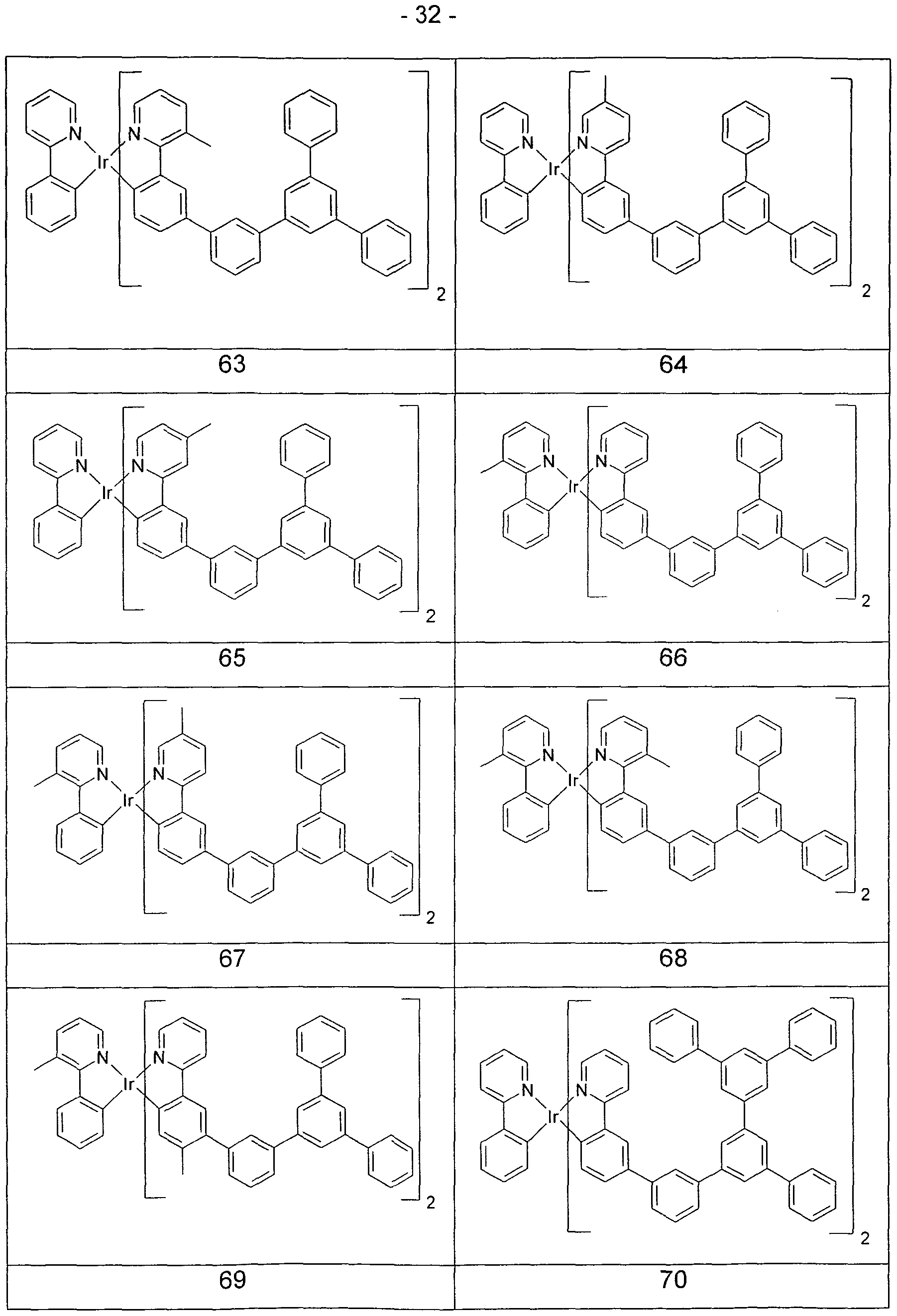


Die oben beschriebenen Komplexe gemäß Formel (1 ) bzw. die oben auf- geführten bevorzugten Ausführungsformen können in einer elektronischen Vorrichtung als aktive Komponente verwendet werden. Unter einer elektronischen Vorrichtung wird eine Vorrichtung verstanden, welche Anode, Kathode und mindestens eine Schicht enthält, wobei diese Schicht mindestens eine organische bzw. metallorganische Verbindung enthält. Die erfindungsgemäße elektronische Vorrichtung enthält also Anode, Kathode und mindestens eine Schicht, welche mindestens eine The above-described complexes of the formula (1) or the above-mentioned preferred embodiments can be used in an electronic device as an active component. An electronic device is understood to mean a device which contains anode, cathode and at least one layer, this layer containing at least one organic or organometallic compound. The electronic device according to the invention thus contains anode, Cathode and at least one layer, which at least one
Verbindung der oben aufgeführten Formel (1) enthält. Dabei sind bevorzugte elektronische Vorrichtungen ausgewählt aus der Gruppe bestehend aus organischen Elektrolumineszenzvorrichtungen (OLEDs, PLEDs), organischen integrierten Schaltungen (O-ICs), organischen Feld-Effekt- Transistoren (O-FETs), organischen Dünnfilmtransistoren (O-TFTs), organischen lichtemittierenden Transistoren (O-LETs), organischen Solarzellen (O-SCs), organischen optischen Detektoren, organischen Photorezeptoren, organischen Feld-Quench-Devices (O-FQDs), lichtemittierenden elektrochemischen Zellen (LECs) oder organischen Laser- dioden (O-Laser), enthaltend in mindestens einer Schicht mindestens eine Verbindung gemäß der oben aufgeführten Formel (1). Besonders bevorzugt sind organische Elektrolumineszenzvorrichtungen. Aktive Komponenten sind generell die organischen oder anorganischen Materialien, welche zwischen Anode und Kathode eingebracht sind, beispielsweise Ladungsinjektions-, Ladungstransport- oder Ladungsblockiermaterialien, insbesondere aber Emissionsmaterialien und Matrixmaterialien. Die erfindungsgemäßen Verbindungen zeigen besonders gute Eigenschaften als Emissionsmaterial in organischen Elektrolumineszenzvorrichtungen. Eine bevorzugte Ausführungsform der Erfindung sind daher organische Elektrolumineszenzvorrichtungen. Compound of the above-mentioned formula (1) contains. Here, preferred electronic devices are selected from the group consisting of organic electroluminescent devices (OLEDs, PLEDs), organic integrated circuits (O-ICs), organic field effect transistors (O-FETs), organic thin film transistors (O-TFTs), organic light-emitting Transistors (O-LETs), organic solar cells (O-SCs), organic optical detectors, organic photoreceptors, organic field quench devices (O-FQDs), light-emitting electrochemical cells (LECs) or organic laser diodes (O-lasers) containing in at least one layer at least one compound according to the above-mentioned formula (1). Particularly preferred are organic electroluminescent devices. Active components are generally the organic or inorganic materials incorporated between the anode and cathode, for example, charge injection, charge transport or charge blocking materials, but especially emission materials and matrix materials. The compounds according to the invention exhibit particularly good properties as emission material in organic electroluminescent devices. A preferred embodiment of the invention are therefore organic electroluminescent devices.
Die organische Elektrolumineszenzvorrichtung enthält Kathode, Anode und mindestens eine emittierende Schicht. Außer diesen Schichten kann sie noch weitere Schichten enthalten, beispielsweise jeweils eine oder mehrere Lochinjektionsschichten, Lochtransportschichten, Lochblockierschichten, Elektronentransportschichten, Elektroneninjektionsschichten, Excitonenblockierschichten, Ladungserzeugungsschichten und/oder organische oder anorganische p/n-Übergänge. Ebenso können zwischen zwei emittierende Schichten Interlayers eingebracht sein, welche beispiels- weise eine Exzitonen-blockierende Funktion aufweisen und/oder dieThe organic electroluminescent device includes cathode, anode and at least one emitting layer. In addition to these layers, they may also contain further layers, for example one or more hole injection layers, hole transport layers, hole blocking layers, electron transport layers, electron injection layers, exciton blocking layers, charge generation layers and / or organic or inorganic p / n junctions. Likewise, interlayers may be introduced between two emitting layers, which have, for example, an exciton-blocking function and / or the
Ladungsbalance in der Elektrolumineszenzvorrichtung steuern. Es sei aber darauf hingewiesen, dass nicht notwendigerweise jede dieser Schichten vorhanden sein muss. Dabei kann die organische Elektrolumineszenzvorrichtung eine emittierende Schicht enthalten, oder sie kann mehrere emittierende Schichten enthalten. Wenn mehrere Emissionsschichten vorhanden sind, weisen diese bevorzugt insgesamt mehrere Emissions- maxima zwischen 380 nm und 750 nm auf, so dass insgesamt weiße Emission resultiert, d. h. in den emittierenden Schichten werden verschiedene emittierende Verbindungen verwendet, die fluoreszieren oder phosphoreszieren können. Insbesondere bevorzugt sind DreischichtSysteme, wobei die drei Schichten blaue, grüne und orange oder rote Emission zeigen (für den prinzipiellen Aufbau siehe z. B. WO Controlling charge balance in the electroluminescent device. It should be noted, however, that not necessarily each of these layers must be present. In this case, the organic electroluminescent device may contain an emitting layer, or it may contain a plurality of emitting layers. If multiple emission layers are present, they preferably have a total of a plurality of emission maxima between 380 nm and 750 nm, so that total white emission results, ie in the emitting layers different emitting compounds are used, which can fluoresce or phosphoresce. Particular preference is given to three-layer systems, the three layers exhibiting blue, green and orange or red emission (for the basic structure, see, for example, WO
2005/011013) bzw. Systeme, welche mehr als drei emittierende Schichten aufweisen. in einer bevorzugten Ausführungsform der Erfindung enthält die 2005/011013) or systems which have more than three emitting layers. in a preferred embodiment of the invention contains the
organische Elektrolumineszenzvorrichtung die Verbindung gemäß Formel (1) bzw. die oben aufgeführten bevorzugten Ausführungsformen als emittierende Verbindung in einer oder mehreren emittierenden Schichten. Wenn die Verbindung gemäß Formel (1) als emittierende Verbindung in einer emittierenden Schicht eingesetzt wird, wird sie bevorzugt in Organic electroluminescent device, the compound according to formula (1) or the above-mentioned preferred embodiments as an emitting compound in one or more emitting layers. When the compound of the formula (1) is used as an emitting compound in an emitting layer, it is preferably used in U.S.P.
Kombination mit einem oder mehreren Matrixmaterialien eingesetzt. Die Mischung aus der Verbindung gemäß Formel (1) und dem Matrixmaterial enthält zwischen 1 und 99 Gew.-%, vorzugsweise zwischen 2 und Combination with one or more matrix materials used. The mixture of the compound according to formula (1) and the matrix material contains between 1 and 99 wt .-%, preferably between 2 and
40 Gew.-%, besonders bevorzugt zwischen 3 und 30 Gew.-%, insbesondere zwischen 5 und 25 Gew.-% der Verbindung gemäß Formel (1) bezogen auf die Gesamtmischung aus Emitter und Matrixmaterial. 40 wt .-%, particularly preferably between 3 and 30 wt .-%, in particular between 5 and 25 wt .-% of the compound according to formula (1) based on the total mixture of emitter and matrix material.
Entsprechend enthält die Mischung zwischen 99 und 1 Gew.-%, vorzugsweise zwischen 98 und 60 Gew.-%, besonders bevorzugt zwischen 97 und 70 Gew.-%, insbesondere zwischen 95 und 75 Gew.-% des Matrixmaterials bezogen auf die Gesamtmischung aus Emitter und Matrixmaterial. Accordingly, the mixture contains between 99 and 1 wt .-%, preferably between 98 and 60 wt .-%, particularly preferably between 97 and 70 wt .-%, in particular between 95 and 75 wt .-% of the matrix material based on the total mixture Emitter and matrix material.
Geeignete Matrixmaterialien für die erfindungsgemäßen Verbindungen sind Ketone, Phosphinoxide, Sulfoxide und Sulfone, z. B. gemäß Suitable matrix materials for the compounds according to the invention are ketones, phosphine oxides, sulfoxides and sulfones, for. B. according to
WO 2004/013080, WO 2004/093207, WO 2006/005627 oder WO WO 2004/013080, WO 2004/093207, WO 2006/005627 or WO
2010/006680, Triarylamine, Carbazolderivate, z. B. CBP (N.N-Bis- carbazolylbiphenyl) oder die in WO 2005/039246, US 2005/0069729, JP 2004/288381 , EP 1205527 oder WO 2008/086851 offenbarten 2010/006680, triarylamines, carbazole derivatives, e.g. CBP (N.N-bis-carbazolylbiphenyl) or those disclosed in WO 2005/039246, US 2005/0069729, JP 2004/288381, EP 1205527 or WO 2008/086851
Carbazolderivate, Indolocarbazolderivate, z. B. gemäß WO 07/063754 oder WO 08/056746, Indenocarbazolderivate, z. B. gemäß den nicht offen gelegten Anmeldungen DE 102009023155.2 und DE 02009031021.5, Azacarbazole, z. B. gemäß EP 1617710, EP 1617711 , EP 1731584, JP 2005/347160, bipolare Matrixmaterialien, z. B. gemäß WO 07/137725, Silane, z. B. gemäß WO 2005/ 11 72, Azaborole oder Boronester, z. B. gemäß WO 06/117052, Triazinderivate, z. B. gemäß WO 2010/015306, WO 2007/063754 oder WO 2008/056746, Zinkkomplexe, z. B. gemäß EP 652273 oder gemäß WO 2009/062578, Diaza- oder Tetraazasilol- derivate, z. B. gemäß WO 20 0/054729, Diazaphospholderivate, z. B. gemäß WO 2010/054730, oder Dibenzofuranderivate, z. B. gemäß WO 2009/148015. Carbazole derivatives, indolocarbazole derivatives, e.g. B. according to WO 07/063754 or WO 08/056746, indenocarbazole derivatives, e.g. B. according to the unpublished applications DE 102009023155.2 and DE 02009031021.5, Azacarbazole, z. B. according to EP 1617710, EP 1617711, EP 1731584, JP 2005/347160, bipolar matrix materials, for. B. according to WO 07/137725, silanes, z. B. according to WO 2005/11 72, Azaborole or Boronester, z. B. according to WO 06/117052, triazine derivatives, z. B. according to WO 2010/015306, WO 2007/063754 or WO 2008/056746, zinc complexes, for. B. according to EP 652273 or according to WO 2009/062578, diaza or tetraazasilol derivatives, z. B. according to WO 20 0/054729, diazaphosphole derivatives, for. B. according to WO 2010/054730, or Dibenzofuranderivate, z. B. according to WO 2009/148015.
Es kann auch bevorzugt sein, mehrere verschiedene Matrixmaterialien als Mischung einzusetzen, insbesondere mindestens ein elektronenleitendes Matrixmaterial und mindestens ein lochleitendes Matrixmaterial. Eine bevorzugte Kombination ist beispielsweise die Verwendung eines aromatischen Ketons, eines aromatischen Phosphinoxids oder eines Triazins mit einem Triarylamin-Derivat oder einem Carbazol-Derivat als gemischte Matrix für den erfindungsgemäßen Metallkomplex. Ebenfalls bevorzugt sind auch Mischungen aus einen loch- oder elektronentransportierenden Material mit einem Material, welches weder am Loch- noch am Elektronentransport beteiligt ist, wie beispielsweise in der nicht offen gelegten It may also be preferred to use a plurality of different matrix materials as a mixture, in particular at least one electron-conducting matrix material and at least one hole-conducting matrix material. A preferred combination is, for example, the use of an aromatic ketone, an aromatic phosphine oxide or a triazine with a triarylamine derivative or a carbazole derivative as a mixed matrix for the metal complex according to the invention. Also preferred are mixtures of a hole or electron transporting material with a material which is involved in neither the hole nor the electron transport, such as in the not disclosed
Anmeldung DE 102009014513.3 offenbart. Application DE 102009014513.3 discloses.
Als Kathode sind Metalle mit geringer Austrittsarbeit, Metalllegierungen oder mehrlagige Strukturen aus verschiedenen Metallen bevorzugt, wie beispielsweise Erdalkalimetalle, Alkalimetalle, Hauptgruppenmetalle oder Lathanoide (z. B. Ca, Ba, Mg, AI, In, Mg, Yb, Sm, etc.). Weiterhin eignen sich Legierungen aus einem Alkali- oder Erdalkalimetall und Silber, beispielsweise eine Legierung aus Magnesium und Silber. Bei mehr- lagigen Strukturen können auch zusätzlich zu den genannten Metallen weitere Metalle verwendet werden, die eine relativ hohe Austrittsarbeit aufweisen, wie z. B. Ag, wobei dann in der Regel Kombinationen der Metalle, wie beispielsweise Mg/Ag, Ca/Ag, oder Ba/Ag verwendet werden. Es kann auch bevorzugt sein, zwischen einer metallischen Kathode und dem organischen Halbleiter eine dünne Zwischenschicht eines Materials mit einer hohen Dielektrizitätskonstante einzubringen. Hierfür kommen beispielsweise Alkalimetall- oder Erdalkalimetallfluoride, aber auch die entsprechenden Oxide oder Carbonate in Frage (z. B. LiF, Li2O, BaF2, MgO, NaF, CsF, Cs2CO3, etc.). Die Schichtdicke dieser Schicht beträgt bevorzugt zwischen 0.5 und 5 nm. As the cathode, low work function metals, metal alloys or multilayer structures of various metals are preferable, such as alkaline earth metals, alkali metals, main group metals or lathanoids (eg, Ca, Ba, Mg, Al, In, Mg, Yb, Sm, etc.). , Also suitable are alloys of an alkali or alkaline earth metal and silver, for example an alloy of magnesium and silver. In the case of multilayer structures, it is also possible, in addition to the metals mentioned, to use further metals which have a relatively high work function, such as eg. B. Ag, which then usually combinations of metals, such as Mg / Ag, Ca / Ag, or Ba / Ag are used. It may also be preferable to have a thin intermediate layer of a material between a metallic cathode and the organic semiconductor with a high dielectric constant. Suitable examples of these are alkali metal or alkaline earth metal fluorides, but also the corresponding oxides or carbonates (eg LiF, Li 2 O, BaF 2 , MgO, NaF, CsF, Cs 2 CO 3 , etc.). The layer thickness of this layer is preferably between 0.5 and 5 nm.
Als Anode sind Materialien mit hoher Austrittsarbeit bevorzugt. Bevorzugt weist die Anode eine Austrittsarbeit größer 4.5 eV vs. Vakuum auf. Hierfür sind einerseits Metalle mit hohem Redoxpotential geeignet, wie beispielsweise Ag, Pt oder Au. Es können andererseits auch Metall/Metalloxid- Elektroden (z. B. AI/Ni/NiOXl AI/PtOx) bevorzugt sein. Für einige Anwendungen muss mindestens eine der Elektroden transparent oder teiltransparent sein, um entweder die Bestrahlung des organischen Materials (O-SC) oder die Auskopplung von Licht (OLED/PLED, O-LASER) zu ermöglichen. Bevorzugte Anodenmaterialien für transparente oder teil- transparente Anoden sind leitfähige gemischte Metalloxide. Besonders bevorzugt sind Indium-Zinn-Oxid (ITO) oder Indium-Zink Oxid (IZO). As the anode, high workfunction materials are preferred. Preferably, the anode has a work function greater than 4.5 eV. Vacuum up. On the one hand, metals with a high redox potential, such as Ag, Pt or Au, are suitable for this purpose. It may on the other hand electrodes (z. B. AI / Ni / NiO Xl AI / PtO x) may be preferred, metal / metal oxide. For some applications, at least one of the electrodes must be transparent or partially transparent to allow either the irradiation of the organic material (O-SC) or the outcoupling of light (OLED / PLED, O-LASER). Preferred anode materials for transparent or partially transparent anodes are conductive mixed metal oxides. Particularly preferred are indium tin oxide (ITO) or indium zinc oxide (IZO).
Bevorzugt sind weiterhin leitfähige, dotierte organische Materialien, insbesondere leitfähige dotierte Polymere. in den weiteren Schichten können generell alle Materialien verwendet werden, wie sie gemäß dem Stand der Technik für die Schichten verwendet werden und der Fachmann kann ohne erfinderisches Zutun jedes dieser Materialien in einer elektronischen Vorrichtung mit den erfindungsgemäßen Materialien kombinieren. Preference is furthermore given to conductive, doped organic materials, in particular conductive doped polymers. In the other layers, it is generally possible to use all materials as used in the prior art for the layers, and the person skilled in the art can combine any of these materials in an electronic device with the materials according to the invention without inventive step.
Die Vorrichtung wird entsprechend (je nach Anwendung) strukturiert, kontaktiert und schließlich hermetisch versiegelt, da sich die Lebensdauer derartiger Vorrichtungen bei Anwesenheit von Wasser und/oder Luft drastisch verkürzt. The device is structured accordingly (depending on the application), contacted and finally hermetically sealed because the life of such devices drastically shortened in the presence of water and / or air.
Weiterhin bevorzugt ist eine organische Elektrolumineszenzvorrichtung, dadurch gekennzeichnet, dass eine oder mehrere Schichten mit einem Sublimationsverfahren beschichtet werden. Dabei werden die Materialien in Vakuum-Sublimationsanlagen bei einem Anfangsdruck von üblicher- weise kleiner 10"5 mbar, bevorzugt kleiner 10"6 mbar aufgedampft. Es ist auch möglich, dass der Anfangsdruck noch geringer ist, beispielsweise kleiner 10"7 mbar. Further preferred is an organic electroluminescent device, characterized in that one or more layers are coated with a sublimation process. The materials in vacuum sublimation 6 mbar at an initial pressure of customarily example less than 10 "5 mbar, preferably less than 10" evaporated. It is also possible that the initial pressure is even lower, for example less than 10 "7 mbar.
Bevorzugt ist ebenfalls eine organische Elektrolumineszenzvorrichtung, dadurch gekennzeichnet, dass eine oder mehrere Schichten mit dem OVPD (Organic Vapour Phase Deposition) Verfahren oder mit Hilfe einer Trägergassublimation beschichtet werden. Dabei werden die Materialien bei einem Druck zwischen 10"5 mbar und 1 bar aufgebracht. Ein Spezialfall dieses Verfahrens ist das OVJP (Organic Vapour Jet Printing) Verfahren, bei dem die Materialien direkt durch eine Düse aufgebracht und so strukturiert werden (z. B. M. S. Arnold et al., Appl. Phys. Lett. 2008, 92, 053301). Also preferred is an organic electroluminescent device, characterized in that one or more layers are coated with the OVPD (Organic Vapor Phase Deposition) method or with the aid of a carrier gas sublimation. The materials are applied at a pressure between 10 "applied 5 mbar and 1 bar. A special case of this method is the OVJP (organic vapor jet printing) method in which the materials are applied directly through a nozzle and patterned (eg. BMS Arnold et al., Appl. Phys. Lett., 2008, 92, 053301).
Weiterhin bevorzugt ist eine organische Elektrolumineszenzvorrichtung, dadurch gekennzeichnet, dass eine oder mehrere Schichten aus Lösung, wie z. B. durch Spincoating, oder mit einem beliebigen Druckverfahren, wie z. B. Siebdruck, Flexodruck, Offsetdruck, LITI (Light Induced Thermal Imaging, Thermotransferdruck), Ink-Jet Druck (Tintenstrahldruck) oder Nozzle Printing, hergestellt werden. Da die erfindungsgemäßen Further preferred is an organic electroluminescent device, characterized in that one or more layers of solution, such. B. by spin coating, or with any printing process such. As screen printing, flexographic printing, offset printing, LITI (Light Induced Thermal Imaging, thermal transfer printing), ink-jet printing (ink jet printing) or Nozzle Printing, are produced. Since the invention
Verbindungen der Formel (1 ) eine sehr gute Löslichkeit in organischen Lösemitteln aufweisen, eignen sie sich besonders gut für die Verarbeitung aus Lösung. Die erfindungsgemäßen Verbindungen werden daher bevorzugt aus Lösung verarbeitet. Compounds of formula (1) have a very good solubility in organic solvents, they are particularly well suited for processing from solution. The compounds according to the invention are therefore preferably processed from solution.
Die organische Elektrolumineszenzvorrichtung kann auch als Hybrid- system hergestellt werden, indem eine oder mehrere Schichten aus Lösung aufgebracht werden und eine oder mehrere andere Schichten aufgedampft werden. So ist es beispielsweise möglich, eine emittierende Schicht enthaltend eine Verbindung gemäß Formel (1 ) und ein Matrixmaterial aus Lösung aufzubringen und darauf eine Lochblockierschicht und/oder eine Elektronentransportschicht im Vakuum aufzudampfen. The organic electroluminescent device can also be manufactured as a hybrid system by applying one or more layers of solution and depositing one or more other layers. Thus, for example, it is possible to apply an emitting layer containing a compound of formula (1) and a solution matrix material and then vacuum evaporate a hole blocking layer and / or an electron transport layer.
Diese Verfahren sind dem Fachmann generell bekannt und können von ihm ohne Probleme auf organische Elektrolumineszenzvorrichtungen enthaltend Verbindungen gemäß Formel (1) bzw. die oben aufgeführten bevorzugten Ausführungsformen angewandt werden. Für die Verarbeitung aus Lösung sind Lösungen bzw. Formulierungen der Verbindungen gemäß Formel (1) erforderlich. Es kann dabei bevorzugt sein, Mischungen aus zwei oder mehr Lösemitteln zu verwenden. These methods are generally known to the person skilled in the art and can be applied by him without problems to organic electroluminescent devices containing compounds of the formula (1) or the preferred embodiments listed above. For processing from solution, solutions or formulations of the compounds according to formula (1) are required. It may be preferred to use mixtures of two or more solvents.
Geeignete und bevorzugte Lösemittel sind beispielsweise Toluol, Anisol, o-, m- oder p-Xylol, Methylbenzoat, Dimethylanisol, Mesitylen, Tetralin, Veratrol, THF, Methyl-THF, THP, Chlorbenzol, Dioxan oder Mischungen dieser Lösemittel. Suitable and preferred solvents are, for example, toluene, anisole, o-, m- or p-xylene, methyl benzoate, dimethylanisole, mesitylene, tetralin, veratrole, THF, methyl THF, THP, chlorobenzene, dioxane or mixtures of these solvents.
Ein weiterer Gegenstand der vorliegenden Erfindung ist daher eine Lösung bzw. eine Formulierung enthaltend mindestens eine Verbindung gemäß Formel (1) und ein oder mehrere Lösemittel, insbesondere organische Lösemittel. Wie solche Lösungen hergestellt werden können, ist dem Fachmann bekannt und beispielsweise in der WO 2002/072714, der WO 2003/019694 und der darin zitierten Literatur beschrieben. Another object of the present invention is therefore a solution or a formulation containing at least one compound according to formula (1) and one or more solvents, in particular organic solvents. How such solutions can be prepared is known to the person skilled in the art and described, for example, in WO 2002/072714, WO 2003/019694 and the literature cited therein.
Die erfmdungsgemäßen elektronischen Vorrichtungen, insbesondere organische Elektrolumineszenzvorrichtungen, zeichnen sich durch folgende überraschende Vorteile gegenüber dem Stand der Technik aus: The electronic devices according to the invention, in particular organic electroluminescent devices, are distinguished by the following surprising advantages over the prior art:
Die Verbindungen gemäß Formel (1) weisen eine sehr gute Löslichkeit in einer Vielzahl gängiger organischer Lösemittel auf und sind daher sehr gut für die Verarbeitung aus Lösung geeignet. Insbesondere weisen die erfindungsgemäßen Verbindungen eine höhere Löslichkeit auf als die im Stand der Technik beschriebenen verwandten The compounds of formula (1) have a very good solubility in a variety of common organic solvents and are therefore very well suited for processing from solution. In particular, the compounds according to the invention have a higher solubility than the related compounds described in the prior art
Verbindungen. Links.
Organische Elektrolumineszenzvorrichtungen enthaltend Containing organic electroluminescent devices
Verbindungen gemäß Formel (1) als emittierende Materialien weisen eine exzellente Lebensdauer auf. Insbesondere ist die Lebensdauer besser als bei verwandten Verbindungen gemäß dem Stand der Technik. Compounds according to formula (1) as emitting materials have an excellent lifetime. In particular, the lifetime is better than related prior art compounds.
Organische Elektrolumineszenzvorrichtungen enthaltend Containing organic electroluminescent devices
Verbindungen gemäß Formel (1) als emittierende Material eine hervorragende Effizienz auf. Insbesondere ist die Effizienz besser als bei verwandten Verbindungen gemäß dem Stand der Technik. Compounds according to formula (1) as emitting material excellent efficiency. In particular, the efficiency is better than related prior art compounds.
Diese oben genannten Vorteile gehen nicht mit einer Verschlechterung der weiteren elektronischen Eigenschaften einher. These advantages mentioned above are not accompanied by a deterioration of the other electronic properties.
Die Erfindung wird durch die nachfolgenden Beispiele näher erläutert, ohne sie dadurch einschränken zu wollen. Der Fachmann kann aus den Schilderungen ohne erfinderisches Zutun weitere erfindungsgemäße elektronische Vorrichtungen herstellen und die Erfindung somit im gesamten offenbarten Bereich ausführen. The invention is explained in more detail by the following examples without wishing to restrict them thereby. The person skilled in the art can produce further inventive electronic devices from the descriptions without inventive step and thus implement the invention in the entire disclosed area.
Beispiele: Examples:
Die nachfolgenden Synthesen werden, sofern nicht anders angegeben, unter einer Schutzgasatmosphäre in getrockneten Lösungsmitteln durch- geführt. Die Edukte 1 , 2, 10 und 11 und Lösungsmittel können kommerziell bezogen werden, beispielsweise von ALDRICH. Verbindung 4, Verbindung 15 und Verbindung 17 können gemäß WO 2002/068435 bzw. analog zu dem in WO 2002/068435 beschriebenen Verfahren dargestellt werden. Verbindung 7 kann analog zu J. Mater. Chem. 2007, 77, 3714-3719 dargestellt werden. Unless stated otherwise, the following syntheses are carried out under an inert gas atmosphere in dried solvents. The educts 1, 2, 10 and 11 and solvents can be obtained commercially, for example from ALDRICH. Compound 4, compound 15 and compound 17 can be prepared according to WO 2002/068435 or analogously to the process described in WO 2002/068435. Compound 7 can be analogous to J. Mater. Chem. 2007, 77, 3714-3719.
Beispiel 1 : Synthese von Verbindung 6 Example 1: Synthesis of Compound 6


40.0 g (146 mmol) 3-Boronsäure-[3,1 ';5,1 "]terphenyl (2), 18.8 g (146 mmol) 1-lod-3-brombenzol (1) und 109.3 g (730 mmol) Kaliumcarbonat werden in 1350 ml_ Toulol und 1150 mL Wasser suspendiert. Zu dieser Suspension werden 844 mg (0.73 mmol) Palladium(0)tetrakis(triphenyl- phosphin) gegeben, und die Reaktionsmischung wird 16 h unter Rückfluss erhitzt. Nach Erkalten wird die organische Phase abgetrennt, dreimal mit 200 mL Wasser gewaschen, mit Natriumsulfat getrocknet und 40.0 g (146 mmol) of 3-boronic acid [3,1 ' , 5,1 "] terphenyl (2), 18.8 g (146 mmol) of 1-iodo-3-bromobenzene (1) and 109.3 g (730 mmol) of potassium carbonate are suspended in 1350 ml of toluene and 1150 ml of water, 844 mg (0.73 mmol) of palladium (0) tetrakis (triphenylphosphine) are added to this suspension, and the reaction mixture is heated under reflux for 16 hours After cooling, the organic phase is separated off , Washed three times with 200 mL of water, dried with sodium sulfate and
anschließend zur Trockene eingeengt. Der Rückstand wird mit Ethanol gewaschen und aus Ethylacetat umkristallisiert und abschließend bei vermindertem Druck getrocknet. Die Ausbeute beträgt 47.6 g (123 mmol), entsprechend 84.5 % der Theorie. b) Synthese von 1-Pinakolylboronsäureester-3-([3,1 ';5,1"]terphen-1- yl)-phenyl (Verbindung 5) then concentrated to dryness. The residue is washed with ethanol and recrystallized from ethyl acetate and finally dried under reduced pressure. The yield is 47.6 g (123 mmol), corresponding to 84.5% of theory. b) Synthesis of 1-pinacolyl boronic ester 3 - ([3,1 ' , 5,1 "] -terphenyl-1-yl) -phenyl (compound 5)
40.0 g (104 mmol) 1-Brom-3-([3,1 ';5,1"]terphen-1-yl)-benzol (3), 29.0 g (114 mmol) Bispinakolatodiboron, 29.5 g (301 mmol) Kaliumacetat werden in 800 mL Dimethylsulfoxid suspendiert. Zu dieser Suspension werden 4.24 g (5.2 mmol) 1 ,1-Bis(diphenylphosphino)ferrocen-dichloro- palladium(ll)*DCM gegeben, und die Reaktionsmischung wird 16 h unter Rückfluss erhitzt. Nach Erkalten werden 600 mL Ethylacetat und 400 mL Wasser hinzugegeben, und die organische Phase wird abgetrennt, dreimal mit 200 mL Wasser gewaschen, mit Natriumsulfat getrocknet und anschließend zur Trockene eingeengt. Das Rohprodukt wird aus Heptan umkristallisiert und abschließend bei vermindertem Druck getrocknet. Die Ausbeute beträgt 34.5 g (80 mmol), entsprechend 46.1 % der Theorie. c) Synthese von fac-Tris[2-(2-pyridinyl-KN)(5-(3-([3,1 ';5,1"]terphen-1- yl)-phenyl)phenyl)- C]-iridium(lli) (Verbindung 6) 40.0 g (104 mmol) of 1-bromo-3 - ([3,1 ' , 5,1 "] -terphen-1-yl) -benzene (3), 29.0 g (114 mmol) of bis-pinacolato diborone, 29.5 g (301 mmol). Potassium acetate is suspended in 800 ml of dimethylsulfoxide 4.24 g (5.2 mmol) of 1,1-bis (diphenylphosphino) ferrocene-palladium (II) * DCM are added to this suspension, and the reaction mixture is heated under reflux for 16 h 600 ml of ethyl acetate and 400 ml of water are added and the organic phase is separated off, washed three times with 200 ml of water, dried with sodium sulphate and then concentrated to dryness The crude product is recrystallised from heptane and finally dried under reduced pressure The yield is 34.5 g (80 mmol), corresponding to 46.1% of theory. c) Synthesis of fac-Tris [2- (2-pyridinyl-KN) (5- (3 - ([3,1 ' , 5,1 "] -terphenyl-1-yl) -phenyl) -phenyl) -C] - iridium (lli) (compound 6)
1.7 g (2.0 mmol) fac-Tris[2-(2-pyridinyl-KN)(5-bromphenyl)-KC]-iridium(lll) (4), 7.42 g (17 mmol) 1-Pinakolylboronsäureester-3-([3,1 ';5,1"]terphen-1- yl)-phenyl (5), 2.51 g (12 mmol) Kaliumphosphat werden in 100 mL Toulol, 100 mL Dioxan und 11 ml_ Wasser suspendiert. Zu dieser Suspension werden 4 mg (0.1 mmol) Palladium(ll)acetat und 35 mg (0.2 mmol) Tri-o- tolylphosphin gegeben, und die Reaktionsmischung wird 24 h unter Rück- fluss erhitzt. Nach Erkalten wird die organische Phase abgetrennt, dreimal mit 200 mL Wasser gewaschen, über Kieselgel filtriert, mit Natriumsulfat getrocknet und anschließend zur Trockene eingeengt. Der Rückstand wird aus Dioxan / Ethanol umkristallisiert und abschließend bei vermindertem Druck getrocknet. Die Ausbeute beträgt 2.42 g (1.6 mmol), entsprechend 80.9 % der Theorie. Beispiel 2: Synthese von Verbindung 9 1.7 g (2.0 mmol) of fac-tris [2- (2-pyridinyl-KN) (5-bromophenyl) -KC] -iridium (III) (4), 7.42 g (17 mmol) of 1-pinacolyl boronic ester 3 - ([ 3,1 ' , 5,1 "] -terphenyl-1-yl) -phenyl (5), 2.51 g (12 mmol) of potassium phosphate are suspended in 100 ml of toluene, 100 ml of dioxane and 11 ml of water (0.1 mmol) palladium (II) acetate and 35 mg (0.2 mmol) of tri-o-tolylphosphine are added and the reaction mixture is heated under reflux for 24 h After cooling, the organic phase is separated off, washed three times with 200 ml of water, The residue is recrystallized from dioxane / ethanol and finally dried under reduced pressure to give 2.42 g (1.6 mmol), corresponding to 80.9% of theory. EXAMPLE 2 Synthesis of Compound 9

Die Synthese erfolgt analog zur der von Verbindung 5. Die Ausbeute beträgt 31.9 g (73 mmol), entsprechend 81.3 % der Theorie. b) Synthese von fac-Tris[2-(2-pyridinyl-KN)(5-(3-phenyl (4,6-diphenyl- [1 ,3,5]triazin)phenyl)- KC]-iridium(lll) (Verbindung 9) The synthesis is carried out analogously to that of compound 5. The yield is 31.9 g (73 mmol), corresponding to 81.3% of theory. b) Synthesis of fac-tris [2- (2-pyridinyl-KN) (5- (3-phenyl (4,6-diphenyl- [1,3,5] triazine) -phenyl) -KC] -iridium (III) (Compound 9)
Die Synthese erfolgt analog zur der von Verbindung 6. Die Ausbeute beträgt 1.5 g (0.95 mmol), entsprechend 55.6 % der Theorie. The synthesis is analogous to that of compound 6. The yield is 1.5 g (0.95 mmol), corresponding to 55.6% of theory.

Zu 1 .7 g (71 .2 mmol) Magnesiumspänen wird eine Lösung von 20.0 g (64.7 mmol) 3-Brom-[3, 1 ';5,1 "]terphenyl in 300 mL Tetrahydrofuran langsam hinzugetropft und 3 h lang unter Rückfluss erhitzt. Dann wird die Lösung auf -40 °C abgekühlt, und es wird eine Lösung von 1 1.8 g (65 mmol) 3-Brombenzonitril in 100 mL Tetrahydrofuran hinzugetropft. Nach der Zugabe wird die Lösung 6 h lang unter Rückfluss erhitzt. Nach Erkalten werden 600 mL Ethylacetat und 400 mL Wasser hinzugegeben, und die organische Phase wird abgetrennt, dreimal mit 200 mL Wasser gewaschen, mit Natriumsulfat getrocknet und anschließend zur Trockene eingeengt. Der Rückstand wurde aus Ethanol umkristallisiert und anschließend bei vermindertem Druck getrocknet. Die Ausbeute beträgt 21.7 g (53 mmol), entsprechend 81.3 % der Theorie. b) Synthese von 3-Pinakolylboronsäureesterphenyl-[1,1';3',1"]ter- phenyl-5'-yl-methanon (Verbindung 13) To 1 .7 g (71 .2 mmol) of magnesium turnings, a solution of 20.0 g (64.7 mmol) of 3-bromo [3, 1 ' , 5,1 "] terphenyl in 300 mL of tetrahydrofuran is slowly added dropwise and under reflux for 3 h The solution is then cooled to -40 ° C. and a solution of 1.8 l (65 mmol) of 3-bromobenzonitrile in 100 ml of tetrahydrofuran is added dropwise, and after the addition the solution is refluxed for 6 h 600 ml of ethyl acetate and 400 ml of water are added and the organic phase is separated off, washed three times with 200 ml of water, dried with sodium sulfate and then concentrated to dryness The residue was recrystallised from ethanol and then dried under reduced pressure g (53 mmol), corresponding to 81.3% of theory. b) Synthesis of 3-pinacolylboronic acid esterphenyl- [1,1 ', 3', 1 "] tert-phenyl-5'-yl-methanone (Compound 13)
Die Synthese erfolgt analog zu der von Verbindung 5. Die Ausbeute beträgt 15.7 g (34 mmol), entsprechend 76.2 % der Theorie. c) Synthese von fac-Tris[2-(2-pyridinyl-KN)(5-(3-phenyl 3- [I ^SM^terphenyl-S^yl-methanon-Kq-iridiumilll) (Verbindung 14) The synthesis is analogous to that of compound 5. The yield is 15.7 g (34 mmol), corresponding to 76.2% of theory. c) Synthesis of fac-tris [2- (2-pyridinyl-KN) (5- (3-phenyl-3- [I, 3H-tert-phenyl-3-yl-methanone-Kq-iridium-1-gal) (Compound 14)
Die Synthese erfolgt analog zur der von Verbindung 6. Die Ausbeute beträgt 1.7 g (1.03 mmol), entsprechend 57.3 % der Theorie. The synthesis is carried out analogously to that of compound 6. The yield is 1.7 g (1.03 mmol), corresponding to 57.3% of theory.
Beispiel 4: Synthese von fac-Tris[2-(1-isochinolinyl-KN)(5-(3-Example 4: Synthesis of fac-tris [2- (1-isoquinolinyl-KN) (5- (3)
([3,1 ;5,1"]terphen-1-yl)-phenyl)phenyl)- KC]-iridium(lll) (Verbindung([3.1, 5.1 "], terphen-1-yl) -phenyl) -phenyl) -KC] -iridium (III) (Compound
16) 16)

Die Synthese erfolgt analog zur Synthese von Verbindung 6. Die Ausbeute beträgt 6.52 g (3.8 mmol), entsprechend 65.6 % der Theorie. The synthesis is analogous to the synthesis of compound 6. The yield is 6.52 g (3.8 mmol), corresponding to 65.6% of theory.
Beispiel 5: Synthese von fac-Tris[2-(2-chinolinyl-KN)(5-(3-Example 5: Synthesis of fac-tris [2- (2-quinolinyl-KN) (5- (3)
([3,1 ;5,1"]terphen-1-yl)-phenyl)phenyl)- KC]-iridium(lll) (Verbindung([3.1, 5.1 "], terphen-1-yl) -phenyl) -phenyl) -KC] -iridium (III) (Compound
18) 18)

Beispiel 4: Herstellung und Charakterisierung von organischen Elektrolumineszenzvorrichtungen, enthaltend die erfindungsgemäßen Verbindungen Example 4 Production and Characterization of Organic Electroluminescent Devices Containing the Compounds According to the Invention
Die Strukturen von TEG-1 , TER-1 , TER-3 (synthetisiert nach The structures of TEG-1, TER-1, TER-3 (synthesized according to
WO 2004/085449), TMM-1 (synthetisiert nach WO 2010/015306) und TMM-2 (synthetisiert nach WO 2009/124627), sowie den erfindungs- gemäßen Verbindungen TEG-2 bis TEG-4 und TER-2 sowie TER-4 sind der Übersichtlichkeit halber im Folgenden abgebildet. WO 2004/085449), TMM-1 (synthesized according to WO 2010/015306) and TMM-2 (synthesized according to WO 2009/124627), and the compounds according to the invention TEG-2 to TEG-4 and TER-2 and TER 4 are shown below for the sake of clarity.

TEG-3 TEG-4 TEG-3 TEG-4


TER-3 TER-4 TER-3 TER-4
Strukturen der Matrices Structures of the matrices

TMM-1 TMM-2 Erfindungsgemäße Materialien können aus Lösung verwendet werden und führen dort zu wesentlich einfacheren Vorrichtungen mit dennoch guten Eigenschaften. Die Herstellung solcher Bauteile lehnt sich an die TMM-1 TMM-2 Inventive materials can be used from solution, resulting in much simpler devices with nevertheless good properties. The production of such components leans against the
Herstellung polymerer Leuchtdioden (PLEDs) an, die in der Literatur bereits vielfach beschrieben ist (z. B. in der WO 2004/037887). Im vor- liegenden Fall werden die erfindungsgemäßen Verbindungen bzw. eben- falls lösliche Vergleichsverbindungen (TEG-1 , TER-1 und TER-3) in Toluol gelöst. Der typische Feststoffgehalt solcher Lösungen liegt zwischen 16 und 25 g/L, wenn, wie hier, die für eine Device typische Schichtdicke von 80 nm mittels Spincoating erzielt werden soll. Fig. 1 zeigt den typischen Aufbau einer solchen Device, wobei für rot emittierende Vorrichtung die Zusammensetzung 48 Gew.-% TMM-1 , 48 Gew.-% TMM-2 und 4 Gew.% TER verwendet wird. Strukturierte ITO-Substrate und das Material für die sogenannte Pufferschicht (PEDOT, eigentlich PEDOT:PSS) sind käuflich erhältlich (ITO von Technoprint und anderen, PEDOT:PSS als wässrige Dispersion Clevios Baytron P von H.C. Starck). Die verwendete Interlayer dient der Lochinjektion; in diesem Fall wurde HIL-012 von Merck Preparation of polymeric light-emitting diodes (PLEDs), which has already been described many times in the literature (eg in WO 2004/037887). In the present case, the compounds according to the invention or if soluble comparative compounds (TEG-1, TER-1 and TER-3) dissolved in toluene. The typical solids content of such solutions is between 16 and 25 g / L, if, as here, the typical for a device layer thickness of 80 nm is to be achieved by spin coating. Fig. 1 shows the typical structure of such a device, wherein for red emitting device, the composition 48 wt .-% TMM-1, 48 wt .-% TMM-2 and 4 wt.% TER is used. Structured ITO substrates and the material for the so-called buffer layer (PEDOT, actually PEDOT: PSS) are commercially available (ITO from Technoprint and others, PEDOT: PSS as aqueous dispersion Clevios Baytron P from HC Starck). The interlayer used is the hole injection; in this case, HIL-012 was from Merck
verwendet. Die Emissionsschicht wird in einer Inertgasatmosphäre, im vorliegenden Fall Argon, aufgeschleudert und 10 min bei 120 °C ausgeheizt. Zuletzt wird eine Kathode aus Barium und Aluminium im Vakuum aufgedampft. Zwischen der emittierenden Schicht und der Kathode können auch eine Lochblockierschicht und/oder eine Elektronentransport- schicht per Bedampfung aufgebracht werden, auch kann die Interlayer durch eine oder mehrere Schichten ersetzt werden, die lediglich die Bedingung erfüllen müssen, durch den nachgelagerten Prozessierungs- schritt der Abscheidung der emittierenden Schicht aus Lösung nicht wieder abgelöst zu werden. used. The emission layer is spin-coated in an inert gas atmosphere, in the present case argon, and baked at 120 ° C. for 10 minutes. Finally, a cathode of barium and aluminum is evaporated in vacuo. A hole blocking layer and / or an electron transport layer can also be applied by vapor deposition between the emitting layer and the cathode, and the interlayer can also be replaced by one or more layers which merely have to fulfill the condition by the downstream processing step of the deposition the emissive layer of solution can not be peeled off again.
Die Devices werden standardmäßig charakterisiert, die genannten OLED- Beispiele sind noch nicht optimiert. Tabelle 1 fasst die erhaltenen Daten zusammen. Bei den prozessierten Devices zeigt sich hier, dass die erfindungsgemäßen Materialien den zuvor zur Verfügung stehenden in Effizienz und/oder Lebensdauer überlegen sind. The devices are characterized by default, the mentioned OLED examples are not yet optimized. Table 1 summarizes the data obtained. In the case of the processed devices, it is evident here that the materials according to the invention are superior to those previously available in terms of efficiency and / or lifetime.
Tabelle 1 : Ergebnisse mit aus Lösung prozessierten Materialien in der Devicekonfiguration der Figur 1 bzw. der oben genannten Zusammensetzung für rot emittierende Vorrichtungen Table 1: Results with solutions processed from solution in the device configuration of FIG. 1 or the abovementioned composition for red emitting devices

Claims


Priority Applications (15)
| Application Number | Priority Date | Filing Date | Title |
|---|---|---|---|
| KR1020177024599A KR20170104008A (en) | 2009-09-16 | 2010-08-18 | Metal complexes |
| JP2012529135A JP5902089B2 (en) | 2009-09-16 | 2010-08-18 | Metal complex |
| KR1020127009779A KR101979460B1 (en) | 2009-09-16 | 2010-08-18 | Metal complexes |
| CN201080041117.4A CN102498121B (en) | 2009-09-16 | 2010-08-18 | metal complex |
| US13/395,473 US9212198B2 (en) | 2009-09-16 | 2010-08-18 | Metal complexes |
| DE112010003663.2T DE112010003663B4 (en) | 2009-09-16 | 2010-08-18 | Metal complexes |
| KR1020177025255A KR101886595B1 (en) | 2010-05-03 | 2010-11-26 | Formulations and electronic devices |
| KR1020127031417A KR101778825B1 (en) | 2010-05-03 | 2010-11-26 | Formulations and electronic devices |
| EP10788016.3A EP2566875B1 (en) | 2010-05-03 | 2010-11-26 | Formulations and electronic devices |
| CN201080066572.XA CN102869672B (en) | 2010-05-03 | 2010-11-26 | Preparation and electronic device |
| PCT/EP2010/007176 WO2011137922A1 (en) | 2010-05-03 | 2010-11-26 | Formulations and electronic devices |
| CN201610304110.6A CN105949177B (en) | 2010-05-03 | 2010-11-26 | Preparation and electronic device |
| JP2013508376A JP5837051B2 (en) | 2010-05-03 | 2010-11-26 | Formulations and electronic devices |
| US14/837,724 US9882135B2 (en) | 2010-05-03 | 2015-08-27 | Formulations and electronic devices |
| US15/846,480 US10490747B2 (en) | 2010-05-03 | 2017-12-19 | Formulations and electronic devices |
Applications Claiming Priority (2)
| Application Number | Priority Date | Filing Date | Title |
|---|---|---|---|
| DE102009041414A DE102009041414A1 (en) | 2009-09-16 | 2009-09-16 | metal complexes |
| DE102009041414.2 | 2009-09-16 |
Publications (1)
| Publication Number | Publication Date |
|---|---|
| WO2011032626A1 true WO2011032626A1 (en) | 2011-03-24 |
Family
ID=42830697
Family Applications (1)
| Application Number | Title | Priority Date | Filing Date |
|---|---|---|---|
| PCT/EP2010/005056 Ceased WO2011032626A1 (en) | 2009-09-16 | 2010-08-18 | Metal complexes |
Country Status (7)
| Country | Link |
|---|---|
| US (1) | US9212198B2 (en) |
| JP (1) | JP5902089B2 (en) |
| KR (2) | KR101979460B1 (en) |
| CN (1) | CN102498121B (en) |
| DE (2) | DE102009041414A1 (en) |
| TW (1) | TWI638819B (en) |
| WO (1) | WO2011032626A1 (en) |
Cited By (189)
| Publication number | Priority date | Publication date | Assignee | Title |
|---|---|---|---|---|
| WO2012069121A1 (en) | 2010-11-24 | 2012-05-31 | Merck Patent Gmbh | Materials for organic electroluminescent devices |
| WO2012136295A1 (en) | 2011-04-05 | 2012-10-11 | Merck Patent Gmbh | Organic electroluminescent device |
| WO2012143080A2 (en) | 2011-04-18 | 2012-10-26 | Merck Patent Gmbh | Materials for organic electroluminescent devices |
| WO2012163465A1 (en) | 2011-06-03 | 2012-12-06 | Merck Patent Gmbh | Organic electroluminescence device |
| CN102850322A (en) * | 2011-06-29 | 2013-01-02 | 三星显示有限公司 | Heterocyclic compound, organic light-emitting device, and panel display device |
| WO2013041176A1 (en) | 2011-09-21 | 2013-03-28 | Merck Patent Gmbh | Carbazole derivatives for organic electroluminescence devices |
| WO2013056776A1 (en) | 2011-10-20 | 2013-04-25 | Merck Patent Gmbh | Materials for organic electroluminescent devices |
| WO2013105615A1 (en) | 2012-01-13 | 2013-07-18 | 三菱化学株式会社 | Iridium complex compound, solution composition containing iridium complex compound, organic electroluminescent element, display device, and lighting device |
| WO2013174471A1 (en) | 2012-05-24 | 2013-11-28 | Merck Patent Gmbh | Metal complexes comprising condensed heteroaromatic rings |
| WO2014008967A2 (en) | 2012-07-10 | 2014-01-16 | Merck Patent Gmbh | Materials for organic electroluminescent devices |
| WO2014015931A1 (en) | 2012-07-23 | 2014-01-30 | Merck Patent Gmbh | Materials for organic electroluminescent devices |
| JP2014074000A (en) * | 2012-10-05 | 2014-04-24 | Mitsubishi Chemicals Corp | Iridium complex compound, composition containing the compound and solvent, organic electroluminescent element containing the compound, display device and lighting device |
| US20150028321A1 (en) * | 2012-03-23 | 2015-01-29 | E I Du Pont De Nemours And Company | Green luminescent materials |
| JP2015083587A (en) * | 2012-08-08 | 2015-04-30 | 三菱化学株式会社 | Iridium complex compound, compound including the compound, and organic electroluminescent element, display and luminaire |
| WO2015169412A1 (en) | 2014-05-05 | 2015-11-12 | Merck Patent Gmbh | Materials for organic light emitting devices |
| WO2017025166A1 (en) | 2015-08-13 | 2017-02-16 | Merck Patent Gmbh | Hexamethylindanes |
| US9666806B2 (en) | 2009-09-16 | 2017-05-30 | Merck Patent Gmbh | Formulations for the production of electronic devices |
| US9735376B2 (en) | 2014-10-22 | 2017-08-15 | Samsung Electronics Co., Ltd. | Organometallic compound and organic light-emitting device including the same |
| WO2017148564A1 (en) | 2016-03-03 | 2017-09-08 | Merck Patent Gmbh | Materials for organic electroluminescent devices |
| WO2017157983A1 (en) | 2016-03-17 | 2017-09-21 | Merck Patent Gmbh | Compounds with spirobifluorene-structures |
| WO2017178311A1 (en) | 2016-04-11 | 2017-10-19 | Merck Patent Gmbh | Heterocyclic compounds comprising dibenzofuran and/or dibenzothiophene structures |
| WO2017186760A1 (en) | 2016-04-29 | 2017-11-02 | Merck Patent Gmbh | Materials for organic electroluminescent devices |
| US9882135B2 (en) | 2010-05-03 | 2018-01-30 | Merck Patent Gmbh | Formulations and electronic devices |
| WO2018050584A1 (en) | 2016-09-14 | 2018-03-22 | Merck Patent Gmbh | Compounds with spirobifluorene-structures |
| WO2018050583A1 (en) | 2016-09-14 | 2018-03-22 | Merck Patent Gmbh | Compounds with carbazole structures |
| WO2018060307A1 (en) | 2016-09-30 | 2018-04-05 | Merck Patent Gmbh | Compounds with diazadibenzofurane or diazadibenzothiophene structures |
| WO2018060218A1 (en) | 2016-09-30 | 2018-04-05 | Merck Patent Gmbh | Carbazoles with diazadibenzofurane or diazadibenzothiophene structures |
| WO2018087022A1 (en) | 2016-11-09 | 2018-05-17 | Merck Patent Gmbh | Materials for organic electroluminescent devices |
| WO2018087346A1 (en) | 2016-11-14 | 2018-05-17 | Merck Patent Gmbh | Compounds with an acceptor and a donor group |
| WO2018091435A1 (en) | 2016-11-17 | 2018-05-24 | Merck Patent Gmbh | Materials for organic electroluminescent devices |
| WO2018099846A1 (en) | 2016-11-30 | 2018-06-07 | Merck Patent Gmbh | Compounds having valerolactam structures |
| WO2018104194A1 (en) | 2016-12-05 | 2018-06-14 | Merck Patent Gmbh | Materials for organic electroluminescent devices |
| WO2018104193A1 (en) | 2016-12-05 | 2018-06-14 | Merck Patent Gmbh | Materials for organic electroluminescent devices |
| WO2018104195A1 (en) | 2016-12-05 | 2018-06-14 | Merck Patent Gmbh | Nitrogen-containing heterocycles for use in oleds |
| WO2018114883A1 (en) | 2016-12-22 | 2018-06-28 | Merck Patent Gmbh | Mixtures comprising at least two organofunctional compounds |
| WO2018127465A1 (en) | 2017-01-04 | 2018-07-12 | Merck Patent Gmbh | Materials for organic electroluminescent devices |
| WO2018138039A1 (en) | 2017-01-25 | 2018-08-02 | Merck Patent Gmbh | Carbazole derivatives |
| WO2018138306A1 (en) | 2017-01-30 | 2018-08-02 | Merck Patent Gmbh | Materials for organic electroluminescent devices |
| WO2018149769A1 (en) | 2017-02-14 | 2018-08-23 | Merck Patent Gmbh | Materials for organic electroluminescent devices |
| WO2018166932A1 (en) | 2017-03-13 | 2018-09-20 | Merck Patent Gmbh | Compounds with arylamine structures |
| WO2018166934A1 (en) | 2017-03-15 | 2018-09-20 | Merck Patent Gmbh | Materials for organic electroluminescent devices |
| WO2018189134A1 (en) | 2017-04-13 | 2018-10-18 | Merck Patent Gmbh | Composition for organic electronic devices |
| WO2018198973A1 (en) | 2017-04-27 | 2018-11-01 | 住友化学株式会社 | Composition and light-emitting element using same |
| WO2018206526A1 (en) | 2017-05-11 | 2018-11-15 | Merck Patent Gmbh | Organoboron complexes for organic electroluminescent devices |
| WO2018206537A1 (en) | 2017-05-11 | 2018-11-15 | Merck Patent Gmbh | Carbazole-based bodipys for organic electroluminescent devices |
| WO2018215318A1 (en) | 2017-05-22 | 2018-11-29 | Merck Patent Gmbh | Hexacyclic heteroaromatic compounds for electronic devices |
| WO2018234346A1 (en) | 2017-06-23 | 2018-12-27 | Merck Patent Gmbh | MATERIALS FOR ORGANIC ELECTROLUMINESCENT DEVICES |
| WO2019007867A1 (en) | 2017-07-05 | 2019-01-10 | Merck Patent Gmbh | COMPOSITION FOR ORGANIC ELECTRONIC DEVICES |
| WO2019007866A1 (en) | 2017-07-05 | 2019-01-10 | Merck Patent Gmbh | COMPOSITION FOR ORGANIC ELECTRONIC DEVICES |
| WO2019049225A1 (en) | 2017-09-06 | 2019-03-14 | 住友化学株式会社 | Light emitting element |
| WO2019052933A1 (en) | 2017-09-12 | 2019-03-21 | Merck Patent Gmbh | MATERIALS FOR ORGANIC ELECTROLUMINESCENT DEVICES |
| WO2019068679A1 (en) | 2017-10-06 | 2019-04-11 | Merck Patent Gmbh | Materials for organic electroluminescent devices |
| WO2019081391A1 (en) | 2017-10-24 | 2019-05-02 | Merck Patent Gmbh | MATERIALS FOR ORGANIC ELECTROLUMINESCENT DEVICES |
| WO2019096717A2 (en) | 2017-11-14 | 2019-05-23 | Merck Patent Gmbh | Composition for organic electronic devices |
| WO2019121458A1 (en) | 2017-12-19 | 2019-06-27 | Merck Patent Gmbh | Heterocyclic compound for use in electronic devices |
| WO2019145316A1 (en) | 2018-01-25 | 2019-08-01 | Merck Patent Gmbh | Materials for organic electroluminescent devices |
| WO2019175149A1 (en) | 2018-03-16 | 2019-09-19 | Merck Patent Gmbh | Materials for organic electroluminescent devices |
| US10490747B2 (en) | 2010-05-03 | 2019-11-26 | Merck Patent Gmbh | Formulations and electronic devices |
| WO2019229011A1 (en) | 2018-05-30 | 2019-12-05 | Merck Patent Gmbh | Composition for organic electronic devices |
| WO2019233904A1 (en) | 2018-06-07 | 2019-12-12 | Merck Patent Gmbh | Organic electroluminescence devices |
| WO2020011686A1 (en) | 2018-07-09 | 2020-01-16 | Merck Patent Gmbh | Materials for organic electroluminescent devices |
| WO2020016264A1 (en) | 2018-07-20 | 2020-01-23 | Merck Patent Gmbh | Materials for organic electroluminescent devices |
| WO2020053314A1 (en) | 2018-09-12 | 2020-03-19 | Merck Patent Gmbh | Electroluminescent devices |
| WO2020053315A1 (en) | 2018-09-12 | 2020-03-19 | Merck Patent Gmbh | Electroluminescent devices |
| WO2020053150A1 (en) | 2018-09-12 | 2020-03-19 | Merck Patent Gmbh | Materials for organic electroluminescent devices |
| WO2020064662A2 (en) | 2018-09-27 | 2020-04-02 | Merck Patent Gmbh | Method for producing sterically hindered, nitrogen-containing heteroaromatic compounds |
| WO2020064666A1 (en) | 2018-09-27 | 2020-04-02 | Merck Patent Gmbh | Compounds that can be used in an organic electronic device as active compounds |
| WO2020094542A1 (en) | 2018-11-06 | 2020-05-14 | Merck Patent Gmbh | 5,6-diphenyl-5,6-dihydro-dibenz[c,e][1,2]azaphosphorin and 6-phenyl-6h-dibenzo[c,e][1,2]thiazin-5,5-dioxide derivatives and similar compounds as organic electroluminescent materials for oleds |
| WO2020094539A1 (en) | 2018-11-05 | 2020-05-14 | Merck Patent Gmbh | Compounds that can be used in an organic electronic device |
| WO2020099307A1 (en) | 2018-11-15 | 2020-05-22 | Merck Patent Gmbh | Materials for organic electroluminescent devices |
| WO2020099349A1 (en) | 2018-11-14 | 2020-05-22 | Merck Patent Gmbh | Compounds that can be used for producing an organic electronic device |
| WO2020127165A1 (en) | 2018-12-19 | 2020-06-25 | Merck Patent Gmbh | Materials for organic electroluminescent devices |
| WO2020148243A1 (en) | 2019-01-16 | 2020-07-23 | Merck Patent Gmbh | Materials for organic electroluminescent devices |
| WO2020148303A1 (en) | 2019-01-17 | 2020-07-23 | Merck Patent Gmbh | Materials for organic electroluminescent devices |
| WO2020169241A1 (en) | 2019-02-18 | 2020-08-27 | Merck Patent Gmbh | Composition for organic electronic devices |
| WO2020178230A1 (en) | 2019-03-04 | 2020-09-10 | Merck Patent Gmbh | Ligands for nano-sized materials |
| WO2020182779A1 (en) | 2019-03-12 | 2020-09-17 | Merck Patent Gmbh | Materials for organic electroluminescent devices |
| WO2020187865A1 (en) | 2019-03-20 | 2020-09-24 | Merck Patent Gmbh | Materials for organic electroluminescent devices |
| WO2020193447A1 (en) | 2019-03-25 | 2020-10-01 | Merck Patent Gmbh | Materials for organic electroluminescent devices |
| WO2020208051A1 (en) | 2019-04-11 | 2020-10-15 | Merck Patent Gmbh | Materials for organic electroluminescent devices |
| WO2020230811A1 (en) | 2019-05-15 | 2020-11-19 | 三菱ケミカル株式会社 | Iridium complex compound, composition containing said compound and solvent, organic electroluminescent element containing said compound, display device and lighting device |
| WO2021013775A1 (en) | 2019-07-22 | 2021-01-28 | Merck Patent Gmbh | Method for producing ortho-metallated metal compounds |
| WO2021037401A1 (en) | 2019-08-26 | 2021-03-04 | Merck Patent Gmbh | Materials for organic electroluminescent devices |
| WO2021043703A1 (en) | 2019-09-02 | 2021-03-11 | Merck Patent Gmbh | Materials for organic electroluminescent devices |
| WO2021043755A1 (en) | 2019-09-03 | 2021-03-11 | Merck Patent Gmbh | Materials for organic electroluminescent devices |
| WO2021052924A1 (en) | 2019-09-16 | 2021-03-25 | Merck Patent Gmbh | Materials for organic electroluminescent devices |
| WO2021052921A1 (en) | 2019-09-19 | 2021-03-25 | Merck Patent Gmbh | Mixture of two host materials, and organic electroluminescent device comprising same |
| WO2021053046A1 (en) | 2019-09-20 | 2021-03-25 | Merck Patent Gmbh | Peri-condensed heterocyclic compounds as materials for electronic devices |
| WO2021078710A1 (en) | 2019-10-22 | 2021-04-29 | Merck Patent Gmbh | Materials for organic electroluminescent devices |
| WO2021078831A1 (en) | 2019-10-25 | 2021-04-29 | Merck Patent Gmbh | Compounds that can be used in an organic electronic device |
| WO2021089447A1 (en) | 2019-11-04 | 2021-05-14 | Merck Patent Gmbh | Organic electroluminescent apparatus |
| WO2021089450A1 (en) | 2019-11-04 | 2021-05-14 | Merck Patent Gmbh | Materials for organic electroluminescent devices |
| WO2021094269A1 (en) | 2019-11-12 | 2021-05-20 | Merck Patent Gmbh | Materials for organic electroluminescent devices |
| WO2021110741A1 (en) | 2019-12-04 | 2021-06-10 | Merck Patent Gmbh | Materials for organic electroluminescent devices |
| WO2021122538A1 (en) | 2019-12-18 | 2021-06-24 | Merck Patent Gmbh | Aromatic compounds for organic electroluminescent devices |
| WO2021122535A1 (en) | 2019-12-17 | 2021-06-24 | Merck Patent Gmbh | Materials for organic electroluminescent devices |
| WO2021122740A1 (en) | 2019-12-19 | 2021-06-24 | Merck Patent Gmbh | Polycyclic compounds for organic electroluminescent devices |
| WO2021151922A1 (en) | 2020-01-29 | 2021-08-05 | Merck Patent Gmbh | Benzimidazole derivatives |
| WO2021170522A1 (en) | 2020-02-25 | 2021-09-02 | Merck Patent Gmbh | Use of heterocyclic compounds in an organic electronic device |
| WO2021175706A1 (en) | 2020-03-02 | 2021-09-10 | Merck Patent Gmbh | Use of sulfone compounds in an organic electronic device |
| WO2021180614A1 (en) | 2020-03-11 | 2021-09-16 | Merck Patent Gmbh | Organic electroluminescent apparatus |
| WO2021180625A1 (en) | 2020-03-11 | 2021-09-16 | Merck Patent Gmbh | Organic electroluminescent apparatus |
| WO2021185712A1 (en) | 2020-03-17 | 2021-09-23 | Merck Patent Gmbh | Heteroaromatic compounds for organic electroluminescent devices |
| WO2021185829A1 (en) | 2020-03-17 | 2021-09-23 | Merck Patent Gmbh | Heterocyclic compounds for organic electroluminescent devices |
| WO2021191117A1 (en) | 2020-03-24 | 2021-09-30 | Merck Patent Gmbh | Materials for electronic devices |
| WO2021191183A1 (en) | 2020-03-26 | 2021-09-30 | Merck Patent Gmbh | Cyclic compounds for organic electroluminescent devices |
| WO2021191058A1 (en) | 2020-03-23 | 2021-09-30 | Merck Patent Gmbh | Materials for organic electroluminescent devices |
| WO2021198213A1 (en) | 2020-04-02 | 2021-10-07 | Merck Patent Gmbh | Materials for organic electroluminescent devices |
| WO2021204646A1 (en) | 2020-04-06 | 2021-10-14 | Merck Patent Gmbh | Polycyclic compounds for organic electroluminescent devices |
| WO2021239772A1 (en) | 2020-05-29 | 2021-12-02 | Merck Patent Gmbh | Organic electroluminescent apparatus |
| WO2021254984A1 (en) | 2020-06-18 | 2021-12-23 | Merck Patent Gmbh | Indenoazanaphthalenes |
| WO2021259824A1 (en) | 2020-06-23 | 2021-12-30 | Merck Patent Gmbh | Method for producing a mixture |
| WO2022002772A1 (en) | 2020-06-29 | 2022-01-06 | Merck Patent Gmbh | Heteroaromatic compounds for organic electroluminescent devices |
| WO2022002771A1 (en) | 2020-06-29 | 2022-01-06 | Merck Patent Gmbh | Heterocyclic compounds for organic electroluminescent devices |
| WO2022029096A1 (en) | 2020-08-06 | 2022-02-10 | Merck Patent Gmbh | Materials for organic electroluminescent devices |
| WO2022034046A1 (en) | 2020-08-13 | 2022-02-17 | Merck Patent Gmbh | Metal complexes |
| WO2022038066A1 (en) | 2020-08-19 | 2022-02-24 | Merck Patent Gmbh | Materials for organic electroluminescent devices |
| WO2022038065A1 (en) | 2020-08-18 | 2022-02-24 | Merck Patent Gmbh | Materials for organic electroluminescent devices |
| WO2022065098A1 (en) | 2020-09-24 | 2022-03-31 | 住友化学株式会社 | Light emitting element and composition |
| WO2022065099A1 (en) | 2020-09-24 | 2022-03-31 | 住友化学株式会社 | Light emitting element and composition |
| WO2022065100A1 (en) | 2020-09-24 | 2022-03-31 | 住友化学株式会社 | Light-emitting element and composition |
| WO2022065101A1 (en) | 2020-09-24 | 2022-03-31 | 住友化学株式会社 | Luminescent element and composition |
| WO2022065102A1 (en) | 2020-09-24 | 2022-03-31 | 住友化学株式会社 | Light-emitting element and composition |
| WO2022069421A1 (en) | 2020-09-30 | 2022-04-07 | Merck Patent Gmbh | Compounds that can be used for structuring functional layers of organic electroluminescent devices |
| WO2022069422A1 (en) | 2020-09-30 | 2022-04-07 | Merck Patent Gmbh | Compounds for structuring functional layers of organic electroluminescent devices |
| WO2022079067A1 (en) | 2020-10-16 | 2022-04-21 | Merck Patent Gmbh | Compounds comprising heteroatoms for organic electroluminescent devices |
| WO2022079068A1 (en) | 2020-10-16 | 2022-04-21 | Merck Patent Gmbh | Heterocyclic compounds for organic electroluminescent devices |
| WO2022101171A1 (en) | 2020-11-10 | 2022-05-19 | Merck Patent Gmbh | Sulfurous compounds for organic electroluminescent devices |
| WO2022117473A1 (en) | 2020-12-02 | 2022-06-09 | Merck Patent Gmbh | Heterocyclic compounds for organic electroluminescent devices |
| WO2022122682A2 (en) | 2020-12-10 | 2022-06-16 | Merck Patent Gmbh | Materials for organic electroluminescent devices |
| WO2022129116A1 (en) | 2020-12-18 | 2022-06-23 | Merck Patent Gmbh | Indolo[3.2.1-jk]carbazole-6-carbonitrile derivatives as blue fluorescent emitters for use in oleds |
| WO2022129113A1 (en) | 2020-12-18 | 2022-06-23 | Merck Patent Gmbh | Nitrogenous heteroaromatic compounds for organic electroluminescent devices |
| WO2022129114A1 (en) | 2020-12-18 | 2022-06-23 | Merck Patent Gmbh | Nitrogenous compounds for organic electroluminescent devices |
| WO2022148717A1 (en) | 2021-01-05 | 2022-07-14 | Merck Patent Gmbh | Materials for organic electroluminescent devices |
| WO2022157343A1 (en) | 2021-01-25 | 2022-07-28 | Merck Patent Gmbh | Nitrogenous compounds for organic electroluminescent devices |
| WO2022184601A1 (en) | 2021-03-02 | 2022-09-09 | Merck Patent Gmbh | Compounds for organic electroluminescent devices |
| WO2022194799A1 (en) | 2021-03-18 | 2022-09-22 | Merck Patent Gmbh | Heteroaromatic compounds for organic electroluminescent devices |
| WO2022200638A1 (en) | 2021-07-06 | 2022-09-29 | Merck Patent Gmbh | Materials for organic electroluminescent devices |
| WO2022229126A1 (en) | 2021-04-29 | 2022-11-03 | Merck Patent Gmbh | Materials for organic electroluminescent devices |
| WO2022229234A1 (en) | 2021-04-30 | 2022-11-03 | Merck Patent Gmbh | Nitrogenous heterocyclic compounds for organic electroluminescent devices |
| WO2022229298A1 (en) | 2021-04-29 | 2022-11-03 | Merck Patent Gmbh | Materials for organic electroluminescent devices |
| WO2022243403A1 (en) | 2021-05-21 | 2022-11-24 | Merck Patent Gmbh | Method for the continuous purification of at least one functional material and device for the continuous purification of at least one functional material |
| WO2023036976A1 (en) | 2021-09-13 | 2023-03-16 | Merck Patent Gmbh | Materials for organic electroluminescent devices |
| WO2023041454A1 (en) | 2021-09-14 | 2023-03-23 | Merck Patent Gmbh | Boronic heterocyclic compounds for organic electroluminescent devices |
| WO2023052313A1 (en) | 2021-09-28 | 2023-04-06 | Merck Patent Gmbh | Materials for electronic devices |
| WO2023052272A1 (en) | 2021-09-28 | 2023-04-06 | Merck Patent Gmbh | Materials for electronic devices |
| WO2023052314A1 (en) | 2021-09-28 | 2023-04-06 | Merck Patent Gmbh | Materials for electronic devices |
| WO2023052275A1 (en) | 2021-09-28 | 2023-04-06 | Merck Patent Gmbh | Materials for electronic devices |
| WO2023072799A1 (en) | 2021-10-27 | 2023-05-04 | Merck Patent Gmbh | Boronic and nitrogenous heterocyclic compounds for organic electroluminescent devices |
| WO2023094412A1 (en) | 2021-11-25 | 2023-06-01 | Merck Patent Gmbh | Materials for electronic devices |
| WO2023099543A1 (en) | 2021-11-30 | 2023-06-08 | Merck Patent Gmbh | Compounds having fluorene structures |
| WO2023110742A1 (en) | 2021-12-13 | 2023-06-22 | Merck Patent Gmbh | Materials for organic electroluminescent devices |
| WO2023117837A1 (en) | 2021-12-21 | 2023-06-29 | Merck Patent Gmbh | Process for preparing deuterated organic compounds |
| WO2023152063A1 (en) | 2022-02-09 | 2023-08-17 | Merck Patent Gmbh | Materials for organic electroluminescent devices |
| WO2023152346A1 (en) | 2022-02-14 | 2023-08-17 | Merck Patent Gmbh | Materials for electronic devices |
| WO2023161168A1 (en) | 2022-02-23 | 2023-08-31 | Merck Patent Gmbh | Aromatic hetreocycles for organic electroluminescent devices |
| WO2023161167A1 (en) | 2022-02-23 | 2023-08-31 | Merck Patent Gmbh | Nitrogenous heterocycles for organic electroluminescent devices |
| WO2023213837A1 (en) | 2022-05-06 | 2023-11-09 | Merck Patent Gmbh | Cyclic compounds for organic electroluminescent devices |
| WO2023222559A1 (en) | 2022-05-18 | 2023-11-23 | Merck Patent Gmbh | Process for preparing deuterated organic compounds |
| WO2023247662A1 (en) | 2022-06-24 | 2023-12-28 | Merck Patent Gmbh | Composition for organic electronic devices |
| WO2023247663A1 (en) | 2022-06-24 | 2023-12-28 | Merck Patent Gmbh | Composition for organic electronic devices |
| WO2024013004A1 (en) | 2022-07-11 | 2024-01-18 | Merck Patent Gmbh | Materials for electronic devices |
| WO2024033282A1 (en) | 2022-08-09 | 2024-02-15 | Merck Patent Gmbh | Materials for organic electroluminescent devices |
| WO2024061942A1 (en) | 2022-09-22 | 2024-03-28 | Merck Patent Gmbh | Nitrogen-containing compounds for organic electroluminescent devices |
| WO2024061948A1 (en) | 2022-09-22 | 2024-03-28 | Merck Patent Gmbh | Nitrogen-containing hetreocycles for organic electroluminescent devices |
| WO2024094592A2 (en) | 2022-11-01 | 2024-05-10 | Merck Patent Gmbh | Nitrogenous heterocycles for organic electroluminescent devices |
| WO2024105066A1 (en) | 2022-11-17 | 2024-05-23 | Merck Patent Gmbh | Materials for organic electroluminescent devices |
| WO2024133048A1 (en) | 2022-12-20 | 2024-06-27 | Merck Patent Gmbh | Method for preparing deuterated aromatic compounds |
| WO2024132993A1 (en) | 2022-12-19 | 2024-06-27 | Merck Patent Gmbh | Materials for electronic devices |
| WO2024132892A1 (en) | 2022-12-19 | 2024-06-27 | Merck Patent Gmbh | Materials for organic electroluminescent devices |
| WO2024149694A1 (en) | 2023-01-10 | 2024-07-18 | Merck Patent Gmbh | Nitrogenous heterocycles for organic electroluminescent devices |
| WO2024153568A1 (en) | 2023-01-17 | 2024-07-25 | Merck Patent Gmbh | Heterocycles for organic electroluminescent devices |
| WO2024184050A1 (en) | 2023-03-07 | 2024-09-12 | Merck Patent Gmbh | Cyclic nitrogen compounds for organic electroluminescent devices |
| WO2024194264A1 (en) | 2023-03-20 | 2024-09-26 | Merck Patent Gmbh | Materials for organic electroluminescent devices |
| DE112018000989B4 (en) | 2017-02-24 | 2024-10-24 | Semiconductor Energy Laboratory Co., Ltd. | material for a light-emitting element, light-emitting element and organometallic complex |
| WO2024218109A1 (en) | 2023-04-20 | 2024-10-24 | Merck Patent Gmbh | Materials for electronic devices |
| WO2024240725A1 (en) | 2023-05-25 | 2024-11-28 | Merck Patent Gmbh | Tris[1,2,4]triazolo[1,5-a:1',5'-c:1'',5''-e][1,3,5]triazine derivatives for use in organic electroluminescent devices |
| EP4486099A1 (en) | 2023-06-30 | 2025-01-01 | Merck Patent GmbH | Compounds for organic electroluminescent devices |
| WO2025021855A1 (en) | 2023-07-27 | 2025-01-30 | Merck Patent Gmbh | Materials for organic light-emitting devices and organic sensors |
| WO2025045843A1 (en) | 2023-08-30 | 2025-03-06 | Merck Patent Gmbh | Materials for organic light-emitting devices |
| WO2025045842A1 (en) | 2023-08-30 | 2025-03-06 | Merck Patent Gmbh | Materials for organic light-emitting devices |
| WO2025045851A1 (en) | 2023-08-30 | 2025-03-06 | Merck Patent Gmbh | Materials for organic light-emitting devices |
| WO2025109056A1 (en) | 2023-11-24 | 2025-05-30 | Merck Patent Gmbh | Oxygen-containing heterocycles for organic electroluminescent devices |
| WO2025132551A1 (en) | 2023-12-22 | 2025-06-26 | Merck Patent Gmbh | Materials for electronic devices |
| WO2025181124A1 (en) | 2024-03-01 | 2025-09-04 | Merck Patent Gmbh | Materials for organic electroluminescent devices |
| WO2025181097A1 (en) | 2024-02-29 | 2025-09-04 | Merck Patent Gmbh | Nitrogen-containing hetreocycles for organic electroluminescent devices |
| WO2025181044A1 (en) | 2024-02-29 | 2025-09-04 | Merck Patent Gmbh | Nitrogen-containing compounds for organic electroluminescent devices |
| WO2026008710A1 (en) | 2024-07-05 | 2026-01-08 | Merck Patent Gmbh | Cyclic silicon compounds for organic electroluminescent devices |
| WO2026022016A1 (en) | 2024-07-22 | 2026-01-29 | Merck Patent Gmbh | Materials for organic light-emitting devices |
Families Citing this family (17)
| Publication number | Priority date | Publication date | Assignee | Title |
|---|---|---|---|---|
| DE102009041289A1 (en) * | 2009-09-16 | 2011-03-17 | Merck Patent Gmbh | Organic electroluminescent device |
| DE102010010481A1 (en) | 2010-03-06 | 2011-09-08 | Merck Patent Gmbh | Organic electroluminescent device |
| DE102011011104A1 (en) | 2011-02-12 | 2012-08-16 | Merck Patent Gmbh | Substituted dibenzonaphthacenes |
| CN121442891A (en) | 2011-02-16 | 2026-01-30 | 株式会社半导体能源研究所 | Light-emitting element |
| DE112012007377B4 (en) | 2011-02-16 | 2025-08-07 | Semiconductor Energy Laboratory Co., Ltd. | Light-emitting element |
| KR20250018429A (en) | 2011-03-23 | 2025-02-05 | 가부시키가이샤 한도오따이 에네루기 켄큐쇼 | Light-emitting element |
| EP2923391A1 (en) | 2012-11-20 | 2015-09-30 | Merck Patent GmbH | Formulation in high-purity solvent for producing electronic devices |
| EP2960240B1 (en) | 2013-02-07 | 2017-05-03 | LG Chem, Ltd. | Heterocyclic compound and organic light-emitting element using same |
| JP2015110751A (en) * | 2013-10-31 | 2015-06-18 | 住友化学株式会社 | Composition and light emitting element prepared using the same |
| CN106661070A (en) * | 2014-06-30 | 2017-05-10 | 默克专利有限公司 | Metal complexes |
| KR102241847B1 (en) * | 2014-07-29 | 2021-04-20 | 삼성디스플레이 주식회사 | Organic light emitting device |
| CN104262127B (en) * | 2014-09-28 | 2015-12-30 | 陕西师范大学 | Brush-type two fluorine monomer and synthetic method thereof |
| KR102424977B1 (en) | 2015-04-14 | 2022-07-26 | 삼성디스플레이 주식회사 | Condensed-cyclic compound and organic light emitting device comprising the same |
| WO2016194695A1 (en) * | 2015-05-29 | 2016-12-08 | 住友化学株式会社 | Light-emitting element and method for manufacturing same |
| KR102630644B1 (en) | 2015-12-17 | 2024-01-30 | 삼성디스플레이 주식회사 | Organic light emitting device |
| JP6940046B2 (en) * | 2018-02-23 | 2021-09-22 | エルジー・ケム・リミテッド | Heterocyclic compounds and organic light emitting devices containing them |
| KR102817814B1 (en) | 2019-04-01 | 2025-06-05 | 삼성전자주식회사 | Compound and photoelectric device, image sensor and electronic device including the same |
Citations (37)
| Publication number | Priority date | Publication date | Assignee | Title |
|---|---|---|---|---|
| US4539507A (en) | 1983-03-25 | 1985-09-03 | Eastman Kodak Company | Organic electroluminescent devices having improved power conversion efficiencies |
| US5151629A (en) | 1991-08-01 | 1992-09-29 | Eastman Kodak Company | Blue emitting internal junction organic electroluminescent device (I) |
| EP0652273A1 (en) | 1993-11-09 | 1995-05-10 | Shinko Electric Industries Co. Ltd. | Organic material for electroluminescent device and electroluminescent device |
| EP0676461A2 (en) | 1994-04-07 | 1995-10-11 | Hoechst Aktiengesellschaft | Spiro compounds and their application as electroluminescence materials |
| WO1998027136A1 (en) | 1996-12-16 | 1998-06-25 | Aventis Research & Technologies Gmbh & Co Kg | ARYL-SUBSTITUTED POLY(p-ARYLENE VINYLENES), METHOD FOR THE PRODUCTION AND USE THEREOF IN ELECTROLUMINESCENT COMPONENTS |
| EP1205527A1 (en) | 2000-03-27 | 2002-05-15 | Idemitsu Kosan Co., Ltd. | Organic electroluminescence device |
| WO2002060910A1 (en) | 2001-02-01 | 2002-08-08 | Covion Organic Semiconductors Gmbh | Method for the production of highly pure, tris-ortho-metalated organo-iridium compounds |
| WO2002068435A1 (en) | 2001-02-24 | 2002-09-06 | Covion Organic Semiconductors Gmbh | Rhodium and iridium complexes |
| WO2002072714A1 (en) | 2001-03-10 | 2002-09-19 | Covion Organic Semiconductors Gmbh | Solutions and dispersions of organic semiconductors |
| WO2003019694A2 (en) | 2001-08-24 | 2003-03-06 | Covion Organic Semiconductors Gmbh | Solutions of polymer semiconductors |
| WO2004013080A1 (en) | 2002-08-01 | 2004-02-12 | Covion Organic Semiconductors Gmbh | Spirobifluorene derivatives, their preparation and uses thereof |
| WO2004026886A2 (en) | 2002-08-24 | 2004-04-01 | Covion Organic Semiconductors Gmbh | Rhodium and iridium complexes |
| WO2004037887A2 (en) | 2002-10-25 | 2004-05-06 | Covion Organic Semiconductors Gmbh | Conjugated polymers containing arylamine units, the representation thereof and the use of the same |
| WO2004085449A1 (en) | 2003-03-27 | 2004-10-07 | Covion Organic Semiconductors Gmbh | Method for producing high-purity organoiridium compounds |
| JP2004288381A (en) | 2003-03-19 | 2004-10-14 | Konica Minolta Holdings Inc | Organic electroluminescent element |
| WO2004093207A2 (en) | 2003-04-15 | 2004-10-28 | Covion Organic Semiconductors Gmbh | Mixtures of matrix materials and organic semiconductors capable of emission, use of the same and electronic components containing said mixtures |
| WO2005011013A1 (en) | 2003-07-21 | 2005-02-03 | Covion Organic Semiconductors Gmbh | Organic electroluminescent element |
| US20050069729A1 (en) | 2003-09-30 | 2005-03-31 | Konica Minolta Holdings, Inc. | Organic electroluminescent element, illuminator, display and compound |
| WO2005042548A1 (en) | 2003-10-30 | 2005-05-12 | Merck Patent Gmbh | Method for the production of heteroleptic ortho-metallated organometallic compounds |
| WO2005111172A2 (en) | 2004-05-11 | 2005-11-24 | Merck Patent Gmbh | Novel material mixtures for use in electroluminescence |
| JP2005347160A (en) | 2004-06-04 | 2005-12-15 | Konica Minolta Holdings Inc | Organic electroluminescence element, lighting device and display device |
| EP1617710A1 (en) | 2003-04-23 | 2006-01-18 | Konica Minolta Holdings, Inc. | Material for organic electroluminescent device, organic electroluminescent device, illuminating device and display |
| WO2006005627A1 (en) | 2004-07-15 | 2006-01-19 | Merck Patent Gmbh | Oligomeric derivatives of spirobifluorene, their preparation and use |
| WO2006117052A1 (en) | 2005-05-03 | 2006-11-09 | Merck Patent Gmbh | Organic electroluminescent device and boric acid and borinic acid derivatives used therein |
| EP1731584A1 (en) | 2004-03-31 | 2006-12-13 | Konica Minolta Holdings, Inc. | Organic electroluminescent device material, organic electroluminescent device, display and illuminating device |
| WO2007063754A1 (en) | 2005-12-01 | 2007-06-07 | Nippon Steel Chemical Co., Ltd. | Compound for organic electroluminescent element and organic electroluminescent element |
| JP2007214175A (en) * | 2006-02-07 | 2007-08-23 | Konica Minolta Holdings Inc | Organic electroluminescence element, display device, and lighting device |
| WO2007137725A1 (en) | 2006-05-31 | 2007-12-06 | Merck Patent Gmbh | New materials for organic electroluminescent devices |
| WO2008056746A1 (en) | 2006-11-09 | 2008-05-15 | Nippon Steel Chemical Co., Ltd. | Compound for organic electroluminescent device and organic electroluminescent device |
| WO2008086851A1 (en) | 2007-01-18 | 2008-07-24 | Merck Patent Gmbh | Carbazole derivatives for organc electroluminescent devices |
| WO2009062578A1 (en) | 2007-11-12 | 2009-05-22 | Merck Patent Gmbh | Organic electroluminescent devices comprising azomethine-metal complexes |
| WO2009124627A1 (en) | 2008-04-07 | 2009-10-15 | Merck Patent Gmbh | Fluorine derivatives for organic electroluminescence devices |
| WO2009148015A1 (en) | 2008-06-05 | 2009-12-10 | 出光興産株式会社 | Halogen compound, polycyclic compound, and organic electroluminescence element comprising the polycyclic compound |
| WO2010006680A1 (en) | 2008-07-18 | 2010-01-21 | Merck Patent Gmbh | Materials for organic electroluminescence devices |
| WO2010015306A1 (en) | 2008-08-08 | 2010-02-11 | Merck Patent Gmbh, | Organic electroluminescence device |
| WO2010054729A2 (en) | 2008-11-11 | 2010-05-20 | Merck Patent Gmbh | Materials for organic electroluminescence devices |
| WO2010054730A1 (en) | 2008-11-11 | 2010-05-20 | Merck Patent Gmbh | Organic electroluminescent devices |
Family Cites Families (14)
| Publication number | Priority date | Publication date | Assignee | Title |
|---|---|---|---|---|
| CN1277872C (en) * | 2001-02-20 | 2006-10-04 | 安德鲁斯街大学管理处 | Metal-containing dendrimers |
| US6852249B2 (en) * | 2002-01-24 | 2005-02-08 | Academia Sinica | Prismatic supramolecules |
| US7641986B2 (en) | 2002-03-18 | 2010-01-05 | Isis Innovation Limited | Phosphorescent dendrimers for use in light-emitting devices |
| GB0220080D0 (en) * | 2002-08-29 | 2002-10-09 | Isis Innovation | Blended dendrimers |
| DE10310887A1 (en) * | 2003-03-11 | 2004-09-30 | Covion Organic Semiconductors Gmbh | Matallkomplexe |
| JP2008013700A (en) | 2006-07-07 | 2008-01-24 | Canon Inc | Light emitting material and light emitting element |
| US8119255B2 (en) | 2006-12-08 | 2012-02-21 | Universal Display Corporation | Cross-linkable iridium complexes and organic light-emitting devices using the same |
| TWI467823B (en) | 2006-12-08 | 2015-01-01 | Universal Display Corp | Cross-linkable iridium complexes and organic light-emitting devices using the same |
| US7993763B2 (en) * | 2007-05-10 | 2011-08-09 | Universal Display Corporation | Organometallic compounds having host and dopant functionalities |
| KR100907564B1 (en) * | 2007-06-29 | 2009-07-14 | 제일모직주식회사 | Light emitting layer composition for organic light emitting device and organic light emitting device using same |
| WO2009073245A1 (en) | 2007-12-06 | 2009-06-11 | Universal Display Corporation | Light-emitting organometallic complexes |
| DE102009014513A1 (en) | 2009-03-23 | 2010-09-30 | Merck Patent Gmbh | Organic electroluminescent device |
| DE102009023155A1 (en) | 2009-05-29 | 2010-12-02 | Merck Patent Gmbh | Materials for organic electroluminescent devices |
| DE102009031021A1 (en) | 2009-06-30 | 2011-01-05 | Merck Patent Gmbh | Materials for organic electroluminescent devices |
-
2009
- 2009-09-16 DE DE102009041414A patent/DE102009041414A1/en not_active Withdrawn
-
2010
- 2010-08-18 KR KR1020127009779A patent/KR101979460B1/en active Active
- 2010-08-18 DE DE112010003663.2T patent/DE112010003663B4/en active Active
- 2010-08-18 CN CN201080041117.4A patent/CN102498121B/en active Active
- 2010-08-18 KR KR1020177024599A patent/KR20170104008A/en not_active Ceased
- 2010-08-18 US US13/395,473 patent/US9212198B2/en active Active
- 2010-08-18 WO PCT/EP2010/005056 patent/WO2011032626A1/en not_active Ceased
- 2010-08-18 JP JP2012529135A patent/JP5902089B2/en active Active
- 2010-09-13 TW TW099130874A patent/TWI638819B/en active
Patent Citations (39)
| Publication number | Priority date | Publication date | Assignee | Title |
|---|---|---|---|---|
| US4539507A (en) | 1983-03-25 | 1985-09-03 | Eastman Kodak Company | Organic electroluminescent devices having improved power conversion efficiencies |
| US5151629A (en) | 1991-08-01 | 1992-09-29 | Eastman Kodak Company | Blue emitting internal junction organic electroluminescent device (I) |
| EP0652273A1 (en) | 1993-11-09 | 1995-05-10 | Shinko Electric Industries Co. Ltd. | Organic material for electroluminescent device and electroluminescent device |
| EP0676461A2 (en) | 1994-04-07 | 1995-10-11 | Hoechst Aktiengesellschaft | Spiro compounds and their application as electroluminescence materials |
| WO1998027136A1 (en) | 1996-12-16 | 1998-06-25 | Aventis Research & Technologies Gmbh & Co Kg | ARYL-SUBSTITUTED POLY(p-ARYLENE VINYLENES), METHOD FOR THE PRODUCTION AND USE THEREOF IN ELECTROLUMINESCENT COMPONENTS |
| EP1205527A1 (en) | 2000-03-27 | 2002-05-15 | Idemitsu Kosan Co., Ltd. | Organic electroluminescence device |
| WO2002060910A1 (en) | 2001-02-01 | 2002-08-08 | Covion Organic Semiconductors Gmbh | Method for the production of highly pure, tris-ortho-metalated organo-iridium compounds |
| WO2002068435A1 (en) | 2001-02-24 | 2002-09-06 | Covion Organic Semiconductors Gmbh | Rhodium and iridium complexes |
| WO2002072714A1 (en) | 2001-03-10 | 2002-09-19 | Covion Organic Semiconductors Gmbh | Solutions and dispersions of organic semiconductors |
| WO2003019694A2 (en) | 2001-08-24 | 2003-03-06 | Covion Organic Semiconductors Gmbh | Solutions of polymer semiconductors |
| WO2004013080A1 (en) | 2002-08-01 | 2004-02-12 | Covion Organic Semiconductors Gmbh | Spirobifluorene derivatives, their preparation and uses thereof |
| WO2004026886A2 (en) | 2002-08-24 | 2004-04-01 | Covion Organic Semiconductors Gmbh | Rhodium and iridium complexes |
| WO2004037887A2 (en) | 2002-10-25 | 2004-05-06 | Covion Organic Semiconductors Gmbh | Conjugated polymers containing arylamine units, the representation thereof and the use of the same |
| JP2004288381A (en) | 2003-03-19 | 2004-10-14 | Konica Minolta Holdings Inc | Organic electroluminescent element |
| WO2004085449A1 (en) | 2003-03-27 | 2004-10-07 | Covion Organic Semiconductors Gmbh | Method for producing high-purity organoiridium compounds |
| WO2004093207A2 (en) | 2003-04-15 | 2004-10-28 | Covion Organic Semiconductors Gmbh | Mixtures of matrix materials and organic semiconductors capable of emission, use of the same and electronic components containing said mixtures |
| EP1617711A1 (en) | 2003-04-23 | 2006-01-18 | Konica Minolta Holdings, Inc. | Organic electroluminescent device and display |
| EP1617710A1 (en) | 2003-04-23 | 2006-01-18 | Konica Minolta Holdings, Inc. | Material for organic electroluminescent device, organic electroluminescent device, illuminating device and display |
| WO2005011013A1 (en) | 2003-07-21 | 2005-02-03 | Covion Organic Semiconductors Gmbh | Organic electroluminescent element |
| WO2005039246A1 (en) | 2003-09-30 | 2005-04-28 | Konica Minolta Holdings, Inc. | Organic electroluminescent device, illuminating device, and display |
| US20050069729A1 (en) | 2003-09-30 | 2005-03-31 | Konica Minolta Holdings, Inc. | Organic electroluminescent element, illuminator, display and compound |
| WO2005042548A1 (en) | 2003-10-30 | 2005-05-12 | Merck Patent Gmbh | Method for the production of heteroleptic ortho-metallated organometallic compounds |
| EP1731584A1 (en) | 2004-03-31 | 2006-12-13 | Konica Minolta Holdings, Inc. | Organic electroluminescent device material, organic electroluminescent device, display and illuminating device |
| WO2005111172A2 (en) | 2004-05-11 | 2005-11-24 | Merck Patent Gmbh | Novel material mixtures for use in electroluminescence |
| JP2005347160A (en) | 2004-06-04 | 2005-12-15 | Konica Minolta Holdings Inc | Organic electroluminescence element, lighting device and display device |
| WO2006005627A1 (en) | 2004-07-15 | 2006-01-19 | Merck Patent Gmbh | Oligomeric derivatives of spirobifluorene, their preparation and use |
| WO2006117052A1 (en) | 2005-05-03 | 2006-11-09 | Merck Patent Gmbh | Organic electroluminescent device and boric acid and borinic acid derivatives used therein |
| WO2007063754A1 (en) | 2005-12-01 | 2007-06-07 | Nippon Steel Chemical Co., Ltd. | Compound for organic electroluminescent element and organic electroluminescent element |
| JP2007214175A (en) * | 2006-02-07 | 2007-08-23 | Konica Minolta Holdings Inc | Organic electroluminescence element, display device, and lighting device |
| WO2007137725A1 (en) | 2006-05-31 | 2007-12-06 | Merck Patent Gmbh | New materials for organic electroluminescent devices |
| WO2008056746A1 (en) | 2006-11-09 | 2008-05-15 | Nippon Steel Chemical Co., Ltd. | Compound for organic electroluminescent device and organic electroluminescent device |
| WO2008086851A1 (en) | 2007-01-18 | 2008-07-24 | Merck Patent Gmbh | Carbazole derivatives for organc electroluminescent devices |
| WO2009062578A1 (en) | 2007-11-12 | 2009-05-22 | Merck Patent Gmbh | Organic electroluminescent devices comprising azomethine-metal complexes |
| WO2009124627A1 (en) | 2008-04-07 | 2009-10-15 | Merck Patent Gmbh | Fluorine derivatives for organic electroluminescence devices |
| WO2009148015A1 (en) | 2008-06-05 | 2009-12-10 | 出光興産株式会社 | Halogen compound, polycyclic compound, and organic electroluminescence element comprising the polycyclic compound |
| WO2010006680A1 (en) | 2008-07-18 | 2010-01-21 | Merck Patent Gmbh | Materials for organic electroluminescence devices |
| WO2010015306A1 (en) | 2008-08-08 | 2010-02-11 | Merck Patent Gmbh, | Organic electroluminescence device |
| WO2010054729A2 (en) | 2008-11-11 | 2010-05-20 | Merck Patent Gmbh | Materials for organic electroluminescence devices |
| WO2010054730A1 (en) | 2008-11-11 | 2010-05-20 | Merck Patent Gmbh | Organic electroluminescent devices |
Non-Patent Citations (3)
| Title |
|---|
| J. MATER. CHEM., vol. 17, 2007, pages 3714 - 3719 |
| M. A. BALDO ET AL., APPI. PHYS. LETT., vol. 75, 1999, pages 4 - 6 |
| M. S. ARNOLD ET AL., APPI. PHYS. LETT., vol. 92, 2008, pages 053301 |
Cited By (207)
| Publication number | Priority date | Publication date | Assignee | Title |
|---|---|---|---|---|
| US9666806B2 (en) | 2009-09-16 | 2017-05-30 | Merck Patent Gmbh | Formulations for the production of electronic devices |
| US10714691B2 (en) | 2009-09-16 | 2020-07-14 | Merck Patent Gmbh | Formulations for the production of electronic devices |
| US9882135B2 (en) | 2010-05-03 | 2018-01-30 | Merck Patent Gmbh | Formulations and electronic devices |
| US10490747B2 (en) | 2010-05-03 | 2019-11-26 | Merck Patent Gmbh | Formulations and electronic devices |
| WO2012069121A1 (en) | 2010-11-24 | 2012-05-31 | Merck Patent Gmbh | Materials for organic electroluminescent devices |
| WO2012136295A1 (en) | 2011-04-05 | 2012-10-11 | Merck Patent Gmbh | Organic electroluminescent device |
| WO2012143080A2 (en) | 2011-04-18 | 2012-10-26 | Merck Patent Gmbh | Materials for organic electroluminescent devices |
| WO2012163465A1 (en) | 2011-06-03 | 2012-12-06 | Merck Patent Gmbh | Organic electroluminescence device |
| CN102850322A (en) * | 2011-06-29 | 2013-01-02 | 三星显示有限公司 | Heterocyclic compound, organic light-emitting device, and panel display device |
| CN102850322B (en) * | 2011-06-29 | 2016-05-04 | 三星显示有限公司 | Heterocyclic compound, organic light emitting apparatus and panel display apparatus |
| WO2013041176A1 (en) | 2011-09-21 | 2013-03-28 | Merck Patent Gmbh | Carbazole derivatives for organic electroluminescence devices |
| WO2013056776A1 (en) | 2011-10-20 | 2013-04-25 | Merck Patent Gmbh | Materials for organic electroluminescent devices |
| WO2013105615A1 (en) | 2012-01-13 | 2013-07-18 | 三菱化学株式会社 | Iridium complex compound, solution composition containing iridium complex compound, organic electroluminescent element, display device, and lighting device |
| KR20140117401A (en) | 2012-01-13 | 2014-10-07 | 미쓰비시 가가꾸 가부시키가이샤 | Iridium complex compound, solution composition containing iridium complex compound, organic electroluminescent element, display device, and lighting device |
| US9799837B2 (en) | 2012-01-13 | 2017-10-24 | Mitsubishi Chemical Corporation | Iridium complex compound, solution composition containing the compound, organic electroluminescent element, display, and lighting |
| US9793497B2 (en) * | 2012-03-23 | 2017-10-17 | E I Du Pont De Nemours And Company | Green luminescent materials |
| US20150028321A1 (en) * | 2012-03-23 | 2015-01-29 | E I Du Pont De Nemours And Company | Green luminescent materials |
| WO2013174471A1 (en) | 2012-05-24 | 2013-11-28 | Merck Patent Gmbh | Metal complexes comprising condensed heteroaromatic rings |
| WO2014008967A2 (en) | 2012-07-10 | 2014-01-16 | Merck Patent Gmbh | Materials for organic electroluminescent devices |
| WO2014015931A1 (en) | 2012-07-23 | 2014-01-30 | Merck Patent Gmbh | Materials for organic electroluminescent devices |
| US11430961B2 (en) | 2012-08-08 | 2022-08-30 | Mitsubishi Chemical Corporation | Iridium complex compound, and composition, organic electroluminescent element, display device, and lighting device each containing the compound |
| JPWO2014024889A1 (en) * | 2012-08-08 | 2016-07-25 | 三菱化学株式会社 | Iridium complex compound, composition containing the compound, organic electroluminescent element, display device and lighting device |
| JP2015083587A (en) * | 2012-08-08 | 2015-04-30 | 三菱化学株式会社 | Iridium complex compound, compound including the compound, and organic electroluminescent element, display and luminaire |
| JP2014074000A (en) * | 2012-10-05 | 2014-04-24 | Mitsubishi Chemicals Corp | Iridium complex compound, composition containing the compound and solvent, organic electroluminescent element containing the compound, display device and lighting device |
| WO2015169412A1 (en) | 2014-05-05 | 2015-11-12 | Merck Patent Gmbh | Materials for organic light emitting devices |
| US9735376B2 (en) | 2014-10-22 | 2017-08-15 | Samsung Electronics Co., Ltd. | Organometallic compound and organic light-emitting device including the same |
| WO2017025166A1 (en) | 2015-08-13 | 2017-02-16 | Merck Patent Gmbh | Hexamethylindanes |
| WO2017148565A1 (en) | 2016-03-03 | 2017-09-08 | Merck Patent Gmbh | Materials for organic electroluminescence devices |
| WO2017148564A1 (en) | 2016-03-03 | 2017-09-08 | Merck Patent Gmbh | Materials for organic electroluminescent devices |
| WO2017157983A1 (en) | 2016-03-17 | 2017-09-21 | Merck Patent Gmbh | Compounds with spirobifluorene-structures |
| WO2017178311A1 (en) | 2016-04-11 | 2017-10-19 | Merck Patent Gmbh | Heterocyclic compounds comprising dibenzofuran and/or dibenzothiophene structures |
| WO2017186760A1 (en) | 2016-04-29 | 2017-11-02 | Merck Patent Gmbh | Materials for organic electroluminescent devices |
| WO2018050583A1 (en) | 2016-09-14 | 2018-03-22 | Merck Patent Gmbh | Compounds with carbazole structures |
| WO2018050584A1 (en) | 2016-09-14 | 2018-03-22 | Merck Patent Gmbh | Compounds with spirobifluorene-structures |
| WO2018060218A1 (en) | 2016-09-30 | 2018-04-05 | Merck Patent Gmbh | Carbazoles with diazadibenzofurane or diazadibenzothiophene structures |
| WO2018060307A1 (en) | 2016-09-30 | 2018-04-05 | Merck Patent Gmbh | Compounds with diazadibenzofurane or diazadibenzothiophene structures |
| WO2018087022A1 (en) | 2016-11-09 | 2018-05-17 | Merck Patent Gmbh | Materials for organic electroluminescent devices |
| WO2018087346A1 (en) | 2016-11-14 | 2018-05-17 | Merck Patent Gmbh | Compounds with an acceptor and a donor group |
| EP4271163A2 (en) | 2016-11-14 | 2023-11-01 | Merck Patent GmbH | Compounds with an acceptor and a donor group |
| WO2018091435A1 (en) | 2016-11-17 | 2018-05-24 | Merck Patent Gmbh | Materials for organic electroluminescent devices |
| WO2018099846A1 (en) | 2016-11-30 | 2018-06-07 | Merck Patent Gmbh | Compounds having valerolactam structures |
| WO2018104193A1 (en) | 2016-12-05 | 2018-06-14 | Merck Patent Gmbh | Materials for organic electroluminescent devices |
| WO2018104195A1 (en) | 2016-12-05 | 2018-06-14 | Merck Patent Gmbh | Nitrogen-containing heterocycles for use in oleds |
| EP3978491A1 (en) | 2016-12-05 | 2022-04-06 | Merck Patent GmbH | Nitrogen-containing heterocycles for use in oleds |
| WO2018104194A1 (en) | 2016-12-05 | 2018-06-14 | Merck Patent Gmbh | Materials for organic electroluminescent devices |
| WO2018114883A1 (en) | 2016-12-22 | 2018-06-28 | Merck Patent Gmbh | Mixtures comprising at least two organofunctional compounds |
| WO2018127465A1 (en) | 2017-01-04 | 2018-07-12 | Merck Patent Gmbh | Materials for organic electroluminescent devices |
| WO2018138039A1 (en) | 2017-01-25 | 2018-08-02 | Merck Patent Gmbh | Carbazole derivatives |
| WO2018138306A1 (en) | 2017-01-30 | 2018-08-02 | Merck Patent Gmbh | Materials for organic electroluminescent devices |
| WO2018149769A1 (en) | 2017-02-14 | 2018-08-23 | Merck Patent Gmbh | Materials for organic electroluminescent devices |
| DE112018000989B4 (en) | 2017-02-24 | 2024-10-24 | Semiconductor Energy Laboratory Co., Ltd. | material for a light-emitting element, light-emitting element and organometallic complex |
| WO2018166932A1 (en) | 2017-03-13 | 2018-09-20 | Merck Patent Gmbh | Compounds with arylamine structures |
| WO2018166934A1 (en) | 2017-03-15 | 2018-09-20 | Merck Patent Gmbh | Materials for organic electroluminescent devices |
| WO2018189134A1 (en) | 2017-04-13 | 2018-10-18 | Merck Patent Gmbh | Composition for organic electronic devices |
| WO2018198973A1 (en) | 2017-04-27 | 2018-11-01 | 住友化学株式会社 | Composition and light-emitting element using same |
| WO2018206537A1 (en) | 2017-05-11 | 2018-11-15 | Merck Patent Gmbh | Carbazole-based bodipys for organic electroluminescent devices |
| WO2018206526A1 (en) | 2017-05-11 | 2018-11-15 | Merck Patent Gmbh | Organoboron complexes for organic electroluminescent devices |
| WO2018215318A1 (en) | 2017-05-22 | 2018-11-29 | Merck Patent Gmbh | Hexacyclic heteroaromatic compounds for electronic devices |
| WO2018234346A1 (en) | 2017-06-23 | 2018-12-27 | Merck Patent Gmbh | MATERIALS FOR ORGANIC ELECTROLUMINESCENT DEVICES |
| WO2019007866A1 (en) | 2017-07-05 | 2019-01-10 | Merck Patent Gmbh | COMPOSITION FOR ORGANIC ELECTRONIC DEVICES |
| WO2019007867A1 (en) | 2017-07-05 | 2019-01-10 | Merck Patent Gmbh | COMPOSITION FOR ORGANIC ELECTRONIC DEVICES |
| EP4186898A1 (en) | 2017-07-05 | 2023-05-31 | Merck Patent GmbH | Composition for organic electronic compounds |
| WO2019049225A1 (en) | 2017-09-06 | 2019-03-14 | 住友化学株式会社 | Light emitting element |
| WO2019052933A1 (en) | 2017-09-12 | 2019-03-21 | Merck Patent Gmbh | MATERIALS FOR ORGANIC ELECTROLUMINESCENT DEVICES |
| WO2019068679A1 (en) | 2017-10-06 | 2019-04-11 | Merck Patent Gmbh | Materials for organic electroluminescent devices |
| WO2019081391A1 (en) | 2017-10-24 | 2019-05-02 | Merck Patent Gmbh | MATERIALS FOR ORGANIC ELECTROLUMINESCENT DEVICES |
| WO2019096717A2 (en) | 2017-11-14 | 2019-05-23 | Merck Patent Gmbh | Composition for organic electronic devices |
| WO2019121458A1 (en) | 2017-12-19 | 2019-06-27 | Merck Patent Gmbh | Heterocyclic compound for use in electronic devices |
| WO2019145316A1 (en) | 2018-01-25 | 2019-08-01 | Merck Patent Gmbh | Materials for organic electroluminescent devices |
| WO2019175149A1 (en) | 2018-03-16 | 2019-09-19 | Merck Patent Gmbh | Materials for organic electroluminescent devices |
| WO2019229011A1 (en) | 2018-05-30 | 2019-12-05 | Merck Patent Gmbh | Composition for organic electronic devices |
| WO2019233904A1 (en) | 2018-06-07 | 2019-12-12 | Merck Patent Gmbh | Organic electroluminescence devices |
| WO2020011686A1 (en) | 2018-07-09 | 2020-01-16 | Merck Patent Gmbh | Materials for organic electroluminescent devices |
| WO2020016264A1 (en) | 2018-07-20 | 2020-01-23 | Merck Patent Gmbh | Materials for organic electroluminescent devices |
| DE202019005923U1 (en) | 2018-09-12 | 2023-06-27 | MERCK Patent Gesellschaft mit beschränkter Haftung | Electroluminescent devices |
| WO2020053150A1 (en) | 2018-09-12 | 2020-03-19 | Merck Patent Gmbh | Materials for organic electroluminescent devices |
| DE202019005924U1 (en) | 2018-09-12 | 2023-05-10 | MERCK Patent Gesellschaft mit beschränkter Haftung | Electroluminescent devices |
| WO2020053315A1 (en) | 2018-09-12 | 2020-03-19 | Merck Patent Gmbh | Electroluminescent devices |
| WO2020053314A1 (en) | 2018-09-12 | 2020-03-19 | Merck Patent Gmbh | Electroluminescent devices |
| WO2020064666A1 (en) | 2018-09-27 | 2020-04-02 | Merck Patent Gmbh | Compounds that can be used in an organic electronic device as active compounds |
| EP4601449A2 (en) | 2018-09-27 | 2025-08-13 | Merck Patent GmbH | Compounds usable as active compounds in an organic electronic device |
| WO2020064662A2 (en) | 2018-09-27 | 2020-04-02 | Merck Patent Gmbh | Method for producing sterically hindered, nitrogen-containing heteroaromatic compounds |
| EP4190880A1 (en) | 2018-09-27 | 2023-06-07 | Merck Patent GmbH | Compounds usable as active compounds in an organic electronic device |
| WO2020094539A1 (en) | 2018-11-05 | 2020-05-14 | Merck Patent Gmbh | Compounds that can be used in an organic electronic device |
| WO2020094542A1 (en) | 2018-11-06 | 2020-05-14 | Merck Patent Gmbh | 5,6-diphenyl-5,6-dihydro-dibenz[c,e][1,2]azaphosphorin and 6-phenyl-6h-dibenzo[c,e][1,2]thiazin-5,5-dioxide derivatives and similar compounds as organic electroluminescent materials for oleds |
| WO2020099349A1 (en) | 2018-11-14 | 2020-05-22 | Merck Patent Gmbh | Compounds that can be used for producing an organic electronic device |
| WO2020099307A1 (en) | 2018-11-15 | 2020-05-22 | Merck Patent Gmbh | Materials for organic electroluminescent devices |
| WO2020127165A1 (en) | 2018-12-19 | 2020-06-25 | Merck Patent Gmbh | Materials for organic electroluminescent devices |
| WO2020148243A1 (en) | 2019-01-16 | 2020-07-23 | Merck Patent Gmbh | Materials for organic electroluminescent devices |
| WO2020148303A1 (en) | 2019-01-17 | 2020-07-23 | Merck Patent Gmbh | Materials for organic electroluminescent devices |
| WO2020169241A1 (en) | 2019-02-18 | 2020-08-27 | Merck Patent Gmbh | Composition for organic electronic devices |
| WO2020178230A1 (en) | 2019-03-04 | 2020-09-10 | Merck Patent Gmbh | Ligands for nano-sized materials |
| WO2020182779A1 (en) | 2019-03-12 | 2020-09-17 | Merck Patent Gmbh | Materials for organic electroluminescent devices |
| WO2020187865A1 (en) | 2019-03-20 | 2020-09-24 | Merck Patent Gmbh | Materials for organic electroluminescent devices |
| WO2020193447A1 (en) | 2019-03-25 | 2020-10-01 | Merck Patent Gmbh | Materials for organic electroluminescent devices |
| WO2020208051A1 (en) | 2019-04-11 | 2020-10-15 | Merck Patent Gmbh | Materials for organic electroluminescent devices |
| KR20220008818A (en) | 2019-05-15 | 2022-01-21 | 미쯔비시 케미컬 주식회사 | An iridium complex compound, a composition containing the compound and a solvent, an organic electroluminescent device containing the compound, a display device, and a lighting device |
| WO2020230811A1 (en) | 2019-05-15 | 2020-11-19 | 三菱ケミカル株式会社 | Iridium complex compound, composition containing said compound and solvent, organic electroluminescent element containing said compound, display device and lighting device |
| US12201015B2 (en) | 2019-05-15 | 2025-01-14 | Mitsubishi Chemical Corporation | Iridium complex compound, composition containing the compound and solvent, organic electroluminescent element containing the compound, display device, and illumination device |
| WO2021013775A1 (en) | 2019-07-22 | 2021-01-28 | Merck Patent Gmbh | Method for producing ortho-metallated metal compounds |
| WO2021037401A1 (en) | 2019-08-26 | 2021-03-04 | Merck Patent Gmbh | Materials for organic electroluminescent devices |
| WO2021043703A1 (en) | 2019-09-02 | 2021-03-11 | Merck Patent Gmbh | Materials for organic electroluminescent devices |
| WO2021043755A1 (en) | 2019-09-03 | 2021-03-11 | Merck Patent Gmbh | Materials for organic electroluminescent devices |
| WO2021052924A1 (en) | 2019-09-16 | 2021-03-25 | Merck Patent Gmbh | Materials for organic electroluminescent devices |
| WO2021052921A1 (en) | 2019-09-19 | 2021-03-25 | Merck Patent Gmbh | Mixture of two host materials, and organic electroluminescent device comprising same |
| WO2021053046A1 (en) | 2019-09-20 | 2021-03-25 | Merck Patent Gmbh | Peri-condensed heterocyclic compounds as materials for electronic devices |
| WO2021078710A1 (en) | 2019-10-22 | 2021-04-29 | Merck Patent Gmbh | Materials for organic electroluminescent devices |
| WO2021078831A1 (en) | 2019-10-25 | 2021-04-29 | Merck Patent Gmbh | Compounds that can be used in an organic electronic device |
| WO2021089447A1 (en) | 2019-11-04 | 2021-05-14 | Merck Patent Gmbh | Organic electroluminescent apparatus |
| WO2021089450A1 (en) | 2019-11-04 | 2021-05-14 | Merck Patent Gmbh | Materials for organic electroluminescent devices |
| WO2021094269A1 (en) | 2019-11-12 | 2021-05-20 | Merck Patent Gmbh | Materials for organic electroluminescent devices |
| WO2021110741A1 (en) | 2019-12-04 | 2021-06-10 | Merck Patent Gmbh | Materials for organic electroluminescent devices |
| WO2021122535A1 (en) | 2019-12-17 | 2021-06-24 | Merck Patent Gmbh | Materials for organic electroluminescent devices |
| WO2021122538A1 (en) | 2019-12-18 | 2021-06-24 | Merck Patent Gmbh | Aromatic compounds for organic electroluminescent devices |
| WO2021122740A1 (en) | 2019-12-19 | 2021-06-24 | Merck Patent Gmbh | Polycyclic compounds for organic electroluminescent devices |
| WO2021151922A1 (en) | 2020-01-29 | 2021-08-05 | Merck Patent Gmbh | Benzimidazole derivatives |
| WO2021170522A1 (en) | 2020-02-25 | 2021-09-02 | Merck Patent Gmbh | Use of heterocyclic compounds in an organic electronic device |
| WO2021175706A1 (en) | 2020-03-02 | 2021-09-10 | Merck Patent Gmbh | Use of sulfone compounds in an organic electronic device |
| WO2021180625A1 (en) | 2020-03-11 | 2021-09-16 | Merck Patent Gmbh | Organic electroluminescent apparatus |
| WO2021180614A1 (en) | 2020-03-11 | 2021-09-16 | Merck Patent Gmbh | Organic electroluminescent apparatus |
| WO2021185829A1 (en) | 2020-03-17 | 2021-09-23 | Merck Patent Gmbh | Heterocyclic compounds for organic electroluminescent devices |
| WO2021185712A1 (en) | 2020-03-17 | 2021-09-23 | Merck Patent Gmbh | Heteroaromatic compounds for organic electroluminescent devices |
| WO2021191058A1 (en) | 2020-03-23 | 2021-09-30 | Merck Patent Gmbh | Materials for organic electroluminescent devices |
| WO2021191117A1 (en) | 2020-03-24 | 2021-09-30 | Merck Patent Gmbh | Materials for electronic devices |
| WO2021191183A1 (en) | 2020-03-26 | 2021-09-30 | Merck Patent Gmbh | Cyclic compounds for organic electroluminescent devices |
| WO2021198213A1 (en) | 2020-04-02 | 2021-10-07 | Merck Patent Gmbh | Materials for organic electroluminescent devices |
| WO2021204646A1 (en) | 2020-04-06 | 2021-10-14 | Merck Patent Gmbh | Polycyclic compounds for organic electroluminescent devices |
| WO2021239772A1 (en) | 2020-05-29 | 2021-12-02 | Merck Patent Gmbh | Organic electroluminescent apparatus |
| WO2021254984A1 (en) | 2020-06-18 | 2021-12-23 | Merck Patent Gmbh | Indenoazanaphthalenes |
| WO2021259824A1 (en) | 2020-06-23 | 2021-12-30 | Merck Patent Gmbh | Method for producing a mixture |
| WO2022002771A1 (en) | 2020-06-29 | 2022-01-06 | Merck Patent Gmbh | Heterocyclic compounds for organic electroluminescent devices |
| WO2022002772A1 (en) | 2020-06-29 | 2022-01-06 | Merck Patent Gmbh | Heteroaromatic compounds for organic electroluminescent devices |
| WO2022029096A1 (en) | 2020-08-06 | 2022-02-10 | Merck Patent Gmbh | Materials for organic electroluminescent devices |
| WO2022034046A1 (en) | 2020-08-13 | 2022-02-17 | Merck Patent Gmbh | Metal complexes |
| WO2022038065A1 (en) | 2020-08-18 | 2022-02-24 | Merck Patent Gmbh | Materials for organic electroluminescent devices |
| WO2022038066A1 (en) | 2020-08-19 | 2022-02-24 | Merck Patent Gmbh | Materials for organic electroluminescent devices |
| WO2022065098A1 (en) | 2020-09-24 | 2022-03-31 | 住友化学株式会社 | Light emitting element and composition |
| WO2022065102A1 (en) | 2020-09-24 | 2022-03-31 | 住友化学株式会社 | Light-emitting element and composition |
| WO2022065101A1 (en) | 2020-09-24 | 2022-03-31 | 住友化学株式会社 | Luminescent element and composition |
| WO2022065100A1 (en) | 2020-09-24 | 2022-03-31 | 住友化学株式会社 | Light-emitting element and composition |
| WO2022065099A1 (en) | 2020-09-24 | 2022-03-31 | 住友化学株式会社 | Light emitting element and composition |
| WO2022069421A1 (en) | 2020-09-30 | 2022-04-07 | Merck Patent Gmbh | Compounds that can be used for structuring functional layers of organic electroluminescent devices |
| WO2022069422A1 (en) | 2020-09-30 | 2022-04-07 | Merck Patent Gmbh | Compounds for structuring functional layers of organic electroluminescent devices |
| WO2022079068A1 (en) | 2020-10-16 | 2022-04-21 | Merck Patent Gmbh | Heterocyclic compounds for organic electroluminescent devices |
| WO2022079067A1 (en) | 2020-10-16 | 2022-04-21 | Merck Patent Gmbh | Compounds comprising heteroatoms for organic electroluminescent devices |
| WO2022101171A1 (en) | 2020-11-10 | 2022-05-19 | Merck Patent Gmbh | Sulfurous compounds for organic electroluminescent devices |
| WO2022117473A1 (en) | 2020-12-02 | 2022-06-09 | Merck Patent Gmbh | Heterocyclic compounds for organic electroluminescent devices |
| WO2022122682A2 (en) | 2020-12-10 | 2022-06-16 | Merck Patent Gmbh | Materials for organic electroluminescent devices |
| WO2022129113A1 (en) | 2020-12-18 | 2022-06-23 | Merck Patent Gmbh | Nitrogenous heteroaromatic compounds for organic electroluminescent devices |
| WO2022129114A1 (en) | 2020-12-18 | 2022-06-23 | Merck Patent Gmbh | Nitrogenous compounds for organic electroluminescent devices |
| EP4676208A2 (en) | 2020-12-18 | 2026-01-07 | Merck Patent GmbH | Nitrogen-containing hetero-aromatics for organic electroluminescent devices |
| WO2022129116A1 (en) | 2020-12-18 | 2022-06-23 | Merck Patent Gmbh | Indolo[3.2.1-jk]carbazole-6-carbonitrile derivatives as blue fluorescent emitters for use in oleds |
| WO2022148717A1 (en) | 2021-01-05 | 2022-07-14 | Merck Patent Gmbh | Materials for organic electroluminescent devices |
| WO2022157343A1 (en) | 2021-01-25 | 2022-07-28 | Merck Patent Gmbh | Nitrogenous compounds for organic electroluminescent devices |
| WO2022184601A1 (en) | 2021-03-02 | 2022-09-09 | Merck Patent Gmbh | Compounds for organic electroluminescent devices |
| WO2022194799A1 (en) | 2021-03-18 | 2022-09-22 | Merck Patent Gmbh | Heteroaromatic compounds for organic electroluminescent devices |
| WO2022229298A1 (en) | 2021-04-29 | 2022-11-03 | Merck Patent Gmbh | Materials for organic electroluminescent devices |
| WO2022229126A1 (en) | 2021-04-29 | 2022-11-03 | Merck Patent Gmbh | Materials for organic electroluminescent devices |
| WO2022229234A1 (en) | 2021-04-30 | 2022-11-03 | Merck Patent Gmbh | Nitrogenous heterocyclic compounds for organic electroluminescent devices |
| WO2022243403A1 (en) | 2021-05-21 | 2022-11-24 | Merck Patent Gmbh | Method for the continuous purification of at least one functional material and device for the continuous purification of at least one functional material |
| WO2022200638A1 (en) | 2021-07-06 | 2022-09-29 | Merck Patent Gmbh | Materials for organic electroluminescent devices |
| WO2023036976A1 (en) | 2021-09-13 | 2023-03-16 | Merck Patent Gmbh | Materials for organic electroluminescent devices |
| WO2023041454A1 (en) | 2021-09-14 | 2023-03-23 | Merck Patent Gmbh | Boronic heterocyclic compounds for organic electroluminescent devices |
| WO2023052272A1 (en) | 2021-09-28 | 2023-04-06 | Merck Patent Gmbh | Materials for electronic devices |
| WO2023052313A1 (en) | 2021-09-28 | 2023-04-06 | Merck Patent Gmbh | Materials for electronic devices |
| WO2023052314A1 (en) | 2021-09-28 | 2023-04-06 | Merck Patent Gmbh | Materials for electronic devices |
| WO2023052275A1 (en) | 2021-09-28 | 2023-04-06 | Merck Patent Gmbh | Materials for electronic devices |
| WO2023072799A1 (en) | 2021-10-27 | 2023-05-04 | Merck Patent Gmbh | Boronic and nitrogenous heterocyclic compounds for organic electroluminescent devices |
| WO2023094412A1 (en) | 2021-11-25 | 2023-06-01 | Merck Patent Gmbh | Materials for electronic devices |
| WO2023099543A1 (en) | 2021-11-30 | 2023-06-08 | Merck Patent Gmbh | Compounds having fluorene structures |
| WO2023110742A1 (en) | 2021-12-13 | 2023-06-22 | Merck Patent Gmbh | Materials for organic electroluminescent devices |
| WO2023117837A1 (en) | 2021-12-21 | 2023-06-29 | Merck Patent Gmbh | Process for preparing deuterated organic compounds |
| WO2023152063A1 (en) | 2022-02-09 | 2023-08-17 | Merck Patent Gmbh | Materials for organic electroluminescent devices |
| WO2023152346A1 (en) | 2022-02-14 | 2023-08-17 | Merck Patent Gmbh | Materials for electronic devices |
| WO2023161168A1 (en) | 2022-02-23 | 2023-08-31 | Merck Patent Gmbh | Aromatic hetreocycles for organic electroluminescent devices |
| WO2023161167A1 (en) | 2022-02-23 | 2023-08-31 | Merck Patent Gmbh | Nitrogenous heterocycles for organic electroluminescent devices |
| WO2023213837A1 (en) | 2022-05-06 | 2023-11-09 | Merck Patent Gmbh | Cyclic compounds for organic electroluminescent devices |
| WO2023222559A1 (en) | 2022-05-18 | 2023-11-23 | Merck Patent Gmbh | Process for preparing deuterated organic compounds |
| WO2023247663A1 (en) | 2022-06-24 | 2023-12-28 | Merck Patent Gmbh | Composition for organic electronic devices |
| WO2023247662A1 (en) | 2022-06-24 | 2023-12-28 | Merck Patent Gmbh | Composition for organic electronic devices |
| WO2024013004A1 (en) | 2022-07-11 | 2024-01-18 | Merck Patent Gmbh | Materials for electronic devices |
| WO2024033282A1 (en) | 2022-08-09 | 2024-02-15 | Merck Patent Gmbh | Materials for organic electroluminescent devices |
| WO2024061942A1 (en) | 2022-09-22 | 2024-03-28 | Merck Patent Gmbh | Nitrogen-containing compounds for organic electroluminescent devices |
| WO2024061948A1 (en) | 2022-09-22 | 2024-03-28 | Merck Patent Gmbh | Nitrogen-containing hetreocycles for organic electroluminescent devices |
| WO2024094592A2 (en) | 2022-11-01 | 2024-05-10 | Merck Patent Gmbh | Nitrogenous heterocycles for organic electroluminescent devices |
| WO2024105066A1 (en) | 2022-11-17 | 2024-05-23 | Merck Patent Gmbh | Materials for organic electroluminescent devices |
| WO2024132993A1 (en) | 2022-12-19 | 2024-06-27 | Merck Patent Gmbh | Materials for electronic devices |
| WO2024132892A1 (en) | 2022-12-19 | 2024-06-27 | Merck Patent Gmbh | Materials for organic electroluminescent devices |
| WO2024133048A1 (en) | 2022-12-20 | 2024-06-27 | Merck Patent Gmbh | Method for preparing deuterated aromatic compounds |
| WO2024149694A1 (en) | 2023-01-10 | 2024-07-18 | Merck Patent Gmbh | Nitrogenous heterocycles for organic electroluminescent devices |
| WO2024153568A1 (en) | 2023-01-17 | 2024-07-25 | Merck Patent Gmbh | Heterocycles for organic electroluminescent devices |
| WO2024184050A1 (en) | 2023-03-07 | 2024-09-12 | Merck Patent Gmbh | Cyclic nitrogen compounds for organic electroluminescent devices |
| WO2024194264A1 (en) | 2023-03-20 | 2024-09-26 | Merck Patent Gmbh | Materials for organic electroluminescent devices |
| WO2024218109A1 (en) | 2023-04-20 | 2024-10-24 | Merck Patent Gmbh | Materials for electronic devices |
| WO2024240725A1 (en) | 2023-05-25 | 2024-11-28 | Merck Patent Gmbh | Tris[1,2,4]triazolo[1,5-a:1',5'-c:1'',5''-e][1,3,5]triazine derivatives for use in organic electroluminescent devices |
| EP4486099A1 (en) | 2023-06-30 | 2025-01-01 | Merck Patent GmbH | Compounds for organic electroluminescent devices |
| WO2025021855A1 (en) | 2023-07-27 | 2025-01-30 | Merck Patent Gmbh | Materials for organic light-emitting devices and organic sensors |
| WO2025045843A1 (en) | 2023-08-30 | 2025-03-06 | Merck Patent Gmbh | Materials for organic light-emitting devices |
| WO2025045842A1 (en) | 2023-08-30 | 2025-03-06 | Merck Patent Gmbh | Materials for organic light-emitting devices |
| WO2025045851A1 (en) | 2023-08-30 | 2025-03-06 | Merck Patent Gmbh | Materials for organic light-emitting devices |
| WO2025109056A1 (en) | 2023-11-24 | 2025-05-30 | Merck Patent Gmbh | Oxygen-containing heterocycles for organic electroluminescent devices |
| WO2025132551A1 (en) | 2023-12-22 | 2025-06-26 | Merck Patent Gmbh | Materials for electronic devices |
| WO2025181097A1 (en) | 2024-02-29 | 2025-09-04 | Merck Patent Gmbh | Nitrogen-containing hetreocycles for organic electroluminescent devices |
| WO2025181044A1 (en) | 2024-02-29 | 2025-09-04 | Merck Patent Gmbh | Nitrogen-containing compounds for organic electroluminescent devices |
| WO2025181124A1 (en) | 2024-03-01 | 2025-09-04 | Merck Patent Gmbh | Materials for organic electroluminescent devices |
| WO2026008710A1 (en) | 2024-07-05 | 2026-01-08 | Merck Patent Gmbh | Cyclic silicon compounds for organic electroluminescent devices |
| WO2026022016A1 (en) | 2024-07-22 | 2026-01-29 | Merck Patent Gmbh | Materials for organic light-emitting devices |
Also Published As
| Publication number | Publication date |
|---|---|
| DE102009041414A1 (en) | 2011-03-17 |
| KR101979460B1 (en) | 2019-05-16 |
| JP2013504608A (en) | 2013-02-07 |
| CN102498121B (en) | 2015-11-25 |
| DE112010003663A5 (en) | 2012-10-11 |
| KR20170104008A (en) | 2017-09-13 |
| JP5902089B2 (en) | 2016-04-13 |
| KR20120081603A (en) | 2012-07-19 |
| TW201124422A (en) | 2011-07-16 |
| US9212198B2 (en) | 2015-12-15 |
| US20120175561A1 (en) | 2012-07-12 |
| DE112010003663B4 (en) | 2024-09-12 |
| CN102498121A (en) | 2012-06-13 |
| TWI638819B (en) | 2018-10-21 |
Similar Documents
| Publication | Publication Date | Title |
|---|---|---|
| DE112010003663B4 (en) | Metal complexes | |
| EP2311112B1 (en) | Electronic devices comprising metal complexes having isonitrile ligands | |
| EP2294160B1 (en) | Electronic device comprising metal complexes | |
| DE112010004049B4 (en) | metal complexes | |
| EP3046927B1 (en) | Polycyclic phenylpyridine iridium complexes and derivatives thereof for oleds | |
| EP2297275B1 (en) | Organic electroluminescence device | |
| EP2906575B1 (en) | Metal complexes | |
| DE102009007038A1 (en) | metal complexes | |
| WO2012007088A1 (en) | Metal complexes | |
| DE102010027317A1 (en) | metal complexes | |
| WO2010099852A1 (en) | Metal complexes having azaborol ligands and electronic device having the same | |
| EP3174890A1 (en) | Metal complexes | |
| EP3328872B1 (en) | Electroluminescent bridged metal complexes for use in electronic devices | |
| DE102012020167A1 (en) | metal complexes | |
| EP2984093B1 (en) | Metal complexes and use thereof in electronic devices | |
| WO2014044347A1 (en) | Metal complexes | |
| EP3956338A1 (en) | Metal complexes | |
| DE102012021650A1 (en) | metal complexes | |
| DE102015006708A1 (en) | metal complexes | |
| DE102012007810A1 (en) | Electronic device, preferably organic electroluminescent device comprises a transition metal compound exhibiting a transition metal-tin bond | |
| DE102015013381A1 (en) | metal complexes | |
| DE102015016016A1 (en) | metal complexes | |
| DE102014012818A1 (en) | metal complexes |
Legal Events
| Date | Code | Title | Description |
|---|---|---|---|
| WWE | Wipo information: entry into national phase |
Ref document number: 201080041117.4 Country of ref document: CN |
|
| 121 | Ep: the epo has been informed by wipo that ep was designated in this application |
Ref document number: 10744892 Country of ref document: EP Kind code of ref document: A1 |
|
| WWE | Wipo information: entry into national phase |
Ref document number: 13395473 Country of ref document: US |
|
| WWE | Wipo information: entry into national phase |
Ref document number: 2012529135 Country of ref document: JP Ref document number: 112010003663 Country of ref document: DE Ref document number: 1120100036632 Country of ref document: DE |
|
| ENP | Entry into the national phase |
Ref document number: 20127009779 Country of ref document: KR Kind code of ref document: A |
|
| 122 | Ep: pct application non-entry in european phase |
Ref document number: 10744892 Country of ref document: EP Kind code of ref document: A1 |
|
| REG | Reference to national code |
Ref country code: DE Ref legal event code: R225 Ref document number: 112010003663 Country of ref document: DE Effective date: 20121011 |