WO2002072714A1 - Solutions and dispersions of organic semiconductors - Google Patents
Solutions and dispersions of organic semiconductors Download PDFInfo
- Publication number
- WO2002072714A1 WO2002072714A1 PCT/EP2002/002491 EP0202491W WO02072714A1 WO 2002072714 A1 WO2002072714 A1 WO 2002072714A1 EP 0202491 W EP0202491 W EP 0202491W WO 02072714 A1 WO02072714 A1 WO 02072714A1
- Authority
- WO
- WIPO (PCT)
- Prior art keywords
- solutions
- solvents
- dispersions
- boiling point
- organic semiconductor
- Prior art date
- Legal status (The legal status is an assumption and is not a legal conclusion. Google has not performed a legal analysis and makes no representation as to the accuracy of the status listed.)
- Ceased
Links
Classifications
-
- C—CHEMISTRY; METALLURGY
- C09—DYES; PAINTS; POLISHES; NATURAL RESINS; ADHESIVES; COMPOSITIONS NOT OTHERWISE PROVIDED FOR; APPLICATIONS OF MATERIALS NOT OTHERWISE PROVIDED FOR
- C09K—MATERIALS FOR MISCELLANEOUS APPLICATIONS, NOT PROVIDED FOR ELSEWHERE
- C09K11/00—Luminescent, e.g. electroluminescent, chemiluminescent materials
- C09K11/06—Luminescent, e.g. electroluminescent, chemiluminescent materials containing organic luminescent materials
-
- H—ELECTRICITY
- H05—ELECTRIC TECHNIQUES NOT OTHERWISE PROVIDED FOR
- H05B—ELECTRIC HEATING; ELECTRIC LIGHT SOURCES NOT OTHERWISE PROVIDED FOR; CIRCUIT ARRANGEMENTS FOR ELECTRIC LIGHT SOURCES, IN GENERAL
- H05B33/00—Electroluminescent light sources
- H05B33/12—Light sources with substantially two-dimensional radiating surfaces
- H05B33/14—Light sources with substantially two-dimensional radiating surfaces characterised by the chemical or physical composition or the arrangement of the electroluminescent material, or by the simultaneous addition of the electroluminescent material in or onto the light source
-
- H—ELECTRICITY
- H10—SEMICONDUCTOR DEVICES; ELECTRIC SOLID-STATE DEVICES NOT OTHERWISE PROVIDED FOR
- H10K—ORGANIC ELECTRIC SOLID-STATE DEVICES
- H10K10/00—Organic devices specially adapted for rectifying, amplifying, oscillating or switching; Organic capacitors or resistors having potential barriers
-
- H—ELECTRICITY
- H10—SEMICONDUCTOR DEVICES; ELECTRIC SOLID-STATE DEVICES NOT OTHERWISE PROVIDED FOR
- H10K—ORGANIC ELECTRIC SOLID-STATE DEVICES
- H10K71/00—Manufacture or treatment specially adapted for the organic devices covered by this subclass
- H10K71/10—Deposition of organic active material
- H10K71/12—Deposition of organic active material using liquid deposition, e.g. spin coating
- H10K71/13—Deposition of organic active material using liquid deposition, e.g. spin coating using printing techniques, e.g. ink-jet printing or screen printing
-
- H—ELECTRICITY
- H10—SEMICONDUCTOR DEVICES; ELECTRIC SOLID-STATE DEVICES NOT OTHERWISE PROVIDED FOR
- H10K—ORGANIC ELECTRIC SOLID-STATE DEVICES
- H10K71/00—Manufacture or treatment specially adapted for the organic devices covered by this subclass
- H10K71/10—Deposition of organic active material
- H10K71/12—Deposition of organic active material using liquid deposition, e.g. spin coating
- H10K71/15—Deposition of organic active material using liquid deposition, e.g. spin coating characterised by the solvent used
-
- H10P10/00—
-
- C—CHEMISTRY; METALLURGY
- C09—DYES; PAINTS; POLISHES; NATURAL RESINS; ADHESIVES; COMPOSITIONS NOT OTHERWISE PROVIDED FOR; APPLICATIONS OF MATERIALS NOT OTHERWISE PROVIDED FOR
- C09K—MATERIALS FOR MISCELLANEOUS APPLICATIONS, NOT PROVIDED FOR ELSEWHERE
- C09K2211/00—Chemical nature of organic luminescent or tenebrescent compounds
- C09K2211/14—Macromolecular compounds
Definitions
- the present invention relates to organic solutions and / or dispersions
- Base usually triarylamine-based hole transporter
- Organic integrated circuits (organic ICs) and organic solar cells are well advanced, at least in the research stage, so that a market launch can be expected within the next few years.
- Solid-state laser diodes and organic photodetectors prove. The development of some of these modern applications is already very advanced, but - depending on the application - there is still an immense need for technical improvements.
- OLEDs organic light-emitting diodes
- the high-molecular weight variant (the polymer light-emitting diodes, PLED) is also set to be launched in the near future expect.
- PLED polymer light-emitting diodes
- LCD liquid crystal displays
- the general structure of such PLEDs is given in WO 90/13148. Further configurations of such PLEDs such as passive matrix addressing,
- EP-A-0880303 describes the principle and the use of IJP for the production of PLEDs for the first time. According to EP-A-0880303 a solution of a
- Organic luminescent material or a solution of a corresponding one
- Partitioning and anode contains, applied.
- EP-A-0880303 - apart from three rather problematic formulations - does not teach about the consistency and the presentation of the corresponding solutions. It is only stated that the solutions should have a contact angle between 30 and 170 degrees with the material of the nozzle plate of the IJ print head so that the solution can be printed sensibly. Furthermore, the solutions should have a contact angle between 30 and 170 degrees with the material of the nozzle plate of the IJ print head so that the solution can be printed sensibly. Furthermore, the
- the viscosity of the solution is between 1 and 20 mPa-s (cps), so that on the one hand the concentration of active ingredient is high enough and on the other hand the solution can also be printed using IJP. Finally, the surface tension of the solution should be between 20 and 70 dyne / cm. However, this information does not technically constitute a relevant restriction or
- the specified surface tension range also gives no real information or restriction; most of the organic solvents that can be used have values in the specified range; dissolving polymers does not significantly change these values.
- WO 00/59267 for the first time shows the various problems of solutions for the production of organic films or dots by IJP.
- WO 00/59267 thus describes at least two essential problems:
- Boiling point cause the IJ solutions to dry out in the printhead or on the nozzle or on the nozzle plate. The result of this is that the nozzle can become blocked and the printing process becomes difficult to reproduce.
- Such a system is for an industrial one
- Pixels show a significant deterioration in the OLED device
- WO 00/59267 proposes a mixture of at least two solvents, the first having the properties mentioned above and the second also a lower one
- the high-boiling solvent prevents the solution from drying in the print head (solution to problem 1).
- the high-boiling solvent prevents the solution from drying in the print head (solution to problem 1).
- the substrate or the pixel is heated to temperatures between 40 and 200 ° C. This is initially done under an overpressure of 2 to 100 bar in order to generate a homogeneous solution again. Subsequently, the heat is further reduced under vacuum until all the solvent has been removed.
- Problem 3 When the individual drops of the IJ solutions dry on the substrate, it may happen that the solid substance is distributed homogeneously in the pixel, but the layer thickness of the pixel formed varies greatly. As a rule, the edges of the pixel are significantly higher / lower than the center of the pixel. In the application, the PLED, this now leads to an inhomogeneous light intensity within the pixel and also to the different areas of the pixel degrading at different speeds.
- Problem 4 If the solution dries too slowly in the printed pixels, it can happen when moving the substrate - with technical IJPs the substrate is usually conveyed in one direction - the print head moves vertically so that the solution over the pixel limit (usually the pixels are bounded by walls produced by photolithography). There are also IJP processes in which the substrate moves in both directions and the print head is stationary. This effect is even more drastic here.
- a mixture of the inks is particularly harmful if it mixes different colored pixel solutions. Basically, the undesired layer thickness variations and the resulting inhomogeneities lead to non-reproducible emission behavior.
- the invention relates to solutions and / or dispersions of organic semiconductors, in particular polymeric organic semiconductors, in one
- Solvent mixture of at least 2 different organic solvents characterized in that
- Each of the solvents individually has a boiling point less than 200 ° C and has a melting point of 15 ° C or lower, (2) at least one of the solvents has a boiling point between more than 140 and less than 200 ° C
- the solvents used are not benzene derivatives that contain tert-butyl substituents or more than two methyl substituents.
- Another object of the invention is the use of the solutions and / or dispersions according to the invention to produce layers of the organic semiconductors, in particular polymeric organic semiconductors, on a substrate.
- a preferred embodiment is the use of printing processes for the production of the organic semiconductor layers.
- IJP inkjet printing processes
- the organic layers are yet another object of the invention.
- Layers of the organic semiconductors known per se have already been described in the literature.
- the layers produced by means of the solution or dispersions according to the invention show improved morphological properties compared to the previously described.
- the homogeneity of the layer becomes more organic, inter alia when blends or mixtures are used Semiconductors, the constancy of the layer thickness over the coating surface (e.g. the individual pixel) and the freedom from so-called pin-holes (microscopic holes in the semiconductor layer, but which can lead to fatal device damage) due to the improved application properties of the invention Solutions and dispersions significantly improved.
- solutions are mixtures of solid substances in solvents which are liquid and in which the solids are present in molecular solution, i.e. H. the great majority of the solid molecules are actually dissolved and not in the form of aggregates or nano- or microparticles.
- dispersions are mixtures of solid substances in solvents which are liquid and in which the solids are not in molecularly dissolved form. H. the vast majority of the solid molecules are not in solution but in the form of aggregates or nano- or microparticles.
- the viscosity of the solutions and / or dispersions according to the invention is variable.
- certain coating techniques require the use of certain viscosity ranges.
- a range of approx. 4 to 25 mPa * s is advisable.
- other printing processes e.g. B. gravure process, but can also result in significantly higher viscosity, for example in the range of 20 to 500 mPa * s, advantages.
- Organic semiconductors in the sense of this text are organic or organometallic compounds which - as a solid or as a concrete layer - have semiconducting properties, i.e. H. where the energy gap between the conduction and valence bands is between 0.1 and 4 eV.
- organic semiconductors used in the solutions and / or dispersions according to the invention are not subject to any restriction. According to the invention, both low-molecular organic semiconductors and polymeric semiconductors can be used.
- examples of the organic semiconductors used in the solutions and / or dispersions according to the invention are low molecular weight organic semiconductors based on triarylamines (Proc. SPIE-Int. Soc. Opt. Eng. 1997, 3148, 306-312), aluminum tris- ( ⁇ -hydroxy-quinoline) (Appl. Phys. Lett. 2000, 76 (1), 115-117), pentacenes (Science 2000, 287 (5455), 1022-1023), oligomers (Opt. Mater. 1999,
- polymeric organic or organometallic semiconductors are preferably used in the solutions or dispersions according to the invention.
- WO 97/20877, WO 97/31048, WO 97/39045 disclosed substituted organic spirobifluorenes (PSFs) which are soluble in organic solvents, (iv) which are described in WO 92/18552, WO 95/07955, EP-A-0690086, EP -A-0699699 discloses substituted poly-paraphenylenes (PPPs) which are soluble in organic solvents, (v) the substituted polythiophenes (PTs) which are soluble in organic solvents and are disclosed in EP-A-1028136, WO 95/05937, (vi) the in T. Yamamoto et al., J. Am. Chem. Soc.
- polymeric organic semiconductors used according to the invention can also be used doped and / or as a blend with one another.
- solutions and dispersions according to the invention contain between 0.01 and 20% by weight, preferably between 0.1 and 15% by weight, particularly preferably between
- the organic semiconductor 0.25 and 10% by weight, very particularly preferably between 0.25 and 5% by weight of the organic semiconductor. According to the invention, it is also to use a mixture / blend of more than one organic semiconductor.
- solutions and dispersions according to the invention also contain - as described above - at least two different solvents, at least one of which has a boiling point above 140 and below 200 ° C. It is preferred here if these solvents have different boiling points, the difference in the boiling points is particularly preferably more than 10 ° C., very particularly preferably this difference is more than 20 ° C.
- the ratio of the two solvents to one another can be varied over a wide range.
- the (volume) ratio of the two solvents used should be in the range from 1:99 to 99: 1, preferably in the range from 10:90 to 90:10, particularly preferably in the range from 20:80 to Move 80:20.
- Solvent be solved. If a solvent with a low boiling point is used, problem 1 cannot be solved; if a solvent with a high boiling point is used, 3 to 5 become increasingly difficult to solve.
- the solvents used should have a melting point of 15 ° C. or less can be demonstrated by the fact that the solutions or dispersions may have to be stored for days or months (between manufacture and use) and may also have to be transported. It must be ensured here that the solutions or dispersions remain stable as such and do not freeze out during storage and / or transportation or other adverse storage and / or transportation effects can be observed.
- the solution or dispersion according to the invention must contain at least one solvent which has a boiling point of more than 140 ° C.
- the boiling point is intended to mean the boiling point under normal pressure (1013 mbar). This limit must be set, since it has been proven technically that when solvents with lower boiling points are used, the nozzles dry up within a few seconds after the printing process has ended.
- drying out can be prevented using suitable technical aids (print head moves into waiting position, nozzles are mechanically closed with a cap).
- Boiling point below 140 ° C suitable
- fluorinated or chlorinated aromatics or> o heteroaromatics such as benzene, toluene, xylene and pyridine derivatives, but also ether and cyclic ether derivatives.
- Particularly preferred are the solvents selected in the following table with boiling point below 140 ° C., which have shown surprisingly good dissolving or dispersing properties for organic semiconductors, especially polymeric organic semiconductors.
- Solutions and dispersions according to the invention which contain one or more solvents selected from o-xylene, 2,6-lutidine, 2-fluoro-m-xylene, 3- Fluoro-o-xylene, 2-chlorobenzotrifluoride, dimethylformamide, 2-chloro-6-fluorotoluene, 2-fluoroanisole, anisole, 2,3-dimethylpyrazine, 4-fluoroanisole, 3-fluoroanisole, 3-trifluoromethylanisole, 2-methylanisole, phenetol, 4-methyl anisole, 3-methyl anisole, 4-fluoro-3-methyl anisole, 2-fluorobenzonitrile, 4-fluoro-veratrol, 2,6-dimethyl anisole, 3-fluorobenzonitrile, 2,5-dimethyl anisole, 2,4-dimethyl anisole, Benzonitrile, 3.5-
- solutions and dispersions according to the invention containing one or more solvents selected from 3-fluorobenzotrifluoride, benzotrifluoride, dioxane, trifluoromethoxybenzene, 4-fluorobenzotrifluoride, 3-fluoropyridine, toluene, f 2-fluorotoluene, 2-fluorobenzotrifluoride, 3-fluorotoluene, pyridine, 4-fluorotoluene, 2,5-difluorotoluene, 1-chloro-2,4-difluorobenzene, 2-fluoropyridine, 3-chlorofluorobenzene, 1- Chloro-2,5-difluorobenzene, 4-chlorofluorobenzene, chlorobenzene, 2-chlorofluorobenzene, p-xylene or m-xylene.
- solvents selected from 3-fluorobenzotrifluoride, benzotrifluoride, diox
- solutions and dispersions according to the invention is present when they thicken and gel very quickly when drying (concentrating).
- This effect is particularly preferably to be applied to solutions of polymeric organic semiconductors.
- the viscosity of the solution of the polymer in solvent 1 (lower boiling point) is equal to or less than that of a solution of the polymer in solvent 2.
- a further preferred embodiment can then be to use a solution which contains at least three solvents.
- the "very fast" thickening just explained can be intensified.
- Another object of the invention is thus a solution or dispersion according to the invention, characterized in that at least three different solvents are used.
- a solution or dispersion in the latter solvent should then be very thick or even gel-like. Then an extremely rapid increase in viscosity takes place during thickening.
- the (volume) ratio of the solvents can vary over a wide range.
- the total percentage of the respective solvent mixture is of course always 100%. In the case of solvent mixtures with three or more solvents, there can also be one
- one of the solvents is non-organic, preferably water.
- this further non-organic solvent, preferably water is only used in small amounts.
- water the simple residual moisture of non-dried solvents can already be sufficient to change the properties of the solutions or dispersions.
- the aim is mostly the composition of or the use of solutions or dispersions according to the invention in relation to polymer light-emitting diodes and the corresponding displays.
- O-ICs organic integrated circuits
- OFETs organic field-effect transistors
- OTFTs organic thin-film transistors
- O-SCs organic solar cells
- O-lasers organic laser diodes
- Example 1 Comparative Example; Film formation and device properties created with solutions made of tetralin.
- FIG. 1 shows the absorption spectra of two poly-arylene-vinylene films (polymer A, see Table 2), which were produced in an identical manner by spin coating a tetralin solution on glass substrates of 3 ⁇ 3 cm. The layer thicknesses vary by a factor of 2 even on a substrate. In order to obtain homogeneous films, the films had to be left on the spin coater for 12 minutes and then baked at 120 ° C.
- Example 2 Comparative Examples; Storage stability of polymer solutions Solution of polymer A in tetralin (solution 1)
- solution 2 Solution of polymer A in cumene (solution 2)
- solution of polymer A in anisole / o-xylene (v: v 1: 1)
- solution 3 note: polymer A; see Table 2 under Example 3)
- the solutions were all prepared in parallel and in the same way.
- the solid polymers (approx. 7.5 g / l) were dissolved under protective gas for approx. 30 h at approx. 65 ° G, treated further, filtered and stored in sealed containers under protective gas.
- the properties of the solutions were examined directly after filtration (solutions 1, 2, 3) and 90 days (solutions 1a, 2a, 3a) later.
- Example 3 Comparative Example; Solubility of two conjugated polymers in different solvents
- Example 2 As in Example 2, various solutions (concentration here: approx. 5 g / l) were prepared, and in this case this solution consistency was measured directly. The results are summarized in Table 2. For polymer A, the individual gel curves (course of the
- Viscosity as a function of temperature is also shown in FIG. 3.
- Polymer A PPV derivative WO 99/24526, polymer according to: poly [(2- (3 ', 4'-bis (2-methylpropyloxy) phenyl) -p-phenylene vinylene) co (2- (3, 4'- bis (2-methylbutyloxy)) phenyl) -5-methoxy-p-phenylene vinylene) co ((2- (2,5-dimethylphenyl) -5-methoxy-p-phenylene vinylene]; M w - 1,000,000, M n ⁇ 310,000 See also Figure 3.
- Polymer B PF derivative according to WO 00/22026; polymer according to structure P2
- solution 5 according to the invention and even better solutions 6 and 7 according to the invention, showed a significantly faster thickening in comparison to solution 4, which contained only one solvent.
- Example 5 Drying of a solution according to the invention, containing a polymer blend.
- quartz glasses were simply coated with the above blend using spin coating. The films produced optically looked clear and without any recognizable structuring. PL spectra of 5 different points each with 4 different glasses were also made. These each showed the same PL spectrum (that of polymer A). • Then small drops of the solution (5 - 10 ⁇ l) were applied to carrier glasses and their drying was monitored under a polarizing microscope. No phase separation could be determined here.
- LEDs were produced using the general process outlined below. In individual cases, of course, this had to be adapted to the respective circumstances (e.g. polymer viscosity and optimum layer thickness of the polymer in the device).
- two-layer systems i.e. H. Substrate // ITO // conductive 10 polymer / 7 light-emitting polymer / V-cathode manufactured.
- ITO-coated substrates e.g. glass substrates, PET film, but also complex substrates, circuits for an active matrix control
- ITO-coated substrates e.g. glass substrates, PET film, but also complex substrates, circuits for an active matrix control
- they will - unless this has already been done 5 in advance is - cleaned in several cleaning steps in an ultrasonic bath (e.g. soap solution, Millipore water, isopropanol).
- soap solution e.g. soap solution, Millipore water, isopropanol
- N 2 gun blown off with an N 2 gun and stored in a desiccator.
- an ozone plasma device for about 20 minutes.
- the corresponding solution or dispersion of the respective polymer is either spun on with a spin coater or also applied by pressure (e.g. IJP).
- the methods are preferably also used in such a way that the conductive polymers have layer thicknesses in the range from 20 to 200 nm and the emitting polymers have layer thicknesses in the range from 50 to 100 nm.
- the transparent ITO electrode as the anode and the metal electrode (e.g. Ca, Yb, Ba, or electrodes consisting of several layers) as the cathode are contacted and the device parameters are determined.
- the transparent ITO electrode as the anode and the metal electrode (e.g. Ca, Yb, Ba, or electrodes consisting of several layers) as the cathode are contacted and the device parameters are determined.
- the holes are injected from the anode and electrons from the cathode into the device, which meet in the device and generate an excited state. This can decay while emitting light. This light is emitted through the transparent anode.
Landscapes
- Engineering & Computer Science (AREA)
- Chemical & Material Sciences (AREA)
- Manufacturing & Machinery (AREA)
- Materials Engineering (AREA)
- Organic Chemistry (AREA)
- Electroluminescent Light Sources (AREA)
- Inks, Pencil-Leads, Or Crayons (AREA)
- Liquid Deposition Of Substances Of Which Semiconductor Devices Are Composed (AREA)
- Thin Film Transistor (AREA)
- Compositions Of Macromolecular Compounds (AREA)
Abstract
Description
Beschreibungdescription
Lösungen und Dispersionen organischer HalbleiterSolutions and dispersions of organic semiconductors
Die vorliegende Erfindung betrifft Lösungen und/oder Dispersionen organischerThe present invention relates to organic solutions and / or dispersions
Halbleiter sowie deren Verwendung in der ElektronikindustrieSemiconductors and their use in the electronics industry
In einer Reihe von verschiedenartigen Anwendungen, die im weitesten Sinne derIn a number of different applications, which in the broadest sense of the
Elektronikindustrie zugerechnet werden können, ist der Einsatz organischer Halbleiter als Wirkkomponenten (= Funktionsmaterialien) seit geraumer Zeit Realität bzw. wird in naher Zukunft erwartet.Electronics industry, the use of organic semiconductors as active components (= functional materials) has been a reality for some time or is expected in the near future.
So finden schon seit etlichen Jahren Ladungstransportmaterialien auf organischerFor several years now, cargo transport materials have been more organic
Basis (i. d. R. Lochtransporter auf Triarylaminbasis) Verwendung in Kopiergeräten.Base (usually triarylamine-based hole transporter) used in copiers.
Die Verwendung spezieller halbleitender organischer Verbindungen, die zum Teil auch zur Emission von Licht im sichtbaren Spektralbereich befähigt sind, steht gerade am Anfang der Markteinführung, zum Beispiel in Organischen bzw.The use of special semiconducting organic compounds, some of which are also capable of emitting light in the visible spectral range, is just at the beginning of the market launch, for example in organic or
Polymeren Elektrolumineszenz-Vorrichtungen.Polymer electroluminescent devices.
Die Verwendung organischer Ladungstransportschichten in Anwendungen wieThe use of organic charge transport layers in applications such as
Organischen-Integrierten-Schaltungen (Organischen ICs) und Organischen- Solarzellen ist zumindest im Forschungsstadium schon sehr weit gediehen, so daß eine Markteinführung innerhalb der nächsten Jahre erwartet werden kann.Organic integrated circuits (organic ICs) and organic solar cells are well advanced, at least in the research stage, so that a market launch can be expected within the next few years.
Die Anzahl weiterer Möglichkeiten ist sehr groß, häufig jedoch nur als Abwandlung der oben aufgeführten Prozesse zu sehen, wie die Beispiele Organische-The number of other options is very large, but often only to be seen as a modification of the processes listed above, as the examples organic-
Feststofflaserdioden und Organische-Photodetektoren belegen. Bei einigen dieser modernen Anwendungen ist die Entwicklung teilweise bereits sehr weit fortgeschritten, dennoch besteht - je nach Applikation - immer noch ein immenser Bedarf an technischen Verbesserungen.Solid-state laser diodes and organic photodetectors prove. The development of some of these modern applications is already very advanced, but - depending on the application - there is still an immense need for technical improvements.
Bei den Organischen-Elektrolumineszenz-Vorrichtungen bzw. deren Einzelbauteilen, den Organischen-Lichtemittierenden-Dioden (OLEDs) ist die Markteinführung bereits erfolgt, wie die im Markt erhältlichen Auto-Radios mit "Organischem Display" der Firma Pioneer belegen. Auch bei der hochmolekularen Variante (den Polymeren Lichtemittierenden Dioden, PLED) ist eine Markteinführung in nächster Zeit zu erwarten. Trotz allem sind hier noch deutliche Verbesserungen nötig, um diese Displays zu einer echten Konkurrenz zu den derzeit marktbeherrschenden Flüssigkristallanzeigen (LCD) zu machen bzw. diese zu überflügeln. Der allgemeine Aufbau solcher PLEDs ist in WO 90/13148 wiedergegeben. Weitere Ausgestaltungsformen solcher PLEDs wie Passiv-Matrix-Adressierung,The organic electroluminescent devices and their individual components, the organic light-emitting diodes (OLEDs), have already been launched on the market, as demonstrated by the car radios available on the market with an "organic display" from Pioneer. The high-molecular weight variant (the polymer light-emitting diodes, PLED) is also set to be launched in the near future expect. Despite everything, significant improvements are still needed to make these displays a real competitor to the currently dominant liquid crystal displays (LCD) or to surpass them. The general structure of such PLEDs is given in WO 90/13148. Further configurations of such PLEDs such as passive matrix addressing,
Aktiv-Matrix-Adressierung sind in den weiter unten genannten Literaturstellen erläutert. -Active matrix addressing is explained in the references mentioned below. -
Für die PLEDs zeichnet sich die Entwicklung von vollfarbigen Anzeigevorrichtung ab. Um zu einer solchen vollfarbigen Anzeigevorrichtung zu kommen, ist es nötig,The development of full-color display devices is emerging for the PLEDs. In order to achieve such a full-color display device, it is necessary to
Beschichtungsverfahren zu entwickeln, die es erlauben, die drei Grundfarben (rot, grün, blau, RGB) räumlich getrennt aufzubringen. Da die Polymere aus Lösung und/oder Dispersion aufgebracht werden, sind hierbei Druckverfahren die Möglichkeit der Wahl. Derzeit wird wegen der guten Steuerbarkeit, der erreichbaren Auflösung und der großen Variabilität, hauptsächlich an Tintenstrahldruck-Verfahren (ink-jet printing, IJP) gearbeitet. Grundsätzlich eignen sich aber auch andere Druckverfahren, wie z.B. Offsetdruck, Transferdruck, oder Tiefdruckverfahren.To develop coating processes that allow the three primary colors (red, green, blue, RGB) to be applied spatially separated. Since the polymers are applied from solution and / or dispersion, printing processes are the option here. Currently, because of the good controllability, the achievable resolution and the great variability, work is mainly carried out on inkjet printing processes (ink-jet printing, IJP). In principle, however, other printing processes are also suitable, e.g. Offset printing, transfer printing, or gravure printing.
Das Tintenstrahldruck-Verfahren zur Herstellung von PLEDs und entsprechendenThe inkjet printing process for the production of PLEDs and corresponding
Displays ist bereits mehrfach im Stand der Technik beschrieben.Displays have already been described several times in the prior art.
Dieser nächstliegende Stand der Technik wird im folgenden beschrieben:This closest prior art is described below:
Aus EP-A-0880303 ist das Prinzip und die Verwendung von IJP zur Herstellung von PLEDs erstmals beschrieben. Gemäß EP-A-0880303 wird eine Lösung einesEP-A-0880303 describes the principle and the use of IJP for the production of PLEDs for the first time. According to EP-A-0880303 a solution of a
"organischen Lumineszenzmaterials" bzw. eine Lösung eines entsprechenden"Organic luminescent material" or a solution of a corresponding one
Precursors durch IJP auf ein photolithographisch vorbereitetes Substrat, welchesPrecursors by IJP on a photolithographically prepared substrate, which
Partitionier ungen und Anode enthält, aufgebracht.Partitioning and anode contains, applied.
Durch die Verwendung verschiedenartiger Lösungen können so verschiedenfarbige Pixel erzeugt werden. In dieser Anmeldung wird mehr das Prinzip, weniger aber die technische Lehre, welche die praktische Durchführung und die dabei zu lösendenBy using different types of solutions, differently colored pixels can be generated. In this application there is more the principle, but less the technical teaching, the practical implementation and the problems to be solved
Probleme aufzeigt, gelehrt. So gibt EP-A-0880303 - bis auf drei eher aufgabenhafte Formulierungen - keine Lehre über die Konsistenz und die Darstellung der entsprechenden Lösungen. Es wird nur formuliert, die Lösungen müßten einen Kontaktwinkel zwischen 30 und 170 Grad gegenüber dem Material der Düsen-Platte (nozzle plate) des I J-Druckkopfs haben, damit die Lösung vernünftig gedruckt werden könne. Des weiteren sollte dieShows problems, taught. For example, EP-A-0880303 - apart from three rather problematic formulations - does not teach about the consistency and the presentation of the corresponding solutions. It is only stated that the solutions should have a contact angle between 30 and 170 degrees with the material of the nozzle plate of the IJ print head so that the solution can be printed sensibly. Furthermore, the
Viskosität der Lösung zwischen 1 und 20 mPa-s (cps) liegen, damit zum einen die Konzentration an Wirkstoff hoch genug ist, zum anderen die Lösung auch noch mittels IJP druckbar ist. Schließlich soll die Oberflächenspannung der Lösung im Bereich zwischen 20 und 70 dyne/cm liegen. Diese Angaben stellen allerdings technisch keine relevante Einschränkung bzw.The viscosity of the solution is between 1 and 20 mPa-s (cps), so that on the one hand the concentration of active ingredient is high enough and on the other hand the solution can also be printed using IJP. Finally, the surface tension of the solution should be between 20 and 70 dyne / cm. However, this information does not technically constitute a relevant restriction or
Hilfestellung oder Lehre zum technischen Handeln dar, da der breite Kontaktwinkel praktisch für fast alle Lösungen oder Lösemittel Anwendung finden kann, wenn nur die Düsen-Platte entsprechend präpariert wird. Ebenso beginnt der angegebene Viskositätsbereich bereits bei nahezu purem Lösemittel (zum Vergleich: reines Toluol hat ca. 0.6 mPa-s; Tetralin hingegen bereits ca. 2 mPa-s) und geht - je nachAssistance or teaching about technical action, since the wide contact angle can be used for almost all solutions or solvents if only the nozzle plate is prepared accordingly. Likewise, the specified viscosity range already begins with almost pure solvent (for comparison: pure toluene has approx. 0.6 mPa-s; tetralin, on the other hand, already approx. 2 mPa-s) and goes - depending on
Molekulargewicht der eingesetzten organischen Verbindung - bis hin zu sehr hohen Konzentrationen.Molecular weight of the organic compound used - up to very high concentrations.
Schließlich gibt auch der angegebene Oberflächenspannungsbereich keine echte Information bzw. Einschränkung; die meisten verwendbaren organischen Lösemittel haben Werte im angegebenen Bereich; durch Auflösen von Polymeren verändern sich diese Werte nicht wesentlich.Finally, the specified surface tension range also gives no real information or restriction; most of the organic solvents that can be used have values in the specified range; dissolving polymers does not significantly change these values.
In WO 99/39373 findet sich - in praktischer Hinsicht - nur die Lehre zum IJP von mit Farbstoffen dotierten Polyvinylcarbazol (PVK) Lösungen. Diese Chloroform-haltigen- Lösungen führen laut Anmeldung zu starken (nicht behobenen) Problemen in derFrom a practical point of view, WO 99/39373 only teaches the IJP of dye-doped polyvinyl carbazole (PVC) solutions. According to the registration, these chloroform-containing solutions lead to severe (not fixed) problems in the
Anwendung (OLED): (i) die Pixel sind inhomogen, es könnte auf eine Teilentmischung des Farbstoffs und des Polymers geschlossen werden; (ii) die Device-Effizienz ist ca. 50% schlechter, als die einer ohne IJP hergestellten Leuchtdiode. Die ungünstigen anwendungstechnischen Eigenschaften von Chloroform (Toxizität etc.) sind hinreichend bekannt.Application (OLED): (i) the pixels are inhomogeneous, a partial separation of the dye and the polymer could be concluded; (ii) the device efficiency is approx. 50% worse than that of a light-emitting diode manufactured without IJP. The unfavorable application properties of chloroform (toxicity etc.) are well known.
In WO 00/59267 werden erstmalig die verschiedenen Probleme von Lösungen für die Herstellung organischer Filme oder Punkte durch IJP aufgezeigt. So beschreibt WO 00/59267 zumindest zwei wesentliche Probleme:WO 00/59267 for the first time shows the various problems of solutions for the production of organic films or dots by IJP. WO 00/59267 thus describes at least two essential problems:
Problem 1 : Lösemittel mit zu hohem Dampfdruck, d.h. mit einem zu niedrigemProblem 1: Solvent with too high vapor pressure, i.e. with a too low
Siedepunkt, führen dazu, daß die IJ-Lösungen im Druckkopf bzw. an der Düse bzw. an der Düsenplatte eintrocknen. Dies hat zur Folge, daß die Düse verstopfen kann und der Druckprozeß schlecht reproduzierbar wird. Ein solches System ist für eine industrielleBoiling point, cause the IJ solutions to dry out in the printhead or on the nozzle or on the nozzle plate. The result of this is that the nozzle can become blocked and the printing process becomes difficult to reproduce. Such a system is for an industrial one
Fertigung ungeeignet. Problem 2: Enthält die IJ-Lösung verschiedene Materialien (Blends), kann es beimManufacturing unsuitable. Problem 2: If the IJ solution contains different materials (blends), it can be caused by
Eintrocknen der IJ- Lösung dazu kommen, daß zunächst eine dieser Substanzen ausfällt. Dies führt zu einer inhomogenen Verteilung der verschiedenen Materialien im gebildeten Pixel. Derartig inhomogeneDrying of the IJ solution can cause one of these substances to fail first. This leads to an inhomogeneous distribution of the different materials in the pixel formed. Such inhomogeneous
Pixel zeigen im OLED Device eine deutliche Verschlechterung derPixels show a significant deterioration in the OLED device
Device-Eigenschaften.Device properties.
Zur Lösung des vorstehenden Problem 1 wird in WO 00/59267 vorgeschlagenTo solve problem 1 above, WO 00/59267 proposes
Lösemittel mit speziellen Eigenschaftsprofilen zu verwenden. Als geeignete ' Lösemittel werden substituierte Benzolderivate, die mindestens 3 C-Atome im Substituenten bzw. in den Substituenten aufweisen, vorgeschlagen. Dabei werden solche Lösemittel, deren Siedepunkt bei mindestens 200°C liegt, bevorzugt. Das als besonders bevorzugt gelehrte Lösemittel Dodecylbenzol hat jedoch einenTo use solvents with special property profiles. Substituted benzene derivatives which have at least 3 carbon atoms in the substituent or in the substituents are proposed as suitable solvents. Those solvents whose boiling point is at least 200 ° C. are preferred. However, the solvent dodecylbenzene taught as particularly preferred has one
Siedepunkt von ca. 300°C.Boiling point of approx. 300 ° C.
Als weitere Möglichkeit zur Lösung des Problem 1 wird in WO 00/59267 vorgeschlagen eine Mischung von mindestens zwei Lösemitteln, wobei das erste die oben genannten Eigenschaften aufweist und das zweite auch einen niedrigerenAs a further possibility for solving problem 1, WO 00/59267 proposes a mixture of at least two solvents, the first having the properties mentioned above and the second also a lower one
Siedepunkt aufweisen kann, dieser aber wiederum mindestens 140°C beträgt, wobei hier die Darstellung unklar ist, da bei diesen Zumisch-Lösemitteln auch solche genannt werden, die einen deutlich niedrigeren Siedepunkt aufweisen, wie z. B. Toluol (Sdp. ~111°C), Chloroform (Sdp. -61 °C) und Tetrachlorkohlenstoff (Sdp. 76°C).Can have boiling point, but this in turn is at least 140 ° C, here the representation is unclear, since those admixing solvents are also called those that have a significantly lower boiling point, such as. B. Toluene (bp ~ 111 ° C), chloroform (bp. -61 ° C) and carbon tetrachloride (bp 76 ° C).
Diese Lösungen enthaltend die oben genannten Lösemittel bzw. Lösemittelgemische sollen nun folgende Problemlösungen bringen: Zunächst verhindert das hochsiedende Lösemittel die Eintrocknung der Lösung im Druckkopf (Lösung des Problems 1). Zur Homogenisierung des Pixels (Lösung des Problems 2) und vor allem um das schwer zu entfernende hochsiedende Lösemittel zu entfernen, wird dann eine Nachbehandlung vorgeschlagen. Bei dieser Nachbehandlung wird des Substrat, respektive der Pixel, auf Temperaturen zwischen 40 und 200°C erhitzt. Dies geschieht zunächst unter einem Überdruck von 2 bis 100 bar, um wieder eine homogene Lösung zu erzeugen. Anschließend wird unter Unterdruck weiter getempert bis alles Lösemittel entfernt ist.These solutions containing the above-mentioned solvents or solvent mixtures should now bring the following solutions: First, the high-boiling solvent prevents the solution from drying in the print head (solution to problem 1). After-treatment is then proposed to homogenize the pixel (solution of problem 2) and above all to remove the hard-to-remove high-boiling solvent. In this post-treatment, the substrate or the pixel is heated to temperatures between 40 and 200 ° C. This is initially done under an overpressure of 2 to 100 bar in order to generate a homogeneous solution again. Subsequently, the heat is further reduced under vacuum until all the solvent has been removed.
Der Lösungsvorschlag gemäß der hier zitierten Anmeldung WO 00/59267 weist gravierende technische Probleme auf:The proposed solution according to the application WO 00/59267 cited here has serious technical problems:
A. Aus Beispiel 1 in der hier vorliegenden Anmeldeschrift ist ersichtlich, daß die möglichst vollständige Entfernung des Lösemittels aus der Beschichtung essentiell für gute Device-Eigenschaften ist. Diese vollständige Entfernung ist gerade bei den bevorzugten hochsiedenden Lösemitteln (mit Siedepunkt überA. From example 1 in the present application it can be seen that the complete removal of the solvent from the coating is essential for good device properties. This complete removal is especially with the preferred high-boiling solvents (with boiling point above
200°C bzw. Dodecylbenzol) in einem technischen Prozeß sehr aufwendig.200 ° C or dodecylbenzene) in a technical process very expensive.
B. Es wird keine technische Lehre bzw. Maßnahme offenbart, warum bei dem geschilderten Verfahren beim finalen Lösemittel-Abdampfprozeß, nicht trotzdem wiederum eine Phasen-Separation, d. h. die Bildung inhomogener Pixel eintreten soll. Das zwischenzeitliche Re-Homogenisieren könnte schließlich auch hier wieder zunichte gemacht werden.B. No technical teaching or measure is disclosed, why in the described method in the final solvent evaporation process, not yet again a phase separation, i. H. the formation of inhomogeneous pixels should occur. The interim re-homogenization could finally be destroyed here too.
C. Die geschilderte Maßnahmen zur Homogenisierung (HOCHDRUCK, TEMPERN, VAKUUM) ist für eine technische Massenfertigung kaum geeignet.C. The described measures for homogenization (HIGH PRESSURE, TEMPERATURE, VACUUM) are hardly suitable for industrial mass production.
D. Etliche der in der Anmeldung aufgeführten Lösemittel weisen per se Probleme auf. So ist (i) die technische Verfügbarkeit von Lösemitteln wie Dodecylbenzol,D. Several of the solvents listed in the application have problems per se. So (i) is the technical availability of solvents such as dodecylbenzene,
Cyclohexylbenzol und anderen hochsubstituierten Benzolen nicht gegeben; (ii) einige der genannten Lösemittel weisen durch das Vorhandensein stark aktivierter benzylischer Protonen (z. B. bei Cumol, Tetralin, Dodecylbenzol, vgl. auch Beispiel 2 der vorliegenden Anmeldeschrift) ungewollte Reaktivitäten auf, die für eine technische Anwendung nachteilig sind; (iii) sind einige der genannten Zumisch-Lösemittel (z. B. Chloroform, Tetrachlorkohlenstoff) stark giftig bzw. stehen sogar unter dem Verdacht cancerogene Eigenschaften zu besitzen. Bei der technischen Realisierung treten zusätzlich zu den in WO00/59267 bereits aufgezeigten Problemen 1 und 2 weitere Probleme auf:Cyclohexylbenzene and other highly substituted benzenes not given; (ii) due to the presence of strongly activated benzylic protons (e.g. with cumene, tetralin, dodecylbenzene, cf. also Example 2 of the present application), some of the solvents mentioned have unwanted reactivities which are disadvantageous for industrial use; (iii) some of the admixing solvents mentioned (e.g. chloroform, carbon tetrachloride) are highly toxic or are even suspected of having carcinogenic properties. In addition to the problems 1 and 2 already described in WO00 / 59267, further technical problems arise during the technical implementation:
Problem 3: Beim Eintrocknen der einzelnen Tropfen der IJ-Lösungen auf dem Substrat kann es dazu kommen, daß zwar die Festsubstanz homogen im Pixel verteilt ist, jedoch die Schichtdicke des gebildeten Pixels stark variiert. In der Regel sind die Ränder des Pixels deutlich höher/niedriger als die Mitte des Pixels. Dies führt nun in der Anwendung, der PLED, dazu, daß es zu einer inhomogenen Leuchtintensität innerhalb des Pixels kommt und auch die verschiedenen Bereiche des Pixels unterschiedlich schnell degradieren. Problem 4: Trocknet die Lösung in aufgedruckten Pixeln zu langsam ein, kann es beim Bewegen des Substrats - bei technischen IJPs wird das Substrat in der Regel in einer Richtung gefördert - der Druckkopf bewegt sich vertikal dazu kommen, daß Lösung über die Pixelbegrenzung (i. d. R. werden die Pixel durch photolitographisch erzeugte Wände begrenzt) fließt. Es gibt auch IJP-Verfahren, bei denen sich das Substrat in beiden Richtungen bewegt, und der Druckkopf stillsteht. Hier ist dieser Effekt noch drastischer.Problem 3: When the individual drops of the IJ solutions dry on the substrate, it may happen that the solid substance is distributed homogeneously in the pixel, but the layer thickness of the pixel formed varies greatly. As a rule, the edges of the pixel are significantly higher / lower than the center of the pixel. In the application, the PLED, this now leads to an inhomogeneous light intensity within the pixel and also to the different areas of the pixel degrading at different speeds. Problem 4: If the solution dries too slowly in the printed pixels, it can happen when moving the substrate - with technical IJPs the substrate is usually conveyed in one direction - the print head moves vertically so that the solution over the pixel limit (usually the pixels are bounded by walls produced by photolithography). There are also IJP processes in which the substrate moves in both directions and the print head is stationary. This effect is even more drastic here.
Eine Mischung der Tinten ist insbesondere dann besonders schädlich, wenn sich dadurch verschiedenfarbige Pixellösungen mischen. Grundsätzlich führen die nicht erwünschten Schichtdickenvariationen und daraus resultierenden Inhomogenitäten zu nicht reproduzierbaren Emissionsverhalten.A mixture of the inks is particularly harmful if it mixes different colored pixel solutions. Basically, the undesired layer thickness variations and the resulting inhomogeneities lead to non-reproducible emission behavior.
Problem 5: Wie zuvor geschildert, ist es notwendig das Lösemittel möglichst vollständig aus dem abgeschiedenen Film zu entfernen, um optimale Device-Eigenschaften zu erhalten. Hat das Lösemittel einen zu niedrigen Dampfdruck (zu hohen Siedepunkt), so ergibt dies deutliche Probleme.Problem 5: As described above, it is necessary to remove the solvent as completely as possible from the deposited film in order to obtain optimal device properties. If the solvent has a vapor pressure that is too low (boiling point too high), this leads to significant problems.
All diese Probleme (1 bis 5) sind bis dato nicht zufriedenstellend gelöst. Es ist daher Aufgabe der vorliegenden Erfindung, für die oben beschriebenen Probleme eine technische Verbesserung anzubieten.All of these problems (1 to 5) have not yet been satisfactorily solved. It is therefore an object of the present invention to offer a technical improvement for the problems described above.
Gegenstand der Erfindung sind Lösungen und/oder Dispersionen organischer Halbleiter, insbesondere polymerer organischer Halbleiter, in einemThe invention relates to solutions and / or dispersions of organic semiconductors, in particular polymeric organic semiconductors, in one
Lösemittelgemisch von mindestens 2 verschiedenen organischen Lösemittel, gekennzeichnet dadurch, daßSolvent mixture of at least 2 different organic solvents, characterized in that
(1) Jedes der Lösemittel für sich allein genommen einen Siedepunkt von weniger als 200°C aufweist und einen Schmelzpunkt von 15°C oder niedriger aufweist, (2) mindestens eines der Lösemittel einen Siedepunkt zwischen mehr als 140 und weniger als 200°C aufweist(1) Each of the solvents individually has a boiling point less than 200 ° C and has a melting point of 15 ° C or lower, (2) at least one of the solvents has a boiling point between more than 140 and less than 200 ° C
(3) die eingesetzten Lösemittel keine benzylischen CH2- oder CH-Gruppen aufweisen,(3) the solvents used do not have any benzylic CH 2 or CH groups,
(4) die eingesetzten Lösemittel keine Benzolderivate sind, die tert-Butylsubstituenten oder mehr als zwei Methylsubstituenten enthalten.(4) the solvents used are not benzene derivatives that contain tert-butyl substituents or more than two methyl substituents.
Ein weiterer Erfindungsgegenstand ist die Verwendung der erfindungsgemäßen Lösungen und/oder Dispersionen, um Schichten der organischen Halbleiter, insbesondere polymere organische Halbleiter, auf einem Substrat zu erzeugen.Another object of the invention is the use of the solutions and / or dispersions according to the invention to produce layers of the organic semiconductors, in particular polymeric organic semiconductors, on a substrate.
Eine bevorzugte Ausführungsform ist dabei die Verwendung von Druckverfahren zur Herstellung der organischen Halbleiterschichten. Besonders bevorzugt ist dabei die Verwendung von Tintenstrahl-Druckverfahren (IJP).A preferred embodiment is the use of printing processes for the production of the organic semiconductor layers. The use of inkjet printing processes (IJP) is particularly preferred.
Noch ein weiterer Erfindungsgegenstand sind die Schichten der organischenThe organic layers are yet another object of the invention
Halbleiter hergestellt unter Verwendung der erfindungsgemäßen Lösungen und Dispersionen.Semiconductors produced using the solutions and dispersions according to the invention.
Schichten der an sich bekannten organischen Halbleiter sind in der Literatur bereits beschrieben. Die mittels der erfindungsgemäßen Lösung bzw. Dispersionen hergestellten Schichten zeigen gegenüber den bislang beschriebenen verbesserte morphologische Eigenschaften. Insbesondere wird die Homogenität der Schicht, unter anderem bei der Verwendung von Blends bzw. Mischungen organischer Halbleiter, die Konstanz der Schichtdicke über die Beschichtungsfläche (z. B. das einzelne Pixel) und die Freiheit von sogenannten pin-holes (mikroskopisch kleine Löcher in der Halbleiterschicht, welche aber zu fatalen Device-Schäden führen können) durch die verbesserten Anwendungseigenschaften der erfindungsgemäßen Lösungen und Dispersionen deutlich verbessert.Layers of the organic semiconductors known per se have already been described in the literature. The layers produced by means of the solution or dispersions according to the invention show improved morphological properties compared to the previously described. In particular, the homogeneity of the layer becomes more organic, inter alia when blends or mixtures are used Semiconductors, the constancy of the layer thickness over the coating surface (e.g. the individual pixel) and the freedom from so-called pin-holes (microscopic holes in the semiconductor layer, but which can lead to fatal device damage) due to the improved application properties of the invention Solutions and dispersions significantly improved.
Lösungen sind im Sinne dieses Anmeldungstextes Mischungen von Festsubstanzen in Lösemitteln, welche flüssig sind und in denen die Feststoffe molekular gelöst vorliegen, d. h. die große Mehrzahl der Feststoffmoleküle liegt tatsächlich gelöst und nicht in Form von Aggregaten bzw. Nano- oder Mikropartikel vor.For the purposes of this application text, solutions are mixtures of solid substances in solvents which are liquid and in which the solids are present in molecular solution, i.e. H. the great majority of the solid molecules are actually dissolved and not in the form of aggregates or nano- or microparticles.
Dispersion sind im Sinne dieses Anmeldungstextes Mischungen von Festsubstanzen in Lösemitteln, welche flüssig sind und in denen die Feststoffe nicht molekular gelöst vorliegen, d. h. die große Mehrzahl der Feststoffmoleküle liegt nicht gelöst sondern in Form von Aggregaten bzw. Nano- oder Mikropartikeln vor.For the purposes of this application text, dispersions are mixtures of solid substances in solvents which are liquid and in which the solids are not in molecularly dissolved form. H. the vast majority of the solid molecules are not in solution but in the form of aggregates or nano- or microparticles.
Die Viskosität der erfindungsgemäßen Lösungen und/oder Dispersionen ist variabel. Allerdings verlangen gewisse Beschichtungstechniken eine Verwendung gewisser Viskositätsbereiche. So ist für die Beschichtung via IJP ein Bereich von ca. 4 bis 25 mPa*s als sinnvoll anzugeben. Für andere Druckverfahren, z. B. Tiefdruckverfahren, kann aber auch eine deutlich höhere Viskosität, beispielsweise im Bereich von 20 bis 500 mPa*s, durchaus Vorteile ergeben.The viscosity of the solutions and / or dispersions according to the invention is variable. However, certain coating techniques require the use of certain viscosity ranges. For the coating via IJP, a range of approx. 4 to 25 mPa * s is advisable. For other printing processes, e.g. B. gravure process, but can also result in significantly higher viscosity, for example in the range of 20 to 500 mPa * s, advantages.
Organische Halbleiter im Sinne dieses Textes sind organische oder auch metallorganische Verbindungen, die - als Feststoff bzw. als konkrete Schicht - halbleitende Eigenschaften aufweisen, d. h. bei denen die Energielücke zwischen Leitungs- und Valenzband zwischen 0.1 und 4 eV liegt.Organic semiconductors in the sense of this text are organic or organometallic compounds which - as a solid or as a concrete layer - have semiconducting properties, i.e. H. where the energy gap between the conduction and valence bands is between 0.1 and 4 eV.
Die in den erfindungsgemäßen Lösungen und/oder Dispersionen eingesetzten organischen Halbleiter unterliegen keiner Einschränkung. Erfindungsgemäß können sowohl niedermolekulare organische Halbleiter als auch polymere Halbleiter eingesetzt werden. Beispiele für die in den erfindungsgemäßen Lösungen und/oder Dispersionen eingesetzten organischen Halbleiter sind niedermolekulare organische Halbleiter auf Basis von Triarylaminen (Proc. SPIE-Int. Soc. Opt. Eng. 1997, 3148, 306-312), Aluminium-tris-(δ-hydroxy-chinolin) (Appl. Phys. Lett. 2000, 76(1), 115-117), Pentacene (Science 2000, 287(5455), 1022-1023), Oligomere (Opt. Mater. 1999,The organic semiconductors used in the solutions and / or dispersions according to the invention are not subject to any restriction. According to the invention, both low-molecular organic semiconductors and polymeric semiconductors can be used. Examples of the organic semiconductors used in the solutions and / or dispersions according to the invention are low molecular weight organic semiconductors based on triarylamines (Proc. SPIE-Int. Soc. Opt. Eng. 1997, 3148, 306-312), aluminum tris- (δ -hydroxy-quinoline) (Appl. Phys. Lett. 2000, 76 (1), 115-117), pentacenes (Science 2000, 287 (5455), 1022-1023), oligomers (Opt. Mater. 1999,
12(2/3), 301-305), weitere kondensierte aromatische Systeme (Mater. Res. Soc. Symp. Proc. 2000, 598, BB9.5/1-BB9.5/6) und weitere Verbindungen, wie sie beispielsweise in J. Mater. Chem. 2000, 10(7), 1471-1507 und Handb. Adv. Electron. Photonic Mater. Devices 2001, 10, 1-51 beschrieben sind. Die in den vorstehend genannten Stellen offenbarten niedermolekularen Halbleiter sind durch12 (2/3), 301-305), further condensed aromatic systems (Mater. Res. Soc. Symp. Proc. 2000, 598, BB9.5 / 1-BB9.5 / 6) and further compounds, such as, for example in J. Mater. Chem. 2000, 10 (7), 1471-1507 and Handb. Adv. Electron. Photonic Mater. Devices 2001, 10, 1-51 are described. The low-molecular semiconductors disclosed in the abovementioned places are through
Zitat Bestandteil der vorliegenden Beschreibung.Quotation part of the present description.
Bevorzugt werden in den erfindungsgemäßen Lösungen oder Dispersionen jedoch polymere organische oder metallorganische Halbleiter verwendet.However, polymeric organic or organometallic semiconductors are preferably used in the solutions or dispersions according to the invention.
Ganz besonders bevorzugt sind erfindungsgemäße Lösungen polymerer organischer Halbleiter.Solutions according to the invention of polymeric organic semiconductors are very particularly preferred.
Als polymere organische Halbleiter im Sinne der vorliegenden Beschreibung werden insbesondere (i) die in EP-A-0443861 , WO 94/20589, WO 98/27136, EP-A-As polymeric organic semiconductors in the sense of the present description, in particular (i) those described in EP-A-0443861, WO 94/20589, WO 98/27136, EP-A-
1025183, WO 99/24526, DE-A-19953806 und EP-A-0964045 offenbarten in organischen Lösemittels löslichen, substituierten Poly-p-arylene-vinylene (PAVs), (ii) die in EP-A-0842208, WO 00/22027, WO 00/22026, DE-A-19981010, WO 00/46321, WO 99/54385, WO 00/55927 offenbarten in organischen Lösemittels löslichen, substituierten Polyfluorene (PFs), (iii) die in EP-A-0707020, WO 96/17036,1025183, WO 99/24526, DE-A-19953806 and EP-A-0964045 disclosed substituted organic poly-p-arylenevinylenes (PAVs) which are soluble in organic solvents, (ii) those in EP-A-0842208, WO 00 / 22027, WO 00/22026, DE-A-19981010, WO 00/46321, WO 99/54385, WO 00/55927 disclosed, substituted polyfluorenes (PFs) which are soluble in organic solvents, (iii) those in EP-A-0707020, WO 96/17036,
WO 97/20877, WO 97/31048, WO 97/39045 offenbarten in organischen Lösemittels löslichen, substituierten Poly-spirobifluorene (PSFs), (iv) die in WO 92/18552, WO 95/07955, EP-A-0690086, EP-A-0699699 offenbarten in organischen Lösemittels löslichen, substituierten Poly-paraphenylene (PPPs), (v) die in EP-A- 1028136, WO 95/05937 offenbarten in organischen Lösemittels löslichen, substituierten Polythiophene (PTs), (vi) die in T. Yamamoto et al., J. Am. Chem. Soc. 1994, 116, 4832 offenbarten in organischen Lösemittels löslichen Polypyridine (PPys), (vii) die in V. Gelling et al., Polym. Prepr. 2000, 41, 1770 offenbarten in organischen Lösemittels löslichen Polypyrrole, (viii) substitierte, lösliche Copolymere, die Struktureinheiten von zwei oder mehr der . Klassen (i) bis (vii) aufweisen, (ix) die in Proc. of lCSM '98, Part I & II (in: Synth. Met. 1999, 101 + 102) offenbarten in organischen Lösemittels löslichen konjugierten Polymeren, (x) substituierte und unsubstituierte Poly-vinyl-carbazole (PVKs), wie beispielsweise in R. C. Penweli et al., J: Polym. Sei., Macromol. Rev. 1978, 13, 63-160 offenbart und (xi) substituierte und unsubstuierte Triarylaminpolymere, wie beispielsweise in JP 2000-072722 offenbart, verstanden. Diese polymeren organischen Halbleiter sind durch Zitat Bestandteil der vorliegenden Erfindung.WO 97/20877, WO 97/31048, WO 97/39045 disclosed substituted organic spirobifluorenes (PSFs) which are soluble in organic solvents, (iv) which are described in WO 92/18552, WO 95/07955, EP-A-0690086, EP -A-0699699 discloses substituted poly-paraphenylenes (PPPs) which are soluble in organic solvents, (v) the substituted polythiophenes (PTs) which are soluble in organic solvents and are disclosed in EP-A-1028136, WO 95/05937, (vi) the in T. Yamamoto et al., J. Am. Chem. Soc. 1994, 116, 4832 disclosed organic solvent-soluble polypyridines (PPys), (vii) which are described in V. Gelling et al., Polym. Prepr. 2000, 41, 1770 disclosed in organic solvent-soluble polypyrroles, (viii) substituted, soluble copolymers, the structural units of two or more of the. Classes (i) to (vii) have (ix) which in Proc. of ICSM '98, Part I & II (in: Synth. Met. 1999, 101 + 102) disclosed in organic solvent-soluble conjugated polymers, (x) substituted and unsubstituted poly-vinyl-carbazoles (PVKs), such as in RC Penweli et al., J: Polym. Be., Macromol. Rev. 1978, 13, 63-160 and understood (xi) substituted and unsubstituted triarylamine polymers, as disclosed for example in JP 2000-072722. These polymeric organic semiconductors are part of the present invention by citation.
Die erfindungsgemäß eingesetzten polymeren organischen Halbleiter können auch gedoped und/oder als Blend untereinander eingesetzt werden.The polymeric organic semiconductors used according to the invention can also be used doped and / or as a blend with one another.
Die erfindungsgemäßen Lösungen und Dispersionen enthalten zwischen 0.01 und 20 Gew%, bevorzugt zwischen 0.1 und 15 Gew%, besonders bevorzugt zwischenThe solutions and dispersions according to the invention contain between 0.01 and 20% by weight, preferably between 0.1 and 15% by weight, particularly preferably between
0.25 und 10 Gew%, ganz besonders bevorzugt zwischen 0.25 und 5 Gew% des organischen Halbleiters. Dabei ist es auch erfindungsgemäß eine Mischung / Blend aus mehr als einem organischen Halbleiter einzusetzen.0.25 and 10% by weight, very particularly preferably between 0.25 and 5% by weight of the organic semiconductor. According to the invention, it is also to use a mixture / blend of more than one organic semiconductor.
Die erfindungsgemäßen Lösungen und Dispersionen enthalten darüber hinaus - wie oben beschrieben - mindestens zwei verschiedene Lösemittel, von denen mindestens eines einen Siedepunkt über 140 und unter 200°C besitzt. Hierbei ist es bevorzugt, wenn diese Lösemittel unterschiedliche Siedepunkte aufweisen, besonders bevorzugt ist der Unterschied der Siedepunkte mehr als 10°C, ganz besonders bevorzugt beträgt diese Differenz mehr als 20°C.The solutions and dispersions according to the invention also contain - as described above - at least two different solvents, at least one of which has a boiling point above 140 and below 200 ° C. It is preferred here if these solvents have different boiling points, the difference in the boiling points is particularly preferably more than 10 ° C., very particularly preferably this difference is more than 20 ° C.
Das Verhältnis der beiden Lösemittel zueinander ist in weiten Bereichen variierbar. Um aber deutliche Effekte zu erzielen, sollte sich das (Volumen)verhältnis der beiden verwendeten Lösemittel im Bereich von 1:99 bis 99:1 , bevorzugt im Bereich von 10:90 bis 90:10, besonders bevorzugt im Bereich von 20:80 bis 80:20 bewegen.The ratio of the two solvents to one another can be varied over a wide range. However, in order to achieve clear effects, the (volume) ratio of the two solvents used should be in the range from 1:99 to 99: 1, preferably in the range from 10:90 to 90:10, particularly preferably in the range from 20:80 to Move 80:20.
Diese Mischungen zeigen überraschende Verbesserungen zu den oben genannten Problemfeldern. So führt der Anteil an Lösemittel mit Siedepunkt über 140 und unter 200°C dazu, daß (Problem 1) die Lösungen / Dispersionen im Druckkopf / an den Düsen nicht zu schnell eintrocknen. Zwar sind hier noch höher siedende Lösemittel noch besser, diese weisen dann aber besonders bei den Problemen 3 bis 5 überproportional starke Nachteile auf. Es hat sich hier als deutliche Verbesserung erwiesen,These mixtures show surprising improvements in the problem areas mentioned above. The proportion of solvent with a boiling point above 140 and below 200 ° C means that (problem 1) the solutions / dispersions in the print head / at the nozzles do not dry out too quickly. Although higher-boiling solvents are even better here, these then have disproportionately strong disadvantages, particularly in problems 3 to 5. It has proven to be a significant improvement here
Lösemittel mit diesem Siedepunktsbereich einzusetzen:Use solvents with this boiling point range:
A. Für das Problem 3 ist es deutlich besser, niedriger siedende Lösemittel zu haben, denn ein schnelleres Eindampfen führt schneller zu einer hohen Viskosität im Pixel, damit treten derartige Effekte erst gar nicht auf. Dies wird besonders durch Lösemittelgemische mit unterschiedlich siedendenA. For problem 3, it is much better to have lower-boiling solvents, because faster evaporation leads to a high viscosity in the pixel, so that such effects do not occur at all. This is particularly the case with solvent mixtures with different boiling points
Lösemitteln gefördert, da dann das niedriger siedende Lösemittel noch schneller abdampft und dieser Effekt noch verstärkt wird (Beispiel 4).Solvents promoted, since then the lower boiling solvent evaporates even faster and this effect is further enhanced (Example 4).
B. Problem 4 und Problem 5 werden aus demselben Grund deutlich besser gelöst als mit zu hoch siedenden Lösemitteln. C. Selbst für Problem 2 hat es sich erwiesen (siehe Beispiel 5), daß das deutlich beschleunigte Trocknen der Pixel sich hier vorteilhaft auswirkt. Dabei ist es offensichtlich so, daß durch das schnelle Eindicken eine Entmischung praktisch vollständig vermieden werden kann. Dieser Befund war überraschend. Die Probleme 2 bis 5 könnten natürlich prinzipiell auch durch das Verwenden von wirklich niedrig siedenden Lösemitteln (oder -gemischen) gelöst werden. Diese bereiten aber für Problem 1 technisch nicht lösbare Schwierigkeiten. Somit sind gerade Lösemittel im angegebenen Bereich eine optimale Lösung für die beiden Problembereiche. Die Probleme 1 bis 5 in Kombination können nicht sinnvoll mit einem einzigenB. Problem 4 and Problem 5 are solved for the same reason much better than with high-boiling solvents. C. Even for problem 2 it has been shown (see example 5) that the significantly accelerated drying of the pixels has an advantageous effect here. It is obviously the case that separation can be practically completely avoided by the rapid thickening. This finding was surprising. Problems 2 to 5 could of course also be solved in principle by using really low-boiling solvents (or mixtures). However, these cause difficulties that are technically impossible to solve for problem 1. Solvents in the specified range are therefore an optimal solution for the two problem areas. Problems 1 through 5 in combination cannot make sense with a single one
Lösemittel gelöst werden. Wird ein zu niedrig siedendes Lösemittel verwendet, ist Problem 1 nicht zu lösen, wird ein zu hoch siedendes Lösemittel verwendet, werden 3 bis 5 immer schwerer lösbar.Solvent be solved. If a solvent with a low boiling point is used, problem 1 cannot be solved; if a solvent with a high boiling point is used, 3 to 5 become increasingly difficult to solve.
Die erfindungsgemäßen Lösemittelgemische haben sich daher als überraschend einfache und wirksame Verbesserungen erwiesen.The solvent mixtures according to the invention have therefore proven to be surprisingly simple and effective improvements.
Die Siedepunktsgrenze von 200°C erscheint auf den ersten Blick etwas willkürlich, zieht aber eine technisch sinnvolle Grenze bei der vorliegenden Erfindung. Bei Lösemitteln die über dieser Grenze liegen (z. B. Tetralin, vgl. Beispiel 1 , Cyclohexylbenzol, n-Pentylbenzol) werden vor allem die Probleme 3 und 4 (das Eindicken dauert zu lange) und schließlich (wenn man dieses Problem mit einem Gemisch behoben hat) das Problem 5 (das vollständige Entfernen der Lösemittel aus dem Film) technisch schwer behebbar.The boiling point limit of 200 ° C appears somewhat arbitrary at first glance, but draws a technically reasonable limit in the present invention. at Solvents that are above this limit (e.g. tetralin, see Example 1, cyclohexylbenzene, n-pentylbenzene) are mainly problems 3 and 4 (the thickening takes too long) and finally (if this problem is solved with a mixture has) problem 5 (the complete removal of the solvents from the film) technically difficult to fix.
Daß die eingesetzten Lösemittel einen Schmelzpunkt von 15°C oder weniger aufweisen sollen, ist dadurch zu belegen, daß die Lösungen bzw. Dispersionen unter Umständen (zwischen Herstellung und Einsatz) über Tage bis zu Monaten gelagert, eventuell auch transportiert werden müssen. Hier muß sichergestellt werden, daß die Lösungen bzw. Dispersionen auch als solche stabil bleiben und nicht bei Lagerung und/oder Transport ausfrieren oder sonstige nachteiligen Lagerund/oder Transporteffekte zu beobachten sind.The fact that the solvents used should have a melting point of 15 ° C. or less can be demonstrated by the fact that the solutions or dispersions may have to be stored for days or months (between manufacture and use) and may also have to be transported. It must be ensured here that the solutions or dispersions remain stable as such and do not freeze out during storage and / or transportation or other adverse storage and / or transportation effects can be observed.
Die erfindungsgemäße Lösung bzw. Dispersion muß mindestens ein Lösemittel enthalten, daß einen Siedepunkt von mehr als 140°C aufweist. Siedepunkt soll in diesem Anmeldetext den Siedepunkt unter Normaldruck (1013 mbar) bedeuten. Diese Grenze ist zu setzen, da es sich technisch erwiesen hat, daß bei Verwendung von Lösemitteln mit niedrigeren Siedepunkten das Eintrocknen der Düsen innerhalb weniger Sekunden nach Beendigung des Druckvorganges stattfindet. Sobald dieserThe solution or dispersion according to the invention must contain at least one solvent which has a boiling point of more than 140 ° C. In this application text, the boiling point is intended to mean the boiling point under normal pressure (1013 mbar). This limit must be set, since it has been proven technically that when solvents with lower boiling points are used, the nozzles dry up within a few seconds after the printing process has ended. Once this
Wert, bei etwa 10 Sekunden oder darüber ist, kann durch geeignete technische Hilfsmittel (Druckkopf fährt in Warteposition, Düsen werden mit Kappe mechanisch verschlossen) ein Austrocknen verhindert werden.If the value is about 10 seconds or more, drying out can be prevented using suitable technical aids (print head moves into waiting position, nozzles are mechanically closed with a cap).
Somit erweist sich die Verwendung mindestens eines Lösemittels mit Siedepunkt zwischen 140 und 200°C als wichtig für die erfindungsgemäßen Effekte.Thus, the use of at least one solvent with a boiling point between 140 and 200 ° C proves to be important for the effects according to the invention.
Bei der Verwendung von Lösemitteln mit benzylischen CH2- bzw. CH-Gruppen zeigt die gebildete Lösung bzw. Dispersion eine äußerst geringe Stabilität und ist für die technische Massenproduktion ungeeignet. Insofern sind die in WO 00/59267 zumWhen solvents with benzylic CH 2 or CH groups are used, the solution or dispersion formed has an extremely low stability and is unsuitable for industrial mass production. In this respect, the in WO 00/59267
Teil empfohlen Lösemittel (z. B. Tetralin, Dodecylbenzol, Cumol, und weitere ähnliche Lösemittel) bei der Lösung der eingangs beschriebenen Probleme nicht hilfreich. So wurde beispielsweise gefunden (vgl. auch Beispiel 2), daß eine Tetralinlösung eines PPV-Derivats innerhalb weniger Wochen (trotz Lagerung unter Schutzgas und unter Lichtausschluß) eine deutliche Veränderung der Eigenschaften (Abnahme der Viskosität, Abbau des Molekulargewichts des Polymers, Verschlechterung der Device-Eigenschaften bei Präparierung von PLED-Displays) mit sich bringt. Ähnliche Ergebnisse wurden unter anderem auch mit Cumol, 2- Butylbenzol und n-Butylbenzol erhalten.Partly recommended Solvents (e.g. tetralin, dodecylbenzene, cumene, and other similar solvents) are not helpful in solving the problems described at the beginning. For example, it was found (see also Example 2) that a Tetralin solution of a PPV derivative within a few weeks (despite storage under protective gas and with the exclusion of light) brings about a significant change in properties (decrease in viscosity, degradation of the molecular weight of the polymer, deterioration in device properties when preparing PLED displays). Similar results were obtained with cumene, 2-butylbenzene and n-butylbenzene, among others.
Die Verwendung / Mitverwendung von Lösemitteln, die derartige Gruppen in den Seitengruppen tragen, ist daher ungeeignet, da es zu einer deutlichen Verschlechterung der Eigenschaften führt.The use / concomitant use of solvents which carry such groups in the side groups is therefore unsuitable since it leads to a marked deterioration in the properties.
Die Verwendung von Lösemitteln, die eine Vielzahl von aromatischen Methylgruppen bzw. mindestens eine tert-Butylgruppe aufweist, hat sich insofern als problematisch erwiesen, da sich hierin eine Vielzahl von polymeren Halbleitern nur als schlecht löslich erwies. Dies ist näher in Beispiel 3 aufgeführt. Natürlich kann ein solcher Überblick und eine derartige Untersuchtung nicht umfassend sein, der Trend ist aber deutlich sichtbar. Um die Ausführung der Erfindung nicht unnötig zu erschweren, sind erfindungsgemäß benzolische Lösemittel mit mehr als zwei Methylgruppen bzw. mindestens einer tert-Butylgruppe nicht erfindungsgemäß bzw. auszuschließen.The use of solvents which have a large number of aromatic methyl groups or at least one tert-butyl group has proven to be problematic in that a large number of polymeric semiconductors have proven to be poorly soluble. This is detailed in Example 3. Of course, such an overview and such an investigation cannot be comprehensive, but the trend is clearly visible. In order not to unnecessarily complicate the implementation of the invention, benzene solvents with more than two methyl groups or at least one tert-butyl group cannot be excluded according to the invention or excluded.
In dieser physikalisch-chemisch sinnvollen Ausführungsform werden einerseits die der Erfindung zugrundeliegenden Probleme gelöst und andererseits eine technisch sinnvolle Abgrenzung gegenüber den Lösungen gemäß dem oben zitierten Stand der Technik, respektive WO 00/59267, gesehen.In this physically and chemically sensible embodiment, on the one hand the problems on which the invention is based are solved and, on the other hand, a technically sensible differentiation from the solutions according to the prior art cited above, or WO 00/59267, is seen.
Für die erfindungsgemäßen Lösungen sind nun unter anderem folgende Lösemittel mit Siedepunkt zwischen 140 und 200°C geeignet. Hierbei handelt es sich insbesondere um substituierte und unsustituierte Xylolderivate, Di-C1-C2- Alkylformamide, substituierte und unsubstituierte Anisole, weitere Phenoletherderivate, substituierte Heterocyclen, wie substiutierte Pyridine,The following solvents with a boiling point between 140 and 200 ° C. are now suitable for the solutions according to the invention. These are in particular substituted and unsubstituted xylene derivatives, di-C1-C2-alkylformamides, substituted and unsubstituted anisoles, further phenol ether derivatives, substituted heterocycles, such as substituted pyridines,
Pyrazinen, Pyrimidine, Pyrrolidinone, substituierte und unsubstituierte N,N-Di-C1- C2-Alkylaniline und weitere fluorierte oder chlorierte Aromaten. Besonders bevorzugt sind die in der nachfolgenden Tabelle aufgeführten Lösemittel mit Siedepunkt zwischen 140 und 200°CPyrazines, pyrimidines, pyrrolidinones, substituted and unsubstituted N, N-di-C1-C2-alkylanilines and other fluorinated or chlorinated aromatics. The solvents listed in the table below with a boiling point between 140 and 200 ° C. are particularly preferred
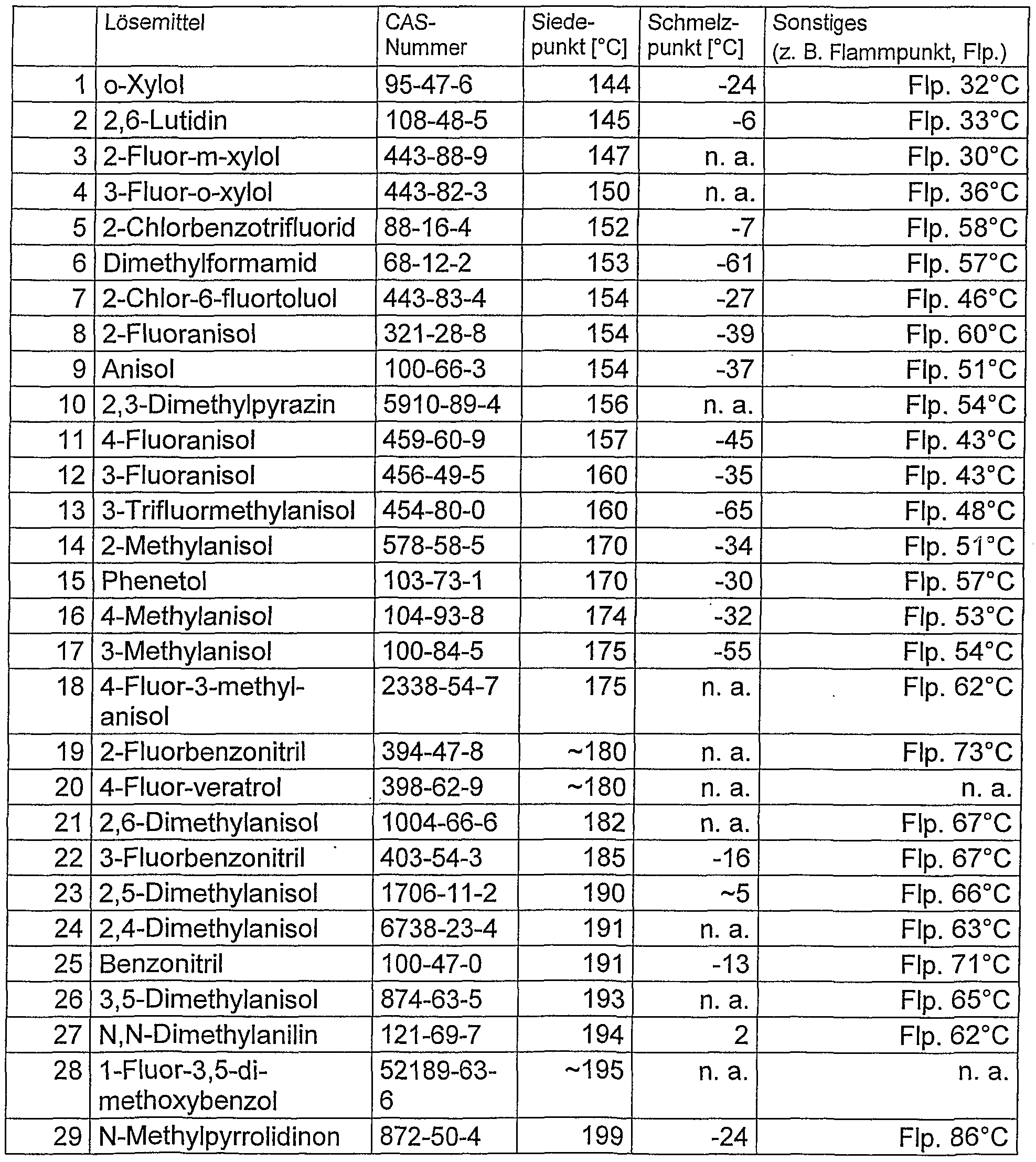
Die in der Tabelle aufgeführten Lösemittel können keinen Anspruch auf Vollständigkeit erheben. Die Bereitung einer erfindungsgemäßen Lösung oder Dispersion ist dem Fachmann natürlich ohne weiteres auch mit weiteren hier nicht explizit aufgeführten Lösemitteln im angegebenen Siedebereich ohne erfinderisches Zutun möglich.The solvents listed in the table cannot claim to be complete. The preparation of a solution or dispersion according to the invention is, of course, also not easy for the person skilled in the art here explicitly listed solvents in the specified boiling range possible without inventive step.
Jedoch hat sich die Verwendung beispielsweise rein aliphatischer Lösemittel (häufig mangelnde Löslichkeit bzw. Dispergierbarkeit), Aldehyd- bzw. Keton-haltiger 5 Lösemittel + nitrierten Aromaten, phosphorhaltigen Lösungsmitteln (mangelndeHowever, the use of, for example, purely aliphatic solvents (often poor solubility or dispersibility), aldehyde- or ketone-containing solvents and nitrated aromatics, phosphorus-containing solvents (lacking
Stabilität der Lösungen bzw. Dispersionen) und von Styrolderivaten bzw. anderer reaktiver Olefine (Polymerisationsneigung der Lösemittel) als nicht vorteilhaft erwiesen.Stability of the solutions or dispersions) and of styrene derivatives or other reactive olefins (tendency to polymerize the solvents) have not proven to be advantageous.
10 Für die erfindungsgemäßen Lösungen sind eine Vielzahl von Lösemitteln mit10 A large number of solvents are used for the solutions according to the invention
Siedepunkt unter 140°C geeignet.Boiling point below 140 ° C suitable.
Bei den erfindungsgemäßen Lösemitteln mit Siedepunkt unter 140°C gilt wiederum die bereits bei Lösemittel mit Siedepunkt zwischen 140 und 200°C gemachteIn the case of the solvents according to the invention with a boiling point below 140 ° C., the same applies to solvents with a boiling point between 140 and 200 ° C.
15 Einschränkungen (keine Aliphaten, Olefine, Aldehyde, Ketone, Nitro und Phosphor-15 restrictions (no aliphates, olefins, aldehydes, ketones, nitro and phosphorus
Verbindungen). Des weiteren ist ein zu niedriger Siedepunkt nicht förderlich, denn dies erschwert, trotz Verwendung der Lösemittelmischung, die technische Lösung des Problems 1. Es ist deshalb bevorzugt, in den erfindungsgemäßen Lösungen bzw. DispersionenLinks). Furthermore, a boiling point that is too low is not beneficial, because despite the use of the solvent mixture, this makes the technical solution of problem 1 more difficult. It is therefore preferred in the solutions or dispersions according to the invention
.0 nur Lösemittel mit einem Siedepunkt von wenigstens 100°C und unterhalb 140°C zu verwenden..0 to use only solvents with a boiling point of at least 100 ° C and below 140 ° C.
Eine mit dieser Bevorzugung schon praktisch umgangene weitere technische Einschränkung ist der Verzicht auf stark giftige bzw. nachgewiesen kanzerogene Lösemittel, was zum Beispiel für Chloroform (Siedepunkt -61 °C), TetrachlormethanAnother technical limitation that is practically avoided with this preference is the avoidance of highly toxic or proven carcinogenic solvents, for example for chloroform (boiling point -61 ° C.), carbon tetrachloride
J5 (Siedepunkt ~77°C) und Benzol (Siedepunkt ~80°C) zutrifft.J5 (boiling point ~ 77 ° C) and benzene (boiling point ~ 80 ° C) apply.
Für die erfindungsgemäßen Lösungen sind nun unter anderem folgende Lösemittel mit Siedepunkt unter 140°C geeignet.The following solvents with a boiling point below 140 ° C. are now suitable for the solutions according to the invention.
Hierbei handelt es sich insbesondere um fluorierte oder chlorierte Aromaten bzw. >o Heteroaromaten, wie Benzol-, Toluol-, Xylol- und Pyridinderivate, aber auch Ether- und cyclische Etherderivate. Ganz besonders sind die In der folgenden Tabelle ausgewählten, Lösemittel mit Siedepunkt unter 140°C bevorzugt, die überraschend gute Löse- bzw. Dispergiereigenschaften für organische Halbleiter, vor allem polymere organische Halbleiter, gezeigt haben.These are in particular fluorinated or chlorinated aromatics or> o heteroaromatics, such as benzene, toluene, xylene and pyridine derivatives, but also ether and cyclic ether derivatives. Particularly preferred are the solvents selected in the following table with boiling point below 140 ° C., which have shown surprisingly good dissolving or dispersing properties for organic semiconductors, especially polymeric organic semiconductors.
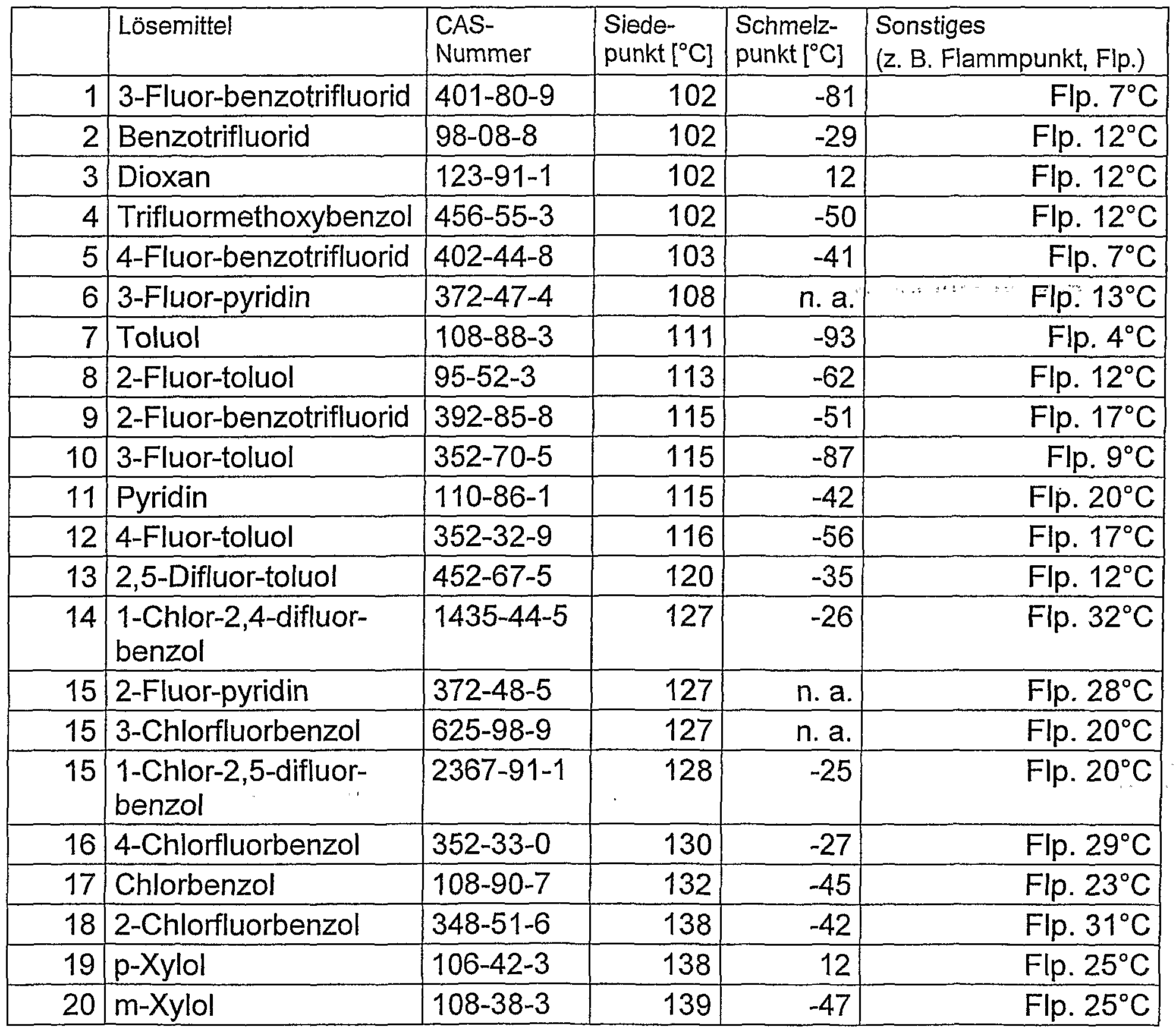
Auch die in dieser Tabelle aufgeführten Lösemittel sind natürlich nicht als Einschränkung zu verstehen, sondern nur sinnvoller technischer Hinweis. Es können natürlich auch noch weitere Lösemittel, die ansonsten günstige Eigenschaften (Löslichkeit, Siedepunkt, Mischbarkeit, um nur einige zu nennen) aufweisen, für die erfindungsgemäßen Lösungen und Dispersionen Verwendung finden.The solvents listed in this table are of course not to be understood as a restriction, but only as a useful technical note. Of course, other solvents which otherwise have favorable properties (solubility, boiling point, miscibility, to name just a few) can also be used for the solutions and dispersions according to the invention.
Bevorzugt sind also erfindungsgemäße Lösungen und Dispersionen, enthaltend ein oder mehrere Lösemittel ausgewählt aus o-Xylol, 2,6-Lutidin, 2-Fluor-m-xylol, 3- Fluor-o-xylol, 2-Chlorbenzotrifluorid, Dimethylformamid, 2-Chlor-6-fluortoluol, 2- Fluoranisol, Anisol, 2,3-Dimethylpyrazin, 4-Fluoranisol, 3-Fluoranisol, 3- Trifluormethylanisol, 2-Methylanisol, Phenetol, 4-Methylanisol, 3-Methylanisol, 4- Fluor-3-methyl-anisol, 2-Fluorbenzonitril, 4-Fluor-veratrol, 2,6-Dimethylanisol, 3- Fluorbenzonitril, 2,5-Dimethylanisol, 2,4-Dimethylanisol, Benzonitril, 3,5-Solutions and dispersions according to the invention which contain one or more solvents selected from o-xylene, 2,6-lutidine, 2-fluoro-m-xylene, 3- Fluoro-o-xylene, 2-chlorobenzotrifluoride, dimethylformamide, 2-chloro-6-fluorotoluene, 2-fluoroanisole, anisole, 2,3-dimethylpyrazine, 4-fluoroanisole, 3-fluoroanisole, 3-trifluoromethylanisole, 2-methylanisole, phenetol, 4-methyl anisole, 3-methyl anisole, 4-fluoro-3-methyl anisole, 2-fluorobenzonitrile, 4-fluoro-veratrol, 2,6-dimethyl anisole, 3-fluorobenzonitrile, 2,5-dimethyl anisole, 2,4-dimethyl anisole, Benzonitrile, 3.5-
Dimethylanisol, N,N-Dimethylanilin, 1-Fluor-3,5-dimethoxybenzol oder N- Methylpyrrolidinon.Dimethylanisole, N, N-dimethylaniline, 1-fluoro-3,5-dimethoxybenzene or N-methylpyrrolidinone.
Des weiteren bevorzugt sind ebenso erfindungsgemäße Lösungen und Dispersionen, enthaltend ein oder mehrere Lösemittel ausgewählt aus 3-Fluor- benzotrifluorid, Benzotrifluorid, Dioxan, Trifluormethoxybenzol, 4-Fluor- benzotrifluorid, 3-Fluor-pyridin, Toluol, f2-Fluor-toluol, 2-Fluor-benzotrifluorid, 3-Fluor- toluol, Pyridin, 4-Fluor-toluol, 2,5-Difluor-toluol, 1-Chlor-2,4-difluorbenzol, 2-Fluor- pyridin, 3-Chlorfluorbenzol, 1-Chlor-2,5-difluorbenzol, 4-Chlorfluorbenzol, Chlorbenzol, 2-Chlorfluorbenzol, p-Xylol oder m-Xylol.Also preferred are solutions and dispersions according to the invention containing one or more solvents selected from 3-fluorobenzotrifluoride, benzotrifluoride, dioxane, trifluoromethoxybenzene, 4-fluorobenzotrifluoride, 3-fluoropyridine, toluene, f 2-fluorotoluene, 2-fluorobenzotrifluoride, 3-fluorotoluene, pyridine, 4-fluorotoluene, 2,5-difluorotoluene, 1-chloro-2,4-difluorobenzene, 2-fluoropyridine, 3-chlorofluorobenzene, 1- Chloro-2,5-difluorobenzene, 4-chlorofluorobenzene, chlorobenzene, 2-chlorofluorobenzene, p-xylene or m-xylene.
Eine bevorzugte Ausführungsform der erfindungsgemäßen Lösungen und Dispersionen liegt dann vor, wenn diese beim Eintrocknen (Aufkonzentrieren) sehr schnell Eindicken und Gelieren.A preferred embodiment of the solutions and dispersions according to the invention is present when they thicken and gel very quickly when drying (concentrating).
Besonders bevorzugt ist dieser Effekt bei Lösungen polymerer organischer Halbleiter anzuwenden.This effect is particularly preferably to be applied to solutions of polymeric organic semiconductors.
Sehr schnell bedeutet in diesem Zusammenhang, daß dies schneller als beim puren Folgen einfacher physikalischer Gesetzmäßigkeiten erfolgt. So besteht für Polymerlösungen häufig folgender Zusammenhang zwischen Viskosität η und Konzentration c: η ~ C3*4 In this context, very quickly means that this takes place faster than simply following simple physical laws. For polymer solutions there is often the following relationship between viscosity η and concentration c: η ~ C 3 * 4
Anschaulich bedeutet dies, daß bei Verdopplung der Konzentration die Viskosität sich ca. verzehnfacht. Ab einem gewissen Punkt geliert dann die Lösung, d. h. sie ist nicht mehr richtig fließfähig.This clearly means that when the concentration is doubled, the viscosity increases approximately tenfold. At some point, the solution will gel. H. it is no longer fluid.
Sehr schnell bedeutet also, daß sich bei einer Verdopplung der Konzentration, wie sie beim Eintrocknen eines gedruckten Films passiert, die Viskosität um mehr als diesen Faktor 10 erhöht, bzw. zumindest schneller, als bei einem Standardverlauf bei einer Lösung in einem Lösemittel. Dies kann überraschend bei den erfindungsgemäßen Lösungen in bevorzugter Ausführung gefunden werden.Very quickly means that when the concentration doubles, as happens when a printed film dries, the viscosity increases by more than this factor 10, or at least faster than with a standard course with a solution in a solvent. This can surprisingly be found in the preferred embodiment of the solutions according to the invention.
Bereitet man Mischungen aus mindestens zwei Lösemitteln, in denen der polymere organische Halbleiter löslich ist, müssen i. d. R. folgende Voraussetzungen gegeben sein, um diesen überproportionalen Anstieg zu erhalten:When preparing mixtures of at least two solvents in which the polymeric organic semiconductor is soluble, i. d. The following prerequisites are usually given to obtain this disproportionate increase:
• Die Viskosität der Lösung des Polymers im Lösemittel 1 (niedrigerer Siedepunkt) ist gleich oder geringer als die einer Lösung des Polymers in Lösemittel 2.• The viscosity of the solution of the polymer in solvent 1 (lower boiling point) is equal to or less than that of a solution of the polymer in solvent 2.
• Beim Aufkonzentrieren einer Mischung reichert sich nun Lösemittel 2 in der Mischung an. Dies bringt nun, neben dem Konzentrationseffekt noch den Übergang zu einer (von vomeherein) höher viskosen Lösung.• When concentrating a mixture, solvent 2 now accumulates in the mixture. This brings, in addition to the concentration effect, the transition to a (visually) more viscous solution.
Vorteil einer derartigen bevorzugten erfindungsgemäßen Lösung ist, daß damit die oben geschilderten Probleme 2 bis 5 in hervorragender Weise gelöst werden können.The advantage of such a preferred solution according to the invention is that it enables the problems 2 to 5 described above to be solved in an outstanding manner.
Eine weitere bevorzugte Ausführungsform kann es dann darstellen, eine Lösung die mindestens drei Lösemittel enthält, zu verwenden. Dadurch kann das eben erläuterte "sehr schnelle" Eindicken noch verstärkt werden.A further preferred embodiment can then be to use a solution which contains at least three solvents. As a result, the "very fast" thickening just explained can be intensified.
Ein weiterer Gegenstand der Erfindung ist somit eine erfindungsgemäße Lösung oder Dispersion, dadurch gekennzeichnet, daß mindestens drei verschiedene Lösemittel verwendet werden.Another object of the invention is thus a solution or dispersion according to the invention, characterized in that at least three different solvents are used.
Hierbei hat es sich als besonders vorteilhaft erwiesen, drei Lösemittel mit unterschiedlichen Siedepunkten zu verwenden.It has proven particularly advantageous here to use three solvents with different boiling points.
Vorteilhaft ist dabei, wenn ein Lösemittel A mit eher niedrigem Siedepunkt (100 -It is advantageous if a solvent A with a rather low boiling point (100 -
150°C), ein weiteres Lösemittel B mit einem mittleren Siedepunkt (130 - 180°C) und ein drittes Lösemittel C mit einem hohem Siedepunkt (170 bis unter 200°C) verwendet wird.150 ° C), another solvent B with a medium boiling point (130-180 ° C) and a third solvent C with a high boiling point (170 to below 200 ° C) is used.
Hierbei sollte dann eine Lösung oder Dispersion gerade in dem letzteren Lösemittel sehr dick bzw. sogar gelartig sein. Dann findet beim Eindicken eine extrem schnelle Viskositätssteigerung statt.A solution or dispersion in the latter solvent should then be very thick or even gel-like. Then an extremely rapid increase in viscosity takes place during thickening.
Wie auch beim Einsatz von zwei Lösemitteln kann sich auch hier das (Volumen)verhältnis der Lösemittel in einem weiten Bereich bewegen. A: 1 - 70 %, bevorzugt 10 - 70 % B: 1 - 90 %, bevorzugt 10 - 70 % C: 1 - 60%, bevorzugt 10 - 50 %As with the use of two solvents, the (volume) ratio of the solvents can vary over a wide range. A: 1-70%, preferably 10-70% B: 1-90%, preferably 10-70% C: 1-60%, preferably 10-50%
Die Gesamtprozentzahl der jeweiligen Lösemittelmischung ergibt natürlich immer 100%. Bei Lösemittelmischungen mit drei oder mehr Lösemitteln kann es auch eineThe total percentage of the respective solvent mixture is of course always 100%. In the case of solvent mixtures with three or more solvents, there can also be one
Variante sein, daß eines der Lösemittel nicht-organisch, bevorzugt Wasser, ist. Dieses weitere nicht-organische Lösemittel, bevorzugt Wasser, wird aber nur in geringen Mengen verwendet, Bei der Verwendung von Wasser kann die einfache Restfeuchte nicht-getrockneter Lösemittel bereits ausreichen, die Eigenschaften der Lösungen oder Dispersionen zu verändern.Be a variant that one of the solvents is non-organic, preferably water. However, this further non-organic solvent, preferably water, is only used in small amounts. When water is used, the simple residual moisture of non-dried solvents can already be sufficient to change the properties of the solutions or dispersions.
Im vorliegenden Anmeldetext und auch in den im weiteren folgenden Beispielen wird meist auf die Zusammensetzung von bzw. die Verwendung erfindungsgemäßer Lösungen oder Dispersionen in bezug auf polymere Leuchtdioden und den entsprechenden Displays abgezielt. Trotz dieser Beschränkung der Beschreibung ist es für den Fachmann ohne weiteres erfinderisches Zutun möglich, entsprechende erfindungsgemäße Lösungen oder Dispersionen auch für die Verwendung in anderen Devices herzustellen und anzuwenden, z. B. für Organische Integrierte Schaltungen (O-ICs), in Organischen Feld-Effekt-Transistoren (OFETs), in Organischen Dünnfilmtransistoren (OTFTs), für Organische Solarzellen (O-SCs) oder auch Organische Laserdioden (O-Laser), um nur einige Anwendungen zu nennen.In the present application text and also in the examples which follow, the aim is mostly the composition of or the use of solutions or dispersions according to the invention in relation to polymer light-emitting diodes and the corresponding displays. Despite this limitation of the description, it is possible for the person skilled in the art without further inventive step to prepare and use corresponding solutions or dispersions according to the invention for use in other devices, for. B. for organic integrated circuits (O-ICs), in organic field-effect transistors (OFETs), in organic thin-film transistors (OTFTs), for organic solar cells (O-SCs) or organic laser diodes (O-lasers), only to to name a few applications.
Die vorliegende Erfindung wird durch die folgenden Beispiele näher erläutert, ohne sie darauf einschränken zu wollen. Der Fachmann kann aus der Beschreibung und den aufgeführten Beispielen ohne erfinderisches Zutun weitere erfindungsgemäße Lösungen oder Dispersionen bereiten und diese anwenden, um daraus Schichten zu erzeugen.The present invention is illustrated by the following examples, without wishing to restrict it thereto. The person skilled in the art can prepare and use further solutions or dispersions according to the invention from the description and the examples given without inventive step, in order to produce layers therefrom.
Beispiel 1 : Vergleichsbeispiel; Filmbildung und Deviceeigenschaften erzeugt mit Lösungen aus Tetralin.Example 1: Comparative Example; Film formation and device properties created with solutions made of tetralin.
Die Verwendung nur eines Lösemittels, welches das Problem 1 (zu schnelles Eintrocken der Lösung im Druckkopf) lösen könnte, wie z. B. Tetralin, führt in der Filmbildung zum Auftreten der Probleme 3 bis 5. Absorptionsspektren erlauben über das Lambert-Beersche Gesetz (E = ε c d) die Messung von Schichtdicken. Figur 1 zeigt die Absorptionsspektren zweier Poly-arylen-vinylen-Filme (Polymer A, vgl. Tabelle 2), die auf identische Weise durch Spincoaten einer Tetralin-Lösung auf Glassubstrate von 3x3 cm hergestellt wurden. Die Schichtdicken variieren selbst auf einem Substrat um einen Faktor 2. Um homogene Filme zu erhalten, mußten die Filme 12 min auf dem Spincoater belassen und dann 10 min bei 120°C ausgeheizt werden. Diese langsame Trocknung führte in der Anwendung in Druckverfahren zu den schon angesprochenen Schwierigkeiten (Problem 4). Trotz der langen Trocknungszeit blieb der Restgehalt an Lösemittel so groß, daß die Effizienzen aus Tetralin hergestellter polymerer Leuchtdioden diejenigen aus Anisol/o-Xylol (v : v = 1 :1) nicht erreichten (s. Figur 2).The use of only one solvent, which could solve problem 1 (the solution dries too quickly in the printhead), e.g. B. tetralin, leads in the Film formation on the occurrence of problems 3 to 5. Absorption spectra allow the measurement of layer thicknesses via the Lambert-Beer law (E = ε cd). FIG. 1 shows the absorption spectra of two poly-arylene-vinylene films (polymer A, see Table 2), which were produced in an identical manner by spin coating a tetralin solution on glass substrates of 3 × 3 cm. The layer thicknesses vary by a factor of 2 even on a substrate. In order to obtain homogeneous films, the films had to be left on the spin coater for 12 minutes and then baked at 120 ° C. for 10 minutes. This slow drying led to the difficulties already mentioned when used in printing processes (problem 4). Despite the long drying time, the residual solvent content remained so high that the efficiencies of polymeric light-emitting diodes made from tetralin did not match those from anisole / o-xylene (v: v = 1: 1) (see FIG. 2).
Beispiel 2: Vergleichsbeispiele; Lagerstabilität von Polymerlösungen Lösung von Polymer A in Tetralin (Lösung 1)Example 2: Comparative Examples; Storage stability of polymer solutions Solution of polymer A in tetralin (solution 1)
Lösung von Polymer A in Cumol (Lösung 2) Lösung von Polymer A in Anisol / o-Xylol (v : v = 1:1) (Lösung 3) (Anmerkung: Polymer A; vgl. Tabelle 2 unter Beispiel 3)Solution of polymer A in cumene (solution 2) Solution of polymer A in anisole / o-xylene (v: v = 1: 1) (solution 3) (note: polymer A; see Table 2 under Example 3)
Die Lösungen wurden alle parallel und gleich bereitet. Dazu wurden die festen Polymere (ca. 7.5 g/l) für ca. 30 h bei ca. 65°G unter Schutzgas aufgelöst, werter behandelt, filtriert und unter Schutzgas in dichten Behältern gelagert. Die Lösungen wurden auf Ihre Eigenschaften direkt nach der Filtration (Lösungen 1 , 2, 3) und 90 Tage (Lösungen 1a, 2a, 3a) später untersucht.The solutions were all prepared in parallel and in the same way. For this purpose, the solid polymers (approx. 7.5 g / l) were dissolved under protective gas for approx. 30 h at approx. 65 ° G, treated further, filtered and stored in sealed containers under protective gas. The properties of the solutions were examined directly after filtration (solutions 1, 2, 3) and 90 days (solutions 1a, 2a, 3a) later.
Die dabei erhaltenen Ergebnisse sind in Tabelle 1 zusammengefaßt.The results obtained are summarized in Table 1.
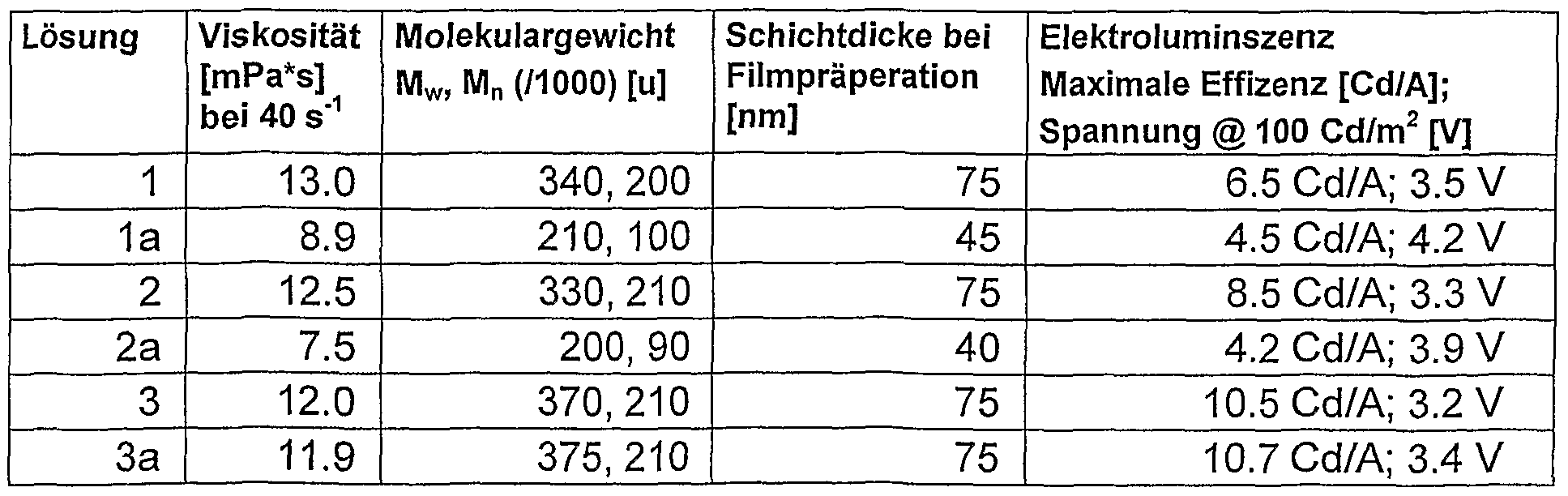
Die Lösungen in Tetralin (1 , 1a) und Cumol (2, 2a) zeigten nur eine geringe Lagerstabilität. Es ist deutlich das jeweils die Anwendungseigenschaften sich dramatisch verschlechterten und ein direkter Abbau es Polymers gefunden wurde. Es ist zu vermuten, daß dies auf geringe Spuren an Peroxiden in den jeweiligen Lösemitteln zurückzuführen ist. Die Lösemittel wurden zwar - fachmännisch - vorher (über LiAIH4) getrocknet, von Peroxiden und Ketonen befreit und über eine Füllkörperkolonne destilliert und anschließend unter Schutzgas gelagert. GC/MS-Untersuchungen an Tetralin belegten jedoch, daß sowohl vor der Reinigung als auch nachher ca. ähnliche Mengen an Tetralon und Tetralol enthalten waren. Ähnliches ist leider auch für Tetralin-hydroperoxid zu vermuten.The solutions in tetralin (1, 1a) and cumene (2, 2a) showed only a slight storage stability. It is clear that the application properties deteriorated dramatically and a direct degradation of the polymer was found. It can be assumed that this is due to slight traces of peroxides in the respective solvents. The solvents were - expertly - dried beforehand (over LiAIH 4 ), freed of peroxides and ketones and distilled via a packed column and then stored under protective gas. However, GC / MS tests on tetralin showed that approximately similar amounts of tetralone and tetralol were contained both before and after the purification. The same can unfortunately be assumed for tetralin hydroperoxide.
Im Gegensatz dazu zeigte das erfindungsgemäße Lösemittelgemisch (Lösungen 3,In contrast, the solvent mixture according to the invention (solutions 3,
3a) keinerlei Anzeichen einer derartigen Degradation. Des weiteren waren auch noch primäre Anwendungseigenschaften (Effizienz und Spannung) in PLED Anwendung deutlich besser.3a) no signs of such degradation. Furthermore, primary application properties (efficiency and voltage) were significantly better in PLED application.
Beispiel 3: Vergleichsbeispiel; Löslichkeit zweier konjugierter Polymere in verschiedenen LösemittelnExample 3: Comparative Example; Solubility of two conjugated polymers in different solvents
Es wurden - wie in Beispiel 2 - verschiedene Lösungen (Konzentration hier: ca. 5 g/l) bereitet, und in diesem Fall dies Lösungskonsistenz direkt vermessen. Die Ergebnisse sind in Tabelle 2 zusammengefaßt. Für Polymer A sind zur besseren Erläuterung des entsprechenden Verhaltens die einzelnen Gelkurven (Verlauf derAs in Example 2, various solutions (concentration here: approx. 5 g / l) were prepared, and in this case this solution consistency was measured directly. The results are summarized in Table 2. For polymer A, the individual gel curves (course of the
Viskosität in Abhängigkeit der Temperatur) auch noch in Figur 3 abgebildet.Viscosity as a function of temperature) is also shown in FIG. 3.


keine Gelbildung bis 0°C zu beobachten.no gel formation down to 0 ° C was observed.
Tabelle 2 5 Anmerkungen:Table 2 5 Notes:
Polymer A: PPV-Derivat gemäß WO 99/24526, Polymer: Poly [(2-(3',4'-bis(2- methylpropyloxy)phenyl)-p-phenylenvinylen)co(2-(3,,4'-bis(2-methylbutyl- oxy))phenyl)-5-methoxy-p-phenylenvinylen)co((2-(2,5-dimethylphenyl)-5-methoxy-p- phenylenvinylen] ; Mw - 1.000.000, Mn ~ 310.000. Siehe auch Figur 3. 1 o Polymer B: PF-Derivat gemäß WO 00/22026; Polymer gemäß Struktur P2Polymer A: PPV derivative WO 99/24526, polymer according to: poly [(2- (3 ', 4'-bis (2-methylpropyloxy) phenyl) -p-phenylene vinylene) co (2- (3, 4'- bis (2-methylbutyloxy)) phenyl) -5-methoxy-p-phenylene vinylene) co ((2- (2,5-dimethylphenyl) -5-methoxy-p-phenylene vinylene]; M w - 1,000,000, M n ~ 310,000 See also Figure 3. 1 o Polymer B: PF derivative according to WO 00/22026; polymer according to structure P2
(Copolymer aus 9-(4-(3, 7-dimethyloctyloxy)phenyl)-9-(2, 5-dimethylphenyl)fluoren- 2, 7-bisboronsäurebisglycolester, 2, 7-Dibrom-9-(2, 5-dimethylphenyl)~9-(4-(3, 7- dimethyloctyloxy)phenyl)fluoren und 1mol% 4,4'-Dibromtriphenylamin), allerdings mit deutlich erhöhtem Molekulargewicht: Mw - 720.000, Mn - 270.000. 5(Copolymer of 9- (4- (3, 7-dimethyloctyloxy) phenyl) -9- (2, 5-dimethylphenyl) fluorene-2, 7-bisboronic acid bisglycol ester, 2, 7-dibromo-9- (2, 5-dimethylphenyl) ~ 9- (4- (3, 7-dimethyloctyloxy) phenyl) fluorene and 1 mol% 4,4'-dibromotriphenylamine), but with a significantly increased molecular weight: M w - 720,000, M n - 270,000. 5
Es ist klar erkennbar (Figur 3), daß verschiedene Tri- und ein Tetramethylbenzol, ebenso wie tert-Butyl-benzol für die Polymere A und B schlecht als Lösemittel geeignet waren. Lösemittel, mit denen erfindungsgemäße Lösemittel-Mischungen hergestellt werden können, zeigten hingegen nicht diese negativen Effekte.It can be clearly seen (FIG. 3) that various tri- and a tetramethylbenzene, as well as tert-butylbenzene, were poorly suitable as solvents for the polymers A and B. Solvents with which solvent mixtures according to the invention can be produced, however, did not show these negative effects.
>0> 0
Beispiel 4: Eintrocknen mehrerer erfindungsgemäßer LösungenExample 4: Drying several solutions according to the invention
Es wurden mehrere Lösungen des Polymers A in verschiedenen Lösemitteln bzw. Lösemittelgemischen bereitet. Die Lösungsbereitung erfolgte analog zu den Angaben in Beispiel 2. Die Konzentration der Lösungen war dabei jeweils ca. 9 g/l. 5 Die Lösungen wurden dabei so eingestellt, daß die Grundviskosität der Lösungen jeweils ca. gleich hoch war (ca. 8 bis 15 mPa*s, bei Scherraten von 40 s"1). Von «_Several solutions of polymer A in different solvents or solvent mixtures were prepared. The solution was prepared analogously to the information in Example 2. The concentration of the solutions was in each case approximately 9 g / l. 5 The solutions were adjusted so that the basic viscosity of the solutions was approximately the same in each case (approximately 8 to 15 mPa * s, at shear rates of 40 s "1 ) "_
diesen Lösungen wurden dann jeweils Teile des Lösemittels abgezogen, die neue Konzentration (doppelt: einmal via UV VIS, einmal rechnerisch via Menge abgezogenes Lösemittel) und die dazugehörige Viskosität wurden dann anschließend bestimmt. Die gefundenen Viskositätsverläufe sind in Figur 4 dargestellt.Parts of the solvent were then removed from these solutions, the new concentration (twice: once via UV VIS, once arithmetically via the amount of solvent removed) and the associated viscosity were then determined. The viscosity profiles found are shown in FIG. 4.
Es wurden Lösungen in folgenden Lösemitteln bereitet: Lösung 4: AnisolSolutions were prepared in the following solvents: Solution 4: anisole
Lösung 5: Anisol : o-Xylol (v : v = 1 :2) Lösung 6: 2,5-Dimethylanisol : Anisol : o-Xylol (v : v : v = 20:25:55)Solution 5: anisole: o-xylene (v: v = 1: 2) solution 6: 2,5-dimethylanisole: anisole: o-xylene (v: v: v = 20:25:55)
Lösung 7: 2,5-Dimethylanisol : 4-Methylanisol : o-Xylol (v : v : v = 10:60:30)Solution 7: 2,5-dimethylanisole: 4-methylanisole: o-xylene (v: v: v = 10:60:30)
Es ist klar zu erkennen (Figur 4), daß die erfindungsgemäße Lösung 5 und noch besser die erfindungsgemäßen Lösungen 6 und 7 im Vergleich zur Lösung 4, die nur ein Lösemittel enthielt, ein deutlich schnelleres Eindicken zeigte.It can be clearly seen (FIG. 4) that solution 5 according to the invention, and even better solutions 6 and 7 according to the invention, showed a significantly faster thickening in comparison to solution 4, which contained only one solvent.
Dies ist - wie in der Beschreibung geschildert - eine wichtige Eigenschaft, um die Probleme 3 bis 5 technisch zu lösen.As described in the description, this is an important property in order to technically solve problems 3 to 5.
Beispiel 5: Eintrocknung einer erfindungsgemäßen Lösung, enthaltend ein Polymerblend.Example 5: Drying of a solution according to the invention, containing a polymer blend.
Es wurde eine Lösung (Lösung 8) der o. g. Polymere B und A (Polymer B : Polymer A = 95 : 5 [m :m]) in dem Lösemittelgemisch 2,5-Dimethylanisol : Anisol : o-Xylol (v : v : v = 20:25:55) bereitet, mit der Gesamt-Polymer-Konzentration von 9 g/l. Diese Lösung wurde analog den Angaben in Beispiel 2 bereitet. Es wurden nun zwei unterschiedliche Untersuchungen durchgeführt, um die Art desA solution (solution 8) of the above-mentioned. Polymers B and A (polymer B: polymer A = 95: 5 [m: m]) in the solvent mixture 2,5-dimethylanisole: anisole: o-xylene (v: v: v = 20:25:55) the total polymer concentration of 9 g / l. This solution was prepared analogously to the information in Example 2. Two different studies have now been carried out to determine the type of
Eintrocknens dieses Polymerblends zu evaluieren:To evaluate the drying of this polymer blend:
• Zunächst wurden einfach Quarzgläser via Spin-Coating mit dem o. g. Blend beschichtet. Optisch sahen die dadurch erzeugten Filme jeweils klar und ohne eine erkennbare Strukturierung aus. Es wurden auch PL Spektren von jeweils 5 verschiedenen Punkten bei 4 verschiedenen Gläsern angefertigt. Diese zeigten jeweils dasselbe PL-Spektrum (jenes von Polymer A). • Anschließend wurden kleine Tropfen der Lösung (5 - 10 μl) auf Trägergläser aufgebracht, und deren Eintrocknen unter dem Polarisationsmikroskop verfolgt. Hierbei konnte keinerlei Phasenseparation festgestellt werden.• First, quartz glasses were simply coated with the above blend using spin coating. The films produced optically looked clear and without any recognizable structuring. PL spectra of 5 different points each with 4 different glasses were also made. These each showed the same PL spectrum (that of polymer A). • Then small drops of the solution (5 - 10 μl) were applied to carrier glasses and their drying was monitored under a polarizing microscope. No phase separation could be determined here.
5 Beispiel 6: Standardverfahren um PLEDs zu Testzwecken herzustellen:5 Example 6: Standard procedure for producing PLEDs for test purposes:
Die Herstellung von LEDs erfolgte nach dem im folgenden skizzierten allgemeinen Verfahren. Dieses mußte natürlich im Einzelfall auf die jeweiligen Gegebenheiten (z. B. Polymerviskosität und optimale Schichtdicke des Polymers im Device) angepaßt werden. In der Regel wurden Zweischichtsysteme, d. h. Substrat//ITO//leitfähiges 10 Polymer/7lichtemittierendes Polymer/VKathode hergestellt.LEDs were produced using the general process outlined below. In individual cases, of course, this had to be adapted to the respective circumstances (e.g. polymer viscosity and optimum layer thickness of the polymer in the device). As a rule, two-layer systems, i.e. H. Substrate // ITO // conductive 10 polymer / 7 light-emitting polymer / V-cathode manufactured.
Nachdem man die ITO-beschichteten Substrate (z. B. Glasträger, PET-Folie, aber auch komplexe Substrate, Schaltkreise für eine Aktiv-Matrix-Ansteuerung enthaltend) auf die richtige Größe gebracht hat, werden sie - sofern dies nicht 5 schon vorab geschehen ist - in mehreren Reinigungsschritten im Ultraschallbad gereinigt (z.B. Seifenlösung, Millipore-Wasser, Isopropanol). Zur Trocknung werden sie mit einer N2-Pistole abgepustet und in einem Exsikkator gelagert. Vor der Beschichtung mit den Polymerlagen werden sie mit einem Ozon-Plasma-Gerät für ca. 20 Minuten behandelt.After the ITO-coated substrates (e.g. glass substrates, PET film, but also complex substrates, circuits for an active matrix control) have been brought to the correct size, they will - unless this has already been done 5 in advance is - cleaned in several cleaning steps in an ultrasonic bath (e.g. soap solution, Millipore water, isopropanol). For drying, they are blown off with an N 2 gun and stored in a desiccator. Before coating with the polymer layers, they are treated with an ozone plasma device for about 20 minutes.
_0 Von dem jeweiligen Polymer wird die entsprechende Lösung oder Dispersion entweder mit einem Spin-coater aufgeschleudert oder auch durch Druckverf hren (z. B IJP) aufgebracht. Bevorzugt werden dabei die Verfahren auch so angewendet, daß die leitfähigen Polymere Schichtdicken im Bereich von 20 bis 200 nm und die emittierenden Polymere Schichtdicken im Bereich von 50 bis 100 nm aufweisen._0 The corresponding solution or dispersion of the respective polymer is either spun on with a spin coater or also applied by pressure (e.g. IJP). The methods are preferably also used in such a way that the conductive polymers have layer thicknesses in the range from 20 to 200 nm and the emitting polymers have layer thicknesses in the range from 50 to 100 nm.
:5 Auf die Polymerfilme werden noch Elektroden aufgebracht. Dies geschieht in der: 5 Electrodes are still applied to the polymer films. This happens in the
Regel durch thermisches Verdampfen (Balzer BA360 bzw. Pfeiffer PL S 500). Anschließend wird die durchsichtige ITO-Elektrode als Anode und die Metallelektrode (z. B. Ca, Yb, Ba, oder auch Elektroden bestehend aus mehreren Schichten) als Kathode kontaktiert und die Device-Parameter bestimmt. o Beim Anlegen einer entsprechenden Spannung werden von der Anode aus Löcher, von der Kathode aus Elektronen in die Vorrichtung injiziert, die sich im Device treffen und einen angeregten Zustand erzeugen. Dieser kann unter Aussendung von Licht zerfallen. Dieses Licht wird durch die transparente Anode ausgestrahlt. Usually by thermal evaporation (Balzer BA360 or Pfeiffer PL S 500). Then the transparent ITO electrode as the anode and the metal electrode (e.g. Ca, Yb, Ba, or electrodes consisting of several layers) as the cathode are contacted and the device parameters are determined. o When an appropriate voltage is applied, holes are injected from the anode and electrons from the cathode into the device, which meet in the device and generate an excited state. This can decay while emitting light. This light is emitted through the transparent anode.
Claims
Priority Applications (6)
| Application Number | Priority Date | Filing Date | Title |
|---|---|---|---|
| JP2002571775A JP4307839B2 (en) | 2001-03-10 | 2002-03-07 | Organic semiconductor solutions and dispersions |
| DE50207293T DE50207293D1 (en) | 2001-03-10 | 2002-03-07 | SOLUTION AND DISPERSION OF ORGANIC SEMICONDUCTORS |
| EP02703624A EP1370619B1 (en) | 2001-03-10 | 2002-03-07 | Solutions and dispersions of organic semiconductors |
| US10/469,334 US6994893B2 (en) | 2001-03-10 | 2002-03-07 | Solutions and dispersions of organic semiconductors |
| KR1020037011798A KR100939468B1 (en) | 2001-03-10 | 2002-03-07 | Organic Semiconductor Solutions and Dispersions |
| US11/345,263 US7405255B2 (en) | 2001-03-10 | 2006-02-02 | Solutions and dispersions of organic semiconductors |
Applications Claiming Priority (2)
| Application Number | Priority Date | Filing Date | Title |
|---|---|---|---|
| DE10111633 | 2001-03-10 | ||
| DE10111633.0 | 2001-03-10 |
Related Child Applications (2)
| Application Number | Title | Priority Date | Filing Date |
|---|---|---|---|
| US10469334 A-371-Of-International | 2002-03-07 | ||
| US11/345,263 Continuation US7405255B2 (en) | 2001-03-10 | 2006-02-02 | Solutions and dispersions of organic semiconductors |
Publications (1)
| Publication Number | Publication Date |
|---|---|
| WO2002072714A1 true WO2002072714A1 (en) | 2002-09-19 |
Family
ID=7677036
Family Applications (1)
| Application Number | Title | Priority Date | Filing Date |
|---|---|---|---|
| PCT/EP2002/002491 Ceased WO2002072714A1 (en) | 2001-03-10 | 2002-03-07 | Solutions and dispersions of organic semiconductors |
Country Status (7)
| Country | Link |
|---|---|
| US (2) | US6994893B2 (en) |
| EP (1) | EP1370619B1 (en) |
| JP (1) | JP4307839B2 (en) |
| KR (2) | KR100939468B1 (en) |
| CN (1) | CN100357370C (en) |
| DE (1) | DE50207293D1 (en) |
| WO (1) | WO2002072714A1 (en) |
Cited By (182)
| Publication number | Priority date | Publication date | Assignee | Title |
|---|---|---|---|---|
| WO2003019693A3 (en) * | 2001-07-21 | 2003-11-13 | Covion Organic Semiconductors | Solutions of organic semiconductors |
| JP2005007391A (en) * | 2003-05-28 | 2005-01-13 | Hc Starck Gmbh | Solution containing organic semiconductive compound, use thereof, layer containing semiconductive compound and use of the layer |
| JP2005064122A (en) * | 2003-08-08 | 2005-03-10 | Ricoh Co Ltd | Organic semiconductor forming ink, organic semiconductor pattern forming method, electronic device and electronic device array |
| WO2005041322A1 (en) * | 2003-09-30 | 2005-05-06 | Osram Opto Semiconductors Gmbh | Solvent mixtures for an organic electronic device |
| WO2005083814A1 (en) * | 2004-02-18 | 2005-09-09 | Merck Patent Gmbh | Solutions of organic semiconductors |
| WO2005089026A1 (en) * | 2004-03-11 | 2005-09-22 | Idemitsu Kosan Co., Ltd. | Organic electroluminescent device, method for manufacturing same and organic solution |
| WO2005112145A1 (en) * | 2004-05-11 | 2005-11-24 | Merck Patent Gmbh | Solutions of organic semiconductors |
| JP2006137945A (en) * | 2004-10-15 | 2006-06-01 | Sumitomo Chemical Co Ltd | Solution composition and polymer light emitting device using the same |
| US7108805B2 (en) | 2001-12-04 | 2006-09-19 | Agfa Gevaert | Composition containing a polymer or copolymer of a 3,4-dialkoxythiophene and non-aqueous solvent |
| US7122130B2 (en) | 2001-12-04 | 2006-10-17 | Agfa Gevaert | Composition containing a polymer or copolymer of a 3,4-dialkoxythiophene and non-aqueous solvent |
| US7297621B2 (en) | 2003-04-15 | 2007-11-20 | California Institute Of Technology | Flexible carbon-based ohmic contacts for organic transistors |
| WO2007145979A3 (en) * | 2006-06-05 | 2008-04-03 | Du Pont | Liquid composition for deposition of organic active materials in the field of oled printing |
| EP1932866A1 (en) | 2003-02-06 | 2008-06-18 | MERCK PATENT GmbH | Blends comprising conjugated carbazole polymers, synthesis and usage thereof |
| EP1791197A3 (en) * | 2005-11-25 | 2008-08-27 | Seiko Epson Corporation | Electrochemical cell structure and method of fabrication |
| US7501308B2 (en) | 2005-04-01 | 2009-03-10 | Seiko Epson Corporation | Method of depositing polythiophene semiconductor on a substrate |
| US7510672B2 (en) | 2004-05-18 | 2009-03-31 | Merck Patent Gmbh | Formulation for ink-jet printing comprising semiconducting polymers |
| WO2009053088A1 (en) | 2007-10-24 | 2009-04-30 | Merck Patent Gmbh | Optoelectronic device |
| WO2010021921A1 (en) * | 2008-08-20 | 2010-02-25 | Plextronics, Inc. | Improved solvent system for fabrication of organic solar cells |
| DE102008045664A1 (en) | 2008-09-03 | 2010-03-04 | Merck Patent Gmbh | Optoelectronic device, useful e.g. as organic or polymer light-emitting diode, organic field-effect-transistor, organic constituent, organic field-quench element, comprises a layer comprising a polymer with fluorine-containing group |
| DE102008045662A1 (en) | 2008-09-03 | 2010-03-04 | Merck Patent Gmbh | Optoelectronic device useful as white light emitting organic light-emitting diode in display, comprises first layer comprising electrode material, second layer comprising polymer material on substrate, and polymer layers having emitter |
| DE102008044868A1 (en) | 2008-08-29 | 2010-03-04 | Merck Patent Gmbh | Electroluminescent polymers, process for their preparation and their use |
| DE102008045663A1 (en) | 2008-09-03 | 2010-03-04 | Merck Patent Gmbh | Fluorine-bridged associates for opto-electronic applications |
| US7686978B2 (en) * | 2003-09-24 | 2010-03-30 | E. I. Du Pont De Nemours And Company | Method for the application of active materials onto active surfaces and devices made with such methods |
| US7696284B2 (en) | 2003-09-20 | 2010-04-13 | Merck Patent Gmbh | White-emitting copolymers, representation and use thereof |
| DE102008049037A1 (en) | 2008-09-25 | 2010-04-22 | Merck Patent Gmbh | New polymers with low polydispersity |
| US7767785B2 (en) | 2003-09-20 | 2010-08-03 | Merck Patent Gmbh | Conjugated polymers, their preparation and use thereof |
| WO2010097156A1 (en) | 2009-02-27 | 2010-09-02 | Merck Patent Gmbh | Cross-linkable and cross-linked polymers, method for the production thereof, and use thereof |
| WO2010097155A1 (en) | 2009-02-27 | 2010-09-02 | Merck Patent Gmbh | Polymer having aldehyde groups, converting and cross-linking of said polymer, cross-linked polymer, and electroluminescent device comprising said polymer |
| DE102009010713A1 (en) | 2009-02-27 | 2010-09-02 | Merck Patent Gmbh | New polymer comprising structural unit which comprises the aldehyde groups, useful in preparing crosslinkable and crosslinked polymers which are useful in electronic devices, preferably organic electronic device |
| US7790057B2 (en) | 2006-07-11 | 2010-09-07 | Merck Patent Gmbh | Electroluminescent polymers and use thereof |
| US7799875B2 (en) | 2005-12-17 | 2010-09-21 | Merck Patent Gmbh | Triarylamine-arylvinylene moiety-containing conjugated polymers, their production and use |
| US7820305B2 (en) | 2004-07-06 | 2010-10-26 | Merck Patent Gmbh | Electroluminescent polymers |
| DE102009023156A1 (en) | 2009-05-29 | 2010-12-02 | Merck Patent Gmbh | Polymers containing substituted indenofluorene derivatives as a structural unit, process for their preparation and their use |
| DE102009030847A1 (en) | 2009-06-26 | 2010-12-30 | Merck Patent Gmbh | Polymers containing substituted Anthracenyleinheiten, blends containing these polymers and devices containing these polymers or blends |
| WO2011009522A2 (en) | 2009-07-22 | 2011-01-27 | Merck Patent Gmbh | Materials for electronic devices |
| DE102009030848A1 (en) | 2009-06-26 | 2011-02-03 | Merck Patent Gmbh | Polymers comprising structural units which have alkylalkoxy groups, blends containing these polymers and optoelectronic devices containing these polymers and blends |
| US7884175B2 (en) | 2003-04-17 | 2011-02-08 | Merck Patent Gmbh | Method for controlling the molecular weight during poly(arylene vinylene) synthesis, and polymers produced therewith |
| US7901766B2 (en) | 2003-09-04 | 2011-03-08 | Merck Patent Gmbh | Electronic devices comprising an organic conductor and semiconductor as well as an intermediate buffer layer made of a crosslinked polymer |
| DE102009041414A1 (en) | 2009-09-16 | 2011-03-17 | Merck Patent Gmbh | metal complexes |
| US7910687B2 (en) | 2002-10-25 | 2011-03-22 | Merck Patent Gmbh | Conjugated polymers containing arylamine units, the representation thereof and the use of the same |
| DE102009053644A1 (en) | 2009-11-17 | 2011-05-19 | Merck Patent Gmbh | Materials for organic electroluminescent devices |
| US7947382B2 (en) | 2004-04-26 | 2011-05-24 | Merck Patent Gmbh | Electroluminescent polymers and the use thereof |
| DE102009053836A1 (en) | 2009-11-18 | 2011-05-26 | Merck Patent Gmbh | Materials for organic electroluminescent devices |
| DE102009023154A1 (en) | 2009-05-29 | 2011-06-16 | Merck Patent Gmbh | A composition comprising at least one emitter compound and at least one polymer having conjugation-interrupting units |
| DE102009059985A1 (en) | 2009-12-22 | 2011-07-07 | Merck Patent GmbH, 64293 | New polymer comprising structural unit which comprises the aldehyde groups, useful in preparing crosslinkable and crosslinked polymers which are useful in electronic devices, preferably organic electronic device |
| WO2011085781A1 (en) | 2010-01-16 | 2011-07-21 | Merck Patent Gmbh | Materials for organic electroluminescent devices |
| US7989032B2 (en) | 2006-08-21 | 2011-08-02 | Agfa Gevaert | UV-photopolymerizable composition for producing organic conductive layers, patterns or prints |
| WO2011091838A1 (en) | 2010-01-29 | 2011-08-04 | Merck Patent Gmbh | Styrene-based copolymers, in particular for use in optoelectronic components |
| WO2011098205A1 (en) | 2010-02-12 | 2011-08-18 | Merck Patent Gmbh | Electroluminescent polymers, methods for producing same and use thereof |
| US8038903B2 (en) | 2005-05-18 | 2011-10-18 | Merck Patent Gmbh | Organic semiconductor solutions |
| US8058790B2 (en) | 2004-05-11 | 2011-11-15 | Merck Patent Gmbh | Material mixtures for use in electroluminescence |
| WO2011141120A1 (en) | 2010-05-14 | 2011-11-17 | Merck Patent Gmbh | Metal complexes |
| WO2011160758A1 (en) | 2010-06-24 | 2011-12-29 | Merck Patent Gmbh | Materials for organic electroluminescent devices |
| WO2012007102A1 (en) | 2010-07-16 | 2012-01-19 | Merck Patent Gmbh | Polymer materials for organic electroluminescent devices |
| DE102010027218A1 (en) | 2010-07-15 | 2012-01-19 | Merck Patent Gmbh | Organic complexes containing metals |
| WO2012013310A1 (en) | 2010-07-29 | 2012-02-02 | Merck Patent Gmbh | Polymers containing substituted benzodithiophene units, blends containing said polymers, and devices containing said polymers or blends |
| DE102010033080A1 (en) | 2010-08-02 | 2012-02-02 | Merck Patent Gmbh | Polymers with structural units that have electron transport properties |
| DE102010033548A1 (en) | 2010-08-05 | 2012-02-09 | Merck Patent Gmbh | Materials for electronic devices |
| DE102010033778A1 (en) | 2010-08-09 | 2012-02-09 | Merck Patent Gmbh | Polymers with carbazole structural units |
| DE102010033777A1 (en) | 2010-08-09 | 2012-02-09 | Merck Patent Gmbh | Polymers with carbazole structural units |
| DE102010045405A1 (en) | 2010-09-15 | 2012-03-15 | Merck Patent Gmbh | Materials for organic electroluminescent devices |
| DE102010045369A1 (en) | 2010-09-14 | 2012-03-15 | Merck Patent Gmbh | Materials for organic electroluminescent devices |
| WO2012038029A1 (en) | 2010-09-24 | 2012-03-29 | Merck Patent Gmbh | Phosphorus-containing metal complexes |
| WO2012048780A1 (en) | 2010-10-15 | 2012-04-19 | Merck Patent Gmbh | Compounds for electronic devices |
| WO2012048900A1 (en) | 2010-10-14 | 2012-04-19 | Fraunhofer-Gesellschaft Zur Förderung Der Angewandten Forschung E.V. . | Materials for organic electroluminescence devices |
| WO2012069121A1 (en) | 2010-11-24 | 2012-05-31 | Merck Patent Gmbh | Materials for organic electroluminescent devices |
| DE102010056151A1 (en) | 2010-12-28 | 2012-06-28 | Merck Patent Gmbh | Materials for organic electroluminescent devices |
| WO2012110182A1 (en) | 2011-02-17 | 2012-08-23 | Merck Patent Gmbh | Compounds for electronic devices |
| WO2012139692A1 (en) | 2011-04-13 | 2012-10-18 | Merck Patent Gmbh | Materials for electronic devices |
| WO2012139693A1 (en) | 2011-04-13 | 2012-10-18 | Merck Patent Gmbh | Compounds for electronic devices |
| WO2012143079A1 (en) | 2011-04-18 | 2012-10-26 | Merck Patent Gmbh | Compounds for electronic devices |
| WO2012143080A2 (en) | 2011-04-18 | 2012-10-26 | Merck Patent Gmbh | Materials for organic electroluminescent devices |
| WO2012149999A1 (en) | 2011-05-05 | 2012-11-08 | Merck Patent Gmbh | Compounds for electronic devices |
| WO2012150001A1 (en) | 2011-05-05 | 2012-11-08 | Merck Patent Gmbh | Compounds for electronic devices |
| DE102011102586A1 (en) | 2011-05-27 | 2012-11-29 | Merck Patent Gmbh | Organic electronic device |
| WO2013007348A1 (en) | 2011-07-11 | 2013-01-17 | Merck Patent Gmbh | Compositions for organic electroluminescent devices |
| WO2013017189A1 (en) | 2011-07-29 | 2013-02-07 | Merck Patent Gmbh | Compounds for electronic devices |
| WO2013017192A1 (en) | 2011-08-03 | 2013-02-07 | Merck Patent Gmbh | Materials for electronic devices |
| WO2013041176A1 (en) | 2011-09-21 | 2013-03-28 | Merck Patent Gmbh | Carbazole derivatives for organic electroluminescence devices |
| WO2013056776A1 (en) | 2011-10-20 | 2013-04-25 | Merck Patent Gmbh | Materials for organic electroluminescent devices |
| WO2013060411A1 (en) | 2011-10-28 | 2013-05-02 | Merck Patent Gmbh | Hyperbranched polymers, methods for producing same, and use of same in electronic devices |
| WO2013087142A1 (en) | 2011-12-12 | 2013-06-20 | Merck Patent Gmbh | Compounds for electronic devices |
| DE102012022880A1 (en) | 2011-12-22 | 2013-06-27 | Merck Patent Gmbh | Electronic device e.g. organic integrated circuits, organic field-effect transistors, organic thin-film transistors, organic light emitting transistors, comprises an organic layer comprising substituted heteroaryl compounds |
| WO2013097920A1 (en) | 2011-12-27 | 2013-07-04 | Merck Patent Gmbh | Metal complexes comprising 1,2,3-triazoles |
| WO2013107487A1 (en) | 2012-01-16 | 2013-07-25 | Merck Patent Gmbh | Organic metal complexes |
| WO2013120577A1 (en) | 2012-02-14 | 2013-08-22 | Merck Patent Gmbh | Spirobifluorene compounds for organic electroluminescent devices |
| WO2013124029A2 (en) | 2012-02-22 | 2013-08-29 | Merck Patent Gmbh | Polymers containing dibenzocycloheptene structural units |
| WO2013156125A1 (en) | 2012-04-17 | 2013-10-24 | Merck Patent Gmbh | Cross-linkable and cross-linked polymers, methods for the production thereof, and use thereof |
| WO2013174471A1 (en) | 2012-05-24 | 2013-11-28 | Merck Patent Gmbh | Metal complexes comprising condensed heteroaromatic rings |
| DE102012011335A1 (en) | 2012-06-06 | 2013-12-12 | Merck Patent Gmbh | Connections for Organic Electronic Devices |
| WO2013185871A1 (en) | 2012-06-12 | 2013-12-19 | Merck Patent Gmbh | Compounds for electronic devices |
| WO2014000860A1 (en) | 2012-06-29 | 2014-01-03 | Merck Patent Gmbh | Polymers containing 2,7-pyrene structure units |
| WO2014008967A2 (en) | 2012-07-10 | 2014-01-16 | Merck Patent Gmbh | Materials for organic electroluminescent devices |
| WO2014015931A1 (en) | 2012-07-23 | 2014-01-30 | Merck Patent Gmbh | Materials for organic electroluminescent devices |
| WO2014015935A2 (en) | 2012-07-23 | 2014-01-30 | Merck Patent Gmbh | Compounds and organic electronic devices |
| WO2014015938A1 (en) | 2012-07-23 | 2014-01-30 | Merck Patent Gmbh | Derivatives of 2-diarylaminofluorene and organic electronic compounds containing them |
| WO2014015937A1 (en) | 2012-07-23 | 2014-01-30 | Merck Patent Gmbh | Compounds and organic electroluminescent devices |
| WO2014023388A1 (en) | 2012-08-10 | 2014-02-13 | Merck Patent Gmbh | Materials for organic electroluminescence devices |
| WO2014023377A2 (en) | 2012-08-07 | 2014-02-13 | Merck Patent Gmbh | Metal complexes |
| JP2014504021A (en) * | 2010-12-21 | 2014-02-13 | イー・アイ・デュポン・ドウ・ヌムール・アンド・カンパニー | Liquid compositions for the deposition of organic electroactive materials |
| US8679644B2 (en) | 2004-04-26 | 2014-03-25 | Merck Patent Gmbh | Electroluminescent polymers containing planar arylamine units, the preparation and use thereof |
| WO2014044344A1 (en) | 2012-09-18 | 2014-03-27 | Merck Patent Gmbh | Materials for electronic devices |
| WO2014082705A1 (en) | 2012-11-30 | 2014-06-05 | Merck Patent Gmbh | Electronic device |
| WO2014101981A1 (en) * | 2012-12-28 | 2014-07-03 | Merck Patent Gmbh | Composition comprising polymeric organic semiconducting compounds |
| WO2014106523A1 (en) | 2013-01-03 | 2014-07-10 | Merck Patent Gmbh | Electronic device |
| WO2014106524A2 (en) | 2013-01-03 | 2014-07-10 | Merck Patent Gmbh | Materials for electronic devices |
| WO2014106522A1 (en) | 2013-01-03 | 2014-07-10 | Merck Patent Gmbh | Materials for electronic devices |
| DE102013008189A1 (en) | 2013-05-14 | 2014-12-04 | Eberhard Karls Universität Tübingen | metal complexes |
| WO2015086108A1 (en) | 2013-12-12 | 2015-06-18 | Merck Patent Gmbh | Materials for electronic devices |
| WO2016074755A1 (en) | 2014-11-11 | 2016-05-19 | Merck Patent Gmbh | Materials for organic electroluminescent devices |
| WO2016119992A1 (en) | 2015-01-30 | 2016-08-04 | Merck Patent Gmbh | Materials for electronic devices |
| WO2016184540A1 (en) | 2015-05-18 | 2016-11-24 | Merck Patent Gmbh | Materials for organic electroluminescent devices |
| WO2017012694A1 (en) | 2015-07-23 | 2017-01-26 | Merck Patent Gmbh | Phenyl derivatives substituted with at least two electron acceptors and at least two electron donors for use in organic electronic devices |
| WO2017012687A1 (en) | 2015-07-22 | 2017-01-26 | Merck Patent Gmbh | Materials for organic electroluminescent devices |
| WO2017025166A1 (en) | 2015-08-13 | 2017-02-16 | Merck Patent Gmbh | Hexamethylindanes |
| WO2017028940A1 (en) | 2015-08-14 | 2017-02-23 | Merck Patent Gmbh | Phenoxazine derivatives for organic electroluminescent devices |
| WO2017036573A1 (en) | 2015-08-28 | 2017-03-09 | Merck Patent Gmbh | Compounds for electronic devices |
| WO2017065983A1 (en) * | 2015-10-16 | 2017-04-20 | Dow Global Technologies Llc | Process for making an organic charge transporting film |
| WO2017133829A1 (en) | 2016-02-05 | 2017-08-10 | Merck Patent Gmbh | Materials for electronic devices |
| US9805838B2 (en) | 2011-08-26 | 2017-10-31 | Merck Patent Gmbh | Organic semiconductor formulation |
| WO2017207596A1 (en) | 2016-06-03 | 2017-12-07 | Merck Patent Gmbh | Materials for organic electroluminescent devices |
| WO2018007421A1 (en) | 2016-07-08 | 2018-01-11 | Merck Patent Gmbh | Materials for organic electroluminescent devices |
| WO2018065357A1 (en) | 2016-10-06 | 2018-04-12 | Merck Patent Gmbh | Materials for organic electroluminescent devices |
| DE102017008794A1 (en) | 2016-10-17 | 2018-04-19 | Merck Patent Gmbh | Materials for use in electronic devices |
| WO2018069167A1 (en) | 2016-10-10 | 2018-04-19 | Merck Patent Gmbh | Electronic device |
| WO2018083053A1 (en) | 2016-11-02 | 2018-05-11 | Merck Patent Gmbh | Materials for electronic devices |
| WO2018087020A1 (en) | 2016-11-08 | 2018-05-17 | Merck Patent Gmbh | Compounds for electronic devices |
| WO2018095940A1 (en) | 2016-11-25 | 2018-05-31 | Merck Patent Gmbh | Bisbenzofuran-fused indeno[1,2-b]fluorene derivatives and related compounds as materials for organic electroluminescent devices (oled) |
| WO2018095888A1 (en) | 2016-11-25 | 2018-05-31 | Merck Patent Gmbh | Bisbenzofuran-fused 2,8-diaminoindeno[1,2-b]fluorene derivatives and related compounds as materials for organic electroluminescent devices (oled) |
| WO2018095839A1 (en) | 2016-11-22 | 2018-05-31 | Merck Patent Gmbh | Bridged triarylamines for electronic devices |
| WO2018099847A1 (en) | 2016-11-30 | 2018-06-07 | Merck Patent Gmbh | Polymers with asymmetric repeating units |
| WO2018114882A1 (en) | 2016-12-22 | 2018-06-28 | Merck Patent Gmbh | Materials for electronic devices |
| EP3345984A1 (en) | 2013-12-06 | 2018-07-11 | Merck Patent GmbH | Connections and organic electronic devices |
| WO2018134392A1 (en) | 2017-01-23 | 2018-07-26 | Merck Patent Gmbh | Materials for organic electroluminescent devices |
| WO2018141706A1 (en) | 2017-02-02 | 2018-08-09 | Merck Patent Gmbh | Materials for electronic devices |
| WO2018157981A1 (en) | 2017-03-02 | 2018-09-07 | Merck Patent Gmbh | Materials for organic electronic devices |
| EP3378857A1 (en) | 2012-11-12 | 2018-09-26 | Merck Patent GmbH | Materials for electronic devices |
| WO2018197447A1 (en) | 2017-04-25 | 2018-11-01 | Merck Patent Gmbh | Compounds for electronic devices |
| WO2018234346A1 (en) | 2017-06-23 | 2018-12-27 | Merck Patent Gmbh | MATERIALS FOR ORGANIC ELECTROLUMINESCENT DEVICES |
| WO2018234220A1 (en) | 2017-06-21 | 2018-12-27 | Merck Patent Gmbh | MATERIALS FOR ELECTRONIC DEVICES |
| WO2019002190A1 (en) | 2017-06-28 | 2019-01-03 | Merck Patent Gmbh | Materials for electronic devices |
| WO2019020654A1 (en) | 2017-07-28 | 2019-01-31 | Merck Patent Gmbh | Spirobifluorene derivatives for use in electronic devices |
| WO2019048443A1 (en) | 2017-09-08 | 2019-03-14 | Merck Patent Gmbh | Materials for electronic devices |
| WO2019101719A1 (en) | 2017-11-23 | 2019-05-31 | Merck Patent Gmbh | Materials for electronic devices |
| US10323181B2 (en) | 2015-01-26 | 2019-06-18 | Sumitomo Chemical Company, Limited | Composition containing phosphorescent compound and light emitting device using the same |
| WO2019115577A1 (en) | 2017-12-15 | 2019-06-20 | Merck Patent Gmbh | Substituted aromatic amines for use in organic electroluminescent devices |
| WO2019121483A1 (en) | 2017-12-20 | 2019-06-27 | Merck Patent Gmbh | Heteroaromatic compounds |
| WO2019170729A1 (en) | 2018-03-09 | 2019-09-12 | Merck Patent Gmbh | Compounds for electronic devices |
| WO2019170691A1 (en) | 2018-03-09 | 2019-09-12 | Merck Patent Gmbh | Compounds for electronic devices |
| WO2019175149A1 (en) | 2018-03-16 | 2019-09-19 | Merck Patent Gmbh | Materials for organic electroluminescent devices |
| WO2020011658A1 (en) | 2018-07-09 | 2020-01-16 | Merck Patent Gmbh | Materials for electronic devices |
| WO2020094537A1 (en) | 2018-11-07 | 2020-05-14 | Merck Patent Gmbh | Polymers with amine-group-containing repeating units |
| WO2020127259A2 (en) | 2018-12-20 | 2020-06-25 | Merck Patent Gmbh | Materials for electronic devices |
| WO2020127176A1 (en) | 2018-12-20 | 2020-06-25 | Merck Patent Gmbh | Materials for electronic devices |
| WO2020148303A1 (en) | 2019-01-17 | 2020-07-23 | Merck Patent Gmbh | Materials for organic electroluminescent devices |
| WO2020178230A1 (en) | 2019-03-04 | 2020-09-10 | Merck Patent Gmbh | Ligands for nano-sized materials |
| WO2020212295A1 (en) | 2019-04-16 | 2020-10-22 | Merck Patent Gmbh | Formulation containing a crosslinkable polymer |
| US10862038B2 (en) | 2014-12-30 | 2020-12-08 | Merck Patent Gmbh | Compositions comprising at least one polymer and at least one salt, and electroluminescent devices containing said compositions |
| WO2021048244A1 (en) | 2019-09-13 | 2021-03-18 | Merck Patent Gmbh | Semiconducting nanoparticle |
| WO2021156323A1 (en) | 2020-02-06 | 2021-08-12 | Merck Patent Gmbh | Materials for electronic devices |
| WO2023052275A1 (en) | 2021-09-28 | 2023-04-06 | Merck Patent Gmbh | Materials for electronic devices |
| WO2023052272A1 (en) | 2021-09-28 | 2023-04-06 | Merck Patent Gmbh | Materials for electronic devices |
| WO2023052314A1 (en) | 2021-09-28 | 2023-04-06 | Merck Patent Gmbh | Materials for electronic devices |
| WO2023052313A1 (en) | 2021-09-28 | 2023-04-06 | Merck Patent Gmbh | Materials for electronic devices |
| WO2023094412A1 (en) | 2021-11-25 | 2023-06-01 | Merck Patent Gmbh | Materials for electronic devices |
| WO2023117835A1 (en) | 2021-12-21 | 2023-06-29 | Merck Patent Gmbh | Electronic devices |
| WO2023117836A1 (en) | 2021-12-21 | 2023-06-29 | Merck Patent Gmbh | Electronic devices |
| WO2023152346A1 (en) | 2022-02-14 | 2023-08-17 | Merck Patent Gmbh | Materials for electronic devices |
| EP4236652A2 (en) | 2015-07-29 | 2023-08-30 | Merck Patent GmbH | Materials for organic electroluminescent devices |
| WO2023213759A1 (en) | 2022-05-04 | 2023-11-09 | Merck Patent Gmbh | Polymers containing specially substituted triarylamine units and electroluminescent devices containing said polymers |
| WO2024013004A1 (en) | 2022-07-11 | 2024-01-18 | Merck Patent Gmbh | Materials for electronic devices |
| WO2024115426A1 (en) | 2022-12-01 | 2024-06-06 | Merck Patent Gmbh | Polymers containing spirotruxene derivatives as the repeating units, and electroluminescent devices containing said polymers |
| WO2024132993A1 (en) | 2022-12-19 | 2024-06-27 | Merck Patent Gmbh | Materials for electronic devices |
| WO2024170605A1 (en) | 2023-02-17 | 2024-08-22 | Merck Patent Gmbh | Materials for organic electroluminescent devices |
| WO2024218109A1 (en) | 2023-04-20 | 2024-10-24 | Merck Patent Gmbh | Materials for electronic devices |
| WO2024240725A1 (en) | 2023-05-25 | 2024-11-28 | Merck Patent Gmbh | Tris[1,2,4]triazolo[1,5-a:1',5'-c:1'',5''-e][1,3,5]triazine derivatives for use in organic electroluminescent devices |
| WO2025012253A1 (en) | 2023-07-12 | 2025-01-16 | Merck Patent Gmbh | Materials for electronic devices |
| WO2025045843A1 (en) | 2023-08-30 | 2025-03-06 | Merck Patent Gmbh | Materials for organic light-emitting devices |
| WO2025045842A1 (en) | 2023-08-30 | 2025-03-06 | Merck Patent Gmbh | Materials for organic light-emitting devices |
| WO2025045851A1 (en) | 2023-08-30 | 2025-03-06 | Merck Patent Gmbh | Materials for organic light-emitting devices |
| WO2025132551A1 (en) | 2023-12-22 | 2025-06-26 | Merck Patent Gmbh | Materials for electronic devices |
| WO2025210013A1 (en) | 2024-04-04 | 2025-10-09 | Merck Patent Gmbh | Compounds for electronic devices, in particular compounds for oleds |
Families Citing this family (42)
| Publication number | Priority date | Publication date | Assignee | Title |
|---|---|---|---|---|
| DE10141624A1 (en) * | 2001-08-24 | 2003-03-06 | Covion Organic Semiconductors | Solutions of polymeric semiconductors |
| DE10355786A1 (en) * | 2003-11-26 | 2005-06-30 | Covion Organic Semiconductors Gmbh | Conjugated polymers, their preparation and use |
| TW200530373A (en) * | 2003-12-12 | 2005-09-16 | Sumitomo Chemical Co | Polymer and light-emitting element using said polymer |
| US20080274303A1 (en) * | 2004-02-26 | 2008-11-06 | Katsumi Agata | Polymer Compound and Polymer Light Emitting Device Using the Same |
| DE102004023278A1 (en) * | 2004-05-11 | 2005-12-08 | Covion Organic Semiconductors Gmbh | Electroluminescent polymers |
| US20060001021A1 (en) * | 2004-06-30 | 2006-01-05 | Motorola, Inc. | Multiple semiconductor inks apparatus and method |
| US20060182993A1 (en) * | 2004-08-10 | 2006-08-17 | Mitsubishi Chemical Corporation | Compositions for organic electroluminescent device and organic electroluminescent device |
| JP4876415B2 (en) * | 2005-03-29 | 2012-02-15 | セイコーエプソン株式会社 | Organic EL device manufacturing method, device manufacturing method |
| EP1894976B1 (en) * | 2005-05-20 | 2015-09-30 | Sumitomo Chemical Company, Limited | Polymer composition and polymer light-emitting device using same |
| DE102005037734B4 (en) * | 2005-08-10 | 2018-02-08 | Merck Patent Gmbh | Electroluminescent polymers, their use and bifunctional monomeric compounds |
| EP2269561A1 (en) | 2005-09-02 | 2011-01-05 | DSM IP Assets B.V. | Blister pack with content monitoring system (OtCM) based on printed polymer electronics |
| JP4396607B2 (en) | 2005-09-28 | 2010-01-13 | セイコーエプソン株式会社 | Film forming method, organic electroluminescent device manufacturing method, organic electroluminescent device, and electronic apparatus |
| DE102006003710A1 (en) * | 2006-01-26 | 2007-08-02 | Merck Patent Gmbh | New polymer containing an unit exhibiting electron injection and -conducting characteristics, useful for the preparation of a solution and formulation, and in an organic electronic devices, preferably organic optoelectronic device |
| US8138075B1 (en) | 2006-02-06 | 2012-03-20 | Eberlein Dietmar C | Systems and methods for the manufacture of flat panel devices |
| DE102006006412A1 (en) * | 2006-02-13 | 2007-08-16 | Merck Patent Gmbh | Electronic component, process for its production and its use |
| US9000423B2 (en) | 2007-10-31 | 2015-04-07 | The Regents Of The University Of California | Processing additive for single-component solution processed organic field-effect transistors |
| JP5152331B2 (en) * | 2008-06-16 | 2013-02-27 | コニカミノルタホールディングス株式会社 | ORGANIC ELECTROLUMINESCENT DEVICE AND MANUFACTURING METHOD THEREOF |
| WO2009155595A2 (en) * | 2008-06-20 | 2009-12-23 | Tempur-Pedic Management, Inc. | Inflatable mattress and method of operating same |
| JP2010073579A (en) * | 2008-09-19 | 2010-04-02 | Dainippon Screen Mfg Co Ltd | Method of manufacturing organic el element, and coater |
| US8174000B2 (en) | 2009-02-11 | 2012-05-08 | Universal Display Corporation | Liquid compositions for inkjet printing of organic layers or other uses |
| CN102378794A (en) * | 2009-03-31 | 2012-03-14 | Dic株式会社 | Organic semiconductor ink composition and method for forming organic semiconductor pattern using same |
| WO2011076325A1 (en) * | 2009-12-23 | 2011-06-30 | Merck Patent Gmbh | Compositions comprising polymeric binders |
| WO2012001744A1 (en) * | 2010-07-01 | 2012-01-05 | パナソニック株式会社 | Ink for organic light emitting element, method for manufacturing organic light emitting element, organic display panel, organic display device, organic light emitting device, ink, method for forming functional layer, and organic light emitting element |
| EP2608251A4 (en) * | 2010-08-18 | 2014-01-15 | Nat Inst Of Advanced Ind Scien | PROCESS FOR PRODUCING ORGANIC SEMICONDUCTOR THIN FILM THIN FILM AND SINGLE-CRYSTALLINE ORGANIC SEMICONDUCTOR THIN FILM |
| GB201013820D0 (en) * | 2010-08-18 | 2010-09-29 | Cambridge Display Tech Ltd | Low contact resistance organic thin film transistors |
| GB2483269A (en) * | 2010-09-02 | 2012-03-07 | Cambridge Display Tech Ltd | Organic Electroluminescent Device containing Fluorinated Compounds |
| JP6015073B2 (en) * | 2012-04-02 | 2016-10-26 | セイコーエプソン株式会社 | Functional layer forming ink and light emitting device manufacturing method |
| GB201210858D0 (en) | 2012-06-19 | 2012-08-01 | Cambridge Display Tech Ltd | Method |
| EP3219765B1 (en) | 2014-11-13 | 2019-01-30 | Sumitomo Chemical Company, Ltd. | Ink composition and photoelectric conversion element produced using same |
| JP6638186B2 (en) | 2014-12-02 | 2020-01-29 | セイコーエプソン株式会社 | Film forming ink and film forming method |
| US10756269B2 (en) | 2015-03-05 | 2020-08-25 | Sumitomo Chemical Company, Limited | Composition and light emitting device using the same |
| WO2016155866A1 (en) * | 2015-03-30 | 2016-10-06 | Merck Patent Gmbh | Formulation of an organic functional material comprising a siloxane solvent |
| KR102738547B1 (en) * | 2015-10-06 | 2024-12-04 | 메르크 파텐트 게엠베하 | A formulation comprising at least two organic semiconductor compounds and at least two solvents |
| JP6907197B2 (en) * | 2015-10-09 | 2021-07-21 | メルク パテント ゲーエムベーハー | Formulation containing N, N-dialkylaniline solvent |
| JP6645132B2 (en) * | 2015-11-13 | 2020-02-12 | セイコーエプソン株式会社 | Ink composition |
| TW201815998A (en) * | 2016-06-28 | 2018-05-01 | 德商麥克專利有限公司 | Organic functional material formulation |
| JP2018009078A (en) * | 2016-07-12 | 2018-01-18 | 三星電子株式会社Samsung Electronics Co.,Ltd. | Ink composition for organic light emitting element, and organic light emitting element prepared therewith, and method for producing the same |
| CN109790406B (en) * | 2016-11-23 | 2021-12-07 | 广州华睿光电材料有限公司 | Composition for printing electronic device and preparation method and application thereof |
| CN109790407B (en) * | 2016-11-23 | 2021-12-07 | 广州华睿光电材料有限公司 | Printing ink composition, preparation method and application thereof |
| KR102145655B1 (en) * | 2017-02-13 | 2020-08-18 | 주식회사 엘지화학 | Ink composition for forming OLED functional layer and OLED functional layer formed by using the same |
| JP7086488B2 (en) * | 2017-03-21 | 2022-06-20 | 日本化薬株式会社 | Organic semiconductor compositions, organic thin films and organic thin films |
| GB2560934A (en) | 2017-03-28 | 2018-10-03 | Sumitomo Chemical Co | Solvent systems for the preparation of photosensitive organic electronic devices |
Citations (3)
| Publication number | Priority date | Publication date | Assignee | Title |
|---|---|---|---|---|
| EP0779348A2 (en) * | 1995-12-11 | 1997-06-18 | Pitney Bowes Inc. | Fluorescent red and magenta waterfast ink jet inks |
| WO2000059267A1 (en) * | 1999-03-29 | 2000-10-05 | Seiko Epson Corporation | Composition, method for preparing film, and functional element and method for preparing the same |
| WO2001047045A1 (en) * | 1999-12-21 | 2001-06-28 | Plastic Logic Limited | Solution processing |
Family Cites Families (9)
| Publication number | Priority date | Publication date | Assignee | Title |
|---|---|---|---|---|
| NL254565A (en) * | 1959-08-04 | |||
| DE2817428A1 (en) * | 1978-04-21 | 1979-10-31 | Hoechst Ag | MATERIAL FOR ELECTROPHOTOGRAPHIC REPRODUCTION |
| DE3226278A1 (en) * | 1982-07-14 | 1984-01-19 | Basf Ag, 6700 Ludwigshafen | METHOD FOR PRODUCING FILM-SHAPED POLYMERS OF PYRROL |
| JPH02123768A (en) * | 1988-11-02 | 1990-05-11 | Mitsubishi Electric Corp | Method for producing organic semiconductor thin film and semiconductor device containing the thin film |
| US5817430A (en) * | 1996-11-13 | 1998-10-06 | Xerox Corporation | Electroluminescent polymer compositions and processes thereof |
| DE19652261A1 (en) * | 1996-12-16 | 1998-06-18 | Hoechst Ag | Aryl-substituted poly (p-arylenevinylenes), process for their preparation and their use in electroluminescent devices |
| KR100442408B1 (en) * | 1998-11-05 | 2004-11-06 | 제일모직주식회사 | Polythiophene Conductive Polymer Solution Composition with High Conductivity and High Transparency |
| US6692663B2 (en) * | 2001-02-16 | 2004-02-17 | Elecon, Inc. | Compositions produced by solvent exchange methods and uses thereof |
| US6692662B2 (en) * | 2001-02-16 | 2004-02-17 | Elecon, Inc. | Compositions produced by solvent exchange methods and uses thereof |
-
2002
- 2002-03-07 EP EP02703624A patent/EP1370619B1/en not_active Expired - Lifetime
- 2002-03-07 CN CNB028063058A patent/CN100357370C/en not_active Expired - Fee Related
- 2002-03-07 WO PCT/EP2002/002491 patent/WO2002072714A1/en not_active Ceased
- 2002-03-07 KR KR1020037011798A patent/KR100939468B1/en not_active Expired - Fee Related
- 2002-03-07 DE DE50207293T patent/DE50207293D1/en not_active Expired - Lifetime
- 2002-03-07 US US10/469,334 patent/US6994893B2/en not_active Expired - Fee Related
- 2002-03-07 KR KR1020087028430A patent/KR20080110928A/en not_active Withdrawn
- 2002-03-07 JP JP2002571775A patent/JP4307839B2/en not_active Expired - Lifetime
-
2006
- 2006-02-02 US US11/345,263 patent/US7405255B2/en not_active Expired - Fee Related
Patent Citations (3)
| Publication number | Priority date | Publication date | Assignee | Title |
|---|---|---|---|---|
| EP0779348A2 (en) * | 1995-12-11 | 1997-06-18 | Pitney Bowes Inc. | Fluorescent red and magenta waterfast ink jet inks |
| WO2000059267A1 (en) * | 1999-03-29 | 2000-10-05 | Seiko Epson Corporation | Composition, method for preparing film, and functional element and method for preparing the same |
| WO2001047045A1 (en) * | 1999-12-21 | 2001-06-28 | Plastic Logic Limited | Solution processing |
Non-Patent Citations (2)
| Title |
|---|
| H. ANTONIADIS ET AL.: "Light-emitting diodes based on Poly(2,3-diphenyl-1,4-phenylene vinylene)", POLYMERS FOR ADVANCED TECHNOLOGIES, vol. 8, no. 7, 1997, pages 392 - 398, XP002205971 * |
| HEBNER T R ET AL: "INK-JET PRINTING OF DOPED POLYMERS FOR ORGANIC LIGHT EMITTING DEVICES", APPLIED PHYSICS LETTERS, AMERICAN INSTITUTE OF PHYSICS. NEW YORK, US, vol. 72, no. 5, 2 February 1998 (1998-02-02), pages 519 - 521, XP000737411, ISSN: 0003-6951 * |
Cited By (254)
| Publication number | Priority date | Publication date | Assignee | Title |
|---|---|---|---|---|
| WO2003019693A3 (en) * | 2001-07-21 | 2003-11-13 | Covion Organic Semiconductors | Solutions of organic semiconductors |
| US7244960B2 (en) | 2001-07-21 | 2007-07-17 | Covion Organic Semiconductors Gmbh | Solutions of organic semiconductors that contain additives |
| US7338621B2 (en) | 2001-12-04 | 2008-03-04 | Agfa-Gevaert | Composition containing a polymer or copolymer of a 3,4-dialkoxythiophene and non-aqueous solvent |
| US7223357B2 (en) | 2001-12-04 | 2007-05-29 | Agfa-Gevaert | Composition containing a polymer or copolymer of a 3,4-dialkoxythiophene and non-aqueous solvent |
| US7108805B2 (en) | 2001-12-04 | 2006-09-19 | Agfa Gevaert | Composition containing a polymer or copolymer of a 3,4-dialkoxythiophene and non-aqueous solvent |
| US7122130B2 (en) | 2001-12-04 | 2006-10-17 | Agfa Gevaert | Composition containing a polymer or copolymer of a 3,4-dialkoxythiophene and non-aqueous solvent |
| US7910687B2 (en) | 2002-10-25 | 2011-03-22 | Merck Patent Gmbh | Conjugated polymers containing arylamine units, the representation thereof and the use of the same |
| EP1932866A1 (en) | 2003-02-06 | 2008-06-18 | MERCK PATENT GmbH | Blends comprising conjugated carbazole polymers, synthesis and usage thereof |
| US7297621B2 (en) | 2003-04-15 | 2007-11-20 | California Institute Of Technology | Flexible carbon-based ohmic contacts for organic transistors |
| US7884175B2 (en) | 2003-04-17 | 2011-02-08 | Merck Patent Gmbh | Method for controlling the molecular weight during poly(arylene vinylene) synthesis, and polymers produced therewith |
| JP2005007391A (en) * | 2003-05-28 | 2005-01-13 | Hc Starck Gmbh | Solution containing organic semiconductive compound, use thereof, layer containing semiconductive compound and use of the layer |
| JP2005064122A (en) * | 2003-08-08 | 2005-03-10 | Ricoh Co Ltd | Organic semiconductor forming ink, organic semiconductor pattern forming method, electronic device and electronic device array |
| US7901766B2 (en) | 2003-09-04 | 2011-03-08 | Merck Patent Gmbh | Electronic devices comprising an organic conductor and semiconductor as well as an intermediate buffer layer made of a crosslinked polymer |
| US7696284B2 (en) | 2003-09-20 | 2010-04-13 | Merck Patent Gmbh | White-emitting copolymers, representation and use thereof |
| US7767785B2 (en) | 2003-09-20 | 2010-08-03 | Merck Patent Gmbh | Conjugated polymers, their preparation and use thereof |
| US8044217B2 (en) | 2003-09-20 | 2011-10-25 | Merck Patent Gmbh | White-emitting copolymers, representation, and use thereof |
| US7686978B2 (en) * | 2003-09-24 | 2010-03-30 | E. I. Du Pont De Nemours And Company | Method for the application of active materials onto active surfaces and devices made with such methods |
| US8287766B2 (en) | 2003-09-24 | 2012-10-16 | E I Du Pont De Nemours And Company | Method for the application of active materials onto active surfaces and devices made with such methods |
| US20110180761A1 (en) * | 2003-09-24 | 2011-07-28 | E. I. Du Pont De Nemours And Company | Method for the application of active materials onto a surfaces and devices made with such methods |
| US8465850B2 (en) | 2003-09-24 | 2013-06-18 | E I Du Pont De Nemours And Company | Method for the application of active materials onto a surface and devices made with such methods |
| WO2005041322A1 (en) * | 2003-09-30 | 2005-05-06 | Osram Opto Semiconductors Gmbh | Solvent mixtures for an organic electronic device |
| JP4861197B2 (en) * | 2004-02-18 | 2012-01-25 | メルク パテント ゲーエムベーハー | Organic semiconductor solution |
| JP2007527624A (en) * | 2004-02-18 | 2007-09-27 | メルク パテント ゲーエムベーハー | Organic semiconductor solution |
| WO2005083814A1 (en) * | 2004-02-18 | 2005-09-09 | Merck Patent Gmbh | Solutions of organic semiconductors |
| US7820077B2 (en) | 2004-02-18 | 2010-10-26 | Merck Patent Gmbh | Solutions of organic semiconductors |
| WO2005089026A1 (en) * | 2004-03-11 | 2005-09-22 | Idemitsu Kosan Co., Ltd. | Organic electroluminescent device, method for manufacturing same and organic solution |
| EP1725080A4 (en) * | 2004-03-11 | 2009-05-27 | Idemitsu Kosan Co | ORGANIC ELECTROLUMINESCENT DEVICE, METHOD FOR MANUFACTURING THE SAME, AND ORGANIC SOLUTION |
| US8679644B2 (en) | 2004-04-26 | 2014-03-25 | Merck Patent Gmbh | Electroluminescent polymers containing planar arylamine units, the preparation and use thereof |
| US7947382B2 (en) | 2004-04-26 | 2011-05-24 | Merck Patent Gmbh | Electroluminescent polymers and the use thereof |
| JP2008503870A (en) * | 2004-05-11 | 2008-02-07 | メルク パテント ゲーエムベーハー | Organic semiconductor solution |
| US8058790B2 (en) | 2004-05-11 | 2011-11-15 | Merck Patent Gmbh | Material mixtures for use in electroluminescence |
| US7704785B2 (en) | 2004-05-11 | 2010-04-27 | Merck Patent Gmbh | Organic semiconductor solutions, processes for forming organic semiconductor layers therewith and devices containing such layers |
| WO2005112145A1 (en) * | 2004-05-11 | 2005-11-24 | Merck Patent Gmbh | Solutions of organic semiconductors |
| US7510672B2 (en) | 2004-05-18 | 2009-03-31 | Merck Patent Gmbh | Formulation for ink-jet printing comprising semiconducting polymers |
| US7820305B2 (en) | 2004-07-06 | 2010-10-26 | Merck Patent Gmbh | Electroluminescent polymers |
| JP2006137945A (en) * | 2004-10-15 | 2006-06-01 | Sumitomo Chemical Co Ltd | Solution composition and polymer light emitting device using the same |
| US7501308B2 (en) | 2005-04-01 | 2009-03-10 | Seiko Epson Corporation | Method of depositing polythiophene semiconductor on a substrate |
| US8038903B2 (en) | 2005-05-18 | 2011-10-18 | Merck Patent Gmbh | Organic semiconductor solutions |
| EP1791197A3 (en) * | 2005-11-25 | 2008-08-27 | Seiko Epson Corporation | Electrochemical cell structure and method of fabrication |
| US7749645B2 (en) | 2005-11-25 | 2010-07-06 | Seiko Epson Corporation | Electrochemical cell structure and method of fabrication |
| US7799875B2 (en) | 2005-12-17 | 2010-09-21 | Merck Patent Gmbh | Triarylamine-arylvinylene moiety-containing conjugated polymers, their production and use |
| EP2273512A2 (en) | 2005-12-17 | 2011-01-12 | Merck Patent GmbH | Conjugated polymers comprising triarylamine-arylenevinylene units, synthesis and use of the same |
| WO2007145979A3 (en) * | 2006-06-05 | 2008-04-03 | Du Pont | Liquid composition for deposition of organic active materials in the field of oled printing |
| US7790057B2 (en) | 2006-07-11 | 2010-09-07 | Merck Patent Gmbh | Electroluminescent polymers and use thereof |
| US7989032B2 (en) | 2006-08-21 | 2011-08-02 | Agfa Gevaert | UV-photopolymerizable composition for producing organic conductive layers, patterns or prints |
| US8637853B2 (en) | 2007-10-24 | 2014-01-28 | Merck Patent Gmbh | Optoelectronic device |
| WO2009053088A1 (en) | 2007-10-24 | 2009-04-30 | Merck Patent Gmbh | Optoelectronic device |
| WO2010021921A1 (en) * | 2008-08-20 | 2010-02-25 | Plextronics, Inc. | Improved solvent system for fabrication of organic solar cells |
| DE102008044868A1 (en) | 2008-08-29 | 2010-03-04 | Merck Patent Gmbh | Electroluminescent polymers, process for their preparation and their use |
| US8580395B2 (en) | 2008-08-29 | 2013-11-12 | Merck Patent Gmbh | Electroluminescent polymers, method for the production thereof, and use thereof |
| DE102008045664A1 (en) | 2008-09-03 | 2010-03-04 | Merck Patent Gmbh | Optoelectronic device, useful e.g. as organic or polymer light-emitting diode, organic field-effect-transistor, organic constituent, organic field-quench element, comprises a layer comprising a polymer with fluorine-containing group |
| DE102008045662A1 (en) | 2008-09-03 | 2010-03-04 | Merck Patent Gmbh | Optoelectronic device useful as white light emitting organic light-emitting diode in display, comprises first layer comprising electrode material, second layer comprising polymer material on substrate, and polymer layers having emitter |
| DE102008045663A1 (en) | 2008-09-03 | 2010-03-04 | Merck Patent Gmbh | Fluorine-bridged associates for opto-electronic applications |
| DE102008049037A1 (en) | 2008-09-25 | 2010-04-22 | Merck Patent Gmbh | New polymers with low polydispersity |
| WO2010097155A1 (en) | 2009-02-27 | 2010-09-02 | Merck Patent Gmbh | Polymer having aldehyde groups, converting and cross-linking of said polymer, cross-linked polymer, and electroluminescent device comprising said polymer |
| DE102009010713A1 (en) | 2009-02-27 | 2010-09-02 | Merck Patent Gmbh | New polymer comprising structural unit which comprises the aldehyde groups, useful in preparing crosslinkable and crosslinked polymers which are useful in electronic devices, preferably organic electronic device |
| DE102009010714A1 (en) | 2009-02-27 | 2010-09-02 | Merck Patent Gmbh | Crosslinkable and crosslinked polymers, process for their preparation and their use |
| US9728724B2 (en) | 2009-02-27 | 2017-08-08 | Merck Patent Gmbh | Polymer containing aldehyde groups, reaction and crosslinking of this polymer, crosslinked polymer, and electroluminescent device comprising this polymer |
| US9315617B2 (en) | 2009-02-27 | 2016-04-19 | Merck Patent Gmbh | Crosslinkable and crosslinked polymers, method for the production thereof, and use thereof |
| US9156939B2 (en) | 2009-02-27 | 2015-10-13 | Merck Patent Gmbh | Polymer containing aldehyde groups, reaction and crosslinking of this polymer, crosslinked polymer, and electroluminescent device comprising this polymer |
| WO2010097156A1 (en) | 2009-02-27 | 2010-09-02 | Merck Patent Gmbh | Cross-linkable and cross-linked polymers, method for the production thereof, and use thereof |
| DE102009023154A1 (en) | 2009-05-29 | 2011-06-16 | Merck Patent Gmbh | A composition comprising at least one emitter compound and at least one polymer having conjugation-interrupting units |
| DE102009023156A1 (en) | 2009-05-29 | 2010-12-02 | Merck Patent Gmbh | Polymers containing substituted indenofluorene derivatives as a structural unit, process for their preparation and their use |
| WO2010136110A2 (en) | 2009-05-29 | 2010-12-02 | Merck Patent Gmbh | Polymers comprising substituted indenofluorene derivates as structural units, method for the production thereof, and use thereof |
| DE102009030847A1 (en) | 2009-06-26 | 2010-12-30 | Merck Patent Gmbh | Polymers containing substituted Anthracenyleinheiten, blends containing these polymers and devices containing these polymers or blends |
| DE102009030848A1 (en) | 2009-06-26 | 2011-02-03 | Merck Patent Gmbh | Polymers comprising structural units which have alkylalkoxy groups, blends containing these polymers and optoelectronic devices containing these polymers and blends |
| US8557953B2 (en) | 2009-06-26 | 2013-10-15 | Merck Patent Gmbh | Polymers comprising substituted anthracenyl units, blends comprising these polymers, and devices comprising these polymers or blends |
| WO2011009522A2 (en) | 2009-07-22 | 2011-01-27 | Merck Patent Gmbh | Materials for electronic devices |
| DE102009034194A1 (en) | 2009-07-22 | 2011-01-27 | Merck Patent Gmbh | Materials for electronic devices |
| WO2011032626A1 (en) | 2009-09-16 | 2011-03-24 | Merck Patent Gmbh | Metal complexes |
| DE102009041414A1 (en) | 2009-09-16 | 2011-03-17 | Merck Patent Gmbh | metal complexes |
| WO2011060859A1 (en) | 2009-11-17 | 2011-05-26 | Merck Patent Gmbh | Materials for organic electroluminescent devices |
| DE102009053644A1 (en) | 2009-11-17 | 2011-05-19 | Merck Patent Gmbh | Materials for organic electroluminescent devices |
| DE102009053644B4 (en) | 2009-11-17 | 2019-07-04 | Merck Patent Gmbh | Materials for organic electroluminescent devices |
| WO2011060867A1 (en) | 2009-11-18 | 2011-05-26 | Merck Patent Gmbh | Nitrogen-containing condensed heterocyclic compounds for oleds |
| DE102009053836A1 (en) | 2009-11-18 | 2011-05-26 | Merck Patent Gmbh | Materials for organic electroluminescent devices |
| DE102009059985A1 (en) | 2009-12-22 | 2011-07-07 | Merck Patent GmbH, 64293 | New polymer comprising structural unit which comprises the aldehyde groups, useful in preparing crosslinkable and crosslinked polymers which are useful in electronic devices, preferably organic electronic device |
| WO2011085781A1 (en) | 2010-01-16 | 2011-07-21 | Merck Patent Gmbh | Materials for organic electroluminescent devices |
| DE102010004803A1 (en) | 2010-01-16 | 2011-07-21 | Merck Patent GmbH, 64293 | Materials for organic electroluminescent devices |
| WO2011091838A1 (en) | 2010-01-29 | 2011-08-04 | Merck Patent Gmbh | Styrene-based copolymers, in particular for use in optoelectronic components |
| DE102010006377A1 (en) | 2010-01-29 | 2011-08-04 | Merck Patent GmbH, 64293 | Styrene-based copolymers, in particular for use in optoelectronic components |
| WO2011098205A1 (en) | 2010-02-12 | 2011-08-18 | Merck Patent Gmbh | Electroluminescent polymers, methods for producing same and use thereof |
| DE102010007938A1 (en) | 2010-02-12 | 2011-10-06 | Merck Patent Gmbh | Electroluminescent polymers, process for their preparation and their use |
| DE102010020567A1 (en) | 2010-05-14 | 2011-11-17 | Merck Patent Gmbh | metal complexes |
| WO2011141120A1 (en) | 2010-05-14 | 2011-11-17 | Merck Patent Gmbh | Metal complexes |
| WO2011160758A1 (en) | 2010-06-24 | 2011-12-29 | Merck Patent Gmbh | Materials for organic electroluminescent devices |
| DE102010024897A1 (en) | 2010-06-24 | 2011-12-29 | Merck Patent Gmbh | Materials for organic electroluminescent devices |
| WO2012007103A1 (en) | 2010-07-15 | 2012-01-19 | Merck Patent Gmbh | Metal complexes with organic ligands and use thereof in oleds |
| EP3121183A1 (en) | 2010-07-15 | 2017-01-25 | Merck Patent GmbH | Metals containing organic complexes |
| DE102010027218A1 (en) | 2010-07-15 | 2012-01-19 | Merck Patent Gmbh | Organic complexes containing metals |
| CN103002949B (en) * | 2010-07-15 | 2016-03-16 | 默克专利有限公司 | Metal complexes with organic ligands and their use in OLEDs |
| CN103002949A (en) * | 2010-07-15 | 2013-03-27 | 默克专利有限公司 | Metal complexes with organic ligands and their use in OLEDs |
| EP2896627A1 (en) | 2010-07-15 | 2015-07-22 | Merck Patent GmbH | Metals containing organic complexes |
| WO2012007102A1 (en) | 2010-07-16 | 2012-01-19 | Merck Patent Gmbh | Polymer materials for organic electroluminescent devices |
| DE102010027320A1 (en) | 2010-07-16 | 2012-01-19 | Merck Patent Gmbh | Polymeric materials for organic electroluminescent devices |
| DE102010032737A1 (en) | 2010-07-29 | 2012-02-02 | Merck Patent Gmbh | Polymers containing substituted benzodithiophene units, blends containing these polymers and devices containing these polymers or blends |
| WO2012013310A1 (en) | 2010-07-29 | 2012-02-02 | Merck Patent Gmbh | Polymers containing substituted benzodithiophene units, blends containing said polymers, and devices containing said polymers or blends |
| DE102010033080A1 (en) | 2010-08-02 | 2012-02-02 | Merck Patent Gmbh | Polymers with structural units that have electron transport properties |
| EP2889320A2 (en) | 2010-08-02 | 2015-07-01 | Merck Patent GmbH | Polymers with structure units having electron transport properties |
| WO2012016627A2 (en) | 2010-08-02 | 2012-02-09 | Merck Patent Gmbh | Polymers having structural units with electron transport properties |
| DE102010033548A1 (en) | 2010-08-05 | 2012-02-09 | Merck Patent Gmbh | Materials for electronic devices |
| WO2012016630A1 (en) | 2010-08-05 | 2012-02-09 | Merck Patent Gmbh | Materials for electronic devices |
| WO2012019724A1 (en) | 2010-08-09 | 2012-02-16 | Merck Patent Gmbh | Polymers with carbazole structural units |
| DE102010033778A1 (en) | 2010-08-09 | 2012-02-09 | Merck Patent Gmbh | Polymers with carbazole structural units |
| DE102010033777A1 (en) | 2010-08-09 | 2012-02-09 | Merck Patent Gmbh | Polymers with carbazole structural units |
| WO2012019725A1 (en) | 2010-08-09 | 2012-02-16 | Merck Patent Gmbh | Polymers with carbazole structural units |
| WO2012034626A1 (en) | 2010-09-14 | 2012-03-22 | Merck Patent Gmbh | Materials for organic electroluminescent devices |
| DE102010045369A1 (en) | 2010-09-14 | 2012-03-15 | Merck Patent Gmbh | Materials for organic electroluminescent devices |
| DE102010045405A1 (en) | 2010-09-15 | 2012-03-15 | Merck Patent Gmbh | Materials for organic electroluminescent devices |
| WO2012034627A1 (en) | 2010-09-15 | 2012-03-22 | Merck Patent Gmbh | Materials for organic electroluminescent devices |
| WO2012038029A1 (en) | 2010-09-24 | 2012-03-29 | Merck Patent Gmbh | Phosphorus-containing metal complexes |
| DE102010046512A1 (en) | 2010-09-24 | 2012-03-29 | Merck Patent Gmbh | Phosphorus-containing metal complexes |
| WO2012048900A1 (en) | 2010-10-14 | 2012-04-19 | Fraunhofer-Gesellschaft Zur Förderung Der Angewandten Forschung E.V. . | Materials for organic electroluminescence devices |
| EP2787053A1 (en) | 2010-10-14 | 2014-10-08 | Merck Patent GmbH | Polymeric materials |
| DE102010048607A1 (en) | 2010-10-15 | 2012-04-19 | Merck Patent Gmbh | Connections for electronic devices |
| WO2012048780A1 (en) | 2010-10-15 | 2012-04-19 | Merck Patent Gmbh | Compounds for electronic devices |
| WO2012069121A1 (en) | 2010-11-24 | 2012-05-31 | Merck Patent Gmbh | Materials for organic electroluminescent devices |
| JP2014504021A (en) * | 2010-12-21 | 2014-02-13 | イー・アイ・デュポン・ドウ・ヌムール・アンド・カンパニー | Liquid compositions for the deposition of organic electroactive materials |
| WO2012089294A1 (en) | 2010-12-28 | 2012-07-05 | Merck Patent Gmbh | Materials for organic electroluminescence devices |
| DE102010056151A1 (en) | 2010-12-28 | 2012-06-28 | Merck Patent Gmbh | Materials for organic electroluminescent devices |
| WO2012110182A1 (en) | 2011-02-17 | 2012-08-23 | Merck Patent Gmbh | Compounds for electronic devices |
| DE102011011539A1 (en) | 2011-02-17 | 2012-08-23 | Merck Patent Gmbh | Connections for electronic devices |
| WO2012139692A1 (en) | 2011-04-13 | 2012-10-18 | Merck Patent Gmbh | Materials for electronic devices |
| WO2012139693A1 (en) | 2011-04-13 | 2012-10-18 | Merck Patent Gmbh | Compounds for electronic devices |
| WO2012143080A2 (en) | 2011-04-18 | 2012-10-26 | Merck Patent Gmbh | Materials for organic electroluminescent devices |
| WO2012143079A1 (en) | 2011-04-18 | 2012-10-26 | Merck Patent Gmbh | Compounds for electronic devices |
| WO2012150001A1 (en) | 2011-05-05 | 2012-11-08 | Merck Patent Gmbh | Compounds for electronic devices |
| WO2012149999A1 (en) | 2011-05-05 | 2012-11-08 | Merck Patent Gmbh | Compounds for electronic devices |
| WO2012163480A1 (en) | 2011-05-27 | 2012-12-06 | Merck Patent Gmbh | Organic electronic device |
| DE102011102586A1 (en) | 2011-05-27 | 2012-11-29 | Merck Patent Gmbh | Organic electronic device |
| WO2013007348A1 (en) | 2011-07-11 | 2013-01-17 | Merck Patent Gmbh | Compositions for organic electroluminescent devices |
| US9583717B2 (en) | 2011-07-11 | 2017-02-28 | Merck Patent Gmbh | Compounds for organic electroluminescent devices |
| WO2013017189A1 (en) | 2011-07-29 | 2013-02-07 | Merck Patent Gmbh | Compounds for electronic devices |
| EP3439065A1 (en) | 2011-08-03 | 2019-02-06 | Merck Patent GmbH | Materials for electronic devices |
| WO2013017192A1 (en) | 2011-08-03 | 2013-02-07 | Merck Patent Gmbh | Materials for electronic devices |
| US9805838B2 (en) | 2011-08-26 | 2017-10-31 | Merck Patent Gmbh | Organic semiconductor formulation |
| WO2013041176A1 (en) | 2011-09-21 | 2013-03-28 | Merck Patent Gmbh | Carbazole derivatives for organic electroluminescence devices |
| WO2013056776A1 (en) | 2011-10-20 | 2013-04-25 | Merck Patent Gmbh | Materials for organic electroluminescent devices |
| WO2013060411A1 (en) | 2011-10-28 | 2013-05-02 | Merck Patent Gmbh | Hyperbranched polymers, methods for producing same, and use of same in electronic devices |
| WO2013087142A1 (en) | 2011-12-12 | 2013-06-20 | Merck Patent Gmbh | Compounds for electronic devices |
| DE102012022880A1 (en) | 2011-12-22 | 2013-06-27 | Merck Patent Gmbh | Electronic device e.g. organic integrated circuits, organic field-effect transistors, organic thin-film transistors, organic light emitting transistors, comprises an organic layer comprising substituted heteroaryl compounds |
| WO2013097920A1 (en) | 2011-12-27 | 2013-07-04 | Merck Patent Gmbh | Metal complexes comprising 1,2,3-triazoles |
| WO2013107487A1 (en) | 2012-01-16 | 2013-07-25 | Merck Patent Gmbh | Organic metal complexes |
| WO2013120577A1 (en) | 2012-02-14 | 2013-08-22 | Merck Patent Gmbh | Spirobifluorene compounds for organic electroluminescent devices |
| EP3235892A1 (en) | 2012-02-14 | 2017-10-25 | Merck Patent GmbH | Materials for organic electroluminescent devices |
| EP3101088A1 (en) | 2012-02-14 | 2016-12-07 | Merck Patent GmbH | Materials for organic electroluminescent devices |
| WO2013124029A2 (en) | 2012-02-22 | 2013-08-29 | Merck Patent Gmbh | Polymers containing dibenzocycloheptene structural units |
| WO2013156125A1 (en) | 2012-04-17 | 2013-10-24 | Merck Patent Gmbh | Cross-linkable and cross-linked polymers, methods for the production thereof, and use thereof |
| WO2013156129A1 (en) | 2012-04-17 | 2013-10-24 | Merck Patent Gmbh | Polymers containing substituted oligo-triarylamine units and electroluminescence devices containing such polymers |
| WO2013156130A1 (en) | 2012-04-17 | 2013-10-24 | Merck Patent Gmbh | Polymers containing substituted triarylamine units and electroluminescent devices containing said polymers |
| WO2013174471A1 (en) | 2012-05-24 | 2013-11-28 | Merck Patent Gmbh | Metal complexes comprising condensed heteroaromatic rings |
| DE102012011335A1 (en) | 2012-06-06 | 2013-12-12 | Merck Patent Gmbh | Connections for Organic Electronic Devices |
| WO2013182263A1 (en) | 2012-06-06 | 2013-12-12 | Merck Patent Gmbh | Phenanthrene compounds for organic electronic devices |
| WO2013185871A1 (en) | 2012-06-12 | 2013-12-19 | Merck Patent Gmbh | Compounds for electronic devices |
| WO2014000860A1 (en) | 2012-06-29 | 2014-01-03 | Merck Patent Gmbh | Polymers containing 2,7-pyrene structure units |
| WO2014008967A2 (en) | 2012-07-10 | 2014-01-16 | Merck Patent Gmbh | Materials for organic electroluminescent devices |
| WO2014015937A1 (en) | 2012-07-23 | 2014-01-30 | Merck Patent Gmbh | Compounds and organic electroluminescent devices |
| WO2014015931A1 (en) | 2012-07-23 | 2014-01-30 | Merck Patent Gmbh | Materials for organic electroluminescent devices |
| WO2014015935A2 (en) | 2012-07-23 | 2014-01-30 | Merck Patent Gmbh | Compounds and organic electronic devices |
| WO2014015938A1 (en) | 2012-07-23 | 2014-01-30 | Merck Patent Gmbh | Derivatives of 2-diarylaminofluorene and organic electronic compounds containing them |
| DE202013012401U1 (en) | 2012-07-23 | 2016-10-12 | Merck Patent Gmbh | Connections and Organic Electronic Devices |
| EP3424907A2 (en) | 2012-07-23 | 2019-01-09 | Merck Patent GmbH | Connections and organic electronic devices |
| EP3424936A1 (en) | 2012-08-07 | 2019-01-09 | Merck Patent GmbH | Metal complexes |
| WO2014023377A2 (en) | 2012-08-07 | 2014-02-13 | Merck Patent Gmbh | Metal complexes |
| WO2014023388A1 (en) | 2012-08-10 | 2014-02-13 | Merck Patent Gmbh | Materials for organic electroluminescence devices |
| WO2014044344A1 (en) | 2012-09-18 | 2014-03-27 | Merck Patent Gmbh | Materials for electronic devices |
| EP3378857A1 (en) | 2012-11-12 | 2018-09-26 | Merck Patent GmbH | Materials for electronic devices |
| WO2014082705A1 (en) | 2012-11-30 | 2014-06-05 | Merck Patent Gmbh | Electronic device |
| US9793484B2 (en) | 2012-12-28 | 2017-10-17 | Merck Patent Gmbh | Composition comprising polymeric organic semiconducting compounds |
| WO2014101981A1 (en) * | 2012-12-28 | 2014-07-03 | Merck Patent Gmbh | Composition comprising polymeric organic semiconducting compounds |
| WO2014106523A1 (en) | 2013-01-03 | 2014-07-10 | Merck Patent Gmbh | Electronic device |
| WO2014106524A2 (en) | 2013-01-03 | 2014-07-10 | Merck Patent Gmbh | Materials for electronic devices |
| WO2014106522A1 (en) | 2013-01-03 | 2014-07-10 | Merck Patent Gmbh | Materials for electronic devices |
| DE102013008189A1 (en) | 2013-05-14 | 2014-12-04 | Eberhard Karls Universität Tübingen | metal complexes |
| EP3345984A1 (en) | 2013-12-06 | 2018-07-11 | Merck Patent GmbH | Connections and organic electronic devices |
| EP3693437A1 (en) | 2013-12-06 | 2020-08-12 | Merck Patent GmbH | Compounds and organic electronic devices |
| WO2015086108A1 (en) | 2013-12-12 | 2015-06-18 | Merck Patent Gmbh | Materials for electronic devices |
| WO2016074755A1 (en) | 2014-11-11 | 2016-05-19 | Merck Patent Gmbh | Materials for organic electroluminescent devices |
| US10862038B2 (en) | 2014-12-30 | 2020-12-08 | Merck Patent Gmbh | Compositions comprising at least one polymer and at least one salt, and electroluminescent devices containing said compositions |
| US10323181B2 (en) | 2015-01-26 | 2019-06-18 | Sumitomo Chemical Company, Limited | Composition containing phosphorescent compound and light emitting device using the same |
| WO2016119992A1 (en) | 2015-01-30 | 2016-08-04 | Merck Patent Gmbh | Materials for electronic devices |
| WO2016184540A1 (en) | 2015-05-18 | 2016-11-24 | Merck Patent Gmbh | Materials for organic electroluminescent devices |
| WO2017012687A1 (en) | 2015-07-22 | 2017-01-26 | Merck Patent Gmbh | Materials for organic electroluminescent devices |
| WO2017012694A1 (en) | 2015-07-23 | 2017-01-26 | Merck Patent Gmbh | Phenyl derivatives substituted with at least two electron acceptors and at least two electron donors for use in organic electronic devices |
| EP4236652A2 (en) | 2015-07-29 | 2023-08-30 | Merck Patent GmbH | Materials for organic electroluminescent devices |
| WO2017025166A1 (en) | 2015-08-13 | 2017-02-16 | Merck Patent Gmbh | Hexamethylindanes |
| WO2017028940A1 (en) | 2015-08-14 | 2017-02-23 | Merck Patent Gmbh | Phenoxazine derivatives for organic electroluminescent devices |
| WO2017036573A1 (en) | 2015-08-28 | 2017-03-09 | Merck Patent Gmbh | Compounds for electronic devices |
| WO2017065983A1 (en) * | 2015-10-16 | 2017-04-20 | Dow Global Technologies Llc | Process for making an organic charge transporting film |
| WO2017133829A1 (en) | 2016-02-05 | 2017-08-10 | Merck Patent Gmbh | Materials for electronic devices |
| EP3978477A2 (en) | 2016-06-03 | 2022-04-06 | Merck Patent GmbH | Materials for organic electroluminescent devices |
| WO2017207596A1 (en) | 2016-06-03 | 2017-12-07 | Merck Patent Gmbh | Materials for organic electroluminescent devices |
| EP3792235A1 (en) | 2016-07-08 | 2021-03-17 | Merck Patent GmbH | Materials for organic electroluminescent devices |
| WO2018007421A1 (en) | 2016-07-08 | 2018-01-11 | Merck Patent Gmbh | Materials for organic electroluminescent devices |
| WO2018065357A1 (en) | 2016-10-06 | 2018-04-12 | Merck Patent Gmbh | Materials for organic electroluminescent devices |
| WO2018069167A1 (en) | 2016-10-10 | 2018-04-19 | Merck Patent Gmbh | Electronic device |
| EP4113643A1 (en) | 2016-10-10 | 2023-01-04 | Merck Patent GmbH | Electronic device |
| EP4255151A2 (en) | 2016-10-10 | 2023-10-04 | Merck Patent GmbH | Spiro[fluorene-9,9'-(thio)xanthene] compounds |
| DE102017008794A1 (en) | 2016-10-17 | 2018-04-19 | Merck Patent Gmbh | Materials for use in electronic devices |
| WO2018083053A1 (en) | 2016-11-02 | 2018-05-11 | Merck Patent Gmbh | Materials for electronic devices |
| WO2018087020A1 (en) | 2016-11-08 | 2018-05-17 | Merck Patent Gmbh | Compounds for electronic devices |
| WO2018095839A1 (en) | 2016-11-22 | 2018-05-31 | Merck Patent Gmbh | Bridged triarylamines for electronic devices |
| WO2018095888A1 (en) | 2016-11-25 | 2018-05-31 | Merck Patent Gmbh | Bisbenzofuran-fused 2,8-diaminoindeno[1,2-b]fluorene derivatives and related compounds as materials for organic electroluminescent devices (oled) |
| WO2018095940A1 (en) | 2016-11-25 | 2018-05-31 | Merck Patent Gmbh | Bisbenzofuran-fused indeno[1,2-b]fluorene derivatives and related compounds as materials for organic electroluminescent devices (oled) |
| WO2018099847A1 (en) | 2016-11-30 | 2018-06-07 | Merck Patent Gmbh | Polymers with asymmetric repeating units |
| WO2018114882A1 (en) | 2016-12-22 | 2018-06-28 | Merck Patent Gmbh | Materials for electronic devices |
| WO2018134392A1 (en) | 2017-01-23 | 2018-07-26 | Merck Patent Gmbh | Materials for organic electroluminescent devices |
| WO2018141706A1 (en) | 2017-02-02 | 2018-08-09 | Merck Patent Gmbh | Materials for electronic devices |
| WO2018157981A1 (en) | 2017-03-02 | 2018-09-07 | Merck Patent Gmbh | Materials for organic electronic devices |
| WO2018197447A1 (en) | 2017-04-25 | 2018-11-01 | Merck Patent Gmbh | Compounds for electronic devices |
| WO2018234220A1 (en) | 2017-06-21 | 2018-12-27 | Merck Patent Gmbh | MATERIALS FOR ELECTRONIC DEVICES |
| WO2018234346A1 (en) | 2017-06-23 | 2018-12-27 | Merck Patent Gmbh | MATERIALS FOR ORGANIC ELECTROLUMINESCENT DEVICES |
| WO2019002190A1 (en) | 2017-06-28 | 2019-01-03 | Merck Patent Gmbh | Materials for electronic devices |
| WO2019020654A1 (en) | 2017-07-28 | 2019-01-31 | Merck Patent Gmbh | Spirobifluorene derivatives for use in electronic devices |
| EP4603562A2 (en) | 2017-07-28 | 2025-08-20 | Merck Patent GmbH | Spirobifluorene derivatives for use in electronic devices |
| WO2019048443A1 (en) | 2017-09-08 | 2019-03-14 | Merck Patent Gmbh | Materials for electronic devices |
| EP4242286A2 (en) | 2017-11-23 | 2023-09-13 | Merck Patent GmbH | Materials for electronic devices |
| WO2019101719A1 (en) | 2017-11-23 | 2019-05-31 | Merck Patent Gmbh | Materials for electronic devices |
| WO2019115577A1 (en) | 2017-12-15 | 2019-06-20 | Merck Patent Gmbh | Substituted aromatic amines for use in organic electroluminescent devices |
| WO2019121483A1 (en) | 2017-12-20 | 2019-06-27 | Merck Patent Gmbh | Heteroaromatic compounds |
| EP4451832A2 (en) | 2017-12-20 | 2024-10-23 | Merck Patent GmbH | Heteroaromatic compounds |
| WO2019170729A1 (en) | 2018-03-09 | 2019-09-12 | Merck Patent Gmbh | Compounds for electronic devices |
| WO2019170691A1 (en) | 2018-03-09 | 2019-09-12 | Merck Patent Gmbh | Compounds for electronic devices |
| WO2019175149A1 (en) | 2018-03-16 | 2019-09-19 | Merck Patent Gmbh | Materials for organic electroluminescent devices |
| WO2020011658A1 (en) | 2018-07-09 | 2020-01-16 | Merck Patent Gmbh | Materials for electronic devices |
| WO2020094537A1 (en) | 2018-11-07 | 2020-05-14 | Merck Patent Gmbh | Polymers with amine-group-containing repeating units |
| WO2020127259A2 (en) | 2018-12-20 | 2020-06-25 | Merck Patent Gmbh | Materials for electronic devices |
| WO2020127176A1 (en) | 2018-12-20 | 2020-06-25 | Merck Patent Gmbh | Materials for electronic devices |
| WO2020148303A1 (en) | 2019-01-17 | 2020-07-23 | Merck Patent Gmbh | Materials for organic electroluminescent devices |
| WO2020178230A1 (en) | 2019-03-04 | 2020-09-10 | Merck Patent Gmbh | Ligands for nano-sized materials |
| WO2020212295A1 (en) | 2019-04-16 | 2020-10-22 | Merck Patent Gmbh | Formulation containing a crosslinkable polymer |
| WO2021048244A1 (en) | 2019-09-13 | 2021-03-18 | Merck Patent Gmbh | Semiconducting nanoparticle |
| WO2021156323A1 (en) | 2020-02-06 | 2021-08-12 | Merck Patent Gmbh | Materials for electronic devices |
| WO2023052313A1 (en) | 2021-09-28 | 2023-04-06 | Merck Patent Gmbh | Materials for electronic devices |
| WO2023052272A1 (en) | 2021-09-28 | 2023-04-06 | Merck Patent Gmbh | Materials for electronic devices |
| WO2023052314A1 (en) | 2021-09-28 | 2023-04-06 | Merck Patent Gmbh | Materials for electronic devices |
| WO2023052275A1 (en) | 2021-09-28 | 2023-04-06 | Merck Patent Gmbh | Materials for electronic devices |
| WO2023094412A1 (en) | 2021-11-25 | 2023-06-01 | Merck Patent Gmbh | Materials for electronic devices |
| WO2023117835A1 (en) | 2021-12-21 | 2023-06-29 | Merck Patent Gmbh | Electronic devices |
| WO2023117836A1 (en) | 2021-12-21 | 2023-06-29 | Merck Patent Gmbh | Electronic devices |
| WO2023152346A1 (en) | 2022-02-14 | 2023-08-17 | Merck Patent Gmbh | Materials for electronic devices |
| WO2023213759A1 (en) | 2022-05-04 | 2023-11-09 | Merck Patent Gmbh | Polymers containing specially substituted triarylamine units and electroluminescent devices containing said polymers |
| WO2024013004A1 (en) | 2022-07-11 | 2024-01-18 | Merck Patent Gmbh | Materials for electronic devices |
| WO2024115426A1 (en) | 2022-12-01 | 2024-06-06 | Merck Patent Gmbh | Polymers containing spirotruxene derivatives as the repeating units, and electroluminescent devices containing said polymers |
| WO2024132993A1 (en) | 2022-12-19 | 2024-06-27 | Merck Patent Gmbh | Materials for electronic devices |
| WO2024170605A1 (en) | 2023-02-17 | 2024-08-22 | Merck Patent Gmbh | Materials for organic electroluminescent devices |
| WO2024218109A1 (en) | 2023-04-20 | 2024-10-24 | Merck Patent Gmbh | Materials for electronic devices |
| WO2024240725A1 (en) | 2023-05-25 | 2024-11-28 | Merck Patent Gmbh | Tris[1,2,4]triazolo[1,5-a:1',5'-c:1'',5''-e][1,3,5]triazine derivatives for use in organic electroluminescent devices |
| WO2025012253A1 (en) | 2023-07-12 | 2025-01-16 | Merck Patent Gmbh | Materials for electronic devices |
| WO2025045843A1 (en) | 2023-08-30 | 2025-03-06 | Merck Patent Gmbh | Materials for organic light-emitting devices |
| WO2025045842A1 (en) | 2023-08-30 | 2025-03-06 | Merck Patent Gmbh | Materials for organic light-emitting devices |
| WO2025045851A1 (en) | 2023-08-30 | 2025-03-06 | Merck Patent Gmbh | Materials for organic light-emitting devices |
| WO2025132551A1 (en) | 2023-12-22 | 2025-06-26 | Merck Patent Gmbh | Materials for electronic devices |
| WO2025210013A1 (en) | 2024-04-04 | 2025-10-09 | Merck Patent Gmbh | Compounds for electronic devices, in particular compounds for oleds |
Also Published As
| Publication number | Publication date |
|---|---|
| EP1370619B1 (en) | 2006-06-21 |
| US6994893B2 (en) | 2006-02-07 |
| CN1531579A (en) | 2004-09-22 |
| KR20030092017A (en) | 2003-12-03 |
| JP2004535653A (en) | 2004-11-25 |
| EP1370619A1 (en) | 2003-12-17 |
| JP4307839B2 (en) | 2009-08-05 |
| US7405255B2 (en) | 2008-07-29 |
| US20060127592A1 (en) | 2006-06-15 |
| CN100357370C (en) | 2007-12-26 |
| DE50207293D1 (en) | 2006-08-03 |
| KR100939468B1 (en) | 2010-01-29 |
| US20040225056A1 (en) | 2004-11-11 |
| KR20080110928A (en) | 2008-12-19 |
Similar Documents
| Publication | Publication Date | Title |
|---|---|---|
| EP1370619B1 (en) | Solutions and dispersions of organic semiconductors | |
| EP1716604B1 (en) | Solutions of organic semiconductors | |
| DE60107093T2 (en) | FORMULATION FOR DEPOSITING A CONJUGATED POLYMER LAYER | |
| DE69529512T2 (en) | Electroluminescent device with a poly-3,4-ethylene-dioxythiophene layer | |
| WO2005112145A1 (en) | Solutions of organic semiconductors | |
| EP1444740B1 (en) | Method for drying layers of organic semiconductors, conductors or color filters using ir and nir radiation | |
| EP2553047B1 (en) | Dopant for a hole conductor layer for organic semiconductor components, and use thereof | |
| DE112009000486T5 (en) | Solvent for a printing composition | |
| DE10103416A1 (en) | Electroluminescent devices | |
| EP1891180A1 (en) | Organic semiconductor solutions | |
| DE19627071A1 (en) | Electroluminescent devices | |
| EP1837927A1 (en) | Use of heterocyclic radicals for doping of organic semiconductors | |
| DE10249723A1 (en) | Conjugated polymers containing arylamine units, their preparation and use | |
| EP0991303A2 (en) | Auxiliary layers for electroluminescent devices | |
| EP1668718A1 (en) | Organic electroluminescent element | |
| EP3526825A1 (en) | Inductively doped mixed layers for an optoelectronic component, and method for the production thereof | |
| EP1915788B1 (en) | Solvent mixtures for organic semiconductors | |
| EP2900728A1 (en) | Formulations containing conductive polymers and use thereof in organic electronic devices | |
| DE602004005486T2 (en) | PROCESS FOR THE FORMATION OF ORGANIC LAYERS WITH A REGION WITH A GUEST MATERIAL AND ELECTRONIC ORGANIC COMPONENTS THEREWITH | |
| DE10150477A1 (en) | Layer arrangement useful in electroluminescent devices has electrically conductive layers coated with a conductive organic polymer system | |
| DE102008045664A1 (en) | Optoelectronic device, useful e.g. as organic or polymer light-emitting diode, organic field-effect-transistor, organic constituent, organic field-quench element, comprises a layer comprising a polymer with fluorine-containing group | |
| DE102008045662A1 (en) | Optoelectronic device useful as white light emitting organic light-emitting diode in display, comprises first layer comprising electrode material, second layer comprising polymer material on substrate, and polymer layers having emitter |
Legal Events
| Date | Code | Title | Description |
|---|---|---|---|
| AK | Designated states |
Kind code of ref document: A1 Designated state(s): CN JP KR US |
|
| AL | Designated countries for regional patents |
Kind code of ref document: A1 Designated state(s): AT BE CH CY DE DK ES FI FR GB GR IE IT LU MC NL PT SE TR |
|
| 121 | Ep: the epo has been informed by wipo that ep was designated in this application | ||
| DFPE | Request for preliminary examination filed prior to expiration of 19th month from priority date (pct application filed before 20040101) | ||
| WWE | Wipo information: entry into national phase |
Ref document number: 2002703624 Country of ref document: EP |
|
| WWE | Wipo information: entry into national phase |
Ref document number: 1020037011798 Country of ref document: KR |
|
| WWE | Wipo information: entry into national phase |
Ref document number: 2002571775 Country of ref document: JP Ref document number: 028063058 Country of ref document: CN |
|
| WWP | Wipo information: published in national office |
Ref document number: 2002703624 Country of ref document: EP |
|
| WWE | Wipo information: entry into national phase |
Ref document number: 10469334 Country of ref document: US |
|
| WWG | Wipo information: grant in national office |
Ref document number: 2002703624 Country of ref document: EP |
|
| WWE | Wipo information: entry into national phase |
Ref document number: 1020087028430 Country of ref document: KR |