DE102010006377A1 - Styrene-based copolymers, in particular for use in optoelectronic components - Google Patents
Styrene-based copolymers, in particular for use in optoelectronic components Download PDFInfo
- Publication number
- DE102010006377A1 DE102010006377A1 DE102010006377A DE102010006377A DE102010006377A1 DE 102010006377 A1 DE102010006377 A1 DE 102010006377A1 DE 102010006377 A DE102010006377 A DE 102010006377A DE 102010006377 A DE102010006377 A DE 102010006377A DE 102010006377 A1 DE102010006377 A1 DE 102010006377A1
- Authority
- DE
- Germany
- Prior art keywords
- group
- aromatic
- substituted
- atoms
- layer
- Prior art date
- Legal status (The legal status is an assumption and is not a legal conclusion. Google has not performed a legal analysis and makes no representation as to the accuracy of the status listed.)
- Ceased
Links
- PPBRXRYQALVLMV-UHFFFAOYSA-N Styrene Chemical compound C=CC1=CC=CC=C1 PPBRXRYQALVLMV-UHFFFAOYSA-N 0.000 title claims abstract description 15
- 229920001577 copolymer Polymers 0.000 title abstract description 5
- 230000005693 optoelectronics Effects 0.000 title description 3
- 229920000642 polymer Polymers 0.000 claims abstract description 98
- 239000000203 mixture Substances 0.000 claims abstract description 47
- 125000003118 aryl group Chemical group 0.000 claims description 114
- 239000010410 layer Substances 0.000 claims description 92
- -1 NR 10 Inorganic materials 0.000 claims description 50
- 150000001875 compounds Chemical class 0.000 claims description 45
- 125000004432 carbon atom Chemical group C* 0.000 claims description 39
- 125000001072 heteroaryl group Chemical group 0.000 claims description 34
- 238000002347 injection Methods 0.000 claims description 33
- 239000007924 injection Substances 0.000 claims description 33
- 229910052799 carbon Inorganic materials 0.000 claims description 26
- 125000003545 alkoxy group Chemical group 0.000 claims description 19
- 229910052760 oxygen Inorganic materials 0.000 claims description 19
- 229910052717 sulfur Inorganic materials 0.000 claims description 19
- 229910052731 fluorine Inorganic materials 0.000 claims description 17
- 230000000903 blocking effect Effects 0.000 claims description 16
- 229910052794 bromium Inorganic materials 0.000 claims description 16
- 229910052801 chlorine Inorganic materials 0.000 claims description 16
- 229910052740 iodine Inorganic materials 0.000 claims description 16
- 125000004450 alkenylene group Chemical group 0.000 claims description 15
- 125000002947 alkylene group Chemical group 0.000 claims description 15
- 125000004419 alkynylene group Chemical group 0.000 claims description 15
- 125000004104 aryloxy group Chemical group 0.000 claims description 15
- 125000005553 heteroaryloxy group Chemical group 0.000 claims description 15
- 125000005309 thioalkoxy group Chemical group 0.000 claims description 15
- 229910052805 deuterium Inorganic materials 0.000 claims description 14
- 230000005525 hole transport Effects 0.000 claims description 14
- 229910052739 hydrogen Inorganic materials 0.000 claims description 14
- 229910052757 nitrogen Inorganic materials 0.000 claims description 14
- 125000006413 ring segment Chemical group 0.000 claims description 14
- 125000003342 alkenyl group Chemical group 0.000 claims description 13
- 125000000304 alkynyl group Chemical group 0.000 claims description 13
- 125000004435 hydrogen atom Chemical group [H]* 0.000 claims description 12
- 125000000217 alkyl group Chemical group 0.000 claims description 11
- 239000002904 solvent Substances 0.000 claims description 11
- 238000009472 formulation Methods 0.000 claims description 10
- 229910052710 silicon Inorganic materials 0.000 claims description 10
- 125000004429 atom Chemical group 0.000 claims description 9
- 125000006165 cyclic alkyl group Chemical group 0.000 claims description 9
- 125000001931 aliphatic group Chemical group 0.000 claims description 8
- 150000001338 aliphatic hydrocarbons Chemical class 0.000 claims description 8
- 125000005842 heteroatom Chemical group 0.000 claims description 8
- 125000002950 monocyclic group Chemical group 0.000 claims description 8
- 125000001424 substituent group Chemical group 0.000 claims description 8
- 238000010521 absorption reaction Methods 0.000 claims description 7
- 239000011229 interlayer Substances 0.000 claims description 7
- 125000000391 vinyl group Chemical group [H]C([*])=C([H])[H] 0.000 claims description 7
- 125000003367 polycyclic group Chemical group 0.000 claims description 6
- 150000003384 small molecules Chemical class 0.000 claims description 6
- 150000003440 styrenes Chemical group 0.000 claims description 6
- HRPVXLWXLXDGHG-UHFFFAOYSA-N Acrylamide Chemical compound NC(=O)C=C HRPVXLWXLXDGHG-UHFFFAOYSA-N 0.000 claims description 5
- 229920002554 vinyl polymer Polymers 0.000 claims description 4
- QYKIQEUNHZKYBP-UHFFFAOYSA-N Vinyl ether Chemical class C=COC=C QYKIQEUNHZKYBP-UHFFFAOYSA-N 0.000 claims description 3
- AHHWIHXENZJRFG-UHFFFAOYSA-N oxetane Chemical compound C1COC1 AHHWIHXENZJRFG-UHFFFAOYSA-N 0.000 claims description 3
- 229920001567 vinyl ester resin Polymers 0.000 claims description 3
- 150000002118 epoxides Chemical class 0.000 claims description 2
- 230000005669 field effect Effects 0.000 claims 1
- 230000003287 optical effect Effects 0.000 claims 1
- 229920000620 organic polymer Polymers 0.000 claims 1
- 108091008695 photoreceptors Proteins 0.000 claims 1
- 238000010791 quenching Methods 0.000 claims 1
- 239000010409 thin film Substances 0.000 claims 1
- 150000001454 anthracenes Chemical class 0.000 abstract description 5
- 239000000178 monomer Substances 0.000 description 19
- YXFVVABEGXRONW-UHFFFAOYSA-N Toluene Chemical compound CC1=CC=CC=C1 YXFVVABEGXRONW-UHFFFAOYSA-N 0.000 description 18
- 150000003254 radicals Chemical class 0.000 description 16
- 229910052751 metal Inorganic materials 0.000 description 14
- 239000002184 metal Substances 0.000 description 14
- UJOBWOGCFQCDNV-UHFFFAOYSA-N 9H-carbazole Chemical compound C1=CC=C2C3=CC=CC=C3NC2=C1 UJOBWOGCFQCDNV-UHFFFAOYSA-N 0.000 description 12
- 238000004770 highest occupied molecular orbital Methods 0.000 description 12
- 239000011159 matrix material Substances 0.000 description 12
- MWPLVEDNUUSJAV-UHFFFAOYSA-N anthracene Chemical compound C1=CC=CC2=CC3=CC=CC=C3C=C21 MWPLVEDNUUSJAV-UHFFFAOYSA-N 0.000 description 11
- GVEPBJHOBDJJJI-UHFFFAOYSA-N fluoranthrene Natural products C1=CC(C2=CC=CC=C22)=C3C2=CC=CC3=C1 GVEPBJHOBDJJJI-UHFFFAOYSA-N 0.000 description 11
- 238000004768 lowest unoccupied molecular orbital Methods 0.000 description 11
- BBEAQIROQSPTKN-UHFFFAOYSA-N pyrene Chemical compound C1=CC=C2C=CC3=CC=CC4=CC=C1C2=C43 BBEAQIROQSPTKN-UHFFFAOYSA-N 0.000 description 10
- XSCHRSMBECNVNS-UHFFFAOYSA-N quinoxaline Chemical compound N1=CC=NC2=CC=CC=C21 XSCHRSMBECNVNS-UHFFFAOYSA-N 0.000 description 10
- 239000000243 solution Substances 0.000 description 9
- KYQCOXFCLRTKLS-UHFFFAOYSA-N Pyrazine Chemical compound C1=CN=CC=N1 KYQCOXFCLRTKLS-UHFFFAOYSA-N 0.000 description 8
- JUJWROOIHBZHMG-UHFFFAOYSA-N Pyridine Chemical compound C1=CC=NC=C1 JUJWROOIHBZHMG-UHFFFAOYSA-N 0.000 description 8
- SMWDFEZZVXVKRB-UHFFFAOYSA-N Quinoline Chemical compound N1=CC=CC2=CC=CC=C21 SMWDFEZZVXVKRB-UHFFFAOYSA-N 0.000 description 8
- WYURNTSHIVDZCO-UHFFFAOYSA-N Tetrahydrofuran Chemical compound C1CCOC1 WYURNTSHIVDZCO-UHFFFAOYSA-N 0.000 description 8
- YTPLMLYBLZKORZ-UHFFFAOYSA-N Thiophene Chemical compound C=1C=CSC=1 YTPLMLYBLZKORZ-UHFFFAOYSA-N 0.000 description 8
- NIHNNTQXNPWCJQ-UHFFFAOYSA-N fluorene Chemical compound C1=CC=C2CC3=CC=CC=C3C2=C1 NIHNNTQXNPWCJQ-UHFFFAOYSA-N 0.000 description 8
- 150000002739 metals Chemical class 0.000 description 8
- 125000002080 perylenyl group Chemical group C1(=CC=C2C=CC=C3C4=CC=CC5=CC=CC(C1=C23)=C45)* 0.000 description 8
- PCNDJXKNXGMECE-UHFFFAOYSA-N Phenazine Natural products C1=CC=CC2=NC3=CC=CC=C3N=C21 PCNDJXKNXGMECE-UHFFFAOYSA-N 0.000 description 7
- 239000000463 material Substances 0.000 description 7
- 239000000758 substrate Substances 0.000 description 7
- WJFKNYWRSNBZNX-UHFFFAOYSA-N 10H-phenothiazine Chemical compound C1=CC=C2NC3=CC=CC=C3SC2=C1 WJFKNYWRSNBZNX-UHFFFAOYSA-N 0.000 description 6
- TZMSYXZUNZXBOL-UHFFFAOYSA-N 10H-phenoxazine Chemical compound C1=CC=C2NC3=CC=CC=C3OC2=C1 TZMSYXZUNZXBOL-UHFFFAOYSA-N 0.000 description 6
- UHOVQNZJYSORNB-UHFFFAOYSA-N Benzene Chemical compound C1=CC=CC=C1 UHOVQNZJYSORNB-UHFFFAOYSA-N 0.000 description 6
- LFQSCWFLJHTTHZ-UHFFFAOYSA-N Ethanol Chemical compound CCO LFQSCWFLJHTTHZ-UHFFFAOYSA-N 0.000 description 6
- YLQBMQCUIZJEEH-UHFFFAOYSA-N Furan Chemical compound C=1C=COC=1 YLQBMQCUIZJEEH-UHFFFAOYSA-N 0.000 description 6
- OKKJLVBELUTLKV-UHFFFAOYSA-N Methanol Chemical compound OC OKKJLVBELUTLKV-UHFFFAOYSA-N 0.000 description 6
- 150000004982 aromatic amines Chemical class 0.000 description 6
- 125000000623 heterocyclic group Chemical group 0.000 description 6
- 238000000034 method Methods 0.000 description 6
- CSHWQDPOILHKBI-UHFFFAOYSA-N peryrene Natural products C1=CC(C2=CC=CC=3C2=C2C=CC=3)=C3C2=CC=CC3=C1 CSHWQDPOILHKBI-UHFFFAOYSA-N 0.000 description 6
- YNPNZTXNASCQKK-UHFFFAOYSA-N phenanthrene Chemical compound C1=CC=C2C3=CC=CC=C3C=CC2=C1 YNPNZTXNASCQKK-UHFFFAOYSA-N 0.000 description 6
- 229950000688 phenothiazine Drugs 0.000 description 6
- DXBHBZVCASKNBY-UHFFFAOYSA-N 1,2-Benz(a)anthracene Chemical compound C1=CC=C2C3=CC4=CC=CC=C4C=C3C=CC2=C1 DXBHBZVCASKNBY-UHFFFAOYSA-N 0.000 description 5
- 150000001412 amines Chemical class 0.000 description 5
- 230000015572 biosynthetic process Effects 0.000 description 5
- 239000000975 dye Substances 0.000 description 5
- 150000002576 ketones Chemical class 0.000 description 5
- 239000003446 ligand Substances 0.000 description 5
- 238000004519 manufacturing process Methods 0.000 description 5
- 230000037230 mobility Effects 0.000 description 5
- 125000005504 styryl group Chemical group 0.000 description 5
- ZIZMDHZLHJBNSQ-UHFFFAOYSA-N 1,2-dihydrophenazine Chemical compound C1=CC=C2N=C(C=CCC3)C3=NC2=C1 ZIZMDHZLHJBNSQ-UHFFFAOYSA-N 0.000 description 4
- FCEHBMOGCRZNNI-UHFFFAOYSA-N 1-benzothiophene Chemical compound C1=CC=C2SC=CC2=C1 FCEHBMOGCRZNNI-UHFFFAOYSA-N 0.000 description 4
- HYZJCKYKOHLVJF-UHFFFAOYSA-N 1H-benzimidazole Chemical compound C1=CC=C2NC=NC2=C1 HYZJCKYKOHLVJF-UHFFFAOYSA-N 0.000 description 4
- UWRZIZXBOLBCON-UHFFFAOYSA-N 2-phenylethenamine Chemical class NC=CC1=CC=CC=C1 UWRZIZXBOLBCON-UHFFFAOYSA-N 0.000 description 4
- IJGRMHOSHXDMSA-UHFFFAOYSA-N Atomic nitrogen Chemical compound N#N IJGRMHOSHXDMSA-UHFFFAOYSA-N 0.000 description 4
- SIKJAQJRHWYJAI-UHFFFAOYSA-N Indole Chemical compound C1=CC=C2NC=CC2=C1 SIKJAQJRHWYJAI-UHFFFAOYSA-N 0.000 description 4
- UFWIBTONFRDIAS-UHFFFAOYSA-N Naphthalene Chemical compound C1=CC=CC2=CC=CC=C21 UFWIBTONFRDIAS-UHFFFAOYSA-N 0.000 description 4
- 229920001609 Poly(3,4-ethylenedioxythiophene) Polymers 0.000 description 4
- CZPWVGJYEJSRLH-UHFFFAOYSA-N Pyrimidine Chemical compound C1=CN=CN=C1 CZPWVGJYEJSRLH-UHFFFAOYSA-N 0.000 description 4
- KAESVJOAVNADME-UHFFFAOYSA-N Pyrrole Chemical compound C=1C=CNC=1 KAESVJOAVNADME-UHFFFAOYSA-N 0.000 description 4
- IOJUPLGTWVMSFF-UHFFFAOYSA-N benzothiazole Chemical compound C1=CC=C2SC=NC2=C1 IOJUPLGTWVMSFF-UHFFFAOYSA-N 0.000 description 4
- WDECIBYCCFPHNR-UHFFFAOYSA-N chrysene Chemical compound C1=CC=CC2=CC=C3C4=CC=CC=C4C=CC3=C21 WDECIBYCCFPHNR-UHFFFAOYSA-N 0.000 description 4
- 238000000576 coating method Methods 0.000 description 4
- 125000004122 cyclic group Chemical group 0.000 description 4
- AWJUIBRHMBBTKR-UHFFFAOYSA-N isoquinoline Chemical compound C1=NC=CC2=CC=CC=C21 AWJUIBRHMBBTKR-UHFFFAOYSA-N 0.000 description 4
- 239000011368 organic material Substances 0.000 description 4
- 125000002524 organometallic group Chemical group 0.000 description 4
- MPQXHAGKBWFSNV-UHFFFAOYSA-N oxidophosphanium Chemical class [PH3]=O MPQXHAGKBWFSNV-UHFFFAOYSA-N 0.000 description 4
- 229910052697 platinum Inorganic materials 0.000 description 4
- 238000006116 polymerization reaction Methods 0.000 description 4
- UMJSCPRVCHMLSP-UHFFFAOYSA-N pyridine Natural products COC1=CC=CN=C1 UMJSCPRVCHMLSP-UHFFFAOYSA-N 0.000 description 4
- YYMBJDOZVAITBP-UHFFFAOYSA-N rubrene Chemical compound C1=CC=CC=C1C(C1=C(C=2C=CC=CC=2)C2=CC=CC=C2C(C=2C=CC=CC=2)=C11)=C(C=CC=C2)C2=C1C1=CC=CC=C1 YYMBJDOZVAITBP-UHFFFAOYSA-N 0.000 description 4
- 229910052707 ruthenium Inorganic materials 0.000 description 4
- 235000021286 stilbenes Nutrition 0.000 description 4
- 150000003462 sulfoxides Chemical class 0.000 description 4
- 229930192474 thiophene Natural products 0.000 description 4
- 230000007704 transition Effects 0.000 description 4
- 125000005259 triarylamine group Chemical group 0.000 description 4
- XLYOFNOQVPJJNP-UHFFFAOYSA-N water Substances O XLYOFNOQVPJJNP-UHFFFAOYSA-N 0.000 description 4
- FNQJDLTXOVEEFB-UHFFFAOYSA-N 1,2,3-benzothiadiazole Chemical compound C1=CC=C2SN=NC2=C1 FNQJDLTXOVEEFB-UHFFFAOYSA-N 0.000 description 3
- JYEUMXHLPRZUAT-UHFFFAOYSA-N 1,2,3-triazine Chemical compound C1=CN=NN=C1 JYEUMXHLPRZUAT-UHFFFAOYSA-N 0.000 description 3
- VEPOHXYIFQMVHW-XOZOLZJESA-N 2,3-dihydroxybutanedioic acid (2S,3S)-3,4-dimethyl-2-phenylmorpholine Chemical compound OC(C(O)C(O)=O)C(O)=O.C[C@H]1[C@@H](OCCN1C)c1ccccc1 VEPOHXYIFQMVHW-XOZOLZJESA-N 0.000 description 3
- 239000005964 Acibenzolar-S-methyl Substances 0.000 description 3
- NIXOWILDQLNWCW-UHFFFAOYSA-M Acrylate Chemical compound [O-]C(=O)C=C NIXOWILDQLNWCW-UHFFFAOYSA-M 0.000 description 3
- CERQOIWHTDAKMF-UHFFFAOYSA-M Methacrylate Chemical compound CC(=C)C([O-])=O CERQOIWHTDAKMF-UHFFFAOYSA-M 0.000 description 3
- 239000004793 Polystyrene Substances 0.000 description 3
- PJANXHGTPQOBST-VAWYXSNFSA-N Stilbene Natural products C=1C=CC=CC=1/C=C/C1=CC=CC=C1 PJANXHGTPQOBST-VAWYXSNFSA-N 0.000 description 3
- 125000000129 anionic group Chemical group 0.000 description 3
- 229910052788 barium Inorganic materials 0.000 description 3
- 125000002091 cationic group Chemical group 0.000 description 3
- 125000004986 diarylamino group Chemical group 0.000 description 3
- RAXXELZNTBOGNW-UHFFFAOYSA-N imidazole Natural products C1=CNC=N1 RAXXELZNTBOGNW-UHFFFAOYSA-N 0.000 description 3
- 238000011065 in-situ storage Methods 0.000 description 3
- 229910052741 iridium Inorganic materials 0.000 description 3
- 238000005259 measurement Methods 0.000 description 3
- 229910052762 osmium Inorganic materials 0.000 description 3
- WCPAKWJPBJAGKN-UHFFFAOYSA-N oxadiazole Chemical compound C1=CON=N1 WCPAKWJPBJAGKN-UHFFFAOYSA-N 0.000 description 3
- 229910052763 palladium Inorganic materials 0.000 description 3
- KDLHZDBZIXYQEI-UHFFFAOYSA-N palladium Substances [Pd] KDLHZDBZIXYQEI-UHFFFAOYSA-N 0.000 description 3
- SLIUAWYAILUBJU-UHFFFAOYSA-N pentacene Chemical compound C1=CC=CC2=CC3=CC4=CC5=CC=CC=C5C=C4C=C3C=C21 SLIUAWYAILUBJU-UHFFFAOYSA-N 0.000 description 3
- 229920002223 polystyrene Polymers 0.000 description 3
- PBMFSQRYOILNGV-UHFFFAOYSA-N pyridazine Chemical compound C1=CC=NN=C1 PBMFSQRYOILNGV-UHFFFAOYSA-N 0.000 description 3
- 229910052703 rhodium Inorganic materials 0.000 description 3
- 150000004756 silanes Chemical class 0.000 description 3
- 229910052709 silver Inorganic materials 0.000 description 3
- 239000007787 solid Substances 0.000 description 3
- 239000011877 solvent mixture Substances 0.000 description 3
- 238000004528 spin coating Methods 0.000 description 3
- PJANXHGTPQOBST-UHFFFAOYSA-N stilbene Chemical compound C=1C=CC=CC=1C=CC1=CC=CC=C1 PJANXHGTPQOBST-UHFFFAOYSA-N 0.000 description 3
- 239000000126 substance Substances 0.000 description 3
- 150000003457 sulfones Chemical class 0.000 description 3
- 238000003786 synthesis reaction Methods 0.000 description 3
- CXWXQJXEFPUFDZ-UHFFFAOYSA-N tetralin Chemical compound C1=CC=C2CCCCC2=C1 CXWXQJXEFPUFDZ-UHFFFAOYSA-N 0.000 description 3
- 229910052723 transition metal Inorganic materials 0.000 description 3
- BCMCBBGGLRIHSE-UHFFFAOYSA-N 1,3-benzoxazole Chemical compound C1=CC=C2OC=NC2=C1 BCMCBBGGLRIHSE-UHFFFAOYSA-N 0.000 description 2
- 125000004958 1,4-naphthylene group Chemical group 0.000 description 2
- 125000001140 1,4-phenylene group Chemical group [H]C1=C([H])C([*:2])=C([H])C([H])=C1[*:1] 0.000 description 2
- IANQTJSKSUMEQM-UHFFFAOYSA-N 1-benzofuran Chemical compound C1=CC=C2OC=CC2=C1 IANQTJSKSUMEQM-UHFFFAOYSA-N 0.000 description 2
- SCZWJXTUYYSKGF-UHFFFAOYSA-N 5,12-dimethylquinolino[2,3-b]acridine-7,14-dione Chemical compound CN1C2=CC=CC=C2C(=O)C2=C1C=C1C(=O)C3=CC=CC=C3N(C)C1=C2 SCZWJXTUYYSKGF-UHFFFAOYSA-N 0.000 description 2
- KDCGOANMDULRCW-UHFFFAOYSA-N 7H-purine Chemical compound N1=CNC2=NC=NC2=C1 KDCGOANMDULRCW-UHFFFAOYSA-N 0.000 description 2
- SNFCXVRWFNAHQX-UHFFFAOYSA-N 9,9'-spirobi[fluorene] Chemical compound C12=CC=CC=C2C2=CC=CC=C2C21C1=CC=CC=C1C1=CC=CC=C21 SNFCXVRWFNAHQX-UHFFFAOYSA-N 0.000 description 2
- XKRFYHLGVUSROY-UHFFFAOYSA-N Argon Chemical compound [Ar] XKRFYHLGVUSROY-UHFFFAOYSA-N 0.000 description 2
- LCGLNKUTAGEVQW-UHFFFAOYSA-N Dimethyl ether Chemical compound COC LCGLNKUTAGEVQW-UHFFFAOYSA-N 0.000 description 2
- CPLXHLVBOLITMK-UHFFFAOYSA-N Magnesium oxide Chemical compound [Mg]=O CPLXHLVBOLITMK-UHFFFAOYSA-N 0.000 description 2
- CTQNGGLPUBDAKN-UHFFFAOYSA-N O-Xylene Chemical compound CC1=CC=CC=C1C CTQNGGLPUBDAKN-UHFFFAOYSA-N 0.000 description 2
- ZCQWOFVYLHDMMC-UHFFFAOYSA-N Oxazole Chemical compound C1=COC=N1 ZCQWOFVYLHDMMC-UHFFFAOYSA-N 0.000 description 2
- NRCMAYZCPIVABH-UHFFFAOYSA-N Quinacridone Chemical compound N1C2=CC=CC=C2C(=O)C2=C1C=C1C(=O)C3=CC=CC=C3NC1=C2 NRCMAYZCPIVABH-UHFFFAOYSA-N 0.000 description 2
- SLGBZMMZGDRARJ-UHFFFAOYSA-N Triphenylene Natural products C1=CC=C2C3=CC=CC=C3C3=CC=CC=C3C2=C1 SLGBZMMZGDRARJ-UHFFFAOYSA-N 0.000 description 2
- DZBUGLKDJFMEHC-UHFFFAOYSA-N acridine Chemical compound C1=CC=CC2=CC3=CC=CC=C3N=C21 DZBUGLKDJFMEHC-UHFFFAOYSA-N 0.000 description 2
- 150000001340 alkali metals Chemical class 0.000 description 2
- 238000010539 anionic addition polymerization reaction Methods 0.000 description 2
- RDOXTESZEPMUJZ-UHFFFAOYSA-N anisole Chemical compound COC1=CC=CC=C1 RDOXTESZEPMUJZ-UHFFFAOYSA-N 0.000 description 2
- 125000005577 anthracene group Chemical group 0.000 description 2
- 125000002178 anthracenyl group Chemical group C1(=CC=CC2=CC3=CC=CC=C3C=C12)* 0.000 description 2
- 125000000732 arylene group Chemical group 0.000 description 2
- 150000001545 azulenes Chemical class 0.000 description 2
- HFACYLZERDEVSX-UHFFFAOYSA-N benzidine Chemical compound C1=CC(N)=CC=C1C1=CC=C(N)C=C1 HFACYLZERDEVSX-UHFFFAOYSA-N 0.000 description 2
- 239000011230 binding agent Substances 0.000 description 2
- JRXXLCKWQFKACW-UHFFFAOYSA-N biphenylacetylene Chemical compound C1=CC=CC=C1C#CC1=CC=CC=C1 JRXXLCKWQFKACW-UHFFFAOYSA-N 0.000 description 2
- 238000010538 cationic polymerization reaction Methods 0.000 description 2
- 239000013522 chelant Substances 0.000 description 2
- 238000010276 construction Methods 0.000 description 2
- VPUGDVKSAQVFFS-UHFFFAOYSA-N coronene Chemical compound C1=C(C2=C34)C=CC3=CC=C(C=C3)C4=C4C3=CC=C(C=C3)C4=C2C3=C1 VPUGDVKSAQVFFS-UHFFFAOYSA-N 0.000 description 2
- ZYGHJZDHTFUPRJ-UHFFFAOYSA-N coumarin Chemical compound C1=CC=C2OC(=O)C=CC2=C1 ZYGHJZDHTFUPRJ-UHFFFAOYSA-N 0.000 description 2
- 238000011161 development Methods 0.000 description 2
- 230000018109 developmental process Effects 0.000 description 2
- 150000004985 diamines Chemical class 0.000 description 2
- TXCDCPKCNAJMEE-UHFFFAOYSA-N dibenzofuran Chemical compound C1=CC=C2C3=CC=CC=C3OC2=C1 TXCDCPKCNAJMEE-UHFFFAOYSA-N 0.000 description 2
- IYYZUPMFVPLQIF-UHFFFAOYSA-N dibenzothiophene Chemical compound C1=CC=C2C3=CC=CC=C3SC2=C1 IYYZUPMFVPLQIF-UHFFFAOYSA-N 0.000 description 2
- XXPBFNVKTVJZKF-UHFFFAOYSA-N dihydrophenanthrene Natural products C1=CC=C2CCC3=CC=CC=C3C2=C1 XXPBFNVKTVJZKF-UHFFFAOYSA-N 0.000 description 2
- BKMIWBZIQAAZBD-UHFFFAOYSA-N diindenoperylene Chemical compound C12=C3C4=CC=C2C2=CC=CC=C2C1=CC=C3C1=CC=C2C3=CC=CC=C3C3=CC=C4C1=C32 BKMIWBZIQAAZBD-UHFFFAOYSA-N 0.000 description 2
- ZUOUZKKEUPVFJK-UHFFFAOYSA-N diphenyl Chemical compound C1=CC=CC=C1C1=CC=CC=C1 ZUOUZKKEUPVFJK-UHFFFAOYSA-N 0.000 description 2
- 238000005227 gel permeation chromatography Methods 0.000 description 2
- WIAWDMBHXUZQGV-UHFFFAOYSA-N heptacyclo[13.10.1.12,6.011,26.017,25.018,23.010,27]heptacosa-1(25),2,4,6(27),7,9,11,13,15(26),17,19,21,23-tridecaene Chemical group C=12C3=CC=CC2=CC=CC=1C1=CC=CC2=C1C3=C1C=C3C=CC=CC3=C1C2 WIAWDMBHXUZQGV-UHFFFAOYSA-N 0.000 description 2
- 238000010348 incorporation Methods 0.000 description 2
- AMGQUBHHOARCQH-UHFFFAOYSA-N indium;oxotin Chemical compound [In].[Sn]=O AMGQUBHHOARCQH-UHFFFAOYSA-N 0.000 description 2
- PZOUSPYUWWUPPK-UHFFFAOYSA-N indole Natural products CC1=CC=CC2=C1C=CN2 PZOUSPYUWWUPPK-UHFFFAOYSA-N 0.000 description 2
- RKJUIXBNRJVNHR-UHFFFAOYSA-N indolenine Natural products C1=CC=C2CC=NC2=C1 RKJUIXBNRJVNHR-UHFFFAOYSA-N 0.000 description 2
- 229910052747 lanthanoid Inorganic materials 0.000 description 2
- 150000002602 lanthanoids Chemical class 0.000 description 2
- PQXKHYXIUOZZFA-UHFFFAOYSA-M lithium fluoride Chemical compound [Li+].[F-] PQXKHYXIUOZZFA-UHFFFAOYSA-M 0.000 description 2
- QPJVMBTYPHYUOC-UHFFFAOYSA-N methyl benzoate Chemical compound COC(=O)C1=CC=CC=C1 QPJVMBTYPHYUOC-UHFFFAOYSA-N 0.000 description 2
- 230000000877 morphologic effect Effects 0.000 description 2
- 125000001624 naphthyl group Chemical group 0.000 description 2
- 150000002902 organometallic compounds Chemical group 0.000 description 2
- NFBOHOGPQUYFRF-UHFFFAOYSA-N oxanthrene Chemical compound C1=CC=C2OC3=CC=CC=C3OC2=C1 NFBOHOGPQUYFRF-UHFFFAOYSA-N 0.000 description 2
- 150000002926 oxygen Chemical class 0.000 description 2
- 125000001792 phenanthrenyl group Chemical group C1(=CC=CC=2C3=CC=CC=C3C=CC12)* 0.000 description 2
- RDOWQLZANAYVLL-UHFFFAOYSA-N phenanthridine Chemical compound C1=CC=C2C3=CC=CC=C3C=NC2=C1 RDOWQLZANAYVLL-UHFFFAOYSA-N 0.000 description 2
- GJSGGHOYGKMUPT-UHFFFAOYSA-N phenoxathiine Chemical compound C1=CC=C2OC3=CC=CC=C3SC2=C1 GJSGGHOYGKMUPT-UHFFFAOYSA-N 0.000 description 2
- 229910052698 phosphorus Inorganic materials 0.000 description 2
- 229920000767 polyaniline Polymers 0.000 description 2
- 239000002861 polymer material Substances 0.000 description 2
- 238000002360 preparation method Methods 0.000 description 2
- 125000001725 pyrenyl group Chemical group 0.000 description 2
- 239000011541 reaction mixture Substances 0.000 description 2
- 238000007151 ring opening polymerisation reaction Methods 0.000 description 2
- PUZPDOWCWNUUKD-UHFFFAOYSA-M sodium fluoride Chemical compound [F-].[Na+] PUZPDOWCWNUUKD-UHFFFAOYSA-M 0.000 description 2
- 238000001228 spectrum Methods 0.000 description 2
- 238000012360 testing method Methods 0.000 description 2
- IFLREYGFSNHWGE-UHFFFAOYSA-N tetracene Chemical compound C1=CC=CC2=CC3=CC4=CC=CC=C4C=C3C=C21 IFLREYGFSNHWGE-UHFFFAOYSA-N 0.000 description 2
- GVIJJXMXTUZIOD-UHFFFAOYSA-N thianthrene Chemical compound C1=CC=C2SC3=CC=CC=C3SC2=C1 GVIJJXMXTUZIOD-UHFFFAOYSA-N 0.000 description 2
- 125000001544 thienyl group Chemical group 0.000 description 2
- 125000005730 thiophenylene group Chemical group 0.000 description 2
- LWIHDJKSTIGBAC-UHFFFAOYSA-K tripotassium phosphate Chemical compound [K+].[K+].[K+].[O-]P([O-])([O-])=O LWIHDJKSTIGBAC-UHFFFAOYSA-K 0.000 description 2
- 238000007740 vapor deposition Methods 0.000 description 2
- ABDKAPXRBAPSQN-UHFFFAOYSA-N veratrole Chemical compound COC1=CC=CC=C1OC ABDKAPXRBAPSQN-UHFFFAOYSA-N 0.000 description 2
- 239000008096 xylene Substances 0.000 description 2
- YGLVWOUNCXBPJF-UHFFFAOYSA-N (2,3,4,5-tetraphenylcyclopenta-1,4-dien-1-yl)benzene Chemical compound C1=CC=CC=C1C1C(C=2C=CC=CC=2)=C(C=2C=CC=CC=2)C(C=2C=CC=CC=2)=C1C1=CC=CC=C1 YGLVWOUNCXBPJF-UHFFFAOYSA-N 0.000 description 1
- JCXLYAWYOTYWKM-UHFFFAOYSA-N (2,3,4-triphenylcyclopenta-1,3-dien-1-yl)benzene Chemical compound C1C(C=2C=CC=CC=2)=C(C=2C=CC=CC=2)C(C=2C=CC=CC=2)=C1C1=CC=CC=C1 JCXLYAWYOTYWKM-UHFFFAOYSA-N 0.000 description 1
- BUHVIAUBTBOHAG-FOYDDCNASA-N (2r,3r,4s,5r)-2-[6-[[2-(3,5-dimethoxyphenyl)-2-(2-methylphenyl)ethyl]amino]purin-9-yl]-5-(hydroxymethyl)oxolane-3,4-diol Chemical compound COC1=CC(OC)=CC(C(CNC=2C=3N=CN(C=3N=CN=2)[C@H]2[C@@H]([C@H](O)[C@@H](CO)O2)O)C=2C(=CC=CC=2)C)=C1 BUHVIAUBTBOHAG-FOYDDCNASA-N 0.000 description 1
- QWMJEUJXWVZSAG-UHFFFAOYSA-N (4-ethenylphenyl)boronic acid Chemical compound OB(O)C1=CC=C(C=C)C=C1 QWMJEUJXWVZSAG-UHFFFAOYSA-N 0.000 description 1
- UWRZIZXBOLBCON-VOTSOKGWSA-N (e)-2-phenylethenamine Chemical compound N\C=C\C1=CC=CC=C1 UWRZIZXBOLBCON-VOTSOKGWSA-N 0.000 description 1
- ICPSWZFVWAPUKF-UHFFFAOYSA-N 1,1'-spirobi[fluorene] Chemical compound C1=CC=C2C=C3C4(C=5C(C6=CC=CC=C6C=5)=CC=C4)C=CC=C3C2=C1 ICPSWZFVWAPUKF-UHFFFAOYSA-N 0.000 description 1
- HQDYNFWTFJFEPR-UHFFFAOYSA-N 1,2,3,3a-tetrahydropyrene Chemical compound C1=C2CCCC(C=C3)C2=C2C3=CC=CC2=C1 HQDYNFWTFJFEPR-UHFFFAOYSA-N 0.000 description 1
- ZFXBERJDEUDDMX-UHFFFAOYSA-N 1,2,3,5-tetrazine Chemical compound C1=NC=NN=N1 ZFXBERJDEUDDMX-UHFFFAOYSA-N 0.000 description 1
- UGUHFDPGDQDVGX-UHFFFAOYSA-N 1,2,3-thiadiazole Chemical compound C1=CSN=N1 UGUHFDPGDQDVGX-UHFFFAOYSA-N 0.000 description 1
- HTJMXYRLEDBSLT-UHFFFAOYSA-N 1,2,4,5-tetrazine Chemical compound C1=NN=CN=N1 HTJMXYRLEDBSLT-UHFFFAOYSA-N 0.000 description 1
- BBVIDBNAYOIXOE-UHFFFAOYSA-N 1,2,4-oxadiazole Chemical compound C=1N=CON=1 BBVIDBNAYOIXOE-UHFFFAOYSA-N 0.000 description 1
- YGTAZGSLCXNBQL-UHFFFAOYSA-N 1,2,4-thiadiazole Chemical compound C=1N=CSN=1 YGTAZGSLCXNBQL-UHFFFAOYSA-N 0.000 description 1
- FYADHXFMURLYQI-UHFFFAOYSA-N 1,2,4-triazine Chemical compound C1=CN=NC=N1 FYADHXFMURLYQI-UHFFFAOYSA-N 0.000 description 1
- UDGKZGLPXCRRAM-UHFFFAOYSA-N 1,2,5-thiadiazole Chemical compound C=1C=NSN=1 UDGKZGLPXCRRAM-UHFFFAOYSA-N 0.000 description 1
- NGQSLSMAEVWNPU-YTEMWHBBSA-N 1,2-bis[(e)-2-phenylethenyl]benzene Chemical compound C=1C=CC=CC=1/C=C/C1=CC=CC=C1\C=C\C1=CC=CC=C1 NGQSLSMAEVWNPU-YTEMWHBBSA-N 0.000 description 1
- UUSUFQUCLACDTA-UHFFFAOYSA-N 1,2-dihydropyrene Chemical compound C1=CC=C2C=CC3=CCCC4=CC=C1C2=C43 UUSUFQUCLACDTA-UHFFFAOYSA-N 0.000 description 1
- FKASFBLJDCHBNZ-UHFFFAOYSA-N 1,3,4-oxadiazole Chemical compound C1=NN=CO1 FKASFBLJDCHBNZ-UHFFFAOYSA-N 0.000 description 1
- MBIZXFATKUQOOA-UHFFFAOYSA-N 1,3,4-thiadiazole Chemical compound C1=NN=CS1 MBIZXFATKUQOOA-UHFFFAOYSA-N 0.000 description 1
- JIHQDMXYYFUGFV-UHFFFAOYSA-N 1,3,5-triazine Chemical compound C1=NC=NC=N1 JIHQDMXYYFUGFV-UHFFFAOYSA-N 0.000 description 1
- YJTKZCDBKVTVBY-UHFFFAOYSA-N 1,3-Diphenylbenzene Chemical group C1=CC=CC=C1C1=CC=CC(C=2C=CC=CC=2)=C1 YJTKZCDBKVTVBY-UHFFFAOYSA-N 0.000 description 1
- RYHBNJHYFVUHQT-UHFFFAOYSA-N 1,4-Dioxane Chemical compound C1COCCO1 RYHBNJHYFVUHQT-UHFFFAOYSA-N 0.000 description 1
- FLBAYUMRQUHISI-UHFFFAOYSA-N 1,8-naphthyridine Chemical compound N1=CC=CC2=CC=CN=C21 FLBAYUMRQUHISI-UHFFFAOYSA-N 0.000 description 1
- ZMLPKJYZRQZLDA-UHFFFAOYSA-N 1-(2-phenylethenyl)-4-[4-(2-phenylethenyl)phenyl]benzene Chemical group C=1C=CC=CC=1C=CC(C=C1)=CC=C1C(C=C1)=CC=C1C=CC1=CC=CC=C1 ZMLPKJYZRQZLDA-UHFFFAOYSA-N 0.000 description 1
- VXNZUUAINFGPBY-UHFFFAOYSA-N 1-Butene Chemical group CCC=C VXNZUUAINFGPBY-UHFFFAOYSA-N 0.000 description 1
- BLMBNEVGYRXFNA-UHFFFAOYSA-N 1-methoxy-2,3-dimethylbenzene Chemical compound COC1=CC=CC(C)=C1C BLMBNEVGYRXFNA-UHFFFAOYSA-N 0.000 description 1
- KMQPLEYEXDZOJF-UHFFFAOYSA-N 1-naphthalen-2-ylanthracene Chemical compound C1=CC=C2C=C3C(C4=CC5=CC=CC=C5C=C4)=CC=CC3=CC2=C1 KMQPLEYEXDZOJF-UHFFFAOYSA-N 0.000 description 1
- QWENRTYMTSOGBR-UHFFFAOYSA-N 1H-1,2,3-Triazole Chemical compound C=1C=NNN=1 QWENRTYMTSOGBR-UHFFFAOYSA-N 0.000 description 1
- BAXOFTOLAUCFNW-UHFFFAOYSA-N 1H-indazole Chemical compound C1=CC=C2C=NNC2=C1 BAXOFTOLAUCFNW-UHFFFAOYSA-N 0.000 description 1
- USYCQABRSUEURP-UHFFFAOYSA-N 1h-benzo[f]benzimidazole Chemical compound C1=CC=C2C=C(NC=N3)C3=CC2=C1 USYCQABRSUEURP-UHFFFAOYSA-N 0.000 description 1
- JUUZQMUWOVDZSD-UHFFFAOYSA-N 1h-imidazole;pyrazine Chemical compound C1=CNC=N1.C1=CN=CC=N1 JUUZQMUWOVDZSD-UHFFFAOYSA-N 0.000 description 1
- IGHOZKDBCCFNNC-UHFFFAOYSA-N 1h-imidazole;quinoxaline Chemical compound C1=CNC=N1.N1=CC=NC2=CC=CC=C21 IGHOZKDBCCFNNC-UHFFFAOYSA-N 0.000 description 1
- 125000004206 2,2,2-trifluoroethyl group Chemical group [H]C([H])(*)C(F)(F)F 0.000 description 1
- PFRPMHBYYJIARU-UHFFFAOYSA-N 2,3-diazatetracyclo[6.6.2.04,16.011,15]hexadeca-1(14),2,4,6,8(16),9,11(15),12-octaene Chemical compound C1=CC=C2N=NC3=CC=CC4=CC=C1C2=C43 PFRPMHBYYJIARU-UHFFFAOYSA-N 0.000 description 1
- BFTIPCRZWILUIY-UHFFFAOYSA-N 2,5,8,11-tetratert-butylperylene Chemical group CC(C)(C)C1=CC(C2=CC(C(C)(C)C)=CC=3C2=C2C=C(C=3)C(C)(C)C)=C3C2=CC(C(C)(C)C)=CC3=C1 BFTIPCRZWILUIY-UHFFFAOYSA-N 0.000 description 1
- UXGVMFHEKMGWMA-UHFFFAOYSA-N 2-benzofuran Chemical compound C1=CC=CC2=COC=C21 UXGVMFHEKMGWMA-UHFFFAOYSA-N 0.000 description 1
- LYTMVABTDYMBQK-UHFFFAOYSA-N 2-benzothiophene Chemical compound C1=CC=CC2=CSC=C21 LYTMVABTDYMBQK-UHFFFAOYSA-N 0.000 description 1
- 125000004493 2-methylbut-1-yl group Chemical group CC(C*)CC 0.000 description 1
- 125000004819 2-methylbutylene group Chemical group [H]C([H])([H])C([H])(C([H])([H])[*:1])C([H])([H])C([H])([H])[*:2] 0.000 description 1
- KYGSXEYUWRFVNY-UHFFFAOYSA-N 2-pyran-2-ylidenepropanedinitrile Chemical compound N#CC(C#N)=C1OC=CC=C1 KYGSXEYUWRFVNY-UHFFFAOYSA-N 0.000 description 1
- VHMICKWLTGFITH-UHFFFAOYSA-N 2H-isoindole Chemical compound C1=CC=CC2=CNC=C21 VHMICKWLTGFITH-UHFFFAOYSA-N 0.000 description 1
- MGADZUXDNSDTHW-UHFFFAOYSA-N 2H-pyran Chemical compound C1OC=CC=C1 MGADZUXDNSDTHW-UHFFFAOYSA-N 0.000 description 1
- GOLORTLGFDVFDW-UHFFFAOYSA-N 3-(1h-benzimidazol-2-yl)-7-(diethylamino)chromen-2-one Chemical compound C1=CC=C2NC(C3=CC4=CC=C(C=C4OC3=O)N(CC)CC)=NC2=C1 GOLORTLGFDVFDW-UHFFFAOYSA-N 0.000 description 1
- CPDDXQJCPYHULE-UHFFFAOYSA-N 4,5,14,16-tetrazapentacyclo[9.7.1.12,6.015,19.010,20]icosa-1(18),2,4,6,8,10(20),11(19),12,14,16-decaene Chemical group C1=CC(C2=CC=CC=3C2=C2C=NN=3)=C3C2=CC=NC3=N1 CPDDXQJCPYHULE-UHFFFAOYSA-N 0.000 description 1
- XDFUNRTWHPWCKO-UHFFFAOYSA-N 4,5,9,10-tetrahydropyrene Chemical class C1CC2=CC=CC3=C2C2=C1C=CC=C2CC3 XDFUNRTWHPWCKO-UHFFFAOYSA-N 0.000 description 1
- WPCIUCNVWJNRCD-UHFFFAOYSA-N 4,5-dihydropyrene Chemical class C1=CC=C2CCC3=CC=CC4=CC=C1C2=C34 WPCIUCNVWJNRCD-UHFFFAOYSA-N 0.000 description 1
- NSPMIYGKQJPBQR-UHFFFAOYSA-N 4H-1,2,4-triazole Chemical compound C=1N=CNN=1 NSPMIYGKQJPBQR-UHFFFAOYSA-N 0.000 description 1
- IUKNPBPXZUWMNO-UHFFFAOYSA-N 5,12-diazatetracyclo[6.6.2.04,16.011,15]hexadeca-1(15),2,4,6,8(16),9,11,13-octaene Chemical compound N1=CC=C2C=CC3=NC=CC4=CC=C1C2=C43 IUKNPBPXZUWMNO-UHFFFAOYSA-N 0.000 description 1
- NHWJSCHQRMCCAD-UHFFFAOYSA-N 5,14-diazatetracyclo[6.6.2.04,16.011,15]hexadeca-1(14),2,4,6,8(16),9,11(15),12-octaene Chemical compound C1=CN=C2C=CC3=NC=CC4=CC=C1C2=C43 NHWJSCHQRMCCAD-UHFFFAOYSA-N 0.000 description 1
- PODJSIAAYWCBDV-UHFFFAOYSA-N 5,6-diazatetracyclo[6.6.2.04,16.011,15]hexadeca-1(14),2,4(16),5,7,9,11(15),12-octaene Chemical compound C1=NN=C2C=CC3=CC=CC4=CC=C1C2=C43 PODJSIAAYWCBDV-UHFFFAOYSA-N 0.000 description 1
- MZCJSUCRGWIKHH-UHFFFAOYSA-N 6,7-dihydrobenzo[d][1]benzoxepine Chemical class O1CCC2=CC=CC=C2C2=CC=CC=C21 MZCJSUCRGWIKHH-UHFFFAOYSA-N 0.000 description 1
- KJCRNHQXMXUTEB-UHFFFAOYSA-N 69637-93-0 Chemical compound C1=CC=C2N=C(N=C3NC=4C(=CC=CC=4)NC3=N3)C3=NC2=C1 KJCRNHQXMXUTEB-UHFFFAOYSA-N 0.000 description 1
- ZHBOFZNNPZNWGB-UHFFFAOYSA-N 9,10-bis(phenylethynyl)anthracene Chemical compound C1=CC=CC=C1C#CC(C1=CC=CC=C11)=C(C=CC=C2)C2=C1C#CC1=CC=CC=C1 ZHBOFZNNPZNWGB-UHFFFAOYSA-N 0.000 description 1
- FCNCGHJSNVOIKE-UHFFFAOYSA-N 9,10-diphenylanthracene Chemical compound C1=CC=CC=C1C(C1=CC=CC=C11)=C(C=CC=C2)C2=C1C1=CC=CC=C1 FCNCGHJSNVOIKE-UHFFFAOYSA-N 0.000 description 1
- FKIFDWYMWOJKTQ-UHFFFAOYSA-N 9-bromo-10-naphthalen-2-ylanthracene Chemical compound C12=CC=CC=C2C(Br)=C(C=CC=C2)C2=C1C1=CC=C(C=CC=C2)C2=C1 FKIFDWYMWOJKTQ-UHFFFAOYSA-N 0.000 description 1
- ZHQCITRPEYURRL-UHFFFAOYSA-N 9-ethynyl-1-[4-(9-ethynylanthracen-1-yl)phenyl]anthracene Chemical compound C1=CC=C2C(C#C)=C3C(C4=CC=C(C=C4)C=4C=CC=C5C=C6C=CC=CC6=C(C=45)C#C)=CC=CC3=CC2=C1 ZHQCITRPEYURRL-UHFFFAOYSA-N 0.000 description 1
- BPMFPOGUJAAYHL-UHFFFAOYSA-N 9H-Pyrido[2,3-b]indole Chemical compound C1=CC=C2C3=CC=CC=C3NC2=N1 BPMFPOGUJAAYHL-UHFFFAOYSA-N 0.000 description 1
- GJCOSYZMQJWQCA-UHFFFAOYSA-N 9H-xanthene Chemical compound C1=CC=C2CC3=CC=CC=C3OC2=C1 GJCOSYZMQJWQCA-UHFFFAOYSA-N 0.000 description 1
- GDALETGZDYOOGB-UHFFFAOYSA-N Acridone Natural products C1=C(O)C=C2N(C)C3=CC=CC=C3C(=O)C2=C1O GDALETGZDYOOGB-UHFFFAOYSA-N 0.000 description 1
- 229910016036 BaF 2 Inorganic materials 0.000 description 1
- FMMWHPNWAFZXNH-UHFFFAOYSA-N Benz[a]pyrene Chemical compound C1=C2C3=CC=CC=C3C=C(C=C3)C2=C2C3=CC=CC2=C1 FMMWHPNWAFZXNH-UHFFFAOYSA-N 0.000 description 1
- ZPIPUFJBRZFYKJ-UHFFFAOYSA-N C1=NC=C2C=CC3=CN=CC4=CC=C1C2=C34 Chemical compound C1=NC=C2C=CC3=CN=CC4=CC=C1C2=C34 ZPIPUFJBRZFYKJ-UHFFFAOYSA-N 0.000 description 1
- 239000004593 Epoxy Substances 0.000 description 1
- YCKRFDGAMUMZLT-UHFFFAOYSA-N Fluorine atom Chemical compound [F] YCKRFDGAMUMZLT-UHFFFAOYSA-N 0.000 description 1
- 229910018068 Li 2 O Inorganic materials 0.000 description 1
- MZRVEZGGRBJDDB-UHFFFAOYSA-N N-Butyllithium Chemical compound [Li]CCCC MZRVEZGGRBJDDB-UHFFFAOYSA-N 0.000 description 1
- CBENFWSGALASAD-UHFFFAOYSA-N Ozone Chemical compound [O-][O+]=O CBENFWSGALASAD-UHFFFAOYSA-N 0.000 description 1
- 229920000144 PEDOT:PSS Polymers 0.000 description 1
- WTKZEGDFNFYCGP-UHFFFAOYSA-N Pyrazole Chemical compound C=1C=NNC=1 WTKZEGDFNFYCGP-UHFFFAOYSA-N 0.000 description 1
- KJTLSVCANCCWHF-UHFFFAOYSA-N Ruthenium Chemical compound [Ru] KJTLSVCANCCWHF-UHFFFAOYSA-N 0.000 description 1
- 229910052772 Samarium Inorganic materials 0.000 description 1
- XBDYBAVJXHJMNQ-UHFFFAOYSA-N Tetrahydroanthracene Natural products C1=CC=C2C=C(CCCC3)C3=CC2=C1 XBDYBAVJXHJMNQ-UHFFFAOYSA-N 0.000 description 1
- DPOPAJRDYZGTIR-UHFFFAOYSA-N Tetrazine Chemical compound C1=CN=NN=N1 DPOPAJRDYZGTIR-UHFFFAOYSA-N 0.000 description 1
- FZWLAAWBMGSTSO-UHFFFAOYSA-N Thiazole Chemical compound C1=CSC=N1 FZWLAAWBMGSTSO-UHFFFAOYSA-N 0.000 description 1
- DGEZNRSVGBDHLK-UHFFFAOYSA-N [1,10]phenanthroline Chemical compound C1=CN=C2C3=NC=CC=C3C=CC2=C1 DGEZNRSVGBDHLK-UHFFFAOYSA-N 0.000 description 1
- VGRJHHLDEYYRNF-UHFFFAOYSA-N ac1lasce Chemical compound C1C2=CC=CC=C2C(C=2C3=CC=CC=C3CC=22)=C1C1=C2CC2=CC=CC=C21 VGRJHHLDEYYRNF-UHFFFAOYSA-N 0.000 description 1
- 239000002253 acid Substances 0.000 description 1
- FZEYVTFCMJSGMP-UHFFFAOYSA-N acridone Chemical compound C1=CC=C2C(=O)C3=CC=CC=C3NC2=C1 FZEYVTFCMJSGMP-UHFFFAOYSA-N 0.000 description 1
- 229910052768 actinide Inorganic materials 0.000 description 1
- 150000001255 actinides Chemical class 0.000 description 1
- 229910052783 alkali metal Inorganic materials 0.000 description 1
- 229910001515 alkali metal fluoride Inorganic materials 0.000 description 1
- 229910052784 alkaline earth metal Inorganic materials 0.000 description 1
- 229910001618 alkaline earth metal fluoride Inorganic materials 0.000 description 1
- 150000001342 alkaline earth metals Chemical class 0.000 description 1
- IYABWNGZIDDRAK-UHFFFAOYSA-N allene Chemical group C=C=C IYABWNGZIDDRAK-UHFFFAOYSA-N 0.000 description 1
- HSFWRNGVRCDJHI-UHFFFAOYSA-N alpha-acetylene Natural products C#C HSFWRNGVRCDJHI-UHFFFAOYSA-N 0.000 description 1
- 229910052782 aluminium Inorganic materials 0.000 description 1
- 239000010405 anode material Substances 0.000 description 1
- VVLCNWYWKSWJTG-UHFFFAOYSA-N anthracene-1,2-diamine Chemical compound C1=CC=CC2=CC3=C(N)C(N)=CC=C3C=C21 VVLCNWYWKSWJTG-UHFFFAOYSA-N 0.000 description 1
- 239000000010 aprotic solvent Substances 0.000 description 1
- 229910052786 argon Inorganic materials 0.000 description 1
- 239000012298 atmosphere Substances 0.000 description 1
- 239000000987 azo dye Substances 0.000 description 1
- DSAJWYNOEDNPEQ-UHFFFAOYSA-N barium atom Chemical compound [Ba] DSAJWYNOEDNPEQ-UHFFFAOYSA-N 0.000 description 1
- RFRXIWQYSOIBDI-UHFFFAOYSA-N benzarone Chemical compound CCC=1OC2=CC=CC=C2C=1C(=O)C1=CC=C(O)C=C1 RFRXIWQYSOIBDI-UHFFFAOYSA-N 0.000 description 1
- 125000005605 benzo group Chemical group 0.000 description 1
- WMUIZUWOEIQJEH-UHFFFAOYSA-N benzo[e][1,3]benzoxazole Chemical compound C1=CC=C2C(N=CO3)=C3C=CC2=C1 WMUIZUWOEIQJEH-UHFFFAOYSA-N 0.000 description 1
- 239000012965 benzophenone Substances 0.000 description 1
- 150000008366 benzophenones Chemical class 0.000 description 1
- QRUDEWIWKLJBPS-UHFFFAOYSA-N benzotriazole Chemical compound C1=CC=C2N[N][N]C2=C1 QRUDEWIWKLJBPS-UHFFFAOYSA-N 0.000 description 1
- 239000012964 benzotriazole Substances 0.000 description 1
- 235000010290 biphenyl Nutrition 0.000 description 1
- 239000004305 biphenyl Substances 0.000 description 1
- 125000002529 biphenylenyl group Chemical group C1(=CC=CC=2C3=CC=CC=C3C12)* 0.000 description 1
- KYPOHTVBFVELTG-UHFFFAOYSA-N but-2-enedinitrile Chemical group N#CC=CC#N KYPOHTVBFVELTG-UHFFFAOYSA-N 0.000 description 1
- 125000004369 butenyl group Chemical group C(=CCC)* 0.000 description 1
- 125000000480 butynyl group Chemical group [*]C#CC([H])([H])C([H])([H])[H] 0.000 description 1
- 229910052791 calcium Inorganic materials 0.000 description 1
- 150000001716 carbazoles Chemical class 0.000 description 1
- 125000005606 carbostyryl group Chemical group 0.000 description 1
- 239000000969 carrier Substances 0.000 description 1
- 230000008859 change Effects 0.000 description 1
- 239000002800 charge carrier Substances 0.000 description 1
- 238000006243 chemical reaction Methods 0.000 description 1
- WCZVZNOTHYJIEI-UHFFFAOYSA-N cinnoline Chemical compound N1=NC=CC2=CC=CC=C21 WCZVZNOTHYJIEI-UHFFFAOYSA-N 0.000 description 1
- 239000011248 coating agent Substances 0.000 description 1
- 239000003086 colorant Substances 0.000 description 1
- 229940125904 compound 1 Drugs 0.000 description 1
- 150000004696 coordination complex Chemical class 0.000 description 1
- 238000007334 copolymerization reaction Methods 0.000 description 1
- 229910052802 copper Inorganic materials 0.000 description 1
- 229960000956 coumarin Drugs 0.000 description 1
- 235000001671 coumarin Nutrition 0.000 description 1
- 229920006037 cross link polymer Polymers 0.000 description 1
- 238000004132 cross linking Methods 0.000 description 1
- 125000001995 cyclobutyl group Chemical group [H]C1([H])C([H])([H])C([H])(*)C1([H])[H] 0.000 description 1
- 125000004976 cyclobutylene group Chemical group 0.000 description 1
- 125000001162 cycloheptenyl group Chemical group C1(=CCCCCC1)* 0.000 description 1
- 125000000582 cycloheptyl group Chemical group [H]C1([H])C([H])([H])C([H])([H])C([H])([H])C([H])(*)C([H])([H])C1([H])[H] 0.000 description 1
- 125000004977 cycloheptylene group Chemical group 0.000 description 1
- 125000000596 cyclohexenyl group Chemical group C1(=CCCCC1)* 0.000 description 1
- 125000005725 cyclohexenylene group Chemical group 0.000 description 1
- 125000000113 cyclohexyl group Chemical group [H]C1([H])C([H])([H])C([H])([H])C([H])(*)C([H])([H])C1([H])[H] 0.000 description 1
- 125000004956 cyclohexylene group Chemical group 0.000 description 1
- 125000000522 cyclooctenyl group Chemical group C1(=CCCCCCC1)* 0.000 description 1
- 125000000640 cyclooctyl group Chemical group [H]C1([H])C([H])([H])C([H])([H])C([H])([H])C([H])(*)C([H])([H])C([H])([H])C1([H])[H] 0.000 description 1
- 125000004978 cyclooctylene group Chemical group 0.000 description 1
- 125000002433 cyclopentenyl group Chemical group C1(=CCCC1)* 0.000 description 1
- 125000001511 cyclopentyl group Chemical group [H]C1([H])C([H])([H])C([H])([H])C([H])(*)C1([H])[H] 0.000 description 1
- 125000004979 cyclopentylene group Chemical group 0.000 description 1
- 125000001559 cyclopropyl group Chemical group [H]C1([H])C([H])([H])C1([H])* 0.000 description 1
- 125000004980 cyclopropylene group Chemical group 0.000 description 1
- CUIWZLHUNCCYBL-UHFFFAOYSA-N decacyclene Chemical compound C12=C([C]34)C=CC=C4C=CC=C3C2=C2C(=C34)C=C[CH]C4=CC=CC3=C2C2=C1C1=CC=CC3=CC=CC2=C31 CUIWZLHUNCCYBL-UHFFFAOYSA-N 0.000 description 1
- 238000000354 decomposition reaction Methods 0.000 description 1
- 229940043397 deconex Drugs 0.000 description 1
- 230000006735 deficit Effects 0.000 description 1
- 238000000151 deposition Methods 0.000 description 1
- 230000008021 deposition Effects 0.000 description 1
- 239000003599 detergent Substances 0.000 description 1
- 150000001987 diarylethers Chemical class 0.000 description 1
- 238000010790 dilution Methods 0.000 description 1
- 239000012895 dilution Substances 0.000 description 1
- 239000006185 dispersion Substances 0.000 description 1
- 239000002019 doping agent Substances 0.000 description 1
- 238000005401 electroluminescence Methods 0.000 description 1
- 238000001194 electroluminescence spectrum Methods 0.000 description 1
- 150000002148 esters Chemical class 0.000 description 1
- 125000005678 ethenylene group Chemical group [H]C([*:1])=C([H])[*:2] 0.000 description 1
- 150000002170 ethers Chemical class 0.000 description 1
- 125000005677 ethinylene group Chemical group [*:2]C#C[*:1] 0.000 description 1
- 125000001495 ethyl group Chemical group [H]C([H])([H])C([H])([H])* 0.000 description 1
- 125000002534 ethynyl group Chemical group [H]C#C* 0.000 description 1
- 238000001704 evaporation Methods 0.000 description 1
- 230000008020 evaporation Effects 0.000 description 1
- 230000001747 exhibiting effect Effects 0.000 description 1
- 239000004744 fabric Substances 0.000 description 1
- 150000002220 fluorenes Chemical class 0.000 description 1
- 239000007850 fluorescent dye Substances 0.000 description 1
- 239000011737 fluorine Substances 0.000 description 1
- 125000000524 functional group Chemical group 0.000 description 1
- LTVDTKRMOQDRCH-UHFFFAOYSA-N furan;1h-pyrrole Chemical class C=1C=CNC=1.C=1C=COC=1 LTVDTKRMOQDRCH-UHFFFAOYSA-N 0.000 description 1
- 150000002240 furans Chemical class 0.000 description 1
- JKFAIQOWCVVSKC-UHFFFAOYSA-N furazan Chemical compound C=1C=NON=1 JKFAIQOWCVVSKC-UHFFFAOYSA-N 0.000 description 1
- 239000011521 glass Substances 0.000 description 1
- 229910052737 gold Inorganic materials 0.000 description 1
- 125000006038 hexenyl group Chemical group 0.000 description 1
- 125000005980 hexynyl group Chemical group 0.000 description 1
- 229930195733 hydrocarbon Natural products 0.000 description 1
- 150000002430 hydrocarbons Chemical class 0.000 description 1
- 230000006872 improvement Effects 0.000 description 1
- 229910052738 indium Inorganic materials 0.000 description 1
- HOBCFUWDNJPFHB-UHFFFAOYSA-N indolizine Chemical compound C1=CC=CN2C=CC=C21 HOBCFUWDNJPFHB-UHFFFAOYSA-N 0.000 description 1
- 239000011261 inert gas Substances 0.000 description 1
- 238000007641 inkjet printing Methods 0.000 description 1
- 230000003993 interaction Effects 0.000 description 1
- 150000002500 ions Chemical class 0.000 description 1
- ZLTPDFXIESTBQG-UHFFFAOYSA-N isothiazole Chemical compound C=1C=NSC=1 ZLTPDFXIESTBQG-UHFFFAOYSA-N 0.000 description 1
- CTAPFRYPJLPFDF-UHFFFAOYSA-N isoxazole Chemical compound C=1C=NOC=1 CTAPFRYPJLPFDF-UHFFFAOYSA-N 0.000 description 1
- 235000015095 lager Nutrition 0.000 description 1
- QDLAGTHXVHQKRE-UHFFFAOYSA-N lichenxanthone Natural products COC1=CC(O)=C2C(=O)C3=C(C)C=C(OC)C=C3OC2=C1 QDLAGTHXVHQKRE-UHFFFAOYSA-N 0.000 description 1
- 239000007788 liquid Substances 0.000 description 1
- 239000012669 liquid formulation Substances 0.000 description 1
- 229910052749 magnesium Inorganic materials 0.000 description 1
- AUHZEENZYGFFBQ-UHFFFAOYSA-N mesitylene Substances CC1=CC(C)=CC(C)=C1 AUHZEENZYGFFBQ-UHFFFAOYSA-N 0.000 description 1
- 125000001827 mesitylenyl group Chemical group [H]C1=C(C(*)=C(C([H])=C1C([H])([H])[H])C([H])([H])[H])C([H])([H])[H] 0.000 description 1
- 229910001092 metal group alloy Inorganic materials 0.000 description 1
- 229910044991 metal oxide Inorganic materials 0.000 description 1
- 150000004706 metal oxides Chemical class 0.000 description 1
- FQPSGWSUVKBHSU-UHFFFAOYSA-N methacrylamide Chemical compound CC(=C)C(N)=O FQPSGWSUVKBHSU-UHFFFAOYSA-N 0.000 description 1
- 125000001434 methanylylidene group Chemical group [H]C#[*] 0.000 description 1
- UZKWTJUDCOPSNM-UHFFFAOYSA-N methoxybenzene Substances CCCCOC=C UZKWTJUDCOPSNM-UHFFFAOYSA-N 0.000 description 1
- 229940095102 methyl benzoate Drugs 0.000 description 1
- 229910003455 mixed metal oxide Inorganic materials 0.000 description 1
- 229910052750 molybdenum Inorganic materials 0.000 description 1
- 239000012452 mother liquor Substances 0.000 description 1
- 125000004123 n-propyl group Chemical group [H]C([H])([H])C([H])([H])C([H])([H])* 0.000 description 1
- 150000002790 naphthalenes Chemical class 0.000 description 1
- 230000007935 neutral effect Effects 0.000 description 1
- 125000004433 nitrogen atom Chemical group N* 0.000 description 1
- 125000004365 octenyl group Chemical group C(=CCCCCCC)* 0.000 description 1
- 125000005069 octynyl group Chemical group [H]C([H])([H])C([H])([H])C([H])([H])C([H])([H])C([H])([H])C([H])([H])C#C* 0.000 description 1
- 239000013307 optical fiber Substances 0.000 description 1
- 150000002894 organic compounds Chemical class 0.000 description 1
- 239000012044 organic layer Substances 0.000 description 1
- 239000013110 organic ligand Substances 0.000 description 1
- 238000013086 organic photovoltaic Methods 0.000 description 1
- AUONHKJOIZSQGR-UHFFFAOYSA-N oxophosphane Chemical compound P=O AUONHKJOIZSQGR-UHFFFAOYSA-N 0.000 description 1
- 125000004430 oxygen atom Chemical group O* 0.000 description 1
- YJVFFLUZDVXJQI-UHFFFAOYSA-L palladium(ii) acetate Chemical compound [Pd+2].CC([O-])=O.CC([O-])=O YJVFFLUZDVXJQI-UHFFFAOYSA-L 0.000 description 1
- 125000006340 pentafluoro ethyl group Chemical group FC(F)(F)C(F)(F)* 0.000 description 1
- 125000002255 pentenyl group Chemical group C(=CCCC)* 0.000 description 1
- 125000005981 pentynyl group Chemical group 0.000 description 1
- 150000002979 perylenes Chemical class 0.000 description 1
- 150000002987 phenanthrenes Chemical class 0.000 description 1
- 150000002988 phenazines Chemical class 0.000 description 1
- 125000001997 phenyl group Chemical group [H]C1=C([H])C([H])=C(*)C([H])=C1[H] 0.000 description 1
- 125000000843 phenylene group Chemical group C1(=C(C=CC=C1)*)* 0.000 description 1
- 150000003003 phosphines Chemical class 0.000 description 1
- 238000009832 plasma treatment Methods 0.000 description 1
- 229920002037 poly(vinyl butyral) polymer Polymers 0.000 description 1
- 229920000058 polyacrylate Polymers 0.000 description 1
- 239000004417 polycarbonate Substances 0.000 description 1
- 229920000515 polycarbonate Polymers 0.000 description 1
- 229920000123 polythiophene Polymers 0.000 description 1
- 238000007639 printing Methods 0.000 description 1
- 125000004368 propenyl group Chemical group C(=CC)* 0.000 description 1
- 125000001436 propyl group Chemical group [H]C([*])([H])C([H])([H])C([H])([H])[H] 0.000 description 1
- 125000002568 propynyl group Chemical group [*]C#CC([H])([H])[H] 0.000 description 1
- CPNGPNLZQNNVQM-UHFFFAOYSA-N pteridine Chemical compound N1=CN=CC2=NC=CN=C21 CPNGPNLZQNNVQM-UHFFFAOYSA-N 0.000 description 1
- BUAWIRPPAOOHKD-UHFFFAOYSA-N pyrene-1,2-diamine Chemical class C1=CC=C2C=CC3=C(N)C(N)=CC4=CC=C1C2=C43 BUAWIRPPAOOHKD-UHFFFAOYSA-N 0.000 description 1
- GDISDVBCNPLSDU-UHFFFAOYSA-N pyrido[2,3-g]quinoline Chemical compound C1=CC=NC2=CC3=CC=CN=C3C=C21 GDISDVBCNPLSDU-UHFFFAOYSA-N 0.000 description 1
- FYNROBRQIVCIQF-UHFFFAOYSA-N pyrrolo[3,2-b]pyrrole-5,6-dione Chemical compound C1=CN=C2C(=O)C(=O)N=C21 FYNROBRQIVCIQF-UHFFFAOYSA-N 0.000 description 1
- WVIICGIFSIBFOG-UHFFFAOYSA-N pyrylium Chemical compound C1=CC=[O+]C=C1 WVIICGIFSIBFOG-UHFFFAOYSA-N 0.000 description 1
- JWVCLYRUEFBMGU-UHFFFAOYSA-N quinazoline Chemical compound N1=CN=CC2=CC=CC=C21 JWVCLYRUEFBMGU-UHFFFAOYSA-N 0.000 description 1
- 230000006798 recombination Effects 0.000 description 1
- 238000005215 recombination Methods 0.000 description 1
- 238000010992 reflux Methods 0.000 description 1
- PYWVYCXTNDRMGF-UHFFFAOYSA-N rhodamine B Chemical compound [Cl-].C=12C=CC(=[N+](CC)CC)C=C2OC2=CC(N(CC)CC)=CC=C2C=1C1=CC=CC=C1C(O)=O PYWVYCXTNDRMGF-UHFFFAOYSA-N 0.000 description 1
- 238000007142 ring opening reaction Methods 0.000 description 1
- FMKFBRKHHLWKDB-UHFFFAOYSA-N rubicene Chemical compound C12=CC=CC=C2C2=CC=CC3=C2C1=C1C=CC=C2C4=CC=CC=C4C3=C21 FMKFBRKHHLWKDB-UHFFFAOYSA-N 0.000 description 1
- 150000003839 salts Chemical class 0.000 description 1
- 229910052711 selenium Inorganic materials 0.000 description 1
- 239000004065 semiconductor Substances 0.000 description 1
- 125000003808 silyl group Chemical group [H][Si]([H])([H])[*] 0.000 description 1
- 230000003595 spectral effect Effects 0.000 description 1
- 239000003381 stabilizer Substances 0.000 description 1
- 150000001629 stilbenes Chemical class 0.000 description 1
- 125000003011 styrenyl group Chemical group [H]\C(*)=C(/[H])C1=C([H])C([H])=C([H])C([H])=C1[H] 0.000 description 1
- 238000006467 substitution reaction Methods 0.000 description 1
- 150000001911 terphenyls Chemical class 0.000 description 1
- 150000003518 tetracenes Chemical class 0.000 description 1
- 150000003536 tetrazoles Chemical class 0.000 description 1
- IBBLKSWSCDAPIF-UHFFFAOYSA-N thiopyran Chemical compound S1C=CC=C=C1 IBBLKSWSCDAPIF-UHFFFAOYSA-N 0.000 description 1
- 150000003624 transition metals Chemical class 0.000 description 1
- 125000002023 trifluoromethyl group Chemical group FC(F)(F)* 0.000 description 1
- 125000005580 triphenylene group Chemical group 0.000 description 1
- 229910000404 tripotassium phosphate Inorganic materials 0.000 description 1
- 235000019798 tripotassium phosphate Nutrition 0.000 description 1
- COIOYMYWGDAQPM-UHFFFAOYSA-N tris(2-methylphenyl)phosphane Chemical compound CC1=CC=CC=C1P(C=1C(=CC=CC=1)C)C1=CC=CC=C1C COIOYMYWGDAQPM-UHFFFAOYSA-N 0.000 description 1
- YGPLLMPPZRUGTJ-UHFFFAOYSA-N truxene Chemical compound C1C2=CC=CC=C2C(C2=C3C4=CC=CC=C4C2)=C1C1=C3CC2=CC=CC=C21 YGPLLMPPZRUGTJ-UHFFFAOYSA-N 0.000 description 1
- 229910052721 tungsten Inorganic materials 0.000 description 1
- 229910052725 zinc Inorganic materials 0.000 description 1
- 239000011701 zinc Substances 0.000 description 1
- YVTHLONGBIQYBO-UHFFFAOYSA-N zinc indium(3+) oxygen(2-) Chemical compound [O--].[Zn++].[In+3] YVTHLONGBIQYBO-UHFFFAOYSA-N 0.000 description 1
Images

Classifications
-
- C—CHEMISTRY; METALLURGY
- C08—ORGANIC MACROMOLECULAR COMPOUNDS; THEIR PREPARATION OR CHEMICAL WORKING-UP; COMPOSITIONS BASED THEREON
- C08F—MACROMOLECULAR COMPOUNDS OBTAINED BY REACTIONS ONLY INVOLVING CARBON-TO-CARBON UNSATURATED BONDS
- C08F212/00—Copolymers of compounds having one or more unsaturated aliphatic radicals, each having only one carbon-to-carbon double bond, and at least one being terminated by an aromatic carbocyclic ring
- C08F212/02—Monomers containing only one unsaturated aliphatic radical
- C08F212/04—Monomers containing only one unsaturated aliphatic radical containing one ring
- C08F212/06—Hydrocarbons
- C08F212/08—Styrene
-
- C—CHEMISTRY; METALLURGY
- C07—ORGANIC CHEMISTRY
- C07C—ACYCLIC OR CARBOCYCLIC COMPOUNDS
- C07C15/00—Cyclic hydrocarbons containing only six-membered aromatic rings as cyclic parts
- C07C15/40—Cyclic hydrocarbons containing only six-membered aromatic rings as cyclic parts substituted by unsaturated carbon radicals
- C07C15/56—Cyclic hydrocarbons containing only six-membered aromatic rings as cyclic parts substituted by unsaturated carbon radicals polycyclic condensed
- C07C15/60—Cyclic hydrocarbons containing only six-membered aromatic rings as cyclic parts substituted by unsaturated carbon radicals polycyclic condensed containing three rings
-
- C—CHEMISTRY; METALLURGY
- C07—ORGANIC CHEMISTRY
- C07C—ACYCLIC OR CARBOCYCLIC COMPOUNDS
- C07C15/00—Cyclic hydrocarbons containing only six-membered aromatic rings as cyclic parts
- C07C15/40—Cyclic hydrocarbons containing only six-membered aromatic rings as cyclic parts substituted by unsaturated carbon radicals
- C07C15/56—Cyclic hydrocarbons containing only six-membered aromatic rings as cyclic parts substituted by unsaturated carbon radicals polycyclic condensed
- C07C15/62—Cyclic hydrocarbons containing only six-membered aromatic rings as cyclic parts substituted by unsaturated carbon radicals polycyclic condensed containing four rings
-
- C—CHEMISTRY; METALLURGY
- C07—ORGANIC CHEMISTRY
- C07C—ACYCLIC OR CARBOCYCLIC COMPOUNDS
- C07C211/00—Compounds containing amino groups bound to a carbon skeleton
- C07C211/43—Compounds containing amino groups bound to a carbon skeleton having amino groups bound to carbon atoms of six-membered aromatic rings of the carbon skeleton
- C07C211/57—Compounds containing amino groups bound to a carbon skeleton having amino groups bound to carbon atoms of six-membered aromatic rings of the carbon skeleton having amino groups bound to carbon atoms of six-membered aromatic rings being part of condensed ring systems of the carbon skeleton
- C07C211/61—Compounds containing amino groups bound to a carbon skeleton having amino groups bound to carbon atoms of six-membered aromatic rings of the carbon skeleton having amino groups bound to carbon atoms of six-membered aromatic rings being part of condensed ring systems of the carbon skeleton with at least one of the condensed ring systems formed by three or more rings
-
- C—CHEMISTRY; METALLURGY
- C07—ORGANIC CHEMISTRY
- C07D—HETEROCYCLIC COMPOUNDS
- C07D235/00—Heterocyclic compounds containing 1,3-diazole or hydrogenated 1,3-diazole rings, condensed with other rings
- C07D235/02—Heterocyclic compounds containing 1,3-diazole or hydrogenated 1,3-diazole rings, condensed with other rings condensed with carbocyclic rings or ring systems
- C07D235/04—Benzimidazoles; Hydrogenated benzimidazoles
- C07D235/06—Benzimidazoles; Hydrogenated benzimidazoles with only hydrogen atoms, hydrocarbon or substituted hydrocarbon radicals, directly attached in position 2
- C07D235/08—Radicals containing only hydrogen and carbon atoms
-
- C—CHEMISTRY; METALLURGY
- C08—ORGANIC MACROMOLECULAR COMPOUNDS; THEIR PREPARATION OR CHEMICAL WORKING-UP; COMPOSITIONS BASED THEREON
- C08F—MACROMOLECULAR COMPOUNDS OBTAINED BY REACTIONS ONLY INVOLVING CARBON-TO-CARBON UNSATURATED BONDS
- C08F212/00—Copolymers of compounds having one or more unsaturated aliphatic radicals, each having only one carbon-to-carbon double bond, and at least one being terminated by an aromatic carbocyclic ring
- C08F212/02—Monomers containing only one unsaturated aliphatic radical
- C08F212/32—Monomers containing only one unsaturated aliphatic radical containing two or more rings
-
- H—ELECTRICITY
- H10—SEMICONDUCTOR DEVICES; ELECTRIC SOLID-STATE DEVICES NOT OTHERWISE PROVIDED FOR
- H10K—ORGANIC ELECTRIC SOLID-STATE DEVICES
- H10K85/00—Organic materials used in the body or electrodes of devices covered by this subclass
- H10K85/10—Organic polymers or oligomers
- H10K85/141—Organic polymers or oligomers comprising aliphatic or olefinic chains, e.g. poly N-vinylcarbazol, PVC or PTFE
-
- C—CHEMISTRY; METALLURGY
- C07—ORGANIC CHEMISTRY
- C07C—ACYCLIC OR CARBOCYCLIC COMPOUNDS
- C07C2603/00—Systems containing at least three condensed rings
- C07C2603/02—Ortho- or ortho- and peri-condensed systems
- C07C2603/04—Ortho- or ortho- and peri-condensed systems containing three rings
- C07C2603/22—Ortho- or ortho- and peri-condensed systems containing three rings containing only six-membered rings
- C07C2603/24—Anthracenes; Hydrogenated anthracenes
-
- C—CHEMISTRY; METALLURGY
- C07—ORGANIC CHEMISTRY
- C07C—ACYCLIC OR CARBOCYCLIC COMPOUNDS
- C07C2603/00—Systems containing at least three condensed rings
- C07C2603/02—Ortho- or ortho- and peri-condensed systems
- C07C2603/40—Ortho- or ortho- and peri-condensed systems containing four condensed rings
- C07C2603/42—Ortho- or ortho- and peri-condensed systems containing four condensed rings containing only six-membered rings
-
- H—ELECTRICITY
- H10—SEMICONDUCTOR DEVICES; ELECTRIC SOLID-STATE DEVICES NOT OTHERWISE PROVIDED FOR
- H10K—ORGANIC ELECTRIC SOLID-STATE DEVICES
- H10K50/00—Organic light-emitting devices
- H10K50/10—OLEDs or polymer light-emitting diodes [PLED]
- H10K50/11—OLEDs or polymer light-emitting diodes [PLED] characterised by the electroluminescent [EL] layers
-
- Y—GENERAL TAGGING OF NEW TECHNOLOGICAL DEVELOPMENTS; GENERAL TAGGING OF CROSS-SECTIONAL TECHNOLOGIES SPANNING OVER SEVERAL SECTIONS OF THE IPC; TECHNICAL SUBJECTS COVERED BY FORMER USPC CROSS-REFERENCE ART COLLECTIONS [XRACs] AND DIGESTS
- Y02—TECHNOLOGIES OR APPLICATIONS FOR MITIGATION OR ADAPTATION AGAINST CLIMATE CHANGE
- Y02E—REDUCTION OF GREENHOUSE GAS [GHG] EMISSIONS, RELATED TO ENERGY GENERATION, TRANSMISSION OR DISTRIBUTION
- Y02E10/00—Energy generation through renewable energy sources
- Y02E10/50—Photovoltaic [PV] energy
- Y02E10/549—Organic PV cells
Landscapes
- Chemical & Material Sciences (AREA)
- Organic Chemistry (AREA)
- Health & Medical Sciences (AREA)
- Chemical Kinetics & Catalysis (AREA)
- Medicinal Chemistry (AREA)
- Polymers & Plastics (AREA)
- Engineering & Computer Science (AREA)
- Materials Engineering (AREA)
- Electroluminescent Light Sources (AREA)
- Addition Polymer Or Copolymer, Post-Treatments, Or Chemical Modifications (AREA)
- Thin Film Transistor (AREA)
- Photovoltaic Devices (AREA)
- Compositions Of Macromolecular Compounds (AREA)
Abstract
Die vorliegende Erfindung betrifft styrolbasierte Copolymere mit Wiederholungseinheiten, die substituierte Anthracene in der Seitenkette aufweisen, Elends enthaltend diese erfindungsgemäßen Polymere, sowie die Verwendung dieser Polymere und Elends in elektronischen Vorrichtungen. Die Erfindung betrifft ferner elektronische Vorrichtungen, welche diese Polymere oder Elends enthalten.The present invention relates to styrene-based copolymers with repeating units which have substituted anthracenes in the side chain, blends containing these polymers according to the invention, and the use of these polymers and blends in electronic devices. The invention also relates to electronic devices which contain these polymers or blends.
Description
Die vorliegende Erfindung betrifft styrolbasierte Copolymere mit Wiederholungseinheiten, die substituierte Anthracene in der Seitenkette aufweisen, Elends enthaltend diese erfindungsgemäßen Polymere, sowie die Verwendung dieser Polymere und Elends in elektronischen Vorrichtungen. Die Erfindung betrifft ferner elektronische Vorrichtungen, welche diese Polymere oder Elends enthalten.The present invention relates to styrene-based copolymers having repeating units having substituted anthracenes in the side chain, blends containing these polymers of the invention, and the use of these polymers and blends in electronic devices. The invention further relates to electronic devices containing these polymers or blends.
Organische elektronische Vorrichtungen, beispielsweise optoelektronische Vorrichtungen, die auf aus der Gasphase abgeschiedenen organischen Materialien basieren, zeichnen sich durch sehr gute technische Eigenschaften, wie beispielsweise eine hohe Stabilität, eine lange Lebensdauer und eine niedrige Betriebsspannung aus. Dabei werden gewöhnlich kleine Moleküle in einer Vakuumkammer aufgedampft. Man spricht hier gewöhnlich von einer „small molecule OLED” (SMOLED). Eine „small molecule OLED” (SMOLED) besteht beispielsweise aus einer oder mehreren organischen Lochinjektionsschichten, Lochtransportschichten, Emissionsschichten, Elektronentransportschichten und Elektroneninjektionsschichten sowie einer Anode und einer Kathode, wobei sich das ganze System gewöhnlich auf einem Glassubstrat befindet. Nachteilig an dem Aufdampfverfahren ist jedoch der erforderliche Einsatz leistungsstarker Hochvakuumtechniken, die zur Abscheidung der organischen Materialien auf den Substraten benötigt werden. Dieses Verfahren ist deshalb aufwändig und somit sehr teuer. Zudem lassen sich nicht alle Verbindungen unzersetzt verdampfen.Organic electronic devices, such as optoelectronic devices based on vapor deposited organic materials, are characterized by very good engineering properties, such as high stability, long life, and low operating voltage. Usually, small molecules are vapor-deposited in a vacuum chamber. This is usually referred to as a "small molecule OLED" (SMOLED). For example, a "small molecule OLED" (SMOLED) consists of one or more organic hole injection layers, hole transport layers, emission layers, electron transport layers and electron injection layers, and an anode and a cathode, the entire system usually being on a glass substrate. However, a disadvantage of the vapor deposition method is the required use of high-performance high-vacuum techniques, which are required for the deposition of the organic materials on the substrates. This method is therefore complicated and therefore very expensive. In addition, not all compounds can evaporate without decomposition.
Deshalb wurde bereits versucht, die sehr guten optoelektronischen Eigenschaften der verdampfbaren Moleküle mit der einfachen Prozessierbarkeit polymerer Systeme zu kombinieren. Solche Kombinationen sind beispielsweise in der
Weitere Schriften, die diese Thematik beschreiben sind beispielsweise
Alle in diesen Schriften beschriebenen Verbindungen zeigen zwar ein gutes Verhalten hinsichtlich ihrer Prozessierbarkeit aus Lösung, zeigen jedoch Defizite hinsichtlich der Filmbildungseigenschaften sowie der Emissionsfarbe dieser Verbindungen. Gewünscht ist insbesondere eine tiefblaue Emission (CIE-y-Koordinaten im Bereich von 0,05 bis 0,15), welche mit den im Stand der Technik bekannten Verbindungen nicht erreicht werden können. Auch die Lebensdauer ist meist nicht ausreichend und die benötigte Betriebsspannung der im Stand der Technik bekannten Systeme zu hoch. Es ist daher für hochwertige Anwendungen notwendig, Emittersysteme bereit zu stellen, welche eine verbesserte Emissionsfarbe, eine hohe Stabilität und gute Filmbildungseigenschaften aufweisen und gleichzeitig nur eine geringe Betriebsspannung benötigen.Although all the compounds described in these documents show a good behavior with regard to their solution processability, they show deficits with regard to the film-forming properties and the emission color of these compounds. In particular, a deep blue emission (CIE-y coordinates in the range of 0.05 to 0.15), which can not be achieved with the compounds known in the prior art, is desired. The service life is usually not sufficient and the required operating voltage of the systems known in the art too high. It is therefore necessary for high-quality applications to provide emitter systems which have improved emission color, high stability and good film-forming properties while requiring only a low operating voltage.
Die Aufgabe der vorliegenden Erfindung bestand deshalb in der Bereitstellung solcher Verbindungen.The object of the present invention was therefore to provide such compounds.
Völlig überraschend wurde festgestellt, dass Polystyrol-basierte Copolymere, enthaltend Wiederholungseinheiten der allgemeinen Formel (I), neben guten Filmbildungseigenschaften und niedrigen Betriebsspannungen unerwartet tiefblaue Farbkoordinaten und eine hohe Stabilität aufweisen.Quite surprisingly, it has been found that polystyrene-based copolymers containing repeating units of the general formula (I), in addition to good film-forming properties and low operating voltages have unexpectedly deep blue color coordinates and high stability.
Gegenstand der vorliegenden Erfindung sind somit Polymere, die eine oder mehrere substituierte und/oder unsubstituierte Styrol-Wiederholungseinheiten und eine oder mehrere Wiederholungseinheiten der allgemeinen Formel (I) 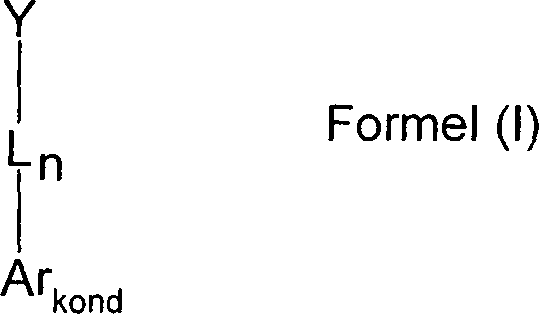
Y bedeutet eine Verknüpfung zum Polymergrundgerüst;
Ln ist eine substituierte oder unsubstituierte aromatische, heteroaromatische oder nicht-aromatische Gruppe, oder eine Alkylen-, Alkenylen- oder Alkinylen-Gruppe, wobei 3 ≥ n ≥ 1 ist;
Arkond bedeutet ein kondensiertes, aromatisches Ringsystem mit 10 bis 40, vorzugsweise 10 bis 24 C-Atomen oder kondensiertes, heteroaromatisches Ringsystem mit 10 bis 40, vorzugsweise 10 bis 24 Ringatomen, wobei mindestens ein Ringatom ein Heteroatom ist, vorzugsweise ausgewählt aus N, O und/oder S, und die übrigen Atome C-Atome sind, welches unsubstituiert oder mit einem oder mehreren Resten R substituiert sein kann;
R ist dabei jeweils unabhängig voneinander H, D, F, Cl, Br, I, N(R10)2, N(Ar)2, CR10=CR10Ar, Si(R10)3, B(OR10)2, eine geradkettige Alkyl-, Alkenyl-, Alkinyl-, Alkoxy- oder Thioalkoxygruppe mit 1 bis 40 C-Atomen oder eine verzweigte oder cyclische Alkyl-, Alkenyl-, Alkinyl-, Alkoxy- oder Thioalkoxygruppe mit 3 bis 40 C-Atomen ist, die jeweils mit einem oder mehreren Resten R10 substituiert sein kann, wobei eine oder mehrere nicht benachbarte CH2-Gruppen durch R10C=CR10, C≡C, Si(R10)2, Ge(R10)2, Sn(R10)2, C=O, C=S, C=Se, C=NR10, P(=O)(R10), SO, SO2, NR10, O, S oder CONR10 ersetzt sein können und wobei ein oder mehrere H-Atome durch F, Cl, Br, I, CN oder NO2 ersetzt sein können, oder eine Aryl- oder Heteroarylgruppe mit 5 bis 60 Ringatomen, die jeweils durch einen oder mehrere Reste R10 substituiert sein kann, oder ein aromatisches oder heteroaromatisches Ringsystem mit 5 bis 40 aromatischen Ringatomen, das jeweils durch einen oder mehrere Reste R10 substituiert sein kann, oder eine Aryloxy- oder Heteroaryloxygruppe mit 5 bis 40 aromatischen Ringatomen, die durch einen oder mehrere Reste R10 substituiert sein kann, oder eine Kombination dieser Systeme; wobei zwei oder mehrere Substituenten R auch miteinander ein mono- oder polycyclisches aliphatisches oder aromatisches Ringsystem bilden können, wobei mindestens ein R K-(Ar)m ist, wobei m größer oder gleich 1 ist;
R10 ist jeweils unabhängig voneinander H, D oder ein aliphatischer oder aromatischer Kohlenwasserstoffrest mit 1 bis 20 C-Atomen;
K ist bei jedem Auftreten jeweils unabhängig voneinander eine kovalente Bindung, eine substituierte oder unsubstituierte aromatische, heteroaromatische oder nicht-aromatische Gruppe, oder eine Alkylen-, Alkenylen- oder Alkinylen-Gruppe; und
Ar bedeutet bei jedem Auftreten unabhängig voneinander eine substituierte oder unsubstituierte Arylgruppe, Aryloxygruppe Heteroarylgruppe, Heteroaryloxygruppe, ein aromatisches oder heteroaromatisches Ringsystem oder eine nicht-aromatische Gruppe.The present invention thus provides polymers which contain one or more substituted and / or unsubstituted styrene repeat units and one or more repeat units of the general formula (I)
Y is a link to the polymer backbone;
L n is a substituted or unsubstituted aromatic, heteroaromatic or non-aromatic group, or an alkylene, alkenylene or alkynylene group, wherein 3 ≥ n ≥ 1;
Ar kond means a fused, aromatic ring system having 10 to 40, preferably 10 to 24 carbon atoms or fused, heteroaromatic ring system having 10 to 40, preferably 10 to 24 ring atoms, wherein at least one ring atom is a heteroatom, preferably selected from N, O. and / or S, and the remaining atoms are C atoms, which may be unsubstituted or substituted by one or more R radicals;
R is in each case independently of one another H, D, F, Cl, Br, I, N (R 10 ) 2 , N (Ar) 2 , CR 10 = CR 10 Ar, Si (R 10 ) 3 , B (OR 10 ) 2 , a straight-chain alkyl, alkenyl, alkynyl, alkoxy or thioalkoxy group having 1 to 40 carbon atoms or a branched or cyclic alkyl, alkenyl, alkynyl, alkoxy or thioalkoxy group having 3 to 40 carbon atoms each of which may be substituted with one or more R 10 radicals, one or more non-adjacent CH 2 groups being represented by R 10 C = CR 10 , C≡C, Si (R 10 ) 2 , Ge (R 10 ) 2 , Sn (R 10 ) 2 , C = O, C = S, C = Se, C = NR 10 , P (= O) (R 10 ), SO, SO 2 , NR 10 , O, S or CONR 10 and wherein one or more H atoms may be replaced by F, Cl, Br, I, CN or NO 2 , or an aryl or heteroaryl group having 5 to 60 ring atoms, each of which may be substituted by one or more R 10 radicals , or an aromatic or heteroaromatic ring system having 5 to 40 aromatic ring atoms, each by one or more R 10 may be substituted, or an aryloxy or heteroaryloxy group having 5 to 40 aromatic ring atoms which may be substituted by one or more R 10 , or a combination of these systems; wherein two or more substituents R may also together form a mono- or polycyclic aliphatic or aromatic ring system, wherein at least one R is K- (Ar) m , wherein m is greater than or equal to 1;
R 10 is independently H, D or an aliphatic or aromatic hydrocarbon radical having 1 to 20 C atoms;
Each of K's occurrence is independently a covalent bond, a substituted or unsubstituted aromatic, heteroaromatic or non-aromatic group, or an alkylene, alkenylene or alkynylene group; and
Ar at each occurrence independently represents a substituted or unsubstituted aryl group, aryloxy group, heteroaryl group, heteroaryloxy group, an aromatic or heteroaromatic ring system or a non-aromatic group.
Arkond ist vorzugsweise eine Naphthyl-, eine Anthracenyl-, eine Phenanthrenyl-, eine Benzanthracenyl- oder eine Pyrenylgruppe, welche unsubstituiert oder mit einem oder mehreren Resten R substituiert sein kann.Ar kond is preferably a naphthyl, an anthracenyl, a phenanthrenyl, a benzanthracenyl or a pyrenyl group, which may be unsubstituted or substituted by one or more R radicals.
Die Verknüpfung mit Ln in der Formel (I) erfolgt dabei im Fall der Naphthylgruppe vorzugsweise über die 1- oder 2-Position, im Fall der Anthracenylgruppe vorzugsweise über die 2-, 6- oder 9-Position, im Fall der Phenanthrenylgruppe vorzugsweise über die 2- oder 3-Position, im Fall der Benzanthracenylgruppe vorzugsweise über die 2- oder 12-Position und im Fall der Pyrenylgruppe vorzugsweise über die 1-, 2- oder 3-Position.In the case of the naphthyl group, the linkage with L n in the formula (I) preferably takes place via the 1- or 2-position, in the case of the anthracenyl group preferably via the 2-, 6- or 9-position, in the case of the phenanthrenyl group preferably via the 2- or 3-position, in the case of the benzanthracenyl group preferably via the 2- or 12-position and in the case of the pyrenyl group preferably via the 1-, 2- or 3-position.
Besonders bevorzugt ist Arkond eine Anthracenyigruppe, die vorzugsweise in der 2-, 6- oder 9-Position, besonders bevorzugt in der 9-Position mit Ln verknüpft ist.Ar kond is particularly preferably a Anthracenyigruppe, which is preferably in the 2-, 6- or 9-position, particularly preferably in the 9-position linked to L n .
Besonders bevorzugt sind somit Polymere, die eine oder mehrere substituierte und/oder unsubstituierte Styrol-Wiederholungseinheiten und eine oder mehrere Wiederholungseinheiten der allgemeinen Formel (Ia) 
Y bedeutet eine Verknüpfung zum Polymergrundgerüst;
Ln ist eine substituierte oder unsubstituierte aromatische, heteroaromatische oder nicht-aromatische Gruppe, oder eine Alkylen-, Alkenylen- oder Alkinylen-Gruppe, wobei 3 ≥ n ≥ 1 ist;
R1 bis R9 sind jeweils unabhängig voneinander H, D, F, Cl, Br, I, N(R10)2, N(Ar)2, CR10=CR10Ar, Si(R10)3, B(OR10)2, eine geradkettige Alkyl-, Alkenyl-, Alkinyl-, Alkoxy- oder Thioalkoxygruppe mit 1 bis 40 C-Atomen oder eine verzweigte oder cyclische Alkyl-, Alkenyl-, Alkinyl-, Alkoxy- oder Thioalkoxygruppe mit 3 bis 40 C-Atomen ist, die jeweils mit einem oder mehreren Resten R10 substituiert sein kann, wobei eine oder mehrere nicht benachbarte CH2-Gruppen durch R10C=CR10, C≡C, Si(R10)2, Ge(R10)2, Sn(R10)2, C=O, C=S, C=Se, C=NR10, P(=O)(R10), SO, SO2, NR10, O, S oder CONR10 ersetzt sein können und wobei ein oder mehrere H-Atome durch F, Cl, Br, I, CN oder NO2 ersetzt sein können, oder eine Aryl- oder Heteroarylgruppe mit 5 bis 60 Ringatomen, die jeweils durch einen oder mehrere Reste R10 substituiert sein kann, oder ein aromatisches oder heteroaromatisches Ringsystem mit 5 bis 40 aromatischen Ringatomen, das jeweils durch einen oder mehrere Reste R10 substituiert sein kann, oder eine Aryloxy- oder Heteroaryloxygruppe mit 5 bis 40 aromatischen Ringatomen, die durch einen oder mehrere Reste R10 substituiert sein kann, oder eine Kombination dieser Systeme; wobei zwei oder mehrere Substituenten R1 bis R9 auch miteinander ein mono- oder polycyclisches, aliphatisches oder aromatisches Ringsystem bilden können, wobei mindestens ein Vertreter aus R1 bis R9 K-(Ar)m ist, wobei m größer oder gleich 1 ist;
R10 ist jeweils unabhängig voneinander H, D oder ein aliphatischer oder aromatischer Kohlenwasserstoffrest mit 1 bis 20 C-Atomen;
K ist bei jedem Auftreten jeweils unabhängig voneinander eine kovalente Bindung, eine substituierte oder unsubstituierte aromatische, heteroaromatische oder nicht-aromatische Gruppe, oder eine Alkylen-, Alkenylen- oder Alkinylen-Gruppe; und
Ar bedeutet bei jedem Auftreten unabhängig voneinander eine substituierte oder unsubstituierte Arylgruppe, Aryloxygruppe Heteroarylgruppe, Heteroaryloxygruppe, ein aromatisches oder heteroaromatisches Ringsystem oder eine nicht-aromatische Gruppe.Particular preference is thus given to polymers which contain one or more substituted and / or unsubstituted styrene repeat units and one or more repeat units of the general formula (Ia)
Y is a link to the polymer backbone;
L n is a substituted or unsubstituted aromatic, heteroaromatic or non-aromatic group, or an alkylene, alkenylene or alkynylene group, wherein 3 ≥ n ≥ 1;
R 1 to R 9 are each independently H, D, F, Cl, Br, I, N (R 10 ) 2 , N (Ar) 2 , CR 10 = CR 10 Ar, Si (R 10 ) 3 , B ( OR 10 ) 2 , a straight-chain alkyl, alkenyl, alkynyl, alkoxy or thioalkoxy group having 1 to 40 carbon atoms or is a branched or cyclic alkyl, alkenyl, alkynyl, alkoxy or thioalkoxy group having from 3 to 40 carbon atoms, each of which may be substituted with one or more R 10 radicals, wherein one or more non-adjacent CH 2 groups is substituted by R 10 C = CR 10 , C≡C, Si (R 10 ) 2 , Ge (R 10 ) 2 , Sn (R 10 ) 2 , C = O, C = S, C = Se, C = NR 10 , P (= O) (R 10 ), SO, SO 2 , NR 10 , O, S or CONR 10 may be replaced and wherein one or more H atoms may be replaced by F, Cl, Br, I, CN or NO 2 , or an aryl or heteroaryl group having 5 to 60 ring atoms, each of which may be substituted by one or more radicals R 10 , or an aromatic or heteroaromatic ring system having 5 to 40 aromatic ring atoms, each substituted by one or more radicals R 10 may, or an aryloxy or heteroaryloxy group having 5 to 40 aromatic ring atoms, which may be substituted by one or more radicals R 10 , or a combination of these systems; where two or more substituents R 1 to R 9 can also together form a mono- or polycyclic, aliphatic or aromatic ring system, where at least one of R 1 to R 9 is K- (Ar) m , where m is greater than or equal to 1 ;
R 10 is independently H, D or an aliphatic or aromatic hydrocarbon radical having 1 to 20 C atoms;
Each of K's occurrence is independently a covalent bond, a substituted or unsubstituted aromatic, heteroaromatic or non-aromatic group, or an alkylene, alkenylene or alkynylene group; and
Ar at each occurrence independently represents a substituted or unsubstituted aryl group, aryloxy group, heteroaryl group, heteroaryloxy group, an aromatic or heteroaromatic ring system or a non-aromatic group.
Vorzugsweise ist m so gewählt, dass es maximal der Anzahl möglicher Substitutionspositionen an K entspricht. Ist K beispielsweise eine kovalente Einfachbindung ist m = 1. Ist K hingegen ein Phenyl ist m = 1, 2, 3, 4 oder maximal 5.Preferably, m is chosen so that it corresponds at most to the number of possible substitution positions on K. For example, if K is a single covalent bond m = 1. If K is a phenyl, m = 1, 2, 3, 4, or at most 5.
Eine Arylgruppe oder Aryloxygruppe im Sinne der vorliegenden Erfindung enthält vorzugsweise 5 bis 60 C-Atome; eine Heteroarylgruppe oder Heteroaryloxygruppe im Sinne der vorliegenden Erfindung enthält 2 bis 60 C-Atome und mindestens ein Heteroatom, mit der Maßgabe, dass die Summe aus C-Atomen und Heteroatomen mindestens 5 ergibt. Die Heteroatome sind vorzugsweise ausgewählt aus Si, N, P, O, S und/oder Se. Dabei wird unter einer Arylgruppe bzw. Heteroarylgruppe entweder ein einfacher aromatischer Cyclus, also Benzol, bzw. ein einfacher heteroaromatischer Cyclus, beispielsweise Pyridin, Pyrimidin, Thiophen, oder eine kondensierte Aryl- oder Heteroarylgruppe, beispielsweise Naphthalin, Anthracen, Phenanthren, Chinolin, Isochinolin, Benzothiophen, Benzofuran und Indol, verstanden.An aryl group or aryloxy group in the context of the present invention preferably contains 5 to 60 C atoms; For the purposes of the present invention, a heteroaryl group or heteroaryloxy group contains 2 to 60 C atoms and at least one heteroatom, with the proviso that the sum of C atoms and heteroatoms gives at least 5. The heteroatoms are preferably selected from Si, N, P, O, S and / or Se. In this case, an aryl group or heteroaryl group is either a simple aromatic cycle, ie benzene, or a simple heteroaromatic cycle, for example pyridine, pyrimidine, thiophene, or a fused aryl or heteroaryl group, for example naphthalene, anthracene, phenanthrene, quinoline, isoquinoline, Benzothiophene, benzofuran and indole, understood.
Ein aromatisches Ringsystem im Sinne der vorliegenden Erfindung enthält 5 bis 60 C-Atome im Ringsystem. Ein heteroaromatisches Ringsystem im Sinne der vorliegenden Erfindung enthält 2 bis 60 C-Atome und mindestens ein Heteroatom im Ringsystem, mit der Maßgabe, dass die Summe aus C-Atomen und Heteroatomen mindestens 5 ergibt. Die Heteroatome sind vorzugsweise ausgewählt aus Si, N, P, O, S und/oder Se. Unter einem aromatischen oder heteroaromatischen Ringsystem im Sinne der vorliegenden Erfindung soll darüber hinaus ein System verstanden werden, das nicht notwendigerweise nur Aryl- oder Heteroarylgruppen enthält, sondern in dem auch mehrere Aryl- oder Heteroarylgruppen durch eine nicht-aromatische Einheit (vorzugsweise weniger als 10% der von H verschiedenen Atome), wie z. B. ein sp3-hybridisiertes C-, oder N- oder O-Atom, unterbrochen sein können. So sollen beispielsweise auch Systeme wie 9,9'-Spirobifluoren, 9,9-Diarylfluoren, Triarylamin, Diarylether und Stilben, als aromatische Ringsysteme im Sinne der vorliegenden Erfindung verstanden werden, und ebenso Systeme, in denen zwei oder mehrere Arylgruppen beispielsweise durch eine lineare oder cyclische Alkylgruppe, eine Silylgruppe, Benzophenone, Phosphinoxide und Sulfoxide unterbrochen sind.An aromatic ring system in the context of the present invention contains 5 to 60 carbon atoms in the ring system. A heteroaromatic ring system in the context of the present invention contains 2 to 60 C atoms and at least one heteroatom in the ring system, with the proviso that the sum of C atoms and heteroatoms gives at least 5. The heteroatoms are preferably selected from Si, N, P, O, S and / or Se. In the context of the present invention, an aromatic or heteroaromatic ring system is furthermore to be understood as meaning a system which does not necessarily contain only aryl or heteroaryl groups but in which several aryl or heteroaryl groups are also replaced by a non-aromatic unit (preferably less than 10%). the non-H atoms), such. As an sp 3 -hybridized C, or N or O atom, may be interrupted. For example, systems such as 9,9'-spirobifluorene, 9,9-diarylfluorene, triarylamine, diaryl ether and stilbene are to be understood as aromatic ring systems in the context of the present invention, and also systems in which two or more aryl groups, for example by a linear or cyclic alkyl group, a silyl group, benzophenones, phosphine oxides and sulfoxides are interrupted.
Als aromatisches oder heteroaromatisches Ringsystem mit 5 bis 60 Ringatomen, welches noch jeweils mit beliebigen Resten, vorzugsweise den unter R10 definierten Resten, substituiert sein kann und welches über beliebige Positionen am Aromaten bzw. Heteroaromaten verknüpft sein kann, werden insbesondere Gruppen verstanden, die abgeleitet sind von Benzol, Naphthalin, Anthracen, Phenanthren, Pyren, Chrysen, Perylen, Fluoranthen, Naphthacen, Pentacen, Benzpyren, Biphenyl, Biphenylen, Terphenyl, Terphenylen, Fluoren, Spirobifluoren, Dihydrophenanthren, Dihydropyren, Tetrahydropyren, cis- oder trans-Indenofluoren, Truxen, Isotruxen, Spirotruxen, Spiroisotruxen, Furan, Benzofuran, Isobenzofuran, Dibenzofuran, Thiophen, Benzothiophen, Isobenzothiophen, Dibenzothiophen, Pyrrol, Indol, Isoindol, Carbazol, Pyridin, Chinolin, Isochinolin, Acridin, Phenanthridin, Benzo-5,6-chinolin, Benzo-6,7-chinolin, Benzo-7,8-chinolin, Phenothiazin, Phenoxazin, Pyrazol, Indazol, Imidazol, Benzimidazol, Naphthimidazol, Phenanthrimidazol, Pyridimidazol, Pyrazinimidazol, Chinoxalinimidazol, Oxazol, Benzoxazol, Naphthoxazol, Anthroxazol, Phenanthroxazol, Isoxazol, 1,2-Thiazol, 1,3-Thiazol, Benzothiazol, Pyridazin, Benzopyridazin, Pyrimidin, Benzpyrimidin, Chinoxalin, 1,5-Diazaanthracen, 2,7-Diazapyren, 2,3-Diazapyren, 1,6-Diazapyren, 1,8-Diazapyren, 4,5-Diazapyren, 4,5,9,10-Tetraazaperylen, Pyrazin, Phenazin, Phenoxazin, Phenothiazin, Fluorubin, Naphthyridin, Azacarbazol, Benzocarbolin, Phenanthrolin, 1,2,3-Triazol, 1,2,4-Triazol, Benzotriazol, 1,2,3-Oxadiazol, 1,2,4-Oxadiazol, 1,2,5-Oxadiazol, 1,3,4-Oxadiazol, 1,2,3-Thiadiazol, 1,2,4-Thiadiazol, 1,2,5-Thiadiazol, 1,3,4-Thiadiazol, 1,3,5-Triazin, 1,2,4-Triazin, 1,2,3-Triazin, Tetrazol, 1,2,4,5-Tetrazin, 1,2,3,4-Tetrazin, 1,2,3,5-Tetrazin, Purin, Pteridin, Indolizin, Benzothiadiazol, Benzanthren, Benzanthracen, Rubicen und Triphenylen.As aromatic or heteroaromatic ring system having 5 to 60 ring atoms, which may be substituted in each case with any radicals, preferably the radicals defined under R 10 and which may be linked via any position on the aromatic or heteroaromatic, are understood in particular groups derived are benzene, naphthalene, anthracene, phenanthrene, pyrene, chrysene, perylene, fluoranthene, naphthacene, pentacene, benzpyrene, biphenyl, biphenylene, terphenyl, terphenyls, fluorene, spirobifluorene, dihydrophenanthrene, dihydropyrene, tetrahydropyrene, cis- or trans-indenofluorene, Truxen , Isotruxene, spirotruxene, spiroisotruxene, furan, benzofuran, isobenzofuran, dibenzofuran, thiophene, benzothiophene, isobenzothiophene, dibenzothiophene, pyrrole, indole, isoindole, carbazole, pyridine, quinoline, isoquinoline, acridine, phenanthridine, benzo-5,6-quinoline, benzo 6,7-quinoline, benzo-7,8-quinoline, phenothiazine, phenoxazine, pyrazole, indazole, imidazole, benzimidazole, naphthim idazole, phenanthrimidazole, pyridimidazole, pyrazine imidazole, quinoxaline imidazole, oxazole, benzoxazole, naphthoxazole, anthroxazole, phenanthroxazole, isoxazole, 1,2-thiazole, 1,3-thiazole, benzothiazole, pyridazine, benzopyridazine, pyrimidine, benzpyrimidine, quinoxaline, 1,5- Diazaanthracene, 2,7-diazapyrene, 2,3-diazapyrene, 1,6-diazapyrene, 1,8-diazapyrene, 4,5-diazapyrene, 4,5,9,10-tetraazaperylene, pyrazine, phenazine, phenoxazine, phenothiazine, Fluorubin, naphthyridine, azacarbazole, benzocarboline, phenanthroline, 1,2,3-triazole, 1,2,4-triazole, benzotriazole, 1,2,3-oxadiazole, 1,2,4-oxadiazole, 1,2,5- Oxadiazole, 1,3,4-oxadiazole, 1,2,3-thiadiazole, 1,2,4-thiadiazole, 1,2,5-thiadiazole, 1,3,4-thiadiazole, 1,3,5-triazine, 1,2,4-triazine, 1,2,3-triazine, tetrazole, 1,2,4,5-tetrazine, 1,2,3,4-tetrazine, 1,2,3,5-tetrazine, purine, Pteridine, indolizine, benzothiadiazole, benzanthrene, benzanthracene, rubicene and triphenylene.
Eine nicht-aromatische Gruppe im Sinne der vorliegenden Erfindung ist eine Gruppe, welche nicht über ein cyclisch konjugiertes System mit (4n + 2) π-Elektronen verfügt, beispielsweise eine Alkylgruppe, Alkenylgruppe, Alkinylgruppe oder Alkoxygruppe oder falls die nicht-aromatische Gruppe zwei Bindungspartner aufweist entsprechend eine Alkylen-, Alkenylen-, Alkinylen- oder eine Alkoxylengruppe.A non-aromatic group within the meaning of the present invention is a group which does not have a cyclic conjugated system with (4n + 2) π-electrons, for example an alkyl group, alkenyl group, alkynyl group or alkoxy group or if the non-aromatic group two binding partners correspondingly has an alkylene, alkenylene, alkynylene or alkoxy group.
Im Rahmen der vorliegenden Erfindung werden unter einer Alkylgruppe mit 1 bis 40 C-Atomen, in der auch einzelne H-Atome oder CH2-Gruppen durch die oben genannten Gruppen substituiert sein können, vorzugsweise die Reste Methyl, Ethyl, n-Propyl, i-Propyl, Cyclopropyl, n-Butyl, i-Butyl, s-Butyl, t-Butyl, Cyclobutyl, 2-Methylbutyl, n-Pentyl, s-Pentyl, Cyclopentyl, n-Hexyl, Cyclohexyl, n-Heptyl, Cycloheptyl, n-Octyl, Cyclooctyl, 2-Ethylhexyl, Trifluormethyl, Pentafluorethyl, 2,2,2-Trifluorethyl, Ethenyl, Propenyl, Butenyl, Pentenyl, Cyclopentenyl, Hexenyl, Cyclohexenyl, Heptenyl, Cycloheptenyl, Octenyl, Cyclooctenyl, Ethinyl, Propinyl, Butinyl, Pentinyl, Hexinyl und Octinyl verstanden.In the context of the present invention, an alkyl group having 1 to 40 carbon atoms, in which individual H atoms or CH 2 groups may also be substituted by the abovementioned groups, preferably the radicals methyl, ethyl, n-propyl, i Propyl, cyclopropyl, n -butyl, i -butyl, s -butyl, t -butyl, cyclobutyl, 2-methylbutyl, n -pentyl, s -pentyl, cyclopentyl, n -hexyl, cyclohexyl, n -heptyl, cycloheptyl, n -Octyl, cyclooctyl, 2-ethylhexyl, trifluoromethyl, pentafluoroethyl, 2,2,2-trifluoroethyl, ethenyl, propenyl, butenyl, pentenyl, cyclopentenyl, hexenyl, cyclohexenyl, heptenyl, cycloheptenyl, octenyl, cyclooctenyl, ethynyl, propynyl, butynyl, pentynyl , Hexynyl and octynyl.
Unter einer Alkoxygruppe mit 1 bis 40 C-Atomen werden vorzugsweise Methoxy, Trifluormethoxy, Ethoxy, n-Propoxy, i-Propoxy, n-Butoxy, i-Butoxy, s-Butoxy, t-Butoxy und 2-Methylbutoxy verstanden.An alkoxy group having 1 to 40 carbon atoms is preferably understood as meaning methoxy, trifluoromethoxy, ethoxy, n-propoxy, i-propoxy, n-butoxy, i-butoxy, s-butoxy, t-butoxy and 2-methylbutoxy.
Erfindungsgemäß bevorzugte Alkylen-, Alkenylen- und Alkinylengruppen sind solche mit 2 bis 40 C-Atomen, wobei auch ein oder mehrere H-Atome oder CH2-Gruppen der Alkylene oder ein oder mehrere H-Atome oder HC=CH-Gruppen der Alkenylene oder eine oder mehrere C≡C-Gruppen der Alkinylene durch die oben genannten Gruppen ersetzt sein können. Bevorzugt sind die Reste Methylen, Ethylen, n-Propylen, i-Propylen, Cyclopropylen, n-Butylen, i-Butylen, s-Butylen, t-Butylen, Cyclobutylen, 2-Methylbutylen, n-Pentylen, s-Pentylen, Cyclopentylen, n-Hexylen, Cyclohexylen, n-Heptylen, Cycloheptylen, n-Octylen, Cyclooctylen, 2-Ethylhexylen, Trifluormethylen, Pentafluorethylen, 2,2,2-Trifluorethylen, Ethenylen, Propenylen, Butenylen, Pentenylen, Cyclopentenylen, Hexenylen, Cyclohexenylen, Heptenylen, Cycloheptenylen, Octenylen, Cyclooctenylen, Ethinylen, Propinylen, Butinylen, Pentinylen, Hexinylen und Octinylen.Alkylene, alkenylene and alkynylene groups preferred according to the invention are those having 2 to 40 C atoms, where one or more H atoms or CH 2 groups of the alkylenes or one or more H atoms or HC = CH groups of the alkenylenes or one or more C≡C groups of the alkynylenes may be replaced by the abovementioned groups. Preferably, the radicals are methylene, ethylene, n-propylene, i-propylene, cyclopropylene, n-butylene, i-butylene, s-butylene, t-butylene, cyclobutylene, 2-methylbutylene, n-pentylene, s-pentylene, cyclopentylene, n-hexylene, cyclohexylene, n-heptylene, cycloheptylene, n-octylene, cyclooctylene, 2-ethylhexylene, trifluoromethylene, pentafluoroethylene, 2,2,2-trifluoroethylene, ethenylene, propenylene, butenylene, pentenylene, cyclopentenylene, hexenylene, cyclohexenylene, heptenylene, Cycloheptenylene, octenylene, cyclooctenylene, ethynylene, propynylene, butynylene, pentynylene, hexynylene and octynylene.
In einer weiteren Ausführungsform der vorliegenden Erfindung ist das Polymer gekennzeichnet durch die allgemeine Formel (II), 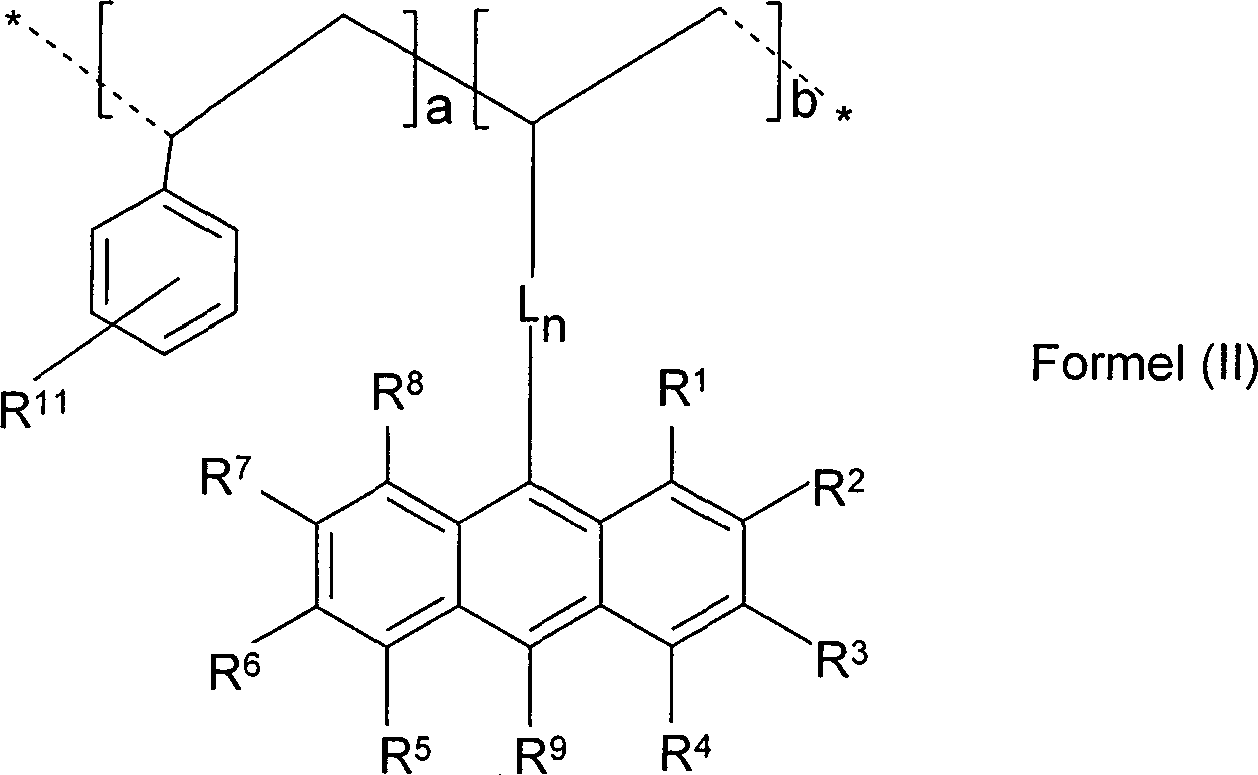
R11 gleich H, D, F, Cl, Br, I, N(Ar)2, CR12=CR12Ar, Si(R12)3, B(OR12)2, eine geradkettige Alkyl-, Alkoxy- oder Thioalkoxygruppe mit 1 bis 40 C-Atomen oder eine verzweigte oder cyclische Alkyl-, Alkoxy- oder Thioalkoxygruppe mit 3 bis 40 C-Atomen ist, die jeweils mit einem oder mehreren Resten R12 substituiert sein kann, wobei eine oder mehrere nicht benachbarte CH2-Gruppen durch R12C=CR12, C≡C, Si(R12)2, Ge(R12)2, Sn(R12)2, C=O, C=S, C=Se, C=NR12, P(=O)(R12), SO, SO2, NR12, O, S oder CONR12 ersetzt sein können und wobei ein oder mehrere H-Atome durch F, Cl, Br, I, CN oder NO2 ersetzt sein können, oder eine Aryl- oder Heteroarylgruppe mit 5 bis 40 Ringatomen, die jeweils durch einen oder mehrere Reste R12 substituiert sein kann, oder ein aromatisches oder heteroaromatisches Ringsystem mit 5 bis 40 aromatischen Ringatomen, das jeweils durch einen oder mehrere Reste R12 substituiert sein kann, oder eine Aryloxy- oder Heteroaryloxygruppe mit 5 bis 40 aromatischen Ringatomen, die durch einen oder mehrere Reste R12 substituiert sein kann, oder eine Kombination dieser Systeme; wobei zwei oder mehrere Reste R12 ein mono- oder polycyclisches, aliphatisches oder aromatisches Ringsystem bilden können;
R12 bei jedem Auftreten jeweils unabhängig voneinander H oder elf aliphatischer oder aromatischer Kohlenwasserstoffrest mit 1 bis 20 C-Atomen ist;
a eine styrolbasierte Wiederholungseinheit und b eine Wiederholungseinheit der allgemeinen Formel (I) ist.In a further embodiment of the present invention, the polymer is characterized by the general formula (II)
R 11 is H, D, F, Cl, Br, I, N (Ar) 2 , CR 12 = CR 12 Ar, Si (R 12 ) 3 , B (OR 12 ) 2 , a straight-chain alkyl, alkoxy or Thioalkoxygruppe having 1 to 40 carbon atoms or a branched or cyclic alkyl, alkoxy or thioalkoxy group having 3 to 40 carbon atoms, which may be substituted in each case with one or more radicals R 12 , wherein one or more non-adjacent CH 2 Groups by R 12 C = CR 12 , C≡C, Si (R 12 ) 2 , Ge (R 12 ) 2 , Sn (R 12 ) 2 , C = O, C = S, C = Se, C = NR 12 , P (= O) (R 12 ), SO, SO 2 , NR 12 , O, S or CONR 12 may be replaced and wherein one or more H atoms are represented by F, Cl, Br, I, CN or NO 2 be replaced, or an aryl or Heteroaryl group having 5 to 40 ring atoms, each of which may be substituted by one or more radicals R 12 , or an aromatic or heteroaromatic ring system having 5 to 40 aromatic ring atoms, each of which may be substituted by one or more radicals R 12 , or an aryloxy or heteroaryloxy group having 5 to 40 aromatic ring atoms which may be substituted by one or more R 12 , or a combination of these systems; wherein two or more R 12 can form a mono- or polycyclic, aliphatic or aromatic ring system;
Each R 12 is independently H or eleven aliphatic or aromatic hydrocarbon radicals having from 1 to 20 carbon atoms;
a is a styrene-based repeat unit and b is a repeat unit of the general formula (I).
Vorzugsweise liegt der Anteil der Wiederholungseinheit der allgemeinen Formel (I) im erfindungsgemäßen Polymer im Bereich von 0,01 bis 99,99 mol-%, besonders bevorzugt im Bereich von 10 bis 90 mol-% und insbesondere im Bereich von 25 bis 75 mol-%, bezogen auf das gesamte Polymer, vor. Entsprechend beträgt der Anteil der Styroleinheit im erfindungsgemäßen Polymer vorzugsweise 99,99 bis 0,01 mol-%, besonders bevorzugt 90 bis 10 mol-%, und insbesondere 75 bis 25 mol-%, bezogen auf das gesamte Polymer.The proportion of the repeating unit of the general formula (I) in the polymer according to the invention is preferably in the range from 0.01 to 99.99 mol%, particularly preferably in the range from 10 to 90 mol% and in particular in the range from 25 to 75 mol%. %, based on the total polymer. Accordingly, the proportion of the styrene unit in the polymer according to the invention is preferably from 99.99 to 0.01 mol%, particularly preferably from 90 to 10 mol%, and in particular from 75 to 25 mol%, based on the total polymer.
Die zahlenmittlere Molekülmasse Mn des erfindungsgemäßen Polymers liegt vorzugsweise im Bereich 2.000 bis 2.000.000 g/mol, besonders bevorzugt im Bereich von 3.000 bis 1.500.000 g/mol, und insbesondere im Bereich von 5.000 bis 250.000 g/mol. Die Bestimmung der zahlenmittlere Molekülmasse Mn erfolgt über GPC (Gelpermeationschromatographie) mit internem Polystyrolstandard.The number-average molecular mass M n of the polymer according to the invention is preferably in the range from 2,000 to 2,000,000 g / mol, more preferably in the range from 3,000 to 1,500,000 g / mol, and in particular in the range from 5,000 to 250,000 g / mol. The determination of the number-average molecular mass M n is carried out via GPC (gel permeation chromatography) with internal polystyrene standard.
Das erfindungsgemäße Polymer weist als Backbone vorzugsweise eine aliphatische Kette auf. Diese wird vorzugsweise durch Polymerisation von Verbindungen der allgemeinen Formel (I), welche als Monomere entsprechende polymerisierbare Gruppen aufweisen (siehe Verbindung der allgemeinen Formel (III), nachfolgend beschrieben), mit Styrol oder einem Styrolderivat mit polymerisierbaren Gruppen erhalten. Die polymerisierbaren Gruppen sind vorzugsweise Vinyl, Vinylester, Vinylether, Vinylamid, Acrylat, Methacrylat und Acrylamid. Ebenso können als polymerisierbare Gruppe solche Gruppen Verwendung finden, die sich durch kationische, anionische oder ringöffnende Polymerisation in ein Polymer überführen lassen. Ebenso können Kombinationen der genannten polymerisierbaren Gruppen eingesetzt werden.As a backbone, the polymer according to the invention preferably has an aliphatic chain. This is preferably obtained by polymerization of compounds of general formula (I) having polymerizable groups corresponding to monomers (see compound of general formula (III) described below) with styrene or a styrene derivative having polymerizable groups. The polymerizable groups are preferably vinyl, vinyl ester, vinyl ether, vinyl amide, acrylate, methacrylate and acrylamide. Likewise, the polymerizable group can be those groups which can be converted into a polymer by cationic, anionic or ring-opening polymerization. Likewise, combinations of said polymerizable groups can be used.
Im Sinne der vorliegenden Erfindung ist es ferner bevorzugt, dass in der Verbindung der allgemeinen Formel (I) oder (II) einer oder mehrere der Reste R1 bis R9 und/oder R11 (R1, R2, R3, R4, R5, R6, R7, R8, R9 und/oder R11) jeweils unabhängig voneinander eine Elektronentransportgruppe, eine Elektroneninjektionsgruppe, eine Elektronenblockiergruppe, eine Lochtransportgruppe, eine Lochinjektionsgruppe, eine Lochblockiergruppe, eine Photonenabsorptionsgruppe, eine Excitonen erzeugende Gruppe und/oder eine Emittergruppe bedeutet.For the purposes of the present invention, it is further preferred that in the compound of general formula (I) or (II) one or more of R 1 to R 9 and / or R 11 (R 1 , R 2 , R 3 , R 4 , R 5 , R 6 , R 7 , R 8 , R 9 and / or R 11 ) each independently represent an electron transport group, an electron injection group, an electron blocking group, a hole transport group, a hole injection group, a hole blocking group, a photon absorption group, an exciton generating group and / or an emitter group.
Eine Lochinjektionsgruppe und/oder Lochtransportgruppe im Sinne der vorliegenden Erfindung ist eine Gruppe mit energetisch hochliegendem HOMO („highest occupied molecular orbital, höchstes besetztes Molekülorbital”), vorzugsweise > –5,8 eV, besonders bevorzugt > –5,5 eV. Dies unterstützt die Lochinjektion.A hole injection group and / or hole transport group in the context of the present invention is a group with energetically high HOMO ("highest occupied molecular orbital, highest occupied molecular orbital"), preferably> -5.8 eV, particularly preferably> -5.5 eV. This supports the hole injection.
Vorzugsweise ist die Lochinjektions- und/oder Lochtransportgruppe ein Triarylamin-, Benzidin-, Tetraaryl-para-phenylendiamin-, Triarylphosphin-, Phenothiazin-, Phenoxazin-, Dihydrophenazin-, Thianthren-, Dibenzo-para-dioxin-, Phenoxathiin-, Carbazol-, Azulen-, Thiophen-, Pyrrol- und Furanderivat und darüber hinaus ein O-, S-, Se- oder N-haltiger Heterocyclus mit hoch liegendem HOMO (HOMO = höchstes besetztes Molekülorbital). Vorzugsweise führen diese Arylamine und Heterocyclen zu einem HOMO im Polymer von mehr als –5,8 eV (gegen Vakuumlevel), besonders bevorzugt von mehr als –5,5 eV.Preferably, the hole injection and / or hole transport group is a triarylamine, benzidine, tetraaryl-para-phenylenediamine, triarylphosphine, phenothiazine, phenoxazine, dihydrophenazine, thianthrene, dibenzo-para-dioxin, phenoxathiin, carbazole , Azulenes, thiophene, pyrrole and furan derivatives and, in addition, an O-, S-, Se- or N-containing heterocycle with a high lying HOMO (HOMO = highest occupied molecular orbital). Preferably, these arylamines and heterocycles lead to a HOMO in the polymer of greater than -5.8 eV (at vacuum level), more preferably greater than -5.5 eV.
Eine Elektroneninjektions- und/oder Elektronentransportgruppe im Sinne der vorliegenden Erfindung ist eine Gruppe mit tief liegendem LUMO (lowest unoccupied molecular orbital), vorzugsweise < –1,5 eV, besonders bevorzugt < –2,0 eV (gegen Vakuumlevel). Dies unterstützt die Elektroneninjektion.An electron injection and / or electron transport group in the context of the present invention is a group with low lying LUMO (lowest unoccupied molecular orbital), preferably <-1.5 eV, particularly preferably <-2.0 eV (against vacuum level). This supports the electron injection.
Vorzugsweise ist die Elektroneninjektions- und/oder Elektronentransportgruppe eine Pyridin-, Pyrimidin-, Pyridazin-, Pyrazin-, Oxadiazol-, Chinolin-, Chinoxalin-, Anthracen-, Benzanthracen-, Pyren-, Perylen-, Benzimidazol-, Triazin-, Keton-, Phosphinoxid- und Phenazinderivat, aber auch Triarylborane und weitere O-, S-, Se oder N-haltige Heterocyclen mit niedrig liegendem LUMO (LUMO = niedrigstes unbesetztes Molekülorbital) sind verwendbar. Vorzugsweise führen diese Einheiten im Polymer zu einem LUMO von weniger als –1,5 eV (gegen Vakuumlevel), besonders bevorzugt von weniger als –2,0 eV.Preferably, the electron injection and / or electron transporting group is a pyridine, pyrimidine, pyridazine, pyrazine, oxadiazole, quinoline, quinoxaline, anthracene, benzanthracene, pyrene, perylene, benzimidazole, triazine, ketone , Phosphinoxid- and Phenazinderivat, but also triarylboranes and other O, S, Se or N-containing heterocycles with low-lying LUMO (LUMO = lowest unoccupied molecular orbital) are useful. Preferably, these units in the polymer result in a LUMO of less than -1.5 eV (at vacuum level), more preferably less than -2.0 eV.
Möglich im Sinne der vorliegenden Erfindung ist eine Kombination aus Lochinjektionsgruppe und/oder Lochtransportgruppe und Elektroneninjektions- und/oder Elektronentransportgruppe, wobei diese gleichzeitig ein hohes HOMO und ein niedriges LUMO aufweisen. For the purposes of the present invention, a combination of hole injection group and / or hole transport group and electron injection and / or electron transport group, which at the same time have a high HOMO and a low LUMO, is possible.
Eine Photonenabsorptionsgruppe im Sinne der vorliegenden Erfindung ist vorzugsweise eine Gruppe, die in der Lage ist, ein Photon einer beliebigen Energie bzw. einer beliebigen Wellenlänge, vorzugsweise im Spektralbereich des sichtbaren Lichts, zu absorbieren. Im Allgemeinen handelt es sich dabei um Farbstoffe. Geeignete Farbstoffe sind beispielsweise solche, die gewöhnlich auch in organischen photovoltaischen Zellen, in Farbstoff-sensibilisierten Solarzellen, in Ladungserzeugungsschichten oder in xerographischen Vorrichtungen Anwendung finden. Bevorzugte Farbstoffe sind beispielsweise Perylene und deren Derivate (
Unter einer Excitonen erzeugende Gruppe im Sinne der vorliegenden Erfindung ist vorzugsweise eine Gruppe zu verstehen, die in der Lage ist, durch Rekombination eines Lochs und eines Elektrons ein Exciton zu erzeugen.For the purposes of the present invention, an exciton-generating group is preferably to be understood as meaning a group capable of producing an exciton by recombination of a hole and an electron.
Eine Emittergruppe ist eine Gruppe, die in der Lage ist Licht zu emittieren, beispielsweise ein Fluoreszenz- oder Phosphoreszenzfarbstoff. Bei Fluoreszenzfarbstoffen handelt es sich überwiegend um Singulett-Emitter. Eine Triplett-Emittergruppe im Sinne der vorliegenden Erfindung ist vorzugsweise eine Gruppe, welche auch bei Raumtemperatur mit hoher Effizienz aus dem Triplettzustand Licht emittieren kann, also Elektrophosphoreszenz statt Elektrofluoreszenz zeigt, was häufig eine Steigerung der Energieeffizienz bewirkt. Hierfür eignen sich zunächst Verbindungen, welche Schweratome mit einer Ordnungszahl von mehr als 36 enthalten. Bevorzugt sind Verbindungen, welche d- oder f-Übergangsmetalle enthalten, die die o. g. Bedingung erfüllen. Besonders bevorzugt sind hier entsprechende Struktureinheiten, welche Elemente der Gruppe 8 bis 10 (Ru, Os, Rh, Ir, Pd, Pt) enthalten. Als Struktureinheiten für die erfindungsgemäßen Polymere kommen hier z. B. verschiedene Komplexe in Frage, wie sie z. B. in der
Zusätzlich können funktionelle Gruppen in dem erfindungsgemäßen Polymer enthalten sein, welche den Übergang vom Singulett- zum Triplettzustand verbessern und welche, unterstützend zu den Emittergruppen eingesetzt, die Phosphoreszenzeigenschaften dieser Strukturelemente verbessern. Hierfür kommen insbesondere Carbazol- und überbrückte Carbazoldimereinheiten in Frage, wie sie z. B. in der
Als weitere Emittergruppen im Sinne der vorliegenden Erfindung eignen sich aromatische Strukturen mit 6 bis 40 C-Atomen oder auch Tolan-, Stilben- oder Bisstyrylarylenderivate, die jeweils mit einem oder mehreren Resten R substituiert sein können. Besonders bevorzugt ist dabei der Einbau von 1,4-Phenylen-, 1,4-Naphthylen-, 1,4- oder 9,10-Anthrylen-, 1,6-, 2,7- oder 4,9-Pyrenylen-, 3,9- oder 3,10-Perylenylen-, 4,4'-Biphenylylen-, 4,4''-Terphenylylen, 4,4'-Bi-1,1'-naphthylylen-, 4,4'-Tolanylen-, 4,4'-Stilbenylen-, 4,4''-Bisstyrylarylen-, Benzothiadiazol- und entsprechenden Sauerstoffderivaten, Chinoxalin-, Phenothiazin-, Phenoxazin-, Dihydrophenazin-, Bis(thiophenyl)arylen-, Oligo(thiophenylen)-, Phenazin-, Rubren-, Pentacen- oder Perylenderivaten, die vorzugsweise substituiert sind, oder vorzugsweise konjugierte Push-Pull-Systeme (Systeme, die mit Donor- und Akzeptorsubstituenten substituiert sind) oder Systeme wie Squarine oder Chinacridone, die vorzugsweise substituiert sind.Suitable further emitter groups in the context of the present invention are aromatic structures having 6 to 40 carbon atoms or also tolan, stilbene or bisstyrylarylene derivatives, each of which may be substituted by one or more radicals R. Particularly preferred is the incorporation of 1,4-phenylene, 1,4-naphthylene, 1,4- or 9,10-anthrylene, 1,6-, 2,7- or 4,9-pyrenylene, 3,9- or 3,10-perylenylene, 4,4'-biphenylylene, 4,4 "-terphenyl, 4,4'-bi-1,1'-naphthylylene, 4,4'-tolanylene , 4,4'-stilbenylene, 4,4 '' - bisstyrylarylene, benzothiadiazole and corresponding oxygen derivatives, quinoxaline, phenothiazine, phenoxazine, dihydrophenazine, bis (thiophenyl) arylene, oligo (thiophenylene), phenazine , Rubrene, pentacene or perylene derivatives, which are preferably substituted, or preferably conjugated push-pull systems (systems substituted with donor and acceptor substituents) or systems such as squarins or quinacridones, which are preferably substituted.
Gemäß einer Ausführungsform der vorliegenden Erfindung ist R2 und/oder R9 vorzugsweise eine aromatische oder heteroaromatische Gruppe mit 6 bis 20 Ringatomen.According to one embodiment of the present invention, R 2 and / or R 9 is preferably an aromatic or heteroaromatic group having 6 to 20 ring atoms.
Gemäß einer weiteren Ausführungsform der vorliegenden Erfindung ist R2 und/oder R7 vorzugsweise eine Ladungstransportgruppe.According to another embodiment of the present invention, R 2 and / or R 7 is preferably a charge transport group.
Bevorzugt sind insbesondere Polymere, wobei die Wiederholungseinheit der allgemeinen Formel (I) von den folgenden Monomeren (1) bis (6) gebildet wird: 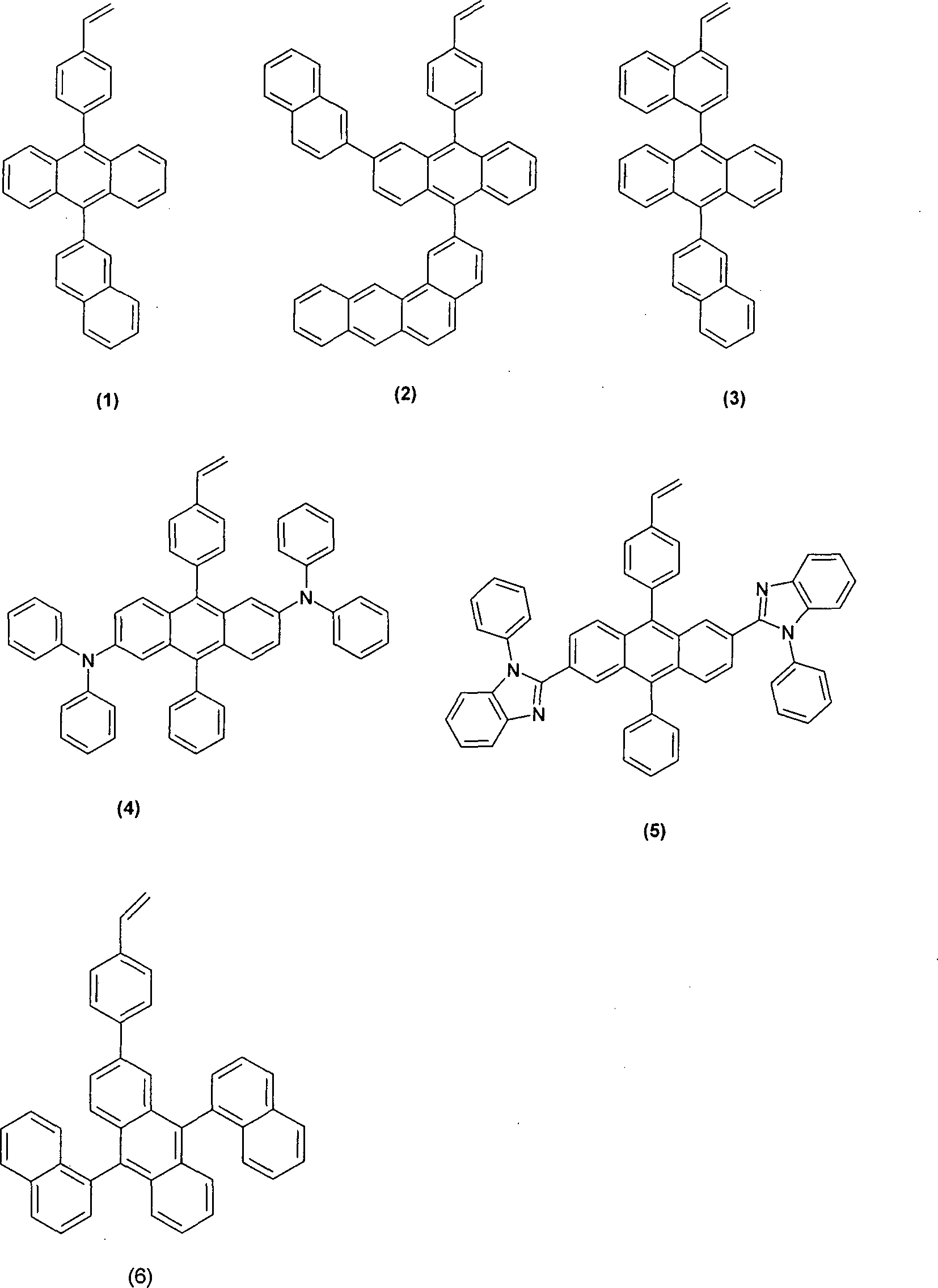
Besonders bevorzugte Polymere sind folglich Copolymere der Formeln (IIa), (IIb), (IIc), (IId), (IIe) und (IIf), wie im Folgenden gezeigt: 

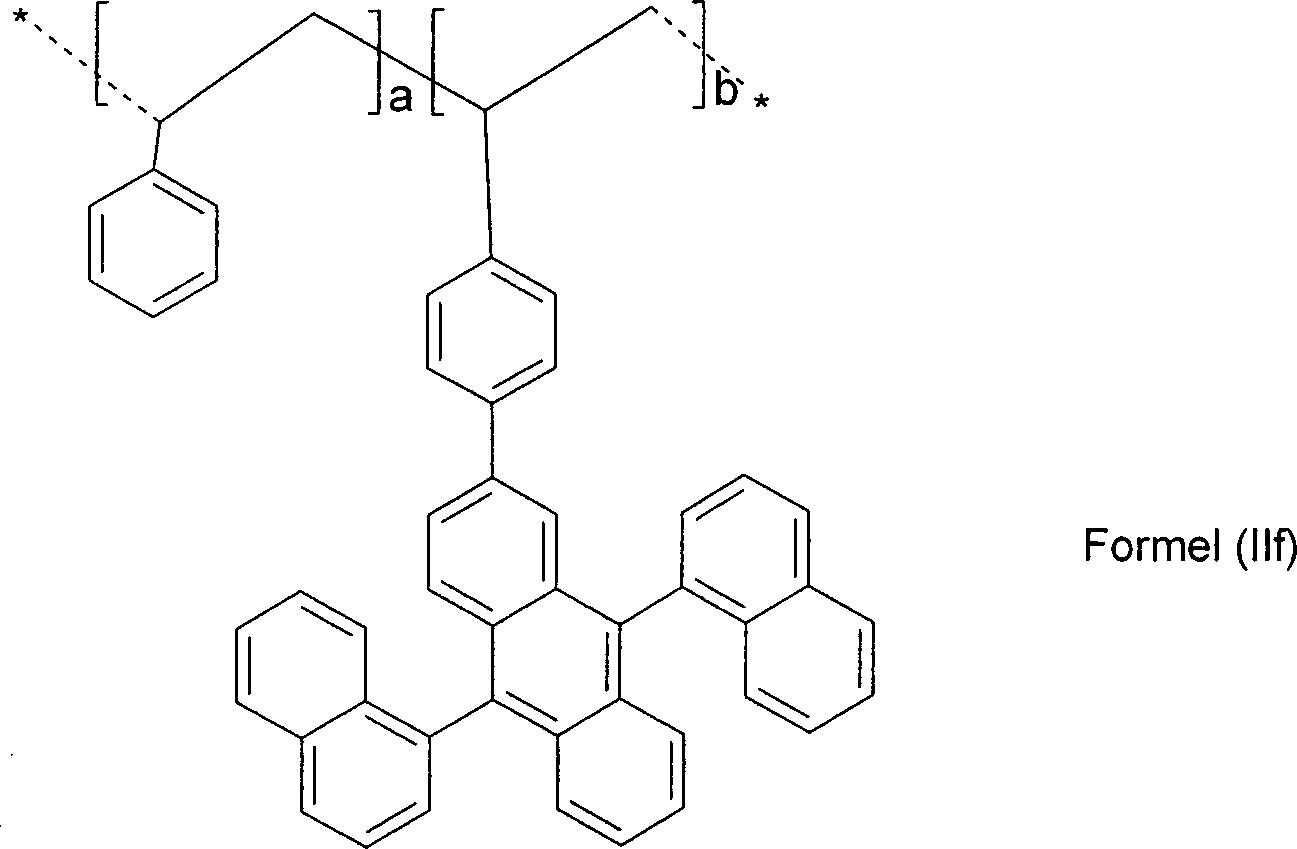
Es kann außerdem bevorzugt sein, die erfindungsgemäßen Polymere nicht als Reinsubstanz, sondern als Mischung (Elend) zusammen mit weiteren beliebigen polymeren, oligomeren, dendritischen oder niedermolekularen Substanzen zu verwenden. Diese können z. B. die elektronischen Eigenschaften verbessern, selber emittieren oder als Matrixmaterial fungieren.It may also be preferred not to use the polymers according to the invention as a pure substance but as a mixture (blend) together with further any desired polymeric, oligomeric, dendritic or low molecular weight substances. These can be z. B. improve the electronic properties, self-emit or act as a matrix material.
Als „Mischung” oder ”Elend” wird vor- und nachstehend eine Mischung enthaltend mindestens eine erfindungsgemäße polymere Komponente bezeichnet.As "mixture" or "misery" above and below a mixture containing at least one inventive polymeric component is referred to.
In einer Ausführungsform der vorliegenden Erfindung werden die erfindungsgemäßen Polymere vorzugsweise als emittierende Verbindungen in einer emittierenden Schicht eingesetzt. Dabei kann eine organische Elektrolumineszenzvorrichtung eine emittierende Schicht enthalten, oder sie kann mehrere emittierende Schichten enthalten, wobei mindestens eine emittierende Schicht mindestens ein erfindungsgemäßes Polymer, wie oben definiert, enthält. Wenn mehrere Emissionsschichten vorhanden sind, weisen diese vorzugsweise insgesamt mehrere Emissionsmaxima zwischen 380 nm und 750 nm auf, so dass insgesamt weiße Emission resultiert, d. h. in den emittierenden Schichten werden verschiedene emittierende Verbindungen verwendet, die fluoreszieren oder phosphoreszieren können. Besonders bevorzugt sind Dreischichtsysteme, wobei die drei Schichten blaue, grüne und orange oder rote Emission zeigen (für den prinzipiellen Aufbau siehe z. B.
Wenn die erfindungsgemäßen Polymere als emittierende Verbindungen in einer emittierenden Schicht eingesetzt werden, werden sie vorzugsweise in Kombination mit einem oder mehreren Matrixmaterialien eingesetzt. Die Mischung aus den erfindungsgemäßen Polymeren und dem mindestens einen Matrixmaterial enthält zwischen 1 und 99 Gew.-%, vorzugsweise zwischen 10 und 98 Gew.-% und besonders bevorzugt zwischen 30 und 97 Gew.-% des Matrixmaterials bezogen auf die Gesamtmischung aus Emitterpolymer und Matrixmaterial. Entsprechend enthält die Mischung zwischen 1 und 99 Gew.-%, vorzugsweise zwischen 2 und 90 Gew.-% und besonders bevorzugt zwischen 3 und 70 Gew.-% der erfindungsgemäßen Polymere bezogen auf die Gesamtmischung aus Emitterpolymer und Matrixmaterial.When the polymers according to the invention are used as emissive compounds in an emitting layer, they are preferably used in combination with one or more matrix materials. The mixture of the polymers of the invention and the at least one matrix material contains between 1 and 99 wt .-%, preferably between 10 and 98 wt .-% and particularly preferably between 30 and 97 wt .-% of the matrix material based on the total mixture of emitter polymer and matrix material. Accordingly, the mixture contains between 1 and 99% by weight, preferably between 2 and 90% by weight and more preferably between 3 and 70% by weight of the polymers according to the invention based on the total mixture of emitter polymer and matrix material.
Bevorzugte Matrixmaterialien sind CBP (N,N-Biscarbazolylbiphenyl), Carbazolderivate (z. B. gemäß
Wenn die erfindungsgemäßen Polymere als Matrixmaterialien in einer emittierenden Schicht eingesetzt werden, werden sie vorzugsweise in Kombination mit einem oder mehreren Emitterverbindungen eingesetzt. Die Mischung aus den erfindungsgemäßen Polymeren und der mindestens einen Emitterverbindung enthält zwischen 1 und 99 Gew.-%, vorzugsweise zwischen 2 und 90 Gew.-%, besonders bevorzugt zwischen 3 und 40 Gew.-%, und insbesondere zwischen 5 und 15 Gew.-% mindestens einer Emitterverbindung bezogen auf die Gesamtmischung aus Emitterverbindung und Matrixmaterial. Entsprechend enthält die Mischung zwischen 99 und 1 Gew.-%, vorzugsweise zwischen 98 und 10 Gew.-%, besonders bevorzugt zwischen 97 und 60 Gew.-%, und insbesondere zwischen 95 und 85 Gew.-% der erfindungsgemäßen Polymere bezogen auf die Gesamtmischung aus Emitterverbindung und Matrixmaterial.When the polymers of the invention are used as matrix materials in an emitting layer, they are preferably used in combination with one or more emitter compounds. The mixture of the polymers according to the invention and the at least one emitter compound contains between 1 and 99% by weight, preferably between 2 and 90% by weight, particularly preferably between 3 and 40% by weight, and in particular between 5 and 15% by weight. -% of at least one emitter compound based on the total mixture of emitter compound and matrix material. Accordingly, the mixture contains between 99 and 1 wt .-%, preferably between 98 and 10 wt .-%, particularly preferably between 97 and 60 Wt .-%, and in particular between 95 and 85 wt .-% of the polymers according to the invention based on the total mixture of emitter compound and matrix material.
Die Emitterverbindung in der erfindungsgemäßen Zusammensetzung ist im Sinne der vorliegenden Erfindung vorzugsweise ein Singulett-Emitter, ein Triplett-Emitter oder eine Singulett-Excitonen erzeugende Gruppe, besonders bevorzugt ein Singulett-Emitter. Der Singulett-Emitter ist vorzugsweise ein blau emittierender Singulett-Emitter. Ebenso kann es sich bei dem Singulett-Emitter um einen grünen oder roten Singulett-Emitter handeln.For the purposes of the present invention, the emitter compound in the composition according to the invention is preferably a singlet emitter, a triplet emitter or a singlet exciton-generating group, particularly preferably a singlet emitter. The singlet emitter is preferably a blue emitting singlet emitter. Likewise, the singlet emitter may be a green or red singlet emitter.
Bevorzugte Singulett-Emitter sind ausgewählt aus der Klasse der Monostyrylamine, der Distyrylamine, der Tristyrylamine, der Tetrastyrylamine, der Styrylphosphine, der Styrylether und der Arylamine.Preferred singlet emitters are selected from the class of monostyrylamines, distyrylamines, tristyrylamines, tetrastyrylamines, styrylphosphines, styryl ethers and arylamines.
Unter einem Monostyrylamin wird eine Verbindung verstanden, die eine substituierte oder unsubstituierte Styrylgruppe und mindestens ein, bevorzugt aromatisches, Amin enthält. Unter einem Distyrylamin wird eine Verbindung verstanden, die zwei substituierte oder unsubstituierte Styrylgruppen und mindestens ein, bevorzugt aromatisches, Amin enthält. Unter einem Tristyrylamin wird eine Verbindung verstanden, die drei substituierte oder unsubstituierte Styrylgruppen und mindestens ein, bevorzugt aromatisches, Amin enthält. Unter einem Tetrastyrylamin wird eine Verbindung verstanden, die vier substituierte oder unsubstituierte Styrylgruppen und mindestens ein, bevorzugt aromatisches, Amin enthält. Die Styrylgruppen sind besonders bevorzugt Stilbene, die auch noch weiter substituiert sein können. Entsprechende Phosphine und Ether sind in Analogie zu den Aminen definiert. Unter einem Arylamin bzw. einem aromatischen Amin im Sinne der vorliegenden Erfindung wird eine Verbindung verstanden, die drei substituierte oder unsubstituierte aromatische oder heteroaromatische Ringsysteme direkt an den Stickstoff gebunden enthält. Bevorzugt ist mindestens eines dieser aromatischen oder heteroaromatischen Ringsysteme ein kondensiertes Ringsystem, bevorzugt mit mindestens 14 aromatischen Ringatomen. Bevorzugte Beispiele hierfür sind aromatische Anthracenamine, aromatische Anthracendiamine, aromatische Pyrenamine, aromatische Pyrendiamine, aromatische Chrysenamine oder aromatische Chrysendiamine. Unter einem aromatischen Anthracenamin wird eine Verbindung verstanden, in der eine Diarylaminogruppe direkt an eine Anthracengruppe gebunden ist, vorzugsweise in 9-Position. Unter einem aromatischen Anthracendiamin wird eine Verbindung verstanden, in der zwei Diarylaminogruppen direkt an eine Anthracengruppe gebunden sind, vorzugsweise in 2,6- oder 9,10-Position. Aromatische Pyrenamine, Pyrendiamine, Chrysenamine und Chrysendiamine sind analog dazu definiert, wobei die Diarylaminogruppen am Pyren bevorzugt in 1-Position bzw. in 1,6-Position gebunden sind.By a monostyrylamine is meant a compound containing a substituted or unsubstituted styryl group and at least one, preferably aromatic, amine. A distyrylamine is understood as meaning a compound which contains two substituted or unsubstituted styryl groups and at least one, preferably aromatic, amine. A tristyrylamine is understood as meaning a compound which contains three substituted or unsubstituted styryl groups and at least one, preferably aromatic, amine. By a tetrastyrylamine is meant a compound containing four substituted or unsubstituted styryl groups and at least one, preferably aromatic, amine. The styryl groups are particularly preferred stilbenes, which may also be further substituted. Corresponding phosphines and ethers are defined in analogy to the amines. An arylamine or an aromatic amine in the context of the present invention is understood as meaning a compound which contains three substituted or unsubstituted aromatic or heteroaromatic ring systems bonded directly to the nitrogen. At least one of these aromatic or heteroaromatic ring systems is preferably a fused ring system, preferably having at least 14 aromatic ring atoms. Preferred examples of these are aromatic anthraceneamines, aromatic anthracenediamines, aromatic pyrenamines, aromatic pyrenediamines, aromatic chrysenamines or aromatic chrysenediamines. By an aromatic anthracene amine is meant a compound in which a diarylamino group is bonded directly to an anthracene group, preferably in the 9-position. By an aromatic anthracenediamine is meant a compound in which two diarylamino groups are bonded directly to an anthracene group, preferably in the 2,6 or 9,10 position. Aromatic pyrenamines, pyrenediamines, chrysenamines and chrysenediamines are defined analogously thereto, the diarylamino groups on the pyrene preferably being bonded in the 1-position or in the 1,6-position.
Weitere bevorzugte Singulett-Emitter sind ausgewählt aus Indenofluorenaminen bzw. -diaminen, beispielsweise gemäß der
Beispiele für Singulett-Emitter aus der Klasse der Styrylamine sind substituierte oder unsubstituierte Tristilbenamine oder die Emitter, die in der
Besonders bevorzugte Styrylamin-Emitter sind: 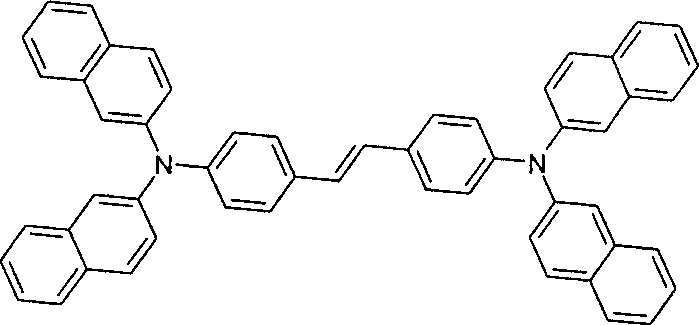

Besonders bevorzugte Triarylamin-Emitter sind: 
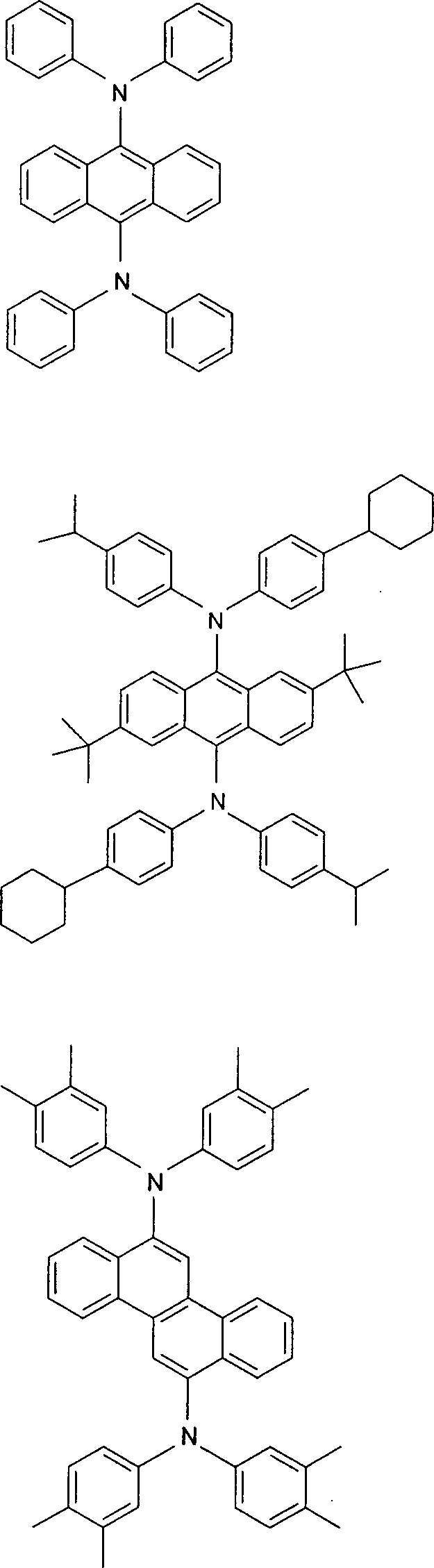


Weitere bevorzugte Emitter sind gewählt aus Derivaten von Naphthalin, Anthracen, Tetracen, Benzanthracen, Benzphenanthren (
Von den Anthracenverbindungen sind besonders bevorzugt in 9,10-Position substituierte Anthracene wie z. B. 9,10-Diphenylanthracen und 9,10-Bis(phenylethynyl)anthracen. Auch 1,4-Bis(9'-ethynylanthracenyl)benzol ist ein bevorzugter Dotand. Ebenfalls bevorzugt sind Derivate von Rubren, Cumarin, Rhodamin, Chinacridon wie z. B. DMQA (=N,N'-dimethylchinacridon), Dicyanomethylenpyran wie z. B. DCM (=4-(dicyanoethylen)-6-(4-dimethylaminostyryl-2-methyl)-4H-pyran), Thiopyran, Polymethin, Pyrylium- und Thiapyryliumsalzen, Periflanthen und Indenoperylen.Of the anthracene compounds are particularly preferably in the 9,10-position substituted anthracenes such. B. 9,10-Diphenylanthracen and 9,10-bis (phenylethynyl) anthracene. Also 1,4-bis (9'-ethynylanthracenyl) Benzene is a preferred dopant. Also preferred are derivatives of rubrene, coumarin, rhodamine, quinacridone such as. B. DMQA (= N, N'-dimethylquinacridone), Dicyanomethylenpyran such. B. DCM (= 4- (dicyanoethylene) -6- (4-dimethylaminostyryl-2-methyl) -4H-pyran), thiopyran, polymethine, pyrylium and thiapyrylium salts, periflanthene and indenoperylene.
Blaue Fluoreszenzemitter sind vorzugsweise Polyaromaten wie z. B. 9,10-Di(2-naphthylanthracen) und andere Anthracen-Derivate, Derivate von Tetracen, Xanthen, Perylen wie z. B. 2,5,8,11-Tetra-t-butyl-Perylen, Phenylen, z. B. 4,4'-(Bis(9-ethyl-3-carbazovinylen)-1,1'-biphenyl, Fluoren, Fluoranthen, Arylpyrene (
Weitere bevorzugte blaue Fluoreszenzemitter sind in
Weitere bevorzugte blau fluoreszierende Emitter sind die in der
Als phosphoreszierende Verbindungen (Triplett-Emitter) eignen sich insbesondere Verbindungen, die bei geeigneter Anregung Licht, vorzugsweise im sichtbaren Bereich, emittieren und außerdem mindestens ein Atom der Ordnungszahl größer 38 und kleiner 84, besonders bevorzugt größer 56 und kleiner 80 enthalten.Suitable phosphorescent compounds (triplet emitters) are, in particular, compounds which emit light, preferably in the visible range, when suitably excited, and also contain at least one atom of atomic number greater than 38 and less than 84, particularly preferably greater than 56 and less than 80.
Beispiele der oben beschriebenen Emitter können der
In einer weiteren erfindungsgemäßen Ausführungsform umfasst der Triplett-Emitter vorzugsweise eine metallorganische Verbindungseinheit. Die metallorganische Verbindungseinheit ist vorzugsweise eine metallorganische Koordinationsverbindung. Unter einer metallorganischen Koordinationsverbindung versteht man eine Verbindung mit einem Metallatom oder -ion im Zentrum der Verbindung umgeben von einer organischen Verbindung als Ligand. Eine metallorganische Koordinationsverbindung ist zudem dadurch charakterisiert, dass ein Kohlenstoffatom des Liganden über eine Koordinationsbindung an das Zentralmetall bindet.In a further embodiment according to the invention, the triplet emitter preferably comprises an organometallic compound unit. The organometallic compound unit is preferably an organometallic coordination compound. By an organometallic coordination compound is meant a compound having a metal atom or ion in the center of the compound surrounded by an organic compound as a ligand. An organometallic coordination compound is further characterized in that a carbon atom of the ligand binds via a coordination bond to the central metal.
Vorzugsweise ist die Triplett-Emitterverbindung ein Metallkomplex umfassend ein Metall ausgewählt aus der Gruppe bestehend aus den Übergangsmetallen, den seltenen Erden, den Lanthanoiden und den Actinoiden, vorzugsweise Ir, Ru, Os, Eu, Au, Pt, Cu, Zn, Mo, W, Rh, Pd und Ag, besonders bevorzugt Ir.Preferably, the triplet emitter compound is a metal complex comprising a metal selected from the group consisting of the transition metals, the rare earths, the lanthanides and the actinides, preferably Ir, Ru, Os, Eu, Au, Pt, Cu, Zn, Mo, W , Rh, Pd and Ag, more preferably Ir.
Des Weiteren bevorzugt ist, dass der organische Ligand ein Chelatligand ist. Unter einem Chelatligand versteht man einen zwei- oder mehrzähnigen Ligand, der entsprechend über zwei oder mehr Atome an das Zentralmetall binden kann.It is further preferred that the organic ligand is a chelate ligand. A chelate ligand is understood as meaning a bidentate or polydentate ligand which can bind to the central metal via two or more atoms accordingly.
Die erfindungsgemäßen Polymere können in einem oder mehreren Lösungsmitteln gelöst werden. Gegenstand der vorliegenden Erfindung sind somit weiterhin Lösungen und Formulierungen aus einem oder mehreren erfindungsgemäßen Polymeren oder Elends in einem oder mehreren Lösungsmitteln. Wie solche Lösungen hergestellt werden können, ist dem Fachmann bekannt und beispielsweise in der
Diese Lösungen können verwendet werden, um dünne Polymerschichten herzustellen, zum Beispiel durch Flächenbeschichtungsverfahren (z. B. Spin-Coating) oder durch Druckverfahren (z. B. InkJet-Printing).These solutions can be used to prepare thin polymer layers, for example, by area coating methods (eg, spin coating) or by printing methods (eg, inkjet printing).
Erfindungsgemäß bevorzugt sind auch Polymere mit Struktureinheiten der Formel (I), welche zusätzlich eine oder mehrere polymerisierbare, und damit vernetzbare Gruppen enthalten. Diese eignen sich besonders zur Herstellung von Filmen oder Beschichtungen, insbesondere zur Herstellung von strukturierten Beschichtungen, z. B. durch thermische oder lichtinduzierte in-situ-Polymerisation und in-situ-Vernetzung, wie beispielsweise in-situ-UV-Photopolymerisation oder Photopatterning. Besonders bevorzugt für solche Anwendungen sind erfindungsgemäße Polymere mit einer oder mehreren zusätzlichen polymerisierbaren Gruppen, ausgewählt aus Acrylat, Methacrylat, Vinyl, Epoxy und Oxetan. Dabei können sowohl entsprechende Polymere in Reinsubstanz verwendet werden, es können aber auch Formulierungen oder Elends dieser Polymere wie oben beschrieben verwendet werden. Diese können mit oder ohne Zusatz von Lösungsmitteln und/oder Bindemitteln verwendet werden. Geeignete Materialien, Verfahren und Vorrichtungen für die oben beschriebenen Verfahren sind z. B. in der
Das erfindungsgemäße Polymer oder die weiteren polymeren, oligomeren oder dendrimeren Verbindungen des Elends können zu den oben genannten Struktureinheiten unterschiedliche zusätzliche Struktureinheiten aufweisen, welche beispielsweise aus den folgenden Klassen stammen:
Gruppe 1: Einheiten, welche die Lochinjektions- und/oder Lochtransporteigenschaften der Polymere erhöhen;
Gruppe 2: Einheiten, welche die Elektroneninjektions- und/oder Elektronentransporteigenschaften der Polymere erhöhen;
Gruppe 3: Einheiten, die Kombinationen von Einzeleinheiten der Gruppe 1 und Gruppe 2 aufweisen;
Gruppe 4: Einheiten, welche die Emissionscharakteristik insoweit verändern, dass Elektrophosphoreszenz statt Elektrofluoreszenz erhalten werden kann;
Gruppe 5: Einheiten, welche den Übergang vom so genannten Singulett- zum Triplettzustand verbessern;
Gruppe 6: Einheiten, welche die Emissionsfarbe der resultierenden Polymere beeinflussen;
Gruppe 7: Einheiten, welche typischerweise als Backbone verwendet werden;
Gruppe 8: Einheiten, welche die morphologischen/filmbildungs-Eigenschaften und/oder die rheologischen Eigenschaften der resultierenden Polymere beeinflussen.The polymer according to the invention or the other polymeric, oligomeric or dendrimeric compounds of the blends can have, for the structural units mentioned above, different additional structural units derived, for example, from the following classes:
Group 1: units which increase the hole injection and / or hole transport properties of the polymers;
Group 2: units which increase the electron injection and / or electron transport properties of the polymers;
Group 3: units comprising combinations of Group 1 and Group 2 individual units;
Group 4: units which change the emission characteristics to the extent that electrophosphorescence can be obtained instead of electrofluorescence;
Group 5: units which improve the transition from the so-called singlet to triplet state;
Group 6: units which influence the emission color of the resulting polymers;
Group 7: units typically used as backbone;
Group 8: units which influence the morphological / film-forming properties and / or the rheological properties of the resulting polymers.
Die Struktureinheiten können als einzelne Moleküle, Verbindungen oder als Oligomere bzw. Polymere vorliegen. Bevorzugte Polymere oder Verbindungen sind solche, bei denen mindestens eine Struktureinheit Ladungstransporteigenschaften aufweist, d. h. die Einheiten aus der Gruppe 1 und/oder 2 enthalten.The structural units can be present as individual molecules, compounds or as oligomers or polymers. Preferred polymers or compounds are those in which at least one structural unit has charge transport properties, d. H. contain the units from group 1 and / or 2.
Struktureinheiten aus der Gruppe 1, die Lochinjektions- und/oder Lochtransporteigenschaften aufweisen, sind z. B. Triarylamin-, Benzidin-, Tetraaryl-para-phenylendiamin-, Triarylphosphin-, Phenothiazin-, Phenoxazin-, Dihydrophenazin-, Thianthren-, Dibenzo-para-dioxin-, Phenoxathiin-, Carbazol-, Azulen-, Thiophen-, Pyrrol- und Furanderivate und weitere O-, S-, Se- oder N-haltige Heterocyclen mit hoch liegendem HOMO (HOMO = höchstes besetztes Molekülorbital). Vorzugsweise führen diese Arylamine und Heterocyclen zu einem HOMO im Polymer von mehr als –5,8 eV (gegen Vakuumlevel), besonders bevorzugt von mehr als –5,5 eV.Group 1 structural units which have hole injection and / or hole transport properties are e.g. Triarylamine, benzidine, tetraaryl-para-phenylenediamine, triarylphosphine, phenothiazine, phenoxazine, dihydrophenazine, thianthrene, dibenzo-para-dioxin, phenoxathiin, carbazole, azulenes, thiophene, pyrrole - and furan derivatives and other O-, S-, Se- or N-containing heterocycles with high-lying HOMO (HOMO = highest occupied molecular orbital). Preferably, these arylamines and heterocycles lead to a HOMO in the polymer of greater than -5.8 eV (at vacuum level), more preferably greater than -5.5 eV.
Struktureinheiten aus der Gruppe 2, die Elektroneninjektions- und/oder Elektronentransporteigenschaften aufweisen, sind z. B. Pyridin-, Pyrimidin-, Pyridazin-, Pyrazin-, Oxadiazol-, Chinolin-, Chinoxalin-, Anthracen-, Benzanthracen-, Pyren-, Perylen-, Benzimidazol-, Triazin-, Keton-, Phosphinoxid- und Phenazinderivate, aber auch Triarylborane und weitere O-, S- oder N-haltige Heterocyclen mit niedrig liegendem LUMO (LUMO = niedrigstes unbesetztes Molekülorbital). Vorzugsweise führen diese Einheiten im Polymer zu einem LUMO von weniger als –1,5 eV (gegen Vakuumlevel), besonders bevorzugt von weniger als –2,0 eV.Group 2 structural units having electron injection and / or electron transport properties are e.g. Pyridine, pyrimidine, pyridazine, pyrazine, oxadiazole, quinoline, quinoxaline, anthracene, benzanthracene, pyrene, perylene, benzimidazole, triazine, ketone, phosphine oxide and phenazine derivatives, but also triarylboranes and other O-, S- or N-containing heterocycles with low-lying LUMO (LUMO = lowest unoccupied molecular orbital). Preferably, these units in the polymer result in a LUMO of less than -1.5 eV (at vacuum level), more preferably less than -2.0 eV.
Es kann bevorzugt sein, wenn in den Polymeren Einheiten aus der Gruppe 3 enthalten sind, in denen Strukturen, welche die Lochmobilität und welche die Elektronenmobilität erhöhen (also Einheiten aus Gruppe 1 und 2), direkt aneinander gebunden sind oder Strukturen enthalten sind, die sowohl die Lochmobilität als auch die Elektronenmobilität erhöhen. Einige dieser Einheiten können als Emitter dienen und verschieben die Emissionsfarbe ins Grüne, Gelbe oder Rote. Ihre Verwendung eignet sich also beispielsweise für die Erzeugung anderer Emissionsfarben aus ursprünglich blau emittierenden Polymeren.It may be preferred to include in the polymers units from
Struktureinheiten aus der Gruppe 4 sind solche, welche auch bei Raumtemperatur mit hoher Effizienz aus dem Triplettzustand Licht emittieren können, also Elektrophosphoreszenz statt Elektrofluoreszenz zeigen, was häufig eine Steigerung der Energieeffizienz bewirkt. Hierfür eignen sich zunächst Verbindungen, welche Schweratome mit einer Ordnungszahl von mehr als 36 enthalten. Bevorzugt sind Verbindungen, welche d- oder f-Übergangsmetalle enthalten, die die o. g. Bedingung erfüllen. Besonders bevorzugt sind hier entsprechende Struktureinheiten, welche Elemente der Gruppe 8 bis 10 (Ru, Os, Rh, Ir, Pd, Pt) enthalten. Als Struktureinheiten für die erfindungsgemäßen Polymeren kommen hier z. B. verschiedene Komplexe in Frage, wie sie z. B. in der
Struktureinheiten aus der Gruppe 5 sind solche, welche den Übergang vom Singulett- zum Triplettzustand verbessern und welche, unterstützend zu den Struktureinheiten der Gruppe 4 eingesetzt, die Phosphoreszenzeigenschaften dieser Struktureinheiten verbessern. Hierfür kommen insbesondere Carbazol- und überbrückte Carbazoldimereinheiten in Frage, wie sie z. B. in der
Struktureinheiten aus der Gruppe 6 sind neben den oben genannten solche, die mindestens noch eine weitere aromatische oder eine andere konjugierte Struktur aufweisen, welche nicht unter die o. g. Gruppen fallen, d. h. die die Ladungsträgermobilitäten nur wenig beeinflussen, die keine metallorganischen Komplexe sind oder die keinen Einfluss auf den Singulett-Triplett-Übergang haben. Derartige Strukturelemente können die Emissionsfarbe der resultierenden Polymere beeinflussen. Je nach Einheit können sie daher auch als Emitter eingesetzt werden. Bevorzugt sind dabei aromatische Strukturen mit 6 bis 40 C-Atomen oder auch Tolan-, Stilben- oder Bisstyrylarylenderivate, die jeweils mit einem oder mehreren Resten R substituiert sein können. Besonders bevorzugt ist dabei der Einbau von 1,4-Phenylen-, 1,4-Naphthylen-, 1,4- oder 9,10-Anthrylen-, 1,6-, 2,7- oder 4,9-Pyrenylen-, 3,9- oder 3,10-Perylenylen-, 4,4'-Biphenylylen-, 4,4''-Terphenylylen-, 4,4'-Bi-1,1'-naphthylylen-, 4,4'-Tolanylen-, 4,4'-Stilbenylen-, 4,4''-Bisstyrylarylen-, Benzothiadiazol- und entsprechenden Sauerstoffderivaten, Chinoxalin-, Phenothiazin-, Phenoxazin-, Dihydrophenazin-, Bis(thiophenyl)arylen-, Oligo(thiophenylen)-, Phenazin-, Rubren-, Pentacen- oder Perylenderivaten, die vorzugsweise substituiert sind, oder vorzugsweise konjugierte Push-Pull-Systeme (Systeme, die mit Donor- und Akzeptorsubstituenten substituiert sind) oder Systeme wie Squarine oder Chinacridone, die vorzugsweise substituiert sind.Structural units from the group 6 are, in addition to those mentioned above, those which have at least one further aromatic or another conjugated structure which is not classified under the above-mentioned. Fall groups, d. H. which have little influence on charge-carrier mobilities, which are not organometallic complexes or have no influence on the singlet-triplet transition. Such structural elements can influence the emission color of the resulting polymers. Depending on the unit, they can therefore also be used as emitters. Aromatic structures having from 6 to 40 carbon atoms or else tolan, stilbene or bisstyrylarylene derivatives which may each be substituted by one or more radicals R are preferred. Particularly preferred is the incorporation of 1,4-phenylene, 1,4-naphthylene, 1,4- or 9,10-anthrylene, 1,6-, 2,7- or 4,9-pyrenylene, 3,9- or 3,10-perylenylene, 4,4'-biphenylylene, 4,4 "-terphenylylene, 4,4'-bi-1,1'-naphthylylene, 4,4'-tolanylene , 4,4'-stilbenylene, 4,4 "-bisstyrylarylene, benzothiadiazole and corresponding oxygen derivatives, quinoxaline, phenothiazine, phenoxazine, dihydrophenazine, bis (thiophenyl) arylene, oligo (thiophenylene), Phenazine, rubrene, pentacene or perylene derivatives, which are preferably substituted, or preferably conjugated push-pull systems (systems substituted with donor and acceptor substituents) or systems such as squarins or quinacridones, which are preferably substituted.
Struktureinheiten aus der Gruppe 7 sind Einheiten, die aromatische Strukturen mit 6 bis 40 C-Atomen beinhalten, welche typischerweise als Polymergrundgerüst (Backbone) verwendet werden. Dies sind beispielsweise 4,5-Dihydropyrenderivate, 4,5,9,10-Tetrahydropyrenderivate, Fluorenderivate, 9,9'-Spirobifluorenderivate, Phenanthrenderivate, 9,10-Dihydrophenanthrenderivate, 5,7-Dihydrodibenzooxepinderivate und cis- und trans-Indenofluorenderivate.Group 7 structural units are units containing aromatic structures having from 6 to 40 carbon atoms, which are typically used as a backbone. These are, for example, 4,5-dihydropyrene derivatives, 4,5,9,10-tetrahydropyrene derivatives, fluorene derivatives, 9,9'-spirobifluorene derivatives, phenanthrene derivatives, 9,10-dihydrophenanthrene derivatives, 5,7-dihydrodibenzooxepine derivatives and cis- and trans-indenofluorene derivatives.
Struktureinheiten aus der Gruppe 8 sind solche, die die morphologischen/filmbildungs-Eigenschaften und/oder die rheologischen Eigenschaften der Polymere beeinflussen, wie z. B. Siloxane, lange Alkylketten oder fluorierte Gruppen, aber auch besonders steife oder flexible Einheiten, wie z. B. flüssigkristallbildende Einheiten oder vernetzbare Gruppen.Group 8 structural units are those which influence the morphological / filming properties and / or the rheological properties of the polymers, such as e.g. As siloxanes, long alkyl chains or fluorinated groups, but also particularly rigid or flexible units, such as. B. liquid crystal-forming units or crosslinkable groups.
Bevorzugt sind Polymere, die ein oder mehrere Einheiten ausgewählt aus den Gruppen 1 bis 8 enthalten. Es kann ebenfalls bevorzugt sein, wenn gleichzeitig mehr als eine Struktureinheit aus einer Gruppe vorliegt.Preference is given to polymers which contain one or more units selected from groups 1 to 8. It may also be preferred if more than one structural unit from a group is present at the same time.
Ebenfalls bevorzugt ist es, wenn die Polymere Einheiten enthalten, die den Ladungstransport oder die Ladungsinjektion verbessern, also Einheiten aus der Gruppe 1 und/oder 2; besonders bevorzugt ist ein Anteil von 0,5 bis 30 mol-% dieser Einheiten; ganz besonders bevorzugt ist ein Anteil von 1 bis 10 mol-% dieser Einheiten.It is likewise preferred if the polymers contain units which improve the charge transport or the charge injection, that is to say units from group 1 and / or 2; particularly preferred is a proportion of 0.5 to 30 mol% of these units; very particular preference is given to a proportion of from 1 to 10 mol% of these units.
Besonders bevorzugt ist es weiterhin, wenn die Polymere Struktureinheiten aus der Gruppe 7 und Einheiten aus der Gruppe 1 und/oder 2 enthalten, insbesondere mindestens 50 mol-% Einheiten aus der Gruppe 7 und 0,5 bis 30 mol-% Einheiten aus der Gruppe 1 und/oder 2.It is furthermore particularly preferred if the polymers contain structural units from group 7 and units from group 1 and / or 2, in particular at least 50 mol% of units from group 7 and 0.5 to 30 mol% of units from the group 1 and / or 2.
Die Synthese der oben beschriebenen Einheiten aus der Gruppe 1 bis 8 sowie der weiteren emittierenden Einheiten ist dem Fachmann bekannt und in der Literatur, z. B. in der
Ein weiterer Gegenstand der Erfindung ist eine Verbindung der allgemeinen Formel (III). 
Ln ist eine substituierte oder unsubstituierte aromatische, heteroaromatische oder nicht-aromatische Gruppe, oder eine Alkylen-, Alkenylen- oder Alkinylen-Gruppe, wobei 3 ≥ n ≥ 1 ist;
R1 bis R9 sind jeweils unabhängig voneinander H, D, F, Cl, Br, I, N(R10)2, N(Ar)2, C(=O)Ar, P(=O)Ar2, S(=O)Ar, S(=O)2Ar, CR10=CR10Ar, CN, NO2, Si(R10)3, B(OR10)2, OSO2R10, eine geradkettige Alkyl-, Alkenyl-, Alkinyl-, Alkoxy- oder Thioalkoxygruppe mit 1 bis 40 C-Atomen oder eine verzweigte oder cyclische Alkyl-, Alkenyl-, Alkinyl-, Alkoxy- oder Thioalkoxygruppe mit 3 bis 40 C-Atomen ist, die jeweils mit einem oder mehreren Resten R10 substituiert sein kann, wobei eine oder mehrere nicht benachbarte CH2-Gruppen durch R10C=CR10, C≡C, Si(R10)2, Ge(R10)2, Sn(R10)2, C=O, C=S, C=Se, C=NR10, P(=O)(R10), SO, SO2, NR10, O, S oder CONR10 ersetzt sein können und wobei ein oder mehrere H-Atome durch F, Cl, Br, I, CN oder NO2 ersetzt sein können, oder eine Aryl- oder Heteroarylgruppe mit 5 bis 60 Ringatomen, die jeweils durch einen oder mehrere Reste R10 substituiert sein kann, oder ein aromatisches oder heteroaromatisches Ringsystem mit 5 bis 40 aromatischen Ringatomen, das jeweils durch einen oder mehrere Reste R10 substituiert sein kann, oder eine Aryloxy- oder Heteroaryloxygruppe mit 5 bis 40 aromatischen Ringatomen, die durch einen oder mehrere Reste R10 substituiert sein kann, oder eine Kombination dieser Systeme; wobei zwei oder mehrere Substituenten R1 bis R9 auch miteinander ein mono- oder polycyclisches, aliphatisches oder aromatisches Ringsystem bilden können, wobei mindestens ein Vertreter aus R1 bis R9 K-(Ar)m ist, wobei m größer oder gleich 1 ist;
R10 ist jeweils unabhängig voneinander H, D oder ein aliphatischer oder aromatischer Kohlenwasserstoffrest mit 1 bis 20 C-Atomen;
K ist bei jedem Auftreten jeweils unabhängig voneinander eine kovalente Bindung, eine substituierte oder unsubstituierte aromatische, heteroaromatische oder nicht-aromatische Gruppe, oder eine Alkylen-, Alkenylen- oder Alkinylen-Gruppe;
Ar bedeutet bei jedem Auftreten unabhängig voneinander eine substituierte oder unsubstituierte Arylgruppe, Aryloxygruppe Heteroarylgruppe, Heteroaryloxygruppe, ein aromatisches oder heteroaromatisches Ringsystem oder eine nicht-aromatische Gruppe;
Z ist eine polymerisierbare Gruppe.Another object of the invention is a compound of general formula (III).
L n is a substituted or unsubstituted aromatic, heteroaromatic or non-aromatic group, or an alkylene, alkenylene or alkynylene group, wherein 3 ≥ n ≥ 1;
R 1 to R 9 are each independently H, D, F, Cl, Br, I, N (R 10 ) 2 , N (Ar) 2 , C (= O) Ar, P (= O) Ar 2 , S (= O) Ar, S (= O) 2 Ar, CR 10 = CR 10 Ar, CN, NO 2 , Si (R 10 ) 3 , B (OR 10 ) 2 , OSO 2 R 10 , a straight-chain alkyl, Alkenyl, alkynyl, alkoxy or thioalkoxy group having 1 to 40 carbon atoms or a branched or cyclic alkyl, alkenyl, alkynyl, alkoxy or thioalkoxy group having 3 to 40 carbon atoms, each containing one or more R 10 may be substituted by one or more non-adjacent CH 2 groups by R 10 C = CR 10 , C≡C, Si (R 10 ) 2 , Ge (R 10 ) 2 , Sn (R 10 ) 2 , C = O, C = S, C = Se, C = NR 10 , P (= O) (R 10 ), SO, SO 2 , NR 10 , O, S or CONR 10 may be replaced and wherein one or more H Atoms may be replaced by F, Cl, Br, I, CN or NO 2 , or an aryl or heteroaryl group having 5 to 60 ring atoms, each of which may be substituted by one or more R 10 , or an aromatic or heteroaromatic ring system with 5 to 40 aromatic ring atoms, which may each be substituted by one or more radicals R 10 , or an aryloxy or heteroaryloxy group having 5 to 40 aromatic ring atoms, which may be substituted by one or more radicals R 10 , or a combination of these systems ; where two or more substituents R 1 to R 9 can also together form a mono- or polycyclic, aliphatic or aromatic ring system, where at least one of R 1 to R 9 is K- (Ar) m , where m is greater than or equal to 1 ;
R 10 is independently H, D or an aliphatic or aromatic hydrocarbon radical having 1 to 20 C atoms;
Each of K's occurrence is independently a covalent bond, a substituted or unsubstituted aromatic, heteroaromatic or non-aromatic group, or an alkylene, alkenylene or alkynylene group;
Ar at each occurrence independently represents a substituted or unsubstituted aryl group, aryloxy group, heteroaryl group, heteroaryloxy group, an aromatic or heteroaromatic ring system or a non-aromatic group;
Z is a polymerizable group.
Ein weiterer Gegenstand der Erfindung ist eine Monomerenzusammensetzung enthaltend ein substitutiertes oder unsubstituiertes Styrol und eine Verbindung der allgemeinen Formel (III) 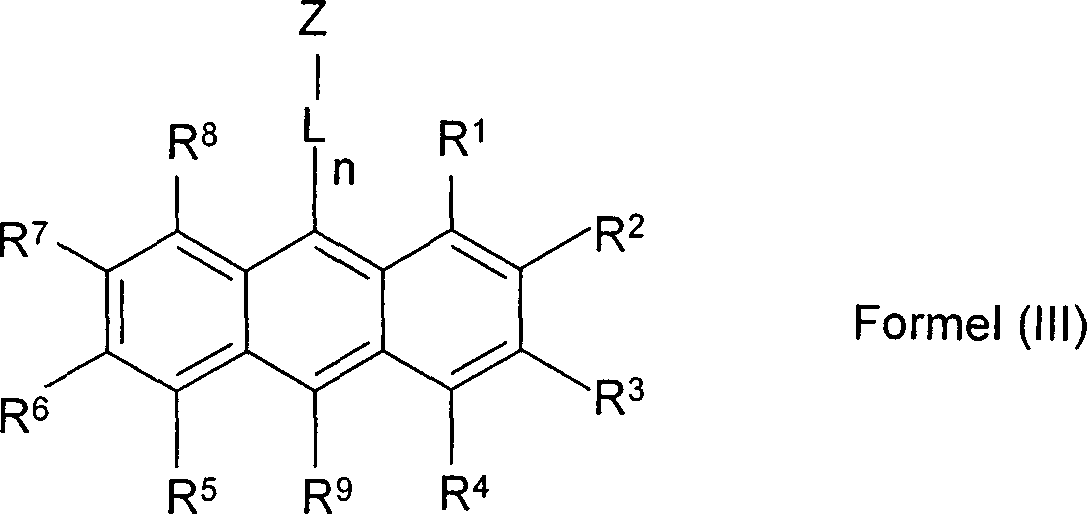
Vorzugsweise ist Z ausgewählt aus der Gruppe bestehend aus Oxetan, Epoxid, Vinyl, Vinylether, Vinylester, Vinylamid, Acrylat, Methacrylat, Acryl- und Methacrylamid. Ebenso kann die polymerisierbare Gruppe eine solche sein, die sich zur kationischen, anionischen oder ringöffnenden Polymerisation eignet.Another object of the invention is a monomer composition containing a substituted or unsubstituted styrene and a compound of general formula (III)
Preferably Z is selected from the group consisting of oxetane, epoxide, vinyl, vinyl ethers, vinyl esters, vinyl amide, acrylate, methacrylate, acrylic and methacrylamide. Likewise, the polymerizable group may be one which is suitable for cationic, anionic or ring-opening polymerization.
In dem Monomer bzw. der Monomerenzusammensetzung kann einer oder mehrere der Reste R1 bis R9 der allgemeinen Formel (III) jeweils unabhängig voneinander eine Elektronentransportgruppe, eine Elektroneninjektionsgruppe, eine Elektronenblockiergruppe, eine Lochtransportgruppe, eine Loch injektionsgruppe, eine Lochblockiergruppe, eine Photonenabsorptionsgruppe, eine Excitonen erzeugende Gruppe und/oder eine Emittergruppe sein. In the monomer or monomer composition, one or more of R 1 to R 9 of the general formula (III) may each independently be an electron transport group, an electron injection group, an electron blocking group, a hole transport group, a hole injection group, a hole blocking group, a photon absorption group, a Exciton generating group and / or an emitter group.
In einer weiteren Ausführungsform ist es bevorzugt, dass das erfindungsgemäße Monomer bzw. die erfindungsgemäße Monomerenzusammensetzung ein oder mehrere Lösungsmittel enthält. Dabei handelt es sich um eine flüssige Formulierung, die sich zur Polymerisation bzw. Copolymerisation eignet. Solch eine Formulierung ist ebenfalls Gegenstand der vorliegenden Erfindung. Geeignete und bevorzugte Lösungsmittel für die Formulierung sind vorzugsweise aprotische Lösungsmittel, beispielsweise Toluol, Xylol, Dimethylether oder Tetrahydrofuran.In a further embodiment, it is preferred that the monomer or the monomer composition according to the invention contains one or more solvents. It is a liquid formulation which is suitable for polymerization or copolymerization. Such a formulation is also an object of the present invention. Suitable and preferred solvents for the formulation are preferably aprotic solvents, for example toluene, xylene, dimethyl ether or tetrahydrofuran.
Der Anteil des Monomeren bzw. der Monomerenzusammensetzung im Lösungsmittel bzw. Lösungsmittelgemisch beträgt vorzugsweise 0,1 bis 90 Gew.-%, besonders bevorzugt 1 bis 80 Gew.-%, und insbesondere 2 bis 70 Gew.-%, bezogen auf die gesamte Zusammensetzung.The proportion of the monomer or the monomer composition in the solvent or solvent mixture is preferably 0.1 to 90 wt .-%, particularly preferably 1 to 80 wt .-%, and in particular 2 to 70 wt .-%, based on the total composition ,
Das Monomer bzw. die Monomerenzusammensetzung kann ferner weitere Hilfsmittel, wie z. B. Stabilisatoren, Stoffe, welche die Filmbildung unterstützen, Sensibilisatoren und dergleichen umfassen.The monomer or the monomer composition may further further aids, such as. Stabilizers, fabrics which aid in film formation, sensitizers and the like.
Das erfindungsgemäße Monomer bzw. die erfindungsgemäße Monomerenzusammensetzung kann zur Herstellung eines Polymers verwendet werden. Vorzugsweise erfolgt die Herstellung des Polymers durch kationische, anionische, radikalische, ringöffnende oder koordinative Polymerisation.The monomer or the monomer composition according to the invention can be used to prepare a polymer. The preparation of the polymer is preferably carried out by cationic, anionic, free-radical, ring-opening or coordinative polymerization.
Das erfindungsgemäße Polymer oder ein erfindungsgemäßes Blend kann wiederum in einem Lösungsmittel bzw. Lösungsmittelgemisch gelöst werden, wodurch eine Formulierung erhalten wird (siehe oben), die zur Herstellung von elektronischen Vorrichtungen geeignet ist.The polymer or a blend according to the invention can in turn be dissolved in a solvent or solvent mixture, thereby obtaining a formulation (see above) which is suitable for the production of electronic devices.
Die Formulierung kann ferner weitere Komponenten wie beispielsweise weitere funktionelle Komponenten (Ladungstransport- bzw. Ladungsinjektionseinheiten, Emittereinheiten oder dergleichen) enthalten sowie Komponenten, welche die Filmbildung verbessern, die zur Verbesserung der Ladungsträgerinjektion oder -leitung oder zum Blockieren einzelner Ladungsträger dienen. Die weiteren funktionellen Komponenten können beispielsweise die in den oben genannten Struktureinheiten der Gruppen 1 bis 8 genannten sein.The formulation may further contain other components such as other functional components (charge-transporting units, emitter units, or the like) as well as components that enhance film formation, which serve to improve carrier injection or conduction, or to block individual carriers. The other functional components may be, for example, those mentioned in the abovementioned structural units of groups 1 to 8.
Das erfindungsgemäße Polymer oder der Blend zeigen nach dem Auftragen aus Lösung auf ein Substrat hervorragende Filmbildungseigenschaften. Zudem weist das Polymer oder der Blend hervorragende tiefblaue Farbkoordinaten auf.The polymer or blend of the present invention exhibits excellent film-forming properties after coating from solution onto a substrate. In addition, the polymer or blend has excellent deep blue color coordinates.
Das Polymer wird dabei vorzugsweise aus Lösung aufgebracht, wobei das Polymer in der elektronischen Vorrichtung nach Entfernen des Lösungsmittels oder Lösungsmittelgemisches entsprechend als Schicht vorliegt. Die Schicht kann dabei eine Lochtransportschicht, eine Lochinjektionsschicht, eine Lochblockierschicht, eine Emitterschicht, eine Elektronen blockierschicht, eine Elektronentransportschicht, eine Elektroneninjektionsschicht, eine Emitterschicht, eine Ladungserzeugungsschicht, eine Photonenabsorptionsschicht und/oder eine Zwischenschicht (Interlayer) sein. Vorzugsweise ist es eine Emitterschicht. Die entsprechenden funktionellen Einheiten in der Schicht können dabei entweder an das Polymer gebunden sein, indem einer oder mehrere der Reste R1 bis R9 in der allgemeinen Formel (I) mit einer entsprechenden Gruppe substituiert ist bzw. es können die funktionellen Einheiten in der Formulierung als Mischung mit dem Polymer vorliegen, sodass diese nach dem Auftragen der Formulierung und Entfernung des Lösungsmittels verteilt in der Schicht vorliegen, jedoch nicht an das Polymer kovalent gebunden sind.The polymer is preferably applied from solution, wherein the polymer is present in the electronic device after removing the solvent or solvent mixture accordingly as a layer. The layer may be a hole transport layer, a hole injection layer, a hole blocking layer, an emitter layer, an electron blocking layer, an electron transport layer, an electron injection layer, an emitter layer, a charge generation layer, a photon absorption layer and / or an interlayer. It is preferably an emitter layer. The corresponding functional units in the layer can either be bound to the polymer by one or more of the radicals R 1 to R 9 in the general formula (I) is substituted with a corresponding group or it can be the functional units in the formulation present as a mixture with the polymer so that they are distributed in the layer after application of the formulation and removal of the solvent, but are not covalently bonded to the polymer.
Ein weiterer Gegenstand der vorliegenden Erfindung ist eine elektronische Vorrichtung enthaltend ein Polymer oder Blend, wie oben definiert. Wie oben bereits ausgeführt, ist es bevorzugt, dass das Polymer in der elektronischen Vorrichtung in einer Schicht vorliegt. Entsprechend kann die Schicht eine Lochtransportschicht, eine Lochinjektionsschicht, eine Lochblockierschicht, eine Emitterschicht, eine Elektronenblockierschicht, eine Elektronentransportschicht, eine Elektroneninjektionsschicht, eine Emitterschicht, eine Ladungserzeugungsschicht, eine Photonenabsorptionsschicht und/oder eine Zwischenschicht (Interlayer) sein, vorzugsweise eine Emitterschicht.Another object of the present invention is an electronic device containing a polymer or blend as defined above. As stated above, it is preferred that the polymer be present in the electronic device in a layer. Accordingly, the layer may be a hole transport layer, a hole injection layer, a hole blocking layer, an emitter layer, an electron blocking layer, an electron transport layer, an electron injection layer, an emitter layer, a charge generation layer, a photon absorption layer and / or an interlayer, preferably an emitter layer.
Die Vorrichtung kann ferner Schichten enthalten, welche aus kleinen Molekülen aufgebaut sind (SMOLED). Diese können durch Verdampfen von kleinen Molekülen im Hochvakuum erzeugt werden.The device may further include layers composed of small molecules (SMOLED). These can be generated by evaporation of small molecules in a high vacuum.
Die organische Elektrolumineszenzvorrichtung enthält Kathode, Anode und mindestens eine emittierende Schicht. Außer diesen Schichten kann sie noch weitere Schichten enthalten, beispielsweise jeweils eine oder mehrere Lochinjektionsschichten, Lochtransportschichten, Lochblockierschichten, Elektronentransportschichten, Elektroneninjektionsschichten, Excitonenblockierschichten und/oder Ladungserzeugungsschichten (Charge-Generation Lagers, IDMC 2003, Taiwan; Session 21 OLED (5), T. Matsumoto, T. Nakada, J. Endo, K. Mori, N. Kawamura, A. Yokoi, J. Kido, Multiphoton Organic EL Device Having Charge Generation Lager). Ebenso können zwischen zwei emittierende Schichten Interlayer eingebracht sein, welche beispielsweise eine Excitonen-blockierende Funktion aufweisen. Es sei aber darauf hingewiesen, dass nicht notwendigerweise jede dieser Schichten vorhanden sein muss. Diese Schichten können die erfindungsgemäßen Polymere, wie oben definiert, enthalten. Möglich ist auch, dass mehrere OLEDs übereinander angeordnet werden, wodurch eine weitere Effizienzsteigerung hinsichtlich der Lichtausbeute erreicht werden kann. The organic electroluminescent device includes cathode, anode and at least one emitting layer. In addition to these layers, they may also contain further layers, for example one or more hole injection layers, hole transport layers, hole blocking layers, electron transport layers, electron injection layers, exciton blocking layers and / or charge generation layers (Charge-Generation Lagers, IDMC 2003, Taiwan, Session 21 OLED (5), T. Matsumoto, T. Nakada, J. Endo, K. Mori, N. Kawamura, A. Yokoi, J. Kido, Multiphoton Organic EL Device Having Charge Generation Bearing). Likewise, interlayer can be introduced between two emitting layers, which have, for example, an exciton-blocking function. It should be noted, however, that not necessarily each of these layers must be present. These layers may contain the polymers of the invention as defined above. It is also possible that several OLEDs are arranged one above the other, whereby a further increase in efficiency can be achieved with respect to the light output.
Die Elektroden (Kathode, Anode) werden im Sinne der vorliegenden Erfindung so gewählt, dass ihr Potential möglichst gut mit dem Potential der angrenzenden organischen Schicht übereinstimmt, um eine möglichst effiziente Elektronen- bzw. Lochinjektion zu gewährleisten.For the purposes of the present invention, the electrodes (cathode, anode) are chosen so that their potential coincides as well as possible with the potential of the adjacent organic layer, in order to ensure the most efficient electron or hole injection possible.
Als Kathode sind Metalle mit geringer Austrittsarbeit, Metalllegierungen, Metallkomplexe oder mehrlagige Strukturen aus verschiedenen Metallen bevorzugt, wie beispielsweise Erdalkalimetaile, Alkalimetalle, Hauptgruppenmetalle oder Lanthanide (z. B. Ca, Ba, Mg, Al, In, Mg, Yb, Sm). Bei mehrlagigen Strukturen können auch zusätzlich zu den genannten Metallen weitere Metalle verwendet werden, die eine relativ hohe Austrittsarbeit aufweisen, wie z. B. Ag, wobei dann in der Regel Kombinationen der Metalle, wie beispielsweise Ca/Ag oder Ba/Ag verwendet werden. Es kann auch bevorzugt sein, zwischen einer metallischen Kathode und dem organischen Halbleiter eine dünne Zwischenschicht eines Materials mit einer hohen Dielektrizitätskonstante einzubringen. Hierfür kommen beispielsweise Alkalimetall- oder Erdalkalimetallfluoride, aber auch die entsprechenden Oxide in Frage (z. B. LiF, Li2O, BaF2, MgO, NaF). Die Schichtdicke dieser Schicht beträgt bevorzugt zwischen 1 und 10 nm.As the cathode, low work function metals, metal alloys, metal complexes or multilayer structures of various metals are preferable, such as alkaline earth metals, alkali metals, main group metals or lanthanides (e.g., Ca, Ba, Mg, Al, In, Mg, Yb, Sm). In multilayer structures, it is also possible, in addition to the metals mentioned, to use further metals which have a relatively high work function, such as, for example, B. Ag, which then usually combinations of metals, such as Ca / Ag or Ba / Ag are used. It may also be preferred to introduce between a metallic cathode and the organic semiconductor a thin intermediate layer of a material with a high dielectric constant. For this example, alkali metal or alkaline earth metal fluorides, but also the corresponding oxides in question (eg., LiF, Li 2 O, BaF 2 , MgO, NaF). The layer thickness of this layer is preferably between 1 and 10 nm.
Als Anode sind Materialien mit hoher Austrittsarbeit bevorzugt. Vorzugsweise weist die Anode ein Potential größer 4,5 eV vs. Vakuum auf. Hierfür sind einerseits Metalle mit hohem Redoxpotential geeignet, wie beispielsweise Ag, Pt oder Au. Es können andererseits auch Metall/Metalloxid-Elektroden (z. B. Al/Ni/NiOx, Al/PtOx) bevorzugt sein. Für einige Anwendungen muss mindestens eine der Elektroden transparent sein, um entweder die Bestrahlung des organischen Materials (O-SC) oder die Auskopplung von Licht (OLED/PLED, O-LASER) zu ermöglichen. Ein bevorzugter Aufbau verwendet eine transparente Anode. Bevorzugte Anodenmaterialien sind hier leitfähige gemischte Metalloxide. Besonders bevorzugt sind Indium-Zinn-Oxid (ITO) oder Indium-Zink-Oxid (IZO). Bevorzugt sind weiterhin leitfähige, dotierte organische Materialien, insbesondere leitfähige dotierte Polymere, beispielsweise Poly(ethylendioxythiophen)/Polystyrolsulfonsäure (PEDOT/PSS) oder Polyanilin (PANI).As the anode, high workfunction materials are preferred. Preferably, the anode has a potential greater than 4.5 eV. Vacuum up. On the one hand, metals with a high redox potential, such as Ag, Pt or Au, are suitable for this purpose. On the other hand, metal / metal oxide electrodes (for example Al / Ni / NiO x , Al / PtO x ) may also be preferred. For some applications, at least one of the electrodes must be transparent to allow either the irradiation of the organic material (O-SC) or the outcoupling of light (OLED / PLED, O-LASER). A preferred construction uses a transparent anode. Preferred anode materials here are conductive mixed metal oxides. Particularly preferred are indium tin oxide (ITO) or indium zinc oxide (IZO). Preference is furthermore given to conductive, doped organic materials, in particular conductive doped polymers, for example poly (ethylenedioxythiophene) / polystyrenesulphonic acid (PEDOT / PSS) or polyaniline (PANI).
Die Vorrichtung wird in an sich bekannter Weise je nach Anwendung entsprechend strukturiert, kontaktiert und schließlich hermetisch versiegelt, da sich die Lebensdauer derartiger Vorrichtungen bei Anwesenheit von Wasser und/oder Luft drastisch verkürzt.Depending on the application, the device is structured, contacted and finally hermetically sealed in a manner known per se, since the service life of such devices is drastically shortened in the presence of water and / or air.
Die Erfindung wird im Folgenden anhand von Ausführungsbeispielen, welche jedoch nicht als beschränkend auf den Umfang der Erfindung zu verstehen sind, näher erläutert. The invention will be explained in more detail below with reference to exemplary embodiments, which, however, are not to be understood as limiting the scope of the invention.
Ausführungsbeispiele:EXAMPLES
Beispiel 1: Monomersynthese 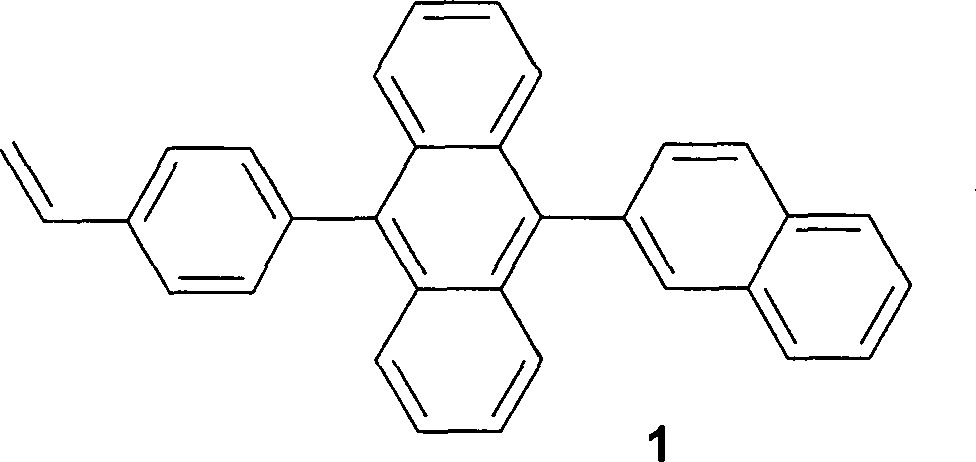
57,5 g (150 mmol) 9-Brom-10-(2-naphthyl)anthracen, 25,0 g (169 mmol) 4-Vinylbenzolboronsäure und 66,9 g Trikaliumphosphat werden vorgelegt. Dann werden 400 ml Toluol, 100 ml Dioxan und 400 ml Wasser zugegeben. Die Reaktionsmischung wird 10 Minuten entgast und nacheinander 1,37 g (4,50 mmol) Tri-o-Tolylphosphin und 168 mg (0,75 mmol) Palladiumacetat zugegeben. Nach 16 Stunden Rückfluss wird auf Raumtemperatur abgekühlt, der ausgefallene Feststoff abgesaugt und mit Ethanol gewaschen. Nach Soxlethextraktion mit Toluol wird der Feststoff erneut mit Ethanol gewaschen, die Mutterlauge eingeengt bis zu breiartiger Konsistenz, dann mit 500 ml Ethanol versetzt, der ausgefallene Feststoff abgesaugt und im Vakuum getrocknet. Die Ausbeute beträgt 20 g der Verbindung 1 in einer Reinheit von 95%. 57.5 g (150 mmol) of 9-bromo-10- (2-naphthyl) anthracene, 25.0 g (169 mmol) of 4-vinylbenzene boronic acid and 66.9 g of tripotassium phosphate are initially charged. Then 400 ml of toluene, 100 ml of dioxane and 400 ml of water are added. The reaction mixture is degassed for 10 minutes and successively added 1.37 g (4.50 mmol) of tri-o-tolylphosphine and 168 mg (0.75 mmol) of palladium acetate. After 16 hours of reflux, the mixture is cooled to room temperature, and the precipitated solid is filtered off with suction and washed with ethanol. After Soxlethextraktion with toluene, the solid is washed again with ethanol, the mother liquor concentrated to a mushy consistency, then treated with 500 ml of ethanol, the precipitated solid was filtered off and dried in vacuo. The yield is 20 g of compound 1 in a purity of 95%.
Beispiel 2: PolymersyntheseExample 2: Polymer Synthesis
Die in Tabelle 1 angegebenen Mengen an Monomer 1 (m1) werden in 200 ml trockenem Toluol gelöst, die entsprechende Menge an Styrol (mSt) zugegeben (siehe Tabelle 1) und 0,4 ml sec BuLi (c = 1,4 M) zugetropft. Innerhalb 5 Minuten erfolgt ein Farbumschlag von hellgelb nach braun. Nach 16 Stunden wird die Reaktion durch Zugabe von Methanol abgebrochen. Die Reaktionsmischung wird am Rotationsverdampfer zur Trockene eingeengt und der verbleibende Rückstand in Tetrahydrofuran (THF) aufgenommen. Durch Zugabe von Methanol wird das Polymer ausgefällt, abgesaugt und im Vakuum getrocknet. Man erhält 5 Polymere P1 bis P5 mit jeweils unterschiedlichen Monomerenanteilen (siehe Tabelle 1). Tabelle 1
Beispiel 3: Herstellung einer PLEDExample 3: Production of a PLED
Die Herstellung einer polymeren organischen Leuchtdiode (PLED) ist in der Literatur bereits vielfach beschrieben (z. B. in der

Eine typische Device hat den in
Dazu werden Substrate der Firma Technoprint (Sodalimeglas) verwendet, auf welche die ITO-Struktur (Indium-Zinn-Oxid, eine transparente, leitfähige Anode) aufgebracht wird.For this purpose, substrates from Technoprint (Sodalimeglas) are used, to which the ITO structure (indium tin oxide, a transparent, conductive anode) is applied.
Die Substrate werden im Reinraum mit DI Wasser und einem Detergens (Deconex 15 PF) gereinigt und dann durch eine UV/Ozon-Plasmabehandlung aktiviert. Danach wird ebenfalls im Reinraum als Pufferschicht eine 80 nm Schicht PEDOT (PEDOT ist ein Polythiophen-Derivat (Baytron P VAI 4083sp.) von H. C. Starck, Goslar, das als wässrige Dispersion geliefert wird) durch Spin-Coating aufgebracht. Die benötigte Spinrate hängt vom Verdünnungsgrad und der spezifischen Spincoater-Geometrie ab (typisch für 80 nm: 4500 rpm). Um Restwasser aus der Schicht zu entfernen, werden die Substrate für 10 Minuten bei 180°C auf einer Heizplatte ausgeheizt. Danach werden unter Inertgasatmosphäre (Stickstoff bzw. Argon) zunächst 20 nm einer Interlayer (typischerweise ein lochdominiertes Polymer, hier HIL-012 von Merck) und dann 65 nm der Polymerschichten aus Toluollösungen (Konzentration Interlayer 5 g/l, für die Polymere P1 bis P5 jeweils 8 g/l und damit 0,42 g/l E1) aufgebracht. Beide Schichten werden bei 180°C mindestens 10 Minuten ausgeheizt. Danach wird die Ba/Al-Kathode aufgedampft (hochreine Metalle von Aldrich, besonders Barium 99,99% (Best-Nr. 474711); Aufdampfanlagen von Lesker o. a., typischer Vakuumlevel 5 × 10⁻⁶ mbar). Um vor allem die Kathode vor Luft und Luftfeuchtigkeit zu schützen, wird die Vorrichtung abschließend verkapselt und dann charakterisiert.The substrates are cleaned in the clean room with DI water and a detergent (Deconex 15 PF) and then activated by a UV / ozone plasma treatment. Then, in the clean room as a buffer layer, an 80 nm layer of PEDOT (PEDOT is a polythiophene derivative (Baytron P VAI 4083sp.) By HC Starck, Goslar, which is supplied as an aqueous dispersion) by spin coating. The required spin rate depends on the degree of dilution and the specific spincoater geometry (typically 80 nm: 4500 rpm). To remove residual water from the layer, the substrates are baked for 10 minutes at 180 ° C on a hot plate. Thereafter, 20 nm of an interlayer (typically a hole-dominated polymer, here HIL-012 from Merck) under an inert gas atmosphere (nitrogen or argon) and then 65 nm of the polymer layers of toluene solutions (concentration interlayer 5 g / l, for the polymers P1 to P5 8 g / l each and thus 0.42 g / l E1) was applied. Both layers are baked at 180 ° C for at least 10 minutes. Thereafter, the Ba / Al cathode is vapor-deposited (high-purity metals from Aldrich, especially barium 99.99% (order No. 474711); vapor-deposition systems from Lesker, above,
Dazu werden die Devices in für die Substratgröße eigens angefertigte Halter eingespannt und mittels Federkontakten kontaktiert. Eine Photodiode mit Augenverlaufsfilter kann direkt auf den Messhalter aufgesetzt werden, um Einflüsse von Fremdlicht auszuschließen. Ein typischer Messaufbau ist in
Typischerweise werden die Spannungen von 0 bis max. 20 V in 0,2 V-Schritten erhöht und wieder erniedrigt. Für jeden Messpunkt wird der Strom durch die Vorrichtung sowie der erhaltene Photostrom von der Photodiode gemessen. Auf diese Art und Weise erhält man die IVL-Daten der Testvorrichtungen. Wichtige Kenngrößen sind die gemessene maximale Effizienz („Eff.” in cd/A) und die für 100 cd/m2 benötigte Spannung U100.Typically, the voltages are from 0 to max. 20 V in 0.2 V increments and lowered again. For each measurement point, the current through the device and the resulting photocurrent are measured by the photodiode. In this way one obtains the IVL data of the test devices. Important parameters are the measured maximum efficiency ("Eff." In cd / A) and the voltage U 100 required for 100 cd / m 2 .
Um außerdem die Farbe und das genaue Elektrolumineszenzspektrum der Testdevices zu kennen, wird nach der ersten Messung nochmals die für 100 cd/m2 benötigte Spannung angelegt und die Photodiode durch einen Spektrum-Messkopf ersetzt. Dieser ist durch eine Lichtleitfaser mit einem Spektrometer (Ocean Optics) verbunden. Aus dem gemessenen Spektrum können die Farbkoordinaten (CIE: Commission International de I'éclairage, Normalbetrachter von 1931) abgeleitet werden.In addition, in order to know the color and the exact electroluminescence spectrum of the test devices, the voltage required for 100 cd / m 2 is again applied after the first measurement and the photodiode is replaced by a spectrum measuring head. This is connected by an optical fiber with a spectrometer (Ocean Optics). From the measured spectrum, the color coordinates (CIE: Commission International de I'éclairage, normal viewer of 1931) can be derived.
Die Ergebnisse, die bei Verwendung der Polymeren P1 bis P5 in PLEDs erhalten werden, sind in Tabelle 2 zusammengefasst. Tabelle 2
Wie man aus den Ergebnissen erkennen kann, stellen die Polymere P1 bis P5 eine deutliche Verbesserung gegenüber bekannten nicht-konjugierten und konjugierten licht-emittierenden Polymeren (z. B. V1) hinsichtlich der Farbkoordinaten dar. Dadurch sind die neuen, erfindungsgemäßen Polymere deutlich besser für den Einsatz in Displays und Beleuchtungsanwendungen geeignet als Polymere gemäß dem Stand der Technik.As can be seen from the results, the polymers P1 to P5 represent a marked improvement over known non-conjugated and conjugated light-emitting polymers (eg, V1) in color coordinates the use in displays and lighting applications suitable as polymers according to the prior art.
ZITATE ENTHALTEN IN DER BESCHREIBUNG QUOTES INCLUDE IN THE DESCRIPTION
Diese Liste der vom Anmelder aufgeführten Dokumente wurde automatisiert erzeugt und ist ausschließlich zur besseren Information des Lesers aufgenommen. Die Liste ist nicht Bestandteil der deutschen Patent- bzw. Gebrauchsmusteranmeldung. Das DPMA übernimmt keinerlei Haftung für etwaige Fehler oder Auslassungen.This list of the documents listed by the applicant has been generated automatically and is included solely for the better information of the reader. The list is not part of the German patent or utility model application. The DPMA assumes no liability for any errors or omissions.
Zitierte PatentliteraturCited patent literature
- US 7250226 B2 [0003] US 7250226 B2 [0003]
- US 2007/0187673 A1 [0003] US 2007/0187673 A1 [0003]
- US 6899963 [0003] US 6899963 [0003]
- JP 2005/108556 [0004] JP 2005/108556 [0004]
- JP 2005/108552 [0004] JP 2005/108552 [0004]
- JP 2003/346277 [0004] JP 2003/346277 [0004]
- JP 2004/303483 [0004] JP 2004/303483 [0004]
- JP 2004/303488 [0004] JP 2004/303488 [0004]
- JP 2005/285661 [0004] JP 2005/285661 [0004]
- JP 2001/257076 [0004] JP 2001/257076 [0004]
- JP 2003/338375 [0004] JP 2003/338375 [0004]
- JP 2004/111228 [0004] JP 2004/111228 [0004]
- JP 2004/014325 [0004] JP 2004/014325 [0004]
- JP 2004/303490 [0004] JP 2004/303490 [0004]
- JP 2005/285466 [0004] JP 2005/285466 [0004]
- JP 2004/303489 [0004] JP 2004/303489 [0004]
- WO 02/068435 A1 [0033, 0033, 0071] WO 02/068435 A1 [0033, 0033, 0071]
- WO 02/081488 A1 [0033, 0071] WO 02/081488 A1 [0033, 0071]
- EP 1239526 A2 [0033, 0071] EP 1239526 A2 [0033, 0071]
- WO 2004/026886 A2 [0033, 0071] WO 2004/026886 A2 [0033, 0071]
- WO 2005/042548 A1 [0033, 0071] WO 2005/042548 A1 [0033, 0071]
- WO 2004/070772 A2 [0034, 0072] WO 2004/070772 A2 [0034, 0072]
- WO 2004/113468 A1 [0034, 0072] WO 2004/113468 A1 [0034, 0072]
- WO 2005/040302 A1 [0034, 0072] WO 2005/040302 A1 [0034, 0072]
- WO 05/011013 [0042] WO 05/011013 [0042]
- WO 05/039246 [0044] WO 05/039246 [0044]
- US 2005/0069729 [0044] US 2005/0069729 [0044]
- JP 2004/288381 [0044] JP 2004/288381 [0044]
- EP 1617710 [0044] EP 1617710 [0044]
- EP 1617711 [0044] EP 1617711 [0044]
- EP 1731584 [0044] EP 1731584 [0044]
- JP 2005/347160 [0044] JP 2005/347160 [0044]
- WO 04/093207 [0044] WO 04/093207 [0044]
- WO 05/003253 [0044] WO 05/003253 [0044]
- WO 07/137725 [0044] WO 07/137725 [0044]
- WO 05/111172 [0044] WO 05/111172 [0044]
- WO 06/122630 [0049] WO 06/122630 [0049]
- WO 08/006449 [0049] WO 08/006449 [0049]
- WO 07/140847 [0049] WO 07/140847 [0049]
- WO 06/000388 [0050] WO 06/000388 [0050]
- WO 06/058737 [0050] WO 06/058737 [0050]
- WO 06/000389 [0050] WO 06/000389 [0050]
- WO 07/065549 [0050] WO 07/065549 [0050]
- WO 07/115610 [0050] WO 07/115610 [0050]
- US 5121029 [0050, 0055] US 5121029 [0050, 0055]
- US 2007/0122656 A1 [0050] US 2007/0122656 A1 [0050]
- DE 102009005746 [0053] DE 102009005746 [0053]
- US 2007/0252517 A1 [0053] US 2007/0252517 A1 [0053]
- US 4769292 [0053] US 4769292 [0053]
- US 6020078 [0053] US 6020078 [0053]
- US 11/097352 [0055] US 11/097352 [0055]
- US 5130603 [0055] US 5130603 [0055]
- US 2007/0092753 A1 [0055] US 2007/0092753 A1 [0055]
- DE 102008035413 [0057] DE 102008035413 [0057]
- WO 00/70655 [0059] WO 00/70655 [0059]
- WO 01/41512 [0059] WO 01/41512 [0059]
- WO 02/02714 [0059] WO 02/02714 [0059]
- WO 02/15645 [0059] WO 02/15645 [0059]
- EP 1191613 [0059] EP 1191613 [0059]
- EP 1191612 [0059] EP 1191612 [0059]
- EP 1191614 [0059] EP 1191614 [0059]
- WO 05/033244 [0059] WO 05/033244 [0059]
- DE 102008015526 [0059] DE 102008015526 [0059]
- WO 02/072714 A1 [0063] WO 02/072714 A1 [0063]
- WO 03/019694 A2 [0063] WO 03/019694 A2 [0063]
- WO 2005/083812 A2 [0065] WO 2005/083812 A2 [0065]
- WO 2005/014689 A2 [0079] WO 2005/014689 A2 [0079]
- WO 2005/030827 A1 [0079] WO 2005/030827 A1 [0079]
- WO 2005/030828 A1 [0079] WO 2005/030828 A1 [0079]
- WO 2004/037887 A2 [0102] WO 2004/037887 A2 [0102]
Zitierte Nicht-PatentliteraturCited non-patent literature
- Angew. Chem. Int. Ed. 2006, 45, 3364–3368 [0031] Angew. Chem. Int. Ed. 2006, 45, 3364-3368 [0031]
- Nature, 1991, 353, S. 737 [0031] Nature, 1991, 353, p. 737 [0031]
- Angew. Chemie. Int. Ed. 2005, 44, 5740–5744 [0031] Angew. Chemistry. Int. Ed. 2005, 44, 5740-5744 [0031]
- C. H. Chen et al.: „Recent developments in organic electroluminescent materials” Macromol. Symp. 125, (1997) 1–48 [0056] CH Chen et al .: "Recent developments in organic electroluminescent materials" Macromol. Symp. 125, (1997) 1-48 [0056]
- ”Recent Progress of molecular organic electroluminescent materials and devices” Mat. Sci. and Eng. R, 39 (2002), 143–222 [0056] "Recent Progress of molecular organic electroluminescent materials and devices" Mat. Sci. and Eng. R, 39 (2002), 143-222 [0056]
Claims (12)


Priority Applications (4)
| Application Number | Priority Date | Filing Date | Title |
|---|---|---|---|
| DE102010006377A DE102010006377A1 (en) | 2010-01-29 | 2010-01-29 | Styrene-based copolymers, in particular for use in optoelectronic components |
| JP2012550327A JP5795336B2 (en) | 2010-01-29 | 2010-12-23 | Styrene copolymers, especially for use in optoelectronic components |
| US13/575,856 US20120298981A1 (en) | 2010-01-29 | 2010-12-23 | Styrene-based copolymers, in particular for use in optoelectronic components |
| PCT/EP2010/007912 WO2011091838A1 (en) | 2010-01-29 | 2010-12-23 | Styrene-based copolymers, in particular for use in optoelectronic components |
Applications Claiming Priority (1)
| Application Number | Priority Date | Filing Date | Title |
|---|---|---|---|
| DE102010006377A DE102010006377A1 (en) | 2010-01-29 | 2010-01-29 | Styrene-based copolymers, in particular for use in optoelectronic components |
Publications (1)
| Publication Number | Publication Date |
|---|---|
| DE102010006377A1 true DE102010006377A1 (en) | 2011-08-04 |
Family
ID=43639958
Family Applications (1)
| Application Number | Title | Priority Date | Filing Date |
|---|---|---|---|
| DE102010006377A Ceased DE102010006377A1 (en) | 2010-01-29 | 2010-01-29 | Styrene-based copolymers, in particular for use in optoelectronic components |
Country Status (4)
| Country | Link |
|---|---|
| US (1) | US20120298981A1 (en) |
| JP (1) | JP5795336B2 (en) |
| DE (1) | DE102010006377A1 (en) |
| WO (1) | WO2011091838A1 (en) |
Cited By (3)
| Publication number | Priority date | Publication date | Assignee | Title |
|---|---|---|---|---|
| WO2012084114A1 (en) | 2010-12-23 | 2012-06-28 | Merck Patent Gmbh | Organic electroluminescent device |
| DE102014117011A1 (en) * | 2014-08-25 | 2016-02-25 | Osram Oled Gmbh | Organic light emitting device and method of making an organic light emitting device |
| EP3309236A1 (en) | 2010-05-27 | 2018-04-18 | Merck Patent GmbH | Compositions comprising quantum dots |
Families Citing this family (5)
| Publication number | Priority date | Publication date | Assignee | Title |
|---|---|---|---|---|
| CN103811660A (en) * | 2013-11-06 | 2014-05-21 | 溧阳市江大技术转移中心有限公司 | Organic photovoltaic cell |
| CN103811661A (en) * | 2013-11-06 | 2014-05-21 | 溧阳市江大技术转移中心有限公司 | Organic photovoltaic cell with electron-transporting layer |
| CN109608635B (en) * | 2018-12-03 | 2021-03-02 | 淮海工学院 | A kind of polymer light-emitting material and preparation method thereof |
| KR102760953B1 (en) * | 2020-01-06 | 2025-01-24 | 주식회사 엘지화학 | Novel copolymer and organic light emitting device comprising the same |
| CN115536769A (en) * | 2021-06-29 | 2022-12-30 | 京东方科技集团股份有限公司 | Blue-light host material and preparation method thereof, light-emitting layer material, organic electroluminescent device, display device |
Citations (68)
| Publication number | Priority date | Publication date | Assignee | Title |
|---|---|---|---|---|
| US4769292A (en) | 1987-03-02 | 1988-09-06 | Eastman Kodak Company | Electroluminescent device with modified thin film luminescent zone |
| US5121029A (en) | 1987-12-11 | 1992-06-09 | Idemitsu Kosan Co., Ltd. | Electroluminescence device having an organic electroluminescent element |
| US5130603A (en) | 1989-03-20 | 1992-07-14 | Idemitsu Kosan Co., Ltd. | Organic electroluminescence device |
| US6020078A (en) | 1998-12-18 | 2000-02-01 | Eastman Kodak Company | Green organic electroluminescent devices |
| WO2000070655A2 (en) | 1999-05-13 | 2000-11-23 | The Trustees Of Princeton University | Very high efficiency organic light emitting devices based on electrophosphorescence |
| WO2001041512A1 (en) | 1999-12-01 | 2001-06-07 | The Trustees Of Princeton University | Complexes of form l2mx as phosphorescent dopants for organic leds |
| JP2001257076A (en) | 2000-03-13 | 2001-09-21 | Tdk Corp | Organic el element |
| WO2002002714A2 (en) | 2000-06-30 | 2002-01-10 | E.I. Du Pont De Nemours And Company | Electroluminescent iridium compounds with fluorinated phenylpyridines, phenylpyrimidines, and phenylquinolines and devices made with such compounds |
| WO2002015645A1 (en) | 2000-08-11 | 2002-02-21 | The Trustees Of Princeton University | Organometallic compounds and emission-shifting organic electrophosphorescence |
| EP1191613A2 (en) | 2000-09-26 | 2002-03-27 | Canon Kabushiki Kaisha | Luminescence device, display apparatus and metal coordination compound |
| EP1191612A2 (en) | 2000-09-26 | 2002-03-27 | Canon Kabushiki Kaisha | Luminescence device, display apparatus and metal coordination compound |
| EP1191614A2 (en) | 2000-09-26 | 2002-03-27 | Canon Kabushiki Kaisha | Luminescence device and metal coordination compound therefor |
| WO2002068435A1 (en) | 2001-02-24 | 2002-09-06 | Covion Organic Semiconductors Gmbh | Rhodium and iridium complexes |
| EP1239526A2 (en) | 2001-03-08 | 2002-09-11 | Canon Kabushiki Kaisha | Metal coordination compound, luminescene device and display apparatus |
| WO2002072714A1 (en) | 2001-03-10 | 2002-09-19 | Covion Organic Semiconductors Gmbh | Solutions and dispersions of organic semiconductors |
| WO2002081488A1 (en) | 2001-04-05 | 2002-10-17 | Covion Organic Semiconductors Gmbh | Rhodium and iridium complexes |
| WO2003019694A2 (en) | 2001-08-24 | 2003-03-06 | Covion Organic Semiconductors Gmbh | Solutions of polymer semiconductors |
| JP2003338375A (en) | 2002-03-14 | 2003-11-28 | Tdk Corp | Organic el element |
| JP2003346277A (en) | 2002-05-29 | 2003-12-05 | Sekisui Jushi Co Ltd | Signage and guide system |
| JP2004014325A (en) | 2002-06-07 | 2004-01-15 | Tdk Corp | Organic el element and organic el display |
| WO2004026886A2 (en) | 2002-08-24 | 2004-04-01 | Covion Organic Semiconductors Gmbh | Rhodium and iridium complexes |
| JP2004111228A (en) | 2002-09-19 | 2004-04-08 | Tdk Corp | Organic el element and organic el display therewith |
| WO2004037887A2 (en) | 2002-10-25 | 2004-05-06 | Covion Organic Semiconductors Gmbh | Conjugated polymers containing arylamine units, the representation thereof and the use of the same |
| WO2004070772A2 (en) | 2003-02-06 | 2004-08-19 | Covion Organic Semiconductors Gmbh | Conjugated polymers and blends containing carbazole, representation and use thereof |
| JP2004288381A (en) | 2003-03-19 | 2004-10-14 | Konica Minolta Holdings Inc | Organic electroluminescent element |
| JP2004303489A (en) | 2003-03-28 | 2004-10-28 | Tdk Corp | Organic el element and organic el display |
| JP2004303488A (en) | 2003-03-28 | 2004-10-28 | Tdk Corp | Organic el element and organic el display |
| JP2004303490A (en) | 2003-03-28 | 2004-10-28 | Tdk Corp | Organic el element and organic el display |
| JP2004303483A (en) | 2003-03-28 | 2004-10-28 | Tdk Corp | Organic el element and organic el display |
| WO2004093207A2 (en) | 2003-04-15 | 2004-10-28 | Covion Organic Semiconductors Gmbh | Mixtures of matrix materials and organic semiconductors capable of emission, use of the same and electronic components containing said mixtures |
| WO2004113468A1 (en) | 2003-06-26 | 2004-12-29 | Covion Organic Semiconductors Gmbh | Novel materials for electroluminescence |
| WO2005003253A2 (en) | 2003-07-07 | 2005-01-13 | Covion Organic Semiconductors Gmbh | Mixtures of organic emissive semiconductors and matrix materials, their use and electronic components comprising said materials |
| WO2005011013A1 (en) | 2003-07-21 | 2005-02-03 | Covion Organic Semiconductors Gmbh | Organic electroluminescent element |
| WO2005014689A2 (en) | 2003-08-12 | 2005-02-17 | Covion Organic Semiconductors Gmbh | Conjugated polymers containing dihydrophenanthrene units and use thereof |
| US20050069729A1 (en) | 2003-09-30 | 2005-03-31 | Konica Minolta Holdings, Inc. | Organic electroluminescent element, illuminator, display and compound |
| WO2005030828A1 (en) | 2003-09-20 | 2005-04-07 | Covion Organic Semiconductors Gmbh | Conjugated polymers, their preparation and use thereof |
| WO2005030827A1 (en) | 2003-09-20 | 2005-04-07 | Covion Organic Semiconductors Gmbh | White-emitting copolymers, representation and use thereof |
| WO2005033244A1 (en) | 2003-09-29 | 2005-04-14 | Covion Organic Semiconductors Gmbh | Metal complexes |
| JP2005108556A (en) | 2003-09-29 | 2005-04-21 | Tdk Corp | Organic el element and organic el display |
| JP2005108552A (en) | 2003-09-29 | 2005-04-21 | Tdk Corp | Organic el element and organic el display |
| WO2005040302A1 (en) | 2003-10-22 | 2005-05-06 | Merck Patent Gmbh | New materials for electroluminescence and the utilization thereof |
| WO2005042548A1 (en) | 2003-10-30 | 2005-05-12 | Merck Patent Gmbh | Method for the production of heteroleptic ortho-metallated organometallic compounds |
| US6899963B1 (en) | 2004-02-25 | 2005-05-31 | Eastman Kodak Company | Electroluminescent devices having pendant naphthylanthracene-based polymers |
| WO2005083812A2 (en) | 2004-02-26 | 2005-09-09 | Merck Patent Gmbh | Method for cross-linking an organic semi-conductor |
| JP2005285661A (en) | 2004-03-30 | 2005-10-13 | Tdk Corp | Organic el element and organic el display |
| JP2005285466A (en) | 2004-03-29 | 2005-10-13 | Tdk Corp | Organic el element and organic el display |
| WO2005111172A2 (en) | 2004-05-11 | 2005-11-24 | Merck Patent Gmbh | Novel material mixtures for use in electroluminescence |
| JP2005347160A (en) | 2004-06-04 | 2005-12-15 | Konica Minolta Holdings Inc | Organic electroluminescence element, lighting device and display device |
| WO2006000389A1 (en) | 2004-06-26 | 2006-01-05 | Merck Patent Gmbh | Compounds for organic electronic devices |
| WO2006000388A1 (en) | 2004-06-26 | 2006-01-05 | Merck Patent Gmbh | Organic electroluminescent device |
| EP1617711A1 (en) | 2003-04-23 | 2006-01-18 | Konica Minolta Holdings, Inc. | Organic electroluminescent device and display |
| WO2006058737A1 (en) | 2004-12-01 | 2006-06-08 | Merck Patent Gmbh | Compounds for organic electronic devices |
| WO2006122630A1 (en) | 2005-05-20 | 2006-11-23 | Merck Patent Gmbh | Compounds for organic electronic devices |
| EP1731584A1 (en) | 2004-03-31 | 2006-12-13 | Konica Minolta Holdings, Inc. | Organic electroluminescent device material, organic electroluminescent device, display and illuminating device |
| US20070092753A1 (en) | 2005-10-26 | 2007-04-26 | Eastman Kodak Company | Organic element for low voltage electroluminescent devices |
| US20070122656A1 (en) | 2005-11-30 | 2007-05-31 | Eastman Kodak Company | Electroluminescent device containing an anthracene derivative |
| WO2007065549A1 (en) | 2005-12-08 | 2007-06-14 | Merck Patent Gmbh | Organic electroluminescent devices |
| US7250226B2 (en) | 2001-08-31 | 2007-07-31 | Nippon Hoso Kyokai | Phosphorescent compound, a phosphorescent composition and an organic light-emitting device |
| US20070187673A1 (en) | 2004-02-25 | 2007-08-16 | Eastman Kodak Comany | Electroluminescent devices having pendant naphthylanthracene-based polymers |
| WO2007115610A1 (en) | 2006-04-01 | 2007-10-18 | Merck Patent Gmbh | Materials for organic electroluminescent devices |
| US20070252517A1 (en) | 2006-04-27 | 2007-11-01 | Eastman Kodak Company | Electroluminescent device including an anthracene derivative |
| WO2007137725A1 (en) | 2006-05-31 | 2007-12-06 | Merck Patent Gmbh | New materials for organic electroluminescent devices |
| WO2007140847A1 (en) | 2006-06-02 | 2007-12-13 | Merck Patent Gmbh | Materials for organic electroluminescent devices |
| WO2008006449A1 (en) | 2006-07-11 | 2008-01-17 | Merck Patent Gmbh | Novel materials for organic electroluminescent devices |
| DE102008015526A1 (en) | 2008-03-25 | 2009-10-01 | Merck Patent Gmbh | metal complexes |
| DE102008035413A1 (en) | 2008-07-29 | 2010-02-04 | Merck Patent Gmbh | Connections for organic electronic devices |
| DE102009005746A1 (en) | 2009-01-23 | 2010-07-29 | Merck Patent Gmbh | Materials for organic electroluminescent devices |
| US20110097352A9 (en) | 1992-01-29 | 2011-04-28 | Pharmexa Inc. | Inducing cellular immune responses to hepatitis B virus using peptide and nucleic acid compositions |
Family Cites Families (7)
| Publication number | Priority date | Publication date | Assignee | Title |
|---|---|---|---|---|
| DE19505942A1 (en) * | 1995-02-21 | 1996-08-22 | Bayer Ag | (Co) polymers based on vinyl units and their use in electroluminescent arrangements |
| US7049011B2 (en) * | 2002-03-14 | 2006-05-23 | Tdk Corporation | Organic electroluminescent device |
| KR100490539B1 (en) * | 2002-09-19 | 2005-05-17 | 삼성에스디아이 주식회사 | Organic electroluminescence device and manufacturing method thereof |
| JPWO2005091686A1 (en) * | 2004-03-19 | 2008-02-07 | チッソ株式会社 | Organic electroluminescence device |
| US7217774B2 (en) * | 2004-04-01 | 2007-05-15 | General Electric Company | Electroactive polymer, device made therefrom and method |
| JP4631351B2 (en) * | 2004-08-17 | 2011-02-16 | Tdk株式会社 | ORGANIC EL DEVICE, ITS MANUFACTURING METHOD, AND ORGANIC EL DISPLAY |
| JP2013123000A (en) | 2011-12-12 | 2013-06-20 | Sony Corp | Solid-state image pickup device and method for manufacturing the same |
-
2010
- 2010-01-29 DE DE102010006377A patent/DE102010006377A1/en not_active Ceased
- 2010-12-23 WO PCT/EP2010/007912 patent/WO2011091838A1/en not_active Ceased
- 2010-12-23 JP JP2012550327A patent/JP5795336B2/en active Active
- 2010-12-23 US US13/575,856 patent/US20120298981A1/en not_active Abandoned
Patent Citations (70)
| Publication number | Priority date | Publication date | Assignee | Title |
|---|---|---|---|---|
| US4769292A (en) | 1987-03-02 | 1988-09-06 | Eastman Kodak Company | Electroluminescent device with modified thin film luminescent zone |
| US5121029A (en) | 1987-12-11 | 1992-06-09 | Idemitsu Kosan Co., Ltd. | Electroluminescence device having an organic electroluminescent element |
| US5130603A (en) | 1989-03-20 | 1992-07-14 | Idemitsu Kosan Co., Ltd. | Organic electroluminescence device |
| US20110097352A9 (en) | 1992-01-29 | 2011-04-28 | Pharmexa Inc. | Inducing cellular immune responses to hepatitis B virus using peptide and nucleic acid compositions |
| US6020078A (en) | 1998-12-18 | 2000-02-01 | Eastman Kodak Company | Green organic electroluminescent devices |
| WO2000070655A2 (en) | 1999-05-13 | 2000-11-23 | The Trustees Of Princeton University | Very high efficiency organic light emitting devices based on electrophosphorescence |
| WO2001041512A1 (en) | 1999-12-01 | 2001-06-07 | The Trustees Of Princeton University | Complexes of form l2mx as phosphorescent dopants for organic leds |
| JP2001257076A (en) | 2000-03-13 | 2001-09-21 | Tdk Corp | Organic el element |
| WO2002002714A2 (en) | 2000-06-30 | 2002-01-10 | E.I. Du Pont De Nemours And Company | Electroluminescent iridium compounds with fluorinated phenylpyridines, phenylpyrimidines, and phenylquinolines and devices made with such compounds |
| WO2002015645A1 (en) | 2000-08-11 | 2002-02-21 | The Trustees Of Princeton University | Organometallic compounds and emission-shifting organic electrophosphorescence |
| EP1191612A2 (en) | 2000-09-26 | 2002-03-27 | Canon Kabushiki Kaisha | Luminescence device, display apparatus and metal coordination compound |
| EP1191614A2 (en) | 2000-09-26 | 2002-03-27 | Canon Kabushiki Kaisha | Luminescence device and metal coordination compound therefor |
| EP1191613A2 (en) | 2000-09-26 | 2002-03-27 | Canon Kabushiki Kaisha | Luminescence device, display apparatus and metal coordination compound |
| WO2002068435A1 (en) | 2001-02-24 | 2002-09-06 | Covion Organic Semiconductors Gmbh | Rhodium and iridium complexes |
| EP1239526A2 (en) | 2001-03-08 | 2002-09-11 | Canon Kabushiki Kaisha | Metal coordination compound, luminescene device and display apparatus |
| WO2002072714A1 (en) | 2001-03-10 | 2002-09-19 | Covion Organic Semiconductors Gmbh | Solutions and dispersions of organic semiconductors |
| WO2002081488A1 (en) | 2001-04-05 | 2002-10-17 | Covion Organic Semiconductors Gmbh | Rhodium and iridium complexes |
| WO2003019694A2 (en) | 2001-08-24 | 2003-03-06 | Covion Organic Semiconductors Gmbh | Solutions of polymer semiconductors |
| US7250226B2 (en) | 2001-08-31 | 2007-07-31 | Nippon Hoso Kyokai | Phosphorescent compound, a phosphorescent composition and an organic light-emitting device |
| JP2003338375A (en) | 2002-03-14 | 2003-11-28 | Tdk Corp | Organic el element |
| JP2003346277A (en) | 2002-05-29 | 2003-12-05 | Sekisui Jushi Co Ltd | Signage and guide system |
| JP2004014325A (en) | 2002-06-07 | 2004-01-15 | Tdk Corp | Organic el element and organic el display |
| WO2004026886A2 (en) | 2002-08-24 | 2004-04-01 | Covion Organic Semiconductors Gmbh | Rhodium and iridium complexes |
| JP2004111228A (en) | 2002-09-19 | 2004-04-08 | Tdk Corp | Organic el element and organic el display therewith |
| WO2004037887A2 (en) | 2002-10-25 | 2004-05-06 | Covion Organic Semiconductors Gmbh | Conjugated polymers containing arylamine units, the representation thereof and the use of the same |
| WO2004070772A2 (en) | 2003-02-06 | 2004-08-19 | Covion Organic Semiconductors Gmbh | Conjugated polymers and blends containing carbazole, representation and use thereof |
| JP2004288381A (en) | 2003-03-19 | 2004-10-14 | Konica Minolta Holdings Inc | Organic electroluminescent element |
| JP2004303490A (en) | 2003-03-28 | 2004-10-28 | Tdk Corp | Organic el element and organic el display |
| JP2004303483A (en) | 2003-03-28 | 2004-10-28 | Tdk Corp | Organic el element and organic el display |
| JP2004303488A (en) | 2003-03-28 | 2004-10-28 | Tdk Corp | Organic el element and organic el display |
| JP2004303489A (en) | 2003-03-28 | 2004-10-28 | Tdk Corp | Organic el element and organic el display |
| WO2004093207A2 (en) | 2003-04-15 | 2004-10-28 | Covion Organic Semiconductors Gmbh | Mixtures of matrix materials and organic semiconductors capable of emission, use of the same and electronic components containing said mixtures |
| EP1617710A1 (en) | 2003-04-23 | 2006-01-18 | Konica Minolta Holdings, Inc. | Material for organic electroluminescent device, organic electroluminescent device, illuminating device and display |
| EP1617711A1 (en) | 2003-04-23 | 2006-01-18 | Konica Minolta Holdings, Inc. | Organic electroluminescent device and display |
| WO2004113468A1 (en) | 2003-06-26 | 2004-12-29 | Covion Organic Semiconductors Gmbh | Novel materials for electroluminescence |
| WO2005003253A2 (en) | 2003-07-07 | 2005-01-13 | Covion Organic Semiconductors Gmbh | Mixtures of organic emissive semiconductors and matrix materials, their use and electronic components comprising said materials |
| WO2005011013A1 (en) | 2003-07-21 | 2005-02-03 | Covion Organic Semiconductors Gmbh | Organic electroluminescent element |
| WO2005014689A2 (en) | 2003-08-12 | 2005-02-17 | Covion Organic Semiconductors Gmbh | Conjugated polymers containing dihydrophenanthrene units and use thereof |
| WO2005030827A1 (en) | 2003-09-20 | 2005-04-07 | Covion Organic Semiconductors Gmbh | White-emitting copolymers, representation and use thereof |
| WO2005030828A1 (en) | 2003-09-20 | 2005-04-07 | Covion Organic Semiconductors Gmbh | Conjugated polymers, their preparation and use thereof |
| JP2005108552A (en) | 2003-09-29 | 2005-04-21 | Tdk Corp | Organic el element and organic el display |
| JP2005108556A (en) | 2003-09-29 | 2005-04-21 | Tdk Corp | Organic el element and organic el display |
| WO2005033244A1 (en) | 2003-09-29 | 2005-04-14 | Covion Organic Semiconductors Gmbh | Metal complexes |
| WO2005039246A1 (en) | 2003-09-30 | 2005-04-28 | Konica Minolta Holdings, Inc. | Organic electroluminescent device, illuminating device, and display |
| US20050069729A1 (en) | 2003-09-30 | 2005-03-31 | Konica Minolta Holdings, Inc. | Organic electroluminescent element, illuminator, display and compound |
| WO2005040302A1 (en) | 2003-10-22 | 2005-05-06 | Merck Patent Gmbh | New materials for electroluminescence and the utilization thereof |
| WO2005042548A1 (en) | 2003-10-30 | 2005-05-12 | Merck Patent Gmbh | Method for the production of heteroleptic ortho-metallated organometallic compounds |
| US20070187673A1 (en) | 2004-02-25 | 2007-08-16 | Eastman Kodak Comany | Electroluminescent devices having pendant naphthylanthracene-based polymers |
| US6899963B1 (en) | 2004-02-25 | 2005-05-31 | Eastman Kodak Company | Electroluminescent devices having pendant naphthylanthracene-based polymers |
| WO2005083812A2 (en) | 2004-02-26 | 2005-09-09 | Merck Patent Gmbh | Method for cross-linking an organic semi-conductor |
| JP2005285466A (en) | 2004-03-29 | 2005-10-13 | Tdk Corp | Organic el element and organic el display |
| JP2005285661A (en) | 2004-03-30 | 2005-10-13 | Tdk Corp | Organic el element and organic el display |
| EP1731584A1 (en) | 2004-03-31 | 2006-12-13 | Konica Minolta Holdings, Inc. | Organic electroluminescent device material, organic electroluminescent device, display and illuminating device |
| WO2005111172A2 (en) | 2004-05-11 | 2005-11-24 | Merck Patent Gmbh | Novel material mixtures for use in electroluminescence |
| JP2005347160A (en) | 2004-06-04 | 2005-12-15 | Konica Minolta Holdings Inc | Organic electroluminescence element, lighting device and display device |
| WO2006000389A1 (en) | 2004-06-26 | 2006-01-05 | Merck Patent Gmbh | Compounds for organic electronic devices |
| WO2006000388A1 (en) | 2004-06-26 | 2006-01-05 | Merck Patent Gmbh | Organic electroluminescent device |
| WO2006058737A1 (en) | 2004-12-01 | 2006-06-08 | Merck Patent Gmbh | Compounds for organic electronic devices |
| WO2006122630A1 (en) | 2005-05-20 | 2006-11-23 | Merck Patent Gmbh | Compounds for organic electronic devices |
| US20070092753A1 (en) | 2005-10-26 | 2007-04-26 | Eastman Kodak Company | Organic element for low voltage electroluminescent devices |
| US20070122656A1 (en) | 2005-11-30 | 2007-05-31 | Eastman Kodak Company | Electroluminescent device containing an anthracene derivative |
| WO2007065549A1 (en) | 2005-12-08 | 2007-06-14 | Merck Patent Gmbh | Organic electroluminescent devices |
| WO2007115610A1 (en) | 2006-04-01 | 2007-10-18 | Merck Patent Gmbh | Materials for organic electroluminescent devices |
| US20070252517A1 (en) | 2006-04-27 | 2007-11-01 | Eastman Kodak Company | Electroluminescent device including an anthracene derivative |
| WO2007137725A1 (en) | 2006-05-31 | 2007-12-06 | Merck Patent Gmbh | New materials for organic electroluminescent devices |
| WO2007140847A1 (en) | 2006-06-02 | 2007-12-13 | Merck Patent Gmbh | Materials for organic electroluminescent devices |
| WO2008006449A1 (en) | 2006-07-11 | 2008-01-17 | Merck Patent Gmbh | Novel materials for organic electroluminescent devices |
| DE102008015526A1 (en) | 2008-03-25 | 2009-10-01 | Merck Patent Gmbh | metal complexes |
| DE102008035413A1 (en) | 2008-07-29 | 2010-02-04 | Merck Patent Gmbh | Connections for organic electronic devices |
| DE102009005746A1 (en) | 2009-01-23 | 2010-07-29 | Merck Patent Gmbh | Materials for organic electroluminescent devices |
Non-Patent Citations (5)
| Title |
|---|
| "Recent Progress of molecular organic electroluminescent materials and devices" Mat. Sci. and Eng. R, 39 (2002), 143-222 |
| Angew. Chem. Int. Ed. 2006, 45, 3364-3368 |
| Angew. Chemie. Int. Ed. 2005, 44, 5740-5744 |
| C. H. Chen et al.: "Recent developments in organic electroluminescent materials" Macromol. Symp. 125, (1997) 1-48 |
| Nature, 1991, 353, S. 737 |
Cited By (4)
| Publication number | Priority date | Publication date | Assignee | Title |
|---|---|---|---|---|
| EP3309236A1 (en) | 2010-05-27 | 2018-04-18 | Merck Patent GmbH | Compositions comprising quantum dots |
| WO2012084114A1 (en) | 2010-12-23 | 2012-06-28 | Merck Patent Gmbh | Organic electroluminescent device |
| DE102014117011A1 (en) * | 2014-08-25 | 2016-02-25 | Osram Oled Gmbh | Organic light emitting device and method of making an organic light emitting device |
| DE102014117011B4 (en) * | 2014-08-25 | 2021-02-11 | Pictiva Displays International Limited | Process for the production of an organic light-emitting component |
Also Published As
| Publication number | Publication date |
|---|---|
| JP2013518153A (en) | 2013-05-20 |
| WO2011091838A1 (en) | 2011-08-04 |
| JP5795336B2 (en) | 2015-10-14 |
| US20120298981A1 (en) | 2012-11-29 |
Similar Documents
| Publication | Publication Date | Title |
|---|---|---|
| EP1741148B1 (en) | Electroluminescent polymers comprising planar arylamine units the preparation and use thereof | |
| DE102009023154A1 (en) | A composition comprising at least one emitter compound and at least one polymer having conjugation-interrupting units | |
| EP2771386B1 (en) | Hyperbranched polymers, methods for producing same, and use of same in electronic devices | |
| EP2603541B1 (en) | Polymers with carbazole structural units | |
| EP2603540B1 (en) | Polymers with carbazole structural units | |
| DE102010007938A1 (en) | Electroluminescent polymers, process for their preparation and their use | |
| DE102010056151A1 (en) | Materials for organic electroluminescent devices | |
| WO2013007348A1 (en) | Compositions for organic electroluminescent devices | |
| DE102009030847A1 (en) | Polymers containing substituted Anthracenyleinheiten, blends containing these polymers and devices containing these polymers or blends | |
| DE102010009193B4 (en) | Composition containing fluorine-fluorine associates, processes for their production, their use and organic electronic devices containing them | |
| DE102010055901A1 (en) | Organic electroluminescent device | |
| DE102010006377A1 (en) | Styrene-based copolymers, in particular for use in optoelectronic components | |
| EP3189551A1 (en) | Formulations and electronic devices | |
| DE102009010714A1 (en) | Crosslinkable and crosslinked polymers, process for their preparation and their use | |
| DE102010032737A1 (en) | Polymers containing substituted benzodithiophene units, blends containing these polymers and devices containing these polymers or blends | |
| EP2601237B1 (en) | Polymers having structural units with electron transport properties | |
| DE102008049037A1 (en) | New polymers with low polydispersity | |
| DE102010027320A1 (en) | Polymeric materials for organic electroluminescent devices | |
| WO2011009522A2 (en) | Materials for electronic devices | |
| DE102012016192A1 (en) | New compounds capable of forming hydrogen bonds are useful in electronic device, e.g. organic electroluminescent device, organic light-emitting transistor and organic light-emitting electrochemical cell |
Legal Events
| Date | Code | Title | Description |
|---|---|---|---|
| R012 | Request for examination validly filed | ||
| R016 | Response to examination communication | ||
| R002 | Refusal decision in examination/registration proceedings | ||
| R003 | Refusal decision now final |